CN111372958A - Zirconocene-Titanocene Catalyst System - Google Patents
Zirconocene-Titanocene Catalyst System Download PDFInfo
- Publication number
- CN111372958A CN111372958A CN201880075342.6A CN201880075342A CN111372958A CN 111372958 A CN111372958 A CN 111372958A CN 201880075342 A CN201880075342 A CN 201880075342A CN 111372958 A CN111372958 A CN 111372958A
- Authority
- CN
- China
- Prior art keywords
- zirconocene
- zirconium
- cyclopentadienyl
- catalyst
- titanocene
- Prior art date
- Legal status (The legal status is an assumption and is not a legal conclusion. Google has not performed a legal analysis and makes no representation as to the accuracy of the status listed.)
- Granted
Links
Classifications
-
- C—CHEMISTRY; METALLURGY
- C08—ORGANIC MACROMOLECULAR COMPOUNDS; THEIR PREPARATION OR CHEMICAL WORKING-UP; COMPOSITIONS BASED THEREON
- C08F—MACROMOLECULAR COMPOUNDS OBTAINED BY REACTIONS ONLY INVOLVING CARBON-TO-CARBON UNSATURATED BONDS
- C08F4/00—Polymerisation catalysts
- C08F4/42—Metals; Metal hydrides; Metallo-organic compounds; Use thereof as catalyst precursors
- C08F4/44—Metals; Metal hydrides; Metallo-organic compounds; Use thereof as catalyst precursors selected from light metals, zinc, cadmium, mercury, copper, silver, gold, boron, gallium, indium, thallium, rare earths or actinides
- C08F4/60—Metals; Metal hydrides; Metallo-organic compounds; Use thereof as catalyst precursors selected from light metals, zinc, cadmium, mercury, copper, silver, gold, boron, gallium, indium, thallium, rare earths or actinides together with refractory metals, iron group metals, platinum group metals, manganese, rhenium technetium or compounds thereof
- C08F4/62—Refractory metals or compounds thereof
- C08F4/64—Titanium, zirconium, hafnium or compounds thereof
- C08F4/659—Component covered by group C08F4/64 containing a transition metal-carbon bond
- C08F4/65916—Component covered by group C08F4/64 containing a transition metal-carbon bond supported on a carrier, e.g. silica, MgCl2, polymer
-
- C—CHEMISTRY; METALLURGY
- C08—ORGANIC MACROMOLECULAR COMPOUNDS; THEIR PREPARATION OR CHEMICAL WORKING-UP; COMPOSITIONS BASED THEREON
- C08F—MACROMOLECULAR COMPOUNDS OBTAINED BY REACTIONS ONLY INVOLVING CARBON-TO-CARBON UNSATURATED BONDS
- C08F210/00—Copolymers of unsaturated aliphatic hydrocarbons having only one carbon-to-carbon double bond
- C08F210/16—Copolymers of ethene with alpha-alkenes, e.g. EP rubbers
-
- C—CHEMISTRY; METALLURGY
- C08—ORGANIC MACROMOLECULAR COMPOUNDS; THEIR PREPARATION OR CHEMICAL WORKING-UP; COMPOSITIONS BASED THEREON
- C08F—MACROMOLECULAR COMPOUNDS OBTAINED BY REACTIONS ONLY INVOLVING CARBON-TO-CARBON UNSATURATED BONDS
- C08F4/00—Polymerisation catalysts
- C08F4/42—Metals; Metal hydrides; Metallo-organic compounds; Use thereof as catalyst precursors
- C08F4/44—Metals; Metal hydrides; Metallo-organic compounds; Use thereof as catalyst precursors selected from light metals, zinc, cadmium, mercury, copper, silver, gold, boron, gallium, indium, thallium, rare earths or actinides
- C08F4/60—Metals; Metal hydrides; Metallo-organic compounds; Use thereof as catalyst precursors selected from light metals, zinc, cadmium, mercury, copper, silver, gold, boron, gallium, indium, thallium, rare earths or actinides together with refractory metals, iron group metals, platinum group metals, manganese, rhenium technetium or compounds thereof
- C08F4/62—Refractory metals or compounds thereof
- C08F4/64—Titanium, zirconium, hafnium or compounds thereof
- C08F4/659—Component covered by group C08F4/64 containing a transition metal-carbon bond
- C08F4/65912—Component covered by group C08F4/64 containing a transition metal-carbon bond in combination with an organoaluminium compound
-
- C—CHEMISTRY; METALLURGY
- C08—ORGANIC MACROMOLECULAR COMPOUNDS; THEIR PREPARATION OR CHEMICAL WORKING-UP; COMPOSITIONS BASED THEREON
- C08F—MACROMOLECULAR COMPOUNDS OBTAINED BY REACTIONS ONLY INVOLVING CARBON-TO-CARBON UNSATURATED BONDS
- C08F10/00—Homopolymers and copolymers of unsaturated aliphatic hydrocarbons having only one carbon-to-carbon double bond
- C08F10/02—Ethene
Landscapes
- Chemical & Material Sciences (AREA)
- Health & Medical Sciences (AREA)
- Chemical Kinetics & Catalysis (AREA)
- Medicinal Chemistry (AREA)
- Polymers & Plastics (AREA)
- Organic Chemistry (AREA)
- Crystallography & Structural Chemistry (AREA)
- Engineering & Computer Science (AREA)
- Materials Engineering (AREA)
- Transition And Organic Metals Composition Catalysts For Addition Polymerization (AREA)
Abstract
包含二茂锆催化剂和二茂钛催化剂的二茂锆‑二茂钛催化剂体系;聚烯烃;其制备和使用方法;以及含有其的制品。A zirconocene-titanocene catalyst system comprising a zirconocene catalyst and a titanocene catalyst; a polyolefin; methods of making and using the same; and articles containing the same.
Description
技术领域technical field
二茂锆-二茂钛催化剂体系、方法、聚烯烃和制品。Zirconocene-titanocene catalyst systems, methods, polyolefins and articles.
背景技术Background technique
关于所述领域的专利包括US 6,242,545B1;US 6,258,903B1;US 8,247,588B2;US8,404,612B2;和US 9,045,569B2(“震晨(JENSEN)”)。JENSEN的实例揭示随(B)含钛茂金属化合物的摩尔量相对于(A)茂金属预催化剂化合物或聚合活性茂金属化合物的摩尔量提高催化剂活性快速衰减。并且通过二茂锆催化剂催化的烯烃(例如乙烯和α-烯烃)的聚合可具有制备较高分子量聚烯烃的难度。Patents in this field include US 6,242,545B1; US 6,258,903B1; US 8,247,588B2; US 8,404,612B2; and US 9,045,569B2 ("JENSEN"). The examples of JENSEN reveal a rapid decay in catalyst activity as the molar amount of (B) titanium-containing metallocene compound increases relative to the molar amount of (A) metallocene precatalyst compound or polymerization active metallocene compound. And the polymerization of olefins, such as ethylene and alpha-olefins, catalyzed by zirconocene catalysts can have difficulties in preparing higher molecular weight polyolefins.
发明内容SUMMARY OF THE INVENTION
二茂锆-二茂钛催化剂体系包含二茂锆催化剂和二茂钛催化剂,其中二茂锆催化剂包含((R1)x-环戊二烯基)((R2)y-环戊二烯基)二氯化锆/二溴化锆/二烷基锆和烷基铝氧烷的活化反应的产物,其中下标x为1或2;下标y为0、1或2;并且R1和R2各自独立地为甲基、乙基、正-(C3-C10)烷基(直链),或异(C3-C10)烷基;并且其中二茂钛催化剂包含双(环戊二烯基)二氯化钛与三烷基铝的活化反应的产物。二茂锆催化剂在用于催化烯烃单体的聚合以制备聚烯烃的聚合反应器中为活性的。同时二茂钛催化剂在用于催化烯烃单体的氢化以制备烷烃的聚合反应器中为活性的。二茂锆和二茂钛催化剂具有互补作用,因为通过二茂锆催化的烯烃聚合反应可生成副产物分子氢(H2),而通过二茂钛催化剂催化的氢化反应可用以消耗分子氢,所以具有互补作用。The zirconocene-titanocene catalyst system comprises a zirconocene catalyst and a titanocene catalyst, wherein the zirconocene catalyst comprises ((R 1 ) x -cyclopentadienyl)((R 2 ) y -cyclopentadiene base) product of the activation reaction of zirconium dichloride/zirconium dibromide/dialkylzirconium and alkylaluminoxane, wherein subscript x is 1 or 2; subscript y is 0, 1 or 2; and R 1 and R 2 are each independently methyl, ethyl, n-(C 3 -C 10 ) alkyl (straight chain), or iso(C 3 -C 10 ) alkyl; and wherein the titanocene catalyst comprises bis( The product of the activation reaction of cyclopentadienyl)titanium dichloride with trialkylaluminum. Zirconocene catalysts are active in polymerization reactors used to catalyze the polymerization of olefin monomers to produce polyolefins. At the same time the titanocene catalyst is active in the polymerization reactor used to catalyze the hydrogenation of olefin monomers to produce alkanes. The zirconocene and titanocene catalysts have complementary effects, because the olefin polymerization catalyzed by zirconocene can generate molecular hydrogen (H 2 ) as a by-product, and the hydrogenation catalyzed by titanocene catalyst can consume molecular hydrogen, so have a complementary effect.
制备本发明(主)催化剂体系的方法,用其聚合(一种或多种)烯烃(共聚)单体的方法,通过所述方法制备的聚烯烃,和含有所述聚烯烃或由其制备的制造的制品。Process for preparing the (main) catalyst system of the present invention, process for polymerizing olefin (comonomer(s)) therewith, polyolefins prepared by said process, and polyolefins containing or prepared from said polyolefins manufactured products.
具体实施方式Detailed ways
背景技术、发明内容和摘要以引用的方式并入本文。The Background, Summary and Abstract are incorporated herein by reference.
下文将某些本发明实施例编号用于交叉引用。Certain inventive example numbers are used below for cross-reference.
方面1.二茂锆-二茂钛催化剂体系包含二茂锆催化剂和二茂钛催化剂,其中二茂锆催化剂包含((R1)x-环戊二烯基)((R2)y-环戊二烯基)二氯化锆/二溴化锆/二烷基锆和烷基铝氧烷的活化反应产物,其中下标x为1或2;下标y为0、1或2;并且R1和R2各自独立地为甲基、乙基、正(C3-C10)烷基(直链)或异(C3-C10)烷基;并且其中二茂钛催化剂包含双(环戊二烯基)二氯化钛与三烷基铝的活化反应产物;其中二茂锆-二茂钛催化剂体系的特征在于三烷基铝与二茂锆催化剂的重量/重量比为0.005到0.25,替代地0.01到0.20,替代地0.02到0.10;替代地其特征在于Al/Zr摩尔比为0.005到0.25,替代地0.01到0.20,替代地0.02到0.10;并且其中二茂锆-二茂钛催化剂体系的特征在于双(环戊二烯基)二氯化钛与二茂锆催化剂的重量/重量比为0.001到0.05,替代地0.002到0.025,替代地0.004到0.020;替代地Ti/Zr摩尔比为0.001到0.05,替代地0.002到0.025,替代地0.004到0.020。二茂锆-二茂钛催化剂体系可另外包含烯烃单体(例如乙烯),其中在二茂锆-二茂钛催化剂体系中二茂锆催化剂和二茂钛催化剂经由烯烃单体彼此间隔开。Aspect 1. A zirconocene-titanocene catalyst system comprising a zirconocene catalyst and a titanocene catalyst, wherein the zirconocene catalyst comprises ((R 1 ) x -cyclopentadienyl)((R2) y - ring pentadienyl) zirconium dichloride/zirconium dibromide/zirconium dialkyl zirconium and alkylaluminoxane activation reaction product, wherein subscript x is 1 or 2; subscript y is 0, 1 or 2; and R 1 and R 2 are each independently methyl, ethyl, n-(C 3 -C 10 ) alkyl (straight chain) or iso(C 3 -C 10 ) alkyl; and wherein the titanocene catalyst comprises bis( Activated reaction product of cyclopentadienyl) titanium dichloride and trialkylaluminum; wherein the zirconocene-titanocene catalyst system is characterized by a weight/weight ratio of trialkylaluminum to zirconocene catalyst of from 0.005 to 0.25, alternatively 0.01 to 0.20, alternatively 0.02 to 0.10; alternatively characterized by an Al/Zr molar ratio of 0.005 to 0.25, alternatively 0.01 to 0.20, alternatively 0.02 to 0.10; and wherein zirconocene-titanocene The catalyst system is characterized by a weight/weight ratio of bis(cyclopentadienyl) titanium dichloride to zirconocene catalyst of 0.001 to 0.05, alternatively 0.002 to 0.025, alternatively 0.004 to 0.020; alternatively Ti/Zr moles The ratio is 0.001 to 0.05, alternatively 0.002 to 0.025, alternatively 0.004 to 0.020. The zirconocene-titanocene catalyst system may additionally comprise an olefin monomer (eg, ethylene), wherein the zirconocene catalyst and the titanocene catalyst are spaced apart from each other via the olefin monomer in the zirconocene-titanocene catalyst system.
方面2.根据方面1所述的二茂锆-二茂钛催化剂体系,其另外包含金属羧酸盐,其中金属羧酸盐由下式表示:MQm(O2CR)n,其中M为元素周期表的第2族或第13族的金属原子;Q为卤素、羟基、烷基、烷氧基、芳氧基、甲硅烷氧基、甲硅烷基或磺酸酯基团;R为(C5-C30)烃基;下标m为0到3的整数;下标n为1到3的整数;并且下标m和n的总和等于M的化合价。在一些方面,M为第2族的金属原子,替代地Mg或Ca,替代地Mg,替代地Ca,替代地第13族的金属原子,替代地B或Al,替代地B,替代地Al。在一些方面,Q为卤素;替代地羟基;替代地烷基、烷氧基或芳氧基;替代地烷基;替代地烷氧基;替代地芳氧基;替代地甲硅烷氧基或甲硅烷基;替代地甲硅烷氧基;替代地甲硅烷基;替代地磺酸酯基团。在一些方面,下标m为0到2,替代地1到3的整数,替代地1或2,替代地2或3,替代地0,替代地1,替代地2,替代地3。在一些方面,下标n为1到3,替代地2到4的整数,替代地1或2,替代地3,替代地1,替代地2。在一些方面,下标m和n的总和等于M的化合价,其等于2,替代地3。Aspect 2. The zirconocene-titanocene catalyst system of aspect 1, further comprising a metal carboxylate, wherein the metal carboxylate is represented by the formula: MQ m (O 2 CR) n , wherein M is an element A metal atom of Group 2 or Group 13 of the Periodic Table; Q is a halogen, hydroxy, alkyl, alkoxy, aryloxy, siloxy, silyl or sulfonate group; R is (C 5 - C30 ) hydrocarbyl; subscript m is an integer from 0 to 3; subscript n is an integer from 1 to 3; and the sum of subscripts m and n is equal to the valence of M. In some aspects, M is a Group 2 metal atom, alternatively Mg or Ca, alternatively Mg, alternatively Ca, alternatively a Group 13 metal atom, alternatively B or Al, alternatively B, alternatively Al. In some aspects, Q is halogen; alternatively hydroxy; alternatively alkyl, alkoxy or aryloxy; alternatively alkyl; alternatively alkoxy; alternatively aryloxy; alternatively siloxy or methyl Silyl; alternatively siloxy; alternatively silyl; alternatively sulfonate group. In some aspects, the subscript m is 0 to 2, alternatively an integer from 1 to 3, alternatively 1 or 2, alternatively 2 or 3, alternatively 0, alternatively 1, alternatively 2, alternatively 3. In some aspects, the subscript n is an integer from 1 to 3, alternatively 2 to 4, alternatively 1 or 2, alternatively 3, alternatively 1, alternatively 2. In some aspects, the sum of the subscripts m and n equals the valence of M, which is equal to 2, alternatively 3.
方面3.根据方面1或2所述的二茂锆-二茂钛催化剂体系,其特征在于限制(i)到(vi)中的任一个:(i)下标x为1并且下标y为0,(ii)下标x和y各自为1,(iii)下标x为1并且下标y为2,(iv)下标x为2并且下标y为0,(v)下标x为2并且下标y为1,(vi)下标x为2并且下标y为2。当下标y为0时,((R2)y-环戊二烯基)为未被取代的环戊二烯基。Aspect 3. The zirconocene-titanocene catalyst system of aspect 1 or 2, characterized by any one of restrictions (i) to (vi): (i) subscript x is 1 and subscript y is 0, (ii) subscripts x and y are each 1, (iii) subscript x is 1 and subscript y is 2, (iv) subscript x is 2 and subscript y is 0, (v) subscript x is is 2 and the subscript y is 1, (vi) the subscript x is 2 and the subscript y is 2. When the subscript y is 0, ((R 2 ) y -cyclopentadienyl) is an unsubstituted cyclopentadienyl group.
方面4.根据方面1到3中任一项所述的二茂锆-二茂钛催化剂体系,其特征在于限制(i)到(xxx)替代地(xxxi)到(xLiii)中的任一个:(i)R1和R2中的至少一个独立地为甲基;(ii)R1和R2中的至少一个独立地为乙基;(iii)R1和R2中的至少一个独立地为正(C3-C10)烷基(直链);(iv)R1和R2中的至少一个独立地为异(C3-C10)烷基;(v)R1中的至少一个独立地为正(C3-C10)烷基(直链)或异(C3-C10)烷基并且R2中的至少一个独立地为正(C3-C10)烷基(直链)或异(C3-C10)烷基;(vi)R1中的至少一个独立地为正(C3-C10)烷基(直链)并且R2中的至少一个独立地为正(C3-C10)烷基(直链);(vii)R1中的至少一个独立地为异(C3-C10)烷基并且R2中的至少一个独立地为异(C3-C10)烷基;(viii)((R1)x-环戊二烯基)和((R2)y-环戊二烯基)不同(例如一个为丙基环戊二烯基并且另一个为环戊二烯基或甲基环戊二烯基);(ix)((R1)x-环戊二烯基)和((R2)y-环戊二烯基)相同(例如均为丙基环戊二烯基);(x)下标x和y各自为1并且R1和R2中的每个相同;(xi)下标x和y各自为1并且R1和R2中的每个为相同正(C3-C10)烷基;(xii)下标x和y各自为1并且R1和R2中的每个为相同正(C3-C4)烷基;(xiii)下标x和y各自为1并且R1和R2中的每个为丙基;(xiv)二氯化物/二溴化物/二烷基为二氯化物或二溴化物,替代地二氯化物;(xv)二氯化物/二溴化物/二烷基为二烷基,其中每个烷基独立地为(C1-C10)烷基,替代地(C2-C10)烷基,替代地(C1-C4)烷基,替代地(C2-C6)烷基;(xvi)二氯化物/二溴化物/二烷基为二烷基并且每个烷基独立地选自甲基、乙基、1-甲基乙基、丙基、丁基、1-甲基丙基和2-甲基丙基;(xvii)二氯化物/二溴化物/二烷基为二烷基并且每个烷基独立地选自甲基、乙基、丙基和丁基;(xviii)二氯化物/二溴化物/二烷基为二烷基并且每个烷基独立地选自甲基、乙基和丙基;(xix)二氯化物/二溴化物/二烷基为二烷基并且每个烷基独立地选自甲基和丙基;(xx)二氯化物/二溴化物/二烷基为二烷基并且每个烷基独立地选自甲基和乙基;(xxi)二氯化物/二溴化物/二烷基为二烷基并且每个烷基为甲基;(xxii)二氯化物/二溴化物/二烷基为二烷基并且每个烷基为乙基;(xxiii)((R1)x-环戊二烯基)((R2)y-环戊二烯基)二氯化锆/二溴化锆/二烷基锆选自双(丁基环戊二烯基)二氯化锆、双(丁基环戊二烯基)二溴化锆、双(丁基环戊二烯基)二甲基锆和双(丁基环戊二烯基)二乙基锆;(xxiv)((R1)x-环戊二烯基)((R2)y-环戊二烯基)二氯化锆/二溴化锆/二烷基锆为双(丁基环戊二烯基)二氯化锆;(xxv)((R1)x-环戊二烯基)((R2)y-环戊二烯基)二氯化锆/二溴化锆/二烷基锆为双(丁基环戊二烯基)二甲基锆;(xxvi)((R1)x-环戊二烯基)((R2)y-环戊二烯基)二氯化锆/二溴化锆/二烷基锆为双(丁基环戊二烯基)二乙基锆;(xxvii)((R1)x-环戊二烯基)((R2)y-环戊二烯基)二氯化锆/二溴化锆/二烷基锆选自双(1-甲基-3-丁基环戊二烯基)二氯化锆、双(1-甲基-3-丁基环戊二烯基)二溴化锆、双(1-甲基-3-丁基环戊二烯基)二甲基锆和双(1-甲基-3-丁基环戊二烯基)二乙基锆;(xxviii)((R1)x-环戊二烯基)((R2)y-环戊二烯基)二氯化锆/二溴化锆/二烷基锆为双(1-甲基-3-丁基环戊二烯基)二氯化锆;(xxix)((R1)x-环戊二烯基)((R2)y-环戊二烯基)二氯化锆/二溴化锆/二烷基锆为双(1-甲基-3-丁基环戊二烯基)二甲基锆;和(xxx)((R1)x-环戊二烯基)((R2)y-环戊二烯基)二氯化锆/二溴化锆/二烷基锆为双(1-甲基-3-丁基环戊二烯基)二乙基锆;替代地以下中的任一个:(xxxi)(i)和(xiv)到(xxii)中的任一个;(xxxii)(ii)和(xiv)到(xxii)中的任一个;(xxxiii)(iii)和(xiv)到(xxii)中的任一个;(xxxiv)(iv)和(xiv)到(xxii)中的任一个;(xxxv)(v)和(xiv)到(xxii)中的任一个;(xxxvi)(vi)和(xiv)到(xxii)中的任一个;(xxxvii)(vii)和(xiv)到(xxii)中的任一个;(xxxviii)(viii)和(xiv)到(xxii)中的任一个;(xxxix)(ix)和(xiv)到(xxii)中的任一个;(xL)(x)和(xiv)到(xxii)中的任一个;(xLi)(xi)和(xiv)到(xxii)中的任一个;(xLii)(xii)和(xiv)到(xxii)中的任一个;和(xLiii)(xiii)和(xiv)到(xxii)中的任一个;替代地(xxiii)到(xxx)中的任一个。Aspect 4. The zirconocene-titanocene catalyst system of any one of aspects 1 to 3, wherein limitations (i) to (xxx) are alternatively any of (xxxi) to (xLiii): (i) at least one of R 1 and R 2 is independently methyl; (ii) at least one of R 1 and R 2 is independently ethyl; (iii) at least one of R 1 and R 2 is independently is n-(C 3 -C 10 )alkyl (straight chain); (iv) at least one of R 1 and R 2 is independently iso(C 3 -C 10 )alkyl; (v) at least one of R 1 One is independently n-(C 3 -C 10 )alkyl (straight chain) or iso(C 3 -C 10 )alkyl and at least one of R 2 is independently n-(C 3 -C 10 )alkyl ( straight chain) or iso(C 3 -C 10 )alkyl; (vi) at least one of R 1 is independently n-(C 3 -C 10 )alkyl (straight chain) and at least one of R 2 is independently is n-(C 3 -C 10 )alkyl (straight chain); (vii) at least one of R 1 is independently iso(C 3 -C 10 )alkyl and at least one of R 2 is independently iso( C 3 -C 10 ) alkyl; (viii) ((R 1 ) x -cyclopentadienyl) and ((R 2 ) y -cyclopentadienyl) are different (eg one is propylcyclopentadiene) and the other is cyclopentadienyl or methylcyclopentadienyl); (ix) ((R 1 ) x -cyclopentadienyl) and ((R 2 ) y -cyclopentadienyl) Identical (eg both propylcyclopentadienyl); (x) subscripts x and y are each 1 and each of R and R is the same; (xi) subscripts x and y are each 1 and R Each of 1 and R 2 is the same normal (C 3 -C 10 ) alkyl; (xii) the subscripts x and y are each 1 and each of R 1 and R 2 is the same normal (C 3 -C ) 4 ) alkyl; (xiii) subscripts x and y are each 1 and each of R1 and R2 is propyl ; (xiv) dichloride/dibromide/dialkyl is dichloride or dichloride Bromide, alternatively dichloride; (xv) dichloride/dibromide/dialkyl is a dialkyl wherein each alkyl is independently a (C 1 -C 10 )alkyl, alternatively (C 2 - C10 )alkyl, alternatively ( C1 - C4 )alkyl, alternatively (C2 - C6 )alkyl; (xvi) dichloride/dibromide/dialkyl is dialkyl and each alkyl group is independently selected from methyl, ethyl, 1-methylethyl, propyl, butyl, 1-methylpropyl and 2-methylpropyl; (xvii) dichloride/dichloride bromide/dialkyl is a dialkyl and each alkyl is independently selected from methyl, ethyl, propyl and butyl; (xviii) dichloride/dibromide/dialkyl is a dialkyl and Each alkyl group is independently selected from methyl , ethyl and propyl; (xix) dichloride/dibromide/dialkyl is a dialkyl and each alkyl is independently selected from methyl and propyl; (xx) dichloride/dibromide /dialkyl is a dialkyl and each alkyl is independently selected from methyl and ethyl; (xxi) dichloride/dibromide/dialkyl is a dialkyl and each alkyl is a methyl; (xxii) dichloride/dibromide/dialkyl is dialkyl and each alkyl is ethyl; (xxiii)((R1 )x - cyclopentadienyl)((R2 ) y- Cyclopentadienyl) zirconium dichloride/zirconium dibromide/dialkyl zirconium is selected from bis(butylcyclopentadienyl) zirconium dichloride, bis(butylcyclopentadienyl) zirconium dibromide, bis(butylcyclopentadienyl) zirconium dibromide, Butylcyclopentadienyl)dimethylzirconium and bis(butylcyclopentadienyl)diethylzirconium; (xxiv)((R1) x -cyclopentadienyl)(( R2)y - cyclopentadi Alkenyl) zirconium dichloride/zirconium dibromide/dialkyl zirconium is bis(butylcyclopentadienyl) zirconium dichloride; (xxv)((R 1 ) x -cyclopentadienyl)((R 2 ) y -cyclopentadienyl) zirconium dichloride/zirconium dibromide/dialkyl zirconium is bis(butylcyclopentadienyl) dimethyl zirconium; (xxvi)((R 1 ) x -cyclopenta Dienyl)((R 2 ) y -cyclopentadienyl)zirconium dichloride/zirconium dibromide/dialkylzirconium is bis(butylcyclopentadienyl)diethylzirconium; (xxvii)(( R1) x -cyclopentadienyl)(( R2)y - cyclopentadienyl )zirconium dichloride/zirconium dibromide/dialkylzirconium is selected from bis(1-methyl-3-butyl ring pentadienyl) zirconium dichloride, bis(1-methyl-3-butylcyclopentadienyl) zirconium dibromide, bis(1-methyl-3-butylcyclopentadienyl) dimethyl zirconium and Bis(1-methyl-3-butylcyclopentadienyl)diethylzirconium; (xxviii)((R1) x -cyclopentadienyl)(( R2)y - cyclopentadienyl )di Zirconium chloride/zirconium dibromide/dialkylzirconium is bis(1-methyl-3-butylcyclopentadienyl)zirconium dichloride; (xxix)((R 1 ) x -cyclopentadienyl) ((R2) y - cyclopentadienyl)zirconium dichloride/zirconium dibromide/dialkylzirconium is bis(1-methyl-3-butylcyclopentadienyl)dimethylzirconium; and ( xxx)((R1) x -cyclopentadienyl)(( R2)y - cyclopentadienyl )zirconium dichloride/zirconium dibromide/dialkylzirconium is bis(1-methyl- 3-Butylcyclopentadienyl)diethylzirconium; alternatively any of the following: (xxxi) (i) and any of (xiv) to (xxii); (xxxii)(ii) and (xiv) to any of (xxii); (xxxiii) to any of (iii) and (xiv) to (xxii); (xxxiv) to any of (iv) and (xiv) to (xxii); (xxxv) (v) and (xiv) to Any of (xxii); (xxxvi) any of (vi) and (xiv) to (xxii); (xxxvii) any of (vii) and (xiv) to (xxii); (xxxviii) ( viii) and any of (xiv) to (xxii); (xxxix) any of (ix) and (xiv) to (xxii); (xL) any of (x) and (xiv) to (xxii) any of; (xLi) any of (xi) and (xiv) to (xxii); (xLii) any of (xii) and (xiv) to (xxii); and (xLiii) (xiii) and ( Any of xiv) to (xxii); alternatively any of (xxiii) to (xxx).
方面5.根据方面1到4中任一项所述的二茂锆-二茂钛催化剂体系,其中所述三烷基铝选自限制(i)到(vii)中的任一个:(i)三((C1-C8)烷基)铝,(ii)三((C3-C7)烷基)铝,(iii)三((C4-C6)烷基)铝,(iv)三((C4)烷基)铝,(v)三((C6)烷基)铝,(vi)三(2-甲基丙基)铝(即,三(异丁基)铝,也被称为T2MPAl)和(vii)三(己基)铝(也被称为三(正己基)铝或TnHal)。Aspect 5. The zirconocene-titanocene catalyst system of any one of aspects 1 to 4, wherein the trialkylaluminum is selected from any one of limitations (i) to (vii): (i) Tris(( C1 - C8 )alkyl)aluminum, (ii) tris((C3-C7)alkyl)aluminum, ( iii ) tris(( C4 - C6 )alkyl)aluminum, (iv) ) tris(( C4 )alkyl)aluminum, (v) tris(( C6 )alkyl)aluminum, (vi) tris(2-methylpropyl)aluminum (ie, tri(isobutyl)aluminum, Also known as T2MPAl) and (vii) tris(hexyl)aluminum (also known as tris(n-hexyl)aluminum or TnHal).
方面6.根据方面1到5中任一项所述的二茂锆-二茂钛催化剂体系,其中二茂锆催化剂负载(安置)在载体材料上。载体材料可包含脱水的未处理多孔二氧化硅,其中内和外表面为亲水的。负载的((R1)x-环戊二烯基)((R2)y-环戊二烯基)二氯化锆/二溴化锆/二烷基锆可通过包含以下的浓缩方法制备:将二氧化硅(脱水,多孔,未处理)悬浮在((R1)x-环戊二烯基)((R2)y-环戊二烯基)二氯化锆/二溴化锆/二烷基锆的饱和和/或芳香族烃(例如甲苯和/或庚烷)溶液中,以形成混合物,并且然后在真空下浓缩混合物以得到负载的的((R1)x-环戊二烯基)((R2)y-环戊二烯基)二氯化锆/二溴化锆/二烷基锆,其随后可通过使其与甲基铝氧烷接触活化。Aspect 6. The zirconocene-titanocene catalyst system of any one of aspects 1 to 5, wherein the zirconocene catalyst is supported (disposed) on a support material. The support material may comprise dehydrated untreated porous silica, wherein the inner and outer surfaces are hydrophilic. Supported ((R1)x - cyclopentadienyl)((R2) y - cyclopentadienyl)zirconium dichloride/zirconium dibromide/dialkylzirconium can be prepared by a concentration method comprising the following : Silica (dehydrated, porous, untreated) suspended in ((R1) x -cyclopentadienyl)(( R2)y - cyclopentadienyl )zirconium dichloride/zirconium dibromide /dialkyl zirconium in saturated and/or aromatic hydrocarbons (eg toluene and/or heptane) to form a mixture and then concentrate the mixture under vacuum to give supported ((R 1 ) x -cyclopentane Dienyl)((R2) y - cyclopentadienyl)zirconium dichloride/zirconium dibromide/dialkylzirconium, which can then be activated by contacting it with methylaluminoxane.
方面7.根据方面1到5中任一项所述的二茂锆-二茂钛催化剂体系,其中二茂锆催化剂和任选地二茂钛催化剂在载体材料上喷雾干燥(通过喷雾干燥安置)。替代地,可在不存在二茂钛催化剂的情况下将((R1)x-环戊二烯基)((R2)y-环戊二烯基)二氯化锆/二溴化锆/二烷基锆在载体材料上喷雾干燥,然后喷雾干燥的((R1)x-环戊二烯基)((R2)y-环戊二烯基)二氯化锆/二溴化锆/二烷基锆/载体材料可与烷基铝氧烷接触,以制备在喷雾干燥的载体材料上的二茂锆催化剂。载体材料可包含脱水未处理的二氧化硅,其为多孔的,其中内和外表面为亲水的,或载体材料可包含疏水预处理的烟雾状二氧化硅,其中内和外表面已通过用疏水剂预处理使其疏水。喷雾干燥的二茂锆催化剂或((R1)x-环戊二烯基)((R2)y-环戊二烯基)二氯化锆/二溴化锆/二烷基锆可通过包含以下的喷雾干燥方法制备:将脱水的未处理二氧化硅或疏水预处理的二氧化硅(用疏水剂预处理)悬浮在二茂锆催化剂或((R1)x-环戊二烯基)((R2)y-环戊二烯基)二氯化锆/二溴化锆/二烷基锆的饱和和/或芳香族烃液体(例如己烷、庚烷、矿物油和/或甲苯)溶液中,以形成其相应的混合物,和喷雾干燥混合物以得到在未处理或疏水预处理的二氧化硅上的喷雾干燥的二茂锆催化剂或喷雾干燥的((R1)x-环戊二烯基)((R2)y-环戊二烯基)二氯化锆/二溴化锆/二烷基锆。喷雾干燥的((R1)x-环戊二烯基)((R2)y-环戊二烯基)二氯化锆/二溴化锆/二烷基锆可随后通过使前者与烷基铝氧烷接触在载体材料上活化。烷基铝氧烷可为甲基铝氧烷(MAO)、改性的MAO或二氧化硅负载的MAO。二茂锆催化剂可为未负载的/未喷雾干燥的,或负载的,或喷雾干燥的。负载的二茂锆催化剂可通过浓缩方法而不是喷雾干燥方法制备。浓缩方法可包含将二氧化硅,如脱水的未处理二氧化硅悬浮在二茂锆催化剂或烷基铝氧烷和((R1)x-环戊二烯基)((R2)y-环戊二烯基)二氯化锆/二溴化锆/二烷基锆的(一种或多种)烷烃和/或芳香族烃液体(例如己烷、庚烷、矿物油和/或甲苯)溶液中,以形成混合物,并且然后在真空下浓缩混合物以得到负载的二茂锆催化剂。Aspect 7. The zirconocene-titanocene catalyst system of any one of aspects 1 to 5, wherein the zirconocene catalyst and optionally the titanocene catalyst are spray dried on a support material (placement by spray drying) . Alternatively, ((R 1 ) x -cyclopentadienyl)((R 2 ) y -cyclopentadienyl)zirconium dichloride/zirconium dibromide can be combined in the absence of a titanocene catalyst / Dialkyl zirconium spray dried on support material followed by spray dried ((R 1 ) x -cyclopentadienyl)((R 2 ) y -cyclopentadienyl) zirconium dichloride / dibromide The zirconium/dialkylzirconium/support material can be contacted with an alkylaluminoxane to prepare a zirconocene catalyst on a spray-dried support material. The support material may comprise dehydrated untreated silica, which is porous, wherein the inner and outer surfaces are hydrophilic, or the support material may comprise hydrophobically pretreated fumed silica, wherein the inner and outer surfaces have been The hydrophobic agent is pretreated to make it hydrophobic. Spray-dried zirconocene catalyst or ((R 1 ) x -cyclopentadienyl)((R 2 ) y -cyclopentadienyl) zirconium dichloride/zirconium dibromide/dialkylzirconium can be prepared by Prepared by a spray drying method comprising: suspending dehydrated untreated silica or hydrophobically pretreated silica (pretreated with a hydrophobic agent) in a zirconocene catalyst or ((R 1 ) x -cyclopentadienyl )((R2) y - cyclopentadienyl)zirconium dichloride/zirconium dibromide/dialkylzirconium saturated and/or aromatic hydrocarbon liquids (e.g. hexane, heptane, mineral oil and/or toluene) solution to form their corresponding mixtures, and spray-dried the mixtures to obtain spray-dried zirconocene catalysts or spray-dried ((R 1 ) x -rings on untreated or hydrophobically pretreated silica pentadienyl)((R2) y - cyclopentadienyl)zirconium dichloride/zirconium dibromide/dialkylzirconium. The spray-dried ((R 1 ) x -cyclopentadienyl)((R 2 ) y -cyclopentadienyl) zirconium dichloride/zirconium dibromide/dialkyl zirconium can then be prepared by mixing the former with alkane The alumoxane is activated upon contact with the support material. The alkylaluminoxane can be methylaluminoxane (MAO), modified MAO, or silica supported MAO. The zirconocene catalyst can be unsupported/unspray dried, or supported, or spray dried. Supported zirconocene catalysts can be prepared by concentration methods rather than spray drying methods. The concentration method may comprise suspending silica, such as dehydrated untreated silica, in a zirconocene catalyst or an alkylaluminoxane and ((R 1 ) x -cyclopentadienyl)((R 2 ) y - Cyclopentadienyl) zirconium dichloride/zirconium dibromide/dialkylzirconium (one or more) alkane and/or aromatic hydrocarbon liquids (e.g. hexane, heptane, mineral oil and/or toluene ) solution to form a mixture, and then the mixture was concentrated under vacuum to obtain the supported zirconocene catalyst.
方面8.一种制备二茂锆-二茂钛催化剂体系的方法,所述方法包含使((R1)x-环戊二烯基)((R2)y-环戊二烯基)二氯化锆/二溴化锆/二烷基锆与烷基铝氧烷和任选地载体材料和任选地下式的金属羧酸盐接触:MQm(O2CR)n,其中M、Q、R、m和n如上定义,以得到二茂锆催化剂,并且然后使二茂锆催化剂与通过双(环戊二烯基)二氯化钛与三烷基铝的活化反应制备的二茂钛催化剂接触;由此得到钛催化剂和二茂锆-二茂钛催化剂体系。载体材料和金属羧酸盐可用于接触步骤中,并且所得二茂锆-二茂钛催化剂体系可为方面1到7中任一项所述的二茂锆-二茂钛催化剂体系。二茂锆催化剂和二茂钛催化剂彼此单独地制备,并且然后合并在一起,以得到二茂锆-二茂钛催化剂体系。可如上文所描述将二茂锆催化剂和任选地二茂钛催化剂喷雾干燥,替代地负载在载体材料上。活化反应可独立地在惰性气体气氛下和在饱和和/或芳香族烃溶剂,如烷烃;两种或更多种烷烃的混合物;矿物油;烷基取代的苯,如甲苯、乙苯或二甲苯;或其任何两种或更多种的混合物中进行。二茂锆催化剂和/或二茂钛催化剂可独立地通过从其去除饱和和/或芳香族烃溶剂干燥以分别得到其干燥的颗粒固体形式,其可然后接触在一起以得到二茂锆-二茂钛催化剂体系的干燥的颗粒固体形式。替代地,二茂锆-二茂钛催化剂体系可在饱和和/或芳香族烃溶剂中形成,并且然后从其去除溶剂以得到二茂锆-二茂钛催化剂体系的干燥的颗粒固体形式。Aspect 8. A method of making a zirconocene-titanocene catalyst system, the method comprising making ((R 1 ) x -cyclopentadienyl)((R 2 ) y -cyclopentadienyl)diene Contact of zirconium chloride/zirconium dibromide/dialkyl zirconium with alkylaluminoxane and optionally support material and optionally metal carboxylates of subterranean formula: MQ m (O 2 CR) n , where M, Q , R, m and n are as defined above to obtain a zirconocene catalyst, and then the zirconocene catalyst is reacted with a titanocene prepared by the activation reaction of bis(cyclopentadienyl)titanium dichloride with trialkylaluminum The catalyst is contacted; thereby obtaining a titanium catalyst and a zirconocene-titanocene catalyst system. A support material and a metal carboxylate can be used in the contacting step, and the resulting zirconocene-titanocene catalyst system can be the zirconocene-titanocene catalyst system of any one of aspects 1-7. The zirconocene catalyst and the titanocene catalyst were prepared separately from each other and then combined together to obtain a zirconocene-titanocene catalyst system. The zirconocene catalyst and optionally the titanocene catalyst can be spray dried as described above, alternatively supported on a support material. Activation reactions can be performed independently under an inert gas atmosphere and in saturated and/or aromatic hydrocarbon solvents, such as alkanes; mixtures of two or more alkanes; mineral oils; alkyl-substituted benzenes, such as toluene, ethylbenzene, or diethylbenzene toluene; or a mixture of any two or more thereof. The zirconocene catalyst and/or the titanocene catalyst can be individually dried by removing saturated and/or aromatic hydrocarbon solvents therefrom to obtain their dry particulate solid form, respectively, which can then be contacted together to obtain the zirconocene-dicarbonate The dry particulate solid form of the titanocene catalyst system. Alternatively, the zirconocene-titanocene catalyst system may be formed in a saturated and/or aromatic hydrocarbon solvent, and the solvent then removed therefrom to obtain a dry particulate solid form of the zirconocene-titanocene catalyst system.
方面9.一种制备聚乙烯组合物的方法,所述方法包含在聚合反应器中使乙烯(单体)和任选地零、一种或更多种(C3-C20)α-烯烃((一种或多种)共聚单体)与根据方面1到7中任一项所述或通过方面8的方法制备的二茂锆-二茂钛催化剂体系接触,以产生聚合反应,得到分别包含聚乙烯均聚物或乙烯/(C3-C20)α-烯烃共聚物和二茂锆-二茂钛催化剂体系,或其副产物的聚乙烯组合物。不希望受理论的束缚,据信二茂锆催化剂在所述方法中起到增加或增加单体和/或任何(一种或多种)共聚单体的聚合速率的作用,而二茂钛催化剂在所述方法中起到增强或增加分子氢(H2)的消耗速率的作用,无论H2是否已作为聚合反应的副产物原位产生或外部来源的H2是否已故意地添加到聚合反应器中,如用于控制产物聚乙烯均聚物或乙烯/(C3-C20)α-烯烃共聚物的特性,例如I2。聚合反应在接触步骤期间并且在有效的聚合条件下进行。聚合反应可在气相或液相中进行。液相可为淤浆料相或溶液相。方法的特征可在于步骤(i)到(iii)中的任一个:(i)二茂锆催化剂和二茂钛催化剂在单独的混合容器中预混合,并且预混合物然后进料到聚合反应器;(ii)在临进入聚合反应器之前,二茂锆催化剂和二茂钛催化剂彼此接触,例如在进入到反应器中的进料管线中接触在一起;和(iii)将二茂锆催化剂和二茂钛催化剂分别经由分开的入口位置进料到聚合反应器中,由此原位制备二茂锆-二茂钛催化剂体系。在步骤(ii)中,二茂锆催化剂和二茂钛催化剂可彼此接触,并且任选地与烷烃或alkarene溶剂(例如己烷、庚烷、甲苯、矿物油)接触,但不与烯烃单体接触,>0到5分钟,替代地>0到3分钟,替代地>0到1分钟,以形成包含以下,替代地主要由以下组成,替代地由以下组成的预混合物:二茂锆和二茂钛催化剂,并且然后使预混合物与乙烯和任选地(C3-C20)α-烯烃接触。在这类第二接触步骤之后,二茂锆和二茂钛催化剂可通过乙烯和任选地(C3-C20)α-烯烃彼此间隔开。在实施例(iii)中制备的二茂锆-二茂钛催化剂体系的二茂锆催化剂和二茂钛催化剂在聚合反应器中通过乙烯和(如果存在)(C3-C20)α-烯烃((一种或多种)共聚单体)彼此间隔开。在一些方面,方法包含使乙烯和一种或多种(C3-C20)α-烯烃((一种或多种)共聚单体)共聚,以得到乙烯/(C3-C20)α-烯烃共聚物组合物。(C3-C20)α-烯烃衍生的共聚单体构成单元可衍生自1-丁烯;替代地1-己烯;替代地1-辛烯;替代地其任何两种的组合。在一些方面,本发明聚烯烃的Mw的增加程度可至少部分地随是否将外部来源的H2添加到反应器中而变。举例来说,当外部来源的H2不添加到反应器时,本发明Mw可至少比当外部来源的H2不添加到反应器时的比较Mw高5%。当外部来源的H2添加到反应器时,本发明Mw可至少比当外部来源的H2添加到反应器时的比较Mw高10%。不希望受理论所束缚,据相信,在(共)聚合条件下,在不存在外部添加的H2的情况下,二茂锆催化剂的催化剂活性将显著地下降,其中在使二茂锆-二茂钛催化剂体系与乙烯和α-烯烃接触之前,将相同量的二茂锆催化剂与增加量的二茂钛催化剂预混合,以形成具有增加的二茂钛催化剂与二茂锆催化剂的摩尔比的预混合物,并且然后在(共)聚合条件下使预混合物与乙烯和α-烯烃接触。有益地,通过不预混合二茂锆和二茂钛催化剂,而是分别将二茂锆催化剂和二茂钛催化剂单独地添加到反应器中的间隔开的位置,可基本上减小或防止二茂锆催化剂的催化剂活性的下降。Aspect 9. A method of making a polyethylene composition, the method comprising subjecting ethylene (monomer) and optionally zero, one or more (C 3 -C 20 ) alpha-olefins in a polymerization reactor The ((one or more) comonomers) are contacted with a zirconocene-titanocene catalyst system according to any one of aspects 1 to 7 or prepared by the method of aspect 8, to effect a polymerization reaction to obtain the respective A polyethylene composition comprising a polyethylene homopolymer or ethylene/(C3 - C20 )alpha-olefin copolymer and a zirconocene-titanocene catalyst system, or a by-product thereof. Without wishing to be bound by theory, it is believed that the zirconocene catalyst acts to increase or increase the rate of polymerization of the monomer and/or any comonomer(s) in the process, whereas the titanocene catalyst acts in the process The process functions to enhance or increase the rate of consumption of molecular hydrogen (H 2 ) regardless of whether the H 2 has been generated in situ as a by-product of the polymerization reaction or whether H 2 from an external source has been intentionally added to the polymerization reactor , such as for controlling the properties of the product polyethylene homopolymer or ethylene/(C 3 -C 20 )α-olefin copolymer, eg I 2 . The polymerization reaction is carried out during the contacting step and under effective polymerization conditions. The polymerization reaction can be carried out in the gas phase or in the liquid phase. The liquid phase can be a slurry phase or a solution phase. The process may be characterized by any of steps (i) to (iii): (i) the zirconocene catalyst and the titanocene catalyst are premixed in separate mixing vessels, and the premix is then fed to the polymerization reactor; (ii) the zirconocene catalyst and the titanocene catalyst are contacted with each other just before entering the polymerization reactor, for example, in a feed line into the reactor; and (iii) the zirconocene catalyst and the titanocene catalyst are contacted together; The titanocene catalyst is separately fed into the polymerization reactor via separate inlet locations, thereby preparing the zirconocene-titanocene catalyst system in situ. In step (ii), the zirconocene catalyst and the titanocene catalyst may be contacted with each other, and optionally with an alkane or alkarene solvent (eg, hexane, heptane, toluene, mineral oil), but not with the olefin monomer contacting, >0 to 5 minutes, alternatively >0 to 3 minutes, alternatively >0 to 1 minute, to form a premix comprising, alternatively consisting essentially of, alternatively consisting of: zirconocene and di titanocene catalyst, and then the premix is contacted with ethylene and optionally (C 3 -C 20 )α-olefin. After such a second contacting step, the zirconocene and titanocene catalysts may be separated from each other by ethylene and optionally (C 3 -C 20 )α-olefins. The zirconocene catalyst and the titanocene catalyst of the zirconocene-titanocene catalyst system prepared in example (iii) are passed through ethylene and, if present, (C 3 -C 20 )α-olefins in a polymerization reactor ((one or more) comonomers) are spaced apart from each other. In some aspects, the methods comprise copolymerizing ethylene and one or more (C 3 -C 20 ) alpha-olefins (comonomer(s)) to yield ethylene/(C 3 -C 20 ) alpha - Olefin copolymer composition. The (C 3 -C 20 )α-olefin derived comonomer building blocks may be derived from 1-butene; alternatively 1-hexene; alternatively 1-octene; alternatively a combination of any two thereof. In some aspects, the degree of increase in the Mw of the polyolefins of the present invention can be a function, at least in part, of whether or not H2 from an external source is added to the reactor. For example, when the external source of H2 is not added to the reactor, the inventive Mw can be at least 5% higher than the comparative Mw when the externally sourced H2 is not added to the reactor. When H2 from an external source is added to the reactor, the inventive Mw can be at least 10% higher than the comparative Mw when H2 from an external source is added to the reactor. Without wishing to be bound by theory, it is believed that under (co)polymerization conditions, in the absence of externally added H, the catalyst activity of zirconocene catalysts will drop significantly, where zirconocene - di The same amount of zirconocene catalyst is premixed with increasing amounts of titanocene catalyst prior to contacting the titanocene catalyst system with ethylene and alpha-olefins to form a catalyst having an increased molar ratio of titanocene catalyst to zirconocene catalyst. The premix is then contacted with ethylene and alpha-olefin under (co)polymerization conditions. Beneficially, by not premixing the zirconocene and titanocene catalysts, but adding the zirconocene and titanocene catalysts separately to spaced locations in the reactor, the reduction or prevention of bismuth can be substantially reduced or prevented. Decreased catalyst activity of zirconocene catalysts.
方面10.根据方面9所述的方法,其特征在于限制(i)到(iv)中的任一个:(i)外部来源的(在反应器外)分子氢气体(H2)不添加到聚合反应器中并且在方法的接触步骤期间不存在;(ii)方法另外包含在方法的接触步骤期间将外部来源的H2气体添加到聚合反应器中;(iii)方法不含(C3-C20)α-烯烃((一种或多种)共聚单体)并且制备聚乙烯均聚物,其含有仅衍生自乙烯的构成单元;(iv)方法另外包含一种或多种(C3-C20)α-烯烃((一种或多种)共聚单体)并且制备乙烯/(C3-C20)α-烯烃共聚物,其分别含有衍生自乙烯的单体构成单元和衍生自一种或多种(C3-C20)α-烯烃共聚单体的共聚单体构成单元;替代地(v)到(viii)中的任一个:(v)(i)和(iii);(vi)(i)和(iv);(vii)(ii)和(iii);和(viii)(ii)和(iv)。不希望受理论所束缚,据相信,通过本发明方法制备的乙烯/(C3-C20)α-烯烃共聚物具有比可通过比较方法制备的比较共聚物的Mw高的Mw,所述比较方法与本发明方法相同,不同在于其中比较方法不含二茂钛催化剂,例如不含Ti。Aspect 10. The method of aspect 9, characterized by any one of limitations (i) to (iv): (i) Molecular hydrogen gas ( H2 ) from an external source (outside the reactor) is not added to the polymerization in the reactor and not present during the contacting step of the method; (ii) the method additionally comprises adding H2 gas from an external source to the polymerization reactor during the contacting step of the method; (iii) the method does not contain (C3 - C 20 ) Alpha-olefins (comonomer(s)) and producing polyethylene homopolymers containing structural units derived exclusively from ethylene; (iv) a method additionally comprising one or more (C 3 - C 20 ) alpha-olefins (comonomer(s)) and prepare ethylene/(C 3 -C 20 ) alpha-olefin copolymers containing, respectively, monomer building blocks derived from ethylene and a comonomer building blocks of one or more (C 3 -C 20 ) alpha-olefin comonomers; alternatively any of (v) to (viii): (v) (i) and (iii); ( vi)(i) and (iv); (vii)(ii) and (iii); and (viii)(ii) and (iv). Without wishing to be bound by theory, it is believed that the ethylene/(C 3 -C 20 )α-olefin copolymers prepared by the process of the present invention have a higher Mw than the Mw of the comparative copolymers that can be prepared by a comparative process that The method is the same as the method of the present invention, except that the comparative method does not contain a titanocene catalyst, eg, Ti.
方面11.根据方面9或10所述方法,其包含任选地在添加的外部分子氢气体(H2)存在下,任选地在诱导冷凝剂(ICA)存在下;和在(共)聚合条件下在一个、两个或更多个气相聚合反应器中气相聚合,由此制备所述聚乙烯组合物。(共)聚合条件包含反应温度为80度(°)到110°摄氏度(C);分子氢气体与乙烯的摩尔比(H2/C2摩尔比)为0.00001到0.25,替代地0.000030到0.00010,替代地0.0001到0.20,替代地0.001到0.050;和共聚单体与乙烯的摩尔比(Cx/C2)为0.001到0.20,替代地0.002到0.14,替代地0.005到0.10。Aspect 11. The method of aspect 9 or 10, comprising optionally in the presence of added external molecular hydrogen gas ( H2 ), optionally in the presence of an induced condensing agent (ICA); and in (co)polymerization The polyethylene composition is prepared by gas phase polymerization in one, two or more gas phase polymerization reactors under conditions. (Co)polymerization conditions comprising a reaction temperature of 80° (°) to 110° Celsius (C); a molar ratio of molecular hydrogen gas to ethylene (H 2 /C 2 molar ratio) of 0.00001 to 0.25, alternatively 0.000030 to 0.00010, and the molar ratio of comonomer to ethylene (C x /C 2 ) is 0.001 to 0.20, alternatively 0.002 to 0.14, alternatively 0.005 to 0.10.
方面12.根据方面9到11中任一项所述的方法,其中在接触步骤之前,所述方法另外包含步骤(i)到(iii)中的任一个:(i)在单独的混合容器中预混合二茂锆催化剂和二茂钛催化剂,以制备其预混合物,将预混合物老化2小时到7天,以制备老化的预混合物,并且然后将老化的预混合物进料到聚合反应器中;将二茂锆催化剂和二茂钛催化剂(ii)在混合器(例如管线内混合器)中彼此预混合,以制备其未老化的预混合物,并且在预混合的120分钟(替代地小于90分钟,替代地小于59分钟,替代地小于11分钟,替代地小于5分钟)内,将未老化的预混合物进料到聚合反应器中;和(iii)分别经由分开的反应器入口(在反应器上间隔开的分开的注射器)将二茂锆催化剂和二茂钛催化剂进料到聚合反应器中,由此在聚合反应器中原位制备二茂锆-二茂钛催化剂体系。Aspect 12. The method of any one of aspects 9 to 11, wherein prior to the contacting step, the method additionally comprises any of steps (i) to (iii): (i) in a separate mixing vessel premixing the zirconocene catalyst and the titanocene catalyst to prepare a premix thereof, aging the premix for 2 hours to 7 days to prepare an aged premix, and then feeding the aged premix into a polymerization reactor; The zirconocene catalyst and the titanocene catalyst (ii) are premixed with each other in a mixer (such as an in-line mixer) to prepare their unaged premix, and 120 minutes of premixing (alternatively less than 90 minutes) , alternatively less than 59 minutes, alternatively less than 11 minutes, alternatively less than 5 minutes), feeding the unaged premix into the polymerization reactor; and (iii) via separate reactor inlets (in the reactor The zirconocene catalyst and the titanocene catalyst are fed into the polymerization reactor, whereby the zirconocene-titanocene catalyst system is prepared in situ in the polymerization reactor.
方面13.一种聚乙烯组合物,其通过根据方面9、10、11或12所述的方法制备。Aspect 13. A polyethylene composition prepared by the method according to aspect 9, 10, 11 or 12.
方面14.一种制造的制品,其包含根据方面13所述的聚乙烯组合物的成型形式。制造的制品可为涂料、膜、片材、挤出制品、注射模制制品;涂层(例如涂布的制品)、管、膜(例如吹塑膜)、农业膜、食品包装、服装袋、食品袋、重型大袋、工业片材、托盘和收缩包覆、袋、桶、冷冻容器、盖子和玩具。Aspect 14. An article of manufacture comprising a shaped form of the polyethylene composition of aspect 13. Manufactured articles can be coatings, films, sheets, extruded articles, injection molded articles; coatings (eg, coated articles), tubes, films (eg, blown films), agricultural films, food packaging, garment bags, Food bags, heavy duty sacks, industrial sheets, pallets and shrink wrap, bags, buckets, freezer containers, lids and toys.
二茂锆-二茂钛催化剂体系可为均质体系,即不含不是二茂锆或二茂钛催化剂的实施例的细分固体。均质体系可包含二茂锆-二茂钛催化剂体系在非质子烃液体,如(C5-C12)烷烃、矿物油、alkarene(例如甲苯或二甲苯)或其任何两种或更多种的混合物中的溶液;并且不含负载材料,如MgCl2并且不含载体材料,如氧化铝、粘土或二氧化硅。替代地,二茂锆-二茂钛催化剂体系可为非均相体系,其包含负载的或喷雾干燥的,替代地喷雾干燥的形式的在细分固体,即负载材料,如MgCl2和/或载体材料,如氧化铝、粘土或二氧化硅上的二茂锆催化剂和独立地在相同,替代地不同细分固体上未负载的、负载的或喷雾干燥的形式的二茂钛催化剂。在一些实施例中,二茂锆-二茂钛催化剂体系另外包含二氧化硅,其中二茂锆催化剂在二氧化硅上喷雾干燥,并且其中二茂钛催化剂不含二氧化硅;并且任选地其中喷雾干燥的二茂锆催化剂和二茂钛催化剂单独地经由分开的入口位置进料到聚合反应器中,由此原位制备二茂锆-二茂钛催化剂体系。The zirconocene-titanocene catalyst system may be a homogeneous system, ie, free of finely divided solids of embodiments that are not zirconocene or titanocene catalysts. The homogeneous system may comprise a zirconocene-titanocene catalyst system in an aprotic hydrocarbon liquid such as ( C5 -C12)alkane, mineral oil, alkarene (eg toluene or xylene) or any two or more thereof solution in a mixture of ; and free of support materials, such as MgCl, and free of support materials, such as alumina, clay, or silica. Alternatively, the zirconocene-titanocene catalyst system may be a heterogeneous system comprising supported or spray-dried, alternatively spray - dried form in finely divided solids, i.e. supported materials, such as MgCl and/or Support materials, such as zirconocene catalysts on alumina, clay or silica, and independently titanocene catalysts in unsupported, supported or spray-dried form on the same, alternatively different finely divided solids. In some embodiments, the zirconocene-titanocene catalyst system additionally comprises silica, wherein the zirconocene catalyst is spray-dried on the silica, and wherein the titanocene catalyst is silica-free; and optionally The zirconocene-titanocene catalyst system is prepared in situ wherein the spray-dried zirconocene catalyst and the titanocene catalyst are separately fed to the polymerization reactor via separate inlet locations.
在一些实施例中,二茂锆-二茂钛催化剂体系和聚合方法可另外包含非二茂钛氢化催化剂,如双(1,5-环辛二烯)镍;二羰基环戊二烯基钴(C5H5Co(CO)2));双(环戊二烯基)镍;或2-乙基己酸钴(II);或可另外包含钛醇盐,如四丁氧基钛。In some embodiments, the zirconocene-titanocene catalyst system and polymerization method may additionally comprise a non-titanocene hydrogenation catalyst, such as bis(1,5-cyclooctadiene)nickel; dicarbonylcyclopentadienyl cobalt (C 5 H 5 Co(CO) 2 )); bis(cyclopentadienyl)nickel; or cobalt(II) 2-ethylhexanoate; or may additionally comprise a titanium alkoxide, such as titanium tetrabutoxide.
二茂锆-二茂钛催化剂体系可不含铪。The zirconocene-titanocene catalyst system may be free of hafnium.
((R1)x-环戊二烯基)((R2)y-环戊二烯基)二氯化锆/二溴化锆/二烷基锆。((R1)x-环戊二烯基)((R2)y-环戊二烯基)二氯化锆、((R1)x-环戊二烯基)((R2)y-环戊二烯基)二溴化锆或((R1)x-环戊二烯基)((R2)y-环戊二烯基)二烷基锆。((R1)x-环戊二烯基)((R2)y-环戊二烯基)二氯化锆/二溴化锆/二烷基锆可通过任何合适的方法制备,如在第3列,第48到60行中引用的在US 6,242,545B1和美国专利,EP出版物和PCT出版物中描述。在一些实施例中,((R1)x-环戊二烯基)((R2)y-环戊二烯基)二氯化锆/二溴化锆/二烷基锆可从商业来源获得。在其它实施例中,((R1)x-环戊二烯基)((R2)y-环戊二烯基)二氯化锆/二溴化锆/二烷基锆可根据任何合适的方法合成。((R1) x -cyclopentadienyl)(( R2)y - cyclopentadienyl )zirconium dichloride/zirconium dibromide/dialkylzirconium. ((R 1 ) x -cyclopentadienyl)((R 2 ) y -cyclopentadienyl) zirconium dichloride, ((R 1 ) x -cyclopentadienyl)((R 2 ) y - cyclopentadienyl) zirconium dibromide or ((R 1 ) x -cyclopentadienyl)((R 2 ) y -cyclopentadienyl) zirconium dialkyl. ((R1) x -cyclopentadienyl)(( R2)y - cyclopentadienyl )zirconium dichloride/zirconium dibromide/dialkylzirconium can be prepared by any suitable method, such as in References in column 3, lines 48 to 60 are described in US 6,242,545 B1 and US Patents, EP publications and PCT publications. In some embodiments, ((R1) x -cyclopentadienyl)(( R2)y - cyclopentadienyl )zirconium dichloride/zirconium dibromide/dialkylzirconium can be obtained from commercial sources get. In other embodiments, ((R 1 ) x -cyclopentadienyl)((R 2 ) y -cyclopentadienyl) zirconium dichloride/zirconium dibromide/dialkyl zirconium may be method of synthesis.
合成((R1)x-环戊二烯基)((R2)y-环戊二烯基)二氯化锆/二溴化锆/二烷基锆的说明性实例为合成双(丁基环戊二烯基)二氯化锆/二溴化锆/二甲基锆,其分别为下式化合物:(BuCp)2ZrCl2,(BuCp)2ZrBr2或(BuCp)2Zr(CH3)2,其中BuCp为式CH3CH2CH2CH2-[C5H4 -1]的丁基环戊二烯基阴离子。双(丁基环戊二烯基)二氯化锆可通过在足以制备2摩尔当量的丁基环戊二烯基阴离子的条件下使2摩尔当量的丁基环戊二烯与2摩尔当量的烷基锂在非质子性溶剂中接触来合成。然后可在分别足以制备1摩尔当量的双(丁基环戊二烯基)二氯化锆或1摩尔当量的双(丁基环戊二烯基)二溴化锆和分别2摩尔当量的氯化锂或溴化锂作为副产物的条件下使2摩尔当量的丁基环戊二烯基阴离子与1摩尔当量的四氯化锆或四溴化锆在非质子性溶剂中接触。可在足以制备1摩尔当量的双(丁基环戊二烯基)二甲基锆和分别另外2摩尔当量的氯化锂或溴化锂作为副产物的条件下通过使双(丁基环戊二烯基)二氯化锆或双(丁基环戊二烯基)二溴化锆与2摩尔当量的甲基锂在非质子性溶剂中接触来制备1摩尔当量的双(丁基环戊二烯基)二甲基锆。丁基环戊二烯可从商业来源获得或通过用于制备烷基环戊二烯的任何合适的已知方法合成。当合成双(丁基环戊二烯基)二烷基锆,即分别为二乙基、二丙基、二丁基等时,甲基锂可被另一种烷基锂,如乙基锂、丙基锂、丁基锂等代替。非质子溶剂可为(一种或多种)烷烃或烷基醚。烷烃可为己烷、庚烷、环庚烷或矿物油。烷基醚可为二乙醚、四氢呋喃或1-4-二恶烷。足以制备前述化合物的条件可为惰性气体气氛、合适的温度和用于处置空气和/或对湿气敏感的反应的适当技术,如Schlenk线技术。惰性气体气氛中的惰性气体可为无水分子氮、氦、氩的气体,或其任意两种以上的组合。合适的温度可为-100℃到25℃,替代地-78℃到5℃,替代地-50℃到-5℃。An illustrative example of the synthesis of ((R1) x -cyclopentadienyl)(( R2)y - cyclopentadienyl )zirconium dichloride/zirconium dibromide/dialkylzirconium is the synthesis of bis(butyl ring) Pentadienyl) zirconium dichloride/zirconium dibromide/dimethylzirconium, which are compounds of the following formulae: (BuCp) 2 ZrCl 2 , (BuCp) 2 ZrBr 2 or (BuCp) 2 Zr(CH 3 ) 2 , where BuCp is a butylcyclopentadienyl anion of formula CH3CH2CH2CH2- [ C5H4-1 ] . Bis(butylcyclopentadienyl)zirconium dichloride can be obtained by mixing 2 molar equivalents of butylcyclopentadiene with 2 molar equivalents of alkyl lithium under conditions sufficient to prepare 2 molar equivalents of butylcyclopentadienyl anion Synthesized by contacting it in a neutral solvent. This may then be sufficient to prepare 1 molar equivalent of bis(butylcyclopentadienyl)zirconium dichloride or 1 molar equivalent of bis(butylcyclopentadienyl)zirconium dibromide and 2 molar equivalents of lithium chloride or lithium bromide, respectively 2 molar equivalents of the butylcyclopentadienyl anion was contacted with 1 molar equivalent of zirconium tetrachloride or zirconium tetrabromide in an aprotic solvent as a by-product. Bis(butylcyclopentadienyl)dichloride can be prepared by annealing bis(butylcyclopentadienyl)dichloride under conditions sufficient to produce 1 molar equivalent of bis(butylcyclopentadienyl)dimethylzirconium and an additional 2 molar equivalents of lithium chloride or lithium bromide, respectively, as by-products. One molar equivalent of bis(butylcyclopentadienyl) dimethyl zirconium was prepared by contacting zirconium oxide or bis(butylcyclopentadienyl) zirconium dibromide with 2 molar equivalents of methyl lithium in an aprotic solvent. Butylcyclopentadiene can be obtained from commercial sources or synthesized by any suitable known method for the preparation of alkylcyclopentadienes. When synthesizing bis(butylcyclopentadienyl)dialkylzirconium, i.e., diethyl, dipropyl, dibutyl, etc., respectively, methyllithium can be replaced by another alkyllithium, such as ethyllithium, propyllithium, etc. base lithium, butyllithium, etc. instead. The aprotic solvent may be an alkane(s) or an alkyl ether. The alkane can be hexane, heptane, cycloheptane or mineral oil. The alkyl ether can be diethyl ether, tetrahydrofuran or 1-4-dioxane. Conditions sufficient to prepare the foregoing compounds may be an inert gas atmosphere, a suitable temperature, and a suitable technique for handling air and/or moisture-sensitive reactions, such as the Schlenk line technique. The inert gas in the inert gas atmosphere may be anhydrous molecular nitrogen, helium, argon, or any combination of two or more thereof. Suitable temperatures may be -100°C to 25°C, alternatively -78°C to 5°C, alternatively -50°C to -5°C.
二茂锆-二茂钛催化剂体系可用于气相或液相烯烃聚合反应中,以提高单体和/或(一种或多种)共聚单体的聚合速率。液相反应包括浆料相和溶液相。在一些方面,烯烃聚合反应在气相,替代地液相,替代地浆料相,替代地溶液相中进行。气相和液相烯烃聚合反应的条件通常为众所周知的。为了说明,下面描述气相烯烃聚合反应的条件。The zirconocene-titanocene catalyst system can be used in gas phase or liquid phase olefin polymerization to increase the rate of polymerization of monomer and/or comonomer(s). The liquid phase reaction includes a slurry phase and a solution phase. In some aspects, the olefin polymerization reaction is carried out in a gas phase, alternatively a liquid phase, alternatively a slurry phase, alternatively a solution phase. The conditions for gas phase and liquid phase olefin polymerization reactions are generally well known. For illustration, the conditions for the gas phase olefin polymerization are described below.
聚合可在高压,液相或气相聚合反应器中进行以产生本发明聚乙烯组合物。这类反应器和方法在所属领域中一般众所周知。举例来说,液相聚合反应器/方法可为溶液相或浆料相,如US 3,324,095中所描述。气相聚合反应器/方法可采用搅拌床气相聚合反应器(SB-GPP反应器)和流化床气相聚合反应器(FB-GPP反应器)和诱导冷凝剂并且以冷凝模式聚合进行,如US 4,453,399;US 4,588,790;US 4,994,534;US 5,352,749;US 5,462,999;和US 6,489,408中所描述。气相聚合反应器/方法可为流体化床反应器/方法,如US 3,709,853;US4,003,712;US 4,011,382;US 4,302,566;US 4,543,399;US 4,882,400;US5,352,749;US 5,541,270;EP-A-0 802 202;以及比利时专利第839,380号中所描述的。这些专利公开气相聚合方法,其中聚合介质通过气态单体和稀释剂的连续流动机械搅拌或流化。其它有用的气相方法包括串联或多级聚合方法,如在US 5,627,242;US 5,665,818;US 5,677,375;EP-A-0 794 200;EP-B1-0 649 992;EP-A-0 802 202;和EP-B-634421中所描述。Polymerization can be carried out in high pressure, liquid phase or gas phase polymerization reactors to produce the polyethylene compositions of the present invention. Such reactors and methods are generally well known in the art. For example, the liquid phase polymerization reactor/process can be a solution phase or a slurry phase, as described in US 3,324,095. Gas phase polymerization reactors/processes can employ stirred bed gas phase polymerization reactors (SB-GPP reactors) and fluidized bed gas phase polymerization reactors (FB-GPP reactors) and induce condensing agents and conduct polymerization in condensing mode, as in US 4,453,399 ; US 4,588,790; US 4,994,534; US 5,352,749; US 5,462,999; and US 6,489,408. The gas phase polymerization reactor/process may be a fluidized bed reactor/process, such as US 3,709,853; US 4,003,712; US 4,011,382; US 4,302,566; US 4,543,399; ; and as described in Belgian Patent No. 839,380. These patents disclose gas phase polymerization processes in which the polymerization medium is mechanically agitated or fluidized by a continuous flow of gaseous monomer and diluent. Other useful gas phase processes include tandem or multistage polymerization processes, as in US 5,627,242; US 5,665,818; US 5,677,375; EP-A-0 794 200; EP-B1-0 649 992; EP-A-0 802 202; - as described in B-634421.
在说明性实施例中,聚合方法使用中试规模流化床气相聚合反应器(中试反应器),所述反应器包含含有乙烯/a-烯烃共聚物粉末的流化床的反应器容器,和安置在底盖上方的分布器板,并且在反应器容器顶部处限定底部进气口并且具有扩展区或旋风系统,以减少可从流化床逸出的树脂细粒的量。扩展区段限定气体出口。中试反应器另外包含具有足够的功率的压缩鼓风机,以从反应器容器顶部中的扩展区中的出气口使气体向下连续循环或环流到中试反应器底部进气口且进入到中试反应器底部进气口中,并且通过分配器板和流体化床中。中试反应器另外包含冷却系统,以去除聚合热,并且将流化床维持在目标温度。在循环回路中通过在线气相色谱仪监测进料到中试反应器中的气体的组成(如乙烯,任选地α-烯烃,任选地氢气和任选地氧气),以便维持限定并能够控制聚合物性质的特定浓度。气体可被冷却,导致其温度下降到低于其露点,此时中试反应器处于冷凝模式操作(CMO)或诱导冷凝模式操作(ICMO)。在CMO中,液体存在于冷却器的下游和分配板下方的底封头中。二茂锆-二茂钛催化剂体系可以浆料或干粉形式从高压装置进料到中试反应器中,其中浆料经由注射泵进料并且干粉经由计量盘进料。催化剂体系通常在其床高度的1/3以下进入流化床。中试反应器另外包含称量流化床和隔离端口(产物排放系统)的方法,用于响应于随着聚合反应的进行流化床重量的增加而从反应器容器中排放乙烯/α-烯烃共聚物的粉末。In an illustrative embodiment, the polymerization process uses a pilot scale fluidized bed gas phase polymerization reactor (pilot reactor) comprising a reactor vessel containing a fluidized bed of ethylene/α-olefin copolymer powder, and a distributor plate positioned above the bottom cover and defining a bottom air inlet at the top of the reactor vessel and having an expansion zone or cyclone system to reduce the amount of resin fines that can escape from the fluidized bed. The expanded section defines a gas outlet. The pilot-scale reactor additionally contains a compression blower of sufficient power to continuously circulate or recycle gas down from the gas outlet in the expansion zone in the top of the reactor vessel to the pilot-scale reactor bottom gas inlet and into the pilot-scale reactor. into the inlet at the bottom of the reactor, and through the distributor plate and into the fluidized bed. The pilot-scale reactor additionally contained a cooling system to remove the heat of polymerization and maintain the fluidized bed at the target temperature. The composition of the gases (eg ethylene, optionally alpha-olefins, optionally hydrogen and optionally oxygen) fed to the pilot reactor is monitored by on-line gas chromatograph in a recycle loop in order to maintain limits and to be able to control Specific concentrations of polymer properties. The gas can be cooled, causing its temperature to drop below its dew point, at which point the pilot reactor is in condensing mode operation (CMO) or induced condensing mode operation (ICMO). In a CMO, the liquid is present in the bottom header downstream of the cooler and below the distribution plate. The zirconocene-titanocene catalyst system can be fed from the high pressure unit into the pilot-scale reactor in slurry or dry powder form, with the slurry being fed via a syringe pump and the dry powder being fed via a metering pan. The catalyst system typically enters the fluidized bed at less than 1/3 of its bed height. The pilot scale reactor additionally contains a method of weighing the fluidized bed and an isolation port (product discharge system) for venting ethylene/alpha-olefins from the reactor vessel in response to the increase in fluidized bed weight as the polymerization proceeds Copolymer powder.
(共)聚合条件。任何结果有效变量或这类变量的组合,如催化剂组成;反应物的量;两种反应物的摩尔比;不存在干扰材料(例如H2O和O2);或对于在一个或多个聚合反应器中的本发明共聚方法有效和有用的工艺参数(例如,进料速率或温度)、步骤或顺序,以得到本发明聚乙烯组合物。(Co)polymerization conditions. Any resulting variable or combination of such variables, such as catalyst composition; amounts of reactants; molar ratio of two reactants; absence of interfering materials (eg, H 2 O and O 2 ); Effective and useful process parameters (eg, feed rates or temperatures), steps or sequences for the copolymerization process of the present invention in the reactor to obtain the polyethylene composition of the present invention.
在本发明聚乙烯组合物的生产期间,(共)聚合条件中的至少一种,替代地每一种可为固定的(即,不变)。这类固定(共)聚合条件在本文中可称为稳态(共)聚合条件。稳态(共)聚合条件可用于连续制备具有相同聚合物特性的本发明聚乙烯组合物的实施例。At least one of the (co)polymerization conditions, alternatively each, may be fixed (ie, unchanged) during the production of the polyethylene composition of the present invention. Such fixed (co)polymerization conditions may be referred to herein as steady state (co)polymerization conditions. Steady state (co)polymerization conditions can be used to continuously prepare examples of the polyethylene compositions of the present invention having the same polymer properties.
替代地,在本发明聚乙烯组合物的生产期间,(共)聚合条件中的至少一种,替代地两种或更多种可在其限定的操作参数内变化,以便从生产具有第一组聚合物特性的本发明聚乙烯组合物的第一实施例转变到非本发明聚乙烯组合物或具有第二组聚合物特性的本发明聚乙烯组合物的第二实施例,其中第一组和第二组聚合物特性不同,并且各自在本文对于本发明聚乙烯组合物描述的限制内。举例来说,在所有其它(共)聚合条件相同的情况下,在本发明共聚方法中较高的(C3-C20)α-烯烃共聚单体/乙烯进料摩尔比产生较低密度的所得产物,即本发明聚乙烯组合物。在“(共)聚合条件”的含义内允许从一组转变到另一组(共)聚合条件,因为两组(共)聚合条件的操作参数在本文中所定义的范围内。有利地,所属领域的技术人员可鉴于本文中的转变教示实现本发明聚乙烯组合物的任何描述特性值。Alternatively, during the production of the polyethylene composition of the present invention, at least one, alternatively two or more of the (co)polymerization conditions may be varied within their defined operating parameters in order to produce a The first embodiment of the inventive polyethylene composition of polymer properties is converted to a non-inventive polyethylene composition or to a second embodiment of the inventive polyethylene composition having a second set of polymer properties, wherein the first set and The second group of polymers differs in properties and is each within the limits described herein for the polyethylene compositions of the present invention. For example, with all other (co)polymerization conditions being equal, higher (C 3 -C 20 )α-olefin comonomer/ethylene feed molar ratios in the copolymerization process of the present invention result in lower density The resulting product is the polyethylene composition of the present invention. Transitions from one set of (co)polymerization conditions to another set of (co)polymerization conditions are allowed within the meaning of "(co)polymerization conditions, since the operating parameters of the two sets of (co)polymerization conditions are within the scope defined herein. Advantageously, one of ordinary skill in the art can implement any of the described property values for the polyethylene compositions of the present invention in view of the transition teachings herein.
用于气相或液相反应器/方法的(共)聚合条件可另外包括一或多种添加剂,如链转移剂、促进剂或清除剂。链转移剂是众所周知的,并且可为烷基金属,如二乙基锌。促进剂为众所周知的,如在US 4,988,783中,并且可包括氯仿、CFCl3、三氯乙烯和二氟四氯乙烷。清除剂可为三烷基铝。浆料或气相聚合可不含(不有意添加)清除剂来操作。用于气相反应器/聚合反应的(共)聚合条件可另外包括一定量(例如,以进入反应器的所有进料计,为0.5ppm到200ppm)静电控制剂和/或连续性添加剂,如硬脂酸铝或聚乙烯亚胺。可将静电控制剂添加到气相反应器以抑制其中静电荷的形成或堆积。The (co)polymerization conditions for gas phase or liquid phase reactors/processes may additionally include one or more additives, such as chain transfer agents, promoters or scavengers. Chain transfer agents are well known and can be metal alkyls such as diethylzinc. Accelerators are well known, as in US 4,988,783, and may include chloroform, CFCl3, trichloroethylene and difluorotetrachloroethane. The scavenger can be a trialkylaluminum. Slurry or gas phase polymerizations can be operated without (no intentionally added) scavengers. (Co)polymerization conditions for gas phase reactors/polymerizations may additionally include amounts (eg, 0.5 ppm to 200 ppm based on all feeds to the reactor) static control agents and/or continuity additives such as hardeners. Aluminum fatty acid or polyethyleneimine. Static control agents can be added to gas phase reactors to inhibit the formation or build-up of static charges therein.
(共)聚合条件可另外包括使用分子氢以控制聚乙烯组合物的最终特性。这类H2的使用大体上在聚丙烯手册76-78(汉瑟出版社(Hanser Publishers),1996)中描述。在所有其它条件相同的情况下,使用氢气可增加其熔体流动速率(MFR)或熔体指数(MI),其中MFR或MI受氢气浓度的影响。氢气与总单体(H2/单体)、氢气与乙烯(H2/C2)或氢气与共聚单体(H2/Cx)的摩尔比可为0.0001到10,替代地0.0005到5,替代地0.001到3,替代地0.001到0.10。The (co)polymerization conditions may additionally include the use of molecular hydrogen to control the final properties of the polyethylene composition. The use of such H2 is generally described in Polypropylene Handbook 76-78 (Hanser Publishers, 1996). All other things being equal, the use of hydrogen increases its melt flow rate (MFR) or melt index (MI), where MFR or MI is affected by hydrogen concentration. The molar ratio of hydrogen to total monomer (H 2 /monomer), hydrogen to ethylene (H 2 /C 2 ) or hydrogen to comonomer (H 2 /C x ) may be from 0.0001 to 10, alternatively 0.0005 to 5 , alternatively 0.001 to 3, alternatively 0.001 to 0.10.
(共)聚合条件可包括在(一个或多个)聚合反应器中乙烯的分压,独立于690到3450千帕(kPa,100到500磅每平方英寸绝对压力(psia),替代地1030kPa到2070kPa(150到300psia),替代地1380到1720kPa(200到250psia)、替代地1450到1590kPa(210到230psia),例如1520kPa(220psia)。1.000psia=6.8948kPa。The (co)polymerization conditions may include the partial pressure of ethylene in the polymerization reactor(s) independent of 690 to 3450 kilopascals (kPa, 100 to 500 pounds per square inch absolute (psia), alternatively 1030 kPa to 2070 kPa (150 to 300 psia), alternatively 1380 to 1720 kPa (200 to 250 psia), alternatively 1450 to 1590 kPa (210 to 230 psia), eg 1520 kPa (220 psia). 1.000 psia = 6.8948 kPa.
在一些方面,气相聚合在相关气相流化床聚合条件下在流化床气相聚合(FB-GPP)反应器中进行。这类条件为可影响FB-GPP反应器中的聚合反应或由此制造的乙烯/α-烯烃共聚物产物的组成或特性的任何变量或变量组合。变量可包括反应器设计和大小、催化剂组成和量;反应物组成和量;两种不同反应物的摩尔比;进料气体(如H2和/或O2)的存在或不存在、进料气体与反应物的摩尔比、干扰材料(例如H2O)的不存在或其浓度、诱导冷凝剂(ICA)的不存在或存在、反应器中的平均聚合物滞留时间(avgPRT)、成分的分压、单体的进料速率、反应器床温度(例如,流化床温度)、方法步骤的性质或顺序、步骤之间转变的时段。在执行本发明方法时,除通过本发明方法描述或改变的那些变量之外的变量可保持恒定。In some aspects, the gas phase polymerization is carried out in a fluidized bed gas phase polymerization (FB-GPP) reactor under relevant gas phase fluidized bed polymerization conditions. Such conditions are any variable or combination of variables that can affect the composition or properties of the polymerization reaction in the FB-GPP reactor or the ethylene/alpha-olefin copolymer product produced therefrom. Variables may include reactor design and size, catalyst composition and amount; reactant composition and amount; molar ratio of two different reactants; presence or absence of feed gases (eg H 2 and/or O 2 ), feed Molar ratio of gas to reactants, absence or concentration of interfering materials (eg H2O ), absence or presence of inducing condensate (ICA), average polymer residence time in the reactor (avgPRT), composition of Partial pressure, feed rate of monomers, reactor bed temperature (eg, fluidized bed temperature), nature or sequence of process steps, period of transition between steps. Variables other than those described or changed by the method of the present invention may remain constant while performing the method of the present invention.
进料到FB-GPP反应器中的共聚单体和乙烯的共聚单体/乙烯气体摩尔比Cx/C2可为0.0001到0.20,替代地0.0001到0.1,替代地0.0002到0.05,替代地0.0004到0.02。The comonomer/ethylene gas molar ratio Cx /C2 of the comonomer and ethylene fed into the FB - GPP reactor may be 0.0001 to 0.20, alternatively 0.0001 to 0.1, alternatively 0.0002 to 0.05, alternatively 0.0004 to 0.02.
FB-GPP反应器中的乙烯分压。690到2070千帕(kPa,即,100到300psia(磅/平方英寸绝对压力));替代地830到1655kPa(120到240psia),替代地1300到1515kPa(190到220psia)。替代地,乙烯的分压可为690到3450千帕(kPa,100到500磅/平方英寸绝对压力(psia),替代地1030到2070kPa(150到300psia),替代地1380到1720kPa(200到250psia),替代地1450到1590kPa(210到230psia),例如1520kPa(220psia)。1.000psia=6.8948kPa。Ethylene partial pressure in the FB-GPP reactor. 690 to 2070 kilopascals (kPa, ie, 100 to 300 psia (pounds per square inch absolute)); alternatively 830 to 1655 kPa (120 to 240 psia), alternatively 1300 to 1515 kPa (190 to 220 psia). Alternatively, the partial pressure of ethylene may be 690 to 3450 kilopascals (kPa, 100 to 500 pounds per square inch absolute (psia), alternatively 1030 to 2070 kPa (150 to 300 psia), alternatively 1380 to 1720 kPa (200 to 250 psia) ), alternatively 1450 to 1590 kPa (210 to 230 psia), eg 1520 kPa (220 psia). 1.000 psia = 6.8948 kPa.
在FB-GPP反应器中,H2/C2气体摩尔比可为0.00001到0.25。In the FB-GPP reactor, the H2 / C2 gas molar ratio may be 0.00001 to 0.25.
在FB-GPP反应器中,相对于乙烯的氧气(O2)浓度(“O2/C2”,体积份O2/百万体积份乙烯(ppmv))。在一些实施例中,O2/C2为0.0000到0.20ppmv,替代地0.0001到0.200ppmv,替代地0.0000到0.183ppmv,替代地0.0000到0.163ppmv。In the FB-GPP reactor, oxygen ( O2 ) concentration relative to ethylene (" O2 /C2", parts by volume O2 per million parts by volume ethylene (ppmv)). In some embodiments, O 2 /C 2 is 0.0000 to 0.20 ppmv, alternatively 0.0001 to 0.200 ppmv, alternatively 0.0000 to 0.183 ppmv, alternatively 0.0000 to 0.163 ppmv.
在FB-GPP反应器中的反应器床温度可为80℃到120℃,替代地81℃到115℃,替代地84℃到110℃。The reactor bed temperature in the FB-GPP reactor may be 80°C to 120°C, alternatively 81°C to 115°C, alternatively 84°C to 110°C.
聚合物的平均滞留时间(avgPRT)。聚合物产物在FB-GPP反应器中平均停留的分钟数或小时数。avgPRT可为30分钟到10小时,替代地60分钟到5小时,替代地90分钟到4小时,替代地1.7到3.0小时。Average residence time of the polymer (avgPRT). The average number of minutes or hours that the polymer product resides in the FB-GPP reactor. avgPRT may be 30 minutes to 10 hours, alternatively 60 minutes to 5 hours, alternatively 90 minutes to 4 hours, alternatively 1.7 to 3.0 hours.
再度投入运作的FB-GPP反应器的启动或重新启动(冷启动)或转变的FB-GPP反应器的重新启动(热启动)包括在达到步骤(a)的稳态聚合条件之前的时间段。启动或重新启动可分别包括使用预装载或装载到流化床反应器中的聚合物晶种床。聚合物晶种床可由如聚乙烯均聚物或乙烯/α-烯烃共聚物的聚乙烯粉末构成。Start-up or restart (cold start) of a recommissioned FB-GPP reactor or restart (warm start) of a transitioned FB-GPP reactor includes the period of time before the steady state polymerization conditions of step (a) are reached. Start-up or restart may include the use of a polymer seed bed pre-loaded or loaded into the fluidized bed reactor, respectively. The polymer seed bed may be composed of polyethylene powder such as polyethylene homopolymer or ethylene/alpha-olefin copolymer.
FB-GPP反应器的启动或重新启动还可包括气体气氛转变,包括用干燥(无水)惰性吹扫气体从反应器中吹扫空气或其它不需要的(一种或多种)气体,然后用干燥的乙烯气体从FB-GPP反应器中吹扫干燥的惰性吹扫气体。干燥的惰性吹扫气体可主要由分子氮(N2)、氩、氦或其任何两种或更多种的混合物组成。当不操作时,在启动(冷启动)之前,FB-GPP反应器含有空气气氛。干燥惰性吹扫气体可用于在启动早期期间从重新投入运行的FB-GPP反应器吹扫空气,以使FB-GPP反应器具有由干燥惰性吹扫气体组成的气氛。在重新启动之前(例如,在晶种床变化之后),转变的FB-GPP反应器可含有不需要的ICA或其它不需要的气体或蒸气的气氛。干燥惰性吹扫气体可用于在重新启动早期期间从转变的FB-GPP反应器中吹扫不想要的蒸气或气体,以得到具有由干燥惰性吹扫气体组成的气氛的FB-GPP反应器。任何干燥的惰性吹扫气体本身可用干燥的乙烯气体从FB-GPP反应器中吹扫。干燥的乙烯气体可另外含有分子氢,使得干燥的乙烯气体作为其混合物被进料到流化床反应器中。替代地,可在流化床反应器的气氛转变为乙烯之后单独引入干燥的分子氢。可在将FB-GPP反应器加热到聚合条件的反应温度之前、期间或之后进行气体气氛转变。Start-up or restart of the FB-GPP reactor may also include a gas atmosphere transition, including purging air or other unwanted gas(s) from the reactor with a dry (anhydrous) inert purge gas, and then A dry inert purge gas was purged from the FB-GPP reactor with dry ethylene gas. The dry inert purge gas may consist essentially of molecular nitrogen ( N2 ), argon, helium, or a mixture of any two or more thereof. When not in operation, the FB-GPP reactor contains an air atmosphere prior to start-up (cold start). A dry inert purge gas can be used to purge air from a recommissioned FB-GPP reactor during the early stages of start-up so that the FB-GPP reactor has an atmosphere consisting of a dry inert purge gas. Prior to restart (eg, after a seed bed change), the transformed FB-GPP reactor may contain an atmosphere of unwanted ICA or other unwanted gases or vapors. A dry inert purge gas can be used to purge unwanted vapors or gases from the transitioned FB-GPP reactor during the early stages of restart to obtain an FB-GPP reactor with an atmosphere consisting of a dry inert purge gas. Any dry inert purge gas can itself be purged from the FB-GPP reactor with dry ethylene gas. The dried ethylene gas may additionally contain molecular hydrogen such that the dried ethylene gas is fed as a mixture thereof into the fluidized bed reactor. Alternatively, dry molecular hydrogen may be introduced separately after the fluidized bed reactor atmosphere is switched to ethylene. The gas atmosphere transition can be performed before, during, or after heating the FB-GPP reactor to the reaction temperature of the polymerization conditions.
FB-GPP反应器的启动或重新启动还包括将反应物和试剂的进料引入其中。反应物包括乙烯和α-烯烃。进料到流化床反应器中的试剂包括分子氢气体和诱导冷凝剂(ICA)以及二茂锆-二茂钛催化剂体系。Start-up or restarting of the FB-GPP reactor also includes introducing the feeds of reactants and reagents into it. Reactants include ethylene and alpha-olefins. The reagents fed to the fluidized bed reactor included molecular hydrogen gas and induced condensate (ICA) and a zirconocene-titanocene catalyst system.
在一些方面,本文中的任何化合物、组合物、配制物、混合物或反应产物可不含选自由以下组成的组的化学元素中的任何一种:H、Li、Be、B、C、N、O、F、Na、Mg、Al、Si、P、S、Cl、K、Ca、Sc、Ti、V、Cr、Mn、Fe、Co、Ni、Cu、Zn、Ga、Ge、As、Se、Br、Rb、Sr、Y、Zr、Nb、Mo、Tc、Ru、Rh、Pd、Ag、Cd、In、Sn、Sb、Te、I、Cs、Ba、Hf、Ta、W、Re、Os、Ir、Pt、Au、Hg、Tl、Pb、Bi、镧系元素和锕系元素;其条件是化合物、组合物、配制物、混合物或反应产物所需的化学元素(例如,二茂锆所需的Zr)不排除在外。In some aspects, any compound, composition, formulation, mixture, or reaction product herein may be free of any one of the chemical elements selected from the group consisting of: H, Li, Be, B, C, N, O , F, Na, Mg, Al, Si, P, S, Cl, K, Ca, Sc, Ti, V, Cr, Mn, Fe, Co, Ni, Cu, Zn, Ga, Ge, As, Se, Br , Rb, Sr, Y, Zr, Nb, Mo, Tc, Ru, Rh, Pd, Ag, Cd, In, Sn, Sb, Te, I, Cs, Ba, Hf, Ta, W, Re, Os, Ir , Pt, Au, Hg, Tl, Pb, Bi, lanthanides, and actinides; provided that the chemical elements required for the compound, composition, formulation, mixture, or reaction product (e.g., required for zirconocene) Zr) is not excluded.
替代地,在不同的实施例之前。ASTM意指标准组织,美国宾夕法尼亚州西康舍霍肯的ASTM国际(ASTM International,West Conshohocken,Pennsylvania,USA)。IUPAC为国际纯粹与应用化学联合会(International Union of Pure and Applied Chemistry)(美国北卡罗来纳州三角研究园的IUPAC秘书处(IUPAC Secretariat,Research Triangle Park,North Carolina,USA))。可赋予选择权,不是必要的。操作性意指在功能上有能力或有效。任选的(地)意指不存在(或排除),替代地存在(或包括)。Alternatively, before a different embodiment. ASTM means Standards Organization, ASTM International, West Conshohocken, Pennsylvania, USA. IUPAC is the International Union of Pure and Applied Chemistry (IUPAC Secretariat, Research Triangle Park, North Carolina, USA). Option may be granted, but not required. Operable means functionally capable or effective. Optional means not present (or excluded), instead present (or included).
烷基:饱和烃的一价基团,其可为直链、支链或环状。实施例可为C1或更高级直链或C3或更高级支链;替代地C1或更高级直链或C4或更高级次末端的支链;替代地C1或更高级直链;替代地C4或更高级次末端的支链。次末端的支链烷基的实例为2-甲基丙基(C4)、3-甲基丁基(C5)、4-甲基戊基(C6)、5-甲基己基(C7)、6-甲基庚基(C8)、7-甲基辛基(C9)和8-甲基壬基(C10)。次末端的支链烷基,也被称为异烷基,具有键合到链的次末端的碳原子的甲基。异(C3-C10)烷基(次末端的支链)包括1-甲基乙基、2-甲基丙基、3-甲基丁基、4-甲基戊基、5-甲基己基、6-甲基庚基、7-甲基辛基和8-甲基壬基,并且为式-(CH2)iC(H)(CH3)2的烷基,其中下标i分别为0到7的整数。正(C3-C10)烷基(直链)包括丙基、丁基、戊基、己基、庚基、辛基、壬基和癸基,并且为式-(CH2)pCH3的烷基,其中下标p分别为2到9的整数。Alkyl: A monovalent group of a saturated hydrocarbon, which may be straight chain, branched chain or cyclic. Examples may be C 1 or higher straight chain or C 3 or higher branched chain; alternatively C 1 or higher straight chain or C 4 or higher terminal branched chain; alternatively C 1 or higher straight chain ; alternatively C 4 or higher terminal branches. Examples of branched alkyl at the next terminal end are 2-methylpropyl (C 4 ), 3-methylbutyl (C 5 ), 4-methylpentyl (C 6 ), 5-methylhexyl (C 7 ), 6-methylheptyl (C8), 7-methyloctyl ( C9 ) and 8 -methylnonyl ( C10 ). Subterminal branched alkyl groups, also known as isoalkyl groups, have a methyl group bonded to the subterminal carbon atom of the chain. Iso(C3 - C10 )alkyl (minor terminal branch) includes 1-methylethyl, 2-methylpropyl, 3-methylbutyl, 4-methylpentyl, 5-methyl Hexyl, 6-methylheptyl, 7-methyloctyl, and 8-methylnonyl, and are alkyl groups of the formula -( CH2 )iC(H)( CH3 ) 2 , where the subscript i respectively is an integer from 0 to 7. n-(C3 - C10 )alkyl (straight chain) includes propyl, butyl, pentyl, hexyl, heptyl, octyl, nonyl and decyl, and is of formula -( CH2 ) pCH3 alkyl, where the subscripts p are each an integer from 2 to 9.
烷基铝氧烷(Alkylaluminoxane):也被称作烷基铝氧烷(alkylalumoxane)。三烷基铝化合物的部分水解产物。实施例可为(C1-C10)烷基铝氧烷,替代地(C1-C6)烷基铝氧烷,替代地(C1-C4)烷基铝氧烷,替代地(C1-C3)烷基铝氧烷,替代地(C1-C2)烷基铝氧烷,替代地甲基铝氧烷(MAO),替代地改性的甲基铝氧烷(MMAO)。在一些方面,烷基铝氧烷为MAO。在一些实施例中,烷基铝氧烷负载在未处理的二氧化硅上,如烟雾状二氧化硅。烷基铝氧烷可从商业供应商获得或通过任何合适的方法制备。制备烷基铝氧烷的合适方法为众所周知的。这类制备方法的实例描述于美国专利第4,665,208号;第4,952,540号;第5,091,352号;第5,206,199号;第5,204,419号;第4,874,734号;第4,924,018号;第4,908,463号;第4,968,827号;第5,308,815号;第5,329,032号;第5,248,801号;第5,235,081号;第5,157,137号;第5,103,031号;第5,391,793号;第5,391,529号;和第5,693,838号;以及欧洲出版物EP-A-0 561 476;EP-B1-0 279586;和EP-A-0 594-218;以及PCT出版物WO 94/10180。Alkylaluminoxane: Also known as alkylalumoxane. Partial hydrolysis product of trialkylaluminum compounds. Examples may be (C 1 -C 10 ) alkyl aluminoxanes, alternatively (C 1 -C 6 ) alkyl aluminoxanes, alternatively (C 1 -C 4 ) alkyl aluminoxanes, alternatively ( C 1 -C 3 ) alkyl aluminoxane, alternatively (C 1 -C 2 ) alkyl aluminoxane, alternatively methylaluminoxane (MAO), alternatively modified methylaluminoxane (MMAO) ). In some aspects, the alkylaluminoxane is MAO. In some embodiments, the alkylaluminoxane is supported on untreated silica, such as fumed silica. Alkyl aluminoxanes can be obtained from commercial suppliers or prepared by any suitable method. Suitable methods for preparing alkylaluminoxanes are well known. Examples of such preparations are described in US Patent Nos. 4,665,208; 4,952,540; 5,091,352; 5,206,199; 5,204,419; 4,874,734; 5,329,032; 5,248,801; 5,235,081; 5,157,137; 5,103,031; 5,391,793; 5,391,529; 279586; and EP-A-0 594-218; and PCT publication WO 94/10180.
烷基铝化合物:具有至少一个烷基-Al基团的化合物。含单或二(C1-C4)烷基的铝化合物。含单或二(C1-C4)烷基的铝化合物可代替三烷基铝,替代地与三烷基铝组合使用。含单或二(C1-C4)烷基的铝化合物可分别独立地含有1或2个(C1-C4)烷基,并且2或1个基团各自独立地选自氯原子和(C1-C4)醇盐。每个C1-C4)烷基可独立地为甲基;乙基;丙基;1-甲基乙基;丁基;1-甲基丙基;2-甲基丙基;或1,1-二甲基乙基。每个(C1-C4)醇盐可独立地为甲醇盐;乙醇盐;丙醇盐;1-甲基乙醇盐;丁醇盐;1-甲基丙醇盐;2-甲基丙醇盐;或1,1-二甲基乙醇盐。含(C1-C4)烷基的铝化合物可为二乙基氯化铝(DEAC)、二乙基乙氧基铝(DEAE)、乙基二氯化铝(EADC)或其任何两种或更多种的组合或混合物。三烷基铝:式((C1-C10)烷基)3Al的化合物,其中独立选择每个(C1-C10)烷基。三烷基铝可为三甲基铝、三乙基铝(“TEAl”)、三丙基铝、三(1-甲基乙基)铝、三丁基铝、三(2-甲基丙基)铝(“T2MPAl”)、三戊基铝、三己基铝(“TnHAl”)、三辛基铝,或其任何两种或更多种的组合。在一些方面,三烷基铝为T2MPAl,其具有式((CH3)2C(H)CH2)3Al。Alkyl aluminum compounds: compounds having at least one alkyl-Al group. Aluminium compounds containing mono- or di(C 1 -C 4 )alkyl groups. Aluminium compounds containing mono- or di(C 1 -C 4 ) alkyl groups can be used in place of, or alternatively in combination with, trialkyl aluminium. The mono- or di(C 1 -C 4 ) alkyl group-containing aluminum compounds may each independently contain 1 or 2 (C 1 -C 4 ) alkyl groups, and the 2 or 1 groups are each independently selected from chlorine atoms and (C 1 -C 4 )alkoxide. Each C 1 -C 4 ) alkyl group can independently be methyl; ethyl; propyl; 1-methylethyl; butyl; 1-methylpropyl; 2-methylpropyl; or 1, 1-Dimethylethyl. Each (C 1 -C 4 )alkoxide can independently be methoxide; ethoxide; propoxide; 1-methylethoxide; butoxide; 1-methylpropoxide; 2-methylpropanol salt; or 1,1-dimethylethanolate. The (C 1 -C 4 )alkyl-containing aluminum compound can be diethylaluminum chloride (DEAC), diethylaluminum ethoxide (DEAE), ethylaluminum dichloride (EADC), or any two thereof or more combinations or mixtures. Trialkylaluminum: Compounds of formula ((C 1 -C 10 )alkyl) 3 Al where each (C 1 -C 10 )alkyl group is independently selected. The trialkylaluminum may be trimethylaluminum, triethylaluminum ("TEAl"), tripropylaluminum, tris(1-methylethyl)aluminum, tributylaluminum, tris(2-methylpropyl) ) aluminum ("T2MPAl"), tripentylaluminum, trihexylaluminum ("TnHAl"), trioctylaluminum, or a combination of any two or more thereof. In some aspects, the trialkylaluminum is T2MPAl, which has the formula (( CH3 ) 2C (H) CH2 )3Al.
α-烯烃:式(I)化合物:H2C=C(H)-R(I),其中R为直链烷基。实施例可为(C3-C20)α-烯烃。式(I)化合物:H2C=C(H)-R(I),其中R为直链(C1-C18)烷基。(C1-C18)烷基为具有1个到18个碳原子的一价未被取代饱和烃。R的实例为甲基、乙基、丙基、丁基、戊基、己基、庚基、辛基、壬基、癸基、十一烷基、十二烷基、十三烷基、十四烷基、十五烷基、十六烷基、十七烷基和十八烷基。在一些实施例中,(C3-C20)α-烯烃为1-丙烯、1-丁烯、1-己烯或1-辛烯;替代地1-丁烯、1-己烯或1-辛烯;替代地1-丁烯或1-己烯;替代地1-丁烯或1-辛烯;替代地1-己烯或1-辛烯;替代地1-丁烯;替代地1-己烯;替代地1-辛烯;替代地1-丁烯、1-己烯和1-辛烯中任何两种的组合。Alpha-olefins: compounds of formula (I): H2C =C(H)-R(I), wherein R is a straight chain alkyl group. Examples may be (C 3 -C 20 )α-olefins. Compounds of formula (I): H2C =C(H)-R(I), wherein R is straight chain ( C1 - C18 )alkyl. (C 1 -C 18 )alkyl is a monovalent unsubstituted saturated hydrocarbon having 1 to 18 carbon atoms. Examples of R are methyl, ethyl, propyl, butyl, pentyl, hexyl, heptyl, octyl, nonyl, decyl, undecyl, dodecyl, tridecyl, tetradecyl Alkyl, pentadecyl, hexadecyl, heptadecyl and octadecyl. In some embodiments, the (C 3 -C 20 )α-olefin is 1-propene, 1-butene, 1-hexene, or 1-octene; alternatively 1-butene, 1-hexene, or 1- octene; alternatively 1-butene or 1-hexene; alternatively 1-butene or 1-octene; alternatively 1-hexene or 1-octene; alternatively 1-butene; alternatively 1- Hexene; alternatively 1-octene; alternatively a combination of any two of 1-butene, 1-hexene, and 1-octene.
载体材料:具有适合于携带催化剂的孔以及内和外表面的多孔颗粒固体。实施例可未处理或用疏水剂处理。未处理的载体材料可为多孔未处理的二氧化硅,并且具有可变表面积、孔体积和平均粒度。使用常规已知技术测量每种特性。未处理的二氧化硅可为非晶二氧化硅(不是石英),替代地高表面积非晶二氧化硅(例如500到1000m2/g),替代地高表面积烟雾状二氧化硅。这类二氧化硅可购自多个来源。二氧化硅可呈通过喷雾干燥方法获得的球形粒子的形式。未处理的二氧化硅可被煅烧(即,脱水)或不煅烧。处理的载体材料通过用疏水剂处理未处理的载体材料制备。处理的载体材料可具有与未处理的载体材料不同的表面化学反应特性和/或尺寸。Support material: A porous particulate solid having pores suitable for carrying the catalyst and inner and outer surfaces. Embodiments can be untreated or treated with a hydrophobic agent. The untreated support material can be porous untreated silica, and has variable surface area, pore volume, and average particle size. Each property is measured using conventional known techniques. The untreated silica may be amorphous silica (not quartz), alternatively high surface area amorphous silica (eg, 500 to 1000 m2 /g), alternatively high surface area fumed silica. Such silicas are commercially available from a variety of sources. The silica can be in the form of spherical particles obtained by spray drying methods. Untreated silica may be calcined (ie, dehydrated) or not. Treated support materials are prepared by treating untreated support materials with a hydrophobic agent. The treated support material may have different surface chemical reaction characteristics and/or dimensions than the untreated support material.
组合物:化学组合物。分子中原子的排列、类型和比率以及物质或材料中分子的类型和相对量。Composition: Chemical composition. The arrangement, type and ratio of atoms in a molecule and the type and relative amount of molecules in a substance or material.
化合物:分子或分子的集合。Compound: A molecule or a collection of molecules.
浓缩:缓慢增加包含(一种或多种)较高挥发性和较低挥发性化学成分的连续混合物的(一种或多种)较低挥发性化学成分的质量或摩尔量/单位体积的方法。所述方法从连续混合物中逐渐去除比(一种或多种)较低挥发性成分更多的(一种或多种)较高挥发性化学成分,以得到比连续混合物具有较高质量或摩尔量的(一种或多种)较低挥发性化学成分/单位体积的浓缩物。浓缩物可为沉淀的固体。Concentration: A method of slowly increasing the mass or molar amount/unit volume of a lower volatile chemical component(s) comprising a continuous mixture of higher volatile and lower volatile chemical component(s) . The method gradually removes more (one or more) higher volatile chemical constituents than lower volatile constituent(s) from a continuous mixture to obtain a higher mass or molar mass than the continuous mixture Amount (one or more) of lower volatile chemical constituents per unit volume of concentrate. The concentrate may be a precipitated solid.
主要由……组成(Consisting essentially of/consist(s)essentially of)等。部分封闭型表达,排除任何将影响其所描述的事物的基本和新颖特征的事物,但在其它方面允许其它任何事物。在一些方面,任何一个,替代地每一个表达“主要由…组成(consisting essentially of或consists essentially of”可分别由表达“由…组成(consisting of或consists of)”代替。It is mainly composed of (Consisting essentially of/consist(s)essentially of) and so on. A partially closed expression, excluding anything that would affect the essential and novel characteristics of the thing it describes, but otherwise allowing anything else. In some aspects, any one, alternatively each of the expressions "consisting essentially of or consists essentially of" may be replaced by the expressions "consisting of or consisting of", respectively.
(共)聚合:使单体聚合或使单体与至少一种共聚单体共聚。(Co)polymerization: polymerizing a monomer or copolymerizing a monomer with at least one comonomer.
密度测试方法:根据ASTM D792-13,《通过位移的塑料的密度和比重(相对密度)的标准测试方法,方法B(Standard Test Methods for Density and Specific Gravity(Relative Density)of Plastics by Displacement,Method B)》(用于测试除水之外的液体中的固体塑料,例如在液体2-丙醇中)来测量。报告结果以克/立方厘米(g/cm3)为单位。Density test method: According to ASTM D792-13, Standard Test Methods for Density and Specific Gravity (Relative Density) of Plastics by Displacement, Method B )" (for testing solid plastics in liquids other than water, such as in liquid 2-propanol). Results are reported in grams per cubic centimeter (g/cm 3 ).
干燥:无水。以总重量份计,水分含量为0到小于百万分之5。在聚合反应期间进料到(一个或多个)反应器中的材料为干燥的。Dry: Anhydrous. The moisture content is 0 to less than 5 parts per million based on the total weight. The material fed to the reactor(s) during the polymerization reaction is dry.
有效量:足以达到明显结果的量。Effective Amount: An amount sufficient to achieve noticeable results.
乙烯:式H2C=CH2的化合物。Ethylene: a compound of formula H2C = CH2 .
进料:添加或“进料”到反应器中的反应物和/或试剂的量。每个进料独立地可连续或间歇,并且测量,例如计量,以控制各种反应物和试剂的量。Feed: The amount of reactants and/or reagents added or "fed" to the reactor. Each feed independently can be continuous or batch and measured, eg metered, to control the amounts of various reactants and reagents.
膜:在25微米厚的单层膜上测量所要求的膜特性。Film: Desired film properties were measured on a 25 micron thick monolayer film.
流动指数(190℃,21.6kg,“FI21”)测试方法:使用ASTM D1238-13,通过挤出平台计测量热塑性塑料的熔体流动速率的标准测试方法(Standard Test Method for Melt FlowRates of Thermoplastics by Extrusion Platometer),使用190℃/21.6千克(kg)的条件。报告结果以每10分钟洗脱的克数(克/10分钟)为单位。Flow Index (190°C, 21.6kg, "FI 21 ") Test Method: Standard Test Method for Melt FlowRates of Thermoplastics by Extrusion Flat Meter using ASTM D1238-13 Extrusion Platometer), using conditions of 190°C/21.6 kilograms (kg). Results are reported in grams eluted per 10 minutes (grams/10 minutes).
凝胶渗透色谱(GPC)方法:重均分子量测试方法:使用在高温凝胶渗透色谱仪(HTGPC,聚合物实验室(Polymer Laboratories))上获得的色谱图测定Mw、数均分子量(Mn)和Mw/Mn。HTGPC配备有传输线、差示折射率检测器(DRI)和三个聚合物实验室PLgel 10μmMixed-B柱,所有都含在保持在160℃下的烘箱中。方法使用由BHT处理的TCB构成的溶剂,标称流动速率为1.0毫升/分钟(mL/min),并且标称注入体积为300微升(μL)。通过将6克丁基化的羟基甲苯(BHT,抗氧化剂)溶解于4升(L)试剂级1,2,4-三氯苯(TCB)中,并且通过0.1微米(μm)特氟隆过滤器过滤所得溶液以产生溶剂来制备溶剂。在溶剂进入HTGPC仪器之前,用在线脱气器对溶剂进行脱气。用一系列单分散聚苯乙烯(PS)标准校准色谱柱。单独地,通过在160℃下在已知体积的溶剂中加热已知量的测试聚合物来制备溶解于溶剂中的已知浓度的测试聚合物,其中连续振荡持续2小时,以产生溶液。(通过重量分析法测量所有量。)测试聚合物的目标溶液浓度c为0.5到2.0毫克聚合物每毫升溶液(mg/mL),其中较低浓度c用于较高分子量聚合物。在运行每个样品之前,吹扫DRI检测器。然后将设备中的流动速率增加到1.0mL/min/,并且使DRI检测器稳定8小时,然后注射第一样品。使用柱校准的通用校准关系计算Mw和Mn。使用以下等式计算每个洗脱体积的MW:
1-己烯(“C6”):H2C=C(H)(CH2)4CH3。1-hexene (" C6 "): H2C =C(H)( CH2 ) 4CH3 .
疏水剂:与热解法二氧化硅的表面羟基形成稳定反应产物的有机或有机硅化合物。实施例可为聚二有机硅氧烷化合物或有机硅单体,其含有硅键合的离去基团(例如,Si-卤素、Si-乙酰氧基、Si-肟基(Si-ON=C<)、Si-烷氧基或Si-氨基基团),所述基团与未处理的烟雾状二氧化硅的表面羟基反应以形成Si-O-Si键,同时损失作为副产物的水分子。聚二有机硅氧烷化合物,如聚二甲基硅氧烷,含有主链Si-O-Si基团,其中氧原子可与热解法二氧化硅的表面羟基形成稳定氢键。硅基疏水剂可为三甲基氯硅烷、二甲基二氯硅烷、聚二甲基硅氧烷流体、六甲基二硅氮烷、辛基三烷氧基硅烷(例如,辛基三甲氧基硅烷)和其任何两种或更多种的组合。Hydrophobic Agents: Organic or organosilicon compounds that form stable reaction products with the surface hydroxyl groups of fumed silica. Examples may be polydiorganosiloxane compounds or silicone monomers containing silicon-bonded leaving groups (eg, Si-halogen, Si-acetoxy, Si-oxime (Si-ON=C <), Si-alkoxy or Si-amino groups), which react with the surface hydroxyl groups of untreated fumed silica to form Si-O-Si bonds with loss of water molecules as a by-product . Polydiorganosiloxane compounds, such as polydimethylsiloxane, contain backbone Si-O-Si groups in which oxygen atoms can form stable hydrogen bonds with the surface hydroxyl groups of fumed silica. The silicon-based hydrophobic agent can be trimethylchlorosilane, dimethyldichlorosilane, polydimethylsiloxane fluid, hexamethyldisilazane, octyltrialkoxysilane (eg, octyltrimethoxysilane) silane) and combinations of any two or more thereof.
诱导冷凝剂(ICA):可用于冷却一个或多个气相聚合反应器(例如,流化床反应器)中的材料的惰性液体。实施例可为(C5-C20)烷烃,替代地(C11-C20)烷烃,替代地(C5-C10)烷烃。在一些方面,ICA为(C5-C10)烷烃。在一些方面,(C5-C10)烷烃为戊烷,例如正戊烷或异戊烷;己烷;庚烷;辛烷;壬烷;癸烷;或其任何两种或更多种的组合。在一些方面,ICA为异戊烷(即,2-甲基丁烷)。使用ICA的本发明聚合方法在本文中可称为惰性冷凝模式操作(ICMO)。使用已知的ad rem气相组分浓度的气体混合物标准,通过校准峰面积百分比与摩尔百分比(mol%),使用气相色谱法测量气相的浓度。浓度可为1mol%到10mol%,替代地3mol%到8mol%。ICA的使用为任选的。在一些方面,包括随后描述的本发明实例中的一些,使用ICA。举例来说,在制备ICA和催化剂的混合物的方法的方面,可将其进料到聚合反应器中。在方法的其它方面,可省略使用ICA,并且可将混合的预配制的干催化剂如此进料到不具有ICA的聚合反应器中。Induction Condensate (ICA): An inert liquid that can be used to cool materials in one or more gas phase polymerization reactors (eg, fluidized bed reactors). Examples may be (C 5 -C 20 ) alkanes, alternatively (C 11 -C 20 ) alkanes, alternatively (C 5 -C 10 ) alkanes. In some aspects, the ICA is a (C 5 -C 10 )alkane. In some aspects, the (C 5 -C 10 )alkane is pentane, such as n-pentane or isopentane; hexane; heptane; octane; nonane; decane; or any two or more thereof combination. In some aspects, the ICA is isopentane (ie, 2-methylbutane). The polymerization process of the present invention using ICA may be referred to herein as inert condensing mode operation (ICMO). The concentration of the gas phase was measured using gas chromatography by calibrating the peak area percentages to mole percent (mol%) using gas mixture standards of known ad rem gas phase component concentrations. The concentration may be 1 mol% to 10 mol%, alternatively 3 mol% to 8 mol%. The use of ICA is optional. In some aspects, including some of the examples of the invention described later, ICA is used. For example, in terms of a method of making a mixture of ICA and catalyst, it can be fed to a polymerization reactor. In other aspects of the process, the use of ICA can be omitted, and the mixed pre-formulated dry catalyst can be so fed to a polymerization reactor without ICA.
惰性:一般来说,在本发明聚合反应中不(明显地)具有反应性或不(明显地)干扰反应。术语“惰性”如应用于吹扫气体或乙烯进料意指,以吹扫气体或乙烯进料的总重量份计,分子氧(O2)含量为0到小于百万分之5。Inert: In general, there is no (apparent) reactivity or (apparent) interference with the polymerization reaction of the present invention. The term "inert" as applied to a purge gas or ethylene feed means a molecular oxygen ( O2 ) content of 0 to less than 5 parts per million, based on the total weight parts of the purge gas or ethylene feed.
熔体指数(190℃,2.16千克(kg),“I2”)测试方法:使用190℃/2.16kg的条件,以前称为“条件E”并且也称为I2,根据ASTM D1238-13测量。报告结果以每10分钟洗脱的克数(克/10分钟)为单位。Melt Index (190°C, 2.16 kilograms (kg), " I2 ") Test Method: Measured according to ASTM D1238-13 using the 190°C/2.16kg condition, formerly known as "Condition E" and also referred to as I2 . Results are reported in grams eluted per 10 minutes (grams/10 minutes).
聚乙烯:由以下结构单元组成的大分子或其集合:(A)100摩尔%(mol%)的烯键单元(均聚物);或(B)50mol%到<100mol%,替代地70mol%到<100mol%,替代地80mol%到<100mol%,替代地90mol%到<100mol%,替代地95mol%到<100mol%烯系和剩余烯烃共聚单体单元,例如衍生自至少一种(C3-C20)α-烯烃,替代地(C4-C20)α-烯烃。Polyethylene: A macromolecule or a collection thereof consisting of: (A) 100 mole percent (mol%) of ethylenic units (homopolymer); or (B) 50 to <100 mole percent, alternatively 70 mole percent To <100 mol%, alternatively 80 mol% to <100 mol%, alternatively 90 mol% to <100 mol%, alternatively 95 mol% to <100 mol% olefinic and remaining olefinic comonomer units, eg derived from at least one ( C3 -C 20 )α-olefin, alternatively (C 4 -C 20 )α-olefin.
石英:未处理的无孔的结晶形态的二氧化硅。颗粒或块状。Quartz: Untreated, non-porous, crystalline form of silica. Granules or lumps.
二氧化硅。可为无定形的颗粒形式的二氧化硅。结晶或凝胶状。包括熔融石英、烟雾状二氧化硅、硅胶和二氧化硅气凝胶。烟雾状二氧化硅,其为疏水性预处理的:使未处理的热解法二氧化硅与疏水剂接触,以与未处理的热解法二氧化硅上的表面羟基反应,从而改性热解法二氧化硅的表面化学性质,以得到疏水性预处理的烟雾状二氧化硅的反应产物。疏水剂可为基于硅的。未处理的烟雾状二氧化硅:在火焰中生产的热解二氧化硅。由无定形二氧化硅粉末组成,所述粉末通过将微小的液滴融合成支化的链状的三维二次粒子,将其聚集成三级粒子来制备。不是石英。Silica. The silica may be in the form of amorphous particles. Crystalline or gelatinous. Including fused silica, fumed silica, silica gel and silica aerogel. Fumed silica, which is hydrophobically pretreated: contacting untreated fumed silica with a hydrophobic agent to react with surface hydroxyl groups on untreated fumed silica to modify thermal Surface chemistry of fumed silica to obtain the reaction product of hydrophobic pretreated fumed silica. The hydrophobic agent may be silicon based. Untreated Fumed Silica: Fumed silica produced in a flame. It consists of amorphous silica powder prepared by fusing tiny droplets into branched chain-like three-dimensional secondary particles, which are aggregated into tertiary particles. Not quartz.
喷雾干燥:经由使用热气体通过雾化器抽吸较低挥发性化学成分和较高挥发性化学成分的本体混合物,快速形成包含较低挥发性化学成分的颗粒固体。通过喷雾干燥形成的颗粒固体的粒径和形状可与沉淀的固体的粒径和形状不同。Spray Drying: Rapid formation of particulate solids containing lower volatile chemistries by pumping a bulk mixture of lower volatile and higher volatile chemistries through an atomizer using hot gas. The particle size and shape of the particulate solids formed by spray drying may differ from the particle size and shape of the precipitated solids.
负载材料:适用于在其外表面上担载催化剂的非多孔的颗粒固体。Support material: A non-porous particulate solid suitable for supporting the catalyst on its outer surface.
体系:不同化学成分的相互关联的排列,形成功能完整的整体。System: The interrelated arrangement of different chemical components to form a functionally complete whole.
运输:到处移动。包括从反应器到反应器、从储罐到反应器、从反应器到储罐、和从制造厂到储存设施,并且反之亦然。Transportation: Move around. Including from reactor to reactor, from storage tank to reactor, from reactor to storage tank, and from manufacturing plant to storage facility, and vice versa.
实例Example
负载在二氧化硅上的二茂锆催化剂1(Zr1)将575.7千克(kg)的无水甲苯装入搅拌反应器A(反应器A)中。然后将481.24kg的甲基铝氧烷(MAO)于甲苯中的30wt%溶液添加到反应器A。用49kg的甲苯冲洗传输线,将冲洗液添加到反应器A。同时在环境温度下搅拌所得溶液,添加41.8kg的来自容器的双(1-甲基-3-丁基环戊二烯基)二氯化锆的25wt%溶液。用97.6kg的甲苯冲洗容器和传输线,将冲洗液添加到反应器A。将反应器A的内容物继续混合60分钟。将385.9kg的脱水948级二氧化硅(W.R.Grace)装入另一个容器,夹套反应器B。在搅拌时,将反应器A的内容物缓慢转移到反应器B中。用136.2kg的甲苯冲洗反应器A,并且将冲洗液添加到反应器B中。将内容物在环境温度下在反应器B中混合60分钟。然后将27.2kg的KEMAMINE AS 990(C18H37N(CH2CH2OH)2)于甲苯中的10wt%溶液添加到混合物,并且将所得混合物在环境温度下在反应器B中搅拌30分钟。将反应器B的夹套温度升高到80℃,并且然后在真空下干燥浆料以得到558.4kg的呈自由流动粉末的负载在二氧化硅上的二茂锆催化剂1。Zirconocene Catalyst 1 (Zr1) on Silica 575.7 kilograms (kg) of anhydrous toluene were charged into Stirred Reactor A (Reactor A). 481.24 kg of a 30 wt% solution of methylaluminoxane (MAO) in toluene was then added to Reactor A. The transfer line was flushed with 49 kg of toluene and the flush was added to Reactor A. While stirring the resulting solution at ambient temperature, 41.8 kg of a 25 wt% solution of bis(1-methyl-3-butylcyclopentadienyl)zirconium dichloride from the vessel was added. The vessel and transfer line were rinsed with 97.6 kg of toluene, and the rinse was added to Reactor A. The contents of Reactor A were continued to mix for 60 minutes. Another vessel, Jacketed Reactor B, was charged with 385.9 kg of dehydrated 948 grade silica (WR Grace). The contents of Reactor A were slowly transferred to Reactor B while stirring. Reactor A was flushed with 136.2 kg of toluene, and the flush was added to Reactor B. The contents were mixed in Reactor B for 60 minutes at ambient temperature. 27.2 kg of a 10 wt% solution of KEMAMINE AS 990 (C 18 H 37 N(CH 2 CH 2 OH) 2 ) in toluene was then added to the mixture and the resulting mixture was stirred in Reactor B for 30 minutes at ambient temperature . The jacket temperature of Reactor B was raised to 80°C, and the slurry was then dried under vacuum to yield 558.4 kg of Zirconocene Catalyst 1 supported on silica as a free-flowing powder.
锆催化剂2,喷雾干燥的二茂锆催化剂体系2(Zr2)。将18.1千克(kg)的无水甲苯装入搅拌反应器A(反应器A)中。然后将10.9kg的甲基铝氧烷(MAO)于甲苯中的10wt%溶液添加到反应器A。接下来,将1.63kg的
二茂钛催化剂1(Ti1)用磁力搅拌棒搅拌Cp2TiCl2(1.0g)和T2MPAl(三异丁基铝;20.1mL,于甲苯中1.0M)30分钟以得到呈于甲苯中的溶液的二茂钛催化剂1。Titanocene Catalyst 1 (Ti1) Cp2TiCl2 (1.0 g ) and T2MPAl (triisobutylaluminum; 20.1 mL, 1.0 M in toluene) were stirred with a magnetic stir bar for 30 min to obtain a solution of Titanocene Catalyst 1.
发明实例1(IE1):二茂锆-二茂钛催化剂体系1。将150mg的二茂锆催化剂1添加到40mL小瓶。将0.05mL的二茂钛催化剂1的溶液添加到在小瓶中的二茂锆催化剂1。用己烷(10mL)稀释内容物,并且使稀释的混合物在室温下静置1小时。在真空下浓缩所得混合物以产生呈固体材料的负载在二氧化硅上的二茂锆-二茂钛催化剂体系1。Inventive Example 1 (IE1): Zirconocene-Titanocene Catalyst System 1. 150 mg of Zirconocene Catalyst 1 was added to a 40 mL vial. 0.05 mL of the solution of Titanocene Catalyst 1 was added to the Zirconocene Catalyst 1 in the vial. The contents were diluted with hexane (10 mL), and the diluted mixture was allowed to stand at room temperature for 1 hour. The resulting mixture was concentrated under vacuum to yield Zirconocene-Titanocene on Silica Catalyst System 1 as a solid material.
发明实例2(IE2):二茂锆-二茂钛催化剂体系2。将150mg的二茂锆催化剂1添加到40mL小瓶。将0.20mL的二茂钛催化剂1的溶液添加到在小瓶中的二茂锆催化剂1。用己烷(10mL)稀释内容物,并且使稀释的混合物在室温下静置1小时。在真空下浓缩所得混合物以产生呈固体材料的负载在二氧化硅上的二茂锆-二茂钛催化剂体系2。Inventive Example 2 (IE2): Zirconocene-Titanocene Catalyst System 2. 150 mg of Zirconocene Catalyst 1 was added to a 40 mL vial. 0.20 mL of the solution of Titanocene Catalyst 1 was added to the Zirconocene Catalyst 1 in the vial. The contents were diluted with hexane (10 mL), and the diluted mixture was allowed to stand at room temperature for 1 hour. The resulting mixture was concentrated under vacuum to yield the zirconocene-titanocene on silica catalyst system 2 as a solid material.
发明实例3(IE3):二茂锆-二茂钛催化剂体系3。将150mg的二茂锆催化剂1添加到40mL小瓶。将0.80mL的二茂钛催化剂1的溶液添加到在小瓶中的二茂锆催化剂1。用己烷(10mL)稀释内容物,并且使稀释的混合物在室温下静置1小时。在真空下浓缩所得混合物以产生呈固体材料的二茂锆-二茂钛催化剂体系3。Inventive Example 3 (IE3): Zirconocene-Titanocene Catalyst System 3. 150 mg of Zirconocene Catalyst 1 was added to a 40 mL vial. 0.80 mL of the solution of Titanocene Catalyst 1 was added to the Zirconocene Catalyst 1 in the vial. The contents were diluted with hexane (10 mL), and the diluted mixture was allowed to stand at room temperature for 1 hour. The resulting mixture was concentrated under vacuum to yield the zirconocene-titanocene catalyst system 3 as a solid material.
发明实例4(IE4):二茂锆-二茂钛催化剂体系4(预言的)。使用在氮气气氛手套箱中含有的Büchi B-290迷你喷雾干燥器。将喷雾干燥器温度设定在165℃下,出口温度设定在60℃到70℃下。混合烟雾状二氧化硅(Cabosil TS-610,3.2g)、MAO于甲苯中(10wt%,21g),和双(丁基环戊二烯基)二甲基锆(0.11g)于甲苯(72g)中。将0.53g的二茂钛催化剂1添加到此混合物。将所得混合物引入到雾化装置中,产生液滴,然后使其与热氮气流接触以从其蒸发液体,由此制备粉末。在旋风分离器中分离粉末与气体混合物,并且在锥形罐中收集呈粉末的在二氧化硅上喷雾干燥的二茂锆-二茂钛催化剂体系4。Inventive Example 4 (IE4): Zirconocene-Titanocene Catalyst System 4 (predicted). A Büchi B-290 mini spray dryer contained in a nitrogen atmosphere glove box was used. The spray dryer temperature was set at 165°C and the outlet temperature was set at 60°C to 70°C. Mixed fumed silica (Cabosil TS-610, 3.2 g), MAO in toluene (10 wt%, 21 g), and bis(butylcyclopentadienyl)dimethylzirconium (0.11 g) in toluene (72 g) . 0.53 g of Titanocene Catalyst 1 was added to this mixture. The resulting mixture was introduced into an atomizing device to generate droplets, which were then brought into contact with a stream of hot nitrogen gas to evaporate the liquid therefrom, thereby producing a powder. The powder and gas mixture were separated in a cyclone, and the zirconocene-titanocene catalyst system 4 spray-dried on silica as powder was collected in a conical tank.
发明实例5(IE5):二茂锆-二茂钛催化剂体系5(预言的)。重复二茂锆-二茂钛催化剂体系4的制备,不同在于使用1.11g的二茂钛催化剂1而不是0.53g的二茂钛催化剂1,并且在锥形罐中收集呈粉末的在二氧化硅上喷雾干燥的二茂锆-二茂钛催化剂体系5。Inventive Example 5 (IE5): Zirconocene-Titanocene Catalyst System 5 (predicted). The preparation of the zirconocene-titanocene catalyst system 4 was repeated, except that 1.11 g of titanocene catalyst 1 was used instead of 0.53 g of titanocene catalyst 1, and the silica was collected as a powder in a conical tank. Spray-dried zirconocene-titanocene catalyst system 5.
发明实例6(IE6):二茂锆-二茂钛催化剂体系6(预言的)。重复二茂锆-二茂钛催化剂体系4的制备,不同在于使用2.18g的二茂钛催化剂1而不是0.53g的二茂钛催化剂1,并且在锥形罐中收集呈粉末的在二氧化硅上喷雾干燥的二茂锆-二茂钛催化剂体系6。Inventive Example 6 (IE6): Zirconocene-Titanocene Catalyst System 6 (predicted). The preparation of zirconocene-titanocene catalyst system 4 was repeated, except that 2.18 g of titanocene catalyst 1 was used instead of 0.53 g of titanocene catalyst 1, and the silica was collected as a powder in a conical tank. Spray-dried zirconocene-titanocene catalyst system 6.
发明实例A(IE(A)):通过IE1到IE6中任一个的二茂锆-二茂钛催化剂体系催化乙烯和1-己烯的浆料相共聚,以得到乙烯/1-己烯共聚物组合物。采用配备有机械搅拌器的浆料相反应器2升(L)不锈钢高压釜。通过加热和氮气吹扫步骤循环若干次以确保反应器清洁并且在惰性氮气气氛下。在环境温度下,将约1L的液体异丁烷添加到吹扫的反应器。在氮气压力下,添加5g的SMAO(二氧化硅负载的甲基铝氧烷)作为清除剂。打开反应器搅拌器,并将转速设定为800转每分钟(rpm)。如下文所述,将分子氢和1-己烯添加到反应器。将反应器加热到80℃。添加乙烯以达到862千帕(kPa;125磅/平方英寸(psi)差压。如下文所述,使用氮气压力将约50毫克(mg)的二茂锆催化剂和任选地二茂钛催化剂(Cp2TiCl2/T2MPAl)从压射缸添加到反应器使聚合在80℃下进行,并且连续添加乙烯以维持恒定压力。在1小时之后,将反应器排气并冷却到环境温度,然后打开反应器,并且回收乙烯/1-己烯共聚物。稍后在表1和2中报告数据。Inventive Example A (IE(A)): Slurry phase copolymerization of ethylene and 1-hexene catalyzed by a zirconocene-titanocene catalyst system of any one of IE1 to IE6 to obtain an ethylene/1-hexene copolymer combination. A slurry phase reactor 2 liter (L) stainless steel autoclave equipped with a mechanical stirrer was used. The heating and nitrogen purge steps were cycled several times to ensure the reactor was clean and under an inert nitrogen atmosphere. About 1 L of liquid isobutane was added to the purged reactor at ambient temperature. Under nitrogen pressure, 5 g of SMAO (silica supported methylaluminoxane) was added as a scavenger. The reactor stirrer was turned on and the rotational speed was set to 800 revolutions per minute (rpm). Molecular hydrogen and 1-hexene were added to the reactor as described below. The reactor was heated to 80°C. Ethylene was added to achieve a differential pressure of 862 kilopascals (kPa; 125 pounds per square inch (psi)). About 50 milligrams (mg) of zirconocene catalyst and optionally titanocene catalyst ( Cp2TiCl2 / T2MPAl ) was added from the injection cylinder to the reactor to allow the polymerization to proceed at 80°C, and ethylene was added continuously to maintain constant pressure. After 1 hour, the reactor was vented and cooled to ambient temperature, then opened reactor, and the ethylene/1-hexene copolymer was recovered.Data are reported later in Tables 1 and 2.
发明实例B(IE(B)):通过IE1到IE6中任一个的二茂锆-二茂钛催化剂体系催化乙烯和1-己烯的气相聚合,以得到乙烯/1-己烯共聚物组合物。采用配备有机械搅拌器的气相反应器2升不锈钢高压釜。将反应器干燥1小时,装入400g NaCl,并且通过在氮气下在105℃下加热干燥30分钟。然后在氮气压力下,添加5g的SMAO(二氧化硅负载的甲基铝氧烷)作为清除剂。在添加SMAO之后,密封反应器,并且搅拌反应器内容物。如下文所述,反应器装入1-己烯和任选地氢气。加压装入乙烯的反应器(总压力=225psi)。使体系达到稳定状态,然后将约20mg的锆茂催化剂和任选地钛茂催化剂(Cp2TiCl2/T2MPAl)装入反应器。使反应器温度到80℃,并且在整个实验过程中维持在80℃。维持恒定C6/C2摩尔比和乙烯压力。使聚合进行60分钟。然后将反应器排气并且冷却,并且将其打开。用水,然后甲醇洗涤所得内容物,将其干燥,以得到乙烯/1-己烯共聚物组合物。以产生的聚合物与添加到反应器的催化剂的量的比率确定活性(制备的共聚物的千克数/使用的催化剂克数-小时,kg/g-hr)。通过GPC确定分子量(Mw)。稍后在表3中报告数据。Inventive Example B (IE(B)): Catalysis of Gas Phase Polymerization of Ethylene and 1-hexene by Zirconocene-Titanocene Catalyst System of Any of IE1 to IE6 to Obtain Ethylene/1-hexene Copolymer Composition . A gas phase reactor 2 liter stainless steel autoclave equipped with a mechanical stirrer was used. The reactor was dried for 1 hour, charged with 400 g of NaCl, and dried by heating at 105° C. under nitrogen for 30 minutes. Then, under nitrogen pressure, 5 g of SMAO (silica supported methylaluminoxane) was added as a scavenger. After addition of SMAO, the reactor was sealed and the reactor contents were stirred. The reactor is charged with 1-hexene and optionally hydrogen, as described below. The ethylene reactor was pressurized (total pressure = 225 psi). The system was allowed to reach a steady state, and then about 20 mg of zirconocene catalyst and optionally titanocene catalyst (Cp2TiCl2/ T2MPAl ) were charged to the reactor. The reactor temperature was brought to 80°C and maintained at 80°C throughout the experiment. A constant C6 / C2 molar ratio and ethylene pressure were maintained. The polymerization was allowed to proceed for 60 minutes. The reactor was then vented and cooled, and opened. The resulting content was washed with water and then methanol, and dried to obtain an ethylene/1-hexene copolymer composition. The activity was determined as the ratio of the polymer produced to the amount of catalyst added to the reactor (kg of copolymer prepared/g of catalyst used-hour, kg/g-hr). Molecular weight (Mw) was determined by GPC. Data are reported later in Table 3.
比较实例A(CE(A)):重复IE(A),不同在于省略二茂钛催化剂。稍后在表1和2中报告数据。Comparative Example A (CE(A)): IE(A) was repeated except that the titanocene catalyst was omitted. Data are reported later in Tables 1 and 2.
比较实例B(CE(B)):重复IE(B),不同在于省略二茂钛催化剂。稍后在表3中报告数据。Comparative Example B (CE(B)): IE(B) was repeated except that the titanocene catalyst was omitted. Data are reported later in Table 3.
在表1-3中,Ex.No.为实例号;Cat.Sys.为催化剂体系,其为对于比较实例CE(A)和CE(B)为非发明性的,而对于发明实例IE(A)和IE(B)为发明性的;Cat.Prod.(kg/g-hr)为如早先所描述每克催化剂制备的聚合物千克数-小时;C6=1-己烯;H2(L)为使用的分子氢气体的量(若存在),以升为单位;Mw为如通过如早先所描述的GPC确定的制备的乙烯/1-己烯共聚物组合物的重均分子量;Mw/Mw(0)为如通过如早先所描述的GPC确定的制备的乙烯/1-己烯共聚物组合物的重均分子量(Mw)除以Mw(0)(其为根据CE(A)或CE(B)制备的聚合物的重均分子量,即,在不存在二茂钛催化剂的情况下,并且为有利升高发明催化剂体系、方法和共聚物组合物的Mw的方式或标准);Ti/Zr*为Cp2TiCl2的重量除以二茂锆催化剂的重量,以克/克为单位;并且Al/Zr^为三烷基铝(例如T2MPAl)的重量除以二茂锆催化剂的重量,以克/克为单位。In Tables 1-3, Ex. No. is the Example No.; Cat. Sys. is the catalyst system, which is non-inventive for Comparative Examples CE(A) and CE(B), while for Inventive Example IE(A ) and IE(B) are inventive; Cat.Prod. (kg/g-hr) are kilograms-hours of polymer prepared per gram of catalyst as described earlier; C6 =1-hexene; H2 ( L) is the amount of molecular hydrogen gas used (if present) in liters; Mw is the weight average molecular weight of the prepared ethylene/1-hexene copolymer composition as determined by GPC as described earlier; Mw /Mw(0) is the weight average molecular weight (Mw) of the prepared ethylene/1-hexene copolymer composition as determined by GPC as described earlier divided by Mw(0) (which is according to CE(A) or CE (B) the weight average molecular weight of the polymer produced, i.e., in the absence of a titanocene catalyst, and as a means or criterion to advantageously increase the Mw of the inventive catalyst systems, methods and copolymer compositions); Ti /Zr* is the weight of Cp2TiCl2 divided by the weight of the zirconocene catalyst, in grams/gram; and Al/Zr ^ is the weight of the trialkylaluminum (eg T2MPAl ) divided by the weight of the zirconocene catalyst , in grams per gram.
表1.浆料相聚合Table 1. Slurry Phase Polymerization

如在表1中所示,与具有二茂锆催化剂但是缺少或不含二茂钛催化剂的比较催化剂体系和方法相比,本发明二茂锆-二茂钛催化剂体系和相关的浆料相聚合方法产生的乙烯/α-烯烃共聚物组合物具有增加的重均分子量(Mw)。通过将氢化催化剂Cp2TiCl2/T2MPAl和聚合催化剂CAT-1单独地引入反应器实现聚合物Mw的增加。在没有外部H2添加到反应器的条件下,添加二茂钛催化剂导致Mw增加。在添加外部H2的情况下,使用二茂钛催化剂获得更大的Mw增加。As shown in Table 1, the zirconocene-titanocene catalyst systems of the present invention and related slurry phase polymerizations are compared to comparative catalyst systems and processes having zirconocene catalysts but lacking or no titanocene catalysts The process produces an ethylene/alpha-olefin copolymer composition having an increased weight average molecular weight (Mw). The increase in polymer Mw was achieved by introducing hydrogenation catalyst Cp 2 TiCl 2 /T2MPAl and polymerization catalyst CAT-1 into the reactor separately. The addition of titanocene catalyst resulted in an increase in Mw without external H added to the reactor. With the addition of external H2 , a larger increase in Mw was obtained with the titanocene catalyst.
表2.浆料相聚合Table 2. Slurry Phase Polymerization

如在表2中所示,与具有二茂锆催化剂但是缺少或不含二茂钛催化剂的比较催化剂体系和方法相比,本发明二茂锆-二茂钛催化剂体系IE1到IE3和相关的浆料相聚合方法负载在二氧化硅上产生的乙烯/α-烯烃共聚物组合物具有另外增加的重均分子量(Mw)。当二茂钛催化剂负载在二茂锆催化剂上时,获得更高的Mw。As shown in Table 2, the inventive zirconocene-titanocene catalyst systems IE1 to IE3 and related slurries were compared to comparative catalyst systems and processes having a zirconocene catalyst but lacking or no titanocene catalyst The ethylene/alpha-olefin copolymer composition supported on silica by the material phase polymerization process has an additional increased weight average molecular weight (Mw). Higher Mw was obtained when the titanocene catalyst was supported on the zirconocene catalyst.
表3.气相聚合Table 3. Gas Phase Polymerization

如在表3中所示,与具有二茂锆催化剂但是缺少或不含二茂钛催化剂的比较催化剂体系和方法相比,本发明二茂锆-二茂钛催化剂体系和相关的气相聚合方法产生的乙烯/α-烯烃共聚物组合物具有增加的重均分子量(Mw)。As shown in Table 3, the zirconocene-titanocene catalyst systems of the present invention and the related gas-phase polymerization processes yielded the results of the zirconocene-titanocene catalyst systems of the present invention, as compared to comparative catalyst systems and processes having a zirconocene catalyst but lacking or not having a titanocene catalyst. The ethylene/alpha-olefin copolymer composition of ® has an increased weight average molecular weight (Mw).
发明实例C1将二茂锆催化剂和二茂钛催化剂分开进料到分批反应器中,以原位制备二茂锆-二茂钛催化剂体系,随后聚合(IE(C1s))。采用配备有机械搅拌器的浆料相反应器2升(L)不锈钢高压釜。通过加热和氮气吹扫步骤循环若干次以确保反应器清洁并且在惰性氮气气氛下。在环境温度下,将约1L的液体异丁烷添加到吹扫的反应器。在氮气压力下,添加5g的SMAO(二氧化硅负载的甲基铝氧烷)作为清除剂。打开反应器搅拌器,并将转速设定为800转每分钟(rpm)。如下文所述,将分子氢和1-己烯添加到反应器。将反应器加热到80℃。添加乙烯以达到862kPa(125psi)差压。如下文所述,将二茂钛催化剂(Cp2TiCl2/T2MPAl)添加到反应器(如果需要),并且然后将约50毫克(mg)的二茂锆催化剂单独地添加到反应器。使聚合在80℃下进行,并且连续添加乙烯以维持恒定压力。在一小时之后,将反应器排气并冷却到环境温度,然后打开反应器,并且回收乙烯/1-己烯共聚物组合物。结果稍后在表4中报告。Inventive Example C1 The zirconocene catalyst and the titanocene catalyst were fed separately into a batch reactor to prepare the zirconocene-titanocene catalyst system in situ, followed by polymerization (IE(C1s)). A slurry phase reactor 2 liter (L) stainless steel autoclave equipped with a mechanical stirrer was used. The heating and nitrogen purge steps were cycled several times to ensure the reactor was clean and under an inert nitrogen atmosphere. About 1 L of liquid isobutane was added to the purged reactor at ambient temperature. Under nitrogen pressure, 5 g of SMAO (silica supported methylaluminoxane) was added as a scavenger. The reactor stirrer was turned on and the rotational speed was set to 800 revolutions per minute (rpm). Molecular hydrogen and 1-hexene were added to the reactor as described below. The reactor was heated to 80°C. Ethylene was added to achieve a differential pressure of 862 kPa (125 psi). Titanocene catalyst (Cp 2 TiCl 2 /T2MPAl) was added to the reactor (if needed), as described below, and then about 50 milligrams (mg) of zirconocene catalyst was added separately to the reactor. The polymerization was carried out at 80°C and ethylene was added continuously to maintain constant pressure. After one hour, the reactor was vented and cooled to ambient temperature, then the reactor was opened and the ethylene/1-hexene copolymer composition was recovered. Results are reported later in Table 4.
发明实例C2在混合器中预混合二茂锆催化剂和二茂钛催化剂,以得到其未老化的预混合物,并且将未老化的预混合物进料到分批反应器中,随后聚合(IE(C2p)。采用配备有机械搅拌器的浆料相反应器2升不锈钢高压釜。通过加热和氮气吹扫步骤循环若干次以确保反应器清洁并且在惰性氮气气氛下。在环境温度下,将约1L的液体异丁烷添加到吹扫的反应器。在氮气压力下,添加5g的SMAO(二氧化硅负载的甲基铝氧烷)作为清除剂。打开反应器搅拌器,并将转速设定为800rpm。如下文所述,将分子氢和1-己烯添加到反应器。将反应器加热到80℃。添加乙烯以达到862kPa(125psi)差压。将约50mg的二茂锆催化剂和一定量的二茂钛催化剂(Cp2TiCl2/T2MPAl),后者量稍后由在表4中使Ti/Zr*和Al/Zr^比率指示,预混合在一起30分钟,并且然后将所得未老化的预混合物添加到反应器。使聚合在80℃下进行,并且连续添加乙烯以维持恒定压力。在一小时之后,将反应器排气并冷却到环境温度,然后打开反应器,并且回收乙烯/1-己烯共聚物组合物。结果在下表4中报告。Inventive Example C2 The zirconocene catalyst and the titanocene catalyst are premixed in a mixer to obtain their unaged premix, and the unaged premix is fed into a batch reactor followed by polymerization (IE (C2p ). Slurry phase reactor equipped with mechanical stirrer 2 liter stainless steel autoclave. Cycle through heating and nitrogen purge steps several times to ensure reactor clean and under inert nitrogen atmosphere. At ambient temperature, approximately 1 L of liquid isobutane was added to the purged reactor. Under nitrogen pressure, 5 g of SMAO (silica supported methylaluminoxane) was added as a scavenger. The reactor stirrer was turned on and the rotational speed was set to 800rpm. Molecular hydrogen and 1-hexene were added to the reactor as described below. The reactor was heated to 80°C. Ethylene was added to reach a differential pressure of 862 kPa (125 psi). About 50 mg of zirconocene catalyst and an amount of of titanocene catalyst (Cp2TiCl2/ T2MPAl ), the latter amount indicated later by the Ti/Zr* and Al/Zr^ ratios in Table 4, premixed together for 30 minutes, and then the resulting unaged The pre-mixture was added to the reactor. The polymerization was carried out at 80°C and ethylene was added continuously to maintain a constant pressure. After one hour, the reactor was vented and cooled to ambient temperature, then the reactor was opened and ethylene/ 1-hexene copolymer composition. Results are reported in Table 4 below.
比较实例C(CE(C)1到CE(C)6):重复IE(C),不同在于省略二茂钛催化剂。在下表4中报告数据。Comparative Examples C (CE(C)1 to CE(C)6): IE(C) was repeated except that the titanocene catalyst was omitted. Data are reported in Table 4 below.
表4:使用单独地进料二茂锆和二茂钛催化剂(IE(C1s))或预混合并且然后进料二茂锆和二茂钛催化剂(IE(C2p))的浆料相聚合。Table 4: Slurry phase polymerization using zirconocene and titanocene catalysts fed separately (IE(C1s)) or premixed and then fed with zirconocene and titanocene catalysts (IE(C2p)).
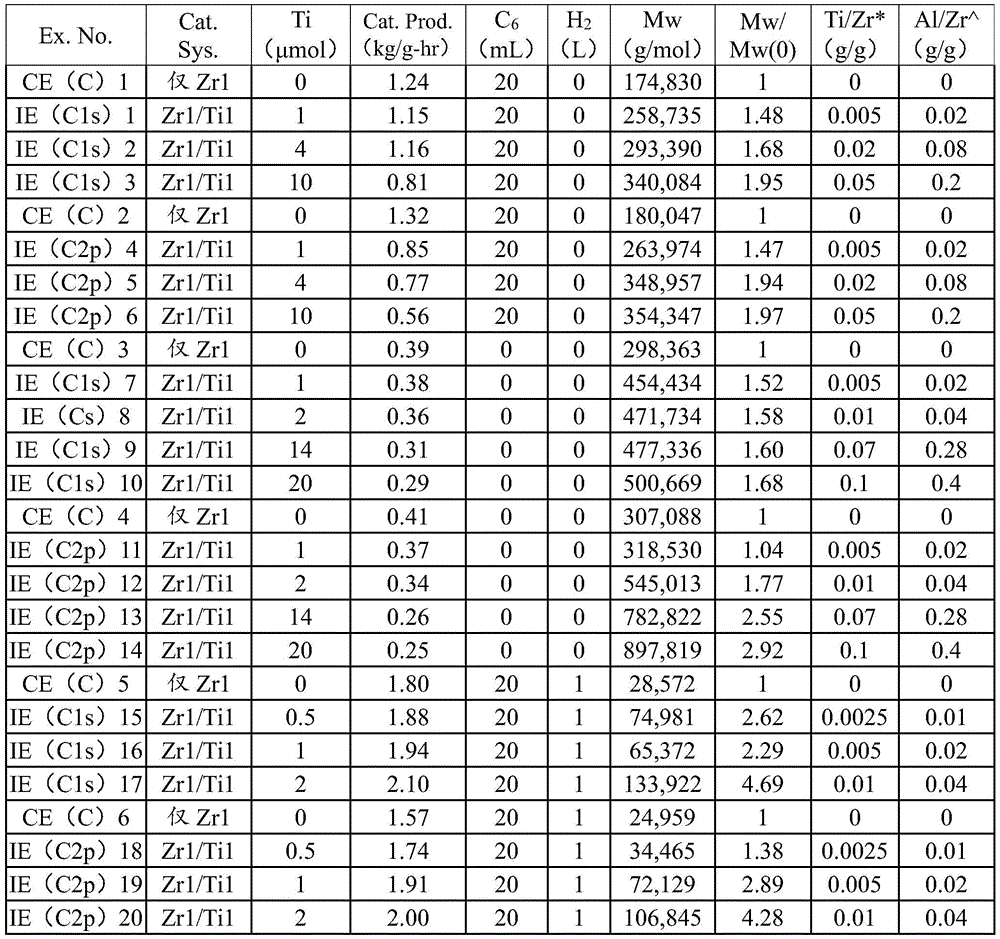
如在表4中所示,相对于比较实例,通过引入二茂钛催化剂实现聚合物Mw增加,无论是二茂锆催化剂和二茂钛催化剂单独地添加到反应器中或预混合一段时间并且然后将预混合一起添加到反应器中。其中将二茂锆催化剂和二茂钛催化剂以相同Ti/Zr*和Al/Zr^比率单独地添加到反应器中的实施例有利地实现更高的催化剂生产率。当存在共聚单体(C6),没有添加的H2的情况下,或在不存在共聚单体(C6),没有添加的H2的情况下,或在存在共聚单体(C6),具有添加的H2的情况下进行聚合反应时,此趋势一致。As shown in Table 4, relative to the comparative example, the polymer Mw increase was achieved by the introduction of the titanocene catalyst, whether the zirconocene catalyst and the titanocene catalyst were added to the reactor separately or premixed for a period of time and then The premix is added to the reactor together. Embodiments in which the zirconocene catalyst and the titanocene catalyst are separately added to the reactor at the same Ti/Zr* and Al/Zr^ ratios advantageously achieve higher catalyst productivity. When comonomer ( C6 ) is present, without added H2 , or in the absence of comonomer ( C6 ), without added H2 , or in the presence of comonomer ( C6 ) , this trend is consistent when the polymerization is carried out with added H2 .
比较实例(D)气相流化床中试设备反应器;二茂锆催化剂;没有二茂钛催化剂;聚合乙烯和1-己烯;连续进料(CE(D))。利用注射泵,将于矿物油中的Zr2催化剂的浆料通过含有螺旋静态混合器的催化剂注射管线进料到反应器中。在催化剂注射管线之后并且在螺旋静态混合器之前,将1.4kg每小时(3磅/小时(lb/hr))的异戊烷添加到催化剂注射管线中。在螺旋静态混合器之后,以2.3kg/hr(5lb/hr)将氮气添加到注射管线中。使用通过外管的额外的1.8kg/h(4lb/hr)的氮气和3.2到3.6kg/hr(7到8lbs/hr)的异戊烷通过外管或护罩将浆液催化剂从催化剂注射管线注射到反应器中。在达到平衡之后,在稍后表5中示出的相应的条件下进行聚合。通过将浆料Zr2催化剂以及乙烯和1-己烯连续进料到聚乙烯细粒的流化床中引发聚合。未将氢气进料到反应器,但是在聚合期间原位产生氢气。惰性气体、氮气和异戊烷弥补在反应器中的剩余压力。从反应器连续去除乙烯/1-己烯共聚物产物,以维持在反应器中恒定的细粒的床重量。结果在表5中。Comparative Example (D) Gas phase fluidized bed pilot plant reactor; zirconocene catalyst; no titanocene catalyst; polymerized ethylene and 1-hexene; continuous feed (CE(D)). Using a syringe pump, a slurry of Zr2 catalyst in mineral oil was fed into the reactor through a catalyst injection line containing a helical static mixer. After the catalyst injection line and before the helical static mixer, 1.4 kg per hour (3 pounds per hour (lb/hr)) of isopentane was added to the catalyst injection line. After the helical static mixer, nitrogen was added to the injection line at 2.3 kg/hr (5 lb/hr). The slurry catalyst was injected from the catalyst injection line through the outer tube or shroud using an additional 1.8 kg/h (4 lb/hr) of nitrogen and 3.2 to 3.6 kg/hr (7 to 8 lbs/hr) of isopentane through the outer tube into the reactor. After reaching equilibrium, polymerization was carried out under the corresponding conditions shown in Table 5 later. The polymerization was initiated by continuously feeding a slurry Zr2 catalyst together with ethylene and 1-hexene into a fluidized bed of polyethylene fines. Hydrogen was not fed to the reactor, but was generated in situ during the polymerization. Inert gas, nitrogen and isopentane make up the residual pressure in the reactor. The ethylene/1-hexene copolymer product was continuously removed from the reactor to maintain a constant bed weight of fines in the reactor. The results are in Table 5.
发明实例(D1)气相流化床中试设备反应器;二茂锆和二茂钛催化剂,单独地进料到反应器以原位制备二茂锆-二茂钛催化剂体系;聚合乙烯和1-己烯;连续进料(IE(D1s))。重复CE(D)的程序,不同在于二茂钛催化剂Ti1的异戊烷溶液经由分开的注射管线也直接添加到反应器中(IE(D1s)。结果在表5中。Invention Example (D1) Gas phase fluidized bed pilot plant reactor; zirconocene and titanocene catalysts, separately fed to the reactor to prepare in situ zirconocene-titanocene catalyst system; polymerized ethylene and 1- Hexene; continuous feed (IE(D1s)). The procedure for CE(D) was repeated except that the titanocene catalyst Ti1 in isopentane was also added directly to the reactor via a separate injection line (IE(D1s). Results are in Table 5.
发明实例(D2)气相流化床中试设备反应器;二茂锆和二茂钛催化剂,在管线内混合器中预混合二茂锆催化剂和二茂钛催化剂以制备其未老化的预混合物,并且在小于5分钟内(约1分钟)将未老化的预混合物进料到反应器中;聚合乙烯和1-己烯;连续进料(IE(D1s))。重复CE(D)的程序,不同在于仅在管线内螺旋静态混合器之前也将二茂钛催化剂Ti1的异戊烷溶液添加到进料管线中,以形成具有Zr2的预混合物,并且将预混合物进料到反应器中(IE(D2p)。结果在表5中。Invention Example (D2) Gas phase fluidized bed pilot plant reactor; zirconocene and titanocene catalyst, premixing zirconocene catalyst and titanocene catalyst in an in-line mixer to prepare an unaged premix thereof, And the unaged premix was fed into the reactor in less than 5 minutes (about 1 minute); ethylene and 1-hexene were polymerized; continuous feed (IE(D1s)). The procedure for CE(D) was repeated, except that the titanocene catalyst Ti1 in isopentane was also added to the feed line just before the inline helical static mixer to form a premix with Zr2, and the premix was Feed into the reactor (IE(D2p). Results are in Table 5.
发明实例(D3)气相流化床中试设备反应器;二茂锆和二茂钛催化剂,在分批混合器中预混合以制备预混合物,将预混合物老化2天,并且然后将所得老化的预混合物进料到反应器中;聚合乙烯和1-己烯;连续进料(IE(D1s))。重复CE(D)的程序,不同在于首先在混合物中混合二茂钛催化剂Ti1和Zr2的异戊烷溶液以形成预混合物,将预混合物老化2天,并且将老化的预混合物进料到反应器中(IE(D3a)。结果在下表5中报告。Invention Example (D3) Gas phase fluidized bed pilot plant reactor; zirconocene and titanocene catalysts, premixed in a batch mixer to prepare a premix, aged for 2 days, and then the resulting aged The premix is fed to the reactor; ethylene and 1-hexene are polymerized; continuous feed (IE(D1s)). The procedure for CE(D) was repeated, except that the titanocene catalysts Ti1 and Zr2 in isopentane were first mixed in the mixture to form a premix, the premix was aged for 2 days, and the aged premix was fed to the reactor Medium (IE(D3a). Results are reported in Table 5 below.
表5:使用单独地进料二茂锆和二茂钛催化剂(IE(D1s));预混合和进料二茂锆和二茂钛催化剂(IE(D2p))未老化;或预混合、老化,并且然后进料二茂锆和二茂钛催化剂(IE(D3a))的连续气相流化床中试设备反应器聚合。Table 5: Using separately fed zirconocene and titanocene catalysts (IE(D1s)); premixed and fed zirconocene and titanocene catalysts (IE(D2p)) unaged; or premixed, aged , and then fed the continuous gas phase fluidized bed pilot plant reactor polymerization of zirconocene and titanocene catalysts (IE(D3a)).

conc.为浓度,cc为立方厘米,hr为小时,min.为分钟,进料为Cp2TiCl2/T2MPAl于异戊烷中的溶液,进料为Cp2TiCl2、Zr2和T2MPAl于矿物油中的浆料。conc. is the concentration, cc is the cubic centimeter, hr is the hour, min. is the minute, the feed is a solution of Cp 2 TiCl 2 /T2MPAl in isopentane, the feed is Cp 2 TiCl 2 , Zr2 and T2MPAl in mineral oil in the slurry.
如在表5中所示,对于连续聚合操作,当使用二茂钛催化剂时,以较低生产速率生产具有较低熔体流动速率FI21(较高分子量)的乙烯/1-己烯共聚物。出人意料地,单独地添加二茂锆和二茂钛催化剂(IE(D1s)和管线内预混合这些催化剂(IE(D2p)的催化剂混合模式示出优于预混合/老化模式(IE(D3a)的优点。这些包括相对于IE(D3a),IE(D1s)和IE(D2p)去除在聚合反应器中产生的H2的能力提高。提高的去除H2的能力有利地允许聚合以在给定的一组反应器条件下制备具有较低FI21的产物树脂。优点还包括IE(D1s)具有比IE(D2p)更高的催化剂生产率。分开添加模式(IE(D1s)具有最高的生产速率,其中共聚物产物FI21低于使用催化剂预混合/老化(IE(D3a)制备的共聚物产物FI21。并且管线内混合模式(IE(D2p)具有最低的共聚物产物FI21(最高分子量),显著低于从预混合/老化模式(IE(D3a)获得的。As shown in Table 5, for continuous polymerization operation, ethylene/1-hexene copolymer with lower melt flow rate FI 21 (higher molecular weight) was produced at lower production rate when titanocene catalyst was used . Unexpectedly, the catalyst mixing mode of adding zirconocene and titanocene catalysts individually (IE(D1s) and premixing these catalysts in-line (IE(D2p)) showed better performance than the premix/aging mode (IE(D3a). Advantages. These include improved ability to remove H2 produced in the polymerization reactor relative to IE(D3a), IE(D1s) and IE(D2p). The improved ability to remove H2 advantageously allows polymerization to A set of reactor conditions produces a product resin with lower FI 21. Advantages also include that IE(D1s) has higher catalyst productivity than IE(D2p). Separate addition mode (IE(D1s) has the highest production rate where The copolymer product FI 21 is lower than the copolymer product FI 21 prepared using catalyst premix/aging (IE(D3a). And the in-line mixing mode (IE(D2p) has the lowest copolymer product FI 21 (highest molecular weight), significantly lower than that obtained from the premix/aging mode (IE(D3a).
Claims (13)
Applications Claiming Priority (3)
| Application Number | Priority Date | Filing Date | Title |
|---|---|---|---|
| US201762599959P | 2017-12-18 | 2017-12-18 | |
| US62/599959 | 2017-12-18 | ||
| PCT/US2018/065338 WO2019125881A1 (en) | 2017-12-18 | 2018-12-13 | Zirconocene-titanocene catalyst system |
Publications (2)
| Publication Number | Publication Date |
|---|---|
| CN111372958A true CN111372958A (en) | 2020-07-03 |
| CN111372958B CN111372958B (en) | 2023-06-30 |
Family
ID=65041905
Family Applications (1)
| Application Number | Title | Priority Date | Filing Date |
|---|---|---|---|
| CN201880075342.6A Active CN111372958B (en) | 2017-12-18 | 2018-12-13 | Zirconocene-titanocene catalyst system |
Country Status (8)
| Country | Link |
|---|---|
| US (1) | US11421051B2 (en) |
| EP (1) | EP3728350B1 (en) |
| JP (1) | JP7313350B2 (en) |
| CN (1) | CN111372958B (en) |
| BR (1) | BR112020010518B1 (en) |
| ES (1) | ES2978120T3 (en) |
| SG (1) | SG11202005184XA (en) |
| WO (1) | WO2019125881A1 (en) |
Families Citing this family (1)
| Publication number | Priority date | Publication date | Assignee | Title |
|---|---|---|---|---|
| WO2019190897A1 (en) * | 2018-03-26 | 2019-10-03 | Dow Global Technologies Llc | Spray-dried zirconocene catalyst system |
Citations (3)
| Publication number | Priority date | Publication date | Assignee | Title |
|---|---|---|---|---|
| CN1142788A (en) * | 1993-12-03 | 1997-02-12 | 波里阿利斯有限公司 | Catalyst for olefin polymerization and method for producing the same |
| CN103402636A (en) * | 2011-01-14 | 2013-11-20 | 格雷斯公司 | Process of making modified metallocene catalyst, catalyst produced and use thereof |
| EP3255066A1 (en) * | 2015-06-15 | 2017-12-13 | LG Chem, Ltd. | Method for producing metallocene-supported catalyst |
Family Cites Families (83)
| Publication number | Priority date | Publication date | Assignee | Title |
|---|---|---|---|---|
| US3146223A (en) | 1959-08-21 | 1964-08-25 | Shell Oil Co | Polymerization in the presence of controlled amounts of hydrogen |
| NL135065C (en) | 1965-05-14 | |||
| US4003712A (en) | 1970-07-29 | 1977-01-18 | Union Carbide Corporation | Fluidized bed reactor |
| US3709853A (en) | 1971-04-29 | 1973-01-09 | Union Carbide Corp | Polymerization of ethylene using supported bis-(cyclopentadienyl)chromium(ii)catalysts |
| US4011382A (en) | 1975-03-10 | 1977-03-08 | Union Carbide Corporation | Preparation of low and medium density ethylene polymer in fluid bed reactor |
| US4302566A (en) | 1978-03-31 | 1981-11-24 | Union Carbide Corporation | Preparation of ethylene copolymers in fluid bed reactor |
| CA1168521A (en) | 1982-02-01 | 1984-06-05 | Clifford F. Thompson | Leak detector |
| US4588790A (en) | 1982-03-24 | 1986-05-13 | Union Carbide Corporation | Method for fluidized bed polymerization |
| US4543399A (en) | 1982-03-24 | 1985-09-24 | Union Carbide Corporation | Fluidized bed reaction systems |
| US4988783A (en) | 1983-03-29 | 1991-01-29 | Union Carbide Chemicals And Plastics Company Inc. | Ethylene polymerization using supported vanadium catalyst |
| US4665208A (en) | 1985-07-11 | 1987-05-12 | Exxon Chemical Patents Inc. | Process for the preparation of alumoxanes |
| US5124418A (en) | 1985-11-15 | 1992-06-23 | Exxon Chemical Patents Inc. | Supported polymerization catalyst |
| US5077255A (en) | 1986-09-09 | 1991-12-31 | Exxon Chemical Patents Inc. | New supported polymerization catalyst |
| US5084534A (en) | 1987-06-04 | 1992-01-28 | Exxon Chemical Patents, Inc. | High pressure, high temperature polymerization of ethylene |
| ATE177759T1 (en) | 1986-09-24 | 1999-04-15 | Mitsui Chemicals Inc | METHOD FOR OLEFIN POLYMERIZATION |
| JPH0780933B2 (en) | 1986-11-20 | 1995-08-30 | 三井石油化学工業株式会社 | Olefin Polymerization Method |
| JPH0742301B2 (en) | 1987-02-14 | 1995-05-10 | 三井石油化学工業株式会社 | Particulate aluminoxane, its manufacturing method and its use |
| JP2538588B2 (en) | 1987-04-03 | 1996-09-25 | 三井石油化学工業株式会社 | Method for producing solid catalyst for olefin polymerization |
| US5206199A (en) | 1987-04-20 | 1993-04-27 | Mitsui Petrochemical Industries, Ltd. | Catalyst for polymerizing an olefin and process for polymerizing an olefin |
| US4851488A (en) | 1987-04-23 | 1989-07-25 | Shell Oil Company | Process for altering hydrogenated polymer compositions from high melt flow to low melt flow |
| FR2618786B1 (en) | 1987-07-31 | 1989-12-01 | Bp Chimie Sa | PROCESS FOR THE POLYMERIZATION OF GASEOUS OLEFINS IN A FLUIDIZED BED REACTOR |
| US5091352A (en) | 1988-09-14 | 1992-02-25 | Mitsui Petrochemical Industries, Ltd. | Olefin polymerization catalyst component, olefin polymerization catalyst and process for the polymerization of olefins |
| US4908463A (en) | 1988-12-05 | 1990-03-13 | Ethyl Corporation | Aluminoxane process |
| US5103031A (en) | 1989-02-21 | 1992-04-07 | Ethyl Corporation | Falling film aluminoxane process |
| US4968827A (en) | 1989-06-06 | 1990-11-06 | Ethyl Corporation | Alkylaluminoxane process |
| US4924018A (en) | 1989-06-26 | 1990-05-08 | Ethyl Corporation | Alkylaluminoxane process |
| NZ235032A (en) | 1989-08-31 | 1993-04-28 | Dow Chemical Co | Constrained geometry complexes of titanium, zirconium or hafnium comprising a substituted cyclopentadiene ligand; use as olefin polymerisation catalyst component |
| US4994534A (en) | 1989-09-28 | 1991-02-19 | Union Carbide Chemicals And Plastics Company Inc. | Process for producing sticky polymers |
| US5308815A (en) | 1991-07-26 | 1994-05-03 | Ethyl Corporation | Heterogeneous methylaluminoxane catalyst system |
| US5157137A (en) | 1991-07-26 | 1992-10-20 | Ethyl Corporation | Method of making gel free alkylaluminoxane solutions |
| US5235081A (en) | 1992-03-18 | 1993-08-10 | Ethyl Corporation | Method of removing gel forming materials from methylaluminoxanes |
| US5194529A (en) | 1991-10-28 | 1993-03-16 | Shell Oil Company | Polymerization process |
| US5329032A (en) | 1992-03-18 | 1994-07-12 | Akzo Chemicals Inc. | Polymethylaluminoxane of enhanced solution stability |
| US5352749A (en) | 1992-03-19 | 1994-10-04 | Exxon Chemical Patents, Inc. | Process for polymerizing monomers in fluidized beds |
| US5248801A (en) | 1992-08-27 | 1993-09-28 | Ethyl Corporation | Preparation of methylaluminoxanes |
| US5391793A (en) | 1992-11-02 | 1995-02-21 | Akzo Nobel N.V. | Aryloxyaluminoxanes |
| US5939346A (en) | 1992-11-02 | 1999-08-17 | Akzo Nobel N.V. | Catalyst system comprising an aryloxyaluminoxane containing an electron withdrawing group |
| US5276115A (en) | 1992-12-14 | 1994-01-04 | Phillips Petroleum Company | Mono-1-olefin polymerization in the presence of hydrogen and a cyclopentadienyl compound |
| US5391529A (en) | 1993-02-01 | 1995-02-21 | Albemarle Corporation | Siloxy-aluminoxane compositions, and catalysts which include such compositions with a metallocene |
| US5462999A (en) | 1993-04-26 | 1995-10-31 | Exxon Chemical Patents Inc. | Process for polymerizing monomers in fluidized beds |
| ZA943399B (en) | 1993-05-20 | 1995-11-17 | Bp Chem Int Ltd | Polymerisation process |
| US5804678A (en) | 1993-07-13 | 1998-09-08 | Mitsui Petrochemical Industries, Ltd. | Process for gas phase polymerization of olefin |
| EP0649992B1 (en) | 1993-10-23 | 1997-07-30 | WABCO GmbH | Disc brake actuator |
| US6245705B1 (en) | 1993-11-18 | 2001-06-12 | Univation Technologies | Cocatalysts for metallocene-based olefin polymerization catalyst systems |
| US5563284A (en) | 1994-09-09 | 1996-10-08 | Phillips Petroleum Company | Cyclopentadienyl-type ligands, metallocenes, catalyst systems, preparation, and use |
| US5677375A (en) | 1995-07-21 | 1997-10-14 | Union Carbide Chemicals & Plastics Technology Corporation | Process for producing an in situ polyethylene blend |
| DE59500269D1 (en) * | 1995-09-13 | 1997-07-03 | Witco Gmbh | Process for the production of metallocene catalyst systems on inert support materials using gas phase reactors |
| JPH09151210A (en) * | 1995-09-29 | 1997-06-10 | Nippon Oil Co Ltd | Preparation of polyolefin |
| JPH09151204A (en) * | 1995-09-29 | 1997-06-10 | Nippon Oil Co Ltd | Method for producing polyolefin |
| US5916982A (en) | 1995-09-29 | 1999-06-29 | Nippon Oil Co., Ltd. | Process for the production of polyolefins |
| US5693838A (en) | 1995-11-13 | 1997-12-02 | Albemarle Corporation | Aluminoxane process and product |
| US5756416A (en) | 1995-11-28 | 1998-05-26 | Union Carbide Chemicals & Plastics Technology Corporation | Catalyst composition having improved comonomer reactivity |
| US5665818A (en) | 1996-03-05 | 1997-09-09 | Union Carbide Chemicals & Plastics Technology Corporation | High activity staged reactor process |
| US5627242A (en) | 1996-03-28 | 1997-05-06 | Union Carbide Chemicals & Plastics Technology Corporation | Process for controlling gas phase fluidized bed polymerization reactor |
| CN1093141C (en) | 1996-05-17 | 2002-10-23 | Bp化学有限公司 | Polyolefin copolymer composition in which the maximum molecular weight occurs in the fraction of the composition with the highest comonomer content |
| US5959044A (en) | 1996-07-08 | 1999-09-28 | Villar; Juan Carlos | Method of controlling continuous ethylene-limited metallocene-catalyzed copolymerization systems |
| JPH1045819A (en) | 1996-08-01 | 1998-02-17 | Mitsubishi Chem Corp | Ethylene polymerization catalyst and ethylene polymerization method |
| US5936108A (en) | 1996-10-17 | 1999-08-10 | Albemarle Corporation | Metallocene synthesis |
| US5739220A (en) | 1997-02-06 | 1998-04-14 | Fina Technology, Inc. | Method of olefin polymerization utilizing hydrogen pulsing, products made therefrom, and method of hydrogenation |
| DE19707236A1 (en) | 1997-02-24 | 1998-08-27 | Targor Gmbh | Catalyst composition |
| GB9712663D0 (en) | 1997-06-16 | 1997-08-20 | Borealis As | Process |
| TW381097B (en) | 1997-09-18 | 2000-02-01 | Idemitsu Petrochemical Co | Catalyst for use in alkene monomer polymerization, manufacturing method for alkene polymers, and manufacturing method for styrine polymers |
| US6242545B1 (en) | 1997-12-08 | 2001-06-05 | Univation Technologies | Polymerization catalyst systems comprising substituted hafinocenes |
| US6258903B1 (en) | 1998-12-18 | 2001-07-10 | Univation Technologies | Mixed catalyst system |
| EP1041090A1 (en) | 1999-03-29 | 2000-10-04 | Fina Research S.A. | Production of polyethylene having a broad molecular weight distribution |
| US6274684B1 (en) | 1999-10-22 | 2001-08-14 | Univation Technologies, Llc | Catalyst composition, method of polymerization, and polymer therefrom |
| US6534665B1 (en) | 1999-10-26 | 2003-03-18 | Repsol Quimica S.A. | Single-carbon bridges bys cyclopentadienyl compounds and metallocene complexes thereof |
| US6528448B1 (en) | 2000-04-28 | 2003-03-04 | Phillips Petroleum Company | Polymerization catalyst compositions and processes to produce polymers and bimodal polymers |
| US6489408B2 (en) | 2000-11-30 | 2002-12-03 | Univation Technologies, Llc | Polymerization process |
| US7795366B2 (en) | 2002-08-12 | 2010-09-14 | Exxonmobil Chemical Patents Inc. | Modified polyethylene compositions |
| US20060287449A1 (en) | 2003-03-10 | 2006-12-21 | Koichi Miyamoto | Ultrahigh-molecular ethylene polymer |
| US7662894B2 (en) | 2006-12-19 | 2010-02-16 | Saudi Bosic Industries Corporation | Polymer supported metallocene catalyst composition for polymerizing olefins |
| US7897705B2 (en) | 2008-08-08 | 2011-03-01 | Sumitomo Chemical Company, Limited | Process for producing olefin polymer |
| US7960486B2 (en) | 2008-08-08 | 2011-06-14 | Sumitomo Chemical Company, Limited | Process for producing olefin polymer |
| CN102171259A (en) | 2008-10-03 | 2011-08-31 | 尤尼威蒂恩技术有限责任公司 | Catalyst compositions and methods of making and using the same |
| MX2012000254A (en) | 2009-06-29 | 2012-01-25 | Chevron Philips Chemical Company Lp | The use of hydrogen scavenging catalysts to control polymer molecular weight and hydrogen levels in a polymerization reactor. |
| SG176975A1 (en) | 2009-06-29 | 2012-02-28 | Chevron Phillips Chemical Co | Dual metallocene catalyst systems for decreasing melt index and increasing polymer production rates |
| WO2012074710A1 (en) * | 2010-11-30 | 2012-06-07 | Univation Technologies, Llc. | Catalyst composition having improved flow characteristics and methods of making and using the same |
| KR101339550B1 (en) | 2011-11-24 | 2013-12-10 | 삼성토탈 주식회사 | A catalyst for olefin polymerization and co-polymerization and a method for olefin polymerization and co-polymerization with using the same |
| US8987390B2 (en) | 2012-12-18 | 2015-03-24 | Chevron Phillips Chemical Company, Lp | Chain transfer agent removal between polyolefin polymerization reactors |
| KR101495423B1 (en) | 2013-05-14 | 2015-02-24 | 삼성토탈 주식회사 | A catalyst for olefin polymerization and co-polymerization and a method for olefin polymerization and co-polymerization with using the same |
| KR101795748B1 (en) * | 2015-06-15 | 2017-12-01 | 주식회사 엘지화학 | Method for preparing polyolefin |
| WO2017034722A1 (en) | 2015-08-26 | 2017-03-02 | Exxonmobil Chemical Patents Inc. | Method of regulating hydrogen to a polymerization reactor |
-
2018
- 2018-12-13 ES ES18836745T patent/ES2978120T3/en active Active
- 2018-12-13 US US16/954,396 patent/US11421051B2/en active Active
- 2018-12-13 WO PCT/US2018/065338 patent/WO2019125881A1/en not_active Ceased
- 2018-12-13 CN CN201880075342.6A patent/CN111372958B/en active Active
- 2018-12-13 SG SG11202005184XA patent/SG11202005184XA/en unknown
- 2018-12-13 JP JP2020529209A patent/JP7313350B2/en active Active
- 2018-12-13 BR BR112020010518-0A patent/BR112020010518B1/en active IP Right Grant
- 2018-12-13 EP EP18836745.2A patent/EP3728350B1/en active Active
Patent Citations (3)
| Publication number | Priority date | Publication date | Assignee | Title |
|---|---|---|---|---|
| CN1142788A (en) * | 1993-12-03 | 1997-02-12 | 波里阿利斯有限公司 | Catalyst for olefin polymerization and method for producing the same |
| CN103402636A (en) * | 2011-01-14 | 2013-11-20 | 格雷斯公司 | Process of making modified metallocene catalyst, catalyst produced and use thereof |
| EP3255066A1 (en) * | 2015-06-15 | 2017-12-13 | LG Chem, Ltd. | Method for producing metallocene-supported catalyst |
Also Published As
| Publication number | Publication date |
|---|---|
| WO2019125881A1 (en) | 2019-06-27 |
| CN111372958B (en) | 2023-06-30 |
| EP3728350B1 (en) | 2024-03-13 |
| US11421051B2 (en) | 2022-08-23 |
| BR112020010518B1 (en) | 2023-11-28 |
| ES2978120T3 (en) | 2024-09-05 |
| US20210079130A1 (en) | 2021-03-18 |
| JP7313350B2 (en) | 2023-07-24 |
| SG11202005184XA (en) | 2020-07-29 |
| JP2021506994A (en) | 2021-02-22 |
| EP3728350A1 (en) | 2020-10-28 |
| BR112020010518A2 (en) | 2020-11-10 |
Similar Documents
| Publication | Publication Date | Title |
|---|---|---|
| EP0206794B2 (en) | Supported polymerization catalyst | |
| EP3877391B1 (en) | Alkane-soluble non-metallocene precatalysts | |
| CN112839966B (en) | Process for the polymerization of olefins using an alkane soluble non-metallocene pre-catalyst | |
| US20220235155A1 (en) | Hafnocene-titanocene catalyst system | |
| CN111886262B (en) | Spray-dried zirconocene catalyst system | |
| CN102964476A (en) | Supported non-metallocene catalyst, preparation method and application | |
| CN102059152B (en) | Loaded non-metallocene catalyst and preparation method and application thereof | |
| CN111372958B (en) | Zirconocene-titanocene catalyst system | |
| CN102059148B (en) | Loaded non-metallocene catalyst and preparation method and application thereof | |
| CN111741988A (en) | Ethylene/1-hexene copolymer | |
| CN102964484A (en) | Supported non-metallocene catalyst, preparation method and application | |
| CN102964489A (en) | Supported non-metallocene catalyst, preparation method and application | |
| BR112020018781B1 (en) | SPRAY DRY ZIRCONOCENE CATALYST SYSTEM, METHOD FOR MAKING A SPRAY DRY ZIRCONOCENE CATALYST SYSTEM AND METHOD FOR MAKING A POLYETHYLENE COMPOSITION |
Legal Events
| Date | Code | Title | Description |
|---|---|---|---|
| PB01 | Publication | ||
| PB01 | Publication | ||
| SE01 | Entry into force of request for substantive examination | ||
| SE01 | Entry into force of request for substantive examination | ||
| GR01 | Patent grant | ||
| GR01 | Patent grant |