CN111363963A - Double-layer structure hard alloy with surface layer rich in cubic phase and preparation method thereof - Google Patents
Double-layer structure hard alloy with surface layer rich in cubic phase and preparation method thereof Download PDFInfo
- Publication number
- CN111363963A CN111363963A CN202010265866.0A CN202010265866A CN111363963A CN 111363963 A CN111363963 A CN 111363963A CN 202010265866 A CN202010265866 A CN 202010265866A CN 111363963 A CN111363963 A CN 111363963A
- Authority
- CN
- China
- Prior art keywords
- carbide
- surface layer
- double
- rich
- layer structure
- Prior art date
- Legal status (The legal status is an assumption and is not a legal conclusion. Google has not performed a legal analysis and makes no representation as to the accuracy of the status listed.)
- Granted
Links
Images


Classifications
-
- C—CHEMISTRY; METALLURGY
- C22—METALLURGY; FERROUS OR NON-FERROUS ALLOYS; TREATMENT OF ALLOYS OR NON-FERROUS METALS
- C22C—ALLOYS
- C22C29/00—Alloys based on carbides, oxides, nitrides, borides, or silicides, e.g. cermets, or other metal compounds, e.g. oxynitrides, sulfides
- C22C29/02—Alloys based on carbides, oxides, nitrides, borides, or silicides, e.g. cermets, or other metal compounds, e.g. oxynitrides, sulfides based on carbides or carbonitrides
- C22C29/06—Alloys based on carbides, oxides, nitrides, borides, or silicides, e.g. cermets, or other metal compounds, e.g. oxynitrides, sulfides based on carbides or carbonitrides based on carbides, but not containing other metal compounds
- C22C29/08—Alloys based on carbides, oxides, nitrides, borides, or silicides, e.g. cermets, or other metal compounds, e.g. oxynitrides, sulfides based on carbides or carbonitrides based on carbides, but not containing other metal compounds based on tungsten carbide
-
- B—PERFORMING OPERATIONS; TRANSPORTING
- B22—CASTING; POWDER METALLURGY
- B22F—WORKING METALLIC POWDER; MANUFACTURE OF ARTICLES FROM METALLIC POWDER; MAKING METALLIC POWDER; APPARATUS OR DEVICES SPECIALLY ADAPTED FOR METALLIC POWDER
- B22F3/00—Manufacture of workpieces or articles from metallic powder characterised by the manner of compacting or sintering; Apparatus specially adapted therefor ; Presses and furnaces
- B22F3/02—Compacting only
-
- B—PERFORMING OPERATIONS; TRANSPORTING
- B22—CASTING; POWDER METALLURGY
- B22F—WORKING METALLIC POWDER; MANUFACTURE OF ARTICLES FROM METALLIC POWDER; MAKING METALLIC POWDER; APPARATUS OR DEVICES SPECIALLY ADAPTED FOR METALLIC POWDER
- B22F3/00—Manufacture of workpieces or articles from metallic powder characterised by the manner of compacting or sintering; Apparatus specially adapted therefor ; Presses and furnaces
- B22F3/10—Sintering only
- B22F3/1003—Use of special medium during sintering, e.g. sintering aid
- B22F3/1007—Atmosphere
-
- B—PERFORMING OPERATIONS; TRANSPORTING
- B22—CASTING; POWDER METALLURGY
- B22F—WORKING METALLIC POWDER; MANUFACTURE OF ARTICLES FROM METALLIC POWDER; MAKING METALLIC POWDER; APPARATUS OR DEVICES SPECIALLY ADAPTED FOR METALLIC POWDER
- B22F3/00—Manufacture of workpieces or articles from metallic powder characterised by the manner of compacting or sintering; Apparatus specially adapted therefor ; Presses and furnaces
- B22F3/10—Sintering only
- B22F3/1017—Multiple heating or additional steps
- B22F3/1021—Removal of binder or filler
-
- B—PERFORMING OPERATIONS; TRANSPORTING
- B22—CASTING; POWDER METALLURGY
- B22F—WORKING METALLIC POWDER; MANUFACTURE OF ARTICLES FROM METALLIC POWDER; MAKING METALLIC POWDER; APPARATUS OR DEVICES SPECIALLY ADAPTED FOR METALLIC POWDER
- B22F3/00—Manufacture of workpieces or articles from metallic powder characterised by the manner of compacting or sintering; Apparatus specially adapted therefor ; Presses and furnaces
- B22F3/10—Sintering only
- B22F3/1035—Liquid phase sintering
-
- B—PERFORMING OPERATIONS; TRANSPORTING
- B22—CASTING; POWDER METALLURGY
- B22F—WORKING METALLIC POWDER; MANUFACTURE OF ARTICLES FROM METALLIC POWDER; MAKING METALLIC POWDER; APPARATUS OR DEVICES SPECIALLY ADAPTED FOR METALLIC POWDER
- B22F9/00—Making metallic powder or suspensions thereof
- B22F9/02—Making metallic powder or suspensions thereof using physical processes
- B22F9/04—Making metallic powder or suspensions thereof using physical processes starting from solid material, e.g. by crushing, grinding or milling
-
- C—CHEMISTRY; METALLURGY
- C22—METALLURGY; FERROUS OR NON-FERROUS ALLOYS; TREATMENT OF ALLOYS OR NON-FERROUS METALS
- C22C—ALLOYS
- C22C1/00—Making non-ferrous alloys
- C22C1/04—Making non-ferrous alloys by powder metallurgy
- C22C1/05—Mixtures of metal powder with non-metallic powder
- C22C1/051—Making hard metals based on borides, carbides, nitrides, oxides or silicides; Preparation of the powder mixture used as the starting material therefor
-
- C—CHEMISTRY; METALLURGY
- C22—METALLURGY; FERROUS OR NON-FERROUS ALLOYS; TREATMENT OF ALLOYS OR NON-FERROUS METALS
- C22C—ALLOYS
- C22C29/00—Alloys based on carbides, oxides, nitrides, borides, or silicides, e.g. cermets, or other metal compounds, e.g. oxynitrides, sulfides
- C22C29/02—Alloys based on carbides, oxides, nitrides, borides, or silicides, e.g. cermets, or other metal compounds, e.g. oxynitrides, sulfides based on carbides or carbonitrides
- C22C29/06—Alloys based on carbides, oxides, nitrides, borides, or silicides, e.g. cermets, or other metal compounds, e.g. oxynitrides, sulfides based on carbides or carbonitrides based on carbides, but not containing other metal compounds
- C22C29/067—Alloys based on carbides, oxides, nitrides, borides, or silicides, e.g. cermets, or other metal compounds, e.g. oxynitrides, sulfides based on carbides or carbonitrides based on carbides, but not containing other metal compounds comprising a particular metallic binder
-
- C—CHEMISTRY; METALLURGY
- C23—COATING METALLIC MATERIAL; COATING MATERIAL WITH METALLIC MATERIAL; CHEMICAL SURFACE TREATMENT; DIFFUSION TREATMENT OF METALLIC MATERIAL; COATING BY VACUUM EVAPORATION, BY SPUTTERING, BY ION IMPLANTATION OR BY CHEMICAL VAPOUR DEPOSITION, IN GENERAL; INHIBITING CORROSION OF METALLIC MATERIAL OR INCRUSTATION IN GENERAL
- C23C—COATING METALLIC MATERIAL; COATING MATERIAL WITH METALLIC MATERIAL; SURFACE TREATMENT OF METALLIC MATERIAL BY DIFFUSION INTO THE SURFACE, BY CHEMICAL CONVERSION OR SUBSTITUTION; COATING BY VACUUM EVAPORATION, BY SPUTTERING, BY ION IMPLANTATION OR BY CHEMICAL VAPOUR DEPOSITION, IN GENERAL
- C23C8/00—Solid state diffusion of only non-metal elements into metallic material surfaces; Chemical surface treatment of metallic material by reaction of the surface with a reactive gas, leaving reaction products of surface material in the coating, e.g. conversion coatings, passivation of metals
- C23C8/06—Solid state diffusion of only non-metal elements into metallic material surfaces; Chemical surface treatment of metallic material by reaction of the surface with a reactive gas, leaving reaction products of surface material in the coating, e.g. conversion coatings, passivation of metals using gases
- C23C8/08—Solid state diffusion of only non-metal elements into metallic material surfaces; Chemical surface treatment of metallic material by reaction of the surface with a reactive gas, leaving reaction products of surface material in the coating, e.g. conversion coatings, passivation of metals using gases only one element being applied
- C23C8/24—Nitriding
-
- B—PERFORMING OPERATIONS; TRANSPORTING
- B22—CASTING; POWDER METALLURGY
- B22F—WORKING METALLIC POWDER; MANUFACTURE OF ARTICLES FROM METALLIC POWDER; MAKING METALLIC POWDER; APPARATUS OR DEVICES SPECIALLY ADAPTED FOR METALLIC POWDER
- B22F9/00—Making metallic powder or suspensions thereof
- B22F9/02—Making metallic powder or suspensions thereof using physical processes
- B22F9/04—Making metallic powder or suspensions thereof using physical processes starting from solid material, e.g. by crushing, grinding or milling
- B22F2009/043—Making metallic powder or suspensions thereof using physical processes starting from solid material, e.g. by crushing, grinding or milling by ball milling
Landscapes
- Chemical & Material Sciences (AREA)
- Engineering & Computer Science (AREA)
- Mechanical Engineering (AREA)
- Materials Engineering (AREA)
- Metallurgy (AREA)
- Organic Chemistry (AREA)
- Manufacturing & Machinery (AREA)
- Chemical Kinetics & Catalysis (AREA)
- Powder Metallurgy (AREA)
- Cutting Tools, Boring Holders, And Turrets (AREA)
Abstract
本发明属于合金材料技术领域,具体涉及一种表层富立方相的双层结构硬质合金及其制备方法。本发明表层富立方相的双层结构硬质合金包括以下成分及其质量百分数:碳化钛4‑6%、钴6‑10%、碳化钒0.1‑1.0%、钪0.1‑1.0%、碳化钨82‑89.8%,通过球磨、干燥、制粒、压坯和低压高温烧结等一系列工艺步骤制成。本发明提供的表层富立方相的双层结构硬质合金通过在配方中添加稀土金属钪,大大提高了氮气在金属粘结相的溶解度,增加了硬质合金表层富立方相的厚度,使其具有优异的耐磨性;通过控制低温烧结过程中的升温速率,减少缺陷生成,使得合金结构致密,更加适用于工业应用。
The invention belongs to the technical field of alloy materials, in particular to a double-layer structure hard alloy with a rich cubic phase in the surface layer and a preparation method thereof. The double-layer structure hard alloy with rich cubic phase on the surface layer of the present invention includes the following components and their mass percentages: titanium carbide 4-6%, cobalt 6-10%, vanadium carbide 0.1-1.0%, scandium 0.1-1.0%, tungsten carbide 82% ‑89.8%, made through a series of process steps including ball milling, drying, granulation, compaction and low pressure high temperature sintering. By adding rare earth metal scandium in the formula provided by the present invention, the solubility of nitrogen gas in the metal bonding phase is greatly improved, and the thickness of the surface layer of the hard alloy rich in cubic phase is increased, so that the It has excellent wear resistance; by controlling the heating rate in the low temperature sintering process, the formation of defects is reduced, and the alloy structure is compact, which is more suitable for industrial applications.
Description
技术领域technical field
本发明属于合金材料技术领域,具体涉及一种表层富立方相的双层结构硬质合金及其制备方法。The invention belongs to the technical field of alloy materials, in particular to a double-layer structure hard alloy with a rich cubic phase in the surface layer and a preparation method thereof.
背景技术Background technique
WC-Co硬质合金具有硬度高、耐磨性好、红硬性高且化学性能稳定等一系列优良特性,已广泛应用于机械加工、模具成型、凿岩采矿、石油勘测和建筑工具等领域。WC-Co cemented carbide has a series of excellent properties such as high hardness, good wear resistance, high red hardness and stable chemical properties, and has been widely used in machining, mold forming, rock drilling, oil exploration and construction tools.
传统硬质合金是由均匀分布的碳化物陶瓷相骨架与金属粘结相交错形成的复合材料。通常情况下,当陶瓷硬质相的含量比例提高时,有助于硬度、耐磨性以及耐高温性能的改善,但同时会造成韧性的降低;反之当金属粘结相的含量比例提高时,则会出现相反的力学性能变化规律。这使得宏观结构均匀的硬质合金都会存在无法同时提升耐磨性和断裂韧性的巨大局限性,然而梯度结构硬质合金则能在表层空间尺度上实现对硬质相或粘结相的梯度变化分布,实现对其表面性能自由的调节,赋予硬质合金不同力学性能的相互匹配,从而提高硬质合金工具的使用寿命和满足工业应用不断发展的现状。Traditional cemented carbide is a composite material formed by a uniformly distributed carbide ceramic phase skeleton interlaced with a metal bond phase. Usually, when the content ratio of the ceramic hard phase increases, it helps to improve the hardness, wear resistance and high temperature resistance, but at the same time it will reduce the toughness; on the contrary, when the content ratio of the metal binder phase increases, There will be the opposite change law of mechanical properties. This makes cemented carbides with uniform macrostructures have huge limitations of not being able to improve wear resistance and fracture toughness at the same time. However, cemented carbides with gradient structures can achieve gradient changes to the hard phase or the binder phase at the surface space scale. Distribution, realize the free adjustment of its surface properties, and endow the cemented carbide with different mechanical properties to match each other, thereby improving the service life of cemented carbide tools and meeting the status quo of the continuous development of industrial applications.
目前,梯度硬质合金的制备方法主要包括表面渗碳与表面渗氮两种方法。中国专利CN106987752B公开了一种表面渗碳的梯度硬脂合金的制备方法,该方法通过球磨、过滤、干燥、掺成型剂、压制成型制得硬脂合金生坯,然后配置含氢渗碳介质,将生胚装填在含氢渗碳介质中,在真空烧结炉中1350-1500℃保温1-2h,使碳元素由含氢渗碳介质向硬质合金表面扩散,形成表面渗碳层,最终实现表面渗碳的梯度硬质合金。此种梯度硬脂合金表面的碳层分布并不均匀,且碳层较薄,达不到预想的使用效果。中国专利CN102134660B公开了一种表面富立方相的功能梯度硬质合金及其制备方法,此制备方法采用碳化钨、复式碳化物、碳氮化钛和钴为原料,按照一定配比混合,采用粉末冶金工艺模压成型,然后在低压炉中通过控制温度和氮气压力进行制备,但是制成硬质合金表面的富立方相表层很薄,达不到工业用的价值。At present, the preparation methods of graded cemented carbide mainly include surface carburizing and surface nitriding. Chinese patent CN106987752B discloses a method for preparing a surface carburized gradient stearyl alloy. The method comprises ball milling, filtration, drying, mixing a molding agent, and pressing to obtain a stearyl alloy green body, and then a hydrogen-containing carburizing medium is configured. Fill the green embryo into the hydrogen-containing carburizing medium, and keep it in a vacuum sintering furnace at 1350-1500 ℃ for 1-2 hours, so that the carbon element diffuses from the hydrogen-containing carburizing medium to the surface of the cemented carbide to form a surface carburizing layer, and finally realize the Case Carburized Gradient Cemented Carbide. The distribution of the carbon layer on the surface of the gradient stearyl alloy is not uniform, and the carbon layer is thin, which cannot achieve the expected use effect. Chinese patent CN102134660B discloses a functionally graded cemented carbide with a rich cubic phase on the surface and a preparation method thereof. The preparation method uses tungsten carbide, compound carbide, titanium carbonitride and cobalt as raw materials, mixed according to a certain proportion, and powder The metallurgical process is molded and then prepared in a low-pressure furnace by controlling the temperature and nitrogen pressure, but the surface layer of the rich cubic phase on the surface of the cemented carbide is very thin and cannot reach industrial value.
对于表面渗碳技术,表面渗氮可以制备表面富立方相(Ti(CN))的特殊结构梯度硬质合金,可以更大程度提升硬质合金的耐磨性和断裂韧性。由于氮气在金属粘结相中的溶解度很低,使得渗氮的效果不够理想,所能得到的富立方相表层都很薄难以具有工业应用价值。For surface carburizing technology, surface nitriding can prepare special structurally graded cemented carbide with rich cubic phase (Ti(CN)) on the surface, which can greatly improve the wear resistance and fracture toughness of cemented carbide. Due to the low solubility of nitrogen in the metal binder phase, the effect of nitriding is not ideal, and the obtained cubic-rich surface layer is very thin and difficult to have industrial application value.
综上所述,现有技术中存在渗氮效果不理想、结构梯度硬质合金表层薄等技术难题。To sum up, there are technical problems such as unsatisfactory nitriding effect and thin surface layer of structurally gradient cemented carbide in the prior art.
发明内容SUMMARY OF THE INVENTION
为了克服现有技术的不足,本发明的目的在于提供一种表层富立方相的双层结构硬质合金及其制备方法,应用本方法制得的表层富立方相的双层结构硬质合金表层富立方相(Ti(CN))的厚度可以达到2mm,满足工业应用的需求,且本发明制备过程中对原有设备和工艺的改变不大,无需新的设备即可制得性能优良的硬质合金,适用于工业化生产。In order to overcome the deficiencies of the prior art, the object of the present invention is to provide a double-layer structure cemented carbide with a rich cubic phase in the surface layer and a preparation method thereof. The thickness of the cubic-rich phase (Ti(CN)) can reach 2 mm, which meets the needs of industrial applications, and the preparation process of the present invention does not change the original equipment and technology, and can obtain a hard material with excellent performance without new equipment. High quality alloy, suitable for industrial production.
为实现上述目的,本发明的技术方案如下:For achieving the above object, technical scheme of the present invention is as follows:
一种表层富立方相的双层结构硬质合金包括以下成分及其质量百分数:碳化钛4-6%、钴6-10%、碳化钒0.1-1.0%、钪0.1-1.0%,碳化钨82-89.8%。A double-layer structure cemented carbide with rich cubic phase on the surface layer includes the following components and their mass percentages: 4-6% of titanium carbide, 6-10% of cobalt, 0.1-1.0% of vanadium carbide, 0.1-1.0% of scandium, 82% of tungsten carbide -89.8%.
进一步的,所述表层富立方相的双层结构硬质合金包括以下成分及其质量百分数:碳化钛5%、钴8%、碳化钒0.5%、钪0.5%,碳化钨86%。Further, the surface layer cubic phase-rich double-layer structure cemented carbide includes the following components and their mass percentages: 5% of titanium carbide, 8% of cobalt, 0.5% of vanadium carbide, 0.5% of scandium, and 86% of tungsten carbide.
进一步的,所述表层富立方相的双层结构硬质合金原料中各组分的粒径为:碳化钛0.8-1μm、钴1.0μm、碳化钒1.0μm、钪1.0μm、碳化钨0.2-2.5μm。Further, the particle size of each component in the surface layer cubic phase-rich double-layered cemented carbide raw material is: titanium carbide 0.8-1 μm, cobalt 1.0 μm, vanadium carbide 1.0 μm, scandium 1.0 μm, tungsten carbide 0.2-2.5 μm μm.
本发明还提供了所述表层富立方相的双层结构硬质合金的制备方法,具体包括以下步骤:The present invention also provides a method for preparing the double-layer structure cemented carbide with rich cubic phase in the surface layer, which specifically includes the following steps:
S1、按配方量称取碳化钛、钴、碳化钒、钪和碳化钨,混合均匀后加入球磨介质并置于球磨机中进行球磨,制得湿混合料A;S1, weigh titanium carbide, cobalt, vanadium carbide, scandium and tungsten carbide according to the formula, add ball milling medium after mixing and place it in a ball mill for ball milling to obtain wet mixture A;
S2、将步骤S1制得的湿混合料A装入真空干燥器中干燥1.5-2h,进行球磨介质回收,然后用冷冻水进行循环冷却,过200目筛,制得混合料B;S2. Load the wet mixture A prepared in step S1 into a vacuum dryer for drying for 1.5-2 h, and recycle the ball-milling medium, then use chilled water for circulating cooling, pass through a 200-mesh sieve, and prepare mixture B;
S3、将步骤S2制得的混合料B在密封的状态下进行掺蜡、研磨制粒,制得混合料C;S3, mixing the mixture B obtained in step S2 with wax, grinding and granulating in a sealed state to obtain the mixture C;
S4、将步骤S3制得的混合料C在压力为100-200Mpa下压制成压坯;S4, pressing the mixture C prepared in step S3 into a compact under a pressure of 100-200Mpa;
S5、将步骤S4制得的压坯进行低压高温烧结,即得。S5, sintering the compact obtained in step S4 at low pressure and high temperature to obtain.
进一步的,所述表层富立方相的双层结构硬质合金的制备方法步骤S1中所述球磨介质为无水酒精97.5-99.2Wt%、油酸0.8-2.5Wt%;球磨机中液固比为300-425mL/kg,球料比为1.5-3.5:1;球磨机转速控制在60-90r/min,球磨时间为12-24h。Further, in step S1 of the preparation method of the surface layer cubic phase-rich double-layered cemented carbide, the ball milling medium is 97.5-99.2 Wt% of anhydrous alcohol and 0.8-2.5 Wt% of oleic acid; the liquid-solid ratio in the ball mill is 300-425mL/kg, the ratio of ball to material is 1.5-3.5:1; the speed of the ball mill is controlled at 60-90r/min, and the ball milling time is 12-24h.
进一步的,所述表层富立方相的双层结构硬质合金的制备方法步骤S5中所述低压高温烧结的具体工艺为:Further, the specific process of the low-pressure high-temperature sintering described in step S5 of the preparation method of the surface layer cubic phase-rich double-layered cemented carbide is:
(1)装料,抽真空;(1) Loading and vacuuming;
(2)升温至700-900℃进行脱蜡和预烧结,保温1-3h;(2) The temperature is raised to 700-900°C for dewaxing and pre-sintering, and the temperature is kept for 1-3h;
(3)继续升温至1400-1450℃进行高温液相烧结,保温0.5-1h;(3) Continue to heat up to 1400-1450°C for high temperature liquid phase sintering, and keep the temperature for 0.5-1h;
(4)继续升温至1550℃,然后充入氮气进行加压渗氮烧结,压力控制在4Mpa,保温加压2-3h;(4) Continue to heat up to 1550°C, then fill with nitrogen for pressurized nitriding and sintering, the pressure is controlled at 4Mpa, and the temperature is maintained and pressurized for 2-3h;
(5)降压后自然冷却,开炉卸料。(5) Cool down naturally after depressurization, open the furnace and unload.
进一步的,所述表层富立方相的双层结构硬质合金的制备方法步骤S5中所述低压高温烧结过程中控制升温速率为5℃/min。Further, in step S5 of the preparation method of the surface layer cubic phase-rich double-layer structure cemented carbide, the temperature rising rate is controlled to be 5°C/min during the low-pressure high-temperature sintering process.
本发明表层富立方相的双层结构硬质合金表面的微观结构从外到内包括合金富立方相表层、合金过度层和合金内部层,其中富含立方相的表层能够提升硬脂合金的耐磨性,合金过渡层富含钴,能够提升硬质合金的断裂韧性。通过在硬质合金的配方中加入稀土元素钪,大大提高了氮气在金属粘结相的溶解度,从而增加了制得的硬质合金表层富立方相的厚度,优化了硬质合金的性能。The microstructure of the surface layer of the surface layer of the cubic phase-rich double-layered cemented carbide includes the alloy cubic-rich surface layer, the alloy transition layer and the alloy inner layer from the outside to the inside, wherein the cubic-rich surface layer can improve the resistance of the stearyl alloy. Grindability, the alloy transition layer is rich in cobalt, which can improve the fracture toughness of cemented carbide. By adding the rare earth element scandium into the formula of the cemented carbide, the solubility of nitrogen in the metal binder phase is greatly improved, thereby increasing the thickness of the cubic-rich phase on the surface of the cemented carbide prepared, and optimizing the performance of the cemented carbide.
与现有技术相比,本发明提供的表层富立方相的双层结构硬质合金,具有如下优点:Compared with the prior art, the double-layer structure cemented carbide with rich cubic phase in the surface layer provided by the present invention has the following advantages:
1)本发明提供的表层富立方相的双层结构硬质合金,氮气在金属粘结相的溶解性好,制备出的表层富立方相厚度达到2mm,具有广泛的工业应用价值;1) The double-layer structure cemented carbide with the rich cubic phase in the surface layer provided by the present invention has good solubility of nitrogen in the metal bonding phase, and the thickness of the prepared surface layer rich in cubic phase reaches 2 mm, which has a wide range of industrial application value;
2)本发明提供的表层富立方相的双层结构硬质合金的富立方相表层具有优异的耐磨性,合金过度层富含钴,使得硬质合金具有优良的断裂韧性;2) The surface layer of the double-layer structure cemented carbide with rich cubic phase on the surface layer provided by the present invention has excellent wear resistance, and the transition layer of the alloy is rich in cobalt, so that the cemented carbide has excellent fracture toughness;
3)本发明提供的表层富立方相的双层结构硬质合金在烧结过程中升温速率较慢,使得合金结构致密,缺陷较少,更加适用于工业应用。3) The double-layer structure cemented carbide with a rich cubic phase on the surface layer provided by the present invention has a slower heating rate during the sintering process, so that the alloy structure is dense and has fewer defects, and is more suitable for industrial applications.
附图说明Description of drawings
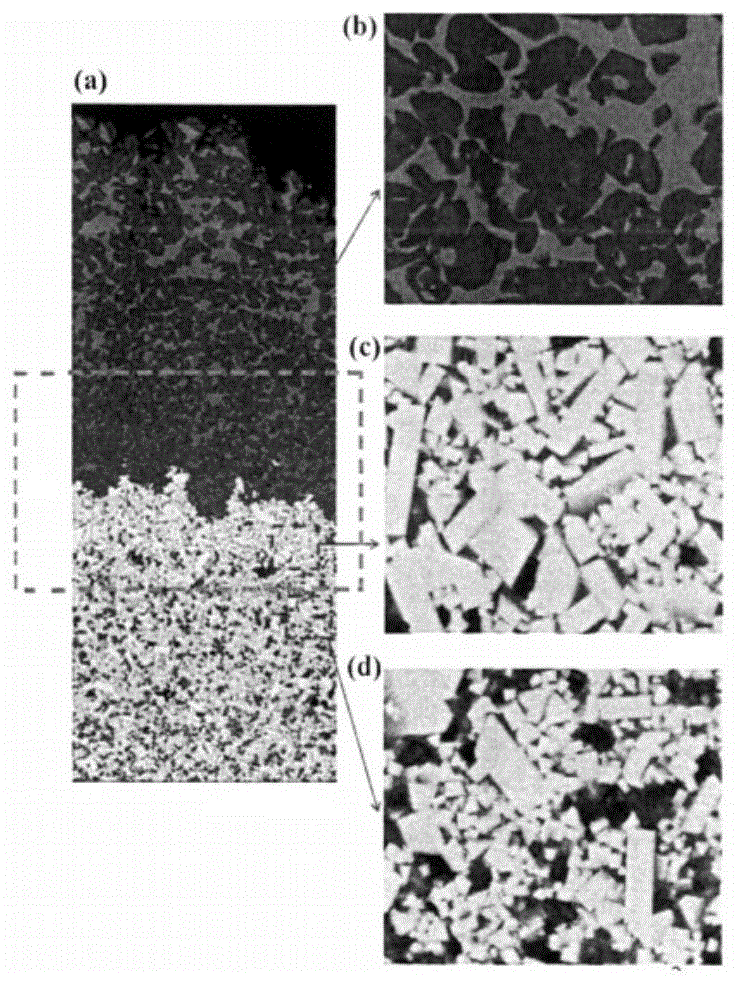
图1为本发明表层富立方相的双层结构硬质合金结构图;Fig. 1 is the double-layer structure cemented carbide structure diagram of surface layer rich cubic phase of the present invention;
图2为本发明实施例1与对比例1制得的硬质合金的截面显微结构;2 is the cross-sectional microstructure of the cemented carbide prepared in Example 1 and Comparative Example 1 of the present invention;
图3为本发明实施例1与对比例1制得的硬质合金在不同切削速度下的磨损形貌。FIG. 3 shows the wear morphologies of the cemented carbides prepared in Example 1 and Comparative Example 1 of the present invention at different cutting speeds.
具体实施方式Detailed ways
以下通过具体实施方式进一步描述本发明,但本发明不仅仅限于以下实施例。本领域技术人员根据本发明的基本思路,可以做出各种修改,但是只要不脱离本发明的基本思想,均在本发明的范围之内。The present invention is further described below through specific embodiments, but the present invention is not limited to the following examples. Those skilled in the art can make various modifications according to the basic idea of the present invention, but as long as they do not depart from the basic idea of the present invention, they are all within the scope of the present invention.
本实施方式分别用本发明的方法和现有技术制备钴、钛含量相同的表层富立方相的双层结构硬质合金,然后对它们的物理性能和切削性能进行测试。本实施方式按照已准备的试验方案,准确称量各组分,称量精度在0.01g范围。In this embodiment, the method of the present invention and the prior art are used to prepare double-layer structure cemented carbides with the same content of cobalt and titanium, which are rich in cubic phase in the surface layer, and then test their physical properties and cutting performance. In this embodiment, each component is accurately weighed according to the prepared test plan, and the weighing accuracy is in the range of 0.01 g.
实施例1、一种表层富立方相的双层结构硬质合金Embodiment 1. A kind of double-layer structure cemented carbide with rich cubic phase in the surface layer
所述表层富立方相的双层结构硬质合金包括以下成分及其质量百分数:碳化钛5%、钴8%、碳化钒0.5%、钪0.5%,碳化钨86%;所述表层富立方相的双层结构硬质合金原料中各组分的粒径均为1μm,表示为WC-8Co-5TiC-0.5VC-0.5Sc;结构图如图1所示,图中:(a)-合金表面围观结构,(b)-合金富立方相表层,(c)-合金过渡层,(d)-合金内部层。The surface layer cubic phase-rich double-layer structure cemented carbide includes the following components and their mass percentages: 5% of titanium carbide, 8% of cobalt, 0.5% of vanadium carbide, 0.5% of scandium, and 86% of tungsten carbide; the cubic-rich phase of the surface layer is 86%. The particle size of each component in the double-layer structure cemented carbide raw material is 1μm, which is expressed as WC-8Co-5TiC-0.5VC-0.5Sc; the structure diagram is shown in Figure 1, in the figure: (a)-alloy surface Surrounding structure, (b)-alloy cubic-rich surface layer, (c)-alloy transition layer, (d)-alloy inner layer.
所述表层富立方相的双层结构硬质合金的制备方法,具体包括以下步骤:The preparation method of the double-layer structure cemented carbide with rich cubic phase in the surface layer specifically includes the following steps:
S1、按配方量称取所有原料,混合均匀后加入球磨介质并置于球磨机中进行球磨,制得湿混合料A;所述球磨介质为无水酒精98.4Wt%、油酸1.5Wt%;球磨机中液固比为354mL/kg,球料比为2.5:1;球磨机转速控制在80r/min,球磨时间为20h;S1. Weigh all the raw materials according to the formula, add ball milling medium after mixing evenly and place it in a ball mill for ball milling to obtain wet mixture A; the ball milling medium is anhydrous alcohol 98.4Wt%, oleic acid 1.5Wt%; ball mill The medium-liquid-solid ratio is 354mL/kg, and the ball-to-material ratio is 2.5:1; the speed of the ball mill is controlled at 80r/min, and the ball milling time is 20h;
S2、将步骤S1制得的湿混合料A装入真空干燥器中干燥2h,进行球磨介质回收,然后用冷冻水进行循环冷却,过200目筛,制得混合料B;S2, load the wet mixture A prepared in step S1 into a vacuum dryer for drying for 2h, carry out ball milling medium recovery, then use chilled water for circulating cooling, pass through a 200-mesh sieve, and prepare mixture B;
S3、将步骤S2制得的混合料B在密封的状态下进行掺蜡、研磨制粒,制得混合料C;S3, mixing the mixture B obtained in step S2 with wax, grinding and granulating in a sealed state to obtain the mixture C;
S4、将步骤S3制得的混合料C在压力为150Mpa下压制成多块尺寸长、宽均为18.0mm、高度为7mm的硬质合金刀具坯体试样;S4, pressing the mixture C prepared in step S3 into a plurality of cemented carbide tool blank samples with a length and width of 18.0 mm and a height of 7 mm under a pressure of 150 Mpa;
S5、将步骤S4制得的压坯进行低压高温烧结,即得;所述低压高温烧结过程中控制升温速率为5℃/min,具体工艺为:S5. The compact obtained in step S4 is sintered at low pressure and high temperature to obtain the result; in the low pressure and high temperature sintering process, the temperature increase rate is controlled to be 5°C/min, and the specific process is as follows:
(1)装料,抽真空;(1) Loading and vacuuming;
(2)升温至800℃进行脱蜡和预烧结,保温2h;(2) The temperature is raised to 800°C for dewaxing and pre-sintering, and the temperature is kept for 2h;
(3)继续升温至1450℃进行高温液相烧结,保温1h;(3) Continue to heat up to 1450°C for high temperature liquid phase sintering, and keep the temperature for 1h;
(4)继续升温至1550℃,然后充入氮气进行加压渗氮烧结,压力控制在4Mpa,保温加压2.5h;(4) Continue to heat up to 1550°C, then fill with nitrogen for pressurized nitriding and sintering, the pressure is controlled at 4Mpa, and the temperature is maintained and pressurized for 2.5h;
(5)降压后自然冷却,开炉卸料。(5) Cool down naturally after depressurization, open the furnace and unload.
实施例2、一种表层富立方相的双层结构硬质合金Embodiment 2, a kind of double-layer structure cemented carbide with rich cubic phase in the surface layer
一种表层富立方相的双层结构硬质合金包括以下成分及其质量百分数:碳化钛4%、钴6%、碳化钒0.1%、钪0.1%,碳化钨89.8%。所述表层富立方相的双层结构硬质合金原料中各组分的粒径为:碳化钛0.8μm、钴1.0μm、碳化钒1.0μm、钪1.0μm、碳化钨0.2μm。A double-layer structure cemented carbide with rich cubic phase on the surface layer comprises the following components and their mass percentages: 4% of titanium carbide, 6% of cobalt, 0.1% of vanadium carbide, 0.1% of scandium, and 89.8% of tungsten carbide. The particle sizes of the components in the surface layer cubic phase-rich double-layered cemented carbide raw material are: titanium carbide 0.8 μm, cobalt 1.0 μm, vanadium carbide 1.0 μm, scandium 1.0 μm, and tungsten carbide 0.2 μm.
所述表层富立方相的双层结构硬质合金的制备方法,具体包括以下步骤:The preparation method of the double-layer structure cemented carbide with rich cubic phase in the surface layer specifically includes the following steps:
S1、按配方量称取碳化钛、钴、碳化钒、钪和碳化钨,混合均匀后加入球磨介质并置于球磨机中进行球磨,制得湿混合料A;所述球磨介质为无水酒精97.5Wt%、油酸0.8Wt%;球磨机中液固比为300mL/kg,球料比为1.5:1;球磨机转速控制在60r/min,球磨时间为12h。S1, weigh titanium carbide, cobalt, vanadium carbide, scandium and tungsten carbide according to the formula, add ball milling medium after mixing and place it in a ball mill for ball milling to obtain wet mixture A; Described ball milling medium is anhydrous alcohol 97.5 Wt%, oleic acid 0.8Wt%; the liquid-solid ratio in the ball mill is 300mL/kg, the ball-to-material ratio is 1.5:1; the ball mill speed is controlled at 60r/min, and the ball milling time is 12h.
S2、将步骤S1制得的湿混合料A装入真空干燥器中干燥1.5h,进行球磨介质回收,然后用冷冻水进行循环冷却,过200目筛,制得混合料B;S2, the wet mixture A prepared in step S1 is loaded into a vacuum dryer for drying for 1.5h, and the ball-milling medium is recovered, and then cyclically cooled with chilled water, and passed through a 200-mesh sieve to obtain the mixture B;
S3、将步骤S2制得的混合料B在密封的状态下进行掺蜡、研磨制粒,制得混合料C;S3, mixing the mixture B obtained in step S2 with wax, grinding and granulating in a sealed state to obtain the mixture C;
S4、将步骤S3制得的混合料C在压力为100Mpa下压制成压坯;S4, pressing the mixture C prepared in step S3 into a compact under a pressure of 100Mpa;
S5、将步骤S4制得的压坯进行低压高温烧结,即得;所述低压高温烧结过程中控制升温速率为5℃/min,具体工艺为:S5. The compact obtained in step S4 is sintered at low pressure and high temperature to obtain the result; in the low pressure and high temperature sintering process, the temperature increase rate is controlled to be 5°C/min, and the specific process is as follows:
(1)装料,抽真空;(1) Loading and vacuuming;
(2)升温至700℃进行脱蜡和预烧结,保温1h;(2) The temperature is raised to 700°C for dewaxing and pre-sintering, and the temperature is kept for 1h;
(3)继续升温至1400℃进行高温液相烧结,保温0.5h;(3) Continue to heat up to 1400°C for high temperature liquid phase sintering, and keep the temperature for 0.5h;
(4)继续升温至1550℃,然后充入氮气进行加压渗氮烧结,压力控制在4Mpa,保温加压2h;(4) Continue to heat up to 1550°C, then fill with nitrogen for pressurized nitriding and sintering, the pressure is controlled at 4Mpa, and the temperature is maintained and pressurized for 2h;
(5)降压后自然冷却,开炉卸料。(5) Cool down naturally after depressurization, open the furnace and unload.
实施例3、一种表层富立方相的双层结构硬质合金Embodiment 3. A kind of double-layer structure cemented carbide with rich cubic phase in the surface layer
一种表层富立方相的双层结构硬质合金包括以下成分及其质量百分数:碳化钛6%、钴10%、碳化钒1.0%、钪1.0%,碳化钨82%;所述表层富立方相的双层结构硬质合金原料中各组分的粒径为:碳化钛1.0μm、钴1.0μm、碳化钒1.0μm、钪1.0μm、碳化钨2.5μm。A double-layer structure cemented carbide with a surface layer rich in cubic phase includes the following components and their mass percentages: 6% of titanium carbide, 10% of cobalt, 1.0% of vanadium carbide, 1.0% of scandium, and 82% of tungsten carbide; the cubic-rich phase of the surface layer is 82%. The particle size of each component in the double-layer structure cemented carbide raw material is: titanium carbide 1.0 μm, cobalt 1.0 μm, vanadium carbide 1.0 μm, scandium 1.0 μm, tungsten carbide 2.5 μm.
所述表层富立方相的双层结构硬质合金的制备方法,具体包括以下步骤:The preparation method of the double-layer structure cemented carbide with rich cubic phase in the surface layer specifically includes the following steps:
S1、按配方量称取碳化钛、钴、碳化钒、钪和碳化钨,混合均匀后加入球磨介质并置于球磨机中进行球磨,制得湿混合料A;所述球磨介质为无水酒精99.2Wt%、油酸2.5Wt%;球磨机中液固比为425mL/kg,球料比为3.5:1;球磨机转速控制在90r/min,球磨时间为24h;S1, weigh titanium carbide, cobalt, vanadium carbide, scandium and tungsten carbide according to the formula, add ball milling medium after mixing and place it in a ball mill for ball milling to obtain wet mixture A; Described ball milling medium is anhydrous alcohol 99.2 Wt%, oleic acid 2.5Wt%; the liquid-solid ratio in the ball mill is 425mL/kg, and the ball-to-material ratio is 3.5:1; the speed of the ball mill is controlled at 90r/min, and the ball milling time is 24h;
S2、将步骤S1制得的湿混合料A装入真空干燥器中干燥2h,进行球磨介质回收,然后用冷冻水进行循环冷却,过200目筛,制得混合料B;S2, load the wet mixture A prepared in step S1 into a vacuum dryer for drying for 2h, carry out ball milling medium recovery, then use chilled water for circulating cooling, pass through a 200-mesh sieve, and prepare mixture B;
S3、将步骤S2制得的混合料B在密封的状态下进行掺蜡、研磨制粒,制得混合料C;S3, mixing the mixture B obtained in step S2 with wax, grinding and granulating in a sealed state to obtain the mixture C;
S4、将步骤S3制得的混合料C在压力为200Mpa下压制成压坯;S4, pressing the mixture C prepared in step S3 into a compact under a pressure of 200Mpa;
S5、将步骤S4制得的压坯进行低压高温烧结,即得;所述低压高温烧结过程中控制升温速率为5℃/min,具体工艺为:S5. The compact obtained in step S4 is sintered at low pressure and high temperature to obtain the result; in the low pressure and high temperature sintering process, the temperature increase rate is controlled to be 5°C/min, and the specific process is as follows:
(1)装料,抽真空;(1) Loading and vacuuming;
(2)升温至900℃进行脱蜡和预烧结,保温3h;(2) The temperature is raised to 900℃ for dewaxing and pre-sintering, and the temperature is kept for 3h;
(3)继续升温至1450℃进行高温液相烧结,保温1h;(3) Continue to heat up to 1450°C for high temperature liquid phase sintering, and keep the temperature for 1h;
(4)继续升温至1550℃,然后充入氮气进行加压渗氮烧结,压力控制在4Mpa,保温加压3h;(4) Continue to heat up to 1550°C, then fill with nitrogen for pressurized nitriding and sintering, the pressure is controlled at 4Mpa, and the temperature is maintained and pressurized for 3h;
(5)降压后自然冷却,开炉卸料。(5) Cool down naturally after depressurization, open the furnace and unload.
对比例1、一种硬质合金Comparative example 1, a cemented carbide
所述表层富立方相的双层结构硬质合金包括以下成分及其质量百分数:碳化钛5%、钴8%、碳化钒0.5%余量为碳化钨;所述表层富立方相的双层结构硬质合金原料中各组分的粒径均为1μm,表示为WC-8Co-5TiC-0.5VC。The double-layer structure cemented carbide rich in cubic phase on the surface layer includes the following components and their mass percentages: 5% of titanium carbide, 8% of cobalt, 0.5% of vanadium carbide, and the balance is tungsten carbide; the double-layer structure of the rich cubic phase on the surface layer The particle size of each component in the cemented carbide raw material is 1 μm, which is expressed as WC-8Co-5TiC-0.5VC.
本对比例中的硬质合金的制备方法与实施例1类似。The preparation method of the cemented carbide in this comparative example is similar to that of Example 1.
本对比例与实施例1的区别为:本对比例硬质合金配方中未加钪。The difference between this comparative example and Example 1 is that no scandium is added to the cemented carbide formulation of this comparative example.
试验例1、物理性能测试Test example 1. Physical property test
试验样品:实施例1与试验例1制得的硬质合金。Test sample: cemented carbide prepared in Example 1 and Test Example 1.
试验方法:(1)密度测试:按标准GB/T 3850-2015对式样进行密度测试,通过Archimedes排水法测量硬质合金样品的相对密度p,先测硬质合金样品在空气中的重量W1,再测样品在去离子水中的质量为W2,则试样密度的计算公式如下所示:Test method: (1) Density test: Carry out the density test on the sample according to the standard GB/T 3850-2015, measure the relative density p of the cemented carbide sample by the Archimedes drainage method, first measure the weight W1 of the cemented carbide sample in air, If the mass of the re-measured sample in deionized water is W2, the formula for calculating the density of the sample is as follows:

(2)微观结构分析:按GB/T3489—2015标准进行金相观察。采用光学高分辨率连续变倍体视显微镜(2) Microstructure analysis: Metallographic observation is carried out according to GB/T3489-2015 standard. Optical high-resolution continuous zoom stereo microscope
观察试样表面微观形貌的变化,采用热场扫描电子显微镜观察试样表面和内部的显微结构和富立方相厚度。The changes of the surface micro-morphology of the samples were observed, and the microstructure and the thickness of the cubic-rich phase on the surface and inside of the samples were observed by thermal scanning electron microscopy.
(3)维氏硬度测试:按GB/T7997—2014标准,采用自动转塔式维氏显微硬度计(XHV-1M,China)对试样进行维氏显微硬度的测量,压力为50N,保荷15s。采用HVS.30Z型数显自动转台维氏硬度计对样品进行打孔测试维氏硬度,加载10~30kg,保荷10s。利用压痕法测量材料的维氏硬度。维氏硬度实验采用在一定负载P的作用下,金刚石四棱锥形压头压入式样表面。经过一定的保荷时间之后卸除负荷,在试样的测试面上压出一个正棱形的压痕。测量其压痕两对角线长度,进而计算硬度值。(3) Vickers hardness test: According to the GB/T7997-2014 standard, an automatic turret Vickers microhardness tester (XHV-1M, China) was used to measure the Vickers microhardness of the sample, and the pressure was 50N. Paul 15s. Using HVS.30Z digital display automatic turntable Vickers hardness tester to punch the sample to test Vickers hardness, load 10 ~ 30kg, hold load for 10s. The Vickers hardness of the material is measured by the indentation method. In the Vickers hardness test, under the action of a certain load P, a diamond quadrangular pyramid indenter is pressed into the surface of the sample. After a certain dwell time, the load is unloaded, and a regular prismatic indentation is pressed on the test surface of the sample. Measure the two diagonal lengths of the indentation, and then calculate the hardness value.
(4)断裂韧性测试:按JB/T12616-2016标准,先测量材料的维氏硬度以及压痕尖角处产生的裂纹总长,再通过维氏硬度和裂纹总长与材料断裂韧性之间建立的量化关系式,计算出材料的断裂韧性。(4) Fracture toughness test: According to the JB/T12616-2016 standard, first measure the Vickers hardness of the material and the total crack length at the sharp corner of the indentation, and then pass the quantification established between the Vickers hardness and the total crack length and the fracture toughness of the material relationship to calculate the fracture toughness of the material.
试验结果:试验结果见表1和图2,图中:(a)-WC-8Co-5TiC-0.5VC-0.5Sc,(b)-WC-8Co-5TiC-0.5VC。Test results: The test results are shown in Table 1 and Figure 2, in the figures: (a)-WC-8Co-5TiC-0.5VC-0.5Sc, (b)-WC-8Co-5TiC-0.5VC.
表1硬脂合金物理性能测试Table 1 Physical property test of stearyl alloy

由表1和图2可知,本发明的提供的制备方法对比现有技术制得的表层富立方相的双层结构硬质合金的硬度和断裂韧性都有所提升,而表层富立方相的厚度比现有技术提升了二三十倍,达到了2.03mm。It can be seen from Table 1 and Fig. 2 that the hardness and fracture toughness of the double-layer structure cemented carbide of the surface layer rich in cubic phase obtained by the preparation method provided by the present invention have been improved to some extent, and the thickness of the surface layer rich in cubic phase has been improved. It is 20 to 30 times higher than the existing technology, reaching 2.03mm.
试验例2、切削性能测试Test example 2, cutting performance test
试验样品:实施例1与试验例1制得的硬质合金。Test sample: cemented carbide prepared in Example 1 and Test Example 1.
试验方法:根据IS0 3685标准,300μm的后刀面磨损值作为刀具寿命的标准,切削工件选用直径d=100mm和高度h=150mm的HT250灰口铸铁。在切削试验中,每切削2分钟之后,用工具显微镜测量后刀面的磨损量。Test method: According to the ISO 3685 standard, 300μm flank wear value is used as the tool life standard, and the cutting workpiece is made of HT250 gray cast iron with diameter d=100mm and height h=150mm. In the cutting test, the wear amount of the flank was measured with a tool microscope after every 2 minutes of cutting.
试验结果:试验结果见图3,图中:(a)、(b)-WC-8Co-5TiC-0.5VC-0.5Sc,(d)、(e)-WC-8Co-5TiC-0.5VC。Test results: The test results are shown in Figure 3, in which: (a), (b)-WC-8Co-5TiC-0.5VC-0.5Sc, (d), (e)-WC-8Co-5TiC-0.5VC.
由图3可知,在不同速度下WC-8Co-5TiC-0.5VC-0.5Sc的后刀面没有观察到微崩刃或明显的磨粒磨损,因为其富立方相层比较厚,且富立方相层有较高的硬度,在切削过程中能较长时间代替芯部材料进行切削,能大幅提高刀具的使用寿命。而WC-8Co-5TiC-0.5VC在不同速度下切削的后刀面有明显的观察到微崩刃和非常明显的磨粒磨损,因为其富立方相层比较薄,在切削过程中很快就会磨损完,出现芯部材料的粘结磨损和磨粒磨损,因而没有明显的提升刀具的使用寿命,难以具有工业应用价值。It can be seen from Figure 3 that no micro-chipping or obvious abrasive wear was observed on the flank of WC-8Co-5TiC-0.5VC-0.5Sc at different speeds, because the cubic-rich phase layer was thicker and the cubic-rich phase was relatively thick. The layer has high hardness, and can replace the core material for a long time in the cutting process, which can greatly improve the service life of the tool. On the other hand, WC-8Co-5TiC-0.5VC has obvious micro-chipping and very obvious abrasive wear on the flank of cutting at different speeds, because its cubic-rich phase layer is relatively thin, and it is very fast in the cutting process. It will be worn out, and the bonding wear and abrasive wear of the core material will occur, so the service life of the tool will not be significantly improved, and it is difficult to have industrial application value.
上述实施例仅例示性说明本发明的原理及功效,而并非限制本发明。本领域任何熟悉此技术的认识皆不可在违背本发明的精神及范畴下,对上述实施例进行修改。因此,举凡所属技术领域中具有通常知识者在未脱离本发明所提供的技术思想下完成的一切等效修饰或改变,仍由本发明的权利要求所涵盖。The above-mentioned embodiments merely illustrate the principle and effect of the present invention, but do not limit the present invention. Any person familiar with the technology in the art cannot modify the above embodiments without departing from the spirit and scope of the present invention. Therefore, all equivalent modifications or changes made by those with ordinary knowledge in the technical field without departing from the technical idea provided by the present invention are still covered by the claims of the present invention.
Claims (7)
Priority Applications (1)
| Application Number | Priority Date | Filing Date | Title |
|---|---|---|---|
| CN202010265866.0A CN111363963B (en) | 2020-04-07 | 2020-04-07 | Double-layer structure hard alloy with surface layer rich in cubic phase and preparation method thereof |
Applications Claiming Priority (1)
| Application Number | Priority Date | Filing Date | Title |
|---|---|---|---|
| CN202010265866.0A CN111363963B (en) | 2020-04-07 | 2020-04-07 | Double-layer structure hard alloy with surface layer rich in cubic phase and preparation method thereof |
Publications (2)
| Publication Number | Publication Date |
|---|---|
| CN111363963A true CN111363963A (en) | 2020-07-03 |
| CN111363963B CN111363963B (en) | 2021-08-10 |
Family
ID=71205036
Family Applications (1)
| Application Number | Title | Priority Date | Filing Date |
|---|---|---|---|
| CN202010265866.0A Active CN111363963B (en) | 2020-04-07 | 2020-04-07 | Double-layer structure hard alloy with surface layer rich in cubic phase and preparation method thereof |
Country Status (1)
| Country | Link |
|---|---|
| CN (1) | CN111363963B (en) |
Cited By (2)
| Publication number | Priority date | Publication date | Assignee | Title |
|---|---|---|---|---|
| CN112795829A (en) * | 2020-12-24 | 2021-05-14 | 广东正信硬质材料技术研发有限公司 | Fine-grain hard alloy and preparation method thereof |
| CN119242978A (en) * | 2024-12-09 | 2025-01-03 | 成都欧珀琅精密工具有限公司 | A surface-rich cubic phase functional modified cemented carbide and preparation method thereof |
Citations (9)
| Publication number | Priority date | Publication date | Assignee | Title |
|---|---|---|---|---|
| US20040009340A1 (en) * | 2002-07-12 | 2004-01-15 | Jesse Zhu | Fluidization additives to fine powders |
| CN101381836A (en) * | 2008-10-27 | 2009-03-11 | 王铀 | Nano modified WC/Co cemented carbide material and manufacturing method thereof |
| CN102134660A (en) * | 2011-03-04 | 2011-07-27 | 重庆文理学院 | Functionally gradient hard alloy with cubic phase-rich surface and preparation method thereof |
| WO2012052501A2 (en) * | 2010-10-22 | 2012-04-26 | Element Six Abrasives S.A | Polycrystalline diamond material |
| CN106282627A (en) * | 2016-08-30 | 2017-01-04 | 苏州瑞森硬质合金有限公司 | Light hard alloy material and manufacture method thereof |
| CN106498253A (en) * | 2016-09-21 | 2017-03-15 | 芜湖扬展新材料科技服务有限公司 | A kind of polycrystalline diamond composite material with high stable wearability and preparation method thereof |
| CN109161711A (en) * | 2018-10-11 | 2019-01-08 | 郑州轻工业学院 | A kind of surface has the Ultra-fine Grained gradient hard alloy and preparation method thereof of double gradient layer structures |
| CN109518058A (en) * | 2018-12-06 | 2019-03-26 | 宇龙精机科技(浙江)有限公司 | A kind of deep-hole drill bit hard alloy and preparation method thereof |
| CN109881073A (en) * | 2019-04-26 | 2019-06-14 | 中南大学 | Alloy with surface structure of bonding metal-enriched layer, preparation method and application thereof |
-
2020
- 2020-04-07 CN CN202010265866.0A patent/CN111363963B/en active Active
Patent Citations (9)
| Publication number | Priority date | Publication date | Assignee | Title |
|---|---|---|---|---|
| US20040009340A1 (en) * | 2002-07-12 | 2004-01-15 | Jesse Zhu | Fluidization additives to fine powders |
| CN101381836A (en) * | 2008-10-27 | 2009-03-11 | 王铀 | Nano modified WC/Co cemented carbide material and manufacturing method thereof |
| WO2012052501A2 (en) * | 2010-10-22 | 2012-04-26 | Element Six Abrasives S.A | Polycrystalline diamond material |
| CN102134660A (en) * | 2011-03-04 | 2011-07-27 | 重庆文理学院 | Functionally gradient hard alloy with cubic phase-rich surface and preparation method thereof |
| CN106282627A (en) * | 2016-08-30 | 2017-01-04 | 苏州瑞森硬质合金有限公司 | Light hard alloy material and manufacture method thereof |
| CN106498253A (en) * | 2016-09-21 | 2017-03-15 | 芜湖扬展新材料科技服务有限公司 | A kind of polycrystalline diamond composite material with high stable wearability and preparation method thereof |
| CN109161711A (en) * | 2018-10-11 | 2019-01-08 | 郑州轻工业学院 | A kind of surface has the Ultra-fine Grained gradient hard alloy and preparation method thereof of double gradient layer structures |
| CN109518058A (en) * | 2018-12-06 | 2019-03-26 | 宇龙精机科技(浙江)有限公司 | A kind of deep-hole drill bit hard alloy and preparation method thereof |
| CN109881073A (en) * | 2019-04-26 | 2019-06-14 | 中南大学 | Alloy with surface structure of bonding metal-enriched layer, preparation method and application thereof |
Cited By (3)
| Publication number | Priority date | Publication date | Assignee | Title |
|---|---|---|---|---|
| CN112795829A (en) * | 2020-12-24 | 2021-05-14 | 广东正信硬质材料技术研发有限公司 | Fine-grain hard alloy and preparation method thereof |
| CN112795829B (en) * | 2020-12-24 | 2022-03-15 | 广东正信硬质材料技术研发有限公司 | Fine-grain hard alloy and preparation method thereof |
| CN119242978A (en) * | 2024-12-09 | 2025-01-03 | 成都欧珀琅精密工具有限公司 | A surface-rich cubic phase functional modified cemented carbide and preparation method thereof |
Also Published As
| Publication number | Publication date |
|---|---|
| CN111363963B (en) | 2021-08-10 |
Similar Documents
| Publication | Publication Date | Title |
|---|---|---|
| CN103741000B (en) | Ultra-fine Grained gradient hard alloy of a kind of rich surface cobalt and preparation method thereof | |
| CN111088450B (en) | Rare earth-added ultrafine-grained high-toughness WC-10Co hard alloy material and preparation method thereof | |
| CN110396632A (en) | A Ti(C,N)-based cermet with a homogeneous ring core structure and its preparation method | |
| CN108060322A (en) | The preparation method of hard high-entropy alloy composite material | |
| CN104988373A (en) | Surface-hardened gradient cemented carbide and preparation method thereof | |
| CN111961940A (en) | A kind of WC-based cemented carbide containing high-entropy ceramic phase and preparation method thereof | |
| CN108728719B (en) | Wear-resistant composite ceramic material and production process thereof | |
| CN105945291A (en) | Bicrystal gradient hard alloy cutter material and preparation method thereof | |
| CN108642361B (en) | High-strength high-hardness ceramic material and production process thereof | |
| CN110438384B (en) | Iron-nickel-based ultrafine-grained hard alloy and preparation method thereof | |
| CN107604231A (en) | A kind of high pressure resistant high-temperature rigid alloy and preparation method thereof | |
| CN110358960A (en) | A kind of preparation method of high-strength and high ductility Ti (C, N) based ceramic metal | |
| CN111195724B (en) | Ti (C, N) -based cermet nitrogen atmosphere sintering process | |
| CN119638427A (en) | Sleeve material for molding aspherical glass lens and preparation method thereof | |
| CN110373593B (en) | A microwave sintering process of titanium carbonitride-based composite cermet material | |
| CN111363963A (en) | Double-layer structure hard alloy with surface layer rich in cubic phase and preparation method thereof | |
| CN116790953B (en) | High-performance nano hard alloy product and preparation method thereof | |
| CN106946567B (en) | A kind of preparation method of iron-aluminum intermetallic compound and ZrO2 composite phase material mobile phone ceramic backplane | |
| CN116422883A (en) | A kind of gradient structure wear-resistant composite material and its preparation method | |
| CN113201676B (en) | Preparation method of high-temperature oxidation-resistant low-bonding-phase metal ceramic | |
| CN113185293A (en) | Near-forming preparation method of special-shaped homogeneous ultrafine-grained tungsten carbide ceramic product | |
| CN107419151A (en) | Nanocrystalline gradient hard alloys of a kind of high rigidity top layer richness WC and preparation method thereof | |
| CN113336554A (en) | Water jet sand pipe raw material, water jet sand pipe preparation method and water jet sand pipe | |
| CN111822715A (en) | High wear-resistance impregnated diamond bit matrix material and method for manufacturing diamond bit using the same | |
| CN119530597A (en) | A preparation method of wear-resistant nano WC hard alloy |
Legal Events
| Date | Code | Title | Description |
|---|---|---|---|
| PB01 | Publication | ||
| PB01 | Publication | ||
| SE01 | Entry into force of request for substantive examination | ||
| SE01 | Entry into force of request for substantive examination | ||
| GR01 | Patent grant | ||
| GR01 | Patent grant | ||
| TR01 | Transfer of patent right |
Effective date of registration: 20251209 Address after: 517000 Guangdong Province Heyuan City Gaoxin Development Zone East of Xingye Avenue South of Keji Second Road Patentee after: HEYUAN ZHENGXIN HARDMETAL CARBIDE Co.,Ltd. Country or region after: China Address before: 517000 Guangdong Province, Heyuan City, High-tech Development Zone, East of Xingye Avenue, South of Keji Second Road (R&D Building) Patentee before: Guangdong Zhengxin hard material technology research and Development Co.,Ltd. Country or region before: China |
|
| TR01 | Transfer of patent right |