Detailed Description
A first embodiment is a water swellable radiation curable coating composition for fibers comprising acrylic acid, acrylic acidA salt, a monofunctional ethylenically unsaturated network former, a photoinitiator, a viscosity modifier, an amount of water, and a multifunctional crosslinker, wherein the water-swellable radiation curable coating composition is a liquid at room temperature. Such compositions are suitable for use with elongate fine fibres, such as those made of plastic or glass. In one embodiment, such compositions are suitable for coating with ultra high molecular weight polyethylene polymers, for example
The fiber is formed. However, in a preferred embodiment, the compositions described herein are particularly suitable for coating optical fibers.
The inventors have constructed compositions according to the invention that, in addition to being water swellable, are uniquely tailored to perform optimally in optical fiber applications and to meet the requirements of the optical fiber coating process. Among these processing requirements for the composition are, inter alia, UV-curable, liquid at room temperature and having a considerable degree of homogeneity. The composition according to the invention can be considered as a superabsorbent polymer (SAP). SAPs are swellable thermoset networks that absorb and retain large amounts of liquid relative to their own mass.
UV-curable SAP compositions are known and described, for example, in EP 1522545. Such SAPs are typically based on crosslinked polymer chains formed from (meth) acrylamide or (meth) acrylic acid monomers. The polymer chains formed contain a large number of carboxyl groups. The hydrogen atoms are released by contact with water, resulting in the formation of carboxylate groups. Without wishing to be bound by any theory, it is believed that these carboxylate groups are mutually exclusive and form scaffolding in the polymer network so that passing water molecules can be wrapped and captured.
It is known that the absorption capacity of superabsorbent polymers is further increased when acrylic acid is neutralized with a strong base. The resulting neutralized carboxylate groups promote significant osmotic water absorption. The positively charged ions are hydrated, which in turn increases the physical gap between successive carboxylate groups. The remaining free carboxylate groups will again repel each other, thereby causing the chains to begin to extend more, creating more room to absorb excess water.
A feature of compositions according to certain embodiments of the present invention is that they are liquid at room temperature. This retains the possibility that such compositions can be processed in optical fiber coating applications and further ensures that the SAP component within the formulation is generally uniformly dispersed or dissolved throughout the liquid resin. Liquid SAP materials are preferred over powdered SAP systems or particle-based SAP systems in optical fiber applications because liquid systems avoid health and safety issues associated with handling powders, and they further mitigate the occurrence of SAP particle-induced microbending that can produce undesirable signal loss (also known as microbending-induced attenuation) in the corresponding optical fiber. Furthermore, since many common SAP powders have particle sizes greater than or equal to the optimum coating thickness, it is desirable to use liquid-based systems where particle size is not a constraint on system design.
Thus, while the water-swellable coating, coated optical fiber, method of coating optical fiber, or buffer tube described elsewhere herein that addresses the problems of the present invention is not necessarily limited to any particular SAP composition or set of SAP compositions, in a preferred embodiment, the liquid composition comprises acrylic acid, an acrylate, a monofunctional ethylenically unsaturated network former, a photoinitiator, a viscosity modifier, an amount of water, a multifunctional crosslinker, and optionally one or more other additives. Each component is discussed in turn herein.
Acrylic acid
Thus, in one embodiment, the composition comprises acrylic acid. Acrylic acid is of the formula CH 2 Organic compounds of CHCOOH. It is the simplest unsaturated carboxylic acid, consisting of a vinyl group attached directly to the carboxylic acid terminus. Higher molecular weight polyacrylic acids may also be considered acrylic acid.
The presence of acrylic acid in the final composition is optional. However, the inventors have found that the presence of residual amounts of unneutralized acrylic acid in the final formulation can help to ensure homogeneity of the composition as this helps to minimise precipitation of the acrylate salt after formulation. Thus, in one embodiment, the acrylic is present in an amount of from 0 wt% to 60 wt%, or from 10 wt% to 60 wt%, or from 15 wt% to 40 wt%, or from 18 wt% to 35 wt%, or from 20 wt% to 30 wt%, relative to the weight of the entire water-swellable radiation curable coating composition for optical fibers.
The relative amount of acrylic acid in the formulation may alternatively be described in terms of molar mass concentration (molality). The concept of molar concentration of a mass is well known and represents the number of moles of a particular substance per given unit mass. The unit of SI for molal concentrations is per kilogram of moles. Can be determined by: the mass of the particular component to be measured per 1kg of the total composition is divided by the molar mass of that component. Meanwhile, the molar mass is determined by multiplying the standard atomic mass (of the desired compound to be measured) by a constant 1x 10 -3 kg/mol.
Thus, in one embodiment, the acrylic acid is present in an amount, expressed as molar mass concentration, of 0 to 4.2mol/kg, or 0.14 to 4.2mol/kg or 0.7 to 2.1mol/kg, relative to the amount of the entire water-swellable radiation curable coating composition for optical fibers.
The relative amount of acrylic acid in the formulation may alternatively be described in terms of acryloyl equivalent weight. The method of determining equivalents (e.g. acryloyl equivalents) is similar to molal concentration and is also well known, for example, as represented in US 7,183,040. As used herein, the number of acryloyl equivalents of a particular component in the composition is calculated according to the following formula:
equivalent of component (A)
Where "Wt%" is the weight of the component to be tested in kilograms relative to a weight of 1kg of the entire composition, "N" is the number of acryloyl groups in the idealized molecule of component Z, and "Mwt" is the molecular weight of the idealized molecule of the particular compound to be tested. Where "Wt%" is the weight of the component to be tested in kilograms relative to a weight of 1kg of the entire composition, "N" is the number of acryloyl groups in the idealized molecule of component Z, and "Mwt" is the molecular weight of the idealized molecule of the particular compound to be tested.
Since acrylic acid has only a single acryloyl group in its molecule, the acryloyl equivalent weight will not differ from the molar mass concentration indicated above. Thus, in one embodiment, the total composition has about 0.14 to about 4.2 acryloyl equivalents or 0.7 to 2.1 acryloyl equivalents due to the inclusion of the acrylic component. In other words, the acrylic component contributes 0.14 to about 4.2 or 0.7 to 2.1 acryloyl equivalents to the total composition.
In another embodiment, acrylic acid may be used as a reactant to form salt derivatives of acrylic acid that would be present even if the water-swellable radiation curable coating composition for optical fibers does not have a detectable amount of acrylic acid by itself. Thus, in different embodiments, acrylic acid may be present at different degrees of neutralization. As used herein, the degree of neutralization refers to the relative amount by weight (expressed as a percentage) of the starting acrylic acid that is converted to (i.e., neutralized by) an acrylate salt by a suitable base. Can be determined in the final formulation by dividing the total weight of acrylate by the total weight of acrylate plus (unneutralized) acrylic acid.
Acrylic acid salt
Thus, in one embodiment, the composition of the present invention further comprises an acrylate salt, which is the reaction product of acrylic acid and a base. The base selected may be any suitable basic component, including a basic salt. The basic salt itself is the reaction product of the neutralization of a strong base with a weak acid, indicating that the basic salt itself is also a base. The basic salts include salts containing ionizable hydroxyl groups.
An example of an alkaline salt is the basic salt (alkali salt). The basic salt is a water-soluble hydroxide of an alkali metal and/or an alkaline earth metal. Common examples of basic salts include sodium hydroxide, potassium hydroxide, lye (lye), calcium hydroxide, and magnesium hydroxide, although other salts are also present as will be understood by those of ordinary skill in the art. In one embodiment, the basic salt comprises lithium, sodium or potassium cations.
In one embodiment, the acrylate salt is the reaction product of acrylic acid and an ionic compound consisting of an alkali metal cation and a hydroxide anion. The alkali metal may be selected from any suitable group I element, including lithium, sodium, potassium, rubidium, cesium, or francium. In a preferred embodiment, the ionic compound has a sodium cation which, after reaction with acrylic acid, results in the formation of a salt in the form of sodium acrylate.
Acrylates are useful in several respects for successfully formulating water-swellable radiation curable coating compositions for optical fibers. First, it helps to improve the water-swellability of the coating incorporating it. It also allows for higher integrity of the formulated cured coating as indicated by its tendency to achieve an increase in the equilibrium modulus value of its associated coating.
The inventors have discovered that the degree of neutralization of acrylic acid is related to increasing the speed at which a coating composition incorporating it can be processed in optical fiber coating applications. In other words, the inventors have surprisingly found that the ability of the coating composition to cure rapidly during drawing or inking of the optical fiber is improved as the percentage of initial acrylic acid converted to salt increases. This is beneficial in optical fiber coating applications where it is highly desirable to achieve curing at high speeds and/or with reduced energy input. Without wishing to be bound by any theory, it is believed that the degree of neutralization is related to the reduction of oxygen inhibition, a phenomenon known to have a cooling effect on the kinetics of free radical polymerization.
In addition, although the degree of neutralization does not appear to have a significant effect on the initial swelling properties, the inventors believe that if the degree of neutralization becomes too low, optical fiber coatings formed therefrom tend to exhibit a decrease in swelling properties over time. Without wishing to be bound by any theory, this may be due to the large amount of unneutralized acrylic acid participating in the secondary formation of additional network crosslinks over time.
Thus, in one embodiment, at least a portion of the initial acrylic acid is neutralized by a basic salt. In one embodiment, the reaction of acrylic acid and the basic salt neutralizes at least 10% of acrylic acid, more preferably at least 25% of acrylic acid, or at least 33% of acrylic acid, or at least 50% of acrylic acid, or at least 75% of acrylic acid, or at least 90% of acrylic acid. In an alternative embodiment, the basic salt neutralizes from 10 to 100 wt.% of acrylic acid, or from 25 to 90 wt.%, or from 33 to 95 wt.%, or from 50 to 98 wt.%, or from 75 to 100 wt.%, relative to the amount of acrylic acid present prior to reaction. In an alternative embodiment, the acrylic acid has a degree of neutralization of 10 to 100%, or 25 to 99%, or 33 to 98%, or 50 to 95%, or 75 to 90%. In still other embodiments, the degree of neutralization is at least 10%, or at least 20%, or at least 30%, or at least 40%, or at least 50%, or at least 60%, or at least 70%, or at least 80%, or at least 90%, or at least 95%, or at least 98%. In one embodiment, the degree of neutralization is about 100%.
The ratio of unneutralized acrylic acid to the amount of acrylic acid that has been neutralized by the basic salt present in the liquid swellable radiation curable coating for optical fibers can also play an important role in determining the curing speed of the composition during coating and curing as well as its potential swelling behavior once cured on the optical fiber. Thus, in one embodiment, the water swellable radiation curable coating composition for optical fibers comprises a ratio of acrylic acid to acrylate of from about 12: 1 to about 1: 12, or from about 6: 1 to about 1: 6, or from about 3: 1 to about 1: 1. The aforementioned ratios can be expressed as molar ratios or as weight ratios.
The water-swellable radiation-curable coating composition for optical fibers may include the acrylate in any suitable amount, for example, in an amount of from about 1 wt% to about 30 wt%, or from about 5 wt% to about 15 wt%, relative to the weight of the entire water-swellable radiation-curable coating composition for optical fibers.
In one embodiment, the total amount of acrylic acid derived components (i.e., acrylic acid and acrylate salt) is present in an amount of about 1.4 to about 8.3mol/kg, or 2.1 to 5.6mol/kg, or 2.5 to 4.9mol/kg, or 2.8 to 4.2mol/kg, relative to the total composition.
Monofunctional ethylenically unsaturated network formers
The water-swellable, radiation-curable coating composition for the optical fiber may include at least one ethylenically unsaturated compound that helps ensure uniform dispersion of the SAP components. In a preferred embodiment, the ethylenically unsaturated component comprises an acrylate or an acrylamide. The acrylate ester or acrylamide may have any suitable molecular weight, but is preferably in monomeric form. In a preferred embodiment, the ethylenically unsaturated component is monofunctional. As used herein, "monofunctional" means that the relevant component has an average of 0.9 to 1.1 functional groups per molecule. In one embodiment, the functional group is an acryloyl group.
Some of the most common acrylates are methyl, ethyl, n-butyl and 2-ethylhexyl (2 EHA) -ester. Some specific examples include 2-ethylhexyl acrylate, diethylene glycol diacrylate, methyl acrylate, ethyl acrylate, polyacrylic acid, n-butyl acrylate, hydroxypropyl acrylate, and dimethylaminoethyl acrylate.
Other typical examples of low molecular weight monomers containing one double bond are alkyl or hydroxyalkyl acrylates, such as 2-hydroxyethyl acrylate, isobornyl acrylate and methyl and ethyl acrylate. Other examples of such monomers are acrylonitrile, acrylamide, N-substituted acrylamides, such as N- (2-hydroxypropyl) acrylamide, N-isopropylacrylamide, vinyl esters, such as vinyl acetate, styrene, alkylstyrenes, halostyrenes, N-vinylpyrrolidone (e.g., although other ethylenically unsaturated monomers are also possible, such as N-vinylpyrrolidone (e.g., 1-vinyl-2-pyrrolidone)), N-vinylcaprolactam, vinyl chloride and vinylidene chloride.
In one embodiment, the water swellable radiation curable coating composition for optical fibers comprises an ethylenically unsaturated swelling compound which is a hydroxyl functional acrylate compound. Examples of hydroxy-functional acrylate compounds include 2-hydroxypropyl acrylate, 3-hydroxypropyl acrylate, hydroxyethyl acrylate, 4-hydroxybutyl acrylate, 2,3-dihydroxypropyl acrylate, 2-hydroxy-1- (hydroxymethyl) ethyl acrylate, or 2-acrylamido-2-methyl-1-propanesulfonic acid.
In one embodiment, the ethylenically unsaturated compound is an ethoxylated acrylate. Examples of ethoxylated acrylates include methoxy (polyethylene glycol) acrylate, ethoxy (polyethylene glycol) acrylate, 2- (2-ethoxyethoxy) ethyl acrylate, ethylene glycol methyl ether acrylate, diethylene glycol methyl ether acrylate, triethylene glycol methyl ether acrylate, tetraethylene glycol methyl ether acrylate, ethylene glycol ethyl ether acrylate, diethylene glycol ethyl ether acrylate, triethylene glycol ethyl ether acrylate, tetraethylene glycol ethyl ether acrylate, diethylene glycol-2-ethylhexyl ether acrylate.
One or more of the above-described reactive ethylenically unsaturated network formers may be used in the compositions according to the present invention in any suitable amount, and may be selected individually or used in combination with one or more of the types listed herein. The water-swellable radiation-curable coating composition for optical fibers may comprise the ethylenically unsaturated network former in an amount of from about 5 wt% to about 50 wt%, more preferably from about 10 wt% to about 30 wt%, relative to the weight of the entire water-swellable radiation-curable coating composition for optical fibers.
Alternatively expressed in terms of molar mass concentration, in another embodiment, the monofunctional ethylenically unsaturated network former may be present in an amount of from about 0.38 to about 3.8mol/kg, or from about 0.75 to about 2.3mol/kg, relative to the total composition. Additionally, in one embodiment, the entire composition will have an acryloyl equivalent weight of 0.38 to about 3.8 via the monofunctional ethylenically unsaturated network former, or about 0.75 to about 2.3 via the monofunctional ethylenically unsaturated network former. In other words, the total amount of monofunctional ethylenically unsaturated network former present in the composition will contribute about 0.38 to about 3.8, or about 0.75 to 2.3, acryloyl equivalent weight.
Photoinitiator
The composition of the present invention comprises a photoinitiator. In a preferred embodiment, the composition comprises at least one free radical photoinitiator. In the broadest sense, a photoinitiator is a compound that undergoes a chemical change to produce at least one of a radical, an acid, and a base due to the action of light or the synergistic effect of the action of light and the excitation of electrons by a sensitizing dye.
According to one embodiment of the invention, the free radical photoinitiator is an acylphosphine oxide photoinitiator. Acylphosphine oxide photoinitiators are disclosed, for example, in U.S. patent nos.4324744, 4737593, 5942290, 5534559, 6020529, 6486228 and 6486226.
The acylphosphine oxide photoinitiator is a bisacylphosphine oxide (BAPO) or a monoacylphosphine oxide (MAPO).
The bisacylphosphine oxide photoinitiator has the formula I:
wherein R is 50 Is unsubstituted or substituted by 1 to 4 halogen or C 1 -C 8 Alkyl-substituted phenyl, C 1 -C 12 Alkyl or cyclohexyl;
R 51 and R 52 Each independently of the others C 1 -C 8 Alkyl or C 1 -C 8 An alkoxy group;
R 53 is hydrogen or C 1 -C 8 An alkyl group; and is
R 54 Is hydrogen or methyl.
For example, R 50 Is unsubstituted or substituted by 1-4C 1 -C 4 Phenyl substituted by alkyl, cl or Br, C 2 -C 10 Alkyl or cyclohexyl. The other implementation mode is as follows: wherein R is 50 Is unsubstituted or substituted by C in the 2-, 3-, 4-or 2,5-position 1 -C 4 Alkyl-substituted phenyl, C 3 -C 8 Alkyl or cyclohexyl. For example, R 50 Is C 4 -C 12 Alkyl or cyclohexyl radical, R 51 And R 52 Each independently of the others C 1 -C 8 Alkyl or C 1 -C 8 Alkoxy radical and R 53 Is hydrogen or C 1 -C 8 An alkyl group. For example, R 51 And R 52 Is C 1 -C 4 Alkyl or C 1 -C 4 Alkoxy radical and R 53 Is hydrogen or C 1 -C 4 An alkyl group. Another embodiment is: wherein R is 51 And R 52 Is methyl or methoxy and R 53 Is hydrogen or methyl. For example, R 51 、R 52 And R 53 Is methyl. Another embodiment is: wherein R is 51 、R 52 And R 53 Is methyl and R 54 Is hydrogen. Another embodiment is: wherein R is 50 Is C 3 -C 8 An alkyl group. For example, R 51 And R 52 Is methoxy, R 53 And R 54 Is hydrogen and R 50 Is isooctyl. For example, R 50 Is an isobutyl group. For example, R 50 Is phenyl. The bisacylphosphine oxide photoinitiators of the present invention are for example bis (2,4,6-trimethylbenzoyl) -phenylphosphine oxide (CAS # 162881-26-7) or bis (2,4,6-trimethylbenzoyl) - (2,4-bis-pentyloxyphenyl) phosphine oxide.
The monoacylphosphine oxide photoinitiator has the formula II:
wherein
R 1 And R 2 Independently of one another, unsubstituted or substituted by halogen, C 1 -C 8 Alkyl and/or C 1 -C 8 Phenyl, benzyl, C substituted by alkoxy 1-4 times 1 -C 12 Alkyl, or cyclohexyl or the radical-COR 3 Or is or
R 1 is-OR 4 ;
R 3 Is unsubstituted phenyl or C 1 -C 8 Alkyl radical, C 1 -C 8 Alkoxy radical, C 1 -C 8 Phenyl substituted 1-4 times by alkylthio and/or halogen; and is
R 4 Is C 1 -C 8 Alkyl, phenyl or benzyl. For example, R 1 is-OR 4 . For example, R 2 Is unsubstituted phenyl or substituted by halogen, C 1 -C 8 Alkyl and/or C 1 -C 8 Alkoxy is substituted for 1-4 times phenyl. For example, R 3 Is unsubstituted phenyl or by C 1 -C 8 Phenyl substituted 1-4 times by alkyl. For example, the monoacylphosphine oxides of the invention are 2,4,6-trimethylbenzoylethoxyphenylphosphine oxide (CAS # 84434-11-7) or 2,4,6-trimethylbenzoyldiphenylphosphine oxide (CAS # 127090-72-6).
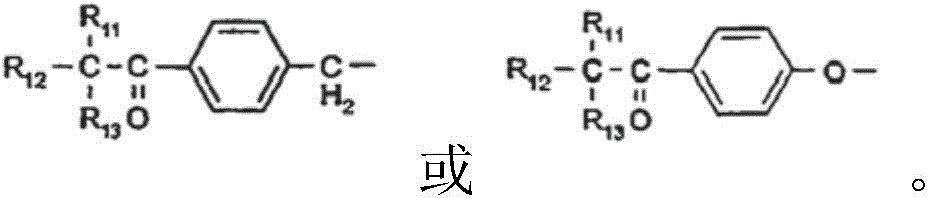
The compositions according to the invention may also use other photoinitiators, for example alpha-hydroxyketone photoinitiators of formula III:
wherein
R 11 And R 12 Independently of one another are hydrogen, C 1 -C 6 Alkyl, phenyl, C 1 -C 6 Alkoxy, OSiR 16 (R 17 ) 2 or-O (CH) 2 CH 2 O) q -C 1 -C 6 Alkyl, or
R 11 And R 12 Together with the carbon atom to which they are attached form a cyclohexyl ring;
q is a number from 1 to 20;
R 13 is OH, C 1 -C 16 Alkoxy or-O (CH) 2 CH 2 O) q -C 1 -C 6 An alkyl group;
R 14 is H, C 1 -C 18 Alkyl radical, C 1 -C 12 Hydroxyalkyl radical, C 1 -C 18 Alkoxy, -OCH 2 CH 2 -OR 15 、-CH=CH 2 、-C(CH 3 )=CH 2 Or is that
n is a number from 2 to 10;
R 15 is hydrogen, -COCH = CH 2 or-COC (CH) 3 )=CH 2 ;
R 16 And R 17 Independently of one another are C 1 -C 8 Alkyl or phenyl; and is
G 3 And G 4 Independently of one another, are end groups of the polymer structure, preferably hydrogen or methyl.
The α -hydroxyketone photoinitiators of interest are the following: wherein R is 11 And R 12 Independently of one another are hydrogen, C 1 -C 6 Alkyl or phenyl, or R 11 And R 12 Together with the carbon atom to which they are attached form a cyclohexyl ring, R 13 Is OH and R 14 Is hydrogen, C 1 -C 12 Alkyl radical, C 1 -C 12 Alkoxy, -OCH 2 CH 2 OR 15 、-C(CH 3 )=CH 2 Or is that
Suitable alpha-hydroxyketone photoinitiators are, for example, the following: wherein R is 11 And R 12 Independently of one another, methyl or ethyl, or R 11 And R 12 Together with the carbon atom to which they are attached form a cyclohexyl ring, R 13 Is hydrogen and R 14 Is hydrogen, C 1 -C 4 Alkyl radical, C 1 -C 4 Alkoxy or-OCH 2 CH 2 And (5) OH. Also of interest are compounds wherein R is 14 Is composed of
For example, suitable alpha-hydroxy ketone photoinitiators are
Alpha-hydroxy-cyclohexyl-phenyl-ketone,
2-hydroxy-2-methyl-1-phenyl acetone,
2-hydroxy-2-methyl-1- (4-isopropylphenyl) propanone,
2-hydroxy-2-methyl-1- (4-dodecylphenyl) acetone,
2-hydroxy-1- {4- [4- (2-hydroxy-2-methyl-propionyl) -benzyl ] -phenyl } -2-methyl-propan-1-one and
2-hydroxy-2-methyl-1- [ (2-hydroxyethoxy) phenyl ] propanone.
The alpha-hydroxyketone photoinitiator according to the invention is, for example, alpha-hydroxycyclohexyl phenyl ketone or 2-hydroxy-2-methyl-1-phenyl-1-propanone. Examples of straight-chain or branched alkyl groups are methyl, ethyl, propyl, isopropyl, butyl, isobutyl, sec-butyl, tert-butyl, pentyl, isopentyl, isooctyl, hexyl, heptyl, octyl, nonyl, decyl or dodecyl. Likewise, alkoxy or alkylthio groups have the same straight or branched chain.
The photoinitiators according to the invention can be used alone or in one or more combinations as a blend. Suitable photoinitiator blends (PI blends) are described, for example, in U.S. Pat. No.6,020,528 and U.S. patent application No.60/498,848. The PI (photoinitiator) blends of the present invention are, for example, mixtures of bis (2,4,6-trimethylbenzoyl) phenylphosphine oxide (CAS # 162881-26-7) and 2,4,6-trimethylbenzoylethoxyphenylphosphine oxide (CAS # 84434-11-7) in weight ratios of about 1: 11, 1: 10, 1: 9, 1: 8, or 1: 7.
Another particularly suitable PI blend is a mixture of bis (2,4,6-trimethylbenzoyl) phenylphosphine oxide, 2,4,6-trimethylbenzoyl ethoxyphenylphosphine oxide and 2-hydroxy-2-methyl-1-phenyl-1-propanone (CAS # 7473-98-5) in a weight ratio of, for example, about 3: 1: 15 or 3: 1: 16 or 4: 1: 15 or 4: 1: 16. Another suitable PI blend is a mixture of bis (2,4,6-trimethylbenzoyl) phenylphosphine oxide and 2-hydroxy-2-methyl-1-phenyl-1-propanone in a weight ratio of, for example, about 1: 3, 1: 4, or 1: 5. The acylphosphine oxides PI or PI blends of the present invention are present in the radiation curable composition in an amount from about 0.2 wt% to about 10 wt% by weight of the composition. For example, the PI or PI blend is present at about 0.5 wt% to about 8 wt%, about 1 wt% to about 7 wt%, or about 2 wt%, 3 wt%, 4 wt%, 5 wt%, or 6 wt%, based on the weight of the radiation curable composition.
Other suitable photoinitiators according to the invention are, for example, other monoacylphosphine oxides or bisacylphosphine oxides, such as diphenyl-2,4,6-trimethylbenzoylphosphine oxide or bis (2,6-dimethoxybenzoyl) -2,4,4-trimethylpentylphosphine oxide; alpha-hydroxy ketones, such as 1-hydroxycyclohexyl phenyl ketone or 2-hydroxy-1- [4- (2-hydroxyethoxy) phenyl ] -2-methyl-1-propanone; α -aminoketones, for example 2-methyl-1- [4- (methylthio) phenyl ] -2- (4-morpholinyl) -1-propanone, 2-benzyl-2- (dimethylamino) -1- [4- (4-morpholinyl) phenyl ] -1-butanone, 2- (4-methylbenzyl) -2- (dimethylamino) -1- [4- (4-morpholinyl) phenyl ] -1-butanone or 2-benzyl-2- (dimethylamino) -1- [3,4-dimethoxyphenyl ] -1-butanone; benzophenones, for example benzophenone, 2,4,6-trimethylbenzophenone, 4-methylbenzophenone, 2-methoxycarbonylbenzophenone, 4,4 '-bis (chloromethyl) benzophenone, 4-chlorobenzophenone, 4-phenylbenzophenone, 4,4' -bis (dimethylamino) benzophenone, 4,4 '-bis (diethylamino) benzophenone, methyl 2-benzoylbenzoate, 3,3' -dimethyl-4-methoxybenzophenone, 4- (4-methylphenylsulfanyl) benzophenone, 2,4,6-trimethyl-4 '-phenyl-benzophenone or 3-methyl-4' -phenyl-benzophenone; ketal compounds, such as 2,2-dimethoxy-1,2-diphenyl-ethanone; and monomeric or dimeric phenylglyoxylates, such as methylphenylglyoxylate, 5,5' -oxo-bis (ethyleneoxydicarbonylphenyl) or 1,2- (benzoylcarboxy) ethane.
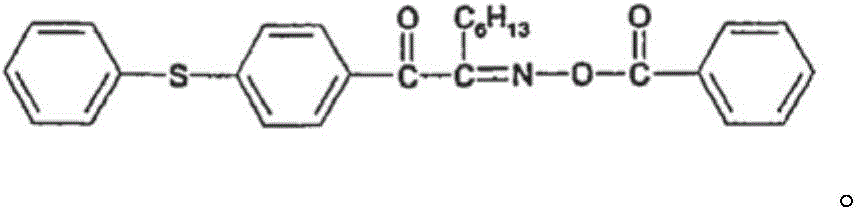
Other suitable photoinitiators for use according to the present invention, with or without the use of acylphosphine oxide photoinitiators, are, for example, the oxime esters disclosed in U.S. Pat. No.6,596,445. Suitable oxime ester photoinitiators are, for example:
in addition to oxime ester photoinitiators, certain so-called cationic photoinitiators (e.g., those of the sulfonium or iodonium salt type) also generate free radicals and may be used as photoinitiators in embodiments of the present invention. Such photoinitiators are described, for example, in U.S. Pat. No.9,708,442.
Another class of suitable photoinitiators according to the present invention, with or without the use of acylphosphine oxide photoinitiators, is for example phenyl glyoxalate (phenyl glyoxalate), for example as disclosed in U.S. Pat. No.6,048,660. For example, phenylglyoxal esters of the formula:
wherein Y is C 1 -C 12 Alkylene, cyclohexylene, O, S, or NR 30 C by one or more interruptions 2 -C 40 Alkylene, and R 30 Is hydrogen, C 1 -C 12 Alkyl or phenyl, preferably Y is CH 2 CH 2 -O-CH 2 CH 2 。
One or more of the above photoinitiators may be used in the composition according to the invention in any suitable amount and may be selected individually or in combinations of one or more of the types listed herein. In a preferred embodiment, the photoinitiator component is present in an amount of from about 0.1% to about 10% by weight, or from about 0.1% to about 5% by weight, or from about 1% to about 5% by weight, relative to the total weight of the liquid water-swellable composition used to coat the optical fibers.
Viscosity modifier
The inventors have found that the above-mentioned SAP components (mentioned elsewhere herein) which help to form a sufficiently water-swellable liquid radiation curable coating often tend to be at the expense of the processability of the composition in the optical fiber coating process. Thus, one or more additional components may be included to ensure that the coating has a viscosity suitable for optical fiber coating applications. These so-called viscosity modifiers do not have to be added in order to improve the swellability of the compositions incorporating them, although it is desirable that they do not significantly hinder this important coating property.
While not necessarily limited thereto, the viscosity modifiers described herein will generally be included to increase the viscosity of compositions incorporating them, as the aforementioned SAP-related ingredients generally result in compositions that are too low in viscosity to be useful in optical fiber processing applications. Many of the compositions described herein comprising an acrylate salt, an ethylenically unsaturated network former (particularly, for example, lower molecular weight monofunctional acrylate monomers) have undesirably low viscosities. If the viscosity of the composition is too low, a coating of sufficient thickness will not adhere to the previously applied layer or may undergo flow and/or dripping such that the thickness is not uniformly applied.
On the other hand, it may be desirable in some instances to include viscosity modifiers that reduce the overall viscosity of the compositions in which they are associated. If the viscosity of the composition is too high, the coating may not flow sufficiently through the coating die and thus may not optimally cover the previously applied layer.
In one embodiment, the viscosity modifier is water soluble. In one embodiment, the water-soluble viscosity modifier comprises polyvinyl alcohol, polyvinyl pyrrolidone, starch, modified cellulose, gelatin, polyethylene glycol compounds such as polyethylene glycol having a molecular weight of 250000 to 4000000g/mol, or polyacrylic acid.
The polyvinyl alcohol is of the idealized formula [ CH ] 2 CH(OH)] n The water-soluble synthetic polymer of (1). They may similarly and/or commercially be referred to as PVOH; poly (vinyl alcohol), vinyl alcohol, homopolymer, PVA, polyvinyl, vinol, alvyl, alcotex, cowol, gelvatol, lemol, mowiol, mowiflex, alcotex, elvanol, gelvatol, lemol, mowiol, nelfilcon a, polyvinyl, and Rhodoviol.
Polyvinylpyrrolidone is a water-soluble polymer made from the monomer N-vinylpyrrolidone. It may be similarly and/or commercially referred to as PVP, povidone, copovidone, PVPP, crospovidone, polyvidone, PNVP, poly [1- (2-oxo-1-pyrrolidinyl) ethanediyl ], 1-vinyl-2-pyrrolidone homopolymer, or 1-vinyl-2-pyridone polymer.
Starch is a polymeric carbohydrate composed of a large number of glucose units linked by glycosidic bonds. It may have any suitable molecular weight and is represented by formula (C) 6 H 10 O 5 ) n 。
Examples of modified cellulose compounds include those comprising methyl cellulose or hydroxyethyl cellulose compounds.
Certain compounds are particularly preferred for use as viscosity modifiers because their addition improves the processability of the compositions into which they are incorporated without significantly adversely affecting the swellability of the compositions. The inventors have found that polyvinylpyrrolidone, for example, is a preferred viscosity modifier because, when used in an appropriate molecular weight effective amount, it will increase the viscosity of the composition into which it is incorporated sufficiently to a satisfactory level to ensure processing in optical fiber coating applications, and in all applications will not have a significant detrimental effect on the ability of the composition to swell upon introduction of water.
In one embodiment, a liquid water-swellable radiation-curable coating composition for optical fibers includes a polyvinylpyrrolidone compound. The polyvinylpyrrolidone can have any suitable molecular weight, for example, 1 kilodalton (kDa) to 5 megadalton (MDa), or 5kDa to 1000kDa, or 50kDa to 500kDa, or 75kDa to 300kDa, 100kDa to 200kDa. In one embodiment, the polyvinylpyrrolidone has a high molecular weight, such as 100kDa to 300kDa, or 120kDa to 200kDa, in order to substantially increase the viscosity of the composition incorporating the polyvinylpyrrolidone. To ensure adequate viscosity adjustment without monopolizing the composition or affecting the properties of the entire formulation, viscosity modifiers having sufficiently high molecular weights should be used in appropriate amounts, as will be understood by those of ordinary skill in the art to which the invention pertains.
Unless otherwise indicated, the foregoing molecular weights, as well as any other molecular weight values expressed elsewhere herein, are to be construed herein as number average molecular weights as determined by ASTM D5296-11 or other similar standards.
The viscosity modifier may be present in any suitable weight amount, for example, from about 5 to about 40 weight%, or from about 8 to about 30 weight%, or from about 10 to about 25 weight%, or from about 15 to about 20 weight%, relative to the weight of the entire water-swellable radiation-curable coating composition for optical fibers. The viscosity modifier should be included in a sufficient amount to ensure that the composition incorporating the viscosity modifier has a viscosity suitable for processing after the optical fiber is coated, for example, the viscosity at which the composition is coated and cured onto the optical fiber, typically on a draw tower or inker. In one embodiment, the viscosity modifiers are included in an amount to achieve a viscosity of the water-swellable radiation-curable coating compositions incorporating them of from about 500 centipoise (cPs) to about 5000cPs, or from about 600cPs to about 4000cPs, or from about 700cPs to about 3000cPs, or from about 800cPs to about 2000cP at 25 ℃, according to well-known methods s Or at a level of 800cPs to 1200 cPs. In other embodiments, the viscosity modifiers are included in an amount to achieve a viscosity of the water-swellable, radiation-curable coating compositions incorporating them at 25 ℃ of a level of from about 1200 to about 3000cPs, or from about 1400 to about 2800cPs, or from about 1600 to about 2700cPs, or from about 1700 to about 2500cPs according to well known methods. The exact viscosity of the formulation to be treated will be adjusted according to values known in the art, depending on several factors, including the thickness of the water-swellable radiation-curable coating composition intended to be applied, and the line speed or inking speed at which the coating application process takes place.
Water (W)
The various components described above in the composition according to the invention generally comprise water. That is, to ensure homogeneity or avoid safety, environmental or handling issues, many of the components described elsewhere are commercially provided in liquid form, which may take the form of an aqueous solution. As such, water is often present (even if unintentionally) in the composition according to the invention. However, the inventors have determined that if water is added to the water-swellable radiation curable composition used to coat the optical fiber prior to curing and subsequent exposure to an external fluid, the swelling properties of the coating are actually improved. Furthermore, the inventors have surprisingly found that the property of adding water to enhance the swellability effect is sustained with increasing amounts of added water concentration. Without wishing to be bound by any theory, the inventors speculate that this may occur due to the fact that the initial water content increases the cyclization reaction, causes a conformational change in the chains, or hydrolyzes the crosslinking agent present in the composition. Any of the foregoing phenomena may contribute to improving the relative swelling properties of coatings having additional water incorporated therein.
Thus, in one embodiment, the water swellable radiation curable coating composition for optical fibers further comprises an amount of water. The water may be present in an amount of from about 0.1 wt% to about 50 wt%, or from about 5 wt% to about 45 wt%, or from about 10 wt% to about 40 wt%, or from about 15 wt% to about 35 wt%, relative to the weight of the entire water-swellable radiation-curable coating composition for optical fibers. Although there is a tendency to improve the swelling properties in increased amounts, if the amount of added water becomes too high, the integrity (i.e., modulus) and cure speed of the coating will be adversely affected, making it impossible to form a viable coating for optical fiber applications.
Multifunctional crosslinking agent
In order to ensure suitability in optical fiber applications, the composition according to the invention should also comprise at least one crosslinking agent. That is, they include at least one agent incorporated into the thermoset material to form additional network crosslinks, which are small regions of macromolecules that diverge by at least four chains and are formed by reactions involving sites or groups on existing macromolecules or interactions between existing macromolecules. This additional crosslinking is required to ensure that the coating will maintain significant structural integrity after exposure to water. The inventors have found that if the coating does not retain sufficient integrity after swelling, the coating will easily break into many small pieces during swelling. If this is done, the coating will allow the flow of uncaptured water through the channels or passages, thereby limiting the overall longitudinal water blocking effect in fiber optic applications. The inventors have surprisingly found that despite the sufficient swellable properties of the coating itself, a reduced longitudinal water-blocking capacity is observed.
In a preferred embodiment, the water-swellable, radiation-curable coating composition for optical fibers of the present invention comprises a cross-linking agent that causes additional network cross-linking to be induced on the cross-linked polymer chains formed by the ethylenically unsaturated network former component as described elsewhere herein. Such crosslinking agents therefore comprise radically polymerizable compounds having on average more than 1.0 functional groups, wherein the functional groups are preferably acrylate or acrylamide functional groups. In a preferred embodiment, the crosslinking agent is multifunctional. As used herein, "multifunctional" means that the relevant component has an average of at least 1.9 functional groups per molecule.
In one embodiment, the multifunctional crosslinking agent comprises a difunctional compound, i.e., a compound having an average number of functional groups of from 1.9 to 2.1 or preferably an average of 2.0 functional groups. In one embodiment, the ethylenically unsaturated component comprises a polyfunctional compound, i.e., a compound having an average number of functional groups of at least 2.1.
In order to ensure optimum crosslinking capability, the crosslinking agent preferably comprises a multifunctional acrylate or a multifunctional acrylamide. In one embodiment, the multifunctional crosslinking agent is difunctional, or has an average of 1.9 to 2.5 functional groups per molecule. In another embodiment, the multifunctional crosslinking agent is trifunctional or has an average of greater than 2.5 to 3.5 functional groups per molecule. In another embodiment, the multifunctional crosslinking agent is tetrafunctional, or has an average of greater than 3.5 to 4.5 functional groups per molecule. In one embodiment, the multifunctional crosslinking agent is penta-functional, or has an average of greater than 4.5 to 5.5 functional groups per molecule. In another embodiment, the multifunctional crosslinking agent is hexafunctional, or has an average of greater than 5.5 to 6.5 functional groups per molecule. Of course, a variety of polyfunctional crosslinking agents of the types described above may be used alone or in any combination. Likewise, the crosslinking agents should be selected such that at least one crosslinking agent has at least one functional group that is the same as at least one functional group of the monofunctional ethylenically unsaturated network forming component used, as described elsewhere herein.
In one embodiment, the water swellable radiation curable coating composition for optical fibers may comprise an acrylate functional crosslinker. Some non-limiting examples of such cross-linking agents include ethylene glycol diacrylate, diethylene glycol diacrylate, triethylene glycol diacrylate, tetraethylene glycol diacrylate, ethoxylated hexanediol diacrylate, trimethylolpropane ethoxylate, trimethylolpropane diacrylate, trimethylolpropane triacrylate, methyl ether diacrylate, neopentyl glycol diacrylate, 1,3-butanediol diacrylate, glycerol-1,3-diglycerol alkyd diacrylate, 1,6-adipoylbis [ oxy-2-hydroxy-3,1-propanediyl ] diacrylate, pentaerythritol triacrylate, or ethoxylated pentaerythritol triacrylate, 1,4 butanediol diacrylate, or 1,6 hexanediol diacrylate, or any combination thereof.
In another embodiment, a water swellable radiation curable coating composition for optical fibers comprises an acrylamide functional crosslinker. Some non-limiting examples of such crosslinking agents include n, n-methylene bisacrylamide or n-n-ethylene bisacrylamide.
Examples of further polyfunctional crosslinkers which contain more than one double bond are polyethylene glycol diacrylate, ethylene glycol diacrylate, propylene glycol diacrylate, neopentyl glycol diacrylate, hexamethylene glycol diacrylate, bisphenol A diacrylate, 4,4' -bis (2-acryloyloxyethoxy) diphenylpropane, trimethylolpropane triacrylate, pentaerythritol triacrylate and tetraacrylate, vinyl acrylate, divinylbenzene, divinyl succinate, diallyl phthalate, triallyl phosphate, triallyl isocyanurate, divinyl adipate or tris (2-acryloylethyl) isocyanurate. In one embodiment, the multifunctional crosslinking agent comprising more than one double bond has a number average molecular weight of 200 to 20000g/mol, or preferably 200 to 15000g/mol or even more preferably 400 to 10000 g/mol.
The compositions of the present invention may comprise any suitable amount of a crosslinking agent. However, the inventors have found that there is a range of amounts in which the multifunctional crosslinker component can be used to ensure that the composition incorporating it simultaneously has optimal machine direction water resistance and is suitable for use in optical fiber coating processes. If the network crosslink density is too low, the coating will not have sufficient integrity to maintain a single structure during water exposure, limiting the ability of the coating to adequately block water in the machine direction in fiber optic applications. However, if the cross-link density is too high, the coating itself will not be sufficiently water swellable.
Thus, in one embodiment, the multifunctional crosslinking agent is present in an amount of from greater than 0.1 to less than 5 wt.%, more preferably from about 0.5 to about 3 wt.%, relative to the weight of the entire water-swellable radiation curable coating composition for the optical fiber.
Alternatively expressed in terms of molal concentrations, in another embodiment, the multifunctional crosslinking agent is present in an amount of from about 3.8 to about 190mmol/kg, or from about 19 to 110mmol/kg, relative to the total composition. Further, in one embodiment, the entire composition has about 1.9 to about 95 milliequivalents of acryloyl groups (milliequivalents) via the multifunctional crosslinker, or about 9.5 to about 55 milliequivalents of acryloyl groups via the multifunctional crosslinker. In other words, the total amount of multifunctional crosslinker present in the total composition will contribute from about 1.9 to about 95 or from about 9.5 to about 55 acryloyl milliequivalents.
Additive agent
The composition of the present invention may optionally further comprise one or more additives. Such additives may be added as needed according to the particular design criteria and application requirements for which a particular water swellable coating will be used.
In one embodiment, the water swellable radiation curable coating composition for optical fibers will be useful for fiber identification purposes by virtue of its location as the outermost coating layer for coating the optical fiber. As such, in one embodiment, the liquid water swellable composition used to coat the optical fibers further comprises an ink. In one embodiment where ink is present in the composition, it is preferred to apply the composition to the secondary coating of the optical fiber during inking, as this will ensure that no additional treatment is required to impart water blocking properties to the coated optical fiber. The inks comprise colorants, for example photoreducible dyes, such as xanthene, benzoxanthene, benzothioxanthene, thiazine, pyronine (pyronine), porphyrin or acridine dyes, and/or trihalomethyl compounds which can be cleaved by radiation. Similar compositions are described, for example, in U.S. Pat. No.5,229,253. The ink may also include other conventional colorants such as optical brighteners, pigments or dyes.
In one embodiment, the ink is present in an amount of from about 0.01 wt% to about 5 wt%, or from about 0.05 wt% to about 2 wt%, or from about 0.1 wt% to about 1 wt%, relative to the weight of the entire water-swellable radiation-curable coating composition for optical fibers.
Additives are also commonly added to optical fiber coatings to achieve certain desired characteristics, such as improved shelf life, improved oxidative and hydrolytic stability of the coating, improved surface properties, and the like. There are many different types of desired additives, although they are included in contemplated embodiments as having a desired effect, the invention discussed herein is not intended to be limited to these additives.
Examples of these are fillers, slip additives, wetting agents or levelling assistants. Thermal inhibitors intended to prevent premature polymerization may also be used. Examples include hydroquinone, hydroquinone derivatives, p-methoxyphenol, beta-naphthol, or sterically hindered phenols such as 2,6-di (tert-butyl) -p-cresol. For example, the shelf life in the dark can be increased by using copper compounds (e.g., copper naphthenate, copper stearate or copper octoate), phosphorus compounds (e.g., triphenylphosphine, tributylphosphine, triethyl phosphite, triphenyl phosphite or tribenzyl phosphite), quaternary ammonium compounds (e.g., tetramethylammonium chloride or trimethylbenzylammonium chloride).
In order to block atmospheric oxygen during the polymerization, paraffin or similar waxy substances may be added; due to their low solubility in the polymer, they migrate to the surface at the start of the polymerization and form a transparent surface layer which prevents the entry of air. An oxygen barrier layer may also be applied.
Among the light stabilizers which may be added are UV absorbers, such as the well-known commercially available UV absorbers: hydroxyphenyl benzotriazoles, hydroxyphenyl benzophenones, oxamides or hydroxyphenyl-s-triazines. Such compounds may be used alone or in mixtures with or without the use of sterically hindered, relatively non-basic amine light stabilizers (HALS). Sterically hindered amines are based, for example, on 2,2,6,6-tetramethylpiperidine.
UV absorbers and sterically hindered amines are, for example:
2- (2-hydroxyphenyl) -2H-benzotriazole-based compounds, for example, known commercial hydroxyphenyl-2H-benzotriazole-based compounds and benzotriazole-based compounds, such as those described in U.S. Pat. Nos.3,004,896;3,055,896;3,072,585;3,074,910;3,189,615;3,218,332;3,230,194;4,127,586;4,226,763;4,275,004;4,278,589;4,315,848;4,347,180;4,383,863;4,675,352;4,681,905;4,853,471;5,268,450;5,278,314;5,280,124;5,319,091;5,410,071;5,436,349;5,516,914;5,554,760;5,563,242;5,574,166;5,607,987, 5,977,219 and 6,166,218, for example 2- (2-hydroxy-5-methylphenyl) -2H-benzotriazole, 2- (3,5-di-tert-butyl-2-hydroxyphenyl) -2H-benzotriazole, 2- (2-hydroxy-5-tert-butylphenyl) -2H-benzotriazole, 2- (2-hydroxy-5-tert-octylphenyl) -2H-benzotriazole, 5-chloro-2- (3,5-di-tert-butyl-2-hydroxyphenyl) -2H-benzotriazole, 5-chloro-2- (3-tert-butyl-2-hydroxy-5-methylphenyl) -2H-benzotriazole, 2-hydroxy-2-hydroxyphenyl-2H-benzotriazole, 2-hydroxy-2H-benzotriazole, 2-hydroxy-phenyl-2H-benzotriazole, 2-methyl-2-methyl-and 2-methyl-phenyl-methyl-2-benzotriazole 2- (3-sec-butyl-5-tert-butyl-2-hydroxyphenyl) -2H-benzotriazole, 2- (2-hydroxy-4-octyloxyphenyl) -2H-benzotriazole, 2- (3,5-di-tert-amyl-2-hydroxyphenyl) -2H-benzotriazole, 2- (3,5-bis-alpha-cumyl-2-hydroxyphenyl) -2H-benzotriazole, 2- (3-tert-butyl-2-hydroxy-5- (2- (omega-hydroxy-octa- (ethyleneoxy) carbonyl-ethyl) -, phenyl) -2H-benzotriazole, 2- (3-dodecyl-2-hydroxy-5-methylphenyl) -2H-benzotriazole, 2- (3-tert-butyl-2-hydroxy-5- (2-octyloxycarbonyl) ethylphenyl) -2H-benzotriazole, dodecylated 2- (2-hydroxy-5-methylphenyl) -2H-benzotriazole, 2- (3-tert-butyl-2-hydroxy-5- (2-octyloxycarbonylethyl) phenyl) -5-chloro-2H-benzotriazole, 2- (3-tert-butyl-5- (2- (2-ethylhexyloxy) -carbonylethyl) -2-hydroxyphenyl) -5-chloro-2H-benzotriazole, 2- (3-tert-butyl-2-hydroxy-5- (2-methoxycarbonylethyl) phenyl) -2H-benzotriazole, 2- (3-tert-butyl-2- (2-ethylhexyloxy) -2H-benzotriazole, 2- (3-tert-butyl-5- (2-ethylhexyloxy) carbonylethyl) -2H-benzotriazole, 2- (3-tert-butyl-2-hydroxy-5- (2-isooctyloxycarbonylethyl) phenyl-2H-benzotriazole, 2,2' -methylene-bis (4-tert-octyl- (6-2H-benzotriazol-2-yl) phenol), 2- (2-hydroxy-3-alpha-cumyl-5-tert-octylphenyl) -2H-benzotriazole, 2- (2-hydroxy-3-tert-octyl-5-alpha-cumylphenyl) -2H-benzotriazole, 5-fluoro-2- (2-hydroxy-3,5-di-alpha-cumylphenyl) -2H-benzotriazole, 5-chloro-2- (2-hydroxy-3,5-di-alpha-cumylphenyl) -2H-benzotriazole, 5-chloro-2- (2-hydroxy-3-alpha-cumyl-5-tert-octylphenyl) -2H-benzotriazole, 2- (3-tert-hydroxy-2-5- (2-isooctyloxycarbonylethyl) -2H-benzotriazole, 5-trifluoromethyl-2H-benzotriazole, 5-chloro-2H-benzotriazol-5-methyl-2H-o-2H-benzotriazole, 5-chloro-2- (2-hydroxy-3-cumylphenyl) -2H-benzotriazole, 5-methyl-2H-benzotriazol, 5-trifluoromethyl-2- (2-hydroxy-5-tert-octylphenyl) -2H-benzotriazole, 5-trifluoromethyl-2- (2-hydroxy-3,5-di-tert-octylphenyl) -2H-benzotriazole, 3- (5-trifluoromethyl-2H-benzotriazol-2-yl,) -methyl 5-tert-butyl-4-hydroxyhydrocinnamate, 5-butylsulfonyl-2- (2-hydroxy-3-. Alpha. -cumyl-5-tert-octylphenyl) -2H-benzotriazole, 5-trifluoromethyl-2- (2-hydroxy-3-. Alpha. -cumyl-5-tert-butylphenyl) -2H-benzotriazole, 5-trifluoromethyl-2- (2-hydroxy-3,5-di-tert-butylphenyl) -2H-benzotriazole, 5-trifluoromethyl-2- (2-hydroxy-3,5-di-alpha. -cumylphenyl) -2H-benzotriazole, 5-butylsulfonyl-2- (2-hydroxy-3245-di-tert-octylphenyl) -2H-benzotriazole, and 5-tert-butyl-4-hydroxybenzyl-2H-benzotriazole, 5-2H-3732.
2-hydroxybenzophenones include, for example, the 4-hydroxy, 4-methoxy, 4-octyloxy, 4-decyloxy, 4-dodecyloxy, 4-benzyloxy, 4,2',4' -trihydroxy and 2' -hydroxy-4,4 "-dimethoxy derivatives.
Esters of substituted and unsubstituted benzoic acids include, for example, 4-tert-butylphenyl salicylate, phenyl salicylate, octylphenyl salicylate, dibenzoyl resorcinol, bis (4-tert-butylbenzoyl) resorcinol, benzoyl resorcinol, 3,5-di-tert-butyl-4-hydroxybenzoate 2,4-di-tert-butylphenyl ester, 3,5-di-tert-butyl-4-hydroxybenzoate hexadecyl ester, 3,5-di-tert-butyl-4-hydroxybenzoate octadecyl ester, 3,5-di-tert-butyl-4-hydroxybenzoate 2-methyl-4,6-di-tert-butylphenyl ester.
As further additives, to accelerate the photopolymerization, accelerators, coinitiators and autooxidants, such as mercaptans, thioethers, disulfides and phosphines, may be added, as described, for example, in EP-A-438 and GB-A-2 180 358.
Photopolymerization can also be accelerated by the addition of photosensitizers that alter or broaden the spectral sensitivity. In particular, these are aromatic carbonyl compounds, such as benzophenone derivatives, thioxanthone derivatives, anthraquinone derivatives and 3-acylcoumarin derivatives, and also 3- (aroylmethylene) thiazolines, and also eosine, rhodamine and erythrosine dyes.
In particular, the curing procedure may be assisted by pigmented (e.g. pigmented with titanium dioxide) compositions, and by the addition of components that form free radicals under thermal conditions, for example azo compounds such as 2,2' -azobis (4-methoxy-2,4-dimethylvaleronitrile), triazenes, diazo sulfides, pentazadienes; or a peroxy compound, such as a hydroperoxide or percarbonate, for example t-butyl hydroperoxide, as described in U.S. Pat. No.4,753,817.
One or more of the above additives may be used in the composition according to the invention in any suitable amount and may be selected individually or in combinations of one or more of the types listed herein. In one embodiment, the additive component is present in an amount of about 0.01 to about 5 weight percent, more preferably about 0.1 to about 2 weight percent, relative to the total weight of the composition. According to another embodiment, one or more of the above additives are present in an amount from about 1% to about 5% by weight.
The inventors have further found that the suitability of the composition for forming a water-swellable radiation curable coating composition for optical fibers can be improved if certain of the aforementioned components are formulated in specific amounts relative to each other. Thus, in one embodiment, the water-swellable radiation-curable coating composition for optical fibers has a specific molar ratio of acrylic and acrylate components to monofunctional ethylenically unsaturated monomer component. In one embodiment, the ratio is from about 1: 1 to about 9: 1, or from about 1.05: 1 to about 6: 1, or from about 3: 2 to about 4: 1.
In another embodiment, the water swellable radiation curable coating composition for optical fibers has a specific molar ratio of acrylic and acrylate components to multifunctional crosslinker component. In one embodiment, the ratio is from about 24: 1 to about 100000: 1, or from about 32: 1 to about 1000: 1, or from about 50: 1 to about 200: 1.
In another embodiment, the water-swellable, radiation-curable coating composition for optical fibers has a specific molar ratio of monofunctional ethylenically unsaturated network former component to multifunctional crosslinker component. In one embodiment, the ratio is from about 4: 1 to about 1000: 1, or from about 9: 1 to about 200: 1, or from about 20: 1 to about 100: 1.
Many of the foregoing compositions comprise compounds having acyl groups derived from acrylic acid. In a preferred embodiment, they further do not comprise compounds having an acyl group derived from methacrylic acid. Although SAP compositions comprising methacrylates, and/or methacrylamides are typically used to produce excellent water-swellable compositions, the inventors have determined that the use of methacrylates, and/or methacrylamides in large amounts is not suitable for use in the compositions of the present invention. This is because it is believed that the high amount of methacrylate-functional components present can hinder the cure speed of compositions containing these components such that the compositions will no longer maintain the high speed cure requirements suitable for modern optical fiber coating processes.
Thus, in one embodiment, the composition is substantially free of methacrylate components. In one embodiment, the composition is substantially free of compounds having acyl groups derived from methacrylic acid. In one embodiment, the composition has less than 3 wt.%, or less than 2 wt.%, or less than 1 wt.%, or less than 0.5 wt.% of compounds having acyl groups derived from methacrylic acid. In an alternative embodiment, the composition comprises one or more compounds having free-radically polymerizable functionality. Such compounds having a radically polymerizable functional group may be derived from one of the existing constituent elements; for example, monofunctional ethylenically unsaturated network formers or multifunctional crosslinkers. In such alternative embodiments, the free radically polymerizable group in all of these compounds consists essentially of an acrylate functional group.
A second embodiment is an optical fiber coated with a primary coating, a secondary coating adhered to and surrounding the primary coating, and a water-swellable outer coating adhered to and surrounding the secondary coating, wherein the water-swellable outer coating is configured to bend and detach from the secondary coating at least one point along a portion of the coated optical fiber within 3 minutes, or within 2 minutes, or within 1 minute, or within 30 seconds, or within 20 seconds, or within 10 seconds, or within 5 seconds after the coated optical fiber is immersed in deionized water.
A coated optical fiber according to one aspect of a second embodiment is shown in fig. 1. A cross-section of a coated optical fiber 10 having a water swellable outer coating according to one embodiment of the present invention is depicted in fig. 1. Such a coated optical fiber 10 having a water swellable outer coating comprises a fiber having a diameter D 1 Glass core 11, glass core 11 being of diameter D 2 Is surrounded by a cladding layer 12. The cladding 12 is coated with a primary coating 13, the primary coating 13 itself being coated with a secondary coating 14. Finally, the water swellable coating 15 surrounds and contacts the secondary coating, therebyForming the outer layer of the coated optical fiber. The optical fiber on which the water swellable coating 15 is applied is typically about 240 microns in diameter, although any size of coated optical fiber may be used in accordance with the principles of the present invention, such as 180-240 μm, or such as 240-250 μm.
The inventors have found that in order to design a coating with as efficient and effective water blocking properties as possible, it is important not only that the water swellable coating is sufficiently swellable (in terms of rate and total amount) and strong enough to prevent the coating from collapsing after swelling as described above, but also that such a coating is configured to bend and detach from the coated optical fiber after it is exposed to water and begins to swell.
Detachability of the coating is desirable because it maximizes the swelling potential of a particular coating. In the case of optical fiber applications, if one of the coatings can be released from the coated fiber while the second coating is not, the performance in longitudinal water blocking will be different for two coatings with similar film swelling capabilities, all other conditions being the same. In this case, the first (releasable) coating on the fibers will have a higher volume swell ratio-and excellent longitudinal water blocking properties-than the second coating. The inventors speculate that this is because the releasability of the coating is desirable because it enables the coating to swell unhindered in all directions. Even very water swellable coatings that do not detach from a previously adhered layer can only swell with a single degree of freedom (i.e., increase in thickness radially outward). This is because contact of such a coating with the previous layer will limit further swelling of the tangential (i.e. circumferential) and axial (along the length of the coating) dimensions. However, if the coating is stripped from a previous layer, it will have three degrees of freedom, for example, along the outer diameter, inner diameter, and length. Thus, to reiterate, the actual volume swelling with all three degrees of freedom will be significantly higher than that occurring with only one degree of freedom, even for two coatings with the same membrane swellability characteristics.
The release problem is particularly acute in the case of optical fiber coatings due to the geometry of the continuous coating itself. That is, the localized forces caused by the swelling process of the outer coating may not overcome significant adhesion to adjacent layers, in part because of the inherent formation of significant contact patches (patches) between two successive coatings in a thin elongated cylindrical fiber. In any event, the swelling process creates an axial compressive stress in the coating. If the compressive force exceeds the critical buckling force of the coating, the swellable layer will buckle (i.e., form a periodic pattern in the axial direction with the peaks of the initial buckling shifted in a direction away from the adjacent coating) and eventually break free of the fibers, causing further swelling.
The inventors have discovered that the axial compressive stress and critical bending force can be tuned according to the chemistry, processing, and configuration of the particular coating. Thus, the inventors have surprisingly found that a particular water-swellable coating can be tailored to achieve maximum longitudinal water-blocking performance if it is configured to detach from a previously attached layer, depending on several factors. These factors are not intended to be limiting, however, other ways of configuring disengageability are contemplated once this surprising association is recognized.
The first factor in configuring the detachability is through the chemical nature of the coating itself. Preferred embodiments of coatings having excellent swellability and structural integrity are described elsewhere above. The coatings described herein promote the maximum amount of axial stress because they exhibit excellent swellability in coated optical fiber applications.
The second factor for configuring the releasability is through the thickness of the water-swellable coating layer itself. This can be adjusted according to known processing methods. The inventors have surprisingly found that a coating having a thickness within certain specified ranges promotes maximum detachability. Thus, in one embodiment, the water swellable outer coating has a thickness of from 0.1 to less than 20 microns, or from 1 to 20 microns, or from 0.2 to 10 microns, or from 0.3 to 5 microns, or from 2 to 5 microns, or from 1 to 4 microns. If the thickness becomes too small, sufficient swelling may not occur. If it becomes too large, consistent releasability cannot be ensured quickly enough, and the amount of fiber permitted in a small-size buffer tube configuration may be reduced by the relatively large diameter of each coating.
Another factor that positively affects the overall longitudinal water barrier properties of the water swellable outer coating is optimizing the conditions under which the coating is applied and cured. It has been observed that the relative reduction in the amount of cure imparted to the coating has an effect on the ability of the coating to subsequently detach from the coated fibers under water ingress conditions. Without wishing to be bound by any theory, it is believed that this is because reducing the amount of cure results in a partially undercured coating with a reduced crosslink density, which in turn has the effect of reducing the compressive stress build-up caused by swelling. In this case, the local axial stress exerted by the swelling is not always large enough to overcome the critical bending force, and thus bending and detachment do not occur or do not occur completely. Thus, in one embodiment, the coating is processed at a cure dose sufficient to have a percent% RAU of reacted acrylate unsaturation on its top surface of at least 80%, more preferably at least 90% or at least 95% or at least 98% or at least 99% according to The FTIR method described, for example, in WO2011/075549 ("The degree of cure of The second coating on an optical fiber by FTIR"), which is incorporated herein by reference in its entirety.
The inventors have also determined that cure strength, in addition to the amount of cure, can be an important processing parameter that can have an effect on the releasability, swellability, and/or machine direction water blocking properties of the coating. It has been determined that higher UV intensity, with all other factors remaining constant, will result in shorter kinetic chain lengths and therefore lower crosslinking concentrations. This tends to result in improved swellability and releasability of the coating itself. However, if the UV intensity becomes too high, the kinetic chain lengths will be even shorter, resulting in an unacceptable reduction in crosslink density, which tends to result in a reduction in the integrity of the coating, and the coating is more prone to collapse or dissolve during swelling.
Other potential factors include the above-described crosslink density of the polymer network in the cured water-swellable coating itself, as well as the viscosity of the coating during coating, to name a few.
The aforementioned factors should be adjusted to ensure that the water-swellable radiation-curable coating for optical fibers according to the present invention is sufficiently swellable, whether or not it is configured to bend and/or detach from the coated fiber. This swellable characteristic is a necessary (but not sufficient) property that the coating must possess to ensure that it promotes the building of a system that is sufficiently water-resistant in the machine direction. This property can be measured by determining the film swell ratio of the cured coating. In one embodiment, the composition has a membrane swell ratio greater than about 5 times (x), or greater than about 31x, or greater than about 56x, or greater than 80x, or greater than 100x, or greater than 200x, or greater than 220 times. In another embodiment, a 10 mil calendered film when coated on a glass plate and used on a conveyor belt system to impart 8W/cm 2 Irradiated Fusion 600W/in D lamps passed 3 times and each pass was 1J/cm 2 The radiation curable coating, when cured, has a film swell ratio of at least 5x, or at least 10x, or at least 20x, or at least 30x, or at least 40x, and less than 300x, or less than 200x, or less than 100x, or from 5x to 250x, or from 20x to 225x, or from 10x to 100x, or from 20x to 100x, or from 40x to 80x, or from 35x to 250 x.
A third embodiment is a method of applying a liquid water-swellable coating to a coated optical fiber, comprising the steps of: providing a coated optical fiber, applying a liquid water-swellable coating composition to an outer surface of a portion of the coated optical fiber to form a coated optical fiber having a liquid water-swellable exterior coating composition, and exposing the coated optical fiber having the liquid water-swellable exterior coating composition to a light source capable of emitting ultraviolet radiation that promotes curing of the liquid water-swellable exterior coating composition to form the coated optical fiber having the water-swellable exterior coating layer, wherein the water-swellable exterior coating layer is configured to bend and detach from the coated optical fiber at least one point along the portion of the coated optical fiber within 3 minutes, or within 2 minutes, or within 1 minute, or within 30 seconds, or within 20 seconds, or within 10 seconds, or within 5 seconds of immersion of the coated optical fiber having the water-swellable exterior coating layer in deionized water.
Methods of providing coated optical fibers are well known and described elsewhere herein above. One specific method of coating an optical fiber comprises the steps of: drawing the glass optical fiber through a draw tower; applying a primary coating composition to the surface of a glass optical fiber; optionally, exposing the primary coating composition to a first light source capable of emitting ultraviolet radiation that promotes curing of the primary coating composition; applying a secondary coating composition to the primary coating composition; finally, the primary and secondary coating compositions are exposed to at least one of a first light source and a second light source capable of emitting ultraviolet radiation that promotes curing of the primary and secondary coating compositions. Other general methods of applying the two-layer coating composition to moving glass fibers are known in the art and are disclosed in U.S. Pat. No.4,474,830 to Taylor and U.S. Pat. No.4,851,165 to Rennell et al. Newer fiber design concepts can be found in US 8,837,892, US 2014/0294355 and US 2015/0071595.
In a preferred embodiment of the third embodiment, a water-swellable outer coating is applied to the coated optical fiber so as to surround and contact the secondary coating, but it may also be applied to any other layer of the fiber, such as the primary layer or even the third, fourth or fifth layer, etc., as long as the water-swellable outer coating remains the outermost layer of the finished coated fiber.
The water swellable outer coating may be applied to the optical fiber as the outermost coating on top of the existing fiber optical coating during the drawing process itself, or may be applied in a subsequent operation. In one embodiment, the water swellable coating is applied to the coated optical fiber in an operation separate from the fiber drawing process itself. If the water swellable outer coating is applied to the coated optical fiber in a subsequent operation, the coated optical fiber is typically disposed in a spool, with a portion of the fiber wound thereon.
In a preferred embodiment, the water swellable overcoat is applied to the optical fiber by a subsequent inking operation in an inking machine. In such a process, after the optical fiber is provided, at least a portion thereof is subsequently fed into an inker. Of course, if the coated optical fiber is provided on a spool, the fiber is unwound prior to feeding into an inker using methods well known in the art to which this invention pertains. Once the coated optical fiber is fed into the inker, the water swellable coating can be applied as a liquid composition onto the surface of the partially coated optical fiber to form a coated optical fiber having a liquid water swellable outer coating.
The speed and thickness of applying the water swellable outer coating to the coated optical fiber can be any suitable value. In one embodiment, the process is carried out at a speed of from 20m/min to about 1000m/min or from about 50m/min to about 500 m/min. In one embodiment, the water swellable coating may be applied to the coated optical fiber at a thickness of 0.1 to less than 20 microns, or 1 to 20 microns, or 0.2 to 10 microns, or 0.3 to 5 microns, or 2 to 5 microns, or 1 to 4 microns. Care should be taken to ensure that the thickness is applied as uniformly as practical in a manner known in the art.
The next step in a typical inking process involves exposing the coated optical fiber with ink (or in the case of the present invention, the water-swellable outer coating layer with or without optional ink) to a light source capable of emitting ultraviolet radiation that promotes curing of the liquid water-swellable outer coating composition, thereby forming a coated optical fiber with a cured water-swellable outer coating layer. As noted above, care should be taken to process the liquid water-swellable coating composition with the appropriate level of UV intensity and dosage to ensure optimal curing and adequate performance. Thus, in one embodiment, the light source is configured to apply at least about 1W/cm on the surface of the liquid water-swellable external coating composition 2 Irradiance of (a); more preferably about 1W/cm 2 To about 9W/cm 2 Or about 2W/cm 2 To about 6W/cm 2 Or about 3W/cm 2 To about 5W/cm 2 。
Finally, the coated optical fiber with the cured water-swellable outer coating can be rewound onto another spool to form a portion of the at least partially rewound coated optical fiber. The coating should be processed so as not to exhibit excessive tackiness that would cause different adjoining portions of the coated fiber in the rewound bobbin to stick together.
In another embodiment, alternatively, the coated optical fibers with the cured water-swellable outer coating may be fed directly into the buffer tubes during extrusion. This direct feed method may be useful if the water swellable outer coating is too tacky and adheres to each other during winding.
A fourth embodiment is an optical fiber buffer bundle comprising a flexible buffer tube having a length and a cavity over at least a portion of the length; and a plurality of coated optical fibers disposed along the section inside the cavity of the flexible buffer tube, wherein at least one of the plurality of coated optical fibers comprises a water-swellable outer coating, and wherein the water-swellable outer coating is configured to bend and detach from the coated optical fibers at least one point along a portion thereof within 3 minutes, or within 2 minutes, or within 10 seconds, or from 1 to 60 seconds, or from 10 seconds to 2 minutes, or from 3 seconds to 10 seconds from when the cavity is filled with deionized water.
The inventors have surprisingly found that, due to the enhanced performance and potential efficiency imparted by the water-swellable coating and composition described elsewhere herein, fiber bundles can be designed that are sufficiently water-resistant in the machine direction without requiring each fiber to be coated with a cured water-swellable composition. This has the advantage that it enables cable designs that minimize the costs associated with using other coating materials. In addition, it enables a reduction in the volume occupied by the coated fibers, which is particularly important in small-size buffer tube configurations where it is desirable to maximize the density of the optical fibers used.
Thus, in one embodiment, less than 100% of the optical fibers in the fiber bundle are coated with the water swellable outer coating. In embodiments, less than 90%, or less than 80%, or less than 70%, or less than 60%, or less than 50%, or less than 40%, or less than 30%, or less than 20% of the optical fibers in the fiber bundle are coated with a water swellable outer coating. In another embodiment, from 10% to 90%, or from 20% to 75%, or from 20% to 50%, or from 25% to 50% of the coated optical fibers comprise a water swellable outer coating. Of course, even assuming that each water-swellable outer coating is configured for optimal detachability, integrity, and swellability, the amount of fibers of such water-swellable outer coating required to achieve sufficient longitudinal water-blocking performance in a given cable design still depends on the total free volume in the buffer tube, which is influenced by factors such as the buffer tube diameter, the diameter of each coated optical fiber, the number of fibers in the tube, and the thickness of the water-swellable outer coating.
Notwithstanding the above, the inventors have surprisingly found that adequate longitudinal water blocking performance can be obtained even in systems where the coating itself is not configured to fill the entire free volume in the buffer tube after swelling of the coating. This seemingly contradictory result is believed to be due to the ability of the coatings of the present invention to detach and reorient within the buffer tube upon immersion in water. Thus, such a coating does not fill the entire three-dimensional void, but instead swells sufficiently and reorients to block at least one cross-section of the buffer tube, thereby trapping water in the bag and preventing it from crossing further across the length of the cable. Thus, in one embodiment, the buffered bundle of optical fibers has an amount of water-swellable coating material configured to swell to fill less than 100% of the free volume, or less than 90% of the free volume, or less than 80%, or less than 70% of the free volume in the buffered bundle. In one embodiment, the water swellable coating material is configured to swell to fill at least 50%, or at least 60%, or at least 70%, or at least 80% of the free volume in the buffer bundle.
Thus, utilizing the above-described outer water swellable coating according to the present invention enables a more efficient "dry cable" design than previous systems. In part because the total volume of water-swellable exterior coating used is less than the total volume of conventional yarn, tape and/or SAP coated filaments, thereby enabling the use of maximum fiber density while maintaining or even improving longitudinal water-blocking performance.
The following examples further illustrate the invention but, of course, should not be construed as in any way limiting its scope.
Examples
These examples illustrate certain embodiments of the invention. Table 1 describes the various components of the base composition used in all the examples of table 2.
First, an alkaline salt (50 wt% NaOH solution for the base composition of table 1) was prepared by dissolution (NaOH was dissolved in equivalent weight water for the base composition). When the solution is used in sequential steps, there may still be a small amount of solid particles, however, this does not have a substantial effect on the homogeneity of the final solution. In parallel, the viscosity modifier (for the base composition, a 35% aqueous solution of polyvinylpyrrolidone having a number average molecular weight of about 160kDa was used) was concentrated to 50% by weight using a rotary evaporator.
A low viscosity base formulation (SAP-f) was prepared by the following procedure: prescribed amounts of acrylic acid (89 g of acrylic acid used in the base composition), monofunctional ethylenically unsaturated network former (138.7 g of HPA in the base composition) and water (22.6 g of distilled water in the base composition) were added to a 500mL Erlenmeyer flask on a hotplate with temperature control in solution. Subsequently, a defined amount of an alkaline salt solution (67.7 g of a 50% by weight NaOH solution, based on the basic composition) is slowly added. In this process, a precipitate is initially formed and subsequently dissolved and the temperature is raised, so that there is no need to heat the solution initially. During the addition of the alkaline salt, the temperature is maintained between 50 ℃ and 55 ℃. SAP-f is obtained after complete addition of the alkaline salt solution and subsequent dissolution of any still visible precipitate.
Since 50 wt% of the viscosity modifier (74.3 g of PVP solution in the base composition) was too viscous to stir, an equivalent amount (74.3 g in the base composition) of SAP-f solution was added to dilute the system and allow it to pour.
Next, the final formulation was prepared by the following procedure: the following components were added to the flask and placed in a FlackTech mixer for 4 minutes, after which the final homogeneous solution was obtained.
TABLE 1
Examples 1 to 11
Next, various water swellable compositions were formulated by adding varying amounts of the multifunctional crosslinker triethylene glycol diacrylate to the base composition described above (and described under the heading "X-linker" in table 2) according to the methods described herein. The coating compositions described in table 2 were applied and cured at a speed of 100m/min on the inking line under the curing conditions of a Fusion 600W/in 0.11mm microwave D bulb under a nitrogen purge at a flow rate of 20 liters per minute as a thin outer SAP layer on a commercial double coated optical fiber with an outer layer diameter of 240 μm, using different strength levels and different coating thicknesses. For each sample of the selected ingredient/processing/construction type, a number of performance variables are reported below, including the membrane water swell ratio of the composition and its bending and disengageable properties on the fibers as observed under a microscope. Finally, a longitudinal water block test was performed for each coating build type. For each example, the overall results of the water blocking test were recorded. The results of each test are reported in table 2 below.
Longitudinal water-blocking pipe test
For the longitudinal water blocking test, the apparatus shown in fig. 2 was used. In apparatus 20, five coated optical fibers coated with different numbers of SAP coatings via an inker (not shown) were manually inserted into a PTFE tube 24 having an inner diameter of 1mm and a length 26 of 75 cm. Table 2 shows the amount of fibers on which the SAP coating was applied and the applied thickness of each coating, it being understood that in a given example, the thickness of each SAP coating was uniformly applied on each fiber. The tube 24 is connected to a burette 21 (which itself has an internal diameter of 1 em) via a needle and rubber tube and is filled to a height 23 of 50cm with deionized water 22 with traces of dye. At t =0, the valve 27 of the burette 21 is opened to allow water to flow into the fiber-filled tube 24. Over time, the water front can be visually observed to stop or advance.
An initial entry 25 was observed, which is defined as the length of water entry observed within 3 minutes. Any further water ingress was observed within 1 hour, after which the final traversal distance (traversal distance) was recorded. Finally, each sample was then assigned a grade based on the final distance traversed ("D") observed according to the grades shown below, which were then recorded under the column entitled "water block" in table 2:
| distance of water entry after 1 hour
|
Grade
|
| D≤10cm
|
It is excellent in
|
| 10cm<D≤30cm
|
Good effect
|
| 30cm<D≤60cm
|
Average
|
| D>60cm
|
Difference (D) |
Bending and releasing test of SAP coating on fibers
Individual SAP-coated fibers were placed on a slide under a microscope at either a 40x or 100x magnification. Then, a drop of deionized water was placed on the fiber and the swelling of the SAP coating was observed under a microscope. Photographs were taken at specified time intervals. The nature of the swelling and change in the SAP coating was then observed and recorded in Table 2, with values recorded in the columns entitled "bend" and "detachability". It was observed that for some samples, a disintegration phenomenon occurred, which means that the coating resembles an almost fluid jelly and is easily broken into many small pieces. Even with detachment, this is not a desirable result.
Membrane swell ratio test
First, a 10 mil calendered film was provided, where such calendered film was passed under a Fusion 600W/in D lamp on a conveyor system 3 times and with 1J/cm per pass
2 Curing was carried out at a dose, wherein the irradiation measured by ILT490 radiometer was about 8W/cm
2 . Next, a piece of the calendered sample was cut into squares having dimensions of about 2cm by 2 cm. The samples were then weighed to establish the dry weight. Thereafter, the sample was soaked in deionized water. After 30 minutes of soaking, use
The cleaning wipe filters the effluent. The soaked sample was then weighed again to provide a swollen weight. The weight gain was then calculated by dividing the swollen weight by the value of the dry weight. Because SAP films are known to have densities similar to water, the volume swell ratio is approximately the same as the calculated value for the rate of weight gain and is reported in the column entitled "swell ratio" in table 2.
TABLE 2
Examples 12 to 24
Additional examples were then prepared to show the effect of using different amounts and/or types of monofunctional ethylenically unsaturated network formers, viscosity modifiers, and multifunctional crosslinkers on the swellability of the associated water swellable outer coating composition. Such compositions 12-24 were prepared according to the general method described above with respect to the base composition formulations used in table 1, but with the reagents and relative amounts being different as specified in tables 3 and 4 below. The appearance of each coating was recorded and the relative swell performance values were recorded under the heading "swell ratio" and the test was conducted according to the membrane swell ratio test method described above.
TABLE 3
Theory of results
Fig. 3a and 3b depict the images of example 5 of table 2 at two different time intervals after water exposure. Example 5 represents an example of a fiber that bends and detaches after being soaked in water. Fig. 3 (a) provides an image of approximately 3 seconds after the SAP coated fiber was immersed in water. It can be seen that the SAP coating exhibits a substantial bending behaviour, forming a pattern very similar to the high frequency periodic pattern in the axial direction, wherein the peak of the bending is lifted away from the secondary coating. The average distance between the peaks and valleys of the bending is at least 10 μm at the moment of maximum bending. In addition to this, the SAP coating is substantially detached from the second coating and the bending relaxes and the film is fully swollen. Fig. 3 (b) depicts this phenomenon, which is a photograph taken at about 5 seconds after immersion in water. In contrast, FIG. 4 shows an example of an SAP coated fiber that has not buckled, nor detached, from the coated fiber. It corresponds to example 6 of table 2. The SAP coating showed a significant thickness increase from its original 3.5 μm to about 41 μm. Although the coating showed a slight wrinkle pattern, no part of the film of SAP layer lifted from the associated secondary coating even with a dipping time of 5 minutes. It does not reach the bending threshold at which the compressive axial force needs to overcome the critical bending force.
Also, FIG. 5 shows an example of a fiber that has been bent after reaching its equilibrium swollen state without its associated coated fiber detaching. The figure is a photograph from table 2 of example 9, where the coated fibers were coated with a 1 μm SAP layer. The swelling of the 1 micron SAP coating effectively formed a periodic bend, but the bend of the thin SAP coating was stable and did not further detach from the fiber to enable a relaxed fully swollen state, as shown in fig. 3 (b). On the other hand, example 10 from table 2, having a relatively thick SAP layer of 10 μm, did show significant bending and detachment from the associated coated fibers. This allowed it to reach a fully swollen state, but it took longer than example 5. Here, the bending phase lasts for a longer time (about 30 seconds); the coating of example 10 was only allowed to reach the fully detached and fully relaxed swelling stage after about 60 seconds. Even with example 5 having a thinner SAP coating, this relative retardation resulted in poor performance of example 10 in the longitudinal water blocking test relative to that of example 5.
It was observed that the swelling behavior of the sample with a water resistance result of "poor" was either not bent or, although bending occurred, did not detach and relax to a fully swollen state.
The inventors have surprisingly found that by controlling the properties of the SAP coating composition, the thickness of the SAP layer, and the processing conditions to employ ideal bending and release behavior, sufficient longitudinal water blocking performance can be obtained even in systems where the SAP coating, after swelling, is not itself configured to fill the entire free volume in the buffer tube. This phenomenon was observed for at least example 11 from table 2. In this example, a bundle of 5 coated optical fibers having an outer diameter of 240 μm was put into a tube having an inner diameter of 1 mm. Of the 5 fibres only 3 were coated with SAP coating, each SAP layer having a thickness of 3.5 μm. In this configuration, the calculated free volume of the tube is 0.55mm 2 . Although the actual swell ratio (. Apprxeq.40 x, calculated based on the cube of the 3.4x membrane swell ratio shown in Table 2, and thus the swell on the fiber is estimated as the three-dimensional volume expansion) is less than the theoretical 69-fold swell ratio, this configuration still achieves "good" machine direction water blocking performance, with a 69-fold swell ratio that would otherwise be present in 3 SAP coated fibers filling the entire free volumePer fiber. This seemingly contradictory result is believed to be due to the ability of the coating of the invention to detach and reorient within the buffer tube upon immersion in water. Thus, such a coating does not fill the entire three-dimensional void, but instead swells sufficiently and reorients to block at least one cross-section of the buffer tube, thereby trapping water in the bag and preventing it from crossing further across the length of the cable.
It should be noted that example 9 performed poorly in the water resistance test, but it is speculated that the reconfiguration of the composition used according to some of the higher swelling compositions of table 3 may still yield still acceptable results.
Additional exemplary embodiments
A first aspect of a first additional exemplary embodiment of the present invention is a water-swellable radiation-curable coating composition for fibers, comprising:
acrylic acid;
an acrylic acid salt;
a monofunctional ethylenically unsaturated network former;
a photoinitiator;
a viscosity modifier;
a quantity of water; and
a multifunctional crosslinking agent;
wherein the water swellable radiation curable coating composition for the fibers is liquid at room temperature; and/or
Wherein, when the radiation curable coating composition is applied to 5 coated optical fibers and subjected to the longitudinal water block line test described herein, a water ingress distance of less than or equal to 60 centimeters (cm), or less than 30cm, or less than 10cm, or from 10cm to 30cm, or from 30cm to 60cm is achieved after 1 hour of exposure to deionized water.
Another aspect of a first additional exemplary embodiment is the water-swellable radiation-curable coating composition for fibers of the preceding aspect, wherein the acrylic is present in an amount of about 10 wt% to about 50 wt%, or about 10 wt% to about 30 wt%, or about 10 wt% to about 25 wt%, or about 15 wt% to about 40 wt%, or about 18 wt% to about 35 wt%, or about 20 wt% to about 30 wt%, relative to the total water-swellable radiation-curable coating composition for fibers.
Another aspect of the first additional exemplary embodiment is the water-swellable radiation-curable coating composition for fibers of any of the preceding aspects, wherein the acrylic acid is present in an amount of about 0.14 to about 4.2mol/kg, or 0.7 to 2.1mol/kg, relative to the total composition.
Another aspect of the first additional exemplary embodiment is the water-swellable radiation-curable coating composition for fibers of any of the preceding aspects, wherein the acrylate salt is a reaction product of an acrylic acid and a basic salt.
Another aspect of a first additional exemplary embodiment is the water-swellable, radiation-curable coating composition for fibers of any of the preceding aspects, wherein the reaction of the acrylic acid and the basic salt neutralizes at least 10% -99% of the acrylic acid, or at least 25% to about 95% of the acrylic acid, or at least 33% to about 90% of the acrylic acid, or at least 50% to about 90% of the acrylic acid, or at least 75% of the acrylic acid, or at least 90% of the acrylic acid.
Another aspect of a first additional exemplary embodiment is the water-swellable, radiation-curable coating composition for fibers of any of the preceding aspects, wherein the composition comprises an acrylic acid to acrylate ratio of from about 12: 1 to about 1: 12, or from about 6: 1 to about 1: 6, or from about 3: 1 to about 1: 1.
Another aspect of the first additional exemplary embodiment is the water-swellable radiation-curable coating composition for fibers of any one of the preceding aspects, wherein the basic salt is a basic salt, the basic salt further comprising lithium, sodium, or potassium cations.
Another aspect of the first additional exemplary embodiment is the water-swellable radiation-curable coating composition for fibers of any of the preceding aspects, wherein the acrylate salt comprises sodium acrylate.
Another aspect of the first additional exemplary embodiment is the water-swellable radiation-curable coating composition for fibers of any of the preceding aspects, wherein the acrylate salt is present in an amount of about 1 wt.% to about 30 wt.%, more preferably about 5 wt.% to about 15 wt.%, relative to the weight of the entire water-swellable radiation-curable coating composition for fibers.
Another aspect of a first additional exemplary embodiment is the water-swellable radiation-curable coating composition for fibers of any of the preceding aspects, wherein the acrylic acid and/or the salt of acrylic acid is present in an amount of about 1.4 to about 8.3mol/kg, or 2.1 to 5.6mol/kg, or 2.5 to 4.9mol/kg or 2.8 to 4.2mol/kg, relative to the total composition.
Another aspect of a first additional exemplary embodiment is the water-swellable radiation-curable coating composition for fibers of any of the preceding aspects, wherein the molar ratio of acrylic acid to acrylate is less than or equal to 9: 1, or less than or equal to 3: 1, or less than or equal to 1: 3, or less than or equal to 1: 10, or 9: 1 to 1: 10, or 3: 1 to 1: 3.
Another aspect of the first additional exemplary embodiment is the water-swellable, radiation-curable coating composition for fibers of any of the preceding aspects, wherein the monofunctional ethylenically unsaturated network former comprises an acrylate.
Another aspect of the first additional exemplary embodiment is the water-swellable radiation-curable coating composition for fibers of any one of the preceding aspects, wherein the ethylenically unsaturated network former comprises acrylamide.
Another aspect of the first additional exemplary embodiment is the water-swellable, radiation-curable coating composition for fibers of any of the preceding aspects, wherein the monofunctional ethylenically unsaturated network former comprises a hydroxyl-functional acrylate compound.
Another aspect of the first additional exemplary embodiment is the water-swellable radiation-curable coating composition for fibers of any of the preceding aspects, wherein the hydroxyl-functional acrylate compound comprises diethylene glycol ethyl ether acrylate, 2-hydroxypropyl acrylate, 3-hydroxypropyl acrylate, hydroxyethyl acrylate, 4-hydroxybutyl acrylate, 2,3-dihydroxypropyl acrylate, or 2-hydroxy-1- (hydroxymethyl) ethyl acrylate.
Another aspect of the first additional exemplary embodiment is the water-swellable, radiation-curable coating composition for fibers of any of the preceding aspects, wherein the monofunctional ethylenically unsaturated network former comprises an ethoxylated acrylate.
Another aspect of the first additional exemplary embodiment is the water-swellable radiation-curable coating composition for fibers of any of the preceding aspects, wherein the ethoxylated acrylate comprises methoxy (polyethylene glycol) acrylate, ethoxy (polyethylene glycol) acrylate, ethylene glycol methyl ether acrylate, diethylene glycol methyl ether acrylate, triethylene glycol methyl ether acrylate, tetraethylene glycol methyl ether acrylate, ethylene glycol ethyl ether acrylate, diethylene glycol ethyl ether acrylate, triethylene glycol ethyl ether acrylate, tetraethylene glycol ethyl ether acrylate or diethylene glycol-2-ethylhexyl ether acrylate.
Another aspect of a first additional exemplary embodiment is the water-swellable radiation-curable coating composition for fibers of any of the preceding aspects, wherein the monofunctional ethylenically unsaturated network former is present in an amount of from about 5% to about 50% by weight, more preferably from about 10% to about 30% by weight, relative to the weight of the entire water-swellable radiation-curable coating composition for fibers.
Another aspect of the first additional exemplary embodiment is the water-swellable, radiation-curable coating composition for fibers of any of the preceding aspects, wherein the monofunctional ethylenically unsaturated network former is present in an amount of from about 0.38 to about 3.8mol/kg, or from about 0.75 to about 2.3mol/kg, relative to the total composition.
Another aspect of the first additional exemplary embodiment is the water-swellable radiation-curable coating composition for fibers of any of the preceding aspects, wherein the photoinitiator comprises a phosphine oxide-based compound.
Another aspect of a first additional exemplary embodiment is the water-swellable radiation-curable coating composition for fibers of any of the preceding aspects, wherein the photoinitiator is present in an amount of from about 0.1 wt% to about 5 wt%, more preferably from about 0.2 wt% to about 2 wt%, or from about 0.5 wt% to about 1.5 wt%, by weight, relative to the weight of the entire water-swellable radiation-curable coating composition for fibers.
Another aspect of the first additional exemplary embodiment is the water-swellable radiation-curable coating composition for fibers of any of the preceding aspects, wherein the viscosity modifier is water-soluble.
Another aspect of the first additional exemplary embodiment is the water-swellable, radiation-curable coating composition for fibers of any of the preceding aspects, wherein the viscosity modifier comprises polyvinyl alcohol, polyvinyl pyrrolidone, starch, modified cellulose, gelatin, a polyethylene glycol compound, or polyacrylic acid.
Another aspect of the first additional exemplary embodiment is the water-swellable, radiation-curable coating composition for fibers of any of the preceding aspects, wherein the modified cellulose comprises a methylcellulose or a hydroxyethylcellulose compound.
Another aspect of the first additional exemplary embodiment is the water-swellable, radiation-curable coating composition for fibers of any of the preceding aspects, wherein the viscosity modifier comprises a polyvinylpyrrolidone, wherein the polyvinylpyrrolidone compound has a number average molecular weight of 100kDa to 500kDa, or 120kDa to 200kDa.
Another aspect of a first additional exemplary embodiment is the water-swellable radiation-curable coating composition for fibers of any of the preceding aspects, wherein the viscosity modifier is present in an amount of about 5 wt.% to about 40 wt.%, or about 8 wt.% to about 30 wt.%, or about 10 wt.% to about 25 wt.%, or about 15 wt.% to about 20 wt.%, by weight, relative to the weight of the entire water-swellable radiation-curable coating composition for fibers.
Another aspect of a first additional exemplary embodiment is the water-swellable radiation-curable coating composition for fibers of any of the preceding aspects, wherein the water is present in an amount of about 3 wt.% to about 50 wt.%, or about 5 wt.% to about 45 wt.%, or about 10 wt.% to about 40 wt.%, or about 15 wt.% to about 35 wt.%, by weight, relative to the weight of the entire water-swellable radiation-curable coating composition for fibers.
Another aspect of the first additional exemplary embodiment is the water-swellable, radiation-curable coating composition for fibers of any of the preceding aspects, wherein the multifunctional crosslinker comprises a free-radically polymerizable compound having an average of greater than 1.9 functional groups.
Another aspect of the first additional exemplary embodiment is the water-swellable radiation-curable coating composition for fibers of any of the preceding aspects, wherein the multifunctional crosslinker comprises a multifunctional acrylate or a multifunctional acrylamide.
Another aspect of the first additional exemplary embodiment is the water-swellable radiation-curable coating composition for fibers of any one of the preceding aspects, wherein the multifunctional crosslinker comprises a difunctional acrylate or a trifunctional acrylate compound.
Another aspect of a first additional exemplary embodiment is the water-swellable radiation-curable coating composition for fibers of any of the preceding aspects, wherein the multifunctional crosslinker comprises ethylene glycol diacrylate, diethylene glycol diacrylate, triethylene glycol diacrylate, tetraethylene glycol diacrylate, ethoxylated hexanediol diacrylate, trimethylolpropane ethoxylate, methyl ether diacrylate, neopentyl glycol diacrylate, 1,3-butanediol diacrylate, glycerol-1,3-diglycerol alkyd diacrylate, 1,6-adipoylbis [ oxy-2-hydroxy-3,1-propanediyl ] diacrylate, pentaerythritol triacrylate, ethoxylated pentaerythritol triacrylate, 1,4, butanediol diacrylate, or 1,6 hexanediol diacrylate.
Another aspect of a first additional exemplary embodiment is the water-swellable radiation-curable coating composition for fibers of any one of the preceding aspects, wherein the multifunctional crosslinker has a number average molecular weight of 200 to 20000g/mol, or preferably 200 to 15000g/mol, or even more preferably 400 to 10000 g/mol.
Another aspect of the first additional exemplary embodiment is the water-swellable radiation-curable coating composition for fibers of any of the preceding aspects, wherein the multifunctional crosslinker comprises an n, n-methylene bisacrylamide compound or an n-n-ethylene bisacrylamide compound.
Another aspect of a first additional exemplary embodiment is the water-swellable radiation-curable coating composition for fibers of any of the preceding aspects, wherein the multifunctional crosslinker is present in an amount of from greater than 0.1 wt.% to less than 20 wt.%, or from 0.1 wt.% to 15 wt.%, or from 0.1 wt.% to 10 wt.%, or from 0.1 wt.% to 5 wt.%, more preferably from about 0.5 wt.% to about 3 wt.%, by weight relative to the weight of the entire water-swellable radiation-curable coating composition for fibers.
Another aspect of a first additional exemplary embodiment is the water-swellable, radiation-curable coating composition for fibers of any of the preceding aspects, wherein the multifunctional crosslinker is present in an amount of about 3.8 to about 190mmol/kg, or about 19 to 110mmol/kg, relative to the total composition.
Another aspect of a first additional exemplary embodiment is the water-swellable radiation-curable coating composition for fibers of any of the preceding aspects, wherein the molar ratio of acrylic acid and acrylate salt to monofunctional ethylenically unsaturated monomer is from about 1: 1 to about 9: 1, or from about 1.05: 1 to about 6: 1, or from about 3: 2 to about 4: 1.
Another aspect of the first additional exemplary embodiment is the water-swellable radiation-curable coating composition for fibers of any one of the preceding aspects, wherein the molar ratio of acrylic acid and acrylate to multifunctional crosslinker is from about 24: 1 to about 100000: 1, or from about 32: 1 to about 1000: 1, or from about 50: 1 to about 200: 1.
Another aspect of the first additional exemplary embodiment is the water-swellable radiation-curable coating composition for fibers of any of the preceding aspects, wherein the molar ratio of the monofunctional ethylenically unsaturated network former to the multifunctional crosslinker is from about 4: 1 to about 1000: 1, or from about 9: 1 to about 200: 1, or from about 20: 1 to about 100: 1.
Another aspect of the first additional exemplary embodiment is the water-swellable radiation-curable coating composition for fibers of any one of the preceding aspects, wherein the composition further comprises an ink.
Another aspect of the first additional exemplary embodiment is the water-swellable radiation-curable coating composition for fibers of the previous aspect, wherein the ink comprises a dye or a pigment.
Another aspect of the first additional exemplary embodiment is the water-swellable radiation-curable coating composition for fibers of any of the preceding two aspects, wherein the ink is present in an amount of about 0.01 wt% to about 5 wt%, or about 0.05 wt% to about 2 wt%, or about 0.1 wt% to about 1 wt%, relative to the weight of the entire water-swellable radiation-curable coating composition for fibers.
Another aspect of the first additional exemplary embodiment is the water-swellable, radiation-curable coating composition for fibers of any of the preceding aspects, wherein the composition is substantially free of components derived from methacrylic acid, or substantially free of components having an acyl group derived from methacrylic acid.
Another aspect of the first additional exemplary embodiment is the water-swellable radiation-curable coating composition for fibers of any one of the preceding aspects, wherein the composition has less than 3%, or less than 2%, or less than 1%, or less than 0.5%, or less than 0.1% of components derived from methacrylic acid.
Another aspect of the first additional exemplary embodiment is the water-swellable radiation-curable coating composition for fibers of any of the preceding aspects, wherein the component derived from methacrylic acid comprises a methacrylate, or a methacrylamide.
Another aspect of the first additional exemplary embodiment is the water-swellable, radiation-curable coating composition for fibers of any of the preceding aspects, wherein the composition has a plurality of free-radically polymerizable monomers, wherein the free-radically polymerizable monomers consist essentially of components derived from acrylic acid.
Another aspect of the first additional exemplary embodiment is the water-swellable, radiation-curable coating composition for fibers of any of the preceding aspects, wherein the composition further comprises an additive.
Another aspect of the first additional exemplary embodiment is the water-swellable radiation-curable coating composition for fibers of any of the preceding aspects, wherein the water-swellable radiation-curable coating composition for fibers has a viscosity of 700 to 2500cPs at 25 ℃.
Another aspect of a first additional exemplary embodiment is the water-swellable, radiation-curable coating composition for fibers of any of the preceding aspects, wherein the water-swellable, radiation-curable coating has a swelling ratio of at least 5x, or at least 10x, or at least 20x, or at least 30x, or at least 40x and less than 300x, or less than 200x, or less than 100x when coated on a glass sheet as a 10 mil calendered film.
Another aspect of a first additional exemplary embodiment is the water-swellable, radiation-curable coating composition for fibers of any of the preceding aspects, wherein when the coating is applied to a 4-meter portion of an optical fiber having a diameter of about 245 microns at a thickness of about 3 microns and inserted into a horizontally placed tube having an inner diameter of about 1mm and exposed to deionized water at a first end for 10 seconds and the deionized water is gravity fed through a 0.5m vertical water column, the deionized water travels no more than 3 meters along the length of the water impermeable tube from the first end.
Another aspect of the first additional exemplary embodiment is the water-swellable radiation-curable coating composition for fibers of any of the preceding aspects, wherein the composition is substantially free of methacrylate compounds.
Another aspect of the first additional exemplary embodiment is the water-swellable, radiation-curable coating composition for fibers of any of the preceding aspects, wherein the composition is substantially free of compounds having an acyl group derived from methacrylic acid.
Another aspect of a first additional exemplary embodiment is the water-swellable, radiation-curable coating composition for fibers of any of the preceding aspects, wherein the composition has less than 3 wt.%, or less than 2 wt.%, or less than 1 wt.%, or less than 0.5 wt.% of methacrylate compounds, relative to the weight of the entire composition.
Another aspect of a first additional exemplary embodiment is the water-swellable, radiation-curable coating composition for fibers of any of the preceding aspects, wherein the composition has less than 3 wt.%, or less than 2 wt.%, or less than 1 wt.%, or less than 0.5 wt.%, relative to the weight of the entire composition, of compounds having an acyl group derived from methacrylic acid.
Another aspect of the first additional exemplary embodiment is the water-swellable radiation-curable coating composition for fibers of any of the preceding aspects, wherein the composition comprises one or more compounds having free-radically polymerizable functional groups, wherein the free-radically polymerizable groups consist essentially of acrylate functional groups.
A first aspect of a second additional exemplary embodiment of the present invention is a coated optical fiber comprising:
a primary coating;
a secondary coating adhered to and surrounding the primary coating; and
a water swellable outer coating attached to and surrounding said secondary coating;
wherein the water-swellable outer coating is configured to bend and detach from the secondary coating at least one point along a portion of the coated optical fiber within 3 minutes after the coated optical fiber is submerged in deionized water for 10 seconds or within 2 minutes.
Another aspect of a second additional exemplary embodiment is the coated optical fiber of the previous aspect, wherein the water swellable outer coating layer has a thickness of 0.1 to less than 20 microns, or 0.2 to 10 microns, or 0.3 to 5 microns, or 1 to 4 microns, or 2 to 20 microns, or 2 to 15 microns, or 2 to 10 microns, or 2 to 8 microns, or 2 to 5 microns.
Another aspect of a second additional exemplary embodiment is the coated optical fiber of any of the preceding aspects, wherein when a 4 meter portion of the coated optical fiber is inserted into a horizontally placed water impermeable tube having an inner diameter of about 1mm and exposed to deionized water at the first end for 10 seconds and the deionized water is gravity fed through a 0.5m vertical water column, the deionized water travels no more than 3 meters along the length of the water impermeable tube from the first end.
Another aspect of the second additional exemplary embodiment is the coated optical fiber of any of the preceding aspects, wherein when five coated optical fibers in succession are inserted into a horizontally positioned watertight pipe having an inner diameter of about 1mm and exposed to deionized water at the first end for 10 seconds and the deionized water is gravity fed through a 0.5m vertical column of water, the deionized water has a stroke no greater than 3 meters along the length of the watertight pipe from the first end.
Another aspect of the second additional exemplary embodiment is the coated optical fiber of any of the preceding aspects, wherein the water-swellable outer coating is a cured product of the water-swellable radiation-curable coating of any of the aspects of the first additional exemplary embodiment.
Another aspect of a second additional exemplary embodiment is the coated optical fiber of any of the preceding aspects, wherein the water-swellable outer coating is further configured to have a three-dimensional swelling ratio of about 3x to about 300x, or about 5x to about 250x, or about 30x to about 200 x.
Another aspect of a second additional exemplary embodiment is the coated optical fiber of any of the preceding aspects, wherein the water swellable outer coating has a top surface percentage of reacted acrylate unsaturation (% RAU) of at least 80%, more preferably at least 90%, or at least 95%, or at least 98%, or at least 99%, when tested according to the FTIR method.
A first aspect of a third additional exemplary embodiment of the present invention is a method of applying a liquid water-swellable coating to a coated optical fiber, comprising the steps of:
providing a coated optical fiber;
applying a liquid water-swellable coating composition to a portion of the outer surface of the coated optical fiber to form a coated optical fiber having a liquid water-swellable outer coating composition;
and exposing the coated optical fiber with the liquid water-swellable external coating composition to a light source capable of emitting ultraviolet radiation that promotes curing of the liquid water-swellable external coating composition to form a coated optical fiber with a water-swellable external coating layer;
wherein the water-swellable outer coating is configured to bend and detach from the coated optical fiber at least one point along the portion of the coated optical fiber within 3 minutes after the coated optical fiber with the water-swellable outer coating is immersed in deionized water.
Another aspect of the third additional exemplary embodiment is the method according to the preceding aspect, wherein the liquid water-swellable coating composition is defined by the composition of any of the aspects of the first additional exemplary embodiment.
Another aspect of the third additional exemplary embodiment is the method of any one of the preceding aspects, wherein the providing step includes unwinding the portion of the coated optical fiber from the first spool.
Another aspect of the third additional exemplary embodiment is the method of any one of the preceding aspects, wherein the providing step includes feeding the portion of the coated optical fiber into an inker.
Another aspect of the third additional exemplary embodiment is the method according to any one of the preceding aspects, wherein the liquid water-swellable coating composition is applied to the outer surface of the partially-coated optical fiber at a thickness of 0.1 to 20 microns, or about 0.2 to about 10 microns, or about 0.3 to about 5 microns, or about 1 to about 4 microns.
Another aspect of the third additional exemplary embodiment is the method according to any one of the preceding aspects, wherein the liquid water-swellable coating composition has a viscosity of 700 to 2500cPs at 25 ℃.
Another aspect of the third additional exemplary embodiment is the method of any of the preceding aspects, further comprising the steps of: at least a portion of the coated optical fiber with the cured water-swellable outer coating is rewound onto a second spool to form a portion of a partially rewound coated optical fiber.
Another aspect of the third additional exemplary embodiment is the method of any of the preceding aspects, further comprising the steps of: the coated optical fiber with the water-swellable outer coating is fed directly into the buffer tube during buffer tube extrusion.
Another aspect of the third additional exemplary embodiment is a method according to any one of the preceding aspects, wherein the water swellable outer coating has a top surface percentage of reacted acrylate unsaturation (% RAU) of at least 80%, more preferably at least 90%, or at least 95%, or at least 98%, or at least 99%, when tested according to the FTIR method.
Another aspect of the third additional exemplary embodiment is the method of any one of the preceding aspects, wherein the winding of the coated optical fiber is performed at a speed of 20m/min to about 1000m/min, or about 50m/min to about 500 m/min.
Another aspect of the third additional exemplary embodiment is the method of any one of the preceding aspects, wherein the light source is configured to emit light in a direction that is substantially perpendicular to the optical axis of the optical elementImparting at least about 1W/cm at the surface of the liquid water swellable outer coating 2 (ii) a More preferably about 1W/cm 2 To about 9W/cm 2 Or about 2W/cm 2 To about 6W/cm 2 Or about 3W/cm 2 To about 5W/cm 2 Irradiation of (2).
Another aspect of the third additional exemplary embodiment is the method according to any one of the preceding aspects, wherein the water-swellable outer coating is further configured to have a three-dimensional swelling ratio of about 3x to about 300x, or about 5x to about 250x, or about 30x to about 200 x.
A first aspect of a fourth additional exemplary embodiment of the present invention is a buffered bundle of optical fibers, comprising
A flexible buffer tube having a length and a cavity over at least a portion of the length; and
a plurality of coated optical fibers disposed along the section inside the cavity of the flexible buffer tube;
wherein at least one of the plurality of coated optical fibers comprises a water-swellable outer coating; wherein the water swellable outer coating is configured to bend and detach from the coated optical fiber at least one point along a portion thereof within 3 minutes from when the cavity is filled with deionized water.
Another aspect of the fourth additional exemplary embodiment is the buffered optical fiber bundle of the preceding aspect, wherein the water-swellable outer coating is a cured product of the composition defined by any one of the aspects of the first additional exemplary embodiment of the present invention.
Another aspect of a fourth additional exemplary embodiment is the buffered optical fiber bundle of any of the preceding aspects, wherein the at least two coated optical fibers comprise a water swellable outer coating.
Another aspect of a fourth additional exemplary embodiment is the buffered optical fiber bundle of any of the preceding aspects, wherein at least one of the water-swellable outer coatings has a three-dimensional swelling ratio of about 3x to about 300x, or about 5x to about 250x, or about 30x to about 200 x.
Another aspect of a fourth additional exemplary embodiment is the buffered optical fiber bundle of any of the preceding aspects, wherein at least one of the water-swellable outer coatings has a thickness of from 0.1 to less than 20 microns, or from about 0.2 to about 10 microns, or from about 0.3 to about 5 microns, or from about 1 to about 4 microns.
Another aspect of a fourth additional exemplary embodiment is the buffered optical fiber bundle of any of the preceding aspects, wherein at least one of the water-swellable outer coatings has a top surface percentage of reacted acrylate unsaturation (% RAU) of at least 80%, more preferably at least 90%, or at least 95%, or at least 98%, or at least 99%, when tested according to the FTIR method.
Another aspect of a fourth additional exemplary embodiment is the buffered optical fiber bundle of any of the preceding aspects, further comprising a free volume defined by a volume of the cavity over a portion of the length minus a total volume of the plurality of coated optical fibers disposed therein along the portion and the water-swellable outer coating, wherein the total volume of the water-swellable outer coating is configured to swell to less than 100% free volume, or 50% -90% free volume, or 60% -90% free volume, or 70% -90% free volume, or 50% -80% free volume, or 50% -70% free volume.
Another aspect of a fourth additional exemplary embodiment is the buffered optical fiber bundle of any of the preceding aspects, wherein at least 25% of the coated optical fibers have a water swellable outer coating.
Another aspect of a fourth additional exemplary embodiment is the buffered optical fiber bundle of any of the preceding aspects, wherein 25% to 90%, or 25% to 75%, or 25% to 50% of the coated optical fibers comprise a water swellable outer coating.
Another aspect of a fourth additional exemplary embodiment is the buffered optical fiber bundle of any of the preceding aspects, wherein the buffered bundle prevents a trip of deionized water along a length of the buffered bundle from the first end of more than 3 meters when placed horizontally and exposed to the deionized water at the first end for 5 minutes and the deionized water is gravity fed through a 0.5m vertical water column.
Unless otherwise indicated, the term wt% refers to the amount of a particular ingredient by mass relative to the total liquid radiation curable composition comprising it.
The use of the terms "a" and "an" and "the" and similar referents in the context of describing the invention (especially in the context of the following claims) are to be construed to cover both the singular and the plural, unless otherwise indicated herein or clearly contradicted by context. The terms "comprising," "having," "including," and "containing" are to be construed as open-ended terms (i.e., meaning "including, but not limited to,") unless otherwise noted. Recitation of ranges of values herein are merely intended to serve as a shorthand method of referring individually to each separate value falling within the range, unless otherwise indicated herein, and each separate value is incorporated into the specification as if it were individually recited herein. All methods described herein can be performed in any suitable order unless otherwise indicated herein or otherwise clearly contradicted by context. The use of any and all examples, or exemplary language (e.g., "such as") provided herein, is intended merely to better illuminate the invention and does not pose a limitation on the scope of the invention unless otherwise claimed. No language in the specification should be construed as indicating any non-claimed element as essential to the practice of the invention.
Preferred embodiments of this invention are described herein, including the best mode known to the inventors for carrying out the invention. Variations of those preferred embodiments may become apparent to those of ordinary skill in the art upon reading the foregoing description. The inventors expect skilled artisans to employ such variations as appropriate, and the inventors intend for the invention to be practiced otherwise than as specifically described herein. Accordingly, this invention includes all modifications and equivalents of the subject matter recited in the claims appended hereto as permitted by applicable law. Moreover, any combination of the above-described elements in all possible variations thereof is encompassed by the invention unless otherwise indicated herein or otherwise clearly contradicted by context.
While the invention has been described in detail and with reference to specific embodiments thereof, it will be apparent to one skilled in the art that various changes and modifications can be made therein without departing from the spirit and scope thereof.