CN111262689A - Device and method for updating encryption key stored in nonvolatile memory - Google Patents
Device and method for updating encryption key stored in nonvolatile memory Download PDFInfo
- Publication number
- CN111262689A CN111262689A CN201911215673.8A CN201911215673A CN111262689A CN 111262689 A CN111262689 A CN 111262689A CN 201911215673 A CN201911215673 A CN 201911215673A CN 111262689 A CN111262689 A CN 111262689A
- Authority
- CN
- China
- Prior art keywords
- bit
- encryption key
- random
- value
- instance
- Prior art date
- Legal status (The legal status is an assumption and is not a legal conclusion. Google has not performed a legal analysis and makes no representation as to the accuracy of the status listed.)
- Granted
Links
- 238000000034 method Methods 0.000 title claims abstract description 49
- 238000004891 communication Methods 0.000 claims description 16
- 238000010586 diagram Methods 0.000 description 9
- 230000006870 function Effects 0.000 description 5
- 238000004364 calculation method Methods 0.000 description 4
- 230000004044 response Effects 0.000 description 3
- 230000001010 compromised effect Effects 0.000 description 2
- 238000007689 inspection Methods 0.000 description 2
- 238000003491 array Methods 0.000 description 1
- 230000007423 decrease Effects 0.000 description 1
- 230000003247 decreasing effect Effects 0.000 description 1
- 230000008014 freezing Effects 0.000 description 1
- 238000007710 freezing Methods 0.000 description 1
- 230000000977 initiatory effect Effects 0.000 description 1
- 238000012986 modification Methods 0.000 description 1
- 230000004048 modification Effects 0.000 description 1
- 230000003287 optical effect Effects 0.000 description 1
Images


Classifications
-
- H—ELECTRICITY
- H04—ELECTRIC COMMUNICATION TECHNIQUE
- H04L—TRANSMISSION OF DIGITAL INFORMATION, e.g. TELEGRAPHIC COMMUNICATION
- H04L9/00—Cryptographic mechanisms or cryptographic arrangements for secret or secure communications; Network security protocols
- H04L9/08—Key distribution or management, e.g. generation, sharing or updating, of cryptographic keys or passwords
- H04L9/0816—Key establishment, i.e. cryptographic processes or cryptographic protocols whereby a shared secret becomes available to two or more parties, for subsequent use
-
- H—ELECTRICITY
- H04—ELECTRIC COMMUNICATION TECHNIQUE
- H04L—TRANSMISSION OF DIGITAL INFORMATION, e.g. TELEGRAPHIC COMMUNICATION
- H04L9/00—Cryptographic mechanisms or cryptographic arrangements for secret or secure communications; Network security protocols
- H04L9/08—Key distribution or management, e.g. generation, sharing or updating, of cryptographic keys or passwords
- H04L9/0861—Generation of secret information including derivation or calculation of cryptographic keys or passwords
- H04L9/0869—Generation of secret information including derivation or calculation of cryptographic keys or passwords involving random numbers or seeds
-
- H—ELECTRICITY
- H04—ELECTRIC COMMUNICATION TECHNIQUE
- H04L—TRANSMISSION OF DIGITAL INFORMATION, e.g. TELEGRAPHIC COMMUNICATION
- H04L9/00—Cryptographic mechanisms or cryptographic arrangements for secret or secure communications; Network security protocols
- H04L9/08—Key distribution or management, e.g. generation, sharing or updating, of cryptographic keys or passwords
- H04L9/0891—Revocation or update of secret information, e.g. encryption key update or rekeying
-
- H—ELECTRICITY
- H04—ELECTRIC COMMUNICATION TECHNIQUE
- H04L—TRANSMISSION OF DIGITAL INFORMATION, e.g. TELEGRAPHIC COMMUNICATION
- H04L9/00—Cryptographic mechanisms or cryptographic arrangements for secret or secure communications; Network security protocols
- H04L9/08—Key distribution or management, e.g. generation, sharing or updating, of cryptographic keys or passwords
- H04L9/0894—Escrow, recovery or storing of secret information, e.g. secret key escrow or cryptographic key storage
- H04L9/0897—Escrow, recovery or storing of secret information, e.g. secret key escrow or cryptographic key storage involving additional devices, e.g. trusted platform module [TPM], smartcard or USB
Landscapes
- Engineering & Computer Science (AREA)
- Computer Security & Cryptography (AREA)
- Computer Networks & Wireless Communication (AREA)
- Signal Processing (AREA)
- Storage Device Security (AREA)
Abstract
Description
技术领域technical field
本发明涉及一种更新非易失性存储器的加密金钥与产生加密金钥的新例项的装置与物联网装置及其方法,尤其涉及一种用于加密通信的加密金钥的更新方法。The present invention relates to a device for updating an encryption key of a non-volatile memory and a new instance of the encryption key, an Internet of Things device and a method thereof, and in particular to a method for updating an encryption key for encrypted communication.
背景技术Background technique
N比特加密金钥的熵值H(N,p)=H(N,1-p)可以定量金钥的随机性,其中p是金钥中的任何一个比特是0或1的机率。具有较高熵值的金钥比具有较低熵值的金钥更安全。针对具有随机、独立及均匀分布(independent and identically distributed;iid)的比特的金钥,H(N,p)=NH(p)比特,其中H(p)=-(plog2p+(1-p)log2(1-p))。举例来说,针对无偏(unbiased)的iid比特(其中p=0.5),H(p)达到其最大值1,使得H(N,p)=N。The randomness of the key can be quantified by the entropy value H(N,p)=H(N,1-p) of an N-bit encryption key, where p is the probability that any one bit in the key is 0 or 1. A key with a higher entropy value is more secure than a key with a lower entropy value. For a key with random, independent and identically distributed (iid) bits, H(N,p)=NH(p) bits, where H(p)=-(plog 2 p+(1-p )log 2 (1-p)). For example, for an unbiased iid bit (where p=0.5), H(p) reaches its maximum value of 1, such that H(N,p)=N.
非易失性存储器(non-volatile memory;NVM)含有多个单比特的存储单元(single-bit memory cells),每个存储单元可能处于编程状态或未编程状态。通常,未编程单元具有比特值"1",而经编程单元具有比特值"0"。在一次性可编程NVM(one-timeprogrammable NVM;OTP NVM)中,编程操作无法撤销,意即,经编程单元无法在随后进行解编程(或“抹除”)。A non-volatile memory (NVM) contains a plurality of single-bit memory cells, each of which may be in a programmed state or an unprogrammed state. Typically, unprogrammed cells have a bit value of "1" and programmed cells have a bit value of "0". In a one-time programmable NVM (OTP NVM), a programming operation cannot be undone, meaning that programmed cells cannot be subsequently deprogrammed (or "erased").
发明内容SUMMARY OF THE INVENTION
本发明提供一种更新非易失性存储器的加密金钥与产生加密金钥的新例项的装置以及物联网装置及其方法,可更新非易失存储器中的加密金钥而无须解编程任何存储单元,进而安全地更新加密金钥,并提高加密通信的安全性。The present invention provides a device for updating an encryption key of a non-volatile memory and generating a new instance of the encryption key, an Internet of Things device and a method thereof, which can update the encryption key in the non-volatile memory without deprogramming any storage unit, which in turn securely updates encryption keys and improves the security of encrypted communications.
本发明的实施例提供一种用于产生N比特加密金钥的新例项的装置,N比特加密金钥的当前例项存储于非易失性存储器中,非易失性存储器属于一物联网装置,非易失性存储器中的多个未编程单元具有特定比特值。所述装置包含网络接口及处理器。处理器被配置为:产生随机的N比特更新序列;基于随机N比特更新序列中的不同于特定比特值的比特的位置,对N比特加密金钥的当前例项中相应于所述位置且具有特定比特值的比特求反(negate),以产生N比特加密金钥的新例项,且使N比特加密金钥的当前例项中不同于特定比特值的任何比特维持不变;以及在产生N比特加密金钥的新例项之后,使用网络接口将N比特加密金钥的新例项传送至物联网装置以更新存储在非易失性存储器中的N比特加密金钥的当前例项。An embodiment of the present invention provides an apparatus for generating a new instance of an N-bit encryption key, where the current instance of the N-bit encryption key is stored in a non-volatile memory, and the non-volatile memory belongs to an Internet of Things A device in which a plurality of unprogrammed cells in a nonvolatile memory have specific bit values. The device includes a network interface and a processor. The processor is configured to: generate a random N-bit update sequence; based on the position of a bit in the random N-bit update sequence that is different from a specific bit value, for the current instance of the N-bit encryption key corresponding to the position and having bit negation of the specified bit value to generate a new instance of the N-bit encryption key, leaving unchanged any bits in the current instance of the N-bit encryption key that differ from the specified bit value; and After the new instance of the N-bit encryption key, the network interface is used to transmit the new instance of the N-bit encryption key to the IoT device to update the current instance of the N-bit encryption key stored in the non-volatile memory.
本发明的实施例提供一种物联网装置,所述装置包含:非易失性存储器,包含多个存储单元,被配置为存储N比特加密金钥,多个存储单元中的未编程单元具有特定比特值;以及处理器。处理器被配置为:产生随机的N比特更新序列;基于所述随机N比特更新序列中的不同于所述特定比特值的比特的位置,对N比特加密金钥的当前例项中相应于所述位置且具有特定比特值的比特求反,以产生N比特加密金钥的新例项,且使N比特加密金钥的当前例项中不同于特定比特值的任何比特维持不变;以及在产生N比特加密金钥的新例项之后,使用非易失性存储器中的N比特加密金钥的新例项来替换N比特加密金钥的当前例项。Embodiments of the present invention provide an IoT device, the device comprising: a non-volatile memory including a plurality of storage units configured to store an N-bit encryption key, unprogrammed units of the plurality of storage units having a specific bit values; and processors. The processor is configured to: generate a random N-bit update sequence; based on the position of bits in the random N-bit update sequence that are different from the specific bit value, for the current instance of the N-bit encryption key corresponding to the negating the bits in the above positions and having the specified bit value to generate a new instance of the N-bit encryption key, leaving unchanged any bits in the current instance of the N-bit encryption key that differ from the specified bit value; and After a new instance of the N-bit encryption key is generated, the current instance of the N-bit encryption key is replaced with the new instance of the N-bit encryption key in non-volatile memory.
本发明的实施例提供一种用于产生N比特加密金钥的新例项的方法,N比特加密金钥的新例项存储于非易失性存储器,非易失性存储器中的多个未编程单元具有特定比特值。所述方法包含:产生随机的N比特更新序列;以及基于所述随机N比特更新序列中的不同于所述特定比特值的比特的位置,对N比特加密金钥的当前例项中相应于所述位置且具有特定比特值的比特求反,以产生N比特加密金钥的新例项,且使N比特加密金钥的当前例项中不具有特定比特值的任何比特维持不变。Embodiments of the present invention provide a method for generating a new instance of an N-bit encryption key, where the new instance of the N-bit encryption key is stored in a non-volatile memory, and a plurality of non-volatile memory in the non-volatile memory Programming cells have specific bit values. The method comprises: generating a random N-bit update sequence; and, based on the positions of bits in the random N-bit update sequence that differ from the specific bit value, for the current instance of the N-bit encryption key corresponding to the specified bit value. The bits in the above positions and with the specified bit value are negated to generate a new instance of the N-bit encryption key, leaving any bits in the current instance of the N-bit encryption key that do not have the specified bit value unchanged.
本发明的实施例提供一种在非易失性存储器中促进N比特加密金钥的U次更新的方法,非易失性存储器中的多个未编程单元具有特定比特值,所述方法包含:针对U次更新,计算不同的对应U个机率{qi},i=1…U,使得针对U次更新中的第i次更新,基于N比特加密金钥的当前例项所产生的N比特加密金钥中的新例项的预期熵值不小于预设阈值E,其中E小于N,其条件是:(i)以特定比特值的机率为qi来产生N比特随机更新序列中的各比特,(ii)基于所述随机N比特更新序列中的不同于所述特定比特值的比特的位置,对N比特加密金钥的当前例项中相应于所述位置且具有特定比特值的比特求反,以产生N比特加密金钥的新例项,且使N比特加密金钥的当前例项中不同于特定比特值的任何比特维持不变,以及(iii)在计算U个机率之后,利用所述U个机率来执行U次更新。Embodiments of the present invention provide a method of facilitating U updates of an N-bit encryption key in a non-volatile memory, a plurality of unprogrammed cells in the non-volatile memory having specific bit values, the method comprising: For U updates, calculate different corresponding U probabilities {q i }, i=1...U, so that for the ith update in U updates, the N bits generated based on the current instance of the N-bit encryption key The expected entropy value of a new instance in the encryption key is not less than a preset threshold E, where E is less than N, provided that: ( i ) each item in the N-bit random update sequence is generated with a probability of a specific bit value qi; bits, (ii) based on the positions of bits in the random N-bit update sequence that differ from the particular bit value, for the bits in the current instance of the N-bit encryption key that correspond to the position and have the particular bit value Negate to generate a new instance of the N-bit encryption key, leaving unchanged any bits in the current instance of the N-bit encryption key that differ from the specified bit value, and (iii) after computing U probabilities, U updates are performed using the U probabilities.
基于上述,在本发明一些实施例中,所述更新非易失性存储器的加密金钥与产生新例项的装置及其方法可以改善非易失性存储器用于加密通信的安全性。处理器可以更新非易失存储器中的加密金钥而无须解编程任何存储单元,进而安全地更新加密金钥与产生新例项,并提高加密通信的安全性。Based on the above, in some embodiments of the present invention, the apparatus for updating the encryption key of the non-volatile memory and generating a new instance and the method thereof can improve the security of the non-volatile memory for encrypted communication. The processor can update the encryption key in the non-volatile memory without deprogramming any memory cells, thereby securely updating the encryption key and generating new instances, and improving the security of encrypted communication.
为让本发明的上述特征和优点能更明显易懂,下文特举实施例,并配合附图作详细说明如下。In order to make the above-mentioned features and advantages of the present invention more obvious and easy to understand, the following embodiments are given and described in detail with the accompanying drawings as follows.
附图说明Description of drawings
图1是根据本发明一实施例所示出的用于更新加密金钥的系统示意图。FIG. 1 is a schematic diagram of a system for updating an encryption key according to an embodiment of the present invention.
图2是根据本发明一实施例所示出的产生加密金钥的新例项的示意图。FIG. 2 is a schematic diagram of a new example of generating an encryption key according to an embodiment of the present invention.
图3是根据本发明一实施例所示出的用于产生随机序列的技术的示意图。FIG. 3 is a schematic diagram of a technique for generating a random sequence according to an embodiment of the present invention.
图4是根据本发明一实施例所示出的用于计算比特产生机率的技术的示意图。FIG. 4 is a schematic diagram of a technique for calculating bit generation probability according to an embodiment of the present invention.
图5是根据本发明一实施例所示出的用于促进加密金钥的多个更新的方法的流程图。FIG. 5 is a flowchart of a method for facilitating multiple updates of encryption keys according to an embodiment of the present invention.
附图标号说明:Description of reference numbers:
20:系统 38:存储器20: System 38: Memory
22:装置 40:伺服器22: Device 40: Server
24:网际网络 42:处理器24: Internet 42: Processor
26a:第一ISP 44:网络接口26a: First ISP 44: Network Interface
26b:第二ISP 46:步骤26b: Second ISP 46: Steps
30:处理器 47:选择步骤30: Processor 47: Selection Step
32:网络接口 48:初始化步骤32: Network Interface 48: Initialization Steps
34:处理器 50:计算步骤34: Processor 50: Calculation steps
36:通信接口 52:第一检查步骤36: Communication interface 52: First inspection step
54:设定步骤 60:第二检查步骤54: Setting step 60: Second inspection step
56:递增步骤 62:提供步骤56: Increment Step 62: Provide Step
58:数据表更新步骤58: Data table update steps
具体实施方式Detailed ways
在本申请的上下文中(包含权利要求),“更新”加密金钥可指代(i)计算金钥的新例项,(ii)使用存储器中的金钥的新例项来替换金钥的当前例项,或(iii)上述两者。In the context of this application (including the claims), "updating" an encryption key may refer to (i) computing a new instance of the key, (ii) replacing a new instance of the key with the new instance of the key in memory Current example, or (iii) both of the above.
本说明书大体上假定在非易失性存储器中,未编程单元具有比特值"1",而经编程单元具有比特值"0"。然而,如下文参考图2的说明,本文中所描述的技术还可使用于与上述协定相反的非易失性存储器中。This specification generally assumes that in non-volatile memory, unprogrammed cells have a bit value of "1" and programmed cells have a bit value of "0". However, as explained below with reference to FIG. 2, the techniques described herein may also be used in non-volatile memory contrary to the above-described conventions.
更新存储于非易失性存储器中的加密金钥可具有挑战性。举例来说,如上文现有技术中所描述,编程于OTP NVM的数据不允许被抹除。此外,即使针对允许抹除的其它类型的非易失性存储器,更新操作也可能不安全,原因是攻击者可能在抹除金钥的当前值之后及写入金钥的新值之前终止所述操作,从而将金钥“冻结”在其已知的未编程状态。Updating encryption keys stored in non-volatile memory can be challenging. For example, as described in the prior art above, data programmed on an OTP NVM is not allowed to be erased. Furthermore, even for other types of non-volatile memory that allow erasure, the update operation may be unsafe because an attacker may terminate the key after erasing the current value of the key and before writing the new value of the key operation, thereby "freezing" the key in its known unprogrammed state.
为解决此问题,本发明的实施例通过仅改变金钥中的(未编程的)比特值"1"而不改变任何(经编程的)比特值"0"来更新金钥。具体地说,基于金钥的当前N比特例项Ki(下文表示为“Ki”),随机的N比特更新序列Si(下文表示为“Si”)被产生,且通过对Ki与Si执行按位与(bitwise AND)运算或任何等效运算来计算出金钥的新例项Ki+1(下文表示为“Ki+1”)。为确保金钥的新例项Ki+1相对于当前例项Ki具有充分的熵值(即,为确保知悉Ki的攻击者难以猜测出Ki+1),如果要对比特值"0"及比特值"1"都进行更新,那么金钥的长度N将比所需要的更长。To address this problem, embodiments of the present invention update the key by changing only the (unprogrammed) bit value "1" in the key without changing any (programmed) bit value "0". Specifically, based on the current N-bit instance item K i of the key (referred to as "K i "), a random N-bit update sequence S i (referred to as "S i ") is generated , and by A bitwise AND operation with Si or any equivalent operation is performed to compute a new instance of the key K i +1 (hereafter denoted "K i+1 "). To ensure that the new instance of the key K i+1 has sufficient entropy value relative to the current instance of K i (i.e., to ensure that it is difficult for an attacker who knows K i to guess K i+1 ), if the bit value "0" and bit value "1" are updated, then the length N of the key will be longer than required.
应注意,当使用替代描述协定时,Ki及Ki+1可被称为不同金钥,而非相同金钥的不同例项或值。因此,举例来说,Ki+1可能为替换Ki的新金钥。It should be noted that when an alternative description protocol is used, K i and K i+1 may be referred to as different keys, rather than different instances or values of the same key. Thus, for example, Ki +1 may be a new key that replaces Ki .
通常,为允许尽可能多的更新,以偏置方式产生Si,亦即Si中的各比特的值等于"1"的机率qi(下文表示为“qi”)大于0.5。在一些情况下,针对金钥的最终更新,qi可精确地为0.5。具体地说,通过数值方式计算出用以给定所需熵值的qi的最大值,且随后使用此最大值来产生Si。Generally, in order to allow as many updates as possible, Si is generated in a biased manner, that is, the probability qi (hereinafter denoted as " qi ") that each bit in Si is equal to "1" is greater than 0.5. In some cases, qi may be exactly 0.5 for the final update of the key. Specifically, the maximum value of qi to give the desired entropy value is numerically calculated, and this maximum value is then used to generate Si .
在一些实施例中,考虑到当前金钥Ki,在第i次更新之前即计算每个qi值。借助于上述介绍,应注意,给定Ki的Ki+1的熵值等于N1i*H(qi),其中N1i为Ki中比特值"1"的数目,且H(qi)=-(qilog2qi+(1-qi)log2(1-qi))。针对大于或等于特定阈值E(下文表示为“E”)的此熵值,H(qi)必须大于或等于E/N1i。因此,在第i次更新之前,可计算E/N1i的值。随后,如果E/N1i小于或等于一(即H(q)的最大可能值),则可以数值方式求解等式H(q)=E/N1i中的q。应注意,计算此解的精确度可取决于所使用的数值方法,且取决于实施所述方法的方式。此等式的解qi *或小于qi *的最接近合适值可随后作为qi的值。In some embodiments, each value of qi is calculated before the ith update, taking into account the current key K i . With the help of the above introduction, it should be noted that the entropy value of K i+1 for a given K i is equal to N1 i * H(q i ), where N1 i is the number of bit values "1" in K i , and H(q i )=-(q i log 2 q i +(1-q i )log 2 (1-q i )). For this entropy value greater than or equal to a certain threshold E (hereafter denoted "E"), H(q i ) must be greater than or equal to E/N1 i . Therefore, before the ith update, the value of E/N1 i can be calculated. Then, if E/N1 i is less than or equal to one (ie, the largest possible value of H(q)), then q in the equation H(q)=E/N1 i can be solved numerically. It should be noted that the accuracy with which this solution is calculated may depend on the numerical method used, and on the manner in which the method is implemented. The solution of this equation q i * or the nearest suitable value less than q i * can then be used as the value of q i .
在其它实施例中,在执行任何更新之前事先计算用于执行金钥的U次更新的qi值的集合{q1,q2,…qU}。针对此计算,预期值N1i,


通常,为促进产生Si,qi以n/2m的形式表示,其中m为预设整数,且n为可变整数。为产生Si,包括E比特的无偏的随机种子Xi(下文表示为“Xi”)被产生或获得。随后例如使用散列函数将Xi扩展为分别对应于Si的N比特的N个m比特序列。随后,将每个m比特序列的值与n进行比较。如果所述值小于n,那么Si中的对应比特被设定为1;否则,所述比特被设定为0。Typically, to facilitate the generation of S i , q i is represented in the form of n/2 m , where m is a preset integer and n is a variable integer. To generate S i , an unbiased random seed Xi (hereafter denoted "X i " ) comprising E bits is generated or obtained. X i is then expanded into N m-bit sequences corresponding to N bits of S i , for example, using a hash function. Then, the value of each m-bit sequence is compared with n. If the value is less than n , the corresponding bit in Si is set to 1; otherwise, the bit is set to 0.
首先参考图1,图1是根据本发明的一些实施例的用于更新加密金钥的系统20的示意图。如图1所示的实施例中,N比特加密金钥“K”用于加密经由网际网络24的物联网(Internet of Things;IoT)装置22与网际网络服务提供方(Internet service provider;以下简称ISP)之间的通信。Referring first to FIG. 1, FIG. 1 is a schematic diagram of a
一般来说,如果装置22保持与相同ISP在一起,且如果金钥的安全性未被破解,则不需要更新金钥。然而,在装置22切换到不同ISP的情况下,如果金钥的安全性被破解,则可能需要更新金钥。In general, if the
举例来说,图1描绘了装置22自第一网际网络服务提供方26a(以下简称第一ISP26a)切换为由第二网际网络服务提供方26b(以下简称第二ISP26b)服务的情形。在此情形下,第二ISP 26b从第一ISP 26a请求金钥Ki的当前例项。回应于此请求,第一ISP 26a经由网际网络24将Ki传送至第二ISP26b。第一ISP 26a可进一步将i的值传送至第二ISP 26b,即,第一ISP 26a可指出已经执行的加密金钥的更新的数目。随后,第二ISP 26b产生金钥的新例项Ki+1,并随后经由网际网络24将Ki+1传送至装置22。网际网络24例如为经由路由器28所提供的装置22所属的WiFi网络。通常,第二ISP 26b例如使用Ki在将Ki+1传送至装置22之前加密Ki+1。随后,装置22及第二ISP 26b可使用用于加密及解密通信的Ki+1开始彼此通信。For example, FIG. 1 depicts a situation in which the
第二ISP 26b包括处理器30及网络接口32。网络接口32包括例如网络接口控制器(network interface controller;NIC)。处理器30被配置为经由网络接口32与第一ISP26a及装置22(连同其它装置)进行通信交流。处理器30进一步被配置为更新用于加密与装置22之间的通信的加密金钥。举例来说,如前所述,处理器30可在开始与装置22通信时更新金钥。或者,处理器30可回应于处理器30(或外部网络安全系统)识别到金钥可能已被攻击者盗取来更新金钥。The
类似地,装置22包括处理器34及通信接口36。处理器34被配置为经由通信接口36与第二ISP 26b(连同其它装置)进行通信交流。举例来说,通信接口36可包括WiFi卡,处理器34可使用所述WiFi卡经由路由器28来进行通信交流。Similarly,
装置22进一步包括存储器38,处理器34将加密金钥存储于存储器38中。因此,举例来说,存储器38可初始地保持Ki。在从第二ISP 26b接收Ki+1之后,处理器34可用Ki+1覆写Ki。The
通常,存储器38为非易失性的。例如,存储器38可为OTP NVM、快闪存储器或电子抹除式可复写只读存储器(electrically erasable programmable read-only memory;EEPROM)。然而,如下文参考图2所进一步描述的,更新加密金钥不需要对存储器38中的任何存储单元解编程(即抹除)是有利的。Typically,
在一些实施例中,如下文参考图5所进一步描述的,第二ISP 26b使用由伺服器40所提供的数据表中的参数(具体地为比特产生机率qi)来产生Ki+1。举例来说,伺服器40可使用网络接口44将数据表发布于网站。在产生Ki+1之前,第二ISP 26b可从网站检索数据表并在数据表中查找产生Ki+1所需的参数。或者,在产生Ki+1之前的任何时间,伺服器40可将数据表(例如,经由网际网络24)传送至第二ISP 26b,且第二ISP 26b可随后将数据表存储于易失性或非易失性存储器(未示出)中。随后,在产生Ki+1之前,第二ISP 26b可从存储器检索数据表,并随后查找相关参数。In some embodiments, as further described below with reference to FIG. 5 , the
在其它实施例中,装置22的处理器34产生Ki+1,并随后将Ki+1传送至第二ISP 26b。在此类实施例中,处理器34可从伺服器40接收前述数据表。作为替代,伺服器40或任何其它合适的第三方可产生Ki+1,并可随后将Ki+1传送至装置22及第二ISP 26b两者。In other embodiments,
伺服器40包括处理器42及网络接口44。网络接口44例如包括NIC。处理器42被配置为经由网络接口44与第二ISP 26b(和/或装置22)进行通信交流。The server 40 includes a
必须强调的是,前述的系统20的元件及配置仅用来进行示例性地说明。一般来说,可由属于任何合适系统的任何合适处理器来实践本文中所描述的各种技术。举例来说,本文中所描述的技术可用于更新存储于属于移动电话的嵌入式用户识别模块(embeddedsubscriber identification module;eSIM)或嵌入式安全元件(embedded secureelement;eSE)中的加密金钥。举例来说,移动电话的服务提供者可产生Ki+1并将Ki+1传送至移动电话,且移动电话可随后将Ki+1存储于其中的非易失性存储器。It must be emphasized that the aforementioned elements and configurations of the
一般来说,本文中所描述的各处理器可以单处理器来实施,或以合作连网的或群集的处理器的集合来实施。在一些实施例中,例如使用一个或多个特殊应用集成电路(Application-Specific Integrated Circuits;ASICs)或现场可编程门阵列(Field-Programmable Gate Arrays;FPGAs)将本文中所描述的处理器中的至少一个功能单独地实施于硬件中。在其它实施例中,以软件来实施出本文中所描述的各处理器的至少部分功能。举例来说,本文中所描述的各处理器可为包括至少中央处理单元(central processingunit;CPU)及随机存取存储器(random access memory;RAM)的编程数字计算装置。程序码(包含软件程序)和/或数据被载入到RAM中以供CPU执行及处理。举例来说,可经由网络以电子形式将程序码和/或数据下载到处理器。或者,程序码和/或数据可被提供至和/或存储于非暂态有形媒体上,诸如磁性存储器、光学存储器或电子存储器。此类程序码和/或数据在被提供至处理器时产生被配置为执行本文中所描述的任务的机器或专用电脑。In general, the processors described herein may be implemented as a single processor, or as a collection of processors that are cooperatively networked or clustered. In some embodiments, the processors described herein are integrated using, for example, one or more Application-Specific Integrated Circuits (ASICs) or Field-Programmable Gate Arrays (FPGAs) At least one function is implemented solely in hardware. In other embodiments, at least part of the functionality of each processor described herein is implemented in software. For example, each processor described herein may be a programmed digital computing device that includes at least a central processing unit (CPU) and random access memory (RAM). Program code (including software programs) and/or data are loaded into RAM for execution and processing by the CPU. For example, the program code and/or data may be downloaded to the processor in electronic form via a network. Alternatively, the program code and/or data may be provided to and/or stored on a non-transitory tangible medium, such as magnetic memory, optical memory, or electronic memory. Such program code and/or data, when provided to a processor, result in a machine or special purpose computer configured to perform the tasks described herein.
参考图2,图2是根据本发明的一些实施例的产生加密金钥的新例项的示意图。Referring to FIG. 2, FIG. 2 is a schematic diagram of a new instance of generating an encryption key according to some embodiments of the present invention.
图2涉及图1中所描绘的场景,其中基于给定金钥的当前例项Ki,处理器30(或如上文所描述的任何其它处理器)产生N比特加密金钥的新例项Ki+1。如上所述,产生Ki+1以使得在非易失性存储器中使用Ki+1替换Ki并不需要解编程任何存储单元。尽管如此,如下文参考图4更详细地描述,Ki+1的预期熵值相对于Ki不小于预设阈值熵E。可例如由系统20的安全架构来定义小于加密金钥中的比特N的数目的阈值E。FIG. 2 relates to the scenario depicted in FIG. 1 , wherein processor 30 (or any other processor as described above) generates a new instance K i of an N-bit encryption key based on the current instance K i of a given key +1 . As discussed above, generating K i+1 such that replacing K i with K i+1 in non-volatile memory does not require deprogramming any memory cells. Nevertheless, as described in more detail below with reference to FIG. 4 , the expected entropy value of K i+1 is not less than a preset threshold entropy E with respect to K i . The threshold E, which is less than the number of bits N in the encryption key, may be defined, for example, by the security architecture of the
具体来说,为了产生Ki+1,处理器首先产生随机的N比特更新序列Si。接着,处理器通过对Ki中具有特定比特值(例如"1")且不同于Si中的相应位置的比特值的特定比特求反(negate),而不对Ki中不具有特定比特值的比特求反来产生Ki+1。于图2中,以向上的箭头标记出基于Ki与Si所产生的Ki+1中的两个经求反的比特。如图所示,比较Ki+1与Ki,除了在Ki中比特值为"1"且在Si中的相应位置的比特值为"0"的两个比特在Ki+1中被反向,其余的值均相同。Specifically, in order to generate K i+1 , the processor first generates a random N-bit update sequence S i . Then, the processor does not have a specific bit value in Ki by negating a specific bit in Ki that has a specific bit value (eg "1") and is different from the bit value in the corresponding position in Si The bits of , are inverted to generate K i+1 . In Figure 2, the two negated bits in Ki+1 generated based on Ki and Si are marked with upward arrows. As shown, compare K i+1 with K i , except that two bits in K i with a bit value of "1" and a bit value of "0" at the corresponding position in S i are in K i+1 is reversed, the rest of the values are the same.
通常,如图2所示,处理器通过对Ki与Si执行按位与运算来产生Ki+1。因此,依据Si中比特值为"0"的相对位置,通过将Ki中比特值为"1"以"0"替换(即编程对应的存储单元),但比特值"0"保持不变可产生Ki+1,使得金钥可在非易失性存储器中更新而无需解编程任何存储单元。Typically, as shown in Figure 2, the processor generates Ki +1 by performing a bitwise AND operation on Ki and Si. Therefore, according to the relative position of the bit value "0" in S i , the bit value "1" in K i is replaced with "0" (that is, the corresponding memory cell is programmed), but the bit value "0" remains unchanged K i+1 can be generated so that the key can be updated in non-volatile memory without deprogramming any memory cells.
处理器产生Si,其中所产生的Si的各比特的值为"1"的机率qi通常大于0.5。如上文所述,在一些情况下,针对金钥的最终更新,qi可精确为0.5。在一些实施例中,可以数据表表示qi,所述数据表可由如图1所描述的伺服器40提供。此数据表可包含例如查找表,所述查找表包括多个i值、一个或多个N的值以及一或多个E的值,并可基于这些值而指定出对应的qi。在其它实施例中,处理器计算qi。下文参考图4描述关于计算qi的细节。The processor generates Si , wherein the probability qi of each bit of the generated Si has a value of "1" is typically greater than 0.5. As mentioned above, in some cases, qi may be exactly 0.5 for the final update of the key. In some embodiments, qi may be represented by a data table, which may be provided by server 40 as described in FIG. 1 . This data table may include, for example, a look-up table that includes values of i , one or more values of N, and one or more values of E, and based on which values corresponding qi can be assigned. In other embodiments, the processor calculates qi . Details on calculating qi are described below with reference to FIG. 4 .
于未编程单元具有比特值"0",而经编程单元具有比特值"1"的替代实施例(简称反向NVM协定)中,处理器所产生的Si中的各比特的值为"0"的机率为qi。处理器随后例如通过对Ki与Si执行按位或(bitwise OR)运算,来对在Ki中比特值为"0"且在Si中的相应位置的比特值为"1"的Ki中的对应比特值"0"求反。In an alternative embodiment in which unprogrammed cells have a bit value of "0" and programmed cells have a bit value of "1" (referred to as the reverse NVM protocol), each bit in Si generated by the processor has a value of "0"" with probability qi . The processor then performs a bitwise OR operation on K i and S i to perform a bitwise OR operation on K i with a bit value of "0" in Ki and a bit value of "1" in the corresponding position in S i . The corresponding bit value "0" in i is negated.
参考图3,图3是根据本发明的一些实施例的用于产生随机的N比特更新序列Si的技术的示意图。此实施例假定qi等于n/2m,其中,m为预设整数,且n为可变整数(举例来说,m可为10,则qi=n/1024)。Referring to FIG. 3, FIG. 3 is a schematic diagram of a technique for generating a random N-bit update sequence Si according to some embodiments of the present invention. This embodiment assumes that qi is equal to n /2 m , where m is a preset integer and n is a variable integer (eg, m may be 10, then qi = n /1024).
为了产生Si,处理器首先产生或从外部源获得具有E个比特的无偏的随机种子Xi(即Xi中的各比特的值为”1”的机率为0.5)。处理器进一步查找或计算qi=n/2m。随后,处理器将Xi扩展至N个m比特序列{Zij},j=1…N,其分别对应于Si的比特。举例来说,处理器可运用N个不同的对应计数器c将散列函数f(X,c)应用于Xi的扩展,以使得例如对应于Si的第一比特的第一m比特序列Zi1等于f(Xi,1),对应于Si的第二比特的第二m比特序列Zi2等于f(Xi,2),以此类推。合适的散列函数例子包含安全散列算法(secure hash algorithm;SHA)函数,例如SHA-2、SHA-256、SHA-512以及SHA-3。To generate S i , the processor first generates or obtains from an external source an unbiased random seed X i having E bits (ie, each bit in X i has a probability of 0.5 to have a value of "1"). The processor further finds or calculates q i =n/2 m . Subsequently, the processor expands Xi to N m-bit sequences {Z ij } , j =1...N, which respectively correspond to the bits of Si. For example, the processor may apply the hash function f(X, c ) to the expansion of Xi using N different corresponding counters c such that, for example, the first sequence of m bits Z corresponding to the first bits of Si i1 is equal to f(X i ,1), the second m-bit sequence Z i2 corresponding to the second bit of Si is equal to f(X i ,2), and so on. Examples of suitable hash functions include secure hash algorithm (SHA) functions such as SHA-2, SHA-256, SHA-512, and SHA-3.
接着,针对Si中的每个比特,处理器回应于对应m比特序列的值小于n的结果而将Si中的对应比特设定为"1"。举例来说,如果Zi1小于n,那么Si中的第一比特被设定为"1";否则,第一比特被设定为"0"。Then, for each bit in Si, the processor sets the corresponding bit in Si to "1" in response to the result that the value of the corresponding m-bit sequence is less than n . For example, if Z i1 is less than n , then the first bit in Si is set to "1"; otherwise, the first bit is set to "0".
尽管图3中示出的特定技术如此,应注意,只要Si中的各比特的值为"1"的出现机率为qi,则可使用任何其它合适技术来产生Si(即使qi不是n/2m的形式)。Notwithstanding the particular technique shown in Figure 3, it should be noted that any other suitable technique may be used to generate Si ( even if qi is not n/2 m form).
参考图4,图4是根据本发明的一些实施例的用于计算比特产生机率qi的技术的示意图。Referring to FIG. 4, FIG. 4 is a schematic diagram of a technique for computing bit generation probability qi according to some embodiments of the present invention.
在一些实施例中,产生Ki+1的处理器在产生Si之前计算出qi。通常在此类实施例中,处理器首先指出在Ki中比特值为"1"的数目N1i。接着,处理器求解H(q)=-(qlog2q+(1-q)log2(1-q))=E/N1i中的q,此解在图4中由以qi *表示(在大多数情况下,所述方程式有两个解;处理器选择两个解中的较大者)。处理器随后根据qi *得出qi。举例来说,处理器可将qi设定为qi *,或设定为小于或等于qi *的n/2m的最大值(换句话说,处理器找出在n/2m小于或等于qi *的条件下整数n的最大值)。In some embodiments, the processor generating Ki+1 computes qi before generating Si . Typically in such an embodiment, the processor first indicates the number N1 i whose bit value is "1" in K i . Next, the processor solves for q in H(q)=-(qlog 2 q+(1-q)log 2 (1-q))=E/N1 i , which is represented by q i * in FIG. 4 ( In most cases, the equation has two solutions; the processor selects the larger of the two solutions). The processor then derives qi from qi * . For example, the processor may set q i to be q i * , or to the maximum value of n/2 m less than or equal to q i * (in other words, the processor finds that at n/2 m less than or the maximum value of the integer n under the condition that it is equal to q i * ).
如上文所描述,给定Ki的熵值Ki+1等于N1i*H(qi)。因此,通过将qi设定为qi *,或设定为小于qi *的最接近合适值,处理器有效地选择qi的最大合适值,其提供至少为E的熵值。As described above, the entropy value K i+1 for a given K i is equal to N1 i* H(q i ). Thus, by setting qi to qi * , or to the nearest suitable value less than qi * , the processor effectively selects the largest suitable value of qi, which provides an entropy value of at least E.
另外,为求解qi *,处理器可定义q的多个值,且随后将qi设定为这些值中的最大值,其中H(q)不小于E/N1i。举例来说,处理器可产生该些值的阵列[2m-1/2m,(2m-1+1)/2m,…(2m-1)/2m],且随后将qi设定为这些值中的最大值,其中H(q)不小于E/N1i。Additionally, to solve for q i * , the processor may define multiple values for q, and then set q i to be the maximum of these values, where H(q) is not less than E/N1 i . For example, the processor may generate an array of these values [ 2m-1 / 2m ,( 2m-1 +1)/ 2m ,...( 2m -1)/ 2m ], and then set q i is set to be the maximum of these values, where H(q) is not less than E/N1 i .
在E/N1i大于1的情况下,处理器不产生Ki+1,这是因为不能获得所需熵值E。在此情况下,处理器可产生适当的错误消息,其指示例如需要替换或抹除装置22中的存储器38(图1)。In the case where E/N1 i is greater than 1, the processor does not generate K i+1 because the required entropy value E cannot be obtained. In this case, the processor may generate an appropriate error message indicating, for example, that
在一些实施例中,产生Ki+1的处理器不使用N1i来计算qi。实际上,处理器基于在各更新处的N1i、N1i *的预期值,提前计算出对金钥进行多次更新所需的多个qi值所组成的序列。或者,伺服器40(图1)可产生数据表,其指出一或多对的N值及E值分别对应的多个qi值所组成的一或多个序列。随后,如上文参考图1所描述,伺服器40可将数据表提供给任何想要通过图2至图3所描述的方式来更新加密金钥的一方(例如第二ISP 26b)。In some embodiments, the processor that generates K i+1 does not use N1 i to calculate q i . In fact, based on the expected values of N1 i and N1 i * at each update, the processor calculates in advance a sequence of multiple qi values required for multiple key updates. Alternatively, the server 40 (FIG. 1) may generate a data table indicating one or more sequences of multiple qi values corresponding to one or more pairs of N and E values, respectively. Then, as described above with reference to FIG. 1, the server 40 may provide the data table to any party (eg, the
参考图5,图5是根据本发明的一些实施例的用于促进加密金钥的多个更新的方法46的流程图。具体地说,方法46用以产生及提供如前所述的数据表,且所述数据表指出一或多个不同的(N,E)对分别对应的一或多个{qi}序列。各(N,E)对由(i)N(加密金钥的比特数目)及(ii)E(熵阈值)组成。如上所述,方法46通常由伺服器40的处理器42执行。或者,方法46中的一部分(例如计算出单个(N,E)对所对应的{qi})可由被配置为更新金钥的处理器执行,所述处理器例如是第二ISP 26b的处理器30。Referring to Figure 5, Figure 5 is a flow diagram of a
方法46开始于选择步骤47,在步骤47中处理器42选择一个(N,E)对。可例如通过安全专家将(N,E)对提供给处理器42。基于此选择的(N,E)对,处理器可在后续步骤中计算出对应金钥的U次更新的U个机率{qi},i=1…U。于本实施例中,根据上述所计算出的各qi值,将使得基于金钥的当前例项Ki所产生的金钥的新例项Ki+1的预期熵值不小于E。换句话说,根据如图4所描述的内容所计算出的qi,可在后续步骤中参照Ki并使用等式(H(q)*N1i *)来计算出至少为E的Ki+1的预期熵值,以用以取代无法预先得知的Ki+1的实际熵值。The
更具体地说,在选择步骤47之后的初始化步骤48中,处理器将q0设定为1,并将索引值i初始化为1。接着,在计算步骤50中,处理器计算
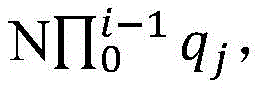
若在第一检查步骤52中判断出E/N1i *大于1,则跳至数据表更新步骤58,使得处理器并不对当前的索引值i计算qi。也就是,qi的计算至此结束。实际上,在数据表更新步骤58中,将至此已计算出的由多个qi所组成的序列{q1,q2,…qU},其中U(其为当前的索引值减1)为金钥的最大可允许更新数,添加至数据表中对应的(N,E)下方。If it is determined in the
在数据表更新步骤58之后,处理器在第二检查步骤60处检查是否有未选择的(N,E)对。如果是,则处理器返回到选择步骤47,针对所选择的(N,E)对来计算对应的{qi},且随后将对应的{qi}加入于数据表中。否则,执行提供步骤62,处理器提供完成的数据表供用于更新加密金钥。举例来说,如上文参考图1所描述,处理器可将数据表上传至网站,或将数据表传送至另一装置。After the data
如图2所描述,各qi值通常大于0.5(而在一些情况下,qU可精确为0.5)。如图4所示,由于E/N1i *随i的上升而增大,qi *的值随i增大而减小。举例来说,针对E=80及N=256的例子,方法46将产生由11个递减的qi *值所组成的序列:0.943、0.938、0.933、0.926、0.918、0.907、0.893、0.872、0.841、0.785以及0.623。即,在所需熵值不超过80比特的情况下,可使用本文中所描述的技术更新具有256个比特的金钥11次。As depicted in Figure 2, each value of q i is typically greater than 0.5 (while in some cases q U may be exactly 0.5). As shown in Fig. 4, since E/N1 i * increases as i increases, the value of q i * decreases as i increases. For example, for the example of E=80 and N=256,
基于给定的数据表,产生金钥的新例项的处理器(例如第二ISP 26b的处理器30)基于给定的N、E以及i来查找适当的qi值(如上文参考图1所描述,第一ISP 26a可将i值提供给第二ISP 26b)。随后,如图2至图3所描述,处理器使用qi来产生更新序列Si,并随后使用Si自Ki产生Ki+1。Based on the given data table, the processor that generates the new instance of the key (eg, the
综上所述,在本发明一些实施例中,所述更新非易失性存储器的加密金钥与产生新例项的装置及其方法可以改善非易失性存储器用于加密通信的安全性。通过更新序列Si求反N比特加密金钥的当前例项中的具有特定比特值的比特,而不求反N比特加密金钥的当前例项中不具有特定比特值的任何比特,处理器可以更新非易失存储器中的加密金钥而无须解编程任何存储单元,进而安全地更新加密金钥以及产生新例项,并提高加密通信的安全性。To sum up, in some embodiments of the present invention, the apparatus for updating an encryption key of a non-volatile memory and generating a new instance and the method thereof can improve the security of the non-volatile memory for encrypted communication. By negating the bits of the current instance of the N-bit encryption key that have the specified bit value by updating the sequence Si without negating any bits of the current instance of the N-bit encryption key that do not have the specified bit value, the processor can Update encryption keys in non-volatile memory without deprogramming any memory cells, thereby securely updating encryption keys and generating new instances, and improving the security of encrypted communications.
虽然本发明已以实施例揭示如上,然其并非用以限定本发明,任何所属技术领域中技术人员,在不脱离本发明的精神和范围内,当可作些许的更改与润饰,故本发明的保护范围当视权利要求所界定的为准。Although the present invention has been disclosed above with examples, it is not intended to limit the present invention. Any person skilled in the art can make some changes and modifications without departing from the spirit and scope of the present invention. Therefore, the present invention The scope of protection shall be subject to what is defined in the claims.
Claims (23)

Applications Claiming Priority (2)
| Application Number | Priority Date | Filing Date | Title |
|---|---|---|---|
| US16/207,207 | 2018-12-03 | ||
| US16/207,207 US10951403B2 (en) | 2018-12-03 | 2018-12-03 | Updating cryptographic keys stored in non-volatile memory |
Publications (2)
| Publication Number | Publication Date |
|---|---|
| CN111262689A true CN111262689A (en) | 2020-06-09 |
| CN111262689B CN111262689B (en) | 2022-11-08 |
Family
ID=70848590
Family Applications (1)
| Application Number | Title | Priority Date | Filing Date |
|---|---|---|---|
| CN201911215673.8A Active CN111262689B (en) | 2018-12-03 | 2019-12-02 | Device and method for updating encryption key stored in nonvolatile memory |
Country Status (3)
| Country | Link |
|---|---|
| US (1) | US10951403B2 (en) |
| CN (1) | CN111262689B (en) |
| TW (1) | TWI716197B (en) |
Families Citing this family (1)
| Publication number | Priority date | Publication date | Assignee | Title |
|---|---|---|---|---|
| US11258772B2 (en) * | 2018-06-19 | 2022-02-22 | Cypress Semiconductor Corporation | Secured communication from within non-volatile memory device |
Citations (7)
| Publication number | Priority date | Publication date | Assignee | Title |
|---|---|---|---|---|
| CN1838316A (en) * | 2005-03-22 | 2006-09-27 | 英飞凌科技股份公司 | Circuit for generating data bit negation flag |
| CN101378314A (en) * | 2008-09-26 | 2009-03-04 | 北京数字太和科技有限责任公司 | Method for generating key sequence and apparatus for generating cipher key |
| CN101674180A (en) * | 2008-09-10 | 2010-03-17 | 中国人民解放军信息工程大学 | Pseudorandom sequence generation method and pseudorandom sequence encryption method |
| CN103283175A (en) * | 2010-12-28 | 2013-09-04 | 日本电气株式会社 | Method of generating key |
| US8885820B1 (en) * | 2012-02-09 | 2014-11-11 | Marvell International Ltd. | Key expansion using seed values |
| CN105304142A (en) * | 2014-06-20 | 2016-02-03 | 群联电子股份有限公司 | Decoding method, memory storage device and memory control circuit unit |
| CN108322226A (en) * | 2017-12-06 | 2018-07-24 | 中国电子科技集团公司电子科学研究院 | A kind of weighted bit method for turning, computer-readable medium and computer equipment |
Family Cites Families (16)
| Publication number | Priority date | Publication date | Assignee | Title |
|---|---|---|---|---|
| JP2000048047A (en) * | 1998-01-19 | 2000-02-18 | Asahi Glass Co Ltd | Time-series data storage method and time-series database system, time-series data processing method and time-series data processing system, time-series data display system, and recording medium |
| US7987356B2 (en) * | 2004-11-29 | 2011-07-26 | Broadcom Corporation | Programmable security platform |
| US7574470B2 (en) * | 2005-11-16 | 2009-08-11 | Flexmedia Electronics Corp. | Multimedia data processing method |
| US9734086B2 (en) * | 2006-12-06 | 2017-08-15 | Sandisk Technologies Llc | Apparatus, system, and method for a device shared between multiple independent hosts |
| US20100303231A1 (en) * | 2007-05-22 | 2010-12-02 | Koninklijke Philips Electronics N.V. | Updating cryptographic key data |
| US8266369B2 (en) * | 2009-12-18 | 2012-09-11 | Nxp B.V. | Flash memory interface |
| KR101650130B1 (en) * | 2010-05-14 | 2016-08-24 | 삼성전자주식회사 | Storage device comprising a non-volatile memory device and copy-back method thereof |
| KR101930864B1 (en) * | 2012-02-16 | 2019-03-11 | 삼성전자주식회사 | Method and apparatus for protecting digital content using device authentication |
| US9921978B1 (en) * | 2013-11-08 | 2018-03-20 | Fireeye, Inc. | System and method for enhanced security of storage devices |
| US10313128B2 (en) * | 2014-08-29 | 2019-06-04 | The Boeing Company | Address-dependent key generator by XOR tree |
| IL235729A (en) * | 2014-11-17 | 2017-06-29 | Kaluzhny Uri | Secure storage device and method |
| US10013363B2 (en) * | 2015-02-09 | 2018-07-03 | Honeywell International Inc. | Encryption using entropy-based key derivation |
| US10855477B2 (en) * | 2016-08-04 | 2020-12-01 | Macronix International Co., Ltd. | Non-volatile memory with physical unclonable function and random number generator |
| US10860403B2 (en) * | 2017-09-25 | 2020-12-08 | The Boeing Company | Systems and methods for facilitating truly random bit generation |
| US11126714B2 (en) * | 2017-11-29 | 2021-09-21 | Arm Limited | Encoding of input to storage circuitry |
| US10761754B2 (en) * | 2018-08-07 | 2020-09-01 | Micron Technology, Inc. | Adjustment of a pre-read operation associated with a write operation |
-
2018
- 2018-12-03 US US16/207,207 patent/US10951403B2/en active Active
-
2019
- 2019-11-19 TW TW108141973A patent/TWI716197B/en active
- 2019-12-02 CN CN201911215673.8A patent/CN111262689B/en active Active
Patent Citations (7)
| Publication number | Priority date | Publication date | Assignee | Title |
|---|---|---|---|---|
| CN1838316A (en) * | 2005-03-22 | 2006-09-27 | 英飞凌科技股份公司 | Circuit for generating data bit negation flag |
| CN101674180A (en) * | 2008-09-10 | 2010-03-17 | 中国人民解放军信息工程大学 | Pseudorandom sequence generation method and pseudorandom sequence encryption method |
| CN101378314A (en) * | 2008-09-26 | 2009-03-04 | 北京数字太和科技有限责任公司 | Method for generating key sequence and apparatus for generating cipher key |
| CN103283175A (en) * | 2010-12-28 | 2013-09-04 | 日本电气株式会社 | Method of generating key |
| US8885820B1 (en) * | 2012-02-09 | 2014-11-11 | Marvell International Ltd. | Key expansion using seed values |
| CN105304142A (en) * | 2014-06-20 | 2016-02-03 | 群联电子股份有限公司 | Decoding method, memory storage device and memory control circuit unit |
| CN108322226A (en) * | 2017-12-06 | 2018-07-24 | 中国电子科技集团公司电子科学研究院 | A kind of weighted bit method for turning, computer-readable medium and computer equipment |
Also Published As
| Publication number | Publication date |
|---|---|
| CN111262689B (en) | 2022-11-08 |
| TWI716197B (en) | 2021-01-11 |
| TW202032943A (en) | 2020-09-01 |
| US20200177379A1 (en) | 2020-06-04 |
| US10951403B2 (en) | 2021-03-16 |
Similar Documents
| Publication | Publication Date | Title |
|---|---|---|
| US10474823B2 (en) | Controlled secure code authentication | |
| US11042669B2 (en) | Cryptographic ASIC with unique internal identifier | |
| US11183083B2 (en) | Cryptographic device and memory based PUF | |
| US10910079B2 (en) | Programming device arranged to obtain and store a random bit string in a memory device | |
| US9479340B1 (en) | Controlling use of encryption keys | |
| CN107004380B (en) | Encrypted device including physical unclonability | |
| US10353638B2 (en) | Security method and apparatus to prevent replay of external memory data to integrated circuits having only one-time programmable non-volatile memory | |
| CN106664200B (en) | Method, computing device, and storage medium for controlling access to a resource | |
| US10482255B2 (en) | Controlled secure code authentication | |
| US20140344572A1 (en) | Secure cloud storage and synchronization systems and methods | |
| US9830479B2 (en) | Key storage and revocation in a secure memory system | |
| US20160006570A1 (en) | Generating a key derived from a cryptographic key using a physically unclonable function | |
| US9697340B2 (en) | System and methods with assured one-time, replay-resistant passwords | |
| CN113079001B (en) | Key updating method, information processing apparatus, and key updating device | |
| US11818249B2 (en) | Nodes and methods of operating the same | |
| WO2017194335A2 (en) | Programming device arranged to obtain and store a random bit string in a memory device | |
| TW201915748A (en) | Semiconductor device | |
| CN117077142A (en) | Tracking activity of components in endpoints having secure memory devices via authentication | |
| CN111079153B (en) | Security modeling method and device, electronic equipment and storage medium | |
| CN111262689B (en) | Device and method for updating encryption key stored in nonvolatile memory | |
| JP6874042B2 (en) | Updating the encryption key stored in non-volatile memory | |
| EP3681100B1 (en) | Updating cryptographic keys stored in non-volatile memory | |
| KR102313584B1 (en) | Updating cryptographic keys stored in non-volatile memory | |
| CN113127041A (en) | Memory system, firmware updating method and device thereof, and readable storage medium |
Legal Events
| Date | Code | Title | Description |
|---|---|---|---|
| PB01 | Publication | ||
| PB01 | Publication | ||
| SE01 | Entry into force of request for substantive examination | ||
| SE01 | Entry into force of request for substantive examination | ||
| GR01 | Patent grant | ||
| GR01 | Patent grant |