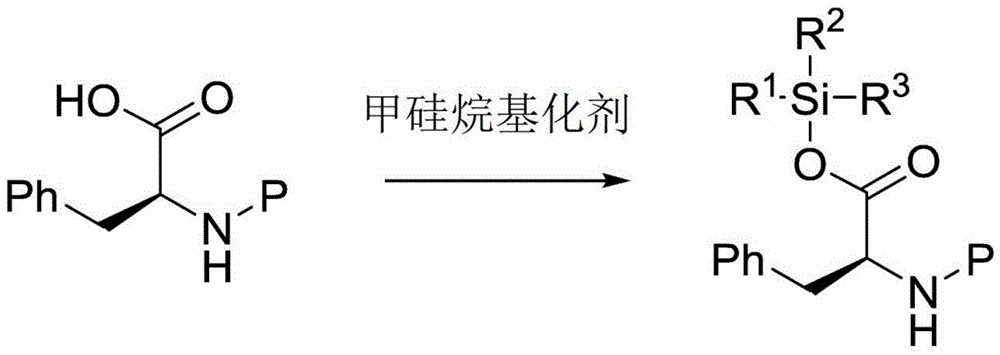
Detailed Description
The present invention will be described in detail below.
In the present specification, "n-" represents a positive group, "i-" represents an iso group, "s-" and "sec-" represent a secondary group, "t-" and "tert-" represent a tertiary group, "c-" represents a ring, "p-" represents a para group, "Bu" represents a butyl group, "Pr" represents a propyl group, "Pen" represents a pentyl group, "Hex" represents a hexyl group, "Bn" represents a benzyl group, "Ph" represents a phenyl group, "Boc" represents a tert-butoxycarbonyl group, "Cbz" represents a benzyloxycarbonyl group, "Fmoc" represents a 9-fluorenylmethoxycarbonyl group, "Ts" represents a p-toluenesulfonyl group, "Trt" represents a trityl group, "Ac" represents an acetyl group, "Tf" represents a trifluoromethanesulfonyl group, "TMS" represents a trimethylsilyl group, "TBS" represents a tert-butyldimethylsilyl group, "TIPS" represents a diisopropylsilyl group, and "BIBS" represents a di-tert-butylisobutylsilyl group, "IPBS" means diisopropyl-tert-butylsilyl, "IPCS" means diisopropylcumylsilyl, "CPCS" means dicyclopentylcumylsilyl, "CHCS" means dicyclohexylcumylsilyl, and "SBCS" means di-sec-butylcumylsilyl. Incidentally, "t-Bu" and "tBu" are each a "tert-butyl group", and "s-Bu" and "sBu" are each a "sec-butyl group".
In the present specification, "C" or "C" is used18H37The term "or" octadecyl "means a directly-linked octadecyl group, that is, a group having CH, unless otherwise specified3(CH2)17-a group of structures.
"halogen atom" means a fluorine atom, chlorine atom, bromine atom or iodine atom.
“C1-6The "alkyl group" represents a straight-chain or branched-chain alkyl group having 1 to 6 carbon atoms, and specific examples thereof include a methyl group, an ethyl group, a n-propyl group, an isopropyl group, a n-butyl group, an isobutyl group, a sec-butyl group, a tert-butyl group, a n-pentyl group, and a n-hexyl group. In addition, "C3-6The "alkyl group" represents a straight-chain or branched alkyl group having 3 to 6 carbon atoms, and "C" represents4-6The alkyl group "represents a straight-chain or branched alkyl group having 4 to 6 carbon atoms.
“C1-40The alkyl group "represents a straight-chain or branched alkyl group having 1 to 40 carbon atoms, and specific examples thereof include a methyl group, an ethyl group, a n-propyl group, an isopropyl group, a n-butyl group, an isobutyl group, a sec-butyl group, a tert-butyl group, a n-pentyl group, a n-hexyl group, an octyl group, a decyl group, a dodecyl group, a hexadecyl group, an octadecyl group, a docosyl group, a triacontyl group, a forty-alkyl group, a 3, 7, 11, 15-tetramethylhexadecyl group (hereinafter, also referred to as a 2, 3-dihydrophytyl group).
“C1-6The "alkoxy group" represents a straight-chain or branched alkoxy group having 1 to 6 carbon atoms, and specific examples thereof include a methoxy group, an ethoxy group, a n-propoxy group, an isopropoxy group, a n-butoxy group, an isobutoxy group, a tert-butoxy group, a n-pentyloxy group, and a n-hexyloxy group.
“C1-40The alkoxy group "represents a straight-chain or branched alkoxy group having 1 to 40 carbon atoms, and specific examples thereof include a methoxy group, an ethoxy group, a n-propoxy group, an isopropoxy group, a n-butoxy group, an isobutoxy group, a tert-butoxy group, a n-pentyloxy group, a n-hexyloxy group, an octyloxy group, a decyloxy group, a dodecyloxy group, a hexadecyloxy group, an octadecyloxy group, a docosyloxy group, a triacontyloxy group, a forty-alkyloxy group, a 3, 7, 11, 15-tetramethylhexadecyloxy group (hereinafter, also referred to as a 2, 3-dihydrophytyloxy group).
“C1-6The "alkoxycarbonyl group" represents a straight-chain or branched alkoxycarbonyl group having 1 to 6 carbon atoms, and specific examples thereof include a methoxycarbonyl group, an ethoxycarbonyl group, a n-propoxycarbonyl group, an isopropoxycarbonyl group, a n-butoxycarbonyl group, an isobutoxycarbonyl group, a tert-butoxycarbonyl group, a n-pentyloxycarbonyl group, a n-hexyloxycarbonyl group and the like.
“C2-6The "alkenyl group" represents a straight-chain or branched alkenyl group having 2 to 6 carbon atoms, and specific examples thereof include a vinyl group, a 1-propenyl group, an allyl group, an isopropenyl group, a butenyl group, an isobutenyl group and the like.
“C2-6The alkynyl group "represents a straight-chain or branched alkynyl group having 2 to 6 carbon atoms, and specific examples thereof include an ethynyl group and a 1-propynyl group.
“C3-6The cycloalkyl group "represents a cycloalkyl group having 3 to 6 carbon atoms, and specific examples thereof include a cyclopropyl group, a cyclobutyl group, a cyclopentyl group, and a cyclohexyl group.
“C3-6The cycloalkoxy group "represents a cycloalkoxy group having 3 to 6 carbon atoms, and specific examples thereof include a cyclopropyloxy group, a cyclobutyloxy group, a cyclopentyloxy group, and a cyclohexyloxy group.
“C6-14Aryl "represents an aromatic hydrocarbon group having 6 to 14 carbon atoms, and specific examples thereof include phenyl, 1-naphthyl, 2-naphthyl, 1-anthryl, 2-anthryl, 9-anthryl, biphenyl and the like.
“C6-14The "aryloxy group" represents an aryloxy group having 6 to 14 carbon atoms, and specific examples thereof include a phenoxy group, a 1-naphthyloxy group, a 2-naphthyloxy group, a 1-anthryloxy group, a 2-anthryloxy group, a 9-anthryloxy group, and a biphenyloxy group.
“C7-10The "aralkyl group" means an aralkyl group having 7 to 10 carbon atoms, and specific examples thereof include a benzyl group, a 1-phenylethyl group, a 2-phenylethyl group, a 1-phenylpropyl group, a naphthylmethyl group, a 1-naphthylethyl group, a 1-naphthylpropyl group and the like.
' three C1-6Alkylsilyl "means the same or different 3 of the aforementioned" C1-6Examples of the group in which the alkyl group "is bonded to a silyl group include a trimethylsilyl group, a triethylsilyl group, a triisopropylsilyl group, a tert-butyldimethylsilyl group, and a di-tert-butylisobutylsilyl group.
' three C1-6Alkylsilyloxy "denotes identical or different 3 of the abovementioned" C "s1-6Examples of the group in which the alkyl group "is bonded to a silyloxy group include a trimethylsilyloxy group, a triethylsilyloxy group, a diisopropylsilyloxy group, a tert-butyldimethylsilyloxy group, and a di-tert-butylisobutylsilyloxy group.
' Single C1-6Alkylamino "denotes 1 of the aforementioned" C1-6Examples of the group in which the alkyl group "is bonded to the amino group include monomethylamino group, monoethylamino group, mono-n-propylamino group, monoisopropylamino group, mono-n-butylamino group, monoisobutylamino group, mono-tert-butylamino group, mono-n-pentylamino group, and mono-n-hexylamino group.
' di C1-6Alkylamino "denotes identical or different 2 of the aforementioned" C1-6Examples of the group in which an alkyl group is "bonded to an amino group include dimethylamino group, diethylamino group, di-n-propylamino group, and diisopropylamino groupPropylamino group, di-N-butylamino group, diisobutylamino group, di-tert-butylamino group, di-N-pentylamino group, di-N-hexylamino group, N-ethyl-N-methylamino group, N-methyl-N-N-propylamino group, N-isopropyl-N-methylamino group, N-N-butyl-N-methylamino group, N-isobutyl-N-methylamino group, N-tert-butyl-N-methylamino group, N-methyl-N-N-pentylamino group, N-N-hexyl-N-methylamino group, N-ethyl-N-N-propylamino group, N-ethyl-N-isopropylamino group, N-N-butyl-N-ethylamino group, N-ethyl-N-isobutylamino group, N-, N-tert-butyl-N-ethylamino, N-ethyl-N-N-pentylamino, N-ethyl-N-N-hexylamino, and the like.
The "5-to 10-membered heterocyclic group" means a heterocyclic group of a monocyclic or condensed ring system in which the number of ring-constituting atoms is 5 to 10 and the ring-constituting atoms contain 1 to 4 hetero atoms independently selected from the group consisting of a nitrogen atom, an oxygen atom and a sulfur atom. The heterocyclic group may be any of saturated, partially unsaturated and unsaturated, and specific examples thereof include pyrrolidinyl, tetrahydrofuranyl, tetrahydrothienyl, piperidinyl, tetrahydropyranyl, tetrahydrothiopyranyl, pyrrolyl, furanyl, thienyl, pyridinyl, pyrimidinyl, pyridazinyl, azepanyl, oxepanyl, thiepanyl, azepinyl, oxepinyl, thiepinyl, imidazolyl, pyrazolyl, oxazolyl, thiazolyl, imidazolinyl, pyrazinyl, morpholinyl, thiazinyl, indolyl, isoindolyl, benzimidazolyl, purinyl, quinolyl, isoquinolyl, quinoxalinyl, cinnolinyl, pteridinyl, chromenyl, isochromenyl and the like.
The "aliphatic hydrocarbon group" is a straight-chain, branched-chain or cyclic, saturated or unsaturated aliphatic hydrocarbon group, and includes alkyl, cycloalkyl, alkenyl, alkynyl and aralkyl groups, and specific examples thereof include C1-40Alkyl radical, C3-6Cycloalkyl radical, C2-6Alkenyl radical, C2-6Alkynyl, C7-10Aralkyl groups, and the like.
The "aromatic hydrocarbon group" means a hydrocarbon group having a single ring or a plurality of rings, at least one of which is aromatic, and specific examples thereof include a phenyl group, a naphthyl group, an anthryl group, an indenyl group, a phenanthryl group, and an indanyl group.
"optionally substituted" means unsubstituted or substituted with any number of optional substituents.
The "optional substituent" is not particularly limited as long as it is a substituent that does not adversely affect the reaction to be carried out in the present invention.
The "substituent" in the "optionally substituted aliphatic hydrocarbon group" may include, for example, C6-14Aryl radical, C6-14Aryloxy group, 5-to 10-membered heterocyclic group, hydroxy group, C1-40Alkoxy radical, C3-6Cycloalkoxy, acetoxy, benzoyloxy, amino, mono C1-6Alkylamino, N-acetylamino, di-C1-6Alkylamino group, halogen atom, C1-6Alkoxycarbonyl, phenoxycarbonyl, N-methylcarbamoyl, N-phenylcarbamoyl, tri-C1-6Alkylsilyl, tri-C1-6Alkylsilyloxy, cyano, nitro, carboxyl, etc., preferably C6-14Aryl radical, C1-40Alkoxy, di-C1-6Alkylamino radical, tri-C1-6Alkylsilyl, tri-C1-6Alkylsilyloxy, more preferably C6-14Aryl radical, C1-40Alkoxy radical, tri-C1-6An alkylsilyl group.
The "substituent" in the "optionally substituted aromatic hydrocarbon group" may include, for example, C1-40Alkyl radical, C3-6Cycloalkyl radical, C6-14Aryl radical, C6-14Aryloxy group, 5-to 10-membered heterocyclic group, hydroxy group, C1-40Alkoxy radical, C3-6Cycloalkoxy, acetoxy, benzoyloxy, amino, mono C1-6Alkylamino, N-acetylamino, di-C1-6Alkylamino group, halogen atom, C1-6Alkoxycarbonyl, phenoxycarbonyl, N-methylcarbamoyl, N-phenylcarbamoyl, cyano, nitro, carboxy and the like, preferably C1-40Alkyl radical, C1-40Alkoxy, di-C1-6Alkylamino, more preferably C1-40Alkyl radical, C1-40An alkoxy group.
Or "R1、R2And R32 of which may be joined together with the Si atom to which they are bonded to form a 5-to 7-membered ring "means that R is bonded to the Si atom1、R2And R32 of which are linked together to form C4-6The alkylene chain of (a) may form a 5-7 membered ring together with the Si atom to which they are bonded, and specific examples thereof include silacyclopentane, silacycloheptane and the like.
As used herein, the "silyl group-based protecting group having a specific structure" refers to a protecting group represented by the following formula (III) and bonded to the C-terminal of an amino acid or a peptide,
[ chemical formula 7]
[ in the formula (III),
R1、R2and R3Each independently represents an aliphatic hydrocarbon group which may have a substituent, an aromatic hydrocarbon group which may have a substituent, OR-OR4(R4Represents an aliphatic hydrocarbon group which may have a substituent, or an aromatic hydrocarbon group which may have a substituent. ) R is1、R2And R32 of which may be joined together with the Si atom to which they are bonded to form a 5-7 membered ring, R1R2R3The total number of carbon atoms in the Si group is 8 or more.]。
“R1R2R3The total number of carbon atoms in the Si group being "R1、R2And R3Each having a total number of carbon atoms, R1、R2And R3When at least one of them has a substituent, the number of carbon atoms in the substituent is also included.
In the formula (II), R is preferably1、R2And R3Independently of each other, an aliphatic hydrocarbon group which may have a substituent, and more preferably, R1、R2And R3Wherein 2 or 3 are each independently a secondary or tertiary aliphatic hydrocarbon group, more preferably R1、R2And R3Of which 2 or 3 are independent of one another,is secondary or tertiary C3-6Alkyl or C3-6Cycloalkyl, further preferably, R1、R2And R3Of these, 2 or 3 are, independently of one another, tert-butyl, sec-butyl, isopropyl, cyclopentyl or cyclohexyl.
In the formula (II), as R1、R2And R3Preferably, R is1、R2And R3Independently of each other, an aliphatic hydrocarbon group which may have a substituent; more preferably, R1、R2And R3Of these, 2 are each independently a secondary aliphatic hydrocarbon group, and the remaining 1 is a secondary or tertiary aliphatic hydrocarbon group which may have a substituent and is a group different from the aforementioned 2; more preferably, R1、R2And R32 in each case independently of one another are secondary or tertiary C3-6Alkyl, or C3-6Cycloalkyl, the remaining 1 being a secondary C which may have a substituent3-6Alkyl or C3-6Cycloalkyl and is a group different from the aforementioned 2; further preferably, R1、R2And R3Of these, 1 is tert-butyl or cumyl, and the remaining 2, independently of one another, are tert-butyl, isopropyl, sec-butyl, cyclopentyl or cyclohexyl.
In the formula (II), as R1、R2And R3Preferably, R is1、R2And R3Independently of each other, an aliphatic hydrocarbon group which may have a substituent; more preferably, R1、R2And R3Wherein 2 are each independently a tertiary aliphatic hydrocarbon group; more preferably, R1、R2And R3In which 2, independently of one another, are tertiary C4-6An alkyl group; further preferred is R1、R2And R3Of these, 2 are tert-butyl groups and the remaining 1 is isobutyl, benzyl, octadecyl or (trimethylsilyl) methyl.
When the deprotection step of the N-terminal protecting group is carried out under basic or neutral conditions, R in the formula (II)1、R2And R3Each independently is-OR4。R4Is preferably equipped withAn aliphatic hydrocarbon group having a substituent, more preferably an aliphatic hydrocarbon group, still more preferably C1-6Alkyl, more preferably tertiary C4-6Alkyl, particularly preferably tert-butyl.
The tertiary aliphatic hydrocarbon group is preferably a tert-butyl group, α -dimethylbenzyl (cumyl), 1, 2-trimethylpropyl or 1-adamantyl group, more preferably a tert-butyl group or α -dimethylbenzyl group, and particularly preferably a tert-butyl group.
The secondary aliphatic hydrocarbon group is preferably an isopropyl group, a 2-butyl group, a 3-pentyl group, a cyclopentyl group or a cyclohexyl group, and more preferably an isopropyl group, a cyclopentyl group or a cyclohexyl group.
In the formula (III), R1R2R3The total number of carbon atoms in the Si group is preferably 10 to 100, more preferably 10 to 40, and still more preferably 10 to 26.
The silyl group-based protective group having a specific structure (the protective group of the present invention) used in the present invention is characterized by the following features, for example.
(a) The protecting group of the present invention is stable under acidic conditions (in the presence of a reagent such as 15% by mass of hydrogen chloride/1, 4-dioxane) under which the N-terminal Boc group is deprotected (see synthetic example 4 described later, etc.).
(b) The protecting group of the present invention is stable under reducing conditions (in the presence of a reagent such as 10 mass% Pd-C or hydrogen) under which the N-terminal Cbz group is deprotected (see synthetic example 2 described later).
(c) The protecting group of the present invention is stable under basic conditions (in the presence of a reagent such as diethylamine) in which the N-terminal Fmoc group is deprotected (see synthetic example 3 described later, etc.).
(d) The protecting group of the present invention is stable under the conditions of silica gel column chromatography in which the C-terminal TMS group or TBS group is deprotected.
"N-protected amino acid" and "N-protected peptide" mean an amino acid or a peptide in which the amino group at the N-terminus is protected and the carboxyl group at the C-terminus is unprotected.
"C-protected amino acid" and "C-protected peptide" mean an amino acid or peptide in which the carboxyl group at the C-terminal is protected and the amino group at the N-terminal is unprotected.
The amino acid used in the present invention is an organic compound having both amino and carboxyl functional groups, preferably α -amino acid, β -amino acid, γ -amino acid or δ -amino acid, more preferably α -amino acid or β -amino acid, more preferably α -amino acid, and when 2 or more amino groups are present among these amino acids (e.g., arginine, lysine, etc.), when 2 or more carboxyl groups are present (e.g., glutamic acid, aspartic acid, etc.), or when a reactive functional group is present (e.g., cysteine, serine, etc.), the amino acid used in the present invention also includes amino acids in which the amino group, carboxyl group and/or reactive functional group that do not participate in peptide formation are protected and/or modified.
The amino group of the amino acid used in the present invention may be substituted. The substituent for the amino group is preferably an optionally substituted aliphatic hydrocarbon group, more preferably C1-6Alkyl or C7-10Aralkyl, more preferably methyl.
The amino acids constituting the peptide used in the present invention are the above-mentioned amino acids.
The α -amino acid has a three-dimensional structure not particularly limited, but is preferably in the L-form.
The "temporary protecting group" is a protecting group at the terminal side for extending a peptide chain, and represents a protecting group deprotected before a peptide extension reaction (amidation reaction) is carried out, and in the peptide chain extension from the N-terminal side, an N-terminal protecting group may be mentioned. Specific examples of the N-terminal protecting group include a carbamate-based protecting group (e.g., 9-fluorenylmethoxycarbonyl, t-butoxycarbonyl, benzyloxycarbonyl, allyloxycarbonyl, 2, 2, 2-trichloroethoxycarbonyl, 2- (p-biphenylyl) isopropyloxycarbonyl), an amide-based protecting group (e.g., acetyl, trifluoroacetyl), an imide-based protecting group (e.g., phthaloyl), a sulfonamide-based protecting group (e.g., p-toluenesulfonyl, 2-nitrobenzenesulfonyl), and a benzyl group.
All technical and scientific terms used herein have the same meaning as commonly understood by one of ordinary skill in the art to which this invention belongs. Any methods and materials similar or equivalent to those described herein can be used in the practice or testing of the present invention, but preferred methods and materials are described below. All publications and patents mentioned in this specification are herein incorporated by reference for the purpose of describing and disclosing, for example, the constructs and methodologies described in the publications that might be used in connection with the described invention.
(specific description of the method for producing the peptide of the present invention)
The following describes the respective steps (i) to (viii) of the method for producing a peptide of the present invention.
As one embodiment, the production of the peptide of the present invention comprises the following unit steps (i) to (viii).
In one embodiment, the peptide of the present invention may be produced by performing all or an appropriate combination of the unit steps described in the following steps (i) to (viii).
The present specific description is described based on the following.
(a) R in the description of Steps (i) to (viii)1、R2And R3Are synonymous with the foregoing.
(b) The specific conditions of the reaction are not particularly limited as long as the production of the peptide of the present invention can be achieved. Preferred conditions in each reaction are appropriately described in detail.
(c) The solvents described in the respective reactions may be used alone or in combination of two or more.
Step (i): protection procedure of C-terminal
This step is a step of introducing a silyl group-based protecting group having a specific structure into the C-terminus of an N-protected amino acid or an N-protected peptide.
For introducing the silyl protecting group having a specific structure, a silyl protecting agent may be used. The silyl group-based protecting agent is represented by the following formula (IV).
A silyl-based protecting agent represented by the formula (IV):
[ chemical formula 8 ]
[ in the formula,
x represents a hydrogen atom, a halogen atom, a cyano group, a leaving group such as a trifluoromethanesulfonyloxy group or the like,
R1、R2and R3Each independently represents an optionally substituted aliphatic hydrocarbon group, an optionally substituted aromatic hydrocarbon group, -OR4(R4Represents an aliphatic hydrocarbon group which may have a substituent, or an aromatic hydrocarbon group which may have a substituent. ) R is1、R2And R32 of which may be joined together with the Si atom to which they are bonded to form a 5-7 membered ring, R1R2R3The total number of carbon atoms in the Si group is 8 or more.]。
In the formula (IV), R1、R2And R3Are synonymous with the foregoing.
In the present specification, "N-protected amino acid" and "N-protected peptide" are referred to as "P-AA-OH" (P is also referred to as an N-terminal protecting group, or a temporary protecting group.
The bonding reaction of the silyl group-based protecting agent with the N-protected amino acid or N-protected peptide may be carried out in the presence of an alkali or metal catalyst.
[ chemical formula 9 ]
(wherein each symbol is the same as that described above.)
The base used in the present step is not particularly limited, and examples thereof include aliphatic amines (e.g., dicyclohexylamine, piperidine, triethylamine, N-diisopropylethylamine, and N-methylmorpholine), aromatic amines (e.g., pyridine, imidazole, and N, N-dimethyl-4-aminopyridine), and alkali metal salts (e.g., sodium bicarbonate and potassium carbonate). Preferably an aliphatic amine or an aromatic amine, more preferably N, N-diisopropylethylamine or imidazole.
The metal catalyst used in the present step is not particularly limited, and examples thereof include a nickel catalyst (e.g., nickel (II) chloride), a zinc catalyst (e.g., zinc (II) chloride), a palladium catalyst (e.g., palladium (II) acetate), a ruthenium catalyst (e.g., triruthenium dodecacarbonyl), a copper catalyst (e.g., copper (iii) triphenylphosphine hydride hexamer, copper (I) oxide), a manganese catalyst (e.g., dimanganese decacarbonyl (0)), and the like. Preferably a palladium catalyst, a nickel catalyst, a zinc catalyst, a copper catalyst, more preferably palladium (II) acetate, nickel (II) chloride, zinc (II) chloride, triphenylphosphine copper hydride hexamer.
The amount of the alkali or metal catalyst used in this step is preferably 0.01 to 50 equivalents, more preferably 0.1 to 20 equivalents, and still more preferably 0.2 to 5 equivalents, based on the silyl group-based protecting agent.
The solvent used in the present step is not particularly limited as long as it does not inhibit the reaction, and examples thereof include a halogen-containing hydrocarbon solvent (e.g., dichloromethane, chloroform), an aromatic hydrocarbon solvent (e.g., toluene, xylene), an ether solvent (e.g., tetrahydrofuran, 1, 4-dioxane, cyclopentyl methyl ether, methyl tert-butyl ether), an amide solvent (e.g., N-dimethylformamide), a nitrile solvent (e.g., acetonitrile), and the like. Preferably a halogen-containing hydrocarbon solvent, or an ether solvent, more preferably dichloromethane, tetrahydrofuran, or cyclopentyl methyl ether.
The amount of the solvent used in this step is preferably 100 times by mass or less, more preferably 1 to 50 times by mass, and still more preferably 5 to 20 times by mass, based on the silyl protecting agent.
The reaction temperature is not particularly limited, but is preferably from-20 ℃ to the reflux temperature of the reaction mixture, more preferably from-20 ℃ to 50 ℃, and still more preferably from-10 ℃ to 30 ℃.
Step (ii): deprotection step of N-terminus
This step is a step of removing the N-terminal protecting group of the amino acid or peptide obtained in the step (i).
As the N-terminal protecting group, a temporary protecting group for an amino group, which is generally used in the technical field of peptide chemistry and the like, may be used, but a protecting group which is removed under a condition different from the removal of a silyl-based protecting group having a specific structure is preferable, and a carbamate-based protecting group (9-fluorenylmethoxycarbonyl, t-butoxycarbonyl, benzyloxycarbonyl, 2, 2, 2-trichloroethoxycarbonyl, allyloxycarbonyl and the like) is more preferable, and 9-fluorenylmethoxycarbonyl, t-butoxycarbonyl or benzyloxycarbonyl is more preferable.
The deprotection conditions are appropriately selected depending on the kind of the N-terminal protecting group, but it is preferable to carry out deprotection under conditions different from the leaving of the silyl-based protecting group having a specific structure. For example, it is carried out by treatment with a base in the case of 9-fluorenylmethoxycarbonyl, by treatment with an acid in the case of t-butoxycarbonyl, and by hydrogenation under neutral conditions, for example, in the presence of a metal catalyst in the case of benzyloxycarbonyl.
R1R2R3When the total number of carbon atoms in the Si group is 8 or 9, the pH under the deprotection condition is preferably neutral (6 to 8). In addition, R1R2R3When the total number of carbon atoms in the Si group is 10 or more, the pH of the deprotection condition is not particularly limited.
Examples of the base used in this step include dimethylamine, diethylamine, piperidine, morpholine, dicyclohexylamine, and N, N-dimethyl-4-aminopyridine.
Examples of the acid used in this step include hydrochloric acid, sulfuric acid, trifluoroacetic acid, and trifluoromethanesulfonic acid.
Examples of the metal catalyst used in the present step include palladium catalysts (for example, 5 mass% palladium carbon powder STD type, 10 mass% palladium carbon powder PE type, 5 mass% palladium carbon powder NX type, 5 mass% palladium carbon powder K type, 5 mass% palladium carbon powder PE type, ASCA-2), platinum catalysts (for example, 3 mass% platinum carbon powder STD type, 3 mass% platinum carbon powder SN101 type), ruthenium catalysts (for example, 5 mass% ruthenium carbon powder a type, 5 mass% ruthenium carbon powder B type), and alumina powders.
The solvent used in the present step is not particularly limited as long as it does not inhibit the reaction, and examples thereof include an alcohol solvent (e.g., methanol, ethanol, 2-propanol, 2, 2, 2-trifluoroethanol), a halogen-containing hydrocarbon solvent (e.g., dichloromethane, chloroform), an aromatic hydrocarbon solvent (e.g., toluene, xylene), an ether solvent (e.g., tetrahydrofuran, 1, 4-dioxane, cyclopentyl methyl ether, methyl t-butyl ether), an amide solvent (e.g., N-dimethylformamide), a nitrile solvent (e.g., acetonitrile), and the like. Preferably an alcohol solvent, a halogen-containing hydrocarbon solvent, or an ether solvent, more preferably isopropanol, 2, 2, 2-trifluoroethanol, dichloromethane, tetrahydrofuran, or methyl t-butyl ether.
Step (iii): peptide chain extension step
This step is a step of condensing the N-terminus of the C-protected amino acid or C-protected peptide obtained in step (ii) with an N-protected amino acid or N-protected peptide.
This step is performed under condensation conditions generally used in the technical field of peptide chemistry and the like, using a condensing agent.
The condensing agent used in the present step is not particularly limited, and examples thereof include carbodiimide-based condensing agents (e.g., N ' -Dicyclohexylcarbodiimide (DCC), N ' -diisopropylcarbodiimide, 1-ethyl-3-dimethylaminopropylcarbodiimide hydrochloride (EDCI)), chloroformate-based condensing agents (e.g., ethyl chloroformate, isobutyl chloroformate), imidazole-based condensing agents (e.g., 1, 1 ' -Carbonyldiimidazole (CDI)), phosphonium-based condensing agents (e.g., (benzotriazol-1-yloxy) tripyrrolidinylphosphonium hexafluorophosphate (PyBOP (registered trademark)), tripyrrolidinylphosphonium hexafluorophosphate (PyBrop (registered trademark)), urea-based condensing agents (e.g., O- (benzotriazol-1-yl) -N, n, N '-tetramethyluronium tetrafluoroborate (TBTU), 1- [ bis (dimethylamino) methylene ] -5-chloro-1H-benzotriazolium 3-oxide Hexafluorophosphate (HCTU), O-benzotriazole-N, N' -tetramethyluronium Hexafluorophosphate (HBTU), (1-cyano-2-ethoxy-2-oxoethylaminooxy) dimethylamino-morpholino-carbenium hexafluorophosphate (COMU)).
The amount of the condensing agent to be used is preferably 0.1 to 20 equivalents, more preferably 1 to 10 equivalents, and still more preferably 1 to 5 equivalents, based on the C-protected amino acid or C-protected peptide.
In this step, an additive and a base may be used as appropriate as long as the reaction is not inhibited.
The additive used in the step is not particularly limited, and examples thereof include N, N-dimethyl-4-aminopyridine (DMAP), 1-hydroxybenzotriazole (HOBt), 1-hydroxy-1H-1, 2, 3-triazole-5-carbonic acid ethyl ester (HOCt), 1-hydroxy-7-azabenzotriazole (HOAt), and (hydroxyimino) cyanoacetic acid ethyl ester (OxymaPure).
The amount of the additive to be used is preferably 0.01 to 20 equivalents, more preferably 0.2 to 10 equivalents, and still more preferably 1 to 5 equivalents, relative to the C-protected amino acid or C-protected peptide.
The base used in the present step is not particularly limited, and examples thereof include aliphatic amines (e.g., triethylamine, N-diisopropylethylamine, and N-methylmorpholine), aromatic amines (e.g., pyridine), and the like. Preferably an aliphatic amine, more preferably N, N-diisopropylethylamine.
The amount of the base to be used is preferably 1 to 50 equivalents, more preferably 1 to 10 equivalents, and still more preferably 1 to 5 equivalents, relative to the C-protected amino acid or C-protected peptide.
The solvent used in the present step is not particularly limited as long as it does not inhibit the reaction, and examples thereof include a halogen-containing hydrocarbon solvent (e.g., dichloromethane, chloroform), an aromatic hydrocarbon solvent (e.g., toluene, xylene), an ether solvent (e.g., tetrahydrofuran, 1, 4-dioxane, cyclopentyl methyl ether, methyl t-butyl ether), an amide solvent (e.g., N-dimethylformamide, etc.), a nitrile solvent (e.g., acetonitrile), and the like. Preferably a halogen-containing hydrocarbon solvent, or an ether solvent, more preferably dichloromethane, tetrahydrofuran, or cyclopentyl methyl ether.
The amount of the solvent to be used is preferably 100 times by mass or less, more preferably 1 to 50 times by mass, and still more preferably 5 to 20 times by mass, relative to the amount of the C-protected amino acid or the C-protected peptide.
The reaction temperature is not particularly limited, but is preferably from-40 ℃ to the reflux temperature of the reaction mixture, more preferably from-20 ℃ to 50 ℃, and still more preferably from-10 ℃ to 30 ℃.
The reaction time is not particularly limited, but is preferably from the start of the reaction to 72 hours, more preferably from 0.1 hour to 48 hours, and still more preferably from 1 hour to 24 hours.
The progress of the reaction can be confirmed by the same method as that used in a general liquid-phase organic synthesis reaction. That is, thin layer chromatography, high performance liquid chromatography/mass spectrometry (LC/MS), or the like can be used to track the reaction.
Step (iv): purification step
This step is a step of purifying the peptide obtained in the step (iii) by precipitation or liquid separation operation.
In the precipitation operation, a good solvent for dissolving the peptide and/or a poor solvent for insolubilizing the peptide may be used.
The good solvent used in the present step may be appropriately selected depending on the peptide to be obtained, and examples thereof include a halogen-containing hydrocarbon solvent (e.g., dichloromethane, chloroform), an aromatic hydrocarbon solvent (e.g., toluene, xylene), an ether solvent (e.g., tetrahydrofuran, 1, 4-dioxane, cyclopentyl methyl ether, methyl t-butyl ether), an ester solvent (e.g., ethyl acetate, isopropyl acetate), and the like. Preferably a halogen-containing hydrocarbon solvent, an ether solvent or an ester solvent, more preferably dichloromethane, tetrahydrofuran, cyclopentyl methyl ether, methyl tert-butyl ether or isopropyl acetate.
The poor solvent used in the present step may be appropriately selected depending on the peptide to be obtained, and examples thereof include an alcohol solvent (e.g., methanol, ethanol, isopropanol), an amide solvent (e.g., N-dimethylformamide), a nitrile solvent (e.g., acetonitrile), an ester solvent (e.g., ethyl acetate, isopropyl acetate), and the like. Preferably an alcohol solvent, a nitrile solvent or an ester solvent, more preferably methanol, acetonitrile or ethyl acetate.
In the liquid separation operation, depending on the target peptide and impurities that may be contained, a good solvent for dissolving the peptide may be washed with water or an acidic and/or basic aqueous solution to remove the impurities.
The acidic aqueous solution used in the present step is not particularly limited, and examples thereof include an aqueous solution of hydrochloric acid, sulfuric acid, acetic acid, phosphoric acid, citric acid, and ammonium chloride. Preferably hydrochloric acid, aqueous phosphoric acid, aqueous citric acid or aqueous ammonium chloride.
The alkaline aqueous solution used in the present step is not particularly limited, and examples thereof include an aqueous sodium hydrogen carbonate solution, an aqueous potassium hydrogen carbonate solution, an aqueous sodium carbonate solution, an aqueous potassium carbonate solution, and aqueous ammonia. Preferably, an aqueous sodium bicarbonate solution or aqueous ammonia.
In the method for producing a peptide of the present invention, the peptide chain can be further extended by repeating the following steps (v) to (vii) a desired number of times with respect to the peptide obtained in step (iv).
(v) A step of removing the temporary protecting group at the N-terminus of the peptide obtained in the purification step;
(vi) (vi) condensing the N-terminus of the C-protected peptide obtained in the step (v) with an N-protected amino acid or an N-protected peptide; and
(vii) (vii) precipitating or separating the peptide obtained in the step (vi).
The steps can be carried out in the same manner as in the above steps (ii) to (iv).
This step can be carried out for the amino acid or peptide obtained in the deprotection step of the N-terminus in the above steps (ii) and (v).
In the method for producing a peptide of the present invention, the purification step in step (iv) or step (vii) may be appropriately omitted as long as the reaction in the subsequent step is not affected.
Step (viii): deprotection step of C terminal
This step is a step of obtaining an N-protected peptide by removing a silyl group-based protecting group having a specific structure from the peptide which has been isolated by the purification step in the above-mentioned step (iv) or (vii).
The deprotection reagent used in the present step is not particularly limited, and examples thereof include fluorinating agents (for example, potassium fluoride, calcium fluoride, hydrogen fluoride-pyridine, and tetrabutylammonium fluoride).
The amount of the deprotection reagent to be used is preferably 1 to 50 equivalents, more preferably 1 to 10 equivalents, and still more preferably 1 to 5 equivalents, based on the peptide to be used.
The solvent used in the present step is not particularly limited as long as it does not inhibit the reaction, and examples thereof include an alcohol solvent (e.g., methanol or ethanol), a halogen-containing hydrocarbon solvent (e.g., dichloromethane or chloroform), an aromatic hydrocarbon solvent (e.g., toluene or xylene), an ether solvent (e.g., tetrahydrofuran, 1, 4-dioxane or cyclopentylmethyl ether), an amide solvent (e.g., N-dimethylformamide, N-methylpyrrolidone or 1, 3-dimethyl-2-imidazolidinone), and water. Preferably an alcohol solvent, a halogen-containing hydrocarbon solvent, an ether solvent or an amide solvent, and water, more preferably an alcohol solvent, a halogen-containing hydrocarbon solvent, and an ether solvent, and more preferably methanol, methylene chloride, and tetrahydrofuran.
The amount of the solvent used is preferably 100 times by mass or less, more preferably 1 to 50 times by mass, and still more preferably 5 to 20 times by mass, based on the peptide to be used.
The reaction temperature is not particularly limited, but is preferably from-20 ℃ to the reflux temperature of the reaction mixture, more preferably from-20 ℃ to 50 ℃, and still more preferably from-10 ℃ to 30 ℃.
In each reaction, when the reaction substrate has a hydroxyl group, a thiol group, an amino group, a carboxyl group, or a carbonyl group (particularly, when the side chain of an amino acid or a peptide has a functional group), a protecting group as generally used in peptide chemistry or the like may be introduced into these groups, and the protecting group may be removed as necessary after the reaction to obtain the target compound.
Protection and deprotection can be carried out by performing protection/deprotection reactions using commonly known protecting Groups (see, for example, Protective Groups in Organic Synthesis, 4 th edition, t.w.greene, John Wiley & SonsInc. (2006), etc.).
The purification step (iv) may be performed on the peptide obtained in the present step.
[ examples ] A method for producing a compound
The present invention will be described in more detail below with reference to synthetic examples and synthetic examples, but the present invention is not limited to these examples.
In the present specification, when an amino acid or the like is represented by an abbreviation, each expression follows an abbreviation based on IUPAC-IUBCommission on biological Nomenclature or an abbreviation based on a convention in the field.
Unless otherwise specified, proton NMR of examples1H-NMR) was performed using JNM-ECP300 manufactured by JEOL, JNM-ECX300 manufactured by JEOL, or Ascend manufactured by BrukerTMChemical shifts were expressed as δ values (ppm) when measured in deuterated chloroform or deuterated dimethyl sulfoxide solvents using tetramethylsilane as an internal standard substance (0.0 ppm).
In the description of NMR spectra, "s" represents a singlet, "d" represents a doublet, "t" represents a triplet, "q" represents a quartet, "dd" represents a doublet, "dt" represents a doublet triplet, "m" represents a multiplet, "br" represents a broad peak, "J" represents a coupling constant, "Hz" represents Hertz, "CDCl3"represents deuterated chloroform," DMSO-d6 "represents deuterated dimethyl sulfoxide.
The high performance liquid chromatography/mass spectrometry is carried out by using any one of ACQUITYUPLC H-Class/QDa manufactured by Waters, ACQUITY UPLC H-Class/SQD2 manufactured by Waters, and LC-20AD/Triple Tof5600 manufactured by Shimadzu, unless otherwise specified.
In the description of high performance liquid chromatography/mass spectrometry, ESI + is a positive ion mode (positive mode) of electrospray ionization, M + H represents a proton adduct, and M + Na represents a sodium adduct.
In the description of high performance liquid chromatography/mass spectrometry, ESI-is the negative ion mode of electrospray ionization, and M-H represents deprotonated ions.
For purification by Silica gel column chromatography, any of Hi-Flash column manufactured by Shanghai, SNAP Ultra Silica card manufactured by Biotage, Silica gel 60 manufactured by Merck, and PSQ60B manufactured by Fuji SILYSIA chemical company, is used unless otherwise specified.
Synthesis example 1: process for preparing H-MePhe-OBIBSSynthesis of
[ Compound 10 ]
(i) Cbz-MePhe-OH (2.50g, 7.98mmol), di-tert-butyl isobutylsilane trifluoromethanesulfonic acid (3.08g, 8.83mmol) and dichloromethane (30.0g) were mixed, cooled to 0 deg.C, N-diisopropylethylamine (1.24g, 9.58mmol) was added dropwise, and then, stirred at room temperature for 2 hours. The obtained reaction solution was washed with a saturated aqueous ammonium chloride solution (20.3g), and the obtained organic layer was concentrated and purified by silica gel column chromatography to obtain Cbz-MePhe-OBIBS (3.45g, yield 85%) as a colorless liquid.
MASS(ESI+)m/z;512.38(M+H)+
(ii) Cbz-MePhe-OBIBS (0.60g, 1.17mmol) was mixed with 2, 2, 2-trifluoroethanol (6.0g), 10 mass% Pd-C (60.2mg, 0.057mmol) was added, and the mixture was stirred at room temperature for 2 hours under a hydrogen atmosphere. The reaction solution was filtered, and the obtained filtrate was concentrated. The concentrate was dissolved in methylene chloride (30.3g), and water (20.0g) was added thereto for liquid separation. The organic layer was concentrated to give H-MePhe-OBIBS (0.42g, 97% yield).
MASS(ESI+)m/z;378.35(M+H)+
Synthesis example 2: synthesis of Fmoc-MePhe-MePhe-MePhe-OBIBS
[ Compound 11 ]
(i) H-MePhe-OBIBS (0.41g, 1.08mmol) was dissolved in methylene chloride (8.9g), and Cbz-MePhe-OH (0.56g, 1.77mmol) and 1-ethyl-3- (3-dimethylaminopropyl) carbodiimide hydrochloride (0.34g, 1.76mmol) were added under ice-cooling and stirred for 3 hours. After the mixture was allowed to return to room temperature and stirred for 2 hours, chloroform (30.9g) and water (20.2g) were added thereto to separate the mixture. The organic layer was washed with a saturated aqueous sodium bicarbonate solution (20.0g), a 5 mass% aqueous citric acid solution (20.1g), and a saturated aqueous ammonium chloride solution (20.0g) in this order, and the resulting organic layer was concentrated and purified by silica gel column chromatography to obtain Cbz-MePhe-OBIBS (0.65g, yield 89%) as a colorless liquid.
MASS(ESI+)m/z;673.51(M+H)+
(ii) Cbz-MePhe-MePhe-OBIBS (0.41g, 0.61mmol) was dissolved in 2, 2, 2-trifluoroethanol (4.0g), 10 mass% Pd-C (41.2mg, 0.039mmol) was added, and the mixture was stirred at room temperature for 22 hours under a hydrogen atmosphere. The reaction solution was filtered, and the obtained filtrate was concentrated. The concentrate was dissolved in chloroform (30.0g), and water (20.0g) was added thereto for liquid separation. The organic layer was concentrated to give H-MePhe-MePhe-OBIBS (0.32g, 99% yield).
MASS(ESI+)m/z;539.46(M+H)+
(iii) H-MePhe-MePhe-OBIBS (0.30g, 0.56mmol), Fmoc-MePhe-OH (0.34g, 0.84mmol) were dissolved in methylene chloride (6.1g), and 1-ethyl-3- (3-dimethylaminopropyl) carbodiimide hydrochloride (0.16g, 0.84mmol) was added thereto under ice-cooling and stirred for 6 hours. The obtained reaction solution was diluted with chloroform (30.0g), and then washed with a saturated aqueous ammonium chloride solution (20.2g) and a saturated aqueous sodium bicarbonate solution (20.1g), in that order. The obtained organic layer was dried over magnesium sulfate, filtered, and the obtained solution was concentrated. The obtained residue was purified by silica gel column chromatography to obtain Fmoc-MePhe-MePhe-MePhe-OBIBS (0.49g, yield 95%) as a white solid.
MASS(ESI+)m/z;922.51(M+H)+
Synthesis example 3: synthesis of Boc-MePhe-MePhe-MePhe-MePhe-OBIBS
[ Compound 12 ]
(i) Fmoc-MePhe-MePhe-MePhe-OBIBS (0.30g, 0.32mmol) was mixed with dichloromethane (6.0g), cooled to 0 ℃ and stirred for 1 hour after addition of diethylamine (0.60g, 8.2 mmol). After stirring for 22 hours, the mixture was diluted with chloroform (30.1g), washed 2 times with a saturated aqueous ammonium chloride solution (20.2g), and the organic layer was concentrated and purified by silica gel column chromatography to obtain H-MePhe-MePhe-MePhe-OBIBS (0.21g, yield 93%) as a yellow liquid.
MASS(ESI+)m/z;700.44(M+H)+
(ii) H-MePhe-MePhe-MePhe-OBIBS (0.20g, 0.28mmol), Boc-MePhe-OH (0.12g, 0.43mmol) and dichloromethane (4.0g) were mixed, cooled to 0 deg.C, 1-ethyl-3- (3-dimethylaminopropyl) carbodiimide hydrochloride (0.083g, 0.43mmol) was added and stirred for 3 hours. After the reaction mixture was allowed to return to room temperature and stirred for 3 hours, the reaction mixture was diluted with chloroform (30.0g) and washed with a saturated aqueous sodium bicarbonate solution (20.2g) and a saturated aqueous ammonium chloride solution (20.0g) in this order. The resulting organic layer was concentrated and purified by silica gel column chromatography to obtain Boc-MePhe-MePhe-MePhe-OBIBS (0.25g, yield 90%) as a white solid.
MASS(ESI+)m/z;961.58(M+H)+
Synthesis example 4: synthesis of Cbz-MePhe-MePhe-MePhe-MePhe-MePhe-OBIBS
[ Compound 13 ]
(i) Boc-MePhe-MePhe-MePhe-MePhe-OBIBS (0.18g, 0.19mmol) was mixed with dichloromethane (4.Og), cooled to 0 ℃ and stirred for 3 hours after addition of 15 mass% hydrogen chloride-1, 4-dioxane (2.0g, 8.2 mmol). After the reaction mixture was returned to room temperature and stirred for 4 hours, the resulting reaction mixture was diluted with chloroform (60.0g), a saturated aqueous sodium bicarbonate solution (40.3g) was added thereto for liquid separation, and the organic layer was washed with water (40.1 g). The resulting organic layer was concentrated to give H-MePhe-MePhe-MePhe-MePhe-OBIBS as a white solid (0.16g, 99% yield).
MASS(ESI+)m/z;861.53(M+H)+
(ii) H-MePhe-MePhe-MePhe-MePhe-OBIBS (0.16g, 0.18mmol), Cbz-MePhe-OH (0.038g, 0.29mmol) and dichloromethane (3.2g) were mixed, cooled to 0 ℃ and 1-ethyl-3- (3-dimethylaminopropyl) carbodiimide hydrochloride (0.054g, 0.28mmol) was added and stirred for 7 hours. The obtained reaction solution was diluted with chloroform (40.2g), and then washed with a saturated aqueous sodium bicarbonate solution (30.0g) and a saturated aqueous ammonium chloride solution (30.0g) in this order. The resulting organic layer was concentrated and purified by silica gel column chromatography to obtain Cbz-MePhe-MePhe-MePhe-MePhe-MePhe-OBIBS (0.19g, yield 93%) as a white solid.
MASS(ESI+)m/z;1156.65(M+H)+
Synthesis example 5: synthesis of Cbz-MePhe-MePhe-MePhe-MePhe-MePhe-OH
[ Compound 14 ]
Cbz-MePhe-MePhe-MePhe-MePhe-MePhe-OBIBS (0.15g, 0.13mmol) was mixed with dichloromethane (3.0g), cooled to 0 deg.C, added 1M tetrabutylammonium fluoride-tetrahydrofuran solution (0.14mL, 0.14mmol) and stirred for 2 hours. To the obtained reaction solution were added 1M hydrochloric acid (20g) and chloroform (40.0g) to separate the solution, and the organic layer was washed with a 1 mass% aqueous sodium chloride solution. The resulting organic layer was concentrated and purified by silica gel column chromatography to obtain Cbz-MePhe-MePhe-MePhe-MePhe-MePhe-OH (0.12g, yield 95%) as a white solid.
MASS(ESI+)m/z;958.47(M+H)+
Synthesis example 6: synthesis of H-MePhe-OBIBS
[ Compound 15 ]
(i) Boc-MePhe-OH (0.88g, 3.17mmol), N-diisopropylethylamine (0.46g, 3.59mmol) and dichloromethane (13.3g) were mixed, cooled to 0 ℃ and di-tert-butyl isobutylsilane trifluoromethanesulfonic acid (1.00g, 2.87mmol) was added dropwise and stirred for 3 hours. The obtained reaction solution was washed with a 5 mass% aqueous sodium bicarbonate solution (10.0g) and a saturated aqueous ammonium chloride solution (10.0g) in this order, and the obtained organic layer was concentrated and purified by silica gel column chromatography to obtain Boc-MePhe-OBIBS (1.32g, yield 95.9%) as a colorless liquid.
MASS(ESI+)m/z;478.46(M+H)+
(ii) Boc-MePhe-OBIBS (0.10g, 0.21mmol) was mixed with dichloromethane (2.7g), cooled to 0 ℃ and after addition of 15 mass% hydrogen chloride-1, 4-dioxane (0.82g, 3.2mmol), stirred at 5 ℃ for 25 h. Water (6.0g) was added to the obtained reaction solution to separate the solution, and the organic layer was washed with an 8 mass% aqueous sodium bicarbonate solution (2.0 g). The resulting organic layer was concentrated to give H-MePhe-OBIBS (0.078g, 99% yield) as a white solid.
Synthesis example 7: synthesis of Boc-Ala-MePhe-MePhe-OBIBS
[ Compound 16 ]
(i) Boc-MePhe-OH (0.50g, 1.79mmol), 1-ethyl-3- (3-dimethylaminopropyl) carbodiimide hydrochloride (0.35g, 1.83mmol) and dichloromethane (8.9g) were mixed, cooled to 0 ℃, and after addition of a solution of H-MePhe-OBIBS (0.42g, 1.12mmol) in dichloromethane (3.1g), the mixture was stirred at 0 ℃ for 3.5 hours, and Boc-MePhe-OH (0.17g, 0.60mmol), 1-ethyl-3- (3-dimethylaminopropyl) carbodiimide hydrochloride (0.12g, 0.61mmol) and stirred for 18 hours. 2M hydrochloric acid (2.3mL, 4.6mmol) was added to the obtained reaction solution to separate the solution. The obtained organic layer was concentrated and purified by silica gel column chromatography to obtain Boc-MePhe-MePhe-OBIBS (0.73g, yield 102%) as a colorless liquid.
MASS(ESI+)m/z;639.56(M+H)+
(ii) Boc-MePhe-MePhe-OBIBS (0.32g, 0.50mmol) was mixed with dichloromethane, cooled to 0 ℃ and after addition of 15 mass% hydrogen chloride-1, 4-dioxane (3.3g, 12.8mmol), stirred at 5 ℃ for 20 h. To the obtained reaction solution, water (6.0g) was added for liquid separation, and the organic layer was washed with an 8 mass% aqueous sodium hydrogencarbonate solution (4.0g) and water (10.0g) in this order. The resulting organic layer was concentrated to give H-MePhe-MePhe-OBIBS (0.25g, 92% yield) as a colorless liquid.
MASS(ESI+)m/z;539.45(M+H)+
(iii) Boc-Ala-OH (0.16g, 0.87mmol), 1-ethyl-3- (3-dimethylaminopropyl) carbodiimide hydrochloride (0.17g, 0.88mmol) and dichloromethane (3.7g) were mixed, cooled to 0 ℃ and a solution of H-MePhe-MePhe-OBIBS (0.21g, 0.40mmol) in dichloromethane (3.2g) was added and stirred at 0 ℃ for 3 hours. To the obtained reaction solution, 1M hydrochloric acid (2.3mL, 2.3mmol) was added for liquid separation, and the organic layer was washed with an 8 mass% aqueous solution of sodium hydrogencarbonate (2.3 g). The resulting organic layer was concentrated and purified by silica gel column chromatography to obtain Boc-Ala-MePhe-MePhe-OBIBS (0.24g, yield 85%) as a white solid.
MASS(ESI+)m/z;710.57(M+H)+
Synthesis example 8: synthesis of Boc-Ala-MePhe-MePhe-OH
[ Compound 17 ]
Boc-Ala-MePhe-MePhe-OBIBS (0.093g, 0.13mmol) was mixed with methanol (0.40g) and tetrahydrofuran (1.3g), cooled to 0 ℃, added with potassium fluoride (0.015g, 0.26mmol) and stirred for 18 hours. To the obtained reaction solution were added a saturated aqueous sodium chloride solution (1.0g), water (4.0g) and dichloromethane (5.4g) to separate the solution, and dichloromethane (5.4g) was added to the aqueous layer to extract the solution. The organic layers were combined and washed with 0.25M hydrochloric acid (8.0 mL). The obtained organic layer was concentrated and purified by silica gel column chromatography to obtain Boc-Ala-MePhe-MePhe-OH (0.064g, yield 96%) as a colorless liquid.
MASS(ESI+)m/z;534.31(M+Na)+
Synthesis example 9: synthesis of H-Arg (Ts) -OBIBS
[ Compound 18 ]
(i) Boc-Arg (Ts) -OH (0.80g, 1.87mmol), N-diisopropylethylamine (0.29g, 2.24mmol) and dichloromethane (16.0g) were mixed, cooled to 0 ℃ and dropwise added di-tert-butyl isobutylsilane trifluoromethanesulfonic acid (0.72g, 2.06mmol), followed by stirring at room temperature for 2 hours, and N, N-diisopropylethylamine (0.12g, 0.94mmol) and di-tert-butyl isobutylsilane trifluoromethanesulfonic acid (0.33g, 0.94mmol) were added thereto and stirred for 1 hour. The obtained reaction mixture was washed with water (10.0g), 10 mass% aqueous citric acid (6.0g) and water (6.0g) in this order, and the obtained organic layer was concentrated and purified by silica gel column chromatography to obtain Boc-Arg (Ts) -OBIBS (0.98g, yield 83%) as a colorless liquid.
1H-NMR(CDCl3)
δppm:0.86(2H,d,J=6.7Hz),0.95(6H,d,J=6.4Hz),1.04(9H,s),1.04(9H,s),1.41(9H,s),1.55-1.72(3H,m),1.80-2.09(2H,m),2.39(3H,s),3.05-3.50(2H,br),4.15-4.30(1H,m),5.32(1H,d,J=8.3Hz),6.15-6.95(2H,br),7.21(2H,d,J=8.0Hz),7.74(2H,d,J=8.0Hz)
MASS(ESI+)m/z;627.5(M+H)+
(ii) Boc-Arg (Ts) -OBIBS (0.63g, 1.00mmol) was mixed with methylene chloride (12.6g), cooled to 0 ℃, and after 15 mass% hydrogen chloride-1, 4-dioxane (1.22g, 5.00mmol) was added, the mixture was stirred at 0 ℃ for 12.5 hours, 15 mass% hydrogen chloride-1, 4-dioxane (1.22g, 5.00mmol) was added, and the mixture was stirred for 4 hours. To the obtained reaction solution, a 5 mass% aqueous solution of sodium hydrogencarbonate (10.1g) was added for liquid separation, and the organic layer was further washed with water (8.0g) 2 times. The obtained organic layer was concentrated and purified by silica gel column chromatography to obtain H-Arg (Ts) -OBIBS (0.50g, yield 95%) as a white solid.
1H-NMR(CDCl3)
δppm:0.87(2H,d,J=6.9Hz),0.94(3H,d,J=6.6Hz),0.95(3H,d,J=6.6Hz),1.04(9H,s),1.04(9H,s),1.41(9H,s),1.55-2.09(5H,m),2.38(3H,s),3.12-3.25(2H,br),3.43(1H,dd,J=8.71,4.51Hz),6.28-6.75(2H,br),7.22(2H,d,J=8.1Hz),7.76(2H,d,J=8.1Hz)
MASS(ESI+)m/z;527.4(M+H)+
Synthesis example 10: synthesis of Boc-Arg (Ts) -Ala-Arg (Ts) -OBIBS
[ Compound 19 ]
(i) H-Arg (Ts) -OBIBS (0.49g, 0.93mmol), Boc-Ala-OH (0.35g, 1.86mmol) and methylene chloride (19.6g) were mixed, cooled to 0 ℃ and 1-ethyl-3- (3-dimethylaminopropyl) carbodiimide hydrochloride (0.36g, 1.86mmol) was added thereto, followed by stirring at 0 ℃ for 1.5 hours. To the obtained reaction solution, water (10.0g) was added for liquid separation, and a trace amount of N, N-dimethyl-4-aminopyridine and a 5 mass% aqueous solution of sodium hydrogencarbonate (5.0g) were added for liquid separation. The obtained organic layer was further washed with water (10.0g), and the organic layer was concentrated and purified by silica gel column chromatography to obtain Boc-Ala-Arg (Ts) -OBIBS (0.64g, yield 99%) as a white solid.
1H-NMR(CDCl3)
δppm:0.86(2H,d,J=6.6Hz),0.94(3H,d,J=6.6Hz),0.94(3H,d,J=6.6Hz),1.04(9H,s),1.04(9H,s),1.34(3H,d,J=7.2Hz),1.41(9H,s),1.55-1.72(3H,m),1.90-2.09(2H,m),2.39(3H,s),3.05-3.50(2H,br),4.05-4.20(1H,m),4.45-4.55(1H,m),5.12(1H,br),6.20-6.55(3H,br),6.91(1H,d,J=8.4Hz),7.21(2H,d,J=8.4Hz),7.75(2H,d,J=8.4Hz)
MASS(ESI+)m/z;698.6(M+H)+
(ii) Boc-Ala-Arg (Ts) -OBIBS (0.63g, 0.90mmol) and methylene chloride (12.6g) were mixed, cooled to 0 ℃, added with a 15 mass% hydrogen chloride-1, 4-dioxane solution (1.10g, 4.50mmol), stirred at 5 ℃ for 16.5 hours, added with a 5 mass% aqueous sodium bicarbonate solution (9.1g) for liquid separation, and the organic layer was further washed with 10 mass% brine 2 times. The obtained organic layer was dried over magnesium sulfate, filtered, and the obtained solution was concentrated to obtain H-Ala-Arg (Ts) -OBIBS (0.50g, yield 93%) as a white solid.
1H-NMR(CDCl3)
δppm:0.88(2H,d,J=6.9Hz),0.94(3H,d,J=6.6Hz),0.95(3H,d,J=6.6Hz),1.04(9H,s),1.05(9H,s),1.34(3H,d,J=7.2Hz),1.50-1.80(3H,m),1.90-2.09(2H,m),2.38(3H,s),3.00-3.60(2H,br),3.54(1H,dd,J=6.6,13.8Hz),4.46-4.52(1H,m),5.12(1H,br),6.35-6.90(3H,br),7.21(2H,d,J=8.4Hz),7.75(2H,d,J=8.4Hz),8.11(1H,br)
MASS(ESI+)m/z;598.4(M+H)+
(iii) H-Ala-Arg (Ts) -OBIBS (0.47g, 0.79mmol), Boc-Arg (Ts) -OH (0.51g, 1.19mmol) and methylene chloride (18.8g) were mixed, cooled to 0 ℃, 1-ethyl-3- (3-dimethylaminopropyl) carbodiimide hydrochloride (0.23g, 1.19mmol) was added, and the mixture was stirred at 0 ℃ for 2 hours. To the obtained reaction solution, water (10.0g) was added for liquid separation, and a trace amount of N, N-dimethyl-4-aminopyridine, a 5 mass% aqueous sodium bicarbonate solution, a 10 mass% saline solution, and a 5 mass% aqueous citric acid solution were added for liquid separation. The obtained organic layer was further washed with water and brine, and the organic layer was concentrated and purified by silica gel column chromatography to obtain Boc-Arg (Ts) -Ala-Arg (Ts) -OBIBS (0.72g, yield 91%) as a white solid.
1H-NMR(CDCl3)
δppm:0.85(2H,d,J=6.6Hz),0.93(6H,d,J=6.6Hz),1.02(18H,s),1.42(12H,s),1.55-1.75(7H,m),1.85-2.09(2H,m),2.39(6H,s),2.80-3.90(4H,br),4.20-4.55(3H,br),5.85-7.00(6H,br),7.21(2H,d,J=8.1Hz),7.45-7.80(5H,br)
MASS(ESI+)m/z;1008.6(M+H)+
Synthesis example 11: synthesis of Boc-Arg (Ts) -Ala-Arg (Ts) -OBIBS
[ Compound 20 ]
(i) Boc-Arg (Ts) -Ala-Arg (Ts) -OBIBS (0.69g, 0.68mmol) and dichloromethane (13.7g) were mixed, cooled to 5 ℃, and after 15 mass% hydrogen chloride-1, 4-dioxane solution (0.83g, 3.4mmol) was added, the mixture was stirred at 5 ℃ for 19 hours, 5 mass% aqueous sodium bicarbonate solution was added for separation, and 10 mass% saline, 5 mass% aqueous sodium bicarbonate solution and ammonia were further added to the organic layer for separation, and the organic layer was further washed with 10 mass% saline. The obtained organic layer was dried over magnesium sulfate, filtered, and the obtained solution was concentrated to obtain H-Arg (Ts) -Ala-Arg (Ts) -OBIBS (0.58g, yield 94%) as a white solid.
1H-NMR(CDCl3)
δppm:0.84(2H,d,J=6.6Hz),0.92(6H,d,J=6.6Hz),1.02(18H,s),1.39(12H,s),1.45-1.68(16H,m),2.36(9H,s),3.0-3.60(7H,br),4.00-4.90(3H,br),6.00-7.10(9H,br),7.18(7H,d,J=7.8Hz),7.68(8H,m)
MASS(ESI+)m/z;908.6(M+H)+
(ii) H-Arg (Ts) -Ala-Arg (Ts) -OBIBS (0.57g, 0.63mmol), Boc-Arg (Ts) -OH (0.40g, 0.95mmol) and methylene chloride (22.8g) were mixed, cooled to 1 ℃ and 1-ethyl-3- (3-dimethylaminopropyl) carbodiimide hydrochloride (0.18g, 0.95mmol) was added thereto, followed by stirring at 0 ℃ for 1.5 hours. Water was added to the obtained reaction solution to separate the reaction solution, and the obtained organic layer was concentrated and purified by silica gel column chromatography to obtain Boc-Arg (Ts) -Ala-Arg (Ts) -OBIBS (0.64g, yield 78%) as a white solid.
1H-NMR(CDCl3)
δppm:0.85(2H,d,J=6.6Hz),0.93(6H,d,J=6.6Hz),1.02(18H,s),1.42(12H,s),1.55-1.75(7H,m),1.85-2.09(2H,m),2.39(6H,s),2.80-3.90(4H,br),4.20-4.55(3H,br),5.85-7.00(6H,br),7.21(2H,d,J=8.1Hz),7.45-7.80(5H,br)
MASS(ESI+)m/z;1318.6(M+H)+
Synthesis example 12: synthesis of Boc-Arg (Ts) -Ala-Arg (Ts) -OBIBS
[ Compound 21 ]
(i) Boc-Arg (Ts) -Ala-Arg (Ts) -OBIBS (0.63g, 0.48mmol) and methylene chloride (12.6g) were mixed, cooled to 0 ℃ and stirred at 5 ℃ for 19.5 hours after addition of 15 mass% hydrogen chloride-1, 4-dioxane solution (0.58g, 2.4mmol) and further stirred for 3 hours after addition of 15 mass% hydrogen chloride-1, 4-dioxane solution (0.31g, 1.3 mmol). A5% by mass aqueous sodium bicarbonate solution was added to separate the solution, and the obtained solution was concentrated to obtain H-Arg (Ts) -Ala-Arg (Ts) -OBIBS (0.60g, yield 104%) as a white solid.
1H-NMR(CDCl3)
δppm:0.84(2H,d,J=6.6Hz),0.91(6H,d,J=6.6Hz),1.01(18H,s),1.31(3H,d,J=6.6Hz),1.75-2.10(17H,m),2.36(9H,s),3.00-3.60(7H,br),4.00-4.85(3H,br),6.00-7.10(9H,br),7.19(7H,d,J=7.2Hz),7.4-8.4(8H,br)
MASS(ESI+)m/z;1218.6(M+H)+
(ii) H-Arg (Ts) -Arg-Ala-Arg (Ts) -OBIBS (0.58g, 0.48mmol), Boc-Arg (Ts) -OH (0.31g, 0.72mmol) and methylene chloride (23.3g) were mixed, cooled to 0 ℃, 1-ethyl-3- (3-dimethylaminopropyl) carbodiimide hydrochloride (0.14g, 0.72mmol) was added, and the mixture was stirred at 0 ℃ for 1 hour. Water was added to the obtained reaction solution to separate the reaction solution, and the obtained organic layer was concentrated and purified by silica gel column chromatography to obtain Boc-Arg (Ts) -Ala-Arg (Ts) -OBIBS (0.67g, yield 86%) as a white solid.
1H-NMR(CDCl3)
δppm:0.84(2H,d,J=6.0Hz),0.91(6H,d,J=5.8Hz),1.00(18H,s),1.38(12H,br),1.45-2.09(16H,br),2.36(12H,s),2.80-3.40(8H,br),3.90-4.85(4H,br),5.65-7.10(12H,br),7.19(8H,d,J=7.2Hz),7.4-8.1(11H,br)
MASS(ESI+)m/z;1628.7(M+H)+
Synthesis example 13: synthesis of Boc-Ala-Arg (Ts) -Ala-Arg (Ts) -OBIBS
[ Compound 22 ]
(i) Boc-Arg (Ts) -Ala-Arg (Ts) -OBIBS (0.66g, 0.41mmol) was mixed with methylene chloride (13.2g), cooled to 5 ℃, added with a 15 mass% hydrogen chloride-1, 4-dioxane solution (0.79g, 3.3mmol), and stirred at 5 ℃ for 17.5 hours. A5% by mass aqueous sodium bicarbonate solution was added thereto, followed by liquid separation, and the obtained solution was concentrated to obtain H-Arg (Ts) -Ala-Arg (Ts) -OBIBS (0.59g, yield 95%) as a white solid.
1H-NMR(CDCl3)
δppm:0.84(2H,d,J=6.6Hz),0.90(6H,d,J=6.6Hz),0.99(18H,s),1.29(3H,br),1.7-2.1(18H,m),2.33(9H,s),2.7-3.6(9H,br),3.9-4.9(4H,br),5.9-6.9(11H,br),6.9-7.2(10H,br),7.4-8.5(12H,br)
MASS(ESI+)m/z;1528.7(M+1)+
(ii) H-Arg (Ts) -Ala-Arg (Ts) -OBIBS (0.57g, 0.37mmol), Boc-Arg (Ts) -OH (0.11g, 0.56mmol) and methylene chloride (22.8g) were mixed, cooled to 0 ℃, 1-ethyl-3- (3-dimethylaminopropyl) carbodiimide hydrochloride (0.11g, 0.56mmol) was added, and the mixture was stirred at 0 ℃ for 1 hour. Water was added to the obtained reaction solution to separate the solution, and the organic layer was washed with saturated saline, concentrated and purified by silica gel column chromatography to obtain Boc-Ala-Arg (Ts) -Ala-Arg (Ts) -OBIBS (0.645g, yield 102%) as a white solid.
1H-NMR(CDCl3)
δppm:0.83(2H,d,J=6.3Hz),0.91(6H,d,J=6.0Hz),1.00(18H,s),1.3-1.5(15H,br),1.6-2.1(17H,br),2.36(12H,s),2.7-3.90(8H,br),4.2-4.8(6H,br),5.8-7.1(11H,br),7.18(9H,d,J=6.9Hz),7.4-8.1(12H,br)
MASS(ESI+)m/z;1699.7(M+H)+
Synthesis example 14: Fmoc-Cys (Trt) -Ala-Arg (Ts) -Ala-Arg (Ts) -OBIBS
Synthesis of (2)
[ Compound 23]
(i) Boc-Ala-Arg (Ts) -Ala-Arg (Ts) -OBIBS (0.63g, 0.37mmol) was mixed with methylene chloride (12.6g), cooled to 6 ℃, added with a 15 mass% hydrogen chloride-1, 4-dioxane solution (0.72g, 3.0mmol), and stirred at 6 ℃ for 15 hours. A5% by mass aqueous sodium bicarbonate solution was added to separate the solution, the organic layer was washed with saturated saline, and the resulting solution was concentrated to obtain H-Ala-Arg (Ts) -Ala-Arg (Ts) -OBIBS (0.58g, yield 98%) as a white solid.
1H-NMR(CDCl3)
δppm:0.83(2H,d,J=6.6Hz),0.90(6H,d,J=6.3Hz),0.99(18H,s),1.27(6H,br),1.7-2.1(20H,m),2.34(12H,s),2.7-3.6(10H,br),3.9-4.9(4H,br),5.9-6.9(12H,br),6.9-7.2(10H,br),7.4-8.5(13H,br)
MASS(ESI+)m/z;1599.7(M+H)+
(ii) H-Ala-Arg (Ts) -Ala-Arg (Ts) -OBIBS (0.57g, 0.36mmol), Fmoc-Cys (Trt) -OH (0.31g, 0.54mmol) and methylene chloride (22.8g) were mixed, cooled to 0 ℃, 1-ethyl-3- (3-dimethylaminopropyl) carbodiimide hydrochloride (0.10g, 0.54mmol) was added, and the mixture was stirred at 0 ℃ for 2 hours. Water was added to the obtained reaction solution, followed by liquid separation and concentration, and the operation of replacing the solvent with ethyl acetate was performed 2 times, and the precipitated solid was filtered and dried to obtain Fmoc-cys (trt) -Ala-arg (ts) -Ala-arg (ts) -obss (0.71g, yield 92%) as a white solid.
1H-NMR(DMSO-d6)
δppm:0.81(2H,d,J=6.9Hz),0.90(6H,d,J=6.6Hz),0.99(18H,s),1.16(6H,m),1.3-1.8(16H,br),1.95(1H,m),2.31(12H,br),2.41(2H,m),2.9-3.2(8H,br),4.1-4.4(10H,m),6.4-7.1(9H,br),7.27(30H,m),7.6-7.8(12H,m),7.8-8.1(6H,br),8.24(1H,br)
MASS(ESI+)m/z;2166.9(M+H)+
Synthesis example 15: of Ac-Cys (Trt) -Ala-Arg (Ts) -Ala-Arg (Ts) -OBIBS
Synthesis of
[ Compound 24]
(i) Fmoc-Cys (Trt) -Ala-Arg (Ts) -Arg-Ala-Arg (Ts) -OBIBS (0.59g, 0.27mmol) and methylene chloride (11.7g) were mixed at room temperature, and after adding diethylamine (0.99g, 13.5mmol), the mixture was stirred for 16.5 hours. Aqueous ammonium chloride solution (20 mass%) was added thereto, liquid separation was performed for 2 times, the organic layer was washed with aqueous sodium bicarbonate solution (5 mass%) and saturated brine, the organic layer was dried over magnesium sulfate, the solvent was replaced with ethyl acetate for 2 times, and the obtained solid was filtered and dried to obtain H-cys (trt) -Ala-arg (ts) -Ala-arg (ts) -OBIBS (0.43g, yield 81%) as a white solid.
1H-NMR(DMSO-d6)
δppm:0.81(2H,d,J=6.3Hz),0.90(6H,d,J=6.6Hz),0.99(18H,s),1.16(6H,m),1.3-1.8(17H,br),1.93(1H,m),2.31(14H,br),2.9-3.2(9H,br),4.1-4.4(6H,m),6.4-7.1(9H,br),7.27(27H,m),7.61(9H,m),7.8-8.1(5H,br),8.21(1H,br),
MASS(ESI+)m/z;1944.8(M+H)+
(ii) H-Cys (Trt) -Ala-Arg (Ts) -Ala-Arg (Ts) -OBIBS (0.37g, 0.19mmol), N-dimethyl-4-aminopyridine (0.14g, 1.14mmol) and methylene chloride (14.8g) were mixed, cooled to 0 ℃, acetic anhydride (0.14g, 0.54mmol) was added, and the mixture was stirred at 0 ℃ for 2.5 hours. Water was added to the obtained reaction solution to separate the solution, the organic layer was washed with saturated saline and then concentrated, the solvent was replaced with ethyl acetate 2 times, and the precipitated solid was filtered and dried to obtain Ac-cys (trt) -Ala-arg (ts) -OBIBS (0.38g, yield 100%) as a white solid.
1H-NMR(DMSO-d6)
δppm:0.81(2H,d,J=6.6Hz),0.90(6H,d,J=6.3Hz),0.99(18H,s),1.16(6H,m),1.3-1.8(17H,br),1.84(3H,s),1.95(1H,m),2.32(14H,m),2.9-3.2(8H,br),4.1-4.4(7H,m),6.4-7.1(9H,br),7.27(28H,m),7.62(8H,m),7.8-8.1(5H,br),8.1-8.3(1H,br)
MASS(ESI+)m/z;1986.8(M+H)+
Combination of Chinese herbsExample 16: synthesis of Ac-Cys (Trt) -Ala-Arg (Ts) -Ala-Arg (Ts) -OH
[ Compound 25 ]
Ac-Cys (Trt) -Ala-Arg (Ts) -OBIBS (0.36g, 0.18mmol) and methanol (7.2g) were mixed at room temperature, cesium fluoride (0.14g, 0.90mmol) was added thereto, and the mixture was stirred for 23 hours. After stirring for 1 hour with phosphoric acid, the solid was filtered and dried, and the obtained solid was washed with water in suspension, filtered and dried to obtain Ac-Cys (Trt) -Ala-Arg (Ts) -Ala-Arg (Ts) -OH (0.27g, yield 85%) as a white solid.
1H-NMR(DMSO-d6)
δppm:1.15(3H,d,J=7.2Hz),1.21(3H,d,J=7.5Hz),1.3-1.8(16H,br),1.84(3H,s),2.32(14H,m),2.9-3.2(8H,br),3.69(1H,m),4.1-4.4(6H,br),6.4-7.1(8H,br),7.27(26H,m),7.62(9H,m),7.8-8.2(6H,br),8.2-8.3(1H,br)
MASS(ESI+)m/z;1788.7(M+H)+
Synthesis example 17: synthesis of H-Phe-Phe-O (t-Bu) Silolane
[ Compound 26 ]
(i) 1- (tert-butyl) silacyclopentane (0.75g, 5.29mmol) was dissolved in methylene chloride (20.9g), and trifluoromethanesulfonic acid (0.69g, 4.6mmol) was added at 0 ℃ and stirred at room temperature for 2 hours. A solution of Cbz-Phe-Phe-OH (1.57g, 3.51mmol) and imidazole (0.36g, 5.27mmol) in methylene chloride (10.6g) was added to the reaction mixture at 0 ℃ to return to room temperature, and the mixture was stirred for 1.5 hours. To the obtained reaction solution were added a saturated aqueous ammonium chloride solution (8.0g) and water (8.0g) to separate the mixture. The resulting organic layer was concentrated and purified by silica gel column chromatography to obtain Cbz-Phe-Phe-O (t-Bu) Silolane (1.59g, yield 77%) as a white solid.
MASS(ESI+)m/z;587.36(M+H)+
(ii) Cbz-Phe-Phe-O (t-Bu) Silolane (0.75g, 1.71mmol) was dissolved in 2, 2, 2-trifluoroethanol (10.4g), 10 mass% Pd-C (80mg, 0.08mmol) was added, and the mixture was stirred under a hydrogen atmosphere for 1 hour. The reaction mixture was filtered, and the obtained filtrate was concentrated to obtain H-Phe-Phe-O (t-Bu) Silolane (0.63g, yield 100%) as a brown oil.
MASS(ESI+)m/z;453.38(M+H)+
Synthesis example 18: synthesis of Fmoc-Ser (Bn) -Ala-Phe-Phe-O (t-Bu) Silolane
[ Compound 27 ]
(i) H-Phe-Phe-O (t-Bu) Silolane (0.58g, 1.28mmol) and Cbz-Ala-OH (0.44g, 1.96mmol) were dissolved in methylene chloride (7.7g), and 1-ethyl-3- (3-dimethylaminopropyl) carbodiimide hydrochloride (0.35g, 1.84mmol) was added under ice-cooling, followed by stirring for 1.5 hours. The obtained reaction solution was washed with 4 mass% hydrochloric acid (5.8g) and a saturated aqueous sodium bicarbonate solution (5.8g) in this order, and the obtained organic layer was concentrated and purified by silica gel column chromatography to obtain Cbz-Ala-Phe-Phe-O (t-Bu) Silolane (0.535g, yield 65%) as a white solid.
MASS(ESI+)m/z;658.41(M+H)+
(ii) Cbz-Ala-Phe-Phe-O (t-Bu) Silolane (0.50g, 0.77mmol) was dissolved in 2, 2, 2-trifluoroethanol (8.3g), 10 mass% Pd-C (55mg, 0.052mmol) was added thereto, and the mixture was stirred under a hydrogen atmosphere for 2.5 hours. After the reaction solution was filtered, the obtained filtrate was concentrated to obtain H-Ala-Phe-Phe-O (t-Bu) Silolane (0.440g, yield 110%) as a brown solid.
MASS(ESI+)m/z;524.42(M+H)+
(iii) H-Ala-Phe-Phe-O (t-Bu) Silolane (0.401g, 0.766mmol), Fmoc-Ser (Bn) -OH (0.484g, 1.16mmol) were dissolved in methylene chloride (5.3g), and 1-ethyl-3- (3-dimethylaminopropyl) carbodiimide hydrochloride (0.224g, 1.17mmol) was added thereto under ice-cooling, followed by stirring for 1 hour. The obtained reaction mixture was washed with 4 mass% hydrochloric acid (4.0g) and a saturated aqueous sodium bicarbonate solution (4.0g) in this order, and the obtained organic layer was concentrated and purified by silica gel column chromatography to obtain Fmoc-Ser (Bn) -Ala-Phe-Phe-O (t-Bu) Silolane (0.213g, yield 30%) as a colorless solid.
MASS(ESI+)m/z;923.57(M+H)+
Synthesis example 19: synthesis of H-Phe-Phe-OTIPS
[ Compound 28 ]
(i) Cbz-Phe-Phe-OH (1.01g, 2.26mmol), TIPS-Cl (0.55g, 2.85mmol) and dichloromethane (20.2g) were mixed, cooled to 0 ℃ and imidazole (0.18g, 2.64mmol) was added and stirred for 2 hours. After the reaction mixture was returned to room temperature and stirred for 2 hours, chloroform and water were added to the obtained reaction mixture to separate the mixture. The obtained organic layer was concentrated and purified by silica gel column chromatography to obtain Cbz-Phe-Phe-OTIPS (1.20g, yield 88%) as a white solid.
MASS(ESI+)m/z;603.32(M+H)+
(ii) Cbz-Phe-Phe-OTIPS (0.50g, 0.83mmol) was mixed with 2, 2, 2-trifluoroethanol (5.0g) and t-butyl methyl ether (10.0g), 10 mass% Pd-C (0.30g) was added, and the mixture was stirred at room temperature for 5 hours under a hydrogen atmosphere. After the reaction solution was filtered, the obtained filtrate was concentrated to obtain H-Phe-Phe-OTIPS (0.40g, yield 100%) as a colorless oil.
MASS(ESI+)m/z;616.35(M+H)+
Synthesis example 20: synthesis of Fmoc-Phe-Phe-Phe-Phe-OTIPS
[ Compound 29 ]
(i) Cbz-Phe-OH (0.23g, 0.77mmol) was dissolved in dichloromethane (3.0g), and after 1-ethyl-3- (3-dimethylaminopropyl) carbodiimide hydrochloride (0.15g, 0.78mmol) was added under ice cooling, a solution of H-Phe-Phe-OTIPS (0.27g, 0.58mmol) in dichloromethane (3.0g) was added dropwise and stirred for 2 hours. The obtained reaction solution was diluted with chloroform and washed with a saturated aqueous ammonium chloride solution and a saturated aqueous sodium bicarbonate solution in this order. The obtained organic layer was concentrated and purified by silica gel column chromatography to obtain Cbz-Phe-Phe-Phe-OTIPS (0.30g, yield 68%) as a white solid.
MASS(ESI+)m/z;749.39(M+H)+
(ii) Cbz-Phe-Phe-Phe-OTIPS (0.25g, 0.33mmol) was mixed with 2, 2, 2-trifluoroethanol (5.0g) and tert-butyl methyl ether (2.5g), 10 mass% Pd-C (0.10g) was added, and the mixture was stirred at room temperature for 3 hours under a hydrogen atmosphere. After the reaction solution was filtered, the obtained filtrate was concentrated to obtain H-Phe-Phe-Phe-OTIPS (0.21g, yield 100%) as a colorless oil.
MASS(ESI+)m/z;469.29(M+H)+
(iii) Fmoc-Phe-OH (0.15g, 0.39mmol) was dissolved in dichloromethane (2.0g), and after 1-ethyl-3- (3-dimethylaminopropyl) carbodiimide hydrochloride (0.08g, 0.42mmol) was added under ice-cooling, a solution of H-Phe-Phe-Phe-OTIPS (0.20g, 0.32mmol) in dichloromethane (2.5g) was added dropwise and stirred for 3 hours. The obtained reaction solution was diluted with chloroform and washed with a saturated aqueous ammonium chloride solution and a saturated aqueous sodium bicarbonate solution in this order. The obtained organic layer was concentrated and purified by silica gel column chromatography to obtain Fmoc-Phe-Phe-Phe-OTIPS (0.25g, yield 77%) as a white solid.
MASS(ESI+)m/z;985.49(M+H)+
2Synthesis example 21: synthesis of Cbz-Phe-Phe-OSi (tBu) (Me)
[ Compound 30 ]
Di-tert-butylmethylsilane (0.50g, 3.16mmol) was dissolved in dichloromethane (2.5g), and trifluorosulfonic acid (0.47g, 3.16mmol) was added thereto at 0 ℃ and the mixture was stirred at room temperature for 1 hour. The resulting reaction mixture was added to a solution of Cbz-Phe-Phe-OH (1.55g, 3.48mmol) and N, N-diisopropylethylamine (0.49g, 3.79mmol) in dichloromethane (5.0g) at 0 ℃ and stirred for 1 hour. The obtained reaction solution was diluted with tert-butyl methyl ether, washed 2 times with 5 mass% potassium hydrogencarbonate, and further washed with water. The obtained organic layer was washed with 5 mass% citric acid, and further washed with water 2 times. The organic layer obtained was concentrated to give Cbz-Phe-Phe-OSi (tBu) as a colorless oil2(Me) (1.90g, yield 100%).
MASS(ESI+)m/z;603.4(M+H)+
2Synthesis example 22: synthesis of H-Phe-Phe-Phe-OSi (tBu) (Me)
[ Compound 31 ]
(i) Cbz-Phe-Phe-OSi (tBu) at 40 deg.C2(Me) (1.90g, 3.16mmol) was dissolved in methylene chloride (9.5g) and 2, 2, 2-trifluoroethanol (19.0g), and 10 mass% Pd-C (170mg) was added to the solution, followed by stirring for 2 hours under a hydrogen atmosphere. After the reaction solution was filtered, the obtained filtrate was concentrated. The resulting concentrated solution was dissolved in methylene chloride (15.0g), and 1-ethyl-3- (3-dimethylaminopropyl) carbodiimide hydrochloride (0.91g, 4.74mmol) and Boc-Phe-OH (1.09g, 4.11mmol) were added thereto under ice cooling and stirred for 16 hours. The obtained reaction solution was diluted with methylcyclopentyl ether, washed with water, and added with 10 mass% potassium hydrogencarbonate aqueous solution (5.0g) and N, N-dimethyl-4-aminopyridine (0.02g) to separate the solution. The obtained organic layer was washed with water 2 times, and with 10 mass% citric acid aqueous solution, and then with water 2 times. The obtained organic layer was concentrated, and then purified by silica gel column chromatography to obtain a colorless oilTo obtain Boc-Phe-Phe-Phe-OSi (tBu)2(Me) (2.08g, yield 92%).
MASS(ESI+)m/z;716.49(M+H)+
(ii) Bringing Boc-Phe-Phe-Phe-OSi (tBu)2(Me) (1.70g, 2.37mmol) was dissolved in methylene chloride (34.0g), and after 15 mass% hydrogen chloride-1, 4-dioxane (4.62g, 19.0mmol) was added, the mixture was stirred for 17 hours. The obtained reaction solution was washed with a 10 mass% potassium hydrogencarbonate aqueous solution and further washed with water 2 times. The organic layer obtained was concentrated to give H-Phe-Phe-Phe-OSi (tBu) as a colorless oil2(Me) (1.24g, yield 85%).
MASS(ESI+)m/z;616.39(M+H)+
2Reference synthesis example 1: synthesis of HSi (sBu) (tBu)
[ Compound 32 ]
After heptane (6.8g) and a 1.0M sec-butyllithium-hexane solution (17.5mL, 18mmol) were mixed at 0 ℃, a solution of tert-butyltrichlorosilane (1.00g, 5.22mmol) in heptane (6.8g) was added, and the mixture was stirred at 90 ℃ for 4 hours. The obtained reaction solution was cooled to 0 ℃ and 2-propanol (0.78g), heptane (14g) and water (20g) were added to separate the layers. The obtained organic layer was concentrated and purified by silica gel column chromatography to obtain HSi (sBu) as a colorless liquid2(tBu) (0.46g, yield 44%).
1H-NMR(CDCl3)
δppm:0.86-0.98(12H,m),1.01(9H,s),1.07-1.38(6H,m)
2Synthesis example 23: synthesis of H-Phe-OSi (sBu) (tBu)
[ Compound 33 ]
(i) Let HSi (sBu)2(tBu) (0.41g, 2.06mmol) was dissolved in dichloromethane (6.8g) and added at 0 deg.CTrifluoromethanesulfonic acid (0.31g, 2.1mmol) was added and stirred at room temperature for 2 hours. The resulting reaction mixture was added to a solution of Cbz-Phe-OH (0.51g, 1.72mmol) and imidazole (0.18g, 2.64mmol) in dichloromethane (3.3g) at 0 ℃ and then stirred at room temperature for 2 hours. To the obtained reaction solution were added a saturated aqueous ammonium chloride solution (4.0g) and water (1.0g) to separate the mixture. The resulting organic layer was concentrated and purified by silica gel column chromatography to obtain Cbz-Phe-OSi (sBu) as a colorless liquid2(tBu) (0.822g, 97% yield).
MASS(ESI+)m/z;498.35(M+H)+
(ii) Reacting Cbz-Phe-OSi (sBu)2(tBu) (0.60g, 1.20mmol) was dissolved in 2, 2, 2-trifluoroethanol (8.3g), 10 mass% Pd-C (59.3mg, 0.06mmol) was added, and the mixture was stirred under a hydrogen atmosphere for 5 hours. After the reaction solution was filtered, the obtained filtrate was concentrated. The resulting concentrate was purified by silica gel column chromatography to obtain H-Phe-OSi (sBu) as a colorless liquid2(tBu) (0.382g, 88% yield).
MASS(ESI+)m/z;364.45(M+H)+
2Synthesis example 24: synthesis of Fmoc-Ser (Bn) -Phe-Phe-OSi (sBu) (tBu)
[ Compound 34 ]
(i) Cbz-Phe-OH (0.47g, 1.56mmol), 1-ethyl-3- (3-dimethylaminopropyl) carbodiimide hydrochloride (0.29g, 1.53mmol) were dissolved in dichloromethane (2.7g), and H-Phe-OSi (sBu) was added under ice-cooling2(tBu) (0.33g, 0.92mmol) was stirred for 40 min. The obtained reaction solution was washed with 4 mass% hydrochloric acid (3.0g) and a saturated aqueous sodium bicarbonate solution (3.0g) in this order. The resulting organic layer was concentrated and purified by silica gel column chromatography to give Cbz-Phe-Phe-Si (sBu) as a colorless oil2(tBu) (0.589g, 100% yield).
MASS(ESI+)m/z;645.47(M+H)+
(ii) Reacting Cbz-Phe-Phe-OSi (sBu)2(tBu) (0.58g, 0.89mmol) was dissolved in 2, 2, 2-trifluoroethanol (8.1g),after 10 mass% Pd-C (54.5mg, 0.05mmol) was added, the mixture was stirred for 3 hours under a hydrogen atmosphere. The reaction mixture was filtered, and the obtained filtrate was concentrated to obtain H-Phe-Phe-OSi (sBu) as a colorless oil2(tBu) (0.48g, yield 100%).
MASS(ESI+)m/z;511.43(M+H)+
(iii) Reacting H-Phe-Phe-OSi (sBu)2(tBu) (0.46g, 0.89mmol), Fmoc-Ser (Bn) -OH (0.56g, 1.34mmol) were dissolved in methylene chloride (6.0g), and 1-ethyl-3- (3-dimethylaminopropyl) carbodiimide hydrochloride (0.26g, 1.37mmol) was added thereto under ice-cooling and stirred for 1 hour. The obtained reaction solution was washed with 4 mass% hydrochloric acid (5.0g) and a saturated aqueous sodium bicarbonate solution (5.0g) in this order. The obtained organic layer was concentrated and purified by silica gel column chromatography to obtain Fmoc-Ser (Bn) -Phe-Phe-OSi (sBu) as a pale yellow solid2(tBu) (0.76g, yield 93%).
MASS(ESI+)m/z;910.59(M+H)+
2Synthesis example 25: synthesis of Boc-Ala-Ser (Bn) -Phe-Phe-OSi (sBu) (tBu)
[ Compound 35 ]
(i) Reacting Fmoc-Ser (Bn) -Phe-Phe-OSi (sBu)2(tBu) (0.567g, 0.623mmol) and methylene chloride (7.6g) were mixed, and after adding diethylamine (0.92g, 12.5mmol) at 0 ℃, the mixture was stirred at 5 ℃ for 18 hours. To the obtained reaction solution, 4 mass% hydrochloric acid (6.0g) was added for liquid separation. The organic layer was concentrated and purified by silica gel column chromatography to obtain H-Ser (Bn) -Phe-Phe-OSi (sBu) as a colorless oil2(tBu) (0.348g, yield 81%).
MASS(ESI+)m/z;688.52(M+H)+
(ii) Reacting H-Ser (Bn) -Phe-Phe-OSi (sBu)2(tBu) (0.320g, 0.465mmol) and Boc-Ala-OH (0.132g, 0.697mmol) were dissolved in methylene chloride (4.3g), and 1-ethyl-3- (3-dimethylaminopropyl) carbodiimide hydrochloride (0.141g, 0.738mmol) was added thereto under ice cooling to stir for 1 hour. Adding Boc to the mixtureAla-OH (0.019g, 0.10mmol), 1-ethyl-3- (3-dimethylaminopropyl) carbodiimide hydrochloride (0.017g, 0.088mmol) were stirred for 40 minutes. The obtained reaction solution was washed with 4 mass% hydrochloric acid (3.0g) and a saturated aqueous sodium bicarbonate solution (3.0g) in this order. The obtained organic layer was concentrated and purified by silica gel column chromatography to obtain Boc-Ala-Ser (Bn) -Phe-Phe-OSi (sBu) as a white solid2(tBu) (0.356g, 89% yield).
MASS(ESI+)m/z;859.54(M+H)+
Synthesis example 26: synthesis of Fmoc-Pro-Ala-Ser (Bn) -Phe-Phe-OH
[ Compound 36 ]
(i) Reacting Boc-Ala-Ser (Bn) -Phe-Phe-OSi (sBu)2(tBu) (0.322g, 0.375mmol) was dissolved in methylene chloride (4.3g), cooled to 0 ℃, added with 15 mass% hydrogen chloride-1, 4-dioxane (2.7g, 10.4mmol), and stirred at the same temperature for 20 hours. The obtained reaction solution was washed with a 5 mass% aqueous sodium chloride solution (4.0g), an 8 mass% aqueous sodium chloride solution (5.0g), a saturated aqueous sodium bicarbonate solution (3.0g), and water (5.0g) in this order. The resulting organic layer was concentrated to give H-Ala-Ser (Bn) -Phe-OSi (sBu) as a white solid2(tBu) (0.225g, yield 79%).
MASS(ESI+)m/z;759.58(M+H)+
(ii) Reacting H-Ala-Ser (Bn) -Phe-Phe-OSi (sBu)2(tBu) (0.22g, 0.29mmol) and Fmoc-Pro-OH (0.20g, 0.59mmol) were dissolved in methylene chloride (2.9g), and 1-ethyl-3- (3-dimethylaminopropyl) carbodiimide hydrochloride (0.12g, 0.60mmol) was added thereto under ice-cooling and stirred for 1 hour. The obtained reaction solution was washed with 4 mass% hydrochloric acid (2.0g) and a saturated aqueous sodium bicarbonate solution (2.0g) in this order. The obtained organic layer was concentrated and purified by silica gel column chromatography to obtain Fmoc-Pro-Ala-Ser (Bn) -Phe-Phe-OSi (sBu) as a white solid2(tBu) (0.32g, yield 100%).
MASS(ESI+)m/z;1078.59(M+H)+
(iii) Reacting Fmoc-Pro-Ala-Ser (Bn) -Phe-Phe-OSi (sBu)2(tBu) (0.13g, 0.12mmol), methanol (0.55g) and tetrahydrofuran (1.8g) were mixed, and after adding potassium fluoride (0.01g, 0.25mmol) at 0 ℃, the mixture was stirred for 3 hours. To the obtained reaction solution were added a 7 mass% aqueous solution of sodium chloride (3.0g) and methylene chloride (2.7g) to separate the mixture. Methylene chloride (3.0g) was added to the obtained aqueous layer to extract 2 times, and the organic layers were mixed. The obtained organic layer was concentrated and purified by silica gel column chromatography to obtain Fmoc-Pro-Ala-Ser (Bn) -Phe-Phe-OH (0.08g, yield 72%) as a white solid.
MASS(ESI+)m/z;880.49(M+H)+
2Reference synthesis example 2: synthesis of Cbz-Phe-OSi (tBu) (Bn)
[ Compound 37 ]
(i) Di-tert-butylchlorosilane (0.10g, 0.58mmol) and tetrahydrofuran (0.9g) were mixed, cooled to 0 ℃, and a 2.0M benzylmagnesium chloride-tetrahydrofuran solution (0.34mL, 0.68mmol) was added and stirred at room temperature for 3 hours. The solution was cooled to 0 ℃ and benzylmagnesium chloride-tetrahydrofuran solution (0.17mL, 0.34mmol) was added and stirred at room temperature for 30 min. To the obtained reaction solution were added 10 mass% ammonium chloride aqueous solution (3.0g) and toluene (4.0g) to separate the solution. The obtained organic layer was concentrated and purified by silica gel column chromatography to obtain di-tert-butylbenzylsilane (0.11g, yield 83%) as a colorless liquid.
1H-NMR(CDCl3)
δppm:0.99(18H,s),2.22(2H,d,J=3.5Hz),3.56(1H,t,J=3.5Hz),7.03-7.28(5H,m)
(ii) Di-tert-butylbenzylsilane (0.07g, 0.31mmol) was dissolved in dichloromethane (1.1g), and trifluoromethanesulfonic acid (0.05g, 0.32mmol) was added thereto at 0 ℃ and the mixture was stirred at room temperature for 1 hour. The resulting reaction mixture was added to a solution of Cbz-Phe-OH (0.08g, 0.27mmol) and imidazole (0.03g, 0.41mmol) in dichloromethane (0.5g) at 0 ℃ to return to room temperature, and the mixture was stirred for 5 hours. The resulting reaction solution was separated with a saturated aqueous ammonium chloride solution (1.0g) and water (1.0 g). The resulting organic layer was concentrated and purified by silica gel column chromatography to obtain Cbz-Phe-OSi (tBu) as a colorless liquid2(Bn) (0.09g, yield 66%).
MASS(ESI+)m/z;532.11(M+H)+
2Synthesis example 27: synthesis of Cbz-Phe-Phe-OSi (tBu) (Bn)
[ Compound 38 ]
Cbz-Phe-OSi (tBu) at 40 deg.C2(Bn) (0.15g, 0.28mmol) was dissolved in 2, 2, 2-trifluoroethanol (3.0g), 10 mass% Pd-C (15mg) was added thereto, and the mixture was stirred under a hydrogen atmosphere for 2 hours. Further, 10 mass% Pd-C (20mg) was added thereto, and the mixture was stirred for 4 hours under a hydrogen atmosphere. The reaction solution was filtered, and the obtained filtrate was concentrated. The resulting concentrated solution was dissolved in methylene chloride (1.1g), and 1-ethyl-3- (3-dimethylaminopropyl) carbodiimide hydrochloride (0.11g, 0.56mmol) and Cbz-Phe-OH (0.17g, 0.56mmol) were added under ice cooling, followed by stirring for about 2 hours. The obtained reaction solution was diluted with dichloromethane, washed with 5 mass% hydrochloric acid, and further washed with water 3 times. The resulting organic layer was concentrated and purified by silica gel column chromatography to give Cbz-Phe-Phe-OSi (tBu) as a colorless oil2(Bn) (0.18g, yield 96%).
MASS(ESI+)m/z;679.48(M+H)+
2Synthesis example 28: synthesis of Boc-Ala-Phe-Phe-OSi (tBu) (Bn)
[ Compound 39 ]
Cbz-Phe-Phe-OSi (tBu) at 40 deg.C2(Bn) (0.17g, 0.25mmol) was dissolved in methylene chloride (3.4g) and 2, 2, 2-trifluoroethanol (0.34g), and 10 mass% Pd-C (17mg) was added thereto, followed by stirring in a hydrogen atmosphereFor 2 hours. The reaction solution was filtered, and the obtained filtrate was concentrated. The resulting concentrated solution was dissolved in methylene chloride (1.4g), and 1-ethyl-3- (3-dimethylaminopropyl) carbodiimide hydrochloride (0.10g, 0.50mmol) and Cbz-Phe-OH (0.10g, 0.50mmol) were added thereto under ice-cooling and stirred for 4 hours. The resulting reaction solution was diluted with dichloromethane and washed with water 3 times. The obtained organic layer was concentrated, and the residue was purified by silica gel column chromatography to obtain Boc-Ala-Phe-Phe-OSi (tBu) as a colorless oil2(Bn) (0.18g, yield 100%).
MASS(ESI+)m/z;716.14(M+H)+
2Synthesis example 29: synthesis of Fmoc-Cys (Trt) -Ala-Phe-Phe-OSi (tBu) (Bn)
[ Compound 40 ]
Boc-Ala-Phe-Phe-OSi (tBu) at RT2(Bn) (0.18g, 0.25mmol) was dissolved in methylene chloride (5.4g), and after 15 mass% hydrogen chloride-1, 4-dioxane (0.49g, 2.0mmol) was added, the mixture was stirred for 25 hours. The obtained reaction solution was diluted with dichloromethane, washed with 10 mass% aqueous potassium hydrogencarbonate solution, and further washed with water 2 times. The resulting organic layer was concentrated, dissolved in methylene chloride (1.54g), and added with 1-ethyl-3- (3-dimethylaminopropyl) carbodiimide hydrochloride (0.096g, 0.50mmol) and Fmoc-Cys (Trt) -OH (0.29g, 0.50mmol) under ice cooling, followed by stirring for 3 hours. The resulting reaction mixture was concentrated and purified by silica gel column chromatography to obtain Fmoc-Cys (Trt) -Ala-Phe-Phe-OSi (tBu) as a white solid2(Bn) (0.27g, yield 90%).
MASS(ESI+)m/z;1183.54(M+H)+
2Synthesis example 30: synthesis of Cbz-MeAla-Cys (Trt) -Ala-Phe-Phe-OSi (tBu) (Bn)
[ Compound 41 ]
Fmoc-Cys (Trt) -Ala-Phe-Phe-OSi (tBu) at RT2(Bn) (0.15g, 0.13mmol) was dissolved in methylene chloride (4.5g), and after adding diethylamine (0.46g, 6.5mmol), the mixture was stirred for 7 hours. The obtained reaction solution was diluted with dichloromethane, washed with a 5 mass% aqueous solution of sodium carbonate, and further washed with water 2 times. The obtained organic layer was concentrated and purified by silica gel column chromatography to obtain a white solid. The resulting solid was dissolved in methylene chloride (1.22g), and 1-ethyl-3- (3-dimethylaminopropyl) carbodiimide hydrochloride (0.05g, 0.26mmol) and Fmoc-Cys (Trt) -OH (0.06g, 0.26mmol) were added under ice-cooling and stirred for 2 hours. The resulting reaction mixture was concentrated and purified by silica gel column chromatography to obtain Cbz-MeAla-Cys (Trt) -Ala-Phe-Phe-OSi (tBu) as a white solid2(Bn) (0.11g, yield 75%).
MASS(ESI+)m/z;1180.94(M+H)+
Synthesis example 31: synthesis of Cbz-MeAla-Cys (Trt) -Ala-Phe-Phe-OH
[ Compound 42 ]
Cbz-MeAla-Cys (Trt) -Ala-Phe-Phe-OSi (tBu) at room temperature2(Bn) (0.10g, 0.08mmol) was dissolved in methanol (4.0g), and potassium fluoride (0.05g, 0.8mmol) was added thereto, followed by stirring for 2 hours. The resulting reaction solution was diluted with ethyl acetate, added to silica gel, stirred and filtered. The resulting silica gel was washed with methanol, and the washings were concentrated to give Cbz-MeAla-Cys (Trt) -Ala-Phe-Phe-OH (0.08g, 100% yield) as a white solid.
MASS(ESI-)m/z;946.49(M-H)-
Reference synthesis example 3: synthesis of di-tert-butyloctadecylsilane
[ Compound 43 ]
Octadecyltrichlorosilane (22.5g, 58.0mmol) was mixed with n-heptane (237mL), and a 1.6M solution of tert-butyllithium pentane (136mL, 21.7mmol) was added dropwise at room temperature. The resulting reaction solution was refluxed at 100 ℃ to discharge a mixture (123g) of pentane and heptane, which was distilled off, and then stirred at 100 ℃ for 22 hours. The obtained reaction solution was cooled to 0 ℃, isopropanol (1.9g) was added thereto, the reaction solution was diluted with hexane (50mL), the diluted solution was washed with water (50mL) and saturated brine (25mL) in this order, and the obtained organic layer was concentrated and purified by silica gel column chromatography to obtain di-tert-butyloctadecylsilane (21.7g, yield 91%) as a colorless liquid.
1H-NMR(CDCl3)
δppm:0.57-0.64(2H、m)、0.88(3H、t、J=6.7Hz)、1.00(18H、s)、1.23-1,29(30H、m)、1.39-1.49(2H、m)、3.29(1H、t、J=2.6Hz)
2 18 37Synthesis example 32: synthesis of H-Phe-OSi (tBu) (CH)
[ Compound 44 ]
(i) Di-tert-butyloctadecylsilane (0.32g, 8.02mmol) and dichloromethane (2.0g) were mixed, cooled to 0 ℃, and trifluoromethanesulfonic acid (0.12g, 8.02mmol) was added dropwise thereto, followed by stirring at room temperature for 1 hour. The resulting reaction solution was cooled to 0 ℃ and a solution of Cbz-Phe-OH (0.20g, 6.68mmol) and imidazole (0.07g, 10.2mmol) in dichloromethane (2.0g) was added dropwise thereto, followed by stirring at room temperature for 20 hours. The obtained reaction solution was diluted with chloroform and washed with a saturated aqueous ammonium chloride solution (20.0g) and water in this order. The resulting organic layer was concentrated and purified by silica gel column chromatography to obtain Cbz-Phe-OSi (tBu) as a colorless liquid2(C18H37) (0.42g, yield 89%).
MASS(ESI+)m/z;694.52(M+H)+
(ii) Reacting Cbz-Phe-OSi (tBu)2(C18H37) (0.11g, 1.58mmol) was mixed with 2, 2, 2-trifluoroethanol (2.0g) and methylene chloride (2.0g), 10 mass% Pd-C (11.9mg) was added, and the mixture was hydrogenatedThe mixture was stirred at room temperature for 20 hours under a gas atmosphere. After the reaction solution was filtered, the obtained filtrate was concentrated to obtain H-Phe-OSi (tBu) as a colorless oil2(C18H37) (0.08g, yield 97%).
MASS(ESI+)m/z;560.48(M+H)+
2 18 37Synthesis example 33: synthesis of Boc-Phe-Phe-Phe-OSi (tBu) (CH)
[ Compound 45 ]
(i) Reacting H-Phe-OSi (tBu)2(C18H37) (1.00g, 1.79mmol) was dissolved in methylene chloride (20.2g), and Cbz-Phe-OH (0.64g, 2.15mmol) and 1-ethyl-3- (3-dimethylaminopropyl) carbodiimide hydrochloride (0.42g, 2.15mmol) were added under ice-cooling and stirred for 1 hour. The obtained reaction solution was diluted with chloroform and washed with a saturated aqueous ammonium chloride solution and a saturated aqueous sodium bicarbonate solution in this order. The resulting organic layer was concentrated and purified by silica gel column chromatography to obtain Cbz-Phe-Phe-OSi (tBu) as a white solid2(C18H37) (1.47g, yield 98%).
MASS(ESI+)m/z;841.59(M+H)+
(ii) Reacting Cbz-Phe-Phe-OSi (tBu)2(C18H37) (1.05g, 1.25mmol) was mixed with 2, 2, 2-trifluoroethanol (5.1g) and methylene chloride (5.0g), and 10 mass% Pd-C (0.20g) was added thereto, followed by stirring at room temperature for 27 hours under a hydrogen atmosphere. After the reaction solution was filtered, the obtained filtrate was concentrated. The concentrate was dissolved in chloroform, and water was added thereto for liquid separation. The organic layer was concentrated to give H-Phe-Phe-OSi (tBu) as a colorless oil2(C18H37) (0.82g, yield 94%).
MASS(ESI+)m/z;707.55(M+H)+
(iii) Reacting H-Phe-Phe-OSi (tBu)2(C18H37) (0.77g, 1.09mmol) and Boc-Phe-OH (0.58g, 2.18mmol) were dissolved in dichloromethane (16.0g) and the mixture was chilled in ice1-Ethyl-3- (3-dimethylaminopropyl) carbodiimide hydrochloride (0.42g, 2.18mmol) was added thereto under cooling, and the mixture was stirred at room temperature for 15 hours. The obtained reaction solution was diluted with chloroform and washed with a saturated aqueous sodium bicarbonate solution and a saturated aqueous ammonium chloride solution in this order. The obtained organic layer was dried over magnesium sulfate, filtered, and the obtained solution was concentrated. The obtained residue was purified by silica gel column chromatography to obtain Boc-Phe-Phe-Phe-OSi (tBu) as a white solid2(C18H37) (0.99g, yield 91%).
MASS(ESI+)m/z;954.67(M+H)+
2 18 37Synthesis example 34: synthesis of Fmoc-Phe-Phe-Phe-Phe-OSi (tBu) (CH)
[ Compound 46 ]
(i) Bringing Boc-Phe-Phe-Phe-OSi (tBu)2(C18H37) (0.59g, 0.62mmol) and dichloromethane (12.0g), cooled to 0 ℃, added with 15 mass% hydrogen chloride-1, 4-dioxane (3.1g, 10.5mmol), stirred for 1 hour, returned to room temperature, and stirred for 2 hours. The obtained reaction solution was diluted with chloroform and washed with a saturated aqueous sodium bicarbonate solution and a saturated aqueous sodium chloride solution in this order. The organic layer obtained was concentrated to give H-Phe-Phe-Phe-Phe-OSi (tBu) as a white solid2(C18H37) (0.15g, yield 96%).
MASS(ESI+)m/z;854.62(M+H)+
(ii) Reacting H-Phe-Phe-Phe-OSi (tBu)2(C18H37) (0.50g, 0.59mmol), Fmoc-Phe-OH (0.27g, 0.70mmol) and dichloromethane (10.0g) were combined, cooled to 0 deg.C, and 1-ethyl-3- (3-dimethylaminopropyl) carbodiimide hydrochloride (0.14g, 0.73mmol) was added and stirred for 1 hour. The reaction solution was diluted with chloroform and washed with a saturated aqueous sodium bicarbonate solution and a saturated aqueous ammonium chloride solution in this order. Concentrating the obtained organic layerPurification by silica gel column chromatography to give Fmoc-Phe-Phe-Phe-Phe-OSi (tBu) as a white solid2(C18H37) (0.67g, yield 94%).
MASS(ESI+)m/z;1223.76(M+H)+
2 18 37Synthesis example 35: synthesis of Cbz-Phe-Phe-Phe-Phe-Phe-OSi (tBu) (CH)
[ Compound 47 ]
(i) Reacting Fmoc-Phe-Phe-Phe-OSi (tBu)2(C18H37) (0.40g, 0.33mmol) was mixed with dichloromethane (8.0g), cooled to 0 ℃ and diethylamine (0.72g, 9.8mmol) was added. After the reaction mixture was returned to room temperature and stirred for 5 hours, the resulting reaction mixture was diluted with chloroform, and a saturated aqueous ammonium chloride solution was added thereto to separate the reaction mixture. The organic layer obtained was concentrated to give H-Phe-Phe-Phe-Phe-OSi (tBu) as a white solid2(C18H37) (0.32g, yield 96%).
MASS(ESI+)m/z;1001.69(M+H)+
(ii) Reacting H-Phe-Phe-Phe-Phe-OSi (tBu)2(C18H37) (0.25g, 0.25mmol), Cbz-Phe-OH (0.09g, 0.30mmol) and dichloromethane (15.0g) were combined, cooled to 0 deg.C, 1-ethyl-3- (3-dimethylaminopropyl) carbodiimide hydrochloride (0.06g, 0.31mmol) was added and stirred for 1 hour. After returning to room temperature and stirring for 1 hour, methanol (45.0g) was added to the resulting reaction solution to precipitate it, which was then filtered to give Cbz-Phe-Phe-Phe-Phe-OSi (tBu) as a white solid2(C18H37) (0.31g, yield 95%).
MASS(ESI+)m/z;1282.79(M+H)+
2 2 2Reference synthesis example 4: synthesis of H-Si (tBu) (OCHCHPh)
[ Compound 48 ]
2-Phenylethanol (4.10g, 33.6mmol) and dichloromethane (10g) were mixed, and triethylamine (5.66g, 55.9mmol), N-dimethyl-4-aminopyridine (0.69g, 5.67mmol) and di-t-butylchlorosilane (5.01g, 28.0mmol) were added thereto at 0 ℃ and stirred at room temperature for 15 hours. To the obtained reaction solution was added a saturated aqueous sodium bicarbonate solution (20g) at 0 ℃ to separate the solution. The obtained organic layer was concentrated and purified by silica gel column chromatography to obtain di-tert-butyl (2-phenylethyloxy) silane (6.62g, yield 89%) as a colorless liquid.
1H-NMR(CDCl3)
δppm:0.97(18H,s),2.87(2H,d,J=7.4Hz),3.94(2H,d,J=7.4Hz),3.97(1H,s),7.16-7.31(5H,m)
2 2 2Synthesis example 36: synthesis of H-Phe-OSi (tBu) (OCHCHPh)
[ Compound 49 ]
(i) Cbz-Phe-OH (4.25g, 14.2mmol), di-tert-butyl (2-phenylethyloxy) silane (2.52g, 9.51mmol) and N, N-dimethylformamide (25g) were mixed, and after addition of zinc chloride (0.27g, 2.0mmol), the mixture was stirred at 60 ℃ for 30 minutes. Zinc chloride (0.27g, 2.0mmol) was added to the reaction mixture, and the mixture was stirred at 120 ℃ for 20 hours. To the obtained reaction solution were added a 5 mass% aqueous solution of sodium chloride (20g) and ethyl acetate (32g) at room temperature, followed by liquid separation. The resulting organic layer was concentrated and purified by silica gel column chromatography to obtain Cbz-Phe-OSi (tBu) as a colorless liquid2(OCH2CH2Ph) (1.53g, yield 29%).
MASS(ESI+)m/z;562.38(M+H)+
(ii) Reacting Cbz-Phe-OSi (tBu)2(OCH2CH2Ph) (0.81g, 1.4mmol) was dissolved in 2, 2, 2-trifluoroethanol (11g), 10 mass% Pd-C (77mg, 0.07mmol) was added thereto, and the mixture was stirred under a hydrogen atmosphere for 3 hours.After the reaction solution was filtered, the obtained filtrate was concentrated. The resulting concentrate was purified by silica gel column chromatography to obtain H-Phe-OSi (tBu) as a colorless liquid2(OCH2CH2Ph) (0.437g, 71% yield).
MASS(ESI+)m/z;428.39(M+H)+
2 2 2Synthesis example 37: synthesis of Boc-Asp (OBn) -Phe-Phe-OSi (tBu) (OCHCHPh)
[ chemical formula 50 ]
(i) Cbz-Phe-OH (0.58g, 1.92mmol), 1-ethyl-3- (3-dimethylaminopropyl) carbodiimide hydrochloride (0.36g, 1.90mmol) were dissolved in dichloromethane (8.0g), and H-Phe-OSi (tBu) was added under ice-cooling2(OCH2CH2Ph) (0.41g, 0.95mmol) was stirred for 2 hours. The obtained reaction solution was washed with 4 mass% hydrochloric acid (4.0g) and a saturated aqueous sodium bicarbonate solution (4.0g) in this order. The resulting organic layer was concentrated and purified by silica gel column chromatography to obtain Cbz-Phe-Phe-OSi (tBu) as a white solid2(OCH2CH2pH) (0.678g, 94% yield).
MASS(ESI+)m/z;709.45(M+H)+
(ii) Reacting Cbz-Phe-Phe-OSi (tBu)2(OCH2CH2Ph) (0.62g, 0.87mmol) was dissolved in 2, 2, 2-trifluoroethanol (12.5g), 10 mass% Pd-C (60mg, 0.05mmol) was added, and the mixture was stirred under a hydrogen atmosphere for 1.5 hours. The reaction mixture was filtered, and the obtained filtrate was concentrated to obtain H-Phe-Phe-OSi (tBu) as a brown oil2(OCH2CH2Ph) (0.50g, yield 100%).
MASS(ESI+)m/z;575.39(M+H)+
(iii) Reacting H-Phe-Phe-OSi (tBu)2(OCH2CH2Ph) (0.49g, 0.85mmol), Boc-Asp (OBn) -OH (0.41g, 1.28mmol) were dissolved in methylene chloride (9.3g), and 1-ethyl-3- (3-dimethylaminopropyl) carbodiimide hydrochloride was added under ice-cooling(0.25g, 1.28mmol) was stirred for 1 hour. The obtained reaction solution was washed with 4 mass% hydrochloric acid (5.0g) and saturated aqueous sodium bicarbonate (5.0g) in this order, and the obtained organic layer was concentrated and purified by silica gel column chromatography to obtain Boc-Asp (OBn) -Phe-Phe-OSi (tBu) as a white solid2(OCH2CH2Ph) (0.63g, yield 84%).
MASS(ESI+)m/z;880.53(M+H)+
2 2 2Synthesis example 38: synthesis of Fmoc-Gly-Asp (OBn) -Phe-Phe-OSi (tBu) (OCHCHPh)
[ chemical formula 5l ]
(i) Boc-Asp (OBn) -Phe-Phe-OSi (tBu)2(OCH2CH2Ph) (0.30g, 0.34mmol) was dissolved in methylene chloride (8.0g), cooled to 0 ℃, added with 15 mass% hydrogen chloride-1, 4-dioxane (2.5g, 9.6mmol), and stirred for 24 hours. The obtained reaction solution was diluted with water (3.0g), and then washed with a saturated aqueous sodium bicarbonate solution (3.0g) and a saturated aqueous sodium chloride solution (3.0g) in this order. The resulting organic layer was concentrated to give H-Asp (OBn) -Phe-Phe-OSi (tBu) as a pale yellow liquid2(OCH2CH2Ph) (0.26g, yield 99%).
MASS(ESI+)m/z;780.54(M+H)+
(ii) Reacting H-Asp (OBn) -Phe-Phe-OSi (tBu)2(OCH2CH2Ph) (0.25g, 0.32mmol) and Fmoc-Gly-OH (0.14g, 0.48mmol) were dissolved in methylene chloride (4.7g), and 1-ethyl-3- (3-dimethylaminopropyl) carbodiimide hydrochloride (0.09g, 0.49mmol) was added thereto under ice-cooling to stir for 1 hour. The obtained reaction solution was washed with 4 mass% hydrochloric acid (2.5g) and a saturated aqueous sodium bicarbonate solution (2.5g) in this order, and the obtained organic layer was concentrated and purified by silica gel column chromatography to obtain Fmoc-Gly-Asp (OBn) -Phe-Phe-OSi (tBu) as a white solid2(OCH2CH2Ph) (0.30g, yield 90%).
MASS(ESI+)m/z;1059.70(M+H)+
Synthesis example 39: synthesis of Fmoc-Lys (Cbz) -Gly-Asp (OBn) -Phe-Phe-OH
[ chemical formula 52 ]
(i) Fmoc-Gly-Asp (OBn) -Phe-Phe-OSi (tBu)2(OCH2CH2Ph) (0.14g, 0.14mmol) was mixed with methylene chloride (2.8g), and after adding diethylamine (0.21g, 2.83mmol) at 0 ℃, the mixture was stirred at 0 ℃ for 3 hours, then returned to room temperature and stirred for 5 hours. To the obtained reaction solution, a saturated aqueous ammonium chloride solution (1.5g) was added for liquid separation. The obtained organic layer was concentrated and purified by silica gel column chromatography to obtain H-Gly-Asp (OBn) -Phe-Phe-OSi (tBu) as a white solid2(OCH2CH2Ph) (0.06g, yield 49%).
MASS(ESI+)m/z;837.46(M+H)+
(ii) Reacting H-Gly-Asp (OBn) -Phe-Phe-OSi (tBu)2(OCH2CH2Ph) (0.05g, 0.06mmol), Fmoc-Lys (Cbz) -OH (0.05g, 0.09mmol) were dissolved in dichloromethane (1.3g), and 1-ethyl-3- (3-dimethylaminopropyl) carbodiimide hydrochloride (0.02g, 0.11mmol) was added thereto under ice-cooling and stirred for 1.5 hours. The obtained reaction solution was washed with 4 mass% hydrochloric acid (1.0g) and a saturated aqueous sodium bicarbonate solution (1.0g) in this order, the obtained organic layer was concentrated, and the concentrated organic layer was purified by silica gel column chromatography to obtain Fmoc-Lys (Cbz) -Gly-Asp (OBn) -Phe-Phe-OSi (tBu) as a white solid2(OCH2CH2Ph) (0.041g, yield 49%).
(iii) Fmoc-Lys (Cbz) -Gly-Asp (OBn) -Phe-Phe-OSi (tBu)2(OCH2CH2Ph) (0.04g, 0.03mmol), methanol (0.20g) and tetrahydrofuran (0.67g) were mixed, and potassium fluoride (9.4mg, 0.16mmol) was added thereto at 0 ℃ and the mixture was stirred for 3 hours. To the obtained reaction solution were added water (2.0g) and dichloromethane (2.0g) to separate the solution. Methylene chloride (3.0g) was added to the obtained aqueous layer to extract 3 times, and the organic layers were mixed. The organic layer obtained was concentrated and then silica gel was usedPurification by column chromatography gave Fmoc-Lys (Cbz) -Gly-Asp (OBn) -Phe-Phe-OH as a white solid (0.024g, 69% yield).
MASS(ESI+)m/z;1059.55(M+H)+
3Synthesis example 40: synthesis of H-Phe-OSi (OtBu)
[ chemical formula 53 ]
(i) Cbz-Phe-OH (0.30g, 1.00mmol), tert-butanol (0.48g), pyridine (0.39g, 4.9mmol) were mixed, tetrachlorosilane (0.17g, 1.0mmol) was added at 0 ℃ and stirred for 2.5 hours. Pyridine (0.20g, 2.5mmol) and tetrachlorosilane (0.081g, 0.48mmol) were added thereto, and the mixture was stirred for 15 hours. The obtained reaction solution was diluted with chloroform, washed with a 10 mass% aqueous ammonium chloride solution, water, and a 5 mass% aqueous sodium bicarbonate solution in this order, and the organic layer was concentrated. The resulting residue was purified by silica gel column chromatography to give Cbz-Phe-OSi (OtBu) as a colorless oil3(0.27g, yield 49%).
MASS(ESI+)m/z;546.2(M+H)+
(ii) Reacting Cbz-Phe-OSi (OtBu)3(0.22g, 0.40mmol) was dissolved in 2, 2, 2-trifluoroethanol (2.2g), 10 mass% Pd-C (66mg) was added thereto, and then the mixture was stirred at room temperature for 2 hours and at 35 ℃ for 3 hours under a hydrogen atmosphere. The reaction mixture was filtered, and the obtained filtrate was concentrated to obtain H-Phe-OSi (OtBu) as a white liquid3(0.15g, yield 90%).
MASS(ESI+)m/z;412.4(M+H)+
3Synthesis example 41: synthesis of Fmoc-Phe-Phe-Phe-OSi (OtBu)
[ chemical formula 54 ]
(i) Reacting H-Phe-OSi (OtBu)3(70mg, 0.17mmol) and Cbz-Phe-OH (76mg, 0.25mmol) were dissolved in methylene chloride (1.4g), and N was added thereto under ice-cooling,n' -diisopropylcarbodiimide (32mg, 0.25mmol) was stirred for 2 hours. The obtained reaction solution was diluted with chloroform (3mL), and then a 10 mass% ammonium chloride aqueous solution and a 5 mass% sodium bicarbonate aqueous solution were added to separate the solutions, and the organic layer was concentrated. The resulting residue was purified by silica gel column chromatography to obtain Cbz-Phe-Phe-OSi (OtBu) as a white solid3(91mg, yield 77%).
MASS(ESI+)m/z;693.5(M+H)+
(ii) Reacting Cbz-Phe-Phe-OSi (OtBu)3(0.090g, 0.13mmol) was dissolved in 2, 2, 2-trifluoroethanol (1.8g), 10 mass% Pd-C (27mg) was added thereto, and the mixture was stirred at room temperature for 4.5 hours under a hydrogen atmosphere. Further, 10 mass% Pd-C (10mg) was added thereto, and the mixture was stirred for 2 hours. The reaction mixture was filtered, and the obtained filtrate was concentrated to obtain H-Phe-Phe-OSi (OtBu) as a colorless oil3(73mg, yield 100%).
MASS(ESI+)m/z;559.4(M+H)+
(iii) Reacting H-Phe-Phe-OSi (OtBu)3(73mg, 0.13mmol) and Fmoc-Phe-OH (76mg, 0.20mmol) were dissolved in methylene chloride (1.5g), and 1-ethyl-3- (3-dimethylaminopropyl) carbodiimide (30mg, 0.19mmol) was added thereto under ice-cooling and stirred for 30 minutes. The obtained reaction solution was diluted with chloroform (3mL), and then washed with a 10 mass% aqueous ammonium chloride solution (1mL), water (1mL), and a 5 mass% aqueous sodium bicarbonate solution (1mL) in this order, and the organic layer was concentrated. The resulting residue was purified by silica gel column chromatography to obtain Fmoc-Phe-Phe-Phe-OSi (OtBu) as a colorless oil3(75mg, yield 81%).
MASS(ESI+)m/z;928.5(M+H)+
Synthesis example 42: synthesis of Cbz-Lys (Boc) -Phe-Phe-Phe-OH
[ chemical formula 55 ]
(i) In Fmoc-Phe-Phe-Phe-OSi (OtBu)3To (63mg, 0.068mmol) were added dichloromethane (1.4g) and diethylamine (0.11g, 1.50mmol), and the mixture was stirred at room temperature for 7 hours. ObtainedThe reaction solution was diluted with chloroform, and a 10 mass% ammonium chloride aqueous solution was added thereto to separate the solution. The organic layer was concentrated, and the resulting residue was purified by silica gel chromatography to give H-Phe-Phe-Phe-OSi (OtBu) as a pale yellow oil3(43mg, yield 90%).
MASS(ESI+)m/z;706.6(M+H)+
(ii) Reacting H-Phe-Phe-Phe-OSi (OtBu)3(40mg, 0.057mmol) and Cbz-Lys (Boc) -OH (32mg, 0.084mmol) were dissolved in methylene chloride (1.2g), and 1-ethyl-3- (3-dimethylaminopropyl) carbodiimide (13mg, 0.085mmol) was added thereto under ice-cooling and stirred for 1.5 hours. The obtained reaction solution was diluted with chloroform and then diluted with a 10 mass% ammonium chloride aqueous solution, and liquid separation was performed. The organic layer was concentrated, and the resulting residue was purified by silica gel column chromatography to give Cbz-Lys (Boc) -Phe-Phe-OSi (OtBu) as a colorless oil3(55mg, yield 90%).
MASS(ESI+)m/z;1068.7(M+H)+
(iii) Reacting Cbz-Lys (Boc) -Phe-Phe-OSi (OtBu)3(50mg, 0.047mmol) was mixed with methanol (0.35g) and tetrahydrofuran (1.1g), and potassium fluoride (4.1mg, 0.071mmol) was added under ice-cooling, followed by stirring for 3 hours. After warming to room temperature, the mixture was stirred for 3.5 hours, and the obtained reaction mixture was concentrated. The mixture was diluted with chloroform (3mL), a 10% by mass aqueous ammonium chloride solution (1mL) was added thereto for liquid separation, and chloroform was added to the aqueous layer for extraction. The organic layers were combined, concentrated, and purified by silica gel column chromatography to give Cbz-Lys (Boc) -Phe-Phe-Phe-OH (29mg, yield 76%) as a white solid.
MASS(ESI+)m/z;822.4(M+H)+
Reference synthesis example 5: synthesis of di-tert-butyl phenyl silane
[ chemical formula 56 ]
Di-tert-butylchlorosilane (1.0g, 5.6mmol) and tetrahydrofuran (5.0g) were mixed, a 1.6M phenyllithium butyl ether solution (4.3mL, 6.9mmol) was added dropwise at 0 ℃ and then stirred at 40 ℃ for 4 hours. To the obtained reaction solution were added water (7.0g) and hexane to separate the solution, and the aqueous layer was extracted again with hexane. The obtained organic layer was concentrated and purified by silica gel column chromatography to obtain di-tert-butyl-phenylsilane (1.15g, yield 94%) as a colorless liquid.
1H-NMR(CDCl3)
δppm:1.04-1.06(18H,br),3.86(1H,s),7.29-7.39(3H,m),7.55-7.59(2H,m)
2Synthesis example 43: synthesis of Cbz-Phe-OSi (tBu) (Ph)
[ chemical formula 57 ]
(i) Cbz-Phe-OH (0.54g, 1.81mmol) and di-tert-butyl-phenylsilane (0.48g, 2.18mmol) were mixed with tetrahydrofuran (5.43g), and palladium acetate (122mg, 0.54mmol) was added thereto at room temperature and stirred for 65 hours. The resulting reaction mixture was concentrated and purified by silica gel column chromatography to obtain Cbz-Phe-OSi (tBu) as a colorless liquid2(Ph) (0.17g, yield 18%).
MASS(ESI+)m/z;518.3(M+H)+
(ii) Reacting Cbz-Phe-OSi (tBu)2(Ph) (98mg, 0.19mmol) was dissolved in 2, 2, 2-trifluoroethanol (1.2g), 10 mass% Pd-C (8.2mg) was added, and the mixture was stirred at 30 ℃ for 2 hours under a hydrogen atmosphere. The reaction solution was filtered, and the obtained filtrate was concentrated. Purification by column chromatography on silica gel to give H-Phe-OSi (tBu) as a colorless liquid2(Ph) (72mg, yield 100%).
MASS(ESI+)m/z;384.3(M+H)+
Synthesis example 44: Boc-Phe-Phe-Phe-OSi (tBu)2Synthesis of (Ph)
[ chemical formula 58 ]
(i) Reacting H-Phe-OSi (tBu)2(Ph)(70mg、0.18mmol)、Cbz-Phe-OH (82mg, 0.27mmol) was dissolved in methylene chloride (1.5g), and 1-ethyl-3- (3-dimethylaminopropyl) carbodiimide hydrochloride (53mg, 0.84mmol) was added thereto under ice-cooling and stirred for 1 hour. The resulting reaction solution was diluted with chloroform (2mL), and then water (2mL) and a 5% by mass aqueous solution of sodium hydrogencarbonate (1mL) were added to separate the reaction solution. The aqueous layer was extracted again with chloroform (1mL), and the organic layer was concentrated. The resulting residue was purified by silica gel column chromatography to give Cbz-Phe-Phe-OSi (tBu) as a colorless oil2(Ph) (0.11g, yield 93%).
MASS(ESI+)m/z;665.5(M+H)+
(ii) Reacting Cbz-Phe-Phe-OSi (tBu)2(Ph) (0.11g, 0.17mmol) was dissolved in 2, 2, 2-trifluoroethanol (1.1g), 10 mass% Pd-C (11mg) was added thereto, and the mixture was stirred at 35 ℃ for 3 hours under a hydrogen atmosphere. After 10 mass% of Pd-C (22mg) was added, the mixture was stirred at 38 ℃ for 2 hours. 10% by mass of Pd-C (22mg) was added thereto, and the mixture was stirred at room temperature for 18 hours, followed by filtering the reaction mixture and concentrating the obtained filtrate. Purification by column chromatography on silica gel gave H-Phe-Phe-OSi (tBu) as a colorless oil2(Ph) (88mg, yield 100%).
MASS(ESI+)m/z;531.4(M+H)+
(iii) Reacting H-Phe-Phe-OSi (tBu)2(Ph) (88mg, 0.17mmol) and Boc-Phe-OH (66mg, 0.25mmol) were dissolved in methylene chloride (1.8g), and 1-ethyl-3- (3-dimethylaminopropyl) carbodiimide hydrochloride (48mg, 0.25mmol) was added thereto under ice-cooling, followed by stirring at room temperature for 2 hours. Boc-Phe-OH (22mg, 0.083mmol), 1-ethyl-3- (3-dimethylaminopropyl) carbodiimide hydrochloride (16mg, 0.08mmol) were added and the mixture was stirred at room temperature for 1.5 hours. The obtained reaction solution was diluted with chloroform (2mL), and then washed with a 5 mass% aqueous sodium bicarbonate solution (1mL) and water (1mL) in this order, and the organic layer was concentrated. The obtained residue was purified by silica gel column chromatography to obtain Boc-Phe-Phe-Phe-OSi (tBu) as a white solid2(Ph) (0.13g, yield 100%).
MASS(ESI+)m/z;778.4(M+H)+
2Synthesis example 45: synthesis of Fmoc-Gly-Phe-Phe-Phe-OSi (tBu) (Ph)
[ chemical formula 59 ]
(i) Bringing Boc-Phe-Phe-Phe-OSi (tBu)2(Ph) (0.13g, 0.17mmol) was mixed with methylene chloride (2.6g), cooled to 0 ℃, and after 15 mass% hydrogen chloride-1, 4-dioxane (1.29g) was added, the mixture was stirred at room temperature for 2 hours. The obtained reaction solution was neutralized with a 5 mass% aqueous solution of sodium hydrogencarbonate, followed by liquid separation, and the organic layer was further washed with water (1.0 g). The organic layer obtained was concentrated to give H-Phe-Phe-Phe-OSi (tBu) as a white solid2(Ph) (0.11g, yield 99%).
MASS(ESI+)m/z;678.5(M+H)+
(ii) Reacting H-Phe-Phe-Phe-OSi (tBu)2(Ph) (0.11g, 0.17mmol) and Fmoc-Gly-OH (74mg, 0.25mmol) were dissolved in methylene chloride (2.2g), and 1-ethyl-3- (3-dimethylaminopropyl) carbodiimide hydrochloride (48mg, 0.25mmol) was added thereto under ice-cooling and stirred for 0.5 hour. The obtained reaction solution was diluted with chloroform (2mL), and then washed with a 5 mass% aqueous sodium bicarbonate solution (2mL) and water (1mL) in this order, and the organic layer was concentrated. The resulting residue was purified by silica gel column chromatography to obtain Fmoc-Gly-Phe-Phe-Phe-OSi (tBu) as a white solid2(Ph) (0.11g, yield 71%).
MASS(ESI+)m/z;957.6(M+H)+
Reference synthesis example 6: synthesis of IPBS-OTf
[ chemical formula 60 ]
Diisopropyl-tert-butylsilane (2.59g, 15.0mmol) was dissolved in dichloromethane (10.0g), trifluoromethanesulfonic acid (2.26g, 15.0mmol) was added dropwise under ice cooling, and then the mixture was stirred for 30 minutes. The resulting diisopropyl-tert-butylsilyltrifluoromethanesulfonic acid (4.82g, 15.0mmol) was used in the subsequent reaction as a dichloromethane solution without isolation.
Synthesis example 46: synthesis of Cbz-Phe-OIPBS
[ chemical formula 61 ]
(i) Cbz-Phe-OH (3.00g, 10.0mmol), diisopropyl-tert-butylsilyltrifluoromethanesulfonic acid (4.82g, 15.0mmol) and dichloromethane (49.9g) were mixed, cooled to 0 ℃, N-diisopropylethylamine (2.59g, 20.1mmol) was added dropwise, and the mixture was stirred at room temperature for 2 hours. The obtained reaction mixture was washed with a saturated aqueous ammonium chloride solution (35.9g), then with a saturated aqueous sodium bicarbonate solution (40.0g), and the obtained organic layer was concentrated to obtain Cbz-Phe-OIPBS (5.43g) as a crude product.
MASS(ESI+)m/z;471.2(M+H)+
(ii) Cbz-Phe-OIPBS (5.43g) was mixed with 2, 2, 2-trifluoroethanol (34.8g), 10 mass% Pd-C (0.53g, 0.50mmol) and triethylsilane (4.66g, 40.1mmol) were added, and the mixture was stirred at room temperature for 2 hours. The reaction mixture was filtered, the obtained filtrate was concentrated, and the concentrate was purified by silica gel column chromatography to obtain H-Phe-OIPBS as a colorless liquid (3.26g, 97% yield in 2 steps).
MASS(ESI+)m/z;336.4(M+H)+
Synthesis example 47: synthesis of Fmoc-Phe-Phe-Phe-OIPBS
[ chemical formula 62 ]
(i) H-Phe-OIPBS (0.50g, 1.49mmol) was dissolved in methylene chloride (9.9g), and Cbz-Phe-OH (0.67g, 2.24mmol) and 1-ethyl-3- (3-dimethylaminopropyl) carbodiimide hydrochloride (0.43g, 2.24mmol) were added under ice-cooling, followed by stirring for 20 minutes. The temperature was returned to room temperature, and after stirring for 1 hour, methylene chloride (20.1g) and water (20.0g) were added to separate the mixture. The organic layer was washed with a saturated aqueous sodium bicarbonate solution (24.5g) and a saturated aqueous sodium chloride solution (14.9g) in this order, and the resulting organic layer was concentrated and purified by silica gel column chromatography to obtain Cbz-Phe-Phe-OIPBS (0.88g, yield 95%) as a colorless liquid.
MASS(ESI+)m/z;617.6(M+H)+
(ii) Cbz-Phe-Phe-OIPBS (0.87g, 1.41mmol) was mixed with 2, 2, 2-trifluoroethanol (9.8g), 10 mass% Pd-C (0.075g, 0.071mmol) and triethylsilane (0.66g, 5.64mmol) were added, and then the mixture was stirred at room temperature for 3 hours. The reaction solution was filtered, and the obtained filtrate was concentrated to obtain H-Phe-Phe-OIPBS (1.14g) as a crude product.
MASS(ESI+)m/z;483.5(M+H)+
(iii) H-Phe-Phe-OIPBS (1.14g) was dissolved in methylene chloride (9.4g), Fmoc-Phe-OH (0.71g, 1.83mmol) and 1-ethyl-3- (3-dimethylaminopropyl) carbodiimide hydrochloride (0.35g, 1.83mmol) were added under ice-cooling, and the mixture was stirred for 20 minutes. After the temperature was returned to room temperature and the mixture was stirred for 1 hour, methylene chloride (27.3g) and water (25.1g) were added thereto to separate the mixture. The organic layer was washed with a saturated aqueous sodium bicarbonate solution (29.0g) and a saturated aqueous sodium chloride solution (20.0g) in this order, and the resulting organic layer was concentrated and purified by silica gel column chromatography to obtain Fmoc-Phe-Phe-Phe-OIPBS as a white solid (1.05g, 87% yield in 2 steps).
MASS(ESI+)m/z:852.7(M+H)+
Synthesis example 48: synthesis of Boc-Phe-Phe-Phe-Phe-OIPBS
[ chemical formula 63 ]
(i) Fmoc-Phe-Phe-Phe-OIPBS (0.74g, 0.87mmol) was mixed with methylene chloride (7.7g) at room temperature, and after adding diethylamine (0.64g, 8.70mmol), the mixture was stirred for 2 hours. After an 8 mass% aqueous hydrogen chloride solution (3.0g) was added to the reaction mixture, the mixture was diluted with dichloromethane (27.4g) and separated. The organic layer was washed with a saturated aqueous solution of sodium chloride (13.5g), and the resulting organic layer was concentrated and purified by silica gel column chromatography to obtain H-Phe-Phe-Phe-OIPBS as a white solid (0.51g, yield 94%).
MASS(ESI+)m/z;630.5(M+H)+
(ii) H-Phe-Phe-Phe-OIPBS (0.51g, 0.82mmol) was dissolved in methylene chloride (5.4g), and Boc-Phe-OH (0.24g, 0.90mmol) and 1-ethyl-3- (3-dimethylaminopropyl) carbodiimide hydrochloride (0.17g, 0.90mmol) were added under ice cooling and stirred for 20 minutes. After the temperature was returned to room temperature and the mixture was stirred for 1 hour, methylene chloride (26.6g) and water (11.2g) were added to separate the mixture. The organic layer was washed with a saturated aqueous sodium bicarbonate solution (19.6g) and a saturated aqueous sodium chloride solution (12.2g) in this order, and the resulting organic layer was concentrated and purified by silica gel column chromatography to obtain Boc-Phe-Phe-Phe-OIPBS as a white solid (0.64g, yield 89%).
MASS(ESI+)m/z;877.8(M+H)+
Synthesis example 49: synthesis of Cbz-Phe-Phe-Phe-Phe-Phe-OIPBS
[ chemical formula 64 ]
(i) Boc-Phe-Phe-Phe-Phe-OIPBS (0.64g, 0.73mmol) was dissolved in methylene chloride (4.8g), and 15 mass% hydrogen chloride-1, 4-dioxane (5.46g, 21.8mmol) was added under ice cooling, followed by stirring for 20 minutes. After the reaction mixture was allowed to return to room temperature and further stirred for 1 hour, the resulting reaction mixture was concentrated and subjected to azeotropic distillation with toluene (9.8g) for 2 times, whereby H-Phe-Phe-Phe-OIPBS hydrochloride (0.60g) was obtained as a crude product.
MASS(ESI+)m/z;778.6(M+H-HCl)+
(ii) H-Phe-Phe-Phe-Phe-OIPBS hydrochloride (0.10g) was dissolved in methylene chloride (1.6g), and Cbz-Phe-OH (0.041g, 0.14mmol), O- (7-azabenzotriazol-1-yl) -N, N, N ', N' -tetramethyluronium hexafluorophosphate (0.051g, 0.14mmol), N, N-diisopropylethylamine (0.024g, 0.18mmol) and the mixture was added under ice-cooling and stirred for 30 minutes. After the temperature was returned to room temperature and the mixture was stirred for 1 hour, dichloromethane (13.3g) and a 10 mass% aqueous citric acid solution (5.4g) were added to separate the mixture. The organic layer was washed with a saturated aqueous sodium bicarbonate solution (11.6g) and a saturated aqueous sodium chloride solution (7.3g) in this order, and the resulting organic layer was concentrated and purified by silica gel column chromatography to obtain Cbz-Phe-OIPBS as a white solid (0.11g, 86% yield in 2 steps).
MASS(ESI+)m/z;1060.0(M+H)+
Reference synthesis example 7: synthesis of IPCS-OTf
[ chemical formula 65 ]
Diisopropylcumylsilane (3.52g, 15.0mmol) was dissolved in dichloromethane (10.0g), and trifluoromethanesulfonic acid (2.26g, 15.0mmol) was added dropwise under ice cooling, followed by stirring for 30 minutes. The resulting diisopropylcumylsilyltriflic acid (5.75g, 15.0mmol) was used for the subsequent reaction as a dichloromethane solution without isolation alone.
Synthesis example 50: synthesis of Cbz-Phe-OIPCS
[ chemical formula 66 ]
(i) Cbz-Phe-OH (3.00g, 10.0mmol), diisopropylcumylsilyltrifluoromethanesulfonic acid (5.75g, 15.0mmol) and dichloromethane (49.9g) were mixed, cooled to 0 ℃, N-diisopropylethylamine (2.59g, 20.1mmol) was added dropwise, and the mixture was stirred at room temperature for 2 hours. The obtained reaction solution was washed with a saturated aqueous ammonium chloride solution (40.0g) and then with a saturated aqueous sodium bicarbonate solution (40.0g), and the obtained organic layer was concentrated to obtain Cbz-Phe-OIPCS (5.90g) as a crude product.
MASS(ESI+)m/z;533.1(M+H)+
(ii) Cbz-Phe-OIPCS (5.90g) was mixed with 2, 2, 2-trifluoroethanol (34.8g), 10 mass% Pd-C (0.53g, 0.50mmol) and triethylsilane (4.66g, 40.1mmol) were added, and the mixture was stirred at room temperature for 3 hours. The reaction mixture was filtered, the obtained filtrate was concentrated, and the concentrate was purified by silica gel column chromatography to obtain H-Phe-OIPCS (3.37g, 85% yield in 2 steps) as a colorless liquid.
MASS(ESI+)m/z;399.4(M+H)+
Synthesis example 51: synthesis of Fmoc-Phe-Phe-Phe-OIPCS
[ chemical formula 67 ]
(i) H-Phe-OIPCS (0.50g, 1.26mmol) was dissolved in methylene chloride (8.4g), and Cbz-Phe-OH (0.57g, 1.89mmol) and 1-ethyl-3- (3-dimethylaminopropyl) carbodiimide hydrochloride (0.36g, 1.89mmol) were added under ice-cooling and stirred for 20 minutes. The temperature was returned to room temperature, and after stirring for 1 hour, methylene chloride (19.7g) and water (20.5g) were added to separate the mixture. The organic layer was washed with a saturated aqueous sodium bicarbonate solution (25.0g) and a saturated aqueous sodium chloride solution (14.1g) in this order, and the resulting organic layer was concentrated and purified by silica gel column chromatography to obtain Cbz-Phe-Phe-OIPCS (0.85g, yield 99%) as a colorless liquid.
MASS(ESI+)m/z;679.6(M+H)+
(ii) Cbz-Phe-Phe-OIPCS (0.85g, 1.25mmol) was mixed with 2, 2, 2-trifluoroethanol (8.7g), 10 mass% Pd-C (0.066g, 0.062mmol) and triethylsilane (0.58g, 4.99mmol) were added, and then the mixture was stirred at room temperature for 3 hours. The reaction solution was filtered, and the obtained filtrate was concentrated to obtain H-Phe-Phe-OIPCS (0.98g) as a crude product.
MASS(ESI+)m/z;545.5(M+H)+
(iii) H-Phe-Phe-OIPCS (0.98g) was dissolved in methylene chloride (8.3g), and Fmoc-Phe-OH (0.63g, 1.62mmol) and 1-ethyl-3- (3-dimethylaminopropyl) carbodiimide hydrochloride (0.31g, 1.62mmol) were added under ice-cooling, followed by stirring for 20 minutes. After the temperature was returned to room temperature and the mixture was stirred for 1 hour, methylene chloride (26.6g) and water (28.8g) were added to separate the mixture. The organic layer was washed with a saturated aqueous sodium bicarbonate solution (30.3g) and a saturated aqueous sodium chloride solution (20.0g) in this order, and the resulting organic layer was concentrated and purified by silica gel column chromatography to obtain Fmoc-Phe-OIPCS as a white solid (1.07g, 94% yield in 2 steps).
MASS(ESI+)m/z;915.0(M+H)+
Synthesis example 52: synthesis of Boc-Phe-Phe-Phe-Phe-OIPCS
[ chemical formula 68 ]
(i) Fmoc-Phe-Phe-Phe-OIPCS (0.83g, 0.91mmol) was mixed with dichloromethane (8.0g) at room temperature, and after adding diethylamine (0.66g, 9.06mmol), the mixture was stirred for 2 hours. After an 8 mass% aqueous hydrogen chloride solution (3.0g) was added to the reaction mixture, the mixture was diluted with dichloromethane (29.3g) and subjected to liquid separation. The organic layer was washed with a saturated aqueous solution of sodium chloride (16.0g), and the resulting organic layer was concentrated and purified by silica gel column chromatography to obtain H-Phe-Phe-Phe-OIPCS (0.54g, yield 86%) as a white solid.
MASS(ESI+)m/z;692.6(M+H)+
ii) H-Phe-Phe-Phe-OIPCS (0.54g, 0.78mmol) was dissolved in methylene chloride (5.2g), and Boc-Phe-OH (0.23g, 0.86mmol), 1-ethyl-3- (3-dimethylaminopropyl) carbodiimide hydrochloride (0.16g, 0.86mmol) was added under ice-cooling and stirred for 20 minutes. After the temperature was returned to room temperature and the mixture was stirred for 1 hour, dichloromethane (18.7g) and water (15.0g) were added to separate the mixture. The organic layer was washed with a saturated aqueous sodium bicarbonate solution (16.3g) and a saturated aqueous sodium chloride solution (13.8g) in this order, and the resulting organic layer was concentrated and purified by silica gel column chromatography to obtain Boc-Phe-Phe-Phe-OIPCS (0.59g, yield 81%) as a white solid.
MASS(ESI+)m/z;939.9(M+H)+
Synthesis example 53: synthesis of Cbz-Phe-Phe-Phe-Phe-Phe-OIPCS
[ chemical formula 69 ]
(i) Boc-Phe-Phe-Phe-Phe-OIPCS (0.59g, 0.63mmol) was dissolved in methylene chloride (4.1g), and 15 mass% hydrogen chloride-1, 4-dioxane (4.74g, 19.0mmol) was added under ice cooling, followed by stirring for 20 minutes. After the reaction mixture was allowed to return to room temperature and further stirred for 1 hour, the resulting reaction mixture was concentrated and azeotroped with toluene (8.7g) 2 times, whereby H-Phe-Phe-Phe-OIPCS hydrochloride (0.56g) was obtained as a crude product.
MASS(ESI+)m/z;840.6(M+H-HCl)+
(ii) H-Phe-Phe-Phe-Phe-OIPCS hydrochloride (0.10g) was dissolved in methylene chloride (1.5g), and Cbz-Phe-OH (0.038g, 0.13mmol), O- (7-azabenzotriazol-1-yl) -N, N, N ', N' -tetramethyluronium hexafluorophosphate (0.048g, 0.13mmol), N, N-diisopropylethylamine (0.022g, 0.17mmol) were added under ice-cooling and stirred for 30 minutes. After the temperature was returned to room temperature and the mixture was stirred for 1 hour, dichloromethane (15.4g) and a 10 mass% aqueous citric acid solution (6.8g) were added to separate the mixture. The organic layer was washed with a saturated aqueous sodium bicarbonate solution (12.0g) and a saturated aqueous sodium chloride solution (8.0g) in this order, and the resulting organic layer was concentrated and purified by silica gel column chromatography to obtain Cbz-Phe-OIPCS (0.12g, 93% yield in 2 steps) as a white solid.
MASS(ESI+)m/z;1120.9(M+H)+
Reference synthesis example 8: synthesis of CPCS-OTf
[ chemical formula 70 ]
Dicyclopentylcumylsilane (2.00g, 6.98mmol) was dissolved in dichloromethane (4.6g), and trifluoromethanesulfonic acid (1.05g, 6.98mmol) was added dropwise under ice cooling, followed by stirring for 30 minutes. The resultant dicyclopentylcumylsilyltriflic acid (3.03g, 6.98mmol) was used in the subsequent reaction as a dichloromethane solution without isolation.
Synthesis example 54: synthesis of Cbz-Phe-OCPCS
[ chemical formula 71 ]
(i) Cbz-Phe-OH (1.39g, 4.65mmol), dicyclopentylcumylsilyltrifluoromethanesulfonic acid (3.03g, 6.98mmol) and dichloromethane (23.3g) were mixed, cooled to 0 ℃, N-diisopropylethylamine (1.20g, 9.31mmol) was added dropwise, and then the mixture was stirred at room temperature for 2 hours. The obtained reaction mixture was washed with a saturated aqueous ammonium chloride solution (21.1g) and then with a saturated aqueous sodium bicarbonate solution (25.8g), and the obtained organic layer was concentrated to obtain Cbz-Phe-OCPCS (3.05g) as a crude product.
MASS(ESI+)m/z;584.4(M+H)+
(ii) Cbz-Phe-OCPCS (3.05g) was mixed with 2, 2, 2-trifluoroethanol (12.9g) and dichloromethane (3.1g), 10 mass% Pd-C (0.50g, 0.47mmol) and triethylsilane (2.16g, 18.6mmol) were added, and the mixture was stirred at room temperature for 1 hour. The reaction mixture was filtered, the obtained filtrate was concentrated, and the concentrate was purified by silica gel column chromatography to obtain H-Phe-OCPCS (1.91g, 91% yield in 2 steps) as a colorless liquid.
MASS(ESI+)m/z;450.4(M+H)+
Synthesis example 55: synthesis of Fmoc-Phe-Phe-Phe-OCPCS
[ chemical formula 72 ]
(i) H-Phe-OCPCS (0.75g, 1.67mmol) was dissolved in methylene chloride (11.1g), and Cbz-Phe-OH (0.60g, 2.00mmol) and 1-ethyl-3- (3-dimethylaminopropyl) carbodiimide hydrochloride (0.38g, 2.00mmol) were added under ice-cooling, followed by stirring for 20 minutes. After the temperature was returned to room temperature and the mixture was stirred for 1 hour, dichloromethane (18.0g) and water (24.1g) were added to separate the mixture. The organic layer was washed with a saturated aqueous sodium bicarbonate solution (20.5g) and a saturated aqueous sodium chloride solution (18.4g) in this order, and the resulting organic layer was concentrated and purified by silica gel column chromatography to obtain Cbz-Phe-Phe-OCPCS (1.20g, yield 99%) as a white liquid.
MASS(ESI+)m/z;731.4(M+H)+
(ii) Cbz-Phe-Phe-OCPCS (1.20g, 1.64mmol) was mixed with 2, 2, 2-trifluoroethanol (6.1g) and dichloromethane (1.5g), 10 mass% Pd-C (0.18g, 0.16mmol) and triethylsilane (0.76g, 6.57mmol) were added, and the mixture was stirred at room temperature for 1 hour. The reaction solution was filtered, and the obtained filtrate was concentrated to give H-Phe-Phe-OCPCS (1.49g) as a crude product.
MASS(ESI+)m/z;597.4(M+H)+
(iii) H-Phe-Phe-OCPCS (1.49g) was dissolved in methylene chloride (10.9g), and Fmoc-Phe-OH (0.76g, 1.97mmol) and 1-ethyl-3- (3-dimethylaminopropyl) carbodiimide hydrochloride (0.38g, 1.97mmol) were added under ice-cooling, followed by stirring for 20 minutes. After the mixture was allowed to return to room temperature and stirred for 1 hour, methylene chloride (34.7g) and water (30.0g) were added thereto to separate the mixture. The organic layer was washed successively with a saturated aqueous sodium hydrogencarbonate solution (29.0g) and a saturated aqueous sodium chloride solution (17.7g), and the organic layer was concentrated. The obtained solid was washed 2 times with a 40 mass% ethyl acetate/hexane solution to obtain Fmoc-Phe-Phe-OCPCS (1.50g, 2 steps yield 95%) as a white solid.
MASS(ESI+)m/z;966.9(M+H)+
Synthesis example 56: synthesis of Boc-Phe-Phe-Phe-OCPCS
[ chemical formula 73 ]
(i) Fmoc-Phe-Phe-Phe-OCPCS (1.25g, 1.29mmol) was mixed with dichloromethane (17.2g) at room temperature, and after adding diethylamine (0.95g, 12.9mmol), the mixture was stirred for 3 hours. After an 8 mass% aqueous hydrogen chloride solution (5.0g) was added to the reaction mixture, the mixture was diluted with dichloromethane (37.4g) and separated. The organic layer was washed with a saturated aqueous solution of sodium chloride (19.5g), and the resulting organic layer was concentrated and purified by silica gel column chromatography to obtain H-Phe-Phe-Phe-OCPCS (0.84g, yield 87%) as a white solid.
MASS(ESI+)m/z;744.5(M+H)+
ii) H-Phe-Phe-Phe-OCPCS (0.84g, 1.12mmol) was dissolved in methylene chloride (7.5g), and Boc-Phe-OH (0.33g, 1.24mmol) and 1-ethyl-3- (3-dimethylaminopropyl) carbodiimide hydrochloride (0.24g, 1.24mmol) were added under ice-cooling, followed by stirring for 20 minutes. After the mixture was allowed to return to room temperature and stirred for 1 hour, methylene chloride (26.6g) and water (18.0g) were added to separate the mixture. The organic layer was washed with a saturated aqueous sodium bicarbonate solution (22.4g) and a saturated aqueous sodium chloride solution (15.2g) in this order, and the resulting organic layer was concentrated and purified by silica gel column chromatography to obtain Boc-Phe-Phe-Phe-OCPCS (1.01g, yield 91%) as a white solid.
MASS(ESI+)m/z;991.7(M+H)+
Synthesis example 57: synthesis of Cbz-Phe-Phe-Phe-Phe-Phe-OCPCS
[ chemical formula 74 ]
(i) Boc-Phe-Phe-Phe-Phe-OCPCS (0.90g, 0.91mmol) was dissolved in methylene chloride (6.0g), and 15 mass% hydrogen chloride-1, 4-dioxane (6.8g, 27.2mmol) was added under ice cooling, followed by stirring for 20 minutes. After the reaction mixture was returned to room temperature and further stirred for 90 minutes, the resulting reaction mixture was concentrated and azeotroped with toluene (7.0g) 2 times, whereby H-Phe-Phe-Phe-OCPCS hydrochloride (0.87g) was obtained as a crude product.
MASS(ESI+)m/z;891.6(M+H-HCl)+
(ii) H-Phe-Phe-Phe-OCPCS hydrochloride (0.10g) was dissolved in methylene chloride (0.7g) and N, N-dimethylformamide (0.5g), and Cbz-Phe-OH (0.036g, 0.12mmol), O- (7-azabenzotriazol-1-yl) -N, N, N ', N' -tetramethyluronium hexafluorophosphate (0.045g, 0.12mmol), N, N-diisopropylethylamine (0.028g, 0.22mmol) and stirred for 30 minutes under ice-cooling. After the temperature was returned to room temperature and the mixture was stirred for 1 hour, methylene chloride (14.0g) and an 8 mass% aqueous hydrogen chloride solution (7.0g) were added to separate the mixture. The organic layer was washed with saturated aqueous sodium bicarbonate (13.2g) and saturated aqueous sodium chloride (10.0g) in this order, and the resulting organic layer was concentrated and purified by silica gel column chromatography to obtain Cbz-Phe-OCPCS as a white solid (0.091g, 72% yield in 2-step).
MASS(ESI+)m/z;1173.7(M+H)+
Reference synthesis example 9: synthesis of CHCS-OTf
[ chemical formula 75 ]
Dicyclohexylcumylsilane (2.00g, 6.36mmol) was dissolved in dichloromethane (5.3g), and trifluoromethanesulfonic acid (0.95g, 6.36mmol) was added dropwise under ice cooling, followed by stirring for 40 minutes. The dicyclohexylcumylsilyltrifluoromethanesulfonic acid formed (2.94g, 6.36mmol) was not isolated separately but used as a dichloromethane solution for the subsequent reaction.
Synthesis example 58: synthesis of Cbz-Phe-OCHCS
[ chemical formula 76 ]
(i) Cbz-Phe-OH (1.27g, 4.24mmol), dicyclohexylcumylsilyltrifluoromethanesulfonic acid (2.94g, 6.36mmol) and dichloromethane (26.6g) were mixed, cooled to 0 ℃, N-diisopropylethylamine (1.10g, 8.48mmol) was added dropwise, and then stirred at room temperature for 2 hours. The obtained reaction mixture was washed with a saturated aqueous ammonium chloride solution (30.0g) and then with a saturated aqueous sodium bicarbonate solution (30.0g), and the obtained organic layer was concentrated to obtain Cbz-Phe-OCHCS (3.43g) as a crude product.
MASS(ESI+)m/z;612.5(M+H)+
(ii) Cbz-Phe-OCHCS (3.43g) was mixed with 2, 2, 2-trifluoroethanol (8.3g) and dichloromethane (5.3g), 10 mass% Pd-C (0.45g, 0.42mmol) and triethylsilane (2.96g, 25.4mmol) were added, and then the mixture was stirred at room temperature for 4 hours. The reaction mixture was filtered, the obtained filtrate was concentrated, and the concentrate was purified by silica gel column chromatography to obtain H-Phe-OCHCS as a colorless liquid (1.81g, 89% in the 2-step yield).
MASS(ESI+)m/z;478.4(M+H)+
Synthesis example 59: synthesis of Fmoc-Phe-Phe-Phe-OCHCS
[ chemical formula 77 ]
(i) Methylene chloride (8.0g) was dissolved in H-Phe-OCHCS (0.60g, 1.26mmol), and z-Phe-OH (0.45g, 1.51mmol) and 1-ethyl-3- (3-dimethylaminopropyl) carbodiimide hydrochloride (0.29g, 1.51mmol) were added under ice cooling, followed by stirring for 20 minutes. After the temperature was returned to room temperature and further stirred for 1 hour, methane (8.0g) and water (16.0g) were added thereto to separate the mixture. The organic layer was washed with a saturated aqueous sodium bicarbonate solution (25.0g) and a saturated aqueous sodium chloride solution (25.0g) in this order, and the resulting organic layer was concentrated and purified by silica gel column chromatography to obtain Cbz-Phe-Phe-OCHCS (0.87g, yield 91%) as a colorless liquid.
MASS(ESI+)m/z;759.5(M+H)+
(ii) Cbz-Phe-Phe-OCHCS (0.87g, 1.14mmol) was mixed with 2, 2, 2-trifluoroethanol (4.2g) and dichloromethane (2.7g), and 10 mass% Pd-C (0.12g, 0.11mmol) and triethylsilane (0.80g, 6.85mmol) were added thereto, followed by stirring at room temperature for 4 hours. The reaction solution was filtered, and the obtained filtrate was concentrated to obtain H-Phe-Phe-OCHCS (0.94g) as a crude product.
MASS(ESI+)m/z;625.5(M+H)+
(iii) H-Phe-Phe-OCHCS (0.94g) was dissolved in methylene chloride (6.7g), and Fmoc-Phe-OH (0.49g, 1.26mmol), 1-ethyl-3- (3-dimethylaminopropyl) carbodiimide hydrochloride (0.24g, 1.26mmol) were added under ice-cooling and stirred for 20 minutes. After the mixture was allowed to return to room temperature and stirred for 1 hour, methylene chloride (6.7g) and water (10.0g) were added thereto to separate the mixture. The organic layer was washed with a saturated aqueous sodium bicarbonate solution (15.0g) and a saturated aqueous sodium chloride solution (10.0g) in this order, and the resulting organic layer was concentrated and purified by silica gel column chromatography to obtain Fmoc-Phe-OCHCS as a white solid (0.84g, 74% yield in 2 steps).
MASS(ESI+)m/z;994.7(M+H)+
Synthesis example 60: synthesis of Boc-Phe-Phe-Phe-OCHCS
[ chemical formula 78 ]
(i) Fmoc-Phe-Phe-Phe-OCHCS (0.70g, 0.70mmol) and methylene chloride (6.3g) were mixed at room temperature, and after adding diethylamine (1.03g, 14.0mmol), the mixture was stirred for 4 hours. After an 8 mass% aqueous hydrogen chloride solution (10.0g) was added to the reaction mixture, the mixture was diluted with dichloromethane (6.7g) and subjected to liquid separation. The organic layer was washed with a saturated aqueous solution of sodium chloride (10.0g), and the resulting organic layer was concentrated and purified by silica gel column chromatography to obtain H-Phe-Phe-Phe-OCHCS as a white solid (0.30g, yield 55%).
MASS(ESI+)m/z;772.6(M+H)+
(ii) H-Phe-Phe-Phe-OCHCS (0.060g, 0.078mmol) was dissolved in methylene chloride (2.7g), and Boc-Phe-OH (0.023g, 0.085mmol), O- (7-azabenzotriazol-1-yl) -N, N, N ', N' -tetramethyluronium hexafluorophosphate (0.033g, 0.085mmol), N, N-diisopropylethylamine (0.014g, 0.11mmol) and the mixture were added under ice cooling to stir for 20 minutes. After the mixture was allowed to return to room temperature and stirred for 1 hour, methylene chloride (2.7g) and water (10.0g) were added thereto to separate the mixture. The organic layer was washed with a saturated aqueous sodium bicarbonate solution (15.0g) and a saturated aqueous sodium chloride solution (10.0g) in this order, and the resulting organic layer was concentrated and purified by silica gel column chromatography to obtain Boc-Phe-Phe-Phe-OCHCS as a white solid (0.074g, yield 94%).
MASS(ESI+)m/z;1019.7(M+H)+
Synthesis example 61: synthesis of Cbz-Phe-Phe-Phe-Phe-Phe-OCHCS
[ chemical formula 79 ]
(i) Boc-Phe-Phe-Phe-OCHCS (0.074g, 0.073mmol) was dissolved in methylene chloride (2.7g), and 15 mass% hydrogen chloride-1, 4-dioxane (2.0g, 8.03mmol) was added under ice cooling, followed by stirring for 10 minutes. After the reaction mixture was returned to room temperature and further stirred for 1 hour, the resulting reaction mixture was concentrated and azeotroped with toluene (8.7g) 2 times, whereby H-Phe-Phe-Phe-OCHCS hydrochloride (0.058g) was obtained as a crude product.
MASS(ESI+)m/z;919.7(M+H-HCl)+
(ii) H-Phe-Phe-Phe-Phe-OCHCS hydrochloride (0.058g) was dissolved in methylene chloride (2.7g), and Cbz-Phe-OH (0.021g, 0.069mmol), O- (7-azabenzotriazol-1-yl) -N, N, N ', N' -tetramethylurea hexafluorophosphate (0.026g, 0.069mmol), N, N-diisopropylethylamine (0.016g, 0.126mmol) and the mixture were added under ice-cooling, followed by stirring for 10 minutes. After the temperature was returned to room temperature and the mixture was stirred for 1 hour, methylene chloride (2.7g) and a 10 mass% aqueous citric acid solution (10.0g) were added to separate the mixture. The organic layer was washed with a saturated aqueous sodium bicarbonate solution (10.0g) and a saturated aqueous sodium chloride solution (10.0g) in this order, and the resulting organic layer was concentrated and purified by silica gel column chromatography to obtain Cbz-Phe-OCHCS as a white solid (0.040g, 54% yield in 2 steps).
MASS(ESI+)m/z;1201.8(M+H)+
Reference synthesis example 10: synthesis of SBCS-OTf
[ chemical formula 80 ]
Di-sec-butylcumylsilane (2.00g, 7.62mmol) was dissolved in dichloromethane (5.1g), and trifluoromethanesulfonic acid (1.14g, 7.62mmol) was added dropwise under ice cooling, followed by stirring for 30 minutes. The resulting di-sec-butylcumylsilyltriflic acid (3.13g, 7.62mmol) was used in the subsequent reaction as a dichloromethane solution without isolation alone.
Synthesis example 62: synthesis of Cbz-Phe-OSBCS
[ chemical formula 81 ]
(i) Cbz-Phe-OH (1.52g, 5.08mmol), di-sec-butylcumylsilyltrifluoromethanesulfonic acid (3.13g, 7.62mmol) and dichloromethane (25.3g) were mixed, cooled to 0 ℃, N-diisopropylethylamine (1.31g, 10.2mmol) was added dropwise, and then the mixture was stirred at room temperature for 2 hours. The obtained reaction mixture was washed with a saturated aqueous ammonium chloride solution (21.1g) and then with a saturated aqueous sodium bicarbonate solution (25.8g), and the obtained organic layer was concentrated to obtain Cbz-Phe-OSBCS (3.18g) as a crude product.
MASS(ESI+)m/z;560.4(M+H)+
(ii) Cbz-Phe-OSBCS (3.18g) was mixed with 2, 2, 2-trifluoroethanol (14.1g) and dichloromethane (3.4g), 10 mass% Pd-C (0.54g, 0.51mmol) and triethylsilane (2.36g, 20.3mmol) were added, and the mixture was stirred at room temperature for 1 hour. The reaction mixture was filtered, the obtained filtrate was concentrated, and the concentrate was purified by silica gel column chromatography to obtain H-Phe-OSBCS (2.05g, 2-step yield 95%) as a colorless liquid.
MASS(ESI+)m/z;426.4(M+H)+
Synthesis example 63: synthesis of Fmoc-Phe-Phe-Phe-OSBCS
[ chemical formula 82 ]
(i) H-Phe-OSBCS (0.60g, 1.41mmol) was dissolved in methylene chloride (9.4g), and Cbz-Phe-OH (0.51g, 1.69mmol) and 1-ethyl-3- (3-dimethylaminopropyl) carbodiimide hydrochloride (0.32g, 1.69mmol) were added under ice-cooling, followed by stirring for 20 minutes. After the mixture was allowed to return to room temperature and stirred for 1 hour, methylene chloride (16.9g) and water (20.1g) were added thereto to separate the mixture. The organic layer was washed with a saturated aqueous sodium bicarbonate solution (17.3g) and a saturated aqueous sodium chloride solution (15.0g) in this order, and the resulting organic layer was concentrated and purified by silica gel column chromatography to obtain Cbz-Phe-Phe-OSBCS (0.94g, yield 95%) as a colorless liquid.
MASS(ESI+)m/z;707.5(M+H)+
(ii) Cbz-Phe-Phe-OSBCS (0.94g, 1.34mmol) was mixed with 2, 2, 2-trifluoroethanol (4.9g) and dichloromethane (1.2g), 10 mass% Pd-C (0.14g, 0.13mmol) and triethylsilane (0.62g, 5.34mmol) were added, and the mixture was stirred at room temperature for 1 hour. The reaction solution was filtered, and the obtained filtrate was concentrated to obtain H-Phe-Phe-OSBCS (1.05g) as a crude product.
MASS(ESI+)m/z;573.5(M+H)+
(iii) H-Phe-Phe-OSBCS (1.05g) was dissolved in methylene chloride (8.9g), and Fmoc-Phe-OH (0.62g, 1.60mmol) and 1-ethyl-3- (3-dimethylaminopropyl) carbodiimide hydrochloride (0.31g, 1.60mmol) were added under ice-cooling, followed by stirring for 20 minutes. After the mixture was allowed to return to room temperature and stirred for 1 hour, methylene chloride (22.4g) and water (19.4g) were added thereto to separate the mixture. The organic layer was washed with a saturated aqueous sodium bicarbonate solution (20.0g) and a saturated aqueous sodium chloride solution (11.1g) in this order, and the resulting organic layer was concentrated and purified by silica gel column chromatography to obtain Fmoc-Phe-OSBCS as a white solid (1.22g, 97% yield in 2 steps).
MASS(ESI+)m/z;942.7(M+H)+
Synthesis example 64: synthesis of Boc-Phe-Phe-Phe-Phe-OSBCS
[ chemical formula 83 ]
(i) Fmoc-Phe-Phe-Phe-OSBCS (1.00g, 1.06mmol) was mixed with dichloromethane (14.1g) at room temperature, and after adding diethylamine (0.78g, 10.6mmol), the mixture was stirred for 3 hours. After an 8 mass% aqueous hydrogen chloride solution (6.0g) was added to the reaction mixture, the mixture was diluted with dichloromethane (26.6g) and subjected to liquid separation. The organic layer was washed with a saturated aqueous solution of sodium chloride (15.0g), and the resulting organic layer was concentrated and purified by silica gel column chromatography to obtain H-Phe-Phe-Phe-OSBCS (0.62g, yield 80%) as a white solid.
MASS(ESI+)m/z;720.8(M+H)+
ii) H-Phe-Phe-Phe-OSBCS (0.45g, 0.63mmol) was dissolved in methylene chloride (4.2g), and Boc-Phe-OH (0.18g, 0.69mmol) and 1-ethyl-3- (3-dimethylaminopropyl) carbodiimide hydrochloride (0.13g, 0.69mmol) were added under ice cooling to stir for 20 minutes. After the mixture was allowed to return to room temperature and stirred for 1 hour, dichloromethane (13.3g) and water (10.6g) were added to separate the mixture. The organic layer was washed with a saturated aqueous sodium bicarbonate solution (15.3g) and a saturated aqueous sodium chloride solution (8.0g) in this order, and the resulting organic layer was concentrated and purified by silica gel column chromatography to obtain Boc-Phe-Phe-Phe-OSBCS as a white solid (0.58g, yield 96%).
MASS(ESI+)m/z;967.7(M+H)+
Synthesis example 65: synthesis of Cbz-Phe-Phe-Phe-Phe-Phe-OSBCS
[ chemical formula 84 ]
(i) Boc-Phe-Phe-Phe-Phe-OSBCS (0.58g, 0.60mmol) was dissolved in methylene chloride (4.0g), and 15 mass% hydrogen chloride-1, 4-dioxane (4.5g, 18.0mmol) was added under ice cooling, followed by stirring for 20 minutes. After the reaction mixture was returned to room temperature and further stirred for 1 hour, the resulting reaction mixture was concentrated and azeotroped with toluene (6.0g) 2 times, whereby H-Phe-Phe-Phe-OSBCS hydrochloride (0.58g) was obtained as a crude product.
MASS(ESI+)m/z;867.6(M+H-HCl)+
(ii) H-Phe-Phe-Phe-Phe-OSBCS hydrochloride (0.10g) was dissolved in methylene chloride (0.7g) and N, N-dimethylformamide (0.5g), and Cbz-Phe-OH (0.036g, 0.12mmol), O- (7-azabenzotriazol-1-yl) -N, N, N ', N' -tetramethyluronium hexafluorophosphate (0.046g, 0.12mmol), N, N-diisopropylethylamine (0.029g, 0.22mmol) and stirred for 30 minutes under ice-cooling. After the temperature was returned to room temperature and the mixture was stirred for 1 hour, methylene chloride (11.8g) and an 8 mass% aqueous hydrogen chloride solution (6.1g) were added to separate the mixture. The organic layer was washed with a saturated aqueous sodium bicarbonate solution (12.0g) and a saturated aqueous sodium chloride solution (9.7g) in this order, and the resulting organic layer was concentrated and purified by silica gel column chromatography to obtain Cbz-Phe-OSBCS as a white solid (0.12g, 96% yield in 2 steps).
MASS(ESI+)m/z;1148.8(M+H)+
3Synthesis example 66: synthesis of H-Phe-OSi (tBu)
[ chemical formula 85 ]
(i) Tri-tert-butylsilane (0.24g, 1.2mmol) and dichloromethane (4.0g) were mixed, cooled to 0 ℃, and trifluoromethanesulfonic acid (0.20g, 1.3mmol) was added dropwise and stirred at room temperature for 1 hour. The resulting reaction solution was cooled to 0 ℃ and a solution of Cbz-Phe-OH (0.40g, 1.3mmol) and imidazole (0.14g, 2.1mmol) in dichloromethane (2.0g) was added dropwise thereto, followed by stirring at 40 ℃ for 15 hours. The obtained reaction solution was diluted with chloroform and washed with a 10 mass% aqueous ammonium chloride solution (2mL) and water (2mL) in this order. The resulting organic layer was concentrated and purified by silica gel column chromatography to obtain Cbz-Phe-OSi (tBu) as a colorless liquid3(0.17g, yield 28%).
MASS(ESI+)m/z;498.4(M+H)+
(ii) Reacting Cbz-Phe-OSi (tBu)3(0.16g, 0.32mmol) was mixed with 2, 2, 2-trifluoroethanol (3.2g), 10 mass% Pd-C (48mg) was added thereto, and the mixture was stirred at room temperature for 4 hours under a hydrogen atmosphere. After the reaction solution was filtered, the obtained filtrate was concentrated to obtain H-Phe-OSi (tBu) as a pale brown liquid3(0.12g, yield 100%).
MASS(ESI+)m/z;364.4(M+H)+
3Synthesis example 67: synthesis of Boc-Ala-Val-Pro-Phe-OSi (tBu)
[ chemical formula 86 ]
(i) Reacting H-Phe-OSi (tBu)3(120mg, 0.33mmol) and Cbz-Val-Pro-OH (138mg, 0.40mmol) were dissolved in methylene chloride (2.4g), and 1-ethyl-3- (3-dimethylaminopropyl) carbodiimide hydrochloride (76mg, 0.40mmol) was added thereto under ice-cooling, followed by stirring for 2 hours. The obtained reaction solution was diluted with chloroform (3mL), and a 10 mass% ammonium chloride aqueous solution (2mL) was added thereto to separate the solution, and the aqueous layer was extracted again with chloroform. The obtained organic layer was concentrated and purified by silica gel column chromatography to obtain Cbz-Val-Pro-Phe-OSi (tBu) as a colorless liquid3(218mg, yield 95%).
MASS(ESI+)m/z;694.6(M+H)+
(ii) Reacting Cbz-Val-Pro-Phe-OSi (tBu)3(0.19g, 0.27mmol) was mixed with 2, 2, 2-trifluoroethanol (3.8g), 10 mass% Pd-C (57mg) was added thereto, and the mixture was stirred at room temperature for 3 hours under a hydrogen atmosphere. Further, 10 mass% Pd-C (19mg) was added thereto, and the mixture was stirred at room temperature for 17 hours. After the reaction solution was filtered, the obtained filtrate was concentrated to obtain H-Val-Pro-Phe-OSi (tBu) as a brown solid3(153mg, yield 100%).
MASS(ESI+)m/z;560.5(M+H)+
(iii) Reacting H-Val-Pro-Phe-OSi (tBu)3(138mg, 0.25mmol) and Boc-Ala-OH (56mg, 0.30mmol) were dissolved in methylene chloride (1.4g), and 1-ethyl-3- (3-dimethylaminopropyl) carbodiimide hydrochloride (57mg, 0.30mmol) was added thereto under ice cooling to stir for 1.5 hours. Boc-Ala-OH (19mg, 0.10mmol) and 1-ethyl-3- (3-dimethylaminopropyl) carbodiimide hydrochloride (19mg, 0.10mmol) were further added to the solution, and the mixture was stirred for 7 hours. The obtained reaction solution was diluted with chloroform and washed with a 10 mass% ammonium chloride aqueous solution and a 5 mass% sodium bicarbonate aqueous solution in this order. The obtained organic layer was concentrated and purified by silica gel column chromatography to obtain Boc-Ala-Val-Pro-Phe-OSi (tBu) as a white solid3(153mg, yield 85%).
MASS(ESI+)m/z;731.6(M+H)+
3Synthesis example 68: synthesis of H-Phe-Ala-Val-Pro-Phe-OSi (tBu)
[ chemical formula 87 ]
(i) Bringing Boc-Ala-Val-Pro-Phe-OSi (tBu)3(120mg, 0.16mmol) was mixed with methylene chloride (2.4g), and after 15 mass% of hydrogen chloride-1, 4-dioxane (1.2g) was added, the mixture was stirred at room temperature for 23 hours. The resulting reaction mixture was concentrated to obtain H-Ala-Val-Pro-Phe-OSi (tBu) as a white solid3Hydrochloride salt (107mg, yield 100%).
MASS(ESI+)m/z;631(M+H)+
(ii) Reacting H-Ala-Val-Pro-Phe-OSi(tBu)3The hydrochloride (107mg, 0.15mmol), Fmoc-Phe-OH (69mg, 0.18mmol), and diisopropylethylamine (25mg, 0.19mmol) were dissolved in dichloromethane (1.4g), and 1-ethyl-3- (3-dimethylaminopropyl) carbodiimide hydrochloride (34mg, 0.18mmol) was added thereto under ice-cooling, followed by stirring at room temperature for 2 hours. The obtained reaction solution was diluted with chloroform and washed with a 10 mass% ammonium chloride aqueous solution and a 5 mass% sodium bicarbonate aqueous solution in this order. The obtained organic layer was concentrated and purified by silica gel column chromatography to obtain Fmoc-Phe-Ala-Val-Pro-Phe-OSi (tBu) as a white solid3(146mg, yield 99%).
MASS(ESI+)m/z;1000(M+H)+
(iii) Reacting Fmoc-Phe-Ala-Val-Pro-Phe-OSi (tBu)3(130mg, 0.13mmol) and dichloromethane (2.0g) were mixed, cooled to 0 ℃, diethylamine (0.19g, 2.6mmol) was added, and then, the mixture was stirred at room temperature for 3 hours and at 35 ℃ for 3 hours. After cooling to room temperature, the mixture was diluted with methylene chloride and washed with a 10 mass% aqueous ammonium chloride solution (2mL) and water in this order. The obtained organic layer was concentrated and purified by silica gel column chromatography to obtain H-Phe-Ala-Val-Pro-Phe-OSi (tBu) as a white solid3(97mg, yield 97%).
MASS(ESI+)m/z;778(M+H)+
Synthesis example 69: synthesis of Cbz-Phe-Phe-Ala-Val-Pro-Phe-OH
[ chemical formula 88 ]
(i) Reacting H-Phe-Ala-Val-Pro-Phe-OSi (tBu)3(90mg, 0.12mmol) and Cbz-Phe-OH (42mg, 0.14mmol) were dissolved in methylene chloride (1.8g), and 1-ethyl-3- (3-dimethylaminopropyl) carbodiimide hydrochloride (27mg, 0.14mmol) was added thereto under ice cooling, followed by stirring at room temperature for 0.5 hour. The obtained reaction solution was diluted with chloroform and washed with a 10 mass% ammonium chloride aqueous solution and a 5 mass% sodium bicarbonate aqueous solution in this order. The resulting organic layer was concentrated and purified by silica gel column chromatography to obtain Cbz-Phe-Phe-Ala-Val-Pr as a white solido-Phe-OSi(tBu)3(109mg, yield 89%).
MASS(ESI+)m/z;1059.7(M+H)+
(ii) Reacting Cbz-Phe-Phe-Ala-Val-Pro-Phe-OSi (tBu)3(55mg, 0.052mmol) was mixed with methanol (0.28g) and tetrahydrofuran (0.83g), and potassium fluoride (6.0mg, 0.10mmol) was added thereto at 0 ℃ and then stirred at 30 ℃ for 22 hours. Potassium fluoride (12mg, 0.20mmol) and methanol (1mL) were added, and the mixture was stirred at 30 ℃ for 4 hours. The obtained reaction solution was concentrated, diluted with chloroform, and washed with a 5 mass% aqueous solution of sodium chloride. The obtained organic layer was concentrated and purified by silica gel column chromatography to obtain Cbz-Phe-Phe-Ala-Val-Pro-Phe-OH (39mg, yield 88%) as a white solid.
MASS(ESI+)m/z;861.5(M+H)+
2 2Synthesis example 70: synthesis of H-Phe-OSi (tBu) (CHTMS)
[ chemical formula 89 ]
(i) After iodine (10mg) and dibromoethane (10. mu.L) were added to a solution of magnesium (0.17g, 7.0mmol) in tetrahydrofuran (2.5mL), methyl (chloromethyl) trimethylsilane (0.86g, 7.0mmol) was added dropwise at 30 ℃ and stirred at 65 ℃ for 2 hours. The resulting reaction solution was cooled to room temperature, and then added dropwise to a solution of di-tert-butylchlorosilane (0.25g, 1.4mmol) in tetrahydrofuran (3mL), followed by stirring at 65 ℃ for 5 hours. The obtained reaction solution was cooled to room temperature, diluted with hexane, and then subjected to liquid separation in the order of 10 mass% ammonium chloride aqueous solution and 5 mass% sodium chloride aqueous solution. The obtained organic layer was concentrated and purified by silica gel column chromatography to obtain di-tert-butylsilylmethyltrimethylsilane (0.24g, yield 37%) as a colorless liquid.
1H-NMR(CDCl3)
δppm:-0.34(2H,d,J=3.0Hz),0.07(9H,s),0.98(18H,s),3.42(1H,m)
(ii) Di-tert-butylsilylmethyltrimethylsilane (0.17g, 0.7g)4mmol) and dichloromethane (2.0g) were mixed, and trifluoromethanesulfonic acid (0.11g, 0.73mmol) was added dropwise under ice-cooling, followed by stirring at room temperature for 1 hour. The resulting reaction solution was cooled to 0 ℃ and then a solution of Cbz-Phe-OH (0.20g, 0.67mmol) and imidazole (91mg, 1.3mmol) in dichloromethane (2.0g) was added dropwise thereto, followed by stirring at room temperature for 2 hours. The obtained reaction solution was diluted with chloroform and washed with 10 mass% aqueous ammonium chloride (2mL) and 5 mass% sodium hydrogen carbonate (2mL) in this order. The resulting organic layer was concentrated and purified by silica gel column chromatography to obtain Cbz-Phe-OSi (tBu) as a colorless liquid2(CH2TMS) (0.10g, 29% yield).
MASS(ESI+)m/z;528.4(M+H)+
(iii) Reacting Cbz-Phe-OSi (tBu)2(CH2TMS) (95mg, 0.18mmol) was dissolved in 2, 2, 2-trifluoroethanol (1.9g), 10 mass% Pd-C (29mg) was added thereto, and the mixture was stirred at 30 ℃ for 5 hours under a hydrogen atmosphere. The reaction mixture was filtered, and the obtained filtrate was concentrated to obtain H-Phe-OSi (tBu) as a colorless liquid2(CH2TMS) (71mg, 100% yield).
MASS(ESI+)m/z;394.4(M+H)+
2 2Synthesis example 71: synthesis of Fmoc-Phe-Phe-Phe-OSi (tBu) (CHTMS)
[ chemical formula 90 ]
(i) Reacting H-Phe-OSi (tBu)2(CH2TMS) (71mg, 0.18mmol), Cbz-Phe-OH (65mg, 0.22mmol) and methylene chloride (1.4g) were mixed, and 1-ethyl-3- (3-dimethylaminopropyl) carbodiimide hydrochloride (42mg, 0.22mmol) was added under ice-cooling to stir for 0.5 hour. The obtained reaction solution was diluted with chloroform (3mL), and washed with a 10 mass% aqueous ammonium chloride solution (2mL) and a 5 mass% aqueous sodium carbonate solution (2mL) in this order. The resulting organic layer was concentrated and purified by silica gel column chromatography to obtain Cbz-Phe-Phe-OSi (tBu) as a colorless liquid2(CH2TMS) (97mg, yield 80%).
MASS(ESI+)m/z;675.5(M+H)+
(ii) Reacting Cbz-Phe-Phe-OSi (tBu)2(CH2TMS) (81mg, 0.12mmol) was dissolved in 2, 2, 2-trifluoroethanol (1.6g), 10 mass% Pd-C (24mg) was added thereto, and the mixture was stirred at room temperature for 4 hours under a hydrogen atmosphere. The reaction mixture was filtered, and the obtained filtrate was concentrated to obtain H-Phe-Phe-OSi (tBu) as a brown solid2(CH2TMS) (65mg, yield 100%).
MASS(ESI+)m/z;541.4(M+H)+
(iii) Reacting H-Phe-Phe-OSi (tBu)2(CH2TMS) (65mg, 0.12mmol) and Fmoc-Phe-OH (56mg, 0.14mmol) were dissolved in methylene chloride (1.3g), and 1-ethyl-3- (3-dimethylaminopropyl) carbodiimide hydrochloride (28mg, 0.15mmol) was added thereto under ice-cooling, followed by stirring for 30 minutes. The obtained reaction solution was diluted with chloroform and washed with a 10 mass% ammonium chloride aqueous solution and a 5 mass% sodium bicarbonate aqueous solution in this order. The resulting organic layer was concentrated and purified by silica gel column chromatography to obtain Fmoc-Phe-Phe-OSi (tBu) as a white solid2(CH2TMS) (99mg, yield 100%).
MASS(ESI+)m/z;822.5(M+H)+
2 2Synthesis example 72: synthesis of H-Phe-Phe-Phe-Phe-OSi (tBu) (CHTMS)
[ chemical formula 91 ]
(i) Reacting Fmoc-Phe-Phe-Phe-OSi (tBu)2(CH2TMS) (99mg, 0.12mmol) was mixed with methylene chloride (2.0g), and after adding diethylamine (0.18g, 2.5mmol) at room temperature, it was stirred at 40 ℃ for 3 hours. After cooling to room temperature, the mixture was diluted with chloroform, and a 10 mass% aqueous ammonium chloride solution (3mL) was added thereto to separate the layers. The resulting organic layer was concentrated and purified by silica gel column chromatography to obtain H-Phe-Phe-OSi (tBu) as a white solid2(CH2TMS) (74mg, 89% yield).
MASS(ESI+)m/z;688.5(M+H)+
(ii) Reacting H-Phe-Phe-Phe-OSi (tBu)2(CH2TMS) (55mg, 0.08mmol) and Boc-Phe-OH (25mg, 0.094mmol) were dissolved in methylene chloride (1.1g), and 1-ethyl-3- (3-dimethylaminopropyl) carbodiimide hydrochloride (19mg, 0.099mmol) was added thereto under ice cooling, followed by stirring for 30 minutes. The obtained reaction solution was diluted with chloroform and washed with a 5 mass% aqueous sodium bicarbonate solution and water in this order. The resulting organic layer was concentrated and purified by silica gel column chromatography to obtain Boc-Phe-Phe-Phe-OSi (tBu) as a white solid2(CH2TMS) (74mg, 99% yield).
MASS(ESI+)m/z;935.7(M+H)+
(iii) Bringing Boc-Phe-Phe-Phe-OSi (tBu)2(CH2TMS) (74mg, 0.079mmol) was dissolved in methylene chloride (1.5g), and after 15 mass% hydrogen chloride-1, 4-dioxane (0.74g) was added under ice cooling, the mixture was stirred at room temperature for 4 hours. The obtained reaction solution was diluted with chloroform and washed with a 5 mass% aqueous sodium bicarbonate solution and water in this order. The organic layer obtained was concentrated to give H-Phe-Phe-Phe-OSi (tBu) as a white solid2(CH2TMS) (65mg, 98% yield).
MASS(ESI+)m/z;835.6(M+H)+
Test example 1: comparison of C-terminal protection reactions caused by differences in silylating agent
[ chemical formula 92 ]
[ test Compounds ]
As the silylating agent, trimethylchlorosilane (TMS-Cl), t-butyldimethylchlorosilane (TBS-Cl), di-t-butylisobutylsilyltrifluoromethanesulfonic acid (BIBS-OTf) was used.
As the N-protected amino acid, commercially available Boc-Phe-OH, Fmoc-Phe-OH, Cbz-Phe-OH and the like were used.
[ test methods ]
Mixing N-protected amino acid, imidazole (1.5 equivalents) and dichloromethane (20 times by mass), cooling to 0 deg.CAfter dropwise addition of a silylating agent (1.2 equivalents), the mixture was stirred at room temperature for 3 hours. The obtained reaction solution was washed with a saturated aqueous ammonium chloride solution and water, and the obtained organic layer was concentrated and then used1H-NMR and LC-MS were carried out to confirm whether or not the objective compound (crude product) was produced. Further, the applicable compound was purified by silica gel column chromatography.
[ test results ]
In the case of TMS-Cl, production of the target substance was not observed in any of the N-protected amino acids. In addition, when TBS-Cl was used, the formation of the target product was confirmed as a crude product in all of the N-protected amino acids, but the target product was decomposed by the subsequent silica gel column chromatography. On the other hand, when BIBS-OTf is used, the desired product can be obtained in a high yield in any of the N-protected amino acids.
[ TABLE 1]
[ TABLE 2]
[ TABLE 3]
Boc-Phe-OTBS
1H-NMR(CDCl3)
δppm:0.25(3H,s),0.26(3H,s),0.91(9H,s),1.42(9H,s),3.03-3.17(2H,m),4.52-4.58(1H,m),4.98(1H,d,J=8.1Hz),7.13-7.31(10H,m)
MASS(ESI+)m/z;380.22(M+H)+
Boc-Phe-OBIBS
1H-NMR(CDCl3)
δppm:0.86(2H,d,J=6.6Hz),0.96(3H,d,J=6.6Hz),0.97(3H,d,J=6.6Hz),1.04(9H,s),1.05(9H,s),1.38(9H,s),1.94-2.07(1H,m),2.98(1H,dd,J=7.4,14.0Hz),3.22(1H,dd,J=5.5,14.0Hz),4.53-4.60(1H,m),4.93(1H,d,J=8.5Hz),7.18-7.31(10H,m)
MASS(ESI+)m/z;464.31(M+H)+
Cbz-Phe-OTBS
1H-NMR(CDCl3)
δppm:0.25(3H,s),0.26(3H,s),0.90(9H,s),3.01-3.20(2H,m),4.59-4.66(1H,m),5.09(2H,d,J=2.9Hz),5.22(1H,d,J=8.1Hz),7.10-7.39(10H,m)
MASS(ESI+)m/z;414.3(M+H)+
Cbz-Phe-OBIBS
1H-NMR(CDCl3)
δppm:0.87(2H,d,J=6.6Hz),0.96(3H,d,J=6.6Hz),0.97(3H,d,J=6.3Hz),1.04(9H,s),1.05(9H,s),1.94-2.01(1H,m),3.01(1H,dd,J=7.4,14.0Hz),3.25(1H,dd,J=5.2,14.0Hz),4.60-4.65(1H,m),5.06(2H,d,J=2.9Hz),5.15(1H,d,J=8.5Hz),7.15-7.37(10H,m)
MASS(ESI+)m/z;498.5(M+H)+
Fmoc-Phe-OTBS
1H-NMR(CDCl3)
δppm:0.27(3H,s),0.27(3H,s),0.92(9H,s),3.01-3.22(2H,m),4.21(1H,t,J=7.0Hz),4.31(1H,dd,J=7.0,10.3Hz),4.44(1H,dd,J=7.0,10.3Hz),4.61-4.68(1H,m),5.27(1H,d,J=8.1Hz),7.12(2H,dd,J=1.8、7.7Hz),7.24-7.33(5H,m),7.40(2H,t,J=7.4Hz),7.57(2H,dd,J=3.7、7.4Hz),7.76(2H,d,J=7.7Hz)
MASS(ESI+)m/z;502.3(M+H)+
Fmoc-Phe-OBIBS
1H-NMR(CDCl3)
δppm:0.87(2H,d,J=6.6Hz),0.97(3H,d,J=6.6Hz),0.98(3H,d,J=6.6Hz),1.05(9H,s),1.06(9H,s),1.95-2.08(1H,m),3.04(1H,dd,J=7.0,14.0Hz),3.29(1H,dd,J=5.5,14.0Hz),4.18(1H,t,J=7.0Hz),4.26(1H,dd,J=7.4,10.3Hz),4.39(1H,dd,J=7.4,10.3Hz),4.61-4.68(1H,m),5.23(1H,d,J=8.1Hz),7.18-7.31(7H,m),7.39(2H,t,J=7.4Hz),7.53(2H,t,J=7.0Hz),7.75(2H,d,J=7.0Hz)
MASS(ESI+)m/z;586.4(M+H)+
Test example 2: deprotection of N-terminal protecting groups by differences in silyl-based protecting groups
Comparison
[ chemical formula 93 ]
[ test Compounds ]
As test compounds, the protected amino acids (Boc-Phe-OTBS, Boc-Phe-OBIBS, Cbz-Phe-OTBS, Cbz-Phe-OBIBS, Fmoc-Phe-OTBS, Fmoc-Phe-OBIBS) synthesized in test example 1 were used.
[ test method 1: deprotection reaction of Boc group ]
Boc-Phe-OTBS and Boc-Phe-OBIBS were mixed with methylene chloride (20 times by mass), respectively, cooled to 0 ℃ and stirred at room temperature for 5 to 7 hours after addition of 15% by mass of hydrogen chloride-1, 4-dioxane (10 times by mass). The obtained reaction solution was diluted with chloroform and washed with a saturated aqueous sodium carbonate solution and water. Concentrating the obtained organic layer, and passing1H-NMR and LC-MS were carried out to confirm whether or not the target product was produced.
[ test result 1]
In the case of Boc-Phe-OTBS, no formation of the target was confirmed. On the other hand, Boc-Phe-OBIBS gave the desired product in good yield.
[ TABLE 4]
| Protected amino acids
|
Boc-Phe-OTBS
|
Boc-Phe-OBIBS
|
| Target object
|
H-Phe-OTBS
|
H-Phe-OBIBS
|
| Presence or absence of purification
|
Is free of
|
Is free of
|
| Results
|
The target substance is not obtained
|
The yield is 100 percent |
H-Phe-OBIBS
1H-NMR(CDCl3)
δppm:0.89(2H,d,J=7.7Hz),0.99(6H,d,J=6.6Hz),1.07(9H,s),1.07(9H,s),1.98-2.11(1H,m),2.74(1H,dd,J=9.2,13.3Hz),3.24(1H,dd,J=4.4,13.6Hz),3.71(1H,dd,J=4.4,9.2Hz),7.19-7.34(5H,m)
MASS(ESI+)m/z;364.3(M+H)+
[ test method 2: deprotection reaction of Cbz group ]
Cbz-Phe-OTBS and Cbz-Phe-OBIBS were mixed with 2, 2, 2-trifluoroethanol (20 times by mass), 10% by mass of Pd-C (0.2 times by mass) was added thereto, and the mixture was stirred at room temperature for 24 hours under a hydrogen atmosphere. Filtering the reaction solution, concentrating the obtained filtrate, and passing through1H-NMR and LC-MS were carried out to confirm whether or not the target product was produced.
[ test result 2]
In the case of Cbz-Phe-OTBS, the formation of the target was not confirmed. On the other hand, the target compound was obtained in a good yield for Cbz-Phe-OBIBS.
[ TABLE 5]
| Protected amino acids
|
Cbz-Phe-OTBS
|
Cbz-Phe-OBIBS
|
| Target object
|
H-Phe-OTBS
|
H-Phe-OBIBS
|
| Presence or absence of purification
|
Is free of
|
Is free of
|
| Results
|
The target substance is not obtained
|
The yield is 100 percent |
Note that, in test result 2, H-Phe-OBIBS1H-NMR and LC-MS with test results 11H-NMR and LC-MS were consistent.
[ test method 3: deprotection reaction of Fmoc group ]
Fmoc-Phe-OTBS and Fmoc-Phe-OBIBS were mixed with methylene chloride (20 times by mass), respectively, cooled to 0 ℃ and added with diethylamine (15 times by mass), followed by stirring at room temperature for 5 to 7 hours. The obtained reaction solution was diluted with chloroform and washed with a saturated aqueous ammonium chloride solution and water. The obtained organic layer was concentrated, purified by silica gel column chromatography, and then purified by1H-NMR and LC-MS were carried out to confirm whether or not the target product was produced.
[ test result 3]
For Fmoc-Phe-OTBS, no formation of the target was confirmed. On the other hand, the target product was obtained in a good yield for Fmoc-Phe-OBIBS.
[ TABLE 6 ]
| Protected amino acids
|
Fmoc-Phe-OTBS
|
Fmoc-Phe-OBIBS
|
| Target object
|
H-Phe-OTBS
|
H-Phe-OBIBS
|
| Presence or absence of purification
|
Is free of
|
Is provided with
|
| Results
|
The target substance is not obtained
|
The yield thereof was found to be 87% |
Note that, in test result 3, H-Phe-OBIBS1H-NMR and LC-MS with test results 11H-NMR and LC-MS were consistent.
Test example 3: comparison of the condensation procedure of each N-protected amino acid with H-Phe-OBIBS
[ chemical formula 94 ]
[ test Compounds ]
H-Phe-OBIBS synthesized in test example 2 and N-protected amino acids (Boc-Phe-OH, Fmoc-Phe-OH, Cbz-Phe-OH) were used.
[ test methods ]
H-Phe-OBIBS, each N-protected amino acid (1.2 equivalents) and dichloromethane (20 times by mass) were mixed, cooled to 0 ℃ and 1-ethyl-3- (3-dimethylaminopropyl) carbodiimide hydrochloride (1.2 equivalents) was added and stirred for 3 hours. The obtained reaction solution was diluted with chloroform and washed with a saturated aqueous sodium bicarbonate solution, a saturated aqueous ammonium chloride solution, and water in this order. The obtained organic layer was concentrated, purified by silica gel column chromatography, and then purified by1H-NMR and LC-MS were carried out to confirm whether or not the target product was produced.
[ test results ]
Among the N-protected amino acids, the desired product was obtained in a good yield.
[ TABLE 7]
Boc-Phe-Phe-OBIBS
1H-NMR(CDCl3)
δppm:0.85(2H,d,J=6.6Hz),0.97(6H,d,J=6.6Hz),1.03(9H,s),1.04(9H,s),1.39(9H,s),1.93-2.06(1H,m),2.96-3.09(3H,m),3.22(1H,dd,J=5.5,14.0Hz),4.28-4.34(1H,m),4.72-4.79(1H,m),4.86(1H,brs),6.34(1H,d,d=8.5Hz),7.05-7.08(2H,m),7.14-7.29(8H,m)
MASS(ESI+)m/z;611.38(M+H)+
Cbz-Phe-Phe-OBIBS
1H-NMR(CDCl3)
δppm:0.86(2H,d,J=6.6Hz),0.97(6H,d,J=6.3Hz),1.04(9H,s),1.05(9H,s),1.94-2.07(1H,m),2.92-3.01(3H,m),3.23(1H,dd,J=5.5,14.0Hz),4.35-4.42(1H,m),4.72-4.79(1H,m),5.06(1H,s),5.14(1H,d,d=7.4Hz),6.28(1H,d,J=7.4Hz),7.03-7.38(15H,m)
MASS(ESI+)m/z;645.5(M+H)+
Fmoc-Phe-Phe-OBIBS
1H-NMR(CDCl3)
δppm:0.86(2H,d,J=6.7Hz),0.97(6H,d,J=6.4Hz),1.04(9H,s),1.05(9H,s),1.93-2.04(1H,m),2.92-3.05(3H,m),3.23(1H,dd,J=5.5,14.1Hz),4.17(1H,t,J=7.0Hz),4.28(1H,m),4.38(1H,m),4.43(dd,J=6.7,10.4Hz),4.75(1H,dd,J=7.0,13.2Hz),5.15(1H,d,J=8.0Hz),6.24(1H,d,J=7.0Hz),7.01-7.04(2H,m),7.13-7.33(10H,m),7.40(2H,t,J=7.7Hz),7.45-7.54(2H,m),7.77(2H,d,J=7.7Hz)
MASS(ESI+)m/z;733.6(M+H)+
Industrial applicability
The present invention provides a method for efficiently producing a peptide.