CN111164081B - Heterocyclic compound and harmful arthropod control agent containing the same - Google Patents
Heterocyclic compound and harmful arthropod control agent containing the same Download PDFInfo
- Publication number
- CN111164081B CN111164081B CN201880061736.6A CN201880061736A CN111164081B CN 111164081 B CN111164081 B CN 111164081B CN 201880061736 A CN201880061736 A CN 201880061736A CN 111164081 B CN111164081 B CN 111164081B
- Authority
- CN
- China
- Prior art keywords
- compound
- group
- hereinafter
- referred
- hydrogen atom
- Prior art date
- Legal status (The legal status is an assumption and is not a legal conclusion. Google has not performed a legal analysis and makes no representation as to the accuracy of the status listed.)
- Active
Links
Classifications
-
- A—HUMAN NECESSITIES
- A01—AGRICULTURE; FORESTRY; ANIMAL HUSBANDRY; HUNTING; TRAPPING; FISHING
- A01P—BIOCIDAL, PEST REPELLANT, PEST ATTRACTANT OR PLANT GROWTH REGULATORY ACTIVITY OF CHEMICAL COMPOUNDS OR PREPARATIONS
- A01P7/00—Arthropodicides
-
- C—CHEMISTRY; METALLURGY
- C07—ORGANIC CHEMISTRY
- C07D—HETEROCYCLIC COMPOUNDS
- C07D471/00—Heterocyclic compounds containing nitrogen atoms as the only ring hetero atoms in the condensed system, at least one ring being a six-membered ring with one nitrogen atom, not provided for by groups C07D451/00 - C07D463/00
- C07D471/02—Heterocyclic compounds containing nitrogen atoms as the only ring hetero atoms in the condensed system, at least one ring being a six-membered ring with one nitrogen atom, not provided for by groups C07D451/00 - C07D463/00 in which the condensed system contains two hetero rings
- C07D471/04—Ortho-condensed systems
-
- A—HUMAN NECESSITIES
- A01—AGRICULTURE; FORESTRY; ANIMAL HUSBANDRY; HUNTING; TRAPPING; FISHING
- A01N—PRESERVATION OF BODIES OF HUMANS OR ANIMALS OR PLANTS OR PARTS THEREOF; BIOCIDES, e.g. AS DISINFECTANTS, AS PESTICIDES OR AS HERBICIDES; PEST REPELLANTS OR ATTRACTANTS; PLANT GROWTH REGULATORS
- A01N43/00—Biocides, pest repellants or attractants, or plant growth regulators containing heterocyclic compounds
- A01N43/90—Biocides, pest repellants or attractants, or plant growth regulators containing heterocyclic compounds having two or more relevant hetero rings, condensed among themselves or with a common carbocyclic ring system
-
- C—CHEMISTRY; METALLURGY
- C07—ORGANIC CHEMISTRY
- C07D—HETEROCYCLIC COMPOUNDS
- C07D403/00—Heterocyclic compounds containing two or more hetero rings, having nitrogen atoms as the only ring hetero atoms, not provided for by group C07D401/00
- C07D403/02—Heterocyclic compounds containing two or more hetero rings, having nitrogen atoms as the only ring hetero atoms, not provided for by group C07D401/00 containing two hetero rings
- C07D403/04—Heterocyclic compounds containing two or more hetero rings, having nitrogen atoms as the only ring hetero atoms, not provided for by group C07D401/00 containing two hetero rings directly linked by a ring-member-to-ring-member bond
-
- C—CHEMISTRY; METALLURGY
- C07—ORGANIC CHEMISTRY
- C07D—HETEROCYCLIC COMPOUNDS
- C07D487/00—Heterocyclic compounds containing nitrogen atoms as the only ring hetero atoms in the condensed system, not provided for by groups C07D451/00 - C07D477/00
- C07D487/02—Heterocyclic compounds containing nitrogen atoms as the only ring hetero atoms in the condensed system, not provided for by groups C07D451/00 - C07D477/00 in which the condensed system contains two hetero rings
- C07D487/04—Ortho-condensed systems
-
- C—CHEMISTRY; METALLURGY
- C07—ORGANIC CHEMISTRY
- C07D—HETEROCYCLIC COMPOUNDS
- C07D513/00—Heterocyclic compounds containing in the condensed system at least one hetero ring having nitrogen and sulfur atoms as the only ring hetero atoms, not provided for in groups C07D463/00, C07D477/00 or C07D499/00 - C07D507/00
- C07D513/02—Heterocyclic compounds containing in the condensed system at least one hetero ring having nitrogen and sulfur atoms as the only ring hetero atoms, not provided for in groups C07D463/00, C07D477/00 or C07D499/00 - C07D507/00 in which the condensed system contains two hetero rings
- C07D513/04—Ortho-condensed systems
Landscapes
- Chemical & Material Sciences (AREA)
- Organic Chemistry (AREA)
- Life Sciences & Earth Sciences (AREA)
- Wood Science & Technology (AREA)
- Zoology (AREA)
- Plant Pathology (AREA)
- Environmental Sciences (AREA)
- Engineering & Computer Science (AREA)
- Pest Control & Pesticides (AREA)
- Dentistry (AREA)
- Agronomy & Crop Science (AREA)
- General Health & Medical Sciences (AREA)
- Health & Medical Sciences (AREA)
- Insects & Arthropods (AREA)
- Chemical Kinetics & Catalysis (AREA)
- General Chemical & Material Sciences (AREA)
- Agricultural Chemicals And Associated Chemicals (AREA)
- Nitrogen Condensed Heterocyclic Rings (AREA)
- Catching Or Destruction (AREA)
- Plural Heterocyclic Compounds (AREA)
- Pharmaceuticals Containing Other Organic And Inorganic Compounds (AREA)
Abstract
本发明提供对有害节肢动物具有优异的防除效果的式(I)[式中,Q表示式Q1所示的基团、式Q2所示的基团或式Q3所示的基团,A2和A3的组合表示A2为氮原子、A3为CR4b的组合,或者A2为CR4a、A3为氮原子的组合,Z表示氧原子或硫原子,T表示具有1个以上卤素原子的C2-C10链式烃基等]所示的化合物和含有该化合物的组合物。 The present invention provides formula (I) [wherein Q represents a group represented by formula Q1, a group represented by formula Q2 or a group represented by formula Q3, and A 2 and A combination of A 3 means A 2 is a nitrogen atom, A 3 is a combination of CR 4b , or A 2 is a combination of CR 4a and A 3 is a nitrogen atom, Z represents an oxygen atom or a sulfur atom, and T represents one or more halogen atoms The compound represented by the C2-C10 chain hydrocarbon group, etc.] and the composition containing the compound. 
Description
Technical Field
The priority and interest of the paris convention based on japanese patent application No. 2017-184465 (application 2017, 9, 26) is claimed by this patent application and the entire contents of the disclosures in the above applications are hereby incorporated by reference into the present specification.
The present invention relates to a heterocyclic compound and a harmful arthropod control agent thereof.
Background
Hitherto, various compounds have been studied for the purpose of controlling harmful arthropods and have been put to practical use.
In addition, it is known that certain compounds have a pest control effect (for example, see patent document 1).
Documents of the prior art
Patent document
Patent document 1: international publication No. 2016/052247
Disclosure of Invention
Disclosed is a compound having excellent control efficacy against a harmful arthropod.
The present inventors have conducted studies in order to find a compound having an excellent controlling effect against harmful arthropods, and as a result, have found that a compound represented by the following formula (I) has an excellent controlling effect against harmful arthropods.
Namely, the present invention is as follows.
[ 1 ] A compound (hereinafter, referred to as "the compound of the present invention") represented by the formula (I).

[ in the formula,
q represents a group represented by the formula Q1, a group represented by the formula Q2 or a group represented by the formula Q3,

n represents 0, 1 or 2,
G 1 represents a nitrogen atom or CR 3a ,
G 2 Represents a nitrogen atom or CR 3b ,
G 3 Represents a nitrogen atom or CR 3c ,
G 4 Represents a nitrogen atom or CR 3d ,
R 3a 、R 3b 、R 3c And R 3d Each of which may be the same or different, represents a C1-C6 chain hydrocarbon group which may have 1 or more substituents selected from group B, or may have 1 or more substituents selected from group EC3-C7 cycloalkyl, phenyl which may have 1 OR more substituents selected from group H, 5-OR 6-membered aromatic heterocyclic group which may have 1 OR more substituents selected from group H, OR 12 、 NR 11 R 12 、NR 11a R 12a 、NR 24 NR 11 R 12 、NR 24 OR 11 、NR 11 C(O)R 13 、NR 24 NR 11 C (O)R 13 、NR 11 C(O)OR 14 、NR 24 NR 11 C(O)OR 14 、NR 11 C(O)NR 15x R 16x 、 NR 24 NR 11 C(O)NR 15x R 16x 、N=CHNR 15x R 16x 、N=S(O) p R 15 R 16 、C(O) R 13 、C(O)OR 17 、C(O)NR 15x R 16x 、C(O)NR 11 S(O) 2 R 23 、CR 30 = NOR 17 、NR 11 CR 24 =NOR 17 Cyano group, nitro group, hydrogen atom or halogen atom,
p represents a number of 0 or 1,
A 1 represents NR 5 An oxygen atom or a sulfur atom,
A 2 and A 3 Combination of (A) represents 2 Is a nitrogen atom, A 3 Is CR 4b Or A is 2 Is CR 4a 、 A 3 Is a combination of nitrogen atoms, and is,
R 4a 、R 4b and R 4c Each of which may be the same OR different, represents a C1-C6 chain hydrocarbon group which may have 1 OR more halogen atoms, a nitro group, OR 18 、NR 18 R 19 A cyano group, a halogen atom or a hydrogen atom,
z represents an oxygen atom or a sulfur atom,
t represents a C2-C10 chain hydrocarbon group having 1 or more halogen atoms, a (C1-C5 alkoxy) C2-C5 alkyl group having 1 or more halogen atoms, a (C3-C5 alkenyloxy) C2-C5 alkyl group having 1 or more halogen atoms, a (C3-C5 alkynyloxy) C2-C5 alkyl group having 1 or more halogen atoms, a (C3-C7 cycloalkyl group) having 1 or more substituents selected from the group GC1-C3 alkyl, (C1-C5 alkyl) -S (O) having 1 or more halogen atoms m - (C2-C5 alkyl) group, (C3-C5 alkenyl) -S (O) having 1 or more halogen atoms m - (C2-C5 alkyl) group, (C3-C5 alkynyl) -S (O) having 1 or more halogen atoms m A group of- (C2-C5 alkyl), a group of (C1-C5 alkyl) -C (O) - (C1-C5 alkyl) having 1 or more halogen atoms, a group of the formula T-1, a group of the formula T-2, a group of the formula T-3, a group of the formula T-4, a group of the formula T-5, a group of the formula T-6, a group of the formula T-7 or a group of the formula T-8,

X 1 Represents a nitrogen atom or CR 1a ,
X 2 Represents a nitrogen atom or CR 1b ,
X 3 Represents a nitrogen atom or CR 1c ,
X 4 Represents a nitrogen atom or CR 1d ,
X 5 Represents a nitrogen atom or CR 1e ,
R 1x Represents a C1-C5 chain hydrocarbon group having 1 OR more halogen atoms, OR 7 、OS(O) 2 R 7 、S(O) m R 7 、NR 1 R 29 、NR 8 S(O) 2 R 7 Or a halogen atom,
R 1a 、R 1b 、R 1c 、R 1d and R 1e Each of which is the same or different and represents a C1-C6 chain hydrocarbon group which may have 1 or more halogen atoms, a C3-C6 cycloalkyl group which may have 1 or more halogen atoms, a halogen atom or a hydrogen atom,
Y 1 represents NR 25 An oxygen atom or a sulfur atom,
Y 2 represents a nitrogen atom or CR 26 ,
Y 3 Represents a nitrogen atom or CR 27 ,
Y 4 Represents a nitrogen atom or CR 28 ,
R 5 And R 25 Each of which is the same or different and represents a C1-C6 chain hydrocarbon group which may have 1 or more halogen atoms, a C1-C6 alkoxy group which may have 1 or more halogen atoms, a C3-C7 cycloalkyl group which may have 1 or more halogen atoms, a (C3-C7 cycloalkyl) C1-C6 alkyl group which may have 1 or more halogen atoms, or a hydrogen atom,
R 26 、R 27 and R 28 Each of which is the same or different and represents a C1-C6 chain hydrocarbon group which may have 1 or more halogen atoms, a C3-C6 cycloalkyl group which may have 1 or more halogen atoms, a halogen atom or a hydrogen atom,
R 1y represents a C1-C5 chain hydrocarbon group having 1 OR more halogen atoms, OR 7 、OS(O) 2 R 7 、S(O) m R 7 、NR 8 S(O) 2 R 7 A cyano group or a halogen atom,
R 1ay And R 7 Each of which is the same or different and represents a C1-C6 chain hydrocarbon group having 1 or more halogen atoms,
R 8 represents a C1-C6 chain hydrocarbon group which may have 1 or more halogen atoms or a hydrogen atom,
m represents 0, 1 or 2,
R 1 represents a C1-C10 chain hydrocarbon group having 1 or more halogen atoms, a (C1-C5 alkoxy) C2-C5 alkyl group having 1 or more halogen atoms, a (C1-C5 alkylsulfanyl) C2-C5 alkyl group having 1 or more halogen atoms, a (C1-C5 alkylsulfinyl) C2-C5 alkyl group having 1 or more halogen atoms, a (C1-C5 alkylsulfonyl) C2-C5 alkyl group having 1 or more halogen atoms, a (C3-C7 cycloalkyl) C1-C3 alkyl group having 1 or more substituents selected from group G, or a C3-C7 cycloalkyl group having 1 or more substituents selected from group G,
R 2 represents a C1-C6 alkyl group which may have 1 or more halogen atoms, a cyclopropyl group or a cyclopropylmethyl group,
R 11 、R 17 、R 19 、R 24 and R 29 Each of which is the same or different and represents a C1-C6 chain hydrocarbon group which may have 1 or more halogen atoms or a hydrogen atom,
R 30 represents a C1-C6 chain hydrocarbon group which may have 1 or more halogen atoms, an amino group or a hydrogen atom,
R 18 represents a C1-C6 chain hydrocarbon group which may have 1 or more halogen atoms,
R 12 represents a C1-C6 chain hydrocarbon group which may have 1 or more halogen atoms, a C1-C6 alkyl group which may have 1 or more substituents selected from group F, a C3-C7 cycloalkyl group which may have 1 or more substituents selected from group J, a C3-C7 cycloalkenyl group which may have 1 or more substituents selected from group J, a phenyl group, a 6-membered aromatic heterocyclic group { the phenyl group and the 6-membered aromatic heterocyclic group may each independently have 1 or more substituents selected from group D }, S (O) 2 R 23 Or a hydrogen atom を is set forth in Table し,
R 23 represents a C1-C6 chain hydrocarbon group which may have 1 or more halogen atoms, a C3-C7 cycloalkyl group which may have 1 or more halogen atoms, or a phenyl group which may have 1 or more substituents selected from group D,
R 11a and R 12a Represents, together with the nitrogen atom to which they are bonded, a 3-7 membered non-aromatic heterocyclic group which may have 1 or more substituents selected from group E,
R 13 represents a C1-C6 chain hydrocarbon group which may have 1 or more halogen atoms, a C3-C7 cycloalkyl group which may have 1 or more halogen atoms, a (C3-C6 cycloalkyl) C1-C3 alkyl group which may have 1 or more halogen atoms, a phenyl group which may have 1 or more substituents selected from group D, a 5-or 6-membered aromatic heterocyclic group which may have 1 or more substituents selected from group D, or a hydrogen atom,
R 14 represents a C1-C6 chain hydrocarbon group which may have 1 or more halogen atoms, a C3-C7 cycloalkyl group which may have 1 or more halogen atoms, a (C3-C6 cycloalkyl) C1-C3 alkyl group which may have 1 or more halogen atoms or a phenyl C1-C3 alkyl group { the phenyl moiety in the phenyl C1-C3 alkyl group may have 1 or more substituents selected from the group D },
R 15 and R 16 Each of which is the same or different, represents a C1-C6 alkyl group which may have 1 or more halogen atoms,
R 15x Represents a C1-C6 alkyl group which may have 1 or more halogen atoms or a hydrogen atom,
R 16x represents a C3-C7 cycloalkyl group which may have 1 or more substituents selected from group F, a C1-C6 chain hydrocarbon group which may have 1 or more substituents selected from group J, or a hydrogen atom.
Group B: a C1-C6 alkoxy group which may have 1 or more halogen atoms, a C3-C6 alkenyloxy group which may have 1 or more halogen atoms, a C3-C6 alkynyloxy group which may have 1 or more halogen atoms, a C1-C6 alkylsulfanyl group which may have 1 or more halogen atoms, a C1-C6 alkylsulfinyl group which may have 1 or more halogen atoms, a C1-C6 alkylsulfonyl group which may have 1 or more halogen atoms, a C3-C6 cycloalkyl group which may have 1 or more halogen atoms, a cyano group, a hydroxyl group, and a halogen atom.
Group C: a group consisting of a C1-C6 chain hydrocarbon group which may have 1 or more halogen atoms, a C1-C6 alkoxy group which may have 1 or more halogen atoms, a C3-C6 alkenyloxy group which may have 1 or more halogen atoms, a C3-C6 alkynyloxy group which may have 1 or more halogen atoms, and a halogen atom.
Group D: comprises a C1-C6 chain hydrocarbon group which may have 1 or more halogen atoms, a hydroxyl group, a C1-C6 alkoxy group which may have 1 or more halogen atoms, a C3-C6 alkenyloxy group which may have 1 or more halogen atoms, a C3-C6 alkynyloxy group which may have 1 or more halogen atoms, a sulfanyl group, a C1-C6 alkylsulfanyl group which may have 1 or more halogen atoms, a C1-C6 alkylsulfinyl group which may have 1 or more halogen atoms, a C1-C6 alkylsulfonyl group which may have 1 or more halogen atoms, an amino group, NHR 21 、NR 21 R 22 、C(O)R 21 、OC(O)R 21 、 C(O)OR 21 Cyano groups, nitro groups and halogen atoms.
R 21 And R 22 Each of which is the same or different and may haveC1-C6 alkyl having more than 1 halogen atom.
Group E: a C1-C6 chain hydrocarbon group which may have 1 or more halogen atoms, a C1-C6 alkoxy group which may have 1 or more halogen atoms, a C3-C6 alkenyloxy group which may have 1 or more halogen atoms, a C3-C6 alkynyloxy group which may have 1 or more halogen atoms, a halogen atom, an oxo group, a hydroxyl group, a cyano group and a nitro group.
Group F: from C1-C6 alkoxy which may have 1 or more halogen atoms, phenyl which may have 1 or more substituents selected from group D, 5-or 6-membered aromatic heterocyclic group which may have 1 or more substituents selected from group D, C3-C7 cycloalkyl which may have 1 or more halogen atoms, 3-7-membered non-aromatic heterocyclic group which may have 1 or more substituents selected from group C, amino, NHR 21 、NR 21 R 22 And cyano groups.
Group G: a halogen atom and a C1-C6 haloalkyl group.
Group H: from C1-C6 alkyl, OR which may have more than 1 halogen atom 10 、NR 9 R 10 、 C(O)R 10 、C(O)NR 9 R 10 、OC(O)R 9 、OC(O)OR 9 、NR 10 C(O) R 9 、NR 10 C(O)OR 9 、C(O)OR 10 Halogen atom, nitro group, cyano group, amino group and 5-or 6-membered aromatic heterocyclic group.
R 9 Represents a C1-C6 alkyl group which may have 1 or more halogen atoms or a C3-C6 cycloalkyl group which may have 1 or more halogen atoms,
R 10 represents a C1-C6 alkyl group which may have 1 or more halogen atoms, a C3-C6 cycloalkyl group which may have 1 or more halogen atoms, or a hydrogen atom.
Group J: a group consisting of a C1-C6 alkyl group which may have 1 or more halogen atoms, a halogen atom and a cyano group. ]
[ 2 ] the compound according to [ 1 ], wherein Q is a group represented by the formula Q1 or a group represented by the formula Q2.
[ 3 ] the compound according to [ 1 ], wherein Q is a group represented by the formula Q1.
[ 4 ] the compound according to any one of [ 1 ] to [ 3 ], wherein A 2 Is a nitrogen atom, A 3 Is CR 4b 。
[ 5 ] A compound according to any one of [ 1 ] to [ 4 ], wherein T is a C2-C10 chain hydrocarbon group having 1 or more halogen atoms, (C1-C5 alkoxy) C2-C5 alkyl group having 1 or more halogen atoms, (C3-C5 alkenyloxy) C2-C5 alkyl group having 1 or more halogen atoms, (C3-C5 alkynyloxy) C2-C5 alkyl group having 1 or more substituents selected from the group G, (C3-C7 cycloalkyl) C1-C3 alkyl group having 1 or more substituents selected from the group G, a group represented by the formula T-1, a group represented by the formula T-2, a group represented by the formula T-5, a group represented by the formula T-6, a group represented by the formula T-7 or a group represented by the formula T-8,
R 1x 、R 1y And R 1ay Each of which is the same or different and is a C1-C5 chain hydrocarbon group having 1 or more halogen atoms.
[ 6 ] the compound according to any one of [ 1 ] to [ 4 ], wherein T is a C2-C10 chain hydrocarbon group having 1 or more halogen atoms.
[ 7 ] the compound according to any one of [ 1 ] to [ 4 ], wherein T is a C2-C10 alkyl group having 3 or more fluorine atoms.
[ 8 ] the compound according to any one of [ 1 ] to [ 7 ], wherein R 3a 、R 3b 、R 3c And R 3d Each of which is the same OR different, is a C1-C6 alkyl group, a C3-C7 cycloalkyl group { the C1-C6 alkyl group and the C3-C7 cycloalkyl group may each independently have 1 OR more substituents selected from a halogen atom and a cyano group }, a phenyl group, a pyridyl group, a pyrimidyl group { the phenyl group, the pyridyl group and the pyrimidyl group may each independently have 1 OR more substituents selected from a group J }, OR 12 、CR 30 = NOR 17 A hydrogen atom or a halogen atom,
R 4a 、R 4b and R 4c Each of which is the same or different and is C1-C3 alkyl, C1-C3 alkoxy, cyano, halogen atomOr a hydrogen atom.
[ 9 ] the compound according to any one of [ 1 ] to [ 7 ], wherein G 1 Is a nitrogen atom or CH, G 2 Is CR 3b ,G 3 Is CR 3c ,G 4 Is CH, R 3b And R 3c Each of which is the same OR different, is a C1-C6 alkyl group, a C3-C7 cycloalkyl group { the C1-C6 alkyl group and the C3-C7 cycloalkyl group may each independently have 1 OR more substituents selected from a halogen atom and a cyano group }, OR 12 Hydrogen atom or halogen atom, R 4a 、R 4b And R 4c Is a hydrogen atom.
[ 10 ] the compound according to any one of [ 1 ] to [ 7 ], wherein G 1 Is a nitrogen atom or CH, G 2 Is CR 3b ,G 3 Is CR 3c ,G 4 Is CH, R 3b And R 3c Each independently is a C1-C6 alkyl group that may have 1 or more halogen atoms or a hydrogen atom.
[ 11 ] the compound according to any one of [ 1 ] to [ 10 ], wherein R 2 Is ethyl.
[ 12 ] A harmful arthropod control composition comprising the compound according to any one of [ 1 ] to [ 11 ] and an inert carrier.
A method for controlling a harmful arthropod, which comprises applying an effective amount of the compound according to any one of [ 1 ] to [ 11 ] to the harmful arthropod or a locus where the harmful arthropod inhabits.
[ 14 ] A composition (hereinafter, referred to as "the composition") comprising 1 or more members selected from the group consisting of groups (a) and (b) and a compound according to any one of [ 1 ] to [ 11 ],
group (a): a group consisting of an insecticidal active ingredient, an acaricidal active ingredient and a nematicidal active ingredient,
group (b): a bactericidal active ingredient.
According to the present invention, harmful arthropods can be controlled.
Detailed Description
The substituents in the present invention are explained.
"halogen atom" means a fluorine atom, chlorine atom, bromine atom or iodine atom.
When the substituent has 2 or more halogen atoms, it means that these halogen atoms may be the same or different.
The expression "CX-CY" in the present specification means that the number of carbon atoms is X to Y. For example, the expression "C1-C6" means that the number of carbon atoms is 1 to 6.
"chain hydrocarbyl" refers to alkyl, alkenyl, or alkynyl groups.
Examples of the "alkyl group" include methyl, ethyl, propyl, isopropyl, 1-dimethylpropyl, 1, 2-dimethylpropyl, 1-ethylpropyl, butyl, sec-butyl, tert-butyl, pentyl, hexyl, octyl, nonyl and decyl.
Examples of the "alkenyl group" include a vinyl group, a 1-propenyl group, a 2-propenyl group, a 1-methyl-1-propenyl group, a 1-methyl-2-propenyl group, a 1, 2-dimethyl-1-propenyl group, a 1-ethyl-2-propenyl group, a 3-butenyl group, a 4-pentenyl group, a 5-hexenyl group, a 7-octenyl group, a nonenyl group, and a decenyl group.
Examples of the "alkynyl group" include an ethynyl group, a 1-propynyl group, a 2-propynyl group, a 1-methyl-2-propynyl group, a 1, 1-dimethyl-2-propynyl group, a 1-ethyl-2-propynyl group, a 2-butynyl group, a 4-pentynyl group, a 5-hexynyl group, a 7-octynyl group, a nonynyl group and a decynyl group.
The "alkoxy group" refers to a 1-valent group in which the above-mentioned alkyl group is bonded to an oxygen atom, and examples thereof include a methoxy group, an ethoxy group, a propoxy group, a butoxy group, a pentyloxy group and a hexyloxy group.
The "alkenyloxy group" refers to a 1-valent group in which the above-mentioned alkenyl group is bonded to an oxygen atom, and examples thereof include an ethyleneoxy group, a 1-propyleneoxy group, a 1-buteneoxy group, a 1-penteneoxy group and a 1-hexeneoxy group.
The "alkynyloxy group" refers to a 1-valent group in which the alkynyl group is bonded to an oxygen atom, and examples thereof include an ethynyloxy group, a 1-propynyloxy group, a 1-butynyloxy group, a 1-pentynyloxy group and a 1-hexynyloxy group.
Examples of the "haloalkyl group" include a trifluoromethyl group, a 2,2, 2-trifluoroethyl group, a 2-bromo-1, 1,2, 2-tetrafluoroethyl group, a 2,2,3, 3-tetrafluoropropyl group, a 1-methyl-2, 2,3, 3-tetrafluoropropyl group, a perfluorohexyl group, a perfluorooctyl group, a perfluorononyl group, and a perfluorodecyl group.
Examples of the "C1-C5 chain hydrocarbon group having 1 or more halogen atoms", "C1-C6 chain hydrocarbon group having 1 or more halogen atoms", "C2-C5 chain hydrocarbon group having 1 or more halogen atoms", "C2-C10 chain hydrocarbon group having 1 or more halogen atoms" and "C1-C10 chain hydrocarbon group having 1 or more halogen atoms" include 2,2,3,3, 3-pentafluoropropyl group, 2,3, 3-tetrafluoropropyl group, 2,3,4,4, 4-hexafluorobutyl group, 2,3,3,4,4, 4-heptafluorobutyl group, and perfluoroalkyl group.
Examples of the "cycloalkyl group" include cyclopropyl, cyclobutyl, cyclopentyl, cyclohexyl and cycloheptyl.
Examples of the "cycloalkenyl group" include a cyclopropenyl group, a cyclobutenyl group, a cyclopentenyl group, a cyclohexenyl group and a cycloheptenyl group.
Examples of the "C3-C6 cycloalkyl group which may have 1 or more halogen atoms" and the "C3-C7 cycloalkyl group which may have 1 or more halogen atoms" include a 2-fluorocyclopropyl group.
"3-7 membered non-aromatic heterocyclic group" means an aziridine ring, an azetidine ring, a pyrrolidine ring, an imidazoline ring, an imidazolidine ring, a piperidine ring, a tetrahydropyrimidine ring, a hexahydropyrimidine ring, a piperazine ring, an azepane ring, a, Oxazolidine ring, iso
 Oxazolidine ring, 1, 3-
 A oxazinane ring, a morpholine ring, a 1, 4-oxazepane ring, a thiazolidine ring, an isothiazolidine ring, a 1, 3-thiazine ring, a thiomorpholine ring or a 1, 4-thiazepane ring. As may have a substituent selected fromExamples of the 3-to 7-membered non-aromatic heterocyclic group having 1 or more substituents in the group E include the following groups.

"C2-C5 alkyl group having 1 or more halogen atoms" (C1-C5 alkoxy) means (C1-C5 alkoxy) and/or (C2-C5 alkyl) groups having 1 or more halogen atoms, and examples thereof include 2- (trifluoromethoxy) ethyl group, 2, 2-difluoro-3-methoxypropyl group, 2, 2-difluoro-3- (2,2, 2-trifluoroethoxy) propyl group and 3- (2-chloroethoxy) propyl group.
"C2-C5 alkyl group having 1 or more halogen atoms (C3-C5 alkenyloxy group)" means (C3-C5 alkenyloxy group) and/or (C2-C5 alkyl group) having 1 or more halogen atoms, and examples thereof include 2- (2-trifluoro-1-propenyloxy) ethyl group, 3- (1-propenyloxy) -2, 2-difluoropropyl group and 3- (3-chloro-1-propenyloxy) propyl group. "C2-C5 alkyl group having 1 or more halogen atoms (C3-C5 alkynyloxy group)" means (C3-C5 alkynyloxy group) and/or (C2-C5 alkyl group) having 1 or more halogen atoms, and examples thereof include 2- (2-trifluoro-1-propynyloxy) ethyl group, 3- (1-propynyloxy) -2, 2-difluoropropyl group and 3- (3-chloro-1-propynyloxy) propyl group.
Alkylsulfanyl, alkylsulfinyl and alkylsulfonyl represent a compound having S (O) m Alkyl groups of the moieties shown.
Examples of the alkylsulfanyl group in which m is 0 include a methylsulfanyl group, an ethylsulfanyl group, a propylsulfanyl group, and an isopropylsulfanyl group.
Examples of the alkylsulfinyl group in which m is 1 include methylsulfinyl, ethylsulfinyl, propylsulfinyl and isopropylsulfinyl.
Examples of the alkylsulfonyl group in which m is 2 include methylsulfonyl group, ethylsulfonyl group, propylsulfonyl group, isopropylsulfonyl group and the like.
"C2-C5 alkyl group (C1-C5 alkylsulfanyl group) having 1 or more halogen atoms" means (C1-C5 alkylsulfanyl group) and/or (C2-C5 alkyl group) having 1 or more halogen atoms, and examples thereof include 2, 2-difluoro-2- (trifluoromethylthio) ethyl group.
"C2-C5 alkyl group having 1 or more halogen atoms (C1-C5 alkylsulfinyl) means (C1-C5 alkylsulfinyl) and/or (C2-C5 alkyl) a group having 1 or more halogen atoms, and examples thereof include 2, 2-difluoro-2- (trifluoromethanesulfonyl) ethyl.
"C2-C5 alkyl group having 1 or more halogen atoms" (C1-C5 alkylsulfonyl) "means (C1-C5 alkylsulfonyl) and/or (C2-C5 alkyl) group having 1 or more halogen atoms, and examples thereof include 2, 2-difluoro-2- (trifluoromethanesulfonyl) ethyl group.
"C2-C5 alkyl group (C3-C5 alkenylsulfanyl group) having 1 or more halogen atoms" means (C3-C5 alkenylsulfanyl group) and/or (C2-C5 alkyl group) having 1 or more halogen atoms, and examples thereof include 2, 2-difluoro-2- (3-trifluoro-1-propenylthio) ethyl group.
"C2-C5 alkyl group having 1 or more halogen atoms (C3-C5 alkenylsulfinyl group)" means (C3-C5 alkenylsulfinyl group) and/or (C2-C5 alkyl group) a group having 1 or more halogen atoms, and examples thereof include 2, 2-difluoro-2- (3-trifluoro-1-propenylsulfinyl) ethyl group.
"C2-C5 alkyl group having 1 or more halogen atoms" (C3-C5 alkenylsulfonyl) means (C3-C5 alkenylsulfonyl) and/or (C2-C5 alkyl) group having 1 or more halogen atoms, and examples thereof include 2, 2-difluoro-2- (3-trifluoro-1-propenylsulfonyl) ethyl group.
"C2-C5 alkyl group (C3-C5 alkynylthioalkyl group) having 1 or more halogen atoms" means (C3-C5 alkynylthioalkyl group) and/or (C2-C5 alkyl group) having 1 or more halogen atoms, and examples thereof include 2, 2-difluoro-2- (3-trifluoro-1-propynylthio) ethyl group.
"C2-C5 alkyl group having 1 or more halogen atoms (C3-C5 alkynylsulfinyl group)" means (C3-C5 alkynylsulfinyl group) and/or (C2-C5 alkyl group) a group having 1 or more halogen atoms, and examples thereof include 2, 2-difluoro-2- (3-trifluoro-1-propynylsulfinyl) ethyl group.
"C2-C5 alkyl group having 1 or more halogen atoms (C3-C5 alkynylsulfonyl) means (C3-C5 alkynylsulfonyl) and/or (C2-C5 alkyl) a group having 1 or more halogen atoms, and examples thereof include 2, 2-difluoro-2- (3-trifluoro-1-propynylsulfonyl) ethyl.
Examples of the "group of (C1-C5 alkyl) -C (O) - (C1-C5 alkyl) having 1 or more halogen atoms" include trifluoroacetylmethyl.
"C1-C6 alkyl group which may have 1 or more halogen atoms (C3-C7 cycloalkyl) means a group which may have 1 or more halogen atoms (C3-C7 cycloalkyl) and/or (C1-C6 alkyl), and examples thereof include (2, 2-difluorocyclopropyl) methyl group, 2-cyclopropyl-1, 1,2, 2-tetrafluoroethyl group, and 2- (2, 2-difluorocyclopropyl) -1, 1,2, 2-tetrafluoroethyl group, (2, 2-difluorocyclopropyl) propyl group, (2, 2-difluorocyclopropyl) butyl group, (2, 2-difluorocyclopropyl) pentyl group, and (2, 2-difluorocyclopropyl) hexyl group.
Examples of the "C3-C7 cycloalkyl group having 1 or more substituents selected from the group G" include a 2, 2-difluorocyclopropyl group.
"C1-C3 alkyl group having 1 or more substituents selected from group G" (C3-C7 cycloalkyl) means (C3-C7 cycloalkyl) and/or (C1-C3 alkyl) a group having 1 or more substituents selected from group G, and examples thereof include (2, 2-difluorocyclopropyl) methyl, [ 1- (trifluoromethyl) cyclopropyl ] methyl, [ 2- (trifluoromethyl) cyclopropyl ] methyl, 2-cyclopropyl-1, 1,2, 2-tetrafluoroethyl, 2-cyclopropyl-3, 3, 3-trifluoropropyl and 1,1,2, 2-tetrafluoro-2- [ 2- (trifluoromethyl) cyclopropyl ] ethyl.
Examples of the "phenyl C1-C3 alkyl group { the phenyl moiety of the phenyl C1-C3 alkyl group may have 1 or more substituents selected from the group D }" include benzyl, 2-fluorobenzyl, 4-chlorobenzyl, 4- (trifluoromethyl) benzyl and 2- [ 4- (trifluoromethyl) phenyl ] ethyl.
"5-or 6-membered aromatic heterocyclic group" means a 5-membered aromatic heterocyclic group or a 6-membered aromatic heterocyclic group, a 5-membered aromatic heterocyclic groupThe group represents a pyrrolyl group, a furyl group, a thienyl group, a pyrazolyl group, an imidazolyl group, a triazolyl group, a tetrazolyl group, a thienyl group, Azolyl radical, iso
 Oxazolyl, thiazolyl, isothiazolyl,
 Oxadiazolyl or thiadiazolyl. The 6-membered aromatic heterocyclic group represents a pyridyl group, a pyridazinyl group, a pyrimidinyl group, a pyrazinyl group or a triazinyl group.
Examples of the compound of the present invention include the following compounds.
[ mode 1 ] the compound of the present invention is a compound wherein Q is a group represented by the formula Q1 or a group represented by the formula Q2.
[ mode 2 ] the compound of the present invention is a compound wherein Q is a group represented by the formula Q1.
[ mode 3 ] A compound according to mode 2, wherein R 2 Is C1-C6 alkyl, R 3a 、R 3b 、 R 3c And R 3d Each of which is the same OR different, is a C1-C6 alkyl group which may have 1 OR more substituents selected from group B, a C3-C7 cycloalkyl group which may have 1 OR more substituents selected from group E, a phenyl group, a pyridyl group, a pyrimidyl group, a pyrazolyl group, a triazolyl group { the phenyl group, the pyridyl group, the pyrimidyl group, the pyrazolyl group and the triazolyl group may each independently have 1 OR more substituents selected from group J }, OR 12 、NR 11 R 12 、NR 11a R 12a 、C(O)NR 15x R 16x 、CR 30 =NOR 17 Hydrogen atom or halogen atom.
[ mode 4 ] A compound according to mode 2, wherein R 2 Is C1-C6 alkyl, R 3a 、R 3b 、R 3c And R 3d Each, the same or different, is a C1-C6 alkyl group, a C3-C7 cycloalkyl group { the C1-C6 alkyl group and the C3-C7 cycloalkyl group may each independently have a halogen atom selected from the group consisting ofAnd 1 OR more substituents in cyano }, phenyl, pyridyl, pyrimidinyl { the phenyl, the pyridyl, and the pyrimidinyl may each independently have 1 OR more substituents selected from group J }, OR 12 、CR 30 =NOR 17 Hydrogen atom or halogen atom, R 4a 、R 4b And R 4c Identical or different, C1-C3 alkyl, C1-C3 alkoxy, cyano, halogen atoms or hydrogen atoms.
[ mode 5 ] A compound according to mode 2, wherein R 2 Is ethyl, R 3a 、R 3b 、R 3c And R 3d Each of which is the same OR different, is a C1-C6 alkyl group, a C3-C7 cycloalkyl group { the C1-C6 alkyl group and the C3-C7 cycloalkyl group may each independently have 1 OR more substituents selected from a halogen atom and a cyano group }, a phenyl group, a pyridyl group, a pyrimidyl group { the phenyl group, the pyridyl group and the pyrimidyl group may each independently have 1 OR more substituents selected from a group J }, OR 12 、CR 30 =NOR 17 Hydrogen atom or halogen atom, R 4a 、R 4b And R 4c Is a hydrogen atom.
[ mode 6 ] A compound according to mode 5, wherein G 1 Is a nitrogen atom or CH, G 2 Is CR 3b , G 3 Is CR 3c ,G 4 Is CH, R 3b And R 3c Each of which is the same OR different, is a C1-C6 alkyl group, a C3-C7 cycloalkyl group { the C1-C6 alkyl group and the C3-C7 cycloalkyl group may each independently have 1 OR more substituents selected from a halogen atom and a cyano group }, OR 12 Hydrogen atom or halogen atom.
[ mode 7 ] A compound according to mode 6, wherein G 1 Is a nitrogen atom.
[ mode 8 ] the compound according to mode 6, wherein G 1 Is CH.
[ mode 9 ] A compound according to mode 5, wherein G 1 Is a nitrogen atom or CH, G 2 Is CR 3b , G 3 Is CR 3c ,G 4 Is CH, R 3b And R 3c Each of which may be the same or different, may have 1 or more halogen atomsA C1-C6 alkyl group or a hydrogen atom.
[ embodiment 10 ] the compound according to embodiment 9, wherein G 1 Is a nitrogen atom.
[ embodiment 11 ] the compound according to embodiment 9, wherein G 1 Is CH.
[ mode 12 ] the compounds of the present invention are the following compounds: q is a group of the formula Q2, R 2 Is C1-C6 alkyl, R 3a And R 3b Each of which is the same OR different, is a C1-C6 alkyl group, a C3-C7 cycloalkyl group { the C1-C6 alkyl group and the C3-C7 cycloalkyl group may each independently have 1 OR more substituents selected from a halogen atom and a cyano group }, a phenyl group, a pyridyl group, a pyrimidyl group { the phenyl group, the pyridyl group and the pyrimidyl group may have 1 OR more substituents selected from a group J }, OR 12 、 CR 30 =NOR 17 Hydrogen atom or halogen atom, R 4a 、R 4b And R 4c Each of which is the same or different, is a C1-C3 alkyl group, a C1-C3 alkoxy group, a cyano group, a halogen atom or a hydrogen atom.
[ mode 13 ] A compound according to mode 12, wherein R 2 Is ethyl, R 4a 、R 4b And R 4c Is a hydrogen atom.
[ embodiment 14 ] the compound according to embodiment 13, wherein G 1 Is a nitrogen atom or CH, R 3b Is C1-C6 alkyl, C3-C7 cycloalkyl { the C1-C6 alkyl and the C3-C7 cycloalkyl may each independently have 1 OR more substituents selected from halogen atom and cyano }, OR 12 Hydrogen atom or halogen atom.
[ embodiment 15 ] the compound according to embodiment 14, wherein G 1 Is a nitrogen atom.
[ embodiment 16 ] A compound according to embodiment 14, wherein G 1 Is CH.
[ mode 17 ] A compound according to mode 13, wherein G 1 Is a nitrogen atom or CH, R 3b Is a C1-C6 alkyl group which may have 1 or more halogen atoms or a hydrogen atom.
[ embodiment 18 ] the compound according to embodiment 17, wherein G 1 Is a nitrogen atom.
[ mode 19 ] A compound according to mode 17, wherein G 1 Is CH.
[ mode 20 ] the compounds of the present invention are the following compounds: t is a C2-C10 chain hydrocarbon group having 1 or more halogen atoms, a (C1-C5 alkoxy) C2-C5 alkyl group having 1 or more halogen atoms, a (C3-C5 alkenyloxy) C2-C5 alkyl group having 1 or more halogen atoms, a (C3-C5 alkynyloxy) C2-C5 alkyl group having 1 or more substituents selected from the group G, a (C3-C7 cycloalkyl) C1-C3 alkyl group having 1 or more substituents selected from the group G, a group represented by the formula T-1, a group represented by the formula T-2, a group represented by the formula T-5, a group represented by the formula T-6, a group represented by the formula T-7 or a group represented by the formula T-8, R is R 1x 、R 1y And R 1ay Each of which is the same or different and is a C1-C5 chain hydrocarbon group having 1 or more halogen atoms.
[ mode 21 ] A compound according to mode 20, wherein R 1x 、R 1y And R 1ay Each, the same or different, is a C1-C5 alkyl group having 3 or more fluorine atoms.
[ mode 22 ] the compound of the present invention is a compound wherein T is a C2-C10 chain hydrocarbon group having 1 or more halogen atoms.
[ embodiment 23 ] the compound of the present invention is a compound wherein T is a C2-C10 alkyl group having 3 or more fluorine atoms.
[ mode 24 ] the compounds of the present invention are the following compounds: t is a group represented by the formula T-1, a group represented by the formula T-2, a group represented by the formula T-5, a group represented by the formula T-6, a group represented by the formula T-7 or a group represented by the formula T-8, R 1x 、R 1y And R 1ay Each of which is the same or different and is a C1-C5 chain hydrocarbon group having 1 or more halogen atoms.
[ mode 25 ] A compound according to mode 24, wherein R 1x 、R 1y And R 1ay Each, the same or different, is a C1-C5 alkyl group having 3 or more fluorine atoms.
[ embodiment 26 ] the compound according to any one of embodiments 1 to 19, wherein T is a C2-C10 chain hydrocarbon group having 1 or more halogen atoms, having 1 or moreA halogen atom-containing (C1-C5 alkoxy) C2-C5 alkyl group, a halogen atom-containing (C3-C5 alkenyloxy) C2-C5 alkyl group, a halogen atom-containing (C3-C5 alkynyloxy) C2-C5 alkyl group, a halogen atom-containing (C3-C7 cycloalkyl) C1-C3 alkyl group having 1 or more substituents selected from the group G, a group represented by the formula T-1, a group represented by the formula T-2, a group represented by the formula T-5, a group represented by the formula T-6, a group represented by the formula T-7 or a group represented by the formula T-8, R is a group represented by the formula T-8 1x 、R 1y And R 1ay Each of which is the same or different and is a C1-C5 chain hydrocarbon group having 1 or more halogen atoms.
[ embodiment 27 ] the compound according to any one of embodiments 1 to 19, wherein T is a C2-C10 chain hydrocarbon group having 1 or more halogen atoms, a (C1-C5 alkoxy) C2-C5 alkyl group having 1 or more halogen atoms, a (C3-C5 alkenyloxy) C2-C5 alkyl group having 1 or more halogen atoms, a (C3-C5 alkynyloxy) C2-C5 alkyl group having 1 or more halogen atoms, a (C3-C7 cycloalkyl) C1-C3 alkyl group having 1 or more substituents selected from the group G, a group represented by the formula T-1, a group represented by the formula T-2, a group represented by the formula T-5, a group represented by the formula T-6, a group represented by the formula T-7, or a group represented by the formula T-8, R 1x 、R 1y And R 1ay Each, the same or different, is a C1-C5 alkyl group having 3 or more fluorine atoms.
[ embodiment 28 ] the compound according to any one of embodiments 1 to 19, wherein T is a C2-C10 chain hydrocarbon group having 1 or more halogen atoms.
[ embodiment 29 ] the compound according to any one of embodiments 1 to 19, wherein T is a C2-C10 alkyl group having 3 or more fluorine atoms.
[ embodiment 30 ] the compound according to any one of embodiments 1 to 19, wherein T is a group represented by the formula T-1, a group represented by the formula T-2, a group represented by the formula T-5, a group represented by the formula T-6, a group represented by the formula T-7 or a group represented by the formula T-8, R 1x 、R 1y And R 1ay Each of which is the same or different and is a C1-C5 chain hydrocarbon group having 1 or more halogen atoms.
[ mode 31 ] according to mode 1 to19, wherein T is a group represented by the formula T-1, a group represented by the formula T-2, a group represented by the formula T-5, a group represented by the formula T-6, a group represented by the formula T-7 or a group represented by the formula T-8, R 1x 、R 1y And R 1ay Each, the same or different, is a C1-C5 alkyl group having 3 or more fluorine atoms.
[ embodiment 32 ] the compound according to any one of embodiments 1 to 19, wherein A 2 Is a nitrogen atom, A 3 Is CR 4b T is a C2-C10 chain hydrocarbon group having 1 or more halogen atoms, a (C1-C5 alkoxy) C2-C5 alkyl group having 1 or more halogen atoms, a (C3-C5 alkenyloxy) C2-C5 alkyl group having 1 or more halogen atoms, a (C3-C5 alkynyloxy) C2-C5 alkyl group having 1 or more substituents selected from the group G, a (C3-C7 cycloalkyl) C1-C3 alkyl group having 1 or more substituents selected from the group G, a group represented by the formula T-1, a group represented by the formula T-2, a group represented by the formula T-5, a group represented by the formula T-6, a group represented by the formula T-7, or a group represented by the formula T-8, R is a group represented by the formula T-8 1x 、R 1y And R 1ay Each of which is the same or different and is a C1-C5 chain hydrocarbon group having 1 or more halogen atoms.
[ embodiment 33 ] the compound according to any one of embodiments 1 to 19, wherein A 2 Is a nitrogen atom, A 3 Is CR 4b T is a C2-C10 chain hydrocarbon group having 1 or more halogen atoms, a (C1-C5 alkoxy) C2-C5 alkyl group having 1 or more halogen atoms, a (C3-C5 alkenyloxy) C2-C5 alkyl group having 1 or more halogen atoms, a (C3-C5 alkynyloxy) C2-C5 alkyl group having 1 or more substituents selected from the group G, a (C3-C7 cycloalkyl) C1-C3 alkyl group having 1 or more substituents selected from the group G, a group represented by the formula T-1, a group represented by the formula T-2, a group represented by the formula T-5, a group represented by the formula T-6, a group represented by the formula T-7, or a group represented by the formula T-8, R is a group represented by the formula T-8 1x 、R 1y And R 1ay Each, the same or different, is a C1-C5 alkyl group having 3 or more fluorine atoms.
[ embodiment 34 ] the compound according to any one of embodiments 1 to 19, wherein A 2 Is a nitrogen atom, A 3 Is CR 4b T is a C2-C10 chain hydrocarbon group having 1 or more halogen atoms.
[ embodiment 35 ] the compound according to any one of embodiments 1 to 19, wherein A 2 Is a nitrogen atom, A 3 Is CR 4b T is a C2-C10 alkyl group having 3 or more fluorine atoms.
[ embodiment 36 ] the compound according to any one of embodiments 1 to 19, wherein A 2 Is a nitrogen atom, A 3 Is CR 4b T is a group represented by the formula T-1, a group represented by the formula T-2, a group represented by the formula T-5, a group represented by the formula T-6, a group represented by the formula T-7 or a group represented by the formula T-8, R 1x 、R 1y And R 1ay Each of which is the same or different and is a C1-C5 chain hydrocarbon group having 1 or more halogen atoms.
[ embodiment 37 ] the compound according to any one of embodiments 1 to 19, wherein A 2 Is a nitrogen atom, A 3 Is CR 4b T is a group represented by the formula T-1, a group represented by the formula T-2, a group represented by the formula T-5, a group represented by the formula T-6, a group represented by the formula T-7 or a group represented by the formula T-8, R 1x 、R 1y And R 1ay Each, the same or different, is a C1-C5 alkyl group having 3 or more fluorine atoms.
Next, a method for producing the compound of the present invention will be described.
Production method 1
The compound represented by the formula (II-1-b) (hereinafter, referred to as the compound (II-1-b)) or the compound represented by the formula (II-1-c) (hereinafter, referred to as the compound (II-1-c)) can be produced by oxidizing the compound represented by the formula (II-1-a) (hereinafter, referred to as the compound (II-1-a)).

[ in the formula, the symbols represent the same meanings as described above. ]
First, a method for producing compound (II-1-b) from compound (II-1-a) is described.
The reaction is usually carried out in a solvent. Examples of the solvent used in the reaction include halogenated hydrocarbons (hereinafter, referred to as halogenated hydrocarbons) such as dichloromethane and chloroform; nitriles such as acetonitrile (hereinafter referred to as "nitriles"); alcohols such as methanol and ethanol (hereinafter referred to as alcohols); acetic acid; water and mixtures of 2 or more thereof.
Examples of the oxidizing agent used in the reaction include sodium periodate, m-chlorobenzoic acid (hereinafter, referred to as mCPBA), and hydrogen peroxide.
When hydrogen peroxide is used as the oxidizing agent, a base or a catalyst may be added as needed.
The base used in the reaction may be sodium carbonate.
Examples of the catalyst used in the reaction include tungstic acid and sodium tungstate.
In the reaction, the oxidizing agent is usually used in an amount of 1 to 1.2 mol, the base is usually used in an amount of 0.01 to 1 mol, and the catalyst is usually used in an amount of 0.01 to 0.5 mol, based on 1 mol of the compound (II-1-a).
The reaction temperature is usually in the range of-20 to 80 ℃. The reaction time is usually in the range of 0.1 to 12 hours.
After completion of the reaction, water is added to the reaction mixture, extraction is performed with an organic solvent, and the organic layer is washed with an aqueous solution of a reducing agent (e.g., sodium sulfite, sodium thiosulfate) and an aqueous solution of a base (e.g., sodium hydrogencarbonate) as necessary. The organic layer was dried and concentrated to obtain compound (II-1-b).
Next, a method for producing compound (II-1-c) from compound (II-1-b) is described.
The reaction is usually carried out in a solvent. Examples of the solvent used in the reaction include halogenated hydrocarbons, nitriles, alcohols, acetic acid, water, and a mixture of 2 or more of these.
Examples of the oxidizing agent used in the reaction include mCPBA and hydrogen peroxide.
When hydrogen peroxide is used as the oxidizing agent, a base or a catalyst may be added as needed.
The base used in the reaction may be sodium carbonate.
Examples of the catalyst used in the reaction include sodium tungstate.
In the reaction, the oxidizing agent is usually used in an amount of 1 to 2 mol, the base is usually used in an amount of 0.01 to 1 mol, and the catalyst is usually used in an amount of 0.01 to 0.5 mol, based on 1 mol of the compound (II-1-b).
The reaction temperature is usually in the range of-20 to 120 ℃. The reaction time is usually in the range of 0.1 to 12 hours.
After completion of the reaction, water is added to the reaction mixture, extraction is performed with an organic solvent, and the organic layer is washed with an aqueous solution of a reducing agent (e.g., sodium sulfite, sodium thiosulfate) and an aqueous solution of a base (e.g., sodium hydrogencarbonate) as necessary. The organic layer was dried and concentrated to obtain compound (II-1-c).
Further, the compound (II-1-c) can be produced by reacting the compound (II-1-a) with an oxidizing agent in one step (one pot).
The reaction can be carried out by producing the compound (II-1-c) from the compound (II-1-b) by using an oxidizing agent in an amount of usually 2 to 5 moles per 1 mole of the compound (II-1-a).
Production method 2
The compound represented by the formula (II-2-b) and the compound represented by the formula (II-2-c) can be produced by oxidizing the compound represented by the formula (II-2-a).

[ in the formula, the symbols represent the same meanings as described above. ]
These reactions can be carried out according to the method described in production Process 1.
Production method 3
The compound represented by the formula (II-3-b) and the compound represented by the formula (II-3-c) can be produced by oxidizing the compound represented by the formula (II-3-a).

[ in the formula, the symbols represent the same meanings as described above. ]
These reactions can be carried out according to the method described in production Process 1.
Production method 4
The compound represented by the formula (II-1-a 1) (hereinafter referred to as compound (II-1-a 1)) can be produced by reacting a compound represented by the formula (M-1) (hereinafter referred to as compound (M-1)) with a compound represented by the formula (R-1) (hereinafter referred to as compound (R-1)) in the presence of a base.

[ in the formula, T 1 Represents a C2-C10 chain hydrocarbon group having 1 or more halogen atoms, a (C1-C5 alkoxy) C2-C5 alkyl group having 1 or more halogen atoms, a (C3-C5 alkenyloxy) C2-C5 alkyl group having 1 or more halogen atoms, a (C3-C5 alkynyloxy) C2-C5 alkyl group having 1 or more substituents selected from the group G, a (C3-C7 cycloalkyl) C1-C3 alkyl group having 1 or more halogen atoms, a (C1-C5 alkyl) -S (O) having 1 or more halogen atoms m - (C2-C5 alkyl) group, (C3-C5 alkenyl) -S (O) having 1 or more halogen atoms m - (C2-C5 alkyl) group, (C3-C5 alkynyl) -S (O) having 1 or more halogen atoms m A- (C2-C5 alkyl) group or a (C1-C5 alkyl) -C (O) - (C1-C5 alkyl) group having 1 or more halogen atoms, V 1 Represents a chlorine atom, a bromine atom, an iodine atom or a C1-C10 alkylsulfonyloxy group, and the other symbols represent the same meanings as described above.]
The reaction is usually carried out in a solvent. Examples of the solvent used in the reaction include tetrahydrofuran (hereinafter, referred to as THF) and 1, 4-bis (tetrahydrofuran) Ethers (hereinafter referred to as ethers) such as an alkane, ethylene glycol dimethyl ether (hereinafter referred to as DME), and methyl tert-butyl ether (hereinafter referred to as MTBE); aromatic hydrocarbons (hereinafter, referred to as aromatic hydrocarbons) such as toluene and xylene; dimethylformamide (hereinafter referred to as DMF), N-methylpyrrolidone, and the like, aprotic polar solvents (hereinafter referred to as aprotic polar solvents) such as dimethyl sulfoxide (hereinafter referred to as DMSO), and mixtures of 2 or more thereof.
Examples of the base used in the reaction include organic bases (hereinafter, referred to as organic bases) such as triethylamine, diisopropylethylamine, pyridine, and 4-dimethylaminopyridine; alkali metal hydrides such as sodium hydride (hereinafter, referred to as alkali metal hydrides); alkali metal carbonates such as sodium carbonate and potassium carbonate (hereinafter referred to as alkali metal carbonates).
In the reaction, the compound (R-1) is used in an amount of usually 1 to 5 mol and the base is used in an amount of usually 1 to 10 mol based on 1 mol of the compound (M-1).
The reaction temperature is usually in the range of-20 ℃ to 150 ℃. The reaction time is usually in the range of 0.1 to 24 hours.
After the reaction is completed, the reaction mixture is added to water, extracted with an organic solvent, and subjected to post-treatment operations such as drying and concentration, whereby compound (II-1-a 1) can be obtained.
The compound (R-1) is known or can be produced by a known method.
Production method 5
The compound represented by the formula (II-1-a 2) (hereinafter referred to as compound (II-1-a 2)) can be produced by reacting compound (M-1) with a compound represented by the formula (R-2) (hereinafter referred to as compound (R-2)) in the presence of a base.

[ in the formula, T 2 Represents a group represented by the formula T-1, a group represented by the formula T-2, a group represented by the formula T-3, a group represented by the formula T-4, a group represented by the formula T-5, a group represented by the formula A group of formula T-6, a group of formula T-7 or a group of formula T-8, V 2 Represents a fluorine atom, a chlorine atom or a C1-C10 alkylsulfonyloxy group, and the other symbols represent the same meanings as described above.]
The reaction can be carried out according to the method described in production Process 4.
The compound (R-2) is known or can be produced by a known method.
Production method 6
The compound (II-1-a 2) can be produced by reacting the compound (M-1) with a compound represented by the formula (R-3) (hereinafter, referred to as the compound (R-3)) in the presence of a metal catalyst and a base.

[ in the formula, V 3 Represents a bromine atom or an iodine atom, and the other symbols represent the same meanings as described above.]
The reaction is usually carried out in a solvent. Examples of the solvent used in the reaction include ethers, aromatic hydrocarbons, aprotic polar solvents, water, and a mixture of 2 or more thereof.
Examples of the metal catalyst used in the reaction include copper catalysts such as copper (I) iodide, copper (I) bromide, copper (I) chloride, copper (I) oxide, copper (I) trifluoromethanesulfonate-benzene complex, copper (I) tetraacetonitrilate hexafluorophosphate, and copper (I) thiophene-2-carboxylate; nickel catalysts such as bis (cyclooctadiene) nickel (0) and nickel (II) chloride.
The reaction may be carried out by adding a ligand, a base or an inorganic halide as required.
Examples of the ligand used in the reaction include triphenylphosphine, 4, 5-bis (diphenylphosphino) -9, 9-dimethylxanthene (xanthphos), 2 ' -bis (diphenylphosphino) -1, 1 ' -binaphthyl, 1 ' -bis (diphenylphosphino) ferrocene, 2-dicyclohexylphosphino-2 ', 4 ', 6 ' -triisopropylbiphenyl, 2-dicyclohexylphosphino-2 ', 6 ' -dimethoxybiphenyl, 1, 2-bis (diphenylphosphino) ethane, 2 ' -bipyridine, 2-aminoethanol, 8-hydroxyquinoline, 1, 10-phenanthroline, trans-1, 2-cyclohexanediamine, trans-N, N ' -dimethylcyclohexane-1, 2-diamine, and N, N ' -dimethylethylenediamine.
Examples of the base used in the reaction include organic bases, alkali metal hydrides, and alkali metal carbonates.
Examples of the inorganic halide used in the reaction include alkali metal fluorides such as potassium fluoride and sodium fluoride, and alkali metal chlorides such as lithium chloride and sodium chloride.
In the reaction, the compound (R-3) is usually used in an amount of 1 to 10 mol, the metal catalyst is usually used in an amount of 0.01 to 2 mol, the ligand is usually used in an amount of 0.01 to 1 mol, the base is usually used in an amount of 0.1 to 5 mol, and the inorganic halide is usually used in an amount of 0.1 to 5 mol based on 1 mol of the compound (M-1).
The reaction temperature is usually in the range of-20 ℃ to 200 ℃. The reaction time is usually in the range of 0.1 to 24 hours.
After the reaction, compound (II-1-a 2) can be obtained by adding water to the reaction mixture, extracting with an organic solvent, and then subjecting the organic layer to a post-treatment operation such as drying and concentration.
The compound (R-3) is known or can be produced by a known method.
Production Process 7
The compound represented by the formula (II-2-a 1) (hereinafter referred to as compound (II-2-a 1)) can be produced by reacting a compound represented by the formula (M-2) (hereinafter referred to as compound (M-2)) with compound (R-1) in the presence of a base.

[ in the formula, the symbols represent the same meanings as described above. ]
The reaction can be carried out according to the method described in production Process 4.
Production method 8
The compound represented by the formula (II-2-a 2) (hereinafter, referred to as compound (II-2-a 2)) can be produced by reacting compound (M-2) with compound (R-2) in the presence of a base.

[ in the formula, the symbols represent the same meanings as described above. ]
The reaction can be carried out according to the method described in production Process 5.
Manufacturing method 9
Compound (II-2-a 2) can be produced by reacting compound (M-2) with compound (R-3) in the presence of a base.

[ in the formula, the symbols represent the same meanings as described above. ]
The reaction can be carried out according to the method described in Process 6.
Manufacturing method 10
The compound represented by the formula (II-3-a 1) (hereinafter referred to as compound (II-3-a 1)) can be produced by reacting a compound represented by the formula (M-3) (hereinafter referred to as compound (M-3)) with compound (R-1) in the presence of a base.

[ in the formula, the symbols represent the same meanings as described above. ]
The reaction can be carried out according to the method described in production Process 4.
Production method 11
The compound represented by the formula (II-3-a 2) (hereinafter, referred to as compound (II-3-a 2)) can be produced by reacting compound (M-3) with compound (R-2) in the presence of a base.

[ in the formula, the symbols represent the same meanings as described above. ]
The reaction can be carried out according to the method described in production Process 5.
Production method 12
Compound (II-3-a 2) can be produced by reacting compound (M-3) with compound (R-3) in the presence of a base.

[ in the formula, the symbols represent the same meanings as described above. ]
The reaction can be carried out according to the method described in Process 6.
Production method 13
Compound (M-1) can be produced according to the following scheme.

[ in the formula, R a Represents methyl or ethyl, X b Represents a chlorine atom, a bromine atom or an iodine atom, and the other symbols represent the same meanings as described above.]
First, a method for producing a compound represented by the formula (M-5) (hereinafter, referred to as compound (M-5)) is described.
The compound (M-5) can be produced by reacting a compound represented by the formula (M-4) (hereinafter, referred to as the compound (M-4)) with a compound represented by the formula (R-4) (hereinafter, referred to as the compound (R-4)).
The reaction is usually carried out in a solvent. Examples of the solvent used in the reaction include ethers, aromatic hydrocarbons, aprotic polar solvents, alcohols, nitriles, water, and a mixture of 2 or more thereof.
The reaction may be carried out using a base as required. Examples of the base used in the reaction include organic bases and alkali metal carbonates.
In the reaction, the compound (R-4) is usually used in an amount of 1 to 10 mol and the base is usually used in an amount of 0.1 to 5 mol based on 1 mol of the compound (M-4).
The reaction temperature is usually in the range of-20 ℃ to 200 ℃. The reaction time is usually in the range of 0.1 to 48 hours.
After the reaction is completed, water is added to the reaction mixture, followed by extraction with an organic solvent, and a post-treatment operation such as drying and concentration of the organic layer is performed, whereby the compound (M-5) can be obtained.
The compound (R-4) is known or can be produced by a known method.
Next, a method for producing a compound represented by the formula (M-6) (hereinafter, referred to as compound (M-6)) is described.
Compound (M-6) can be produced by reacting compound (M-5) with a halogenating agent.
The reaction is usually carried out in a solvent. Examples of the solvent used in the reaction include alcohols, nitriles, ethers, aromatic hydrocarbons, aprotic polar solvents, halogenated hydrocarbons, water, and a mixture of 2 or more kinds thereof.
Examples of the halogenating agent include chlorine, bromine, iodine, N-chlorosuccinimide, N-bromosuccinimide, N-iodosuccinimide and the like.
In the reaction, the halogenating agent is usually used in a proportion of 1 to 20 mol based on 1 mol of the compound (M-5).
The reaction temperature is usually in the range of-20 ℃ to 200 ℃. The reaction time is usually in the range of 0.1 to 72 hours.
After the reaction is completed, water is added to the reaction mixture, followed by extraction with an organic solvent, and a post-treatment operation such as drying and concentration of the organic layer is performed, whereby the compound (M-6) can be obtained.
Next, a method for producing a compound represented by the formula (M-7) (hereinafter, referred to as compound (M-7)) from the compound (M-5) is described.
The compound (M-7) can be produced by reacting the compound (M-5), the compound represented by the formula (R-5) (hereinafter, referred to as the compound (R-5)), and a halogenating agent.
The reaction is usually carried out in a solvent. Examples of the solvent used in the reaction include alcohols, nitriles, ethers, aromatic hydrocarbons, aprotic polar solvents, halogenated hydrocarbons, water, and a mixture of 2 or more kinds thereof.
Examples of the halogenating agent include chlorine, bromine, iodine, N-chlorosuccinimide, N-bromosuccinimide, N-iodosuccinimide and the like.
In the reaction, the compound (R-5) is used in a proportion of usually 1 to 20 mol based on 1 mol of the compound (M-5).
The reaction temperature is usually in the range of-20 ℃ to 200 ℃. The reaction time is usually in the range of 0.1 to 72 hours.
After the reaction is completed, water is added to the reaction mixture, followed by extraction with an organic solvent, and a post-treatment operation such as drying and concentration of the organic layer is performed, whereby the compound (M-7) can be obtained.
The compound (R-5) is known or can be produced by a known method.
Next, a process for producing compound (M-7) from compound (M-6) is described.
The compound (M-7) can also be produced by reacting the compound (M-6) with the compound (R-5) in the presence of a metal catalyst and a base.
The reaction is usually carried out in a solvent. Examples of the solvent used in the reaction include alcohols, nitriles, ethers, aromatic hydrocarbons, aprotic polar solvents, water, and a mixture of 2 or more thereof.
Examples of the metal catalyst used in the reaction include palladium catalysts such as tetrakis (triphenylphosphine) palladium (0), 1' -bis (diphenylphosphino) ferrocene dichloropalladium (II), tris (dibenzylideneacetone) dipalladium (0), and palladium (II) acetate; nickel catalysts such as bis (cyclooctadiene) nickel (0) and nickel chloride (II); and copper catalysts such as copper (I) iodide and copper (I) chloride.
Examples of the base used in the reaction include alkali metal hydrides, alkali metal carbonates, and organic bases.
Ligands may also be used in the reaction. Examples of the ligand used in the reaction include triphenylphosphine, 4, 5-bis (diphenylphosphino) -9, 9-dimethylxanthene, 2 ' -bis (diphenylphosphino) -1, 1 ' -binaphthyl, 1 ' -bis (diphenylphosphino) ferrocene, 2-dicyclohexylphosphino-2 ', 4 ', 6 ' -triisopropylbiphenyl, 2-dicyclohexylphosphino-2 ', 6 ' -dimethoxybiphenyl, 1, 2-bis (diphenylphosphino) ethane, 2 ' -bipyridine, 2-aminoethanol, 8-hydroxyquinoline, and 1, 10-phenanthroline.
In the reaction, the compound (R-5) is usually used in an amount of 1 to 20 mol, the metal catalyst is usually used in an amount of 0.01 to 0.5 mol, the ligand is usually used in an amount of 0.01 to 1 mol, and the base is usually used in an amount of 0.1 to 5 mol, based on 1 mol of the compound (M-6).
The reaction temperature is usually in the range of-20 ℃ to 200 ℃. The reaction time is usually in the range of 0.1 to 72 hours.
After the reaction is completed, water is added to the reaction mixture, followed by extraction with an organic solvent, and a post-treatment operation such as drying and concentration of the organic layer is performed, whereby the compound (M-7) can be obtained.
Next, a process for producing compound (M-1) from compound (M-7) is described.
The compound (M-1) can be produced by reacting the compound (M-7) in the presence of an acid.
The reaction is usually carried out in a solvent. Examples of the solvent used in the reaction include halogenated hydrocarbons, aromatic hydrocarbons, nitriles, alcohols, acetic acid, water, and a mixture of 2 or more of these.
Examples of the acid used in the reaction include mineral acids such as hydrochloric acid and sulfuric acid, boron compounds such as boron trichloride and boron tribromide, and metal chlorides such as titanium chloride and aluminum chloride.
In the reaction, the acid is used in a proportion of usually 0.1 to 10 mol based on 1 mol of the compound (M-7). When mineral acids are used in the reaction, mineral acids may be used as a solvent.
The reaction temperature is usually in the range of-20 ℃ to 150 ℃. The reaction time is usually in the range of 0.1 to 24 hours.
After the reaction is completed, water is added to the reaction mixture, followed by extraction with an organic solvent, and a post-treatment operation such as drying and concentration of the organic layer is performed, whereby the compound (M-1) can be obtained.
Manufacturing method 14
The compound (M-7) can be produced by reacting the compound (R-4) with a compound represented by the formula (M-8) (hereinafter, referred to as the compound (M-8)).

[ in the formula, the symbols represent the same meanings as described above. ]
The reaction can be carried out according to the method for producing the compound (M-5) from the compound (M-4) of production method 13.
Manufacturing method 15
The compound (M-2) can be produced according to the following scheme.

[ in the formula, the symbols represent the same meanings as described above. ]
The compound represented by the formula (M-9) (hereinafter referred to as the compound (M-9)) can be produced by reacting the compound (M-4) with the compound represented by the formula (R-6) (hereinafter referred to as the compound (R-6)).
The compound represented by the formula (M-11) (hereinafter, referred to as compound (M-11)) can be produced by reacting compound (M-9), compound (R-5) and a halogenating agent.
The compound represented by the formula (M-10) (hereinafter, referred to as the compound (M-10)) can be produced by reacting the compound (M-9) with a halogenating agent.
The compound (M-11) can also be produced by reacting the compound (M-10) with the compound (R-5) in the presence of a metal catalyst and a base.
These reactions can be carried out according to the method described in production Process 13.
The compound (R-6) is known or can be produced by a known method.
Manufacturing method 16
The compound (M-11) can be produced by reacting the compound (R-6) with the compound (M-8).

[ in the formula, the symbols represent the same meanings as described above. ]
The reaction can be carried out according to the method for producing the compound (M-5) from the compound (M-4) of production method 13.
Production method 17
Compound (M-3) can be produced according to the following scheme.

[ wherein M represents a 9-borabicyclo [3.3.1] nonan-9-yl group, a borono group, a 4,4,5, 5-tetramethyl-1, 3, 2-dioxaborolan-2-yl group, a tributylstannyl group, ZnCl, MgCl or MgBr, and the other symbols represent the same meanings as described above. ]
First, a method for producing a compound represented by the formula (M-14) (hereinafter, referred to as compound (M-14)) is described.
The compound (M-14) can be produced by reacting a compound represented by the formula (M-12) (hereinafter, referred to as the compound (M-12)) with a compound represented by the formula (M-13) (hereinafter, referred to as the compound (M-13)) in the presence of a metal catalyst.
The reaction is usually carried out in a solvent. Examples of the solvent used in the reaction include ethers, aromatic hydrocarbons, aprotic polar solvents, water, and a mixture of 2 or more thereof.
Examples of the metal catalyst used in the reaction include palladium catalysts such as tetrakis (triphenylphosphine) palladium (0), 1' -bis (diphenylphosphino) ferrocene dichloropalladium (II), tris (dibenzylideneacetone) dipalladium (0), and palladium (II) acetate; nickel catalysts such as bis (cyclooctadiene) nickel (0) and nickel chloride (II); and copper catalysts such as copper (I) iodide and copper (I) chloride.
A ligand, a base or an inorganic halide may be added to the reaction as required.
Examples of the ligand used in the reaction include triphenylphosphine, 4, 5-bis (diphenylphosphino) -9, 9-dimethylxanthene, 2 ' -bis (diphenylphosphino) -1, 1 ' -binaphthyl, 1 ' -bis (diphenylphosphino) ferrocene, 2-dicyclohexylphosphino-2 ', 4 ', 6 ' -triisopropylbiphenyl, 2-dicyclohexylphosphino-2 ', 6 ' -dimethoxybiphenyl, 1, 2-bis (diphenylphosphino) ethane, 2 ' -bipyridine, 2-aminoethanol, 8-hydroxyquinoline, and 1, 10-phenanthroline.
Examples of the base used in the reaction include alkali metal hydrides, alkali metal carbonates, and organic bases.
Examples of the inorganic halide used in the reaction include alkali metal fluorides such as potassium fluoride and sodium fluoride, and alkali metal chlorides such as lithium chloride and sodium chloride.
In the reaction, the compound (M-13) is usually used in an amount of 1 to 10 mol, the metal catalyst is usually used in an amount of 0.01 to 0.5 mol, the ligand is usually used in an amount of 0.01 to 1 mol, the base is usually used in an amount of 0.1 to 5 mol, and the inorganic halide is usually used in an amount of 0.1 to 5 mol, based on 1 mol of the compound (M-12).
The reaction temperature is usually in the range of-20 ℃ to 200 ℃. The reaction time is usually in the range of 0.1 to 24 hours.
After the reaction is completed, water is added to the reaction mixture, followed by extraction with an organic solvent, and a post-treatment operation such as drying and concentration of the organic layer is performed, whereby the compound (M-14) can be obtained.
Compound (M-13) is known or can be produced by a known method.
Next, a method for producing a compound represented by the formula (M-15) (hereinafter, referred to as compound (M-15)) is described.
Compound (M-15) can be produced by reacting compound (M-14) with a halogenating agent. The reaction can be carried out according to the method for producing the compound (M-6) from the compound (M-5) of production method 13.
Next, a method for producing a compound represented by the formula (M-16) (hereinafter, referred to as compound (M-16)) is described.
Compound (M-16) can be produced by reacting compound (M-14), compound (R-5) and a halogenating agent. The reaction can be carried out according to the method for producing the compound (M-7) from the compound (M-5) of production method 13.
The compound (M-16) can also be produced by reacting the compound (M-15) with the compound (R-5) in the presence of a metal catalyst and a base. The reaction can also be carried out according to the method for producing the compound (M-7) from the compound (M-6) of production method 13.
Next, a process for producing compound (M-3) is described.
The compound (M-3) can be produced by reacting the compound (M-16) in the presence of an acid. The reaction can be carried out according to the method for producing the compound (M-1) from the compound (M-7) of production method 13.
The synthesis method for producing the intermediate compound is described below.
Reference production method 1
The compounds (M-4) and (M-8) can be produced according to the following schemes.

[ in the formula, the symbols represent the same meanings as described above. ]
The compound represented by the formula (M-17) (hereinafter, referred to as the compound (M-17)) can be produced by reacting the compound (M-12) with the compound represented by the formula (R-7) (hereinafter, referred to as the compound (R-7)). The reaction can be carried out, for example, according to the method described in International publication No. 2016/123253.
Compound (M-12) and compound (R-7) are known or can be produced by a known method.
The compound represented by the formula (M-18) (hereinafter, referred to as the compound (M-18)) can be produced by reacting the compound (M-17) in the presence of an acid. The reaction can be carried out, for example, according to the method described in International publication No. 2016/123253.
Compound (M-4) can be produced by reacting compound (M-18) with a halogenating agent. The reaction can be carried out according to the method described in International publication No. 2013/191113.
The compound represented by the formula (M-19) (hereinafter, referred to as compound (M-19)) can be produced by reacting compound (M-4) with compound (R-5) in the presence of a base. The reaction can be carried out according to the method described in Tetrahedron Letters,64,7419 (2008).
Compound (M-8) can be produced by reacting compound (M-19) with a halogenating agent. The reaction can be carried out according to the method described in International publication No. 2013/191113.
Next, specific examples of the compounds of the present invention are shown below. These compounds can be produced according to the examples, production methods and reference production methods of the present specification.
In the present specification, Me represents a methyl group, Et represents an ethyl group, Pr represents a propyl group, i-Pr represents an isopropyl group, c-Pr represents a cyclopropyl group, Ph represents a phenyl group, Py2 represents a 2-pyridyl group, Py3 represents a 3-pyridyl group, and Py4 represents a 4-pyridyl group. c-Pr, Ph, Py2, Py3, and Py4 have substituents, the substituents and substitution positions are labeled before the symbols. For example, 1-CN-c-Pr represents 1-cyanocyclopropyl, 4-CF 3 -Py2 represents 4- (trifluoromethyl) -2-pyridyl, 3,5- (CF) 3 ) 2 -Ph represents 3, 5-bis (trifluoromethyl) phenyl.
A compound represented by the formula (L-1) (hereinafter referred to as compound (L-1)) wherein R is represented by the formula (L-1) (hereinafter referred to as compound group SX1) 3b 、R 3c And R 4c Is a hydrogen atom, T is [ Table 1]][ Table 6 ]]Any substituent described in (1).

[ group 1]

[ group 2]

[ group 3]
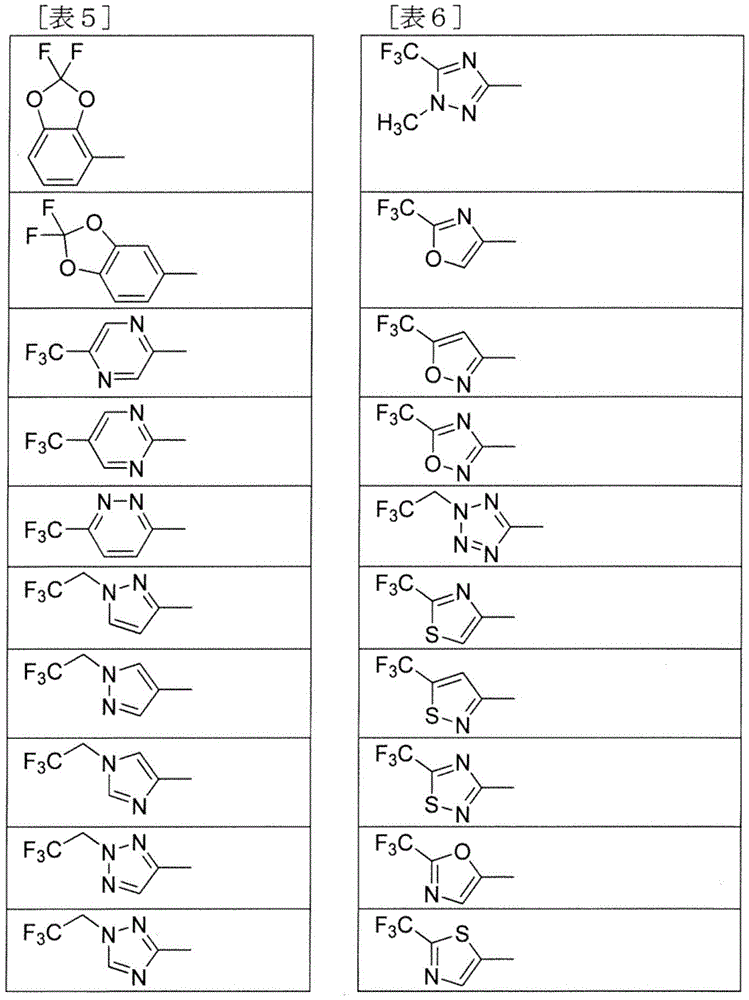
A compound (hereinafter, referred to as compound group SX2) wherein R is represented by formula (L-1) 3b And R 3c Is a hydrogen atom, R 4c Is methyl, T is [ Table 1]][ Table 6 ]]Any substituent described in (1).
A compound (hereinafter, referred to as compound group SX3) wherein R is represented by formula (L-1) 3b And R 3c Is a hydrogen atom, R 4c Is ethyl, T is [ Table 1]][ Table 6 ]]Any substituent described in (1).
A compound (hereinafter, referred to as compound group SX4) wherein R is represented by formula (L-1) 3b And R 3c Is a hydrogen atom, R 4c Is methoxy, T is [ Table 1]][ Table 6 ]]Any substituent described in (1).
A compound (hereinafter, referred to as compound group SX5) wherein R is represented by formula (L-1) 3b And R 3c Is a hydrogen atom, R 4c Is a chlorine atom, T is [ Table 1]][ Table 6 ]]Any substituent described in (1).
A compound (hereinafter, referred to as compound group SX6) wherein R is represented by formula (L-1) 3b And R 3c Is a hydrogen atom, R 4c Is a bromine atom, T is [ Table 1 ]][ Table 6 ]]Any substituent described in (1).
A compound (hereinafter, referred to as compound group SX7) wherein, in the compound (L-1),R 3b and R 3c Is a hydrogen atom, R 4c Is cyano, T is [ Table 1 ]][ Table 6 ]]Any substituent described in (1).
A compound (hereinafter, referred to as compound group SX8) wherein R is represented by formula (L-1) 3b Is trifluoromethyl, R 3c And R 4c Is a hydrogen atom, T is [ Table 1 ]][ Table 6 ]]Any substituent described in (1).
A compound (hereinafter, referred to as compound group SX9) wherein R is represented by formula (L-1) 3b Is trifluoromethyl, R 3c Is a hydrogen atom, R 4c Is methyl, T is [ Table 1 ]][ Table 6 ]]Any substituent described in (1).
A compound (hereinafter, referred to as compound group SX10) wherein R is represented by formula (L-1) 3b Is trifluoromethyl, R 3c Is a hydrogen atom, R 4c Is ethyl, T is [ Table 1 ]][ Table 6 ]]Any substituent described in (1).
A compound (hereinafter, referred to as compound group SX11) wherein R is represented by formula (L-1) 3b Is trifluoromethyl, R 3c Is a hydrogen atom, R 4c Is methoxy, T is [ Table 1 ]][ Table 6 ]]Any substituent described in (1).
A compound (hereinafter, referred to as compound group SX12) wherein R is represented by formula (L-1) 3b Is trifluoromethyl, R 3c Is a hydrogen atom, R 4c Is a chlorine atom, T is [ Table 1 ]][ Table 6 ]]Any substituent described in (1).
A compound (hereinafter, referred to as compound group SX13) wherein R is represented by formula (L-1) 3b Is trifluoromethyl, R 3c Is a hydrogen atom, R 4c Is a bromine atom, T is [ Table 1 ]][ Table 6 ]]Any substituent described in (1).
A compound (hereinafter, referred to as compound group SX14) wherein R is represented by formula (L-1) 3b Is trifluoromethyl, R 3c Is a hydrogen atom, R 4c Is cyano, T is [ Table 1 ]][ Table 6 ]]Any substituent described in (1).
A compound (hereinafter, referred to as compound group SX15) wherein R is represented by formula (L-1) 3c Is trifluoromethyl, R 3b And R 4c Is a hydrogen atomT is [ Table 1 ]][ Table 6 ]]Any substituent described in (1).
A compound (hereinafter, referred to as compound group SX16) wherein R is represented by formula (L-1) 3c Is trifluoromethyl, R 3b Is a hydrogen atom, R 4c Is methyl, T is [ Table 1 ]][ Table 6 ]]Any substituent described in (1).
A compound (hereinafter, referred to as compound group SX17) wherein R is represented by formula (L-1) 3c Is trifluoromethyl, R 3b Is a hydrogen atom, R 4c Is ethyl, T is [ Table 1 ]][ Table 6 ]]Any substituent described in (1).
A compound (hereinafter, referred to as compound group SX18) wherein R is represented by formula (L-1) 3c Is trifluoromethyl, R 3b Is a hydrogen atom, R 4c Is methoxy, T is [ Table 1 ]][ Table 6 ]]Any substituent described in (1).
A compound (hereinafter, referred to as compound group SX19) wherein R is represented by formula (L-1) 3c Is trifluoromethyl, R 3b Is a hydrogen atom, R 4c Is a chlorine atom, T is [ Table 1 ]][ Table 6 ]]Any substituent described in (1).
A compound (hereinafter, referred to as compound group SX20) wherein R is represented by formula (L-1) 3c Is trifluoromethyl, R 3b Is a hydrogen atom, R 4c Is a bromine atom, T is [ Table 1 ]][ Table 6 ]]Any substituent described in (1).
A compound (hereinafter, referred to as compound group SX21) wherein R is represented by formula (L-1) 3c Is trifluoromethyl, R 3b Is a hydrogen atom, R 4c Is cyano, T is [ Table 1 ]][ Table 6 ]]Any substituent described in (1).
A compound represented by the formula (L-2) (hereinafter referred to as compound (L-2)) wherein R is represented by the formula (L-2) (hereinafter referred to as compound group SX22) 3b 、R 3c And R 4c Is a hydrogen atom, T is [ Table 1 ]][ Table 6 ]]Any substituent described in (1).

A compound (hereinafter, referred to as compound group SX23) wherein R is represented by formula (L-2) 3b And R 3c Is a hydrogen atom, R 4c Is methyl, T is [ Table 1 ]][ Table 6 ]]Any substituent described in (1).
A compound (hereinafter, referred to as compound group SX24) wherein R is represented by formula (L-2) 3b And R 3c Is a hydrogen atom, R 4c Is ethyl, T is [ Table 1 ]][ Table 6 ]]Any substituent described in (1).
A compound (hereinafter, referred to as compound group SX25) wherein R is represented by formula (L-2) 3b And R 3c Is a hydrogen atom, R 4c Is methoxy, T is [ Table 1 ]][ Table 6 ]]Any substituent described in (1).
One compound (hereinafter, referred to as compound group SX26), wherein in the compound (L-2), R 3b And R 3c Is a hydrogen atom, R 4c Is a chlorine atom, T is [ Table 1 ]][ Table 6 ]]Any substituent described in (1).
A compound (hereinafter, referred to as compound group SX27) wherein R is represented by formula (L-2) 3b And R 3c Is a hydrogen atom, R 4c Is a bromine atom, T is [ Table 1 ]][ Table 6 ]]Any substituent described in (1).
A compound (hereinafter, referred to as compound group SX28) wherein R is represented by formula (L-2) 3b And R 3c Is a hydrogen atom, R 4c Is cyano, T is [ Table 1 ]][ Table 6 ]]Any substituent described in (1).
One compound (hereinafter, referred to as compound group SX29), wherein in the compound (L-2), R 3b Is trifluoromethyl, R 3c And R 4c Is a hydrogen atom, T is [ Table 1 ]][ Table 6 ]]Any substituent described in (1).
A compound (hereinafter, referred to as compound group SX30) wherein R is represented by formula (L-2) 3b Is trifluoromethyl, R 3c Is a hydrogen atom, R 4c Is methyl, T is [ Table 1 ]][ Table 6 ]]Any substituent described in (1).
A compound (hereinafter, referred to as compound group SX31) wherein R is represented by formula (L-2) 3b Is trifluoromethyl, R 3c Is a hydrogen atom, R 4c Is ethyl, T is [ Table 1 ]][ Table 6 ]]Any substituent described in (1).
A compound (hereinafter, referred to as compound group SX32) wherein R is represented by formula (L-2) 3b Is trifluoromethyl, R 3c Is a hydrogen atom, R 4c Is methoxy, T is [ Table 1 ]][ Table 6 ]]Any substituent described in (1).
A compound (hereinafter, referred to as compound group SX33) wherein R is represented by formula (L-2) 3b Is trifluoromethyl, R 3c Is a hydrogen atom, R 4c Is a chlorine atom, T is [ Table 1 ]][ Table 6 ]]Any substituent described in (1).
One compound (hereinafter, referred to as compound group SX34), wherein in the compound (L-2), R 3b Is trifluoromethyl, R 3c Is a hydrogen atom, R 4c Is a bromine atom, T is [ Table 1 ]][ Table 6 ]]Any substituent described in (1).
A compound (hereinafter, referred to as compound group SX35) wherein R is represented by formula (L-2) 3b Is trifluoromethyl, R 3c Is a hydrogen atom, R 4c Is cyano, T is [ Table 1 ]][ Table 6 ]]Any substituent described in (1).
A compound (hereinafter, referred to as compound group SX36) wherein R is represented by formula (L-2) 3c Is trifluoromethyl, R 3b And R 4c Is a hydrogen atom, T is [ Table 1 ]][ Table 6 ]]Any substituent described in (1).
A compound (hereinafter, referred to as compound group SX37) wherein R is represented by formula (L-2) 3c Is trifluoromethyl, R 3b Is a hydrogen atom, R 4c Is methyl, T is [ Table 1 ]][ Table 6 ]]Any substituent described in (1).
A compound (hereinafter, referred to as compound group SX38) wherein R is represented by formula (L-2) 3c Is trifluoromethyl, R 3b Is a hydrogen atom, R 4c Is ethyl, T is [ Table 1 ]][ Table 6 ]]Any substituent described in (1).
A compound (hereinafter, referred to as compound group SX39) wherein R is represented by formula (L-2) 3c Is trifluoromethyl, R 3b Is a hydrogen atom, R 4c Is methoxy, T is [ Table 1 ]][ Table 6 ]]Any ofA substituent group.
A compound (hereinafter, referred to as compound group SX40) wherein R is represented by formula (L-2) 3c Is trifluoromethyl, R 3b Is a hydrogen atom, R 4c Is a chlorine atom, T is [ Table 1 ]][ Table 6 ]]Any substituent described in (1).
A compound (hereinafter, referred to as compound group SX41) wherein R is represented by formula (L-2) 3c Is trifluoromethyl, R 3b Is a hydrogen atom, R 4c Is a bromine atom, T is [ Table 1 ]][ Table 6 ]]Any substituent described in (1).
A compound (hereinafter, referred to as compound group SX42) wherein R is represented by formula (L-2) 3c Is trifluoromethyl, R 3b Is a hydrogen atom, R 4c Is cyano, T is [ Table 1 ]][ Table 6 ]]Any substituent described in (1).
A compound represented by the formula (L-3) (hereinafter referred to as compound (L-3)) wherein R is represented by the formula (L-3) (hereinafter referred to as compound group SX43) 3b 、R 3c And R 4c Is a hydrogen atom, T is [ Table 1 ]][ Table 6 ]]Any substituent described in (1).

A compound (hereinafter, referred to as compound group SX44) wherein R is represented by formula (L-3) 3b And R 3c Is a hydrogen atom, R 4c Is methyl, T is [ Table 1 ]][ Table 6 ]]Any substituent described in (1).
A compound (hereinafter, referred to as compound group SX45) wherein R is represented by formula (L-3) 3b And R 3c Is a hydrogen atom, R 4c Is ethyl, T is [ Table 1 ]][ Table 6 ]]Any substituent described in (1).
A compound (hereinafter, referred to as compound group SX46) wherein R is represented by formula (L-3) 3b And R 3c Is a hydrogen atom, R 4c Is methoxy, T is [ Table 1 ]][ Table 6 ]]Any substituent described in (1).
A compound (hereinafter, referred to as compound group SX47) wherein R is represented by formula (L-3) 3b And R 3c Is a hydrogen atom, R 4c Is a chlorine atom, T is [ Table 1 ]][ Table 6 ]]Any substituent described in (1).
A compound (hereinafter, referred to as compound group SX48) wherein R is represented by formula (L-3) 3b And R 3c Is a hydrogen atom, R 4c Is a bromine atom, T is [ Table 1 ]][ Table 6 ]]Any substituent described in (1).
One compound (hereinafter, referred to as compound group SX49), wherein in the compound (L-3), R 3b And R 3c Is a hydrogen atom, R 4c Is cyano, T is [ Table 1 ]][ Table 6 ]]Any substituent described in (1).
A compound (hereinafter, referred to as compound group SX50) wherein R is represented by formula (L-3) 3b Is trifluoromethyl, R 3c And R 4c Is a hydrogen atom, T is [ Table 1 ]][ Table 6 ]]Any substituent described in (1).
A compound (hereinafter, referred to as compound group SX51) wherein R is represented by formula (L-3) 3b Is trifluoromethyl, R 3c Is a hydrogen atom, R 4c Is methyl, T is [ Table 1 ]][ Table 6 ]]Any substituent described in (1).
A compound (hereinafter, referred to as compound group SX52) wherein R is represented by formula (L-3) 3b Is trifluoromethyl, R 3c Is a hydrogen atom, R 4c Is ethyl, T is [ Table 1 ]][ Table 6 ]]Any substituent described in (1).
A compound (hereinafter, referred to as compound group SX53) wherein R is represented by formula (L-3) 3b Is trifluoromethyl, R 3c Is a hydrogen atom, R 4c Is methoxy, T is [ Table 1 ]][ Table 6 ]]Any substituent described in (1).
A compound (hereinafter, referred to as compound group SX54) wherein R is represented by formula (L-3) 3b Is trifluoromethyl, R 3c Is a hydrogen atom, R 4c Is a chlorine atom, T is [ Table 1 ]][ Table 6 ]]Any substituent described in (1).
A compound (hereinafter, referred to as compound group SX55) wherein R is represented by formula (L-3) 3b Is trifluoromethyl, R 3c Is a hydrogen atom, R 4c Is a bromine atom, T is [ Table 1 ]][ Table 6 ]]Any substituent described in (1).
A compound (hereinafter, referred to as compound group SX56) wherein R is represented by formula (L-3) 3b Is trifluoromethyl, R 3c Is a hydrogen atom, R 4c Is cyano, T is [ Table 1 ]][ Table 6 ]]Any substituent described in (1).
A compound (hereinafter, referred to as compound group SX57) wherein R is represented by formula (L-3) 3c Is trifluoromethyl, R 3b And R 4c Is a hydrogen atom, T is [ Table 1 ]][ Table 6 ]]Any substituent described in (1).
A compound (hereinafter, referred to as compound group SX58) wherein R is represented by formula (L-3) 3c Is trifluoromethyl, R 3b Is a hydrogen atom, R 4c Is methyl, T is [ Table 1 ]][ Table 6 ]]Any substituent described in (1).
A compound (hereinafter, referred to as compound group SX59) wherein R is represented by formula (L-3) 3c Is trifluoromethyl, R 3b Is a hydrogen atom, R 4c Is ethyl, T is [ Table 1 ]][ Table 6 ]]Any substituent described in (1).
One compound (hereinafter, referred to as compound group SX60), wherein in the compound (L-3), R 3c Is trifluoromethyl, R 3b Is a hydrogen atom, R 4c Is methoxy, T is [ Table 1 ]][ Table 6 ]]Any substituent described in (1).
A compound (hereinafter, referred to as compound group SX61) wherein R is represented by formula (L-3) 3c Is trifluoromethyl, R 3b Is a hydrogen atom, R 4c Is a chlorine atom, T is [ Table 1 ]][ Table 6 ]]Any substituent described in (1).
A compound (hereinafter, referred to as compound group SX62) wherein R is represented by formula (L-3) 3c Is trifluoromethyl, R 3b Is a hydrogen atom, R 4c Is a bromine atom, T is [ Table 1 ]][ Table 6 ]]Any substituent described in (1).
A compound (hereinafter, referred to as compound group SX63) wherein R is represented by formula (L-3) 3c Is trifluoromethyl, R 3b Is a hydrogen atom, R 4c Is cyano, T is [ Table 1 ]][ Table 6 ]]Any substituent described in (1).
A compound represented by the formula (L-4) (hereinafter referred to as compound (L-4)) wherein R is represented by the formula (L-4) (hereinafter referred to as compound group SX64) 3b 、R 3c And R 4c Is a hydrogen atom, T is [ Table 1 ]][ Table 6 ]]Any substituent described in (1).
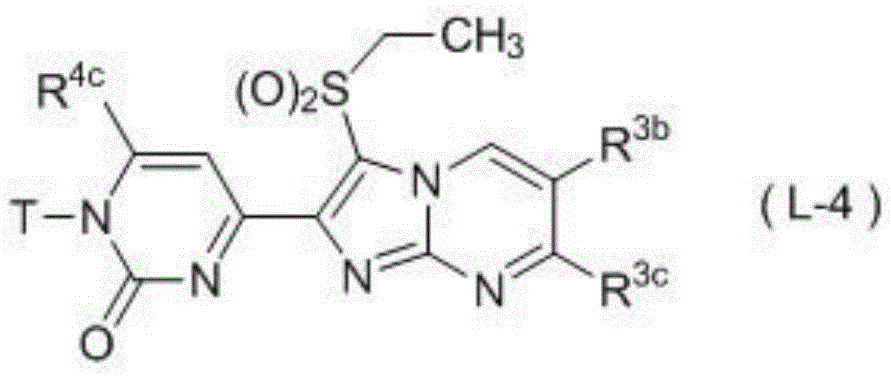
A compound (hereinafter, referred to as compound group SX65) wherein R is represented by formula (L-4) 3b And R 3c Is a hydrogen atom, R 4c Is methyl, T is [ Table 1 ]][ Table 6 ]]Any substituent described in (1).
A compound (hereinafter, referred to as compound group SX66) wherein R is represented by formula (L-4) 3b And R 3c Is a hydrogen atom, R 4c Is ethyl, T is [ Table 1 ]][ Table 6 ]]Any substituent described in (1).
A compound (hereinafter, referred to as compound group SX67) wherein R is represented by formula (L-4) 3b And R 3c Is a hydrogen atom, R 4c Is methoxy, T is [ Table 1 ]][ Table 6 ]]Any substituent described in (1).
A compound (hereinafter, referred to as compound group SX68) wherein R is represented by formula (L-4) 3b And R 3c Is a hydrogen atom, R 4c Is a chlorine atom, T is [ Table 1 ]][ Table 6 ]]Any substituent described in (1).
A compound (hereinafter, referred to as compound group SX69) wherein R is represented by formula (L-4) 3b And R 3c Is a hydrogen atom, R 4c Is a bromine atom, T is [ Table 1 ]][ Table 6 ]]Any substituent described in (1).
A compound (hereinafter, referred to as compound group SX70) wherein R is represented by formula (L-4) 3b And R 3c Is a hydrogen atom, R 4c Is cyano, T is [ Table 1 ]][ Table 6 ]]Any substituent described in (1).
A compound (hereinafter, referred to as compound group SX71) wherein R is represented by formula (L-4) 3b Is trifluoromethyl, R 3c And R 4c Is a hydrogen atom, TIs [ Table 1 ]][ Table 6 ]]Any substituent described in (1).
A compound (hereinafter, referred to as compound group SX72) wherein R is represented by formula (L-4) 3b Is trifluoromethyl, R 3c Is a hydrogen atom, R 4c Is methyl, T is [ Table 1 ]][ Table 6 ]]Any substituent described in (1).
A compound (hereinafter, referred to as compound group SX73) wherein R is represented by formula (L-4) 3b Is trifluoromethyl, R 3c Is a hydrogen atom, R 4c Is ethyl, T is [ Table 1 ]][ Table 6 ]]Any substituent described in (1).
A compound (hereinafter, referred to as compound group SX74) wherein R is represented by formula (L-4) 3b Is trifluoromethyl, R 3c Is a hydrogen atom, R 4c Is methoxy, T is [ Table 1 ]][ Table 6 ]]Any substituent described in (1).
A compound (hereinafter, referred to as compound group SX75) wherein R is represented by formula (L-4) 3b Is trifluoromethyl, R 3c Is a hydrogen atom, R 4c Is a chlorine atom, T is [ Table 1 ]][ Table 6 ]]Any substituent described in (1).
A compound (hereinafter, referred to as compound group SX76) wherein R is represented by formula (L-4) 3b Is trifluoromethyl, R 3c Is a hydrogen atom, R 4c Is a bromine atom, T is [ Table 1 ]][ Table 6 ]]Any substituent described in (1).
A compound (hereinafter, referred to as compound group SX77) wherein R is represented by formula (L-4) 3b Is trifluoromethyl, R 3c Is a hydrogen atom, R 4c Is cyano, T is [ Table 1 ]][ Table 6 ]]Any substituent described in (1).
A compound (hereinafter, referred to as compound group SX78) wherein R is represented by formula (L-4) 3c Is trifluoromethyl, R 3b And R 4c Is a hydrogen atom, T is [ Table 1 ]][ Table 6 ]]Any substituent described in (1).
A compound (hereinafter, referred to as compound group SX79) wherein R is represented by formula (L-4) 3c Is trifluoromethyl, R 3b Is a hydrogen atom, R 4c Is methyl, T is [ Table 1 ]][ Table 6 ]]Any substituent described in (1).
A compound (hereinafter, referred to as compound group SX80) wherein R is represented by formula (L-4) 3c Is trifluoromethyl, R 3b Is a hydrogen atom, R 4c Is ethyl, T is [ Table 1 ]][ Table 6 ]]Any substituent described in (1).
A compound (hereinafter, referred to as compound group SX81) wherein R is represented by formula (L-4) 3c Is trifluoromethyl, R 3b Is a hydrogen atom, R 4c Is methoxy, T is [ Table 1 ]][ Table 6 ]]Any substituent described in (1).
A compound (hereinafter, referred to as compound group SX82) wherein R is represented by formula (L-4) 3c Is trifluoromethyl, R 3b Is a hydrogen atom, R 4c Is a chlorine atom, T is [ Table 1 ]][ Table 6 ]]Any substituent described in (1).
A compound (hereinafter, referred to as compound group SX83) wherein R is represented by formula (L-4) 3c Is trifluoromethyl, R 3b Is a hydrogen atom, R 4c Is a bromine atom, T is [ Table 1 ]][ Table 6 ]]Any substituent described in (1).
A compound (hereinafter, referred to as compound group SX84) wherein R is represented by formula (L-4) 3c Is trifluoromethyl, R 3b Is a hydrogen atom, R 4c Is cyano, T is [ Table 1 ]][ Table 6 ]]Any substituent described in (1).
A compound represented by the formula (L-5) (hereinafter referred to as compound (L-5)) wherein R is represented by the formula (L-5) (hereinafter referred to as compound group SX85) 3b 、R 3c And R 4c Is a hydrogen atom, T is [ Table 1 ]][ Table 6 ]]Any substituent described in (1).

A compound (hereinafter, referred to as compound group SX86) wherein R is represented by formula (L-5) 3b And R 3c Is a hydrogen atom, R 4c Is methyl, T is [ Table 1 ]][ Table 6 ]]Any substituent described in (1).
One compound (hereinafter, referred to as compound group SX87) among the compounds (L-5), R 3b And R 3c Is a hydrogen atom, R 4c Is ethyl, T is [ Table 1 ]][ Table 6 ]]Any substituent described in (1).
A compound (hereinafter, referred to as compound group SX88) wherein R is represented by formula (L-5) 3b And R 3c Is a hydrogen atom, R 4c Is methoxy, T is [ Table 1 ]][ Table 6 ]]Any substituent described in (1).
A compound (hereinafter, referred to as compound group SX89) wherein R is represented by formula (L-5) 3b And R 3c Is a hydrogen atom, R 4c Is a chlorine atom, T is [ Table 1 ]][ Table 6 ]]Any substituent described in (1).
A compound (hereinafter, referred to as compound group SX90) wherein R is represented by formula (L-5) 3b And R 3c Is a hydrogen atom, R 4c Is a bromine atom, T is [ Table 1 ]][ Table 6 ]]Any substituent described in (1).
One compound (hereinafter, referred to as compound group SX91), wherein in the compound (L-5), R 3b And R 3c Is a hydrogen atom, R 4c Is cyano, T is [ Table 1 ]][ Table 6 ]]Any substituent described in (1).
A compound (hereinafter, referred to as compound group SX92) wherein R is represented by formula (L-5) 3b Is trifluoromethyl, R 3c And R 4c Is a hydrogen atom, T is [ Table 1 ]][ Table 6 ]]Any substituent described in (1).
A compound (hereinafter, referred to as compound group SX93) wherein R is represented by formula (L-5) 3b Is trifluoromethyl, R 3c Is a hydrogen atom, R 4c Is methyl, T is [ Table 1 ]][ Table 6 ]]Any substituent described in (1).
A compound (hereinafter, referred to as compound group SX94) wherein R is represented by formula (L-5) 3b Is trifluoromethyl, R 3c Is a hydrogen atom, R 4c Is ethyl, T is [ Table 1 ]][ Table 6 ]]Any substituent described in (1).
A compound (hereinafter, referred to as compound group SX95) wherein R is represented by formula (L-5) 3b Is trifluoromethyl, R 3c Is a hydrogen atom, R 4c Is methoxy, T is [ Table 1 ]][ Table 6 ]]Any one of the extracts described in (1)And (4) generation of base.
A compound (hereinafter, referred to as compound group SX96) wherein R is represented by formula (L-5) 3b Is trifluoromethyl, R 3c Is a hydrogen atom, R 4c Is a chlorine atom, T is [ Table 1 ]][ Table 6 ]]Any substituent described in (1).
A compound (hereinafter, referred to as compound group SX97) wherein R is represented by formula (L-5) 3b Is trifluoromethyl, R 3c Is a hydrogen atom, R 4c Is a bromine atom, T is [ Table 1 ]][ Table 6 ]]Any substituent described in (1).
A compound (hereinafter, referred to as compound group SX98) wherein R is represented by formula (L-5) 3b Is trifluoromethyl, R 3c Is a hydrogen atom, R 4c Is cyano, T is [ Table 1 ]][ Table 6 ]]Any substituent described in (1).
A compound (hereinafter, referred to as compound group SX99) wherein R is represented by formula (L-5) 3c Is trifluoromethyl, R 3b And R 4c Is a hydrogen atom, T is [ Table 1 ]][ Table 6 ]]Any substituent described in (1).
A compound (hereinafter, referred to as compound group SX100) wherein R is represented by formula (L-5) 3c Is trifluoromethyl, R 3b Is a hydrogen atom, R 4c Is methyl, T is [ Table 1 ]][ Table 6 ]]Any substituent described in (1).
A compound (hereinafter, referred to as compound group SX101) in which R is represented by formula (L-5) 3c Is trifluoromethyl, R 3b Is a hydrogen atom, R 4c Is ethyl, T is [ Table 1 ]][ Table 6 ]]Any substituent described in (1).
A compound (hereinafter, referred to as compound group SX102) wherein R is as defined in the description of the compound (L-5) 3c Is trifluoromethyl, R 3b Is a hydrogen atom, R 4c Is methoxy, T is [ Table 1 ]][ Table 6 ]]Any substituent described in (1).
A compound (hereinafter, referred to as compound group SX103) in which R is in the compound (L-5) 3c Is trifluoromethyl, R 3b Is a hydrogen atom, R 4c Is a chlorine atom, T is [ Table 1 ]][ Table 6 ]]Any substituent described in (1).
A kind ofCompound (hereinafter, referred to as Compound group SX104), in Compound (L-5), R 3c Is trifluoromethyl, R 3b Is a hydrogen atom, R 4c Is a bromine atom, T is [ Table 1 ]][ Table 6 ]]Any substituent described in (1).
A compound (hereinafter, referred to as compound group SX105) wherein R is as defined in the description of the compound (L-5) 3c Is trifluoromethyl, R 3b Is a hydrogen atom, R 4c Is cyano, T is [ Table 1 ]][ Table 6 ]]Any substituent described in (1).
A compound represented by the formula (L-6) (hereinafter referred to as compound (L-6)) wherein R is represented by the formula (L-6) (hereinafter referred to as compound group SX106) 3b 、R 3c And R 4c Is a hydrogen atom, T is [ Table 1 ]][ Table 6 ]]Any substituent described in (1).

A compound (hereinafter referred to as compound group SX107) in which R is represented by formula (L-6) 3b And R 3c Is a hydrogen atom, R 4c Is methyl, T is [ Table 1 ]][ Table 6 ]]Any substituent described in (1).
A compound (hereinafter, referred to as compound group SX108) in which R is in the compound (L-6) 3b And R 3c Is a hydrogen atom, R 4c Is ethyl, T is [ Table 1 ]][ Table 6 ]]Any substituent described in (1).
A compound (hereinafter, referred to as compound group SX109) in which compound (L-6) is R 3b And R 3c Is a hydrogen atom, R 4c Is methoxy, T is [ Table 1 ]][ Table 6 ]]Any substituent described in (1).
A compound (hereinafter, referred to as compound group SX110) wherein R is as defined in the description of compound (L-6) 3b And R 3c Is a hydrogen atom, R 4c Is a chlorine atom, T is [ Table 1 ]][ Table 6 ]]Any substituent described in (1).
A compound (hereinafter, referred to as compound group SX111) wherein R is as defined in the description of compound (L-6) 3b And R 3c Is a hydrogen atom, R 4c Is bromineAtom, T is [ Table 1 ]][ Table 6 ]]Any substituent described in (1).
A compound (hereinafter referred to as compound group SX112) in which R is represented by formula (L-6) 3b And R 3c Is a hydrogen atom, R 4c Is cyano, T is [ Table 1 ]][ Table 6 ]]Any substituent described in (1).
A compound (hereinafter referred to as compound group SX113) in which compound (L-6) is R 3b Is trifluoromethyl, R 3c And R 4c Is a hydrogen atom, T is [ Table 1 ]][ Table 6 ]]Any substituent described in (1).
A compound (hereinafter, referred to as compound group SX114) in which R is in the compound (L-6) 3b Is trifluoromethyl, R 3c Is a hydrogen atom, R 4c Is methyl, T is [ Table 1 ]][ Table 6 ]]Any substituent described in (1).
A compound (hereinafter, referred to as compound group SX115) in which R is represented by formula (L-6) 3b Is trifluoromethyl, R 3c Is a hydrogen atom, R 4c Is ethyl, T is [ Table 1 ]][ Table 6 ]]Any substituent described in (1).
A compound (hereinafter, referred to as compound group SX116) in which R is in the compound (L-6) 3b Is trifluoromethyl, R 3c Is a hydrogen atom, R 4c Is methoxy, T is [ Table 1 ]][ Table 6 ]]Any substituent described in (1).
A compound (hereinafter, referred to as compound group SX117) in which R is in the compound (L-6) 3b Is trifluoromethyl, R 3c Is a hydrogen atom, R 4c Is a chlorine atom, T is [ Table 1 ]][ Table 6 ]]Any substituent described in (1).
A compound (hereinafter, referred to as compound group SX118) wherein R is as defined in the description of the compound (L-6) 3b Is trifluoromethyl, R 3c Is a hydrogen atom, R 4c Is a bromine atom, T is [ Table 1 ]][ Table 6 ]]Any substituent described in (1).
A compound (hereinafter, referred to as compound group SX119) in which R is represented by formula (L-6) 3b Is trifluoromethyl, R 3c Is a hydrogen atom, R 4c Is cyano, T is [ Table 1 ]][ Table 6 ]]Any substituent described in (1).
A compound (hereinafter, referred to as compound group SX120) in which R is represented by formula (L-6) 3c Is trifluoromethyl, R 3b And R 4c Is a hydrogen atom, T is [ Table 1 ]][ Table 6 ]]Any substituent described in (1).
One kind of compound (hereinafter, referred to as compound group SX121), in which compound (L-6), R 3c Is trifluoromethyl, R 3b Is a hydrogen atom, R 4c Is methyl, T is [ Table 1 ]][ Table 6 ]]Any substituent described in (1).
A compound (hereinafter, referred to as compound group SX122) in which R is in the compound (L-6) 3c Is trifluoromethyl, R 3b Is a hydrogen atom, R 4c Is ethyl, T is [ Table 1 ]][ Table 6 ]]Any substituent described in (1).
A compound (hereinafter, referred to as compound group SX123) in which compound (L-6) R 3c Is trifluoromethyl, R 3b Is a hydrogen atom, R 4c Is methoxy, T is [ Table 1 ]][ Table 6 ]]Any substituent described in (1).
A compound (hereinafter, referred to as compound group SX124) in which R is in the compound (L-6) 3c Is trifluoromethyl, R 3b Is a hydrogen atom, R 4c Is a chlorine atom, T is [ Table 1 ]][ Table 6 ]]Any substituent described in (1).
A compound (hereinafter referred to as compound group SX125) in which R is represented by formula (L-6) 3c Is trifluoromethyl, R 3b Is a hydrogen atom, R 4c Is a bromine atom, T is [ Table 1 ]][ Table 6 ]]Any substituent described in (1).
A compound (hereinafter, referred to as compound group SX126) in which R is in the compound (L-6) 3c Is trifluoromethyl, R 3b Is a hydrogen atom, R 4c Is cyano, T is [ Table 1 ]][ Table 6 ]]Any substituent described in (1).
A compound represented by the formula (L-7) (hereinafter, referred to as compound (L-7)) wherein G is represented by the formula (L-7) (hereinafter, referred to as compound group SX127) 1 Is CH, R 3b And R 4c Is a hydrogen atom, T is [ Table 1 ]][ Table 6 ]]Any substituent described in (1).

A compound (hereinafter, referred to as compound group SX128) in which compound (L-7) is G 1 Is CH, R 3b Is a hydrogen atom, R 4c Is methyl, T is [ Table 1 ]][ Table 6 ]]Any substituent described in (1).
A compound (hereinafter, referred to as compound group SX129) in which compound (L-7) is G 1 Is CH, R 3b Is a hydrogen atom, R 4c Is ethyl, T is [ Table 1 ]][ Table 6 ]]Any substituent described in (1).
One compound (hereinafter, referred to as compound group SX130), in compound (L-7), G 1 Is CH, R 3b Is a hydrogen atom, R 4c Is methoxy, T is [ Table 1 ]][ Table 6 ]]Any substituent described in (1).
One compound (hereinafter, referred to as compound group SX131) among the compounds (L-7), G 1 Is CH, R 3b Is a hydrogen atom, R 4c Is a chlorine atom, T is [ Table 1 ]][ Table 6 ]]Any substituent described in (1).
One compound (hereinafter, referred to as compound group SX132), in the compound (L-7), G 1 Is CH, R 3b Is a hydrogen atom, R 4c Is a bromine atom, T is [ Table 1 ]][ Table 6 ]]Any substituent described in (1).
A compound (hereinafter, referred to as compound group SX133) in which compound (L-7) is G 1 Is CH, R 3b Is a hydrogen atom, R 4c Is cyano, T is [ Table 1 ]][ Table 6 ]]Any substituent described in (1).
A compound (hereinafter, referred to as compound group SX134) in which compound (L-7) is G 1 Is CH, R 3b Is trifluoromethyl, R 4c Is a hydrogen atom, T is [ Table 1 ]][ Table 6 ]]Any substituent described in (1).
A compound (hereinafter, referred to as compound group SX135) in which compound (L-7) is G 1 Is CH, R 3b Is trifluoromethyl, R 4c Is methyl, T is[ Table 1][ Table 6 ]]Any substituent described in (1).
A compound (hereinafter, referred to as compound group SX136) in which compound (L-7) is G 1 Is CH, R 3b Is trifluoromethyl, R 4c Is ethyl, T is [ Table 1 ]][ Table 6 ]]Any substituent described in (1).
A compound (hereinafter, referred to as compound group SX137) wherein, in the compound (L-7), G 1 Is CH, R 3b Is trifluoromethyl, R 4c Is methoxy, T is [ Table 1 ]][ Table 6 ]]Any substituent described in (1).
A compound (hereinafter, referred to as compound group SX138) in which compound (L-7) is G 1 Is CH, R 3b Is trifluoromethyl, R 4c Is a chlorine atom, T is [ Table 1 ]][ Table 6 ]]Any substituent described in (1).
One compound (hereinafter, referred to as compound group SX139), in the compound (L-7), G 1 Is CH, R 3b Is trifluoromethyl, R 4c Is a bromine atom, T is [ Table 1 ]][ Table 6 ]]Any substituent described in (1).
One compound (hereinafter, referred to as compound group SX140), in compound (L-7), G 1 Is CH, R 3b Is trifluoromethyl, R 4c Is cyano, T is [ Table 1 ]][ Table 6 ]]Any substituent described in (1).
A compound (hereinafter, referred to as compound group SX141) in which compound (L-7) is G 1 Is a nitrogen atom, R 3b And R 4c Is a hydrogen atom, T is [ Table 1 ]][ Table 6 ]]Any substituent described in (1).
One compound (hereinafter, referred to as compound group SX142), in compound (L-7), G 1 Is a nitrogen atom, R 3b Is a hydrogen atom, R 4c Is methyl, T is [ Table 1 ]][ Table 6 ]]Any substituent described in (1).
A compound (hereinafter, referred to as compound group SX143) in which compound (L-7) is G 1 Is a nitrogen atom, R 3b Is a hydrogen atom, R 4c Is ethyl, T is [ Table 1 ]][ Table 6 ]]Any substituent described in (1).
A compound (below)Denoted as Compound group SX144), in Compound (L-7), G 1 Is a nitrogen atom, R 3b Is a hydrogen atom, R 4c Is methoxy, T is [ Table 1 ]][ Table 6 ]]Any substituent described in (1).
A compound (hereinafter, referred to as compound group SX145) in which compound (L-7) is G 1 Is a nitrogen atom, R 3b Is a hydrogen atom, R 4c Is a chlorine atom, T is [ Table 1 ]][ Table 6 ]]Any substituent described in (1).
A compound (hereinafter, referred to as compound group SX146) in which compound (L-7) is G 1 Is a nitrogen atom, R 3b Is a hydrogen atom, R 4c Is a bromine atom, T is [ Table 1 ]][ Table 6 ]]Any substituent described in (1).
A compound (hereinafter, referred to as compound group SX147) in which compound (L-7) is G 1 Is a nitrogen atom, R 3b Is a hydrogen atom, R 4c Is cyano, T is [ Table 1 ]][ Table 6 ]]Any substituent described in (1).
One compound (hereinafter, referred to as compound group SX148) in which compound (L-7) is G 1 Is a nitrogen atom, R 3b Is trifluoromethyl, R 4c Is a hydrogen atom, T is [ Table 1 ]][ Table 6 ]]Any substituent described in (1).
One compound (hereinafter, referred to as compound group SX149), in the compound (L-7), G 1 Is a nitrogen atom, R 3b Is trifluoromethyl, R 4c Is methyl, T is [ Table 1 ]][ Table 6 ]]Any substituent described in (1).
One compound (hereinafter, referred to as compound group SX150), in the compound (L-7), G 1 Is a nitrogen atom, R 3b Is trifluoromethyl, R 4c Is ethyl, T is [ Table 1 ]][ Table 6 ]]Any substituent described in (1).
A compound (hereinafter, referred to as compound group SX151) in which compound (L-7) is G 1 Is a nitrogen atom, R 3b Is trifluoromethyl, R 4c Is methoxy, T is [ Table 1 ]][ Table 6 ]]Any substituent described in (1).
A compound (hereinafter, referred to as compound group SX152) in which, among compounds (L-7), G 1 is a nitrogen atom, R 3b Is trifluoromethyl, R 4c Is a chlorine atom, T is [ Table 1 ]][ Table 6 ]]Any substituent described in (1).
One compound (hereinafter, referred to as compound group SX153) in which compound (L-7) is G 1 Is a nitrogen atom, R 3b Is trifluoromethyl, R 4c Is a bromine atom, T is [ Table 1 ]][ Table 6 ]]Any substituent described in (1).
A compound (hereinafter, referred to as compound group SX154) in which compound (L-7) is G 1 Is a nitrogen atom, R 3b Is trifluoromethyl, R 4c Is cyano, T is [ Table 1 ]][ Table 6 ]]Any substituent described in (1).
A compound represented by the formula (L-8) (hereinafter, referred to as compound (L-8)) wherein G is represented by the formula (L-8) (hereinafter, referred to as compound group SX155) 1 Is CH, R 3b And R 4c Is a hydrogen atom, T is [ Table 1 ]][ Table 6 ]]Any substituent described in (1).

One compound (hereinafter, referred to as compound group SX156), in the compound (L-8), G 1 Is CH, R 3b Is a hydrogen atom, R 4c Is methyl, T is [ Table 1 ]][ Table 6 ]]Any substituent described in (1).
A compound (hereinafter, referred to as compound group SX157) in which compound (L-8) is G 1 Is CH, R 3b Is a hydrogen atom, R 4c Is ethyl, T is [ Table 1 ]][ Table 6 ]]Any substituent described in (1).
One compound (hereinafter, referred to as compound group SX158), in compound (L-8), G 1 Is CH, R 3b Is a hydrogen atom, R 4c Is methoxy, T is [ Table 1 ]][ Table 6 ]]Any substituent described in (1).
A compound (hereinafter, referred to as compound group SX159) in which compound (L-8) is G 1 Is CH, R 3b Is a hydrogen atom, R 4c Is a chlorine atom, T is [ Table 1 ]][ Table 6 ]]The method ofAny substituent.
One compound (hereinafter, referred to as compound group SX160), in the compound (L-8), G 1 Is CH, R 3b Is a hydrogen atom, R 4c Is a bromine atom, T is [ Table 1 ]][ Table 6 ]]Any substituent described in (1).
A compound (hereinafter, referred to as compound group SX161) in which compound (L-8) is G 1 Is CH, R 3b Is a hydrogen atom, R 4c Is cyano, T is [ Table 1 ]][ Table 6 ]]Any substituent described in (1).
A compound (hereinafter, referred to as compound group SX162) in which compound (L-8) is G 1 Is CH, R 3b Is trifluoromethyl, R 4c Is a hydrogen atom, T is [ Table 1 ]][ Table 6 ]]Any substituent described in (1).
One compound (hereinafter, referred to as compound group SX163), in the compound (L-8), G 1 Is CH, R 3b Is trifluoromethyl, R 4c Is methyl, T is [ Table 1 ]][ Table 6 ]]Any substituent described in (1).
One compound (hereinafter, referred to as compound group SX164), in compound (L-8), G 1 Is CH, R 3b Is trifluoromethyl, R 4c Is ethyl, T is [ Table 1 ]][ Table 6 ]]Any substituent described in (1).
A compound (hereinafter, referred to as compound group SX165) in which compound (L-8) is G 1 Is CH, R 3b Is trifluoromethyl, R 4c Is methoxy, T is [ Table 1 ]][ Table 6 ]]Any substituent described in (1).
A compound (hereinafter, referred to as compound group SX166) in which compound (L-8) is G 1 Is CH, R 3b Is trifluoromethyl, R 4c Is a chlorine atom, T is [ Table 1 ]][ Table 6 ]]Any substituent described in (1).
One compound (hereinafter, referred to as compound group SX167), in the compound (L-8), G 1 Is CH, R 3b Is trifluoromethyl, R 4c Is a bromine atom, T is [ Table 1 ]][ Table 6 ]]Any substituent described in (1).
Compound (hereinafter, referred to as compound group SX168)In the compound (L-8), G 1 Is CH, R 3b Is trifluoromethyl, R 4c Is cyano, T is [ Table 1 ]][ Table 6 ]]Any substituent described in (1).
A compound (hereinafter referred to as compound group SX169) in which compound (L-8) is G 1 Is a nitrogen atom, R 3b And R 4c Is a hydrogen atom, T is [ Table 1 ]][ Table 6 ]]Any substituent described in (1).
One compound (hereinafter, referred to as compound group SX170), among compounds (L-8), G 1 Is a nitrogen atom, R 3b Is a hydrogen atom, R 4c Is methyl, T is [ Table 1 ]][ Table 6 ]]Any substituent described in (1).
One compound (hereinafter referred to as compound group SX171) among the compounds (L-8), G 1 Is a nitrogen atom, R 3b Is a hydrogen atom, R 4c Is ethyl, T is [ Table 1 ]][ Table 6 ]]Any substituent described in (1).
A compound (hereinafter, referred to as compound group SX172) in which compound (L-8) is G 1 Is a nitrogen atom, R 3b Is a hydrogen atom, R 4c Is methoxy, T is [ Table 1 ]][ Table 6 ]]Any substituent described in (1).
One compound (hereinafter, referred to as compound group SX173), in compound (L-8), G 1 Is a nitrogen atom, R 3b Is a hydrogen atom, R 4c Is a chlorine atom, T is [ Table 1 ]][ Table 6 ]]Any substituent described in (1).
One compound (hereinafter, referred to as compound group SX174), in the compound (L-8), G 1 Is a nitrogen atom, R 3b Is a hydrogen atom, R 4c Is a bromine atom, T is [ Table 1 ]][ Table 6 ]]Any substituent described in (1).
A compound (hereinafter referred to as compound group SX175) in which compound (L-8) is G 1 Is a nitrogen atom, R 3b Is a hydrogen atom, R 4c Is cyano, T is [ Table 1 ]][ Table 6 ]]Any substituent described in (1).
One compound (hereinafter, referred to as compound group SX176), among compounds (L-8), G 1 Is a nitrogen atom, R 3b Is trifluoromethyl,R 4c Is a hydrogen atom, T is [ Table 1 ]][ Table 6 ]]Any substituent described in (1).
A compound (hereinafter, referred to as compound group SX177), in the compound (L-8), G 1 Is a nitrogen atom, R 3b Is trifluoromethyl, R 4c Is methyl, T is [ Table 1 ]][ Table 6 ]]Any substituent described in (1).
One compound (hereinafter, referred to as compound group SX178), in compound (L-8), G 1 Is a nitrogen atom, R 3b Is trifluoromethyl, R 4c Is ethyl, T is [ Table 1 ]][ Table 6 ]]Any substituent described in (1).
A compound (hereinafter referred to as compound group SX179) in which compound (L-8) is G 1 Is a nitrogen atom, R 3b Is trifluoromethyl, R 4c Is methoxy, T is [ Table 1 ]][ Table 6 ]]Any substituent described in (1).
One compound (hereinafter, referred to as compound group SX180), in compound (L-8), G 1 Is a nitrogen atom, R 3b Is trifluoromethyl, R 4c Is a chlorine atom, T is [ Table 1 ]][ Table 6 ]]Any substituent described in (1).
A compound (hereinafter, referred to as compound group SX181) in which compound (L-8) is G 1 Is a nitrogen atom, R 3b Is trifluoromethyl, R 4c Is a bromine atom, T is [ Table 1 ]][ Table 6 ]]Any substituent described in (1).
A compound (hereinafter, referred to as compound group SX182) in which compound (L-8) is G 1 Is a nitrogen atom, R 3b Is trifluoromethyl, R 4c Is cyano, T is [ Table 1 ]][ Table 6 ]]Any substituent described in (1).
A compound (hereinafter, referred to as compound group SX183) wherein A is a compound represented by the formula (L-9) (hereinafter, referred to as compound (L-9)) 1 Is N-CH 3 ,R 4c Is a hydrogen atom, T is [ Table 1 ]][ Table 6 ]]Any substituent described in (1).

A Compound (hereinafter referred to as Compound group SX184) wherein in Compound (L-9), A 1 Is N-CH 3 ,R 4c Is methyl, T is [ Table 1 ]][ Table 6 ]]Any substituent described in (1).
A Compound (hereinafter referred to as Compound group SX185) wherein, in Compound (L-9), A 1 Is N-CH 3 ,R 4c Is ethyl, T is [ Table 1 ]][ Table 6 ]]Any substituent described in (1).
A Compound (hereinafter referred to as Compound group SX186) wherein, in Compound (L-9), A 1 Is N-CH 3 ,R 4c Is methoxy, T is [ Table 1 ]][ Table 6 ]]Any substituent described in (1).
One compound (hereinafter referred to as compound group SX187), in the compound (L-9), A 1 Is N-CH 3 ,R 4c Is a chlorine atom, T is [ Table 1 ]][ Table 6 ]]Any substituent described in (1).
A Compound (hereinafter referred to as Compound group SX188) in which Compound (L-9) is 1 Is N-CH 3 ,R 4c Is a bromine atom, T is [ Table 1 ]][ Table 6 ]]Any substituent described in (1).
A Compound (hereinafter referred to as Compound group SX189) wherein in Compound (L-9), A is 1 Is N-CH 3 ,R 4c Is cyano, T is [ Table 1 ]][ Table 6 ]]Any substituent described in (1).
A Compound (hereinafter referred to as Compound group SX190) in which Compound (L-9) is 1 Is a sulfur atom, R 4c Is a hydrogen atom, T is [ Table 1 ]][ Table 6 ]]Any substituent described in (1).
A Compound (hereinafter referred to as Compound group SX191) in which Compound (L-9) is 1 Is a sulfur atom, R 4c Is methyl, T is [ Table 1 ]][ Table 6 ]]Any substituent described in (1).
A Compound (hereinafter referred to as Compound group SX192) wherein in Compound (L-9), A 1 Is a sulfur atom, R 4c Is ethyl, T is [ Table 1 ]][ Table 6 ]]Any substituent described in (1).
A Compound (hereinafter referred to as Compound group SX193) wherein, in Compound (L-9), A 1 Is a sulfur atom, R 4c Is methoxy, T is [ Table 1 ]][ Table 6 ]]Any substituent described in (1).
A Compound (hereinafter referred to as Compound group SX194) wherein in Compound (L-9), A 1 Is a sulfur atom, R 4c Is a chlorine atom, T is [ Table 1 ]][ Table 6 ]]Any substituent described in (1).
A Compound (hereinafter referred to as Compound group SX195) wherein, in Compound (L-9), A 1 Is a sulfur atom, R 4c Is a bromine atom, T is [ Table 1 ]][ Table 6 ]]Any substituent described in (1).
A Compound (hereinafter referred to as Compound group SX196) wherein, in Compound (L-9), A 1 Is a sulfur atom, R 4c Is cyano, T is [ Table 1 ]][ Table 6 ]]Any substituent described in (1).
A compound represented by the formula (L-10) (hereinafter, referred to as compound (L-10)) wherein A is a compound (hereinafter, referred to as compound group SX197) 1 Is N-CH 3 ,R 4c Is a hydrogen atom, T is [ Table 1 ]][ Table 6 ]]Any substituent described in (1).

A Compound (hereinafter referred to as Compound group SX198) in which Compound (L-10) is 1 Is N-CH 3 ,R 4c Is methyl, T is [ Table 1 ]][ Table 6 ]]Any substituent described in (1).
A Compound (hereinafter referred to as Compound group SX199) wherein in Compound (L-10), A 1 Is N-CH 3 ,R 4c Is ethyl, T is [ Table 1 ] ][ Table 6 ]]Any substituent described in (1).
One compound (hereinafter, referred to as compound group SX200) in which compound (L-10) is A 1 Is N-CH 3 ,R 4c Is methoxy, T is [ Table 1 ]][ Table 6 ]]Any substituent described in (1).
Compound(hereinafter referred to as compound group SX201), wherein in the compound (L-10), A is 1 Is N-CH 3 ,R 4c Is a chlorine atom, T is [ Table 1 ]][ Table 6 ]]Any substituent described in (1).
A Compound (hereinafter referred to as Compound group SX202) wherein, in Compound (L-10), A 1 Is N-CH 3 ,R 4c Is a bromine atom, T is [ Table 1 ]][ Table 6 ]]Any substituent described in (1).
A Compound (hereinafter referred to as Compound group SX203) wherein, in Compound (L-10), A 1 Is N-CH 3 ,R 4c Is cyano, T is [ Table 1 ]][ Table 6 ]]Any substituent described in (1).
A Compound (hereinafter referred to as Compound group SX204) wherein, in Compound (L-10), A 1 Is a sulfur atom, R 4c Is a hydrogen atom, T is [ Table 1 ]][ Table 6 ]]Any substituent described in (1).
A Compound (hereinafter referred to as Compound group SX205) wherein, in Compound (L-10), A 1 Is a sulfur atom, R 4c Is methyl, T is [ Table 1 ]][ Table 6 ]]Any substituent described in (1).
A Compound (hereinafter referred to as Compound group SX206) wherein, in Compound (L-10), A 1 Is a sulfur atom, R 4c Is ethyl, T is [ Table 1 ]][ Table 6]]Any substituent described in (1).
A Compound (hereinafter referred to as Compound group SX207) in which Compound (L-10) is 1 Is a sulfur atom, R 4c Is methoxy, T is [ Table 1 ]][ Table 6]]Any substituent described in (1).
A Compound (hereinafter referred to as Compound group SX208) wherein, in Compound (L-10), A 1 Is a sulfur atom, R 4c Is a chlorine atom, T is [ Table 1 ]][ Table 6]]Any substituent described in (1).
A Compound (hereinafter referred to as Compound group SX209) in which Compound (L-10) is 1 Is a sulfur atom, R 4c Is a bromine atom, T is [ Table 1 ]][ Table 6]]Any substituent described in (1).
One compound (hereinafter referred to as compound group SX210) is made into a compoundIn the compound (L-10), A 1 Is a sulfur atom, R 4c Is cyano, T is [ Table 1 ]][ Table 6]]Any substituent described in (1).
A compound represented by the formula (L-11) (hereinafter referred to as compound (L-11)) wherein G is a substituent (hereinafter referred to as compound group SX211) 1 And G 4 Is CH, R 3b And R 4c Is a hydrogen atom, R 3c Is [ Table 7 ]][ Table 15)]Any substituent described in (1).

[ group 4]

[ group 5]

[ group 6]

One compound (hereinafter, referred to as compound group SX212) in which compound (L-11) is G 1 And G 4 Is CH, R 3b Is a hydrogen atom, R 4c Is methyl, R 3c Is [ Table 7 ]][ Table 15)]Any substituent described in (1).
A compound (hereinafter, referred to as compound group SX213) in which compound (L-11) is G 1 And G 4 Is CH, R 3b Is a hydrogen atom, R 4c Is ethyl, R 3c Is [ Table 7 ]][ Table 15)]Any substituent described in (1).
A compound (hereinafter, referred to as compound group SX214) in which compound (L-11) is G 1 And G 4 Is CH, R 3b Is a hydrogen atom, R 4c Is methoxy, R 3c Is [ Table 7 ]][ Table 15)]Any substituent described in (1).
A compound (hereinafter referred to as compound group SX215) in which compound (L-11) is G 1 And G 4 Is CH, R 3b Is a hydrogen atom, R 4c Is a chlorine atom, R 3c Is [ Table 7 ]][ Table 15)]Any substituent described in (1).
One compound (hereinafter referred to as compound group SX216), among compounds (L-11), G 1 And G 4 Is CH, R 3b Is a hydrogen atom, R 4c Is a bromine atom, R 3c Is [ Table 7 ]][ Table 15)]Any substituent described in (1).
A compound (hereinafter referred to as compound group SX217) in which compound (L-11) is G 1 And G 4 Is CH, R 3b Is a hydrogen atom, R 4c Is cyano, R 3c Is [ Table 7 ]][ Table 15)]Any substituent described in (1).
A compound (hereinafter, referred to as compound group SX218) in which compound (L-11) is G 1 And G 4 Is CH, R 3c Is a hydrogen atom, R 4c Is a hydrogen atom, R 3b Is [ Table 7 ]][ Table 15)]Any substituent described in (1).
A compound (hereinafter, referred to as compound group SX219) in which compound (L-11) is G 1 And G 4 Is CH, R 3c Is a hydrogen atom, R 4c Is methyl, R 3b Is [ Table 7 ]][ Table 15)]Any substituent described in (1).
A compound (hereinafter, referred to as compound group SX220) in which compound (L-11) is G 1 And G 4 Is CH, R 3c Is a hydrogen atom, R 4c Is ethyl, R 3b Is [ Table 7 ]][ Table 15)]Any substituent described in (1).
A compound (hereinafter referred to as compound group SX221) in which compound (L-11) is G 1 And G 4 Is CH, R 3c Is a hydrogen atom, R 4c Is methoxy, R 3b Is [ Table 7 ]][ Table 15)]Any substituent described in (1).
Compound(hereinafter referred to as compound group SX222), in the compound (L-11), G 1 And G 4 Is CH, R 3c Is a hydrogen atom, R 4c Is a chlorine atom, R 3b Is [ Table 7 ]][ Table 15)]Any substituent described in (1).
A compound (hereinafter referred to as compound group SX223) in which compound (L-11) is G 1 And G 4 Is CH, R 3c Is a hydrogen atom, R 4c Is a bromine atom, R 3b Is [ Table 7 ]][ Table 15)]Any substituent described in (1).
A compound (hereinafter, referred to as compound group SX224) in which compound (L-11) is G 1 And G 4 Is CH, R 3c Is a hydrogen atom, R 4c Is cyano, R 3b Is [ Table 7 ]][ Table 15)]Any substituent described in (1).
A compound (hereinafter, referred to as compound group SX225) in which compound (L-11) is G 1 Is CH, G 4 Is a nitrogen atom, R 3b Is a hydrogen atom, R 4c Is a hydrogen atom, R 3c Is [ Table 7 ]][ Table 15)]Any substituent described in (1).
One compound (hereinafter, referred to as compound group SX226) in which compound (L-11) is G 1 Is CH, G 4 Is a nitrogen atom, R 3b Is a hydrogen atom, R 4c Is methyl, R 3c Is [ Table 7 ]][ Table 15)]Any substituent described in (1).
A compound (hereinafter, referred to as compound group SX227) in which compound (L-11) is G 1 Is CH, G 4 Is a nitrogen atom, R 3b Is a hydrogen atom, R 4c Is ethyl, R 3c Is [ Table 7 ]][ Table 15)]Any substituent described in (1).
A compound (hereinafter, referred to as compound group SX228) in which compound (L-11) is G 1 Is CH, G 4 Is a nitrogen atom, R 3b Is a hydrogen atom, R 4c Is methoxy, R 3c Is [ Table 7 ]][ Table 15 ]]Any substituent described in (1).
One compound (hereinafter, referred to as compound group SX229), in compound (L-11), G 1 Is CH, G 4 Is a nitrogen atom, R 3b Is a hydrogen atom, R 4c Is a chlorine atom, R 3c Is [ Table 7 ]][ Table 15)]Any substituent described in (1).
A compound (hereinafter, referred to as compound group SX230) in which compound (L-11) is G 1 Is CH, G 4 Is a nitrogen atom, R 3b Is a hydrogen atom, R 4c Is a bromine atom, R 3c Is [ Table 7 ]][ Table 15)]Any substituent described in (1).
A compound (hereinafter, referred to as compound group SX231) in which compound (L-11) is G 1 Is CH, G 4 Is a nitrogen atom, R 3b Is a hydrogen atom, R 4c Is cyano, R 3c Is [ Table 7 ]][ Table 15)]Any substituent described in (1).
A compound (hereinafter, referred to as compound group SX232) wherein, in the compound (L-11), G 1 Is CH, G 4 Is a nitrogen atom, R 3c Is a hydrogen atom, R 4c Is a hydrogen atom, R 3b Is [ Table 7 ]][ Table 15)]Any substituent described in (1).
A compound (hereinafter, referred to as compound group SX233) in which compound (L-11) is G 1 Is CH, G 4 Is a nitrogen atom, R 3c Is a hydrogen atom, R 4c Is methyl, R 3b Is [ Table 7 ]][ Table 15)]Any substituent described in (1).
One compound (hereinafter, referred to as compound group SX234), in compound (L-11), G 1 Is CH, G 4 Is a nitrogen atom, R 3c Is a hydrogen atom, R 4c Is ethyl, R 3b Is [ Table 7 ]][ Table 15)]Any substituent described in (1).
A compound (hereinafter, referred to as compound group SX235) in which compound (L-11) is G 1 Is CH, G 4 Is a nitrogen atom, R 3c Is a hydrogen atom, R 4c Is methoxy, R 3b Is [ Table 7 ]][ Table 15)]Any substituent described in (1).
One compound (hereinafter, referred to as compound group SX236) in which compound (L-11) is G 1 Is CH, G 4 Is a nitrogen atom, R 3c Is a hydrogen atom, R 4c Is a chlorine atom, R 3b Is [ Table 7 ]][ Table 15 ]]Any substituent described in (1).
A compound (hereinafter, referred to as compound group SX237), in which compound (L-11), G 1 Is CH, G 4 Is a nitrogen atom, R 3c Is a hydrogen atom, R 4c Is a bromine atom, R 3b Is [ Table 7 ]][ Table 15)]Any substituent described in (1).
A compound (hereinafter, referred to as compound group SX238), in which compound (L-11), G 1 Is CH, G 4 Is a nitrogen atom, R 3c Is a hydrogen atom, R 4c Is cyano, R 3b Is [ Table 7 ]][ Table 15)]Any substituent described in (1).
A compound (hereinafter, referred to as compound group SX239) in which compound (L-11) is G 1 Is a nitrogen atom, G 4 Is CH, R 3b Is a hydrogen atom, R 4c Is a hydrogen atom, R 3c Is [ Table 7 ]][ Table 15)]Any substituent described in (1).
A compound (hereinafter, referred to as compound group SX240) in which compound (L-11) is G 1 Is a nitrogen atom, G 4 Is CH, R 3b Is a hydrogen atom, R 4c Is methyl, R 3c Is [ Table 7 ] ][ Table 15)]Any substituent described in (1).
A compound (hereinafter, referred to as compound group SX241) in which compound (L-11) is G 1 Is a nitrogen atom, G 4 Is CH, R 3b Is a hydrogen atom, R 4c Is ethyl, R 3c Is [ Table 7 ]][ Table 15)]Any substituent described in (1).
A compound (hereinafter referred to as compound group SX242) in which compound (L-11) is G 1 Is a nitrogen atom, G 4 Is CH, R 3b Is a hydrogen atom, R 4c Is methoxy, R 3c Is [ Table 7 ]][ Table 15 ]]Any substituent described in (1).
A compound (hereinafter, referred to as compound group SX243) in which compound (L-11) is G 1 Is a nitrogen atom, G 4 Is CH, R 3b Is a hydrogen atom, R 4c Is a chlorine atom, R 3c Is [ Table 7 ]][ Table 15)]Any substituent described in (1).
One compound (hereinafter referred to as compound group SX244), among compounds (L-11), G 1 Is a nitrogen atom, G 4 Is CH, R 3b Is a hydrogen atom, R 4c Is a bromine atom, R 3c Is [ Table 7 ]][ Table 15)]Any substituent described in (1).
A compound (hereinafter, referred to as compound group SX245) in which compound (L-11) is G 1 Is a nitrogen atom, G 4 Is CH, R 3b Is a hydrogen atom, R 4c Is cyano, R 3c Is [ Table 7 ]][ Table 15)]Any substituent described in (1).
A compound (hereinafter, referred to as compound group SX246), in the compound (L-11), G 1 Is a nitrogen atom, G 4 Is CH, R 3c Is a hydrogen atom, R 4c Is a hydrogen atom, R 3b Is [ Table 7 ]][ Table 15)]Any substituent described in (1).
One compound (hereinafter, referred to as compound group SX247) of the compound (L-11), G 1 Is a nitrogen atom, G 4 Is CH, R 3c Is a hydrogen atom, R 4c Is methyl, R 3b Is [ Table 7 ]][ Table 15)]Any substituent described in (1).
A compound (hereinafter referred to as compound group SX248) in which compound (L-11) is G 1 Is a nitrogen atom, G 4 Is CH, R 3c Is a hydrogen atom, R 4c Is ethyl, R 3b Is [ Table 7 ]][ Table 15)]Any substituent described in (1).
A compound (hereinafter referred to as compound group SX249), wherein in the compound (L-11), G 1 Is a nitrogen atom, G 4 Is CH, R 3c Is a hydrogen atom, R 4c Is methoxy, R 3b Is [ Table 7 ]][ Table 15)]Any substituent described in (1).
A compound (hereinafter referred to as compound group SX250) in which compound (L-11) is G 1 Is a nitrogen atom, G 4 Is CH, R 3c Is a hydrogen atom, R 4c Is a chlorine atom, R 3b Is [ Table 7 ]][ Table 15)]Any substituent described in (1).
One compound (hereinafter, referred to as compound group SX251) in which compound (L-11) is G 1 Is a nitrogen atom, G 4 Is CH, R 3c Is a hydrogen atom, R 4c Is a bromine atom, R 3b Is [ Table 7 ] ][ Table 15)]Any substituent described in (1).
One compound (hereinafter referred to as compound group SX252) among the compounds (L-11), G 1 Is a nitrogen atom, G 4 Is CH, R 3c Is a hydrogen atom, R 4c Is cyano, R 3b Is [ Table 7 ]][ Table 15)]Any substituent described in (1).
A compound represented by the formula (L-12) (hereinafter, referred to as compound (L-12)) wherein G is represented by the formula (L-12) (hereinafter, referred to as compound group SX253) 1 And G 4 Is CH, R 3b And R 4c Is a hydrogen atom, R 3c Is [ Table 7 ]][ Table 15)]Any substituent described in (1).

A compound (hereinafter, referred to as compound group SX254) in which compound (L-12) is G 1 And G 4 Is CH, R 3b Is a hydrogen atom, R 4c Is methyl, R 3c Is [ Table 7 ]][ Table 15)]Any substituent described in (1).
One compound (hereinafter, referred to as compound group SX255) in which compound (L-12) is G 1 And G 4 Is CH, R 3b Is a hydrogen atom, R 4c Is ethyl, R 3c Is [ Table 7 ]][ Table 15)]Any substituent described in (1).
A compound (hereinafter, referred to as compound group SX256) in which compound (L-12) is G 1 And G 4 Is CH, R 3b Is a hydrogen atom, R 4c Is methoxy, R 3c Is [ Table 7 ]][ Table 15)]Any substituent described in (1).
One compound (hereinafter, referred to as compound group SX257), in the compound (L-12), G 1 And G 4 Is CH, R 3b Is a hydrogen atom, R 4c Is a chlorine atom, R 3c Is [ Table 7 ]][ Table 15)]Any substituent described in (1).
A compound (hereinafter, referred to as compound group SX258) in which compound (L-12) is G 1 And G 4 Is CH, R 3b Is a hydrogen atom, R 4c Is a bromine atom, R 3c Is [ Table 7 ]][ Table 15)]Any substituent described in (1).
One compound (hereinafter, referred to as compound group SX259) in which compound (L-12) is G 1 And G 4 Is CH, R 3b Is a hydrogen atom, R 4c Is cyano, R 3c Is [ Table 7 ]][ Table 15)]Any substituent described in (1).
A compound (hereinafter, referred to as compound group SX260) in which compound (L-12) is G 1 And G 4 Is CH, R 3c Is a hydrogen atom, R 4c Is a hydrogen atom, R 3b Is [ Table 7 ]][ Table 15)]Any substituent described in (1).
One compound (hereinafter, referred to as compound group SX261), in compound (L-12), G 1 And G 4 Is CH, R 3c Is a hydrogen atom, R 4c Is methyl, R 3b Is [ Table 7 ]][ Table 15)]Any substituent described in (1).
A compound (hereinafter referred to as compound group SX262) in which compound (L-12) is G 1 And G 4 Is CH, R 3c Is a hydrogen atom, R 4c Is ethyl, R 3b Is [ Table 7 ]][ Table 15)]Any substituent described in (1).
A compound (hereinafter, referred to as compound group SX263) in which compound (L-12) is G 1 And G 4 Is CH, R 3c Is a hydrogen atom, R 4c Is methoxy, R 3b Is [ Table 7 ]][ Table 15)]Any substituent described in (1).
One compound (hereinafter, referred to as compound group SX264), in the compound (L-12), G 1 And G 4 Is CH, R 3c Is a hydrogen atom, R 4c Is a chlorine atom, R 3b Is [ Table 7 ]][ Table 15)]Any substituent described in (1).
One of the compounds (hereinafter,as compound group SX265), in compound (L-12), G 1 And G 4 Is CH, R 3c Is a hydrogen atom, R 4c Is a bromine atom, R 3b Is [ Table 7 ]][ Table 15 ]]Any substituent described in (1).
One compound (hereinafter, referred to as compound group SX266), in compound (L-12), G 1 And G 4 Is CH, R 3c Is a hydrogen atom, R 4c Is cyano, R 3b Is [ Table 7 ]][ Table 15)]Any substituent described in (1).
One compound (hereinafter, referred to as compound group SX267), in the compound (L-12), G 1 Is CH, G 4 Is a nitrogen atom, R 3b Is a hydrogen atom, R 4c Is a hydrogen atom, R 3c Is [ Table 7 ]][ Table 15)]Any substituent described in (1).
One compound (hereinafter referred to as compound group SX268), among compounds (L-12), G 1 Is CH, G 4 Is a nitrogen atom, R 3b Is a hydrogen atom, R 4c Is methyl, R 3c Is [ Table 7 ]][ Table 15)]Any substituent described in (1).
A compound (hereinafter, referred to as compound group SX269) in which compound (L-12) is G 1 Is CH, G 4 Is a nitrogen atom, R 3b Is a hydrogen atom, R 4c Is ethyl, R 3c Is [ Table 7 ]][ Table 15)]Any substituent described in (1).
A compound (hereinafter, referred to as compound group SX270), in which compound (L-12), G 1 Is CH, G 4 Is a nitrogen atom, R 3b Is a hydrogen atom, R 4c Is methoxy, R 3c Is [ Table 7 ]][ Table 15)]Any substituent described in (1).
A compound (hereinafter, referred to as compound group SX271), in which compound (L-12), G 1 Is CH, G 4 Is a nitrogen atom, R 3b Is a hydrogen atom, R 4c Is a chlorine atom, R 3c Is [ Table 7 ]][ Table 15)]Any substituent described in (1).
A compound (hereinafter, referred to as compound group SX272) in which compound (L-12) is G 1 Is CH, G 4 Is a nitrogen atom, R 3b Is a hydrogen atom, R 4c Is a bromine atom, R 3c Is [ Table 7 ]][ Table 15)]Any substituent described in (1).
One compound (hereinafter, referred to as compound group SX273), in compound (L-12), G 1 Is CH, G 4 Is a nitrogen atom, R 3b Is a hydrogen atom, R 4c Is cyano, R 3c Is [ Table 7 ]][ Table 15)]Any substituent described in (1).
A compound (hereinafter, referred to as compound group SX274) in which compound (L-12) is G 1 Is CH, G 4 Is a nitrogen atom, R 3c Is a hydrogen atom, R 4c Is a hydrogen atom, R 3b Is [ Table 7 ] ][ Table 15)]Any substituent described in (1).
A compound (hereinafter, referred to as compound group SX275) in which compound (L-12) is G 1 Is CH, G 4 Is a nitrogen atom, R 3c Is a hydrogen atom, R 4c Is methyl, R 3b Is [ Table 7 ]][ Table 15)]Any substituent described in (1).
One compound (hereinafter, referred to as compound group SX276), in the compound (L-12), G 1 Is CH, G 4 Is a nitrogen atom, R 3c Is a hydrogen atom, R 4c Is ethyl, R 3b Is [ Table 7 ]][ Table 15)]Any substituent described in (1).
A compound (hereinafter, referred to as compound group SX277), in the compound (L-12), G 1 Is CH, G 4 Is a nitrogen atom, R 3c Is a hydrogen atom, R 4c Is methoxy, R 3b Is [ Table 7 ]][ Table 15 ]]Any substituent described in (1).
A compound (hereinafter, referred to as compound group SX278) in which compound (L-12) is G 1 Is CH, G 4 Is a nitrogen atom, R 3c Is a hydrogen atom, R 4c Is a chlorine atom, R 3b Is [ Table 7 ]][ Table 15)]Any substituent described in (1).
A compound (hereinafter, referred to as compound group SX279) in which compound (L-12), G 1 Is CH, G 4 Is a nitrogen atom, R 3c Is a hydrogen atom, R 4c Is a bromine atom, R 3b Is [ Table 7 ]][ Table 15)]Any substituent described in (1).
A compound (hereinafter, referred to as compound group SX280) in which compound (L-12) is G 1 Is CH, G 4 Is a nitrogen atom, R 3c Is a hydrogen atom, R 4c Is cyano, R 3b Is [ Table 7 ]][ Table 15)]Any substituent described in (1).
A compound (hereinafter referred to as compound group SX281) in which compound (L-12) is G 1 Is a nitrogen atom, G 4 Is CH, R 3b Is a hydrogen atom, R 4c Is a hydrogen atom, R 3c Is [ Table 7 ]][ Table 15)]Any substituent described in (1).
One compound (hereinafter, referred to as compound group SX282), in compound (L-12), G 1 Is a nitrogen atom, G 4 Is CH, R 3b Is a hydrogen atom, R 4c Is methyl, R 3c Is [ Table 7 ]][ Table 15)]Any substituent described in (1).
A compound (hereinafter, referred to as compound group SX283) in which compound (L-12) is G 1 Is a nitrogen atom, G 4 Is CH, R 3b Is a hydrogen atom, R 4c Is ethyl, R 3c Is [ Table 7 ]][ Table 15)]Any substituent described in (1).
One compound (hereinafter, referred to as compound group SX284) in which compound (L-12) is G 1 Is a nitrogen atom, G 4 Is CH, R 3b Is a hydrogen atom, R 4c Is methoxy, R 3c Is [ Table 7 ]][ Table 15)]Any substituent described in (1).
A compound (hereinafter, referred to as compound group SX285) in which compound (L-12) is G 1 Is a nitrogen atom, G 4 Is CH, R 3b Is a hydrogen atom, R 4c Is a chlorine atom, R 3c Is [ Table 7 ] ][ Table 15)]Any substituent described in (1).
One compound (hereinafter, referred to as compound group SX286) in which compound (L-12) is G 1 Is a nitrogen atom, G 4 Is CH, R 3b Is a hydrogen atom, R 4c Is a bromine atom, R 3c Is [ Table 7 ]][ Table of 15]Any substituent described in (1).
A compound (hereinafter referred to as compound group SX287) in which compound (L-12) is G 1 Is a nitrogen atom, G 4 Is CH, R 3b Is a hydrogen atom, R 4c Is cyano, R 3c Is [ Table 7 ]][ Table 15)]Any substituent described in (1).
A compound (hereinafter, referred to as compound group SX288), in the compound (L-12), G 1 Is a nitrogen atom, G 4 Is CH, R 3c Is a hydrogen atom, R 4c Is a hydrogen atom, R 3b Is [ Table 7 ]][ Table 15)]Any substituent described in (1).
A compound (hereinafter, referred to as compound group SX289), in which compound (L-12), G 1 Is a nitrogen atom, G 4 Is CH, R 3c Is a hydrogen atom, R 4c Is methyl, R 3b Is [ Table 7 ]][ Table 15)]Any substituent described in (1).
A compound (hereinafter, referred to as compound group SX290) in which compound (L-12) is G 1 Is a nitrogen atom, G 4 Is CH, R 3c Is a hydrogen atom, R 4c Is ethyl, R 3b Is [ Table 7 ]][ Table 15)]Any substituent described in (1).
A compound (hereinafter, referred to as compound group SX291) in which compound (L-12) is G 1 Is a nitrogen atom, G 4 Is CH, R 3c Is a hydrogen atom, R 4c Is methoxy, R 3b Is [ Table 7 ]][ Table 15)]Any substituent described in (1).
A compound (hereinafter, referred to as compound group SX292) in which compound (L-12) is G 1 Is a nitrogen atom, G 4 Is CH, R 3c Is a hydrogen atom, R 4c Is a chlorine atom, R 3b Is [ Table 7 ]][ Table 15)]Any substituent described in (1).
A compound (hereinafter, referred to as compound group SX293) in which compound (L-12) is G 1 Is a nitrogen atom, G 4 Is CH, R 3c Is a hydrogen atom, R 4c Is a bromine atom, R 3b Is [ Table 7 ]][ Table 15)]Any substituent described in (1).
A compound (hereinafter, referred to as compound group SX294) in which compound (L-12) is G 1 Is a nitrogen atom, G 4 Is CH, R 3c Is a hydrogen atom, R 4c Is cyano, R 3b Is [ Table 7 ]][ Table 15)]Any substituent described in (1).
A compound represented by the formula (L-13) (hereinafter, referred to as compound (L-13)) wherein G is represented by the formula (L-13) (hereinafter, referred to as compound group SX295) 1 And G 4 Is CH, R 3b And R 4c Is a hydrogen atom, R 3c Is [ Table 7 ]][ Table 15 ]]Any substituent described in (1).

A compound (hereinafter referred to as compound group SX296) in which compound (L-13) is G 1 And G 4 Is CH, R 3b Is a hydrogen atom, R 4c Is methyl, R 3c Is [ Table 7 ]][ Table 15)]Any substituent described in (1).
A compound (hereinafter, referred to as compound group SX297) in which compound (L-13) is G 1 And G 4 Is CH, R 3b Is a hydrogen atom, R 4c Is ethyl, R 3c Is [ Table 7 ]][ Table 15)]Any substituent described in (1).
A compound (hereinafter, referred to as compound group SX298) in which compound (L-13) is G 1 And G 4 Is CH, R 3b Is a hydrogen atom, R 4c Is methoxy, R 3c Is [ Table 7 ]][ Table 15)]Any substituent described in (1).
A compound (hereinafter, referred to as compound group SX299), in the compound (L-13), G 1 And G 4 Is CH, R 3b Is a hydrogen atom, R 4c Is a chlorine atom, R 3c Is [ Table 7 ]][ Table 15)]Any substituent described in (1).
A compound (hereinafter, referred to as compound group SX300) in which compound (L-13) is G 1 And G 4 Is CH, R 3b Is a hydrogen atom, R 4c Is bromogenSeed, R 3c Is [ Table 7 ]][ Table 15)]Any substituent described in (1).
A compound (hereinafter, referred to as compound group SX301) in which compound (L-13) is G 1 And G 4 Is CH, R 3b Is a hydrogen atom, R 4c Is cyano, R 3c Is [ Table 7 ]][ Table 15 ]]Any substituent described in (1).
A compound (hereinafter, referred to as compound group SX302) in which compound (L-13) is G 1 And G 4 Is CH, R 3c Is a hydrogen atom, R 4c Is a hydrogen atom, R 3b Is [ Table 7 ]][ Table 15)]Any substituent described in (1).
A compound (hereinafter, referred to as compound group SX303), in which compound (L-13), G 1 And G 4 Is CH, R 3c Is a hydrogen atom, R 4c Is methyl, R 3b Is [ Table 7 ]][ Table 15)]Any substituent described in (1).
One compound (hereinafter, referred to as compound group SX304), in compound (L-13), G 1 And G 4 Is CH, R 3c Is a hydrogen atom, R 4c Is ethyl, R 3b Is [ Table 7 ]][ Table 15)]Any substituent described in (1).
A compound (hereinafter, referred to as compound group SX305) in which compound (L-13) is G 1 And G 4 Is CH, R 3c Is a hydrogen atom, R 4c Is methoxy, R 3b Is [ Table 7 ]][ Table 15)]Any substituent described in (1).
A compound (hereinafter, referred to as compound group SX306) in which compound (L-13) is G 1 And G 4 Is CH, R 3c Is a hydrogen atom, R 4c Is a chlorine atom, R 3b Is [ Table 7 ]][ Table 15 ]]Any substituent described in (1).
A compound (hereinafter, referred to as compound group SX307) in which compound (L-13) is G 1 And G 4 Is CH, R 3c Is a hydrogen atom, R 4c Is a bromine atom, R 3b Is [ Table 7 ]][ Table 15)]Any substituent described in (1).
A compound (hereinafter, referred to as a compound) Group SX308), in Compound (L-13), G 1 And G 4 Is CH, R 3c Is a hydrogen atom, R 4c Is cyano, R 3b Is [ Table 7 ]][ Table 15)]Any substituent described in (1).
A compound (hereinafter, referred to as compound group SX309) in which compound (L-13) is G 1 Is CH, G 4 Is a nitrogen atom, R 3b Is a hydrogen atom, R 4c Is a hydrogen atom, R 3c Is [ Table 7 ]][ Table 15)]Any substituent described in (1).
A compound (hereinafter, referred to as compound group SX310) in which compound (L-13) is G 1 Is CH, G 4 Is a nitrogen atom, R 3b Is a hydrogen atom, R 4c Is methyl, R 3c Is [ Table 7 ]][ Table 15)]Any substituent described in (1).
A compound (hereinafter, referred to as compound group SX311) in which compound (L-13) is G 1 Is CH, G 4 Is a nitrogen atom, R 3b Is a hydrogen atom, R 4c Is ethyl, R 3c Is [ Table 7 ]][ Table 15)]Any substituent described in (1).
One compound (hereinafter referred to as compound group SX312), among compounds (L-13), G 1 Is CH, G 4 Is a nitrogen atom, R 3b Is a hydrogen atom, R 4c Is methoxy, R 3c Is [ Table 7 ]][ Table 15)]Any substituent described in (1).
One compound (hereinafter, referred to as compound group SX313), in the compound (L-13), G 1 Is CH, G 4 Is a nitrogen atom, R 3b Is a hydrogen atom, R 4c Is a chlorine atom, R 3c Is [ Table 7 ]][ Table 15)]Any substituent described in (1).
A compound (hereinafter, referred to as compound group SX314) in which compound (L-13) is G 1 Is CH, G 4 Is a nitrogen atom, R 3b Is a hydrogen atom, R 4c Is a bromine atom, R 3c Is [ Table 7 ]][ Table 15)]Any substituent described in (1).
A compound (hereinafter, referred to as compound group SX315) in which compound (L-13) is G 1 Is CH, G 4 Is a nitrogen atom, R 3b Is a hydrogen atom, R 4c Is cyano, R 3c Is [ Table 7 ]][ Table 15)]Any substituent described in (1).
A compound (hereinafter, referred to as compound group SX316) in which compound (L-13) is G 1 Is CH, G 4 Is a nitrogen atom, R 3c Is a hydrogen atom, R 4c Is a hydrogen atom, R 3b Is [ Table 7 ]][ Table 15)]Any substituent described in (1).
One compound (hereinafter referred to as compound group SX317), among compounds (L-13), G 1 Is CH, G 4 Is a nitrogen atom, R 3c Is a hydrogen atom, R 4c Is methyl, R 3b Is [ Table 7 ]][ Table 15)]Any substituent described in (1).
One compound (hereinafter, referred to as compound group SX318) in which compound (L-13) is G 1 Is CH, G 4 Is a nitrogen atom, R 3c Is a hydrogen atom, R 4c Is ethyl, R 3b Is [ Table 7 ]][ Table 15)]Any substituent described in (1).
A compound (hereinafter, referred to as compound group SX319) in which compound (L-13) is G 1 Is CH, G 4 Is a nitrogen atom, R 3c Is a hydrogen atom, R 4c Is methoxy, R 3b Is [ Table 7 ]][ Table 15)]Any substituent described in (1).
One compound (hereinafter, referred to as compound group SX320) in which compound (L-13) is G 1 Is CH, G 4 Is a nitrogen atom, R 3c Is a hydrogen atom, R 4c Is a chlorine atom, R 3b Is [ Table 7 ]][ Table 15)]Any substituent described in (1).
One compound (hereinafter, referred to as compound group SX321), in compound (L-13), G 1 Is CH, G 4 Is a nitrogen atom, R 3c Is a hydrogen atom, R 4c Is a bromine atom, R 3b Is [ Table 7 ]][ Table 15)]Any substituent described in (1).
A compound (hereinafter, referred to as compound group SX322) in which compound (L-13) is G 1 Is CH, G 4 Is a nitrogen atom, R 3c Is a hydrogen atom, R 4c Is cyano, R 3b Is [ Table 7 ]][ Table 15)]Any substituent described in (1).
A compound (hereinafter, referred to as compound group SX323) in which compound (L-13) is G 1 Is a nitrogen atom, G 4 Is CH, R 3b Is a hydrogen atom, R 4c Is a hydrogen atom, R 3c Is [ Table 7 ]][ Table 15)]Any substituent described in (1).
A compound (hereinafter, referred to as compound group SX324), in which compound (L-13), G 1 Is a nitrogen atom, G 4 Is CH, R 3b Is a hydrogen atom, R 4c Is methyl, R 3c Is [ Table 7 ] ][ Table 15)]Any substituent described in (1).
A compound (hereinafter, referred to as compound group SX325), in which compound (L-13), G 1 Is a nitrogen atom, G 4 Is CH, R 3b Is a hydrogen atom, R 4c Is ethyl, R 3c Is [ Table 7 ]][ Table 15)]Any substituent described in (1).
A compound (hereinafter, referred to as compound group SX326) in which compound (L-13) is G 1 Is a nitrogen atom, G 4 Is CH, R 3b Is a hydrogen atom, R 4c Is methoxy, R 3c Is [ Table 7 ]][ Table 15)]Any substituent described in (1).
A compound (hereinafter, referred to as compound group SX327) in which compound (L-13) is G 1 Is a nitrogen atom, G 4 Is CH, R 3b Is a hydrogen atom, R 4c Is a chlorine atom, R 3c Is [ Table 7 ]][ Table 15)]Any substituent described in (1).
A compound (hereinafter, referred to as compound group SX328) in which compound (L-13) is G 1 Is a nitrogen atom, G 4 Is CH, R 3b Is a hydrogen atom, R 4c Is a bromine atom, R 3c Is [ Table 7 ]][ Table 15)]Any substituent described in (1).
One compound (hereinafter, referred to as compound group SX329), among compounds (L-13), G 1 Is a nitrogen atom, G 4 Is CH, R 3b Is a hydrogen atom, R 4c Is cyano, R 3c Is [ Table 7 ]][ Table of15]Any substituent described in (1).
A compound (hereinafter, referred to as compound group SX330) in which compound (L-13) is G 1 Is a nitrogen atom, G 4 Is CH, R 3c Is a hydrogen atom, R 4c Is a hydrogen atom, R 3b Is [ Table 7 ]][ Table 15)]Any substituent described in (1).
A compound (hereinafter, referred to as compound group SX331) in which compound (L-13) is G 1 Is a nitrogen atom, G 4 Is CH, R 3c Is a hydrogen atom, R 4c Is methyl, R 3b Is [ Table 7 ]][ Table 15)]Any substituent described in (1).
A compound (hereinafter, referred to as compound group SX332) in which compound (L-13) is G 1 Is a nitrogen atom, G 4 Is CH, R 3c Is a hydrogen atom, R 4c Is ethyl, R 3b Is [ Table 7 ]][ Table 15)]Any substituent described in (1).
A compound (hereinafter, referred to as compound group SX333) in which compound (L-13) is G 1 Is a nitrogen atom, G 4 Is CH, R 3c Is a hydrogen atom, R 4c Is methoxy, R 3b Is [ Table 7 ]][ Table 15)]Any substituent described in (1).
A compound (hereinafter, referred to as compound group SX334) in which compound (L-13) is G 1 Is a nitrogen atom, G 4 Is CH, R 3c Is a hydrogen atom, R 4c Is a chlorine atom, R 3b Is [ Table 7 ]][ Table 15)]Any substituent described in (1).
A compound (hereinafter, referred to as compound group SX335) in which compound (L-13) is G 1 Is a nitrogen atom, G 4 Is CH, R 3c Is a hydrogen atom, R 4c Is a bromine atom, R 3b Is [ Table 7 ] ][ Table 15)]Any substituent described in (1).
A compound (hereinafter, referred to as compound group SX336) in which compound (L-13) is G 1 Is a nitrogen atom, G 4 Is CH, R 3c Is a hydrogen atom, R 4c Is cyano, R 3b Is [ Table 7 ]][ Table 15)]Any substituent described in (1).
A compound represented by the formula (L-14) (hereinafter referred to as compound (L-14)) wherein G is represented by the formula (L-14) (hereinafter referred to as compound group SX337) 1 And G 4 Is CH, R 3b And R 4c Is a hydrogen atom, R 3c Is [ Table 7 ]][ Table 15)]Any substituent described in (1).

A compound (hereinafter, referred to as compound group SX338) in which compound (L-14) is G 1 And G 4 Is CH, R 3b Is a hydrogen atom, R 4c Is methyl, R 3c Is [ Table 7 ]][ Table 15)]Any substituent described in (1).
One compound (hereinafter, referred to as compound group SX339), in compound (L-14), G 1 And G 4 Is CH, R 3b Is a hydrogen atom, R 4c Is ethyl, R 3c Is [ Table 7 ]][ Table 15)]Any substituent described in (1).
A compound (hereinafter, referred to as compound group SX340) in which compound (L-14) is G 1 And G 4 Is CH, R 3b Is a hydrogen atom, R 4c Is methoxy, R 3c Is [ Table 7 ]][ Table 15)]Any substituent described in (1).
A compound (hereinafter, referred to as compound group SX341) in which compound (L-14) is G 1 And G 4 Is CH, R 3b Is a hydrogen atom, R 4c Is a chlorine atom, R 3c Is [ Table 7 ]][ Table 15)]Any substituent described in (1).
One compound (hereinafter, referred to as compound group SX342), in the compound (L-14), G 1 And G 4 Is CH, R 3b Is a hydrogen atom, R 4c Is a bromine atom, R 3c Is [ Table 7 ]][ Table 15)]Any substituent described in (1).
A compound (hereinafter, referred to as compound group SX343) in which compound (L-14) G 1 And G 4 Is CH, R 3b Is a hydrogen atom, R 4c Is cyano, R 3c Is [ Table 7 ]][ Table 15)]Any substituent described in (1).
A compound (hereinafter, referred to as compound group SX344) in which compound (L-14) is G 1 And G 4 Is CH, R 3c Is a hydrogen atom, R 4c Is a hydrogen atom, R 3b Is [ Table 7 ]][ Table 15)]Any substituent described in (1).
One compound (hereinafter, referred to as compound group SX345) among the compounds (L-14), G 1 And G 4 Is CH, R 3c Is a hydrogen atom, R 4c Is methyl, R 3b Is [ Table 7 ]][ Table 15)]Any substituent described in (1).
A compound (hereinafter, referred to as compound group SX346), in which compound (L-14) G 1 And G 4 Is CH, R 3c Is a hydrogen atom, R 4c Is ethyl, R 3b Is [ Table 7 ]][ Table 15)]Any substituent described in (1).
A compound (hereinafter, referred to as compound group SX347), in the compound (L-14), G 1 And G 4 Is CH, R 3c Is a hydrogen atom, R 4c Is methoxy, R 3b Is [ Table 7 ]][ Table 15)]Any substituent described in (1).
A compound (hereinafter, referred to as compound group SX348) in which compound (L-14) is G 1 And G 4 Is CH, R 3c Is a hydrogen atom, R 4c Is a chlorine atom, R 3b Is [ Table 7 ]][ Table 15)]Any substituent described in (1).
One compound (hereinafter, referred to as compound group SX349) in which compound (L-14) is G 1 And G 4 Is CH, R 3c Is a hydrogen atom, R 4c Is a bromine atom, R 3b Is [ Table 7 ]][ Table 15 ]]Any substituent described in (1).
A compound (hereinafter, referred to as compound group SX350) in which compound (L-14) is G 1 And G 4 Is CH, R 3c Is a hydrogen atom, R 4c Is cyano, R 3b Is [ Table 7 ]][ Table 15)]Any substituent described in (1).
A compound (hereinafter, referred to as compound group SX)351) In the compound (L-14), G 1 Is CH, G 4 Is a nitrogen atom, R 3b Is a hydrogen atom, R 4c Is a hydrogen atom, R 3c Is [ Table 7 ]][ Table 15)]Any substituent described in (1).
A compound (hereinafter, referred to as compound group SX352) in which compound (L-14) is G 1 Is CH, G 4 Is a nitrogen atom, R 3b Is a hydrogen atom, R 4c Is methyl, R 3c Is [ Table 7 ]][ Table 15)]Any substituent described in (1).
A compound (hereinafter referred to as compound group SX353), in the compound (L-14), G 1 Is CH, G 4 Is a nitrogen atom, R 3b Is a hydrogen atom, R 4c Is ethyl, R 3c Is [ Table 7 ]][ Table 15)]Any substituent described in (1).
A compound (hereinafter, referred to as compound group SX354) in which compound (L-14) is G 1 Is CH, G 4 Is a nitrogen atom, R 3b Is a hydrogen atom, R 4c Is methoxy, R 3c Is [ Table 7 ]][ Table 15)]Any substituent described in (1).
A compound (hereinafter referred to as compound group SX355) in which compound (L-14) is G 1 Is CH, G 4 Is a nitrogen atom, R 3b Is a hydrogen atom, R 4c Is a chlorine atom, R 3c Is [ Table 7 ]][ Table 15)]Any substituent described in (1).
One compound (hereinafter, referred to as compound group SX356), in compound (L-14), G 1 Is CH, G 4 Is a nitrogen atom, R 3b Is a hydrogen atom, R 4c Is a bromine atom, R 3c Is [ Table 7 ]][ Table 15 ]]Any substituent described in (1).
A compound (hereinafter, referred to as compound group SX357), in the compound (L-14), G 1 Is CH, G 4 Is a nitrogen atom, R 3b Is a hydrogen atom, R 4c Is cyano, R 3c Is [ Table 7 ]][ Table 15)]Any substituent described in (1).
A compound (hereinafter, referred to as compound group SX358) in which compound (L-14) is G 1 Is CH, G 4 Is a nitrogen atom, R 3c Is a hydrogen atom, R 4c Is a hydrogen atom, R 3b Is [ Table 7 ] ][ Table 15)]Any substituent described in (1).
A compound (hereinafter, referred to as compound group SX359), in the compound (L-14), G 1 Is CH, G 4 Is a nitrogen atom, R 3c Is a hydrogen atom, R 4c Is methyl, R 3b Is [ Table 7 ]][ Table 15)]Any substituent described in (1).
A compound (hereinafter, referred to as compound group SX360) in which compound (L-14) is G 1 Is CH, G 4 Is a nitrogen atom, R 3c Is a hydrogen atom, R 4c Is ethyl, R 3b Is [ Table 7 ]][ Table 15)]Any substituent described in (1).
A compound (hereinafter, referred to as compound group SX361), wherein in the compound (L-14), G 1 Is CH, G 4 Is a nitrogen atom, R 3c Is a hydrogen atom, R 4c Is methoxy, R 3b Is [ Table 7 ]][ Table 15)]Any substituent described in (1).
One compound (hereinafter, referred to as compound group SX362), in the compound (L-14), G 1 Is CH, G 4 Is a nitrogen atom, R 3c Is a hydrogen atom, R 4c Is a chlorine atom, R 3b Is [ Table 7 ]][ Table 15 ]]Any substituent described in (1).
One compound (hereinafter referred to as compound group SX363), in which compound (L-14), G 1 Is CH, G 4 Is a nitrogen atom, R 3c Is a hydrogen atom, R 4c Is a bromine atom, R 3b Is [ Table 7 ]][ Table 15)]Any substituent described in (1).
One compound (hereinafter, referred to as compound group SX364), in the compound (L-14), G 1 Is CH, G 4 Is a nitrogen atom, R 3c Is a hydrogen atom, R 4c Is cyano, R 3b Is [ Table 7 ]][ Table 15)]Any substituent described in (1).
A compound (hereinafter, referred to as compound group SX365), in the compound (L-14), G 1 Is a nitrogen atom, G 4 Is CH, R 3b Is a hydrogen atom, and is a hydrogen atom,R 4c is a hydrogen atom, R 3c Is [ Table 7 ]][ Table 15)]Any substituent described in (1).
A compound (hereinafter, referred to as compound group SX366) in which compound (L-14) is G 1 Is a nitrogen atom, G 4 Is CH, R 3b Is a hydrogen atom, R 4c Is methyl, R 3c Is [ Table 7 ]][ Table 15)]Any substituent described in (1).
A compound (hereinafter, referred to as compound group SX367) in which compound (L-14) is G 1 Is a nitrogen atom, G 4 Is CH, R 3b Is a hydrogen atom, R 4c Is ethyl, R 3c Is [ Table 7 ]][ Table 15)]Any substituent described in (1).
One compound (hereinafter, referred to as compound group SX368), in the compound (L-14), G 1 Is a nitrogen atom, G 4 Is CH, R 3b Is a hydrogen atom, R 4c Is methoxy, R 3c Is [ Table 7 ]][ Table 15)]Any substituent described in (1).
A compound (hereinafter, referred to as compound group SX369) in which G is G in the compound (L-14) 1 Is a nitrogen atom, G 4 Is CH, R 3b Is a hydrogen atom, R 4c Is a chlorine atom, R 3c Is [ Table 7 ]][ Table 15) ]Any substituent described in (1).
A compound (hereinafter, referred to as compound group SX370) in which compound (L-14) is G 1 Is a nitrogen atom, G 4 Is CH, R 3b Is a hydrogen atom, R 4c Is a bromine atom, R 3c Is [ Table 7 ]][ Table 15)]Any substituent described in (1).
A compound (hereinafter referred to as compound group SX371) in which compound (L-14) is G 1 Is a nitrogen atom, G 4 Is CH, R 3b Is a hydrogen atom, R 4c Is cyano, R 3c Is [ Table 7 ]][ Table 15)]Any substituent described in (1).
A compound (hereinafter, referred to as compound group SX372), in the compound (L-14), G 1 Is a nitrogen atom, G 4 Is CH, R 3c Is a hydrogen atom, R 4c Is a hydrogen atom, R 3b Is [ Table 7 ]][ Table of experiments 15]Any substituent described in (1).
One compound (hereinafter, referred to as compound group SX373), among compounds (L-14), G 1 Is a nitrogen atom, G 4 Is CH, R 3c Is a hydrogen atom, R 4c Is methyl, R 3b Is [ Table 7 ]][ Table 15)]Any substituent described in (1).
A compound (hereinafter, referred to as compound group SX374) in which compound (L-14) is G 1 Is a nitrogen atom, G 4 Is CH, R 3c Is a hydrogen atom, R 4c Is ethyl, R 3b Is [ Table 7 ]][ Table 15)]Any substituent described in (1).
A compound (hereinafter, referred to as compound group SX375) in which G is a substituent of the compound (L-14) 1 Is a nitrogen atom, G 4 Is CH, R 3c Is a hydrogen atom, R 4c Is methoxy, R 3b Is [ Table 7 ]][ Table 15)]Any substituent described in (1).
One compound (hereinafter, referred to as compound group SX376) in which compound (L-14) is G 1 Is a nitrogen atom, G 4 Is CH, R 3c Is a hydrogen atom, R 4c Is a chlorine atom, R 3b Is [ Table 7 ]][ Table 15 ]]Any substituent described in (1).
A compound (hereinafter referred to as compound group SX377), in the compound (L-14), G 1 Is a nitrogen atom, G 4 Is CH, R 3c Is a hydrogen atom, R 4c Is a bromine atom, R 3b Is [ Table 7 ]][ Table 15)]Any substituent described in (1).
A compound (hereinafter referred to as compound group SX378) in which compound (L-14) is G 1 Is a nitrogen atom, G 4 Is CH, R 3c Is a hydrogen atom, R 4c Is cyano, R 3b Is [ Table 7 ]][ Table 15)]Any substituent described in (1).
A compound represented by the formula (L-15) (hereinafter referred to as compound (L-15)) wherein G is a compound (hereinafter referred to as compound group SX379) 1 And G 4 Is CH, R 3b And R 4c Is a hydrogen atom, R 3c Is [ Table 7 ]][ Table 15)]Any substituent described in (1).

A compound (hereinafter, referred to as compound group SX380) in which compound (L-15) is G 1 And G 4 Is CH, R 3b Is a hydrogen atom, R 4c Is methyl, R 3c Is [ Table 7 ]][ Table 15)]Any substituent described in (1).
A compound (hereinafter, referred to as compound group SX381) in which compound (L-15) is G 1 And G 4 Is CH, R 3b Is a hydrogen atom, R 4c Is ethyl, R 3c Is [ Table 7 ]][ Table 15)]Any substituent described in (1).
A compound (hereinafter referred to as compound group SX382) in which compound (L-15) is G 1 And G 4 Is CH, R 3b Is a hydrogen atom, R 4c Is methoxy, R 3c Is [ Table 7 ]][ Table 15 ]]Any substituent described in (1).
A compound (hereinafter, referred to as compound group SX383), in which compound (L-15), G 1 And G 4 Is CH, R 3b Is a hydrogen atom, R 4c Is a chlorine atom, R 3c Is [ Table 7 ]][ Table 15)]Any substituent described in (1).
One compound (hereinafter, referred to as compound group SX384), in compound (L-15), G 1 And G 4 Is CH, R 3b Is a hydrogen atom, R 4c Is a bromine atom, R 3c Is [ Table 7 ]][ Table 15)]Any substituent described in (1).
A compound (hereinafter, referred to as compound group SX385), wherein in the compound (L-15), G 1 And G 4 Is CH, R 3b Is a hydrogen atom, R 4c Is cyano, R 3c Is [ Table 7 ]][ Table 15)]Any substituent described in (1).
A compound (hereinafter, referred to as compound group SX386), in the compound (L-15), G 1 And G 4 Is CH, R 3c Is a hydrogen atom, R 4c Is a hydrogen atom, R 3b Is [ Table 7 ]][ Table 15)]Any substituent described in (1).
One compound (hereinafter, referred to as compound group SX387), in the compound (L-15), G 1 And G 4 Is CH, R 3c Is a hydrogen atom, R 4c Is methyl, R 3b Is [ Table 7 ]][ Table 15)]Any substituent described in (1).
One compound (hereinafter, referred to as compound group SX388), in the compound (L-15), G 1 And G 4 Is CH, R 3c Is a hydrogen atom, R 4c Is ethyl, R 3b Is [ Table 7 ]][ Table 15)]Any substituent described in (1).
A compound (hereinafter, referred to as compound group SX389) in which G is G 1 And G 4 Is CH, R 3c Is a hydrogen atom, R 4c Is methoxy, R 3b Is [ Table 7 ]][ Table 15)]Any substituent described in (1).
A compound (hereinafter, referred to as compound group SX390), in which compound (L-15), G 1 And G 4 Is CH, R 3c Is a hydrogen atom, R 4c Is a chlorine atom, R 3b Is [ Table 7 ]][ Table 15)]Any substituent described in (1).
A compound (hereinafter, referred to as compound group SX391), in the compound (L-15), G 1 And G 4 Is CH, R 3c Is a hydrogen atom, R 4c Is a bromine atom, R 3b Is [ Table 7 ]][ Table 15)]Any substituent described in (1).
One compound (hereinafter, referred to as compound group SX392), in compound (L-15), G 1 And G 4 Is CH, R 3c Is a hydrogen atom, R 4c Is cyano, R 3b Is [ Table 7 ]][ Table 15)]Any substituent described in (1).
A compound (hereinafter, referred to as compound group SX393) wherein, in the compound (L-15), G is 1 Is CH, G 4 Is a nitrogen atom, R 3b Is a hydrogen atom, R 4c Is a hydrogen atom, R 3c Is [ Table 7 ]][ Table 15)]Any substituent described in (1).
Compound (hereinafter, referred to as compound group SX 3)94) In the compound (L-15), G 1 Is CH, G 4 Is a nitrogen atom, R 3b Is a hydrogen atom, R 4c Is methyl, R 3c Is [ Table 7 ]][ Table 15)]Any substituent described in (1).
A compound (hereinafter, referred to as compound group SX395) in which compound (L-15) is G 1 Is CH, G 4 Is a nitrogen atom, R 3b Is a hydrogen atom, R 4c Is ethyl, R 3c Is [ Table 7 ]][ Table 15)]Any substituent described in (1).
A compound (hereinafter, referred to as compound group SX396), in which compound (L-15), G 1 Is CH, G 4 Is a nitrogen atom, R 3b Is a hydrogen atom, R 4c Is methoxy, R 3c Is [ Table 7 ]][ Table 15)]Any substituent described in (1).
One compound (hereinafter, referred to as compound group SX397), in compound (L-15), G 1 Is CH, G 4 Is a nitrogen atom, R 3b Is a hydrogen atom, R 4c Is a chlorine atom, R 3c Is [ Table 7 ]][ Table 15)]Any substituent described in (1).
A compound (hereinafter, referred to as compound group SX398), in compound (L-15), G 1 Is CH, G 4 Is a nitrogen atom, R 3b Is a hydrogen atom, R 4c Is a bromine atom, R 3c Is [ Table 7 ]][ Table 15)]Any substituent described in (1).
One compound (hereinafter, referred to as compound group SX399), among the compounds (L-15), G 1 Is CH, G 4 Is a nitrogen atom, R 3b Is a hydrogen atom, R 4c Is cyano, R 3c Is [ Table 7 ]][ Table 15)]Any substituent described in (1).
One compound (hereinafter, referred to as compound group SX400) in which compound (L-15) is G 1 Is CH, G 4 Is a nitrogen atom, R 3c Is a hydrogen atom, R 4c Is a hydrogen atom, R 3b Is [ Table 7 ]][ Table 15)]Any substituent described in (1).
One compound (hereinafter, referred to as compound group SX401) in which compound (L-15) is G 1 Is CH, G 4 Is a nitrogen atom, R 3c Is a hydrogen atom, R 4c Is methyl, R 3b Is [ Table 7 ]][ Table 15)]Any substituent described in (1).
One compound (hereinafter, referred to as compound group SX402), in the compound (L-15), G 1 Is CH, G 4 Is a nitrogen atom, R 3c Is a hydrogen atom, R 4c Is ethyl, R 3b Is [ Table 7 ]][ Table 15)]Any substituent described in (1).
One compound (hereinafter, referred to as compound group SX403), in compound (L-15), G 1 Is CH, G 4 Is a nitrogen atom, R 3c Is a hydrogen atom, R 4c Is methoxy, R 3b Is [ Table 7 ]][ Table 15)]Any substituent described in (1).
One compound (hereinafter, referred to as compound group SX404) in which compound (L-15) is G 1 Is CH, G 4 Is a nitrogen atom, R 3c Is a hydrogen atom, R 4c Is a chlorine atom, R 3b Is [ Table 7 ]][ Table 15)]Any substituent described in (1).
One compound (hereinafter, referred to as compound group SX405) in which compound (L-15) is G 1 Is CH, G 4 Is a nitrogen atom, R 3c Is a hydrogen atom, R 4c Is a bromine atom, R 3b Is [ Table 7 ]][ Table 15)]Any substituent described in (1).
One compound (hereinafter, referred to as compound group SX406) in which compound (L-15) is G 1 Is CH, G 4 Is a nitrogen atom, R 3c Is a hydrogen atom, R 4c Is cyano, R 3b Is [ Table 7 ]][ Table 15)]Any substituent described in (1).
One compound (hereinafter, referred to as compound group SX407) in which compound (L-15) is G 1 Is a nitrogen atom, G 4 Is CH, R 3b Is a hydrogen atom, R 4c Is a hydrogen atom, R 3c Is [ Table 7 ]][ Table 15)]Any substituent described in (1).
One compound (hereinafter, referred to as compound group SX408), in the compound (L-15), G 1 Is a nitrogen atom, G 4 Is CH, R 3b Is a hydrogen atom, R 4c Is methyl, R 3c Is [ Table 7 ] ][ Table 15)]Any substituent described in (1).
One compound (hereinafter, referred to as compound group SX409), in the compound (L-15), G 1 Is a nitrogen atom, G 4 Is CH, R 3b Is a hydrogen atom, R 4c Is ethyl, R 3c Is [ Table 7 ]][ Table 15)]Any substituent described in (1).
One compound (hereinafter, referred to as compound group SX410), in compound (L-15), G 1 Is a nitrogen atom, G 4 Is CH, R 3b Is a hydrogen atom, R 4c Is methoxy, R 3c Is [ Table 7 ]][ Table 15)]Any substituent described in (1).
A compound (hereinafter, referred to as compound group SX411) in which compound (L-15) is G 1 Is a nitrogen atom, G 4 Is CH, R 3b Is a hydrogen atom, R 4c Is a chlorine atom, R 3c Is [ Table 7 ]][ Table 15)]Any substituent described in (1).
A compound (hereinafter, referred to as compound group SX412) in which compound (L-15) is G 1 Is a nitrogen atom, G 4 Is CH, R 3b Is a hydrogen atom, R 4c Is a bromine atom, R 3c Is [ Table 7 ]][ Table 15)]Any substituent described in (1).
One compound (hereinafter, referred to as compound group SX413), among compounds (L-15), G 1 Is a nitrogen atom, G 4 Is CH, R 3b Is a hydrogen atom, R 4c Is cyano, R 3c Is [ Table 7 ]][ Table 15)]Any substituent described in (1).
One compound (hereinafter, referred to as compound group SX414), in the compound (L-15), G 1 Is a nitrogen atom, G 4 Is CH, R 3c Is a hydrogen atom, R 4c Is a hydrogen atom, R 3b Is [ Table 7 ]][ Table 15)]Any substituent described in (1).
One compound (hereinafter, referred to as compound group SX415), in the compound (L-15), G 1 Is a nitrogen atom, G 4 Is CH, R 3c Is a hydrogen atom, R 4c Is methyl, R 3b Is [ Table 7 ]][ Table of experiments15]Any substituent described in (1).
A compound (hereinafter, referred to as compound group SX416) in which compound (L-15) is G 1 Is a nitrogen atom, G 4 Is CH, R 3c Is a hydrogen atom, R 4c Is ethyl, R 3b Is [ Table 7 ]][ Table 15)]Any substituent described in (1).
A compound (hereinafter, referred to as compound group SX417) in which compound (L-15) is G 1 Is a nitrogen atom, G 4 Is CH, R 3c Is a hydrogen atom, R 4c Is methoxy, R 3b Is [ Table 7 ]][ Table 15)]Any substituent described in (1).
One compound (hereinafter, referred to as compound group SX418), in the compound (L-15), G 1 Is a nitrogen atom, G 4 Is CH, R 3c Is a hydrogen atom, R 4c Is a chlorine atom, R 3b Is [ Table 7 ]][ Table 15)]Any substituent described in (1).
A compound (hereinafter, referred to as compound group SX419), in the compound (L-15), G 1 Is a nitrogen atom, G 4 Is CH, R 3c Is a hydrogen atom, R 4c Is a bromine atom, R 3b Is [ Table 7 ] ][ Table 15)]Any substituent described in (1).
A compound (hereinafter, referred to as compound group SX420) in which compound (L-15) is G 1 Is a nitrogen atom, G 4 Is CH, R 3c Is a hydrogen atom, R 4c Is cyano, R 3b Is [ Table 7 ]][ Table 15)]Any substituent described in (1).
A compound represented by the formula (L-16) (hereinafter referred to as compound (L-16)) wherein G is a compound (hereinafter referred to as compound group SX421) 1 And G 4 Is CH, R 3b And R 4c Is a hydrogen atom, R 3c Is [ Table 7 ]][ Table 15)]Any substituent described in (1).

A compound (hereinafter, referred to as compound group SX422) to be made into a compoundIn the compound (L-16), G 1 And G 4 Is CH, R 3b Is a hydrogen atom, R 4c Is methyl, R 3c Is [ Table 7 ]][ Table 15)]Any substituent described in (1).
A compound (hereinafter referred to as Compound group SX423) in which in Compound (L-16), G is 1 And G 4 Is CH, R 3b Is a hydrogen atom, R 4c Is ethyl, R 3c Is [ Table 7 ]][ Table 15)]Any substituent described in (1).
A compound (hereinafter, referred to as compound group SX424) in which compound (L-16) is G 1 And G 4 Is CH, R 3b Is a hydrogen atom, R 4c Is methoxy, R 3c Is [ Table 7 ]][ Table 15)]Any substituent described in (1).
One compound (hereinafter, referred to as compound group SX425) in which compound (L-16) is G 1 And G 4 Is CH, R 3b Is a hydrogen atom, R 4c Is a chlorine atom, R 3c Is [ Table 7 ]][ Table 15)]Any substituent described in (1).
A compound (hereinafter, referred to as compound group SX426) in which compound (L-16) is G 1 And G 4 Is CH, R 3b Is a hydrogen atom, R 4c Is a bromine atom, R 3c Is [ Table 7 ]][ Table 15)]Any substituent described in (1).
A compound (hereinafter referred to as compound group SX427) in which compound (L-16) is G 1 And G 4 Is CH, R 3b Is a hydrogen atom, R 4c Is cyano, R 3c Is [ Table 7 ]][ Table 15)]Any substituent described in (1).
One compound (hereinafter, referred to as compound group SX428), in the compound (L-16), G 1 And G 4 Is CH, R 3c Is a hydrogen atom, R 4c Is a hydrogen atom, R 3b Is [ Table 7 ]][ Table 15)]Any substituent described in (1).
A compound (hereinafter referred to as compound group SX429) in which compound (L-16) is G 1 And G 4 Is CH, R 3c Is a hydrogen atom, R 4c Is methyl, R 3b Is [ Table 7 ]][ Table of15]Any substituent described in (1).
One compound (hereinafter, referred to as compound group SX430), in compound (L-16), G 1 And G 4 Is CH, R 3c Is a hydrogen atom, R 4c Is ethyl, R 3b Is [ Table 7 ]][ Table 15)]Any substituent described in (1).
A compound (hereinafter, referred to as compound group SX431) in which compound (L-16) is G 1 And G 4 Is CH, R 3c Is a hydrogen atom, R 4c Is methoxy, R 3b Is [ Table 7 ]][ Table 15)]Any substituent described in (1).
A compound (hereinafter, referred to as compound group SX432) wherein, in the compound (L-16), G 1 And G 4 Is CH, R 3c Is a hydrogen atom, R 4c Is a chlorine atom, R 3b Is [ Table 7 ]][ Table 15)]Any substituent described in (1).
A compound (hereinafter, referred to as compound group SX433) in which compound (L-16) is G 1 And G 4 Is CH, R 3c Is a hydrogen atom, R 4c Is a bromine atom, R 3b Is [ Table 7 ]][ Table 15)]Any substituent described in (1).
One compound (hereinafter, referred to as compound group SX434) in which compound (L-16) is G 1 And G 4 Is CH, R 3c Is a hydrogen atom, R 4c Is cyano, R 3b Is [ Table 7 ]][ Table 15)]Any substituent described in (1).
A compound (hereinafter, referred to as compound group SX435) in which compound (L-16) is G 1 Is CH, G 4 Is a nitrogen atom, R 3b Is a hydrogen atom, R 4c Is a hydrogen atom, R 3c Is [ Table 7 ]][ Table 15)]Any substituent described in (1).
One compound (hereinafter, referred to as compound group SX436), in the compound (L-16), G 1 Is CH, G 4 Is a nitrogen atom, R 3b Is a hydrogen atom, R 4c Is methyl, R 3c Is [ Table 7 ]][ Table 15)]Any substituent described in (1).
Compound (hereinafter, referred to as compound group SX 437) ) In the compound (L-16), G 1 Is CH, G 4 Is a nitrogen atom, R 3b Is a hydrogen atom, R 4c Is ethyl, R 3c Is [ Table 7 ]][ Table 15)]Any substituent described in (1).
A compound (hereinafter, referred to as compound group SX438) in which compound (L-16) is G 1 Is CH, G 4 Is a nitrogen atom, R 3b Is a hydrogen atom, R 4c Is methoxy, R 3c Is [ Table 7 ]][ Table 15)]Any substituent described in (1).
A compound (hereinafter, referred to as compound group SX439), in the compound (L-16), G 1 Is CH, G 4 Is a nitrogen atom, R 3b Is a hydrogen atom, R 4c Is a chlorine atom, R 3c Is [ Table 7 ]][ Table 15)]Any substituent described in (1).
One compound (hereinafter, referred to as compound group SX440) in which compound (L-16) is G 1 Is CH, G 4 Is a nitrogen atom, R 3b Is a hydrogen atom, R 4c Is a bromine atom, R 3c Is [ Table 7 ]][ Table 15)]Any substituent described in (1).
A compound (hereinafter referred to as compound group SX441) wherein, in the compound (L-16), G 1 Is CH, G 4 Is a nitrogen atom, R 3b Is a hydrogen atom, R 4c Is cyano, R 3c Is [ Table 7 ]][ Table 15)]Any substituent described in (1).
A compound (hereinafter, referred to as compound group SX442) in which compound (L-16) is G 1 Is CH, G 4 Is a nitrogen atom, R 3c Is a hydrogen atom, R 4c Is a hydrogen atom, R 3b Is [ Table 7 ]][ Table 15)]Any substituent described in (1).
A compound (hereinafter, referred to as compound group SX443) in which compound (L-16) is G 1 Is CH, G 4 Is a nitrogen atom, R 3c Is a hydrogen atom, R 4c Is methyl, R 3b Is [ Table 7 ]][ Table 15)]Any substituent described in (1).
A compound (hereinafter, referred to as compound group SX444) in which compound (L-16) is G 1 Is CH, G 4 Is a nitrogen atom, R 3c Is a hydrogen atom, R 4c Is ethyl, R 3b Is [ Table 7 ]][ Table 15)]Any substituent described in (1).
A compound (hereinafter, referred to as compound group SX445), in the compound (L-16), G 1 Is CH, G 4 Is a nitrogen atom, R 3c Is a hydrogen atom, R 4c Is methoxy, R 3b Is [ Table 7 ]][ Table 15)]Any substituent described in (1).
One compound (hereinafter, referred to as compound group SX446), in compound (L-16), G 1 Is CH, G 4 Is a nitrogen atom, R 3c Is a hydrogen atom, R 4c Is a chlorine atom, R 3b Is [ Table 7 ]][ Table 15)]Any substituent described in (1).
A compound (hereinafter referred to as Compound group SX447) in which compound (L-16) is G 1 Is CH, G 4 Is a nitrogen atom, R 3c Is a hydrogen atom, R 4c Is a bromine atom, R 3b Is [ Table 7 ]][ Table 15)]Any substituent described in (1).
One compound (hereinafter referred to as compound group SX448), in the compound (L-16), G 1 Is CH, G 4 Is a nitrogen atom, R 3c Is a hydrogen atom, R 4c Is cyano, R 3b Is [ Table 7 ]][ Table 15)]Any substituent described in (1).
One compound (hereinafter, referred to as compound group SX449), among compounds (L-16), G 1 Is a nitrogen atom, G 4 Is CH, R 3b Is a hydrogen atom, R 4c Is a hydrogen atom, R 3c Is [ Table 7 ]][ Table 15)]Any substituent described in (1).
A compound (hereinafter, referred to as compound group SX450) in which compound (L-16) is G 1 Is a nitrogen atom, G 4 Is CH, R 3b Is a hydrogen atom, R 4c Is methyl, R 3c Is [ Table 7 ]][ Table 15)]Any substituent described in (1).
One compound (hereinafter, referred to as compound group SX451), in the compound (L-16), G 1 Is a nitrogen atom, G 4 Is CH, R 3b Is a hydrogen atom, R 4c Is ethyl, R 3c Is [ Table 7 ]][ Table 15)]Any substituent described in (1).
One compound (hereinafter, referred to as compound group SX452), in compound (L-16), G 1 Is a nitrogen atom, G 4 Is CH, R 3b Is a hydrogen atom, R 4c Is methoxy, R 3c Is [ Table 7 ]][ Table 15 ]]Any substituent described in (1).
A compound (hereinafter referred to as compound group SX453) in which compound (L-16) is G 1 Is a nitrogen atom, G 4 Is CH, R 3b Is a hydrogen atom, R 4c Is a chlorine atom, R 3c Is [ Table 7 ]][ Table 15)]Any substituent described in (1).
A compound (hereinafter, referred to as compound group SX454) in which compound (L-16) is G 1 Is a nitrogen atom, G 4 Is CH, R 3b Is a hydrogen atom, R 4c Is a bromine atom, R 3c Is [ Table 7 ]][ Table 15)]Any substituent described in (1).
One compound (hereinafter, referred to as compound group SX455) in which compound (L-16) is G 1 Is a nitrogen atom, G 4 Is CH, R 3b Is a hydrogen atom, R 4c Is cyano, R 3c Is [ Table 7 ]][ Table 15 ]]Any substituent described in (1).
A compound (hereinafter, referred to as compound group SX456), in compound (L-16), G 1 Is a nitrogen atom, G 4 Is CH, R 3c Is a hydrogen atom, R 4c Is a hydrogen atom, R 3b Is [ Table 7 ]][ Table 15)]Any substituent described in (1).
One compound (hereinafter, referred to as compound group SX457) in which compound (L-16) is G 1 Is a nitrogen atom, G 4 Is CH, R 3c Is a hydrogen atom, R 4c Is methyl, R 3b Is [ Table 7 ]][ Table 15)]Any substituent described in (1).
A compound (hereinafter referred to as compound group SX458) in which compound (L-16) is G 1 Is a nitrogen atom, G 4 Is CH, R 3c Is a hydrogen atom, R 4c Is ethyl, R 3b Is [ Table 7 ] ][ Table of15]Any substituent described in (1).
One compound (hereinafter, referred to as compound group SX459), in the compound (L-16), G 1 Is a nitrogen atom, G 4 Is CH, R 3c Is a hydrogen atom, R 4c Is methoxy, R 3b Is [ Table 7 ]][ Table 15)]Any substituent described in (1).
One compound (hereinafter, referred to as compound group SX460) in which compound (L-16) is G 1 Is a nitrogen atom, G 4 Is CH, R 3c Is a hydrogen atom, R 4c Is a chlorine atom, R 3b Is [ Table 7 ]][ Table 15)]Any substituent described in (1).
A compound (hereinafter referred to as compound group SX461) wherein G is represented by formula (L-16) 1 Is a nitrogen atom, G 4 Is CH, R 3c Is a hydrogen atom, R 4c Is a bromine atom, R 3b Is [ Table 7 ]][ Table 15)]Any substituent described in (1).
One compound (hereinafter, referred to as compound group SX462), in compound (L-16), G 1 Is a nitrogen atom, G 4 Is CH, R 3c Is a hydrogen atom, R 4c Is cyano, R 3b Is [ Table 7 ]][ Table 15)]Any substituent described in (1).
A compound represented by the formula (L-17) (hereinafter referred to as compound (L-17)) wherein G is represented by the formula (L-17) (hereinafter referred to as compound group SX463) 1 And G 4 Is CH, R 3b And R 4c Is a hydrogen atom, R 3c Is [ Table 7 ]][ Table 15)]Any substituent described in (1).

One compound (hereinafter, referred to as compound group SX464), in compound (L-17), G 1 And G 4 Is CH, R 3b Is a hydrogen atom, R 4c Is methyl, R 3c Is [ Table 7 ]][ Table 15 ]]Any substituent described in (1).
A compound (hereinafter, referred to as compound group SX465) represented by formula (L-17)) In (G) 1 And G 4 Is CH, R 3b Is a hydrogen atom, R 4c Is ethyl, R 3c Is [ Table 7 ]][ Table 15 ]]Any substituent described in (1).
One compound (hereinafter referred to as compound group SX466) among the compounds (L-17), G 1 And G 4 Is CH, R 3b Is a hydrogen atom, R 4c Is methoxy, R 3c Is [ Table 7 ]][ Table 15)]Any substituent described in (1).
One compound (hereinafter, referred to as compound group SX467), among compounds (L-17), G 1 And G 4 Is CH, R 3b Is a hydrogen atom, R 4c Is a chlorine atom, R 3c Is [ Table 7 ]][ Table 15)]Any substituent described in (1).
A compound (hereinafter, referred to as compound group SX468), in which compound (L-17), G 1 And G 4 Is CH, R 3b Is a hydrogen atom, R 4c Is a bromine atom, R 3c Is [ Table 7 ]][ Table 15)]Any substituent described in (1).
A compound (hereinafter, referred to as compound group SX469) in which compound (L-17) is G 1 And G 4 Is CH, R 3b Is a hydrogen atom, R 4c Is cyano, R 3c Is [ Table 7 ]][ Table 15)]Any substituent described in (1).
One compound (hereinafter, referred to as compound group SX470), in compound (L-17), G 1 And G 4 Is CH, R 3c Is a hydrogen atom, R 4c Is a hydrogen atom, R 3b Is [ Table 7 ]][ Table 15)]Any substituent described in (1).
One compound (hereinafter referred to as compound group SX471), among compounds (L-17), G 1 And G 4 Is CH, R 3c Is a hydrogen atom, R 4c Is methyl, R 3b Is [ Table 7 ]][ Table 15)]Any substituent described in (1).
One compound (hereinafter, referred to as compound group SX472), in compound (L-17), G 1 And G 4 Is CH, R 3c Is a hydrogen atom, R 4c Is ethyl, R 3b Is [ Table 7 ]][ Table 15)]Is described inAny substituent of (1).
A compound (hereinafter, referred to as compound group SX473), in compound (L-17), G 1 And G 4 Is CH, R 3c Is a hydrogen atom, R 4c Is methoxy, R 3b Is [ Table 7 ]][ Table 15)]Any substituent described in (1).
A compound (hereinafter referred to as compound group SX474) in which compound (L-17) is G 1 And G 4 Is CH, R 3c Is a hydrogen atom, R 4c Is a chlorine atom, R 3b Is [ Table 7 ]][ Table 15)]Any substituent described in (1).
A compound (hereinafter, referred to as compound group SX475), in which compound (L-17), G 1 And G 4 Is CH, R 3c Is a hydrogen atom, R 4c Is a bromine atom, R 3b Is [ Table 7 ]][ Table 15)]Any substituent described in (1).
A compound (hereinafter, referred to as compound group SX476), wherein in the compound (L-17), G 1 And G 4 Is CH, R 3c Is a hydrogen atom, R 4c Is cyano, R 3b Is [ Table 7 ]][ Table 15)]Any substituent described in (1).
A compound (hereinafter, referred to as compound group SX477) in which G is present in the compound (L-17) 1 Is CH, G 4 Is a nitrogen atom, R 3b Is a hydrogen atom, R 4c Is a hydrogen atom, R 3c Is [ Table 7 ]][ Table 15)]Any substituent described in (1).
A compound (hereinafter referred to as compound group SX478) in which G is a substituent of compound (L-17) 1 Is CH, G 4 Is a nitrogen atom, R 3b Is a hydrogen atom, R 4c Is methyl, R 3c Is [ Table 7 ]][ Table 15)]Any substituent described in (1).
A compound (hereinafter, referred to as compound group SX479) in which compound (L-17) G 1 Is CH, G 4 Is a nitrogen atom, R 3b Is a hydrogen atom, R 4c Is ethyl, R 3c Is [ Table 7 ]][ Table 15)]Any substituent described in (1).
Compound (hereinafter, referred to as compound group SX 480)) In the compound (L-17), G 1 Is CH, G 4 Is a nitrogen atom, R 3b Is a hydrogen atom, R 4c Is methoxy, R 3c Is [ Table 7 ]][ Table 15)]Any substituent described in (1).
A compound (hereinafter, referred to as Compound group SX481) in which in Compound (L-17), G is 1 Is CH, G 4 Is a nitrogen atom, R 3b Is a hydrogen atom, R 4c Is a chlorine atom, R 3c Is [ Table 7 ]][ Table 15)]Any substituent described in (1).
One compound (hereinafter, referred to as compound group SX482), in the compound (L-17), G 1 Is CH, G 4 Is a nitrogen atom, R 3b Is a hydrogen atom, R 4c Is a bromine atom, R 3c Is [ Table 7 ]][ Table 15 ]]Any substituent described in (1).
A compound (hereinafter, referred to as compound group SX483) in which compound (L-17) is G 1 Is CH, G 4 Is a nitrogen atom, R 3b Is a hydrogen atom, R 4c Is cyano, R 3c Is [ Table 7 ]][ Table 15 ]]Any substituent described in (1).
One compound (hereinafter, referred to as compound group SX484), in compound (L-17), G 1 Is CH, G 4 Is a nitrogen atom, R 3c Is a hydrogen atom, R 4c Is a hydrogen atom, R 3b Is [ Table 7 ]][ Table 15 ]]Any substituent described in (1).
A compound (hereinafter, referred to as compound group SX485) in which compound (L-17) is G 1 Is CH, G 4 Is a nitrogen atom, R 3c Is a hydrogen atom, R 4c Is methyl, R 3b Is [ Table 7 ]][ Table 15)]Any substituent described in (1).
One compound (hereinafter referred to as compound group SX486), among compounds (L-17), G 1 Is CH, G 4 Is a nitrogen atom, R 3c Is a hydrogen atom, R 4c Is ethyl, R 3b Is [ Table 7 ]][ Table 15)]Any substituent described in (1).
One compound (hereinafter, referred to as compound group SX487), in compound (L-17), G 1 Is CH, G 4 Is a nitrogen atom, R 3c Is a hydrogen atom, R 4c Is methoxy, R 3b Is [ Table 7 ]][ Table 15)]Any substituent described in (1).
A compound (hereinafter, referred to as compound group SX488), in the compound (L-17), G 1 Is CH, G 4 Is a nitrogen atom, R 3c Is a hydrogen atom, R 4c Is a chlorine atom, R 3b Is [ Table 7 ]][ Table 15)]Any substituent described in (1).
A compound (hereinafter, referred to as compound group SX489) in which compound (L-17) is G 1 Is CH, G 4 Is a nitrogen atom, R 3c Is a hydrogen atom, R 4c Is a bromine atom, R 3b Is [ Table 7 ]][ Table 15)]Any substituent described in (1).
One compound (hereinafter, referred to as compound group SX490), in compound (L-17), G 1 Is CH, G 4 Is a nitrogen atom, R 3c Is a hydrogen atom, R 4c Is cyano, R 3b Is [ Table 7 ]][ Table 15)]Any substituent described in (1).
A compound (hereinafter, referred to as compound group SX491) in which compound (L-17) is G 1 Is a nitrogen atom, G 4 Is CH, R 3b Is a hydrogen atom, R 4c Is a hydrogen atom, R 3c Is [ Table 7 ]][ Table 15)]Any substituent described in (1).
A compound (hereinafter referred to as compound group SX492) in which compound (L-17) is G 1 Is a nitrogen atom, G 4 Is CH, R 3b Is a hydrogen atom, R 4c Is methyl, R 3c Is [ Table 7 ] ][ Table 15)]Any substituent described in (1).
A compound (hereinafter, referred to as compound group SX493) in which compound (L-17) G 1 Is a nitrogen atom, G 4 Is CH, R 3b Is a hydrogen atom, R 4c Is ethyl, R 3c Is [ Table 7 ]][ Table 15)]Any substituent described in (1).
A compound (hereinafter, referred to as compound group SX494), in the compound (L-17), G 1 Is a nitrogen atom, G 4 Is CH, R 3b Is a hydrogen atom, R 4c Is methoxy, R 3c Is [ Table 7 ]][ Table 15)]Any substituent described in (1).
A compound (hereinafter referred to as compound group SX495), in which compound (L-17) is G 1 Is a nitrogen atom, G 4 Is CH, R 3b Is a hydrogen atom, R 4c Is a chlorine atom, R 3c Is [ Table 7 ]][ Table 15 ]]Any substituent described in (1).
A compound (hereinafter, referred to as compound group SX496), wherein in the compound (L-17), G 1 Is a nitrogen atom, G 4 Is CH, R 3b Is a hydrogen atom, R 4c Is a bromine atom, R 3c Is [ Table 7 ]][ Table 15 ]]Any substituent described in (1).
A compound (hereinafter, referred to as compound group SX497) in which compound (L-17) is G 1 Is a nitrogen atom, G 4 Is CH, R 3b Is a hydrogen atom, R 4c Is cyano, R 3c Is [ Table 7 ]][ Table 15)]Any substituent described in (1).
One compound (hereinafter, referred to as compound group SX498) among compounds (L-17), G 1 Is a nitrogen atom, G 4 Is CH, R 3c Is a hydrogen atom, R 4c Is a hydrogen atom, R 3b Is [ Table 7 ]][ Table 15)]Any substituent described in (1).
A compound (hereinafter, referred to as Compound group SX499) in which G is a substituent of Compound (L-17) 1 Is a nitrogen atom, G 4 Is CH, R 3c Is a hydrogen atom, R 4c Is methyl, R 3b Is [ Table 7 ]][ Table 15)]Any substituent described in (1).
One compound (hereinafter, referred to as compound group SX500), in compound (L-17), G 1 Is a nitrogen atom, G 4 Is CH, R 3c Is a hydrogen atom, R 4c Is ethyl, R 3b Is [ Table 7 ]][ Table 15)]Any substituent described in (1).
One compound (hereinafter, referred to as compound group SX501) in which compound (L-17) is G 1 Is a nitrogen atom, G 4 Is CH, R 3c Is a hydrogen atom, R 4c Is methoxy, R 3b Is [ Table 7 ]][ Table of 15]Any substituent described in (1).
One compound (hereinafter, referred to as compound group SX502), in compound (L-17), G 1 Is a nitrogen atom, G 4 Is CH, R 3c Is a hydrogen atom, R 4c Is a chlorine atom, R 3b Is [ Table 7 ]][ Table 15)]Any substituent described in (1).
One compound (hereinafter, referred to as compound group SX503), in compound (L-17), G 1 Is a nitrogen atom, G 4 Is CH, R 3c Is a hydrogen atom, R 4c Is a bromine atom, R 3b Is [ Table 7 ] ][ Table 15 ]]Any substituent described in (1).
One compound (hereinafter, referred to as compound group SX504), in the compound (L-17), G 1 Is a nitrogen atom, G 4 Is CH, R 3c Is a hydrogen atom, R 4c Is cyano, R 3b Is [ Table 7 ]][ Table 15)]Any substituent described in (1).
A compound represented by the formula (L-18) (hereinafter referred to as compound (L-18)) wherein G is represented by the formula (L-18) (hereinafter referred to as compound group SX505) 1 And G 4 Is CH, R 3b And R 4c Is a hydrogen atom, R 3c Is [ Table 7 ]][ Table 15)]Any substituent described in (1).

A compound (hereinafter referred to as compound group SX506) in which compound (L-18) is G 1 And G 4 Is CH, R 3b Is a hydrogen atom, R 4c Is methyl, R 3c Is [ Table 7 ]][ Table 15 ]]Any substituent described in (1).
A compound (hereinafter, referred to as compound group SX507) in which compound (L-18) is G 1 And G 4 Is CH, R 3b Is a hydrogen atom, R 4c Is ethyl, R 3c Is [ Table 7 ]][ Table 15)]Any substituent described in (1).
A compound (hereinafter referred to as compound group SX508) in which compound (L-18) is G 1 And G 4 Is CH, R 3b Is a hydrogen atom, R 4c Is methoxy, R 3c Is [ Table 7 ]][ Table 15)]Any substituent described in (1).
One compound (hereinafter, referred to as compound group SX509) in which compound (L-18) is G 1 And G 4 Is CH, R 3b Is a hydrogen atom, R 4c Is a chlorine atom, R 3c Is [ Table 7 ]][ Table 15)]Any substituent described in (1).
A compound (hereinafter, referred to as compound group SX510) in which compound (L-18) is G 1 And G 4 Is CH, R 3b Is a hydrogen atom, R 4c Is a bromine atom, R 3c Is [ Table 7 ]][ Table 15)]Any substituent described in (1).
One compound (hereinafter, referred to as compound group SX511) in which compound (L-18) is G 1 And G 4 Is CH, R 3b Is a hydrogen atom, R 4c Is cyano, R 3c Is [ Table 7 ]][ Table 15)]Any substituent described in (1).
One compound (hereinafter, referred to as compound group SX512), in the compound (L-18), G 1 And G 4 Is CH, R 3c Is a hydrogen atom, R 4c Is a hydrogen atom, R 3b Is [ Table 7 ]][ Table 15)]Any substituent described in (1).
A compound (hereinafter, referred to as compound group SX513), in which compound (L-18), G 1 And G 4 Is CH, R 3c Is a hydrogen atom, R 4c Is methyl, R 3b Is [ Table 7 ]][ Table 15)]Any substituent described in (1).
A compound (hereinafter, referred to as compound group SX514) in which compound (L-18) is G 1 And G 4 Is CH, R 3c Is a hydrogen atom, R 4c Is ethyl, R 3b Is [ Table 7 ]][ Table 15)]Any substituent described in (1).
A compound (hereinafter, referred to as compound group SX515) in which compound (L-18) is G 1 And G 4 Is CH, R 3c Is a hydrogen atom, R 4c Is methoxy, R 3b Is [ Table 7 ]][ Table 15)]Any one of the extracts described in (1)And (4) generation of base.
One compound (hereinafter, referred to as compound group SX516), in the compound (L-18), G 1 And G 4 Is CH, R 3c Is a hydrogen atom, R 4c Is a chlorine atom, R 3b Is [ Table 7 ]][ Table 15)]Any substituent described in (1).
One compound (hereinafter, referred to as compound group SX517), in the compound (L-18), G 1 And G 4 Is CH, R 3c Is a hydrogen atom, R 4c Is a bromine atom, R 3b Is [ Table 7 ]][ Table 15)]Any substituent described in (1).
A compound (hereinafter, referred to as compound group SX518) in which compound (L-18) is G 1 And G 4 Is CH, R 3c Is a hydrogen atom, R 4c Is cyano, R 3b Is [ Table 7 ]][ Table 15)]Any substituent described in (1).
A compound (hereinafter, referred to as compound group SX519) in which compound (L-18) is G 1 Is CH, G 4 Is a nitrogen atom, R 3b Is a hydrogen atom, R 4c Is a hydrogen atom, R 3c Is [ Table 7 ]][ Table 15)]Any substituent described in (1).
One compound (hereinafter, referred to as compound group SX520), in the compound (L-18), G 1 Is CH, G 4 Is a nitrogen atom, R 3b Is a hydrogen atom, R 4c Is methyl, R 3c Is [ Table 7 ]][ Table 15)]Any substituent described in (1).
One compound (hereinafter, referred to as compound group SX521), in the compound (L-18), G 1 Is CH, G 4 Is a nitrogen atom, R 3b Is a hydrogen atom, R 4c Is ethyl, R 3c Is [ Table 7 ]][ Table 15 ]]Any substituent described in (1).
A compound (hereinafter, referred to as compound group SX522) in which compound (L-18) is G 1 Is CH, G 4 Is a nitrogen atom, R 3b Is a hydrogen atom, R 4c Is methoxy, R 3c Is [ Table 7 ]][ Table 15)]Any substituent described in (1).
Compound (hereinafter, referred to as compound group SX 523)) In the compound (L-18), G 1 Is CH, G 4 Is a nitrogen atom, R 3b Is a hydrogen atom, R 4c Is a chlorine atom, R 3c Is [ Table 7 ]][ Table 15)]Any substituent described in (1).
A compound (hereinafter referred to as compound group SX524) wherein, in the compound (L-18), G 1 Is CH, G 4 Is a nitrogen atom, R 3b Is a hydrogen atom, R 4c Is a bromine atom, R 3c Is [ Table 7 ]][ Table 15)]Any substituent described in (1).
A compound (hereinafter referred to as compound group SX525) wherein, in the compound (L-18), G 1 Is CH, G 4 Is a nitrogen atom, R 3b Is a hydrogen atom, R 4c Is cyano, R 3c Is [ Table 7 ]][ Table 15)]Any substituent described in (1).
A compound (hereinafter, referred to as compound group SX526) in which compound (L-18) is G 1 Is CH, G 4 Is a nitrogen atom, R 3c Is a hydrogen atom, R 4c Is a hydrogen atom, R 3b Is [ Table 7 ] ][ Table 15)]Any substituent described in (1).
A compound (hereinafter referred to as compound group SX527) in which compound (L-18) is G 1 Is CH, G 4 Is a nitrogen atom, R 3c Is a hydrogen atom, R 4c Is methyl, R 3b Is [ Table 7 ]][ Table 15)]Any substituent described in (1).
A compound (hereinafter referred to as compound group SX528), in the compound (L-18), G 1 Is CH, G 4 Is a nitrogen atom, R 3c Is a hydrogen atom, R 4c Is ethyl, R 3b Is [ Table 7 ]][ Table 15)]Any substituent described in (1).
One compound (hereinafter, referred to as compound group SX529) in which compound (L-18) is G 1 Is CH, G 4 Is a nitrogen atom, R 3c Is a hydrogen atom, R 4c Is methoxy, R 3b Is [ Table 7 ]][ Table 15)]Any substituent described in (1).
A compound (hereinafter, referred to as compound group SX530) in which compound (L-18) is G 1 Is CH, G 4 Is a nitrogen atom, R 3c Is a hydrogen atom, R 4c Is a chlorine atom, R 3b Is [ Table 7 ]][ Table 15)]Any substituent described in (1).
A compound (hereinafter referred to as compound group SX531) in which compound (L-18) is G 1 Is CH, G 4 Is a nitrogen atom, R 3c Is a hydrogen atom, R 4c Is a bromine atom, R 3b Is [ Table 7 ]][ Table 15)]Any substituent described in (1).
A compound (hereinafter, referred to as compound group SX532), in the compound (L-18), G 1 Is CH, G 4 Is a nitrogen atom, R 3c Is a hydrogen atom, R 4c Is cyano, R 3b Is [ Table 7 ]][ Table 15)]Any substituent described in (1).
A compound (hereinafter, referred to as compound group SX533) in which compound (L-18) is G 1 Is a nitrogen atom, G 4 Is CH, R 3b Is a hydrogen atom, R 4c Is a hydrogen atom, R 3c Is [ Table 7 ]][ Table 15)]Any substituent described in (1).
A compound (hereinafter referred to as compound group SX534) in which compound (L-18) is G 1 Is a nitrogen atom, G 4 Is CH, R 3b Is a hydrogen atom, R 4c Is methyl, R 3c Is [ Table 7 ]][ Table 15)]Any substituent described in (1).
A compound (hereinafter referred to as compound group SX535), in the compound (L-18), G 1 Is a nitrogen atom, G 4 Is CH, R 3b Is a hydrogen atom, R 4c Is ethyl, R 3c Is [ Table 7 ]][ Table 15)]Any substituent described in (1).
A compound (hereinafter, referred to as compound group SX536) in which compound (L-18) is G 1 Is a nitrogen atom, G 4 Is CH, R 3b Is a hydrogen atom, R 4c Is methoxy, R 3c Is [ Table 7 ]][ Table 15)]Any substituent described in (1).
One compound (hereinafter referred to as compound group SX537), among compounds (L-18), G 1 Is a nitrogen atom, G 4 Is CH, R 3b Is a hydrogen atom, and is a hydrogen atom,R 4c is a chlorine atom, R 3c Is [ Table 7 ] ][ Table 15)]Any substituent described in (1).
A compound (hereinafter, referred to as compound group SX538) in which compound (L-18) is G 1 Is a nitrogen atom, G 4 Is CH, R 3b Is a hydrogen atom, R 4c Is a bromine atom, R 3c Is [ Table 7 ]][ Table 15)]Any substituent described in (1).
One compound (hereinafter, referred to as compound group SX539), in compound (L-18), G 1 Is a nitrogen atom, G 4 Is CH, R 3b Is a hydrogen atom, R 4c Is cyano, R 3c Is [ Table 7 ]][ Table 15)]Any substituent described in (1).
A compound (hereinafter, referred to as compound group SX540) in which compound (L-18) is G 1 Is a nitrogen atom, G 4 Is CH, R 3c Is a hydrogen atom, R 4c Is a hydrogen atom, R 3b Is [ Table 7 ]][ Table 15 ]]Any substituent described in (1).
A compound (hereinafter, referred to as compound group SX541) in which compound (L-18) G 1 Is a nitrogen atom, G 4 Is CH, R 3c Is a hydrogen atom, R 4c Is methyl, R 3b Is [ Table 7 ]][ Table 15)]Any substituent described in (1).
One compound (hereinafter, referred to as compound group SX542), in the compound (L-18), G 1 Is a nitrogen atom, G 4 Is CH, R 3c Is a hydrogen atom, R 4c Is ethyl, R 3b Is [ Table 7 ]][ Table 15)]Any substituent described in (1).
A compound (hereinafter, referred to as compound group SX543) in which compound (L-18) is G 1 Is a nitrogen atom, G 4 Is CH, R 3c Is a hydrogen atom, R 4c Is methoxy, R 3b Is [ Table 7 ]][ Table 15)]Any substituent described in (1).
A compound (hereinafter referred to as compound group SX544), wherein in the compound (L-18), G 1 Is a nitrogen atom, G 4 Is CH, R 3c Is a hydrogen atom, R 4c Is a chlorine atom, R 3b Is [ Table 7 ]]~[Watch 15]Any substituent described in (1).
One compound (hereinafter referred to as compound group SX545), among the compounds (L-18), G 1 Is a nitrogen atom, G 4 Is CH, R 3c Is a hydrogen atom, R 4c Is a bromine atom, R 3b Is [ Table 7 ]][ Table 15)]Any substituent described in (1).
A compound (hereinafter referred to as compound group SX546) in which compound (L-18) is G 1 Is a nitrogen atom, G 4 Is CH, R 3c Is a hydrogen atom, R 4c Is cyano, R 3b Is [ Table 7 ]][ Table 15 ]]Any substituent described in (1).
A compound represented by the formula (L-19) (hereinafter, referred to as compound (L-19)) wherein G is represented by the formula (L-19) (hereinafter, referred to as compound group SX547) 1 And G 4 Is CH, R 3b And R 4c Is a hydrogen atom, R 3c Is [ Table 7 ]][ Table 15)]Any substituent described in (1).

A compound (hereinafter, referred to as compound group SX548) in which compound (L-19) is G 1 And G 4 Is CH, R 3b Is a hydrogen atom, R 4c Is methyl, R 3c Is [ Table 7 ] ][ Table 15)]Any substituent described in (1).
A compound (hereinafter, referred to as compound group SX549) in which compound (L-19) is G 1 And G 4 Is CH, R 3b Is a hydrogen atom, R 4c Is ethyl, R 3c Is [ Table 7 ]][ Table 15)]Any substituent described in (1).
A compound (hereinafter, referred to as compound group SX550) in which compound (L-19) is G 1 And G 4 Is CH, R 3b Is a hydrogen atom, R 4c Is methoxy, R 3c Is [ Table 7 ]][ Table 15)]Any substituent described in (1).
One compound (hereinafter referred to as compound group SX551), among the compounds (L-19), G 1 And G 4 Is CH, R 3b Is a hydrogen atom, R 4c Is a chlorine atom, R 3c Is [ Table 7 ]][ Table 15)]Any substituent described in (1).
One compound (hereinafter, referred to as compound group SX552), in compound (L-19), G 1 And G 4 Is CH, R 3b Is a hydrogen atom, R 4c Is a bromine atom, R 3c Is [ Table 7 ]][ Table 15)]Any substituent described in (1).
A compound (hereinafter, referred to as compound group SX553), in which compound (L-19), G 1 And G 4 Is CH, R 3b Is a hydrogen atom, R 4c Is cyano, R 3c Is [ Table 7 ]][ Table 15)]Any substituent described in (1).
A compound (hereinafter, referred to as compound group SX554), in the compound (L-19), G 1 And G 4 Is CH, R 3c Is a hydrogen atom, R 4c Is a hydrogen atom, R 3b Is [ Table 7 ]][ Table 15)]Any substituent described in (1).
A compound (hereinafter, referred to as compound group SX555), in which compound (L-19) G is 1 And G 4 Is CH, R 3c Is a hydrogen atom, R 4c Is methyl, R 3b Is [ Table 7 ]][ Table 15)]Any substituent described in (1).
A compound (hereinafter, referred to as compound group SX556), in which compound (L-19), G 1 And G 4 Is CH, R 3c Is a hydrogen atom, R 4c Is ethyl, R 3b Is [ Table 7 ]][ Table 15)]Any substituent described in (1).
One compound (hereinafter, referred to as compound group SX557), in compound (L-19), G 1 And G 4 Is CH, R 3c Is a hydrogen atom, R 4c Is methoxy, R 3b Is [ Table 7 ]][ Table 15)]Any substituent described in (1).
A compound (hereinafter, referred to as compound group SX558), wherein in the compound (L-19), G 1 And G 4 Is CH, R 3c Is a hydrogen atom, R 4c Is a chlorine atom, R 3b Is [ Table 7 ]][ Table 15)]Any substituent described in (1).
A compound (hereinafter, referred to as compound group SX559) wherein, in the compound (L-19), G 1 And G 4 Is CH, R 3c Is a hydrogen atom, R 4c Is a bromine atom, R 3b Is [ Table 7 ]][ Table 15)]Any substituent described in (1).
One compound (hereinafter, referred to as compound group SX560) in which compound (L-19) is G 1 And G 4 Is CH, R 3c Is a hydrogen atom, R 4c Is cyano, R 3b Is [ Table 7 ]][ Table 15)]Any substituent described in (1).
A compound (hereinafter, referred to as compound group SX561), in which compound (L-19), G 1 Is CH, G 4 Is a nitrogen atom, R 3b Is a hydrogen atom, R 4c Is a hydrogen atom, R 3c Is [ Table 7 ]][ Table 15)]Any substituent described in (1).
A compound (hereinafter, referred to as compound group SX562) in which compound (L-19) is G 1 Is CH, G 4 Is a nitrogen atom, R 3b Is a hydrogen atom, R 4c Is methyl, R 3c Is [ Table 7 ]][ Table 15)]Any substituent described in (1).
A compound (hereinafter, referred to as compound group SX563) in which compound (L-19) G 1 Is CH, G 4 Is a nitrogen atom, R 3b Is a hydrogen atom, R 4c Is ethyl, R 3c Is [ Table 7 ]][ Table 15)]Any substituent described in (1).
A compound (hereinafter, referred to as compound group SX564) in which compound (L-19) is G 1 Is CH, G 4 Is a nitrogen atom, R 3b Is a hydrogen atom, R 4c Is methoxy, R 3c Is [ Table 7 ]][ Table 15)]Any substituent described in (1).
One compound (hereinafter, referred to as compound group SX565) in which compound (L-19) is G 1 Is CH, G 4 Is a nitrogen atom, R 3b Is a hydrogen atom, R 4c Is a chlorine atom, R 3c Is [ Table 7 ]][ Table 15)]Any substituent described in (1).
A compound (hereinafter, referred to as compound group S)X566), in the compound (L-19), G 1 Is CH, G 4 Is a nitrogen atom, R 3b Is a hydrogen atom, R 4c Is a bromine atom, R 3c Is [ Table 7 ]][ Table 15)]Any substituent described in (1).
A compound (hereinafter, referred to as compound group SX567) in which compound (L-19) is G 1 Is CH, G 4 Is a nitrogen atom, R 3b Is a hydrogen atom, R 4c Is cyano, R 3c Is [ Table 7 ]][ Table 15)]Any substituent described in (1).
A compound (hereinafter referred to as compound group SX568) wherein, in the compound (L-19), G 1 Is CH, G 4 Is a nitrogen atom, R 3c Is a hydrogen atom, R 4c Is a hydrogen atom, R 3b Is [ Table 7 ]][ Table 15)]Any substituent described in (1).
A compound (hereinafter, referred to as compound group SX569) in which compound (L-19) is G 1 Is CH, G 4 Is a nitrogen atom, R 3c Is a hydrogen atom, R 4c Is methyl, R 3b Is [ Table 7 ]][ Table 15)]Any substituent described in (1).
One compound (hereinafter, referred to as compound group SX570) in which compound (L-19) is G 1 Is CH, G 4 Is a nitrogen atom, R 3c Is a hydrogen atom, R 4c Is ethyl, R 3b Is [ Table 7 ]][ Table 15)]Any substituent described in (1).
One compound (hereinafter, referred to as compound group SX571), among compounds (L-19), G 1 Is CH, G 4 Is a nitrogen atom, R 3c Is a hydrogen atom, R 4c Is methoxy, R 3b Is [ Table 7 ]][ Table 15)]Any substituent described in (1).
A compound (hereinafter, referred to as compound group SX572) in which compound (L-19) is G 1 Is CH, G 4 Is a nitrogen atom, R 3c Is a hydrogen atom, R 4c Is a chlorine atom, R 3b Is [ Table 7 ]][ Table 15)]Any substituent described in (1).
One compound (hereinafter, referred to as compound group SX573), among compounds (L-19), G 1 Is CH, G 4 Is a nitrogen atom, R 3c Is a hydrogen atom, R 4c Is a bromine atom, R 3b Is [ Table 7 ]][ Table 15)]Any substituent described in (1).
One compound (hereinafter, referred to as compound group SX574), in compound (L-19), G 1 Is CH, G 4 Is a nitrogen atom, R 3c Is a hydrogen atom, R 4c Is cyano, R 3b Is [ Table 7 ]][ Table 15)]Any substituent described in (1).
A compound (hereinafter, referred to as compound group SX575), in the compound (L-19), G 1 Is a nitrogen atom, G 4 Is CH, R 3b Is a hydrogen atom, R 4c Is a hydrogen atom, R 3c Is [ Table 7 ]][ Table 15)]Any substituent described in (1).
A compound (hereinafter, referred to as compound group SX576) in which compound (L-19) is G 1 Is a nitrogen atom, G 4 Is CH, R 3b Is a hydrogen atom, R 4c Is methyl, R 3c Is [ Table 7 ] ][ Table 15)]Any substituent described in (1).
A compound (hereinafter, referred to as compound group SX577) in which compound (L-19) is G 1 Is a nitrogen atom, G 4 Is CH, R 3b Is a hydrogen atom, R 4c Is ethyl, R 3c Is [ Table 7 ]][ Table 15)]Any substituent described in (1).
A compound (hereinafter referred to as compound group SX578), in which compound (L-19), G 1 Is a nitrogen atom, G 4 Is CH, R 3b Is a hydrogen atom, R 4c Is methoxy, R 3c Is [ Table 7 ]][ Table 15)]Any substituent described in (1).
A compound (hereinafter, referred to as compound group SX579) in which compound (L-19) is G 1 Is a nitrogen atom, G 4 Is CH, R 3b Is a hydrogen atom, R 4c Is a chlorine atom, R 3c Is [ Table 7 ]][ Table 15)]Any substituent described in (1).
A compound (hereinafter, referred to as compound group SX580), in which compound (L-19), G 1 Is a nitrogen atom, G 4 Is CH, R 3b Is a hydrogen atom, and is a hydrogen atom,R 4c is a bromine atom, R 3c Is [ Table 7 ]][ Table 15)]Any substituent described in (1).
One compound (hereinafter referred to as compound group SX581), among the compounds (L-19), G 1 Is a nitrogen atom, G 4 Is CH, R 3b Is a hydrogen atom, R 4c Is cyano, R 3c Is [ Table 7 ]][ Table 15)]Any substituent described in (1).
A compound (hereinafter, referred to as compound group SX582) in which compound (L-19) is G 1 Is a nitrogen atom, G 4 Is CH, R 3c Is a hydrogen atom, R 4c Is a hydrogen atom, R 3b Is [ Table 7 ]][ Table 15)]Any substituent described in (1).
A compound (hereinafter, referred to as compound group SX583) in which compound (L-19) is G 1 Is a nitrogen atom, G 4 Is CH, R 3c Is a hydrogen atom, R 4c Is methyl, R 3b Is [ Table 7 ]][ Table 15)]Any substituent described in (1).
A compound (hereinafter, referred to as compound group SX584), in which compound (L-19), G 1 Is a nitrogen atom, G 4 Is CH, R 3c Is a hydrogen atom, R 4c Is ethyl, R 3b Is [ Table 7 ]][ Table 15)]Any substituent described in (1).
A compound (hereinafter, referred to as compound group SX585) in which compound (L-19) is G 1 Is a nitrogen atom, G 4 Is CH, R 3c Is a hydrogen atom, R 4c Is methoxy, R 3b Is [ Table 7 ]][ Table 15)]Any substituent described in (1).
One compound (hereinafter, referred to as compound group SX586), in compound (L-19), G 1 Is a nitrogen atom, G 4 Is CH, R 3c Is a hydrogen atom, R 4c Is a chlorine atom, R 3b Is [ Table 7 ]][ Table 15)]Any substituent described in (1).
A compound (hereinafter, referred to as compound group SX587) in which compound (L-19) is G 1 Is a nitrogen atom, G 4 Is CH, R 3c Is a hydrogen atom, R 4c Is a bromine atom, R 3b Is [ Table 7 ] ][ Table 15)]Any substituent described in (1).
A compound (hereinafter, referred to as compound group SX588) in which compound (L-19) is G 1 Is a nitrogen atom, G 4 Is CH, R 3c Is a hydrogen atom, R 4c Is cyano, R 3b Is [ Table 7 ]][ Table 15)]Any substituent described in (1).
A compound represented by the formula (L-20) (hereinafter referred to as compound (L-20)) wherein G is a compound (hereinafter referred to as compound group SX589) 1 And G 4 Is CH, R 3b And R 4c Is a hydrogen atom, R 3c Is [ Table 7 ]][ Table 15)]Any substituent described in (1).

A compound (hereinafter, referred to as compound group SX590) in which compound (L-20) G 1 And G 4 Is CH, R 3b Is a hydrogen atom, R 4c Is methyl, R 3c Is [ Table 7 ]][ Table 15)]Any substituent described in (1).
A compound (hereinafter, referred to as compound group SX591) in which G is a substituent of compound (L-20) 1 And G 4 Is CH, R 3b Is a hydrogen atom, R 4c Is ethyl, R 3c Is [ Table 7 ]][ Table 15)]Any substituent described in (1).
One compound (hereinafter, referred to as compound group SX592) in which compound (L-20) is G 1 And G 4 Is CH, R 3b Is a hydrogen atom, R 4c Is methoxy, R 3c Is [ Table 7 ]][ Table 15)]Any substituent described in (1).
A compound (hereinafter, referred to as compound group SX593) in which G is G 1 And G 4 Is CH, R 3b Is a hydrogen atom, R 4c Is a chlorine atom, R 3c Is [ Table 7 ]][ Table 15)]Any substituent described in (1).
A compound (hereinafter, referred to as compound group SX594) wherein, in compound (L-20), G 1 And G 4 Is CH, R 3b Is a hydrogen atom, R 4c Is a bromine atom, R 3c Is [ Table 7 ]][ Table 15)]Any substituent described in (1).
One compound (hereinafter, referred to as compound group SX595), among the compounds (L-20), G 1 And G 4 Is CH, R 3b Is a hydrogen atom, R 4c Is cyano, R 3c Is [ Table 7 ]][ Table 15)]Any substituent described in (1).
A compound (hereinafter, referred to as compound group SX596) in which compound (L-20) is G 1 And G 4 Is CH, R 3c Is a hydrogen atom, R 4c Is a hydrogen atom, R 3b Is [ Table 7 ]][ Table 15)]Any substituent described in (1).
A compound (hereinafter, referred to as compound group SX597) in which G is G 1 And G 4 Is CH, R 3c Is a hydrogen atom, R 4c Is methyl, R 3b Is [ Table 7 ]][ Table 15)]Any substituent described in (1).
A compound (hereinafter, referred to as compound group SX598) in which G is G 1 And G 4 Is CH, R 3c Is a hydrogen atom, R 4c Is ethyl, R 3b Is [ Table 7 ]][ Table 15)]Any substituent described in (1).
A compound (hereinafter, referred to as compound group SX599) in which G is G 1 And G 4 Is CH, R 3c Is a hydrogen atom, R 4c Is methoxy, R 3b Is [ Table 7 ]][ Table 15)]Any substituent described in (1).
A compound (hereinafter, referred to as compound group SX600) in which compound (L-20) is G 1 And G 4 Is CH, R 3c Is a hydrogen atom, R 4c Is a chlorine atom, R 3b Is [ Table 7 ]][ Table 15)]Any substituent described in (1).
A compound (hereinafter referred to as compound group SX601) in which compound (L-20) is G 1 And G 4 Is CH, R 3c Is a hydrogen atom, R 4c Is a bromine atom, R 3b Is [ Table 7 ]][ Table 15)]Any substituent described in (1).
One compound (hereinafter, referred to as compound group SX602), in compound (L-20), G 1 And G 4 Is CH, R 3c Is a hydrogen atom, R 4c Is cyano, R 3b Is [ Table 7 ]][ Table 15)]Any substituent described in (1).
A compound (hereinafter, referred to as compound group SX603), wherein in the compound (L-20), G is 1 Is CH, G 4 Is a nitrogen atom, R 3b Is a hydrogen atom, R 4c Is a hydrogen atom, R 3c Is [ Table 7 ]][ Table 15)]Any substituent described in (1).
One compound (hereinafter, referred to as compound group SX604), in the compound (L-20), G 1 Is CH, G 4 Is a nitrogen atom, R 3b Is a hydrogen atom, R 4c Is methyl, R 3c Is [ Table 7 ]][ Table 15)]Any substituent described in (1).
A compound (hereinafter, referred to as compound group SX605) in which compound (L-20) is G 1 Is CH, G 4 Is a nitrogen atom, R 3b Is a hydrogen atom, R 4c Is ethyl, R 3c Is [ Table 7 ]][ Table 15)]Any substituent described in (1).
One compound (hereinafter, referred to as compound group SX606), in the compound (L-20), G 1 Is CH, G 4 Is a nitrogen atom, R 3b Is a hydrogen atom, R 4c Is methoxy, R 3c Is [ Table 7 ]][ Table 15)]Any substituent described in (1).
A compound (hereinafter, referred to as compound group SX607) in which compound (L-20) is G 1 Is CH, G 4 Is a nitrogen atom, R 3b Is a hydrogen atom, R 4c Is a chlorine atom, R 3c Is [ Table 7 ]][ Table 15)]Any substituent described in (1).
One compound (hereinafter referred to as compound group SX608), among compounds (L-20), G 1 Is CH, G 4 Is a nitrogen atom, R 3b Is a hydrogen atom, R 4c Is a bromine atom, R 3c Is [ Table 7 ]][ Table 15)]Any substituent described in (1).
A compound (hereinafter, referred to as compound group)SX609), in the compound (L-20), G 1 Is CH, G 4 Is a nitrogen atom, R 3b Is a hydrogen atom, R 4c Is cyano, R 3c Is [ Table 7 ]][ Table 15)]Any substituent described in (1).
One compound (hereinafter, referred to as compound group SX610), in the compound (L-20), G 1 Is CH, G 4 Is a nitrogen atom, R 3c Is a hydrogen atom, R 4c Is a hydrogen atom, R 3b Is [ Table 7 ] ][ Table 15)]Any substituent described in (1).
A compound (hereinafter, referred to as compound group SX611) in which compound (L-20) is G 1 Is CH, G 4 Is a nitrogen atom, R 3c Is a hydrogen atom, R 4c Is methyl, R 3b Is [ Table 7 ]][ Table 15)]Any substituent described in (1).
A compound (hereinafter, referred to as compound group SX612) in which compound (L-20) is G 1 Is CH, G 4 Is a nitrogen atom, R 3c Is a hydrogen atom, R 4c Is ethyl, R 3b Is [ Table 7 ]][ Table 15)]Any substituent described in (1).
A compound (hereinafter, referred to as compound group SX613), in which compound (L-20), G 1 Is CH, G 4 Is a nitrogen atom, R 3c Is a hydrogen atom, R 4c Is methoxy, R 3b Is [ Table 7 ]][ Table 15)]Any substituent described in (1).
A compound (hereinafter, referred to as compound group SX614) in which compound (L-20) is G 1 Is CH, G 4 Is a nitrogen atom, R 3c Is a hydrogen atom, R 4c Is a chlorine atom, R 3b Is [ Table 7 ]][ Table 15)]Any substituent described in (1).
One compound (hereinafter, referred to as compound group SX615), in compound (L-20), G 1 Is CH, G 4 Is a nitrogen atom, R 3c Is a hydrogen atom, R 4c Is a bromine atom, R 3b Is [ Table 7 ]][ Table 15)]Any substituent described in (1).
A compound (hereinafter referred to as compound group SX616) in which compound (L-20) is G 1 Is a group of a compound represented by the formula CH,G 4 is a nitrogen atom, R 3c Is a hydrogen atom, R 4c Is cyano, R 3b Is [ Table 7 ]][ Table 15)]Any substituent described in (1).
One compound (hereinafter, referred to as compound group SX617), among compounds (L-20), G 1 Is a nitrogen atom, G 4 Is CH, R 3b Is a hydrogen atom, R 4c Is a hydrogen atom, R 3c Is [ Table 7 ]][ Table 15)]Any substituent described in (1).
A compound (hereinafter, referred to as compound group SX618) in which compound (L-20) is G 1 Is a nitrogen atom, G 4 Is CH, R 3b Is a hydrogen atom, R 4c Is methyl, R 3c Is [ Table 7 ]][ Table 15)]Any substituent described in (1).
A compound (hereinafter, referred to as compound group SX619) in which compound (L-20) is G 1 Is a nitrogen atom, G 4 Is CH, R 3b Is a hydrogen atom, R 4c Is ethyl, R 3c Is [ Table 7 ]][ Table 15)]Any substituent described in (1).
One compound (hereinafter referred to as compound group SX620), among compounds (L-20), G 1 Is a nitrogen atom, G 4 Is CH, R 3b Is a hydrogen atom, R 4c Is methoxy, R 3c Is [ Table 7 ]][ Table 15)]Any substituent described in (1).
One compound (hereinafter, referred to as compound group SX621), in compound (L-20), G 1 Is a nitrogen atom, G 4 Is CH, R 3b Is a hydrogen atom, R 4c Is a chlorine atom, R 3c Is [ Table 7 ]][ Table 15) ]Any substituent described in (1).
A compound (hereinafter, referred to as compound group SX622) in which compound (L-20) is G 1 Is a nitrogen atom, G 4 Is CH, R 3b Is a hydrogen atom, R 4c Is a bromine atom, R 3c Is [ Table 7 ]][ Table 15)]Any substituent described in (1).
A compound (hereinafter, referred to as compound group SX623), in the compound (L-20), G 1 Is a nitrogen atom, G 4 Is CH, R 3b Is a hydrogen atom, and is a hydrogen atom,R 4c is cyano, R 3c Is [ Table 7 ]][ Table 15)]Any substituent described in (1).
A compound (hereinafter, referred to as compound group SX624), in which compound (L-20), G 1 Is a nitrogen atom, G 4 Is CH, R 3c Is a hydrogen atom, R 4c Is a hydrogen atom, R 3b Is [ Table 7 ]][ Table 15)]Any substituent described in (1).
A compound (hereinafter, referred to as compound group SX625), in which compound (L-20), G 1 Is a nitrogen atom, G 4 Is CH, R 3c Is a hydrogen atom, R 4c Is methyl, R 3b Is [ Table 7 ]][ Table 15)]Any substituent described in (1).
One compound (hereinafter, referred to as compound group SX626), among the compounds (L-20), G 1 Is a nitrogen atom, G 4 Is CH, R 3c Is a hydrogen atom, R 4c Is ethyl, R 3b Is [ Table 7 ]][ Table 15)]Any substituent described in (1).
A compound (hereinafter, referred to as compound group SX627) in which compound (L-20) is G 1 Is a nitrogen atom, G 4 Is CH, R 3c Is a hydrogen atom, R 4c Is methoxy, R 3b Is [ Table 7 ]][ Table 15 ]]Any substituent described in (1).
A compound (hereinafter, referred to as compound group SX628) in which compound (L-20) is G 1 Is a nitrogen atom, G 4 Is CH, R 3c Is a hydrogen atom, R 4c Is a chlorine atom, R 3b Is [ Table 7 ]][ Table 15)]Any substituent described in (1).
A compound (hereinafter, referred to as compound group SX629) in which compound (L-20) is G 1 Is a nitrogen atom, G 4 Is CH, R 3c Is a hydrogen atom, R 4c Is a bromine atom, R 3b Is [ Table 7 ]][ Table 15)]Any substituent described in (1).
One compound (hereinafter, referred to as compound group SX630), in the compound (L-20), G 1 Is a nitrogen atom, G 4 Is CH, R 3c Is a hydrogen atom, R 4c Is cyano, R 3b Is [ Table 7 ]][ Table of 15]Any substituent described in (1).
The compound of the present invention may be used in combination or mixture with 1 or more components (hereinafter referred to as "present component") selected from the following groups (a), (b), (c), (d), (e), (f), (g) and (h).
The above-mentioned mixing or combination means that the compound of the present invention and the present component are used simultaneously, separately or at a time interval.
When the compound of the present invention and the present component are used simultaneously, the compound of the present invention and the present component may be contained in different preparations or may be contained in 1 preparation.
One aspect of the present invention is a composition (hereinafter, referred to as "composition a") containing 1 or more components selected from the group consisting of group (a) and group (b), and the compound of the present invention.
Group (a) is a compound consisting of an acetylcholinesterase inhibitor (e.g., a carbamate-based insecticide, an organophosphate-based insecticide), a GABA-agonistic chloride channel antagonist (e.g., a phenylpyrazole-based insecticide), a sodium channel modulator (e.g., a pyrethroid-based insecticide), a nicotinic acetylcholine receptor antagonistic modulator (e.g., a neonicotinoid-based insecticide), a nicotinic acetylcholine receptor allosteric modulator, a glutamic acid-agonistic chloride channel allosteric modulator (e.g., a macrolide-based insecticide), a juvenile hormone analog, a multi-site inhibitor, a chordophor TRPV channel modulator, a mite growth inhibitor, a mitochondrial ATP biosynthetic enzyme inhibitor, an oxidative phosphorylation uncoupling agent, a nicotinic acetylcholine receptor channel blocker (e.g., a nereistoxin-based insecticide), a chitin synthesis inhibitor, a desquamation inhibitor, a selective growth inhibitor, a prodrug, a compound, a prodrug, a compound, a prodrug, a compound, a prodrug, a compound, ecdysone receptor agonists, octopine receptor agonists, mitochondrial electron transport system complex i.ii.iii.iv inhibitors, voltage-dependent sodium channel blockers, acetyl CoA carboxylase inhibitors, ryanodine receptor modulators (e.g., diamide-based insecticides), chord organ modulators, microbial insecticides, and other insecticidal, acaricidal and nematicidal active ingredients. These are described in the classification of IRAC-based mechanisms of action.
Group (b) is a group consisting of nucleic acid synthesis inhibitors (e.g., phenylamide-based bactericides, acylamino acid-based bactericides), cell division and cytoskeleton inhibitors (e.g., MBC bactericides), respiration inhibitors (e.g., QoI bactericides, QiI bactericides), amino acid synthesis and protein synthesis inhibitors (e.g., anilinopyridine-based bactericides), signal transduction inhibitors, lipid synthesis and membrane synthesis inhibitors, sterol biosynthesis inhibitors (e.g., DMI bactericides such as the triazole series), cell wall synthesis inhibitors, melanin synthesis inhibitors, plant defense inducers, multi-site contact active bactericides, active ingredients of microbial bactericides, and other bactericidal active ingredients. These are described in the classification based on the mechanism of action of FRAC.
Group (c) is a group of plant growth regulating ingredients comprising mycorrhizal fungi and rhizobia.
The group (d) is a group containing the phytotoxicity reducing component.
Group (e) is a group of synergists.
Group (f) is a repellent component group consisting of bird repellent components, insect repellent components, and animal repellent components.
Group (g) is a group of molluscicidal ingredients.
Group (h) is the group of insect pheromones.
Examples of combinations of the present component with the compound of the present invention are described below. For example, cotton boll-carb (alanycarb) + SX represents a combination of cotton boll-carb (alanycarb) and SX.
The abbreviation of SX denotes any 1 compound of the present invention selected from the compound groups SX1 to SX 630. The present components described below are all known components, and can be obtained from commercially available preparations or can be produced by known methods. When the component is a microorganism, it can also be obtained from a strain preservation organization. Note that numerals in parentheses denote CAS RNs (registered trademark).
Combinations of the present components of the above group (a) with the compounds of the present invention:
abamectin (abamectin) + SX, acephate (acephate) + SX, acequinocyl) + SX, acetamiprid) + SX, fluthrin (acrinathrin) + SX, アシノナピル (acyno)napyr) + SX, Africazopyr (afidoxyphen) + SX, Aforalone (afoxolan) + SX, alanycarb) + SX, aldicarb) + SX, allethrin (allethrin) + SX, alpha-cypermethrin (alpha-cypermethrin) + SX, alpha-endosulfan (alpha-endosulfan) + SX, aluminum phosphide (aluminium phosphide) + SX, amitraz) + SX, azadirachtin (azadirachtin) + SX, azamethiphos (azamethiphos) + SX, ethylthion (azinphos-ethyl) + SX, azinphos-methyl, azithi (azinphos-methyl), azinphos-methyl, azocyclotin (azocyclotin) + SX, azin + SX, aldicarbon) + SX, azinphos-methyl, SX, azinphos-methyl SX, azinphos (azin) +, azinphos, azin) +,  Bendiocarb (bendacarb) + SX, transfluthrin (benfluthrin) + SX, benfuracarb) + SX, bensultap (SX) SX, benzoxate (benzoximate) + SX, ベンズピリモキサン (benzpyrimoxan) + SX, beta-cyfluthrin (beta-cyfluthrin) + SX, beta-cypermethrin (sxa-cypermethrin) + SX, bifenazate (bifenazate) + SX, bifenthrin (bifenthrin) + SX, bioallethrin) + SX, furethrin (bioresmethrin) + SX, bistrifluron) + SX, borax (borafenprox), carbopric, fenpropidium borate) +, calcium bromcarb (SX), calcium bromide) + (bromcarb, calcium bromide) + (SX, calcium bromide) + (bromcarb, calcium bromide) +, Carbaryl (carbaryl) + SX, carbofuran (carbaryl) + SX, carbosulfan (carbosulfan) + SX, thionocarb (carbosulfan) + SX, cartap hydrochloride) + SX, cartap (carbosulfan) + SX, cartap (carbothionocetonat) + SX, chlorfenapyr (chlororanililprole) + SX, chlordane (chlorodane) + SX, phosphorus oxychloride (chloroxyfos) + SX, chlorfenapyr (chlorofenapyr) + SX, chlorfenvinphos (chlorofenphos) + SX, chlorfenphos (chlorofenphos) + SX, chlorfenapyr SX, chlorfluazuron (chlorofenpyr) + SX, chlorfenapyr (chlorofenpyr) + SX, chlorfenapyr) + (chlorofenpyr SX, chlorfenapyr) + SX, chlorpyrifos Prole) + SX, cyromanilide (cyclomeliprole) + SX, cycloprothrin (cycloprothrin) + SX, cycloxaprid (cycloxaprid) + SX, cyenopyrafen (cyenopyrafen) + SX, cyfluthrin (cyflumetofen) + SX, cyfluthrin (cyfluthrin) + SX, cyhalothrin (cyhalodiamide) + SX, cyhalothrin (cyhalothrin) + SX, cyhexatin (hexatin) + SX, cyhalothrin (cypermethrin) + SX, cyphenothrin) + SX, cyromazine) + SX, dimethrin (cyromazine) + SX, dimethofen) + SX, dimethoxim (dimethofos, dimethofen) + SX, dimethofen (SX, dimethofen) + SX, S, symflufenofos, dimethofen) + (S) + SX, dimethofen) + SX, cyhalothrin (cyhalothrin, S, cyhalothrin) + SX, cyhalothrin (cyhalothrin ) + SX, cyhalothrin) + SX, cyhalothrin, SX, cyhalothrin, SX, cyhalothrin, SX, cyhalothrin) + (cyhalothrin) + SX, cyhalothrin) + (cyhalothrin, SX, cyhalothrin) + (cyhalothrin) +, SX, cyhalothrin) + (cyhalothrin, SX, cyhalothrin, SX, cyhalothrin) + SX, cyhalothrin, SX, cyhalothrin, SX, cyhalothrin) + (cyhalothrin) +, SX, cyhalothrin, SX, cyhalothrin, SX, cyhalothrin, SX, cyhalothrin, SX, cyhalothrin, SX, cyhalothri, Dimethoate (dimethoate) + SX, methoprene (dimethylvinphos) + SX, dinotefuran (dinotefuran) + SX, disodium octaborate (disodium octoborate) + SX, diethylfenphos (disulfoton) + SX, DNOC (2-methyl-4, 6-dinophenonol) + SX, doramectin (doramectin) + SX, emamectin benzoate (emamectin-benzoate) + SX, enynthrin (empenthrin) + SX, endosulfan (endosulfan) + SX, EPN (O-ethyl O- (4-nitrophenyl) phenyl thiophosphate SX, epsilon-metocloproferin (epsilon-methofluthrin) + SX, etofenprox, thion, thiofenprox (SXetofen) + SX, SXN-methofenthion, SXN-methyl-methofenthion, SX-methofenprox, S, thiofenprox (etofenprox) +, SX, thiofenprox, S, thiofenprox, SX, thiofenprox (etofenprox, S) +, SX, thiofenofos, thiofenprox, S, thiofenprox, thiofenofos, amisulfos (famshur) + SX, fenamiphos (fenamiphos) + SX, fenazaquin (fenazaquin) + SX, fenbutatin oxide (fenbutatin oxide) + SX, fenitrothion (fennitrothion) + SX, fenobucarb (fenobucarb) + SX, fenoxycarb (fenoxycarb) + SX, fenpropathrin (fenpropathrin) + SX, fenpyroximate (fenpyroximate) + SX, fenthion (fenthion) + SX, fenvalerate (fenvalerate) + SX, fipronil (fipronil) + SX, flometoquin + SX, flufenamid (flonicamid) + SX, flufenamid (flufenamid) + SX, flufenamidopropyl (flufenamidopropyl) + SX, flufenoxan (flufenamidone) + SX, flufenoxanide (flufenoxanide) + SX, fluxanide (flufenoxanide) + SX, flufenoxanide (fluxanide) + Ester (flucythrinate) + SX, fluensulfone (flunisolfone) + SX, trifluorethofenprox) + SX, flufenoxuron (flufenoxuron) + SX, buthronitrile (flufiprole) + SX, flumethrin (fluethrin) + SX, fluopyram (flupyrrocyrum) + SX, flupyradifurone (flupyradifurone) + SX, フルピリミン (flupyrrin) + SX, fluralanin (fluralanner) + SX, fluvalinate (fluvalinate) + SX, flufluridone (flufluridone) + SX
 Fluxamide (fluxamide) + SX, vaboxamidine (formazanate) + SX, fosthiazate (fosthiazate) + SX, bifenthrin (furamethrin) + SX, furacarb (furathiocarb) + SX, gamma-cyhalothrin (gamma-cyhalothrin) + SX, benyrifos (halofenprox) + SX, chlorfenapyr (halofenozide) + SX, dexheptafluthrin (heptafluthrin) + SX, heptenophos (heptanophos) + SX, hexaflumuron) + SX, hexythrozen (hexythrox SX), hexythroxidone (hexythhiazox) + SX, hydramethylnon (hydramethyln) + SX, methoprene, pyriproxyfen (SX), pyriproxyfen (oxathifenproxyfen) + SX, pyriproxyfen (SX, pyriproxyfen-isopropyl) -SX, pyriproxyfen (SX, pyriproxyfen) + SX, pyriproxyfen (SX, pyriproxyfen) + (SX, pyriproxyfen (isopropyl) -SX, pyriproxyfen) + (isopropyl) -SX, pyriproxyfen (isopropyl, pyriproxyfen) +, pyriproxyfen (isopropyl) -SX, pyriproxyfen (isopropyl, pyriproxyfen) +, pyriproxyfen (isopropyl, pyriproxyfen, and SX, pyriproxyfen, and SX, pyriproxyfen, and SX, pyriprox
  Triazophos (isoxathion) + SX, ivermectin (ivermectin) + SX, kadethrin (kadethrin) + SX, kappa-tefluthrin (kappa-tefluthrin) + SX, kappa-bifenthrin (kappa-bifenthrin) + SX, alanosine (kinetin) + SX, lambda-cyhalothrin (lambda-cyhalothrin) + SX, lepimectin (lepimectin) + SX, lime sulphur (lime sulphur) + SX, lufenuron (lufenuron) + SX, machine oil (chimane oil) + SX, malathion (malathion) + SX, the composition comprises the following components of triazophos (mecarbam), SX, meperfluthrin (meperfluthrin) + SX, metaflumizone (metaflumizone) + SX, metam (metam) + SX, methamidophos (methamidophos) + SX, methidathion (methidathion) + SX, methiocarb (methiocarb) + SX, methomyl (methomyl) + SX, methoprene (methoprene) + SX, methoxychloride (methoxychlor) + SX and methoxyfenozide (methoxyfe).Azide) + SX, methyl bromide) + SX, metofluthrin (methofluthrin) + SX, metolcarb) + SX,
 Methoxazone + SX, metocloprid (mevinphos) + SX, milbemycin (milbemycin) + SX, metocloprid (momfluorthiorin) + SX, monocrotophos (monocrotophos) + SX, moxidectin (moxidectin) + SX, naled) + SX, nicotine (nicotinine) + SX, nicotine sulfate) + SX, nitenpyram (nitenpyram) + SX, novaluron (novaluron) + SX, novaluron (SX), methoate) + SX, methoxone (methoxone) + SX, methothion (methothion) + SX, methothiothion (methothion ) + SX, methothion (phenothion) + SX, methothion) + SX, methothion (phenothrin) + SX, methothion, phos, methothion) + (phenothrin, phos SX, methothrin) + SX, methothrin, SX, methothrin) + SX, methothrin, SX, methothrin, SX, methothrin, SX, methothrin, SX, methothrin, SX, methothrin, and methothrin, SX, methothrin, SX, methothrin, SX, methothrin, SX, methothrip, methothrin, SX, methothrin, SX, methothrin, SX, methothrin, SX, S, Oxifython (phosxim) + SX, pirimicarb (pirimicarb) + SX, pyrithion (pirimiphos-methyl) + SX, potassium cyanide (potassium cyanide) + SX, propargite (prallethrin) + SX, profenofos (profenofos) + SX, proffluthrin (profluthrin) + SX, propargite (prodigite) + SX, pyriproxyfen (propetatariphos) + SX, propoxur (profenour) + SX, profenofos (prothiolfos) + SX, buflomethasone (pyflumass) + SX, pymetrozine (pymetrozine) + SX, pyrithion) + SX, pyrethrin (pyriproxyfen) + SX, pyriproxyfen (SX), pyriproxyfen) + SX, pyriproxyfen (SX, pyriproxyfen) + (pyridinon) +, pyriproxyfen) + (SX, S, pyribenzoxim, S, pyriproxyfen) + (SX, pyribenzoxim, S) +, pyribenzoxim, S) + S, S, Selamectin (selamectin) + SX, sigma-cypermethrin (sigma-cypermethrin) + SX, silafluofen) + SX, sodium borate (sodium borate) + SX, sodium cyanide (sodium cyanide) + SX, sodium metaborate (sodium metaborate) + SX, spinetoram) + SX, spinosad) + SX, spirodiclofen (spirodiclofen) + SX, and spirodiclofen (spirodiclofen) ) + SX, spiromesifen (spiromesifen) + SX, spiroperimidine + SX, sulfluramid (sulfluramid) + SX, sulfoxaflor (sulfluramid) + SX, sulfluramid (sulfluramid) + SX, tau-fluvalinate) + SX, tebufenozide) + SX, tebufenpyrad (tebufenpyrad) + SX, butylpyrimidine (buthrinfos) + SX, tefluthrin (tefluthrin) + SX, tefluthrin (SX-tetrachlorfenthifluthrin) +, tefluthrin (SX, sulfluramid) + SX, sulfluramid (SX, sulfluramid) + (SX, sulfluramid) + SX, sulfluramid (SX, sulfluramid) +, sulfluramid (SX, tefluthrin) +, tefluthrin) + SX, tefluthrin) + (SX, tefluthrin) + SX, tefluthrin, S, tefluthrin) + (SX, tefluthrin) +, S, Thiocyclam) + SX, thiodicarb) + SX, monocarb (thiofanox) + SX, fosetyl (thiometon) + SX, thiosulfoap-disodium) + SX, monosultap-monosodium) + SX, tioxazafen + SX, tolfenpyrad (tolfenpyrad) + SX, tralomethrin) + SX, transfluthrin zeta SX, triazamate) + SX, triazophos (triazophos) + SX, trichlorfon (trichlorfon) + SX, triflumpyridium) + SX, triflumuron (triflummethyl) + SX, thifenthiuron) + SX, thifenthiuram) + SX, trichlorfon (trichlorfon) + SX, trifloxystrobin) + SX, thifenthiuram) + SX, thifenthifenthiuram, thifenthiuram) + SX, thiuram, thifenthiuram, thiuram) + SX, thifenthifenthifenpyr SX, thiuram) + SX, thiuram, thifenthifenthiuram, thifenthifenthifenthifenthiuram) + SX, thiuram, thifenthiuron, thiuron (SX, thiuron, thifenthiuron, thifenthifenthiuron, thifenthiuron, thiuron, thifenthifenthifenthifenthiuron, thifenthifenthiuron, thifenthiuron, SX-S, SX-S, thifenthifenthiuron, SX-S, thifenthiuron, SX-S, thifenthifenthifenthifenthifenthifenthifenthifenthifenthifenthiuron, SX, thifenthifenthifenthifenthifenthiuron, SX-S, SX, thifenthifenthifenthifenthifenthifenthiuron, SX-SX, SX-S, SX-methyl-S, SX-5-S, SX-S, SX-S, SX-S-SX, SX-S, SX, thifenthifenthifenthifenthifenthifenthifenthifenthifenthifenthifenthifenthifenthifenthifenthifenthifenthifenthifenthifenthifenthifenthifenthifenthifenthifenthifenthifenthifenthifenthifenthifenthifenthifenthifenthifenthifenthifenthifenthifenthifenthiuron, SX-SX, 4-dichloro-6- (methylcarbamoyl) phenyl ]-1- (3, 5-dichloropyridin-2-yl) -1H-pyrazole-5-carboxamide (1104384-14-6) + SX, N- [ 3-chloro-1- (pyridin-3-yl) -1H-pyrazol-4-yl]-N-ethyl-3- (3,3, 3-trifluoropropanesulphinyl) propanamide (1477923-37-7) + SX, 2- [ 3- (ethanesulphonyl) pyridin-2-yl]-5- (trifluoromethanesulfonyl) benzo
 Oxazole (1616678-32-0) + SX, 4- [ 5- (3,5-dichlorophenyl) -5- (trifluoromethyl) -4, 5-dihydro-1, 2-
 Azol-3-yl]-2-methyl-N- (1-oxothiabut-3-yl) benzamide (1241050-20-3) + SX, 3-methoxy-N- (5- { 5- (trifluoromethyl) -5- [ 3- (trifluoromethyl) phenyl]-4, 5-dihydro-1, 2-
 Oxazol-3-yl } indan-1-yl) propanamide (1118626-57-5) + SX, N- [ 2-bromo-6-chloro-4- (1,1,1,2,3,3, 3-heptafluoropropan-2-yl) phenyl]-3- { ethyl [ (pyridin-4-yl) carbonyl group]Amino } -2-methoxybenzamide (1429513-53-0) + SX, N- [ 2-bromo-6-chloro-4- (1,1,1,2,3,3, 3-heptafluoropropan-2-yl) phenyl]-3- [ ethyl (4-cyanobenzoyl) amino]-2-methoxybenzamide (1609007-65-9) + SX, N- [ 2-bromo-6-difluoromethoxy-4- (1,1,1,2,3,3, 3-heptafluoropropan-2-yl) phenyl ]-3- { methyl [ (pyridin-4-yl) carbonyl group]Amino } -2-methoxybenzamide (1630969-78-6) + SX, 1- { 2-fluoro-4-methyl-5- [ (2,2, 2-trifluoroethyl) sulfinyl]Phenyl } -3- (trifluoromethyl) -1H-1, 2, 4-triazol-5-amines (885026-50-6) + SX, protein Cry1Ab from BT crops (BT crop protein Cry1Ab) + SX, protein Cry1Ac from BT crops (BT crop protein Cry1Ac) + SX, protein Cry1Fa from BT crops (BT crop protein Cry1Fa) + SX, protein Cry1A.105 from BT crops (BT crop protein Cry1A.105) + SX, protein Cry2 Cry Ab from BT crops (BT crop protein Cry2 Cry Ab) + SX, protein Vip3A from BT crops (BT crop protein Vip3A) + SX, protein mCry3A from BT crops (BT crop protein Cry3 Bt A, protein BT protein Bt 3Ab) + Cry35 from BT crop plants (BT crop protein Cry 35) + Cry 35/Cry 2 Cry2Ab 35 from BT crop plants, BX crop protein Cry 35) + 35, SX 2 Cry protein Cry 9/11A 5 + Cry 9 and SX, Sx, Velvet bean armyworm nuclear polyhedrosis virus (Anticarsia gemmatalis mNPV) + SX and alfalfa silverweed armyworm nuclear polyhedrosis virus FV #11(Autographa ca) liformia mNPV FV #11) + SX, Spodoptera frugiperda granulosis virus V15(Cydia pomonella GV 15) + SX, Spodoptera frugiperda granulosis virus V22(Cydia pomonella GV 22) + SX, Spodoptera frugiperda granulosis virus (Cryptophyllobia leucotreta GV) + SX, Tricholoma massoniana cytoplasmic polyhedrosis virus (Dendrolimus punctatus) SX) + SX, Heliothis armigera nucleopolyhedrovirus SX, Helicoverpa armigera NPV-0003 strain (Helicoverpa armigera NPV-0003) + SX, Helicoverpa nucleopolyhedrovirus (Helicoverpa NPzea NPV) + SX, Lyphoma disporphyrata virus (SX), Lyophylla disporphyra Spirochaeta Spiro virus (SX NPV) + Spirosoma Spirochaeta Spirosoma Spirochaeta virus (SX V) + Spirosoma Spirochaeta, Spirosoma Spirochaeta virus) + Spirochaeta, Spirochaeta Spiro Spirochaeta, Spirochaeta Spiro Spirochaeta Spiro virus) + Spiro virus, Spirochaeta Spiro virus (Spirochaeta Spiro Spirochaeta Spiro Spirochaeta Spiro Spirochaeta Spiro Spirochaeta Spiro Spirochaeta Spiro Spirochaeta Sp Spirochaeta Spiro Spirochaeta Spiro Spirochaeta Spiro Sp Spiro Spirochaeta Sp Spirochaeta Spiro Sp Spiro Spirochaeta Spiro Sp Spiro Sp Spiro, The bacterial strain SX, microsporum sp (Nosema loctae) + SX, Nosema locusta (Nosema loctae) + SX, abietica nucleopolyhedrovirus (Orgyia pseudosugata NPV) + SX, Pieris rapae GV) + SX, Pieris rapae granulosis virus (Pieriis rapae GV) + SX, Plutella xylostella granulosis virus (Pludia interpunctella GV) + SX, Spodoptera exigua nucleopolyhedrovirus (Spodoptera mNPV) + SX, Spodoptera sporus (Spodoptera littoras mNPV) + SX, Spodoptera nucleopolyhedrovirus (SX), Spodoptera Spodoptera nucleopolyhedrovirus (SX), Spodoptera spodophyllata nucleopolyhedrovirus (SX), Spodoptera spodophyllosis sp.SX, Spodoptera NPV) + SX, Bacillus megaterium strain SX strain (AQylobacillus sp.175. sp.SX, Spodoptera SX, SX-SX, Spodoptera strain (SX-SX, Spodoptera strain (SX, Spodoptera Spx strain (SX-SX, Spodoptera NPV) + SX, Spodoptera Spx, Spodoptera Spx, Spodoptera Spx, Spodoptera Spx, Spodoptera Spx, Spodoptera Spx, Spodoptera Spx, Spodoptera Spx, Spodoptera Spx, Spodoptera Spx strain (SX, Spodoptera Spx, Spx strain (SX, Spodoptera Spx, Spodoptera Spx-SX, Spodoptera Sp, Bacillus circulans AQ178 strain (Bacillus sp.AQ178) + SX, Bacillus sphaericus 2362(Bacillus sphaericus 2362) + SX, Bacillus sphaericus ABTS1743 strain (Bacillus sphaericus ABTS1743) + SX, Bacillus sphaericus Serotype H5a5b strain (Bacillus sphaericus Serotype H5a5b) + SX, Bacillus thuringiensis AQ52 strain (Bacillus thuringiensis AQ52) + SX, Bacillus thuringiensis BD #32 strain (Bacillus thuringiensis BD #32) + SX, Bacillus thuringiensis CR-371 strain (Bacillus thuringiensis CR-371) + SX, Bacillus thuringiensis ABTS-1857 strain (Bacillus sphaericus 1857) Bacillus thuringiensis subsp.Aizawai ABTS-1857) + SX, Bacillus thuringiensis subsp AM65-52 (Bacillus thuringiensis subsp.Aizawai AM65-52) + SX, Bacillus thuringiensis subsp GC-91 (Bacillus thuringiensis subsp.Aizawai GC-91) + SX, Bacillus thuringiensis subsp.zawadi Serotype H-7 (Bacillus thuringiensis subsp.SX H-7) + SX, Bacillus thuringiensis subsp.SX 19. Kurstaki ABTS351) + SX, Bacillus thuringiensis subsp BMP123 (Bacillus thuringiensis subsp.Ebssp.SX 7819. SX, Bacillus thuringiensis subsp SX SP) SX, Bacillus thuringiensis SX 19, Bacillus thuringiensis SX, Bacillus thuringiensis subsp SX, Bacillus thuringiensis SX 19 SX, Bacillus thuringiensis subsp SX, SX 19 SX, Bacillus thuringiensis subsp SX 41, SX, Bacillus thuringiensis subsp S sp, SX, Sx S, SX, Sx S, SX, Sx S, Sx G, Sx S, Sx, SX, Sx, SX, Sx, SX, Sx, bacillus thuringiensis subsp F810 strain (Bacillus thuringiensis subsp. Kurstaki F810) + SX, Bacillus thuringiensis subsp HD-1 strain (Bacillus thuringiensis subsp. Kurstaki HD-1) + SX, Bacillus thuringiensis subsp PB54 strain (Bacillus thuringiensis subsp. Kurstaki PB54) + SX, Bacillus thuringiensis subsp. SA-11 strain (Bacillus thuringiensis subsp. Kurstaki SA-11) + SX, Bacillus thuringiensis subsp. SX-12 strain (Bacillus thuringiensis subsp. SXS) SX, Bacillus thuringiensis subsp. SX 12 strain (Bacillus thuringiensis SA-002) + Bacillus thuringiensis SX, Bacillus thuringiensis subsp. SX 002, Bacillus thuringiensis SX 002 Bacillus thuringiensis var. dampstiensis 24-91 strain (Bacillus thuringiensis var. darmstadiensis 24-91) + SX, Bacillus thuringiensis var. dendrolimus) + SX, Bacillus thuringiensis var. galleria) + SX, Bacillus thuringiensis var. galericues + SX, Bacillus thuringiensis Israel 144 strain (Bacillus thuri var. galericues) BMP144 strain The strain Bacillus thuringiensis BMP144) + SX, Bacillus thuringiensis serotype H-14 strain (Bacillus thuringiensis var. israelensis H-14) + SX, Bacillus thuringiensis Japanese variant buibui strain (Bacillus thuringiensis var. japonensis Buibui) + SX, Bacillus thuringiensis St var. Sanguis M-7 strain (Bacillus thuringiensis var. sanegm-7 strain (Bacillus thuringiensis SX. san Diego M-7) + SX, Bacillus thuringiensis 7216 strain (Bacillus thuringiensis var.7216) + SX, Bacillus thuringiensis Egypti and variant strain (Bacillus thuringiensis ATCC 03. typhi) SX, Bacillus thuringiensis SX + SX, Bacillus thuringiensis ATCC 7432. strain (ATCC 36. strain ATCC) and Bacillus thuringiensis ATCC 7436. strain (ATCC) of Bacillus thuringiensis SX, Bacillus subtilis ATCC 7432. strain (ATCC) and Bacillus thuringiensis ATCC 7432. strain (ATCC) of Bacillus thuringiensis SX, Bacillus subtilis SX + SX, Bacillus subtilis ATCC 7432. strain (ATCC) of Bacillus subtilis SX, ATCC 7432. strain (ATCC) of Bacillus thuringiensis SX, strain (ATCC 7403. strain of Bacillus thuringiensis), Bacillus thuringiensis strain of Bacillus thuringiensis SX, 7432. strain (ATCC) of Bacillus thuringiensis SX, Bacillus subtilis A) +) +, Active purple bacteria PRAA4-1T strain (Chromobacterium subtsukuae PRAA4-1T) + SX, Thielavia fusiforme (Dactylelela ellipspora) + SX, Dectylaria thaumasia + SX, Mucor Nissaenda (Hirsutella minnesensis) + SX 387, Musca hirsuta Hirsutella (Hirsutella rhysiensis) + SX, Mucor histolyticus (Hirsutella thosponi) + SX, Streptomyces shigelensis SX (Lagenidium giganteum) + SX, Verticillium lecula sp.kluyangensis KV01 strain (Lecanicillium sp. 01) + SX, Penicillium viridis F52 strain (Metarhizium anisopliae SX F4. sp. SX, Methylophilus SX 32. ex SX, Methylophilus fortes SX 32. sp. SX, Methylophilus fort SX, SX 32. sp. SX, SX 300. serpychnological strain SX, SX 300. sp. SX, SX 300 SX, SX 52 strain SX < 2 strain SX, SX < 2 strain SX, SX < 4 > Metarhynchophyllum SX < M.) (Methylophilus strain SX) SX 300. sp.) (Methylophilus strain SX) SX, SX 300. sp. sp.sp.SX, SX < 4. sp.) + SX, SX < 4. sp. + SX < P.sp. + SX < M) + P.sp. + SX < P.SX < P.sp. + SX < M. + SX < P.SX < P.sp. + SX < P.SX < P.sp. + SX < P.SX < P.sp. + SX < P.SX < P.sp. + SX > SX < P.sp. + SX < P.SX < P.sp. + SX > SX < P.SX < P.P.SX < P.SX < P.sp. + SX < P.SX > SX < P.SX > SX < P.SX < P.P.P.SX > SX < P.SX > SX >, Pasteurella multocida (Pasteurella pendrans) + SX, Pasteurella pasteurella (Pasteurella usgae) + SX, Pesteurella thyoynei + SX, Serratia entomophila (Serratia entomophila) + SX, Verticillium chlamydosporium) + SX, Verticillium lecanii strain NCIM1312 (Verticillium lecanii NCIM1312) + SX.
Combinations of the present components of the above group (b) with the compounds of the present invention:
the compound is prepared from the components of avermectin, benazolazol-S-methyl, SX, aldimorph + SX, ametoctradin (ametoctradin) + SX, amidopyrifen + SX, amisulbrom (amisulbrom) + SX, dichlofluanid (anilazine) + SX, azaconazole (azaconazole) + SX, azoxystrobin (azoxystrobin) + SX, basic copper chloride (basic copperchloride) + SX, basic copper sulfate (basic coppercolate) + SX, benalaxyl (benazolyl) + SX, benalaxyl (benazol), benalaxyl (compound) + SX, benalaxyl (compound) + M) + SX, benalaxyl (benazol) + SX, benazol, fenpyrad) +, fenpropineb, fenpyrad-ethyl, fenpyrad) +, fenpyrazone (S), fenpyrazone-S-methyl) + SX, aldiozole (e, brom, thiabendazole) +, brom, and fenpyrazone (e) +, fenpyrazone (e) + -S) +, fenbendazole) + (phenyl-S) +, fenbendazole) +, SX, fenbendazole) + (fenbendazole) +, SX, fenbendazole) +, fenbendazole) + SX, fenbendazole SX, S, Bromuconazole (bromouconazole) + SX, bupirimate (bupirimate) + SX, captafol (captafol) + SX, captan (captan) + SX, carbendazim (carbendazim) + SX, carboxin (carboxin) + SX, cyprodinil (carpropamid) + SX, fenamidoxim (chinomethionat) + SX, chlortoluylene (chloroneb) + SX, chlorothalonil (chlorothalonil) + SX, chlozolinate) + SX, コレトクロリン B (chlorotrochlorin B) + SX, copper (II) hydroxide (copperp II) hydoxiride (doxycycline) + SX, coumoxystrobin (cyazofamid) + SX, cyazofamid (SX), cyazofamid) + SX, cyazofamid (SX, cyazofamid) + SX, cyazofamid (SX, cyazofamid) + SX, cyazomethicillin (cyazofamid) + SX, cyazofamid (cyazofamid) + SX, cyazomethicillin (cyazomethicillin) + SX, cyazomethicillin (cyazomethicillin) +, cyazomethicillin) + (SX, and SX, cyazomethicillin (cyazomethicillin) + (SX, cyazomethicillin (cyazomethicillin) + SX, cyazomethicillin (SX, cyazomethicillin) + SX, cyazomethicillin (SX, cyazomethicillin) + SX, cyazomethicillin, and SX, cyazomethicillin) + SX, and, Flufenamid (diflumetorim) + SX, dimethachlone (dimethachlone) + SX, dimethicol (dimethicimol) + SX, dimethomorph (dimethomorph) + SX, dimoxystrobin (dimoxystrobin) + SX, diniconazole (diniconazole) + SX, diniconazole M (diniconazole-M) + SX, dinocap) + SX, dipyridaron + SX, dithianon (dithianon) + SX, and diethanediyldiethylenediaminobenzidine copper complex salt of dodecylbenzene sulfonic acid (II) salt) + SX, and mycophenolate mofetil SX "Dodemorph" + SX, dodine (dodine) + SX, edifenphos (edifenphos) + SX, enestroburin (enoxabin) + SX, epoxiconazole (epoxyconazole) + SX, epoxiconazole (etoxazole) + SX, ethaboxam (ethaboxam) + SX, ethirimol (ethirimol) + SX, hymexazol (ethirimol) + SX, carbendazim (ethorin, ethirimol, carbendazim, and combinations thereof Fenpyroxadone (famoxadone) + SX, fenamidone (fenamidone) + SX, fenaminostrobin (fenaminostrobin) + SX, fenarimol (fenarimol) + SX, fenbuconazole (fenbuconazole) + SX, methylflutolamide (fenfuram) + SX, fenhexamid (fenhexamid) + SX, cyanamide (fenhexanil) + SX, fenpiclonil) + SX, fenproxamide + SX, fenpropadine (fenpropidin) + SX, fenpropimorph (fenpropimorph) + SX, fenpyrazone SX, fenpyrazamide (fenpyrazoxazole) SX, fenpyrazamide (fenpyrazone SX) + SX, fenpyrazone SX, fenpyrazofluzone (fenpyrazone SX) + SX, fenpyrazofluzone (fenflufenflurazone) + SX, fenpyrazone (fenflufenpyrazone) + SX, fenfluzone SX, fenflurazone (fenflurazone) + SX, fenflurazone (fenflurazone) + SX, fenflurazone fluoride, fenflurazone, SX) + SX, fenflurazone, SX, fenflurazone, SX, fenflurazone, SX, fenflurazone fluoride, SX) + SX, fenflurazone, SX, fenflurazone fluoride, SX, fenflurazone fluoride, SX bromfenflurazone, SX, fenflurazone fluoride, fenflurazone, SX bromfenflurazone fluoride, SX bromfenflurazone, fenflurazone fluoride, SX bromfenflurazone, SX, fenflurazone fluoride, SX, fenflurazone, SX, fenflurazone fluoride, fenflurazone, SX, fenflurazone fluoride, SX bromfenflurazone, SX bromfenflurazone fluoride, SX, fenflurazone fluoride, SX bromfenflurazone fluoride, SX bromfenflurazone, SX, fenflurazone, SX bromfenflurazone, SX bromfenflurazone fluoride, fenflurazone, SX, flusilazole (flusilazole) + SX, flusulfamide (flusulfamide) + SX, fluthianil) + SX, flutolanil (flutolanil) + SX, flutriafol (flutriafol) + SX, fluxapyroxad) + SX, folpet) + SX, fosetyl + SX, fuberidazole (fuberidazole) + SX, furalaxyl (furalaxyl) + SX, furametpyr) + SX, biguanide (guazatine) + SX, hexaconazole (hexaconazole) + SX, fluxapyroxadine (furametpyr) + SX, and hexaxapyrozole (hexaflumizole) + SX,
  Morelin (hymexazole) + SX, imazalil (imazalil) + SX, imibenconazole (imibenconazole) + SX, iminoctadine (imibenodine) + SX, iodopropynyl butylmethylamine ester (iodocarb) + SX, ipconazole (ipconazole) + SX, idenfluorafluoroconazole (ipfenflunazole) + SX), iprobenfos (iprobenfos) + SX, iprodione) + SX, iprovalicarb) + SX, iprodione (isofenamid) + SX, isoethanamide (isofenamid) + SX, イソフルシ SX, and Ipomofo (iprovalicarb) + SXプラム (isofluroxypram) + SX, isoprothiolane (isoprothiolane) + SX, isopyrazam) + SX, isotianil (isotianil) + SX, kasugamycin (kasugamycin) + SX, kresoxim-methyl SX, laminarin (laminarin) + SX, mancozeb (mancozeb) + SX, mandiprin (mandesstrobinin) + SX, mandipropamid (mandipopamid) + SX, maneb (eb) + SX, metrafluoromethyl (medtrofosinate) + SX, metoclopramide) + SX, metrafluorfen (SX) + SX, metoclopramide (mefenoxamethylene) + SX, metoclopramide (SX, metoclopramide) + SX, metoclopramide) + SX, S, Octulone (octhialinone) + SX, furoamide (ofarace) + SX, orysastrobin (orysastrobin) + SX,
  Oxadixyl (oxadixyl) + SX, oxathiapigenin) + SX,
 Oxolinic acid (oxolinic acid) + SX,
 Imidazole (oxpoconazole) + SX,
 Imidazole fumarate (oxyponazole fumarate) + SX, carboxin (oxypyrocarb) + SX, oxytetracycline (oxytetracycline) + SX, pefurazoate (pefurazoate) + SX, penconazole (penconazole) + SX, pencycuron (pencycuron) + SX, fluxapyroxafen (penflufen) + SX, penthiopyrad (penthiopyrad) + SX, cyantranol (phenamacacril) + SX, phthalide (phthalide) + SX, tetrazolium (picarbrazox) + SX, picoxystrobin) + SX, flutolanil (picarb) + SX, flutolfenpyrad (picromazine) + SX, propamocarb (picrolin) +) + SX, pyrazone (doxin) + SX, polyoxin (polyoxin), prochloraz (benazol, prochloraz) + (prochloraz) +), prochloraz) + (propiconazole) +, prochloraz) + (prochloraz) +, procymidone (procymidone) +, procymidone) + (procymidone) +, procymidone) +(propiconazole) + SX, propineb (propineb) + SX, propoxytidine (proquinazid) + SX, propamocarb (prothiocarb) + SX, prothioconazole (prothioconazole) + SX, fluxapyroxapyroxad (pydifluetofen) + SX, pyraclostrobin (pyraclostrobin) + SX, pyraoxystrobin (pyraoxystrobin) + SX, pyrifenox + SX, pyraclostrobin (pyrazophos) + SX, pyrifenocarb (pyribencarb) + SX, pyrifenox) + (pyribenzoxim) + (SX SX), pyribenzoxim (pyribenzoxim, pyribenzoxim (pyribenzoxim) + SX, pyribenzoxim (pyribenzoxim) + (SX, pyribenzoxim) + SX, pyribenzoxim (SX), pyribenzoxim (SX) +, pyribenzoxim (SX) +, pyribenzoxim) + SX) +, pyribenzoxim (SX) +, pyribenzoxim (SX) +, pyribenzoxim) + (SX) +, pyribenzoxim) + (SX) +) + SX) +, pyribenzoxim (SX) +, pyribenzoxim (SX) +, pyribenzoxim) +) + SX) +, pyribenzoxim (SX) +, pyribenzoxim SX) +, pyribenzoxim (SX (SX) +, pyribenzoxim (SX) + (SX) + (pyribenzoxim) + (SX) + (SX) +, pyribenzoxim SX) + (SX) +, pyribenzoxim (SX) + (SX) + SX, pyribenzoxim SX) + SX, pyribenzoxim SX) + SX, pyribenzoxim SX, S, pyribenzoxim SX) + SX, pyribenzoxim (SX) + (SX) + SX, pyribenzoxim SX, S, Sulphur (sulfur) + SX, tebuconazole (tebuconazole) + SX, tebufenquin (tebufenquin) + SX, tebuconazole) + SX, sulfophthalide (tecloftalam) + SX, tetrachloronitrobenzene (tecnazene) + SX, terbinafine (terbinafine) + SX, tetraconazole (tetraconazole) + SX, thiabendazole (thiabendazole) + SX, thifluzamide (thifluzamide) + SX, thiophanate (thiophanate-methyl) + SX, thiram (thiuram) + SX, tiadinil) + SX, tolclofos (tolclofos) + SX, thifluzamide (SX), thifluzamide) + (SX), thiflutolfenpyrad (SX), thifluzamide (SX, thifluzamide) + SX, thiflutolfenthifluzamide (SX, thiflutolfenthifluzamide) + SX, thifluzamide (SX, thifluzamide) + SX, thifluzamide (SX, thiflutolfenpyroxathifluzamide) + SX, thifluzamide (SX, thifluzamide) + SX, thiflucarbazide (SX, thifenthifenthifenthifenthifenthifenthifenthifenthifenthifenthifenthifenthifenthifenthifenthifenthifenthifenthifenthifenthifenthifenthifenthifenthifenthifenthifenthifenthifenthifenthifenthifenthifenthifenthifenthifenthifenthifenthifenthifenthifenthifenthifenthifenthifenthifenthifenthifenthifenthifenthifenthifenthifenthifenthifenthifenthifenthifenthifenthifenthifenthifenthifenthifenthifenthifenthifenthifenthifenthifenthifenthifenthifenthifenthiuram) + SX, thifenthifenthifenthifenthifenthifenthifenthifenthifenthifenthifenthifenthifenthifenthifenthifenthifenthifenthifenthifenthifenthifenthifenthifenthifenthifenthifenthifenthifenthifenthifenthifenthifenthifenthifenthifenthifenthifenthifenthifenthifenthifenthifenthifenthifenthifenthifenthifenthifenthifenthifenthifenthifenthifenthifenthifenthifenthifenthifenthifenthifenthifenthifenthifenthifenthifenthifenthifenthifenthifenthifenthifenthifenthifenthifenthifenthifenthifenthifenthifenthifenthifenthifenthifenthifenthifenthifenthifenthifenthifenthiuron) + SX, SX, Triticonazole (triticonazole) + SX, validamycin (validamycin) + SX, valifenamate) + SX, vinclozolin (valifenalate) + SX, vinclozolin) + SX, zineb) + SX, thiram (ziram) + SX, zoxamide) + SX, 3- (difluoromethyl) -N-methoxy-1-methyl-N- [ (1R) -1-methyl-2- (2,4, 6-trichlorophenyl) ethyl ]Pyrazole-4-carboxamide (1639015-48-7) + SX, 3- (difluoromethyl) -N-methoxy-1-methyl-N- [ (1S) -1-methyl-2- (2,4, 6-trichloroPhenyl) ethyl]Pyrazole-4-carboxamide (1639015-49-8) + SX, 3- (difluoromethyl) -1-methyl-N- (1,1, 3-trimethylindan-4-yl) pyrazole-4-carboxamide (141573-94-6) + SX, 3- (difluoromethyl) -1-methyl-N- [ (3R) -1, 1, 3-trimethylindan-4-yl]Pyrazole-4-carboxamide (1352994-67-2) + SX, 3- (difluoromethyl) -N- [ (3R) -7-fluoro-1, 1, 3-trimethylindan-4-yl]-1-methylpyrazole-4-carboxamide (1513466-73-3) + SX, 3-chloro-5-phenyl-6-methyl-4- (2, 6-difluorophenyl) pyridazine (1358061-55-8) + SX, N' - [ 4- ({ 3- [ (4-chlorophenyl) methyl]-1, 2, 4-thiadiazol-5-yl } oxy) -2, 5-dimethylphenyl]-N-ethyl-N-methylmethane-imide amide (1202781-91-6) + SX, 2- { 3- [ 2- (1- { [3, 5-bis (difluoromethyl) -1H-pyrazol-1-yl]Acetyl piperidin-4-yl) -1, 3-thiazol-4-yl]-4, 5-dihydro-1, 2-
 Azol-5-yl } -3-chlorophenyl methanesulfonate (1360819-11-9) + SX, 4- (2-bromo-4-fluorophenyl) -N- (2-chloro-6-fluorophenyl) -1, 3-dimethyl-1H-pyrazol-5-amine (1362477-26-6) + SX, 2-dimethyl-9-fluoro-5- (quinolin-3-yl) -2, 3-dihydrobenzo [ f ][1,4]Oxazazem
 (1207749-50-5) + SX, 2- [ 6- (3-fluoro-4-methoxyphenyl) -5-methylpyridin-2-yl]Quinazoline (1257056-97-5) + SX, 5-fluoro-2- [ (4-methylphenyl) methoxy]-4-pyrimidineamine (1174376-25-0) + SX, 5-fluoro-4-imino-3-methyl-1-tosyl-3, 4-dihydropyrimidin-2 (1H) -one (1616664-98-2) + SX, N '- (2, 5-dimethyl-4-phenoxyphenyl) -N-ethyl-N-methylmethanimidamide (1052688-31-9) + SX, N' - { 4- [ (4, 5-dichlorothiazol-2-yl) oxy]-2, 5-dimethylphenyl } -N-ethyl-N-methylformamidinimide (929908-57-6) + SX, ethyl (2Z) -3-amino-2-cyano-3-phenylacrylate (39491-78-6) + SX, N- [ (2-chlorothiazol-5-yl)) Methyl radical]-N-ethyl-6-methoxy-3-nitropyridin-2-amine (1446247-98-8) + SX, 1- [ 2- ({ [ 1- (4-chlorophenyl) -1H-pyrazol-3-yl]Oxy } methyl) -3-methylphenyl]-4-methyl-5-oxo-4, 5-dihydro-1H-tetrazole (1472649-01-6) + SX, α - [ 3- (4-chloro-2-fluorophenyl) -5- (2, 4-difluorophenyl) -4-iso-phenyl
 Azolyl radical]-3-pyridinemethanol (1229605-96-2) + SX, (α S) - [ 3- (4-chloro-2-fluorophenyl) -5- (2, 4-difluorophenyl) -4-iso-f
  Azolyl radical]-3-pyridinemethanol (1229606-46-5) + SX, (Alpha R) - [ 3- (4-chloro-2-fluorophenyl) -5- (2, 4-difluorophenyl) -4-iso-f
 Azolyl radical]-3-pyridinemethanol (1229606-02-3) + SX, 2- { [ 3- (2-chlorophenyl) -2- (2, 4-difluorophenyl) oxiran-2-yl]Methyl } -2, 4-dihydro-3H-1, 2, 4-triazole-3-thione (1342260-19-8) + SX, 2- { [ (2R,3S) -3- (2-chlorophenyl) -2- (2, 4-difluorophenyl) oxiran-2-yl]Methyl } -2, 4-dihydro-3H-1, 2, 4-triazole-3-thione (1638897-70-7) + SX, 2- { [ (2S,3R) -3- (2-chlorophenyl) -2- (2, 4-difluorophenyl) oxiran-2-yl]Methyl } -2, 4-dihydro-3H-1, 2, 4-triazole-3-thione (1638897-71-8) + SX, 2- { [ (2R,3R) -3- (2-chlorophenyl) -2- (2, 4-difluorophenyl) oxiran-2-yl]Methyl } -2, 4-dihydro-3H-1, 2, 4-triazole-3-thione (1638897-72-9) + SX, 2- { [ (2S,3S) -3- (2-chlorophenyl) -2- (2, 4-difluorophenyl) oxiran-2-yl]Methyl } -2, 4-dihydro-3H-1, 2, 4-triazole-3-thione (1638897-73-0) + SX, 1- { [ 3- (2-chlorophenyl) -2- (2, 4-difluorophenyl) oxiran-2-yl ]Methyl } -1H-1, 2, 4-triazol-5-yl thiocyanate (1342260-26-7) + SX, 1- { [ (2R,3S) -3- (2-chlorophenyl) -2- (2, 4-difluorophenyl) oxiran-2-yl]Methyl } -1H-1, 2, 4-triazol-5-yl thiocyanate (1638897-82-1) + SX, 1- { [ (2S,3R) -3- (2-chlorophenyl) -2- (2, 4-difluorophenyl) oxiran-2-yl]Methyl } -1H-1, 2, 4-triazol-5-yl thiocyanate (1638897-84-3) + SX, 1- { [ (2R,3R) -3- (2-chlorophenyl) -2- (2, 4-difluorophenyl) oxiran-2-yl]Methyl } -1H-1, 2, 4-triazol-5-yl thiocyanate (1638897-86-5) + SX, 1- { [ (2S,3S) -3- (2-chlorophenyl) -2- (2, 4-difluorophenyl) oxiran-2-yl]Methyl } -1H-1, 2, 4-triazol-5-yl thiocyanate (1638897-89-8) + SX, 5- (4-chlorobenzyl) -2-chloromethyl-2-methyl-1- (1H-1, 2, 4-triazol-1-ylmethyl) cyclopentanol (1394057-11-4) + SX, (1R,2S,5S) -5- (4-chlorobenzyl) -2-chloromethyl-2-methyl-1- (1H-1, 2, 4-triazol-1-ylmethyl) cyclopentanol (1801930-06-2) + SX, (1S,2R,5R) -5- (4-chlorobenzyl) -2-chloromethyl-2-methyl-1- (1H-1, 2, 4-triazol-1-ylmethyl) cyclopentanol (1801930-07-3) + SX, (1R,2R,5R) -5- (4-chlorobenzyl) -2-chloromethyl-2-methyl-1- (1H-1, 2, 4-triazol-1-ylmethyl) cyclopentanol (1801930-07-3) + SX, 2, 4-triazol-1-ylmethyl) cyclopentanol (1801919-53-8) + SX, (1S,2S,5S) -5- (4-chlorobenzyl) -2-chloromethyl-2-methyl-1- (1H-1, 2, 4-triazol-1-ylmethyl) cyclopentanol (1801919-54-9) + SX, (1R,2R,5S) -5- (4-chlorobenzyl) -2-chloromethyl-2-methyl-1- (1H-1, 2, 4-triazol-1-ylmethyl) cyclopentanol (1801919-55-0) + SX, (1S,2S,5R) -5- (4-chlorobenzyl) -2-chloromethyl-2-methyl-1- (1H-1, 2, 4-triazol-1-ylmethyl) cyclopentanol (1801919-56-1) + SX, (1R,2S,5R) -5- (4-chlorobenzyl) -2-chloromethyl-2-methyl-1- (1H-1, 2, 4-triazol-1-ylmethyl) cyclopentanol (1801919-56-1) + SX, 2, 4-triazol-1-ylmethyl) cyclopentanol (1801919-57-2) + SX, (1S,2R,5S) -5- (4-chlorobenzyl) -2-chloromethyl-2-methyl-1- (1H-1, 2, 4-triazol-1-ylmethyl) cyclopentanol (1801919-58-3) + SX, 3- [ (4-chlorophenyl) methyl ]-methyl 2-hydroxy-1-methyl-2- (1H-1, 2, 4-triazol-1-ylmethyl) cyclopentanecarboxylate (1791398-02-1) + SX, (1R,2S,3S) -3- [ (4-chlorophenyl) methyl]-methyl 2-hydroxy-1-methyl-2- (1H-1, 2, 4-triazol-1-ylmethyl) cyclopentanecarboxylate + SX, (1S,2R,3R) -3-[ (4-chlorophenyl) methyl]-methyl 2-hydroxy-1-methyl-2- (1H-1, 2, 4-triazol-1-ylmethyl) cyclopentanecarboxylate + SX, (1R,2R,3R) -3- [ (4-chlorophenyl) methyl]-methyl 2-hydroxy-1-methyl-2- (1H-1, 2, 4-triazol-1-ylmethyl) cyclopentanecarboxylate + SX, (1S,2S,3S) -3- [ (4-chlorophenyl) methyl]-methyl 2-hydroxy-1-methyl-2- (1H-1, 2, 4-triazol-1-ylmethyl) cyclopentanecarboxylate + SX, (1R,2R,3S) -3- [ (4-chlorophenyl) methyl]-methyl 2-hydroxy-1-methyl-2- (1H-1, 2, 4-triazol-1-ylmethyl) cyclopentanecarboxylate + SX, (1S,2S,3R) -3- [ (4-chlorophenyl) methyl]-methyl 2-hydroxy-1-methyl-2- (1H-1, 2, 4-triazol-1-ylmethyl) cyclopentanecarboxylate + SX, (1R,2S,3R) -3- [ (4-chlorophenyl) methyl]-methyl 2-hydroxy-1-methyl-2- (1H-1, 2, 4-triazol-1-ylmethyl) cyclopentanecarboxylate + SX, (1S,2R,3S) -3- [ (4-chlorophenyl) methyl ]-methyl 2-hydroxy-1-methyl-2- (1H-1, 2, 4-triazol-1-ylmethyl) cyclopentanecarboxylate + SX, 2-chloromethyl-5- (4-fluorobenzyl) -2-methyl-1- (1H-1, 2, 4-triazol-1-ylmethyl) cyclopentanol (1394057-13-6) + SX, (1R,2S,5S) -2-chloromethyl-5- (4-fluorobenzyl) -2-methyl-1- (1H-1, 2, 4-triazol-1-ylmethyl) cyclopentanol (1801930-08-4) + SX, (1S,2R,5R) -2-chloromethyl-5- (4-fluorobenzyl) -2-methyl-1- (1H-1, 2, 4-triazol-1-ylmethyl) cyclopentanol (1801930-09-5) + SX, (1R,2R,5R) -2-chloromethyl-5- (4-fluorobenzyl) -2-methyl-1- (1H-1H-1-ylmethyl) cyclopentanol (1801930-09-5) + SX, 2, 4-triazol-1-ylmethyl) cyclopentanol (1638898-08-4) + SX, (1S,2S,5S) -2-chloromethyl-5- (4-fluorobenzyl) -2-methyl-1- (1H-1, 2, 4-triazol-1-ylmethyl) cyclopentanol (1638898-10-8) + SX, (1R,2R,5S) -2-chloromethyl-5- (4-fluorobenzyl) -2-methyl-1- (1H-1, 2, 4-triazol-1-ylmethyl) cyclopentanol (1638898-13-1) + SX, (1S,2S,5R) -2-chloromethyl-5- (4-fluorobenzyl) -2-methyl-1- (1H-1, 2, 4-triazol-1-ylmethyl) cyclopentanol (1638898-16-4) + SX, (1R,2S,5R) -2-chloromethyl-5- (4-fluorobenzyl) -2-methyl-1- (1H-1, 2, 4-triazol-1-ylmethyl) cyclopentanol (1638898-16-4) + SX, 2, 4-triazol-1-ylmethyl) cyclopentanol (1638898-20-0) + SX, (1S,2R,5S) -2-chloromethyl -5- (4-fluorobenzyl) -2-methyl-1- (1H-1, 2, 4-triazol-1-ylmethyl) cyclopentanol (1638898-24-4) + SX, (R) -2- [ 2-chloro-4- (4-chlorophenoxy) phenyl ] S]-1- (1,2, 4-triazol-1-yl) pent-3-en-2-ol (1801919-59-4) + SX, (R) -2- [ 4- (4-chlorophenoxy) -2- (trifluoromethyl) phenyl]-1- (1,2, 4-triazol-1-yl) propan-2-ol (1616236-94-2) + SX, (R) -1- [ 4- (4-chlorophenoxy) -2- (trifluoromethyl) phenyl]-1-cyclopropyl-2- (1,2, 4-triazol-1-yl) ethanol (1801919-60-7) + SX, (R) -2- [ 4- (4-chlorophenoxy) -2- (trifluoromethyl) phenyl]-3-methyl-1- (1,2, 4-triazol-1-yl) butan-2-ol (1801919-61-8) + SX, 3- [ 5- (4-chlorophenyl) -2, 3-dimethyl-1, 2-
 Oxazolidin-3-yl]Pyridine (847749-37-5) + SX, Agrobacterium radiobacter K1026 strain (Agrobacterium radiobacter K1026) + SX, Agrobacterium radiobacter K84 strain (Agrobacterium radiobacter K84) + SX, Bacillus amyloliquefaciens AT332 strain (Bacillus amyloliquefaciens AT332) + SX, Bacillus amyloliquefaciens B3 strain (Bacillus amyloliquefaciens B3) + SX, Bacillus amyloliquefaciens D747 strain (Bacillus amyloliquefaciens D747) + SX, Bacillus amyloliquefaciens DB 865 strain (Bacillus amyloliquefaciens DB101) + SX, Bacillus amyloliquefaciens DB102 strain (Bacillus amyloliquefaciens SX) SX, Bacillus amyloliquefaciens DB102 strain (Bacillus amyloliquefaciens ZB 9351) + SX, Bacillus amyloliquefaciens DB102 strain (Bacillus amyloliquefaciens SX, Bacillus amyloliquefaciens strain SX 36713, Bacillus amyloliquefaciens ZB a) + SX strain SX, Bacillus amyloliquefaciens strain SX, Bacillus amyloliquefaciens Sp SX 36468, Bacillus amyloliquefaciens strain SX 3646 SX, Bacillus amyloliquefaciens strain Sp SX 3646 SX, Bacillus amyloliquefaciens strain Sp No. 36, Bacillus amyloliquefaciens Sp No. 36, Bacillus amyloliquefaciens Sp, Sp, Sp Sp.SX, Sp, Bacillus amyloliquefaciens isolate B246 strain (Bacillus amyloliquefaciens isolate B246) + SX, Bacillus licheniformis HB-2 strain (Bacillus licheniformis HB-2) + SX, Bacillus licheniformis SB3086 strain (Bacillus licheniformis SB3086) + SX, Bacillus pumilus AQ717 strain (Bacillus pumilus AQ717) + SX, Bacillus pumilus BUF-33 strain (Bacillus amyloliquefaciens strain B246) + SX Bacillus pumilus BUF-33) + SX, Bacillus pumilus GB34 strain (Bacillus pumilus GB34) + SX, Bacillus pumilus QST2808 strain (Bacillus pumilus QST2808) + SX, Bacillus simplex CGF2856 strain (Bacillus simplex CGF2856) + SX, Bacillus subtilis AQ153 strain (Bacillus subtilis AQ153) + SX, Bacillus subtilis AQ743 strain (Bacillus subtilis AQ743) + SX, Bacillus subtilis D747 strain (Bacillus subtilis D747) + SX, Bacillus subtilis DB101 strain (Bacillus subtilis DB101) + SX, Bacillus subtilis GB03 strain (Bacillus subtilis 03) + SX, Bacillus subtilis strain (Bacillus subtilis 30004030002/SX), Bacillus subtilis strain SX, Bacillus subtilis 30002/040B) + SX, Bacillus subtilis strain (Bacillus subtilis) SX, Bacillus subtilis 300600/SX, Bacillus subtilis strain (Bacillus subtilis 30004030002/04031) SX, Bacillus subtilis strain (Bacillus subtilis 3009/040B) + SX, Bacillus subtilis strain (Bacillus subtilis) SX, Bacillus subtilis 30002/04031B/M I) + SX, Bacillus subtilis strain (Bacillus subtilis strain SX, Bacillus subtilis strain (Bacillus subtilis) SX, Bacillus subtilis 30002B 3009, Bacillus subtilis strain (Bacillus subtilis strain, Bacillus subtilis strain Sp B3009B/M3009B/M2) + SX, Bacillus subtilis strain (Bacillus subtilis) SX), SX I) + SX, Bacillus subtilis strain (Bacillus subtilis strain Sp SX), Bacillus subtilis strain Sp SX, Bacillus subtilis strain (Bacillus subtilis strain Sp SX), Bacillus subtilis strain Sp S30002B 3009B 30002B 3009/S3009/M2) + SX, Bacillus subtilis strain (Bacillus subtilis D04017), Bacillus subtilis strain (Bacillus subtilis) SX), Bacillus subtilis D04017), Bacillus subtilis D3009, Bacillus subtilis D040B/M2) + SX, Bacillus subtilis strain (Bacillus subtilis D3009/S3009, Bacillus subtilis strain (Bacillus subtilis) SX, Bacillus subtilis D3009/M), Bacillus subtilis QST713 strain (Bacillus subtilis QST713) + SX, Bacillus subtilis QST714 strain (Bacillus subtilis QST714) + SX, Bacillus amyloliquefaciens variant FZB24 strain (Bacillus subtilis var. Amylolifaciens FZB24) + SX, Bacillus subtilis Y1336 strain (Bacillus subtilis Y1336) + SX, Burkholderia cepacia (Burkholderia cepacia) Spacia) + SX, Burkholderia cepacia J82 strain (Burkholderia cepacia type Wiscone J82) + SX, Burkholderia cepacia type M54 strain (Burkholderia cepacia) Sp, Burkholderia cepacia Sp SXO/SX, Candida SX/SX + SX, Bacillus succinogenes SX/SX 8325, Candida SX/SX + SX, Escherichia sp (SX, SX/S SX, SX/S, SX, S, Cryptococcus albidus (cryptococcus albidus) + SX, Erwinia carotovora CGE234M403 strain (Erwinia carotovora CGE234M403) + SX, Fusarium oxysporum Fo47 strain (Fusarium oxysporum Fo47) + SX, Gliocladium catenulatum J1446 strain (Gliocladium catenulatum J1446) + SX, Paenibacillus polymyxa AC-1 strain (Paenibacillus polymyxa AC-1) + SX, Paenibacillus polymyxa BS-0105 strain (Paenibacillus polymyxa BS-0105) + SX, and Pantoea agglomerans E325 strain (Pantoea omeglans) SX E325) + SX, the strain Phanerochaete giganteum VRA1992 (Phlebiopsis gigantea VRA1992) + SX, the strain Pseudomonas aureofaciens TX-1 (Pseudomonas aureofaciens TX-1) + SX, the strain Pseudomonas chlororaphis 63-28 (Pseudomonas chlororaphis 63-28) + SX, the strain Pseudomonas chlororaphis MA342 (Pseudomonas chlororaphis MA342) + SX, the strain Pseudomonas fluorescens 1629RS) + SX, the strain Pseudomonas fluorescens A506 (Pseudomonas fluoroerucens A506) + SX, the strain Pseudomonas fluorescens CL145A (Pseudomonas fluorescens SX22 SX-36742 PF 22 SX, Pseudomonas fluorescens Sp, Pseudomonas fluorescens G7090 (Pseudomonas fluorescens Sp SX 22 SX 2 Sp SX, Pseudomonas fluorescens Sp SX, Pseudomonas fluorescens Sp No. 28, Pseudomonas fluorescens Sp No. SX No. 4 Sp No. SX, Pseudomonas fluorescens No. SX No. 4 Sp No. 4 Sp No. SX, Pseudomonas fluorescens No. SX No. 4 Sp No. SX, Pseudomonas fluorescens No. SX No. 4 Sp No. SX, Pseudomonas fluorescens No. SX No. SP No. SX No. SP No. SX No. 4 Sp No. SX No. SP No. SX No. SP 742 Sp No. 7 Sp SX, Pseudomonas fluorescens No. SP No. SX No. SP No. SX No. SP No. SX No. SP No. SX No. SP No. SX No. 8 Sp No. SP No. SX No. SP No. 4 Sp SX No. 4 Sp S, Pseudomonas fluorescens No. 4 Sp S No. 4 Sp S, Pseudomonas fluorescens No. SX, Pseudomonas rosenbergii HAI-0804 strain (Pseudomonas rhododendron HAI-0804) + SX, Pythium oligandrum DV74 strain (Pyrdium oligandrum DV74) + SX, Streptomyces griseoviridis K61 strain (Streptomyces griseoviridis K61) + SX, Streptomyces WYCD108US strain (Streptomyces lydicus WYCD108US) + SX, Streptomyces WYEC108 strain (Streptomyces lydicus WYEC108) + SX, Talaromyces flavus SAY-Y-94-01 strain (Talaromyces flavus SAY-Y-94-01) + SX, Trichoderma viride ICC012 strain (Trichoderma viride Sc 3627 + Trichoderma Trichoderma SX, Trichoderma viride 367 + Trichoderma Trichoderma SX, Trichoderma viride 364623 + Trichoderma reesei (Trichoderma viride) SX, Trichoderma viride 364623, Trichoderma viride strain SX-15, Trichoderma viride 3635 Sc 36464 strain (Trichoderma viride) SX 3635, Trichoderma viride 364623) +, Trichoderma harzianum DB104 strain (Trichoderma harzianum DB104) + SX, Trichoderma harzianum DSM 14944 strain (Trichoderma harzianum DSM 14944) + SX, Trichoderma harzianum ESALQ-1303 strain (Trichoderma harzianum ESALQ-1303) + SX, Trichoderma harzianum ESALQ-1306 strain (Trichoderma harzianum ESALQ-1306) + SX, Trichoderma harzianum IIHR-Th-2 strain (Trichoderma harzianum IIHR-Th-2) + SX, Trichoderma harzianum Kd strain (Trichoderma harzianum Kd) + SX, Trichoderma harzianum 1 strain (Trichoderma harzianum MO1) + SX, Trichoderma SF T22) + SX, Trichoderma harzianum T39 strain (Trichoderma harzianum T39) + SX, Trichoderma polyspora EVII 206039 strain (Trichoderma polyspora EVII 206039) + SX, Trichoderma reservatum (Trichoderma stromatum) + SX, Trichoderma viride GL-21 strain (Trichoderma viride GL-21) + SX, Variovorax paradoxus CGF4526 strain (Variovorax paradoxus CGF4526) + SX, and hypersensitive protein (Harprotein) + SX.
Combinations of the present components of the above group (c) with the compounds of the present invention:
1-methylcyclopropene (1-methylcyclopropene) + SX, 2,3,5-triiodobenzoic acid (2,3,5-triiodobenzoic acid) + SX, IAA ((1H-indol-3-yl) acetic acid)) + SX, IBA (4- (1H-indol-3-yl) butyric acid ((4- (1H-indol-3-yl) butyric acid)) + SX, MCPA (2- (4-chloro-2-methylphenoxy) acetic acid)) + SX, MCPB (4- (4-chloro-2-methylphenoxy) acetic acid (4- (4-chloro-2-methylphenoxy) butyric acid)) + SX, MCPB (4- (4-chloro-2-methylphenoxy) acetic acid (4- (4-chloro-2-methylphenoxy)) + SX, 4-CPA (4-chlorophenoxyacetic acid (4- (4-chlorophenoxyglycolic acid)) + SX, 5-aminolevulinic acid hydrochloride (5-aminolevulinic acid hydrochloride) + SX, 6-benzylaminopurine (6-benzylaminopurine) + SX, abscisic acid (abscisic acid) + SX, AVG (aminoethoxyvinylglycine ) + SX, pyrimidinol (ancymidol) + SX, deferoxamine (butralin) + SX, calcium carbonate (calceine) + SX, calcium chloride (calceine) + SX, calcium formate (calceium formate) + SX, calcium peroxide (calceide) + SX, calcium sulfate (calceinium) + SX, calcium chloride (SX), calcium chloride) + (SX, calcium chloride (SX), calcium chloride (SX, calcium chloride) + (SX, calcium chloride) + chloride (SX, calcium chloride) + (SX, calcium chloride) + chloride (SX, calcium chloride) + chloride (SX, calcium chloride (chloride) (calcium chloride) + chloride (chloride) (SX, calcium chloride) + (chloride) (SX, calcium chloride (chloride) (SX, calcium chloride) (SX, calcium chloride) (SX, calcium chloride) (SX, calcium chloride) + SX, calcium chloride) (SX, calcium chloride) (calcium chloride) + SX, calcium chloride) (calcium chloride (chloride) (SX, calcium chloride) (SX, calcium chloride) (SX, calcium chloride) (, Butyryl hydrazine (daminozide) + SX, decane-1-ol (decano-1-ol) + SX, 2,4 drops of propionic acid (dichlorprop) + SX, furamectin (dikegulac) + SX, thionine (dimethipin) + SX, diquat (diquat) + SX, ethephon) + SX, indate (ethephonate) + SX, flumetralin (flumetralin) + SX, pyrimethanol (flurprimidol) + SX, pyrimethanil (forchrlornuron) + SX, Gibberellin A (gibberelin A) + SX, Gibberellin A3 (Gierellin A3) + SX, trin (trine SX), vitriol (Kichidion) +), jasmonic acid (SX) + (SX, propionic acid (SX), propionic acid (SX, propionic acid (SX), propionic acid (SX, propionic acid, succinic acid, Pyraflufen-ethyl) + SX, azoxystrobin (sintofen) + SX, sodium 1-naphthaleneacetate) + SX, sodium cyanate (sodium cyanate) + SX, streptomycin (streptmycin) + SX, thidiazuron (thidiazuron) + SX, imazazole (triphenol) + SX, phorate (Tribufos) + SX, trinexapac-ethyl) + SX, uniconazole-P) + SX, 2- (naphthalen-1-yl) acetamide (2- (naphtalene-1-yl) acetamide) + SX, [ 4-oxo-4- (2-phenylethyl) amino ] butyric acid + 5- (trifluoromethyl) methyl ester [ (SX-2- (naphtalene-1-yl) acetamide ], 2- (4-oxo-4- (2-phenylethyl) amino ] butyric acid + 5- (trifluoromethyl) benzimidazole-2- (phenyl) phenyl ] benzimidazole-2- (phenyl) phenyl-2-oxo-4-phenyl) propanoic acid + 2- (phenyl) phenyl-2- (phenyl) imidazole, 2- (3-oxo-4-phenyl) phenyl-phenyl) imidazole, 2- (3-phenyl) imidazole-2- (3-phenyl) imidazole, 2- (3-oxo-2- (3-phenyl) imidazole, 4-imidazole, 2- (3-imidazole, 2- (imidazole, 2-imidazole, 4-imidazole, 2-imidazole, 4-one, 4-2-one, 4-one, and so, 4-one, 4-2-one, 4-2-one, 4-one, or one, 4, or one of the like, Endocalamus rhizogenes (Glomus intraradics) + SX, Glomus mosseae (Glomus mosseae) + SX, Glomus agglomerans (Glomus aggregatum) + SX, Glomus pallidum (Glomus etunicatum) + SX, Bradyrhizobium ehmeridionatum (Bradyrhizobium elkani) + SX, Bradyrhizobium japonicum (Bradyrhizobium japonicum) + SX, Rhizobium lupinum (Bradyrhizobium lupini) + SX, Rhizobium pisum biovar diformans (Rhizobium leguminum bv. trifolii) + SX, Rhizobium japonicum biovar. SX, Rhizobium japonicum (SX), Rhizobium biforhizobium Rhizobium SX, Rhizobium japonicum, Rhizobium Rhizobium SX, Rhizobium japonicum, Rhizobium Rhizobium SX, Rhizobium Rhizobium SX, Rhizobium Rhizobium strain SX, Rhizobium Rhizobium SX, Rhizobium Rhizobium SX, Rhizobium Rhizobium strain SX, Rhizobium Rhizobium strain SX, Rhizobium, SX, Rhizobium strain SX, Rhizobium Rhizobium strain SX, Rhizobium Rhizobium, SX, Rhizobium strain SX, Rhizobium strain SX, Rhizobium strain SX, Rhizobium strain SX, Rhizobium Rhizobium strain SX, Rhizobium strain SX, Rhizobium strain SX, Rhizobium Rhizobium strain SX, Rhizobium strain SX, Rhizobium Rhizobium strain SX, Rhizobium strain SX, S.
Combinations of the present components of the above group (d) with the compounds of the present invention:
chloramphor (alloxachor) + SX, benoxacor) + SX, cloquintocet-mexyl (cloquintocet-mexyl) + SX, chloranil (cyclotrimil) + SX, cyclopropanesulfonamide (cyprosulfami)de) + SX, dichlormid (dichlormid) + SX, dicyclonone (dicyclonone) + SX, dimepiperate (dimepiperate) + SX, disulfoton (disulfoton) + SX, desmuron (dymron) + SX, fenchlorazole (fenchlorazole) + SX, fenchlorazole-ethyl) + SX, fenchlorazole-ethyl, fenchlorazole (fenchlorazole) + SX, fenchlorazole-ethyl SX, fenchlorazole-diethyl SX, fenchlorazole-ethyl, fenchlorazole-diethyl SX, fenchlorazole-diethyl-ethyl, fenchlorazole-diethyl-ethyl Oxazole (furilazole) + SX, fluxofenim) + SX, Hexim + SX, diphenyl
 Azoic acid (isoxadifen) + SX, biphenyl
 Ethyl oxazolate (isoxadifen-ethyl) + SX, dimethyltetrachloropropionic acid (mecoprop) + SX, mefenpyr-oxaloacetate (mefenpyr) + SX, mefenpyr-ethyl) + SX, diethyl pyrazolecarboxylate (mefenpyr-diethyl) + SX, 4-chlorophenyl methylcarbamate (mephenoate) + SX, メトカミフェン (mecamifen) + SX, oxabetrinil) + SX, 1,8-naphthalic anhydride (1,8-naphthalic anhydride) + SX, 1, 8-octamethylenediamine (1, 8-octamethylenediamine) + SX, AD-67(4- (dichloroacetyl) -1-oxo-4-azaspiro [ 4.5.5 ] SX ]Decane ((4- (dichloroacetyl) -1-oxa-4-azaspiro [ 4.5)]decanoe)) + SX, CL-304415 (4-carboxy-3,4-dihydro-2H-1-benzopyran-4-acetic acid (4-methoxy-3, 4-dihydro-2H-1-benzopyran-4-acetic acid)) + SX, CSB (1-bromo-4- [ (chloromethyl) sulfonyl group]Benzene (1-bromo-4- [ (chloromethyl) sulfonyl]benzene)) + SX, DKA-24(2, 2-dichloro-N- [2-oxo-2- (2-propenylamino) ethyl]-N- (2-propenyl) acetamide (2, 2-dichoro-N- [2-oxo-2- (2-propenylamino) ethyl]-N- (2-propenyl) acetamide)) + SX, MG191(2- (dichloromethyl) -2-methyl-1,3-dioxolane)) + SX, MG-838 (2-propenyl-1-oxo-4-azaspiro [4.5 ]]decane-4-Dithiocarboxylate) (2-propynyl 1-oxa-4-azaspiro [4.5 ]]decano-4-carbonate)) + SX, PPG-1292(2, 2-dichloro-N- (1, 3-bis
 Alk-2-ylmethyl) -N- (2-propenyl) acetamide (2, 2-dichoro-N- (1,3-dioxan-2-ylmethyl) -N- (2-propenyl) acetamide)) + SX, R-28725(3- (dichloroacetyl) -2,2-dimethyl-1,3-
 Oxazolidine ((3- (dichloroacetyl) -2,2-dimethyl-1, 3-oxazolidlidine)) + SX, R-29148(3- (dichloroacetyl) -2,2,5-trimethyl-1,3-
 Oxazolidine (3- (dichloroacetyl) -2,2, 5-trimethy-1, 3-oxazolidine)) + SX, TI-35(1- (dichloroacetyl) azepane (1- (dichloroacetyl)) SX + SX.
Combinations of the present ingredients of the above group (e) with the compounds of the present invention:
1-dodecyl-1H-imidazole (1-dedocyl-1H-imidazolide) + SX, N- (2-ethylhexyl) -8,9, 10-trinitron-5-ene-2, 3-dicarboximide (N- (2-ethylhexyl) -8,9, 10-trinorbon-5-ene-2, 3-dicarboximide) + SX, synergid (buparpol) + SX, N-dibutyl-4-chlorobenzenesulfonamide (N, N-dibutyl-4-chlorobenzamide) + SX, synergid phosphorus (diethofenphosphate) + SX, diethylmaleate (diethylenate) + SX, synergid ether (diethoxide) + SX, synergid cyclic (cyclonene) + SX, synergid aldehyde (SX) + SX, Synergid (SX) + dimethyl Sulfoxide (SX), synergid (dimethyl sulfoxide) + SX, synergid (SX, dimethyl sulfoxide) + SX, synergid (dimethyl sulfoxide) + SX, sodium sulfonate (SX, sodium sulfonate) + SX, sodium sulfonate (dimethyl sulfoxide) + SX, sodium salicylate) +, Synergistic acetylenic ethers (Verbutin) + SX, DMC (1,1-bis (4-chlorophenyl) ethanol)) + SX, FDMC (1,1-bis (4-chlorophenyl) -2,2,2-trifluoroethanol)) + SX, ETN (1,2-epoxy-1,2,3,4-tetrahydronaphthalene)) + SX, ETP ((1,1,1-trichloro-2, 3-epoxypropane)) + SX, CP (phenyl salicyl phosphate), SXX, PSS (phenyl salicyl phosphate)) + SXS, TBS (TBS-tributylS), s, S-tributyl phosphotriethioate) + SX, TPP (triphenyl phosphate) + SX.
Combinations of the present components of the above group (f) with compounds of the present invention:
anthraquinone (anthraquinone) + SX, aldochlorose (chloralose) + SX, Allypep (acrep) + SX, diethylpropion (butopyroxyl) + SX, camphor (camphor) + SX, d-camphor (d-camphor) + SX, cyclodexide) + SX, dibutyl phthalate) + SX, diethyldithiocarbamate) + SX, diethylprodiamine (det) + SX, diethylprodiamine (dimethycarbamate) + SX, dimethylphthalate) + SX, dibutyl succinate) + SX, dibutylbutandine (dibutyl phthalate) + SX, dibutyladepriate) + SX, diethylprodioxide) + SX, hexylurea (hexamide, dibutylbutandine (dibutyl phthalate) + SX, dibutylbutandin (dibutyl phthalate) + SX, diethylprodioxide) + SX, diethyldithiocarbamate) + SX, N-ethyl-octyl carbamate (N-ethyl propionate) + SX, N-propyl-N-, Fenpropidin (quyingding) + SX, synergistic amine + SX, N-diethylbenzamide (rebemide) + SX, copper naphthenate (copper naphthenate) + SX, zinc naphthenate) + SX.
Combinations of the present ingredients of the above group (g) with the compounds of the present invention:
bis (tributyltin) oxide (bis (tributyltin) oxide) + SX, allicin (allicin) + SX, bromoacetamide (bromoacetamide) + SX, cloethocarb (cloethocarb) + SX, copper sulfate (copper sulfate) + SX, triphenyltin (fentin) + SX, iron (III) phosphate (ferric phosphate) + SX, metaldehyde (metaldehyde) + SX, niclosamide (nicamide) + SX, pentachlorophenol) + SX, sodium pentachlorophenol (sodium pentachlorophenoxide) + SX, hexythiazox (taurocarb) + SX, trolopyril) + SX, snail (trifenmorph) + SX.
Combinations of the present ingredients of the above group (h) with compounds of the present invention:
(E) -2-hexenal ((E) -2-hexenal) + SX, (E) -2-octadecenal ((E) -2-octadecenal) + SX, (E) -4-tridecen-1-yl acetate ((E) -4-tridecen-1-yl acetate) + SX, (E) -5-decen-1-ol ((E) -5-decen-1-ol) + SX, (E) -3, 3-dimethylcyclohexylidenealdehyde ((E) -3,3-dimethylcyclohexylideneacetaldehyde) + SX, (E) -7-dodecen-1-yl acetate ((E) -7-dodecen-1-yl acetate) + acetate) + SX, (E) -8-dodecen-1-ylacetate ((E) -8-dodecen-1-ylacetate) + SX, (E) -9-dodecen-1-ylacetate ((E) -9-dodecen-1-ylacetate) + SX, (E) -10-hexadecenal ((E) -10-hexadecenal) + SX, (E) -11-hexadecen-1-ylacetate ((E) -11-hexadecen-1-ylacetate) + SX, (E) -11-tetradecen-1-ylacetate ((E) -11-tetradecen-1-ylacetate) + SX, (E) -11-tetradecen-1-ylacetate) + (E) -11-tetradecen-1-ol) + SX, (E) -4-tridecen-1-yl acetate ((E) -4-tridecen-1-yl acetate) + SX, (E) -6-methylhept-2-en-4-ol ((E) -6-methylhept-2-en-4-ol) + SX, (Z) -2- (3,3-dimethylcyclohexylidene) ethanol ((Z) -2- (3,3-dimethylcyclohexylidene) ethanol) + SX, (Z) -4-decen-1-yl acetate) + SX, (Z) -4-tridecen-1-yl acetate) + SX, (Z) -5-decen-1-ylacetic acid ester ((Z) -5-decen-1-yl acetate) + SX, (Z) -5-decen-1-ol ((Z) -5-decen-1-ol) + SX, (Z) -7-tetradecenal ((Z) -7-tetradecenal) + SX, (Z) -7-dodecen-1-ylacetic acid ester ((Z) -7-dodecen-1-yl acetate) + SX, (Z) -8-dodecen-1-ylacetic acid ester ((Z) -8-dodecen-1-yl acetate) + SX, (Z) -9-dodecen-1-yl acetate ((Z) -9-dodecen-1-yl acetate) + SX, (Z) -8-dodecen-1-ol ((Z) -8-dodecen-1-ol) + SX, (Z) -9-hexadecenal ((Z) -9-hexadecenal) + SX, (Z) -10-hexadecen-1-yl acetate ((Z) -10-hexadecen-1-yl acetate) + SX, (Z) -11-hexadecen-1-ol ((Z) -11-hexadecen-1-ol) + SX, (Z) -11-hexadecenal ((Z) -11-hexadecen-1-yl) acetate) + SX, (Z) -11-octadecenal ((Z) -11-octadecenal) + SX, (Z) -13-octadecenal ((Z) -13-octadecenal) + SX, (Z) -hexadec-13-en-1-yl acetate ((Z) -hexadec-13-en-11-yn-1-yl acetate) + SX, (Z) -13-octadecenal ((Z) -13-octadecenal) + SX, (Z) -eicos-13-en-10-one ((Z) -icos-13-en-10-one) + SX, (Z) -7-tetradecenal ((Z) -7-tetradecanal) + SX, (Z) -tetradec-9-en-1-ol ((Z) -tetradec-9-en-1-ol) + SX, (Z) -9-tetradecen-1-yl acetate ((Z) -9-tetradecen-1-yl acetate) + SX, (Z) -11-tetradecen-1-yl acetate ((Z) -11-tetradecen-1-yl acetate) + SX, (Z) -13-eicosen-10-one ((Z) -13-icosen-10-one) + SX, (Z, E) -7,11-hexadecadien-1-yl acetate ((Z, E) -7,11-hexadecadien-1-yl acetate) + SX, (Z, E) -9,12-tetradecadien-1-yl acetate ((Z, E) -9,12-tetradecadien-1-yl acetate) + SX, (E, Z) -4, 10-tetradecadiene-1-yl acetate ((E, Z) -4,10-tetradecadien-1-yl acetate) + SX, (E, E) -8,10-dodecadien-1-ol) + SX, (E, E) -10,12-hexadecadienal ((E, E) -10,12-hexadecadienal) + SX, (E, E) -9, 11-tetradecadiene-1-yl acetate ((E, E) -9,11-tetradecadien-1-yl acetate) + SX, (E, Z) -2,13-octadecadien-1-ol ((E, z) -2,13-octadecadien-1-ol) + SX, (E, Z) -3,13-octadecadien-1-ol ((E, Z) -3,13-octadecadien-1-ol) + SX, (E, Z) -2, 13-octadecadien-1-ylacetate ((E, Z) -2, 13-octadecadien-1-ylacetate) + SX, (E, Z) -3, 13-octadecadien-1-ylacetate ((E, Z) -3, 13-octadecadien-1-ylacetate) + SX, (E, Z) -7, 9-dodecadien-1-ylacetate ((E, Z) -7, 9-dodecadien-1-ylacetate) + SX, (E, E) -7, 9-dodecadien-1-ylacetic acid ester ((E, E) -7, 9-dodecadien-1-ylacetic acid) + SX, (Z, E) -9, 12-tetradecadien-1-ylacetic acid ester ((Z, E) -9, 12-tetradecadien-1-ylacetic acid) + SX, (Z, E) -9, 11-tetradecadien-1-ylacetic acid ester ((Z, E) -9, 11-tetradecadien-1-ylacetic acid) + SX, (Z, E) -7, 11-hexadecadien-1-ylacetic acid ester ((Z, E) -7, 11-hexadecadien-1-ylacetic acid ester) + SX, (Z, Z) -3,13-octadecadien-1-ol ((Z, z) -3,13-octadecadien-1-ol) + SX, (Z, Z) -4, 7-decadien-1-ylacetate ((Z, Z) -4, 7-decadien-1-ylacetate) + SX, ((Z, Z) -3, 13-octadien-1-ylacetate) + SX, (Z, Z) -7, 11-hexadecadien-1-ylacetate ((Z, Z) -7, 11-hexadecadedien-1-ylacetate) + SX, (Z, Z, E) -7,11,13-hexadecatrienal ((Z, Z, E) -7,11, 13-hexadecadecatenal) + SX, (5R) -5- [ (1Z) -1-decen-1-yl ] dihydro-2(3H) -furanone ((5R) -5- [ (1Z) -1Z-decen-1-yl ] dihydro-2(3H) -furanone ) -1-decen-1-yl ] dihydro-2(3H) -furanone) + SX, (2R,5R) -ethyl-1,6-dioxaspiro [4.4] nonane ((2R,5R) -ethyl-1,6-dioxaspiro [4,4] nonane) + SX, (2R,5S) -ethyl-1,6-dioxaspiro [4.4] nonane ((2R,5S) -ethyl-1,6-dioxaspiro [4.4] nonane) + SX, (4R,8R) -4,8-dimethyldecanal ((4R,8R) -4,8-dimethyldecanal) + SX, (4R,8S) -4,8-dimethyldecanal) + SX, 2,4-dimethyl-5-ethyl-6,8-dioxabicyclo [3,2,1] octane (2, 4-dimethylol-5-ethyl-6, 8-dioxabicyclo [3,2,1] octane) + SX, (-) -4-methyl-3-heptanol ((-) -4-methyl-3-heptanol) + SX, 1,7-dioxaspiro [5,5] undecane (1,7-dioxaspiro [5,5] undecan) + SX, 3-carene (3-carene) + SX, 3-methylcyclohex-2-en-1-one (3-methylcyclohexohex-2-en-1-one) + SX, 14-methyloctadec-1-ene (14-methylcyclohexadec-1-ene) + SX, 4-methylnonan-5-ol (4-methylnona-5-nonaol) + SX, 4-methylnon-5-one (4-methylnonan-5-one) + SX, 4- (3-oxobutyl) phenylacetate (4- (3-oxobutyl) phenyl acetate) + SX, dodecyl acetate (dodecenyl acetate) + SX, dodec-8, 10-dien-1-ylacetate (dodececa-8, 10-dien-1-yl acetate) + SX, (2E,4Z) -decadienoic acid ethyl ester (ethyl (2E,4Z) -decadienoate) + SX, ethyl 4-methyloctanoate (ethyl 4-methyloctanoate) + SX, methyl 2,6,10-trimethyldodecanoate (methyl 2,6,10-trimethyldodecanoate) + SX, tetradecan-1-ol (tetralone-1-one) + SX, tetradecan-1-ol (tetradien-11-tetradecan-11-1-ol) + SX ol) + SX, tetradec-11-en-1-ylacetate (tetradec-11-en-1-ylacetate) + SX, tridec-4-en-1-ylacetate (tride-4-en-1-ylacetate) + SX, (3S,6R) -3-methyl-6-isopropenyl-9-decen-1-ylacetate ((3S,6R) -3-methyl-6-isopropenyl-9-decen-1-ylacetate) + SX, ((3S,6S) -3-methyl-6-isopropenyl-9-decen-1-ylacetate)) + SX, SX, Alpha-polyricidin (alpha-polyricidin) + SX, alpha-pinene (alpha-pinene) + SX, ips (endo-brevicomin) + SX, ips (ecto-brevicomin) + SX, camphene (camphene) + SX, ips (codlelure) + SX, carposine (codlelure) + SX, melon seed fly sex attractant (cuelure) + SX, disparlur (disparlur) + SX, ips attractant (dominicaurer) + SX, eugenol (eusenol) + SX, farnesol) + SX, scylline (scyami) + SX, scyphylline (ferure) + SX, Scyphylline (SX), SX + SX, SX + SX, SX + SX, SX + SX, SX + SX, SX + SX, SX, Dacrophyll oviformis attractant IV (grandilure IV) + SX, hexalure) + SX, ips dienol (ipsdienol) + SX, ips spinonol (ipsenol) + SX, (R, Z) -5- (1-decene) dihydrofuran-2 (3H) -one (japonilure) + SX, trimethyldioxytrinononane (lineatin) + SX, リトルア (lite) + SX, noctuid attractant (loplurure) + SX, cyromolate (medlure) + SX, mechlorfenuron acid (megatomoic acid) + SX, methyl eugenol (methyeugenol) + SX, muscovado attractant (methyl butyrate) + SX, nerolidol acetate (Z) -8-ethyl acetate) + SX, SX-methyl eugenol (methabenzyone) + SX, SX-ethyl caprylate SX, SX-methyl salicylate) + SX, SX-4- (lauromacrogol ethyl acetate) +, sordidin + SX, predatory methanol (sulctitol) + SX, medfly sex attractant (trimedlure) + SX, medfly sex attractant A (trimedlure A) + SX, medfly sex attractant B1 (trimedlure B1) + SX, medfly sex attractant B2(trimedlure B2) + SX, medfly sex attractant C (trimedlure C) + SX, Chuanco (trunc-call) + SX, (E) -verbenol ((E) -verbenol) + SX, (Z) -verbenol ((Z) -verbenol) + SX, trans-verbenol (trans-verbenol) + SX, S-verbenone ((S) -verbenone) + SX.
The ratio of the compound of the present invention to the present component is not particularly limited, and examples thereof include 1000: 1-1: 1000. 500: 1-1: 500. 100, and (2) a step of: 1-1: 100. 50: 1-1: 50. 20: 1-1: 20. 10: 1-1: 10. 3: 1-1: 3. 1: 1 to 1: 500. 1: 1-1: 100. 1: 1-1: 50. 1: 1-1: 20. 1: 1-1: 10, etc.
The compound of the present invention has an effect on harmful arthropods such as harmful insects, harmful mites, harmful nematodes and harmful mollusks. Examples of the harmful arthropods include, but are not limited to, the following harmful arthropods.
Hemipteran pest (Hemiptera): laodelphax striatellus, Nilaparvata lugens, Sogatella furcifera, Niegrinus miniascaris, Orthosiphon deltoids (Javesella pellucida), Laticaria champaca (Perkinsia sacchara), Tagosodes orizicola, and the like (Delphacidae); leafhopper families (Cicadellidae) such as Nephoteix cincticeps, Nephoteix striatus, Nephoteix nigra, Elaphe cinerea, Empoasca minor, Empoasca tuberosa, Empoasca zeae, Empoasca flava, Emblica albilineata, and Empoasca leucoptera (Cofana spectra); laodermaceae (Cercopideae) such as foamex (Mahanarva Posticata) and Laoderma canescens (Mahanarva fimbriolata); beet aphids (Aphis fabae), soybean aphids (Aphis dextrans), cotton aphids (Aphis gossypii), apple aphids (Aphis pomi), meadowsweet aphids (Aphis spiraecola), peach aphids (Myzus persicae), plum short tail aphids (Brachyuraea hephrix), cabbage aphids (Brevibacterium brassiccus), rose apple aphids (Dysaphena grandifolia), plant pipe aphids (Lipaphis erygium), long pipe aphids (Macrosiphumum eupatorium), net-free aphids (Aulacorthumum solani), lettuce aphids (Nasonoviia biosnigri), corn aphids (Rhopalosira), green aphids (Rhodococcus citri), green aphids (Achillea aphid), and green aphid (Achillea sinensis aphid), and green aphid (Achillea aphid), aphid (Achillea grandiflora); rhizophora vitiintended (Daktulosphaira vitifolia), Rhizoctonia pecuroides (Phylloxara devastatrix), Rhizoctonia pecuroides (Phylloxara nodabilis), Rhizoctonia southern Carya cathayensis (Phylloxara russelae), and the family of Oncorhynchaceae (Phylloxeridae); coccidioideae (Adelgidae) such as marssonia ferricens (Adelges tsugae), coccidioida fir (Adelges piceae), coccidioida fir (aphhrasiasia petiensae) and the like; oryza sativa (Scotophylla lucida), Oryza sativa (Scotophylla coarctata), Oryza sativa green (Nezara antranana), Orthosiphon aristatus (Eysarocoris aeneus), Orthosiphon aristatus (Eysarocoris lewisi), Orthosiphon aristatus (Eysarocoris ventraris), Orthosiphon aristatus (Eysarocoris armenii), Orthosiphon aristatus (Halomorphus armeniaca), Oryza sativa (Nezara virula), Orthosiphon aristatus (Euschistosus), Orthosiphon aristatus (Piezolous guilidii), Orthosiphon aristatus (Oialus pugnax), Euglena sinensis (Pilocalygus), and the like (Penaeidae); orius terrestris (Cydnidae) such as brown stinkbug (Scaptocoris castanea); apocynaceae (Alydidae) such as Neurous punctatus (Riptortus peestris), Neurous oryzophilus (Leptosporisa chinensis), and Neurous oryzae (Leptosporisa acuta); lygus lucorum (Coreidae) such as lygus lucorum (Cletus punctiger), phyllopodium angustifolia (Leptoglossus australis), etc.; long plant bugs of the family lygoidae (Lygaeidae) such as sugar cane bugs (caterpillar bugs), calabash bugs (Togo hemipterus), wheat bugs (Blissus leucopterus), etc.; plant bug (Miridae) such as Lygus lucorum (Trigonotylus caelestifolium), Leptodermia gibsonii (Stenotus ruberatatus), Laptodermus dibotrys (Stenodema calgarata), Lygus pratensis (Lygus lineolaris) and the like; aleyrodidae (Aleyrodidae), such as greenhouse aleyrodids (vaporariorum), Bemisia tabaci (bemis tabaci), citrus aleurodes (Dialeurodes citri), aleurophtheirus spiniferus (aleurocarpus spiniferus), camellia aleurocarpus nigricans (aleurocarpus callilliae), ヒサカキワタフキコナジラミ (Pealius euryae), and the like; the pelagidae (Diaspididie) such as Tolyrus fascicularis (Abgrallaspis cyanhylli), Tolyrus rubescens (Aonidiella aurantii), Tolyrus piricola (Diaspiotius perniciosus), Blastus alba (Pseudoaulacaspis pentagona), Pantoea pellucida (Unnassis yanonensis), and Citrus unshiu (Unnassis citri); ericerus pela (Ceroplasmes rubens) and other Geckiaceae (Coccidae); ericerus plants (Margarodidae) such as icerus pela (Icherya purchasasi), and icerus pela (Icherya sechelarum); ericerus lycoris (Phonococcus solani), Hibiscus sordida (Phenococcus solenopsis), Helicoverpa japonica (Planococcus krauniae), Pseudococcinella longirostris (Pseudococcus comstocki), Pseudococcinella citricola (Planococcus citriodora), Pseudococcinella pseudolongata (Pseudococcineus longispinus), and Pseudococcinella rosea (Breynia rehi); psyllidae (Psyllidae) such as Diaphorina citri (Diaphorina citri), african psyllid (Trioza erytreae), european pear psyllid (cacosylla pyricularis), chinese pear psyllid (cacosylla chinensis), potato psyllid (bacicera cockelli), pear psyllid (cacosylla pyricularia), and the like; nepholididae (tingdae) such as Nepholidus deltoides (Corythucha citiata), Nepholidus deltoides (Corythucha marmorata), Nepholidus pyrifolia (Stephaniae nashi), Nepholidus crepidae (Stephaniae pyrioides), etc.; cimicidae (Cimicidae) such as Cimex lectularius; cicadae (Cicadidae) such as Giant Cicada (Giant Cicada) (quasada gigas); harassment of insect pests of the genus Nephocoris (Triatoma spp.) such as Nephocoris suturalis (Triatoma infitans).
Lepidopteran pests (Lepidoptera): chilo suppressalis (Chilo supressalis), Chilo multichrysus (Chilo polychrysis), white rice borer (Scorphaga innotata), yellow rice borer (Scorphaga incertulas), Rupela albina, Cnaphalocrocis medinalis (Cnaphalocrocis medinalis), Ostrinia furnacalis (Marasmia patnalis), Ostrinia leaf folder (Marasmia exigua), Selaginella gossypii (Notarcha derogata), Asiatic corn borer (Ostrinia furnacalis), European corn borer (Ostrinia nubilalis), cabbage borer (Hellula undalis), Diatraea medinalis (Hercotiana lutealis), Diatraea medinalis (Herpetella luteosa), Diatraea medinalis (Diatraea), and the like (Crabarocinia); borer families (Pyralidae) such as corn borer (Elasmopalpus lignosellus), Indian corn moth (Plodia interpunctella), and pyralis (Euzophera batangensis); spodoptera litura (Spodoptera litura), Spodoptera exigua (Spodoptera exigua), armyworm (Mythimna sepata), Spodoptera frugiperda (Mamestra brassicae), Sesamia inferens (Sesamia infensens), Spodoptera frugiperda (Spodoptera mauritia), Chrysomya frugiperda (Spodoptera frugiperda), Spodoptera frugiperda (Spodoptera exigua), Spodoptera litura (Spodoptera glauca), Spodoptera litura (Autograpevina nigra), Spodoptera frugiperda (Spodoptera nigra), Spodoptera virescens (Plumbus virescens), Spodoptera virescens (Helicosa), Helicoverpa virescens (Helicosa), Spodoptera ostrinia (Helicosa), Helicoverpa punctifera (Helicosa et al), Helicoverpa punctifera (or the like), Helicoverpa punctifera (Helicosa); pieridae (Pieridae) such as Pieris rapae; grapholitha molesta, Grapholitha dimorpha (Grapholitha), Grapholitha somnophila (Leguminosae), Choristonella torricola (Matsumura azukivora), Trichuris malalis (Adoxophyes orana fasciata), Trichuris cinerea (Adoxophyes homina), Trichuris abrotae (Homona magnania), Trichuris malpighia pomonella (Archis fusscoccus), Trichuris malpighia pomonella (Cydia pomonella), Trichuris furnature (Tetramera schericina), Trichuris arborea (Epinola obliqua), Trichuris fuliginosa (Epinota), Trichuris villosa (Cirsium villosa) and the like; the family of the fine moths (Gracilaria), such as the tea fine moth (Caloptilia theivora), the golden-banded fine moth (Phyllonorycter ringer niella) and the like; carposinidae (Carposinidae) such as Staphylocola pomifera (Carposina sasakii); polymysinidae (Lyonetidae) such as coffee leaf miner (Leucoptera cofeella), peach leaf miner (Lyonetia clerkella), and leaf miner (Lyonetia prunifoliella); toxidaceae (lymantriaceae) such as phacidonella (Lymantria spp.) such as gypsy moth (Lymantria dispar), phacidonella (Euproctis pseudoconspersa) such as theacrinis (Euproctis pseudospos); diamondback moth (Plutella xylostella), etc. (Plutellae); mylopideae (Gelechiaceae) such as Trypanosoma persicum (Anarsia lineolaris), Hypoglyces trichogramma (Helystomula trinnulella), Heliothis virescens (Pectinophora gossypiella), Solanum tuberosum (Phthomas operculella), and Lycopersicon esculentum (Tuta absoluta); arctidae (Arctidae) such as Hyphantria cunea (Hyphantria cunea); sphenopteraceae (castnidae) such as sugarcane borer (Telchin licus); ヒメボクトウ (Cossus insoleris) and the like, family Carpinidae (Cossidae); geometriae (Geometriade) such as Ascotis selenaria; chordariaceae (Limacodesae), such as Chordata virescens (Parasa lepida); a family of the phylocomiaceae such as the persimmon tree (Stahmopoda massinosa) (Stahmopodidae); gelididae (Sphingideae), such as Sphingideae (Achernitia lactis); serratidae (Sesidae) such as Nokona ferralis, apple paranthrene (Synanthedon hepctor), and Jatropha curcas (Synanthn tenuis); pierisceae (Hesperiaceae) such as straight grain rice Tapidula (Parnara gutta); and (c) a rice moth (Tieedae) pest such as a Chlamydomonas (Tenera translucens) and Chorista bisselliella (Tenera bisselliella).
Thysanoptera pest (Thysanoptera): thrips (Thrips occidentalis), Thrips palmi (Thrips palmi), Thrips tabaci (Scirtothrips dorsalis), Thrips tabaci (Thrips tabaci), Thrips floribunda (Frankliniella intensa), Thrips oryzae (stinalis), Thrips canarinus (echinoththrips biformis), Thrips americana (Echinothrips americanus), and the like (Thripidae); pests of the family Conidioridaceae (Phlaothripidae) such as thrips oryzae (Haplothrips aculeatus).
Dipteran pest (Diptera): plant fly families (Anthomyyiidae) such as Ashland fly (Delia platura), Allium fistulosum fly (Delia antiaqua), and Chenopodium quinoa fly (Pegomya cunicicularia); (ii) family of the gillyphaidae (Ulidiidae) such as beet muscardine (Tetanops mypaeformis); agromyzidae (Agromyzidae) such as rice leaf miner (Agromyza oryzae), leaf miner (Liriomyza sativa), leaf miner (Liriomyza trifolii), pea color fly (chromatia horticola); dihydroflaviviridae (Chloropidae) such as Periploca oryzae (Chlorops oryzae); bactrocera cucurbitae (Tertiaceae), Bactrocera cucurbitae (Bactrocera dorsalis), Bactrocera dorsalis (Bactrocera latifolia), Bactrocera nervosa (Bactrocera oleae), Bactrocera trembling (Bactrocera tryoni), Bactrocera murray (Ceratitis capitata), Bactrocera malabaricus (Rhagoletis pomonella), and Rhacochlaea pseudocerana japonica (Rhacochlaena japonica); amycolidaceae (Ephididae) such as Hymenophilus oryzae (Hydrellia griseola), Hymenophilus oryzae (Hydrellia philippinarum), and Hymenophilus oryzae (Hydrellia sasakii); drosophila (Drosophilidae) such as Drosophila suzukii; siphonidae (Phoridae) such as Toyonia Isopsylla (Megaselia spiraculis); a family of mothicoideae (Psychodidae), such as mothflies (Clogmia albicans); eumycotina (Sciaridae) such as Bradysia difformis (Bradysia difformis) of domestic fungus; cecidomyidae (Ceridomyidae) such as the Heiteriophycidae (Mayetia destructor), Asian rice cecidomyidae (Orseolia oryzae); diopsidae (Diopsida), such as the Diopsis major eye cord (Diopsis macrophthalma); big mosquitoes (Tipulidae) of the family of the culicidae (Tipula aino), the common big mosquitoes (Tipula oleracea), the European big mosquitoes (Tipula paludosa); culex (Culicideae) such as Culex pipiens pallens, Aedes aegypti (Aedes aegypti), Aedes albopictus (Aedes albopictus), Anopheles sinensis (Anopheles hyracus silicon), Culex culiginosus (Culex quinquefasciatus), Culex disturbance Culex (Culex pipiens molestus Forskal), Culex culiginosus (Culex quinquefasciatus), etc.; キアシオオブユ (Prosimulium yezoensis), Arachnocampa banksiae (Simulium ornatum), and other Arachnocampa families (Simulidae); tabaniidae (Tabanidae) such as Tabanus tridentatus; muscadae (Musca domestica), Musca Stabilensis (Musca staylans), Musca stables (Stomoxys calcerns), and Musca crenata (Haematobia irritans); tabaniidae (Tabanidae) such as Tabaniid; calliphoridae (Calliphoridae); sarcophagidae (Sarcophagidae); chironomidae (Chironomidae) such as Chironomidae (chironomitus plus), Chironomidae yossui, Chironomidae (glyphides tokunagai), and Chironomidae (Chironomidae); pests of the family of the latrine (Fannidae).
Coleopteran pests (Coleoptera): western corn rootworm (Diabrotica virgifera), southern corn rootworm (Diabrotica undicifolia Howard di), northern corn rootworm (Diabrotica barberi), Mexican corn rootworm (Diabrotica virgifera zeae), spotted cucumber leaf Beetle (Diabrotica bata), Cucurbit Beetle (Diabrotica specosa), Bean leaf Beetle (Ceratosoma trifoliata), grain leaf Beetle (Oulema melanopus), yellow fruit of the species Viburnum (Australia feras), yellow leaf Beetle (Phyllotreta striolata), cabbage Beetle (Phyllotreta crispera), Western black Beetle (Phyllotreta purpura), flea beetles (psyllium), potato beetle (leptinotara decemlineata), rice purulent (Oulema oryzae), coleus vaginalis (colepsy brunnea), corn beetle (chaetonema purpurea), sweet potato beetle (chaetonema consinus), american potato beetle (epirix), rice beetle (Dicladispa armigera), southern corn beetle (mycostachyos), sweet potato beetle (lacceria aquaticum), tobacco beetle (Epitrix hirtiphennis), and other leaf beetles (Chrysomelidae); the brown beetles (carapidae) of the families of maize seed castanea (stemolophus lecontei), maize seed beetles (Clivina imprints), etc.; andropanaceae (aribiaceae) such as cuproid isocoryza sativa (Anomala cuprea), polychrome isocoryza sativa (Anomala rufouchae), bronchus minor (Anomala albopicosa), japanese beetle (Popillia japonica), golden bean (Heptophylla), european gold (Rhizotrogus majalis), black round gold (Tomarus gibbosus), gilles claw (Holotrichia spp.), gilles horneri (pelothrix), gilles horneri (Phyllophaga crinita), etc. (Phyllophaga spp.), and cottonthus pauciflorus (Dilobadeus spp.) such as Argentina; coffee bean (Araceae affeae), sweetpotato elephant (Cylas formicarius), western sweet potato elephant (Euscapes postfascius), alfalfa leaf weevil (Hypera pottica), corn elephant (Sitophilus zeamais), rice elephant (Echinococcus squameus), rice water elephant (Lissopterus oryzae), palm weevil (Rhabdophthalus linocolla), cotton boll elephant (Anthonius grandis), parasitic cereal elephant (Sphenophorus grandis), jade elephant (Sphenophorus callosum), soybean weevil (Sterneus subsignatus), sugar cane weevil (Sphenophorus levirus leis), calabas (Sceptius), bark beetle (Osteiella junipes), and stem borer (Acacia), corn borer (Acanthopanax gracilistylus (Acanthopanax), and the like), and corn borer (Acanthopanax gracilistylus), Japanese beetle (Acanthopanax graciliaris, Acanthopanax gracilistylus (Acanthopanax gracilistylus), and the like); pseudostep A family (Tenebrioidae) such as Tribolium castaneum (Tribolium castaneum) and Tribolium confugum (Tribolium convulsum); ladybird families (Coccinelida) such as E.solanacearum (Epilachna virginioticpuncta); family Carassicaceae (Bostrochyhidae), such as the Liriopus brunneus (Lyctus brunneus); arachnidae (ptidae); anoplophora malasiaca (Anoplophora malasiaica), Migdolus fryanus (Cerambycedae); click beetles (Elateridae) such as Sieve-chest combed nail (Melanotus okinawensis), fine-chest click beetles (Agriotes fusicolis), horn-chest click beetles (Melanotus legatus), Leptospira unifoliae (Anchartus spp.), Elastoidea variegata (Conoderus spp.), Flaccida (Ctenodera spp.), Customia (Limonius spp.), and Aeolus (Aeolus spp.); cryptopteridae (Staphylinidae) such as Paederus fuscipes (Paederus fuscipes); bark beetles (Dermestidae) such as Small bark beetles (Anthrenus versasci), and white bark beetles (Dermesties maculates); insects of the family of Tolypocladidae (Anobidae) such as Lasioderma serricorn (Lasioderma serricorn), Stegobium paniceum (Stegobium paniceum), etc.
Orthoptera pest (Orthoptera): migratory locust (Locusta migratoria), morinda citrifolia (Locusta maroccanus), australian calathida (chlorictes terminalis), red wing locust (nomada septicemia), Locusta fusca (Locusta pardalina), arborescens (arachnidus melandodorn), italian locust (calliptatus italica), long negative locust (melanocarpus diferentialis), double banded grasshopper (melanocarpus bivittatus), migratory grasshopper (melanocarpus sanguinipes), red leg grasshopper (melanocarpus muubrrorum), transparent soil locust (Camnula pellucidus), desert grasshopper (alistic acris), Yellow wing locust (oryzophus citri), and Yellow wing locust (oryzophylla), Locusta japonica (oryza) and Locusta (oryza kumularia japonica, etc.); gryllotalpidata (Gryllotalpidata) of Gryllotalpatidae family such as Gryllotalpa (Gryllotalpa orientalis); cricket family (Gryllidar) such as cricket family (Acheta domestica), yellow-face oil gourd (Teleogryllus emma), etc.; and insect pests of longhorn grasshopper family (Tettigniidae), such as Achagus arguta (Acarus chinensis Simplex).
Hymenopteran pest (Hymenoptera): leaf wasps (Athalia rosae), Japanese vegetable wasps (Athalia japonica) and other leaf wasps (Tenthredinidae); solenopsis invicta (Solenopsis invicta), Solenopsis (Solenopsis geminata), Solenopsis spp (Solenopsis spp.), Solenopsis americana (Atta spp.), Solenopsis spp (Brown leaf-cutting ant (Atta capguera), Solenopsis americana (Atta spp.), Solenopsis spp (Acromycex spp.), Formica fusca (Paraphytoera clavata), Anthemis glabrata (Occidus glabra), Solenopsis microphylla (Monochorium pharaonis), Antenorhabditis argentea (Linepitomentoha hune), Formica fusca (Formica fusca japonica), Anthemis striatus (Prinosus punctatus), Formica fusca (Solenopsis punctata), Solenopsis invicta (Solenopsis punctifera, Solenopsis invicta, Solenopsis spp.), Solenopsis invicta (Solenopsis, Solenopsis spp.); wasp families (Vespidae) such as hornet (Vespa mandarinia japonica), vespid (Vespa similia), black-tail wasp (Vespa analis fabricius), black-chest wasp (Vespa velutina), hornet (Polistes jokahamae), etc.; apidae (Siricidae) such as Apis gigas (Urocerus gigas); pests of the family meliaceae (bethylideae).
Blattaria pests (Blattodea): blattaceae (Blattellidae) such as Blattella germanica (Blattella germanica); blattaceae (Blattidae) such as Periplaneta fuliginosa (Periplaneta fuliginosa), Periplaneta americana (Periplaneta americana), Periplaneta fusca (Periplaneta brunnea), Blatta orientalis (Blatta orientalis), etc.; termites meretrix (Reticulitermes speratus), lactotermes formosanus (Coptotermes formosanus), termites albiziae (Incisitermes minor), termitomyces frustopyrosus (Cryptotermes domesticus), Odontotermes formosanus (Odonottermes formosanus), neotamentomophytes euthermus (Neotomes koshuunensis), erythrodermes (Glyptotermes satsumensis), Microtermes nakajimi (Glyptotermes nakajimi), Coptotermes fuscus (Glyptotermes fuscus), Proteus solenopsis (Hodotermus sjostedti), Coptotermes guangzhous (Coptotermes guayensis), Pseudotermes flavus (Retentis amantaineus), Pseudotermes amanicanus (Reticulorhiensis), Pseudotermes flavipes amanensis (Retentis punctatus), and termites subulatus (Sinipes punctiferous termite).
Flea pests (Siphonaptera) such as cat fleas (Ctenococcus felis), dog ctenopharides (Ctenococcus canis), human fleas (Pulex irritans), Xenopsylla cheopis (Xenopsylla cheopis), periderm-penetrating fleas (Tunga pendrans), bird crown fleas (Echidnophaga gallinaracea), and winter fleas (Nosopropylus fasciatus).
Phthiriasis (anoplus): pig blood lice (Haematopinus suis), cattle blood lice (Haematopinus eurystenus), sheep blood lice (Dalmalinia ovis), dog lice (Linoganthus seypsus), human lice (Pediculus humanus humanus) body lice (Pediculus humanus coproris), head lice (Pediculus humanus humanus), crab lice (Phthirus pubis) and the like.
Trichophagous pests (Mallophagida): bovicola genus (Bovicola spp.) such as Bollus bovis (Dalmatia bovis) and Bolmalinia ovis (Dalmatia ovis); pests of the family Pediculidae (Menoponidae) such as Pediculus caninum (Trichodectes canis), the genus Pediculus tricholobus (Trichoderma), the genus フェリコラ (Felocpla spp) such as Pediculus felis (Felicola subrata), the genus Pediculus gallinarum (Lipeurus caponius), the genus Pediculus tricholobus (Trimenopon spp), and the genus Pieris brachypomum (Menopon spp).
Acarina pest (Acari): tetranychus urticae (Tetranychus urticae), Tetranychus zeylanica (Tetranychus kanzawai), Tetranychus urticae (Tetranychus evansi), Panonychus citri (Panychus citri), Panonychus ulmi (Panychus ulmi), and Tetranychus brachiatus (Oligonychus spp.) (Tetranyhidae); cecidomycosis aurantiacae (Aculops pelekassi), cecidomycosis citrifolia (Phylloptruta citri), cecidomycosis lycopersici (Aculops lycopersici), cecidomycosis sinensis (Calacarus carinatus), cecidomycosis theacrinis (Acaphhyla theaavagrans), cecidomycosis sinensis (Eriophenops hibayensis), cecidomycosis spicata (Aculus schlecendali), kaki bud mite (Aceria diospyri), Triticum aestivum (Aceria tosichiella), Sterculiaceae (Shutcheeckenkella sp.) and the like (Eriophenopidae); tarsonchidae (Tarsonemidae) such as Tarsonemus laterosus (Polyphagarsonemus latus); leptodermidae (Tenuipipidae) such as Brevispora purpurea (Brevipus phoenicis); duke mite family (Tuckerellidae); haemaphysalis longicornis (Haemaphysalis longicornis), Haemaphysalis sanguinalis (Haemaphysalis flava), Dermacentor taiwanensis (Dermacentor taiwanensis), Dermacentor variabilis (Dermacentor variabilis), Dermacentor anhonii (Dermacentor andersoni), Ixodes ovaliformis (Ixodes ovatus), Ixodes aquosus (Ixodes persulcus), Ixodes ricini (Ixodes ricinus), Ixodes shoulderi (Ixodes scapularis), Ixodes americanus (Amyomma americanum), Ixodes punctatus (Ambromomum maculosum), Ixodes punctatus (Ambrotica maculosum), Ixodes microplus (Boophilus, Boophilus annulatus), and the like; tyrophagus putrescentiae (Tyrophagus putrescentiae), Tyrophagus pseudophagicus (Tyrophagus similis), and other Dermatophagidae (Acaridae); dermatophagoides farinae (Dermatophagoides farinae), house dust mite (Dermatophagoides pteronyssinus) and the like (Pyroglyphidae); carnivorous family (Cheyletidae) such as common carnivorous mite (Cheyletus eruptius), malanychus (Cheyletus malaccensis), morel carnivorous mite (Cheyletus moorei), morel carnivore mite (Cheyletiella yasgugri); sarcoptidae (Sarcoptidae) such as otodes scrotitis and Sarcoptidae (Sarcoptidae) such as Sarcoptidae (Sarcoptidae) and Sarcoptidae (Sarcoptidae); demodecidae (Demodicidiae), such as Demodex Canis; yak acaridae (Listrophoridae); acanthopanonidae (haplochthonidae); macrotrichidae (macrolysidae) such as Acarina thermosphacida (Ornithonyssus bacoti), Acarina gallinae (Ornithonyssus sylvestrum), etc.; dermanyssudae (Dermanyssudae) such as Dermanyssus gallinae (Dermanyssus gallinae); pests of the family Trombiculidae (Trombiculidae), such as Trombiculidae (Leptotrombiculidium akamushi).
Arachnida pest (Araneae): red chelidaceae (Eutichuridae) such as Japanese red chelidaceae (Cheiranthium japonicum); vermin of the family orbrachidiaceae (therididae) such as the spider red spider (Latrodectus hasseltii).
Malarial pest (polydesma): insects belonging to the family Ogaslacaceae (Paradoxomatidae), such as greenhouse mainland (Oxidus gracilis) and Red horse land (Nedyopus tambranus).
Isopoda pests (Isopoda): pests of the family Armadillidia (Armadillidia vulgare), such as Armadillidium vulgare.
Cheilopoda pest (Chilopoda): scutigera (Scutigeridae) such as Scutigera (Thereuonema hilgendorfi); scolopendra (Scolonderridae) such as Scolopendra subspinipes Vietnam (Scolonderra subspinipes); scolopendra dorsalis (Borthropoly rugosus) et al イッスンムカデ family (Ethopolidae).
Gastropoda pests (Gastropoda): slug families (Limacidae) such as valencia, slug (Limax marginatus), and yellow slug (Limax flavus); mucophilic slug families (philiomycedae) such as the bifilar slugs (meghimium bililinaum); pomacea canaliculata (Pomacea canaliculata) and other Bauscapidae (Ampulariidae); pest of the family Stronicidae (Lymnaeidae) such as Laurel (Austopeeplea olula).
Nematoda (Nematoda): aphelenchoides besseyi (Aphelenchoides besseyi) and the like; pratylenchidae (Pratylenchidae) such as Pratylenchus coffeee, Pratylenchus brachyurus, Pratylenchus negatus (Pratylenchus negectius), Radopholus similis (Radopholus similis), and the like; heteroderidae (Heterodae) such as Meloidogyne javanicus (Meloidogyne javanica), Meloidogyne incognita (Meloidogyne incognita), Meloidogyne northern (Meloidogyne hapla), Heterodera glycines (Heterodera globosa), Rhixoma solani (Globodera rosestoniae), and Meloidogyne solani (Globodera pallida); lamiaceae (Hoploapidae) such as reniform nematode (Rotylenchulus reniformis); granuloridae (Anguinidae) such as strawberry bud nematode (nothylenchus acris), bulb nematode (Ditylenchus dipsaci); hemipenetraceae (Tylenchulidae), such as hemipenetrans semipenetarans (Tylenchulus semipenetarans); sword nematode (Xiphinema index) Isopeidae (Longidoridae); trichoderma family (Trichodoridae); nematodes of the family of the genus aphelenchoideae (Parasitaphelenchoides), such as Bursaphelenchus xylophilus (Bursaphelenchus xylophilus).
Among the harmful arthropods to be controlled, the harmful insects and harmful mites may be those having reduced sensitivity to insecticides and acaricides or developed resistance. However, when the drug sensitivity is greatly reduced or the drug resistance is greatly developed, it is preferable to use the composition of the present invention containing an insecticidal/acaricidal agent component other than the targeted insecticidal/acaricidal agent.
The compounds of the present invention may also be used to protect plants from plant diseases caused by insect-mediated viruses or insect-mediated bacteria.
Examples of the insect-vector virus include the following viruses.
Rice Donggugu spherical virus (Rice tungro viral virus), Rice Donggugu baculovirus (Rice tungro bacterial virus), Rice straw-like dwarf virus (Rice grass stunt virus), Rice jagged leaf dwarf virus (Rice ragged stunt virus), Rice stripe virus (Rice stripe virus), Rice Black-stripe dwarf virus (Rice black stripe dwarfed virus), Southern Rice Black-stripe dwarf virus (Southern Black-stripe dwarfed virus), Rice tumor virus (Rice gap virus), Rice white leaf Virus (Rice hoja blanca virus), Rice yellow leaf Virus (Rice yellow stripe stunt virus), Rice yellow virus (Rice yellow mosaic virus), Rice yellow stripe virus (Rice yellow stripe stunt virus), Rice yellow stripe virus (Rice dwarf virus), Rice yellow stripe stunt virus (Rice yellow stripe stunt virus), Rice yellow stripe stunt virus (Rice stripe stunt virus), Rice yellow stripe stunt virus (Rice yellow stunt virus (Rice stripe stunt virus), Rice yellow stunt virus (Rice stripe stunt virus) and Northern stunt virus (Barley yellow mosaic virus), Barley yellow mosaic virus (Rice stripe stunt virus) and Rice stripe stunt virus (Rice stripe stunt virus), Rice stripe stunt virus (Rice stripe stunt virus) and Rice stripe stunt virus (Rice stripe stunt virus (Rice stripe stunt virus), Rice stripe stunt virus, Rice stripe stunt virus, Rice stripe stunt virus, Rice stripe stunt virus, Rice stripe stunt virus, Rice stripe virus, Barley yellow dwarfism virus (Barley yellow dwarfvirus-PAV), Cereal yellow dwarf virus RPS (Cereal yellow dwarf virus-RPS), Wheat yellow leaf virus (Wheat yellow leaf virus), Oat sterility dwarf virus (Oat white dwarf virus), Wheat streak mosaic virus (Wheat streak mosaic virus), Maize dwarf virus (Maize dwarf virus), Maize streak virus (Maize streak virus), Maize chlorotic mottle virus (Maize chlorotic mottle virus), Maize chlorotic dwarf virus (Maize chlorotic virus), Maize chlorotic virus (Maize chlorotic virus), Maize multiprecision virus (Maize rafio virus), Sugarcane mosaic virus (Maize yellow dwarf virus), Maize yellow dwarf virus (Maize yellow mosaic virus), Maize yellow dwarf virus (Maize yellow dwarf virus), Maize yellow mosaic virus (Maize yellow dwarf virus), Maize yellow dwarf virus (Maize yellow mosaic virus (Maize yellow dwarf virus), Maize yellow dwarf virus (Maize yellow mosaic virus), Maize yellow virus (Maize yellow dwarf virus), Maize yellow dwarf virus (Maize yellow mosaic virus), Maize yellow virus (Maize yellow virus), Maize yellow dwarf virus (Maize yellow dwarf virus), Maize yellow mosaic virus (Maize yellow virus), Maize yellow dwarf virus (Maize yellow dwarf virus), Maize yellow virus (Maize yellow dwarf virus (Maize yellow virus), Maize yellow virus (Maize yellow mosaic virus), Maize yellow dwarf virus (Maize yellow virus), Maize yellow mosaic virus (Maize yellow dwarf virus) and Maize yellow virus (Maize yellow virus) and Maize yellow virus (Maize yellow virus) and Maize yellow virus (Maize yellow virus) of dwarf virus, Maize yellow mosaic virus, Maize yellow virus (Maize yellow mosaic virus, Maize yellow virus (Maize yellow mosaic virus, Maize yellow virus (Maize yellow virus, Maize yellow virus (Maize yellow virus, Maize yellow virus, Soybean dwarf virus (Soybean dwarf virus), Milk vetch dwarf virus (Milk vetch dwarf virus), Soybean mosaic virus (Soybean mosaic virus), Alfalfa mosaic virus (Alfalfa mosaic virus), Bean yellow mosaic virus (Bean yellow mosaic virus), Bean common mosaic virus (Bean common mosaic virus), Southern Bean mosaic virus (Southern Bean mosaic virus), Peanut dwarf virus (Bean stunt virus), Broad Bean wilt virus 1(Broad Bean wilt virus 1), Broad Bean wilt virus 2(Broad Bean virus 2), Broad Bean necrosis virus (Broad Bean necrosis virus), Broad Bean yellow vein virus (Broad Bean yellow vein virus), Broad Bean yellow vein virus (Broad Bean virus), and Bean yellow vein virus (Bean yellow vein virus), and Bean yellow vein virus (Milk virus), and Bean dwarf virus (Bean dwarf virus), and Bean yellow vein virus (Bean virus), and pea stem virus (Bean yellow vein virus), and pea stem virus (pea virus), and stem virus (stem virus), and stem virus (stem virus), Cowpea chlorotic mottle virus (Cowpea chlorotic virus), Mung bean yellow mosaic virus (Mung bean yellow mosaic virus), Soybean wrinkled leaf virus (Soybean crinkle leaf virus), Tomato chlorotic virus (Tomato chlorotic virus), Tomato spotted wilt virus (Tomato spotted wilt virus), Tomato yellow leaf curl virus (Tomato yellow leaf virus), Tomato aspermy virus (Tomato aspermy virus), Tomato infectious chlorotic virus (Tomato infectious chlorotic virus), Potato leaf roll virus (Potato yellow leaf virus), Potato Y virus (Potato yellow leaf virus), Melon (Melon yellow leaf virus), Cucumber necrotic virus (Cucumber yellow leaf virus), Cucumber yellow leaf yellow mosaic virus (Cucumber yellow leaf virus), Cucumber yellow leaf virus (Cucumber yellow leaf virus), Cucumber yellow leaf virus (Cucumber yellow leaf virus), Cucumber yellow leaf virus (Cucumber yellow leaf virus), Cucumber yellow leaf virus (Cucumber yellow leaf virus), Cucumber yellow leaf virus (Cucumber yellow leaf virus), Cucumber yellow leaf virus (Cucumber yellow leaf virus) and Cucumber yellow leaf virus (Cucumber yellow leaf virus), Cucumber yellow leaf virus (Cucumber yellow leaf virus) and Cucumber yellow leaf virus (Cucumber yellow leaf virus) for yellow leaf virus, Cucumber yellow leaf virus (Cucumber yellow leaf virus ) for example, Cucumber yellow leaf virus (Cucumber yellow leaf virus ) for yellow leaf virus, Cucumber yellow leaf virus (Cucumber yellow leaf virus, Cucumber yellow leaf virus (Cucumber yellow leaf virus) for example, Cucumber yellow leaf virus of Cucumber yellow leaf virus, Cucumber yellow leaf virus (Cucumber leaf virus, Cucumber leaf virus of Cucumber leaf virus, Cucumber yellow leaf virus of Cucumber yellow leaf virus, Cucumber yellow leaf virus of Cucumber yellow leaf virus, Cucumber leaf virus of Cucumber yellow leaf virus (Cucumber yellow leaf virus, Cucumber leaf virus of Cucumber yellow leaf virus, Cucumber yellow leaf virus of Cucumber yellow leaf virus (Cucumber yellow leaf virus of Cucumber yellow leaf virus, Cucumber yellow leaf virus of Cucumber yellow leaf virus of Cucumber, Yellow mosaic virus (turnp yellow mosaic virus), Cauliflower mosaic virus (Cauliflower mosaic virus), Lettuce mosaic virus (lettuces mosaic virus), Celery mosaic virus (celeries mosaic virus), Beet mosaic virus (beets mosaic virus), melon chlorosis virus (cucumber chlorosis virus), pepper chlorosis virus (capsaicus chlorosis virus), Beet pseudoxanthovirus (beets pseudo-yellows virus), leek yellow stripe virus (leek yellow stripe virus), Onion yellow dwarf virus (Onion chlorosis virus), Sweet potato yellow spot virus (Sweet potato yellow mosaic virus), Strawberry yellow mosaic virus (Strawberry yellow mosaic virus), Strawberry pseudoyellow stripe virus (Strawberry mosaic virus), Strawberry pseudostripe virus (Strawberry pseudostripe virus), etc Strawberry vein banding virus (Strawberry vein banding virus), plum pox virus (plum pox virus), Chrysanthemum stem necrosis virus (Chrysanthemum stem necrosis virus), Impatiens necrotic spot virus (Impatientis necrotic spot virus), Iris yellow spot virus (Iris yellow spot virus), Lily micro spot virus (Lily movable virus), Lily latent virus (Lily symptomless virus), Tulip mosaic virus, etc. (Tulip mosaic virus).
Examples of the insect-mediating bacteria include the following bacteria.
Rice verticillium wilt Phytoplasma (Candidatus Phytoplasma oryzae), emerald green-chrysanthemum etiolate Phytoplasma (Candidatus Phytoplasma asteris), Maize bush stunt Phytoplasma (Maize bushy stunt Phytoplasma), citrus huanglonga asia (Candidatus liberibacter asiaticus), citrus huanglonga african (Candidatus liberibacter africanus), citrus huanglonga american (Candidatus liberibacter americanus), and the like.
The harmful arthropod control composition of the present invention contains the compound of the present invention or the composition a and an inert carrier (hereinafter, referred to as "the present composition"). The harmful arthropod control composition of the present invention is usually prepared by mixing the compound of the present invention or the composition a with an inert carrier such as a solid carrier, a liquid carrier, or a gaseous carrier, and adding a surfactant and other formulation auxiliaries as needed to prepare a formulation such as an emulsion, an oil, a powder, a granule, a wettable powder, a water dispersible granule, a flowable formulation, a dry flowable formulation, a microcapsule, an aerosol, a poison bait, a resin formulation, a shampoo formulation, a paste formulation, a foam, a carbon dioxide formulation, or a tablet. These preparations may be used after being processed into mosquito coils, electric mosquito coils, liquid mosquito-repellent preparations, smoking agents, fumigants, sheet preparations, spot-on preparations, and oral preparations. The harmful arthropod control composition of the present invention usually contains 0.01 to 95% by weight of the compound of the present invention.
Examples of the solid carrier used for the preparation of the agent include clay (kaolin clay, diatomaceous earth, bentonite, illite clay, acid clay, etc.), dry silica, wet silica, talc, ceramics, fine powders and granules of other inorganic minerals (sericite, quartz, sulfur, activated carbon, calcium carbonate, etc.), chemical fertilizers (ammonium sulfate, ammonium phosphate, ammonium nitrate, urea, ammonium chloride, etc.), synthetic resins (polyester resins such as polypropylene, polyacrylonitrile, polymethyl methacrylate, polyethylene terephthalate, etc.), nylon resins such as nylon-6, nylon-11, nylon-66, etc., polyamide resins, polyvinyl chloride, polyvinylidene chloride, vinyl chloride-propylene copolymers, etc.).
Examples of the liquid carrier include water, alcohols (methanol, ethanol, isopropanol, butanol, hexanol, benzyl alcohol, ethylene glycol, propylene glycol, phenoxyethanol, etc.), ketones (acetone, methyl ethyl ketone, cyclohexanone, etc.), aromatic hydrocarbons (toluene, xylene, ethylbenzene, dodecylbenzene, phenylxylylethane, methylnaphthalene, etc.), aliphatic hydrocarbons (hexane, cyclohexane, kerosene, light oil, etc.), esters (ethyl acetate, butyl acetate, isopropyl myristate, ethyl oleate, diisopropyl adipate, diisobutyl adipate, propylene glycol monomethyl ether acetate, etc.), nitriles (acetonitrile, isobutyronitrile, etc.), ethers (diisopropyl ether, 1, 4-dimethylene ether acetate, etc.), nitriles (acetonitrile, isobutyronitrile, etc.), ethers (diisopropyl ether, 1, 4-dimethylene ether acetate, etc.)  Alkanes, 1, 2-dimethoxyethane, diethylene glycol dimethyl ether, diethylene glycol monomethyl ether, propylene glycol monomethyl ether, dipropylene glycol monomethyl ether, 3-methoxy-3-methyl-1-butanol, etc.), amides (DMF, N-dimethylacetamide, etc.), sulfoxides (dimethyl sulfoxide, etc.), propylene carbonate, and vegetable oils (soybean oil, cottonseed oil, etc.).
As the gaseous carrier, for example, fluorocarbons (fluorocarbons), butane gas, LPG (liquefied petroleum gas), dimethyl ether and carbon dioxide are given.
Examples of the surfactant include nonionic surfactants such as polyoxyethylene alkyl ethers, polyoxyethylene alkyl aryl ethers, and polyethylene glycol fatty acid esters, and anionic surfactants such as alkylsulfonates, alkylbenzenesulfonates, and alkylsulfates.
Examples of the other formulation auxiliary agents include a fixing agent, a dispersing agent, a coloring agent, and a stabilizer, and specifically include casein, gelatin, saccharides (starch, gum arabic, a cellulose derivative, alginic acid, and the like), lignin derivatives, bentonite, synthetic water-soluble polymers (polyvinyl alcohol, polyvinylpyrrolidone, polyacrylic acids, and the like), isopropyl acid phosphate, 2, 6-di-tert-butyl-4-methylphenol, and BHA (a mixture of 2-tert-butyl-4-methoxyphenol and 3-tert-butyl-4-methoxyphenol).
Examples of the base material of the resin formulation include vinyl chloride polymers and polyurethanes, and plasticizers such as phthalates (dimethyl phthalate, dioctyl phthalate, etc.), adipates, and stearic acid may be added to these base materials as necessary. The resin formulation can be obtained by kneading the compound in the base material using a usual kneading apparatus, and then molding the compound by injection molding, extrusion molding, press molding, or the like, and can be further processed into a resin formulation in the form of a plate, a film, a tape, a net, a wire, or the like, through a step such as molding, cutting, or the like, if necessary. These resin formulations are processed into collars for animals, ear tags for animals, sheet formulations, guide wires, posts for gardening, for example.
Examples of the base material of the bait agent include grain powder, vegetable oil, sugar, crystalline cellulose, and the like, and further, if necessary, antioxidants such as dibutylhydroxytoluene and nordihydroguaiaretic acid, preservatives such as dehydroacetic acid, anti-misuse agents such as capsicum powder for preventing eating by children or pets, cheese flavor, onion flavor, pest-attracting flavors such as peanut oil, and the like may be added.
The harmful arthropod control method of the present invention is carried out by applying an effective amount of the compound of the present invention directly to harmful arthropods and/or to habitats (plants, soil, interiors of houses, animals, etc.) of harmful organisms. In addition, the seeds may be treated. In the harmful arthropod control method of the present invention, it is generally used in the form of the harmful arthropod control composition of the present invention.
When the harmful arthropod control composition of the present invention is used for harmful arthropod control in the agricultural field, the application amount is set to 10000m per unit 2 The amount of the compound of the present invention is usually 1 to 10000 g. When the seed is treated, the amount of the compound of the present invention is usually applied in the range of 0.001 to 100g relative to 1Kg of the seed. When the harmful arthropod control composition of the present invention is formulated into a preparation such as an emulsion, a wettable powder, or a flowable preparation, the composition is usually diluted with water so that the concentration of the active ingredient is 0.01 to 10000ppm, and is usually applied directly as granules or powders.
These preparations and water dilutions of the preparations can be used for directly spreading harmful arthropods or plants such as crops to be protected from harmful arthropods, or for treating soil inhabiting cultivated land for the purpose of controlling harmful arthropods.
The treatment may be carried out by winding the resin preparation processed into a sheet or thread form around a crop, pulling the resin preparation around the crop, spreading the resin preparation over the soil at the root of the plant, or the like.
When the harmful arthropod control composition of the present invention is used for controlling harmful arthropods inhabiting a house, the application amount thereof is 1 per 1 in the case of treatment on a plane m 2 The amount of the compound of the present invention in the treated area is usually 0.01 to 1000mg per 1m when the treatment is carried out in a space 3 The amount of the compound of the present invention in the treatment space is usually 0.01 to 500 mg. When the harmful arthropod control composition of the present invention is formulated into a preparation such as an emulsion, a wettable powder, or a flowable preparation, it is usually diluted with water so that the concentration of the active ingredient is 0.1 to 10000ppm and applied as it is, such as an oil solution, an aerosol, a fumigant, or a bait.
When the harmful arthropod control composition of the present invention is used for controlling ectoparasites in livestock such as cattle, horses, pigs, sheep, goats, and chickens, and in small animals such as dogs, cats, rats, and mice, it can be used in animals by a method known in veterinary medicine. Specific methods of use include administration by tablets, mixed feeds, suppositories, and injections (intramuscular, subcutaneous, intravenous, intraperitoneal, and the like) for the purpose of systemic suppression, and use by spraying or dripping an oil or aqueous liquid preparation, washing an animal with a shampoo preparation, or wearing a resin preparation in the form of a collar or ear tag on an animal for the purpose of non-systemic suppression. The amount of the compound of the present invention to be administered to an animal is usually in the range of 0.1 to 1000mg per 1kg of the body weight of the animal.
The compound of the present invention can be used as a control agent for harmful arthropods in agricultural fields such as upland fields, paddy fields, lawns, fruit tree gardens, and the like. The compound of the present invention can control harmful arthropods in agricultural land where plants and the like listed below are cultivated.
Crops: corn, rice, wheat, barley, rye, oat, sorghum, cotton, soybean, peanut, buckwheat, beet, rapeseed, sunflower, sugarcane, tobacco, etc.,
vegetable: solanaceae vegetables (eggplant, tomato, green pepper, hot pepper, potato, etc.), cucurbitaceae vegetables (cucumber, pumpkin, zucchini, watermelon, melon, etc.), cruciferae vegetables (radish, turnip, horseradish, kohlrabi, cabbage, mustard, broccoli, cauliflower, etc.), compositae vegetables (burdock, garland chrysanthemum, artichoke, lettuce, etc.), liliaceae vegetables (onion, garlic, asparagus, etc.), umbelliferae vegetables (carrot, parsley, celery, parsnip, etc.), chenopodiaceae vegetables (spinach, swiss beet, etc.), labiatae vegetables (perilla, mint, basil, etc.), strawberry, sweet potato, yam, head, etc., flowers, foliage plants,
fruit trees: pome fruits (apple, avocado, japanese pear, flowering pear, quince, etc.), stone fruits (peach, plum, nectarine, plum, cherry, apricot, prune, etc.), citrus fruits (satsuma mandarin, orange, lemon, lime, grapefruit, etc.), nuts (chestnut, walnut, hazel nut, almond, pistachio, cashew nut, macadamia nut, etc.), berry fruits (blueberry, cranberry, blackberry, raspberry, etc.), grape, persimmon, olive, loquat, banana, coffee, date, coconut, etc.,
Trees other than fruit trees; tea, mulberry, flower, shade tree (ash, birch, cornus, eucalyptus, ginkgo, clove, maple, oak, poplar, cercis, sweetgum, sycamore, beech, cedar, fir, japanese hemlock, juniper, pine, spruce, yew) and the like.
The plants may also be genetically recombinant crops.
Examples
Hereinafter, the present invention will be described in further detail by way of production examples, reference production examples, formulation examples, test examples, and the like, but the present invention is not limited to these examples.
First, production examples of the compound of the present invention are shown.
Reference production example 1
To a mixture of 8.97g of 6-methoxypyrimidine-4-carboxylic acid, 6.24g of N, O-dimethylhydroxylamine hydrochloride and 250mL of acetonitrile were added 13.4g of 1-ethyl-3- (3-dimethylaminopropyl) carbodiimide hydrochloride, 0.79g of 1-hydroxybenzotriazole and 9.7mL of triethylamine in this order at room temperature, and the mixture was stirred at room temperature for 1 hour. To the resulting mixture was added water, followed by extraction with ethyl acetate. The obtained organic layer was washed with water and saturated brine in this order, dried over anhydrous sodium sulfate, and concentrated under reduced pressure. The obtained residue was subjected to silica gel column chromatography to obtain 9.59g of intermediate 1 represented by the following formula.

Intermediate 1: 1 H-NMR(CDCl 3 )δ:8.80(1H,d),6.98(1H,d),4.02 (3H,s),3.74(3H,s),3.37(3H,s).
reference production example 2
To a mixture of intermediate 1 (9.03 g) and THF150mL (50 mL) was added methylmagnesium bromide (1M, THF solution) under ice-cooling, and the mixture was stirred at room temperature for 2 hours. To the resulting mixture was added 1N hydrochloric acid, followed by extraction with ethyl acetate. The obtained organic layer was washed with water and saturated brine in this order, dried over anhydrous sodium sulfate, and concentrated under reduced pressure. The obtained residue was subjected to silica gel column chromatography to obtain 4.99g of intermediate 2 represented by the following formula.

Intermediate 2: 1 H-NMR(CDCl 3 )δ:8.89(1H,d),7.31(1H,d),4.03 (3H,s),2.69(3H,s).
reference production example 3
To a mixture of 4.99g of intermediate 2 and THF150mL was added 13.6g of trimethylphenylammonium tribromide, and the mixture was stirred under reflux for 8 hours. To the resulting mixture was added water, followed by extraction with MTBE. The obtained organic layer was washed with water and saturated brine in this order, dried over anhydrous sodium sulfate, and concentrated under reduced pressure. The obtained residue was subjected to silica gel column chromatography to obtain 4.44g of intermediate 3 represented by the following formula.

Intermediate 3: 1 H-NMR(CDCl 3 )δ:8.89(1H,d),7.37(1H,d),4.74 (2H,s),4.05(3H,s).
reference production example 4
To a mixture of 4.44g of intermediate 3 and 30mL of ethanol was added 3.4g of 5- (trifluoromethyl) -2-aminopyridine at room temperature, and the mixture was stirred at reflux for 9 hours. To the resulting mixture was added water, followed by extraction with ethyl acetate. The organic layer was dried over sodium sulfate and concentrated under reduced pressure. The obtained residue was subjected to silica gel column chromatography to obtain 3.05g of intermediate 4 represented by the following formula.

Intermediate 4: 1 H-NMR(CDCl 3 )δ:8.80(1H,d),8.54-8.53(1H,m), 8.40(1H,d),7.75(1H,dd),7.55(1H,d,J=1.1Hz),7.38(1H,dd), 4.05(3H,s).
reference production example 5
A mixture of 3.05g of intermediate 4, 2.45g of N-iodosuccinimide and DMF20mL was stirred at 70 ℃ for 6 hours. To the resulting mixture was added an aqueous solution of sodium thiosulfate, and the resulting solid was collected by filtration and dried under reduced pressure, whereby 3.45g of intermediate 5 represented by the following formula was obtained.

Intermediate 5: 1 H-NMR(CDCl 3 )δ:8.92(1H,s),8.70(1H,s),7.75 (1H,d),7.64(1H,d),7.46(1H,dd),4.06(3H,s).
reference production example 6
3.45g of intermediate 5, 0.38g of tris (dibenzylideneacetone) dipalladium (0), 0.48g of 4, 5-bis (diphenylphosphino) -9, 9-dimethylxanthene, 4.22mL of diisopropylethylamine, 0.93mL of ethanethiol, and 1, 4-bis (diphenyleneacetone) A40 mL mixture of alkanes was stirred at reflux for 6 hours. To the resulting mixture was added water, followed by extraction with MTBE. The organic layer was dried over sodium sulfate and concentrated under reduced pressure. The obtained residue was subjected to silica gel column chromatography to obtain 3.78g of intermediate 6 represented by the following formula.

Intermediate 6: 1 H-NMR(CDCl 3 )δ:8.96(1H,d),8.95(1H,dd),7.82 (1H,dd),7.80(1H,dd),7.46(1H,dd),4.06(3H,s),2.94(2H, q),1.18(3H,t).
reference production example 7
A mixture of 3.78g of intermediate 6, 20mL of concentrated HCl and THF5mL was stirred at 60 ℃ for 3 hours. The resulting mixture was cooled to room temperature, and then saturated aqueous sodium bicarbonate solution was added thereto for neutralization. The obtained solid was collected by filtration and dried under reduced pressure, whereby 3.55g of intermediate 7 represented by the following formula was obtained.

Intermediate 7: 1 H-NMR(DMSO-d 6 )δ:8.99(1H,dd),8.34(1H,d), 7.91(1H,d),7.69(1H,dd),7.05(1H,d),2.97(2H,q),1.06(3H, t).
production example 1
A mixture of 800mg of intermediate 7, cesium carbonate 840mg, 2,3,4,4, 4-hexafluorobutyl trifluoromethanesulfonate 810mg and DMF4mL was stirred at 70 ℃ for 5 hours. The resulting mixture was allowed to cool to room temperature, water was added, and extraction was performed with MTBE. The obtained organic layer was washed with saturated brine, dried over anhydrous sodium sulfate, and concentrated under reduced pressure. The obtained residue was subjected to silica gel column chromatography (hexane: ethyl acetate ═ 2: 1) to obtain 300mg of compound 1 of the present invention represented by the following formula.

Compound 1 of the present invention: 1 H-NMR(CDCl 3 )δ:8.97(1H,d),8.96-8.95(1H, m),7.92(1H,d),7.80(1H,d),7.48(1H,dd),5.23-5.04(1H,m), 4.90-4.83(2H,m),2.98(2H,q),1.19(3H,t).
production example 2
The compound produced by the method described in production example 1 and the physical property values thereof are shown below.
A compound represented by the formula (A-1), T, R 2 、G 1 、G 2 、G 3 And G 4 In combination of [ Table 16]]Any combination of the above

[ group 7]
[ Table 16]
| Compounds of the invention | T | R 2 | G 1 | G 2 | G 3 | G 4 |
| 2 | CH 2 CF 2 CF 3 | Et | CH | CCF 3 | CH | CH |
| 3 | CH 2 CF 2 CF 2 CF 3 | Et | CH | CCF 3 | CH | CH |
| 4 | CH 2 CF 2 CHF 2 | Et | CH | CCF 3 | CH | CH |
Compound 2 of the present invention: 1 H-NMR(CDCl 3 )δ:8.97(1H,d),8.96-8.95(1H, m),7.94(1H,d,J=1.1Hz),7.80(1H,d),7.48(1H,dd),4.97(2H, t),2.97(2H,q),1.19(3H,t).
compound 3 of the present invention: 1 H-NMR(CDCl 3 )δ:8.91(1H,s),8.28(1H,s),7.81(1H,d),7.72(1H,d),7.48(1H,dd),4.74(2H,t),2.89(2H, q),1.21(3H,t).
compound 4 of the present invention: 1 H-NMR(CDCl 3 )δ:8.92(1H,dd),8.29(1H, d),7.81(1H,d),7.70(1H,d),7.48(1H,dd),5.98(1H,tt),4.62 (2H,t),2.89(2H,q),1.21(3H,t).
production example 3
To a mixture of 300mg of Compound 1 of the present invention and 20mL of chloroform was added 0.31g of mCPBA (purity 70%) under ice-cooling, and the mixture was stirred at room temperature for 6 hours. To the resulting mixture was added saturated aqueous sodium hydrogencarbonate solution, followed by aqueous sodium thiosulfate solution and extraction with chloroform. The organic layer was dried over sodium sulfate and concentrated under reduced pressure. The obtained residue was subjected to silica gel column chromatography (hexane: ethyl acetate: 2: 1) to obtain 0.31g of compound 5 of the present invention represented by the following formula.

Compound 5 of the present invention: 1 H-NMR(CDCl 3 )δ:9.62(1H,s),8.21(1H,s), 7.88(1H,d),7.65(1H,dd),7.31(1H,d),5.14-5.00(1H,m),4.74-4.50 (2H,m),3.90(2H,q),1.42(3H,t).
production example 4
The compound produced by the method described in production example 3 and the physical property values thereof are shown below.
A compound represented by the formula (A-2), T, R 2 、G 1 、G 2 、G 3 And G 4 In combination of [ Table 17]]Any combination of the above.

[ group 8]
[ Table 17]
| Compounds of the invention | T | R 2 | G 1 | G 2 | G 3 | G 4 |
| 6 | CH 2 CF 2 CF 3 | Et | CH | CCF 3 | CH | CH |
| 7 | CH 3 CF 2 CF 2 CF 3 | Et | CH | CCF 3 | CH | CH |
| 8 | CH 2 CF 2 CHF 2 | Et | CH | CCF 3 | CH | CH |
Compound 6 of the present invention: 1 H-NMR(CDCl 3 )δ:9.61(1H,s),8.20(1H,d),7.88(1H,d),7.65(1H,dd),7.31(1H,s),4.68(2H,t),3.90(2H, q),1.42(3H,t).
compound 7 of the present invention: 1 H-NMR(CDCl 3 )δ:9.61(1H,d),8.20(1H, d),7.88(1H,t),7.65(1H,dd),7.31(1H,d),4.72(2H,t),3.89(2H, q),1.42(3H,t).
compound 8 of the invention: 1 H-NMR(CDCl 3 )δ:9.62(1H,dd),8.21(1H, d),7.88(1H,d),7.65(1H,dd),7.30(1H,d),5.97(1H,tt),4.60 (2H,t),3.90(2H,q),1.42(3H,t).
next, formulation examples of the compounds of the present invention are shown. Parts are parts by weight.
Formulation example 1
Any 1 kind of 10 parts of the compounds 1-8 of the invention is mixed into a mixture of 35 parts of dimethylbenzene and 35 parts of DMF, 14 parts of polyoxyethylene styryl phenyl ether and 6 parts of calcium dodecyl benzene sulfonate are added into the mixture, and the mixture is mixed to obtain the preparation.
Preparation example 2
Sodium lauryl sulfate 4 parts, calcium lignosulfonate 2 parts, wet silica 20 parts, and diatomaceous earth 54 parts were mixed, and 1 or 20 of the compounds 1 to 8 of the present invention were further added and mixed to obtain a preparation.
Preparation example 3
1 part of wet silica, 2 parts of calcium lignosulfonate, 30 parts of bentonite and 65 parts of kaolin clay are added into 1 or 2 parts of any one of the compounds 1 to 8 and mixed. Next, an appropriate amount of water was added to the mixture, and the mixture was further stirred, granulated by a granulator, and air-dried to obtain a preparation.
Preparation example 4
1 part of any 1 of the compounds 1 to 8 of the present invention is mixed with an appropriate amount of acetone, 5 parts of wet silica, 0.3 part of isopropyl acid phosphate and 93.7 parts of kaolin clay are added thereto, and the mixture is sufficiently stirred and mixed, and acetone is evaporated to obtain a preparation.
Preparation example 5
35 parts of a mixture (weight ratio 1: 1) of polyoxyethylene alkyl ether ammonium sulfate salt and wet silica, 20 parts of any 1 of the compounds 1 to 8 of the present invention, and 45 parts of water were thoroughly mixed to obtain a preparation.
Preparation example 6
0.1 part of any 1 of the compounds 1 to 8 of the present invention was mixed with a mixture of 5 parts of xylene and 5 parts of trichloroethane, and the mixture was mixed with 89.9 parts of kerosene to obtain a preparation.
Preparation example 7
10mg of any 1 of the compounds 1 to 8 of the present invention was mixed with 0.5mL of acetone, and the resulting solution was added dropwise to 5g of a solid feed powder for animals (a solid feed powder for breeding CE-2, commercially available from CLEA, Japan) and uniformly mixed. Then, acetone is evaporated and dried to obtain the poison bait.
Preparation example 8
An oil aerosol was obtained by charging 0.1 part of any 1 of the compounds 1 to 8 of the present invention and 49.9 parts of NEOTHIOZOL (available from seikagaku corporation) into an aerosol can, mounting an aerosol valve, filling 25 parts of dimethyl ether and 25 parts of LPG, applying vibration, and mounting an actuator.
Preparation example 9
0.6 part of any 1 of the compounds 1 to 8 of the present invention, 0.01 part of 2, 6-di-tert-butyl-4-methylphenol, 5 parts of xylene, 3.39 parts of kerosene and 1 part of an emulsifier { RHEODOL MO-60 (manufactured by Kao corporation) } were mixed, and the resulting mixture and 50 parts of distilled water were charged into an aerosol container, and after a valve was attached, 40 parts of a propellant (LPG) was pressure-charged through the valve to obtain an aqueous aerosol.
Preparation example 10
0.1g of any 1 of the compounds 1 to 8 of the present invention was mixed with 2mL of propylene glycol, and the mixture was impregnated into a ceramic plate of 4.0 cm. times.4.0 cm and 1.2cm in thickness to obtain a heated fumigant.
Preparation example 11
5 parts of any 1 of the compounds 1 to 8 of the present invention and 95 parts of an ethylene-methyl methacrylate copolymer (the ratio of methyl methacrylate to the total weight of the copolymer: 10% by weight, ACRYFT (registered trademark) WD301, manufactured by Sumitomo chemical Co., Ltd.) were melt-kneaded using a closed pressure kneader (manufactured by Senshan Co., Ltd.), and the obtained kneaded product was extruded from an extrusion molding machine through a molding die to obtain a rod-shaped molded body having a length of 15cm and a diameter of 3 mm.
Preparation example 12
5 parts of any 1 of the compounds 1 to 8 of the present invention and 95 parts of a soft vinyl chloride resin were melt-kneaded by a closed pressure kneader (manufactured by Senshan Co.), and the obtained kneaded product was extruded from an extrusion molding machine through a molding die to obtain a rod-shaped molded article having a length of 15cm and a diameter of 3 mm.
Preparation example 13
100mg of any 1 of the compounds 1 to 8 of the present invention, 68.75mg of lactose, 237.5mg of corn starch, 43.75mg of microcrystalline cellulose, 18.75mg of polyvinylpyrrolidone, 28.75mg of sodium carboxymethyl starch, and 2.5mg of magnesium stearate were mixed, and the resulting mixture was compressed into tablets of appropriate size.
Preparation example 14
25mg of any 1 of the compounds 1 to 8 of the present invention, 60mg of lactose, 25mg of corn starch, 6mg of carboxymethylcellulose calcium and an appropriate amount of 5% hydroxypropylmethylcellulose were mixed, and the obtained mixture was filled in a hard shell gelatin capsule or a hydroxypropylmethylcellulose capsule to obtain a capsule.
Preparation example 15
100mg of any 1 of the compounds 1 to 8 of the present invention, 500mg of fumaric acid, 2000mg of sodium chloride, 150mg of methyl paraben, 50mg of propyl paraben, 25000mg of granulated sugar, 13000mg of sorbitol (70% solution), 100mg of Veegum (registered trademark) K (Vanderbilt Co.), 35mg of flavor and 500mg of coloring material were added with distilled water so that the final volume thereof became 100ml, and mixed to obtain a suspension for oral administration.
Preparation example 16
A liquid preparation for oral administration is obtained by mixing 5 wt% of any 1 of the compounds 1 to 8 of the present invention with 5 wt% of an emulsifier, 3 wt% of benzyl alcohol and 30 wt% of propylene glycol, adding a phosphate buffer so that the pH of the solution becomes 6.0 to 6.5, and adding water as the remainder.
Preparation example 17
Aluminum distearate 5 wt.% was added to 57 wt.% fractionated coconut oil and 3 wt.% polysorbate 85 and dispersed by heating. It was cooled to room temperature and 25% by weight of saccharin was dispersed in the oily vehicle. 10% by weight of any 1 of the compounds 1 to 8 of the present invention were distributed therein to obtain a paste preparation for oral administration.
Preparation example 18
5 wt% of any 1 of the compounds 1 to 8 of the present invention was mixed with 95 wt% of limestone powder, and a wet particle formation method was used to obtain granules for oral administration.
Preparation example 19
Any 1 kind of 5 parts of the compounds 1-8 of the invention is mixed into 80 parts of diethylene glycol monoethyl ether, and 15 parts of propylene carbonate is mixed into the mixture to obtain the spray.
Preparation example 20
10 parts of any 1 of the compounds 1 to 8 of the present invention are mixed with 70 parts of diethylene glycol monoethyl ether, and 20 parts of 2-octyldodecanol is mixed with the mixture to obtain a pouring liquid.
Preparation example 21
To 0.5 part of any 1 of the compounds 1 to 8 of the present invention, 60 parts of NIKKOL (registered trademark) teels-42 (42% aqueous solution of Nikko Chemicals co., ltd., triethanolamine lauryl sulfate) and 20 parts of propylene glycol were added, and after sufficiently stirring and mixing until a uniform solution was formed, 19.5 parts of water was added and further sufficiently stirring and mixing were performed to obtain a shampoo preparation of a uniform solution.
Preparation example 22
0.15% by weight of any 1 of the compounds 1 to 8 of the present invention, 95% by weight of an animal feed, and 4.85% by weight of a mixture of calcium hydrogen phosphate, diatomaceous earth, Aerosil (registered trademark), and carbonate (or chalk)) were thoroughly stirred and mixed to obtain an animal feed premix.
Preparation example 23
7.2g of any 1 of the compounds 1 to 8 of the present invention and 92.8g of VOSCO ((registered trademark) S-55 (manufactured by Marmite Kabushiki Kaisha) were mixed at 100 ℃ and poured into a suppository mold, followed by cooling and solidification to obtain a suppository.
Next, the efficacy of the compound of the present invention against harmful arthropods is shown by test examples. In the following test examples, the test was carried out at 25 ℃.
Test example 1
A test compound was formulated according to the method described in formulation example 5, and water containing 0.03 vol% of a developing reagent (シンダイン) (registered trademark) was added thereto to prepare a diluted solution containing the test compound at a predetermined concentration.
Cucumber (Cucumis sativus) seedlings (2 nd true leaf development stage) planted in a container were inoculated with about 30 cotton aphids (whole stage). After 1 day, the dilution was applied to the seedlings at a rate of 10 mL/seedling. The number of surviving insects was further examined 5 days later, and the control value was obtained from the following equation.
Control limit value (%) { 1- (Cb × Tai)/(Cai × Tb) } × 100
The characters in the formula represent the following meanings.
Cb: number of test insects in non-treated area
A Cai: number of surviving insects under investigation in treatment-free zone
Tb: number of test insects in treatment area
Tai: number of surviving insects at investigation of treatment area
Here, the non-treatment zone refers to a zone where the same operation as the treatment zone is performed except that the test compound is not used.
The test was carried out in accordance with test example 1 using the following compounds of the present invention as test compounds with the predetermined concentration set at 500ppm, and all of the compounds of the present invention described below showed control values of 90% or more.
The compounds of the present invention: 5 to 8
Test example 2
The test compound was formulated as described in formulation example 5, and water was added to the formulation to prepare a diluted solution containing the test compound at a predetermined concentration.
The dilution was poured into the container-planted cucumber seedlings (2 nd main leaf development stage) at a rate of 5 mL/seedling from the roots of the plants. After 7 days, the leaves of the seedlings were inoculated with about 30 cotton aphids (full stage). The number of surviving insects was further examined after 6 days, and the control value was obtained according to the following formula.
Control limit value (%) { 1- (Cb × Tai)/(Cai × Tb) } × 100
The characters in the formula represent the following meanings.
Cb: number of test insects in non-treated area
A Cai: number of surviving insects under investigation in treatment-free zone
Tb: number of test insects in treatment area
Tai: number of surviving insects at investigation of treatment area
Here, the non-treatment zone refers to a zone where the same operation as the treatment zone is performed except that the test compound is not used.
The test was carried out in accordance with test example 2 using the following compounds of the present invention as test compounds, with the predetermined concentration being 1000ppm, and the following compounds of the present invention showed a control value of 90% or more.
The compounds of the present invention: 5 and 6
Test example 3
The test compound was formulated as described in formulation example 5, and water containing 0.03 vol% of a developing solvent was added to the formulation to prepare a diluted solution containing the test compound at a predetermined concentration.
The dilution was applied to cabbage (Brassicae oleracea) seedlings (2. sup. nd to 3. sup. rd true leaf development stage) planted in a container at a ratio of 20 mL/seedling. Then, the stem and leaf parts of the seedlings are cut and put into a container paved with filter paper. 5 prodenia litura 2-instar larvae are thrown into the soil. After 5 days, the number of surviving worms was counted, and the dead worm rate was determined according to the following equation.
The dead insect ratio (%) (1-number of surviving insects/5). times.100
The test was carried out in accordance with test example 3 using the following compounds of the present invention as test compounds, with the predetermined concentration being 500ppm, and all of the compounds of the present invention described below showed a ratio of dead insects of 80% or more.
The compounds of the present invention: 5 to 8
Test example 4
The test compound was formulated as described in formulation example 5, and water containing 0.03 vol% of a developing solvent (registered trademark) was added thereto to prepare a diluted solution containing the test compound at a predetermined concentration.
The dilution was applied to cabbage (Brassicae oleracea) seedlings (2. sup. nd to 3. sup. rd true leaf development stage) planted in a container at a ratio of 20 mL/seedling. Then, the stem and leaf parts of the seedlings are cut and put into a container paved with filter paper. 5 plutella xylostella larvae of 2 th instar are thrown into the pond. After 5 days, the number of the surviving worms was counted, and the dead worm rate was determined according to the following formula.
The ratio of dead insects is (1-survival insect number/5) × 100
The test was carried out in accordance with test example 4 using the following compounds of the present invention as test compounds, with the predetermined concentration being 500ppm, and all of the compounds of the present invention described below showed a ratio of dead insects of 80% or more.
The compounds of the present invention: 2 to 8
Test example 5
Dissolve every 1mg of test compound in polyoxyethylene sorbitan mono-cocoate: acetone ═ 5: 95 (volume ratio) in 50. mu.L of the mixed solution. To this, water containing 0.03 vol% of a developing solvent (registered trademark) was added to prepare a diluted solution containing a test compound at a predetermined concentration.
Seedlings of maize (Zea mays) were immersed in this dilution for 30 seconds. The 2 seedlings were then placed in a shallow tray (90 mm diameter) and 10 western corn rootworm 2-instar larvae were applied. After 5 days, the number of dead insects was counted, and the dead insect ratio was determined according to the following equation.
Dead insect ratio (%) (dead insect number/10) × 100
The test was carried out in accordance with test example 5 using the following compounds of the present invention as test compounds at a predetermined concentration of 500ppm, and all of the compounds of the present invention described below showed a ratio of dead insects of 80% or more.
The compounds of the present invention: 2 and 5 to 8
Test example 6
The test compound was formulated as described in formulation example 5, and water was added to the formulation to prepare a diluted solution containing the test compound at a predetermined concentration.
A filter paper of the same size was laid on the bottom of the inner side of a cup of 5.5cm in diameter, 0.7mL of the dilution was dropped on the filter paper, and 30mg of sucrose was uniformly put in the cup as a bait. 10 female housefly adults were placed in the cup and the lid was closed. The death and activity of the houseflies were investigated after 24 hours to determine the ratio of the dead insects. The dead insect rate was calculated according to the following formula.
Dead insect ratio (%) (dead insect number/test insect number) × 100
The test was carried out in accordance with test example 6 using the following compounds of the present invention as test compounds, with the predetermined concentration being 500ppm, and all of the compounds of the present invention described below showed a 100% mortality.
The compounds of the present invention: 2 and 5
Test example 7
The test compound was formulated as described in formulation example 5, and water was added to the formulation to prepare a diluted solution containing the test compound at a predetermined concentration.
A filter paper of the same size was laid on the bottom of the inner side of a cup of 5.5cm in diameter, 0.7mL of the dilution was dropped on the filter paper, and 30mg of sucrose was uniformly put into the cup as a bait. 2 male adults of German cockroach are put into the cup, and the cover is covered. After 6 days, the dead and alive German cockroach is investigated, and the dead insect number is counted, and the dead insect rate is calculated according to the following formula.
Dead insect ratio (%) (dead insect number/test insect number) × 100
The test was carried out in accordance with test example 7 using the following compounds of the present invention as test compounds, with the predetermined concentration being 500ppm, and all of the compounds of the present invention described below showed a 100% mortality.
The compounds of the present invention: 2. 6 and 8
Industrial applicability
The compound of the present invention exhibits an excellent control effect on harmful arthropods.
Claims (5)
1. A compound represented by the formula (I),

in the formula (I), the compound is shown in the specification,
q represents a group represented by the formula Q1,

n represents a number of 0 or 2,
G 1 represents a group of a group represented by CH,
G 2 represents CR 3b ,
G 3 Represents a group of a group represented by CH,
G 4 represents a group of a group represented by CH,
R 3b represents a trifluoromethyl group, and represents a trifluoromethyl group,
A 2 represents a nitrogen atom, and represents a nitrogen atom,
A 3 represents a group of a group represented by CH,
R 4c represents a hydrogen atom, and is represented by,
z represents an oxygen atom, and Z represents an oxygen atom,
t represents a propyl group having 1 or more fluorine atoms, an isopropyl group having 1 or more fluorine atoms, a butyl group having 1 or more fluorine atoms, a sec-butyl group having 1 or more fluorine atoms or a tert-butyl group having 1 or more fluorine atoms,
R 2 represents an ethyl group.
2. The compound according to claim 1, wherein T is a propyl group having 3 or more fluorine atoms, an isopropyl group having 3 or more fluorine atoms, a butyl group having 3 or more fluorine atoms, a sec-butyl group having 3 or more fluorine atoms, or a tert-butyl group having 3 or more fluorine atoms.
3. A noxious arthropod control composition comprising the compound according to claim 1 or 2 and an inert carrier.
4. A method for controlling a harmful arthropod not intended for treatment, which comprises applying an effective amount of the compound according to claim 1 or 2 to the harmful arthropod or a habitat of the harmful arthropod.
5. A composition comprising 1 or more members selected from the group consisting of group (a) and group (b), and the compound of claim 1 or 2,
Group (a): a group consisting of an insecticidal active ingredient, an acaricidal active ingredient and a nematicidal active ingredient,
group (b): a bactericidal active ingredient.
Applications Claiming Priority (3)
| Application Number | Priority Date | Filing Date | Title |
|---|---|---|---|
| JP2017-184465 | 2017-09-26 | ||
| JP2017184465 | 2017-09-26 | ||
| PCT/JP2018/035302 WO2019065570A1 (en) | 2017-09-26 | 2018-09-25 | Heterocyclic compound and harmful arthropod controlling agent containing same |
Publications (2)
| Publication Number | Publication Date |
|---|---|
| CN111164081A CN111164081A (en) | 2020-05-15 |
| CN111164081B true CN111164081B (en) | 2022-08-12 |
Family
ID=65902946
Family Applications (1)
| Application Number | Title | Priority Date | Filing Date |
|---|---|---|---|
| CN201880061736.6A Active CN111164081B (en) | 2017-09-26 | 2018-09-25 | Heterocyclic compound and harmful arthropod control agent containing the same |
Country Status (5)
| Country | Link |
|---|---|
| US (1) | US11084815B2 (en) |
| EP (1) | EP3689872B1 (en) |
| JP (1) | JP7219717B2 (en) |
| CN (1) | CN111164081B (en) |
| WO (1) | WO2019065570A1 (en) |
Families Citing this family (2)
| Publication number | Priority date | Publication date | Assignee | Title |
|---|---|---|---|---|
| JP7667745B2 (en) * | 2020-01-09 | 2025-04-23 | 住友化学株式会社 | Heterocyclic compound and pest control composition containing the same |
| CN120882309A (en) | 2023-03-14 | 2025-10-31 | 先正达农作物保护股份公司 | Resistance to insecticides control of pests in (a) a plant |
Citations (6)
| Publication number | Priority date | Publication date | Assignee | Title |
|---|---|---|---|---|
| CN1143636A (en) * | 1994-08-19 | 1997-02-26 | 美国氰胺公司 | Indoles as insecticides and acaricides |
| WO2001068613A1 (en) * | 2000-03-17 | 2001-09-20 | Nissan Chemical Industries, Ltd. | Pyrimidinone derivatives and herbicides |
| CN101784191A (en) * | 2007-04-26 | 2010-07-21 | 先正达参股股份有限公司 | 4-aza indole derivatives and their use as fungicides |
| WO2015087458A1 (en) * | 2013-12-13 | 2015-06-18 | 住友化学株式会社 | Fused heterocyclic compound and pest control application thereof |
| WO2016129684A1 (en) * | 2015-02-12 | 2016-08-18 | 日産化学工業株式会社 | Condensed heterocyclic compound and noxious organism control agent |
| CN107074781A (en) * | 2014-10-03 | 2017-08-18 | 住友化学株式会社 | Pyrimidinone compound |
Family Cites Families (8)
| Publication number | Priority date | Publication date | Assignee | Title |
|---|---|---|---|---|
| JP2002220377A (en) | 2000-03-17 | 2002-08-09 | Nissan Chem Ind Ltd | Pyrimidinone derivative and herbicide |
| JP6168055B2 (en) | 2012-06-18 | 2017-07-26 | 住友化学株式会社 | Fused heterocyclic compounds |
| US10828288B2 (en) | 2015-01-27 | 2020-11-10 | Rutgers, The State University Of New Jersey | Hydrazone derivatives for the treatment of cancer |
| WO2017061497A1 (en) | 2015-10-06 | 2017-04-13 | 日本農薬株式会社 | Condensed heterocyclic compound or salts thereof, agricultural and horticultural insecticide containing said compound, and method for using same |
| JP6730057B2 (en) | 2016-03-30 | 2020-07-29 | 株式会社東芝 | Electric vehicle control device |
| JP2018024672A (en) * | 2016-08-09 | 2018-02-15 | 日産化学工業株式会社 | Condensed heterocyclic compound and pest control agent |
| KR20190045216A (en) | 2016-09-16 | 2019-05-02 | 수미토모 케미칼 컴퍼니 리미티드 | A heterocyclic compound and a harmful animal control agent containing the same |
| JP7253498B2 (en) * | 2017-12-22 | 2023-04-06 | 住友化学株式会社 | Heterocyclic compound and harmful arthropod control agent containing the same |
-
2018
- 2018-09-25 CN CN201880061736.6A patent/CN111164081B/en active Active
- 2018-09-25 JP JP2019545099A patent/JP7219717B2/en active Active
- 2018-09-25 US US16/650,433 patent/US11084815B2/en active Active
- 2018-09-25 WO PCT/JP2018/035302 patent/WO2019065570A1/en not_active Ceased
- 2018-09-25 EP EP18863320.0A patent/EP3689872B1/en active Active
Patent Citations (6)
| Publication number | Priority date | Publication date | Assignee | Title |
|---|---|---|---|---|
| CN1143636A (en) * | 1994-08-19 | 1997-02-26 | 美国氰胺公司 | Indoles as insecticides and acaricides |
| WO2001068613A1 (en) * | 2000-03-17 | 2001-09-20 | Nissan Chemical Industries, Ltd. | Pyrimidinone derivatives and herbicides |
| CN101784191A (en) * | 2007-04-26 | 2010-07-21 | 先正达参股股份有限公司 | 4-aza indole derivatives and their use as fungicides |
| WO2015087458A1 (en) * | 2013-12-13 | 2015-06-18 | 住友化学株式会社 | Fused heterocyclic compound and pest control application thereof |
| CN107074781A (en) * | 2014-10-03 | 2017-08-18 | 住友化学株式会社 | Pyrimidinone compound |
| WO2016129684A1 (en) * | 2015-02-12 | 2016-08-18 | 日産化学工業株式会社 | Condensed heterocyclic compound and noxious organism control agent |
Also Published As
| Publication number | Publication date |
|---|---|
| US20200231587A1 (en) | 2020-07-23 |
| US11084815B2 (en) | 2021-08-10 |
| EP3689872A1 (en) | 2020-08-05 |
| BR112020005889A2 (en) | 2020-09-29 |
| WO2019065570A1 (en) | 2019-04-04 |
| CN111164081A (en) | 2020-05-15 |
| JPWO2019065570A1 (en) | 2020-11-26 |
| EP3689872B1 (en) | 2022-11-02 |
| JP7219717B2 (en) | 2023-02-08 |
| EP3689872A4 (en) | 2021-05-19 |
Similar Documents
| Publication | Publication Date | Title |
|---|---|---|
| CN111770923B (en) | Heterocyclic compound and harmful arthropod control agent containing the same | |
| CN113412050B (en) | Heterocyclic compound and harmful arthropod control composition containing same | |
| CN111566108B (en) | Heterocyclic compound and harmful arthropod control agent containing same | |
| CN111712497B (en) | Heterocyclic compound and noxious arthropod control agent containing same | |
| CN113747783B (en) | Heterocyclic compound and harmful arthropod control composition containing same | |
| CN110719907B (en) | Heterocyclic compound and composition containing same | |
| US10934287B2 (en) | Fused heterocyclic compound and composition containing same | |
| WO2018052119A9 (en) | Heterocyclic compound, and harmful-arthropod-controlling agent containing same | |
| JPWO2019013273A1 (en) | Heterocyclic compound and harmful arthropod control agent containing the same | |
| CN111164081B (en) | Heterocyclic compound and harmful arthropod control agent containing the same | |
| CN113453763B (en) | Ether compound and harmful arthropod control composition containing the same | |
| JP2019019116A (en) | Heterocyclic compound and harmful arthropod controlling agent containing the same | |
| BR112021014613B1 (en) | HETEROCYCLIC COMPOUND, COMPOSITION FOR CONTROLLING HARMFUL ARTHROPODS COMPRISING THE SAME, METHOD FOR CONTROLLING A HARMFUL ARTHROPOD AND SEED OR AN ORGAN OF VEGETATIVE REPRODUCTION | |
| BR112020005889B1 (en) | HETEROCYCLIC COMPOUND, ITS USE, COMPOSITION TO CONTROL HARMFUL ARTHROPODS AND NON-THERAPEUTIC METHOD TO CONTROL HARMFUL ARTHROPODS | |
| BR112020019804A2 (en) | HETEROCYCLIC COMPOUND AND ARTHROPOD FEVER CONTROL COMPOSITION CONTAINING THE SAME | |
| BR112020019804B1 (en) | HETEROCYCLIC COMPOUND, COMPOSITION AND METHODS FOR CONTROLLING A HARMFUL ARTHROPOD, AND SEED OR VEGETATIVE REPRODUCTIVE ORGAN COATED OR IMPREGNATED WITH SAID COMPOUND | |
| BR112020012492B1 (en) | HETEROCYCLIC COMPOUNDS, COMPOSITIONS, THEIR USES AND METHOD IN CONTROLLING HARMFUL ARTHROPODS |
Legal Events
| Date | Code | Title | Description |
|---|---|---|---|
| PB01 | Publication | ||
| PB01 | Publication | ||
| SE01 | Entry into force of request for substantive examination | ||
| SE01 | Entry into force of request for substantive examination | ||
| GR01 | Patent grant | ||
| GR01 | Patent grant |