Disclosure of Invention
Aiming at the defects of the prior art, the technical problem to be solved by the invention is to provide the preparation method of the three-dimensional hydrophobic tubular nanofiber membrane, the method constructs a three-dimensional microsphere structure while preparing the base membrane, and further improves the hydrophobic stability, the mechanical strength and the thermal stability of the membrane.
Therefore, the technical scheme of the invention is as follows:
a preparation method of a three-dimensional hydrophobic tubular nanofiber membrane comprises the following steps:
s1, preparing a casting solution:
1) uniformly dissolving a hydrophobic polymer in a mixed solvent to form a first membrane casting solution, wherein the hydrophobic polymer is one of polyvinyl chloride, vinylidene chloride-vinyl chloride copolymer, polysulfone, polyvinylidene fluoride and derivatives thereof; the mixed solvent is a mixed solution formed by one of N, N-dimethylformamide and N, N-dimethylacetamide and one of tetrahydrofuran and acetone; the mass ratio of the hydrophobic polymer to the mixed solvent is (10-20): (80-90);
2) taking a solution of hydrophobic nano-particles as a second membrane casting solution, wherein the hydrophobic nano-particles are one of nano silicon dioxide particles, nano polytetrafluoroethylene particles and nano fluorinated ethylene propylene particles;
s2, preparing a nanofiber membrane:
respectively placing the first and second casting solution in a first and second spinning injector, collecting the nano-fiber on a receiver filled with a tubular supporting material under the conditions that the feeding speed is 1.0-1.5mL/h, the positive pressure is 16-20KV, the negative pressure is 5-6KV, and the temperature and humidity of electrostatic spinning are respectively 25-30 ℃ and 50-60%, taking down the tubular woven tube after certain spinning time, and volatilizing a solvent to obtain the nano-fiber membrane;
wherein the first and second spin injectors are located above and behind the receiver, respectively, and in a plane passing through the center of the receiver width and perpendicular to the receiver axis; the rotation speed of the receiver is 1000-1500 rpm.
Preferably, the included angle between the first spinning injector and the vertical direction is 45 degrees or 30 degrees, and the distance between the needle head of the first spinning injector and the receiver is 14-15 cm; the included angle between the needle head of the second spinning injector and the vertical direction is 75 degrees, and the distance between the needle head and the receiver is 10-12 cm. More preferably, the included angle between the first spinning injector and the vertical direction is 45 degrees, and the distance between the needle head of the first spinning injector and the receiver is 15 cm; the distance between the needle of the second spinning injector and the receiver is 10 cm.
Preferably, at the start of spinning, the intersection of the extension of said first and second spinning injector needles with said tubular support material is located on the intersection of a horizontal plane passing through the axis of the receiver with the outer surface of the tubular support material.
The tubular supporting material is a braided tube woven by terylene, chinlon, polypropylene fiber, glass fiber or carbon fiber, the braided tube is sleeved on the rotating shaft of the receiver, the inner diameter of the braided tube is equal to the outer diameter of the rotating shaft and is 0.5-2.0mm, and the outer diameter of the braided tube is 0.6-2.3mm (the wall thickness of the braided tube is 0.1-0.3 mm).
In one embodiment of the present invention, the solution of hydrophobic nanoparticles is prepared by mixing the nano silica particles and the mixed solvent in a mass ratio of (2-5): (95-98) stirring at 40-70 deg.C for 3-5h, preferably at 40 deg.C for 3 h.
In another embodiment of the present invention, the solution of the hydrophobic nanoparticles is an aqueous solution of the nano polytetrafluoroethylene particles and nano fluorinated ethylene propylene particles, and the concentration of the aqueous solution is 20 to 60 wt%.
Preferably, the mixed solution is prepared by mixing N, N-dimethylformamide and tetrahydrofuran in a volume ratio of (1-3): (1-7) mixing. Preferably, the mixed solution is prepared from N, N-dimethylacetamide and acetone in a volume ratio of (1-3): (1-2) mixing.
Preferably, the electrospinning time is 0.5 to 2 hours, and the particle size of the hydrophobic nanoparticles is 10 to 200 nm.
Compared with the prior art, the preparation method has the following beneficial effects:
1. the membrane with the three-dimensional microsphere hydrophobic tubular structure is obtained in one step by adopting a double-needle double-component electrostatic spinning mode, the three-dimensional microsphere structure is constructed simultaneously in the process of preparing the base membrane, so that the membrane forms a three-dimensional network structure in which two-dimensional nanofibers and three-dimensional microspheres are interwoven, the method is simple in process, and secondary processing and post-treatment are not needed;
2. the three-dimensional porous structure hydrophobic membrane prepared by the method has higher hydrophobic performance than a two-dimensional porous structure membrane, compared with a two-dimensional surface, the three-dimensional super-hydrophobic structure can keep air on the surface of a material and also can keep air in the membrane, so that when water permeates into the membrane, the three-dimensional hydrophobic structure can further improve the anti-wetting effect of the membrane by providing a continuous water-air-solid interface (namely hydrophobic stability), and the running cost can be reduced in practical application;
3. the tubular nanofiber membrane prepared by the method has better bonding property between the three-dimensional microspheres and the nanofibers, the three-dimensional network porous structure filled with the three-dimensional microspheres enables the membrane to be wetted for a longer time in the using process, and the specific surface area and the self-supporting capacity of the membrane are higher;
4. the tubular nanofiber membrane prepared by the method has the advantage that the service life of the membrane is obviously prolonged. The oil-water separation efficiency is still above 95% after the oil-water separator is continuously used for 36 hours. The common two-dimensional nanofiber membrane is completely soaked after more than ten hours, membrane holes are blocked, and separation flux is reduced.
5. The tubular nanofiber membrane prepared by the method has high porosity, and the porosity of the membrane is more than 50%; the tubular supporting material is adopted, so that the breaking strength of the membrane is improved, and the mechanical strength is better; the thermal decomposition temperature of the film is above 270 ℃, so that the thermal stability is good; the static water contact angles of the membrane are all larger than 130 degrees, so the membrane has good hydrophobicity and has good separation efficiency and reusability in water-in-oil emulsion separation.
Detailed Description
The technical solution of the present invention is described in detail below with reference to the accompanying drawings and examples.
Example 1
1) The first casting solution comprises the following components in percentage by mass: 13% polyvinyl chloride, 52.2% N, N-dimethylformamide, 34.8% tetrahydrofuran; the formula of the second casting solution is as follows: 4% SiO257.6% of N, N-dimethylformamide, 38.4% of tetrahydrofuran.
The first casting solution preparation step is as follows: adding polyvinyl chloride into a mixed solvent of N, N-dimethylformamide and tetrahydrofuran (V/V is 3:2), and stirring for 3h at the temperature of 40 ℃ to obtain a uniform casting solution;
the second casting solution preparation step is as follows: firstly, SiO is added2(40nm), adding a mixed solvent of N, N-dimethylformamide and tetrahydrofuran (V/V is 3:2), mechanically stirring for 0.5h, and then stirring and dissolving at 40 ℃ for 3h to obtain a uniform casting solution;
2) standing and defoaming the casting solution obtained in the step 1) at room temperature;
3) the temperature and humidity controller of the electrostatic spinning machine is opened, the temperature is controlled at 25.8 ℃, and the humidity is controlled at 50%.
Sleeving the polyester braided tube on a rolling shaft, and setting relevant parameters of electrostatic spinning. Pouring the two casting solutions obtained in the step 2) after defoaming into two 20mL syringes (the inner diameter of a needle is 0.60 mm); spinning is carried out under the conditions of positive voltage of 16KV, negative voltage of 6KV, feeding speed of 1.5mL/h and rotating speed of a receiver of 1300 rpm. The included angle between the spinning needle head of the first membrane casting solution and the vertical direction is 45 degrees and is 15cm away, and the included angle between the spinning needle head of the second membrane casting solution and the receiver in the vertical direction is 75 degrees and is 10cm away (as shown in figure 4). And spinning for 40min to obtain the nanofiber membrane.
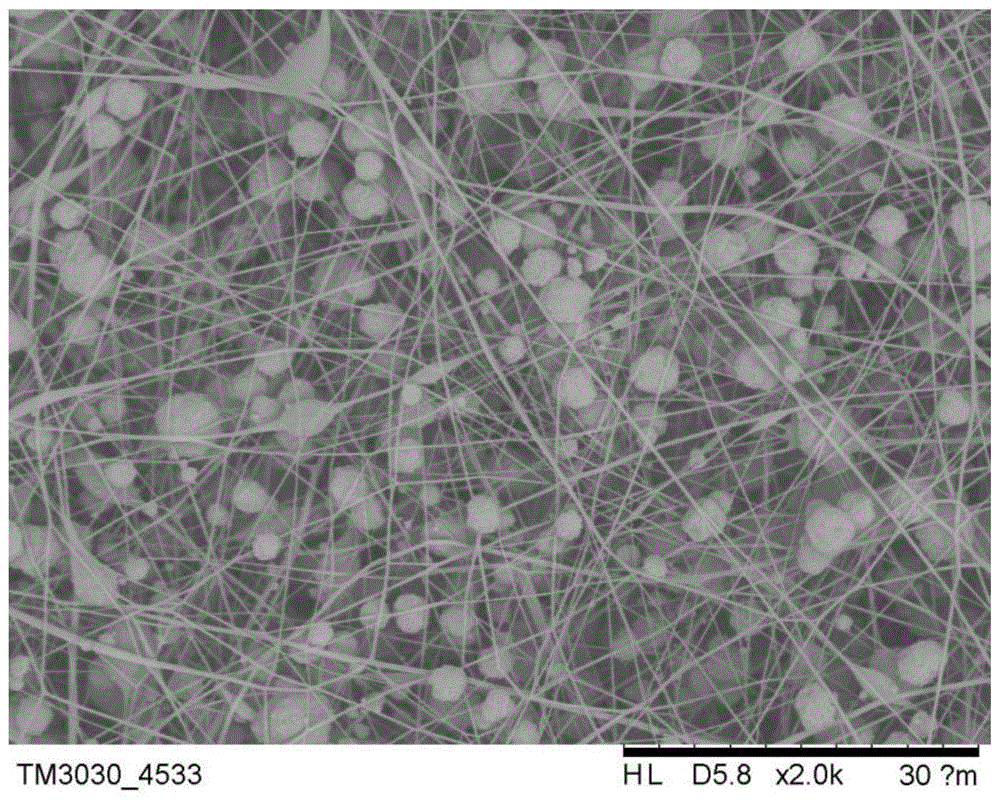
Fig. 1 is a scanning electron microscope image of the surface of a three-dimensional hydrophobic tubular nanofiber membrane prepared in the present embodiment, and fig. 2 is a scanning electron microscope image of a cross section thereof, from which it can be seen that the membrane surface is a porous structure in which three-dimensional microspheres and two-dimensional nanofibers are interwoven, and the cross section is a porous structure in which the three-dimensional microspheres are uniformly filled; under the test condition of gravity only, the porosity of the three-dimensional hydrophobic tubular nanofiber membrane prepared by the embodiment is 63.81%, the average pore diameter is 2.231 microns, the static water contact angle is 145.5 degrees, the water contact angle under diesel oil is 154.3 degrees, the diesel oil contact angle is 0 degree, the membrane surface roughness is 2.166 microns, the thermal decomposition temperature is 270.4 ℃, the membrane has good hydrophobicity and lipophilicity, the separation efficiency on diesel oil emulsion is more than 95%, and the separation efficiency after the diesel oil emulsion is repeated for 5 times is still higher than 95%. The separation efficiency of the kerosene emulsion after continuous 36-hour use is still more than 95 percent.
Example 2
1) The first casting solution comprises the following components in percentage by mass: 13% of polyvinyl chloride, 52.2% of N, N-dimethylformamide, 34.8% of tetrahydrofuran (the formulation is the same as in example 1); the formula of the second component is as follows: 2% of SiO258.8% of N, N-dimethylformamide and 39.2% of tetrahydrofuran.
The first casting solution preparation step is as follows: adding polyvinyl chloride into a mixed solvent (3:2) of N, N-dimethylformamide and tetrahydrofuran, and stirring for dissolving at 40 ℃ for 3 hours to obtain a uniform membrane casting solution;
the second casting solution preparation step is as follows: mixing SiO2(40nm), adding a mixed solvent (3:2) of N, N-dimethylformamide and tetrahydrofuran, mechanically stirring for 0.5h, and then stirring and dissolving at the temperature of 40 ℃ for 3h to obtain a uniform membrane casting solution;
2) standing and defoaming the casting solution obtained in the step 1) at room temperature;
3) the temperature and humidity controller of the electrostatic spinning machine is opened, the temperature is controlled at 25.8 ℃, and the humidity is controlled at 50%.
Sleeving the polyester braided tube on a rolling shaft, and setting relevant parameters of electrostatic spinning. Pouring the defoamed membrane casting solution obtained in the step 2) into two 20mL syringes (the inner diameter of a needle is 0.60mm) respectively; spinning is carried out under the conditions of positive voltage of 16KV, negative voltage of 6KV, feeding speed of 1.5mL/h and rotating speed of a receiver of 1300 rpm. The included angle of the spinning needle head of the first membrane casting liquid vertical to the receiver in the vertical direction is 45 degrees and is 15cm away, and the included angle of the spinning needle head of the first membrane casting liquid vertical to the receiver in the vertical direction is 75 degrees and is 10cm away. And spinning for 40min to obtain the nanofiber membrane.
Through measurement, the porosity of the three-dimensional hydrophobic tubular nanofiber membrane prepared by the embodiment is 54.54%, the average pore diameter is 1.904 mu m, the static water contact angle is 140.0 degrees, the diesel oil contact angle is 0 degree, the surface roughness of the membrane is 1.970 mu m, the thermal decomposition temperature is 274.7 ℃, and the membrane has good hydrophobicity and lipophilicity.
Example 3
1) The first casting solution comprises the following components in percentage by mass: 15% of polyvinylidene fluoride, 0.05% of anhydrous lithium chloride, 42.5% of N, N-dimethylacetamide and 42.5% of acetone; the formula of the second casting solution is as follows: 60% by weight of a polytetrafluoroethylene emulsion (aqueous solution).
The first casting solution preparation step is as follows: adding polyvinylidene fluoride and anhydrous lithium chloride into a mixed solvent (1:1) of N, N-dimethylacetamide and acetone, stirring and dissolving at 40 ℃ for 3 hours to obtain a uniform casting solution;
2) standing and defoaming the casting solution obtained in the step 1) at room temperature;
3) the temperature and humidity controller of the electrostatic spinning machine is opened, the temperature is controlled at 30 ℃, and the humidity is controlled at 60%.
Sleeving the polyester braided tube on a rolling shaft, and setting relevant parameters of electrostatic spinning. The two components were poured into 20mL two syringes (0.51 mm needle inside diameter) respectively; spinning is carried out under the conditions of positive voltage of 20KV, negative voltage of 5KV, feeding speed of 1.0mL/h and rotating speed of a receiver of 1300 rpm. The included angle of the spinning needle heads of the first membrane casting solution, which is vertical to the receiver, is 30 degrees and is 14cm away from the receiver, and the included angle of the spinning needle heads of the second membrane casting solution, which is vertical to the receiver, is 75 degrees and is 12cm away from the receiver. And spinning for 60min to obtain the nanofiber membrane.
Through determination, the porosity of the three-dimensional hydrophobic tubular nanofiber membrane prepared in the embodiment is 60.67%, the average pore diameter is 1.951 microns, the surface roughness of the membrane is 2.089 microns, the static water contact angle is 134.8 degrees, the diesel oil contact angle is 0 degree, and the membrane shows good hydrophobic and oleophilic performances.
Example 4
1) The first casting solution comprises the following components in percentage by mass: 15% polyvinylidene fluoride, 0.05% anhydrous lithium chloride, 42.5% N, N-dimethylacetamide, 42.5% acetone (1: 1); the formula of the second casting solution is as follows: 40% by weight of a polytetrafluoroethylene emulsion (aqueous solution).
The first casting solution preparation step is as follows: adding polyvinylidene fluoride and anhydrous lithium chloride into a mixed solvent (1:1) of N, N-dimethylacetamide and acetone, stirring and dissolving at 40 ℃ for 3 hours to obtain a uniform casting solution;
2) standing and defoaming the casting solution obtained in the step 1) at room temperature;
3) the temperature and humidity controller of the electrostatic spinning machine is opened, the temperature is controlled at 30 ℃, and the humidity is controlled at 60%.
Sleeving the polyester braided tube on a rolling shaft, and setting relevant parameters of electrostatic spinning. The two components were poured into 20mL two syringes (0.51 mm needle inside diameter) respectively; spinning is carried out under the conditions of positive voltage of 20KV, negative voltage of 5KV, feeding speed of 1.0mL/h and receiver rotating speed of 1200 rpm. The included angle of the spinning needle heads of the first membrane casting solution, which is vertical to the receiver, is 30 degrees and is 14cm away from the receiver, and the included angle of the spinning needle heads of the second membrane casting solution, which is vertical to the receiver, is 75 degrees and is 12cm away from the receiver. Spinning for 120min to obtain the nanofiber membrane
Fig. 3 is a scanning electron microscope image of the surface of the three-dimensional hydrophobic tubular nanofiber membrane prepared in the present embodiment, and it can be known from the image that the membrane surface is a porous structure in which three-dimensional microspheres and two-dimensional nanofibers are interwoven, the average pore size of the three-dimensional hydrophobic tubular nanofiber membrane prepared in the present embodiment is 2.862 μm, the static water contact angle is 137.1 °, the diesel oil contact angle is 0 °, and the three-dimensional hydrophobic tubular nanofiber membrane has superhydrophobicity under oil, the membrane shows good hydrophobic and oleophilic properties, the separation efficiency for diesel oil emulsion reaches more than 95%, and the separation efficiency for diesel oil emulsion repeating five times is still higher than 95%.
Example 5
1) The first casting solution comprises the following components in percentage by mass: 15% polyvinylidene fluoride, 0.05% anhydrous lithium chloride, 42.5% N, N-dimethylacetamide, 42.5% acetone (1: 1); the formula of the second casting solution is as follows: 20% by weight of a polytetrafluoroethylene emulsion (aqueous solution).
The first casting solution preparation step is as follows: adding polyvinylidene fluoride and anhydrous lithium chloride into a mixed solvent (1:1) of N, N-dimethylacetamide and acetone, stirring and dissolving at 40 ℃ for 3 hours to obtain a uniform casting solution;
2) standing and defoaming the casting solution obtained in the step 1) at room temperature;
3) the temperature and humidity controller of the electrostatic spinning machine is opened, the temperature is controlled at 30 ℃, and the humidity is controlled at 60%.
Sleeving the polyester braided tube on a rolling shaft, and setting relevant parameters of electrostatic spinning. The two components were poured into 20mL two syringes (0.51 mm needle inside diameter) respectively; spinning is carried out under the conditions of positive voltage of 20KV, negative voltage of 5KV, feeding speed of 1.0mL/h and receiver rotating speed of 1200 rpm. The included angle of the spinning needle heads of the first membrane casting solution, which is vertical to the receiver, is 30 degrees and is 14cm away from the receiver, and the included angle of the spinning needle heads of the second membrane casting solution, which is vertical to the receiver, is 75 degrees and is 12cm away from the receiver. Spinning for 60min to obtain the nanofiber membrane
Through determination, the average pore diameter of the three-dimensional hydrophobic tubular nanofiber membrane prepared by the embodiment is 3.960 microns, the porosity is 56.41%, the static water contact angle is 131.7 degrees, the diesel oil contact angle is 0 degree, and the membrane shows good hydrophobic and oleophilic performances.
The invention adopts a double-needle double-component electrostatic spinning mode to obtain the membrane with the three-dimensional microsphere hydrophobic tubular structure in one step. The tubular nanofiber membrane prepared by the method has the advantages of high porosity, high mechanical strength and good thermal stability. Due to the hydrophobicity of the polymer matrix and the constructed multilevel structure, the prepared nanofiber membrane has good lipophilicity and hydrophobicity. In addition, the two-dimensional nano-fibers and the three-dimensional microspheres are interwoven into a three-dimensional structure, so that the water-in-oil emulsion with stable surfactant has good separation performance. The separation efficiency can reach 95% only under the driving of gravity. The excellent separation efficiency over long periods of time indicates better stable hydrophobicity.