Disclosure of Invention
An object of the embodiments of the present application is to provide a speech recognition method, which can reduce search dimensionality of a decoding network, improve search speed of the decoding network, and further improve speed of speech recognition.
In order to solve the above technical problem, an embodiment of the present application provides a speech recognition method, which adopts the following technical solutions:
the method comprises the following steps:
acquiring voice information to be recognized;
inputting the voice information to be recognized into a local first word graph model for decoding search to obtain a first search result, wherein the first search result comprises a first path and a corresponding first path score, and the first word graph model comprises an acoustic model, a pronunciation dictionary and a first word graph space;
inputting the first search result into a local second word graph model for searching to obtain a second search result, wherein the second search result comprises a second path and a corresponding second path score, the second word graph model comprises a second word graph space, and the first word graph space is a sub-word graph space of the second word graph space;
and selecting a corresponding second path for outputting according to the second path score in the second search result to obtain a voice recognition result.
Further, the first vocabulary model is at least one locally configured, the first vocabulary model is correspondingly provided with context attributes, and before the speech information to be recognized is input into the local first vocabulary model for decoding and searching, the method further includes:
acquiring current context information of a user;
and selecting a corresponding first word graph model according to the current context information of the user to perform decoding search on the voice information.
Further, the first search result includes a path result corresponding to at least one first path, and the method further includes the following steps:
obtaining a path result of a first path and a corresponding first path score through decoding search;
and sequentially selecting m path results from the n path results from high to low according to the first path score to output to obtain a first search result, wherein m is less than or equal to n.
Further, the construction of the first word graph model comprises the following steps:
extracting a word graph unit from a second word graph space which is constructed in advance, and constructing a first word graph space according to the word graph unit;
and constructing the first word diagram model according to the acoustic model, the pronunciation dictionary and the first word diagram space.
Further, the construction of the first word graph model further comprises the following steps:
and training the first word diagram model until a loss function is fitted to obtain the weight of the word diagram unit in the first word diagram space.
Further, the specific step of inputting the first search result into the local second word graph model for searching includes:
extracting word graph units in the first search result;
and inputting the word graph unit in the first search result into a second word graph model for searching.
Further, the step of selecting a corresponding second path for output according to the second path score to obtain a speech recognition result specifically includes:
sorting the second paths according to the grades of the second paths;
and outputting the voice recognition results corresponding to the y second paths according to the sequence, wherein y is larger than or equal to 1.
In order to solve the above technical problem, an embodiment of the present application further provides a speech recognition apparatus, including:
the acquisition module is used for acquiring the voice information to be recognized;
the first search module is used for inputting the voice information to be recognized into a local first word graph model for decoding search to obtain a first search result, wherein the first search result comprises a first path and a corresponding first path score, and the first word graph model comprises an acoustic model, a pronunciation dictionary and a first word graph space;
the second search module is used for inputting the first search result into a local second word graph model for searching to obtain a second search result, wherein the second search result comprises a second path and a corresponding second path score, the second word graph model comprises a second word graph space, and the first word graph space is a sub-word graph space of the second word graph space;
and the output module is used for selecting the corresponding second path according to the second path score to output so as to obtain a voice recognition result.
In order to solve the above technical problem, an embodiment of the present application further provides a computer device, which adopts the following technical solutions:
the computer device comprises a memory and a processor, wherein the memory stores a computer program, and the processor realizes the steps of a voice recognition method provided by any one of the embodiments when executing the computer program.
In order to solve the above technical problem, an embodiment of the present application further provides a computer-readable storage medium, which adopts the following technical solutions:
the computer-readable storage medium has stored thereon a computer program which, when executed by a processor, implements the steps of a speech recognition method as set forth in any one of the embodiments of the present application.
Compared with the prior art, the embodiment of the application mainly has the following beneficial effects: acquiring voice information to be recognized; inputting the voice information to be recognized into a local first word graph model for decoding search to obtain a first search result, wherein the first search result comprises a first path and a corresponding first path score, and the first word graph model comprises an acoustic model, a pronunciation dictionary and a first word graph space; inputting the first search result into a local second word graph model for searching to obtain a second search result, wherein the second search result comprises a second path and a corresponding second path score, the second word graph model comprises a second word graph space, and the first word graph space is a sub-word graph space of the second word graph space; and selecting the corresponding second path according to the second path score to output to obtain a voice recognition result. The voice information to be recognized is input into a small word graph model for acoustic decoding and searching, and then the search result is directly input into a larger word graph model for searching, so that the secondary search process does not need to perform acoustic decoding, the search dimensionality is lowered, the word graph search amount is effectively reduced, the search time is shortened, and the voice recognition speed is improved.
Detailed Description
Unless defined otherwise, all technical and scientific terms used herein have the same meaning as commonly understood by one of ordinary skill in the art to which this application belongs; the terminology used in the description of the application herein is for the purpose of describing particular embodiments only and is not intended to be limiting of the application; the terms "including" and "having," and any variations thereof, in the description and claims of this application and the description of the above figures are intended to cover non-exclusive inclusions. The terms "first," "second," and the like in the description and claims of this application or in the above-described drawings are used for distinguishing between different objects and not for describing a particular order.
Reference herein to "an embodiment" means that a particular feature, structure, or characteristic described in connection with the embodiment can be included in at least one embodiment of the application. The appearances of the phrase in various places in the specification are not necessarily all referring to the same embodiment, nor are separate or alternative embodiments mutually exclusive of other embodiments. It is explicitly and implicitly understood by one skilled in the art that the embodiments described herein can be combined with other embodiments.
In order to make the technical solutions better understood by those skilled in the art, the technical solutions in the embodiments of the present application will be clearly and completely described below with reference to the accompanying drawings.
As shown in fig. 1, the system architecture 100 may include terminal devices 101, 102, 103, a network 104, and a server 105. The network 104 serves as a medium for providing communication links between the terminal devices 101, 102, 103 and the server 105. Network 104 may include various connection types, such as wired, wireless communication links, or fiber optic cables, to name a few.
The user may use the terminal devices 101, 102, 103 to interact with the server 105 via the network 104 to receive or send messages or the like. The terminal devices 101, 102, 103 may have various communication client applications installed thereon, such as a web browser application, a shopping application, a search application, an instant messaging tool, a mailbox client, social platform software, and the like.
The terminal devices 101, 102, 103 may be various electronic devices having a display screen and supporting web browsing, including but not limited to smart phones, tablet computers, e-book readers, MP3 players (Moving picture experts Group Audio Layer III, mpeg compression standard Audio Layer 3), MP4 players (Moving picture experts Group Audio Layer IV, mpeg compression standard Audio Layer 4), laptop portable computers, desktop computers, and the like.
The server 105 may be a server providing various services, such as a background server providing support for pages displayed on the terminal devices 101, 102, 103.
It should be noted that, a speech recognition method provided in the embodiments of the present application is generally executed by a terminal device, and accordingly, a speech recognition apparatus is generally disposed in the terminal device.
It should be understood that the number of terminal devices, networks, and servers in fig. 1 is merely illustrative, and that there may be any number of terminal devices, networks, and servers, as desired for an implementation.
With continuing reference to FIG. 2, a flow diagram of one embodiment of a speech recognition method according to the present application is shown. The voice recognition method comprises the following steps:
step 201, obtaining voice information to be recognized.
In this embodiment, an electronic device (for example, the terminal device shown in fig. 1) on which a speech recognition method operates may acquire speech information to be recognized through a wired connection manner or a wireless connection manner. It should be noted that the Wireless connection means may include, but is not limited to, a 3G/4G connection, a WiFi (Wireless-Fidelity) connection, a bluetooth connection, a wimax (worldwide Interoperability for Microwave access) connection, a Zigbee connection, a uwb (ultra wideband) connection, and other Wireless connection means now known or developed in the future.
The voice information to be recognized may be collected through a microphone, which may be set in an external form, or may be a microphone built in the device, for example, a microphone set in a recording pen, a mobile phone, a tablet, an MP4, a notebook, or the like. Or, the voice information to be recognized may also be obtained by uploading by the user, for example, storing the collected voice in the storage device, and obtaining the corresponding voice information by reading the data in the storage device. Or, the voice information to be recognized may also be voice information of an opposite party acquired when the user communicates through social software.
In one possible implementation, the speech information to be recognized may also be domain-converted speech information, for example, speech information that has been converted into the frequency domain by the time domain.
The voice information may also be referred to as a voice signal or voice data.
Step 202, inputting the voice information to be recognized into a local first word graph model for decoding search, and obtaining a first search result, where the first search result includes a first path and a corresponding first path score, and the first word graph model includes an acoustic model, a pronunciation dictionary, and a first word graph space.
The local environment may be an offline environment in the Linux system, an offline speech tool in another scene may also be configured in the offline environment, the speech information to be recognized is the speech information to be recognized obtained in step 201, the first vocabulary model is a local vocabulary model, the first vocabulary model is configured locally, and the speech information may be decoded without a network, so that the speech recognition speed is increased. The first vocabulary model may be a wfst-based vocabulary model, and the first vocabulary model includes an acoustic model, a pronunciation dictionary, and a first vocabulary space, where the acoustic model may perform acoustic decoding on the user speech information to decode the speech information to form phoneme units, the pronunciation dictionary is used to combine the phoneme units to form phoneme words, and the first vocabulary space has phoneme words connected into paths to form language units. And decoding and searching the speech information to be recognized through the first word graph model, wherein the first search result is a search result obtained in the first word graph space, the first search result comprises a plurality of first paths, each path comprises a corresponding path score, the path score is used for indicating the credibility of the path, and the higher the score is, the more credible the path is.
The path is a connection and a connection weight of each phoneme word, for example:
today (weight 0.9) weather (weight 0.8) how (0.9), the path score is the product of all weights, 0.9 x 0.8 x 0.9 ═ 0.648
The recent day (weight 0.3) weather (weight 0.2) how (weight 0.8) the path score is the product of all weights, 0.3 x 0.2 x 0.8 ═ 0.048.
The weight is obtained by training the first vocabulary model, and the corpus may be a corpus published on the internet, such as all corpora from the national journal of people's daily record in the year 2000 to the year 2012.
Step 203, inputting the first search result into a local second word graph model for searching, so as to obtain a second search result, where the second search result includes a second path and a corresponding second path score, the second word graph model includes a second word graph space, and the first word graph space is a sub-word graph space of the second word graph space.
In this embodiment, the first search result may be the first search result in step 202, or may be an nbest result. It should be noted that the acoustic model and the dictionary are not configured in the second word-diagram model, the first search result of the first word-diagram model is used as input, the acoustic decoding process can be omitted, the second word-diagram model can be a local word-diagram model, the second word-diagram model is configured locally, and the speech information can be recognized without a network, so that the speech recognition speed is increased. The second vocabulary model may be a wfst-based vocabulary model, a second vocabulary space in the second vocabulary model may be a static vocabulary space, the static vocabulary space represents a trained vocabulary space with unchanged phoneme word weights, the first search result is searched through a static vocabulary network, the second search result is a search result obtained in the second vocabulary model, the second search result includes a plurality of second paths, each path includes a corresponding path score, the path score is used for representing the credibility of the path, and the higher the score is, the more credible the path is. The path score is the product of the phoneme word weights in the path, and the phoneme word weights can be obtained by training the second word diagram model until a loss function is fitted.
Optionally, the second word diagram space in the second word diagram model may be obtained by a user through sorting, that is, the second word diagram space in the second word diagram model may be smaller than that in a conventional word diagram network, so as to reduce complexity of the word diagram network, thereby improving a decoding search speed and improving a decoding real-time rate.
And 204, selecting a corresponding second path according to the second path score in the second search result to output, so as to obtain a voice recognition result.
In this embodiment, the second path includes a complete sentence composed of phoneme words and a corresponding path score, where the path score is used to represent the credibility of the sentence, and the higher the path score is, the higher the credibility of the sentence as the real content of the speech information is. And selecting the complete sentence corresponding to the second path with the highest path score for outputting, thereby obtaining a voice recognition result. In addition, a plurality of complete sentences corresponding to the second paths with higher path scores can be selected for output, so that a plurality of voice recognition results can be obtained for output, and a user can select from the plurality of voice recognition results.
In the embodiment, voice information to be recognized is acquired; inputting the voice information to be recognized into a local first word graph model for decoding search to obtain a first search result, wherein the first search result comprises a first path and a corresponding first path score, and the first word graph model comprises an acoustic model, a pronunciation dictionary and a first word graph space; inputting the first search result into a local second word graph model for searching to obtain a second search result, wherein the second search result comprises a second path and a corresponding second path score, the second word graph model comprises a second word graph space, and the first word graph space is a sub-word graph space of the second word graph space; and selecting the corresponding second path according to the second path score to output to obtain a voice recognition result. The voice information to be recognized is input into a small word graph model for acoustic decoding and searching, and then the search result is directly input into a larger word graph model for searching, so that the secondary search process does not need to perform acoustic decoding, the search dimensionality is lowered, the word graph search amount is effectively reduced, the search time is shortened, and the voice recognition speed is improved.
Further, as shown in fig. 3, before step 202, the speech recognition method further includes:
in step 301, the current context information of the user is obtained.
The current context information may be determined according to time, for example, from 9 o 'clock to 17 o' clock, the context may be determined as a working context, from weekly non-periodic clock, the context may be determined as a vacation context, and from 22 o 'clock to 8 o' clock, the context may be determined as a rest context. The determination can also be performed according to the acquisition of the speech to be recognized, for example, the speech to be recognized is acquired by a WeChat friend, and then can be determined as a friend chat context, and the speech to be recognized is acquired by a user who is noted as a client in WeChat or other social software, and then can be determined as a work context. In a possible implementation, the context of the user can also be automatically determined by the user, and the obtained context information is more accurate by selecting the context by the user.
Step 302, selecting a corresponding first word graph model according to the current context information of the user to perform decoding search on the voice information.
In this embodiment, the first word graph models may be first word graph models having context attributes, each of the first word graph models corresponds to one or more context attributes, and the corresponding first word graph models may be matched by the context information acquired in step 301. By matching the context information with the corresponding first word diagram model, the result obtained by the first word diagram model can be more fit with the context, and the accuracy is improved.
Further, as shown in fig. 4, the step of inputting the speech information to be recognized into a local first word graph model for decoding and searching to obtain a first search result, where the first search result is a path result of at least one path, specifically includes:
step 401, obtaining a path result of the first path and a corresponding first path score through decoding search.
And 402, sequentially selecting m path results from the n path results from high to low according to the first path score, and outputting the m path results to obtain a first search result, wherein m is less than or equal to n.
In this embodiment, by performing decoding search on the voice information in the first word graph model, scores of the search results (first paths) under the first word graph model may be obtained, that is, scores of at least one first path are obtained, specifically, n scores are provided for n search results (first paths), and nbest results sorted according to the scores are obtained as the first search results.
For example: searching the speech information to be recognized in the first word graph model for 'how much the weather is today', so that 200 nbest decoding results can be given after the first word graph model is decoded:
how much the weather is today
How much the weather is
How to fill today
…
Assume a total of 200 nbest results;
200 nbest (200best) results are obtained through the first vocabulary model, and 100 or all 200 nbest results can be selected as the first search result. In this case, n is 200 and m is 100.
In one possible implementation, the first search result may be ranked according to an nbest score, i.e., the search result corresponding to the highest first path score is ranked in front.
In this embodiment, the input amount of the second word diagram model can be reduced by taking m first search results in the nbest result as the input of the second word diagram model.
Further, as shown in fig. 5, the constructing of the first vocabulary model includes the following steps:
step 501, extracting word graph units from a second word graph space which is constructed in advance, and constructing a first word graph space according to the word graph units.
Step 502, constructing the first word graph model according to the acoustic model, the pronunciation dictionary and the first word graph space.
The second word diagram space in the second word diagram model may be configured by a local dictionary, or may be a word diagram space downloaded to the local in advance. The word graph units may include language units and corresponding weights, and the language units may be understood as phonemic words in the first search result. In one possible implementation, a word graph unit may also be understood as a word graph path. Specifically, the first word graph space with different contexts constructed by the word graph units with the context attributes in the second word graph space can be extracted according to the context attributes in the second word graph, so that the range of the voice information to be searched and decoded in the first word graph model is reduced, and the speed of the first word graph model for decoding the voice information is increased. The above steps may be understood as pruning the second word graph space to obtain the first word graph space. It should be understood that the number of the first word graph models can be one or more.
In addition, in another possible implementation manner, the first word graph space may be subjected to branching increase, and word graph units with similar context attributes are added, so that the first word graph space is expanded into the second word graph space.
In addition, the weights of the language units in the first vocabulary space obtained after pruning may change with model training, and the weights of the same language units are different between the first vocabulary space and the second vocabulary space. Similarly, the weight of each linguistic unit in the second word graph space obtained after the branching is different from the weight of the same linguistic unit in the first word graph space. That is, the same path is searched between the first word graph model and the second word graph model, and the obtained path scores are different. Such as:
in the first word graph model, how today (weight 0.9) weather (weight 0.8) is (0.9), the path score is the product of all weights, 0.9 x 0.8 x 0.9 ═ 0.648
In the second word graph model, how (0.99) is today (weight 0.99) weather (weight 0.98), the path score is the product of all weights, 0.9 × 0.8 × 0.9 ═ 0.960498.
In this embodiment, the word graph units with the same attribute in the second word graph space are extracted to construct the first word graph space, so that misidentification caused by mismatching of the first search result and the second word graph model can be avoided.
Further, as shown in fig. 6, the constructing of the first vocabulary model further includes the following steps:
step 601, training the first word diagram model until a loss function is fitted to obtain the weight of the word diagram unit in the first word diagram space.
When the word graph units are language units, the language units for constructing the first word graph model can be combined according to the word graph combination relation in the second word graph model, and the weight among the language units can be adjusted by training the first word graph model. And obtaining a new word diagram space as the word diagram space of the first word diagram model. When the word graph unit is the second path, the scoring result of the first word graph path can be adjusted by training the first word graph model.
In this embodiment, when the first word graph space is constructed by extracting the word graph units in the second word graph space, the recognition accuracy of the first word graph model can be improved by training the first word graph model, and in addition, the first word graph model is not influenced by the second word graph space.
Further, as shown in fig. 7, step 203 specifically includes:
step 701, extracting word graph units in the first search result.
Step 702, inputting the word graph units in the first search result into the second word graph model for searching.
In this embodiment, when the word graph unit is a language unit, the language unit may be input into the second word graph model for searching, so as to obtain a second word graph path corresponding to the word graph unit in the second word graph model and a corresponding path score. When the word graph unit is the first word graph path, the first word graph path is decomposed in the second word graph model to obtain a language unit, and then the language unit is subjected to path search in the second word graph space to obtain a second word graph path and a corresponding path score. In addition, when the word graph unit is a first word graph path, the first word graph paths are input into the second word graph model and are matched with a second word graph path in a second word graph space of the second word graph model, and as the same path in the first word graph space and the second word graph space may have different path scores, the wide area verification is performed on the first search result in the second word graph space, so that the precision of the voice recognition result is ensured.
In the embodiment, the first search result is searched in the second word graph space in the form of a word graph unit, acoustic decoding is not needed to be performed on the speech information to be recognized, the search dimension is reduced, and the speech recognition speed is increased.
Further, as shown in fig. 8, the step 204 specifically includes:
step 801, sorting the second path according to the level of the second path score.
And step 802, outputting the voice recognition results corresponding to the y second paths according to the sequence, wherein y is greater than or equal to 1.
Where the second path with the higher score may be ranked first and the second path with the lower score may be ranked later. Therefore, the complete sentences corresponding to the second word and graph paths selected to be output are visual, for example, when only one complete sentence is selected to be output, the complete sentence corresponding to the first second word and graph path can be extracted to be output, and when a plurality of complete sentences are selected to be output, the complete sentences can be extracted to be output, so that the output result can be selected by the user.
In this embodiment, the second path is output after being sorted, and the output speech recognition result can be more convenient and intuitive according to the sorted and output complete sentence.
It will be understood by those skilled in the art that all or part of the processes of the methods of the embodiments described above can be implemented by a computer program, which can be stored in a computer-readable storage medium, and can include the processes of the embodiments of the methods described above when the computer program is executed. The storage medium may be a non-volatile storage medium such as a magnetic disk, an optical disk, a Read-Only Memory (ROM), or a Random Access Memory (RAM).
It should be understood that, although the steps in the flowcharts of the figures are shown in order as indicated by the arrows, the steps are not necessarily performed in order as indicated by the arrows. The steps are not performed in the exact order shown and may be performed in other orders unless explicitly stated herein. Moreover, at least a portion of the steps in the flow chart of the figure may include multiple sub-steps or multiple stages, which are not necessarily performed at the same time, but may be performed at different times, which are not necessarily performed in sequence, but may be performed alternately or alternately with other steps or at least a portion of the sub-steps or stages of other steps.
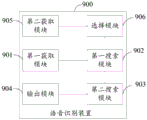
With further reference to fig. 9, as an implementation of the method shown in fig. 2, the present application provides an embodiment of a speech recognition apparatus, which corresponds to the embodiment of the method shown in fig. 2, and which can be applied in various electronic devices.
As shown in fig. 9, a speech recognition apparatus 900 of the present embodiment includes: a first obtaining module 901, a first searching module 902, a second searching module 903, and an output module 904. Wherein:
a first obtaining module 901, configured to obtain voice information to be recognized;
a first search module 902, configured to input the voice information to be recognized into a local first word graph model for decoding search, so as to obtain a first search result, where the first search result includes a first path and a corresponding first path score, and the first word graph model includes an acoustic model, a pronunciation dictionary, and a first word graph space;
a second search module 903, configured to input the first search result into a local second word graph model for search, so as to obtain a second search result, where the second search result includes a second path and a corresponding second path score, where the second word graph model includes a second word graph space, and the first word graph space is a sub-word graph space of the second word graph space;
and the output module 904 is configured to select a corresponding second path according to the second path score to output, so as to obtain a voice recognition result.
Further, referring to fig. 10, the first word diagram model is at least one first word diagram model configured locally, and the speech recognition apparatus 900 further includes: a second acquisition module 905 and a selection module 906.
Wherein,
a second obtaining module 905, configured to obtain current context information of the user;
and a selecting module 906, configured to select a corresponding first word graph model according to the current context information of the user to perform decoding search on the speech information.
Further, referring to fig. 11, the first search result is a path result of at least one path, and the first search module 902 includes: decoding search section 9021 and output section 9022. Wherein,
a decoding search unit 9021, configured to obtain a path result of the first path and a corresponding first path score through decoding search;
and the first output unit 9022 is configured to sequentially select m path results of the n path results from high to low according to the first path score and output the m path results to obtain a first search result, where m is less than or equal to n.
Further, referring to fig. 12, the speech recognition apparatus 900 further includes a first vocabulary model constructing module 907, where the first vocabulary model constructing module 907 includes; a first extraction unit 9071 and a construction unit 9072. Wherein:
a first extraction unit 9071, configured to extract a word graph unit from a second word graph space that is constructed in advance, and construct a first word graph space according to the word graph unit;
the constructing unit 9072 is configured to construct the first word diagram model according to the acoustic model, the pronunciation dictionary, and the first word diagram space.
Further, referring to fig. 13, the first word graph model building module 907 further includes a training unit 9073. Wherein:
and the training unit 9073 is used for training the first word diagram model until a loss function is fitted, so that the weight of the word diagram unit in the first word diagram space is obtained.
Further, referring to fig. 14, the second search module 903 includes: a second extraction unit 9031, and an input unit 9032. Wherein:
a second extraction unit 9031, configured to extract a word graph unit in the first search result;
and the input unit 9032 is configured to input the word graph unit in the first search result into the second word graph model for searching.
Further, referring to fig. 15, the output module 904 includes: a sorting unit 9041 and a second output unit 9042. Wherein:
a sorting unit 9041, configured to sort the second path according to the level of the second path score;
and a second output unit 9042, configured to output, in order, the speech recognition results corresponding to y second paths, where y is greater than or equal to 1.
The speech recognition device provided in the embodiment of the present application can implement each implementation manner in the method embodiments of fig. 2 to fig. 8, and has corresponding beneficial effects, which are not described herein again to avoid repetition.
In order to solve the technical problem, an embodiment of the present application further provides a computer device. Referring to fig. 16, fig. 16 is a block diagram of a basic structure of a computer device according to the present embodiment.
The computer device 16 includes a memory 161, a processor 162, and a network interface 163 communicatively coupled to each other via a system bus. It is noted that only computer device 16 having components 161 and 163 is shown, but it is understood that not all of the illustrated components are required and that more or fewer components may alternatively be implemented. As will be understood by those skilled in the art, the computer device is a device capable of automatically performing numerical calculation and/or information processing according to a preset or stored instruction, and the hardware includes, but is not limited to, a microprocessor, an Application Specific Integrated Circuit (ASIC), a Programmable gate array (FPGA), a Digital Signal Processor (DSP), an embedded device, and the like.
The computer device may be a desktop computer, a notebook, a palm computer, a cloud server, or other computing devices. The computer equipment can carry out man-machine interaction with a user through a keyboard, a mouse, a remote controller, a touch panel or voice control equipment and the like.
The memory 161 includes at least one type of readable storage medium including a flash memory, a hard disk, a multimedia card, a card type memory (e.g., SD or DX memory, etc.), a Random Access Memory (RAM), a Static Random Access Memory (SRAM), a Read Only Memory (ROM), an Electrically Erasable Programmable Read Only Memory (EEPROM), a Programmable Read Only Memory (PROM), a magnetic memory, a magnetic disk, an optical disk, etc. In some embodiments, the storage 161 may be an internal storage unit of the computer device 16, such as a hard disk or a memory of the computer device 16. In other embodiments, the memory 161 may also be an external storage device of the computer device 16, such as a plug-in hard disk, a Smart Media Card (SMC), a Secure Digital (SD) Card, a Flash memory Card (Flash Card), etc. provided on the computer device 16. Of course, the memory 161 may also include both internal and external storage devices for the computer device 16. In this embodiment, the memory 161 is generally used for storing an operating system and various types of application software installed in the computer device 16, such as a program code of a speech recognition method. In addition, the memory 161 may also be used to temporarily store various types of data that have been output or are to be output.
Processor 162 may be a Central Processing Unit (CPU), controller, microcontroller, microprocessor, or other data Processing chip in some embodiments. The processor 162 generally serves to control the overall operation of the computer device 16. In this embodiment, the processor 162 is configured to execute program code stored in the memory 161 or to process data, such as program code for executing a speech recognition method.
The network interface 163 may include a wireless network interface or a wired network interface, and the network interface 163 is typically used to establish communication links between the computer device 16 and other electronic devices.
The present application further provides another embodiment, which is to provide a computer-readable storage medium storing a speech recognition program, the speech recognition program being executable by at least one processor to cause the at least one processor to perform the steps of a speech recognition method as described above.
Through the above description of the embodiments, those skilled in the art will clearly understand that the method of the above embodiments can be implemented by software plus a necessary general hardware platform, and certainly can also be implemented by hardware, but in many cases, the former is a better implementation manner. Based on such understanding, the technical solution of the present application may be substantially or partially embodied in the form of a software product, where the computer software product is stored in a storage medium (e.g., ROM/RAM, magnetic disk, optical disk), and includes instructions for enabling a terminal device (e.g., a mobile phone, a computer, a server, an air conditioner, or a network device) to execute a voice recognition method according to the embodiments of the present application.
It is to be understood that the above-described embodiments are merely illustrative of some, but not restrictive, of the broad invention, and that the appended drawings illustrate preferred embodiments of the invention and do not limit the scope of the invention. This application is capable of embodiments in many different forms and is provided for the purpose of enabling a thorough understanding of the disclosure of the application. Although the present application has been described in detail with reference to the foregoing embodiments, it will be apparent to one skilled in the art that the present application may be practiced without modification or with equivalents of some of the features described in the foregoing embodiments. All equivalent structures made by using the contents of the specification and the drawings of the present application are directly or indirectly applied to other related technical fields and are within the protection scope of the present application.