CN110678460A - Protease-activated contrast agents for in vivo imaging - Google Patents
Protease-activated contrast agents for in vivo imaging Download PDFInfo
- Publication number
- CN110678460A CN110678460A CN201880035357.XA CN201880035357A CN110678460A CN 110678460 A CN110678460 A CN 110678460A CN 201880035357 A CN201880035357 A CN 201880035357A CN 110678460 A CN110678460 A CN 110678460A
- Authority
- CN
- China
- Prior art keywords
- compound
- quencher
- alkyl
- group
- optionally substituted
- Prior art date
- Legal status (The legal status is an assumption and is not a legal conclusion. Google has not performed a legal analysis and makes no representation as to the accuracy of the status listed.)
- Pending
Links
Images


Classifications
-
- C—CHEMISTRY; METALLURGY
- C07—ORGANIC CHEMISTRY
- C07D—HETEROCYCLIC COMPOUNDS
- C07D403/00—Heterocyclic compounds containing two or more hetero rings, having nitrogen atoms as the only ring hetero atoms, not provided for by group C07D401/00
- C07D403/02—Heterocyclic compounds containing two or more hetero rings, having nitrogen atoms as the only ring hetero atoms, not provided for by group C07D401/00 containing two hetero rings
- C07D403/06—Heterocyclic compounds containing two or more hetero rings, having nitrogen atoms as the only ring hetero atoms, not provided for by group C07D401/00 containing two hetero rings linked by a carbon chain containing only aliphatic carbon atoms
-
- C—CHEMISTRY; METALLURGY
- C07—ORGANIC CHEMISTRY
- C07D—HETEROCYCLIC COMPOUNDS
- C07D403/00—Heterocyclic compounds containing two or more hetero rings, having nitrogen atoms as the only ring hetero atoms, not provided for by group C07D401/00
- C07D403/02—Heterocyclic compounds containing two or more hetero rings, having nitrogen atoms as the only ring hetero atoms, not provided for by group C07D401/00 containing two hetero rings
- C07D403/12—Heterocyclic compounds containing two or more hetero rings, having nitrogen atoms as the only ring hetero atoms, not provided for by group C07D401/00 containing two hetero rings linked by a chain containing hetero atoms as chain links
-
- A—HUMAN NECESSITIES
- A61—MEDICAL OR VETERINARY SCIENCE; HYGIENE
- A61K—PREPARATIONS FOR MEDICAL, DENTAL OR TOILETRY PURPOSES
- A61K49/00—Preparations for testing in vivo
- A61K49/001—Preparation for luminescence or biological staining
- A61K49/0013—Luminescence
- A61K49/0017—Fluorescence in vivo
- A61K49/0019—Fluorescence in vivo characterised by the fluorescent group, e.g. oligomeric, polymeric or dendritic molecules
- A61K49/0021—Fluorescence in vivo characterised by the fluorescent group, e.g. oligomeric, polymeric or dendritic molecules the fluorescent group being a small organic molecule
- A61K49/0032—Methine dyes, e.g. cyanine dyes
- A61K49/0034—Indocyanine green, i.e. ICG, cardiogreen
-
- A—HUMAN NECESSITIES
- A61—MEDICAL OR VETERINARY SCIENCE; HYGIENE
- A61K—PREPARATIONS FOR MEDICAL, DENTAL OR TOILETRY PURPOSES
- A61K49/00—Preparations for testing in vivo
- A61K49/001—Preparation for luminescence or biological staining
- A61K49/0013—Luminescence
- A61K49/0017—Fluorescence in vivo
- A61K49/005—Fluorescence in vivo characterised by the carrier molecule carrying the fluorescent agent
- A61K49/0052—Small organic molecules
-
- A—HUMAN NECESSITIES
- A61—MEDICAL OR VETERINARY SCIENCE; HYGIENE
- A61K—PREPARATIONS FOR MEDICAL, DENTAL OR TOILETRY PURPOSES
- A61K49/00—Preparations for testing in vivo
- A61K49/001—Preparation for luminescence or biological staining
- A61K49/0013—Luminescence
- A61K49/0017—Fluorescence in vivo
- A61K49/005—Fluorescence in vivo characterised by the carrier molecule carrying the fluorescent agent
- A61K49/0056—Peptides, proteins, polyamino acids
-
- A—HUMAN NECESSITIES
- A61—MEDICAL OR VETERINARY SCIENCE; HYGIENE
- A61K—PREPARATIONS FOR MEDICAL, DENTAL OR TOILETRY PURPOSES
- A61K49/00—Preparations for testing in vivo
- A61K49/001—Preparation for luminescence or biological staining
- A61K49/006—Biological staining of tissues in vivo, e.g. methylene blue or toluidine blue O administered in the buccal area to detect epithelial cancer cells, dyes used for delineating tissues during surgery
-
- C—CHEMISTRY; METALLURGY
- C07—ORGANIC CHEMISTRY
- C07D—HETEROCYCLIC COMPOUNDS
- C07D401/00—Heterocyclic compounds containing two or more hetero rings, having nitrogen atoms as the only ring hetero atoms, at least one ring being a six-membered ring with only one nitrogen atom
- C07D401/14—Heterocyclic compounds containing two or more hetero rings, having nitrogen atoms as the only ring hetero atoms, at least one ring being a six-membered ring with only one nitrogen atom containing three or more hetero rings
-
- C—CHEMISTRY; METALLURGY
- C07—ORGANIC CHEMISTRY
- C07D—HETEROCYCLIC COMPOUNDS
- C07D403/00—Heterocyclic compounds containing two or more hetero rings, having nitrogen atoms as the only ring hetero atoms, not provided for by group C07D401/00
- C07D403/14—Heterocyclic compounds containing two or more hetero rings, having nitrogen atoms as the only ring hetero atoms, not provided for by group C07D401/00 containing three or more hetero rings
-
- C—CHEMISTRY; METALLURGY
- C07—ORGANIC CHEMISTRY
- C07D—HETEROCYCLIC COMPOUNDS
- C07D405/00—Heterocyclic compounds containing both one or more hetero rings having oxygen atoms as the only ring hetero atoms, and one or more rings having nitrogen as the only ring hetero atom
- C07D405/14—Heterocyclic compounds containing both one or more hetero rings having oxygen atoms as the only ring hetero atoms, and one or more rings having nitrogen as the only ring hetero atom containing three or more hetero rings
-
- C—CHEMISTRY; METALLURGY
- C07—ORGANIC CHEMISTRY
- C07D—HETEROCYCLIC COMPOUNDS
- C07D471/00—Heterocyclic compounds containing nitrogen atoms as the only ring hetero atoms in the condensed system, at least one ring being a six-membered ring with one nitrogen atom, not provided for by groups C07D451/00 - C07D463/00
- C07D471/02—Heterocyclic compounds containing nitrogen atoms as the only ring hetero atoms in the condensed system, at least one ring being a six-membered ring with one nitrogen atom, not provided for by groups C07D451/00 - C07D463/00 in which the condensed system contains two hetero rings
- C07D471/04—Ortho-condensed systems
-
- C—CHEMISTRY; METALLURGY
- C07—ORGANIC CHEMISTRY
- C07K—PEPTIDES
- C07K5/00—Peptides containing up to four amino acids in a fully defined sequence; Derivatives thereof
- C07K5/04—Peptides containing up to four amino acids in a fully defined sequence; Derivatives thereof containing only normal peptide links
- C07K5/06—Dipeptides
- C07K5/06008—Dipeptides with the first amino acid being neutral
- C07K5/06078—Dipeptides with the first amino acid being neutral and aromatic or cycloaliphatic
-
- C—CHEMISTRY; METALLURGY
- C09—DYES; PAINTS; POLISHES; NATURAL RESINS; ADHESIVES; COMPOSITIONS NOT OTHERWISE PROVIDED FOR; APPLICATIONS OF MATERIALS NOT OTHERWISE PROVIDED FOR
- C09B—ORGANIC DYES OR CLOSELY-RELATED COMPOUNDS FOR PRODUCING DYES, e.g. PIGMENTS; MORDANTS; LAKES
- C09B23/00—Methine or polymethine dyes, e.g. cyanine dyes
- C09B23/0066—Methine or polymethine dyes, e.g. cyanine dyes the polymethine chain being part of a carbocyclic ring,(e.g. benzene, naphtalene, cyclohexene, cyclobutenene-quadratic acid)
-
- C—CHEMISTRY; METALLURGY
- C09—DYES; PAINTS; POLISHES; NATURAL RESINS; ADHESIVES; COMPOSITIONS NOT OTHERWISE PROVIDED FOR; APPLICATIONS OF MATERIALS NOT OTHERWISE PROVIDED FOR
- C09B—ORGANIC DYES OR CLOSELY-RELATED COMPOUNDS FOR PRODUCING DYES, e.g. PIGMENTS; MORDANTS; LAKES
- C09B23/00—Methine or polymethine dyes, e.g. cyanine dyes
- C09B23/02—Methine or polymethine dyes, e.g. cyanine dyes the polymethine chain containing an odd number of >CH- or >C[alkyl]- groups
- C09B23/08—Methine or polymethine dyes, e.g. cyanine dyes the polymethine chain containing an odd number of >CH- or >C[alkyl]- groups more than three >CH- groups, e.g. polycarbocyanines
- C09B23/086—Methine or polymethine dyes, e.g. cyanine dyes the polymethine chain containing an odd number of >CH- or >C[alkyl]- groups more than three >CH- groups, e.g. polycarbocyanines more than five >CH- groups
-
- G—PHYSICS
- G01—MEASURING; TESTING
- G01N—INVESTIGATING OR ANALYSING MATERIALS BY DETERMINING THEIR CHEMICAL OR PHYSICAL PROPERTIES
- G01N33/00—Investigating or analysing materials by specific methods not covered by groups G01N1/00 - G01N31/00
- G01N33/48—Biological material, e.g. blood, urine; Haemocytometers
- G01N33/50—Chemical analysis of biological material, e.g. blood, urine; Testing involving biospecific ligand binding methods; Immunological testing
- G01N33/53—Immunoassay; Biospecific binding assay; Materials therefor
- G01N33/531—Production of immunochemical test materials
- G01N33/532—Production of labelled immunochemicals
-
- G—PHYSICS
- G01—MEASURING; TESTING
- G01N—INVESTIGATING OR ANALYSING MATERIALS BY DETERMINING THEIR CHEMICAL OR PHYSICAL PROPERTIES
- G01N33/00—Investigating or analysing materials by specific methods not covered by groups G01N1/00 - G01N31/00
- G01N33/48—Biological material, e.g. blood, urine; Haemocytometers
- G01N33/50—Chemical analysis of biological material, e.g. blood, urine; Testing involving biospecific ligand binding methods; Immunological testing
- G01N33/58—Chemical analysis of biological material, e.g. blood, urine; Testing involving biospecific ligand binding methods; Immunological testing involving labelled substances
-
- G—PHYSICS
- G01—MEASURING; TESTING
- G01N—INVESTIGATING OR ANALYSING MATERIALS BY DETERMINING THEIR CHEMICAL OR PHYSICAL PROPERTIES
- G01N33/00—Investigating or analysing materials by specific methods not covered by groups G01N1/00 - G01N31/00
- G01N33/48—Biological material, e.g. blood, urine; Haemocytometers
- G01N33/50—Chemical analysis of biological material, e.g. blood, urine; Testing involving biospecific ligand binding methods; Immunological testing
- G01N33/58—Chemical analysis of biological material, e.g. blood, urine; Testing involving biospecific ligand binding methods; Immunological testing involving labelled substances
- G01N33/582—Chemical analysis of biological material, e.g. blood, urine; Testing involving biospecific ligand binding methods; Immunological testing involving labelled substances with fluorescent label
-
- A—HUMAN NECESSITIES
- A61—MEDICAL OR VETERINARY SCIENCE; HYGIENE
- A61K—PREPARATIONS FOR MEDICAL, DENTAL OR TOILETRY PURPOSES
- A61K2123/00—Preparations for testing in vivo
Landscapes
- Chemical & Material Sciences (AREA)
- Health & Medical Sciences (AREA)
- Organic Chemistry (AREA)
- Life Sciences & Earth Sciences (AREA)
- Engineering & Computer Science (AREA)
- Immunology (AREA)
- Biomedical Technology (AREA)
- Molecular Biology (AREA)
- General Health & Medical Sciences (AREA)
- Hematology (AREA)
- Urology & Nephrology (AREA)
- Medicinal Chemistry (AREA)
- Biochemistry (AREA)
- Physics & Mathematics (AREA)
- Cell Biology (AREA)
- Biotechnology (AREA)
- Pathology (AREA)
- General Physics & Mathematics (AREA)
- Analytical Chemistry (AREA)
- Food Science & Technology (AREA)
- Microbiology (AREA)
- Animal Behavior & Ethology (AREA)
- Veterinary Medicine (AREA)
- Public Health (AREA)
- Epidemiology (AREA)
- Proteomics, Peptides & Aminoacids (AREA)
- Genetics & Genomics (AREA)
- Biophysics (AREA)
- Biodiversity & Conservation Biology (AREA)
- Nuclear Medicine, Radiotherapy & Molecular Imaging (AREA)
- Optics & Photonics (AREA)
- Oncology (AREA)
- Medicines Containing Antibodies Or Antigens For Use As Internal Diagnostic Agents (AREA)
Abstract
本公开提供了在图像引导手术中用作造影剂的化合物。该化合物包含潜在的阳离子亲溶酶体片段,该阳离子亲溶酶体片段在通过溶酶体蛋白酶酶切时在待治疗的组织内、特别是在肿瘤和其他患病组织内是可检测的。本公开还提供了包含该化合物的组合物以及该化合物的使用方法,例如在图像引导的肿瘤切除手术期间动态监测体内蛋白酶活性。
The present disclosure provides compounds useful as contrast agents in image-guided surgery. The compounds comprise a potential cationic lysosomal fragment that, upon cleavage by lysosomal proteases, is detectable within the tissue being treated, particularly within tumors and other diseased tissues. The present disclosure also provides compositions comprising the compounds and methods of using the compounds, for example, to dynamically monitor protease activity in vivo during image-guided tumor resection surgery.
Description
交叉引用cross reference
本申请要求于2017年3月30日递交的美国临时申请No.62/478,639的权益,该公开的全部内容通过引用方式并入本文。This application claims the benefit of US Provisional Application No. 62/478,639, filed March 30, 2017, the disclosure of which is incorporated herein by reference in its entirety.
政府支持声明Statement of Government Support
本发明是在由国立卫生研究院(National Institutes of Health)授予的合同EB005011和HL116307下的政府支持中完成的。政府对本发明享有一定的权利。This invention was made with government support under contracts EB005011 and HL116307 awarded by the National Institutes of Health. The government has certain rights in the invention.
背景技术Background technique
手术介入是目前对几乎所有类型的实体瘤最常见的治疗方法。Siegel等人(2012)CA Cancer J.Clin.62:220-41;DeSantis等人(2014)CA Cancer J.Clin.64:252-71。因此,成功的结果取决于手术期间从受影响的主要器官以及从潜在的转移部位这两者中完全去除所有癌细胞。Vahrmeier等人(2013)Nat.Rev.Clin.Oncol.10:507-18。靶向癌症中的特异性生物标志物的造影剂可以用作手术中的造影剂以引导实体瘤的手术切除从而改善治疗结果。Miwa等人(2014)J.Orthop.Res.32:1596-601;Fujita(2012)J.Am.Coll.Surg.215:591。在各种成像模式中,利用荧光造影剂的基于光学的技术具有巨大潜力。Rudin和Weissleder(2003)Nat.Rev.Drug Discov.2:123-31;Bednar等人(2007)Expert Opin.DrugDiscov.2:65-85。所有吲哚菁绿(ICG)、荧光素、亚甲基蓝和5-氨基乙酰丙酸(5-ALA)均为非靶向性造影剂,目前上述非靶向性造影剂被批准作为用于各种肿瘤的可视化的可注射增强剂。Schaafsma等人(2011)J.Surg.Oncol.104:323-32;Tanaka等人(2006)Ann.Surg.Oncol.13:1671-81。此外,几种靶向性造影剂处于临床发展的各阶段。Kovar等人(2007)Anal.Biochem.367:1-12。值得注意的是,靶向叶酸受体-α的FITC探针用于临床试验以证明术中的荧光引导手术(FGS)用于卵巢癌的治疗的价值。van Dam等人(2011)Nat.Med.17:1315-9。此外,已经确认其他肿瘤靶标剂(例如氯毒素-Cy5.5)用于使用各种癌症的小鼠模型进行恶性癌细胞的光学成像。然而,对于该试剂的肿瘤选择性的机制尚未深入理解。Veiseh等人(2007)Cancer Res.67:6882-8。Surgical intervention is currently the most common treatment for almost all types of solid tumors. Siegel et al. (2012) CA Cancer J. Clin. 62:220-41; DeSantis et al. (2014) CA Cancer J. Clin. 64:252-71. Thus, a successful outcome depends on the complete removal of all cancer cells during surgery from both the affected major organ and from the potential metastatic site. Vahrmeier et al. (2013) Nat. Rev. Clin. Oncol. 10:507-18. Contrast agents targeting specific biomarkers in cancer can be used as intraoperative contrast agents to guide surgical resection of solid tumors to improve treatment outcomes. Miwa et al. (2014) J. Orthop. Res. 32:1596-601; Fujita (2012) J. Am. Coll. Surg. 215:591. Optics-based techniques utilizing fluorescent contrast agents have great potential in various imaging modalities. Rudin and Weissleder (2003) Nat. Rev. Drug Discov. 2:123-31; Bednar et al. (2007) Expert Opin. Drug Discov. 2:65-85. All indocyanine green (ICG), fluorescein, methylene blue, and 5-aminolevulinic acid (5-ALA) are non-targeted contrast agents that are currently approved for use in various tumors Injectable enhancers of visualization. Schaafsma et al. (2011) J. Surg. Oncol. 104:323-32; Tanaka et al. (2006) Ann. Surg. Oncol. 13:1671-81. In addition, several targeted contrast agents are in various stages of clinical development. Kovar et al. (2007) Anal. Biochem. 367: 1-12. Notably, FITC probes targeting folate receptor-α were used in clinical trials to demonstrate the value of intraoperative fluorescence-guided surgery (FGS) for the treatment of ovarian cancer. van Dam et al. (2011) Nat. Med. 17:1315-9. In addition, other tumor-targeting agents (eg, chlorotoxin-Cy5.5) have been identified for optical imaging of malignant cancer cells using mouse models of various cancers. However, the mechanisms underlying the tumor selectivity of this agent are not well understood. Veiseh et al. (2007) Cancer Res. 67:6882-8.
一般的肿瘤靶向性造影剂的替代方式为使用所谓的“智能探针”,当受到与肿瘤或周围边缘相关的酶活性作用时,“智能探针”仅在肿瘤组织中产生或积累信号。智能探针设计中的一种有用的策略是制作当通过蛋白酶酶切时产生信号的探针。因为蛋白酶在肿瘤生长和转移以及在诸如纤维化、炎症、骨质疏松和关节炎的各种病理学中起重要作用,所以可以证实由蛋白酶激活的造影剂对于诸多疾病的检测和治疗是有价值的。Turk(2006)Nat.Rev.Drug Discov.5:785-99;Drag和Salvesen(2010)Nat.Rev.Drug Discov.9:690-701。An alternative to typical tumor-targeting contrast agents is the use of so-called "smart probes" that generate or accumulate signals only in tumor tissue when subjected to enzymatic activity associated with the tumor or surrounding margins. A useful strategy in smart probe design is to make probes that generate a signal when cleaved by proteases. Because proteases play an important role in tumor growth and metastasis, as well as in various pathologies such as fibrosis, inflammation, osteoporosis, and arthritis, contrast agents activated by proteases may prove valuable for the detection and treatment of many diseases of. Turk (2006) Nat. Rev. Drug Discov. 5:785-99; Drag and Salvesen (2010) Nat. Rev. Drug Discov. 9:690-701.
由于报道的用于肿瘤成像应用的探针在血管生成和肿瘤生长中的作用,许多用于肿瘤成像应用的探针已经靶向基质金属蛋白酶(MMPs)。这包括在酶切时产生信号的小分子和大的基于聚合物的探针这两者以及当通过MMP酶切时在细胞内积累的隐藏的细胞穿膜肽。作为MMPs的替代物,半胱氨酸组织蛋白酶是肿瘤发生的各方面的重要调节物。Shree等人(2011)Genes Dev.25:2465-79。这些蛋白酶也在许多调节内在炎症反应的细胞中高度表达并且是激活的。Mohamed和Sloane(2006)Nat.Rev.Cancer 6:764-75。通常,在几乎所有实体瘤中半胱氨酸组织蛋白酶活性由于免疫细胞的浸润增加而升高。Mitchem等人(2013)Cancer Res.73:1128-41;McIntyre和Matrisian(2003)J.Cell.Biochem.90:1087-97;Fonovic和Bogyo(2007)Curr.Pharm.Des.13:253-61;Gocheva等人(2010)Genes Dev.24:241-55。因此,在肿瘤特异性造影成像剂的设计中,半胱氨酸组织蛋白酶是被靶向的。这些成像剂包括在转换(turnover)期间共价修饰组织蛋白酶的基于荧光活性的探针(Verdo等人(2013)J.Am.Chem.Soc.135:14726-30;Lee和Bogyo(2010)ACS Chem.Biol.5:233-43;Blum等人(2005)Nat.Chem.Biol.1:203-9;Blum等人(2007)Nat.Chem.Bio.3:668-677;Verdoes等人(2012)Chem.Biol.19:619-28)、一系列高分子量和低分子量的淬灭型底物探针(Watzke等人(2008)Angew.Chem.Int.Ed.Engl.47:406-9;Hu等人(2014)Angew.Chem.Int.Ed.Engl.53:7669-73)以及荧光生物刺激的底物探针(Kisin-Finfer等人(2014)Bioorg.Med.Chem.Lett.24:2453-8;Chowdhury等人(2014)J.Med.Chem.57:6092-104;Fujii等人(2014)Bioconjug.Chem.25:1838-46)。虽然已经证实所有报道的蛋白酶触发的智能探针可用于在癌症的小鼠模型中肿瘤边缘的成像(Verdoes等人(2013)J.Am.Chem.Soc.135:14726-30;Hu等人(2014)Angew.Chem.Int.Ed.Engl.53:7669-73;Mito等人(2012)Cancer 118:5320-30),但是所有探针在肿瘤对比度方面都有局限性,并且没有已经与临床批准的成像仪器一起使用的探针。此外,大多数仅使使用癌症的简单移植模型进行确认,其中在皮肤表面上或在皮肤表面附近对大肿瘤进行成像。因此,对这样的靶向性造影剂的优化可以起到改造性作用,从而能够使其用于许多手术操作,其中所述靶向性造影剂对于多种肿瘤类型具有增强的对比度并且可以在现有的手术工作流程的范围内与现有的临床仪器一起使用。Due to the reported roles of probes for tumor imaging applications in angiogenesis and tumor growth, many probes for tumor imaging applications have targeted matrix metalloproteinases (MMPs). This includes both small molecules and large polymer-based probes that generate a signal upon cleavage, as well as cryptic cell-penetrating peptides that accumulate intracellularly upon cleavage by MMPs. As an alternative to MMPs, cysteine cathepsins are important regulators of various aspects of tumorigenesis. Shree et al. (2011) Genes Dev. 25:2465-79. These proteases are also highly expressed and activated in many cells that regulate intrinsic inflammatory responses. Mohamed and Sloane (2006) Nat. Rev. Cancer 6:764-75. Generally, cysteine cathepsin activity is elevated in almost all solid tumors due to increased infiltration of immune cells. (2013) Cancer Res. 73: 1128-41; McIntyre and Matrisian (2003) J. Cell. Biochem. 90: 1087-97; Fonovic and Bogyo (2007) Curr. Pharm. Des. 13: 253-61 ; Gocheva et al. (2010) Genes Dev. 24:241-55. Thus, cysteine cathepsins are targeted in the design of tumor-specific contrast imaging agents. These imaging agents include fluorescent activity-based probes that covalently modify cathepsins during turnover (Verdo et al. (2013) J. Am. Chem. Soc. 135:14726-30; Lee and Bogyo (2010) ACS Chem. Biol. 5:233-43; Blum et al. (2005) Nat. Chem. Biol. 1:203-9; Blum et al. (2007) Nat. Chem. Bio. 3:668-677; Verdoes et al. ( 2012) Chem. Biol. 19:619-28), a series of high and low molecular weight quenched substrate probes (Watzke et al. (2008) Angew.Chem.Int.Ed.Engl.47:406-9 (2014) Angew.Chem.Int.Ed.Engl.53:7669-73) and a fluorescent biostimulated substrate probe (Kisin-Finfer et al. (2014) Bioorg.Med.Chem.Lett.24 : 2453-8; Chowdhury et al (2014) J. Med. Chem. 57: 6092-104; Fujii et al (2014) Bioconjug. Chem. 25: 1838-46). Although all reported protease-triggered smart probes have been demonstrated to be useful for imaging tumor margins in mouse models of cancer (Verdoes et al. (2013) J. Am. Chem. Soc. 135:14726-30; Hu et al. ( 2014) Angew.Chem.Int.Ed.Engl.53:7669-73; Mito et al (2012) Cancer 118:5320-30), but all probes have limitations in tumor contrast and none have been correlated with clinical Probes for use with approved imaging instruments. Furthermore, most have only been confirmed using simple transplant models of cancer, where large tumors are imaged on or near the skin surface. Therefore, optimization of such targeted contrast agents, which have enhanced contrast for a variety of tumor types and can be used in many surgical procedures, could be transformative There are a range of surgical workflows for use with existing clinical instruments.
在美国专利申请公开No.2007/0036725中公开了用于包含诸如组织蛋白酶的活性蛋白酶的细胞的成像的方法和材料。在美国专利申请公开No.2009/0252677中公开了用于体内放射性标记的靶标酶的基于放射性标记活性的探针,所述靶标酶包括组织蛋白酶。在各种情况下,探针都采用酯连接的酰氧基甲基酮(AOMK)反应基团以共价修饰蛋白酶活性位点。在PCT国际公开No.WO 2012/118715中公开了基于非肽活性的荧光探针。Methods and materials for imaging of cells containing active proteases such as cathepsins are disclosed in US Patent Application Publication No. 2007/0036725. Radiolabeling activity-based probes for in vivo radiolabeled target enzymes, including cathepsins, are disclosed in US Patent Application Publication No. 2009/0252677. In each case, the probe employs an ester-linked acyloxymethyl ketone (AOMK) reactive group to covalently modify the protease active site. Fluorescent probes based on non-peptide activity are disclosed in PCT International Publication No. WO 2012/118715.
PCT国际公开No.WO 2014/145257公开了包含醚连接的2,3,5,6-四氟乙烯取代的苯氧基甲基酮(PMK)离去元素的淬灭ABPs。公开的ABPs的可检测成分在酶转换后保持与它们的靶标蛋白酶共价连接。PCT International Publication No. WO 2014/145257 discloses quenched ABPs containing ether-linked 2,3,5,6-tetrafluoroethylene-substituted phenoxymethyl ketone (PMK) leaving elements. The detectable components of the disclosed ABPs remain covalently linked to their target proteases after enzymatic conversion.
美国专利申请公开No.2014/0301950公开了成像剂,包含暗淬灭剂、氨基酸主链、荧光团、6-氨基己酸、氨基乙氧基乙氧基乙酰基间隔子以及甲氧基聚乙二醇(mPEG)链。据称该成像剂通过组织蛋白酶酶切以产生荧光信号,从而使患病细胞成像。该技术涉及鉴定组织的表面上或组织的表面附近的患病细胞。US Patent Application Publication No. 2014/0301950 discloses imaging agents comprising a dark quencher, an amino acid backbone, a fluorophore, 6-aminocaproic acid, an aminoethoxyethoxyacetyl spacer, and methoxypolyethylene Diol (mPEG) chains. The imaging agent is said to be cleaved by cathepsin to generate a fluorescent signal, thereby imaging diseased cells. This technique involves identifying diseased cells on or near the surface of tissue.
其他基于活性的半胱天冬酶和其他半胱氨酸蛋白酶的抑制剂报道于PCT国际公开No.WO 2012/021800;美国专利申请公开No.2002/0052323;美国专利申请公开No.2002/0028774;PCT国际公开No.WO 96/41638;以及欧洲专利申请公开No.EP 0272671。Other activity-based inhibitors of caspases and other cysteine proteases are reported in PCT International Publication No. WO 2012/021800; US Patent Application Publication No. 2002/0052323; US Patent Application Publication No. 2002/0028774 ; PCT International Publication No. WO 96/41638; and European Patent Application Publication No. EP 0272671.
尽管公开了这些公开,但是在本领域中仍然需要新的基于活性的造影剂,其具有高细胞摄取,靶向广谱的动物蛋白酶,并且在各种波长下,特别是在能够穿透患病组织的波长下提供提高的检测灵敏度。Despite these disclosures, there remains a need in the art for new activity-based contrast agents that have high cellular uptake, target a broad spectrum of animal proteases, and are capable of penetrating diseased Provides increased detection sensitivity at tissue wavelengths.
发明内容SUMMARY OF THE INVENTION
本发明通过提供靶向动物蛋白酶的化合物、组合物以及使用所述化合物和组合物的方法来解决这些和其他需要。特别地,根据本发明的一个方面,提供了由结构式(I)表示的化合物:The present invention addresses these and other needs by providing compounds, compositions, and methods of using the compounds and compositions that target animal proteases. In particular, according to one aspect of the present invention, there is provided a compound represented by structural formula (I):

其中D为包含苯并吲哚染料的可检测元件;wherein D is a detectable element comprising a benzoindole dye;
Q为淬灭剂;Q is a quencher;
L0和L1为接头;L 0 and L 1 are joints;
AA2为氨基酸侧链;AA 2 is an amino acid side chain;
U为O、NH或S;U is O, NH or S;
R1为烷基、烯基、炔基、芳基、芳烷基、杂芳基、杂芳烷基、环烷基、环烯基、环烷基烷基、杂环基、杂环基烷基或保护基,并任选地被1个至3个A基团所取代;并且R 1 is alkyl, alkenyl, alkynyl, aryl, aralkyl, heteroaryl, heteroaralkyl, cycloalkyl, cycloalkenyl, cycloalkylalkyl, heterocyclyl, heterocyclylalkyl group or protecting group, optionally substituted with 1 to 3 A groups; and
各A独立地为烷基、烯基、炔基、烷氧基、烷酰基、烷氨基、芳基、芳氧基、芳基氨基、芳烷基、芳烷氧基、芳烷酰基、芳烷氨基、杂芳基、杂芳氧基、杂芳氨基、杂芳烷基、杂芳烷氧基、杂芳烷酰基、杂芳烷氨基、环烷基、环烯基、环烷基烷基、环烷氧基、环烷酰基、环烷氨基、杂环基、杂环氧基、杂环基氨基、杂环基烷基、杂环基烷氧基、杂环基烷酰基、杂环基烷氨基、羟基、硫代基、氨基、烷酰基氨基、芳酰基氨基、芳烷酰基氨基、烷基羧基、碳酸酯、氨基甲酸酯、胍基、脲基、卤基、三卤代甲基、氰基、硝基、磷酰基、磺酰基、磺氨基或叠氮基。Each A is independently alkyl, alkenyl, alkynyl, alkoxy, alkanoyl, alkylamino, aryl, aryloxy, arylamino, aralkyl, aralkoxy, aralkanoyl, aralkane Amino, heteroaryl, heteroaryloxy, heteroarylamino, heteroaralkyl, heteroaralkoxy, heteroaralkanoyl, heteroaralkylamino, cycloalkyl, cycloalkenyl, cycloalkylalkyl, Cycloalkoxy, cycloalkanoyl, cycloalkylamino, heterocyclyl, heterocyclyloxy, heterocyclylamino, heterocyclylalkyl, heterocyclylalkoxy, heterocyclylalkanoyl, heterocyclylalkane Amino, hydroxyl, thio, amino, alkanoylamino, aroylamino, aralkanoylamino, alkylcarboxyl, carbonate, carbamate, guanidino, ureido, halo, trihalomethyl, cyano, nitro, phosphoryl, sulfonyl, sulfoamino or azido.
在式(I)的一些化合物实施方案中,苯并吲哚染料具有以下结构:In some compound embodiments of Formula (I), the benzoindole dye has the following structure:

其中o为1至4的整数;where o is an integer from 1 to 4;
R1为C2-C8烷基,任选地被磺酸酯或碳酸酯取代;R 1 is C 2 -C 8 alkyl, optionally substituted with sulfonate or carbonate;
各R2独立地为C1-C6烷基;并且each R 2 is independently C 1 -C 6 alkyl; and
L2为任选地被取代的烷基接头,其中各碳原子任选地被杂原子置换。 L2 is an optionally substituted alkyl linker wherein each carbon atom is optionally replaced with a heteroatom.
更具体而言,苯并吲哚染料可以具有以下结构:More specifically, benzindole dyes can have the following structures:
在一些实施方案中,AA2为芳烷基氨基酸侧链,任选地被1个至3个A基团取代,并且在一些实施方案中,U为O。在一些实施方案中,L0和L1各自独立地为任选地被取代的烷基接头,其中各碳原子任选地被杂原子置换。在具体的实施方案中,L0和L1各自独立为C2-8烷基接头。甚至更具体而言,L1为C4烷基接头。In some embodiments, AA2 is an aralkyl amino acid side chain, optionally substituted with 1 to 3 A groups, and in some embodiments, U is O. In some embodiments, L 0 and L 1 are each independently an optionally substituted alkyl linker, wherein each carbon atom is optionally replaced with a heteroatom. In specific embodiments, L 0 and L 1 are each independently a C 2-8 alkyl linker. Even more specifically, L 1 is a C 4 alkyl linker.
在一些实施方案中,Q为QSY淬灭剂,更具体而言,QSY淬灭剂为亲水性QSY淬灭剂,并且甚至更具体而言,亲水性QSY淬灭剂为磺基-QSY淬灭剂。在其他具体实施方案中,Q为QC-1。In some embodiments, Q is a QSY quencher, more specifically, the QSY quencher is a hydrophilic QSY quencher, and even more specifically, the hydrophilic QSY quencher is sulfo-QSY quencher. In other specific embodiments, Q is QC-1.
根据一些实施方案,本发明的化合物具有结构式(II):According to some embodiments, compounds of the present invention have structural formula (II):

其中in
n'和n”各自独立地为2至8的整数;n' and n" are each independently an integer from 2 to 8;
R1为QSY淬灭剂或QC-1;并且R 1 is QSY quencher or QC-1; and
R2为苯并吲哚染料。R 2 is a benzoindole dye.
更具体而言,n'可为2、4或6,或者n”可为4。甚至更具体而言,n'为2、4或6,并且n”为4。More specifically, n' can be 2, 4, or 6, or n" can be 4. Even more specifically, n' is 2, 4, or 6, and n" is 4.
在一些实施方案中,本发明的化合物具有以下结构式:In some embodiments, the compounds of the present invention have the following structural formula:

在本发明的另一方面,提供了由结构式(III)表示的化合物:In another aspect of the present invention, there is provided a compound represented by structural formula (III):

其中in
D为包含苯并吲哚染料的可检测元件;D is a detectable element comprising a benzoindole dye;
L0为接头;并且L 0 is the linker; and
T为蛋白酶靶向元件,任选地包含淬灭剂;T is a protease targeting element, optionally comprising a quencher;
条件是L0不包括乙氧基乙氧基间隔子。Provided that L0 does not include an ethoxyethoxy spacer.
根据具有式(III)的结构的一些化合物实施方案,T包含淬灭剂。According to some compound embodiments having the structure of Formula (III), T comprises a quencher.
在式(III)的一些实施方案中,L0为任选地被取代的烷基接头,其中各碳原子任选地被杂原子置换。具体而言,L0可为C2-8烷基接头。In some embodiments of formula (III), L 0 is an optionally substituted alkyl linker, wherein each carbon atom is optionally replaced with a heteroatom. Specifically, L 0 can be a C 2-8 alkyl linker.
在一些化合物的实施方案中,其中T包含淬灭剂,淬灭剂可为QSY淬灭剂。具体而言,QSY淬灭剂可为亲水性QSY淬灭剂,并且更具体而言,亲水性QSY淬灭剂可为磺基-QSY淬灭剂。在一些实施方案中,其中T包含淬灭剂,淬灭剂为QC-1。In some embodiments of compounds, wherein T comprises a quencher, the quencher can be a QSY quencher. Specifically, the QSY quencher can be a hydrophilic QSY quencher, and more specifically, the hydrophilic QSY quencher can be a sulfo-QSY quencher. In some embodiments, wherein T comprises a quencher, the quencher is QC-1.
在式(III)的一些实施方案中,T为肽靶向元件。在具体实施方案中,T包含不多于四个氨基酸残基。在一些实施方案中,T为组织蛋白酶靶向元件,任选地包含淬灭剂。更具体而言,T对于组织蛋白酶L或组织蛋白酶V可具有选择性。In some embodiments of formula (III), T is a peptide targeting element. In specific embodiments, T comprises no more than four amino acid residues. In some embodiments, T is a cathepsin targeting element, optionally comprising a quencher. More specifically, T can be selective for cathepsin L or cathepsin V.
在式(III)的一些实施方案中,T为In some embodiments of formula (III), T is

AA1和AA2各自独立地为氨基酸侧链;AA 1 and AA 2 are each independently an amino acid side chain;
U为O、NH或S;U is O, NH or S;
R1为烷基、烯基、炔基、芳基、芳烷基、杂芳基、杂芳烷基、环烷基、环烯基、环烷基烷基、杂环基、杂环基烷基或保护基,并任选地被1个至3个A基团所取代;并且R 1 is alkyl, alkenyl, alkynyl, aryl, aralkyl, heteroaryl, heteroaralkyl, cycloalkyl, cycloalkenyl, cycloalkylalkyl, heterocyclyl, heterocyclylalkyl group or protecting group, optionally substituted with 1 to 3 A groups; and
各A独立地为烷基、烯基、炔基、烷氧基、烷酰基、烷氨基、芳基、芳氧基、芳基氨基、芳烷基、芳烷氧基、芳烷酰基、芳烷氨基、杂芳基、杂芳氧基、杂芳氨基、杂芳烷基、杂芳烷氧基、杂芳烷酰基、杂芳烷氨基、环烷基、环烯基、环烷基烷基、环烷氧基、环烷酰基、环烷氨基、杂环基、杂环氧基、杂环基氨基、杂环基烷基、杂环基烷氧基、杂环基烷酰基、杂环基烷氨基、羟基、硫代基、氨基、烷酰基氨基、芳酰基氨基、芳烷酰基氨基、烷基羧基、碳酸酯、氨基甲酸酯、胍基、脲基、卤基、三卤代甲基、氰基、硝基、磷酰基、磺酰基、磺氨基或叠氮基。Each A is independently alkyl, alkenyl, alkynyl, alkoxy, alkanoyl, alkylamino, aryl, aryloxy, arylamino, aralkyl, aralkoxy, aralkanoyl, aralkane Amino, heteroaryl, heteroaryloxy, heteroarylamino, heteroaralkyl, heteroaralkoxy, heteroaralkanoyl, heteroaralkylamino, cycloalkyl, cycloalkenyl, cycloalkylalkyl, Cycloalkoxy, cycloalkanoyl, cycloalkylamino, heterocyclyl, heterocyclyloxy, heterocyclylamino, heterocyclylalkyl, heterocyclylalkoxy, heterocyclylalkanoyl, heterocyclylalkane Amino, hydroxyl, thio, amino, alkanoylamino, aroylamino, aralkanoylamino, alkylcarboxyl, carbonate, carbamate, guanidino, ureido, halo, trihalomethyl, cyano, nitro, phosphoryl, sulfonyl, sulfoamino or azido.
在具体实施方案中,AA1为碱性氨基酸侧链,并且AA2为芳烷基氨基酸侧链,各自任选地被1个至3个A基团取代。在其他具体实施方案中,U为O。在又一实施方案中,T包含淬灭剂。In specific embodiments, AA 1 is a basic amino acid side chain and AA 2 is an aralkyl amino acid side chain, each optionally substituted with 1 to 3 A groups. In other specific embodiments, U is O. In yet another embodiment, T comprises a quencher.
在式(III)的一些实施方案中,其中T为In some embodiments of formula (III), wherein T is
D包含放射性物质。D contains radioactive material.
在式(III)的一些实施方案中,其中T为In some embodiments of formula (III), wherein T is
AA1包含淬灭剂。更具体而言,AA1可为-L1-Q,其中L1为接头并且Q为淬灭剂。在这些实施方案中,更具体而言,L1可为任选地被取代的烷基接头,其中各碳原子任选地被杂原子置换。甚至更具体而言,L1可为C2-8烷基接头,例如C4烷基接头。AA 1 contains a quencher. More specifically, AA 1 can be -L 1 -Q, where L 1 is a linker and Q is a quencher. In these embodiments, more specifically, L 1 can be an optionally substituted alkyl linker, wherein each carbon atom is optionally replaced with a heteroatom. Even more specifically, L 1 can be a C 2-8 alkyl linker, such as a C 4 alkyl linker.
在一些式(III)的上述化合物中,AA2为芳烷基氨基酸侧链,任选地被1个至3个A基团取代。在一些所述化合物中,U为O。在一些上述化合物中,Q为QSY淬灭剂,例如亲水性QSY淬灭剂,或者甚至为磺基-QSY淬灭剂。In some of the above compounds of formula (III), AA 2 is an aralkyl amino acid side chain, optionally substituted with 1 to 3 A groups. In some of the compounds, U is O. In some of the above compounds, Q is a QSY quencher, such as a hydrophilic QSY quencher, or even a sulfo-QSY quencher.
在其他方面,本发明提供了用于标记在动物组织的组合物。这些组合物包含上述化合物的任一者,或所述化合物的药学可接受的盐以及药学可接受的载体。In other aspects, the present invention provides compositions for marking in animal tissue. These compositions comprise any of the compounds described above, or a pharmaceutically acceptable salt of the compound, and a pharmaceutically acceptable carrier.
在另一方面,本发明提供了标记在动物体内的组织的方法。这些方法包括向动物施用上述组合物中的任一者的步骤。In another aspect, the present invention provides methods of labeling tissue in an animal. These methods include the step of administering any of the above-described compositions to an animal.
在又一其他方面,本发明提供了使动物体内的肿瘤可视化的方法。该方法包括以下步骤:In yet other aspects, the present invention provides a method of visualizing a tumor in an animal. The method includes the following steps:
向动物施用上述组合物中的任一者;以及administering any of the above compositions to an animal; and
测定动物体内由该组合物与组织蛋白酶半胱氨酸蛋白酶反应产生的可检测信号;determining the detectable signal produced by the reaction of the composition with the cathepsin cysteine protease in the animal;
其中可检测信号与动物的患病组织相关。Wherein the detectable signal is associated with diseased tissue of the animal.
在一些实施方案中,可检测信号为荧光信号。更具体而言,荧光信号为近红外信号。In some embodiments, the detectable signal is a fluorescent signal. More specifically, the fluorescent signal is a near-infrared signal.
在其他实施方案中,可检测信号在肿瘤边缘产生。In other embodiments, the detectable signal is generated at the tumor margin.
在又一其他实施方案中,使用图像引导手术设备测定可检测信号。In yet other embodiments, the detectable signal is determined using an image-guided surgical device.
附图说明Description of drawings
图1A至1B为组织蛋白酶选择性蛋白酶底物探针的设计。图1A:具有蛋白酶可酶切的酰胺键的六种底物类似物的化学结构。在指定为“nCQ”(化合物2至4)的结构中,其中“n”值对应于间隔子长度(n=2、4和6),发色团(C)连接到赖氨酸侧链(R1)上,而在指定为“nQC”(化合物5至7)的结构中,“n”值也对应于间隔子长度,但发色团连接到可酶切的酰胺键的在C-端侧的胺基(R2)上。图1B:为了改善探针酶切的酶切荧光产物的保留而将潜在的亲溶酶体效应(LLE)引入到探针设计中的示意图。1A-1B are the design of cathepsin-selective protease substrate probes. Figure 1A: Chemical structures of six substrate analogs with protease-cleavable amide bonds. In the structures designated "nCQ" (compounds 2 to 4), where the "n" value corresponds to the spacer length (n=2, 4 and 6), the chromophore (C) is attached to the lysine side chain ( R 1 ), whereas in structures designated "nQC" (compounds 5 to 7), the "n" value also corresponds to the spacer length, but the chromophore is attached to the cleavable amide bond at the C-terminus on the side amine group (R 2 ). Figure 1B: Schematic illustration of the potential lysosomal effect (LLE) introduced into the probe design in order to improve the retention of probe-cleaved cleaved fluorescent products.
图2为通过多种组织蛋白酶酶切的底物的动力学分析。使用重组半胱氨酸组织蛋白酶,淬灭的荧光nCQ和nQC底物的酶转换。各图中顶部的迹线对应于组织蛋白酶L(Cat L)的活性。各图中下一条较低的迹线对应于组织蛋白酶V(Cat V)的活性。Figure 2 is a kinetic analysis of substrates cleaved by various cathepsins. Enzymatic conversion of quenched fluorescent nCQ and nQC substrates using recombinant cysteine cathepsin. The trace at the top of each figure corresponds to the activity of cathepsin L (Cat L). The next lower trace in each figure corresponds to cathepsin V (Cat V) activity.
图3A至3B为体外LLE和非LLE底物的比较。图3A:不同间隔子长度对重组组织蛋白酶L淬灭的荧光nCQ和nQC底物的酶切效率(Kcat/KM)的影响。图3B:用1μM的淬灭型荧光底物(6CQ和6QC)培养的RAW 264.7细胞的代表性活细胞荧光显微法。红色(在顶部的两个图中点状细胞溶质的染色)为探针的Cy5荧光,绿色(在中间的两个图中点状细胞溶质的染色)为溶酶体示踪剂(lysotracker)(溶酶体选择性染色),并且蓝色(在顶部的两个和中间的两个图中的核染色)为Hoechst 33342。比例尺代表10μm。合并的荧光(底部的两个图)示出了Cy5染色和溶酶体探针染色的重叠。Figures 3A-3B are a comparison of LLE and non-LLE substrates in vitro. Figure 3A: Effect of different spacer lengths on the cleavage efficiency (K cat /K M ) of recombinant cathepsin L-quenched fluorescent nCQ and nQC substrates. Figure 3B: Representative live cell fluorescence microscopy of RAW 264.7 cells incubated with 1 μM of quenched fluorogenic substrates (6CQ and 6QC). Red (punctate cytosolic staining in the top two panels) is the Cy5 fluorescence of the probe and green (punctate cytosolic staining in the middle two panels) is the lysotracker ( lysosome-selective staining), and blue (nuclear staining in the top two and middle two panels) is Hoechst 33342. Scale bar represents 10 μm. The combined fluorescence (bottom two panels) shows the overlap of Cy5 staining and lysosomal probe staining.
图4A至4C为在4T1乳腺癌模型中荧光底物的确认。图4A:在用淬灭的荧光nCQ和nQC底物(n=2、6)注射的小鼠中肿瘤相关半胱氨酸组织蛋白酶的非侵入性时程荧光成像,以及静脉内注射探针后0.5小时、1小时、4小时、8小时和24小时的代表性时间点图像。底部的图代表在特定时间点用于各探针的最佳荧光对比度。图4B:在24小时期间,非亲溶酶体底物nCQ以及亲溶酶体底物nQC的肿瘤标记动力学和药物代谢动力学性质的比较。误差棒代表N≥3只小鼠的平均值的标准偏差。无探针的对照小鼠用于校正自发荧光。图4C:在注射两种类型的底物后的4小时和24小时进行离体肿瘤成像。误差棒代表N≥3只小鼠的平均值的标准偏差。Figures 4A to 4C are confirmation of fluorescent substrates in the 4T1 breast cancer model. Figure 4A: Non-invasive time-course fluorescence imaging of tumor-associated cysteine cathepsins in mice injected with quenched fluorescent nCQ and nQC substrates (n=2, 6), and after intravenous injection of probes Representative time point images at 0.5 hr, 1 hr, 4 hr, 8 hr and 24 hr. The bottom graph represents the optimal fluorescence contrast for each probe at a specific time point. Figure 4B: Comparison of tumor labeling kinetics and pharmacokinetic properties of the non-lysosomal substrate nCQ and the lysosomal substrate nQC over a 24 hour period. Error bars represent the standard deviation of the mean of N ≥ 3 mice. Probe-free control mice were used to correct for autofluorescence. Figure 4C: Ex vivo tumor imaging at 4 and 24 hours after injection of both types of substrates. Error bars represent the standard deviation of the mean of N ≥ 3 mice.
图5A至5B为LLE底物在体内组织中的特异性积累的确认。图5A:在24小时终点时,从用底物nCQ和nQC注射的小鼠中切除的肿瘤的冷冻切片的组织学。在顶部的图中示出了Cy5荧光(红色染色;仅在经2QC处理的和经6QC处理的动物中进行观察),在中间的图中示出了巨噬细胞的CD68免疫染色(绿色染色;对所有动物进行观察),在顶部和中间的图中示出了DAPI(核染色)(蓝色染色)。底部一行的图示出了合并的荧光。图5B:在静脉内施用后4小时和24小时,探针在不同器官中的生物分布。误差棒代表对于各时间点的N≥3的平均值的标准偏差。Figures 5A-5B are confirmation of specific accumulation of LLE substrates in tissues in vivo. Figure 5A: Histology of cryosections of tumors excised from mice injected with substrates nCQ and nQC at the 24 hour endpoint. Cy5 fluorescence (red staining; observed only in 2QC-treated and 6QC-treated animals) is shown in the top panel, CD68 immunostaining of macrophages is shown in the middle panel (green staining; All animals were observed), DAPI (nuclear staining) (blue staining) is shown in the top and middle panels. The bottom row of figures shows the combined fluorescence. Figure 5B: Biodistribution of probes in different organs at 4 and 24 hours after intravenous administration. Error bars represent the standard deviation of the mean of N > 3 for each time point.
图6A至6E为优化的NIR探针的体内性质的评价。图6A:近红外淬灭的非亲溶酶体底物6CQNIR(8)和亲溶酶体类似物6QCNIR(9)的化学结构。图6B:在乳腺癌小鼠模型中使用NIR探针对肿瘤相关半胱氨酸组织蛋白酶进行非侵入性荧光成像的时程。图像示出了1小时、2小时、3小时、4小时、6小时、12小时和24小时时间点的图像。底部的图代表在特定时间点对于各探针的最佳荧光对比度。图6C:在24小时时程内6CQNIR和6QCNIR的肿瘤标记动力学的定量。对于各探针,N≥3只小鼠。误差棒代表平均值的标准偏差。图6D:比较了从接受两种类型的底物的小鼠中分离的肿瘤的离体图像。在4小时和24小时时间点进行分离。图6E:注射后24小时探针在不同器官和肿瘤中的生物分布。Figures 6A to 6E are evaluations of the in vivo properties of the optimized NIR probes. Figure 6A: Chemical structures of the near-infrared quenched non-lysosomal substrate 6CQNIR (8) and the lysosomal analog 6QCNIR (9). Figure 6B: Time course of non-invasive fluorescence imaging of tumor-associated cysteine cathepsins using NIR probes in a mouse model of breast cancer. Images show 1 hour, 2 hour, 3 hour, 4 hour, 6 hour, 12 hour and 24 hour time points. The bottom graph represents the optimal fluorescence contrast for each probe at a specific time point. Figure 6C: Quantification of tumor marker kinetics of 6CQNIR and 6QCNIR over a 24 hour time course. For each probe, N > 3 mice. Error bars represent standard deviation of the mean. Figure 6D: Comparison of ex vivo images of tumors isolated from mice receiving two types of substrates. Separations were performed at the 4 hour and 24 hour time points. Figure 6E: Biodistribution of probes in different organs and
图7A至7D为术中荧光图像引导的结肠直肠、乳腺和肺部腺癌的检测和切除,采用了结合了经设计的组织蛋白酶探针的临床达芬奇(da Vinci)手术仪器。图7A:配备有NIR照相机的达芬奇手术机器人系统的图像说明。图7B:在LLE蛋白酶靶向性造影剂6QCNIR(9)的静脉内施用后6小时,结肠直肠癌APCmin+小鼠模型的结肠中息肉的检测。从展开结肠的实时术中成像的屏幕截图中获得图像。图示出了在由白光(左)、荧光(中)和H&E染色(右)照射切除的肿瘤的同一小鼠的结肠中检测到的息肉的代表性图像。图7C:使用临床仪器和造影剂6QCNIR检测和荧光图像引导的手术去除小鼠乳腺肿瘤(4T1)。图像比较了肿瘤和肿瘤床的白光照射(左)、荧光(中)以及通过H&E染色确认恶性肿瘤(右)。图7D:探针在检测和切除小鼠肺癌以及癌症与组织学的相关性中的应用。Figures 7A to 7D are intraoperative fluorescence image-guided detection and resection of colorectal, breast, and lung adenocarcinomas using a clinical da Vinci surgical instrument incorporating engineered cathepsin probes. Figure 7A: Image illustration of the da Vinci surgical robotic system equipped with an NIR camera. Figure 7B: Detection of polyps in the colon of the colorectal cancer APC min+ mouse model 6 hours after intravenous administration of the LLE protease-targeted contrast agent 6QCNIR(9). Images were obtained from screenshots of live intraoperative imaging of the unfolded colon. The figure shows representative images of polyps detected in the colon of the same mouse irradiated with white light (left), fluorescence (middle), and H&E staining (right) to excised tumors. Figure 7C: Surgical removal of mouse mammary tumors (4T1) using clinical instrumentation and contrast agent 6QCNIR detection and fluorescence image guidance. Images compare white light illumination (left), fluorescence (middle), and confirmation of malignancy by H&E staining of the tumor and tumor bed (right). Figure 7D: Use of probes for detection and resection of mouse lung cancer and correlation of cancer with histology.
图8A至8C为用于组织蛋白酶成像的PET底物探针的设计和确认。图8A:底物探针LO263的结构。图8B:在第7天,在成像的2小时和24小时对用生理盐水或博来霉素处理的小鼠进行非侵入性PET/CT扫描。在指定的时间点,示出了来自生理盐水或博来霉素处理的组的代表性小鼠的冠状(中)、横断面(右)和矢状(左)图像。图8C:在不同的处理组中第7天时,来自所有小鼠的肺部的PET/CT强度的定量。误差棒表明平均值±SEM,第7天(生理盐水n=4;博来霉素n=4。由t-检验的*P<0.05)。8A-8C are the design and validation of PET substrate probes for cathepsin imaging. Figure 8A: Structure of substrate probe LO263. Figure 8B: On
图9A至9B为使用Dylight 780标记的(图9A)或吲哚菁绿(ICG)标记的(图9B)探针标记在小鼠中的肿瘤的时程的比较。在右图中还示出了肿瘤标记反应的更详细的动力学。9A-9B are comparisons of the time course of tumor labeling in mice using Dylight 780-labeled (FIG. 9A) or indocyanine green (ICG)-labeled (FIG. 9B) probes. More detailed kinetics of tumor marker responses are also shown in the right panel.
图10A至10B为使用Dylight780标记的(图10A)或吲哚菁绿(ICG)标记的(图10B)探针标记在小鼠中的肿瘤的浓度依赖性的比较。Figures 10A-10B are a comparison of the concentration dependence of tumor labeling in mice using Dylight780-labeled (Figure 10A) or indocyanine green (ICG)-labeled (Figure 10B) probes.
图11A至11D为使用Dylight 780标记的(图11A和11C)或吲哚菁绿(ICG)标记的(图11B和11D)探针标记动物的离体研究的比较。Figures 11A to 11D are comparisons of ex vivo studies of labeling animals with Dylight 780-labeled (Figures 11A and 11C) or indocyanine green (ICG)-labeled (Figures 11B and 11D) probes.
具体实施方式Detailed ways
本说明书特别公开了用于非侵入性成像应用的淬灭荧光底物探针的设计和优化。特别地,提供了包含淬灭剂和荧光团对的修饰肽或放射性同位素标记的修饰肽这两者中的一者。该化合物在蛋白酶酶切时释放包含报告物(未淬灭的荧光团或放射性同位素这两者中的一者)和可质子化胺的片段,从而延长释放片段的溶酶体保留时间。This specification specifically discloses the design and optimization of quenched fluorescent substrate probes for non-invasive imaging applications. In particular, one of a modified peptide comprising a quencher and a fluorophore pair or a radiolabeled modified peptide is provided. This compound releases a fragment comprising a reporter (either an unquenched fluorophore or a radioisotope) and a protonable amine upon cleavage by a protease, thereby extending the lysosomal retention time of the released fragment.
本发明的化合物可用于在涉及炎症的任何病况中进行造影成像。发现该化合物特别用于各种实体瘤(乳腺、结肠、肺部等)的成像引导手术,但也用于诊断和监测动脉粥样硬化、纤维化、感染性疾病(例如,结核感染)以及在炎症反应中分泌组织蛋白酶或其他蛋白酶的任何病况。The compounds of the present invention can be used for contrast imaging in any condition involving inflammation. The compound was found to be particularly useful in imaging-guided surgery for various solid tumors (breast, colon, lung, etc.), but also for the diagnosis and monitoring of atherosclerosis, fibrosis, infectious diseases (eg, tuberculosis infection) and in Any condition in which cathepsin or other proteases are secreted in an inflammatory response.
已知靶向半胱氨酸蛋白酶的基于活性的探针(ABPs)的先前的实例包括共价靶向半胱氨酸蛋白酶的木瓜蛋白酶家族的一系列基于近红外淬灭荧光活性的探针(qNIRF-ABPs)(Blum等人(2007)Nat.Chem.Bio.3:668-677)以及具有醚连接的离去基团的一系列半胱氨酸蛋白酶选择性ABP化合物(Verdoes等人(2013)J.Am.Chem.Soc.135:14726-30;PCT国际公开No.WO2014/145257)。先前的ABPs使在酶转换期间通过反应性探针共价修饰蛋白酶活性位点。荧光标记与蛋白酶保持共价地连接,并且荧光标记的潜在荧光通过在酶转换期间释放包含淬灭剂的探针部分而暴露。Previous examples of activity-based probes (ABPs) known to target cysteine proteases include a series of near-infrared quenching fluorescence activity-based probes that covalently target the papain family of cysteine proteases ( qNIRF-ABPs) (Blum et al. (2007) Nat. Chem. Bio. 3:668-677) and a series of cysteine protease-selective ABP compounds with ether-linked leaving groups (Verdoes et al. (2013) ) J. Am. Chem. Soc. 135:14726-30; PCT International Publication No. WO2014/145257). Previous ABPs enabled covalent modification of the protease active site by reactive probes during enzymatic turnover. The fluorescent label remains covalently attached to the protease, and the latent fluorescence of the fluorescent label is exposed by releasing the quencher-containing probe moiety during enzymatic conversion.
本发明的探针是本发明人现有的ABPs的新变体(Verdoes等人(2013)J.Am.Chem.Soc.135:14726-30;PCT国际公开No.WO2014/145257),其中PMK弹头已被通过蛋白酶酶切的天然酰胺键代替(图1A)。在新的底物中,底物和酶切基团之间的烷基间隔子的长度已经发生变化,并且已经评估了将报告物荧光团和淬灭剂置于底物上不同位置的效果。不希望受理论的束缚,据信酶切的底物片段的游离氨基在溶酶体(pH~4-5)中的质子化降低了阳离子中间体穿过溶酶体膜的扩散速率(Soulet等人(2004)J.Biol.Chem.279:49355-66),因此增强酶切片段在溶酶体中的保留,并且由此增加信号的强度以及延长在酶切片段上包含荧光团的底物在肿瘤中的持续时间。另请参见Kazmi等人(2013)41:897-905。The probes of the present invention are novel variants of the present inventors' existing ABPs (Verdoes et al. (2013) J. Am. Chem. Soc. 135: 14726-30; PCT International Publication No. WO2014/145257), wherein PMK The warheads have been replaced by natural amide bonds cleaved by proteases (Figure 1A). In the new substrates, the length of the alkyl spacer between the substrate and the cleavage group has changed, and the effect of placing the reporter fluorophore and quencher at different positions on the substrate has been evaluated. Without wishing to be bound by theory, it is believed that protonation of free amino groups of cleaved substrate fragments in lysosomes (pH ~4-5) reduces the rate of diffusion of cationic intermediates across lysosomal membranes (Soulet et al. Human (2004) J. Biol. Chem. 279:49355-66), thus enhancing the retention of the digested fragment in the lysosome, and thereby increasing the intensity of the signal and prolonging the substrate containing the fluorophore on the digested fragment Duration in the tumor. See also Kazmi et al. (2013) 41:897-905.
体外酶动力学分析示出了通过不同半胱氨酸组织蛋白酶,特别是通过组织蛋白酶L使设计的底物有效地酶切(未淬灭)。对于底物的转换数和亲和力与用于半胱氨酸组织蛋白酶的市售的底物相当。在使用乳腺癌的同基因原位小鼠模型的非侵入性成像研究中,发现设计的底物探针具有理想的药理学性质,例如快速标记动力学、在肿瘤和肿瘤周围区域的显著积累,随后从器官快速清除。这些结果证实,通过将潜在的阳离子向性引入到探针设计中,可以增加信号强度和总对比度。在PCT国际公开No.WO 2016/118910 A1以及Ofori等人(2015)ACS Chemical Biology 10:1977-1988中描述了这些试剂的实例,将该公开中的全部内容以引用方式并入本文。In vitro enzyme kinetic analysis showed that the designed substrates were efficiently cleaved (not quenched) by different cysteine cathepsins, especially by cathepsin L. Turnover numbers and affinities for substrates are comparable to commercially available substrates for cysteine cathepsins. In a non-invasive imaging study using a syngeneic orthotopic mouse model of breast cancer, the designed substrate probes were found to possess desirable pharmacological properties, such as rapid labeling kinetics, significant accumulation in tumors and peritumoral regions, Subsequent rapid clearance from the organ. These results confirm that signal intensity and overall contrast can be increased by introducing latent cation tropism into the probe design. Examples of these reagents are described in PCT International Publication No. WO 2016/118910 Al and Ofori et al. (2015) ACS Chemical Biology 10:1977-1988, the entire contents of which are incorporated herein by reference.
化合物compound
因此,在一个方面,本公开提供了在检测以及成像动物组织中的蛋白酶的活性、特别是组织蛋白酶的活性中用作成像剂的新的化合物。在一些实施方案中,该化合物具有式(I):Accordingly, in one aspect, the present disclosure provides novel compounds for use as imaging agents in the detection and imaging of protease activity, particularly cathepsin activity, in animal tissues. In some embodiments, the compound is of formula (I):

其中D为包含苯并吲哚染料的可检测元件;wherein D is a detectable element comprising a benzoindole dye;
Q为淬灭剂;Q is a quencher;
L0和L1为接头;L 0 and L 1 are joints;
AA2为氨基酸侧链;AA 2 is an amino acid side chain;
U为O、NH或S;U is O, NH or S;
R1为烷基、烯基、炔基、芳基、芳烷基、杂芳基、杂芳烷基、环烷基、环烯基、环烷基烷基、杂环基、杂环基烷基或保护基,并任选地被1个至3个A基团所取代;并且R 1 is alkyl, alkenyl, alkynyl, aryl, aralkyl, heteroaryl, heteroaralkyl, cycloalkyl, cycloalkenyl, cycloalkylalkyl, heterocyclyl, heterocyclylalkyl group or protecting group, optionally substituted with 1 to 3 A groups; and
各A独立地为烷基、烯基、炔基、烷氧基、烷酰基、烷氨基、芳基、芳氧基、芳基氨基、芳烷基、芳烷氧基、芳烷酰基、芳烷氨基、杂芳基、杂芳氧基、杂芳氨基、杂芳烷基、杂芳烷氧基、杂芳烷酰基、杂芳烷氨基、环烷基、环烯基、环烷基烷基、环烷氧基、环烷酰基、环烷氨基、杂环基、杂环氧基、杂环基氨基、杂环基烷基、杂环基烷氧基、杂环基烷酰基、杂环基烷氨基、羟基、硫代基、氨基、烷酰基氨基、芳酰基氨基、芳烷酰基氨基、烷基羧基、碳酸酯、氨基甲酸酯、胍基、脲基、卤基、三卤代甲基、氰基、硝基、磷酰基、磺酰基、磺氨基或叠氮基。Each A is independently alkyl, alkenyl, alkynyl, alkoxy, alkanoyl, alkylamino, aryl, aryloxy, arylamino, aralkyl, aralkoxy, aralkanoyl, aralkane Amino, heteroaryl, heteroaryloxy, heteroarylamino, heteroaralkyl, heteroaralkoxy, heteroaralkanoyl, heteroaralkylamino, cycloalkyl, cycloalkenyl, cycloalkylalkyl, Cycloalkoxy, cycloalkanoyl, cycloalkylamino, heterocyclyl, heterocyclyloxy, heterocyclylamino, heterocyclylalkyl, heterocyclylalkoxy, heterocyclylalkanoyl, heterocyclylalkane Amino, hydroxyl, thio, amino, alkanoylamino, aroylamino, aralkanoylamino, alkylcarboxyl, carbonate, carbamate, guanidino, ureido, halo, trihalomethyl, cyano, nitro, phosphoryl, sulfonyl, sulfoamino or azido.
如本文所使用的术语“烷基”是指饱和脂肪族基团,其包括直链烷基、支链烷基、环烷基(脂环族)、烷基取代的环烷基和环烷基取代的烷基。在一些实施方案中,直链或支链烷基在其骨架中具有30个或更少的碳原子(例如,直链C1-C30,支链C3-C30),更具体地为20个或更少。同样地,一些环烷基在其环结构中具有3个至10个碳原子,并且更具体而言在环结构中具有5个、6个或7个碳。The term "alkyl" as used herein refers to a saturated aliphatic group including straight chain alkyl groups, branched chain alkyl groups, cycloalkyl groups (alicyclic), alkyl substituted cycloalkyl groups and cycloalkyl groups Substituted alkyl. In some embodiments, a straight or branched chain alkyl group has 30 or fewer carbon atoms in its backbone (eg, straight chain C 1 -C 30 , branched chain C 3 -C 30 ), more specifically 20 or less. Likewise, some cycloalkyl groups have 3 to 10 carbon atoms in their ring structure, and more specifically 5, 6, or 7 carbons in their ring structure.
此外,如在整个说明书、实施例和权利要求书中所使用的术语“烷基”(或“低级烷基”)旨在包括“未取代的烷基”和“取代的烷基”,取代的烷基是指烷基部分具有取代了烃骨架上的一个或多个碳上的氢的取代基。这样的取代基可(例如)包括卤基、羟基、羰基(例如酮基、羧基、烷氧基羰基、甲酰基或酰基)、硫代羰基(如硫酯、硫代乙酸酯或硫代甲酸酯)、烷氧基、磷酰基、磷酸酯、膦酸酯、次膦酸盐、氨基、酰氨基、脒基、亚胺基、氰基、硝基、叠氮基、硫代基、烷硫基、硫酸酯、磺酸酯、氨磺酰基、磺氨基、磺酰基、杂环基、芳烷基、芳香族或杂芳香族部分。本领域技术人员将会理解的是在烃链上取代的部分如果需要的话,本身是可被取代的。例如,取代的烷基的取代基可以包括取代和未取代形式的氨基、叠氮基、亚氨基、酰氨基、磷酰基(包括膦酸酯和次膦酸酯)和磺酰基(包括硫酸酯、磺氨基、氨磺酰基和磺酸酯)和甲硅烷基团,以及醚、烷硫基、羰基(包括酮、醛、羧酸和酯)、-CF3,-CN等。示例性的取代的烷基如下所述。环烷基可以进一步被烷基、烯基、烷氧基、烷硫基、氨基烷基、羰基-取代的烷基、-CF3,-CN等取代。Furthermore, the term "alkyl" (or "lower alkyl") as used throughout the specification, examples and claims is intended to include "unsubstituted alkyl" and "substituted alkyl," substituted Alkyl means that the alkyl moiety has a substituent that replaces a hydrogen on one or more carbons of the hydrocarbon backbone. Such substituents may, for example, include halo, hydroxy, carbonyl (eg, keto, carboxyl, alkoxycarbonyl, formyl, or acyl), thiocarbonyl (eg, thioester, thioacetate, or thiomethyl) ester), alkoxy, phosphoryl, phosphate, phosphonate, phosphinate, amino, amidino, amidino, imino, cyano, nitro, azide, thio, alkane Thio, sulfate, sulfonate, sulfamoyl, sulfoamino, sulfonyl, heterocyclyl, aralkyl, aromatic or heteroaromatic moieties. It will be understood by those skilled in the art that moieties substituted on the hydrocarbon chain may themselves be substituted if desired. For example, substituents of substituted alkyl groups can include substituted and unsubstituted forms of amino, azido, imino, amido, phosphoryl (including phosphonates and phosphinates), and sulfonyl (including sulfates, sulfoamino, sulfamoyl and sulfonate) and silyl groups, as well as ether, alkylthio, carbonyl (including ketones, aldehydes, carboxylic acids and esters), -CF3 , -CN and the like. Exemplary substituted alkyl groups are described below. Cycloalkyl groups may be further substituted with alkyl, alkenyl, alkoxy, alkylthio, aminoalkyl, carbonyl-substituted alkyl, -CF3 , -CN, and the like.
在一些特定的实施方案中,如本文所使用的术语“烷氧基”是指其中连接有氧的低级烷基。示例性的烷氧基包括甲氧基、乙氧基、丙氧基、正丁氧基等。In some specific embodiments, the term "alkoxy" as used herein refers to a lower alkyl group to which an oxygen is attached. Exemplary alkoxy groups include methoxy, ethoxy, propoxy, n-butoxy, and the like.
如本文所使用的术语“烯基”是指含有至少一个双键的脂族基团,并旨在包括“未取代的烯基”和“取代的烯基”这两者,后者是指烯基部分具有取代了烯基的一个或多个碳上的氢的取代基。这样的取代基,可能会发生在(例如)那些包括或不包括在一个或多个双键中的一个或多个碳上。此外,除非稳定性受到抑制,否则这样的取代基包括所有那些预期用于如以上所讨论的烷基的那些取代基。例如,烯基被一个或多个烷基、环烷基、杂环基、芳基、或杂芳基的取代是能够预期的。The term "alkenyl" as used herein refers to an aliphatic group containing at least one double bond, and is intended to include both "unsubstituted alkenyl" and "substituted alkenyl," the latter of which refers to an alkene The radical moiety has a substituent that replaces a hydrogen on one or more carbons of the alkenyl group. Such substituents may occur, for example, on one or more carbons that are included or not included in one or more double bonds. Furthermore, unless stability is inhibited, such substituents include all those contemplated for an alkyl group as discussed above. For example, substitution of an alkenyl group with one or more alkyl, cycloalkyl, heterocyclyl, aryl, or heteroaryl groups is contemplated.
当与化学基团(如酰基、酰氧基、烷基、烯基、炔基、或烷氧基)联合使用时,术语“Cx-y”旨在包括链中包含x个至y个碳原子的基团。例如,术语“Cx-y”是指取代的或未取代的饱和烃基,包括在链中含有x个至y个碳原子的直链烷基和支链烷基,包括卤代烷基,如三氟甲基和2,2,2-三氟乙基等。“C0-烷基”表示在末端的基团是氢或者如果在内部则是键。术语“C2-y-烯基”和“C2-y-炔基”是指取代的或未取代的不饱和脂肪族基团类似物,其在长度和可能的取代度方面与上述烷基类似,但分别包含至少一个双键或三键。When used in conjunction with a chemical group such as an acyl, acyloxy, alkyl, alkenyl, alkynyl, or alkoxy group, the term " Cxy " is intended to include those containing x to y carbon atoms in the chain group. For example, the term " Cxy " refers to substituted or unsubstituted saturated hydrocarbon groups, including straight and branched chain alkyl groups containing x to y carbon atoms in the chain, including haloalkyl groups, such as trifluoromethyl And 2,2,2-trifluoroethyl and so on. " Co -Alkyl" means that the group at the terminal is a hydrogen or a bond if internal. The terms "C2 -y -alkenyl" and "C2 -y -alkynyl" refer to substituted or unsubstituted unsaturated aliphatic analogs which are similar in length and possible degree of substitution to the alkyl groups described above. Similar, but containing at least one double or triple bond, respectively.
如本文所使用的术语“烷氨基“是指被至少一个烷基所取代的氨基。The term "alkylamino" as used herein refers to an amino group substituted with at least one alkyl group.
如本文所使用的术语“烷硫基”是指被烷基取代的硫代基,并且可以通过通式烷基-S-表示。The term "alkylthio" as used herein refers to a thio group substituted with an alkyl group, and may be represented by the general formula alkyl-S-.
如本文所使用的术语“炔基”是指含有至少一个三键的脂族基团,并旨在包括“未取代的炔基”和“取代的炔基”这两者,后者指的是炔基部分具有取代了炔基的一个或多个碳上的氢的取代基。这样的取代基,可能会发生在那些包括或不包括在一个或多个三键中的一个或多个碳上。此外,除非稳定性受到抑制,否则这样的取代基包括所有那些预期用于如以上所讨论的烷基的那些取代基。例如,炔基被一个或多个烷基、环烷基、杂环基、芳基、或杂芳基的取代是能够预期的。The term "alkynyl" as used herein refers to an aliphatic group containing at least one triple bond, and is intended to include both "unsubstituted alkynyl" and "substituted alkynyl," the latter referring to An alkynyl moiety has a substituent that replaces a hydrogen on one or more carbons of the alkynyl group. Such substituents may occur on one or more carbons that may or may not be included in one or more triple bonds. Furthermore, unless stability is inhibited, such substituents include all those contemplated for an alkyl group as discussed above. For example, substitution of an alkynyl group with one or more alkyl, cycloalkyl, heterocyclyl, aryl, or heteroaryl groups is contemplated.
如本文所使用的术语“酰胺”是指以下基团:The term "amide" as used herein refers to the following groups:

其中Rx和Ry各独立地表示氢或烃基或Rx和Ry与它们连接的N原子一起形成具有4个至8个原子的环结构的杂环。wherein Rx and Ry each independently represent hydrogen or a hydrocarbyl group or Rx and Ry together with the N atom to which they are attached form a heterocyclic ring having a ring structure of 4 to 8 atoms.
术语“胺”和“氨基”是本领域公知的,并且是指未被取代和被取代这两者的胺及其盐,例如,可以由以下表示的部分The terms "amine" and "amino" are art-recognized and refer to both unsubstituted and substituted amines and salts thereof, for example, the moieties that can be represented by
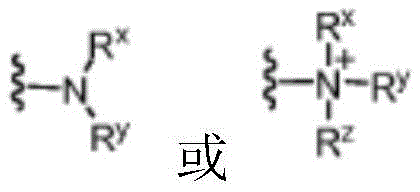
其中Rx、Ry和Rz各自独立地表示氢或烃基或Rx和Ry与它们连接的N原子一起形成具有4个至8个原子的环结构的杂环。wherein Rx , Ry and Rz each independently represent hydrogen or a hydrocarbon group or Rx and Ry together with the N atom to which they are attached form a heterocyclic ring having a ring structure of 4 to 8 atoms.
如本文所使用的术语“氨基烷基”是指被氨基取代的烷基。The term "aminoalkyl" as used herein refers to an alkyl group substituted with an amino group.
如本文所使用的术语“芳烷基”是指被芳基取代的烷基。The term "aralkyl" as used herein refers to an alkyl group substituted with an aryl group.
如本文所使用的术语“芳基”包括取代的或未取代的单环芳族基团,其中环的各原子为碳。在某些实施方案中,所述环是5元至7元环,并且在更具体的实施方案是6元环。术语“芳基”还包括具有两个或更多个环的多环体系,其中两个或更多个碳共用于两个相邻环,其中所述相邻环中的至少一个是芳族的,例如,其他的环可以是环烷基、环烯基、环炔基、芳基、杂芳基、和/或杂环基。芳基包括苯、萘、菲、苯酚、苯胺等。The term "aryl" as used herein includes substituted or unsubstituted monocyclic aromatic groups wherein each atom of the ring is carbon. In certain embodiments, the ring is a 5- to 7-membered ring, and in more specific embodiments is a 6-membered ring. The term "aryl" also includes polycyclic ring systems having two or more rings, wherein two or more carbons are common to two adjacent rings, wherein at least one of the adjacent rings is aromatic For example, other rings may be cycloalkyl, cycloalkenyl, cycloalkynyl, aryl, heteroaryl, and/or heterocyclyl. Aryl groups include benzene, naphthalene, phenanthrene, phenol, aniline, and the like.
术语“氨基甲酸酯基”是本领域公知的,并且是指以下基团:The term "urethane group" is art-recognized and refers to the following groups:
其中Rx和Ry独立地表示氢或烃基或Rx和Ry与它们连接的原子一起形成具有4个至8个原子的环结构的杂环。wherein Rx and Ry independently represent hydrogen or a hydrocarbyl group or Rx and Ry together with the atoms to which they are attached form a heterocyclic ring having a ring structure of 4 to 8 atoms.
如本文所使用的术语“环烷基”是指非芳族的饱和或不饱和环,其中环的各原子为碳。在某些实施方案中,环烷基的环包含3个至10个原子,在更具体的实施方案中是5个至7个原子。The term "cycloalkyl" as used herein refers to a non-aromatic saturated or unsaturated ring wherein each atom of the ring is carbon. In certain embodiments, the ring of a cycloalkyl group contains 3 to 10 atoms, in more
术语“碳酸酯基”是本领域公知的,并且是指基团-OCO2-Rx,其中Rx表示烃基。The term "carbonate group" is art-recognized and refers to the group -OCO2 - Rx, where Rx represents a hydrocarbyl group.
如本文所使用的术语“羧基”是指由式-CO2H表示的基团。The term "carboxy" as used herein refers to a group represented by the formula -CO2H .
如本文所使用的术语“酯”是指基团-C(O)ORx,其中Rx表示烃基。The term "ester" as used herein refers to the group -C(O) ORx , where Rx represents a hydrocarbyl group.
如本文所使用的术语“醚”是指通过氧连接到另一个烃基的烃基。因此,烃基的醚取代基可以是烃基-O-。醚可以是对称的或不对称的。醚的例子包括,但不限于,杂环-O-杂环和芳基-O-杂环。醚包括“烷氧基烷基”基团,其可以由通式烷基-O-烷基表示。The term "ether" as used herein refers to a hydrocarbyl group attached to another hydrocarbyl group through an oxygen. Thus, the ether substituent of a hydrocarbyl group can be hydrocarbyl-O-. Ethers can be symmetrical or asymmetrical. Examples of ethers include, but are not limited to, heterocycle-O-heterocycle and aryl-O-heterocycle. Ethers include "alkoxyalkyl" groups, which can be represented by the general formula alkyl-O-alkyl.
术语“胍基”是本领域公知的,并且可以由以下通式表示:The term "guanidino" is well known in the art and can be represented by the following general formula:
其中Rx和Ry独立地表示氢或烃基。wherein Rx and Ry independently represent hydrogen or hydrocarbyl.
本文所使用的术语“卤代”和“卤素”是指卤素并包括氟、氯、溴和碘。The terms "halo" and "halogen" as used herein refer to halogen and include fluorine, chlorine, bromine and iodine.
本文所使用的术语“杂芳烷基(hetaralkyl)”和“杂芳烷基(heteroaralkyl)”是指具有杂芳基取代的烷基。The terms "hetaralkyl" and "heteroaralkyl" as used herein refer to an alkyl group substituted with a heteroaryl group.
术语“杂芳基(heteroaryl)”和“杂芳基(hetaryl)”包括取代的或未取代的芳族单环结构,在某些具体实施方案中为5元至7元环,更具体的为5元至6元环,其环结构至少包括一个杂原子,在一些实施方案中,包括一个至四个个杂原子,并且在更具体的实施方案中,包括一个或两个杂原子。术语“杂芳基(heteroaryl)”和“杂芳基(hetaryl)”还包括具有两个或更多个环的多环体系,其中两个或更多个碳共用于两个相邻环,其中所述环中的至少一个是杂芳香族,例如,其他的环可以是环烷基、环烯基、环炔基、芳基、杂芳基、和/或杂环基。杂芳基(例如)包括吡咯、呋喃、噻吩、咪唑、唑、噻唑、吡唑、吡啶、吡嗪、哒嗪和嘧啶等。The terms "heteroaryl" and "hetaryl" include substituted or unsubstituted aromatic monocyclic structures, in certain embodiments 5- to 7-membered rings, more particularly A 5- to 6-membered ring whose ring structure includes at least one heteroatom, in some embodiments, one to four heteroatoms, and in more specific embodiments, one or two heteroatoms. The terms "heteroaryl" and "hetaryl" also include polycyclic ring systems having two or more rings, wherein two or more carbons are shared for two adjacent rings, wherein At least one of the rings is heteroaromatic, for example, the other rings may be cycloalkyl, cycloalkenyl, cycloalkynyl, aryl, heteroaryl, and/or heterocyclyl. Heteroaryl groups, for example, include pyrrole, furan, thiophene, imidazole, azole, thiazole, pyrazole, pyridine, pyrazine, pyridazine and pyrimidine, etc.
如本文所使用的术语“杂原子”指除碳或氢以外的任何元素的原子。典型的杂原子是氮、氧和硫。The term "heteroatom" as used herein refers to an atom of any element other than carbon or hydrogen. Typical heteroatoms are nitrogen, oxygen and sulfur.
术语“杂环基”、“杂环”和“杂环的”是指取代或未取代的非芳香族环结构,在某些具体的实施方案中为3元至10元环,更具体的为3元至7元环,其环结构至少包括一个杂原子,在一些实施方案中为1个至4个杂原子,并且在更具体的实施方案中为一个或两个杂原子。术语“杂环基”和“杂环的”还包括具有两个或更多个环的多环体系,其中两个或更多个碳为两个相邻环共用,其中所述环中的至少一个是杂环基,其他的环可以是环烷基、环烯基、环炔基、芳基、杂芳基、和/或杂环。杂环基(例如)包括哌啶、哌嗪、吡咯烷、吗啉、内酯和内酰胺等。The terms "heterocyclyl", "heterocycle" and "heterocyclic" refer to substituted or unsubstituted non-aromatic ring structures, in certain specific embodiments 3- to 10-membered rings, more specifically A 3- to 7-membered ring whose ring structure includes at least one heteroatom, in some
如本文所使用的术语“杂环基烷基”指被杂环基团取代的烷基。The term "heterocyclylalkyl" as used herein refers to an alkyl group substituted with a heterocyclic group.
如本文所使用的术语“烃基”是指是通过碳原子键合的不具有=O或=S取代基的基团,并且通常具有至少一个碳-氢键和基本上为碳的骨架,但可任选地包括杂原子。因此,出于此目的,像甲基、乙氧基乙基、2-吡啶基和三氟甲基的基团都被认为是烃基,但取代基如乙酰基(这在连接碳上具有=O取代基)和乙氧基(其通过氧而不是碳连接)则不被看作是烃基。所述烃基包括,但不限于,芳基、杂芳基、碳环、杂环、烷基、烯基、炔基以及它们的组合。The term "hydrocarbyl" as used herein refers to a group bonded through a carbon atom having no =O or =S substituents, and generally having at least one carbon-hydrogen bond and a substantially carbon backbone, but may Heteroatoms are optionally included. Thus, for this purpose, groups like methyl, ethoxyethyl, 2-pyridyl, and trifluoromethyl are all considered hydrocarbyl groups, but substituents like acetyl (which have =O on the linking carbon substituents) and ethoxy (which are attached through oxygen rather than carbon) are not considered hydrocarbyl groups. The hydrocarbyl groups include, but are not limited to, aryl, heteroaryl, carbocyclic, heterocyclic, alkyl, alkenyl, alkynyl, and combinations thereof.
如本文所使用的术语“羟基烷基”是指被羟基取代的烷基。The term "hydroxyalkyl" as used herein refers to an alkyl group substituted with a hydroxy group.
当术语“低级”与化学基团(如酰基、酰氧基、烷基、烯基、炔基或烷氧基)共同使用时是指这样的基团,其中在取代基中存在十个或更少的非氢原子,并且在某些实施方案中为六个或更少。“低级烷基”,例如,是指包含十个或更少碳原子的烷基,并在具体的实施方案中,为六个或更少的碳原子。在某些实施方案中,本文所限定的酰基、酰氧基、烷基、烯基、炔基和烷氧基取代基分别是低级酰基、低级酰氧基、低级烷基、低级烯基、低级炔基和低级烷氧基,无论它们是单独出现还是与其他取代基组合出现,如在羟烷基和芳烷基中所限定的那样(在这种情况下,例如,当计算烷基取代基中的碳原子时不计算在芳基中的原子)。The term "lower" when used in conjunction with a chemical group such as acyl, acyloxy, alkyl, alkenyl, alkynyl, or alkoxy refers to groups in which ten or more are present in the substituents Fewer non-hydrogen atoms, and in some embodiments six or less. "Lower alkyl", for example, refers to an alkyl group containing ten or fewer carbon atoms, and in specific embodiments, six or fewer carbon atoms. In certain embodiments, acyl, acyloxy, alkyl, alkenyl, alkynyl, and alkoxy substituents as defined herein are lower acyl, lower acyloxy, lower alkyl, lower alkenyl, lower, respectively Alkynyl and lower alkoxy groups, whether they occur alone or in combination with other substituents, as defined in hydroxyalkyl and aralkyl (in this case, for example, when calculating alkyl substituents carbon atoms in the aryl group are not counted).
术语“多环基(polycyclyl)”,“多环(polycycle)”和“多环的”是指两个或更多个环(例如,环烷基、环烯基、环炔基、芳基、杂芳基、和/或杂环基),其中两个或更多个原子共用于两个相邻的环,例如,环是“稠合环”。多环的各环可以是取代或未取代的。在某些实施方案中,多环的各环为含有3个至10个原子的环,更具体地为5个至7个原子的环。The terms "polycyclyl," "polycycle," and "polycyclic" refer to two or more rings (eg, cycloalkyl, cycloalkenyl, cycloalkynyl, aryl, heteroaryl, and/or heterocyclyl) wherein two or more atoms are shared for two adjacent rings, eg, the rings are "fused rings". Each ring of the polycycle may be substituted or unsubstituted. In certain embodiments, each ring of the polycyclic ring is a ring containing 3 to 10 atoms, more specifically a ring of 5 to 7 atoms.
术语“取代的”是指包括取代了骨架上的一个或多个碳原子上的氢的取代基的基团。应该理解的是,“取代”或“取代的”包括隐含的条件:即,这样的取代是根据取代的原子和取代基的允许的化合价,并且该取代产生稳定的化合物,例如,化合物在其使用条件下不会自发进行转化(例如通过重排、环化、消除等转化)。如本文所使用的“取代的”意指包括有机化合物的所有允许的取代基。广义上说,允许的取代基包括有机化合物的无环和有环、支链和无支链、碳环和杂环、芳香族和非芳香族的取代基。对于适当的有机化合物而言,允许的取代基可以是一个或更多个以及相同或不同的。出于本发明的目的,杂原子(如氮)可具有氢取代基和/或本文所描述的满足杂原子的化合价的有机化合物任何可允许的取代基。取代基可以包括本文所描述的任何取代基,例如,卤素、羟基、羰基(例如酮、羧基、烷氧基羰基、甲酰基或酰基)、硫代羰基(如硫酯、硫代乙酸酯、或硫代甲酸酯)、烷氧基、磷酰基、磷酸酯、膦酸酯、次膦酸酯、氨基、酰氨基、脒基、亚胺基、氰基、硝基、叠氮基、巯基、烷硫基、硫酸酯、磺酸酯、氨磺酰基、磺氨基、磺酰基、杂环基、芳烷基、或芳香族或杂芳香族部分。本领域技术人员应当理解的是如果合适的话,烃链上取代的部分自身可被取代。The term "substituted" refers to a group that includes a substituent that replaces a hydrogen on one or more carbon atoms of the backbone. It should be understood that "substituted" or "substituted" includes the implied condition that such substitution is based on the substituted atoms and permissible valences of the substituent, and that the substitution results in a stable compound, eg, a compound in which Conversion (eg, by rearrangement, cyclization, elimination, etc.) does not occur spontaneously under the conditions of use. "Substituted" as used herein is meant to include all permissible substituents of organic compounds. In a broad sense, the permissible substituents include acyclic and cyclic, branched and unbranched, carbocyclic and heterocyclic, aromatic and non-aromatic substituents of organic compounds. The permissible substituents may be one or more and the same or different for appropriate organic compounds. For the purposes of the present invention, a heteroatom (eg, nitrogen) may have a hydrogen substituent and/or any permissible substituent of the organic compounds described herein that satisfy the valence of the heteroatom. Substituents can include any of the substituents described herein, for example, halogen, hydroxyl, carbonyl (eg, ketone, carboxyl, alkoxycarbonyl, formyl, or acyl), thiocarbonyl (eg, thioester, thioacetate, or thioformate), alkoxy, phosphoryl, phosphate, phosphonate, phosphinate, amino, amido, amidino, imino, cyano, nitro, azide, mercapto , alkylthio, sulfate, sulfonate, sulfamoyl, sulfoamino, sulfonyl, heterocyclyl, aralkyl, or aromatic or heteroaromatic moieties. It will be understood by those skilled in the art that substituted moieties on the hydrocarbon chain may themselves be substituted if appropriate.
除非特别说明,在此提及的化学部分“未取代的”应理解为包含取代的变体。例如,提及“芳基”基团或部分隐含包括了取代和未取代的变体。References herein to a chemical moiety "unsubstituted" should be understood to include substituted variants unless otherwise specified. For example, reference to an "aryl" group or moiety implicitly includes both substituted and unsubstituted variants.
术语“硫酸酯”是本领域公知的并且是指基团-OSO3H或其药学可接受的盐。The term "sulfate" is art - recognized and refers to the group -OSO3H or a pharmaceutically acceptable salt thereof.
术语“磺酰胺”是本领域公知的,并且指的是由下列通式表示的基团:The term "sulfonamide" is art-recognized and refers to a group represented by the following general formula:
其中Rx和Ry独立地表示氢或烃基。wherein Rx and Ry independently represent hydrogen or hydrocarbyl.
术语“亚砜”是本领域公知的并且是指基团-S(O)-Rx,其中Rx表示烃基。The term "sulfoxide" is art-recognized and refers to the group -S(O) -Rx , where Rx represents a hydrocarbyl group.
术语“磺基”或“磺酸酯基”是本领域公知的并且是指基团-SO3H或其药学可接受的盐。The term "sulfo" or "sulfonate" is art-recognized and refers to the group -SO3H or a pharmaceutically acceptable salt thereof.
术语“砜”是本领域公知的并且是指基团-S(O)2-Rx,其中Rx表示烃基。The term "sulfone" is art-recognized and refers to the group -S(O) 2 -Rx, where Rx represents a hydrocarbyl group.
如本文所使用的术语“硫代烷基”是指被巯基取代的烷基。The term "thioalkyl" as used herein refers to an alkyl group substituted with a mercapto group.
如本文所使用的术语“硫酯”是指基团-C(O)SRx或-SC(O)Rx,其中Rx表示烃基。The term "thioester" as used herein refers to the group -C(O) SRx or -SC(O) Rx , wherein Rx represents a hydrocarbyl group.
如本文所使用的术语“硫醚”等价于其中氧被硫取代的醚。The term "thioether" as used herein is equivalent to an ether in which the oxygen is replaced by sulfur.
术语“脲基”是本领域公知的并且可由以下通式表示:The term "ureido" is art-recognized and can be represented by the following general formula:

其中Rx和Ry独立地表示氢或烃基。wherein Rx and Ry independently represent hydrogen or hydrocarbyl.
本发明的化合物通常是使用标准的合成化学技术合成的,例如,使用在下面的实施例部分所描述的方法合成。其他有用的合成技术(例如)描述在March's AdvancedOrganic Chemistry:Reactions,Mechanisms,and Structure,7th Ed.,(Wiley,2013);Carey和Sundberg,Advanced Organic Chemistry 4th Ed.,Vols.A and B(Plenum 2000,2001);Fiesers'Reagents for Organic Synthesis,Volumes 1-27(Wiley,2013);Rodd'sChemistry of Carbon Compounds,Volumes 1-5 and Supplementals(Elsevier SciencePublishers,1989);Organic Reactions,Volumes 1-81(Wiley,2013);以及Larock'sComprehensive Organic Transformations(VCH Publishers Inc.,1989)(它们的全部内容通过引用纳入本文)。这些化合物通常使用可从商业来源获得的的原料合成或可容易地使用本领域技术人员公知的方法制备。例如,参见Fiesers'Reagents for OrganicSynthesis,Volumes 1-27(Wiley,2013)或Beilsteins Handbuch der organischenChemie,4,Aufl.ed.Springer-Verlag,Berlin,包括增刊。The compounds of the present invention are generally synthesized using standard synthetic chemistry techniques, eg, using the methods described in the Examples section below. Other useful synthetic techniques are described, for example, in March's Advanced Organic Chemistry: Reactions, Mechanisms, and Structure, 7th Ed., (Wiley, 2013); Carey and Sundberg, Advanced Organic Chemistry 4th Ed ., Vols. A and B (Plenum 2000, 2001); Fiesers' Reagents for Organic Synthesis, Volumes 1-27 (Wiley, 2013); Rodd's Chemistry of Carbon Compounds, Volumes 1-5 and Supplementals (Elsevier SciencePublishers, 1989); Organic Reactions, Volumes 1-81 ( Wiley, 2013); and Larock's Comprehensive Organic Transformations (VCH Publishers Inc., 1989) (the entire contents of which are incorporated herein by reference). These compounds are generally synthesized using starting materials available from commercial sources or can be readily prepared using methods well known to those skilled in the art. See, eg, Fiesers' Reagents for Organic Synthesis, Volumes 1-27 (Wiley, 2013) or Beilsteins Handbuch der organischen Chemie, 4, Aufl. ed. Springer-Verlag, Berlin, including supplements.
当提及本发明化合物的组分时,可以使用术语“衍生自...的残基”来描述由第一组分上的第一反应官能团和第二组分上的第二反应官能团反应而形成共价键从而形成的残基。在示例性实施方案中,在第一组分上的胺基团可以与第二组分上的活化的羧基反应,从而形成包括一个或多个酰胺部分的残基。本发明涵盖了第一和第二反应官能团的其他排列。例如,如本领域技术人员能够理解的,通过公知的“点击”反应,叠氮化物-取代的第一组分与炔取代的第二组分之间的由铜催化的反应或无铜反应产生包含三唑的残基。参见Kolb等,(2001)Angew.Chem.Int.Ed.Engl.40:2004;Evans(2007)Aus.J.Chem.60:384。在PCT国际公开No.WO 2012/118715中提供了利用“点击”反应产生非肽荧光成像探针的示范性方法。采用这些方法从而产生或修饰本发明的化合物,特别是本发明化合物的蛋白酶靶向元件,这是本领域技术人员已知的。When referring to components of the compounds of the present invention, the term "residue derived from" may be used to describe the reaction of a first reactive functional group on a first component with a second reactive functional group on a second component. Residues that form covalent bonds. In exemplary embodiments, amine groups on the first component can react with activated carboxyl groups on the second component to form residues that include one or more amide moieties. Other arrangements of the first and second reactive functional groups are encompassed by the present invention. For example, a copper-catalyzed or copper-free reaction between an azide-substituted first component and an alkyne-substituted second component results from a well-known "click" reaction, as can be appreciated by those skilled in the art Residues containing triazoles. See Kolb et al. (2001) Angew. Chem. Int. Ed. Engl. 40:2004; Evans (2007) Aus. J. Chem. 60:384. Exemplary methods for generating non-peptide fluorescent imaging probes using "click" reactions are provided in PCT International Publication No. WO 2012/118715. These methods are used to generate or modify the compounds of the invention, particularly the protease targeting elements of the compounds of the invention, as known to those skilled in the art.
本领域的技术人员将理解,保护基团可逆地连接到分子的所需位置,以控制其他试剂在该位置的反应。在本发明化合物的合成中有用的保护基团是本领域所公知的。例如参见P.G.M.Wuts和T.W.Greene编辑的Greene's Protective Groups in OrganicSynthesis,4th edition(Wiley-Interscience,2006);和P.Kocienski的ProtectingGroups(Thieme,2005)。Those skilled in the art will understand that protecting groups are reversibly attached to a desired position of the molecule to control the reaction of other reagents at that position. Protecting groups useful in the synthesis of the compounds of the present invention are well known in the art. See, eg, Greene's Protective Groups in Organic Synthesis, 4 th edition (Wiley-Interscience, 2006), edited by PGMWuts and TW Greene; and Protecting Groups by P. Kocienski (Thieme, 2005).
本发明化合物的L0和L1基团是接头基团,其使可检测元件D以及淬灭基团Q分别与本发明的化合物相连。如本领域技术人员所理解的,各接头基团可以独立地为任意合适的化学接头。L0和L1基团优选为烷基接头基团,其中该烷基接头任选地被取代,其中接头中的碳任选地被杂原子置换以达到所得的结构是化学稳定的程度。这样的取代和置换应该理解为包括在接头内的插入基团,如醚、硫醚、二硫化物、酯、酰胺、碳酸酯、氨基甲酸酯等等。优选的接头的长度在5个至40个键长的范围内,并且其可以是支链、直链或包含环。在一些情况下,接头可以包括双键。根据包含接头的化合物的特定需求,它们可以是根据需要的疏水的或亲水的。The L 0 and L 1 groups of the compounds of the present invention are linker groups that connect the detectable element D and the quenching group Q, respectively, to the compounds of the present invention. As understood by those skilled in the art, each linker group can independently be any suitable chemical linker. The L0 and L1 groups are preferably alkyl linker groups, wherein the alkyl linker is optionally substituted, wherein carbons in the linker are optionally replaced with heteroatoms to the extent that the resulting structure is chemically stable. Such substitutions and substitutions should be understood to include intervening groups within the linker, such as ethers, thioethers, disulfides, esters, amides, carbonates, carbamates, and the like. Preferred linkers are in the range of 5 to 40 bonds in length, and may be branched, straight or contain rings. In some cases, the linker can include a double bond. Depending on the specific needs of the compound containing the linker, they can be hydrophobic or hydrophilic as desired.
在具体实施方案中,L0和L1各自独立地为任选地被取代的烷基接头,其中各碳原子任选地被杂原子置换。在更具体的实施方案中,L0和L1各自独立地为C2-8烷基接头。在甚至更具体的实施方案中,L1为C4烷基接头。In specific embodiments, L 0 and L 1 are each independently an optionally substituted alkyl linker, wherein each carbon atom is optionally replaced with a heteroatom. In a more specific embodiment, L 0 and L 1 are each independently a C 2-8 alkyl linker. In an even more specific embodiment, L 1 is a C 4 alkyl linker.
如本领域技术人员所理解的,还应理解L0基团和可检测元件D之间的连接以及L1基团和淬灭剂Q之间的连接可为任意合适的化学连接。例如,在一些情况下可通过在可检测元件或淬灭剂前体中包括与例如)氨基、硫醇基等的特定化学基团反应的部分方便地制备本发明化合物。在这种情况下,反应性可检测元件或淬灭剂可以通过化合物上的氨基、硫醇基等与反应性基团的反应而容易地与本化合物连接。因此,即使未明确地示出连接结构的细节,也应将这些类型的化学连接理解为在公开的化合物的范围内。It will also be appreciated that the linkage between the L0 group and the detectable element D and the linkage between the L1 group and the quencher Q can be any suitable chemical linkage, as understood by those skilled in the art. For example, in some cases the compounds of the invention may be conveniently prepared by including in the detectable element or quencher precursor a moiety reactive with a particular chemical group such as an amino group, a thiol group, and the like. In this case, the reactive detectable element or quencher can be easily attached to the present compound through the reaction of the amino group, thiol group, etc. on the compound with the reactive group. Accordingly, these types of chemical linkages should be understood to be within the scope of the disclosed compounds even if the details of the linkage structure are not explicitly shown.
根据一些实施方案,可将在式(I)的化合物中的L1基团修饰以增加本主题化合物的体内半衰期。因此,在这些实施方案中,L1基团可包括聚乙二醇部分、棕榈酸酯或其他长链脂肪酸部分、白蛋白结合蛋白等,以便稳定修饰的化合物。According to some embodiments, the L 1 group in the compounds of formula (I) can be modified to increase the in vivo half-life of the subject compounds. Thus, in these embodiments, the L1 group may include polyethylene glycol moieties, palmitate or other long chain fatty acid moieties, albumin binding proteins, and the like, in order to stabilize the modified compound.
如本领域技术人员将理解的,本发明化合物的AA1和AA2基团可以独立地为任意天然或非天然氨基酸侧链,或可为基团“-L1-Q”。在一些实施方案中,AA1基团为碱性氨基酸侧链,AA2基团为芳烷基氨基酸侧链,并且各自任选地被1个至3个A基团取代。在具体的实施方案中,AA1基团为赖氨酸侧链并且AA2基团为苯丙氨酸侧链。在一些实施方案中,AA1基团为-L1-Q并且AA2基团为芳烷基氨基酸侧链。在其他实施方案中,AA1基团为碱性氨基酸侧链并且AA2基团为-L1-Q。在又一其他实施方案中,AA1和AA2基团以任意组合独立地为来自酸性氨基酸残基的侧链,例如来自天冬氨酸或谷氨酸残基的侧链,或来自烷基氨基酸残基的侧链,例如丙氨酸、亮氨酸、异亮氨酸、缬氨酸或其他此类氨基酸残基。来自其他氨基酸残基的侧链,例如赖氨酸、精氨酸、酪氨酸、谷氨酰胺、天冬酰胺等,也适合作为本化合物中的AA1或AA2基团。As will be appreciated by those skilled in the art, the AAi and AA2 groups of the compounds of the present invention may independently be any natural or unnatural amino acid side chain, or may be the group "-L1 - Q". In some embodiments, the AA 1 group is a basic amino acid side chain and the AA 2 group is an aralkyl amino acid side chain, and each is optionally substituted with 1 to 3 A groups. In a specific embodiment, the AAi group is a lysine side chain and the AA2 group is a phenylalanine side chain. In some embodiments, the AA 1 group is -L 1 -Q and the AA 2 group is an aralkyl amino acid side chain. In other embodiments, the AA1 group is a basic amino acid side chain and the AA2 group is -L1 - Q. In yet other embodiments, the AAi and AA2 groups, in any combination, are independently side chains from acidic amino acid residues, such as from aspartic acid or glutamic acid residues, or from alkyl groups Side chains of amino acid residues such as alanine, leucine, isoleucine, valine or other such amino acid residues. Side chains from other amino acid residues, such as lysine, arginine, tyrosine, glutamine, asparagine, etc., are also suitable as AA1 or AA2 groups in the present compounds.
在AA1或AA2基团为“-L1-Q”基团的化合物实施方案中,L1接头组分可由氨基酸侧链提供。例如,赖氨酸残基方便地提供了用于与适当激活的淬灭剂反应的氨基烷基基团。In compound embodiments where the AA1 or AA2 group is a " -L1 - Q" group, the L1 linker component may be provided by an amino acid side chain. For example, lysine residues conveniently provide an aminoalkyl group for reaction with an appropriately activated quencher.
在一些化合物实施方案中,U基团为O。In some compound embodiments, the U group is O.
在一些化合物实施方案中,R基团为任选地被1个至3个A基团取代的烷基。更具体而言,R基团可为被芳基取代的烷基,所述芳基本身任选地被取代。甚至更具体而言,R基团可为任选地被取代的芳烷基,例如苄基。In some compound embodiments, the R group is an alkyl group optionally substituted with 1 to 3 A groups. More specifically, the R group can be an alkyl group substituted with an aryl group, which itself is optionally substituted. Even more specifically, the R group can be an optionally substituted aralkyl group, such as benzyl.
本发明化合物的可检测元件D为能够通过任何合适的手段检测的任意化学基团,所述手段包括但不限于光学、电学或化学检测方法。在具体实施方案中,可检测元件为荧光标记、发光物质、磷光物质、放射性物质,包括正电子发射物质、纳米颗粒、SERS纳米颗粒、量子点或其他荧光晶体纳米颗粒、衍射颗粒、拉曼颗粒、金属颗粒,包括螯合金属、磁性颗粒、微球体、RFID标签、微球颗粒或这些标记的组合。在更具体的实施方案中,可检测元件为荧光标记、放射性标记,包括螯合金属等。适用于这些化合物的放射性标记和螯合金属的实例在PCT国际公开No.2009/124265中进行描述,该公开的全部内容通过引用方式并入本文。The detectable element D of the compounds of the present invention is any chemical group capable of being detected by any suitable means including, but not limited to, optical, electrical or chemical detection methods. In specific embodiments, the detectable elements are fluorescent labels, luminescent substances, phosphorescent substances, radioactive substances, including positron emitting substances, nanoparticles, SERS nanoparticles, quantum dots or other fluorescent crystalline nanoparticles, diffractive particles, Raman particles , metal particles, including chelated metals, magnetic particles, microspheres, RFID tags, microsphere particles or combinations of these labels. In more specific embodiments, the detectable elements are fluorescent labels, radiolabels, including chelated metals, and the like. Examples of radiolabeled and chelated metals suitable for use in these compounds are described in PCT International Publication No. 2009/124265, which is incorporated herein by reference in its entirety.
在本发明化合物的优选实施方案中,可检测元件为荧光标记。如本领域普通技术人员所知,当通过入射电磁辐射的吸收激发时,荧光标记发射电磁辐射,优选为可见光或近红外光。各种荧光标记为市售的,所述荧光标记包括具有用于将标记偶联到诸如(例如)氨基、硫醇基等的反应性基团的反应性部分的标记。参见例如The Molecular
典型地在700nm至900nm的区域中吸收的近红外荧光团特别适合于组织成像,因为与更短(例如可见的)波长的光相比,这些波长的光能够更深地穿透到组织中。用于本发明的化合物的示例性近红外荧光标记物为IRDye红外染料,可从LI-COR Biosciences,Lincoln,NE购得。这些染料的非限制性实例为IRDye 800CW、IRDye 680RD、IRDye 680LT、IRDye 750、IRDye 700DX、IRDye 800RS和IRDye 650。Near-infrared fluorophores, which typically absorb in the region of 700 nm to 900 nm, are particularly suitable for tissue imaging because these wavelengths of light can penetrate deeper into tissue than shorter (eg, visible) wavelengths of light. An exemplary near-infrared fluorescent label for use in the compounds of the present invention is the IRDye infrared dye, commercially available from LI-COR Biosciences, Lincoln, NE. Non-limiting examples of these dyes are IRDye 800CW, IRDye 680RD, IRDye 680LT, IRDye 750, IRDye 700DX, IRDye 800RS and IRDye 650.
特别适合于体内成像应用的红外染料的其他实例为DyLight系列的苯并吡喃鎓和苯并花青化合物,它们可从Thermo Scientific Pierce Protein Biology Products,Rockford,IL购得。这些染料的非限制性实例为DyLight 675-B1、DyLight 675-B2、DyLight675-B3、DyLight 675-B4、DyLight 679-C5、DyLight 690-B1、DyLight 690-B2、DyLight700-B1、DyLight 700-B2、DyLight 730-B1、DyLight 730-B2、DyLight 730-B3、DyLight730-B4、DyLight 747-B1、DyLight 747-B2、DyLight 747-B3、DyLight 747-B4、DyLight775-B2、DyLight 775-B3、DyLight 775-B4、DyLight 780-B1、DyLight 780-B2、DyLight780-B3、DyLight 800和DyLight 830-B2。优选的近IR荧光团为DyLight 780B和DyLight800,它们具有以下结构:Other examples of infrared dyes that are particularly suitable for in vivo imaging applications are the DyLight series of benzopyrylium and benzocyanine compounds, which are commercially available from Thermo Scientific Pierce Protein Biology Products, Rockford, IL. Non-limiting examples of these dyes are DyLight 675-B1, DyLight 675-B2, DyLight675-B3, DyLight 675-B4, DyLight 679-C5, DyLight 690-B1, DyLight 690-B2, DyLight700-B1, DyLight 700-B2 , DyLight 730-B1, DyLight 730-B2, DyLight 730-B3, DyLight730-B4, DyLight 747-B1, DyLight 747-B2, DyLight 747-B3, DyLight 747-B4, DyLight775-B2, DyLight 775-B3, DyLight 775-B4, DyLight 780-B1, DyLight 780-B2, DyLight780-B3, DyLight 800 and DyLight 830-B2. Preferred near-IR fluorophores are DyLight 780B and DyLight800, which have the following structures:

用于可见光波长的荧光标记的实例为荧光素,荧光素广泛用于免疫荧光标记。荧光素为在495纳米处具有最大吸收量的呫吨染料。相关的荧光团为俄勒冈绿,这是一种荧光素的氟化衍生物。An example of a fluorescent label for visible wavelengths is fluorescein, which is widely used for immunofluorescence labels. Fluorescein is a xanthene dye with an absorption maximum at 495 nanometers. A related fluorophore is Oregon Green, a fluorinated derivative of fluorescein.
适用于本发明化合物中的其他示例性的荧光标记是氟硼荧染料、罗丹明和花菁染料。特别地,氟硼荧染料由4,4-二氟-4-硼杂-3a,4a-二氮杂-s-苯并二茚(氟化硼络合二吡咯甲川))表示,被称为染料。这些染料的各种衍生物是已知的,并且被认为适合用作本发明化合物中的可检测元件。例如,参见Chen等,(2000)J.Org.Chem.65:2900-2906。Other exemplary fluorescent labels suitable for use in the compounds of the present invention are fluoroboron fluorescent dyes, rhodamines, and cyanine dyes. In particular, the fluoroboron fluorescent dyes are represented by 4,4-difluoro-4-bora-3a,4a-diaza-s-benzobisindene (boron fluoride complexed dipyrromethine), known as dye. Various derivatives of these dyes are known and are believed to be suitable for use as detectable elements in the compounds of the present invention. See, eg, Chen et al. (2000) J. Org. Chem. 65:2900-2906.
罗丹明染料是一类基于罗丹明环结构的染料。罗丹明尤其包括,四甲基罗丹明(TMR)和羧基四甲基罗丹明(TAMRA),TMR是非常普遍的用于制备蛋白质偶联物(特别是抗体和抗生物素蛋白偶联物)的荧光团,而TAMRA是通常用于寡核苷酸标记和自动核酸测序的染料。罗丹明作为基于荧光素的荧光基团的天然补给物存在,它提供更长的波长发射最大值和由此为多色标记或染色提供了机会。Rhodamine dyes are a class of dyes based on the rhodamine ring structure. Rhodamines include, inter alia, tetramethylrhodamine (TMR) and carboxytetramethylrhodamine (TAMRA), TMR is very common for the preparation of protein conjugates, especially antibodies and avidin conjugates. fluorophores, while TAMRA is a dye commonly used for oligonucleotide labeling and automated nucleic acid sequencing. Rhodamine exists as a natural replenisher of fluorescein-based fluorophores, which provide longer wavelength emission maxima and thus provide opportunities for multicolor labeling or staining.
称为Alexa Fluor染料的磺化罗丹明系列荧光团也包含在罗丹明染料的组中。由Molecular Probes公司引入的Alexa Fluor染料例证了现代荧光技术中的巨大进步。对于更强烈的荧光发射,这些磺化罗丹明衍生物显示出比光谱类似探针更高的量子产率,并且具有几个附加的改进特性,包括增强的光稳定性、与共同激光线匹配的吸收光谱、pH值不敏感和高度水溶性。The sulfonated rhodamine series of fluorophores called Alexa Fluor dyes are also included in the group of rhodamine dyes. The introduction of Alexa Fluor dyes by Molecular Probes exemplifies a tremendous advance in modern fluorescence technology. For more intense fluorescence emission, these sulfonated rhodamine derivatives show higher quantum yields than spectrally similar probes and have several additional improved properties including enhanced photostability, common laser line matching Absorption spectrum, pH insensitive and highly water soluble.
花菁染料对应于相关的染料Cy2、Cy3、Cy5、Cy7和它们的衍生物家族,它们基于部分饱和的吲哚氮杂环核,具有通过不同碳数的聚烯烃桥相连的两个芳香族单元。这些探针展示出类似于许多传统的染料(例如荧光素和四甲基罗丹明)的荧光激发和发射图谱,但是它们具有增强的水溶性、光稳定性和更高的量子产率。大多数的花菁染料比它们的传统对应物更具有环境稳定性,使它们的荧光发射强度对于pH和有机封装介质(mountingmedia))较不敏感。以类似于Alexa Fluors的方式,将Cy系列合成染料的激发波长特意性地调谐为被普通激光和电弧放电光源所用,并且可以利用传统的过滤器的组合来检测荧光发射。作为反应性染料或荧光团的花菁染料是容易得到的。花菁染料通常具有比的AlexaFluor家族的成员更广泛的吸收光谱,使它们在一定程度上在共焦显微镜的激光激发源的选择中更为通用。The cyanine dyes correspond to the related families of dyes Cy2, Cy3, Cy5, Cy7 and their derivatives, which are based on a partially saturated indole nitrogen heterocyclic nucleus with two aromatic units connected by a polyolefin bridge of different carbon numbers . These probes exhibit fluorescence excitation and emission profiles similar to many traditional dyes (eg, fluorescein and tetramethylrhodamine), but they have enhanced water solubility, photostability, and higher quantum yields. Most cyanine dyes are more environmentally stable than their traditional counterparts, making their fluorescence emission intensities less sensitive to pH and organic mounting media. In a similar fashion to Alexa Fluors, the excitation wavelengths of the Cy series synthetic dyes are specifically tuned for use by common laser and arc-discharge light sources, and the fluorescence emission can be detected using a combination of conventional filters. Cyanine dyes are readily available as reactive dyes or fluorophores. Cyanine dyes generally have broader absorption spectra than members of the AlexaFluor family, making them somewhat more versatile in the choice of laser excitation sources for confocal microscopy.
在具体实施方案中,本发明化合物的可检测元件为花青染料Cy5。In specific embodiments, the detectable element of the compounds of the present invention is the cyanine dye Cy5.
在一些实施方案中,可检测元件包括苯并吲哚染料,例如吲哚氰绿(“ICG”)或吲哚氰绿的残基:In some embodiments, the detectable element includes a benzoindole dye, such as a residue of indocyanine green ("ICG") or indocyanine green:

吲哚菁绿用于各种医学诊断应用中,例如用于监测和成像某些心脏、肝脏、眼科和循环系统疾病。有利地,吲哚菁绿和相关化合物在近红外区域显示吸收和发射光谱。例如,ICG主要在600nm和900nm之间吸收,并且主要在750nm和950nm之间发射。这样的波长可以穿透生物组织,从而能够使用ICG和相关化合物对这些组织进行成像。此外,ICG在医学诊断研究中的长期和广泛使用证明了这些化合物的生物相容性。Indocyanine green is used in various medical diagnostic applications, such as for monitoring and imaging certain cardiac, liver, ophthalmic and circulatory diseases. Advantageously, indocyanine green and related compounds exhibit absorption and emission spectra in the near infrared region. For example, ICG mainly absorbs between 600nm and 900nm and emits mainly between 750nm and 950nm. Such wavelengths can penetrate biological tissue, enabling imaging of these tissues using ICG and related compounds. Furthermore, the long-term and widespread use of ICG in medical diagnostic research demonstrates the biocompatibility of these compounds.
因此,在一些实施方案中,可检测元件包括具有以下结构的苯并吲哚染料:Thus, in some embodiments, the detectable element comprises a benzoindole dye having the following structure:

其中o为1至4的整数;where o is an integer from 1 to 4;
R1为C2-C8烷基,任选地被磺酸酯或碳酸酯取代;R 1 is C 2 -C 8 alkyl, optionally substituted with sulfonate or carbonate;
各R2独立地为C1-C6烷基;并且each R 2 is independently C 1 -C 6 alkyl; and
L2为任选地被取代的烷基接头,其中各碳原子任选地被杂原子置换。 L2 is an optionally substituted alkyl linker wherein each carbon atom is optionally replaced with a heteroatom.
更具体而言,苯并吲哚染料可具有以下结构:More specifically, benzindole dyes can have the following structure:

例如,Zhang等.(2005)Chem.Commun.2005:5887(DOI:10.1039/b512315a)中描述了合成含有苯并吲哚的染料。还参见美国专利申请公开No.2009/0214436A1。For example, Zhang et al. (2005) Chem. Commun. 2005:5887 (DOI: 10.1039/b512315a) describes the synthesis of benzindole-containing dyes. See also US Patent Application Publication No. 2009/0214436A1.
在一些实施方案中,L2为任选地被取代的低级烷基接头,其中各碳原子任选地被杂原子置换。In some embodiments, L 2 is an optionally substituted lower alkyl linker, wherein each carbon atom is optionally replaced with a heteroatom.
在一些实施方案中,用于本发明化合物的可检测元件中的荧光标记可为pH依赖性荧光团。如本领域技术人员所理解的,这种荧光标记显示出取决于标记的环境的pH的荧光光谱,并且因此可用于报告标记以下反应的环境的信息,例如关于由反应性化合物标记的蛋白酶的位置或类型的信息。在本发明化合物的可检测元件中所包括有用的各种标记的pH依赖性荧光团是已知的,例如,参见The Molecular
在一些实施方案中,在本发明化合物的可检测元件内包括多个可检测基团(例如荧光标记、放射性标记、螯合金属等)可能是有益的。可使用本领域技术人员将理解的常规偶联化学来实现这种多重标记。In some embodiments, it may be beneficial to include multiple detectable groups (eg, fluorescent labels, radiolabels, chelated metals, etc.) within the detectable elements of the compounds of the present invention. Such multiple labeling can be accomplished using conventional coupling chemistries that will be understood by those skilled in the art.
本说明书的化合物通常还包括淬灭剂基团Q。术语“淬灭剂”是指调节荧光团的发光的化学实体。在一些情况下,淬灭剂本身可以是在特征波长发射荧光的荧光分子,该特征波长不同于荧光淬灭的标记。因此,当适当地与其他染料偶联时,荧光团可以充当淬灭剂,反之亦然。在这些情况下,来自受体分子(受体具有与供体标记不同的波长)荧光的增加可以分别报告标记化合物与它的环境(例如,溶酶体或其他细胞对应物)的相互作用。在一些情况下,淬灭剂本身不发荧光(即,淬灭剂是“暗受体”)。这样的淬灭剂(例如)包括dabcyl、甲基红、QSY二芳基罗丹明染料等。特别地,dabcyl(4-二甲基氨基-苯偶氮基)苯甲酸)是一种常见的广泛应用于许多测定法(如用于DNA检测的“分子信标”)的暗淬灭剂(美国专利No.5,989,823)。被称为“黑洞淬灭剂”的BHQ系列重氮染料具有广范围的吸收,其与许多与许多荧光团的发光重叠良好(参见PCT国际公开No.WO01/86001)。来自Molecular Probes公司的QSY是在许多生物分析中已被广泛地用作淬灭剂的暗淬灭剂染料的另一例子(美国专利No.6,399,392)。The compounds of this specification typically also include a quencher group Q. The term "quencher" refers to a chemical entity that modulates the emission of a fluorophore. In some cases, the quencher itself may be a fluorescent molecule that fluoresces at a characteristic wavelength different from the fluorescently quenched label. Thus, when properly coupled to other dyes, fluorophores can act as quenchers and vice versa. In these cases, an increase in fluorescence from the acceptor molecule (the acceptor has a different wavelength than the donor label) can separately report the interaction of the labeled compound with its environment (eg, the lysosome or other cellular counterpart). In some cases, the quencher itself does not fluoresce (ie, the quencher is a "dark acceptor"). Such quenchers include, for example, dabcyl, methyl red, QSY diarylrhodamine dye, and the like. In particular, dabcyl (4-dimethylamino-phenylazo)benzoic acid) is a common dark quencher ( US Patent No. 5,989,823). The BHQ series of diazo dyes, known as "black hole quenchers", have a broad range of absorption that overlaps well with the luminescence of many fluorophores (see PCT International Publication No. WO01/86001). QSY from Molecular Probes, Inc. is another example of a dark quencher dye that has been widely used as a quencher in many biological assays (US Patent No. 6,399,392).
特别地,QSY7为非荧光二芳基罗丹明衍生物。美国专利申请公开No.2005/0014160。QSY21为在可见光谱中具有强吸收的非荧光二芳基罗丹明发色团,并且是有效的荧光淬灭剂。磺基-QSY21为QSY21的磺酸盐形式(参见图1A)。在美国专利申请公开No.2004/0241679中进一步说明了荧光团/淬灭剂对。In particular, QSY7 is a non-fluorescent diarylrhodamine derivative. US Patent Application Publication No. 2005/0014160. QSY21 is a non-fluorescent diarylrhodamine chromophore with strong absorption in the visible spectrum and is an effective fluorescence quencher. Sulfo-QSY21 is the sulfonate form of QSY21 (see Figure 1A). Fluorophore/quencher pairs are further described in US Patent Application Publication No. 2004/0241679.
IRDye QC-1(可从Li-Cor购得)为适用于作为在本发明化合物中的淬灭剂的非荧光染料的另一个实例(参见图6A)。IRDye QC-1有效地淬灭来自宽范围的荧光团的荧光,包括波长范围从可见区域到近红外的那些荧光。IRDye QC-1 (commercially available from Li-Cor) is another example of a non-fluorescent dye suitable for use as a quencher in the compounds of the present invention (see Figure 6A). IRDye QC-1 efficiently quenches fluorescence from a wide range of fluorophores, including those with wavelengths ranging from the visible region to the near-infrared.
在另一方面,本说明书提供了具有式(II)的化合物:In another aspect, the specification provides compounds of formula (II):

其中n'和n”各自独立地为2至8的整数;wherein n' and n" are each independently an integer from 2 to 8;
R1为QSY淬灭剂或QC-1;并且R 1 is QSY quencher or QC-1; and
R2为苯并吲哚染料。R 2 is a benzoindole dye.
在一些化合物的一些实施方案中,n”为4。In some embodiments of some compounds, n" is 4.
在一些化合物的一些实施方案中,n'是2、4或6。In some embodiments of some compounds, n' is 2, 4, or 6.
在一个具体实施方案中,所述化合物具有以下结构式:In a specific embodiment, the compound has the following structural formula:

根据另一方面,本公开的化合物实施方案具有式(III)的结构:According to another aspect, compound embodiments of the present disclosure have the structure of Formula (III):

其中in
D为包含苯并吲哚染料的可检测元件;D is a detectable element comprising a benzoindole dye;
L0为接头;并且L 0 is the linker; and
T为蛋白酶靶向元件,任选地包含淬灭剂;T is a protease targeting element, optionally comprising a quencher;
条件是L0不包括乙氧基乙氧基间隔子。Provided that L0 does not include an ethoxyethoxy spacer.
在式(III)的化合物中的蛋白酶靶向元件T为任意合适的化学结构,其能够通过蛋白酶识别并且通过蛋白酶催化水解以释放亲溶酶体片段D-L0-NH3 +。众所周知,在蛋白酶酶学领域中这种结构的实例包括(但不限于)肽和非肽蛋白酶靶向元件。在具体实施方案中,蛋白酶靶向元件为包含不多于四个氨基酸残基或不多于三个氨基酸残基的肽结构。在更具体的实施方案中,蛋白酶靶向元件是包含不超过两个氨基酸残基的肽结构。例如,如上所示的式(I)的化合物包括含有两个氨基酸残基的蛋白酶靶向元件。在具体实施方案中,蛋白酶靶向元件是对通过组织蛋白酶、特别是组织蛋白酶L或组织蛋白酶V进行的酶切具有选择性的结构。The protease targeting element T in compounds of formula (III) is any suitable chemical structure capable of being recognized by a protease and catalyzed by protease hydrolysis to release the lysosomal fragment DL0 - NH3 + . Examples of such structures are well known in the art of protease enzymology to include, but are not limited to, peptide and non-peptide protease targeting elements. In specific embodiments, the protease targeting element is a peptide structure comprising no more than four amino acid residues or no more than three amino acid residues. In a more specific embodiment, the protease targeting element is a peptide structure comprising no more than two amino acid residues. For example, compounds of formula (I) as shown above include a protease targeting element containing two amino acid residues. In a specific embodiment, the protease targeting element is a structure that is selective for cleavage by cathepsin, particularly cathepsin L or cathepsin V.
根据一些实施方案,可修饰式(III)的化合物中的T基团以延长本主题化合物的体内半衰期。因此,在这些实施方案中,T基团可以包含聚乙二醇部分、棕榈酸盐或其他长链脂肪酸部分、白蛋白结合蛋白等,以便使修饰的化合物稳定。According to some embodiments, the T group in compounds of formula (III) can be modified to extend the in vivo half-life of the subject compounds. Thus, in these embodiments, the T group may comprise polyethylene glycol moieties, palmitate or other long chain fatty acid moieties, albumin binding proteins, and the like, in order to stabilize the modified compound.
在式(III)的一些实施方案中,L0不包含聚乙二醇基团。In some embodiments of formula (III), L 0 does not comprise a polyethylene glycol group.
在式(III)的一些实施方案中,蛋白酶靶向元件为In some embodiments of formula (III), the protease targeting element is

AA1和AA2各自独立地为氨基酸侧链,AA 1 and AA 2 are each independently an amino acid side chain,
U为O、NH或S,并且U is O, NH, or S, and
R为如上对式(I)的化合物所定义的。R is as defined above for compounds of formula (I).
在具体实施方案中,AA1为碱性氨基酸侧链,AA2为芳烷基氨基酸侧链,并且各自任选地被1个至3个A基团取代。在其他具体实施方案中,U为O。在其他具体实施方案中,R基团为芳烷基,例如苄基。In specific embodiments, AA 1 is a basic amino acid side chain and AA 2 is an aralkyl amino acid side chain, and each is optionally substituted with 1 to 3 A groups. In other specific embodiments, U is O. In other specific embodiments, the R group is an aralkyl group, such as benzyl.
在上述蛋白酶靶向元件的一些实施方式中,AA1包含淬灭剂。在这些实施方案中,AA1可具有结构-L1-Q,其中L1为如上定义的接头,并且Q为淬灭剂。In some embodiments of the above protease targeting elements, AA 1 comprises a quencher. In these embodiments, AA 1 may have the structure -L 1 -Q, wherein L 1 is a linker as defined above, and Q is a quencher.
在这些实施方案的一些中,可修饰L1基团以延长本主题化合物的体内半衰期。因此,在这些实施方案中,L1基团可包括聚乙二醇部分、棕榈酸盐或其他长链脂肪酸部分、白蛋白结合蛋白等,以便使修饰的化合物稳定。In some of these embodiments, the L1 group can be modified to extend the in vivo half-life of the subject compounds. Thus, in these embodiments, the L1 group may include polyethylene glycol moieties, palmitate or other long chain fatty acid moieties, albumin binding proteins, and the like, in order to stabilize the modified compound.
在一些实施方案中,在式(III)的化合物中的半胱天冬酶靶向元件T包含淬灭剂。In some embodiments, the caspase targeting element T in the compound of formula (III) comprises a quencher.
式(III)的化合物中的L0接头可为上述任意接头。The L 0 linker in the compound of formula (III) can be any of the linkers described above.
药物组合物pharmaceutical composition
在另一个方面,本发明提供了包含本发明化合物和药学可接受的载体的药物组合物。这类组合物(例如)用于动物体的组织内成像并还用于评估动物体内的酶(例如蛋白酶)活性。特别地,对于作为蛋白酶底物、特别是组织蛋白酶底物的本发明的化合物,药物组合物可有效地用作用于癌细胞的非侵入性光学成像的试剂。In another aspect, the present invention provides pharmaceutical compositions comprising a compound of the present invention and a pharmaceutically acceptable carrier. Such compositions are useful, for example, for intra-tissue imaging of animals and also for assessing enzymatic (eg, protease) activity in animals. In particular, for the compounds of the present invention that are substrates of proteases, especially cathepsins, the pharmaceutical compositions can be effectively used as reagents for non-invasive optical imaging of cancer cells.
药学可接受的载体是本领域已知的,并且(例如)包括水溶液例如水或生理缓冲盐水或其他溶剂或赋形剂(如乙二醇、甘油、油(如橄榄油)或可注射的有机酯)。在具体实施方案中,当这种药物组合物施用于人类时,该水溶液是无热原的,或基本上无热原的。可以选择赋形剂(例如)从而实现药剂的缓释或选择性地靶向一种或多种细胞、组织或器官。药物组合物可以是单位剂量形式(如片剂、胶囊、分散型胶囊(sprinkle capsule)、颗粒剂、粉剂、糖浆、栓剂、或注射剂等)。组合物也可存在于透皮递送系统(例如,皮肤贴剂)。Pharmaceutically acceptable carriers are known in the art and include, for example, aqueous solutions such as water or physiological buffered saline or other solvents or excipients such as ethylene glycol, glycerol, oils such as olive oil, or injectable organic compounds. ester). In specific embodiments, the aqueous solution is pyrogen-free, or substantially pyrogen-free, when the pharmaceutical composition is administered to a human. Excipients, for example, can be selected to achieve sustained release of the agent or to selectively target one or more cells, tissues or organs. The pharmaceutical composition may be in unit dosage form (eg, tablet, capsule, sprinkle capsule, granule, powder, syrup, suppository, or injection, etc.). The compositions may also be presented in transdermal delivery systems (eg, skin patches).
药学可接受的载体可包含生理上可接受的药剂,其(例如)用于稳定或增加本发明的化合物的吸收。这种生理上可接受的药剂(例如)包括碳水化合物,如葡萄糖、蔗糖或葡聚糖;抗氧化剂,如抗坏血酸或谷胱甘肽;螯合剂;低分子量蛋白或其他稳定剂或赋形剂。药学可接受的载体的选择(包括生理上可接受的药剂)取决于(例如)组合物的施用途径。药物组合物还可以包括脂质体或其他聚合物基质,其中(例如)本发明的化合物药物组合物已经容纳于它们之中。例如由磷脂或其他脂质构成的脂质体是无毒的、生理上可接受和可代谢的载体,其能够相对简单的制造和施用。A pharmaceutically acceptable carrier may contain a physiologically acceptable agent, for example, for stabilizing or increasing the absorption of a compound of the present invention. Such physiologically acceptable agents include, for example, carbohydrates such as glucose, sucrose or dextran; antioxidants such as ascorbic acid or glutathione; chelating agents; low molecular weight proteins or other stabilizers or excipients. The choice of pharmaceutically acceptable carrier, including physiologically acceptable agents, depends, for example, on the route of administration of the composition. Pharmaceutical compositions may also include liposomes or other polymeric matrices in which, for example, compounds of the present invention pharmaceutical compositions have been contained. Liposomes, eg composed of phospholipids or other lipids, are non-toxic, physiologically acceptable and metabolizable carriers that can be relatively simple to manufacture and administer.
在本文中短语“药学可接受的”用来指这样的化合物、材料、组合物和/或剂型,在合理的医学判断范围内,它们适合用于与人类和动物的组织接触而没有过度的毒性、刺激性、过敏反应或其他问题或并发症,与合理的利益/风险比相称。The phrase "pharmaceutically acceptable" is used herein to refer to compounds, materials, compositions and/or dosage forms that, within the scope of sound medical judgment, are suitable for use in contact with human and animal tissues without undue toxicity , irritation, allergic reactions or other problems or complications, commensurate with a reasonable benefit/risk ratio.
如本文所使用的短语“药学可接受的载体”是指药学可接受的材料、组合物或赋形剂,如液体或固体填充剂、稀释剂、赋料、溶剂或包封材料,涉及将来自体内的一个器官或部分的目标化合物运送或运输到体内的另一个器官或部分。各载体必须是在与制剂的其他成分相容的意义上“可接受的”并对患者无害。可用作药学可接受的载体的材料的一些实例包括:(1)糖类,例如乳糖、葡萄糖和蔗糖;(2)淀粉,例如玉米淀粉和马铃薯淀粉;(3)纤维素及其衍生物,诸如羧甲基纤维素钠、乙基纤维素和醋酸纤维素;(4)粉末状黄蓍胶;(5)麦芽;(6)明胶;(7)滑石;(8)赋料,如可可脂和栓剂蜡;(9)油,如花生油、棉籽油、红花油、芝麻油、橄榄油、玉米油和大豆油;(10)二醇,例如丙二醇;(11)多元醇,如甘油、山梨醇、甘露醇和聚乙二醇;(12)酯,如油酸乙酯和月桂酸乙酯;(13)琼脂;(14)缓冲剂,如氢氧化镁和氢氧化铝;(15)藻酸;(16)无热原水;(17)等渗盐水;(18)林格氏溶液;(19)乙醇;(20)磷酸盐缓冲溶液;和(21)在药物制剂采用的其他无毒性相容物质。参见Remington:The Science andPractice of Pharmacy,20th ed.(Alfonso R.Gennaro编),2000。The phrase "pharmaceutically acceptable carrier" as used herein refers to a pharmaceutically acceptable material, composition, or excipient, such as a liquid or solid filler, diluent, excipient, solvent, or encapsulating material, involving A compound of interest from one organ or part of the body is transported or transported to another organ or part of the body. Each carrier must be "acceptable" in the sense of being compatible with the other ingredients of the formulation and not injurious to the patient. Some examples of materials that can be used as pharmaceutically acceptable carriers include: (1) carbohydrates such as lactose, glucose and sucrose; (2) starches such as corn starch and potato starch; (3) cellulose and derivatives thereof, such as sodium carboxymethyl cellulose, ethyl cellulose and cellulose acetate; (4) powdered gum tragacanth; (5) malt; (6) gelatin; (7) talc; (8) excipients such as cocoa butter and suppository waxes; (9) oils such as peanut oil, cottonseed oil, safflower oil, sesame oil, olive oil, corn oil and soybean oil; (10) glycols such as propylene glycol; (11) polyols such as glycerol, sorbitol , mannitol and polyethylene glycol; (12) esters such as ethyl oleate and ethyl laurate; (13) agar; (14) buffers such as magnesium hydroxide and aluminum hydroxide; (15) alginic acid; (16) pyrogen-free water; (17) isotonic saline; (18) Ringer's solution; (19) ethanol; (20) phosphate buffered solution; and (21) other non-toxic compatible substances employed in pharmaceutical formulations . See Remington: The Science and Practice of Pharmacy, 20th ed. (ed. Alfonso R. Gennaro), 2000.
包含本发明化合物的药物组合物可通过多种施用途径中的任意一种施用给受试者,所述途径(例如)包括口服(例如,作为在水性或非水性溶液或悬浮液中的浸润剂、片剂、丸剂、粉剂、颗粒剂、施用到舌头上的糊剂);舌下含服;经肛门、经直肠或经阴道(例如作为阴道栓剂、乳膏或泡沫);经肠胃外(包括肌内、静脉内、皮下或鞘内,例如,通过无菌溶液或悬浮液形式);经鼻;腹腔内;皮下;透皮(例如,如施用到皮肤的贴剂);或局部施用(例如作为乳膏、软膏或喷雾剂施用到皮肤上)。所述化合物也可以被配制为用于吸入。在某些实施方案中,本发明的化合物可以简单地溶解或悬浮在无菌水中。合适的施用途径及适合施用组合物的施用途径的细节(例如)可在以下文献中找到:美国专利No.6,110,973;5,763,493;5,731,000;5,541,231;5,427,798;5,358,970;和4,172,896,以及这些专利文献中所引用的文献。Pharmaceutical compositions comprising a compound of the present invention can be administered to a subject by any of a variety of routes of administration including, for example, orally (for example, as an infiltrate in aqueous or non-aqueous solutions or suspensions) , tablets, pills, powders, granules, pastes for application to the tongue); sublingual; anal, rectal, or vaginal (eg, as pessaries, creams, or foams); parenteral (including intramuscular, intravenous, subcutaneous, or intrathecal, eg, by sterile solutions or suspensions); nasal; intraperitoneal; subcutaneous; transdermal (eg, as a patch applied to the skin); or topical (eg, applied to the skin as a cream, ointment or spray). The compounds can also be formulated for inhalation. In certain embodiments, the compounds of the present invention may simply be dissolved or suspended in sterile water. Details of suitable routes of administration and routes of administration suitable for administering the compositions can be found, for example, in US Patent Nos. 6,110,973; 5,763,493; 5,731,000; 5,541,231; 5,427,798; 5,358,970; and 4,172,896, and cited therein 's literature.
标记组织并且使肿瘤可视化的方法Methods of labeling tissue and visualizing tumors
在另一方面,本公开提供了标记动物体内的组织的方法,该方法包括向动物施用本发明组合物的步骤。In another aspect, the present disclosure provides a method of labeling tissue in an animal, the method comprising the step of administering to the animal a composition of the present invention.
在又一方面,本公开提供了使动物体内的肿瘤可视化的方法,该方法包括向动物施用本发明组合物,并测定在动物体内,由于组合物与蛋白酶、特别是半胱氨酸组织蛋白酶之间的反应所产生的可检测的信号,其中该可检测的信号与动物体内的肿瘤有关。In yet another aspect, the present disclosure provides a method of visualizing a tumor in an animal, the method comprising administering to the animal a composition of the present invention, and determining, in the animal, a A detectable signal produced by a reaction between the two, wherein the detectable signal is associated with a tumor in the animal.
在一些方法实施方案中,可检测信号为荧光信号。在一些实施方案中,荧光信号在肿瘤边缘产生。In some method embodiments, the detectable signal is a fluorescent signal. In some embodiments, the fluorescent signal is generated at the tumor margin.
将肽类成像剂施用给动物是本领域普通技术人员所熟知的。在优选的实施方案中,所述药剂是通过注射来施用的,但是其他合适的施用方式也被认为是在本发明的范围之内。Administration of peptide imaging agents to animals is well known to those of ordinary skill in the art. In a preferred embodiment, the medicament is administered by injection, although other suitable modes of administration are considered to be within the scope of the present invention.
本发明的方法针对使动物体内蛋白酶(特别是半胱氨酸蛋白酶)的标记和可视化。合适的动物包括表达半胱氨酸蛋白酶,特别是在肿瘤细胞中表达半胱氨酸蛋白酶的动物。在优选的实施方案中,该动物是哺乳动物。在高度优选的实施方案中,该动物是人。在其他优选的实施方案中,该动物是家畜或宠物。The methods of the present invention are directed to the labeling and visualization of proteases, particularly cysteine proteases, in animals. Suitable animals include those expressing cysteine proteases, particularly in tumor cells. In preferred embodiments, the animal is a mammal. In a highly preferred embodiment, the animal is a human. In other preferred embodiments, the animal is a livestock or pet.
在一些实施方案中,本发明的方法包括测定在动物体内产生的可检测信号的步骤。测定可检测信号的方法包括但不限于,成像方法,例如荧光成像法。在一些实施方案中,例如,荧光成像系统(例如)是Xenogen IVIS 100系统、IVIS光谱系统(PerkinElmer,Waltham,MA)或任意其他合适的非侵入性体内荧光成像系统。在一些实施方案中,使用达芬奇手术系统(Divinoral Surginal,Inc.,Sunnyvale,CA)测定可检测的荧光信号。如下文进一步详细描述的,这样的系统可以用于在用本发明的成像剂处理的患者组织中与术中荧光引导的手术技术相结合施用本发明的标记以及可视化的方法。In some embodiments, the methods of the present invention include the step of determining a detectable signal generated in the animal. Methods of determining a detectable signal include, but are not limited to, imaging methods, such as fluorescence imaging. In some embodiments, for example, the fluorescence imaging system is, for example, the
在另一方面,本说明书提供了用于标记动物体内的组织的化合物。该化合物的详细描述如上文所述。这些化合物与药学可接受的载体联合施用给对动物以标记组织。还提供了该化合物以用于使动物体内的肿瘤可视化。如上所述,将该化合物与药学可接受的载体联合施用给动物,并且测定动物体内由化合物与蛋白酶、特别是半胱氨酸蛋白酶反应产生的可检测信号,以使肿瘤可视化。In another aspect, the present specification provides compounds for use in labeling tissue in an animal. The detailed description of this compound is as described above. These compounds are administered to animals in combination with a pharmaceutically acceptable carrier to label tissue. The compounds are also provided for use in visualizing tumors in animals. As described above, the compound is administered to an animal in combination with a pharmaceutically acceptable carrier, and a detectable signal generated in the animal by the reaction of the compound with a protease, particularly a cysteine protease, is measured to visualize the tumor.
对于本领域技术人员来说,显而易见的是在不脱离本发明或其任意实施方案的范围下,可以对本文所描述的方法和应用做出其它合适的修改与调整。虽然现在已经详细描述了本发明,但是通过参照以下实施例将更加清楚地理解本发明,在此包括以下实施例仅用于举例说明,并非意在限制本发明。It will be apparent to those skilled in the art that other suitable modifications and adaptations of the methods and applications described herein can be made without departing from the scope of the invention or any embodiments thereof. While the present invention has now been described in detail, the present invention will be more clearly understood by reference to the following examples, which are included herein by way of illustration only and are not intended to limit the invention.
实施例Example
淬灭型荧光底物的设计和合成Design and Synthesis of Quenched Fluorescent Substrates
近期报道的一系列有效并且具有选择性的ABP(下文以化合物1为例)的化学结构用作设计在本文中报道的淬灭型荧光底物探针的起点。参见Verdo等人(2013)J.Am.Chem.Soc.135:14726-30和PCT国际公开No.WO2014/145257。The recently reported chemical structures of a series of potent and selective ABPs (

作为设计过程的一部分,确定了底物产生信号而不抑制靶标蛋白酶的能力,与改善的水溶性联合,使其与原始共价探针相比,底物类似物在体内激活更快并且产生更亮的信号。使用可酶切的酰胺键替代不可逆的硫醇反应性四氟苯氧基甲基酮(PMK)亲电子体(图1A)。为了选择用于组织蛋白酶活性成像的最佳底物,通过引入两种结构修饰设计了淬灭型荧光底物探针的6元文库。首先,改变底物和淬灭剂之间的烷基间隔子的长度,以便通过组织蛋白酶测定间隔子长度对探针的酶切/未淬灭效率的影响。选择三种不同的间隔子长度,范围为[(CH2)n],n=2、4和6,代表底物2CQ(化合物2)、4CQ(化合物3)和6CQ(化合物4)。其次,将Cy5荧光团的位置从赖氨酸侧链的胺基转变为邻近P1酰胺键的末端胺,以分别产生底物2QC(化合物5)、4QC(化合物6)和6QC(化合物7)(图1A)。字母C和Q分别对应于荧光团(Cy5)和淬灭剂(QSY21-磺基)组分。不希望受理论束缚,据信在溶酶体中的nQC探针的酶切之后,由于溶酶体中的酸性pH环境,酶切产物的Cy5部分上的游离末端胺变为质子化的。由于阳离子物质穿过膜的缓慢扩散,因此所得阳离子Cy5保留在溶酶体区室中。由于这种潜在的溶酶体效应(LLE)导致的阳离子荧光团在溶酶体区室中保留的增强进而放大,并且维持了在非侵入性成像期间肿瘤部位中荧光信号的持续时间(图1B)。As part of the design process, the ability of the substrate to generate a signal without inhibiting the target protease, combined with improved water solubility, enables the substrate analog to activate faster in vivo and produce more bright signal. The irreversible thiol-reactive tetrafluorophenoxymethyl ketone (PMK) electrophile was replaced with an enzymatically cleavable amide bond (Figure 1A). To select the optimal substrate for imaging cathepsin activity, a 6-membered library of quenched fluorogenic substrate probes was designed by introducing two structural modifications. First, the length of the alkyl spacer between the substrate and the quencher was varied so that the effect of the spacer length on the cleavage/unquenching efficiency of the probe was determined by cathepsin. Three different spacer lengths were chosen ranging from [( CH2 ) n ], with n=2, 4 and 6, representing substrates 2CQ (compound 2), 4CQ (compound 3) and 6CQ (compound 4). Second, the position of the Cy5 fluorophore was shifted from the amine group of the lysine side chain to the terminal amine adjacent to the P1 amide bond to generate substrates 2QC (compound 5), 4QC (compound 6) and 6QC (compound 7), respectively ( Figure 1A). The letters C and Q correspond to the fluorophore (Cy5) and quencher (QSY21-sulfo) components, respectively. Without wishing to be bound by theory, it is believed that following cleavage of the nQC probe in the lysosome, the free terminal amine on the Cy5 moiety of the cleavage product becomes protonated due to the acidic pH environment in the lysosome. The resulting cationic Cy5 is retained in the lysosomal compartment due to the slow diffusion of cationic species across the membrane. Enhanced retention of cationic fluorophores in the lysosomal compartment due to this latent lysosomal effect (LLE) in turn amplifies and maintains the duration of the fluorescent signal in the tumor site during non-invasive imaging (Figure 1B). ).
通过固相和溶液相化学的组合完成了所有6种底物探针的合成,如以下方案1所示。Fmoc固相化学法用于将n-烷基二胺、Boc-N-赖氨酸和Z-苯丙氨酸连接到2-氯三苯甲基氯树脂上。使用1%三氟乙酸(TFA)在二氯甲烷中将底物从树脂上选择性酶切,产生了具有不同长度的烷基间隔子的各底物的核心结构。在通过反相制备HPLC纯化后,将产物分为两部分。磺基-QSY21-NHS或Cy5-NHS在DMSO中偶联至分开的两等份的游离末端胺,随后去除50%TFA的DCM中的赖氨酸上的Boc-保护基。通过将Cy5-NHS(对于nCQ底物)或磺基-QSY21-NHS(对于nQC底物)这两者中的一者偶联到赖氨酸侧链上获得最终淬灭的底物。在通过HPLC纯化后,在体外检测探针对各种重组半胱氨酸组织蛋白酶的活性。The synthesis of all 6 substrate probes was accomplished by a combination of solid-phase and solution-phase chemistry, as shown in
淬灭型荧光底物的体外分析In vitro analysis of quenched fluorescent substrates
通过监测在各种重组半胱氨酸蛋白酶(具体而言为组织蛋白酶L、S、K、B和V)存在时的各种内部淬灭的探针的更迭曲线(turnover curves),确定所有6种底物的活性和选择性。在37℃将相等浓度(5nM)的各种酶与不同的探针在50mM柠檬酸缓冲液(pH=5.5,5mMDTT,0.1%Triton X,0.5%CHAPS)中培养。使用共价半胱氨酸蛋白酶抑制剂ZFK-PMK和组织蛋白酶S、L、B和V的市售底物Z-VVR-AMC或组织蛋白酶K的市售底物Z-KR-AMC,通过活性位点滴定对使用的各种组织蛋白酶的准确浓度进行确认(Boucher等人(2014)MethodsMol.Biol.1133:3-39)。测定对于各种探针的Cy5荧光的增加率(表明了通过组织蛋白酶酶切的探针)。All 6 were determined by monitoring the turnover curves of various internally quenched probes in the presence of various recombinant cysteine proteases (specifically cathepsins L, S, K, B and V). substrate activity and selectivity. Equal concentrations (5 nM) of each enzyme and different probes were incubated at 37°C in 50 mM citrate buffer (pH=5.5, 5 mM DTT, 0.1% Triton X, 0.5% CHAPS). Using the covalent cysteine protease inhibitor ZFK-PMK and the commercially available substrates of cathepsin S, L, B and V Z-VVR-AMC or the commercially available substrates of cathepsin K Z-KR-AMC, by activity Site titration confirmed the exact concentrations of the various cathepsins used (Boucher et al. (2014) Methods MoI. Biol. 1133:3-39). The rate of increase in Cy5 fluorescence was determined for each probe (probes cleaved by cathepsin are indicated).
所有的淬灭型底物(nQC和nCQ,n=2、4、6)通过组织蛋白酶L、V、S和K酶切,然而,在使用的条件下通过组织蛋白酶B未观察到荧光增加(图2)。在待测试的组织蛋白酶中,所有探针中Cat L产生了最高的荧光增加,表明文库对半胱氨酸组织蛋白酶L的强选择性(图2,各图中的顶部迹线)。有趣的是,底物的酶切不受荧光团和淬灭剂对的取向的影响,因为nCQ和nQC探针这两者都通过各种组织蛋白酶酶切至相同的程度(图2,左图与右图相比)。相反,通过酶的催化/酶切效率(Kcat/KM)和与底物的p1位置相邻的烷基间隔子的长度之间出现了强相关性(图3A)。例如,对于Cat L,在2CQ和6CQ之间观察到催化效率增加4倍,而在2QC和6QC底物之间观察到催化效率增加6倍(表1和图3A)。该观察结果与Cat V一致,其中在间隔子长度n等于在2和6之间观察到效率分别增加8倍和4倍(表2)。催化效率的这些差异完全是转换数(Kcat)的差异导致的,因为对于Cat L,所有底物的Km保持显著相同(表1)。底物在体外的较高酶转换是特别值得注意的,因为较高的转换数可以表明在非侵入性成像期间细胞中的此类探针激活较快。All quenched substrates (nQC and nCQ, n=2, 4, 6) were cleaved by cathepsin L, V, S and K, however, no increase in fluorescence was observed by cathepsin B under the conditions used ( figure 2). Among the cathepsins tested, Cat L produced the highest increase in fluorescence of all probes, indicating the strong selectivity of the library for cysteine cathepsin L (Figure 2, top trace in each panel). Interestingly, cleavage of the substrate was not affected by the orientation of the fluorophore and quencher pair, as both the nCQ and nQC probes were cleaved to the same extent by various cathepsins (Figure 2, left panel). compared to the image on the right). In contrast, a strong correlation appeared between the catalysis/cleavage efficiency by the enzyme (K cat /K M ) and the length of the alkyl spacer adjacent to the p1 position of the substrate (Fig. 3A). For example, for Cat L, a 4-fold increase in catalytic efficiency was observed between 2CQ and 6CQ, while a 6-fold increase in catalytic efficiency was observed between 2QC and 6QC substrates (Table 1 and Figure 3A). This observation is consistent with Cat V, where an 8-fold and 4-fold increase in efficiency was observed at spacer length n equal to between 2 and 6, respectively (Table 2). These differences in catalytic efficiency are entirely due to differences in turnover numbers (K cat ), as for Cat L, the K m for all substrates remains significantly the same (Table 1). Higher enzymatic turnover of substrates in vitro is particularly noteworthy, as higher turnover numbers may indicate faster activation of such probes in cells during non-invasive imaging.
表1:具有重组组织蛋白酶L的淬灭型底物的酶动力学参数。数据代表三次重复实验的平均值±平均值上的标准误差。Table 1: Enzyme kinetic parameters for quenched substrates with recombinant cathepsin L. Data represent the mean ± standard error of the mean of three replicate experiments.

表2:具有重组组织蛋白酶V的淬灭型底物的酶动力学参数。数据代表三次重复实验的平均值±平均值上的标准误差。Table 2: Enzyme kinetic parameters for quenched substrates with recombinant cathepsin V. Data represent the mean ± standard error of the mean of three replicate experiments.
许多形式的癌症的一个标志是富含组织蛋白酶的诸如巨噬细胞等免疫细胞向肿瘤周围区域的浸润性增加。Shree等人(2011)Genes Dev.25:2465-79;Bell-McGuinn等人(2007)Cancer Res.67:7378-85。因此,在利用淬灭型底物作为用于半胱氨酸组织蛋白酶活性的非侵入性成像的可能试剂之前,首先测定巨噬细胞衍生的细胞系RAW264.7中蛋白酶的激活。将细胞与探针一起培养,然后通过荧光显微镜成像。将各自为1μM的淬灭型底物nCQ和nQC与RAW264.7细胞在具有10%FBS的DMEM中培养,并且在37℃于CO2气氛中培养30分钟。用PBS洗涤细胞,并且用溶酶体选择性标志物Lysotracker Red和Hoechst 33342核染料进行染色,用PBS洗涤3次,然后悬浮在PBS中用于活细胞成像。对于各个与细胞一起培养的淬灭型底物,观察到强Cy5荧光探针,证明了这些探针在巨噬细胞衍生的细胞系中被半胱氨酸蛋白酶激活(图3B)。如通过探针与Lysotracker Red的强共定位所示,在活细胞中的标记对于酸性囊泡具有非常高的选择性。非共价底物的标记形态类似于用共价标记化合物1处理的细胞的形态,表明进入细胞的模式类似。A hallmark of many forms of cancer is the increased infiltration of cathepsin-rich immune cells such as macrophages into the area surrounding the tumor. Shree et al (2011) Genes Dev. 25:2465-79; Bell-McGuinn et al (2007) Cancer Res. 67:7378-85. Therefore, activation of the protease in the macrophage-derived cell line RAW264.7 was first assayed before utilizing quenched substrates as possible reagents for non-invasive imaging of cysteine cathepsin activity. The cells were incubated with the probes and then imaged by fluorescence microscopy. The quenched substrates nCQ and nQC at 1 μM each were incubated with RAW264.7 cells in DMEM with 10% FBS and incubated at 37°C for 30 min in a CO atmosphere. Cells were washed with PBS and stained with lysosome selective markers Lysotracker Red and Hoechst 33342 nuclear dye, washed 3 times with PBS, and then suspended in PBS for live cell imaging. Strong Cy5 fluorescent probes were observed for each of the quenched substrates incubated with cells, demonstrating that these probes are activated by caspases in macrophage-derived cell lines (Figure 3B). Labeling in living cells is very selective for acidic vesicles as shown by the strong co-localization of the probe with Lysotracker Red. The labeled morphology of the non-covalent substrate was similar to that of cells treated with covalently labeled
具有可逆底物的肿瘤的非侵入性光学成像Non-invasive optical imaging of tumors with reversible substrates
在体外和基于细胞的分析中已经证明了底物的活性,接下来在同基因的、乳腺癌的原位小鼠模型中评估底物。在该模型中,将4T1细胞接种到小鼠的左侧1号和10号乳腺脂肪垫中以产生肿瘤。为了确定LLE的影响,将亲溶酶体探针2QC(化合物5)和6QC(化合物7)的成像信号与非亲溶酶体类似物2CQ(化合物2)和6CQ(化合物4)的成像信号直接进行比较。将底物静脉内施用给荷瘤小鼠,并且在施用后的各种时间点对小鼠进行成像。在施用后小于30分钟时,在肿瘤内和肿瘤周围观察到由淬灭型底物探针的转换引起的Cy5荧光的快速积累,并且在一小时内观察到区分肿瘤与周围正常组织的充分比对(图4A)。在施用后4小时荧光信号的强度达到最大值,随后信号强度降低(图4B)。与非亲溶酶体底物2CQ和6CQ相比,用LLE底物2QC和6QC注射的小鼠在肿瘤方面的总体绝对荧光强度更高并且更明亮。此外,在施用LLE底物的小鼠的肿瘤中,信号强度在24小时的时间段内保持恒定,而来自非LLE底物的信号在24小时之后几乎完全被清除(图4A和4B)。通过对从4小时后和24小时后安乐死的小鼠中切除的肿瘤进行离体成像观察到相似的趋势(图4C)。这些数据证明了潜在的亲溶酶体效应在设计低分子量的可逆结合造影剂中的价值。Having demonstrated the activity of the substrates in in vitro and cell-based assays, the substrates were next evaluated in a syngeneic, orthotopic mouse model of breast cancer. In this model, 4T1 cells were inoculated into the left
为了确定哪些细胞群负责激活体内淬灭型底物探针,使用巨噬细胞选择性标记CD68对从用各底物注射的小鼠分离的肿瘤的冷冻切片进行免疫荧光染色。底物的Cy5信号仅与CD68阳性细胞(巨噬细胞)共定位,在4T1肿瘤细胞中未观察到信号(图5A)。此外,24小时后,Cy5荧光仅在从接受nQC底物的小鼠的组织中观察到,而在从用nCQ底物处理的小鼠的组织中未观察到(图5B)。这些结果进一步确认了LLE作为增强在肿瘤中的探针保留的策略的效用。To determine which cell populations are responsible for activating the quencher substrate probes in vivo, immunofluorescent staining of cryosections isolated from tumors from mice injected with each substrate was performed using the macrophage-selective marker CD68. Cy5 signal of the substrate co-localized only with CD68 positive cells (macrophages), no signal was observed in 4T1 tumor cells (Fig. 5A). Furthermore, after 24 hours, Cy5 fluorescence was only observed in tissues from mice receiving nQC substrate, but not in tissues from mice treated with nCQ substrate (Fig. 5B). These results further confirm the utility of LLE as a strategy to enhance probe retention in tumors.
探针在使用达芬奇手术系统的FGS中的应用Probes in FGS using the Da Vinci Surgical System
达芬奇手术系统是由Intuitive Surgical Inc.制造的机器人手术系统,该系统目前在全世界的临床中用于腹腔镜手术。目前在白光照明下进行使用该系统的手术操作,然而,白光照明不能提供足够的对比度以将肿瘤的边缘与周围正常组织区分开。因此,与现有达芬奇系统也相容的肿瘤靶向性造影剂的开发具有巨大价值,并且应该实现在荧光引导手术(FGS)中显著改善的治疗结果。The da Vinci Surgical System is a robotic surgical system manufactured by Intuitive Surgical Inc. that is currently used in laparoscopic surgery in clinics worldwide. Surgical procedures using this system are currently performed under white light illumination, however, white light illumination does not provide sufficient contrast to distinguish the margins of the tumor from surrounding normal tissue. Therefore, the development of tumor-targeted contrast agents that are also compatible with existing da Vinci systems is of great value and should achieve significantly improved therapeutic outcomes in fluorescence-guided surgery (FGS).
因此,上述优化的底物探针已经在FGS的临床相关模型体系中进行了检验。为了实现这些结果,因此合成了可逆探针6CQNIR(化合物8)以及该底物的亲溶酶体类似物6QCNIR(化合物9)。在这些化合物中,用类似分子量的近红外(NIR)DyLight 780-B1荧光团策略性地取代Cy5发色团。基于通过组织蛋白酶的在体外的最佳转换数选择具有n=6的接头的化合物。QSY21-磺基淬灭剂也被IRDye QC-1取代,IRDye QC-1为暗NIR淬灭剂(图6A)。除在达芬奇机器人的照相机系统上可检测以外,NIR染料的发射波长(783/799nm的最大吸收/发射)落入具有低总体背景的窗口内,因此将增强组织渗透并且改善成像期间的信背比。Richards-Kortum和Sevick-Muraca(1996)Annu.Rev.Phys.Chem.47:555-606。NIR探针首先使用IVIS光谱成像系统,在上述4T1乳腺癌模型中作为造影剂进行分析。在将造影剂对全身进行施用之后,每小时对小鼠进行非侵入性成像,持续4小时,然后在注射底物后第6小时、8小时、12小时和24小时进行成像。在植入的乳腺肿瘤中观察到探针信号的快速积累。具体而言,早在注射两种探针后1小时就观察到了将肿瘤边缘与健康周围组织区分开的实质性对比(图6B)。在注射了两种类型的探针的小鼠中,在肿瘤中的荧光信号的强度迅速增加,并且最终在4小时至6小时之间达到峰值。该时间点可以表示在用这类非共价淬灭的荧光探针进行系统性施用后用于肿瘤成像的最佳窗口。与初始探针相似,近红外类似物示出了溶酶体捕获效应,通过相对于用非LLE底物注射的小鼠的肿瘤清除率,用LLE底物6QCNIR注射的小鼠肿瘤清除率更慢、信号更明亮(图6B和图6C)以及对肿瘤进行离体分析之后(图6D)证明了该捕获效应。在1小时和4小时之间,两种底物示出了相似的初始强度,表明两种底物通过组织蛋白酶的激活速率是相等的。类似于Cy5探针,NIR类似物通过肾脏清除而消除,因为在肾脏和肿瘤中观察到最高的信号积累(图6E)。Therefore, the above optimized substrate probes have been tested in a clinically relevant model system of FGS. To achieve these results, the reversible probe 6CQNIR (compound 8) and the lysosomal analog of this substrate, 6QCNIR (compound 9), were therefore synthesized. In these compounds, the Cy5 chromophore was strategically replaced with a near-infrared (NIR) DyLight 780-B1 fluorophore of similar molecular weight. Compounds with n=6 linkers were selected based on the optimal turnover number in vitro by cathepsin. The QSY21-sulfoquencher was also replaced by IRDye QC-1, a dark NIR quencher (Figure 6A). In addition to being detectable on the camera system of the da Vinci robot, the emission wavelength of the NIR dye (absorption/emission maxima at 783/799 nm) falls within a window with low overall background, thus enhancing tissue penetration and improving confidence during imaging Back ratio. Richards-Kortum and Sevick-Muraca (1996) Annu. Rev. Phys. Chem. 47:555-606. The NIR probe was first analyzed as a contrast agent in the aforementioned 4T1 breast cancer model using the IVIS spectral imaging system. Following systemic administration of the contrast agent, mice were non-invasively imaged every hour for 4 hours, then at 6, 8, 12, and 24 hours after substrate injection. Rapid accumulation of probe signal was observed in implanted breast tumors. Specifically, substantial contrast in distinguishing tumor margins from healthy surrounding tissue was observed as early as 1 hour after injection of both probes (Fig. 6B). In mice injected with both types of probes, the intensity of the fluorescent signal in the tumor increased rapidly and finally peaked between 4 and 6 hours. This time point may represent an optimal window for tumor imaging following systemic administration with such non-covalently quenched fluorescent probes. Similar to the original probe, the near-infrared analog showed a lysosomal capture effect, through slower tumor clearance in mice injected with the LLE substrate 6QCNIR relative to the tumor clearance in mice injected with a non-LLE substrate , brighter signal (FIG. 6B and FIG. 6C), and after ex vivo analysis of tumors (FIG. 6D), demonstrating this capture effect. Between 1 hour and 4 hours, both substrates showed similar initial intensities, indicating that the rates of activation by cathepsins for both substrates were equal. Similar to the Cy5 probe, the NIR analog was eliminated by renal clearance, as the highest signal accumulation was observed in kidney and tumor (Figure 6E).
对于使用小动物成像系统的阳性结果,接下来使用达芬奇手术系统进行图像引导的切除研究。该机器人手术系统(图7A)可用于进行微创腹腔镜手术操作。该系统还配备有NIR照相机,除白光成像系统以外,该NIR照相机还可以用于使携带NIR信号的造影剂的可视化。因此,可以在多种癌症的模型中进行肿瘤切除研究。选择结肠癌(APC小鼠;图7B)以及乳腺癌(4T1移植模型;图7C)的模型和转移性肺癌的模型(图7D)的手术切除。对于各手术,使用达芬奇机器人进行阳性探针信号的切除。还从动物中去除组织以便进行组织学分析,从而确认在底物阳性组织中存在癌细胞。For positive results using the small animal imaging system, an image-guided resection study was next performed using the da Vinci Surgical System. The robotic surgical system (Fig. 7A) can be used to perform minimally invasive laparoscopic surgical procedures. The system is also equipped with an NIR camera, which, in addition to the white light imaging system, can also be used to visualize NIR signal-carrying contrast agents. Thus, tumor resection studies can be performed in models of a variety of cancers. Surgical resection of colon cancer (APC mice; Fig. 7B) as well as a model of breast cancer (4T1 transplantation model; Fig. 7C) and a model of metastatic lung cancer (Fig. 7D) were selected. For each procedure, a da Vinci robot was used to perform excision of positive probe signals. Tissue was also removed from the animals for histological analysis to confirm the presence of cancer cells in the substrate positive tissue.
这些数据总体上确认了NIR荧光底物探针能够在所有三种癌症模型中突出肿瘤。此外,现有的达芬奇机器人系统可用于识别癌症病灶并且去除所述癌症病灶以进一步分析。These data generally confirm that NIR fluorogenic substrate probes are able to highlight tumors in all three cancer models. Additionally, existing da Vinci robotic systems can be used to identify cancerous lesions and remove them for further analysis.
图8A至8C示出了在离去基团中包含螯合剂的组织蛋白酶探针的结构和PET底物探针在动物中用于组织蛋白酶活性成像的用途。最近已经报道了使用类似的探针以监测在博来霉素诱导的肺纤维化的小鼠模型中巨噬细胞对纤维化疾病进展的贡献,以在动脉粥样硬化的小鼠模型中对激活的巨噬细胞群成像,并且从而局部标记人类颈动脉斑块。参见Withana等人(2016)Sci.Rep.6:19755以及Withana等人(2016)J.Nucl.Med.57:1583-1590,各所述文献的全部内容通过引用方式并入本文。Figures 8A to 8C show the structure of a cathepsin probe comprising a chelator in the leaving group and the use of a PET substrate probe for imaging cathepsin activity in animals. The use of similar probes to monitor the contribution of macrophages to fibrotic disease progression in a mouse model of bleomycin-induced pulmonary fibrosis has recently been reported to inhibit activation in a mouse model of atherosclerosis imaging of macrophage populations and thereby local labeling of human carotid plaques. See Withana et al. (2016) Sci. Rep. 6:19755 and Withana et al. (2016) J. Nucl. Med. 57:1583-1590, each of which is incorporated by reference in its entirety.
方法method
一般方法general method
所有树脂和试剂均购自商业供应商,并且使用时未经进一步纯化。用于反应和水处理的水由去离子水进料进行玻璃蒸馏。试剂级溶剂用于所有非水提取。所有水敏性反应均在氩气的正压下,在无水溶剂中进行。使用API 150EX单四极质谱仪(AppliedBiosystems)通过LC-MS分析反应。通过具有
化合物的合成compound synthesis
方案1总结了在这些研究中使用的初始系列的荧光底物的合成。

方案1.基于非共价淬灭的荧光活性底物的6元文库的合成。
中间体1a、1b和1cIntermediates 1a, 1b and 1c
称取0.5g的2-氯三苯甲基氯树脂(0.84mmol/g载量)添加到三个独立的固相反应容器中。将反应容器从a至c进行标记。添加二氯甲烷(DCM)以使树脂悬浮,然后使用实验室振荡器搅拌反应15分钟。用DCM洗涤2次后,将在3mL的DCM中的单-Fmoc-1,3-乙二胺(0.35g,1.26mmol)、单-Fmoc-1,4-丁二胺(0.39g,1.26mmol)和单-Fmoc-1,6-己二胺(0.43g,1.26mmol)分别添加到容器a、b和c中的树脂中。然后向各容器中添加二异丙基乙胺(DIPEA,3当量),并且在室温搅拌反应30分钟。然后用DCM洗涤树脂,然后在甲醇中悬浮10分钟以使未反应的三苯甲基氯失活。通过将树脂悬浮在20%哌啶的DMF溶液中持续1小时,随后分别用DCM和DMF洗涤3次来完成Fmoc脱保护。接下来,使用在3mL DMF中的HBTU(0.48g,1.26mmol)和DIPEA(0.17g,1.26mmol)将第一氨基酸Fmoc-Lys(Boc)-OH(0.58g,1.26mmol)偶联到树脂上,并且将混合物旋转2小时。在一个洗涤循环后,使用5mL的20%哌啶在DMF中持续1小时,然后再进行洗涤循环来完成Fmoc脱保护。将剩余的氨基酸Cbz-Phe-OH类似地偶联到树脂上的肽。然后用1%三氟乙酸的DCM溶液处理树脂,以从树脂上选择性地切割肽(得到Boc-保护的赖氨酸)。通过与甲苯共蒸发从各切割产物中去除溶剂,分别得到中间底物1a、1b和1c(方案1)。然后通过反相制备HPLC进一步纯化各产物,以得到纯度大于95%的最终肽。0.5 g of 2-chlorotrityl chloride resin (0.84 mmol/g loading) was weighed into three separate solid phase reaction vessels. Label the reaction vessels from a to c. Dichloromethane (DCM) was added to suspend the resin, then the reaction was stirred using a laboratory shaker for 15 minutes. After washing twice with DCM, mono-Fmoc-1,3-ethylenediamine (0.35 g, 1.26 mmol), mono-Fmoc-1,4-butanediamine (0.39 g, 1.26 mmol) in 3 mL of DCM ) and mono-Fmoc-1,6-hexanediamine (0.43 g, 1.26 mmol) were added to the resins in vessels a, b and c, respectively. Diisopropylethylamine (DIPEA, 3 equiv) was then added to each vessel and the reaction was stirred at room temperature for 30 minutes. The resin was then washed with DCM and then suspended in methanol for 10 minutes to inactivate unreacted trityl chloride. Fmoc deprotection was accomplished by suspending the resin in 20% piperidine in DMF for 1 hour, followed by 3 washes with DCM and DMF, respectively. Next, the first amino acid Fmoc-Lys(Boc)-OH (0.58 g, 1.26 mmol) was coupled to the resin using HBTU (0.48 g, 1.26 mmol) and DIPEA (0.17 g, 1.26 mmol) in 3 mL of DMF , and the mixture was swirled for 2 hours. After one wash cycle, Fmoc deprotection was accomplished using 5 mL of 20% piperidine in DMF for 1 hour, followed by another wash cycle. The remaining amino acid Cbz-Phe-OH was similarly coupled to the peptide on resin. The resin was then treated with 1% trifluoroacetic acid in DCM to selectively cleave the peptide from the resin (to give Boc-protected lysine). Solvent was removed from each cleavage product by co-evaporation with toluene, yielding intermediate substrates 1a, 1b, and 1c, respectively (Scheme 1). Each product was then further purified by reverse-phase preparative HPLC to yield the final peptide with greater than 95% purity.
底物2CQ、4CQ和6CQ(化合物2、3和4)Substrates 2CQ, 4CQ and 6CQ (compounds 2, 3 and 4)
在单独的1mL Eppendorf管中,将中间体1a(2.0mg,μmol)、1b(2.0mg,μmol)和1c(2.0mg,μmol)溶解在100μL的DMSO中。添加DIPEA(3μL,μmol),随后添加QSY21-磺基-NHS(1.2mmol)。将反应物在室温搅拌1小时,随后通过HPLC纯化产物。在通过用30%TFA的DCM溶液处理30分钟去除赖氨酸上的Boc保护基后,通过旋转蒸发去除溶剂。去除溶剂后,将产物冻干,然后与Cy5-NHS的DMSO溶液和3当量的DIPEA反应(方案1)。终产物各自通过反相HPLC纯化,以分别得到非亲溶酶体淬灭的荧光底物nCQ,其中n=2、4和6。In separate 1 mL Eppendorf tubes, intermediates 1a (2.0 mg, μmol), 1b (2.0 mg, μmol) and 1c (2.0 mg, μmol) were dissolved in 100 μL of DMSO. DIPEA (3 μL, μmol) was added followed by QSY21-sulfo-NHS (1.2 mmol). The reaction was stirred at room temperature for 1 hour, then the product was purified by HPLC. After removal of the Boc protecting group on lysine by treatment with 30% TFA in DCM for 30 min, the solvent was removed by rotary evaporation. After removal of the solvent, the product was lyophilized and then reacted with Cy5-NHS in DMSO and 3 equiv of DIPEA (Scheme 1). The final products were each purified by reverse phase HPLC to yield the non-lysosome-quenched fluorogenic substrate nCQ, where n=2, 4 and 6, respectively.
底物2QC、4QC和6QC(化合物5、6和7)Substrates 2QC, 4QC and 6QC (compounds 5, 6 and 7)
在单独的1mL Eppendorf管中,将中间体1a(2.0mg,μmol)、1b(2.0mg,μmol)和1c(2.0mg,μmol)溶解在100μL的DMSO中。添加DIPEA(3μL,μmol),随后添加Cy5-NHS(1.2mmol)。将反应物在室温搅拌1小时,然后通过HPLC纯化产物。在通过用30%TFA的DCM溶液处理30分钟去除赖氨酸上的Boc保护基后,通过旋转蒸发去除溶剂。去除溶剂后,将产物冻干,然后与QSY21-磺基-NHS的DMSO溶液和3当量的DIPEA反应(方案1)。终产物各自通过反相HPLC纯化,以分别得到亲溶酶体效应淬灭的荧光底物nCQ,其中n=2、4和6。In separate 1 mL Eppendorf tubes, intermediates 1a (2.0 mg, μmol), 1b (2.0 mg, μmol) and 1c (2.0 mg, μmol) were dissolved in 100 μL of DMSO. DIPEA (3 μL, μmol) was added followed by Cy5-NHS (1.2 mmol). The reaction was stirred at room temperature for 1 hour, then the product was purified by HPLC. After removal of the Boc protecting group on lysine by treatment with 30% TFA in DCM for 30 min, the solvent was removed by rotary evaporation. After removal of the solvent, the product was lyophilized and then reacted with QSY21-sulfo-NHS in DMSO and 3 equiv of DIPEA (Scheme 1). The final products were each purified by reverse phase HPLC to yield the lysosomal effect quenched fluorogenic substrate nCQ, where n=2, 4 and 6, respectively.

方案2.与达芬奇手术机器人相容的基于近红外非共价淬灭型荧光活性的探针的合成
放射性标记radiolabel
简单而言,通过将90μL乙酸钠缓冲液(0.1M,pH 5.5)中的10μL LO263(10mM)(图8A)与100μL乙酸钠缓冲液(0.1M,pH 5.5)中的4mCi的64CuCl2在37℃培养1小时制备64Cu-LO263。冷却至室温后,通过RP-HPLC分析反应混合物。然后64Cu-LO263通过RP-HPLC纯化,流动相由95%溶剂A(具有0.1%TFA的去离子水)和5%溶剂B(具有0.1%TFA的乙腈)开始持续3min,至在23min时为5%溶剂A和95%溶剂B。然后收集包含64Cu-LO263的洗脱部分(保留时间18.9min)并且使用旋转蒸发器干燥。放射性标记产率为90%(由HPLC计算)。将放射化学纯度定义为主产物峰与其他峰的比例,通过放射性HPLC确定放射化学纯度为>95%,并且将探针的比活性确定为3Ci/mmol至4Ci/mmol。然后在0.9%生理盐水中重构64Cu-LO263,并且通过0.22μm Millipore过滤器进入无菌小瓶中用于动物PET/CT成像。Briefly, by mixing 10 μL LO263 (10 mM) (Figure 8A) in 90 μL sodium acetate buffer (0.1 M, pH 5.5) with 4 mCi of 64 CuCl in 100 μL sodium acetate buffer (0.1 M, pH 5.5) 64Cu- LO263 was prepared by incubating at 37°C for 1 hour. After cooling to room temperature, the reaction mixture was analyzed by RP-HPLC. 64Cu- LO263 was then purified by RP-HPLC with mobile phase starting from 95% solvent A (deionized water with 0.1% TFA) and 5% solvent B (acetonitrile with 0.1% TFA) for 3 min to 23
PET体内成像PET in vivo imaging
用100μCi的64Cu-LO263对小鼠进行静脉内注射,并且在2h和24h后通过使用Inveon小动物PET/CT(Siemens)成像(图8B)。简单而言,获得了像素尺寸为约0.1mm的CT解剖图像扫描(80kV,500μA)。CT成像后,用5分钟静态扫描进行全身PET成像。使用基于CT衰减的有序子集期望最大化3维算法重建PET图像,并且使用Inveon Research Worksplace(IRW)软件(Siemens)进行分析。PET立体像素尺寸为0.796×0.861×0.861mm,总共为128×128×159个立体像素。然后进行PET/CT定量分析,并且计算组织放射性以及表示为每克组织的衰变校正的注射剂量百分比(%ID/g)。进行试验的研究人员不知道哪些组正在成像。Mice were injected intravenously with 100 μCi of64Cu -LO263 and imaged 2h and 24h later by using Inveon small animal PET/CT (Siemens) (Figure 8B). Briefly, CT anatomical image scans (80 kV, 500 μA) with a pixel size of about 0.1 mm were obtained. After CT imaging, whole-body PET imaging was performed with a 5-minute static scan. PET images were reconstructed using an ordered subset expectation-maximization 3-dimensional algorithm based on CT attenuation and analyzed using Inveon Research Worksplace (IRW) software (Siemens). The PET voxel size is 0.796 × 0.861 × 0.861 mm, for a total of 128 × 128 × 159 voxels. Quantitative PET/CT analysis was then performed, and tissue radioactivity was calculated and expressed as decay-corrected percent injected dose per gram of tissue (%ID/g). The researchers conducting the trial did not know which groups were being imaged.
合成化合物的NMR光谱NMR spectra of synthetic compounds
2CQ(2)2CQ(2)
LCMS:C99H108N10O21S5 2+的计算值:966.81;实测值:966.8,HRMS:C99H108N10O21S5 2+的计算值:966.8159;实测值:966.8121。1H NMR(400MHz,DMSO):δ8.40–8.29(m,2H),8.18(d,J=8.4Hz,1H),8.04–7.92(m,2H),7.84(s,1H),7.81(s,2H),7.73(dd,J=10.7,5.6Hz,2H),7.70–7.57(m,9H),7.57–7.47(m,5H),7.34–7.15(m,14H),6.54(t,J=10.2Hz,7H),6.29(dd,J=13.6,7.9Hz,2H),4.92(s,2H),4.35(dd,J=9.5,7.2Hz,4H),4.30–4.22(m,1H),4.10(tdd,J=12.7,7.4,5.6Hz,4H),3.28–3.20(m,9H),3.09–2.90(m,8H),2.70(d,J=2.1Hz,1H),2.69–2.64(m,1H),2.34–2.32(m,1H),2.02(t,J=6.6Hz,2H),1.67(s,13H),1.62–1.47(m,6H),1.35–1.21(m,10H)。LCMS: calcd for C99H108N10O21S52 + : 966.81 ; found: 966.8 , HRMS : calcd for C99H108N10O21S52 + : 966.8159 ; found: 966.8121 . 1 H NMR (400MHz, DMSO): δ8.40-8.29(m, 2H), 8.18(d, J=8.4Hz, 1H), 8.04-7.92(m, 2H), 7.84(s, 1H), 7.81( s, 2H), 7.73 (dd, J=10.7, 5.6Hz, 2H), 7.70–7.57 (m, 9H), 7.57–7.47 (m, 5H), 7.34–7.15 (m, 14H), 6.54 (t, J=10.2Hz, 7H), 6.29 (dd, J=13.6, 7.9Hz, 2H), 4.92 (s, 2H), 4.35 (dd, J=9.5, 7.2Hz, 4H), 4.30–4.22 (m, 1H) ), 4.10 (tdd, J=12.7, 7.4, 5.6Hz, 4H), 3.28–3.20 (m, 9H), 3.09–2.90 (m, 8H), 2.70 (d, J=2.1Hz, 1H), 2.69– 2.64 (m, 1H), 2.34–2.32 (m, 1H), 2.02 (t, J=6.6Hz, 2H), 1.67 (s, 13H), 1.62–1.47 (m, 6H), 1.35–1.21 (m, 10H).
4CQ(3)4CQ(3)
LCMS:C101H112N10O21S5 2+的计算值:980.8;实测值:980.6,HRMS:C101H112N10O21S52 +的计算值:980.8315;实测值:980.8264。1H NMR(400MHz,DMSO):δ8.33(t,J=13.0Hz,2H),8.18(dd,J=7.7,1.1Hz,1H),8.03–7.91(m,3H),7.79(s,3H),7.75–7.55(m,12H),7.55–7.49(m,4H),7.47(d,J=8.1Hz,1H),7.35–7.11(m,15H),6.54(t,J=12.5Hz,2H),6.27(dd,J=14.0,8.0Hz,2H),4.90(s,2H),4.41–4.29(m,4H),4.29–4.18(m,1H),4.19–3.95(m,6H),3.29–3.12(m,9H),3.04–2.80(m,8H),2.67(ddd,J=8.8,6.3,5.4Hz,2H),2.31(dt,J=3.5,1.9Hz,1H),2.00(t,J=7.0Hz,2H),1.65(s,14H),1.50(dd,J=11.2,6.4Hz,6H),1.36–1.17(m,16H)。LCMS: calcd for C101H112N10O21S52 + : 980.8 ; found: 980.6 , HRMS : calcd for C101H112N10O21S52 + : 980.8315 ; found: 980.8264 . 1 H NMR (400 MHz, DMSO): δ 8.33 (t, J=13.0 Hz, 2H), 8.18 (dd, J=7.7, 1.1 Hz, 1H), 8.03–7.91 (m, 3H), 7.79 (s, 3H), 7.75–7.55 (m, 12H), 7.55–7.49 (m, 4H), 7.47 (d, J=8.1Hz, 1H), 7.35–7.11 (m, 15H), 6.54 (t, J=12.5Hz) ,2H),6.27(dd,J=14.0,8.0Hz,2H),4.90(s,2H),4.41-4.29(m,4H),4.29-4.18(m,1H),4.19-3.95(m,6H) ), 3.29–3.12 (m, 9H), 3.04–2.80 (m, 8H), 2.67 (ddd, J=8.8, 6.3, 5.4Hz, 2H), 2.31 (dt, J=3.5, 1.9Hz, 1H), 2.00 (t, J=7.0 Hz, 2H), 1.65 (s, 14H), 1.50 (dd, J=11.2, 6.4 Hz, 6H), 1.36–1.17 (m, 16H).
6CQ(4)6CQ(4)
LCMS:C103H116N10O21S5 2+的计算值:994.8;实测值:994.8,HRMS:C103H116N10O21S5 2+的计算值:994.8472;实测值:994.8444。1H NMR(400MHz,DMSO)δ8.34(t,J=12.9Hz,2H),8.19(d,J=9.0Hz,1H),8.04–7.91(m,3H),7.79(s,2H),7.71(t,J=5.5Hz,1H),7.63(ddd,J=20.6,10.2,5.4Hz,10H),7.50(dd,J=17.0,7.9Hz,5H),7.21(ddt,J=23.7,21.2,7.0Hz,14H),6.54(t,J=12.3Hz,4H),6.27(dd,J=13.7,7.8Hz,2H),4.90(s,2H),4.34(t,J=9.9Hz,4H),4.25(dd,J=10.2,6.0Hz,1H),4.19–3.97(m,5H),3.23(dt,J=17.2,8.7Hz,9H),3.04–2.84(m,7H),2.71(d,J=12.6Hz,1H),2.67–2.63(m,1H),2.31(dt,J=3.7,1.9Hz,1H),2.00(t,J=7.1Hz,3H),1.65(s,13H),1.50(t,J=11.5Hz,6H),1.36–1.05(m,20H)。LCMS: calcd for C103H116N10O21S52 + : 994.8 ; found: 994.8 , HRMS : calcd for C103H116N10O21S52 + : 994.8472 ; found: 994.8444 . 1 H NMR (400MHz, DMSO) δ8.34(t, J=12.9Hz, 2H), 8.19(d, J=9.0Hz, 1H), 8.04-7.91(m, 3H), 7.79(s, 2H), 7.71(t,J=5.5Hz,1H),7.63(ddd,J=20.6,10.2,5.4Hz,10H),7.50(dd,J=17.0,7.9Hz,5H),7.21(ddt,J=23.7, 21.2, 7.0Hz, 14H), 6.54(t, J=12.3Hz, 4H), 6.27(dd, J=13.7, 7.8Hz, 2H), 4.90(s, 2H), 4.34(t, J=9.9Hz, 4H), 4.25 (dd, J=10.2, 6.0Hz, 1H), 4.19–3.97 (m, 5H), 3.23 (dt, J=17.2, 8.7Hz, 9H), 3.04–2.84 (m, 7H), 2.71 (d, J=12.6Hz, 1H), 2.67–2.63 (m, 1H), 2.31 (dt, J=3.7, 1.9Hz, 1H), 2.00 (t, J=7.1Hz, 3H), 1.65 (s, 13H), 1.50 (t, J=11.5Hz, 6H), 1.36–1.05 (m, 20H).
2QC(5)2QC(5)
LCMS:C99H108N10O21S5 2+的计算值:966.81;实测值:966.8,HRMS:C99H108N10O21S5 2+的计算值:966.8159;实测值:966.8122。1H NMR(400MHz,DMSO)δ8.33(t,J=12.4Hz,2H),8.18(d,J=8.0Hz,1H),8.07–7.91(m,3H),7.90–7.84(m,1H),7.79(s,3H),7.70–7.57(m,10H),7.50(dd,J=18.9,10.0Hz,4H),7.23(ddt,J=24.4,16.0,8.0Hz,14H),6.60–6.50(m,2H),6.27(dd,J=13.4,10.2Hz,2H),4.89(s,2H),4.43–4.29(m,4H),4.25(td,J=11.1,6.0Hz,1H),4.17–4.00(m,5H),3.28–3.17(m,8H),3.09–2.94(m,6H),2.87(dt,J=12.4,6.4Hz,2H),2.75–2.63(m,2H),2.34–2.28(m,1H),2.05–1.98(m,3H),1.73(s,1H),1.65(s,13H),1.52(s,6H),1.34–1.07(m,13H)。LCMS: calcd for C99H108N10O21S52 + : 966.81 ; found: 966.8 , HRMS : calcd for C99H108N10O21S52 + : 966.8159 ; found: 966.8122 . 1 H NMR(400MHz,DMSO)δ8.33(t,J=12.4Hz,2H),8.18(d,J=8.0Hz,1H),8.07-7.91(m,3H),7.90-7.84(m,1H) ), 7.79 (s, 3H), 7.70–7.57 (m, 10H), 7.50 (dd, J=18.9, 10.0Hz, 4H), 7.23 (ddt, J=24.4, 16.0, 8.0Hz, 14H), 6.60– 6.50(m, 2H), 6.27(dd, J=13.4, 10.2Hz, 2H), 4.89(s, 2H), 4.43–4.29(m, 4H), 4.25(td, J=11.1, 6.0Hz, 1H) , 4.17–4.00 (m, 5H), 3.28–3.17 (m, 8H), 3.09–2.94 (m, 6H), 2.87 (dt, J=12.4, 6.4Hz, 2H), 2.75–2.63 (m, 2H) , 2.34–2.28 (m, 1H), 2.05–1.98 (m, 3H), 1.73 (s, 1H), 1.65 (s, 13H), 1.52 (s, 6H), 1.34–1.07 (m, 13H).
4QC(6)4QC(6)
LCMS:C101H112N10O21S5 2+的计算值:980.8;实测值:980.8,HRMS:C101H112N10O21S5 2+的计算值:980.8315;实测值:980.8267。1H NMR(400MHz,DMSO)δ8.33(t,J=13.5Hz,2H),8.18(d,J=7.0Hz,1H),8.03–7.90(m,3H),7.79(s,3H),7.72(t,J=5.4Hz,1H),7.68–7.56(m,10H),7.52(d,J=8.4Hz,4H),7.47(d,J=8.7Hz,1H),7.23(dq,J=24.2,8.1Hz,14H),6.55(t,J=12.3Hz,3H),6.27(dd,J=13.8,7.1Hz,2H),4.89(s,2H),4.34(t,J=9.5Hz,4H),4.22(dd,J=16.2,7.4Hz,1H),4.16–4.00(m,5H),3.28–3.15(m,8H),3.07–2.90(m,6H),2.86(dd,J=11.4,5.5Hz,2H),2.74–2.63(m,2H),2.43(d,J=11.5Hz,2H),2.31(dd,J=3.5,1.8Hz,1H),1.99(t,J=7.2Hz,2H),1.65(s,14H),1.57–1.43(m,6H),1.36–1.17(m,15H)。LCMS: calcd for C101H112N10O21S52 + : 980.8 ; found: 980.8 , HRMS : calcd for C101H112N10O21S52 + : 980.8315 ; found: 980.8267 . 1 H NMR (400MHz, DMSO) δ8.33(t, J=13.5Hz, 2H), 8.18(d, J=7.0Hz, 1H), 8.03-7.90(m, 3H), 7.79(s, 3H), 7.72(t,J=5.4Hz,1H),7.68–7.56(m,10H),7.52(d,J=8.4Hz,4H),7.47(d,J=8.7Hz,1H),7.23(dq,J =24.2,8.1Hz,14H),6.55(t,J=12.3Hz,3H),6.27(dd,J=13.8,7.1Hz,2H),4.89(s,2H),4.34(t,J=9.5Hz) ,4H),4.22(dd,J=16.2,7.4Hz,1H),4.16-4.00(m,5H),3.28-3.15(m,8H),3.07-2.90(m,6H),2.86(dd,J =11.4,5.5Hz,2H),2.74–2.63(m,2H),2.43(d,J=11.5Hz,2H),2.31(dd,J=3.5,1.8Hz,1H),1.99(t,J= 7.2Hz, 2H), 1.65 (s, 14H), 1.57–1.43 (m, 6H), 1.36–1.17 (m, 15H).
6QC(7)6QC(7)
LCMS:C103H116N10O21S5 2+的计算值:994.8;实测值:994.8,HRMS:C103H116N10O21S5 2+的计算值:994.8472;实测值:994.8429。1H NMR(400MHz,DMSO)δ8.34(t,J=13.1Hz,2H),8.21–8.12(m,1H),7.96(dt,J=15.3,8.5Hz,3H),7.79(s,3H),7.73–7.55(m,11H),7.50(dd,J=19.7,8.5Hz,5H),7.23(dq,J=16.3,7.7Hz,14H),6.53(s,8H),6.27(dd,J=13.8,5.6Hz,2H),4.89(s,2H),4.28(ddd,J=19.8,16.3,7.2Hz,5H),4.08(ddd,J=16.0,11.8,6.5Hz,5H),3.27–3.13(m,7H),3.04–2.90(m,5H),2.86(dd,J=12.5,5.9Hz,2H),2.74–2.63(m,2H),2.31(dt,J=3.5,1.7Hz,1H),2.00(t,J=7.0Hz,2H),1.66(s,12H),1.58–1.44(m,5H),1.38–1.13(m,20H)。LCMS: calcd for C103H116N10O21S52 + : 994.8 ; found: 994.8 , HRMS : calcd for C103H116N10O21S52 + : 994.8472 ; found: 994.8429 . 1 H NMR (400MHz, DMSO) δ 8.34 (t, J=13.1Hz, 2H), 8.21-8.12 (m, 1H), 7.96 (dt, J=15.3, 8.5Hz, 3H), 7.79 (s, 3H) ), 7.73–7.55(m, 11H), 7.50(dd, J=19.7, 8.5Hz, 5H), 7.23(dq, J=16.3, 7.7Hz, 14H), 6.53(s, 8H), 6.27(dd, J=13.8,5.6Hz,2H),4.89(s,2H),4.28(ddd,J=19.8,16.3,7.2Hz,5H),4.08(ddd,J=16.0,11.8,6.5Hz,5H),3.27 –3.13(m,7H),3.04-2.90(m,5H),2.86(dd,J=12.5,5.9Hz,2H),2.74-2.63(m,2H),2.31(dt,J=3.5,1.7Hz) , 1H), 2.00 (t, J=7.0Hz, 2H), 1.66 (s, 12H), 1.58–1.44 (m, 5H), 1.38–1.13 (m, 20H).
淬灭的吲哚菁绿标记的荧光底物的设计和合成Design and synthesis of quenched indocyanine green-labeled fluorogenic substrates
如以下方案中所示合成包含吲哚菁绿可检测元件和QC-1淬灭剂的成像探针:Imaging probes comprising an indocyanine green detectable element and a QC-1 quencher were synthesized as shown in the following scheme:


如以上合成方案所示,用过量吲哚菁绿(ICG)-NHS酯处理3mg的初始化合物。反应过夜后,使用LCMS分析产物:m/z=446[M/3+1]、668.5[M/2+1]、892[2M/3+1]。3 mg of the starting compound was treated with excess indocyanine green (ICG)-NHS ester as shown in the synthetic scheme above. After overnight reaction, the products were analyzed using LCMS: m/z=446 [M/3+1], 668.5 [M/2+1], 892 [2M/3+1].
反应的产物通过制备的HPLC分离。产率=5.7mg,4.25μmol,89%(稍微湿润)。The products of the reaction were isolated by preparative HPLC. Yield = 5.7 mg, 4.25 μmol, 89% (slightly wet).
使用50%TFA的DCM溶液去除BOC保护基。The BOC protecting group was removed using 50% TFA in DCM.
ICG标记的中间体进一步与激活的QC-1淬灭剂进行的反应如下:The ICG-labeled intermediate is further reacted with the activated QC-1 quencher as follows:


如上述合成流程图所示,用过量QC-1NHS酯处理2.77mg的初始化合物。反应1天后,使用LCMS分析产物:m/z=1150[M/2+1]。As shown in the synthetic scheme above, 2.77 mg of the starting compound was treated with excess QC-1 NHS ester. After 1 day of reaction, the product was analyzed using LCMS: m/z=1150 [M/2+1].
反应的产物通过两次制备的HPLC进行纯化并且冻干。产率=2.2mg,0.96μmol,44%。产率为2.2mg,0.96umol,44%。The product of the reaction was purified by two preparative HPLC and lyophilized. Yield = 2.2 mg, 0.96 μmol, 44%. Yield 2.2 mg, 0.96 umol, 44%.
比较Dylight 780-B1标记的和ICG标记的淬灭型底物探针的在小鼠体内的研究Comparison of Dylight 780-B1-labeled and ICG-labeled quenched substrate probes in mice
在小鼠肿瘤模型体系中,将上述ICG标记的探针(ex/em:805/835nm)与Dylight780-B1标记的探针(ex/em:783/799nm)进行比较。简单而言,将4T1乳腺癌细胞注射到受试小鼠的脂肪垫中。使肿瘤生长10天至12天,并且随后通过尾静脉注射探针(3种剂量:10nmol/小鼠、50nmol/小鼠、100nmol/小鼠)。然后将受试小鼠在Licor PEARL(785/820nm)上成像。In a mouse tumor model system, the above ICG-labeled probes (ex/em: 805/835 nm) were compared with Dylight780-B1-labeled probes (ex/em: 783/799 nm). Briefly, 4T1 breast cancer cells were injected into the fat pads of test mice. Tumors were grown for 10 to 12 days and then probes were injected via tail vein (3 doses: 10 nmol/mouse, 50 nmol/mouse, 100 nmol/mouse). The test mice were then imaged on Licor PEARL (785/820 nm).
如在图9A和9B中的Dylight 780-B1-和ICG-标记的探针的比较所示,使用50nmol6QC-ICG获得最明亮的信号。比较结果表明,来自该探针的信号大约为在与6QC-Dylight780-B1相当的条件下观察到的信号的强度的三倍。As shown in the comparison of Dylight 780-B1- and ICG-labeled probes in Figures 9A and 9B, the brightest signal was obtained with 50 nmol 6QC-ICG. The comparison showed that the signal from this probe was approximately three times the intensity of the signal observed under conditions comparable to 6QC-Dylight780-B1.
在图10A和10B中表明了探针浓度对荧光的影响,其中将用10nmol、50nmol和100nmol的Dylight780-标记的探针处理的动物的图像(图10A)与用10nmol、50nmol和100nmol的ICG-标记的探针处理的动物的图像(图10B)进行比较。在50nmol图像中最清楚的是,用ICG标记的探针处理产生的荧光输出显著高于用Dylight780标记的探针处理产生的荧光输出。The effect of probe concentration on fluorescence is shown in Figures 10A and 10B, where images of animals treated with 10 nmol, 50 nmol and 100 nmol of Dylight780-labeled probe (Figure 10A) were compared with ICG- Images of labeled probe-treated animals (FIG. 10B) were compared. Most clearly in the 50 nmol image, treatment with ICG-labeled probes produced significantly higher fluorescence output than treatment with Dylight780-labeled probes.
通过离体研究进一步对两种探针之间的信号差异进行定量,如图11A至11D所示,其中在8小时处死用10nmol、50nmol和100nmol的各Dylight 780-B1-和ICG-标记的探针处理的动物,并且对与各种动物组织相关的荧光进行定量。图11A和11B比较了用Dylight780-标记的探针(图11A)或ICG-标记的探针(图11B)在三种浓度下处理的动物在标记8小时后的全身图像。对于用Dylight 780标记的(图11C)或ICG标记的(图11D)动物的各探针的浓度,图11C和11D比较了在各特定组织中观察到的荧光。如在图10A、10B、11A和11B中所示的全动物成像研究所预期的,与来自用Dylight 780-标记的探针处理的动物的肿瘤样品(图11C)相比,在来自用ICG-标记的探针处理的动物的肿瘤样品中观察到显著地更高的荧光信号(图11D)。The difference in signal between the two probes was further quantified by ex vivo studies, as shown in Figures 11A to 11D, in which probes labeled with 10 nmol, 50 nmol and 100 nmol of each Dylight 780-B1- and ICG-labeled were sacrificed at 8 hours needle-treated animals, and fluorescence associated with various animal tissues was quantified. Figures 11A and 11B compare whole body images of animals treated with Dylight780-labeled probe (Figure 11A) or ICG-labeled probe (Figure 11B) at three
本文中提到的所有专利、专利出版物和其它公开的文献的全文通过引用的方式纳入本文,如同各参考文献已经独立并具体地引入本文中。All patents, patent publications, and other publications mentioned herein are incorporated by reference in their entirety as if each reference had been individually and specifically incorporated herein.
尽管已经提供了具体的实施例,但是上述说明也只是说明性的而非限制性的。前述实施方式的任何一个或多个特征可以与本发明的任何其它实施方案的一个或多个特征以任意的方式组合。此外,在阅读本说明书后,对于本领域技术人员来说,本发明的许多变化将变得显而易见。因此,本发明的范围应当通过参考所附权利要求以及其等价物的全部范围来确定。While specific examples have been provided, the foregoing descriptions are intended to be illustrative and not restrictive. Any one or more features of any of the preceding embodiments may be combined in any manner with one or more features of any other embodiment of the present invention. Furthermore, many variations of the present invention will become apparent to those skilled in the art upon reading this specification. Therefore, the scope of the invention should be determined by reference to the appended claims along with their full scope of equivalents.
Claims (49)


Applications Claiming Priority (3)
| Application Number | Priority Date | Filing Date | Title |
|---|---|---|---|
| US201762478639P | 2017-03-30 | 2017-03-30 | |
| US62/478,639 | 2017-03-30 | ||
| PCT/US2018/025567 WO2018183960A1 (en) | 2017-03-30 | 2018-03-30 | Protease-activated contrast agents for in vivo imaging |
Publications (1)
| Publication Number | Publication Date |
|---|---|
| CN110678460A true CN110678460A (en) | 2020-01-10 |
Family
ID=63678348
Family Applications (1)
| Application Number | Title | Priority Date | Filing Date |
|---|---|---|---|
| CN201880035357.XA Pending CN110678460A (en) | 2017-03-30 | 2018-03-30 | Protease-activated contrast agents for in vivo imaging |
Country Status (6)
| Country | Link |
|---|---|
| US (2) | US11828752B2 (en) |
| EP (1) | EP3601261A4 (en) |
| JP (1) | JP7149614B2 (en) |
| KR (1) | KR102669535B1 (en) |
| CN (1) | CN110678460A (en) |
| WO (1) | WO2018183960A1 (en) |
Families Citing this family (4)
| Publication number | Priority date | Publication date | Assignee | Title |
|---|---|---|---|---|
| US10570173B2 (en) * | 2015-01-22 | 2020-02-25 | The Board Of Trustees Of The Leland Stanford Junior University | Protease-activated contrast agents for in vivo imaging |
| WO2022203930A1 (en) * | 2021-03-24 | 2022-09-29 | The United States Of America, As Represented By The Secretary, Department Of Health And Human Services | Fluorogenic cyanine carbamates |
| CN116199662B (en) * | 2021-11-30 | 2024-10-11 | 中国科学院大连化学物理研究所 | Visible light and near infrared light rhodamine fluorescent quenching agent and synthesis and application thereof |
| CN116199675B (en) * | 2021-11-30 | 2024-08-20 | 中国科学院大连化学物理研究所 | Rhodamine fluorescence quenching agent and synthesis and application thereof |
Citations (5)
| Publication number | Priority date | Publication date | Assignee | Title |
|---|---|---|---|---|
| WO2008104271A2 (en) * | 2007-02-28 | 2008-09-04 | Sanofi-Aventis | Imaging probes |
| US20090214436A1 (en) * | 2008-02-18 | 2009-08-27 | Washington University | Dichromic fluorescent compounds |
| WO2015075699A1 (en) * | 2013-11-25 | 2015-05-28 | Sanofi | Dotam derivatives for therapeutic use |
| CN105431546A (en) * | 2013-03-15 | 2016-03-23 | 里兰斯坦福初级大学理事会 | Activity-based probe compounds, compositions and methods of use |
| WO2016118910A1 (en) * | 2015-01-22 | 2016-07-28 | The Board Of Trustees Of The Leland Stanford Junior University | Protease-activated contrast agents for in vivo imaging |
Family Cites Families (20)
| Publication number | Priority date | Publication date | Assignee | Title |
|---|---|---|---|---|
| IL60888A (en) | 1978-06-16 | 1984-07-31 | Yeda Res & Dev | Substrates and process for the quantitative assay of enzymes |
| US5055451A (en) | 1986-12-22 | 1991-10-08 | Syntex Inc. | Aryloxy and arylacyloxy methyl ketones as thiol protease inhibitors |
| AU2704395A (en) | 1995-06-13 | 1997-01-09 | Sanofi Winthrop, Inc. | Calpain inhibitors for the treatment of neurodegenerative di seases |
| US6544951B2 (en) | 1998-07-02 | 2003-04-08 | Idun Pharmaceuticals, Inc. | C-terminal modified oxamyl dipeptides as inhibitors of the ICE/ced-3 family of cysteine proteases |
| US20020052323A1 (en) | 2000-08-30 | 2002-05-02 | Jinhai Wang | Quinoline-(C=O)-(multiple amino acids)-leaving group compounds for pharmaceutical compositions and reagents |
| GB0112868D0 (en) * | 2001-05-25 | 2001-07-18 | Secr Defence | Detection system |
| US7303741B2 (en) | 2002-09-23 | 2007-12-04 | General Electric Company | Systems and methods for high-resolution in vivo imaging of biochemical activity in a living organism |
| US20060148014A1 (en) | 2004-12-09 | 2006-07-06 | Sergei Agoulnik | Tubulin isotype screening in cancer therapy using hemiasterlin analogs |
| US8968700B2 (en) | 2005-08-11 | 2015-03-03 | The Board Of Trustees Of The Leland Stanford Junior University | Imaging of protease activity in live cells using activity based probes |
| CN101652149B (en) | 2007-02-28 | 2012-11-14 | 塞诺菲-安万特股份有限公司 | Imaging probes |
| WO2009019115A1 (en) | 2007-08-03 | 2009-02-12 | Sanofi-Aventis | Caspase imaging probes |
| WO2009124265A1 (en) | 2008-04-03 | 2009-10-08 | The Board Of Trustees Of The Leland Stanford Junior University | Probes for in vivo targeting of active cysteine proteases |
| US9155471B2 (en) | 2009-05-27 | 2015-10-13 | Lumicell, Inc'. | Methods and systems for spatially identifying abnormal cells |
| WO2012021800A2 (en) | 2010-08-13 | 2012-02-16 | Banyan Biomarkers | Caspase inhibitors as therapeutics for neural and organ injury and imaging |
| WO2012118715A2 (en) | 2011-02-28 | 2012-09-07 | The Board Of Trustees Of Leland Stanford Junior University | Non-peptidic quenched fluorescent imaging probes |
| US8709830B2 (en) | 2011-03-18 | 2014-04-29 | Biotium, Inc. | Fluorescent dyes, fluorescent dye kits, and methods of preparing labeled molecules |
| US20140249468A1 (en) | 2011-09-09 | 2014-09-04 | The United States Of America,As Represented By The Secretary, Department Of Health And Human Service | Imaging agents for imaging protease activity and uses thereof |
| US20140180073A1 (en) | 2012-12-24 | 2014-06-26 | Anticancer, Inc. | Portable digital imaging system for fluorescence-guided surgery |
| US10791937B2 (en) | 2013-03-14 | 2020-10-06 | Lumicell, Inc. | Medical imaging device and methods of use |
| EP2986597A4 (en) | 2013-04-19 | 2016-11-16 | Agency Science Tech & Res | ADJUSTABLE FLUORESCENCE USING CLIENTS |
-
2018
- 2018-03-30 KR KR1020197032178A patent/KR102669535B1/en active Active
- 2018-03-30 CN CN201880035357.XA patent/CN110678460A/en active Pending
- 2018-03-30 WO PCT/US2018/025567 patent/WO2018183960A1/en not_active Ceased
- 2018-03-30 US US16/499,734 patent/US11828752B2/en active Active
- 2018-03-30 EP EP18777788.3A patent/EP3601261A4/en active Pending
- 2018-03-30 JP JP2019553932A patent/JP7149614B2/en active Active
-
2023
- 2023-10-18 US US18/489,653 patent/US20240077475A1/en active Pending
Patent Citations (5)
| Publication number | Priority date | Publication date | Assignee | Title |
|---|---|---|---|---|
| WO2008104271A2 (en) * | 2007-02-28 | 2008-09-04 | Sanofi-Aventis | Imaging probes |
| US20090214436A1 (en) * | 2008-02-18 | 2009-08-27 | Washington University | Dichromic fluorescent compounds |
| CN105431546A (en) * | 2013-03-15 | 2016-03-23 | 里兰斯坦福初级大学理事会 | Activity-based probe compounds, compositions and methods of use |
| WO2015075699A1 (en) * | 2013-11-25 | 2015-05-28 | Sanofi | Dotam derivatives for therapeutic use |
| WO2016118910A1 (en) * | 2015-01-22 | 2016-07-28 | The Board Of Trustees Of The Leland Stanford Junior University | Protease-activated contrast agents for in vivo imaging |
Also Published As
| Publication number | Publication date |
|---|---|
| WO2018183960A1 (en) | 2018-10-04 |
| JP2020513050A (en) | 2020-04-30 |
| EP3601261A4 (en) | 2021-07-14 |
| US11828752B2 (en) | 2023-11-28 |
| KR20200002874A (en) | 2020-01-08 |
| US20210109090A1 (en) | 2021-04-15 |
| EP3601261A1 (en) | 2020-02-05 |
| US20240077475A1 (en) | 2024-03-07 |
| KR102669535B1 (en) | 2024-05-24 |
| JP7149614B2 (en) | 2022-10-07 |
Similar Documents
| Publication | Publication Date | Title |
|---|---|---|
| US12459972B2 (en) | Protease-activated contrast agents for in vivo imaging | |
| US10829477B2 (en) | Activity-based probe compounds, compositions, and methods of use | |
| JP7720102B2 (en) | Activity-based probe compounds, compositions, and methods of use | |
| US20240077475A1 (en) | Protease-activated contrast agents for in vivo imaging |
Legal Events
| Date | Code | Title | Description |
|---|---|---|---|
| PB01 | Publication | ||
| PB01 | Publication | ||
| SE01 | Entry into force of request for substantive examination | ||
| SE01 | Entry into force of request for substantive examination |