Background art:
with the continuous development of modern electronic information technology, the mobile communication technology in China achieves high-efficiency achievements, and the 4G mobile network is vigorously promoted in China, so that the life experience and the production mode of people are greatly improved. Currently, the fifth generation mobile communication technology (5G) for 2020 is still in the beginning stage. Millimeter wave massive Multiple Input Multiple Output (MIMO) is a key technology for future 5G wireless communication, because it has wider bandwidth and higher spectral efficiency, and can significantly improve data rate. However, with the rapid increase of the number of mobile communication users and the wireless data transmission rate, the existing spectrum resources become crowded and cannot meet the requirement of 5G communication index, so the application research of the millimeter wave spectrum resources which are not completely developed in the future 5G communication is focused by domestic and foreign researchers. On one hand, the bandwidth of the millimeter wave can reach 10GHz, and abundant bandwidth resources can be provided for a communication system, and on the other hand, the size of the antenna corresponding to the millimeter wave is greatly reduced due to the fact that the size of the antenna in the wireless communication system is in direct proportion to the wavelength of the signal, so that the millimeter wave antenna is suitable for being deployed with a large number of antennas at a sending end and a receiving end, and accordingly higher antenna array gain is obtained. Therefore, the perfect combination of millimeter wave and massive MIMO technology will become a research hotspot in the current communication field.
However, it is not a simple task to implement millimeter wave massive MIMO in practical applications. One key challenge is that each antenna in a conventional MIMO system typically requires a dedicated Radio Frequency (RF) chain (including digital-to-analog converters, upconverters, etc.). The baseband part generally adopts a digital pre-coding technology to pre-process the transmitted signals, and the pre-processed signals can greatly reduce the interference in the system so as to greatly improve the system performance. However, in the all-digital precoding scheme, each antenna corresponds to one RF link, and as the number of antennas and the number of users of the base station increase, the number of RF links required by the system increases, which increases the system implementation cost and causes huge energy loss. This results in hardware cost and power consumption of the millimeter wave massive MIMO system being burdensome because the number of antennas becomes huge (e.g., 256 antennas) and the power consumption of the RF chains is high (e.g., about 250mW per RF chain at millimeter wave frequencies).
To reduce the number of RF chains required, millimeter-wave massive MIMO systems have recently been proposed that employ lensed line (ULA) antenna arrays, an electromagnetic lens with energy focusing capability and an antenna array matched to elements located at the focal plane of the lens. By using a ULA antenna array, spatial channels can be converted to beam spatial channels by focusing signals from different directions on different antennas. Since scattering at millimeter wave frequencies is not abundant, the number of active paths in millimeter wave communications is very limited, occupying only a small number of beams. Therefore, the millimeter wave beam space channel is sparse, and a small number of main beams can be selected according to the sparsity. In a millimeter wave large-scale MIMO system, a base station end is configured with a large number of antenna array elements, and signals are concentrated in a block area space by utilizing a beam forming technology, so that a millimeter wave large-scale MIMO path has certain sparse characteristics. With this feature, channels are processed using compressed sensing which has been studied more extensively in recent years. Firstly, a measurement matrix of a millimeter wave system is obtained by using a hybrid precoder according to the research of a related compressed sensing theory, and then the channel estimation problem of the millimeter wave system can be researched as a typical sparse signal recovery problem.
In summary, it is a challenge in the channel estimation research of the millimeter wave massive MIMO system at present to solve the problem of high energy consumption and to achieve the purpose of effectively improving the system performance and energy efficiency on the basis of reducing the system complexity.
The invention content is as follows:
the invention aims to at least solve the technical problems in the prior art, and particularly provides a method for estimating MMSE-PCA (minimum mean square error-principal component analysis) channels of a millimeter wave massive MIMO (multiple input multiple output) system based on beam selection.
In order to achieve the above object, the present invention provides a method for estimating MMSE-PCA of a millimeter wave massive MIMO system based on beam selection, which is characterized by comprising:
s1, selecting beam signals by adopting an amplitude maximization (MM) standard with minimum mean square error precoding as a reference at the base station side, and introducing a minimum mean square error linear precoding technology to weaken the influence of noise and interference among users;
s2, adopting a Time Division Duplex (TDD) large-scale MIMO system, and obtaining Channel State Information (CSI) by Least Square (LS) channel estimation in an uplink according to channel reciprocity in the TDD system;
s3, a Saleh-Vallenzuela channel model is adopted to reflect the channel sparse characteristic, and a Principal Component Analysis (PCA) channel compression method is used at a receiving end to map CSI from a high dimension to a low dimension for reducing the characteristic dimension;
s4, the receiving end compresses the channel to reduce dimension, and then adopts LS to estimate the channel.
The method for estimating MMSE-PCA of a millimeter wave massive MIMO system based on beam selection is characterized in that S1 includes:
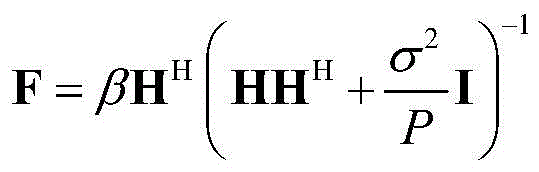
the base station side adopts MM standard with MMSE precoding as reference to select beam signals, MMSE linear precoding technology is introduced on the basis of Zero Forcing (ZF) algorithm, and MMSE precoding matrix expression is as follows:
wherein beta represents a power control factor, | · |. non-woven phosphor22 norm is obtained, and E (-) is expected; in order to achieve simple calculation, the optimization problem of the MMSE precoding algorithm can be regarded as the problem of solving the minimum mean square error of a received signal and a transmitted signal under a certain power constraint condition; on the basis, an objective function is established:
wherein P represents the maximum transmit power of the signal; according to the MMSE criterion, the obtained precoding matrix is as follows:
wherein σ2Work as noiseThe rate, power control factor β is:
wherein Tr (H) represents the trace of the matrix (H)-1Representing the inverse of the matrix, HHRepresenting the conjugate transpose of the matrix.
The MMSE-PCA channel estimation method for the beam selection MMSE is characterized in that the S2 comprises the following steps:
the antenna matrix U expression is:
in the formula:
n denotes an attitude, and a system model received signal of massive MIMO based on a 3D beam space can be expressed as:
in the formula
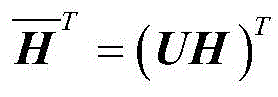
For the received signal vector of the beam space, after converting the channel vector and the channel vector into the channel vector of the beam space, the conversion mode is as follows:
comprises h
kCan be used to estimate the entire CSI; then the channel matrix of the beam space
Can be defined as:
representing a downlink beam space channel matrix;
system model as shown in fig. 1, the uplink obtains CSI through LS channel estimation, in which each user needs to send orthogonal pilot sequence ψ to the base station at time Q
mAssuming that the Q time is divided into M blocks each consisting of K times, the uplink signal vector received at the base station of the M-th block according to channel reciprocity in the TDD system
Can be expressed as:
by adaptively selecting a network, the base station uses an analog combiner W with dimension K NmTo be combined outAnd obtaining a sampling signal R with dimension K multiplied by K in baseband sampling through a radio frequency chainmWherein R ismThe expression is as follows:
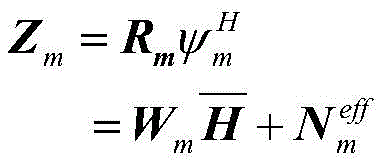
finally, the signals with reduced dimensionality and the orthogonal pilot frequency matrix are combined
Multiplying to obtain beam space channel
Is detected by the detection matrix Z
m,
WhereinAnd the effective noise matrix is represented, and in a TDD system, the CSI obtained according to uplink estimation can be used as the CSI of a downlink channel due to channel reciprocity.
The method for estimating MMSE-PCA of a millimeter wave massive MIMO system based on beam selection is characterized in that S3 includes:
because the number of effective paths in millimeter wave communication is limited, H has the characteristic of a sparse structure, and a millimeter wave Saleh-Vallenzuela channel model is shown in FIG. 2;
then the reduced dimensionality signal of the massive MIMO system based on beam space can be expressed as:
in the formula,
b denotes the set of selected beams, P
rA reduced dimension precoding matrix; in order to achieve near-optimal performance, the base station needs to obtain a 3D wave-imperial spatial channel with a limited number of radio frequency chains, and in order to guarantee spatial multiplexing gain for K users, the minimum number of required radio frequency chains should be N
RFK, so consider the number of radio frequency chains to be N
RFK, and without loss of generality;
after signals are precoded through MM-MMSE to form beams and are sent out, a receiving end receives the precoded signals, and then dimension reduction is carried out on CSI through PCA;
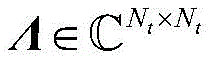
in the CSI algorithm based on low-complexity PCA, firstly, eigenvalue decomposition is carried out on a covariance matrix to obtain CHIs represented as:
wherein,
is a diagonal matrix, whose diagonal elements are eigenvalues of a covariance matrix,
is a covariance matrix C
HThe feature vector of (2);
then, the eigenvalues are arranged from big to small, and eigenvectors corresponding to the first eigenvalues with eigenvalue contribution rates exceeding a threshold gamma are selected to form a compression matrix
Second using the compression matrix
A high-dimensional downlink channel information matrix H
rCompressed into a low dimensional space, represented as:
whereinRepresenting the channel matrix after dimensionality reduction;
the feedback quantity compression ratio based on the PCA algorithm is as follows:
rPCA=l(Nr+Nt)/(Nr×Nt)
non-codebook feedback is adopted, the feedback quantity is defined by a compression ratio, and the smaller the compression ratio is, the lower the required feedback overhead is;
finally, the user will
And compressing the matrix
Feeding back the feedback information to a base station end, and recovering an original channel by using the same compression matrix after the base station end receives the feedback information, wherein the original channel is represented as the reference channel;
wherein
Representing the recovery value of the channel.
The MMSE-PCA channel estimation method based on beam selection is characterized in that the S4 comprises the following steps:
the receiving end estimates the CSI by an LS algorithm;
let the channel matrix be H and the received signal matrix beThe transmit signal matrix is X, and its estimate can be expressed as:
to obtain a specific expression, the partial derivatives of the above formula are solved, and the partial derivatives are made to be 0, so that:
to solve this, the channel estimate is obtained as:
if X is a non-singular matrix, the Mueller-Penrose inverse of X may be used.
In summary, due to the adoption of the technical scheme, the invention has the beneficial effects that:
A3D beam space system model adopting Time Division Duplex (TDD), a combined beam forming technology and a millimeter wave massive MIMO system MMSE-PCA (minimum mean square error-principal component analysis) channel estimation algorithm based on beam selection are provided. The method can finally achieve the purpose of improving the problem that multi-user interference is more serious and the like which are not beneficial to channel estimation in a large-scale MIMO system, improve the information transmission efficiency of the channel on the basis of reducing the complexity of the system, and optimize the performance of the system.
Additional aspects and advantages of the invention will be set forth in part in the description which follows and, in part, will be obvious from the description, or may be learned by practice of the invention.
Detailed Description
Reference will now be made in detail to embodiments of the present invention, examples of which are illustrated in the accompanying drawings, wherein like or similar reference numerals refer to the same or similar elements or elements having the same or similar function throughout. The embodiments described below with reference to the accompanying drawings are illustrative only for the purpose of explaining the present invention, and are not to be construed as limiting the present invention.
In the description of the present invention, it is to be understood that the terms "longitudinal", "lateral", "upper", "lower", "front", "rear", "left", "right", "vertical", "horizontal", "top", "bottom", "inner", "outer", and the like, indicate orientations or positional relationships based on those shown in the drawings, and are used merely for convenience of description and for simplicity of description, and do not indicate or imply that the referenced devices or elements must have a particular orientation, be constructed in a particular orientation, and be operated, and thus, are not to be construed as limiting the present invention.
In the description of the present invention, unless otherwise specified and limited, it is to be noted that the terms "mounted," "connected," and "connected" are to be interpreted broadly, and may be, for example, a mechanical connection or an electrical connection, a communication between two elements, a direct connection, or an indirect connection via an intermediate medium, and specific meanings of the terms may be understood by those skilled in the art according to specific situations.
According to the invention, through the method of MMSE-PCA channel estimation of the millimeter wave large-scale MIMO system based on beam selection, the rate and the performance of the millimeter wave beam selection scheme can be effectively improved, and the beam signals are selected by using the amplitude maximization standard taking MMSE precoding as the reference at the base station side, so that the multi-user interference is reduced. And then, a PCA channel compression method is used at a receiving end, the channel is compressed and dimension reduced, the complexity of channel estimation is reduced, and finally, the channel estimation is carried out by using a classical least square method.
The invention is explained in detail with reference to fig. 3, which mainly comprises the following steps:
step 1: starting;
step 2: selecting a beam signal by using an amplitude maximization criterion with MMSE precoding as a reference;
the method adopts amplitude maximization standard based on MMSE precoding to select beam signals, and introduces MMSE linear precoding technology on the basis of ZF algorithm, thereby more effectively reducing plane noise and interference between users. The MMSE precoding matrix expression is:
wherein beta represents a power control factor, | · |. non-woven phosphor2Representing 2 norm, and E (·) representing expectation. For simple calculation, the optimization problem of the MMSE precoding algorithm can be regarded as a problem of solving the minimum mean square error of a received signal and a transmitted signal under a certain power constraint condition. On the basis, an objective function is established:
where P represents the maximum transmit power of the signal. According to the MMSE criterion, the obtained precoding matrix is as follows:
wherein σ2Is the noise power. The power control factor β is:
and step 3: the receiving end uses a PCA channel compression method to compress and reduce the dimension of the channel;
and the compressed channel estimation algorithm of PCA is adopted, so that the dimensionality of a channel matrix is reduced, and the calculation complexity of channel estimation is reduced. In the CSI feedback algorithm based on low-complexity PCA, firstly, eigenvalue decomposition is carried out on a covariance matrix to obtain CHIs represented as:
wherein,
is a diagonal matrix, whose diagonal elements are eigenvalues of a covariance matrix,
is a covariance matrix C
HThe feature vector of (2).
Then, the eigenvalues are arranged from big to small, and eigenvectors corresponding to the first eigenvalues with eigenvalue contribution rates exceeding a threshold gamma are selected to form a compression matrix
Second using the compression matrix
A high-dimensional downlink channel information matrix H
rCompressed into a low dimensional space, represented as:
wherein
Representing the reduced channel matrix.
The feedback quantity compression ratio based on the PCA algorithm is as follows:
rPCA=l(Nr+Nt)/(Nr×Nt)
the project adopts non-codebook feedback, the feedback quantity is defined by the compression ratio, and the smaller the compression ratio is, the lower the required feedback overhead is.
Finally, the user will
And compressing the matrix
And feeding back the feedback information to the base station end, and recovering the original channel by using the same compression matrix after the base station end receives the feedback information, wherein the compression matrix is expressed as follows:
wherein
Representing the recovery value of the channel.
And 4, step 4: estimating channel state information by using an LS algorithm;
let the channel matrix be H and the received signal matrix be
The transmit signal matrix is X, and its estimate can be expressed as:
to obtain the LS channel estimation result, the above formula is biased to 0
To solve this, the channel estimate is obtained as:
if X is a non-singular matrix, the Mueller-Penrose inverse of X may be used.
And 5: and (6) ending.
In the description herein, references to the description of the term "one embodiment," "some embodiments," "an example," "a specific example," or "some examples," etc., mean that a particular feature, structure, material, or characteristic described in connection with the embodiment or example is included in at least one embodiment or example of the invention. In this specification, the schematic representations of the terms used above do not necessarily refer to the same embodiment or example. Furthermore, the particular features, structures, materials, or characteristics described may be combined in any suitable manner in any one or more embodiments or examples.
While embodiments of the invention have been shown and described, it will be understood by those of ordinary skill in the art that: various changes, modifications, substitutions and alterations can be made to the embodiments without departing from the principles and spirit of the invention, the scope of which is defined by the claims and their equivalents.