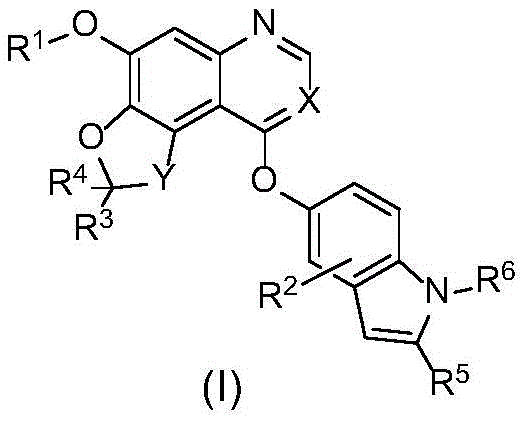
Disclosure of Invention
The invention aims to provide quinoline or quinazoline VEGFR inhibitors with excellent activity.
The invention also aims to provide application of the quinoline or quinazoline VEGFR inhibitor in preparing medicines for preventing or treating angiogenesis-related diseases, in particular tumor diseases related to protein tyrosine kinases.
In order to realize the purpose of the invention, the technical scheme of the invention is as follows:
the invention relates to a compound shown as the following formula (I), a stereoisomer, a pharmaceutically acceptable salt or ester thereof or a solvate thereof:
R1is selected from C1-C8Alkyl or C3-C8Cycloalkyl, optionally further substituted by one or more groups selected from deuterium, halogen, hydroxy, cyano, nitro, -NR8R9、-NR8COR7、-COR7、-SO2R7、-SOR7、C1-C6Alkyl radical, C3-C6Cycloalkyl radical, C1-C8Alkoxy or 4-to 10-membered heterocyclic group, said C3-C6Cycloalkyl or 4-to 10-membered heterocyclyl may be further substituted by amino, hydroxy, - (CH)2)nCN, carboxyl, C1-C4Alkyl or C1-C4Alkoxy groups.
n is selected from 0, 1,2 or 3;
R2selected from H, deuterium or halogen;
x is selected from N or CH;
y is selected from O or CR3R4;
R3And R4Each independently selected from H, deuterium, halogen, C1-C8Alkyl radical, C3-C8Cycloalkyl or C1-C8An alkoxy group;
R5selected from H, C1-C8Alkyl or C3-C8A cycloalkyl group;
R6selected from H, C1-C8Alkyl or C3-C8A cycloalkyl group;
R7selected from H, C1-C8Alkyl radical, C3-C8Cycloalkyl, -NR8R9Or C3-C6Heterocyclic group, said C3-C6The heterocyclic group may further be substituted by hydroxy, carboxy or C1-C4Alkyl substituted;
R8and R9Each independently selected from H, C1-C8Alkyl or C3-C8A cycloalkyl group.
The implementation scheme of the invention is characterized in that:
R1is C1-C4Alkyl, optionally further substituted with one or more substituents selected from deuterium, hydroxy, methyl, ethyl, cyclopropyl or 4-6 membered heterocyclyl, said cyclopropyl or 4-6 membered heterocyclyl may further be substituted with amino, hydroxy, carboxy, C1-C4Alkyl or C1-C4Alkoxy, and the 4-6 membered heterocyclic group is selected from pyrrolidinyl, morpholinyl, piperazinyl or piperidinyl.
R2Selected from H, deuterium or halogen;
x is CH;
y is CH2;
R3And R4Each independently selected from H, deuterium, halogen, C1-C8Alkyl radical, C3-C8Cycloalkyl or C1-C8Alkoxy radicalA group;
R5selected from H, C1-C8Alkyl or C3-C8A cycloalkyl group;
R6selected from H, C1-C8Alkyl or C3-C8A cycloalkyl group.
An embodiment of the present invention is a compound described by general formula (II), a stereoisomer, a pharmaceutically acceptable salt or ester thereof, or a solvate thereof:
R1is C1-C8Alkyl, optionally further substituted with one or more groups selected from deuterium, halogen, hydroxy, cyano, -COR7、C1-C6Alkyl radical, C3-C6Cycloalkyl or 4-6 membered heterocyclyl, said C3-C6Cycloalkyl or 4-6 membered heterocyclyl may be further substituted by amino, hydroxy, - (CH)2)nCN, carboxyl, C1-C4Alkyl or C1-C4Alkoxy substituted;
n is selected from 0, 1,2 or 3;
R7selected from H, C1-C8Alkyl radical, C3-C8Cycloalkyl or C3-C6Heterocyclic group, said C3-C6The heterocyclic group may further be substituted by hydroxy, carboxy or C1-C4Alkyl groups are substituted.
The implementation scheme of the invention is characterized in that:
R1is C1-C4Alkyl, optionally further substituted with one or more groups selected from deuterium, halogen, hydroxy, cyano, C1-C2Alkyl radical, C3-C6Cycloalkyl or 4-6 membered heterocyclyl, said C3-C6Cycloalkyl or 4-6 membered heterocyclyl may be further substituted by amino, hydroxy, - (CH)2)nCN, carboxyl, C1-C4Alkyl or C1-C4Alkoxy substituted; preferably, R1Is methyl, ethyl, further substituted by hydroxy, methyl, cyclopropyl or pyrrolidinyl, said cyclopropyl or pyrrolidinyl being further substituted by amino, hydroxy, - (CH)2)nCN, carboxyl, methyl or methoxy;
n is selected from 0, 1 or 2, preferably n is 0 or 1.
The implementation scheme of the invention is characterized in that:
R1is C1-C4Alkyl, optionally further substituted with one or more substituents selected from deuterium, hydroxy, methyl, ethyl, cyclopropyl or 4-6 membered heterocyclyl, said cyclopropyl or 4-6 membered heterocyclyl may further be substituted with amino, hydroxy, carboxy, C1-C4Alkyl or C1-C4Alkoxy, and the 4-6 membered heterocyclic group is selected from pyrrolidinyl, morpholinyl, piperazinyl or piperidinyl.
In a preferred embodiment of the invention, the compound is selected from:
in another aspect, the present invention provides a process for the preparation of a compound of formula (I) or a pharmaceutically acceptable salt or ester or solvate thereof, comprising the steps of:
wherein R is1、R2、R3、R4、R5、R6X, Y are as defined for the compounds of formula (I).
The compound of formula (I) or the pharmaceutically acceptable salt, ester or solvate thereof is a novel VEGFR inhibitor, so that the compound can be used for preparing a medicament for preventing or treating angiogenesis related diseases, in particular for preventing or treating malignant tumor diseases related to protein tyrosine kinases.
As a further preferred embodiment, the tumor is selected from the group consisting of: ovarian cancer, cervical cancer, colorectal cancer, breast cancer, pancreatic cancer, glioma, glioblastoma, melanoma, prostate cancer, leukemia, lymphoma, non-hodgkin's lymphoma, gastric cancer, lung cancer, hepatocellular carcinoma, gastrointestinal stromal tumors, thyroid cancer, cholangiocarcinoma, endometrial cancer, kidney cancer, anaplastic large cell lymphoma, acute myeloid leukemia, multiple myeloma, melanoma or mesothelioma, soft tissue sarcoma.
In another aspect, the present invention provides a pharmaceutical composition comprising a therapeutically effective amount of a compound of formula (I) as defined above, or a pharmaceutically acceptable salt or ester or solvate thereof, as an active ingredient and a pharmaceutically acceptable carrier.
The invention also provides application of the pharmaceutical composition in preparing a medicament for preventing or treating malignant tumors.
Unless stated to the contrary, the following terms used in the specification and claims have the following meanings.
"C" in the invention1-C8Alkyl "refers to straight chain alkyl groups and branched chain-containing alkyl groups comprising from 1 to 8 carbon atoms, alkyl refers to saturated aliphatic hydrocarbon groups such as methyl, ethyl, n-propyl, isopropyl, n-butyl, isobutyl, tert-butyl, sec-butyl, n-pentyl, 1-dimethylpropyl, 1, 2-dimethylpropyl, 2-dimethylpropyl, 1-ethylpropyl, 2-methylbutyl, 3-methylbutyl, n-hexyl, 1-ethyl-2-methylpropyl, 1, 2-trimethylpropyl, 1-dimethylbutyl, 1, 2-dimethylbutyl, 2-dimethylbutyl, 1, 3-dimethylbutyl, 2-ethylbutyl, 2-methylpentyl, 3-methylpentyl, 4-methylpentyl, 2, 3-dimethylbutyl, n-heptyl, 2-methylhexyl, 3-methylhexyl, 4-methylhexyl, 5-methylhexyl, 2, 3-dimethylpentyl, 2, 4-dimethylpentyl, 2-dimethylpentyl, 3-dimethylpentyl, 2-ethylpentyl, 3-ethylpentyl, n-octyl, 2, 3-dimethylhexyl, 2, 4-dimethylhexyl, 2, 5-dimethylhexyl, 2-dimethylhexyl, 3-dimethylhexyl, 4-dimethylhexyl, 2-ethylhexyl, 3-ethylhexyl, 4-ethylhexyl, 2-methyl-2-ethylpentyl, 2-methyl-3-ethylpentapentylOr various branched isomers thereof, and the like.
As used herein, "cycloalkyl" refers to a saturated monocyclic hydrocarbon substituent, "C3-C8Cycloalkyl "refers to monocyclic cycloalkyl groups comprising 3 to 8 carbon atoms, for example: non-limiting examples of monocyclic cycloalkyl groups include cyclopropyl, cyclobutyl, cyclopentyl, cyclohexyl, cycloheptyl, cyclooctyl, and the like.
"Heterocyclyl" as used herein refers to saturated or partially unsaturated monocyclic or polycyclic cyclic hydrocarbon substituents wherein one or more ring atoms are selected from nitrogen, oxygen, or heteroatoms of S (O) r (where r is an integer 0, 1, 2), but does not include the ring portion of-O-O-, -O-S-, or-S-S-, and the remaining ring atoms are carbon. "4-10 membered heterocyclyl" refers to a cyclic group containing from 4 to 10 ring atoms. Non-limiting examples of monocyclic heterocyclyl groups include azetidinyl, pyrrolidinyl, piperidinyl, piperazinyl, morpholinyl, thiomorpholinyl, homopiperazinyl, and the like. Polycyclic heterocyclic groups include spiro, fused and bridged heterocyclic groups.
"alkoxy" in the context of the present invention means-O- (alkyl) wherein alkyl is as defined above. "C1-C8Alkoxy "means an alkyloxy group having 1 to 8 carbons, and non-limiting examples include methoxy, ethoxy, propoxy, butoxy, and the like.
"halogen" means fluorine, chlorine, bromine or iodine.
"pharmaceutical composition" means a mixture containing one or more compounds described herein, or a physiologically acceptable salt or prodrug thereof, in admixture with other chemical components, as well as other components such as physiologically acceptable carriers and excipients. The purpose of the pharmaceutical composition is to facilitate administration to an organism, facilitate absorption of the active ingredient and exert biological activity.
In the preparation steps of the present invention, abbreviations for reagents used respectively represent:
DCM dichloromethane
DIEA N, N-diisopropylethylamine
MTBE methyl tert-butyl ether
EA Ethyl acetate
PE Petroleum Ether
THF tetrahydrofuran
TFAA trifluoroacetic anhydride
EtOH ethanol
BnBr benzyl bromide
DMAP 4-dimethylaminopyridine
TFA trifluoroacetic acid
MsCl-p-methylbenzenesulfonyl chloride
DMAC Dimethylacetamide
TBDPSCl tert-butyldiphenylchlorosilane
TBAB tetrabutylammonium bromide
Detailed Description
The invention is illustrated below with reference to specific examples. It will be understood by those skilled in the art that these examples are for illustrative purposes only and are not intended to limit the scope of the present invention in any way.
The experimental procedures in the following examples are conventional unless otherwise specified. The raw materials and reagents used in the following examples are all commercially available products unless otherwise specified.
Example 1
1- (((9- ((4-fluoro-2-methyl-1-hydroindol-5-yl) oxy) -1, 2-dihydrofuro [3,2-f ] quinolin-4-yl) oxy) methyl) -cyclopropane-1-amino hydrochloride
Step 1 Synthesis of 2, 3-dihydrobenzofuran-7-carbonyl chloride
In a single-neck flask, 2, 3-dihydrobenzofuran-7-carboxylic acid (13.65g, 83.15mmol) and SOCl were added in this order under ice-cooling2(70ml), the reaction was terminated at 60 ℃ for 1 h. Cooling to room temperature, and concentrating under reduced pressure to obtain white solid. Without further purification, the reaction mixture was directly used in the next reaction.
Step 2 Synthesis of N-methoxy-N-methyl-2, 3-dihydrobenzofuran-7-carboxamide
2, 3-dihydrobenzofuran-7-carbonyl chloride (15.18g, 83.13mmol) was added to a single-neck flask at room temperature, dissolved in DCM (150ml), DIEA (30ml) was added dropwise in ice bath and N, O-dimethylhydroxylamine hydrochloride (9.73g, 99.75mmol) was added, and the reaction was terminated at room temperature for 1 h. Extraction with EA, twice washing with saturated brine, drying the organic phase over anhydrous sodium sulfate, filtration, concentration, and purification by column chromatography (EA/PE system) gave 16.37g of yellow solid with a yield of 95% over the two steps.1H NMR(400MHz,DMSO-d6)δ7.30(dd,J=7.3,0.9Hz,1H),7.09(d,J=7.5Hz,1H),6.86(t,J=7.5Hz,1H),4.56(t,J=8.7Hz,2H),3.55(s,3H),3.20(t,J=8.8Hz,2H),3.18(s,3H)。
Step 3 Synthesis of 1- (2, 3-dihydrobenzofuran-7-yl) ethanone
To a three-necked flask were added N-methoxy-N-methyl-2, 3-dihydrobenzofuran-7-carboxamide (16.37g, 78.99mmol), THF (450ml), N at room temperature in that order2The reaction mixture was replaced three times, and a THF solution of methylmagnesium bromide (170.00ml, 170.00mmol) was added dropwise to the mixture under ice-cooling, followed by completion of the reaction at room temperature for 1 hour. And (3) moving the reaction system to an ice bath, and adjusting the pH to 3-4 by using 1N hydrochloric acid. Followed by extraction with EA, washing twice with saturated brine, drying the organic phase over anhydrous sodium sulfate, filtering and concentratingAnd performing column chromatography purification (EA/PE system) to obtain 11.11g of off-white solid with the yield of 85 percent.1H NMR(400MHz,DMSO-d6)δ7.53(d,J=7.9Hz,1H),7.46(dd,J=7.2,1.1Hz,1H),6.91(t,J=7.5Hz,1H),4.68(t,J=8.8Hz,2H),3.23(t,J=8.8Hz,2H),2.52(s,3H)。
Step 4 Synthesis of 1- (5-nitro-2, 3-dihydrobenzofuran-7-yl) ethanone
Adding H into a three-neck bottle under ice bath2SO4(50ml), 1- (2, 3-dihydrobenzofuran-7-yl) ethanone (11.10g, 68.44mmol) and KNO were added portionwise with stirring3(11.76g, 116.32mmol), the reaction was terminated at 0 ℃ for 1.5 h. Slowly pouring the reaction solution into ice water, stirring for 10min, extracting and separating liquid by using EA, washing an organic phase by using a saturated sodium bicarbonate solution and a saturated saline solution once respectively, drying the organic phase by using anhydrous sodium sulfate, filtering, concentrating, and purifying by column chromatography (EA/PE system) to obtain 12.20g of a yellow solid with the yield of 86%.1H NMR(400MHz,DMSO-d6)δ8.39(d,J=2.2Hz,1H),8.33-8.29(m,1H),4.90(t,J=8.8Hz,2H),3.35(t,J=8.9Hz,2H),2.58(s,3H)。
Step 5 Synthesis of (5-nitro-2, 3-dihydrobenzofuran-7-yl) acetate
Adding TFAA (200ml) into a single-mouth bottle, and dropwise adding H at-10 DEG C2O2(50ml) after dropping, a solution of 1- (5-nitro-2, 3-dihydrobenzofuran-7-yl) ethanone (19.00g, 91.70mmol) in DCM (45ml) was added dropwise after stirring at that temperature for 20min, and the reaction was terminated at room temperature for 3h after dropping. Extract with EA, wash twice with saturated brine, dry the organic phase over anhydrous sodium sulfate, filter, concentrate to give a yellow solid, which is not further purified and directly put into the next reaction.
Step 6 Synthesis of 5-Nitro-2, 3-dihydrobenzofuran-7-ol
(5-nitro-2, 3-dihydrobenzofuran-7-yl) acetate (20.47g, 91.71mmol) and EtOH (250ml) were added sequentially to a single-necked flask at room temperature, and a 40% NaOH solution (25ml) was added dropwise thereto under ice-cooling, followed by reaction at room temperature for 0.5 h. Adjusting the pH value to 3-4 with 2N hydrochloric acid in ice bath, extracting with EA, washing twice with saturated saline solution, drying the organic phase with anhydrous sodium sulfate, filtering, concentrating, and purifying by column chromatography (EA/PE system) to obtain 15.00g of yellow solid with yield of 90% in two steps.1H NMR(400MHz,DMSO-d6)δ7.70–7.64(m,1H),7.54(d,J=2.3Hz,1H),4.70(t,J=8.9Hz,2H),3.26(t,J=8.8Hz,2H)。MS(ESI)m/z:180.0[M-H]-。
Step 7 Synthesis of 7-benzyloxy-5-nitro-2, 3-dihydrobenzofuran
At room temperature, 5-nitro-7-hydroxy-2, 3-dihydrobenzofuran (15.0g, 82.80mmol), DMF (300ml), K were added to a single-neck flask in this order2CO3(171.66g, 1242.02mmol) and BnBr (17.00g, 99.40mmol), and the reaction was terminated at 80 ℃ for 0.5 h. Extract with EA, wash twice with saturated brine, dry the organic phase over anhydrous sodium sulfate, filter, concentrate, slurry with PE (250ml) at room temperature for 30min, filter to obtain a yellow solid 19.42g with 87% yield.1H NMR(400MHz,DMSO-d6)δ7.87–7.83(m,1H),7.80(d,J=2.0Hz,1H),7.47–7.33(m,5H),5.24(s,2H),4.74(t,J=8.9Hz,2H),3.30(t,J=8.9Hz,2H)。
Step 8 Synthesis of 7-benzyloxy-2, 3-dihydrobenzofuran-5-amine
Sequentially adding 7-benzyloxy-5-nitro-2, 3-dihydrobenzene into a single-mouth bottle at room temperatureAnd furan (19.00g, 70.04mmol), EtOH (450ml), H2O(112ml)、NH4Cl (15.69g, 293.33mmol), warmed to 80 deg.C, Fe powder (30.00g, 537.20mmol) was added and the reaction was stopped at this temperature for 1.5 h. Filtering, adding H into the filtrate2And O, extracting with EA for three times, combining organic phases, drying by anhydrous sodium sulfate, filtering, concentrating, and purifying by column chromatography (EA/PE system) to obtain a black solid 14.71g with the yield of 87%.1H NMR(400MHz,DMSO-d6)δ7.42–7.29(m,5H),6.14(s,1H),6.11(s,1H),5.00(s,2H),4.37(t,J=8.6Hz,2H),3.01(t,J=8.5Hz,2H)。MS(ESI)m/z:242.2[M+H]+。
Step 9 Synthesis of 5- (ethoxymethylene) -2, 2-dimethyl-1, 3-dioxane-4, 6-dione
To a single-neck flask were added successively isopropylidene cyclo-malonate (8.36g, 58.00mmol) and triethyl orthoformate (29.37ml, 176.58mmol) at room temperature, and the reaction was terminated at 80 ℃ for 1 hour. The product was used in the next reaction without further treatment.
Step 10 Synthesis of 5- ((7-benzyloxy-2, 3-dihydrobenzofuran-5-ylamino) methylene) -2, 2-dimethyl-1, 3-dioxane-4, 6-dione
To a single-necked flask were added 7-benzyloxy-2, 3-dihydrobenzofuran-5-amine (13.99g, 57.98mmol), 5- (ethoxymethylene) -2, 2-dimethyl-1, 3-dioxane-4, 6-dione (11.61g, 57.99mmol), and isopropanol (350ml) in this order at room temperature, followed by reaction at 80 ℃ for 0.5 h. The temperature is reduced to room temperature, and the deep yellow solid 19.05g is obtained by suction filtration, and the yield of the two steps is 83 percent.1H NMR(400MHz,DMSO-d6)δ8.50(d,J=16.0Hz,1H),7.46–7.32(m,5H),7.26(d,J=1.1Hz,1H),7.08(s,1H),5.15(s,2H),4.56(t,J=8.8Hz,2H),3.19(t,J=8.7Hz,2H),1.66(s,6H)。MS(ESI)m/z:394.2[M-H]-。
Step 11 Synthesis of 4-benzyloxy-1, 2-dihydrofuro [3,2-f ] quinolin-9-ol
At room temperature, 5- ((7-benzyloxy-2, 3-dihydrobenzofuran-5-ylamino) methylene) -2, 2-dimethyl-1, 3-dioxane-4, 6-dione (1.5g, 3.79mmol) and diphenyl ether (18ml) were sequentially added to a microwave reaction flask, stirred in a 70 ℃ water bath for 15min, and then transferred to a microwave to react at 220 ℃ for 0.5h to terminate. Cooling to room temperature, adding PE, pulping for 1h, and performing suction filtration to obtain 1.02g of yellow solid with the yield of 92%. Without further purification, the reaction mixture was directly used in the next reaction.1H NMR(400MHz,DMSO-d6)δ7.67(t,J=4.0Hz,1H),7.49–7.33(m,5H),6.92(s,1H),5.83(d,J=7.2Hz,1H),5.19(s,2H),4.58(t,J=9.1Hz,2H),3.66(t,J=9.0Hz,2H)。MS(ESI)m/z:294.2[M+H]+。
Step 12 Synthesis of 4-benzyloxy-9-chloro-1, 2-dihydrofuro [3,2-f ] quinoline
Sequentially adding 4-benzyloxy-1, 2-dihydrofuro [3,2-f ] into a three-neck flask at room temperature]Quinolin-9-ol (6.17g, 21.04mmol), phosphorus oxychloride (60ml), N2The displacement was carried out three times, and the reaction was terminated at 107 ℃ for 0.5 h. Concentration gave a black crude product which was purified by column chromatography (MeOH/DCM system) to give 3.62g of a yellow solid in 55% yield.1H NMR(400MHz,DMSO-d6)δ8.51(d,J=4.8Hz,1H),7.51–7.45(m,4H),7.44–7.33(m,3H),5.32(s,2H),4.76(t,J=9.2Hz,2H),3.88(t,J=9.2Hz,2H)。MS(ESI)m/z:312.2[M+H]+。
Step 13: synthesis of 4-benzyloxy-9- (4-fluoro-2 methyl-1-hydroindol-5-yloxy) -1, 2-dihydrofuro [3,2-f ] quinoline
Sequentially adding 4-benzyloxy-9-chloro-1, 2-dihydrofuro [3,2-f ] into a microwave reaction bottle at room temperature]Quinoline (3.62g, 11.61mmol), 2-methyl-4-fluoro-5-hydroxy-1-hydroindole (3.84g, 23.25mmol), DMAP (2.41g, 19.73mmol), 2, 6-lutidine (72ml), N2The displacement is carried out three times, and the reaction is terminated by 2.5h under the microwave at 200 ℃. After concentration, extraction with EA was carried out, washing was carried out twice with saturated brine, and the organic phase was dried over anhydrous sodium sulfate, filtered, concentrated, and purified by column chromatography (THF/DCM system) to obtain 1.29g of a yellow solid with a yield of 25%.1H NMR(400MHz,DMSO-d6)δ8.35(d,J=5.2Hz,1H),7.52(d,J=7.2Hz,2H),7.45-7.34(m,4H),7.20(d,J=8.6Hz,1H),6.98(t,J=8.1Hz,1H),6.31(d,J=5.1Hz,1H),6.27(s,1H),5.31(s,2H),4.75(t,J=9.1Hz,2H),3.81(t,J=9.1Hz,2H),2.41(s,3H)。MS(ESI)m/z:441.2[M+H]+。
Step 14: synthesis of 9- (4-fluoro-2-methyl-1-hydroindol-5-yloxy) -1, 2-dihydrofuro [3,2-f ] quinolin-4-ol
Adding 4-benzyloxy-9- (4-fluoro-2 methyl-1-hydroindol-5-yloxy) -1, 2-dihydrofuro [3,2-f ] to a three-necked flask at room temperature]Quinoline (0.62g, 1.41mmol), N2After three times of substitution, TFA (12ml) and H were added2O (3ml), and the reaction was terminated at 85 ℃ for 3 h. Extracting with mixed solution of EA and THF, washing twice with saturated saline, back-extracting the water phase with EA once, mixing the organic phases, drying with anhydrous sodium sulfate, filtering, concentrating, and purifying by column chromatography (EA/MeOH system) to obtain yellow solid 0.31g with 50% yield.1H NMR(400MHz,DMSO-d6)δ8.28(d,J=5.2Hz,1H),7.19(d,J=8.6Hz,1H),7.17(s,1H),6.97(t,J=8.1Hz,1H),6.26(s,iH),6.22(d,J=5.1Hz,1H),4.73(t,J=9.1Hz,2H),3.79(t,J=9.1Hz,2H),2.41(s,3H)。MS(EsI)m/z:351.2[M+H]+。
Step 15: synthesis of methyl (1- (tert-butoxycarbonylamino) cyclopropyl) methanesulfonate
(1-Hydroxymethylcyclopropyl) -tert-butoxycarbonylamino (1.00g, 5.34mmol), DCM (10ml) and DIEA (1.38g, 10.68mmol) were added to a single-neck flask under ice-cooling, and after stirring for 15min, MsCl (0.673g, 5.85mmol) was added dropwise, after which the reaction was terminated at room temperature for 0.5 h. Extraction with EA, washing twice with saturated sodium bicarbonate solution, drying the organic phase over anhydrous sodium sulfate, filtration and concentration to give 1.29g of a pale yellow solid with a yield of 91%.1H NMR(400MHz,DMSO-d6)δ4.18(s,2H),3.12(s,3H),1.37(s,9H),0.79(t,J=4.0Hz,2H),0.73(t,J=4.0Hz,2H)。
Step 16 Synthesis of tert-butyl 1- ((9- (4-fluoro-2 methyl-1-hydroindol-5-yloxy) -1, 2-dihydrofuro [3,2-f ] quinolin-4-yloxy) methyl) cyclopropylcarbamate
Adding 9- (4-fluoro-2-methyl-1-hydroindol-5-yloxy) -1, 2-dihydrofuro [3,2-f ] to a three-necked flask at room temperature]Quinolin-4-ol (0.10g, 0.29mmol), (1- (tert-Butoxycarbonylamino) cyclopropyl) methanesulfonic acid methyl ester (0.30g, 1.13mmol), cesium carbonate (0.46g, 1.41mmol), DMAC (6ml), N2The displacement is carried out three times, and the reaction is terminated for 1h at 100 ℃. Extract with EA, wash twice with purified water, dry the organic phase over anhydrous sodium sulfate, filter, concentrate, purify by forward column chromatography (MeOH/DCM), and purify by reverse phase column chromatography (0.05% aqueous phosphoric acid/acetonitrile system) to obtain 0.07g of a yellow solid with 50% yield.1H NMR(400MHz,DMSO-d6)δ7.35(s,1H),7.27(s,1H),7.20(d,J=8.6Hz,1H),6.98(t,J=8.1Hz,1H),6.30(d,J=5.0Hz,1H),6.27(s,1H),4.75(t,J=9.1Hz,2H),4.17(s,2H),3.81(t,J=9.2Hz,2H),2.41(s,3H),1.36(s,9H),0.85(t,J=5.6Hz,2H),0.76(t,J=5.6Hz,2H)。MS(ESI)m/z:520.2[M+H]+。
Step 17 Synthesis of 1- ((9- (4-fluoro-2-methyl-1-hydroindol-5-yloxy) -1, 2-dihydrofuro [3,2-f ] quinolin-4-yloxy) methyl) -cyclopropane-1-amino hydrochloride
Sequentially adding 1- ((9- (4-fluoro-2 methyl-1-hydroindol-5-yloxy) -1, 2-dihydrofuro [3, 2-f) into a three-necked flask at room temperature]Quinolin-4-yloxy) methyl) cyclopropylcarbamic acid tert-butyl ester (0.04g, 0.08mmol), THF (2ml), N2And replacing for three times, dropwise adding a tetrahydrofuran hydrochloride solution in an ice bath, and reacting for 3 hours at 40 ℃ after dropwise adding. The mixture was stirred for 0.5h in an ice bath and then filtered by suction to obtain 0.03g of a yellow solid with a yield of 70%.1H NMR(400MHz,DMSO-d6)δ8.72(d,J=6.3Hz,1H),7.72(s,1H),7.29(d,J=8.4Hz,1H),7.11(t,J=7.9Hz,1H),6.79(d,J=6.0Hz,1H),6.32(s,1H),4.90(t,J=9.1Hz,2H),4.45(s,2H),3.93(t,J=9.0Hz,2H),2.43(s,3H),1.19(t,J=3.0Hz,2H),1.07(t,J=3.0Hz,2H)。MS(ESI)m/z:418.2[M-H]-。
Example 2
9- (4-fluoro-2-methyl-1-hydroindol-5-yloxy) -4- (2- (pyrrolidin-1-yl) -hydroxyethyl) -1, 2-dihydrofuro [3,2-f ] quinoline
Step 1 Synthesis of 9- (4-fluoro-2-methyl-1-hydroindol-5-yloxy) -1, 2-dihydrofuro [3,2-f ] quinolin-4-ol according to steps 1 to 14 of example 1.
Step 2 Synthesis of 2- (pyrrolidin-1-ylethyl) methanesulfonate
To a single-neck flask were added N- (2-hydroxyethyl) -pyrrolidine (1.00g, 8.68mmol), NaHCO sequentially at room temperature3(1.75g, 20.83mmol), DCM (15ml), MsCl (0.99g, 8.64mmol), and the reaction was terminated at room temperature for 3 h. Adding anhydrous sodium sulfate into the reaction solution, and stirring to dryDrying, filtering, concentrating to obtain yellow solid, pulping with DCM, vacuum filtering to obtain white solid and filtrate, concentrating the filtrate, and purifying by column chromatography (ammonia methanol solution/DCM system) to obtain light yellow solid 0.22g with yield of 13%. Step 3-9- (4-fluoro-2-methyl-1-hydroindol-5-yloxy) -4- (2- (pyrrolidin-1-yl) -hydroxyethyl) -1, 2-dihydrofuro [3,2-f]Synthesis of quinolines
Sequentially adding 9- (4-fluoro-2-methyl-1-hydroindol-5-yloxy) -1, 2-dihydrofuro [3,2-f ] into a three-necked flask at room temperature]Quinolin-4-ol (0.05g, 0.14mmol), 2- (pyrrolidin-1-ylethyl) methanesulfonate (0.06g, 0.31mmol), Cs2CO3(0.12g,0.37mmol)、DMAC(3ml),N2The displacement is carried out three times, and the reaction is terminated for 1h at 100 ℃. Extract with EA, purified water is washed twice, the organic phase is dried over anhydrous sodium sulfate, filtered, concentrated, purified by forward column chromatography (methanolic ammonia/MeOH), purified by reverse phase column (0.1% methanoic acid/acetonitrile system), and finally purified by forward column chromatography (methanolic ammonia/MeOH) to obtain 0.01g of off-white solid with a yield of 15%.1H NMR(400MHz,DMSO-d6)δ8.36(d,J=5.2Hz,1H),7.33(s,1H),7.20(d,J=8.6Hz,1H),6.98(t,J=8.0Hz,1H),6.30(d,J=5.1Hz,1H),6.27(s,1H),4.75(t,J=9.0Hz,2H),4.28(t,J=4.9Hz,2H),3.81(t,J=9.1Hz,2H),2.92(t,J=4.0Hz,2H),2.67–2.57(m,4H),2.41(s,3H),1.75–1.69(m,4H)。MS(ESI)m/z:448.2[M+H]+。
Example 3
2- (9- (4-fluoro-2-methyl-1H-indol-5-yl) oxy) -1, 2-dihydrofuran [3,2-f ] quinolin-4-yl) ethaneoxy) -1-ol
Adding 9- (4-fluoro-2-methyl-1-hydroindol-5-yloxy) -1, 2-dihydrofuro [3,2-f ] in a three-necked flask at room temperature]Quinolin-4-ol (0.20g, 0.57mmol), 2-bromoethanol (0.29g, 2.28mmol), Cs2CO3(0.93g, 2.85mmol) was quenched with DMAC (5mL), nitrogen, at 60 ℃ for 2.5 h. EA extraction, saturated saline water two times, organic phase through anhydrous sodium sulfate drying, filtration, concentration, column chromatography purification (MeOH/DCM system) yellow solid product 0.06g, yield 28%.1H NMR(400MHz,DMSO-d6)δ8.35(d,J=5.1Hz,1H),7.31(s,1H),7.20(d,J=8.5Hz,1H),6.98(t,J=8.0Hz,1H),6.30(d,J=4.9Hz,1H),6.27(s,1H),4.74(t,J=9.0Hz,2H),4.18(t,J=4.2Hz,2H),3.81(t,J=7.0Hz,4H),2.41(s,3H)。MS(ESI)m/z:395.0[M+H]+。
Example 4
(S) -1- ((9- ((4-fluoro-2-methyl-1H-indol-5-yl) oxy) -1, 2-dihydrofuran [3,2-f ] quinolin-4-yl) oxy) propan-2-ol
Adding 9- (4-fluoro-2-methyl-1-hydroindol-5-yloxy) -1, 2-dihydrofuro [3,2-f ] to a three-necked flask at room temperature]Quinolin-4-ol (0.20g, 0.57mmol), Cs2CO3(0.93g, 2.85mmol), (S) -1-chloro-2-propanol (0.22g, 2.28mmol) was reacted with DMAC (3mL) under nitrogen for 2h at 80 ℃. EA was added thereto and extracted, and the resulting extract was washed twice with saturated brine, and the organic phase was dried over anhydrous sodium sulfate, filtered, concentrated, and purified by column chromatography (MeOH/DCM system) to obtain 0.98g of a yellow solid product in 70% yield. MS (ESI) M/z 409.2[ M + H]+。
Example 5
(R) -1- ((9- ((4-fluoro-2-methyl-1H-indol-5-yl) oxy) -1, 2-dihydrofuran [3,2-f ] quinolin-4-yl) oxy) propan-2-ol
Adding 9- ((4-fluoro-2 methyl-1-hydroindol-5-yl) oxy) -1, 2-dihydrofuro [3,2-f ] to a three-necked flask at room temperature]Quinolin-4-ol (0.20g, 0.57mmol), Cs2CO3(0.93g, 2.85mmol), (R) -1-chloro-2-propanol (0.22g,2.28mmol) was quenched with DMAC (3mL), nitrogen blanketed, and reacted at 80 ℃ for 2 h. EA was added and extraction was performed, the mixture was washed twice with saturated brine, and the organic phase was dried over anhydrous sodium sulfate, filtered, concentrated, and purified by column chromatography (MeOH/DCM system) to obtain 0.13g of a yellow solid product with a yield of 55%. MS (ESI) M/z 409.2[ M + H]+。
Example 6
(R) -3- ((9- ((4-fluoro-2-methyl-1H-indol-5-yl) oxy) -1, 2-dihydrofuran [3,2-f ] quinolin-4-yl) oxy) propane-1, 2-diol
Adding 9- (4-fluoro-2-methyl-1-hydroindol-5-yloxy) -1, 2-dihydrofuro [3,2-f ] to a three-necked flask at room temperature]Quinolin-4-ol (0.20g, 0.57mmol), Cs2CO3(0.93g, 2.85mmol), (R) -3-chloro-1, 2-propanediol (0.25g, 2.28mmol) was reacted with DMF (3mL) under nitrogen at 80 ℃ for 4 h. EA was added and extraction was performed, the mixture was washed twice with saturated brine, and the organic phase was dried over anhydrous sodium sulfate, filtered, concentrated, and purified by column chromatography (MeOH/DCM system) to obtain 0.09g of a yellow solid product with a yield of 37%. MS (ESI) M/z 425.1[ M + H ]]+。
Example 7
(S) -3- ((9- ((4-fluoro-2-methyl-1H-indol-5-yl) oxy) -1, 2-dihydrofuran [3,2-f ] quinolin-4-yl) oxy) propane-1, 2-diol
Adding 9- (4-fluoro-2-methyl-1-hydroindol-5-yloxy) -1, 2-dihydrofuro [3,2-f ] to a three-necked flask at room temperature]Quinolin-4-ol (0.20g, 0.57mmol), Cs2CO3(0.93g, 2.85mmol), (S) -3-chloro-1, 2-propanediol (0.25g, 2.28mmol) was reacted with DMF (3mL) under nitrogen at 80 ℃ for 4 h. EA was added and extraction was performed, the mixture was washed twice with saturated brine, and the organic phase was dried over anhydrous sodium sulfate, filtered, concentrated, and purified by column chromatography (MeOH/DCM system) to obtain 0.10g of a yellow solid product with a yield of 41%.MS(ESI)m/z:425.1[M+H]+。
Example 8
2- (2- ((3S,4R) -3, 4-dimethoxypyrrolidin-1-yl) ethoxy) -9- ((4-fluoro-2-methyl-1H-indol-5-yl) oxy) -1, 2-dihydrofuran [3,2-f ] quinoline
Step 1: synthesis of tert-butyl (3R,4S) -3, 4-dimethoxypyrrolidine-1-carboxylate
Under ice bath, tert-butyl (3R,4S) -3, 4-dihydroxypyrrolidine-1-carboxylate (1.00g, 4.92mmol), NaH (0.30g, 12.30mmol) and DMF (10mL) were added to a three-necked flask, stirred at 0 ℃ for 15min under nitrogen protection, iodomethane (1.54g, 10.83mmol) was added dropwise, and the reaction was terminated after completion of the dropwise addition at 0 ℃ for 3 h. EA was added and extraction was performed, the mixture was washed twice with saturated brine, and the organic phase was dried over anhydrous sodium sulfate, filtered, concentrated, and purified by column chromatography (PE/EA system) to obtain a pale yellow oily substance (0.91 g) with a yield of 80%. Step 2: synthesis of (3R,4S) -3, 4-dimethoxypyrrolidine hydrochloride
Tert-butyl (3R,4S) -3, 4-dimethoxypyrrolidine-1-carboxylate (0.91g, 3.93mmol) and DCM (5mL) were added to a single-neck flask at room temperature, and ethyl acetate hydrochloride solution (1mL) was added dropwise under ice bath, after completion of dropwise addition, the reaction was terminated at 20 ℃ for 1 h. Concentration gave 0.65g of a yellow solid in 98% yield.
And step 3: synthesis of 4- (2-bromoethoxy) -9- ((4-fluoro-2-methyl-1H-indol-5-yl) oxy) -1, 2-dihydrofuran [3,2-f ] quinoline
Adding 9- (4-fluoro-2-methyl-1-hydroindol-5-yloxy) -1, 2-dihydrofuro [3,2-f ] to a three-necked flask at room temperature]Quinolin-4-ol (1.00g, 2.85mmol), K2CO3(1.18g, 8.56mmol), 1, 2-dibromoethane (1.61g, 8.56mmol) and DMAC (5mL) were reacted at 90 ℃ for 6h under nitrogen protection. EA was added thereto and extracted, and the resulting extract was washed twice with saturated brine, and the organic phase was dried over anhydrous sodium sulfate, filtered, concentrated, and purified by column chromatography (MeOH/DCM system) to obtain 0.98g of a yellow solid in 70% yield.1H NMR(400MHz,DMSO-d6)δ8.41(d,J=5.3Hz,1H),7.35(s,1H),7.21(d,J=8.6Hz,1H),7.00(t,J=8.1Hz,1H),6.38(d,J=5.2Hz,1H),6.27(s,1H),4.78(t,J=9.2Hz,2H),4.54(t,J=5.3Hz,2H),3.89(t,J=5.3Hz,2H),3.83(t,J=9.1Hz,2H),2.41(s,3H).MS(ESI)m/z:456.8,458.8[M+H]+。
And 4, step 4: synthesis of 4- (2- ((3S,4R) -3, 4-dimethoxypyrrolidin-1-yl) ethoxy) -9- ((4-fluoro-2-methyl-1H-indol-5-yl) oxy) -1, 2-dihydrofuro [3,2-f ] quinoline
Adding 4- (2-bromoethoxy) -9- ((4-fluoro-2-methyl-1H-indol-5-yl) oxy) -1, 2-dihydrofuran [3,2-f ] to a three-necked flask at room temperature]Quinoline (0.20g, 0.44mmol), (3R,4S) -3, 4-dimethoxypyrrolidine hydrochloride (0.11g, 0.66mmol), Cs2CO3(0.43g, 1.31mmol) was reacted with DMF (8mL) under nitrogen at 80 ℃ for 2 h. EA was added for extraction, and the mixture was washed twice with saturated brine, and the organic phase was dried over anhydrous sodium sulfate, filtered, concentrated, and purified by reverse phase column (0.05% phosphoric acid aqueous solution/acetonitrile system) to obtain 0.14g of a white-like solid product with a yield of 64%. MS (ESI) M/z 508.1[ M + H ]]+。
Example 9
4- (2- ((3R,4R) -3, 4-dimethoxypyrrolidin-1-yl) ethoxy) -9- ((4-fluoro-2-methyl-1H-indol-5-yl) oxy) -1, 2-dihydrofuran [3,2-f ] quinoline
Step 1: synthesis of tert-butyl (3S,4S) -3, 4-dimethoxypyrrolidine-1-carboxylate
Under ice bath, tert-butyl (3S,4S) -3, 4-dihydroxypyrrolidine-1-carboxylate (1.00g, 4.92mmol), NaH (0.30g, 12.30mmol) and DMF (10mL) were added to a three-necked flask, stirred at 0 ℃ for 15min under nitrogen protection, iodomethane (1.54g, 10.83mmol) was added dropwise, and the reaction was terminated after completion of the dropwise addition at 0 ℃ for 3 h. EA was added and extraction was performed, the mixture was washed twice with saturated brine, and the organic phase was dried over anhydrous sodium sulfate, filtered, concentrated, and purified by column chromatography (PE/EA system) to obtain a pale yellow oily substance (0.80 g) with a yield of 70%. Step 2: synthesis of (3S,4S) -3, 4-dimethoxypyrrolidine hydrochloride
Tert-butyl (3S,4S) -3, 4-dimethoxypyrrolidine-1-carboxylate (0.80g, 3.93mmol) and DCM (5mL) were added to a single-neck flask at room temperature, and ethyl acetate hydrochloride solution (1mL) was added dropwise under ice bath, after completion of dropwise addition, the reaction was terminated at 20 ℃ for 1 h. Concentration gave 0.55g of a yellow solid in 95% yield.
And step 3: synthesis of 4- (2- ((3R,4R) -3, 4-dimethoxypyrrolidin-1-yl) ethoxy) -9- ((4-fluoro-2-methyl-1H-indol-5-yl) oxy) -1, 2-dihydrofuro [3,2-f ] quinoline
Adding 4- (2-bromoethoxy) -9- ((4-fluoro-2-methyl-1H-indol-5-yl) oxy) -1, 2-dihydrofuran [3,2-f ] to a three-necked flask at room temperature]Quinoline (0.40g, 0.88mmol), (3S,4S) -3, 4-dimethoxypyrrolidine hydrochloride (0.22g, 1.31mmol), Cs2CO3(0.86g, 2.62mmol) in DMF (20mL) under nitrogen, 80 ℃ reverseIt should be terminated in 2 h. EA was added for extraction, and the mixture was washed twice with saturated brine, and the organic phase was dried over anhydrous sodium sulfate, filtered, concentrated, and purified by reverse phase column (0.05% phosphoric acid aqueous solution/acetonitrile system) to obtain 0.26g of a white-like solid product with a yield of 60%. MS (ESI) M/z 508.1[ M + H ]]+。
Example 10
VEGFR kinase Activity assay
The experiment adopts gamma-33p-ATP isotope assay for testing the inhibition of the kinase VEGFR/VEGFR2/VEGFR3 and obtaining the half inhibitory concentration IC of the compound on the inhibitory activity of the enzyme50. The positive control drug, erlotinib, was purchased from Suzhou Hengning medicine science and technology, Inc., lot number 2016120201, and Lenvatinib was purchased from Hubei Willi chemical science and technology, Inc., lot number HBW 171008.
1. Basic reaction buffer
20mM Hepes(pH 7.5),10mM MgCl2,1mM EGTA,0.02%Brij35,0.02mg/ml BSA,0.1mM Na3VO4,2mM DTT,1%DMSO。
2. Compound preparation
The compound is dissolved to a specific concentration by using 100% DMSO, and then is diluted into samples to be tested (DMSO solutions) with different concentrations in a gradient manner by using an automatic sample adding device.
3. Reaction step
3.1 diluting the reaction substrate with a basic reaction buffer;
3.2 adding the kinase into the substrate solution, and gently and uniformly mixing;
3.3 adding compounds with different concentrations diluted by 100% DMSO into the kinase solution by adopting an automatic sample adding system, and incubating for 20min at room temperature;
3.4 addition at room temperature33P-ATP (10. mu.M, 10. mu. Ci/. mu.l) initiates the kinase reaction for 2 h.
4. Detection of
The reaction liquid is subjected to ion exchange filtration system to remove unreacted ATP and ADP plasma generated by the reaction, and then the substrate is detected33The amount of P isotope emitted.
5. Data processing
Adding inhibitor systems of different concentrations according to the calculation of the amount of radiationKinase activity is obtained to obtain the inhibition effect of compounds with different concentrations on the kinase activity, and the inhibition IC of the compounds is obtained by adopting graphpad prism fitting50。
The biochemical activity of the compounds of the invention is determined by the above assay, the IC determined50See table 1 for values:
TABLE 1 VEGFR kinase Activity assay results
Note: in the table, "-" indicates no test.
And (4) conclusion: compared with a positive control drug, the compound has better kinase inhibition activity, particularly VEGFR2 inhibition activity.
Example 11
VEGF-induced HUVEC cell proliferation inhibition assay
The MTT method is adopted in the experiment to test the activity effect of the compound on the HUVEC cell induced by VEGF, and the half inhibition concentration IC of the compound for inhibiting the VEGF-induced HUVEC cell proliferation activity is obtained50。
HUVEC cell lines were cultured under conditions of ECM + 5% FBS + 1% ECGS (endothelial cell growth factor additive) + 1% P/S (penicillin streptomycin cocktail). The day before the experiment was cultured with ECM + 5% FBS. 100 μ L of HUVEC cell suspension in logarithmic growth phase at a density of 5X 10 were seeded in 96-well cell culture plates4Perml, the plates were incubated in an incubator for 24h to allow the cells to adhere (37 ℃ C., 5% CO)2)。
2. Each compound was dissolved in DMSO to prepare a 10mM stock solution, and was diluted to 400-fold the target concentration in a DMSO gradient and 2-fold the target concentration in a serum-free medium, thereby maintaining the DMSO concentration in the drug solution at 0.5%. Different concentrations of the drug solution and 10ng/mL of VEGF165 were added sequentially to the 96-well plate seeded with cells at 100. mu.L/well. Each concentration was plated with 3 replicates, blank control, normal control and VEGF-induced group, continued at 37 deg.C and 5% CO2The culture was continued for 72 h.
3. The incubation was terminated and 20. mu.L of MTT solution (5mg/ml) was added to each well and continued at 37 ℃ with 5% CO2Culturing for 4 hr, removing culture medium, adding DMSO 150 μ L/well, shaking at room temperature for 10min, and measuring OD (OD) at 570nM and 620nM dual wavelengths570-OD620) And calculating IC by Graphpad Prism 6.0 data processing50The value is obtained.
The biochemical activity of the compounds of the invention is determined by the above assay, the IC determined50See table 2 for values:
TABLE 2 VEGF-induced HUVEC cell proliferation inhibition assay
And (4) conclusion: compared with a positive control drug, the compound 2 has better activity of inhibiting VEGF-induced HUVEC cell proliferation.
Example 12
Liver microsome assay
The total volume of the incubation system was 250. mu.L, a human liver microsome incubation solution containing 0.5mg/mL of protein was prepared using 50mmol/L PBS buffer (pH 7.4), 2.5. mu.L of 100. mu. mol/L test compound was mixed with 197.5. mu.L of the incubation solution before the initiation of incubation, pre-incubating in 37 deg.C water bath for 5min, adding 50 μ L of reducing coenzyme II solution (5mmol/L) pre-incubated for 5min to start reaction (the generic liver microsome protein content in the reaction system is 0.5g/L, the final concentration of the compound to be detected is 1 μmol/L), the reaction was terminated by shaking the cells in a 37 ℃ water bath and taking them out at 0, 5, 15, 30 and 60min, and adding 600. mu.L of a mixed methanol solution of positive and negative internal standards Terfenadine (positive ion internal standard, 25ng/mL) and Tolbutamide (negative ion internal standard, 50ng/mL) immediately. Shaking the terminated incubation solution for 2min, centrifuging (4 deg.C, 16000r/min) for 10min, collecting supernatant, performing LC-MS/MS detection, and quantitatively analyzing the residual amount of the parent drug. (DMSO < 0.1%).
Taking the concentration of the compound incubated for 0min as 100%, converting the concentrations of other incubation time points into the residual percentage, and pairing the natural logarithm of the residual percentage of each time pointLinear regression is carried out on the incubation time, the slope k is obtained through calculation, and according to a formula, T1/2The in vitro half-life was calculated as-0.693/k. Clearance (CLint (μ L/min/mg protein) ═ Ln (2) × 1000/T) in liver microsomes1/2(min)/Protein Conc(mg/ml))。
Liver microsome assay data are detailed in table 3:
TABLE 3 liver microsome test results
And (4) conclusion: compared with a positive control drug, the compound of the invention has equivalent metabolic stability of human liver microsomes, thereby having better druggability.