CN110461159B - fungicidal composition - Google Patents
fungicidal composition Download PDFInfo
- Publication number
- CN110461159B CN110461159B CN201880021827.7A CN201880021827A CN110461159B CN 110461159 B CN110461159 B CN 110461159B CN 201880021827 A CN201880021827 A CN 201880021827A CN 110461159 B CN110461159 B CN 110461159B
- Authority
- CN
- China
- Prior art keywords
- methyl
- component
- phenyl
- compound
- trifluoromethyl
- Prior art date
- Legal status (The legal status is an assumption and is not a legal conclusion. Google has not performed a legal analysis and makes no representation as to the accuracy of the status listed.)
- Active
Links
Classifications
-
- A—HUMAN NECESSITIES
- A01—AGRICULTURE; FORESTRY; ANIMAL HUSBANDRY; HUNTING; TRAPPING; FISHING
- A01N—PRESERVATION OF BODIES OF HUMANS OR ANIMALS OR PLANTS OR PARTS THEREOF; BIOCIDES, e.g. AS DISINFECTANTS, AS PESTICIDES OR AS HERBICIDES; PEST REPELLANTS OR ATTRACTANTS; PLANT GROWTH REGULATORS
- A01N43/00—Biocides, pest repellants or attractants, or plant growth regulators containing heterocyclic compounds
- A01N43/72—Biocides, pest repellants or attractants, or plant growth regulators containing heterocyclic compounds having rings with nitrogen atoms and oxygen or sulfur atoms as ring hetero atoms
- A01N43/82—Biocides, pest repellants or attractants, or plant growth regulators containing heterocyclic compounds having rings with nitrogen atoms and oxygen or sulfur atoms as ring hetero atoms five-membered rings with three ring hetero atoms
-
- C—CHEMISTRY; METALLURGY
- C07—ORGANIC CHEMISTRY
- C07D—HETEROCYCLIC COMPOUNDS
- C07D271/00—Heterocyclic compounds containing five-membered rings having two nitrogen atoms and one oxygen atom as the only ring hetero atoms
- C07D271/02—Heterocyclic compounds containing five-membered rings having two nitrogen atoms and one oxygen atom as the only ring hetero atoms not condensed with other rings
- C07D271/06—1,2,4-Oxadiazoles; Hydrogenated 1,2,4-oxadiazoles
-
- A—HUMAN NECESSITIES
- A01—AGRICULTURE; FORESTRY; ANIMAL HUSBANDRY; HUNTING; TRAPPING; FISHING
- A01N—PRESERVATION OF BODIES OF HUMANS OR ANIMALS OR PLANTS OR PARTS THEREOF; BIOCIDES, e.g. AS DISINFECTANTS, AS PESTICIDES OR AS HERBICIDES; PEST REPELLANTS OR ATTRACTANTS; PLANT GROWTH REGULATORS
- A01N47/00—Biocides, pest repellants or attractants, or plant growth regulators containing organic compounds containing a carbon atom not being member of a ring and having no bond to a carbon or hydrogen atom, e.g. derivatives of carbonic acid
- A01N47/08—Biocides, pest repellants or attractants, or plant growth regulators containing organic compounds containing a carbon atom not being member of a ring and having no bond to a carbon or hydrogen atom, e.g. derivatives of carbonic acid the carbon atom having one or more single bonds to nitrogen atoms
- A01N47/28—Ureas or thioureas containing the groups >N—CO—N< or >N—CS—N<
-
- A—HUMAN NECESSITIES
- A01—AGRICULTURE; FORESTRY; ANIMAL HUSBANDRY; HUNTING; TRAPPING; FISHING
- A01N—PRESERVATION OF BODIES OF HUMANS OR ANIMALS OR PLANTS OR PARTS THEREOF; BIOCIDES, e.g. AS DISINFECTANTS, AS PESTICIDES OR AS HERBICIDES; PEST REPELLANTS OR ATTRACTANTS; PLANT GROWTH REGULATORS
- A01N53/00—Biocides, pest repellants or attractants, or plant growth regulators containing cyclopropane carboxylic acids or derivatives thereof
Landscapes
- Life Sciences & Earth Sciences (AREA)
- Chemical & Material Sciences (AREA)
- Organic Chemistry (AREA)
- Health & Medical Sciences (AREA)
- Pest Control & Pesticides (AREA)
- Plant Pathology (AREA)
- Agronomy & Crop Science (AREA)
- Engineering & Computer Science (AREA)
- Dentistry (AREA)
- General Health & Medical Sciences (AREA)
- Wood Science & Technology (AREA)
- Zoology (AREA)
- Environmental Sciences (AREA)
- Agricultural Chemicals And Associated Chemicals (AREA)
Abstract
A fungicidal composition comprising a mixture of components (a) and (B), wherein components (a) and (B) are as defined in claim 1, and the use of the composition in agriculture or horticulture for controlling or preventing infestation of plants by phytopathogenic microorganisms, preferably fungi.
Description
The present invention relates to novel fungicidal compositions, to their use in agriculture or horticulture for the control of diseases caused by phytopathogens, in particular phytopathogenic fungi, and to methods of controlling diseases on useful plants.
Certain oxadiazole derivatives are known, for example, from CN 1927860 as insecticides and acaricides. WO 2013/064079, EP 0276432 and WO 2015/185485 describe the use of substituted oxadiazoles for combating phytopathogenic fungi.
Although many fungicidal compounds and compositions belonging to a number of different chemical classes have been developed or are being developed for use as fungicides in crops of useful plants, in many respects, crop tolerance and activity against specific phytopathogenic fungi do not always meet the needs of agricultural practice. Thus, there is a continuing need for: novel compounds and compositions having excellent biological properties are found for controlling or preventing infestation of plants by phytopathogenic fungi. For example, compounds with greater biological activity, a favorable spectrum of activity, increased safety, improved physicochemical properties, or increased biodegradability. Or in addition, compositions having a broader spectrum of activity, improved crop tolerance, improved synergistic interactions or enhanced properties, or compositions that exhibit faster onset or have longer lasting residual activity or that are capable of reducing the number of applications and/or application rates of compounds and compositions required for effective control of phytopathogens, thereby enabling beneficial tolerance management practices, reducing environmental impact and reducing operator exposure.
Some of these needs can be addressed using compositions comprising mixtures of different fungicidal compounds having different modes of action (e.g., by combining fungicides having different activity spectra).
According to the present invention, there is provided a fungicidal composition comprising, as an active ingredient, a mixture of components (a) and (B), wherein component (a) is a compound having the formula (I):
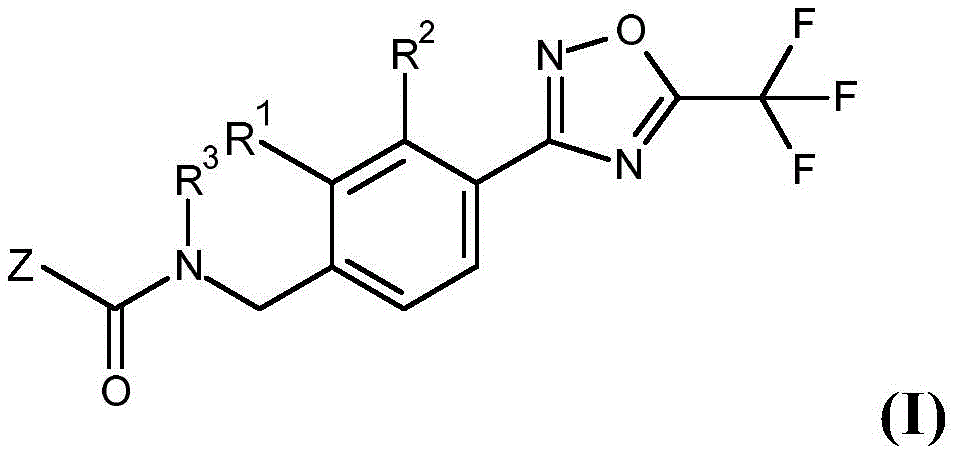
wherein
R1Hydrogen or fluorine;
R2hydrogen or fluorine;
R3methyl, ethyl, isopropyl, methoxy, ethoxy, methoxyethyl, 2,2, 2-trifluoroethyl, or cyclopropyl;
Z=R4or R5Wherein
R4Ethyl, isopropyl, 2-propen-2-yl (H)2C=C(CH3) -), 3-butyn-1-yl (HC ≡ CCH)2CH2-), methoxymethyl, 1-methoxyethyl, (difluoromethoxy) methyl, 2,2, 2-trifluoroethyl, cyclopropyl, 2, 2-difluorocyclopropyl, tetrahydrofuran-2-yl; and is
R5=-NR6R7Wherein
R6Hydrogen or methyl; and is
R7Methyl, ethyl, isopropyl, methoxy, ethoxy, allyl (H)2C=CHCH2-), propargyl (HC ≡ CCH)2-), 2,2, 2-trifluoroethyl, cyclopropyl or (cyclopropyl) methyl,
or a salt or N-oxide thereof,
and is
Component (B) is a compound selected from the group consisting of:
Benzovindiflupyr, fluxapyroxad, isopyrazam, fluopyram, penthiopyrad, epoxiconazole, bixafen, difenoconazole, cyproconazole, tebuconazole, hexaconazole, prothioconazole, propiconazole, epoxiconazole, flutriafol, fluroxypyr, ipconazole, paclobutrazol, azoxystrobin, trifloxystrobin, pyraclostrobin, metalaxyl-M, fenpropidin, fenpropimorph, cyprodinil, spiroxamine, mancozeb, chlorothalonil, fluthiazopyr, mandipropamid, fluazinam, difenoconazole, fosetyl-aluminum, activated ester-S-methyl, procymidone, carbendazim, fenhexamid, prochloraz, prohexadimethalin, prozin, calcium cloxacex Gold, andTM(plant extract containing tea tree oil), N' - [ 5-bromo-2-methyl-6- (1-methyl-2-propoxy-ethoxy) -3-pyridyl]-N-ethyl-N-methyl-formamidine), N' - [ 5-bromo-2-methyl-6- [ (1S) -1-methyl-2-propoxy-ethoxy]-3-pyridyl]-N-ethyl-N-methyl-formamidine, N' - [ 5-bromo-2-methyl-6- [ (1R) -1-methyl-2-propoxy-ethoxy]-3-pyridyl]-N-ethyl-N-methyl-formamidine, N' - [ 5-bromo-2-methyl-6- (1-methyl-2-propoxy-ethoxy) -3-pyridinyl ]-N-isopropyl-N-methyl-formamidine, N' - [ 5-chloro-2-methyl-6- (1-methyl-2-propoxy-ethoxy) -3-pyridinyl]-N-ethyl-N-methyl-formamidine, calcium phosphonate, cis-jasmone, trinexapac-ethyl, glyphosate, 2,4-D (2, 4-dichlorophenoxyacetic acid) and thiamethoxam.
In general, the weight ratio of component (a) to component (B) may preferably be from 100:1 to 1:100, from 50:1 to 1:50, from 20:1 to 1:40, from 15:1 to 1:30, from 12:1 to 1:25, from 10:1 to 1:20, from 5:1 and 1:15, from 3:1 to 1:10 or from 2:1 to 1: 5.
Further according to the present invention, there is provided a method for controlling or preventing phytopathogenic diseases, in particular phytopathogenic fungi, on useful plants or on propagation material thereof, which comprises applying the fungicidal composition according to the invention to the useful plants, the locus thereof or propagation material thereof.
The benefits provided by certain fungicidal mixture compositions according to the present invention may also include, inter alia, a favorable level of biological activity for protecting plants against diseases caused by fungi or superior properties for use as agrochemical active ingredients (e.g., greater biological activity, a favorable spectrum of activity, increased safety, improved physico-chemical properties, or increased biodegradability).
The presence of one or more possible asymmetric carbon atoms in a compound of formula (I) means that the compound may exist in an optically isomeric form (i.e., enantiomeric or diastereomeric form) (e.g., (R) -and (S) -enantiomer of compound x.04, (R) -and (S) -enantiomer of compound x.06, (R) -and (S) -enantiomer of compound x.12, and (R) -and (S) -enantiomer of compound x.13). Atropisomers may also be present as a result of restricted rotation about a single bond. The present invention includes all those possible isomeric forms (e.g., geometric isomers) and mixtures thereof for the compounds having formula (I). The present invention includes all possible tautomeric forms for the compounds of formula (I) and also includes racemic compounds, i.e. mixtures of at least two enantiomers in a ratio of substantially 50: 50.
In each case, the compounds of the formula (I) according to the invention are in free form, in oxidized form, such as N-oxide, or in salt form (for example in the form of an agronomically usable salt).
The N-oxide is an oxidized form of a tertiary amine or an oxidized form of a nitrogen-containing heteroaromatic compound. For example, a. albini and s.pietra described them in a book entitled "Heterocyclic N-oxides" published in 1991 by bocardon (Boca Raton) CRC press.
For the substituent R in the compounds of the formula (I)1、R2、R3、Z、R4、R5And R6Preferred groups and values of (a), in any combination thereof, are as set forth below.
Preferably R1And R2Both are hydrogen;
preferably, R3Is ethyl or methoxy;
preferably, Z is R4And R is4Is isopropyl, (1-methoxy) ethyl, cyclopropyl, or Z is R5And R is5Is NR6R7Wherein R is6Is hydrogen and R7Is methyl;
or a salt, enantiomer, tautomer or N-oxide of such a compound.
Most preferably, component (a) is a compound selected from compound numbers x.01, x.02, x.03, x.04, x.05, x.06, x.07, x.08, x.09, x.10, x.11, x.12, x.13, x.14, x.15, x.16, x.17, x.18, x.19, x.20, x.21, x.22, x.23, x.24, or x.25 as defined in table X below. More preferably, component (a) is a compound selected from compound numbers x.01, x.04, x.07, x.14, x.24 or x.25 as defined in table X below.
Table X


The presence of asymmetric carbon atoms in compounds x.04, x.06, x.12 and x.13 means that these compounds can exist in chiral enantiomeric forms, i.e. (R) -and (S) -enantiomers as shown below.

The final compounds, which are enantiomerically pure, may be obtained, where appropriate, from racemic starting materials via standard physical separation techniques (e.g., reverse phase chiral chromatography) or by stereoselective synthetic techniques (e.g., by using chiral starting materials).
Preferably, component (B) is a compound selected from the group consisting of:
benzovindiflupyr, fluxapyroxad, isopyrazam, fluopyram, penthiopyrad, difenoconazole, cyproconazole, tebuconazole, hexaconazole, prothioconazole, fluroxypyr, azoxystrobin, trifloxystrobin, picoxystrobin, pyraclostrobin, metalaxyl-M, fenpropidin, fenpropimorph, cyprodinil, spiroxamine, mancozeb, chlorothalonil, fluthiazopyr, mandipropamid, fluazinam, ethafosetyl-aluminum, trinexapac-ethyl, activated ester-S-methyl, Timorex GoldTM (plant extract containing tea tree oil), glyphosate, thiamethoxam, or

(N' - [ 5-bromo-2-methyl-6- (1-methyl-2-propoxy-ethoxy) -3-pyridinyl ] -N-ethyl-N-methyl-formamidine).
More preferably, component (B) is a compound selected from the group consisting of: benzovindiflupyr, fluxapyroxad, isopyrazam, fluopyram, penthiopyrad, difenoconazole, cyproconazole, tebuconazole, hexaconazole, prothioconazole, trifloxystrobin, azoxystrobin, trifloxystrobin, pyraclostrobin, fenpropidin, fenpropimorph, mancozeb, chlorothalonil, N' - [ 5-bromo-2-methyl-6- (1-methyl-2-propoxy-ethoxy) -3-pyridyl ] -N-ethyl-N-methyl-formamidine.
Still more preferably, component (B) is a compound selected from the group consisting of: benzovindiflupyr, fluxapyroxad, difenoconazole, cyproconazole, hexaconazole, prothioconazole, azoxystrobin, fenpropidin, or N' - [ 5-bromo-2-methyl-6- (1-methyl-2-propoxy-ethoxy) -3-pyridinyl ] -N-ethyl-N-methyl-formamidine.
These component (B) compounds are referred to herein and above by the so-called "ISO common name" or another "common name" or trade name used in individual cases. These component (B) compounds are known and are commercially available and/or can be prepared using procedures known in the art and/or reported in the literature.
In a preferred composition according to the invention, component (a) is compound number x.01[ N-methoxy-N- [ [4- [5- (trifluoromethyl) -1,2, 4-oxadiazol-3-yl ] phenyl ] methyl ] cyclopropanecarboxamide ] or a salt, enantiomer, tautomer or N-oxide thereof, and component (B) is a compound selected from the group consisting of: benzovindiflupyr, fluxapyroxad, isopyrazam, fluopyram, penthiopyrad, difenoconazole, cyproconazole, tebuconazole, hexaconazole, prothioconazole, trifloxystrobin, azoxystrobin, picoxystrobin, pyraclostrobin, fenpropidin, fenpropimorph, mancozeb, chlorothalonil, N' - [ 5-bromo-2-methyl-6- (1-methyl-2-propoxy-ethoxy) -3-pyridinyl ] -N-ethyl-N-methyl-formamidine, wherein the weight ratio of component (a) to component (B) is from 15:1 to 1: 30.
In another preferred composition according to the invention, component (a) is compound number x.02[ N-methoxy-N- [ [4- [5- (trifluoromethyl) -1,2, 4-oxadiazol-3-yl ] phenyl ] methyl ] pent-4-ynylamide ] or a salt, enantiomer, tautomer or N-oxide thereof, and component (B) is a compound selected from the group consisting of: benzovindiflupyr, fluxapyroxad, isopyrazam, fluopyram, penthiopyrad, difenoconazole, cyproconazole, tebuconazole, hexaconazole, prothioconazole, trifloxystrobin, azoxystrobin, picoxystrobin, pyraclostrobin, fenpropidin, fenpropimorph, mancozeb, chlorothalonil, N' - [ 5-bromo-2-methyl-6- (1-methyl-2-propoxy-ethoxy) -3-pyridinyl ] -N-ethyl-N-methyl-formamidine, wherein the weight ratio of component (a) to component (B) is from 15:1 to 1: 30.
In another preferred composition according to the invention, component (a) is compound number x.03[ N-methoxy-2-methyl-N- [ [4- [5- (trifluoromethyl) -1,2, 4-oxadiazol-3-yl ] phenyl ] methyl ] prop-2-enamide ] or a salt, enantiomer, tautomer or N-oxide thereof, and component (B) is a compound selected from the group consisting of: benzovindiflupyr, fluxapyroxad, isopyrazam, fluopyram, penthiopyrad, difenoconazole, cyproconazole, tebuconazole, hexaconazole, prothioconazole, trifloxystrobin, azoxystrobin, picoxystrobin, pyraclostrobin, fenpropidin, fenpropimorph, mancozeb, chlorothalonil, N' - [ 5-bromo-2-methyl-6- (1-methyl-2-propoxy-ethoxy) -3-pyridinyl ] -N-ethyl-N-methyl-formamidine, wherein the weight ratio of component (a) to component (B) is from 15:1 to 1: 30.
In another preferred composition according to the invention, component (a) is compound number x.04[ N, 2-dimethoxy-N- [ [4- [5- (trifluoromethyl) -1,2, 4-oxadiazol-3-yl ] phenyl ] methyl ] propanamide ] or a salt, enantiomer, tautomer or N-oxide thereof, and component (B) is a compound selected from the group consisting of: benzovindiflupyr, fluxapyroxad, isopyrazam, fluopyram, penthiopyrad, difenoconazole, cyproconazole, tebuconazole, hexaconazole, prothioconazole, trifloxystrobin, azoxystrobin, picoxystrobin, pyraclostrobin, fenpropidin, fenpropimorph, mancozeb, chlorothalonil, N' - [ 5-bromo-2-methyl-6- (1-methyl-2-propoxy-ethoxy) -3-pyridinyl ] -N-ethyl-N-methyl-formamidine, wherein the weight ratio of component (a) to component (B) is from 15:1 to 1: 30.
In another preferred composition according to the invention, component (a) is compound number x.05[ N-cyclopropyl-3, 3, 3-trifluoro-N- [ [4- [5- (trifluoromethyl) -1,2, 4-oxadiazol-3-yl ] phenyl ] methyl ] propanamide ] or a salt, enantiomer, tautomer or N-oxide thereof, and component (B) is a compound selected from the group consisting of: benzovindiflupyr, fluxapyroxad, isopyrazam, fluopyram, penthiopyrad, difenoconazole, cyproconazole, tebuconazole, hexaconazole, prothioconazole, trifloxystrobin, azoxystrobin, picoxystrobin, pyraclostrobin, fenpropidin, fenpropimorph, mancozeb, chlorothalonil, N' - [ 5-bromo-2-methyl-6- (1-methyl-2-propoxy-ethoxy) -3-pyridinyl ] -N-ethyl-N-methyl-formamidine, wherein the weight ratio of component (a) to component (B) is from 15:1 to 1: 30.
In another preferred composition according to the invention, component (a) is compound number x.06[2, 2-difluoro-N- (2-methoxyethyl) -N- [ [4- [5- (trifluoromethyl) -1,2, 4-oxadiazol-3-yl ] phenyl ] methyl ] cyclopropanecarboxamide ] or a salt, enantiomer, tautomer or N-oxide thereof, and component (B) is a compound selected from the group consisting of: benzovindiflupyr, fluxapyroxad, isopyrazam, fluopyram, penthiopyrad, difenoconazole, cyproconazole, tebuconazole, hexaconazole, prothioconazole, trifloxystrobin, azoxystrobin, picoxystrobin, pyraclostrobin, fenpropidin, fenpropimorph, mancozeb, chlorothalonil, N' - [ 5-bromo-2-methyl-6- (1-methyl-2-propoxy-ethoxy) -3-pyridinyl ] -N-ethyl-N-methyl-formamidine, wherein the weight ratio of component (a) to component (B) is from 15:1 to 1: 30.
In another preferred composition according to the invention, component (a) is compound number x.07[ N-ethyl-2-methyl-N- [ [4- [5- (trifluoromethyl) -1,2, 4-oxadiazol-3-yl ] phenyl ] methyl ] propanamide ] or a salt, enantiomer, tautomer or N-oxide thereof, and component (B) is a compound selected from the group consisting of: benzovindiflupyr, fluxapyroxad, isopyrazam, fluopyram, penthiopyrad, difenoconazole, cyproconazole, tebuconazole, hexaconazole, prothioconazole, trifloxystrobin, azoxystrobin, picoxystrobin, pyraclostrobin, fenpropidin, fenpropimorph, mancozeb, chlorothalonil, N' - [ 5-bromo-2-methyl-6- (1-methyl-2-propoxy-ethoxy) -3-pyridinyl ] -N-ethyl-N-methyl-formamidine, wherein the weight ratio of component (a) to component (B) is from 15:1 to 1: 30.
In another preferred composition according to the invention, component (a) is compound number x.08[ N- [ [ 3-fluoro-4- [5- (trifluoromethyl) -1,2, 4-oxadiazol-3-yl ] phenyl ] methyl ] -N-methoxy-propionamide ] or a salt, enantiomer, tautomer or N-oxide thereof, and component (B) is a compound selected from the group consisting of: benzovindiflupyr, fluxapyroxad, isopyrazam, fluopyram, penthiopyrad, difenoconazole, cyproconazole, tebuconazole, hexaconazole, prothioconazole, trifloxystrobin, azoxystrobin, picoxystrobin, pyraclostrobin, fenpropidin, fenpropimorph, mancozeb, chlorothalonil, N' - [ 5-bromo-2-methyl-6- (1-methyl-2-propoxy-ethoxy) -3-pyridinyl ] -N-ethyl-N-methyl-formamidine, wherein the weight ratio of component (a) to component (B) is from 15:1 to 1: 30.
In another preferred composition according to the invention, component (a) is compound number x.09[ 2-methoxy-N- (2,2, 2-trifluoroethyl) -N- [ [4- [5- (trifluoromethyl) -1,2, 4-oxadiazol-3-yl ] phenyl ] methyl ] acetamide ] or a salt, enantiomer, tautomer or N-oxide thereof, and component (B) is a compound selected from the group consisting of: benzovindiflupyr, fluxapyroxad, isopyrazam, fluopyram, penthiopyrad, difenoconazole, cyproconazole, tebuconazole, hexaconazole, prothioconazole, trifloxystrobin, azoxystrobin, picoxystrobin, pyraclostrobin, fenpropidin, fenpropimorph, mancozeb, chlorothalonil, N' - [ 5-bromo-2-methyl-6- (1-methyl-2-propoxy-ethoxy) -3-pyridinyl ] -N-ethyl-N-methyl-formamidine, wherein the weight ratio of component (a) to component (B) is from 15:1 to 1: 30.
In another preferred composition according to the invention, component (a) is compound number x.10[ N- [ [2, 3-difluoro-4- [5- (trifluoromethyl) -1,2, 4-oxadiazol-3-yl ] phenyl ] methyl ] -N-methoxy-cyclopropanecarboxamide ] or a salt, enantiomer, tautomer or N-oxide thereof, and component (B) is a compound selected from the group consisting of: benzovindiflupyr, fluxapyroxad, isopyrazam, fluopyram, penthiopyrad, difenoconazole, cyproconazole, tebuconazole, hexaconazole, prothioconazole, trifloxystrobin, azoxystrobin, picoxystrobin, pyraclostrobin, fenpropidin, fenpropimorph, mancozeb, chlorothalonil, N' - [ 5-bromo-2-methyl-6- (1-methyl-2-propoxy-ethoxy) -3-pyridinyl ] -N-ethyl-N-methyl-formamidine, wherein the weight ratio of component (a) to component (B) is from 15:1 to 1: 30.
In another preferred composition according to the invention, component (a) is compound number x.11[2- (difluoromethoxy) -N-methyl-N- [ [4- [5- (trifluoromethyl) -1,2, 4-oxadiazol-3-yl ] phenyl ] methyl ] acetamide ] or a salt, enantiomer, tautomer or N-oxide thereof, and component (B) is a compound selected from the group consisting of: benzovindiflupyr, fluxapyroxad, isopyrazam, fluopyram, penthiopyrad, difenoconazole, cyproconazole, tebuconazole, hexaconazole, prothioconazole, trifloxystrobin, azoxystrobin, picoxystrobin, pyraclostrobin, fenpropidin, fenpropimorph, mancozeb, chlorothalonil, N' - [ 5-bromo-2-methyl-6- (1-methyl-2-propoxy-ethoxy) -3-pyridinyl ] -N-ethyl-N-methyl-formamidine, wherein the weight ratio of component (a) to component (B) is from 15:1 to 1: 30.
In another preferred composition according to the invention, component (a) is compound number x.12[ N-ethoxy-2-methoxy-N- [ [4- [5- (trifluoromethyl) -1,2, 4-oxadiazol-3-yl ] phenyl ] methyl ] propanamide ] or a salt, enantiomer, tautomer or N-oxide thereof, and component (B) is a compound selected from the group consisting of: benzovindiflupyr, fluxapyroxad, isopyrazam, fluopyram, penthiopyrad, difenoconazole, cyproconazole, tebuconazole, hexaconazole, prothioconazole, trifloxystrobin, azoxystrobin, picoxystrobin, pyraclostrobin, fenpropidin, fenpropimorph, mancozeb, chlorothalonil, N' - [ 5-bromo-2-methyl-6- (1-methyl-2-propoxy-ethoxy) -3-pyridinyl ] -N-ethyl-N-methyl-formamidine, wherein the weight ratio of component (a) to component (B) is from 15:1 to 1: 30.
In another preferred composition according to the invention, component (a) is compound number x.13[ N-isopropyl-N- [ [4- [5- (trifluoromethyl) -1,2, 4-oxadiazol-3-yl ] phenyl ] methyl ] tetrahydrofuran-2-carboxamide ] or a salt, enantiomer, tautomer or N-oxide thereof, and component (B) is a compound selected from the group consisting of: benzovindiflupyr, fluxapyroxad, isopyrazam, fluopyram, penthiopyrad, difenoconazole, cyproconazole, tebuconazole, hexaconazole, prothioconazole, trifloxystrobin, azoxystrobin, picoxystrobin, pyraclostrobin, fenpropidin, fenpropimorph, mancozeb, chlorothalonil, N' - [ 5-bromo-2-methyl-6- (1-methyl-2-propoxy-ethoxy) -3-pyridinyl ] -N-ethyl-N-methyl-formamidine, wherein the weight ratio of component (a) to component (B) is from 15:1 to 1: 30.
In another preferred composition according to the invention, component (a) is compound number x.14[ 1-methoxy-3-methyl-1- [ [4- [5- (trifluoromethyl) -1,2, 4-oxadiazol-3-yl ] phenyl ] methyl ] urea ] or a salt, enantiomer, tautomer or N-oxide thereof, and component (B) is a compound selected from the group consisting of: benzovindiflupyr, fluxapyroxad, isopyrazam, fluopyram, penthiopyrad, difenoconazole, cyproconazole, tebuconazole, hexaconazole, prothioconazole, trifloxystrobin, azoxystrobin, picoxystrobin, pyraclostrobin, fenpropidin, fenpropimorph, mancozeb, chlorothalonil, N' - [ 5-bromo-2-methyl-6- (1-methyl-2-propoxy-ethoxy) -3-pyridinyl ] -N-ethyl-N-methyl-formamidine, wherein the weight ratio of component (a) to component (B) is from 15:1 to 1: 30.
In another preferred composition according to the invention, component (a) is compound number x.15[ 3-cyclopropyl-1-methoxy-1- [ [4- [5- (trifluoromethyl) -1,2, 4-oxadiazol-3-yl ] phenyl ] methyl ] urea ] or a salt, enantiomer, tautomer or N-oxide thereof, and component (B) is a compound selected from the group consisting of: benzovindiflupyr, fluxapyroxad, isopyrazam, fluopyram, penthiopyrad, difenoconazole, cyproconazole, tebuconazole, hexaconazole, prothioconazole, trifloxystrobin, azoxystrobin, picoxystrobin, pyraclostrobin, fenpropidin, fenpropimorph, mancozeb, chlorothalonil, N' - [ 5-bromo-2-methyl-6- (1-methyl-2-propoxy-ethoxy) -3-pyridinyl ] -N-ethyl-N-methyl-formamidine, wherein the weight ratio of component (a) to component (B) is from 15:1 to 1: 30.
In another preferred composition according to the invention, component (a) is compound number x.16[ 3-ethoxy-1-methoxy-1- [ [4- [5- (trifluoromethyl) -1,2, 4-oxadiazol-3-yl ] phenyl ] methyl ] urea ] or a salt, enantiomer, tautomer or N-oxide thereof, and component (B) is a compound selected from the group consisting of: benzovindiflupyr, fluxapyroxad, isopyrazam, fluopyram, penthiopyrad, difenoconazole, cyproconazole, tebuconazole, hexaconazole, prothioconazole, trifloxystrobin, azoxystrobin, picoxystrobin, pyraclostrobin, fenpropidin, fenpropimorph, mancozeb, chlorothalonil, N' - [ 5-bromo-2-methyl-6- (1-methyl-2-propoxy-ethoxy) -3-pyridinyl ] -N-ethyl-N-methyl-formamidine, wherein the weight ratio of component (a) to component (B) is from 15:1 to 1: 30.
In another preferred composition according to the invention, component (a) is compound number x.17[ 3-allyl-1-methoxy-1- [ [4- [5- (trifluoromethyl) -1,2, 4-oxadiazol-3-yl ] phenyl ] methyl ] urea ] or a salt, enantiomer, tautomer or N-oxide thereof, and component (B) is a compound selected from the group consisting of: benzovindiflupyr, fluxapyroxad, isopyrazam, fluopyram, penthiopyrad, difenoconazole, cyproconazole, tebuconazole, hexaconazole, prothioconazole, trifloxystrobin, azoxystrobin, picoxystrobin, pyraclostrobin, fenpropidin, fenpropimorph, mancozeb, chlorothalonil, N' - [ 5-bromo-2-methyl-6- (1-methyl-2-propoxy-ethoxy) -3-pyridinyl ] -N-ethyl-N-methyl-formamidine, wherein the weight ratio of component (a) to component (B) is from 15:1 to 1: 30.
In another preferred composition according to the invention, component (a) is compound number x.18[ 1-cyclopropyl-3-methoxy-3-methyl-1- [ [4- [5- (trifluoromethyl) -1,2, 4-oxadiazol-3-yl ] phenyl ] methyl ] urea ] or a salt, enantiomer, tautomer or N-oxide thereof, and component (B) is a compound selected from the group consisting of: benzovindiflupyr, fluxapyroxad, isopyrazam, fluopyram, penthiopyrad, difenoconazole, cyproconazole, tebuconazole, hexaconazole, prothioconazole, trifloxystrobin, azoxystrobin, picoxystrobin, pyraclostrobin, fenpropidin, fenpropimorph, mancozeb, chlorothalonil, N' - [ 5-bromo-2-methyl-6- (1-methyl-2-propoxy-ethoxy) -3-pyridinyl ] -N-ethyl-N-methyl-formamidine, wherein the weight ratio of component (a) to component (B) is from 15:1 to 1: 30.
In another preferred composition according to the invention, component (a) is compound number x.19[ 3-isopropyl-1-methoxy-1- [ [4- [5- (trifluoromethyl) -1,2, 4-oxadiazol-3-yl ] phenyl ] methyl ] urea ] or a salt, enantiomer, tautomer or N-oxide thereof, and component (B) is a compound selected from the group consisting of: benzovindiflupyr, fluxapyroxad, isopyrazam, fluopyram, penthiopyrad, difenoconazole, cyproconazole, tebuconazole, hexaconazole, prothioconazole, trifloxystrobin, azoxystrobin, picoxystrobin, pyraclostrobin, fenpropidin, fenpropimorph, mancozeb, chlorothalonil, N' - [ 5-bromo-2-methyl-6- (1-methyl-2-propoxy-ethoxy) -3-pyridinyl ] -N-ethyl-N-methyl-formamidine, wherein the weight ratio of component (a) to component (B) is from 15:1 to 1: 30.
In another preferred composition according to the invention, component (a) is compound number x.20[ 1-methoxy-3-prop-2-ynyl-1- [ [4- [5- (trifluoromethyl) -1,2, 4-oxadiazol-3-yl ] phenyl ] methyl ] urea ] or a salt, enantiomer, tautomer or N-oxide thereof, and component (B) is a compound selected from the group consisting of: benzovindiflupyr, fluxapyroxad, isopyrazam, fluopyram, penthiopyrad, difenoconazole, cyproconazole, tebuconazole, hexaconazole, prothioconazole, trifloxystrobin, azoxystrobin, picoxystrobin, pyraclostrobin, fenpropidin, fenpropimorph, mancozeb, chlorothalonil, N' - [ 5-bromo-2-methyl-6- (1-methyl-2-propoxy-ethoxy) -3-pyridinyl ] -N-ethyl-N-methyl-formamidine, wherein the weight ratio of component (a) to component (B) is from 15:1 to 1: 30.
In another preferred composition according to the invention, component (a) is compound number x.21[1- [ [ 3-fluoro-4- [5- (trifluoromethyl) -1,2, 4-oxadiazol-3-yl ] phenyl ] methyl ] -1-methoxy-3-methyl-urea ] or a salt, enantiomer, tautomer or N-oxide thereof, and component (B) is a compound selected from the group consisting of: benzovindiflupyr, fluxapyroxad, isopyrazam, fluopyram, penthiopyrad, difenoconazole, cyproconazole, tebuconazole, hexaconazole, prothioconazole, trifloxystrobin, azoxystrobin, picoxystrobin, pyraclostrobin, fenpropidin, fenpropimorph, mancozeb, chlorothalonil, N' - [ 5-bromo-2-methyl-6- (1-methyl-2-propoxy-ethoxy) -3-pyridinyl ] -N-ethyl-N-methyl-formamidine, wherein the weight ratio of component (a) to component (B) is from 15:1 to 1: 30.
In another preferred composition according to the invention, component (a) is compound number x.22[3- (cyclopropylmethyl) -1-methyl-1- [ [4- [5- (trifluoromethyl) -1,2, 4-oxadiazol-3-yl ] phenyl ] methyl ] urea ] or a salt, enantiomer, tautomer or N-oxide thereof, and component (B) is a compound selected from the group consisting of: benzovindiflupyr, fluxapyroxad, isopyrazam, fluopyram, penthiopyrad, difenoconazole, cyproconazole, tebuconazole, hexaconazole, prothioconazole, trifloxystrobin, azoxystrobin, picoxystrobin, pyraclostrobin, fenpropidin, fenpropimorph, mancozeb, chlorothalonil, N' - [ 5-bromo-2-methyl-6- (1-methyl-2-propoxy-ethoxy) -3-pyridinyl ] -N-ethyl-N-methyl-formamidine, wherein the weight ratio of component (a) to component (B) is from 15:1 to 1: 30.
In another preferred composition according to the invention, component (a) is compound number x.23[ 1-ethyl-3- (2,2, 2-trifluoroethyl) -1- [ [4- [5- (trifluoromethyl) -1,2, 4-oxadiazol-3-yl ] phenyl ] methyl ] urea ] or a salt, enantiomer, tautomer or N-oxide thereof, and component (B) is a compound selected from the group consisting of: benzovindiflupyr, fluxapyroxad, isopyrazam, fluopyram, penthiopyrad, difenoconazole, cyproconazole, tebuconazole, hexaconazole, prothioconazole, trifloxystrobin, azoxystrobin, picoxystrobin, pyraclostrobin, fenpropidin, fenpropimorph, mancozeb, chlorothalonil, N' - [ 5-bromo-2-methyl-6- (1-methyl-2-propoxy-ethoxy) -3-pyridinyl ] -N-ethyl-N-methyl-formamidine, wherein the weight ratio of component (a) to component (B) is from 15:1 to 1: 30.
In another preferred composition according to the invention, component (a) is compound number x.24[1, 3-dimethoxy-1- [ [4- [5- (trifluoromethyl) -1,2, 4-oxadiazol-3-yl ] phenyl ] methyl ] urea ] or a salt, enantiomer, tautomer or N-oxide thereof, and component (B) is a compound selected from the group consisting of: benzovindiflupyr, fluxapyroxad, isopyrazam, fluopyram, penthiopyrad, difenoconazole, cyproconazole, tebuconazole, hexaconazole, prothioconazole, trifloxystrobin, azoxystrobin, picoxystrobin, pyraclostrobin, fenpropidin, fenpropimorph, mancozeb, chlorothalonil, N' - [ 5-bromo-2-methyl-6- (1-methyl-2-propoxy-ethoxy) -3-pyridinyl ] -N-ethyl-N-methyl-formamidine, wherein the weight ratio of component (a) to component (B) is from 15:1 to 1: 30.
In another preferred composition according to the invention, component (a) is compound number x.25[ 3-ethyl-1-methoxy-1- [ [4- [5- (trifluoromethyl) -1,2, 4-oxadiazol-3-yl ] phenyl ] methyl ] urea ] or a salt, enantiomer, tautomer or N-oxide thereof, and component (B) is a compound selected from the group consisting of: benzovindiflupyr, fluxapyroxad, isopyrazam, fluopyram, penthiopyrad, difenoconazole, cyproconazole, tebuconazole, hexaconazole, prothioconazole, trifloxystrobin, azoxystrobin, picoxystrobin, pyraclostrobin, fenpropidin, fenpropimorph, mancozeb, chlorothalonil, N' - [ 5-bromo-2-methyl-6- (1-methyl-2-propoxy-ethoxy) -3-pyridinyl ] -N-ethyl-N-methyl-formamidine, wherein the weight ratio of component (a) to component (B) is from 15:1 to 1: 30.
In a more preferred composition according to the invention, component (a) is compound number x.01[ N-methoxy-N- [ [4- [5- (trifluoromethyl) -1,2, 4-oxadiazol-3-yl ] phenyl ] methyl ] cyclopropanecarboxamide ] or a salt, enantiomer, tautomer or N-oxide thereof, and component (B) is a compound selected from the group consisting of: benzovindiflupyr, fluxapyroxad, difenoconazole, cyproconazole, hexaconazole, prothioconazole, azoxystrobin, fenpropidin, or N' - [ 5-bromo-2-methyl-6- (1-methyl-2-propoxy-ethoxy) -3-pyridinyl ] -N-ethyl-N-methyl-formamidine, wherein the weight ratio of component (a) to component (B) is from 15:1 to 1: 30.
In another more preferred composition according to the invention, component (a) is compound number x.02[ N-methoxy-N- [ [4- [5- (trifluoromethyl) -1,2, 4-oxadiazol-3-yl ] phenyl ] methyl ] pent-4-ynylamide ] or a salt, enantiomer, tautomer or N-oxide thereof, and component (B) is a compound selected from: benzovindiflupyr, fluxapyroxad, difenoconazole, cyproconazole, hexaconazole, prothioconazole, azoxystrobin, fenpropidin, or N' - [ 5-bromo-2-methyl-6- (1-methyl-2-propoxy-ethoxy) -3-pyridinyl ] -N-ethyl-N-methyl-formamidine, wherein the weight ratio of component (a) to component (B) is from 15:1 to 1: 30.
In another more preferred composition according to the invention, component (a) is compound number x.03[ N-methoxy-2-methyl-N- [ [4- [5- (trifluoromethyl) -1,2, 4-oxadiazol-3-yl ] phenyl ] methyl ] prop-2-enamide ] or a salt, enantiomer, tautomer or N-oxide thereof, and component (B) is a compound selected from the group consisting of: benzovindiflupyr, fluxapyroxad, difenoconazole, cyproconazole, hexaconazole, prothioconazole, azoxystrobin, fenpropidin, or N' - [ 5-bromo-2-methyl-6- (1-methyl-2-propoxy-ethoxy) -3-pyridinyl ] -N-ethyl-N-methyl-formamidine, wherein the weight ratio of component (a) to component (B) is from 15:1 to 1: 30.
In another more preferred composition according to the invention component (a) is compound number x.04[ N, 2-dimethoxy-N- [ [4- [5- (trifluoromethyl) -1,2, 4-oxadiazol-3-yl ] phenyl ] methyl ] propanamide ] or a salt, enantiomer, tautomer or N-oxide thereof, and component (B) is the compound benzovindiflupyr, fluxapyroxad, difenoconazole, cyproconazole, hexaconazole, prothioconazole, azoxystrobin, fenpropidin or N' - [ 5-bromo-2-methyl-6- (1-methyl-2-propoxy-ethoxy) -3-pyridinyl ] -N-ethyl-N-methyl-formamidine, wherein the weight ratio of component (A) to component (B) is from 15:1 to 1: 30.
In another more preferred composition according to the invention, component (a) is compound number x.05[ N-cyclopropyl-3, 3, 3-trifluoro-N- [ [4- [5- (trifluoromethyl) -1,2, 4-oxadiazol-3-yl ] phenyl ] methyl ] propanamide ] or a salt, enantiomer, tautomer or N-oxide thereof, and component (B) is a compound selected from the group consisting of: benzovindiflupyr, fluxapyroxad, difenoconazole, cyproconazole, hexaconazole, prothioconazole, azoxystrobin, fenpropidin, or N' - [ 5-bromo-2-methyl-6- (1-methyl-2-propoxy-ethoxy) -3-pyridinyl ] -N-ethyl-N-methyl-formamidine, wherein the weight ratio of component (a) to component (B) is from 15:1 to 1: 30.
In another more preferred composition according to the invention, component (a) is compound number x.06[2, 2-difluoro-N- (2-methoxyethyl) -N- [ [4- [5- (trifluoromethyl) -1,2, 4-oxadiazol-3-yl ] phenyl ] methyl ] cyclopropanecarboxamide ] or a salt, enantiomer, tautomer or N-oxide thereof, and component (B) is a compound selected from the group consisting of: benzovindiflupyr, fluxapyroxad, difenoconazole, cyproconazole, hexaconazole, prothioconazole, azoxystrobin, fenpropidin, or N' - [ 5-bromo-2-methyl-6- (1-methyl-2-propoxy-ethoxy) -3-pyridinyl ] -N-ethyl-N-methyl-formamidine, wherein the weight ratio of component (a) to component (B) is from 15:1 to 1: 30.
In another more preferred composition according to the invention, component (a) is compound number x.07[ N-ethyl-2-methyl-N- [ [4- [5- (trifluoromethyl) -1,2, 4-oxadiazol-3-yl ] phenyl ] methyl ] propanamide ] or a salt, enantiomer, tautomer or N-oxide thereof, and component (B) is a compound selected from the group consisting of: benzovindiflupyr, fluxapyroxad, difenoconazole, cyproconazole, hexaconazole, prothioconazole, azoxystrobin, fenpropidin, or N' - [ 5-bromo-2-methyl-6- (1-methyl-2-propoxy-ethoxy) -3-pyridinyl ] -N-ethyl-N-methyl-formamidine, wherein the weight ratio of component (a) to component (B) is from 15:1 to 1: 30.
In another more preferred composition according to the invention, component (a) is compound number x.08[ N- [ [ 3-fluoro-4- [5- (trifluoromethyl) -1,2, 4-oxadiazol-3-yl ] phenyl ] methyl ] -N-methoxy-propionamide ] or a salt, enantiomer, tautomer or N-oxide thereof, and component (B) is a compound selected from the group consisting of: benzovindiflupyr, fluxapyroxad, difenoconazole, cyproconazole, hexaconazole, prothioconazole, azoxystrobin, fenpropidin, or N' - [ 5-bromo-2-methyl-6- (1-methyl-2-propoxy-ethoxy) -3-pyridinyl ] -N-ethyl-N-methyl-formamidine, wherein the weight ratio of component (a) to component (B) is from 15:1 to 1: 30.
In another more preferred composition according to the invention, component (a) is compound number x.09[ 2-methoxy-N- (2,2, 2-trifluoroethyl) -N- [ [4- [5- (trifluoromethyl) -1,2, 4-oxadiazol-3-yl ] phenyl ] methyl ] acetamide ] or a salt, enantiomer, tautomer or N-oxide thereof, and component (B) is a compound selected from the group consisting of: benzovindiflupyr, fluxapyroxad, difenoconazole, cyproconazole, hexaconazole, prothioconazole, azoxystrobin, fenpropidin, or N' - [ 5-bromo-2-methyl-6- (1-methyl-2-propoxy-ethoxy) -3-pyridinyl ] -N-ethyl-N-methyl-formamidine, wherein the weight ratio of component (a) to component (B) is from 15:1 to 1: 30.
In another more preferred composition according to the invention, component (a) is compound number x.10[ N- [ [2, 3-difluoro-4- [5- (trifluoromethyl) -1,2, 4-oxadiazol-3-yl ] phenyl ] methyl ] -N-methoxy-cyclopropanecarboxamide ] or a salt, enantiomer, tautomer or N-oxide thereof, and component (B) is a compound selected from the group consisting of: benzovindiflupyr, fluxapyroxad, difenoconazole, cyproconazole, hexaconazole, prothioconazole, azoxystrobin, fenpropidin, or N' - [ 5-bromo-2-methyl-6- (1-methyl-2-propoxy-ethoxy) -3-pyridinyl ] -N-ethyl-N-methyl-formamidine, wherein the weight ratio of component (a) to component (B) is from 15:1 to 1: 30.
In another more preferred composition according to the invention, component (a) is compound number x.11[2- (difluoromethoxy) -N-methyl-N- [ [4- [5- (trifluoromethyl) -1,2, 4-oxadiazol-3-yl ] phenyl ] methyl ] acetamide ] or a salt, enantiomer, tautomer or N-oxide thereof, and component (B) is a compound selected from the group consisting of: benzovindiflupyr, fluxapyroxad, difenoconazole, cyproconazole, hexaconazole, prothioconazole, azoxystrobin, fenpropidin, or N' - [ 5-bromo-2-methyl-6- (1-methyl-2-propoxy-ethoxy) -3-pyridinyl ] -N-ethyl-N-methyl-formamidine, wherein the weight ratio of component (a) to component (B) is from 15:1 to 1: 30.
In another more preferred composition according to the invention, component (a) is compound number x.12[ N-ethoxy-2-methoxy-N- [ [4- [5- (trifluoromethyl) -1,2, 4-oxadiazol-3-yl ] phenyl ] methyl ] propanamide ] or a salt, enantiomer, tautomer or N-oxide thereof, and component (B) is a compound selected from the group consisting of: benzovindiflupyr, fluxapyroxad, difenoconazole, cyproconazole, hexaconazole, prothioconazole, azoxystrobin, fenpropidin, or N' - [ 5-bromo-2-methyl-6- (1-methyl-2-propoxy-ethoxy) -3-pyridinyl ] -N-ethyl-N-methyl-formamidine, wherein the weight ratio of component (a) to component (B) is from 15:1 to 1: 30.
In another more preferred composition according to the invention, component (a) is compound number x.13[ N-isopropyl-N- [ [4- [5- (trifluoromethyl) -1,2, 4-oxadiazol-3-yl ] phenyl ] methyl ] tetrahydrofuran-2-carboxamide ] or a salt, enantiomer, tautomer or N-oxide thereof, and component (B) is a compound selected from the group consisting of: benzovindiflupyr, fluxapyroxad, difenoconazole, cyproconazole, hexaconazole, prothioconazole, azoxystrobin, fenpropidin, or N' - [ 5-bromo-2-methyl-6- (1-methyl-2-propoxy-ethoxy) -3-pyridinyl ] -N-ethyl-N-methyl-formamidine, wherein the weight ratio of component (a) to component (B) is from 15:1 to 1: 30.
In another more preferred composition according to the invention, component (a) is compound number x.14[ 1-methoxy-3-methyl-1- [ [4- [5- (trifluoromethyl) -1,2, 4-oxadiazol-3-yl ] phenyl ] methyl ] urea ] or a salt, enantiomer, tautomer or N-oxide thereof, and component (B) is a compound selected from the group consisting of: benzovindiflupyr, fluxapyroxad, difenoconazole, cyproconazole, hexaconazole, prothioconazole, azoxystrobin, fenpropidin, or N' - [ 5-bromo-2-methyl-6- (1-methyl-2-propoxy-ethoxy) -3-pyridinyl ] -N-ethyl-N-methyl-formamidine, wherein the weight ratio of component (a) to component (B) is from 15:1 to 1: 30.
In another more preferred composition according to the invention, component (a) is compound number x.15[ 3-cyclopropyl-1-methoxy-1- [ [4- [5- (trifluoromethyl) -1,2, 4-oxadiazol-3-yl ] phenyl ] methyl ] urea ] or a salt, enantiomer, tautomer or N-oxide thereof, and component (B) is a compound selected from the group consisting of: benzovindiflupyr, fluxapyroxad, difenoconazole, cyproconazole, hexaconazole, prothioconazole, azoxystrobin, fenpropidin, or N' - [ 5-bromo-2-methyl-6- (1-methyl-2-propoxy-ethoxy) -3-pyridinyl ] -N-ethyl-N-methyl-formamidine, wherein the weight ratio of component (a) to component (B) is from 15:1 to 1: 30.
In another more preferred composition according to the invention, component (a) is compound number x.16[ 3-ethoxy-1-methoxy-1- [ [4- [5- (trifluoromethyl) -1,2, 4-oxadiazol-3-yl ] phenyl ] methyl ] urea ] or a salt, enantiomer, tautomer or N-oxide thereof, and component (B) is a compound selected from the group consisting of: benzovindiflupyr, fluxapyroxad, difenoconazole, cyproconazole, hexaconazole, prothioconazole, azoxystrobin, fenpropidin, or N' - [ 5-bromo-2-methyl-6- (1-methyl-2-propoxy-ethoxy) -3-pyridinyl ] -N-ethyl-N-methyl-formamidine, wherein the weight ratio of component (a) to component (B) is from 15:1 to 1: 30.
In another more preferred composition according to the invention, component (a) is compound number x.17[ 3-allyl-1-methoxy-1- [ [4- [5- (trifluoromethyl) -1,2, 4-oxadiazol-3-yl ] phenyl ] methyl ] urea ] or a salt, enantiomer, tautomer or N-oxide thereof, and component (B) is a compound selected from the group consisting of: benzovindiflupyr, fluxapyroxad, difenoconazole, cyproconazole, hexaconazole, prothioconazole, azoxystrobin, fenpropidin, or N' - [ 5-bromo-2-methyl-6- (1-methyl-2-propoxy-ethoxy) -3-pyridinyl ] -N-ethyl-N-methyl-formamidine, wherein the weight ratio of component (a) to component (B) is from 15:1 to 1: 30.
In another more preferred composition according to the invention, component (a) is compound number x.18[ 1-cyclopropyl-3-methoxy-3-methyl-1- [ [4- [5- (trifluoromethyl) -1,2, 4-oxadiazol-3-yl ] phenyl ] methyl ] urea ] or a salt, enantiomer, tautomer or N-oxide thereof, and component (B) is a compound selected from the group consisting of: benzovindiflupyr, fluxapyroxad, difenoconazole, cyproconazole, hexaconazole, prothioconazole, azoxystrobin, fenpropidin, or N' - [ 5-bromo-2-methyl-6- (1-methyl-2-propoxy-ethoxy) -3-pyridinyl ] -N-ethyl-N-methyl-formamidine, wherein the weight ratio of component (a) to component (B) is from 15:1 to 1: 30.
In another more preferred composition according to the invention, component (a) is compound number x.19[ 3-isopropyl-1-methoxy-1- [ [4- [5- (trifluoromethyl) -1,2, 4-oxadiazol-3-yl ] phenyl ] methyl ] urea ] or a salt, enantiomer, tautomer or N-oxide thereof, and component (B) is a compound selected from the group consisting of: benzovindiflupyr, fluxapyroxad, difenoconazole, cyproconazole, hexaconazole, prothioconazole, azoxystrobin, fenpropidin, or N' - [ 5-bromo-2-methyl-6- (1-methyl-2-propoxy-ethoxy) -3-pyridinyl ] -N-ethyl-N-methyl-formamidine, wherein the weight ratio of component (a) to component (B) is from 15:1 to 1: 30.
In another more preferred composition according to the invention, component (a) is compound number x.20[ 1-methoxy-3-prop-2-ynyl-1- [ [4- [5- (trifluoromethyl) -1,2, 4-oxadiazol-3-yl ] phenyl ] methyl ] urea ] or a salt, enantiomer, tautomer or N-oxide thereof, and component (B) is a compound selected from the group consisting of: benzovindiflupyr, fluxapyroxad, difenoconazole, cyproconazole, hexaconazole, prothioconazole, azoxystrobin, fenpropidin, or N' - [ 5-bromo-2-methyl-6- (1-methyl-2-propoxy-ethoxy) -3-pyridinyl ] -N-ethyl-N-methyl-formamidine, wherein the weight ratio of component (a) to component (B) is from 15:1 to 1: 30.
In another more preferred composition according to the invention, component (a) is compound number x.21[1- [ [ 3-fluoro-4- [5- (trifluoromethyl) -1,2, 4-oxadiazol-3-yl ] phenyl ] methyl ] -1-methoxy-3-methyl-urea ] or a salt, enantiomer, tautomer or N-oxide thereof, and component (B) is a compound selected from the group consisting of: benzovindiflupyr, fluxapyroxad, difenoconazole, cyproconazole, hexaconazole, prothioconazole, azoxystrobin, fenpropidin, or N' - [ 5-bromo-2-methyl-6- (1-methyl-2-propoxy-ethoxy) -3-pyridinyl ] -N-ethyl-N-methyl-formamidine, wherein the weight ratio of component (a) to component (B) is from 15:1 to 1: 30.
In another more preferred composition according to the invention, component (a) is compound number x.22[3- (cyclopropylmethyl) -1-methyl-1- [ [4- [5- (trifluoromethyl) -1,2, 4-oxadiazol-3-yl ] phenyl ] methyl ] urea ] or a salt, enantiomer, tautomer or N-oxide thereof, and component (B) is a compound selected from the group consisting of: benzovindiflupyr, fluxapyroxad, difenoconazole, cyproconazole, hexaconazole, prothioconazole, azoxystrobin, fenpropidin, or N' - [ 5-bromo-2-methyl-6- (1-methyl-2-propoxy-ethoxy) -3-pyridinyl ] -N-ethyl-N-methyl-formamidine, wherein the weight ratio of component (a) to component (B) is from 15:1 to 1: 30.
In another more preferred composition according to the invention, component (a) is compound number x.23[ 1-ethyl-3- (2,2, 2-trifluoroethyl) -1- [ [4- [5- (trifluoromethyl) -1,2, 4-oxadiazol-3-yl ] phenyl ] methyl ] urea ] or a salt, enantiomer, tautomer or N-oxide thereof, and component (B) is a compound selected from the group consisting of: benzovindiflupyr, fluxapyroxad, difenoconazole, cyproconazole, hexaconazole, prothioconazole, azoxystrobin, fenpropidin, or N' - [ 5-bromo-2-methyl-6- (1-methyl-2-propoxy-ethoxy) -3-pyridinyl ] -N-ethyl-N-methyl-formamidine, wherein the weight ratio of component (a) to component (B) is from 15:1 to 1: 30.
In another more preferred composition according to the invention, component (a) is compound number x.24[1, 3-dimethoxy-1- [ [4- [5- (trifluoromethyl) -1,2, 4-oxadiazol-3-yl ] phenyl ] methyl ] urea ] or a salt, enantiomer, tautomer or N-oxide thereof, and component (B) is a compound selected from the group consisting of: benzovindiflupyr, fluxapyroxad, difenoconazole, cyproconazole, hexaconazole, prothioconazole, azoxystrobin, fenpropidin, or N' - [ 5-bromo-2-methyl-6- (1-methyl-2-propoxy-ethoxy) -3-pyridinyl ] -N-ethyl-N-methyl-formamidine, wherein the weight ratio of component (a) to component (B) is from 15:1 to 1: 30.
In another more preferred composition according to the invention, component (a) is compound number x.25[ 3-ethyl-1-methoxy-1- [ [4- [5- (trifluoromethyl) -1,2, 4-oxadiazol-3-yl ] phenyl ] methyl ] urea ] or a salt, enantiomer, tautomer or N-oxide thereof, and component (B) is a compound selected from the group consisting of: benzovindiflupyr, fluxapyroxad, difenoconazole, cyproconazole, hexaconazole, prothioconazole, azoxystrobin, fenpropidin, or N' - [ 5-bromo-2-methyl-6- (1-methyl-2-propoxy-ethoxy) -3-pyridinyl ] -N-ethyl-N-methyl-formamidine, wherein the weight ratio of component (a) to component (B) is from 15:1 to 1: 30.
In a still more preferred composition according to the invention, component (a) is compound number x.01[ N-methoxy-N- [ [4- [5- (trifluoromethyl) -1,2, 4-oxadiazol-3-yl ] phenyl ] methyl ] cyclopropanecarboxamide ] or a salt, enantiomer, tautomer or N-oxide thereof, and component (B) is a compound selected from the group consisting of: benzovindiflupyr, fluxapyroxad, isopyrazam, fluopyram, penthiopyrad, difenoconazole, cyproconazole, tebuconazole, hexaconazole, prothioconazole, trifloxystrobin, azoxystrobin, picoxystrobin, pyraclostrobin, fenpropidin, fenpropimorph, mancozeb, chlorothalonil, N' - [ 5-bromo-2-methyl-6- (1-methyl-2-propoxy-ethoxy) -3-pyridinyl ] -N-ethyl-N-methyl-formamidine, wherein the weight ratio of component (a) to component (B) is from 10:1 to 1:10 (or even more preferably 5:1 to 1: 5).
In another still more preferred composition according to the invention, component (a) is compound number x.02[ N-methoxy-N- [ [4- [5- (trifluoromethyl) -1,2, 4-oxadiazol-3-yl ] phenyl ] methyl ] pent-4-ynylamide ] or a salt, enantiomer, tautomer or N-oxide thereof, and component (B) is a compound selected from the group consisting of: benzovindiflupyr, fluxapyroxad, isopyrazam, fluopyram, penthiopyrad, difenoconazole, cyproconazole, tebuconazole, hexaconazole, prothioconazole, trifloxystrobin, azoxystrobin, picoxystrobin, pyraclostrobin, fenpropidin, fenpropimorph, mancozeb, chlorothalonil, N' - [ 5-bromo-2-methyl-6- (1-methyl-2-propoxy-ethoxy) -3-pyridinyl ] -N-ethyl-N-methyl-formamidine, wherein the weight ratio of component (a) to component (B) is from 10:1 to 1:10 (or even more preferably 5:1 to 1: 5).
In another still more preferred composition according to the invention, component (a) is compound number x.03[ N-methoxy-2-methyl-N- [ [4- [5- (trifluoromethyl) -1,2, 4-oxadiazol-3-yl ] phenyl ] methyl ] prop-2-enamide ] or a salt, enantiomer, tautomer or N-oxide thereof, and component (B) is a compound selected from the group consisting of: benzovindiflupyr, fluxapyroxad, isopyrazam, fluopyram, penthiopyrad, difenoconazole, cyproconazole, tebuconazole, hexaconazole, prothioconazole, trifloxystrobin, azoxystrobin, picoxystrobin, pyraclostrobin, fenpropidin, fenpropimorph, mancozeb, chlorothalonil, N' - [ 5-bromo-2-methyl-6- (1-methyl-2-propoxy-ethoxy) -3-pyridinyl ] -N-ethyl-N-methyl-formamidine, wherein the weight ratio of component (a) to component (B) is from 10:1 to 1:10 (or even more preferably 5:1 to 1: 5).
In another still more preferred composition according to the invention, component (a) is compound number x.04[ N, 2-dimethoxy-N- [ [4- [5- (trifluoromethyl) -1,2, 4-oxadiazol-3-yl ] phenyl ] methyl ] propanamide ] or a salt, enantiomer, tautomer or N-oxide thereof, and component (B) is a compound selected from the group consisting of: benzovindiflupyr, fluxapyroxad, isopyrazam, fluopyram, penthiopyrad, difenoconazole, cyproconazole, tebuconazole, hexaconazole, prothioconazole, trifloxystrobin, azoxystrobin, picoxystrobin, pyraclostrobin, fenpropidin, fenpropimorph, mancozeb, chlorothalonil, N' - [ 5-bromo-2-methyl-6- (1-methyl-2-propoxy-ethoxy) -3-pyridinyl ] -N-ethyl-N-methyl-formamidine, wherein the weight ratio of component (a) to component (B) is from 10:1 to 1:10 (or even more preferably 5:1 to 1: 5).
In another still more preferred composition according to the invention, component (a) is compound number x.05[ N-cyclopropyl-3, 3, 3-trifluoro-N- [ [4- [5- (trifluoromethyl) -1,2, 4-oxadiazol-3-yl ] phenyl ] methyl ] propanamide ] or a salt, enantiomer, tautomer or N-oxide thereof, and component (B) is a compound selected from the group consisting of: benzovindiflupyr, fluxapyroxad, isopyrazam, fluopyram, penthiopyrad, difenoconazole, cyproconazole, tebuconazole, hexaconazole, prothioconazole, trifloxystrobin, azoxystrobin, picoxystrobin, pyraclostrobin, fenpropidin, fenpropimorph, mancozeb, chlorothalonil, N' - [ 5-bromo-2-methyl-6- (1-methyl-2-propoxy-ethoxy) -3-pyridinyl ] -N-ethyl-N-methyl-formamidine, wherein the weight ratio of component (a) to component (B) is from 10:1 to 1:10 (or even more preferably 5:1 to 1: 5).
In another still more preferred composition according to the invention, component (a) is compound number x.06[2, 2-difluoro-N- (2-methoxyethyl) -N- [ [4- [5- (trifluoromethyl) -1,2, 4-oxadiazol-3-yl ] phenyl ] methyl ] cyclopropanecarboxamide ] or a salt, enantiomer, tautomer or N-oxide thereof, and component (B) is a compound selected from the group consisting of: benzovindiflupyr, fluxapyroxad, isopyrazam, fluopyram, penthiopyrad, difenoconazole, cyproconazole, tebuconazole, hexaconazole, prothioconazole, trifloxystrobin, azoxystrobin, picoxystrobin, pyraclostrobin, fenpropidin, fenpropimorph, mancozeb, chlorothalonil, N' - [ 5-bromo-2-methyl-6- (1-methyl-2-propoxy-ethoxy) -3-pyridinyl ] -N-ethyl-N-methyl-formamidine, wherein the weight ratio of component (a) to component (B) is from 10:1 to 1:10 (or even more preferably 5:1 to 1: 5).
In another still more preferred composition according to the invention, component (a) is compound number x.07[ N-ethyl-2-methyl-N- [ [4- [5- (trifluoromethyl) -1,2, 4-oxadiazol-3-yl ] phenyl ] methyl ] propanamide ] or a salt, enantiomer, tautomer or N-oxide thereof, and component (B) is a compound selected from the group consisting of: benzovindiflupyr, fluxapyroxad, isopyrazam, fluopyram, penthiopyrad, difenoconazole, cyproconazole, tebuconazole, hexaconazole, prothioconazole, trifloxystrobin, azoxystrobin, picoxystrobin, pyraclostrobin, fenpropidin, fenpropimorph, mancozeb, chlorothalonil, N' - [ 5-bromo-2-methyl-6- (1-methyl-2-propoxy-ethoxy) -3-pyridinyl ] -N-ethyl-N-methyl-formamidine, wherein the weight ratio of component (a) to component (B) is from 10:1 to 1:10 (or even more preferably 5:1 to 1: 5).
In another still more preferred composition according to the invention, component (a) is compound number x.08[ N- [ [ 3-fluoro-4- [5- (trifluoromethyl) -1,2, 4-oxadiazol-3-yl ] phenyl ] methyl ] -N-methoxy-propionamide ] or a salt, enantiomer, tautomer or N-oxide thereof, and component (B) is a compound selected from the group consisting of: benzovindiflupyr, fluxapyroxad, isopyrazam, fluopyram, penthiopyrad, difenoconazole, cyproconazole, tebuconazole, hexaconazole, prothioconazole, trifloxystrobin, azoxystrobin, picoxystrobin, pyraclostrobin, fenpropidin, fenpropimorph, mancozeb, chlorothalonil, N' - [ 5-bromo-2-methyl-6- (1-methyl-2-propoxy-ethoxy) -3-pyridinyl ] -N-ethyl-N-methyl-formamidine, wherein the weight ratio of component (a) to component (B) is from 10:1 to 1:10 (or even more preferably 5:1 to 1: 5).
In another still more preferred composition according to the invention, component (a) is compound number x.09[ 2-methoxy-N- (2,2, 2-trifluoroethyl) -N- [ [4- [5- (trifluoromethyl) -1,2, 4-oxadiazol-3-yl ] phenyl ] methyl ] acetamide ] or a salt, enantiomer, tautomer or N-oxide thereof, and component (B) is a compound selected from the group consisting of: benzovindiflupyr, fluxapyroxad, isopyrazam, fluopyram, penthiopyrad, difenoconazole, cyproconazole, tebuconazole, hexaconazole, prothioconazole, trifloxystrobin, azoxystrobin, picoxystrobin, pyraclostrobin, fenpropidin, fenpropimorph, mancozeb, chlorothalonil, N' - [ 5-bromo-2-methyl-6- (1-methyl-2-propoxy-ethoxy) -3-pyridinyl ] -N-ethyl-N-methyl-formamidine, wherein the weight ratio of component (a) to component (B) is from 10:1 to 1:10 (or even more preferably 5:1 to 1: 5).
In another still more preferred composition according to the invention, component (a) is compound number x.10[ N- [ [2, 3-difluoro-4- [5- (trifluoromethyl) -1,2, 4-oxadiazol-3-yl ] phenyl ] methyl ] -N-methoxy-cyclopropanecarboxamide ] or a salt, enantiomer, tautomer or N-oxide thereof, and component (B) is a compound selected from the group consisting of: benzovindiflupyr, fluxapyroxad, isopyrazam, fluopyram, penthiopyrad, difenoconazole, cyproconazole, tebuconazole, hexaconazole, prothioconazole, trifloxystrobin, azoxystrobin, picoxystrobin, pyraclostrobin, fenpropidin, fenpropimorph, mancozeb, chlorothalonil, N' - [ 5-bromo-2-methyl-6- (1-methyl-2-propoxy-ethoxy) -3-pyridinyl ] -N-ethyl-N-methyl-formamidine, wherein the weight ratio of component (a) to component (B) is from 10:1 to 1:10 (or even more preferably 5:1 to 1: 5).
In another still more preferred composition according to the invention, component (a) is compound number x.11[2- (difluoromethoxy) -N-methyl-N- [ [4- [5- (trifluoromethyl) -1,2, 4-oxadiazol-3-yl ] phenyl ] methyl ] acetamide ] or a salt, enantiomer, tautomer or N-oxide thereof, and component (B) is a compound selected from the group consisting of: benzovindiflupyr, fluxapyroxad, isopyrazam, fluopyram, penthiopyrad, difenoconazole, cyproconazole, tebuconazole, hexaconazole, prothioconazole, trifloxystrobin, azoxystrobin, picoxystrobin, pyraclostrobin, fenpropidin, fenpropimorph, mancozeb, chlorothalonil, N' - [ 5-bromo-2-methyl-6- (1-methyl-2-propoxy-ethoxy) -3-pyridinyl ] -N-ethyl-N-methyl-formamidine, wherein the weight ratio of component (a) to component (B) is from 10:1 to 1:10 (or even more preferably 5:1 to 1: 5).
In another still more preferred composition according to the invention, component (a) is compound number x.12[ N-ethoxy-2-methoxy-N- [ [4- [5- (trifluoromethyl) -1,2, 4-oxadiazol-3-yl ] phenyl ] methyl ] propanamide ] or a salt, enantiomer, tautomer or N-oxide thereof, and component (B) is a compound selected from the group consisting of: benzovindiflupyr, fluxapyroxad, isopyrazam, fluopyram, penthiopyrad, difenoconazole, cyproconazole, tebuconazole, hexaconazole, prothioconazole, trifloxystrobin, azoxystrobin, picoxystrobin, pyraclostrobin, fenpropidin, fenpropimorph, mancozeb, chlorothalonil, N' - [ 5-bromo-2-methyl-6- (1-methyl-2-propoxy-ethoxy) -3-pyridinyl ] -N-ethyl-N-methyl-formamidine, wherein the weight ratio of component (a) to component (B) is from 10:1 to 1:10 (or even more preferably 5:1 to 1: 5).
In another still more preferred composition according to the invention, component (a) is compound number x.13[ N-isopropyl-N- [ [4- [5- (trifluoromethyl) -1,2, 4-oxadiazol-3-yl ] phenyl ] methyl ] tetrahydrofuran-2-carboxamide ] or a salt, enantiomer, tautomer or N-oxide thereof, and component (B) is a compound selected from the group consisting of: benzovindiflupyr, fluxapyroxad, isopyrazam, fluopyram, penthiopyrad, difenoconazole, cyproconazole, tebuconazole, hexaconazole, prothioconazole, trifloxystrobin, azoxystrobin, picoxystrobin, pyraclostrobin, fenpropidin, fenpropimorph, mancozeb, chlorothalonil, N' - [ 5-bromo-2-methyl-6- (1-methyl-2-propoxy-ethoxy) -3-pyridinyl ] -N-ethyl-N-methyl-formamidine, wherein the weight ratio of component (a) to component (B) is from 10:1 to 1:10 (or even more preferably 5:1 to 1: 5).
In another still more preferred composition according to the invention, component (a) is compound number x.14[ 1-methoxy-3-methyl-1- [ [4- [5- (trifluoromethyl) -1,2, 4-oxadiazol-3-yl ] phenyl ] methyl ] urea ] or a salt, enantiomer, tautomer or N-oxide thereof, and component (B) is a compound selected from the group consisting of: benzovindiflupyr, fluxapyroxad, isopyrazam, fluopyram, penthiopyrad, difenoconazole, cyproconazole, tebuconazole, hexaconazole, prothioconazole, trifloxystrobin, azoxystrobin, picoxystrobin, pyraclostrobin, fenpropidin, fenpropimorph, mancozeb, chlorothalonil, N' - [ 5-bromo-2-methyl-6- (1-methyl-2-propoxy-ethoxy) -3-pyridinyl ] -N-ethyl-N-methyl-formamidine, wherein the weight ratio of component (a) to component (B) is from 10:1 to 1:10 (or even more preferably 5:1 to 1: 5).
In another still more preferred composition according to the invention, component (a) is compound number x.15[ 3-cyclopropyl-1-methoxy-1- [ [4- [5- (trifluoromethyl) -1,2, 4-oxadiazol-3-yl ] phenyl ] methyl ] urea ] or a salt, enantiomer, tautomer or N-oxide thereof, and component (B) is a compound selected from the group consisting of: benzovindiflupyr, fluxapyroxad, isopyrazam, fluopyram, penthiopyrad, difenoconazole, cyproconazole, tebuconazole, hexaconazole, prothioconazole, trifloxystrobin, azoxystrobin, picoxystrobin, pyraclostrobin, fenpropidin, fenpropimorph, mancozeb, chlorothalonil, N' - [ 5-bromo-2-methyl-6- (1-methyl-2-propoxy-ethoxy) -3-pyridinyl ] -N-ethyl-N-methyl-formamidine, wherein the weight ratio of component (a) to component (B) is from 10:1 to 1:10 (or even more preferably 5:1 to 1: 5).
In another still more preferred composition according to the invention, component (a) is compound number x.16[ 3-ethoxy-1-methoxy-1- [ [4- [5- (trifluoromethyl) -1,2, 4-oxadiazol-3-yl ] phenyl ] methyl ] urea ] or a salt, enantiomer, tautomer or N-oxide thereof, and component (B) is a compound selected from the group consisting of: benzovindiflupyr, fluxapyroxad, isopyrazam, fluopyram, penthiopyrad, difenoconazole, cyproconazole, tebuconazole, hexaconazole, prothioconazole, trifloxystrobin, azoxystrobin, picoxystrobin, pyraclostrobin, fenpropidin, fenpropimorph, mancozeb, chlorothalonil, N' - [ 5-bromo-2-methyl-6- (1-methyl-2-propoxy-ethoxy) -3-pyridinyl ] -N-ethyl-N-methyl-formamidine, wherein the weight ratio of component (a) to component (B) is from 10:1 to 1:10 (or even more preferably 5:1 to 1: 5).
In another still more preferred composition according to the invention, component (a) is compound number x.17[ 3-allyl-1-methoxy-1- [ [4- [5- (trifluoromethyl) -1,2, 4-oxadiazol-3-yl ] phenyl ] methyl ] urea ] or a salt, enantiomer, tautomer or N-oxide thereof, and component (B) is a compound selected from the group consisting of: benzovindiflupyr, fluxapyroxad, isopyrazam, fluopyram, penthiopyrad, difenoconazole, cyproconazole, tebuconazole, hexaconazole, prothioconazole, trifloxystrobin, azoxystrobin, picoxystrobin, pyraclostrobin, fenpropidin, fenpropimorph, mancozeb, chlorothalonil, N' - [ 5-bromo-2-methyl-6- (1-methyl-2-propoxy-ethoxy) -3-pyridinyl ] -N-ethyl-N-methyl-formamidine, wherein the weight ratio of component (a) to component (B) is from 10:1 to 1:10 (or even more preferably 5:1 to 1: 5).
In another still more preferred composition according to the invention, component (a) is compound number x.18[ 1-cyclopropyl-3-methoxy-3-methyl-1- [ [4- [5- (trifluoromethyl) -1,2, 4-oxadiazol-3-yl ] phenyl ] methyl ] urea ] or a salt, enantiomer, tautomer or N-oxide thereof, and component (B) is a compound selected from the group consisting of: benzovindiflupyr, fluxapyroxad, isopyrazam, fluopyram, penthiopyrad, difenoconazole, cyproconazole, tebuconazole, hexaconazole, prothioconazole, trifloxystrobin, azoxystrobin, picoxystrobin, pyraclostrobin, fenpropidin, fenpropimorph, mancozeb, chlorothalonil, N' - [ 5-bromo-2-methyl-6- (1-methyl-2-propoxy-ethoxy) -3-pyridinyl ] -N-ethyl-N-methyl-formamidine, wherein the weight ratio of component (a) to component (B) is from 10:1 to 1:10 (or even more preferably 5:1 to 1: 5).
In another still more preferred composition according to the invention, component (a) is compound number x.19[ 3-isopropyl-1-methoxy-1- [ [4- [5- (trifluoromethyl) -1,2, 4-oxadiazol-3-yl ] phenyl ] methyl ] urea ] or a salt, enantiomer, tautomer or N-oxide thereof, and component (B) is a compound selected from the group consisting of: benzovindiflupyr, fluxapyroxad, isopyrazam, fluopyram, penthiopyrad, difenoconazole, cyproconazole, tebuconazole, hexaconazole, prothioconazole, trifloxystrobin, azoxystrobin, picoxystrobin, pyraclostrobin, fenpropidin, fenpropimorph, mancozeb, chlorothalonil, N' - [ 5-bromo-2-methyl-6- (1-methyl-2-propoxy-ethoxy) -3-pyridinyl ] -N-ethyl-N-methyl-formamidine, wherein the weight ratio of component (a) to component (B) is from 10:1 to 1:10 (or even more preferably 5:1 to 1: 5).
In another still more preferred composition according to the invention, component (a) is compound number x.20[ 1-methoxy-3-prop-2-ynyl-1- [ [4- [5- (trifluoromethyl) -1,2, 4-oxadiazol-3-yl ] phenyl ] methyl ] urea ] or a salt, enantiomer, tautomer or N-oxide thereof, and component (B) is a compound selected from the group consisting of: benzovindiflupyr, fluxapyroxad, isopyrazam, fluopyram, penthiopyrad, difenoconazole, cyproconazole, tebuconazole, hexaconazole, prothioconazole, trifloxystrobin, azoxystrobin, picoxystrobin, pyraclostrobin, fenpropidin, fenpropimorph, mancozeb, chlorothalonil, N' - [ 5-bromo-2-methyl-6- (1-methyl-2-propoxy-ethoxy) -3-pyridinyl ] -N-ethyl-N-methyl-formamidine, wherein the weight ratio of component (a) to component (B) is from 10:1 to 1:10 (or even more preferably 5:1 to 1: 5).
In another still more preferred composition according to the invention, component (a) is compound number x.21[1- [ [ 3-fluoro-4- [5- (trifluoromethyl) -1,2, 4-oxadiazol-3-yl ] phenyl ] methyl ] -1-methoxy-3-methyl-urea ] or a salt, enantiomer, tautomer or N-oxide thereof, and component (B) is a compound selected from the group consisting of: benzovindiflupyr, fluxapyroxad, isopyrazam, fluopyram, penthiopyrad, difenoconazole, cyproconazole, tebuconazole, hexaconazole, prothioconazole, trifloxystrobin, azoxystrobin, picoxystrobin, pyraclostrobin, fenpropidin, fenpropimorph, mancozeb, chlorothalonil, N' - [ 5-bromo-2-methyl-6- (1-methyl-2-propoxy-ethoxy) -3-pyridinyl ] -N-ethyl-N-methyl-formamidine, wherein the weight ratio of component (a) to component (B) is from 10:1 to 1:10 (or even more preferably 5:1 to 1: 5).
In another still more preferred composition according to the invention, component (a) is compound number x.22[3- (cyclopropylmethyl) -1-methyl-1- [ [4- [5- (trifluoromethyl) -1,2, 4-oxadiazol-3-yl ] phenyl ] methyl ] urea ] or a salt, enantiomer, tautomer or N-oxide thereof, and component (B) is a compound selected from the group consisting of: benzovindiflupyr, fluxapyroxad, isopyrazam, fluopyram, penthiopyrad, difenoconazole, cyproconazole, tebuconazole, hexaconazole, prothioconazole, trifloxystrobin, azoxystrobin, picoxystrobin, pyraclostrobin, fenpropidin, fenpropimorph, mancozeb, chlorothalonil, N' - [ 5-bromo-2-methyl-6- (1-methyl-2-propoxy-ethoxy) -3-pyridinyl ] -N-ethyl-N-methyl-formamidine, wherein the weight ratio of component (a) to component (B) is from 10:1 to 1:10 (or even more preferably 5:1 to 1: 5).
In another still more preferred composition according to the invention, component (a) is compound number x.23[ 1-ethyl-3- (2,2, 2-trifluoroethyl) -1- [ [4- [5- (trifluoromethyl) -1,2, 4-oxadiazol-3-yl ] phenyl ] methyl ] urea ] or a salt, enantiomer, tautomer or N-oxide thereof, and component (B) is a compound selected from the group consisting of: benzovindiflupyr, fluxapyroxad, isopyrazam, fluopyram, penthiopyrad, difenoconazole, cyproconazole, tebuconazole, hexaconazole, prothioconazole, trifloxystrobin, azoxystrobin, picoxystrobin, pyraclostrobin, fenpropidin, fenpropimorph, mancozeb, chlorothalonil, N' - [ 5-bromo-2-methyl-6- (1-methyl-2-propoxy-ethoxy) -3-pyridinyl ] -N-ethyl-N-methyl-formamidine, wherein the weight ratio of component (a) to component (B) is from 10:1 to 1:10 (or even more preferably 5:1 to 1: 5).
In another still more preferred composition according to the invention, component (a) is compound number x.24[1, 3-dimethoxy-1- [ [4- [5- (trifluoromethyl) -1,2, 4-oxadiazol-3-yl ] phenyl ] methyl ] urea ] or a salt, enantiomer, tautomer or N-oxide thereof, and component (B) is a compound selected from the group consisting of: benzovindiflupyr, fluxapyroxad, isopyrazam, fluopyram, penthiopyrad, difenoconazole, cyproconazole, tebuconazole, hexaconazole, prothioconazole, trifloxystrobin, azoxystrobin, picoxystrobin, pyraclostrobin, fenpropidin, fenpropimorph, mancozeb, chlorothalonil, N' - [ 5-bromo-2-methyl-6- (1-methyl-2-propoxy-ethoxy) -3-pyridinyl ] -N-ethyl-N-methyl-formamidine, wherein the weight ratio of component (a) to component (B) is from 10:1 to 1:10 (or even more preferably 5:1 to 1: 5).
In another still more preferred composition according to the invention, component (a) is compound number x.25[ 3-ethyl-1-methoxy-1- [ [4- [5- (trifluoromethyl) -1,2, 4-oxadiazol-3-yl ] phenyl ] methyl ] urea ] or a salt, enantiomer, tautomer or N-oxide thereof, and component (B) is a compound selected from the group consisting of: benzovindiflupyr, fluxapyroxad, isopyrazam, fluopyram, penthiopyrad, difenoconazole, cyproconazole, tebuconazole, hexaconazole, prothioconazole, trifloxystrobin, azoxystrobin, picoxystrobin, pyraclostrobin, fenpropidin, fenpropimorph, mancozeb, chlorothalonil, N' - [ 5-bromo-2-methyl-6- (1-methyl-2-propoxy-ethoxy) -3-pyridinyl ] -N-ethyl-N-methyl-formamidine, wherein the weight ratio of component (a) to component (B) is from 10:1 to 1:10 (or even more preferably 5:1 to 1: 5).
In the most preferred compositions according to the invention, component (a) is compound number x.01[ N-methoxy-N- [ [4- [5- (trifluoromethyl) -1,2, 4-oxadiazol-3-yl ] phenyl ] methyl ] cyclopropanecarboxamide ] or a salt, enantiomer, tautomer or N-oxide thereof, and component (B) is a compound selected from the group consisting of: benzovindiflupyr, fluxapyroxad, difenoconazole, cyproconazole, hexaconazole, prothioconazole, azoxystrobin, fenpropidin, or N' - [ 5-bromo-2-methyl-6- (1-methyl-2-propoxy-ethoxy) -3-pyridinyl ] -N-ethyl-N-methyl-formamidine wherein the weight ratio of component (a) to component (B) is from 10:1 to 1:10 (or even more preferably from 5:1 to 1: 5).
In another most preferred composition according to the invention, component (a) is compound number x.02[ N-methoxy-N- [ [4- [5- (trifluoromethyl) -1,2, 4-oxadiazol-3-yl ] phenyl ] methyl ] pent-4-ynylamide ] or a salt, enantiomer, tautomer or N-oxide thereof, and component (B) is a compound selected from: benzovindiflupyr, fluxapyroxad, difenoconazole, cyproconazole, hexaconazole, prothioconazole, azoxystrobin, fenpropidin, or N' - [ 5-bromo-2-methyl-6- (1-methyl-2-propoxy-ethoxy) -3-pyridinyl ] -N-ethyl-N-methyl-formamidine wherein the weight ratio of component (a) to component (B) is from 10:1 to 1:10 (or even more preferably from 5:1 to 1: 5).
In another most preferred composition according to the invention, component (a) is compound number x.03[ N-methoxy-2-methyl-N- [ [4- [5- (trifluoromethyl) -1,2, 4-oxadiazol-3-yl ] phenyl ] methyl ] prop-2-enamide ] or a salt, enantiomer, tautomer or N-oxide thereof, and component (B) is a compound selected from the group consisting of: benzovindiflupyr, fluxapyroxad, difenoconazole, cyproconazole, hexaconazole, prothioconazole, azoxystrobin, fenpropidin, or N' - [ 5-bromo-2-methyl-6- (1-methyl-2-propoxy-ethoxy) -3-pyridinyl ] -N-ethyl-N-methyl-formamidine wherein the weight ratio of component (a) to component (B) is from 10:1 to 1:10 (or even more preferably from 5:1 to 1: 5).
In another most preferred composition according to the invention, component (a) is compound number x.04[ N, 2-dimethoxy-N- [ [4- [5- (trifluoromethyl) -1,2, 4-oxadiazol-3-yl ] phenyl ] methyl ] propanamide ] or a salt, enantiomer, tautomer or N-oxide thereof, and component (B) is a compound selected from the group consisting of: benzovindiflupyr, fluxapyroxad, difenoconazole, cyproconazole, hexaconazole, prothioconazole, azoxystrobin, fenpropidin, or N' - [ 5-bromo-2-methyl-6- (1-methyl-2-propoxy-ethoxy) -3-pyridinyl ] -N-ethyl-N-methyl-formamidine wherein the weight ratio of component (a) to component (B) is from 10:1 to 1:10 (or even more preferably from 5:1 to 1: 5).
In another most preferred composition according to the invention, component (a) is compound number x.05[ N-cyclopropyl-3, 3, 3-trifluoro-N- [ [4- [5- (trifluoromethyl) -1,2, 4-oxadiazol-3-yl ] phenyl ] methyl ] propanamide ] or a salt, enantiomer, tautomer or N-oxide thereof, and component (B) is a compound selected from the group consisting of: benzovindiflupyr, fluxapyroxad, difenoconazole, cyproconazole, hexaconazole, prothioconazole, azoxystrobin, fenpropidin, or N' - [ 5-bromo-2-methyl-6- (1-methyl-2-propoxy-ethoxy) -3-pyridinyl ] -N-ethyl-N-methyl-formamidine wherein the weight ratio of component (a) to component (B) is from 10:1 to 1:10 (or even more preferably from 5:1 to 1: 5).
In another most preferred composition according to the invention, component (a) is compound number x.06[2, 2-difluoro-N- (2-methoxyethyl) -N- [ [4- [5- (trifluoromethyl) -1,2, 4-oxadiazol-3-yl ] phenyl ] methyl ] cyclopropanecarboxamide ] or a salt, enantiomer, tautomer or N-oxide thereof, and component (B) is a compound selected from the group consisting of: benzovindiflupyr, fluxapyroxad, difenoconazole, cyproconazole, hexaconazole, prothioconazole, azoxystrobin, fenpropidin, or N' - [ 5-bromo-2-methyl-6- (1-methyl-2-propoxy-ethoxy) -3-pyridinyl ] -N-ethyl-N-methyl-formamidine wherein the weight ratio of component (a) to component (B) is from 10:1 to 1:10 (or even more preferably from 5:1 to 1: 5).
In another most preferred composition according to the invention, component (a) is compound number x.07[ N-ethyl-2-methyl-N- [ [4- [5- (trifluoromethyl) -1,2, 4-oxadiazol-3-yl ] phenyl ] methyl ] propanamide ] or a salt, enantiomer, tautomer or N-oxide thereof, and component (B) is a compound selected from the group consisting of: benzovindiflupyr, fluxapyroxad, difenoconazole, cyproconazole, hexaconazole, prothioconazole, azoxystrobin, fenpropidin, or N' - [ 5-bromo-2-methyl-6- (1-methyl-2-propoxy-ethoxy) -3-pyridinyl ] -N-ethyl-N-methyl-formamidine wherein the weight ratio of component (a) to component (B) is from 10:1 to 1:10 (or even more preferably from 5:1 to 1: 5).
In another most preferred composition according to the invention, component (a) is compound number x.08[ N- [ [ 3-fluoro-4- [5- (trifluoromethyl) -1,2, 4-oxadiazol-3-yl ] phenyl ] methyl ] -N-methoxy-propionamide ] or a salt, enantiomer, tautomer or N-oxide thereof, and component (B) is a compound selected from the group consisting of: benzovindiflupyr, fluxapyroxad, difenoconazole, cyproconazole, hexaconazole, prothioconazole, azoxystrobin, fenpropidin, or N' - [ 5-bromo-2-methyl-6- (1-methyl-2-propoxy-ethoxy) -3-pyridinyl ] -N-ethyl-N-methyl-formamidine wherein the weight ratio of component (a) to component (B) is from 10:1 to 1:10 (or even more preferably from 5:1 to 1: 5).
In another most preferred composition according to the invention, component (a) is compound number x.09[ 2-methoxy-N- (2,2, 2-trifluoroethyl) -N- [ [4- [5- (trifluoromethyl) -1,2, 4-oxadiazol-3-yl ] phenyl ] methyl ] acetamide ] or a salt, enantiomer, tautomer or N-oxide thereof, and component (B) is a compound selected from the group consisting of: benzovindiflupyr, fluxapyroxad, difenoconazole, cyproconazole, hexaconazole, prothioconazole, azoxystrobin, fenpropidin, or N' - [ 5-bromo-2-methyl-6- (1-methyl-2-propoxy-ethoxy) -3-pyridinyl ] -N-ethyl-N-methyl-formamidine wherein the weight ratio of component (a) to component (B) is from 10:1 to 1:10 (or even more preferably from 5:1 to 1: 5).
In another most preferred composition according to the invention, component (a) is compound number x.10[ N- [ [2, 3-difluoro-4- [5- (trifluoromethyl) -1,2, 4-oxadiazol-3-yl ] phenyl ] methyl ] -N-methoxy-cyclopropanecarboxamide ] or a salt, enantiomer, tautomer or N-oxide thereof, and component (B) is a compound selected from the group consisting of: benzovindiflupyr, fluxapyroxad, difenoconazole, cyproconazole, hexaconazole, prothioconazole, azoxystrobin, fenpropidin, or N' - [ 5-bromo-2-methyl-6- (1-methyl-2-propoxy-ethoxy) -3-pyridinyl ] -N-ethyl-N-methyl-formamidine wherein the weight ratio of component (a) to component (B) is from 10:1 to 1:10 (or even more preferably from 5:1 to 1: 5).
In another most preferred composition according to the invention, component (a) is compound number x.11[2- (difluoromethoxy) -N-methyl-N- [ [4- [5- (trifluoromethyl) -1,2, 4-oxadiazol-3-yl ] phenyl ] methyl ] acetamide ] or a salt, enantiomer, tautomer or N-oxide thereof, and component (B) is a compound selected from the group consisting of: benzovindiflupyr, fluxapyroxad, difenoconazole, cyproconazole, hexaconazole, prothioconazole, azoxystrobin, fenpropidin, or N' - [ 5-bromo-2-methyl-6- (1-methyl-2-propoxy-ethoxy) -3-pyridinyl ] -N-ethyl-N-methyl-formamidine wherein the weight ratio of component (a) to component (B) is from 10:1 to 1:10 (or even more preferably from 5:1 to 1: 5).
In another most preferred composition according to the invention, component (a) is compound number x.12[ N-ethoxy-2-methoxy-N- [ [4- [5- (trifluoromethyl) -1,2, 4-oxadiazol-3-yl ] phenyl ] methyl ] propanamide ] or a salt, enantiomer, tautomer or N-oxide thereof, and component (B) is a compound selected from the group consisting of: benzovindiflupyr, fluxapyroxad, difenoconazole, cyproconazole, hexaconazole, prothioconazole, azoxystrobin, fenpropidin, or N' - [ 5-bromo-2-methyl-6- (1-methyl-2-propoxy-ethoxy) -3-pyridinyl ] -N-ethyl-N-methyl-formamidine wherein the weight ratio of component (a) to component (B) is from 10:1 to 1:10 (or even more preferably from 5:1 to 1: 5).
In another most preferred composition according to the invention, component (a) is compound number x.13[ N-isopropyl-N- [ [4- [5- (trifluoromethyl) -1,2, 4-oxadiazol-3-yl ] phenyl ] methyl ] tetrahydrofuran-2-carboxamide ] or a salt, enantiomer, tautomer or N-oxide thereof, and component (B) is a compound selected from the group consisting of: benzovindiflupyr, fluxapyroxad, difenoconazole, cyproconazole, hexaconazole, prothioconazole, azoxystrobin, fenpropidin, or N' - [ 5-bromo-2-methyl-6- (1-methyl-2-propoxy-ethoxy) -3-pyridinyl ] -N-ethyl-N-methyl-formamidine wherein the weight ratio of component (a) to component (B) is from 10:1 to 1:10 (or even more preferably from 5:1 to 1: 5).
In another most preferred composition according to the invention, component (a) is compound number x.14[ 1-methoxy-3-methyl-1- [ [4- [5- (trifluoromethyl) -1,2, 4-oxadiazol-3-yl ] phenyl ] methyl ] urea ] or a salt, enantiomer, tautomer or N-oxide thereof, and component (B) is a compound selected from the group consisting of: benzovindiflupyr, fluxapyroxad, difenoconazole, cyproconazole, hexaconazole, prothioconazole, azoxystrobin, fenpropidin, or N' - [ 5-bromo-2-methyl-6- (1-methyl-2-propoxy-ethoxy) -3-pyridinyl ] -N-ethyl-N-methyl-formamidine wherein the weight ratio of component (a) to component (B) is from 10:1 to 1:10 (or even more preferably from 5:1 to 1: 5).
In another most preferred composition according to the invention, component (a) is compound number x.15[ 3-cyclopropyl-1-methoxy-1- [ [4- [5- (trifluoromethyl) -1,2, 4-oxadiazol-3-yl ] phenyl ] methyl ] urea ] or a salt, enantiomer, tautomer or N-oxide thereof, and component (B) is a compound selected from the group consisting of: benzovindiflupyr, fluxapyroxad, difenoconazole, cyproconazole, hexaconazole, prothioconazole, azoxystrobin, fenpropidin, or N' - [ 5-bromo-2-methyl-6- (1-methyl-2-propoxy-ethoxy) -3-pyridinyl ] -N-ethyl-N-methyl-formamidine wherein the weight ratio of component (a) to component (B) is from 10:1 to 1:10 (or even more preferably from 5:1 to 1: 5).
In another most preferred composition according to the invention, component (a) is compound number x.16[ 3-ethoxy-1-methoxy-1- [ [4- [5- (trifluoromethyl) -1,2, 4-oxadiazol-3-yl ] phenyl ] methyl ] urea ] or a salt, enantiomer, tautomer or N-oxide thereof, and component (B) is a compound selected from the group consisting of: benzovindiflupyr, fluxapyroxad, difenoconazole, cyproconazole, hexaconazole, prothioconazole, azoxystrobin, fenpropidin, or N' - [ 5-bromo-2-methyl-6- (1-methyl-2-propoxy-ethoxy) -3-pyridinyl ] -N-ethyl-N-methyl-formamidine wherein the weight ratio of component (a) to component (B) is from 10:1 to 1:10 (or even more preferably from 5:1 to 1: 5).
In another most preferred composition according to the invention, component (a) is compound number x.17[ 3-allyl-1-methoxy-1- [ [4- [5- (trifluoromethyl) -1,2, 4-oxadiazol-3-yl ] phenyl ] methyl ] urea ] or a salt, enantiomer, tautomer or N-oxide thereof, and component (B) is a compound selected from the group consisting of: benzovindiflupyr, fluxapyroxad, difenoconazole, cyproconazole, hexaconazole, prothioconazole, azoxystrobin, fenpropidin, or N' - [ 5-bromo-2-methyl-6- (1-methyl-2-propoxy-ethoxy) -3-pyridinyl ] -N-ethyl-N-methyl-formamidine wherein the weight ratio of component (a) to component (B) is from 10:1 to 1:10 (or even more preferably from 5:1 to 1: 5).
In another most preferred composition according to the invention, component (a) is compound number x.18[ 1-cyclopropyl-3-methoxy-3-methyl-1- [ [4- [5- (trifluoromethyl) -1,2, 4-oxadiazol-3-yl ] phenyl ] methyl ] urea ] or a salt, enantiomer, tautomer or N-oxide thereof, and component (B) is a compound selected from the group consisting of: benzovindiflupyr, fluxapyroxad, difenoconazole, cyproconazole, hexaconazole, prothioconazole, azoxystrobin, fenpropidin, or N' - [ 5-bromo-2-methyl-6- (1-methyl-2-propoxy-ethoxy) -3-pyridinyl ] -N-ethyl-N-methyl-formamidine wherein the weight ratio of component (a) to component (B) is from 10:1 to 1:10 (or even more preferably from 5:1 to 1: 5).
In another most preferred composition according to the invention, component (a) is compound number x.19[ 3-isopropyl-1-methoxy-1- [ [4- [5- (trifluoromethyl) -1,2, 4-oxadiazol-3-yl ] phenyl ] methyl ] urea ] or a salt, enantiomer, tautomer or N-oxide thereof, and component (B) is a compound selected from the group consisting of: benzovindiflupyr, fluxapyroxad, difenoconazole, cyproconazole, hexaconazole, prothioconazole, azoxystrobin, fenpropidin, or N' - [ 5-bromo-2-methyl-6- (1-methyl-2-propoxy-ethoxy) -3-pyridinyl ] -N-ethyl-N-methyl-formamidine wherein the weight ratio of component (a) to component (B) is from 10:1 to 1:10 (or even more preferably from 5:1 to 1: 5).
In another most preferred composition according to the invention, component (a) is compound number x.20[ 1-methoxy-3-prop-2-ynyl-1- [ [4- [5- (trifluoromethyl) -1,2, 4-oxadiazol-3-yl ] phenyl ] methyl ] urea ] or a salt, enantiomer, tautomer or N-oxide thereof, and component (B) is a compound selected from the group consisting of: benzovindiflupyr, fluxapyroxad, difenoconazole, cyproconazole, hexaconazole, prothioconazole, azoxystrobin, fenpropidin, or N' - [ 5-bromo-2-methyl-6- (1-methyl-2-propoxy-ethoxy) -3-pyridinyl ] -N-ethyl-N-methyl-formamidine wherein the weight ratio of component (a) to component (B) is from 10:1 to 1:10 (or even more preferably from 5:1 to 1: 5).
In another most preferred composition according to the invention, component (a) is compound number x.21[1- [ [ 3-fluoro-4- [5- (trifluoromethyl) -1,2, 4-oxadiazol-3-yl ] phenyl ] methyl ] -1-methoxy-3-methyl-urea ] or a salt, enantiomer, tautomer or N-oxide thereof, and component (B) is a compound selected from the group consisting of: benzovindiflupyr, fluxapyroxad, difenoconazole, cyproconazole, hexaconazole, prothioconazole, azoxystrobin, fenpropidin, or N' - [ 5-bromo-2-methyl-6- (1-methyl-2-propoxy-ethoxy) -3-pyridinyl ] -N-ethyl-N-methyl-formamidine wherein the weight ratio of component (a) to component (B) is from 10:1 to 1:10 (or even more preferably from 5:1 to 1: 5).
In another most preferred composition according to the invention, component (a) is compound number x.22[3- (cyclopropylmethyl) -1-methyl-1- [ [4- [5- (trifluoromethyl) -1,2, 4-oxadiazol-3-yl ] phenyl ] methyl ] urea ] or a salt, enantiomer, tautomer or N-oxide thereof, and component (B) is a compound selected from the group consisting of: benzovindiflupyr, fluxapyroxad, difenoconazole, cyproconazole, hexaconazole, prothioconazole, azoxystrobin, fenpropidin, or N' - [ 5-bromo-2-methyl-6- (1-methyl-2-propoxy-ethoxy) -3-pyridinyl ] -N-ethyl-N-methyl-formamidine wherein the weight ratio of component (a) to component (B) is from 10:1 to 1:10 (or even more preferably from 5:1 to 1: 5).
In another most preferred composition according to the invention, component (a) is compound number x.23[ 1-ethyl-3- (2,2, 2-trifluoroethyl) -1- [ [4- [5- (trifluoromethyl) -1,2, 4-oxadiazol-3-yl ] phenyl ] methyl ] urea ] or a salt, enantiomer, tautomer or N-oxide thereof, and component (B) is a compound selected from the group consisting of: benzovindiflupyr, fluxapyroxad, difenoconazole, cyproconazole, hexaconazole, prothioconazole, azoxystrobin, fenpropidin, or N' - [ 5-bromo-2-methyl-6- (1-methyl-2-propoxy-ethoxy) -3-pyridinyl ] -N-ethyl-N-methyl-formamidine wherein the weight ratio of component (a) to component (B) is from 10:1 to 1:10 (or even more preferably from 5:1 to 1: 5).
In another most preferred composition according to the invention, component (a) is compound number x.24[1, 3-dimethoxy-1- [ [4- [5- (trifluoromethyl) -1,2, 4-oxadiazol-3-yl ] phenyl ] methyl ] urea ] or a salt, enantiomer, tautomer or N-oxide thereof, and component (B) is a compound selected from the group consisting of: benzovindiflupyr, fluxapyroxad, difenoconazole, cyproconazole, hexaconazole, prothioconazole, azoxystrobin, fenpropidin, or N' - [ 5-bromo-2-methyl-6- (1-methyl-2-propoxy-ethoxy) -3-pyridinyl ] -N-ethyl-N-methyl-formamidine wherein the weight ratio of component (a) to component (B) is from 10:1 to 1:10 (or even more preferably from 5:1 to 1: 5).
In another most preferred composition according to the invention, component (a) is compound number x.25[ 3-ethyl-1-methoxy-1- [ [4- [5- (trifluoromethyl) -1,2, 4-oxadiazol-3-yl ] phenyl ] methyl ] urea ] or a salt, enantiomer, tautomer or N-oxide thereof, and component (B) is a compound selected from the group consisting of: benzovindiflupyr, fluxapyroxad, difenoconazole, cyproconazole, hexaconazole, prothioconazole, azoxystrobin, fenpropidin, or N' - [ 5-bromo-2-methyl-6- (1-methyl-2-propoxy-ethoxy) -3-pyridinyl ] -N-ethyl-N-methyl-formamidine wherein the weight ratio of component (a) to component (B) is from 10:1 to 1:10 (or even more preferably from 5:1 to 1: 5).
In any preferred composition according to the invention, the composition may comprise a further active ingredient component (C), which is different from component (B) and is selected from the group consisting of:
benzovindiflupyr, fluxapyroxad, isopyrazam, fluopyram, penthiopyrad, epoxiconazole, bixafen, difenoconazole, cyproconazole, tebuconazole, hexaconazole, prothioconazole, propiconazole, epoxiconazole, flutriafol, meperflutonazole, ipconazole, paclobutrazol, azoxystrobin, trifloxystrobin, pyraclostrobin, metalaxyl-M, fenpropidin, fenpropimorph, cyprodinil, spiroxamine, mancozeb, chlorothalonil, fluthiazopyr, mandipropamid, flufenamid, flufenapyr, flufenamate, flufenapyr, pyraclostrobin, prochloraz, chlorothalonil, fluthiazopyr, flufenapyr Amine, Do not have and fall bacterium badly, ethyl phosphonate-aluminium, activated ester-S-methyl, procymidone, carbendazim, fenhexamid, prochloraz, prohexadione-calcium, Timorex GoldTM(plant extracts comprising tea tree oil),

(N' - [ 5-bromo-2-methyl-6- (1-methyl-2-propoxy-ethoxy) -3-pyridinyl ] -N-ethyl-N-methyl-formamidine), calcium phosphonate, cis-jasmone, trinexapac-ethyl, glyphosate, 2,4-D (2, 4-dichlorophenoxyacetic acid), and thiamethoxam.
As used herein, the term "fungicide" means a compound that controls, modifies, or prevents the growth of fungi. The term "fungicidally effective amount" means the amount of such a compound or combination of such compounds that is capable of effecting fungal growth. The effects of control or modification include all deviations from natural development, such as killing, retardation, etc., and prevention of barriers or other defense structures included in or on the plant to prevent fungal infection.
The term "plant" refers to all tangible parts of a plant, including seeds, seedlings, saplings, roots, tubers, stems, stalks, leaves, and fruits.
The term "plant propagation material" denotes all reproductive parts of a plant, such as seeds or vegetative parts of a plant such as cuttings and tubers. It includes seeds in the strict sense, as well as roots, fruits, tubers, bulbs, rhizomes and plant parts.
As used herein, the term "locus" means a place in or on which plants are grown, or a place where seeds of cultivated plants are sown, or a place where seeds are to be placed in soil. It includes soil, seeds, and seedlings, along with established vegetation.
Throughout this document, the expression "composition" represents different mixtures or combinations (including the examples defined above) of components (a) and (B), for example in the form of a single "ready-to-use-in-water", in a combined spray mixture (which mixture consists of separate formulations of the single active ingredients) (e.g. "tank mix") and, when administered in a sequential manner (i.e. one after a suitably short period of the other, for example several hours or days), in a combination of the single active ingredients. The order in which components (a) and (B) are applied is not critical to the practice of the present invention.
The compositions according to the invention are effective against harmful microorganisms (such as microorganisms) which cause phytopathogenic diseases, in particular against phytopathogenic fungi and bacteria.
The compositions of the present invention may be used to control plant diseases caused by a broad spectrum of fungal plant pathogens in the classes Basidiomycetes, Ascomycetes, Oomycetes and/or Deuteromycetes, Blastocladiomycetes (Blastocladiomycetes), Chytidiomycetes (Chytidomycetes), Pediomycetes (Glomeromycetes) and/or Pediobolus (Mucor).
The composition is effective in controlling a broad spectrum of plant diseases such as foliar pathogens of ornamental, turf, vegetable, field, cereal, and fruit crops.
These pathogens may include:
oomycetes, including Phytophthora, such as those caused by Phytophthora capsici, Phytophthora infestans, Phytophthora sojae, Phytophthora fragrans (Phytophthora fragaria), Phytophthora nicotianae (Phytophthora nicotiana), Phytophthora cinnamomi (Phytophthora cincamomii), Phytophthora citrophthora (Phytophthora citricola), Phytophthora citrophthora (Phytophthora citrophthora), and Mycoplasma solani (Phytophthora infestans); pythium diseases, such as those caused by Pythium aphanidermatum, Pythium andrenomyces (Pythium arrhenomanes), Pythium graminum, Pythium irregulare and Pythium ultimum; diseases caused by downy mildew of the order downy mildew such as Peronospora cubensis (Peronospora destructor), Peronospora brassicae, Peronospora viticola, Peronospora helianthi, Peronospora cubensis, white rust (Albugo Candida), Peronospora oryzae farinosa and Peronospora lactucae; and others, such as those caused by myceliophthora capsulata, Labyrinthula zosterae, phomopsis jowar (peroncleospora sorghi), and phomopara graminicola (Sclerospora graminicola);
Ascomycetes, including zebra, speckles, pestilence or epidemic and/or rot, for example those caused by: from the order of the Geospora, for example, Allium sativum (Stemphylium solani), Stagonospora tainensis, Armillaria olea, northern leaf blight (Setosphaeria turca), Pyrenochaeta lycopersici, Fusarium solani, Phoma fructicola (Phoma destructor), Phaeosphaeria herpotrichoides, Phaeocarpopodicus gaeumannii, Ophiophaerephaera graminea graminicola, wheat take-all disease (Ophiobolus graminis), Micrococcus brassicae (Leptophaea maculoides), Fusarium hirsutum (Hendersonia crenerima), Sphaerothecium spicatum (Helminthosporium trichothecoides), alternaria maydis (setospora turica), helminthosporium sojae (Drechslera glycines), sphacelotheca citrulli (Didymella bryoniae), canarium oleander (cyclomonas olegineum), corynebacterium polygamum, cochliobolus graminis, Alternaria carotovora (Bipolaris cactivora), venturia inalis, pyrenosphaera sphaerica, pyrenosphaera avenae (Pyrenophora tritici-repentis), Alternaria alternata, Alternaria brassicae (Alternaria brassicola), Alternaria alternata and Alternaria solani (Alternaria solani); soot (Cambodiales) such as Septoria tritici, Septoria nodorum, Septoria sojae (Septoria glabripenses), Cercospora arachidicola (Cercospora arachidicola), Gray botrytis cinerea, Gray corn grisea, Leucocephalum capsulatum (Cercospora capsulata) and Mucor graminearum (Cercospora herpotrichoides), scabies (Cladospora carpopodium), Cladospora dispersa (Cladospora effusum), Cladospora fuscus (Passalaria fulva), Cladospora oxysporum (Cladosporum oxysporum), Dothroma septosporum, Podosporum vitis (Isionospora vitis), Musa cinerea (Isionophora nigra), Mucor nigra, Sphaerothecoides, Mycospora graminicola (Phacospora lutea), Mycospora lutescens (Mycospora, Mycospora sclerotiorum), Mycospora lutescens (Mycoleptomyces), Mycospora vinifera, Mycospora cassiae (Mycospora destructor, Mycospora destructor (Mycospora cassiae), Mycospora destructor, Mycospora vinifera, Mycospora cassiae (Mycospora destruens (Mycospora cassiae), Mycospora destruens (Rabyoides), Mycospora vinifera), Mycospora cassiae), Mycospora destruens (Rabychaeta), Mycospora cassiae, Mycospora vinifera (Rabyoides), Mycospora destruens (Rabychaeta, Mycospora vinifera (Rabychaeta), Mycospora charotia, Mycoschaeta); from the order of the coprinus, for example, Cercospora tritici, Pyricularia oryzae (Magnaporthe grisea), Pyricularia oryzae, from the order of the diaphorales, for example, Fusarium oxysporum, Aristomyces oryzae Erramoba, Cytospora platani, Rhizoctonia sojae, Sclerotium destructor, Sclerotium fragilis, Rhizoctonia solani (Gnomonia fructicola), Corynonella vinifera, Chaetomium cupreum (Melanomyces jungdinum), Rhizoctonia viticola (Phomopsis viticola), Rhizoctonia juga canescens (Sinococcus claviginensis-zygium), Toona conica sinensis (Tubakiana dryinoma), Carpella spp, Dioscorea pumila sp (Valsa cerosa rottenna); and others, such as Actinothiorium graminis, Pisum sativum, Aspergillus flavus, Aspergillus fumigatus, Aspergillus nidulans, Trichosporon carinatum, Blumeella maculatum (Blumeella jaapiii), Candida, soot (Capnodium ramosus), Cephalanophoras spp, Pseudostripe Erysipellus (Cephalosporium grandis), Ceriporiopsis paradoxus (Ceriporiopsis paradoxa), Sclerotium cristatum (Ceriposporus paradoxa), Chaetomium, Pectinomyces (Hymenosphaeroides pseudopezianum), Coccidioides (Phyllosporium partum), Bisporum (Cylindrocarpium padi), Diplocarpon malade (Diplochia), Dreparaza campsis, Elsinospora ampelina (Elsinoe ampelina), Epicoccus nigra, Epidellus, Acetotrichiobacter vinelaphus, Acetotrichum alba (Gliocarpon roseum), Gliocarpon cerealis (Gliocarpium), Gliocladium sorangium; examples of microorganisms include Torulopsis toxicum (Gloeotilia temulena), Gripposporia coticola, Leptosphaera micrantha (Kabatiella lini), Acremonium microsporum (Leptosphaera micrantum), Leptosphaera crassa, Lophoderma setosum, Diplococcus graminis (Marssonia graminicola), Rhizoctonia solani, Monascus solani, Rhizoctonia solani (Monogrophytum albensis), Rhizopus melo, Rhizoctonia solani (Naematococcus spp.), Fusarium neospora, Paracoccidia bracteatum, Penicillium expansum, Sporomyces sphaerocladospora (Penicillium nodosum), Rhizoctonia nodosum (Rhizoctonia solani), Rhizoctonia solani (Rhizoctonia solani), Rhizoctonia solani (Rhizoctonia solani), Rhizoctonia solani (Rhizoctonia solani), Rhizoctonia solani (Rhizoctonia solani), Rhizoctonia solani (Rhizoctonia solani), Rhizoctonia solani (Rhizoctonia solani), Rhizoctonia solani (Rhizoctonia solani), Rhizoctonia solani (Rhizoctonia solani), Rhizoctonia solani), Rhizoctonia solani (Rhizoctonia solani, Rhizoctonia solani (Rhizoctonia solani), Rhizoctonia solani (Rhizoctonia solani), and (Rhizoctonia solani), Rhizoctonia (, Cladosporium oryzae (Sacrocladium oryzae), Scedosporium (Scedosporium), Parastonia fructicola, Sclerotinia sclerotiorum; sclerotium, Sclerotium niphonii (Typhula ishikariensis), Trichosporon macranthum (Seimatosporium mariae), Lepteutypa cuprum, Septocyta rugorum, Sphaceloma perseae, Sporonema phacidoides, Choleschenopodium zizani (Stigmina palmivora), Tapesia yallundae, Exophiala pyricularis (Taphrina bunta), Rhizopus gossypii (Thielophaga basicola), Trichosporon fructicola, Drosophila faecalis (Zygophycea japonensis); powdery mildew, for example those caused by the order erysiphe graminis, erysiphe flaccida, botrytis cinerea, erysiphe cucumerina (Sphaerotheca fuligena), erysiphe leucotrichum, podospora macularis, erysiphe bisporus (Golovinomyces cichororaceae), Leveillula taurica (Leveillula taurica), byssula diffusa, Oidiopsis gossypii, corylus heterophylla conica (phyllacta guttata) and Oidium arachidis; molds, such as those caused by plasmopara viticola, such as micrococcus punctatus (Dothiorella aromatica), Diplodia continentalis (Diplodia seriata), globispora bidwellii (Guignardia bidwellii), Botrytis cinerea (Botrytis cinerea), colletotrichum cristatum (Botrytis allii), paridis fabae (Botrytis fabae), clostridium prunus (fusarium amygdalii), cryptosporium longans (lasiod theobroma), phomopsis theophylla (macrophomaloma theocola), phacellucospora phaseoloides, phyllospora cucurbitaceae (Phyllosticta cucurbitaceae); anthrax, such as those caused by small clump shells (Glommerelales) such as colletotrichum gloeosporioides, Colletotrichum cucumerinum, Colletotrichum gossypii, Cochlospora cinerea, and Colletotrichum graminearum; and blight or blight, for example those caused by Hypocreales such as Acremonium rectosum, Clavicepins purpureus, Fusarium flavum, Fusarium graminearum, sudden soybean death syndrome (Fusarium virguliforme), Fusarium oxysporum, Fusarium collodionum, Fusarium cubeba (Fusarium oxysporum f.sp.cubense), Gerlachia nivale, Gibberella fujikunguensis, Gibberella spp, Myrothecium verrucaria, Nectria ramaria, Trichoderma viride, Microsporum roseum, and Rhizopus avocadis (Verticillium theobromae);
Basidiomycetes, including smut, such as those caused by Ustiliales, such as Aspergillus oryzae, Sphaerotheca tritici, Ustilago zeae, rust, such as Puccinia graminis, such as Cerotella fici, Stachybotrys spruce (Chrysomyoma lattice), Sphingobacterium Ipomoeae (Coleosporium ipomoea), Puccinia coffea (Hemileia vastatrix), Puccinia arachidis, Cacababata, Puccinia recondita, Puccinia sorensis, Puccinia sorhii, Puccinia graminis, Puccinia striiformis f.sp.Hordei), Puccinia striiformidis (Puccinia striiformidis f.sp.californicalis), Puccinia striiformis (Cortina filum corymbosa); or from the order of the rusts such as those caused by the genera Buffeta, apple Russian (Gymnosphaera juniperi-virginianae), poplar leaf Rust (Melampora medicina), Phakopsora pachyrhizi (Phakopsora pachyrhizi), Puccinia brevicaulis (Phragmitis mcronatum), Phytopella ampelosidis, Bisporum discolor (Tranzschelia discorea) and Puccinia faba (Uromyces viciae-fabae); and other decay diseases and diseases such as those caused by cryptococcus species, tea cake germs (exotasidium vexas), Marasmiellus inoderma, micrococcus species, spilotheca reiliana, karyopteria nivales (typhia ishikariensis), ustilago gracilis (urocytis agrypyri), lochiorella variegata (ilesonia perx), incisuma volvulus (cornium invenum), ureaplasma aromaticum (laeticola), Waitea circinata, rhizoctonia solani, dermataceae, stilbenaria (thanethephora fructicola), aleurites (entomorpha dahliae), eloides alospora micranta, melaleuca humicola, and triticale nigra (triticale reticulata) and triticale reticulata (triticale);
Amycolatopsis, such as Pityrosporum maytans (Physoderma maydis);
class (mucomycoceae) of lachnum, such as the species Trichosporon marmoreus (Choanephora cucurbitarum); mucor; rhizopus arrhizus;
as well as diseases caused by other species and genera closely related to those listed above.
In addition to their fungicidal activity, these compositions may also have activity against bacteria such as Erwinia amylovora, Erwinia carotovora, xanthomonas campestris, pseudomonas syringae, escharomyces solani (struptomyces scabies) and other related species as well as certain protozoa.
The compositions according to the invention are particularly effective against phytopathogenic fungi belonging to the following classes: ascomycetes (e.g., venturia nigra, erysiphe necator, sclerotinia sclerotiorum, mycosphaerella, leptospirillum); basidiomycetes (e.g., Puccinia, Rhizoctonia, Puccinia, Ustilago, Tilletia); otophthora (also known as Deuteromycetes; e.g.Botrytis, Helminthosporium, Cercospora, Fusarium, Septoria, Cercospora, Alternaria, Pyricularia, and Cercospora); oomycetes (e.g. Phytophthora, downy mildew, Pseudodowny mildew, Ruscus, Bremia, Pythium, Pseudodactylophora, Plasmopara).
Crops of useful plants in which the compositions according to the invention may be used include perennial and annual crops, such as berry plants, for example blackberries, blueberries, cranberries, raspberries and strawberries; cereals, such as barley, maize (corn or corn), millet, oats, rice, rye, sorghum, triticale and wheat; fiber plants, such as cotton, flax, hemp, jute, and sisal; field crops such as sugar and feed beet, coffee beans, hops, mustard, oilseed rape (canola), poppy, sugar cane, sunflower, tea and tobacco; fruit trees, such as apple, apricot, avocado, banana, cherry, citrus, nectarine, peach, pear, and plum; grasses, such as bermuda grass, bluegrass, bentgrass, ciliate grass, beefwood, lolium, saint augustum, and zoysia; herbs such as basil, borage, chives, coriander, lavender, lemongrass, peppermint, oregano, parsley, rosemary, sage, and thyme; legumes, such as beans, lentils, peas and soybeans; nuts such as almonds, cashews, peanuts, hazelnuts, peanuts, pecans, pistachios, and walnuts; palm plants, such as oil palm; ornamental plants, such as flowers, shrubs and trees; other trees, such as cocoa, coconut, olive, and rubber; vegetables, such as asparagus, eggplant, broccoli, cabbage, carrot, cucumber, garlic, lettuce, zucchini, melon, okra, onion, pepper, potato, pumpkin, rhubarb, spinach, and tomato; and grapevines, such as grapes.
Crops are to be understood as being those which occur naturally, have been obtained by conventional breeding methods or have been obtained by genetic engineering. They include crops that contain so-called output (output) traits, such as improved storage stability, higher nutritional value, and improved flavor.
Crops are to be understood as also including those which have been rendered tolerant to herbicides (like bromoxynil) or classes of herbicides (for example ALS-, EPSPS-, GS-, HPPD-and PPO-inhibitors). An example of a crop that has been rendered tolerant to imidazolinones (e.g., imazethapyr) by conventional breeding methods is Canola in summer. Examples of crops which have been rendered tolerant to herbicides by genetic engineering include, for example, glyphosate and glufosinate resistant corn varieties, which are under the trade name glyphosate
 Herculex
 And
And are commercially available.
Crops are also to be understood as being those crops which are naturally or have been rendered resistant to pests. This includes plants which have been transformed by using recombinant DNA techniques, for example, so as to be able to synthesize one or more selectively acting toxins, such as are known, for example, from toxin-producing bacteria. Examples of toxins that can be expressed include delta-endotoxins, vegetative insecticidal proteins (Vip), insecticidal proteins of bacterial colonizing nematodes, and toxins produced by scorpions, arachnids, wasps, and fungi.
An example of a crop plant that has been modified to express a Bacillus thuringiensis toxin is Bt mail (Syngenta Seeds, Inc.). An example of a crop comprising more than one gene encoding insecticidal resistance and thereby expressing more than one toxin is
 (Syngenta seed Co.). The crop or its seed material may also be resistant to various types of pests (so-called stacked transgenic events when produced by genetic modification). For example, the plant may have the ability to express an insecticidal protein while being tolerant to herbicides, e.g. Herculex
 (Yinong Dow agro sciences, Pioneer Hi-Bred International).
The compounds having formula (I), including any of compounds x.01 to x.25, or the fungicidal compositions according to the present invention comprising a compound having formula (I), are useful for controlling or preventing phytopathogenic diseases, especially phytopathogenic fungi such as phakopsora pachyrhizi, on soybean plants.
In particular, transgenic soybean plants expressing toxins such as insecticidal proteins, e.g., delta-endotoxins (e.g., Cry1Ac (Cry1Ac Bt protein)). Accordingly, this may include inclusion of event MON87701 (see U.S. patent No. 8,049,071 and related applications and patents, and WO 2014/170327 a1 (see, e.g., the reference Intacta RR2 PRO TMParagraph [008 ] of Soybean]) Event MON87751 (U.S. patent application publication No. 2014/0373191), or event DAS-81419 (U.S. patent No. 8632978 and related applications and patents).
Other transgenic soybean plants may comprise event SYHT0H2-HPPD tolerance (U.S. patent application publication No. 2014/0201860 and related applications and patents), event MON 89788-glyphosate tolerance (U.S. patent application publication No. 7,632,985 and related applications and patents), event MON 87708-dicamba tolerance (U.S. patent application publication No. US 2011/0067134 and related applications and patents), event DP-356043-5-glyphosate and ALS tolerance (U.S. patent application publication No. US 2010/0184079 and related applications and patents), event a 2704-12-glufosinate tolerance (U.S. patent application publication No. US 2008/0320616 and related applications and patents), event DP-305423-1-ALS tolerance (U.S. patent application publication No. US 2008/0312082 and related applications and patents), Event A5547-127-glufosinate tolerance (U.S. patent application publication No. US 2008/0196127 and related applications and patents), event DAS-40278-9-tolerance to 2, 4-dichlorophenoxyacetic acid and aryloxyphenoxypropionate (see WO 2011/022469, WO 2011/022470, WO 2011/022471, and related applications and patents), event 127-ALS tolerance (WO 2010/080829 and related applications and patents), event GTS 40-3-2-glyphosate tolerance, event DAS-68416-4-2, 4-dichlorophenoxyacetic acid and glufosinate tolerance, event FG 72-glyphosate and isoxaflutole tolerance, event BPS-CV127-9-ALS tolerance and GU 262-glufosinate tolerance or event SYHT04R-HPPD tolerance.
The compounds having formula (I), including any of compounds x.01 to x.25, or the fungicidal compositions according to the present invention comprising a compound having formula (I), are useful for controlling or preventing phytopathogenic diseases, especially phytopathogenic fungi such as phakopsora pachyrhizi, on soybean plants. In particular, there are certain elite Soybean Plant varieties known in the scientific literature in which R gene stacks conferring a degree of immunity or resistance to a particular phakopsora pachyrhizi have been introgressed into the Plant genome, see, e.g., "lighting Asian Soybean Rust [ combat with Asian Soybean Rust ]", Langenbach C et al, Front Plant Science [ Plant Science Front ]7(797) 2016).
A elite plant is any plant from the elite line, and thus a elite plant is a representative plant from the elite variety. Non-limiting examples of superior soybean varieties commercially available to farmers or soybean breeders include: AG00802, a0868, AG0902, a1923, AG2403, a2824, a3704, a4324, a5404, AG5903, AG6202, AG 0934; AG 1435; AG 2031; AG 2035; AG 2433; AG 2733; AG 2933; AG 3334; AG 3832; AG 4135; AG 4632; AG 4934; AG 5831; AG 6534; and AG7231 (Asgroro Seeds, Demeiin (Des Moines), Iowa, USA); BPR0144RR, BPR 4077NRR, and BPR 4390NRR (Bio Plant Research), Camp Point (Camp Point), il, usa); DKB17-51 and DKB37-51 (Decalb Genetics, Decalb (DeKalb), Illinois, USA); DP 4546RR, and DP 7870RR (Delta & Pine Land Company, lubock, texas, usa); JG 03R501, JG 32R606C ADD, and JG 55R503C (JGL Inc.), green castle (greencast, indiana, usa); NKS 13-K2 (NK Division of Syngenta Seeds, Inc. (NK Division of Syngenta Seeds), gold Valley (Golden Valley), Minnesota (Minnesota), USA); 90M01, 91M30, 92M33, 93M11, 94M30, 95M30, 97B52, P008T22R 2; P16T17R 2; P22T 69R; P25T 51R; P34T07R 2; P35T 58R; P39T 67R; P47T 36R; P46T 21R; and P56T03R2 (Pioneer International, Inc. (Pioneer Hi-Bred International), Manchurn (Johnston), Iowa, USA); SG4771NRR and SG5161NRR/STS (Soygenetics, LLC, Soygenette, Lafayette, Ind. Naa, USA); S00-K5, S11-L2, S28-Y2, S43-B1, S53-A1, S76-L9, S78-G6 and S0009-M2; S007-Y4; S04-D3; S14-A6; S20-T6; S21-M7; S26-P3; S28-N6; S30-V6; S35-C3; S36-Y6; S39-C4; S47-K5; S48-D9; S52-Y2; S58-Z4; S67-R6; S73-S8; and S78-G6 (hengda seed company, Henderson, kentucky, usa); richer (north star Seed Ltd.), Alberta (Alberta), canada); 14RD62 (Stine Seed Co., Stine Seed Co., Iowa, USA); or Armor 4744 (Armor Seed LLC, alaska (Ar.), usa).
Thus, in another preferred embodiment, the compound of formula (I) (including any of compounds x.01 to x.25) or the fungicidal composition according to the present invention comprising a compound of formula (I) is used to control phakopsora pachyrhizi (including its fungicidally resistant strains, as described below) on elite soybean plant varieties, wherein the R gene stack conferring a degree of immunity or resistance to a particular phakopsora pachyrhizi has been introgressed into the plant genome. Many benefits are expected from such uses, such as improved biological activity, a favorable or broader spectrum of activity (including sensitive and resistant strains of phakopsora pachyrhizi), increased safety, improved crop tolerance, synergistic interactions or enhanced properties, improved onset or longer lasting residual activity, reduced number of applications and/or reduced application rates of compounds and compositions required for effective control of phytopathogens (phakopsora pachyrhizi), thereby achieving beneficial resistance-management practices, reduced environmental impact and reduced operator exposure.
In certain cases, the fungicidal compositions according to the present invention comprising a compound having formula (I) may show a synergistic interaction between the active ingredients when used for controlling or preventing phytopathogenic diseases, especially phytopathogenic fungi, such as phakopsora pachyrhizi, on soybean plants, in particular on any transgenic soybean plant as described above.
The compounds having formula (I), including any of compounds x.01 to x.25, or the fungicidal compositions according to the present invention comprising a compound having formula (I), are useful for controlling or preventing phytopathogenic diseases, especially phytopathogenic fungi, especially phakopsora pachyrhizi, on soybean plants.
In addition, to date, no cross-resistance was observed between compounds of formula (I), including any of compounds x.01 to x.25, and current fungicidal solutions used to control phakopsora pachyrhizi.
Indeed, fungicidally resistant strains of phakopsora pachyrhizi have been reported in the scientific literature, wherein strains are observed that are resistant to one or more fungicides from at least each of the following classes of fungicidal mode of actionThe method comprises the following steps: sterol demethylation inhibitors (DMI), quinone outside inhibitors (QoI) and succinate dehydrogenase inhibitors (SDHI). See, for example: "Sensitivity of Phakopsora pachyrhizi catalysts-outtide-inhibitors and methylation-inhibitors, and synergistic resistance mechanisms [ Sensitivity of Phakopsora pachyrhizi to quinone outside inhibitors and demethylation inhibitors, and corresponding resistance mechanisms ] ]"Schmitz HK et al, Pest Manag Sci [ Pest Manag science of Pest management](2014)70: 378-; "First detection of a SDH variant with reduced SDHI sensitivity in Phakopsora pachyrhizi [ SDH variants with reduced SDHI sensitivity were First detected in T.pachyrhizi]” K et al, J Plant Dis Prot [ journal of Plant disease protection ]](2018)125: 21-2; "Competitive fitness of Competitive fixness of Phakopsora pachyrhizi isolates with mutations in the CYP51 and CYTB genes [ Competitive fitness of Phoma pachyrhizi isolates with mutations in CYP51 and CYTB genes]"Kloowski AC et al, Phytopathology [ Phytopathology](2016)106: 1278-1284; "Detection of the F129L mutation in the cytochromeb gene in Phakopsora pachyrhizi [ Detection of F129L mutation in cytochrome b gene of Phakopsora pachyrhizi]"Kloowski AC et al, Pest Manag Sci [ Pest management science](2016)72:1211-1215。
Thus, in a preferred embodiment, compounds of formula (I) including any of compounds x.01 to x.25 or the fungicidal composition according to the invention comprising a compound of formula (I) are used to control phakopsora pachyrhizi that is resistant to one or more fungicides from any of the following fungicidal MoA classes: sterol demethylation inhibitors (DMI), quinone outside inhibitors (QoI) and succinate dehydrogenase inhibitors (SDHI).
It will be appreciated that the compounds of formula (I) according to the invention may exist in the corresponding covalently hydrated form (i.e. compounds of formula (I-Ia) and formula (I-IIa) as shown below) when in aqueous medium, which compounds may exist as tautomeric forms of the compounds of formula (I-Ib) and formula (I-IIb)) At CF3The oxadiazole motif is present in reversible equilibrium. This dynamic equilibrium may be important for the biological activity of the compound having formula (I). R for the compounds of the invention having formula (I)1、R2、R3、R4、R5、R6And R7The designations of (A) generally apply to the compounds having formula (I-Ia), formula (I-IIa), formula (I-Ib), and formula (I-IIb), R as shown in compounds X.01 to X.25 as set forth in Table X (above) or Table T1 (below)1、R2、R3、R4、R5、R6And R7As well as the specific disclosure of combinations of (a).

The compounds of formula (I) for use according to the invention may be prepared as shown in schemes 1 to 29 below, wherein (unless otherwise specified) the definition of each variable is as defined herein for the compounds of formula (I).
The compound having formula (I) may be obtained by coupling transformation of a compound having formula (II) and a compound having formula (III), wherein X is halogen, an ester [ e.g., OMe or OEt) ]Anhydrides [ e.g. OC (H) O, or OAc]Or OH, preferably halogen, in a suitable solvent (e.g. dimethylformamide, dichloromethane or tetrahydrofuran), preferably at a temperature between 25 ℃ and 100 ℃, and optionally in a base (e.g. NaHCO)3、Na2CO3、K2CO3NaOH, triethylamine or N, N-diisopropylethylamine) or under the conditions described in the literature for amide or urea coupling, for example by using BOP-Cl or HATU. See, for example, WO 2003/028729, WO 2013/092943, WO 2017/055473, or WO 2014/025128. Furthermore, compounds having formula (I) (wherein Z represents-R)4) Optionally via a coupling transformation of a compound of formula (II) and a compound of formula (III) wherein X is-OH, for example by treatment with a compound of formula (II)Using triphosgene, diphosgene, phosgene, (COCl)2Or SOCl2The process of converting-OH to an improved halide leaving group (e.g., chloride). Compounds having formula (III) are commercially available or prepared using known methods. For related examples, see: tetrahedron Lett et al, Nelson, T.D et al](2004) 45,8917; senthil, k, et al pest ](2009) 21,133; and Crich, d, Zou, y.j.org.chem [ journal of organic chemistry](2005),70,3309. This reaction is shown in scheme 1.

Scheme 1
Alternatively, a compound having formula (I) (wherein Z represents-R)4) Can be prepared by the following method: reaction of a compound having formula (II) with triphosgene, diphosgene or phosgene in a suitable solvent (e.g. ethyl acetate, chloroform, acetone or toluene), followed by reaction with a nucleophile having formula (IV) at a temperature between-78 ℃ and 25 ℃ in a suitable solvent (e.g. toluene, diethyl ether or tetrahydrofuran), wherein Z-Nu represents R4Metal organometallic reagents (e.g. organomagnesium, organozinc or organolithium). See charelamides, y.c., Moratti, s.c. synth. commun, [ synthetic communication ], for relevant examples](2007) 37,1037; schaefer, g. et al, angelw.chem., int.ed. [ international edition of applied chemistry ]](2012)51,9173; longyel, I.et al Heterocycles](2007) 73,349; and Benalil, A. et al Synthesis](1991),9,787. Furthermore, compounds of formula (I) (wherein Z represents-NR)6R7) Can be prepared by the following method: reaction of a compound having formula (II) with triphosgene, diphosgene or phosgene in a suitable solvent (e.g. 1, 2-dichloroethane, acetonitrile, ethyl acetate, chloroform or toluene), followed by reaction with a suitable base (e.g. pyridine, K) 2CO3Or triethylamine) is added in the presence of a nucleophile having the formula (IV) wherein Z-Nu represents HNR6R7. For a related example, see WO 2017/055473.
This reaction is shown in scheme 2.
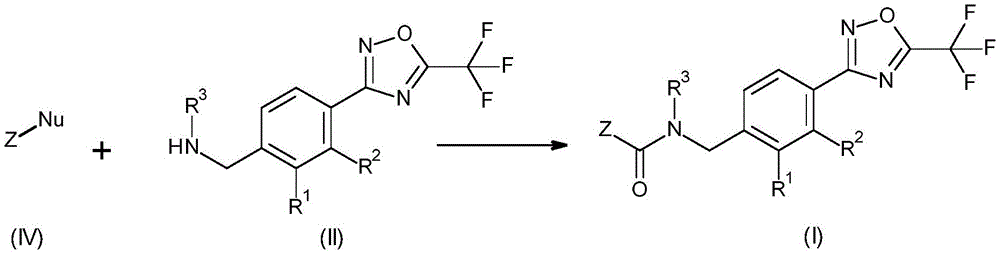
Scheme 2
In addition, compounds of formula (I) may be prepared from compounds of formula (V) via reaction with trifluoroacetic acid, trifluoroacetate, trifluoroacetic anhydride or trifluoroacetyl halide (including trifluoroacetyl fluoride, trifluoroacetyl chloride and trifluoroacetyl bromide), optionally in the presence of a base (e.g. pyridine or 4-dimethylaminopyridine), in a suitable solvent (e.g. toluene, ethyl acetate, tetrahydrofuran, 2-methyltetrahydrofuran or ethanol) at a temperature between 0 ℃ and 75 ℃. For related examples, see WO 2003/028729, WO 2017/055473, and WO 2010/045251.
This reaction is shown in scheme 3.

Scheme 3
The compound of formula (V) may be prepared from the compound of formula (VI) via reaction with hydroxylamine hydrochloride or an aqueous hydroxylamine solution in the presence of a base such as triethylamine or potassium carbonate in a suitable solvent such as methanol or ethanol at a temperature between 0 ℃ and 80 ℃. In some cases better reaction performance can be obtained from the use of a catalyst (e.g. 8-hydroxyquinoline). For related examples, see Kitamura, s, et al chem.pharm.bull. [ chemical and pharmaceutical bulletin ] (2001),49,268, WO 2017/055473, and WO 2013/066838. This reaction is shown in scheme 4.

Scheme 4
The compounds of formula (VI) are commercially available or may be prepared by reaction in a suitable solvent (e.g. dimethylformamide or N-methylpyrrolidone) at between 80 ℃ and 120 ℃With a suitable cyanide reagent (e.g. acetone cyanohydrin, dimethylmalononitrile, K) at elevated temperature and optionally in the presence of a metal catalyst (e.g. Pd or Ni) or a Grignard reagent or an organolithium reagent4[Fe(CN)6]、Zn(CN)2NaCN, or CuCN) is prepared from a compound having formula (VII) (where Y is formyl, Cl, Br, or I). For related examples, see Reeves, j.t. et al j.am.chem.soc. [ american society of chemistry](2015),137,9481-9488, Ushijima, S., Togo, H.Synlett](2010),1067, US 2007/0155739, WO 2017/055473, and WO 2009/022746.
Alternatively, the compound having formula (VI) may be in a nitrite source (e.g., NaNO)2Or isoamyl nitrite), acids (e.g. hydrochloric acid or HBF4) And a copper source (e.g., CuCN) in an acceptable solvent system (e.g., aqueous acetonitrile) at a suitable temperature (e.g., 0 ℃ to 100 ℃) via a free radical-nucleophilic aromatic substitution reaction with a compound having formula (VII) (where Y is NH)2) And (4) preparation. For a related example, see Wen, Q, et al, Tet.Lett. [ tetrahedron letters ](2014),55,1271. This reaction is shown in scheme 5.

Scheme 5
A compound having the formula (VII) (wherein Z represents R)4And Y is Cl, Br, I or CN, and N-R3The bonds containing directly-linked unsaturated methylene segments [ e.g. -CH2-or-CH (CH)3)-]) Can be prepared from compounds of formula (VIII) via reaction with a suitable base (e.g., sodium hydride) and a suitable alkyl haloalkylating agent (e.g., methyl iodide, ethyl iodide, 2,2, 2-trifluoroiodoethane, 2-methoxyiodoethane, or isopropyl iodide) in a suitable solvent (e.g., dimethylformamide or N-methylpyrrolidone) at an elevated temperature between 60 ℃ and 120 ℃. This reaction is shown in scheme 6.

Scheme 6
The compound having formula (II) can be prepared from the aldehyde compound having formula (X) via the following manner: condensation reaction with an amine of formula (IX) in a suitable solvent (e.g. tetrahydrofuran or methanol) at a temperature between 25 ℃ and 75 ℃, followed by addition of a reducing agent such as NaBH in a suitable solvent (e.g. tetrahydrofuran or ethanol) at a temperature between 0 ℃ and 25 ℃3And (C) CN. For related examples, see Gazzola, C. and Kenyon, G.L. journal of laboratory Compounds and Radiopharmaceuticals [ journal of labeling Compounds and Radiopharmaceuticals ](1978),15,181 and WO 2017/055473. This reaction is shown in scheme 7.

Scheme 7
Alternatively, a compound of formula (II) may be reacted with a compound of formula (XI) (wherein X is Cl, Br, I or OSO) via a reaction of an amine of formula (IX) wherein X is Cl, Br, I or OSO, optionally in the presence of a base (e.g. triethylamine) in a suitable solvent (e.g. tetrahydrofuran) at a temperature between 25 ℃ and 60 ℃2Me) preparation. For related examples, see Miyawaki, K. et al Heterocycles](2001) 54,887; WO 2003/028729, WO 2017/055473, and WO 2013/066839. This reaction is shown in scheme 8.

Scheme 8
A compound having formula (XI) wherein X is Cl or Br can be prepared from a compound having formula (XII) in a suitable solvent such as tetrachloromethane at a temperature between 55 ℃ and 100 ℃, optionally in the presence of uv light, via reaction with a halogen source such as N-bromosuccinimide (NBS) or N-chlorosuccinimide (NCS) and a free radical initiator such as (PhCO)2)2Or Azobisisobutyronitrile (AIBN)))And (4) preparation. For related examples, see WO 2017/055473; liu, S, et al Synthesis](2001) 14,2078; and Kompella, a. et al org.proc.res.dev. [ organic processing research and development](2012),16,1794. This reaction is shown in scheme 9.

Scheme 9
A compound having the formula (VII) (wherein Y is formyl, NH)2Cl, Br, I, or CN) can be obtained via coupled transformation of a compound having formula (XIII) and a compound having formula (III), wherein X is halogen, an ester [ e.g., OMe or OEt)]Anhydrides [ e.g. OC (H) O, or OAc]Or OH, preferably halogen, in a suitable solvent (e.g. dimethylformamide, dichloromethane, tetrahydrofuran or 2-methyltetrahydrofuran), preferably at a temperature between 0 ℃ and 100 ℃, and optionally in a base (e.g. NaHCO)3、Na2CO3、K2CO3NaOH, triethylamine or N, N-diisopropylethylamine) or under the conditions described in the literature for amide or urea coupling, for example by using BOP-Cl or HATU. Furthermore, a compound having formula (VII) (wherein Z represents R)4) Optionally via a coupled transformation of a compound of formula (XIII) and a compound of formula (III) wherein X is OH, for example by using triphosgene, diphosgene, or phosgene, (COCl) prior to treatment with a compound of formula (XIII)2Or SOCl2The process of converting-OH to an improved halide leaving group (e.g., chloride). See, for example, WO 2003/028729, WO 2013/092943, WO 2017/055473, or WO 2014/025128. Compounds having formula (III) are commercially available or prepared using known methods. For related examples, see: tetrahedron Lett et al, Nelson, T.D et al ](2004) 45,8917; senthil, k, et al pest](2009) 21,133; and Crich, d, Zou, y.j.org.chem [ journal of organic chemistry](2005),70,3309. This reaction is shown in scheme 10.

Scheme 10
Alternatively, a compound having formula (VII) (wherein Y is NH)2Cl, Br, I, or CN and Z represents-R4) Can be prepared by the following method: reaction of a compound having formula (XIII) with triphosgene, diphosgene or phosgene in a suitable solvent (e.g. ethyl acetate, acetone, chloroform, or toluene), followed by reaction with a nucleophile having formula (IV) in a suitable solvent (e.g. toluene, diethyl ether or tetrahydrofuran) at a temperature between-78 ℃ and 25 ℃, wherein Z-Nu represents R4Metal organometallic reagents (e.g. organomagnesium, organozinc or organolithium). See charelamides, y.c., Moratti, s.c. synth. commun, [ synthetic communication ], for relevant examples](2007) 37,1037; schaefer, g. et al, angelw.chem., int.ed. [ international edition of applied chemistry ]](2012)51,9173; longyel, I.et al Heterocycles](2007) 73,349; and Benalil, A. et al Synthesis](1991),9,787. This reaction is shown in scheme 11.
Furthermore, compounds of formula (VII) (wherein Z represents-NR)6R7) Can be prepared by the following method: reaction of a compound having formula (XIII) with triphosgene, diphosgene or phosgene in a suitable solvent (e.g. 1, 2-dichloroethane, water, acetonitrile, ethyl acetate, chloroform or toluene), followed by addition of a suitable nucleophile having formula (IV), wherein Z-Nu represents HNR6R7And in the presence of a suitable base (e.g. pyridine, K)2CO3Or triethylamine). This reaction is shown in scheme 11.

Scheme 11
A compound having formula (XIII) (wherein Y is formyl, NH)2Cl, Br, I or CN) can be in a suitable base (e.g., NaHCO)3、Na2CO3、K2CO3Or NaH) from a compound of formula (XIV) (wherein X is Cl, Br, I or OSO) in the presence of a suitable solvent (e.g. dimethylformamide, N-methylpyrrolidine, or acetonitrile) at a temperature between 0 ℃ and 100 ℃ by reaction of an amine of formula (IX)2Me). In some cases, by using a catalyst (e.g., Bu)4NHSO4、Bu4NBr、Bu4NI, NaI or 4-dimethylaminopyridine) or optionally microwave irradiation. For related examples, see Miyawaki, K. et al Heterocycles](2001),54,887. This reaction is shown in scheme 12.

Scheme 12
A compound having the formula (XIV) (wherein Y is formyl, NH)2Cl, Br, I, or CN and X is Cl or Br) are commercially available or can be prepared from compounds having formula (XV) by reaction with a halogen source (e.g., N-bromosuccinimide (NBS) or N-chlorosuccinimide (NCS)) and a free radical initiator (e.g., (PhCO) optionally in the presence of ultraviolet light in a suitable solvent (e.g., tetrachloromethane) at a temperature between 55 ℃ and 100 ℃2)2Or Azobisisobutyronitrile (AIBN)). For a related example, see Liu, S](2001) 14,2078 and Kompella, a. et al org.proc.res.dev. [ organic processing research and development](2012),16,1794. This reaction is shown in scheme 13.

Scheme 13
Alternatively, a compound having the formula (XIV) (wherein X is Cl, Br, I or OSO)2Me, and Y is formyl, NH2Cl, Br, I, CN or (5- (trifluoromethyl) -1,2, 4-oxadiazole) are commercially available or can be converted by alkylation with the formula (XVI) in the following mannerPreparation of compound: with an acid source (such as hydrochloric, hydrobromic or hydroiodic acid) or a halogen source (such as tetrabromomethane, tetrachloromethane, or iodine) in the presence of triphenylphosphine, or with methanesulfonyl chloride (ClSO) in a suitable solvent (e.g. dichloromethane) in the presence of a base (e.g. triethylamine) at a temperature between 0 ℃ and 100 ℃ 2Me) is used. See Liu, h, et al bioorg.med.chem. [ bio-organic and pharmaceutical chemistry, for relevant examples](2008) 16,10013, WO 2014/020350 and Kompella, A. et al, bioorg.Med.chem.Lett [ Rapid report on bioorganic and pharmaceutical chemistry ]](2001),1,3161. Compounds having formula (XVI) are commercially available. This reaction is shown in scheme 14.

Scheme 14
Furthermore, compounds of formula (VII) (wherein Y is formyl, NH)2Cl, Br, I or CN) can be reacted in the presence of a base (e.g. triethylamine, N-diisopropylethylamine, K)2CO3、NaHCO3Or Na2CO3) From a compound of formula (XIV) wherein X is a suitable leaving group (e.g. Cl, Br, I, OH, or OSO) by reaction with an amide or urea of formula (XVII) in the presence of a suitable solvent (e.g. dimethylformamide, tetrahydrofuran, 2-methyltetrahydrofuran, acetone, or acetonitrile) at a temperature between 0 ℃ and 90 ℃2Me). In some cases, from the use of catalysts (e.g. Bu)4NHSO4、Bu4NBr、Bu4NI, NaI or 4-dimethylaminopyridine) or optionally microwave irradiation. For related examples, see Miyawaki, K. et al Heterocycles](2001) 54,887, WO 2003/028729 and WO 2013/066839. This reaction is shown in scheme 15.

Scheme 15
Having the formula (XV)II) (wherein Z represents-NR)6R7) Can be prepared from an amine compound having formula (IX) via the following manner: optionally with triphosgene, diphosgene or phosgene in a suitable solvent (e.g. water, acetonitrile, ethyl acetate, tetrahydrofuran, chloroform or toluene), followed by a base (e.g. pyridine, triethylamine, K)2CO3、NaHCO3Or Na2CO3) Adding a nucleophile having formula (IV) in the presence and at a temperature between 0 ℃ and 25 ℃, wherein Z-Nu represents HNR6R7. This reaction is shown in scheme 16.

Scheme 16
Alternatively, the compound having formula (XVII) may be obtained by coupling transformation of an amine compound having formula (IX) and a compound having formula (III), wherein X is halogen, an ester [ e.g., OMe or OEt]Anhydrides [ e.g. OC (H) O, or OAc]Or OH, preferably halogen, in a suitable solvent (for example dimethylformamide, acetonitrile, dichloromethane or tetrahydrofuran), preferably at a temperature between 25 ℃ and 100 ℃, and optionally in a base (for example K)2CO3Triethylamine or N, N-diisopropylethylamine) or under the conditions described in the literature for amide or urea coupling, for example by using BOP-Cl or HATU. See, for example, WO 2003/028729. This reaction is shown in scheme 17.
Furthermore, compounds having formula (XVII) (wherein Z represents R)4) Optionally via a coupled transformation of a compound of formula (IX) and a compound of formula (III) wherein X is OH, by treatment with a compound of formula (IX), for example by using triphosgene, diphosgene, phosgene, (COCl)2Or SOCl2The process of converting-OH to an improved halide leaving group (e.g., chloride). Compounds having formula (III) are commercially available or prepared using known methods. For a related example, see Nelson, T.D et al Tetrahedron Lett. [ TetrahedronQuick newspaper](2004) 45,8917; senthil, k, et al pest](2009) 21,133; and Crich, d, Zou, y.j.org.chem [ journal of organic chemistry](2005),70,3309. This reaction is shown in scheme 17.

Scheme 17
Furthermore, the compound of formula (I) may optionally be reacted in a base (e.g. triethylamine, N-diisopropylethylamine, K)2CO3、NaHCO3Or Na2CO3) From a compound of formula (XI) wherein X is a suitable leaving group (e.g. Cl, Br, I, OH, or OSO) by reaction with an amide or urea of formula (XVII) in the presence of a suitable solvent (e.g. dimethylacetamide, tetrahydrofuran, 2-methyltetrahydrofuran, acetone, toluene or acetonitrile) at a temperature between 0 ℃ and 90 ℃ 2Me). In some cases, by using a catalyst (e.g., Bu)4NHSO4、Bu4NBr、Bu4NI, NaI or 4-dimethylaminopyridine) and optionally microwave irradiation. For related examples, see Miyawaki, K. et al Heterocycles](2001) 54,887, WO 2003/028729 and WO 2013/066839. This reaction is shown in scheme 18.

Scheme 18
Compounds having the formula (XIII) wherein Y is F, Cl, Br, CN or 5- (trifluoromethyl) -1,2, 4-oxadiazol-3-yl can be reacted in a suitable acid, for example BF3·OEt2) Prepared in the presence of a compound of formula (XIX) wherein X is Cl, Br or I and an imine of formula (XVIII) by introducing a suitable organometallic species (for example I-PrMgCl, LiCl, EtZnCl or n-BuLi) in a suitable solvent (for example tetrahydrofuran or diethyl ether) at a temperature between-78 ℃ and 25 ℃. For a related example, see TLet et](1986) 27,1549; tetrahedron of Kostyanovsky, R.G. et al](1981),37,4245. This reaction is shown in scheme 19.
Alternatively, a compound having formula (XIII) wherein Y is formyl, F, Cl, Br, CN or 5- (trifluoromethyl) -1,2, 4-oxadiazol-3-yl may be prepared from a compound having formula (XIX) wherein X is NH 2) And imines of formula (XVIII) are prepared by free radical addition in a suitable solvent such as aqueous methanol. See, for related examples, Hart, d.j., Seely, f.l.j.am.chem.soc. [ american society of chemistry](1988) 110,1631; miyabe, h.tetrahedron](1998) 54,11431; hideto, m.j.org.chem. [ journal of organic chemistry](2000),65,5043. This reaction is shown in scheme 19.

Scheme 19
Further, compounds of formula (VII) (where Y is formyl, F, Cl, Br, I, CN, or 5- (trifluoromethyl) -1,2, 4-oxadiazol-3-yl) can be prepared from compounds of formula (XIX) (where X is methyl) via a photo-redox amination reaction using a Light Emitting Diode (LED) visible light source in the presence of an electron acceptor catalyst (e.g., 9, 10-dicyanoanthracene) in a suitable solvent (e.g., acetonitrile) at temperatures between 25 ℃ and 75 ℃ via reaction with an amide or urea of formula (XVII). See, for related examples, Pandey, g., Laha, r.angelw.chem.int.ed. [ international edition of applied chemistry ] (2015),54,14875. This reaction is shown in scheme 20.

Scheme 20
Compounds having the formula (XIII) wherein Y is F, Cl, Br, CN or 5- (trifluoromethyl) -1,2, 4-oxadiazol-3-yl can be prepared from compounds having the formula (XIX) wherein X is Cl, Br or I, carboxamides having the formula (XX) and activating reagents (e.g., POCl) 3、PCl3、COCl2、PhSO2Cl、Me2NSO2Cl、(CF3CO)2O or (MeO)2SO2) By introducing a suitable organometallic species (e.g., i-PrMgCl, LiCl, EtZnCl, or n-BuLi) in a suitable solvent (e.g., ethanol, acetonitrile, tetrahydrofuran, or diethyl ether) at a temperature between-35 ℃ and 25 ℃, followed by addition of a suitable reducing agent such as NaBH in a suitable solvent (e.g., tetrahydrofuran or ethanol) at a temperature between 0 ℃ and 25 ℃3CN.
This reaction is shown in scheme 21.

Scheme 21
Further, compounds having formula (VII) wherein Y is formyl, F, Cl, Br, I, CN or 5- (trifluoromethyl) -1,2, 4-oxadiazol-3-yl can be prepared from compounds having formula (XIX) wherein X is hydrogen via reaction with an amide or urea having formula (XXI) wherein W is a leaving group (e.g., Cl, Br, I, OH or OSO)2Me)) in a suitable solvent (e.g., tetrahydrofuran or ethanol) in an acid (e.g., hydrochloric acid, AlCl)3Or BF3·OEt2) In the presence of a reaction at a temperature between 25 ℃ and 75 ℃. For related examples, see: bohme, H. et al chem.Ber. [ chemical report](1961) 94,1879; aruri, H. et al J.org.chem. [ journal of organic chemistry](2017),82,1000. This reaction is shown in scheme 22.
Alternatively, a compound of formula (VII) wherein Y is F, Cl, Br, I, CN or 5- (trifluoromethyl) -1,2, 4-oxadiazol-3-yl may be prepared from a compound of formula (XIX) wherein X represents an organoboron, organozinc, organomagnesium or organolithium species (e.g. B (OH) 2ZnCl, MgCl, or LiCl)) via reaction with an amide or urea having the formula (XXI) wherein W is a leaving group (e.g., OSO)2Me, Cl, or Br)) in a suitable solvent (e.g., toluene), in a catalyst complex (e.g., Pd (OAc))2-XPhos) at a temperature between 25 ℃ and 75 ℃. For the purposes of the relevant example,see Iwai, t. et al adv.synth.&Catal [ advanced synthesis and catalysis ]](2014),356,1563. Compounds having formula (XXI) are commercially available or are prepared using known methods. For a related example, see WO 2003/018552. This reaction is shown in scheme 22.

Scheme 22
Further, compounds of formula (VII) wherein Y is Cl, Br, I, CN or 5- (trifluoromethyl) -1,2, 4-oxadiazol-3-yl can be prepared from compounds of formula (XIX) wherein X is Cl, Br, or I via reaction with amides or ureas of formula (XXI) wherein W is an organometallic group [ e.g., B (OH) ]2、BF3K、B(C1-3Alkoxy group)2Boronic acid pinacol ester]) In a suitable solvent (e.g., toluene), in the presence of a catalyst complex (e.g., pd (oac)2-XPhos) at a temperature between 25 ℃ and 75 ℃. See adv.synth, et al, Iwai, t.&Catal [ advanced synthesis and catalysis ] ](2014) 356,1563; kawamorita, s, et al j.am.chem.soc. [ american society for chemistry](2012),134,12924. Compounds having formula (XXI) are commercially available or are prepared using known conditions. This reaction is shown in scheme 23.

Scheme 23
Furthermore, compounds of formula (VII) wherein Y is Cl, Br, I, CN or 5- (trifluoromethyl) -1,2, 4-oxadiazol-3-yl can be prepared from compounds of formula (XIX) wherein X is halogen via reaction with amides or ureas of formula (XXI) wherein W is CO2H、CO2CH3Or CO2C2H5) Prepared via coupling in a suitable solvent (e.g., acetonitrile, DMSO, or DMF) in the presence of a base (e.g., potassium tert-butoxide, sodium hydride, or lithium diisopropylamide) at a temperature between-78 ℃ and 25 ℃ followed by an aqueous acid (e.g., a salt)Acid) at an elevated temperature (e.g., 120 c). For related examples see WO 2012/039717 or Laufer, r.&Chem. [ bio-organic chemistry and medicinal chemistry ]](2014),22,4968. Furthermore, compounds of formula (VII) wherein Y is Cl, Br, I, CN or 5- (trifluoromethyl) -1,2, 4-oxadiazol-3-yl can be prepared from compounds of formula (XIX) wherein X is halogen or CN by using a suitable catalytic system (e.g., Ru (bpy)) 3Cl2And NiCl2) In the presence of a blue Light Emitting Diode (LED), carrying out a photo-redox catalysis at a temperature between 25 ℃ and 75 ℃; optionally, performance improvements can be obtained via a flow reactor process. For related examples, see Shaw, M.H. et al Science](2016) 352,1304 and Prier, c.k.chem.sci. [ chemical science](2014),5,4173. This reaction is shown in scheme 24.

Scheme 24
Compounds having formula (XXII) are commercially available or may be prepared by reacting with a cyanide reagent (such as acetone cyanohydrin, dimethyl malononitrile, K) in a suitable solvent (e.g., dimethylformamide or N-methylpyrrolidinone) at elevated temperatures between 80 ℃ and 120 ℃ and optionally in the presence of a metal catalyst (e.g., Pd or Ni), organomagnesium or organolithium reagent4[Fe(CN)6]、Zn(CN)2NaCN, or CuCN) is prepared from a compound having formula (XIII) wherein Y is formyl, Cl, Br, or I. For related examples, see Reeves, j.t. et al j.am.chem.soc. [ american society of chemistry](2015) 137,9481; ushijima, s., Togo, h.synlett [ quick synthesis report ]](2010), 1067; US 2007/0155739, WO 2017/055473, and WO 2009/022746. This reaction is shown in scheme 25.
Alternatively, compounds having formula (XXII) may use a nitrite source (e.g., NaNO)2Or isoamyl nitrite), acids (e.g. hydrochloric acid or HBF4) And a copper source (e.g., CuCN) in an acceptable solvent (e.g., aqueous acetonitrile) at 0 ℃ to 1 ℃From a compound of formula (XIII) wherein Y is NH via a radical-nucleophilic aromatic substitution reaction at a temperature between 00 DEG C2) And (4) preparation. For a related example, see Wen, Q, et al, Tet.Lett. [ tetrahedron letters](2014),55,1271. This reaction is shown in scheme 25.

Scheme 25
A compound having the formula (XXIII) (wherein T is CH)3、CH2OH、NH2Cl, Br, or I) can be prepared from compounds having formula (XXIV) by reaction with trifluoroacetic acid, trifluoroacetate, trifluoroacetic anhydride or trifluoroacetyl halide (including trifluoroacetyl fluoride, trifluoroacetyl chloride and trifluoroacetyl bromide), optionally in the presence of a base (e.g., pyridine or 4-dimethylaminopyridine) in a suitable solvent (e.g., toluene, ethyl acetate, tetrahydrofuran, 2-methyltetrahydrofuran or ethanol) at a temperature between 0 ℃ and 75 ℃. For related examples, see: WO 2003/028729, WO 2017/055473, and WO 2010/045251. This reaction is shown in scheme 26.

Scheme 26
A compound having the formula (XXIV) (wherein T is CH) 3、CH2OH、NH2CN, Cl, Br, or I) can be prepared from compounds having formula (XXV) via reaction with hydroxylamine hydrochloride or aqueous hydroxylamine solutions, optionally in the presence of a base such as triethylamine or potassium carbonate, in a suitable solvent such as methanol or ethanol at a temperature between 0 ℃ and 80 ℃. For related examples, see Kitamura, s, et al chem.pharm.bull [ chemical and pharmaceutical bulletins](2001) 49,268 and WO 2013/066838. In some cases better reaction performance can be obtained from the use of a catalyst (e.g. 8-hydroxyquinoline). The compounds having formula (XXV) are prepared by known methods or are commercially available. For related examples, see Kitamura, shem.pharm.bull. [ chemical and pharmaceutical reports](2001) 49,268; WO 2017/055473 and WO 2013/066838. This reaction is shown in scheme 27.

Scheme 27
Compounds having formula (XIII), wherein Y is CN, Cl, Br, or I, can be prepared from aldehyde compounds having formula (XXVII) via the following manner: condensation reaction with an amine of formula (XXVI) in a suitable solvent (e.g. tetrahydrofuran or methanol) at a temperature between 25 ℃ and 75 ℃, followed by addition of a reducing agent such as NaBH in a suitable solvent (e.g. tetrahydrofuran or ethanol) at a temperature between 0 ℃ and 25 ℃ 3And (C) CN. For related examples, see Gazzola, c., Kenyon, g.l. journal of laboratory Compounds and Radiopharmaceuticals [ journal of labeling Compounds and Radiopharmaceuticals](1978),15,181 and WO 2017/055473. This reaction is shown in scheme 28.

Scheme 28
Compounds having the formula (VII) wherein Y is CN, Cl, Br, I or 5- (trifluoromethyl) -1,2, 4-oxadiazol-3-yl can be prepared from aldehyde compounds having the formula (XXVII) via reaction with a zinc complex (e.g. Zn (OAc)2·H2O) in the presence of a suitable solvent (e.g., NMP, DMF, and H)2O) with an amide or urea of the formula (XVII) at elevated temperature (for example 150 ℃). See Yang, Luo et al adv.&Catal [ advanced synthesis and catalysis ]](2018) 360,485; barba, F. et al tetrahedron.Lett. [ tetrahedron letters [ [ tetrahedron letters ]](2013) 54,1835; wang, j, et al chem](2014),50,4736. This reaction is shown in scheme 29.

Scheme 29
The compositions of the present invention, including all of the above disclosed embodiments and preferred examples thereof, may be mixed with one or more additional pesticides, including additional fungicides, insecticides, nematocides, bactericides, acaricides, growth regulators, chemosterilants, semiochemicals, repellents, attractants, pheromones, feeding stimulants or other biologically active compounds to form multi-component pesticides which give a broader spectrum of agricultural protection.
Examples of such agricultural protectants and compositions of the present invention may be formulated as:
fungicides such as hymexazol, fluazinam, benalaxyl-M (benalaxyl-M), furalaxyl, metalaxyl-M (metalaxyl-M), doxin, N ' - (2, 5-dimethyl-4-phenoxy-phenyl) -N-ethyl-N-methyl-formamidine, N ' - [4- (4, 5-dichloro-thiazol-2-yloxy) -2, 5-dimethyl-phenyl ] -N-ethyl-N-methyl-formamidine, N ' - [4- [ [3- [ (4-chlorophenyl) methyl ] -1,2, 4-thiadiazol-5-yl ] oxy ] -2, 5-dimethyl-phenyl ] -N-ethyl-N-methyl-formamidine, Ethidium, 3 ' -chloro-2-methoxy-N- [ (3RS) -tetrahydro-2-oxofuran-3-yl ] acetyl-2 ', 6 ' -dimethylaniline (crozylon), cyprodinil, mepanipyrim, pyrimethanil, dithianon, aureomycin, blasticidin-S, biphenyl, dicyclopentadine, niclosamide, benzovindiflupyr, fluxapyroxad, hexachlorobenzene, pentachloronitrobenzene, tetraoxynitrobenzene, (TCNB), tolclofos-methyl, metrafenone, 2, 6-dichloro-N- (4-trifluoromethylbenzyl) -benzamide, fluopicolide or flunolide, thiocyanamide, flusulfamide, benomyl, carbendazim hydrochloride, benzimidazole, furylbenzimidazole, thiabendazole, fludioxonil, flutolanil hydrochloride, flutolanil, carbendam hydrochloride, thiabendazole, flunarin hydrochloride, flunaric, and so-c, flunaric, Thiophanate-methyl, benthiavalicarb, fenbuconazole, thiabendazole, activated esters, betaxazin, pyrimethanil (pyriofenone) (IKF-309), activated esters-S-methyl, pyribencarb (KIF-7767), butylamine, 3-iodo-2-propynyl N-butyl carbamate (IPBC), iodopropynyl butyl carbamate (isopropyl butyl carbamate), isopropyl butyl carbamate (iodopropynyl butyl carbamate), penconazole, polycarbamate, propamocarb, trifluoromethoxycarb (tolprocarb), 3- (difluoromethyl) -N- (7-fluoro-1, 1,3, 3-tetramethyl-indan-4-yl) -1-methyl-pyrazole-4-carboxamide, diclorofoam, N- [ (5-chloro-2-isopropyl-phenyl) methyl ] -N-cyclopropyl-3- (difluoromethyl) -5-fluoro-1-methyl-pyrazole-4-carboxamide, N-cyclopropyl-3- (difluoromethyl) -5-fluoro-N- [ (2-isopropylphenyl) methyl ] -1-methyl-pyrazole-4-carboxamide, cyclopropylanilide, chlorothalonil, flumorph, copper hydroxyquinoline, cymoxanil, Cyanostrobin, cyazofamid, fluorothiazolecarbonitrile, thiabendazole, ethiprole, iprodione, Pythymidone, vinclozolin, bupirimate, propyzamide, dicrotonate, propyzamide, dinotefuran, dinocap, pyrazofos, oxazidol, diphenylamine, chlophosphorus, oxanil, fenoxate, fenoxaprop, oxazid, fenoxan, oxazid, fenoxaprop, fenoxan, and so, 2, 6-dimethyl- [1,4] dithio [2,3-c:5, 6-c' ] dipyrrole-1, 3,5,7(2H,6H) -tetraone, oximinostrobin, thioneb, ferbam, mancozeb, maneb, metam, metiram or polyram, metiram-zinc, sodium metiram, methyl zineb, thiram, vebam (vapam), zineb, ziram, thiram, dimethyl disulfide, isoprothiolane, ethaboxam, fosetyl acid, phosetyl-Al (ethylphosphonic acid-Al), methyl bromide, methyl iodide, methyl isothiocyanate, cyclam, ofuramide, validamycin, streptomycin, (2RS) -2-bromo-2- (bromomethyl) glutaronitrile (bromothalonil), dodine, dodecylguanidine acetate, dodecylguanidine, Diguanidinium salt, diguanidinium amine, diguanidinium triacetate, 2,4-D, 2,4-DB, kasugamycin, metconazole, fenhexamid, hymexazol, imazalil, oxpoconazole, pefurazoate, prochloraz, triflumizole, imazaquin, boldo mixture, calcium polysulfide, copper acetate, copper carbonate, copper hydroxide, copper naphthenate, copper oleate, copper oxychloride, copper hydroxyquinoline (copperoxolate), copper silicate, copper sulfate, copper fatty acid, cuprous oxide, sulfur, carbaryl, isoprothiolane (tetrachlorophthalide), pyridinoxazole (dingjunezuo) (mycosis (Jun Si Qi)), fluorothiazolepyrithylone, furazolidone, mandipropamid, KSF-1002, antibacterial, dimethomorph, fenpropimorph, tridemorph, dodemorph, diethofencarb, triphenyltin acetate, triphenyltin hydroxide, Carboxin, oxycarboxin, fenamidone, famoxadone, m-phenylphenol, p-phenylphenol, Tribromophenol (TBP), 2- [2- [ (7, 8-difluoro-2-methyl-3-quinolyl) oxy ] -6-fluoro-phenyl ] propan-2-ol, 2- [ 2-fluoro-6- [ (8-fluoro-2-methyl-3-quinolyl) oxy ] phenyl ] propan-2-ol, cyflufenamid, furosemide, oxadixyl, fudonin, fenamidone, iprodione, fenpiclonil, fludioxonil, pencycuron, edifenphos, pyrad, phosphoric acid, folpet, captan, fenamiphos, fluazinam, fenpropidin, dichloflufen, osthole, metrafin, pyrazofos, fenoxaprop-ethyl, pinoxazid, metrafin, prothioconazole, and prothioconazole, 1-methylcyclopropene, 4-CPA, chlormequat chloride, pyridazinoic acid, 2, 4-dichlorprop acid, thionine, endothall acid, ethephon, flumetralin, forchlorfenuron, gibberellic acid, gibberellin, hymexazol, maleohydrazide, mepiquat chloride, naphthylacetamide, paclobutrazol, prohexadione-calcium, thidiazuron, profenofos (tributyl trithiophos), trinexapac-ethyl, uniconazole, alpha-naphthylacetic acid, polyoxin D (polyoxin D or polyoxrim), BLAD, chitosan, fenoxanil, folpet, 3- (difluoromethyl) -N-methoxy-1-methyl-N- [ 1-methyl-2- (2,4, 6-trichlorophenyl) ethyl ] pyrazole-4-carboxamide, bixafen, fluxapyroxafen, furazolidine, isopyrazaline, tiazaline, and mefenazaline, Penflufen, penthiopyrad, epoxiconazole, fenpyrad, pyridaben, pyribenzoxim, boscalid, fluopyram, difluoroforest, fenarimol, 5-fluoro-2- (p-tolylmethoxy) pyrimidin-4-amine, pyriminozone, dimethachlone (or dimethaclone), pyroquilon, propoxymine, ethoxyquin, quinoxaline, 4,4, 5-trifluoro-3, 3-dimethyl-1- (3-quinolyl) isoquinoline, 4, 4-difluoro-3, 3-dimethyl-1- (3-quinolyl) isoquinoline, 5-fluoro-3, 3,4, 4-tetramethyl-1- (3-quinolyl) isoquinoline, 9-fluoro-2, 2-dimethyl-5- (3-quinolyl) -3H-1, 4-benzoxaazepine, isobutoxyquinoline, oxolinic acid, fenamidone (chinomethionate, oxythioquinol or quinoxymethyl), spiroxamine, (E) -N-methyl-2- [2- (2, 5-dimethylphenoxymethyl) phenyl ] -2-methoxy-iminoacetamide, (mandiprin), azoxystrobin, coumoxystrobin, dimoxystrobin, enestroburin (enestroburin), enestroburin (enoxastrobin), enestroburin, fluxastrobin, fluoxastrobin, kresoxim-methyl, mandipropamid, metominostrobin, pyraclostrobin, trifloxystrobin, amisole, dichlofluxastrobin, tolylfluanid, p-tolylfluanid, N- [6- [ [ (Z) - [ (1-methyltetrazol-5-yl) -phenyl-methylene ] amino ] oxymethyl ] -2-picoxystrobin, metocloprid, metoclopramide, and pyridyl ] butan-3-ynyl carbamate, dazomet, isotianil, tiadinil, thifluzamide, thioflutolanil (TCMTB), sulfenamide, zoxamide, propamocarb, tricyclazole, (+ -.) -cis-1- (4-chlorophenyl) -2- (1H-1,2, 4-triazol-1-yl) -cycloheptanol (cyproconazole (huangzuo)), 1- (5-bromo-2-pyridyl) -2- (2, 4-difluorophenyl) -1, 1-difluoro-3- (1,2, 4-triazol-1-yl) propan-2-ol, 2- (1-tert-butyl) -1- (2-chlorophenyl) -3- (1,2, 4-triazol-1-yl) -propan-2-ol (TCDP), azaconazole, bitertanol (bitertanol or biloxazol), bromuconazole, climbazole, cyproconazole, difenoconazole, dimetconazole (dimetconazole), diniconazole-M, epoxiconazole, etaconazole, fenbuconazole, fluquinconazole, flusilazole, flutriafol, hexaconazole, imibenconazole, ipconazole, ipfenflurazone, metconazole, myclobutanil, penconazole, propiconazole, prothioconazole, simeconazole, tebuconazole, tetraconazole, triadimefon, triadimenol, imidazoxazine (triazoxide), triticonazole, meprobonazole, 2- [ [ (1R,5S) -5- [ (4-fluorophenyl) methyl ] -1-hydroxy-2, 2-dimethyl-cyclopentyl ] methyl ] -4H-1,2, 4-triazole-3-thione, 2- [ [3- (2-chlorophenyl) -2- (2, 4-difluorophenyl) oxiran-2-yl ] methyl ] -4H-1,2, 4-triazole-3-thione, ametocida (ametoctradin or imidium), iprovalicarb, propamocarb, 2-benzyl-4-chlorophenol (benzylchlorophenol), allyl alcohol, azadirachone, benzalkonium chloride, chloropicrin, cresol, dacracide, dichlorophen (dichlorophen), difenzoquat, pyrithione, N- (2-p-chlorobenzoylethyl) -hexamethylenetetramine chloride (N- (2-p-chlorobenzoylethyl) -hexaminium chloride), NNF-0721, octhioketone, sulfometuron, propamidine, and propionic acid.
Insecticides such as abamectin, acephate, acetamiprid, sulfadiazine (S-1955), abamectin, azadirachtin, methyl valmet, bifenthrin, diphenyl hydrazine, phenthoate, carbofuran, badan, chlorantraniliprole (DPX-E2Y45), chlorfenapyr, chlorfluazuron, chlorpyrifos-methyl, chromafenozide, clothianidin, cyflumetofen, cyfluthrin, beta-cyfluthrin, lambda-cyhalothrin, cypermethrin, cyromazine, deltamethrin, diafenthiuron, diflubenzuron, permethrin, dimethofen, dinotefuran, ben, endosulfan, fenvalerate, ethiofencarb, fenoxycarb, fenpropathrin, fenvalerate, fipronil, flonicamid, fluvalinate, fluvalicarb, fluvalinate, tau-fluvalinate, fluvalicarb, fluvalinate, fluvalicarb, fluvalinate, fluvalicarb, fluvalinate, fluvalicarb, fluvalinate, fluvalicarb, fluvalinate, fluvalicarb, flubencarb, and the like, Pyriminostrobin (UR-50701), flufenoxuron, chlorfenapyr, hexaflumuron, hydramethylnon, imidacloprid, indoxacarb, isoxathion, lufenuron, malathion, metaflumizone, metaldehyde, methidathion, methoprene, methoxyfen, metofenozide, nitenpyram, nitro-ethylurea thiazole, novaluron, polyfluorourea (XDE-007), oxamyl, permethrin, vomephos, phosmet, metaflumizone, pirimicarb, profenofos, pymetrozine, pyrazinecarbonil, pyrethrin, pyridalyl, flufenpyroquine, pyraclostrobin (pyriproxyfen), pyriproxyfen, rotenone, ryanodyne, rythrin, spinetoram, tezine, tefluthrin, teflufen, teflufenozide, tefluthrin, teflufenozide, tebufenozide, tezine, tebufenozide, tebufalin, and tebufalin, and tebufalin, and tebufalin, and tebufalin, thiodicarb, dimehypo, tetrabromthrin, triazamate, trichlorfon and chlorsulfuron;
Bactericides such as streptomycin;
acaricides such as amitraz, mefenpyr, clochlorobenzene, cyenopyrafen, cyhexatin, dichloflufen, etoxazole, fenazaquin, fenbutatin oxide, fenpropathrin, terbufaline, hexythiazox, propargite, pyridaben and tebufenpyrad; and
biological agents such as bacillus thuringiensis, bacillus thuringiensis delta endotoxins, baculovirus and entomopathogenic bacteria, viruses and fungi.
Further examples of "reference" mixture compositions are as follows (wherein the term "TX" denotes a compound selected from the compound numbers x.01, x.02, x.03, x.04, x.05, x.06, x.07, x.08, x.09, x.10, x.11, x.12, x.13, x.14, x.15, x.16, x.17, x.18, x.19, x.20, x.21, x.22, x.23, x.24 or x.25 as defined in table X above or in table T1 below (according to the definition of component (a) of the composition of the invention):
an adjuvant selected from the group consisting of: petroleum (alias) (628) + TX,
an acaricide selected from the group consisting of: 1, 1-bis (4-chlorophenyl) -2-ethoxyethanol (IUPAC name) (910) + TX, 2, 4-dichlorophenyl benzenesulfonate (IUPAC/chemical abstracts name) (1059) + TX, 2-fluoro-N-methyl-N-1-naphthaleneacetamide (IUPAC name) (1295) + TX, 4-chlorophenyl phenylsulfone (IUPAC name) (981) + TX, abamectin (1) + TX, fenaminoquin (3) + TX, acetofenacet [ CCN ] + TX, flupropathrin (9) + TX, aldicarb (16) + TX, aldicarb (863) + α -cypermethrin (202) + TX, thiothiuron (870) + TX, sulfamite ester [ CCN ] + TX, aminothionate (872) + TX, phosphamidooxalate (TX), phosphamidooxalate (875) + methimamidine (24) + TX, Dicofol (881) + TX, arsenic trioxide (882) + TX, AVI 382 (compound code) + TX, AZ 60541 (compound code) + TX, benfop (44) + TX, bazophos (azinphos-methyl) (45) + TX, azobenzene (IUPAC name) (888) + TX, azocyclotin (azacyclotin) (46) + TX, azophos (azothoate) (889) + TX, benomyl (62) + TX, benoxafos (alias) [ CCN ] + TX), benoxamate (benzoximate) (71) + TX, benzyl benzoate (IUPAC name) [ CCN ] + TX, bifenazate (74) + TX, bifenthrin (76) + TX, pythofos) + (907) +, bromethrin (butanone), bromethofen (bromucoxate) (920) + TX), bromethoprophos (918) + (bromothiofos (918) + TX), pyrithion (bromethon) + (bromethon (918) + TX), pyrithion (bromethon) + (103, bromethon (bromethon) + (TX), pyrazothion) + (103, bromethon (r) + (TX), tebuconazole) + (103, tebuconazole) + (TX), tebuconazole) + (103) + (TX), tebuconazole) + (103, tebuconazole) + (r (103), and tebuconazole) + (r (TX), and tebuconazole) + (r (e) + (TX), and tebuconazole) + (103) + (r (e (r (103) + (r (TX), and tebuconazole) + (r (e (r (TX), and tebuconazole) + (TX), and tebucol) + (r (103) + (r) + (r) TX), and tebucol) + (r (103) + (r) TX), and tebucol) + (103) + (r (103) + (r (TX), and tebucol) + (r (103) + (r) + (r (TX), and tebucol) + (r) TX), and tebucol) + (r) + (r, Butoxycarb (104) + TX, butylpyridazin (butylpyridaben) (alternative name) + TX, thiothite (calcium polysulphide) (IUPAC name) (111) + TX, chlorpheniramine (capheechlor) (941) + TX, clomethoate (carbonolate) (943) + TX, carbaryl (115) + TX), carbofuran (118) + TX, carbophosphofos (947) + TX, CGA 50' 439 (research code) (125) + TX, chlorfenapyr (chinomethionat) (126) + TX, diether (chlorobensenide) (959) + TX), chlordimeform (964) + TX, chlorfenadine hydrochloride (964) + TX), chlorfenapyr (130) + TX, dinotefuran (968) + TX), chlorphenfenpyrofenthiuron (971), chlorpheniramine (975) + (chlorpheniramine) + TX), chlorpheniramine (97987), chlorpheniramine (978) + (978) + TX, chlorpheniramine (975) + TX (978) + (975), chlorpheniramine (978) + (chlorpheniramine (971, chlorpheniramine) + TX (978) + TX), chlorpheniramine (978, chlorpheniramine (975), chlorpheniramine (978) + (971) Chlorpyrifos (145) + TX, chlorpyrifos-methyl (146) + TX, chlorfenafos (994) + TX, cyfluthrin (cinerin) I (696) + TX, cyfluthrin II (696) + TX, guaethrin (cinerin) (696) + TX, cyromazine (158) + TX, closantel (alias) [ CCN ] + TX), coumaphos (174) + TX, crotamiton (alias) [ CCN ] + TX, crotoxyphos (crotoxyphos) (1010 TX), thiabendazole (1013) + TX, buthoxydim (cyantoate) (1020) + TX), cyflufenamate (CAS registry number: 400882-07-7) + TX, cyfluthrin TX (196) + TX, stannum (199) + TX, cypermethrin (201) + TX, chlorpyrifos (1037), diclofenofos (1037) + TX), diclofenofos (1037, DDT) + TX (1037), thiofenofos (1038) + TX, thiofenofos (1037), thiofenofos (1038) + TX, thiotep TX (DDP (DDT) + TX), Methyl systemic phosphorus (224) + TX, systemic phosphorus-O (1038) + TX, systemic phosphorus-O (224) + TX, systemic phosphorus-S (1038) + TX, systemic phosphorus-S (224) + TX, desoxyphosphate (demeton-S-methyl sullfon) (1039) + TX, chlordiazuron (226) + TX, chlorfenapyr (diafosinate) (1042) + TX, diazinon (227) + TX, benflusulfamide (230) + TX, dichlorvos (236) + TX, diflorvos (diclophos) (alias) +, omethoate (242) + TX, chlorothalofos (243) + TX, ubiquitan (1071) + TX), diflorophos (dimefox) (TX 1) + TX), dimethoate (262) +, dimetachene (dinacti) (alias) (653, fenpropfen) + 1089) + (1089) + fenapyr (1089) + TX) (TX) + fenthiobac, fenthion (1089) + TX) (TX) +, Dinocap (dinocap) (270) + TX, dinocap-4 [ CCN ] + TX, dinocap-6 [ CCN ] + TX, dinitro ester (1090) + TX, diamyl amyl ester (dinopenton) (1092) + TX, nitrooctyl ester (dinosulfon) (1097) + TX, nitbutyl ester (dinoterbon) (1098) + TX, dioxaphos (1102) + TX, diphenyl sulfone (IUPAC) (1103 and TX), disulfiram (alias) [ CCN ] + TX, disulfoton (278) + TX, DNOC (282) + TX, phenoxyproparg (dofenapyn) (1113) + TX, doramectin (alias) [ CCN ] + TX, thiodan (294) + TX, foscarnet (TX) (1121) + TX), EPN (297) + TX, eprinobutin (fenthidin) (alias) [ N ] + 309, ethion fenthion) + (ethion fenthion) (1134) + fenthion (TX) + fenthion) (1142) + fenthion) (1137, ethion (Z) + fenthion) (1142) + fenthion, ethion (TX) + fenthion) (1142) + fenthion, ethion (TX), ethion (1142) + fenthionazole (114320, ethiprol fenthion) + S (1142) + fenthion) + (S, ethiprol fenthion) + (1142) + fenthion) (1142) and fenthion (S, fenthionazole (S) + S, fenthion) + S (S) + S, fenthiopyrazothion) + S (D) + (D) + S (TX), ethiprol S (D) (1137), Fenazaquin (328) + TX, fenbutatin oxide (330) + TX, fenoxycarb (337) + TX, fenpropathrin (342) + TX, tebufenpyrad (fenpyrad) (alias) + TX), fenpyroximate (fenpyroximate) (345) + TX, fenpyrone (fenson) (1157) + TX, nitrooxydine (fenthinil) (1161) + TX, fenvalerate (349) + TX, fipronil (354) + TX), fluacrypyrim (360) + TX, fipronil (1166) + TX, fluthia (flubenzimine) (1167) +, flufenuron (366) + TX, flufenvalerate (367) + TX, bifenthrin (367), bifenthrin (9) + (1167) + TX), flufenthimide (1164) + TX, fenpropathrin (1185) + TX, fenpropathrin (118tx), fenpropathrin (405) + TX), fenpropathrin (1174) + TX, fenpropathrin (1175), fenpropathrin (1185) + TX, fenpropathrin (1175), fenpropathrin (118tx), TX, fenpropathrin (1174), fenpropathrin (1185) +, Andhion (formothion) (1192) + TX, carbaryl (formcaranate) (1193) + TX, gamma-HCH (430) + TX, glyodin (1205) + TX, benzalkonium ether (halfenprox) (424) + TX, heptenyl ether (hepenophos) (432) + TX, hexadecyl cyclopropane carboxylate (IUPAC/chemical Abstract name) (1216) + TX, hexythiazox (441) + TX, iodomethane (IUPAC name) (542) + TX, isocarbophos (isocarbophos) (alias) (473) + isopropyl O- (methoxyaminothiophosphoryl) salicylate (IUPAC name) + TX, ivermectin (alias) [ CCN ] + TX, jasmin (Jasmitx TX) I (696) + TX) TX 492, jasminum II (696) +, iodophor (1248) + (1248), lufenuron (430) + (propionibathion) + (propioniban) + (propionitrile) (1254, malathion) + (propion), malathion (125473) + (TX) + (malathion (TX) + (malathion (430), malathion (valbutrin) Triazophos (mecarbam) (502) + TX, dinotefuran (mephos) (1261) + TX, methiofen (another name) [ CCN ] + TX, chlorfenvinphos (methacrifos) (1266) + TX, methidathion (529) + TX, methomyl (530) + TX, methomyl (531) + TX, methyl bromide (537) + TX, metolcarb (550) + TX), metoclopramide (556) + TX, metolcarbate (1290) + TX, milbemectin (557) +, milbemycin (milbemycin oxide) (another name) [ CCN ] + TX, propaphos (mifox) (1293) + TX, phos (mophos) (1300) + TX, moxidectin (moxidectin) (another name) [ dibromo N ] + 184, fenpropaphos (184) + (NC-1303) + TX), fenfluridone (NC-1303) + TX, trinitron (1303) + TX), trinitron (1303) + TX, trinitron (NC-TX), trinitron (512) + (NC-TX), trinitron (1303) + (NC 3) + (NC, flufenicol), trinitron (NC-TX), trinitron (512, trinitron (NC-n) + (1303) + (NC-n) + (decen) + (512, trinitron) + (decen) +) code, flubencarb (decen (TX), and trinitron (decen) + (decen) (TX), and trinitron (decen) (TX), and trin (decen) (TX), and trinitron (decen) (TX), Penfenpropcarb (nitrilacarb)1:1 zinc chloride complex (1313) + TX, NNI-0101 (compound code) + TX, NNI-0250 (compound code) + TX, omethoate (omethoate) (594) + TX, oxamyl (602) + TX, oxydeprofos (1324) + TX, oxydisulfoton (oxydisulfoton) (1325) +, pp' -DDT (219) + TX, permethrin (626) + TX, petroleum oil (alias) (628) + TX, fenthion (1330 TX), phenthoate (631) + TX, VOLUS (637) +), thiocyclophos (phosfolan) (1350) +, phosmet (638) + TX, phoxim (642) + TX, pirimiphos (652) +, polentaphenypen (652) +, polentapenes (thiochlorides) (653, pro-acetate) (653) +, propoxur (662) + TX (662) + TX, propoxyphos (propoxur) (662) + TX, propoxur) (662) tick-Carbamyl (promacyl) (1354) + TX, propargite (671) + TX, pyriproxyfen (propetamphos) (673) + TX, propoxur (678) + TX, ethidathion (prothathion) (1360) + TX, thiophosphate (1362) + TX, pyrethrin I (696) + TX, pyrethrin II (696) +, pyrethrin (pyrethins) (696) + TX, pyridaben (699) + TX, pyridaphenthion (701) +, pyriminofen (pyrimidifen) (706) + TX, pyrithion (1370) + TX, quinalphos (quinalphos) (711) + TX), quinalphos (quinthion) (1381) + TX, R-1492 (research code) (2) + RA-17 (1383) + (1389), thiotep (1389) + TX), thion (1389) + TX, thion (1389) (1389, thiotep TX) + TX), Thiophosphor (sophimide) (1402) + TX, spirodiclofen (738) + TX, spiromesifen (739) + TX, SSI-121 (research code) (1404) + TX, sulfelan (alias) [ CCN ] + TX, sulfluramid (750) + TX, sulfotep (sulfotep) (753) + TX, sulfur (754) + TX, SZI-121 (research code) (757) + TX, cyfluthrin (398) + TX, tebufenpyrad (763) + TX, TEPP (1417) + TX, tertbam (alias) + TX, setoprop (777) + TX), trichlorosulfone (tetradifon) (786) + TX, mithramycin (tetratricotin) (alias) (653) +, thiofenthiocarb) (1425, thiocarb) (1431, carboxim) + (1436) +, thiocarb (fenthifenprox) + (1431, thifenprox (1431) +, thiocarb (1436) + TX), thiocarb TX (1431, thiocarb) + (fenprox, thiocarb, thifenprox) (1431, thiocarb) +, thiocarb(s) (1431, thiocarb) +, thiocarb(s) +, thiocarb(s) (1436) +, thiocarb, and thiocarb(s) (1431, thiocarb(s) +, thiocarb(s) (1431, and thiocarb(s) +(s) (ba)(s) (1437) +) and so as well as a) and so as a) as well as a) as a, Sucrin (thioningensis) (alias) [ CCN ] + TX, fenbuchos (triaminophos) (1441) + TX, thiabendazole (triaarathene) (1443) + TX, triazophos (820) + TX, triazacyclonyrum (triazuron) (alias) + TX, trichlorfon (824) + TX, triazophos (trifenofos) (1455) + TX, milbemycin (trinactin) (alias) (653) + TX, aphidicolin (847) + TX, fluzopyrazole (vanilprole) [ CCN ] and YI-5302 (compound code) + TX),
An algicide selected from the group consisting of: benoxazin [ CCN ] + TX, copper dioctoate (IUPAC name) (170) + TX, copper sulfate (172) + TX, cybutryne [ CCN ] + TX, dichloronaphthoquinone (dichlone) (1052) + TX, dichlorophenol (232) + TX, endothal (295) + TX, triphenyltin (fentin) (347) + TX, slaked lime [ CCN ] + TX, sodium metiram (nabam) (566) + TX, quinoxalinone (quinoxamine) (714) + TX, quinonediamine (quinonamide) (1379) + TX, sima (730) + TX, triphenyltin acetate (IUPAC name) (347), and triphenyltin hydroxide (IUPAC name) (347) + TX,
an anthelmintic agent selected from the group consisting of: abamectin (1) + TX, clomiphene (1011) + TX, doramectin (alias) [ CCN ] + TX, emamectin (291) + TX, emamectin benzoate (291) + TX, eprinomectin (alias) [ CCN ] + TX, ivermectin (alias) [ CCN ] + TX, milbemycin (alias) [ CCN ] + TX, moxidectin (alias) [ CCN ] + TX, piperazine [ CCN ] + TX, selamectin (alias) [ CCN ] + TX, spinosyn (737), and thiophanate (1435) + TX,
an avicide selected from the group consisting of: aldochlorose (127) + TX, endrin (1122) + TX, fenthion (346) + TX, pyridin-4-amine (IUPAC name) (23) and strychnine (745) + TX,
A bactericide selected from the group consisting of: 1-hydroxy-1H-pyridine-2-thione (IUPAC name) (1222) + TX, 4- (quinoxalin-2-ylamino) benzenesulfonamide (IUPAC name) (748) + TX, 8-hydroxyquinoline sulfate (446) + TX, bronopol (97) + TX, copper dioctanoate (IUPAC name) (170) + TX, copper hydroxide (IUPAC name) (169) + TX, cresol [ CCN ] + TX, dichlorophen (232) + TX, bispyrithion (1105) + TX, docosane (1112) + TX, sodium diuronate (fenaminosf) (1144) + TX, formaldehyde (404) + TX, mercapafen (alias) [ CCN ] + 580, kasugamycin (483) + TX, kasugamycin hydrochloride hydrate (483) + TX), bis (dimethyldithiocarbamate) nickel (pac name) (1308) + TX, trichloropicoline (nicarin) (py) + TX, Octhiolone (octhiazolinone) (590) + TX, oxolinic acid (606) + TX, oxytetracycline (611) + TX, potassium hydroxyquinoline sulfate (446) + TX, probenazole (658) + TX, streptomycin (744) + TX, streptomycin sesquisulfate (744) + TX, phyllo-cumylphthalein (766) + TX, and thimerosal (alias) [ CCN ] + TX),
a biological agent selected from the group consisting of: the Bacillus fuscus fuscata GV (alias) (12) + TX, the Agrobacterium radiobacter (alias) (13) + TX, the Amblyseius spp (alias) (19) + TX, the Spodoptera apiacea NPV (alias) (28) + TX, the Anagrus cerasus (Anagrus atomus) (alias) (29) + TX, the Aphis brevicula (Aphelenius abdominis) (alias) (33) + TX, the parasitic wasp Aphidius coimanii (alias) (34) + TX, the Aphis pymetrophycus (aphididaea) (alias) (35) +, the Autographa calix argenteus NPV (alias) (38) +, the Bacillus firmus TX) (alias) (48) + TX, the Bacillus sphaericus (Bacillus sphaericus) (Neisseria) (academic sp) (49) +), the Bacillus thuringiensis (Bacillus thuringiensis) (alias) (51) Bacillus thuringiensis subsp.israelensis (academic name) (51) + TX), Bacillus thuringiensis subsp.japonensis (academic name) (51) + TX), Bacillus thuringiensis Kurstaki subsp.kurstaki (Bacillus thuringiensis subsp.kurstaki) (academic name) (51) + TX), Bacillus thuringiensis subsp.tenebrionis (academic name) (51) + TX), Bacillus thuringiensis subsp.tenebrisonii (academic name) (51) + TX), Beauveria bassiana (Beauveria bassiana) (alias) (53) + TX, Beauveria bassiana (Beauveria bassiana) (alias) (54) +, Chrysopa perla carinica (alias) (151) +), Cryptococcus pomoea (alias) (191, Cryptococcus plusia pomonensis) (alias) + (Gva TX) +), Sphachis pomifera), Sphaerogypennis (Gekkonii) (alias) (191, Sphachi Quadriama), Sphachi (Sphachi) (Gva sinensis TX) + (Gva), Sphaerogypennyx (III) (31, Sphaerogypennyx (Sphaerogylus brunaeus) (alias) (191) +), Sphaemangio gracilia) + (Gva) and Sphaemangium sp) + (Gva) and Sphaemangifera) + (Gva (Sphaemangifera) and Sphachi (Gva (III) (1, Sp (Gva) and Sphachi (III) (1) and Sphachi (Sphachi) (1) and Sphachi (Sphachi) (1, Sphachi (III), Encarsia formosa (Encarsia formosa) (academic name) (293) + TX, Aphidius aurantiaca (Eretmocerus ereicus) (alias) (300) + TX, Spodoptera frugiperda NPV (alias) (431) + TX, Heterorhabdus bacteriovora (Heterorhabditis bacteriophora) and Heterorhabdus major (H.megis) (alias) (433) + TX), Scedosporium maculatum (Hippodamia convergens) (alias) (442) + TX, Leptosporidium citri parasitic wasp (Leptosporix davidii) (alias) (488) + TX, Euglena lygus lucorum (Macrophilus) Laurensis (alias) (488) + TX Caliginosus (alias) (491) + TX, Spodoptera brassicae NPV (alias) (494) + TX, Meaphyllus lata Helvolus (alias) (522) + TX, Metarhizium anisopliae (Metarhizium anisopliae var. anatipee) (academic name) (523) + TX), Metarhizium anisopliae var. anisopliae (Metarhizium anisopliae var. anatipee) (academic name) (523) + TX), Neosporophytes Europaea (Neodiprion serotifer) NPV and Neosporophytes erythrina (N.Stellenii) NPV (alias) (575) + TX), Euschistus intermedius species (alias) (596) + TX), Penicillium nicotianus (alias) (Trichosporoides fumosa) + TX) (Trichosporoides sp.rosea rosea (741, Phyllodendrophila xylophila) (alias) (Ashbylonii) (13) + TX, Spirophytes trichophytid (alias) (vegetative nematode) (644, Spirophytid persicaria) + (nematode) (phytoncis rosea) +) (phytoncis) + TX, Spirochaeta (nematode) (phytoncis, Spirochaeta) + TX) +, Noctuid Steinernema (alias) (742) + TX, g.schneider (Steinernema glaseri) (alias) (742) + TX, lebeslema ruinii (Steinernema riobrave) (alias) (742) + TX, Steinernema riobravis (alias) (742) + TX, mole cricket Steinernema schneider (alias) (742) + TX), Steinernema spp (alias) (742) + TX), trichogramma sp (alias) (742) + TX, trichogramma sp (alias) (826) + TX, western blinding mite (typlodrous occidentalis) (alias) (844), and Verticillium lecanii (Verticillium lecanii) (alias) (848) + TX), bacillus subtilis variant strain FZB24 (obtainable from 24153, k.p., fus, usa, 5400, usa, inc. su 5400, inc. and VA. biovar. VA. product, VA. chavictoria, VA. saiera.  Is known as a) + TX,
a soil disinfectant selected from the group consisting of: iodomethane (IUPAC name) (542) and bromomethane (537) + TX,
a chemical sterilant selected from the group consisting of: triazophos (apolate) [ CCN ] + TX, bis (aziridine) methylaminophosphine sulfide (bisazir) (also known as [ CCN ] + TX), busulfan (also known as [ CCN ] + TX), diflubenzuron (250) + TX, dimethoff (dimatif) (also known as [ CCN ] + TX), hexamethylmelamine (hemel) [ CCN ] + TX, hexametaphosphate [ CCN ] + TX ], methidathion (methpa) [ CCN ] + TX ], methidathion (mepta) [ CCN ] + TX ], methidathion (methiotepa) [ CCN ] + TX ], methidathion (methlyphosphole) [ CCN ] + TX ], methidathion (morph) [ CCN ] + TX ], methidathion (also known as [ CCN ] + TX ], thiuram [ CCN ] + TX ], thion (tepa) [ CCN ] + TX ], thiuram (also known as [ CCN ] + TX ], thiuram (s ] + TX),
an insect pheromone selected from the group consisting of: (E) -dec-5-en-1-yl acetate with (E) -dec-5-en-1-ol (IUPAC name) (222) + TX, (E) -tridec-4-en-1-yl acetate (IUPAC name) (829) + TX, (E) -6-methylhept-2-en-4-ol (IUPAC name) (541) + TX, (E, Z) -tetradec-4, 10-dien-1-yl acetate (IUPAC name) (779) + TX, (Z) -dodec-7-en-1-yl acetate (IUPAC name) (285) + TX, (Z) -hexadec-11-enal (IUPAC name) (436) + TX, (Z) -hexadec-11-en-1-yl acetate (IUPAC name) (437) TX, (Z) -hexadec-13-en-11-yn-1-yl acetate (IUPAC name) (438) + TX, (Z) -eicos-13-en-10-one (IUPAC name) (448) + TX, (Z) -tetradec-7-en-1-al (IUPAC name) (782) + TX, (Z) -tetradec-9-en-1-ol (IUPAC name) (783) + TX, (Z) -tetradec-9-en-1-yl acetate (IUPAC name) (784) + TX, (7E,9Z) -dodec-7, 9-dien-1-yl acetate (IUPAC name) (283) + TX, (9Z,11E) -tetradec-9, 11-dien-1-ylacetate (IUPAC name) (780) + TX, (9Z,12E) -tetradeca-9, 12-dien-1-ylacetate (IUPAC name) (781) + TX, 14-methyloctadec-1-ene (IUPAC name) (545) + TX, 4-methylnon-5-ol and 4-methylnon-5-one (IUPAC name) (544) + TX, alpha-polylysine (alias) [ CCN) ]+ TX, Brivicomin (alias) [ CCN)]+ TX, dodecadienol (CODLELURE) (alias) [ CCN]+ TX, concatemer (alias) (167) + TX, cue lure (cuure) (alias) (179) + TX, deanane (disparlure) (277) + TX, dodec-8-en-1-yl acetate (IUPAC name) (286) + TX, dodec-9-en-1-yl acetate (IUPAC name) (287) + TX, dodec-8 + TX, 10-dien-1-yl acetate (IUPAC name) (284) + TX, dominicare (alias) [ CCN]+ TX, ethyl 4-methyloctanoate (IUPAC name) (317) + TX, eugenol(alias) [ CCN]+ TX, Dendrolimus bark beetle collectins (frontalins) (alias) [ CCN]+ TX, hexaflumuron ester (gossyplure) (alias) (420) + TX, limonene trapping mixture (grandilure) (421) + TX, limonene trapping mixture I (alias) (421) + TX, limonene trapping mixture II (alias) (421) + TX, limonene trapping mixture III (alias) (421) + TX, limonene trapping mixture IV (alias) (421) + TX), and hexaflume (hexaflume) [ CCN (CCN)]+ TX, ips dienol (alternative name) [ CCN ]]+ TX, sildenol (ipsenol) (alias) [ CCN]+ TX, Tortoise sex attractant (Japonilure) (another name) (481) + TX, trimethyldioxycyclononane (lineatin) (another name) [ CCN]+ TX, little (alias) [ CCN ] ]+ TX, looplure (alias) [ CCN ]]+ TX, trapping ester (middle) [ CCN]+ TX, megatomoic acid [ CCN ]]+ TX, insect-attracting ether (methyl eugenol) (alternative name) (540) + TX, insect-attracting alkene (muscalure) (563) + TX, octadec-2, 13-dien-1-ylacetate (IUPAC name) (588) + TX, octadec-3, 13-dien-1-ylacetate (IUPAC name) (589) + TX, Hacona (or) (alternative name) [ CCN]+ TX, aggregation pheromone (oryctalure) (another name) (317) + TX, and Sulfobab (ostramone) (another name) [ CCN]+ TX, luring ring (siglure) [ CCN]+ TX, sordidin (alternative name) (736) + TX, Shigella methanol (sulcatal) (alternative name) [ CCN]+ TX, tetradec-11-en-1-yl acetate (IUPAC name) (785) + TX, Mediterranean fly attractant (839) + TX, Mediterranean fly attractant A (another name) (839) + TX, Mediterranean fly attractant B1(alias) (839) + TX, Bactrocera minax attractant B2(alias) (839) + TX, Bactrocera minax attractant C (alias) (839), and trunc-call (alias) [ CCN ]]+TX,
An insect repellent selected from the group consisting of: 2- (octylthio) ethanol (IUPAC name) (591) + TX, diethyltolunoxyl (933) + TX, butoxy (polypropylene glycol) (936) + TX, dibutyl adipate (IUPAC name) (1046) + TX, dibutyl phthalate (1047) + TX, dibutyl succinate (IUPAC name) (1048) + TX, diethyltoluamide [ CCN ] + TX, dichlofluanid [ CCN ] + TX, dimethyl phthalate [ CCN ] + TX, ethylhexanediol (1137) + TX, hexylurea [ CCN ] + TX, mequinate (methoquin-butyl) (1276) + TX, methylneodecanoamide [ CCN ] + TX, oxamate [ CCN ] and pyroxadine [ CCN ] + TX),
An insecticide selected from the group consisting of: 1-dichloro-1-nitroethane (IUPAC/chemical abstracts name) (1058) + TX, 1-dichloro-2, 2-bis (4-ethylphenyl) ethane (IUPAC name) (1056) + TX, 1, 2-dichloropropane (IUPAC/chemical abstracts name) (1062) + TX, 1, 2-dichloropropane (IUPAC name) (1063) + TX) with 1, 3-dichloropropene, 1-bromo-2-chloroethane (IUPAC/chemical abstracts name) (916) + TX, 2, 2-trichloro-1- (3, 4-dichlorophenyl) ethyl acetate (IUPAC name) (1451) + TX, 2, 2-dichlorovinyl 2-ethylsulfinylethyl methyl phosphate (IUPAC name) (1066) + TX, dimethylcarbamic acid 2- (1, 3-dithiolan-2-yl) phenyl ester (IUPAC/chemical abstracts name) (1109) + TX, 2- (2-butoxyethoxy) ethyl thiocyanate (IUPAC/chemical abstracts name) (935) + TX, 2- (4, 5-dimethyl-1, 3-dioxolan-2-yl) phenyl methylcarbamate (IUPAC/chemical abstracts name) (1084) + TX, 2- (4-chloro-3, 5-xylyloxy) ethanol (IUPAC name) (986) + TX, 2-chloroethenyl diethyl phosphate (IUPAC name) (984) + TX, 2-imidazolinone (IUPAC name) (1225) +, 2-isovaleryl indan-1, 3-dione (IUPAC name) (1246) + TX, 2-methyl (prop-2-ynyl) aminophenyl methylcarbamate (IUPAC name) (1284) + TX, 2-thiocyanoethyl laurate (IUPAC name) (1433) + TX, 3-bromo-1-chloroprop-1-ene (IUPAC name) (917) + TX, 3-methyl-1-phenylpyrazol-5-yl dimethylcarbamate (IUPAC name) (1283) + TX), 4-methyl (prop-2-ynyl) amino-3, 5-dimethylphenyl methylcarbamate (IUPAC name) (1285) + TX, 5-dimethyl-3-oxocyclohex-1-enyl methylcarbamate (IUPAC name) (1085) + TX, abamectin (1) + TX, acephate (2) + TX, Acetamiprid (4) + TX, housefly phosphorus (alias) [ CCN ] + TX, acetofenapyr [ CCN ] + TX, flupropathrin (9) + TX, acrylonitrile (IUPAC name) (861) + TX, bollworm (15) + TX, aldicarb (16) + TX, aldicarb (863) + TX, chloromononaphthalene (864) + TX, allethrin (17) + TX, aloamicin (alias) [ CCN ] + TX, fenoxycarb (866) + TX, alpha-cypermethrin (202) + TX, alpha-ecdysone (alias) [ CCN ] + TX, aluminum phosphide (640) + TX, thiothiofos (870) + TX, thioamide (872) + TX, fenoxycarb (873) +) + TX, aminotransferase (TX) +, amifosthiazate (875), amifosthiazide) + oxalate (875), methidathionine (24), nicotine (877) + (382) + I) + TX, methidathion (883) + TX), and captopril (887) + I) +, AZ 60541 (compound code) + TX, azadirachtin (alternative name) (41) + TX, azadirachtin (42) + TX, valethion-ethyl (44) + TX, valethion-methyl (45) + TX, azophos (889) + TX, bacillus thuringiensis δ endotoxins (alternative name) (52) + TX, barium hexafluorosilicate (alternative name) [ CCN ] + TX, barium polysulfide (IUPAC/chemical abstracts name) (892) + TX, fumigathrin [ CCN ] + TX, Bayer 22/190 (research code) (893) + TX, Bayer22408 (research code) (894) + TX, bendiocarb (58) + TX, benfuracarb (60) + TX, thiocyanomethione (66) + TX, beta-cyfluthrin (194) + TX, beta-cypermethrin (203) + TX, bifenthrin (76) + TX, bioallethrin (78) +, bioallethrin S (79) + cyclopentenyl (79) + TX) Beethofenprox (bioethanemethrin) [ CCN ] + TX, biothrin (908) + TX, pyrethrin (80) + TX, di (2-chloroethyl) ether (IUPAC name) (909) + TX, diflubenzuron (83) + TX, borax (86) + TX, bromethrin (alias) + TX, bromophenylphosphine (914) + TX, bromodienol (918) + TX, bromo-DDT (alias) [ CCN ] + TX, bromothiophosphate (920) + TX, bromothiophosphate-ethyl (921) + TX), methiocarb (924) + TX, buprofezin (99) + TX, fipronil (926) + TX), demethoxypyrifos (buthionine) (927) + TX, carboxim (103) + TX, butylphosphine (932) + TX, thionocetone (104) +, buthoxycarb (alias) +, thiobensulide (109) + calcium Polysulfate (PAC) + (111) + TX), calcium polysulfate (TX) + (111, TX) + (TX) +, Chlorfenapyr (941) + TX, cloxacarb (943) + TX, carbaryl (115) + TX, carbofuran (118) + TX, carbon disulfide (IUPAC/chemical abstracts name) (945) + TX, carbon tetrachloride (IUPAC name) (946) + TX, thiophosphoryl (947) + TX, thiobutachlor (119) + TX, cartap (123) + TX, cartap hydrochloride (123) +, simvastatin (alias) (725) + TX, borneol pellet (960) + TX, chlordane (128) + TX, kaempferia (963) + TX, chlorfenadine (964) + TX, chlorfenadine hydrochloride (964) + TX, phosphorus oxychloride (129) + TX, chlorfenapyr (130) + TX, chlorfenvinphos (131) + TX, chlorfluazuron (132) +, phosphorus (136), chloroform [ N ] + TX ], nitromethane (990) + (990) + TX) + pyridine (990), and chlorfenapyr (990) + TX, Chlorpyrifos (145) + TX, chlorpyrifos-methyl (146) + TX, tebufenphos (994) + TX, cyclamate (150) + TX, cinerin I (696) + TX, cinerin II (696) + TX, cinerin (696) + TX, cis-resmethrin) (alias) + TX, cis-resmethrin (cismethrin) (80) +), cyfluthrin (alias) + TX, oxamyl (999) + TX, closantel (alias) [ CCN ] + TX, clothianidin (165) + TX, copper acetoarsenite [ CCN ] + TX, copper arsenate [ CCN ] + TX ], copper oleate [ CCN ] + TX, coumaphos (174) + TX, TX) + 1006, crotamiton (TM) [ CCN ] + TX ], crotamiton (alias 1010, ethoprophos (alias) (CS) + TX, kromorph (alias) (TX) + TX, TX + 708, chlomorph (177) + (CS) + (alias) + TX), Cyanophos (1019) + TX, cyanophos (184) + TX, buthifos (1020) + TX, cyhalothrin [ CCN ] + TX, cycloprothrin (188) + TX, cyfluthrin (193) + TX, cyhalothrin (196) + TX, cypermethrin (201) + TX, cyphenothrin (206) + TX, cyromazine (209) + TX, fenthion (another name) [ CCN ] + TX, d-limonene (another name) [ CCN ] + TX, d-tetramethrin (another name) (788) + TX, DAEP (1031) +, dazomethyl (216) + TX, DDT (219) + TX, monomethyl carbofuran (1034) + TX, deltamethrin (223) + TX), tylophos (1037) +, tylophos-O (7) + TX), thiolophos (1037) + (1038) + TX), demeton (1038) + TX, systemic phophos (1038) + (1038) + TX), Systemic phosphorus-O-methyl (224) + TX, systemic phosphorus-S (1038) + TX, systemic phosphorus-S-methyl (224) + TX, sulforaphen (demeton-S-methylsulphon) (1039) + TX, diafenthiuron (226) + TX, chlorthiophos (1042) + TX, diamidophos (1044) + TX, diazinon (227) + TX, isochlorophos (1050) + TX, cadusafos (1051) + TX, dichlorvos (236) + TX, dicliphos (alias) + TX), diclozolil (dicryl) (alias) [ CCN ] + TX, tertiofos (243) + TX, dicyclanil (244) + TX, diesella (TX) + TX, diethyl 5-methylpyrazol-3-yl phosphate (1070) (pac name 1076, pyrethrum (250) + dimethyl tetramethrin (dipropyl) + [ cnethrin ] + TX), diethyl5-methylpyrazol-3-yl phosphate (pac name) + (pac) + (250, dimethomothrin) + (ccl + TX) + + TX), and dimethofos (250) + (dimethozin) + (ccl + TX), Fluorofos (1081) + TX, dimercarb (1085) + TX, dimethoate (262) + TX, bifenthrin (1083) + TX, methomyl (265) + TX, dichlorvone (1086) + TX, fenaminophen (1089) + TX, fenaminophen (dinex-dicexene) (1089) + TX, propyrol (1093) + TX, penthiophenol (1094) + 164 dinocap (1095) + TX, dinotefuran (271) + TX, bendiofen (1099) + TX, bensulosin (1100) + TX, dioxacarb (1101) + TX, dioxathiophos (1102) + TX, disulfoton (278) + TX, dithianthiodiethofen (1118) + (dithifos) (1108) + TX, EI (282) + TX, Doramectin (DSP) + TX, and the other names of dimehypo (291) + TX) (291, ecdysone (1118) + TX), and the other names of the same No. TX) (1108, E + TX, E + TX, and E + E-D (TM) (E + E, EMPC (1120) + TX, empenthrin (292) + TX, endosulfan (294) + TX, ifolin (1121) + TX, endrin (1122) + TX, EPBP (1123) + TX, EPN (297) + TX, bayonylether (1124) + TX, eprinomectin (alias) [ CCN ] + TX, esfenvalerate (302) + TX, oxford prothioconazole (alias) [ CCN ] + TX, ethiofencarb (308) + TX, ethiofenphos (309) + TX, ethiprole (310) + TX, thion-methyl (1134) +, fenamiphos (312) + TX, ethyl formate (IU name) [ CCN ] + TX, ethyl-DDD (alias) (TX 6) + TX), ethylene dibromide (316) + ethylene dichloride (chemical name) (1136) +, ethylene oxide [ N ] + 319) + TX, ethiofenprox (1142) + D (1143) + TX), ethiofenphos (1143) + TX), ethiofenprox (1142) + TX), ethiofenprox TX, and texon (1143), Amisulfos (323) + TX, fenamiphos (326) + TX, fenfluralin (1147) + TX, pyraclofos (1148) + TX, fenobucarb (1149) + TX, fenfluralin (1150) + TX, fenitrothion (335) + TX, fenoxycarb (336) + TX, pyrimethanil (fenoxacrim) (1153) + TX), fenoxycarb (340) + TX, cypermethrin (1155) + TX, fenpropathrin (342) + TX, tebufenpyrad (fenpyrad) (alias) + TX, Fensulfophos (1158) +, fenthion (346) +, fenthion-ethyl [ CCN ] + TX, fenvalerate (349) + TX, fipronil (354) + TX), flupyridaben TX amide (358) + TX, flubendiamide (CAS number: 272451-65-7-65-TX), fenfluridone (1168) + fenfluridone) (1169) + fenfluroxypyr) + TX, fenfluridone (366) + TX, flubenflurazofen) + TX, Pyriminostrobin [ CCN ] + TX, flufenoxuron (370) + TX, trifluorethofenprox (1171) + TX, flumethrin (372) + TX, fluvalinate (1184) + TX, FMC 1137 (research code) (1185) + TX, dimehypo (1191) + TX, vaboxamidine (405) + TX, vaboxamidine hydrochloride (405) + TX, thiophosphoryl (1192) + TX, acamprosate (fommarantanate) (1193) + TX, fenthion (1194) + TX, fosapremide (1195) + TX, thizofos (408) +, temsultap (1196) + TX, furametpyr (412) + TX, pyrethrum (1200) + TX, gamma-cyhalothrin (197) + TX, gamma-HCTX (430) +, biguanide (422) +, biguanidine acetate (422) +, thiobac (423-81) + thiobac (425), chlorpyrifos (425) + TX (TX) + TX), thiobendiocide (425) + TX (425), HCH (430) + TX, HEOD (1070) + TX, febuxostat (1211) + TX, heptenophos (432) + TX, clofenthion [ CCN ] + TX, hexaflumuron (439) + TX, HHDN (864) + TX, hydramethylnon (443) + TX, hydrocyanic acid (444) + TX, hydroprene (445) + TX), hymexanib (1223) + TX, imidacloprid (458) + TX, prallethrin (460) + TX, indoxacarb (465) + TX, iodomethane (IUPAC name) (542) + TX, IPSP (1229) + TX, cloxathion (1231) + TX, carbochlorazol (1232) + TX, isocarbophos (alias) (473) + TX, isoethazine (1235) + TX), isoxathion (1236) + TX, isopropyl (1237) + TX, isoprocarb (472) + (pac) + (472) + (pac) + TX), pyriproxyfen (474) + TX), isoprothiolane (474) + (474) + TX), isoproxy (474) + TX), isoprothiolane (474) + (TX), isoprox (474) + TX), isoproxy (474) + TX), isoprothiolane (rd (474) + TX), isoproxb (474) + (TX), and isoprothiolane (TX), Isofenphos (1244) + TX, oxazaphos (480) + TX, ivermectin (alias) [ CCN ] + TX, jasminum I (696) + TX, jasminum II (696) + TX, iodothion (1248) + TX, juvenile hormone I (alias) [ CCN ] + TX, juvenile hormone II (alias) [ CCN ] + TX, juvenile hormone III (alias) [ CCN ] + TX, chlorolane (1249) + TX, methoprene (484) + TX, lambda-cyhalothrin (198) + TX, lead arsenate [ CCN ] + TX, lepimectin (CCN) + TX), parabromophos (1250) + TX, linden (430) + TX, pyrithion (lirimfos) (1251) + TX, lufenuron (490) + 492), fosthiazate (1253) +, metaphenylmethyl carbamate (IUPAC name) (640) + pac) + magnesium phosphide (pac) + (1014) + TX), malathion (1014) + (TX), thion (492), Termite nitrile (1254) + TX, triazophos (1255) + TX, triazophos (502) + TX, tetramethophos (1258) + TX, triazophos (1260) + TX, dinofenphos (1261) + TX, mercurous chloride (513) + TX, disulfo-sulphoxide (mesufos) (1263) + TX, metaflumizone (CCN) + TX, metam (519) + TX), metam potassium (alias) (519) + TX, metam sodium (519) + TX, acarid (1266) + TX, methanesulfonyl fluoride (IUPAC/chemical abstracts name) (1268) + TX, methidathion (529) + TX, methiocarb (530) +, ethoprophos (1273) +) + TX, methomyl (531) + TX, methomyl ester (532) + TX, thiofiducil (6) +, fluquinbutrin (533), methothrin (533) + (533) + methyl chloride (535) + TX), methomyl (535) + (543, methomyl (TX) + TX), methomyl (535) + (TX) + TX), methomyl (535) + (TX), methomyl (TX) + (535) + (TX), methomyl (TX) + (535) + (TX) +, TX) +), methomyl (TX) + (535) +), methomyl (TX) + (TX), methomyl (535) + (TX), and methyl chloride (TX) + (TX), and methyl chloride (TX), and the like), Methylchloroform (alias) [ CCN ] + TX, dichloromethane [ CCN ] + TX, metofluthrin [ CCN ] + TX, metolcarb (550) + TX, methoprene (1288) + TX, metoclopramide (556) + TX, trebucarb (1290) + TX, miemethatin (557) + TX, milbexime (alias) [ CCN ] + TX, profenofos (1293) +), mirex (1294) + TX, methoprene (1300) + TX, moxidectin (alias) [ CCN ] + TX, naphattan (alias) [ CCN ] + TX, dibromophosphorus (567) + TX, naprox (IUPAC/chem), 1303) + TX, NC-170 (research code) (1306) + TX, TX-184 (compound) + code, nicotine (578) + TX, nicotine sulfate (578) + TX, prodiamine (1309) + thiazole (579) + thiazole) + TX, thifluazulene (131579) + TX, metronidazole (TX) + TX), metronidazole (1306), metronidazole (1300) + TX), metronidazole (tm) (TX) + TX, metronidazole (tm) (compound) + TX, metronidazole (571), Pencyanylcarb (1313) + TX, Pencyanylcarb 1:1 Zinc chloride complex (1313) + TX, NNI-0101 (Compound code) + TX, NNI-0250 (Compound code) + TX, nornicotine (classical name) (1319) + TX, novaluron (585) + TX, Polyfluorouracil (586) + TX, O-5-dichloro-4-iodophenyl O-ethylthiophosphonate (IUPAC name) (1057) + TX, O, O-diethyl O-4-methyl-2-oxo-2H-chromen-7-yl thiophosphonate (IUPAC name) (1074) +, O, O-diethyl O-6-methyl-2-propylpyrimidin-4-yl thiophosphonate (IUPAC name) (1075) + O, O, O', o '-tetrapropyl dithiophosphate (IUPAC name) (1424) + TX, oleic acid (IUPAC name) (593) + TX, omethoate (594) + TX, oxamyl (602) + TX, oxydisulfuron-methyl (609) + TX, sulfothiotepa (1324) + TX, sulfofenthiotepa (1325) + TX), pp' -DDT (219) + TX, p-dichlorobenzene [ CCN ] + TX, chlorfluazuron (another name) [ CCN ] + TX, pentachlorophenol (623) + TX, pentachlorophenyl laurate (IUPAC name) (623) + TX, permethrin (626) + TX, petroleum oil (another name) (628) + TX, PH 60-38 (research code) (1328) + TX, fenthiotep (1330) + TX), phenothrin (630) + TX, oryfen (631) + TX, thiothiothiotep (133tx), thiocyclophos (1338) +, thiothiothiothiothiothiothiothiothiothiothiotep (638) + (TX), Parathion (1339) + TX, phosphine (IUPAC name) (640) + TX, phoxim (642) + TX, phoxim-methyl (1340) + TX, methamidophos (pirimepiphos) (1344) + TX, pirimicarb (651) + TX, ethylpyrimidinophos (1345) + TX, pirimiphos (652) + TX), polydicyclopentadiene isomers (IUPAC name) (1346) + TX, polychloroprene (traditional name) (1347) + TX, potassium arsenite [ CCN ] + TX, potassium thiocyanate [ CCN ] + TX, propynthrin (655) + TX, promethacin I (alias) [ CCN ] + TX, promethazine II (alias) [ CCN ] + TX, promethazine III (alias) [ CCN ] + TX, acephate (priophos) (1349) + TX, profenofos (tick), profenofos [ CCN ] + TX ], promethazine (1354) + TX, phoxim (1355) + (1356) + TX), methidathion (1355) + (1355) + TX), methidathion (1355) + TX, Trimethophos (673) + TX, propoxur (678) + TX, ethiprole (1360) + TX, prothioconazole (686) + TX, phosmet (1362) + TX, propylbenzene hydrocarbon pyrethrin (prothifenbute) [ CCN ] + TX, pymetrozine (688) + TX, pyrazothion (689) + TX, fenamiphos (693) + TX, resmethrin (pyrrin) (1367) + TX), pyrethrin I (696) + TX, pyrethrin II (696) + TX, pyrethrins (696) + TX, pyridaben (699) + TX, pyridaben (700) + TX, pyridaphenthion (701) + TX, pyridaphenthion (706) + TX), pyrithion (TX 1370) + TX, pyriproxyfen (708) +, picrasidone extract (quaa) (alias) [ 138N ] + TX, quinalphos (1380) + (1382) + TX, quinalphos (1382) + TX, thion (1382) + TX, and thion (1492) Rafoxanide (alias) [ CCN ] + TX, resmethrin (719) + TX, rotenone (722) + TX, RU 15525 (research code) (723) + TX, RU25475 (research code) (1386) + TX, nyania (ryania) (alias) (1387) + TX, linanidine (traditional name) (1387) + TX, sabotara vera (alias) (725) + TX, octamethrin (1389) + TX, cadusafos (alias) + TX, selamectin (alias) [ CCN ] + TX, SI-0009 (compound code) + TX, SI-0205 (compound code) + TX, SI-0404 (compound code) + TX, SI-0405 (compound code) + TX), silafluofen (728) + TX), SN 72129 (research code) (1397) + TX, sodium arsenite [ CCN ] + TX, sodium fluoride (444) + TX), sodium fluoride (iu/1399) (chemical abstracts/pac) + TX) Sodium hexafluorosilicate (1400) + TX, sodium pentachlorophenate (623) + TX, sodium selenate (IUPAC name) (1401) + TX, sodium thiocyanate [ CCN ] + TX, sufosuron (1402) + TX, spinosad (737) + TX, spiromesifen (739) + TX, spirotetramat (CCN) + TX), salkosulfuron (sulcofuron) (746) + TX, sodium sulcofuron (sodium) sodium (746) + TX, sulfluramid (750) + TX, fenitrothion (753) + TX, sulfuryl fluoride (756) + TX, profenofos (1408) + TX, tar (alias) (758) + TX, tau-fluvalinate (398) + TX, thiofencarb (1412) +) + TX, TDE (TX) + TX, insect (762) +, tebufenpyrad (762), tebufenpyrad (763) + TX, butylpyrimidine phosphate (764), teflufen (768) + (770) + TX, tefluthrin (767), tefluthrin (769) + (PP 76767), tefluthrin (767), Cyfluthrin (1418) + TX, terbam (terbam) (alternative name) + TX, terbufos (773) + TX, tetrachloroethane [ CCN ] + TX, fenthiobac (777) + TX, tetramethrin (787) + TX, theta cypermethrin (204) + TX, thiacloprid (791) + TX, sefanuox (thiafenox) (alternative name) + TX, thiamethoxam (792) + TX, benzothiophene (thiofos) (1428) + TX, carbofuran (1431) + TX, thiocyclam (798) +, thiodicarb (799) + TX, monocarb (800) + TX, fosetyl (801) + TX), fenthiofos (1434) + TX, monosultap (thiosult) (803) + app, thiodicap (thiodicap) (809) + (803) + Tetrafenthifenthip (803) + TX), tetramethrin (813) + TX, thifluthrin (813) + TX, thifenprox, Transpermethrin (1440) + TX, metamifop (1441) + TX, triazamate (818) + TX, triazophos (820) + TX, azolecarb (alias) + TX, trichlorfon (824) + TX, trichlorfon-3 (trichlormethos-3) (alias) [ CCN ] + TX, clomiphos (1452) + TX, propoxyphos (1455) + TX, triflumuron (835) + TX, methiocarb (840) + TX, methoprene (1459) + TX), zeta methidathion (847) + TX, methicillin (vanilproprole) [ CCN ] + TX, veratridine (alias) (725) + TX, veratrine (alias) (725) + TX, XMC (853) +, methicillin (854) + TX, YzeI-5302 (chemical code) (14601) + triazophos (146) and triazophos (1465) + TX) + (triazophos) (TX), triazophos (205, Triazophos) (TX) + (205, Triazophos) (TX), and triazophos (14601) + (1469), Cyantraniliprole [736994-63-19] + TX, chlorantraniliprole [500008-45-7] + TX, cyenopyrafen [560121-52-0] + TX, cyflumetofen [400882-07-7] + TX, pyrifluquine (pyrifluquinazon) [337458-27-2] + TX, spinetoram [187166-40-1+187166-15-0] + TX, spirotetramat [203313-25-1] + TX, sulfoxaflor [946578-00-3] + TX, fipronil (flufiprole) [704886-18-0] + TX, cyhalothrin [915288-13-0] + TX, tefluthrin (tefluthrin) [ 847-937-88-2 ] + TX, triumpyrimidine (WO 2012/092115),
A molluscicide selected from the group consisting of: di (tributyltin) oxide (IUPAC name) (913) + TX, bromoacetamide [ CCN ] + TX, calcium arsenate [ CCN ] + TX, oxamyl (cloethocarb) (999) + TX, copper acetoarsenite [ CCN ] + TX, copper sulfate (172) + TX, triphenyltin (347) + TX, iron phosphate (IUPAC name) (352) + TX, metaldehyde (518) + TX, methiocarb (530) + TX, niclosamide (576) + TX, niclosamide-ethanolamine (576) + TX, pentachlorophenol (623) + TX, sodium pentachlorophenoxide (623) + TX, thioxycarb (tazimcarb) (1412) + TX), thiodicarb (799) + TX, tributyltin oxide (913) + TX, snail TX (1454) + mixed pesticide (trimethocarb) (840) + tin acetate (PAC) (394730) + (PAC-p) (394730) and propidium chloride (347),
a nematicide selected from the group consisting of: AKD-3088 (compound code) + TX, 1, 2-dibromo-3-chloropropane (IUPAC/chemical abstracts name) (1045) + TX, 1, 2-dichloropropane (IUPAC/chemical abstracts name) (1062) + TX, 1, 2-dichloropropane and 1, 3-dichloropropene (IUPAC name) (1063) + TX, 1, 3-dichloropropene (233) + TX, 3, 4-dichlorotetrahydrothiophene 1, 1-dioxide (IUPAC/chemical abstracts name) (1065) + TX, 3- (4-chlorophenyl) -5-methylrhodanine (IUPAC name) (980) + TX, 5-methyl-6-thio-1, 3, 5-thiadiazin-3-ylacetic acid (IUPAC name) (1286) + TX, 6-isopentenylaminopurine (alias) (210) + TX), Abamectin (1) + TX, acetofenapyr [ CCN ] + TX, bendiocarb (15) + TX, aldicarb (aldicarb) (16) + TX, aldoxcarb (863) + TX, AZ 60541 (compound code) + TX, thiochloride (benclothiaz) [ CCN ] + TX, benomyl (62) + TX, butypyridaben (butypyridaben) (alias) + TX), cadusafos (cadusafos) (109) + TX, carbofuran (118) + TX, carbon disulfide (945) + TX, carbosulfan (119) + TX), chloropicrin (141) + TX, chlorpyrifos (145) + TX, dothier (crotocarb) + TX) (999) + TX, desmethocarb (999) + TX), cytofein (cyclofekin) (210, 12) + cp, ddyrone (216) + (cp), dichlodinotefuran) + (218) + (dcthion) + (chloride) + TX), dichlofos (218) + (dcthiofos) + (218, diclofos) + (dcthiocarb (218) + (218), diclofos) + (dcthiothiuron) + (218), dics) + (chloride) + (dcthiopyra (chloride) + TX), dics) + TX) + (chloride) + TX), dics) + (chloride) + TX), dics) + (chloride) + TX) + (chloride) + TX), dics) + (chloride) + TX), dics) + (chloride) + TX), dics) + (chloride, Doramectin (alias) [ CCN ] + TX, emamectin (291) + TX, emamectin benzoate (291) + TX, eprinomectin (alias) [ CCN ] + TX, ethoprophos (312) + TX, dibromoethane (316) + TX, fenamiphos (326) + TX), tebufenpyrad (fenpyrad) (alias) + TX, fosoprophos (1158) +, fosthiazate (fosthazate) (408) + TX, thiothidathion (fosthietalan) (1196) + TX, furfural (alias) [ CCN ] + TX, GY-81 (research code) (423) +, thiothiofos (hetetofos) [ CCN ] + TX, iodomethane (iutx) (542 TX) + TX, isoamidophos (1230, isazofos) (alias 1) + mefenthifenthion (1) + (methazofos) (alias) + (519, mefenthifenthifenthizine) + TX) (mac TX) + TX) (519, mefenthifenthifenthizine) + TX) (210, mefenthifenthifenthifenthiuron) + (210, mex) + TX) +, Metam potassium salt (alias) (519) + TX, metam sodium salt (519) + TX, methyl bromide (537) + TX, methyl isothiocyanate (543) + TX, milbemycin oxime (alias) [ CCN ] + TX, moxidectin (alias) [ CCN ] + TX), Myrothecium verrucosa (Myrothecium veraria) composition (alias) (565) + TX, NC-184 (compound code) + TX), oxamyl (602) + TX, foscarnb (phosphonocarb) [ CCN ] + TX, captan (sebufos) (alias) + TX), selamectin (selamectin) (alias) [ CCN ] + TX, spinosad (737) + TX, terbufos (773) +, tetrachlorothiophene (IU/PAC) (alias) (1422) +), Triazophos (TX) +, terbufos (butryos) (773) +, triazophos (PAC) (alias) + (1432, triazophos) + (triazophos) (1434, triazophos) + (TX) + (triazophos) (TCX, triazophos) + (TX) + (triazophos) (TCX, Triazophos) (TCE) +, triazophos, and S (TCX, triazophos) (TCX, and TCX, triazophos) (TCX, TSC, S, triazophos (TCX, triazophos, and TCX, S, and TCX, TSX, S, and S, triazarb (triazuron) (alternative name) + TX, xylenol [ CCN ] + TX, YI-5302 (compound code) and zeatin (alternative name) (210) + TX, fluensulfone) [318290-98-1] + TX,
A nitrification inhibitor selected from the group consisting of: potassium ethylxanthate [ CCN ] and chloropyridine (nitrapyrin) (580) + TX,
a plant activator selected from the group consisting of: activated ester (acibenzolar) (6) + TX, activated ester-S-methyl (6) + TX, probenazole (658) and Polygonum cuspidatum (Reynoutria sachalinensis) extract (alias) (720) + TX,
a rodenticide selected from the group consisting of: 2-isovalerylindan-1, 3-dione (IUPAC name) (1246) + TX, 4- (quinoxalin-2-ylamino) benzenesulfonamide (IUPAC name) (748) + TX, α -chlorohydrin [ CCN ] + TX, aluminum phosphide (640) + TX, barbital (880) + TX, arsenic trioxide (882) + TX, barium carbonate (891) + TX, bismuthyl urea (912) + TX, brodifuron (89) + TX, bromadiolone (91) + TX, bromethamine (92) + TX, calcium cyanide (444) + TX, chloraldose (127) + TX, murinone (140) + TX, cholecalciferol (alias) (850) + TX, clomurazol (1004) + TX, kresoxim (1005) +) + TX, rodenticide (175) + TX, rodenticidal pyrimidine (1009), dexrazol (246) + (301), thifluazurin (249) + (273) + TX), rodenticide (175) + TX), Flumazole (357) + TX, fluoroacetamide (379) + TX, flunaridine (1183) + TX, flunaridine hydrochloride (1183) + TX, gamma-HCH (430) + TX, hydrogen cyanide (444) + TX, iodomethane (IUPAC name) (542) + TX, lindane (430) + TX, magnesium phosphide (IUPAC name) (640) + TX, methyl bromide (537) + TX, tolnaftate (1318) + TX, muraphos (1336) + TX, hydrogen phosphide (IUPAC name) (640) + TX, phosphorus [ CCN ] + 851, muridone (1341) + TX, potassium arsenite [ CCN ] + TX, murumuron (1371) + TX), oniumoside (1390) + TX, sodium arsenite [ CCN ] + TX, sodium cyanide (444) + TX, fluorine (735, strychnine (745), sodium sulfate) + TX, sodium sulfate (640) + TX),
A potentiator selected from the group consisting of: 2- (2-butoxyethoxy) ethyl piperate (IUPAC name) (934) + TX, 5- (1, 3-benzodioxol-5-yl) -3-hexylcyclohex-2-enone (IUPAC name) (903) + TX, farnesol with nerolidol (alias) (324) + TX, MB-599 (research code) (498) + TX, MGK 264 (research code) (296) + TX, piperonyl butoxide) (649) + TX, piperonal (1343) + TX, piperonal ester (propymer) (1358) + TX, S (research code) (724) + TX, piperonyl (semex) (1393) + TX, sesamolin (sesamolin) (421) and sulfoxide (1406) + TX,
an animal repellent selected from the group consisting of: anthraquinone (32) + TX, aldocloro chloride (127) + TX, copper naphthenate [ CCN ] + TX, copper oxychloride (171) + TX, diazinon (227) + TX, dicyclopentadiene (chemical name) (1069) + TX, guazatine (422) + TX), guazatine (422) + TX, methiocarb (530) + TX), pyridin-4-amine (IUPAC name) (23) + TX, seram (804) + TX, trimethacarb (840) + TX, zinc naphthenate [ CCN ] and ziram (856) TX,
a virucidal agent selected from the group consisting of: immanine (alternative name) [ CCN ] and ribavirin (alternative name) [ CCN ] + TX,
A wound protectant selected from the group consisting of: mercuric oxide (512) + TX, octhiazone (590) and thiophanate-methyl (802) + TX,
and a biologically active compound selected from the group consisting of: ametoctradin [865318-97-4]+ TX, indazolesulfamide [348635-87-0]+ TX, azaconazole [60207-31-0]+ TX, benzovindifiuzole [1072957-71-1 ]]+ TX, Biphenyltriazolol [70585-36-3]+ TX, Bixafen [581809-46-3]+ TX, bromuconazole [116255-48-2]+ TX, coumoxystrobin [850881-70-8]+ TX, cyproconazole [94361-06-5]+ TX, difenoconazole [119446-68-3]+ TX, diniconazole [83657-24-3]+ TX, enestroburin [238410-11-2]+ TX, epoxiconazole [106325-08-0]+ TX, fenbuconazole [114369-43-6]+ TX, fenpyrazamine [473798-59-3]+ TX, fluquinconazole [136426-54-5]+ TX, flusilazole [85509-19-9]+ TX, flutriafol [76674-21-0]+ TX, fluxapyroxad [907204-31-3]+ TX, Fluopyram [658066-35-4 ]]+ TX, alkene oxime amine [366815-39-6]+ TX, Isopropitamine [875915-78-9]+ TX, hexaconazole [79983-71-4 ]]+ TX, imazalil [35554-44-0]+ TX, imipramazole [86598-92-7]+ TX, ipconazole [125225-28-7 ]+TX、ipfentrifluconazole[1417782-08-1]+TX、inpyrfluxam[1352994-67-2]+ TX, isotianil [224049-04-1]+ TX, mandibun [173662-97-0](may be prepared according to the procedure described in WO 2010/093059) + TX, Chlorofloxacin [1417782-03-6]+ TX, metconazole [125116-23-6]+ TX, myclobutanil [88671-89-0]+ TX, paclobutrazol [76738-62-0]+ TX, fenoxaprop [101903-30-4]+ TX, penflufen [494793-67-8]+ TX, penconazole [66246-88-6]+ TX, prothioconazole [178928-70-6]+ TX, pyrifenox [88283-41-4 ]]+ TX, prochloraz [67747-09-5]+ TX, propiconazole 60207-90-1]+ TX, simeconazole [149508-90-7]+ TX, tebuconazole [107534-96-3]+ TX, tetraconazole [112281-77-3]+ TX, triazolone [43121-43-3]+ TX, triazolone [55219-65-3]+ TX, triflumizole [99387-89-0]+ TX, triticonazole [131983-72-7]+ TX, tricyclophenyl alcohol [12771-68-5]+ TX, chlorobenzopyrimidinol [60168-88-9]+ TX, Fluorofenarimol [63284-71-9]+ TX, bupirimate [41483-43-6]+ TX, dimethirimol [5221-53-4 ]]+ TX, ethirimol [23947-60-6]+ TX, dodecacyclomorpholine [1593-77-7]+ TX, fenpropidin [67306-00-7 ]]+ TX, butylbenzene morpholine [67564-91-4 ]]+ TX, spiroxamine [118134-30-8]+ TX, tridemorph [81412-43-3 ]+ TX, cyprodinil [121552-61-2]+ TX, mepanipyrim [110235-47-7]+ TX, pyrimethanil [53112-28-0]+ TX, fenpiclonil [74738-17-3]+ TX, fludioxonil [131341-86-1 ]]+ TX, Fluindapyr [1383809-87-7 ]]+ TX, benalaxyl (benalaxyl) [71626-11-4]+ TX, furalaxyl (furalaxyl) [57646-30-7]+ TX, metalaxyl [57837-19-1]+ TX, R-metalaxyl [70630-17-0]+ TX, furoamide [58810-48-3]+ TX, Oxadixyl (Oxadixyl) [77732-09-3]+ TX, benomyl [17804-35-2]+ TX, multiCarbendazim [10605-21-7 ]]+ TX, Probencarb (debacarb) [62732-91-6]+ TX, fuberidazole [3878-19-1]+ TX, thiabendazole [148-79-8]+ TX, ethidium (chlolinate) [84332-86-5]+ TX, sclerotium (dichlozoline) [24201-58-9]+ TX, Iprodione (Iprodione) [36734-19-7]+ TX, myclozoline [54864-61-8]+ TX, procymidone [32809-16-8]+ TX, vinclozoline [50471-44-8]+ TX, boscalid [188425-85-6 ]]+ TX, carboxin [5234-68-4 ]]+ TX, furoanilide [24691-80-3]+ TX, fudolinin [66332-96-5 ]]+ TX, Fluoramide (Flutolanil) [958647-10-4]+ TX, mefenacet [55814-41-0]+ TX, carboxin [5259-88-1 ]+ TX, penthiopyrad [183675-82-3]+ TX, thifluzamide [130000-40-7]+ TX, biguanide salts [108173-90-6]+ TX, Dosidine [2439-10-3][112-65-2](free base) + TX, iminoctadine [13516-27-3]+ TX, azoxystrobin [131860-33-8]+ TX, dimoxystrobin [149961-52-4]+ TX, enestroburin { proc.BCPC, int.Congr., Glasgow.2003, 1, 93} + TX, fluoxastrobin [361377-29-9 }]+ TX, methyl kresoxim-methyl [143390-89-0]+ TX, metominostrobin [133408-50-1]+ TX, trifloxystrobin [141517-21-7]+ TX, orysastrobin [248593-16-0]+ TX, picoxystrobin [117428-22-5]+ TX, pyraclostrobin [175013-18-0]+ TX, pyraoxystrobin [862588-11-2]+ TX, ferbam [14484-64-1 ]]+ TX, mancozeb [8018-01-7]+ TX, maneb [12427-38-2]+ TX, metiram [9006-42-2 ]]+ TX, propineb (propineb) [12071-83-9]+ TX, Sailun [137-26-8]+ TX, zineb [12122-67-7]+ TX, ziram [137-30-4 ]]+ TX, captafol [2425-06-1]+ TX, captan [133-06-2 ]]+ TX, benflurane [1085-98-9 ]]+ TX, fenpyroximate (flumiomide) [41205-21-4]+ TX, folpet [ 133-07-3%]+ TX, tolylfluanid [731-27-1]+ TX, Bordeaux mixture [8011-63-0]+ TX, copper hydroxide (copperhydroxide) [20427-59-2 ]+ TX, copper chloride (copperoxochlorid) [1332-40-7]+ TX, copper sulfate (copperemulfat) [7758-98-7]+ TX, copper oxide (copperoxid) [1317-39-1]+ TX, mancopper [53988-93-5 ]]+ TX, oxine-copper [10380-28-6]+ TX, dinocap [131-72-6 ]]+ TX, phthalazinone-isoproyl [10552-74-6]+ TX, kewensan [ 17109-49-8)]+ TX, iprobenphos [26087-47-8]+ TX, isoprothiolane (isoprothiolaol)ane)[50512-35-1]+ TX, Phosphaphos (phosdiphen) [36519-00-3]+ TX, captophos [13457-18-6]+ TX, tolclofos-methyl [57018-04-9]+ TX, activated ester-S-methyl [135158-54-2]+ TX, trichlorfon [101-05-3]+ TX, benthiavalicarb [413615-35-7]+ TX, blasticidin-S [2079-00-7]+ TX, chinomethionat (2439-01-2)]+ TX, chloroneb [2675-77-6]+ TX, chlorothalonil [1897-45-6]+ TX, cyflufenamid [180409-60-3]+ TX, cymoxanil [57966-95-7]+ TX, dichloronaphthoquinone [117-80-6 ]]+ TX, diclorocyanid [139920-32-4 ]]+ TX, pyridaben (diclomezine) [62865-36-5]+ TX, chloronitroamine (dicloran) [99-30-9 ]]+ TX, diethofencarb [87130-20-9 ]+ TX, dimethomorph [110488-70-5]+TX、SYP-LI90(Flumorph)[211867-47-9]+ TX, dithianon [3347-22-6]+ TX, ethaboxam (ethaboxam) [162650-77-3]+ TX, terrazole [2593-15-9 ]]+ TX, famoxadone [131807-57-3]+ TX, fenamidone (fenamidone) [161326-34-7]+ TX, Fenoxanil [115852-48-7]+ TX, triphenyltin (fentin) [668-34-8]+ TX, pyriminozone (ferimzone) [89269-64-7]+ TX, fluazinam [79622-59-6]+ TX, Fluopyram [239110-15-7]+ TX, flusulfamide [106917-52-6]+ TX, fenhexamid [126833-17-8]+ TX, ethyl phosphonate-aluminium [39148-24-8]+ TX, hymexazol (hymexazol) [10004-44-1]+ TX, propineb [140923-17-7]+ TX, IKF-916 (Cyazofamid) [120116-88-3 ]]+ TX, kasugamycin [6980-18-3]+ TX, metosulcarb [66952-49-6]+ TX, metrafenone [220899-03-6]+ TX, pencycuron [66063-05-6]+ TX, isoprothiolane [27355-22-2]+ TX, piperazole [500207-04-5]+ TX, polyoxins [11113-80-7]+ TX, probenazole [27605-76-1]+ TX, propamocarb [25606-41-1]+ TX, iodoquinazolinone [189278-12-4 ]]+ TX, pyridfluumethofen [1228284-64-7 ]+ TX, pyraclostrobin [915410-70-7 ]]+ TX, pyroquilon [57369-32-1]+TX、pyriofenone[688046-61-9]+ TX, pyribencarb [799247-52-2]+ TX, Sulfoxazazole [847749-37-5]+ TX, quinoxyfen [124495-18-7]+ TX, pentachloronitrobenzene [82-68-8 ]]+ TX, sulfur [7704-34-9 ]]+TX、Timorex GoldTM(from Stokes group (Stock)ton Group) of tea tree oil-containing plant extracts) + TX, tebufloquin [376645-78-2]+ TX, tiadinil [223580-51-6]+ TX, imidazoxide [72459-58-6]+TX、tolprocarb[911499-62-2]+ TX, nitrapyrin-strobin [902760-40-1 ]]+ TX, tricyclazole [41814-78-2]+ TX, azinam [26644-46-2]+ TX, validamycin [37248-47-8]+ TX, propamocarb [283159-90-0]+ TX, zoxamide (RH7281) [156052-68-5]+ TX, mandipropamid [374726-62-2]+ TX, isopyrazam [881685-58-1 ]]+ TX, Cyanoxastrobin + TX, sedaxane [874967-67-6]+ TX, trinexapac-ethyl (95266-40-3)]+ TX, 3-difluoromethyl-1-methyl-1H-pyrazole-4-carboxylic acid (9-dichloromethylene-1, 2,3, 4-tetrahydro-1, 4-methano-naphthalen-5-yl) -amide (disclosed in WO 2007/048556) + TX, 3-difluoromethyl-1-methyl-1H-pyrazole-4-carboxylic acid (3 ', 4 ', 5 ' -trifluoro-biphenyl-2-yl) -amide (disclosed in WO 2006/087343) + TX, [ (3S,4R,4aR,6S,6aS,12R,12aS,12bS) -3- [ (cyclopropylcarbonyl) oxy ]-1,3,4,4a,5,6,6a,12,12a,12 b-decahydro-6, 12-dihydroxy-4, 6a,12 b-trimethyl-11-oxo-9- (3-pyridinyl) -2H,11H naphtho [2,1-b]Pyrano [3,4-e ] s]Pyran-4-yl]Methyl-cyclopropanecarboxylic acid ester [915972-17-7]+ TX and 1,3, 5-trimethyl-N- (2-methyl-1-oxopropyl) -N- [3- (2-methylpropyl) -4- [2,2, 2-trifluoro-1-methoxy-1- (trifluoromethyl) ethyl]Phenyl radical]-1H-pyrazole-4-carboxamide [926914-55-8]+TX,
Or a biologically active compound selected from the group consisting of: n- [ (5-chloro-2-isopropyl-phenyl) methyl ] -N-cyclopropyl-3- (difluoromethyl) -5-fluoro-1-methyl-pyrazole-4-carboxamide (which may be prepared according to the procedure described in WO 2010/130767) + TX, 2, 6-dimethyl-1H, 5H- [1,4] dithio [2,3-c:5, 6-c' ] dipyrrole-1, 3,5,7(2H,6H) -tetraone (which may be prepared according to the procedure described in WO 2011/138281) + TX, 6-ethyl-5, 7-dioxo-pyrrolo [4,5] [1,4] dithio [1,2-c ] isothiazole-3-carbonitrile + TX, 4- (2-bromo-4-fluoro-phenyl) -N- (2-chloro-6-fluoro-phenyl) -2, 5-dimethyl-pyrazol-3-amine (which can be prepared according to the procedure described in WO 2012/031061) + TX, 3- (difluoromethyl) -N- (7-fluoro-1, 1, 3-trimethyl-indan-4-yl) -1-methyl-pyrazole-4-carboxamide (which can be prepared according to the procedure described in WO 2012/084812) + TX, CAS 850881-30-0+ TX, 3- (3, 4-dichloro-1, 2-thiazol-5-ylmethoxy) -1, 2-benzothiazole 1, 1-dioxide (which may be prepared according to the procedure described in WO 2007/129454) + TX, 2- [2- [ (2, 5-dimethylphenoxy) methyl ] phenyl ] -2-methoxy-N-methyl-acetamide + TX, 3- (4, 4-difluoro-3, 4-dihydro-3, 3-dimethylisoquinolin-1-yl) quinolone (which may be prepared according to the procedure described in WO 2005/070917) + TX, 2- [ 2-fluoro-6- [ (8-fluoro-2-methyl-3-quinolyl) oxy ] phenyl ] propan-2-ol (which may be prepared according to the procedure described in WO 2011/081174) + TX, beta-glucosidase, and beta-glucosidase, 2- [2- [ (7, 8-difluoro-2-methyl-3-quinolinyl) oxy ] -6-fluoro-phenyl ] propan-2-ol (which can be prepared according to the procedure described in WO 2011/081174) + TX, fluorothiazolepyrithylone + TX [1003318-67-9], tert-butyl N- [6- [ [ [ (1-methyltetrazol-5-yl) -phenyl-methylene ] amino ] oxymethyl ] -2-pyridinyl ] carbamate + TX, N- [2- (3, 4-difluorophenyl) phenyl ] -3- (trifluoromethyl) pyrazine-2-carboxamide (which can be prepared according to the procedure described in WO 2007/072999) + TX, and, 3- (difluoromethyl) -1-methyl-N- [ (3R) -1,1, 3-trimethylindan-4-yl ] pyrazole-4-carboxamide (which may be prepared according to the procedure described in WO 2014/013842) + TX, 2,2, 2-trifluoroethyl N- [ 2-methyl-1- [ [ (4-methylbenzoyl) amino ] methyl ] propyl ] carbamate + TX, (2RS) -2- [4- (4-chlorophenoxy) - α, α, α -trifluoro-o-tolyl ] -1- (1H-1,2, 4-triazol-1-yl) propan-2-ol + TX, (2RS) -2- [4- (4-chlorophenoxy) - α, α, α -trifluoro-o-tolyl ] -3-methyl-1- (1H-1,2, 4-triazol-1-yl) butan-2-ol + TX, 2- (difluoromethyl) -N- [ (3R) -3-ethyl-1, 1-dimethyl-indan-4-yl ] pyridine-3-carboxamide + TX, 2- (difluoromethyl) -N- [ 3-ethyl-1, 1-dimethyl-indan-4-yl ] pyridine-3-carboxamide + TX, N' - (2, 5-dimethyl-4-phenoxy-phenyl) -N-ethyl-N-methyl-formamidine + TX, N' - [4- (4, 5-dichlorothiazol-2-yl) oxy-2, 5-dimethyl-phenyl ] -N-ethyl-N-methyl-formamidine (which may be prepared according to the procedure described in WO 2007/031513) + TX, [2- [3- [2- [1- [2- [3, 5-bis (difluoromethyl) pyrazol-1-yl ] acetyl ] -4-piperidinyl ] thiazol-4-yl ] -4, 5-dihydroisoxazol-5-yl ] -3-chloro-phenyl ] methanesulfonate (which may be prepared according to the procedure described in WO 2012/025557) + TX, but-3-ynyl N- [6- [ [ (Z) - [ (1-methyltetrazol-5-yl) -phenyl-methylene ] amino ] oxymethyl ] -2-pyridyl ] carbamate (which can be prepared according to the procedure described in WO 2010/000841) + TX, 2- [ [3- (2-chlorophenyl) -2- (2, 4-difluorophenyl) oxiran-2-yl ] methyl ] -4H-1,2, 4-triazole-3-thione (which can be prepared according to the procedure described in WO 2010/146031) + TX, methyl N- [ [5- [4- (2, 4-dimethylphenyl) triazol-2-yl ] -2-methyl-phenyl ] methyl ] carbamate + TX, 3-chloro-6-methyl-5-phenyl-4- (2,4, 6-trifluorophenyl) pyridazine (which may be prepared according to the procedure described in WO 2005/121104) + TX, 2- [ 2-chloro-4- (4-chlorophenoxy) phenyl ] -1- (1,2, 4-triazol-1-yl) propan-2-ol (which may be prepared according to the procedure described in WO 2013/024082) + TX, 3-chloro-4- (2, 6-difluorophenyl) -6-methyl-5-phenyl-pyridazine (which may be prepared according to the procedure described in WO 2012/020774) + TX, 4- (2, 6-difluorophenyl) -6-methyl-5-phenyl-pyridazine-3-carbonitrile (which may be prepared according to the procedure described in WO 2012/020774) + TX, TX, (R) -3- (difluoromethyl) -1-methyl-N- [1,1, 3-trimethylindan-4-yl ] pyrazole-4-carboxamide (which may be prepared according to the procedure described in WO 2011/162397) + TX, 3- (difluoromethyl) -N- (7-fluoro-1, 1, 3-trimethyl-indan-4-yl) -1-methyl-pyrazole-4-carboxamide (which may be prepared according to the procedure described in WO 2012/084812) + TX, 1- [2- [ [1- (4-chlorophenyl) pyrazol-3-yl ] oxymethyl ] -3-methyl-phenyl ] -4-methyl-tetrazol-5-one (which may be prepared according to the procedure described in WO 2013/162072) For the preparation of) + TX, 1-methyl-4- [ 3-methyl-2- [ [ 2-methyl-4- (3,4, 5-trimethylpyrazol-1-yl) phenoxy ] methyl ] phenyl ] tetrazol-5-one (which may be prepared according to the procedure described in WO 2014/051165) + TX, (Z,2E) -5- [1- (4-chlorophenyl) pyrazol-3-yl ] oxy-2-methoxyimino-N, 3-dimethyl-pent-3-enamide + TX, (4-phenoxyphenyl) methyl 2-amino-6-methyl-pyridine-3-carboxylate + TX, N- (5-chloro-2-isopropylbenzyl) -N-cyclopropyl-3- (bis-propylbenzyl) Fluoromethyl) -5-fluoro-1-methylpyrazole-4-carboxamide [1255734-28-1] (which may be prepared according to the procedure described in WO 2010/130767) + TX, 3- (difluoromethyl) -N- [ (R) -2, 3-dihydro-1, 1, 3-trimethyl-1H-inden-4-yl ] -1-methylpyrazole-4-carboxamide [1352994-67-2] + TX, N '- (2, 5-dimethyl-4-phenoxy-phenyl) -N-ethyl-N-methyl-formamidine + TX, N' - [4- (4, 5-dichloro-thiazol-2-yloxy) -2, 5-dimethyl-phenyl ] -N-ethyl-N-methyl-formamidine + TX, N '- (2, 5-dimethyl-4-phenoxy-phenyl) -N-ethyl-N-methyl-formamidine + TX, N' - [4- (4, 5-dichloro-thiazol-2-yloxy) -2, 5-dimethyl-phenyl ] -N-ethyl-N-methyl-formamidine + TX,

(Benzopyramid) [517875-34-2]) + TX (as described in WO 2003/035617), (1S) -2, 2-bis (4-fluorophenyl) -1-methylethyl-N- { [3- (acetyloxy) -4-methoxy-2-pyridinyl ] carbonyl } -L-alanine ester [1961312-55-9] (as described in WO 2016/122802) + TX, N '- [ 5-bromo-2-methyl-6- (1-methyl-2-propoxy-ethoxy) -3-pyridinyl ] -N-ethyl-N-methyl-formamidine [1817828-69-5] + TX, N' - [ 5-bromo-2-methyl-6- [ (1S) - 1-methyl-2-propoxy-ethoxy ] -3-pyridyl ] -N-ethyl-N-methyl-formamidine + TX, N ' - [ 5-bromo-2-methyl-6- [ (1R) -1-methyl-2-propoxy-ethoxy ] -3-pyridyl ] -N-ethyl-N-methyl-formamidine + TX, N ' - [ 5-bromo-2-methyl-6- (1-methyl-2-propoxy-ethoxy) -3-pyridyl ] -N-isopropyl-N-methyl-formamidine + TX, N ' - [ 5-chloro-2-methyl-6- (1-methyl-2-propoxy-ethoxy) -3-pyridyl ] -N-isopropyl-N-methyl-formamidine -ethoxy) -3-pyridinyl ] -N-ethyl-N-methyl-formamidine + TX; or
2- (difluoromethyl) -N- (1,1, 3-trimethylindan-4-yl) pyridine-3-carboxamide + TX, 2- (difluoromethyl) -N- (3-ethyl-1, 1-dimethyl-indan-4-yl) pyridine-3-carboxamide + TX, 2- (difluoromethyl) -N- (1, 1-dimethyl-3-propyl-indan-4-yl) pyridine-3-carboxamide + TX, 2- (difluoromethyl) -N- (3-isobutyl-1, 1-dimethyl-indan-4-yl) pyridine-3-carboxamide + TX, 2- (difluoromethyl) -N- [ (3R) -1,1, 3-trimethylindan-4-yl ] pyridine-3-carboxamide + TX, 2- (difluoromethyl) -N- [ (3R) -3-ethyl-1, 1-dimethyl-indan-4-yl ] pyridine-3-carboxamide + TX, and 2- (difluoromethyl) -N- [ (3R) -1, 1-dimethyl-3-propyl-indan-4-yl ] pyridine-3-carboxamide + TX, wherein each of these carboxamide compounds may be prepared according to the procedures described in WO 2014/095675 and/or WO 2016/139189.
References in parentheses after the active ingredient, e.g. [3878-19-1 ]]Refers to the chemical Abstract registry number. The mixed compatibility described above is known. When active intoIncluding "The Pesticide Manual]"[ The Pesticide Manual-A World Complex [ Pesticide Manual-Global overview ]](ii) a 13 th edition; editing: c.d.s.tomlin; the British Crop Protection Coomcil]]Wherein they are described therein with the entry numbers given above in parentheses for the particular compound; for example, the compound "abamectin" is described by entry number (1). Wherein "[ CCN]"is added to the above specific compounds included in the list of" Compound of Pesticide Common Names]"which may be on the internet [ a.wood;Compendium of Pesticide Common Names,Copyright 1995-2004]obtaining the above; for example, the compound "acetofenapyr" is described in the Internethttp://www.alanwood.net/ pesticides/acetoprole.htmlIn
Most active ingredients are indicated by the so-called "common names" in the above, using the corresponding "ISO common name" or other "common names" in different cases. If the name is not a "common name," the name class used is replaced with the name given in parentheses for the particular compound; in this case, IUPAC names, IUPAC/chemical abstract names, "chemical names", "common names", "compound names", or "development codes" are used, or "alias names" are used if neither one of those names nor "common names" are used. "CAS registry number" means chemical Abstract registry number.
In the "reference" mixture composition, the mixture of a compound of formula (I) (selected from table X (above)) and the active ingredient described above comprises a compound selected from table X (above) and the active ingredient described above, preferably in a mixing ratio of from 100:1 to 1:100, especially from 50:1 to 1:50, more especially in a ratio of from 20:1 to 1:20, even more especially from 10:1 to 1:10, very especially from 5:1 and 1:5, especially preferably from 2:1 to 1:2, and also preferably in a ratio of from 4:1 to 2:1, especially in a ratio of 1:1, or 5:2, or 5:3, or 5:4, or 4:1, or 4:2, or 4:3, or 3:1, or 3:2, or 2:1, or 1:5, or 2:5, Or a ratio of 3:5, or 4:5, or 1:4, or 2:4, or 3:4, or 1:3, or 2:3, or 1:2, or 1:600, or 1:300, or 1:150, or 1:35, or 2:35, or 4:35, or 1:75, or 2:75, or 4:75, or 1:6000, or 1:3000, or 1:1500, or 1:350, or 2:350, or 4:350, or 1:750, or 2:750, or 4: 750. Those mixing ratios are by weight.
The mixed compositions as described above (both according to the invention and "reference" mixed compositions) may be used in a method of controlling pests which comprises applying a composition containing a mixture as described above to the pests or their environment.
Mixtures comprising a compound of formula (I) selected from table X (above) and one or more active ingredients as described above may be applied, for example, in the form of a single "ready-to-use-in-water", in a combined spray mixture (the mixture consisting of separate formulations of the single active ingredients) (such as a "tank mix"), and when applied in a sequential manner (i.e. one after another reasonably short period, such as hours or days) using the individual active ingredients in combination. The order of administration of the compounds of formula (I) selected from table X (above) and the active ingredients as described above is not important for the practice of the present invention.
The compositions of the present invention may also be used for crop enhancement. According to the present invention, 'crop enhancement' means improvement of plant vigor, improvement of plant quality, improved tolerance to stress factors and/or improved input utilization efficiency.
According to the present invention, an 'improvement in plant vigour' means that certain traits are improved in quality or quantity when compared to the same traits in a control plant that has been grown under the same conditions but without the use of the method of the present invention. Such traits include, but are not limited to, early and/or improved germination, improved emergence, ability to use less seeds, increased root growth, more developed root system, increased root nodulation, increased bud growth, increased tillering, stronger tillering, more efficient tillering, increased or improved plant stand, less plant inversion (lodging), increase and/or improvement in plant height, increase in plant weight (fresh or dry), larger leaves, greener leaf color, increased pigment content, increased photosynthetic activity, earlier flowering, longer panicles, early grain maturity, increased seed, fruit or pod size, increased number of pods or ears, increased number of seeds per pod or ear, increased seed quality, increased seed filling, less dead basal leaves, delayed wilting, improved plant vigor, increased levels of amino acid compounds in storage tissues, and/or less input required (e.g., less required fertilizer, water, and/or labor). Plants with improved vigor may have an increase in any of the above traits or any combination or two or more of the above traits.
According to the present invention, an 'improvement in plant quality' means that certain traits are improved in quality or quantity when compared to the same traits of a control plant that has been grown under the same conditions but without the use of the method of the present invention. Such traits include, but are not limited to, improved visual appearance of the plant, reduced ethylene (reduced production and/or inhibited acceptance), improved quality of the harvested material (e.g., seeds, fruits, leaves, vegetables), (such improved quality may be manifested by improved visual appearance of the harvested material, improved carbohydrate content (e.g., increased amount of sugar and/or starch, improved sugar-to-acid ratio, reduced reducing sugars, increased rate of sugar formation), improved protein content, improved oil content and composition, improved nutritional value, reduction in anti-nutritional compounds, improved organoleptic properties (e.g., improved taste) and/or improved consumer health benefits (e.g., increased vitamin and antioxidant levels)), improved post-harvest characteristics (e.g., enhanced shelf-life and/or shelf-stability, easier processability, easier compound extraction), more homogenous crop development (e.g. simultaneous germination, flowering and/or fruiting of the plant) and/or improved seed quality (e.g. for use in the following season). Plants of improved quality may have an increase in any of these traits or any combination or two or more of the traits described above.
According to the present invention, an improved tolerance to a stress factor means that certain traits are qualitatively or quantitatively improved when compared to the same trait in a control plant under the same conditions in the absence of the method of the invention. Such traits include, but are not limited to, increased tolerance and/or resistance to a variety of abiotic stress factors that induce suboptimal growth conditions, such as drought (e.g., any stress that results in a deficiency in plant water content, a deficiency in water absorption potential, or a reduction in water supply to a plant), chilling, heat, osmotic stress, UV stress, flooding, increased salinity (e.g., salinity in soil), increased mineral exposure, ozone exposure, high light exposure, and/or limited nutrient (e.g., nitrogen and/or phosphorus nutrient) utilization. Plants having improved tolerance to a stress factor may have an increase in any of the above traits or any combination or two or more of the above traits. In the case of drought and nutrient stress, these tolerance improvements can be attributed, for example, to more efficient absorption, utilization, or retention of water and nutrients.
According to the present invention, an 'improved input use efficiency' means that a plant can be grown more efficiently using a given input level when compared to the growth of a control plant grown under the same conditions but without the use of the method of the present invention. Specifically, these inputs include, but are not limited to, fertilizers (e.g., nitrogen, phosphorus, potassium, micronutrients), light, and water. Plants with improved input utilization efficiency may have improved use of any of the above inputs, or any combination of two or more of the above inputs.
Other crop enhancements of the invention include reduced plant height, or reduced tillering, which is a beneficial feature in crops or under conditions where it is desirable to have less biomass and less tillering.
Any or all of the above crop enhancements may result in improved yield by improving, for example, plant physiology, plant growth and development, and/or plant type. In the context of the present invention, 'yield' includes, but is not limited to: (i) an increase in biomass production, grain yield, starch content, oil content, and/or protein content, which may result from: (a) an increase in the amount produced by the plant itself or (b) an improved ability to harvest plant matter, (ii) an improvement in the composition of the harvested material (e.g. improved sugar acid ratio, improved oil composition, increased nutritional value, reduction in anti-nutritional compounds, increased consumer health benefits) and/or (iii) an increased/facilitated ability to harvest crops, improved crop processability and/or better storage stability/shelf life. An increase in yield of an agricultural plant means that, where quantitative measures may be taken, the yield of a certain product of an individual plant is increased by a measurable amount over the yield of this same product produced by the plant under the same conditions (but without the application of the invention). According to the present invention, preferably the yield is increased by at least 0.5%, more preferably by at least 1%, even more preferably by at least 2%, still more preferably by at least 4%, preferably by 5% or even more.
Any or all of the above crop enhancements may also result in improved land utilization, i.e., land that was previously unavailable or suboptimal for planting may become available. For example, plants that exhibit enhanced viability under drought conditions can be grown in sub-optimal rainfall areas (e.g., possibly at the edge of a desert or even in a desert).
In one aspect of the invention, crop enhancement is obtained in the substantial absence of stress from pests and/or diseases and/or abiotic stress. In another aspect of the invention, improvements in plant vigor, stress tolerance, quality and/or yield are obtained in the substantial absence of stress from pests and/or diseases. For example, pests and/or diseases may be controlled by applying a pesticidal treatment prior to, or simultaneously with, the methods of the present invention. In yet another aspect of the invention, improvements in plant vigor, stress tolerance, quality and/or yield are obtained in the absence of pest and/or disease stress. In further embodiments, the improvement in plant vigor, quality and/or yield is obtained in the absence or substantial absence of abiotic stress.
The compositions of the invention may also be used in the field of protecting stored goods from fungal attack. According to the invention, the term "stored goods" is understood to mean natural substances of plant and/or animal origin and processed forms thereof, which are taken from the natural life cycle and which are intended for long-term protection. Stored goods of plant origin, such as plants or parts thereof (e.g., stalks, leaves, tubers, seeds, fruits or grains), may be protected in a freshly harvested state or in a processed form, such as pre-dried, wetted, ground or roasted. Also falling under the definition of stored goods are wood, whether in raw wood form, such as building timber, transmission towers and fences, or in finished goods form, such as furniture or objects made from wood. The stored goods of animal origin are hides, leather, fur, hair, etc. The composition according to the invention can prevent adverse effects such as spoilage, discoloration or mildew. Preferably, "stored goods" is understood to mean natural substances of plant origin and/or processed forms thereof, more preferably fruits and processed forms thereof (such as pomes, stone fruits, berries and citrus fruits and processed forms thereof). In another preferred embodiment of the invention, "stored goods" is understood to mean wood.
Thus, another aspect of the invention is a method of protecting stored goods, the method comprising applying a composition according to the invention to the stored goods.
The compositions of the invention can also be used in the field of protecting technical materials from fungal attack. According to the invention, the term technical material includes paper; a carpet; a building material; a cooling and heating system; wall plates; ventilation and air conditioning systems, and the like; preferably, "industrial material" is understood to mean a wall panel. The composition according to the invention can prevent adverse effects such as spoilage, discoloration or mildew.
The compositions according to the invention are generally formulated in various ways using formulation adjuvants, such as carriers, solvents and surface-active substances. These formulations can be in different physical forms, for example, in the following forms: dusting agents, gels, wettable powders, water dispersible granules, water dispersible tablets, effervescent compressed tablets, emulsifiable concentrates, micro-emulsifiable concentrates, oil-in-water emulsions, flowable oils, aqueous dispersions, oily dispersions, suspoemulsions, capsule suspensions, emulsifiable granules, soluble liquids, water soluble concentrates (with water or water miscible organic solvents as carrier), impregnated polymer films or in other forms known, for example, from Manual on Development and Use of FAO and WHO Specifications for Pesticides handbook on Development and Use of FAO and WHO standards for Pesticides, united nations, 1 st edition, second revision (2010). Such formulations may be used directly or may be diluted for use prior to use. Dilution may be performed with, for example, water, liquid fertilizer, micronutrients, biological organisms, oil, or solvents.
These formulations can be prepared, for example, by mixing the active ingredient with formulation adjuvants in order to obtain compositions in the form of finely divided solids, granules, solutions, dispersions or emulsions. These active ingredients may also be formulated with other adjuvants, such as finely divided solids, mineral oils, oils of vegetable or animal origin, modified oils of vegetable or animal origin, organic solvents, water, surface-active substances or combinations thereof.
These active ingredients may also be contained in microcapsules. Microcapsules contain the active ingredient in a porous carrier. This allows the active ingredient to be released (e.g., slowly released) into the environment in controlled amounts. The microcapsules typically have a diameter of from 0.1 to 500 microns. They contain the active ingredient in an amount of about from 25% to 95% by weight of the capsule weight. These active ingredients may be in the form of a solid in its entirety, in the form of fine particles in a solid or liquid dispersion, or in the form of a suitable solution. The encapsulated membrane may comprise, for example, natural or synthetic rubber, cellulose, styrene/butadiene copolymers, polyacrylonitrile, polyacrylates, polyesters, polyamides, polyureas, polyurethanes or chemically modified polymers and starch xanthates, or other polymers known to those skilled in the art. Alternatively, very fine microcapsules can be formed, in which the active ingredient is contained in the form of finely divided particles in a solid matrix of the base substance, but these microcapsules are themselves unencapsulated.
Formulation adjuvants suitable for preparing formulations according to the invention are known per se. As liquid carriers can be used: water, toluene, xylene, petroleum ether, vegetable oil, acetone, methyl ethyl ketone, cyclohexanone, acid anhydride, acetonitrile, acetophenone, amyl acetate, 2-butanone, butylene carbonate, chlorobenzene, cyclohexane, cyclohexanol, alkyl acetate, diacetone alcohol, 1, 2-dichloropropane, diethanolamine, p-diethylbenzene, diethylene glycol sebacate, diethylene glycol butyl ether, diethylene glycol ethyl ether, diethylene glycol methyl ether, N-dimethylformamide, dimethyl sulfoxide, 1, 4-dioxane, dipropylene glycol methyl ether, dipropylene glycol dibenzoate, dipropylene glycol, alkyl pyrrolidone, ethyl acetate, 2-ethylhexanol, vinyl carbonate, 1,1, 1-trichloroethane, 2-heptanone, alpha-pinene, d-limonene, ethyl lactate, Ethylene glycol, ethylene glycol butyl ether, ethylene glycol methyl ether, gamma-butyrolactone, glycerol, triacetin, diacetin, triacetin, hexadecane, hexylene glycol, isoamyl acetate, isobornyl acetate, isooctane, isophorone, cumene, isopropyl myristate, lactic acid, laurylamine, mesityl oxide, methoxypropanol, methyl isoamyl ketone, methyl isobutyl ketone, methyl laurate, methyl octanoate, methyl oleate, methylene chloride, m-xylene, n-hexane, n-octylamine, octadecanoic acid, octylamine acetate, oleic acid, oleylamine, o-xylene, phenol, polyethylene glycol, propionic acid, propyl lactate, propylene carbonate, propylene glycol methyl ether, p-xylene, toluene, triethyl phosphate, triethylene glycol, xylene sulfonic acid, paraffin, mineral oil, trichloroethylene, xylene, Perchloroethylene, ethyl acetate, amyl acetate, butyl acetate, propylene glycol methyl ether, diethylene glycol methyl ether, methanol, ethanol, isopropanol, and higher molecular weight alcohols such as pentanol, tetrahydrofuryl alcohol, hexanol, octanol, ethylene glycol, propylene glycol, glycerol, N-methyl-2-pyrrolidone, and the like.
Suitable solid carriers are, for example, talc, titanium dioxide, pyrophyllite clay, silica, attapulgite clay, kieselguhr, limestone, calcium carbonate, bentonite, calcium montmorillonite, cottonseed hulls, wheat flour, soybean flour, pumice, wood flour, ground walnut hulls, lignin and similar substances.
Many surface-active substances can be used advantageously in both solid and liquid formulations, especially those which can be diluted with a carrier before use. Surface-active substances can be anionic, cationic, nonionic or polymeric and they can be used as emulsifiers, wetting agents or suspending agents or for other purposes. Typical surface-active substances include, for example, salts of alkyl sulfates, such as diethanolammonium dodecylsulfate; salts of alkylaryl sulfonates such as calcium dodecylbenzenesulfonate; alkylphenol/alkylene oxide addition products, such as ethoxylated nonylphenol; alcohol/alkylene oxide addition products, such as tridecyl alcohol ethoxylate; soaps, such as sodium stearate; salts of alkylnaphthalene sulfonates, such as sodium dibutylnaphthalene sulfonate; salts of dialkyl sulfosuccinates, such as sodium bis (2-ethylhexyl) sulfosuccinate; sorbitol esters, such as sorbitol oleate; quaternary amines, such as dodecyltrimethylammonium chloride; polyethylene glycol esters of fatty acids, such as polyethylene glycol stearate; block copolymers of ethylene oxide and propylene oxide; and salts of mono-and di-alkyl phosphates; and still other substances, such as those described in: McCutcheon's Detergents and Emulsifiers Annual [ Mocablin Detergents and Emulsifiers ], MC Publishing company (MC Publishing Corp.), Riqiwood, N.J. (Ridgewood New Jersey) (1981).
Other adjuvants that may be used in pesticidal formulations include crystallization inhibitors, viscosity modifiers, suspending agents, dyes, antioxidants, foaming agents, light absorbers, mixing aids, antifoaming agents, complexing agents, substances and buffers that neutralize or alter pH, corrosion inhibitors, fragrances, wetting agents, absorption enhancers, micronutrients, plasticizers, glidants, lubricants, dispersants, thickeners, antifreeze, microbicides, and liquid and solid fertilizers.
The formulations according to the invention may comprise additives comprising plant or animal originAn oil, a mineral oil, an alkyl ester of such an oil, or a mixture of such an oil and an oil derivative. The amount of oil additive in the formulation according to the invention is generally from 0.01 to 10% based on the mixture to be applied. For example, the oil additive may be added to the spray tank at a desired concentration after the spray mixture has been prepared. Preferred oil additives include mineral oils or oils of vegetable origin, such as rapeseed oil, olive oil or sunflower oil; an emulsified vegetable oil; alkyl esters of oils of vegetable origin, such as methyl derivatives; or oils of animal origin, such as fish oil or tallow. Preferred oil additives include C 8-C22Alkyl esters of fatty acids, especially C12-C18Methyl derivatives of fatty acids, such as the methyl esters of lauric, palmitic and oleic acids (methyl laurate, methyl palmitate and methyl oleate, respectively). A number of oil derivatives are known from the Compendium of Herbicide Adjuvants]10 th edition, university of southern illinois, 2010.
These formulations generally comprise from 0.1 to 99% by weight, in particular from 0.1 to 95% by weight, of the compounds of component (a) and component (B) and from 1 to 99.9% by weight of a formulation adjuvant, which preferably comprises from 0 to 25% by weight of surface-active substances. Whereas commercial products may preferably be formulated as concentrates, the end user will typically use dilute formulations.
The application rate varies within wide limits and depends on the nature of the soil, the method of application, the crop plants, the pests to be controlled, the prevailing climatic conditions, and other factors governed by the method of application, the time of application, and the target crop. In general, the compounds can be applied at a rate of from 1l/ha to 2000l/ha, especially from 10l/ha to 1000 l/ha.
Certain mixed compositions comprising the compounds of formula (I) described above may show synergistic effects. This synergistic effect occurs whenever the effect of the combination of active ingredients is greater than the sum of the effects of the individual components. For a given active ingredient combination, the expected effect E follows the so-called COLBY formula and can be calculated as follows (COLBY, s.r., "Calculating synergistic and antagonistic responses of the herbicide combination.") Weeds [ Weeds ], phase 15, pages 20 to 22; 1967):
ppm-mg of active ingredient per liter of spray mixture (a.i.)
% action based on active ingredient A) using p ppm of active ingredient
Y% effect based on active ingredient B) using q ppm of active ingredient.
The expected effect of the (additive) active ingredients a) + B) is, according to the coll ratio, with p + q ppm of active ingredient:

if the actually observed effect (O) is greater than the expected effect (E), then the effect of the combination is superadditive, i.e., there is a synergistic effect. Mathematically, synergy corresponds to positive values of the difference of (O-E). In the case of a purely complementary additive active (expected activity), the difference (O-E) is zero. A negative value of the difference (O-E) indicates a loss of activity compared to the expected activity.
However, in addition to the actual synergistic effect with respect to fungicidal activity, the compositions according to the invention may also have further, unexpectedly advantageous properties. Examples of such advantageous properties that may be mentioned are: more favorable degradability; improved toxicology and/or ecotoxicology behavior; or an improved characteristic of a useful plant, comprising: emergence, crop yield, more developed root system, increased tillering, increased plant height, larger leaf, less dead basal leaf, stronger tillers, greener leaf color, less fertilizer required, less seeds required, more productive tillers, earlier flowering, earlier grain maturity, less plant lodging, enhanced bud growth, improved plant vigor, and early germination.
The compositions according to the invention can be applied to phytopathogenic microorganisms, useful plants, their locus, their propagation material, stored goods or technical materials threatened by attack of microorganisms.
The compositions according to the invention can be applied before or after the infection of the useful plants, their propagation material, stored goods or technical material with microorganisms.
The amount of the composition according to the invention to be administered will depend on various factors, such as the compound used; the target of the treatment, such as for example plants, soil or seeds; forms of treatment, such as, for example, spraying, dusting or dressing; treatment purposes, such as, for example, prophylaxis or therapy; the type of fungus to be controlled or the time of application.
Typically, when applied to useful plants in combination with component (B) of typically 1 to 5000g a.i./ha, in particular 2 to 2000g a.i./ha, for example 100g a.i./ha, 250g a.i./ha, 500g a.i./ha, 800g a.i./ha, 1000g a.i./ha, 1500g a.i./ha, component (a) is typically applied at a ratio of 5 to 2000g a.i./ha, in particular 10 to 1000g a.i./ha, for example 50g a.i./ha, 75g a.i./ha, 100g a.i./ha or 200g a.i./ha.
In agricultural practice, the application rate of the composition according to the invention depends on the type of action desired and is typically in the range from 20 to 4000g of total composition per hectare.
When the compositions according to the invention are used for treating seeds, ratios of from 0.001g to 50g of compound of component (A) per kg of seed, preferably from 0.01g to 10g per kg of seed, and from 0.001g to 50g of compound of component (B) per kg of seed, preferably from 0.01g to 10g per kg of seed, are generally sufficient.
For the avoidance of doubt, where a literature reference, patent application, or patent is cited in the text of the present application, the entire contents of said citation is incorporated herein by reference.
Examples of the invention
The following examples serve to illustrate the invention. The compounds (and compositions) of the present invention may be distinguished from known compounds (and compositions) by greater efficacy at low application rates, as evidenced by those skilled in the art using the experimental procedures outlined in the examples, using lower application rates (if necessary) such as, for example, 50ppm, 12.5ppm, 6ppm, 3ppm, 1.5ppm, or 0.2ppm of one or more active ingredients.
Throughout this specification, temperatures are given in degrees Celsius (. degree. C.) and "mp" means melting point. LC/MS means liquid chromatography-mass spectrometry, and the apparatus and methods (methods a and B) are described as follows:
the description of the LC/MS apparatus and method A is:
SQ detector 2 from Waters (Waters)
The ionization method comprises the following steps: electrospray ionization
Polarity: positive and negative ions
Capillary (kV)3.0, taper hole (V)30.00, extractor (V)2.00, source temperature (deg.C) 150, desolvation temperature (deg.C) 350, taper hole gas flow (L/Hr)0, desolvation gas flow (L/Hr)650
The mass range is as follows: 100 to 900Da
DAD wavelength range (nm): 210 to 500
The method comprises the following steps: waters acquisition UPLC using the following HPLC gradient conditions:
(solvent A: water/methanol 20:1+ 0.05% formic acid and solvent B: acetonitrile + 0.05% formic acid)


Column type: waters acquisition UPLC HSS 3; column length: 30 mm; inner diameter of column: 2.1 mm; granularity: 1.8 microns; temperature: at 60 ℃.
The description of the LC/MS apparatus and method B is:
SQ detector 2 from Watts
The ionization method comprises the following steps: electrospray ionization
Polarity: positive ion
Capillary (kV)3.5, taper hole (V)30.00, extractor (V)3.00, source temperature (deg.C) 150, desolvation temperature (deg.C) 400, taper hole gas flow (L/Hr)60, desolvation gas flow (L/Hr)700
The mass range is as follows: 140 to 800Da
DAD wavelength range (nm): 210 to 400
The method comprises the following steps: waters acquisition UPLC using the following HPLC gradient conditions:
(solvent A: water/methanol 9:1+ 0.1% formic acid and solvent B: acetonitrile + 0.1% formic acid)
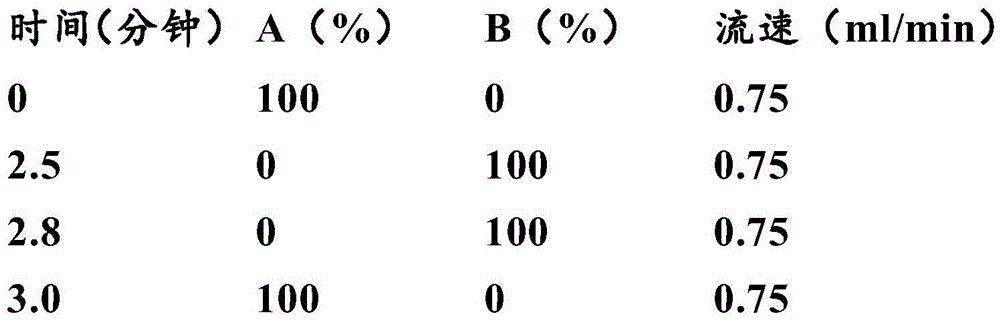
Column type: waters acquisition UPLC HSS 3; column length: 30 mm; inner diameter of column: 2.1 mm; granularity: 1.8 microns; temperature: at 60 ℃.
If desired, enantiomerically pure final compounds can be obtained, where appropriate, from racemic materials via standard physical separation techniques (e.g., reverse phase chiral chromatography) or by stereoselective synthetic techniques (e.g., by using chiral starting materials).
A representative description of a chiral analysis device is:
supercritical fluid chromatography:
watts Acquity UPC2/QDa
Watts Acquisity UPC for PDA detector2
Column: daicel SFC IC,3μm,0.3cm x 10cm,40℃
Mobile phase: a: CO 22B: iPr gradient: 05% of B in 3.8min
ABPR:1800psi
Flow rate: 2.0mL/min
And (3) detection: 247nm
Sample concentration: 1mg/mL in acetonitrile/isopropanol 50/50
And (3) injection: 1 μ L
Formulation examples

The active ingredient is intimately mixed with the adjuvants and the mixture is intimately ground in a suitable mill to provide wettable powders which can be diluted with water to give suspensions of the desired concentration.

The active ingredient is thoroughly mixed with the adjuvants and the mixture is thoroughly ground in a suitable grinder, thus providing a powder which can be used directly for seed treatment.
Emulsifiable concentrates

Emulsions with any desired dilution which can be used in plant protection can be obtained from such concentrates by dilution with water.

The ready-to-use dust is obtained by mixing the active ingredient with the carrier and grinding the mixture in a suitable grinder. Such powders may also be used for dry dressing of seeds.
Extruder granules

The active ingredient is mixed with the adjuvants and milled, and the mixture is moistened with water.
The mixture was extruded and then dried in an air stream.
Coated granules
The active ingredients [ components (A) and (B) ] are 8%
Polyethylene glycol (molecular weight 200) 3%
89 percent of kaolin
The finely ground active ingredient is applied homogeneously to the kaolin moistened with polyethylene glycol in a mixer. In this way dust-free coated granules are obtained.
Suspension concentrates

The finely ground active ingredient is intimately mixed with the adjuvant to give a suspension concentrate from which suspensions of any desired dilution can be obtained by dilution with water. With such dilutions, living plants as well as plant propagation material can be treated and protected against microbial infestation by spraying, pouring or dipping.
Flowable concentrate for seed treatment


The finely ground active ingredient is intimately mixed with the adjuvant to give a suspension concentrate from which suspensions of any desired dilution can be obtained by dilution with water. With such dilutions, living plants as well as plant propagation material can be treated and protected against microbial infestation by spraying, pouring or dipping.
Sustained release capsule suspension
28 parts of a combination of active ingredients [ components (A) and (B) ] are mixed with 2 parts of aromatic solvent and 7 parts of toluene diisocyanate/polymethylene-polyphenyl isocyanate mixture (8: 1). This mixture was emulsified in a mixture of 1.2 parts of polyvinyl alcohol, 0.05 parts of defoamer and 51.6 parts of water until the desired particle size was reached. To this emulsion was added 2.8 parts of a mixture of 1, 6-hexanediamines in 5.3 parts of water. The mixture was stirred until the polymerization reaction was complete. The obtained capsule suspension was stabilized by adding 0.25 parts of thickener and 3 parts of dispersant. The capsule suspension formulation contained 28% active ingredient. The diameter of the media capsule is 8-15 microns. The resulting formulation is applied to the seeds as an aqueous suspension in a device suitable for this purpose.
List of abbreviations:
AIBN ═ azobisisobutyronitrile
BOP-Cl ═ bis (2-oxo-3-oxazolidinyl) hypophosphoryl chloride (phosphoric acid bis (2-oxoazolide) chloride)
CDI ═ carbonyldiimidazole
DCE ═ 1, 2-dichloroethane
DCM ═ dichloromethane
DIPEA ═ N, N-diisopropylethylamine
DMA ═ dimethyl acetamide
DMF ═ dimethylformamide
3- (ethyliminomethyleneamino) -N, N-dimethylpropan-1-amine
EtOAc ═ ethyl acetate
EtOH ═ ethanol
HCl ═ hydrochloric acid
HOAt ═ 1-hydroxy-7-azabenzotriazole
HATU ═ 1- [ bis (dimethylamino) methylene ] -1H-1,2, 3-triazolo [4,5-b ] pyridinium 3-oxide-hexafluorophosphate
mp is melting point
MeOH ═ methanol
NaOH (sodium hydroxide)
NBS ═ N-bromosuccinimide
relative humidity (rh)
TFAA ═ trifluoroacetic anhydride
THF ═ tetrahydrofuran
Preparation examples
The following compounds N' - [ 5-bromo-2-methyl-6- (1-methyl-2-propoxy-ethoxy) -3-pyridinyl ] -N-ethyl-N-methyl-formamidine of component (B) and the synthesis thereof are known from WO 2015/155075, as are the syntheses of closely related compounds according to the invention.

Compound of component (B), Timorex GoldTM(active ingredient tea tree (Melaleuca alternifolia) oil) is a plant extract obtainable from the Stokes group (http:// www.stockton-ag. com/products/timerex-gold /).
The compounds of formula (I) can be prepared accordingly using the synthetic techniques described above and below.
Example 1: this example illustrates 2- (difluoromethoxy) -N-methyl-N- [ [4- [5- (trifluoromethyl) -1,2, 4-oxadiazol-3-yl]Phenyl radical]Methyl radical]Preparation of acetamide (Compound X.11 of Table T1)

Step 1: preparation of N' -hydroxy-4-methyl-benzamidine

To a suspension of 4-methylbenzonitrile (35g, 0.29mol) in ethanol (220mL) and water (440mL) was added hydroxylamine hydrochloride (41.1g, 0.58mol), potassium carbonate (65.4g, 0.47mol) and 8-hydroxyquinoline (0.22g, 1.5mmol) at room temperature. The reaction mixture was heated at 80 ℃ for 4 hours, then cooled to room temperature and diluted with 2N HCl until pH 8. The volatiles were removed under reduced pressure and the reaction contents were filtered, washed with water, and dried in vacuo to afford 39.1g of the title compound. LC/MS (method a) retention time 0.23 min, 151.0(M + H).
Step 2: preparation of 3- (p-tolyl) -5- (trifluoromethyl) -1,2, 4-oxadiazole

To a solution of N' -hydroxy-4-methyl-benzamidine (38.7g, 0.25mol) in 2-methyltetrahydrofuran (750mL) was added TFAA at 0 ℃. The reaction mixture was stirred at 15 ℃ for two hours and then diluted with water. The organic layer was separated, washed successively with saturated aqueous sodium bicarbonate solution, saturated aqueous ammonium chloride solution and water, then dried over sodium sulfate, filtered and concentrated under reduced pressure. The resulting crude residue was purified by flash chromatography on silica gel (heptane/EtOAc eluent gradient 99:1 to 90:10) to afford 54.1g of the title compound as a clear oil (which solidified upon storage). LC/MS (method a) retention time 1.15 min, no mass was detected.
1H NMR(400MHz,CDCl3)δppm:8.00(d,2H),7.32(d,2H),2.45(s,3H)。
19F NMR(400MHz、CDCl3)δppm:-65.41(s)。
Step 3a 3- [4- (bromomethyl) phenyl]Preparation of (E) -5- (trifluoromethyl) -1,2, 4-oxadiazole

A mixture of 3- (p-tolyl) -5- (trifluoromethyl) -1,2, 4-oxadiazole (56.0g, 0.24mol) and NBS (45.4g, 0.25mol) in tetrachloromethane (480mL) was heated to 70 ℃ under argon. AIBN (4.03g, 24mmol) was added and the reaction mixture was stirred at 65 ℃ for 18 h. The mixture was then cooled to room temperature and diluted with dichloromethane and water. The layers were separated and the organic layer was washed with saturated aqueous sodium bicarbonate, dried over sodium sulfate, filtered, and concentrated under reduced pressure. The crude residue was purified by flash chromatography on silica gel (cyclohexane/EtOAc eluent gradient 100:0 to 95:5) to afford 44.7g of the title compound as a white solid. mp: 58 ℃ to 63 ℃.
1H NMR(400MHz,CDCl3)δppm:8.11(d,2H),7.55(d,2H),4.53(s,2H)。
19F NMR(400MHz、CDCl3)δppm:-65.32(s)。
3- [4- (dibromomethyl) phenyl ] -5- (trifluoromethyl) -1,2, 4-oxadiazole was isolated as a by-product as a white solid. mp: 61-66 ℃.
1H NMR(400MHz,CDCl3)δppm:8.15(d,2H),7.73(d,2H),6.68(s,1H)。
19F NMR(400MHz、CDCl3)δppm:-65.34(s)。
And step 3 b: from 3- [4- (dibromomethyl) phenyl]Preparation of 3- [4- (bromomethyl) by (E) -5- (trifluoromethyl) -1,2, 4-oxadiazole
Radical) phenyl]-5- (trifluoromethyl) -1,2, 4-oxadiazole

To a 1:9 proportional mixture (10.2g) of 3- [4- (bromomethyl) phenyl ] -5- (trifluoromethyl) -1,2, 4-oxadiazole and 3- [4- (dibromomethyl) phenyl ] -5- (trifluoromethyl) -1,2, 4-oxadiazole in acetonitrile (95mL), water (1.9mL) and DIPEA (6.20mL, 35.7mmol) was added diethyl phosphite (4.7mL, 35.7mmol) at 5 ℃. The mixture was stirred at 5-10 ℃ for 2 hours, 1M aqueous HCl was added, and volatiles were removed under reduced pressure. The resulting white slurry was extracted with dichloromethane and the total combined organic layers were dried over sodium sulfate, filtered and concentrated under reduced pressure. The resulting crude residue was purified by flash chromatography on silica gel (cyclohexane/EtOAc eluent gradient 99:1 to 9:1) to afford 7.10g of the title compound as a white solid. mp: 58 ℃ to 63 ℃.
1H NMR(400MHz,CDCl3)δppm:8.11(d,2H),7.55(d,2H),4.53(s,2H)。
19F NMR(400MHz、CDCl3)δppm:-65.32(s)。
And 4, step 4: n- [ [4- [5- (trifluoromethyl) -1,2, 4-oxadiazol-3-yl ] methyl ester]Phenyl radical]Methyl radical]And (3) preparing methylamine.

A solution of 3- [4- (bromomethyl) phenyl ] -5- (trifluoromethyl) -1,2, 4-oxadiazole (15g, 46.9mmol) in THF (20mL) was added dropwise to a solution of methylamine (2M in THF, 120mL, 234.5mmol) at room temperature and stirred at room temperature for 24 h. The solvent was removed under reduced pressure and the resulting crude material was purified by flash chromatography on silica gel (cyclohexane/EtOAc eluent gradient 1:0 to 1:1) to give 10.3g of the title compound as a clear oil. LC/MS (method a) retention time 0.58 min, 258(M + H).
1H NMR(400MHz,CDCl3)δppm:8.08(d,2H),7.47(d,2H),3.84(s,2H),2.48(s,3H)。
19F NMR(400MHz、CDCl3)δppm:-65.39(s)。
And 5: 2-hydroxy-N-methyl-N- [ [4- [5- (trifluoromethyl) -1,2, 4-oxadiazol-3-yl ] methyl ester]Phenyl radical]Methyl radical]
Preparation of acetamide

To a suspension of N- [ [4- [5- (trifluoromethyl) -1,2, 4-oxadiazol-3-yl ] phenyl ] methyl ] methylamine (0.50g, 1.94mmol) in DMF (7.8mL) was added DIPEA (1.0mL, 5.83mmol) followed by 2-hydroxyacetic acid (0.22g, 2.92mmol), HATU (1.1g, 2.92mmol) under a nitrogen atmosphere. After the reaction was stirred overnight, the contents were diluted with saturated aqueous sodium bicarbonate and extracted with ethyl acetate. The total combined organic layers were dried over sodium sulfate and filtered. The solvent was removed under reduced pressure and the resulting crude product was purified by flash chromatography on silica gel (cyclohexane/EtOAc eluent gradient 95:5 to 9:1) to provide 442mg of the title compound as a clear oil. LC/MS (method a) retention time 0.90 min, 316(M + H).
19F NMR(400MHz、CDCl3)δppm:-65.34(s)。
Step 6: 2- (difluoromethoxy) -N-methyl-N- [ [4- [5- (trifluoromethyl) -1,2, 4-oxadiazol-3-yl ] methyl ester]Benzene and its derivatives
Base of]Methyl radical]Preparation of acetamide
2-hydroxy-N-methyl-N- [ [4- [5- (trifluoromethyl) -1,2, 4-oxadiazol-3-yl ] piperidine]Phenyl radical]Methyl radical]Acetamide (442mg, 1.40mmol) was suspended in dry acetonitrile (3.4mL, via Molecular sieve dried) and CuI (0.07g, 0.34mmol) was introduced. The contents were heated at 45 ℃ and 2, 2-difluoro-2-fluorosulfonyl-acetic acid (0.20mL, 1.89mmol) in acetonitrile (2mL) was introduced via syringe pump over 40 minutes. The reaction mixture was heated for 30 min, cooled to room temperature, quenched with water (30mL) and extracted with ethyl acetate. The total combined organic layers were washed with brine, dried over sodium sulfate and filtered. The solvent was removed under reduced pressure and the resulting crude product was purified by flash chromatography on silica gel (cyclohexane/EtOAc eluent gradient 1:0 to 1:1) to give 22mg of the title compound as a clear oil. LC/MS (method a) retention time 1.02 min, 366(M + H).
1H NMR(400MHz,CDCl3)δppm:8.12(m,2H),7.40(m,2H),6.44(t,1H),4.69(m,2H),4.58(m,2H),2.96(m,3H)。
19F NMR(400MHz、CDCl3)δppm:-65.34(s),-85.92(s)。
Example 2: this example illustrates 1-cyclopropyl-3-methoxy-3-methyl-1- [ [4- [5- (trifluoromethyl) -1,2, 4-oxadiazol-3-yl ] methyl [ ] -1]Phenyl radical]Methyl radical]Preparation of Urea (Compound X.18 of Table X)

Step 1: 1N- [ [4- [5- (trifluoromethyl) -1,2, 4-oxadiazol-3-yl ] methyl ester]Phenyl radical]Methyl radical]Preparation of cyclopropylamines

A solution of 3- [4- (bromomethyl) phenyl ] -5- (trifluoromethyl) -1,2, 4-oxadiazole (2.50g, 8.1mmol) in dichloromethane (5mL) was added to a solution of cyclopropylamine (3.7g, 65mmol) and N-ethyl-N-isopropyl-propan-2-amine (1.4mL, 8.1mmol) in dichloromethane (10mL) at room temperature over 2 hours. The mixture was stirred at room temperature for 30 minutes, poured into water, and then extracted with dichloromethane. The total combined organic layers were washed with brine, dried over sodium sulfate and filtered. The solvent was removed under reduced pressure and the resulting crude residue was purified by flash chromatography on silica gel (cyclohexane/EtOAc eluent gradient 1:0 to 1:1) to give 1.18g of the title compound as a white solid with LC/MS (method a) retention time 0.71 min, 300(M + H).
1H NMR(400MHz,CDCl3)δppm:8.06(d,2H),7.49(d,2H),3.92(s,2H),2.18(m,1H),1.85(brs,1H),0.42(m,2H),0.39(m,2H)。
19F NMR(400MHz、CDCl3)δppm:-65.36(s)。
Step 2: 1-cyclopropyl-3-methoxy-3-methyl-1- [ [4- [5- (trifluoromethyl) -1,2, 4-oxa-bisAzol-3-yl]
Phenyl radical]Methyl radical]Preparation of urea
To a stirred suspension of N- [ [4- [5- (trifluoromethyl) -1,2, 4-oxadiazol-3-yl ] phenyl ] methyl ] cyclopropylamine (0.15g, 0.53mmol) in dichloromethane (3mL) at 0 deg.C was added triethylamine (0.15mL, 1.06mmol) followed by N-methoxy-N-methylcarbamoyl chloride (0.07g, 0.58 mmol). After 4 h, the reaction mixture volatiles were removed under reduced pressure and the resulting crude residue was purified by flash chromatography on silica gel (cyclohexane/EtOAc eluent gradient 95:5 to 9:1) to afford 183mg of the desired product as a light yellow oil. LC/MS (method a) retention time 1.10 min, 371(M + H).
1H NMR(400MHz,CDCl3)δppm:8.08(d,2H),7.44(d,2H),4.62(s,2H),3.68(s,3H),3.08(s,3H),2.68(m,1H),0.74(m,4H)。
Example 3: this example illustrates 2-methoxy-N- (2,2, 2-trifluoroethyl) -N- [ [4- [5- (trifluoromethyl) -1,2, 4-oxadiazol-3-yl ] methyl]Phenyl radical]Methyl radical]Preparation of acetamide (Compound X.09 of Table X)

Step 1: intermediate 2,2, 2-trifluoro-N- [ [4- [5- (trifluoromethyl) -1,2, 4-oxadiazol-3-yl]Phenyl radical]First of all
Base of]Preparation of ethylamine

To a solution of 3- [4- (bromomethyl) phenyl ] -5- (trifluoromethyl) -1,2, 4-oxadiazole (1.5g, 4.69mmol) in dichloromethane (10mL) was introduced DIPEA (0.82mL,4.69mmol) dropwise followed by 2,2, 2-trifluoroethylamine (2.94mL, 37.5 mmol). The reaction mixture was stirred at room temperature for 24 minutes, then poured into water and extracted with dichloromethane. The total combined organic layers were dried over sodium sulfate and filtered. The solvent was removed under reduced pressure and the resulting crude residue was purified by flash chromatography on silica gel (cyclohexane/EtOAc eluent gradient 1:0 to 0:1) to give 1.53g of the title compound as a clear oil.
1H NMR(400MHz,CDCl3)δppm:8.09(d,2H),7.51(d,2H),4.00(s,2H),3.22(q,2H),1.71(s,1H)。
Step 2: 2-methoxy-N- (2,2, 2-trifluoroethyl) -N- [ [4- [5- (trifluoromethyl) -1,2, 4-oxadiazole-3-
Base of]Phenyl radical]Methyl radical]Preparation of acetamide
To a suspension of 2,2, 2-trifluoro-N- [ [4- [5- (trifluoromethyl) -1,2, 4-oxadiazol-3-yl ] phenyl ] methyl ] ethylamine (0.1g, 0.31mmol) in dichloromethane (6mL) at 0 ℃ was added triethylamine (0.09mL,0.62mmol) followed by 2-methoxyacetyl chloride (0.03mL, 0.32 mmol). The reaction mixture was stirred overnight, reduced under reduced pressure, and the resulting crude residue was subjected to silica gel flash chromatography (heptane/EtOAc eluent gradient 9:1 to 1:9) to provide 116mg of the desired product mp as a white solid: 92-95 ℃. LC/MS (method a) retention time ═ 1.08 min, 398(M + H).
1H NMR(400MHz,CDCl3)δppm:8.12(m,2H),7.36(m,2H),4.82(s,2H),4.08(m,2H),3.98(m,2H),3.45(s,3H)。
Example 4: this example illustrates the intermediate N-propoxy-1- [4- [5- (trifluoromethyl) -1,2, 4-oxadiazol-3-yl]Phenyl radical]Preparation of methylamines

A solution of 3- [4- (bromomethyl) phenyl ] -5- (trifluoromethyl) -1,2, 4-oxadiazole (1.30g, 4.06mmol) in dichloromethane (10mL) was added dropwise to a solution of O-propylhydroxylamine hydrochloride (3.74g, 32.5mmol) and DIPEA (6.40mL, 36.6mmol) in dichloromethane (6 mL). The reaction mixture was stirred at room temperature for 24 hours, then poured onto water and the layers separated. The aqueous layer was extracted with dichloromethane and the total combined organic layers were washed with brine, dried over sodium sulfate, and filtered. The solvent was removed under reduced pressure and the resulting crude product was purified by flash chromatography on silica gel (cyclohexane/EtOAc eluent gradient 1:0 to 1:1) to give 0.92g of the title compound as a clear oil. LC/MS (method a) retention time 1.12 min, 302(M + H).
1H NMR(400MHz,CDCl3)δppm:8.09(d,2H),7.02(d,2H),5.70(sbr,1H),4.11(s,2H),3.59(m,2H),1.52(m,2H),0.86(s,3H)。
19F NMR(400MHz、CDCl3)δppm:-65.33(s)。
Example 5: this example illustrates 1- [ [ 3-fluoro-4- [5- (trifluoromethyl) -1,2, 4-oxadiazol-3-yl]Phenyl radical]Methyl radical]Preparation of (E) -1-methoxy-3-methyl-urea (Compound X.21 of Table X)

Step 1: preparation of 2-fluoro-N' -hydroxy-4-methyl-benzamidine

To a suspension of 2-fluoro-4-methylbenzonitrile (5g, 37.0mmol) in ethanol (125mL) at 25 ℃ was added hydroxylamine hydrochloride (7.7g, 111mmol) and the reaction mixture was heated at 80 ℃ for 2 h. After cooling to room temperature, the volatiles were removed under reduced pressure, thereby providing a white solid (which was used for the next conversion without additional purification). LC/MS (method a) retention time ═ 1.14 min, 169.2(M + H).
1H NMR(400MHz,CDCl3)δppm:7.96(t,1H),7.11(m,2H),2.45(s,3H)。
Step 2: preparation of 3- (2-fluoro-4-methyl-phenyl) -5- (trifluoromethyl) -1,2, 4-oxadiazole

To a solution of 2-fluoro-N' -hydroxy-4-methyl-benzamidine (37mmol) in tetrahydrofuran (122mL) cooled via an ice bath was added TFAA (7.71mL, 55.5 mmol). The reaction mixture was stirred at 25 ℃ overnight and then diluted with water. The organic layer was separated, washed successively with saturated aqueous sodium bicarbonate solution, saturated aqueous ammonium chloride solution and water, then dried over sodium sulfate, filtered and concentrated under reduced pressure. The resulting crude residue was purified by flash chromatography on silica gel (cyclohexane/EtOAc eluent gradient 99:1 to 1:1) to give 6.6g of the title compound as an amorphous white solid. LC/MS (method a) retention time 1.14 min, 247(M + H).
1H NMR(400MHz,CDCl3)δppm:8.00(d,1H),7.32(d,2H),2.45(s,3H)。
19F NMR(400MHz、CDCl3)δppm:-65.3(s),108.1(s)。
Step 3a 3- [4- (bromomethyl) phenyl]Preparation of (E) -5- (trifluoromethyl) -1,2, 4-oxadiazole

A mixture of 3- (2-fluoro-4-methyl-phenyl) -5- (trifluoromethyl) -1,2, 4-oxadiazole (4.2g, 17.1mmol) and NBS (3.11g, 17.1mmol) in tetrachloromethane (34.3mL) was heated to 70 ℃. AIBN (0.29g, 1.71mmol) was introduced and the reaction mixture was stirred at 65 ℃ for 18 h. The contents were cooled to 25 ℃, diluted with dichloromethane and water, and the layers were separated. The succinimide by-product was removed via filtration, and the solvent was removed under reduced pressure to give a brown gum. The residue was purified by flash chromatography on silica gel (cyclohexane/EtOAc 100:0 to 4:1) to afford 1.7g of the title compound as a white solid. LC/MS (method a) retention time ═ 1.13 min, (M + H) was not detected.
1H NMR(400MHz,CDCl3)δppm:8.09(t,1H),7.34(m,2H),4.49(s,2H)。
19F NMR(400MHz、CDCl3)δppm:-65.18(s),-106.2(s)。
3- [4- (dibromomethyl) phenyl ] -5- (trifluoromethyl) -1,2, 4-oxadiazole was isolated as a by-product as a beige solid (4.0g, 58% yield) (LC/MS (method a) retention time 1.20 min, no detection (M + H)).
1H NMR(400MHz,CDCl3)δppm:8.14(d,1H),7.52(dd,2H),6.63(s,1H)。
And step 3 b: from 33- [4- (dibromomethyl) -2-fluoro-phenyl]Preparation of 3-substituted-5- (trifluoromethyl) -1,2, 4-oxadiazole
[4- (bromomethyl) -2-fluoro-phenyl]-5- (trifluoromethyl) -1,2, 4-oxadiazole

To a 1:20 mixture (4.0g, 9.9mmol) of 3- [4- (bromomethyl) -2-fluoro-phenyl ] -5- (trifluoromethyl) -1,2, 4-oxadiazole and 3- [4- (dibromomethyl) -2-fluoro-phenyl ] -5- (trifluoromethyl) -1,2, 4-oxadiazole in acetonitrile (37mL), water (0.8mL) and DIPEA (2.59mL, 14.8mmol) was added diethyl phosphite (2.0mL, 14.8mmol) at 5 ℃. The mixture was stirred at 5-10 ℃ for 2 hours, then water and 1M aqueous HCl solution were added. The volatiles were removed under reduced pressure and the resulting white slurry was extracted with dichloromethane. The total combined organic layers were dried over sodium sulfate and filtered. The solvent was removed under reduced pressure and the resulting light orange crude residue was purified by flash chromatography on silica gel (cyclohexane/EtOAc eluent gradient 99:1 to 1:1) to afford 2.2g of the title compound as a white solid. LC/MS (method a) retention time ═ 1.13 min, (M + H) was not detected.
1H NMR(400MHz,CDCl3)δppm:8.09(t,1H),7.34(m,2H),4.49(s,2H)。
19F NMR(400MHz、CDCl3)δppm:-65.18(s),-106.2(s)。
And 4, step 4: 1- [ 3-fluoro-4- [5- (trifluoromethyl) -1,2, 4-oxadiazol-3-yl]Phenyl radical]Process for preparation of (E) -N-methoxy-methylamine
Preparation of

To a solution of O-methylhydroxylamine hydrochloride (4.9g, 59mmol) in dichloromethane (15mL) was added DIPEA (12mL, 66mmol) dropwise followed by a solution of 3- [4- (bromomethyl) -2-fluorophenyl ] -5- (trifluoromethyl) -1,2, 4-oxadiazole (1.2g, 3.7mmol) in dichloromethane (5 mL). After 18 hours, water (10mL) was introduced and the reaction contents were extracted twice with dichloromethane and the total combined organic layers were dried over sodium sulfate and then filtered. The resulting residue was purified by flash chromatography on silica gel (cyclohexane/EtOAc eluent gradient 1:0 to 1:1) to afford 410mg of the title compound as a colorless oil with LC/MS (method a) residence time ═ 1.01 min, (M + H) not detected.
1H NMR(400MHz,CDCl3)δppm:8.05(t,1H),7.45(m,2H),5.85(brs,1H),4.12(s,2H),3.50(s,3H)。
19F NMR(400MHz、CDCl3)δppm:-65.21(s),-107.33(s)。
And 5: 1- [ [ 3-fluoro-4- [5- (trifluoromethyl) -1,2, 4-oxadiazol-3-yl ] methyl ester]Phenyl radical]Methyl radical]-1-methoxy-
Preparation of 3-methyl-urea
To a solution of 1- [ 3-fluoro-4- [5- (trifluoromethyl) -1,2, 4-oxadiazol-3-yl ] phenyl ] -N-methoxy-methylamine (20mg, 0.07mmol) in dichloromethane (0.23mL) were added N-methylcarbamoyl chloride (0.012g, 0.14mmol) and triethylamine (0.02mL, 0.13 mmol). After 1 h, the reaction mixture was concentrated under reduced pressure and the resulting crude residue was purified by flash chromatography on silica gel (cyclohexane/EtOAc eluent gradient 99:1 to 1:1) to afford 12mg of the desired product as a gum. LC/MS (method a) retention time 0.97 min, 349(M + H).
1H NMR(400MHz,CDCl3)δppm:8.04(t,1H),7.31(m,2H),5.81(m,1H),4.71(s,2H),3.60(s,3H),2.87(d,3H)。
19F NMR(400MHz、CDCl3)δppm:-65.17(s),-107.10(s)。
Example 6: this example illustrates the N- [ [2, 3-difluoro-4- [5- (trifluoromethyl) -1,2, 4-oxadiazol-3-yl ] radical]Phenyl radical]Methyl radical]Preparation of (E) -N-methoxy-cyclopropanecarboxamide (Compound X.10 of Table X)

Step 1: preparation of 2, 3-difluoro-N' -hydroxy-4-methyl-benzamidine

To a suspension of 2, 3-difluoro-4-methylbenzonitrile (5.0g, 32.6mmol) in ethanol (111mL) at 25 ℃ was added hydroxylamine hydrochloride (4.5g, 65.3 mmol). The reaction mixture was heated at 80 ℃ for 2 hours. After cooling to room temperature, the volatiles were removed under reduced pressure, thereby providing a white solid (which was used for the next conversion without purification).
1H NMR(400MHz,CDCl3)δppm:7.30(m,1H),6.95(m,1H),6.50(brs,1H),5.05(brs,2H),2.30(s,3H)。
Step 2: preparation of 3- (2, 3-difluoro-4-methyl-phenyl) -5- (trifluoromethyl) -1,2, 4-oxadiazole

To a solution of 2, 3-difluoro-N' -hydroxy-4-methyl-benzamidine (2.6mmol) in tetrahydrofuran (108mL) cooled via an ice bath was added TFAA (6.9mL, 49 mmol). The reaction mixture was stirred at 25 ℃ overnight and then diluted with water. The organic layer was separated, washed successively with saturated aqueous sodium bicarbonate solution, saturated aqueous ammonium chloride solution and water, then dried over sodium sulfate, filtered and concentrated under reduced pressure. The title compound (6.6g) was isolated as a light brown solid (which was used for the next conversion without further purification). LC/MS (method a) retention time 1.16 min, 265(M + H).
1H NMR(400MHz,CDCl3)δppm:7.76(d,1H),7.12(d,1H),2.41(s,3H)。
19F NMR(400MHz、CDCl3)δppm:-65.41(s),-133.3(s),-140.1(s)。
And step 3: 3- [4- (bromomethyl) -2, 3-difluoro-phenyl]Preparation of (E) -5- (trifluoromethyl) -1,2, 4-oxadiazole

A mixture of 3- (2, 3-difluoro-4-methyl-phenyl) -5- (trifluoromethyl) -1,2, 4-oxadiazole (6.0g, 22.6mmol) and NBS (7.17g, 10.0mmol) in tetrachloromethane (79mL) was heated to 70 ℃ under argon. AIBN (0.68g, 3.95mmol) was added and the reaction mixture was stirred at 65 ℃ for 36 hours. The mixture was cooled to 25 ℃, diluted with dichloromethane, water, and the layers were separated. The succinimide by-product was removed via filtration and the volatiles were removed under reduced pressure. The resulting crude residue was purified by flash chromatography on silica gel (cyclohexane/EtOAc eluent gradient 100:0 to 4:1) to afford 4.8g of the title compound as a white solid. LC/MS (method a) retention time ═ 1.16 min, 344(M + H).
1H NMR(400MHz,CDCl3)δppm:7.80(m,1H),7.37(m,1H),4.55(s,2H)。
19F NMR(400MHz、CDCl3)δppm:-65.1(s),-131.2(s),-139.1(s)。
And 4, step 4: 1- [2, 3-difluoro-4- [5- (trifluoromethyl) -1,2, 4-oxadiazol-3-yl]Phenyl radical]-N-methoxy-methyl
Preparation of amines

A solution of O-methylhydroxylamine hydrochloride (3.5g, 42mmol) in dichloromethane (8mL) was treated dropwise with DIPEA (8.3mL, 47mmol) followed by a solution of 3- [4- (bromomethyl) -2, 3-difluoro-phenyl ] -5- (trifluoromethyl) -1,2, 4-oxadiazole (2.0g, 5.2mmol) in dichloromethane (5 mL). After 18 hours, water (10mL) was introduced, the reaction contents were extracted twice with dichloromethane and the total combined organic layers were dried over sodium sulfate and filtered. The resulting residue was purified by flash chromatography on silica gel (cyclohexane/EtOAc eluent gradient 1:0 to 1:1) to provide 1.10g of the title compound as a pale yellow oil. LC/MS (method a) retention time 1.03 min, 310(M + H).
1H NMR(400MHz,CDCl3)δppm:7.84(t,1H),7.38(t,1H),5.87(brs,1H),4.20(s,2H),3.52(s,3H)。
19F NMR(400MHz、CDCl3)δppm:-65.21(s),-132.53(s),-147.50(s)。
And 5: n- [ [2, 3-difluoro-4- [5- (trifluoromethyl) -1,2, 4-oxadiazol-3-yl ] methyl ester]Phenyl radical]Methyl radical]-N-methyl
Preparation of oxy-cyclopropanecarboxamides
To a solution of 1- [2, 3-difluoro-4- [5- (trifluoromethyl) -1,2, 4-oxadiazol-3-yl ] phenyl ] -N-methoxy-methylamine (0.18g, 0.58mmol) in dichloromethane (2.9mL) was added cyclopropanecarbonyl chloride (0.06mL, 0.61mmol) followed by triethylamine (0.16mL, 1.16 mmol). After 1 h, the reaction mixture was concentrated under reduced pressure and the crude residue was purified by flash chromatography on silica gel (cyclohexane/EtOAc eluent gradient 99:1 to 1:1) to afford 207mg of the title compound as a gum. LC/MS (method a) retention time 1.11 min, 378(M + H).
Example 7 a:this example illustrates N-ethyl-2-methyl-N- [ [4- [5- (trifluoromethyl) -1,2, 4-oxadiazol-3-yl ] methyl [ ] -N]Phenyl radical]Methyl radical]Preparation of propionamide (compound X.07 of Table X)

Step 1: n- [ [4- [5- (trifluoromethyl) -1,2, 4-oxadiazole-3)-radical]Phenyl radical]Methyl radical]Preparation of ethylamine

A solution of 3- [4- (bromomethyl) phenyl ] -5- (trifluoromethyl) -1,2, 4-oxadiazole (1.50g, 4.69mmol) in dichloromethane (9.4mL) was added dropwise to a 2M solution of ethylamine in MeOH (12mL, 24.0mmol) at room temperature. The mixture was stirred at room temperature for 24 hours, then poured into water and the layers were separated. The aqueous layer was extracted with dichloromethane and the total combined organic layers were washed with brine, dried over sodium sulfate, and filtered. The solvent was removed under reduced pressure and the resulting crude product was purified by flash chromatography on silica gel (cyclohexane/EtOAc eluent gradient 1:0 to 1:1) to give 0.92g of the title compound mp as a white solid: LC/MS (method a) retention time 0.66 min at 102-112 ℃, 272(M + H).
1H NMR(400MHz,CDCl3)δppm:8.01(d,2H),7.57(d,2H),3.86(q,2H),3.29(brs,1H),2.53(q,2H),1.05(t,3H)。
19F NMR(400MHz、CDCl3)δppm:-64.77(s)。
Step 2: N-ethyl-2-methyl-N- [ [4- [5- (trifluoromethyl) -1,2, 4-oxadiazol-3-yl ] methyl [ ] -methyl]Phenyl radical]Methyl radical]
Preparation of propionamide
To a suspension of N- [ [4- [5- (trifluoromethyl) -1,2, 4-oxadiazol-3-yl ] phenyl ] methyl ] ethylamine (4.8g, 18mmol) in dichloromethane (58mL) at 0 deg.C was added triethylamine (4.9mL,35mmol) followed by 2-methylpropanoyl chloride (2.0mL, 19 mmol). The reaction mixture was stirred for 1 hour, and then saturated aqueous ammonium chloride solution was introduced, followed by extraction with ethyl acetate. The total combined organic layers were dried over sodium sulfate and filtered. The solvent was removed under reduced pressure and the resulting crude residue was subjected to flash chromatography on silica gel (cyclohexane/EtOAc eluent gradient 9:1 to 1:9) to afford 5.1g of the desired product as an orange oil. LC/MS (method a) retention time 1.11 min, 342.6(M + H).
1H NMR(400MHz,CDCl3)δppm:8.07(m,2H),7.36(m,2H),4.66(m,2H),3.36(m,2H),2.87(m,1H),1.15(m,9H)。
19F NMR(400MHz、CDCl3)δppm:-64.36(s)。
Example 7b: this example illustrates N-ethyl-2-methyl-N- [ [4- [5- (trifluoromethyl) -1,2, 4-oxadiazol-3-yl ] methyl [ ] -N]Phenyl radical]Methyl radical]Alternative preparation of propionamide (compound X.07 of Table X)
Step 1: preparation of 4- (ethylaminomethyl) benzonitrile

To a solution of 4- (chloromethyl) benzonitrile (3.0g, 19.4mmol) in tetrahydrofuran (30mL) heated at 40 ℃ was added 70% aqueous ethylamine (4 equiv., 77.6mmol) and the reaction was heated at 40 ℃ for 16 h. After cooling to 25 ℃, the reaction contents were diluted with water (25mL) and tert-butyl methyl ether (50mL) and the layers were separated. The aqueous layer was extracted with tert-butyl methyl ether and the total combined organic fractions were washed with brine, dried over sodium sulfate, and filtered. The solvent was removed under reduced pressure to give 3.05g of the title compound as a yellow gum (which was used for the next conversion without further purification).
1H NMR(400MHz,CDCl3)δppm:7.61(d,2H),7.42(d,2H),3.85(s,2H),2.53(q,2H),1.13(t,3H)。
Step 2: n- [ (4-cyanophenyl) methyl group]Preparation of (E) -N-ethyl-2-methyl-propionamide

To a suspension of 4- (ethylaminomethyl) benzonitrile (2.0g, 11.2mmol) in toluene (13mL) at 0 deg.C was added sodium hydroxide (0.50g, 12.3mmol) as an aqueous solution (6.6mL), followed by 2-methylpropanoyl chloride (1.38g, 12.3 mmol). The ice bath was removed and the reaction mixture was stirred for 24 hours. Thereafter, the reaction contents were diluted with water (100mL) and tert-butyl methyl ether (100mL) and the layers were separated. The aqueous layer was extracted with tert-butyl methyl ether and the total combined organic fractions were dried over sodium sulfate and filtered. The solvent was removed under reduced pressure to afford 2.65g of the desired product as an orange oil (which was used for the next conversion without further purification).
1H NMR(400MHz,CDCl3)δppm:7.58(m,2H),7.30(m,2H),4.61(m,2H),3.49(m,2H),2.85(m,1H),1.17(m,9H)。
And step 3: N-ethyl-N- [ [4- (N-hydroxycarbamimidoyl) phenyl]Methyl radical]Preparation of (E) -2-methyl-propionamide

To a solution of N- [ (4-cyanophenyl) methyl ] -N-ethyl-2-methyl-propionamide (2.80g, 11mmol) and ethanol (28mL) was introduced 50% aqueous hydroxylamine solution (1.5 eq, 17 mmol). After 18 hours, the reaction contents are concentrated under reduced pressure and dried in vacuo. Water (10mL) was introduced and the contents stirred for 15 minutes. The resulting white solid was filtered and dried in vacuo to afford 2.52mg of the title compound as a white solid (which was used for the next conversion without further purification).
1H NMR(400MHz,DMSO-d6)δppm:9.60(sbr,1H),7.63(m,2H),7.17(m,2H),4.55(m,2H),3.31(m,1H),3.27(m,2H),1.07(m,9H)。
And 4, step 4: N-ethyl-2-methyl-N- [ [4- [5- (trifluoromethyl) -1,2, 4-oxadiazol-3-yl ] methyl [ ] -methyl]Phenyl radical]Methyl radical]
Preparation of propionamide
To a 30mL Schlenk (Schlenk) tube (connected to trap-1 (empty) and then to trap-2 (filled with 4N aqueous NaOH solution) were charged N-ethyl-N- [ [4- (N-hydroxycarbamimidoyl) phenyl ] methyl ] -2-methyl-propionamide (2.00g, 7.22mmol), ethyl acetate (20mL) and pyridine (0.88mL, 10.8mmol), the contents were stirred for 10 minutes, then 2,2, 2-trifluoroacetyl chloride (1.05g, 7.94mmol) was introduced by gentle bubbling to the resulting white suspension, the reaction medium became colorless after stirring at 25 ℃, and after 1 hour, the reaction contents were diluted with ethyl acetate, washed with water, dried over sodium sulfate and concentrated under reduced pressure to give 2.5g of the title compound as an orange-colored substance-LC/MS (method a) retention time was 1.11 minutes as an oil, 342.6(M + H).
1H NMR(400MHz,CDCl3)δppm:8.07(m,2H),7.36(m,2H),4.66(m,2H),3.36(m,2H),2.87(m,1H),1.15(m,9H)。
19F NMR(400MHz、CDCl3)δppm:-64.36(s)。
Example 8 a:this example illustrates N-methoxy-N- [ [4- [5- (trifluoromethyl) -1,2, 4-oxadiazol-3-yl ] methyl]Phenyl radical]Methyl radical]Preparation of cyclopropanecarboxamides (compound X.01 from Table X)

Step 1: n-methoxy-1- [4- [5- (trifluoromethyl) -1,2, 4-oxadiazol-3-yl]Phenyl radical]Preparation of methylamines

DIPEA (19.1g, 147.7mmol) was introduced dropwise into a solution of O-methylhydroxylamine hydrochloride (11.2g, 131.3mmol) in dichloromethane (91 mL). After 20 min, 3- [4- (bromomethyl) phenyl ] -5- (trifluoromethyl) -1,2, 4-oxadiazole (14.0g, 16.4mmol) was introduced as a solution in dichloromethane (4 mL). The reaction mixture was stirred at room temperature for 24 hours, then poured into water and the layers were separated. The organic layer was washed with water, the organic portion was concentrated under reduced pressure, and the resulting crude residue was purified by flash chromatography on silica gel (cyclohexane/EtOAc eluent gradient 1:0 to 7:3) to give 4.4g of the title compound as a yellowish oil.
1H NMR(400MHz,CDCl3)δppm:8.09(d,2H),7.53(d,2H),5.33(brs,1H),4.12(s,2H),3.50(s,3H)。
19F NMR(400MHz、CDCl3)δppm:-65.32(s)。
Step 2: N-methoxy-N- [ [4- [5- (trifluoromethyl) -1,2, 4-oxadiazol-3-yl ] methyl]Phenyl radical]Methyl radical]Cyclopropane
Preparation of carboxamides
To a suspension of N-methoxy-1- [4- [5- (trifluoromethyl) -1,2, 4-oxadiazol-3-yl ] phenyl ] methanamine (0.11g, 0.38mmol) in dichloromethane (2.8mL) was introduced triethylamine (0.16mL, 1.14mmol) followed by cyclopropanecarboxylic acid (0.4mL, 0.49mmol) and EDCI (0.15g, 0.76 mmol). After 18 hours, the contents were diluted with 1M aqueous HCl and extracted with dichloromethane. The total combined organic layers were dried over sodium sulfate and filtered. The solvent was removed under reduced pressure and the resulting crude residue was purified by flash chromatography on silica gel (cyclohexane/EtOAc eluent gradient 99:1 to 8:2) to provide 126mg of the title compound as a white solid, mp: LC/MS (method a) retention time 0.99 min at 35-38 ℃, 316.3(M + H).
1H NMR(400MHz,CDCl3)δppm:8.09(d,2H),7.53(d,2H),4.87(s,2H),3.73(s,3H),2.19(m,1H),1.05(m,2H),0.86(m,2H)。
19F NMR(400MHz、CDCl3)δppm:-65.33(s)。
Example 8 b:this example illustrates N-methoxy-N- [ [4- [5- (trifluoromethyl) -1,2, 4-oxadiazol-3-yl ] methyl]Phenyl radical]Methyl radical]Alternative preparation of cyclopropanecarboxamides (compound X.01 of Table X)
Step 1: preparation of N-methoxycyclopropanecarboxamide

To a solution of O-methylhydroxylamine (0.80g, 21.8mmol) and potassium carbonate (0.52mL, 2.88mmol) in ethyl acetate (7.7mL) cooled via an ice bath was added cyclopropanecarbonyl chloride (2.0g, 18.2mmol) dropwise over 30 minutes. The ice bath was removed and after stirring the contents for 2 hours, EtOH (5mL) was introduced and the contents stirred for an additional 30 minutes. The solid was filtered and then dried in vacuo to provide 2.14g of the title compound as a white solid.
1H NMR(400MHz,DMSO-d6)δppm:11.13(s,1H),3.57(s,3H),1.34(m,1H),0.87(m,1H),0.68(m,3H)。
Step 2: n- [ (4-cyanophenyl) methyl group]Preparation of (E) -N-methoxy-cyclopropanecarboxamide

To a solution of N-methoxycyclopropanecarboxamide (0.67g, 5.50mmol) in acetonitrile (10mL) was introduced potassium carbonate (0.80g, 5.50mmol) followed by 4- (bromomethyl) benzonitrile (1.0g, 5.50 mmol). The reaction was heated at 60 ℃ for 8 hours, then cooled to 25 ℃ and quenched with water. The contents were extracted with ethyl acetate and the total combined organic layers were dried over sodium sulfate, filtered, and concentrated under reduced pressure. The resulting crude product was purified by flash chromatography on silica gel (cyclohexane/EtOAc eluent gradient 1:0 to 7:3) to give 1.0g of the title compound as a yellowish oil.
1H NMR(400MHz,CDCl3)δppm:7.61(d,2H),7.42(d,2H),4.84(s,2H),3.74(s,3H),2.18(m,1H),1.04(m,2H),0.89(m,2H)。
And step 3: n- [ [4- (N-hydroxycarbamimidoyl) phenyl ] radical]Methyl radical]Preparation of (E) -N-methoxy-cyclopropanecarboxamide

To a solution of N- [ (4-cyanophenyl) methyl ] -N-methoxy-cyclopropanecarboxamide (0.50g, 2.30mmol) and ethanol (2.5mL) was introduced 50% aqueous hydroxylamine solution (0.18mL, 2.99 mmol). The reaction was then heated at 80 ℃ for 2 hours, cooled to 25 ℃ and concentrated under reduced pressure. The contents were basified to pH 8 using 30% aqueous NaOH, extracted with EtOAc, and then the total combined organic fractions were concentrated under reduced pressure and dried under vacuum to provide 270mg of the title compound as a white solid.
1H NMR(400MHz,DMSO-d6)δppm:9.60(s,1H),7.62(d,2H),7.28(d,2H),5.77(s,2H),4.55(s,2H),3.71(s,3H),2.17(m,1H),0.82(m,4H)。
And 4, step 4: N-methoxy-N- [ [4- [5- (trifluoromethyl) -1,2, 4-oxadiazol-3-yl ] methyl]Phenyl radical]Methyl radical]Cyclopropane
Preparation of carboxamides
To a 30mL schlenk tube connected to trap-1 (empty) and then to trap-2 (filled with 4N aqueous NaOH solution) was added N- [ [4- (N-hydroxycarbamimidoyl) phenyl ] methyl ] -N-methoxy-cyclopropanecarboxamide (1.05g, 4.00mmol), ethyl acetate (20mL) and pyridine (0.49mL, 6.0mmol) and the contents stirred for 10 minutes then cooled to 0 ℃ 2,2, 2-trifluoroacetyl chloride (0.58g, 4.40mmol) was introduced to the resulting white suspension by gentle bubbling the reaction medium became colorless after stirring at 25 ℃ and after 1 hour the contents were diluted with ethyl acetate, washed with water, dried over sodium sulfate, filtered and then concentrated under reduced pressure to give 1.26g of the title compound as an orange which solidified after storage, mp: 35 ℃ -38 ℃ as an oil, LC/MS (method a) retention time 0.99 min, 316.3(M + H).
1H NMR(400MHz,CDCl3)δppm:8.09(d,2H),7.53(d,2H),4.87(s,2H),3.73(s,3H),2.19(m,1H),1.05(m,2H),0.86(m,2H)。
19F NMR(400MHz、CDCl3)δppm:-65.33(s)。
Example 9 a:this example illustrates N, 2-dimethoxy-N- [ [4- [5- (trifluoromethyl) -1,2, 4-oxadiazol-3-yl ] methyl]Phenyl radical]Methyl radical]Preparation of propionamide (compound X.04 of Table X)

To a solution of 2-methoxypropionic acid (0.2g, 1.92mmol) in DMF (7.7mL) was added HATU (0.80g, 2.11mmol) and DIPEA (0.52mL, 2.88 mmol). After stirring the contents for 20 minutes, N-methoxy-1- [4- [5- (trifluoromethyl) -1,2, 4-oxadiazol-3-yl ] phenyl ] methanamine (0.524g, 1.92mmol) was introduced. After 2 hours, the contents were diluted with water and ethyl acetate, the layers were separated, and the aqueous phase was extracted with ethyl acetate. The total combined organic layers were dried over sodium sulfate and filtered. The solvent was removed under reduced pressure and the resulting crude residue was purified by flash chromatography on silica gel (cyclohexane/EtOAc eluent gradient 4:1 to 1:9) to provide 418mg of the title compound as a white solid, mp: LC/MS (method a) retention time 1.02 min at 62-65 ℃, 360.6(M + H). The same conditions can be used to introduce a single enantiomeric form of 2-methoxypropionic acid, i.e., (R) -or (S) -enantiomer, to provide the corresponding single enantiomeric form of compound x.04.
1H NMR(400MHz,CDCl3)δppm:8.09(d,2H),7.48(d,2H),4.98(m,1H),4.80(m,1H),4.27(m,1H),3.71(s,3H),3.34(s,3H),1.37(d,3H)。
19F NMR(400MHz、CDCl3)δppm:-65.35(s)。
Example 9 b:this example illustrates N, 2-dimethoxy-N- [ [4- [5- (trifluoromethyl) -1,2, 4-oxadiazol-3-yl ] methyl]Phenyl radical]Methyl radical]Alternative preparation of propionamide (compound X.04 of Table X)

Step 1: preparation of 2-methoxypropionyl chloride

To a solution of 2-methoxypropionic acid (0.70g, 6.72mmol), dimethylformamide (0.005mL), and dichloromethane cooled via an ice bath was introduced oxalyl chloride (0.90mL, 10.1 mmol). After 30 minutes, the ice bath was removed and stirring was continued for 3.5 hours. The contents were then concentrated under slightly reduced pressure (about 500 mbar) to provide 200mg of the title compound (which was used directly for the next conversion). The same conditions can be used to introduce a single enantiomeric form of 2-methoxypropionic acid, i.e., (R) -or (S) -enantiomer, to provide the corresponding single enantiomeric form of 2-methoxypropionyl chloride.
Step 2: 4- [ (methoxyamino) methyl group]Preparation of benzonitrile hydrochloride

To a solution of 4- (bromomethyl) benzonitrile (2.0g, 10.2mmol) in acetonitrile (10mL) was added O-methylhydroxylamine hydrochloride (1.7g, 20.4mmol) and potassium carbonate (3.0g, 21.4 mmol). After 17 hours, the reaction mixture was poured into water and extracted with ethyl acetate. The total combined organic layers were washed with water and brine, then dried over sodium sulfate, filtered and concentrated under reduced pressure. The resulting crude residue was taken up in tert-butyl methyl ether (15mL), cooled via an ice bath, and 4M HCl in dioxane (2.2mL) was introduced dropwise. After 10 minutes, the ice bath was removed and the crude contents were stirred for 2 hours. Thereafter, all solids were collected via filtration, washed with tert-butyl methyl ether and dried under vacuum to afford 1.6g of the title compound as a white solid (which was used for the next conversion without further purification).
1H NMR(400MHz,DMSO-d6)δppm:7.90(d,2H),7.72(d,2H),4.41(s,2H),3.75(s,3H)。
And step 3: n- [ (4-cyanophenyl) methyl group]Preparation of (E) -N, 2-dimethoxy-propionamide

To a suspension of 4- [ (methoxyamino) methyl ] benzonitrile hydrochloride (0.33g, 1.63mmol) and sodium bicarbonate (0.42g, 4.90mmol) in dichloromethane (25mL) cooled via an ice bath was added 2-methoxypropionyl chloride (0.20g, 1.63mmol) dropwise as a dichloromethane solution (10 mL). After 10 minutes, the ice bath was removed and the reaction mixture was stirred for 15 minutes. After that, the solid was removed via filtration, and the filtrate was concentrated under reduced pressure. The resulting crude residue was purified by flash chromatography on silica gel (cyclohexane/EtOAc eluent gradient 99:1 to 1:1) to provide 155mg of the title compound as a colorless oil. The same conditions can be used to introduce a single enantiomeric form of 2-methoxypropionyl chloride, i.e. (R) -or (S) -enantiomer, to provide the corresponding single enantiomeric form of N- [ (4-cyanophenyl) methyl ] -N, 2-dimethoxy-propionamide.
1H NMR(400MHz,CDCl3)δppm:7.65(d,2H),7.45(d,2H),4.95(m,1H),4.72(m,1H),4.25(q,1H),3.70(s,3H),3.36(s,3H),1.35(d,3H)。
And 4, step 4: n- [ [4- (N-hydroxycarbamimidoyl) phenyl ] radical]Methyl radical]Preparation of (E) -N, 2-dimethoxy-propionamide

To a solution of N- [ (4-cyanophenyl) methyl ] -N, 2-dimethoxy-propionamide (1.0g, 4.03mmol) and ethanol (5mL) was introduced a 50% aqueous hydroxylamine solution (0.3mL, 4.29 mmol). The reaction was heated at 60 ℃ for 3 hours, cooled to 25 ℃ and then concentrated under reduced pressure. The contents were basified to pH 8 using 30% aqueous NaOH, extracted with EtOAc, and the total combined organic phases were concentrated under reduced pressure, then oven dried to provide 270mg of the title compound as a white solid (which was used for the next conversion without further purification). The same conditions can be used to introduce a single enantiomeric form of N- [ (4-cyanophenyl) methyl ] -N, 2-dimethoxy-propionamide, i.e., (R) -or (S) -enantiomer, to provide the corresponding single enantiomeric form of N- [ [4- (N-hydroxycarbamimidoyl) phenyl ] methyl ] -N, 2-dimethoxy-propionamide.
1H NMR(400MHz,DMSO-d6)δppm:9.59(s,1H),7.63(d,2H),7.25(d,2H),5.77(s,2H),4.88(s,1H),4.71(m,1H),4.25(q,1H),3.69(m,3H),3.21(s,3H),1.20(d,3H)。
And 5: n, 2-dimethoxy-N- [ [4- [5- (trifluoromethyl) -1,2, 4-oxadiazol-3-yl ] methyl]Phenyl radical]Methyl radical]C3
Preparation of amides
To a 30mL schlenk tube connected to trap-1 (empty) and then to trap-2 (filled with 4N aqueous NaOH solution) was added N- [ [4- (N-hydroxycarbamimidoyl) phenyl ] methyl ] -N, 2-dimethoxy-propionamide (1.0g, 3.34mmol), ethyl acetate (20mL) and pyridine (0.41mL, 5.0mmol), the contents were stirred for 10 minutes and then cooled via an ice bath 2,2, 2-trifluoroacetyl chloride (0.49g, 3.68mmol) was introduced to the resulting white suspension by gentle bubbling the ice bath was removed and after stirring at room temperature the reaction medium became a colorless solution after 1 hour the reaction contents were diluted with ethyl acetate, washed with water, dried over sodium sulfate and concentrated under reduced pressure to provide 1.26g of the title compound as a white solid mp: 62 ℃ -65 ℃, LC/MS (method a) retention time 1.02 min, 360.6(M + H). The same conditions can be used to introduce a single enantiomeric form of N- [ [4- (N-hydroxycarbamimidoyl) phenyl ] methyl ] -N, 2-dimethoxy-propionamide, i.e. (R) -or (S) -enantiomer, to provide the corresponding single enantiomeric form of compound x.04.
1H NMR(400MHz,CDCl3)δppm:8.09(d,2H),7.48(d,2H),4.98(m,1H),4.80(m,1H),4.27(m,1H),3.71(s,3H),3.34(s,3H),1.37(d,3H)。
19F NMR(400MHz、CDCl3)δppm:-65.35(s)。
Example 10 a:this example illustrates 1-methoxy-3-methyl-1- [ [4- [5- (trifluoromethyl) -1,2, 4-oxadiazol-3-yl ] methyl [ ] -1]Phenyl radical]Methyl radical]Preparation of Urea (Compound X.14 of Table X)

To a solution of N-methoxy-1- [4- [5- (trifluoromethyl) -1,2, 4-oxadiazol-3-yl ] phenyl ] methanamine (0.10g, 0.37mmol) in dichloromethane (1.23mL) was added N-methylcarbamoyl chloride (0.07g, 0.73mmol) and triethylamine (0.10mL, 0.73 mmol). After 1 hour, the reaction mixture was concentrated under reduced pressure and the resulting crude residue was purified by flash chromatography on silica gel (cyclohexane/EtOAc eluent gradient 99:1 to 1:1) to afford 79mg of the title compound as a white solid, mp: 75-78 ℃. LC/MS (method a) residence time 0.96 min, not observed (M + H).
1H NMR(400MHz,CDCl3)δppm:8.00(d,2H),7.45(d,2H),5.72(m,1H),4.61(s,2H),3.50(s,3H),2.79(d,3H)。
Example 10 b:this example illustrates 1-methoxy-3-methyl-1- [ [4- [5- (trifluoromethyl) -1,2, 4-oxadiazol-3-yl ] methyl [ ] -1]Phenyl radical]Methyl radical]Alternative preparation of ureas (compound X.14 of Table X)
Step 1: preparation of 1-methoxy-3-methyl-urea

A250 mL reactor equipped with a mechanical stirrer and condenser was stirred for 15 minutes under cooling via an ice bath, cooled via an ice bath, charged with water (10mL), N-methoxylamine hydrochloride (9.0g, 106.9mmol) and sodium bicarbonate (20.0g, 253.3 mmol). Then, N-methylcarbamoyl chloride (10.0g, 106.9mmol) was introduced dropwise over 1 hour as a solution in EtOAc (15mL) maintaining the temperature between 0 ℃ and 10 ℃. The contents were stirred at 0 ℃ for an additional 2 hours, then the ice bath was removed. After 4 h, THF (25mL) and EtOAc (10mL) were added to the reaction mixture. After 15 minutes, the stirring was stopped and the phases were allowed to separate. The organic layer was concentrated under reduced pressure to give a crude solid (which was dried in vacuo). The EtOAc/THF solution (1:1, 40mL) was introduced into the reactor and the contents were stirred for 15 minutes. The solution was then concentrated under reduced pressure and the resulting crude solid was dried in vacuo. The two crude solid fractions were combined and triturated with pentane (50mL), filtered, and dried in vacuo to afford 10.8g of the title compound as a white solid (which was used for the next conversion without further purification).
1H NMR(400MHz,DMSO-d6)δppm:9.00(s,1H),6.78(sbr,1H),3.50(s,3H),2.61(m,3H)。
Step 2: 1- [ (4-cyanophenyl) methyl group]Preparation of (E) -1-methoxy-3-methyl-urea

To a solution of 1-methoxy-3-methylurea (765mg, 7.26mmol), 4- (chloromethyl) benzonitrile (1.0g, 6.60mmol), tetrabutylammonium sulfate (0.113g, 0.33mmol), and acetonitrile (10mL) was added potassium carbonate (1.02g, 7.26 mmol). The contents were heated at 80 ℃ for 4 h, cooled to 25 ℃, and the solids were removed via filtration, rinsed with EtOAc, and the filtrate was concentrated under reduced pressure. The resulting crude residue was dissolved in EtOAc (50mL), washed successively with 1N aqueous NaOH, water, and brine, then dried over sodium sulfate, and concentrated under reduced pressure to afford 1.4g of the title compound as a yellow crystalline solid (which was used for the next conversion without further purification).
1H NMR(400MHz,CDCl3)δppm:7.61(d,2H),7.47(d,2H),5.74(brs,1H),4.67(s,2H),3.54(s,3H),2.82(s,3H)。
And step 3: 1- [ [4- (N-hydroxycarbamimidoyl) phenyl ] radical]Methyl radical]Preparation of (E) -1-methoxy-3-methyl-urea

To a solution of 1- [ (4-cyanophenyl) methyl ] -1-methoxy-3-methyl-urea (1.00g, 4.56mmol) and ethanol (5mL) was added hydroxylamine hydrochloride (0.380g, 5.47mmol) followed by dropwise addition of triethylamine (0.77mL, 5.47 mmol). The reaction medium is heated at 80 ℃ for 2 hours, cooled to 25 ℃ and then concentrated under reduced pressure. The reaction contents were basified to pH 8 using 30% aqueous NaOH, extracted with EtOAc, and the total combined organic phases were concentrated under reduced pressure, then oven dried to provide 970mg of the title compound as a yellow solid.
1H NMR(400MHz,DMSO-d6)δppm:7.60(d,2H),7.25(d,2H),7.12(m,1H),5.75(s,2H),4.50(s,3H),3.50(s,3H),2.50(d,3H)。
And 4, step 4: 1-methoxy-3-methyl-1- [ [4- [5- (trifluoromethyl) -1,2, 4-oxadiazol-3-yl ] methyl [ ] -methyl]Phenyl radical]First of all
Base of]Preparation of urea
After charging 1- [ [4- (N-hydroxycarbamimidoyl) phenyl ] methyl ] -1-methoxy-3-methyl-urea (1.00g, 3.75mmol), ethyl acetate (20mL) and pyridine (0.46mL, 5.62mmol) to a 30mL schlenk tube (connected to trap-1 (empty) and then to trap-2 (filled with 4N aqueous NaOH solution) for 10 minutes, 2,2, 2-trifluoroacetyl fluoride (0.57g, 4.12mmol) was introduced by gentle bubbling into the resulting white suspension, the reaction medium became colorless, and after 4.5 hours, the reaction contents were diluted with ethyl acetate, washed with water, dried over sodium sulfate, and concentrated under reduced pressure to afford 1.21g of the title compound as a white solid, mp: 75 ℃78 ℃. LC/MS (method a) residence time 0.96 minutes, (M + H) was not observed.
1H NMR(400MHz,CDCl3)δppm:8.00(d,2H),7.45(d,2H),5.72(m,1H),4.61(s,2H),3.50(s,3H),2.79(d,3H)。
Example 11: this example illustrates 3-ethyl-1-methoxy-1- [ [4- [5- (trifluoromethyl) -1,2, 4-oxadiazol-3-yl ] methyl- ] -methyl]Phenyl radical]Methyl radical]Alternative preparation of ureas (compound X.25 of Table X)

Triphosgene (130mg) was dissolved in 1, 2-dichloroethane (5mL) and cooled via an ice bath. To this colorless solution was added N-methoxy-1- [4- [5- (trifluoromethyl) -1,2, 4-oxadiazol-3-yl ] phenyl ] methylamine (300mg) dissolved in 1, 2-dichloroethane (2.5mL) and triethylamine (0.38 mL). After 1 hour, a solution of ethylamine hydrochloride (179mg) dissolved in 1, 2-dichloroethane (2.5mL) was introduced into the reaction mixture, followed by triethylamine (0.38mL), and the mixture was stirred for 24 hours. Sodium bicarbonate and dichloromethane were then added to the mixture, and the aqueous layer was extracted twice with dichloromethane. The total combined organic layers were washed with brine, dried over sodium sulfate, filtered and concentrated under reduced pressure. The crude residue was purified by flash chromatography on silica gel (using a cyclohexane/ethyl acetate eluent gradient) to afford 0.084g of the title compound as a white solid. mp: 58 ℃ to 63 ℃. LC/MS (method a) retention time 1.02 min, 345(M + H).
1H NMR(400MHz,CDCl3)δppm:8.12(d,2H),7.50(d,2H),5.85(m,1H),4.7(s,2H),3.60(s,3H),3.35(m,2H),1.15(t,3H)
Example 12: this example illustrates 1, 3-dimethoxy-1- [ [4- [5 (trifluoromethyl) -1,2, 4-oxadiazol-3-yl ] carbonyl]Phenyl radical]Methyl radical]Alternative preparation of ureas (compound X.24 of Table X)

N-methoxy-1- [4- [5- (trifluoromethyl) -1,2, 4-oxadiazol-3-yl ] phenyl ] methanamine (140mg) was dissolved in tetrahydrofuran (1.54mL), and CDI (111mg) was introduced to this suspension in one portion. When the mixture was stirred at ambient temperature for 1.5 hours, the suspension slowly became a clear solution. O-methylhydroxylamine hydrochloride (131mg) was then added, followed by triethylamine (0.21 mL). After 24 h, the reaction contents were concentrated under reduced pressure and the crude residue was purified by flash chromatography on silica gel (using a cyclohexane/ethyl acetate gradient) to afford 0.14g of the title compound as a white solid. mp: LC/MS (method a) retention time 0.95 min at 88-91 ℃, 347(M + H).
1H NMR(400MHz,CDCl3)δppm:8.32(s,1H),8.12(d,2H),7.50(d,2H),4.72(s,2H),3.80(s,3H),3.60(s,3H)。
Using the appropriate building blocks (compounds (II) and (III)), in combination using the following procedure, a compound having the formula (I) is provided, wherein Z represents-R4. Compounds prepared by the following combination schemes were analyzed using LC/MS method B.
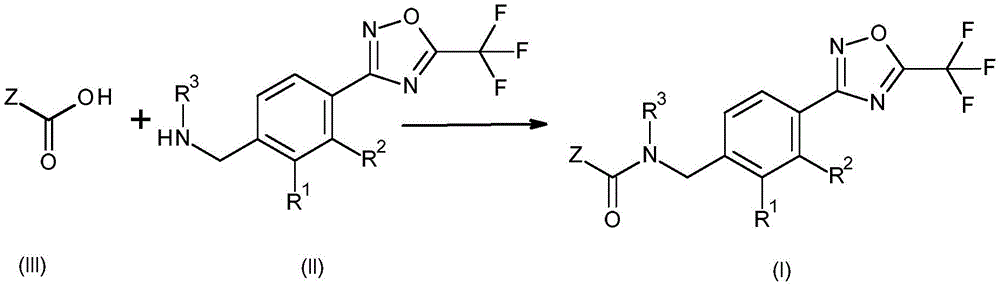
For example, the acid derivative of formula (III) (0.038mmol) in DMA (375 μ L) was transferred to a 96-well deep well plate (DWP96) containing [4- [5- (trifluoromethyl) -1,2, 4-oxadiazol-3-yl ] aryl ] methylamine derivative of formula (II) (0.03mmol) and DIPEA (0.09mmol) in DMA (250 μ L), followed by addition of BOP-Cl (0.06mmol) dissolved in DMA (250 μ L). The DWP was sealed and stirred at 50 ℃ for 18 hours. The solvent was removed under a stream of nitrogen. The resulting crude residue was dissolved in a mixture of MeOH (250 μ L) and DMA (500 μ L) and presented directly for preparative LC/MS purification, which provided the compound of formula (I) in 10% to 85% yield.
Alternatively, using the appropriate building blocks (compounds (II) and (IV)), the following procedures (scheme a and scheme B) are used in combination to provide compounds having formula (I) wherein Z represents-NR6R7. Compounds prepared by the following combination schemes were analyzed using LC/MS method B.

Scheme A: a portion of triphosgene (6mg) in DCE (0.3mL) was transferred to a solution containing compound of formula (IV) (0.05mmol) in DMA (200. mu.L) where Z-Nu is an amine derivative [ HNR ]6R7]) And triethylamine (0.12mmol) in a 96-well deep well plate (DWP 96). The reaction mixture was stirred at room temperature for 30 minutes. Then [4- [5- (trifluoromethyl) -1,2, 4-oxadiazol-3-yl with formula (II) in DMA (200. mu.L) was added]Aryl radicals]Methylamine derivative (0.05mmol) and triethylamine (0.12 mmol). The DWP was sealed and stirred at room temperature for 18 hours. DCE was removed under a Boco (Barkey) station. The crude residue was dissolved in a mixture of MeOH (200 μ L) and DMA (600 μ L) and presented directly for preparative LC/MS purification, which provided the compound of formula (I) in 3% to 45% yield.
Scheme B: amine derivatives [ HNR ] having formula (IV) in DMA (300 μ L) at room temperature6R7](0.05mmol) and DIPEA (0.25mmol) were transferred to a 96-well deep well plate (DWP 96). CDI (0.10mmol) in DMA (300. mu.L) was added and the contents were stirred until dissolved. Then [4- [5- (trifluoromethyl) -1,2, 4-oxadiazol-3-yl ] with formula (II) introduced in DMA (200. mu.L) ]Aryl radicals]Methylamine derivative (0.05mmol) and triethylamine (0.12 mmol). The DWP was sealed and stirred at room temperature for 18 hours. DCE was removed under the bock station. The crude residue was dissolved in a mixture of MeOH (200 μ L) and DMA (600 μ L) and presented directly for preparative LC/MS purification, which provided the compound of formula (I) in 5% to 47% yield.
If desired, enantiomerically pure final compounds can be obtained, where appropriate, from racemic materials via standard physical separation techniques (e.g., reverse phase chiral chromatography) or by stereoselective synthetic techniques (e.g., by using chiral starting materials).
tTable T1: melting point (mp) data and/or retention time (R) of compounds X.01 to X.25 according to formula (I):


biological examples:
general example of leaf disk testing in well plates:
leaf disks or leaf segments of different plant species were cut from plants grown in the greenhouse. The cut leaf disks or leaf segments were placed on water agar in a multiwell plate (24-well format). Leaf discs were sprayed with the test solution either before (prophylactic) or after (therapeutic) inoculation. The compounds to be tested were prepared as DMSO solutions (maximum 10mg/ml) diluted to the appropriate concentration with 0.025% Tween20 just prior to spraying. The inoculated leaf discs or leaf segments are incubated under defined conditions (temperature, relative humidity, light, etc.) according to the corresponding test system. Depending on the disease system, a single assessment of disease level was made 3 to 14 days after inoculation. The percent disease control relative to untreated test leaf discs or leaf segments is then calculated.
General example of liquid culture assay in well plates:
mycelial fragments or conidia of the fungus (freshly prepared from liquid cultures of the fungus or from low temperature storage) were directly mixed into the nutrient broth. A DMSO solution of test compound (maximum 10mg/ml) was diluted by a factor of 50 with 0.025% Tween20 and 10 μ Ι of this solution was pipetted into a microtiter plate (96-well format). The nutrient broth containing the fungal spore/mycelium fragment was then added to give the final concentration of test compound. The test plates are incubated in the dark at 24 ℃ and 96% relative humidity. Depending on the disease system, inhibition of fungal growth was determined photometrically after 2 to 7 days and the percentage antifungal activity was calculated relative to the untreated test article.
Example a 1: fungicidal activity against Puccinia recondita f.sp.tritici
Sex/wheat/leaf disc prevention method (brown rust)
Wheat leaf segment cultivar Kanzler was placed on agar in multi-well plates (24-well format) and sprayed with formulated test compound diluted in water. The leaf disks were inoculated with a spore suspension of the fungus 1 day after application. Inoculated leaf sections were incubated at 19 ℃ and 75% relative humidity (rh) in a climatic chamber under a 12 hour lighting/12 hour dark light regime, and compound activity was assessed as the percentage of disease control when appropriate levels of disease damage occurred in untreated test leaf sections (7 to 9 days post-application) compared to untreated.
In this test, the following compounds gave at least 80% disease control at 200ppm in the applied formulation when compared to untreated control leaf discs showing extensive disease development under the same conditions.
Compounds (from table T1) x.01, x.02, x.03, x.04, x.05, x.06, x.07, x.08, x.09, x.10, x.11, x.12, and x.13, x.14, x.15, x.16, x.17, x.18, x.19, x.20, x.21, x.22, x.23, x.24, and x.25.
Example a 2: fungicidal activity/wheat/leaf disc treatment against puccinia recondita (brown rust)
Wheat leaf segment cultivar Kanzler was placed on agar in multiwell plates (24-well format). The leaf segments are then inoculated with a spore suspension of the fungus. The plates were stored in the dark at 19 ℃ and 75% relative humidity. 1 day after inoculation, formulated test compound diluted in water was applied. The leaf sections were incubated at 19 ℃ and 75% relative humidity in a climatic chamber under a 12 hour light/12 hour dark light regime, and compound activity was assessed as the percentage of disease control when appropriate levels of disease damage occurred in untreated test leaf sections (6 to 8 days post-application) compared to untreated.
In this test, the following compounds gave at least 80% disease control at 200ppm in the applied formulation when compared to untreated control leaf discs showing extensive disease development under the same conditions.
Compounds (from table T1) x.01, x.02, x.03, x.04, x.05, x.06, x.07, x.08, x.09, x.10, x.11, x.12, and x.13, x.14, x.15, x.16, x.17, x.18, x.19, x.20, x.21, x.22, x.23, x.24, and x.25.
Example a 3: fungicidal activity/soybean/leaf disc prophylaxis against phakopsora pachyrhizi (asian soybean rust)
The soybean leaf discs were placed on water agar in multi-well plates (24-well format) and sprayed with formulated test compound diluted in water. One day after application, leaf discs were inoculated by spraying the spore suspension on the lower leaf surface. After an incubation period of 24-36 hours in a climatic chamber in the dark at 20 ℃ and 75% rh, the leaf discs were kept at 20 ℃ with 12h light/day and 75% rh. When appropriate levels of disease damage occurred in untreated test leaf discs (12 to 14 days post-administration), the activity of the compound was assessed as percent disease control compared to untreated.
In this test, the following compounds gave at least 80% disease control at 200ppm in the applied formulation when compared to untreated control leaf discs showing extensive disease development under the same conditions.
Compounds (from table T1) x.01, x.02, x.03, x.04, x.05, x.06, x.07, x.08, x.09, x.10, x.11, x.12, and x.13, x.14, x.15, x.16, x.17, x.18, x.19, x.20, x.21, x.22, x.23, x.24, and x.25.
Example a 4: against the fungus Lessochlea cucurbitacearum (glomeriella lagenarium) (cucurbitaceous anthrax)
(Colletotrichum lagenarium)) fungicidal activity/cucumber/preventive method of liquid culture (anthracnose)
Conidia of the fungus from cryogenic storage were directly mixed into nutrient broth (PDB-potato dextrose broth). After placing a (DMSO) solution of the test compound in a microtiter plate (96-well format), a nutrient medium containing fungal spores is added. The test plate was incubated at 24 ℃ and the inhibition of growth was measured photometrically 3 to 4 days after administration.
In this test, the following compounds in the applied formulation gave at least 80% disease control at 20ppm when compared to untreated controls showing extensive disease progression under the same conditions.
Compounds (from table T1) x.01, x.02, x.03, x.04, x.05, x.06, x.07, x.08, x.09, x.10, x.11, x.12, and x.13, x.14, x.15, x.16, x.17, x.18, x.19, x.20, x.21, x.22, x.23, x.24, and x.25.
Further biological test examples relating to fungicidal compositions comprising as active ingredients a mixture of components (a) and (B):
example B1: preventive activity against phakopsora pachyrhizi on soybean
In a spray booth, 4 week old soybean plants were sprayed with a tank mix of formulated test compound (WP10) diluted in water. One day after application, leaf disks were cut from the treated plants and placed on agar in 24-well plates. Leaf discs were inoculated by spraying the spore suspension onto their underlying leaf surface. After an incubation period of 24-36 hours in the dark at 20 ℃ and 75% rh in a climatic chamber, the leaf disks were then kept at 20 ℃ with 12h illumination/day and 75% rh. The percentage leaf disc area covered by disease was assessed when appropriate levels of disease appeared on untreated test plants (10-14 days after application).
In this test, the following mixture composition (A: B) gave at least 80% disease control at the reported concentrations (in ppm).


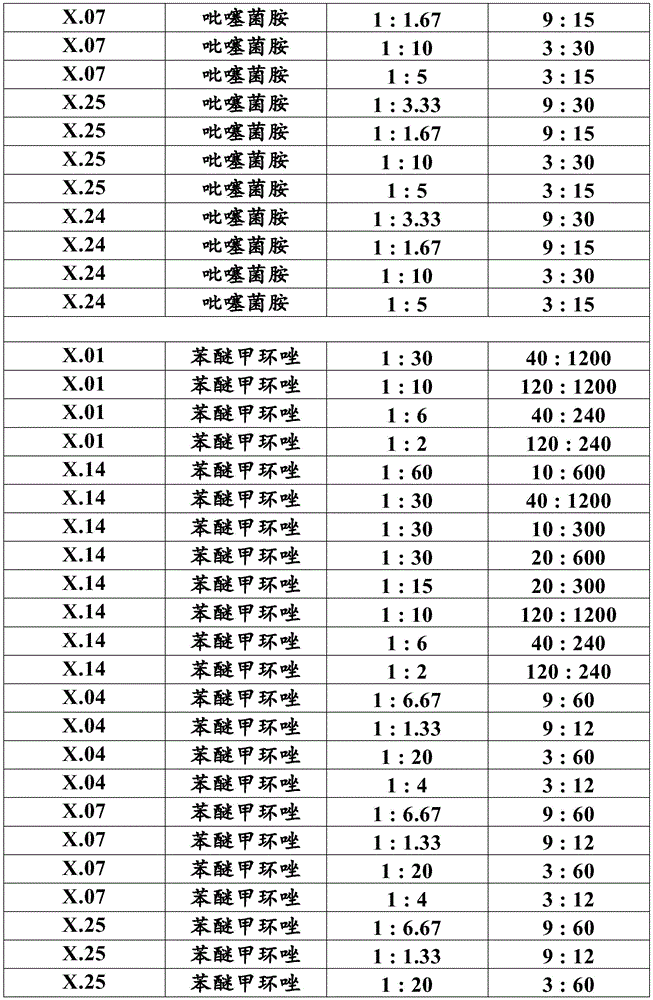


Example B2: uncaria rhynchophylla/grape/preventive (powdery mildew on grape)>UNCIVIT/fo-pr-P
A 5-week-old grape seedling cultivar Gutedel was treated with the formulated test compound in a spray booth. One day after application, the grape plants were inoculated by shaking the plants infected with grape powdery mildew over the test plants. The percentage leaf area covered by disease was assessed after incubation at 24 ℃/22 ℃ and 70% r.h. for a period of 7 days under an 14/10h (light/dark) light protocol.
In this test, the following mixture composition (A: B) gave at least 80% disease control at the reported concentrations (in ppm).


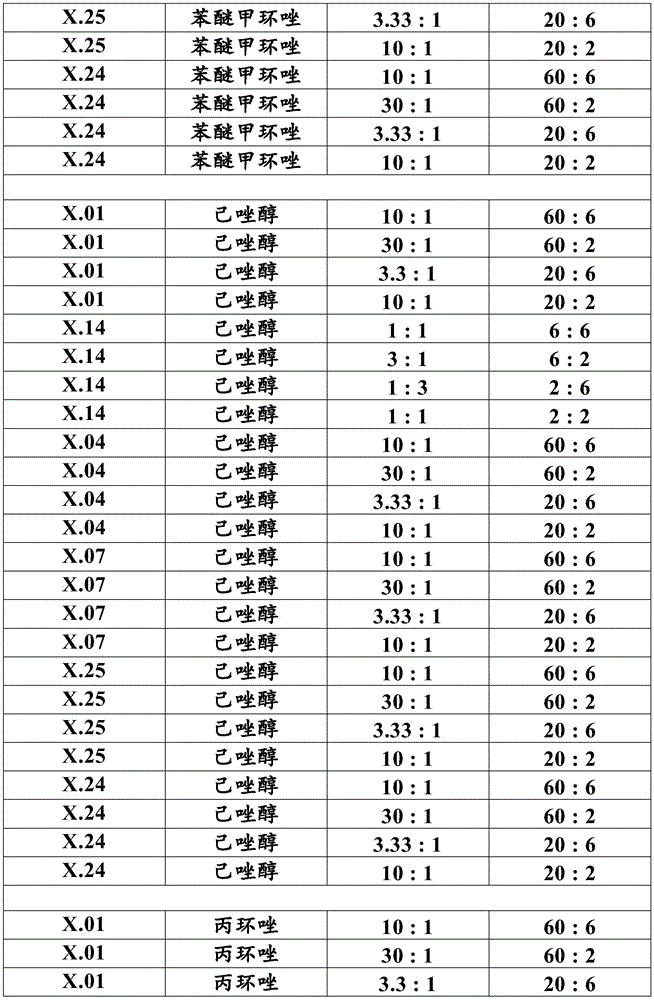


Example B3: pleurotus cucurbitae (glomeriella lag)enarium) (Colletotrichum cucurbitacearum (Colletotrichum)
lagenarium))/cucumber/preventive->COLLCUM/fo-pr-S
A 1 week old cucumber plant cultivar Wisconsin was treated with the formulated test compound in a spray chamber. One day after application, the test plants were harvested by spraying a spore suspension (1X 10)5Spores/ml) inoculated with wheat plants. After an incubation period of 30h in the dark at 23 ℃ and 100% r.h., the plants were kept in the greenhouse at 23 ℃/21 ℃ (day/night) and 70% r.h. for 6 days. The percentage leaf area covered by disease was assessed 7 days after inoculation.
In this test, the following mixture composition (A: B) gave at least 80% disease control at the reported concentrations (in ppm).


Example B4: puccinia recondita/wheat/preventive (brown rust on wheat) ->PUCCTRZ/fo-pr-P+
PUCCTRZ/fo-pr-S
A 13-day old wheat plant cultivar Arina was treated with the formulated test compound in a spray booth. One day after application, the test plants were harvested by spraying a spore suspension (1X 10)5Summer spores/ml) was inoculated to wheat plants. After an incubation period of 1 day at 20 ℃ and 95% r.h., the plants were kept in the greenhouse at 20 ℃/18 ℃ (day/night) and 60% r.h. for 10 days. The percentage leaf area covered by disease was assessed 11 days after inoculation.
In this test, the following mixture composition (A: B) gave at least 80% disease control at the reported concentrations (in ppm).


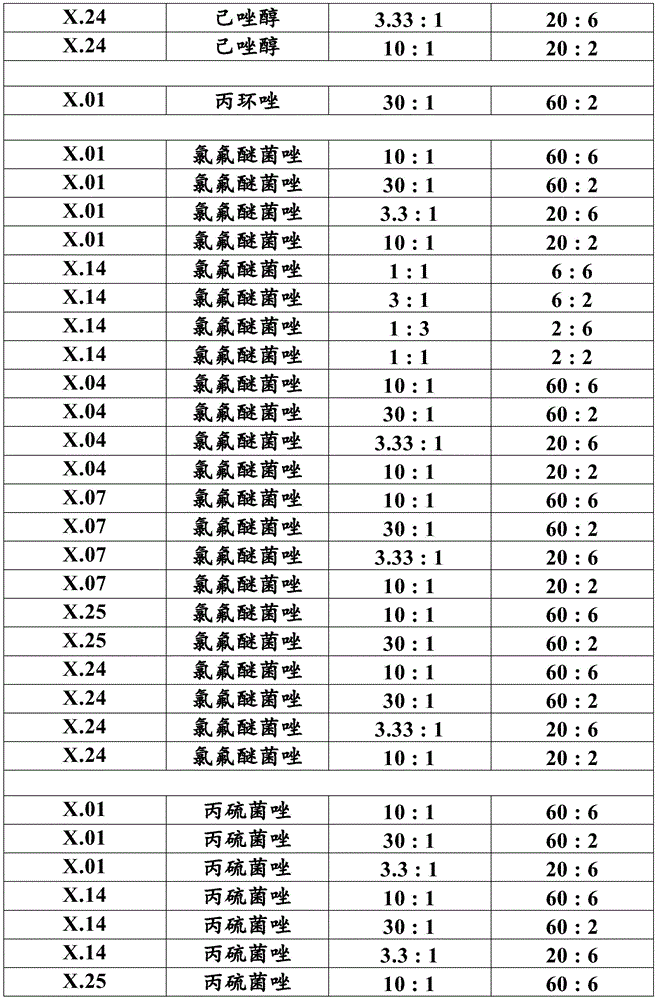


Claims (14)
Priority Applications (1)
| Application Number | Priority Date | Filing Date | Title |
|---|---|---|---|
| CN202111292123.3A CN113979962A (en) | 2017-03-31 | 2018-03-22 | Fungicidal compositions |
Applications Claiming Priority (5)
| Application Number | Priority Date | Filing Date | Title |
|---|---|---|---|
| EP17164335 | 2017-03-31 | ||
| EP17164335.6 | 2017-03-31 | ||
| EP17202889 | 2017-11-21 | ||
| EP17202889.6 | 2017-11-21 | ||
| PCT/EP2018/057336 WO2018177894A1 (en) | 2017-03-31 | 2018-03-22 | Fungicidal compositions |
Related Child Applications (1)
| Application Number | Title | Priority Date | Filing Date |
|---|---|---|---|
| CN202111292123.3A Division CN113979962A (en) | 2017-03-31 | 2018-03-22 | Fungicidal compositions |
Publications (2)
| Publication Number | Publication Date |
|---|---|
| CN110461159A CN110461159A (en) | 2019-11-15 |
| CN110461159B true CN110461159B (en) | 2022-03-11 |
Family
ID=61683808
Family Applications (2)
| Application Number | Title | Priority Date | Filing Date |
|---|---|---|---|
| CN201880021827.7A Active CN110461159B (en) | 2017-03-31 | 2018-03-22 | fungicidal composition |
| CN202111292123.3A Pending CN113979962A (en) | 2017-03-31 | 2018-03-22 | Fungicidal compositions |
Family Applications After (1)
| Application Number | Title | Priority Date | Filing Date |
|---|---|---|---|
| CN202111292123.3A Pending CN113979962A (en) | 2017-03-31 | 2018-03-22 | Fungicidal compositions |
Country Status (14)
| Country | Link |
|---|---|
| US (3) | US11974572B2 (en) |
| EP (1) | EP3599859A1 (en) |
| JP (1) | JP7146797B2 (en) |
| KR (1) | KR102615161B1 (en) |
| CN (2) | CN110461159B (en) |
| BR (1) | BR112019020253B1 (en) |
| CA (1) | CA3055680A1 (en) |
| CL (1) | CL2019002773A1 (en) |
| CO (1) | CO2019010300A2 (en) |
| IL (1) | IL269232B (en) |
| MX (1) | MX2019011239A (en) |
| UY (1) | UY37657A (en) |
| WO (1) | WO2018177894A1 (en) |
| ZA (1) | ZA201906082B (en) |
Families Citing this family (79)
| Publication number | Priority date | Publication date | Assignee | Title |
|---|---|---|---|---|
| EP3809844A1 (en) * | 2018-06-25 | 2021-04-28 | Bayer CropScience LP | Seed treatment method |
| WO2020208096A1 (en) * | 2019-04-10 | 2020-10-15 | Syngenta Crop Protection Ag | Fungicidal compositions |
| AR118673A1 (en) | 2019-04-18 | 2021-10-20 | Syngenta Crop Protection Ag | PROCEDURE FOR THE PREPARATION OF OXADIAZOLE DERIVATIVES MICROBIOCIDES |
| CN110741869A (en) * | 2019-11-29 | 2020-02-04 | 贵州黎源上品农业科技开发有限公司 | Method for improving fruit setting rate and yield of Bufna |
| CA3172204A1 (en) | 2020-04-28 | 2021-11-04 | Basf Se | Use of strobilurin type compounds for combating phytopathogenic fungi containing an amino acid substitution f129l in the mitochondrial cytochrome b protein conferring resistance to qo inhibitors ii |
| IL297583A (en) | 2020-04-28 | 2022-12-01 | Basf Se | Use of strobilurin type compounds for combating phytopathogenic fungi containing an amino acid substitution f129l in the mitochondrial cytochrome b protein conferring resistance to qo inhibitors ii |
| ES3050733T3 (en) | 2020-04-28 | 2025-12-22 | Basf Se | Use of strobilurin type compounds for combating phytopathogenic fungi containing an amino acid substitution f129l in the mitochondrial cytochrome b protein conferring resistance to qo inhibitors (iv) |
| KR20230005260A (en) | 2020-04-28 | 2023-01-09 | 바스프 에스이 | Use of strobilurin type compounds for combating phytopathogenic fungi containing amino acid substitution F129L in mitochondrial cytochrome b protein conferring resistance to Qo inhibitor I |
| AU2021284955A1 (en) * | 2020-06-03 | 2022-12-15 | Syngenta Crop Protection Ag | Fungicidal compositions |
| US20230232830A1 (en) * | 2020-06-08 | 2023-07-27 | Nippon Soda Co., Ltd. | Method for reducing or preventing effect of non-biological stress on plant |
| WO2021251232A1 (en) * | 2020-06-12 | 2021-12-16 | Nok株式会社 | Sealing device |
| EP4178943A1 (en) | 2020-07-08 | 2023-05-17 | Basf Se | Use of strobilurin type compounds for combating phytopathogenic fungi containing an amino acid substitution f129l in the mitochondrial cytochrome b protein conferring resistance to qo inhibitors vi |
| EP3939961A1 (en) | 2020-07-16 | 2022-01-19 | Basf Se | Strobilurin type compounds and their use for combating phytopathogenic fungi |
| EP4195928B1 (en) | 2020-08-11 | 2025-06-18 | Basf Se | Use of strobilurin type compounds for combating phytopathogenic fungi containing an amino acid substitution f129l in the mitochondrial cytochrome b protein conferring resistance to qo inhibitors viii |
| WO2022106304A1 (en) | 2020-11-23 | 2022-05-27 | BASF Agro B.V. | Compositions comprising mefentrifluconazole |
| US20240016150A1 (en) | 2020-12-01 | 2024-01-18 | Basf Se | Mixtures containing metarylpicoxamid |
| PY21103556A (en) * | 2020-12-02 | 2023-05-03 | Syngenta Crop Protection Ag | FUNGICIDAL COMPOSITIONS |
| WO2022117650A1 (en) | 2020-12-02 | 2022-06-09 | Syngenta Crop Protection Ag | Fungicidal compositions |
| WO2022128554A1 (en) | 2020-12-15 | 2022-06-23 | Basf Se | Mixtures containing n-methoxy-n-[[4-[5-(trifluoromethyl)-1,2,4-oxadiazol-3-yl]phenyl]methyl]cyclopropanecarboxamide |
| EP4018830A1 (en) | 2020-12-23 | 2022-06-29 | Basf Se | Pesticidal mixtures |
| EP4266885B1 (en) | 2020-12-23 | 2025-09-10 | Basf Se | Pesticidal mixtures |
| KR102944959B1 (en) * | 2021-01-07 | 2026-03-30 | 광저우 바이윈 시징 싱첸 엘티디 | A bactericidal composition |
| CN112873459A (en) * | 2021-02-10 | 2021-06-01 | 中国林业科学研究院木材工业研究所 | Anticorrosion, mildew-proof, insect-proof and waterproof integrated agent for wood and ancient building wood components |
| EP4091451A1 (en) | 2021-05-17 | 2022-11-23 | BASF Agro B.V. | Compositions comprising mefentrifluconazole |
| AU2022279357A1 (en) | 2021-05-18 | 2023-11-30 | Basf Se | New substituted pyridines as fungicides |
| MX2023013719A (en) | 2021-05-18 | 2024-01-17 | Basf Se | NEW SUBSTITUTED PYRIDINES AS FUNGICIDES. |
| EP4341257A1 (en) | 2021-05-18 | 2024-03-27 | Basf Se | New substituted quinolines as fungicides |
| EP4094579A1 (en) | 2021-05-28 | 2022-11-30 | Basf Se | Pesticidal mixtures comprising metyltetraprole |
| US20250019361A1 (en) | 2021-08-02 | 2025-01-16 | Basf Se | (3-quinolyl)-quinazoline |
| CA3227665A1 (en) | 2021-08-02 | 2023-02-09 | Wassilios Grammenos | (3-pirydyl)-quinazoline |
| WO2023072671A1 (en) | 2021-10-28 | 2023-05-04 | Basf Se | Use of strobilurin type compounds for combating phytopathogenic fungi containing an amino acid substitution f129l in the mitochondrial cytochrome b protein conferring resistance to qo inhibitors ix |
| WO2023072670A1 (en) | 2021-10-28 | 2023-05-04 | Basf Se | Use of strobilurin type compounds for combating phytopathogenic fungi containing an amino acid substitution f129l in the mitochondrial cytochrome b protein conferring resistance to qo inhibitors x |
| EP4198023A1 (en) | 2021-12-16 | 2023-06-21 | Basf Se | Pesticidally active thiosemicarbazone compounds |
| WO2023208447A1 (en) | 2022-04-25 | 2023-11-02 | Basf Se | An emulsifiable concentrate having a (substituted) benzaldehyde-based solvent system |
| JP2025523894A (en) | 2022-07-21 | 2025-07-25 | シンジェンタ クロップ プロテクション アクチェンゲゼルシャフト | Crystalline form of 1,2,4-oxadiazole fungicide |
| EP4342885A1 (en) | 2022-09-20 | 2024-03-27 | Basf Se | N-(3-(aminomethyl)-phenyl)-5-(4-phenyl)-5-(trifluoromethyl)-4,5-dihydroisoxazol-3-amine derivatives and similar compounds as pesticides |
| AR130567A1 (en) | 2022-09-28 | 2024-12-18 | Syngenta Crop Protection Ag | FUNGICIDAL COMPOSITIONS |
| AR130569A1 (en) | 2022-09-28 | 2024-12-18 | Syngenta Crop Protection Ag | FUNGICIDAL COMPOSITIONS |
| EP4361126A1 (en) | 2022-10-24 | 2024-05-01 | Basf Se | Use of strobilurin type compounds for combating phytopathogenic fungi containing an amino acid substitution f129l in the mitochondrial cytochrome b protein conferring resistance to qo inhibitors xv |
| US20250338849A1 (en) | 2022-11-14 | 2025-11-06 | Basf Se | Fungicidal mixture comprising substituted pyridines |
| WO2024104822A1 (en) | 2022-11-16 | 2024-05-23 | Basf Se | Substituted tetrahydrobenzodiazepine as fungicides |
| EP4619399A1 (en) | 2022-11-16 | 2025-09-24 | Basf Se | New substituted tetrahydrobenzoxazepine |
| CN120202195A (en) | 2022-11-16 | 2025-06-24 | 巴斯夫欧洲公司 | Substituted benzodiazepines as fungicides |
| JP2025537793A (en) | 2022-11-16 | 2025-11-20 | ビーエーエスエフ ソシエタス・ヨーロピア | Fungicidal mixtures containing substituted pyridines |
| CN120202196A (en) | 2022-11-16 | 2025-06-24 | 巴斯夫欧洲公司 | Substituted benzodiazepines as fungicides |
| EP4389210A1 (en) | 2022-12-21 | 2024-06-26 | Basf Se | Heteroaryl compounds for the control of invertebrate pests |
| WO2024165343A1 (en) | 2023-02-08 | 2024-08-15 | Basf Se | New substituted quinoline compounds for combatitng phytopathogenic fungi |
| JP2026509904A (en) | 2023-03-17 | 2026-03-25 | ビーエーエスエフ ソシエタス・ヨーロピア | Substitute pyridyl/pyrazidyldihydrobenzothiazepine compounds for eradicating plant pathogenic fungi |
| EP4455137A1 (en) | 2023-04-24 | 2024-10-30 | Basf Se | Pyrimidine compounds for the control of invertebrate pests |
| WO2024223034A1 (en) | 2023-04-26 | 2024-10-31 | Basf Se | Use of strobilurin type compounds for combating phytopathogenic fungi containing an amino acid substitution f129l in the mitochondrial cytochrome b protein conferring resistance to qo inhibitors xvi |
| EP4467535A1 (en) | 2023-05-25 | 2024-11-27 | Basf Se | Lactam pesticidal compounds |
| WO2025008226A1 (en) | 2023-07-05 | 2025-01-09 | Basf Se | Substituted quinolyl/quinoxalyl dihydropyrrolotriazine compounds for combatting phyto-pathogenic fungi |
| WO2025008227A1 (en) | 2023-07-05 | 2025-01-09 | Basf Se | Substituted pyridyl/pyrazinyl dihydropyrrolotriazine compounds for combatting phytopath-ogenic fungi |
| EP4488273A1 (en) | 2023-07-06 | 2025-01-08 | Basf Se | Triazole compounds for the control of invertebrate pests |
| EP4488269A1 (en) | 2023-07-06 | 2025-01-08 | Basf Se | Triazole compounds for the control of invertebrate pests |
| EP4488270A1 (en) | 2023-07-06 | 2025-01-08 | Basf Se | Triazole compounds for the control of invertebrate pests |
| CN121568607A (en) | 2023-08-04 | 2026-02-24 | 先正达农作物保护股份公司 | Method for controlling or preventing infestation of plants by the phytopathogenic microorganism corynespora polymorpha |
| WO2025031842A1 (en) | 2023-08-09 | 2025-02-13 | Basf Se | New substituted benzoxazepine picolinonitrile compounds for combatting phytopathogenic fungi |
| WO2025031843A1 (en) | 2023-08-09 | 2025-02-13 | Basf Se | New substituted benzoxazine picolinonitrile compounds for combatting phytopathogenic fungi |
| CN117088826B (en) * | 2023-08-18 | 2024-10-01 | 南通大学 | A visible light-promoted method for synthesizing polysubstituted oxazoles |
| AU2024358203A1 (en) | 2023-10-09 | 2026-04-16 | Basf Se | Fungicidal mixture comprising substituted pyridines |
| WO2025078183A1 (en) | 2023-10-09 | 2025-04-17 | Basf Se | Fungicidal mixture comprising substituted quinazolyl quinolines |
| CN121925413A (en) | 2023-10-11 | 2026-04-24 | 先正达农作物保护股份公司 | Pyridylpyrazole derivatives for killing microorganisms |
| WO2025125639A1 (en) | 2023-12-13 | 2025-06-19 | Syngenta Crop Protection Ag | Method of pathogen control in soybean |
| EP4574819A1 (en) | 2023-12-22 | 2025-06-25 | Basf Se | Diazinone compounds for the control of invertebrate pests |
| WO2025157611A1 (en) | 2024-01-24 | 2025-07-31 | Basf Se | Mixtures comprising rna and fungicides to control phytopathogenic fungi |
| WO2025157614A1 (en) | 2024-01-24 | 2025-07-31 | Basf Se | Mixtures comprising rna and fungicides to control phytopathogenic fungi |
| WO2025157612A1 (en) | 2024-01-24 | 2025-07-31 | Basf Se | Mixtures comprising rna to control phytopathogenic fungi. |
| TW202545918A (en) | 2024-02-02 | 2025-12-01 | 瑞士商先正達農作物保護股份公司 | Process for the preparation of microbiocidal oxadiazole derivatives |
| WO2025180964A1 (en) | 2024-03-01 | 2025-09-04 | Basf Se | New substituted benzoxazepine compounds for combatting phytopathogenic fungi |
| WO2026021911A1 (en) | 2024-07-23 | 2026-01-29 | Basf Se | New substituted benzothiazine pyridine compounds for combatting phytopathogenic fungi |
| WO2026021910A1 (en) | 2024-07-23 | 2026-01-29 | Basf Se | New substituted benzothiazine pyridine compounds for combatting phytopathogenic fungi |
| WO2026021912A1 (en) | 2024-07-23 | 2026-01-29 | Basf Se | New substituted benzothiazine pyridine compounds for combatting phytopathogenic fungi |
| WO2026021909A1 (en) | 2024-07-23 | 2026-01-29 | Basf Se | New substituted benzothiazine pyridine compounds for combatting phytopathogenic fungi |
| WO2026032773A1 (en) * | 2024-08-08 | 2026-02-12 | Basf Se | Fungicidal compositions comprising strobilurins |
| WO2026057375A1 (en) | 2024-09-11 | 2026-03-19 | Basf Se | Mixtures of ambruticin with at least one further pesticide |
| EP4710766A1 (en) | 2024-09-11 | 2026-03-18 | Basf Se | Mixtures of ambruticin with at least one further pesticide |
| WO2026068348A1 (en) | 2024-09-30 | 2026-04-02 | Basf Se | Fungicidal compositions comprising carboxamide |
| CN119406204B (en) * | 2025-01-06 | 2025-04-25 | 内蒙古莱科作物保护有限公司 | Recovery system and recovery method for mixed waste gas in production of chlorfenapyr |
Citations (4)
| Publication number | Priority date | Publication date | Assignee | Title |
|---|---|---|---|---|
| WO1997030047A1 (en) * | 1996-02-17 | 1997-08-21 | Agrevo Uk Limited | Fungicidal 1,2,4-oxadiazoles and analogues |
| CN106455572A (en) * | 2014-06-06 | 2017-02-22 | 巴斯夫欧洲公司 | Use of substituted oxadiazoles for combating phytopathogenic fungi |
| WO2017055473A1 (en) * | 2015-10-02 | 2017-04-06 | Syngenta Participations Ag | Microbiocidal oxadiazole derivatives |
| WO2017085100A1 (en) * | 2015-11-19 | 2017-05-26 | Basf Se | Substituted oxadiazoles for combating phytopathogenic fungi |
Family Cites Families (101)
| Publication number | Priority date | Publication date | Assignee | Title |
|---|---|---|---|---|
| US4871753A (en) | 1986-12-12 | 1989-10-03 | Ciba-Geigy Corporation | 3-Phenyl-5-trifluoromethyl-1,2,4-oxadiazole compounds which are useful pesticides |
| US6677487B2 (en) | 2001-08-30 | 2004-01-13 | Pharmacia Corporation | α-haloenamine reagents |
| WO2003028729A2 (en) | 2001-10-03 | 2003-04-10 | Pharmacia Corporation | Prodrugs of substituted polycyclic compounds useful for selective inhibition of the coagulation cascade |
| AR037328A1 (en) | 2001-10-23 | 2004-11-03 | Dow Agrosciences Llc | COMPOSITE OF [7-BENCIL-2,6-DIOXO-1,5-DIOXONAN-3-IL] -4-METOXIPIRIDIN-2-CARBOXAMIDE, COMPOSITION THAT UNDERSTANDS AND METHOD THAT USES IT |
| JP4939057B2 (en) | 2004-01-23 | 2012-05-23 | 三井化学アグロ株式会社 | 3- (Dihydro (tetrahydro) isoquinolin-1-yl) quinoline compounds |
| DE602005014359D1 (en) | 2004-06-09 | 2009-06-18 | Sumitomo Chemical Co | PYRIDAZINE COMPOUND AND ITS USE |
| DE102005007160A1 (en) | 2005-02-16 | 2006-08-24 | Basf Ag | Pyrazolecarboxylic acid anilides, process for their preparation and compositions containing them for controlling harmful fungi |
| CA2603944C (en) | 2005-04-08 | 2015-06-23 | Bayer Bioscience N.V. | Elite event a2704-12 comprising the integration of the phosphinothricin acetyltransferase (pat) gene into soybeans, and methods and kits for identifying such event in biological samples |
| CA2603949C (en) | 2005-04-11 | 2014-12-09 | Bayer Bioscience N.V. | Elite event a5547-127 and methods and kits for identifying such event in biological samples |
| PT1885176T (en) | 2005-05-27 | 2016-11-28 | Monsanto Technology Llc | EVENT MON89788 OF SOYBEANS AND METHODS FOR ITS DETECTION |
| CN100556905C (en) | 2005-09-08 | 2009-11-04 | 国家南方农药创制中心江苏基地 | Pyrazole amide compounds and their intermediates and pest control agents with such compounds as active ingredients |
| CN101263129A (en) | 2005-09-13 | 2008-09-10 | 拜尔农科股份公司 | Pesticide thiazolyloxy substituted benzamidine derivatives |
| US7732469B2 (en) | 2005-10-25 | 2010-06-08 | Syngenta Crop Protection, Inc. | Heterocyclic amide derivatives useful as microbiocides |
| TWI372752B (en) | 2005-12-22 | 2012-09-21 | Nihon Nohyaku Co Ltd | Pyrazinecarboxamide derivatives and plant disease controlling agents containing the same |
| AU2006332694A1 (en) | 2005-12-30 | 2007-07-12 | Alantos Pharmaceuticals, Holding, Inc. | Substituted bis-amide metalloprotease inhibitors |
| US7714140B2 (en) | 2006-05-08 | 2010-05-11 | Kumiai Chemical Industry, Co. Ltd. | 1,2 Benzoisothiazole derivative, and agricultural or horticultural plant disease- controlling agent |
| US7951995B2 (en) | 2006-06-28 | 2011-05-31 | Pioneer Hi-Bred International, Inc. | Soybean event 3560.4.3.5 and compositions and methods for the identification and detection thereof |
| CL2007002787A1 (en) | 2006-09-29 | 2008-05-30 | Bayer Cropscience Sa | COMPOUNDS DERIVED FROM N-CICLOALQUIL-CARBOXAMIDA, N-CICLOALQUIL-TIOCARBOXAMIDA AND N-CICLOALQUIL-CARBOXAMIDAMIDA N-SUBSTITUTED; FUNGICIDE COMPOSITION THAT INCLUDES SUCH COMPOUNDS; AND METHOD TO COMBAT FITOPATOGEN CULTURE FUNGIANS THAT YOU UNDERSTAND |
| BR122017006111B8 (en) | 2006-10-31 | 2022-12-06 | Du Pont | METHODS TO CONTROL WEEDS |
| EP2186804B1 (en) | 2007-08-10 | 2015-06-17 | Nippon Soda Co., Ltd. | Nitrogen-containing heterocyclic compound and pest control agent |
| WO2009064652A1 (en) | 2007-11-15 | 2009-05-22 | Monsanto Technology Llc | Soybean plant and seed corresponding to transgenic event mon87701 and methods for detection thereof |
| CA2708447C (en) * | 2007-12-25 | 2016-05-10 | Kissei Pharmaceutical Co., Ltd. | Novel catechol derivative, pharmaceutical composition containing the same, use of the catechol derivative, and use of the pharmaceutical composition |
| JP5524200B2 (en) | 2008-07-04 | 2014-06-18 | バイエル・クロップサイエンス・アーゲー | Fungicides hydroxymoyl-tetrazole derivatives |
| CN105218565A (en) | 2008-10-17 | 2016-01-06 | 泽农医药公司 | Spiral shell oxindole compounds and the purposes as therapeutical agent thereof |
| BRPI1006074A2 (en) | 2009-01-07 | 2017-03-21 | Basf Agrochemical Products Bv | method for controlling weeds, nucleic acid molecule, soybean plant, isolated pair of nucleic acid primers, kit for identifying an event 127 of the nucleic acid molecule, methods for identifying an event 127 in the soybean plant, for identifying a soybean plant having a nucleic acid molecule event 127 to increase yield in a soybean plant for the reproduction of an ahas inhibitor herbicide resistant soybean plant for detecting the presence of an amino acid molecule event 127 nucleic acid in a biological sample for growing a soybean plant to detect an event 127 of a sample polypeptide, seed and device for use in detecting biological molecules |
| CN102348677A (en) | 2009-02-16 | 2012-02-08 | 住友化学株式会社 | Method for producing phenylacetamide compound |
| AR076839A1 (en) | 2009-05-15 | 2011-07-13 | Bayer Cropscience Ag | FUNGICIDE DERIVATIVES OF PIRAZOL CARBOXAMIDAS |
| AU2010261913A1 (en) | 2009-06-16 | 2012-01-19 | Basf Se | Fungicidal mixtures |
| MX338249B (en) | 2009-08-19 | 2016-04-08 | Dow Agrosciences Llc | Aad-1 event das-40278-9, related transgenic corn lines, and event-specific identification thereof. |
| CN102575299B (en) | 2009-08-19 | 2015-09-09 | 陶氏益农公司 | Detection of AAD-1 Event DAS-40278-9 |
| EP2467488A4 (en) | 2009-08-19 | 2013-03-27 | Dow Agrosciences Llc | Control of aad-1 monocot volunteers in fields of dicot crops |
| UA115761C2 (en) | 2009-09-17 | 2017-12-26 | Монсанто Текнолоджи Ллс | RECOMBINANT DNA MOLECULE INDICATING THE PRESENCE OF A TRANSGENIC OBJECT OF MON 87708 |
| CU24144B1 (en) | 2010-01-04 | 2016-01-29 | Nippon Soda Co | HETEROCYCLIC COMPOUND CONTAINING NITROGEN AND FUNGICIDE FOR USE IN AGRICULTURE AND GARDENING |
| CN103221047B (en) | 2010-01-13 | 2014-12-17 | 坦颇罗制药股份有限公司 | Compounds and methods |
| JP2013517281A (en) | 2010-01-13 | 2013-05-16 | テンペロ、ファーマシューティカルズ、インコーポレイテッド | Compounds and methods |
| MX2012012872A (en) | 2010-05-06 | 2012-11-29 | Bayer Cropscience Ag | Process for the preparation of dithiine tetracarboxydiimides. |
| JP2012025735A (en) | 2010-06-24 | 2012-02-09 | Sumitomo Chemical Co Ltd | Plant disease control composition and method of controlling plant disease |
| JP5857512B2 (en) | 2010-08-10 | 2016-02-10 | 住友化学株式会社 | Plant disease control composition and use thereof |
| US8759527B2 (en) | 2010-08-25 | 2014-06-24 | Bayer Cropscience Ag | Heteroarylpiperidine and -piperazine derivatives as fungicides |
| TWI504350B (en) | 2010-09-01 | 2015-10-21 | Du Pont | Fungicidal pyrazoles and their mixtures |
| CN103249730A (en) | 2010-09-24 | 2013-08-14 | 百时美施贵宝公司 | Hepatitis c virus inhibitors |
| MX2013004278A (en) | 2010-10-21 | 2013-06-05 | Bayer Ip Gmbh | N-benzyl heterocyclic carboxamides. |
| TWI667347B (en) | 2010-12-15 | 2019-08-01 | 瑞士商先正達合夥公司 | Soybean event syht0h2 and compositions and methods for detection thereof |
| IT1403275B1 (en) | 2010-12-20 | 2013-10-17 | Isagro Ricerca Srl | HIGH-ACTIVITY INDANYLANILIDES FUNGICIDE AND THEIR PHYTOSANITARY COMPOSITIONS |
| TWI528899B (en) | 2010-12-29 | 2016-04-11 | 杜邦股份有限公司 | Mesoionic pesticides |
| WO2013006408A1 (en) | 2011-07-01 | 2013-01-10 | Tempero Pharmaceuticals, Inc. | Compounds and methods |
| CN103764635B (en) | 2011-07-08 | 2016-01-20 | 诺华股份有限公司 | New trifluoromethyl-oxadiazole derivative and the purposes in disease treatment thereof |
| WO2013009827A1 (en) | 2011-07-13 | 2013-01-17 | Tempero Pharmaceuticals, Inc. | Methods of treatment |
| WO2013009810A1 (en) | 2011-07-13 | 2013-01-17 | Tempero Pharmaceuticals, Inc. | Methods of treatment |
| WO2013009830A1 (en) | 2011-07-13 | 2013-01-17 | Tempero Pharmaceuticals, Inc. | Methods of treatment |
| BR102012019436B8 (en) | 2011-07-26 | 2022-10-11 | Dow Agrosciences Llc | SOYBEAN EVENT DETECTION METHOD PDAB9582.814.19.1 |
| EP2744794B1 (en) | 2011-08-15 | 2015-12-30 | Basf Se | Fungicidal substituted 1-{2-cyclyloxy-2-[2-halo-4-(4-halogen-phenoxy)-phenyl]-ethyl}-1h-[1,2,4]triazole compounds |
| WO2013066835A2 (en) | 2011-10-31 | 2013-05-10 | Glaxosmithkline Llc | Compounds and methods |
| WO2013066838A1 (en) | 2011-10-31 | 2013-05-10 | Glaxosmithkline Llc | Compounds and methods |
| WO2013066839A2 (en) | 2011-10-31 | 2013-05-10 | Glaxosmithkline Llc | Compounds and methods |
| CN103081916B (en) | 2011-11-02 | 2014-08-06 | 中国中化股份有限公司 | Application of pyrazole amide compound as agricultural bactericide |
| CA2856334A1 (en) | 2011-11-28 | 2013-06-06 | Christina Hebach | Novel trifluoromethyl-oxadiazole derivatives and their use in the treatment of disease |
| CA2858766A1 (en) | 2011-12-23 | 2013-06-27 | Basf Se | Isothiazoline compounds for combating invertebrate pests |
| JP6107377B2 (en) | 2012-04-27 | 2017-04-05 | 住友化学株式会社 | Tetrazolinone compounds and uses thereof |
| JP6106976B2 (en) | 2012-07-20 | 2017-04-05 | 住友化学株式会社 | Plant disease control composition and use thereof |
| GB201213700D0 (en) | 2012-08-01 | 2012-09-12 | Proximagen Ltd | Receptor antagnists II |
| KR101446742B1 (en) | 2012-08-10 | 2014-10-01 | 한국화학연구원 | N2,N4-bis(4-(piperazin-1-yl)phenyl)pyrimidine-2,4-diamine derivatives or pharmaceutically acceptable salt thereof, and pharmaceutical composition for the prevention or treatment of cancer containing the same as an active ingredient |
| JP6142752B2 (en) | 2012-09-28 | 2017-06-07 | 住友化学株式会社 | Tetrazolinone compounds and uses thereof |
| BR112015014191B1 (en) | 2012-12-19 | 2019-08-27 | Bayer Cropscience Ag | difluoromethylnicotinic indanyl carboxamides |
| BR112015026129A2 (en) | 2013-04-19 | 2017-10-17 | Bayer Cropscience Ag | method to fight pests |
| EP3008187B1 (en) | 2013-06-14 | 2021-03-31 | Monsanto Technology LLC | Soybean transgenic event mon87751 and methods for detection and use thereof |
| WO2015055706A2 (en) | 2013-10-16 | 2015-04-23 | Bayer Cropscience Ag | N-cycloalkyl-n-(biheterocyclymethylene)-(thio)carboxamide derivatives |
| RU2673722C2 (en) | 2014-03-20 | 2018-11-29 | Мицуи Кемикалз Агро, Инк. | Plant disease control composition and method for controlling plant disease by application of same |
| SI3129355T1 (en) | 2014-04-11 | 2019-03-29 | Syngenta Participations Ag | Fungicidal n'-(2-methyl-6-(2-alkoxy-ethoxy)-3-pyridyl)-n-alkyl-formamidine derivatives for use in agriculture |
| US10081624B2 (en) | 2014-08-26 | 2018-09-25 | Takeda Pharmaceutical Company Limited | Heterocyclic compound |
| JP6687625B2 (en) | 2014-12-30 | 2020-04-22 | ダウ アグロサイエンシィズ エルエルシー | Picolinamide compound having fungicidal activity |
| UY36571A (en) | 2015-03-05 | 2016-09-30 | Bayer Cropscience Ag | COMBINATIONS OF ACTIVE COMPOUNDS |
| WO2017033946A1 (en) | 2015-08-25 | 2017-03-02 | 武田薬品工業株式会社 | Heterocyclic compound |
| MX2018003845A (en) * | 2015-10-02 | 2018-06-18 | Syngenta Participations Ag | Microbiocidal oxadiazole derivatives. |
| WO2017076757A1 (en) | 2015-11-02 | 2017-05-11 | Basf Se | Substituted oxadiazoles for combating phytopathogenic fungi |
| EP3371155A1 (en) | 2015-11-03 | 2018-09-12 | Basf Se | Use of substituted oxadiazoles for combating phytopathogenic fungi |
| EP3165094A1 (en) | 2015-11-03 | 2017-05-10 | Basf Se | Substituted oxadiazoles for combating phytopathogenic fungi |
| US20180317490A1 (en) | 2015-11-04 | 2018-11-08 | Basf Se | Substituted oxadiazoles for combating phytopathogenic fungi |
| US20180317489A1 (en) | 2015-11-04 | 2018-11-08 | Basf Se | Substituted Oxadiazoles for Combating Phytopathogenic Fungi |
| CR20180310A (en) | 2015-11-05 | 2018-11-30 | Basf Se | OXADIAZOLS REPLACED TO COMBAT HONGOD PHYTOOPATHOGENS |
| EP3165093A1 (en) | 2015-11-05 | 2017-05-10 | Basf Se | Substituted oxadiazoles for combating phytopathogenic fungi |
| AR106679A1 (en) | 2015-11-13 | 2018-02-07 | Basf Se | OXADIAZOLS REPLACED TO FIGHT FITOPATHOGEN FUNGI |
| EP3373733A1 (en) | 2015-11-13 | 2018-09-19 | Basf Se | Substituted oxadiazoles for combating phytopathogenic fungi |
| EP3373735A1 (en) | 2015-11-13 | 2018-09-19 | Basf Se | Substituted oxadiazoles for combating phytopathogenic fungi |
| WO2017081310A1 (en) | 2015-11-13 | 2017-05-18 | Basf Se | Substituted oxadiazoles for combating phytopathogenic fungi |
| MX2018006235A (en) | 2015-11-19 | 2018-08-01 | Basf Se | Substituted oxadiazoles for combating phytopathogenic fungi. |
| BR112018011241B1 (en) | 2015-12-03 | 2021-06-29 | Basf Se | COMPOUNDS OF FORMULA I, MIXTURE, AGROCHEMICAL COMPOSITION, USE OF COMPOUNDS AND METHOD OF COMBATING HARMFUL FUNDS |
| WO2017110861A1 (en) | 2015-12-25 | 2017-06-29 | 住友化学株式会社 | Plant disease control agent containing oxadiazole compound |
| WO2017111152A1 (en) | 2015-12-25 | 2017-06-29 | 住友化学株式会社 | Oxadiazole compounds and use thereof |
| WO2017110862A1 (en) | 2015-12-25 | 2017-06-29 | 住友化学株式会社 | Oxadiazole compound and use thereof |
| WO2017110864A1 (en) | 2015-12-25 | 2017-06-29 | 住友化学株式会社 | Plant disease control composition and application for same |
| US20180352814A1 (en) | 2015-12-25 | 2018-12-13 | Sumitomo Chemical Company, Limited | Oxadiazole compounds and use for same |
| WO2017169893A1 (en) | 2016-03-31 | 2017-10-05 | 住友化学株式会社 | Oxadiazole compound and use thereof |
| AU2017250397A1 (en) | 2016-04-11 | 2018-10-11 | Basf Se | Substituted oxadiazoles for combating phytopathogenic fungi |
| JP2017190296A (en) | 2016-04-13 | 2017-10-19 | 住友化学株式会社 | Pest control composition and use therefor |
| BR112018074559A2 (en) | 2016-06-09 | 2019-03-12 | Basf Se | compounds, agrochemical composition, use of compounds and method to combat phytopathogenic harmful fungi |
| BR112018074569B1 (en) | 2016-06-09 | 2022-10-04 | Basf Se | COMPOUNDS, USE OF N-(2,4-DIFLUOROPHENYL)-4-[5-(TRIFLUOROMETHYL)-1,2,4-OXADIAZOLE-3-YL] BENZAMIDE, AGROCHEMICAL COMPOSITION AND METHOD TO FIGHT HARMFUL PHYTOPATOGENIC FUNGI |
| AU2017277354A1 (en) | 2016-06-09 | 2018-12-06 | Basf Se | Substituted oxadiazoles for combating phytopathogenic fungi |
| WO2017213252A1 (en) | 2016-06-10 | 2017-12-14 | Sumitomo Chemical Company, Limited | Oxadiazole compound and use as pesticide |
| US11066396B2 (en) | 2016-06-23 | 2021-07-20 | Merck Sharp & Dohme Corp. | 3-aryl- heteroaryl substituted 5-trifluoromethyl oxadiazoles as histonedeacetylase 6 (HDAC6) inhibitors |
| AR109304A1 (en) | 2016-08-10 | 2018-11-21 | Sumitomo Chemical Co | OXADIAZOL COMPOUND AND ITS USE |
-
2018
- 2018-03-22 CA CA3055680A patent/CA3055680A1/en active Pending
- 2018-03-22 WO PCT/EP2018/057336 patent/WO2018177894A1/en not_active Ceased
- 2018-03-22 EP EP18711575.3A patent/EP3599859A1/en active Pending
- 2018-03-22 BR BR112019020253-6A patent/BR112019020253B1/en active IP Right Grant
- 2018-03-22 CN CN201880021827.7A patent/CN110461159B/en active Active
- 2018-03-22 MX MX2019011239A patent/MX2019011239A/en unknown
- 2018-03-22 JP JP2019553480A patent/JP7146797B2/en active Active
- 2018-03-22 CN CN202111292123.3A patent/CN113979962A/en active Pending
- 2018-03-22 US US16/499,061 patent/US11974572B2/en active Active
- 2018-03-22 KR KR1020197031512A patent/KR102615161B1/en active Active
- 2018-04-02 UY UY0001037657A patent/UY37657A/en active IP Right Grant
-
2019
- 2019-09-09 IL IL269232A patent/IL269232B/en unknown
- 2019-09-13 ZA ZA2019/06082A patent/ZA201906082B/en unknown
- 2019-09-24 CO CONC2019/0010300A patent/CO2019010300A2/en unknown
- 2019-09-27 CL CL2019002773A patent/CL2019002773A1/en unknown
-
2024
- 2024-03-18 US US18/608,107 patent/US20240284908A1/en not_active Abandoned
-
2025
- 2025-07-11 US US19/266,401 patent/US20250338848A1/en active Pending
Patent Citations (4)
| Publication number | Priority date | Publication date | Assignee | Title |
|---|---|---|---|---|
| WO1997030047A1 (en) * | 1996-02-17 | 1997-08-21 | Agrevo Uk Limited | Fungicidal 1,2,4-oxadiazoles and analogues |
| CN106455572A (en) * | 2014-06-06 | 2017-02-22 | 巴斯夫欧洲公司 | Use of substituted oxadiazoles for combating phytopathogenic fungi |
| WO2017055473A1 (en) * | 2015-10-02 | 2017-04-06 | Syngenta Participations Ag | Microbiocidal oxadiazole derivatives |
| WO2017085100A1 (en) * | 2015-11-19 | 2017-05-26 | Basf Se | Substituted oxadiazoles for combating phytopathogenic fungi |
Also Published As
| Publication number | Publication date |
|---|---|
| KR20190134674A (en) | 2019-12-04 |
| UY37657A (en) | 2018-10-31 |
| BR112019020253A2 (en) | 2020-04-22 |
| BR112019020253B1 (en) | 2023-04-25 |
| CN110461159A (en) | 2019-11-15 |
| IL269232A (en) | 2019-11-28 |
| US20210007358A1 (en) | 2021-01-14 |
| CL2019002773A1 (en) | 2019-12-27 |
| US20240284908A1 (en) | 2024-08-29 |
| ZA201906082B (en) | 2023-10-25 |
| WO2018177894A1 (en) | 2018-10-04 |
| MX2019011239A (en) | 2019-10-21 |
| US11974572B2 (en) | 2024-05-07 |
| CO2019010300A2 (en) | 2019-10-09 |
| CA3055680A1 (en) | 2018-10-04 |
| IL269232B (en) | 2022-03-01 |
| JP7146797B2 (en) | 2022-10-04 |
| US20250338848A1 (en) | 2025-11-06 |
| EP3599859A1 (en) | 2020-02-05 |
| KR102615161B1 (en) | 2023-12-15 |
| CN113979962A (en) | 2022-01-28 |
| JP2020515601A (en) | 2020-05-28 |
Similar Documents
| Publication | Publication Date | Title |
|---|---|---|
| CN110461159B (en) | fungicidal composition | |
| CN111107745B (en) | Fungicidal compositions | |
| CN110740644B (en) | Fungicidal compositions | |
| CN108135170B (en) | fungicidal composition | |
| JP7171634B2 (en) | Bactericidal composition | |
| CN109890208B (en) | fungicidal composition | |
| CN112770632B (en) | Fungicidal compositions | |
| CN110300521B (en) | fungicidal composition | |
| BR112019020134B1 (en) | FUNGICIDAL COMPOSITIONS | |
| CN111050558B (en) | Microbicidal quinoline (thio) carboxamide derivatives | |
| CN111093372B (en) | Microbicidal quinoline (thio) carboxamide derivatives | |
| CN111051286A (en) | Microbicidal quinoline (thio) carboxamide derivatives | |
| CN112739685A (en) | Microbicidal quinoline carboxamide derivatives | |
| BR112020004750B1 (en) | FUNGICIDAL COMPOSITION AND METHOD FOR CONTROL OR PREVENTION OF PHYTOPATHOGENIC DISEASES | |
| BR112019024993B1 (en) | FUNGICIDE COMPOSITIONS AND METHOD OF CONTROL OR PREVENTION OF PHYTOPATHOGENIC DISEASES |
Legal Events
| Date | Code | Title | Description |
|---|---|---|---|
| PB01 | Publication | ||
| PB01 | Publication | ||
| SE01 | Entry into force of request for substantive examination | ||
| SE01 | Entry into force of request for substantive examination | ||
| GR01 | Patent grant | ||
| GR01 | Patent grant | ||
| TR01 | Transfer of patent right |
Effective date of registration: 20260226 Address after: Switzerland Patentee after: Syngenta Crop Protection JSC Country or region after: Switzerland Address before: Basel Patentee before: SYNGENTA PARTICIPATIONS AG Country or region before: Switzerland |
|
| TR01 | Transfer of patent right |