Disclosure of Invention
The embodiment of the application provides a data integration method and device, and the technical problems that a large amount of manpower and material resources are needed when a body is constructed and experts in related fields are needed to participate when the body in a specific field is constructed when the body is at least used for data integration by using a body-based data integration method at the present stage, and the cost is high are solved.
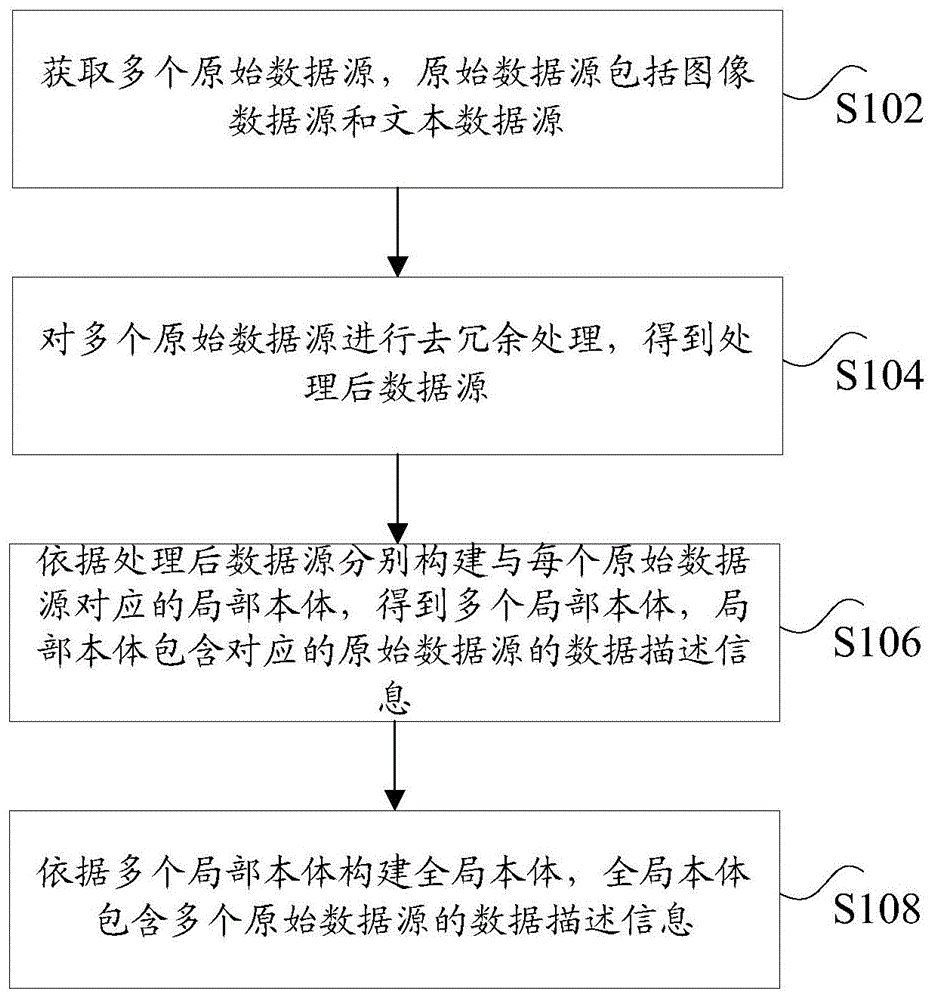
According to an aspect of an embodiment of the present application, there is provided a data integration method, including: acquiring a plurality of original data sources, wherein the original data sources comprise an image data source and a text data source; carrying out redundancy removal processing on a plurality of original data sources to obtain processed data sources; respectively constructing local ontologies corresponding to the original data sources according to the processed data sources to obtain a plurality of local ontologies, wherein the local ontologies contain data description information of the corresponding original data sources; and constructing a global ontology according to the plurality of local ontologies, wherein the global ontology comprises data description information of a plurality of original data sources.
Optionally, before performing the redundancy removal processing on the plurality of original data sources, the method further includes: inputting a plurality of original data sources into a coding layer of an automatic encoder model, and performing dimensionality reduction processing on feature data of the plurality of original data sources to obtain the feature data subjected to dimensionality reduction processing; calculating a first similarity of the feature data of any two different original data sources in the plurality of original data sources at the highest layer of the coding layer; and inputting the feature data subjected to the dimension reduction processing into a decoding layer of an automatic encoder model to obtain target data corresponding to a plurality of original data sources.
Optionally, calculating, at the highest layer of the encoding layer, a first similarity of the feature data of any two different original data sources in the plurality of original data sources includes at least one of: calculating a first similarity of the feature data of any two different original data sources in the plurality of original data sources by using a cosine similarity algorithm; and calculating a first similarity of the characteristic data of any two different original data sources in the plurality of original data sources by using the Pearson correlation coefficient.
Optionally, performing redundancy removal processing on a plurality of original data sources, including: and if the first similarity is larger than or equal to a first preset threshold, combining two different original data sources into one data source.
Optionally, merging two original data sources into one data source includes: if the two data sources are structured data, directly combining the two original data sources into one data source; if the two data sources are unstructured data or semi-structured data, the two original data sources are merged into one data source after the following processing is carried out: acquiring a named entity of a data object in unstructured data or semi-structured data; acquiring the subordination relation of the data objects; attributes of the data objects are obtained.
Optionally, respectively constructing a local ontology corresponding to each original data source according to the processed data source, including: calculating a second similarity between any two entities of the original data source, wherein the entities are data objects in the original data source; dividing two entities with the second similarity larger than or equal to a second preset threshold into the same entity category; determining an entity type of any entity in an original data source; and constructing a local ontology corresponding to each original data source according to the entity classification and the entity type of any entity.
Optionally, before performing the redundancy removal processing on the plurality of original data sources, the method further includes: and carrying out zero-phase component analysis ZCA whitening processing on the image data source.
Optionally, the zero-phase component analysis ZCA whitening processing is performed on the image data source, and includes: a covariance matrix sigma of a dataset corresponding to the image data source is calculated,
wherein m is the number of sample data contained in the data set, and x is the sample data; singular value decomposition is carried out on the covariance matrix to obtain a left singular value vector U of the covariance matrix; the U vector is used to transpose the data set,obtaining a transposed data set x
rot,x
rot=U
Tx=(U
1 Tx U
2 Tx,...U
n Tx)
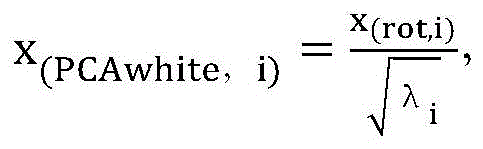
TWherein n is the dimension of the sample data; carrying out principal vector analysis (PCA) whitening processing on the transposed data set to obtain a data set x subjected to PCA whitening processing
(PCAwhite,i),
λ
iIs x
rotThe value of the diagonal element of the covariance matrix; obtaining a ZCA whitened data set x according to the PCA whitened data set and the U vector
(ZCAwhite),x
(ZCAwhite)=Ux
(ZCAwhite)。
Optionally, after constructing the global ontology from a plurality of local ontologies, the method further includes: acquiring a query instruction; performing data query in the global ontology according to the query instruction to obtain a query result; and displaying the query result.
According to another aspect of the embodiments of the present application, there is also provided a data integration apparatus, including: the system comprises an acquisition module, a processing module and a display module, wherein the acquisition module is used for acquiring a plurality of original data sources, and the original data sources comprise an image data source and a text data source; the processing module is used for carrying out redundancy removal processing on a plurality of original data sources to obtain processed data sources; the first construction module is used for respectively constructing local ontologies corresponding to the original data sources according to the processed data sources to obtain a plurality of local ontologies, and the local ontologies contain data description information of the corresponding original data sources; and the second construction module is used for constructing a global ontology according to the plurality of local ontologies, wherein the global ontology comprises data description information of a plurality of original data sources.
According to still another aspect of the embodiments of the present application, there is also provided a storage medium including a stored program, where the program, when executed, controls a device on which the storage medium is located to perform the above data integration method.
According to still another aspect of the embodiments of the present application, there is provided a processor, configured to execute a program, where the program executes the above data integration method.
In the embodiment of the application, a plurality of original data sources are obtained, wherein the original data sources comprise an image data source and a text data source; carrying out redundancy removal processing on a plurality of original data sources to obtain processed data sources; respectively constructing local ontologies corresponding to the original data sources according to the processed data sources to obtain a plurality of local ontologies, wherein the local ontologies contain data description information of the corresponding original data sources; the method comprises the steps of constructing a global body according to a plurality of local bodies, wherein the global body comprises data description information of a plurality of original data sources, and performing redundancy removal processing on the original data sources before constructing the body, so that the purpose of reducing the number of the original data sources and further reducing the number of the local bodies constructed in the multi-body method is achieved, the technical effect of greatly saving manpower and material resources when data integration is performed by using a body-based data method is achieved, and the technical problems that a large amount of manpower and material resources are needed when the body is constructed, and related field experts are needed to participate when a specific field body is constructed are solved.
Detailed Description
In order to make the technical solutions better understood by those skilled in the art, the technical solutions in the embodiments of the present application will be clearly and completely described below with reference to the drawings in the embodiments of the present application, and it is obvious that the described embodiments are only partial embodiments of the present application, but not all embodiments. All other embodiments, which can be derived by a person skilled in the art from the embodiments given herein without making any creative effort, shall fall within the protection scope of the present application.
It should be noted that the terms "first," "second," and the like in the description and claims of this application and in the drawings described above are used for distinguishing between similar elements and not necessarily for describing a particular sequential or chronological order. It is to be understood that the data so used is interchangeable under appropriate circumstances such that the embodiments of the application described herein are capable of operation in sequences other than those illustrated or described herein. Furthermore, the terms "comprises," "comprising," and "having," and any variations thereof, are intended to cover a non-exclusive inclusion, such that a process, method, system, article, or apparatus that comprises a list of steps or elements is not necessarily limited to those steps or elements expressly listed, but may include other steps or elements not expressly listed or inherent to such process, method, article, or apparatus.
In accordance with an embodiment of the present application, there is provided an embodiment of a data integration method, it should be noted that the steps illustrated in the flowchart of the drawings may be performed in a computer system such as a set of computer-executable instructions, and that while a logical order is illustrated in the flowchart, in some cases the steps illustrated or described may be performed in an order different than here.
Fig. 1 is a flowchart of a data integration method according to an embodiment of the present application, as shown in fig. 1, the method including the steps of:
step S102, a plurality of original data sources are obtained, wherein the original data sources comprise an image data source and a text data source.
According to an alternative embodiment of the present application, the multiple original data sources in step S102 are multi-source heterogeneous data, and the data includes image data and text data, for example, the related description information about the historical person a on a certain search website includes text information (text data source) stating the historical person' S birth history and portrait or photo information (image data source) of the historical person a.
And step S104, performing redundancy removal processing on the plurality of original data sources to obtain processed data sources.
And step S106, respectively constructing local ontologies corresponding to the original data sources according to the processed data sources to obtain a plurality of local ontologies, wherein the local ontologies contain data description information of the corresponding original data sources.
In the field of computer science and information science, ontology refers to a formalized, clear and detailed description of a shared conceptual system. The ontology provides a shared vocabulary, namely the types or concepts of objects existing in a specific field and the attributes and interrelations of the objects; alternatively, an ontology is a special type of set of terms that has a structured character. The local ontology in step S106 only contains the data description information of the original data source corresponding to the local ontology.
Step S108, a global ontology is constructed according to the plurality of local ontologies, and the global ontology comprises data description information of a plurality of original data sources.
Through the steps, the original data sources are subjected to redundancy removal processing before the bodies are constructed, the purposes of reducing the number of the original data sources and further reducing the number of the local bodies constructed in the multi-body method are achieved, and therefore the technical effect of greatly saving manpower and material resources when the bodies-based data method is used for data integration is achieved.
According to an optional embodiment of the present application, before performing step S104, a plurality of original data sources are further required to be input to an encoding layer of an automatic encoder model, and the feature data of the plurality of original data sources are subjected to dimension reduction processing to obtain feature data after the dimension reduction processing; calculating a first similarity of the feature data of any two different original data sources in the plurality of original data sources at the highest layer of the coding layer; and inputting the feature data subjected to the dimension reduction processing into a decoding layer of an automatic encoder model to obtain target data corresponding to a plurality of original data sources.
Optionally, calculating, at the highest layer of the encoding layer, a first similarity of the feature data of any two different original data sources in the plurality of original data sources includes at least one of: calculating a first similarity of the feature data of any two different original data sources in the plurality of original data sources by using a cosine similarity algorithm; and calculating a first similarity of the characteristic data of any two different original data sources in the plurality of original data sources by using the Pearson correlation coefficient.
In an alternative embodiment of the present application, a semi-supervised auto-encoder is used to perform machine learning on an original data source, map the original data source to a highest layer space of an encoding layer of the auto-encoder, encode the original data is equivalent to performing dimension reduction on the data, and then input the dimension-reduced data to a decoding layer of the auto-encoder, so as to minimize reconstruction errors of input samples, preserve main features of the data, and smoothly capture a data manifold.
Taking the processing of the data source a as an example: processing a data source A by using an automatic encoder, wherein the data source A has two encoding layers and a decoding layer, firstly, encoding data X (A) of the data source A to obtain a hidden layer representation xi(A)And if the data source A has label data, the second coding layer is a label coding layer, wherein the label information of the data source A is coded by using a Softmax regression model, otherwise, the data source A is directly coded without using the Softmax regression model to obtain a second coding layer expressed as Z (A). Then obtaining X ^ (A) through two-layer decoding, and enabling min | | | X ^ to be min |(A)-x(A)||2(here we take only two coding-decoding layers as an example).
And then, after passing through an encoding layer of an automatic encoder, calculating the similarity of the characteristic data of any two original data sources by adopting a cosine similarity calculation method or a Pearson correlation technology at the highest layer. Cosine similarity, also called cosine similarity, is to evaluate the similarity of two vectors by calculating the cosine value of their included angle. The Pearson correlation coefficient is a linear correlation coefficient and is used for reflecting the statistic of the linear correlation degree of two variables.
In some embodiments of the present application, step S104 is implemented by: and if the first similarity is larger than or equal to a first preset threshold, combining two different original data sources into one data source.
According to an alternative embodiment of the present application, merging two original data sources into one data source includes: if the two data sources are structured data, directly combining the two original data sources into one data source; if the two data sources are unstructured data or semi-structured data, the two original data sources are merged into one data source after the following processing is carried out: acquiring a named entity of a data object in unstructured data or semi-structured data; acquiring the subordination relation of the data objects; attributes of the data objects are obtained.
According to an alternative embodiment of the present application, a series of threshold values θ ' ═ (θ ' are set for the similarity in executing step S104 '1,θ′2,...,θ′R) Wherein R represents a threshold level, and the larger the value, the higher the similarity between the data sources. Selecting a certain threshold level theta'RAnd when the calculated similarity is greater than theta'RThe two data sources are merged. The structured databases are directly merged, and the unstructured databases and the semi-structured databases are merged after entity extraction, attribute extraction and relation extraction.
Structured data, also called row data, is data logically represented and implemented by a two-dimensional table structure, strictly following the data format and length specifications, and mainly stored and managed by a relational database. Unstructured data is data that is irregular or incomplete in data structure, has no predefined data model, and is not conveniently represented by database two-dimensional logic. Structured data generally does not need information extraction and can be directly used for knowledge fusion; semi-structured data (such as data of Baidu encyclopedia and the like) needs to be acquired by using a crawler technology; unstructured data (data published by various websites) needs to be acquired using crawler technology.
The entity extraction, the attribute extraction and the relationship extraction in the above are information extraction, and the information extraction is to extract entities, attributes and interrelations among the entities from various types of data sources, and form an ontology knowledge expression on the basis.
In particular, entity extraction, also referred to as named entity recognition, refers to the automatic recognition of named entities from a text dataset. And (4) extracting the relation, namely extracting the text corpus to obtain a series of discrete named entities, extracting the association relation between the entities from the related corpus in order to obtain semantic information, and connecting the entities through the relation to form a reticular knowledge structure. The attribute extraction aims to collect attribute information of a specific entity from different information sources, for example, for a certain public person, information such as a nickname, a birthday, a nationality, an education background and the like can be obtained from network public information, and the information belongs to the attribute information.
In some embodiments of the present application, step S106 is implemented by: calculating a second similarity between any two entities of the original data source, wherein the entities are data objects in the original data source; dividing two entities with the second similarity larger than or equal to a second preset threshold into the same entity category; determining an entity type of any entity in an original data source; and constructing a local ontology corresponding to each original data source according to the entity classification and the entity type of any entity.
The existing ontology construction technology mostly depends on manual construction in a manual editing mode, and in the embodiment of the application, the ontology is automatically constructed in a data-driven mode by adopting computer assistance. The data-driven automated ontology building process comprises three phases: the method comprises the steps of entity parallel relation similarity calculation, entity superior and subordinate relation extraction and ontology generation.
The similarity of entity parallel relation is index measure for judging that two entities belong to the same concept classification, and the higher the similarity is, the more likely the two entities belong to the same semantic classification. The method assumes semantic similarity between entities frequently appearing in similar context environments, firstly, each entity is represented as 1N-dimensional vector, each dimension of the vector represents a predefined context environment, vector element values represent the probability of the entity appearing in each context environment, and then the similarity of the parallel relationship between the entities can be obtained by solving the similarity between the vectors. The extraction of the upper and lower relationships of the entities is used for determining the membership relationship between the concepts, and the relationship is also called the upper and lower relationship. The main task of the ontology generation stage is to cluster the concepts obtained in each hierarchy and calibrate the semantic classes.
For example, when the knowledge graph has just obtained three entities, namely "alibaba", "tengchun" and "mobile phone", it may be considered that there is no difference between the three entities, but when the similarity between the three entities is calculated, it is found that "alibaba" and "tengchun" may be more similar and have a larger difference with the mobile phone.
However, the knowledge graph does not have the concept of upper and lower layers actually, and the knowledge graph does not know that the 'Ali baba' and the 'mobile phone' are not in one type at all and cannot be compared. Therefore, the upper and lower relation of the entity is extracted, and after the upper and lower relation of the entity is extracted, the knowledge map can understand that the "Alibara and Tencent, which are actually the sub-division entities in the company, are not the same as the mobile phone".
Through the steps, the local ontology corresponding to the original data source is constructed, and for the construction of the global ontology base, starting from the existing local ontology base facing to the specific field, all the local ontologies are gradually integrated into a global ontology.
In some embodiments of the present application, before step S102 is performed, Zero-phase Component Analysis ZCA (Zero-phase Component Analysis) whitening processing is also required to be performed on the image data source.
ZCA whitening of an image data set in an original data source is mainly used for decorrelating image data and reducing redundancy of image data input, and for a data set { x ] containing m samples(1),x(2),...,x(m)Let each sample have a dimension n, i.e. xi∈RnThe specific steps for performing ZCA whitening are as follows:
1) and calculating a covariance matrix sigma of the data set, wherein the calculation formula is as follows:
2) after the covariance matrix Σ of the data set is obtained, SVD (Singular Value Decomposition) Decomposition is performed on the covariance matrix Σ to obtain a U vector. By means of UTx obtaining the result x of the data set after rotationrotNamely:
xrot=UTx=(U1 Tx U2 Tx,...Un Tx)T
3) PCA whitening of the data set, x
rotIs divided by
Making the input features have unit variance, where
iIs x
rotThe value of the diagonal element of the covariance matrix is calculated as follows:
4) x is to be(PCAwhite,i)And (3) carrying out left multiplication on an eigenvector matrix U to obtain the needed ZCA whitening, wherein the calculation formula is as follows:
x(ZCAwhite)=Ux(ZCAwhite)
according to an alternative embodiment of the present application, after step S108 is executed, a query instruction needs to be acquired; performing data query in the global ontology according to the query instruction to obtain a query result; and displaying the query result.
After a user submits a query through the uniform query interface, a global query is generated, a query plan is regenerated through the middleware, a local data source carries out specific data query and then encapsulates query results, and the assembled results are fed back to the user.
For example, for a certain historical character data on websites such as encyclopedia, wikipedia and 360 encyclopedia, for the historical character data, many repeated data exist on different websites, but for different degrees of completeness of description information of the historical character, firstly, similarity judgment needs to be performed on the data sources, attribute extraction and data fusion are performed on the repeated data, completeness of character attribute information is guaranteed, the complete character information is stored in the system, and when a user queries a specific character, a plurality of data sources are not required to be queried, and only one data source needs to be queried.
For another example, the knowledge base can be supplemented by the above method, for example, the encyclopedia provides a very sufficient description information but lacks a description of gender information for the character description information of a certain historical character, because people can see gender through the atlas of the historical character provided by the encyclopedia, but when the complete character information of the historical character is queried in the data integration base, the knowledge base needs to be perfected, and the whitening processing is performed according to the atlas provided by the encyclopedia, and then the processed atlas and gender "male/female" are subjected to high-dimensional feature representation, so that the gender of the character can be judged to perform the supplementation work of the knowledge base.
As mentioned above, the existing data integration method mainly includes: a schema integration method, a data replication method, and an ontology-based data integration method.
The mode integration method provides a uniform query interface for a user, accesses real-time data through an intermediary mode, directly retrieves information from an original database, and is implemented by four main steps: discovering a source database, extracting a query interface mode, classifying a domain source database and integrating global query interfaces.
The schema integration method relies on the mapping between the intermediary schema and the original source schema and converts the query into a specialized query to match the schema of the original database. This mapping can be specified in two ways: the latter approach requires more complex reasoning to resolve queries to the intermediary schema, either as a mapping from entities in the intermediary schema to entities in the original data source-a global view approach, or as a mapping from entities in the original source to the intermediary schema-a local view approach, but can more easily add new data sources to the stable intermediary schema. The method has the disadvantages that a user often needs to access a plurality of data sources when using the method, so that great network delay exists, and the data sources are not interacted with each other.
The data copying method is to copy the data of other data sources which may be used by the user to a uniform data source in advance, and the user only needs to access a single data source or a small number of data sources when using the data copying method. When the method is used, a certain time is needed for data replication, so that the real-time consistency of the data is not guaranteed well. The data warehouse method is a common mode of a data copying method, the process of the method is that data in various heterogeneous data sources are extracted firstly, then the data are converted and loaded into a data warehouse, and a user accesses the data warehouse to search data and similarly accesses a common database. For frequently updated data sets, the data warehouse approach is less feasible and requires the continuous re-execution of the extraction, transformation, and loading (ETL) process for synchronization.
The ontology is an explicit description of concepts in a certain field and relationships between the concepts, the ontology-based data integration system allows a user to effectively access data located in a plurality of data sources through query of a global mode of the ontology description, and currently, there are three data integration methods based on the ontology technology, which are respectively: single-bulk methods, multi-bulk methods, and mixed-bulk methods.
Because all data sources of the single-ontology method need to be associated with a global ontology of a shared vocabulary library, the application range is small, and the change of the data sources can influence the change of the global ontology. To address the shortcomings of the single ontology approach, a multi-ontology approach arose, each data source of which is described by a respective ontology. Its advantage is that the change of data source has little influence on the ontology, but because of lack of shared vocabulary library, it is difficult to compare between different data sources, and the shareability and interactivity between data sources are relatively poor. The proposal of the mixed ontology approach solves the disadvantages of the single ontology and the multi-ontology approaches: the semantics of each data source of the mixed ontology are described by the respective ontologies, so that the defect of the single ontology method is overcome, and the mixed ontology establishes a global shared vocabulary library to overcome the defect of the multi-ontology method. However, most of the existing ontology construction is manually constructed by means of manual editing, a large amount of manpower and material resources are needed when the ontology is constructed, the cost is high, and experts in related fields are needed when the ontology in a specific field is constructed, so that the implementation is difficult.
The data integration method can ensure that the information provided by each data source is more complete, and a user does not need to feed back from a plurality of data sources when inquiring or copying data, thereby improving the inquiring efficiency. The number of data sources is reduced, local bodies constructed in the multi-body method can be greatly reduced, the prior art basically manually constructs the bodies, the workload is huge, experts meeting requirements are difficult to find, the automatic construction technology of the bodies is adopted, and manpower and material resources are greatly saved.
Fig. 2 is a block diagram of a data integration apparatus according to an embodiment of the present application, as shown in fig. 2, the apparatus including:
the acquiring module 20 is configured to acquire a plurality of raw data sources, where the raw data sources include an image data source and a text data source.
According to an optional embodiment of the present application, the plurality of original data sources are multi-source heterogeneous data, and the data includes image data and text data, for example, related description information on a certain search website for the historical person a includes text information (text data source) for stating the historical person's birth history and portrait or photo information (image data source) of the historical person a.
And the processing module 22 is configured to perform redundancy removal processing on the multiple original data sources to obtain processed data sources.
The first constructing module 24 is configured to respectively construct a local ontology corresponding to each original data source according to the processed data source, so as to obtain a plurality of local ontologies, where the local ontologies include data description information of the corresponding original data sources.
A second constructing module 26, configured to construct a global ontology according to the plurality of local ontologies, where the global ontology includes data description information of the plurality of original data sources.
According to an optional embodiment of the present application, the data integration apparatus further includes: the setting module is used for inputting the plurality of original data sources into a coding layer of an automatic encoder model before redundancy removal processing is carried out on the plurality of original data sources, and carrying out dimensionality reduction processing on feature data of the plurality of original data sources to obtain the feature data after dimensionality reduction processing; calculating a first similarity of the feature data of any two different original data sources in the plurality of original data sources at the highest layer of the coding layer; and inputting the feature data subjected to the dimension reduction processing into a decoding layer of an automatic encoder model to obtain target data of a plurality of original data sources.
The processing module 22 is further configured to merge two different original data sources into one data source when the first similarity is greater than or equal to a first preset threshold.
In some embodiments of the present application, first construction module 24 is further configured to calculate a second similarity between any two entities of the original data source, where the entities are data objects in the original data source; dividing two entities with the second similarity larger than or equal to a second preset threshold into the same entity category; determining an entity type of any entity in an original data source; and constructing a local ontology corresponding to each original data source according to the entity classification and the entity type of any entity.
According to an optional embodiment of the present application, the data integration apparatus further includes: and the image preprocessing module is used for performing zero-phase component analysis (ZCA) whitening processing on the image data sources in the original data sources before performing redundancy removal processing on the plurality of original data sources.
Optionally, the data integration apparatus further includes: the query module is used for acquiring a query instruction; performing data query in the global ontology according to the query instruction to obtain a query result; and displaying the query result.
It should be noted that, reference may be made to the description related to the embodiment shown in fig. 1 for a preferred implementation of the embodiment shown in fig. 2, and details are not described here again.
The embodiment of the application also provides a storage medium, wherein the storage medium comprises a stored program, and when the program runs, the device where the storage medium is located is controlled to execute the data integration method.
The storage medium stores a program for executing the following functions: acquiring a plurality of original data sources, wherein the original data sources comprise an image data source and a text data source; carrying out redundancy removal processing on a plurality of original data sources to obtain processed data sources; respectively constructing local ontologies corresponding to the original data sources according to the processed data sources to obtain a plurality of local ontologies, wherein the local ontologies contain data description information of the corresponding original data sources; and constructing a global ontology according to the plurality of local ontologies, wherein the global ontology comprises data description information of a plurality of original data sources.
The embodiment of the application also provides a processor, wherein the processor is used for running the program, and the data integration method is executed when the program runs.
The processor is used for running a program for executing the following functions: acquiring a plurality of original data sources, wherein the original data sources comprise an image data source and a text data source; carrying out redundancy removal processing on a plurality of original data sources to obtain processed data sources; respectively constructing local ontologies corresponding to the original data sources according to the processed data sources to obtain a plurality of local ontologies, wherein the local ontologies contain data description information of the corresponding original data sources; and constructing a global ontology according to the plurality of local ontologies, wherein the global ontology comprises data description information of a plurality of original data sources.
The above-mentioned serial numbers of the embodiments of the present application are merely for description and do not represent the merits of the embodiments.
In the above embodiments of the present application, the descriptions of the respective embodiments have respective emphasis, and for parts that are not described in detail in a certain embodiment, reference may be made to related descriptions of other embodiments.
In the embodiments provided in the present application, it should be understood that the disclosed technology can be implemented in other ways. The above-described embodiments of the apparatus are merely illustrative, and for example, the division of the units may be a logical division, and in actual implementation, there may be another division, for example, multiple units or components may be combined or integrated into another system, or some features may be omitted, or not executed. In addition, the shown or discussed mutual coupling or direct coupling or communication connection may be an indirect coupling or communication connection through some interfaces, units or modules, and may be in an electrical or other form.
The units described as separate parts may or may not be physically separate, and parts displayed as units may or may not be physical units, may be located in one place, or may be distributed on a plurality of units. Some or all of the units can be selected according to actual needs to achieve the purpose of the solution of the embodiment.
In addition, functional units in the embodiments of the present application may be integrated into one processing unit, or each unit may exist alone physically, or two or more units are integrated into one unit. The integrated unit can be realized in a form of hardware, and can also be realized in a form of a software functional unit.
The integrated unit, if implemented in the form of a software functional unit and sold or used as a stand-alone product, may be stored in a computer readable storage medium. Based on such understanding, the technical solution of the present application may be substantially implemented or contributed to by the prior art, or all or part of the technical solution may be embodied in a software product, which is stored in a storage medium and includes instructions for causing a computer device (which may be a personal computer, a server, or a network device) to execute all or part of the steps of the method according to the embodiments of the present application. And the aforementioned storage medium includes: a U-disk, a Read-Only Memory (ROM), a Random Access Memory (RAM), a removable hard disk, a magnetic or optical disk, and other various media capable of storing program codes.
The foregoing is only a preferred embodiment of the present application and it should be noted that those skilled in the art can make several improvements and modifications without departing from the principle of the present application, and these improvements and modifications should also be considered as the protection scope of the present application.