Flexible SERS substrate based on nanostructure and ordered nanoparticles and preparation method and application thereof
Technical Field
The invention belongs to the technical field of flexible electronic thin films, and particularly relates to a flexible SERS substrate based on a nano structure and ordered nanoparticles, and a preparation method and application thereof.
Background
This information disclosed in this background of the invention is only for the purpose of increasing an understanding of the general background of the invention and is not necessarily to be taken as an acknowledgement or any form of suggestion that this information forms the prior art already known to a person skilled in the art.
The Surface Enhanced Raman Scattering (SERS) can amplify molecular signals adsorbed on the metal surface by 1015 times, even can realize single molecule detection, is a high-sensitivity spectroscopic technology, and is widely applied to the fields of material science, surface science, analytical chemistry, biology, diagnostics and the like.
The surface-enhanced raman spectroscopy test requires that signals have stability and reproducibility, mainly depends on the nanometer structure of the surface-enhanced substrate and the orderliness and uniformity of nanoparticles, and the rapid preparation of the SERS substrate with high precision, high sensitivity, good stability and strong signal reproducibility becomes a problem to be solved urgently.
Patent document CN 109187487 a discloses a surface-enhanced raman scattering substrate of silver nanoclusters, and a preparation method and application thereof, wherein the patent discloses that the raman signal enhancement is realized by preparing nano silver particle clusters through an electrochemical displacement reaction. However, the inventors believe that: the patent document only realizes the SERS function through the nano silver particles, and the nano silver particles are randomly distributed, so that the signal reproducibility of repeated detection cannot be ensured.
Patent document CN 109239051 a discloses a flexible transferable SERS substrate, which is obtained by modifying thiolated polystyrene onto noble metal nanoparticles through ligand exchange, and then assembling the thiolated polystyrene into an ordered two-dimensional noble metal nano superlattice film without a substrate and self-supporting on a porous substrate through a gas-liquid interface self-assembly method. However, the inventors believe that: the patent document has the defects of complex manufacturing process, low efficiency, high cost and the like, and only can realize two-dimensional assembly of single-layer metal particles through a self-assembly process, so that ordered arrangement of multiple layers of metal particles cannot be realized, and the Raman signal enhancement effect is weakened.
Disclosure of Invention
In view of the problems in the prior art, the present invention aims to provide a flexible SERS substrate based on nanostructures and ordered nanoparticles, and a preparation method and application thereof. The method provided by the invention is low in cost, high in efficiency and suitable for large-scale batch processing, and the prepared SERS substrate can realize high-precision, high-sensitivity, stability and reproducibility test of Raman signals.
The invention provides a flexible SERS substrate based on a nano structure and ordered nano particles.
The invention also provides a preparation method of the flexible SERS substrate based on the nano structure and the ordered nano particles.
The invention also provides a flexible SERS substrate based on the nano structure and the ordered nano particles and an application of the preparation method.
In order to realize the purpose, the invention discloses the following technical scheme:
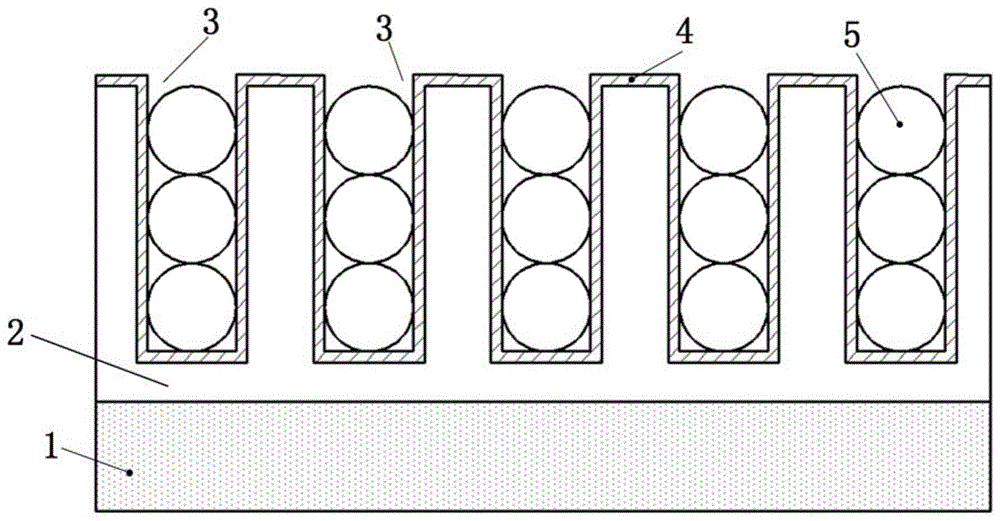
first, the present invention discloses a flexible SERS substrate based on nanostructures and ordered nanoparticles, comprising: flexible film substrate, photocuring resin layer, recess, metal thin film layer and nanoparticle, wherein: the light-cured resin layer is arranged on the surface of the flexible film substrate, the grooves are distributed on the light-cured resin layer in an array mode, the grooves and the light-cured resin layer are integrally formed, the metal film layer covers the light-cured resin layer and the surfaces of the grooves, and the nano particles are orderly filled in the grooves.
As a further technical solution, the flexible film substrate includes: polyethylene terephthalate (PET), Polycarbonate (PC), polypropylene (PP), polyvinyl chloride (PVC), polymethyl methacrylate (PMMA), and the like.
As a further technical solution, the metal thin film layer and the nanoparticles are made of materials with raman signal enhancement function, such as: gold, silver, copper, platinum, and the like.
As a further technical solution, the shape of the groove includes: any one or more of a cylindrical structure, a rectangular parallelepiped structure, a square structure, a prismatic structure, and the like.
As a further technical solution, the array shape formed by the grooves includes: rectangular arrays, square arrays, hexagonal arrays, circular arrays, diamond arrays, triangular arrays, or the like.
As a further technical scheme, the thickness of the metal film layer is 3nm-100 nm.
As a further technical scheme, the diameter of the nano-particles is 1nm-200 nm.
As a further technical scheme, the diameter or the side length of the groove is larger than the diameter of the nano-particles and smaller than 1.4 times of the diameter of the nano-particles; the diameter of the groove is slightly larger than that of the nano particles, so that the nano particles can be smoothly filled; however, the diameter of the groove is not too large, so that each layer in the longitudinal direction can only contain one nano particle, the position of the nano particles can be limited to the maximum extent, and the order of the nano particles in the longitudinal direction is ensured.
As a further technical scheme, the depth of the groove is 1.5nm-500 nm.
As a further technical scheme, the distance between the grooves is 5nm-1000 nm.
Secondly, the invention discloses a preparation method of the flexible SERS substrate based on the nano structure and the ordered nano particles, which comprises the following steps:
(1) coating a light-cured resin material on the surface of a flexible film substrate to form a light-cured resin layer, and impressing the light-cured resin layer through a roll-to-roll ultraviolet curing process to obtain grooves integrally formed with the light-cured resin layer, wherein the grooves are distributed on the light-cured resin layer in an array manner;
(2) depositing a metal film layer on the light-cured resin layer and the surface of the groove by adopting an evaporation coating technology to metalize the metal film layer so as to have an SERS function;
(3) and filling the nano particles in the grooves to ensure that the nano particles are orderly distributed in the grooves, thus obtaining the nano-particle material.
As a further technical scheme, in the roll-to-roll ultraviolet curing process, the imprinting speed is 0.5-60m/min, and the extrusion force is 1-9kg/cm2The temperature of the mould is 10-100 ℃.
As a further technical scheme, in the evaporation coating process, the vacuum degree is 1 multiplied by 10-5-4×10⁻⁵Pa。
As a further technical scheme, the filling of the nanoparticles adopts a blade coating process, and can be selected as follows: blade-coating the nano-particle solution in gaps among the grooves, and wiping off the redundant nano-particle solution on the surface by using alcohol; optionally, the speed of the blade coating is 0.1-100 mm/s.
Finally, the invention discloses the use of the flexible SERS substrate based on nanostructures and ordered nanoparticles in electronic devices; and the application of the preparation method of the flexible SERS substrate in preparing flexible electronic materials.
Compared with the prior art, the invention has the following beneficial effects:
(1) the method provided by the invention is low in cost, high in efficiency and suitable for large-scale batch processing, and the prepared SERS substrate can realize high-precision, high-sensitivity, stability and reproducibility test of Raman signals.
(2) The invention metallizes the light-cured resin layer and the groove, so that the structure array has triple functions: the metalized grooves can generate hot spots to excite plasma resonance, so that the function of enhancing the Raman signal intensity is realized; in addition, the groove can limit the nano particles, so that the nano particles can keep order and consistency in a large area, and the stability and reproducibility test of Raman signals can be realized; moreover, on the basis of the 'hot spots' generated between the grooves, a great number of 'hot spots' can be generated between the metalized grooves and the nanoparticles, and the detection accuracy and sensitivity of the Raman signal are further improved.
(3) The array structure formed by the grooves regulates the uniformity and the order of the nano particles, realizes Raman signal enhancement through the synergistic effect of the nano structure and the ordered nano particles, and has the advantages of high precision, high sensitivity, good stability, strong signal reproducibility and the like.
Drawings
The accompanying drawings, which are incorporated in and constitute a part of this specification, are included to provide a further understanding of the invention, and are incorporated in and constitute a part of this specification, illustrate exemplary embodiments of the invention and together with the description serve to explain the invention and not to limit the invention.
Fig. 1 is a cross-sectional view of a flexible SERS substrate based on nanostructures and ordered nanoparticles according to example 1 of the present invention.
Fig. 2 is a top view of a flexible SERS substrate based on nanostructures and ordered nanoparticles according to example 1 of the present invention.
Fig. 3 is a process flow diagram of the preparation of the flexible SERS substrate based on nanostructures and ordered nanoparticles in example 2 of the present invention.
The reference numerals in the drawings denote: 1-flexible film substrate, 2-photocuring resin layer, 3-groove, 4-metal film layer and 5-nano particle.
Detailed Description
It should be noted that the following detailed description is exemplary and is intended to provide further explanation of the disclosure. Unless defined otherwise, all technical and scientific terms used herein have the same meaning as commonly understood by one of ordinary skill in the art to which this application belongs.
It is noted that the terminology used herein is for the purpose of describing particular embodiments only and is not intended to be limiting of example embodiments according to the present application. As used herein, the singular forms "a", "an" and "the" are intended to include the plural forms as well, and it should be understood that when the terms "comprises" and/or "comprising" are used in this specification, they specify the presence of stated features, steps, operations, devices, components, and/or combinations thereof, unless the context clearly indicates otherwise.
As described in the background art, the surface enhanced raman spectroscopy requires a signal with stability and reproducibility, mainly depends on the nanostructure of the surface enhanced substrate and the order and uniformity of the nanoparticles, and the rapid preparation of the SERS substrate with high precision, high sensitivity, good stability and strong signal reproducibility is a problem to be solved. Therefore, the invention provides a flexible SERS substrate based on a nano structure and ordered nano particles and a preparation method thereof; the invention will now be further described with reference to the accompanying drawings and detailed description.
Example 1
A flexible SERS substrate based on nanostructures and ordered nanoparticles, with reference to fig. 1 and 2, comprising: flexible film substrate 1, photocuring resin layer 2, recess 3, metal thin film layer 4 and nanoparticle 5, wherein: the light-cured resin layer 2 is arranged on the surface of the flexible film substrate 1, the grooves 3 are of a cylindrical structure, are distributed on the light-cured resin layer 2 in a square array and are integrally formed with the light-cured resin layer 2, the metal film layer 4 covers the surfaces of the light-cured resin layer 2 and the grooves 3, and the nano particles 5 are orderly filled in the grooves 3; the flexible film base material 1 is made of polyethylene terephthalate (PET); the metal film layer 4 and the nano particles 5 are nano silver particles; the thickness of the metal film layer 4 is 15 nm; the diameter of the nanoparticles 5 is 20 nm; the depth of the groove 3 is 100nm, and the diameter of the groove is 25 nm; the spacing between the grooves 3 is 60 nm.
Example 2
A flexible SERS substrate based on nanostructures and ordered nanoparticles, as in example 1, with the following differences: the grooves 3 are of a cuboid structure and are distributed on the light-cured resin layer 2 in a rectangular array; the material of the flexible film substrate 1 is Polycarbonate (PC); the thickness of the metal film layer 4 is 30 nm; the metal film layer 4 and the nano particles 5 are all nano gold particles; the diameter of the nanoparticle is 10 nm; the depth of the groove 3 is 20nm, and the diameter of the groove is 10.5 nm; the distance between the grooves 3 is 10 nm.
Example 3
A flexible SERS substrate based on nanostructures and ordered nanoparticles, as in example 1, with the following differences: the grooves 3 are of a cubic structure and distributed on the light-cured resin layer 2 in a hexagonal array; the flexible film substrate 1 is made of polyvinyl chloride (PVC); the thickness of the metal film layer 4 is 50 nm; the metal film layer 4 and the nano particles 5 are both nano copper particles; the diameter of the nanoparticle is 15 nm; the depth of the groove 3 is 20nm, and the diameter of the groove is 15.5 nm; the spacing between the grooves 3 is 60 nm.
Example 4
A flexible SERS substrate based on nanostructures and ordered nanoparticles, as in example 1, with the following differences: the grooves 3 are of prismatic structures and are distributed on the light-cured resin layer 2 in a circular array; the flexible film substrate 1 is made of polymethyl methacrylate (PMMA); the thickness of the metal film layer 4 is 60 nm; the metal film layer 4 and the nano particles 5 are nano silver particles; the diameter of the nanoparticle is 50 nm; the depth of the groove 3 is 150nm, and the diameter of the groove is 70 nm; the spacing between the grooves 3 is 150 nm.
Example 5
A flexible SERS substrate based on nanostructures and ordered nanoparticles, as in example 1, with the following differences: the flexible film base material 1 is made of polypropylene (PP); the thickness of the metal film layer 4 is 3 nm; the metal film layer 4 and the nano particles 5 are both nano platinum particles; the diameter of the nanoparticle is 1 nm; the depth of the groove 3 is 1.5nm, and the diameter of the groove is 1.4 nm; the spacing between the grooves 3 is 5 nm.
Example 6
A flexible SERS substrate based on nanostructures and ordered nanoparticles, as in example 2, with the following differences: the grooves 3 are distributed on the light-cured resin layer 2 in a rhombic array; the thickness of the metal film layer is 100 nm; the diameter of the nanoparticle is 80 nm; the depth of the groove 3 is 200nm, and the diameter of the groove is 100 nm; the spacing between the grooves 3 is 200 nm.
Example 7
A flexible SERS substrate based on nanostructures and ordered nanoparticles, as in example 3, with the following differences: the grooves are distributed on the light-cured resin layer 2 in a triangular array; the thickness of the metal film layer 4 is 20 nm; the diameter of the nanoparticle is 200 nm; the depth of the groove 3 is 300nm, and the diameter of the groove is 250 nm; the spacing between the grooves 3 is 500 nm.
Example 8
A flexible SERS substrate based on nanostructures and ordered nanoparticles, as in example 5, with the following differences: the thickness of the metal film layer 4 is 50 nm; the diameter of the nanoparticle is 120 nm; the depth of the groove 3 is 500nm, and the diameter of the groove is 150 nm; the spacing between the grooves 3 is 1000 nm.
Example 9
A flexible SERS substrate based on nanostructures and ordered nanoparticles, as in example 1, with the following differences: the thickness of the metal film layer 4 is 25 nm; the diameter of the nanoparticle is 45 nm; the depth of the groove 3 is 300nm, and the diameter of the groove is 50 nm; the spacing between the grooves 3 is 600 nm.
Example 10
A flexible SERS substrate based on nanostructures and ordered nanoparticles, as in example 1, with the following differences: the light-curing resin layer 2, the groove 3, and the metal thin-film layer 4 are not provided.
Example 11
A flexible SERS substrate based on nanostructures and ordered nanoparticles, as in example 1, with the following differences: there are no nanoparticles.
Example 12
A flexible SERS substrate based on nanostructures and ordered nanoparticles, as in example 1, with the following differences: there is no photocurable resin layer 2, grooves 3, metal thin-film layer 4, and nanoparticles 5, i.e., only flexible thin-film substrate 1.
Example 13
The method for preparing the flexible SERS substrate based on nanostructures and ordered nanoparticles according to example 1 includes the following steps:
(1) coating a light-cured resin material on the surface of a flexible film substrate to form a light-cured resin layer, and impressing the light-cured resin layer through a roll-to-roll ultraviolet curing process to obtain grooves integrally formed with the light-cured resin layer, wherein the grooves are distributed on the light-cured resin layer in an array manner; in the roll-to-roll ultraviolet curing process, the imprinting speed is 20m/min, and the extrusion force is 5kg/cm2The temperature of the die is 50 ℃;
(2) depositing a metal film layer on the surface of the light-cured resin layer and the groove by an evaporation coating technology, wherein in the evaporation coating technology, the vacuum degree is 3.5 multiplied by 10-5Pa;
(3) Blade-coating the nanoparticle solution in gaps among the grooves 3, and wiping off the redundant nanoparticle solution on the surface by using alcohol to ensure that the nanoparticles are orderly distributed among the grooves to obtain the nano-particle cleaning agent; the draw-down speed was 20 mm/s.
Statistical table of signal enhancement factor, relative standard deviation of multi-point tests for flexible SERS substrates prepared in examples 1-12. During detection, a rhodamine 6G solution is used as a marker, the laser wavelength is 785nm, the power is 1mW, the integration time is 10s, and the Raman signal enhancement factor at the 1366-1 peak is calculated. The calculation of the relative standard deviation is to randomly select 9 positions from the surface of the sample for raman signal characterization, and calculate the relative standard deviation of the raman signal enhancement factors measured at different positions, and the result is shown in table 1.
TABLE 1
The above description is only a preferred embodiment of the present application and is not intended to limit the present application, and various modifications and changes may be made by those skilled in the art. Any modification, equivalent replacement, improvement and the like made within the spirit and principle of the present application shall be included in the protection scope of the present application.