CN110156081B - Porous flaky TiNb for lithium ion battery cathode2O7Method for preparing nanocrystalline - Google Patents

Porous flaky TiNb for lithium ion battery cathode2O7Method for preparing nanocrystalline Download PDF

Info

Publication number
CN110156081B
CN110156081B CN201910428882.4A CN201910428882A CN110156081B CN 110156081 B CN110156081 B CN 110156081B CN 201910428882 A CN201910428882 A CN 201910428882A CN 110156081 B CN110156081 B CN 110156081B
Authority
CN
China
Prior art keywords
tinb
preparation
negative electrode
niobium
lithium ion
Prior art date
Legal status (The legal status is an assumption and is not a legal conclusion. Google has not performed a legal analysis and makes no representation as to the accuracy of the status listed.)
Active
Application number
CN201910428882.4A
Other languages
Chinese (zh)
Other versions
CN110156081A (en
Inventor
梁德伟
侯子宾
董强
胡坤宏
梁长浩
Current Assignee (The listed assignees may be inaccurate. Google has not performed a legal analysis and makes no representation or warranty as to the accuracy of the list.)
Hefei University
Original Assignee
Hefei University
Priority date (The priority date is an assumption and is not a legal conclusion. Google has not performed a legal analysis and makes no representation as to the accuracy of the date listed.)
Filing date
Publication date
Application filed by Hefei University filed Critical Hefei University
Priority to CN201910428882.4A priority Critical patent/CN110156081B/en
Publication of CN110156081A publication Critical patent/CN110156081A/en
Application granted granted Critical
Publication of CN110156081B publication Critical patent/CN110156081B/en
Active legal-status Critical Current
Anticipated expiration legal-status Critical

Links

Images

Classifications

    • BPERFORMING OPERATIONS; TRANSPORTING
    • B82NANOTECHNOLOGY
    • B82YSPECIFIC USES OR APPLICATIONS OF NANOSTRUCTURES; MEASUREMENT OR ANALYSIS OF NANOSTRUCTURES; MANUFACTURE OR TREATMENT OF NANOSTRUCTURES
    • B82Y30/00Nanotechnology for materials or surface science, e.g. nanocomposites
    • CCHEMISTRY; METALLURGY
    • C01INORGANIC CHEMISTRY
    • C01GCOMPOUNDS CONTAINING METALS NOT COVERED BY SUBCLASSES C01D OR C01F
    • C01G33/00Compounds of niobium
    • HELECTRICITY
    • H01ELECTRIC ELEMENTS
    • H01MPROCESSES OR MEANS, e.g. BATTERIES, FOR THE DIRECT CONVERSION OF CHEMICAL ENERGY INTO ELECTRICAL ENERGY
    • H01M10/00Secondary cells; Manufacture thereof
    • H01M10/05Accumulators with non-aqueous electrolyte
    • H01M10/052Li-accumulators
    • H01M10/0525Rocking-chair batteries, i.e. batteries with lithium insertion or intercalation in both electrodes; Lithium-ion batteries
    • HELECTRICITY
    • H01ELECTRIC ELEMENTS
    • H01MPROCESSES OR MEANS, e.g. BATTERIES, FOR THE DIRECT CONVERSION OF CHEMICAL ENERGY INTO ELECTRICAL ENERGY
    • H01M4/00Electrodes
    • H01M4/02Electrodes composed of, or comprising, active material
    • H01M4/36Selection of substances as active materials, active masses, active liquids
    • H01M4/48Selection of substances as active materials, active masses, active liquids of inorganic oxides or hydroxides
    • CCHEMISTRY; METALLURGY
    • C01INORGANIC CHEMISTRY
    • C01PINDEXING SCHEME RELATING TO STRUCTURAL AND PHYSICAL ASPECTS OF SOLID INORGANIC COMPOUNDS
    • C01P2002/00Crystal-structural characteristics
    • C01P2002/70Crystal-structural characteristics defined by measured X-ray, neutron or electron diffraction data
    • C01P2002/72Crystal-structural characteristics defined by measured X-ray, neutron or electron diffraction data by d-values or two theta-values, e.g. as X-ray diagram
    • CCHEMISTRY; METALLURGY
    • C01INORGANIC CHEMISTRY
    • C01PINDEXING SCHEME RELATING TO STRUCTURAL AND PHYSICAL ASPECTS OF SOLID INORGANIC COMPOUNDS
    • C01P2004/00Particle morphology
    • C01P2004/60Particles characterised by their size
    • C01P2004/64Nanometer sized, i.e. from 1-100 nanometer
    • HELECTRICITY
    • H01ELECTRIC ELEMENTS
    • H01MPROCESSES OR MEANS, e.g. BATTERIES, FOR THE DIRECT CONVERSION OF CHEMICAL ENERGY INTO ELECTRICAL ENERGY
    • H01M4/00Electrodes
    • H01M4/02Electrodes composed of, or comprising, active material
    • H01M2004/021Physical characteristics, e.g. porosity, surface area
    • HELECTRICITY
    • H01ELECTRIC ELEMENTS
    • H01MPROCESSES OR MEANS, e.g. BATTERIES, FOR THE DIRECT CONVERSION OF CHEMICAL ENERGY INTO ELECTRICAL ENERGY
    • H01M4/00Electrodes
    • H01M4/02Electrodes composed of, or comprising, active material
    • H01M2004/026Electrodes composed of, or comprising, active material characterised by the polarity
    • H01M2004/027Negative electrodes
    • YGENERAL TAGGING OF NEW TECHNOLOGICAL DEVELOPMENTS; GENERAL TAGGING OF CROSS-SECTIONAL TECHNOLOGIES SPANNING OVER SEVERAL SECTIONS OF THE IPC; TECHNICAL SUBJECTS COVERED BY FORMER USPC CROSS-REFERENCE ART COLLECTIONS [XRACs] AND DIGESTS
    • Y02TECHNOLOGIES OR APPLICATIONS FOR MITIGATION OR ADAPTATION AGAINST CLIMATE CHANGE
    • Y02EREDUCTION OF GREENHOUSE GAS [GHG] EMISSIONS, RELATED TO ENERGY GENERATION, TRANSMISSION OR DISTRIBUTION
    • Y02E60/00Enabling technologies; Technologies with a potential or indirect contribution to GHG emissions mitigation
    • Y02E60/10Energy storage using batteries

Landscapes

  • Chemical & Material Sciences (AREA)
  • Engineering & Computer Science (AREA)
  • Organic Chemistry (AREA)
  • Nanotechnology (AREA)
  • Chemical Kinetics & Catalysis (AREA)
  • Electrochemistry (AREA)
  • General Chemical & Material Sciences (AREA)
  • Inorganic Chemistry (AREA)
  • Materials Engineering (AREA)
  • Physics & Mathematics (AREA)
  • Composite Materials (AREA)
  • Condensed Matter Physics & Semiconductors (AREA)
  • General Physics & Mathematics (AREA)
  • Crystallography & Structural Chemistry (AREA)
  • Manufacturing & Machinery (AREA)
  • Battery Electrode And Active Subsutance (AREA)

Abstract

一种锂离子电池负极用多孔薄片状TiNb2O7纳米晶的制备方法,涉及锂离子电池负极材料制备技术领域。首先将钛源和铌源按一定比例加入到乙二醇和异丙醇的混合溶液里,接着加入六次甲基四胺混合搅拌均匀,然后将反应液置于反应容器中反应,最后经后处理得到多孔薄片状TiNb2O7纳米晶负极材料。本发明制备方法简单,实验重复性高;制得的负极材料呈纳米薄片状,薄片大小为300~600nm,厚度为10~30nm,并具有较大的比表面积和孔隙率,有利于电解液的渗透和锂离子的传递,从而提高材料的电化学性能。作为锂离子电池负极具有较高的可逆容量和首次效率、优异的大倍率充放电性能以及优异倍率循环性能。

Figure 201910428882

A preparation method of porous sheet-like TiNb 2 O 7 nanocrystals for negative electrodes of lithium ion batteries relates to the technical field of preparation of negative electrode materials of lithium ion batteries. First, the titanium source and niobium source are added to the mixed solution of ethylene glycol and isopropanol in a certain proportion, then hexamethylenetetramine is added and mixed evenly, and then the reaction solution is placed in a reaction vessel for reaction, and finally after post-treatment The porous sheet-like TiNb 2 O 7 nanocrystalline negative electrode material was obtained. The preparation method of the invention is simple, and the experiment repeatability is high; the prepared negative electrode material is in the shape of nano flakes, the flake size is 300-600 nm, the thickness is 10-30 nm, and has larger specific surface area and porosity, which is beneficial to the electrolytic solution. Penetration and transport of lithium ions, thereby improving the electrochemical performance of the material. As a lithium-ion battery anode, it has high reversible capacity and first-time efficiency, excellent high-rate charge-discharge performance, and excellent rate cycle performance.

Figure 201910428882

Description

Porous flaky TiNb for lithium ion battery cathode2O7Method for preparing nanocrystalline
Technical Field
The invention relates to the technical field of preparation of lithium ion battery cathode materials, in particular to a porous flaky TiNb for a lithium ion battery cathode2O7A method for preparing a nanocrystal.
Background
The lithium ion battery is a new generation of green high-energy battery, and has become a main selection object of rechargeable batteries for large-scale application at present due to a series of advantages of large energy density, high output power, long service life, small self-discharge, no memory effect, wide working temperature range (-20 ℃ -60 ℃), good cycle performance, rapid charge and discharge, high charging efficiency (up to 100%), no environmental pollution or little pollution and the like.
TiNb2O7As a novel negative electrode material, the lithium ion battery has a higher lithium intercalation and deintercalation potential (about 1.6V), avoids the generation of lithium dendrites and a solid electrolyte oxide film (SEI), and has higher theoretical specific volume capacity (TiNb) compared with a graphite carbon material2O7The theoretical specific capacity is 387.6mAh/g) and better safety, in addition, the material has small change of lattice parameters and unit cell volume in the process of lithium deintercalation, has excellent rate charge-discharge performance and cycle stability, and is a high-power lithium battery cathode material with good application prospect.
TiNb prepared by traditional solid phase method2O7The particles are large, typically on the order of microns or larger, and have a non-uniform particle size distribution. When the lithium ion battery cathode material is used as a lithium battery cathode material, the lithium ion transmission distance is long, the electrochemical reaction area is small, and the utilization rate of an active material is low; therefore, how to improve TiNb by optimizing the size and the structure2O7The electronic conductivity and the ion diffusion rate of the electrode material, so that the problems of fast capacity attenuation, poor rate capability and the like in charge and discharge under high current density are solved, and the TiNb is determined2O7The key to the new high-performance lithium ion battery cathode material is. Therefore, a simple method for preparing uniform TiNb is sought2O7The cathode material has scientific significance.
Disclosure of Invention
The invention aims at the existing TiNb preparation2O7The defects of the cathode material provide a porous flaky TiNb with simple preparation process, high experimental repeatability and excellent electrochemical performance2O7A method for preparing a nanocrystalline lithium electric anode material.
In order to achieve the purpose, the technical scheme adopted by the invention is as follows: porous flaky TiNb for lithium ion battery cathode2O7The preparation method of the nanocrystalline adopts a solvothermal method, and firstly, a titanium source and a niobium source are mixed according to an atomic ratio of 1: 2 is added into the mixed solution of ethylene glycol and isopropanol, and the molar concentration of titanium atoms is 0.02-0.03 mol/L; adding hexamethylenetetramine, mixing and stirring uniformly, then placing the reaction solution in a reaction vessel for reaction at 180-200 ℃ for 24-36 h, and finally performing post-treatment to obtain porous flaky TiNb2O7A nanocrystalline anode material.
As a preferable technical scheme of the preparation method, the titanium source is tetrabutyl titanate, titanium isopropoxide or titanium sulfate. The niobium source is niobium pentachloride, niobium ethoxide or niobium oxalate. The volume ratio of the ethylene glycol to the isopropanol is 0.5-2: 1. the concentration of the hexamethylene tetramine in the system after the hexamethylene tetramine is added is 0.2-0.3 mol/L. And adding hexamethylene tetramine, and then mixing and stirring for 0.5-2 h at the stirring speed of 400-500 r/min.
As a further improved technical scheme of the preparation method, the post-treatment is that after the reaction is finished, the oily liquid on the upper layer is removed to obtain white precipitates paved at the bottom, then the white precipitates are respectively washed for a plurality of times by deionized water and ethanol, and then the porous flaky TiNb is obtained by drying and calcining treatment2O7A nanocrystalline anode material.
In the post-treatment step, the calcination treatment is to calcine the dried sample in air at 750-800 ℃ for 2-5 h.
The TiNb is prepared by a titanium source and a niobium source through a solvothermal method2O7The nanocrystalline has larger specific surface area and porosity, and the two-dimensional layered porous nanostructure with large specific surface area and porous channels can increase the contact area between the electrode material and the electrolyte, thereby being beneficial to the permeation of the electrolyte and the transmission of lithium ions, reducing the polarization caused by low ion diffusion speed during large-current charge and discharge, and improving the utilization rate of the active material. Therefore, the porous flaky TiNb prepared by the invention2O7The nanocrystalline negative electrode material can remarkably improve the electrochemical performance of the electrode material. Compared with the prior art, the invention has the beneficial effects that:
(1) the preparation method is simple, and the experimental repeatability is high;
(2) TiNb prepared by the method of the invention2O7The material is in the shape of nano-flake, the size of the flake is 300-600 nm,the thickness is 10-30 nm, and the material has large specific surface area and porosity, so that the permeation of electrolyte and the transmission of lithium ions are facilitated, and the electrochemical performance of the material is improved.
(3) Porous flaky TiNb prepared by the invention2O7The nanocrystalline material used as the negative electrode of the lithium ion battery has higher reversible capacity and first efficiency, excellent large-rate charge and discharge performance and excellent rate cycle performance.
Drawings
FIG. 1 shows porous flaky TiNb prepared in example 1 of the present invention2O7XRD pattern of nanocrystals.
FIG. 2 shows porous flaky TiNb prepared in example 1 of the present invention2O7Scanning electron microscope photograph of the nanocrystals.
FIG. 3 shows porous flaky TiNb prepared in example 1 of the present invention2O7Transmission electron micrograph of nanocrystal.
FIG. 4 shows porous flaky TiNb prepared in example 1 of the present invention2O7Rate performance curve of nanocrystals.
FIG. 5 shows porous flaky TiNb prepared in example 1 of the present invention2O7Cycling performance curve of nanocrystals at 5C.
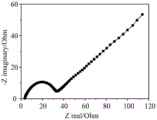
FIG. 6 shows porous flaky TiNb prepared in example 1 of the present invention2O7Electrochemical impedance curve of nanocrystals.
Detailed Description
The following examples and drawings are combined to describe the porous flaky TiNb for the lithium ion battery negative electrode of the invention2O7The preparation method of the nanocrystal is further detailed. The structure and morphological properties of the product obtained by the method are respectively characterized and analyzed by a field emission scanning electron microscope (FE-SEM, SU8010) and an X-ray powder diffraction (XRD, D3500) instrument for chemical composition.
Example 1
Porous flaky TiNb2O7The preparation method of the nanocrystalline anode material comprises the following specific steps:
the method comprises the following steps: 0.400g of niobium pentachloride and 0.252g of tetrabutyl titanate are weighed into a mixed solution of 15mL of ethylene glycol and 15mL of isopropanol.
Step two: and (3) adding 0.952g of hexamethylenetetramine into the solution obtained in the first step, mixing and stirring for 0.5h, wherein the rotating speed is 500 r/min.
Step three: transferring the solution obtained in the second step into a stainless steel reaction kettle lined with polytetrafluoroethylene, placing the stainless steel reaction kettle in a constant-temperature drying box, and heating the stainless steel reaction kettle for 30 hours at 190 ℃.
Step four: after the reaction is finished, removing the upper oily liquid to obtain white precipitate which is paved at the bottom, then respectively washing with deionized water and ethanol for a plurality of times by mixing, and drying the obtained sample in a vacuum drying oven at 70 ℃ for 12 hours.
Step five: calcining the sample dried in the fourth step in air at 750 ℃ for 5 hours to obtain porous flaky TiNb2O7A nanocrystalline lithium negative electrode material.
Referring to FIGS. 1-6, the sample prepared in example 1 was analyzed by X-ray diffractometer and found to be associated with TiNb of monoclinic system with JCPDS number 01-072-01162O7The structures are consistent. The sample is observed by a field emission scanning electron microscope, and the prepared TiNb can be seen2O7Nanocrystals are a thin sheet structure with platelets of about 500nm and a thickness of about 20 nm. TiNb in sheet structure2O7The nanocrystalline is used as a negative electrode material and assembled into a lithium ion half-cell, electrochemical performance of the cell is tested by adopting a blue charging and discharging device, and the fact that the flaky nanocrystalline has high reversible capacity, first efficiency and good rate performance is found, the reversible capacity is about 97mAh/g after 50 cycles of circulation under the current density of 5C, and good circulation stability is shown.
Example 2
Porous flaky TiNb2O7The preparation method of the nanocrystalline anode material comprises the following specific steps:
the method comprises the following steps: 0.8g of niobium pentachloride and 0.504g of tetrabutyl titanate are weighed into a mixed solution of 21mL of ethylene glycol and 42mL of isopropanol.
Step two: and (3) adding 1.904g of hexamethylenetetramine into the solution obtained in the first step, and mixing and stirring for 1h at the rotating speed of 500 r/min.
Step three: transferring the solution obtained in the second step into a stainless steel reaction kettle lined with polytetrafluoroethylene, placing the stainless steel reaction kettle in a constant-temperature drying box, and heating the stainless steel reaction kettle at 180 ℃ for 36 hours.
Step four: after the reaction is finished, removing the upper oily liquid to obtain white precipitate which is paved at the bottom, then respectively washing with deionized water and ethanol for a plurality of times by mixing, and drying the obtained sample in a vacuum drying oven at 70 ℃ for 12 hours.
Step five: calcining the sample dried in the fourth step in air at 780 ℃ for 3h to obtain porous flaky TiNb2O7A nanocrystalline anode material.
Example 3
Porous flaky TiNb2O7The preparation method of the nanocrystalline anode material comprises the following specific steps:
the method comprises the following steps: 0.400g of niobium pentachloride and 0.252g of tetrabutyl titanate are weighed into a mixed solution of 18mL of ethylene glycol and 9mL of isopropanol.
Step two: and (3) adding 0.952g of hexamethylenetetramine into the solution obtained in the first step, mixing and stirring for 0.5h, wherein the rotating speed is 400 r/min.
Step three: transferring the solution obtained in the second step into a stainless steel reaction kettle lined with polytetrafluoroethylene, placing the stainless steel reaction kettle in a constant-temperature drying box, and heating the stainless steel reaction kettle for 24 hours at the temperature of 200 ℃.
Step four: after the reaction is finished, removing the upper oily liquid to obtain white precipitate which is paved at the bottom, then respectively washing with deionized water and ethanol for a plurality of times by mixing, and drying the obtained sample in a vacuum drying oven at 70 ℃ for 12 hours.
Step five: calcining the sample dried in the fourth step in air at 800 ℃ for 2h to obtain porous flaky TiNb2O7A nanocrystalline anode material.
The foregoing is merely exemplary and illustrative of the principles of the present invention and various modifications, additions and substitutions of the specific embodiments described herein may be made by those skilled in the art without departing from the principles of the present invention or exceeding the scope of the claims set forth herein.

Claims (7)

1.一种锂离子电池负极用多孔薄片状TiNb2O7纳米晶的制备方法,采用溶剂热法,其特征在于,首先将钛源和铌源按原子比为1:2的比例加入到体积比为0.5~2:1的乙二醇和异丙醇的混合溶液里,钛原子的摩尔浓度为0.02~0.03 mol/L;接着加入六次甲基四胺混合搅拌均匀,加入后体系中六次甲基四胺的浓度为0.2~0.3 mol/L;然后将反应液置于反应容器中于180~200 ℃下反应24~36 h,最后经后处理得到多孔薄片状TiNb2O7纳米晶负极材料。1. a preparation method of porous flaky TiNb 2 O 7 nanocrystals for negative electrode of lithium ion battery, adopts solvothermal method, it is characterized in that, at first titanium source and niobium source are added to the volume in a ratio of 1:2 by atomic ratio In the mixed solution of ethylene glycol and isopropanol with a ratio of 0.5~2:1, the molar concentration of titanium atoms is 0.02~0.03 mol/L; then add hexamethylenetetramine, mix and stir evenly, after adding six times in the system The concentration of methyltetramine was 0.2-0.3 mol/L; then the reaction solution was placed in a reaction vessel at 180-200 ℃ for 24-36 h, and finally the porous sheet-like TiNb 2 O 7 nanocrystalline negative electrode was obtained after post-treatment Material. 2.如权利要求1所述的制备方法,其特征在于,所述钛源为钛酸四丁酯、异丙醇钛或硫酸钛。2 . The preparation method according to claim 1 , wherein the titanium source is tetrabutyl titanate, titanium isopropoxide or titanium sulfate. 3 . 3.如权利要求1所述的制备方法,其特征在于,所述铌源为五氯化铌、乙醇铌或草酸铌。3. The preparation method of claim 1, wherein the niobium source is niobium pentachloride, niobium ethoxide or niobium oxalate. 4.如权利要求1所述的制备方法,其特征在于,六次甲基四胺加入后混合搅拌0.5~2 h,搅拌速度为400~500 r/min。4. preparation method as claimed in claim 1 is characterized in that, hexamethylenetetramine is mixed and stirred for 0.5~2 h after adding, and stirring speed is 400~500 r/min. 5.如权利要求1所述的制备方法,其特征在于,所述后处理是在反应完成后,去其上层油性液体,得到平铺在底部的白色沉淀物,然后用去离子水和乙醇分别洗涤数次,再经过干燥、煅烧处理得到多孔薄片状TiNb2O7纳米晶负极材料。5. preparation method as claimed in claim 1 is characterized in that, described post-processing is after reaction is completed, removes its upper layer oily liquid, obtains the white sediment that is spread on bottom, then use deionized water and ethanol respectively After washing several times, and then drying and calcining, a porous sheet-like TiNb 2 O 7 nanocrystalline negative electrode material is obtained. 6.如权利要求5所述的制备方法,其特征在于,煅烧处理是将干燥后的样品在750~800℃的空气中煅烧2~5 h。6 . The preparation method according to claim 5 , wherein the calcination treatment is to calcine the dried sample in air at 750-800° C. for 2-5 h. 7 . 7.如权利要求1~5任一项所述方法制备的TiNb2O7纳米晶,其特征在于,晶系为单斜晶系,微观结构呈纳米薄片状,薄片大小为300~600 nm,厚度为10~30 nm。 7. The TiNb 2 O nanocrystal prepared by the method according to any one of claims 1 to 5, wherein the crystal system is a monoclinic system, the microstructure is in the shape of nano flakes, and the flake size is 300 to 600 nm, The thickness is 10~30 nm.
CN201910428882.4A 2019-05-22 2019-05-22 Porous flaky TiNb for lithium ion battery cathode2O7Method for preparing nanocrystalline Active CN110156081B (en)

Priority Applications (1)

Application Number Priority Date Filing Date Title
CN201910428882.4A CN110156081B (en) 2019-05-22 2019-05-22 Porous flaky TiNb for lithium ion battery cathode2O7Method for preparing nanocrystalline

Applications Claiming Priority (1)

Application Number Priority Date Filing Date Title
CN201910428882.4A CN110156081B (en) 2019-05-22 2019-05-22 Porous flaky TiNb for lithium ion battery cathode2O7Method for preparing nanocrystalline

Publications (2)

Publication Number Publication Date
CN110156081A CN110156081A (en) 2019-08-23
CN110156081B true CN110156081B (en) 2021-05-14

Family

ID=67631951

Family Applications (1)

Application Number Title Priority Date Filing Date
CN201910428882.4A Active CN110156081B (en) 2019-05-22 2019-05-22 Porous flaky TiNb for lithium ion battery cathode2O7Method for preparing nanocrystalline

Country Status (1)

Country Link
CN (1) CN110156081B (en)

Families Citing this family (8)

* Cited by examiner, † Cited by third party
Publication number Priority date Publication date Assignee Title
CN111293302B (en) * 2020-03-17 2023-04-04 河南电池研究院有限公司 Lithium ion battery titanium niobate-zinc ferrite composite negative electrode material and preparation method thereof
CN112103493A (en) * 2020-08-13 2020-12-18 华北电力大学 Preparation method of lithium battery negative electrode material titanium-niobium composite oxide
CN112467099B (en) * 2020-10-31 2022-04-05 浙江锋锂新能源科技有限公司 TiNb2O7Method for producing a material
FR3118534B1 (en) * 2020-12-29 2023-12-15 I Ten Process for manufacturing a porous anode for a secondary lithium ion battery, anode thus obtained, and microbattery comprising this anode
FR3118535B1 (en) * 2020-12-29 2023-12-22 Hfg Process for manufacturing a porous anode for a secondary lithium ion battery, anode thus obtained, and battery comprising this anode
CN113683120B (en) * 2021-08-31 2022-10-14 合肥工业大学 A kind of mixed phase niobium-based oxide and its preparation method and energy storage application
CN113772728A (en) * 2021-10-14 2021-12-10 合肥工业大学 Mixed-phase niobium-titanium oxide, and preparation method and energy storage application thereof
CN114665084B (en) * 2022-04-08 2024-09-06 合肥学院 A method for preparing carbon-coated TiNb2O7 porous nanosheet negative electrode material

Citations (11)

* Cited by examiner, † Cited by third party
Publication number Priority date Publication date Assignee Title
CN103594693A (en) * 2013-11-19 2014-02-19 大连海事大学 A kind of titanium dioxide/niobium titanium oxide composite material and its preparation and application
CN104445405A (en) * 2014-11-14 2015-03-25 南京航空航天大学 A kind of preparation method of nanoscale TiNb2O7 with porous structure
CN104538207A (en) * 2014-12-16 2015-04-22 南京航空航天大学 Method for preparing titanium niobate and carbon nanotube composite material and lithium ion capacitor with material as negative electrode
CN105552369A (en) * 2015-12-30 2016-05-04 哈尔滨工业大学 Method for preparing three-dimensional porous titanium niobate oxide through template method, and application thereof in lithium ion battery
CN105575675A (en) * 2015-12-30 2016-05-11 哈尔滨工业大学 Method for preparing titanium-niobium composite oxide by water/solvothermal method and application of method in lithium-ion supercapacitor
JP6138218B2 (en) * 2015-11-25 2017-05-31 太平洋セメント株式会社 Oxide-based negative electrode active material for secondary battery and method for producing the same
CN106830033A (en) * 2017-03-22 2017-06-13 华东理工大学 A kind of preparation method of porous flake nano aluminium oxide
CN106876682A (en) * 2017-04-10 2017-06-20 中南大学 A kind of manganese oxide/nickel microsphere with porous structure and its preparation and application
CN107482178A (en) * 2017-07-06 2017-12-15 复旦大学 A kind of preparation method of hollow TiNb2O7 microsphere
CN108242541A (en) * 2018-01-08 2018-07-03 北京理工大学 A kind of preparation method of multi-level nano-structure lithium sulfur battery anode material
CN108910948A (en) * 2018-08-30 2018-11-30 陕西科技大学 A kind of niobic acid tin nanometer sheet and preparation method thereof

Patent Citations (11)

* Cited by examiner, † Cited by third party
Publication number Priority date Publication date Assignee Title
CN103594693A (en) * 2013-11-19 2014-02-19 大连海事大学 A kind of titanium dioxide/niobium titanium oxide composite material and its preparation and application
CN104445405A (en) * 2014-11-14 2015-03-25 南京航空航天大学 A kind of preparation method of nanoscale TiNb2O7 with porous structure
CN104538207A (en) * 2014-12-16 2015-04-22 南京航空航天大学 Method for preparing titanium niobate and carbon nanotube composite material and lithium ion capacitor with material as negative electrode
JP6138218B2 (en) * 2015-11-25 2017-05-31 太平洋セメント株式会社 Oxide-based negative electrode active material for secondary battery and method for producing the same
CN105552369A (en) * 2015-12-30 2016-05-04 哈尔滨工业大学 Method for preparing three-dimensional porous titanium niobate oxide through template method, and application thereof in lithium ion battery
CN105575675A (en) * 2015-12-30 2016-05-11 哈尔滨工业大学 Method for preparing titanium-niobium composite oxide by water/solvothermal method and application of method in lithium-ion supercapacitor
CN106830033A (en) * 2017-03-22 2017-06-13 华东理工大学 A kind of preparation method of porous flake nano aluminium oxide
CN106876682A (en) * 2017-04-10 2017-06-20 中南大学 A kind of manganese oxide/nickel microsphere with porous structure and its preparation and application
CN107482178A (en) * 2017-07-06 2017-12-15 复旦大学 A kind of preparation method of hollow TiNb2O7 microsphere
CN108242541A (en) * 2018-01-08 2018-07-03 北京理工大学 A kind of preparation method of multi-level nano-structure lithium sulfur battery anode material
CN108910948A (en) * 2018-08-30 2018-11-30 陕西科技大学 A kind of niobic acid tin nanometer sheet and preparation method thereof

Also Published As

Publication number Publication date
CN110156081A (en) 2019-08-23

Similar Documents

Publication Publication Date Title
CN110156081B (en) Porous flaky TiNb for lithium ion battery cathode2O7Method for preparing nanocrystalline
CN108321366B (en) Coating method for improving electrochemical performance of high-nickel ternary nickel-cobalt-manganese positive electrode material
CN108550806B (en) MnSe/CoSe2Composite material and preparation method and application thereof
CN110165206B (en) A kind of spherical sodium-ion battery cathode material and preparation method thereof
CN106099052A (en) A kind of carbon-coated SnO2 hollow nanosphere composite material and preparation method thereof
CN107681147B (en) A kind of preparation method and application of solid electrolyte coating modified lithium ion battery positive electrode material
CN102938457B (en) The preparation method of the coated lithium-rich manganese-based layered cathode material of a kind of NAF
CN112928246B (en) Composite material, preparation method and application thereof
CN103151506A (en) Preparation method of nanoscale zirconium-doped lithium titanate material
CN107464924A (en) A kind of sheet oxygen defect lithium vanadate anode material and preparation method thereof
CN105261755A (en) Preparation method for nano-rod iron molybdate electrode material of lithium ion battery
Xia et al. Influence of complexing agents on the structure and electrochemical properties of LiNi0. 80Co0. 15Al0. 05O2 cathode synthesized by sol-gel method: a comparative study
CN102832382B (en) Method for preparing nano-lithium titanate cathode material
CN109292827A (en) A kind of hollow cage-shaped ferric oxide nanoparticles and preparation method thereof
CN111384389A (en) Precursor of ternary material
CN111048775A (en) An in-situ sodium-doped modification method for improving lithium storage performance of ternary cathode materials
CN114188521A (en) A kind of light-weight coating layer on the surface of graphite positive electrode material of dual-ion battery and preparation method
CN106711443A (en) Fusiform manganese cobalt oxide material and preparation and application thereof
CN112670511B (en) A kind of NCM ternary cathode material with surface layer lithium concentration gradient and preparation method thereof
CN112047390B (en) A nickel-doped lithium vanadate nanorod with a large specific surface area and its preparation method and application
CN115332495A (en) Lithium ion battery composite positive electrode material, preparation method thereof and lithium ion battery
CN108963245A (en) A kind of mesoporous cobaltosic oxide electrode material of lamellar and preparation method thereof
CN109449440B (en) Microporous ultrathin soft carbon nanosheet and preparation method and application thereof
CN114944288B (en) Flower-like bismuth trioxide, preparation method and application thereof, and prepared electrode
CN101555041B (en) Preparation of LiMnO2 Nanosheets and Its Application in Lithium Batteries

Legal Events

Date Code Title Description
PB01 Publication
PB01 Publication
SE01 Entry into force of request for substantive examination
GR01 Patent grant
GR01 Patent grant