CN109887519B - Method for improving voice channel data transmission accuracy - Google Patents
Method for improving voice channel data transmission accuracy Download PDFInfo
- Publication number
- CN109887519B CN109887519B CN201910194081.6A CN201910194081A CN109887519B CN 109887519 B CN109887519 B CN 109887519B CN 201910194081 A CN201910194081 A CN 201910194081A CN 109887519 B CN109887519 B CN 109887519B
- Authority
- CN
- China
- Prior art keywords
- len
- syn
- offset
- voice
- symbol
- Prior art date
- Legal status (The legal status is an assumption and is not a legal conclusion. Google has not performed a legal analysis and makes no representation as to the accuracy of the status listed.)
- Active
Links
- 238000000034 method Methods 0.000 title claims abstract description 24
- 230000005540 biological transmission Effects 0.000 title claims abstract description 17
- 230000001360 synchronised effect Effects 0.000 claims description 13
- 238000005070 sampling Methods 0.000 claims description 11
- 238000004364 calculation method Methods 0.000 claims description 4
- 238000013178 mathematical model Methods 0.000 claims description 3
- 238000004088 simulation Methods 0.000 description 4
- 238000010586 diagram Methods 0.000 description 3
- 238000001228 spectrum Methods 0.000 description 3
- 238000006243 chemical reaction Methods 0.000 description 2
- 238000013507 mapping Methods 0.000 description 2
- 230000003595 spectral effect Effects 0.000 description 2
- 230000009286 beneficial effect Effects 0.000 description 1
- 230000007547 defect Effects 0.000 description 1
- 238000013461 design Methods 0.000 description 1
- 238000012986 modification Methods 0.000 description 1
- 230000004048 modification Effects 0.000 description 1
- 238000005457 optimization Methods 0.000 description 1
- 238000011160 research Methods 0.000 description 1
Images


Landscapes
- Synchronisation In Digital Transmission Systems (AREA)
Abstract
The invention discloses a method for improving the data transmission accuracy of voice channel, which comprises the following steps: constructing N voice symbol-like waveforms; selecting N from the N speech-like symbol waveformssymAn optimal phonetic symbol waveform, N > NsymForming a codebook; the sending end groups the data bits to be transmitted every NbitOne bit in a group, there is a total of Each group selects a corresponding voice-like symbol waveform in the codebook to modulate, converts the voice-like symbol waveform into a voice-like signal and transmits the voice-like signal on a voice channel; and the receiving end demodulates the received voice-like signal. The invention has the advantages of improving the transmission performance, reducing the bit error rate and the like.
Description
Technical Field
The present invention relates to the field of data transmission. More particularly, the present invention relates to a method for improving the accuracy of voice channel data transmission.
Background
The existing method for transmitting data on a voice channel is: a set of voice-like signals corresponding to the data are designed, the frequencies of these signals are within the range required by the vocoder (300Hz-3400Hz), and can be successfully demodulated at the receiving end after passing through the vocoder channel. The research on the method is numerous, and mainly focuses on the design and optimization of the voice-like signals, however, the existing transmission method still has the defects of low transmission performance, high error rate and the like.
Disclosure of Invention
An object of the present invention is to provide a method for improving the accuracy of voice channel data transmission, which has the advantages of improving the transmission performance, reducing the bit error rate, etc.
To achieve the objects and other advantages in accordance with the present invention, there is provided a method for improving voice channel data transmission accuracy, comprising the steps of:
constructing N voice symbol-like waveforms; selecting N from the N speech-like symbol waveformssymAn optimal speech symbol waveShape, N > NsymForming a codebook; the sending end groups the data bits to be transmitted every NbitOne bit in a group, there is a total of Each group selects a corresponding voice-like symbol waveform in the codebook to modulate, converts the voice-like symbol waveform into a voice-like signal and transmits the voice-like signal on a voice channel; the receiving end demodulates the received voice-like signal;
wherein N is selected from the N speech-like symbol waveformssymThe optimal voice symbol waveform specifically comprises:
a1 mathematical model of speech signal using linear predictive analysis Performing an LPC analysis, wherein: a isi(i ═ 1, 2.. said., p) is linear prediction coefficient, p is prediction order, and the LPC characteristics of N speech-like symbol waveforms are obtained by solving, LPC1,lpc2,...lpci,...,lpcN(1≤i≤N),lpciLPC feature of ith voice symbol waveform is 1 x p vector;
a2, rule for selecting the first optimal voice symbol waveform:
abs(lpc1-lpc2) Representing the absolute value of the difference between the characteristics of the first speech-like symbol waveform LPC and the characteristics of the second speech-like symbol waveform LPC as a1 XP vector, adding the p values, and using diff12It is shown that,
diff13representing the difference between the characteristic values of the LPC of the first speech-like symbol waveform and the third speech-like symbol waveform,
diffmnrepresenting the difference between characteristic values of the mth speech-like symbol waveform and characteristic values of the nth speech-like symbol waveform LPC,
order:

in [ D ]1,D2,...,Di,...,DN]In, if DmIf the value is maximum, selecting the mth voice symbol-like waveform as the first optimal voice symbol-like waveform in the codebook;
a3, selecting the ith (i is more than or equal to 2 and less than or equal to Nsym) Rule of the optimal voice symbol waveform:
assuming that the first i-1 optimal phonetic symbol waveforms selected are in N phonetic symbol waveform s1,s2,...,sNPosition in is ind1,ind2,...,indi-1Removing of The remaining N- (i-1) speech-like symbol waveforms
 An optimal voice symbol waveform is selected from the voice symbol waveforms,
order:


in [ D'1,D'2,...,D'i,...,D'N-i+1]And if D'mIf the value is maximum, selecting the similar voice symbol waveform As the ith optimal voice symbol-like waveform in the codebook;
a4, repeat A3 until N is selectedsymAnd optimizing the voice symbol waveform.
Preferably, in the method for improving the accuracy of voice channel data transmission, the sending end transmits the data bits N to be transmitteddataFront end or middle increasing sync ratio ofSpecial NsynData bit NdataAnd a synchronization bit NsynAre grouped, every NbitEach group of bits is selected to modulate the corresponding voice symbol-like waveform in the codebook, and each group of L sampling points is synchronized with LENsyn=Nsyn/NbitL samples, data with LENdata=Ndata/NbitL samples, converting into a speech-like signal and transmitting the speech-like signal over a speech channel; the receiving end performs data demodulation on the received voice-like signal according to the maximum point value product value, and before demodulation, the method further comprises the following steps of determining a synchronization starting point, specifically:
b1, finding out the synchronous start position of the first frame:
setting an interval length lenoffsetReceive port pair [ index: index + lenoffset-1]This range is scanned as a starting point, let index equal to 1, then there is the following lenoffsetThe individual interval:
[1:LENsyn],[2:LENsyn+1],...,[lenoffset:lenoffset+LENsyn-1]
LEN in each interval according to maximum point value product valuesynThe sampling points are demodulated respectively to obtain lenoffsetA bit stream Respectively reacting them with NsynComparison was made to obtain lenoffsetBit error rate
 Selecting the minimum bit error rate berminIf berminGreater than 0.05, let index ═ index + lenoffsetContinue the scan calculation, if berminIf the synchronization starting point of the first frame is less than or equal to 0.05, determining the synchronization starting point of the first frame as start1The starting point of the data part is start1+LENsyn,
Receiving end pair [ start ]1+LENsyn:start1+LENsyn+LENdata-1]Carrying out data demodulation;
b2, finding out the synchronous start position of the f (f is more than or equal to 2) th frame:
let index be startf-1+LENsyn+LENdataReceiving port pair [ index-lenoffset/2:index+lenoffset/2]This range is scanned as a starting point, lenoffsetEven number, take the following lenoffset+1 intervals:
[index-lenoffset/2:index-lenoffset/2+LENsyn-1],
[index-lenoffset/2+1:index-lenoffset/2+LENsyn],
…
[index+lenoffset/2:index+lenoffset/2+LENsyn-1]
LEN in each interval according to maximum point value product valuesynThe sampling points are demodulated respectively to obtain lenoffset+1 bit stream Respectively reacting them with NsynComparison was made to obtain lenoffset+1 bit error rate
 If there are m minimum bit error rates, the position is [1:1+ lenoffset]Of [ pos ]1,pos2,...,posm]And then:
1) if m is 1, determining the synchronization starting point of the f-th frame as
startf=startf-1+LENsyn+LENdata-lenoffset/2+posm-1;
2) If m > 1 and pos 11, p [ pos ═ 12,...,posm]Sum of bit error rates of neighboring ones of the locations Making a comparison if bx(x is more than or equal to 1 and less than or equal to m-1) is the minimum, the synchronization starting point of the f frame is determined as
startf=startf-1+LENsyn+LENdata-lenoffset/2+posx+1-1;
3) If m > 1 and posm=1+lenoffsetTo [ pos ]1,...,posm-1]Sum of bit error rates of adjacent ones of the locations Making a comparison if bx(x is more than or equal to 1 and less than or equal to m-1) is the minimum, the synchronization starting point of the f frame is determined as
startf=startf-1+LENsyn+LENdata-lenoffset/2+posx-1;
4) If m > 1 and pos1≠1,posm≠1+lenoffsetTo [ pos ]1,...,posm]Sum of bit error rates of adjacent ones of the locations Making a comparison if bx(x is more than or equal to 1 and less than or equal to m-1) is the minimum, the synchronization starting point of the f frame is determined as
startf=startf-1+LENsyn+LENdata-lenoffset/2+posx-1。
The invention at least comprises the following beneficial effects:
firstly, the present invention utilizes the LPC feature of the speech feature parameter to select the speech-like symbol waveform, so that N is used as the codebooksymThe optimal voice symbol waveforms have the maximum difference so as to improve the transmission performance and reduce the bit error rate;
secondly, the invention obtains an accurate synchronization starting point by utilizing the bit error rates of the front position and the rear position so as to accurately control synchronization and further reduce the bit error rate.
Additional advantages, objects, and features of the invention will be set forth in part in the description which follows and in part will become apparent to those having ordinary skill in the art upon examination of the following or may be learned from practice of the invention.
Drawings
FIG. 1 is a schematic diagram of a waveform of an optimal speech-like symbol according to an embodiment of the present invention;
FIG. 2 is a schematic diagram of a simulation result obtained by using the method for determining a synchronization starting point according to the present invention in an embodiment of the present invention;
fig. 3 is a schematic diagram of a simulation result obtained without using the method for determining a synchronization starting point according to the present invention in an embodiment of the present invention.
Detailed Description
The present invention will be described in further detail with reference to the following examples and the accompanying drawings so that those skilled in the art can practice the invention with reference to the description.
A method of improving voice channel data transmission accuracy, comprising the steps of:
constructing N voice symbol-like waveforms; selecting N from the N speech-like symbol waveformssymAn optimal phonetic symbol waveform, N > NsymForming a codebook; the sending end groups the data bits to be transmitted every NbitOne bit in a group, there is a total of Each group selects a corresponding voice-like symbol waveform in the codebook to modulate, converts the voice-like symbol waveform into a voice-like signal and transmits the voice-like signal on a voice channel; the receiving end demodulates the received voice-like signal;
the method for constructing N voice symbol waveforms includes a lot of methods, including constructing through parameters such as fundamental tones, LSFs, LPCs, and the like, and also generating through modulation such as FSK, MSK, PSK, QAM, OFDM, and the like, where IDCT (inverse discrete cosine transform) is used to construct voice symbol waveforms, which have concentrated energy, good performance, and are simple and easy to implement, specifically:
will NbitOne bit in a group, there is a total of Possibility of coding a single decimal number i into a single speech symbol-like waveform s by mapping Mi:
M:I→D
Where I ═ 1, 2., Nsym}

The steps of forming the voice-like symbol waveform are as follows:
is that To select NfA real number Gk(k=1,2,…,Nf) For generating a speech-like symbol spectrum, NfThe number of data subcarriers is represented, L represents the number of all subcarriers, and the frequency spectrum is ensured to meet the condition that phi belongs to [ F ∈ ]min,Fmax]The vocoder can only pass the voice between 300Hz-3400Hz, so FminAnd FmaxIs limited to this range.
② using real number GkStructure NfThe spectral components:

utilizing Inverse Discrete Cosine Transform (IDCT) to convert phi into phiiConversion from frequency domain to time domain:


Fourthly, normalizing the power of the real number voice symbol waveform to generate the final time domain voice symbol waveform

Fifthly, repeating the steps until N (N > N is generatedsym) A speech-like symbol waveform.
Selecting N from the N speech-like symbol waveformssymThe optimal voice symbol-like waveforms are waveforms with the maximum difference, and specifically include:
a1 mathematical model of speech signal using linear predictive analysis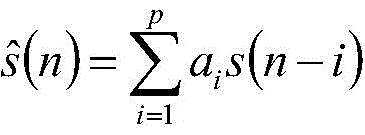 Performing an LPC analysis, wherein: a isi(i ═ 1, 2.. said., p) is linear prediction coefficient, p is prediction order, and the LPC characteristics of N speech-like symbol waveforms are obtained by solving, LPC1,lpc2,...lpci,...,lpcN(1≤i≤N),lpciLPC feature of ith voice symbol waveform is 1 x p vector;
a2, rule for selecting the first optimal voice symbol waveform:
abs(lpc1-lpc2) Representing the absolute value of the difference between the characteristics of the first speech-like symbol waveform LPC and the characteristics of the second speech-like symbol waveform LPC as a1 XP vector, adding the p values, and using diff12It is shown that,
diff13representing the difference between the characteristic values of the LPC of the first speech-like symbol waveform and the third speech-like symbol waveform,
diffmnrepresenting the difference between characteristic values of the mth speech-like symbol waveform and characteristic values of the nth speech-like symbol waveform LPC,
order:

in [ D ]1,D2,...,Di,...,DN]In, if DmIf the value is maximum, selecting the mth voice symbol-like waveform as the first optimal voice symbol-like waveform in the codebook;
a3, selectingi(2≤i≤Nsym) Rule of the optimal voice symbol waveform:
assuming that the first i-1 optimal phonetic symbol waveforms selected are in N phonetic symbol waveform s1,s2,...,sNPosition in is ind1,ind2,...,indi-1Removing of The remaining N- (i-1) speech-like symbol waveforms
 An optimal voice symbol waveform is selected from the voice symbol waveforms,
order:

in [ D'1,D'2,...,D'i,...,D'N-i+1]And if D'mIf the value is maximum, selecting the similar voice symbol waveform As the ith optimal voice symbol-like waveform in the codebook;
a4, repeat A3 until N is selectedsymAnd optimizing the voice symbol waveform. The method for improving the data transmission accuracy of the voice channel comprises that a sending end transmits data bits N needing to be transmitteddataFront end or middle adding synchronization bit NsynData bit NdataAnd a synchronization bit NsynAre grouped, every NbitEach group of bits is selected to modulate the corresponding voice symbol-like waveform in the codebook, and each group of L sampling points is synchronized with LENsyn=Nsyn/NbitL samples, data with LENdata=Ndata/NbitL samples, converting into a speech-like signal and transmitting the speech-like signal over a speech channel; the receiving end estimates the received speech-like symbol according to the maximum point-value product valueWaveform: y is the received signal of length L,<,>in order to calculate the sign for the dot product,
 in order to estimate the code book number, the data demodulation is carried out on the received voice-like signal, and before the demodulation, the method also comprises the following steps of determining a synchronization starting point:
b1, finding out the synchronous start position of the first frame:
setting an interval length lenoffsetReceive port pair [ index: index + lenoffset-1]This range is scanned as a starting point, let index equal to 1, then there is the following lenoffsetThe individual interval:
[1:LENsyn],[2:LENsyn+1],...,[lenoffset:lenoffset+LENsyn-1]
LEN in each interval according to maximum point value product valuesynThe sampling points are demodulated respectively to obtain lenoffsetA bit stream Respectively reacting them with NsynComparison was made to obtain lenoffsetBit error rate
 Selecting the minimum bit error rate berminIf berminGreater than 0.05, let index ═ index + lenoffsetContinue the scan calculation, if berminIf the synchronization starting point of the first frame is less than or equal to 0.05, determining the synchronization starting point of the first frame as start1The starting point of the data part is start1+LENsyn,
Receiving end pair [ start ]1+LENsyn:start1+LENsyn+LENdata-1]Carrying out data demodulation;
b2, finding out the synchronous start position of the f (f is more than or equal to 2) th frame:
let index be startf-1+LENsyn+LENdataReceiving port pair [ index-lenoffset/2:index+lenoffset/2]This range is scanned as a starting point, lenoffsetEven number, take the following lenoffset+1 intervals:
[index-lenoffset/2:index-lenoffset/2+LENsyn-1],
[index-lenoffset/2+1:index-lenoffset/2+LENsyn],
…
[index+lenoffset/2:index+lenoffset/2+LENsyn-1]
LEN in each interval according to maximum point value product valuesynThe sampling points are demodulated respectively to obtain lenoffset+1 bit stream Respectively reacting them with NsynComparison was made to obtain lenoffset+1 bit error rate
 If there are m minimum bit error rates, the position is [1:1+ lenoffset]Of [ pos ]1,pos2,...,posm]And then:
1) if m is 1, determining the synchronization starting point of the f-th frame as
startf=startf-1+LENsyn+LENdata-lenoffset/2+posm-1;
2) If m > 1 and pos 11, p [ pos ═ 12,...,posm]Sum of bit error rates of neighboring ones of the locations Making a comparison if bx(x is more than or equal to 1 and less than or equal to m-1) is the minimum, the synchronization starting point of the f frame is determined as
startf=startf-1+LENsyn+LENdata-lenoffset/2+posx+1-1;
3) If m > 1 and posm=1+lenoffsetTo [ pos ]1,...,posm-1]Sum of bit error rates of adjacent ones of the locations Making a comparison if bx(x is more than or equal to 1 and less than or equal to m-1) is the minimum, the synchronization starting point of the f frame is determined as
startf=startf-1+LENsyn+LENdata-lenoffset/2+posx-1;
4) If m > 1 and pos1≠1,posm≠1+lenoffsetTo [ pos ]1,...,posm]Sum of bit error rates of adjacent ones of the locations Making a comparison if bx(x is more than or equal to 1 and less than or equal to m-1) is the minimum, the synchronization starting point of the f frame is determined as
startf=startf-1+LENsyn+LENdata-lenoffset/2+posx-1。
The following description is given by way of specific examples:
1. with 2 bits in one group, there are four possibilities [ 00011011 ] in total, and four voice symbol-like waveforms need to be found for mapping, where two bits in each group are represented by 16 samples (L ═ 16), and the sampling rate is 8000Hz and the code rate is 1000 bps.
The steps of forming the voice-like symbol waveform are as follows:
is that
Select 4 real numbers Gk(k-1, 2, …,4) for generating a phonetic-like symbol spectrum.
② using real number G k4 spectral components are constructed:

utilizing Inverse Discrete Cosine Transform (IDCT) to convert phi into phiiConversion from frequency domain to time domain:


Fourthly, normalizing the power of the real number voice symbol waveform to generate the final time domain voice symbol waveform

Repeating the above steps until 16 phonetic symbol-like waveforms are generated.
Sixthly, according to the steps A1 to A4, 4 optimal voice symbol-like waveforms are selected, and as shown in figure 1, the 4 waveforms of 16 samples correspond to [ 00011011 ] bits respectively.
2. The receiving end estimates the received voice symbol-like waveform according to the maximum point value product value:

wherein y is a received signal of length L,<,>in order to calculate the sign for the dot product, the codebook is numbered for estimation.
3. Determining a synchronization start point
Transmitting 40 synchronization bits N per framesynBefore 1000 data bits, the encoding requires 1 group of every 2 bits, 20 groups of sync, and 500 groups of data. Each group is [ 00011011 ]]Of the corresponding codebook is selectedWhen the waveform of the voice-like symbol is modulated and transmitted, the LEN is synchronizedsyn320 samples, data with LENdata8000 spots.
B1, finding out the synchronous start position of the first frame:
setting an interval length len offset20, the receiving end pair [ index: index +19]This range is scanned as a starting point, and let index be 1, there are the following 20 intervals:
[1:320],[2:321],...,[20:339]
demodulating 320 sampling points in each interval according to the step 2 to obtain 20 bit streams Respectively reacting them with NsynComparing to obtain 20 bit error rates
 Selecting the minimum bit error rate berminIf berminIf > 0.05, let index equal to 21, continue the scanning calculation, if berminIf the synchronization starting point of the first frame is less than or equal to 0.05, determining the synchronization starting point of the first frame as start1The starting point of the data part is start1+320, receiving end pair [ start ]1+320:start1+8319]Carrying out data demodulation according to the
 step 2;
b2, finding out the synchronous start position of the f (f is more than or equal to 2) th frame:
f frame synchronization start position startfSynchronizing the start position according to the f-1 framef-1To determine the start due to clock jitter, channel instability, etcfStarting not being used solelyf-1+8320 indicates that an interval must still be set:
let index be startf-1+8320, receiving port pair [ index-10: index +10]This range is scanned as a starting point, taking the following 21 intervals:
[index-10:index+309],
[index-9:index+310],
…
[index+10:index+329]
demodulating 320 sampling points in each interval according to the step 2 to obtain 21 bit streams Respectively reacting them with NsynComparing to obtain 21 bit error rates
 Usually the minimum bit error rate ber is selectedminTo determine the startf。
Simulation: a total of 100 frames, each frame having a data portion that is randomly generated to produce an inconsistent bit stream, 8320 samples per frame, and decoding a speech-like signal composed of 832000 samples directly, such as: when the 2 nd frame synchronous part is decoded, there are 21 synchronous bit error rate values
The bit error rates of 10 th, 11 th and 12 th are all 0, the default value of the first 0 is the 10 th point, that is, the starting position is startf=startf-1+8319, but in fact there is no vocoder and channel at this time, the exact location is startf=startf-1+8320。
If there are more positions of vocoder and channel, which may be 0 or other minimum values, the default selection of the first minimum bit error rate is most likely not the optimal starting point, so a strategy such as 1) to 4) in B2 is required.
Such as described above In the above description, the bit error rate values at the 10 th, 11 th, and 12 th points are all 0, and if calculated according to the policy, the bit error rate values at the 10 th and 10 th points are added to 0.325+0 to 0.325, the bit error rate values at the 11 th and 11 th points are added to 0+0 to 0, the bit error rate values at the 12 th and 12 th points are added to 0+0.325 to 0.325, and the 11 th point is the optimal position, i.e., the start positionf=startf-1+8320。
After passing through the vocoder and the channel, the point with the minimum bit error rate may have a plurality of points and may be discontinuous, and the strategy can be used for selecting a more accurate synchronous initial position, so that a more accurate data initial position can be obtained.
The 100 frames of data passing through the vocoder and the channel are processed by the method for determining the synchronization start point by using the present invention and the method for determining the synchronization start point without using the present invention, respectively, and simulation results are shown in fig. 2 and 3.
As can be seen from fig. 2 and fig. 3, without the method for determining the synchronization start point of the present invention, the average bit error rate is 1.3657%, the frames with a bit error rate of less than 0.5% account for 52.5%, and the frames with a bit error rate of greater than 2% account for 20.2%.
While embodiments of the invention have been described above, it is not limited to the applications set forth in the description and the embodiments, which are fully applicable in various fields of endeavor to which the invention pertains, and further modifications may readily be made by those skilled in the art, it being understood that the invention is not limited to the details shown and described herein without departing from the general concept defined by the appended claims and their equivalents.
Claims (2)
1. A method for improving the accuracy of voice channel data transmission, comprising the steps of:
constructing N voice symbol-like waveforms; selecting N from the N speech-like symbol waveformssymAn optimal phonetic symbol waveform, N > NsymForming a codebook; the sending end groups the data bits to be transmitted every NbitOne bit in a group, there is a total of Possibility, each group selecting a corresponding speech-like symbol in said codebookModulating the waveform, converting the waveform into a voice-like signal, and transmitting the voice-like signal on a voice channel; the receiving end demodulates the received voice-like signal;
wherein N is selected from the N speech-like symbol waveformssymThe optimal voice symbol waveform specifically comprises:
a1 mathematical model of speech signal using linear predictive analysis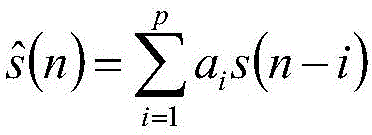 Performing an LPC analysis, wherein: a isiSolving linear prediction coefficients, i is 1,2, and p is a prediction order to obtain LPC characteristics of N voice symbol waveforms, LPC1,lpc2,...lpci,...,lpcN,1≤i≤N,lpciLPC feature of ith voice symbol waveform is 1 x p vector;
a2, rule for selecting the first optimal voice symbol waveform:
abs(lpc1-lpc2) Representing the absolute value of the difference between the characteristics of the first speech-like symbol waveform LPC and the characteristics of the second speech-like symbol waveform LPC as a1 XP vector, adding the p values, and using diff12It is shown that,
diff13representing the difference between the characteristic values of the LPC of the first speech-like symbol waveform and the third speech-like symbol waveform,
diffmnrepresenting the difference between characteristic values of the mth speech-like symbol waveform and characteristic values of the nth speech-like symbol waveform LPC,
order:


in [ D ]1,D2,...,Di,...,DN]In, if DmIf the value is maximum, selecting the mth voice symbol-like waveform as the first optimal voice symbol-like waveform in the codebook;
a3, selecting the rule of the ith optimal voice symbol waveform, i is more than or equal to 2 and less than or equal to Nsym:
Assuming that the first i-1 optimal voice symbol-like waveforms selected are in the N voice symbol-like waveforms s1,s2,...,sNPosition in is ind1,ind2,...,indi-1Removing of The remaining N- (i-1) speech-like symbol waveforms
 An optimal voice symbol waveform is selected from the voice symbol waveforms,
order:

in [ D'1,D'2,...,D'i,...,D'N-i+1]And if D'mIf the value is maximum, selecting the similar voice symbol waveform As the ith optimal voice symbol-like waveform in the codebook;
a4, repeat A3 until N is selectedsymAnd optimizing the voice symbol waveform.
2. The method of improving voice channel data transmission accuracy as claimed in claim 1, wherein the transmitting end transmits the data bits N required to be transmitteddataFront end or middle adding synchronization bit NsynData bit NdataAnd a synchronization bit NsynAre grouped, every NbitEach group of bits is selected from the corresponding voice symbol-like waveform in the codebookModulation, L samples per group, LEN synchronizedsyn=Nsyn/NbitL samples, data with LENdata=Ndata/NbitL samples, converting into a speech-like signal and transmitting the speech-like signal over a speech channel; the receiving end performs data demodulation on the received voice-like signal according to the maximum point value product value, and before demodulation, the method further comprises the following steps of determining a synchronization starting point, specifically:
b1, finding out the synchronous start position of the first frame:
setting an interval length lenoffsetReceive port pair [ index: index + lenoffset-1]This range is scanned as a starting point, let index equal to 1, then there is the following lenoffsetThe individual interval:
[1:LENsyn],[2:LENsyn+1],...,[lenoffset:lenoffset+LENsyn-1]
LEN in each interval according to maximum point value product valuesynThe sampling points are demodulated respectively to obtain lenoffsetA bit stream Respectively reacting them with NsynComparison was made to obtain lenoffsetBit error rate
 Selecting the minimum bit error rate berminIf berminGreater than 0.05, let index ═ index + lenoffsetContinue the scan calculation, if berminIf the synchronization starting point of the first frame is less than or equal to 0.05, determining the synchronization starting point of the first frame as start1The starting point of the data part is start1+LENsyn,
Receiving end pair [ start ]1+LENsyn:start1+LENsyn+LENdata-1]Carrying out data demodulation;
b2, finding out the synchronous initial position of the f frame, wherein f is more than or equal to 2:
let index be startf-1+LENsyn+LENdataReceiving end pair [ 2 ]index-lenoffset/2:index+lenoffset/2]This range is scanned as a starting point, lenoffsetEven number, take the following lenoffset+1 intervals:
[index-lenoffset/2:index-lenoffset/2+LENsyn-1],
[index-lenoffset/2+1:index-lenoffset/2+LENsyn],
…
[index+lenoffset/2:index+lenoffset/2+LENsyn-1]
LEN in each interval according to maximum point value product valuesynThe sampling points are demodulated respectively to obtain lenoffset+1 bit stream Respectively reacting them with NsynComparison was made to obtain lenoffset+1 bit error rate
 If there are m minimum bit error rates, the position is [1:1+ lenoffset]Of [ pos ]1,pos2,...,posm]And then:
1) if m is 1, determining the synchronization starting point of the f-th frame as
startf=startf-1+LENsyn+LENdata-lenoffset/2+posm-1;
2) If m > 1 and pos11, p [ pos ═ 12,...,posm]Sum of bit error rates of neighboring ones of the locations Making a comparison if bxMinimum, x is more than or equal to 1 and less than or equal to m-1, the synchronization starting point of the f frame is determined as
startf=startf-1+LENsyn+LENdata-lenoffset/2+posx+1-1;
3) If m > 1 and posm=1+lenoffsetTo [ pos ]1,…,posm-1]Sum of bit error rates of adjacent ones of the locations Making a comparison if bxMinimum, x is more than or equal to 1 and less than or equal to m-1, the synchronization starting point of the f frame is determined as
startf=startf-1+LENsyn+LENdata-lenoffset/2+posx-1;
4) If m > 1 and pos1≠1,posm≠1+lenoffsetTo [ pos ]1,...,posm]Sum of bit error rates of adjacent ones of the locations Making a comparison if bxMinimum, x is more than or equal to 1 and less than or equal to m-1, the synchronization starting point of the f frame is determined as
startf=startf-1+LENsyn+LENdata-lenoffset/2+posx-1。
Priority Applications (1)
| Application Number | Priority Date | Filing Date | Title |
|---|---|---|---|
| CN201910194081.6A CN109887519B (en) | 2019-03-14 | 2019-03-14 | Method for improving voice channel data transmission accuracy |
Applications Claiming Priority (1)
| Application Number | Priority Date | Filing Date | Title |
|---|---|---|---|
| CN201910194081.6A CN109887519B (en) | 2019-03-14 | 2019-03-14 | Method for improving voice channel data transmission accuracy |
Publications (2)
| Publication Number | Publication Date |
|---|---|
| CN109887519A CN109887519A (en) | 2019-06-14 |
| CN109887519B true CN109887519B (en) | 2021-05-11 |
Family
ID=66932349
Family Applications (1)
| Application Number | Title | Priority Date | Filing Date |
|---|---|---|---|
| CN201910194081.6A Active CN109887519B (en) | 2019-03-14 | 2019-03-14 | Method for improving voice channel data transmission accuracy |
Country Status (1)
| Country | Link |
|---|---|
| CN (1) | CN109887519B (en) |
Citations (3)
| Publication number | Priority date | Publication date | Assignee | Title |
|---|---|---|---|---|
| EP0852375A1 (en) * | 1996-12-19 | 1998-07-08 | Lucent Technologies Inc. | Speech coder methods and systems |
| CN1275228A (en) * | 1998-08-21 | 2000-11-29 | 松下电器产业株式会社 | Multi-mode Speech Coding Device and Decoding Device |
| CN101281749A (en) * | 2008-05-22 | 2008-10-08 | 上海交通大学 | Scalable Speech and Tone Joint Coding Apparatus and Decoding Apparatus |
Family Cites Families (10)
| Publication number | Priority date | Publication date | Assignee | Title |
|---|---|---|---|---|
| CA2135629C (en) * | 1993-03-26 | 2000-02-08 | Ira A. Gerson | Multi-segment vector quantizer for a speech coder suitable for use in a radiotelephone |
| US7054807B2 (en) * | 2002-11-08 | 2006-05-30 | Motorola, Inc. | Optimizing encoder for efficiently determining analysis-by-synthesis codebook-related parameters |
| CN1186765C (en) * | 2002-12-19 | 2005-01-26 | 北京工业大学 | Method for encoding 2.3kb/s harmonic wave excidted linear prediction speech |
| KR100651712B1 (en) * | 2003-07-10 | 2006-11-30 | 학교법인연세대학교 | Wideband speech coder and method thereof and Wideband speech decoder and method thereof |
| KR20060067016A (en) * | 2004-12-14 | 2006-06-19 | 엘지전자 주식회사 | Speech coding apparatus and method |
| US8457975B2 (en) * | 2009-01-28 | 2013-06-04 | Fraunhofer-Gesellschaft Zur Foerderung Der Angewandten Forschung E.V. | Audio decoder, audio encoder, methods for decoding and encoding an audio signal and computer program |
| CN102737637B (en) * | 2011-12-31 | 2013-11-27 | 清华大学 | Method for data transmission by using voice-like modulation and demodulation |
| US10115404B2 (en) * | 2015-07-24 | 2018-10-30 | Tls Corp. | Redundancy in watermarking audio signals that have speech-like properties |
| CN108521389B (en) * | 2018-02-07 | 2021-09-14 | 河南芯盾网安科技发展有限公司 | Method and system for reducing data transmission error rate of voice channel |
| CN109256141B (en) * | 2018-09-13 | 2023-03-28 | 北京芯盾集团有限公司 | Method for data transmission by using voice channel |
-
2019
- 2019-03-14 CN CN201910194081.6A patent/CN109887519B/en active Active
Patent Citations (3)
| Publication number | Priority date | Publication date | Assignee | Title |
|---|---|---|---|---|
| EP0852375A1 (en) * | 1996-12-19 | 1998-07-08 | Lucent Technologies Inc. | Speech coder methods and systems |
| CN1275228A (en) * | 1998-08-21 | 2000-11-29 | 松下电器产业株式会社 | Multi-mode Speech Coding Device and Decoding Device |
| CN101281749A (en) * | 2008-05-22 | 2008-10-08 | 上海交通大学 | Scalable Speech and Tone Joint Coding Apparatus and Decoding Apparatus |
Non-Patent Citations (1)
| Title |
|---|
| 类语音调制解调器的设计与实现;杨典兵 等;《电子技术应用》;20090531(第5期);第101-104页 * |
Also Published As
| Publication number | Publication date |
|---|---|
| CN109887519A (en) | 2019-06-14 |
Similar Documents
| Publication | Publication Date | Title |
|---|---|---|
| US6438173B1 (en) | Multicarrier transmission system for irregular transmission of data blocks | |
| EP2772910B1 (en) | Frame loss compensation method and apparatus for voice frame signal | |
| CN101958119B (en) | Audio-frequency drop-frame compensator and compensation method for modified discrete cosine transform domain | |
| CN102171753B (en) | Method for error hiding in the transmission of speech data with errors | |
| US6173015B1 (en) | Device and method for precoding data signals for PCM transmission | |
| US20050015242A1 (en) | Method for recovery of lost speech data | |
| JPH05344008A (en) | Equalization and decoding of digital communication channels | |
| CN101605000A (en) | Mobile underwater acoustic communication signal processing method with strong anti-multipath capability | |
| CN109347568B (en) | A continuous-phase multi-frequency modulation underwater acoustic communication method imitating dolphin whistle | |
| EP3928314B1 (en) | Spectral shape estimation from mdct coefficients | |
| US8463614B2 (en) | Audio encoding/decoding for reducing pre-echo of a transient as a function of bit rate | |
| CN111901271B (en) | A data transmission method and device | |
| CN111541505A (en) | A time-domain channel prediction method and system for OFDM wireless communication system | |
| CN109887519B (en) | Method for improving voice channel data transmission accuracy | |
| Li et al. | CoAS: Composite audio steganography based on text and speech synthesis | |
| CN106537500A (en) | Periodic integrated envelope sequence generation device, periodic integrated envelope sequence generation method, generation program, recording medium | |
| CN100505597C (en) | An OFDM Frequency Offset Estimation and Tracking Scheme | |
| CN109256141B (en) | Method for data transmission by using voice channel | |
| CN101312443B (en) | System and method for equalizing and demodulating OFDM communication | |
| CN113140224B (en) | Apparatus and method for comfort noise generation mode selection | |
| CN1317843C (en) | Carrier Frequency Synchronization Method and Communication Device in Digital Communication System | |
| CN108461087B (en) | Apparatus and method for digital signal passing through vocoder | |
| Čubrilović et al. | FBMC/OQAM-based secure voice communications over voice channels | |
| CN107276654B (en) | Signal processing method and system | |
| CN109391384A (en) | A kind of data emitting method and device based on modulated signal |
Legal Events
| Date | Code | Title | Description |
|---|---|---|---|
| PB01 | Publication | ||
| PB01 | Publication | ||
| SE01 | Entry into force of request for substantive examination | ||
| SE01 | Entry into force of request for substantive examination | ||
| GR01 | Patent grant | ||
| GR01 | Patent grant |