CN109627758B - Halogen-free flame-retardant glass fiber reinforced nylon - Google Patents
Halogen-free flame-retardant glass fiber reinforced nylon Download PDFInfo
- Publication number
- CN109627758B CN109627758B CN201811546453.9A CN201811546453A CN109627758B CN 109627758 B CN109627758 B CN 109627758B CN 201811546453 A CN201811546453 A CN 201811546453A CN 109627758 B CN109627758 B CN 109627758B
- Authority
- CN
- China
- Prior art keywords
- halogen
- free flame
- glass fiber
- fiber reinforced
- retardant
- Prior art date
- Legal status (The legal status is an assumption and is not a legal conclusion. Google has not performed a legal analysis and makes no representation as to the accuracy of the status listed.)
- Active
Links
Classifications
-
- C—CHEMISTRY; METALLURGY
- C08—ORGANIC MACROMOLECULAR COMPOUNDS; THEIR PREPARATION OR CHEMICAL WORKING-UP; COMPOSITIONS BASED THEREON
- C08J—WORKING-UP; GENERAL PROCESSES OF COMPOUNDING; AFTER-TREATMENT NOT COVERED BY SUBCLASSES C08B, C08C, C08F, C08G or C08H
- C08J5/00—Manufacture of articles or shaped materials containing macromolecular substances
- C08J5/04—Reinforcing macromolecular compounds with loose or coherent fibrous material
- C08J5/0405—Reinforcing macromolecular compounds with loose or coherent fibrous material with inorganic fibres
- C08J5/043—Reinforcing macromolecular compounds with loose or coherent fibrous material with inorganic fibres with glass fibres
-
- C—CHEMISTRY; METALLURGY
- C08—ORGANIC MACROMOLECULAR COMPOUNDS; THEIR PREPARATION OR CHEMICAL WORKING-UP; COMPOSITIONS BASED THEREON
- C08J—WORKING-UP; GENERAL PROCESSES OF COMPOUNDING; AFTER-TREATMENT NOT COVERED BY SUBCLASSES C08B, C08C, C08F, C08G or C08H
- C08J5/00—Manufacture of articles or shaped materials containing macromolecular substances
- C08J5/04—Reinforcing macromolecular compounds with loose or coherent fibrous material
- C08J5/10—Reinforcing macromolecular compounds with loose or coherent fibrous material characterised by the additives used in the polymer mixture
-
- C—CHEMISTRY; METALLURGY
- C08—ORGANIC MACROMOLECULAR COMPOUNDS; THEIR PREPARATION OR CHEMICAL WORKING-UP; COMPOSITIONS BASED THEREON
- C08J—WORKING-UP; GENERAL PROCESSES OF COMPOUNDING; AFTER-TREATMENT NOT COVERED BY SUBCLASSES C08B, C08C, C08F, C08G or C08H
- C08J2377/00—Characterised by the use of polyamides obtained by reactions forming a carboxylic amide link in the main chain; Derivatives of such polymers
- C08J2377/06—Polyamides derived from polyamines and polycarboxylic acids
-
- C—CHEMISTRY; METALLURGY
- C08—ORGANIC MACROMOLECULAR COMPOUNDS; THEIR PREPARATION OR CHEMICAL WORKING-UP; COMPOSITIONS BASED THEREON
- C08K—Use of inorganic or non-macromolecular organic substances as compounding ingredients
- C08K13/00—Use of mixtures of ingredients not covered by one single of the preceding main groups, each of these compounds being essential
- C08K13/04—Ingredients characterised by their shape and organic or inorganic ingredients
-
- C—CHEMISTRY; METALLURGY
- C08—ORGANIC MACROMOLECULAR COMPOUNDS; THEIR PREPARATION OR CHEMICAL WORKING-UP; COMPOSITIONS BASED THEREON
- C08K—Use of inorganic or non-macromolecular organic substances as compounding ingredients
- C08K3/00—Use of inorganic substances as compounding ingredients
- C08K3/18—Oxygen-containing compounds, e.g. metal carbonyls
- C08K3/20—Oxides; Hydroxides
- C08K3/22—Oxides; Hydroxides of metals
- C08K2003/2296—Oxides; Hydroxides of metals of zinc
-
- C—CHEMISTRY; METALLURGY
- C08—ORGANIC MACROMOLECULAR COMPOUNDS; THEIR PREPARATION OR CHEMICAL WORKING-UP; COMPOSITIONS BASED THEREON
- C08K—Use of inorganic or non-macromolecular organic substances as compounding ingredients
- C08K3/00—Use of inorganic substances as compounding ingredients
- C08K3/32—Phosphorus-containing compounds
- C08K2003/321—Phosphates
-
- C—CHEMISTRY; METALLURGY
- C08—ORGANIC MACROMOLECULAR COMPOUNDS; THEIR PREPARATION OR CHEMICAL WORKING-UP; COMPOSITIONS BASED THEREON
- C08K—Use of inorganic or non-macromolecular organic substances as compounding ingredients
- C08K3/00—Use of inorganic substances as compounding ingredients
- C08K3/38—Boron-containing compounds
- C08K2003/387—Borates
-
- C—CHEMISTRY; METALLURGY
- C08—ORGANIC MACROMOLECULAR COMPOUNDS; THEIR PREPARATION OR CHEMICAL WORKING-UP; COMPOSITIONS BASED THEREON
- C08K—Use of inorganic or non-macromolecular organic substances as compounding ingredients
- C08K3/00—Use of inorganic substances as compounding ingredients
- C08K3/18—Oxygen-containing compounds, e.g. metal carbonyls
- C08K3/24—Acids; Salts thereof
-
- C—CHEMISTRY; METALLURGY
- C08—ORGANIC MACROMOLECULAR COMPOUNDS; THEIR PREPARATION OR CHEMICAL WORKING-UP; COMPOSITIONS BASED THEREON
- C08K—Use of inorganic or non-macromolecular organic substances as compounding ingredients
- C08K5/00—Use of organic ingredients
- C08K5/16—Nitrogen-containing compounds
- C08K5/34—Heterocyclic compounds having nitrogen in the ring
- C08K5/3467—Heterocyclic compounds having nitrogen in the ring having more than two nitrogen atoms in the ring
- C08K5/3477—Six-membered rings
- C08K5/3492—Triazines
- C08K5/34928—Salts
-
- C—CHEMISTRY; METALLURGY
- C08—ORGANIC MACROMOLECULAR COMPOUNDS; THEIR PREPARATION OR CHEMICAL WORKING-UP; COMPOSITIONS BASED THEREON
- C08K—Use of inorganic or non-macromolecular organic substances as compounding ingredients
- C08K5/00—Use of organic ingredients
- C08K5/49—Phosphorus-containing compounds
- C08K5/51—Phosphorus bound to oxygen
- C08K5/53—Phosphorus bound to oxygen bound to oxygen and to carbon only
- C08K5/5313—Phosphinic compounds, e.g. R2=P(:O)OR'
-
- C—CHEMISTRY; METALLURGY
- C08—ORGANIC MACROMOLECULAR COMPOUNDS; THEIR PREPARATION OR CHEMICAL WORKING-UP; COMPOSITIONS BASED THEREON
- C08K—Use of inorganic or non-macromolecular organic substances as compounding ingredients
- C08K7/00—Use of ingredients characterised by shape
- C08K7/02—Fibres or whiskers
- C08K7/04—Fibres or whiskers inorganic
- C08K7/14—Glass
Landscapes
- Chemical & Material Sciences (AREA)
- Chemical Kinetics & Catalysis (AREA)
- Engineering & Computer Science (AREA)
- Manufacturing & Machinery (AREA)
- Materials Engineering (AREA)
- Health & Medical Sciences (AREA)
- Medicinal Chemistry (AREA)
- Polymers & Plastics (AREA)
- Organic Chemistry (AREA)
- Inorganic Chemistry (AREA)
- Compositions Of Macromolecular Compounds (AREA)
- Fireproofing Substances (AREA)
- Treatments For Attaching Organic Compounds To Fibrous Goods (AREA)
Abstract
The invention discloses a halogen-free flame-retardant glass fiber reinforced nylon which comprises the following raw materials in percentage by weight: 30-60% of nylon; 20-40% of glass fiber; 10-30% of a halogen-free flame-retardant compound system; the halogen-free flame-retardant compound system comprises the following raw materials in percentage by weight: 60-85% of organic hypophosphite; 13-35% of melamine polyphosphate borate; 2-8% of a char forming agent; the structural formula of the polyphosphoric acid melamine borate is shown as the following formula (I), wherein m is the molar ratio of polyphosphoric acid melamine to boric acid, and m is 3-6. The halogen-free flame-retardant glass fiber reinforced nylon disclosed by the invention adopts a novel halogen-free flame-retardant compound system, the halogen-free flame-retardant compound system has low solubility and high char yield, and the prepared halogen-free flame-retardant glass fiber reinforced nylon obtains excellent flame-retardant effect and can reach the flame-retardant standard of UL94-V0(1.6 mm).
Description
Technical Field
The invention relates to the technical field of glass fiber reinforced nylon, in particular to halogen-free flame-retardant glass fiber reinforced nylon.
Background
Glass fiber reinforced nylon (mainly nylon 66 and nylon 6) is widely applied to the field of electronic and electrical appliances due to the performance characteristics of good rigidity and impact resistance, low warping property, high dimensional stability, good surface appearance and the like. Ordinary nylon is flammable material, but when it compounds with glass fiber, because the wick effect of glass fiber, make glass fiber reinforced nylon become more easily burning, therefore the fire-retardant processing of glass fiber reinforced nylon becomes a necessary demand, and the existence of wick effect makes its fire-retardant degree of difficulty bigger.
At present, the flame retardance of the glass fiber reinforced nylon material comprises two basic flame retardant systems: halogen-based flame retardant systems and non-halogen flame retardant systems. The halogen flame-retardant system mainly refers to bromine flame retardant, including decabromodiphenylethane, brominated polystyrene, etc. A large number of researches show that the glass fiber reinforced nylon material added with the brominated flame retardant can generate dense smoke, hydrogen bromide and other harmful substances during combustion and can cause human body suffocation. Therefore, the development of a safe, environment-friendly and halogen-free flame retardant system for the glass fiber reinforced nylon material becomes a research hotspot, and a novel halogen-free flame retardant or flame retardant system applied to the glass fiber reinforced nylon material appears in recent years.
According to the reports of the literature, the halogen-free flame retardant applied to the glass fiber reinforced nylon material mainly comprises two main basic systems: one is red phosphorus; another class is intumescent flame retardant systems. For red phosphorus, although it has a good flame retardant effect, it faces two problems: firstly, the color of red phosphorus limits the application range, and is usually only applied to black products; and secondly, severe poisons such as phosphine and the like are easily generated in the processing process, so that the problems of environmental protection and safety are caused, and therefore, the red phosphorus is not the best choice for the glass fiber reinforced nylon material. The intumescent flame retardant system is a high-efficiency flame retardant system, and can form a compact carbon layer on the nylon surface at a high temperature, and the carbon layer has the advantages of heat insulation, smoke suppression, no generation of toxic and harmful gases and good flame retardant effect.
Melamine polyphosphate (MPP) is a phosphorus-nitrogen intumescent flame retardant and has the characteristics of good thermal stability, excellent flame retardant property, good compatibility with base materials, no halogen, low smoke and the like. At present, the most widely used intumescent flame retardant system for glass fiber reinforced nylon materials is a compound melamine polyphosphate (MPP) system based on diethyl aluminum hypophosphite. The intumescent flame retardant system has higher phosphorus content and the synergistic action of phosphorus and nitrogen, can realize high-efficiency flame retardance of the glass fiber reinforced nylon material, has very high decomposition temperature, and does not generate extremely toxic gases such as phosphine and the like in the high-temperature processing process of the glass fiber reinforced nylon material. But the melamine polyphosphate is easy to absorb moisture, so that the use is inconvenient; meanwhile, the carbon forming efficiency of the melamine polyphosphate is low, the flame retardant efficiency is low, the addition amount of the melamine polyphosphate is large, the mechanical property of a finished product is reduced, and the like, which limit the large-scale application of the melamine polyphosphate in the glass fiber reinforced nylon material.
Disclosure of Invention
The invention discloses a halogen-free flame-retardant glass fiber reinforced nylon, which adopts a halogen-free flame-retardant compound system consisting of a novel halogen-free phosphorus-nitrogen intumescent flame retardant, namely polyphosphoric acid melamine borate, an organic hypophosphite and a char forming agent, the halogen-free flame-retardant compound system has low solubility and high char forming rate, and the prepared halogen-free flame-retardant glass fiber reinforced nylon obtains excellent flame-retardant effect and can reach the flame-retardant standard of UL94-V0(1.6 mm).
The specific technical scheme is as follows:
the halogen-free flame-retardant glass fiber reinforced nylon comprises the following raw materials in percentage by weight:
30-60% of nylon;
20-40% of glass fiber;
10-30% of a halogen-free flame-retardant compound system;
the halogen-free flame-retardant compound system comprises the following raw materials in percentage by weight:
60-85% of organic hypophosphite;
13-35% of melamine polyphosphate borate;
2-8% of a char forming agent.
The structural formula of the polyphosphoric acid melamine borate is shown as the following formula (I):
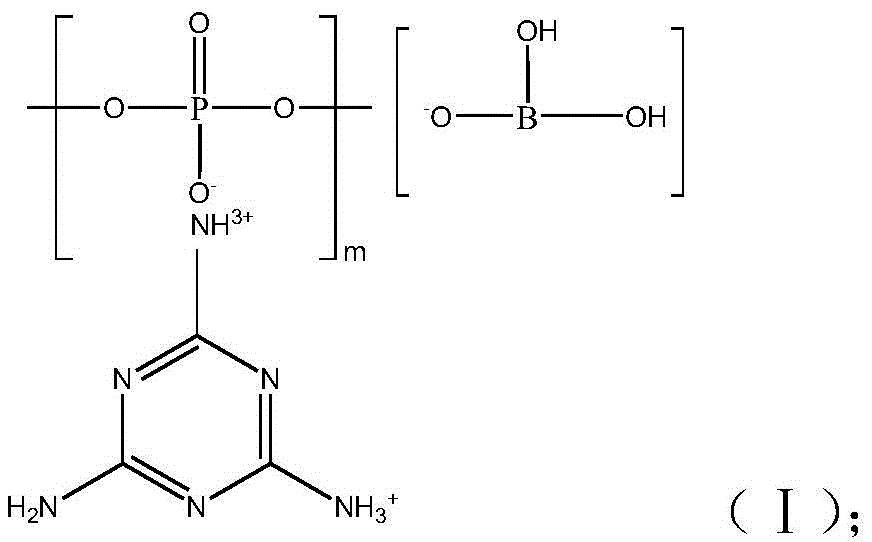
wherein m is the molar ratio of melamine polyphosphate to boric acid, and m is 3-6.
The invention adopts a novel flame-retardant compound system which comprises the melamine polyphosphate boracic acid, the organic hypophosphite and the carbon forming agent, and the three are applied to a glass fiber reinforced nylon material system after being compounded in a specific proportion, thereby showing excellent flame-retardant efficiency. In the compound flame-retardant system, the polyphosphoric acid melamine borate is a novel halogen-free phosphorus-nitrogen intumescent flame retardant disclosed for the first time, and boric acid is introduced into the polyphosphoric acid melamine, so that the char formation amount of a product of the flame retardant at a high temperature is obviously improved, and the flame-retardant efficiency of the flame retardant is improved. After the boric acid is introduced, a glass substance can be formed to cover the surface of the material in the combustion process of the material, so that the diffusion of combustible gas is blocked, and the flame retardant property of the material is improved.
Further tests show that when only a two-component flame-retardant system consisting of melamine polyphosphate borate and organic hypophosphite is added, the flame retardant property of the prepared glass fiber reinforced nylon can reach the standard of UL94V-0, but color change is easy to occur in the processing process; and the degradation of the polymer in the processing process is easy to cause, and the mechanical property of the material is reduced.
The preparation method of the polyphosphoric acid melamine borate salt comprises the following steps:
a. dispersing melamine in water, heating to 60-80 ℃, mixing with phosphoric acid, and carrying out heat preservation reaction at 70-100 ℃ to obtain an intermediate;
b. b, mixing boric acid with water, heating to 60-80 ℃ to completely dissolve the boric acid, mixing the boric acid with the intermediate prepared in the step a, continuously heating to 80-100 ℃, and carrying out heat preservation reaction to obtain an intermediate product;
c. and c, carrying out heat treatment on the intermediate product prepared in the step b at the temperature of 300-360 ℃ to obtain the melamine polyphosphate borate.
In step a, in order to facilitate the dispersion of melamine and avoid agglomeration, phosphoric acid is preferably added dropwise to the melamine aqueous solution, and the addition is guaranteed to be completed within 2 hours. Tests show that if phosphoric acid and water are mixed and then melamine is added dropwise, the melamine phosphate is easy to agglomerate in the synthesis process, and the prepared melamine polyphosphate has high solubility.
In step a, the phosphoric acid is selected from the commercially available phosphoric acid containing 85 wt% H3PO4In the mass ratio of melamine to phosphoric acid, the mass of phosphoric acid in the following said concentrated solution in a viscous state of melamine to phosphoric acid is calculated as said 85 wt% H3PO4The mass of the solute in (1).
Preferably:
the mass ratio of the melamine to the water is 1: 2.5-5.0; the concentration of the melamine aqueous solution is too high, and the product is easy to agglomerate and difficult to uniformly disperse in the dropping process of the phosphoric acid; the concentration is too low, the solubility of the finished product in water is too high, the yield of the product is reduced, and the wastewater treatment capacity is increased.
The mass ratio of the melamine to the phosphoric acid is 1.1-1.42: 1.
In the step a, after the heat preservation reaction, post-treatment processes such as filtering, washing, drying and the like are required. The drying temperature is 120-140 ℃, and the drying time is 2-4 h.
In the step b, the boric acid is completely dissolved in the water to obtain a boric acid aqueous solution, and then the aqueous solution is uniformly mixed with the intermediate. In the step, the adding amount of boric acid needs to be strictly controlled, and the excessive addition of boric acid can increase the solubility of the product and reduce the thermal stability of the product; the addition amount of boric acid is small, and a stable glassy continuous carbon layer is difficult to form on the surface of the material in the combustion process of the material, so that the aim of improving the flame-retardant efficiency cannot be achieved. Preferably, the mass ratio of the intermediate to the boric acid is 9-12: 1.
Preferably, the mass ratio of the boric acid to the water is 1: 25-55; the concentration of the boric acid aqueous solution is too high, the boric acid is not fully dissolved, and the reaction time is long; the concentration is too low, the product yield is low, and the subsequent wastewater treatment capacity is large.
In the step b, post-treatment processes such as filtering, washing, drying and the like are also needed after the heat preservation reaction. The drying temperature is 120-140 ℃, and the drying time is 2-4 h.
In the step c, the heat treatment is carried out in a specific temperature range, so that the heat stability of the product can be further improved, the solubility of the product in water is reduced, and the water absorption resistance of the product is improved. Preferably, the heat treatment temperature is 330-360 ℃.
The polyphosphoric acid melamine borate salt prepared by the process has good water absorption resistance and high carbon forming efficiency at high temperature. Tests show that the solubility of the melamine polyphosphate is 0.03-0.10 g/L at 25 ℃, the carbon residue at 800 ℃ is 35.0-51.2%, and the solubility is improved by about 5-10% compared with the melamine polyphosphate.
The formula system of the invention has no special requirements on the nylon base material, and can be selected from one or the compound of at least two of common varieties PA6, PA66, PA11, PA12, PA46, PA610, PA612, PAl010 and the like, semi-aromatic nylon PA6T and special nylon and the like. At least one of nylon 6 and nylon 66 is preferable.
The reinforcement employed in the formulation of the present invention is most commonly glass fiber, but is equally applicable to other types of reinforcement, such as carbon fiber, silicon carbide ceramic fiber, aramid fiber, and the like.
In the formula system, the organic hypophosphite, the charring agent and the polyphosphoric acid melamine borate are compounded to form a compound flame-retardant system.
Preferably:
the organic hypophosphite is selected from diethyl aluminium phosphinate.
The carbon forming agent is at least one of zinc oxide, zinc borate, zinc stannate and zirconium phosphate.
Further preferably, the addition amount of the halogen-free flame-retardant compound system is 15-25% by weight of the total weight of the raw materials, and the halogen-free flame-retardant compound system comprises the following raw materials in percentage by weight:
64-80% of aluminum diethylphosphinate;
15-30% of melamine polyphosphate borate;
5-8% of a char forming agent.
Still further preferably, the addition amount of the halogen-free flame retardant compound system is 20%, and the halogen-free flame retardant compound system comprises the following raw materials in percentage by weight:
67.5-77.5% of aluminum diethylphosphinate;
15-25% of melamine polyphosphate borate;
5-7.5% of a char forming agent.
More preferably, the melamine polyphosphate borate salt, m, is 3.1 to 3.9, and has a higher carbon residue amount of about 41.0 to 50.2% at 800 ℃.
Preferably, the average particle size D50 of the aluminum diethylphosphinate is 20-50 μm, the average particle size D50 of the melamine polyphosphate borate is 20-50 μm, and the average particle size D50 of the carbon forming agent is 20-50 μm. The three raw materials all adopt approximate particle size ranges, and uniform mixing of powder can be guaranteed.
The preparation method of the halogen-free flame-retardant glass fiber reinforced nylon comprises the following steps:
(1) uniformly mixing organic phosphinate, melamine polyphosphate borate and a carbon forming agent according to the weight ratio to obtain a powder raw material;
(2) and (2) adding a base material into a hopper by adopting a double-screw extruder, adding glass fibers from a glass fiber inlet, adding the powder raw material prepared in the step (1) from a powder feeding hole, starting a host machine and a feeding machine, and extruding and granulating to obtain the halogen-free flame-retardant glass fiber reinforced engineering plastic.
Compared with the prior art, the invention has the following advantages:
the invention discloses a halogen-free flame-retardant compound system applied to a halogen-free flame-retardant glass fiber reinforced nylon system, which is prepared by compounding a novel halogen-free phosphorus-nitrogen intumescent flame retardant melamine polyphosphate borate, an organic hypophosphite and a char forming agent. The novel melamine borate polyphosphate flame retardant has the advantages of good water absorption resistance and high-temperature carbonization efficiency, can obviously improve the flame retardant efficiency of a glass fiber reinforced nylon system after being compounded with organic hypophosphite and a carbonizing agent in a specific proportion, has shorter combustion time, can reach the flame retardant standard of UL94-V0(1.6mm), and has yellowing resistance and excellent mechanical properties.
Detailed Description
The present invention will be further illustrated with reference to the following specific embodiments. It should be understood that these examples are for illustrative purposes only and are not intended to limit the scope of the present invention. Further, it should be understood that various changes and modifications of the present invention may be made by those skilled in the art after reading the teachings of the present invention, and such equivalents may fall within the scope of the present invention as defined in the appended claims.
Example 1
a. A1000 mL four-neck flask equipped with a stirrer, a thermometer and a reflux condenser was charged with 500mL of deionized water and 186g of melamine, heated to a temperature of 80 ℃ and stirred, and 199g of 85% phosphoric acid was slowly added dropwise over a period of about one hour. Stirring at 95 deg.C for 2 hr. The resulting slurry was filtered, washed several times with deionized water, and dried at 120 ℃ to yield 323.7g of intermediate.
b. And (b) adding 1000mL of deionized water and 27.1g of boric acid into a 2000mL four-neck flask provided with a stirrer, a thermometer and a reflux condensing device, heating to 80 ℃ to completely dissolve the boric acid, adding 323.7g of the intermediate obtained in the step a, keeping the temperature of 80 ℃, and stirring for reacting for 3 hours. The suspension was cooled, filtered and washed several times with deionized water and then dried at 120 ℃ to give 316.4g of intermediate product.
c. And (c) carrying out heat treatment on 316.4g of the intermediate product obtained in the step (b) at the temperature of 330 ℃ for 4h, and cooling after the heat treatment is finished to obtain a final product with the weight of 278.9 g.
The final product prepared in this example was subjected to infrared spectroscopy and elemental analysis tests, respectively, and the main characteristic peaks of the infrared spectroscopy were as follows: 1680cm-1C is equal to N stretching vibration peak; 1622cm-1Is the N-H bending vibration peak; 1245cm-1Is P ═ O stretching vibration peak, 1329cm-1Is the stretching vibration peak of B-O; the elemental analysis results show that the phosphorus content in the product is: 13.1%, boron content: 2.3%, nitrogen content: 35.5%, oxygen content: 25.0 percent; the polyphosphoric acid melamine borate contains elements such as boron, phosphorus, nitrogen and the like, and the structural formula of the final product is proved to be as follows, wherein m is 3.9.

Through the test of thermal weight loss and solubility, the solubility of the product in water at 25 ℃ is 0.06g/L, and the carbon residue at 800 ℃ is 41.0%.
The melamine polyphosphate borate prepared in the example, aluminum diethylphosphinate and carbonizing agent zinc oxide were compounded and applied to glass fiber reinforced nylon 66, and the specific formulation and flame retardant properties are listed in table 1 below.
The raw materials were prepared according to the formulation of table 1 (raw materials in weight percent) and thoroughly dried, then the ingredients were mixed well in a high speed mixer, pelletized by extrusion from a twin screw extruder, standard test bars (thickness 1.6mm) were prepared on an injection molding machine, tested for flame retardancy (UL94), and the total burning time of 5 test bars was recorded.
Comparative example 1
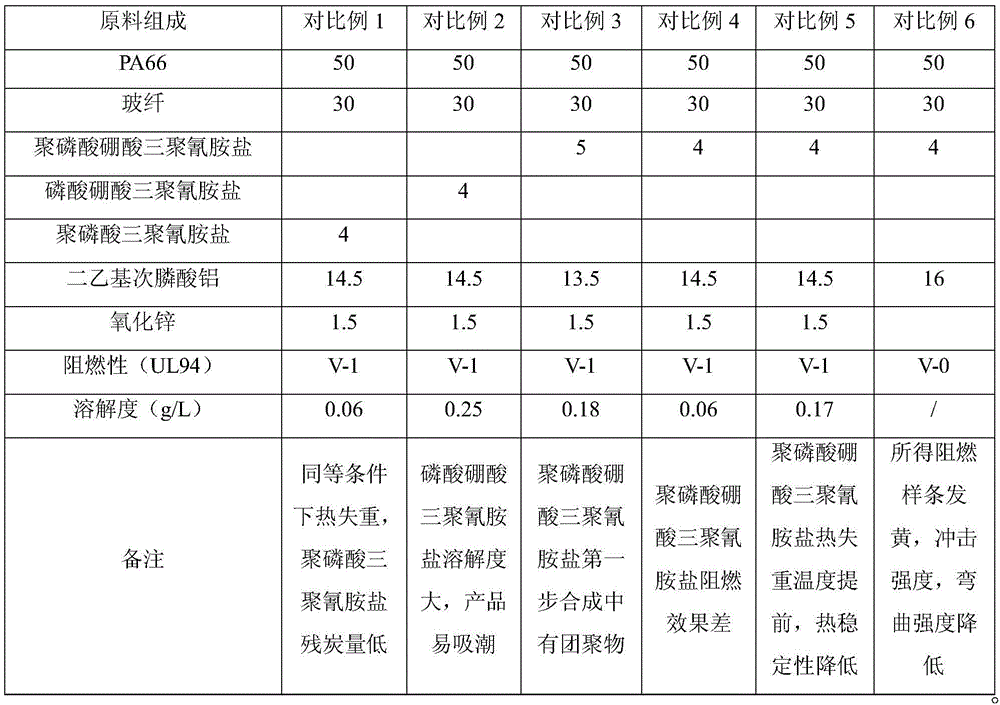
Compared with the preparation process of the example 1, the intermediate prepared in the step a is directly subjected to heat treatment at 330 ℃ for 4h except for the step b, and the product is melamine polyphosphate after being cooled after being tested.
The melamine polyphosphate prepared by the comparative example, aluminum diethylphosphinate and carbonizing agent zinc oxide are compounded and applied to the glass fiber reinforced nylon 66, and the specific formula and the flame retardant property are listed in the following table 1.
Comparative example 2
Compared with the preparation process of the example 1, the step c is removed, namely the intermediate product (namely melamine borate phosphate) prepared in the step b, aluminum diethylphosphinate and carbonizing agent zinc oxide are directly compounded and applied to the glass fiber reinforced nylon 66, and the specific formula and the flame retardant property are listed in the following table 1.
Comparative example 3
The preparation process of melamine polyphosphate borate salt is the same as in example 1, except that in step a, 500mL of deionized water is first mixed uniformly with 199g of 85 wt% phosphoric acid, and then 186g of melamine is slowly added.
Through tests, the solubility of the melamine polyphosphate borate salt prepared in the comparative example at 25 ℃ is 0.18g/L, and the residual carbon content at 800 ℃ is 39.2% through the thermal weight loss and solubility tests.
The melamine polyphosphate borate prepared in the comparative example, aluminum diethylphosphinate and carbonizing agent zinc oxide were compounded and applied to glass fiber reinforced nylon 66, and the specific formulation and flame retardant properties are listed in table 1 below.
Comparative example 4
The process for the preparation of melamine polyphosphate borate salt was the same as in example 1 except that in step b, 17.9g of boric acid was added.
The melamine polyphosphate borate salt prepared in this comparative example was tested, and m was 6.3. Through the test of thermal weight loss and solubility, the solubility of the product at 25 ℃ is 0.06g/L, and the carbon residue at 800 ℃ is 33.6%.
The melamine polyphosphate borate prepared in the comparative example, aluminum diethylphosphinate and carbonizing agent zinc oxide were compounded and applied to glass fiber reinforced nylon 66, and the specific formulation and flame retardant properties are listed in table 1 below.
Comparative example 5
The process for the preparation of melamine polyphosphate borate salt was the same as in example 1 except that in step b, 36.9g of boric acid was added.
The melamine polyphosphate borate salt prepared in this comparative example was tested, with m being 2.8. Through the test of thermal weight loss and solubility, the solubility of the product at 25 ℃ is 0.17g/L, and the carbon residue at 800 ℃ is 49.2%.
The melamine polyphosphate borate prepared in the comparative example, aluminum diethylphosphinate and carbonizing agent zinc oxide were compounded and applied to glass fiber reinforced nylon 66, and the specific formulation and flame retardant properties are listed in table 1 below.
Comparative example 6
The melamine polyphosphate borate prepared in example 1 was compounded with aluminum diethylphosphinate alone and applied to glass fiber reinforced nylon 66, and the specific formulation and flame retardant properties are listed in table 1 below.
Example 2
a. A1000 mL four-necked flask equipped with a stirrer, a thermometer and a reflux condenser was charged with 500mL of deionized water and 186g of melamine, heated to raise the temperature and stirred to 60 ℃, and 154g of 85 wt% phosphoric acid was slowly added dropwise over a period of about one hour. Stirring the mixture for 1 hour at 80 ℃ to finish the reaction, filtering the obtained slurry, washing the slurry with deionized water for multiple times, and drying the washed slurry at 120 ℃ to obtain 289.9g of an intermediate.
b. Adding 800mL of deionized water into a 2000mL four-neck flask provided with a stirrer, a thermometer and a reflux condensing device, adding 31.7g of boric acid, heating to raise the temperature and stirring to completely dissolve the boric acid, continuing to raise the temperature to 90 ℃, adding 289.9g of the intermediate obtained in the step a, and then stirring to react for 3.5 hours at the temperature of 100 ℃. The suspension was cooled, filtered and washed several times with deionized water and then dried at 120 ℃ to give 289.5g of intermediate product.
c. And (c) performing heat treatment on 289.5g of the intermediate product obtained in the step (b) at the temperature of 340 ℃ for 2h, and cooling to obtain the melamine polyphosphate borate after the heat treatment is completed, wherein the weight of the product is 242.8 g.
The melamine polyphosphate borate salt prepared in this example was tested, with m being 3.2. Through the test of thermal weight loss and solubility, the solubility of the product at 25 ℃ is 0.08g/L, and the carbon residue at 800 ℃ is 47.5%.
The melamine polyphosphate borate prepared in the example, aluminum diethylphosphinate and carbonizing agent zinc borate were compounded and applied to glass fiber reinforced nylon 66, and the specific formulation and flame retardant properties are listed in table 1 below.
Example 3
a. A1000 mL four-necked flask equipped with a stirrer, a thermometer and a reflux condenser was charged with 500mL of deionized water and 186g of melamine, heated to 100 ℃ and stirred, and 199g of 85 wt% phosphoric acid was slowly added dropwise over a period of about one hour. Stirring for 2 hours at 90 ℃ to finish the reaction, filtering the obtained slurry, washing the slurry with deionized water for multiple times, and drying the washed slurry at 120 ℃ to obtain 332.1g of an intermediate.
b. And (b) adding 1000mL of deionized water and 31.1g of boric acid into a 2000mL four-neck flask provided with a stirrer, a thermometer and a reflux condensing device, heating to raise the temperature and stirring to completely dissolve the boric acid, continuing to raise the temperature to 100 ℃, adding 332.1g of the intermediate obtained in the step a, keeping the temperature at 92 ℃, and stirring to react for 3 hours. The suspension was cooled, filtered and washed several times with deionized water and then dried at 140 ℃ to give 313.9g of intermediate product.
c. And (c) carrying out heat treatment on 313.9g of the intermediate product obtained in the step (b) at the temperature of 360 ℃ for 3h, and cooling after the heat treatment is finished to obtain a product of the melamine polyphosphate borate, wherein the weight of the product is 259.9 g.
The melamine polyphosphate borate salt prepared in this example was tested, with m being 3.1. Through the test of thermal weight loss and solubility, the solubility of the product at 25 ℃ is 0.05g/L, and the carbon residue at 800 ℃ is 50.2%.
The melamine polyphosphate borate prepared in the example, aluminum diethylphosphinate and carbonizing agent zinc stannate were compounded and applied to glass fiber reinforced nylon 66, and the specific formulation and flame retardant properties are listed in table 1 below.
Example 4
a. 500mL of deionized water and 186g of melamine are added into a 1000mL four-neck flask provided with a stirrer, a thermometer and a reflux condenser, the mixture is heated and stirred to be heated to 80 ℃, 161g of 85% phosphoric acid is slowly dripped after dripping for about 1h, the temperature is continuously raised to 90 ℃, and the mixture is kept and stirred for 2 h. The resulting slurry was filtered, washed several times with deionized water, and then dried at 120 ℃ to yield 296.5g of intermediate.
b. And (2) adding 1400mL of deionized water and 25.6g of boric acid into a 3000mL four-neck flask provided with an electric stirrer, a thermometer and a reflux condenser, heating to raise the temperature and stirring to completely dissolve the boric acid, continuously raising the temperature to 80 ℃, adding 296.5g of the intermediate obtained in the step a, keeping the temperature at 85 ℃, and stirring to react for 4.5 hours. The suspension was cooled, filtered and washed several times with deionized water and then dried at 120 ℃ to give 285.4g of intermediate product.
c. And (c) carrying out heat treatment on 285.4g of the intermediate product obtained in the step (b) at the temperature of 350 ℃ for 2h, and cooling after the heat treatment is finished to obtain a product melamine polyphosphate borate, wherein the weight of the product is 238.1 g.
The melamine polyphosphate borate salt prepared in this example was tested, and m was 3.9. Through the test of thermal weight loss and solubility, the solubility of the product at 25 ℃ is 0.05g/L, and the carbon residue at 800 ℃ is 43.9%.
The melamine polyphosphate borate prepared in the example, aluminum diethylphosphinate and carbon forming agent zirconium phosphate were compounded and applied to glass fiber reinforced nylon 66, and the specific formulation and flame retardant properties are listed in table 1.
TABLE 1
| Composition of raw materials | Example 1 | Example 2 | Example 3 | Example 4 |
| PA66 | 50 | 50 | 50 | 50 |
| Glass fiber | 30 | 30 | 30 | 30 |
| Polyphosphoric acid melamine borate salts | 4 | 3 | 5 | 4.5 |
| Aluminium diethylphosphinate | 14.5 | 15.5 | 13.5 | 14.5 |
| Zinc oxide | 1.5 | / | / | / |
| Zinc borate | / | 1.5 | / | / |
| Zinc stannate | / | / | 1.5 | / |
| Zirconium phosphate | / | / | / | 1.0 |
| Flame retardancy (UL94) | V-0 | V-0 | V-0 | V-0 |
| Solubility (g/L) | 0.06 | 0.08 | 0.05 | 0.05 |
TABLE 1
Claims (9)
1. The halogen-free flame-retardant glass fiber reinforced nylon is characterized by comprising the following raw materials in percentage by weight:
30-60% of nylon;
20-40% of glass fiber;
10-30% of a halogen-free flame-retardant compound system;
the halogen-free flame-retardant compound system comprises the following raw materials in percentage by weight:
60-85% of organic hypophosphite;
13-35% of melamine polyphosphate borate;
2-8% of a char forming agent;
the structural formula of the polyphosphoric acid melamine borate is shown as the following formula (I):

in the formula, m is the molar ratio of two structural units of melamine polyphosphate and boric acid, and m is 3-6;
the solubility of the polyphosphoric acid melamine borate at 25 ℃ is 0.03-0.10 g/L, and the carbon residue at 800 ℃ is 35.0-51.2%;
the preparation process of the polyphosphoric acid boric acid melamine salt comprises the following steps:
a. dispersing melamine in water, heating to 60-80 ℃, mixing with phosphoric acid, and carrying out heat preservation reaction at 70-100 ℃ to obtain an intermediate;
b. b, mixing boric acid with water, heating to 60-80 ℃ to completely dissolve the boric acid, mixing the boric acid with the intermediate prepared in the step a, continuously heating to 80-100 ℃, and carrying out heat preservation reaction to obtain an intermediate product; the mass ratio of the intermediate to the boric acid is 9-12: 1;
c. and c, carrying out heat treatment on the intermediate product prepared in the step b at the temperature of 300-360 ℃ to obtain the melamine polyphosphate borate.
2. The halogen-free flame-retardant glass fiber reinforced nylon according to claim 1, wherein the nylon is at least one selected from nylon 6 and nylon 66.
3. The halogen-free flame-retardant glass fiber reinforced nylon according to claim 1, wherein the organic hypophosphite is selected from aluminum diethylphosphinate.
4. The halogen-free flame retardant glass fiber reinforced nylon of claim 1, wherein in step a:
the mass ratio of the melamine to the water is 1: 2.5-5.0;
the mass ratio of the melamine to the phosphoric acid is 1.1-1.42: 1.
5. The halogen-free flame retardant glass fiber reinforced nylon of claim 1, wherein in step b:
the mass ratio of the boric acid to the water is 1: 25-55.
6. The halogen-free flame retardant glass fiber reinforced nylon of claim 1, wherein in the step c, the heat treatment temperature is 330-360 ℃.
7. The halogen-free flame-retardant glass fiber reinforced nylon according to claim 1, wherein the char-forming agent is at least one selected from the group consisting of zinc oxide, zinc borate, zinc stannate, and zirconium phosphate.
8. The halogen-free flame-retardant glass fiber reinforced nylon according to any one of claims 1 to 7, wherein the halogen-free flame-retardant compound system is added in an amount of 15 to 25%, and the halogen-free flame-retardant compound system comprises the following raw materials in percentage by weight:
64-80% of aluminum diethylphosphinate;
15-30% of melamine polyphosphate borate;
5-8% of a char forming agent.
9. The halogen-free flame-retardant glass fiber reinforced nylon according to claim 8, wherein the polyphosphoric acid melamine borate salt has a structural formula, wherein m is 3.1-3.9.
Priority Applications (1)
| Application Number | Priority Date | Filing Date | Title |
|---|---|---|---|
| CN201811546453.9A CN109627758B (en) | 2018-12-18 | 2018-12-18 | Halogen-free flame-retardant glass fiber reinforced nylon |
Applications Claiming Priority (1)
| Application Number | Priority Date | Filing Date | Title |
|---|---|---|---|
| CN201811546453.9A CN109627758B (en) | 2018-12-18 | 2018-12-18 | Halogen-free flame-retardant glass fiber reinforced nylon |
Publications (2)
| Publication Number | Publication Date |
|---|---|
| CN109627758A CN109627758A (en) | 2019-04-16 |
| CN109627758B true CN109627758B (en) | 2021-01-08 |
Family
ID=66074969
Family Applications (1)
| Application Number | Title | Priority Date | Filing Date |
|---|---|---|---|
| CN201811546453.9A Active CN109627758B (en) | 2018-12-18 | 2018-12-18 | Halogen-free flame-retardant glass fiber reinforced nylon |
Country Status (1)
| Country | Link |
|---|---|
| CN (1) | CN109627758B (en) |
Families Citing this family (3)
| Publication number | Priority date | Publication date | Assignee | Title |
|---|---|---|---|---|
| CN110591341B (en) * | 2019-10-09 | 2023-04-07 | 江苏万纳普新材料科技有限公司 | Special halogen-free flame-retardant synergistic functional master batch for nylon resin modification and preparation method thereof |
| CN111057367B (en) * | 2019-11-26 | 2022-09-06 | 浙江恒逸石化研究院有限公司 | High-lasting flame-retardant nylon 6 and preparation method thereof |
| CN113563717B (en) * | 2021-07-27 | 2022-10-25 | 金旸(厦门)新材料科技有限公司 | Antibacterial low-precipitation flame-retardant polyamide material and preparation method thereof |
Citations (6)
| Publication number | Priority date | Publication date | Assignee | Title |
|---|---|---|---|---|
| CN101781571A (en) * | 2009-12-18 | 2010-07-21 | 苏州科技学院 | Complex intumescent flame retardant |
| CN102127230A (en) * | 2010-01-19 | 2011-07-20 | 中化蓝天集团有限公司 | New process for preparing modified melamine polyphosphate |
| CN102690505A (en) * | 2012-05-29 | 2012-09-26 | 东莞市信诺橡塑工业有限公司 | Laser formable polybutylene terephthalate composition and preparation method |
| CN103044912A (en) * | 2012-11-28 | 2013-04-17 | 江苏金发科技新材料有限公司 | Halogen-free flame retardant continuous long glass fiber reinforced polyamide 66 composite material and preparation method thereof |
| CN103214840A (en) * | 2013-04-16 | 2013-07-24 | 常熟市凯力达蜂窝包装材料有限公司 | Preparation method of glass-fiber-reinforced black halogen-free flame-retardant polyamide composite material |
| CN108084101A (en) * | 2018-01-18 | 2018-05-29 | 湖南工学院 | Melamine polyphosphate and preparation method thereof |
-
2018
- 2018-12-18 CN CN201811546453.9A patent/CN109627758B/en active Active
Patent Citations (6)
| Publication number | Priority date | Publication date | Assignee | Title |
|---|---|---|---|---|
| CN101781571A (en) * | 2009-12-18 | 2010-07-21 | 苏州科技学院 | Complex intumescent flame retardant |
| CN102127230A (en) * | 2010-01-19 | 2011-07-20 | 中化蓝天集团有限公司 | New process for preparing modified melamine polyphosphate |
| CN102690505A (en) * | 2012-05-29 | 2012-09-26 | 东莞市信诺橡塑工业有限公司 | Laser formable polybutylene terephthalate composition and preparation method |
| CN103044912A (en) * | 2012-11-28 | 2013-04-17 | 江苏金发科技新材料有限公司 | Halogen-free flame retardant continuous long glass fiber reinforced polyamide 66 composite material and preparation method thereof |
| CN103214840A (en) * | 2013-04-16 | 2013-07-24 | 常熟市凯力达蜂窝包装材料有限公司 | Preparation method of glass-fiber-reinforced black halogen-free flame-retardant polyamide composite material |
| CN108084101A (en) * | 2018-01-18 | 2018-05-29 | 湖南工学院 | Melamine polyphosphate and preparation method thereof |
Also Published As
| Publication number | Publication date |
|---|---|
| CN109627758A (en) | 2019-04-16 |
Similar Documents
| Publication | Publication Date | Title |
|---|---|---|
| Wang et al. | A new intumescent flame‐retardant: preparation, surface modification, and its application in polypropylene | |
| WO2019100592A1 (en) | Halogen-free flame retardant compound system for glass fiber reinforced nylon and application thereof in halogen-free flame retardant glass fiber reinforced nylon material | |
| WO2019100929A1 (en) | Phosphor aluminium compound-based halogen-free flame retardant compound system and application thereof in glass fiber reinforced engineering plastic | |
| CN109627758B (en) | Halogen-free flame-retardant glass fiber reinforced nylon | |
| CN108610510B (en) | Phosphaphenanthrene phosphazene compound flame retardant, composite material, and preparation method and application thereof | |
| CN113045891B (en) | Phytic acid/polydopamine composite flame retardant polyamide 6 and preparation method thereof | |
| CN108102361A (en) | The halogen-free flameproof compound system of organic phosphorous acid aluminium collaboration and its application in fiberglass reinforced engineering plastics | |
| CN107936055A (en) | A kind of organic phosphorous acid aluminium and its preparation method and application | |
| CN111484520A (en) | A kind of ethylenediamine tetramethylene phosphonate aluminum flame retardant and its preparation method and use | |
| CN109679138B (en) | Halogen-free flame retardant melamine polyphosphate borate salt and preparation method and application thereof | |
| CN103694549A (en) | Low-temperature-resistant oil-resistant halogen-free flame-retardant crosslinking cable sheath material and preparation method thereof | |
| JP7477125B2 (en) | Highly flame-retardant halogen-free flame-retardant composition system with high temperature and shear resistance and use thereof | |
| CN108250573B (en) | Thermo-oxidative aging resistant halogen-free environment-friendly flame-retardant polypropylene material and preparation method thereof | |
| CN114479385A (en) | A conductive flame retardant biodegradable PBAT composite material and its preparation method and application | |
| CN105949509B (en) | A kind of six methylenephosphonic acid magnesium fire retardant of hybrid inorganic-organic and preparation method thereof | |
| CN116554626B (en) | Insulating rod body material and preparation method thereof | |
| CN116333323B (en) | A highly temperature-resistant and precipitated chemically terminated melamine polyphosphate, a preparation method and a device thereof, and application in flame-retardant nylon | |
| TWI864432B (en) | Liquid crystal polymer composite material, flame retardant material and preparation method thereof | |
| CN102241895B (en) | Environment-friendly flame-retardant nylon 6 nano composite material and preparation method thereof | |
| CN110982118A (en) | Synergistic flame retardant and preparation method of synergistic flame retardant master batch | |
| CN111188098B (en) | Flame retardant polymer fiber material and preparation method thereof | |
| CN115850962A (en) | Halogen-free flame-retardant reinforced nylon material and preparation method and application thereof | |
| CN102604655B (en) | Novel nitrogen-containing organic silicon flame retardant and preparation method of the flame retardant | |
| CN103113621B (en) | Intumescent flame retardant, and preparation method and application thereof | |
| CN106633922A (en) | A kind of hyperbranched phosphorus-containing flame retardant and its preparation method and application |
Legal Events
| Date | Code | Title | Description |
|---|---|---|---|
| PB01 | Publication | ||
| PB01 | Publication | ||
| SE01 | Entry into force of request for substantive examination | ||
| SE01 | Entry into force of request for substantive examination | ||
| GR01 | Patent grant | ||
| GR01 | Patent grant | ||
| CP03 | Change of name, title or address | ||
| CP03 | Change of name, title or address |
Address after: No. 88, Zhonghua East Road, Guanzhuang, Houbao Community, Tianmushan Street, Jiangyan District, Taizhou City, Jiangsu Province 225529 Patentee after: Jiangsu LISIDE New Materials Co.,Ltd. Address before: 225529 Houbao village, Guanzhuang, Shengao Town, Jiangyan District, Taizhou City, Jiangsu Province Patentee before: Jiangsu Liside New Material Co.,Ltd. |