The application is a divisional application with application number 201380042618.8 filed on 7/11/2013 and entitled "inhibitor of fibroblast growth factor receptor".
This application claims priority to us patent serial No. 61/670,379 filed on day 7, 11, 2012 and to us patent serial No. 61/746,666 filed on day 12, 28, 2012, the entire contents of which are hereby incorporated by reference.
Detailed Description
Known full FGFR inhibitors, such as BGJ398 and AZD 4547.
To date these compounds (i.e., full FGFR inhibitors) have not been reported to be more effective against FGFR4 than against the other subtypes of FGFR (i.e., FGFR1, FGFR2, and FGFR 3). Indeed, the effectiveness of AZD4547 on FGFR4 was less than its effectiveness on the other three subtypes.
Unlike BGJ398 and AZD4547, the compounds disclosed hereinafter in the present invention may form covalent bonds with FGFR4 protein; for example, the compound may form a covalent bond with a cysteine residue of FGFR4, such as cysteine at residue 552. FGFR1-3 does not contain the cysteine. Thus, this ability to form a covalent bond between the compound and FGFR4 is an important factor in the selectivity of the disclosed compounds for FGFR 4.
No limitations are intended to the details of construction or arrangement of components set forth in the following description or illustrated in the following drawings. Other embodiments and different ways of implementing the invention are expressly included within the invention. Furthermore, the phraseology and terminology used herein is for the purpose of description and should not be regarded as limiting. The use of "including," "comprising," "containing," "including," "comprising," "including," "containing," or "having," "containing," "involving," and variations thereof in the invention, is meant to encompass the items listed thereafter and equivalents thereof as well as additional items.
Definition of
As used herein, "aliphatic group" refers to a straight, branched, or cyclic hydrocarbon group and includes saturated and unsaturated groups such as alkyl, alkenyl, and alkynyl groups.
As used herein, "alkenyl" refers to an aliphatic group containing at least one double bond.
As used herein, "alkoxy" or "alkoxy" refers to an alkyl group having an oxygen group attached thereto. Representative alkoxy groups include methoxy, ethoxy, propoxy, t-butyloxy, and the like.
As used herein, "alkyl" refers to saturated aliphatic groups, including straight-chain alkyl groups, branched-chain alkyl groups, cycloalkyl (alicyclic) groups, alkyl-substituted cycloalkyl groups, and cycloalkyl-substituted alkyl groups. "alkylene" refers to a double group, that is, to an aliphatic group substituted on both ends. In some embodiments, the straight or branched alkyl group has 30 or less carbon atoms in its backbone (e.g., straight chain of C1-C30, branched chain of C3-C30), and, in other embodiments, it may have 20 or less than 20, or 10 or less than 10 carbon atoms. Likewise, certain cycloalkyl groups may have 3 to 10 carbon atoms in their ring structure, and in some embodiments may have 5,6, or 7 carbons in the ring structure. As used herein, the term "alkenyl" refers to an aliphatic group containing at least one double bond; as used herein, the term "alkynyl" refers to an aliphatic group containing at least one triple bond.
As used herein, "alkylthio" refers to a hydrocarbon group having a sulfur group attached thereto. In some embodiments, an "alkylthio" moiety is represented by one of-S-alkyl, -S-alkenyl, or-S-alkynyl. Representative alkylthio groups include methylthio, ethylthio, and the like.
As used herein, "amido" refers to-C (═ O) -N (R)1)(R2) or-N (R)1)-C(=O)-R2Wherein R is1And R2Each of which is H or alkyl.
As used herein, "amine" refers to-NH2-NH (alkyl) or-N (alkyl).
As used herein, "amplification" refers to the production of additional copies of a gene or chromosome fragment in a cancer cell that confers a growth or survival advantage.
As used herein, "aralkyl" refers to an alkyl group substituted with an aryl group (e.g., an aromatic or heteroaromatic group).
As used herein, "aryl" refers to 5-, 6-, and 7-membered monocyclic aromatic groups which may contain 0 to 4 heteroatoms, such as phenyl, pyrrolyl, furanyl, thienyl, imidazolyl, oxazolyl, thiazolyl, triazolyl, pyrazolyl, pyridyl, pyrazinyl, pyridazinyl, and pyrimidinyl, and the like. In the ring structure, those aryl groups having heteroatoms may also be referred to as "aryl heterocycles" or "heteroaromatics". The aromatic ring may be substituted at one or more ring positions with such substituents as described above, for example, halogen, azide, alkyl, aralkyl, alkenyl, alkynyl, cycloalkyl, polycyclyl, hydroxyl, alkoxy, amine, nitro, sulfhydryl, imine, amide, phosphate, phosphonate, phosphinate, carbonyl, carboxyl, silyl, ether, alkylthio, sulfonyl, sulfonamide, ketone, aldehyde, ester, heterocyclyl, aromatic or heteroaromatic moieties, -CF3, -CN, or the like. The term "aryl" also includes polycyclic ring systems having two or more cyclic rings in which two or more carbons in the ring are common to two adjoining rings thereof (the rings are "fused rings"), wherein at least one of the rings is, for example, aromatic and the other cyclic rings can be cycloalkyls, cycloalkenyls, cycloalkynyls, aryls and/or heterocyclyls. Each ring may contain, for example, 5-7 members.
As used herein, the term "carbocycle" or "cycloalkyl" refers to an aromatic or non-aromatic ring wherein each atom of the ring is carbon.
As used herein, "covalent inhibitor" refers to an inhibitor that can form a covalent bond with a protein.
The "enantiomeric excess" or "% enantiomeric excess" of a composition can be calculated using the equation shown below. In the examples shown below, the composition contains 90% of one enantiomer (e.g., the S-enantiomer) and 10% of the other enantiomer (i.e., the R-enantiomer).
ee=(90-10)/100=80%。
Thus, a composition containing 90% of one enantiomer and 10% of the other enantiomer is said to have an enantiomeric excess of 80%. Some compositions described herein contain an enantiomeric excess of at least 50%, at least 75%, at least 80%, at least 85%, at least 90%, at least 95%, or at least 99% of compound 1 (S-enantiomer). In other words, the composition contains an enantiomeric excess of the S-enantiomer relative to the R-enantiomer.
"FGFR-4" or "FGFR-4 protein" refers to any form of FGFR-4 protein, including wild-type and all variants (including, but not limited to, mutant and splice variants). The FGFR-4 protein is the product of the FGFR-4 gene, and thus the FGFR-4 protein includes any protein encoded by any form of the FGFR-4 gene, including all variants, such as point mutations, insertion deletions, translocation fusions, and focal amplifications.
"heteroarylalkyl" refers to a heteroaryl-substituted alkyl group.
"heterocyclyl" or "heterocyclic group" refers to a ring structure whose ring includes one or more heteroatoms, for example, a 3 to 7 membered ring structure. Heterocycles can also be polycyclic, where each group has, for example, 3-7 ring members. The term "heterocyclyl" or "heterocyclic group" is meant to include "heteroaryl" and "saturated or partially saturated heterocyclyl" structures. "heteroaryl" refers to an aromatic 5-8 membered monocyclic, 8-12 membered bicyclic, or 11-14 membered tricyclic ring system having one or more heteroatoms selected from O, N or S. Any ring atom may be substituted (e.g., with one or more substituents). The term "saturated or partially saturated heterocyclyl" refers to a non-aromatic ring structure that includes at least one heteroatom. Heterocyclyl groups include, for example, thienyl, thianthryl, furyl, pyranyl, isobenzofuryl, dactylenyl, orazinyl, oxathianthryl, pyrrolyl, imidazolyl, pyrazolyl, isothiazolyl, isoxazolyl, pyridyl, pyrazinyl, pyrimidinyl, pyridazinyl, indolizinyl, isoindolyl, indolyl, indazolyl, purinyl, quinolizinyl, isoquinolyl, quinolyl, phthalazinyl, naphthyridinyl, quinoxalinyl, quinazolinyl, oripinyl, pteridinyl, carbazolyl, carboline, phenanthridine, acridine, pyrimidine, phenanthroline, phenazine arsenopyridine, phenothiazine, furazane, oxazine, pyrrolidine, oxolane, thiolane, oxazole, piperidine, piperazine, morpholine, lactone, lactams (e.g., azetidinone and pyrrolidone), sultam, sultone, and the like. The heterocyclic ring may be substituted at one or more ring positions with such substituents as described above, e.g., halogen, alkyl, aralkyl, alkenyl, alkynyl, cycloalkyl, hydroxy, amino, nitro, thiolRadicals, imino, amido, phosphate, phosphonate, phosphinate, carbonyl, carboxyl, silyl, ether, alkylthio, sulfonyl, ketone, aldehyde, ester, heterocyclyl, aromatic or heteroaromatic moieties, -CF3-CN or the like.
"Heterocyclylalkyl" refers to an alkyl group substituted with a heterocyclic group.
An "inhibitor" refers to a compound that inhibits an enzyme such that the activity of the enzyme is reduced as observed, for example, in biochemical assays. In certain embodiments, the IC of the inhibitor50Less than about 1 μ M, less than about 500nM, less than about 250nM, less than about 100nM, less than about 50nM, or less than about 10 nM. An inhibitor of FGFR-4 refers to a compound that inhibits FGFR-4.
As used herein, "overexpression" refers to the production of a gene product in a sample that is substantially greater than the production observed in a population of control samples (e.g., normal tissue).
"Selective" refers to a compound that inhibits the activity of a protein of interest (e.g., FGFR-4) more effectively than it inhibits the activity of other proteins. In this case, the isoforms FGFR-1, FGFR-2, FGFR-3 and FGFR-4 are all considered to be different proteins. In certain embodiments, a compound may be at least 1.5, at least 2, at least 5, at least 10, at least 20, at least 30, at least 40, at least 50, at least 60, at least 70, at least 80, at least 90, at least 100, at least 200, at least 500, or at least 1000-fold or more effective for inhibiting the activity of a protein of interest (e.g., FGFR-4) than it is for inhibiting the activity of a non-protein of interest.
"substituted" refers to moieties having substituents that replace a hydrogen on one or more carbons of the backbone. It is understood that "substitution" or "substituted with …" includes the implicit proviso that the substitution is according to the permissible valences of the atoms and substituents so substituted and that such substitution results in a stable compound that, for example, does not spontaneously undergo transformation, e.g., by rearrangement, cyclization, elimination, and the like. As used in the present inventionAs used herein, the term "substituted" is intended to include all permissible substituents of organic compounds. In a broad aspect, permissible substituents include acyclic and cyclic, branched and unbranched, carbocyclic and heterocyclic, aromatic and nonaromatic substituents of organic compounds. For suitable organic compounds, the permissible substituents can be one or more substituents and can be the same or different. For the purposes of the present invention, a heteroatom such as nitrogen may have a hydrogen substituent and/or any permissible substituents of organic compounds described herein which satisfy the valences of the heteroatom. The substituents may include any of the substituents described herein, such as halogen, hydroxyl, carbonyl (e.g., carboxyl, alkoxycarbonyl, formyl, or acyl), thiocarbonyl (e.g., thioester, or thiocarbamate), alkoxy, phosphoryl, phosphate, phosphonate, phosphinate, amine, amide, amidine, imine, cyano, nitro, azide, sulfhydryl, alkylthio, sulfate, sulfonate, sulfamoyl, sulfonamide, sulfonyl, heterocyclyl, aralkyl, or an aromatic or heteroaromatic moiety. It will be appreciated by those skilled in the art that the moiety substituted on the hydrocarbon chain may itself be substituted where appropriate. For example, substituents of substituted alkyl groups may include substituted and unsubstituted forms of amino, azido, imino, amido, phosphoryl (including phosphonate and phosphinate), sulfonyl (including sulfate, sulfonamide, aminosulfonyl, and sulfonate) and silyl groups, as well as ethers, alkylthio, carbonyl (including ketones, aldehydes, carboxylate and esters), -CF3CN, -CN, and the like. Exemplary substituted alkyl groups are described below. Cycloalkyl may be further substituted by alkyl, alkenyl, alkoxy, alkylthio, aminoalkyl, carbonyl-substituted alkyl, -CF3CN, -CN and the like. Alkenyl and alkynyl groups can be similarly substituted to yield, for example, aminoalkenyl, aminoalkynyl, amidoalkenyl, amidoalkynyl, iminoalkenyl, iminoalkynyl, thioalkenyl, thioalkynyl, carbonyl-substituted alkenyl or alkynyl groups.
As used herein, each of the above-recited definitions, such as alkyl, m, n, etc., when appearing more than once in any structure, are intended to have independent definitions at different positions in the same structure.
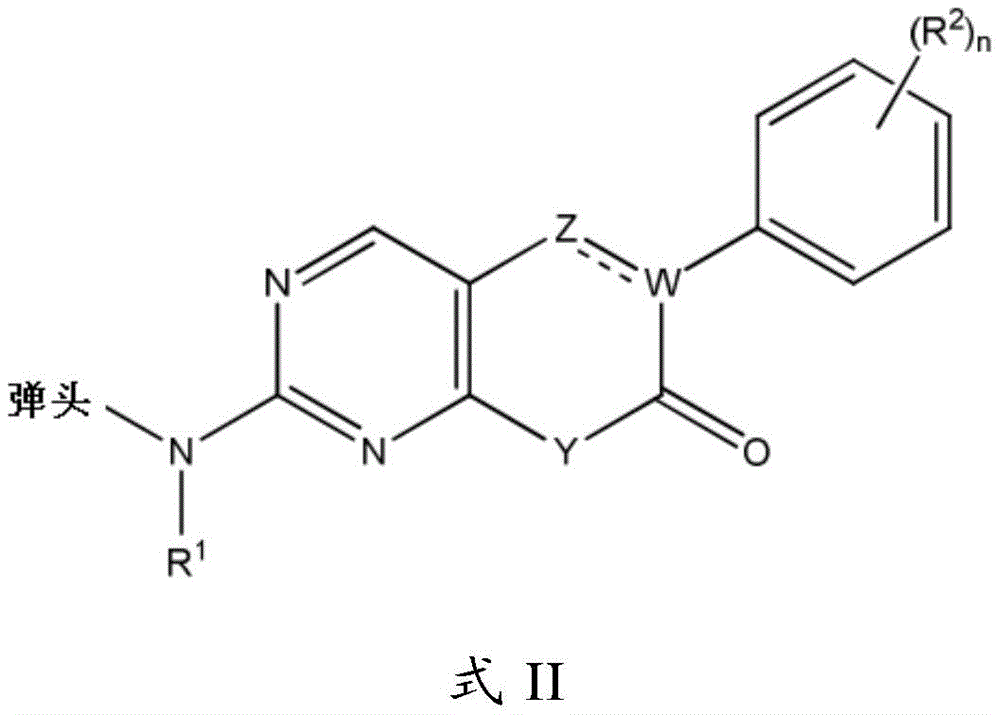
"warhead moiety" or "warhead" refers to a moiety of an inhibitor that participates, reversibly or irreversibly, in a reaction of a donor, e.g., a protein, with a substrate. For example, the warhead may form a covalent bond with a protein, or the warhead may create a stable transition state, or the warhead may be a reversible or irreversible alkylating agent. For example, the warhead moiety can be a functional group on the inhibitor that can participate in a bond formation reaction, wherein a new covalent bond is formed between a portion of the warhead and a donor (e.g., an amino acid residue of a protein). In embodiments, the warhead is an electrophile, and the "donor" is a nucleophile, such as the side chain of a cysteine residue. Examples of suitable warheads include, but are not limited to, the groups shown below:
wherein X is a leaving group, such as a halo group or an activated hydroxyl moiety (e.g., triflate); and each of Ra, Rb and Rc is independently H, substituted or unsubstituted C1-4Alkyl, substituted or unsubstituted C1-4Cycloalkyl, or cyano.
The compounds of the present invention may contain unnatural proportions of atomic isotopes at one or more of the atoms that constitute such compounds. For example, the compounds may be radiolabeled with radioactive isotopes, such as tritium (3H) or carbon-14: (14C) In that respect All isotopically varied forms of the compounds disclosed herein, whether radioactive or not, are intended to be encompassed within the scope of the present invention. For example, deuteriumThe compound being a chemically modified compound or containing13Compounds of C are intended to be encompassed within the scope of the present invention.
Certain compounds may exist in different tautomeric forms, and all possible tautomeric forms of the compounds described herein are intended to be encompassed within the scope of the invention.
Unless otherwise stated, the structures described herein are also intended to include all isomeric forms of the structures (e.g., isomeric, non-isomeric, and geometric (or configurational) isomers); for example, the R and S configurations of each asymmetric center, the Z and E double bond isomers, and the Z and E configuration isomers. It is understood that single stereochemical isomers as well as enantiomeric, diastereomeric and geometric (or conformational) isomeric mixtures of the compounds of the invention are within the scope of the invention. Unless otherwise stated, all tautomeric forms of the compounds of the invention are within the scope of the invention.
The compounds of the present invention may be used in the form of the free base or in the form of a salt. Representative salts include hydrobromide, hydrochloride, sulfate, bisulfate, phosphate, nitrate, acetate, valerate, oleate, palmitate, stearate, laurate, benzoate, lactate, phosphate, tosylate, citrate, maleate, fumarate, succinate, tartrate, naphthoate, mesylate, gluconate, lactobionate and lauryl sulfonate and the like. (see, e.g., Berge et al (1977), Pharmaceutical Salts, J. pharm. Sci.66: 1-19.)
Certain of the compounds disclosed herein may exist in both unsolubilized forms as well as in solvated forms, including hydrated forms. In general, the solvated forms are equivalent to unsolvated forms and are encompassed within the scope of the present invention. Certain of the compounds disclosed herein may exist in a variety of crystalline or amorphous forms. In general, all physical forms are equivalent for use covered by the present invention and are intended to be within the scope of the present invention.
Exemplary compounds include the following:
pharmaceutical composition
Although the compounds disclosed herein can be administered alone, it is preferred that they be administered in the form of a pharmaceutical formulation, wherein the compound can be administered concurrently with one or more pharmaceutically acceptable excipients or carriers. The compounds disclosed herein can be formulated to be administered in any manner that is convenient for use in human or veterinary medicine. In certain embodiments, the compounds included in the pharmaceutical formulations may be active themselves, or may be prodrugs capable of being converted to active compounds, for example, in a physiological environment. In certain embodiments, the compounds provided herein may include hydrates thereof.
The term "pharmaceutically acceptable" is employed herein to represent those compounds, materials, compositions, and/or dosage forms which are, within the scope of sound medical judgment, suitable for use in contact with the tissues of human beings and animals without excessive toxicity, irritation, allergic response, or other problem or complication, commensurate with a reasonable benefit/risk ratio.
Examples of pharmaceutically acceptable salts of the compounds described herein include salts derived from pharmaceutically acceptable inorganic and organic acids and bases. Examples of suitable acid salts include acetate, adipate, benzoate, benzenesulfonate, butyrate, citrate, digluconate, dodecylsulfate, formate, fumarate, glycolate, hemisulfate, heptanoate, hexanoate, hydrochloride, hydrobromide, hydroiodide, lactate, maleate, malonate, methanesulfonate, 2-naphthalenesulfonate, nicotinate, nitrate, pamoate, phosphate, picrate, pivalate, propionate, salicylate, succinate, sulfate, tartrate, tosylate, and undecanoate. Salts derived from suitable bases may include alkali metal (e.g., sodium) salts, alkaline earth metal (e.g., magnesium) salts, ammonium salts, and N- (alkyl) 4+ salts. The present invention also contemplates the quaternary amination of any basic nitrogen-containing group of the compounds described herein. Water or oil soluble or dispersible products can be obtained by this quaternary ammonification.
Examples of pharmaceutically acceptable carriers include (1) sugars such as lactose, glucose, and sucrose; (2) starches, such as corn starch and potato starch; (3) cellulose and its derivatives, such as sodium carboxymethyl cellulose, ethyl cellulose and cellulose acetate; (4) powdered gum tragacanth; (5) malt; (6) gelatin; (7) talc; (8) excipients, such as cocoa butter and suppository waxes; (9) oils such as peanut oil, cottonseed oil, safflower oil, sesame oil, olive oil, corn oil and soybean oil; (10) glycols, such as propylene glycol; (11) polyols such as glycerol, sorbitol, mannitol and polyethylene glycol; (12) esters such as ethyl oleate and ethyl laurate; (13) agar; (14) buffering agents such as magnesium hydroxide and aluminum hydroxide; (15) alginic acid; (16) pyrogen-free water; (17) isotonic saline; (18) ringer's solution (Ringer's solution); (19) ethanol; (20) a phosphate buffer solution; (21) cyclodextrins, e.g.
Targeting ligands attached to nanoparticles, e.g. Accurins
TM(ii) a And (22) other non-toxic compatible materials used in pharmaceutical formulations, such as polymer-based compositions.
Examples of pharmaceutically acceptable antioxidants include: (1) water-soluble antioxidants such as ascorbic acid, cysteine hydrochloride, sodium bisulfate, sodium metabisulfite, sodium sulfite, and the like; (2) oil-soluble antioxidants, such as ascorbyl palmitate, Butylated Hydroxyanisole (BHA), Butylated Hydroxytoluene (BHT), lecithin, propyl gallate, alpha-tocopherol, and the like; and (3) metal chelating agents such as citric acid, ethylenediaminetetraacetic acid (EDTA), sorbitol, tartaric acid, phosphoric acid, and the like. Solid dosage forms (e.g., capsules, dragee pills, dragees, powders, granules, and the like) can include one or more pharmaceutically acceptable carriers, such as sodium citrate or dicalcium phosphate, and/or any of the following: (1) fillers or extenders, such as starch, lactose, sucrose, glucose, mannitol, and/or silicic acid; (2) binding agents, such as carboxymethylcellulose, alginates, gelatin, polyvinylpyrrolidone, sucrose and/or acacia; (3) humectants, such as glycerol; (4) disintegrating agents, such as agar-agar, calcium carbonate, potato or tapioca starch, alginic acid, certain silicates and sodium carbonate; (5) dissolution retarders, such as paraffin; (6) absorption accelerators, such as quaternary ammonium compounds; (7) wetting agents such as cetyl alcohol and glycerol monostearate; (8) absorbents such as kaolin and bentonite clay; (9) lubricants, such as talc, calcium stearate, magnesium stearate, solid polyethylene glycols, sodium lauryl sulfate and mixtures thereof; and (10) a colorant. Liquid dosage forms may include pharmaceutically acceptable emulsions, microemulsions, solutions, suspensions, syrups and elixirs. In addition to the active ingredient, the liquid dosage forms may contain inert diluents commonly used in the art, such as water or other solvents; solubilizers and emulsifiers, such as ethyl alcohol, isopropyl alcohol, ethyl carbonate, ethyl acetate, benzyl alcohol, benzyl benzoate, propylene glycol, 1, 3-butylene glycol, oils (in particular, cottonseed, groundnut, corn, germ, olive, castor, and sesame oils), glycerol, tetrahydrofuryl alcohol, polyethylene glycols and fatty acid esters of sorbitan, and mixtures thereof.
Suspensions, in addition to the active compounds, may contain suspending agents as, for example, ethoxylated isostearyl alcohols, polyoxyethylene sorbitol and sorbitan esters, microcrystalline cellulose, aluminum oxyhydroxide, bentonite, agar-agar and tragacanth, and mixtures thereof.
Ointments, pastes, creams and gels may also contain, in addition to the active compound, excipients, for example animal and vegetable fats, oils, waxes, paraffins, starch, tragacanth, cellulose derivatives, polyethylene glycols, silicones, bentonites, silicic acid, talc and zinc oxide, or mixtures thereof.
Powders and sprays can also contain, in addition to the active compound, excipients such as lactose, talc, silicic acid, aluminum hydroxide, calcium silicates and polyamide powder or mixtures of these substances. The spray may contain other conventional propellants such as chlorofluorohydrocarbons, and volatile unsubstituted hydrocarbons such as butane and propane.
The formulations are suitably presented in unit dosage form and may be prepared by any of the methods well known in the pharmaceutical art. The amount of active ingredient that can be combined with a carrier material to produce a single dosage form will vary depending upon the host treated and the particular mode of administration. The amount of active ingredient that can be combined with a carrier material to produce a single dosage form generally refers to the amount of compound that produces a therapeutic effect.
Dosage forms for topical or transdermal administration of the compounds of the present invention may include powders, sprays, ointments, pastes, creams, lotions, gels, solutions, patches and inhalants. The active compound may be mixed under sterile conditions with a pharmaceutically acceptable carrier, and with any preservatives, buffers, or propellants which may be required.
When the disclosed compounds are administered to humans and animals as pharmaceuticals, the compounds can be provided alone or in pharmaceutical compositions containing the active ingredient in combination with a pharmaceutically acceptable carrier, e.g., 0.1% to 99.5% (more preferably, 0.5% to 90%) of the active ingredient.
The formulations may be administered topically, orally, transdermally, rectally, vaginally, parenterally, intranasally, intrapulmonary, intraocularly, intravenously, intramuscularly, intraarterially, intrathecally, intracapsularly, intradermally, intraperitoneally, subcutaneously, sub-cuticularly, or by inhalation.
Indications of
FGFR-4 regulates proliferation, survival and alpha-fetoprotein (alpha-fetoprotein) secretion during the progression of hepatocellular carcinoma (HCC); therefore, inhibitors of FGFR-4 are a promising potential therapeutic agent to meet this unmet medical need (Ho et al, Journal of Hepatology,2009,50: 118-27). Each year, over 550,000 people worldwide suffer from HCC, and HCC belongs to one of the worst of those of any type of cancer disease with a 1-year survival rate.
Additional evidence for a correlation between FGFR-4 and HCC can be shown by the involvement of FGF19, FGF19 being a member of the Fibroblast Growth Factor (FGF) family, and FGF19 consisting of hormones that modulate glucose, lipid and energy balance. Increased hepatocyte proliferation and liver tumor formation have been observed in FGF19 transgenic mice. FGF19 activates its major receptor FGFR-4 in the liver, and it is believed that activation of FGFR-4 is the mechanism by which FGF19 can increase hepatocyte proliferation and induce hepatocellular carcinoma formation (Wu et al, J Biol Chem (2010) 285(8): 5165-. Others (Sawey et al, Cancer Cell (2011)19: 347-358) have also identified FGFR-4 as a driver in HCC. Thus, it is believed that the disclosed compounds are useful as potent and selective inhibitors of FGFR-4 in the treatment of HCC and other liver cancers.
Oncogenic genome screening has identified an activating fibroblast growth factor receptor 4(FGFR-4) Y367C mutation in the human breast cancer cell line MDA-MB-453. This mutation has been shown to trigger constitutive phosphorylation, leading to activation of the mitogen-activated protein kinase cascade. Therefore, FGFR-4 has been shown to be a driver of tumor growth in breast cancer (Roidl et al, Oncogene (2010)29(10): 1543) -1552). Accordingly, it is believed that the disclosed compounds, which are potent and selective inhibitors of FGFR-4, are useful in the treatment of FGFR-4 mediated breast cancer.
Molecular changes (e.g., translocations) in genes upstream of FGFR-4 can lead to activation/over-expression of FGFR-4. For example, PAX3-FKHR translocation/gene fusion can lead to FGFR-4 over-expression. FGFR-4 overexpression due to this mechanism has been associated with Rhabdomyosarcoma (RMS) (Cao et al, Cancer Res (2010) 70(16): 6497-. Mutations in FGFR-4 itself (e.g., kinase domain mutations) can lead to over-activation of the protein; this mechanism has been associated with a subgroup RMS (Taylor et al, J Clin Invest (2009)119: 3395-. Accordingly, the disclosed compounds, which are potent and selective inhibitors of FGFR-4, are believed to be useful in the treatment of FGFR-4 mediated RMS and other sarcomas.
Other diseases have been associated with changes in genes upstream of FGFR-4 or with mutations in FGFR-4 itself. For example, mutations in the kinase domain of FGFR-4 result in over-activation that has been associated with lung adenocarcinoma (Ding et al, Nature (2008) 455 (7216: 1069-. The expansion of FGFR-4 has been correlated with pathologies such as renal cell carcinoma (TCGA temporal data). In addition, silencing FGFR4 and inhibiting ligand-receptor binding significantly reduced ovarian tumor growth, suggesting that inhibitors of FGFR4 may be useful in the treatment of ovarian cancer. (Zaid et al, Clin. cancer Res. (2013) 809).
Pathogenic increases in bile acid levels have been associated with changes in FGF19 levels (Vergnes et al, Cell Metabolism (2013)17,916-28). Thus, a reduction in FGF19 levels may be beneficial for promoting bile acid synthesis and thus for treating hyperlipidemia.
Dosage level
The actual dosage level of the active ingredient in the pharmaceutical compositions of this invention can be varied so as to obtain an amount of the active ingredient which is effective to achieve the desired therapeutic response for a particular patient, composition, and mode of administration, and which is non-toxic to the patient.
The selected dosage level will depend upon a variety of factors, including the activity of the particular compound disclosed herein or an ester, salt or amide thereof used; the route of administration; the time of administration; the rate of excretion of the particular compound used; the duration of the treatment; other drugs, compounds and/or substances used in combination with the particular compound used; the age, sex, weight, condition, general health, and prior medical history of the patient being treated; and similar factors well known in the medical arts.
A physician or veterinarian having ordinary skill in the art can readily determine and prescribe the effective amount of the pharmaceutical composition required. For example, to achieve a desired therapeutic effect, a physician or veterinarian can start administering a dose of the compound of the invention described for use in a pharmaceutical composition at a level lower than that required and gradually increase the dose until the desired effect is achieved.
In general, a suitable daily dose of a compound of the invention will be that dose of the compound which will be the lowest dose effective to produce a therapeutic effect. Such effective dosages will generally depend upon the factors set forth above. Typically, the dose of a compound of the invention applied to a patient will be in the range of about 0.0001mg to about 100mg per kg of body weight per day. For example, the dose may be between 0.1g and 10g per day; between 0.5g and 5g per day; or 1g to 2g per day. If desired, an effective daily dose of the active compound may be administered in the last dose, optionally in unit dosage form, in one, two, three, four, five, six or six separate doses administered at appropriate intervals throughout the day.
Combination and targeted therapy
Administration of the FGFR-4 inhibitors disclosed herein can be combined with other cancer treatments. For example, the inhibitor may be administered in combination with surgical therapy, radiation, or other therapeutic agents, such as antibodies, other selective kinase inhibitors, or chemotherapeutic agents. The inhibitor may also be administered in combination with RNAi therapy or antisense therapy. The FGFR-4 inhibitor of the present invention can be combined with one, two or more other therapeutic agents. In the examples outlined below, it is understood that "second therapeutic agent" may also include more than one therapeutic agent other than an FGFR-4 inhibitor. The FGFR-4 inhibitors described herein can be administered with one, two, or more than two other therapeutic agents.
The FGFR-4 inhibitor and the second therapeutic agent described herein need not be administered in the same pharmaceutical composition, and can be administered by different routes due to different physical and chemical characteristics. For example, the FGFR-4 inhibitor can be administered orally, while the second therapeutic agent can be administered intravenously. The determination of the mode of administration and the desirability of administering the same pharmaceutical composition, if possible, is well within the knowledge of the skilled clinician. Initial administration can be according to established protocols known in the art, and then based on observed effects, the dosage, mode of administration, and time of administration can be varied by a skilled clinician.
Depending on the nature of the proliferative disease, the condition of the patient, and the actual choice of the second therapeutic agent to be administered, the FGFR-4 inhibitor and the second therapeutic agent can be administered simultaneously (e.g., simultaneously, substantially simultaneously, or within the same treatment regimen) or sequentially (i.e., one after the other with optional time intervals between the two).
In addition, the FGFR-4 inhibitors disclosed herein can be administered as part of an antibody-drug conjugate, wherein the FGFR-4 inhibitor refers to the "payload" portion of the conjugate.
Analytical apparatus and methods for compound characterization:
LCMS: unless otherwise indicated, all liquid chromatography-mass spectrometry (LCMS) data (analysis of purity and identity of samples) were obtained using an Agilent model 1260 LC system using an Agilent model 6120 mass spectrometer ionized with ES-API equipped with an Agilent Poroshel 120(EC-C18, 2.7um particle size, 3.0X 50mm size) reverse phase column at 22.4 degrees Celsius. The mobile phase consisted of a solvent mixture of water containing 0.1% formic acid and acetonitrile containing 0.1% formic acid. A constant gradient of mobile phase from 95% water/5% organic phase to 5% water/95% organic phase over the course of 4 minutes was applied. The flow rate was constant at 1mL/min (mL/min).
Proton NMR: unless otherwise indicated, all
1H NMR spectra were obtained using a Varian 400MHz Unity Inova 400MHz NMR instrument (acquisition time 3.5 seconds with 1 second delay; 16 to 64 scans). When characterized, all protons are in DMSO-d
6Reported in parts per million (ppm) in solvent as residual DMSO (2.50 ppm).
For Preparative instrument for purifying compounds: in Teledyne Isco
Rf device or
Silica gel chromatography was performed on an Isolera Four apparatus.
Preparative LCMS: shimadzu Discovery in a 250X 21.2mm reversed phase column equipped with an AXIA compact at 22.4 degrees Celsius Luna 5u C18(2)100A, AXIA
Preparative HPLC was performed on a preparative system. The mobile phase consisted of a solvent mixture of water containing 0.1% formic acid and acetonitrile containing 0.1% formic acid. Over the course of 25 minutes, a constant gradient of mobile phase from 95% water/5% organic phase to 5% water/95% organic phase was applied. The flow rate was constant at 20mL/min (mL/min). The reactions described as being carried out in microwaves were carried out in a Biotage Initiator microwave apparatus.
Examples
Example 1: synthesis of N- (2- ((6- (2, 6-dichloro-3, 5-dimethoxyphenyl) -8-methyl-7-oxo-7, 8-di-methoxy-phenyl)
Hydropyrido [2,3-d]Pyrimidin-2-yl) amino) -3-methylphenyl) acrylamide compounds 43
Step 1: synthesis of 4- (methylamino) -2- (methylthio) pyrimidine-5-carboxylic acid ethyl ester
A mixture of ethyl 4-chloro-2- (methylthio) pyrimidine-5-carboxylate (5.0g, 21.5mmol) and 29% methylamine (5.75g, 53.72 mmol, methanol (MeOH) solution) in Tetrahydrofuran (THF) (100mL) was stirred at room temperature for 2 hours. Then, the reaction mixture was concentrated, followed by addition of sodium bicarbonate (NaHCO)3) (20mL of aq), and the resulting solution was extracted with ethyl acetate (EtOAc) (3X 50 mL). The combined organic layers were washed with water and brine, dried over sodium sulfate, filtered and concentrated to give ethyl 4- (methylamino) -2- (methylthio) pyrimidine-5-carboxylate (4.68g, 96%) as a light yellow solid. MS (ES +) C9H13N3O2S required value: 227, experimental value: 228[ M + H]+。
Step 2: synthesis of (4- (methylamino) -2- (methylthio) pyrimidin-5-yl) methanol
To lithium aluminum hydride (LiAlH) in THF (100mL)4) To the suspension (1.140g, 30mmol) was added ethyl 4- (methylamino) -2- (methylthio) pyrimidine-5-carboxylate (4.536g, 20mmol) and the reaction mixture was stirred at room temperature for 2 hours. Solution H2O (2mL), sodium hydroxide (NaOH) (15% aq, 2mL) and additional H2O (7mL) was carefully quenched and immediately stirred for an additional 1 hour. The mixture was extracted with EtOAc (2 × 100mL) and the combined organic layers were washed with water and brine, dried over sodium sulfate, and concentrated to give (4- (methylamino) -2- (methylthio) pyrimidin-5-yl) methanol as a light yellow solid (3.2g, 85%). MS (ES +) C7H11N3OS required value: 185, Experimental value: 186[ M + H ]]+。
And step 3: synthesis of 4- (methylamino) -2- (methylthio) pyrimidine-5-carbaldehyde
A suspension of (4- (methylamino) -2- (methylthio) pyrimidin-5-yl) methanol (3.1g, 16.73mmol) and manganese dioxide (7.27g, 83.67mmol) in DCM (40mL) was stirred at room temperature for 12 h. The resulting precipitate was filtered off, and the filtered filtrate was concentrated to give 4- (methylamino) -2- (methylthio) pyrimidine-5-carbaldehyde (2.8g, 91%) as a pale yellow solid. MS (ES +) C7H9N3The OS requirement value: 183, experimental value: 184[ M + H [ ]]+。
And 4, step 4: synthesis of methyl 2- (3, 5-dimethoxyphenyl) acetate
To a solution of 2- (3, 5-dimethoxyphenyl) acetic acid (5) (600mg, 3.06mmol) in MeOH (30mL) was added thionyl chloride (3mL) dropwise at 0 ℃ and the reaction mixture was stirred at room temperature overnight. The reaction was monitored by liquid chromatography-mass spectrometry (LCMS). The mixture was diluted with saturated sodium bicarbonate (20mL aqueous) and extracted with EtOAc (3X 20 mL). The combined organic layers were washed with water and brine, dried over sodium sulfate, filtered, and concentrated to give methyl 2- (3, 5-dimethoxyphenyl) acetate (crude, 700mg) as a yellow oil. MS (ES +) C11H14O4The required value is: 210, experimental value: 211[ M + H ]]+。
And 5: synthesis of 6- (3, 5-dimethoxyphenyl) -8-methyl-2- (methylthio) pyrido [2,3-d ] pyrimidin-7 (8H) -one
A solution of 2- (3, 5-dimethoxyphenyl) acetate (6) (440mg, 2.40mmol), 4-amino-2- (methylthio) pyrimidine-5-carbaldehyde (4) (605mg, 2.88mmol) and potassium carbonate (662mg, 4.8mmol) in DMF (30mL) was stirred at 110 deg.C for 3 h. The reaction was monitored by LCMS. The reaction mixture was diluted with H2O (30mL) and extracted with EtOAc (3X 40 mL). The combined organic layers were washed with water and brine, dried over sodium sulfate, filtered, and concentrated. The residue was purified by column chromatography (silica gel, petroleum ether/EtOAc ═ 2:1) to give 6- (3, 5-dimethoxyphenyl) -8-methyl-2- (methylthio) pyrido [2, 3-d) as a white solid]Pyrimidin-7 (8H) -one (7) (683 mg, 83%). MS (ES +) C17H17N3O5S required value: 343, experimental value: 344[ M + H ]]+。
Step 6: synthesis of 6- (3, 5-dimethoxyphenyl) -8-methyl-2- (methylsulfonyl) pyrido [2,3-d ] pyrimidin-7 (8H) -one
To 6- (3, 5-dimethoxyphenyl) -8-methyl-2- (methylthio) pyrido [2,3-d ] in methanol/dichloromethane (MeOH/DCM) (20mL/20mL) at room temperature]Solution of pyrimidin-7 (8H) -one (1.05g, 3.1mmol) in H
2In O (20mL)
(potassium peroxymonosulfate) (11.3g, 18.4mmol) and the reaction mixture was stirred at 40 ℃ for 18 hours. The reaction was monitored by liquid chromatography-mass spectrometry (LCMS). Reaction mixture with H
2O/DCM (150mL/100mL) was diluted and the aqueous phase was extracted with DCM (100 mL). The combined organic layers were washed with water (200mL) and brine (200mL), dried over sodium sulfate, filtered, and concentrated. The crude product was recrystallized from EtOAc to give 6- (3, 5-dimethoxyphenyl) -8-methyl-2- (methylsulfonyl) pyrido [2,3-d as a yellow solid]Pyrimidin-7 (8H) -one (8) (910mg, 78% yield). MS (ES +) C
17H
17N
3O
5S required value: 375, experimental value:376[M+H]
+。
And 7: synthesis of 6- (2, 6-dichloro-3, 5-dimethoxyphenyl) -8-methyl-2- (methylsulfonyl) pyrido [2,3-d ] pyrimidin-7 (8H) -one
6- (3, 5-Dimethoxyphenyl) -8-methyl-2- (methylsulfonyl) pyrido [2,3-d ] in acetonitrile (50mL) at a temperature in the range of-10 ℃ to 0 ℃ over a period of 0.5 hours]To a solution of pyrimidin-7 (8H) -one (8) (938mg, 2.5mmol) was slowly added a solution of sulfonyl chloride (1.34g, 10.0mmol) in acetonitrile (25 mL). The reaction was monitored by Thin Layer Chromatography (TLC). By adding H2The reaction mixture was quenched with O (10 mL). The resulting reaction solution was concentrated under reduced pressure, and the residue was recrystallized from EtOAc/petroleum ether ═ 1:2 to give 6- (2, 6-dichloro-3, 5-dimethoxyphenyl) -8-methyl-2- (methylsulfonyl) pyrido [2,3-d ] as a yellow solid]Pyrimidin-7 (8H) -one (9) (760mg, 69% yield). MS (ES +) C17H15Cl2N3O5S required value: 443,445, Experimental value: 444,446[ M + H ]]+。
And 8: synthesis of 6- (2, 6-dichloro-3, 5-dimethoxyphenyl) -8-methyl-2- (2-methyl-6-nitrophenylamino) pyrido [2,3-d ] pyrimidin-7 (8H) -one
To 6- (2, 6-dichloro-3, 5-dimethoxyphenyl) -8-methyl-2- (methylsulfonyl) pyrido [2,3-d ] in DMF (20mL) at about 10 deg.C]To a mixture of pyrimidin-7 (8H) -one (9) (1.0g, 2.26mmol) and 2-methyl-6-nitroaniline (684mg, 4.5mmol) was added potassium tert-butoxide (756mg, 6.75mmol), and the reaction mixture was stirred at room temperature for 5 minutes. The reaction mixture was diluted with EtOAc (150mL) and the organic phase was separated, then washed with water (2X 150mL) and brine (150mL), dried over sodium sulfate, filtered, and concentrated. The residue was treated with EtOAcThe residue was recrystallized to give 2- (2-amino-6-methylphenylamino) -6- (2, 6-dichloro-3, 5-dimethoxyphenyl) -8-methylpyrido [2,3-d as a yellow solid]Pyrimidin-7 (8H) -one (10) (810mg, 70% yield). MS (ES +) C23H19Cl2N5O5The required value is: 515,517, Experimental value: 516,518[ M + H]+。
And step 9: synthesis of 2- (2-amino-6-methylphenylamino) -6- (2, 6-dichloro-3, 5-dimethoxyphenyl) -8-methylpyrido [2,3-d ] pyrimidin-7 (8H) -one
2- (2-Nitro-6-methylphenylamino) -6- (2, 6-dichloro-3, 5-dimethoxyphenyl) -8-methylpyrido [2,3-d ] in EtOAc (50mL) at 60 deg.C]A mixture of pyrimidin-7 (8H) -one (10) (810mg, 1.57mmol) and tin (II) chloride hydrate (1.77g, 7.86 mmol) was stirred for 2 hours. The reaction was monitored by liquid chromatography-mass spectrometry (LCMS). The reaction mixture was basified with saturated aqueous sodium bicarbonate to pH 8-9, diluted with H2O (100mL), and then extracted with EtOAc (3 × 100 mL). The combined organic layers were washed with brine (150mL), dried over sodium sulfate, filtered and concentrated. The residue was recrystallized from dichloromethane/ethyl acetate/petroleum ether (DCM/EtOAc/PE) ═ 1/1/2 to give 2- (2-amino-6-methylphenylamino) -6- (2, 6-dichloro-3, 5-dimethoxyphenyl) -8-methylpyrido [2,3-d ] as a grey solid]Pyrimidin-7 (8H) -one (11) (640 mg, 83% yield). (MS (ES +) C23H21Cl2N5O3The required value is: 485,487, Experimental value: 486,488[ M + H]+;1H-NMR(500MHz,CDCl3)δppm 8.54 (s,1H),7.45(s,1H),7.08(t,J=7.5Hz,1H),6.71(dd,J=3.5,7.5 Hz,2H),6.65(br s,1H),6.62(s,1H),3.94(s,6H),3.88(br s,2H), 3.62(br s,3H),2.24(s,3H)。
Step 10: synthesis of N- (2- ((6- (2, 6-dichloro-3, 5-dimethoxyphenyl) -8-methyl-7-oxo-7, 8-dihydropyrido [2,3-d ] pyrimidin-2-yl) amino) -3-methylphenyl) acrylamide Compound 43
2- (2-amino-6-methylphenylamino) -6- (2, 6-dichloro-3, 5-dimethoxyphenyl) -8-methylpyrido [2,3-d]Pyrimidin-7 (8H) -one (11) was dissolved in DCM (2mL) and cooled to 0 ℃ before acryloyl chloride (0.010mL, 0.13mmol) was added. The reaction was allowed to warm to room temperature and stirred overnight. The mixture was loaded directly onto silica gel and purified by flash chromatography using a 0-100% EtOAc/hexanes gradient to provide the product N- (2- ((6- (2, 6-dichloro-3, 5-dimethoxyphenyl) -8-methyl-7-oxo-7, 8-dihydropyrido [2, 3-d)]Pyrimidin-2-yl) amino) -3-methylphenyl) acrylamide (compound E). The product was obtained as an off-white solid (10 mg; 19% yield). MS (ES +) C26H23Cl2N5O4,540[M+H]+。
Example 2: synthesis of N- (2- ((6- (2, 6-dichloro-3, 5-dimethoxyphenyl) quinazolin-2-yl) amino) -3-
Methoxyphenyl) acrylamide Compound 30
Step 1: synthesis of (2-amino-5-bromophenyl) methanol
To a solution of 2-amino-5-bromobenzoic acid (10.0g, 46.3mmol) in THF (150mL) was added BH3-THF (1M, 231mL) at room temperature, and the reaction mixture was stirred overnight. An aliquot of the reaction mixture was analyzed by LCMS and indicated that the reaction had progressed to completion. The reaction was quenched with water (150mL) and extracted with EtOAc (3X 500 mL). The organic layers were separated, combined, washed with water (200mL) and brine (200mL), dried over sodium sulfate, filtered and concentrated to give the title compound (10 g)Crude material) which was used directly in the next step without further purification. MS (ES +) C7H8BrNO requirement: 201, experimental value: 202,204[ M + H]+。
Step 2: synthesis of 2-amino-5-bromobenzaldehyde
Will be in CH2Cl2(400mL) in (2-amino-5-bromophenyl) methanol (10g, 49.5 mmol) and MnO2(25.8g, 296.6mmol) of the mixture was stirred at room temperature overnight. LCMS showed reaction completion. The solid was filtered off and the filtrate was concentrated to give the title compound as a light yellow solid (8g, 81%) which was used directly in the next step without further purification. MS (ES +) C7H6BrNO requirement: 199, Experimental value: 200,202[ M + H]+。
And step 3: synthesis of 6-bromoquinazolin-2-ol
A mixture of 2-amino-5-bromobenzaldehyde (29) (6g, 30.0mmol) and urea (30) (27g, 450.0mmol) was heated to 180 deg.C and stirred for 5 hours. LCMS showed reaction completion. The reaction mixture was cooled to room temperature and the resulting precipitate was washed with H2The O (3 × 500mL) was washed and co-evaporated 3 times with toluene to completely remove the trapped moisture. 6-Bromoquinazolin-2-ol (31) (6g, 89%) was obtained as a yellow solid. MS (ES +) C8H5BrN2The required value of O: 224, experimental value: 225,227[ M + H ]]+。
And 4, step 4: synthesis of 6-bromo-2-chloroquinazoline
At 110 ℃ in POCl36-Bromoquinazoline in (80mL)A solution of (6.0 g, 26.7mmol) of (31) 2-ol was refluxed for 5 hours. An aliquot of the reaction mixture was analyzed by LCMS and indicated that the reaction had progressed to completion. Removing most of the POCl under reduced pressure3And the residue was added dropwise to ice water (500 mL). The resulting precipitate was collected via filtration as a yellow solid (3.5g, 54%). MS (ES +) C8H4BrClN2The required value is: 242, experimental value: 243,245[ M + H]+。
And 5: synthesis of 2-chloro-6- (3, 5-dimethoxyphenyl) quinazoline
6-bromo-2-chloroquinazoline (32) (5.0g, 20.5mmol), 3, 5-dimethoxyphenylboronic acid (33) (3.7g, 20.5mmol), Cs in THF (50mL), dioxane (50mL), and water (10mL)2CO3(20.0g, 61.5mmol), and Pd (PPh)3)2Cl2The mixture (1.4g, 2.1mmol) was degassed 3 times with N2 and stirred at 80 ℃ for 3 hours. An aliquot of the reaction mixture was analyzed by both TLC and LCMS, which indicated that the reaction had progressed to completion. The mixture was cooled to room temperature and extracted with EtOAc (3X 200 mL). The combined organic layers were washed with water and brine, dried over sodium sulfate, filtered, and concentrated. The residue was purified by silica gel chromatography (petroleum ether/EtOAc ═ 8:1) to give 2-chloro-6- (3, 5-dimethoxyphenyl) quinazoline (34) as a light yellow solid (2.4g, 38%). MS (ES +) C16H13ClN2O2The required value is: 300, experimental value: 301, 303[ M + H [ ]]+。
Step 6: synthesis of 2-chloro-6- (2, 6-dichloro-3, 5-dimethoxyphenyl) quinazoline
To a solution of 2-chloro-6- (3, 5-dimethoxyphenyl) quinazoline (34) (2.7g, 8.9mmol) in anhydrous THF (80mL) at-20 deg.C was added graduallyAdding SO dropwise2Cl2(3.0g, 22.3mmol) and the reaction mixture was then stirred for 1 hour. An aliquot of the reaction mixture was analyzed by both TLC and LCMS and indicated that the reaction had progressed to completion. The reaction mixture was quenched with water (1mL) and the solvent was removed under reduced pressure. The obtained precipitate is CH3CN was washed and dried to give 2-chloro-6- (2, 6-dichloro-3, 5-dimethoxyphenyl) quinazoline (35) (2.6g, 79%) as a white solid. (MS (ES +) C16H11C13N2O2The required value is: 368, experimental value: 369,371[ M + H]+;1H-NMR(500MHz,DMSO)δppm 9.67(s,1H),8.168(d,J=1.5 Hz,1H),8.10(d,J=8.5Hz,1H),7.56(dd,J=2.0,8.5Hz,1H), 7.07(s,1H),4.00(s,6H)。
And 7: synthesis of 6- (2, 6-dichloro-3, 5-dimethoxyphenyl) -N- (2-methoxy-6-nitrophenyl) quinazolin-2-amine
In a microwave vial, 2-chloro-6- (2, 6-dichloro-3, 5-dimethoxyphenyl) quinazoline (35) (100mg, 0.27mmol), 2-methoxy-6-nitroaniline (36) (57mg, 0.40 mmol), Cs2CO3(176mg,0.54mmol)、Pd2(dba)3(25mg, 0.027 mmol) and 2-dicyclohexylphosphino-2 ', 4 ', 6 ' -triisopropylbiphenyl (Xphos) (26mg, 0.054mmol) were dissolved in DMF (3ml) and purged with N2 for 5 minutes. The vial was capped and heated to 115 ℃ in a microwave for 30 minutes. After cooling to room temperature, the reaction mixture was diluted with DCM and washed 3 times with brine. The organic mixture was dried over sodium sulfate, loaded directly onto silica gel, and purified using a 0-100% EtOAc/hexanes gradient. 6- (2, 6-dichloro-3, 5-dimethoxyphenyl) -N- (2-methoxy-6-nitrophenyl) quinazolin-2-amine (37) was recovered as a yellow solid (100mg, 73% yield). MS (ES +) C23H18Cl2N4O5,501[M+H]+。
And 8: synthesis of N1- (6- (2, 6-dichloro-3, 5-dimethoxyphenyl) quinazolin-2-yl) -6-methoxybenzene-1, 2-diamine
6- (2, 6-dichloro-3, 5-dimethoxyphenyl) -N- (2-methoxy-6-nitrophenyl) quinazolin-2-amine (38) (100mg, 0.14mmol) was dissolved in methanol (10ml) and 10% Pd/C (15mg) was added. At H2The mixture was stirred under a balloon for 4 hours. The reaction mixture was filtered through celite and the solvent was removed to give quantitative yield of N1- (6- (2, 6-dichloro-3, 5-dimethoxyphenyl) quinazolin-2-yl) -6-methoxybenzene-1, 2-diamine (38). Compound 38 can be carried on to the next step without further purification. MS (ES +) C23H20Cl2N4O3,471[M+H]+。
And step 9: synthesis of N- (2- ((6- (2, 6-dichloro-3, 5-dimethoxyphenyl) quinazolin-2-yl) amino) -3-methoxyphenyl) acrylamide
Will N1- (6- (2, 6-dichloro-3, 5-dimethoxyphenyl) quinazolin-2-yl) -6-methoxybenzene-1, 2-diamine (38) (96mg, 0.20mmol) was dissolved in DCM (2ml) and cooled to 0 deg.C, then acryloyl chloride (0.018ml, 0.24mmol) was added and it was stirred at 0 deg.C for 2 hours. The mixture was loaded directly onto silica gel and purified by flash chromatography using a gradient of 0-100% EtOAc/hexanes. N- (2- ((6- (2, 6-dichloro-3, 5-dimethoxyphenyl) quinazolin-2-yl) amino) -3-methoxyphenyl) acrylamide (39) (30mg, 28% yield) was recovered as an off-white solid. MS (ES +) C26H22Cl2N4O4,525 [M+H]+。
Example 3: synthesis of Compound 25
Synthesis of 6- (2, 6-dichloro-3, 5-dimethoxyphenyl) -N- (2-methyl-6-nitrophenyl) quinazolin-2-amine
2-chloro-6- (2, 6-dichloro-3, 5-dimethoxyphenyl) quinazoline (35) (5g, 13.5 mmol), 2-methyl-6-nitroaniline (3.09g, 20.3mmol), Cs2CO3(13.2g,40.6mmol)、、Pd2(dba)3(1.24g, 1.35mmol) and 2-dicyclohexylphosphino-2 ', 4 ', 6 ' -triisopropylbiphenyl (Xphos) (1.29g, 2.71mmol) were dissolved in DMA (100ml), and N was used2And purifying for 5 minutes. The reaction mixture was heated to 110 ℃ and held for 3 hours. After cooling to room temperature, the reaction mixture was diluted with DCM (500ml), washed 3 times with 10% HCl (3 × 300ml) and 3 times with brine. The organic mixture was dried over sodium sulfate and loaded directly onto silica gel and purified using a gradient of 0-100% EtOAc/hexanes. 6- (2, 6-dichloro-3, 5-dimethoxyphenyl) -N- (2-methyl-6-nitrophenyl) quinazolin-2-amine (5.5g, 81% yield) was recovered as a yellow solid. MS (ES +) C23H18Cl2N4O4,485[M+H]+。
N1Synthesis of (6- (2, 6-dichloro-3, 5-dimethoxyphenyl) quinazolin-2-yl) -6-methylbenzene-1, 2-diamine
6- (2, 6-dichloro-3, 5-dimethoxyphenyl) -N- (2-methyl-6-nitrophenyl) quinazolin-2-amine (5.5g, 11.33mmol) was dissolved in methanol (200ml) and ethyl acetate (100ml), and 10% Pd/C (650mg) was added. The mixture was stirred overnight under a H2 balloon. The reaction mixture was filtered through celite and the solvent was removed to give quantitative yield of N1- (6- (2, 6-dichloro-3, 5-dimethoxyphenyl) quinazolin-2-yl) -6-methylBenzene-1, 2-diamine. The compound can be carried on to the next step without further purification. MS (ES +) C23H20Cl2N4O2,455[M+H]+。
Synthesis of N- (2- ((6- (2, 6-dichloro-3, 5-dimethoxyphenyl) quinazolin-2-yl) amino) -3-methylphenyl) acrylamide
Will N1- (6- (2, 6-dichloro-3, 5-dimethoxyphenyl) quinazolin-2-yl) -6-methylbenzene-1, 2-diamine (5.16g, 11.33mmol) was dissolved in DCM (100ml) and cooled to 0 deg.C, after which DIEA (1.781ml, 10.20mmol) and acryloyl chloride (1.013ml, 12.47mmol) were added and stirred at 0 deg.C for 2 hours. The mixture was loaded directly onto silica gel and purified by flash chromatography using a gradient of 0-100% EtOAc/hexanes. N- (2- ((6- (2, 6-dichloro-3, 5-dimethoxyphenyl) quinazolin-2-yl) amino) -3-methylphenyl) acrylamide was recovered as an off-white solid (3.5g, 61% yield). MS (ES +) C26H22Cl2N4O3,509[M+H]+。1H NMR(400 MHz,DMSO-d6)δ9.53(s,1H),9.23(s,1H),8.68(s,1H), 7.82-7.65(m,2H),7.51(s,2H),7.21(m,1H),7.12(d,J=6.8Hz, 1H),7.01(s,1H),6.49(dd,J=17.0,10.2Hz,1H),6.28-6.15(m, 1H),5.68(dd,J=10.2,2.0Hz,1H),3.97(s,6H),2.19(s,3H)。
Example 4: synthesis of Compound 26 and Compound 10
Synthesis of 6-bromopyrido [2,3-d ] pyrimidin-2-amine
Reacting 5-bromine-2-Fluoronicotinaldehyde (3.0g, 14.78mmol), guanidine hydrochloride (1.69g, 17.74mmol), and triethylamine (4.48g, 44.35mmol) were dissolved in 1-methyl-2-pyrrolidone (15mL), and the reaction mixture was stirred at 180 ℃ under microwave conditions for 15 minutes. The mixture was cooled to room temperature, quenched with water (200mL), and extracted with ethyl acetate (2X 300 mL). The organic layers were combined, washed with water (3 × 50mL) and brine (3 × 50mL), dried over sodium sulfate, filtered and concentrated to give the crude product, which was purified by silica gel column chromatography (ethyl acetate: petroleum ether ═ 3:1) to give 6-bromopyrido [2,3-d ] as a yellow solid]Pyrimidin-2-amine (2.0g, 60%). MS (ES +) C7H5BrN4The required value is: 224,226, experimental values: 225,227[ M + H ]]+。
Synthesis of 6- (3, 5-dimethoxyphenyl) pyrido [2,3-d ] pyrimidin-2-amine
6-bromopyrido [2,3-d ]]Pyrimidin-2-amine (1.0g, 4.46mmol), 3, 5-dimethoxyphenylboronic acid (1.2g, 6.70mmol), PdCl2A mixture of (dppf) (364mg, 0.446mmol) and potassium carbonate (1.8g, 13.39mmol) in 1, 4-dioxane/water (4mL/1mL) was degassed with nitrogen for 5 minutes and stirred under microwave at 110 ℃ for 30 minutes. The reaction mixture was cooled to room temperature and concentrated to give the crude product, which was purified by silica gel column chromatography (ethyl acetate: petroleum ether 4:1) to give 6- (3, 5-dimethoxyphenyl) pyrido [2,3-d as a yellow solid]Pyrimidin-2-amine (400mg, 31%). MS (ES +) C15H14N4O2The required value is: 282, experimental value: 283[ M + H]+。
Synthesis of 6- (3, 5-dimethoxyphenyl) -N- (2-methyl-6-nitrophenyl) pyrido [2,3-d ] pyrimidin-2-amine
To 6- (3, 5-) in THF (20mL) at 0 deg.CDimethoxyphenyl) pyrido [2,3-d]To a solution of pyrimidin-2-amine (400mg, 1.42mmol) was added sodium hydride (102 mg, 4.25 mmol). The solution was stirred for 20 min, then 2-fluoro-1-methyl-3-nitrobenzene (440mg, 2.84mmol) was added. The reaction mixture was stirred overnight at room temperature, quenched with water (20mL), and extracted with ethyl acetate (3X 30 mL). The organic layers were combined, washed with brine (50mL), dried over sodium sulfate, filtered and concentrated to give the crude product, which was purified by silica gel column chromatography (ethyl acetate: petroleum ether ═ 4:1) to give 6- (3, 5-dimethoxyphenyl) -N- (2-methyl-6-nitrophenyl) pyrido [2,3-d ] as a brown solid]Pyrimidin-2-amine (310mg, 51%). MS (ES +) C22H19N5O4The required value is: 417, experimental value: 418[ M + H ]]+。
N1- (6- (3, 5-dimethoxyphenyl) pyrido [2,3-d]Synthesis of pyrimidin-2-yl) -6-methylbenzene-1, 2-diamine
To 6- (3, 5-dimethoxyphenyl) -N- (2-methyl-6-nitrophenyl) pyrido [2,3-d ] in ethanol (5mL) and water (5mL)]To a solution of pyrimidin-2-amine (100mg, 0.24mmol) were added iron powder (110mg, 1.92mmol) and ammonium chloride (100mg, 1.920 mmol). The mixture was stirred at 100 ℃ for 1 hour, cooled to room temperature, filtered and concentrated. The residue was purified by preparative HPLC to give N1- (6- (3, 5-dimethoxyphenyl) pyrido [2,3-d as a yellow solid]Pyrimidin-2-yl) -6-methylbenzene-1, 2-diamine (29.5mg, 32%). MS (ES +) C22H21N5O2The required value is: 387, experimental value: 388[ M + H ]]+;1H-NMR(500MHz,DMSO-d6)δppm 9.30,9.21 (br,br,2H),8.95(s,1H),8.60(d,1H,J=3.0Hz),6.96-6.92(m, 3H),6.63(d,1H,J=5.5Hz),6.55(t,1H,J=2.0Hz),6.50-6.48 (m,1H),4.79(s,2H),3.84(s,6H),2.08(s,3H)。
Synthesis of 6- (2, 6-dichloro-3, 5-dimethoxyphenyl) -N- (2-methyl-6-nitrophenyl) pyrido [2,3-d ] pyrimidin-2-amine
To 6- (3, 5-dimethoxyphenyl) -N- (2-methyl-6-nitrophenyl) pyrido [2,3-d at 0 ℃]To a stirred solution of pyrimidin-2-amine (100mg, 0.24mmol) in THF (10mL) was added dropwise a solution of sulfonyl chloride (0.06mL, 0.72 mmol) in THF (2 mL). After stirring at 0 ℃ for 2 h, the reaction was quenched with water (10mL) and extracted with ethyl acetate (3X 20 mL). The organic layers were combined, washed with brine (20mL), dried over sodium sulfate, filtered and concentrated. The residue was purified by silica gel column chromatography (ethyl acetate: petroleum ether ═ 3:1) to give 6- (2, 6-dichloro-3, 5-dimethoxyphenyl) -N- (2-methyl-6-nitrophenyl) pyrido [2,3-d ] as a yellow solid]Pyrimidin-2-amine (110mg, 95%). MS (ES +) C22H17Cl2N5O4The required value is: 485,487 experimental values: 486,488[ M + H]+。
N1- (6- (2, 6-dichloro-3, 5-dimethoxyphenyl) pyrido [2,3-d]Synthesis of pyrimidin-2-yl) -6-methylbenzene-1, 2-diamine
To 6- (2, 6-dichloro-3, 5-dimethoxyphenyl) -N- (2-methyl-6-nitrophenyl) pyrido [2,3-d ] in ethanol (4mL) and water (4mL)]To a solution of pyrimidin-2-amine (80mg, 0.168 mmol) were added iron powder (75mg, 1.344mmol) and ammonium chloride (74mg, 1.344 mmol). The mixture was stirred at 100 ℃ for 2 hours, cooled to room temperature, filtered and concentrated. The residue was purified by silica gel column chromatography (ethyl acetate: petroleum ether ═ 4:1), whereby N1- (6- (2, 6-dichloro-3, 5-dimethoxyphenyl) pyrido [2,3-d ] was obtained as a yellow solid]Pyrimidin-2-yl) -6-methylbenzene-1, 2-diamine (40mg, 53%). MS (ES +) C22H19Cl2N5O2The required value is: 455,457, Experimental value: 456,458[ M + H ]]+。1H-NMR(400MHz,DMSO-d6)δppm 9.33(br.s.,1H),9.01(s,1H), 9.65(br.s.,1H),8.23(s,1H),7.05(s,1H),6.93(br.s.,1H), 6.64-6.63(m,1H),6.50-6.49(m,1H),4.80(s,2H),3.99(s,6H), 2.09(s,3H)。
Synthesis of N- (2- ((6- (3, 5-dimethoxyphenyl) pyrido [2,3-d ] pyrimidin-2-yl) amino) -3-methylphenyl) acrylamide
Preparation of N- (2- ((6- (3, 5-dimethoxyphenyl) pyrido [2,3-d ] Using a preparation procedure analogous to Compound 30]Pyrimidin-2-yl) amino) -3-methylphenyl) acrylamide. The product was purified by flash chromatography using a gradient of 0-50% EtOAc/DCM to give the title compound. MS (ES +) C25H23N5O3The required value is: 441, experimental value: 442
Synthesis of N- (2- ((6- (2, 6-dichloro-3, 5-dimethoxyphenyl) pyrido [2,3-d ] pyrimidin-2-yl) amino) -3-methylphenyl) acrylamide
Preparation of N- (2- ((6- (2, 6-dichloro-3, 5-dimethoxyphenyl) pyrido [2, 3-d) Using a preparation procedure analogous to Compound 30]Pyrimidin-2-yl) amino) -3-methylphenyl) acrylamide. The product was purified by flash chromatography using a gradient of 0-10% MeOH in DCM to give the title compound. MS (ES +) C25H21Cl2N5O3The required value is: 510, experimental value: 511[ M + H]+。1H-NMR(400MHz,DMSO-d6)δ9.53 (s,1H),9.35(s,1H),9.06(s,1H),8.70(s,1H),8.27(d,J=2.6 Hz,1H),7.78(s,1H),7.23(d,J=7.9Hz,1H),7.15(s,1H),7.06 (s,1H),6.52(dd,J=17.0,10.1Hz,1H),6.22(dd,J=17.0,2.0 Hz,1H),5.69(d,J=10.6Hz,1H),3.98(s,6H),2.20(s,3H)。
Example 4: synthesis of Compound 45
Synthesis of 2-chloro-N-methyl-5-nitropyrimidine-4-amine
To a solution of 2, 4-dichloro-5-nitropyrimidine (5g, 26mmol) in THF (50mL) at-78 deg.C was added diisopropylethylamine (3.36g, 26mmol), followed by dropwise addition of methylamine (13mL, 2mol/L in methanol, 26 mmol). After the addition, the mixture was allowed to warm to room temperature and stirred for 3 hours. The reaction mixture was then diluted with ethyl acetate and washed with brine (50mL × 3). The organic layer was dried over sodium sulfate, filtered and concentrated to give the title compound as a yellow solid (4.4 g, 100%). MS (ES +) C5H5ClN4O2The required value is: 188,190, experimental values: 189, 191[ M + H ]]+。
Synthesis of 2-chloro-N4-methylpyrimidine-4, 5-diamine
To a stirred solution of 2-chloro-N-methyl-5-nitropyrimidin-4-amine (1.9g, 10mmol) in acetic acid (30mL) was added iron powder (4g, 71mmol) and the suspension mixture was heated to 60 ℃ for 16 hours. The solvent was removed under reduced pressure and the residue was diluted with brine and ethyl acetate. The solid was filtered off and the resulting filtrate was extracted with ethyl acetate (50mL _ 12). The organic layers were separated, combined, dried over sodium sulfate, filtered, and concentrated to give the title compound (1.1g, 69%). MS (ES +) C5H7ClN4The required value is: 159,161, experimental values: 160,162[ M + H ]]+。
Synthesis of ethyl 2- (3, 5-dimethoxyphenyl) -2-oxoacetate
To a solution of 1-bromo-3, 5-dimethoxybenzene (2.17g, 10mmol) in THF (15mL) was added n-butyllithium (8mL, 2.5mol/L in hexanes, 20mmol) dropwise at-78 ℃. After stirring at-78 ℃ for 50 minutes, a solution of diethyl oxalate (4g, 27mmol) in THF (10mL) was added. The mixture was stirred at-78 ℃ for a further 4 hours, then quenched with saturated ammonium chloride and extracted with ethyl acetate (50mL × 3). The organic layers were combined, washed with brine, dried over sodium sulfate, filtered and concentrated. The residue was purified by chromatography on silica gel to give the title compound (1.7g, 71%). MS (ES +) C12H14O5The required value is: 238, experimental value: 239 [ M + H]+。
Synthesis of 2-chloro-6- (3, 5-dimethoxyphenyl) -8-methylpterin-7 (8H) -one
A mixture of ethyl 2- (3, 5-dimethoxyphenyl) -2-oxoacetate (1g, 4.2mmol) and 2-chloro-N4-methylpyrimidine-4, 5-diamine (600mg, 3.8mmol) in ethanol (100mL) and acetic acid (2.5mL) was stirred at 80 deg.C for 48 h and cooled to room temperature (5 deg.C). The mixture was diluted with dichloromethane and washed with brine. The organic layer was directly concentrated and purified by chromatography on silica gel to give the title compound (700mg, 50%). MS (ES +) C15H13ClN4O3The required value is: 332,334, experimental value: 333,335[ M + H]+。
Synthesis of 2-chloro-6- (2, 6-dichloro-3, 5-dimethoxyphenyl) -8-methylpterin-7 (8H) -one
To 2-chloro-in THF (5mL)To a solution of 6- (3, 5-dimethoxyphenyl) -8-methylpterin-7 (8H) -one (300mg, 0.9mmol) was added sulfonyl chloride (300mg) dropwise and the mixture was stirred at room temperature for 4 hours. Additional sulfonyl chloride (300mg) was added and stirred at room temperature for 3 days. The reaction was quenched with 5 drops of water followed by stirring for 5 minutes. The resulting precipitate was collected by filtration and dried to give the title compound as a yellow solid (240mg, 67%). MS (ES +) C15H11Cl3N4O3The required value is: 400,402, experimental values: 400,403[ M + H]+。
Synthesis of 6- (2, 6-dichloro-3, 5-dimethoxyphenyl) -8-methyl-2- (2-methyl-6-nitrophenylamino) pteridin-7 (8H) -one
To a solution of 2-methyl-6-nitroaniline (100mg, 1mmol) in N, N-dimethylformamide (5mL) was added sodium hydride (53mg, 1.3mmol) and the mixture was stirred at room temperature (10 ℃) for 10 minutes, followed by addition of 2-chloro-6- (2, 6-dichloro-3, 5-dimethoxyphenyl) -8-methylpterin-7 (8H) -one (322mg, 1 mmol). The mixture was stirred at room temperature (10 ℃) for a further 30 minutes and then quenched with water. The resulting precipitate was collected by filtration, washed with cold water, and dried to give the title compound (180mg, 75%) as a yellow powder. MS (ES +) C22H18Cl2N6O5The required value is: 516,518, experimental value: 517,519[ M + H]+。
Synthesis of 2- (2-amino-6-methylphenylamino) -6- (3, 5-dimethoxyphenyl) -8-methylpterin-7 (8H) -one
To a solution of 6- (2, 6-dichloro-3, 5-dimethoxyphenyl) -8-methyl-2- (2-methyl-6-nitrophenylamino) pteridin-7 (8H) -one (200mg, 0.38mmol) in ethanol (50mL) and water (2mL) was added iron powder (210mg, 3).8mmol) and ammonium chloride (450mg, 8 mmol). The mixture was refluxed for 2 hours. The solvent was evaporated and the residue diluted with brine and dichloromethane. The solid was filtered off and the filtrate was extracted with dichloromethane (50mL × 6). The organic layers were combined, dried over sodium sulfate, filtered, and concentrated to give the title compound (70mg, 38%). MS (ES +) C22H20Cl2N6O3The required value is: 486,488, experimental value: 487,489[ M + H]+。1H-NMR(500MHz,CDCl3)δppm 8.83 (s,1H),7.09(t,1H,J=8.0Hz),6.74-6.71(m,2H),6.65(s,1H), 3.94(s,6H),3.85(br.s.,2H),3.63-3.59(br,3H),2.25(s,3H)。
Synthesis of N- (2- ((6- (2, 6-dichloro-3, 5-dimethoxyphenyl) -8-methyl-7-oxo-7, 8-dihydropteridin-2-yl) amino) -3-methylphenyl) acrylamide
N- (2- ((6- (2, 6-dichloro-3, 5-dimethoxyphenyl) -8-methyl-7-oxo-7, 8-dihydropteridin-2-yl) amino) -3-methylphenyl) acrylamide was prepared using a procedure similar to that for compound 30. The product was purified by flash chromatography using a gradient of 0-10% MeOH in DCM to give the title compound. MS (ES +) C25H22Cl2N6O4The required value is: 540, experimental value: 541[ M + H]+。
Example 5: synthesis of Compound 39
Synthesis of 6-chloro-4- (methylamino) nicotinic acid ethyl ester
To a solution of 4, 6-dichloronicotinic acid ethyl ester (5.0g, 22.7mmol) in acetonitrile (50mL) was added methylamine saltAcid salt (1.84g, 27.2mmol) and diisopropylethylamine (14.6g, 113.6mmol), and the reaction mixture was heated at 70 ℃ overnight. LCMS showed reaction completion. It was cooled to room temperature, quenched with water (50mL), and extracted with ethyl acetate (3X 100 mL). The organic layers were separated, combined, washed with water (50mL) and brine (100mL), dried over sodium sulfate, filtered and concentrated to give the title compound (4.7g, crude material) which was used directly in the next step without further purification. MS (ES +) C9H11ClN2O2The required value is: 214,216, experimental value: 215,217[ M + H]+。
Synthesis of (6-chloro-4- (methylamino) pyridin-3-yl) methanol
To a solution of 6-chloro-4- (methylamino) nicotinic acid ethyl ester (4.7g, 21.9mmol) in THF (30mL) and methanol (30mL) was added lithium borohydride (2.4g, 109.8mmol), and the reaction mixture was heated at 55 deg.C overnight. LCMS showed reaction completion. It was cooled to room temperature, quenched with water (1mL) and filtered. The filtrate was concentrated to give the title compound as a white solid (4.2g, crude material), which was used directly in the next step without further purification. MS (ES +) C7H9ClN2The required value of O: 172,174, experimental value: 173,175[ M + H]+。
Synthesis of 6-chloro-4- (methylamino) nicotinaldehyde
A mixture of (6-chloro-4- (methylamino) pyridin-3-yl) methanol (4.2g, 24.7mmol) and manganese (IV) oxide (active, 25.8g, 296.6mmol) in dichloromethane (50mL) and THF (50mL) was stirred at room temperature overnight. LCMS showed reaction completion. The solid was filtered off, and the filtrate was concentrated to give the title compound (c) as a pale yellow solid3.7g, crude material) which was used directly in the next step without further purification. MS (ES +) C7H7ClN2The required value of O: 170,172, experimental values: 171,173[ M + H]+。
Synthesis of 7-chloro-3- (3, 5-dimethoxyphenyl) -1-methyl-1, 6-naphthyridin-2 (1H) -one
A mixture of 6-chloro-4- (methylamino) nicotinaldehyde (3.7g, 21.7mmol), methyl 2- (3, 5-dimethoxyphenyl) acetate (4.5g, 21.7mmol) and potassium carbonate (9.0g, 65.1mmol) in N, N-dimethylformamide (30mL) was heated at 105 deg.C for 5 hours. LCMS showed reaction completion. It was cooled to room temperature, quenched with water (200mL), and filtered. The filter cake was washed with petroleum ether (50mL) and ethyl acetate (50mL) to give the title compound (5.8g, 77%) as a yellow solid. MS (ES +) C18H19ClN2O3The required value is: 346,348, experimental values: 347,349[ M + H]+。
Synthesis of 7-chloro-3- (2, 6-dichloro-3, 5-dimethoxyphenyl) -1-methyl-1, 6-naphthyridin-2 (1H) -one
To a solution of 7-chloro-3- (3, 5-dimethoxyphenyl) -1-methyl-1, 6-naphthyridin-2 (1H) -one (5.6g, 16.9mmol) in acetonitrile (30mL) was added sulfonyl chloride (3.36mL, 42.2mmol) dropwise at-20 deg.C and the resulting mixture was stirred for 15 min. LCMS showed reaction completion. The reaction was quenched with water (1mL) and the solvent was removed under reduced pressure. The resulting precipitate was washed with acetonitrile and dried to give the title compound as a white solid (5.01g, 75%). MS (ES +) C17H13Cl3N2O3The required value is: 399,401, Experimental value: 400,402[ M + H]+;1H-NMR(500MHz,DMSO-d6)δ ppm 8.82(s,1H),8.01(s,1H),7.71(s,1H),7.04(s,1H),3.98 (s,6H),3.66(s,3H)。
Synthesis of 3- (2, 6-dichloro-3, 5-dimethoxyphenyl) -1-methyl-7- ((2-methyl-6-nitrophenyl) amino) -1, 6-naphthyridin-2 (1H) -one
Prepared using a procedure analogous to that for compound 30 for 3- (2, 6-dichloro-3, 5-dimethoxyphenyl) -1-methyl-7- ((2-methyl-6-nitrophenyl) amino) -1, 6-naphthyridin-2 (1H) -one.
Synthesis of 7- ((2-amino-6-methylphenyl) amino) -3- (2, 6-dichloro-3, 5-dimethoxyphenyl) -1-methyl-1, 6-naphthyridin-2 (1H) -one
Prepared using a procedure analogous to that for compound 30 for 7- ((2-amino-6-methylphenyl) amino) -3- (2, 6-dichloro-3, 5-dimethoxyphenyl) -1-methyl-1, 6-naphthyridin-2 (1H) -one.
Synthesis of 7- ((2-amino-6-methylphenyl) amino) -3- (2, 6-dichloro-3, 5-dimethoxyphenyl) -1-methyl-1, 6-naphthyridin-2 (1H) -one
Prepared using a procedure analogous to that for compound 30 for 7- ((2-amino-6-methylphenyl) amino) -3- (2, 6-dichloro-3, 5-dimethoxyphenyl) -1-methyl-1, 6-naphthyridin-2 (1H) -one. The product can be purified by flash chromatography using a gradient of 0-100% EtOAc/DCM to give the title compound. MS (ES +) C27H24Cl2N4O4The required value is: 538, experimental value: 539[ M + H ]]+。1H NMR(400MHz,DMSO-d6)δ 9.47(s,1H),8.43(d,J=10.0Hz,2H),7.70(d,J=12.6Hz,2H), 7.22(t,J=7.8Hz,1H),7.14(d,J=7.6Hz,1H),6.97(s,1H), 6.46(dd,J=17.0,10.2Hz,1H),6.18(dd,J=17.0,2.1Hz,1H), 6.09(s,1H),5.65(dd,J=10.2,2.1Hz,1H),3.95(s,6H),3.39 (s,3H),2.20(s,3H)。
Example 6: synthesis of Compound 48
Synthesis of 5- ((3, 5-dimethoxyphenylamino) methyl) -N-methyl-2- (methylthio) pyrimidin-4-amine
A mixture of 4- (methylamino) -2- (methylthio) pyrimidine-5-carbaldehyde (1.0g, 5.46mmol) and 3, 5-dimethoxyaniline (840mg, 5.46mmol) in methanol (60mL) was stirred at room temperature for 3h, followed by the addition of sodium cyanoborohydride (520mg, 8.20mmol) and 1mL of acetic acid. The reaction mixture was then stirred at room temperature for an additional 4 hours. LCMS showed reaction completion. The reaction was quenched with 30mL of 1N HCl, followed by stirring for 0.5 h and extraction with ethyl acetate (3X 50 mL). The organic layers were separated, combined, washed with saturated aqueous sodium bicarbonate and brine, dried over sodium sulfate, filtered and concentrated to give the title compound as a white solid (crude material, 1.2g, 69%) which was used directly in the next step without further purification. MS (ES +) C15H20N4O2S required value: 320, experimental value: 321[ M + H [ ]]+。
Synthesis of 3- (3, 5-dimethoxyphenyl) -1-methyl-7- (methylthio) -3, 4-dihydropyrimido [4,5-d ] pyrimidin-2 (1H) -one
To a mixture of 5- ((3, 5-dimethoxyphenylamino) methyl) -N-methyl-2- (methylthio) pyrimidin-4-amine (1.1g, 3.43mmol) and N-ethyl-N-isopropylpropan-2-amine (1.33 g, 10.30mmol) in 10mL THF at 0 deg.C was addedA solution of triphosgene (357mg, 1.20mmol) in 5mL THF was added and stirred for 1 hour. The reaction mixture was then allowed to warm to room temperature and stirred for an additional 5 hours. LCMS showed reaction completion. The reaction mixture was quenched with water and extracted with ethyl acetate (3 × 15 mL). The organic layers were separated, combined, washed with saturated aqueous sodium bicarbonate and brine, dried over sodium sulfate, filtered and concentrated to give the title compound as a white solid (crude material, 1.1g, 92%, which was used directly in the next step without further purification MS (ES +) C)16H18N4O3S required value: 346, experimental value: 347[ M + H]+。
Synthesis of 3- (3, 5-dimethoxyphenyl) -1-methyl-7- (methylsulfonyl) -3, 4-dihydropyrimido [4,5-d ] pyrimidin-2 (1H) -one
To 3- (3, 5-dimethoxyphenyl) -1-methyl-7- (methylthio) -3, 4-dihydropyrimido [4,5-d at 0 deg.C]To a solution of pyrimidin-2 (1H) -one (1.0g, 2.89mmol) in 20mL of dichloromethane was added 3-chloroperoxybenzoic acid (1.50g, 8.66mmol) and the solution was stirred at 0 ℃ for 0.5H. The mixture was allowed to warm to room temperature and stirred overnight. LCMS showed reaction completion. The reaction mixture was diluted with 30mL dichloromethane, washed with saturated aqueous sodium bicarbonate and brine, dried over sodium sulfate, filtered and concentrated to give the title compound as a yellow solid (800mg, 73%), which was used directly in the next step without further purification. MS (ES +) C16H18N4O5S required value: 378, experimental value: 379[ M + H ]]+。
Synthesis of 3- (2, 6-dichloro-3, 5-dimethoxyphenyl) -1-methyl-7- (methylsulfonyl) -3, 4-dihydropyrimido [4,5-d ] pyrimidin-2 (1H) -one
At 0 deg.C, to- (3, 5-dimethoxy)Phenyl) -1-methyl-7- (methylsulfonyl) -3, 4-dihydropyrimido [4,5-d]To a solution of pyrimidin-2 (1H) -one (400mg, 1.06mmol) in 15mL of dichloromethane was added sulfonyl chloride (285mg, 2.12mmol), and then stirred at 0 ℃ for 3 hours. LCMS showed reaction completion. The reaction mixture was diluted with 20mL dichloromethane, washed with water and brine, dried over sodium sulfate, filtered and concentrated to give the title compound as a yellow solid (450mg, 96%) which was used directly in the next step without further purification. MS (ES +) C16H16Cl2N4O5S required value: 446,448, experimental values: 447,449[ M + H]+。
Synthesis of 3- (2, 6-dichloro-3, 5-dimethoxyphenyl) -1-methyl-7- (2-methyl-6-nitrophenylamino) -3, 4-dihydropyrimido [4,5-d ] pyrimidin-2 (1H) -one
To 3- (2, 6-dichloro-3, 5-dimethoxyphenyl) -1-methyl-7- (methylsulfonyl) -3, 4-dihydropyrimido [4,5-d ] in 5mL of N, N-dimethylformamide at room temperature]To a mixture of pyrimidin-2 (1H) -one (450mg, 1.01mmol) and 2-methyl-6-nitroaniline (230mg, 1.51mmol) was added potassium tert-butoxide (339mg, 3.02mmol), and the mixture was stirred for 0.5 hour. LCMS showed reaction completion. The mixture was quenched with 80mL of water, and the resulting precipitate was collected via filtration and dried to give the title compound as a yellow solid (290mg, 56%) which was used directly in the next step without further purification. MS (ES +) C22H20Cl2N6O5The required value is: 518,520, experimental values: 519,521[ M + H]+。
Synthesis of (7- (2-amino-6-methylphenylamino) -3- (2, 6-dichloro-3, 5-dimethoxyphenyl) -1-methyl-3, 4-dihydropyrimido [4,5-d ] pyrimidin-2 (1H) -one
At 70 DEG CThe following pairs of 3- (2, 6-dichloro-3, 5-dimethoxyphenyl) -1-methyl-7- (2-methyl-6-nitrophenylamino) -3, 4-dihydropyrimido [4,5-d ] acetic acid in ethanol (10mL) and water (2mL)]The mixture of pyrimidin-2 (1H) -one (290mg, 0.56mmol) was stirred for 20 minutes, followed by the addition of iron powder (320mg, 5.60mmol) and ammonium chloride (250mg, 2.79 mmol). The reaction mixture was stirred at 70 ℃ for a further 6 hours. LCMS showed reaction completion. The solid was filtered off and the filtrate was concentrated. The resulting residue was dissolved in ethyl acetate (30mL), washed with water and brine, dried over sodium sulfate, filtered and concentrated. The residue can be purified by preparative HPLC to give the title compound as a white solid (27mg, 10%). MS (ES +) C22H22Cl2N6O3The required value is: 488,490, experimental value: 489,491[ M + H]+。1H-NMR(500MHz,CDCl3)δppm 7.89(s, 1H),7.04(t,1H,J=8.0Hz),6.69(d,2H,J=7.5Hz),6.60(s, 1H),4.53(s,2H),3.94(s,6H),3.34(s,3H),2.24(s,3H)。
Synthesis of N- (2- ((6- (2, 6-dichloro-3, 5-dimethoxyphenyl) -8-methyl-7-oxo-5, 6,7, 8-tetrahydropyrimido [4,5-d ] pyrimidin-2-yl) amino) -3-methylphenyl) acrylamide
Preparation of N- (2- ((6- (2, 6-dichloro-3, 5-dimethoxyphenyl) -8-methyl-7-oxo-5, 6,7, 8-tetrahydropyrimidino [4, 5-d) was carried out using a preparation procedure analogous to that for compound 30]Pyrimidin-2-yl) amino) -3-methylphenyl) acrylamide. The product was purified by flash chromatography using a gradient of 0-10% MeOH in DCM to give the title compound. MS (ES +) C25H24Cl2N6O4The required value is: 542, experimental value: 543[ M + H ]]+。1H-NMR(400 MHz,DMSO-d6)δ9.48(s,1H),8.35(s,1H),7.99(s,1H),7.66(s, 1H),7.16(t,J=7.8Hz,1H),7.10-7.06(m,1H),6.99(s,1H),6.53 (dd,J=17.0,10.2Hz,1H),6.22(dd,J=16.9,2.1Hz,1H),5.71 (dd,J=10.2,2.0Hz,1H),4.48(s,2H),3.96(s,6H),3.44(s, 3H),2.17(s,3H)。
Practice ofExample 7: synthesis of Compound 24 and Compound 6
Synthesis of 5-bromo-N- (2-methyl-6-nitrophenyl) pyrimidin-2-amine
To a solution of 5-bromo-2-chloropyrimidine (1.5g, 7.89mmol) and 2-methyl-6-nitroaniline (800mg, 5.26 mmol) in N, N-dimethylformamide (10mL) in a sealed tube was added potassium tert-butoxide (1.76g, 15.78mmol), and the mixture was heated at 130 ℃ for 2 hours under microwave. LCMS showed reaction completion. The reaction was cooled to room temperature, quenched with water (20mL), and extracted with ethyl acetate (3X 100 mL). The organic layers were separated, combined, washed with water (50mL) and brine (100mL), dried over sodium sulfate, filtered and concentrated. Wherein the residue was purified by silica gel chromatography (petroleum ether: ethyl acetate ═ 10:1) to give the title compound (500mg, 31%) as a yellow solid. MS (ES +) C11H9BrN4O2The required value is: 309,311, experimental value: 310,312[ M + H]+。
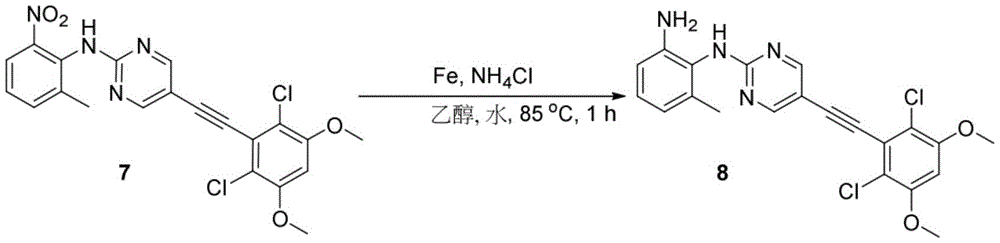
Synthesis of 5- ((3, 5-dimethoxyphenyl) ethynyl) -N- (2-methyl-6-nitrophenyl) pyrimidin-2-amine
A mixture of 5-bromo-N- (2-methyl-6-nitrophenyl) pyrimidin-2-amine (573mg, 3.0mmol), 1-ethynyl-3, 5-dimethoxybenzene (483 mg, 3.0mmol), triphenylphosphine (157mg, 0.60mmol), bis (triphenylphosphine) palladium (II) chloride (210mg, 0.30mmol), copper (I) iodide (57mg, 0.30mmol), and diethylamine (1.50mL, 15.0mmol) in N, N-dimethylformamide (10mL) was degassed with nitrogen 3 times and then stirred at 80 ℃ for 2 hours. LCMS showed reaction completion. Cooling mixerThe mixture was brought to room temperature, quenched with water (20mL), and extracted with ethyl acetate (3X 80 mL). The combined organic layers were separated, washed with water and brine, dried over sodium sulfate, filtered and concentrated. Wherein the residue was purified by silica gel chromatography (petroleum ether: ethyl acetate ═ 4:1) to give the title compound (460mg, 39%) as a yellow solid. MS (ES +) C21H18N4O4The required value is: 390, experimental value: 391[ M + H]+。
Synthesis of N1- (5- ((3, 5-dimethoxyphenyl) ethynyl) pyrimidin-2-yl) -6-methylbenzene-1, 2-diamine
A mixture of 5- ((3, 5-dimethoxyphenyl) ethynyl) -N- (2-methyl-6-nitrophenyl) pyrimidin-2-amine (150mg, 0.38mmol), iron (171mg, 3.04mmol) and ammonium chloride (246mg, 4.56mmol) in ethanol (20mL) and water (2mL) was stirred at 85 ℃ for 1 h. LCMS showed reaction completion. The reaction was cooled to room temperature and the solid was filtered off. The filtrate was concentrated, and the residue was purified by preparative HPLC to give the title compound as a white solid (55mg, 44%). MS (ES +) C21H20N4O2The required value is: 360, experimental value: 361[ M + H ]]+。1H-NMR(500MHz,DMSO-d6) δppm 8.76(s,1H),8.50-8.46(br,2H),6.88(t,1H,J=7.0Hz), 6.66(s,2H),6.57(d,1H,J=7.5Hz),6.54(s,1H),6.44(d,1H, J=6.5Hz),4.74(s,2H),3.76(s,6H),2.01(s,3H)。
Synthesis of N- (2- ((5- ((3, 5-dimethoxyphenyl) ethynyl) pyrimidin-2-yl) amino) -3-methylphenyl) acrylamide
N1- (5- ((3, 5-dimethoxyphenyl) ethynyl) pyrimidin-2-yl) -6-methylbenzene-1, 2-diamine was prepared using a similar procedure as compound 30. The obtained product is obtained by reactingFlash chromatography was performed with a gradient of 0-100% EtOAc/hexanes to purify the title compound. MS (ES +) C24H22N4O3The required value is: 414, experimental value: 415[ M + H]+。1H-NMR(400MHz,DMSO-d6)δppm 9.60-9.38(m,1H),8.79(s,1H), 8.51(s,2H),7.69(d,J=8.1Hz,1H),7.19(t,J=7.8Hz,1H), 7.15-7.06(m,1H),6.67(d,J=2.3Hz,2H),6.60-6.45(m,2H),6.22 (dd,J=17.0,2.1Hz,1H),5.71(dd,J=10.2,2.1Hz,1H),3.76 (s,6H),2.12(s,3H)。
Synthesis of 5- ((2, 6-dichloro-3, 5-dimethoxyphenyl) ethynyl) -N- (2-methyl-6-nitrophenyl) pyrimidin-2-amine
To a solution of 5- ((3, 5-dimethoxyphenyl) ethynyl) -N- (2-methyl-6-nitrophenyl) pyrimidin-2-amine (50mg, 0.13mmol) in acetonitrile (5mL) was added sulfonyl chloride (44mg, 0.33mmol) dropwise at-20 ℃ and the mixture was then stirred for a further 10 minutes. LCMS showed the reaction was complete and the reaction was quenched with water (0.5 mL). The solvent was evaporated and the residue was purified by preparative HPLC to give the title compound as a yellow solid (30mg, 50%). (MS (ES +) C21H16Cl2N4O4The required value is: 459,461, Experimental value: 460,462[ M + H ]]+。
Synthesis of N1- (5- ((2, 6-dichloro-3, 5-dimethoxyphenyl) ethynyl) pyrimidin-2-yl) -6-methylbenzene-1, 2-diamine
A mixture of 5- ((2, 6-dichloro-3, 5-dimethoxyphenyl) ethynyl) -N- (2-methyl-6-nitrophenyl) pyrimidin-2-amine (150mg, 0.33mmol), iron (147mg, 2.64mmol) and ammonium chloride (214mg, 3.96 mmol) in ethanol (20mL) and water (2mL) was stirred at 85 ℃ for 1 h. LCMS showed reaction completion. The reaction was cooled to room temperature and the solid was filtered offAnd (3) a body. The resulting filtrate was concentrated, and the residue was purified by preparative HPLC to give the title compound as a white solid (58mg, 35%). MS (ES +) C21H18Cl2N4O2The required value is: 429,431, Experimental value: 430,432[ M + H [ ]]+。1H-NMR(400 MHz,DMSO-d6)δppm 8.90(s,1H),8.55-8.44(br,2H),6.97(s,1H), 6.89-6.86(m,1H),6.57(d,1H,J=7.6Hz),6.44(d,1H,J=7.6 Hz),4.75(s,2H),3.94(s,6H),2.01(s,3H)。
Synthesis of N- (2- ((5- ((2, 6-dichloro-3, 5-dimethoxyphenyl) ethynyl) pyrimidin-2-yl) amino) -3-methylphenyl) acrylamide
N- (2- ((5- ((2, 6-dichloro-3, 5-dimethoxyphenyl) ethynyl) pyrimidin-2-yl) amino) -3-methylphenyl) acrylamide was prepared using a similar preparative procedure as compound 30. The resulting product can be purified by flash chromatography using a gradient of 0-100% EtOAc/hexanes to give the title compound. MS (ES +) C24H20Cl2N4O3The required value is: 482, experimental value: 483[ M + H]+。1H-NMR(400MHz,DMSO-d6)δppm 9.47(s,1H),8.93 (s,1H),8.54(s,2H),7.71(d,J=8.1Hz,1H),7.19(t,J=7.8 Hz,1H),7.09(d,J=7.4Hz,1H),6.98(s,1H),6.53(dd,J=17.0, 10.2Hz,1H),6.22(dd,J=17.0,2.1Hz,1H),5.70(dd,J=10.2, 2.1Hz,1H),3.94(s,6H),2.13(s,3H)。
Example 8: synthesis of Compound 40
Synthesis of diethyl 2-methyl-3-oxoglutarate
Sodium hydride (60%, 4.8g, 120.5mmol) was added to a solution of diethyl 3-oxoglutarate (23.2g, 114.8mmol) in tetrahydrofuran (100mL) at 0 deg.C and the reaction mixture was stirred at room temperature for 30 minutes, followed by addition of methyl iodide (7.15mL, 114.8 mmol). The reaction mixture was stirred at room temperature for 48 hours, quenched with water (500mL), and extracted with ethyl acetate (500 mL. times.3). The organic layers were separated, combined, washed with water (200mL) and brine (200mL), dried over sodium sulfate, filtered and concentrated. The residue was purified by silica gel column (petroleum ether: ethyl acetate ═ 20:1) to give the title compound (9g, 36%) as a colorless oil. MS (ES +) C10H16O5The required value is: 216, experimental value: 217[ M + H]+。
Synthesis of 4-hydroxy-5-methyl-6-oxo-1, 6-dihydropyridine-3-carboxylic acid ethyl ester
To a solution of diethyl 2-methyl-3-oxoglutarate (10g, 46.25mmol) in 1,1' -trioxanediyldipropan-1-one (400mL) was added triethoxymethane (38mL, 231.25mmol) and the mixture was heated at 120 ℃ for 4 hours, followed by addition of 30% ammonia (600mL) at 0 ℃. The reaction mixture was stirred at room temperature for a further 2 hours. LCMS monitored the reaction completion. The resulting precipitate was collected by filtration and dissolved in dichloromethane (400 mL). The solid was filtered off, and the filtrate was concentrated to give the title compound (5.5g, crude material) as a yellow solid. MS (ES +) C9H11NO4The required value is: 197, experimental value: 198[ M + H]+。
Synthesis of 4, 6-dichloro-5-methylnicotinic acid ethyl ester
The reaction solution of ethyl 4-hydroxy-5-methyl-6-oxo-1, 6-dihydropyridine-3-carboxylate (5.0g, 21.4mmol) at 125 deg.CA solution of phosphorus oxychloride (100mL) was refluxed for 12 hours. LCMS monitored completion of the reaction. Most of the phosphoryl trichloride was evaporated and the residue was added dropwise to ice water (100 mL). The resulting mixture was neutralized with aqueous sodium carbonate (50mL) and extracted with ethyl acetate (200 mL). The organic layer was separated, combined, washed with water and brine, dried over sodium sulfate, filtered, and concentrated. The resulting residue was purified by silica gel column (petroleum ether: ethyl acetate ═ 15:1) to give the title compound (1.6g, 32%) as a yellow oil. MS (ES +) C9H9Cl2NO2The required value is: 232,234, experimental values: 233,235[ M + H [ ]]+。
Synthesis of 6-chloro-5-methyl-4- (methylamino) nicotinic acid ethyl ester
To a solution of 4, 6-dichloro-5-methylnicotinic acid ethyl ester (2.6g, 11.1mmol) in acetonitrile (60mL) was added dropwise water containing 40% methylamine (689mg, 22.2mmol, 60mL) and the mixture was stirred at 50 ℃ for 72 hours. Reaction completion was monitored by LCMS. The reaction mixture was concentrated and extracted with ethyl acetate (100 mL). The organic layers were separated, combined, washed with water and brine, dried over sodium sulfate, filtered and concentrated. The residue was purified by silica gel column (petroleum ether: ethyl acetate ═ 2:1) to give the title compound (2.05g, 81%) as a colorless oil. MS (ES +) C10H13ClN2O2The required value is: 228,230, experimental value: 229,231[ M + H]+。
Synthesis of (6-chloro-5-methyl-4- (methylamino) pyridin-3-yl) methanol
Lithium aluminum hydride was added to a solution of 6-chloro-5-methyl-4- (methylamino) nicotinic acid ethyl ester (2.0g, 8.8mmol) in tetrahydrofuran (60mL) at 0 deg.C, and the mixture was stirred at room temperature for 1.5 hours. Reaction monitored by LCMSAnd (4) finishing. The reaction was quenched with sodium sulfate decahydrate (1.5g) and filtered. The filtrate was concentrated to give the title compound (1.4g, crude material) as a white solid. MS (ES +) C8H11ClN2The required value of O: 186,188, experimental values: 187,189[ M + H ]]+。
Synthesis of 6-chloro-5-methyl-4- (methylamino) nicotinecarboxaldehyde
A mixture of (6-chloro-5-methyl-4- (methylamino) pyridin-3-yl) methanol (1.4g, 8.0mmol) and manganese oxide (2.8g, 32mmol) in dichloromethane (100mL) was stirred at room temperature for 4 hours. Reaction completion was monitored by LCMS. The solid was filtered off, and the filtrate was concentrated to give the title compound (1.2g, crude material) as a yellow oil. MS (ES +) C8H9ClN2The required value of O: 184,186, experimental value: 185,187[ M + H ]]+。
Synthesis of 7-chloro-3- (3, 5-dimethoxyphenyl) -1, 8-dimethyl-1, 6-naphthyridin-2 (1H) -one
A mixture of 6-chloro-5-methyl-4- (methylamino) nicotinaldehyde (3.11g, 16.8mmol), methyl 2- (3, 5-dimethoxyphenyl) acetate (4.25g, 20.2mmol), and potassium carbonate (2.8g, 20.3mmol) in N, N-dimethylformamide (100mL) was stirred overnight at 105 ℃. LCMS monitor completion of reaction. The reaction mixture was cooled to room temperature and quenched with water. The resulting precipitate was filtered and dried to give the title compound (5.5g, crude material) as a yellow solid. MS (ES +) C18H17ClN2O3The required value is: 344,346, experimental values: 345,347[ M + H]+。
Synthesis of 3- (3, 5-dimethoxyphenyl) -1, 8-dimethyl-7- (2-nitrophenylamino) -1, 6-naphthyridin-2 (1H) -one
A mixture of 7-chloro-3- (3, 5-dimethoxyphenyl) -1, 8-dimethyl-1, 6-naphthyridin-2 (1H) -one (800mg, 2.32mmol), 2-nitroaniline (320mg, 2.32mmol), Pd2(dba)3(100mg), John-Phos (100mg) and potassium tert-butoxide (480 mg, 4.64mmol) in N, N-dimethylformamide (10mL) in a sealed tube was heated at 100 ℃ for 1 hour under microwave conditions. LCMS monitor completion of reaction. The mixture was concentrated and purified by preparative HPLC to give the title compound as a brown solid (150mg, 15%). MS (ES +) C24H22N4O5The required value is: 446, experimental value: 447[ M + H]+。
Synthesis of 3- (2, 6-dichloro-3, 5-dimethoxyphenyl) -1, 8-dimethyl-7- (2-nitrophenylamino) -1, 6-naphthyridin-2 (1H) -one
Sulfonyl chloride (185mg, 1.35mmol) was added to a solution of 3- (3, 5-dimethoxyphenyl) -1, 8-dimethyl-7- (2-nitrophenylamino) -1, 6-naphthyridin-2 (1H) -one (120mg, 0.27mmol) in acetonitrile (120mL) at-15 ℃ and the mixture was stirred at-15 ℃ for 10 min. LCMS monitor completion of reaction. The reaction mixture was quenched with water (1mL) and concentrated. The precipitate was collected via filtration, washed with acetone/petroleum ether (1:5), and dried to give the title compound as a white solid (100mg, 72%). MS (ES +) C24H20Cl2N4O5The required value is: 514,516, experimental values: 515,517[ M + H]+。
Synthesis of 7- (2-aminophenylamino) -3- (2, 6-dichloro-3, 5-dimethoxyphenyl) -1, 8-dimethyl-1, 6-naphthyridin-2 (1H) -one
Stannous chloride (150mg, 0.8mmol) was added to a solution of 3- (2, 6-dichloro-3, 5-dimethoxyphenyl) -1, 8-dimethyl-7- (2-nitrophenylamino) -1, 6-naphthyridin-2 (1H) -one (100mg, 0.2mmol) in ethyl acetate (20mL) and the mixture was stirred at 80 ℃ for 1 hour. LCMS monitor completion of reaction. The solid was filtered off and the filtrate was concentrated. The residue was purified by preparative HPLC to give the title compound as a yellow solid (38.6mg, 41%). MS (ES +) C24H22Cl2N4O3The required value is: 484,486, experimental value: 485,487[ M + H]+;1H-NMR(500MHz,DMSO-d6)δppm 8.24(s, 1H),7.76(s,1H),7.67(s,1H),7.03(d,1H,J=7.5Hz),6.97(s, 1H),6.92-6.89(m,1H),6.75-6.73(m,1H),6.57-6.54(m,1H),4.77 (s,2H),3.95(s,6H),3.66(s,3H),2.43(s,3H)。
Synthesis of N- (2- ((3- (2, 6-dichloro-3, 5-dimethoxyphenyl) -1, 8-dimethyl-2-oxo-1, 2-dihydro-1, 6-naphthyridin-7-yl) amino) phenyl) acrylamide
N- (2- ((3- (2, 6-dichloro-3, 5-dimethoxyphenyl) -1, 8-dimethyl-2-oxo-1, 2-dihydro-1, 6-naphthyridin-7-yl) amino) phenyl) acrylamide was prepared using a preparation procedure analogous to that of compound 30. The resulting product was purified by preparative thin layer chromatography using a gradient of 0-5% MeOH in DCM to give the title compound. MS (ES +) C27H24Cl2N4O4The required value is: 538, experimental value: 539[ M + H ]]+。
Example 9: synthesis of Compound 42
Synthesis of (2-amino-4-methoxyphenyl) methanol
Borohydride-containing THF (450mL, 450mmol) was added to a solution of 2-amino-4-methoxybenzoic acid (15.0g, 89.8mmol) in THF (300mL) at 0 deg.C and the reaction mixture was stirred at room temperature overnight. LCMS showed completion of the reaction. The reaction was quenched with water (150mL) and extracted with ethyl acetate (500 mL. times.3). The organic layers were separated, combined, washed with water (200mL) and brine (200mL), dried over sodium sulfate, filtered and concentrated to give the title compound. MS (ES +) C8H11NO2The required value is: 153, experimental value: 154[ M + H ]]+。
Synthesis of 2-amino-4-methoxybenzaldehyde
A mixture of (2-amino-4-methoxyphenyl) methanol (20g, 131.0mmol) and manganese oxide (68g, 786.0mmol) in dichloromethane (300mL) was stirred at room temperature overnight. LCMS showed completion of the reaction. The solid was filtered off and the filtrate was concentrated. The residue was purified by silica gel chromatography (petroleum ether: ethyl acetate ═ 6:1) to give the title compound (7g, 35%) as a yellow solid. MS (ES +) C8H9NO2The required value is: 151, experimental value: 152[ M + H]+。
Synthesis of 2-amino-5-bromo-4-methoxybenzaldehyde
N-bromosuccinimide (7g, 39.7mmol) was added to a stirred solution of 2-amino-4-methoxybenzaldehyde (6g, 39.7mmol) in dichloromethane (100 mL). LCMS monitored the reaction until complete consumption of the starting material. The reaction mixture was diluted with dichloromethane and water. Separated organic layerIt can be dried over sodium sulfate, filtered, and concentrated to give the title compound as a yellow solid (5g, 56%). MS (ES +) C8H8BrNO2The required value is: 229,231, Experimental value: 230,232[ M + H ]]+。
Synthesis of 6-bromo-7-methoxyquinazolin-2-ol
A mixture of 2-amino-5-bromo-4-methoxybenzaldehyde (3g, 13.1mmol) and urea (12g, 196.5mmol) was stirred at 180 ℃ for 2 hours. LCMS showed reaction completion. The reaction mixture was cooled to room temperature and washed with water (3X 100 mL). The precipitate was collected and dried to give the title compound (3g, crude material) as a yellow solid. MS (ES +) C8H7BrN2O2The required value is: 254,256, experimental values: 255,257[ M + H]+。
Synthesis of 6-bromo-2-chloro-7-methoxyquinazoline
A solution of 6-bromo-7-methoxyquinazolin-2-ol (3.0g, 11.8mmol) in phosphoryl trichloride (30mL) was refluxed for 5 hours at 130 ℃. LCMS showed reaction completion. The reaction was cooled to room temperature and most of the phosphoryl trichloride evaporated. The residue was added dropwise to ice water (100mL), and the resulting precipitate was collected via filtration to give the title compound (2.4g, 75%) as a yellow solid. MS (ES +) C9H6BrClN2The required value of O: 272,274, experimental value: 273,275[ M + H]+。
Synthesis of 2-chloro-6- (3, 5-dimethoxyphenyl) -7-methoxyquinazoline
In THF (10mL), dioxane (10mL) and water (2mL)6-bromo-2-chloro-7-methoxyquinazoline (2.4g, 8.82mmol), 3, 5-dimethoxyphenylboronic acid (1.6g, 8.82mmol), cerium carbonate (8.6g, 26.46mmol), and Pd (PPh)3)2Cl2(1.4g, 2.1mmol) the de mixture was degassed 3 times with nitrogen and stirred at 85 ℃ for 3 hours. Reaction completion was monitored by LCMS. The mixture was cooled to room temperature and extracted with dichloromethane (3 × 50 mL). The organic layers were separated, combined, washed with water and brine, dried over sodium sulfate, filtered and concentrated. The residue was purified by silica gel chromatography (petroleum ether: ethyl acetate ═ 1:4) to give the title compound (1.1g, 38%) as a white solid. MS (ES +) C17H15ClN2O3The required value is: 330,332, experimental values: 331,333[ M + H]+。
Synthesis of 2-chloro-6- (2, 6-dichloro-3, 5-dimethoxyphenyl) -7-methoxyquinazoline
Sulfonyl chloride (205mg, 1.52mmol) was added to a solution of 2-chloro-6- (3, 5-dimethoxyphenyl) -7-methoxyquinazoline (200mg, 0.61mmol) in acetonitrile (5mL) and the mixture was stirred at-20 ℃ for 1 hour. The reaction was quenched with water (1mL) and concentrated under reduced pressure. The resulting precipitate was washed with acetonitrile and dried to give the title compound as a white solid (120mg, 50%). MS (ES +) C17H13Cl3N2O3The required value is: 398, experimental value: 399,401[ M + H]+;1H-NMR(400MHz,DMSO-d6)δppm 9.43(s, 1H),8.02(s,1H),7.55(s,1H),7.03(s,1H),3.98(s,6H),3.93 (s,3H)。
Synthesis of 6- (2, 6-dichloro-3, 5-dimethoxyphenyl) -7-methoxy-N- (2-methyl-6-nitrophenyl) quinazolin-2-amine
6- (2, 6-Di-S) Using a preparation procedure analogous to Compound 30Preparation of chloro-3, 5-dimethoxyphenyl) -7-methoxy-N- (2-methyl-6-nitrophenyl) quinazolin-2-amine. The resulting product was purified by flash chromatography using a gradient of 0-100% EtOAc/hexanes to give the title compound. MS (ES +) C24H20Cl2N4O5The required value is: 514, experimental value: 515[ M + H]+。
Synthesis of N1- (6- (2, 6-dichloro-3, 5-dimethoxyphenyl) -7-methoxyquinazolin-2-yl) -6-methylbenzene-1, 2-diamine
The preparation of N1- (6- (2, 6-dichloro-3, 5-dimethoxyphenyl) -7-methoxyquinazolin-2-yl) -6-methylbenzene-1, 2-diamine was carried out using a preparation procedure analogous to that for compound 30. The reaction was greedy I filtered through diatomaceous earth to obtain the crude product. MS (ES +) C24H22Cl2N4O3The required value is: 484, Experimental value: 485[ M + H]+。
Synthesis of N- (2- ((6- (2, 6-dichloro-3, 5-dimethoxyphenyl) -7-methoxyquinazolin-2-yl) amino) -3-methylphenyl) acrylamide
Preparation of N- (2- ((6- (2, 6-dichloro-3, 5-dimethoxyphenyl) -7-methoxyquinazolin-2-yl) amino) -3-methylphenyl) acrylamide was carried out using a preparation procedure analogous to that for compound 30. The resulting product was purified by flash chromatography using a gradient of 0-10% MeOH in DCM to give the title compound. MS (ES +) C27H24Cl2N4O4The required value is: 538, experimental value: 539[ M + H ]]+。
Example 10: synthesis of Compound 34
Synthesis of 2-amino-5-bromo-3-fluorobenzoic acid
N-bromosuccinimide (12.46g, 70mmol) was added to a solution of 2-amino-3-fluorobenzoic acid (10.85g, 70mmol) in dichloromethane (175mL), and the mixture was stirred at room temperature for 2 hours. LCMS showed reaction completion. The resulting precipitate was filtered and washed with dichloromethane (100mL × 3) to give the title compound as a grey solid (12.7g, 78%), which was used directly in the next step without further purification. MS (ES +) C7H5BrFNO2The required value is: 233,235, experimental value: 232,234[ M-H ]]-。
Synthesis of (2-amino-5-bromo-3-fluorophenyl) methanol
Borohydride-containing THF (1M, 310mL) was added to a solution of 2-amino-5-bromo-3-fluorobenzoic acid (14.5g, 62.2mmol) in THF (150mL) at 0 deg.C, and the reaction mixture was stirred at room temperature overnight. LCMS showed reaction completion. The reaction was quenched with methanol (150mL), concentrated in vacuo, diluted with aqueous sodium bicarbonate (400mL), and extracted with ethyl acetate (200mL × 3). The organic layers were separated, combined, washed with water (200mL) and brine (200mL), dried over sodium sulfate, filtered and concentrated to give the title compound (13.0g, crude material) which was used in the next step without further purification. MS (ES +) C7H7BrFNO requirement: 219,221, experimental value: 220,222[ M + H ]]+。
Synthesis of 2-amino-5-bromo-3-fluorobenzaldehyde
A mixture of (2-amino-5-bromo-3-fluorophenyl) methanol (13g, 59.4mmol) and manganese oxide (31g, 356.4mmol) in dichloromethane (400mL) was stirred at room temperature overnight. TLC showed complete consumption of the starting material. The solid was filtered off and the filtrate was concentrated to give the title compound as a light yellow solid (11g, 85%) which was used directly in the next step without further purification.
Synthesis of 6-bromo-8-fluoroquinazolin-2-ol
A stirred mixture of 2-amino-5-bromo-3-fluorobenzaldehyde (2.17g, 10mmol) and urea (9g, 150mmol) was heated at 180 ℃ for 2 hours. Completion of the reaction was indicated by LCMS. The reaction mixture was cooled to room temperature and the resulting precipitate was filtered and washed with water (500mL × 3). The trapped moisture was completely removed by co-evaporation with toluene 3 times. The title compound was obtained as a yellow solid (2g, 83%). MS (ES +) C8H4BrFN2The required value of O: 242, 244, experimental values: 243,245[ M + H]+。
Synthesis of 6-bromo-2-chloroquinazoline
A solution of 6-bromoquinazolin-2-ol (9.72g, 40mmol) in phosphorus oxychloride (100mL) was refluxed for 5 hours. LCMS showed reaction completion. The reaction was cooled to room temperature and most of the phosphorus oxychloride was removed under reduced pressure. The residue was added dropwise to ice water (500mL), and the resulting precipitate was collected by filtration to give the title compound (9g, 87%) as a yellow solid. MS (ES +) C8H3BrClFN2The required value is: 260,262, experimental value: 261,263 [ M + H]+。
Synthesis of 2-chloro-6- (3, 5-dimethoxyphenyl) -8-fluoroquinazoline
6-bromo-2-chloro-8-fluoroquinazolin (4.0g, 15.4mmol), 3, 5-dimethoxyphenylboronic acid (4.47g, 16.9mmol), cesium carbonate (10.0g, 30.8mmol) and Pd (PPh) in THF (200mL) and water (10mL)3)2Cl2(236mg, 0.77mmol) of the mixture was degassed 3 times with nitrogen and stirred at 80 ℃ for 3 hours. Both TLC and LCMS showed the reaction was complete. The reaction mixture was cooled to room temperature and concentrated directly. The residue was purified by silica gel chromatography (petroleum ether: dichloromethane ═ 2:1 to 1:1) to give the title compound (2.5g, 51%) as a yellow solid. MS (ES +) C16H12ClFN2O2The required value is: 318/320, Experimental value: 319/321[ M + H]+。
Synthesis of 2-chloro-6- (2, 6-dichloro-3, 5-dimethoxyphenyl) -8-fluoroquinazoline
To a solution of 2-chloro-6- (3, 5-dimethoxyphenyl) -8-fluoroquinazoline (1.5g, 4.7mmol) in anhydrous THF (40mL) at 0 ℃ was added dropwise sulfonyl chloride (1.59g, 1.75 mmol) and the mixture was stirred for 1 hour. Both TLC and LCMS showed the reaction was complete. The reaction was quenched with water (1mL) and the solvent was removed under reduced pressure. The residue was washed with acetonitrile and dried to give the title compound as a white solid (700mg, 38%). (MS (ES +) C16H10Cl3FN2O2The required value is: 386,388, experimental value: 387,389[ M + H ]]+;1H-NMR(400MHz,DMSO-d6)δppm 9.74(d,1H J=1.0Hz),8.03-7.99 (m,2H),7.08(s,1H),4.00(s,6H)。
Synthesis of 6- (2, 6-dichloro-3, 5-dimethoxyphenyl) -8-fluoro-N- (2-methyl-6-nitrophenyl) quinazolin-2-amine
The preparation of 6- (2, 6-dichloro-3, 5-dimethoxyphenyl) -8-fluoro-N- (2-methyl-6-nitrophenyl) quinazolin-2-amine is carried out using a preparative procedure analogous to that for compound 30. The resulting product was purified by flash chromatography using a gradient of 0-100% EtOAc/hexanes to give the title compound. MS (ES +) C23H17Cl2FN4O4The required value is: 502, experimental value: 503[ M + H]+。
Synthesis of N1- (6- (2, 6-dichloro-3, 5-dimethoxyphenyl) -8-fluoroquinazolin-2-yl) -6-methylbenzene-1, 2-diamine
The preparation of N1- (6- (2, 6-dichloro-3, 5-dimethoxyphenyl) -8-fluoroquinazolin-2-yl) -6-methylbenzene-1, 2-diamine was carried out using a preparation procedure analogous to that of compound 30. The reaction product was filtered through celite to obtain a crude product. MS (ES +) C23H19Cl2FN4O2The required value is: 472, experimental value: 473[ M + H ]]+。
Synthesis of N- (2- ((6- (2, 6-dichloro-3, 5-dimethoxyphenyl) -8-fluoroquinazolin-2-yl) amino) -3-methylphenyl) acrylamide
Preparation of N- (2- ((6- (2, 6-dichloro-3, 5-dimethoxyphenyl) -8-fluoroquinazolin-2-yl) amino) -3-methylphenyl) acrylamide was carried out using a preparation procedure analogous to that of compound 30. The resulting product was purified by flash chromatography using a gradient of 0-10% MeOH in DCM to give the title compound. MS (ES +) C26H21Cl2FN4O3The required value is: 526, experimental value: 527[ M + H]+。1H-NMR(400MHz,DMSO-d6)δ9.53(d,J =27.9Hz,1H),9.28(s,1H),8.96(s,1H),7.75(d,J=29.9Hz, 1H),7.59(d,J=1.7Hz,1H),7.49(d,J=10.8Hz,1H),7.02(s, 1H),6.50(s,1H),6.21(dd,J=16.9,2.1Hz,1H),5.75(s,1H), 5.68(dd,J=10.2,2.0Hz,1H),3.98(d,J=4.6Hz,6H),2.19(s, 3H)。
Example 10: synthesis of Compound 50
Synthesis of tert-butyl 4- (2, 5-dichloropyrimidin-4-yl) piperazine-1-carboxylate
To a solution of 2,4, 5-trichloropyrimidine (0.475g, 2.6mmol) in anhydrous DMF (8.5mL) was added tert-butyl piperazine-1-carboxylate (0.51g, 2.7mmol) and DIEA (0.51mL, 3.1mmol) in that order at 0 ℃ and the mixture was stirred for 1 hour. Completion of the reaction was indicated by LCMS. The reaction was diluted with water (100mL) and the white solid was filtered. The residue therein was washed with water and dried to give the title compound as a white solid (445mg, 51%). MS (ES +) C13H18Cl2N4O2The required value is: 332, experimental value: 333[ M + H]+。
Synthesis of tert-butyl (2- ((5-chloro-4- (piperazin-1-yl) pyrimidin-2-yl) amino) phenyl) carbamate
To a solution of 4- (2, 5-dichloropyrimidin-4-yl) piperazine-1-carboxylic acid tert-butyl ester (0.1g, 0.3mmol) in DCM (1.0mL) was added TFA (1.0mL), and the mixture was stirred for 1 hour. An aliquot of the reaction mixture was analyzed by LCMS, which indicated that the reaction had progressed to completion. The solvent was removed and the residue was dried under high vacuum. The crude product was used in the next step without further purification.
To 2, 5-dichloro-To a solution of 4- (piperazin-1-yl) pyrimidine (0.3mmol) in dioxane (4.0mL) were added TFA (0.060mL, 0.75mmol) and tert-butyl (2-aminophenyl) carbamate (0.094g, 0.45mmol) and the mixture was stirred at 100 ℃ to achieve a 24 hour reaction. After cooling to room temperature, the reaction mixture was diluted with EtOAc and washed with saturated aqueous sodium bicarbonate. The organic mixture was dried over sodium sulfate and loaded onto silica gel and purified using a gradient of 0-10% MeOH/DCM containing 10% NH4OH to give the title compound as a white solid (28mg, 23%). MS (ES +) C19H25ClN6O2The required value is: 404, experimental value: 405[ M + H ]]+。
Synthesis of tert-butyl (2- ((5-chloro-4- (4- ((3- (trifluoromethyl) phenyl) carbamoyl) piperazin-1-yl) pyrimidin-2-yl) amino) phenyl) carbamate
To a solution of tert-butyl (2- ((5-chloro-4- (piperazin-1-yl) pyrimidin-2-yl) amino) phenyl) carbamate (28mg, 0.068mmol) in DCM (0.7mL) was added 1-isocyanato-3- (trifluoromethyl) benzene (0.011mL, 0.082mmol) and triethylamine (0.015mL, 0.1mmol), and the mixture was stirred at 23 ℃ to complete the reaction for 16 hours. The crude reaction mixture was loaded onto silica gel and purified using a 0-50% EtOAc/hexanes gradient to give the title compound (25mg, 62%). MS (ES +) C27H29ClF3N7O3The required value is: 591, experimental values: 592[ M + H]+。
Synthesis of 4- (2- ((2-acrylamidophenyl) amino) -5-chloropyrimidin-4-yl) -N- (3- (trifluoromethyl) phenyl) piperazine-1-carboxamide
To a solution of tert-butyl (2- ((5-chloro-4- (4- ((3- (trifluoromethyl) phenyl) carbamoyl) piperazin-1-yl) pyrimidin-2-yl) amino) phenyl) carbamate (0.025g, 0.043mmol) in DCM (1.0mL) was added TFA (1.0mL) and the mixture was stirred for 1 hour. An aliquot of the reaction mixture was analyzed by LCMS, which indicated that the reaction had progressed to completion. The solvent was removed and the residue was dried under high vacuum. The crude product was used in the next step without further purification.
To a solution of 4- (2- ((2-aminophenyl) amino) -5-chloropyrimidin-4-yl) -N- (3- (trifluoromethyl) phenyl) piperazine-1-carboxamide (0.043mmol) in DCM (0.5mL) was added acryloyl chloride (0.004mL, 0.052mmol) and DIEA (0.018mL, 0.11mmol), and the mixture was stirred at 0 ℃ for 1 hour. The crude reaction mixture was loaded onto silica gel and purified using a gradient of 0-7% MeOH in DCM to give the title compound (10mg, 43%). MS (ES +) C25H23ClF3N7O2The required value is: 545, experimental value: 546[ M + H]+。
Example 11: synthesis of Compound 54
Synthesis of tert-butyl 4- (2-chloro-5-methylpyrimidin-4-yl) piperazine-1-carboxylate
To a solution of 2, 4-dichloro-5-methylpyrimidine (0.75g, 4.6mmol) in anhydrous DMF (15.5mL) was added tert-butyl piperazine-1-carboxylate (0.9g, 4.85 mmol) and DIEA (0.91mL, 5.5mmol) sequentially at 0 ℃ and the mixture was stirred until room temperature and overnight. LCMS showed reaction completion. The reaction was diluted with water (120mL) and the solid filtered. The residue was washed with water and dried to give the title compound as a white solid (1.386g, 96%). MS (ES +) C14H21ClN4O2The required value is: 312, experimental value: 313[ M + H ]]+。
Synthesis of 4- ((4- (4- (tert-butyloxycarbonyl) piperazin-1-yl) -5-methylpyrimidin-2-yl) amino) -3-nitrobenzoic acid
Will be present in the sealed tubetA mixture of tert-butyl 4- (2-chloro-5-methylpyrimidin-4-yl) piperazine-1-carboxylate (0.15g, 0.48mmol), 4-amino-3-nitrobenzoic acid (97mg, 0.53mmol), BrettPhos-Pd mixture (20mg, 0.015 mmol) and cesium carbonate (470mg, 1.44mmol) in BuOH (2.4mL) was heated at 100 ℃ overnight. The resulting mixture was diluted with EtOAc, filtered through a plug of celite, and loaded onto silica gel and purified using a gradient of 0-10% MeOH in DCM to give the title compound (75mg, 34%). MS (ES +) C21H26N6O6The required value is: 458, experimental value: 459[ M + H ]]+。
Synthesis of tert-butyl 4- (5-methyl-2- ((4- ((1-methylpiperidin-4-yl) carbamoyl) -2-nitrophenyl) amino) pyrimidin-4-yl) piperazine-1-carboxylate
A mixture of 4- ((4- (4- (tert-butyloxycarbonyl) piperazin-1-yl) -5-methylpyrimidin-2-yl) amino) -3-nitrobenzoic acid (0.075g, 0.164mmol), 1-methylpiperidin-4-amine (37mg, 0.33mmol), HATU (140mg, 0.37mmol) and DIEA (0.1mL, 0.6mmol) in DMF (3.0mL) was stirred at room temperature overnight. The reaction mixture was diluted with EtOAc, washed with saturated aqueous sodium bicarbonate and saturated aqueous brine. The crude mixture was loaded on silica gel and used with a solution containing 10% NH4OH was purified with a gradient of 0-10% MeOH in DCM to give the title compound as a white solid (73mg, 80%). MS (ES +) C27H38N8O5The required value is: 554, experimental value: 555[ M + H ]]+。
Synthesis of N- (4-cyanophenyl) -4- (5-methyl-2- ((4- ((1-methylpiperidin-4-yl) carbamoyl) -2-nitrophenyl) amino) pyrimidin-4-yl) piperazine-1-carboxamide
To a solution of tert-butyl 4- (5-methyl-2- ((4- ((1-methylpiperidin-4-yl) carbamoyl) -2-nitrophenyl) amino) pyrimidin-4-yl) piperazine-1-carboxylate (0.073g, 0.13mmol) in DCM (1.0mL) was added TFA (1.0mL) and the mixture was stirred for 1 hour. An aliquot of the reaction mixture was analyzed by LCMS, which indicated that the reaction had progressed to completion. The solvent was removed and the residue was dried under high vacuum. The crude product was used in the next step without further purification.
To a solution of 4- ((5-methyl-4- (piperazin-1-yl) pyrimidin-2-yl) amino) -N- (1-methylpiperidin-4-yl) -3-nitrobenzamide (0.073mmol) in DCM (1.5mL) was added 4-isocyanatobenzonitrile (23mg, 0.16mmol) and triethylamine (0.055mL, 0.39 mmol) and the mixture was stirred at 23 ℃ to quench the reaction for 16 hours. The crude reaction mixture was filtered and washed with minimum volume of DCM, then hexanes to give the title compound (97mg, 100%). MS (ES +) C30H34N10O4The required value is: 598, experimental value: 599[ M + H ]]+
Synthesis of 4- (2- ((2-amino-4- ((1-methylpiperidin-4-yl) carbamoyl) phenyl) amino) -5-methylpyrimidin-4-yl) -N- (4-cyanophenyl) piperazine-1-carboxamide
Prepared using a preparative procedure analogous to compound 30 for 4- (2- ((2-amino-4- ((1-methylpiperidin-4-yl) carbamoyl) phenyl) amino) -5-methylpyrimidin-4-yl) -N- (4-cyanophenyl) piperazine-1-carboxamide. After the reaction, it was filtered through celite to obtain a crude product. MS (ES +) C30H36N10O2The required value is: 568, experimental values: 569[ M + H ]]+。
Synthesis of 4- (2- ((2-acrylamido-4- ((1-methylpiperidin-4-yl) carbamoyl) phenyl) amino) -5-methylpyrimidin-4-yl) -N- (4-cyanophenyl) piperazine-1-carboxamide
Prepared using a preparative procedure analogous to compound 30 for 4- (2- ((2-acrylamido-4- ((1-methylpiperidin-4-yl) carbamoyl) phenyl) amino) -5-methylpyrimidin-4-yl) -N- (4-cyanophenyl) piperazine-1-carboxamide. The final reaction mixture will be purified via preparative thin layer chromatography to give the title product. MS (ES +) C33H38N10O3The required value is: 622, experimental value: 623[ M + H]+。1H NMR(400MHz,DMSO-d6)δ9.98 (s,1H),9.08(s,1H),8.30(s,1H),8.21-8.07(m,3H),7.93(d, J=10.7Hz,2H),7.67(m,4H),6.50(dd,J=16.9,10.2Hz,1H), 6.33-6.25(m,1H),5.83-5.76(m,1H),3.78(m,2H),3.59(m,4H), 3.43(m,4H),2.92(d,J=11.4Hz,2H),2.30(s,3H),2.23(s,2H), 2.14(s,3H),1.79(m,2H),1.69-1.54(m,2H)。
Example 12: synthesis of Compound 20
Synthesis of imidazo [1,2-a ] pyridine-8-carbonitrile
To a solution of 2-aminonicotinonitrile (1.0g, 8.39mmol) in EtOH (10ml) in a 20ml sealed vial was added 2-chloroacetaldehyde (1.611ml, 9.23mmol) followed by sealing the vial and heating to 120 ℃ overnight. The reaction was cooled to room temperature and quenched with 2N Na2CO3Quench, remove EtOH in vacuo, and extract 3 times with DCM. The organics were combined and washed with water and RNA was washed 2 times with brine. Drying over sodium sulfate and removal of solvent gave the title compound as a yellow-brown solid (1.2g, 8.38mmol, 100% yield) as determined by MS (ES +) C8H5N3The required value is: 143 Experimental value: 144[ M + H ]]+And (5) verifying.
Synthesis of 3-iodoimidazo [1,2-a ] pyridine-8-carbonitrile
To imidazo [1,2-a ]]To a stirred solution of pyridine-8-carbonitrile (1.2g, 8.38mmol) in dichloromethane (10mL) was added N-iodosuccinimide (1.89g, 8.38 mmol). LCMS monitored the reaction until complete consumption of the starting material. The reaction mixture was diluted with dichloromethane and water. The separated organic layer was dried over sodium sulfate, filtered and concentrated to give 3-iodoimidazo [1,2-a as a brown solid]Pyridine-8-carbonitrile (1.8g, 6.69mmol, 80% yield). MS (ES +) C8H8IN3 requires the value: 269, experimental value: 270[ M + H]+。
Synthesis of 1- (3- (8-cyanoimidazo [1,2-a ] pyridin-3-yl) -5-isopropoxyphenyl) -3- (2,2, 2-trifluoroethyl) urea
To 3-iodoimidazo [1,2-a ] in dioxane (3ml)]Pyridine-8-carbonitrile (100mg, 373. mu. mol), 1- (3-isopropoxy-5- (4,4,5, 5-tetramethyl-1, 3, 2-dioxaborono-2-yl) phenyl) -3- (2,2, 2-trifluoroethyl) urea (90mg, 224. mu. mol), PdCl2(dppf) -CH2Cl adduct (30.5mg, 37.3. mu. mol) in a mixture 2M Na was added2CO3(0.559ml, 1119. mu. mol). The vial was degassed for 5 minutes, then capped and heated to 110 ℃ in a microwave for 30 minutes. After cooling to ambient temperature, the reaction was partitioned between EtOAc and brine, the organics were separated and washed 2 times with brine. The combined organics were dried directly onto silica and purified via flash chromatography (0-100% Hex/EtOAc; 12g cartridge). The title compound was recovered as a brown solid (30mg, 71.9 μmol, 32.1% yield). MS (ES +) C20H18F3N5O2The required value is: 417, experimental value: 418[M+H]+。
Synthesis of 1- (3- (8- (aminomethyl) imidazo [1,2-a ] pyridin-3-yl) -5-isopropoxyphenyl) -3- (2,2, 2-trifluoroethyl) urea
1- (3- (8-cyano-imidazo [1,2-a ]) is reacted]Pyridin-3-yl) -5-isopropoxyphenyl) -3- (2,2, 2-trifluoroethyl) urea (0.030g, 0.072mmol) was dissolved in methanol (20mL, 140mmol) containing 7N ammonia and Pd-C (10mg, 0.094mmol) was added. At H2The reaction was stirred under a balloon for 1 hour. The mixture was then filtered through celite and the solvent removed. The residue was dried under high vacuum overnight to give the title compound as a yellow solid (0.026g, 0.062mmol, 86% yield). MS (ES +) C20H22F3N5O2The required value is: 421, experimental value: 422[ M + H]+。
Synthesis of N- ((3- (3-isopropoxy-5- (3- (2,2, 2-trifluoroethyl) ureido) phenyl) imidazo [1,2-a ] pyridin-8-yl) methyl) propynamide
To 1- (3- (8- (aminomethyl) imidazo [1, 2-a)]To a solution of pyridin-3-yl) -5-isopropoxyphenyl) -3- (2,2, 2-trifluoroethyl) urea (26mg, 0.062mmol) in DCM (3ml) were added DIEA (0.075ml, 0.432mmol) and HATU (35.2mg, 0.093 mmol) and finally propiolic acid (4.95. mu.l, 0.080 mmol). The reaction was stirred at room temperature for 30 minutes. The reaction was loaded directly onto a silica column and subjected to flash chromatography (0-10% CH)2Cl2MeOH) to give the title compound as an off-white solid (19mg, 0.040mmol, 65.0% yield). MS (ES +) C23H22F3N5O3The required value is: 473, experimental value: 474[ M + H]+。1H NMR(400MHz,DMSO-d6)δ9.34(s,1H),8.92 (s,1H),8.47(d,J=6.8Hz,1H),7.74(s,1H),7.17(d,J=1.9 Hz,2H),7.10(s,1H),6.98(s,1H),6.82(s,1H),6.74(s,1H), 4.69-4.58(m,2H),3.93(dd,J=9.7,6.4Hz,2H),2.72-2.64(m, 1H),1.30-1.19(m,6H)。
Example 13: synthesis of Compound 21
Synthesis of 7-chloro-3-iodoimidazo [1,2-a ] pyridine
Preparation of 7-chloro-3-iodoimidazo [1,2-a ] using the procedure described in WO2008078091]Pyridine. MS (ES +) C7H4ClIN2The required value is: 278, experimental values: 279[ M + H]+。
Synthesis of 3- (7-chloroimidazo [1,2-a ] pyridin-3-yl) aniline
Preparation of 3- (7-chloroimidazo [1,2-a ] using the procedure described in WO2008078091]Pyridin-3-yl) aniline. MS (ES +) C13H10ClN3The required value is: 243, experimental value: 244[ M + H]+。
Synthesis of 1- (3- (7-chloroimidazo [1,2-a ] pyridin-3-yl) phenyl) -3- (2,2, 2-trifluoroethyl) urea
To 3- (7-chloroimidazo [1,2-a ]]To a solution of pyridin-3-yl) aniline (0.15mmol) in THF (1.5mL) were added 4-nitrophenyl chloroformate (30mg, 0.15mmol) and DIEA (0.036mL, 0.225 mmol). The mixture was heated at 60 ℃ for 6 hours. DIEA (0.036mL, 0.225mmol) and 2,2, 2-trifluoroethyl-1-amine (0.014mL, 0.18mmol) were added to the crude carbamate, and the solution was taken up at 60%Heating at deg.C overnight. The reaction mixture was diluted with EtOAc and water. The separated organic layer was dried over sodium sulfate, filtered and concentrated. The crude mixture was purified by flash chromatography (0-6% MeOH/DCM) to give the title compound (38mg, 69% yield). MS (ES +) C16H12ClF3N4The required value of O: 368, experimental value: 369[ M + H]+。
Synthesis of 1- (3- (7- (2-aminophenyl) imidazo [1,2-a ] pyridin-3-yl) phenyl) -3- (2,2, 2-trifluoroethyl) urea
To 1- (3- (7-chloroimidazo [1,2-a ]]Pyridin-3-yl) phenyl) -3- (2,2, 2-trifluoroethyl) urea (20mg, 0.052mmol), 2- (4,4,5, 5-tetramethyl-1, 3, 2-dioxaborono-2-yl) aniline (15mg, 0.066mmol) and cesium carbonate (51mg, 0.156mmol) in THF/H2To a mixture of O mixture (2/1, 0.75ml) was added Pd (PtBu3)2(3 mg, 0.005 mmol). The vial was degassed for 5 minutes, then capped and heated to 125 ℃ in a microwave for 20 minutes. After cooling to ambient temperature, the reaction mixture was filtered through a pad of celite and subjected to flash chromatography (containing 10% NH4OH gradient 0-10% MeOH in DCM) to give the title compound (20mg, 90% yield). MS (ES +) C22H18F3N5The required value of O: 425, experimental value: 426[ M + H]+。
Synthesis of N- (2- (3- (3- (3- (2,2, 2-trifluoroethyl) ureido) phenyl) imidazo [1,2-a ] pyridin-7-yl) phenyl) acrylamide
Preparation of N- (2- (3- (3- (3- (2,2, 2-trifluoroethyl) ureido) phenyl) imidazo [1,2-a ] using a procedure analogous to that for compound 30]Pyridin-7-yl) phenyl) acrylamide. The product was purified by preparative thin layer chromatography using a gradient of 0-10% MeOH in DCM to give the title compound. MS (ES +) C25H20F3N5O2The required value is: 479, experimental values: 480[ M + H ]]+。
Example 14: synthesis of Compound 38
Synthesis of N- (2- (3- (3-isopropoxy-5- (3- (2,2, 2-trifluoroethyl) ureido) phenyl) imidazo [1,2-a ] pyridin-7-yl) phenyl) acrylamide
Preparation of N- (2- (3- (3-isopropoxy-5- (3- (2,2, 2-trifluoroethyl) ureido) phenyl) imidazo [1, 2-a) using a procedure analogous to that for compound 30]Pyridin-7-yl) phenyl) acrylamide. The product was purified by HPLC flash chromatography using a gradient of 5-70% acetonitrile/water + 0.1% formic acid to give the title compound as the formate salt. MS (ES +) C28H26F3N5O3The required value is: 537, experimental value: 538[ M + H]+。
Example 15: synthesis of Compound 11
Synthesis of tert-butyl (1- (2-chloropyrimidin-4-yl) piperidin-3-yl) carbamate
Tert-butyl (1- (2-chloropyrimidin-4-yl) piperidin-3-yl) carbamate was prepared using a procedure similar to that for compound 54 using 2, 4-dichloropyrimidine and tert-butyl piperidin-3-ylcarbamate. MS (ES +) C14H21ClN4O2The required value is: 312, experimental value: 313[ M + H ]]+
Synthesis of tert-butyl (1- (2- ((2-nitrophenyl) amino) pyrimidin-4-yl) piperidin-3-yl) carbamate
Tert-butyl (1- (2- ((2-nitrophenyl) amino) pyrimidin-4-yl) piperidin-3-yl) carbamate was prepared using a procedure similar to compound 54, using 2-nitroaniline. S (ES +) C20H26N6O4The required value is: 414, experimental value: 415[ M + H]+
Synthesis of N- (1- (2- ((2-nitrophenyl) amino) pyrimidin-4-yl) piperidin-3-yl) propane-1-sulfonamide
To a solution of tert-butyl (1- (2- ((2-nitrophenyl) amino) pyrimidin-4-yl) piperidin-3-yl) carbamate (0.14g, 0.34mmol) in DCM (2.0mL) was added TFA (1.0mL) and the mixture was stirred for 1 hour. An aliquot of the reaction mixture was analyzed by LCMS, which indicated that the reaction had progressed to completion. The solvent was removed and the residue was dried under high vacuum. The crude product was used in the next step without further purification.
To a solution of 4- (3-aminopiperidin-1-yl) -N- (2-nitrophenyl) pyrimidin-2-amine (0.34mmol) in DCM (3.5mL) at 0 ℃ was added propane-1-sulfonyl chloride (0.045 mL, 0.4mmol) and triethylamine (0.12mL, 0.85mmol) and the mixture was allowed to warm to room temperature overnight. The crude reaction mixture was concentrated and purified by flash chromatography (0-7.5% MeOH/DCM) to give the title compound (36mg, 24% yield). MS (ES +) C18H24N6O4S required value: 420, experimental value: 421[ M + H]+。
Synthesis of N- (1- (2- ((2-aminophenyl) amino) pyrimidin-4-yl) piperidin-3-yl) propane-1-sulfonamide
Preparation of N- (1- (2- ((2-aminophenyl) amino)Pyrimidin-4-yl) piperidin-3-yl) propane-1-sulfonamide. The reaction was filtered through celite to give the crude product. MS (ES +) C18H26N6O2S required value: 390, experimental value: 391[ M + H]+。
Synthesis of N- (2- ((4- (3- (propylsulfonamido) piperidin-1-yl) pyrimidin-2-yl) amino) phenyl) acrylamide
N- (2- ((4- (3- (propylsulfonamido) piperidin-1-yl) pyrimidin-2-yl) amino) phenyl) acrylamide was prepared using a procedure similar to that for compound 30. The product was purified by preparative thin layer chromatography using a gradient of 0-6% MeOH in DCM to give the title compound. MS (ES +) C21H28N6O3S required value: 444, experimental value: 445[ M + H ]]+。
Example 16: synthesis of Compound 52
The starting material 1- (tert-butyl) -3- (2- ((4- (diethylamino) butyl) amino) -6- (3, 5-dimethoxyphenyl) pyrido [2,3-d ] pyrimidin-7-yl) urea (PD173074) is commercially available from, for example, selleckchem chem. In a dry vessel, acryloyl chloride (2 eq) and diisopropylethylamine (4.3 eq) to a solution of 1- (tert-butyl) -3- (2- ((4- (diethylamino) butyl) amino) -6- (3, 5-dimethoxyphenyl) pyrido [2,3-d ] pyrimidin-7-yl) urea (1 eq) in anhydrous dichloromethane were added at 0 ℃. After stirring at room temperature for 2 hours, the reaction mixture was concentrated, diluted with DMSO and purified by reverse phase HPLC (5-95% water/acetonitrile). After concentrating the fractions, the product N- (7- (3- (tert-butyl) ureido) -6- (3, 5-dimethoxyphenyl) pyrido [2,3-d ] pyrimidin-2-yl) -N- (4- (diethylamino) butyl) acrylamide was obtained as a pale yellow foam. LCMS (M +1) ═ 578.2.
Example 17:synthesis of Compound 55
In a dry vessel, add sulfonyl chloride (2 equiv.) to a solution of 1- (tert-butyl) -3- (2- ((4- (diethylamino) butyl) amino) -6- (3, 5-dimethoxyphenyl) pyrido [2,3-d ] pyrimidin-7-yl) urea (1 equiv.) in anhydrous acetonitrile at 0 ℃. After stirring for 2 hours, the reaction mixture was diluted with dichloromethane and washed with saturated aqueous sodium bicarbonate. The crude product, 1- (tert-butyl) -3- (6- (2, 6-dichloro-3, 5-dimethoxyphenyl) -2- ((4- (diethylamino) butyl) amino) pyrido [2,3-d ] pyrimidin-7-yl) urea, was used in the next step without further purification.
In a drying vessel, acryloyl chloride (2 equivalents) and diisopropylethylamine (4.3 equivalents) were added to a solution of the product obtained above (1 equivalent) in anhydrous dichloromethane at 0 ℃. After stirring at room temperature for 2 hours, the reaction mixture was concentrated, diluted with DMSO and purified by reverse phase HPLC (5-95% water/acetonitrile). After drying under high vacuum, the product N- (7- (3- (tert-butyl) ureido) -6- (2, 6-dichloro-3, 5-dimethoxyphenyl) pyrido [2,3-d ] pyrimidin-2-yl) -N- (4- (diethylamino) butyl) acrylamide was obtained as a yellow foam. LCMS (M +1) ═ 646.3.
Procedures similar to those described above may be used to prepare other compounds disclosed herein.
The following outlines the preparation of compounds 1 to 551H NMR and LCMS data.
Selectivity of compound
The degree of selectivity refers to the unbiased degree of selectivity that enables quantitative comparisons between compounds and detailed discrimination and analysis of the interaction patterns. One degree of selectivity can be calculated using the percentage of control values from a panel of kinase assays. The degree of selectivity of the primary screen (performed at a single concentration) can be scored as percent of DMSO control (POC) and calculated as follows:
wherein negative control refers to a solvent, e.g. DMSO (100% control), and wherein positive control refers to a control compound known to bind with high affinity (0% control).
The degree of selectivity (S) for each screened compound can be calculated by using the total number of different kinases tested divided by the number of kinases for which the POC is less than the selected value (e.g. 10, 20 or 35) when screened at a certain concentration, e.g. 1 μ M, 3 μ M, 5 μ M or 10 μ M. For example, the degree of selectivity (S) can be calculated by using the total number of different kinases tested (excluding mutant variants) divided by the number of kinases with POC less than 10 when screened at 3 μ M; this degree of selectivity will be expressed as [ S (10) at 3. mu.M ]. Compound 9 was assayed; compound 9; compound 11; compound 15; compound 16; compound 20; compound 21; compound 23; compound 24; compound 25; compound 26; compound 27; compound 30; compound 32; compound 35; compound 60; compound 38; compound 39; compound 41; compound 45; compound 48; compound 50; compound 52; compound 54; selectivity to compound 55; they all had a selectivity of 0.030 or less [ S (10) @ 3. mu.M ].
Compound 9; compound 11; compound 15; compound 16; compound 20; compound 21; compound 23; compound 24; compound 25; compound 26; compound 32; compound 35; compound 60; compound 38; compound 39; compound 45; compound 48; compound 50; compound 52 had a selectivity of 0.010 or less [ S (10) @ 3. mu.M ].
Evaluation of biochemical Activity
To assess the activity of compounds against the relevant kinases, a Caliper LifeSciences electrophoretic mobility shift technology platform can be used. Fluorescently labeled substrate peptides were incubated in the presence of each dosing level of compound, a set of concentrations of kinase, and ATP to phosphorylate a reflective proportion of the peptides. At the end of the reaction, the mixture of phosphorylated peptide (product) and non-phosphorylated peptide (substrate) is passed through the Caliper under an applied potential difference

Microfluidic system of EZ reader II. The presence of a phosphate group on the product peptide can provide a difference in mass and charge between the product peptide and the substrate peptide, thereby separating the substrate pool from the product pool in the sample. As the pools pass through the LEDS within the instrument, the pools are monitored and resolved into individual peaks. Thus, the ratio between these peaks reflects the activity of the chemical in that pore at that concentration under those conditions.
FGFR-1 wild type assay at Km: in each well of a 384 well plate, 0.1 ng/. mu.l wild type FGFR-1(Carna Biosciences) was incubated in a total of 12.5. mu.l of buffer (100mM HEPES (pH7.5), 0.015% Brij 35, 10mM MgCl2, 1mM DTT) containing 1. mu.M CSKtide (5-FAM-KKKKEEIYFFFG-NH2) and 400. mu.M ATP in the presence or absence of a range of dosing concentrations of compound (1% DMSO final concentration) at 25 ℃ for 90 minutes. The reaction was stopped by adding 70. mu.l of stop buffer (100mM HEPES (pH7.5), 0.015% Brij 35, 35mM EDTA, and 0.2% coated reagent 3(Caliper Lifesciences)). The disk was then read on the Caliper EZ reader 2 (protocol setup: -1.9psi, upstream voltage-700, downstream voltage-3000, sip 35s after sampling).
FGFR-4 wild type assay at Km: in each well of a 384 well plate, 0.5 ng/. mu.l wild type FGFR-4(Carna Biosciences) was incubated in a total of 12.5. mu.l of buffer (100mM HEPES (pH7.5), 0.015% Brij 35, 10mM MgCl2, 1mM DTT) containing 1. mu.M CSKtide (5-FAM-KKKKEEIYFFFG-NH2) and 400. mu.M ATP in the presence or absence of a range of dosing concentrations of compound (1% DMSO final concentration) at 25 ℃ for 90 minutes. The reaction was stopped by adding 70. mu.l of stop buffer (100mM HEPES (pH7.5), 0.015% Brij 35, 35mM EDTA, and 0.2% coating reagent 3(Caliper Life sciences)). Then at the Caliper
The disks were read on EZ reader II (protocol set-1.9 psi, upstream voltage-700, downstream voltage-3000, sip 35s after sampling).
TABLE 1
In table 1 above, for FGFR1 and FGFR 4: "A" refers to IC50Less than 10 nM; "B" refers to IC50Greater than or equal to 10 and less than 100 nM; "C" refers to IC50Greater than or equal to 100 and less than 1000 nM; "D" refers to IC50Greater than 1000 nM.
For the ratio: "F" refers to IC of [ FGFR150]/[ IC for FGFR450]Is less than 10; "E" refers to IC of [ FGFR150]/[ IC for FGFR450]Ratio is not less than 10 and<50; "D" refers to IC of [ FGFR150]/[ IC for FGFR450]The ratio is not less than 50 and<100, respectively; "C" refers to IC of [ FGFR150]/[ IC for FGFR450]Ratio is not less than 100 and<200 of a carrier; "B" refers to IC of [ FGFR150]/[ IC for FGFR450]The ratio is not less than 200 and<500, a step of; "A" refers to IC of [ FGFR150]/[ IC for FGFR450]Ratio of>500. The higher the ratio, the greater the selectivity of the compound for FGFR4 relative to FGFR 1.
Cell potency
Dose response in activated FGFR4 mutated MDA-MB-453 cells was measured as follows. Briefly, MDA-MB-453 cells were seeded at 2.5X 10⁶ cells per 6 wells and starved overnight. Compounds were added at different concentrations (3000, 1000, 300, 100 and 30nM) and addition continued for 1 hour. Samples were collected and lysed for immunoblot analysis. Measurement of Erk phosphorylation and use for IC determination50Values Prism GraphPad software, the average pErk values for 3 replicates were plotted using 3-parameter dose-response (inhibition) curve fitting. The resulting data are shown in table 2 below.
TABLE 2
In Table 2, "A" means IC50<1 nM; "B" refers to IC50Not less than 1 and<10 nM; "C" refers to IC50Not less than 10 and<100 nM; "D" refers to IC50≥100nM。
These data indicate that FGFR-4 inhibition by these compounds can lead to blocking of downstream oncogenic signaling.
Induction of apoptosis with inhibitors of FGFR4
Hep3B cells were seeded in 200. mu.l DMEM/5% FBS at 20000/well in 96-well white dishes overnight. The next day, at a final DMSO concentration of 0.1%, compounds were added and incubated for 6 hours. The activity of caspase was measured according to the manufacturer's instructions (caspase-Glo 3/7 assay (Promega)). Briefly, 100. mu.l of caspase-Glo 3/7 reagent was added to each well and incubated for 1 hour in the dark. The luminescence therein was measured using EnVision. The average caspase activity of 2 replicates was plotted using 3-parameter dose-response (inhibition) curve fitting using Prism GraphPad software for determining IC50 values. As shown in figure 3, treatment with compound 25 for 6 hours in Hep3B cells resulted in efficient induction of apoptosis. The full FGFR inhibitor BGJ398 may also result in induction of apoptosis in cells, but needs to be at higher concentrations.
Covalent bonding
Evidence of covalent binding of compound 52 to FGFR-4 is shown by the mass spectrometry data shown in figure 1. mu.M Compound 1 was incubated with 50. mu.g (75. mu.M) of recombinant wild-type FGFR-4(Carna Biosciences) with a GST tag for 3 hours at room temperature in 60. mu.l buffer and subsequently at 4 ℃ for 13 hours. The column was then removed using a Pierce detergent (Thermo Pierce) to desalt the protein-inhibitor complex. Unmodified protein and protein-inhibitor complexes were analyzed by electrospray mass spectrometry to determine their respective molecular weights. FIG. 1A shows the mass of unmodified protein. As shown, the mass of the main correlation peak is 65468.371 daltons. Figure 1B shows the mass of the protein-inhibitor complex. As shown there, the mass of the main correlation peak is 66043.5123 daltons. The difference between these masses is 575.1252, which is within an instrumental accuracy of 577.34 daltons of the mass of compound 1.
The masses of the protein-inhibitor complexes of FGFR-4 and compound 11, compound 20 and compound 54 are shown in fig. 2. CR9 is the peak of FGFR4 protein. As shown by peak CR3, when compound (compound 11) had a MW of 444.6, the complex showed a +441da shift (within instrument accuracy). In another example, when compound (compound 20) has a MW of 473.4, the complex shows a +470da shift (peak CR 2). In another example, when compound (compound 54) has a MW of 622.7, the complex shows a +631da shift (peak CR 1).
This indicates that compounds from a wide variety of scaffolds are capable of forming covalent complexes with FGFR 4.
Binding to Cys552
The crystal structure of compound 52 binding to FGFR-4 is shown in figure 4. As shown therein, compound 52 binds cysteine at residue 552 of FGFR-4.
The crystal structure of compound 25 binding to FGFR-4 is shown in figure 5. As shown therein, compound 25 also binds cysteine at residue 552 of FGFR-4.
In vivo efficacy data
The effect of compound 25, BGJ398, a full FGFR inhibitor, and Sorafenib (Sorafenib) on tumor growth inhibition in a Hep3B hepatoma cell subcutaneous xenograft model was investigated at different doses.
6 female nude mice (Mus Musculus)) aged 6 to 8 weeks were used. Tumor cell culture and inoculation: hep3B cells were cultured in EMEM medium (Invitrogen, USA) supplemented with 10% FBS (Gibco, Australia). Cells were collected at 90% confluence and their viability was not less than 90%. At the start of the study, 200. mu.L of 10X 10 was used6Individual Hep3B cells were implanted subcutaneously (s.c.) in the right flank of mice in 50% matrigel.
Animal grouping and dosing schedule: 10 days after cell implantation, when the tumor reached an average volume of 199mm3At times, 45 mice were selected based on tumor volume and randomly assigned to 5 treatment groups (n ═ 9). Random day indication is D0And treatment is initiated from this time.
Tumor volume and body weight measurements: tumor size was measured twice weekly in 2 dimensions using caliper gauges and the formula: v is 0.5a × b2Volume in mm3Wherein a and b are each of tumorA long diameter and a short diameter. Body weight was measured at least twice weekly.
In vivo fraction ending: blood, tumors and liver were collected from 3 mice in each treatment group 4, 12 and 24 hours after the last dose. The left lobe of the liver was collected for Pharmacokinetic (PD) studies and the remainder of the liver was stored in formalin for histological analysis. Small tumors are preferred for use in pharmacokinetic studies. Any remaining tumors can be first histologically analyzed by fixation and then rapidly frozen for PD studies.
Tumor volume of Hep 3B-bearing nude mice: FIG. 5 is a line graph depicting the growth inhibition of Hep3B xenograft tumors in nude mice by the Compound 25 treated group (100mg/kg PO BID), the Compound 25 treated group (300mg/kg PO BID), the BGJ398 treated group (20mg/kg PO QD), and the Sorafenib treated group (30mg/kg PO QD). Statistically significant reductions in tumor volume were observed in compound 25(100mg/kg PO BID), compound 25(300mg/kg PO BID), and sorafenib (30mg/kg PO QD) efficacy groups, all starting from day 4 after the first administration of compound and continuing to the end (day 19), when compared to vehicle group. However, no significant difference in tumor volume was observed between the BGJ398 group (20mg/kg PO QD) and the vehicle group throughout the study. Increasing the dose of compound 25 from 100mg/kg to 300mg/kg enhanced tumor suppression efficiency. Tumors in both the compound 25-treated group (100mg/kg PO BID) and the compound 25-treated group (300mg/kg PO BID) regressed, and tumors in the compound 25-treated group (300mg/kg PO BID) almost disappeared. In this study, compound 25 treated group (100mg/kg PO BID) and compound 25 treated group (300mg/kg PO BID) showed superiority in tumor growth inhibition.
Body weight change (%) in Hep 3B-bearing nude mice: fig. 7 is a line graph depicting body weight change (%) throughout the study period. All mice except those in the compound 25 treated group showed significant weight loss. By day 10 of tumor burden, the body weight of mice in the vehicle group decreased by about 10%. This result indicates that compound 25 is well tolerated in nude mice at the current dose and time course of administration, and that compound 25 can mitigate weight loss by inhibiting tumor growth.
Throughout the study, mice treated with compound 25(100mg/kg PO BID), compound 25(300mg/kg PO BID), and sorafenib (30mg/kg PO QD) showed significant reduction in tumor volume compared to the vehicle group. Increasing the dose of compound 25 from 100mg/kg to 300mg/kg enhanced tumor suppression efficiency. The tumors of mice in both the compound 25 treated group (100mg/kg PO BID) and the compound 25 treated group (300mg/kg PO BID) showed regression, and the tumors in the compound 25 treated group (300mg/kg PO BID) almost disappeared. All mice except those in the compound 25 treated group resulted in a large loss of body weight. By day 10 of tumor burden, the body weight of mice in the vehicle group decreased by about 10%. The results show that compound 25 is well tolerated in nude mice at the current dose and over the course of administration, and that compound 25 can mitigate weight loss by inhibiting tumor growth.
The present invention is incorporated by reference
All applications and patents mentioned in this application are herein incorporated by reference in their entirety to the same extent as if each publication, patent or patent application was specifically and individually indicated to be incorporated by reference herein.
Equivalents of the formula
Those skilled in the art will recognize, or be able to ascertain using no more than routine experimentation, many equivalents to the specific embodiments of the invention described herein. Such equivalents are intended to be encompassed by the following:
1. a compound of formula I or a pharmaceutically acceptable salt thereof:
wherein the warhead is a moiety capable of forming a covalent bond with a nucleophile; ring A is a 3-8 membered aryl, heteroaryl, heterocyclic or alicyclic group; x is CH or N; y is CH or N-R
4Wherein R is
4Is H or C
1-6An alkyl group; l is- [ C (R)
5)(R
6)]
q-, wherein R
5And R
6Each independently is H or C
1-6Alkyl, wherein q is 0 to 4; r
1-R
3Each independently being halo, cyano, optionally substituted C
1-6Alkoxy, hydroxy, pendant oxy, amino, amido, alkyl urea, optionally substituted C
1-6Alkyl, optionally substituted C
1-6A heterocyclic group; and m is 0 to 3; n is 0 to 4; and p is 0 to 2.
2. The compound of item 1, wherein X is N and Y is CH.
3. The compound according to item 1 or 2, wherein a is phenyl.
4. The compound according to any one of items 1 to 3, wherein two R2Is chloro and two R2Is methoxy.
5. The compound according to any one of items 1 to 4, wherein R1Is methyl.
6. The compound according to any one of claims 1 to 5, wherein q is 0.
7. The compound according to any one of
items 1 to 6, wherein the warhead is
8. A compound of formula II or a pharmaceutically acceptable salt thereof:
wherein the warhead is a moiety capable of forming a covalent bond with a nucleophile; w is C or N; z is CH or N; y is CH or N-R
4Wherein R is
4Is H or C
1-6An alkyl group; r
1Is H or C
1-6An alkyl group; r
2And R
3Each independently being halo, cyano, optionally substituted C
1-6Alkoxy, hydroxy, amino, amido, optionally substituted alkyl urea, optionally substituted C
1-6Alkyl, optionally substituted C
1-6A heterocyclic group; n is 0 to 4; and p is 0 to 2.
9. The compound of item 8, wherein R2Is halo or methoxy.
10. The compound according to item 8 or 9, wherein n is 4.
11. The compound according to any one of claims 8 to 10, wherein Y is N-R4Wherein R is4Is methyl.
12. The compound according to any one of claims 8 to 11, wherein R1Is methyl.
13. A compound of formula III, or a pharmaceutically acceptable salt thereof:
wherein the warhead is a moiety capable of forming a covalent bond with a nucleophile; r
1Is H or optionally substituted C
1-6Alkyl groups, including dialkylaminoalkyl groups; r
2And R
3Each independently being halo, cyano, optionally substituted C
1-6Alkoxy, hydroxy, amino, amido, optionally substituted alkyl urea, optionally substituted C
1-6Alkyl, optionally substituted C
1-6A heterocyclic group; n is 0 to 4; and p is 0-2.
14. The compound of item 13, wherein each R2Independently halo or methoxy.
15. The compound of claim 14, wherein n is 2.
16. The compound of claim 14, wherein n is 4.
17. The compound according to any one of claims 13 to 16, wherein R1Is methyl.
18. The compound according to any one of claims 13 to 16, wherein R1Is diethylaminobutyl.
19. A compound of formula IV, or a pharmaceutically acceptable salt thereof:
wherein the warhead is a moiety capable of forming a covalent bond with a nucleophile; r
1Is H or optionally substituted C
1-6An alkyl group; r
2And R
3Each independently being halo, cyano, optionally substituted C
1-6Alkoxy, hydroxy, amino, amidoOptionally substituted alkyl urea, optionally substituted C
1-6Alkyl, optionally substituted C
1-6A heterocyclic group; n is 0 to 4; and p is 0-2.
20. The compound of item 19, wherein R2Is halo or methoxy.
21. The compound of claim 19 or 20, wherein n is 2.
22. The compound of claim 19 or 20, wherein n is 4.
23. A compound according to any one of claims 19 to 22, wherein R1Is methyl.
24. A compound of formula V, or a pharmaceutically acceptable salt thereof:
wherein the warhead is a moiety capable of forming a covalent bond with a nucleophile; r
1-R
3Each independently being halo, cyano, optionally substituted C
1-6Alkoxy, hydroxy, amino, amido, optionally substituted alkyl urea, optionally substituted C
1-6Alkyl, optionally substituted C
1-6Heterocyclyl radical, optionally substituted C
1-6A heterocyclyl amide group; m is 0 to 3; n is 0 to 4; and p is 0-2.
25. A compound of formula VI:
wherein the warhead is a moiety capable of forming a covalent bond with a nucleophile; l is aryl, heteroaryl or- [ C (R)
5)(R
6)]
q-, wherein R
5And R
6Each independently is H or C
1-6An alkyl group; and q is 0 to 4; each R
1Independently is halo, cyano, optionally substituted C
1-6Alkoxy, hydroxy, pendant oxy, amine, amide, optionally substituted alkyl urea, optionally substituted C
1-6Alkyl, optionally substituted C
1-6A heterocyclic group; and m is 0 to 3.
26. The compound of item 25, wherein L is alkylene.
27. The compound of claim 25, wherein L is phenyl.
28. A compound according to any one of claims 25 to 27, wherein R1Is trifluoroethyl urea.
29. A compound of formula VII:
wherein the warhead is a moiety capable of forming a covalent bond with a nucleophile; r
1And R
2Each independently being halo, cyano, optionally substituted C
1-6Alkoxy, hydroxy, pendant oxy, amine, amide, optionally substituted alkylsulfonamide, optionally substituted alkylurea, optionally substituted C
1-6Alkyl, optionally substituted C
1-6A heterocyclic group; m is 0 to 3; and n is 0 to 4.
30. A compound of formula VIII:
wherein the warhead is a moiety capable of forming a covalent bond with a nucleophile; ring A is a 3-8 membered aryl, heteroaryl, heterocyclic or alicyclic group; w is C or N; x and Z are each independently CH or N; y is CH or N-R
4Wherein R is
4Is H or C
1-6An alkyl group; l is- [ C (R)
5)(R
6)]
q-, wherein R
5And R
6Each independently is H or C
1-6Alkyl, and q is 0 to 4; r
1-R
3Each independently being halo, cyano, optionally substituted C
1-6Alkoxy, hydroxy, pendant oxy, amino, amido, alkyl urea, optionally substituted C
1-6Alkyl, optionally substituted C
1-6A heterocyclic group; m is 0 to 3; n is 0 to 4; and p is 0-2.
31. A compound of formula IX, or a pharmaceutically acceptable salt thereof:
wherein the warhead is a moiety capable of forming a covalent bond with a nucleophile; r
1And R
2Each independently being halo, cyano, optionally substituted C
1-6Alkoxy radicalHydroxyl group, side oxy group, amine group, amide group, optionally substituted alkyl urea, optionally substituted C
1-6Alkyl, optionally substituted heterocyclyl; m is 0 to 3; and n is 0 to 4.
32. The compound of any one of
claims 1 to 31, wherein the warhead is selected from the group consisting of:
wherein X is halo or triflate; and R is
a、R
bAnd R
cEach independently is H, substituted or unsubstituted C
1-4Alkyl, substituted or unsubstituted C
1-4Cycloalkyl or cyano.
33. The compound according to any one of
items 1 to 32, wherein the warhead is
34. A compound, or a pharmaceutically acceptable salt thereof, selected from the group consisting of:
35. a pharmaceutical composition comprising a pharmaceutically acceptable carrier and a compound according to any one of claims 1 to 34.
36. The compound of any one of claims 1 to 34, wherein the compound inhibits FGFR-4 activity more effectively than it inhibits FGFR-1 activity when measured in a biochemical assay.
37. An inhibitor which is a covalent inhibitor of FGFR-4.
38. The inhibitor of item 37, wherein the inhibitor comprises a bullet.
39. A compound that inhibits FGFR-4 activity more effectively than it inhibits FGFR-1 activity when measured in a biochemical assay, wherein the compound has a molecular weight of less than 1500 daltons.
40. The compound of claim 39, wherein the compound inhibits FGFR-4 activity by at least 10-fold more than it inhibits FGFR-1 activity when measured in a biochemical assay.
41. The compound of claim 39, wherein the compound inhibits FGFR-4 activity by at least 50-fold more than it inhibits FGFR-1 activity when measured in a biochemical assay.
42. The compound of claim 39, wherein the compound inhibits FGFR-4 activity by at least 100-fold more than it inhibits FGFR-1 activity when measured in a biochemical assay.
43. The compound of claim 39, wherein the compound inhibits FGFR-4 activity by at least 200-fold more than it inhibits FGFR-1 activity when measured in a biochemical assay.
44. The compound of claim 39, wherein the compound inhibits FGFR-4 activity by at least 500-fold more than it inhibits FGFR-1 activity when measured in a biochemical assay.
45. The compound according to any one of claims 39 to 44, wherein the compound has a bullet.
46. The compound of claim 45, wherein the compound is capable of forming a covalent bond with FGFR-4.
47. An inhibited FGFR-4 protein comprising an inhibitor having a covalent bond with a cysteine residue of FGFR-4.
48. The inhibited protein of claim 47, wherein the covalent bond is between a portion of the warhead moiety on the inhibitor and a portion of a cysteine residue of FGFR-4.
49. The inhibited protein of claim 48, wherein the warhead is
50. The inhibited protein of any one of claims 47 to 49, wherein the inhibitor has a covalent bond to cysteine residue 552 of FGFR-4.
51. A method of treating a condition mediated by FGFR-4 comprising administering to an individual a therapeutically effective amount of a compound according to any one of items 1 to 34 or 36 to 46.
52. A method of treating a condition characterized by FGFR-4 overexpression comprising administering to an individual a therapeutically effective amount of a compound according to any one of items 1 to 34 or 36 to 46.
53. A method of treating a condition characterized by FGF-19 expansion comprising administering to an individual a therapeutically effective amount of a compound according to any one of items 1 to 34 or 36 to 46.
54. A method of treating hepatocellular carcinoma, comprising administering to a subject a therapeutically effective amount of the compound of any one of items 1-34 or 36-46.
55. A method of treating breast cancer, the method comprising administering to a subject a therapeutically effective amount of the compound of any one of items 1 to 34 or 36 to 46.
56. A method of treating ovarian cancer, the method comprising administering to an individual a therapeutically effective amount of the compound of any one of items 1 to 34 or 36 to 46.
57. A method of treating lung cancer, the method comprising administering to an individual a therapeutically effective amount of the compound of any one of items 1 to 34 or 36 to 46.
58. A method of treating liver cancer, the method comprising administering to a subject a therapeutically effective amount of the compound of any one of items 1 to 34 or 36 to 46.
59. A method of treating a sarcoma, the method comprising administering to an individual a therapeutically effective amount of the compound of any one of items 1-34 or 36-46.
60. A method for treating hyperlipidemia, the method comprising administering to an individual a therapeutically effective amount of the compound of any one of items 1 to 34 or 36 to 46.
61. A compound according to any one of items 1 to 34 or 36 to 46 for use in a method of treatment of a condition mediated by FGFR-4.
62. A compound according to any one of items 1 to 34 or 36 to 46 for use in a method of treatment of a condition characterised by FGFR-4 hyper-manifestation.
63. A compound according to any one of items 1 to 34 or 36 to 46 for use in a method of treating a condition characterized by FGF-19 expansion.
64. A compound according to any one of items 1 to 34 or 36 to 46 for use in a method of treatment of hepatocellular carcinoma.
65. A compound according to any one of items 1 to 34 or 36 to 46 for use in a method of treatment of breast cancer.
66. A compound according to any one of claims 1 to 34 or 36 to 46 for use in a method of treatment of ovarian cancer.
67. A compound according to any one of items 1 to 34 or 36 to 46 for use in a method of treating lung cancer.
68. A compound according to any one of items 1 to 34 or 36 to 46 for use in a method of treatment of liver cancer.
69. A compound according to any one of items 1 to 34 or 36 to 46 for use in a method of treating sarcoma.
70. A compound according to any one of items 1 to 34 or 36 to 46 for use in a method for treating hyperlipidemia.
71. Use of a compound according to any one of items 1 to 34 or 36 to 46 in the manufacture of a medicament for treating a condition mediated by FGFR-4.
72. Use of a compound according to any one of items 1 to 34 or 36 to 46 in the manufacture of a medicament for the treatment of a condition characterized by FGFR-4 hyper-manifestation.
73. Use of a compound according to any one of items 1 to 34 or 36 to 46 in the manufacture of a medicament for treating a condition characterized by FGF-19 expansion.
74. Use of a compound according to any one of items 1 to 34 or 36 to 46 in the manufacture of a medicament for the treatment of hepatocellular carcinoma.
75. Use of a compound according to any one of items 1 to 34 or 36 to 46 in the manufacture of a medicament for the treatment of breast cancer.
76. Use of a compound according to any one of claims 1 to 34 or 36 to 46 in the manufacture of a medicament for the treatment of ovarian cancer.
77. Use of a compound according to any one of items 1 to 34 or 36 to 46 in the manufacture of a medicament for the treatment of lung cancer.
78. Use of a compound according to any one of items 1 to 34 or 36 to 46 in the manufacture of a medicament for the treatment of a sarcoma.
79. Use of a compound according to any one of items 1 to 34 or 36 to 46 in the manufacture of a medicament for the treatment of liver cancer.
80. Use of a compound according to any one of items 1 to 34 or 36 to 46 in the manufacture of a medicament for the treatment of hyperlipidemia.