Detailed Description
All of the features disclosed in this specification, or all of the steps of any method or process so disclosed, may be combined in any combination, except combinations of features and/or steps that are mutually exclusive.
Any feature disclosed in this specification may be replaced by alternative features serving an equivalent or similar purpose, unless expressly stated otherwise. That is, unless expressly stated otherwise, each feature is only an example of a generic series of equivalent or similar features.
The invention analyzes Chinese structure and semantic elements, redistributes language illness types, constructs a multiple corpus and designs a detection method based on Chinese internal composition and combination rules.
The testing process of the invention is mainly based on an oracle database and Myeclipse software, and the technical scheme and measures are as follows:
1. the process of recombining and pretreating the types of diseases
According to the dividing standard of the language diseases, chinese language diseases mainly have three classification systems, and for better detection, the existing division types are recombined and divided into four types, namely, errors of character use, word use, structure and semantic expression.
The pre-processing process comprises text acquisition, sentence layering and automatic word segmentation.
The text acquisition is to acquire text data to be corrected.
The sentence layering includes reading a text, obtaining the number of sentences in the text (looking up the number of periods, exclamation marks, question marks, semicolons, and end-of-segment ellipses in the text, where each symbol represents a sentence), and dividing the obtained text into single sentences.
The automatic word segmentation comprises the following steps:
and a character string segmentation step, namely taking a single sentence as a unit, acquiring the length of the single sentence character string (namely the number of characters), assigning a variable N (N > 0), and setting the character serial number in each single sentence to be 1,2,3. And circularly executing the following operations (until all characters of the single sentence are cut):
a forward segmentation step (from left to right, from a sentence to a single character) of character strings with different lengths, which is to segment N characters (from the first character to the nth character), N-1 characters (from the first character to the N-1 th character, from the second character to the nth character), N-2 characters (from the first character to the N-2 th character, from the second character to the N-1 th character, from the third character to the nth character), …, two characters (e.g., the first character and the second character, the second character and the third character, …, the N-1 th character and the nth character), a character string of one character;
a step of reversely splitting (from right to left, from a single character to a sentence) character strings, which takes a single sentence as a unit, obtains the length of the single sentence character string, and sequentially splits character strings with different lengths from right to left, namely, sequentially splits character strings of one character, two characters (for example, the nth character and the N-1 th character, the N-1 st character and the N-2 nd character, …, the 2 nd character and the 1 st character), three characters (for example, the nth character to the N-2 nd character, the N-1 st character to the N-3 rd character, …, the 3 rd character to the 1 st character), … and N characters (the N th character to the 1 st character) from the last character;
and an automatic word segmentation step, comparing the segmented character strings with a fixed corpus and a word corpus in a pre-constructed corpus, if the matching is successful, outputting the character strings and marking serial numbers (1,2,3.. Prot., z (z > = 0)), if the matching is failed, comparing the dropped characters (other single characters without marked serial numbers) in the single sentence with the single word corpus in the pre-constructed corpus one by one, if the matching is successful, outputting the single words and marking corresponding serial numbers (z +1, z +2, z + 3.. Prot.), if the matching is failed, comparing the dropped characters with a non-single word corpus in the pre-constructed corpus, if the matching is successful, outputting the non-single words, and if the matching is failed, retaining the characters.
Selecting 50 corpora (50 single sentences and 786 words in total) in a sentence corpus at will to perform automatic word segmentation test, and finding that the accuracy rate of segmenting words by forwardly segmenting character strings (segmenting a single character string into whole sentences) is 90.1 percent and the accuracy rate of segmenting words by forwardly segmenting character strings (segmenting a whole sentence into single character strings) is 93.1 percent;
the accuracy rate of segmenting words by reversely segmenting character strings (segmenting a whole sentence into single character strings) is 93.1 percent, the accuracy rate of combining with forward segmentation (segmenting a single character string into a whole sentence) is 95 percent, and the accuracy rate of combining with forward segmentation (segmenting a whole sentence into a single character string) is 93.1 percent;
the accuracy rate of segmenting words by reversely segmenting character strings (segmenting single character strings into whole sentence segmentation) is 96.4%, the accuracy rate of combining with forward segmentation (segmenting single character strings into whole sentence segmentation) is 96.8%, and the accuracy rate of combining with forward segmentation (segmenting whole sentence into single character string segmentation) is 98.9%, so that the forward segmentation (segmenting whole sentence into single character string segmentation) and the reverse segmentation (segmenting single character strings into whole sentence segmentation) are combined.
And performing pre-processing on the text to be corrected to perform language sickness detection, wherein the language sickness detection is performed according to the automatic word segmentation result and a pre-constructed corpus. The language sickness detection comprises wrongly written character detection, improper word detection, syntactic structure detection and semantic expression detection, and can comprise one or more of the four types of detection. In some embodiments, several detections included in the language illness detection may be performed in parallel, in other embodiments, the several detections may be performed sequentially, and the sequence of the several detections may be selected according to the situation. To more clearly describe the present invention, the steps performed in sequence according to the detection of the wrongly written characters, the detection of the misnomer, the detection of the syntactic structure, and the detection of the semantic expression in the embodiment of the present invention are described in detail as shown in fig. 1.
2. Wrongly written character detection
The word errors in the text mainly refer to wrongly written words, traditional words (as the case may be) and non-standard words, wherein the wrongly written words are the main ones (some people also refer to word-level errors as wrongly written words). Detecting a wording error in a text, we will realize by the following steps:
2.1 construction of multiple corpora
2.1.1 building fixed corpora
In Chinese written expressions, words, by combination, form fixed structures (e.g., idioms, terms of expertise, etc.) and non-fixed structures (e.g., sentence components, words, individual characters, etc., outside of fixed structures).
2.1.1.1 creating a new corpus named as a fixed corpus, and seven fields named as fixed, position, part of speech, semantic, position matching rule, part of speech matching rule and semantic matching rule respectively.
2.1.1.2 inputs Chinese idioms, adage, postscript, professional terms, name components, place name components, percentage components, decimal components, number characters, letters, poems, languages, famous sentences and famous sentences recorded in a character dictionary into a fixed corpus (fixed fields).
2.1.2 building a non-stationary corpus
The non-fixed structure mainly comprises single words (namely, words which can form words independently and are also called single words), non-single words (namely, words which cannot form words independently and are also called single words) and words (non-monosyllabic words, namely words consisting of two or more syllables).
2.1.2.1 creates three new corpora named as single word corpus, non-single word corpus, and word corpus in turn, and creates single word fields, non-single word fields, and word fields, respectively.
2.1.2.2 word corpus and single word corpus are additionally provided with a position field, a part of speech field, a semantic field, a position matching rule field, a part of speech matching rule field and a semantic matching rule field.
2.1.2.3 sequentially inputs the single word, non-single word, and word included in the word dictionary into a single word corpus (single word field), a non-single word corpus (non-single word field), and a word corpus (word field).
2.1.3 establishing a corresponding corpus of simplified and simplified characters
2.1.3.1, a new language database is created, named as a traditional and simplified character language database, and traditional and simplified character fields are created.
2.1.3.2 referring to the correspondence table of traditional and simplified characters, the traditional and simplified characters are recorded into the language library of traditional and simplified characters (traditional character field and simplified character field) one by one.
2.1.4 establishing a Chinese phonetic corpus
2.1.4.1 creates a new corpus named Pinyin corpus, which is used for creating word fields and Pinyin fields.
2.1.4.2 records the single character and its corresponding pinyin recorded in the Chinese dictionary into a pinyin corpus (single character field and pinyin field).
2.1.5 building a punctuation corpus
2.1.5.1 creates a new corpus, named punctuation corpus, and punctuation fields.
2.1.5.2 records all punctuation and other symbols in chinese into a punctuation corpus (punctuation fields).
2.1.6 creating a digital and alphabetical corpus
2.1.6.1 creates a new corpus, named letter corpus, with letter fields.
2.1.6.2 the numbers 0-9 and 26 letters (upper case, lower case), english words (electronic version of the oxford high-order english-to-chinese dictionary) are entered into a letter corpus (letter fields).
2.1.7 establishing language corpus
2.1.7.1 creates a new corpus named the language corpus, which is used to create the error field and the correct field.
2.1.7.2 collects electronic publications, web pages (e.g. Baidu encyclopedia, 360 encyclopedia, etc.), and pathological sentences in text (including errors in words, terms, structure and semantics), and records the pathological corpus of 155 ten thousand words into the pathological corpus (error fields and correct fields).
2.1.8 building a corpus of sentences
2.1.8.1 creates a new corpus, named sentence corpus, and sets up sentence fields.
2.1.8.2 collects text corpora (including ancient Chinese corpora and modern Chinese corpora) such as electronic publications, literature works, and scientific papers, and records one hundred million or more words into a sentence corpus (sentence fields) in units of sentences.
2.2 wrong word detection method design, as shown in fig. 2.
Randomly selecting 100 wrongly-written linguistic data in a linguistic corpus of diseases, and testing, wherein the forward detection recall rate (the total number of detected linguistic diseases/the total number of the linguistic diseases in the training linguistic data) is 0.89, the accuracy rate (the total number of correct detection/the total number of detected linguistic diseases) is 0.8, the reverse detection recall rate is 0.91, the accuracy rate is 0.88, the recall rate of the combination of the forward direction and the reverse direction is 0.97, and the accuracy rate reaches 0.95, so that the forward direction detection and the reverse direction detection are combined.
2.2.1 Forward detection
And circularly executing the following operations until the characters in all the single sentences are detected:
2.2.1.1 letter test.
2.2.1.1.1 determining whether the cut character string has numbers and/or letters, if yes, executing 2.2.1.1.2; if not, then 2.2.1.2 is performed.
2.2.1.1.2 compares the segmented strings to a corpus of letters. If the form is correct, the character string is output, and 2.2.1.2 is executed; if the form is wrong, the string is output and marked as (#), and 2.2.1.2 is executed.
2.2.1.2 punctuation detection.
2.2.1.2.1 determining whether the cut string contains punctuation marks or special marks, if yes, executing 2.2.1.2.2; if not, then 2.2.1.3 is performed.
2.2.1.2.2 comparing the cut character string with the punctuation corpus, if the form is correct, outputting the character string, and executing 2.2.1.3; if the form is wrong (e.g., garbled, meaningless symbols), the string is output and marked with (#), and 2.2.1.3 is executed.
2.2.1.3 Pinyin detection.
2.2.1.3.1 determining whether the separated character string has pinyin (finding whether the text contains letters and tones or pure pinyin letters), if yes, executing 2.2.1.3.2; if not, perform 2.2.1.4.
2.2.1.3.2 comparing the separated character string with the phonetic corpus (single character field, phonetic field), if the form is correct, outputting the character string, and executing 2.2.1.4; if the form is wrong, the string is output and marked with (#), and 2.2.1.4 is executed. And 2.2.1.4 detecting the traditional Chinese characters.
2.2.1.4.1 compares the text to be corrected with the simplified and traditional Chinese character corpus, and determines whether the cut character string has traditional Chinese characters, if yes, 2.2.1.4.2 is executed; if not, perform 2.2.1.5.
2.2.1.4.2 obtains the number of complex characters and assigns variable E (E > = 0). Let the serial number of the traditional word be 1,2,3.. E, and execute 2.2.1.4.3 in a loop.
2.2.1.4.3 extracts the traditional Chinese character with serial number 1,2,3,.. E one by one, judges whether it belongs to citation or special use case (generally located in quotation marks, colons, book title numbers and brackets), if yes, outputs the traditional Chinese character and executes 2.2.1.5; if not, the complex font is output and marked as (#).
2.2.1.5, the automatic word segmentation step judges that the single word of the single word is combined with the next single word, the combination is compared with a sentence corpus, and if the matching is successful, the single word is output; if the match fails, 3.3 is performed.
2.2.1.6, combining the single character which is judged to be a non-single character in the automatic word segmentation step with the next single character, comparing the combination with a sentence corpus, and outputting the single character if the matching is successful; if the match fails, the single word is output and marked as (#).
2.2.2 reverse assay
Repeating the links of 2.2.1.5-2.2.1.6, taking a single sentence as a unit, from right to left, judging that the single character of the single character word is combined with the next single character in the automatic word segmentation step, comparing the combined single character with a sentence corpus, and outputting the single character if the matching is successful; if the matching fails, executing 3.3; combining the single character which is judged to be not the single character in the automatic word segmentation step with the next single character, comparing the combination with a sentence corpus, and outputting the single character if the matching is successful; if the match fails, the single word is output and marked as (#).
3. Misnomer detection
The misnomer in the text comprises improper use of words and expressions and word creation, and mainly detects the use and collocation of words, single words and partial fixed structures. According to the Chinese word combination characteristics and rules, the detection of the used words in the text needs to be judged through position, part of speech and semantic collocation. In this regard, words and single words in a word corpus (word fields), a single word corpus (single word fields), and a fixed corpus (fixed fields) are described and labeled one by one with their collocation positions, parts of speech, and semantics.
3.1 delineation and marking
3.1.1 location information of the marker word (especially word and single word, the same below)
3.1.1.1, classifying words and single words in the word corpus and the single word corpus (fixed structures are all non-positioning word groups) according to positioning and non-positioning characteristics.
3.1.1.2 marks the position information of the locator: the successor component (suffixed after a word) is labeled "h", the successor component (prefixed before a word) is labeled "k", and is entered in the location field. And respectively describing the words which can be matched with the positioning words and the positions of the words according to the language material in the sentence corpus, and inputting the words and the positions into a position matching rule field.
3.1.1.3 the non-positional words are categorized and not marked.
3.1.2 parts of speech of tagged words
3.1.2.1 according to the part of speech information of the entry recorded in the tool books such as Chinese dictionary, modern Chinese dictionary, and the like, the part of speech of the words and the part of speech of the single words in the word corpus and the single word corpus are marked one by one (a fixed structure is formed by word combinations and is marked as 'i' in a unified way), and the part of speech information is recorded into a part of speech field. The part-of-speech tagged names and corresponding symbols are as follows:
TABLE 1
3.1.2.2 marks part-of-speech information with which a word can be collocated.
According to the word property collocation rule between Chinese words, the words in the word corpus and the words in the single word corpus and the word property of which the single words can be collocated are written one by one and are input into the word property collocation rule field. Although the parts of speech of some words and single words in Chinese are the same, the matching conditions of the parts of speech are different, and the words and single words need to be marked one by one. For example, "red" and "red through" are adjectives, but the negation adverbs, the degree adverbs, can only modify the former, but not the latter. For another example, the adverbs do not modify nouns (except for very special cases), and in this special case, only the corpus of sentences can be referred to, and the adverbs and collocations that can modify nouns are described one by one during tagging, and are recorded in the part-of-speech collocation rule field.
Statistics shows that Chinese single words are mostly in the virtual words and pronouns, so that a certain amount of limitation is written on the part of speech of the single words.
3.1.3 semantic features of tagged words
3.1.3.1 according to the semantic information of the entry recorded in the tool books such as Chinese dictionary, modern Chinese dictionary, and the like, the semantic features of words, single words and fixed structures (meaning the semantic elements which are specific to a certain word or phrase, can restrict the syntactic format of the word or phrase and can be sufficiently distinguished from other small classes of real words) are marked one by one and are respectively recorded into the semantic fields of a word corpus, a single word corpus and a fixed corpus.
3.1.3.2 the words, single words and possibly appearing before and after the fixed structure are described by semantic orientation (meaning the possibility that a certain component of the syntactic structure is semantically matched with other components, for example, a verb can judge the semantic orientation according to the maximum number of nouns capable of matching), and are respectively recorded in semantic matching rule fields of a word corpus, a single word corpus and a fixed corpus.
3.2 according to the sentence layering in the early processing process, obtaining the sentence segmentation result of the text to be corrected, according to the automatic word segmentation step in the early processing process, obtaining the word segmentation result of the text to be corrected (the sequence of the fixed type, the words and the single words which are output in sequence), and according to the arrangement sequence of the fixed type, the words and the single words in the single sentence, sequentially marking the positions to be 1,2,3. The specific flow is shown in fig. 3.
3.3 detection method
3.3.1 let I (I =1;I < = Z-1) and J (J = I +1;J < = Z) respectively denote two adjacent words with sequence number 1,2,3 … Z in the text to be corrected, and I and J are circularly increased.
3.3.2 Adjacent word position detection
3.3.2.1 combines the word corpus and the mark of the position field in the single word corpus to automatically mark the position information of the words in the text to be corrected from two angles of freedom and adhesion (or positioning and non-positioning).
3.3.2.2 judges whether the text to be checked has the mark of the positioning word (i.e. the text to be checked marked by 3.3.2.1 has the mark of "h" and "k").
3.3.2.2.1, comparing the positioning words and adjacent words in the text to be corrected with the position collocation rules of the word corpus and the single word corpus to judge whether the positioning words and adjacent words are correct or not.
3.3.2.2.2 if erroneous, an error word is output and marked as (@).
3.3.2.2.3 if correct, performs 3.3.3.
3.3.3 neighboring word part-of-speech detection
And automatically labeling the part-of-speech information of the words in the text to be corrected by combining the marks of the part-of-speech fields of the word corpus and the single-word corpus.
3.3.3.1 loops I and J to match parts of speech of adjacent words in the text to be corrected with parts of speech matching rule fields in the word corpus and the single word corpus, and to determine whether the parts of speech of the adjacent words in the text to be corrected can be matched.
3.3.3.2 if it can be matched, perform 3.3.4.
3.3.3.3 if they cannot match, the wrong word is output and marked with (#).
3.3.4 semantic collocation detection of neighboring words
And automatically labeling semantic information of words in the text to be corrected by combining the semantic field labels of the word corpus and the single word corpus.
3.3.4.1 loops I and J, and matches the semantics of the adjacent words in the text to be corrected with the semantics matching rule fields in the word corpus and the single word corpus, and judges whether the semantics of the adjacent words in the text to be corrected can be matched.
3.3.4.2 if compatible, perform 3.3.5.
3.3.4.3 outputs an error word if it cannot match, and is labeled (").
3.3.5 semantic collocation detection of non-adjacent words
Whether a sentence is proper in terms of words is judged in Chinese, and from the aspect of semantics, not only the semantic collocation of adjacent words but also the semantic collocation of non-adjacent words need to be detected. Adjacent words can be judged directly through rule matching, but the number of words is large, the flow of adopting rule matching one by one for non-adjacent words is complex, and the accuracy is not high.
And setting i and j to respectively represent any two words in the text sentence to be corrected. And (3) calculating mutual information values Q (i, j) of the i and the j by a formula for the two words i and j by comparing the collocation of the same words in the sentence corpus. And judging the combination situation of the semantics of i and j by using the size of Q (i, j). The calculation formula is as follows:

p (i, j) is the frequency of co-occurrence of the two words i and j, and P (i) and P (j) are the frequencies of occurrence of the two words i and j, respectively. The larger the mutual information value is, the higher the possibility of semantic collocation of the i and j words is; conversely, the lower the likelihood of semantic collocation of the two words i and j. Setting the threshold value to be 0, when Q (i, j)>When 0, the semantic combination of i and j is correct, and i and j are output; when Q (i, j) =0, meaning that the i and j semantic combination is ambiguous, output i and j, and labeled (; when Q (i, j)<When 0, it means that the semantic combination of i and j is incorrect, i and j are output and marked by (#).
For example, as shown in fig. 4.
The text content to be checked is as follows: the button is turned on to watch TV.
The method comprises the following steps: acquiring text contents to be checked: the button is turned on, and the television can be watched.
Step two: and segmenting characters of the text to be corrected, respectively matching the characters with the fixed corpus, the word corpus and the single word corpus, and performing word segmentation on the text to be corrected.
Step three: the label word sequence, the label 1,2,3, …,8, can be watched when the button is turned on.
Step four: and comparing the content in the text to be corrected with the letter corpus, the punctuation corpus, the pinyin corpus and the simplified and unsimplified character corpus, and judging and displaying.
Step five: and acquiring the information of the position, the part of speech and the semantic field in the fixed corpus, the word corpus and the single word corpus, and automatically labeling the position, the part of speech and the semantic of the word in the text to be corrected.
Step six: and detecting the combination condition of adjacent words one by one, and comparing by using a sentence corpus. By comparison, it is found that the "press" and the "twist" do not have such collocation in the sentence corpus. Step seven is executed.
Step seven: and (3) carrying out position, part of speech and semantic collocation detection on the 'press' and the 'turn', comparing the detection with a collocation rule, finding that the 'press' and the 'turn' are failed in collocation, displaying the 'press' and the 'turn', and marking the 'press' and the 'turn' as (#).
4. Syntactic structure detection
From the structural level, the Chinese language diseases are mainly manifested as improper use of syntactic components, incomplete or redundant components, improper collocation of components, reversed word order, sentence pattern mixed and mashup, etc.
4.1 building training Tree library corpus
4.1.1 Chinese sentences are divided into two major types, the dominant predicate (a sentence composed of a subject and a predicate) and the non-dominant predicate (a single sentence composed of other phrases or words than the dominant predicate), as shown in FIG. 5.
4.1.1.1 major predicate corpus and examples.
TABLE 2
4.1.1.2 are non-predicate corpus and examples.
TABLE 3
4.1.1.3 creates a tree library according to the predicate and predicate types.
4.1.1.3.1 creates a new training tree library named training tree library.
5363A single sentence field (varchar 2) and a component field (varchar 2) are added to 4.1.1.3.2.
4.1.1.3.3 input corpus
4.1.1.3.3.1 main predicates have four types, and are arranged from easy to difficult, namely, firstly, nominal main predicates (composed of nominal components, and the main predicates and the predicates can be added to be yes), then, the linguistic data in a sentence corpus are combined, and then, 500 representative linguistic data are selected from the nominal main predicates (the nominal components are directly used as predicates, and have special requirements on semantics and syntax, namely, the description of day and weather, the description of positions, identities and academic histories, the description of ages, quantities, appearances, prices, native place, belongings and the like) and are recorded into a single sentence field of a training tree library.
4.1.1.3.3.2 adjective-nouncent main predicate is composed of a subject and adjective components, the core word of a predicate is an adjective, 1000 corpora are selected from a sentence corpus (the case of using the adjective component as a predicate includes that the adjective is used independently, the adjective + complement, the adjective + the complement, two or more adjectives are parallel, and the adjective + ") are recorded into a single sentence field of a training tree library.
4.1.1.3.3.3 major predicate is composed of a major subject and a predicate formed by major predicate phrases, and the major subject and the following major predicate phrases generally have five relationships: act | | subject + predicate; event-dependent + predicate; the big subject and the small subject have a leading relation; the predicates contain components of complex large subjects; preposition/idiom + major subject + major phrase. The small predicate may be a nominal component, an adjective component, a verb component, or the like, and 1500 corpora including the above types are selected from the corpus of sentences and are recorded in the single sentence field of the training tree library.
4.1.1.3.3.4 verb main and predicate sentences are classified into five categories (including a sentence structure, a complement structure, a predicate structure, a bilingual structure and a special sentence pattern), and 2500 corpora are selected from a sentence corpus (the verb main and predicate are included; the method comprises the following steps of obtaining a subject + verb + object, a subject + verb + dynamic auxiliary word, a subject + schlieren + verb + fixed-sentence + object, a subject + schlieren + verb + complement + object, a subject + verb + complement, a subject + schlieren + verb + complement + object, a subject + verb + object, a predicate structure serving as a predicate, and a predicate structure serving as a predicate), and recording the subject + schlieren + verb + complement + object into a single-sentence field of a training tree library.
4.1.1.3.3.5 non-primary predicate includes four types, namely, noun non-primary predicate (core term is noun, including that things are presented or suddenly found to draw attention, that someone is called or called, that time, place, environment, quantity, price, native place, belonged to, etc.) 500 corpora are selected from a sentence corpus and are recorded into a single sentence field of a training tree library.
4.1.1.3.3.6 verb non-main predicate sentence (core word is verb comprising verb + object + auxiliary word/inflection word, scholars + verb + object, scholars + verb + subject + object, scholars + complement + object, verb + complement, scholars + verb + complement + object, verb + object, connecting predicate structure and bilingual structure) 1500 linguistic data are selected from the sentence corpus and are recorded into the training tree library single sentence field.
4.1.1.3.3.7 adjective non-predicate sentences (core words are adjectives including adjective used alone, adjective + complement, adjective + complement, two or more adjectives in parallel, and adjective +') 1000 corpus are selected from the sentence corpus and are recorded in the training tree bank single sentence field.
4.1.1.3.3.8 additionally contains sigh words, pseudonyms, etc. Inputting the common vocabularies and sigh words marked by the modern Chinese dictionary, wherein the number of the common vocabularies and sigh words is 67, and inputting the common vocabularies and sigh words into a single sentence field of a training tree library.
4.1.1.3.3.9 finally constructs 8567 Chinese training tree libraries.
4.1.1.3.4 notation component
The Chinese single sentence is complex in structure, each component in the single sentence is mainly detected by detecting the structure of the single sentence, and for this reason, after a training tree library is constructed, syntactic components in the sentence need to be labeled.
Using a syntactic analyzer (FDG) to automatically mark syntactic components in the training tree library, manually checking the syntactic components item by item, and inputting the syntactic components into a component field, wherein the syntactic components comprise: "old Li Jiaoxiao Ming buy things".
As shown in fig. 6, "jun-li" is the subject of the sentence, "shou-ming buy is the predicate," shou "is the core verb of the whole sentence, so as to be the root node," shou-ming buy is the subject predicate, "shou" is the subject, "buy is the core verb in the predicate sentence," east "is the object.
4.2 syntax structure detection method, as shown in fig. 7.
4.2.1 text sentences to be checked are layered. And obtaining sentence layering results in the early processing process.
4.2.2 obtaining the word segmentation result (fixed type, words and single words output in sequence in the automatic word segmentation step) and 3.2 word sequences in the earlier processing process.
4.2.3 marking the virtual words in the text sentence to be corrected, comparing with the position field of the single word corpus, and automatically marking the positions of the virtual words.
4.2.4 extracting syntactic components.
4.2.4.1 judges single sentence component.
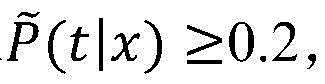
On the basis of word segmentation, character strings with different lengths (starting from a first word, sequentially segmenting a word, two words, three words … and up to Z words) are sequentially segmented from left to right, x is the segmented character string, t is the sentence component of x, and the empirical probability of t is calculated by using the maximum likelihood method of probability distribution under the condition that the character string of x appears:
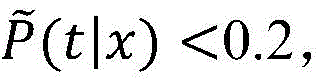
and comparing the x character string with the component fields in the training tree library, wherein freq (x, t) represents the times of the character string x and the corresponding sentence component t in the training tree library. Setting the threshold value to 0.2, when ` is determined by the test>
When, the probability that the character string x serves as a corresponding component in the sentence is extremely high, when/is>
Then, it can be determined that the character string x is a sentence component in the sentence. If +>
Cutting out a character string x and marking the component name; if->
And judging the next character string if the character string x is not a sentence component in the sentence, and outputting the unmarked component name marked as (-) until all the component marks are finished.
4.2.4.2 is set to X 1 ,X 2 ,X 3 …,X n And comparing the marked components with the training tree library component fields to automatically generate the tree library.
And 4.2.4.3 acquiring the tree library nodes to be checked.
4.2.5 ingredient collocation detection. Traversing X in the scanning tree library 1 ,X 2 ,X 3 …,X n And matching the components with the field of the training tree library components, wherein the specific process is shown in fig. 8 and comprises the following steps:
the method comprises the following steps: and searching the root node of the tree library according to the tree library generated by 4.2.4.2.
Step two: the node is accessed.
Step three: and judging whether the node has an unvisited child node. If yes, executing step four; if not, go to step five.
Step four: and accessing the child node which is not accessed on the leftmost side, combining and matching the node with the root node, and comparing the node with the training tree library component field. If the result is correct, outputting the component corresponding to the node, and executing the step two; if not, outputting the corresponding component of the node and marking as (-), and executing the step two.
Step five: and judging whether the node is a root node or not. If yes, executing step six; if not, step seven is performed.
Step six: the node is compared to the training tree library component fields. If the node is correct, outputting the corresponding component of the node; if false, the node corresponding component is output and marked as (-).
Step seven: the parent of the node is returned. And step three is executed.
5. Semantic expression detection
The language sickness caused by expression in the text is mainly reflected in semantic matching in the sentence, and comprises improper semantic matching, ambiguity, incoherence and the like.
5.1 Chinese is a semantic language, and the combination and collocation are carried out according to certain semantic rules. The syntactic components are ordered, the semantic components are unordered, and complex one-to-many and many-to-one correspondence exists between the Chinese syntactic structure and the semantic relationship. Therefore, it is not complete to establish the training tree library only according to the syntactic structure, and the training tree library and the syntactic structure need to be combined. As shown in fig. 9, where the left graph (syntactic structure), the right graph (semantic relation). The two sentences are analyzed from the syntactic structure, are both the major-predicate structure, but have different semantic relations.
Further shown in fig. 10, where the left graph (syntactic structure), the right graph (semantic relationship). Two sentences are analyzed from semantic relations, and are both things and characters, but the syntactic structures are different.
5.2 building semantic training Tree library
5.2.1 creating a new training tree library named as a semantic training tree library.
5.2.2 add a single sentence field (varchar 2), a composition field (varchar 2), a rules field (varchar 2).
5.2.3 entering semantic training Tree library corpus
8567 corpora built by 4.1.1.3.3 are input into a single sentence field of a semantic training tree library.
5.2.4 annotating semantic Components
And automatically marking a semantic training tree library by using a syntactic analyzer (FDG), manually marking a core verb and a semantic case (see table 4) and recording the semantic case into the component field. Example (c): "old Li Jiaoxiao Ming buy things".
As shown in fig. 11, "prune" is a sentence construction, a "call" is a sentence core verb (which is a root node), a "Xiaoming" is a "call" subject and a "buy" construction, and therefore is a "call" child node and a "buy" parent node, a "buy" is a core verb in a sentence, and "things" is a "buy" subject.
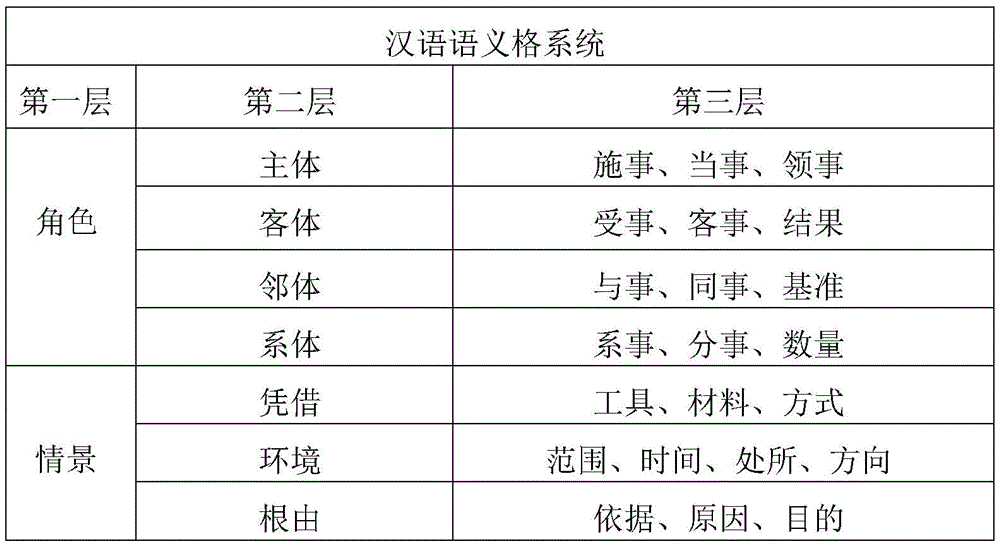
5.3 semantic lattice feature analysis
Chinese combination and collocation are carried out according to certain semantic rules. The semantic case composition and collocation can be followed by a certain rule.
5.3.1 Chinese semantic lattice system layering
TABLE 4
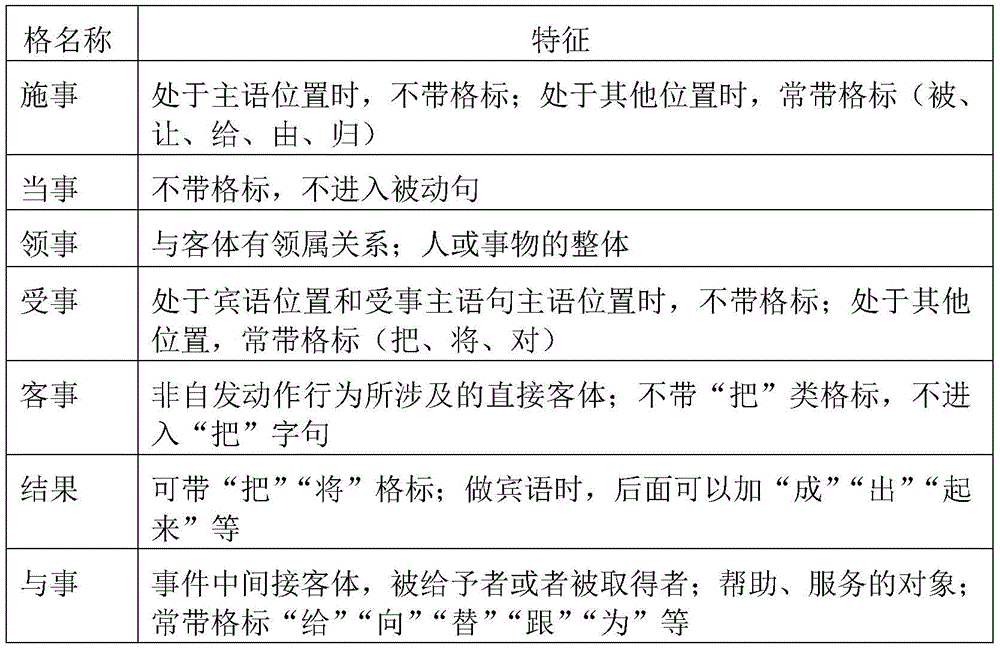
5.3.2 semantic lattice basis features
TABLE 5
The description of the basic features of the semantic case is a main rule of semantic collocation, and the basic features of the semantic case can be recorded into a rule field by analyzing the basic features of the semantic case so as to be matched when in semantic detection.
5.4 semantic detection method, as shown in FIG. 12.
5.4.1 text sentences to be checked are layered. And obtaining sentence layering results in the early processing process.
And 5.4.2, acquiring word segmentation results (fixed words, single words and single words which are output in sequence) and 3.2 word sequences in the early-stage processing process.
And 5.4.3, extracting semantic components.
5.4.3.1 judges single sentence semantic components.
On the basis of word segmentation, the length is cut from left to right in sequence (from the left to the right)The first word starts, a word, two words, three words … and up to Z words) are sequentially segmented, x is the segmented character string, t is the semantic component of x, and the empirical probability of t is calculated by using the maximum likelihood method of probability distribution under the condition that the x character string appears:
and comparing the x character string with the semantic component fields in the semantic training tree library, wherein freq (x, t) represents the times of the character string x and the corresponding semantic component t in the semantic training tree library. Let the threshold value be 0.2, if->
Cutting out a character string x and marking the component name; if->
And judging the next character string if the character string x is not a semantic component in the sentence until all components are segmented and marked, and outputting the unmarked component name marked as (-).
5.4.3.2 with semantic component sequence X 1 ,X 2 ,X 3 …,X n And comparing the labeled semantic components with the semantic training tree library component fields to automatically generate the tree library.
And 5.4.3.3, acquiring the tree library nodes to be checked.
5.4.4 semantic component collocation detection. Traversing execution X using semantic training tree library and its rule fields 1 ,X 2 ,X 3 …,X n Semantic collocation detection. The specific process is shown in fig. 13, and includes:
the method comprises the following steps: and searching a root node of the tree library according to the tree library generated by 5.4.3.2 text to be checked.
Step two: the node is accessed.
Step three: and judging whether the node has an unvisited child node. If yes, executing the step four; if not, go to step five.
Step four: and accessing the child node which is not accessed on the leftmost side, combining and matching the node with the root node, and comparing the node with the component field and the rule field of the semantic training tree library. If the semantic component corresponding to the node is correct, outputting the semantic component corresponding to the node, and executing the step two; if the node is wrong, outputting the corresponding semantic component of the node and marking the semantic component as (—), and executing the step two.
Step five: and judging whether the node is a root node or not. If yes, executing step six; if not, step seven is performed.
Step six: and comparing the node with the component field and the rule field of the semantic training tree library. If the node is correct, outputting the corresponding component of the node; if false, the node corresponding component is output and marked as (-).
Step seven: the parent of the node is returned. And step three is executed.
The invention also provides a Chinese language illness automatic detection device which is corresponding to the steps of the method one by one and based on rules and a language database, comprising a text acquisition device, a sentence layering device, a forward character string segmentation device, a reverse character string segmentation device, an automatic word segmentation device and a language illness detection device. Preferably, the language disease detection device comprises a wrong word detection device, a misword detection device, a syntactic structure detection device and a semantic expression detection device, and the language disease detection device can comprise one or more of the four detection devices.
It will be understood by those skilled in the art that all or part of the steps in the methods of the above embodiments may be performed by hardware associated with program instructions, and the program may be stored in a computer-readable storage medium, which may include: read Only Memory (ROM), random Access Memory (RAM), magnetic or optical disks, and the like.
The invention is not limited to the foregoing embodiments. The invention extends to any novel feature or any novel combination of features disclosed in this specification, and to any novel method or process steps or any novel combination of steps disclosed.