CN109437338B - Preparation method of zigzag-like nickel-cobalt-iron-like Prussian blue sintered oxide nanomaterials - Google Patents

Preparation method of zigzag-like nickel-cobalt-iron-like Prussian blue sintered oxide nanomaterials Download PDF

Info

Publication number
CN109437338B
CN109437338B CN201811457529.0A CN201811457529A CN109437338B CN 109437338 B CN109437338 B CN 109437338B CN 201811457529 A CN201811457529 A CN 201811457529A CN 109437338 B CN109437338 B CN 109437338B
Authority
CN
China
Prior art keywords
cobalt
nickel
iron
prussian blue
zigzag
Prior art date
Legal status (The legal status is an assumption and is not a legal conclusion. Google has not performed a legal analysis and makes no representation as to the accuracy of the status listed.)
Active
Application number
CN201811457529.0A
Other languages
Chinese (zh)
Other versions
CN109437338A (en
Inventor
于岩
庄赞勇
叶嘉华
Current Assignee (The listed assignees may be inaccurate. Google has not performed a legal analysis and makes no representation or warranty as to the accuracy of the list.)
Fuzhou University
Original Assignee
Fuzhou University
Priority date (The priority date is an assumption and is not a legal conclusion. Google has not performed a legal analysis and makes no representation as to the accuracy of the date listed.)
Filing date
Publication date
Application filed by Fuzhou University filed Critical Fuzhou University
Priority to CN201811457529.0A priority Critical patent/CN109437338B/en
Publication of CN109437338A publication Critical patent/CN109437338A/en
Application granted granted Critical
Publication of CN109437338B publication Critical patent/CN109437338B/en
Active legal-status Critical Current
Anticipated expiration legal-status Critical

Links

Images

Classifications

    • CCHEMISTRY; METALLURGY
    • C01INORGANIC CHEMISTRY
    • C01GCOMPOUNDS CONTAINING METALS NOT COVERED BY SUBCLASSES C01D OR C01F
    • C01G53/00Compounds of nickel
    • C01G53/80Compounds containing nickel, with or without oxygen or hydrogen, and containing one or more other elements
    • C01G53/82Compounds containing nickel, with or without oxygen or hydrogen, and containing two or more other elements
    • BPERFORMING OPERATIONS; TRANSPORTING
    • B01PHYSICAL OR CHEMICAL PROCESSES OR APPARATUS IN GENERAL
    • B01JCHEMICAL OR PHYSICAL PROCESSES, e.g. CATALYSIS OR COLLOID CHEMISTRY; THEIR RELEVANT APPARATUS
    • B01J23/00Catalysts comprising metals or metal oxides or hydroxides, not provided for in group B01J21/00
    • B01J23/002Mixed oxides other than spinels, e.g. perovskite
    • BPERFORMING OPERATIONS; TRANSPORTING
    • B01PHYSICAL OR CHEMICAL PROCESSES OR APPARATUS IN GENERAL
    • B01JCHEMICAL OR PHYSICAL PROCESSES, e.g. CATALYSIS OR COLLOID CHEMISTRY; THEIR RELEVANT APPARATUS
    • B01J23/00Catalysts comprising metals or metal oxides or hydroxides, not provided for in group B01J21/00
    • B01J23/70Catalysts comprising metals or metal oxides or hydroxides, not provided for in group B01J21/00 of the iron group metals or copper
    • B01J23/74Iron group metals
    • B01J23/755Nickel
    • BPERFORMING OPERATIONS; TRANSPORTING
    • B82NANOTECHNOLOGY
    • B82YSPECIFIC USES OR APPLICATIONS OF NANOSTRUCTURES; MEASUREMENT OR ANALYSIS OF NANOSTRUCTURES; MANUFACTURE OR TREATMENT OF NANOSTRUCTURES
    • B82Y40/00Manufacture or treatment of nanostructures
    • CCHEMISTRY; METALLURGY
    • C02TREATMENT OF WATER, WASTE WATER, SEWAGE, OR SLUDGE
    • C02FTREATMENT OF WATER, WASTE WATER, SEWAGE, OR SLUDGE
    • C02F1/00Treatment of water, waste water, or sewage
    • C02F1/72Treatment of water, waste water, or sewage by oxidation
    • C02F1/725Treatment of water, waste water, or sewage by oxidation by catalytic oxidation
    • BPERFORMING OPERATIONS; TRANSPORTING
    • B01PHYSICAL OR CHEMICAL PROCESSES OR APPARATUS IN GENERAL
    • B01JCHEMICAL OR PHYSICAL PROCESSES, e.g. CATALYSIS OR COLLOID CHEMISTRY; THEIR RELEVANT APPARATUS
    • B01J2523/00Constitutive chemical elements of heterogeneous catalysts
    • CCHEMISTRY; METALLURGY
    • C01INORGANIC CHEMISTRY
    • C01PINDEXING SCHEME RELATING TO STRUCTURAL AND PHYSICAL ASPECTS OF SOLID INORGANIC COMPOUNDS
    • C01P2002/00Crystal-structural characteristics
    • C01P2002/70Crystal-structural characteristics defined by measured X-ray, neutron or electron diffraction data
    • C01P2002/72Crystal-structural characteristics defined by measured X-ray, neutron or electron diffraction data by d-values or two theta-values, e.g. as X-ray diagram
    • CCHEMISTRY; METALLURGY
    • C01INORGANIC CHEMISTRY
    • C01PINDEXING SCHEME RELATING TO STRUCTURAL AND PHYSICAL ASPECTS OF SOLID INORGANIC COMPOUNDS
    • C01P2002/00Crystal-structural characteristics
    • C01P2002/80Crystal-structural characteristics defined by measured data other than those specified in group C01P2002/70
    • C01P2002/85Crystal-structural characteristics defined by measured data other than those specified in group C01P2002/70 by XPS, EDX or EDAX data
    • CCHEMISTRY; METALLURGY
    • C01INORGANIC CHEMISTRY
    • C01PINDEXING SCHEME RELATING TO STRUCTURAL AND PHYSICAL ASPECTS OF SOLID INORGANIC COMPOUNDS
    • C01P2004/00Particle morphology
    • C01P2004/01Particle morphology depicted by an image
    • C01P2004/03Particle morphology depicted by an image obtained by SEM
    • CCHEMISTRY; METALLURGY
    • C02TREATMENT OF WATER, WASTE WATER, SEWAGE, OR SLUDGE
    • C02FTREATMENT OF WATER, WASTE WATER, SEWAGE, OR SLUDGE
    • C02F2101/00Nature of the contaminant
    • C02F2101/30Organic compounds
    • C02F2101/34Organic compounds containing oxygen
    • C02F2101/345Phenols

Landscapes

  • Chemical & Material Sciences (AREA)
  • Engineering & Computer Science (AREA)
  • Organic Chemistry (AREA)
  • Materials Engineering (AREA)
  • Chemical Kinetics & Catalysis (AREA)
  • Nanotechnology (AREA)
  • General Physics & Mathematics (AREA)
  • Condensed Matter Physics & Semiconductors (AREA)
  • Physics & Mathematics (AREA)
  • Manufacturing & Machinery (AREA)
  • Crystallography & Structural Chemistry (AREA)
  • Inorganic Chemistry (AREA)
  • Life Sciences & Earth Sciences (AREA)
  • Hydrology & Water Resources (AREA)
  • Environmental & Geological Engineering (AREA)
  • Water Supply & Treatment (AREA)
  • Inorganic Compounds Of Heavy Metals (AREA)

Abstract

本发明提供了一种类锯齿型镍钴铁类普鲁士蓝烧结氧化物纳米材料的制备方法,属于于材料技术领域。本发明以六水合硝酸镍、三水合柠檬酸三钠、铁氰化钾和钴氰化钾合成立方结构的纳米镍钴铁类普鲁士蓝前驱体,然后用氨水溶液进行腐蚀后离心分离,洗样,干燥后得到类锯齿型镍钴铁类普鲁士蓝纳米材料,对其进行烧结,得到“Z”‑Ox纳米材料。“Z”‑Ox纳米材料能够有效地催化过氧单硫酸盐产生羟基自由基和硫酸根自由基,进而降解双酚A。本发明以前驱体中金属配位键分布不均匀来决定腐蚀的位置,形成各向异性腐蚀,为MOF材料的结构和性质的微调开辟新的途径,并且该方法具有操作简单、制备周期短、经济效益高、适合大规模生产的特点。The invention provides a preparation method of a zigzag-type nickel-cobalt-iron-type Prussian blue sintered oxide nanomaterial, which belongs to the technical field of materials. In the present invention, nano-nickel-cobalt-iron Prussian blue precursors with cubic structure are synthesized with nickel nitrate hexahydrate, trisodium citrate trihydrate, potassium ferricyanide and potassium cobalt cyanide, and then etched with ammonia solution, centrifuged, and washed. , after drying, a zigzag-like nickel-cobalt-iron-like Prussian blue nanomaterial is obtained, which is sintered to obtain a "Z" -Ox nanomaterial. The "Z" -Ox nanomaterials can effectively catalyze the generation of hydroxyl radicals and sulfate radicals from peroxymonosulfate, and then degrade bisphenol A. In the invention, the uneven distribution of metal coordination bonds in the precursor determines the position of corrosion, forms anisotropic corrosion, and opens up a new way for fine-tuning the structure and properties of MOF materials, and the method has the advantages of simple operation, short preparation period, It has the characteristics of high economic efficiency and suitable for large-scale production.

Description

Preparation method of sawtooth-like nickel-cobalt-iron Prussian blue sintered oxide nano material
Technical Field
The invention belongs to the technical field of materials, and particularly relates to a preparation method of a sawtooth-like Prussian blue sintered oxide nano material.
Background
Chemical etch-based strategies open new avenues for the preparation of Metal Organic Frameworks (MOFs) with new morphologies. The presence of an etchant (e.g., H + or OH-) that is capable of breaking the metal/organic connectors of the MOF can render the MOF precursor into crystals with tunable spherical, cubic, or tetrahedral morphology. Due to the differential reactions between the interior of the MOF precursor crystals and the facets, sometimes nano-MOFs (e.g. zeolitic imidazolate framework materials (ZIFs), prussian-like blue (PBAs)) can obtain hollow structures, further modulating the structure of the pre-synthesized MOFs can create MOFs of higher complexity.
Despite these advances, there remains a challenge to making MOFs of higher complexity. Taking PBA as an example, etching sometimes occurs preferentially on the central surfaces of the PBA cube, sometimes at their corners, resulting in different morphologies of PBAs. This may be due to uneven reactivity of the surfaces and corners. The extent and location of etching of the MOF crystals may be related to defects or to metal-ligand bonds. Unfortunately, few examples of research in this regard, particularly many still focused on the synthesis and characterization of materials, and the lack of knowledge of MOF etching behavior has limited the comprehensive exploration of MOFs with complex structures. Thus, the structures of existing nano-synthetic MOFs are still limited to mesoporous or hollow structures.
To our knowledge, this is the first report on the discovery that prussian-like blue with an unprecedented sawtooth-like pattern is obtained by etching prussian-like blue precursors. The method enriches the complex morphological structure design of the nano MOF, and brings more research opportunities for realizing the versatility of the MOF. It also provides an ideal platform for the anisotropic etching mechanism of MOFs. The nickel-cobalt-iron mixed oxide nano material (Z '-O) is successfully prepared by the heat treatment of Z' -PBAx) It shows excellent catalytic performance for catalyzing Peroxymonosulfate (PMS) to degrade bisphenol a.
Disclosure of Invention
The invention aims to provide a preparation method of a sawtooth-like Prussian blue nano material aiming at the defects of the prior art. According to the invention, nickel-cobalt-iron Prussian blue (NiCoFe-PBA) is used as a template, and sawtooth-like Prussian blue (Z' -PBA) is obtained through ammonia corrosion, so that the complex morphological structure design of nano MOFs is enriched; the mixed oxide nano material obtained by heat treatment can well keep the structure of Z' -PBA after corrosion and can effectively catalyze and degrade bisphenol A, thereby solving the problem of pollution caused by bisphenol A.
In order to achieve the purpose, the invention adopts the following technical scheme:
a preparation method of a sawtooth-like nickel-cobalt-iron Prussian blue sintered oxide nano material comprises the following steps:
(1) preparing a cubic-structure nano nickel-cobalt-iron Prussian blue (NiCoFe-PBA) precursor: the method comprises the following steps of preparing nano nickel cobalt iron Prussian blue (NiCoFe-PBA) with a cubic structure by using potassium ferricyanide, potassium cobaltcyanide, trisodium citrate trihydrate and nickel nitrate hexahydrate as raw materials through a hydrothermal synthesis method;
(2) preparing a sawtooth-like nickel-cobalt-iron Prussian blue ('Z' -PBA) nano material: uniformly dispersing the cubic-structure nano nickel-cobalt-iron Prussian blue (NiCoFe-PBA) precursor obtained in the step (1) into 10 ml of ethanol, and stirring until the precursor is completely dispersed to obtain a mixed solution; then slowly pouring the ammonia water solution into the mixed solution, and stirring for 1 h; then carrying out centrifugal separation on the reaction liquid, and washing; putting the washed sample into an oven, and keeping the temperature for 12 h at 70 ℃ for drying to obtain a zigzag nickel-cobalt-iron Prussian blue ('Z' -PBA) nano material;
(3) sawtooth-like nickel cobalt iron Prussian blue sintered oxide ('Z' -O)x) Preparing a nano material: putting the sawtooth-like nickel-cobalt-iron Prussian blue (' Z ' -PBA) nano material obtained in the step (2) into a muffle furnace, preserving the heat for 1.5 h at 350 ℃, and increasing the temperature at the rate of 2 ℃/min to finally obtain the sawtooth-like nickel-cobalt-iron Prussian blue sintered oxide (' Z ' -O ')x) And (3) nano materials.
In the preparation method, in the ammonia water solution in the step (2), the volume ratio of deionized water to ammonia water is 1: 2.
in the preparation method, the step (1) of preparing the nanometer nickel-cobalt-iron Prussian blue (NiCoFe-PBA) precursor with the cubic structure comprises the following specific steps:
1) putting a certain amount of trisodium citrate trihydrate and nickel nitrate hexahydrate into a beaker, adding deionized water to obtain a mixed system, and stirring the mixed system until the raw materials are completely dissolved to obtain a mixed solution A;
2) putting a certain amount of potassium cobalt cyanide into a beaker, and adding deionized water to prepare a solution;
3) adding the potassium cobalt cyanide solution into the mixed solution 1, and magnetically stirring for 1 h to obtain a mixed solution B;
4) putting a certain amount of potassium ferricyanide into a beaker, and adding deionized water to prepare a solution;
5) adding the potassium ferricyanide solution into the mixed solution 2, and magnetically stirring for 1 h to obtain a mixed solution C;
6) pouring the mixed solution C into a reaction kettle, and reacting for 20 hours at 80 ℃; and (3) centrifugally washing the reaction product, and drying at 70 ℃ for 12 h to obtain the cubic nano nickel-cobalt-iron Prussian blue (NiCoFe-PBA).
Further, the dosage of trisodium citrate trihydrate, nickel nitrate hexahydrate and deionized water in the step 1) is 0.264 g, 0.174 g and 20 mL;
further, the dosage of the potassium cobalt cyanide in the step 2) is 0.026 g, and the dosage of the deionized water is 10 mL; further, the using amount of the potassium ferricyanide in the step 4) is 0.105 g, and the using amount of the deionized water is 10 mL;
a sawtooth-like nickel-cobalt-iron Prussian blue sintered oxide nano material is applied to catalyzing the degradation of bisphenol A.
The invention has the beneficial effects that:
1) the method adopts NiCoFe-PBA as a precursor, and then uses ammonia water for corrosion to obtain the zigzag NiCoFe Prussian blue (Z' -PBA). The complex morphological structure design of the nano MOF is enriched, and more development opportunities are brought for realizing the versatility of the MOF. It also provides a new idea for anisotropic etching of MOFs.
2) The obtained zigzag nickel-cobalt-iron Prussian blue is subjected to heat treatment to obtain zigzag nickel-cobalt-iron Prussian blue sintered oxide (' Z ' -O ')x) Due to the sawtooth shape, the surface area is increased, more catalytic active sites are provided, the Peroxymonosulfate (PMS) is catalyzed to generate more sulfate radicals and hydroxyl radicals, and the efficiency of degrading the bisphenol A is improved.
3) The preparation method disclosed by the invention has the advantages of easiness in obtaining required equipment and materials, simplicity in process operation, concise process conditions, low cost, safety, high efficiency and easiness in popularization and application.
Drawings
FIG. 1 is the microstructure of NiCoFe-PBA in example 1.
FIG. 2 is the microstructure of "Z" -PBA from example 1.
FIG. 3 is an X-ray diffraction (XRD) pattern of NiCoFe-PBA and "Z" -PBA from example 1.
FIG. 4 is an X-ray photoelectron spectroscopy (XPS) plot of NiCoFe-PBA and "Z" -PBA in example 1.
FIG. 5 is a graph of "Z" -O obtained by sintering "Z" -PBA "in example 1 at 350 ℃xScanning micrographs of (a).
FIG. 6 is a NiCoFe-O sintered at 350 ℃ of NiCoFe-PBA in comparative example 1xScanning micrographs of (a).
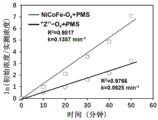
FIG. 7 shows "Z" -O "obtained by sintering in application example 1 and application comparative example 1xNanomaterial and NiCoFe-OxThe point diagram of the nanometer material as the catalyst to catalyze PMS to degrade bisphenol A.
FIG. 8 shows "Z" -O "obtained by sintering in application example 1 and application comparative example 1xNanomaterial and NiCoFe-OxThe efficiency value K of the nanometer material used as the catalyst for catalyzing PMS to degrade bisphenol A is shown schematically.
Detailed Description
In order to make the objects, technical solutions and advantages of the present invention more apparent, the present invention will be described in further detail below with reference to the accompanying drawings, which are examples. It should be understood that the specific embodiments described herein are merely illustrative of the invention and are not intended to limit the invention. In addition, the technical features mentioned in the embodiments of the present invention described below may be combined as long as they do not conflict with each other.
Example 1
A preparation method of a sawtooth-like nickel-cobalt-iron Prussian blue sintered oxide nano material comprises the following steps:
(1) preparation of NiCoFe-PBA precursor:
taking potassium ferricyanide, potassium cobaltcyanide, trisodium citrate trihydrate and nickel nitrate hexahydrate as raw materials, and preparing NiCoFe-PBA by a hydrothermal synthesis method;
(2) preparation of "Z" -PBA nanomaterial:
uniformly dispersing NiCoFe-PBA obtained in the step (1) into 10 ml of ethanol, and stirring until the NiCoFe-PBA is completely dispersed to obtain a mixed solution; then slowly pouring the ammonia water solution into the mixed solution, and stirring for 1 h; then carrying out centrifugal separation on the reaction liquid, and washing; and (3) putting the washed sample into an oven, and keeping the temperature for 12 h at 70 ℃ for drying to obtain the Z' -PBA nano material.
(3) Preparation of "Z" -Ox nanomaterial:
and (3) putting the Z '-PBA nano material sample obtained in the step (2) into a muffle furnace, and preserving the heat for 1.5 h at 350 ℃ at the heating rate of 2 ℃/min to finally obtain the Z' -Ox nano material.
In the preparation method, in the ammonia water solution in the step (2), the volume ratio of deionized water to ammonia water is 1: 2.
in the preparation method, the step (1) of preparing the NiCoFe-PBA precursor comprises the following specific steps:
1) putting 0.264 g of trisodium citrate trihydrate and 0.174 g of nickel nitrate hexahydrate in a beaker, then adding 20 mL of deionized water to obtain a mixed system, and stirring the mixed system until the raw materials are completely dissolved to obtain a mixed solution A;
2) putting a certain amount of 0.026 g potassium cobalt cyanide into a beaker, and adding 10 mL deionized water to prepare a solution;
3) adding the potassium cobalt cyanide solution into the mixed solution 1, and magnetically stirring for 1 h to obtain a mixed solution B;
4) putting 0.105 g of potassium ferricyanide into a beaker, and adding 10 mL of deionized water to prepare a solution;
5) adding the potassium ferricyanide solution into the mixed solution 2, and magnetically stirring for 1 h to obtain a mixed solution C;
6) pouring the mixed solution C into a reaction kettle, and reacting for 20 hours at 80 ℃; and (3) centrifugally washing the reaction product, and drying at 70 ℃ for 12 h to obtain NiCoFe-PBA.
Comparative example 1
(1) Preparation of NiCoFe-PBA precursor:
taking potassium ferricyanide, potassium cobaltcyanide, trisodium citrate trihydrate and nickel nitrate hexahydrate as raw materials, and preparing NiCoFe-PBA by a hydrothermal synthesis method;
(2) synthesis of nickel-cobalt-iron Prussian blue sintered oxide (NiCoFe-Ox) nano material
Loading the NiCoFe-PBA sample obtained in the step (1) by using a small crucible, covering, putting the sample into a muffle furnace, preserving the temperature for 1.5 h at 350 ℃, and obtaining the NiCoFe-O at the heating rate of 2 ℃/minxAnd (3) nano materials.
The NiCoFe-O is obtainedxThe scanning microscopic image of the nanomaterial is shown in fig. 6.
Bisphenol A degradation experiment
Application example 1
"Z" -O obtained in example 1xThe nanometer material is used for the catalytic degradation of bisphenol A, and the specific steps are as follows:
(1) preparing a 30 ppm bisphenol A solution;
(2) 50 mL of the prepared bisphenol A solution (30 ppm) was weighed, and 5mg of "Z" -O was weighedxPutting the nano material into a bisphenol A solution, performing ultrasonic treatment for 10 min, performing magnetic stirring for 30 min to obtain a mixed solution, and establishing desorption-adsorption balance;
(3) weighing 10 mg of Peroxymonosulfate (PMS) and putting into the mixed solution obtained in the step (2), and magnetically stirring; sampling at 0 min, 10 min, 20 min, 30 min, 40 min and 50 min after the start of the degradation experiment, and quenching 1 mL of solution with 0.5 mL of methanol each time; bisphenol a was measured by liquid chromatography.
Application comparative example 1
NiCoFe-O obtained in comparative example 1xThe nanometer material is used for the catalytic degradation of bisphenol A, and the specific steps are as follows:
(1) preparing a 30 ppm bisphenol A solution;
(2) 50 mL of the prepared bisphenol A solution (30 ppm) was weighed and 5mg of NiCoFe-O was weighedxPutting the nano material into a bisphenol A solution, performing ultrasonic treatment for 10 min, performing magnetic stirring for 30 min to obtain a mixed solution, and establishing desorption-adsorption balance;
(3) weighing 10 mg of Peroxymonosulfate (PMS) and putting into the mixed solution obtained in the step (2), and magnetically stirring; sampling at 0 min, 10 min, 20 min, 30 min, 40 min and 50 min after the start of the degradation experiment, and quenching 1 mL of solution with 0.5 mL of methanol each time; bisphenol a was measured by liquid chromatography.
Analysis of results
The micro-morphology of the NiCoFe-PBA obtained in example 1 is shown in FIG. 1. The resulting "Z" -PBA has a microscopic morphology as shown in FIG. 2. The X-ray diffraction (XRD) results for NiCoFe-PBA and "Z" -PBA are shown in FIG. 3. The X-ray photoelectron spectroscopy (XPS) results for NiCoFe-PBA and "Z" -PBA are shown in FIG. 4. Analysis shows that in the process of synthesizing NiCoFe-PBA, the valence states of the cobalt and nickel elements are not changed, and the added ferric iron is subjected to oxidation-reduction reaction and is partially reduced into ferrous iron. When the 'Z' -PBA is obtained by corroding the 'Z' -PBA with ammonia water, the peak of the binding energy corresponding to the ferric iron disappears, which indicates that the ferric iron reacts with the ammonia water, but the ferrous iron does not react with the ammonia water, so that anisotropic corrosion occurs, and the sawtooth-like Prussian blue is obtained.
"Z" -O obtained by sintering "Z" -PBA "in example 1 at 350 ℃xFig. 5; the scanning microscopic image of NiCoFe-Ox obtained by sintering NiCoFe-PBA at 350 ℃ in comparative example 1 is shown in FIG. 6;
it can be seen from FIGS. 5 and 6 that the Z '-Ox and NiCoFe-Ox obtained from the heat treatment of Z' -PBA and NiCoFe-PBA can still maintain the original morphology.
"Z" -O obtained by sintering in application example 1 and application comparative example 1xNanomaterial and NiCoFe-OxThe point diagram of the catalyst of the nanomaterial for catalyzing the degradation of bisphenol A by PMS is shown in figure 7. "Z" -O obtained by sintering in application example 1 and application comparative example 1xNanomaterial and NiCoFe-OxThe schematic diagram of the efficiency value K of the nanomaterial as the catalyst for catalyzing the degradation of the bisphenol A by PMS is shown in FIG. 8. Comparing the catalytic degradation efficiencies of application example 1 and application comparative example 1, it can be found that "Z" -PBA obtained by etching NiCoFe-PBA and "Z" -O obtained by sintering thereofxNano materialCan complete the catalytic degradation of 30 ppm of bisphenol A within 50 minutes, the efficiency reaches 99.9 percent, and the catalytic performance is higher than that of NiCoFe-OxThe apparent reaction rate constant k of the nano material is improved by 1.22 times. This is due to "Z" -OxThe sawtooth shape of the nano material provides more catalytic active sites so as to catalyze PMS to generate more sulfate radicals and hydroxyl radicals, and the catalytic performance is greatly improved.
It will be understood by those skilled in the art that the foregoing is merely a preferred embodiment of the invention, and is not intended to limit the invention, and that any modification, equivalent replacement or improvement made within the spirit and principle of the invention should be included within the scope of protection of the invention.

Claims (9)

1.一种类锯齿型镍钴铁类普鲁士蓝烧结氧化物纳米材料的制备方法,其特征在于,包括以下步骤:1. a kind of preparation method of zigzag type nickel cobalt iron class Prussian blue sintered oxide nanomaterial, is characterized in that, comprises the following steps: (1)立方结构的纳米镍钴铁类普鲁士蓝前驱体的制备:以铁氰化钾、钴氰化钾、三水合柠檬酸三钠和六水合硝酸镍为原料,经水热合成法制备获得立方结构的纳米镍钴铁类普鲁士蓝;(1) Preparation of nano-nickel-cobalt-iron Prussian blue precursor with cubic structure: using potassium ferricyanide, potassium cobalt cyanide, trisodium citrate trihydrate and nickel nitrate hexahydrate as raw materials, prepared by hydrothermal synthesis method Cubic structure of nano-nickel-cobalt-iron-like Prussian blue; (2)类锯齿型镍钴铁类普鲁士蓝纳米材料的制备:将步骤(1)中所得到的立方结构的纳米镍钴铁类普鲁士蓝前驱体均匀分散至10 mL乙醇中,搅拌至完全分散,得混合溶液;然后将氨水溶液缓慢的倒入混合溶液中,搅拌1 h;然后将反应液进行离心分离,洗涤;把洗涤后的样品放入烘箱中70 ℃下保温12 h进行烘干,得到类锯齿型镍钴铁类普鲁士蓝纳米材料;(2) Preparation of zigzag-like nickel-cobalt-iron-like Prussian blue nanomaterials: uniformly disperse the cubic-structured nickel-cobalt-iron-like Prussian blue precursor obtained in step (1) into 10 mL of ethanol, and stir until completely dispersed Then the ammonia solution was slowly poured into the mixed solution and stirred for 1 h; then the reaction solution was centrifuged and washed; the washed samples were placed in an oven at 70 °C for 12 h for drying, A zigzag-like nickel-cobalt-iron-like Prussian blue nanomaterial is obtained; (3)类锯齿型镍钴铁类普鲁士蓝烧结氧化物纳米材料的制备:将步骤(2)所得的类锯齿型镍钴铁类普鲁士蓝纳米材料放入马弗炉中,350 ℃下保温1.5 h,升温速率为2 ℃/min,最终得到类锯齿型镍钴铁类普鲁士蓝烧结氧化物纳米材料。(3) Preparation of zigzag-like nickel-cobalt-iron-like Prussian blue sintered oxide nanomaterials: put the zigzag-like nickel-cobalt-iron-like Prussian blue nanomaterials obtained in step (2) into a muffle furnace, and keep the temperature at 350 °C for 1.5 h, the heating rate is 2 ℃/min, and finally the zigzag-like nickel-cobalt-iron-like Prussian blue sintered oxide nanomaterials are obtained. 2.根据权利要求1所述的一种类锯齿型镍钴铁类普鲁士蓝烧结氧化物纳米材料的制备方法,其特征在于:步骤(1)立方结构的纳米镍钴铁类普鲁士蓝前驱体的制备,包括以下具体步骤:2 . The method for preparing a zigzag-like nickel-cobalt-iron-like Prussian blue sintered oxide nanomaterial according to claim 1 , wherein: step (1) preparation of a cubic-structured nano-nickel-cobalt iron-like Prussian blue precursor. 3 . , including the following specific steps: 1)将一定量的三水合柠檬酸三钠和六水合硝酸镍放入烧杯中,然后加入去离子水,得到混合体系,将混合体系搅拌至原料完全溶解,得混合溶液A;1) Put a certain amount of trisodium citrate trihydrate and nickel nitrate hexahydrate into a beaker, then add deionized water to obtain a mixed system, and stir the mixed system until the raw materials are completely dissolved to obtain mixed solution A; 2)将一定量的钴氰化钾放入烧杯中,加入去离子水,配成溶液;2) Put a certain amount of potassium cobalt cyanide into a beaker, add deionized water, and prepare a solution; 3)将钴氰化钾溶液加入到混合溶液A中,磁力搅拌1 h,得混合溶液B;3) Add the potassium cobalt cyanide solution to the mixed solution A, and stir magnetically for 1 h to obtain the mixed solution B; 4)将一定量的铁氰化钾放入烧杯中,加入去离子水,配成溶液;4) Put a certain amount of potassium ferricyanide into a beaker, add deionized water, and prepare a solution; 5)将铁氰化钾溶液加入到混合溶液B中,磁力搅拌1 h,得混合溶液C;5) Add potassium ferricyanide solution to mixed solution B and stir magnetically for 1 h to obtain mixed solution C; 6)将混合溶液C倒入反应釜中,80 ℃反应20 h;反应产物经离心洗涤,70 ℃干燥12 h,即得到立方结构的纳米镍钴铁类普鲁士蓝。6) Pour the mixed solution C into the reaction kettle, and react at 80 °C for 20 h; the reaction product is washed by centrifugation, and dried at 70 °C for 12 h to obtain the nano-nickel-cobalt-iron-like Prussian blue with cubic structure. 3.根据权利要求1所述的一种类锯齿型镍钴铁类普鲁士蓝烧结氧化物纳米材料的制备方法,其特征在于:步骤(2)所述的氨水溶液中,去离子水和氨水的体积比为1:2。3 . The method for preparing a sawtooth-like nickel-cobalt-iron-like Prussian blue sintered oxide nanomaterial according to claim 1 , wherein: in the ammonia solution described in step (2), the volume of deionized water and ammonia water The ratio is 1:2. 4.根据权利要求2所述的一种类锯齿型镍钴铁类普鲁士蓝烧结氧化物纳米材料的制备方法,其特征在于:步骤1)中三水合柠檬酸三钠的用量为0.264 g,六水合硝酸镍的用量为0.174 g,去离子水的用量为20 mL。4. The preparation method of zigzag-like nickel-cobalt-iron-like Prussian blue sintered oxide nanomaterials according to claim 2, characterized in that: in step 1), the consumption of trisodium citrate trihydrate is 0.264 g, and the hexahydrate is 0.264 g. The amount of nickel nitrate was 0.174 g, and the amount of deionized water was 20 mL. 5.根据权利要求2所述的一种类锯齿型镍钴铁类普鲁士蓝烧结氧化物纳米材料的制备方法,其特征在于:步骤2)中钴氰化钾的用量为0.026 g,去离子水的用量为10 mL。5. The method for preparing a zigzag-like nickel-cobalt-iron-like Prussian blue sintered oxide nanomaterial according to claim 2, characterized in that: in step 2), the consumption of potassium cobalt cyanide is 0.026 g, and the amount of deionized water is 0.026 g. The dosage is 10 mL. 6.根据权利要求2所述的一种类锯齿型镍钴铁类普鲁士蓝烧结氧化物纳米材料的制备方法,其特征在于:步骤4)中铁氰化钾的用量为0.105 g,去离子水的用量为10 mL。6. The preparation method of a kind of zigzag-like nickel-cobalt-iron-like Prussian blue sintered oxide nanomaterial according to claim 2, characterized in that: in step 4), the consumption of potassium ferricyanide is 0.105 g, and the consumption of deionized water is 0.105 g. to 10 mL. 7.一种如权利要求1所述的方法制备获得类锯齿型镍钴铁类普鲁士蓝纳米材料。7. A method as claimed in claim 1 prepares a zigzag-like nickel-cobalt-iron-like Prussian blue nanomaterial. 8.一种如权利要求1~6任一项所述的方法制备获得类锯齿型镍钴铁类普鲁士蓝烧结氧化物纳米材料。8. A zigzag-like nickel-cobalt-iron-like Prussian blue sintered oxide nanomaterial is prepared by the method according to any one of claims 1 to 6. 9.如权利要求8所述的类锯齿型镍钴铁类普鲁士蓝烧结氧化物纳米材料应用于催化双酚A的降解。9 . The zigzag-like nickel-cobalt-iron-like Prussian blue sintered oxide nanomaterial according to claim 8 is applied to catalyze the degradation of bisphenol A. 10 .
CN201811457529.0A 2018-11-30 2018-11-30 Preparation method of zigzag-like nickel-cobalt-iron-like Prussian blue sintered oxide nanomaterials Active CN109437338B (en)

Priority Applications (1)

Application Number Priority Date Filing Date Title
CN201811457529.0A CN109437338B (en) 2018-11-30 2018-11-30 Preparation method of zigzag-like nickel-cobalt-iron-like Prussian blue sintered oxide nanomaterials

Applications Claiming Priority (1)

Application Number Priority Date Filing Date Title
CN201811457529.0A CN109437338B (en) 2018-11-30 2018-11-30 Preparation method of zigzag-like nickel-cobalt-iron-like Prussian blue sintered oxide nanomaterials

Publications (2)

Publication Number Publication Date
CN109437338A CN109437338A (en) 2019-03-08
CN109437338B true CN109437338B (en) 2021-03-02

Family

ID=65556055

Family Applications (1)

Application Number Title Priority Date Filing Date
CN201811457529.0A Active CN109437338B (en) 2018-11-30 2018-11-30 Preparation method of zigzag-like nickel-cobalt-iron-like Prussian blue sintered oxide nanomaterials

Country Status (1)

Country Link
CN (1) CN109437338B (en)

Families Citing this family (14)

* Cited by examiner, † Cited by third party
Publication number Priority date Publication date Assignee Title
CN109817976A (en) * 2019-04-01 2019-05-28 合肥工业大学 A kind of transition metal element co-doped Prussian blue analog and its preparation method and application
CN110038603B (en) * 2019-05-27 2021-10-08 安徽理工大学 A hybrid metal phosphide-based hollow nanobox and its preparation method and application
CN110330036B (en) * 2019-07-16 2021-08-27 郑州轻工业学院 Electrode material for aptamer sensor, aptamer sensor and preparation method of aptamer sensor
CN110354876B (en) * 2019-07-19 2022-05-20 南京理工大学 Hollow Ni2P/Co2P/Fe2Preparation method of P nano composite electrocatalyst
CN112619649B (en) * 2019-09-24 2022-08-16 中国石油大学(华东) Nickel-cobalt-iron ternary oxide electrolytic water composite material and preparation method and application thereof
CN110694685B (en) * 2019-10-14 2021-06-22 福州大学 A kind of preparation method and application of manganese-iron-cobalt-like Prussian blue and manganese oxide composite nanoboxes assembled by ultrathin nanosheets
CN111235575B (en) * 2020-02-20 2022-06-17 肇庆市华师大光电产业研究院 Selective etching method for preparing material with controllable morphology
CN111686734B (en) * 2020-06-05 2023-08-11 苏州机数芯微科技有限公司 Preparation method and application of magnetic porous nickel nanosheets
CN113121836B (en) * 2021-03-04 2023-09-08 乌海瑞森新能源材料有限公司 Fe-Co-Ni metal organic framework with nano framework super structure and preparation method and application thereof
CN114790014B (en) * 2022-03-25 2023-06-27 中山大学 Metal oxide with hollow netty nano cage structure and preparation method and application thereof
CN115090287B (en) * 2022-06-02 2024-02-27 中国科学技术大学 An iron-cobalt doped ozone activation catalyst Fe-CoOx and its preparation method
CN115747866B (en) * 2022-11-04 2024-09-27 成都先进金属材料产业技术研究院股份有限公司 Vanadium-iron-based nitrogen carbide heterojunction nanocomposite, preparation method and application
CN116282236A (en) * 2022-12-27 2023-06-23 桂林电子科技大学 A kind of nickel-cobalt double metal sulfide based on PBA-etching-calcination vulcanization method and its preparation method and application
CN119750652B (en) * 2024-12-20 2025-06-20 铜陵学院 Ferrate nano cage super-structure material and preparation method and application thereof

Citations (9)

* Cited by examiner, † Cited by third party
Publication number Priority date Publication date Assignee Title
GB491586A (en) * 1936-12-04 1938-09-05 Halden & Co Ltd J Improvements in and relating to the production of light sensitive printing papers
CN1178396A (en) * 1996-08-13 1998-04-08 株式会社村田制作所 Mannufacturing method of lithium complex oxide comprising cobalt or nickel
CN102104147A (en) * 2011-01-18 2011-06-22 佛山市邦普循环科技有限公司 Nickel-cobalt composite oxide, nickel-cobalt doped oxide and preparation method thereof
CN103752321A (en) * 2014-01-02 2014-04-30 上海大学 Method for preparing hierarchical bimetallic composite oxide denitrification catalyst
CN105140505A (en) * 2015-06-30 2015-12-09 贵州省分析测试研究院 Preparation method for cobalt-manganese-nickel oxides
CN105990567A (en) * 2015-02-09 2016-10-05 中国科学院宁波材料技术与工程研究所 Preparation method of prussian blue analogue nano-material and use of prussian blue analogue in sodium-ion battery
CN106268616A (en) * 2016-08-11 2017-01-04 福州大学 Based on retaining Armco magnetic iron manganio cubic nanometer material and application thereof prepared by template
CN108676175A (en) * 2018-06-21 2018-10-19 福州大学 The one-step synthesis of the adjustable hud typed Mn/Fe Prussian blue analogues material of pattern
CN108722433A (en) * 2018-06-21 2018-11-02 福州大学 A kind of preparation and application of the adjustable hollow caged Mn/Fe oxide-based nanomaterials of pattern

Patent Citations (9)

* Cited by examiner, † Cited by third party
Publication number Priority date Publication date Assignee Title
GB491586A (en) * 1936-12-04 1938-09-05 Halden & Co Ltd J Improvements in and relating to the production of light sensitive printing papers
CN1178396A (en) * 1996-08-13 1998-04-08 株式会社村田制作所 Mannufacturing method of lithium complex oxide comprising cobalt or nickel
CN102104147A (en) * 2011-01-18 2011-06-22 佛山市邦普循环科技有限公司 Nickel-cobalt composite oxide, nickel-cobalt doped oxide and preparation method thereof
CN103752321A (en) * 2014-01-02 2014-04-30 上海大学 Method for preparing hierarchical bimetallic composite oxide denitrification catalyst
CN105990567A (en) * 2015-02-09 2016-10-05 中国科学院宁波材料技术与工程研究所 Preparation method of prussian blue analogue nano-material and use of prussian blue analogue in sodium-ion battery
CN105140505A (en) * 2015-06-30 2015-12-09 贵州省分析测试研究院 Preparation method for cobalt-manganese-nickel oxides
CN106268616A (en) * 2016-08-11 2017-01-04 福州大学 Based on retaining Armco magnetic iron manganio cubic nanometer material and application thereof prepared by template
CN108676175A (en) * 2018-06-21 2018-10-19 福州大学 The one-step synthesis of the adjustable hud typed Mn/Fe Prussian blue analogues material of pattern
CN108722433A (en) * 2018-06-21 2018-11-02 福州大学 A kind of preparation and application of the adjustable hollow caged Mn/Fe oxide-based nanomaterials of pattern

Also Published As

Publication number Publication date
CN109437338A (en) 2019-03-08

Similar Documents

Publication Publication Date Title
CN109437338B (en) Preparation method of zigzag-like nickel-cobalt-iron-like Prussian blue sintered oxide nanomaterials
CN112892593B (en) MOFs/water hyacinth derived material, preparation method thereof and degradation method of organic pollutants
CN104667980B (en) Metal organic framework compound loaded metal-carbon oxide nano particle catalyst as well as preparation method and application thereof
CN111617731A (en) Method for treating antibiotics in water body by coupling magnetic nano material with persulfate
CN103433044B (en) Preparation method of cobalt-nickel double metal hydroxide nano composite
CN109603831B (en) Cobalt and graphene composite nano material catalyst and preparation method thereof
CN110694685B (en) A kind of preparation method and application of manganese-iron-cobalt-like Prussian blue and manganese oxide composite nanoboxes assembled by ultrathin nanosheets
CN109264787B (en) A kind of preparation method of ZnFe2O4 cube structure and obtained product
CN111715254A (en) A kind of preparation method of nitrogen-modified porous carbon-coated cobalt nanoparticle catalyst
CN111085275A (en) Reductive graphene oxide/metal organic framework composite material and preparation method and application thereof
CN117753199A (en) Application of spherical mesoporous Kong Gaoshang metal catalyst in carbon dioxide hydrogenation catalysis
CN113996325A (en) A kind of nitrogen-doped graphene copper-based bimetallic single-atom catalyst and preparation method and application thereof
CN116726925A (en) Fe-based metal-organic framework derived metal nanoparticle/monoatomic composite catalyst and preparation method and application thereof
Shen et al. Highly dispersed silver nanoparticles confined in a nitrogen-containing covalent organic framework for 4-nitrophenol reduction
Li et al. Coordination and space confined preparation of nickel sub-nanoparticles within a metal-organic framework for catalytic degradation of methyl orange
Cao et al. Inverse miniemulsion-based preparation of raspberry-like Au/SiO2 nanocomposite particles with high catalytic activity towards reduction of p-nitrophenol
CN116174047B (en) A covalent organic compound-supported single-atom cobalt catalyst and its preparation method and application
CN108339550A (en) Cellular cobalt-manganese spinel microballoon and its preparation method and application
CN106669737B (en) A kind of carbon/palladium-cobalt heterogeneous catalyst preparation method of magnetic core-shell structure
Yuan et al. A cuboidal [Ni 4 O 4] cluster as a precursor for recyclable, carbon-supported nickel nanoparticle reduction catalysts
CN110013864B (en) Preparation of Nickel Cobaltate/Bismuth Oxychloride Nanocomposite and Its Application in Catalytic Reduction of Organic Compounds
CN101745646A (en) Preparation method of nano silver solution and polyaniline/ silver nanocomposite
CN120054587B (en) A method for efficient and low-cost preparation of g-C3N4 supported Fe and Mn bimetallic catalysts
CN114768874A (en) A kind of rare earth metal complex, its preparation method and photocatalyst
CN102489227B (en) Preparation method of functional resin load type metal nanoparticle

Legal Events

Date Code Title Description
PB01 Publication
PB01 Publication
SE01 Entry into force of request for substantive examination
GR01 Patent grant
GR01 Patent grant