CN109411245B - A kind of preparation method of Cu2O/Mn3O4 material for capacitor - Google Patents
A kind of preparation method of Cu2O/Mn3O4 material for capacitor Download PDFInfo
- Publication number
- CN109411245B CN109411245B CN201811278028.6A CN201811278028A CN109411245B CN 109411245 B CN109411245 B CN 109411245B CN 201811278028 A CN201811278028 A CN 201811278028A CN 109411245 B CN109411245 B CN 109411245B
- Authority
- CN
- China
- Prior art keywords
- prepared
- nickel foam
- nano
- electrode
- burette
- Prior art date
- Legal status (The legal status is an assumption and is not a legal conclusion. Google has not performed a legal analysis and makes no representation as to the accuracy of the status listed.)
- Active
Links
Images


Classifications
-
- H—ELECTRICITY
- H01—ELECTRIC ELEMENTS
- H01G—CAPACITORS; CAPACITORS, RECTIFIERS, DETECTORS, SWITCHING DEVICES, LIGHT-SENSITIVE OR TEMPERATURE-SENSITIVE DEVICES OF THE ELECTROLYTIC TYPE
- H01G11/00—Hybrid capacitors, i.e. capacitors having different positive and negative electrodes; Electric double-layer [EDL] capacitors; Processes for the manufacture thereof or of parts thereof
- H01G11/84—Processes for the manufacture of hybrid or EDL capacitors, or components thereof
- H01G11/86—Processes for the manufacture of hybrid or EDL capacitors, or components thereof specially adapted for electrodes
-
- H—ELECTRICITY
- H01—ELECTRIC ELEMENTS
- H01G—CAPACITORS; CAPACITORS, RECTIFIERS, DETECTORS, SWITCHING DEVICES, LIGHT-SENSITIVE OR TEMPERATURE-SENSITIVE DEVICES OF THE ELECTROLYTIC TYPE
- H01G11/00—Hybrid capacitors, i.e. capacitors having different positive and negative electrodes; Electric double-layer [EDL] capacitors; Processes for the manufacture thereof or of parts thereof
- H01G11/22—Electrodes
- H01G11/30—Electrodes characterised by their material
-
- H—ELECTRICITY
- H01—ELECTRIC ELEMENTS
- H01G—CAPACITORS; CAPACITORS, RECTIFIERS, DETECTORS, SWITCHING DEVICES, LIGHT-SENSITIVE OR TEMPERATURE-SENSITIVE DEVICES OF THE ELECTROLYTIC TYPE
- H01G11/00—Hybrid capacitors, i.e. capacitors having different positive and negative electrodes; Electric double-layer [EDL] capacitors; Processes for the manufacture thereof or of parts thereof
- H01G11/22—Electrodes
- H01G11/30—Electrodes characterised by their material
- H01G11/46—Metal oxides
-
- Y—GENERAL TAGGING OF NEW TECHNOLOGICAL DEVELOPMENTS; GENERAL TAGGING OF CROSS-SECTIONAL TECHNOLOGIES SPANNING OVER SEVERAL SECTIONS OF THE IPC; TECHNICAL SUBJECTS COVERED BY FORMER USPC CROSS-REFERENCE ART COLLECTIONS [XRACs] AND DIGESTS
- Y02—TECHNOLOGIES OR APPLICATIONS FOR MITIGATION OR ADAPTATION AGAINST CLIMATE CHANGE
- Y02E—REDUCTION OF GREENHOUSE GAS [GHG] EMISSIONS, RELATED TO ENERGY GENERATION, TRANSMISSION OR DISTRIBUTION
- Y02E60/00—Enabling technologies; Technologies with a potential or indirect contribution to GHG emissions mitigation
- Y02E60/13—Energy storage using capacitors
Landscapes
- Engineering & Computer Science (AREA)
- Power Engineering (AREA)
- Microelectronics & Electronic Packaging (AREA)
- Chemical & Material Sciences (AREA)
- Materials Engineering (AREA)
- Manufacturing & Machinery (AREA)
- Battery Electrode And Active Subsutance (AREA)
- Electric Double-Layer Capacitors Or The Like (AREA)
Abstract
本发明公开了一种电容器用Cu2O/Mn3O4材料的制备方法,包括以下步骤:(1)将泡沫镍片,依次清洗、干燥;(2)称取纳米铜粉粉末和去离子水,充分混合搅拌;(3)将高锰酸钾加入纳米铜分散液中;(4)将Cu2O/Mn3O4作保温处理后,再离心,提纯干燥;(5)称取Cu2O/Mn3O4粉末、聚偏氟乙烯(PVDF)及乙炔黑,混合研磨,再吸取N‑甲基吡咯烷酮(NMP)滴入其中;(6)充分的研磨,用滴定管吸取混合溶液涂覆于干燥的泡沫镍上,干燥后即制备成Cu2O/Mn3O4复合材料。通过本发明的方法制备时间短、效率高,实验仪器简单,复合材料比电容高、倍率性能好、具有较长的循环寿命。
The invention discloses a preparation method of a Cu 2 O/Mn 3 O 4 material for capacitors, comprising the following steps: (1) cleaning and drying foamed nickel sheets in sequence; (2) weighing nano copper powder and deionized (3) adding potassium permanganate to the nano-copper dispersion; (4) treating Cu 2 O/Mn 3 O 4 for heat preservation, then centrifuging, purifying and drying; (5) weighing Cu 2 O/Mn 3 O 4 2 O/Mn 3 O 4 powder, polyvinylidene fluoride (PVDF) and acetylene black, mix and grind, and then draw N-methylpyrrolidone (NMP) dropwise into it; (6) grind sufficiently, draw the mixed solution with a burette and apply It is coated on the dry nickel foam, and the Cu 2 O/Mn 3 O 4 composite material is prepared after drying. The method of the invention has the advantages of short preparation time, high efficiency, simple experimental instrument, high specific capacitance, good rate performance and long cycle life of the composite material.
Description
技术领域technical field
本发明涉及电容器用复合材料,具体是一种电容器用Cu2O/Mn3O4材料的制备方法,属于超级电容器电极材料制备领域。The invention relates to a composite material for capacitors, in particular to a method for preparing a Cu 2 O/Mn 3 O 4 material for capacitors, and belongs to the field of electrode material preparation for super capacitors.
背景技术Background technique
随着经济发展中能源需求的快速增长,伴随而来的石油、煤炭和天然气等不可再生资源的日渐短缺问题愈发严重,特别是能源短缺问题与世界各国局势稳定和人类的日常生活息息相关,能源问题也逐渐的引起全世界各个国家的高度关注。长期以来,人们在寻找能够取代太阳能,氢能,风能等传统不可再生能源的新能源方面取得了巨大成就。然而,这些新能源具有时间性和发电量不均衡的特点,因此需要使用一些电能储存装置来储存发电过程中产生的不稳定能源,并且可以实现持续稳定的能源供应通过这些设备。超级电容器又称电化学电容器,具有充放电速度快,功率密度高,循环寿命长,安全性能好,工作条件范围宽等优点。它已成为一种新型储能装置,引起了人们的广泛关注。超级电容器在移动电源,备用电源,混合动力汽车电源等领域具有广阔的应用前景。With the rapid growth of energy demand in economic development, the accompanying shortage of non-renewable resources such as oil, coal and natural gas has become more and more serious, especially the problem of energy shortage is closely related to the stability of the world and the daily life of human beings. The problem has gradually attracted great attention from countries all over the world. For a long time, people have made great achievements in finding new energy sources that can replace traditional non-renewable energy sources such as solar energy, hydrogen energy, and wind energy. However, these new energies have the characteristics of timing and unbalanced power generation, so it is necessary to use some electric energy storage devices to store the unstable energy generated during the power generation process, and a continuous and stable energy supply can be achieved through these devices. Supercapacitors, also known as electrochemical capacitors, have the advantages of fast charge and discharge speed, high power density, long cycle life, good safety performance, and a wide range of working conditions. It has become a new type of energy storage device, which has attracted widespread attention. Supercapacitors have broad application prospects in mobile power, backup power, hybrid vehicle power and other fields.
目前的一些电容器用电极材料的制备耗时长,效率低,且制备出的电极材料比电容和倍率性能等表现也难以令人满意。The preparation of some current electrode materials for capacitors is time-consuming and inefficient, and the specific capacitance and rate performance of the prepared electrode materials are also unsatisfactory.
发明内容SUMMARY OF THE INVENTION
针对上述现有技术存在的问题,本发明的目的是提供一种电容器用Cu2O/Mn3O4材料的制备方法,以缩短制备流程,提高制备的效率,同时,也优化所制备出的电极材料的电学性能。In view of the problems existing in the above-mentioned prior art, the purpose of the present invention is to provide a preparation method of Cu 2 O/Mn 3 O 4 material for capacitors, so as to shorten the preparation process, improve the preparation efficiency, and at the same time, also optimize the prepared Electrical properties of electrode materials.
为实现上述目的,本发明采用的技术方案是:For achieving the above object, the technical scheme adopted in the present invention is:
一种电容器用Cu2O/Mn3O4材料的制备方法,包括以下步骤:A preparation method of Cu 2 O/Mn 3 O 4 material for capacitors, comprising the following steps:
(1)将泡沫镍裁剪成若干块面积为1*2cm2的泡沫镍片,依次使用稀盐酸(6:1)、去离子水、无水乙醇清洗裁剪好的泡沫镍片,然后将泡沫镍片置于真空干燥箱内70℃干燥9-12h;(1) Cut the nickel foam into several pieces of nickel foam with an area of 1* 2cm , use dilute hydrochloric acid (6:1), deionized water, and absolute ethanol to clean the cut nickel foam, and then clean the nickel foam. The tablets were placed in a vacuum drying oven at 70°C for drying for 9-12h;
(2)称取纳米铜粉粉末和去离子水,并缓慢将两者加入烧杯中,充分混合搅拌之后转移烧杯到超声波分散器里进行均匀超声波震荡30-40min;(2) Weigh the nano-copper powder and deionized water, and slowly add the two into the beaker, fully mix and stir and then transfer the beaker to the ultrasonic disperser for uniform ultrasonic vibration for 30-40min;
(3)将高锰酸钾加入步骤(2)制备得到的纳米铜分散液中,其中高锰酸钾与纳米铜粉物质的量比为2:5,再将其放入准备好的反应釜中,待其稳定后用滴定管加入去离子水于反应釜中,随即将反应釜转移至超声波分散器里超声1h让反应物充分均匀接触;(3) adding potassium permanganate to the nano-copper dispersion liquid prepared in step (2), wherein the substance ratio of potassium permanganate and nano-copper powder is 2:5, then put it into the prepared reactor After it is stabilized, add deionized water to the reaction kettle with a burette, and then transfer the reaction kettle to an ultrasonic disperser for 1 h to make the reactants fully and evenly contacted;
(4)将步骤(3)制备的Cu2O/Mn3O4放在电热恒温鼓风干燥箱中作保温处理后,再将反应釜中的溶液进行离心处理,提纯干燥后得到高纯度的Cu2O/Mn3O4粉末;(4) after the Cu 2 O/Mn 3 O 4 prepared in step (3) is placed in an electric heating constant temperature blast drying oven for heat preservation treatment, the solution in the reaction kettle is then subjected to centrifugal treatment, and high purity is obtained after purification and drying. Cu 2 O/Mn 3 O 4 powder;
(5)按照质量比为8:1:1称取步骤(4)所得的Cu2O/Mn3O4粉末、聚偏氟乙烯(PVDF)及乙炔黑,混合倒入玛瑙研磨钵中,再用滴定管吸取N-甲基吡咯烷酮(NMP)滴入其中,使其均匀混合;(5) Weigh the Cu 2 O/Mn 3 O 4 powder, polyvinylidene fluoride (PVDF) and acetylene black obtained in step (4) according to the mass ratio of 8:1:1, mix and pour them into an agate grinding bowl, and then Pipette N-methylpyrrolidone (NMP) into it with a burette to make it evenly mixed;
(6)用玛瑙研钵将步骤(5)所得混合浆状溶液进行充分的研磨,研磨至少30min,至溶液中无较大颗粒存在,用滴定管吸取混合溶液涂覆于干燥的泡沫镍上,干燥后即制备成Cu2O/Mn3O4复合材料。(6) fully grind the mixed slurry solution obtained in step (5) with an agate mortar, grind for at least 30min, until no larger particles exist in the solution, absorb the mixed solution with a burette and apply it to the dry foam nickel, dry Then the Cu 2 O/Mn 3 O 4 composite material was prepared.
优选的,步骤(4)中离心的条件为转速8000r/min,离心时间5-10min。Preferably, the conditions of centrifugation in step (4) are a rotating speed of 8000r/min and a centrifugation time of 5-10min.
优选的,步骤(4)中离心处理要进行三次以上,且最后一次应当加入无水乙醇。Preferably, the centrifugation in step (4) should be performed more than three times, and absolute ethanol should be added for the last time.
优选的,步骤(5)中滴定的N-甲基吡咯烷酮(NMP)应逐滴缓慢滴入以保证充分混合Preferably, the N-methylpyrrolidone (NMP) titrated in step (5) should be slowly added dropwise to ensure adequate mixing
优选的,步骤(4)中的保温处理的条件为以3℃/min升到150℃并保温上2-3h。Preferably, the condition of the heat preservation treatment in step (4) is to raise the temperature to 150° C. at 3° C./min and keep the temperature for 2-3 hours.
和现有技术相比,本发明制备方法的有益效果为:Compared with the prior art, the beneficial effects of the preparation method of the present invention are:
通过本发明的方法制备电极材料,水热过程样品制备时间短、效率高,实验仪器简单,且可以严格的控制反应温度、时间以及反应时的产物比值。通过该方法生长得到的活性物质具有较为良好的形貌并且生长十分均匀,且纯度极高,有时候还可以生长得到纳米级别的颗粒。制备所得的复合材料用于超级电容器电极材料时,比电容高、倍率性能好、具有较长的循环寿命,应用前景十分广阔。The electrode material prepared by the method of the present invention has the advantages of short preparation time, high efficiency, simple experimental instrument, and strict control of reaction temperature, time and product ratio during the reaction in the hydrothermal process. The active material grown by this method has a relatively good morphology, very uniform growth, and extremely high purity, and sometimes nano-scale particles can be grown. When the prepared composite material is used as a supercapacitor electrode material, it has high specific capacitance, good rate performance and long cycle life, and has a very broad application prospect.
附图说明Description of drawings
图1是Cu2O/Mn3O4复合电极的扫描电镜图,其中(a)(b)(c)分别为5um、2um和 1um条件下;Figure 1 is a scanning electron microscope image of the Cu 2 O/Mn 3 O 4 composite electrode, wherein (a) (b) (c) are under the conditions of 5um, 2um and 1um respectively;
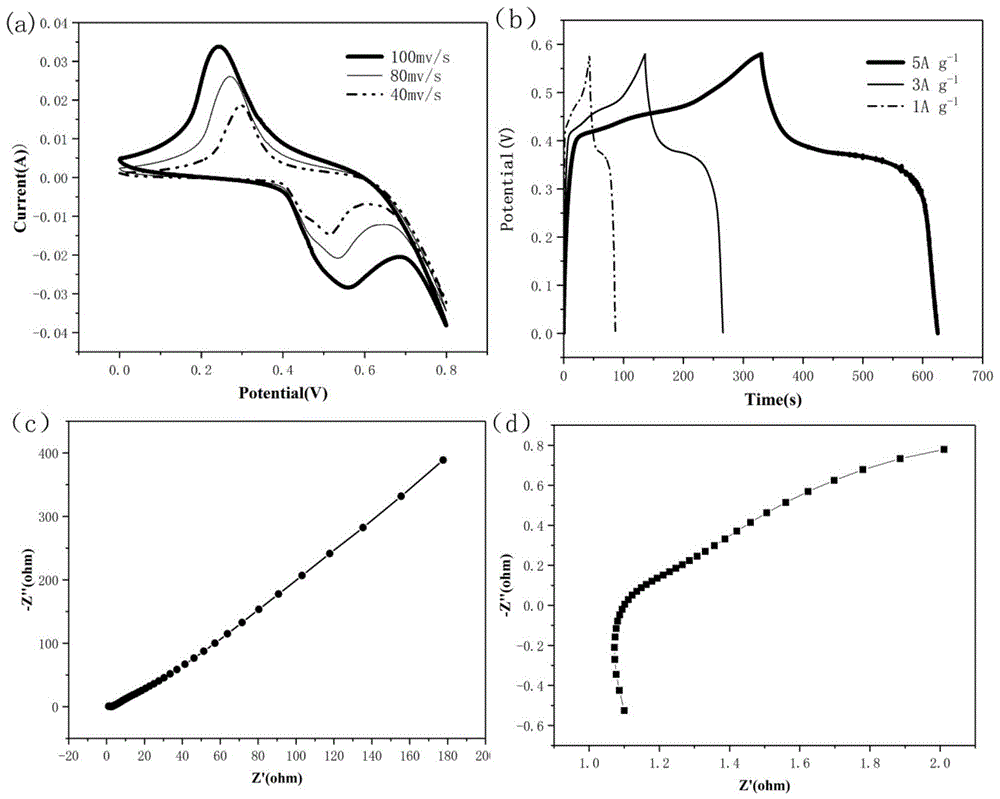
图2是Cu2O/Mn3O4复合材料的电化学性能测试图,图(a)(b)(c)(d)分别是Cu2O/Mn3O4复合材料的CV曲线、GCD曲线、交流阻抗谱图。Figure 2 is the electrochemical performance test diagram of Cu 2 O/Mn 3 O 4 composite material, and Figures (a) (b) (c) (d) are the CV curve and GCD of Cu 2 O/Mn 3 O 4 composite material, respectively. Curve, AC impedance spectrum.
具体实施方式Detailed ways
下面结合具体实施方式对本发明作进一步详细说明。The present invention will be further described in detail below in conjunction with specific embodiments.
实施例1:Example 1:
(1)将泡沫镍裁剪成若干块面积为1*2cm2的泡沫镍片,依次使用稀盐酸(6:1)、去离子水、无水乙醇清洗裁剪好的泡沫镍片,然后将泡沫镍片置于真空干燥箱内70℃干燥9-12h。(1) Cut the nickel foam into several pieces of nickel foam with an area of 1* 2cm , use dilute hydrochloric acid (6:1), deionized water, and absolute ethanol to clean the cut nickel foam, and then clean the nickel foam. The tablets were dried in a vacuum drying oven at 70°C for 9-12 hours.
(2)称取400mg纳米铜粉粉末、去离子水100mL加入烧杯中,在转速为550r/min电磁搅拌器中搅拌30-40min以确保充分混合,得到浓度为4mg/mL纳米铜分散液。(2) Weigh 400 mg of nano-copper powder and 100 mL of deionized water into a beaker, and stir for 30-40 min in an electromagnetic stirrer with a rotational speed of 550 r/min to ensure adequate mixing, and obtain a nano-copper dispersion with a concentration of 4 mg/mL.
(3)取步骤(2)所制备得到的纳米铜分散液25mL与987.5mg高锰酸钾,加入准备好的反应釜中。待其稳定后用滴定管加入5ml左右的去离子水于反应釜中,随即将反应釜转移至超声波分散器里超声1h让反应物充分均匀接触。(3) Take 25 mL of the nano-copper dispersion liquid prepared in step (2) and 987.5 mg of potassium permanganate and add it to the prepared reaction kettle. After it is stable, add about 5ml of deionized water into the reaction kettle with a burette, and then transfer the reaction kettle to an ultrasonic disperser for 1 hour to make the reactants fully and uniformly contacted.
(4)将超声完成以后的反应釜转移到电热恒温鼓风干燥箱之中,在电热恒温鼓风干燥箱中以3℃/min升温到150℃保温3小时。反应结束后将反应釜中溶液转移到离心机中,在转速为8000r/min的离心机中,离心时间为5min。离心结束后在真空干燥箱内干燥10-12h后即得到Cu2O/Mn3O4粉末。(4) Transfer the reaction kettle after the ultrasonication is completed to the electric heating constant temperature blast drying oven, and heat up to 150° C. for 3 hours at 3° C./min in the electric heating constant temperature blast drying oven. After the reaction, the solution in the reaction kettle was transferred to a centrifuge, and the centrifugation time was 5 min in a centrifuge with a rotating speed of 8000 r/min. After centrifugation, the Cu 2 O/Mn 3 O 4 powder is obtained after drying in a vacuum drying box for 10-12 hours.
(5)按照质量比为8:1:1称取步骤(4)所得的Cu2O/Mn3O4粉末、聚偏氟乙烯(PVDF)及乙炔黑倒入玛瑙研磨钵中,再用滴定管吸取约20mL N-甲基吡咯烷酮(NMP)滴入其中,使其均匀混合。(5) Weigh the Cu 2 O/Mn 3 O 4 powder, polyvinylidene fluoride (PVDF) and acetylene black obtained in step (4) according to the mass ratio of 8:1:1 and pour them into the agate grinding bowl, and then use a burette Pipette about 20 mL of N-methylpyrrolidone (NMP) into it, and mix it uniformly.
(6)用玛瑙研钵将上述混合浆状溶液进行充分的研磨,研磨时间大约30-40min,然后用滴定管吸取研磨好的溶液覆于干燥好的泡沫镍上经过真空干燥9-12h后就制备成Cu2O/Mn3O4复合材料超级电容器电极。(6) Fully grind the above mixed slurry solution with an agate mortar, the grinding time is about 30-40min, then use a burette to absorb the ground solution and cover it on the dried nickel foam, and prepare after vacuum drying for 9-12h into Cu 2 O/Mn 3 O 4 composite supercapacitor electrodes.
通过本实施例制备得到将上述得到Cu2O/Mn3O4复合电极,通过扫描电子显微镜可以观察到它的微观形貌,即棒状结构,如图1所示。The Cu 2 O/Mn 3 O 4 composite electrode obtained above is prepared through the preparation of this example, and its microscopic morphology, that is, a rod-like structure, can be observed through a scanning electron microscope, as shown in FIG. 1 .
电化学性能测试方法:将制备的Cu2O/Mn3O4复合材料作为电极并测试其电化学性能,工作电极的电化学性能在三电极体系中测试完成,电解液为1M KOH溶液,以铂片为对电极,以饱和甘汞电极(SCE)为参比电极,此三电极体系连接在电化学工作站上(上海辰华,CHI660E),利用循环伏安法(CV),恒电流充放电(GCD)和电化学阻抗(EIS)技术测试电极的电化学性能,循环稳定性测试在蓝电电池测试系统上进行,如图2所示。Electrochemical performance test method: The prepared Cu 2 O/Mn 3 O 4 composite material was used as an electrode and its electrochemical performance was tested. The electrochemical performance of the working electrode was tested in a three-electrode system. The electrolyte was 1M KOH solution, with The platinum plate was used as the counter electrode, and the saturated calomel electrode (SCE) was used as the reference electrode. The three-electrode system was connected to an electrochemical workstation (Shanghai Chenhua, CHI660E), and cyclic voltammetry (CV) was used to charge and discharge with constant current. (GCD) and electrochemical impedance (EIS) techniques to test the electrochemical properties of the electrodes, and the cycle stability test was performed on a blue battery test system, as shown in Figure 2.
通过上述的系列电化学性能测试方法可得,本实施例制备的材料在电流密度1A/g时可达到255.56F/g,循环充放电5000圈,循环效率为66.7%。Through the above-mentioned series of electrochemical performance testing methods, the material prepared in this example can reach 255.56 F/g at a current density of 1 A/g, and the cycle efficiency is 66.7% for 5000 cycles of charge and discharge.
实施例2:Example 2:
(1)将泡沫镍裁剪成若干块面积为1*2cm2的泡沫镍片,依次使用稀盐酸(6:1)、去离子水、无水乙醇清洗裁剪好的泡沫镍片,然后将泡沫镍片置于真空干燥箱内70℃干燥9-12h。(1) Cut the nickel foam into several pieces of nickel foam with an area of 1* 2cm , use dilute hydrochloric acid (6:1), deionized water, and absolute ethanol to clean the cut nickel foam, and then clean the nickel foam. The tablets were dried in a vacuum drying oven at 70°C for 9-12 hours.
(2)称取160mg纳米铜粉粉末、去离子水100mL加入烧杯中,在转速为550r/min电磁搅拌器中搅拌30-40min以确保充分混合,得到浓度为4mg/mL纳米铜分散液。(2) Weigh 160 mg of nano-copper powder and 100 mL of deionized water into a beaker, and stir for 30-40 min in an electromagnetic stirrer with a rotational speed of 550 r/min to ensure adequate mixing, and obtain a nano-copper dispersion with a concentration of 4 mg/mL.
(3)取步骤(2)所制备得到的纳米铜分散液25mL与790mg高锰酸钾,加入准备好的反应釜中。待其稳定后用滴定管加入5ml左右的去离子水于反应釜中,随即将反应釜转移至超声波分散器里超声1h让反应物充分均匀接触。(3) Take 25 mL of nano-copper dispersion liquid and 790 mg of potassium permanganate prepared in step (2) and add it to the prepared reaction kettle. After it is stable, add about 5ml of deionized water into the reaction kettle with a burette, and then transfer the reaction kettle to an ultrasonic disperser for 1 hour to make the reactants fully and uniformly contacted.
(4)将超声完成以后的反应釜转移到电热恒温鼓风干燥箱之中,在电热恒温鼓风干燥箱中以3℃/min升温到150℃保温3小时。反应结束后将反应釜中溶液转移到离心机中,在转速为8000r/min的离心机中,离心时间为5min。离心结束后在真空干燥箱内干燥10-12h后即得到Cu2O/Mn3O4粉末。(4) The reaction kettle after the ultrasonic wave is completed is transferred to the electric heating constant temperature blast drying oven, and the temperature is raised to 150° C. for 3 hours at 3° C./min in the electric heating constant temperature blast drying oven. After the reaction, the solution in the reaction kettle was transferred to a centrifuge, and the centrifugation time was 5 min in a centrifuge with a rotating speed of 8000 r/min. After centrifugation, the Cu 2 O/Mn 3 O 4 powder is obtained after drying in a vacuum drying box for 10-12 hours.
(5)按照质量比为8:1:1称取步骤(4)所得的Cu2O/Mn3O4粉末、聚偏氟乙烯(PVDF)及乙炔黑倒入玛瑙研磨钵中,再用滴定管吸取约20mL N-甲基吡咯烷酮(NMP)滴入其中,使其均匀混合。(5) Weigh the Cu 2 O/Mn 3 O 4 powder, polyvinylidene fluoride (PVDF) and acetylene black obtained in step (4) according to the mass ratio of 8:1:1 and pour them into the agate grinding bowl, and then use a burette Pipette about 20 mL of N-methylpyrrolidone (NMP) into it, and mix it uniformly.
(6)用玛瑙研钵将上述混合浆状溶液进行充分的研磨,研磨时间大约30-40min,然后用滴定管吸取研磨好的溶液覆于干燥好的泡沫镍上经过真空干燥9-12h后就制备成Cu2O/Mn3O4复合材料超级电容器电极。(6) Fully grind the above mixed slurry solution with an agate mortar, the grinding time is about 30-40min, then use a burette to absorb the ground solution and cover it on the dried nickel foam, and prepare after vacuum drying for 9-12h into Cu 2 O/Mn 3 O 4 composite supercapacitor electrodes.
通过本实施例制备得到将上述得到Cu2O/Mn3O4复合电极,通过扫描电子显微镜可以观察到它的微观形貌,即棒状结构,如图1所示。The Cu 2 O/Mn 3 O 4 composite electrode obtained above is prepared through the preparation of this example, and its microscopic morphology, that is, a rod-like structure, can be observed through a scanning electron microscope, as shown in FIG. 1 .
电化学性能测试方法:将制备的Cu2O/Mn3O4复合材料作为电极并测试其电化学性能,工作电极的电化学性能在三电极体系中测试完成,电解液为1M KOH溶液,以铂片为对电极,以饱和甘汞电极(SCE)为参比电极,此三电极体系连接在电化学工作站上(上海辰华,CHI660E),利用循环伏安法(CV),恒电流充放电(GCD)和电化学阻抗(EIS)技术测试电极的电化学性能,循环稳定性测试在蓝电电池测试系统上进行,如图2所示。Electrochemical performance test method: The prepared Cu 2 O/Mn 3 O 4 composite material was used as an electrode and its electrochemical performance was tested. The electrochemical performance of the working electrode was tested in a three-electrode system. The electrolyte was 1M KOH solution, with The platinum plate was used as the counter electrode, and the saturated calomel electrode (SCE) was used as the reference electrode. The three-electrode system was connected to an electrochemical workstation (Shanghai Chenhua, CHI660E), and cyclic voltammetry (CV) was used to charge and discharge with constant current. (GCD) and electrochemical impedance (EIS) techniques to test the electrochemical properties of the electrodes, and the cycle stability test was performed on a blue battery test system, as shown in Figure 2.
通过上述的系列电化学性能测试方法可得,本实施例制备的材料在电流密度1A/g时可达到184F/g,循环充放电5000圈,循环效率为62%。According to the above-mentioned series of electrochemical performance testing methods, the material prepared in this example can reach 184F/g at a current density of 1A/g, cycle charge and discharge for 5000 cycles, and a cycle efficiency of 62%.
实施例3:Example 3:
(1)将泡沫镍裁剪成若干块面积为1*2cm2的泡沫镍片,依次使用稀盐酸(6:1)、去离子水、无水乙醇清洗裁剪好的泡沫镍片,然后将泡沫镍片置于真空干燥箱内70℃干燥9-12h。(1) Cut the nickel foam into several pieces of nickel foam with an area of 1* 2cm , use dilute hydrochloric acid (6:1), deionized water, and absolute ethanol to clean the cut nickel foam, and then clean the nickel foam. The tablets were dried in a vacuum drying oven at 70°C for 9-12 hours.
(2)称取64mg纳米铜粉粉末、去离子水100mL加入烧杯中,在转速为550r/min电磁搅拌器中搅拌30-40min以确保充分混合,得到浓度为4mg/mL纳米铜分散液。(2) Weigh 64 mg of nano-copper powder and 100 mL of deionized water into the beaker, and stir for 30-40 min in an electromagnetic stirrer with a rotational speed of 550 r/min to ensure adequate mixing to obtain a nano-copper dispersion with a concentration of 4 mg/mL.
(3)取步骤(2)所制备得到的纳米铜分散液25mL与158mg高锰酸钾,加入准备好的反应釜中。待其稳定后用滴定管加入5ml左右的去离子水于反应釜中,随即将反应釜转移至超声波分散器里超声1h让反应物充分均匀接触。(3) Take 25 mL of the nano-copper dispersion liquid prepared in step (2) and 158 mg of potassium permanganate, and add it into the prepared reaction kettle. After it is stable, add about 5ml of deionized water into the reaction kettle with a burette, and then transfer the reaction kettle to an ultrasonic disperser for 1 hour to make the reactants fully and uniformly contacted.
(4)将超声完成以后的反应釜转移到电热恒温鼓风干燥箱之中,在电热恒温鼓风干燥箱中以3℃/min升温到150℃保温3小时。反应结束后将反应釜中溶液转移到离心机中,在转速为8000r/min的离心机中,离心时间为5min。离心结束后在真空干燥箱内干燥10-12h后即得到Cu2O/Mn3O4粉末。(4) The reaction kettle after the ultrasonic wave is completed is transferred to the electric heating constant temperature blast drying oven, and the temperature is raised to 150° C. for 3 hours at 3° C./min in the electric heating constant temperature blast drying oven. After the reaction, the solution in the reaction kettle was transferred to a centrifuge, and the centrifugation time was 5 min in a centrifuge with a rotating speed of 8000 r/min. After centrifugation, the Cu 2 O/Mn 3 O 4 powder is obtained after drying in a vacuum drying box for 10-12 hours.
(5)按照质量比为8:1:1称取步骤(4)所得的Cu2O/Mn3O4粉末、聚偏氟乙烯(PVDF)及乙炔黑倒入玛瑙研磨钵中,再用滴定管吸取约20mL N-甲基吡咯烷酮(NMP)滴入其中,使其均匀混合。(5) Weigh the Cu 2 O/Mn 3 O 4 powder, polyvinylidene fluoride (PVDF) and acetylene black obtained in step (4) according to the mass ratio of 8:1:1 and pour them into the agate grinding bowl, and then use a burette Pipette about 20 mL of N-methylpyrrolidone (NMP) into it, and mix it uniformly.
(6)用玛瑙研钵将上述混合浆状溶液进行充分的研磨,研磨时间大约30-40min,然后用滴定管吸取研磨好的溶液覆于干燥好的泡沫镍上经过真空干燥9-12h后就制备成Cu2O/Mn3O4复合材料超级电容器电极。(6) Fully grind the above mixed slurry solution with an agate mortar, the grinding time is about 30-40min, then use a burette to absorb the ground solution and cover it on the dried nickel foam, and prepare after vacuum drying for 9-12h into Cu 2 O/Mn 3 O 4 composite supercapacitor electrodes.
通过本实施例制备得到将上述得到Cu2O/Mn3O4复合电极,通过扫描电子显微镜可以观察到它的微观形貌,即棒状结构,如图1所示。The Cu 2 O/Mn 3 O 4 composite electrode obtained above is prepared through the preparation of this example, and its microscopic morphology, that is, a rod-like structure, can be observed through a scanning electron microscope, as shown in FIG. 1 .
电化学性能测试方法:将制备的Cu2O/Mn3O4复合材料作为电极并测试其电化学性能,工作电极的电化学性能在三电极体系中测试完成,电解液为1M KOH溶液,以铂片为对电极,以饱和甘汞电极(SCE)为参比电极,此三电极体系连接在电化学工作站上(上海辰华,CHI660E),利用循环伏安法(CV),恒电流充放电(GCD)和电化学阻抗(EIS)技术测试电极的电化学性能,循环稳定性测试在蓝电电池测试系统上进行,如图2所示。Electrochemical performance test method: The prepared Cu 2 O/Mn 3 O 4 composite material was used as an electrode and its electrochemical performance was tested. The electrochemical performance of the working electrode was tested in a three-electrode system. The electrolyte was 1M KOH solution, with The platinum plate was used as the counter electrode, and the saturated calomel electrode (SCE) was used as the reference electrode. The three-electrode system was connected to an electrochemical workstation (Shanghai Chenhua, CHI660E), and cyclic voltammetry (CV) was used to charge and discharge with constant current. (GCD) and electrochemical impedance (EIS) techniques to test the electrochemical properties of the electrodes, and the cycle stability test was performed on a blue battery test system, as shown in Figure 2.
通过上述的系列电化学性能测试方法可得,本实施例制备的材料在电流密度1A/g时可达到173F/g,循环充放电5000圈,循环效率为60%。Through the above-mentioned series of electrochemical performance testing methods, the material prepared in this example can reach 173 F/g at a current density of 1 A/g, and the cycle efficiency is 60% for 5000 cycles of charge and discharge.
实施例4:Example 4:
(1)将泡沫镍裁剪成若干块面积为1*2cm2的泡沫镍片,依次使用稀盐酸(6:1)、去离子水、无水乙醇清洗裁剪好的泡沫镍片,然后将泡沫镍片置于真空干燥箱内70℃干燥9-12h。(1) Cut the nickel foam into several pieces of nickel foam with an area of 1* 2cm , use dilute hydrochloric acid (6:1), deionized water, and absolute ethanol to clean the cut nickel foam, and then clean the nickel foam. The tablets were dried in a vacuum drying oven at 70°C for 9-12 hours.
(2)称取400mg纳米铜粉粉末、去离子水100mL加入烧杯中,在转速为550r/min电磁搅拌器中搅拌30-40min以确保充分混合,得到浓度为4mg/mL纳米铜分散液。(2) Weigh 400 mg of nano-copper powder and 100 mL of deionized water into a beaker, and stir for 30-40 min in an electromagnetic stirrer with a rotational speed of 550 r/min to ensure adequate mixing, and obtain a nano-copper dispersion with a concentration of 4 mg/mL.
(3)取步骤(2)所制备得到的纳米铜分散液25mL与395mg高锰酸钾,加入准备好的反应釜中。待其稳定后用滴定管加入5ml左右的去离子水于反应釜中,随即将反应釜转移至超声波分散器里超声1h让反应物充分均匀接触。(3) Take 25 mL of nano-copper dispersion liquid prepared in step (2) and 395 mg of potassium permanganate, and add it to the prepared reaction kettle. After it is stable, add about 5ml of deionized water into the reaction kettle with a burette, and then transfer the reaction kettle to an ultrasonic disperser for 1 hour to make the reactants fully and uniformly contacted.
(4)将超声完成以后的反应釜转移到电热恒温鼓风干燥箱之中,在电热恒温鼓风干燥箱中以3℃/min升温到200℃保温3小时。反应结束后将反应釜中溶液转移到离心机中,在转速为8000r/min的离心机中,离心时间为5min。离心结束后在真空干燥箱内干燥10-12h后即得到Cu2O/Mn3O4粉末。(4) Transfer the reactor after the ultrasonication is completed to an electric heating constant temperature blast drying oven, and heat up to 200° C. for 3 hours at 3° C./min in the electric heating constant temperature blast drying oven. After the reaction, the solution in the reaction kettle was transferred to a centrifuge, and the centrifugation time was 5 min in a centrifuge with a rotating speed of 8000 r/min. After centrifugation, the Cu 2 O/Mn 3 O 4 powder is obtained after drying in a vacuum drying box for 10-12 hours.
(5)按照质量比为8:1:1称取步骤(4)所得的Cu2O/Mn3O4粉末、聚偏氟乙烯(PVDF)及乙炔黑倒入玛瑙研磨钵中,再用滴定管吸取约20mL N-甲基吡咯烷酮(NMP)滴入其中,使其均匀混合。(5) Weigh the Cu 2 O/Mn 3 O 4 powder, polyvinylidene fluoride (PVDF) and acetylene black obtained in step (4) according to the mass ratio of 8:1:1 and pour them into the agate grinding bowl, and then use a burette Pipette about 20 mL of N-methylpyrrolidone (NMP) into it, and mix it uniformly.
(6)用玛瑙研钵将上述混合浆状溶液进行充分的研磨,研磨时间大约30-40min,然后用滴定管吸取研磨好的溶液覆于干燥好的泡沫镍上经过真空干燥9-12h后就制备成Cu2O/Mn3O4复合材料超级电容器电极。(6) Fully grind the above mixed slurry solution with an agate mortar, the grinding time is about 30-40min, then use a burette to absorb the ground solution and cover it on the dried nickel foam, and prepare after vacuum drying for 9-12h into Cu 2 O/Mn 3 O 4 composite supercapacitor electrodes.
通过本实施例制备得到将上述得到Cu2O/Mn3O4复合电极,通过扫描电子显微镜可以观察到它的微观形貌,即棒状结构,如图1所示。The Cu 2 O/Mn 3 O 4 composite electrode obtained above is prepared through the preparation of this example, and its microscopic morphology, that is, a rod-like structure, can be observed through a scanning electron microscope, as shown in FIG. 1 .
电化学性能测试方法:将制备的Cu2O/Mn3O4复合材料作为电极并测试其电化学性能,工作电极的电化学性能在三电极体系中测试完成,电解液为1M KOH溶液,以铂片为对电极,以饱和甘汞电极(SCE)为参比电极,此三电极体系连接在电化学工作站上(上海辰华,CHI660E),利用循环伏安法(CV),恒电流充放电(GCD)和电化学阻抗(EIS)技术测试电极的电化学性能,循环稳定性测试在蓝电电池测试系统上进行,如图2所示。Electrochemical performance test method: The prepared Cu 2 O/Mn 3 O 4 composite material was used as an electrode and its electrochemical performance was tested. The electrochemical performance of the working electrode was tested in a three-electrode system. The electrolyte was 1M KOH solution, with The platinum plate was used as the counter electrode, and the saturated calomel electrode (SCE) was used as the reference electrode. The three-electrode system was connected to an electrochemical workstation (Shanghai Chenhua, CHI660E), and cyclic voltammetry (CV) was used to charge and discharge with constant current. (GCD) and electrochemical impedance (EIS) techniques to test the electrochemical properties of the electrodes, and the cycle stability test was performed on a blue battery test system, as shown in Figure 2.
通过上述的系列电化学性能测试方法可得,本实施例制备的材料在电流密度1A/g时可达到220F/g,循环充放电5000圈,循环效率为64%。According to the above-mentioned series of electrochemical performance testing methods, the material prepared in this example can reach 220 F/g at a current density of 1 A/g, and can cycle charge and discharge for 5000 cycles, with a cycle efficiency of 64%.
实施例5:Example 5:
(1)将泡沫镍裁剪成若干块面积为1*2cm2的泡沫镍片,依次使用稀盐酸(6:1)、去离子水、无水乙醇清洗裁剪好的泡沫镍片,然后将泡沫镍片置于真空干燥箱内70℃干燥9-12h。(1) Cut the nickel foam into several pieces of nickel foam with an area of 1* 2cm , use dilute hydrochloric acid (6:1), deionized water, and absolute ethanol to clean the cut nickel foam, and then clean the nickel foam. The tablets were dried in a vacuum drying oven at 70°C for 9-12 hours.
(2)称取400mg纳米铜粉粉末、去离子水100mL加入烧杯中,在转速为550r/min电磁搅拌器中搅拌30-40min以确保充分混合,得到浓度为4mg/mL纳米铜分散液。(2) Weigh 400 mg of nano-copper powder and 100 mL of deionized water into a beaker, and stir for 30-40 min in an electromagnetic stirrer with a rotational speed of 550 r/min to ensure adequate mixing, and obtain a nano-copper dispersion with a concentration of 4 mg/mL.
(3)取步骤(2)所制备得到的纳米铜分散液25mL与395mg高锰酸钾,加入准备好的反应釜中。待其稳定后用滴定管加入5ml左右的去离子水于反应釜中,随即将反应釜转移至超声波分散器里超声1h让反应物充分均匀接触。(3) Take 25 mL of nano-copper dispersion liquid prepared in step (2) and 395 mg of potassium permanganate, and add it to the prepared reaction kettle. After it is stable, add about 5ml of deionized water into the reaction kettle with a burette, and then transfer the reaction kettle to an ultrasonic disperser for 1 hour to make the reactants fully and uniformly contacted.
(4)将超声完成以后的反应釜转移到电热恒温鼓风干燥箱之中,在电热恒温鼓风干燥箱中以3℃/min升温到150℃保温2小时。反应结束后将反应釜中溶液转移到离心机中,在转速为8000r/min的离心机中,离心时间为5min。离心结束后在真空干燥箱内干燥10-12h后即得到Cu2O/Mn3O4粉末。(4) Transfer the reactor after the ultrasonication is completed to the electric heating constant temperature blast drying oven, and heat up to 150° C. for 2 hours at 3° C./min in the electric heating constant temperature blast drying oven. After the reaction, the solution in the reaction kettle was transferred to a centrifuge, and the centrifugation time was 5 min in a centrifuge with a rotating speed of 8000 r/min. After centrifugation, the Cu 2 O/Mn 3 O 4 powder is obtained after drying in a vacuum drying box for 10-12 hours.
(5)按照质量比为8:1:1称取步骤(4)所得的Cu2O/Mn3O4粉末、聚偏氟乙烯(PVDF)及乙炔黑倒入玛瑙研磨钵中,再用滴定管吸取约20mL N-甲基吡咯烷酮(NMP)滴入其中,使其均匀混合。(5) Weigh the Cu 2 O/Mn 3 O 4 powder, polyvinylidene fluoride (PVDF) and acetylene black obtained in step (4) according to the mass ratio of 8:1:1 and pour them into the agate grinding bowl, and then use a burette Pipette about 20 mL of N-methylpyrrolidone (NMP) into it, and mix it uniformly.
(6)用玛瑙研钵将上述混合浆状溶液进行充分的研磨,研磨时间大约30-40min,然后用滴定管吸取研磨好的溶液覆于干燥好的泡沫镍上经过真空干燥9-12h后就制备成Cu2O/Mn3O4复合材料超级电容器电极。(6) Fully grind the above mixed slurry solution with an agate mortar, the grinding time is about 30-40min, then use a burette to absorb the ground solution and cover it on the dried nickel foam, and prepare after vacuum drying for 9-12h into Cu 2 O/Mn 3 O 4 composite supercapacitor electrodes.
通过本实施例制备得到将上述得到Cu2O/Mn3O4复合电极,通过扫描电子显微镜可以观察到它的微观形貌,即棒状结构,如图1所示。The Cu 2 O/Mn 3 O 4 composite electrode obtained above is prepared through the preparation of this example, and its microscopic morphology, that is, a rod-like structure, can be observed through a scanning electron microscope, as shown in FIG. 1 .
电化学性能测试方法:将制备的Cu2O/Mn3O4复合材料作为电极并测试其电化学性能,工作电极的电化学性能在三电极体系中测试完成,电解液为1M KOH溶液,以铂片为对电极,以饱和甘汞电极(SCE)为参比电极,此三电极体系连接在电化学工作站上(上海辰华,CHI660E),利用循环伏安法(CV),恒电流充放电(GCD)和电化学阻抗(EIS)技术测试电极的电化学性能,循环稳定性测试在蓝电电池测试系统上进行,如图2所示。Electrochemical performance test method: The prepared Cu 2 O/Mn 3 O 4 composite material was used as an electrode and its electrochemical performance was tested. The electrochemical performance of the working electrode was tested in a three-electrode system. The electrolyte was 1M KOH solution, with The platinum plate was used as the counter electrode, and the saturated calomel electrode (SCE) was used as the reference electrode. The three-electrode system was connected to an electrochemical workstation (Shanghai Chenhua, CHI660E), and cyclic voltammetry (CV) was used to charge and discharge with constant current. (GCD) and electrochemical impedance (EIS) techniques to test the electrochemical properties of the electrodes, and the cycle stability test was performed on a blue battery test system, as shown in Figure 2.
通过上述的系列电化学性能测试方法可得,本实施例制备的材料在电流密度1A/g时可达到245F/g,循环充放电5000圈,循环效率为65%。According to the above-mentioned series of electrochemical performance testing methods, the material prepared in this example can reach 245F/g at a current density of 1A/g, with 5000 cycles of charge and discharge, and a cycle efficiency of 65%.
综上所述,通过上述具体实施例及相关附图可以看出,在图1中,(a)图可以很清楚的看到Cu2O/Mn3O4复合材料的棒状结构,材料具有较小的粒径且相邻的棒之间没有较明显的聚集,(b)图和(c)图中可以观察到颗粒表面大部分皆为较光滑的,形态不全部同。不同颗粒大小的颗粒不规则地粘在一起。To sum up, it can be seen from the above specific embodiments and related drawings that in Figure 1, (a) can clearly see the rod-like structure of the Cu 2 O/Mn 3 O 4 composite material, and the material has a relatively Small particle size and no obvious aggregation between adjacent rods. It can be observed in (b) and (c) that most of the particle surfaces are relatively smooth, with different shapes. Particles of different particle sizes stick together irregularly.
从图2的电化学性能测试图中可以看出,(a)图描述的是在不同扫描速度的电极材料的循环伏安测试(cv)图,该电极材料电位窗口在0~0.8V左右,显示了电极材料较宽的电位窗口。每条CV曲线都可以观察到一对明显的氧化还原峰,这说明电极材料的电容主要来源自镍锰双氢氧化物的氧化还原过程中产生的赝电容。氧化峰和还原峰都关于0.4V对称,说明电极材料具有很好的可逆性。随着扫描速率不断增加,CV曲线依然具有较明显的氧化还原峰,说明材料具有较好的倍率性能。It can be seen from the electrochemical performance test diagram in Figure 2 that (a) depicts the cyclic voltammetry (cv) diagram of the electrode material at different scanning speeds. The potential window of the electrode material is about 0 to 0.8V. A wide potential window for the electrode material is shown. A pair of distinct redox peaks can be observed in each CV curve, which indicates that the capacitance of the electrode material is mainly derived from the pseudocapacitance generated during the redox process of nickel-manganese double hydroxide. Both the oxidation peak and the reduction peak are symmetrical about 0.4V, indicating that the electrode material has good reversibility. With the continuous increase of the scanning rate, the CV curve still has obvious redox peaks, indicating that the material has good rate capability.
(b)图是不同电流密度下的电极材料的恒电流充放电测试图,充电曲线和放电曲线都具有一定的对称性,这说明电极材料有很好的稳定性和高度可逆性。每一个充放电曲线都有一对平台,这对应于CV曲线中的氧化还原反应峰所在的位置。在电流密度和电位窗口一样的情况下,GCD曲线的放电时间越长,则这个材料具有更高的比电容量。Figure (b) is the galvanostatic charge-discharge test chart of the electrode material under different current densities. Both the charge and discharge curves have a certain symmetry, which indicates that the electrode material has good stability and high reversibility. Each charge-discharge curve has a pair of plateaus, which correspond to where the redox peaks in the CV curve lie. Under the same current density and potential window, the longer the discharge time of the GCD curve, the higher the specific capacitance of this material.
(c)图和为复合电极的交流阻抗图谱,(d)图是(c)图的局部放大图,可以看出,阻抗谱由半圆弧的高频区和斜线的低频区构成,曲线与坐标轴的交点为电极的接触阻抗。电极高频区的半圆直径代表电极与电解液之间得电荷转移电阻,直径越小说明电极电化学反应的电阻越小。低频区的直线代表电解液中的离子在电极活性材料中的扩散阻抗(Warburg阻抗),主要反映的是电化学电容的属性,斜率越大代表电解液在电极材料中的扩散电阻越小。复合电极材料的接触阻抗和扩散阻抗都比较小。Figure (c) is the AC impedance spectrum of the composite electrode. Figure (d) is a partial enlarged view of Figure (c). It can be seen that the impedance spectrum is composed of the high-frequency region of the semicircular arc and the low-frequency region of the oblique line. The curve The intersection with the coordinate axis is the contact resistance of the electrode. The diameter of the semicircle in the high-frequency region of the electrode represents the charge transfer resistance between the electrode and the electrolyte. The smaller the diameter, the smaller the resistance of the electrochemical reaction of the electrode. The straight line in the low frequency region represents the diffusion resistance (Warburg impedance) of ions in the electrolyte in the electrode active material, which mainly reflects the properties of electrochemical capacitance. The larger the slope, the smaller the diffusion resistance of the electrolyte in the electrode material. The contact resistance and diffusion resistance of the composite electrode material are relatively small.
Claims (5)
Priority Applications (1)
| Application Number | Priority Date | Filing Date | Title |
|---|---|---|---|
| CN201811278028.6A CN109411245B (en) | 2018-10-30 | 2018-10-30 | A kind of preparation method of Cu2O/Mn3O4 material for capacitor |
Applications Claiming Priority (1)
| Application Number | Priority Date | Filing Date | Title |
|---|---|---|---|
| CN201811278028.6A CN109411245B (en) | 2018-10-30 | 2018-10-30 | A kind of preparation method of Cu2O/Mn3O4 material for capacitor |
Publications (2)
| Publication Number | Publication Date |
|---|---|
| CN109411245A CN109411245A (en) | 2019-03-01 |
| CN109411245B true CN109411245B (en) | 2020-09-01 |
Family
ID=65470202
Family Applications (1)
| Application Number | Title | Priority Date | Filing Date |
|---|---|---|---|
| CN201811278028.6A Active CN109411245B (en) | 2018-10-30 | 2018-10-30 | A kind of preparation method of Cu2O/Mn3O4 material for capacitor |
Country Status (1)
| Country | Link |
|---|---|
| CN (1) | CN109411245B (en) |
Families Citing this family (3)
| Publication number | Priority date | Publication date | Assignee | Title |
|---|---|---|---|---|
| CN110314685B (en) * | 2019-04-04 | 2021-12-21 | 沈阳化工大学 | Preparation method of core-shell structure catalyst for low-temperature catalytic oxidation of toluene |
| CN111326351A (en) * | 2020-03-04 | 2020-06-23 | 中国矿业大学 | Cu for capacitor2Preparation method of O/NiO material |
| CN111627726A (en) * | 2020-06-05 | 2020-09-04 | 苏州机数芯微科技有限公司 | Preparation method and application of porous nickel foam loaded manganese oxide nanosheet array |
Citations (3)
| Publication number | Priority date | Publication date | Assignee | Title |
|---|---|---|---|---|
| CN1591936A (en) * | 2003-09-05 | 2005-03-09 | 日本电池株式会社 | Lithium contained substrate and method for mfg non-aqueous electrolyte electrochemical accomulation apparatus containing the same |
| CN108028139A (en) * | 2015-07-31 | 2018-05-11 | 剑桥实业有限公司 | Carbon-containing composite material and electrode |
| CN108630452A (en) * | 2018-05-08 | 2018-10-09 | 崔晓迪 | A kind of working electrode of ultracapacitor and preparation method thereof |
-
2018
- 2018-10-30 CN CN201811278028.6A patent/CN109411245B/en active Active
Patent Citations (3)
| Publication number | Priority date | Publication date | Assignee | Title |
|---|---|---|---|---|
| CN1591936A (en) * | 2003-09-05 | 2005-03-09 | 日本电池株式会社 | Lithium contained substrate and method for mfg non-aqueous electrolyte electrochemical accomulation apparatus containing the same |
| CN108028139A (en) * | 2015-07-31 | 2018-05-11 | 剑桥实业有限公司 | Carbon-containing composite material and electrode |
| CN108630452A (en) * | 2018-05-08 | 2018-10-09 | 崔晓迪 | A kind of working electrode of ultracapacitor and preparation method thereof |
Non-Patent Citations (1)
| Title |
|---|
| "Design and synthesis of hierarchical TiO2 micro-nano spheres/Cu2OMn3O4 nanoflakes composite for high performance electrochemical electrodes";Daming Sun;《Journal of Alloys and Compounds》;20160722;论文第2页左栏第2段-右栏倒数第3段 * |
Also Published As
| Publication number | Publication date |
|---|---|
| CN109411245A (en) | 2019-03-01 |
Similar Documents
| Publication | Publication Date | Title |
|---|---|---|
| CN107230560B (en) | A kind of method that microwave radiation prepares titanium dioxide/stratiform carbon composite | |
| CN106315522B (en) | A kind of NiSe three-dimensional porous nano sheet materials and preparation method thereof for ultracapacitor | |
| CN110223851A (en) | A kind of method of electrodeposition process preparation supercapacitor Co-Fe-P combination electrode material | |
| CN106927463A (en) | A kind of method for preparing electrode of super capacitor carbon material as carbon source with radish | |
| CN105161318A (en) | Three-dimensional graphite alkene/cobaltosic oxide composite material, preparation method thereof and application | |
| CN104987715A (en) | Three-dimensional graphene, polyaniline and cobaltosic oxide composite material and preparation method and application | |
| CN112490017A (en) | Preparation method and application of NiCo-LDH nano material | |
| CN105489387A (en) | A kind of nitrogen-doped carbon microsphere loaded MoS2 composite, preparation method and application | |
| CN109411245B (en) | A kind of preparation method of Cu2O/Mn3O4 material for capacitor | |
| CN105810456B (en) | A kind of activated graphene/needle-like nickel hydroxide nano composite and preparation method thereof | |
| CN104393268A (en) | Preparation method of aerogel modified SnSb/carbon nanotube composite positive electrode material | |
| CN112239200A (en) | Preparation of amorphous phosphate material and application of amorphous phosphate material as electrode material of super capacitor | |
| CN110415996A (en) | A method for activating and controlling doping of chlorella biocarbon nanomaterials applied to sodium ion capacitors | |
| CN111689523B (en) | Preparation method of metal chromium doped δ-MnO2 nanosheets | |
| CN105489390A (en) | Preparation method of flower-like nickel sulfide material and application of flower-like nickel sulfide material in super capacitor | |
| CN112038113A (en) | Preparation method of polypyrrole nanotube and graphene material in super capacitor | |
| CN108832107A (en) | Graphene quantum dot-bio-based activated carbon composite material and preparation method thereof | |
| CN105036130A (en) | Method for preparing activated carbon materials for super capacitor by using elm seeds as raw materials | |
| CN112768253B (en) | A kind of high-performance electrode material for supercapacitor, its preparation method and supercapacitor | |
| CN107316749A (en) | Co3O4@CoWO4The preparation method and applications of nano-wire array Core-shell structure material | |
| CN107697912A (en) | A kind of preparation method of biomass-based porous agraphitic carbon nanosphere electrode material | |
| CN109216043B (en) | Supercapacitor electrode materials and electrodes | |
| CN110400699A (en) | A kind of nano flower-like Ni@NiMoO4@Ni3S2Micro-, nano-electrode material preparation method and application | |
| CN113903599B (en) | Nickel-cobalt-sulfur material, preparation method thereof and supercapacitor | |
| CN109755039A (en) | A kind of preparation method and application of manganese oxide composite material based on bayberry biomass carbon-based material |
Legal Events
| Date | Code | Title | Description |
|---|---|---|---|
| PB01 | Publication | ||
| PB01 | Publication | ||
| SE01 | Entry into force of request for substantive examination | ||
| SE01 | Entry into force of request for substantive examination | ||
| GR01 | Patent grant | ||
| GR01 | Patent grant |