CN109354941B - High-adhesion anti-aging nano coating and preparation method thereof - Google Patents
High-adhesion anti-aging nano coating and preparation method thereof Download PDFInfo
- Publication number
- CN109354941B CN109354941B CN201811242691.0A CN201811242691A CN109354941B CN 109354941 B CN109354941 B CN 109354941B CN 201811242691 A CN201811242691 A CN 201811242691A CN 109354941 B CN109354941 B CN 109354941B
- Authority
- CN
- China
- Prior art keywords
- monomer
- coating
- reaction cavity
- steam
- plasma
- Prior art date
- Legal status (The legal status is an assumption and is not a legal conclusion. Google has not performed a legal analysis and makes no representation as to the accuracy of the status listed.)
- Active
Links
- 239000002103 nanocoating Substances 0.000 title claims abstract description 27
- 238000002360 preparation method Methods 0.000 title abstract description 16
- 230000003712 anti-aging effect Effects 0.000 title description 8
- 239000000178 monomer Substances 0.000 claims abstract description 142
- 238000006243 chemical reaction Methods 0.000 claims abstract description 46
- 238000000576 coating method Methods 0.000 claims abstract description 37
- 239000011248 coating agent Substances 0.000 claims abstract description 31
- 230000032683 aging Effects 0.000 claims abstract description 13
- 238000000034 method Methods 0.000 claims abstract description 11
- 239000011253 protective coating Substances 0.000 claims abstract description 4
- 238000000151 deposition Methods 0.000 claims description 22
- 230000008021 deposition Effects 0.000 claims description 22
- 239000000758 substrate Substances 0.000 claims description 19
- 239000007789 gas Substances 0.000 claims description 14
- 238000005229 chemical vapour deposition Methods 0.000 claims description 8
- 125000000217 alkyl group Chemical group 0.000 claims description 6
- 229910052731 fluorine Inorganic materials 0.000 claims description 5
- 239000011737 fluorine Substances 0.000 claims description 5
- 125000003118 aryl group Chemical group 0.000 claims description 4
- 239000001257 hydrogen Substances 0.000 claims description 4
- 229910052739 hydrogen Inorganic materials 0.000 claims description 4
- 239000007788 liquid Substances 0.000 claims description 4
- 125000002887 hydroxy group Chemical group [H]O* 0.000 claims description 2
- 239000011261 inert gas Substances 0.000 claims description 2
- 229910052751 metal Inorganic materials 0.000 claims description 2
- 239000002184 metal Substances 0.000 claims description 2
- 125000002496 methyl group Chemical group [H]C([H])([H])* 0.000 claims description 2
- 125000004435 hydrogen atom Chemical class [H]* 0.000 claims 2
- PXGOKWXKJXAPGV-UHFFFAOYSA-N Fluorine Chemical compound FF PXGOKWXKJXAPGV-UHFFFAOYSA-N 0.000 claims 1
- 150000001502 aryl halides Chemical class 0.000 claims 1
- 239000000463 material Substances 0.000 abstract description 19
- 238000010892 electric spark Methods 0.000 description 14
- 238000012360 testing method Methods 0.000 description 9
- XKRFYHLGVUSROY-UHFFFAOYSA-N Argon Chemical compound [Ar] XKRFYHLGVUSROY-UHFFFAOYSA-N 0.000 description 8
- 239000000853 adhesive Substances 0.000 description 7
- 230000001070 adhesive effect Effects 0.000 description 7
- RTZKZFJDLAIYFH-UHFFFAOYSA-N Diethyl ether Chemical compound CCOCC RTZKZFJDLAIYFH-UHFFFAOYSA-N 0.000 description 4
- YCKRFDGAMUMZLT-UHFFFAOYSA-N Fluorine atom Chemical compound [F] YCKRFDGAMUMZLT-UHFFFAOYSA-N 0.000 description 4
- 229910052786 argon Inorganic materials 0.000 description 4
- 229920000642 polymer Polymers 0.000 description 4
- 239000000126 substance Substances 0.000 description 4
- 230000006750 UV protection Effects 0.000 description 3
- NBVXSUQYWXRMNV-UHFFFAOYSA-N fluoromethane Chemical compound FC NBVXSUQYWXRMNV-UHFFFAOYSA-N 0.000 description 3
- -1 polytetrafluoroethylene Polymers 0.000 description 3
- 229920001343 polytetrafluoroethylene Polymers 0.000 description 3
- 239000004810 polytetrafluoroethylene Substances 0.000 description 3
- XLYOFNOQVPJJNP-UHFFFAOYSA-N water Substances O XLYOFNOQVPJJNP-UHFFFAOYSA-N 0.000 description 3
- 229910000861 Mg alloy Inorganic materials 0.000 description 2
- 238000005411 Van der Waals force Methods 0.000 description 2
- 125000002723 alicyclic group Chemical group 0.000 description 2
- 125000001931 aliphatic group Chemical class 0.000 description 2
- 150000001336 alkenes Chemical class 0.000 description 2
- 230000000694 effects Effects 0.000 description 2
- 150000002431 hydrogen Chemical class 0.000 description 2
- 230000002209 hydrophobic effect Effects 0.000 description 2
- 230000008018 melting Effects 0.000 description 2
- 238000002844 melting Methods 0.000 description 2
- JRZJOMJEPLMPRA-UHFFFAOYSA-N olefin Natural products CCCCCCCC=C JRZJOMJEPLMPRA-UHFFFAOYSA-N 0.000 description 2
- 239000001301 oxygen Substances 0.000 description 2
- 229910052760 oxygen Inorganic materials 0.000 description 2
- 238000002203 pretreatment Methods 0.000 description 2
- 230000004224 protection Effects 0.000 description 2
- 238000007740 vapor deposition Methods 0.000 description 2
- 229910052724 xenon Inorganic materials 0.000 description 2
- FHNFHKCVQCLJFQ-UHFFFAOYSA-N xenon atom Chemical compound [Xe] FHNFHKCVQCLJFQ-UHFFFAOYSA-N 0.000 description 2
- IJGRMHOSHXDMSA-UHFFFAOYSA-N Atomic nitrogen Chemical compound N#N IJGRMHOSHXDMSA-UHFFFAOYSA-N 0.000 description 1
- OKTJSMMVPCPJKN-UHFFFAOYSA-N Carbon Chemical group [C] OKTJSMMVPCPJKN-UHFFFAOYSA-N 0.000 description 1
- 125000002947 alkylene group Chemical group 0.000 description 1
- 230000033228 biological regulation Effects 0.000 description 1
- 230000015572 biosynthetic process Effects 0.000 description 1
- 238000009835 boiling Methods 0.000 description 1
- 150000001721 carbon Chemical group 0.000 description 1
- 229910052799 carbon Inorganic materials 0.000 description 1
- 238000004140 cleaning Methods 0.000 description 1
- 239000002131 composite material Substances 0.000 description 1
- 230000007797 corrosion Effects 0.000 description 1
- 238000005260 corrosion Methods 0.000 description 1
- 238000005520 cutting process Methods 0.000 description 1
- 125000004122 cyclic group Chemical group 0.000 description 1
- 230000007547 defect Effects 0.000 description 1
- 238000011161 development Methods 0.000 description 1
- 230000018109 developmental process Effects 0.000 description 1
- 229910001873 dinitrogen Inorganic materials 0.000 description 1
- 239000006185 dispersion Substances 0.000 description 1
- 238000010292 electrical insulation Methods 0.000 description 1
- 238000005265 energy consumption Methods 0.000 description 1
- 238000005516 engineering process Methods 0.000 description 1
- 230000007613 environmental effect Effects 0.000 description 1
- 239000003822 epoxy resin Substances 0.000 description 1
- 239000004744 fabric Substances 0.000 description 1
- 125000001153 fluoro group Chemical group F* 0.000 description 1
- 125000003709 fluoroalkyl group Chemical group 0.000 description 1
- 125000001188 haloalkyl group Chemical group 0.000 description 1
- 125000003106 haloaryl group Chemical group 0.000 description 1
- 229910052736 halogen Inorganic materials 0.000 description 1
- 150000002367 halogens Chemical class 0.000 description 1
- 125000001165 hydrophobic group Chemical group 0.000 description 1
- 230000006698 induction Effects 0.000 description 1
- 239000012528 membrane Substances 0.000 description 1
- 239000000203 mixture Substances 0.000 description 1
- 238000012986 modification Methods 0.000 description 1
- 230000004048 modification Effects 0.000 description 1
- 238000002715 modification method Methods 0.000 description 1
- 230000003287 optical effect Effects 0.000 description 1
- 238000001020 plasma etching Methods 0.000 description 1
- 239000004033 plastic Substances 0.000 description 1
- 229920000647 polyepoxide Polymers 0.000 description 1
- 229920000098 polyolefin Polymers 0.000 description 1
- 230000001681 protective effect Effects 0.000 description 1
- 230000005855 radiation Effects 0.000 description 1
- 238000011160 research Methods 0.000 description 1
- 238000007789 sealing Methods 0.000 description 1
- 230000008054 signal transmission Effects 0.000 description 1
- 239000011343 solid material Substances 0.000 description 1
- 238000006467 substitution reaction Methods 0.000 description 1
- 238000003786 synthesis reaction Methods 0.000 description 1
- 230000002194 synthesizing effect Effects 0.000 description 1
- 238000010998 test method Methods 0.000 description 1
- 238000009736 wetting Methods 0.000 description 1
Classifications
-
- C—CHEMISTRY; METALLURGY
- C09—DYES; PAINTS; POLISHES; NATURAL RESINS; ADHESIVES; COMPOSITIONS NOT OTHERWISE PROVIDED FOR; APPLICATIONS OF MATERIALS NOT OTHERWISE PROVIDED FOR
- C09D—COATING COMPOSITIONS, e.g. PAINTS, VARNISHES OR LACQUERS; FILLING PASTES; CHEMICAL PAINT OR INK REMOVERS; INKS; CORRECTING FLUIDS; WOODSTAINS; PASTES OR SOLIDS FOR COLOURING OR PRINTING; USE OF MATERIALS THEREFOR
- C09D129/00—Coating compositions based on homopolymers or copolymers of compounds having one or more unsaturated aliphatic radicals, each having only one carbon-to-carbon double bond, and at least one being terminated by an alcohol, ether, aldehydo, ketonic, acetal, or ketal radical; Coating compositions based on hydrolysed polymers of esters of unsaturated alcohols with saturated carboxylic acids; Coating compositions based on derivatives of such polymers
- C09D129/10—Homopolymers or copolymers of unsaturated ethers
-
- C—CHEMISTRY; METALLURGY
- C08—ORGANIC MACROMOLECULAR COMPOUNDS; THEIR PREPARATION OR CHEMICAL WORKING-UP; COMPOSITIONS BASED THEREON
- C08F—MACROMOLECULAR COMPOUNDS OBTAINED BY REACTIONS ONLY INVOLVING CARBON-TO-CARBON UNSATURATED BONDS
- C08F2/00—Processes of polymerisation
- C08F2/58—Polymerisation initiated by direct application of electric current
-
- C—CHEMISTRY; METALLURGY
- C08—ORGANIC MACROMOLECULAR COMPOUNDS; THEIR PREPARATION OR CHEMICAL WORKING-UP; COMPOSITIONS BASED THEREON
- C08F—MACROMOLECULAR COMPOUNDS OBTAINED BY REACTIONS ONLY INVOLVING CARBON-TO-CARBON UNSATURATED BONDS
- C08F214/00—Copolymers of compounds having one or more unsaturated aliphatic radicals, each having only one carbon-to-carbon double bond, and at least one being terminated by a halogen
- C08F214/18—Monomers containing fluorine
- C08F214/22—Vinylidene fluoride
- C08F214/222—Vinylidene fluoride with fluorinated vinyl ethers
-
- C—CHEMISTRY; METALLURGY
- C08—ORGANIC MACROMOLECULAR COMPOUNDS; THEIR PREPARATION OR CHEMICAL WORKING-UP; COMPOSITIONS BASED THEREON
- C08F—MACROMOLECULAR COMPOUNDS OBTAINED BY REACTIONS ONLY INVOLVING CARBON-TO-CARBON UNSATURATED BONDS
- C08F216/00—Copolymers of compounds having one or more unsaturated aliphatic radicals, each having only one carbon-to-carbon double bond, and at least one being terminated by an alcohol, ether, aldehydo, ketonic, acetal or ketal radical
- C08F216/12—Copolymers of compounds having one or more unsaturated aliphatic radicals, each having only one carbon-to-carbon double bond, and at least one being terminated by an alcohol, ether, aldehydo, ketonic, acetal or ketal radical by an ether radical
- C08F216/14—Monomers containing only one unsaturated aliphatic radical
- C08F216/1408—Monomers containing halogen
-
- C—CHEMISTRY; METALLURGY
- C08—ORGANIC MACROMOLECULAR COMPOUNDS; THEIR PREPARATION OR CHEMICAL WORKING-UP; COMPOSITIONS BASED THEREON
- C08F—MACROMOLECULAR COMPOUNDS OBTAINED BY REACTIONS ONLY INVOLVING CARBON-TO-CARBON UNSATURATED BONDS
- C08F222/00—Copolymers of compounds having one or more unsaturated aliphatic radicals, each having only one carbon-to-carbon double bond, and at least one being terminated by a carboxyl radical and containing at least one other carboxyl radical in the molecule; Salts, anhydrides, esters, amides, imides, or nitriles thereof
- C08F222/10—Esters
- C08F222/1006—Esters of polyhydric alcohols or polyhydric phenols
- C08F222/102—Esters of polyhydric alcohols or polyhydric phenols of dialcohols, e.g. ethylene glycol di(meth)acrylate or 1,4-butanediol dimethacrylate
Landscapes
- Chemical & Material Sciences (AREA)
- Organic Chemistry (AREA)
- Health & Medical Sciences (AREA)
- Polymers & Plastics (AREA)
- Chemical Kinetics & Catalysis (AREA)
- Medicinal Chemistry (AREA)
- Life Sciences & Earth Sciences (AREA)
- Wood Science & Technology (AREA)
- Materials Engineering (AREA)
- Engineering & Computer Science (AREA)
- Molecular Biology (AREA)
- Chemical Vapour Deposition (AREA)
- Physical Vapour Deposition (AREA)
- Application Of Or Painting With Fluid Materials (AREA)
Abstract
The invention provides a high-adhesion aging-resistant nano coating and a preparation method thereof, wherein a base material is exposed in a monomer steam atmosphere, and a chemical reaction is generated on the surface of the base material through plasma discharge to form a protective coating; the monomer vapor is vaporized monomer 1, and/or monomer 2 and/or monomer 3, and all three monomers have specific structures. The coating obtained by the method not only has good ultraviolet aging resistance, but also has good adhesion.
Description
Technical Field
The invention relates to the technical field of plasma chemical vapor deposition, in particular to a high-adhesion aging-resistant nano protective coating and a preparation method thereof.
Background
The fluoroolefin-containing polymer has excellent chemical stability, electrical insulation, self-lubricating property, non-flammability, aging resistance, ultraviolet resistance and the like, and is widely applied to military affairs and daily life. For example, polytetrafluoroethylene is one of the best corrosion-resistant materials in the world today, and is called "plastic king". Polytetrafluoroethylene products such as polytetrafluoroethylene sealing elements, gaskets, and the like have played a very important role in the national economy fields such as chemical industry, machinery, electronics, electrical appliances, military industry, aerospace, environmental protection, bridges, and the like. However, the surface energy of the commonly used fluorocarbon materials is generally very low, so that the materials have poor wetting property, cannot be well bonded with the substrate, and are adsorbed on the surface of the substrate mainly by the van der waals force between molecules. And the van der waals force can not form stronger orientation force and induction force because the fluorocarbon material has highly symmetrical structure and low molecular structure polarity, and only forms weaker dispersion force, so that the coating is easy to be stripped from the surface of the substrate. The existing solution mainly comprises the steps of modifying the surface and synthesizing a novel adhesive, wherein the surface modification method comprises chemical treatment, high-temperature melting, radiation grafting and the like; the synthesis of the novel adhesive is, for example, to develop a novel epoxy resin adhesive, a fluorine-containing polymer adhesive, and the like. The former often needs to adopt special procedures with serious energy consumption; the development of the latter new adhesive is difficult, and the use of the adhesive often brings great cost rise to enterprises. In addition, both methods are not suitable for processes for preparing nanoscale coatings using plasma vapor deposition. The plasma vapor deposition method generally requires surface cleaning and plasma etching of the substrate in advance, and then the fluorocarbon material is directly deposited on the surface of the substrate to form a coating with a nano-scale thickness. How to achieve the protection capabilities of maintaining chemical inertness, ultraviolet resistance and the like of the fluorine-containing olefin polymer and ensuring enough binding force between the coating and the base material through regulation of a molecular structure and composition among coatings with different functions is one of important directions of the current research of the plasma nano coating.
Disclosure of Invention
The invention aims to provide a high-adhesion anti-aging nano coating and a preparation method thereof, and solves the problems that the coating is poor in adhesion with the surface of a base material and is easy to peel.
The invention is realized by the following technical scheme:
a high-adhesion aging-resistant nano coating is prepared by exposing a substrate to monomer steam atmosphere, and generating chemical reaction on the surface of the substrate through plasma discharge to form a protective coating;
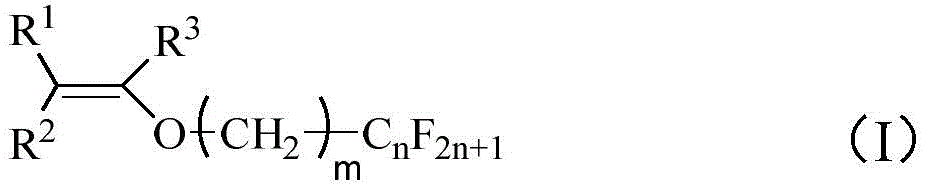
the monomer steam is vaporized monomer 1 and/or monomer 2 and/or monomer 3; that is, the monomer vapor includes one or several of vaporized monomer 1, monomer 2, and monomer 3, and the "several" refers to any two monomers or three monomers; a plurality of gases can be respectively introduced in sequence or simultaneously introduced, or any two monomers are introduced first and then a third monomer is introduced;
the monomer 1 has a structure represented by formula (I):
the monomer 2 has a structure represented by formula (II):
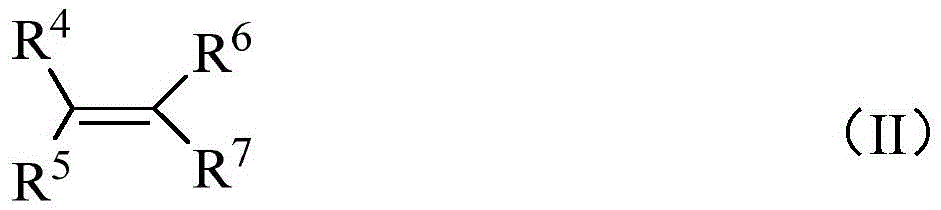
the monomer 3 has a structure represented by formula (III):
wherein R is1、R2、R3、R4、R5、R6、R7、R8、R9、R10、R11、R12、R13Is a group bonded to a double bond and is independently selected from a hydrophobic group such as hydrogen, alkyl, aryl, halogen, haloalkyl or haloaryl.
m is an integer of 0 to 5, n is an integer of 1 to 20, and j and k are integers of 0 to 10 and cannot be 0 at the same time.
R14Is a bridging group in the middle of the bisvinyl ether, and includes a polar group and a nonpolar group, and specifically, may be a bond, -CO-, -COO-, -O-, an aromatic group, an alicyclic alkyl group or a hydroxyl-substituted aliphatic alkyl group.
When the groups on the unsaturated bond are H and short carbon chain alkyl, the deposition speed of the film layer can be improved; the presence of fluorine substituents may improve the hydrophobic properties of the membrane layer.
Preferably, R1、R2、R3、R4、R5、R6、R7、R8、R9、R10、R11、R12、R13Independently selected from hydrogen, methyl or fluorine.
The proper carbon atom number of the fluorinated alkyl can ensure that the melting point and the boiling point of the monomer are in a proper range, and the monomer is easily vaporized and introduced into the vacuum reaction cavity.
Preferably, m is an integer from 0 to 2 and n is an integer from 1 to 8. j. k is an integer of 1 to 4, respectively.
The cyclic structure is advantageous for reducing the crystallinity of the polymer, the hydroxyl group is advantageous for improving the adhesion of the coating to the substrate, and preferably R14May be a bond, alicyclic alkylene group or hydroxyl-substituted aliphatic alkyl group.
Preferably, the monomer 1 is a liquid at normal temperature and pressure; and/or monomer 3 is a liquid at ambient temperature and pressure.
Preferably, monomer 2 is a short carbon chain fluorinated olefin, a gas at ambient temperature and pressure.
The coating protects the surfaces of different base materials from aging and water repellency, and the base materials can be solid materials such as metal, optical instruments, clothes fabrics, electronic devices, medical appliances and the like.
In addition, the invention also discloses a preparation method of the nano coating, which comprises the following steps:
(1) placing the substrate in a reaction cavity of a plasma chamber, wherein the vacuum degree in the reaction cavity is 0.1-1000 mTorr;
(2) introducing a plasma source gas, and starting plasma discharge for deposition; introducing monomer vapor into the reaction cavity for chemical vapor deposition;
(3) and closing the plasma discharge for deposition, introducing clean compressed air or inert gas, returning to normal pressure, opening the reaction cavity and taking out the substrate.
Preferably, the monomer vapor comprises monomer 1, monomer 2, and monomer 3;
the steam of the monomer 1, the steam of the monomer 2 and the steam of the monomer 3 are respectively introduced into the reaction cavity in sequence;
or the steam of the monomer 1, the monomer 2 and the monomer 3 is simultaneously introduced into the reaction cavity;
or any two of the monomer 1, the monomer 2 and the monomer 3 are simultaneously introduced into the reaction cavity, and then the third monomer of the monomer 1, the monomer 2 and the monomer 3 is introduced into the reaction cavity.
Namely, the steam of the monomer 1, the monomer 2 and the monomer 3 can be introduced sequentially and respectively, or can be introduced simultaneously, or any two monomers are introduced first, and then the third monomer is introduced, and the monomer 2 is a gas, so that the monomer can also be directly introduced into the reaction cavity.
Preferably, the monomer vapour comprises at least monomer 1; the mole percentage of the monomer 1 in the total amount of the monomer vapor introduced is not less than 20%. When the monomer vapor introduced contains the monomer 1, the monomer 1 accounts for not less than 20% of the total introduced amount of the monomer vapor, and the monomer 2 and the monomer 3 may not be introduced.
Preferably, the volume of the reaction cavity of the plasma chamber is 50-1000L.
Preferably, in the step (2), the temperature of the plasma chamber reaction chamber is controlled at 30-60 ℃; the flow rate of the plasma source gas is 5-300 sccm.
Preferably, in the step (3), the monomer steam is introduced into the reaction cavity at 0.1-1000 mTorr, and the flow of the introduced monomer steam is 10-1000 muL/min;
preferably, the step (2) further includes a step of performing a plasma discharge for pretreatment of the substrate after the plasma source gas is introduced and before the plasma discharge for deposition.
And (2) introducing the plasma source gas and then carrying out plasma discharge pretreatment on the base material. And (3) entering a deposition stage after the pretreatment stage is finished (the plasma discharge for pretreatment is converted into the plasma discharge for deposition), wherein the plasma discharge mode or parameters can be changed or not.
Preferably, the plasma discharge (plasma discharge for pretreatment and/or plasma discharge for deposition) is radio frequency discharge, microwave discharge, medium frequency discharge, penning discharge or electric spark discharge.
Preferably, the plasma discharge (plasma discharge for pretreatment and/or plasma discharge for deposition) is an electric spark discharge; the plasma discharge frequency is 20Hz-20KHz, the pulse width is 5 mus-50 ms, and the discharge time is 100s-20000 s.
Compared with the prior art, the invention combines the performances of different monomers to construct the structure of the coating. The main chain of the monomer containing a plurality of ether oxygen bonds is used, the bonding force between the ether oxygen bonds and the base material is strong, and the adhesive force of the coating is improved; the ultraviolet aging resistance of the coating is improved by utilizing the ultraviolet resistance of the fluorine-containing olefin monomer polymer; the strong hydrophobic coating formed by the fluoroalkyl monomer is utilized, so that the waterproof performance of the composite coating is greatly improved. Moreover, the coating prepared by the method has no mutual loss among various properties, and the technical effect of combining multiple excellent properties is obtained.
Detailed Description
Example 1
The preparation method of the high-adhesion anti-aging nano coating comprises the following steps:
(1) a PCB of an electronic device is placed in a 1000L plasma vacuum reaction cavity, and the reaction cavity is continuously vacuumized to ensure that the vacuum degree reaches 30 mTorr.
(2) Introducing nitrogen gas with the flow of 20sccm, starting electric spark plasma discharge to pretreat the PCB (namely starting electric spark plasma discharge for pretreatment), wherein the discharge frequency in the pretreatment stage is 500Hz, the pulse width is 200 mus, and the discharge time is 100 s.
(3) And introducing the monomer 3a, introducing the monomer 2a after the monomer is introduced, and finally introducing the monomer 1a, and performing chemical vapor deposition on the surface of the substrate to prepare the nano coating. In the preparation process of the coating, the flow rates of the three monomers are 150 mu L/min, the introduction time is 500s, 200s and 300s respectively, the plasma discharge for pretreatment is converted into the plasma discharge for deposition, and the electric spark discharge time in the deposition stage is 1000 s.
(4) And after the coating is prepared, introducing compressed air to restore the reaction cavity to normal pressure, opening the cavity, and taking out the PCB of the electronic device.

Monomer 1a

Monomer 2a
Monomer 3 a.
The plasma discharge device for pretreatment and the plasma discharge device for deposition can be one set or two independent devices. The pre-treatment plasma discharge device (e.g., electrode) is preferably disposed within the reaction chamber and around the substrate to facilitate rapid engagement with the coating process after pre-treatment; the plasma discharge device for deposition can be arranged outside the reaction cavity and far away from the reaction cavity, so that the negative influence of plasma discharge on the substrate in the coating process can be selectively or possibly avoided.
Example 2
The preparation method of the high-adhesion anti-aging nano coating comprises the following steps:
(1) the automobile rearview mirror is placed in a 200L plasma vacuum reaction cavity, and the reaction cavity is continuously vacuumized to ensure that the vacuum degree reaches 5 mTorr.
(2) Argon gas is introduced, the flow rate is 50sccm, electric spark plasma discharge is started for pretreatment (namely, the electric spark plasma discharge for pretreatment is started), the discharge frequency in the pretreatment stage is 1000Hz, the pulse width is 20 mus, and the discharge time is 100 s.
(3) Firstly introducing the monomer 3b, then introducing the monomer 2b, and finally introducing the monomer 1a, and carrying out chemical vapor deposition on the surface of the base material to prepare the nano coating. In the preparation process of the coating, the flow rates of the three monomers are 150 mu L/min, the introduction time is 500s, 500s and 500s respectively, the plasma discharge for pretreatment is converted into the plasma discharge for deposition, and the discharge time in the deposition stage is 1500 s.
(4) And after the coating is prepared, introducing compressed air to restore the reaction cavity to normal pressure, opening the cavity, and taking out the automobile rearview mirror.

Monomer 1b
Monomer 2b

Monomer 3b
Example 3
The preparation method of the high-adhesion anti-aging nano coating comprises the following steps:
(1) the magnesium alloy is placed in a 2000L plasma vacuum reaction cavity, and the reaction cavity is continuously vacuumized to ensure that the vacuum degree reaches 100 mTorr.
(2) Argon gas is introduced, the flow rate is 10sccm, electric spark plasma discharge is started for pretreatment (namely, electric spark plasma discharge for pretreatment is started), the discharge frequency in the pretreatment stage is 50kHz, the pulse width is 50 mus, and the discharge time is 100 s.
(3) And introducing the monomer 3c, after the end, introducing the monomer 2c and the monomer 1c simultaneously, and performing chemical vapor deposition on the surface of the base material to prepare the nano coating. In the preparation process of the coating, the flow rates of the three monomers are all 200 mu L/min, the introduction time is respectively 1500s and 2500s (2c and 1c), and the plasma discharge for pretreatment is adjusted to the plasma discharge for deposition. The discharge time of the deposition phase was 4000 s.
(4) And after the coating is prepared, introducing compressed air to restore the reaction cavity to normal pressure, opening the cavity and taking out the magnesium alloy.

Monomer 1c

Monomer 2c

And (c) a monomer 3 c.
Example 4
The preparation method of the high-adhesion anti-aging nano coating comprises the following steps:
(1) the automobile rearview mirror is placed in a 1800L plasma vacuum reaction cavity, and the reaction cavity is continuously vacuumized to ensure that the vacuum degree reaches 50 mTorr.
(2) Argon gas is introduced, the flow rate is 40sccm, electric spark plasma discharge is started for pretreatment (namely, electric spark plasma discharge for pretreatment is started), the discharge frequency in the pretreatment stage is 2000Hz, the pulse width is 80 mus, and the discharge time is 200 s.
(3) Firstly introducing the monomer 3d, then introducing the monomer 2d, and finally introducing the monomer 1d, and carrying out chemical vapor deposition on the surface of the base material to prepare the nano coating. In the preparation process of the coating, the flow rates of the three monomers are all 200 mu L/min, the introduction time is respectively 500s, 500s and 800s, and the plasma discharge for pretreatment is adjusted to the plasma discharge for deposition. The deposition phase discharge time was 1800 s.
(4) And after the coating is prepared, introducing compressed air to restore the reaction cavity to normal pressure, opening the cavity, and taking out the automobile rearview mirror.
Monomer 1d
Monomer 2d

And (3) a monomer 3 d.
Example 5
The preparation method of the high-adhesion anti-aging nano coating comprises the following steps:
(1) the vacuum cup was placed in a 3500L plasma vacuum reaction chamber and the reaction chamber was continuously evacuated to a vacuum of 200 mtorr.
(2) Argon gas is introduced, the flow rate is 10sccm, electric spark plasma discharge is started for pretreatment (namely, electric spark plasma discharge for pretreatment is started), the discharge frequency in the pretreatment stage is 50kHz, the pulse width is 80 mus, and the discharge time is 200 s.
(3) And introducing the monomer 3e, after the reaction is finished, introducing the monomer 2e and the monomer 1e simultaneously, and performing chemical vapor deposition on the surface of the base material to prepare the nano coating. In the preparation process of the coating, the flow rates of the three monomers are 250 mu L/min, the introduction time is 2500s and 2500s respectively, and the plasma discharge for pretreatment is adjusted to the plasma discharge for deposition. The discharge time in the deposition phase was 5000 s.
(4) And after the coating is prepared, introducing compressed air to restore the reaction cavity to normal pressure, opening the cavity and taking out the vacuum cup.

Monomer 1e

Monomer 2e

Monomer 3 e.
Example 6
Compared with the example 1, the flow rate of all the three monomers in the step (3) is changed to 200 mu L/min, and other conditions are not changed.
Example 7
Compared with the example 1, in the step (3), the three monomer introducing time is respectively changed to 1000s, 800s and 900s, the discharge time is correspondingly changed to 2700s, and other conditions are not changed.
Example 8
Compared with the example 7, the reaction cavity in the step (1) is continuously vacuumized to ensure that the vacuum degree reaches 10 mTorr, and other conditions are not changed.
Example 9
Compared with the embodiment 7, the frequency of the electric spark plasma discharge in the step (2) is changed to 1000Hz, and other conditions are not changed.
Example 10
In step (3), the monomer 1a was not introduced, and other conditions were not changed, as compared with example 7.
Example 11
In step (3), the monomer 1a was passed for 2700s and 2700s without passing the monomers 2a and 3a, and the discharge time was also 2700s, as compared with example 7, and the other conditions were not changed.
Example 12
In step (3), the monomer 1a and 3a were not introduced, the monomer 2a was introduced for 2700s, and the discharge time was 2700s, as compared with example 7, and other conditions were not changed.
Example 13
In step (3), the monomers 1a and 2a were not introduced, the monomer 3a was introduced for 2700s, and the discharge time was 2700s, as compared with example 7, and other conditions were not changed.
Example 14
In step (3), the monomer 3c was not introduced, the simultaneous introduction time of the monomers 2c and 1c was 4000s, the discharge time was 4000s, and other conditions were not changed as compared with example 3.
The base material plated in each of the above examples was subjected to a coating thickness test, a water contact angle test, a xenon lamp aging test, an ultraviolet aging test, and an adhesion test.
The thickness of the nano-coating was measured using a film thickness measuring instrument, U.S. Filmetrics F20-UV-film thickness measuring instrument.
And (3) testing the water contact angle of the nano coating according to the GB/T30447-2013 standard.
Xenon lamp ageing tests were carried out according to the GB/T16422.2-2014 standard.
And (4) ultraviolet aging test according to the GB/T16422.3-2014 standard.
Adhesion test method, a hundred-grid cutting test is carried out according to GB/T9286-1998 standard.
TABLE 1

By adopting the technology of the invention, the nano coating with multiple protective properties can be obtained. In order to obtain a multi-functional coating, the conventional technical means mainly superposes coatings with different functions to make the thickness reach more than dozens of microns and hundreds of microns, which often causes poor signal transmission, poor electrical conductivity and poor thermal conductivity of some electronic devices. In contrast, the nanocoating layer has little effect on the above properties because its thickness is in the nanometer scale. The plasma is utilized to simultaneously deposit coating materials with different functions, so that the defect of poor adhesion among the coatings is overcome.
Finally, it should be noted that: the above embodiments are only used to illustrate the technical solution of the present invention, and not to limit the same; while the invention has been described in detail and with reference to the foregoing embodiments, it will be understood by those skilled in the art that: the technical solutions described in the foregoing embodiments may still be modified, or some or all of the technical features may be equivalently replaced; and the modifications or the substitutions do not make the essence of the corresponding technical solutions depart from the scope of the technical solutions of the embodiments of the present invention.
Claims (11)
1. A high-adhesion aging-resistant nano coating is prepared by exposing a substrate to monomer steam atmosphere, and generating chemical reaction on the surface of the substrate through plasma discharge to form a protective coating;
the monomer steam is the mixed steam of the vaporized monomer 1 and the monomer 2 and the monomer 3;
the monomer 1 has a structure represented by formula (I):

the monomer 2 has a structure represented by formula (II):

the monomer 3 has a structure represented by formula (III):

wherein R is1、R2、R3、R4、R5、R6、R7、R8、R9、R10、R11、R12、R13Independently selected from hydrogen, alkyl, aryl, halogenAlkyl or aryl halide;
m is an integer of 0-5, n is an integer of 1-20, j and k are respectively an integer of 0-10 and cannot be 0 at the same time;
R14is-CO-, -COO-, an aromatic subunit, an alicyclic alkyl subunit or a hydroxyl-substituted aliphatic alkyl subunit.
2. The nanolayered coating of claim 1, wherein R is1、R2、R3、R4、R5、R6、R7、R8、R9、R10、R11、R12、R13Independently selected from hydrogen, methyl or fluorine.
3. The nanolayered coating of claim 1, wherein m is an integer from 0 to 2, n is an integer from 1 to 8, and j and k are each an integer from 1 to 4.
4. The nanolayered coating of claim 1, wherein R is14Is alicyclic alkylidene or aliphatic alkylidene substituted by hydroxyl.
5. The nanolayered coating of claim 1, wherein monomer 1 is a liquid at room temperature and pressure, monomer 3 is a liquid at room temperature and pressure, and monomer 2 is a gas at room temperature and pressure.
6. The nanocoating of claim 1, wherein the substrate is a metal or an electronic device.
7. A method for preparing the high-adhesion aging-resistant nano-coating according to any one of claims 1 to 6, which comprises the following steps:
(1) placing the substrate in a reaction cavity of a plasma chamber, wherein the vacuum degree in the reaction cavity is 5-200 mTorr;
(2) introducing a plasma source gas, starting plasma discharge for deposition, introducing monomer steam into the reaction cavity, and performing chemical vapor deposition;
(3) and closing the plasma discharge for deposition, introducing clean compressed air or inert gas, returning to normal pressure, opening the reaction cavity and taking out the substrate.
8. The method for preparing the nano coating according to claim 7, wherein the steam of the monomer 1, the steam of the monomer 2 and the steam of the monomer 3 are respectively introduced into the reaction cavity in sequence;
or the steam of the monomer 1, the monomer 2 and the monomer 3 is simultaneously introduced into the reaction cavity;
or any two of the monomer 1, the monomer 2 and the monomer 3 are simultaneously introduced into the reaction cavity, and then the third monomer of the monomer 1, the monomer 2 and the monomer 3 is introduced into the reaction cavity.
9. The method for preparing a nano-coating according to claim 7, wherein the mole percentage of the monomer 1 to the total introduced amount of the monomer vapor is not less than 20%.
10. The method for preparing a nanolayered coating according to claim 7, wherein in step (2), the temperature of the reaction chamber of the plasma chamber is controlled at 30-60 ℃; the flow rate of the plasma source gas introduced into the reaction cavity is 10-50 sccm.
11. The method for preparing a nanocoating according to claim 7, wherein said plasma discharge means is spark discharge.
Priority Applications (3)
| Application Number | Priority Date | Filing Date | Title |
|---|---|---|---|
| CN201811242691.0A CN109354941B (en) | 2018-10-24 | 2018-10-24 | High-adhesion anti-aging nano coating and preparation method thereof |
| PCT/CN2019/079109 WO2020082675A1 (en) | 2018-10-24 | 2019-03-21 | High-adhesion anti-aging nano coating and preparation method thereof |
| TW108137928A TWI717870B (en) | 2018-10-24 | 2019-10-21 | A high-adhesive anti-aging nano-coating and a preparation method thereof |
Applications Claiming Priority (1)
| Application Number | Priority Date | Filing Date | Title |
|---|---|---|---|
| CN201811242691.0A CN109354941B (en) | 2018-10-24 | 2018-10-24 | High-adhesion anti-aging nano coating and preparation method thereof |
Publications (2)
| Publication Number | Publication Date |
|---|---|
| CN109354941A CN109354941A (en) | 2019-02-19 |
| CN109354941B true CN109354941B (en) | 2020-01-24 |
Family
ID=65346523
Family Applications (1)
| Application Number | Title | Priority Date | Filing Date |
|---|---|---|---|
| CN201811242691.0A Active CN109354941B (en) | 2018-10-24 | 2018-10-24 | High-adhesion anti-aging nano coating and preparation method thereof |
Country Status (3)
| Country | Link |
|---|---|
| CN (1) | CN109354941B (en) |
| TW (1) | TWI717870B (en) |
| WO (1) | WO2020082675A1 (en) |
Families Citing this family (9)
| Publication number | Priority date | Publication date | Assignee | Title |
|---|---|---|---|---|
| CN109354941B (en) * | 2018-10-24 | 2020-01-24 | 江苏菲沃泰纳米科技有限公司 | High-adhesion anti-aging nano coating and preparation method thereof |
| CN110665768B (en) * | 2019-07-26 | 2022-04-26 | 江苏菲沃泰纳米科技股份有限公司 | Waterproof nanomembrane and its preparation method, application and product |
| CN111621208B (en) * | 2020-05-18 | 2021-11-05 | 江苏菲沃泰纳米科技股份有限公司 | Waterproof membrane layer and preparation method, application and product thereof |
| CN111690306B (en) * | 2020-05-18 | 2021-08-17 | 江苏菲沃泰纳米科技股份有限公司 | Waterproof film layer and preparation method and product thereof |
| CN112980223B (en) * | 2021-03-04 | 2021-12-21 | 江苏菲沃泰纳米科技股份有限公司 | A kind of composite coating, preparation method and device |
| CN113025096A (en) * | 2021-03-04 | 2021-06-25 | 江苏菲沃泰纳米科技股份有限公司 | Composite coating, preparation method and device |
| CN116964025A (en) * | 2021-03-09 | 2023-10-27 | 大金工业株式会社 | Halogenated ethers and their manufacturing methods, and vinyl ethers and their manufacturing methods |
| CN116003665B (en) * | 2021-10-22 | 2024-03-29 | 上海芯刻微材料技术有限责任公司 | Polymer and preparation method of 193nm photoetching top coating film containing same |
| CN115178444A (en) * | 2022-08-10 | 2022-10-14 | 深圳奥拦科技有限责任公司 | Functional coating and preparation method and application thereof |
Family Cites Families (10)
| Publication number | Priority date | Publication date | Assignee | Title |
|---|---|---|---|---|
| US6551950B1 (en) * | 1997-06-14 | 2003-04-22 | The Secretary Of State For Defence In Her Britannic Majesty's Government Of The United Kingdom Of Great Britain And Northern Ireland | Surface coatings |
| US6660340B1 (en) * | 2000-02-08 | 2003-12-09 | Epion Corporation | Diamond-like carbon film with enhanced adhesion |
| US8120854B2 (en) * | 2006-12-28 | 2012-02-21 | 3M Innovative Properties Company | Interference films having acrylamide layer and method of making same |
| ES2397719T3 (en) * | 2007-07-17 | 2013-03-11 | P2I Ltd | Procedure for the liquid waterproofing of an article of footwear by plasma graft polymerization |
| CN106868473B (en) * | 2017-01-23 | 2018-07-13 | 江苏菲沃泰纳米科技有限公司 | A kind of preparation method of gradient reduction structure liquid-proof coating |
| CN107142465B (en) * | 2017-05-21 | 2018-07-13 | 江苏菲沃泰纳米科技有限公司 | A method of cycle small-power continuous discharge prepares multi-functional nano protecting coating |
| CN107686986B (en) * | 2017-08-23 | 2018-12-18 | 江苏菲沃泰纳米科技有限公司 | A kind of preparation method of the organic silicon nano protective coating of modulated structure |
| CN107699868A (en) * | 2017-08-23 | 2018-02-16 | 江苏菲沃泰纳米科技有限公司 | A kind of preparation method of high insulation nano protective coating |
| CN107587119B (en) * | 2017-08-23 | 2018-11-13 | 江苏菲沃泰纳米科技有限公司 | A kind of preparation method of the high insulating rigid nano protecting coating of composite construction |
| CN109354941B (en) * | 2018-10-24 | 2020-01-24 | 江苏菲沃泰纳米科技有限公司 | High-adhesion anti-aging nano coating and preparation method thereof |
-
2018
- 2018-10-24 CN CN201811242691.0A patent/CN109354941B/en active Active
-
2019
- 2019-03-21 WO PCT/CN2019/079109 patent/WO2020082675A1/en not_active Ceased
- 2019-10-21 TW TW108137928A patent/TWI717870B/en not_active IP Right Cessation
Also Published As
| Publication number | Publication date |
|---|---|
| CN109354941A (en) | 2019-02-19 |
| TWI717870B (en) | 2021-02-01 |
| TW202016350A (en) | 2020-05-01 |
| WO2020082675A1 (en) | 2020-04-30 |
Similar Documents
| Publication | Publication Date | Title |
|---|---|---|
| CN109354941B (en) | High-adhesion anti-aging nano coating and preparation method thereof | |
| CN111303673B (en) | Hydrophobic surface coating and preparation method thereof | |
| JP5273041B2 (en) | Fluoropolymer thin film and method for producing the same | |
| CN109402611B (en) | Silicon-containing copolymer nano coating and preparation method thereof | |
| CN109267038B (en) | Wear-resistant self-crosslinking nano coating and preparation method thereof | |
| CN102821873A (en) | Method for the application of a conformal nanocoating by means of a low pressure plasma process | |
| TWI728517B (en) | An epoxy nano coating and preparation method thereof | |
| TWI717869B (en) | A acrylamide nano coating and preparation method thereof | |
| CN109354903B (en) | A kind of nano-coating with high transparency and low chromatic aberration and preparation method thereof | |
| Ting | Properties of hydrophobic carbon–PTFE composite coating with high corrosion resistance by facile preparation on pure Ti | |
| CN112980223B (en) | A kind of composite coating, preparation method and device | |
| CN101313010B (en) | Method to produce adhesiveless metallized polyimide film | |
| JP2008542495A (en) | Method for surface modification of polyimide film using ethyleneimine coupling agent, method for producing copper foil laminated film using the same, and copper foil laminated film having a two-layer structure produced by the method | |
| WO2020082682A1 (en) | High-transparency low-color-difference nano coating and preparation method therefor | |
| CN109280889A (en) | Dry-type film coating process for poly-p-xylene organic polymer film | |
| CN106811720A (en) | A kind of preparation method of circuit board nano water-proof film | |
| TWI906710B (en) | A composite coating, its preparation method, and its device | |
| WO2020082674A1 (en) | Polyimide nano coating and preparation method thereof | |
| Ang et al. | Low-temperature thermal graft copolymerization of 1-vinyl imidazole on polyimide films with simultaneous lamination to copper foils | |
| CN118684929B (en) | Continuous preparation process of PFA composite copper foil coil | |
| CN215975614U (en) | Polytetrafluoroethylene organic silicon pressure-sensitive adhesive tape | |
| TWI853174B (en) | Protective coating and method for preparation thereof | |
| CN114438477B (en) | Cyclic coating method, film layer and product | |
| WO2020082680A1 (en) | Polyurethane nano coating and preparation method thereof | |
| Wu et al. | Study on plasma polymerization of 1.1. 1-trifluoroethane: deposition and structure of plasma polymer films |
Legal Events
| Date | Code | Title | Description |
|---|---|---|---|
| PB01 | Publication | ||
| PB01 | Publication | ||
| SE01 | Entry into force of request for substantive examination | ||
| SE01 | Entry into force of request for substantive examination | ||
| GR01 | Patent grant | ||
| GR01 | Patent grant | ||
| CP03 | Change of name, title or address | ||
| CP03 | Change of name, title or address |
Address after: No.182, East Ring Road, Yuqi supporting area, Huishan Economic Development Zone, Wuxi City, Jiangsu Province, 214000 Patentee after: Jiangsu feiwotai nanotechnology Co.,Ltd. Address before: 214183 East Ring Road, Yuqi supporting area, Huishan Economic Development Zone, Wuxi City, Jiangsu Province Patentee before: Jiangsu Favored Nanotechnology Co.,Ltd. |