CN109070304B - Forming of tempered glass - Google Patents
Forming of tempered glass Download PDFInfo
- Publication number
- CN109070304B CN109070304B CN201780027665.3A CN201780027665A CN109070304B CN 109070304 B CN109070304 B CN 109070304B CN 201780027665 A CN201780027665 A CN 201780027665A CN 109070304 B CN109070304 B CN 109070304B
- Authority
- CN
- China
- Prior art keywords
- glass
- sheet
- edge
- depth
- shaping
- Prior art date
- Legal status (The legal status is an assumption and is not a legal conclusion. Google has not performed a legal analysis and makes no representation as to the accuracy of the status listed.)
- Active
Links
Images


Classifications
-
- B—PERFORMING OPERATIONS; TRANSPORTING
- B32—LAYERED PRODUCTS
- B32B—LAYERED PRODUCTS, i.e. PRODUCTS BUILT-UP OF STRATA OF FLAT OR NON-FLAT, e.g. CELLULAR OR HONEYCOMB, FORM
- B32B17/00—Layered products essentially comprising sheet glass, or glass, slag, or like fibres
- B32B17/06—Layered products essentially comprising sheet glass, or glass, slag, or like fibres comprising glass as the main or only constituent of a layer, next to another layer of a specific material
- B32B17/10—Layered products essentially comprising sheet glass, or glass, slag, or like fibres comprising glass as the main or only constituent of a layer, next to another layer of a specific material of synthetic resin
- B32B17/10005—Layered products essentially comprising sheet glass, or glass, slag, or like fibres comprising glass as the main or only constituent of a layer, next to another layer of a specific material of synthetic resin laminated safety glass or glazing
- B32B17/10009—Layered products essentially comprising sheet glass, or glass, slag, or like fibres comprising glass as the main or only constituent of a layer, next to another layer of a specific material of synthetic resin laminated safety glass or glazing characterized by the number, the constitution or treatment of glass sheets
- B32B17/10036—Layered products essentially comprising sheet glass, or glass, slag, or like fibres comprising glass as the main or only constituent of a layer, next to another layer of a specific material of synthetic resin laminated safety glass or glazing characterized by the number, the constitution or treatment of glass sheets comprising two outer glass sheets
-
- B—PERFORMING OPERATIONS; TRANSPORTING
- B32—LAYERED PRODUCTS
- B32B—LAYERED PRODUCTS, i.e. PRODUCTS BUILT-UP OF STRATA OF FLAT OR NON-FLAT, e.g. CELLULAR OR HONEYCOMB, FORM
- B32B17/00—Layered products essentially comprising sheet glass, or glass, slag, or like fibres
- B32B17/06—Layered products essentially comprising sheet glass, or glass, slag, or like fibres comprising glass as the main or only constituent of a layer, next to another layer of a specific material
- B32B17/10—Layered products essentially comprising sheet glass, or glass, slag, or like fibres comprising glass as the main or only constituent of a layer, next to another layer of a specific material of synthetic resin
- B32B17/10005—Layered products essentially comprising sheet glass, or glass, slag, or like fibres comprising glass as the main or only constituent of a layer, next to another layer of a specific material of synthetic resin laminated safety glass or glazing
- B32B17/10009—Layered products essentially comprising sheet glass, or glass, slag, or like fibres comprising glass as the main or only constituent of a layer, next to another layer of a specific material of synthetic resin laminated safety glass or glazing characterized by the number, the constitution or treatment of glass sheets
- B32B17/10128—Treatment of at least one glass sheet
- B32B17/10155—Edge treatment or chamfering
-
- B—PERFORMING OPERATIONS; TRANSPORTING
- B32—LAYERED PRODUCTS
- B32B—LAYERED PRODUCTS, i.e. PRODUCTS BUILT-UP OF STRATA OF FLAT OR NON-FLAT, e.g. CELLULAR OR HONEYCOMB, FORM
- B32B17/00—Layered products essentially comprising sheet glass, or glass, slag, or like fibres
- B32B17/06—Layered products essentially comprising sheet glass, or glass, slag, or like fibres comprising glass as the main or only constituent of a layer, next to another layer of a specific material
- B32B17/10—Layered products essentially comprising sheet glass, or glass, slag, or like fibres comprising glass as the main or only constituent of a layer, next to another layer of a specific material of synthetic resin
- B32B17/10005—Layered products essentially comprising sheet glass, or glass, slag, or like fibres comprising glass as the main or only constituent of a layer, next to another layer of a specific material of synthetic resin laminated safety glass or glazing
- B32B17/1055—Layered products essentially comprising sheet glass, or glass, slag, or like fibres comprising glass as the main or only constituent of a layer, next to another layer of a specific material of synthetic resin laminated safety glass or glazing characterized by the resin layer, i.e. interlayer
- B32B17/10761—Layered products essentially comprising sheet glass, or glass, slag, or like fibres comprising glass as the main or only constituent of a layer, next to another layer of a specific material of synthetic resin laminated safety glass or glazing characterized by the resin layer, i.e. interlayer containing vinyl acetal
-
- B—PERFORMING OPERATIONS; TRANSPORTING
- B32—LAYERED PRODUCTS
- B32B—LAYERED PRODUCTS, i.e. PRODUCTS BUILT-UP OF STRATA OF FLAT OR NON-FLAT, e.g. CELLULAR OR HONEYCOMB, FORM
- B32B17/00—Layered products essentially comprising sheet glass, or glass, slag, or like fibres
- B32B17/06—Layered products essentially comprising sheet glass, or glass, slag, or like fibres comprising glass as the main or only constituent of a layer, next to another layer of a specific material
- B32B17/10—Layered products essentially comprising sheet glass, or glass, slag, or like fibres comprising glass as the main or only constituent of a layer, next to another layer of a specific material of synthetic resin
- B32B17/10005—Layered products essentially comprising sheet glass, or glass, slag, or like fibres comprising glass as the main or only constituent of a layer, next to another layer of a specific material of synthetic resin laminated safety glass or glazing
- B32B17/10807—Making laminated safety glass or glazing; Apparatus therefor
- B32B17/1099—After-treatment of the layered product, e.g. cooling
-
- B—PERFORMING OPERATIONS; TRANSPORTING
- B32—LAYERED PRODUCTS
- B32B—LAYERED PRODUCTS, i.e. PRODUCTS BUILT-UP OF STRATA OF FLAT OR NON-FLAT, e.g. CELLULAR OR HONEYCOMB, FORM
- B32B3/00—Layered products comprising a layer with external or internal discontinuities or unevennesses, or a layer of non-planar shape; Layered products comprising a layer having particular features of form
- B32B3/26—Layered products comprising a layer with external or internal discontinuities or unevennesses, or a layer of non-planar shape; Layered products comprising a layer having particular features of form characterised by a particular shape of the outline of the cross-section of a continuous layer; characterised by a layer with cavities or internal voids ; characterised by an apertured layer
- B32B3/30—Layered products comprising a layer with external or internal discontinuities or unevennesses, or a layer of non-planar shape; Layered products comprising a layer having particular features of form characterised by a particular shape of the outline of the cross-section of a continuous layer; characterised by a layer with cavities or internal voids ; characterised by an apertured layer characterised by a layer formed with recesses or projections, e.g. hollows, grooves, protuberances, ribs
-
- C—CHEMISTRY; METALLURGY
- C03—GLASS; MINERAL OR SLAG WOOL
- C03B—MANUFACTURE, SHAPING, OR SUPPLEMENTARY PROCESSES
- C03B27/00—Tempering or quenching glass products
- C03B27/04—Tempering or quenching glass products using gas
- C03B27/0413—Stresses, e.g. patterns, values or formulae for flat or bent glass sheets
-
- C—CHEMISTRY; METALLURGY
- C03—GLASS; MINERAL OR SLAG WOOL
- C03C—CHEMICAL COMPOSITION OF GLASSES, GLAZES OR VITREOUS ENAMELS; SURFACE TREATMENT OF GLASS; SURFACE TREATMENT OF FIBRES OR FILAMENTS MADE FROM GLASS, MINERALS OR SLAGS; JOINING GLASS TO GLASS OR OTHER MATERIALS
- C03C19/00—Surface treatment of glass, not in the form of fibres or filaments, by mechanical means
-
- B—PERFORMING OPERATIONS; TRANSPORTING
- B32—LAYERED PRODUCTS
- B32B—LAYERED PRODUCTS, i.e. PRODUCTS BUILT-UP OF STRATA OF FLAT OR NON-FLAT, e.g. CELLULAR OR HONEYCOMB, FORM
- B32B38/00—Ancillary operations in connection with laminating processes
- B32B38/0036—Heat treatment
- B32B2038/0048—Annealing, relaxing
-
- Y—GENERAL TAGGING OF NEW TECHNOLOGICAL DEVELOPMENTS; GENERAL TAGGING OF CROSS-SECTIONAL TECHNOLOGIES SPANNING OVER SEVERAL SECTIONS OF THE IPC; TECHNICAL SUBJECTS COVERED BY FORMER USPC CROSS-REFERENCE ART COLLECTIONS [XRACs] AND DIGESTS
- Y02—TECHNOLOGIES OR APPLICATIONS FOR MITIGATION OR ADAPTATION AGAINST CLIMATE CHANGE
- Y02P—CLIMATE CHANGE MITIGATION TECHNOLOGIES IN THE PRODUCTION OR PROCESSING OF GOODS
- Y02P40/00—Technologies relating to the processing of minerals
- Y02P40/50—Glass production, e.g. reusing waste heat during processing or shaping
Landscapes
- Chemical & Material Sciences (AREA)
- Engineering & Computer Science (AREA)
- Organic Chemistry (AREA)
- Materials Engineering (AREA)
- Physics & Mathematics (AREA)
- Thermal Sciences (AREA)
- Mathematical Physics (AREA)
- Mechanical Engineering (AREA)
- Life Sciences & Earth Sciences (AREA)
- Chemical Kinetics & Catalysis (AREA)
- General Chemical & Material Sciences (AREA)
- Geochemistry & Mineralogy (AREA)
- Re-Forming, After-Treatment, Cutting And Transporting Of Glass Products (AREA)
- Joining Of Glass To Other Materials (AREA)
Abstract
本发明涉及一种制造包括热强化矿物玻璃板的板的方法,包括在施加热强化之后在玻璃板的边缘面上成形并且在距离边缘的深度小于压缩深度的情况下。
The present invention relates to a method of manufacturing a sheet comprising a thermally strengthened mineral glass sheet, comprising forming on the edge face of the glass sheet after applying thermal strengthening and at a depth from the edge less than the compression depth.
Description
技术领域technical field
本发明涉及包括热强化和成型的矿物玻璃板的板材的制造领域。The present invention relates to the field of manufacture of sheets comprising thermally strengthened and shaped mineral glass sheets.
背景技术Background technique
通常在任何热强化之前将矿物玻璃板成型。成型是任何能够去除材料的操作,例如切割,机加工,磨削,抛光。实际上,本领域技术人员已经认识到,热强化会在玻璃中产生应力,使得直接在热强化玻璃上进行的任何成型都会导致片材突然和完全破裂,形成多个小碎片。因此,对于本领域技术人员而言,理论上通过热强化玻璃的内应力状态使得任何加工(切割或成型)操作都不可能。根据现有技术,因此在热硬化操作之后不能矫正玻璃板的任何尺寸误差。Mineral glass sheets are typically formed prior to any thermal strengthening. Shaping is any operation that removes material, such as cutting, machining, grinding, polishing. In fact, those skilled in the art have recognized that thermal strengthening creates stresses in the glass such that any forming directly on the thermally strengthened glass will result in a sudden and complete rupture of the sheet, forming multiple small fragments. Therefore, for those skilled in the art, any processing (cutting or forming) operation is theoretically made impossible by the internal stress state of the thermally strengthened glass. According to the prior art, any dimensional errors of the glass sheet cannot therefore be corrected after the thermal hardening operation.
此外,在组装多个热强化玻璃板以形成层压板材的过程中,可能出现一个板的边缘相对于另一个板的边缘的偏移。玻璃边缘的这种偏移有时是不可接受的,特别是如果产品的美观要求边缘是自由的,也就是说没有被困在槽口中或者没有被接头隐藏。然而,通常,本领域技术人员不会冒着通过磨削来对齐片材边缘的风险,因为担心会导致层压玻璃板材的破裂。Furthermore, during the process of assembling a plurality of thermally strengthened glass sheets to form a laminate, offset of the edge of one sheet relative to the edge of the other sheet may occur. This offset of the glass edge is sometimes unacceptable, especially if the aesthetics of the product require the edge to be free, that is, not trapped in a notch or hidden by a splice. Typically, however, one skilled in the art would not risk aligning the edges of the sheets by grinding for fear of causing cracking of the laminated glass sheet.
最后,制备具有特定成型的板材,特别是Clip'In®型,根据该板材,在玻璃板的侧面(即边缘面)上形成凹槽并平行于玻璃的主面(参见WO 2007/135335中的这种类型的组件),其通常在进行成型的工业现场进行。根据传统技术,成型应在热硬化步骤之前进行。因此,进行这种成型并且没有热硬化装置的工业场所必须在已定尺寸的玻璃上进行Clip'In®成型,然后将它们送到另一个工业现场,以便进行热硬化,以便最后在发送给客户之前将它们返回到前一个站点。因此,物流和生产时间受到不能在已经经过热处理操作的已定尺寸的玻璃上进行成型操作的限制。Finally, sheets are produced with a specific profile, in particular of the Clip'In® type, according to which grooves are formed on the sides (ie edge faces) of the glass sheet parallel to the main faces of the glass (see WO 2007/135335 for components of this type), which are usually carried out at the industrial site where the forming is carried out. According to conventional techniques, forming should be carried out before the thermal hardening step. Therefore, an industrial site that does this molding and does not have a heat-hardening unit must do Clip'In® molding on sized glass, then send them to another industrial site for heat-hardening to be finally sent to the customer before returning them to the previous site. Therefore, logistics and production time are limited by the inability to perform forming operations on sized glass that has undergone heat treatment operations.
发明内容SUMMARY OF THE INVENTION
本发明通过使得可以在热硬化步骤之后进行成型来解决上述问题。本发明的目的在于包括至少一个热强化玻璃板的任何类型的板材。该板材,特别是玻璃制品单元类型的板材,可以仅包括单个热强化玻璃板或包括多个热强化玻璃板。特别地,它可以是层压板材,特别是层压玻璃制品单元,各种任选的热强化矿物玻璃板由聚合物材料(特别是聚乙烯醇缩丁醛(PVB)类型聚合物材料)分隔。术语“板材”覆盖任何类型的平面或弯曲玻璃制品单元或镜子。The present invention solves the above-mentioned problems by making it possible to perform the forming after the thermal hardening step. The present invention is directed to any type of sheet comprising at least one thermally strengthened glass sheet. The sheet, particularly of the glazing unit type, may comprise only a single thermally strengthened glass sheet or a plurality of thermally strengthened glass sheets. In particular, it may be a laminated sheet, in particular a laminated glazing unit, the various optional thermally strengthened mineral glass sheets separated by a polymeric material, in particular a polyvinyl butyral (PVB) type polymeric material . The term "sheet" covers any type of flat or curved glazing unit or mirror.
为了更好地说明本发明的主题,下面参考附图通过说明和非限制性的方式描述下述各种具体实施例。In order to better illustrate the subject matter of the present invention, the following various specific embodiments are described below, by way of illustration and not limitation, with reference to the accompanying drawings.
附图说明Description of drawings
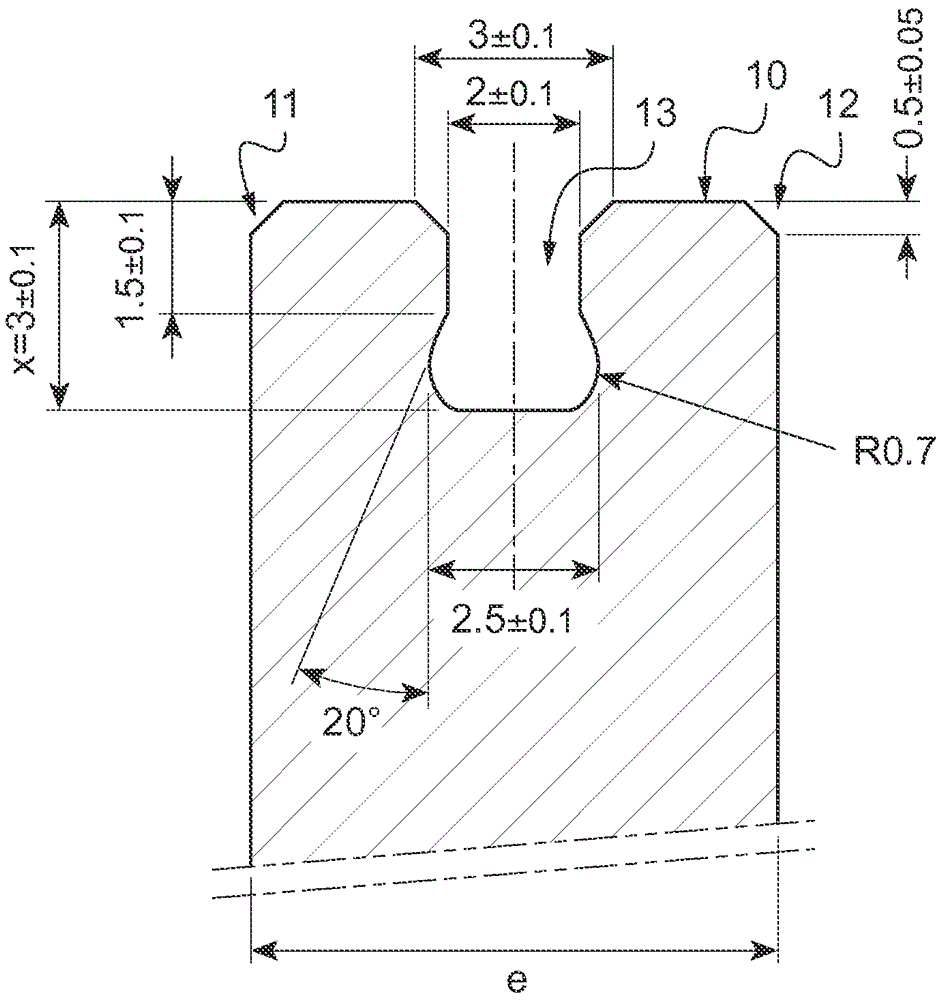
图1表示在玻璃板的边缘面上制成的所谓的Clip'In®凹槽的横截面。Figure 1 shows a cross-section of a so-called Clip'In® groove made in the edge face of a glass sheet.
图2示意性地描绘了用于生产所谓的Clip'In®凹槽的方法。图3表示平行于其主面1和2的玻璃板的横截面,其中阴影线为其压缩带。Figure 2 schematically depicts a method for producing so-called Clip'In® grooves. Figure 3 shows a cross-section of a glass sheet parallel to its
具体实施方式Detailed ways
本发明首先涉及包括热强化的矿物玻璃板的板材的制造方法,包括在施加热强化之后在玻璃板的边缘面上并且于从边缘的深度(小于压缩区深度)成型。压缩区域的深度对应于玻璃的边缘面与压缩区域和拉伸区域之间的边界之间的最小距离。在本申请的上下文中,该边界对应于使用本领域技术人员公知的Sharples装置(Sharples边缘应力计)出现的黑线(相对于边缘的第一黑色条纹)。该边界也可以通过偏光镜检测或具有Babinet补偿的边缘控制器来确定。因此,实施成型的深度优选小于90%和优选小于80%的从边缘高至Sharples装置显示的黑线(该线的中间)的深度。因此,本发明涉及制造包括热强化的矿物玻璃板的板材的方法,包括在施加热强化之后且在玻璃板的边缘面上于从边缘高到Sharples装置显示的黑线(该线的中间)的深度成型。The invention first relates to a method of manufacturing a sheet comprising a thermally strengthened mineral glass sheet, comprising forming on the edge face of the glass sheet and at a depth from the edge (less than the compression zone depth) after applying thermal strengthening. The depth of the compression zone corresponds to the minimum distance between the edge face of the glass and the boundary between the compression zone and the tension zone. In the context of the present application, this boundary corresponds to the black line (first black stripe relative to the edge) that appears using a Sharples device (Sharples edge stress meter) well known to those skilled in the art. This boundary can also be determined by polarizer detection or an edge controller with Babinet compensation. Therefore, the depth to which the shaping is carried out is preferably less than 90% and preferably less than 80% of the depth from the edge up to the black line (the middle of the line) shown by the Sharples device. Accordingly, the present invention relates to a method of manufacturing a sheet comprising a thermally strengthened mineral glass sheet, comprising after applying thermal strengthening and on the edge face of the glass sheet at a height from the edge to the black line (the middle of the line) shown by the Sharples device Deep molding.
特别地,在从玻璃边缘开始的深度上进行成型,该深度足够小以使得在所述成型之后5%分位数(5% fractile)的弯曲断裂应力保持大于120MPa。成型包括至少一个磨削道次。这意味着在成型之后,根据EN12150-1标准(参见§9.4),建筑物中的回火玻璃制品可具有5%分位数下弯曲应力大于120MPa。这些值根据EN1288-3标准由弯曲断裂试验确定。In particular, the forming is performed at a depth from the glass edge that is small enough so that the 5% fractile flexural fracture stress remains greater than 120 MPa after said forming. Shaping includes at least one grinding pass. This means that after forming, tempered glass articles in buildings can have a 5% quantile bending stress greater than 120 MPa according to the EN12150-1 standard (see §9.4). These values are determined by flexural rupture tests according to the EN1288-3 standard.
板的边缘面或侧面是板在其边缘处连接其两个主面的窄而长的面。根据本发明的成型在玻璃板的边缘面中或在玻璃板的边缘面上进行,这意味着由于成型引起的腐蚀从板的边缘开始并沿着板的中心区域的方向。成型可以影响边缘面的宽度的全部或仅一部分(在凹槽的情况下)。成型可以包括在边缘面上形成凹槽,其宽度小于边缘面的宽度,使得能够组装板以形成墙壁或家具,特别地如WO2007/135335教导的那样。成型还可以包括磨削层压玻璃制品单元的侧面,使得其各种玻璃板的边缘很好地对齐。为了做到这一点,通常足以磨削超出另一个或另多个的板边缘。因此,该板可以是组合由聚合物材料隔开的多个矿物玻璃板的层压板材,特别是由PVB制成,该成型在热强化板的边缘面的整个宽度上进行,以便对齐板材的各种玻璃板的边缘。特别地,层压板材的所有矿物玻璃板可以是热强化的,特别是它们都可以被回火。An edge face or side face of a board is the narrow, long face of the board at its edge connecting its two main faces. The shaping according to the invention takes place in or on the edge face of the glass sheet, which means that the corrosion due to shaping starts from the edge of the sheet and goes in the direction of the central region of the sheet. Shaping can affect all or only part of the width of the edge face (in the case of grooves). Forming may include forming grooves in the edge faces, the width of which is smaller than the width of the edge faces, enabling the panels to be assembled to form walls or furniture, in particular as taught in WO2007/135335. Forming may also include grinding the sides of the laminated glazing unit so that the edges of its various glass sheets are well aligned. In order to do this, it is usually sufficient to grind the edge of the board beyond one or more. Thus, the panel may be a laminated panel combining a plurality of mineral glass panels separated by a polymer material, in particular made of PVB, the molding being carried out over the entire width of the edge face of the thermally strengthened panel in order to align the panels' Edges of various glass plates. In particular, all the mineral glass sheets of the laminate can be thermally strengthened, in particular they can all be tempered.
施加到玻璃板上的热强化是本领域技术人员通常进行的类型。它可以是半回火(产生在40-90MPa之间的范围内的表面应力,作为绝对值)或回火(产生大于90MPa的表面应力,作为绝对值)。通过快速冷却施加热强化,通常通过将空气吹到预热至至少570℃,通常至少600℃的玻璃板上。热强化越大,诱导表面应力越高。商业回火玻璃板通常具有至少90MPa的表面应力作为绝对值。表面应力可以通过基于极化原理操作的装置(例如Scalp-04偏光镜)来确定,所确定的值是玻璃板主表面上且距边缘至少20cm的5次测量的平均值。上述应力值是绝对值,因为本领域技术人员也可以用负号表示它们。Thermal strengthening applied to glass sheets is of the type commonly performed by those skilled in the art. It can be semi-tempered (produces a surface stress in the range between 40-90 MPa, as an absolute value) or tempered (produces a surface stress greater than 90 MPa, as an absolute value). Thermal strengthening is applied by rapid cooling, typically by blowing air onto a glass sheet preheated to at least 570°C, usually at least 600°C. The greater the thermal strengthening, the higher the induced surface stress. Commercial tempered glass sheets typically have a surface stress of at least 90 MPa as an absolute value. Surface stress can be determined by means of a device operating on the principle of polarization (eg Scalp-04 polarizer), the value determined being the average of 5 measurements on the main surface of the glass sheet and at least 20 cm from the edge. The above stress values are absolute values, since those skilled in the art can also represent them with a negative sign.
优选地,热强化足够足以使板的表面应力的绝对值大于90MPa,并且优选大于110MPa,并且优选大于120MPa(作为绝对值)。Preferably, the thermal strengthening is sufficient to cause the absolute value of the surface stress of the panel to be greater than 90 MPa, and preferably greater than 110 MPa, and preferably greater than 120 MPa (as an absolute value).
热强化玻璃板的厚度可以在1至20mm的范围内,标准厚度为6,8,10,12mm。该板可以结合到板材中,其厚度可以在1-70mm的范围内。该板材可以由单个热强化玻璃板形成。通常,在任何磨削之前,回火至90MPa(表面应力的绝对值)并且其厚度在6至12mm的范围内(其包括6和12mm端值)的玻璃板具有在5%分位数下弯曲强度大于120MPa。根据本发明的磨削在压缩区域中并且以距边缘的深度进行,使得5%分位数下的弯曲强度保持大于120MPa,并且这优选地在所述成型之后的至少一周的时间之后(在此至少一周期间的条件:内部,20℃和相对湿度50%)。因此,优选地,板在成型然后在20℃下在相对湿度为50%的空气中储存后在5%分位数下的断裂应力大于120MPa。为了做到这一点,再次建议板的热强化足够足以使其在成型之前在5%分位数下的断裂应力大于120MPa。通过至少一个磨削道次(grindingpass)和以距边缘的玻璃深度进行成型,所述以距边缘的玻璃深度足够小以使得在所述成型之后5%分位数下的断裂应力保持大于120MPa。The thickness of the heat strengthened glass sheets can be in the range of 1 to 20mm, with standard thicknesses of 6, 8, 10, 12mm. The board can be incorporated into a sheet and its thickness can be in the range of 1-70mm. The sheet may be formed from a single sheet of thermally strengthened glass. Typically, before any grinding, glass sheets tempered to 90 MPa (absolute value of surface stress) and having a thickness in the range of 6 to 12 mm (which includes the 6 and 12 mm ends) have a bend at the 5% quantile The strength is greater than 120MPa. Grinding according to the invention is performed in the compression zone and at a depth from the edge such that the flexural strength at the 5% quantile remains greater than 120 MPa, and this is preferably after a period of at least one week after said shaping (here Conditions during at least one week: inside, 20°C and 50% relative humidity). Therefore, preferably, the breaking stress of the panel at the 5% quantile is greater than 120 MPa after forming and then storing at 20°C in air with a relative humidity of 50%. In order to do this, it is again recommended that the sheet be thermally strengthened enough to have a fracture stress greater than 120 MPa at the 5% quantile prior to forming. Shaping is performed with at least one grinding pass and at a glass depth from the edge that is sufficiently small to maintain a stress at break greater than 120 MPa at the 5% quantile after the shaping.
有利地,玻璃板的厚度为至少6mm,并且热强化足够足以使板的表面应力大于100MPa(作为绝对值)。因此,从边缘成型的深度通常可以是至少2mm。Advantageously, the thickness of the glass sheet is at least 6 mm and the thermal strengthening is sufficient to give the sheet a surface stress greater than 100 MPa (as an absolute value). Therefore, the depth of forming from the edge may generally be at least 2 mm.
磨削道次(grinding pass)通过砂轮进行。为了磨削板材,实施砂轮和板材相对于彼此的相对位移。特别地,板材可以是静止的,并且是砂轮移动,甚至可能围绕板材移动。CNC(计算机数字控制)机器可根据此变型进行磨削。同样地,砂轮可以是静止的并且移动板材。 Bottero牌机器可根据此变型进行磨削。The grinding pass is carried out by the grinding wheel. For grinding the sheet, a relative displacement of the grinding wheel and the sheet with respect to each other is carried out. In particular, the sheet may be stationary and the grinding wheel moving, possibly even around the sheet. CNC (Computer Numerical Control) machines can grind according to this variant. Likewise, the grinding wheel can be stationary and move the sheet. Machines of the Bottero brand can grind according to this variant.
砂轮产生磨削,玻璃的宽度可高至30毫米。这是砂轮和板材之间每个瞬间的接触宽度。The grinding wheel produces grinding, and the width of the glass can be up to 30 mm. This is the width of contact between the wheel and the plate at each instant.
通过至少一次磨削道次进行成型,每次道次(pass)的深度为距边缘至多1.5mm,和优选至多1.2mm。Shaping is carried out by at least one grinding pass, each pass having a depth of at most 1.5 mm from the edge, and preferably at most 1.2 mm.
在本发明的范围内用于磨削或抛光玻璃的设备与用于磨削或抛光未经热回火的玻璃的设备相同。可以使用磨削盘或磨削砂轮制造凹槽。这些磨削工具旋转并且在适当的情况下定位在枢转(pivoting)或可倾斜的头部上。因此,通过使工具相对于板材的边缘或边缘面的法线倾斜,并且通过将该移动与向前移动相结合,在多次加工道次之后获得具有期望轮廓的凹槽。The equipment used for grinding or polishing glass within the scope of the present invention is the same as the equipment used for grinding or polishing glass that has not been thermally tempered. The grooves can be made using grinding discs or grinding wheels. These grinding tools rotate and, where appropriate, are positioned on a pivoting or tiltable head. Thus, by tilting the tool relative to the normal to the edge or edge face of the sheet, and by combining this movement with the forward movement, a groove with the desired profile is obtained after a number of machining passes.
众所周知,热硬化产生玻璃板周边的边缘应力。某些光学观察系统可以揭示这些玻璃侧面的应力,例如Sharples应力测量装置。观察热强化玻璃的边缘使得可以揭示两个区域:1)玻璃处于压缩状态的第一区域(称为压缩区域或压缩屏障(compression barrier)或压缩带),从玻璃边缘开始向下至特定深度P,然后2)玻璃处于超过该特定深度的张力(称为拉伸区)的第二区域。这两个区域之间的边界,在距离玻璃边缘的特定深度处,在Sharples设备中以暗线的形式出现,位于离玻璃边缘几毫米处,通常距离玻璃边缘2-25毫米。压缩区的大小取决于玻璃的厚度和热强化程度。举例来说,对于110MPa(表面应力的绝对值)的热强化程度,在厚度为10mm的钠钙硅玻璃的情况下,这两个区域之间的边界在距边缘6.5mm处测量,和在厚度为8mm的玻璃的情况下,这两个区域之间的边界在距边缘4.6mm处测量。It is well known that thermal hardening produces edge stresses around the perimeter of the glass sheet. Certain optical viewing systems can reveal the stress on these glass sides, such as the Sharples stress measurement device. Observing the edge of a heat-strengthened glass makes it possible to reveal two regions: 1) The first region where the glass is in compression (called the compression region or compression barrier or compression zone), starting from the edge of the glass and going down to a certain depth P , and then 2) the glass is in a second zone of tension (called the stretch zone) beyond that particular depth. The boundary between these two areas, at a specific depth from the edge of the glass, appears as a dark line in Sharples devices, located a few millimeters from the edge of the glass, usually 2-25mm from the edge of the glass. The size of the compression zone depends on the thickness of the glass and the degree of thermal strengthening. As an example, for a degree of thermal strengthening of 110 MPa (absolute value of surface stress), in the case of a soda lime silica glass with a thickness of 10 mm, the boundary between these two regions is measured at 6.5 mm from the edge, and at the thickness of In the case of 8mm glass, the boundary between these two areas is measured at 4.6mm from the edge.
压缩屏障(compression barrier)构成整个回火玻璃板的外壳。为了给其一个安全余量,在成型之前,以距离边缘小于90%和优选小于80%的压缩区深度的深度进行成型。The compression barrier forms the envelope of the entire tempered glass pane. In order to give it a safety margin, the forming is carried out at a depth less than 90% and preferably less than 80% of the depth of the compression zone from the edge before forming.
优选地,并非根据本发明的板材中包括的每个热硬化玻璃板都具有90°角。实际上,这种角度是热硬化玻璃破裂的原因。这就是90°角通常被倒角(chamfered)或倒圆(rounded)的原因。特别地,在热硬化之前,板的边缘面和板的主面之间的角度优选地被倒角或倒圆。如果在热硬化之后必须在边缘面的整个高度(即侧面的整个宽度)上进行成型,这必然导致倒角或圆角的减小,那么在进行所述成型之前,优选重做或增加倒角或倒圆。Preferably, not every thermosetting glass sheet included in the sheet according to the invention has a 90° angle. In fact, this angle is what causes the heat-hardened glass to crack. This is why 90° angles are often chamfered or rounded. In particular, the angle between the edge face of the sheet and the main face of the sheet is preferably chamfered or rounded prior to thermal hardening. If, after thermal hardening, it is necessary to form over the entire height of the edge face (ie the entire width of the flank), which necessarily results in a reduction in the chamfer or fillet, it is preferable to redo or increase the chamfer before said forming or rounded.
优选防止根据本发明的成型(在热硬化之后)导致90°角。优选地,实施根据本发明的成型,使得倒角连接彼此形成90°角的部分。The shaping according to the invention (after thermal hardening) is preferably prevented from leading to a 90° angle. Preferably, the shaping according to the invention is carried out such that the chamfers connect parts forming an angle of 90° with each other.
如果希望在热硬化之后进行玻璃板的成型,则必须考虑安全屏障(压缩区的边界)的向后移动以避免自发破裂。具体地,在磨削期间,如果超出压缩屏障,则热强化玻璃破裂。举例来说,对于热强化至110MPa(作为绝对值)的12mm玻璃,压缩区域距玻璃边缘8.4mm,和如果通过在边缘面的整个宽度上磨削从玻璃板边缘移除2mm,压缩区域距离玻璃边缘仅6.4mm。If it is desired to form the glass sheet after thermal hardening, rearward movement of the safety barrier (boundary of the compression zone) must be considered to avoid spontaneous rupture. Specifically, the thermally strengthened glass breaks if the compression barrier is exceeded during grinding. For example, for a 12mm glass heat strengthened to 110MPa (as an absolute value), the compressed area is 8.4mm from the edge of the glass, and if 2mm is removed from the edge of the glass sheet by grinding over the entire width of the edge face, the compressed area is from the glass The edge is only 6.4mm.
从经验上可以发现,在根据本发明的磨削之前,来自玻璃边缘的压缩区域的深度也由下式给出:It has been found empirically that, prior to grinding according to the invention, the depth of the compressed region from the edge of the glass is also given by:
P’ = ((½+2µ).e+2.(1-µ2).E/σc)(等式1)P' = ((½+2µ).e+2.(1-µ 2 ).E/σ c ) (Equation 1)
其中,in,
e是玻璃板的厚度,e is the thickness of the glass plate,
μ是玻璃的泊松比(传统的钠钙硅玻璃为0.22),μ is the Poisson’s ratio of the glass (0.22 for traditional soda lime silica glass),
E是玻璃板材料的杨氏模量(传统的钠钙硅玻璃为70GPa),E is the Young's modulus of the glass plate material (70GPa for traditional soda lime silica glass),
σc是表示热强化程度(特别是回火的程度)的表面应力。这是负值(例如:对于回火至110MPa的板,σc为-110MPa)。σ c is the surface stress representing the degree of thermal strengthening (especially the degree of tempering). This is a negative value (eg: σ c is -110MPa for a plate tempered to 110MPa).
在等式1中,参数和结果以SI单位表示。In Equation 1, parameters and results are expressed in SI units.
因此,本发明还涉及一种制造包括热强化的矿物玻璃板的板材的方法,包括在施加热强化之后和以小于通过等式1计算的深度P'的深度对玻璃板的边缘面进行成型,并且优选地小于90%的通过等式1计算的深度P'和优选地小于80%的通过等式1计算的深度P'。本申请中出现的本发明的所有其他方面适用于该板。Accordingly, the present invention also relates to a method of manufacturing a sheet comprising a thermally strengthened mineral glass sheet, comprising shaping the edge face of the glass sheet to a depth less than the depth P' calculated by equation 1 after applying thermal strengthening, And preferably less than 90% of the depth P' calculated by Equation 1 and preferably less than 80% of the depth P' calculated by Equation 1. All other aspects of the invention appearing in this application apply to this board.
为了符合建筑物中玻璃制品的EN12150-1标准,从玻璃的初始边缘开始的根据本发明的成型深度优选地取距玻璃边缘的深度,该距玻璃边缘的深度足够小以使得在所述成型之后,在5%分位数下弯曲断裂应力保持大于120MPa。在所有情况下,优选地,重复成型深度优选地不超过在成型之前从玻璃边缘的压缩区域的深度P的90%,这取决于玻璃的厚度和回火的程度。In order to comply with the EN 12150-1 standard for glazing in buildings, the depth of forming according to the invention from the initial edge of the glass is preferably taken at a depth from the edge of the glass that is sufficiently small that after said forming , the flexural fracture stress remains greater than 120MPa at the 5% quantile. In all cases, preferably, the depth of re-forming is preferably not more than 90% of the depth P of the compressed region from the edge of the glass prior to forming, depending on the thickness of the glass and the degree of tempering.
在下面的表1中,显示出厚度P'随钠钙硅玻璃的厚度e和回火程度σc的变化,其中钠钙硅玻璃的泊松比为0.22,杨氏模量为71GPa,从边缘估算压缩区,用上面的等式1计算。在前面的描述中,表面应力通常作为绝对值给出,但是本领域技术人员通常认为它们是负的并且它们在任何情况下都应该以负号重新进入上面的式1中。表1中注明了它们带有负号。In Table 1 below, the thickness P' is shown as a function of the thickness e and the degree of tempering σ c of the soda-lime-silica glass, which has a Poisson's ratio of 0.22 and a Young's modulus of 71 GPa, from the edge Estimate the compressed area, calculated using Equation 1 above. In the foregoing description, surface stresses are generally given as absolute values, but those skilled in the art generally consider them to be negative and they should in any case re-enter Equation 1 above with a negative sign. They are noted in Table 1 with a negative sign.
回火的板的厚度: 6 mm
回火的板的厚度: 8 mm
回火的板的厚度: 10 mm
回火的板的厚度: 12 mm
表1。Table 1.
图1表示,以mm计,在厚度e的横截面(阴影玻璃)中观察到的回火玻璃板的边缘面10中制成的所谓的Clip'In®凹槽13的尺寸。倒角11和12在回火之前制成。在回火之后并且根据图2所解释的方法制造凹槽13本身。边缘面(也就是侧面)的宽度(也可以称为“高度”)对应于板的厚度“e”。凹槽在距离板的边缘10的3mm处深度x上制成。Figure 1 shows the dimensions, in mm, of so-called Clip'In®
图2示意性地描绘了用于生产所谓的Clip'In®凹槽的方法,所述方法通过六个磨削盘(D1至D6)的连续介入在该图中从右向左实施,如图2a)中所示。凹槽中每个盘的形状和作用在b)中表示,而在盘的介入期间(从右到左)凹槽中的变化如在c)中表示。Figure 2 schematically depicts the method for producing so-called Clip'In® grooves, which is carried out in this figure from right to left by the successive intervention of six grinding discs (D1 to D6), as shown in 2a). The shape and action of each disc in the groove is shown in b), while the changes in the groove during the intervention of the disc (from right to left) are shown in c).
图3表示看到的玻璃板横截面并平行于其主面1和2。围绕板的压缩带用阴影线表示。在板的边缘3和朝向玻璃内部的距离P之间发现压缩区域。非阴影区T处于张力状态。距离P是玻璃的边缘面与边界之间的最小距离,所述边界是在压缩区域和拉伸区域之间的边界。从边缘对玻璃进行任何成型,无论是整个边缘面3的平面成型(边缘面的整个宽度,即在板的整个厚度e上),或在边缘面上导致凹槽的成型(在图1的情况下),不应超过距离P(和优选90%的距离P),或在5%分位数处弯曲强度小于120 MPa之外的深度Rmax。Figure 3 shows the glass pane seen in cross-section and parallel to its
实施例1和2Examples 1 and 2
使用表2中给出的参数进行层压玻璃制品单元的成型。层压玻璃制品单元组合两个各自厚度为8mm的钠钙硅玻璃板,和具有1.52毫米厚度的PVB制成的中间板。对每块玻璃板进行回火处理,以产生110MPa的表面应力(作为绝对值)。将这两块玻璃在层压玻璃制品单元中组合,其边缘具有一定的偏移,为2mm。在一种情况(实施例1)下进行磨削,其中CNC机器围绕层压玻璃制品单元,和在另一种情况(Bottero机器)下使用不同盘的机器。Formation of the laminated glazing unit was performed using the parameters given in Table 2. The laminated glazing unit combines two soda lime silica glass sheets, each with a thickness of 8 mm, and an intermediate sheet made of PVB with a thickness of 1.52 mm. Each glass plate was tempered to produce a surface stress (as an absolute value) of 110 MPa. The two pieces of glass are combined in a laminated glazing unit with an edge offset of 2mm. Grinding was carried out in one case (Example 1) where the CNC machine surrounds the laminated glazing unit, and in the other case (Bottero machine) using a machine with different discs.

表 2。Table 2.
在这些条件下磨削后,校正组装后出现的边缘偏移,并且边缘抛光的美学外观符合客户的期望。实施例磨削后玻璃没有破碎。实际上,压缩阻挡区域从边缘延伸高至大约4.6mm,这比进行的磨削要大得多。After grinding under these conditions, the edge offset that occurs after assembly is corrected, and the aesthetic appearance of the edge finish meets the customer's expectations. Examples The glass did not break after grinding. In fact, the compression barrier area extends up to about 4.6mm from the edge, which is much larger than the grinding performed.
实施例3至5Examples 3 to 5
制备尺寸为1100mm×360mm×10mm,回火至110MPa(表面应力,绝对值)的单片玻璃板。然后将它们的边缘面在其整个高度(也就是板的整个厚度)和整个两个长度(在弯曲试验期间置于应力下)以及在以下条件下进行磨削:A single glass plate with dimensions of 1100 mm × 360 mm × 10 mm and tempered to 110 MPa (surface stress, absolute value) was prepared. Their edge faces were then ground over their entire height (that is, the entire thickness of the plate) and over both lengths (under stress during the bending test) and under the following conditions:
实施例3:无磨削(参考);Example 3: no grinding (reference);
实施例4:在3次道次(passe)中进行3mm磨削,每次1mm;Example 4: 3mm grinding in 3 passes of 1mm each;
实施例5:在4次道次中进行4mm磨削,每次1mm。Example 5: 4 mm grinding in 4 passes of 1 mm each.
实施例4和5的玻璃制品单元在磨削过程中没有破裂。进行了符合EN1288-3标准的4点弯曲试验。根据Weibull模型处理后,5%分位数下的断裂应力(以MPa表示)为:The glass article units of Examples 4 and 5 did not break during grinding. A 4-point bending test in accordance with EN1288-3 was performed. After processing according to the Weibull model, the fracture stress (in MPa) at the 5% quantile is:
表3。table 3.
因此,5%分位数下的断裂应力每毫米除去材料深度减少约8MPa。在回火程度(皮肤压缩应力(skin compressive stress))为110MPa时,材料去除4mm因此导致根据EN1288-3标准在弯曲中测量的5%分位数下断裂应力为120MPa,其符合用于建筑用回火玻璃制品的标准EN12150。Therefore, the fracture stress at the 5% quantile decreases by about 8 MPa per mm of material removed. At a degree of tempering (skin compressive stress) of 110 MPa, a material removal of 4 mm thus results in a breaking stress of 120 MPa at the 5% quantile measured in bending according to the EN1288-3 standard, which is in line for use in construction Standard EN12150 for tempered glass products.
实施例6和7Examples 6 and 7
Clip'In®型凹槽由单片玻璃板制成,回火至表面应力为110MPa(绝对值)。玻璃板的厚度为10mm,和主面尺寸为1100×360mm。凹槽的形状和尺寸如图1所示。根据图2所示的方法,由6次道次(passe)6个盘产生该凹槽。回火前的开槽情况(实施例6)与回火后开槽的情况(实施例7)进行比较。对于“回火前成型”构造,5%分位数下的断裂应力为124MPa,对于“回火后成型”构造,5%分位数下的断裂应力为114MPa。在后一种情况下,3个月后,5%分位数下的断裂应力变为135MPa,增加了18%。Clip'In ® grooves are made from a single glass sheet tempered to a surface stress of 110MPa (absolute). The thickness of the glass plate is 10 mm, and the main surface size is 1100 x 360 mm. The shape and size of the grooves are shown in Figure 1. According to the method shown in Figure 2, the grooves are produced by 6 passes of 6 discs. The grooves before tempering (Example 6) were compared with the grooves after tempering (Example 7). The fracture stress at the 5% quantile was 124 MPa for the "formed before tempering" construction and 114 MPa at the 5 percentile for the "formed after tempering" construction. In the latter case, the fracture stress at the 5% quantile became 135 MPa after 3 months, an increase of 18%.
实施例8至15(回火程度的影响)Examples 8 to 15 (influence of tempering degree)
这些结果涉及初始皮肤压缩程度(即回火程度)的影响和在5%分位数下的断裂应力方面除去的材料深度的影响。回火程度以表面应力值给出。样品是单片玻璃板,尺寸为1100mm×360mm×10mm,回火到不同回火程度。通过在边缘面的整个高度(即板的整个厚度)上和在板的两个长度(在弯曲测试期间置于应力下的那些)上通过1mm的道次(pass)进行磨削。例如,对于3mm的总磨削深度,进行三次连续的每次1mm的道次(pass)。表4给出了在5%分位数下以MPa计的断裂应力的结果。它们可以预期回火玻璃与EN12150-1标准的一致性,其随去除材料的量变化。These results relate to the effect of the degree of initial skin compression (ie, the degree of tempering) and the effect of the depth of material removed in terms of fracture stress at the 5% quantile. The degree of tempering is given as surface stress values. The sample is a single glass plate with dimensions of 1100mm x 360mm x 10mm, tempered to different degrees of tempering. Grinding was performed by passing 1 mm over the entire height of the edge face (ie the entire thickness of the panel) and over both lengths of the panel (those placed under stress during the bend test). For example, for a total grinding depth of 3 mm, three consecutive passes of 1 mm each are performed. Table 4 presents the results for the fracture stress in MPa at the 5% quantile. They can expect the tempered glass to conform to the EN12150-1 standard, which varies with the amount of material removed.
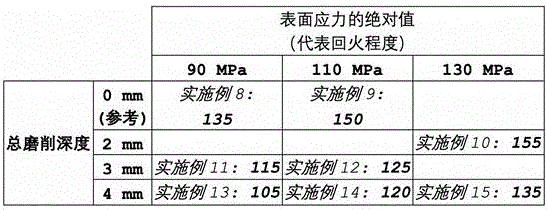
表4。Table 4.
根据这些值,并且如果认为在5%分位数下断裂应力不下降至120MPa以下是可取的,则估计对于厚度为10mm的玻璃和初始回火至90MPa的玻璃,材料去除限制是2mm;对于初始回火至110 MPa的玻璃,材料去除限制是4 mm;最后,对于初始回火至130MPa的玻璃,材料去除限制是大于4mm。 Based on these values, and if it is considered desirable that the fracture stress does not drop below 120 MPa at the 5% quantile, the material removal limit is estimated to be 2 mm for glass with a thickness of 10 mm and glass initially tempered to 90 MPa; for initial For glass tempered to 110 MPa, the material removal limit is 4 mm; finally, for glass initially tempered to 130 MPa, the material removal limit is greater than 4 mm.
三个月后,在所有情况下,5%分位数下断裂应力均增加。在参考测试(无磨削)回火至110MPa(实施例8)的情况下,5%分位数下断裂应力值在3个月后从150MPa变化至175MPa(+ 16%)。在试验成型为3mm深度并回火至110MPa(实施例11)的情况下,5%分位数下断裂应力值在3个月后从125MPa变化至130MPa(+ 4%)。After three months, fracture stress increased at the 5% quantile in all cases. In the case of the reference test (no grinding) tempered to 110 MPa (Example 8), the fracture stress value at 5% quantile changed from 150 MPa to 175 MPa (+16%) after 3 months. In the case where the test was formed to a depth of 3 mm and tempered to 110 MPa (Example 11), the fracture stress value at the 5% quantile changed from 125 MPa to 130 MPa (+4%) after 3 months.
Claims (15)

Applications Claiming Priority (3)
| Application Number | Priority Date | Filing Date | Title |
|---|---|---|---|
| FR1653984 | 2016-05-03 | ||
| FR1653984A FR3050990B1 (en) | 2016-05-03 | 2016-05-03 | GLASS FILLING AFTER TEMPERING |
| PCT/FR2017/051039 WO2017191401A1 (en) | 2016-05-03 | 2017-05-02 | Shaping of glass following tempering |
Publications (2)
| Publication Number | Publication Date |
|---|---|
| CN109070304A CN109070304A (en) | 2018-12-21 |
| CN109070304B true CN109070304B (en) | 2021-08-24 |
Family
ID=56322171
Family Applications (1)
| Application Number | Title | Priority Date | Filing Date |
|---|---|---|---|
| CN201780027665.3A Active CN109070304B (en) | 2016-05-03 | 2017-05-02 | Forming of tempered glass |
Country Status (7)
| Country | Link |
|---|---|
| EP (1) | EP3452252B1 (en) |
| KR (1) | KR102324955B1 (en) |
| CN (1) | CN109070304B (en) |
| ES (1) | ES2785950T3 (en) |
| FR (1) | FR3050990B1 (en) |
| PL (1) | PL3452252T3 (en) |
| WO (1) | WO2017191401A1 (en) |
Families Citing this family (2)
| Publication number | Priority date | Publication date | Assignee | Title |
|---|---|---|---|---|
| CN112789170B (en) * | 2018-08-31 | 2024-01-30 | 皮尔金顿集团有限公司 | Laminated glass products |
| CN117103806B (en) * | 2023-08-11 | 2025-12-30 | 常州亚玛顿股份有限公司 | A lightweight laminated automotive glass and its preparation method |
Family Cites Families (8)
| Publication number | Priority date | Publication date | Assignee | Title |
|---|---|---|---|---|
| ATE199887T1 (en) * | 1996-04-11 | 2001-04-15 | Nippon Sheet Glass Co Ltd | THERMALLY HARDENED GLASS PANELS AND METHOD FOR FINISHING THEIR EDGES |
| FR2901330B1 (en) * | 2006-05-22 | 2010-10-29 | Saint Gobain | CONNECTION SYSTEMS FOR EQUIPPING PLATES, ESPECIALLY GLASS, FOR THEIR FASTENING AND THE PLATES THUS EQUIPPED |
| FR2901329B1 (en) * | 2006-05-22 | 2010-08-13 | Saint Gobain | CONNECTION SYSTEMS FOR EQUIPPING PLATES, ESPECIALLY GLASS, FOR THEIR FASTENING AND THE PLATES THUS EQUIPPED |
| KR20140135846A (en) * | 2006-08-14 | 2014-11-26 | 아사히 가라스 가부시키가이샤 | Heat-resistant tempered glass and process for producing the same |
| US8932510B2 (en) * | 2009-08-28 | 2015-01-13 | Corning Incorporated | Methods for laser cutting glass substrates |
| JP5835654B2 (en) * | 2011-08-31 | 2015-12-24 | 日本電気硝子株式会社 | Method for producing tempered glass substrate |
| JP2015516352A (en) * | 2012-02-29 | 2015-06-11 | エレクトロ サイエンティフィック インダストリーズ インコーポレーテッド | Method and apparatus for processing tempered glass and products produced thereby |
| JP2014125399A (en) * | 2012-12-27 | 2014-07-07 | Asahi Glass Co Ltd | Method for producing reinforced glass substrate for forming touch panel |
-
2016
- 2016-05-03 FR FR1653984A patent/FR3050990B1/en not_active Expired - Fee Related
-
2017
- 2017-05-02 WO PCT/FR2017/051039 patent/WO2017191401A1/en not_active Ceased
- 2017-05-02 EP EP17725321.8A patent/EP3452252B1/en active Active
- 2017-05-02 KR KR1020187031612A patent/KR102324955B1/en active Active
- 2017-05-02 PL PL17725321T patent/PL3452252T3/en unknown
- 2017-05-02 CN CN201780027665.3A patent/CN109070304B/en active Active
- 2017-05-02 ES ES17725321T patent/ES2785950T3/en active Active
Also Published As
| Publication number | Publication date |
|---|---|
| ES2785950T3 (en) | 2020-10-08 |
| FR3050990B1 (en) | 2018-05-18 |
| PL3452252T3 (en) | 2020-07-13 |
| KR102324955B1 (en) | 2021-11-12 |
| EP3452252A1 (en) | 2019-03-13 |
| EP3452252B1 (en) | 2020-02-12 |
| WO2017191401A1 (en) | 2017-11-09 |
| KR20190003538A (en) | 2019-01-09 |
| CN109070304A (en) | 2018-12-21 |
| FR3050990A1 (en) | 2017-11-10 |
Similar Documents
| Publication | Publication Date | Title |
|---|---|---|
| CN101500956B (en) | Heat-resistant strengthened glass and method for producing heat-resistant strengthened glass | |
| KR102162896B1 (en) | Glass/Metal Laminated Structures and Methods of manufacturing Laminated Structures | |
| US5545277A (en) | Plate glass edge strength | |
| CN106932995B (en) | Lamination of electrochromic devices to glass substrates | |
| TWI515174B (en) | Cutting method and cutting stage of toughened glass | |
| CN1930097A (en) | Glass cutting method which does not involve breaking | |
| CN115304250B (en) | Cold formability analysis of glass laminate products using stress prediction and related methods | |
| KR20180034586A (en) | Reinforced asymmetric glass laminate | |
| WO2017019851A1 (en) | Thermally strengthened automotive glass | |
| CN108602322A (en) | Asymmetric treatment method for reducing bowing in laminated structures | |
| CN108779016B (en) | Method of strengthening glass sheet and strengthening glass sheet | |
| CN105431394A (en) | windshield for vehicles | |
| KR20170102537A (en) | A method for reducing bow in a laminated structure | |
| CN106794688B (en) | Method of making laminated glazing and device therefor | |
| CN109070304B (en) | Forming of tempered glass | |
| US20240360022A1 (en) | Improved edge stress using differential cooling | |
| CN108215431A (en) | A kind of production method of double toughened interlayer glass | |
| KR20180098909A (en) | Lamination glass and manufacturing method for lamination glass | |
| KR102223005B1 (en) | Method of chamfering of glass | |
| JP5169209B2 (en) | Glass substrate for flat panel display and manufacturing method thereof | |
| CN114804647B (en) | A method for preparing a coated glass sample and a hollow laminated glass sample | |
| CN110818286A (en) | Automobile toughened glass with limited thickness dimension | |
| KR20050016393A (en) | Glass cutting method which does not involve breaking | |
| JPH1179769A (en) | Tempered glass | |
| JPH1179769A5 (en) |
Legal Events
| Date | Code | Title | Description |
|---|---|---|---|
| PB01 | Publication | ||
| PB01 | Publication | ||
| SE01 | Entry into force of request for substantive examination | ||
| SE01 | Entry into force of request for substantive examination | ||
| GR01 | Patent grant | ||
| GR01 | Patent grant |