CN108901074B - Mobile user frequency spectrum allocation method based on cuckoo search algorithm - Google Patents

Mobile user frequency spectrum allocation method based on cuckoo search algorithm Download PDF

Info

Publication number
CN108901074B
CN108901074B CN201810811738.4A CN201810811738A CN108901074B CN 108901074 B CN108901074 B CN 108901074B CN 201810811738 A CN201810811738 A CN 201810811738A CN 108901074 B CN108901074 B CN 108901074B
Authority
CN
China
Prior art keywords
sub
user
link
primary user
interference
Prior art date
Legal status (The legal status is an assumption and is not a legal conclusion. Google has not performed a legal analysis and makes no representation as to the accuracy of the status listed.)
Active
Application number
CN201810811738.4A
Other languages
Chinese (zh)
Other versions
CN108901074A (en
Inventor
丁青锋
韦民
Current Assignee (The listed assignees may be inaccurate. Google has not performed a legal analysis and makes no representation or warranty as to the accuracy of the list.)
East China Jiaotong University
Original Assignee
East China Jiaotong University
Priority date (The priority date is an assumption and is not a legal conclusion. Google has not performed a legal analysis and makes no representation as to the accuracy of the date listed.)
Filing date
Publication date
Application filed by East China Jiaotong University filed Critical East China Jiaotong University
Priority to CN201810811738.4A priority Critical patent/CN108901074B/en
Publication of CN108901074A publication Critical patent/CN108901074A/en
Application granted granted Critical
Publication of CN108901074B publication Critical patent/CN108901074B/en
Active legal-status Critical Current
Anticipated expiration legal-status Critical

Links

Images

Classifications

    • HELECTRICITY
    • H04ELECTRIC COMMUNICATION TECHNIQUE
    • H04WWIRELESS COMMUNICATION NETWORKS
    • H04W72/00Local resource management
    • H04W72/50Allocation or scheduling criteria for wireless resources
    • H04W72/54Allocation or scheduling criteria for wireless resources based on quality criteria
    • H04W72/541Allocation or scheduling criteria for wireless resources based on quality criteria using the level of interference
    • HELECTRICITY
    • H04ELECTRIC COMMUNICATION TECHNIQUE
    • H04WWIRELESS COMMUNICATION NETWORKS
    • H04W72/00Local resource management
    • H04W72/50Allocation or scheduling criteria for wireless resources
    • H04W72/54Allocation or scheduling criteria for wireless resources based on quality criteria
    • H04W72/542Allocation or scheduling criteria for wireless resources based on quality criteria using measured or perceived quality
    • YGENERAL TAGGING OF NEW TECHNOLOGICAL DEVELOPMENTS; GENERAL TAGGING OF CROSS-SECTIONAL TECHNOLOGIES SPANNING OVER SEVERAL SECTIONS OF THE IPC; TECHNICAL SUBJECTS COVERED BY FORMER USPC CROSS-REFERENCE ART COLLECTIONS [XRACs] AND DIGESTS
    • Y02TECHNOLOGIES OR APPLICATIONS FOR MITIGATION OR ADAPTATION AGAINST CLIMATE CHANGE
    • Y02DCLIMATE CHANGE MITIGATION TECHNOLOGIES IN INFORMATION AND COMMUNICATION TECHNOLOGIES [ICT], I.E. INFORMATION AND COMMUNICATION TECHNOLOGIES AIMING AT THE REDUCTION OF THEIR OWN ENERGY USE
    • Y02D30/00Reducing energy consumption in communication networks
    • Y02D30/70Reducing energy consumption in communication networks in wireless communication networks

Landscapes

  • Engineering & Computer Science (AREA)
  • Quality & Reliability (AREA)
  • Computer Networks & Wireless Communication (AREA)
  • Signal Processing (AREA)
  • Mobile Radio Communication Systems (AREA)

Abstract

本发明公开了一种基于布谷鸟搜索算法的移动用户频谱分配方法,针对频谱功率分配中网络吞吐量低的问题,首先建立基于干扰距离的认知,将频谱功率分配问题转换为函数优化问题;将最大化的网络吞吐量转化为求最大化可用时长内完成的总数据量,建立目标函数,并将频谱分配变量映射为布谷鸟鸟巢的位置,采用布谷鸟搜索算法求解,最终获得网络吞吐量高于遗传算法的频谱分配,能够得到得较高的次用户有效信道容量。

Figure 201810811738

The invention discloses a mobile user spectrum allocation method based on the cuckoo search algorithm. Aiming at the problem of low network throughput in spectrum power allocation, the cognition based on interference distance is first established, and the spectrum power allocation problem is converted into a function optimization problem; Convert the maximized network throughput into the total amount of data completed within the maximum available time, establish an objective function, and map the spectrum allocation variable to the location of the cuckoo nest, use the cuckoo search algorithm to solve the problem, and finally obtain the network throughput Spectrum allocation higher than genetic algorithm can get higher effective channel capacity of secondary users.

Figure 201810811738

Description

Mobile user frequency spectrum allocation method based on cuckoo search algorithm
Technical Field
The invention relates to the technical field of wireless communication, in particular to a mobile user frequency spectrum allocation method based on a cuckoo search algorithm.
Background
CUCKOO search (CUCKOO sera), CS for short, is a novel intelligent algorithm developed from bird-laying incubation parasitic behavior and levy flight search principles in nature, has high performance in exploring solution space, can flexibly jump out local extrema, has a very simple structure, fewer control parameters, convenient adjustment and setting of parameters, and is easy to implement, and is widely applied to solving of nonlinear programming problems. However, in actual communication, the problems of low network throughput and co-channel interference among mobile users exist in spectrum power allocation, and these problems are inevitable.
Disclosure of Invention
The invention aims to provide a method for distributing frequency spectrums of mobile users based on a cuckoo search algorithm, which achieves a good power distribution effect by reducing same frequency interference among the mobile users.
The purpose of the invention is realized as follows:
a mobile user frequency spectrum allocation method based on a cuckoo search algorithm is characterized in that:
(1) Determining an optimization dimension D according to a given available frequency spectrum matrix, and setting the maximum iteration frequency to be 1000000;
(2) Setting the number P of the population, initializing the population, i.e. randomly generating a matrix X (0) =[X 1 (0) ,X 2 (0) ,....,X P (0) ];
(3) Calculating the fitness value of each bird nest position, selecting the maximum fitness value, and recording the corresponding bird nest position X best ,X best The current optimal bird nest position is obtained;
(4) Calculating the fitness value of each bird nest position, sequentially comparing the fitness values corresponding to the front and rear 2 bird nest positions, keeping the bird nest position corresponding to the larger fitness value, and recording the bird nest position X 'corresponding to the largest fitness value at the moment' best
Figure GDA0003996788530000011
Wherein,
Figure GDA0003996788530000012
and &>
Figure GDA0003996788530000013
Position information of a jth bird nest in the t +1 th iteration and the tth iteration respectively, wherein alpha is a step length control factor, L (lambda) represents a random search path of cuckoos, lambda is a random natural number between 1 and 3, and ^ represents point-to-point multiplication;
(5) Updating the positions of the bird nests according to the following formula, calculating the fitness value of each bird nest position, comparing the fitness value with the fitness value corresponding to each bird nest position in the step (4), reserving the position of the bird nest corresponding to the larger fitness value, and recording the position X' of the bird nest corresponding to the maximum fitness value at the moment best
Figure GDA0003996788530000021
Wherein, beta, r represents random numbers uniformly distributed on (0,1), H (g) represents Heaviside function, epsilon represents the finding probability generally taking 0.25,
Figure GDA0003996788530000022
and &>
Figure GDA0003996788530000023
For 2 randomly selected bird nest locations for the nth iteration;
(6) Judging whether the preset maximum iteration times are reached: if yes, outputting X ″) best Terminating the iteration; and otherwise, adding 1 to the iteration times, returning to the step (4), and continuing the iteration until the bird nest position corresponding to the maximum fitness value is obtained.
Firstly, establishing cognition based on interference distance, and converting a spectrum power distribution problem into a function optimization problem; the maximized network throughput is converted into the total data volume completed within the maximized available time, an objective function is established, the frequency spectrum distribution variable is mapped to the positions of cuckoo bird nests, a cuckoo search algorithm is adopted for solving, the frequency spectrum distribution with the network throughput higher than that of a genetic algorithm is finally obtained, and the higher effective channel capacity of the secondary user can be obtained. The method comprises the following specific steps:
1. converting the spectral power allocation problem into a function optimization problem: let P m Setting P for transmitting power of mth master user transmitting node mn Receiving point R for mth main user link m Receiving the nth main user link transmitter T n Where m, n is an element (1,2,. Gth, K), m ≠ n, P mn The expression of (a) is:
Figure GDA0003996788530000024
in formula (1): α is the path loss coefficient; k is the number of primary users, P n For the transmission power of the nth primary user link transmitter, d (T) n ,R m ) Indicating the nth primary user transmitter and the mth primary user transmitterThe distance between the master user and the receiving point;
in the same way, P ij Accepting point r for ith secondary user link i Receiver t of j-th secondary user link j T represents the transmitting node of the primary user link, and the receiving node is R, d (T) j ,r i ) Indicating the distance between the jth secondary user transmitter and the ith secondary user receiver.
N is the number of secondary users and i, j is an element (1,2., N), i ≠ j, P ij The expression of (a) is:
Figure GDA0003996788530000025
2. converting the maximized network throughput into the total data volume completed in the maximized available time length, and establishing an objective function: the total interference of the ith secondary user link to the main user link is as follows:
Figure GDA0003996788530000026
in the above formula, P max Denotes the maximum transmission power, d (T) m ,r i ) The distance between the nth main user transmitter and the ith secondary user receiving point is represented;
similarly, the interference of the kth primary user link by the secondary user is as follows:
Figure GDA0003996788530000031
in the above formula, d (t) i ,R m ) The distance between the jth secondary user transmitter and the mth primary user receiving point is represented;
3. and mapping the frequency spectrum distribution variable to the position of the cuckoo nest, and solving by adopting a cuckoo search algorithm: assuming that the primary user and the secondary user are both in the same network electromagnetic environment and the power level of the received noise is sigma, it can be known that the primary user receives the node R m The interference temperature of (a) is:
Figure GDA0003996788530000032
therefore, the master user receiving node PR k The drying ratio of (c) is:
Figure GDA0003996788530000033
similarly, the secondary user receiving node r i The interference temperature of (a) is:
Figure GDA0003996788530000034
secondary user receiving node r i SINR of
Figure GDA0003996788530000035
4. Finally, the spectrum allocation with the network throughput higher than that of the genetic algorithm is obtained, and the effective channel capacity of a secondary user can be obtained: the maximum transmission rate of each secondary user link, i.e. the channel capacity C, can be calculated by equation (9) i :
C i =Wlb(1+SINR(r i )) (9)
In the above formula: w is the bandwidth and lb represents the log base 2 operation.
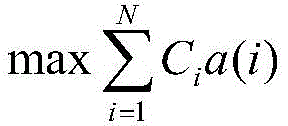
The final aim of the invention is to find a secondary user transmitting node distribution power set which enables the channel capacity of the cognitive network to be maximum. It should be noted that the secondary user must satisfy the sir to ensure that the channel capacity of the link is valid, otherwise, the secondary user is not available for communication. Thus, the maximum cognitive network channel capacity C max Can be expressed as:
Figure GDA0003996788530000036
a (i) represents the effectiveness of the ith secondary user link, and a (i) =1 when the link meets the conditions that SINR is larger than or equal to eta, wherein eta is expressed as the signal-to-interference-and-noise ratio threshold of the link; otherwise, a (i) =0.
Aiming at the problem of low network throughput in spectrum power distribution, the method firstly establishes cognition based on interference distance and converts the spectrum power distribution problem into a function optimization problem; the maximized network throughput is converted into the total data volume completed within the maximized available time, an objective function is established, the frequency spectrum distribution variable is mapped to the positions of cuckoo bird nests, a cuckoo search algorithm is adopted for solving, the frequency spectrum distribution with the network throughput higher than that of a genetic algorithm is finally obtained, and the higher effective channel capacity of the secondary user can be obtained.
Drawings
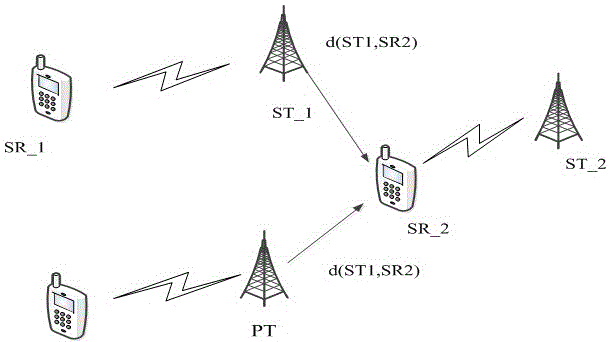
Fig. 1 is a schematic diagram of a cognitive network interference model according to the present invention.
Detailed Description
The present invention will be described in further detail with reference to the following examples and drawings.
And (3) system model: in a communication network, the degree of interference of a link depends on the magnitude of the interference temperature of a receiving node. The interference of the primary user link mainly comes from the transmitting node of the secondary user in the shared frequency band, and similarly, the interference of the secondary user link comes from the transmitting node of the primary user and the transmitting nodes of the other secondary users in the shared frequency band, and the magnitude of the interference is comprehensively influenced by the distance of the interference source, the transmitting power of the interference source, the channel gain and the like.
In the communication network interference model, a transmitting node PR of a primary user communicates with a receiving node PR at the maximum power, and transmitting nodes ST _1 and ST _2 of secondary users communicate with corresponding receiving nodes SR _1 and SR _2 respectively under certain power control. The master user has the highest communication priority, and in order to ensure normal communication, the receiving node of the master user usually has a maximum interference threshold, that is, the sum of interference of the transmitting nodes of all the secondary users with allocated power and environmental noise to the receiving node of the master user must be lower than the threshold. Similarly, for the secondary users, the receiving node must satisfy a certain signal-to-interference-and-noise ratio to decode correctly to ensure normal communication.
A mobile user frequency spectrum allocation method based on a cuckoo search algorithm comprises the following specific steps:
A. let P m Transmitting power, P, of transmitting node for mth primary user link mn Receiving node R for mth main user link m Receiving the nth main user link transmitter T n Where m, n is an element (1,2,. Gth, K), m ≠ n, P mn The expression of (a) is:
Figure GDA0003996788530000041
in formula (1): α is the path loss coefficient; k is the number of primary users, P n For the transmission power of the nth primary user link transmitter, d (T) n ,R m ) And the distance between the nth main user transmitter and the mth main user receiving point is represented. In the same way, P ij Receiving node r for ith secondary user link i Receiver t of j-th secondary user link j T denotes the transmitting node of the primary user link, and the receiving node is R, d (T) j ,r i ) Indicating the distance between the jth secondary user transmitter and the ith secondary user receiver. i, j ∈ (1,2.., N), i ≠ j, P ij The expression of (a) is:
Figure GDA0003996788530000042
B. converting the maximized network throughput into the total data volume completed in the maximized available time length, and establishing an objective function: the method is characterized in that the total interference of the ith secondary user link to the primary user link is as follows:
Figure GDA0003996788530000051
in the above formula, P max Denotes the maximum transmission power, d (T) m ,r i ) The distance between the nth primary user transmitter and the ith secondary user receiving point is represented;
similarly, the interference of the secondary user on the kth primary user link is:
Figure GDA0003996788530000052
in the above formula, d (t) i ,R m ) The distance between the jth secondary user transmitter and the mth primary user receiving point is represented;
C. and mapping the spectrum allocation variable to the position of the cuckoo nest, and solving by adopting a cuckoo search algorithm: assuming that the primary user and the secondary user are both in the same network electromagnetic environment and the power level of the received noise is sigma, the primary user receiving node R can be known m The interference temperature of (a) is:
Figure GDA0003996788530000053
therefore, the master user receiving node PR k The drying ratio of (c) is:
Figure GDA0003996788530000054
similarly, the secondary user receiving node r i The interference temperature of (a) is:
Figure GDA0003996788530000055
secondary user receiving node r i SINR of
Figure GDA0003996788530000056
D. The maximum transmission rate of each secondary user link, i.e. the channel capacity C, can be calculated by equation (9) i :
C i =Wlb(1+SINR(r i )) (9)
In the above formula: w is the bandwidth and lb represents the log base 2 operation.
The final aim of the invention is to find a secondary user transmitting node distribution power set which enables the channel capacity of the cognitive network to be maximum. It should be noted that the secondary user must satisfy the sir to ensure that the channel capacity of the link is valid, otherwise, the secondary user is not available for communication. Thus, the maximum cognitive network channel capacity can be expressed as: maximum cognitive network channel capacity C max Can be expressed as:
Figure GDA0003996788530000061
in the formula, a (i) represents the validity of the ith secondary user link.
When the link meets the conditions that the SINR is larger than or equal to eta, wherein eta is expressed as the signal-to-interference-and-noise ratio threshold of the link, a (i) =1; otherwise, a (i) =0. This optimization problem can be summarized as follows:
Figure GDA0003996788530000062
SINR(r i )≥η,i∈{a(i)=1}
SINR(R m )≥η
0≤p i ≤P max
a(i)∈{0,1},i=1,2,....,N
wherein p is i Representing the transmission power, P, of the ith transmitter max Representing the maximum transmit power.
There are two individual updating modes of cuckoo algorithm:
(1) Fly by LEVY. According to the LEVY flight mode, the updating formula of the nest searching path and position of the cuckoo is as follows:
Figure GDA0003996788530000063
wherein:
Figure GDA0003996788530000064
respectively obtaining the position information of the jth bird nest in the tth iteration and the t +1 th iteration; x best The current optimal bird nest position is obtained; alpha is a step length control factor and is generally 0.01; l (lambda) represents a random search path of the cuckoo, and lambda is a random natural number between 1 and 3; ≧ represents point-to-point multiplication.
(2) By a fixed probability of discovery epsilon. Comparing a random number r with the discovery probability epsilon to determine whether to update the position of the bird nest, wherein the updating formula is as follows:
Figure GDA0003996788530000066
wherein: β, r ∈ U (0,1), U (0,1) is defined as a uniform distribution over (0,1);
Figure GDA0003996788530000067
for 2 randomly selected bird nest locations of the tth generation; h (-) is the Heaviside function.
In the actual optimization, the bird nest position is represented by vector X j =[x j,1 ,x j,2 ,...,x j,d ]And d-dimensional effective value spaces representing all the optimized variables, and the fitness value of the bird nest position represents the objective function corresponding to different values of the optimized variables.
The spectrum allocation based on the CS algorithm comprises the following steps:
(1) And determining an optimization dimension D according to the given available spectrum matrix, and setting the maximum iteration number.
(2) Setting the number P of the population, initializing the population, namely randomly generating a matrix: x (0) =[X 1 (0) ,X 2 (0) ,....,X P (0) ]
(3) Calculating the adaptability value of each bird nest position, selecting the maximum adaptability value, and recording the corresponding bird nest position X best ,X best Namely the current optimal bird nest position.
(4) And updating the positions of the bird nests according to the formula (12) and calculating the fitness value of each position of the bird nest. Then sequentially comparing and updating the front bird and the rear birdKeeping the adaptability value corresponding to the nest position, keeping the bird nest position corresponding to the larger adaptability value, and recording the bird nest position X 'corresponding to the maximum adaptability value at the moment' best
(5) Updating the bird nest positions according to the formula (13), calculating the fitness value of each bird nest position, comparing the fitness value with the fitness value corresponding to each bird nest position in the step 4), reserving the bird nest position corresponding to the larger fitness value, and recording the bird nest position X' corresponding to the maximum fitness value at the moment best
(6) And judging whether the preset maximum iteration frequency is reached. If yes, outputting X ″) best Terminating the iteration; otherwise, adding 1 to the iteration times, returning to the step (4), and continuing the iteration.
Claims (3)

1.一种基于布谷鸟搜索算法的移动用户频谱分配方法,其特征在于:首先建立基于干扰距离的认知,将频谱功率分配问题转换为函数优化问题;将最大化的网络吞吐量转化为求最大化可用时长内完成的总数据量,建立目标函数,并将频谱分配变量映射为布谷鸟鸟巢的位置,采用布谷鸟搜索算法求解,最终获得网络吞吐量高于遗传算法的频谱分配,能够得到得较高的次用户有效信道容量;具体步骤如下:1. A mobile user spectrum allocation method based on the cuckoo search algorithm, characterized by: firstly establishing an understanding based on interference distance, transforming the spectrum power allocation problem into a function optimization problem; transforming the maximization of network throughput into maximizing the total amount of data completed within the available time, establishing an objective function, and mapping the spectrum allocation variable to the location of the cuckoo's nest, solving the problem using the cuckoo search algorithm, ultimately obtaining a spectrum allocation with higher network throughput than the genetic algorithm, and achieving a higher effective channel capacity for secondary users; the specific steps are as follows: A、将频谱功率分配问题转换为函数优化问题:设Pm为第m个主用户发射节点的发射功率,设Pmn为第m个主用户链路接收点Rm接收到第n个主用户链路发射机Tn的功率,其中m,n∈(1,2,...,K),m≠n,Pmn的表达式为:A. Transform the spectrum power allocation problem into a function optimization problem: Let P <sub>m</sub> be the transmit power of the m-th primary user transmitting node, and let P <sub>mn </sub> be the power received by the m-th primary user link receiving point R<sub> m </sub> from the n-th primary user link transmitter T<sub> n </sub>, where m, n ∈ (1, 2, ..., K), m ≠ n. The expression for P <sub>mn </sub> is:
Figure FDA0003996788520000011
式(1)中:α为路径损耗系数;K为主用户个数,Pn为第n个主用户链路发射机的发射功率,d(Tn,Rm)表示第n个主用户发射机与第m个主用户接收点的距离;In equation (1): α is the path loss coefficient; K is the number of primary users; Pn is the transmit power of the nth primary user's link transmitter; d( Tn , Rm ) represents the distance between the nth primary user's transmitter and the mth primary user's receiver. 同理,Pij为第i个次用户链路接受点ri受第j个次用户链路发射机tj的干扰功率,T表示主用户链路的发射节点,接收节点为R,d(tj,ri)表示第j个次用户发射机与第i个次用户接收点的距离;Similarly, P <sub>ij</sub> represents the interference power of the i-th secondary user link receiving point r <sub>i </sub> caused by the j-th secondary user link transmitter t<sub>j</sub>, T represents the transmitting node of the primary user link, the receiving node is R, and d(t<sub> j </sub>, r<sub>i</sub> ) represents the distance between the j-th secondary user transmitter and the i-th secondary user receiving point. N为次用户个数且i,j∈(1,2,...,N),i≠j,Pij的表达式为:N is the number of sub-users and i,j∈(1,2,...,N), i≠j, the expression for Pij is:
Figure FDA0003996788520000012
B、将最大化的网络吞吐量转化为求最大化可用时长内完成的总数据量,建立目标函数:第i个次用户链路受到主用户链路的总干扰大小为:B. Convert maximizing network throughput into maximizing the total amount of data completed within the available time, and establish the objective function: The total interference of the i-th secondary user link to the primary user link is:
Figure FDA0003996788520000013
上式中,Pmax表示最大发射功率,d(Tm,ri)表示第n个主用户发射机与第i个次用户接收点的距离;In the above formula, Pmax represents the maximum transmit power, and d( Tm , ri ) represents the distance between the nth primary user transmitter and the ith secondary user receiver. 同理,第k个主用户链路受到次用户的干扰大小为:Similarly, the interference from secondary users to the k-th primary user link is:
Figure FDA0003996788520000014
上式中,d(ti,Rm)表示第j个次用户发射机与第m个主用户接收点的距离;In the above formula, d(t i ,R m ) represents the distance between the j-th secondary user transmitter and the m-th primary user receiver; C、并将频谱分配变量映射为布谷鸟鸟巢的位置,采用布谷鸟搜索算法求解:假设主用户与次用户均处于相同的网络电磁环境,所受噪声的功率水平为σ,则可知主用户接收节点Rm的干扰温度为:C. Map the spectrum allocation variable to the location of the cuckoo's nest and use the cuckoo search algorithm to solve the problem: Assuming that the primary user and the secondary user are in the same network electromagnetic environment and the power level of the noise they experience is σ, then the interference temperature of the primary user's receiving node Rm is:
Figure FDA0003996788520000021
因此主用户接收节点PRk的信干燥比为:Therefore, the signal drying ratio of the primary user receiving node PRk is:
Figure FDA0003996788520000022
同理,次用户接收节点ri的干扰温度为:Similarly, the interference temperature of the secondary user receiving node r<sub>i</sub> is:
Figure FDA0003996788520000023
次用户接收节点ri的SINR为The SINR of the secondary user receiving node r<sub>i</sub> is
Figure FDA0003996788520000024
D、最终获得网络吞吐量高于遗传算法的频谱分配,能够得到得较高的次用户有效信道容量:由公式(9)可以计算得到每条次用户链路的最大传输速率,即信道容量Ci:D. The final network throughput is higher than that of the genetic algorithm in spectrum allocation, and a higher effective channel capacity for secondary users can be obtained: The maximum transmission rate of each secondary user link, i.e., the channel capacity Ci , can be calculated by formula (9): Ci=Wlb(1+SINR(ri)) (9)C <sub>i </sub> = W<sub>lb</sub>(1+SINR(r <sub>i</sub> )) (9) 上式中:W为带宽,lb表示以2为底的log运算。In the above formula: W is the bandwidth, and lb represents the log operation with base 2.
2.根据权利要求1所述的基于布谷鸟搜索算法的移动用户频谱分配方法,其特征在于:最大认知网络信道容量Cmax表示为:2. The mobile user spectrum allocation method based on the cuckoo search algorithm according to claim 1, characterized in that: the maximum cognitive network channel capacity Cmax is expressed as:
Figure FDA0003996788520000025
式中:a(i)代表第i条次用户链路的有效性,当该链路满足SINR≥η其中η表示为链路的信干噪比门限,则a(i)=1;否则,a(i)=0。In the formula: a(i) represents the validity of the i-th secondary user link. When the link satisfies SINR≥η, where η represents the signal-to-interference-plus-noise ratio threshold of the link, then a(i)=1; otherwise, a(i)=0.
3.根据权利要求1所述的基于布谷鸟搜索算法的移动用户频谱分配方法,其特征在于:当该链路满足SINR≥η,则a(i)=1;否则,a(i)=0;该优化问题可归结如下:3. The mobile user spectrum allocation method based on the cuckoo search algorithm according to claim 1, characterized in that: when the link satisfies SINR≥η, then a(i)=1; otherwise, a(i)=0; the optimization problem can be reduced to the following:
Figure FDA0003996788520000026
SINR(ri)≥η,i∈{a(i)=1}SINR(r i )≥η,i∈{a(i)=1} SINR(Rm)≥ηSINR(R m )≥η 0≤pi≤Pmax 0≤p i ≤P max a(i)∈{0,1},i=1,2,....,Na(i)∈{0,1},i=1,2,...,N 其中,pi表示第i个发射机的发射功率,Pmax表示最大发射功率。Where p <sub>i</sub> represents the transmission power of the i-th transmitter, and P <sub>max</sub> represents the maximum transmission power.
CN201810811738.4A 2018-07-23 2018-07-23 Mobile user frequency spectrum allocation method based on cuckoo search algorithm Active CN108901074B (en)

Priority Applications (1)

Application Number Priority Date Filing Date Title
CN201810811738.4A CN108901074B (en) 2018-07-23 2018-07-23 Mobile user frequency spectrum allocation method based on cuckoo search algorithm

Applications Claiming Priority (1)

Application Number Priority Date Filing Date Title
CN201810811738.4A CN108901074B (en) 2018-07-23 2018-07-23 Mobile user frequency spectrum allocation method based on cuckoo search algorithm

Publications (2)

Publication Number Publication Date
CN108901074A CN108901074A (en) 2018-11-27
CN108901074B true CN108901074B (en) 2023-03-24

Family

ID=64352354

Family Applications (1)

Application Number Title Priority Date Filing Date
CN201810811738.4A Active CN108901074B (en) 2018-07-23 2018-07-23 Mobile user frequency spectrum allocation method based on cuckoo search algorithm

Country Status (1)

Country Link
CN (1) CN108901074B (en)

Families Citing this family (2)

* Cited by examiner, † Cited by third party
Publication number Priority date Publication date Assignee Title
CN109922478B (en) * 2019-01-14 2021-10-22 北京工商大学 An optimal deployment method of water quality sensor network based on improved cuckoo algorithm
CN113784447B (en) * 2021-09-22 2023-11-17 广州杰赛科技股份有限公司 Method, device, equipment and storage medium for optimizing wireless communication network resource allocation

Citations (5)

* Cited by examiner, † Cited by third party
Publication number Priority date Publication date Assignee Title
CN104936186A (en) * 2015-07-21 2015-09-23 桂林电子科技大学 Cognitive radio network spectrum allocation method based on cuckoo search algorithm
CN105282746A (en) * 2015-09-11 2016-01-27 华东交通大学 Cognitive radio network frequency spectrum distribution method based on embedded particle swarm gaming
CN105978644A (en) * 2016-05-09 2016-09-28 哈尔滨工业大学 Cuckoo search algorithm based satellite-land cognitive system frequency spectrum access method
US9472203B1 (en) * 2015-06-29 2016-10-18 Amazon Technologies, Inc. Clock synchronization for multichannel system
CN107292332A (en) * 2017-05-25 2017-10-24 哈尔滨工程大学 A kind of cuckoo algorithm based on Fuzzy C mean cluster

Patent Citations (5)

* Cited by examiner, † Cited by third party
Publication number Priority date Publication date Assignee Title
US9472203B1 (en) * 2015-06-29 2016-10-18 Amazon Technologies, Inc. Clock synchronization for multichannel system
CN104936186A (en) * 2015-07-21 2015-09-23 桂林电子科技大学 Cognitive radio network spectrum allocation method based on cuckoo search algorithm
CN105282746A (en) * 2015-09-11 2016-01-27 华东交通大学 Cognitive radio network frequency spectrum distribution method based on embedded particle swarm gaming
CN105978644A (en) * 2016-05-09 2016-09-28 哈尔滨工业大学 Cuckoo search algorithm based satellite-land cognitive system frequency spectrum access method
CN107292332A (en) * 2017-05-25 2017-10-24 哈尔滨工程大学 A kind of cuckoo algorithm based on Fuzzy C mean cluster

Non-Patent Citations (2)

* Cited by examiner, † Cited by third party
Title
Improved Cuckoo Search Algorithm for Spectrum Sensing in Sparse Satellite Cognitive Systems;Wanmai Yuan;《2016 IEEE 84th Vehicular Technology Conference 》;20170320;全文 *
基于量子布谷鸟搜索的认知无线网络频谱分配;王先平;《电信科学》;20160531;全文 *

Also Published As

Publication number Publication date
CN108901074A (en) 2018-11-27

Similar Documents

Publication Publication Date Title
CN113038541A (en) Adaptive LoRaWAN network rate adjusting method based on conflict perception
CN102668653B (en) Method and apparatus for user scheduling and managing transmit power in a communication system
CN115441939B (en) MADDPG algorithm-based multi-beam satellite communication system resource allocation method
CN112583453A (en) Downlink NOMA power distribution method of multi-beam LEO satellite communication system
CN113795050A (en) Deep double-Q network dynamic power control method based on Sum tree sampling
CN118075877B (en) NOMA multi-beam satellite communication method based on deep reinforcement learning
CN108901074B (en) Mobile user frequency spectrum allocation method based on cuckoo search algorithm
CN115334631B (en) A D2D communication power control method based on hunter-prey optimization
CN111212438A (en) A resource allocation method for wireless energy-carrying communication technology
Lu et al. Dynamic channel access and power control via deep reinforcement learning
CN113923767A (en) Energy efficiency maximization method for multi-carrier cooperative non-orthogonal multiple access system
Song et al. Maximizing packets collection in wireless powered IoT networks with charge-or-data time slots
CN107172576B (en) A D2D communication downlink resource sharing method for enhancing cellular network security
CN117639903B (en) Multi-user satellite communication method and system based on NOMA assistance
CN114501480B (en) User association and beam forming combined multi-objective optimization method in millimeter wave distributed network
CN113395757B (en) Deep reinforcement learning cognitive network power control method based on improved return function
CN112543056B (en) Power and grouping combined optimization method for PD-NOMA-VLC system
CN118282458B (en) A beam training and power allocation method and system for near-field NOMA system
Li et al. Power allocation method of downlink non-orthogonal multiple access system based on α fair utility function
CN116582937B (en) Resource allocation methods in the case of multiple wireless body area networks coexisting
CN108668304B (en) A method for optimizing downlink transmission time of non-orthogonal access based on deep reinforcement learning
CN115361052B (en) A Satellite Beamforming Method and Device Considering Energy Efficiency and Spectrum Efficiency
CN115968009A (en) Multi-target relay selection method of energy acquisition cognitive relay network
KR20230094937A (en) Method and apparatus for learning-based joint optimization of proportional fair scheduling and energy efficiency in a D2D network
CN113747386A (en) Intelligent power control method in cognitive radio network spectrum sharing

Legal Events

Date Code Title Description
PB01 Publication
PB01 Publication
SE01 Entry into force of request for substantive examination
GR01 Patent grant
GR01 Patent grant