CN108688924B - A packaging material and method for providing the same - Google Patents
A packaging material and method for providing the same Download PDFInfo
- Publication number
- CN108688924B CN108688924B CN201810319749.0A CN201810319749A CN108688924B CN 108688924 B CN108688924 B CN 108688924B CN 201810319749 A CN201810319749 A CN 201810319749A CN 108688924 B CN108688924 B CN 108688924B
- Authority
- CN
- China
- Prior art keywords
- packaging material
- crease
- package
- crease lines
- crease line
- Prior art date
- Legal status (The legal status is an assumption and is not a legal conclusion. Google has not performed a legal analysis and makes no representation as to the accuracy of the status listed.)
- Active
Links
- 239000005022 packaging material Substances 0.000 title claims abstract description 107
- 238000000034 method Methods 0.000 title claims abstract description 25
- 239000000463 material Substances 0.000 claims description 9
- 238000004519 manufacturing process Methods 0.000 claims description 6
- 239000010410 layer Substances 0.000 description 10
- 239000011087 paperboard Substances 0.000 description 4
- 238000007789 sealing Methods 0.000 description 4
- 230000015572 biosynthetic process Effects 0.000 description 3
- 229920000642 polymer Polymers 0.000 description 3
- 239000012792 core layer Substances 0.000 description 2
- 238000004049 embossing Methods 0.000 description 2
- 235000021056 liquid food Nutrition 0.000 description 2
- 238000004806 packaging method and process Methods 0.000 description 2
- 230000001131 transforming effect Effects 0.000 description 2
- 239000002998 adhesive polymer Substances 0.000 description 1
- 239000005030 aluminium foil Substances 0.000 description 1
- 230000006835 compression Effects 0.000 description 1
- 238000007906 compression Methods 0.000 description 1
- 238000010586 diagram Methods 0.000 description 1
- 238000010030 laminating Methods 0.000 description 1
- 229920000098 polyolefin Polymers 0.000 description 1
- 238000003825 pressing Methods 0.000 description 1
- 229920001169 thermoplastic Polymers 0.000 description 1
- 238000011144 upstream manufacturing Methods 0.000 description 1
Images



Classifications
-
- B—PERFORMING OPERATIONS; TRANSPORTING
- B65—CONVEYING; PACKING; STORING; HANDLING THIN OR FILAMENTARY MATERIAL
- B65D—CONTAINERS FOR STORAGE OR TRANSPORT OF ARTICLES OR MATERIALS, e.g. BAGS, BARRELS, BOTTLES, BOXES, CANS, CARTONS, CRATES, DRUMS, JARS, TANKS, HOPPERS, FORWARDING CONTAINERS; ACCESSORIES, CLOSURES, OR FITTINGS THEREFOR; PACKAGING ELEMENTS; PACKAGES
- B65D5/00—Rigid or semi-rigid containers of polygonal cross-section, e.g. boxes, cartons or trays, formed by folding or erecting one or more blanks made of paper
- B65D5/42—Details of containers or of foldable or erectable container blanks
- B65D5/4266—Folding lines, score lines, crease lines
-
- B—PERFORMING OPERATIONS; TRANSPORTING
- B65—CONVEYING; PACKING; STORING; HANDLING THIN OR FILAMENTARY MATERIAL
- B65D—CONTAINERS FOR STORAGE OR TRANSPORT OF ARTICLES OR MATERIALS, e.g. BAGS, BARRELS, BOTTLES, BOXES, CANS, CARTONS, CRATES, DRUMS, JARS, TANKS, HOPPERS, FORWARDING CONTAINERS; ACCESSORIES, CLOSURES, OR FITTINGS THEREFOR; PACKAGING ELEMENTS; PACKAGES
- B65D5/00—Rigid or semi-rigid containers of polygonal cross-section, e.g. boxes, cartons or trays, formed by folding or erecting one or more blanks made of paper
- B65D5/02—Rigid or semi-rigid containers of polygonal cross-section, e.g. boxes, cartons or trays, formed by folding or erecting one or more blanks made of paper by folding or erecting a single blank to form a tubular body with or without subsequent folding operations, or the addition of separate elements, to close the ends of the body
- B65D5/06—Rigid or semi-rigid containers of polygonal cross-section, e.g. boxes, cartons or trays, formed by folding or erecting one or more blanks made of paper by folding or erecting a single blank to form a tubular body with or without subsequent folding operations, or the addition of separate elements, to close the ends of the body with end-closing or contents-supporting elements formed by folding inwardly a wall extending from, and continuously around, an end of the tubular body
- B65D5/064—Rectangular containers having a body with gusset-flaps folded outwardly or adhered to the side or the top of the container
- B65D5/065—Rectangular containers having a body with gusset-flaps folded outwardly or adhered to the side or the top of the container with supplemental means facilitating the opening, e.g. tear lines, tear tabs
-
- B—PERFORMING OPERATIONS; TRANSPORTING
- B31—MAKING ARTICLES OF PAPER, CARDBOARD OR MATERIAL WORKED IN A MANNER ANALOGOUS TO PAPER; WORKING PAPER, CARDBOARD OR MATERIAL WORKED IN A MANNER ANALOGOUS TO PAPER
- B31B—MAKING CONTAINERS OF PAPER, CARDBOARD OR MATERIAL WORKED IN A MANNER ANALOGOUS TO PAPER
- B31B50/00—Making rigid or semi-rigid containers, e.g. boxes or cartons
- B31B50/25—Surface scoring
-
- B—PERFORMING OPERATIONS; TRANSPORTING
- B65—CONVEYING; PACKING; STORING; HANDLING THIN OR FILAMENTARY MATERIAL
- B65D—CONTAINERS FOR STORAGE OR TRANSPORT OF ARTICLES OR MATERIALS, e.g. BAGS, BARRELS, BOTTLES, BOXES, CANS, CARTONS, CRATES, DRUMS, JARS, TANKS, HOPPERS, FORWARDING CONTAINERS; ACCESSORIES, CLOSURES, OR FITTINGS THEREFOR; PACKAGING ELEMENTS; PACKAGES
- B65D5/00—Rigid or semi-rigid containers of polygonal cross-section, e.g. boxes, cartons or trays, formed by folding or erecting one or more blanks made of paper
- B65D5/02—Rigid or semi-rigid containers of polygonal cross-section, e.g. boxes, cartons or trays, formed by folding or erecting one or more blanks made of paper by folding or erecting a single blank to form a tubular body with or without subsequent folding operations, or the addition of separate elements, to close the ends of the body
- B65D5/06—Rigid or semi-rigid containers of polygonal cross-section, e.g. boxes, cartons or trays, formed by folding or erecting one or more blanks made of paper by folding or erecting a single blank to form a tubular body with or without subsequent folding operations, or the addition of separate elements, to close the ends of the body with end-closing or contents-supporting elements formed by folding inwardly a wall extending from, and continuously around, an end of the tubular body
- B65D5/064—Rectangular containers having a body with gusset-flaps folded outwardly or adhered to the side or the top of the container
-
- B—PERFORMING OPERATIONS; TRANSPORTING
- B65—CONVEYING; PACKING; STORING; HANDLING THIN OR FILAMENTARY MATERIAL
- B65D—CONTAINERS FOR STORAGE OR TRANSPORT OF ARTICLES OR MATERIALS, e.g. BAGS, BARRELS, BOTTLES, BOXES, CANS, CARTONS, CRATES, DRUMS, JARS, TANKS, HOPPERS, FORWARDING CONTAINERS; ACCESSORIES, CLOSURES, OR FITTINGS THEREFOR; PACKAGING ELEMENTS; PACKAGES
- B65D5/00—Rigid or semi-rigid containers of polygonal cross-section, e.g. boxes, cartons or trays, formed by folding or erecting one or more blanks made of paper
- B65D5/02—Rigid or semi-rigid containers of polygonal cross-section, e.g. boxes, cartons or trays, formed by folding or erecting one or more blanks made of paper by folding or erecting a single blank to form a tubular body with or without subsequent folding operations, or the addition of separate elements, to close the ends of the body
- B65D5/06—Rigid or semi-rigid containers of polygonal cross-section, e.g. boxes, cartons or trays, formed by folding or erecting one or more blanks made of paper by folding or erecting a single blank to form a tubular body with or without subsequent folding operations, or the addition of separate elements, to close the ends of the body with end-closing or contents-supporting elements formed by folding inwardly a wall extending from, and continuously around, an end of the tubular body
- B65D5/067—Gable-top containers
-
- B—PERFORMING OPERATIONS; TRANSPORTING
- B31—MAKING ARTICLES OF PAPER, CARDBOARD OR MATERIAL WORKED IN A MANNER ANALOGOUS TO PAPER; WORKING PAPER, CARDBOARD OR MATERIAL WORKED IN A MANNER ANALOGOUS TO PAPER
- B31B—MAKING CONTAINERS OF PAPER, CARDBOARD OR MATERIAL WORKED IN A MANNER ANALOGOUS TO PAPER
- B31B2110/00—Shape of rigid or semi-rigid containers
- B31B2110/30—Shape of rigid or semi-rigid containers having a polygonal cross section
Landscapes
- Engineering & Computer Science (AREA)
- Mechanical Engineering (AREA)
- Cartons (AREA)
- Wrappers (AREA)
- Making Paper Articles (AREA)
- Buffer Packaging (AREA)
Abstract
本发明涉及一种包装材料以及提供这种包装材料的方法。提供包装材料,该包装材料包括成组的折痕线(10,10'),包装材料将沿着该成组的折痕线折叠以形成包装。该成组的折痕线(10,10')包括至少一个第一折痕线(10a,10'a),该第一折痕线被构造成比相邻的第二折痕线(10b,10'b)更容易折叠。

The present invention relates to a packaging material and a method of providing such packaging material. Packaging material is provided that includes a set of crease lines (10, 10') along which the packaging material is to be folded to form a package. The set of crease lines (10, 10') includes at least one first crease line (10a, 10'a) configured to be smaller than the adjacent second crease line (10b, 10'a) 10'b) Easier to fold.
Description
Technical Field
The present solution relates to a packaging material, in particular a packaging material intended to form individual packages, for example for liquid food. The invention also relates to a method of providing such a packaging material, and to a method of forming individual packages from such a packaging material.
Background
Individual packages, such as packages for enclosing a limited amount of liquid food, are usually formed from a packaging material. The packaging material comprises a layer of paperboard-based material, such as paperboard or cardboard, having an inner polymer layer and an outer polymer layer laminated together in a laminating device.
To produce individual packages, the packaging material is fed to the filling machine on a reel of packaging material or as individual packaging material blanks. Filling machines, which can perform web feeding or blank feeding, comprise various stations for transforming the packaging material fed therein into filled and sealed three-dimensional packages.
The forming process, i.e. the method of transforming the packaging material into a three-dimensional object, is facilitated by providing the packaging material with crease lines. Since the packaging material will be folded at the location of the crease lines, the packaging material can be pre-configured according to various different shapes. Such shapes include, for example, Tetra Tetra
Tetra And Tetra
 If the intention is to convert the packaging material into Tetra
 Packaging, the web of packaging material is then cut into individual blanks and a specific crease line pattern corresponding to the final shape is provided onto the packaging material before the packaging material blanks enter the filling machine.
With the increasing demand for complex packaging formats, more advanced crease line patterns are required. When the distance between two adjacent crease lines on the packaging material is reduced, the forming process will be more difficult to control, for example in order to form angled corners of the package. There is in particular the following risk: along a particular crease line a fold is effected which prevents the packaging material from being folded along the adjacent crease line. This is due to the fact that the forming, i.e. the folding of the packaging material along the crease lines, is performed in a specific order defined by the forming tools of the filling machine. If a fold occurs along an unintended crease line, the final package will have a shape that does not correspond to the desired shape.
In view of the above, there is a need for an improved packaging material which reduces the risk of package deformation.
Disclosure of Invention
The object of the present solution is to at least partly overcome one or more of the above-mentioned limitations of the prior art. In particular, it aims to provide a solution that enables correct folding of the packaging material even if the crease lines are arranged very close to each other. To solve these objects, a packaging material is provided. The packaging material comprises a set of crease lines along which the packaging material is to be folded to form a package, wherein the set of crease lines comprises at least one first crease line configured to be more easily folded than an adjacent second crease line.
The set of crease lines may be formed by compressing the packaging material.
The first crease line may be compressed to a greater extent than the adjacent second crease line and/or the width of the first crease line may be greater than the width of the second crease line.
The first and second crease lines may be used to define corner surfaces of the package.
The corner surface may extend in the vertical direction of the package to be formed.
The packaging material may be in the form of a blank intended to form an individual package or in the form of a web intended to form a series of individual packages.
The distance between the first and second crease lines may be 30mm or less.
According to a second aspect, a method for producing a packaging material is provided. The method comprises providing a set of crease lines along which the packaging material is to be folded to form the package by providing at least one first crease line and providing an adjacent second crease line, wherein the first crease line is configured to be easier to fold than the adjacent second crease line.
The first and second crease lines may be provided simultaneously.
The set of crease lines may be provided by compressing the packaging material.
The width and/or depth of the first crease line may be greater than the width and/or depth of the second crease line.
According to a third aspect, a method for producing a package is provided. The method comprises the following steps: providing a packaging material by performing the method according to the second aspect, and folding, filling and sealing the packaging material.
The first and second crease lines of the packaging material may be folded in a single folding operation.
In particular, some aspects of the invention may be set forth as follows:
1. a packaging material comprising a set of crease lines (10,10'), said packaging material (3,3') being intended to be folded along said set of crease lines (10,10') to form a package, wherein said set of crease lines (10) comprises at least one first crease line (10a,10' a), said first crease line (10a,10' a) being configured to be more easily folded than an adjacent second crease line (10b,10' b), wherein said first and second crease lines (10a-b,10' a-b) are intended to define a corner surface (18,18') of said package (1,1'), and wherein said corner surface (18,18') extends in a vertical direction of said package (1,1') to be formed.
2. The packaging material according to clause 1, wherein the set of crease lines (10,10') is formed by compressing the packaging material (3, 3').
3. The packaging material according to clause 2, wherein the first crease line (10a,10'a) is compressed to a greater extent than the adjacent second crease line (10b,10' b).
4. The packaging material according to clauses 2 or 3, wherein the width of the first crease line (10a,10'a) is greater than the width of the second crease line (10b,10' b).
5. The packaging material according to any one of the preceding clauses, wherein the packaging material (3,3') is in the form of a blank (20) intended to form an individual package (1).
6. The packaging material according to any of the preceding clauses 1-5, wherein the packaging material (3,3') is in the form of a web (30) intended to form a series of individual packages (1').
7. The packaging material according to any one of the preceding clauses, wherein the distance between the first and second crease lines (10a-b,10' a-b) is 30mm or less.
8. A method for producing packaging material, comprising providing a set of crease lines (10,10') along which the packaging material is intended to be folded to form a package, by:
providing at least one first crease line (10a,10' a), and
-providing an adjacent second crease line (10b,10'b), wherein the first crease line (10a,10' a) is configured to be more easily folded than the adjacent second crease line (10b,10'b), wherein the first and second crease line (10a-b,10' a-b) are intended to define a corner surface (18,18') of a package (1,1'), and wherein the corner surface (18,18') extends in a vertical direction of the package (1,1') to be formed.
9. The method according to clause 10, wherein the first crease line and the second crease line (10a-b,10' a-b) are provided simultaneously.
10. The method according to clause 10 or 11, wherein the set of crease lines (10,10') is provided by compressing the packaging material.
11. The method according to clause 12, wherein the width and/or depth of the first crease line (10a,10'a) is greater than the width and/or depth of the second crease line (10b,10' b).
12. A method for producing a package (1,1'), comprising: -providing a packaging material (3,3') by performing the method according to any of clauses 10-13, and-folding, filling and sealing the packaging material (3, 3').
13. The method according to clause 14, wherein the first and second crease lines (10a-b,10'a-b) of the packaging material (3,3') are folded in a single folding operation.
Other objects, features, aspects and advantages of the present invention will become apparent from the following detailed description and the accompanying drawings.
Drawings
Embodiments of the invention will now be described, by way of example, with reference to the accompanying drawings, in which:
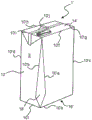
fig. 1 is an isometric view of a package produced from a packaging material according to an example;
fig. 2 is an isometric view of a package produced from a packaging material according to an example;
fig. 3a is a view of a blank of packaging material for producing a package similar to the package shown in fig. 1;
FIG. 3b is an isometric view of the packaging material of FIG. 3a during formation of a package;
FIG. 4 is a view of a blank of packaging material for making a package similar to the package shown in FIG. 2;
FIG. 5a is a cross-sectional view of a packaging material according to an example;
fig. 5b is a cross-sectional view of a packaging material according to a second example;
FIG. 6 is a cross-sectional view of a packaging material according to one embodiment; and
FIG. 7 is a schematic diagram of a method according to an embodiment.
Detailed Description
Referring to fig. 1, an example package 1 is shown. The package 1 is formed into a three-dimensional shape from a packaging material 3. The forming of packaging material 3 is carried out by folding the packaging material along a set 10 of pre-established crease lines 10 a-l. It should be understood that not all crease lines are provided with reference signs; to complete the folding and form the package 1, additional crease lines (not shown) are provided in the packaging material 3. As shown in fig. 1, crease lines 10a-d are provided to define a longitudinal body 12 of package 1, crease lines 10f-j are provided to define an upper gable top end 14 of package 1, and crease lines 10k-l are provided to define a bottom end 16 of package 1.
The crease line 10a forms a first crease line arranged adjacent to the second crease line 10 b. The first and second crease lines 10a-b together define a corner surface 18 of the package 1, wherein the corner surface 18 extends at an angle relative to its adjacent panels (i.e. one panel extending between the crease lines 10a and 10d and one panel extending between the crease lines 10b and 10 c). The corner surfaces 18 serve not only to improve the aesthetic appearance of the package 1, but also to improve the grip of the package 1.
Referring to fig. 2, another example of a package 1' is illustrated. For package 1 shown in fig. 1, package 1' is formed into a three-dimensional shape from a planar packaging material 3' by folding packaging material 3' along a set 10' of pre-arranged crease lines 10' a-1. As shown in fig. 2, crease lines 10' a-d are provided to define a longitudinal body 12' of the package 1', crease lines 10' f-j are provided to define an upper end 14' of the package 1', and crease lines 10' k-1 are provided to define a bottom end 16' of the package 1 '. It will be appreciated that additional crease lines (not shown) are provided in the packaging material for complete folding and forming of the package 1'.
The crease line 10'a forms a first crease line disposed adjacent to the second crease line 10' b. The first and second crease lines 10' a-b together define a corner surface 18' of the package 1 '.
A package similar to the package 1 shown in fig. 1 is preferably manufactured from the blank 20 of packaging material 3 shown in fig. 3 a. The blank 20 is pre-cut so that the dimensions of the blank 20 will result in a package of the desired size and shape. During forming, the side ends 22a-b are sealed to one another to form a so-called half-folded blank. Such half-folded blanks are generally produced at a different location from that of the filling machine, where the final forming of the half-folded blank is achieved. When loaded into the filling machine, the blank 20 is also folded along the crease lines 10c-d to form the open-ended body 12 of the package. In a next step, the corners of the body 12 are formed by folding the body along the crease lines 10e and along the crease lines 10 a-b. One of the upper or lower ends 14,16 is then formed and sealed, then filled and finally the still open end is sealed.
In another variant, a web of cardboard material containing blanks corresponding to those in fig. 3a is fed into a filling machine, wherein the blanks are cut into individual blanks 3a, and wherein the panels 22a and 22b are sealed to form a tube. Thereafter, the blank 20 is formed into a container in the same manner as described in the preceding paragraph.
When the crease lines 10a-e are folded, a rectangular body 12 will be formed, however with one corner defined by an angled corner surface 18 disposed between the first crease line 10a and the second crease line 10 b.
When defining the corners of a rectangular body, during folding of crease lines 10a-b,10 e, packaging material 3 will be subjected to forces that require movement of packaging material 3 in a desired direction. This means that in order to fold the body 12 (and/or the upper or lower ends 14,16), a single operation is performed whereby the crease lines 10a-b,10 e will allow simultaneous folding. This is shown in fig. 3 b. Here, the lateral ends 22a-b have been sealed to provide longitudinal seals 24 and folded along the crease lines 10a-b,10 e to provide the rectangular body 12. The formation of the package 1 may be accomplished, for example, by applying a folding force to at least one pre-folded edge extending along the crease lines 10c-d, as indicated by the block arrows. During this folding sequence, it is important that the first crease line 10a will start to fold before the second crease line 10b starts to fold. If the opposite occurs, i.e. the second crease line 10b starts to fold before the first crease line 10a, there is a risk that the semi-formed package 1 will be locked in place, preventing the first crease line 10a from folding. The resulting package 1 will therefore not correspond to the desired shape. On the other hand, since the forming force comes from the left side when the first crease line 10a starts to be folded, the second crease line 10b will be automatically folded.
Accordingly, the wrapping material 3 is configured to allow for controlled folding, as will be further described with reference to fig. 5-6.
A package similar to the package 1 'shown in fig. 2 is preferably made from the web 30 of packaging material 3' shown in fig. 4. The web 30 is sized to accommodate several consecutive segments 30a-c, 32 a-c. Each segment 30a-c, 32a-c is designed to provide a single package 1'. The segments 30a-c are aligned longitudinally, and the segments 32a-c are also aligned longitudinally in the machine direction MD. However, the segments 30a-c are staggered in the cross direction CD relative to the segments 32 a-c. Prior to forming and filling, the segments 32a-c are cut from the segments 30a-c so that the web 30 entering the filling machine has only one row of segments 30 a-c. Each segment 30a-c, 32a-c is configured such that the size of one segment 30a-c, 32a-c will result in a package 1' of the desired size and shape. During forming, the lateral ends 34' a-b are sealed to one another, thereby forming a tube. When the tube is filled with contents, the tube is also folded along the crease lines 10'a-e to form the open-ended body 12' of the package. Simultaneously forming and sealing the ends 14', 16' and separating the final package 1' from the upstream tube.
When the crease lines 10' a-e are folded, a rectangular body 12' will be formed, however with one corner defined by an angled corner surface 18' arranged between the first crease line 10' a and the second crease line 10' b. The folding sequence generally suffers from the same concerns as described with reference to fig. 3b, namely that it is important to allow an initial folding of the first crease line 10'a before the folding of the second crease line 10' b begins.
Although the corner surfaces 18,18 'are shown as having a similar shape, it should be noted that the first and second crease lines 10a-b,10' a-b may be configured in a wide variety of alternatives, such as shown in fig. 1-2. For example, the first and second crease lines 10a-b,10'a-b may be curved, or they may not extend along the entire length of the body 12, 12'. Even further, angled corner surfaces 18,18' may be provided at any corner of the packages 1,1', e.g. they may replace one of the horizontal crease lines 10f, j, k, 10' e, f, j, k, l.
Preferably, two adjacent crease lines 10a-b,10' a-b are subjected to controlled folding. The first and second crease lines 10a-b,10' a-b typically, but not necessarily, form corner surfaces 18,18' of the packages 1,1 '. Thus, the distance between the first and second crease lines 10a-b,10' a-b may be in the range of 5-30mm, even more preferably in the range of 10-20 mm.
Turning now to fig. 5a-b, some structural details of the crease lines 10a-d, 10' a-d will be discussed. Fig. 5a shows a first example of a packaging material 3,3' having a core layer 3a of a paperboard based material. The inner side of the core layer 3a, i.e. the side intended to face the product enclosed by the final package 1,1', is covered by one or more layers 3 b. The inner layer 3b may for example comprise an innermost layer applied on an aluminium foil. The innermost inner layer may be composed of one or more part layers comprising a heat sealable thermoplastic polymer, such as an adhesive polymer and/or a polyolefin.
On the outside of the layer 3a of paperboard based material there is also an outermost layer 3c of heat sealable polymer.
In fig. 5a, a crease line 10 is formed in the packaging material 3,3' by embossing (emboss) from the outside. This means that the outer portion will be compressed inwards, resulting in the formation of embossed features on the inner side of the packaging material 3, 3'. The local compression of the packaging material 3,3 'will result in a weakened portion extending along the entire crease line 10 to facilitate folding of the packaging material 3, 3'.
In fig. 5b, the crease line 10 is only compressed, i.e. there are no embossing features on the inner side of the packaging material 3, 3'. Such a crease line 10 can be realized by pressing the outer side inwards while having a planar anvil on the inner side of the packaging material 3, 3'.
In order to allow folding control of the packaging material 3,3', the dimensions of all crease lines 10a-l, 10' a-1 are not the same. As shown in fig. 6, a portion of a packaging material 3,3 'is shown, wherein two adjacent crease lines 10a-b,10' a-b are of different sizes, such that a first crease line 10a,10'a is configured to be more easily folded than a second crease line 10b,10' b.
The first crease lines 10a,10' a in the shown example are not only compressed to a greater extent than the second crease lines 10b,10' b, but also have a greater width than the second crease lines 10b,10' b. It should be noted that it is not necessary to have both an increased depth and an increased width compared to the second crease lines 10b,10'b, but each of these features would by itself reduce the robustness of the packaging material 3, 3'. In addition to the illustrated example, the entire length of the first crease line 10a,10' a may not be uniformly formed, but only a portion of the first crease line 10a,10' a may be differently sized from the second crease line 10b,10' b, still resulting in the first crease line 10a,10' a being more easily folded than the second crease line 10b,10' b.
In fig. 7, a method 100 for producing a packaging material 3,3' and a package 1,1' from such a packaging material 3,3' is shown. The method 100 comprises: the set of crease lines 10,10' is provided 102 by i) providing 104 at least one first crease line 10a,10' a and ii) providing 106 adjacent second crease lines 10b,10' b, along which the packaging material is to be folded to form a package, wherein the first crease line 10a,10' a is configured to be easier to fold than the adjacent second crease line 10b,10' b.
The first and second crease lines 10a-b,10'a-b are provided simultaneously, for example by feeding the packaging material 3,3' through a nip formed between a creasing roller and an anvil roller. The set of crease lines 10,10 'may be provided by locally compressing the packaging material 3, 3'.
The method 100 may further include folding 108, filling 110 and sealing 112 the packaging material to form individual packages 1, 1'.
The first and second crease lines 10a-b,10'a-b of the packaging material 3,3' are preferably folded in a single folding operation performed at the filling machine.
From the above description, although various embodiments of the invention have been described and illustrated, the invention is not limited thereto but may also be embodied in other ways within the scope of the subject-matter defined in the following claims.
Claims (13)
Applications Claiming Priority (2)
| Application Number | Priority Date | Filing Date | Title |
|---|---|---|---|
| EP17166280 | 2017-04-12 | ||
| EP17166280.2 | 2017-04-12 |
Publications (2)
| Publication Number | Publication Date |
|---|---|
| CN108688924A CN108688924A (en) | 2018-10-23 |
| CN108688924B true CN108688924B (en) | 2021-06-25 |
Family
ID=58544856
Family Applications (2)
| Application Number | Title | Priority Date | Filing Date |
|---|---|---|---|
| CN201810319749.0A Active CN108688924B (en) | 2017-04-12 | 2018-04-11 | A packaging material and method for providing the same |
| CN201820507155.8U Withdrawn - After Issue CN208761092U (en) | 2017-04-12 | 2018-04-11 | A packaging material structure |
Family Applications After (1)
| Application Number | Title | Priority Date | Filing Date |
|---|---|---|---|
| CN201820507155.8U Withdrawn - After Issue CN208761092U (en) | 2017-04-12 | 2018-04-11 | A packaging material structure |
Country Status (7)
| Country | Link |
|---|---|
| US (1) | US20200377255A1 (en) |
| EP (1) | EP3388352B1 (en) |
| JP (1) | JP7084941B2 (en) |
| CN (2) | CN108688924B (en) |
| BR (1) | BR112019021273B1 (en) |
| ES (1) | ES2763173T3 (en) |
| WO (1) | WO2018189109A1 (en) |
Families Citing this family (3)
| Publication number | Priority date | Publication date | Assignee | Title |
|---|---|---|---|---|
| ES2763173T3 (en) * | 2017-04-12 | 2020-05-27 | Tetra Laval Holdings & Finance | A packaging material, and a method of providing said packaging material |
| USD1069578S1 (en) * | 2022-08-08 | 2025-04-08 | Tetra Laval Holdings & Finance S.A. | Lid for containers |
| CN121268314A (en) * | 2024-07-05 | 2026-01-06 | 康美包(苏州)有限公司 | Method and device for manufacturing packaging sleeve, method and system for manufacturing packaging |
Family Cites Families (6)
| Publication number | Priority date | Publication date | Assignee | Title |
|---|---|---|---|---|
| SE406177B (en) * | 1977-06-20 | 1979-01-29 | Tetra Pak Int | PACKAGING CONTAINER WITH FOLDABLE HELLPIP |
| JP2000506821A (en) * | 1996-03-21 | 2000-06-06 | テトラ ラヴェル ホールディングス アンド ファイナンス ソシエテ アノニム | Packaging containers and materials for manufacturing them |
| ITTO20011044A1 (en) * | 2001-11-02 | 2003-05-02 | Tetra Laval Holdings E Finance | TAPE MATERIAL FOR THE PACKAGING OF FOOD PRODUCTS. |
| CN201800267U (en) * | 2010-07-19 | 2011-04-20 | 深圳九星印刷包装集团有限公司 | Combined pressure mark structure, combined pressure mark die and straight grain corrugated paper box |
| IT1402724B1 (en) * | 2010-11-24 | 2013-09-18 | Gd Spa | METHOD AND UNIT OF FEEDING TO COUPON A COUPON TO A COLLARINO AND PACKAGE WITH COVERED HINGED COVER OF A COLLARINO AND A COUPON. |
| ES2763173T3 (en) * | 2017-04-12 | 2020-05-27 | Tetra Laval Holdings & Finance | A packaging material, and a method of providing said packaging material |
-
2018
- 2018-04-09 ES ES18166350T patent/ES2763173T3/en active Active
- 2018-04-09 EP EP18166350.1A patent/EP3388352B1/en active Active
- 2018-04-09 WO PCT/EP2018/059023 patent/WO2018189109A1/en not_active Ceased
- 2018-04-09 BR BR112019021273-6A patent/BR112019021273B1/en active IP Right Grant
- 2018-04-09 JP JP2019555965A patent/JP7084941B2/en active Active
- 2018-04-09 US US16/604,765 patent/US20200377255A1/en not_active Abandoned
- 2018-04-11 CN CN201810319749.0A patent/CN108688924B/en active Active
- 2018-04-11 CN CN201820507155.8U patent/CN208761092U/en not_active Withdrawn - After Issue
Also Published As
| Publication number | Publication date |
|---|---|
| US20200377255A1 (en) | 2020-12-03 |
| CN108688924A (en) | 2018-10-23 |
| EP3388352B1 (en) | 2019-11-20 |
| WO2018189109A1 (en) | 2018-10-18 |
| BR112019021273B1 (en) | 2023-02-14 |
| ES2763173T3 (en) | 2020-05-27 |
| CN208761092U (en) | 2019-04-19 |
| JP7084941B2 (en) | 2022-06-15 |
| JP2020516502A (en) | 2020-06-11 |
| EP3388352A1 (en) | 2018-10-17 |
| BR112019021273A2 (en) | 2020-05-19 |
Similar Documents
| Publication | Publication Date | Title |
|---|---|---|
| US4267957A (en) | Packing container and a laminate for its manufacture | |
| JP6151348B2 (en) | Packaging container and blank for the packaging container | |
| US4711797A (en) | Material for packing containers | |
| RU2517504C2 (en) | Laminar paper, method of its making and method of making 3d containers | |
| US20090095801A1 (en) | Methods and Apparatus for Manufacture of a Reclosable Plastic Carton | |
| JP2014508079A (en) | Bending resistance reduction structure | |
| JP6166779B2 (en) | Structure of crease forming machine and product obtained therefrom | |
| CN107264912B (en) | Composite package, package laminate for a composite package and packaging sleeve blank | |
| CN108688924B (en) | A packaging material and method for providing the same | |
| CN106170442A (en) | Improving or about the improvement packed of packaging | |
| US20190337666A1 (en) | Sleeve Blank, Package Sleeve, Package and Method for Manufacturing a Sleeve Blank, a Package Sleeve and a Package | |
| CN112424074B (en) | Method for producing packaging material | |
| CN112384368B (en) | Packaging material and method of providing packaging material | |
| CN208086241U (en) | packaging material | |
| CN107225796A (en) | Impression and perforating device, method, packaging material and packing container | |
| JP2015523938A (en) | Boxes made of cardboard sheet material, blanks or blank assemblies, and methods and apparatus for forming such boxes | |
| EP3718915A1 (en) | A crease tool and a system and method for creasing a packaging material | |
| JP7036750B2 (en) | Anvil equipment |
Legal Events
| Date | Code | Title | Description |
|---|---|---|---|
| PB01 | Publication | ||
| PB01 | Publication | ||
| SE01 | Entry into force of request for substantive examination | ||
| SE01 | Entry into force of request for substantive examination | ||
| GR01 | Patent grant | ||
| GR01 | Patent grant |