CN108424427B - Tetradentate platinum complexes - Google Patents
Tetradentate platinum complexes Download PDFInfo
- Publication number
- CN108424427B CN108424427B CN201810428800.1A CN201810428800A CN108424427B CN 108424427 B CN108424427 B CN 108424427B CN 201810428800 A CN201810428800 A CN 201810428800A CN 108424427 B CN108424427 B CN 108424427B
- Authority
- CN
- China
- Prior art keywords
- compound
- group
- organic
- layer
- light emitting
- Prior art date
- Legal status (The legal status is an assumption and is not a legal conclusion. Google has not performed a legal analysis and makes no representation as to the accuracy of the status listed.)
- Active
Links
Images


Classifications
-
- C—CHEMISTRY; METALLURGY
- C07—ORGANIC CHEMISTRY
- C07F—ACYCLIC, CARBOCYCLIC OR HETEROCYCLIC COMPOUNDS CONTAINING ELEMENTS OTHER THAN CARBON, HYDROGEN, HALOGEN, OXYGEN, NITROGEN, SULFUR, SELENIUM OR TELLURIUM
- C07F15/00—Compounds containing elements of Groups 8, 9, 10 or 18 of the Periodic Table
- C07F15/0006—Compounds containing elements of Groups 8, 9, 10 or 18 of the Periodic Table compounds of the platinum group
- C07F15/0086—Platinum compounds
-
- C—CHEMISTRY; METALLURGY
- C09—DYES; PAINTS; POLISHES; NATURAL RESINS; ADHESIVES; COMPOSITIONS NOT OTHERWISE PROVIDED FOR; APPLICATIONS OF MATERIALS NOT OTHERWISE PROVIDED FOR
- C09K—MATERIALS FOR MISCELLANEOUS APPLICATIONS, NOT PROVIDED FOR ELSEWHERE
- C09K11/00—Luminescent materials, e.g. electroluminescent or chemiluminescent
- C09K11/06—Luminescent materials, e.g. electroluminescent or chemiluminescent containing organic luminescent materials
-
- H—ELECTRICITY
- H10—SEMICONDUCTOR DEVICES; ELECTRIC SOLID-STATE DEVICES NOT OTHERWISE PROVIDED FOR
- H10K—ORGANIC ELECTRIC SOLID-STATE DEVICES
- H10K50/00—Organic light-emitting devices
- H10K50/10—OLEDs or polymer light-emitting diodes [PLED]
- H10K50/11—OLEDs or polymer light-emitting diodes [PLED] characterised by the electroluminescent [EL] layers
-
- H—ELECTRICITY
- H10—SEMICONDUCTOR DEVICES; ELECTRIC SOLID-STATE DEVICES NOT OTHERWISE PROVIDED FOR
- H10K—ORGANIC ELECTRIC SOLID-STATE DEVICES
- H10K50/00—Organic light-emitting devices
- H10K50/10—OLEDs or polymer light-emitting diodes [PLED]
- H10K50/11—OLEDs or polymer light-emitting diodes [PLED] characterised by the electroluminescent [EL] layers
- H10K50/12—OLEDs or polymer light-emitting diodes [PLED] characterised by the electroluminescent [EL] layers comprising dopants
-
- H—ELECTRICITY
- H10—SEMICONDUCTOR DEVICES; ELECTRIC SOLID-STATE DEVICES NOT OTHERWISE PROVIDED FOR
- H10K—ORGANIC ELECTRIC SOLID-STATE DEVICES
- H10K85/00—Organic materials used in the body or electrodes of devices covered by this subclass
- H10K85/30—Coordination compounds
- H10K85/341—Transition metal complexes, e.g. Ru(II)polypyridine complexes
- H10K85/342—Transition metal complexes, e.g. Ru(II)polypyridine complexes comprising iridium
-
- H—ELECTRICITY
- H10—SEMICONDUCTOR DEVICES; ELECTRIC SOLID-STATE DEVICES NOT OTHERWISE PROVIDED FOR
- H10K—ORGANIC ELECTRIC SOLID-STATE DEVICES
- H10K85/00—Organic materials used in the body or electrodes of devices covered by this subclass
- H10K85/30—Coordination compounds
- H10K85/341—Transition metal complexes, e.g. Ru(II)polypyridine complexes
- H10K85/346—Transition metal complexes, e.g. Ru(II)polypyridine complexes comprising platinum
-
- H—ELECTRICITY
- H10—SEMICONDUCTOR DEVICES; ELECTRIC SOLID-STATE DEVICES NOT OTHERWISE PROVIDED FOR
- H10K—ORGANIC ELECTRIC SOLID-STATE DEVICES
- H10K85/00—Organic materials used in the body or electrodes of devices covered by this subclass
- H10K85/60—Organic compounds having low molecular weight
- H10K85/649—Aromatic compounds comprising a hetero atom
- H10K85/657—Polycyclic condensed heteroaromatic hydrocarbons
- H10K85/6572—Polycyclic condensed heteroaromatic hydrocarbons comprising only nitrogen in the heteroaromatic polycondensed ring system, e.g. phenanthroline or carbazole
-
- H—ELECTRICITY
- H10—SEMICONDUCTOR DEVICES; ELECTRIC SOLID-STATE DEVICES NOT OTHERWISE PROVIDED FOR
- H10K—ORGANIC ELECTRIC SOLID-STATE DEVICES
- H10K85/00—Organic materials used in the body or electrodes of devices covered by this subclass
- H10K85/60—Organic compounds having low molecular weight
- H10K85/649—Aromatic compounds comprising a hetero atom
- H10K85/657—Polycyclic condensed heteroaromatic hydrocarbons
- H10K85/6576—Polycyclic condensed heteroaromatic hydrocarbons comprising only sulfur in the heteroaromatic polycondensed ring system, e.g. benzothiophene
-
- C—CHEMISTRY; METALLURGY
- C09—DYES; PAINTS; POLISHES; NATURAL RESINS; ADHESIVES; COMPOSITIONS NOT OTHERWISE PROVIDED FOR; APPLICATIONS OF MATERIALS NOT OTHERWISE PROVIDED FOR
- C09K—MATERIALS FOR MISCELLANEOUS APPLICATIONS, NOT PROVIDED FOR ELSEWHERE
- C09K2211/00—Chemical nature of organic luminescent or tenebrescent compounds
- C09K2211/10—Non-macromolecular compounds
- C09K2211/1003—Carbocyclic compounds
- C09K2211/1007—Non-condensed systems
-
- C—CHEMISTRY; METALLURGY
- C09—DYES; PAINTS; POLISHES; NATURAL RESINS; ADHESIVES; COMPOSITIONS NOT OTHERWISE PROVIDED FOR; APPLICATIONS OF MATERIALS NOT OTHERWISE PROVIDED FOR
- C09K—MATERIALS FOR MISCELLANEOUS APPLICATIONS, NOT PROVIDED FOR ELSEWHERE
- C09K2211/00—Chemical nature of organic luminescent or tenebrescent compounds
- C09K2211/10—Non-macromolecular compounds
- C09K2211/1018—Heterocyclic compounds
- C09K2211/1025—Heterocyclic compounds characterised by ligands
- C09K2211/1029—Heterocyclic compounds characterised by ligands containing one nitrogen atom as the heteroatom
-
- C—CHEMISTRY; METALLURGY
- C09—DYES; PAINTS; POLISHES; NATURAL RESINS; ADHESIVES; COMPOSITIONS NOT OTHERWISE PROVIDED FOR; APPLICATIONS OF MATERIALS NOT OTHERWISE PROVIDED FOR
- C09K—MATERIALS FOR MISCELLANEOUS APPLICATIONS, NOT PROVIDED FOR ELSEWHERE
- C09K2211/00—Chemical nature of organic luminescent or tenebrescent compounds
- C09K2211/10—Non-macromolecular compounds
- C09K2211/1018—Heterocyclic compounds
- C09K2211/1025—Heterocyclic compounds characterised by ligands
- C09K2211/1029—Heterocyclic compounds characterised by ligands containing one nitrogen atom as the heteroatom
- C09K2211/1033—Heterocyclic compounds characterised by ligands containing one nitrogen atom as the heteroatom with oxygen
-
- C—CHEMISTRY; METALLURGY
- C09—DYES; PAINTS; POLISHES; NATURAL RESINS; ADHESIVES; COMPOSITIONS NOT OTHERWISE PROVIDED FOR; APPLICATIONS OF MATERIALS NOT OTHERWISE PROVIDED FOR
- C09K—MATERIALS FOR MISCELLANEOUS APPLICATIONS, NOT PROVIDED FOR ELSEWHERE
- C09K2211/00—Chemical nature of organic luminescent or tenebrescent compounds
- C09K2211/10—Non-macromolecular compounds
- C09K2211/1018—Heterocyclic compounds
- C09K2211/1025—Heterocyclic compounds characterised by ligands
- C09K2211/1029—Heterocyclic compounds characterised by ligands containing one nitrogen atom as the heteroatom
- C09K2211/1037—Heterocyclic compounds characterised by ligands containing one nitrogen atom as the heteroatom with sulfur
-
- C—CHEMISTRY; METALLURGY
- C09—DYES; PAINTS; POLISHES; NATURAL RESINS; ADHESIVES; COMPOSITIONS NOT OTHERWISE PROVIDED FOR; APPLICATIONS OF MATERIALS NOT OTHERWISE PROVIDED FOR
- C09K—MATERIALS FOR MISCELLANEOUS APPLICATIONS, NOT PROVIDED FOR ELSEWHERE
- C09K2211/00—Chemical nature of organic luminescent or tenebrescent compounds
- C09K2211/10—Non-macromolecular compounds
- C09K2211/1018—Heterocyclic compounds
- C09K2211/1025—Heterocyclic compounds characterised by ligands
- C09K2211/1044—Heterocyclic compounds characterised by ligands containing two nitrogen atoms as heteroatoms
-
- C—CHEMISTRY; METALLURGY
- C09—DYES; PAINTS; POLISHES; NATURAL RESINS; ADHESIVES; COMPOSITIONS NOT OTHERWISE PROVIDED FOR; APPLICATIONS OF MATERIALS NOT OTHERWISE PROVIDED FOR
- C09K—MATERIALS FOR MISCELLANEOUS APPLICATIONS, NOT PROVIDED FOR ELSEWHERE
- C09K2211/00—Chemical nature of organic luminescent or tenebrescent compounds
- C09K2211/10—Non-macromolecular compounds
- C09K2211/1018—Heterocyclic compounds
- C09K2211/1025—Heterocyclic compounds characterised by ligands
- C09K2211/1059—Heterocyclic compounds characterised by ligands containing three nitrogen atoms as heteroatoms
-
- C—CHEMISTRY; METALLURGY
- C09—DYES; PAINTS; POLISHES; NATURAL RESINS; ADHESIVES; COMPOSITIONS NOT OTHERWISE PROVIDED FOR; APPLICATIONS OF MATERIALS NOT OTHERWISE PROVIDED FOR
- C09K—MATERIALS FOR MISCELLANEOUS APPLICATIONS, NOT PROVIDED FOR ELSEWHERE
- C09K2211/00—Chemical nature of organic luminescent or tenebrescent compounds
- C09K2211/10—Non-macromolecular compounds
- C09K2211/1018—Heterocyclic compounds
- C09K2211/1025—Heterocyclic compounds characterised by ligands
- C09K2211/1088—Heterocyclic compounds characterised by ligands containing oxygen as the only heteroatom
-
- C—CHEMISTRY; METALLURGY
- C09—DYES; PAINTS; POLISHES; NATURAL RESINS; ADHESIVES; COMPOSITIONS NOT OTHERWISE PROVIDED FOR; APPLICATIONS OF MATERIALS NOT OTHERWISE PROVIDED FOR
- C09K—MATERIALS FOR MISCELLANEOUS APPLICATIONS, NOT PROVIDED FOR ELSEWHERE
- C09K2211/00—Chemical nature of organic luminescent or tenebrescent compounds
- C09K2211/10—Non-macromolecular compounds
- C09K2211/1018—Heterocyclic compounds
- C09K2211/1025—Heterocyclic compounds characterised by ligands
- C09K2211/1092—Heterocyclic compounds characterised by ligands containing sulfur as the only heteroatom
-
- C—CHEMISTRY; METALLURGY
- C09—DYES; PAINTS; POLISHES; NATURAL RESINS; ADHESIVES; COMPOSITIONS NOT OTHERWISE PROVIDED FOR; APPLICATIONS OF MATERIALS NOT OTHERWISE PROVIDED FOR
- C09K—MATERIALS FOR MISCELLANEOUS APPLICATIONS, NOT PROVIDED FOR ELSEWHERE
- C09K2211/00—Chemical nature of organic luminescent or tenebrescent compounds
- C09K2211/18—Metal complexes
- C09K2211/185—Metal complexes of the platinum group, i.e. Os, Ir, Pt, Ru, Rh or Pd
-
- H—ELECTRICITY
- H10—SEMICONDUCTOR DEVICES; ELECTRIC SOLID-STATE DEVICES NOT OTHERWISE PROVIDED FOR
- H10K—ORGANIC ELECTRIC SOLID-STATE DEVICES
- H10K2101/00—Properties of the organic materials covered by group H10K85/00
- H10K2101/10—Triplet emission
-
- Y—GENERAL TAGGING OF NEW TECHNOLOGICAL DEVELOPMENTS; GENERAL TAGGING OF CROSS-SECTIONAL TECHNOLOGIES SPANNING OVER SEVERAL SECTIONS OF THE IPC; TECHNICAL SUBJECTS COVERED BY FORMER USPC CROSS-REFERENCE ART COLLECTIONS [XRACs] AND DIGESTS
- Y02—TECHNOLOGIES OR APPLICATIONS FOR MITIGATION OR ADAPTATION AGAINST CLIMATE CHANGE
- Y02E—REDUCTION OF GREENHOUSE GAS [GHG] EMISSIONS, RELATED TO ENERGY GENERATION, TRANSMISSION OR DISTRIBUTION
- Y02E10/00—Energy generation through renewable energy sources
- Y02E10/50—Photovoltaic [PV] energy
- Y02E10/549—Organic PV cells
Landscapes
- Chemical & Material Sciences (AREA)
- Engineering & Computer Science (AREA)
- Materials Engineering (AREA)
- Organic Chemistry (AREA)
- Physics & Mathematics (AREA)
- Crystallography & Structural Chemistry (AREA)
- Inorganic Chemistry (AREA)
- Optics & Photonics (AREA)
- Spectroscopy & Molecular Physics (AREA)
- Electroluminescent Light Sources (AREA)
- Pyridine Compounds (AREA)
- Plural Heterocyclic Compounds (AREA)
Abstract
The present invention relates to tetradentate platinum complexes. Novel phosphorescent tetradentate platinum compounds of formula I are provided. The complexes contain dibenzo moieties and when the compounds of formula I are incorporated into OLED devices, OLED devices with improved performance can be formed.
Description
The application is a divisional application of Chinese patent application No. 201210258961.3 with the invention name of tetradentate platinum complex at the priority date of 2011, 7, 25.
The claimed invention is made by, on behalf of, and/or in connection with, one or more of the following participants of a joint university-corporation research agreement: the university of michigan, the board university, university of princeton, university of southern california, and general display company. The protocol was effective on and before the date the claimed invention was made and was made as a result of activities performed within the scope of the protocol.
Technical Field
The present invention relates to compounds suitable for incorporation into OLED devices, in particular those compounds comprising tetradentate platinum complexes.
Background
Opto-electronic devices utilizing organic materials are becoming increasingly popular for a number of reasons. Many of the materials used to make such devices are relatively inexpensive, and therefore organic opto-electronic devices have the potential for cost advantages over inorganic devices. Furthermore, the inherent properties of organic materials, such as their flexibility, may make them well suited for particular applications, such as fabrication on flexible substrates. Examples of organic opto-electronic devices include Organic Light Emitting Devices (OLEDs), organic phototransistors, organic photovoltaic cells, and organic photodetectors. For OLEDs, organic materials may have properties that are superior to conventional materials. For example, the wavelength emitted by the organic light-emitting layer can generally be easily tuned with suitable dopants.
OLEDs utilize organic thin films that emit light when a voltage is applied across the device. OLEDs are becoming an increasingly advantageous technology in applications such as flat panel displays, lighting and backlighting. A variety of OLED materials and configurations are described in U.S. patent nos. 5,844,363, 6,303,238, and 5,707,745, which are all incorporated herein by reference.
One application for phosphorescent molecules is full color displays. Industry standards for such displays require pixels adapted to emit a particular color, known as a "saturated" color. In particular, these standards require saturated red, green and blue pixels. Color can be measured using CIE coordinates, which are well known in the art.
An example of a green emitting molecule is tris (2-phenylpyridine) iridium, which is described as Ir (ppy)3Having the structure of formula I:

in this and the following figures herein, we represent the coordination bond from nitrogen to the metal (here Ir) as a straight line.
The term "organic" as used herein includes polymeric materials and small molecule organic materials that can be used to make organic opto-electronic devices. "Small molecule" refers to any organic material that is not a polymer, and "small molecules" can be quite large in nature. In some cases the small molecule may comprise a repeat unit. For example, the use of a long chain alkyl group as a substituent does not exclude the molecule from the "small molecule" class. Small molecules may also be incorporated into the polymer, for example as pendant groups of the polymer backbone or as part of the backbone. Small molecules may also serve as the core moiety of a dendrimer, which includes a series of chemical shells built on the core moiety. The core moiety of the dendrimer may be a fluorescent or phosphorescent small molecule emitter. Dendrimers can be "small molecules," and it is believed that all dendrimers currently used in the field of OLEDs are small molecules.
As used herein, "top" refers to the furthest from the substrate, and "bottom" refers to the closest to the substrate. Where the first layer is described as "on" the second layer, the first layer is further from the substrate. Other layers may be present between the first layer and the second layer unless it is explicitly stated that the first layer is "in contact with" the second layer. For example, a cathode may be described as "on an anode" even though various organic layers are present therebetween.
As used herein, "solution processable" refers to a process capable of being dissolved, dispersed or transported in and/or deposited from a liquid medium in the form of a solution or suspension.
A ligand may be referred to as "photoactive" when it is believed that the ligand directly contributes to the photoactive properties of the light-emitting material. A ligand may be referred to as "ancillary" when it is believed that the ligand does not contribute to the photoactive properties of the light-emitting material, although an ancillary ligand may alter the properties of the photoactive ligand.
As used herein, and as is generally understood by those skilled in the art, a first "highest occupied molecular orbital" (HOMO) or "lowest unoccupied molecular orbital" (LUMO) energy level is "greater than" or "higher than" a second HOMO or LUMO energy level if the first energy level is closer to the vacuum energy level. Since Ionization Potential (IP) is measured as negative energy relative to vacuum level, a higher HOMO level corresponds to an IP with a smaller absolute value (IP less negative). Similarly, a higher LUMO energy level corresponds to an Electron Affinity (EA) with a smaller absolute value (EA that is less negative). On a conventional energy level diagram, the vacuum level is at the top and the LUMO level of a material is higher than the HOMO level of the same material. The "higher" HOMO or LUMO energy level appears closer to the top of the figure than the "lower" HOMO or LUMO energy level.
As used herein, and as is generally understood by those skilled in the art, a first work function is "greater than" or "higher than" a second work function if the first work function has a higher absolute value. Since the work function is usually measured as negative relative to the vacuum level, this means that a "higher" work function is more negative. On a conventional energy level diagram, the vacuum level is at the top, and a "higher" work function is shown further away from the vacuum level in the downward direction. Thus, the HOMO and LUMO energy levels are defined using a different convention than work functions.
For more details on OLEDs and the above definitions, see U.S. Pat. No.7,279,704, the entire disclosure of which is incorporated herein by reference.
Disclosure of Invention
Compounds are provided having the formula:

wherein G has the structure And wherein G is fused to any two adjacent carbon atoms on ring a. Ring B, ring C and ring D are 5 or 6 membered carbocyclic or heterocyclic aromatic rings. L is1、L2And L3Independently selected from single bond, BR, NR, PR, O, S, Se, C-O, S-O, SO2CRR ', SiRR ', and GeRR '. L is1、L2And L3Is not a single bond, and X is selected from BR, NR, PR, O, S, Se, C-O, S-O, SO2CRR ', SiRR ', and GeRR '. Z1、Z2、Z3And Z4Is a nitrogen or carbon atom, and A1、A2、A3、A4、A5、A6、A7And A8Comprising carbon or nitrogen. R1、R2、R3And R4Independently represent mono-, di-, tri-or tetra-substitution, wherein R represents1Optionally condensed, R2Optionally fused to ring B, R3Optionally fused to ring C, and R4Optionally fused to ring D. R3And R4Optionally joined to form a ring. If L is2Not a single bond, R3And L2Or R4And L2Optionally joined to form a ring. R, R' and R1、R2、R3And R4Independently selected from the group consisting of hydrogen, deuterium, halogen, alkyl, cycloalkyl, heteroalkyl, arylalkyl, alkoxy, aryloxy, amino, silyl, alkenyl, cycloalkenyl, heteroalkenyl, alkynyl, aryl, heteroaryl, acyl, carbonyl, carboxylic acid, ester, nitrile, isonitrile, thio (sulfinyl), sulfinyl (sulfinyl), sulfonyl, phosphino, and combinations thereof.
In one embodiment, the compound has a neutral charge. In one embodiment, Z1、Z2、Z3And Z4At least two of which are nitrogen atoms. In another embodiment, Z1、Z2、Z3And Z4At least two of (a) are carbon atoms.
In one embodiment, at least one of ring B, ring C and ring D comprises a carbene ligand coordinated to Pt. In another embodiment, Z1、A1、A2、A3、A4、A5、A6、A7And A8At least one of them is a nitrogen atom.
In one embodiment, the compound has the formula:

in another embodiment, the compound has the formula:

in one embodiment, the compound has the formula:

wherein Y is selected from BR, NR, PR, O, S, Se, C-O, S-O, SO2CRR ', SiRR ', and GeRR '.
In another embodiment, the compound has the formula:

in one embodiment, L1And L2Is a single bond. In another embodiment, L3Independently selected from O, S and NR. In another embodiment, L3Is NR and R is phenyl or substituted phenyl. In one embodiment, L3Is O.
In one embodiment, Z2And Z3Is a nitrogen atom. In another embodiment, Z2And Z4Is a nitrogen atom. In one embodiment, X is independently selected from O, S and NR. In one embodiment, X is O.
In one embodiment, the compound is selected from:


wherein Y is selected from BR, NR, PR, O, S, Se, C-O, S-O, SO2CRR ', SiRR ', and GeRR '. A. the1’、A2’、A3’、A4’、A5’、A6’、A7' and A8' comprises carbon or nitrogen. A. the1、A2、A3、A4At most one of which is nitrogen, and A1’、A2’、A3’、A4At most one of' is nitrogen. A. the5、A6、A7、A8At most one of which is nitrogen, and the nitrogen is not bonded to Pt. A. the5’、A6’、A7’、A8At most one of' is nitrogen, and the nitrogen is not bonded to Pt. Pt forms at least two Pt-C bonds, and R3And R4May be fused together to form a ring. R5Selected from the group consisting of hydrogen, deuterium, halogen, alkyl, cycloalkyl, heteroalkyl, arylalkyl, alkoxy, aryloxy, amino, silyl, alkenyl, cycloalkenyl, heteroalkenyl, alkynyl, aryl, heteroaryl, acyl, carbonyl, carboxylic acid, ester, nitrile, isonitrile, thio, sulfinyl, sulfonyl, phosphino, and combinations thereof.
A first device is provided. The first device comprises a first organic light emitting device further comprising an anode, a cathode, and an organic layer positioned between the anode and the cathode, the organic layer comprising a compound having the formula:

wherein G has the structure And wherein G is fused to any two adjacent carbon atoms on ring a. Ring B, ring C and ring D are 5 or 6 membered carbocyclic or heterocyclic aromatic rings. L is1、L2And L3Independently selected from single bond, BR, NR, PR, O, S, Se, C-O, S-O, SO2CRR ', SiRR ', and GeRR '. L is1、L2And L3Is not a single bond, and X is selected from BR, NR, PR, O, S, Se, C-O, S-O, SO2CRR ', SiRR ', and GeRR '. Z1、Z2、Z3And Z4Is a nitrogen or carbon atom, and A1、A2、A3、A4、A5、A6、A7And A8Comprising carbon or nitrogen. R1、R2、R3And R4Independently represent mono-, di-, tri-or tetra-substitution, wherein R represents1Optionally condensed, R2Optionally fused to ring B, R3Optionally fused to ring C, and R4Optionally fused to ring D. R, R' and R1、R2、R3And R4Independently selected from the group consisting of hydrogen, deuterium, halogen, alkyl, cycloalkyl, heteroalkyl, arylalkyl, alkoxy, aryloxy, amino, silyl, alkenyl, cycloalkenyl, heteroalkenyl, alkynyl, aryl, heteroaryl, acyl, carbonyl, carboxylic acid, ester, nitrile, isonitrile, thio, sulfinyl, sulfonyl, phosphino, and combinations thereof.
In one embodiment, the first device is a consumer product. In another embodiment, the first device is an organic light emitting device. In one embodiment, the first device comprises a lighting panel. In one embodiment, the organic layer is a light emitting layer and the compound is a light emitting dopant. In another embodiment, the organic layer is a light emitting layer and the compound is a non-emitting dopant.
In one embodiment, the organic layer further comprises a host. In another embodiment, the host comprises triphenylene comprising benzo-fused thiophene or benzo-fused furan, wherein any substituents in the host are independently selected from CnH2n+1、OCnH2n+1、OAr1、N(CnH2n+1)2、N(Ar1)(Ar2)、CH=CH-CnH2n+1、C≡CHCnC2n+1、Ar1、Ar1-Ar2、CnH2n-Ar1Non-condensed substituents of, or unsubstituted, wherein Ar1And Ar2Independently selected from the group consisting of benzene, biphenyl, naphthalene, triphenylene, carbazole, and heteroaromatic analogs thereof, and n is 1 to 10.
In one embodiment, the body has the formula
In another embodiment, the subject is selected from

And combinations thereof.
In one embodiment, the host is a metal complex.
Drawings
Fig. 1 illustrates an organic light emitting device.
Fig. 2 illustrates an inverted organic light emitting device without a separate electron transport layer.
Figure 3 shows compounds of formula I.
Detailed Description
Typically, an OLED includes at least one organic layer located between and electrically connected to an anode and a cathode. When a current is applied, the anode injects holes into the organic layer, and the cathode injects electrons into the organic layer. The injected holes and electrons each migrate to the oppositely charged electrode. When an electron and a hole are confined in the same molecule, an "exciton," which is a localized electron-hole pair with an excited energy state, is formed. When the exciton relaxes by a light emitting mechanism, light is emitted. In some cases, the exciton may be localized on an exciton or exciton complex. Non-radiative mechanisms, such as thermal relaxation, may also occur, but are generally considered undesirable.
The first OLEDs used luminescent molecules that emitted light from their singlet state ("fluorescence"), such as disclosed in U.S. patent No.4,769,292, the entire contents of which are incorporated herein by reference. Fluorescence emission typically occurs in a time frame of less than 10 nanoseconds.
Recently, OLEDs having light emitting materials that emit light from triplet states ("phosphorescence") have been demonstrated. See Baldo et al, "high Efficient Phosphorescent Emission From Organic Electroluminescent Devices", Nature, Vol.395, 151-; ("Baldo-I") and "Very high-efficiency green organic light-emitting device based on electro-phosphorescence" (Very high efficiency green organic light-emitting device based on electro-phosphorescence), applied. Phys. Lett, Vol.75, No. 3, 4-6(1999) ("Baldo-II"), to Baldo et al, all of which are incorporated herein by reference. Phosphorescence is described in more detail at columns 5-6 of U.S. Pat. No.7,279,704, which is incorporated herein by reference.
Fig. 1 shows an organic light emitting device 100. The figures are not necessarily to scale. Device 100 may include substrate 110, anode 115, hole injection layer 120, hole transport layer 125, electron blocking layer 130, emissive layer 135, hole blocking layer 140, electron transport layer 145, electron injection layer 150, protective layer 155, and cathode 160. Cathode 160 is a composite cathode having a first conductive layer 162 and a second conductive layer 164. Device 100 may be fabricated by depositing the above-described layers in sequence. The properties and functions of these different layers and examples of materials are more particularly described in columns 6-10 of US7,279,704, which is incorporated herein by reference.
More instances of each of these layers may be available. For example, a flexible and transparent substrate-anode combination is disclosed in U.S. Pat. No.5,844,363, which is incorporated herein by reference in its entirety. One example of a p-type doped hole transport layer is with F at a molar ratio of 50:14TCNQ doped m-MTDATA, disclosed in U.S. patent application publication No.2003/0230980, the entire contents of which are incorporated herein by reference. Examples of luminescent materials and host materials are disclosed in U.S. Pat. No.6,303,238 to Thompson et al, which is incorporated herein by reference in its entirety. One example of an n-type doped electron transport layer is BPhen doped with Li at a molar ratio of 1:1, disclosed in U.S. patent application publication No.2003/0230980, which is incorporated herein by reference in its entirety. U.S. Pat. Nos. 5,703,436 and 5,707,745, which are incorporated herein by reference in their entirety, disclose examples of cathodes including composite cathodes having a thin layer of a metal, such as Mg: Ag, with an overlying transparent conductive sputter depositionAnd (6) depositing an ITO layer. The theory and use of barrier layers is described in more detail in U.S. Pat. No.6,097,147 and U.S. patent application publication No.2003/0230980, which are incorporated herein by reference in their entirety. Examples of injection layers are provided in U.S. patent application publication No.2004/0174116, which is incorporated herein by reference in its entirety. Description of protective layers may be found in U.S. patent application publication No.2004/0174116, which is incorporated herein by reference in its entirety.
Fig. 2 shows an inverted OLED 200. The device includes a substrate 210, a cathode 215, a light-emitting layer 220, a hole transport layer 225, and an anode 230. The device 200 may be prepared by depositing the layers in sequence. Because most conventional OLED configurations have a cathode located above the anode, while device 200 has cathode 215 located below anode 230, device 200 may be referred to as an "inverted" OLED. Materials similar to those described for device 100 may be used in the corresponding layers of device 200. Fig. 2 provides an example of how certain layers may be omitted from the structure of device 100.
The simple layered structure shown in fig. 1 and 2 is provided by way of non-limiting example, and it should be understood that embodiments of the present invention may be used in conjunction with a wide variety of other structures. The specific materials and structures described are exemplary and other materials and structures may be used. Functional OLEDs may be achieved by combining the various layers described above in different ways or omitting layers altogether, based on design, performance and cost factors. Other layers not specifically illustrated may also be included. Materials other than those specifically mentioned may be used. Although many of the examples provided herein describe the various layers as comprising a single material, it should be understood that combinations of materials may be used, such as mixtures of hosts and dopants or more generally mixtures. In addition, the layer may have a plurality of sublayers. The names given to the various layers herein are not intended to be strictly limiting. In device 200, for example, hole transport layer 225 transports holes and injects holes into light emitting layer 220, and may be described as a hole transport layer or a hole injection layer. In one embodiment, an OLED may be described as having an "organic layer" located between a cathode and an anode. The organic layer may comprise a single layer or may further comprise multiple layers of different organic materials as described with respect to fig. 1 and 2.
Structures and materials not specifically described may also be used, such as OLEDs (PLEDs) including polymeric materials, such as disclosed in U.S. Pat. No.5,247,190 to Friend et al, the entire contents of which are incorporated herein by reference. As a further example, OLEDs having a single organic layer may be used. The OLEDs may be stacked, for example, as described in U.S. Pat. No.5,707,745 to Forrest et al, the entire contents of which are incorporated herein by reference. The OLED structure may deviate from the simple layered structure shown in fig. 1 and 2. For example, the substrate may include an angled reflective surface to improve out-coupling, such as a mesa (mesa) structure as described in U.S. Pat. No.6,091,195 to Forrest et al and/or a trap (pit) structure as described in U.S. Pat. No.5,834,893 to Bulovic et al, the entire contents of which are incorporated herein by reference.
Unless otherwise specified, any of the layers of the various embodiments may be deposited by any suitable method. For organic layers, preferred methods include thermal evaporation, ink jetting, for example as described in U.S. Pat. Nos. 6,013,982 and 6,087,196, which are incorporated herein by reference in their entirety; organic vapor deposition (OVPD), for example as described in U.S. patent No.6,337,102 to Forrest et al, the entire contents of which are incorporated herein by reference; and deposition by organic vapor phase spray coating (OVJP), for example as described in U.S. patent application No.10/233,470, the entire contents of which are incorporated herein by reference. Other suitable deposition methods include spin coating and other solution-based methods. The solution-based process is preferably carried out in a nitrogen or inert atmosphere. For other layers, a preferred method includes thermal evaporation. Preferred patterning methods include deposition through a mask, cold welding, for example as described in U.S. Pat. Nos. 6,294,398 and 6,468,819, the entire contents of which are incorporated herein by reference; and patterning methods associated with certain deposition methods such as inkjet and OVJD. Other methods may also be used. The materials to be deposited may be modified to make them compatible with the particular deposition process. For example, substituents such as alkyl and aryl groups, branched or unbranched and preferably containing at least 3 carbons, may be used in small molecules to enhance their ability to be solution processed. Substituents having 20 carbons or more may be used, with 3 to 20 carbons being a preferred range. Materials with asymmetric structures may have better solution processibility than materials with symmetric structures because asymmetric materials may have a lower tendency to recrystallize. Dendrimer substituents may be used to improve the ability of small molecules to be solution processed.
Devices made according to embodiments of the present invention may be incorporated into a wide variety of consumer products, including flat panel displays, computer monitors, televisions, billboards, indoor or outdoor lighting and/or signaling lights, hazard warning displays, fully transparent displays, flexible displays, laser printers, telephones, mobile phones, Personal Digital Assistants (PDAs), notebook computers, digital cameras, camcorders, viewfinders, microdisplays, vehicles, large area wall, theater or stadium screens or signs. A variety of control mechanisms may be used to control devices made in accordance with the present invention, including passive matrices and active matrices. Many devices are intended to be used in a temperature range that is comfortable for the human body, such as 18 ℃ to 30 ℃, more preferably room temperature (20 to 25 ℃).
The materials and structures described herein may be applied to devices other than OLEDs. For example, other optoelectronic devices such as organic solar cells and organic photodetectors may use these materials and structures. More generally, organic devices such as organic transistors may use these materials and structures.
The terms halo, halogen, alkyl, cycloalkyl, alkenyl, alkynyl, aralkyl (arylkyl), heterocyclic, aryl, aromatic and heteroaryl are known in the art and are defined in U.S. Pat. No.7,279,704 at columns 31-32, which is incorporated herein by reference.
Compounds are provided having the formula:

wherein G has the structure And wherein G is fused to any two adjacent carbon atoms on ring a. Ring B, ring C and ring D are 5 or 6 membered carbocyclic or heterocyclic aromatic rings. L is1、L2And L3Independently selected from single bond, BR, NR, PR, O, S, Se, C-O, S-O, SO2CRR ', SiRR ', and GeRR '. L is1、L2And L3Is not a single bond, and X is selected from BR, NR, PR, O, S, Se, C-O, S-O, SO2CRR ', SiRR ', and GeRR '. Z1、Z2、Z3And Z4Is a nitrogen or carbon atom, and A1、A2、A3、A4、A5、A6、A7And A8Comprising carbon or nitrogen. R1、R2、R3And R4Independently represent mono-, di-, tri-or tetra-substitution, wherein R represents1Optionally condensed, R2Optionally fused to ring B, R3Optionally fused to ring C, and R4Optionally fused to ring D. R3And R4Optionally joined to form a ring. If L is2Not a single bond, R3And L2Or R4And L2Optionally joined to form a ring. R, R' and R1、R2、R3And R4Independently selected from the group consisting of hydrogen, deuterium, halogen, alkyl, cycloalkyl, heteroalkyl, arylalkyl, alkoxy, aryloxy, amino, silyl, alkenyl, cycloalkenyl, heteroalkenyl, alkynyl, aryl, heteroaryl, acyl, carbonyl, carboxylic acid, ester, nitrile, isonitrile, thio, sulfinyl, sulfonyl, phosphino, and combinations thereof.
In one embodiment, the compound has a neutral charge. In one embodiment, the platinum center in the compound of formula I is platinum (II). In one embodiment, Z1、Z2、Z3And Z4At least two of which are nitrogen atoms. In another embodiment, Z1、Z2、Z3And Z4At least two of (a) are carbon atoms.
In one embodiment, at least one of ring B, ring C and ring D comprises a carbene ligand coordinated to Pt. In another embodiment, Z1、A1、A2、A3、A4、A5、A6、A7And A8At least one of them is a nitrogen atom.
In one embodiment, the compound has the formula:

In another embodiment, the compound has the formula:

in one embodiment, the compound has the formula:

In another embodiment, the compound has the formula:

in one embodiment, L1And L2Is a single bond. In another embodiment, L3Independently selected from O, S and NR. In another embodiment, L3Is NR and R is phenyl or substituted phenyl. In one embodiment, L3Is O.
In one embodiment, Z2And Z3Is a nitrogen atom. In another embodiment, Z2And Z4Is a nitrogen atom. In one embodiment, X is independently selected from O, S and NR. In one embodiment, X is O.
In one embodiment, the compound is selected from:


wherein Y is selected from BR, NR, PR, O, S, Se, C-O, S-O, SO2CRR ', SiRR ', and GeRR '. A. the1’、A2’、A3’、A4’、A5’、A6’、A7' and A8' comprises carbon or nitrogen. A. the1、A2、A3、A4At most one of which is nitrogen, and A1’、A2’、A3’、A4At most one of' is nitrogen. A. the5、A6、A7、A8At most one of which is nitrogen, and the nitrogen is not bonded to Pt. A. the5’、A6’、A7’、A8At most one of' is nitrogen, and the nitrogen is not bonded to Pt. Pt forms at least two Pt-C bonds, and R3And R4May be fused together to form a ring. R5Selected from the group consisting of hydrogen, deuterium, halogen, alkyl, cycloalkyl, heteroalkyl, arylalkyl, alkoxyAryloxy, amino, silyl, alkenyl, cycloalkenyl, heteroalkenyl, alkynyl, aryl, heteroaryl, acyl, carbonyl, carboxylic acid, ester, nitrile, isonitrile, thio, sulfinyl, sulfonyl, phosphino, and combinations thereof.
In one embodiment, the compounds of formula I include:


in compounds 1-186, when R is present, it can be hydrogen, deuterium, halogen, alkyl, cycloalkyl, heteroalkyl, arylalkyl, aryl, heteroaryl, acyl, and combinations thereof.
A first device is provided. The first device comprises a first organic light emitting device further comprising an anode, a cathode, and an organic layer positioned between the anode and the cathode, the organic layer comprising a compound having the formula:

wherein G has the structure And wherein G is fused to any two adjacent carbon atoms on ring a. Ring B, ring C and ring D are 5 or 6 membered carbocyclic or heterocyclic aromatic rings. L is1、L2And L3Independently selected from single bond, BR, NR, PR, O, S, Se, C-O, S-O, SO2CRR ', SiRR ', and GeRR '. L is1、L2And L3Is not a single bond, and X is selected from BR, NR, PR, O, S, Se, C-O, S-O, SO2CRR ', SiRR ', and GeRR '. Z1、Z2、Z3And Z4Is a nitrogen or carbon atom, and A1、A2、A3、A4、A5、A6、A7And A8Comprising carbon or nitrogen. R1、R2、R3And R4Independently represent mono-, di-, tri-or tetra-substitution, wherein R represents1Optionally condensed, R2Optionally fused to ring B, R3Optionally fused to ring C, and R4Optionally fused to ring D. R, R' and R1、R2、R3And R4Independently selected from the group consisting of hydrogen, deuterium, halogen, alkyl, cycloalkyl, heteroalkyl, arylalkyl, alkoxy, aryloxy, amino, silyl, alkenyl, cycloalkenyl, heteroalkenyl, alkynyl, aryl, heteroaryl, acyl, carbonyl, carboxylic acid, ester, nitrile, isonitrile, thio, sulfinyl, sulfonyl, phosphino, and combinations thereof.
In one embodiment, the first device is a consumer product. In another embodiment, the first device is an organic light emitting device. In one embodiment, the first device comprises a lighting panel. In one embodiment, the organic layer is a light emitting layer and the compound is a light emitting dopant. In another embodiment, the organic layer is a light emitting layer and the compound is a non-emitting dopant.
In one embodiment, the organic layer further comprises a host. In another embodiment, the host comprises triphenylene comprising benzo-fused thiophene or benzo-fused furan, wherein any substituents in the host are independently selected from CnH2n+1、OCnH2n+1、OAr1、N(CnH2n+1)2、N(Ar1)(Ar2)、CH=CH-CnH2n+1、C≡CHCnC2n+1、Ar1、Ar1-Ar2、CnH2n-Ar1Non-condensed substituents of, or unsubstituted, wherein Ar1And Ar2Independently selected from the group consisting of benzene, biphenyl, naphthalene, triphenylene, carbazole, and heteroaromatic analogs thereof, and n is 1 to 10.
In one embodiment, the body has the formula
In another embodiment, the subject is selected from

And combinations thereof.
In one embodiment, the host is a metal complex.
Device embodiments
All device embodiments were run under high vacuum (< 10)-7Torr) thermal evaporation (VTE). The anode electrode is Indium Tin Oxide (ITO). Cathode made of
 LiF and subsequent
 And Al. All devices were encapsulated with a glass lid immediately after fabrication in a nitrogen glove box (< 1ppm H)2O and O2) The package is sealed with epoxy resin and a moisture absorbent is added to the package.
The organic layer stack of the device is formed by a Hole Injection Layer (HIL) in sequence from the ITO surface Compound A as Hole Transport Layer (HTL)
 4, 4' -bis [ N- (1-naphthyl) -N-phenylamino]Biphenyl (. alpha. -NPD), doped with compound 4 as light-emitting layer (EML)
 Compound B, as BL
 Compound B and as ETL
 Alq composition. Comparative device examples were made in a similar manner to the device examples except that compound X was used as the emitter instead of compound 4. Device results and data from these devices are summarized in tables 1 and 2. Compound a, compound B, Alq, α -NPD, and compound X as used herein have the following structures:

TABLE 1 VTE phosphorescent OLEDs

TABLE 2 VTE device data

OLED devices comprising compounds of formula I have shown excellent performance. As an example only for illustration, example 1, which incorporates compound 4 containing a dibenzofuran moiety, has a higher efficiency (10.6Cd/a, 4.0% EQE, 4.0lm/W) than the comparative example, which uses compound X without any Dibenzo (DBX) moiety (9.7Cd/a, 2.8% EQE, 2.7 lm/W). The device comprising compound 4 also exhibited a longer lifetime (145h) than compound X (58h), and a lower ignition voltage (8.4V) than comparative example (9.7V). These results indicate that the incorporation of compounds of formula I bearing one or more DBX groups results in devices with highly desirable properties.
In combination with other materials
The materials described herein that can be used for particular layers in an organic light emitting device can be used in combination with a variety of other materials present in the device. For example, the light emitting dopants disclosed herein can be used in combination with a variety of hosts, transport layers, barrier layers, injection layers, electrodes, and other layers that may be present. The materials described or described below are non-limiting examples of materials that can be used in combination with the compounds disclosed herein, and one skilled in the art can readily review the literature to determine other materials that can be used in combination.
HIL/HTL:
The hole injecting/transporting material used in the present invention is not particularly limited, and any compound may be used as long as the compound is generally used as a hole injecting/transporting material. Examples of such materials include, but are not limited to: phthalocyanamide or porphyrin derivatives; an aromatic amine derivative; indolocarbazole derivatives; a fluorohydrocarbon-containing polymer; a polymer having a conductive dopant; conductive polymers such as PEDOT/PSS; self-assembling monomers derived from compounds such as phosphonic acids and silane derivatives; metal oxide derivatives, e.g. MoOx(ii) a p-type semiconductor organic compounds such as 1,4,5,8,9, 12-hexaazatriphenylhexacarbonitrile; metal complexes, and crosslinkable compounds.
Examples of aromatic amine derivatives for use in the HIL or HTL include, but are not limited to, the following general structures:

Ar1to Ar9Each selected from aromatic hydrocarbon ring compounds such as benzene, biphenyl, terphenyl, triphenylene, naphthalene, anthracene, phenalene, phenanthrene, fluorene, pyrene, perylene, Perylene, azulene; aromatic heterocyclic compounds, e.g. dibenzothiophenes, dibenzofurans, dibenzoselenophenes, furans, thiophenes, benzofurans, benzothiophenes, benzoselenophenes, carbazoles, indolocarbazoles, pyridinylsIndole, pyrrolobipyridine, pyrazole, imidazole, triazole, oxazole, thiazole, oxadiazole, oxatriazole, dioxazole, thiadiazole, pyridine, pyridazine, pyrimidine, pyrazine, triazine, oxazine, oxathiazine, oxadiazine, indole, benzimidazole, indazole, indolizine, benzoxazole, benzisoxazole, benzothiazole, quinoline, isoquinoline, cinnoline, quinazoline, quinoxaline, naphthyridine, phthalazine, pteridine, xanthene, acridine, phenazine, phenothiazine, phenoxazine, benzofuropyridine, furobipyridine, benzothienopyridine, benzoselenenopyridine, and selenenopyridine; and is selected from 2 to 10 cyclic structural units which are the same type or different type of groups selected from aromatic hydrocarbon ring groups and aromatic heterocyclic groups and are bonded to each other directly or through at least one of an oxygen atom, a nitrogen atom, a sulfur atom, a silicon atom, a phosphorus atom, a boron atom, a chain structural unit and an aliphatic ring group. Wherein each Ar is further substituted with a substituent selected from the group consisting of hydrogen, deuterium, halogen, alkyl, cycloalkyl, heteroalkyl, arylalkyl, alkoxy, aryloxy, amino, silyl, alkenyl, cycloalkenyl, heteroalkenyl, alkynyl, aryl, heteroaryl, acyl, carbonyl, carboxylic acid, ester, nitrile, isonitrile, thio, sulfinyl, sulfonyl, phosphino, and combinations thereof.
In one embodiment, Ar1To Ar9Independently selected from:

k is an integer from 1 to 20; x1To X8Is C (including CH) or N; ar (Ar)1Are the same groups as defined above.
Examples of metal complexes for use in the HIL or HTL include, but are not limited to, the following general formulas:

m is a metal having an atomic weight greater than 40; (Y)1-Y2) Being a bidentate ligand, Y1And Y2Independently selected from C, N, O, P and S; l is an ancillary ligand; m is an integer value from 1 to the maximum number of ligands that can attach to the metal; and m + n is the maximum number of ligands that can be attached to the metal.
In one embodiment, (Y)1-Y2) Is a 2-phenylpyridine derivative.
In another embodiment, (Y)1-Y2) Is a carbene ligand.
In another embodiment, M is selected from Ir, Pt, Os, and Zn.
In yet another embodiment, the metal complex has a relative Fc to Fc+the/Fc pair is less than about 0.6V minimum oxidation potential in solution.
A main body:
the light-emitting layer of the organic EL device of the present invention preferably contains at least one metal complex as a light-emitting material, and may contain a host material using the metal complex as a dopant material. Examples of the host material are not particularly limited, and any metal complex or organic compound may be used as long as the triplet energy of the host is larger than that of the dopant.
Examples of the metal complex used as the host preferably have the following general formula:

m is a metal; (Y)3-Y4) Being a bidentate ligand, Y3And Y4Independently selected from C, N, O, P and S; l is an ancillary ligand; m is an integer value from 1 to the maximum number of ligands that can attach to the metal; and m + n is the maximum number of ligands that can be attached to the metal.
In one embodiment, the metal complex is:

(O-N) is a bidentate ligand, the metal being complexed to the atoms O and N.
In another embodiment, M is selected from Ir and Pt.
In yet another embodiment, (Y)3-Y4) Is a carbene ligand.
Examples of the organic compound used as the host are selected from aromatic hydrocarbon cyclic compounds such as benzene, biphenyl, terphenyl, triphenylene, naphthalene, anthracene, phenalene, phenanthrene, fluorene, pyrene, perylene, and the like, Perylene, azulene; aromatic heterocyclic compounds such as dibenzothiophene, dibenzofuran, dibenzoselenophene, furan, thiophene, benzofuran, benzothiophene, benzoselenophene, carbazole, indolocarbazole, pyridylindole, pyrrolobipyridine, pyrazole, imidazole, triazole, oxazole, thiazole, oxadiazole, oxatriazole, dioxazole, thiadiazole, pyridine, pyridazine, pyrimidine, pyrazine, triazine, oxazine, oxathiazine, oxadiazine, indole, benzimidazole, indazole, indolizine, benzoxazole, benzisoxazole, benzothiazole, quinoline, isoquinoline, cinnoline, quinazoline, quinoxaline, naphthyridine, phthalazine, pteridine, xanthene, acridine, phenazine, phenothiazine, phenoxazine, benzofuropyridine, furobipyridine, benzothienopyridine, thienobipyridine, benzoselenenopyridine and selenenopyridine; and is selected from 2 to 10 cyclic structural units which are the same type or different type of groups selected from aromatic hydrocarbon ring groups and aromatic heterocyclic groups and are bonded to each other directly or through at least one of an oxygen atom, a nitrogen atom, a sulfur atom, a silicon atom, a phosphorus atom, a boron atom, a chain structural unit and an aliphatic ring group. Wherein each Ar is further substituted with a substituent selected from the group consisting of hydrogen, deuterium, halogen, alkyl, cycloalkyl, heteroalkyl, arylalkyl, alkoxy, aryloxy, amino, silyl, alkenyl, cycloalkenyl, heteroalkenyl, alkynyl, aryl, heteroaryl, acyl, carbonyl, carboxylic acid, ester, nitrile, isonitrile, thio, sulfinyl, sulfonyl, phosphino, and combinations thereof.
In one embodiment, the host compound contains at least one of the following groups in the molecule:

R1to R7Independently selected from the group consisting of hydrogen, deuterium, halogen, alkyl, cycloalkyl, heteroalkyl, arylalkyl, alkoxy, aryloxy, amino, silyl, alkenyl, cycloalkenyl, heteroalkenyl, alkynyl, aryl, heteroaryl, acyl, carbonyl, carboxylic acid, ester, nitrile, isonitrile, thio, sulfinyl, sulfonyl, phosphino, and combinations thereof, when it is aryl or heteroaryl, it has a similar definition as Ar above;
k is an integer of 0 to 20;
X1to X8Selected from C (including CH) or N.
HBL:
A Hole Blocking Layer (HBL) may be used to reduce the number of holes and/or excitons that leave the light-emitting layer. The presence of such a barrier layer in the device may result in significantly higher efficiency compared to a similar device lacking a barrier layer. In addition, blocking layers can be used to localize light emission in desired regions of the OLED.
In one embodiment, the compound used in the HBL contains the same molecule as described above for use as a host.
In another embodiment, the compounds used in the HBL contain at least one of the following groups in the molecule:

k is an integer of 0 to 20; l is an auxiliary ligand, and m is an integer from 1 to 3.
ETL:
The Electron Transport Layer (ETL) may include a material capable of transporting electrons. The electron transport layer may be intrinsic (undoped) or doped. Doping may be used to enhance conductivity. Examples of the ETL material are not particularly limited, and any metal complex or organic compound may be used as long as they are generally used to transport electrons.
In one embodiment, the compound used in the ETL contains at least one of the following groups in the molecule:

R1selected from the group consisting of hydrogen, deuterium, halogen, alkyl, cycloalkyl, heteroalkyl, arylalkyl, alkoxy, aryloxy, amino, silyl, alkenyl, cycloalkenyl, heteroalkenyl, alkynyl, aryl, heteroaryl, acyl, carbonyl, carboxylic acid, ester, nitrile, isonitrile, thio, sulfinyl, sulfonyl, phosphino, and combinations thereof, when it is aryl or heteroaryl, it has a similar definition as Ar above;
Ar1to Ar3Have similar definitions as Ar above;
k is an integer of 0 to 20;
X1to X8Selected from C (including CH) or N.
In another embodiment, the metal complex used in the ETL contains, but is not limited to, the following formula:

(O-N) or (N-N) is a bidentate ligand, the metal is complexed to atoms O, N or N, N; l is an ancillary ligand; m is an integer value from 1 to the maximum number of ligands that can be attached to the metal.
In any of the above compounds used in the layers of an OLED device, the hydrogen atoms may be partially or fully deuterated.
Many hole injection materials, hole transport materials, host materials, dopant materials, exciton/hole blocking layer materials, electron transport and electron injection materials can be used in OLEDs in addition to and/or in combination with the materials disclosed herein. Non-limiting examples of materials that can be used in combination with the materials disclosed herein in an OLED are listed in table 4 below. Table 4 lists non-limiting classes of materials, non-limiting examples of each class of compounds, and documents disclosing these materials.
TABLE 4


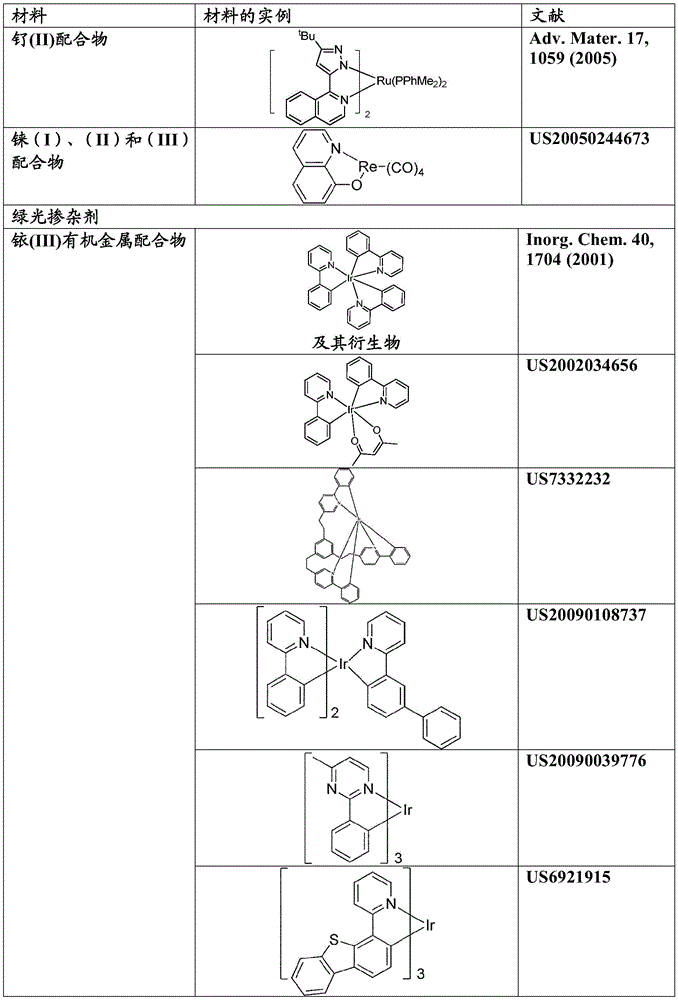


Experiment of
Chemical abbreviations used herein are as follows: cy is cyclohexyl, dba is dibenzylideneacetone, EtOAc is ethyl acetate, DME is dimethoxyethane, dppf is 1,1 '-bis (diphenylphosphino) ferrocene, S-Phos is dicyclohexyl (2', 6 '-dimethoxy- [1, 1' -biphenyl ] -2-yl) phosphine.

Synthesis of 6-bromo-N- (6-bromopyridin-2-yl) -N-phenylpyridin-2-amine: to a 500mL three-necked round bottom flask were added 2, 6-dibromopyridine (20g, 84mmol), aniline (3.1mL, 33.8mmol), dppf (0.749g, 1.351mmol), sodium tert-butoxide (8.11g, 84mmol), and 250mL toluene. Nitrogen was bubbled directly into the reaction mixture. Pd is added2(dba)3(0.62g, 0.68mmol) was added to the reaction mixture and the reaction mixture was heated to reflux overnight. The reaction mixture was cooled and diluted with ethyl acetate and water and passed through Filtered to remove insoluble material. The layers were separated and the aqueous layer was extracted with ethyl acetate. The organic layer was washed with brine, dried over magnesium sulfate, filtered and evaporated. The residue was purified by column chromatography eluting with dichloromethane to give 6-bromo-N- (6-bromopyridin-2-yl) -N-phenylpyridin-2-amine (6.3g, 46%).

Reacting 6-bromo-N- (6-bromopyridin-2-yl) -N-phenylpyridin-2-amine (7g, 17.3mmol), phenylboronic acid (5.3g, 43.2mmol), Pd2(dba)3(0.32g, 0.35mmol), dicyclohexyl (2 ', 6 ' -dimethoxy- [1,1 ' -biphenyl)]-2-yl) phosphine (0.57g, 1.38mmol), tripotassium phosphate monohydrate (11.94g, 51.8mmol), toluene (200mL), and water (20mL) were added to the flask and degassed with nitrogen. The reaction mixture was heated to reflux for 16 hours and then cooled to room temperature. Water was added and the layers were separated, the aqueous layer was washed twice with EtOAc and the combined organics were washed with water and brine. After removal of the solvent, the crude product was chromatographed on silica gel with 9/1(v/v) hexane/EtOAc to give 5.6g of a white solid which was recondensed from hexaneThe crystals were crystallized to give 5.1g of a pure (HPLC purity: 100%) product confirmed by NMR and GC/MS.

Synthesis of 6-bromo-N-phenyl-N- (6-phenylpyridin-2-yl) pyridin-2-amine: to a 1L three-neck round bottom flask was added 6-bromo-N- (6-bromopyridin-2-yl) -N-phenylpyridin-2-amine (5.3g, 13.08mmol), phenylboronic acid (1.595g, 13.08mmol), potassium carbonate (5.42g, 39.3mmol), 200mL dimethoxyethane and 100mL water. Nitrogen was bubbled directly into the mixture. Adding Pd (PPh)3)4(0.151g, 0.131mmol) and the reaction mixture was heated to 105 ℃ under nitrogen overnight. The reaction mixture was diluted with ethyl acetate and water. The layers were separated and the aqueous layer was extracted with ethyl acetate. The organic layer was dried over magnesium sulfate, filtered and evaporated to leave a yellow oil. This material was purified by column chromatography using a reverse phase column eluted with 80/20(v/v) acetonitrile/water to give 6-bromo-N-phenyl-N- (6-phenylpyridin-2-yl) pyridin-2-amine (2.84g, 45%).

6- (dibenzo [ b, d ]]Synthesis of furan-4-yl) -N-phenyl-N- (6-phenylpyridin-2-yl) pyridin-2-amine: into a 300mL three-necked flask were added 6-bromo-N-phenyl-N- (6-phenylpyridin-2-yl) pyridin-2-amine (2.5g, 6.21mmol), dibenzo [ b, d ]]Furan-4-ylboronic acid (1.6g, 7.5mmol), potassium phosphate monohydrate (4.3g, 18.6mmol), dicyclohexyl (2 ', 6 ' -dimethoxy- [1,1 ' -biphenyl)]-2-yl) phosphine (S-Phos) (0.102g, 0.249mmol), 100mL toluene, and 10mL water. Nitrogen was bubbled directly into the mixture. Adding Pd2(dba)3(0.057g, 0.062mmol) and the reaction mixture was heated at reflux under nitrogen overnight. Water was added to the reaction mixture and the layers were separated. The aqueous layer was extracted with ethyl acetate. The organic layer was washed with brine, dried over magnesium sulfate, filtered and evaporated. The material was purified by washing with 8/2/2.5 hexane/dichloromethane/ethyl acetatePurifying the eluted column chromatography to obtain 6- (dibenzo [ b, d ]]Furan-4-yl) -N-phenyl-N- (6-phenylpyridin-2-yl) pyridin-2-amine (2.7g, 88%).

6- (dibenzo [ b, d ]]Furan-4-yl) -N- (6- (dibenzo [ b, d)]Synthesis of furan-4-yl) pyridin-2-yl) -N-phenylpyridin-2-amine: to a 500mL three-necked round bottom flask was added 6-bromo-N- (6-bromopyridin-2-yl) -N-phenylpyridin-2-amine (4.4g, 10.9mmol), dibenzo [ b, d ]]Furan-4-ylboronic acid (5.1g, 23.9mmol), Pd2(dba)3(0.10g, 0.11mmol), dicyclohexyl (2 ', 6 ' -dimethoxy- [1,1 ' -biphenyl)]-2-yl) phosphine (0.18g, 0.43mmol) and tripotassium phosphate monohydrate (12.5g, 54.3mmol) in toluene (100mL) and water (10 mL). Nitrogen was bubbled directly into the mixture for 20 minutes and the reaction was heated to reflux for 16 hours. The reaction mixture was cooled and diluted with ethyl acetate and water and filtered through Celite to remove insoluble material. The layers were separated and the aqueous layer was extracted with dichloromethane. The organic layer was washed with brine, dried over magnesium sulfate, filtered and evaporated. The residue was purified by column chromatography eluting with 95/5 dichloromethane/ethyl acetate to give 2.1g (87%) of 6- (dibenzo [ b, d ] as a white solid]Furan-4-yl) -N- (6- (dibenzo [ b, d)]Furan-4-yl) pyridin-2-yl) -N-phenylpyridin-2-amine. The product was confirmed by LC/MS, NMR and HPLC (purity: 99.96%).

Synthesis of Compound X: n, 6-Diphenyl-N- (6-phenylpyridin-2-yl) pyridin-2-amine (1.9g, 4.8mmol) and potassium tetrachloroplatinate (1.97g, 4.8mmol) were mixed in 100mL of acetic acid. The mixture was degassed by sparging with nitrogen for 20 minutes and heated at 140 ℃ for 4 days. After cooling, water was added and the solid was collected by filtration. The solid was eluted with dichloromethane onto a frit to give a yellow filtrate, which was dried over sodium sulfate and the solvent was removed. The crude product is obtained byPurification on a silica gel column with dichloromethane as solvent gave 1.1 g of platinum complex. Sublimating the complex (260 ℃, 10)-5Torr) to obtain 0.8g of compound X as a yellow solid (HPLC purity: 99.3%) and the compound was confirmed by NMR and LC/MS.

Synthesis of Compound 4:
to a 300mL three-necked round bottom flask was added K2PtCl4(2.1g, 5.0mmol), 6- (dibenzo [ b, d ]]Furan-4-yl) -N-phenyl-N- (6-phenylpyridin-2-yl) pyridin-2-amine (2.7g, 5.5mmol) and 100mL of acetic acid. The reaction mixture was purged with nitrogen for 20 minutes. The reaction mixture was heated at 140 ℃ for 3 days under nitrogen, cooled, and washed with hexane. The green solid was filtered off and washed with hexane. The material was purified by column chromatography eluting with 60/40 to 70/40(v/v) dichloromethane/hexanes and then sublimed overnight at 300 ℃ to give 0.58g (17%) of the compound as a yellow solid. The product was confirmed by LC/MS and HPLC (purity 99.1%)

Synthesis of compound 13: mixing 6- (dibenzo [ b, d ]]Furan-4-yl) -N- (6- (dibenzo [ b, d)]Furan-4-yl) pyridin-2-yl) -N-phenylpyridin-2-amine (1.8g, 3.1mmol) and K2PtCl4(1.3g, 3.1mmol) was mixed in 100mL of acetic acid. The mixture was bubbled with nitrogen for 20 minutes, and then heated at 140 ℃ for 4 days. After cooling, water was added and the solid was collected by filtration. The solid was washed with dichloromethane to give a yellow filtrate, which was concentrated to give a yellow solid. The solid was suspended in dichloromethane and methanol was added to give a precipitate which was filtered and washed with methanol and hexane and dried to give 0.88g (37%) of compound 13 as an orange solid. The product was confirmed by LC/MS and HPLC (purity 99.1%).
It should be understood that the various embodiments described herein are illustrative only and are not intended to limit the scope of the invention. For example, many of the materials and structures described herein may be substituted with other materials and structures without departing from the spirit of the present invention. Thus, the claimed invention may include variations from the specific examples and preferred embodiments described herein that are apparent to those of ordinary skill in the art. It should be understood that various theories as to why the invention can be held are non-limiting.
Claims (14)
1. A compound, wherein the compound is selected from:
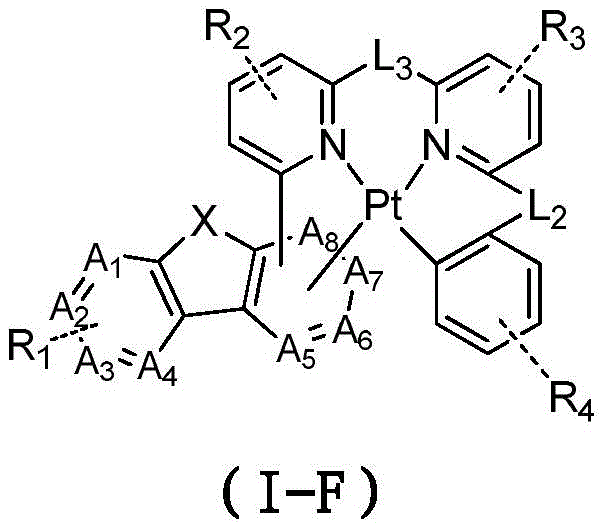
wherein X is selected from O, S and Se;
wherein A is1、A2、A3、A4、A5、A6、A7And A8Is carbon;
wherein Pt forms two Pt-C bonds;
wherein R is1、R2、R3And R4Independently represent mono-, di-, tri-or tetra-substituted or unsubstituted;
wherein L is2Is a single bond;
wherein L is3Is NR, wherein R is phenyl or substituted phenyl; and is
Wherein R is1、R2、R3And R4Independently selected from the group consisting of hydrogen, deuterium, halogen, alkyl, cycloalkyl, heteroalkyl, arylalkyl, alkoxy, aryloxy, amino, silyl, alkenyl, cycloalkenyl, heteroalkenyl, alkynyl, aryl, heteroaryl, acyl, carboxylic acid group, ester group, nitrile group, isonitrile group, sulfinyl, sulfonyl, phosphino, and combinations thereof.
2. The compound of claim 1, wherein L3Is NR and R is phenyl.
3. The compound of claim 1, wherein X is O.
4. A first device comprising a first organic light emitting device, the organic light emitting device comprising:
an anode;
a cathode; and
an organic layer positioned between the anode and the cathode, the organic layer comprising a compound selected from the group consisting of:

wherein X is selected from O, S and Se;
wherein A is1、A2、A3、A4、A5、A6、A7And A8Is carbon;
wherein Pt forms two Pt-C bonds;
wherein R is1、R2、R3And R4Independently represent mono-, di-, tri-or tetra-substituted or unsubstituted;
wherein L is2Is a single bond;
wherein L is3Is NR, wherein R is phenyl or substituted phenyl;
wherein R is1、R2、R3And R4Independently selected from the group consisting of hydrogen, deuterium, halogen, alkyl, cycloalkyl, heteroalkyl, arylalkyl, alkoxy, aryloxy, amino, silyl, alkenyl, cycloalkenyl, heteroalkenyl, alkynyl, aryl, heteroaryl, acyl, carboxylic acid group, ester group, nitrile group, isonitrile group, sulfinyl, sulfonyl, phosphino, and combinations thereof.
5. The first device of claim 4, wherein the first device is a consumer product.
6. The first device of claim 4, wherein the first device is an organic light emitting device.
7. The first device of claim 4, wherein the first device comprises a lighting panel.
8. The first device of claim 4, wherein the organic layer is a light emitting layer and the compound is a light emitting dopant.
9. The first device of claim 4, wherein the organic layer is an emissive layer and the compound is a non-emissive dopant.
10. The first device of claim 4, wherein the organic layer further comprises a host.
11. The first device of claim 10, wherein the host comprises triphenylene comprising benzo-fused thiophene or benzo-fused furan;
wherein any substituents in the host are independently selected from CnH2n+1、OCnH2n+1、OAr1、N(CnH2n+1)2、N(Ar1)(Ar2)、CH=CH-CnH2n+1、C≡CHCnC2n+1、Ar1、Ar1-Ar2、CnH2n-Ar1Non-fused substituents of (a), or unsubstituted;
wherein n is 1 to 10; and is
Wherein Ar is1And Ar2Independently selected from the group consisting of benzene, biphenyl, naphthalene, triphenylene, and carbazole.
12. The first device of claim 11, wherein the body has the formula

13. The first device of claim 10, wherein the host is selected from the group consisting of

And combinations thereof.
14. The first device of claim 10, wherein the host is a metal complex.
Applications Claiming Priority (5)
| Application Number | Priority Date | Filing Date | Title |
|---|---|---|---|
| US201161511385P | 2011-07-25 | 2011-07-25 | |
| US61/511,385 | 2011-07-25 | ||
| US201161541769P | 2011-09-30 | 2011-09-30 | |
| US61/541,769 | 2011-09-30 | ||
| CN2012102589613A CN102898476A (en) | 2011-07-25 | 2012-07-25 | Tetradentate platinum complexes |
Related Parent Applications (1)
| Application Number | Title | Priority Date | Filing Date |
|---|---|---|---|
| CN2012102589613A Division CN102898476A (en) | 2011-07-25 | 2012-07-25 | Tetradentate platinum complexes |
Publications (2)
| Publication Number | Publication Date |
|---|---|
| CN108424427A CN108424427A (en) | 2018-08-21 |
| CN108424427B true CN108424427B (en) | 2021-02-09 |
Family
ID=46642362
Family Applications (3)
| Application Number | Title | Priority Date | Filing Date |
|---|---|---|---|
| CN201810428800.1A Active CN108424427B (en) | 2011-07-25 | 2012-07-25 | Tetradentate platinum complexes |
| CN201810428799.2A Active CN108707169B (en) | 2011-07-25 | 2012-07-25 | Tetradentate platinum complexes |
| CN2012102589613A Pending CN102898476A (en) | 2011-07-25 | 2012-07-25 | Tetradentate platinum complexes |
Family Applications After (2)
| Application Number | Title | Priority Date | Filing Date |
|---|---|---|---|
| CN201810428799.2A Active CN108707169B (en) | 2011-07-25 | 2012-07-25 | Tetradentate platinum complexes |
| CN2012102589613A Pending CN102898476A (en) | 2011-07-25 | 2012-07-25 | Tetradentate platinum complexes |
Country Status (5)
| Country | Link |
|---|---|
| EP (1) | EP2551274B1 (en) |
| JP (3) | JP6234666B2 (en) |
| KR (1) | KR101950039B1 (en) |
| CN (3) | CN108424427B (en) |
| TW (1) | TWI561527B (en) |
Families Citing this family (70)
| Publication number | Priority date | Publication date | Assignee | Title |
|---|---|---|---|---|
| JP2013530135A (en) | 2010-04-30 | 2013-07-25 | アリゾナ ボード オブ リージェンツ アクティング フォー アンド オン ビハーフ オブ アリゾナ ステイト ユニバーシティ | Synthesis of tetracoordinate palladium complex and its application in light-emitting devices |
| KR101950039B1 (en) * | 2011-07-25 | 2019-02-19 | 유니버셜 디스플레이 코포레이션 | Tetradentate platinum complexes |
| US9882150B2 (en) | 2012-09-24 | 2018-01-30 | Arizona Board Of Regents For And On Behalf Of Arizona State University | Metal compounds, methods, and uses thereof |
| WO2014109814A2 (en) | 2012-10-26 | 2014-07-17 | Arizona Board Of Regents Acting For And On Behalf Of Arizona State University | Metal complexes, methods, and uses thereof |
| CN104232076B (en) | 2013-06-10 | 2019-01-15 | 代表亚利桑那大学的亚利桑那校董会 | Phosphorescent tetradentate metal complexes with improved emission spectra |
| JP6804823B2 (en) | 2013-10-14 | 2020-12-23 | アリゾナ・ボード・オブ・リージェンツ・オン・ビハーフ・オブ・アリゾナ・ステイト・ユニバーシティーArizona Board of Regents on behalf of Arizona State University | Platinum complex and device |
| US10033000B2 (en) * | 2013-11-15 | 2018-07-24 | Universal Display Corporation | Organic electroluminescent materials and devices |
| US10020455B2 (en) | 2014-01-07 | 2018-07-10 | Arizona Board Of Regents On Behalf Of Arizona State University | Tetradentate platinum and palladium complex emitters containing phenyl-pyrazole and its analogues |
| US9847497B2 (en) | 2014-02-18 | 2017-12-19 | Universal Display Corporation | Organic electroluminescent materials and devices |
| US9847498B2 (en) | 2014-04-14 | 2017-12-19 | Universal Display Corporation | Organic electroluminescent materials and devices |
| US10008679B2 (en) | 2014-04-14 | 2018-06-26 | Universal Display Corporation | Organic electroluminescent materials and devices |
| US9941479B2 (en) | 2014-06-02 | 2018-04-10 | Arizona Board Of Regents On Behalf Of Arizona State University | Tetradentate cyclometalated platinum complexes containing 9,10-dihydroacridine and its analogues |
| US9911931B2 (en) * | 2014-06-26 | 2018-03-06 | Universal Display Corporation | Organic electroluminescent materials and devices |
| CN105273712B (en) * | 2014-07-11 | 2017-07-25 | 广东阿格蕾雅光电材料有限公司 | Luminescent materials for light-emitting diodes |
| US9923155B2 (en) | 2014-07-24 | 2018-03-20 | Arizona Board Of Regents On Behalf Of Arizona State University | Tetradentate platinum (II) complexes cyclometalated with functionalized phenyl carbene ligands and their analogues |
| WO2016025921A1 (en) | 2014-08-15 | 2016-02-18 | Arizona Board Of Regents On Behalf Of Arizona State University | Non-platinum metal complexes for excimer based single dopant white organic light emitting diodes |
| US9920242B2 (en) | 2014-08-22 | 2018-03-20 | Arizona Board Of Regents On Behalf Of Arizona State University | Metal-assisted delayed fluorescent materials as co-host materials for fluorescent OLEDs |
| US11329244B2 (en) | 2014-08-22 | 2022-05-10 | Arizona Board Of Regents On Behalf Of Arizona State University | Organic light-emitting diodes with fluorescent and phosphorescent emitters |
| US9865825B2 (en) | 2014-11-10 | 2018-01-09 | Arizona Board Of Regents On Behalf Of Arizona State University | Emitters based on octahedral metal complexes |
| US10033003B2 (en) | 2014-11-10 | 2018-07-24 | Arizona Board Of Regents On Behalf Of Arizona State University | Tetradentate metal complexes with carbon group bridging ligands |
| US9871214B2 (en) | 2015-03-23 | 2018-01-16 | Universal Display Corporation | Organic electroluminescent materials and devices |
| JP6697299B2 (en) * | 2015-04-01 | 2020-05-20 | 株式会社半導体エネルギー研究所 | Organometallic complex, light emitting element, light emitting device, electronic device, and lighting device |
| US9879039B2 (en) | 2015-06-03 | 2018-01-30 | Arizona Board Of Regents On Behalf Of Arizona State University | Tetradentate and octahedral metal complexes containing naphthyridinocarbazole and its analogues |
| WO2016197019A1 (en) | 2015-06-04 | 2016-12-08 | Jian Li | Transparent electroluminescent devices with controlled one-side emissive displays |
| EP3133078B1 (en) * | 2015-08-18 | 2019-01-30 | Samsung Electronics Co., Ltd. | Organometallic compound and organic light-emitting device including the same |
| CN105481906B (en) * | 2016-01-22 | 2018-06-12 | 湘潭大学 | A kind of four ring gear metal platinum complex near-infrared electroluminescent material of arylamine class and its preparation and application |
| US11335865B2 (en) | 2016-04-15 | 2022-05-17 | Arizona Board Of Regents On Behalf Of Arizona State University | OLED with multi-emissive material layer |
| US10862054B2 (en) | 2016-06-20 | 2020-12-08 | Universal Display Corporation | Organic electroluminescent materials and devices |
| US10177323B2 (en) | 2016-08-22 | 2019-01-08 | Arizona Board Of Regents On Behalf Of Arizona State University | Tetradentate platinum (II) and palladium (II) complexes and octahedral iridium complexes employing azepine functional groups and their analogues |
| KR102673814B1 (en) * | 2016-08-25 | 2024-06-10 | 삼성전자주식회사 | Organometallic compound and organic light emitting device including the same |
| KR102888327B1 (en) | 2016-10-12 | 2025-11-18 | 아리조나 보드 오브 리젠츠 온 비하프 오브 아리조나 스테이트 유니버시티 | Narrow band red phosphorescent tetradentate platinum (ii) complexes |
| US11183670B2 (en) | 2016-12-16 | 2021-11-23 | Arizona Board Of Regents On Behalf Of Arizona State University | Organic light emitting diode with split emissive layer |
| KR102739115B1 (en) * | 2016-12-22 | 2024-12-05 | 삼성전자주식회사 | Organometallic compound, organic light emitting device including the same and a composition for diagnosing including the same |
| US11053268B2 (en) * | 2017-01-20 | 2021-07-06 | Universal Display Corporation | Organic electroluminescent materials and devices |
| WO2018140765A1 (en) | 2017-01-27 | 2018-08-02 | Jian Li | Metal-assisted delayed fluorescent emitters employing pyrido-pyrrolo-acridine and analogues |
| US10516117B2 (en) | 2017-05-19 | 2019-12-24 | Arizona Board Of Regents On Behalf Of Arizona State University | Metal-assisted delayed fluorescent emttters employing benzo-imidazo-phenanthridine and analogues |
| US11101435B2 (en) | 2017-05-19 | 2021-08-24 | Arizona Board Of Regents On Behalf Of Arizona State University | Tetradentate platinum and palladium complexes based on biscarbazole and analogues |
| KR102673196B1 (en) | 2017-09-05 | 2024-06-10 | 삼성전자주식회사 | Organometallic compound, organic light emitting device including the same and a composition for diagnosing including the same |
| EP3450442B1 (en) | 2017-09-05 | 2020-02-12 | Samsung Electronics Co., Ltd. | Organometallic compound, organic light-emitting device including the same, and diagnostic composition including the organometallic compound |
| KR102460643B1 (en) * | 2017-09-29 | 2022-10-31 | 삼성디스플레이 주식회사 | Organometallic compound and organic light-emitting device comprising the same |
| US11647643B2 (en) | 2017-10-17 | 2023-05-09 | Arizona Board Of Regents On Behalf Of Arizona State University | Hole-blocking materials for organic light emitting diodes |
| WO2019079508A2 (en) | 2017-10-17 | 2019-04-25 | Jian Li | Phosphorescent excimers with preferred molecular orientation as monochromatic emitters for display and lighting applications |
| CN109748936B (en) * | 2017-11-02 | 2021-05-11 | 广东阿格蕾雅光电材料有限公司 | An organometallic complex luminescent material |
| US12037348B2 (en) | 2018-03-09 | 2024-07-16 | Arizona Board Of Regents On Behalf Of Arizona State University | Blue and narrow band green and red emitting metal complexes |
| KR102676045B1 (en) * | 2018-03-13 | 2024-06-19 | 삼성디스플레이 주식회사 | Organometallic compound and organic light emitting device comprising the same |
| KR102637792B1 (en) | 2018-03-22 | 2024-02-19 | 삼성디스플레이 주식회사 | Organic light emitting device and electronic device including the same |
| KR102661471B1 (en) | 2018-04-27 | 2024-04-29 | 삼성디스플레이 주식회사 | Organometallic compound and organic light emitting device comprising the same |
| US11261207B2 (en) * | 2018-06-25 | 2022-03-01 | Universal Display Corporation | Organic electroluminescent materials and devices |
| CN108948096B (en) * | 2018-08-02 | 2021-04-02 | 浙江工业大学 | Biphenyl-based tetradentate ring metal platinum complexes and their applications |
| CN117447526A (en) | 2018-09-15 | 2024-01-26 | 北京夏禾科技有限公司 | Fluorine-substituted metal complexes |
| KR20200034900A (en) | 2018-09-21 | 2020-04-01 | 삼성디스플레이 주식회사 | Organic light-emitting device, apparatus comprising the same and organocyclometallic compound |
| CN111320613B (en) | 2018-12-17 | 2023-05-12 | 广东阿格蕾雅光电材料有限公司 | Platinum (II) tetradentate ONNO complex luminescent material, preparation method and application thereof in organic light-emitting diode |
| CN111377970B (en) * | 2018-12-28 | 2022-12-23 | 广东阿格蕾雅光电材料有限公司 | Preparation and Application of a N`N`C`N Type Tetradentate Platinum(II) Complex |
| KR102739122B1 (en) * | 2018-12-31 | 2024-12-05 | 삼성전자주식회사 | Organometallic compound, organic light emitting device including the same and a composition for diagnosing including the same |
| US11878988B2 (en) | 2019-01-24 | 2024-01-23 | Arizona Board Of Regents On Behalf Of Arizona State University | Blue phosphorescent emitters employing functionalized imidazophenthridine and analogues |
| US11594691B2 (en) | 2019-01-25 | 2023-02-28 | Arizona Board Of Regents On Behalf Of Arizona State University | Light outcoupling efficiency of phosphorescent OLEDs by mixing horizontally aligned fluorescent emitters |
| KR20200115795A (en) * | 2019-03-26 | 2020-10-08 | 삼성디스플레이 주식회사 | Organic light emitting device and electronic apparatus |
| CN110016057B (en) * | 2019-04-15 | 2022-03-29 | 南京邮电大学 | Sulfur-bridged quinazoline tetradentate platinum complex phosphorescent material and preparation method thereof |
| KR102804493B1 (en) | 2019-04-30 | 2025-05-09 | 삼성디스플레이 주식회사 | Organic light emitting device |
| JP7618938B2 (en) * | 2019-05-21 | 2025-01-22 | ユニバーサル ディスプレイ コーポレイション | Organic electroluminescent materials and devices |
| US11785838B2 (en) | 2019-10-02 | 2023-10-10 | Arizona Board Of Regents On Behalf Of Arizona State University | Green and red organic light-emitting diodes employing excimer emitters |
| CN112979709B (en) * | 2019-12-16 | 2022-09-02 | 广东阿格蕾雅光电材料有限公司 | Metal complex and application thereof |
| CN113354687A (en) * | 2020-03-06 | 2021-09-07 | 环球展览公司 | Organic electroluminescent material and device |
| US11945985B2 (en) | 2020-05-19 | 2024-04-02 | Arizona Board Of Regents On Behalf Of Arizona State University | Metal assisted delayed fluorescent emitters for organic light-emitting diodes |
| CN113683625B (en) | 2020-05-19 | 2025-06-10 | 亚利桑那州立大学董事会 | Metal-assisted delayed fluorescence emitters for organic light emitting diodes |
| CN113717229B (en) * | 2020-05-26 | 2022-08-19 | 广东阿格蕾雅光电材料有限公司 | Platinum complex containing ONCN tetradentate ligand and application thereof in organic light-emitting diode |
| CN111574501B (en) * | 2020-06-10 | 2021-09-17 | 浙江工业大学 | Four-tooth ring metal platinum (II) complex based on oxygen atom linkage and containing phenylacridine and application |
| KR20220085924A (en) | 2020-12-15 | 2022-06-23 | 삼성디스플레이 주식회사 | Light emitting device and electronic apparatus comprising same |
| KR102284600B1 (en) * | 2021-01-28 | 2021-08-02 | (주)랩토 | Organometallic complex and organic elcetroluminescent device including the same |
| CN118290488B (en) * | 2024-04-16 | 2024-09-17 | 浙江华显光电科技有限公司 | Pt complex and application thereof in organic light-emitting device |
Citations (7)
| Publication number | Priority date | Publication date | Assignee | Title |
|---|---|---|---|---|
| CN100445294C (en) * | 2003-11-04 | 2008-12-24 | 高砂香料工业株式会社 | Platinum complex and light emitting element |
| JP2009231516A (en) * | 2007-03-28 | 2009-10-08 | Fujifilm Corp | Organic electroluminescent device |
| JP2009266943A (en) * | 2008-04-23 | 2009-11-12 | Fujifilm Corp | Organic field light-emitting element |
| JP2009267244A (en) * | 2008-04-28 | 2009-11-12 | Fujifilm Corp | Organic electroluminescent element |
| CN101669226A (en) * | 2006-12-28 | 2010-03-10 | 通用显示公司 | Long-life phosphorescent Organic Light Emitting Device (OLED) structures |
| CN101827834A (en) * | 2007-08-08 | 2010-09-08 | 通用显示公司 | Benzo-fused thiophene or benzo-fused furan compounds containing benzo [9,10] phenanthrene |
| JP2011054695A (en) * | 2009-08-31 | 2011-03-17 | Fujifilm Corp | Organic electroluminescence device |
Family Cites Families (34)
| Publication number | Priority date | Publication date | Assignee | Title |
|---|---|---|---|---|
| US4769292A (en) | 1987-03-02 | 1988-09-06 | Eastman Kodak Company | Electroluminescent device with modified thin film luminescent zone |
| GB8909011D0 (en) | 1989-04-20 | 1989-06-07 | Friend Richard H | Electroluminescent devices |
| US5707745A (en) | 1994-12-13 | 1998-01-13 | The Trustees Of Princeton University | Multicolor organic light emitting devices |
| US5703436A (en) | 1994-12-13 | 1997-12-30 | The Trustees Of Princeton University | Transparent contacts for organic devices |
| US5844363A (en) | 1997-01-23 | 1998-12-01 | The Trustees Of Princeton Univ. | Vacuum deposited, non-polymeric flexible organic light emitting devices |
| US6013982A (en) | 1996-12-23 | 2000-01-11 | The Trustees Of Princeton University | Multicolor display devices |
| US5834893A (en) | 1996-12-23 | 1998-11-10 | The Trustees Of Princeton University | High efficiency organic light emitting devices with light directing structures |
| US6091195A (en) | 1997-02-03 | 2000-07-18 | The Trustees Of Princeton University | Displays having mesa pixel configuration |
| US6303238B1 (en) | 1997-12-01 | 2001-10-16 | The Trustees Of Princeton University | OLEDs doped with phosphorescent compounds |
| US6337102B1 (en) | 1997-11-17 | 2002-01-08 | The Trustees Of Princeton University | Low pressure vapor phase deposition of organic thin films |
| US6087196A (en) | 1998-01-30 | 2000-07-11 | The Trustees Of Princeton University | Fabrication of organic semiconductor devices using ink jet printing |
| US6097147A (en) | 1998-09-14 | 2000-08-01 | The Trustees Of Princeton University | Structure for high efficiency electroluminescent device |
| US6294398B1 (en) | 1999-11-23 | 2001-09-25 | The Trustees Of Princeton University | Method for patterning devices |
| US7071615B2 (en) | 2001-08-20 | 2006-07-04 | Universal Display Corporation | Transparent electrodes |
| US20030230980A1 (en) | 2002-06-18 | 2003-12-18 | Forrest Stephen R | Very low voltage, high efficiency phosphorescent oled in a p-i-n structure |
| EP1618170A2 (en) * | 2003-04-15 | 2006-01-25 | Covion Organic Semiconductors GmbH | Mixtures of matrix materials and organic semiconductors capable of emission, use of the same and electronic components containing said mixtures |
| US7279704B2 (en) | 2004-05-18 | 2007-10-09 | The University Of Southern California | Complexes with tridentate ligands |
| US20060134461A1 (en) * | 2004-12-17 | 2006-06-22 | Shouquan Huo | Organometallic materials and electroluminescent devices |
| JP5200226B2 (en) * | 2005-03-25 | 2013-06-05 | 国立大学法人 長崎大学 | Metal complex, light emitting element, display device |
| WO2006114966A1 (en) * | 2005-04-18 | 2006-11-02 | Konica Minolta Holdings, Inc. | Organic electroluminescent device, display and illuminating device |
| WO2006130598A2 (en) * | 2005-05-31 | 2006-12-07 | Universal Display Corporation | Triphenylene hosts in phosphorescent light emitting diodes |
| US8062769B2 (en) * | 2006-11-09 | 2011-11-22 | Nippon Steel Chemical Co., Ltd. | Indolocarbazole compound for use in organic electroluminescent device and organic electroluminescent device |
| US7973167B2 (en) * | 2007-03-06 | 2011-07-05 | Nagasaki University | Metal complex, light-emitting device and display |
| JP5438941B2 (en) * | 2007-09-25 | 2014-03-12 | ユー・ディー・シー アイルランド リミテッド | Organic electroluminescence device |
| CN101868868A (en) * | 2007-11-22 | 2010-10-20 | 出光兴产株式会社 | Organic EL element |
| JP4531842B2 (en) * | 2008-04-24 | 2010-08-25 | 富士フイルム株式会社 | Organic electroluminescence device |
| JP4562805B2 (en) * | 2008-04-24 | 2010-10-13 | 富士フイルム株式会社 | Platinum complex |
| JP4558061B2 (en) * | 2008-04-28 | 2010-10-06 | 富士フイルム株式会社 | Organic electroluminescence device |
| US8722205B2 (en) * | 2009-03-23 | 2014-05-13 | Universal Display Corporation | Heteroleptic iridium complex |
| JP4598137B1 (en) * | 2009-07-31 | 2010-12-15 | 富士フイルム株式会社 | Method for manufacturing organic electroluminescent device |
| JP2010185068A (en) * | 2009-08-31 | 2010-08-26 | Fujifilm Corp | Organic electroluminescent device |
| JP5608404B2 (en) * | 2010-03-31 | 2014-10-15 | ユー・ディー・シー アイルランド リミテッド | Platinum complex, luminescent material, organic electroluminescent element, display device and lighting device |
| JP5671248B2 (en) * | 2010-03-31 | 2015-02-18 | ユー・ディー・シー アイルランド リミテッド | Organic thin film and organic electroluminescent device |
| KR101950039B1 (en) * | 2011-07-25 | 2019-02-19 | 유니버셜 디스플레이 코포레이션 | Tetradentate platinum complexes |
-
2012
- 2012-07-24 KR KR1020120080834A patent/KR101950039B1/en active Active
- 2012-07-24 JP JP2012163363A patent/JP6234666B2/en active Active
- 2012-07-24 TW TW101126680A patent/TWI561527B/en active
- 2012-07-24 EP EP12177646.2A patent/EP2551274B1/en active Active
- 2012-07-25 CN CN201810428800.1A patent/CN108424427B/en active Active
- 2012-07-25 CN CN201810428799.2A patent/CN108707169B/en active Active
- 2012-07-25 CN CN2012102589613A patent/CN102898476A/en active Pending
-
2017
- 2017-09-08 JP JP2017172950A patent/JP6672229B2/en active Active
-
2019
- 2019-08-08 JP JP2019146462A patent/JP2019196403A/en active Pending
Patent Citations (7)
| Publication number | Priority date | Publication date | Assignee | Title |
|---|---|---|---|---|
| CN100445294C (en) * | 2003-11-04 | 2008-12-24 | 高砂香料工业株式会社 | Platinum complex and light emitting element |
| CN101669226A (en) * | 2006-12-28 | 2010-03-10 | 通用显示公司 | Long-life phosphorescent Organic Light Emitting Device (OLED) structures |
| JP2009231516A (en) * | 2007-03-28 | 2009-10-08 | Fujifilm Corp | Organic electroluminescent device |
| CN101827834A (en) * | 2007-08-08 | 2010-09-08 | 通用显示公司 | Benzo-fused thiophene or benzo-fused furan compounds containing benzo [9,10] phenanthrene |
| JP2009266943A (en) * | 2008-04-23 | 2009-11-12 | Fujifilm Corp | Organic field light-emitting element |
| JP2009267244A (en) * | 2008-04-28 | 2009-11-12 | Fujifilm Corp | Organic electroluminescent element |
| JP2011054695A (en) * | 2009-08-31 | 2011-03-17 | Fujifilm Corp | Organic electroluminescence device |
Also Published As
| Publication number | Publication date |
|---|---|
| TWI561527B (en) | 2016-12-11 |
| CN108424427A (en) | 2018-08-21 |
| KR101950039B1 (en) | 2019-02-19 |
| CN108707169B (en) | 2021-02-12 |
| JP6672229B2 (en) | 2020-03-25 |
| JP2018048126A (en) | 2018-03-29 |
| EP2551274A1 (en) | 2013-01-30 |
| JP2019196403A (en) | 2019-11-14 |
| JP2013023500A (en) | 2013-02-04 |
| TW201307368A (en) | 2013-02-16 |
| EP2551274B1 (en) | 2015-12-09 |
| CN108707169A (en) | 2018-10-26 |
| CN102898476A (en) | 2013-01-30 |
| KR20130012568A (en) | 2013-02-04 |
| JP6234666B2 (en) | 2017-11-22 |
Similar Documents
| Publication | Publication Date | Title |
|---|---|---|
| KR102722480B1 (en) | Heteroleptic iridium complexes as dopants | |
| CN108424427B (en) | Tetradentate platinum complexes | |
| JP6568190B2 (en) | High efficiency yellow light emitter for OLED devices | |
| JP5982264B2 (en) | New heteroleptic iridium complexes | |
| CN106366130B (en) | Phosphorescent material | |
| KR101982337B1 (en) | Novel heteroleptic iridium complexes | |
| KR102146174B1 (en) | Phosphorescent materials | |
| CN108467414B (en) | Material for organic light emitting diode | |
| JP6147488B2 (en) | Organic light emitting material |
Legal Events
| Date | Code | Title | Description |
|---|---|---|---|
| PB01 | Publication | ||
| PB01 | Publication | ||
| SE01 | Entry into force of request for substantive examination | ||
| SE01 | Entry into force of request for substantive examination | ||
| GR01 | Patent grant | ||
| GR01 | Patent grant |