Disclosure of Invention
The invention provides a management method of a memory pool, which aims to solve the technical problem that the memory occupation of a server is high due to the fact that chunk addresses of the memory pool are not continuous and a whole block cannot be released in the prior art.
In order to solve the foregoing technical problem, a first aspect of an embodiment of the present invention provides a method for managing a memory pool, where the method includes:
controlling the first memory pool to provide dynamic memory allocation operation and memory release operation, and controlling the second memory pool not to provide dynamic memory allocation operation and memory release operation;
when the allocated memory of the first memory pool is larger than a first threshold value and the used memory is smaller than a second threshold value, controlling the first memory pool to only provide a memory release operation, and controlling the second memory pool to provide a dynamic memory allocation operation and a memory release operation;
after the memory of the first memory pool is completely released, the first memory pool is emptied, the second memory pool is controlled to provide dynamic memory allocation operation and memory release operation, and the first memory pool is controlled not to provide dynamic memory allocation operation and memory release operation.
Optionally, the method further comprises: and using a mutual exclusion lock for the first memory pool and the second memory pool.
Optionally, the controlling the first memory pool to provide a dynamic memory allocation operation and a memory release operation specifically includes:
receiving a dynamic memory allocation message, and acquiring a memory pool currently responsible for dynamic memory allocation as the first memory pool;
allocating the memory in the first memory pool based on the dynamic memory allocation message, and counting the allocated memory and the used memory of the first memory pool; and
receiving a memory release message, and acquiring a memory pool currently responsible for memory release as the first memory pool;
and calling a memory release function of the first memory pool to release the memory based on the memory release message.
Optionally, when the allocated memory of the first memory pool is greater than a first threshold and the used memory is less than a second threshold, controlling the first memory pool to provide a memory release operation, and controlling the second memory pool to provide a dynamic memory allocation operation and a memory release operation, specifically including:
receiving a memory release message, and acquiring the memory pool which is only responsible for memory release at present as the first memory pool;
judging whether the memory to be released corresponding to the memory release message belongs to the first memory pool, if so, calling a memory release function of the first memory pool to release the memory to be released, and if not, calling whether the memory of the second memory pool is a function to release the memory to be released; and
receiving a dynamic memory allocation message, and acquiring a memory pool currently responsible for dynamic memory allocation as the second memory pool;
and allocating the memory in the second memory pool based on the dynamic memory allocation message, and counting the allocated memory and the used memory of the second memory pool.
Optionally, when the allocated memory of the first memory pool is greater than a first threshold and the used memory is less than a second threshold, controlling the first memory pool to provide a memory release operation, and controlling the second memory pool to provide a dynamic memory allocation operation and a memory release operation, specifically including:
receiving a memory release message, and judging whether a memory to be released corresponding to the memory release message belongs to the first memory pool or the second memory pool;
if the memory to be released belongs to the first memory pool, calling a memory release function of the first memory pool to release the memory to be released; or
If the memory to be released belongs to the first memory pool, calling a memory release function of the second memory pool to release the memory to be released; and
receiving a dynamic memory allocation message, and acquiring a memory pool currently responsible for dynamic memory allocation as the second memory pool;
and allocating the memory in the second memory pool based on the dynamic memory allocation message, and counting the allocated memory and the used memory of the second memory pool.
Optionally, before controlling the first memory pool to provide the memory releasing operation and controlling the second memory pool to provide the dynamic memory allocation operation and the memory releasing operation when the allocated memory of the first memory pool is greater than a first threshold and the used memory is less than a second threshold, the method further includes:
monitoring the duration of time that the allocated memory of the first memory pool is greater than a first threshold and the used memory is less than a second threshold;
if the duration is greater than a third threshold, executing the steps of: and controlling the first memory pool to provide a memory release operation, and controlling the second memory pool to provide a dynamic memory allocation operation and a memory release operation.
Optionally, after the monitoring for the duration that the allocated memory of the first memory pool is greater than a first threshold and the used memory is less than a second threshold, the method further includes: and at any moment, if the allocated memory is monitored to be smaller than the first threshold value or the used memory is monitored to be larger than the second threshold value, clearing the duration time.
A second aspect of embodiments of the present invention provides a computer-readable storage medium, on which a computer program is stored, which, when being executed by a processor, implements the steps of the method as described in the first aspect.
A third aspect of the embodiments of the present invention provides a computer device, including a memory, a processor, and a computer program stored in the memory and executable on the processor, where the processor executes the computer program to implement the steps of the method as described in the first aspect
Through one or more technical schemes of the invention, the invention has the following beneficial effects or advantages:
because the management method provided by the embodiment of the invention adopts two memory pools, and when the allocated memory of the first memory pool is greater than the first threshold value and the used memory is less than the second threshold value, the first memory pool is controlled to only provide the memory release operation, and the second memory pool is controlled to provide the dynamic memory allocation operation and the memory release operation, so that the first memory pool can be always in the memory release state without performing the dynamic memory allocation, the memory of the first memory pool is completely released, after the memory of the first memory pool is completely released, the first memory pool is emptied, the second memory pool is controlled to provide the dynamic memory allocation operation and the memory release operation, and the first memory pool is controlled not to provide the dynamic memory allocation operation and the memory release operation, so that the first memory pool can be completely returned to the operating system, and the problem that the whole block can not be released due to discontinuous chunk addresses of the memory pools in the prior art is solved, the technical problem of high memory occupation is caused, the memory occupation is reduced, and the technical effect of automatically recycling the idle memory is realized.
Detailed Description
In order to make the present application more clearly understood by those skilled in the art to which the present application pertains, the following detailed description of the present application is made with reference to the accompanying drawings by way of specific embodiments.
The invention provides a management method of a memory pool, which aims to solve the technical problem that the memory occupation of a server is high due to the fact that chunk addresses of the memory pool are not continuous and a whole block cannot be released in the prior art.
Referring to fig. 1, fig. 1 is a flowchart of a management method for a memory pool according to an embodiment of the present invention, where the management method includes:
s1: controlling the first memory pool to provide dynamic memory allocation operation and memory release operation, and controlling the second memory pool not to provide dynamic memory allocation operation and memory release operation;
s2: when the allocated memory of the first memory pool is larger than a first threshold value and the used memory is smaller than a second threshold value, controlling the first memory pool to only provide memory releasing operation, and controlling the second memory pool to provide dynamic memory allocating operation and memory releasing operation;
s3: after the memory of the first memory pool is completely released, the first memory pool is emptied, the second memory pool is controlled to provide dynamic memory allocation operation and memory release operation, and the first memory pool is controlled not to provide dynamic memory allocation operation and memory release operation.
It can be seen that, because the management method provided in the embodiment of the present invention employs two memory pools, and when the allocated memory of the first memory pool is greater than the first threshold and the used memory is smaller than the second threshold, the first memory pool is controlled to only provide a memory release operation, and the second memory pool is controlled to provide a dynamic memory allocation operation and a memory release operation, so that the first memory pool can be always in a memory release state without performing dynamic memory allocation, which is convenient for the memory of the first memory pool to be completely released, after the memory of the first memory pool is completely released, the first memory pool is cleared, the second memory pool is controlled to provide a dynamic memory allocation operation and a memory release operation, and the first memory pool is controlled not to provide a dynamic memory allocation operation and a memory release operation, so that the first memory pool can be completely returned to the operating system, the method solves the technical problem that the whole block cannot be released due to discontinuous chunk addresses of the memory pool in the prior art, so that the memory occupancy is high, reduces the memory occupancy, and achieves the technical effect of automatically recycling the idle memory.
Before specifically describing the management method of the memory pool provided by the embodiment of the present invention, the following two features are introduced to the use of the memory pool: (1) the memory applied by the user each time is fixed in size; (2) the user does not always hold the memory, that is, the memory applied to the memory pool is released after a certain time. This is also two premises of the management method of the memory pool provided by the embodiment of the present invention, and for the first point, the operating system has provided a memory manager capable of allocating any memory, and the memory pool is not to replace the operating system, but is optimized for a specific scenario, so it only solves the application problem of a fixed-size memory; for the second point, if the user holds the memory and does not release the memory, the scenario that the memory pool frequently applies for releasing the memory is violated, and at this time, the user does not need to use the memory pool at all and can directly apply for the memory from the operating system.
After the premise of describing the memory management method provided by the embodiment of the present invention is described, in the following section, the technical solution in the embodiment of the present invention will be described in detail with reference to the specific drawings.
In the specific implementation process, because the first memory pool and the second memory pool are used, in order to avoid confusion during dynamic memory allocation operation or memory release operation, a mutual exclusion lock needs to be used for the two memory pools.
The method can be specifically realized by the following codes:
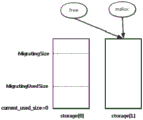
with continuing reference to fig. 2A-2D, fig. 2A-2D are schematic diagrams illustrating migration of memory pools according to an embodiment of the present invention, and it should be noted that, as shown in fig. 2A-2D, a first memory pool is storage [ 0 ], a second memory pool is storage [ 1 ], a first threshold is migrantingsize, a second threshold is migrantingusedsize, a dynamic memory allocation operation is malloc, a memory release operation is free, a current _ used _ size is used memory, a max _ used _ size is allocated memory, and in addition, a dynamic memory allocation operation and a memory release operation are provided by the first memory pool, and a gradual change is performed to provide a dynamic memory allocation operation and a memory release operation by the second memory pool, which is called migration (migrate).
In S1, referring specifically to fig. 2A, when the first memory pool and the second memory pool are in an initial state, the first memory pool is controlled to provide the dynamic memory allocation operation and the memory release operation, and the second memory pool is controlled not to provide the dynamic memory allocation operation and the memory release operation.
In a specific implementation process, controlling the first memory pool to provide the dynamic memory allocation operation and the memory release operation may specifically be receiving a dynamic memory allocation message, and acquiring a memory pool currently responsible for dynamic memory allocation as the first memory pool; allocating the memory in the first memory pool based on the dynamic memory allocation message, and counting the allocated memory and the used memory of the first memory pool; receiving a memory release message, and acquiring a memory pool which is currently responsible for memory release as a first memory pool; and calling a memory release function of the first memory pool to release the memory based on the memory release message. The dynamic memory allocation message may be sent by actually required services or application programs, and the memory release message may be sent by the services or application programs without using the memory, which is not described herein again.
Referring to fig. 2B, as the first memory pool continuously allocates the memory according to the memory allocation message, at this time, the current _ used _ size exceeds the miglatingsize, that is, both the allocated memory and the used memory are greater than the first threshold, at this time, the first memory pool is still controlled to provide the dynamic memory allocation operation and the memory release operation, and the second memory pool is controlled not to provide the dynamic memory allocation operation and the memory release operation.
At S2, referring to fig. 2C, as the memory of the first memory pool is returned continuously, the current _ used _ size gradually decreases until it is lower than the miglitusedsize, that is, the used memory is smaller than the second threshold, and meanwhile, as the max _ used _ size is larger than the miglitusize, that is, the allocated memory is larger than the first value, when the allocated memory of the first memory pool is larger than the first threshold and the used memory is smaller than the second threshold, the first memory pool can be controlled to provide only the memory releasing operation, and the second memory pool is controlled to provide the dynamic memory allocating operation and the memory releasing operation, at this time, the first memory pool is in the migration state.
In a specific implementation process, after receiving the memory release message, the memory corresponding to the memory release message may be released in the following two ways:
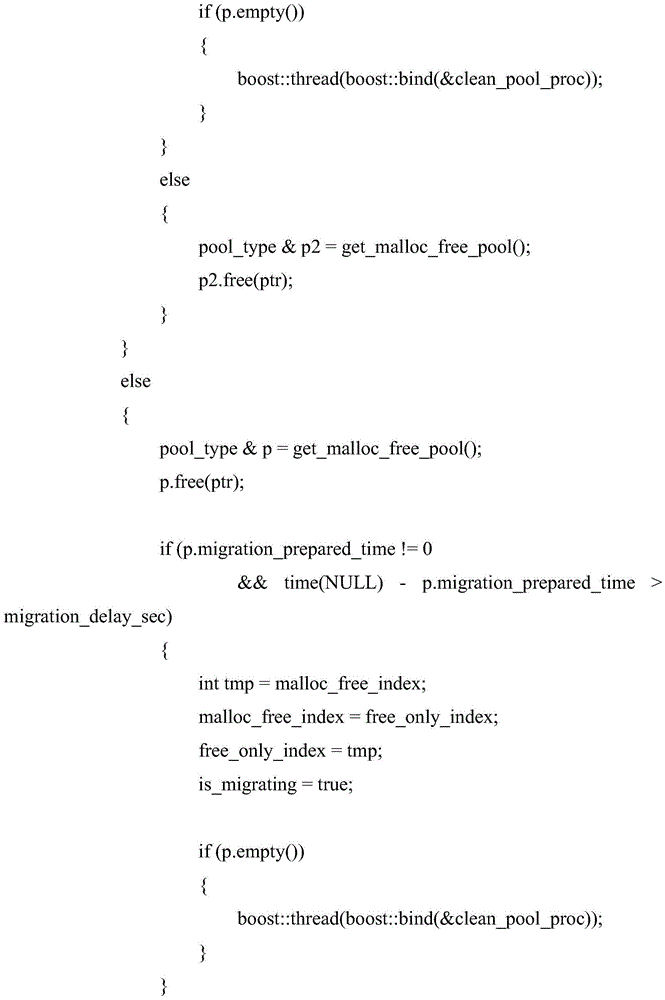
the first method comprises the following steps: receiving a memory release message, acquiring a memory pool which is only currently responsible for memory release as a first memory pool, and specifically acquiring the memory pool which is only currently responsible for memory release by a method of get _ free _ only _ pool, in this embodiment, the memory pool which is only currently responsible for memory release is a first memory pool, and then determining whether a to-be-released memory corresponding to the memory release message belongs to the first memory pool, if so, calling a memory release function of the first memory pool to release the to-be-released memory, otherwise, indicating that the memory corresponding to the memory release message belongs to a second memory pool, and at this time, calling a memory release function of the second memory pool to release the to-be-released memory;
and the second method comprises the following steps: receiving a memory release message, judging whether a to-be-released memory corresponding to the memory release message belongs to a first memory pool or a second memory pool, if the to-be-released memory belongs to the first memory pool, calling a memory release function of the first memory pool to release the to-be-released memory, and if the to-be-released memory belongs to the second memory pool, calling a memory release function released by the second memory pool to release the to-be-released memory.
In practical application, the memory can be released in the following way:
of course, the specific process of allocating the memory in the second memory pool according to the memory allocation message is the same as the process of allocating the memory in the first memory pool according to the memory allocation message described in the foregoing, and thus, the description thereof is omitted here.
In a specific implementation process, in order to avoid that a memory pool applies for a large amount of memory and immediately releases all the memory, which causes that migration operations are too frequent and affect performance of the memory pool, the management method for memory pools provided in an embodiment of the present invention controls a first memory pool to provide a memory release operation when allocated memory of the first memory pool is greater than a first threshold and used memory of the first memory pool is less than a second threshold, and before controlling a second memory pool to provide a dynamic memory allocation operation and a memory release operation, further includes:
monitoring the duration of time that the allocated memory of the first memory pool is greater than a first threshold and the used memory is less than a second threshold; if the duration is greater than a third threshold, executing the steps of: the first memory pool is controlled to provide a memory release operation, and the second memory pool is controlled to provide a dynamic memory allocation operation and a memory release operation.
After monitoring the duration that the allocated memory of the first memory pool is greater than the first threshold and the used memory is less than the second threshold, the method for managing the memory pool provided by the embodiment of the present invention further includes: and at any moment, if the allocated memory is monitored to be smaller than a first threshold value or the used memory is monitored to be larger than a second threshold value, resetting the duration time. Therefore, the existing pool is reused to the maximum extent under the scene of frequently applying for releasing a large amount of memory, and the bottom pool is really released only when the system is not busy any more, so that the operation of a service layer is not blocked.
Referring to fig. 2D, since the memory in the first memory pool is returned continuously and the memory in the first memory pool is not allocated any more, the memory in the first memory pool is returned completely at a certain time, so that the first memory pool can be emptied after the memory in the first memory pool is returned completely, and thus, the memory in the storage [ 0 ] can be reallocated by the operating system again, which is equivalent to the purpose of automatically recycling the memory in the storage [ 0 ].
In the specific implementation process, in order to increase the usability of the memory pool and keep the transparency to the user, the memory pool interface is designed as follows:
wherein the template parameters are as follows
Tag is the unique identifier of the memory pool object, and different objects can be instantiated through different tags
Requestdsize, memory size per request
NextSize is the number of chunks included in the first application block, and the number of subsequent new applications is multiplied by 2
MaxSize, the maximum number of chunk when applying for a new block, 0 represents no upper limit
The above parameters are the same as the boost, and three other parameters
MigratingSize, triggering memory pool migration condition 1 when memory peak value applied by user exceeds the value
MigratingUsedSize, the current memory used by the user is less than the value to trigger the memory migration condition 2
MigratingDelaySec, which satisfies both condition 1 and condition 2 and lasts for this time (one second), only really triggers memory migration
Based on the same inventive concept, a second aspect of the embodiments of the present invention further provides a computer-readable storage medium, on which a computer program is stored, which, when being executed by a processor, implements the steps of the method described in the first aspect.
Based on the same inventive concept, a third aspect of the embodiments of the present invention further provides a computer device, which includes a memory, a processor, and a computer program stored in the memory and running on the processor, where the processor implements the steps of the method described in the first aspect when executing the computer program.
Through one or more embodiments of the present invention, the present invention has the following advantageous effects or advantages:
because the management method provided by the embodiment of the invention adopts two memory pools, and when the allocated memory of the first memory pool is greater than the first threshold value and the used memory is less than the second threshold value, the first memory pool is controlled to only provide the memory release operation, and the second memory pool is controlled to provide the dynamic memory allocation operation and the memory release operation, so that the first memory pool can be always in the memory release state without performing the dynamic memory allocation, the memory of the first memory pool is completely released, after the memory of the first memory pool is completely released, the first memory pool is emptied, the second memory pool is controlled to provide the dynamic memory allocation operation and the memory release operation, and the first memory pool is controlled not to provide the dynamic memory allocation operation and the memory release operation, so that the first memory pool can be completely returned to the operating system, and the problem that the whole block can not be released due to discontinuous chunk addresses of the memory pools in the prior art is solved, the technical problem of high memory occupation is caused, the memory occupation is reduced, and the technical effect of automatically recycling the idle memory is realized.
While the preferred embodiments of the present application have been described, additional variations and modifications in those embodiments may occur to those skilled in the art once they learn of the basic inventive concepts. Therefore, it is intended that the appended claims be interpreted as including preferred embodiments and all alterations and modifications as fall within the scope of the application.
It will be apparent to those skilled in the art that various changes and modifications may be made in the present application without departing from the spirit and scope of the application. Thus, if such modifications and variations of the present application fall within the scope of the claims of the present application and their equivalents, the present application is intended to include such modifications and variations as well.