CN108227494B - Nonlinear batch process 2D optimal constraint fuzzy fault-tolerant control method - Google Patents
Nonlinear batch process 2D optimal constraint fuzzy fault-tolerant control method Download PDFInfo
- Publication number
- CN108227494B CN108227494B CN201810009893.4A CN201810009893A CN108227494B CN 108227494 B CN108227494 B CN 108227494B CN 201810009893 A CN201810009893 A CN 201810009893A CN 108227494 B CN108227494 B CN 108227494B
- Authority
- CN
- China
- Prior art keywords
- model
- fault
- nonlinear
- fuzzy
- batch
- Prior art date
- Legal status (The legal status is an assumption and is not a legal conclusion. Google has not performed a legal analysis and makes no representation as to the accuracy of the status listed.)
- Active
Links
Classifications
-
- G—PHYSICS
- G05—CONTROLLING; REGULATING
- G05B—CONTROL OR REGULATING SYSTEMS IN GENERAL; FUNCTIONAL ELEMENTS OF SUCH SYSTEMS; MONITORING OR TESTING ARRANGEMENTS FOR SUCH SYSTEMS OR ELEMENTS
- G05B13/00—Adaptive control systems, i.e. systems automatically adjusting themselves to have a performance which is optimum according to some preassigned criterion
- G05B13/02—Adaptive control systems, i.e. systems automatically adjusting themselves to have a performance which is optimum according to some preassigned criterion electric
- G05B13/04—Adaptive control systems, i.e. systems automatically adjusting themselves to have a performance which is optimum according to some preassigned criterion electric involving the use of models or simulators
- G05B13/042—Adaptive control systems, i.e. systems automatically adjusting themselves to have a performance which is optimum according to some preassigned criterion electric involving the use of models or simulators in which a parameter or coefficient is automatically adjusted to optimise the performance
Landscapes
- Engineering & Computer Science (AREA)
- Health & Medical Sciences (AREA)
- Artificial Intelligence (AREA)
- Computer Vision & Pattern Recognition (AREA)
- Evolutionary Computation (AREA)
- Medical Informatics (AREA)
- Software Systems (AREA)
- Physics & Mathematics (AREA)
- General Physics & Mathematics (AREA)
- Automation & Control Theory (AREA)
- Feedback Control In General (AREA)
Abstract
本发明目的是改善非线性批次过程中控制方法的控制性能和跟踪性能,提出一种非线性批次过程的2D最优约束模糊容错控制器设计方法。本发明通过批次过程的非线性和二维特性,建立2D T‑S模糊状态空间模型,进一步结合系统状态误差和输出误差,用Roesser模型将原系统的动态模型转化为一个以预测形式表示的闭环故障模糊系统模型,将设计约束模糊迭代学习容错控制律转化为确定约束更新律;根据所设计的无穷优化性能指标和2D系统Lyapunov稳定性理论,以线性矩阵不等式(LMI)约束形式给出确保闭环系统鲁棒渐近稳定的模糊容错更新律实时在线设计。本发明很好解决非线性下系统模型较难处理问题,保证了系统在最差情况下依然能平稳运行,并具有最优的跟踪性能。The purpose of the invention is to improve the control performance and tracking performance of the control method in the nonlinear batch process, and propose a 2D optimal constraint fuzzy fault-tolerant controller design method for the nonlinear batch process. The invention establishes a 2D T-S fuzzy state space model through the nonlinear and two-dimensional characteristics of the batch process, further combines the system state error and output error, and uses the Roesser model to transform the dynamic model of the original system into a prediction form. The closed-loop fault fuzzy system model transforms the design constraint fuzzy iterative learning fault-tolerant control law into a deterministic constraint update law; according to the designed infinite optimization performance index and the Lyapunov stability theory of the 2D system, the guarantee is given in the form of linear matrix inequality (LMI) constraints Real-time online design of robust asymptotically stable fuzzy fault-tolerant update law for closed-loop systems. The invention solves the problem that the system model is difficult to handle under nonlinear conditions, and ensures that the system can still run smoothly under the worst condition and has the best tracking performance.
Description
技术领域technical field
本发明属于工业过程的先进控制领域,涉及一种非线性批次过程2D最优约束模糊容错控制方法。The invention belongs to the advanced control field of industrial processes, and relates to a 2D optimal constraint fuzzy fault-tolerant control method for a nonlinear batch process.
背景技术Background technique
作为生产方式之一的间歇过程,对其系统描述大致有两类,一类是线性的,另一类是非线性的。早期对间歇过程的控制大部分直接针对线性模型,然而在实际工业过程中间歇过程本身具有强非线性特性,线性模型和实际过程之间存在较大的不匹配问题。使得在实际应用中很难达到最佳的控制效果。直接处理非线性系统存在一定的困难。为此需要利用新的模型来逼近非线性系统。As one of the production methods, there are roughly two types of system descriptions for the batch process, one is linear and the other is nonlinear. In the early stage, most of the control of batch process was directly aimed at the linear model. However, in the actual industrial process, the batch process itself has strong nonlinear characteristics, and there is a large mismatch between the linear model and the actual process. It is difficult to achieve the best control effect in practical application. There are certain difficulties in directly dealing with nonlinear systems. For this reason, a new model is needed to approximate the nonlinear system.
随着生产规模的增大,以及生产步骤复杂程度的增加,实际生产中存在的不确定性日益凸显,不仅影响到了系统的高效平稳运行,甚至威胁到了产品的质量。而且这些复杂的操作条件,相应的增加了系统故障出现的机率。其中,执行器故障是一种常见的故障,会影响工艺过程的操作和降低控制性能,甚至危害人身安全。虽然批次处理过程中出现了诸如迭代学习可靠容错控制等控制方法,能很好地解决了发生执行器故障时系统依然稳定运行的控制问题。但对于具有高精密程度的设备来说,故障发生的可能极低,若不管有没有故障,均使用可靠控制将会造成资源的浪费,长此以往,成本也会增加,显然并不符合节能减排的环保理念。在发生严重故障时可靠控制律可能完全失去控制作用,这种情况下极有可能导致系统崩溃,造成重大的财产损失和人员伤亡。With the increase of production scale and the complexity of production steps, the uncertainty in actual production has become increasingly prominent, which not only affects the efficient and stable operation of the system, but even threatens the quality of products. Moreover, these complex operating conditions correspondingly increase the probability of system failure. Among them, the actuator failure is a common failure, which will affect the operation of the process and reduce the control performance, and even endanger personal safety. Although control methods such as iterative learning reliable fault-tolerant control appear in the batch processing process, it can solve the control problem that the system still runs stably when the actuator fails. However, for high-precision equipment, the probability of failure is extremely low. If there is no failure, using reliable control will result in a waste of resources. If things go on like this, the cost will also increase, which is obviously not in line with energy conservation and emission reduction. Environmental concept. In the event of a serious failure, the reliable control law may completely lose its control function. In this case, it is very likely that the system will collapse, resulting in heavy property damage and casualties.
此外,现阶段采用的鲁棒迭代学习可靠控制策略虽然可以有效地抵制生产环节中的不确定性及故障所带来的影响,保证系统的稳定性,维持系统的控制性能,但该控制律是基于整个生产过程而求解得出,在控制效果上属于覆盖全局的优化控制,即自始至终使用同一控制律。然而,在实际运行时,在干扰及故障影响下,系统状态不可能完全按照所求得的控制律作用而变化;若当前时刻的系统状态与设定值发生一定的偏离时,仍继续采用同一控制律,随着时间的推移,系统状态的偏离会愈发增大,而现行的鲁棒迭代学习可靠控制方法无法解决系统状态偏离的问题,这势必会对系统的稳定运行和控制性能产生不良的影响。此外,对于控制律设计及系统输出,已有文献并没有考虑约束问题,而在实际生产过程中,必须要考虑约束。In addition, although the robust iterative learning and reliable control strategy adopted at this stage can effectively resist the influence of uncertainties and faults in the production process, ensure the stability of the system, and maintain the control performance of the system, the control law is Based on the solution of the whole production process, it is obtained that the control effect belongs to the optimal control covering the whole world, that is, the same control law is used from beginning to end. However, in actual operation, under the influence of disturbance and fault, the system state cannot completely change according to the obtained control law; if the system state at the current moment deviates from the set value to a certain extent, the same Control law, with the passage of time, the deviation of the system state will increase, and the current robust iterative learning and reliable control method cannot solve the problem of system state deviation, which will inevitably lead to poor system stability and control performance. Impact. In addition, for control law design and system output, the existing literature does not consider constraints, but in the actual production process, constraints must be considered.
模型预测控制(MPC)能够很好地满足控制律实时更新修正的需要,通过“滚动优化”和“反馈校正”的方式获得每一时刻的最优控制律,确保系统状态能够尽可能地沿着设定的轨迹运行。然而,现有技术大多采用的是一维形式的无限时域的控制律,批次间缺少“学习”的过程,控制效果并未随着批次的递增而得到改善;还有一种只考虑批次间“学习”的过程,这种方法不能实现初值不确定的间歇过程的控制问题。很显然,针对具有不确定性及故障的系统无穷时域约束优化问题的讨论有待于继续深入。因而急需提出一种新的控制方法来弥补现有方法的不足,以实现批次生产过程中节能减耗、降低成本甚至降低危害人身安全事故发生等目标。Model Predictive Control (MPC) can well meet the needs of real-time update and correction of the control law, and obtain the optimal control law at each moment by means of "rolling optimization" and "feedback correction" to ensure that the system state can follow as much as possible. The set trajectory runs. However, most of the existing technologies use a one-dimensional control law in an infinite time domain. There is a lack of "learning" process between batches, and the control effect is not improved with the increment of batches; there is another method that only considers batches The process of "learning" between times, this method cannot realize the control problem of intermittent process with uncertain initial value. Obviously, the discussion of infinite time-domain constrained optimization problems for systems with uncertainties and faults needs to be further discussed. Therefore, it is urgent to propose a new control method to make up for the deficiencies of the existing methods, so as to achieve the goals of energy saving, cost reduction, and even the occurrence of accidents that endanger personal safety in the batch production process.
现行的预测控制技术大多在一维方向上设计控制律,只考虑时间方向或批次方向,只考虑时间方向使得每一批次只是单纯的重复,控制性能无法随着批次的递增而得到完善;只考虑批次方向不能实现初值不确定的间歇过程的控制问题。尽管也有少数成果考虑时间及批次方向,但是针对非线性及执行器故障等情况,目前并没有好的研究成果。Most of the current predictive control technologies design control laws in one-dimensional direction, only consider the time direction or batch direction, and only consider the time direction, so that each batch is only a simple repetition, and the control performance cannot be improved with the increase of batches. ; Only considering the batch direction can not realize the control problem of batch process with uncertain initial value. Although there are a few results considering time and batch direction, there are no good research results for nonlinear and actuator failures.
因此说,为解决上述存在的诸多问题,响应生产过程中节能减排等号召,保证系统的控制性能,提出一种非线性批次过程无穷时域优化2D模糊约束容错控制方法极为必要。Therefore, in order to solve the above problems, respond to the call for energy saving and emission reduction in the production process, and ensure the control performance of the system, it is extremely necessary to propose a 2D fuzzy constraint fault-tolerant control method for nonlinear batch process optimization in infinite time domain.
发明内容SUMMARY OF THE INVENTION
为了解决上述存在的技术问题,本发明提供一种非线性批次过程2D最优模糊约束容错控制方法。对具有非线性干扰及执行器故障的批次过程模型设计出非线性无穷时域优化的2D模糊迭代学习控制律。利用此设计方法设计控制律,不仅能够保证系统在发生故障时平稳运行,以实现节能减耗、降低成本等目标,甚至还可以实现降低危害人身安全事故发生等目标。In order to solve the above existing technical problems, the present invention provides a 2D optimal fuzzy constraint fault-tolerant control method for a nonlinear batch process. A 2D fuzzy iterative learning control law for nonlinear infinite time domain optimization is designed for batch process models with nonlinear disturbances and actuator failures. Using this design method to design the control law can not only ensure the smooth operation of the system when a fault occurs, so as to achieve the goals of energy saving, consumption reduction and cost reduction, and even reduce the occurrence of accidents that endanger personal safety.
本发明目的是改善非线性批次过程中控制方法的控制性能和跟踪性能,提出非线性批次过程的2D最优约束模糊容错控制器设计方法。本发明通过批次过程的非线性和二维特性,建立2D T-S模糊状态空间模型,进一步结合系统状态误差和输出误差,用Roesser模型将原系统的动态模型转化为一个以预测形式表示的闭环故障系统模型,将设计约束迭代学习容错控制律转化为确定约束更新律;根据所设计的无穷优化性能指标和2D系统Lyapunov稳定性理论,以线性矩阵不等式(LMI)约束形式给出确保闭环系统鲁棒渐近稳定的模糊容错更新律实时在线设计。本发明致力于非线性批次过程执行器发生故障情况下模糊最优容错控制器设计。首先解决非线性下系统模型较难处理问题,其次解决发生故障情况下约束容错控制律设计,此控制算法最终可达到节能减耗、降低成本、降低危害人身安全事故发生等目标。The purpose of the invention is to improve the control performance and tracking performance of the control method in the nonlinear batch process, and propose a 2D optimal constraint fuzzy fault-tolerant controller design method for the nonlinear batch process. The invention establishes a 2D T-S fuzzy state space model through the nonlinear and two-dimensional characteristics of the batch process, further combines the system state error and output error, and uses the Roesser model to convert the dynamic model of the original system into a closed-loop fault expressed in the form of prediction The system model transforms the design constraint iterative learning fault-tolerant control law into a deterministic constraint update law; according to the designed infinite optimization performance index and the Lyapunov stability theory of the 2D system, it is given in the form of Linear Matrix Inequality (LMI) constraints to ensure the robustness of the closed-loop system Asymptotically stable fuzzy fault-tolerant update law real-time online design. The present invention is devoted to the design of a fuzzy optimal fault-tolerant controller in the event of a failure of a nonlinear batch process executor. Firstly, it solves the problem that the nonlinear system model is difficult to deal with, and secondly, it solves the design of the constrained fault-tolerant control law in the event of failure.
本发明是通过以下技术方案实现的:The present invention is achieved through the following technical solutions:
非线性批次过程2D最优约束模糊容错控制方法,该方法的具体步骤是:A 2D optimal constrained fuzzy fault-tolerant control method for nonlinear batch processes. The specific steps of the method are:
步骤1、建立非线性批次过程等价2D-Rosser误差增广模型:Step 1. Establish a nonlinear batch process equivalent 2D-Rosser error augmentation model:
步骤1.1考虑执行器增益故障,根据批次过程的非线性和二维特性,建立2D T-S模糊故障状态空间模型,由式(1)表示:Step 1.1 Considering the actuator gain fault, according to the nonlinear and two-dimensional characteristics of the batch process, a 2D T-S fuzzy fault state space model is established, which is expressed by equation (1):

且其输入、输出约束满足:
其中,x(t,k),y(t,k),u(t,k),ω(t,k)分别表示系统的状态,系统的输出,系统的控制输入以及未知扰动;


定义不同的α值表示执行器不同的故障类型,当α>0时,表示部分失效故障;当α=0时,表示完全失效故障,不涉及最优控制器的问题;Different α values are defined to represent different fault types of the actuator. When α>0, it means a partial failure; when α=0, it means a complete failure, which does not involve the problem of the optimal controller;
对于执行器部分失效,α>0需满足如下形式:For the partial failure of the actuator, α>0 must satisfy the following form:

式中,

步骤1.2设计2D迭代学习控制器u(t,k),如式(3)所示:Step 1.2 Design a 2D iterative learning controller u(t,k), as shown in equation (3):

由此可知,设计u(t,k),只需设计k批次t时刻更新律r(t,k),以实现系统输出y(t,k)跟踪所给定的期望输出yd(t,k);It can be seen that, to design u(t,k), we only need to design the update law r(t,k) at time t in k batches, so that the system output y(t,k) can track the given expected output y d (t ,k);
步骤1.3定义批次方向上的状态误差及输出误差如下:Step 1.3 Define the state error and output error in the batch direction as follows:
δ(x(t,k))=x(t,k)-x(t,k-1) (4a)δ(x(t,k))=x(t,k)-x(t,k-1) (4a)

令

其中,

δ(hi(x(t,k)))=hi(x(t,k))-hi(x(t,k-1)),


其中,
步骤2、对具有干扰及执行器故障的批次过程模型设计出迭代学习控制律:Step 2. Design an iterative learning control law for the batch process model with disturbance and actuator failure:
步骤2.1对于上述模型(5)设计2D预测容错控制器,达到在最大干扰及最大故障下的最小优化控制,即使模型(5)达到稳态且在每一时刻满足下面的鲁棒性能指标:Step 2.1 Design a 2D predictive fault-tolerant controller for the above model (5) to achieve the minimum optimal control under the maximum disturbance and maximum fault, even if the model (5) reaches a steady state and satisfies the following robust performance indicators at each moment:


限制:
并且Q(Q>0)和R(R>0)是适当维数的加权矩阵,r(t+i|t,k)是时刻t对t+i时刻输入的预测值,并且r(t,k)=r(t|t,k),
步骤2.2定义状态反馈控制律,使系统达到二次稳定,选取的更新律为:Step 2.2 Define the state feedback control law to make the system achieve quadratic stability. The selected update law is:

则(5)的闭环模型表示为:Then the closed-loop model of (5) is expressed as:

其中,

步骤2.3利用2D Lyapunov函数证明系统的稳定,定义Lyapunov函数为:Step 2.3 Use the 2D Lyapunov function to prove the stability of the system, and define the Lyapunov function as:

其中,M>0
步骤2.4模型(8c)在故障允许范围内依然能平稳运行,必须满足:Step 2.4 Model (8c) can still run smoothly within the allowable range of faults, and must meet:
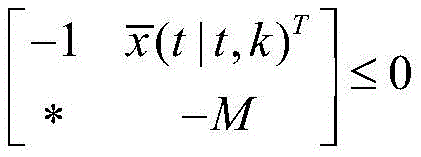
(1)2D李亚普诺夫函数不等式约束:(1) 2D Lyapunov function inequality constraints:

(2)对于给定半正定对称矩阵R,Q,存在正定对称矩阵M=diag{Mh,Mv},半正定对称矩阵


其中,
鲁棒更新律增益为:
因此,进一步更新律表示为:
与现有技术相比,本发明的有益效果为:Compared with the prior art, the beneficial effects of the present invention are:
该方法在针对具有非线性、干扰及故障的控制系统模型基础上设计出模糊容错迭代学习控制律,引入状态误差和输出误差,用Roesser模型将原系统的动态模型转化为一个以预测形式表示的闭环系统模型,将设计模糊容错迭代学习控制律转化为确定更新律;根据所设计的无穷优化性能指标和2D系统Lyapunov稳定性理论,以线性矩阵不等式(LMI)约束形式给出确保闭环系统鲁棒渐近稳定的更新律实时在线设计,有效解决非线性下系统模型较难处理问题及发生故障情况下约束模糊最优容错控制律设计问题。有效地解决了非线性批次过程的控制性能无法随着批次的递增而得到完善,实现系统不管有没有故障,在变量约束范围内均能实时优化,改善了系统控制性能,保证了系统在最差情况下依然能平稳运行并具有最优的跟踪性能。最终达到节能减耗、降低成本、降低危害人身安全事故的发生。This method designs a fuzzy fault-tolerant iterative learning control law on the basis of the control system model with nonlinearity, disturbance and fault, introduces state error and output error, and uses the Roesser model to transform the dynamic model of the original system into a predictive model. The closed-loop system model transforms the designed fuzzy fault-tolerant iterative learning control law into a deterministic update law; according to the designed infinite optimization performance index and the Lyapunov stability theory of the 2D system, it is given in the form of Linear Matrix Inequality (LMI) constraints to ensure the robustness of the closed-loop system The asymptotically stable update law is designed online in real time, which can effectively solve the problem that the nonlinear system model is difficult to handle and the design of the constrained fuzzy optimal fault-tolerant control law in the event of a fault. It effectively solves the problem that the control performance of the nonlinear batch process cannot be improved with the increment of the batch, and realizes that the system can be optimized in real time within the range of variable constraints regardless of whether there is a fault. Worst-case smooth operation and optimal tracking performance. Ultimately, it can save energy and reduce consumption, reduce costs, and reduce the occurrence of accidents that endanger personal safety.
具体实施方式Detailed ways
下面结合具体实施例对本发明做进一步的说明。The present invention will be further described below with reference to specific embodiments.
非线性批次过程2D最优约束模糊容错控制方法,该方法的具体步骤是:A 2D optimal constrained fuzzy fault-tolerant control method for nonlinear batch processes. The specific steps of the method are:
步骤1、建立非线性批次过程等价2D-Rosser误差增广模型:Step 1. Establish a nonlinear batch process equivalent 2D-Rosser error augmentation model:
步骤1.1考虑执行器增益故障,根据批次过程的非线性和二维特性,建立2D T-S模糊故障状态空间模型,由式(1)表示:Step 1.1 Considering the actuator gain fault, according to the nonlinear and two-dimensional characteristics of the batch process, a 2D T-S fuzzy fault state space model is established, which is expressed by equation (1):

且其输入、输出约束满足:
其中,x(t,k),y(t,k),u(t,k),ω(t,k)分别表示系统的状态,系统的输出,系统的控制输入以及未知扰动;


定义不同的α值表示执行器不同的故障类型,当α>0时,表示部分失效故障;当α=0时,表示完全失效故障,不涉及最优控制器的问题;Different α values are defined to represent different fault types of the actuator. When α>0, it means a partial failure; when α=0, it means a complete failure, which does not involve the problem of the optimal controller;
对于执行器部分失效,α>0需满足如下形式:For the partial failure of the actuator, α>0 must satisfy the following form:

式中,α(α≤1)和
步骤1.2设计2D迭代学习控制器u(t,k),如式(3)所示:Step 1.2 Design a 2D iterative learning controller u(t,k), as shown in equation (3):

由此可知,设计u(t,k),只需设计k批次t时刻更新律r(t,k),以实现系统输出y(t,k)跟踪所给定的期望输出yd(t,k);It can be seen that, to design u(t,k), we only need to design the update law r(t,k) at time t in k batches, so that the system output y(t,k) can track the given expected output y d (t ,k);
步骤1.3定义批次方向上的状态误差及输出误差如下:Step 1.3 Define the state error and output error in the batch direction as follows:
δ(x(t,k))=x(t,k)-x(t,k-1) (4a)δ(x(t,k))=x(t,k)-x(t,k-1) (4a)

令

其中,

δ(hi(x(t,k)))=hi(x(t,k))-hi(x(t,k-1)),


其中,
步骤2、对具有干扰及执行器故障的批次过程模型设计出迭代学习控制律:Step 2. Design an iterative learning control law for the batch process model with disturbance and actuator failure:
步骤2.1对于上述模型(5)设计2D预测容错控制器,达到在最大干扰及最大故障下的最小优化控制,即使模型(5)达到稳态且在每一时刻满足下面的鲁棒性能指标:Step 2.1 Design a 2D predictive fault-tolerant controller for the above model (5) to achieve the minimum optimal control under the maximum disturbance and maximum fault, even if the model (5) reaches a steady state and satisfies the following robust performance indicators at each moment:


限制:
并且Q(Q>0)和R(R>0)是适当维数的加权矩阵,r(t+i|t,k)是时刻t对t+i时刻输入的预测值,并且r(t,k)=r(t|t,k),
步骤2.2定义状态反馈控制律,使系统达到二次稳定,选取的更新律为:Step 2.2 Define the state feedback control law to make the system achieve quadratic stability. The selected update law is:

则(5)的闭环模型表示为:Then the closed-loop model of (5) is expressed as:

其中,

步骤2.3利用2D Lyapunov函数证明系统的稳定,定义Lyapunov函数为:Step 2.3 Use the 2D Lyapunov function to prove the stability of the system, and define the Lyapunov function as:

其中,M>0
步骤2.4模型(8c)在故障允许范围内依然能平稳运行,必须满足:Step 2.4 Model (8c) can still run smoothly within the allowable range of faults, and must meet:
(1)2D李亚普诺夫函数不等式约束:(1) 2D Lyapunov function inequality constraints:

(2)对于给定半正定对称矩阵R,Q,存在正定对称矩阵M=diag{Mh,Mv},半正定对称矩阵


其中,
鲁棒更新律增益为:
因此,进一步更新律表示为:
实施例Example
考虑一个非线性连续搅拌罐:Consider a nonlinear continuous stirred tank:


其中,CA为不可逆反应(A→B)过程中A的浓度;T为反应釜温度;TC为冷却流温度,做为操纵变量q=100(L/min),V=100(L),CAf=1(mol/L),Tf=400(K),ρ=1000(g/L),CP=1(J/gK),k0=4.71×108(min-1),E/R=8000(K),ΔH=-2×105(J/mol),UA=1×105(J/minK)。变量范围限制为200≤TC≤450(K),0.01≤CA≤1(mol/L),250≤T≤500(K);y(t,k)=Cx(t,k)是输出。以上非线性模型转化为:Among them, C A is the concentration of A in the irreversible reaction (A→B) process; T is the temperature of the reactor; T C is the temperature of the cooling flow, as the manipulated variable q=100 (L/min), V=100 (L) , C Af =1(mol/L), T f =400(K), ρ=1000(g/L), C P =1(J/gK), k 0 =4.71×10 8 (min −1 ) , E/R=8000 (K), ΔH=-2×10 5 (J/mol), UA=1×10 5 (J/minK). The variable range is limited to 200≤T C ≤450(K), 0.01≤C A ≤1(mol/L), 250≤T≤500(K); y(t,k)=Cx(t,k) is the output . The above nonlinear model transforms into:


其中,


C=[1 0]C=[1 0]
控制目标是让反应堆温度遵循给定的曲线:The control objective is to make the reactor temperature follow a given curve:

模拟进行了50个批次,每批都运行600步。评估指标使用平方和求根误差(RSSE)用于评价控制效果。The simulation was run in 50 batches, each running 600 steps. The evaluation index uses the sum of square root error (RSSE) to evaluate the control effect.

计算出来的初始阶段控制器增益是:The calculated initial stage controller gains are:
K1=[-0.0905 0.0041 0.5031];K1=[-0.0905 0.0041 0.5031];
K2=[0.1120 0.0021 0.5799];K2=[0.1120 0.0021 0.5799];
K3=[0.1344 -0.0078 0.2622];K3 = [0.1344 -0.0078 0.2622];
K4=[0.0260 0.0042 0.4630]。K4=[0.0260 0.0042 0.4630].
该方法针对非线性批次过程在具有干扰及故障的情况下设计出模糊迭代学习控制律,有效解决非线性下系统模型较难处理问题及发生故障情况下约束模糊最优容错控制方法设计问题。有效地解决了非线性批次过程的控制性能无法随着批次的递增而得到完善,实现系统不管有没有故障,在变量约束范围内均能实时优化,改善了系统控制性能,保证了系统在最差情况下依然能平稳运行并具有最优的跟踪性能。最终达到节能减耗、降低成本、降低危害人身安全事故的发生。This method designs a fuzzy iterative learning control law for the nonlinear batch process with disturbances and faults, and effectively solves the problem that the nonlinear system model is difficult to handle and the design of the constrained fuzzy optimal fault-tolerant control method in the event of a fault. It effectively solves the problem that the control performance of the nonlinear batch process cannot be improved with the increment of the batch, realizes that the system can be optimized in real time within the range of variable constraints regardless of whether there is a fault or not, improves the control performance of the system, and ensures that the system can Worst-case smooth operation and optimal tracking performance. Ultimately, it can save energy and reduce consumption, reduce costs, and reduce the occurrence of accidents that endanger personal safety.
Claims (1)








Priority Applications (1)
| Application Number | Priority Date | Filing Date | Title |
|---|---|---|---|
| CN201810009893.4A CN108227494B (en) | 2018-01-05 | 2018-01-05 | Nonlinear batch process 2D optimal constraint fuzzy fault-tolerant control method |
Applications Claiming Priority (1)
| Application Number | Priority Date | Filing Date | Title |
|---|---|---|---|
| CN201810009893.4A CN108227494B (en) | 2018-01-05 | 2018-01-05 | Nonlinear batch process 2D optimal constraint fuzzy fault-tolerant control method |
Publications (2)
| Publication Number | Publication Date |
|---|---|
| CN108227494A CN108227494A (en) | 2018-06-29 |
| CN108227494B true CN108227494B (en) | 2022-01-04 |
Family
ID=62642838
Family Applications (1)
| Application Number | Title | Priority Date | Filing Date |
|---|---|---|---|
| CN201810009893.4A Active CN108227494B (en) | 2018-01-05 | 2018-01-05 | Nonlinear batch process 2D optimal constraint fuzzy fault-tolerant control method |
Country Status (1)
| Country | Link |
|---|---|
| CN (1) | CN108227494B (en) |
Families Citing this family (25)
| Publication number | Priority date | Publication date | Assignee | Title |
|---|---|---|---|---|
| CN108107723B (en) * | 2017-11-28 | 2020-11-06 | 辽宁石油化工大学 | 2D optimal fuzzy controller design method for nonlinear intermittent process |
| CN108628275A (en) * | 2018-07-04 | 2018-10-09 | 杭州电子科技大学 | A kind of chemical engineering industry process fuzzy constraint control method |
| CN108873688B (en) * | 2018-07-11 | 2021-02-09 | 杭州电子科技大学 | Chemical industry process performance maintaining control method |
| CN108897219B (en) * | 2018-07-11 | 2021-02-09 | 杭州电子科技大学 | Chemical uncertain industrial process constraint prediction control method |
| CN109100941B (en) * | 2018-10-11 | 2022-01-04 | 海南师范大学 | Multi-stage intermittent process two-dimensional anti-interference prediction controller design method |
| CN109541940B (en) * | 2018-11-13 | 2022-03-29 | 海南师范大学 | Multi-stage intermittent process limited prediction hybrid fault-tolerant control method based on 2D model |
| CN109471364B (en) * | 2018-12-28 | 2020-10-27 | 西安交通大学 | A Reliable Control Method for Nonlinear Switching Systems with Actuator Faults |
| CN109991853B (en) * | 2019-04-23 | 2022-01-25 | 海南师范大学 | Multi-stage intermittent process 2D input and output constraint tracking control method |
| CN110045611B (en) * | 2019-04-24 | 2020-10-09 | 华北电力大学 | A Robust Iterative Learning Model Predictive Control Method for Batch Stirred Tank Reactors |
| CN110018639A (en) * | 2019-05-10 | 2019-07-16 | 杭州电子科技大学 | The robust Fault-Tolerant Control method of network control system based on two type T-S model of section |
| CN110442028B (en) * | 2019-09-09 | 2022-09-27 | 南京工程学院 | Anti-bifurcation control method based on fuzzy prediction |
| CN110750049B (en) * | 2019-09-23 | 2022-03-29 | 海南师范大学 | Intermittent process 2D prediction fault-tolerant control method with time lag and disturbance |
| CN110658724B (en) * | 2019-11-20 | 2021-12-10 | 电子科技大学 | Self-adaptive fuzzy fault-tolerant control method for nonlinear system |
| CN111142503B (en) * | 2019-12-30 | 2023-03-21 | 山东科技大学 | Fault diagnosis method and system based on iterative learning observer |
| CN112180717B (en) * | 2020-10-14 | 2021-09-03 | 河北工业大学 | Heat exchanger temperature fuzzy control method and system based on 2D model |
| CN113093536B (en) * | 2021-03-23 | 2022-06-03 | 南京航空航天大学 | Adaptive incremental optimization fault-tolerant control method for nonlinear system actuator faults |
| CN113625563B (en) * | 2021-08-06 | 2024-03-15 | 江南大学 | A quantitative iterative learning fault-tolerant control method for DC motors |
| CN113848847B (en) * | 2021-08-30 | 2024-06-04 | 北京工业大学 | Nonlinear control system fault detection method based on T-S fuzzy model |
| CN114035523B (en) * | 2021-11-11 | 2024-07-05 | 海南师范大学 | Industrial process fault-tolerant control method based on data-driven Q-learning |
| CN114237187A (en) * | 2021-12-20 | 2022-03-25 | 杭州电子科技大学 | Constraint learning advanced control method for industrial process |
| CN114594685B (en) * | 2022-02-25 | 2025-04-25 | 中国核电工程有限公司 | Batch reaction control method and control device |
| CN114721268B (en) * | 2022-04-08 | 2022-11-04 | 江南大学 | Robust heuristic iterative learning control method for injection molding nozzle pressure |
| CN114924483A (en) * | 2022-05-05 | 2022-08-19 | 南京航空航天大学 | Fault-tolerant control method for actuating mechanism of aero-engine based on LQR-CA |
| CN116560221A (en) * | 2023-02-02 | 2023-08-08 | 电子科技大学 | A Control Method of Servo Motor System with Data Loss and Time Delay |
| CN117472027A (en) * | 2023-11-15 | 2024-01-30 | 无锡学院 | A fault-tolerant control method, system, electronic equipment and medium for actuator failure |
Citations (8)
| Publication number | Priority date | Publication date | Assignee | Title |
|---|---|---|---|---|
| US5357436A (en) * | 1992-10-21 | 1994-10-18 | Rockwell International Corporation | Fuzzy logic traffic signal control system |
| CN103488092A (en) * | 2013-10-16 | 2014-01-01 | 哈尔滨工业大学 | Satellite fault diagnosis and fault-tolerant control method based on T-S fuzzy model and learning observer |
| CN103488080B (en) * | 2013-09-09 | 2015-11-11 | 河北科技师范学院 | Moon craft based on layered fuzzy system is coordinated to drive adaptive fusion method |
| WO2016070095A1 (en) * | 2014-11-01 | 2016-05-06 | SMS/800, Inc. | Toll-free telecommunications management platform |
| CN105683873A (en) * | 2013-04-27 | 2016-06-15 | 谷歌公司 | Fault-tolerant input method editor |
| CN105988368A (en) * | 2016-07-27 | 2016-10-05 | 江南大学 | Fault-tolerant control method for networked control system with time-varying delay |
| CN106257873A (en) * | 2016-07-16 | 2016-12-28 | 江南大学 | A kind of uncatalyzed coking H ∞ fault tolerant control method of nonlinear network networked control systems |
| CN107038477A (en) * | 2016-08-10 | 2017-08-11 | 哈尔滨工业大学深圳研究生院 | A kind of neutral net under non-complete information learns the estimation method of combination with Q |
-
2018
- 2018-01-05 CN CN201810009893.4A patent/CN108227494B/en active Active
Patent Citations (8)
| Publication number | Priority date | Publication date | Assignee | Title |
|---|---|---|---|---|
| US5357436A (en) * | 1992-10-21 | 1994-10-18 | Rockwell International Corporation | Fuzzy logic traffic signal control system |
| CN105683873A (en) * | 2013-04-27 | 2016-06-15 | 谷歌公司 | Fault-tolerant input method editor |
| CN103488080B (en) * | 2013-09-09 | 2015-11-11 | 河北科技师范学院 | Moon craft based on layered fuzzy system is coordinated to drive adaptive fusion method |
| CN103488092A (en) * | 2013-10-16 | 2014-01-01 | 哈尔滨工业大学 | Satellite fault diagnosis and fault-tolerant control method based on T-S fuzzy model and learning observer |
| WO2016070095A1 (en) * | 2014-11-01 | 2016-05-06 | SMS/800, Inc. | Toll-free telecommunications management platform |
| CN106257873A (en) * | 2016-07-16 | 2016-12-28 | 江南大学 | A kind of uncatalyzed coking H ∞ fault tolerant control method of nonlinear network networked control systems |
| CN105988368A (en) * | 2016-07-27 | 2016-10-05 | 江南大学 | Fault-tolerant control method for networked control system with time-varying delay |
| CN107038477A (en) * | 2016-08-10 | 2017-08-11 | 哈尔滨工业大学深圳研究生院 | A kind of neutral net under non-complete information learns the estimation method of combination with Q |
Non-Patent Citations (2)
| Title |
|---|
| Fault Tolerant Control for T-S Fuzszy Systems With Simultaneous Actuator Sensor Faults;Fuqiang,等;《IEEE》;20171231;第7497-7502页 * |
| 基于 T-S 模糊模型的间歇过程的迭代学习容错控制;王立敏,等;《化工学报》;20170331(第3期);第1081-1089页 * |
Also Published As
| Publication number | Publication date |
|---|---|
| CN108227494A (en) | 2018-06-29 |
Similar Documents
| Publication | Publication Date | Title |
|---|---|---|
| CN108227494B (en) | Nonlinear batch process 2D optimal constraint fuzzy fault-tolerant control method | |
| Huang et al. | LSTM-MPC: A deep learning based predictive control method for multimode process control | |
| Sui et al. | Finite-time adaptive quantized control of stochastic nonlinear systems with input quantization: A broad learning system based identification method | |
| Sheikholeslam et al. | Design of adaptive fuzzy wavelet neural sliding mode controller for uncertain nonlinear systems | |
| CN111459051B (en) | Discrete terminal sliding mode model-free control method with disturbance observer | |
| Song et al. | Fixed-time fuzzy adaptive fault-tolerant control for strict-feedback nonlinear systems with input delay | |
| CN109212974A (en) | The robust fuzzy of Interval time-varying delay system predicts fault tolerant control method | |
| Zhao et al. | The fuzzy PID control optimized by genetic algorithm for trajectory tracking of robot arm | |
| CN113359445A (en) | Distributed output feedback asymptotic consistent control method for multi-agent hysteresis system | |
| CN109212971A (en) | Multistage batch process 2D linear quadratic tracks fault tolerant control method | |
| Yang et al. | A fuzzy adaptive tracking control for a class of uncertain strick-feedback nonlinear systems with dead-zone input | |
| Dai et al. | Modified noise-immune fuzzy neural network for solving the quadratic programming with equality constraint problem | |
| CN110597055B (en) | Uncertainty-resistant 2D piecewise affine intermittent process minimum-maximum optimization prediction control method | |
| CN110750049B (en) | Intermittent process 2D prediction fault-tolerant control method with time lag and disturbance | |
| CN118011775A (en) | DL-based PID control method and system for high-order unknown nonlinear systems | |
| CN109581873A (en) | The finite time specified performance control algolithm of unknown actuator dead zone switching system | |
| CN100547504C (en) | A Predictive Control Method for Industrial Processes Based on Fuzzy Objectives and Fuzzy Constraints | |
| Han et al. | Self-organizing model predictive control for constrained nonlinear systems | |
| CN106094524A (en) | The rapid model prediction control method compensated based on input trend | |
| CN110412873A (en) | Terminal Constraint-Based 2D Iterative Learning Predictive Control Method for Time-Delay Intermittent Processes | |
| CN109828459A (en) | A kind of steady control method based on Multivariable Constrained interval prediction control | |
| CN111880415A (en) | Random prediction fault-tolerant control method for CSTR (continuous stirred tank reactor) temperature system with actuator fault | |
| Mahmood et al. | A wavelet neural network-based NARMA-L2 feedforward controller using genetic algorithms to control nonlinear systems | |
| CN111797363A (en) | Data-based self-learning trajectory tracking method for sewage treatment system | |
| CN118584859A (en) | Generative artificial intelligence driven intelligent collaborative control system and method for complex dynamic systems |
Legal Events
| Date | Code | Title | Description |
|---|---|---|---|
| PB01 | Publication | ||
| PB01 | Publication | ||
| SE01 | Entry into force of request for substantive examination | ||
| SE01 | Entry into force of request for substantive examination | ||
| GR01 | Patent grant | ||
| GR01 | Patent grant |