Ultrasonic modification method for improving efficiency of clay in treatment of harmful algal blooms
Technical Field
The invention belongs to the technical field of harmful algal bloom prevention and control, and particularly relates to a method for improving the efficiency of clay treatment of harmful algal blooms by using an ultrasonic enhanced synergistic mode.
Background
Harmful algal blooms are an abnormal ecological phenomenon in which aquatic algae affect the growth of other organisms and the structure of normal food chains by producing algal toxins or increasing biomass, and are harmful to the ecological environment and human health. Harmful algal bloom organisms affect the survival of aquatic organisms in ways of producing and discharging toxins, damaging tissues of the aquatic organisms, polluting the physical and chemical environment of a water body and the like, further affect mariculture, destroy a marine ecosystem and the environmental health, and even directly harm human health. In recent years, the phenomenon of harmful algal blooms which cause serious harm frequently appears; meanwhile, some new harmful algal bloom disaster-causing biological species further increase the difficulty of harmful algal bloom treatment.
Hitherto, reported methods for treating harmful algal blooms can be classified into physical methods, biological methods, chemical methods, clay mineral flocculation methods, and the like. The physical method mainly removes algae directly by means of salvaging, isolating, cracking and the like, basically does not produce secondary pollution, is simple to operate, has high cost and is only suitable for small-range emergency treatment. The biological method mainly kills harmful algal bloom organisms by means of parasitism of microorganisms, ingestion of aquatic organisms and the like, does not produce secondary pollution, is difficult to implement and high in cost, can bring about the problem of invasion of foreign species, and can produce toxin accumulation in organisms ingesting toxic algae. The chemical method is mainly characterized in that a chemical reagent is added into a water body to inhibit the growth of harmful algal bloom organisms or directly kill the harmful algal bloom organisms, part of the chemical reagent also has the function of flocculating algal settlement, the chemical method is simple to operate and takes effect quickly, but secondary pollution is easily caused, part of the chemical reagent can also threaten the growth and survival of other aquatic organisms, and toxic algae are killed to cause the rupture of algal bodies and release toxins to the water body. The clay mineral flocculation method is characterized in that the clay mineral is added into the water body and flocculates and settles with harmful algal bloom organisms, and the clay mineral flocculation method also has a certain killing effect, is simple and convenient to operate, does not produce secondary pollution, is low in cost, has wide clay mineral sources, but has an unobvious effect of removing part of the harmful algal bloom organisms.
The method suitable for treating the harmful algal blooms requires quick response, no secondary pollution, low cost, easily obtained raw materials and the like when in application, so most of the existing methods do not meet the requirements. The clay mineral flocculation method is one of the few methods that can be developed and applied. Since the seventies of the last century, research on a clay mineral method has been started, and a certain effect has been achieved; however, in practice, it is found that the use of clay is required to be high, which causes an excessive amount of sludge, and how to reduce the use of clay while maintaining the removal effect becomes a concern. In response to this problem, Shishuming researchers at the oceanographic institute of Chinese academy of sciences in the last ninety years have proposed a clay surface modification theory that utilizes clay surface modification techniques to improve the removal efficiency (Yu et al 1994a, 1994b, 1995). Under the guidance of the theory, the prepared PAC modified clay (Shushiming et al, 1994c) greatly improves the efficiency of removing algal bloom organisms, and further reduces the consumption of the clay. After that, the focus of the research on the clay mineral flocculation method is to improve the removal efficiency of the algal bloom organisms by a new modification means. Research has been focused on the development of chemical modifiers, but there are still few reports on the research on physical modification means.
Disclosure of Invention
The invention provides an ultrasonic modification method for improving the efficiency of treating harmful algal blooms by using clay.
In order to achieve the purpose, the invention adopts the technical scheme that:
an ultrasonic modifying method for improving the efficiency of treating harmful algal bloom with clay includes such steps as ultrasonic cavitation treatment of clay suspension to break clay particles by mechanical effect, chemical effect to change the surface potential of clay, and adding the treated clay to the environment of algal bloom to be treated for eliminating the algal bloom.
Preparing the clay into suspension with the concentration of 1 g/L-100 g/L by distilled water or seawater, then carrying out continuous or intermittent ultrasonic cavitation treatment on the clay to obtain modified clay with the median particle size of 1 mu m-10 mu m in particle size distribution, and adding the modified clay into an algal bloom environment to be treated after treatment to eliminate algal bloom organisms by using clay minerals.
The ultrasonic cavitation treatment conditions are that the ultrasonic time is 1s-7200s, the ultrasonic frequency is preferably 20 KHz-40 KHz, and the ultrasonic power is 10W-900W.
The ultrasonic cavitation treatment conditions are that the ultrasonic frequency is 20KHz-25KHz and the ultrasonic power is 270W-450W.
The clay mineral is a silicate mineral having a layered crystal structure.
The clay mineral is kaolin, montmorillonite saponite or e montmorillonite.
The on value of the continuous ultrasonic working time of the intermittent ultrasonic cavitation treatment is 1 s-60 s, and the off value of the pulse interval time is 1 s-30 s.
The ultrasonic generating device includes but is not limited to an ultrasonic cell disruptor, an ultrasonic cleaning device, an ultrasonic dispersion device, etc.
The ultrasonic treatment can be either a continuous ultrasonic operation or a batch ultrasonic operation.
The invention has the advantages that:
according to the method, the clay mineral and the solvent are uniformly mixed, and then the clay mineral is modified through ultrasonic cavitation, so that the operation is simple and convenient, other additional reagents are not needed, secondary pollution is avoided, the method is environment-friendly and simple, and the clay flocculation effect is enhanced after ultrasonic modification.
The ultrasonic modification of the clay mineral by the method of the invention enables the micro bubble nucleus in the liquid to be activated under the action of sound wave, and shows a series of dynamic processes such as oscillation, growth, shrinkage and even collapse of the bubble nucleus. The sound interacts with the liquid medium to generate the accompanying effect, and the capability of the clay mineral for removing harmful algal bloom organisms can be effectively improved. And (3) carrying out ultrasonic treatment on the clay suspension by adopting ultrasonic waves with preset power and frequency combination aiming at the size of harmful algal bloom organisms to obtain the ultrasonic modified clay with a specific particle size spectrum.
Drawings
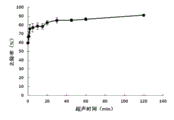
FIG. 1 is a graph illustrating the effect of ultrasonic modification time variation on kaolin removal efficiency provided by an example of the present invention.
FIG. 2 is a graph illustrating the effect of ultrasonic modification time variation on kaolin particle size distribution, provided by an example of the present invention.
FIG. 3 is a graph illustrating the effect of ultrasonic modification power variation on kaolin removal efficiency provided by an embodiment of the present invention.
FIG. 4 is a graph illustrating the effect of ultrasonic modification power variation on kaolin particle size distribution, provided by an embodiment of the present invention.
FIG. 5 is a graph showing the effect of solvent change on the effect of ultrasonic modification provided by an embodiment of the present invention.
FIG. 6 is a graph showing the effect of ultrasonic modification time variation on the removal efficiency of montmorillonite according to an embodiment of the present invention.
FIG. 7 is a graph showing the effect of time variation of ultrasonic modification on bentonite removal efficiency provided by an embodiment of the present invention.
Detailed Description
The invention is illustrated by the following examples.
The invention adopts ultrasonic modification, and can directionally crush clay minerals by adjusting ultrasonic power and frequency to obtain the ultrasonic modified clay with a specific particle size spectrum. The mechanical effect and the chemical effect generated by the ultrasonic cavitation act on the clay minerals, the clay particles can be quickly crushed by the mechanical effect of the ultrasonic cavitation, and the clay particles can be crushed into smaller particles with the size close to that of the algae cells by adjusting the ultrasonic power, so that the combination of the algae cells and the clay particles is facilitated. The clay particle size becomes smaller, the particle settling speed is slowed down, the clay and algae cell reaction time is more sufficient, the specific surface area is increased, the flocculation reaction of the algae and the clay is promoted, more binding sites are provided, and meanwhile, fine residues on the surface of the clay particles can be removed, so that the clay and the algae are more easily bound. The chemical effect of the ultrasonic cavitation can change the surface potential of the clay, thereby improving the flocculation capacity of the clay to the algae cells. The ultrasonic modification is a physical modification means, the ultrasonic modification of the clay mineral can be carried out by adopting a common ultrasonic generating device and a regulating device, the equipment is simple, the process flow is less, the ultrasonic treatment is realized by the ultrasonic cavitation of the liquid, other chemical reagents are not required to be added, other special treatment environments are not required, and the secondary pollution is not generated.
Example 1
Weighing 12 parts of 0.5g kaolin powder, respectively adding the weighed 12 parts of kaolin powder into 20ml of sterilized seawater to obtain 12 parts of 25g/L kaolin stock solution, and carrying out ultrasonic treatment on the kaolin stock solution, wherein the ultrasonic power is 360W, and the ultrasonic time is 0, 0.5min, 1min, 2min, 5min, 10min, 15min, 20min, 30min, 45min, 60min and 120min respectively to obtain 12 parts of different modified kaolin stock solutions. Collecting the algae solution (cell density of 4 × 10) of Prorocentrum donghaiense (Prorocentrum donghaiense) in exponential growth phase5cell/mL) to a 50mL tube. Adding different modified kaolin into the algae solutionThe solution was adjusted to a concentration of 1.0g/L, shaken up, and allowed to stand for 3 hours before measuring the algae removal efficiency. The results show that the longer the ultrasonic modification time, the higher the removal efficiency of kaolin (see figure 1).
Example 2
The particle size distributions of the various modified kaolins described above were determined as described in example 1, and the particle size distributions were measured by adding the modified kaolin stock solutions to a laser particle sizer. The results show that the longer the sonication time, the smaller the particles of the kaolin, and the more uniform it is (see figure 2).
Example 3
Weighing 7 parts of 0.5g of kaolin powder, respectively adding the weighed 7 parts of kaolin powder into 20ml of sterilized seawater to obtain 12 parts of kaolin stock solution with the concentration of 25g/L, and carrying out ultrasonic treatment on the kaolin stock solution with the ultrasonic time of 15min and the ultrasonic power of 0, 90W, 180W, 270W, 360W, 450W and 540W respectively to obtain 7 parts of different modified kaolin stock solutions. Collecting the algae solution (cell density of 4 × 10) of Prorocentrum donghaiense (Prorocentrum donghaiense) in exponential growth phase5cell/mL) and phaeocystis globosa (algal cell density up to 1X 10)6cell/mL) into a 50mL tube. Adding different modified kaolin stock solutions into the algae solution respectively to make the concentration of the modified kaolin stock solutions be 1.0g/L, shaking up, standing for 3 hours and 5 hours, and measuring the algae removal efficiency. The results show that the power can be adjusted to be proper for different algae, so that the removal effect is better (see figure 3).
Example 4
The particle size distributions of the various modified kaolins described above were determined as described in example 1, and the particle size distributions were measured by adding the modified kaolin stock solutions to a laser particle sizer. The results show that the higher the ultrasonic power, the smaller the particles of kaolin, and the more uniform (see fig. 4).
Example 5
Weighing 8 parts of 0.5g of kaolin powder, respectively adding the weighed 8 parts of kaolin powder into 20ml of distilled water to obtain 8 parts of kaolin stock solution with the concentration of 25g/L, and carrying out ultrasonic treatment on the kaolin stock solution with the ultrasonic power of 360W and the ultrasonic time of 0, 0.5min, 1min, 2min, 5min, 10min, 15min and 20min respectively to obtain 8 parts of different modified kaolin stock solutions. Collecting prorocentrum donghaiense (Prorocentru) in exponential growth phasem donghaiense) algae liquid (algae cell density up to 4X 10)5cell/mL) to a 50mL tube. Adding different modified kaolin stock solutions into the algae solution respectively to make the concentration of the modified kaolin stock solutions be 1.0g/L, shaking up the modified kaolin stock solutions, standing the mixture for 3 hours, and measuring the algae removal efficiency of the mixture. The results show that the change of the solvent does not affect the effect of the ultrasonic modification, and the longer the ultrasonic modification time is still, the higher the clay removal efficiency is when the distilled water is used as the solvent (see fig. 5).
Example 6
Weighing 8 parts of 0.5g of montmorillonite powder, respectively adding the montmorillonite powder into 20ml of sterilized seawater to obtain 12 parts of montmorillonite stock solution with the concentration of 25g/L, and carrying out ultrasonic treatment on the montmorillonite stock solution with the ultrasonic power of 360W and the ultrasonic time of 0, 0.5min, 1min, 2min, 5min, 10min and 15min respectively to obtain 8 parts of different modified montmorillonite stock solutions. Collecting the algae solution (cell density of 4 × 10) of Prorocentrum donghaiense (Prorocentrum donghaiense) in exponential growth phase5cell/mL) to a 50mL tube. Adding different modified montmorillonite stock solutions into the algae solution respectively to make the concentration of the modified montmorillonite stock solutions be 1.0g/L, shaking up, standing for 3 hours, and measuring the algae removal efficiency. The results show that the longer the ultrasonic modification time, the higher the removal efficiency of montmorillonite (see fig. 6).
Example 7
Weighing 8 parts of 0.5g of bentonite powder, respectively adding the weighed 8 parts of bentonite powder into 20ml of sterilized seawater to obtain 12 parts of bentonite stock solution with the concentration of 25g/L, and carrying out ultrasonic treatment on the bentonite stock solution with the ultrasonic power of 360W and the ultrasonic time of 0, 0.5min, 1min, 2min, 5min, 10min and 15min respectively to obtain 8 parts of different modified bentonite stock solutions. Collecting the algae solution (cell density of 4 × 10) of Prorocentrum donghaiense (Prorocentrum donghaiense) in exponential growth phase5cell/mL) to a 50mL tube. Adding different modified bentonite stock solutions into the algae solution respectively to make the concentration of the modified bentonite stock solutions be 1.0g/L, shaking up, standing for 3 hours, and measuring the algae removal efficiency. The results show that the ultrasonic modification has a better modification effect on the bentonite, and the longer the ultrasonic modification time is, the higher the bentonite removal efficiency is (see fig. 7).