CN108069967B - Fluorescent probe for intracellular protein labeling and synthetic method and application thereof - Google Patents
Fluorescent probe for intracellular protein labeling and synthetic method and application thereof Download PDFInfo
- Publication number
- CN108069967B CN108069967B CN201611003647.5A CN201611003647A CN108069967B CN 108069967 B CN108069967 B CN 108069967B CN 201611003647 A CN201611003647 A CN 201611003647A CN 108069967 B CN108069967 B CN 108069967B
- Authority
- CN
- China
- Prior art keywords
- naphthalic anhydride
- amino
- fluorescent probe
- protein
- probe
- Prior art date
- Legal status (The legal status is an assumption and is not a legal conclusion. Google has not performed a legal analysis and makes no representation as to the accuracy of the status listed.)
- Expired - Fee Related
Links
Images



Classifications
-
- C—CHEMISTRY; METALLURGY
- C09—DYES; PAINTS; POLISHES; NATURAL RESINS; ADHESIVES; COMPOSITIONS NOT OTHERWISE PROVIDED FOR; APPLICATIONS OF MATERIALS NOT OTHERWISE PROVIDED FOR
- C09B—ORGANIC DYES OR CLOSELY-RELATED COMPOUNDS FOR PRODUCING DYES, e.g. PIGMENTS; MORDANTS; LAKES
- C09B57/00—Other synthetic dyes of known constitution
- C09B57/008—Triarylamine dyes containing no other chromophores
-
- C—CHEMISTRY; METALLURGY
- C07—ORGANIC CHEMISTRY
- C07D—HETEROCYCLIC COMPOUNDS
- C07D473/00—Heterocyclic compounds containing purine ring systems
- C07D473/02—Heterocyclic compounds containing purine ring systems with oxygen, sulphur, or nitrogen atoms directly attached in positions 2 and 6
- C07D473/18—Heterocyclic compounds containing purine ring systems with oxygen, sulphur, or nitrogen atoms directly attached in positions 2 and 6 one oxygen and one nitrogen atom, e.g. guanine
-
- C—CHEMISTRY; METALLURGY
- C09—DYES; PAINTS; POLISHES; NATURAL RESINS; ADHESIVES; COMPOSITIONS NOT OTHERWISE PROVIDED FOR; APPLICATIONS OF MATERIALS NOT OTHERWISE PROVIDED FOR
- C09K—MATERIALS FOR MISCELLANEOUS APPLICATIONS, NOT PROVIDED FOR ELSEWHERE
- C09K11/00—Luminescent materials, e.g. electroluminescent or chemiluminescent
- C09K11/06—Luminescent materials, e.g. electroluminescent or chemiluminescent containing organic luminescent materials
-
- G—PHYSICS
- G01—MEASURING; TESTING
- G01N—INVESTIGATING OR ANALYSING MATERIALS BY DETERMINING THEIR CHEMICAL OR PHYSICAL PROPERTIES
- G01N21/00—Investigating or analysing materials by the use of optical means, i.e. using sub-millimetre waves, infrared, visible or ultraviolet light
- G01N21/62—Systems in which the material investigated is excited whereby it emits light or causes a change in wavelength of the incident light
- G01N21/63—Systems in which the material investigated is excited whereby it emits light or causes a change in wavelength of the incident light optically excited
- G01N21/64—Fluorescence; Phosphorescence
- G01N21/6486—Measuring fluorescence of biological material, e.g. DNA, RNA, cells
-
- C—CHEMISTRY; METALLURGY
- C09—DYES; PAINTS; POLISHES; NATURAL RESINS; ADHESIVES; COMPOSITIONS NOT OTHERWISE PROVIDED FOR; APPLICATIONS OF MATERIALS NOT OTHERWISE PROVIDED FOR
- C09K—MATERIALS FOR MISCELLANEOUS APPLICATIONS, NOT PROVIDED FOR ELSEWHERE
- C09K2211/00—Chemical nature of organic luminescent or tenebrescent compounds
- C09K2211/10—Non-macromolecular compounds
- C09K2211/1018—Heterocyclic compounds
- C09K2211/1025—Heterocyclic compounds characterised by ligands
- C09K2211/1044—Heterocyclic compounds characterised by ligands containing two nitrogen atoms as heteroatoms
Landscapes
- Chemical & Material Sciences (AREA)
- Organic Chemistry (AREA)
- Health & Medical Sciences (AREA)
- Life Sciences & Earth Sciences (AREA)
- Engineering & Computer Science (AREA)
- Analytical Chemistry (AREA)
- Physics & Mathematics (AREA)
- Nuclear Medicine, Radiotherapy & Molecular Imaging (AREA)
- Molecular Biology (AREA)
- Biochemistry (AREA)
- General Health & Medical Sciences (AREA)
- General Physics & Mathematics (AREA)
- Immunology (AREA)
- Pathology (AREA)
- Biomedical Technology (AREA)
- Materials Engineering (AREA)
- Investigating Or Analysing Materials By The Use Of Chemical Reactions (AREA)
- Investigating Or Analysing Biological Materials (AREA)
Abstract
The invention provides a fluorescent probe for intracellular protein labeling and a synthesis method and application thereof. Compared with the existing fluorescent probe for cell marking, the probe can be specifically combined with SNAP tag protein under a complex system to mark any protein in the cell. The probe can also be applied to the detection of copper ions in cells, and the fluorescence gradually disappears along with the increase of the concentration of the copper ions, so that the effect of detecting the copper ions is achieved. The invention realizes the detection function of the probe on the label of any protein and copper ions in a complex environment, and has extremely important application value in the biological and medical fields.
Description
Technical Field
The invention relates to a fluorescent probe for intracellular protein labeling and a synthetic method and application thereof.
Background
The study of the position, function and communication between proteins of proteins in living cells by labeling the proteins with small molecular fluorescent probes is an advanced technique at present and is widely studied. Compared with fluorescent protein, the protein labeling technology shows the excellent photophysical characteristics of the fluorescent probe and the precise control of the position and time of the label. Nevertheless, in order to achieve higher signal intensity and increase the signal-to-noise ratio, a step of washing away unreacted probe molecules is necessary, thereby limiting their continuous observation of the cells.
The fluorescence-enhanced fluorescent probe for marking protein by marking protein labels not only reduces background signals, but also greatly improves signal-to-noise ratio. Nevertheless, most of the fluorescent probes reported so far have certain limitations. For example, labeled ligands with strong cytotoxicity cannot achieve wash-free labeling of living cells; to achieve live cell wash-free protein labeling, researchers typically design fluorescent probes based on fluorescence energy resonance transfer (FRET) to label different protein tags. However, most probes only moderately enhance fluorescence during labeling, and thus cannot achieve satisfactory results. In addition, FRET-based fluorescent probes are generally complex to synthesize, and larger molecular sizes reduce cell permeability leading to longer incubation times. Therefore, the wash-free fluorescent probe with high selectivity, fast labeling speed, high fluorescence switch function and high cell permeability is still the target of researchers to search, and is widely applied to the research of proteins and the live cell imaging as the fluorescent label of proteins in the live cells.
The invention designs and synthesizes a novel fluorescent probe based on FPET effect, and the probe can be quickly and specifically covalently linked with SNAP tag protein in a complex cell environment so as to label target protein. The SNAP tag protein can react with O6The modified benzylguanine is covalently linked by affinity reaction, and is widely applied to protein-protein communication research, drug release, ultra-high resolution, biosensors and the like due to rapid reaction rate, specific binding capacity and almost no toxicity to cells. The invention aims to synthesize a simple PET type fluorescent probe which can be rapidly and specifically combined with SNAP tag protein to generate fluorescence enhancement, and when copper ions exist, the fluorescence can be gradually weakened so as to realize the in-situ detection application of the copper ions.
Disclosure of Invention
One of the purposes of the invention is to provide a fluorescent probe for protein labeling, which can be specifically combined with SNAP-tag protein and show fluorescence enhancement at 510nm, and an application thereof. And simultaneously, the copper ions can be detected in situ.
The invention also aims to provide a synthesis method of the protein-labeled fluorescent probe, which has the advantages of convenient operation, cheap raw materials, simple purification and the like.
The invention provides a fluorescent probe for fluorescent labeling, which takes 4- (2- (dimethyl pyridylamine) acetyl) amino-1, 8-naphthalimide as a fluorescent group and benzyloxy as a binding site, can be specifically bound with SNAP protein and shows 10-fold fluorescence enhancement, and shows a fluorescent signal at the position of 510 nm.
The fluorescent probe has the following structure:

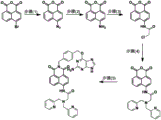
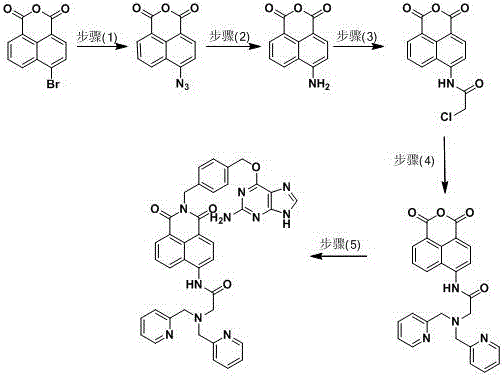
the synthetic route is as follows:

the operation steps are as follows:
(1) synthesizing an intermediate 4-azido-1, 8-naphthalic anhydride:
dissolving 4-bromo-1, 8-naphthalic anhydride in N, N-Dimethylformamide (DMF) to prepare a reaction solution, dissolving sodium azide in water, dropwise adding the solution to the reaction solution, heating to 90-100 ℃, reacting for 4-8h, cooling, pouring into ice water, and performing suction filtration to obtain 4-azido-1, 8-naphthalic anhydride;
(2) synthesizing an intermediate 4-amino-1, 8-naphthalic anhydride:
putting 4-azido-1, 8-naphthalic anhydride into acetonitrile, adding sodium sulfide nonahydrate, heating to 50-70 ℃, continuing for 8-20h, cooling, pouring into ice water, and performing suction filtration to obtain 4-amino-1, 8-naphthalic anhydride;
(3) synthesis of intermediate 4- (2-chloroacetyl) amino-1, 8-naphthalic anhydride:
putting 4-amino-1, 8-naphthalic anhydride into tetrahydrofuran, adding chloroacetyl chloride in ice bath, stirring at room temperature for 10-16h, removing the solvent under reduced pressure, separating by a silica gel column, and removing the solvent under reduced pressure to obtain 4- (2-chloroacetyl) amino-1, 8-naphthalic anhydride;
(4) synthesis of intermediate 4- (2- (2, 2-dimethylpyridine amine) acetyl) amino-1, 8-naphthalic anhydride:
putting 4- (2-chloroacetyl) amino-1, 8-naphthalic anhydride into acetonitrile, adding 2, 2-dimethylpyridine amine under stirring, heating to 50-70 ℃, reacting for 2-4h, removing the solvent under reduced pressure, separating by a silica gel column, and removing the solvent under reduced pressure to obtain 4- (2- (2, 2-dimethylpyridine amine) acetyl) amino-1, 8-naphthalic anhydride;
(5) synthesis of final product fluorescent probe:
dissolving 4- (2- (2, 2-dimethyl pyridylamine) acetyl) amino-1, 8-naphthalic anhydride in ethanol, adding 2-amino-6- (4-aminomethyl) benzyloxy-purine under stirring, heating to 80-90 ℃ for 3-6h, removing the solvent under reduced pressure, separating by a silica gel column, and removing the solvent under reduced pressure to obtain the fluorescent probe.
Separating by using a silica gel column in the step (3) and taking dichloromethane as an eluent;
silica gel column separation in step (4) with dichloromethane: methanol is 200:1-50:1 (preferably 80:1-20:1) as eluent;
silica gel column separation in step (5) with dichloromethane: methanol 50:1-10:1 (preferably 40:1-10:1) is used as eluent.
In the step (1), the mass ratio of the 4-bromo-1, 8-naphthalic anhydride, the N, N-Dimethylformamide (DMF) and the sodium azide is 2 (80-25) to (1-2).
In the step (2), the mass ratio of the 4-azido-1, 8-naphthalic anhydride to the acetonitrile to the sodium sulfide nonahydrate is 1 (40-80) to (3-8).
In the step (3), the mass ratio of the 4-amino-1, 8-naphthalic anhydride to the tetrahydrofuran to the chloroacetyl chloride is (5-2.5) to (60-80) to 1.
In the step (4), the mass ratio of the 4- (2-chloroacetyl) amino-1, 8-naphthalic anhydride to the acetonitrile to the 2, 2-dimethylpyridine amine is (2-1.2): 60-100): 1.
In the step (5), the mass ratio of the 4- (2- (2, 2-dimethylpyridine amine) acetyl) amino-1, 8-naphthalic anhydride to the ethanol to the 2-amino-6- (4-aminomethyl) benzyloxy-purine is 1 (200) -800: 1-1.5.
The invention also provides application of the fluorescent probe in marking proteins in cells and in-situ detection of copper ions.
The invention has the beneficial effects that:
the probe provided by the invention has the advantages of low price of raw materials for synthesizing the probe, simple steps, easy purification and good light stability.
The small molecular fluorescent probe has weak fluorescence under the quenching action of PET, and in the in-vitro detection process, the small molecular fluorescent probe can be covalently combined with SNAP tag protein under a mild condition as a substrate, the combined SNAP tag protein can be reacted away due to purine groups, the PET effect disappears to generate fluorescence, the fluorescence is enhanced by about 10 times, and the maximum emission wavelength is about 510 nm.
The probe has weak fluorescence in aqueous solution, generates fluorescence at a position of 510nm after being specifically combined with SNAP-tag protein, and enhances the fluorescence by about 10 times. The fluorescence enhancement can eliminate the interference of other factors and achieve more accurate positioning of the SNAP-tag protein.
The probe can be applied to detection of copper ions in cells, and fluorescence gradually disappears along with increase of the concentration of the copper ions, so that the effect of detecting the copper ions is achieved.
Compared with the existing fluorescent probe for cell labeling, the probe can be specifically combined with SNAP tag protein under a complex system, is introduced into target protein, labels any protein in cells, and accurately monitors the target protein.
The invention realizes the detection function of the probe on the label of any protein and copper ions in a complex environment, and has extremely important application value in the biological and medical fields.
Drawings
FIG. 1 is a structural formula of a fluorescent probe of the present invention;
FIG. 2 is a synthesis scheme of a fluorescent probe according to the present invention;
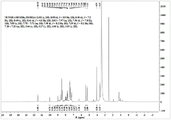
FIG. 3 shows the hydrogen nuclear magnetic spectrum of the fluorescent probe prepared in example 1;
FIG. 4 is a carbon spectrum of nuclear magnetic spectrum of the fluorescent probe prepared in example 1;
FIG. 5 MALDI-TOF mass spectrum of the probe prepared in example 1 before and after reaction with SNAP protein;
FIG. 6 is a fluorescence spectrum of the probe prepared in example 1 before and after the reaction with SNAP protein, in which the probe concentration is 1. mu.M and the protein concentration is 2. mu.M.
FIG. 7 shows the effect of the probes prepared in example 1 on various metal ions after reaction with SNAP protein.
FIG. 8 is a graph showing a titration spectrum of copper ions after the reaction of the probe prepared in example 1 with SNAP protein.
FIG. 9 is a fluorescence confocal microscope image of the probe prepared in example 1 after adding copper ions to HEK293 cells transfected with pSNAP-cox8A (NEB) plasmid.
Detailed Description
Example 1: a method for synthesizing a novel fluorescent probe for protein labeling.
Synthesizing an intermediate 4-azido-1, 8-naphthalic anhydride:
4-bromo-1, 8-naphthalic anhydride (2.5g, 9mmol) was placed in a 100mL single neck flask and 20mL of N, N-dimethylformamide was added. Sodium azide (1.8g, 27.7mmol) was dissolved in 3.5mL of water and added dropwise to the reaction mixture, heated to 100 ℃ for 6h, cooled, poured into ice water and filtered, and dried under vacuum to give 2g of a dark yellow solid with a yield of 92%.
Synthesizing an intermediate 4-amino-1, 8-naphthalic anhydride:
4-azido-1, 8-naphthalic anhydride (1.8g, 7.6mmol) was dissolved in 100mL acetonitrile and sodium sulfide nonahydrate (6.5g, 41mmol) was added. Heating to 60 deg.C for 10h, cooling, pouring into ice water, filtering, and vacuum drying to obtain yellow solid 1.3g with yield of 80%.
Synthesis of intermediate 4- (2-chloroacetyl) amino-1, 8-naphthalic anhydride:
4-amino-1, 8-naphthalic anhydride (1.0g, 4.7mmol) was placed in 60mL tetrahydrofuran and 0.5mL chloroacetyl chloride was added while cooling on ice. Stirring overnight at room temperature, removing the solvent under reduced pressure, separating with silica gel column, and removing the solvent under reduced pressure using dichloromethane as eluent to obtain an off-white solid 1.0g, 76% yield.
Synthesis of intermediate 4- (2- (2, 2-dimethylpyridine amine) acetyl) amino-1, 8-naphthalic anhydride:
4- (2-Chloroacyl) amino-1, 8-naphthalic anhydride (500mg,1.7mmol), KI (830mg, 5mmol) and 850. mu.L of LDIPEA were placed in 50mL of acetonitrile, and 2, 2-dimethylpyridine amine (250mg,1.25mmol) was added with stirring. The reaction was heated to 60 ℃ for 2h, the solvent was removed under reduced pressure, and the mixture was separated on a silica gel column, washed with dichloromethane: methanol 20:1 as eluent, and the solvent was removed under reduced pressure to give 280mg of pale yellow solid in 50% yield.
Synthesis of target probe:
4- (2- (2, 2-Dimethylpyridinamine) acetyl) amino-1, 8-naphthalic anhydride (50mg, 0.11mmol) was dissolved in 20mL ethanol and 2-amino-6- (4-aminomethyl) benzyloxy-purine (32mg,0.12mmol) was added with stirring. Heating to 85 deg.C for 6h, and removing solvent under reduced pressure to obtain pale yellow solid 54mg with a yield of 70%.1H NMR(400MHz,DMSO)δ11.51(s,1H),8.98(d,J=8.5Hz,1H),8.60(d,J=7.2Hz,1H),8.49(s,1H),8.41(d,J=4.5Hz,1H),8.03–7.97(m,1H),7.94(d,J=7.8Hz,1H),7.85(s,1H),7.78–7.71(m,1H),7.45(d,J=8.2Hz,1H),7.39(d,JJ=8.2Hz,1H),7.30–7.20(m,1H),5.44(s,1H),5.27(s,1H),4.06(s,1H),3.65(s,1H).13C NMR(101MHz,DMSO)δ171.06,164.05,163.43,160.07,158.49,149.61,140.42,137.76,137.27,132.77,131.68,129.05,128.97,128.12,127.14,123.90,123.54,123.05,122.75,117.33,117.25,66.99,60.44,58.97,43.24.
The probe is dissolved in DMSO solution to prepare 2mM mother liquor, test solutions with different concentrations are prepared according to requirements, and the change of fluorescence spectrum of the test solutions is detected.
Example 2: MALDI-TOF mass spectrum before and after reaction of probe and SNAP protein
To 1mL of a 20mM PBS solution containing 5. mu.M SNAP protein at pH 7.4, 7.5. mu.L of a probe solution (mother solution is a 2mM DMSO solution) was added, the mixture was stirred at 37 ℃ for 2 hours, and after 2 hours, excess probe was removed by dialysis using a 8000Da dialysis bag in a 20mM PBS solution at pH 7.4, and 10. mu.L of the reaction solution and 10. mu.L of LSNAP protein were applied to MALDI-TOF-MS.
The molecular weight of the SNAP protein is 21634.03 as shown in FIG. 5, and shows a single peak in MALDI-TOF-MS after reaction with the fluorescent probe, which proves that the SNAP protein reacts completely and has a molecular weight of 22187.52, which is the same as the theoretical molecular weight of the reaction product of the SNAP protein and the probe, and that the SNAP protein and the probe react covalently.
Example 3: fluorescence spectra before and after reaction of probe with SNAP protein
mu.L of the probe stock solution was added to 5. mu.M, 2mL of SNAP protein PBS solution, reacted at 37 ℃ for 1 hour, and the fluorescence spectrum was measured with the fluorescence spectrum of the unreacted 1. mu.M probe as a control.
In FIG. 6, the concentration of the fluorescent probe was 1. mu.M, after the reaction of the probe with SNAP protein~The fluorescence intensity at 510nm is obviously enhanced by about 10 times.
Example 4: action of probe and each metal ion after reaction with SNAP protein
mu.L of the probe stock was added to 5. mu.M, 10mL of SNAP protein PBS solution, reacted at 37 ℃ for 1 hour, and then diluted to 1. mu.M with 15mL of PBS solution. Each 1mL of the diluted probe-SNAP reaction solution was added to 0.5. mu. L Zn2+,Ca2 +,Cr2+,K+,Mg2+,Na+,Pd2+,Mn2+,Pt2+,Fe2+,Fe3+,Ni2+,Pb2+,Cd2+,Ag+,Co2+,Hg2+,Cu+,Cu2+And all metal ion mother liquors (all metal ion mother liquors were 10mM aqueous solutions). The fluorescence intensity was measured after 20 min. By F/F0Plotted as the ordinate, where F is the fluorescence intensity after reaction with a metal ion, F0The fluorescence intensity before the reaction with the metal ion.
In FIG. 7, the concentration of the fluorescent probe was 1. mu.M, and the concentration of the metal ion was 5. mu.M. The fluorescence is reduced by about 10 times after the copper ions are added, and the quenching effect of the copper ions is proved.
Example 5: cu+Titration experiment
Adding 10 mu L of probe mother liquor into 20 mu M, 2mL of SNAP protein PBS solution, reacting at 37 ℃ for 1h, and then dropwise adding Cu+Making Cu by mother liquor+The concentrations reached 2. mu.M, 4. mu.M, 6. mu.M, 8. mu.M, 10. mu.M, 14. mu.M, 18. mu.M, 22. mu.M, 26. mu.M, 30. mu.M and fluorescence spectroscopy was carried out.
In FIG. 8, the fluorescence intensity of the 10. mu.M probe bound to SNAP protein was about 900 with Cu+The fluorescence intensity gradually decreases with the addition of (2). Prove to Cu+The detection function of (1).
Example 6: cell experiments
HEK293 cells (human kidney epithelial cell line) were plated in culture dishes containing 1640 medium with 10% fetal bovine serum, incubated at 37 ℃ for 48 hours under 5% carbon dioxide, and the cells were gently washed 2 times with PBS buffer before changing with fresh serum-free medium. Then, a transfection working solution (containing pSNAP-cox8 plasmid, NEB) was added dropwise thereto, followed by placing at 37 ℃ with 5% CO2Culturing in an incubator. After 4 hours, the transfection medium was discarded and replaced with fresh medium containing serum, 5. mu.M probe was added after 24 hours of transfection, and after 20 minutes of incubation, the probe was directly excited at 405nm with a confocal microscope to obtain FIG. 9(c), which demonstrates the wash-free labeling of the probe, followed byAfter incubation with MitoTracker Deep Red commercial dye for 10 min, the cells were washed 2 times with PBS buffer and then stimulated at 640nm with confocal microscopy to give fig. 9(b), demonstrating that the transfected SNAP protein is expressed on intracellular mitochondria and that the probe can label intracellular mitochondria by protein tagging. Then the medium was discarded, the cells were washed 3 times with PBS buffer, 1mL of PBS buffer was added, and 50 μm Cu was added+Incubate for 20 minutes. Confocal microscopy at 405nm excitation gave FIG. 9(d), demonstrating Cu+Quenching effect of (3), further on intracellular Cu+The measurement was carried out, and FIG. 9(a) is a confocal bright field diagram of the cell.
Claims (10)
1. A fluorescent probe for intracellular protein labeling, characterized in that: the structure of the fluorescent probe is as follows:

2. a method for synthesizing the intracellular protein-labeled fluorescent probe according to claim 1, wherein the method comprises the steps of: the synthetic route is as follows:
3. the method of synthesis according to claim 2, characterized in that: the method comprises the following steps:
(1) synthesizing an intermediate 4-azido-1, 8-naphthalic anhydride:
dissolving 4-bromo-1, 8-naphthalic anhydride in N, N-Dimethylformamide (DMF) to prepare a reaction solution, dissolving sodium azide in water, dropwise adding the solution to the reaction solution, heating to 90-100 ℃, reacting for 4-8h, cooling, pouring into ice water, and performing suction filtration to obtain 4-azido-1, 8-naphthalic anhydride;
(2) synthesizing an intermediate 4-amino-1, 8-naphthalic anhydride:
putting 4-azido-1, 8-naphthalic anhydride into acetonitrile, adding sodium sulfide nonahydrate, heating to 50-70 ℃, continuing for 8-20h, cooling, pouring into ice water, and performing suction filtration to obtain 4-amino-1, 8-naphthalic anhydride;
(3) synthesis of intermediate 4- (2-chloroacetyl) amino-1, 8-naphthalic anhydride:
putting 4-amino-1, 8-naphthalic anhydride into tetrahydrofuran, adding chloroacetyl chloride in ice bath, stirring at room temperature for 10-16h, removing the solvent under reduced pressure, separating by a silica gel column, and removing the solvent under reduced pressure to obtain 4- (2-chloroacetyl) amino-1, 8-naphthalic anhydride;
(4) synthesis of intermediate 4- (2- (2, 2-dimethylpyridine amine) acetyl) amino-1, 8-naphthalic anhydride:
putting 4- (2-chloroacetyl) amino-1, 8-naphthalic anhydride into acetonitrile, adding 2, 2-dimethylpyridine amine under stirring, heating to 50-70 ℃, reacting for 2-4h, removing the solvent under reduced pressure, separating by a silica gel column, and removing the solvent under reduced pressure to obtain 4- (2- (2, 2-dimethylpyridine amine) acetyl) amino-1, 8-naphthalic anhydride;
(5) synthesis of final product fluorescent probe:
dissolving 4- (2- (2, 2-dimethyl pyridylamine) acetyl) amino-1, 8-naphthalic anhydride in ethanol, adding 2-amino-6- (4-aminomethyl) benzyloxy-purine under stirring, heating to 80-90 ℃ for 3-6h, removing the solvent under reduced pressure, separating by a silica gel column, and removing the solvent under reduced pressure to obtain the fluorescent probe.
4. The method of claim 3, wherein: separating by using a silica gel column in the step (3) and taking dichloromethane as an eluent;
silica gel column separation in step (4) with dichloromethane: methanol =200:1-50:1 as eluent;
silica gel column separation in step (5) with dichloromethane: methanol =50:1-10:1 as eluent.
5. The method of claim 3, wherein: in the step (1), the mass ratio of the 4-bromo-1, 8-naphthalic anhydride, the N, N-dimethylformamide DMF and the sodium azide is 2 (80-25) to (1-2).
6. The method of claim 3, wherein: in the step (2), the mass ratio of the 4-azido-1, 8-naphthalic anhydride to the acetonitrile to the sodium sulfide nonahydrate is 1 (40-80) to (3-8).
7. The method of claim 3, wherein: in the step (3), the mass ratio of the 4-amino-1, 8-naphthalic anhydride to the tetrahydrofuran to the chloroacetyl chloride is (5-2.5) to (60-80) to 1.
8. The method of claim 3, wherein: in the step (4), the mass ratio of the 4- (2-chloroacetyl) amino-1, 8-naphthalic anhydride to the acetonitrile to the 2, 2-dimethylpyridine amine is (2-1.2): 60-100): 1.
9. The method of claim 3, wherein: in the step (5), the mass ratio of the 4- (2- (2, 2-dimethylpyridine amine) acetyl) amino-1, 8-naphthalic anhydride to the ethanol to the 2-amino-6- (4-aminomethyl) benzyloxy-purine is 1 (200) -800: 1-1.5.
10. Use of a fluorescent probe according to claim 1, characterized in that: the fluorescent probe is specifically combined with SNAP tag protein, and is used for labeling intracellular proteins for non-disease diagnosis and detecting intracellular copper ions.
Priority Applications (1)
| Application Number | Priority Date | Filing Date | Title |
|---|---|---|---|
| CN201611003647.5A CN108069967B (en) | 2016-11-15 | 2016-11-15 | Fluorescent probe for intracellular protein labeling and synthetic method and application thereof |
Applications Claiming Priority (1)
| Application Number | Priority Date | Filing Date | Title |
|---|---|---|---|
| CN201611003647.5A CN108069967B (en) | 2016-11-15 | 2016-11-15 | Fluorescent probe for intracellular protein labeling and synthetic method and application thereof |
Publications (2)
| Publication Number | Publication Date |
|---|---|
| CN108069967A CN108069967A (en) | 2018-05-25 |
| CN108069967B true CN108069967B (en) | 2020-03-27 |
Family
ID=62162472
Family Applications (1)
| Application Number | Title | Priority Date | Filing Date |
|---|---|---|---|
| CN201611003647.5A Expired - Fee Related CN108069967B (en) | 2016-11-15 | 2016-11-15 | Fluorescent probe for intracellular protein labeling and synthetic method and application thereof |
Country Status (1)
| Country | Link |
|---|---|
| CN (1) | CN108069967B (en) |
Families Citing this family (9)
| Publication number | Priority date | Publication date | Assignee | Title |
|---|---|---|---|---|
| CN111303153B (en) * | 2018-12-12 | 2022-07-15 | 中国科学院大连化学物理研究所 | A high-brightness wash-free SNAP-tag probe and its synthesis method and application |
| CN111334079A (en) * | 2018-12-18 | 2020-06-26 | 中国科学院大连化学物理研究所 | Full-spectrum high-brightness and high-stability fluorescent dye and synthesis and application thereof |
| CN111333640B (en) * | 2018-12-18 | 2022-06-03 | 中国科学院大连化学物理研究所 | Fluorescent probe for rapidly and specifically labeling SNAP-tag as well as preparation and biological application thereof |
| CN111334071B (en) * | 2018-12-18 | 2021-11-09 | 中国科学院大连化学物理研究所 | 680nm excited high-brightness fluorescent dye and synthetic method thereof |
| CN111334288B (en) * | 2018-12-18 | 2023-02-17 | 中国科学院大连化学物理研究所 | A wash-free fluorescent probe for spot detection of copper ions in living cells |
| CN111334083B (en) * | 2018-12-18 | 2022-03-18 | 中国科学院大连化学物理研究所 | High-brightness high-stability active fluorescent dye and synthesis and application thereof |
| CN111333652A (en) * | 2018-12-18 | 2020-06-26 | 中国科学院大连化学物理研究所 | A kind of fluorescent probe for washing-free labeling of specific protein and its synthesis method and application |
| CN111333620A (en) * | 2018-12-18 | 2020-06-26 | 中国科学院大连化学物理研究所 | A kind of disposable high stability SNAP-tag probe and its preparation method and application |
| CN112939978B (en) * | 2019-12-10 | 2023-01-13 | 中国科学院大连化学物理研究所 | High-brightness and quick-labeling SNAP protein tag and synthesis and biological application thereof |
Citations (1)
| Publication number | Priority date | Publication date | Assignee | Title |
|---|---|---|---|---|
| US20140147876A1 (en) * | 2012-11-29 | 2014-05-29 | Idexx Laboratories, Inc. | Multi-layer device for selectively determining magnesium ion |
-
2016
- 2016-11-15 CN CN201611003647.5A patent/CN108069967B/en not_active Expired - Fee Related
Patent Citations (1)
| Publication number | Priority date | Publication date | Assignee | Title |
|---|---|---|---|---|
| US20140147876A1 (en) * | 2012-11-29 | 2014-05-29 | Idexx Laboratories, Inc. | Multi-layer device for selectively determining magnesium ion |
Non-Patent Citations (2)
| Title |
|---|
| A fluorescent chemosensor for calcium with excellent storage stability in water;Huarui He等;《analytica chimica acta》;20080202;第611卷;第197-204页 * |
| Fluorescent pH Sensors for Broad-Range pH Measurement Based on a Single Fluorophore;Jing Qi等;《Anal.Chem.》;20150420;第87卷;第5897-5904页 * |
Also Published As
| Publication number | Publication date |
|---|---|
| CN108069967A (en) | 2018-05-25 |
Similar Documents
| Publication | Publication Date | Title |
|---|---|---|
| CN108069967B (en) | Fluorescent probe for intracellular protein labeling and synthetic method and application thereof | |
| CN106147753B (en) | Thiazole orange styrene compound as G-quadruplex nucleic acid fluorescent probe | |
| CN105802608B (en) | A kind of preparation method of fluorescence probe and its application in aluminium ion detection | |
| CN104356681A (en) | Preparation method and application of pH-stable xanthene dye fluorescent probe | |
| CN109400609B (en) | Protein-tagged fluorescent probes for labeling SNAP-tags | |
| US11320428B2 (en) | Probe for dual-mode bio-imaging | |
| CN103382313B (en) | A kind of naphthalimide fluorescent dye and its preparation and application | |
| CN106147752B (en) | RNA fluorescent probe and preparation method and application thereof | |
| CN106243170B (en) | The synthesis and application of beta galactosidase sensor with aggregation inducing Fluorescence Increasing characteristic | |
| CN110156688B (en) | A fluorescent probe targeting endoplasmic reticulum to detect polarity and its application | |
| CN108219780B (en) | Near-infrared fluorescent probe and preparation method and application thereof | |
| CN104017568B (en) | -Application of fluorescent probe containing rhodamine in detecting Hg2+ | |
| CN101004422A (en) | Fluorescent probe of fluorin - boron dyestuff in use for detecting cadmium ions inside cell | |
| CN110498799A (en) | A kind of fluorescence probe and its preparation method and application | |
| CN108329302A (en) | A kind of half flower cyanines class near infrared fluorescent probe compound of sulfide specificly-response and its preparation method and application | |
| CN108997772B (en) | Mitochondria positioning near-infrared fluorescent dye THX-Np and preparation method and application thereof | |
| CN108191818A (en) | A kind of Ratiometric fluorescent probe based on pyrene and preparation method thereof and biologic applications | |
| CN108822575B (en) | A kind of mitochondria localization near-infrared fluorescent dye THX-Ba and its preparation method and application | |
| CN103382189B (en) | A class of cyanine compound, its preparation method and application | |
| CN106432312A (en) | Mitochondria target fluorescence probe, as well as preparation method and application thereof | |
| CN114702447B (en) | Naphthalimide derivative and preparation method and application thereof | |
| CN102093270A (en) | Stilbene two-photon fluorescence probe for detecting intracellular silver ions | |
| Yang et al. | A near-infrared fluorescent probe for the discrimination of cysteine in pure aqueous solution and imaging of cysteine in hepatocellular carcinoma cells with facile cell-compatible ability | |
| CN108383774B (en) | A cysteine fluorescent probe based on terminal alkynone and its preparation and application | |
| CN110818646A (en) | Aggregation-induced emission-based small-molecule fluorescent probe and preparation method and application thereof |
Legal Events
| Date | Code | Title | Description |
|---|---|---|---|
| PB01 | Publication | ||
| PB01 | Publication | ||
| SE01 | Entry into force of request for substantive examination | ||
| SE01 | Entry into force of request for substantive examination | ||
| GR01 | Patent grant | ||
| GR01 | Patent grant | ||
| CF01 | Termination of patent right due to non-payment of annual fee |
Granted publication date: 20200327 |
|
| CF01 | Termination of patent right due to non-payment of annual fee |