CN108010536B - Echo cancellation method, device, system and storage medium - Google Patents
Echo cancellation method, device, system and storage medium Download PDFInfo
- Publication number
- CN108010536B CN108010536B CN201711267227.2A CN201711267227A CN108010536B CN 108010536 B CN108010536 B CN 108010536B CN 201711267227 A CN201711267227 A CN 201711267227A CN 108010536 B CN108010536 B CN 108010536B
- Authority
- CN
- China
- Prior art keywords
- signal
- frequency domain
- local signal
- local
- echo cancellation
- Prior art date
- Legal status (The legal status is an assumption and is not a legal conclusion. Google has not performed a legal analysis and makes no representation as to the accuracy of the status listed.)
- Active
Links
Images


Classifications
-
- G—PHYSICS
- G10—MUSICAL INSTRUMENTS; ACOUSTICS
- G10L—SPEECH ANALYSIS TECHNIQUES OR SPEECH SYNTHESIS; SPEECH RECOGNITION; SPEECH OR VOICE PROCESSING TECHNIQUES; SPEECH OR AUDIO CODING OR DECODING
- G10L21/00—Speech or voice signal processing techniques to produce another audible or non-audible signal, e.g. visual or tactile, in order to modify its quality or its intelligibility
- G10L21/02—Speech enhancement, e.g. noise reduction or echo cancellation
- G10L21/0208—Noise filtering
-
- G—PHYSICS
- G10—MUSICAL INSTRUMENTS; ACOUSTICS
- G10L—SPEECH ANALYSIS TECHNIQUES OR SPEECH SYNTHESIS; SPEECH RECOGNITION; SPEECH OR VOICE PROCESSING TECHNIQUES; SPEECH OR AUDIO CODING OR DECODING
- G10L21/00—Speech or voice signal processing techniques to produce another audible or non-audible signal, e.g. visual or tactile, in order to modify its quality or its intelligibility
- G10L21/02—Speech enhancement, e.g. noise reduction or echo cancellation
- G10L21/0208—Noise filtering
- G10L21/0216—Noise filtering characterised by the method used for estimating noise
-
- G—PHYSICS
- G10—MUSICAL INSTRUMENTS; ACOUSTICS
- G10L—SPEECH ANALYSIS TECHNIQUES OR SPEECH SYNTHESIS; SPEECH RECOGNITION; SPEECH OR VOICE PROCESSING TECHNIQUES; SPEECH OR AUDIO CODING OR DECODING
- G10L21/00—Speech or voice signal processing techniques to produce another audible or non-audible signal, e.g. visual or tactile, in order to modify its quality or its intelligibility
- G10L21/02—Speech enhancement, e.g. noise reduction or echo cancellation
- G10L21/0208—Noise filtering
- G10L21/0216—Noise filtering characterised by the method used for estimating noise
- G10L21/0232—Processing in the frequency domain
-
- G—PHYSICS
- G10—MUSICAL INSTRUMENTS; ACOUSTICS
- G10L—SPEECH ANALYSIS TECHNIQUES OR SPEECH SYNTHESIS; SPEECH RECOGNITION; SPEECH OR VOICE PROCESSING TECHNIQUES; SPEECH OR AUDIO CODING OR DECODING
- G10L25/00—Speech or voice analysis techniques not restricted to a single one of groups G10L15/00 - G10L21/00
- G10L25/03—Speech or voice analysis techniques not restricted to a single one of groups G10L15/00 - G10L21/00 characterised by the type of extracted parameters
- G10L25/06—Speech or voice analysis techniques not restricted to a single one of groups G10L15/00 - G10L21/00 characterised by the type of extracted parameters the extracted parameters being correlation coefficients
-
- G—PHYSICS
- G10—MUSICAL INSTRUMENTS; ACOUSTICS
- G10L—SPEECH ANALYSIS TECHNIQUES OR SPEECH SYNTHESIS; SPEECH RECOGNITION; SPEECH OR VOICE PROCESSING TECHNIQUES; SPEECH OR AUDIO CODING OR DECODING
- G10L21/00—Speech or voice signal processing techniques to produce another audible or non-audible signal, e.g. visual or tactile, in order to modify its quality or its intelligibility
- G10L21/02—Speech enhancement, e.g. noise reduction or echo cancellation
- G10L21/0208—Noise filtering
- G10L2021/02082—Noise filtering the noise being echo, reverberation of the speech
Landscapes
- Engineering & Computer Science (AREA)
- Computational Linguistics (AREA)
- Signal Processing (AREA)
- Health & Medical Sciences (AREA)
- Audiology, Speech & Language Pathology (AREA)
- Human Computer Interaction (AREA)
- Physics & Mathematics (AREA)
- Acoustics & Sound (AREA)
- Multimedia (AREA)
- Quality & Reliability (AREA)
- Cable Transmission Systems, Equalization Of Radio And Reduction Of Echo (AREA)
- Circuit For Audible Band Transducer (AREA)
Abstract
The invention relates to an echo cancellation method, device, system and computer readable storage medium, the method includes obtaining the characteristic parameter of the local signal of estimation; the characteristic parameters comprise a current frame reference signal sent by the pronunciation device, a signal received by a current frame microphone and a previous frame adaptive filter coefficient; respectively converting the characteristic parameters into frequency domain signals; estimating a local signal according to the converted frequency domain signal; calculating the variance of the local signal; updating the step size factor and the regularization factor of the adaptive filter according to the variance of the local signal, converting the time domain signal into the frequency domain signal by performing Fast Fourier Transform (FFT) on the acquired characteristic parameters for estimating the local signal, and making use of the sparsity and the easiness of the distinction of the frequency domain signal to enable the local signal estimated by the frequency domain signal to be the frequency domain signal Calculated variance of local signal
 More accurate, and is helpful to enhance the echo cancellation effect.
Description
Technical Field
The present invention relates to the field of communication and voice interaction, and in particular, to an echo cancellation method, apparatus, system, and storage medium.
Background
In the fields of real-time communication, voice interaction and the like, a microphone and a loudspeaker are generally required to be installed on equipment. The speaker is responsible for playing music, stories, synthesized voice or sound sent by the opposite communication terminal, and the microphone is used for collecting the sound. In real-time communication and voice interaction, the sounds played by the loudspeakers are re-collected by the microphones, and these sounds are called echoes. Echo can seriously interfere with subsequent identification of a machine and affect the subjective feeling of a communication opposite end, so that the echo filtering is an essential step.
Conventional echo cancellation devices typically include an adaptive filter, a two-way detector, and a post-processing module, wherein 1) the adaptive filter is used to fit the true echo; 2) the talkback detector is used for detecting whether the sound played by the loudspeaker and the local sound are emitted simultaneously or not, and freezing and updating the coefficient of the adaptive filter in time when the sounds exist simultaneously so as to avoid the divergence of the adaptive filter; 3) the post-processing module is used for processing the residual echo. In addition, whether the adaptive filter converges or not has the greatest influence on whether echo cancellation is clean or not. In the scenes of voice interaction and real-time communication, because a target signal is often far away from equipment, the size of the equipment is limited, so that echo is very close to a microphone, and the signal-echo ratio is far lower than that of the traditional application scene, the double-talk detection is difficult to be accurate. Furthermore, since the signal-to-echo ratio is very low, the nonlinear post-processing model is fast and easily misappropriate for the target signal, and therefore, in this scenario, basically only the echo cancellation capability of the adaptive filter can be relied on.
Adaptive filters typically require dynamic adjustment of the step-size factor and regularization factor by relying on the variance estimate of the near-end signal. However, the estimation of the variance of the near-end signal in the currently provided technology is often not accurate enough, so that the step size factor and the regularization factor cannot be accurately adjusted, resulting in poor echo cancellation effect.
Disclosure of Invention
Accordingly, it is desirable to provide an echo cancellation method, apparatus, system and storage medium for solving the problem of poor echo cancellation effect caused by inaccurate estimation of the near-end signal variance.
According to a first aspect provided by an embodiment of the present invention, there is provided an echo cancellation method, including the following steps:
acquiring characteristic parameters of an estimated local signal; the characteristic parameters comprise a current frame reference signal sent by the pronunciation device and a signal received by a current frame microphone;
respectively converting the characteristic parameters into frequency domain signals;
estimating a local signal according to the converted frequency domain signal;
calculating the variance of the local signal;
and dynamically adjusting the step size factor and the regularization factor of the adaptive filter according to the variance of the local signal.
In one embodiment, the estimating the local signal according to the converted frequency domain signal includes:
estimating the local signal using at least one of the following equations:


wherein, representing the frequency domain local signal, d (k) representing the signal received by the microphone converted into the frequency domain, x (k) representing the frequency domain reference signal,
 representing the adaptive filter coefficients converted into the frequency domain.
In one embodiment, the calculating the variance of the local signal includes:
according to the Parceval theorem The variance of the local signal is calculated.
In one embodiment, the dynamically adjusting the step size factor and the regularization factor of the adaptive filter according to the variance of the local signal includes:
the step size factor is calculated according to JO-N L MS (Joint Optimized-N L MS, Joint optimization normalized least mean Square Algorithm).
In one embodiment, the method further comprises the following steps:
after estimating the local signal from the converted frequency domain signal, the local signal is subjected to nonlinear processing.
In one embodiment, the non-linear processing on the local signal includes:
and forcibly removing the frequency points with the amplitude smaller than the preset amplitude threshold.
In one embodiment, the non-linear processing on the local signal includes:
calculating the coherence of the signal received by the microphone converted into the frequency domain and the frequency domain reference signal;
and eliminating the frequency points with the coherence being larger than a preset coherence threshold.
According to a second aspect of the embodiments of the present invention, there is provided an echo cancellation device, including:
the acquisition module is used for acquiring characteristic parameters of the estimated local signals; the characteristic parameters comprise a current frame reference signal sent by the pronunciation device and a signal received by a current frame microphone;
the conversion module is used for respectively converting the characteristic parameters into frequency domain signals;
the first calculation module is used for estimating a local signal according to the converted frequency domain signal;
the second calculation module calculates the variance of the local signal;
and the updating module is used for dynamically adjusting the step size factor and the regularization factor of the adaptive filter according to the variance of the local signal.
According to a third aspect of embodiments of the present invention, there is provided an echo cancellation system including: a processor and an echo cancellation device as described in any of the above embodiments.
According to a fourth aspect of embodiments of the present invention, there is provided a computer-readable storage medium, on which a computer program is stored, which, when being executed by a processor, is adapted to carry out the method of any one of the above-mentioned embodiments.
Compared with the prior art, the echo cancellation method provided by the invention converts the time domain signal into the frequency domain signal by performing Fast Fourier Transform (FFT) on the acquired characteristic parameters for estimating the local signal, and estimates the local signal through the frequency domain signal by utilizing the sparsity and the distinguishability of the frequency domain signal Then estimating parameters by using the Pasteval theorem
 Such that the variance of the calculated local signal
 More accurate, and is helpful to enhance the echo cancellation effect.
Drawings
The accompanying drawings, which are incorporated in and constitute a part of this specification, illustrate embodiments consistent with the invention and together with the description, serve to explain the principles of the invention.
FIG. 1 is a schematic diagram of an echo cancellation shown in an exemplary embodiment of the present invention;
FIG. 2 is a flow chart illustrating an echo cancellation method according to an exemplary embodiment of the present invention;
FIG. 3 is a flow chart illustrating an echo cancellation method according to an exemplary embodiment of the present invention;
FIG. 4 is a sample acquisition diagram illustrating an exemplary embodiment of the present invention;
FIG. 5 illustrates a PVSS algorithm and method estimation provided by the present invention, according to an exemplary embodiment of the present invention Comparing the treatment effect with the graph;
fig. 6 is a block diagram illustrating an echo cancellation device according to an exemplary embodiment of the present invention;
fig. 7 is a diagram illustrating an echo cancellation system architecture in accordance with an exemplary embodiment of the present invention.
Detailed Description
Reference will now be made in detail to the exemplary embodiments, examples of which are illustrated in the accompanying drawings. When the following description refers to the accompanying drawings, like numbers in different drawings represent the same or similar elements unless otherwise indicated. The embodiments described in the following exemplary embodiments do not represent all embodiments consistent with the present invention. Rather, they are merely examples of apparatus and methods consistent with certain aspects of the invention, as detailed in the appended claims.
FIG. 1 is a schematic diagram of an echo cancellation system according to an exemplary embodiment of the present invention, as shown in FIG. 1, for a far-end signal, such as a speaker-broadcast signal x (n)After acoustic propagation (which can be modeled as echo path h (n)), an echo signal y (n) is obtained, where n refers to the time index, and the signal y (n) is added to the local signal v (n) to obtain a microphone signal d (n). The echo cancellation is performed by an adaptive filter To fit the true h (n), assuming an adaptive filter
 Sufficiently convergent to obtain an estimate of the echo signal y (n) using the reference signal x (n)
 By the formula
 Estimating local signals v (n), i.e. local signals
 Wherein: h (n) ═ h0(n)h1(n)...hL-1(n)]T,
 The superscript T represents transpose, L represents the length of the adaptive filter, L is usually up to several thousand orders in practical environment, and the order of the adaptive filter is not more than 500 considering the operational capability of the practical system
 A filter update method based on N L MS (Normalized L east Mean Square) is typically used, using the following formula:


therefore, the local signal Typically consisting of a near-end speech signal and a near-end noise signal.
The step factor mu can adjust the convergence speed, the larger the value of mu, the faster the convergence speed, but the easier it is to diverge the smaller the value of mu, the slower the convergence speed, but the more stable it is, and is a regularization factor, which mainly affects the stability of the adaptive filter, and an empirical value is usually used in the N L MS algorithm, for example, the value is taken as
In dual-talk (local signal present) it is necessary to reduce the step size or freeze the update to avoid filter coefficient divergence and to eliminate the local signal. Variable step-size factor, variable regularization factor algorithms typically assume that the variance of the local signal is known By variance
 The size of the step is adjusted. But is poor in the prior art
 The estimate is often not accurate enough that the echo cancellation is not clean or the local signal is also cancelled.
The invention provides a new local signal variance based on frequency domain An estimation method.
Fig. 2 is a flowchart illustrating an echo cancellation method according to an exemplary embodiment of the present invention, as shown in fig. 2, the echo cancellation method includes the following steps:
in step 201, a characteristic parameter of the estimated local signal is obtained.
In this embodiment, a current frame reference signal x (n) sent by the pronunciation device and a current frame signal d (n) received by the microphone may be obtained, where n is a time and k is a frequency point.
In step 202, the characteristic parameters are respectively converted into frequency domain signals.
In this embodiment, the reference signal x (n) of the current frame sent by the pronunciation apparatus, the signal d (n) received by the microphone of the current frame, and the adaptive filter coefficient of the previous frame are respectively FFT (Fast Fourier transform) is performed to obtain frequency signals X (k), D (k) and
 where D (k) denotes the signal received by the microphone converted into the frequency domain, X (k) denotes the frequency domain reference signal,
 representing the adaptive filter coefficients converted into the frequency domain and, in addition,
 the initialization is 0, and the data is still stored in the algorithm after the iterative update.
In step 203, the local signal is estimated from the transformed frequency domain signal.
In this embodiment, the local signal may be estimated using at least one of the following equations:


In step 204, the variance of the local signal is calculated.
In this embodiment, the formula according to the Pasteval theorem Calculating the variance of the local signal
In this embodiment, the local signal can be estimated from the converted frequency domain signal Then, for the local signal
 And performing nonlinear processing, specifically, forcibly removing frequency points with amplitude values smaller than a preset amplitude value threshold, calculating the coherence of D (k) and X (k), and removing frequency points with coherence greater than the preset coherence threshold.
In step 205, the step size factor and regularization factor of the adaptive filter are dynamically adjusted based on the variance of the local signal.
In this embodiment, the step-size factor can be calculated according to JO-N L MS (Joint Optimized N L MS, Joint Optimized normalized least mean squares algorithm).
Fig. 3 is a flowchart illustrating another echo cancellation method according to an exemplary embodiment of the present invention, where as shown in fig. 3, the echo cancellation method includes the following steps:
in step 301, a current frame reference signal emitted by the pronunciation device and a signal received by a current frame microphone are obtained.
In this embodiment, before acquiring the current frame reference signal x (n) emitted by the pronunciation apparatus and the signal d (n) received by the current frame microphone, each variable may be initialized.
As can be seen from the foregoing analysis of the echo cancellation principle, the reason for this is that Therefore, in order to obtain the local signal v (n), the reference signal x (n) of the current frame from the pronunciation device and the signal d (n) received by the microphone of the current frame are obtained first.
In step 302, the obtained time domain signal is FFT (Fast Fourier Transform) converted into a frequency domain signal.
In this embodiment, the current frame reference signal x (n) obtained in step 301, the signal d (n) received by the current frame microphone, and the adaptive filter coefficient All are time domain signals, which can be obtained by respectively comparing x (n), d (n) and
 FFT (Fast Fourier Transform), converting into frequency domain signals X (k), D (k) and
 specifically by the following equation:

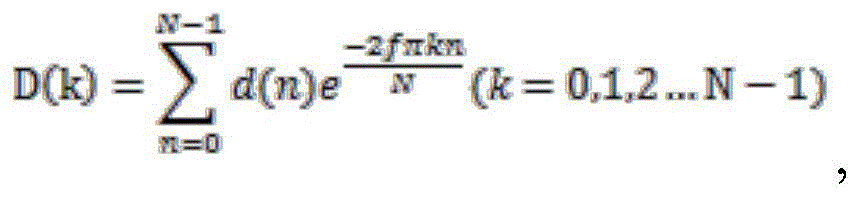

where N represents a sample point, k represents a frequency point, the initialization is 0, and the data is still stored in the algorithm after the iterative update.
In step 303, the local signal is estimated from the frequency domain signal.
In this embodiment, the formula obtained in step 301 may be used Deducing a formula for estimating a local frequency domain signal after converting a time domain signal into a frequency domain signal:
in other embodiments, the local frequency domain signal may also be estimated according to the following formula


In step 304, the estimated local signal is subjected to non-linear processing.
In this embodiment, the estimated local signal is used as a result of the above-mentioned step 303 Is a frequency domain signal, and can remove the interference of the steady state noise by forcibly removing the frequency point whose amplitude is smaller than the preset amplitude threshold ∈, wherein ∈ is a critical amplitude preset according to the specific actual situation, when the critical amplitude is smaller than the preset amplitude threshold, the frequency point is a frequency domain signal, and the frequency point is a frequency domain signal, and
 then, it can be considered as
In other embodiments, because the echo signal often has strong coherence with the reference signal, the influence of the echo can be removed by calculating the coherence of d (k) and x (k), and eliminating frequency points with large coherence of d (k) and x (k), thereby further ensuring accurate estimation For the specific coherence calculation formula, reference may be made to related prior art, and details thereof are not repeated herein, where d (k) represents a signal received by the microphone converted into the frequency domain, and x (k) represents a frequency domain reference signal.
In step 305, the variance of the local signal is calculated.
In this embodiment, the local signal can be calculated according to the energy conservation principle described by the paseuler's theorem, that is, the time domain energy is equal to the frequency domain energy Variance of (2)
 The following formula is specifically adopted:


In step 306, the step size factor μ is calculated according to JO-N L MS (Joint Optimized N L MS, Joint Optimized normalized least mean Square Algorithm) in each caseJONLMS,l(i) And updating the step size factor and the regularization factor.
In the present embodimentThe step size factor μ in each frame can be calculated cyclically according to the following formula in the JO-N L MS algorithmJONLMS,l(i) And updating the step size factor and the regularization factor:


for example, fig. 4 is a sample acquisition diagram showing an exemplary embodiment of the present invention, wherein the speaker is about 10 cm away from the microphone, the target person is about 3 m away from the microphone, and the sound signal sampling rate is 16kHz, and it can be seen from the diagram that the signal-to-noise ratio (signal-to-echo ratio in the diagram) of the acquired signal is very low and is substantially submerged in the echo. FIG. 5 is a diagram of PVSS (parametric variable step size) estimation using the method provided by the present invention and PVSS (parametric variable step size) estimation, respectively Processing the effect map, wherein the estimated parameters are removed
 Except for the difference in the above method, other parameters are the same, for example, when performing fast fourier transform, the sampling point N is 512, the length of the adaptive filter is L-320, and m (0) -1 e-5,
 As can be seen from the figure, the estimation provided by the present invention is compared to PVSS (parametric variable step size), which is a parameter variable step size algorithm
 The method is more accurate, and the echo residue is less after echo cancellation.
It can be seen from the foregoing embodiments that the echo cancellation method provided by the present invention has the following advantages:
1) because the coherence of the reference signal and the echo is large, and the local signal is often sparse signal and only occupies a few frequency points, the correlation and the sparsity of the frequency domain can be utilized, so that the frequency domain is enabled to be more coherent The estimation is more accurate;
2) estimating parameters in the time domain In time, each point needs to be calculated, the calculation amount is huge, and the parameters are estimated in the frequency domain
 Time-of-flight, which can be done in blocks, is a frame of intra-signal parameters
 The calculation amount is greatly reduced and the working efficiency is improved;
3) when loop iteration is carried out, continuous iteration on the internal loop is not needed, and only iteration updating on the external loop is needed, so that the calculation amount is greatly reduced.
Corresponding to the echo cancellation method provided in the above embodiment of the present invention, the present invention further provides an echo cancellation device, as shown in fig. 6, where the echo cancellation device includes: an obtaining module 601, a converting module 602, a first calculating module 603, a second calculating module 604, and an updating module 605, wherein:
an obtaining module 601, configured to obtain a characteristic parameter of an estimated local signal; the characteristic parameters comprise a current frame reference signal sent by the pronunciation device and a signal received by a current frame microphone;
a conversion module 602, configured to convert the feature parameters into frequency domain signals, respectively;
a first calculation module 603 for estimating a local signal according to the converted frequency domain signal
A second calculation module 604, which calculates the variance of the local signal;
and an update module 605 for dynamically adjusting the step size factor and the regularization factor of the adaptive filter according to the variance of the local signal.
The present invention also provides an echo cancellation system, comprising: the computer 500 and the echo cancellation device 600 of any of the above embodiments.
In some embodiments, computer 500 may implement implementations of some embodiments of the invention by other hardware devices, software programs, firmware, and combinations thereof. In other embodiments, the computer 500 may be a general purpose computer, or a special purpose computer.
Fig. 7 is a block diagram of an echo cancellation system according to an exemplary embodiment of the present invention, and as shown in fig. 7, a computer 500 may include an internal communication bus 501, a processor 502, a Read Only Memory (ROM)503, a Random Access Memory (RAM)504, a communication port 505, an input/output component 506, a hard disk 507, and a user interface 508. An internal communication bus 501 may enable communication among the components of the computer 500. The processor 502 may make the determination and issue the prompt.
In some embodiments, the processor 502 may be comprised of one or more processors. The communication port 505 may enable the computer 500 and other components (not shown).
In some embodiments, computer 500 may send and receive information and data from a network through communication port 505. Input/output component 505 supports the flow of input/output data between computer 500 and other components. The user interface 508 may enable interaction and information exchange between the computer 500 and a user. The computer 500 also includes various forms of program storage units and data storage units such as a hard disk 507, Read Only Memory (ROM)508, Random Access Memory (RAM)504, capable of storing various data files used in computer processing and/or communications, and possibly program instructions for execution by the processor 502.
The processor 502, when executing a program, is operable to perform a method of echo cancellation, the method comprising:
acquiring characteristic parameters of an estimated local signal; the characteristic parameters comprise a current frame reference signal sent by the pronunciation device and a signal received by a current frame microphone;
respectively converting the characteristic parameters into frequency domain signals;
estimating a local signal according to the converted frequency domain signal;
calculating the variance of the local signal;
and dynamically adjusting the step size factor and the regularization factor of the adaptive filter according to the variance of the local signal.
Embodiments of the present invention provide a computer-readable storage medium, on which a computer program is stored, which when executed by a processor, implements the echo cancellation method provided in all embodiments of the invention of the present application. The method comprises the following steps:
acquiring characteristic parameters of an estimated local signal; the characteristic parameters comprise a current frame reference signal sent by the pronunciation device and a signal received by a current frame microphone;
respectively converting the characteristic parameters into frequency domain signals;
estimating a local signal according to the converted frequency domain signal;
calculating the variance of the local signal;
and dynamically adjusting the step size factor and the regularization factor of the adaptive filter according to the variance of the local signal.
A computer readable signal medium may include a propagated data signal with computer program code embodied therein, for example, on baseband or as part of a carrier wave. The propagated signal may take many forms, including electromagnetic, optical, and the like. A computer readable signal medium may be any computer readable medium that is not a computer readable signal medium and that can communicate, propagate, or transport a program for use by or in connection with an instruction execution system, apparatus, or device. Program code on a computer readable signal medium may be propagated over any suitable medium, including radio, electrical cable, fiber optic cable, radio frequency signals, or the like, or any combination of the preceding.
In the latter case, the remote computer may be connected to the user computer through any form of network, such as a local area network (AN L) or a Wide Area Network (WAN), or to AN external computer (e.g., through the Internet), or in a cloud computing environment, or as a service, such as software.
The technical features of the embodiments described above may be arbitrarily combined, and for the sake of brevity, all possible combinations of the technical features in the embodiments described above are not described, but should be considered as being within the scope of the present specification as long as there is no contradiction between the combinations of the technical features.
The above-mentioned embodiments only express several embodiments of the present invention, and the description thereof is more specific and detailed, but not construed as limiting the scope of the invention. It should be noted that, for a person skilled in the art, several variations and modifications can be made without departing from the inventive concept, which falls within the scope of the present invention. Therefore, the protection scope of the present patent shall be subject to the appended claims.
Claims (10)
1. An echo cancellation method, comprising the steps of:
acquiring characteristic parameters of an estimated local signal; the characteristic parameters comprise a current frame reference signal sent by the pronunciation device and a signal received by a current frame microphone;
respectively converting the characteristic parameters into frequency domain signals;
estimating a local signal according to the converted frequency domain signal;
calculating the variance of the local signal;
dynamically adjusting a step size factor and a regularization factor of the adaptive filter according to the variance of the local signal, including calculating the step size factor according to JO-N L MS (Joint Optimized N L MS, Joint optimization normalized least mean square algorithm);
after estimating the local signal from the converted frequency domain signal, performing nonlinear processing on the local signal, including: calculating the coherence of the signal received by the microphone converted into the frequency domain and the frequency domain reference signal; and eliminating the frequency points with the coherence being larger than a preset coherence threshold.
2. The echo cancellation method of claim 1, wherein said estimating the local signal from the transformed frequency domain signal comprises:
estimating the local signal using at least one of the following equations:


wherein, representing the frequency domain local signal, d (k) representing the signal received by the microphone converted into the frequency domain, x (k) representing the frequency domain reference signal,
 representing the adaptive filter coefficients converted into the frequency domain.
3. The echo cancellation method of claim 1, wherein said calculating the variance of the local signal comprises:
according to the Parceval theorem The variance of the local signal is calculated.
4. The echo cancellation method of claim 1, wherein said non-linearly processing the local signal comprises:
and forcibly removing the frequency points with the amplitude smaller than the preset amplitude threshold.
5. The echo cancellation method of claim 1, wherein said non-linearly processing the local signal comprises:
and when the absolute value of the amplitude of the local signal is smaller than the preset amplitude threshold value, the absolute value of the amplitude of the local signal is zero.
6. An echo cancellation device, comprising:
the acquisition module is used for acquiring characteristic parameters of the estimated local signals; the characteristic parameters comprise a current frame reference signal sent by the pronunciation device and a signal received by a current frame microphone;
the conversion module is used for respectively converting the characteristic parameters into frequency domain signals;
the first calculation module is used for estimating a local signal according to the converted frequency domain signal;
the second calculation module calculates the variance of the local signal;
the updating module dynamically adjusts the step size factor and the regularization factor of the adaptive filter according to the variance of the local signal, and calculates the step size factor according to JO-N L MS (Joint Optimized N L MS, Joint optimization normalized least mean square algorithm);
a nonlinear processing module, configured to perform nonlinear processing on the local signal after estimating the local signal according to the converted frequency domain signal, including: calculating the coherence of the signal received by the microphone converted into the frequency domain and the frequency domain reference signal; and eliminating the frequency points with the coherence being larger than a preset coherence threshold.
7. The apparatus of claim 6, wherein the non-linear processing module is further configured to force to remove frequency bins with amplitudes smaller than a preset amplitude threshold.
8. An echo cancellation system, comprising: a processor and an echo canceling device according to claim 6.
9. A computer-readable storage medium, on which a computer program is stored which, when being executed by a processor, is adapted to carry out the method of any one of claims 1 to 5.
10. A computer device comprising a memory and a processor, the memory storing a computer program operable on the processor, wherein the processor implements the steps of the method of any one of claims 1-5 when executing the computer program.
Priority Applications (1)
| Application Number | Priority Date | Filing Date | Title |
|---|---|---|---|
| CN201711267227.2A CN108010536B (en) | 2017-12-05 | 2017-12-05 | Echo cancellation method, device, system and storage medium |
Applications Claiming Priority (1)
| Application Number | Priority Date | Filing Date | Title |
|---|---|---|---|
| CN201711267227.2A CN108010536B (en) | 2017-12-05 | 2017-12-05 | Echo cancellation method, device, system and storage medium |
Publications (2)
| Publication Number | Publication Date |
|---|---|
| CN108010536A CN108010536A (en) | 2018-05-08 |
| CN108010536B true CN108010536B (en) | 2020-07-14 |
Family
ID=62056362
Family Applications (1)
| Application Number | Title | Priority Date | Filing Date |
|---|---|---|---|
| CN201711267227.2A Active CN108010536B (en) | 2017-12-05 | 2017-12-05 | Echo cancellation method, device, system and storage medium |
Country Status (1)
| Country | Link |
|---|---|
| CN (1) | CN108010536B (en) |
Families Citing this family (7)
| Publication number | Priority date | Publication date | Assignee | Title |
|---|---|---|---|---|
| CN109584898B (en) * | 2018-12-29 | 2022-05-31 | 上海瑾盛通信科技有限公司 | Voice signal processing method and device, storage medium and electronic equipment |
| CN110335618B (en) * | 2019-06-06 | 2021-07-30 | 福建星网智慧软件有限公司 | Method for improving nonlinear echo suppression and computer equipment |
| CN112017679B (en) * | 2020-08-05 | 2024-01-26 | 海尔优家智能科技(北京)有限公司 | Method, device and equipment for updating adaptive filter coefficients |
| CN112687285B (en) * | 2020-12-22 | 2023-09-29 | 珠海市杰理科技股份有限公司 | Echo cancellation method and device |
| CN113421579B (en) * | 2021-06-30 | 2024-06-07 | 北京小米移动软件有限公司 | Sound processing method, device, electronic equipment and storage medium |
| CN114071220B (en) * | 2021-11-04 | 2024-01-19 | 深圳Tcl新技术有限公司 | Sound effect adjustment method, device, storage medium and electronic equipment |
| CN116092463A (en) * | 2022-12-06 | 2023-05-09 | 西安讯飞超脑信息科技有限公司 | Echo cancellation method, system and related device |
Family Cites Families (8)
| Publication number | Priority date | Publication date | Assignee | Title |
|---|---|---|---|---|
| DE19831320A1 (en) * | 1998-07-13 | 2000-01-27 | Ericsson Telefon Ab L M | Digital adaptive filter for communications system, e.g. hands free communications in vehicles, has power estimation unit recursively smoothing increasing and decreasing input power asymmetrically |
| US8275120B2 (en) * | 2006-05-30 | 2012-09-25 | Microsoft Corp. | Adaptive acoustic echo cancellation |
| CN101888455B (en) * | 2010-04-09 | 2013-07-03 | 熔点网讯(北京)科技有限公司 | Self-adaptive echo counteracting method for frequency domain |
| US9264553B2 (en) * | 2011-06-11 | 2016-02-16 | Clearone Communications, Inc. | Methods and apparatuses for echo cancelation with beamforming microphone arrays |
| CN103885044B (en) * | 2014-03-31 | 2016-08-24 | 西安电子科技大学 | A kind of miscellaneous suppressing method of making an uproar of Narrow-band Radar echo based on CLEAN algorithm |
| CN105371945B (en) * | 2015-10-10 | 2019-01-25 | 同济大学 | Method and device for removing noise in hall impulse response measurement acoustic signal |
| CN105472191B (en) * | 2015-11-18 | 2019-09-20 | 百度在线网络技术(北京)有限公司 | A kind of method and apparatus tracking echo delay time |
| WO2017099728A1 (en) * | 2015-12-08 | 2017-06-15 | Nuance Communications, Inc. | System and method for suppression of non-linear acoustic echoes |
-
2017
- 2017-12-05 CN CN201711267227.2A patent/CN108010536B/en active Active
Also Published As
| Publication number | Publication date |
|---|---|
| CN108010536A (en) | 2018-05-08 |
Similar Documents
| Publication | Publication Date | Title |
|---|---|---|
| CN108010536B (en) | Echo cancellation method, device, system and storage medium | |
| CN109727604B (en) | Frequency domain echo cancellation method and computer storage medium for speech recognition front-end | |
| KR101331388B1 (en) | Adaptive acoustic echo cancellation | |
| US9386373B2 (en) | System and method for estimating a reverberation time | |
| CN110211602B (en) | Intelligent voice enhanced communication method and device | |
| JP2004056453A (en) | Method and device for suppressing echo | |
| CN106898359A (en) | Acoustic signal processing method, system, audio interactive device and computer equipment | |
| CN107017004A (en) | Noise suppressing method, audio processing chip, processing module and bluetooth equipment | |
| CN111951818B (en) | A dual-microphone speech enhancement method based on improved power difference noise estimation algorithm | |
| EP2987314B1 (en) | Echo suppression | |
| CN115278465B (en) | Howling suppression method, device, sound system and sound amplification system | |
| CN109727605B (en) | Method and system for processing sound signal | |
| KR101581885B1 (en) | Apparatus and Method for reducing noise in the complex spectrum | |
| CN113744748A (en) | Network model training method, echo cancellation method and device | |
| CN106161751A (en) | A kind of noise suppressing method and device | |
| CN112201273A (en) | Noise power spectral density calculation method, system, equipment and medium | |
| US20260057897A1 (en) | Method for processing audio signal, electronic device, and computer-readable storage medium | |
| CN113689878B (en) | Echo cancellation method, echo cancellation device and computer readable storage medium | |
| CN119091900A (en) | A method and device for echo cancellation and noise reduction | |
| CN113851141A (en) | Novel method and device for noise suppression by microphone array | |
| WO2012166092A1 (en) | Control of adaptation step size and suppression gain in acoustic echo control | |
| CN104410762A (en) | Steady echo cancellation method in hand free cell phone conversation system | |
| US9659575B2 (en) | Signal processor and method therefor | |
| US20240021184A1 (en) | Audio signal processing method and system for echo supression using an mmse-lsa estimator | |
| JP2023160721A (en) | Echo cancellation method, device, and electronic device |
Legal Events
| Date | Code | Title | Description |
|---|---|---|---|
| PB01 | Publication | ||
| PB01 | Publication | ||
| SE01 | Entry into force of request for substantive examination | ||
| SE01 | Entry into force of request for substantive examination | ||
| GR01 | Patent grant | ||
| GR01 | Patent grant | ||
| TR01 | Transfer of patent right | ||
| TR01 | Transfer of patent right |
Effective date of registration: 20230713 Address after: 518000 Room 201, building A, 1 front Bay Road, Shenzhen Qianhai cooperation zone, Shenzhen, Guangdong Patentee after: VOICEAI TECHNOLOGIES Co.,Ltd. Patentee after: Shenzhen Digital Miracle Technology Co.,Ltd. Address before: 518000 Room 201, building A, 1 front Bay Road, Shenzhen Qianhai cooperation zone, Shenzhen, Guangdong Patentee before: VOICEAI TECHNOLOGIES Co.,Ltd. |