CN107849493B - Defect reducing rinse solution containing ammonium salts of sulfoesters - Google Patents
Defect reducing rinse solution containing ammonium salts of sulfoesters Download PDFInfo
- Publication number
- CN107849493B CN107849493B CN201680041792.4A CN201680041792A CN107849493B CN 107849493 B CN107849493 B CN 107849493B CN 201680041792 A CN201680041792 A CN 201680041792A CN 107849493 B CN107849493 B CN 107849493B
- Authority
- CN
- China
- Prior art keywords
- ammonium
- group
- diester
- acid
- ammonium salts
- Prior art date
- Legal status (The legal status is an assumption and is not a legal conclusion. Google has not performed a legal analysis and makes no representation as to the accuracy of the status listed.)
- Active
Links
Images


Classifications
-
- C—CHEMISTRY; METALLURGY
- C11—ANIMAL OR VEGETABLE OILS, FATS, FATTY SUBSTANCES OR WAXES; FATTY ACIDS THEREFROM; DETERGENTS; CANDLES
- C11D—DETERGENT COMPOSITIONS; USE OF SINGLE SUBSTANCES AS DETERGENTS; SOAP OR SOAP-MAKING; RESIN SOAPS; RECOVERY OF GLYCEROL
- C11D1/00—Detergent compositions based essentially on surface-active compounds; Use of these compounds as a detergent
- C11D1/02—Anionic compounds
- C11D1/12—Sulfonic acids or sulfuric acid esters; Salts thereof
- C11D1/123—Sulfonic acids or sulfuric acid esters; Salts thereof derived from carboxylic acids, e.g. sulfosuccinates
-
- G—PHYSICS
- G03—PHOTOGRAPHY; CINEMATOGRAPHY; ANALOGOUS TECHNIQUES USING WAVES OTHER THAN OPTICAL WAVES; ELECTROGRAPHY; HOLOGRAPHY
- G03F—PHOTOMECHANICAL PRODUCTION OF TEXTURED OR PATTERNED SURFACES, e.g. FOR PRINTING, FOR PROCESSING OF SEMICONDUCTOR DEVICES; MATERIALS THEREFOR; ORIGINALS THEREFOR; APPARATUS SPECIALLY ADAPTED THEREFOR
- G03F7/00—Photomechanical, e.g. photolithographic, production of textured or patterned surfaces, e.g. printing surfaces; Materials therefor, e.g. comprising photoresists; Apparatus specially adapted therefor
- G03F7/26—Processing photosensitive materials; Apparatus therefor
- G03F7/40—Treatment after imagewise removal, e.g. baking
-
- G—PHYSICS
- G03—PHOTOGRAPHY; CINEMATOGRAPHY; ANALOGOUS TECHNIQUES USING WAVES OTHER THAN OPTICAL WAVES; ELECTROGRAPHY; HOLOGRAPHY
- G03F—PHOTOMECHANICAL PRODUCTION OF TEXTURED OR PATTERNED SURFACES, e.g. FOR PRINTING, FOR PROCESSING OF SEMICONDUCTOR DEVICES; MATERIALS THEREFOR; ORIGINALS THEREFOR; APPARATUS SPECIALLY ADAPTED THEREFOR
- G03F7/00—Photomechanical, e.g. photolithographic, production of textured or patterned surfaces, e.g. printing surfaces; Materials therefor, e.g. comprising photoresists; Apparatus specially adapted therefor
- G03F7/26—Processing photosensitive materials; Apparatus therefor
- G03F7/42—Stripping or agents therefor
- G03F7/422—Stripping or agents therefor using liquids only
- G03F7/425—Stripping or agents therefor using liquids only containing mineral alkaline compounds; containing organic basic compounds, e.g. quaternary ammonium compounds; containing heterocyclic basic compounds containing nitrogen
-
- G—PHYSICS
- G03—PHOTOGRAPHY; CINEMATOGRAPHY; ANALOGOUS TECHNIQUES USING WAVES OTHER THAN OPTICAL WAVES; ELECTROGRAPHY; HOLOGRAPHY
- G03F—PHOTOMECHANICAL PRODUCTION OF TEXTURED OR PATTERNED SURFACES, e.g. FOR PRINTING, FOR PROCESSING OF SEMICONDUCTOR DEVICES; MATERIALS THEREFOR; ORIGINALS THEREFOR; APPARATUS SPECIALLY ADAPTED THEREFOR
- G03F7/00—Photomechanical, e.g. photolithographic, production of textured or patterned surfaces, e.g. printing surfaces; Materials therefor, e.g. comprising photoresists; Apparatus specially adapted therefor
- G03F7/26—Processing photosensitive materials; Apparatus therefor
- G03F7/42—Stripping or agents therefor
- G03F7/422—Stripping or agents therefor using liquids only
- G03F7/426—Stripping or agents therefor using liquids only containing organic halogen compounds; containing organic sulfonic acids or salts thereof; containing sulfoxides
-
- C—CHEMISTRY; METALLURGY
- C11—ANIMAL OR VEGETABLE OILS, FATS, FATTY SUBSTANCES OR WAXES; FATTY ACIDS THEREFROM; DETERGENTS; CANDLES
- C11D—DETERGENT COMPOSITIONS; USE OF SINGLE SUBSTANCES AS DETERGENTS; SOAP OR SOAP-MAKING; RESIN SOAPS; RECOVERY OF GLYCEROL
- C11D2111/00—Cleaning compositions characterised by the objects to be cleaned; Cleaning compositions characterised by non-standard cleaning or washing processes
- C11D2111/10—Objects to be cleaned
- C11D2111/14—Hard surfaces
- C11D2111/22—Electronic devices, e.g. PCBs or semiconductors
Landscapes
- General Physics & Mathematics (AREA)
- Physics & Mathematics (AREA)
- Chemical & Material Sciences (AREA)
- Organic Chemistry (AREA)
- Engineering & Computer Science (AREA)
- Chemical Kinetics & Catalysis (AREA)
- Oil, Petroleum & Natural Gas (AREA)
- Wood Science & Technology (AREA)
- Life Sciences & Earth Sciences (AREA)
- Detergent Compositions (AREA)
- Photosensitive Polymer And Photoresist Processing (AREA)
- Exposure And Positioning Against Photoresist Photosensitive Materials (AREA)
- Cleaning By Liquid Or Steam (AREA)
- Organic Low-Molecular-Weight Compounds And Preparation Thereof (AREA)
- Exposure Of Semiconductors, Excluding Electron Or Ion Beam Exposure (AREA)
- Cleaning Or Drying Semiconductors (AREA)
Abstract
Description
本发明涉及包含一种或多种选自磺基丁二酸二酯、(磺基甲基)丁二酸二酯、甲基磺基丁二酸二酯、磺基戊二酸二酯和磺基丙三羧酸三酯的化合物的一种或多种铵盐的组合物在清洁或冲洗包含基材和承载于其上的具有线宽为50nm或更小的线-间隙(line-space)结构的图案化材料层的产品中的用途。本发明还涉及一种制备包含基材和承载于其上的具有线宽为50nm或更小的线-间隙结构的图案化材料层的已清洁或冲洗产品的相应方法。本发明还涉及一种HAZEN色数小于1000和/或浊度为0.08-10NTU的配制剂,其中该配制剂包含水和一种或多种铵盐以及任选地,一种或多种有机溶剂化合物。本发明还涉及一种制备相应配制剂的方法。本发明在权利要求书中定义并且随后在下文更详细描述其具体实施方案。The present invention relates to compounds comprising one or more diesters selected from the group consisting of sulfosuccinic acid diesters, (sulfomethyl)succinic acid diesters, methylsulfosuccinic acid diesters, sulfoglutaric acid diesters and sulfonic acid diesters. A composition of one or more ammonium salts of a compound of triglyceride tricarboxylic acid containing a substrate and a line-space having a line width of 50 nm or less supported thereon during cleaning or rinsing Use of structured patterned material layers in products. The present invention also relates to a corresponding method of preparing a cleaned or rinsed product comprising a substrate and a layer of patterned material supported thereon having a line-gap structure having a line width of 50 nm or less. The present invention also relates to a formulation having a HAZEN color number of less than 1000 and/or a turbidity of 0.08-10 NTU, wherein the formulation comprises water and one or more ammonium salts and optionally, one or more organic solvents compound. The invention also relates to a method for preparing the corresponding formulations. The invention is defined in the claims and specific embodiments thereof are subsequently described in more detail below.
本发明在所附权利要求书中并在说明书中定义。若没有相反说明,本发明的优选方面意指与本发明的其他优选方面组合。The invention is defined in the appended claims and in the specification. Preferred aspects of the invention are intended to be combined with other preferred aspects of the invention unless stated to the contrary.
在制造具有大规模集成(LSI)、非常大规模集成(VLSI)和超大规模集成(ULSI)的集成电路(IC)的工艺中,图案化材料层如图案化光刻胶层,含有氮化钛、钽或氮化钽或由其构成的图案化阻隔材料层,含有例如交替多晶硅和二氧化硅层的堆叠或由其构成的图案化多叠材料层以及含有二氧化硅或低k或超低k介电材料或由其构成的图案化介电材料层通过光刻技术生产。当前该类图案化材料层包含尺寸甚至小于22nm的具有高纵横比的结构。上述规格也适用于下文所定义的本发明。In the process of fabricating integrated circuits (ICs) with large scale integration (LSI), very large scale integration (VLSI) and very large scale integration (ULSI), a patterned material layer such as a patterned photoresist layer, containing titanium nitride , tantalum or tantalum nitride or a patterned barrier material layer consisting of, for example, a stack of alternating polysilicon and silicon dioxide layers or a patterned multi-layer material layer consisting of and silicon dioxide or low-k or ultra-low The k-dielectric material or patterned layers of dielectric material formed therefrom are produced by photolithographic techniques. This type of patterned material layer currently contains structures with high aspect ratios even smaller than 22 nm in size. The above specifications also apply to the invention as defined below.
光刻法是一种其中将刻入掩模中的图案投射到基材如半导体晶片上的方法。半导体光刻法通常包括将一层光刻胶施加于半导体基材的上表面上并通过该掩模将该光刻胶暴露于光化辐射,尤其是波长例如为193nm的UV辐射的步骤。上述原理也适用于下文所述的本发明。为了将193nm光刻法扩展到22nm和15nm技术节点,作为分辨率提高技术已经开发了浸没式光刻法。在该技术中,在光学系统的最后透镜和光刻胶表面之间的气隙被折射率大于1的液体介质,例如对于193nm的波长而言折射率为1.44的超纯水代替。该技术还可以用于本发明方法中或者与下文所述的本发明组合物或配制剂一起使用。然而,为了避免浸出、吸水和图案毁坏,必须使用阻隔涂料或耐水光刻胶。Photolithography is a method in which a pattern etched into a mask is projected onto a substrate, such as a semiconductor wafer. Semiconductor lithography generally includes the steps of applying a layer of photoresist to the upper surface of a semiconductor substrate and exposing the photoresist to actinic radiation, particularly UV radiation having a wavelength of, for example, 193 nm, through the mask. The above principles also apply to the present invention described below. In order to extend 193nm lithography to the 22nm and 15nm technology nodes, immersion lithography has been developed as a resolution enhancement technique. In this technique, the air gap between the final lens of the optical system and the photoresist surface is replaced by a liquid medium with an index of refraction greater than 1, such as ultrapure water with an index of refraction of 1.44 for a wavelength of 193 nm. This technique can also be used in the methods of the present invention or with the compositions or formulations of the present invention described below. However, to avoid leaching, water absorption and pattern destruction, barrier coatings or water-resistant photoresists must be used.
除了193nm浸没式光刻法外,将使用显著更短波长的其他照射技术视为满足进一步缩减20nm节和更小的待印刷特征尺寸的需求的解决方案。除了电子束曝光外,波长为约13.5nm的极紫外光刻法(EUV)似乎是在将来代替浸没式光刻法的有前景候选方法。在暴露于光化辐射之后,随后的工艺流程与所用光刻方法(例如如上所述的UV光刻法、浸没式光刻法或EUV光刻法)无关并且因此可以用于下文所述的本发明方法中。In addition to 193nm immersion lithography, other illumination techniques using significantly shorter wavelengths are seen as solutions to the need to further shrink 20nm nodes and smaller feature sizes to be printed. Besides electron beam exposure, extreme ultraviolet lithography (EUV) with a wavelength of about 13.5 nm appears to be a promising candidate to replace immersion lithography in the future. After exposure to actinic radiation, the subsequent process flow is independent of the lithography method used (eg UV lithography, immersion lithography or EUV lithography as described above) and can therefore be used in the present invention described below. method of invention.
通常而言,具有高纵横比且宽度为50nm或更小的结构通过将强光束通过光学掩模投射到光刻胶(基材上的化学沉积层)上而生产。通常将光刻法的基本工序分成多个工艺步骤,例如在许多情况和情形中区分下列工艺步骤(但必须注意的是在其他情况下可以省略、修改工艺步骤或者除了所列工艺步骤外可以插入工艺步骤):Typically, structures with high aspect ratios and widths of 50 nm or less are produced by projecting an intense beam of light through an optical mask onto a photoresist (a chemically deposited layer on a substrate). The basic sequence of photolithography is usually divided into a number of process steps, for example the following process steps are distinguished in many cases and situations (but it must be noted that in other cases process steps may be omitted, modified or inserted in addition to the listed process steps Process steps):
1.清洁晶片1. Clean the wafer
2.准备2. Prepare
3.施加光刻胶3. Apply the photoresist
4.曝光和曝光后烘烤4. Exposure and Post-Exposure Baking
5.显影和冲洗5. Development and Rinse
6.硬烘烤(hard-bake)6. Hard-bake
7.随后工艺,例如等离子体蚀刻7. Subsequent processes such as plasma etching
通常进行器件制造的随后工艺步骤。Subsequent process steps of device fabrication are typically performed.
本发明方法和用途优选为制备包含基材和承载于其上的图案化材料层的已清洁或冲洗产品的方法的一部分,该方法包括上面所讨论的工艺步骤中的一种或全部。对于如上所公开的光刻法的基本工艺,本发明(用途、方法和配制剂)涉及工艺步骤6。The methods and uses of the present invention are preferably part of a method of making a cleaned or rinsed product comprising a substrate and a layer of patterned material carried thereon, the method comprising one or all of the process steps discussed above. The present invention (uses, methods and formulations) relates to process step 6 for the basic process of photolithography as disclosed above.
在工艺步骤1(清洁晶片)中,对晶片表面施加不同化学处理,从而除去吸附在晶片表面上的物质(污染物)。In process step 1 (cleaning the wafer), various chemical treatments are applied to the wafer surface to remove substances (contaminants) adsorbed on the wafer surface.
在工艺步骤2(准备)中,将晶片加热到至少150℃,以除去表面上吸附的水分,任选随后用六甲基二硅氮烷(HMDS)处理以钝化(“疏水化”)表面(用甲基封闭剩余OH基团)。钝化表面用于在光刻法的后期阶段防止水在晶片表面和光刻胶层之间扩散进入的目的。In process step 2 (preparation), the wafer is heated to at least 150°C to remove moisture adsorbed on the surface, optionally followed by treatment with hexamethyldisilazane (HMDS) to passivate ("hydrophobize") the surface (block the remaining OH groups with methyl groups). The passivated surface serves the purpose of preventing water from diffusing in between the wafer surface and the photoresist layer in later stages of the photolithography process.
在工艺步骤3(施加光刻胶)中,光刻胶层通过旋涂沉积于晶片上。该工艺步骤的详细说明和讨论公开于US 4267212 A中。该层的厚度可以从EUV抗蚀剂的数十nm到DUV抗蚀剂的数百nm变化并且对于更老的抗蚀剂和显微机械加工应用可以达到几个微米。在蒸发溶剂之后,沉积的光刻胶层任选在通常为约100℃的温度下预烘烤。In process step 3 (application of photoresist), a layer of photoresist is deposited on the wafer by spin coating. A detailed description and discussion of this process step is disclosed in US 4267212 A. The thickness of this layer can vary from tens of nm for EUV resists to hundreds of nm for DUV resists and up to several microns for older resist and micromachining applications. After evaporation of the solvent, the deposited photoresist layer is optionally prebaked at a temperature typically around 100°C.
在工艺步骤4中,通过光学掩模投射强光束,从而仅仅使光刻胶层的特定点暴露于光。取决于光刻胶的性质(正性或负性),在随后的工艺步骤(显影)中除去光刻胶的曝光或未曝光区域。通常进行曝光后烘烤以帮助抗蚀剂的化学增幅。In process step 4, an intense beam of light is projected through an optical mask so that only specific points of the photoresist layer are exposed to light. Depending on the nature of the photoresist (positive or negative tone), exposed or unexposed areas of the photoresist are removed in a subsequent process step (development). A post-exposure bake is typically done to aid chemical amplification of the resist.
在工艺步骤5(显影和冲洗)中并且根据本发明,使显影剂溶液与光刻胶接触以除去光刻胶层的(未)曝光区域。对应于光学掩模(负性或正性)的图案的图案化光刻胶层由此保留在晶片(基材)上。典型的显影剂溶液含有用于正色调抗蚀剂的四甲基氢氧化铵(TMAH)和用于负色调抗蚀剂的有机溶剂。In process step 5 (developing and rinsing) and according to the invention, a developer solution is brought into contact with the photoresist to remove the (un)exposed areas of the photoresist layer. A patterned photoresist layer corresponding to the pattern of the optical mask (negative or positive) thus remains on the wafer (substrate). A typical developer solution contains tetramethylammonium hydroxide (TMAH) for positive tone resists and an organic solvent for negative tone resists.
在显影剂溶液在抗蚀剂上合适时间之后,施加冲洗组合物(湿碰湿)以防止、除去或缓解特定缺陷(例如水印缺陷,来自显影剂溶液的剩余残留,图案瓦解)。任选地还可以在显影剂溶液和冲洗配制剂之间具有额外的水冲洗步骤。施加冲洗组合物对于具有小线宽和高纵横比的线-间隙结构的产品具有特别高的重要性。然后通常甩干基材,然后将基材转移到接下来的工艺步骤。After the developer solution is on the resist for a suitable time, a rinse composition (wet-on-wet) is applied to prevent, remove or mitigate certain defects (eg, watermark defects, residual residue from the developer solution, pattern collapse). Optionally there can also be an additional water rinse step between the developer solution and the rinse formulation. The application of flushing compositions is of particular importance for products with small line widths and high aspect ratio line-gap structures. The substrate is then typically spun dry and then transferred to the next process step.
在工艺步骤6(硬烘烤)中,可以任选地“硬烘烤”承载图案化光刻胶层的晶片,通常是在120-180℃的温度下。在硬烘烤之后,剩余光刻胶层已经固化并且因此更耐受化学处理和/或物理应力。In process step 6 (hard bake), the wafer carrying the patterned photoresist layer may optionally be "hard baked", typically at a temperature of 120-180°C. After the hard bake, the remaining photoresist layer has cured and is therefore more resistant to chemical processing and/or physical stress.
随后工艺步骤7(例如等离子体蚀刻)将光刻胶的目标结构转移到晶片基材中。该蚀刻步骤通常除去介电层和/或硬掩模层(光刻胶层和晶片之间的氧化硅或低k层(例如氧化硅、氮化硅、低k层(碳掺杂氧化硅))。A subsequent process step 7 (eg plasma etching) transfers the target structure of the photoresist into the wafer substrate. This etch step typically removes the dielectric and/or hardmask layers (silicon oxide or low-k layers (eg, silicon oxide, silicon nitride, low-k layers (carbon-doped silicon oxide) between the photoresist layer and the wafer) ).
然而,与曝光技术无关,小图案的湿法化学加工牵涉许多问题。由于技术进步以及尺寸要求变得越来越严格,要求光刻胶图案包括在基材上相对薄和高的光刻胶结构或特征,即具有高纵横比的特征。这些结构可能遭受弯曲和/或坍塌,尤其是在清洁或冲洗工艺过程中,这是由于由清洁或冲洗溶液遗留的液体或溶液在相邻光刻胶特征之间的过大毛细力所致,尤其是甩干工艺过程中。由毛细力引起的小特征之间的最大应力σ可以根据Namatsu等,Appl.Phys.Lett.66(20),1995按如下描述:However, independent of exposure technology, wet chemical processing of small patterns involves many problems. As technology advances and size requirements become more stringent, photoresist patterns are required to include photoresist structures or features that are relatively thin and tall on the substrate, ie, features with high aspect ratios. These structures may suffer from bending and/or collapse, especially during cleaning or flushing processes, due to excessive capillary forces between adjacent photoresist features by liquid or solution left over from the cleaning or flushing solution, Especially during the drying process. The maximum stress σ between small features caused by capillary forces can be described according to Namatsu et al., Appl. Phys. Lett. 66(20), 1995 as follows:

其中γ为流体的平衡表面张力,θ为流体在其上承载有图案化材料层的基材上的接触角,D为图案化材料层的特征之间的距离(也称“间距”),W为图案化材料层的特征的宽度(线宽)以及H为图案化材料层的特征的高度(参数H和W决定了纵横比)。where γ is the equilibrium surface tension of the fluid, θ is the contact angle of the fluid on the substrate on which the patterned material layer is carried, D is the distance between features of the patterned material layer (also called "spacing"), and W is the width (line width) of the features of the patterned material layer and H is the height of the features of the patterned material layer (parameters H and W determine the aspect ratio).
降低清洁和冲洗步骤的最大应力σ的一种方法可包括使用具有改性聚合物的光刻胶以使其更疏水。然而,该方法可降低冲洗和清洁溶液对光刻胶图案的湿润性。One approach to reducing the maximum stress σ of the cleaning and rinse steps may include using photoresists with modified polymers to make them more hydrophobic. However, this approach can reduce the wettability of the photoresist pattern by the rinse and cleaning solutions.
在降低最大应力的另一方法中,必须降低流体的表面张力γ(动态表面张力和平衡表面张力二者)。为了降低流体或液体的表面张力,通常将表面活性剂加入所述流体或液体中。In another approach to reducing the maximum stress, the surface tension γ (both dynamic and equilibrium surface tension) of the fluid must be reduced. In order to reduce the surface tension of a fluid or liquid, surfactants are usually added to the fluid or liquid.
常规光刻法的另一问题是由于抗蚀剂和光学分辨率极限所导致的线边缘粗糙度(LER)和线宽粗糙度(LWR)。LER包括与特征理想形式的水平和垂直偏差。特别地,随着临界尺寸收缩,LER变得更成问题且具有负面效果,例如晶体管漏电流增加,从而降低IC器件的性能。Another problem with conventional photolithography is line edge roughness (LER) and line width roughness (LWR) due to resist and optical resolution limitations. The LER includes horizontal and vertical deviations from the ideal form of the feature. In particular, as critical dimensions shrink, LER becomes more problematic and has negative effects, such as increased transistor leakage current, thereby reducing the performance of IC devices.
由于尺寸收缩,为了实现缺陷减少,颗粒的除去变成关键因素。后者还适用于光刻胶图案以及在光学器件、微机械和机械精密器件制造过程中产生的其他图案化材料层。Due to dimensional shrinkage, particle removal becomes a critical factor in order to achieve defect reduction. The latter also applies to photoresist patterns and other layers of patterned materials created during the fabrication of optical, micromechanical and mechanical precision devices.
常规光刻法的额外问题是存在水印缺陷。水印可能在光刻胶上形成,因为去离子水或缺陷冲洗溶液不能从光刻胶的疏水性表面旋走。水印对产率和IC器件性能具有有害效果。An additional problem with conventional photolithography is the presence of watermark defects. Watermarks may form on photoresist because deionized water or defect rinse solutions cannot swirl away from the hydrophobic surface of the photoresist. Watermarks have detrimental effects on yield and IC device performance.
再一问题是出现所谓的“斑点缺陷”。这些缺陷在UV曝光和/或光刻胶显影过程中引起并且通常在光刻胶上的顶层中的一个或多个,例如聚合物层和光敏层上呈圆“坑状”开孔形式。小颗粒或其他不溶性物质可能截留在这些开孔中并导致无效的颗粒除去或开孔堵塞。尤其是疏水性分子的疏水性片段或聚集体可能吸收在这些缺陷侧之中或之上。这些残留的颗粒、片段或聚集体在后面的工序中引起问题。A further problem is the occurrence of so-called "spot defects". These defects are caused during UV exposure and/or photoresist development and are typically in the form of circular "pit-like" openings in one or more of the top layers on the photoresist, eg, the polymer layer and the photosensitive layer. Small particles or other insoluble materials can become trapped in these openings and lead to ineffective particle removal or clogging of the openings. Especially hydrophobic fragments or aggregates of hydrophobic molecules may be absorbed in or on these defective sides. These residual particles, fragments or aggregates cause problems in later processes.
传统光刻法的另一问题为光刻胶层或图案化材料层对溶剂的吸收,这导致这些层溶胀。非常紧密相邻的图案,尤其是具有线宽为50nm或更小的线-间隙结构的图案因此在溶胀之后直接相互接触。此外,直接相互接触的溶胀图案随后甚至在产品,尤其是本发明产品的显影、清洁或冲洗之后粘在一起。因此,光刻胶溶胀限制了产品的最小可实现的线-间隙尺寸,尤其对于本发明产品而言。Another problem with conventional photolithography is the absorption of solvents by the layers of photoresist or patterned material, which causes these layers to swell. Very closely adjacent patterns, especially those with line-gap structures with line widths of 50 nm or less, are therefore in direct contact with each other after swelling. Furthermore, the swollen patterns that are in direct contact with each other then stick together even after development, cleaning or rinsing of the product, especially the product of the present invention. Consequently, photoresist swelling limits the minimum achievable line-gap dimensions for products, especially for the products of the present invention.
相应地,本发明的主要目的是提供一种可用于清洁或冲洗包含基材和承载于其上的具有线宽为50nm或更小的线-间隙结构的图案化材料层的产品的组合物。所述组合物的使用应优选允许防止图案瓦解、降低线边缘粗糙度、防止或减少水印缺陷、防止或减少光刻胶溶胀、防止或减少斑点缺陷和/或除去颗粒。Accordingly, a primary object of the present invention is to provide a composition that can be used to clean or rinse a product comprising a substrate and a layer of patterned material having a line-gap structure with a line width of 50 nm or less carried thereon. Use of the composition should preferably allow preventing pattern collapse, reducing line edge roughness, preventing or reducing watermark defects, preventing or reducing photoresist swelling, preventing or reducing speckle defects, and/or removing particles.
相应地,本发明的另一目的是提供制备包含基材和承载于其上的具有线宽为50nm或更小的线-间隙结构的图案化材料层的已清洁或冲洗产品的相应方法。Accordingly, another object of the present invention is to provide a corresponding method for preparing a cleaned or rinsed product comprising a substrate and a layer of patterned material having a line-gap structure with a line width of 50 nm or less supported thereon.
相应地,本发明的另一目的是提供一种HAZEN色数小于1000和/或浊度为0.08-10NTU的相应配制剂。Accordingly, another object of the present invention is to provide a corresponding formulation with a HAZEN color number of less than 1000 and/or a turbidity of 0.08-10 NTU.
WO 2012/101545A1涉及“具有至少3个短链全氟基团的表面活性剂在制造具有线-间隙尺寸小于50nm的图案的集成电路中的用途”(标题)。所述表面活性剂包含“亲水基团”和“疏水基团”。磺酸的钠盐被公开作为可能的亲水基团。此外,公开了包括将化学冲洗溶液施加于已显影的图案化光刻胶层的步骤的光刻法。WO 2012/101545 A1 relates to "The use of surfactants having at least 3 short-chain perfluoro groups in the manufacture of integrated circuits with patterns with line-gap dimensions less than 50 nm" (title). The surfactant contains "hydrophilic groups" and "hydrophobic groups". Sodium salts of sulfonic acids are disclosed as possible hydrophilic groups. In addition, a photolithography method is disclosed that includes the step of applying a chemical rinse solution to the developed patterned photoresist layer.
WO 2014/091363A1涉及“包含表面活性剂和疏水化剂的组合物在处理线-间隙尺寸为50nm或更小的图案化材料时避免抗图案瓦解的用途”(标题)。公开了2-磺基琥珀酸酯作为表面活性剂并且公开了“季烷基铵化合物”作为“疏水化剂”。此外,公开了一种制造集成电路器件、光学器件、微机械和机械精密器件的方法。WO 2014/091363 A1 relates to "Use of a composition comprising a surfactant and a hydrophobizing agent to avoid resistance to pattern collapse when processing patterned materials with a line-gap size of 50 nm or less" (title). 2-sulfosuccinates are disclosed as surfactants and "quaternary alkyl ammonium compounds" are disclosed as "hydrophobizing agents". Additionally, a method of fabricating integrated circuit devices, optical devices, micromechanical and mechanical precision devices is disclosed.
WO 2004/044092A1涉及“用于酸蚀刻水溶液的氟代表面活性剂”(标题)。公开了磺酸的盐作为表面活性剂。WO 2004/044092 A1 relates to "Fluorine Representative Surfactants for Aqueous Acid Etching Solutions" (title). Salts of sulfonic acids are disclosed as surfactants.
US 2010/0152081A1涉及“氟代表面活性剂”(标题)。公开了具有芳基磺酸根基团的化合物作为“表面活性化合物”。US 2010/0152081 A1 relates to "Fluorine Representative Surfactants" (title). Compounds having arylsulfonate groups are disclosed as "surface-active compounds".
US 4,072,632涉及“洗餐具组合物”(标题)。US 4,072,632 relates to "dishwashing compositions" (title).
US 4,784,800涉及“清洁剂组合物”(标题)。US 4,784,800 relates to "Cleaner Compositions" (title).
GB 1 527 020涉及“磺基琥珀酸二烷基酯的制备”(标题)。
US 3,577,348涉及“三氯三氟乙烷水乳液体系”(标题)。US 3,577,348 relates to "Trichlorotrifluoroethane Aqueous Emulsion System" (title).
US 2013/0225464A1涉及“半导体器件基材用清洁液和清洁方法”(标题)。US 2013/0225464 A1 relates to "Cleaning solutions and cleaning methods for substrates of semiconductor devices" (title).
US 4,291,117涉及“新用表面活性剂的制版工艺”(标题)。US 4,291,117 relates to "Platemaking Process for Novel Surfactants" (title).
WO 2012/134226A2涉及“光刻法用清洁溶液组合物”(标题)。WO 2012/134226 A2 relates to "Cleaning solution compositions for photolithography" (title).
根据本发明,如上所定义的主要技术问题通过一种包含一种或多种选自如下的化合物的一种或多种铵盐的组合物在清洁或冲洗包含基材和承载于其上的具有线宽为50nm及更小的线-间隙结构的图案化材料层的产品中的用途解决:According to the present invention, the main technical problem as defined above is the cleaning or rinsing of substrates and substrates carried thereon by a composition comprising one or more ammonium salts of one or more compounds selected from the group consisting of: Uses in products of patterned material layers with line-gap structures with line widths of 50nm and smaller address:
磺基丁二酸二酯,sulfosuccinic acid diester,
(磺基甲基)丁二酸二酯,(sulfomethyl)succinic acid diester,
甲基磺基丁二酸二酯,Methylsulfosuccinic acid diester,
磺基戊二酸二酯,和Sulfoglutaric acid diester, and
磺基丙三羧酸三酯。Sulfoglyceric acid triester.
这里和在本发明上下文中,术语“磺基丁二酸”也称为“磺基琥珀酸”且术语“磺基琥珀酸根”涉及“磺基丁二酸”的脱质子形式,优选术语“磺基琥珀酸盐”涉及“其中磺酸基团脱质子的磺基丁二酸”。Here and in the context of the present invention, the term "sulfosuccinic acid" is also referred to as "sulfosuccinic acid" and the term "sulfosuccinate" refers to the deprotonated form of "sulfosuccinic acid", preferably the term "sulfosuccinic acid" "sulfosuccinate" refers to "sulfosuccinic acid in which the sulfonic acid group is deprotonated".
这里和在本发明上下文中,术语“图案化材料层”是指承载于基材上的层。该被承载层具有特定图案,后者具有线宽为50nm及更小的线-间隙结构,其中承载基材例如为半导体晶片。在包含基材和承载于其上的具有线宽为50nm及更小的线-间隙结构的图案化材料层的产品中(即在经受本发明处理的产品中),线宽与两根相邻线之间间隙的宽度之比优选小于1:1,更优选小于1:2。本领域技术人员知道具有如此低“线宽/间隙宽”比的图案化材料层在生产过程中要求非常精细的处理。Here and in the context of the present invention, the term "patterned material layer" refers to a layer carried on a substrate. The supported layer has a specific pattern, and the latter has a line-gap structure with a line width of 50 nm or less, wherein the supporting substrate is, for example, a semiconductor wafer. In products comprising a substrate and a layer of patterned material having a line-gap structure with line widths of 50 nm and less carried thereon (ie, in products subjected to the treatment of the present invention), the line widths are adjacent to two The ratio of the widths of the gaps between the lines is preferably less than 1:1, more preferably less than 1:2. Those skilled in the art know that a patterned material layer with such a low "line width/gap width" ratio requires very fine handling during production.
图案化材料层的线-间隙结构的线宽可以容易地通过扫描电子显微法测定,尤其是通过使用Hitachi CG 4000的扫描电子显微法测定。The line width of the line-gap structure of the patterned material layer can be easily determined by scanning electron microscopy, especially by scanning electron microscopy using a Hitachi CG 4000.
通常而言,经受本发明处理的图案化材料层通过将聚合物光刻胶沉积于载体上并随后将承载的光刻胶层通过掩模暴露于光化辐射而形成。在用显影剂溶液显影已曝光光刻胶层之后,得到图案化材料层。Generally, the layer of patterned material subjected to the treatment of the present invention is formed by depositing a polymeric photoresist on a support and then exposing the supported photoresist layer to actinic radiation through a mask. After developing the exposed photoresist layer with a developer solution, a patterned material layer is obtained.
在某些情况下,在用显影剂溶液显影之前进行曝光后烘烤(PEB)。In some cases, a post-exposure bake (PEB) is performed prior to development with the developer solution.
典型的显影剂溶液例如为包含四甲基氢氧化铵(TMAH)的水溶液(见WO 2014/091363,第23页第10行)。A typical developer solution is, for example, an aqueous solution comprising tetramethylammonium hydroxide (TMAH) (see WO 2014/091363, page 23, line 10).
本发明所用化合物(即一种或多种磺基丁二酸二酯、(磺基甲基)丁二酸二酯、甲基磺基丁二酸二酯、磺基戊二酸二酯、磺基丙三羧酸三酯的铵盐)的合成通常包括将NaHSO3、KHSO3、NH4HSO3或(Me3NCH2CH2OH)-HSO3加成于α,β-不饱和羧酸酯基的C-C双键上(任选随后进行离子交换步骤)。制备本发明所用化合物的优选合成方法更详细描述于下文的实施例中。Compounds used in the present invention (i.e. one or more of sulfosuccinic acid diesters, (sulfomethyl)succinic acid diesters, methylsulfosuccinic acid diesters, sulfoglutaric acid diesters, sulfonic acid diesters Synthesis of ammonium salts of triglycerides) typically involves the addition of NaHSO 3 , KHSO 3 , NH 4 HSO 3 or (Me 3 NCH 2 CH 2 OH)-HSO 3 to α,β-unsaturated carboxylic acids On the CC double bond of the ester group (optionally followed by an ion exchange step). Preferred synthetic methods for the preparation of compounds used in the present invention are described in more detail in the Examples below.
令人惊讶的是,包含一种或多种如上所定义的铵盐的组合物特别适合清洁或冲洗包含基材和承载于其上的具有线宽为50nm或更小的线-间隙结构的图案化材料层的产品。此外,已经用如上所定义的组合物清洁或冲洗的包含基材和承载于其上的图案化材料层的产品与用现有技术中已知的组合物清洁或冲洗的那些相比在承载基材和/或承载的图案化材料层的表面上呈现出更少的残留物。此外,用本发明配制剂清洁或冲洗防止(或减少)图案瓦解。因此,如上所定义的组合物在工业上市有价值的,因为它们提高了IC生产的生产效率。Surprisingly, compositions comprising one or more ammonium salts as defined above are particularly suitable for cleaning or rinsing patterns comprising a substrate and a line-gap structure with a line width of 50 nm or less carried thereon Chemical layer products. In addition, products comprising a substrate and a layer of patterned material carried thereon that have been cleaned or rinsed with the compositions as defined above have a higher performance on the carrier than those cleaned or rinsed with compositions known in the art. Fewer residues appear on the surface of the material and/or the supported patterned material layer. Furthermore, cleaning or rinsing with the formulations of the present invention prevents (or reduces) pattern collapse. Therefore, the compositions as defined above are valuable in the industrial market, as they increase the productivity of IC production.
当清洁或冲洗包含基材和承载于其上的具有线宽为50nm及更小的线-间隙结构的图案化材料层的产品时,优选包含选自质子化氨(NH4 +)、伯铵、仲铵、叔铵和季铵的铵阳离子的如上所定义的组合物的本发明用途。When cleaning or rinsing a product comprising a substrate and a patterned material layer having a line-gap structure with a line width of 50 nm and less carried thereon, it is preferable to include a compound selected from the group consisting of protonated ammonia (NH 4 + ), primary ammonium The inventive use of a composition as defined above of ammonium cations of , secondary, tertiary and quaternary ammonium.
还优选如上所定义的组合物的本发明用途,其中该一种或者该不止一种铵盐中的至少一种包含伯铵、仲铵、叔铵或季铵阳离子,其中该阳离子具有连接于铵氮原子的一个或多个选自未被取代烷基和被取代烷基的取代基,其中烷基在每种情况下为支化或线性烷基。Preference is also given to the inventive use of a composition as defined above, wherein at least one of the one or the more than one ammonium salt comprises a primary, secondary, tertiary or quaternary ammonium cation, wherein the cation has a link to the ammonium One or more substituents of the nitrogen atoms are selected from unsubstituted and substituted alkyl groups, wherein the alkyl group is in each case a branched or linear alkyl group.
优选包含伯铵、仲铵、叔铵或季铵阳离子的如上所定义(或者如上作为优选定义)的组合物的用途,因为连接于氮原子的取代基根据个体需要调节所得阳离子或所得整个盐的性能。本领域技术人员考虑到单独的情形将选择合适的铵阳离子以调节相应盐的表面活性剂性能。The use of a composition as defined above (or as defined above as preferred) comprising a primary, secondary, tertiary or quaternary ammonium cation is preferred, since the substituents attached to the nitrogen atom adjust the resulting cation or the resulting overall salt according to individual needs performance. Those skilled in the art will select the appropriate ammonium cation to adjust the surfactant properties of the corresponding salt, taking into account the individual circumstances.
更优选如上所定义(或者如上作为优选定义)的组合物的本发明用途,其中该一种或者该不止一种铵盐中的至少一种包含具有连接于铵氮原子的一个或多个选自甲基、乙基、1-丙基、2-丙基、1-丁基、2-丁基、1-戊基、2-戊基、3-戊基、1-己基、2-己基、3-己基、2-甲基丙-1-基、2-甲基丙-2-基、2-甲基丁-1-基、3-甲基丁-1-基、2-甲基丁-2-基、3-甲基丁-2-基、2-甲基戊-1-基、2-甲基戊-2-基、2-甲基戊-3-基、3-甲基戊-1-基、3-甲基戊-2-基、3-甲基戊-3-基、4-甲基戊-1-基和4-甲基戊-2-基的取代基的季铵阳离子,其中这些取代基各自未被取代或者被一个或多个包含氧、硫、氮、氯或溴原子的基团取代。More preferably the present use of a composition as defined above (or as defined above as preferred), wherein at least one of the one or the more than one ammonium salts comprises one or more compounds with attached to an ammonium nitrogen atom selected from the group consisting of Methyl, ethyl, 1-propyl, 2-propyl, 1-butyl, 2-butyl, 1-pentyl, 2-pentyl, 3-pentyl, 1-hexyl, 2-hexyl, 3 - Hexyl, 2-methylpropan-1-yl, 2-methylpropan-2-yl, 2-methylbutan-1-yl, 3-methylbutan-1-yl, 2-methylbutan-2 -yl, 3-methylbutan-2-yl, 2-methylpentan-1-yl, 2-methylpentan-2-yl, 2-methylpentan-3-yl, 3-methylpentan-1 - quaternary ammonium cation of substituents of 3-methylpent-2-yl, 3-methylpent-3-yl, 4-methylpent-1-yl and 4-methylpent-2-yl, wherein each of these substituents is unsubstituted or substituted with one or more groups containing oxygen, sulfur, nitrogen, chlorine or bromine atoms.
连接于如上所述铵离子的氮的该类未被取代或被取代较短烷基通常提供相应铵盐的合适溶解性和良好表面活性剂性能二者。Such unsubstituted or substituted shorter alkyl groups attached to the nitrogen of the ammonium ion as described above generally provide both suitable solubility and good surfactant properties of the corresponding ammonium salts.
更优选如上所定义(或者如上作为优选定义)的组合物的本发明用途,其中该一种或者该不止一种铵盐中的至少一种包含具有连接于铵氮原子的一个或多个选自羟基取代烷基的取代基的季铵阳离子,其中烷基选自甲基、乙基、丙-1-基、丙-2-基、丁-1-基、丁-2-基、戊-1-基、戊-2-基、戊-3-基、己-1-基、己-2-基、己-3-基、2-甲基丙-1-基、2-甲基丙-2-基、2-甲基丁-1-基、3-甲基丁-1-基、2-甲基丁-2-基、3-甲基丁-2-基、2-甲基戊-1-基、2-甲基戊-2-基、2-甲基戊-3-基、3-甲基戊-1-基、3-甲基戊-2-基、3-甲基戊-3-基、4-甲基戊-1-基和4-甲基戊-2-基(即所述烷基各自带有羟基),其中优选该一个或多个取代基选自羟甲基、2-羟基乙-1-基、2-羟基丙-1-基、3-羟基丙-1-基、1-羟基丙-2-基、2-羟基丁-1-基、3-羟基丁-1-基、4-羟基丁-1-基、1-(羟甲基)丙-1-基、2-羟基-1-甲基丙-1-基、3-羟基-1-甲基丙-1-基、2-羟基-2-甲基丙-1-基和2-羟基-1,1-二甲基乙-1-基,其中更优选该一个或多个取代基为2-羟基乙-1-基。More preferably the present use of a composition as defined above (or as defined above as preferred), wherein at least one of the one or the more than one ammonium salts comprises one or more compounds with attached to an ammonium nitrogen atom selected from the group consisting of Quaternary ammonium cations of substituents of hydroxy-substituted alkyl groups, wherein the alkyl group is selected from methyl, ethyl, prop-1-yl, prop-2-yl, but-1-yl, but-2-yl, pent-1 -yl, pent-2-yl, pent-3-yl, hex-1-yl, hex-2-yl, hex-3-yl, 2-methylpropan-1-yl, 2-methylpropan-2 -yl, 2-methylbutan-1-yl, 3-methylbutan-1-yl, 2-methylbutan-2-yl, 3-methylbutan-2-yl, 2-methylpentan-1 -yl, 2-methylpentan-2-yl, 2-methylpentan-3-yl, 3-methylpentan-1-yl, 3-methylpentan-2-yl, 3-methylpentan-3 -yl, 4-methylpent-1-yl and 4-methylpent-2-yl (that is, the alkyl groups each carry a hydroxyl group), wherein preferably the one or more substituents are selected from hydroxymethyl, 2 -Hydroxyethan-1-yl, 2-hydroxypropan-1-yl, 3-hydroxypropan-1-yl, 1-hydroxypropan-2-yl, 2-hydroxybutan-1-yl, 3-hydroxybutan-1 -yl, 4-hydroxybutan-1-yl, 1-(hydroxymethyl)propan-1-yl, 2-hydroxy-1-methylpropan-1-yl, 3-hydroxy-1-methylpropan-1 -yl, 2-hydroxy-2-methylpropan-1-yl and 2-hydroxy-1,1-dimethylethan-1-yl, wherein more preferably the one or more substituents are 2-hydroxyethyl- 1-base.
更优选如上所定义(或者如上作为优选定义)的组合物的本发明用途,其中该一种或者该不止一种铵盐中的至少一种包含季铵阳离子,后者具有连接于铵氮原子的:More preferably the inventive use of a composition as defined above (or as defined above as preferred), wherein at least one of the one or the more than one ammonium salt comprises a quaternary ammonium cation having a quaternary ammonium cation attached to an ammonium nitrogen atom :
(a)1、2或3个选自未被取代甲基、乙基、丙-1-基、丙-2-基、丁-1-基、丁-2-基、戊-1-基、戊-2-基、戊-3-基、己-1-基、己-2-基、己-3-基、2-甲基丙-1-基、2-甲基丙-2-基、2-甲基丁-1-基、3-甲基丁-1-基、2-甲基丁-2-基、3-甲基丁-2-基、2-甲基戊-1-基、2-甲基戊-2-基、2-甲基戊-3-基、3-甲基戊-1-基、3-甲基戊-2-基、3-甲基戊-3-基、4-甲基戊-1-基和4-甲基戊-2-基的取代基,以及(a) 1, 2 or 3 selected from unsubstituted methyl, ethyl, prop-1-yl, prop-2-yl, but-1-yl, but-2-yl, pent-1-yl, Pent-2-yl, pent-3-yl, hex-1-yl, hex-2-yl, hex-3-yl, 2-methylpropan-1-yl, 2-methylpropan-2-yl, 2-methylbutan-1-yl, 3-methylbutan-1-yl, 2-methylbutan-2-yl, 3-methylbutan-2-yl, 2-methylpentan-1-yl, 2-methylpent-2-yl, 2-methylpent-3-yl, 3-methylpent-1-yl, 3-methylpent-2-yl, 3-methylpent-3-yl, Substituents of 4-methylpent-1-yl and 4-methylpent-2-yl, and
(b)一个或多个选自被取代甲基、乙基、丙-1-基、丙-2-基、丁-1-基、丁-2-基、戊-1-基、戊-2-基、戊-3-基、己-1-基、己-2-基、己-3-基、2-甲基丙-1-基、2-甲基丙-2-基、2-甲基丁-1-基、3-甲基丁-1-基、2-甲基丁-2-基、3-甲基丁-2-基、2-甲基戊-1-基、2-甲基戊-2-基、2-甲基戊-3-基、3-甲基戊-1-基、3-甲基戊-2-基、3-甲基戊-3-基、4-甲基戊-1-基和4-甲基戊-2-基的取代基,(b) one or more selected from the group consisting of substituted methyl, ethyl, prop-1-yl, prop-2-yl, but-1-yl, but-2-yl, pent-1-yl, pent-2 -yl, pent-3-yl, hex-1-yl, hex-2-yl, hex-3-yl, 2-methylpropan-1-yl, 2-methylpropan-2-yl, 2-methyl Butan-1-yl, 3-methylbutan-1-yl, 2-methylbutan-2-yl, 3-methylbutan-2-yl, 2-methylpentan-1-yl, 2-methyl Pent-2-yl, 2-methylpent-3-yl, 3-methylpent-1-yl, 3-methylpent-2-yl, 3-methylpent-3-yl, 4-methyl Substituents for ylpent-1-yl and 4-methylpent-2-yl,
其中这些连接于铵氮原子的取代基各自被一个或多个包含氧、硫、氮、氯或溴原子的基团取代,wherein each of these substituents attached to the ammonium nitrogen atom is substituted with one or more groups containing an oxygen, sulfur, nitrogen, chlorine or bromine atom,
其中这些连接于铵氮原子的取代基各自优选选自羟基甲基、2-羟基乙-1-基、2-羟基丙-1-基、3-羟基丙-1-基、1-羟基丙-2-基、2-羟基丁-1-基、3-羟基丁-1-基、4-羟基丁-1-基、1-(羟基甲基)丙-1-基、1-羟基-1-甲基丙-1-基、2-羟基-1-甲基丙-1-基、3-羟基-1-甲基丙-1-基、2-羟基-2-甲基丙-1-基和2-羟基-1,1-二甲基乙-1-基,更优选2-羟基乙-1-基,Each of these substituents attached to the ammonium nitrogen atom is preferably selected from the group consisting of hydroxymethyl, 2-hydroxyethan-1-yl, 2-hydroxypropan-1-yl, 3-hydroxypropan-1-yl, 1-hydroxypropan- 2-yl, 2-hydroxybutan-1-yl, 3-hydroxybutan-1-yl, 4-hydroxybutan-1-yl, 1-(hydroxymethyl)propan-1-yl, 1-hydroxy-1- Methylpropan-1-yl, 2-hydroxy-1-methylpropan-1-yl, 3-hydroxy-1-methylpropan-1-yl, 2-hydroxy-2-methylpropan-1-yl and 2-hydroxy-1,1-dimethylethan-1-yl, more preferably 2-hydroxyethan-1-yl,
其中连接于铵氮原子的取代基总数为2、3或4。wherein the total number of substituents attached to the ammonium nitrogen atom is 2, 3 or 4.
更优选如上所定义(或者如上作为优选定义)的组合物的本发明用途,其中该一种或者该不止一种铵盐中的至少一种包含季铵阳离子,后者具有连接于铵氮原子的:More preferably the inventive use of a composition as defined above (or as defined above as preferred), wherein at least one of the one or the more than one ammonium salt comprises a quaternary ammonium cation having a quaternary ammonium cation attached to an ammonium nitrogen atom :
(a)3个选自未被取代甲基、乙基、丙-1-基、丙-2-基、丁-1-基、丁-2-基、戊-1-基、戊-2-基、戊-3-基、己-1-基、己-2-基、己-3-基、2-甲基丙-1-基、2-甲基丙-2-基、2-甲基丁-1-基、3-甲基丁-1-基、2-甲基丁-2-基、3-甲基丁-2-基、2-甲基戊-1-基、2-甲基戊-2-基、2-甲基戊-3-基、3-甲基戊-1-基、3-甲基戊-2-基、3-甲基戊-3-基、4-甲基戊-1-基和4-甲基戊-2-基的取代基,其中优选全部3个取代基为甲基,以及(a) 3 selected from unsubstituted methyl, ethyl, prop-1-yl, prop-2-yl, but-1-yl, but-2-yl, pent-1-yl, pent-2-yl base, pent-3-yl, hex-1-yl, hex-2-yl, hex-3-yl, 2-methylpropan-1-yl, 2-methylpropan-2-yl, 2-methyl Butan-1-yl, 3-methylbutan-1-yl, 2-methylbutan-2-yl, 3-methylbutan-2-yl, 2-methylpentan-1-yl, 2-methyl Pent-2-yl, 2-methylpent-3-yl, 3-methylpent-1-yl, 3-methylpent-2-yl, 3-methylpent-3-yl, 4-methyl Substituents of pent-1-yl and 4-methylpent-2-yl, wherein preferably all 3 substituents are methyl, and
(b)1个选自甲基、乙基、丙-1-基、丙-2-基、丁-1-基、丁-2-基、戊-1-基、戊-2-基、戊-3-基、己-1-基、己-2-基、己-3-基、2-甲基丙-1-基、2-甲基丙-2-基、2-甲基丁-1-基、3-甲基丁-1-基、2-甲基丁-2-基、3-甲基丁-2-基、2-甲基戊-1-基、2-甲基戊-2-基、2-甲基戊-3-基、3-甲基戊-1-基、3-甲基戊-2-基、3-甲基戊-3-基、4-甲基戊-1-基和4-甲基戊-2-基的取代基,(b) 1 selected from methyl, ethyl, prop-1-yl, prop-2-yl, but-1-yl, but-2-yl, pent-1-yl, pent-2-yl, pentyl -3-yl, hex-1-yl, hex-2-yl, hex-3-yl, 2-methylpropan-1-yl, 2-methylpropan-2-yl, 2-methylbutan-1 -yl, 3-methylbutan-1-yl, 2-methylbutan-2-yl, 3-methylbutan-2-yl, 2-methylpentan-1-yl, 2-methylpentan-2 -yl, 2-methylpentan-3-yl, 3-methylpentan-1-yl, 3-methylpentan-2-yl, 3-methylpentan-3-yl, 4-methylpentan-1 - and 4-methylpent-2-yl substituents,
其中这些连接于铵氮原子的取代基各自被一个或多个包含氧、硫、氮、氯或溴原子的基团取代,wherein each of these substituents attached to the ammonium nitrogen atom is substituted with one or more groups containing an oxygen, sulfur, nitrogen, chlorine or bromine atom,
其中这些连接于铵氮原子的取代基各自优选选自羟基甲基、2-羟基乙-1-基、2-羟基丙-1-基、3-羟基丙-1-基、1-羟基丙-2-基、2-羟基丁-1-基、3-羟基丁-1-基、4-羟基丁-1-基、1-(羟基甲基)丙-1-基、2-羟基-1-甲基丙-1-基、3-羟基-1-甲基丙-1-基、2-羟基-2-甲基丙-1-基、2-羟基-1,1-二甲基乙-1-基和5-羟基-3-氧杂戊基,其中该取代基更优选为2-羟基乙-1-基。Each of these substituents attached to the ammonium nitrogen atom is preferably selected from the group consisting of hydroxymethyl, 2-hydroxyethan-1-yl, 2-hydroxypropan-1-yl, 3-hydroxypropan-1-yl, 1-hydroxypropan- 2-yl, 2-hydroxybutan-1-yl, 3-hydroxybutan-1-yl, 4-hydroxybutan-1-yl, 1-(hydroxymethyl)propan-1-yl, 2-hydroxy-1- Methylpropan-1-yl, 3-hydroxy-1-methylpropan-1-yl, 2-hydroxy-2-methylpropan-1-yl, 2-hydroxy-1,1-dimethylethane-1 -yl and 5-hydroxy-3-oxopentyl, wherein the substituent is more preferably 2-hydroxyethan-1-yl.
连接于铵离子的氮的被取代短烷基与如上所述具有OH基团的烷基组合在该表面活性剂的铵盐的溶解性及其用作界面活性化合物的能力二者中具有最佳值。连接于铵氮原子的取代基之一的OH基团额外提高本文所述配制剂从(光刻胶)表面溶解和除去颗粒的能力。The combination of a substituted short alkyl group attached to the nitrogen of the ammonium ion and an alkyl group having an OH group as described above has the best in both the solubility of the ammonium salt of this surfactant and its ability to act as a surface active compound value. The OH group attached to one of the substituents of the ammonium nitrogen atom additionally enhances the ability of the formulations described herein to dissolve and remove particles from the (photoresist) surface.
更具体而言,优选使用包含一种或多种铵盐的组合物,其中该一种或者该不止一种铵盐中的至少一种包含至少一个选自如下的铵阳离子:More specifically, it is preferred to use compositions comprising one or more ammonium salts, wherein the one or at least one of the more than one ammonium salts comprises at least one ammonium cation selected from the group consisting of:
-三(2-羟基乙基)铵,- tris(2-hydroxyethyl)ammonium,
-二(2-羟基乙基)铵,- bis(2-hydroxyethyl)ammonium,
-三(2-羟基乙基)甲基铵,- tris(2-hydroxyethyl)methylammonium,
-二(2-羟基乙基)二甲基铵,- bis(2-hydroxyethyl)dimethylammonium,
-2-羟基乙基三甲基铵(下文也称为“胆碱阳离子”或“胆碱”),-2-hydroxyethyltrimethylammonium (hereinafter also referred to as "choline cation" or "choline"),
-2-羟基乙基三乙基铵,-2-Hydroxyethyltriethylammonium,
-2-羟基丙基三甲基铵,-2-hydroxypropyltrimethylammonium,
-二(2-羟基丙基)二甲基铵,和- bis(2-hydroxypropyl)dimethylammonium, and
-三(2-羟基丙基)甲基铵。- Tris(2-hydroxypropyl)methylammonium.
该铵盐(优选存在于本发明所用组合物中)在水溶液中显示出更改善的溶解性。在环境条件下,处理更容易,因为不产生可能有味的低沸点化合物。The ammonium salts (preferably present in the compositions used in the present invention) exhibit more improved solubility in aqueous solutions. At ambient conditions, handling is easier because potentially odorous low boilers are not produced.
如上所定义(或者如上作为优选定义)的(最)优选铵阳离子可与其他(最)优选的铵阳离子组合以制备可用于清洁或冲洗包含基材和承载于其上的具有线宽为50nm或更小的线-间隙结构的图案化材料层的产品的本发明组合物。The (most) preferred ammonium cations as defined above (or as defined above as preferred) can be combined with other (most) preferred ammonium cations to prepare a substrate having a line width of 50 nm or Compositions of the present invention for products of patterned material layers of smaller line-space structures.
特别优选仅使用一种如上文定义为(最)优选的铵阳离子。然而,在一些情况下优选使用包含不止一个上文作为(最)优选定义的铵阳离子的组合物。It is particularly preferred to use only one ammonium cation as defined above as (most) preferred. However, in some cases it is preferred to use compositions comprising more than one ammonium cation as defined above as (most) preferred.
在某些情况下,更优选如上所定义(或者如上作为优选定义)的组合物的本发明用途,其中该一种或者该不止一种铵盐中的至少一种包含具有2或3个通式(1)的酯基的阴离子:In certain cases, more preferred is the inventive use of a composition as defined above (or as defined above as preferred), wherein at least one of the one or the more than one ammonium salt comprises a compound having 2 or 3 general formulae The anion of the ester group of (1):

其中在通式(1)的各酯基中,相互独立地:wherein in each ester group of the general formula (1), independently of each other:
-n为0、1或2,优选n=0,-n is 0, 1 or 2, preferably n=0,
-X为氢、甲基或乙基,-X is hydrogen, methyl or ethyl,
-R选自:-R is selected from:
-未被取代支化烷基,- unsubstituted branched alkyl,
-未被取代线性烷基,- unsubstituted linear alkyl,
-被取代线性烷基,- a substituted linear alkyl group,
-被取代支化烷基,- substituted branched alkyl,
-未被取代支化链烯基,- unsubstituted branched alkenyl,
-未被取代线性链烯基,- unsubstituted linear alkenyl,
-被取代线性链烯基,和- a substituted linear alkenyl group, and
-被取代支化链烯基。-Substituted branched alkenyl.
通式(1)的酯基由于存在基团R而相对疏水(与阴离子性磺基相比)并且因此基团R的存在是本文所述铵盐的相应阴离子能够用作表面活性剂的原因。Ester groups of general formula (1) are relatively hydrophobic (compared to anionic sulfo groups) due to the presence of the group R and thus the presence of the group R is why the corresponding anions of the ammonium salts described herein can be used as surfactants.
若在本文中没有相反说明,其中n=0的通式(1)的酯基与其中n=1或n=2的通式(1)的酯基相比是优选的。这对于本文中作为优选指出的所有种类的特征组合确实如此。Unless stated to the contrary herein, ester groups of general formula (1) wherein n=0 are preferred over ester groups of general formula (1) wherein n=1 or n=2. This is true for all kinds of feature combinations indicated herein as being preferred.
根据本发明,通式(1)的酯基是如上所定义的组合物的磺基丁二酸、(磺基甲基)丁二酸、甲基磺基丁二酸、磺基戊二酸或磺基丙三羧酸的酯化羧酸基团。According to the invention, the ester group of general formula (1) is sulfosuccinic acid, (sulfomethyl)succinic acid, methylsulfosuccinic acid, sulfoglutaric acid or of the composition as defined above. Esterified carboxylic acid group of sulfoglycerol.
优选包含一种或多种铵盐的组合物的用途,其中该一种或者该不止一种铵盐中的至少一种包含具有2或3个通式(1)的酯基的阴离子,因为所述铵盐用作表面活性剂且因此不仅有助于溶解残余物,例如脏物、颗粒或沉积物,而且降低该组合物的平衡表面张力以及还有动态表面张力,从而避免或降低例如由于具有高平衡表面张力的液体的高毛细力而出现图案瓦解的风险。优选将烷基或链烯基结构部分用作如上所定义的通式(1)的酯基中的基团R。对比试验显示例如代替烷基或链烯基结构部分用作R的未被取代芳族基团导致表面活性剂显示出稍高的平衡表面张力,这是不希望的。Preference is given to the use of a composition comprising one or more ammonium salts, wherein the one or at least one of the more than one ammonium salt comprises an anion having 2 or 3 ester groups of the general formula (1), because the Said ammonium salt acts as a surfactant and thus not only helps to dissolve residues, such as dirt, particles or deposits, but also reduces the equilibrium surface tension and also the dynamic surface tension of the composition, thereby avoiding or reducing, for example, due to having The risk of pattern collapse occurs due to the high capillary forces of liquids with high equilibrium surface tension. Preferably an alkyl or alkenyl moiety is used as the group R in the ester group of the general formula (1) as defined above. Comparative experiments show that, for example, an unsubstituted aromatic group used as R in place of an alkyl or alkenyl moiety results in the surfactant exhibiting a slightly higher equilibrium surface tension, which is undesirable.
此外且不希望受任何理论束缚,据信具有2或3个通式(1)的酯基的阴离子优选与表面结合并改变图案化材料的表面能(润湿性或疏水化程度),从而在冲洗阶段结束时表面能小于开始时。因此,在干燥步骤中,水可有效地从已经用本发明所用组合物处理的图案化材料表面蒸发或旋走。Furthermore, and without wishing to be bound by any theory, it is believed that anions having 2 or 3 ester groups of formula (1) preferentially bind to the surface and alter the surface energy (wettability or degree of hydrophobization) of the patterned material, thereby increasing the The surface energy at the end of the flushing phase is less than at the beginning. Thus, during the drying step, water can effectively evaporate or swirl away from the surface of the patterned material that has been treated with the composition used in the present invention.
特别优选如上所定义(或者如上作为优选定义)的组合物的本发明用途,其中在通式(1)的各酯基中,R相互独立地具有1-18,优选5-13,更优选8-12,最优选9-10的总碳原子数。Particular preference is given to the inventive use of a composition as defined above (or as defined above as preferred), wherein in each ester group of the general formula (1) R independently of one another has 1 to 18, preferably 5 to 13, more preferably 8 -12, most preferably 9-10 total carbon atoms.
具有该类结构部分的相应铵盐(表面活性剂)通常显示出溶解性和界面活性之间的良好平衡。The corresponding ammonium salts (surfactants) with such moieties generally show a good balance between solubility and interfacial activity.
特别优选如上所定义(或者如上作为优选定义)的组合物的本发明用途,其中R选自:Particular preference is given to the inventive use of a composition as defined above (or as defined above as preferred), wherein R is selected from:
-未被取代支化烷基,和- unsubstituted branched alkyl, and
-未被取代支化链烯基。- Unsubstituted branched alkenyl.
具有该类支化烷基或链烯基结构部分的相应铵盐(表面活性剂)通常显示出甚至更高的界面活性。The corresponding ammonium salts (surfactants) with such branched alkyl or alkenyl moieties generally show even higher interfacial activity.
在许多情况下,最优选如上所定义(或者如上作为优选定义)的组合物的本发明用途,其中通式(1)的各酯基相互独立地:In many cases, the present use of a composition as defined above (or as defined above as preferred) is most preferred, wherein each ester group of the general formula (1) is independently of each other:
(a)(i)R在未被取代支化烷基或未被取代支化链烯基的主碳链中具有的总碳原子数为5-8个碳原子,优选6-7个碳原子,和/或(a) (i) R has a total number of carbon atoms in the main carbon chain of the unsubstituted branched alkyl group or unsubstituted branched alkenyl group of 5-8 carbon atoms, preferably 6-7 carbon atoms ,and / or
(ii)R在未被取代支化烷基或未被取代支化链烯基的侧链中具有的总碳原子数为1-4个碳原子,优选2-3个碳原子,和/或(ii) R has a total number of carbon atoms in the side chain of the unsubstituted branched alkyl group or the unsubstituted branched alkenyl group of 1 to 4 carbon atoms, preferably 2 to 3 carbon atoms, and/or
(b)n为0且R为用相应羧基酯化的醇的残基,其中所述醇具有的支化因子为0.1-8,优选1-5,更优选1-3。(b) n is 0 and R is the residue of an alcohol esterified with the corresponding carboxyl group, wherein the alcohol has a branching factor of 0.1-8, preferably 1-5, more preferably 1-3.
具有该类支化烷基或链烯基结构部分的相应铵盐(表面活性剂)通常显示出优选低的动态界面张力。Corresponding ammonium salts (surfactants) with such branched alkyl or alkenyl moieties generally exhibit preferably low dynamic interfacial tensions.
尤其优选如上所定义(或者如上作为优选定义)的组合物的本发明用途,其中R相互独立地选自:Particular preference is given to the inventive use of a composition as defined above (or as defined above as preferred), wherein R independently of one another is selected from:
-3,5,5-三甲基己基,-3,5,5-trimethylhexyl,
-2-乙基己基,-2-Ethylhexyl,
-3,3-二甲基丁基,-3,3-Dimethylbutyl,
-2,4,4-三甲基戊基,-2,4,4-trimethylpentyl,
-2,2-二甲基丙基,-2,2-Dimethylpropyl,
-2-丙基庚基,-2-propylheptyl,
-异壬基,- isononyl,
-异癸基,- isodecyl,
-异十三烷基,-isotridecyl,
-2,6-二甲基-4-庚基,-2,6-Dimethyl-4-heptyl,
-1-异丁基-3,5-二甲基己基,-1-isobutyl-3,5-dimethylhexyl,
-5,7,7-三甲基-2-(1,3,3-三甲基丁基)辛基,-5,7,7-trimethyl-2-(1,3,3-trimethylbutyl)octyl,
-2-丙基戊基,-2-propylpentyl,
-1-乙基-2-甲基戊基,和-1-ethyl-2-methylpentyl, and
-6-甲基-2-庚基。-6-Methyl-2-heptyl.
相应铵盐(表面活性剂)在非常短的时间内在界面处自组装并且呆在界面处足够时间,这对快速方法和所述应用是理想的。The corresponding ammonium salts (surfactants) self-assemble at the interface in a very short time and stay at the interface for a sufficient time, which is ideal for the fast method and the application.
上述R基团具体对n=0的式(1)的酯基是优选的。The above R groups are particularly preferred for ester groups of formula (1) where n=0.
优选如上所定义(或者如上作为优选定义)的组合物的本发明用途,其中在通式(1)的各酯基中的各R相同。甚至更优选如上所定义(或者如上作为优选定义)的组合物的用途,其中在通式(1)的各酯基中的各R相同且n=0。Preference is given to the inventive use of a composition as defined above (or as defined above as preferred), wherein each R in each ester group of the general formula (1) is the same. Even more preferred is the use of a composition as defined above (or as defined above as preferred), wherein each R in each ester group of general formula (1) is the same and n=0.
相应铵盐(表面活性剂)显示出甚至更高的在界面处自组装并且呆在界面处足够时间的倾向。此外,以有效方式稳定界面。The corresponding ammonium salts (surfactants) show an even higher propensity to self-assemble at the interface and stay there for a sufficient time. Furthermore, the interface is stabilized in an efficient manner.
若在通式(1)的各酯基中的各R相同,则铵盐可以以方便且时间有效的方式合成。If each R in each ester group of general formula (1) is the same, the ammonium salt can be synthesized in a convenient and time efficient manner.
优选如上所定义(或者如上作为优选定义)的组合物的本发明用途,其中该组合物包含:Preference is given to the inventive use of a composition as defined above (or as preferably defined above), wherein the composition comprises:
-一种或多种包含三甲基-2-羟基乙基铵阳离子的铵盐,和- one or more ammonium salts comprising trimethyl-2-hydroxyethylammonium cations, and
-一种或多种下列阴离子:- one or more of the following anions:

其中R1选自:where R1 is selected from:
-3,5,5-三甲基己基,-3,5,5-trimethylhexyl,
-2-乙基己基,-2-Ethylhexyl,
-3,3-二甲基-2-丁基,和-3,3-Dimethyl-2-butyl, and
-2,4,4-三甲基戊基。-2,4,4-Trimethylpentyl.
类似地如上所述,(最)优选的具有通式(1)的酯基的阴离子可与一种或多种如上作为(最)优选所定义的铵阳离子组合以制备可用于清洁或冲洗包含基材和承载于其上的具有线宽为50nm或更小的线-间隙结构的图案化材料层的产品的如上所定义的组合物。Similarly as described above, the (most) preferred anions having ester groups of general formula (1) can be combined with one or more ammonium cations as defined above as (most) preferred to prepare cleaning or rinsing containing bases A composition as defined above of a material and a product carried thereon having a patterned layer of material having a line-space structure having a line width of 50 nm or less.
对本发明而言,如上所定义的组合物的优选铵盐是其中该阴离子具有带有如上所定义的R1基团的磺基丁二酸二酯、(磺基甲基)丁二酸二酯、甲基磺基丁二酸二酯、磺基戊二酸二酯或磺基丙三羧酸三酯的结构的铵盐,其中该阳离子具有如上所定义的(优选或最优选的)季铵阳离子的结构。更详细地,对于如上所定义的组合物的用途而言优选阳离子与优选阴离子的组合的其他(非限制性)实例如下所列:For the purposes of the present invention, the preferred ammonium salts of the compositions as defined above are sulfosuccinate diesters, (sulfomethyl)succinate diesters, wherein the anion has a R1 group as defined above, Ammonium salt of the structure of methylsulfosuccinate diester, sulfoglutarate diester or sulfoglyceric acid triester, wherein the cation has a (preferred or most preferred) quaternary ammonium cation as defined above Structure. In more detail, other (non-limiting) examples of combinations of preferred cations and preferred anions for the use of the compositions as defined above are listed below:
-包含具有2-羟基乙基三甲基铵作为阳离子和3,5,5-三甲基己基磺基丁二酸二酯作为阴离子的盐的如上所定义的组合物的本发明用途。- The inventive use of a composition as defined above comprising a salt with 2-hydroxyethyltrimethylammonium as cation and 3,5,5-trimethylhexylsulfosuccinate diester as anion.
-包含具有2-羟基乙基三甲基铵作为阳离子和2-乙基己基磺基丁二酸二酯作为阴离子的盐的如上所定义的组合物的本发明用途。- The inventive use of a composition as defined above comprising a salt having 2-hydroxyethyltrimethylammonium as cation and 2-ethylhexylsulfosuccinate diester as anion.
-包含具有2-羟基乙基三甲基铵作为阳离子和3,3-二甲基-2-丁基磺基丁二酸二酯作为阴离子的盐的如上所定义的组合物的本发明用途。- The inventive use of a composition as defined above comprising a salt with 2-hydroxyethyltrimethylammonium as cation and 3,3-dimethyl-2-butylsulfosuccinic acid diester as anion.
-包含具有2-羟基乙基三甲基铵作为阳离子和2,4,4-三甲基戊基磺基丁二酸二酯作为阴离子的盐的如上所定义的组合物的本发明用途。- The inventive use of a composition as defined above comprising a salt with 2-hydroxyethyltrimethylammonium as cation and 2,4,4-trimethylpentylsulfosuccinate diester as anion.
-包含具有2-羟基乙基三甲基铵作为阳离子和3,5,5-三甲基己基(磺基甲基)丁二酸二酯作为阴离子的盐的如上所定义的组合物的本发明用途。- the invention of a composition as defined above comprising a salt with 2-hydroxyethyltrimethylammonium as cation and 3,5,5-trimethylhexyl(sulfomethyl)succinate diester as anion use.
-包含具有2-羟基乙基三甲基铵作为阳离子和2-乙基己基(磺基甲基)丁二酸二酯作为阴离子的盐的如上所定义的组合物的本发明用途。- The inventive use of a composition as defined above comprising a salt with 2-hydroxyethyltrimethylammonium as cation and 2-ethylhexyl(sulfomethyl)succinate diester as anion.
-包含具有2-羟基乙基三甲基铵作为阳离子和3,3-二甲基-2-丁基(磺基甲基)丁二酸二酯作为阴离子的盐的如上所定义的组合物的本发明用途。- of a composition as defined above comprising a salt with 2-hydroxyethyltrimethylammonium as cation and 3,3-dimethyl-2-butyl(sulfomethyl)succinic acid diester as anion Use of the present invention.
-包含具有2-羟基乙基三甲基铵作为阳离子和2,4,4-三甲基戊基(磺基甲基)丁二酸二酯作为阴离子的盐的如上所定义的组合物的本发明用途。- the present invention of a composition as defined above comprising a salt with 2-hydroxyethyltrimethylammonium as cation and 2,4,4-trimethylpentyl(sulfomethyl)succinate diester as anion Invention use.
-包含具有2-羟基乙基三甲基铵作为阳离子和3,5,5-三甲基己基甲基磺基丁二酸二酯作为阴离子的盐的如上所定义的组合物的本发明用途。- The inventive use of a composition as defined above comprising a salt with 2-hydroxyethyltrimethylammonium as cation and 3,5,5-trimethylhexylmethylsulfosuccinate diester as anion.
-包含具有2-羟基乙基三甲基铵作为阳离子和2-乙基己基甲基磺基丁二酸二酯作为阴离子的盐的如上所定义的组合物的本发明用途。- The inventive use of a composition as defined above comprising a salt with 2-hydroxyethyltrimethylammonium as cation and 2-ethylhexylmethylsulfosuccinate diester as anion.
-包含具有2-羟基乙基三甲基铵作为阳离子和3,3-二甲基-2-丁基甲基磺基丁二酸二酯作为阴离子的盐的如上所定义的组合物的本发明用途。- The inventive use of a composition as defined above comprising a salt with 2-hydroxyethyltrimethylammonium as cation and 3,3-dimethyl-2-butylmethylsulfosuccinic acid diester as anion.
-包含具有2-羟基乙基三甲基铵作为阳离子和2,4,4-三甲基戊基甲基磺基丁二酸二酯作为阴离子的盐的如上所定义的组合物的本发明用途。- the inventive use of a composition as defined above comprising a salt with 2-hydroxyethyltrimethylammonium as cation and 2,4,4-trimethylpentylmethylsulfosuccinate diester as anion .
-包含具有2-羟基乙基三甲基铵作为阳离子和3,5,5-三甲基己基磺基戊二酸二酯作为阴离子的盐的如上所定义的组合物的本发明用途。- The inventive use of a composition as defined above comprising a salt with 2-hydroxyethyltrimethylammonium as cation and 3,5,5-trimethylhexylsulfoglutaric acid diester as anion.
-包含具有2-羟基乙基三甲基铵作为阳离子和2-乙基己基磺基戊二酸二酯作为阴离子的盐的如上所定义的组合物的本发明用途。- The inventive use of a composition as defined above comprising a salt with 2-hydroxyethyltrimethylammonium as cation and 2-ethylhexylsulfoglutaric acid diester as anion.
-包含具有2-羟基乙基三甲基铵作为阳离子和3,3-二甲基-2-丁基磺基戊二酸二酯作为阴离子的盐的如上所定义的组合物的本发明用途。- The inventive use of a composition as defined above comprising a salt with 2-hydroxyethyltrimethylammonium as cation and 3,3-dimethyl-2-butylsulfoglutaric acid diester as anion.
-包含具有2-羟基乙基三甲基铵作为阳离子和2,4,4-三甲基戊基磺基戊二酸二酯作为阴离子的盐的如上所定义的组合物的本发明用途。- The inventive use of a composition as defined above comprising a salt with 2-hydroxyethyltrimethylammonium as cation and 2,4,4-trimethylpentylsulfoglutarate diester as anion.
-包含具有2-羟基乙基三甲基铵作为阳离子和3,5,5-三甲基己基磺基丙三羧酸三酯作为阴离子的盐的如上所定义的组合物的本发明用途。- The inventive use of a composition as defined above comprising a salt with 2-hydroxyethyltrimethylammonium as cation and 3,5,5-trimethylhexylsulfoglyceric acid triester as anion.
-包含具有2-羟基乙基三甲基铵作为阳离子和2-乙基己基磺基丙三羧酸三酯作为阴离子的盐的如上所定义的组合物的本发明用途。- The inventive use of a composition as defined above comprising a salt with 2-hydroxyethyltrimethylammonium as cation and 2-ethylhexylsulfoglyceric acid triester as anion.
-包含具有2-羟基乙基三甲基铵作为阳离子和3,3-二甲基-2-丁基磺基丙三羧酸三酯作为阴离子的盐的如上所定义的组合物的本发明用途。- the inventive use of a composition as defined above comprising a salt with 2-hydroxyethyltrimethylammonium as cation and 3,3-dimethyl-2-butylsulfopropanetricarboxylic acid triester as anion .
-包含具有2-羟基乙基三甲基铵作为阳离子和2,4,4-三甲基戊基磺基丙三羧酸三酯作为阴离子的盐的如上所定义的组合物的本发明用途。- The inventive use of a composition as defined above comprising a salt with 2-hydroxyethyltrimethylammonium as cation and 2,4,4-trimethylpentylsulfoglyceric acid triester as anion.
优选如上所定义(或者如上作为优选定义)的组合物的本发明用途,其中该组合物为含水组合物。优选将含水组合物用于清洁或冲洗,因为在许多情况下表面活性剂与含水溶剂的组合对离子性、非离子性疏水化合物或颗粒和非离子性亲水化合物或颗粒提供了高溶解性和分散效力。在含水组合物中,水的量基于该组合物的总量大于50重量%,优选大于80重量%,更优选大于90重量%。Preference is given to the inventive use of a composition as defined above (or as defined above as preferred), wherein the composition is an aqueous composition. Aqueous compositions are preferably used for cleaning or rinsing because in many cases the combination of surfactants and aqueous solvents provides high solubility and high solubility for ionic, nonionic hydrophobic compounds or particles and nonionic hydrophilic compounds or particles. dispersion effect. In aqueous compositions, the amount of water is greater than 50% by weight, preferably greater than 80% by weight, more preferably greater than 90% by weight, based on the total amount of the composition.
水为优选的溶剂,因为它是环境有好的非VOC(非挥发性有机化合物)溶剂。在许多情况下,不像有机溶剂那样,水不会通过溶胀或溶解而影响图案结构。然而,取决于光刻胶类型,在某些情况下水也引起溶胀。Water is the preferred solvent because it is a good non-VOC (non-volatile organic compound) solvent for the environment. In many cases, unlike organic solvents, water does not affect the pattern structure by swelling or dissolving. However, depending on the photoresist type, water also causes swelling in some cases.
优选如上所定义(或者如上作为优选定义)的组合物的本发明用途,其中:Preference is given to the inventive use of a composition as defined above (or as defined above as preferred), wherein:
-该一种或多种铵盐的铵阳离子总量为2×10⁻⁵-4×10⁻²mol/L,和/或- the one or more ammonium salts have a total amount of ammonium cations ranging from 2×10 −5 to 4×10 −2 mol/L, and/or
-该一种或多种如上所定义的铵盐的阴离子总量为2×10⁻⁵-4×10⁻²mol/L。- the total amount of anions of the one or more ammonium salts as defined above is 2×10 −5 to 4×10 −2 mol/L.
阳离子和阴离子的如上所定义浓度通常提供下列参数/性能的最佳组合:The above-defined concentrations of cations and anions generally provide the best combination of the following parameters/properties:
(i)大表面活性剂聚集体—这将引起缺陷—在晶片表面上的形成(降低),(i) the formation (reduction) of large surfactant aggregates - which will cause defects - on the wafer surface,
(ii)在施加过程中的泡沫(降低),和(ii) foam (reduction) during application, and
(iii)所得组合物的清洁或冲洗性能改善。(iii) Improved cleaning or rinsing properties of the resulting composition.
在许多情况下,优选如上所定义(或者如上作为优选定义)的组合物的本发明用途,其中该组合物具有的平衡表面张力在临界胶束浓度下测定小于35mN/m,优选小于30mN/m,更优选小于27mN/m,最优选小于25mN/m。In many cases, preference is given to the inventive use of a composition as defined above (or as defined above as a preference), wherein the composition has an equilibrium surface tension of less than 35 mN/m, preferably less than 30 mN/m, measured at the critical micelle concentration , more preferably less than 27 mN/m, most preferably less than 25 mN/m.
该组合物的平衡表面张力越低,则防止或减少图案瓦解的毛细力就越低(根据如上所述的Namatsu等,Appl.Phys.Let.66(20),1995)。具有特定平衡表面张力的该类组合物的本发明用途的额外优点是具有nm尺度的线-间隙结构(图案)的图案化材料层的渗透和清洁非常有效。The lower the equilibrium surface tension of the composition, the lower the capillary force to prevent or reduce pattern collapse (according to Namatsu et al., Appl. Phys. Let. 66(20), 1995), supra. An additional advantage of the inventive use of such compositions with a specific equilibrium surface tension is that the penetration and cleaning of patterned material layers with nm-scale line-gap structures (patterns) is very efficient.
为了对比起见,根据
本领域技术人员根据惯例调节平衡表面张力。Those skilled in the art adjust the equilibrium surface tension according to routine.
优选如上所定义(或者如上作为优选定义)的组合物的本发明用途,其中所述清洁或冲洗为制造集成电路器件、光学器件、微机械或机械精密器件的方法的一部分。Preference is given to the inventive use of a composition as defined above (or as defined above as preferred), wherein said cleaning or rinsing is part of a method of manufacturing an integrated circuit device, an optical device, a micromechanical or mechanical precision device.
优选如上所定义(或者如上作为优选定义)的组合物的本发明用途,其中将该组合物用于清洁或冲洗包含基材和承载于其上的具有线宽为50nm或更小的线-间隙结构的图案化材料层的产品,从而防止图案瓦解,降低线边缘粗糙度,防止或除去水印缺陷,防止或减少光刻胶溶胀,防止或减少斑点缺陷和/或除去颗粒。上述瑕疵或效果的存在对IC器件性能,尤其对于作为集成电路器件、光学器件、微机械或机械精密器件的器件具有负面影响,因此本发明(有助于避免这些瑕疵或效果)具有高工业价值。Preference is given to the inventive use of a composition as defined above (or as defined above as preferred), wherein the composition is used for cleaning or rinsing comprising a substrate and a line-gap having a line width of 50 nm or less carried thereon A product of structured patterned material layers to prevent pattern collapse, reduce line edge roughness, prevent or remove watermark defects, prevent or reduce photoresist swelling, prevent or reduce speckle defects and/or remove particles. The existence of the above-mentioned defects or effects has a negative impact on the performance of IC devices, especially for devices as integrated circuit devices, optical devices, micro-mechanical or mechanical precision devices, so the present invention (helping to avoid these defects or effects) has high industrial value .
在许多情况下,优选如上所定义(或者如上作为优选定义)的组合物的本发明用途,其中具有线宽为50nm或更小的线-间隙结构的图案化材料层选自图案化已显影光刻胶层、图案化阻隔材料层、图案化多叠材料层和图案化介电材料层。In many cases, the inventive use of a composition as defined above (or as preferably defined above) is preferred, wherein the layer of patterned material having a line-gap structure having a line width of 50 nm or less is selected from patterned developed light A resist layer, a patterned barrier material layer, a patterned multilayer material layer, and a patterned dielectric material layer.
图案化已显影光刻胶层、图案化阻隔材料层、图案化多叠材料层和图案化介电材料层特别具有图案瓦解、低线边缘粗糙度和光刻胶溶胀的倾向。避免这些负面效果改善了器件性能以及生产能力,因为显著降低了不良器件的生产数目。Patterned developed photoresist layers, patterned barrier material layers, patterned multilayer material layers, and patterned dielectric material layers are particularly prone to pattern collapse, low line edge roughness, and photoresist swelling. Avoiding these negative effects improves device performance as well as throughput because the number of defective devices produced is significantly reduced.
尤其优选如上所定义(或者如上作为优选定义)的组合物的本发明用途,其中图案化材料层具有线宽为32nm或更小,优选22nm或更小的线-间隙结构。具有线宽为30nm或更小,优选22nm或更小的线-间隙结构的图案化材料层在清洁或冲洗过程中特别易于图案瓦解并且因此优选用如上所定义的组合物,优选如上所定义的平衡表面张力在胶束浓度下测定小于35mN/m,优选小于30mN/m,更优选小于25mN/m的组合物清洁和冲洗。具有特定平衡表面张力的该类组合物的本发明用途的优点如上所述。Especially preferred is the inventive use of a composition as defined above (or as defined above as preferred), wherein the patterned material layer has a line-space structure with a line width of 32 nm or less, preferably 22 nm or less. Patterned material layers with line-space structures having a line width of 30 nm or less, preferably 22 nm or less are particularly susceptible to pattern collapse during cleaning or rinsing and are therefore preferably used with a composition as defined above, preferably as defined above The equilibrium surface tension is measured at a micelle concentration of less than 35 mN/m, preferably less than 30 mN/m, more preferably less than 25 mN/m of the composition for cleaning and rinsing. The advantages of the present use of such compositions having a specific balanced surface tension are described above.
优选如上所定义(或者如上作为优选定义)的组合物的本发明用途,其中图案化材料层对于非光刻胶结构具有大于10的纵横比且对于光刻胶结构具有大于2的纵横比。对于非光刻胶结构具有大于10的纵横比且对于光刻胶结构具有大于2的纵横比的材料层在清洁或冲洗过程中特别易于图案瓦解并且因此优选用如上所定义的组合物,优选如上所定义的平衡表面张力在胶束浓度下测定小于35mN/m,优选小于30mN/m,更优选小于25mN/m的组合物清洁和冲洗。该类组合物的优点是特别降低或避免图案瓦解。Preference is given to the inventive use of a composition as defined above (or as defined above as preferred), wherein the layer of patterned material has an aspect ratio greater than 10 for non-photoresist structures and greater than 2 for photoresist structures. Layers of material with aspect ratios greater than 10 for non-resist structures and greater than 2 for photoresist structures are particularly prone to pattern collapse during cleaning or rinsing and are therefore preferred with compositions as defined above, preferably as above The defined equilibrium surface tension is measured at a micelle concentration of less than 35 mN/m, preferably less than 30 mN/m, more preferably less than 25 mN/m for compositions cleaning and rinsing. The advantage of such compositions is that pattern collapse is particularly reduced or avoided.
图案化材料层的纵横比可以通过使用Hitachi CG 4000的扫描电子显微法容易地测定。The aspect ratio of the patterned material layer can be readily determined by scanning electron microscopy using a Hitachi CG 4000.
本发明还涉及一种制备包含基材和承载于其上的具有线宽为50nm或更小的线-间隙结构的图案化材料层的已清洁和冲洗产品的方法,该方法包括下列步骤:The present invention also relates to a method of preparing a cleaned and rinsed product comprising a substrate and a layer of patterned material having a line-gap structure having a line width of 50 nm or less supported thereon, the method comprising the steps of:
-制备或提供包含基材和承载于其上的具有线宽为50nm或更小的线-间隙结构的图案化材料层的产品,- making or providing a product comprising a substrate and a layer of patterned material carried thereon having a line-gap structure having a line width of 50 nm or less,
-制备或提供如上所定义和/或如权利要求书中所定义的组合物,以及- preparing or providing a composition as defined above and/or as defined in the claims, and
-用所述组合物清洁或冲洗所述产品,从而得到已清洁或冲洗产品。- cleaning or rinsing the product with the composition, resulting in a cleaned or rinsed product.
通常而言,上文就包含一种或多种铵盐的组合物的本发明用途而言所讨论的本发明的所有方面加以适当修改之后适用于本发明方法。同样,下文所讨论的制备已清洁或已冲洗产品的本发明方法的所有方面加以适当修改之后适用于包含一种或多种铵盐的组合物的本发明用途。In general, all aspects of the invention discussed above with respect to the inventive use of compositions comprising one or more ammonium salts apply mutatis mutandis to the inventive method. Likewise, all aspects of the methods of the present invention for preparing cleaned or rinsed products discussed below apply mutatis mutandis to the use of the present invention of compositions comprising one or more ammonium salts.
在本发明方法中,提供所述包含基材和承载于其上的具有线宽为50nm或更小的线-间隙结构的图案化材料层的产品的步骤优选包括光刻法。一般性地关于该光刻法和关于该光刻法的具体实施方案,参考上面所讨论的专利和非专利文献。本发明方法的具体实例如下所述。In the method of the present invention, the step of providing the product comprising a substrate and a layer of patterned material having a line-gap structure having a line width of 50 nm or less carried thereon preferably includes photolithography. With regard to the lithography in general and specific embodiments of the lithography, reference is made to the patent and non-patent literature discussed above. Specific examples of the method of the present invention are described below.
优选一种如上所述(或者如上作为优选定义)的方法,包括下列步骤:Preferably a method as described above (or as preferably defined above), comprising the steps of:
-对基材提供浸没式光刻胶、EUV光刻胶或电子束光刻胶层,- Provide an immersion photoresist, EUV photoresist or e-beam photoresist layer to the substrate,
-在有或没有浸没液体下通过掩模使光刻胶层暴露于光化辐射,- exposure of the photoresist layer to actinic radiation through a mask with or without immersion liquid,
-用显影剂溶液显影已曝光的光刻胶层,得到具有线宽为50nm或更小的线-间隙结构的图案,从而得到包含基材和承载于其上的具有线宽为50nm或更小的线-间隙结构的图案化材料层的产品,- developing the exposed photoresist layer with a developer solution to obtain a pattern having a line-space structure having a line width of 50 nm or less, thereby obtaining a substrate comprising a substrate and supported thereon having a line width of 50 nm or less The product of the patterned material layer of the line-gap structure,
-用所述组合物清洁或冲洗所述产品,从而得到已清洁或冲洗产品,以及任选地,- cleaning or rinsing the product with the composition, resulting in a cleaned or rinsed product, and optionally,
-干燥所述已清洁或冲洗产品,优选通过甩干或通过使用Marangoni效应的干燥方法。- drying the cleaned or rinsed product, preferably by spin drying or by drying methods using the Marangoni effect.
特别优选一种制备如上所述(或者如上作为优选定义)的已清洁或冲洗产品的方法,其中该组合物如上文就本发明用途而言所定义和/或(优选“和”)该图案化材料层如上面就本发明方法而言所定义。Particularly preferred is a method of producing a cleaned or rinsed product as described above (or as preferably defined above), wherein the composition is as defined above for the purposes of the invention and/or (preferably "and") the patterned The material layers are as defined above for the method of the invention.
惊讶地发现当就清洁或冲洗包含基材和承载于其上的具有线宽为50nm或更小的线-间隙结构的图案化材料层的产品的本发明用途而言使用如上文所定义的组合物时实现了有利的结果。当生产具有线宽为15nm或更小,尤其是32nm或更小,更具体为22nm或更小的线-间隙结构的图案化材料层时,根据行业要求,负面效果,例如图案瓦解、低线边缘粗糙度、水印缺陷、光刻胶溶胀、斑点缺陷或残留颗粒需要最小化或者除去,以满足现有技术IC器件的规格。It was surprisingly found that the combination as defined above is used for the purposes of the present invention for cleaning or rinsing a product comprising a substrate and a layer of patterned material having a line-gap structure with a line width of 50 nm or less carried thereon favourable results were achieved. When producing patterned material layers with line-gap structures with line widths of 15 nm or less, especially 32 nm or less, more specifically 22 nm or less, negative effects such as pattern collapse, low line Edge roughness, watermark defects, photoresist swelling, speckle defects, or residual particles need to be minimized or removed to meet the specifications of prior art IC devices.
本发明还涉及一种配制剂,优选用于清洁或冲洗包含基材和承载于其上的具有线宽为50nm及更小的线-间隙结构的图案化材料层的产品的用途的配制剂,包含:The present invention also relates to a formulation, preferably a formulation for use in cleaning or rinsing a product comprising a substrate and a layer of patterned material having a line-gap structure with a line width of 50 nm and smaller supported thereon, Include:
-水,和- water, and
-一种或多种如上所定义的铵盐以及任选地,- one or more ammonium salts as defined above and optionally,
-一种或多种有机溶剂化合物,- one or more organic solvent compounds,
其中该配制剂具有:wherein the formulation has:
小于1000,优选小于100,更优选小于50的HAZEN色数,和/或HAZEN chromatic number less than 1000, preferably less than 100, more preferably less than 50, and/or
0.08-10NTU,优选0.2-5NTU,更优选0.2-1NTU的浊度。Turbidity of 0.08-10 NTU, preferably 0.2-5 NTU, more preferably 0.2-1 NTU.
NTU值应根据EPA方法180.1,尤其用HACH LANGE 2100 G仪器测定。The NTU value shall be determined according to EPA method 180.1, especially with the HACH LANGE 2100 G instrument.
HAZEN数(也已知为APHA数)应根据方法DIN EN 150 6271-2,尤其用Lange LICO400仪器测定。The HAZEN number (also known as the APHA number) shall be determined according to the
本发明配制剂是用于本发明用途和用于本发明方法的优选组合物。本发明配制剂为溶液或悬浮液。若在该配制剂中存在颗粒,则其浓度应低至HAZEN数和NTU值如上所述。如下所定义的优选配制剂对于本发明用途和在本发明方法中的使用而言是特别优选的。The formulations of the present invention are preferred compositions for the uses of the present invention and for the methods of the present invention. The formulations of the invention are solutions or suspensions. If particles are present in the formulation, their concentration should be as low as the HAZEN number and NTU value as described above. The preferred formulations as defined below are particularly preferred for the use according to the invention and for use in the method according to the invention.
在许多情况下且就本发明用途和本发明方法而言对于许多目的,优选如上所定义(或者如上作为优选定义)的配制剂,其中尤其在本发明用途上下文中如上所定义的所述铵盐的总浓度为2×10⁻⁶-4×10⁻²mol/L。上述浓度的阳离子和阴离子通常提供下列参数/性能的最佳组合:In many cases and for many purposes for the use according to the invention and for the method according to the invention, preference is given to formulations as defined above (or as defined above as preferred), wherein the ammonium salts are in particular as defined above in the context of the use according to the invention The total concentration was 2×10 -6 -4×10 -2 mol/L. The above concentrations of cations and anions generally provide the best combination of the following parameters/properties:
(i)大表面活性剂聚集体—这将引起缺陷—在晶片表面上的形成(降低),(i) the formation (reduction) of large surfactant aggregates - which will cause defects - on the wafer surface,
(ii)在施加过程中的泡沫(降低),和(ii) foam (reduction) during application, and
(iii)所得组合物的清洁或冲洗性能改善。(iii) Improved cleaning or rinsing properties of the resulting composition.
更优选如上所述(或者如上作为优选描述)的本发明配制剂,其中一种或多种化合物的该一种或多种铵盐为一种或多种选自如下的化合物的铵盐:More preferred are formulations of the invention as described above (or as described above as being preferred), wherein the one or more ammonium salts of one or more compounds are ammonium salts of one or more compounds selected from the group consisting of:
(磺基甲基)丁二酸二酯,(sulfomethyl)succinic acid diester,
甲基磺基丁二酸二酯,Methylsulfosuccinic acid diester,
磺基戊二酸二酯,和Sulfoglutaric acid diester, and
磺基丙三羧酸三酯。Sulfoglyceric acid triester.
更优选如上所述(或者如上作为优选描述)的本发明配制剂,其中该一种或者该不止一种铵盐中的至少一种包含至少一个选自如下的铵阳离子:More preferred are formulations of the invention as described above (or as preferably described above), wherein at least one of the one or the more than one ammonium salt comprises at least one ammonium cation selected from the group consisting of:
-三(2-羟基乙基)铵,- tris(2-hydroxyethyl)ammonium,
-二(2-羟基乙基)铵,- bis(2-hydroxyethyl)ammonium,
-三(2-羟基乙基)甲基铵,- tris(2-hydroxyethyl)methylammonium,
-二(2-羟基乙基)二甲基铵,- bis(2-hydroxyethyl)dimethylammonium,
-2-羟基乙基三甲基铵,-2-Hydroxyethyltrimethylammonium,
-2-羟基乙基三乙基铵,-2-Hydroxyethyltriethylammonium,
-2-羟基丙基三甲基铵,-2-hydroxypropyltrimethylammonium,
-二(2-羟基丙基)二甲基铵,和- bis(2-hydroxypropyl)dimethylammonium, and
-三(2-羟基丙基)甲基铵。- Tris(2-hydroxypropyl)methylammonium.
更优选如上所述(或者如上作为优选描述)的本发明配制剂,其中该一种或者该不止一种铵盐中的至少一种包含至少一个选自如下的铵阳离子:More preferred are formulations of the invention as described above (or as preferably described above), wherein at least one of the one or the more than one ammonium salt comprises at least one ammonium cation selected from the group consisting of:
-三(2-羟基乙基)铵,- tris(2-hydroxyethyl)ammonium,
-二(2-羟基乙基)铵,- bis(2-hydroxyethyl)ammonium,
-三(2-羟基乙基)甲基铵,- tris(2-hydroxyethyl)methylammonium,
-二(2-羟基乙基)二甲基铵,- bis(2-hydroxyethyl)dimethylammonium,
-2-羟基乙基三甲基铵,-2-Hydroxyethyltrimethylammonium,
-2-羟基乙基三乙基铵,-2-Hydroxyethyltriethylammonium,
-2-羟基丙基三甲基铵,-2-hydroxypropyltrimethylammonium,
-二(2-羟基丙基)二甲基铵,和- bis(2-hydroxypropyl)dimethylammonium, and
-三(2-羟基丙基)甲基铵,- tris(2-hydroxypropyl)methylammonium,
并且一种或多种化合物的该一种或多种铵盐为一种或多种选自如下的化合物的铵盐:And the one or more ammonium salts of one or more compounds are one or more ammonium salts of compounds selected from the group consisting of:
(磺基甲基)丁二酸二酯,(sulfomethyl)succinic acid diester,
甲基磺基丁二酸二酯,Methylsulfosuccinic acid diester,
磺基戊二酸二酯,和Sulfoglutaric acid diester, and
磺基丙三羧酸三酯。Sulfoglyceric acid triester.
甚至更优选如上所述(或者如上作为优选描述)的本发明配制剂,包含选自如下的有机溶剂化合物:Even more preferably, the formulation of the invention as described above (or as described above as a preference) comprises an organic solvent compound selected from the group consisting of:
-总数为1-8个碳原子(更优选3-6个碳原子)的醇,- alcohols having a total of 1-8 carbon atoms (more preferably 3-6 carbon atoms),
-烷基乙二醇,- alkyl glycols,
-烷基二甘醇,- Alkyl Diethylene Glycol,
-烷基三甘醇,- alkyl triethylene glycols,
-烷基丙二醇,- alkyl propylene glycol,
-烷基二丙二醇,和- alkyl dipropylene glycol, and
-烷基三丙二醇- Alkyl tripropylene glycol
其中在每种情况下烷基具有的总碳原子数为1-7。wherein the alkyl group has in each case a total number of carbon atoms from 1 to 7.
优点是这些溶剂改善如上所定义(即存在于本发明所用组合物中)的铵盐在水中的溶解性。此外,该配制剂优选为具有高含量活性材料(铵盐以及任选地,其他活性材料,特别是表面活性剂材料)的液体浓缩物,使用如上所定义的铵盐和如上所述的溶剂以及基于该配制剂(即浓缩物)的总量小于5重量%的水。该类浓缩物的表面活性剂含量高于30重量%,更优选高于40重量%,最优选50重量%或更高(其余为如上所述的溶剂和小于5重量%的水—任选地,该配制剂(浓缩物)额外含有一种或多种合成程序中所用盐)。优选该类浓缩物在20℃和10Hz下的粘度小于1000mPas,更优选小于500mPas(粘度可以用Anton PaarRheolab QC仪器测量)。该类液体浓缩物可以在本发明用途之前容易地输送、处理和用水(电子级)稀释。相反,在不存在该类溶剂下在水中的表面活性剂浓缩物在某些情况下在20℃下形成高度粘稠凝胶,若例如表面活性剂浓度大于40重量%的话。需要加热该高度粘稠浓缩物以降低其粘度并允许方便地处理。The advantage is that these solvents improve the solubility of the ammonium salts as defined above (ie present in the compositions used in the present invention) in water. Furthermore, the formulation is preferably a liquid concentrate with a high content of active materials (ammonium salts and, optionally, other active materials, especially surfactant materials), using ammonium salts as defined above and solvents as described above and The total amount of water based on the formulation (ie the concentrate) is less than 5% by weight. The surfactant content of such concentrates is higher than 30% by weight, more preferably higher than 40% by weight, most preferably 50% by weight or higher (the remainder being solvent as described above and less than 5% by weight water - optionally , the formulation (concentrate) additionally contains one or more salts used in the synthetic procedure). Preferably such concentrates have a viscosity at 20°C and 10 Hz of less than 1000 mPas, more preferably less than 500 mPas (viscosities can be measured with an Anton Paar Rheolab QC instrument). Such liquid concentrates can be easily transported, handled and diluted with water (electronic grade) prior to use in the present invention. In contrast, surfactant concentrates in water in the absence of such solvents form highly viscous gels in some cases at 20°C if, for example, the surfactant concentration is greater than 40% by weight. This highly viscous concentrate needs to be heated to reduce its viscosity and allow for easy handling.
特别优选如上所述(或者如上作为优选描述)的本发明配制剂基于该配制剂的总重量包含小于5ppm,优选小于1ppm,更优选小于0.05ppm,甚至更优选小于5ppb,最优选小于3ppb金属阳离子。本发明的该优选配制剂的优点是没有不希望的金属和金属离子掺入集成电路中,因而不可能产生相应缺陷。It is particularly preferred that the formulations of the invention as described above (or as described above as a preference) comprise less than 5 ppm, preferably less than 1 ppm, more preferably less than 0.05 ppm, even more preferably less than 5 ppb, most preferably less than 3 ppb metal cations, based on the total weight of the formulation . The advantage of this preferred formulation of the present invention is that no undesired metals and metal ions are incorporated into the integrated circuit, thus making corresponding defects impossible.
还优选如上所述(或者如上作为优选描述)的本发明配制剂,其仅含有最大尺寸<3μm的(单独)颗粒(即不存在最大尺寸为3μm或更大的颗粒)。还更优选如上所述(或者如上作为优选描述)的本发明配制剂,其仅含有最大尺寸<300nm的(单独)颗粒(即不存在最大尺寸为300nm或更大的颗粒)。Preference is also given to the formulations of the invention as described above (or as described above as a preference) which contain only (individual) particles with a maximum dimension <3 μm (ie no particles with a maximum dimension of 3 μm or more are present). Still more preferred are formulations of the invention as described above (or as preferably described above) which contain only (individual) particles with a maximum dimension <300 nm (ie no particles with a maximum dimension of 300 nm or greater are present).
甚至还更优选如上所述(或者如上作为优选描述)的本发明配制剂,其仅含有最大尺寸<30nm的(单独)颗粒(即不存在最大尺寸为30nm或更大的颗粒)。这例如可以通过将该稀释的配制剂滤过孔度直径小于30nm的过滤器(任选地将该工艺重复几次)而实现。Even still more preferred is the formulation of the invention as described above (or as described above as a preference) which contains only (individual) particles with a maximum dimension of <30 nm (ie no particles with a maximum dimension of 30 nm or greater are present). This can be achieved, for example, by filtering the diluted formulation through a filter with a pore diameter of less than 30 nm (optionally repeating the process several times).
如上文所述的本发明配制剂优选含有至少一种选自烷基甜菜碱、烷基酰胺基丙基甜菜碱、两性乙酸盐、胺氧化物和烷基聚葡糖苷的辅助表面活性剂,其中烷基具有总数为6-16个碳原子,优选总数为8-12个碳原子。The formulations of the invention as described above preferably contain at least one co-surfactant selected from the group consisting of alkyl betaines, alkylamidopropyl betaines, amphoacetates, amine oxides and alkyl polyglucosides, wherein the alkyl group has a total of 6-16 carbon atoms, preferably a total of 8-12 carbon atoms.
表面活性剂溶液,优选作为如上所述(或者如上作为优选描述)的配制剂具有的优点是如上所述具有(特别)改善的清洁和冲洗效果。The surfactant solution, preferably as a formulation as described above (or as preferably described above), has the advantage of having (especially) improved cleaning and rinsing as described above.
如上文所述(或者如上作为优选描述)的本发明配制剂更优选含有至少一种选自如下的辅助表面活性剂:More preferably, the formulations of the invention as described above (or as preferably described above) contain at least one co-surfactant selected from the group consisting of:
-椰油甜菜碱,- coco betaine,
-椰油酰胺基丙基甜菜碱,- cocamidopropyl betaine,
-椰油两性乙酸盐- Cocoamphoacetate
-椰油两性二乙酸盐- Cocoamphodiacetate
-月桂基二甲基胺氧化物-Lauryldimethylamine oxide
-肉豆蔻基二甲基胺氧化物-Myristyl dimethylamine oxide
-月桂胺氧化物,和- laurylamine oxide, and
-椰油酰胺基丙基胺氧化物。- Cocamidopropylamine oxide.
含有一种或多种如上所述辅助表面活性剂的本发明配制剂的优点例如为:Advantages of the formulations of the invention containing one or more co-surfactants as described above are, for example:
(i)本发明所用组合物的铵盐的更高溶解性,和/或(i) higher solubility of the ammonium salts of the compositions used in the present invention, and/or
(ii)如上所述清洁和冲洗效果的改善。(ii) Improvement of cleaning and rinsing effect as described above.
本发明还涉及一种制备如上所述(或者如上作为优选描述)的配制剂,优选用于清洁或冲洗包含基材和承载于其上的具有线宽为50nm及更小的线-间隙结构的图案化材料层的产品的用途的配制剂的方法,至少包括下列步骤:The present invention also relates to a preparation as described above (or as preferably described above), preferably for cleaning or rinsing a substrate comprising a substrate and a wire-gap structure having a line width of 50 nm and less supported thereon A method of formulating a product for the use of a patterned material layer, comprising at least the following steps:
a)通过一种包括使亚硫酸氢根阴离子加成于一种或多种α,β-不饱和酯的双键的程序合成一种或多种如上所述(或者如上作为优选描述)的铵盐,从而得到一种或多种选自如下的相应二酯或三酯阴离子:a) Synthesis of one or more ammoniums as described above (or as preferably described above) by a procedure comprising addition of a bisulfite anion to the double bond of one or more α,β-unsaturated esters salt, resulting in one or more corresponding diester or triester anions selected from the group consisting of:
磺基丁二酸二酯阴离子,Sulfosuccinate diester anion,
(磺基甲基)丁二酸二酯阴离子,(sulfomethyl)succinate diester anion,
甲基-磺基丁二酸二酯阴离子,Methyl-sulfosuccinic acid diester anion,
磺基戊二酸二酯阴离子,和Sulfoglutaric acid diester anion, and
磺基丙三羧酸三酯阴离子,Sulfoglyceric acid triester anion,
b)将所述一种或多种如步骤a)中所合成的铵盐与水和/或一种或多种如上所述的有机溶剂混合以得到一种配制剂,b) mixing the one or more ammonium salts as synthesized in step a) with water and/or one or more organic solvents as described above to obtain a formulation,
c)任选地将在步骤b)中所得到的配制剂滤过孔度直径<30nm的过滤器。c) Optionally filter the formulation obtained in step b) through a filter with a pore diameter of <30 nm.
通常而言,上文就如下方面讨论的本发明的所有方面加以适当修改之后适用于制备本发明配制剂的方法:In general, all aspects of the invention discussed above apply mutatis mutandis to the methods of preparing the formulations of the invention:
包含一种或多种铵盐的组合物的本发明用途,The inventive use of a composition comprising one or more ammonium salts,
制备已清洁或冲洗产品的本发明方法,和/或Methods of the present invention for preparing cleaned or rinsed products, and/or
本发明配制剂。Formulations of the invention.
同样地,制备下文所讨论配制剂的本发明方法的所有方面加以适当修改之后适用于:Likewise, all aspects of the methods of the invention for preparing the formulations discussed below apply mutatis mutandis to:
包含一种或多种铵盐的组合物的本发明用途,The inventive use of a composition comprising one or more ammonium salts,
制备已清洁或冲洗产品的本发明方法,和/或Methods of the present invention for preparing cleaned or rinsed products, and/or
本发明配制剂。Formulations of the invention.
在许多情况下,优选如上所定义的方法,其中在步骤a)中:In many cases, a method as defined above is preferred, wherein in step a):
-亚硫酸氢根阴离子的抗衡阳离子为如上所述(或者如上作为优选描述)的铵阳离子,从而在亚硫酸氢根阴离子到一种或多种α,β-不饱和酯的所述双键的所述加成之后构成一种或多种如上所述(或者如上作为优选描述)的铵盐,或者- the counter cation for the bisulfite anion is an ammonium cation as described above (or as described above as a preference), so that the double bond between the bisulfite anion to the one or more α,β-unsaturated esters Said addition then constitutes one or more of the ammonium salts as described above (or as preferably described above), or
-亚硫酸氢根阴离子的抗衡阳离子不为选自三(2-羟基乙基)铵、二(2-羟基乙基)铵、三(2-羟基乙基)甲基铵、二(2-羟基乙基)二甲基铵、2-羟基乙基三甲基铵、2-羟基乙基三乙基铵、2-羟基丙基三甲基铵、二(2-羟基丙基)二甲基铵和三(2-羟基丙基)甲基铵的铵阳离子并且在随后步骤中将抗衡阳离子交换为这些铵阳离子的一种或多种,从而构成该一种或多种如上文所定义(或者如上作为优选描述)的铵盐,或者- the counter cation for the bisulfite anion is not selected from the group consisting of tris(2-hydroxyethyl)ammonium, bis(2-hydroxyethyl)ammonium, tris(2-hydroxyethyl)methylammonium, bis(2-hydroxyethyl) ethyl) dimethylammonium, 2-hydroxyethyltrimethylammonium, 2-hydroxyethyltriethylammonium, 2-hydroxypropyltrimethylammonium, bis(2-hydroxypropyl)dimethylammonium and the ammonium cations of tris(2-hydroxypropyl)methylammonium and in a subsequent step the counter cation is exchanged for one or more of these ammonium cations, thereby constituting the one or more as defined above (or as above ammonium salts described as preferred), or
-亚硫酸氢根阴离子的抗衡阳离子不为铵阳离子,并且在随后步骤中将抗衡离子交换为铵阳离子,从而构成一种或多种如上所述(或者如上作为优选描述)的铵盐。- the counter cation of the bisulfite anion is not an ammonium cation, and the counter ion is exchanged for an ammonium cation in a subsequent step, thereby constituting one or more ammonium salts as described above (or as described above as preferred).
制备如上所述(或者如上作为优选描述)的配制剂的方法是有利的,因为目标产物仅以几个合成步骤合成,从而减少该合成所需反应器和/或工厂设备。The method of preparing a formulation as described above (or as preferably described above) is advantageous because the target product is synthesized in only a few synthetic steps, thereby reducing the reactors and/or plant equipment required for the synthesis.
优选如上作为优选定义的包括步骤a)的制备配制剂的方法,Preferably a process for preparing a formulation comprising step a) as defined above as preferred,
其中在随后的步骤中,将抗衡离子交换为如对上面作为优选定义的用途所定义的铵阳离子,从而构成该一种或多种如对上面作为优选定义的用途所定义的铵盐。Wherein in a subsequent step, the counter ions are exchanged for ammonium cations as defined above for the uses as defined as preferred to constitute the one or more ammonium salts as defined for the uses as defined as preferred above.
优选制备如上所述(或者如上作为优选描述)的配制剂的方法,其中所得一种或多种相应二酯或三酯阴离子选自:Preference is given to a process for the preparation of a formulation as described above (or as described above as a preference), wherein the resulting one or more corresponding diester or triester anions are selected from:
(磺基甲基)丁二酸二酯阴离子,(sulfomethyl)succinate diester anion,
甲基磺基丁二酸二酯阴离子,Methylsulfosuccinate diester anion,
磺基戊二酸二酯阴离子,和Sulfoglutaric acid diester anion, and
磺基丙三羧酸三酯阴离子。Sulfoglyceric acid triester anion.
优选一种制备如上所述(或者如上作为优选描述)的配制剂的方法,包括如下步骤:Preferred is a method of preparing a formulation as described above (or as preferably described above) comprising the steps of:
c)使在步骤b)中得到的配制剂滤过孔度直径<30nm的过滤器;c) filtering the formulation obtained in step b) through a filter having a pore diameter of <30 nm;
并且作为进一步的步骤包括:And as further steps include:
d)将已过滤配制剂与额外的水混合以给出稀释的含水配制剂。d) The filtered formulation is mixed with additional water to give a diluted aqueous formulation.
通过用孔度直径<30nm的过滤器过滤,除去了更大颗粒,后者在用如上所述(或者如上作为优选描述)的组合物清洁或冲洗所述产品之后否则将残留在产品表面(已曝光且显影的光刻胶)上。By filtration through a filter with a pore diameter of <30 nm, larger particles that would otherwise remain on the surface of the product after cleaning or rinsing the product with a composition as described above (or as preferably described above) are removed (already exposed and developed photoresist).
尤其优选一种制备如上所述(或者如上作为优选定义)的配制剂的方法,其中加入的水为电子级水。Especially preferred is a process for the preparation of a formulation as described above (or as defined above as preferred), wherein the water added is electronic grade water.
将电子级水加入如上所述(或者如上作为优选描述)的配制剂中的步骤是有利的,因为电子级水特别防止了:The step of adding electronic grade water to the formulation as described above (or as described above as a preference) is advantageous because electronic grade water specifically prevents:
水印缺陷,watermark defect,
斑点缺陷,和/或spot defects, and/or
降低了在用如上所述(或者如上作为优选描述)的组合物清洁或冲洗所Reduced cleaning or rinsing with the compositions as described above (or as preferably described above)
述产品之后残留在产品(已曝光且显影的光刻胶)表面上的颗粒量。The amount of particles remaining on the surface of the product (photoresist that has been exposed and developed) after the product is described.
本发明的具体方面概述如下:Specific aspects of the present invention are summarized as follows:
1.包含一种或多种选自如下的化合物的一种或多种铵盐的组合物在清洁或冲洗包含基材和承载于其上的具有线宽为50nm及更小的线-间隙结构的图案化材料层中的用途:1. A composition comprising one or more ammonium salts of one or more compounds selected from the group consisting of a substrate and a line-gap structure having a line width of 50 nm and less on cleaning or rinsing Uses of the patterned material layer:
磺基丁二酸二酯,sulfosuccinic acid diester,
(磺基甲基)丁二酸二酯,(sulfomethyl)succinic acid diester,
甲基磺基丁二酸二酯,Methylsulfosuccinic acid diester,
磺基戊二酸二酯,和Sulfoglutaric acid diester, and
磺基丙三羧酸三酯。Sulfoglyceric acid triester.
2.根据第1方面的用途,其中该一种或者该不止一种铵盐中的至少一种包含选自质子化氨(NH4 +)、伯铵、仲铵、叔铵和季铵的铵阳离子。2. Use according to
3.根据任一前述方面的用途,其中该一种或者该不止一种铵盐中的至少一种包含伯铵、仲铵、叔铵或季铵阳离子,其中该阳离子具有连接于铵氮原子的一个或多个选自未被取代烷基和被取代烷基的取代基,其中烷基在每种情况下为支化或线性烷基。3. Use according to any preceding aspect, wherein at least one of the one or more than one ammonium salt comprises a primary, secondary, tertiary or quaternary ammonium cation, wherein the cation has a One or more substituents selected from unsubstituted and substituted alkyl groups, wherein the alkyl group is in each case a branched or linear alkyl group.
4.根据任一前述方面的用途,其中该一种或者该不止一种铵盐中的至少一种包含具有连接于铵氮原子的一个或多个选自甲基、乙基、1-丙基、2-丙基、1-丁基、2-丁基、1-戊基、2-戊基、3-戊基、1-己基、2-己基、3-己基、2-甲基丙-1-基、2-甲基丙-2-基、2-甲基丁-1-基、3-甲基丁-1-基、2-甲基丁-2-基、3-甲基丁-2-基、2-甲基戊-1-基、2-甲基戊-2-基、2-甲基戊-3-基、3-甲基戊-1-基、3-甲基戊-2-基、3-甲基戊-3-基、4-甲基戊-1-基和4-甲基戊-2-基的取代基的季铵阳离子,其中这些取代基各自未被取代或者被一个或多个包含氧、硫、氮、氯或溴原子的基团取代。4. Use according to any preceding aspect, wherein at least one of the one or the more than one ammonium salt comprises one or more selected from the group consisting of methyl, ethyl, 1-propyl having attached to the ammonium nitrogen atom , 2-propyl, 1-butyl, 2-butyl, 1-pentyl, 2-pentyl, 3-pentyl, 1-hexyl, 2-hexyl, 3-hexyl, 2-methylpropane-1 -yl, 2-methylpropan-2-yl, 2-methylbutan-1-yl, 3-methylbutan-1-yl, 2-methylbutan-2-yl, 3-methylbutan-2 -yl, 2-methylpentan-1-yl, 2-methylpentan-2-yl, 2-methylpentan-3-yl, 3-methylpentan-1-yl, 3-methylpentan-2 - quaternary ammonium cations of substituents of -yl, 3-methylpent-3-yl, 4-methylpent-1-yl and 4-methylpent-2-yl, wherein each of these substituents is unsubstituted or replaced by One or more groups containing oxygen, sulfur, nitrogen, chlorine or bromine atoms are substituted.
5.根据第4方面的用途,其中该一种或者该不止一种铵盐中的至少一种包含具有连接于铵氮原子的一个或多个选自羟基取代烷基的取代基的季铵阳离子,其中烷基选自甲基、乙基、丙-1-基、丙-2-基、丁-1-基、丁-2-基、戊-1-基、戊-2-基、戊-3-基、己-1-基、己-2-基、己-3-基、2-甲基丙-1-基、2-甲基丙-2-基、2-甲基丁-1-基、3-甲基丁-1-基、2-甲基丁-2-基、3-甲基丁-2-基、2-甲基戊-1-基、2-甲基戊-2-基、2-甲基戊-3-基、3-甲基戊-1-基、3-甲基戊-2-基、3-甲基戊-3-基、4-甲基戊-1-基和4-甲基戊-2-基,其中优选该一个或多个取代基选自羟基甲基、2-羟基乙-1-基、2-羟基丙-1-基、3-羟基丙-1-基、1-羟基丙-2-基、2-羟基丁-1-基、3-羟基丁-1-基、4-羟基丁-1-基、1-(羟基甲基)丙-1-基、2-羟基-1-甲基丙-1-基、3-羟基-1-甲基丙-1-基、2-羟基-2-甲基丙-1-基和2-羟基-1,1-二甲基乙-1-基,其中更优选一个或多个取代基为2-羟基乙-1-基。5. Use according to aspect 4, wherein at least one of the one or more than one ammonium salt comprises a quaternary ammonium cation having one or more substituents selected from hydroxy-substituted alkyl groups attached to the ammonium nitrogen atom , wherein alkyl is selected from methyl, ethyl, prop-1-yl, prop-2-yl, but-1-yl, but-2-yl, pent-1-yl, pent-2-yl, pent- 3-yl, hex-1-yl, hex-2-yl, hex-3-yl, 2-methylpropan-1-yl, 2-methylpropan-2-yl, 2-methylbutan-1- base, 3-methylbutan-1-yl, 2-methylbutan-2-yl, 3-methylbutan-2-yl, 2-methylpentan-1-yl, 2-methylpentan-2-yl base, 2-methylpent-3-yl, 3-methylpent-1-yl, 3-methylpent-2-yl, 3-methylpent-3-yl, 4-methylpent-1- and 4-methylpent-2-yl, wherein preferably the one or more substituents are selected from hydroxymethyl, 2-hydroxyethan-1-yl, 2-hydroxypropan-1-yl, 3-hydroxypropan- 1-yl, 1-hydroxypropan-2-yl, 2-hydroxybutan-1-yl, 3-hydroxybutan-1-yl, 4-hydroxybutan-1-yl, 1-(hydroxymethyl)propan-1 -yl, 2-hydroxy-1-methylpropan-1-yl, 3-hydroxy-1-methylpropan-1-yl, 2-hydroxy-2-methylpropan-1-yl and 2-hydroxy-1 , 1-dimethylethan-1-yl, wherein more preferably one or more substituents are 2-hydroxyethan-1-yl.
6.根据第2-5方面中任一项的用途,其中该一种或者该不止一种铵盐中的至少一种包含具有与铵氮原子连接的如下取代基的季铵阳离子:6. The use according to any one of aspects 2-5, wherein at least one of the one or the more than one ammonium salt comprises a quaternary ammonium cation having the following substituents attached to the ammonium nitrogen atom:
(a)1、2或3个选自未被取代甲基、乙基、丙-1-基、丙-2-基、丁-1-基、丁-2-基、戊-1-基、戊-2-基、戊-3-基、己-1-基、己-2-基、己-3-基、2-甲基丙-1-基、2-甲基丙-2-基、2-甲基丁-1-基、3-甲基丁-1-基、2-甲基丁-2-基、3-甲基丁-2-基、2-甲基戊-1-基、2-甲基戊-2-基、2-甲基戊-3-基、3-甲基戊-1-基、3-甲基戊-2-基、3-甲基戊-3-基、4-甲基戊-1-基和4-甲基戊-2-基的取代基,以及(a) 1, 2 or 3 selected from unsubstituted methyl, ethyl, prop-1-yl, prop-2-yl, but-1-yl, but-2-yl, pent-1-yl, Pent-2-yl, pent-3-yl, hex-1-yl, hex-2-yl, hex-3-yl, 2-methylpropan-1-yl, 2-methylpropan-2-yl, 2-methylbutan-1-yl, 3-methylbutan-1-yl, 2-methylbutan-2-yl, 3-methylbutan-2-yl, 2-methylpentan-1-yl, 2-methylpent-2-yl, 2-methylpent-3-yl, 3-methylpent-1-yl, 3-methylpent-2-yl, 3-methylpent-3-yl, Substituents of 4-methylpent-1-yl and 4-methylpent-2-yl, and
(b)一个或多个选自被取代甲基、乙基、丙-1-基、丙-2-基、丁-1-基、丁-2-基、戊-1-基、戊-2-基、戊-3-基、己-1-基、己-2-基、己-3-基、2-甲基丙-1-基、2-甲基丙-2-基、2-甲基丁-1-基、3-甲基丁-1-基、2-甲基丁-2-基、3-甲基丁-2-基、2-甲基戊-1-基、2-甲基戊-2-基、2-甲基戊-3-基、3-甲基戊-1-基、3-甲基戊-2-基、3-甲基戊-3-基、4-甲基戊-1-基和4-甲基戊-2-基的取代基,(b) one or more selected from the group consisting of substituted methyl, ethyl, prop-1-yl, prop-2-yl, but-1-yl, but-2-yl, pent-1-yl, pent-2 -yl, pent-3-yl, hex-1-yl, hex-2-yl, hex-3-yl, 2-methylpropan-1-yl, 2-methylpropan-2-yl, 2-methyl Butan-1-yl, 3-methylbutan-1-yl, 2-methylbutan-2-yl, 3-methylbutan-2-yl, 2-methylpentan-1-yl, 2-methyl Pent-2-yl, 2-methylpent-3-yl, 3-methylpent-1-yl, 3-methylpent-2-yl, 3-methylpent-3-yl, 4-methyl Substituents for ylpent-1-yl and 4-methylpent-2-yl,
其中这些连接于铵氮原子的取代基各自被一个或多个包含氧、硫、氮、氯或溴原子的基团取代,wherein each of these substituents attached to the ammonium nitrogen atom is substituted with one or more groups containing an oxygen, sulfur, nitrogen, chlorine or bromine atom,
其中这些连接于铵氮原子的取代基各自优选选自羟基甲基、2-羟基乙-1-基、2-羟基丙-1-基、3-羟基丙-1-基、1-羟基丙-2-基、2-羟基丁-1-基、3-羟基丁-1-基、4-羟基丁-1-基、1-(羟基甲基)丙-1-基、1-羟基-1-甲基丙-1-基、2-羟基-1-甲基丙-1-基、3-羟基-1-甲基丙-1-基、2-羟基-2-甲基丙-1-基和2-羟基-1,1-二甲基乙-1-基,更优选2-羟基乙-1-基,Each of these substituents attached to the ammonium nitrogen atom is preferably selected from the group consisting of hydroxymethyl, 2-hydroxyethan-1-yl, 2-hydroxypropan-1-yl, 3-hydroxypropan-1-yl, 1-hydroxypropan- 2-yl, 2-hydroxybutan-1-yl, 3-hydroxybutan-1-yl, 4-hydroxybutan-1-yl, 1-(hydroxymethyl)propan-1-yl, 1-hydroxy-1- Methylpropan-1-yl, 2-hydroxy-1-methylpropan-1-yl, 3-hydroxy-1-methylpropan-1-yl, 2-hydroxy-2-methylpropan-1-yl and 2-hydroxy-1,1-dimethylethan-1-yl, more preferably 2-hydroxyethan-1-yl,
其中连接于铵氮原子的取代基总数为2、3或4。wherein the total number of substituents attached to the ammonium nitrogen atom is 2, 3 or 4.
7.根据第3-6方面中任一项的用途,其中该一种或者该不止一种铵盐中的至少一种包含具有连接于铵氮原子的如下取代基的季铵阳离子:7. Use according to any one of aspects 3-6, wherein at least one of the one or the more than one ammonium salt comprises a quaternary ammonium cation having the following substituents attached to the ammonium nitrogen atom:
(a)3个选自未被取代甲基、乙基、丙-1-基、丙-2-基、丁-1-基、丁-2-基、戊-1-基、戊-2-基、戊-3-基、己-1-基、己-2-基、己-3-基、2-甲基丙-1-基、2-甲基丙-2-基、2-甲基丁-1-基、3-甲基丁-1-基、2-甲基丁-2-基、3-甲基丁-2-基、2-甲基戊-1-基、2-甲基戊-2-基、2-甲基戊-3-基、3-甲基戊-1-基、3-甲基戊-2-基、3-甲基戊-3-基、4-甲基戊-1-基和4-甲基戊-2-基的取代基,其中优选所有3个取代基为甲基,和(a) 3 selected from unsubstituted methyl, ethyl, prop-1-yl, prop-2-yl, but-1-yl, but-2-yl, pent-1-yl, pent-2-yl base, pent-3-yl, hex-1-yl, hex-2-yl, hex-3-yl, 2-methylpropan-1-yl, 2-methylpropan-2-yl, 2-methyl Butan-1-yl, 3-methylbutan-1-yl, 2-methylbutan-2-yl, 3-methylbutan-2-yl, 2-methylpentan-1-yl, 2-methyl Pent-2-yl, 2-methylpent-3-yl, 3-methylpent-1-yl, 3-methylpent-2-yl, 3-methylpent-3-yl, 4-methyl Substituents of pent-1-yl and 4-methylpent-2-yl, wherein preferably all 3 substituents are methyl, and
(b)1个选自甲基、乙基、丙-1-基、丙-2-基、丁-1-基、丁-2-基、戊-1-基、戊-2-基、戊-3-基、己-1-基、己-2-基、己-3-基、2-甲基丙-1-基、2-甲基丙-2-基、2-甲基丁-1-基、3-甲基丁-1-基、2-甲基丁-2-基、3-甲基丁-2-基、2-甲基戊-1-基、2-甲基戊-2-基、2-甲基戊-3-基、3-甲基戊-1-基、3-甲基戊-2-基、3-甲基戊-3-基、4-甲基戊-1-基和4-甲基戊-2-基的取代基,(b) 1 selected from methyl, ethyl, prop-1-yl, prop-2-yl, but-1-yl, but-2-yl, pent-1-yl, pent-2-yl, pentyl -3-yl, hex-1-yl, hex-2-yl, hex-3-yl, 2-methylpropan-1-yl, 2-methylpropan-2-yl, 2-methylbutan-1 -yl, 3-methylbutan-1-yl, 2-methylbutan-2-yl, 3-methylbutan-2-yl, 2-methylpentan-1-yl, 2-methylpentan-2 -yl, 2-methylpentan-3-yl, 3-methylpentan-1-yl, 3-methylpentan-2-yl, 3-methylpentan-3-yl, 4-methylpentan-1 - and 4-methylpent-2-yl substituents,
其中这些连接于铵氮原子的取代基各自被一个或多个包含氧、硫、氮、氯或溴原子的基团取代,wherein each of these substituents attached to the ammonium nitrogen atom is substituted with one or more groups containing an oxygen, sulfur, nitrogen, chlorine or bromine atom,
其中这些连接于铵氮原子的取代基各自优选选自羟基甲基、2-羟基乙-1-基、2-羟基丙-1-基、3-羟基丙-1-基、1-羟基丙-2-基、2-羟基丁-1-基、3-羟基丁-1-基、4-羟基丁-1-基、1-(羟基甲基)丙-1-基、2-羟基-1-甲基丙-1-基、3-羟基-1-甲基丙-1-基、2-羟基-2-甲基丙-1-基、2-羟基-1,1-二甲基乙-1-基和5-羟基-3-氧杂戊基,其中该取代基更优选为2-羟基乙-1-基。Each of these substituents attached to the ammonium nitrogen atom is preferably selected from the group consisting of hydroxymethyl, 2-hydroxyethan-1-yl, 2-hydroxypropan-1-yl, 3-hydroxypropan-1-yl, 1-hydroxypropan- 2-yl, 2-hydroxybutan-1-yl, 3-hydroxybutan-1-yl, 4-hydroxybutan-1-yl, 1-(hydroxymethyl)propan-1-yl, 2-hydroxy-1- Methylpropan-1-yl, 3-hydroxy-1-methylpropan-1-yl, 2-hydroxy-2-methylpropan-1-yl, 2-hydroxy-1,1-dimethylethane-1 -yl and 5-hydroxy-3-oxopentyl, wherein the substituent is more preferably 2-hydroxyethan-1-yl.
8.根据第3-7方面中任一项的用途,其中该一种或者该不止一种铵盐中的至少一种包含至少一个选自如下的铵阳离子:8. The use according to any one of aspects 3-7, wherein at least one of the one or the more than one ammonium salt comprises at least one ammonium cation selected from the group consisting of:
-三(2-羟基乙基)铵,- tris(2-hydroxyethyl)ammonium,
-二(2-羟基乙基)铵,- bis(2-hydroxyethyl)ammonium,
-三(2-羟基乙基)甲基铵,- tris(2-hydroxyethyl)methylammonium,
-二(2-羟基乙基)二甲基铵,- bis(2-hydroxyethyl)dimethylammonium,
-2-羟基乙基三甲基铵,-2-Hydroxyethyltrimethylammonium,
-2-羟基乙基三乙基铵,-2-Hydroxyethyltriethylammonium,
-2-羟基丙基三甲基铵,-2-hydroxypropyltrimethylammonium,
-二(2-羟基丙基)二甲基铵,和- bis(2-hydroxypropyl)dimethylammonium, and
-三(2-羟基丙基)甲基铵。- Tris(2-hydroxypropyl)methylammonium.
9.根据任一前述方面的用途,其中该一种或者该不止一种铵盐中的至少一种包含具有2或3个通式(1)的酯基的阴离子:9. Use according to any preceding aspect, wherein at least one of the one or the more than one ammonium salt comprises an anion having 2 or 3 ester groups of general formula (1):

其中在通式(1)的各酯基中,相互独立地:wherein in each ester group of the general formula (1), independently of each other:
-n为0、1或2,-n is 0, 1 or 2,
-X为氢、甲基或乙基,-X is hydrogen, methyl or ethyl,
-R选自:-R is selected from:
-未被取代支化烷基,- unsubstituted branched alkyl,
-未被取代线性烷基,- unsubstituted linear alkyl,
-被取代线性烷基,- a substituted linear alkyl group,
-被取代支化烷基,- substituted branched alkyl,
-未被取代支化链烯基,- unsubstituted branched alkenyl,
-未被取代线性链烯基,- unsubstituted linear alkenyl,
-被取代线性链烯基,和- a substituted linear alkenyl group, and
-被取代支化链烯基。-Substituted branched alkenyl.
10.根据第9方面的用途,其中在通式(1)的各酯基中,相互独立地:10. The use according to the 9th aspect, wherein in each ester group of the general formula (1), independently of each other:
-R具有的总碳原子数为1-18,优选5-13,更优选8-12,最优选9-10。-R has a total number of carbon atoms of 1-18, preferably 5-13, more preferably 8-12, most preferably 9-10.
11.根据第9-10方面中任一项的用途,其中R选自:11. The use according to any one of aspects 9-10, wherein R is selected from:
-未被取代支化烷基,和- unsubstituted branched alkyl, and
-未被取代支化链烯基。- Unsubstituted branched alkenyl.
12.根据第11方面的用途,其中在通式(1)的各酯基中,相互独立地:12. The use according to aspect 11, wherein in each ester group of the general formula (1), independently of one another:
(a)(i)R在未被取代支化烷基或未被取代支化链烯基的主碳链中具有的总碳原子数为5-8个碳原子,优选6-7个碳原子,和/或(a) (i) R has a total number of carbon atoms in the main carbon chain of the unsubstituted branched alkyl group or unsubstituted branched alkenyl group of 5-8 carbon atoms, preferably 6-7 carbon atoms ,and / or
(ii)R在未被取代支化烷基或未被取代支化链烯基的侧链中具有的总碳原子数为1-4个碳原子,优选2-3个碳原子,和/或(ii) R has a total number of carbon atoms in the side chain of the unsubstituted branched alkyl group or the unsubstituted branched alkenyl group of 1 to 4 carbon atoms, preferably 2 to 3 carbon atoms, and/or
(b)n为0且R为被相应羧基酯化的醇的残基,其中所述醇具有的支化因子为0.1-8,优选1-5,更优选1-3。(b) n is 0 and R is the residue of an alcohol esterified with the corresponding carboxyl group, wherein the alcohol has a branching factor of 0.1-8, preferably 1-5, more preferably 1-3.
13.根据第9-12方面中任一项的用途,其中R相互独立地选自:13. The use according to any one of aspects 9-12, wherein R is independently selected from:
-3,5,5-三甲基己基,-3,5,5-trimethylhexyl,
-2-乙基己基,-2-Ethylhexyl,
-3,3-二甲基丁基,-3,3-Dimethylbutyl,
-2,4,4-三甲基戊基,-2,4,4-trimethylpentyl,
-2,2-二甲基丙基,-2,2-Dimethylpropyl,
-2-丙基庚基,-2-propylheptyl,
-异壬基,- isononyl,
-异癸基,- isodecyl,
-异十三烷基,-isotridecyl,
-2,6-二甲基-4-庚基,-2,6-Dimethyl-4-heptyl,
-1-异丁基-3,5-二甲基己基,-1-isobutyl-3,5-dimethylhexyl,
-5,7,7-三甲基-2-(1,3,3-三甲基丁基)辛基,-5,7,7-trimethyl-2-(1,3,3-trimethylbutyl)octyl,
-2-丙基戊基,-2-propylpentyl,
-1-乙基-2-甲基戊基,和-1-ethyl-2-methylpentyl, and
-6-甲基-2-庚基。-6-Methyl-2-heptyl.
14.根据第9-13方面中任一项的用途,其中在通式(1)的各酯基中的各R相同。14. The use according to any one of aspects 9 to 13, wherein each R in each ester group of general formula (1) is the same.
15.根据任一前述方面的用途,其中该组合物包含:15. The use according to any preceding aspect, wherein the composition comprises:
-一种或多种包含三甲基-2-羟基乙基铵阳离子的铵盐,和- one or more ammonium salts comprising trimethyl-2-hydroxyethylammonium cations, and
-下列阴离子中的一种或多种:- one or more of the following anions:
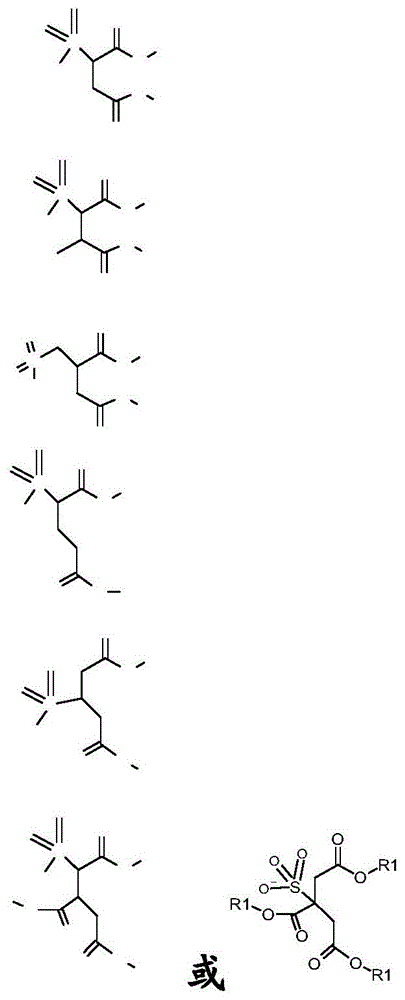
其中R1选自:where R1 is selected from:
-3,5,5-三甲基己基,-3,5,5-trimethylhexyl,
-2-乙基己基,-2-Ethylhexyl,
-3,3-二甲基-2-丁基,和-3,3-Dimethyl-2-butyl, and
-2,4,4-三甲基戊基。-2,4,4-Trimethylpentyl.
16.根据任一前述方面的用途,其中该组合物为含水组合物。16. The use according to any preceding aspect, wherein the composition is an aqueous composition.
17.根据任一前述方面的用途,其中17. Use according to any preceding aspect, wherein
-该一种或多种铵盐的铵阳离子总量为2×10⁻⁵-4×10⁻²mol/L,和/或- the one or more ammonium salts have a total amount of ammonium cations ranging from 2×10 −5 to 4×10 −2 mol/L, and/or
-如第9-16方面中任一项所定义的该一种或多种铵盐的阴离子总量为2×10⁻⁵-4×10⁻²mol/L。- the one or more ammonium salts as defined in any one of aspects 9-16 have a total amount of anions of 2×10 −5 to 4×10 −2 mol/L.
18.根据任一前述方面的用途,其中该组合物具有的平衡表面张力在临界胶束浓度下测定小于35mN/m,优选小于30mN/m,更优选小于27mN/m,最优选小于25mN/m。18. Use according to any preceding aspect, wherein the composition has an equilibrium surface tension measured at critical micelle concentration of less than 35mN/m, preferably less than 30mN/m, more preferably less than 27mN/m, most preferably less than 25mN/m .
19.根据任一前述方面的用途,其中所述清洁或冲洗为制备集成电路器件、光学器件、微机械或机械精密器件的方法的一部分。19. The use according to any preceding aspect, wherein the cleaning or rinsing is part of a method of making an integrated circuit device, an optical device, a micromechanical or mechanical precision device.
20.根据任一前述方面的用途,其中将包含一种或多种铵盐的组合物用于清洁或冲洗,从而:20. Use according to any preceding aspect, wherein a composition comprising one or more ammonium salts is used for cleaning or rinsing, thereby:
防止图案瓦解,prevent the pattern from collapsing,
降低线边缘粗糙度,Reduce line edge roughness,
防止或除去水印缺陷,prevent or remove watermark defects,
防止或减少光刻胶溶胀,Prevent or reduce photoresist swelling,
防止或减少斑点缺陷,和/或Prevent or reduce spot defects, and/or
除去颗粒。Remove particles.
21.根据任一前述方面的用途,其中具有线宽为50nm或更小的线-间隙结构的图案化材料层选自图案化已显影光刻胶层、图案化阻隔材料层、图案化多叠材料层和图案化介电材料层。21. Use according to any preceding aspect, wherein the patterned material layer having a line-gap structure with a line width of 50 nm or less is selected from the group consisting of patterned developed photoresist layers, patterned barrier material layers, patterned multilayer material layer and patterned dielectric material layer.
22.根据任一前述方面的用途,其中该图案化材料层具有线宽为32nm或更小,优选22nm或更小的线-间隙结构。22. Use according to any preceding aspect, wherein the patterned material layer has a line-gap structure with a line width of 32 nm or less, preferably 22 nm or less.
23.根据任一前述方面的用途,其中该图案化材料层对于非光刻胶结构具有大于10的纵横比且对于光刻胶结构具有大于2的纵横比。23. The use according to any preceding aspect, wherein the patterned material layer has an aspect ratio greater than 10 for non-photoresist structures and greater than 2 for photoresist structures.
24.制备包含基材和承载于其上的具有线宽为50nm或更小的线-间隙结构的图案化材料层的已清洁或冲洗产品的方法,该方法包括下列步骤:24. A method of making a cleaned or rinsed product comprising a substrate and a layer of patterned material having a line-gap structure having a line width of 50 nm or less carried thereon, the method comprising the steps of:
-制备或提供包含基材和承载于其上的具有线宽为50nm或更小的线-间隙结构的图案化材料层的产品,- making or providing a product comprising a substrate and a layer of patterned material carried thereon having a line-gap structure having a line width of 50 nm or less,
-制备或提供如第1-18方面中任一项所定义的组合物,以及- preparing or providing a composition as defined in any of aspects 1-18, and
-用所述组合物清洁或冲洗所述产品,从而得到已清洁或冲洗产品。- cleaning or rinsing the product with the composition, resulting in a cleaned or rinsed product.
25.根据第24方面的方法,包括下列步骤:25. The method according to aspect 24, comprising the steps of:
-对基材提供浸没式光刻胶、EUV光刻胶或电子束光刻胶层,- Provide an immersion photoresist, EUV photoresist or e-beam photoresist layer to the substrate,
-在有或没有浸没液体下通过掩模使光刻胶层暴露于光化辐射,- exposure of the photoresist layer to actinic radiation through a mask with or without immersion liquid,
-用显影剂溶液显影已曝光的光刻胶层,得到具有线宽为50nm或更小的线-间隙结构的图案,从而得到包含基材和承载于其上的具有线宽为50nm或更小的线-间隙结构的图案化材料层的产品,- developing the exposed photoresist layer with a developer solution to obtain a pattern having a line-space structure having a line width of 50 nm or less, thereby obtaining a substrate comprising a substrate and supported thereon having a line width of 50 nm or less The product of the patterned material layer of the line-gap structure,
-用所述组合物清洁或冲洗所述产品,从而得到已清洁或冲洗产品,以及任选地,- cleaning or rinsing the product with the composition, resulting in a cleaned or rinsed product, and optionally,
-干燥所述已清洁或冲洗产品,优选通过甩干或通过使用Marangoni效应的干燥方法。- drying the cleaned or rinsed product, preferably by spin drying or by drying methods using the Marangoni effect.
26.根据第24-25方面中任一项的方法,其中该组合物如第1-19方面中任一项所定义和/或该图案化材料层如第22-24方面中任一项所定义。26. The method according to any one of aspects 24-25, wherein the composition is as defined in any one of aspects 1-19 and/or the patterned material layer is as defined in any one of aspects 22-24 definition.
27.配制剂,包含:27. A formulation comprising:
-水,和- water, and
-一种或多种如第1-15方面中任一项所定义的铵盐,以及任选地,- one or more ammonium salts as defined in any one of aspects 1-15, and optionally,
-一种或多种有机溶剂化合物,- one or more organic solvent compounds,
其中该配制剂具有:wherein the formulation has:
小于1000,优选小于100,更优选小于50的HAZEN色数,和/或HAZEN chromatic number less than 1000, preferably less than 100, more preferably less than 50, and/or
0.08-10NTU,优选0.2-5NTU,更优选0.2-1NTU的浊度。Turbidity of 0.08-10 NTU, preferably 0.2-5 NTU, more preferably 0.2-1 NTU.
28.根据第27方面的配制剂,其中如第1-16方面中任一项所定义的所述铵盐的总浓度为2×10⁻⁵-4×10⁻²mol/L。28. The formulation according to aspect 27, wherein the total concentration of said ammonium salt as defined in any one of aspects 1-16 is 2x10" 5-4x10 " 2 mol/L.
29.根据第27-28方面中任一项的配制剂,其中一种或多种化合物的该一种或多种铵盐为一种或多种选自如下的化合物的铵盐:29. The formulation according to any one of aspects 27-28, wherein the one or more ammonium salts of one or more compounds are ammonium salts of one or more compounds selected from the group consisting of:
(磺基甲基)丁二酸二酯,(sulfomethyl)succinic acid diester,
甲基磺基丁二酸二酯,Methylsulfosuccinic acid diester,
磺基戊二酸二酯,和Sulfoglutaric acid diester, and
磺基丙三羧酸三酯。Sulfoglyceric acid triester.
30.根据第27-29方面中任一项的配制剂,其中该一种或者该不止一种铵盐中的至少一种包含至少一个选自如下的铵阳离子:30. The formulation according to any one of aspects 27-29, wherein at least one of the one or the more than one ammonium salt comprises at least one ammonium cation selected from the group consisting of:
-三(2-羟基乙基)铵,- tris(2-hydroxyethyl)ammonium,
-二(2-羟基乙基)铵,- bis(2-hydroxyethyl)ammonium,
-三(2-羟基乙基)甲基铵,- tris(2-hydroxyethyl)methylammonium,
-二(2-羟基乙基)二甲基铵,- bis(2-hydroxyethyl)dimethylammonium,
-2-羟基乙基三甲基铵,-2-Hydroxyethyltrimethylammonium,
-2-羟基乙基三乙基铵,-2-Hydroxyethyltriethylammonium,
-2-羟基丙基三甲基铵,-2-hydroxypropyltrimethylammonium,
-二(2-羟基丙基)二甲基铵,和- bis(2-hydroxypropyl)dimethylammonium, and
-三(2-羟基丙基)甲基铵。- Tris(2-hydroxypropyl)methylammonium.
31.根据第27-30方面中任一项的配制剂,其中该一种或者该不止一种铵盐中的至少一种包含至少一个选自如下的铵阳离子:31. The formulation according to any one of aspects 27-30, wherein at least one of the one or the more than one ammonium salt comprises at least one ammonium cation selected from the group consisting of:
-三(2-羟基乙基)铵,- tris(2-hydroxyethyl)ammonium,
-二(2-羟基乙基)铵,- bis(2-hydroxyethyl)ammonium,
-三(2-羟基乙基)甲基铵,- tris(2-hydroxyethyl)methylammonium,
-二(2-羟基乙基)二甲基铵,- bis(2-hydroxyethyl)dimethylammonium,
-2-羟基乙基三甲基铵,-2-Hydroxyethyltrimethylammonium,
-2-羟基乙基三乙基铵,-2-Hydroxyethyltriethylammonium,
-2-羟基丙基三甲基铵,-2-hydroxypropyltrimethylammonium,
-二(2-羟基丙基)二甲基铵,和- bis(2-hydroxypropyl)dimethylammonium, and
-三(2-羟基丙基)甲基铵;- tris(2-hydroxypropyl)methylammonium;
并且其中一种或多种化合物的该一种或多种铵盐为一种或多种选自如下的化合物的铵盐:and wherein the one or more ammonium salts of one or more compounds are one or more ammonium salts of compounds selected from the group consisting of:
(磺基甲基)丁二酸二酯,(sulfomethyl)succinic acid diester,
甲基磺基丁二酸二酯,Methylsulfosuccinic acid diester,
磺基戊二酸二酯,和Sulfoglutaric acid diester, and
磺基丙三羧酸三酯。Sulfoglyceric acid triester.
32.根据第27-31方面中任一项的配制剂,用于清洁或冲洗包含基材和承载于其上的具有线宽为50nm及更小的线-间隙结构的图案化材料层的产品的用途。32. The formulation according to any one of aspects 27 to 31 for cleaning or rinsing a product comprising a substrate and a layer of patterned material having a line-gap structure with a line width of 50 nm and less carried thereon the use of.
33.根据第27-32方面中任一项的配制剂,包含选自如下的有机溶剂化合物:33. The formulation according to any one of aspects 27-32, comprising an organic solvent compound selected from the group consisting of:
-总数为1-8个碳原子的醇,- alcohols with a total of 1-8 carbon atoms,
-烷基乙二醇,- alkyl glycols,
-烷基二甘醇,- Alkyl Diethylene Glycol,
-烷基三甘醇,- alkyl triethylene glycols,
-烷基丙二醇,- alkyl propylene glycol,
-烷基二丙二醇,和- alkyl dipropylene glycol, and
-烷基三丙二醇- Alkyl tripropylene glycol
其中烷基在每种情况下具有的总碳原子数为1-7。wherein the alkyl group has in each case a total number of carbon atoms from 1 to 7.
34.根据第27-33方面中任一项的配制剂,基于该配制剂的总重量包含小于5ppm,优选小于1ppm,更优选小于0.05ppm,甚至更优选小于5ppb,最优选小于3ppb的金属阳离子。34. The formulation according to any one of aspects 27-33, comprising less than 5 ppm, preferably less than 1 ppm, more preferably less than 0.05 ppm, even more preferably less than 5 ppb, most preferably less than 3 ppb of metal cations, based on the total weight of the formulation .
35.根据第27-34方面中任一项的配制剂,仅含有最大尺寸<3μm,更优选<300nm,最优选<30nm的颗粒。35. The formulation according to any one of aspects 27-34, comprising only particles with a largest dimension <3 μm, more preferably <300 nm, most preferably <30 nm.
36.制备根据第27-35方面中任一项的配制剂的方法,至少包括下列步骤:36. A method of preparing a formulation according to any one of aspects 27-35, comprising at least the steps of:
a)通过一种包括将亚硫酸氢根阴离子加成于一种或多种α,β-不饱和酯的双键的程序合成一种或多种如第1-16方面中任一项所定义的铵盐,从而得到一种或多种选自如下的相应二酯或三酯阴离子:a) Synthesis of one or more as defined in any of aspects 1-16 by a procedure comprising addition of a bisulfite anion to the double bond of one or more α,β-unsaturated esters ammonium salt, thereby obtaining one or more corresponding diester or triester anions selected from the group consisting of:
磺基丁二酸二酯阴离子,Sulfosuccinate diester anion,
(磺基甲基)丁二酸二酯阴离子,(sulfomethyl)succinate diester anion,
甲基磺基丁二酸二酯阴离子,Methylsulfosuccinate diester anion,
磺基戊二酸二酯阴离子,和Sulfoglutaric acid diester anion, and
磺基丙三羧酸三酯阴离子,Sulfoglyceric acid triester anion,
b)将在步骤a)中合成的所述一种或多种铵盐与水和/或一种或多种如第33方面所定义的有机溶剂混合以得到一种配制剂,b) mixing said one or more ammonium salts synthesized in step a) with water and/or one or more organic solvents as defined in aspect 33 to obtain a formulation,
c)任选地,使在步骤b)中得到的配制剂滤过孔度直径<30nm的过滤器。c) Optionally, the formulation obtained in step b) is filtered through a filter having a pore diameter of <30 nm.
37.根据第36方面的方法,其中在步骤a)中,37. The method according to aspect 36, wherein in step a),
-亚硫酸氢根阴离子的抗衡阳离子为如第2-8方面中任一项所定义的铵阳离子,从而在亚硫酸氢根阴离子到一种或多种α,β-不饱和酯的所述双键的所述加成之后构成一种或多种如第1-15方面中任一项所定义的铵盐,或者- the counter cation for the bisulfite anion is an ammonium cation as defined in any one of aspects 2 to 8, whereby the bisulfite anion to one or more α,β-unsaturated esters in said bisulfite Said addition of the bond then forms one or more ammonium salts as defined in any one of aspects 1-15, or
-亚硫酸氢根阴离子的抗衡阳离子不为如第2-8方面中任一项所定义的铵阳离子并且在随后步骤中将抗衡阳离子交换为如第2-8方面中任一项所定义的铵阳离子,从而构成该一种或多种如第2-15方面中任一项所定义的铵盐,或者- the counter cation of the bisulfite anion is not an ammonium cation as defined in any one of aspects 2-8 and in a subsequent step the counter cation is exchanged for an ammonium cation as defined in any one of aspects 2-8 cations, thereby constituting the one or more ammonium salts as defined in any one of aspects 2-15, or
-亚硫酸氢根阴离子的抗衡阳离子不为铵阳离子,并且在随后步骤中将抗衡离子交换为铵阳离子,从而构成该一种或多种如第1-15方面中任一项所定义的铵盐。- the counter cation of the bisulfite anion is not an ammonium cation, and in a subsequent step the counter ion is exchanged for an ammonium cation, thereby constituting the one or more ammonium salts as defined in any one of aspects 1-15 .
38.根据第37方面的方法,其中在随后的步骤中,将抗衡离子交换为如第2-8方面中任一项所定义的铵阳离子,从而构成该一种或多种如第2-15方面中任一项所定义的铵盐。38. The method according to aspect 37, wherein in a subsequent step, the counter ion is exchanged for an ammonium cation as defined in any one of aspects 2-8, thereby constituting the one or more of An ammonium salt as defined in any one of the aspects.
39.根据第36或38方面中任一项的方法,包括如下步骤:39. The method according to any one of aspects 36 or 38, comprising the steps of:
c)使在步骤b)中得到的配制剂滤过孔度直径<30nm的过滤器,c) filtering the formulation obtained in step b) through a filter with a pore diameter of <30 nm,
并且作为进一步的步骤包括:And as further steps include:
d)将已过滤配制剂与额外的水混合以给出稀释的含水配制剂。d) The filtered formulation is mixed with additional water to give a diluted aqueous formulation.
40.根据第36-39方面中任一项的方法,其中加入的水为电子级水。40. The method according to any of aspects 36-39, wherein the water added is electronic grade water.
41.根据第36-40方面中任一项的方法,其中所得一个或多个相应二酯或三酯阴离子选自:41. The method according to any one of aspects 36-40, wherein the resulting one or more corresponding diester or triester anions are selected from:
(磺基甲基)丁二酸二酯阴离子,(sulfomethyl)succinate diester anion,
甲基-磺基丁二酸二酯阴离子,Methyl-sulfosuccinic acid diester anion,
磺基戊二酸二酯阴离子,和Sulfoglutaric acid diester anion, and
磺基丙三羧酸三酯阴离子。Sulfoglyceric acid triester anion.
本发明通过参考下列实施例和附图进一步说明。The present invention is further illustrated by reference to the following examples and figures.
附图:Attached:
图1:在用去离子水冲洗之后光刻胶的AFM图像(线=26nm且间距(pitch)=78nm)。Figure 1: AFM image of photoresist after rinsing with deionized water (lines=26 nm and pitch=78 nm).
图2:在用含有磺基丁二酸二(3,5,5-三甲基己基)酯铵盐[其中两个R基团=3,5,5-三甲基己基且n=0]的本发明配制剂冲洗之后光刻胶的AFM图像(线=26nm且间距=78nm)。Figure 2: In the ammonium salt containing bis(3,5,5-trimethylhexyl) sulfosuccinate [wherein two R groups = 3,5,5-trimethylhexyl and n = 0] AFM image of the photoresist after rinsing of the formulation of the invention (lines=26 nm and spacing=78 nm).
图3:在用去离子水冲洗之后光刻胶的AFM图像(线=40nm且间距=120nm)。Figure 3: AFM image of photoresist after rinsing with deionized water (lines=40 nm and spacing=120 nm).
图4:在用含有磺基丁二酸二(3,5,5-三甲基己基)酯铵盐[其中两个R基团=3,5,5-三甲基己基且n=0]的本发明配制剂冲洗之后光刻胶的AFM图像(线=40nm且间距=120nm)。Figure 4: In the ammonium salt containing bis(3,5,5-trimethylhexyl) sulfosuccinate [wherein two R groups = 3,5,5-trimethylhexyl and n = 0] AFM image of photoresist after rinsing of the formulation of the invention (lines=40 nm and spacing=120 nm).
图5:在用含有含有2-羟基乙基三甲基铵磺基丁二酸二(3,5,5-三甲基己基)酯[其中两个R基团=3,5,5-三甲基己基且n=0]的本发明配制剂冲洗之后光刻胶的AFM图像(线=40nm且间距=120nm)。Figure 5: Use of bis(3,5,5-trimethylhexyl) sulfosuccinate containing 2-hydroxyethyltrimethylammonium sulfosuccinate [wherein two R groups = 3,5,5-tri AFM image of photoresist after rinsing of the formulation of the invention with methylhexyl and n=0] (line=40 nm and spacing=120 nm).
实施例:Example:
支化因子(测定方法):Branching factor (measurement method):
支化因子根据WO 2009/124922A1中所公开的方法通过1H-NMR光谱法测定。在第一步中使必须测定其支化因子的醇与三氯乙酰基异氰酸酯(TAI)反应,形成相应的氨基甲酸酯。在第二步骤测量所形成氨基甲酸酯的NMR光谱。将在1-0.4ppm之间的甲基的质子信号的面积(F(CH3))与对应于在4.7-4ppm之间的伯醇的质子信号的面积(F(CH2-OH))相比较。根据下式计算支化因子:The branching factor was determined by 1 H-NMR spectroscopy according to the method disclosed in WO 2009/124922 A1. In a first step the alcohol, whose branching factor must be determined, is reacted with trichloroacetyl isocyanate (TAI) to form the corresponding carbamate. The NMR spectrum of the formed carbamate is measured in a second step. The area for the proton signal of the methyl group between 1-0.4 ppm (F( CH3 )) was compared with the area corresponding to the proton signal of the primary alcohol between 4.7-4 ppm (F( CH2 -OH)) Compare. Calculate the branching factor according to the following formula:
支化因子=((F(CH3)/3)/(F(CH2-OH)/2))-1。Branching factor=((F( CH3 )/3)/(F( CH2 -OH)/2))-1.
CMC(临界胶束浓度)(测定方法):CMC (critical micelle concentration) (measurement method):
根据平板法通过测量一系列具有不同浓度的表面活性剂水溶液的平衡表面张力用Kruess Tensiometer K 100测定CMC。所得曲线图通常具有两个不同区域。在CMC以下,平衡表面张力在大范围内线性地取决于表面活性剂浓度的对数。在CMC以上,平衡表面张力或多或少与该表面活性剂的浓度无关。这两个区域的数据点可以借助简单的线性回归统计学上拟合。CMC为与这些区域中的数据拟合的两条线性回归线之间的交点。CMC was determined with a Kruess Tensiometer K 100 according to the flat plate method by measuring the equilibrium surface tension of a series of aqueous surfactant solutions with different concentrations. The resulting graph typically has two distinct regions. Below the CMC, the equilibrium surface tension depends linearly on the logarithm of the surfactant concentration over a wide range. Above the CMC, the equilibrium surface tension is more or less independent of the concentration of this surfactant. The data points for these two regions can be statistically fitted by means of simple linear regression. The CMC is the intersection between two linear regression lines fitted to the data in these regions.
对于试验数据,见下表1。See Table 1 below for test data.
平衡表面张力(根据DIN 53914测量;试验):Equilibrium surface tension (measured according to DIN 53914; test):
表面活性剂水溶液的平衡表面张力通过平板法根据DIN 53914在25℃下用KruessTensiometer K 100测定。The equilibrium surface tension of aqueous surfactant solutions is determined by the plate method according to DIN 53914 at 25°C with a KruessTensiometer K 100.
平板法使用面积通常为几个平方厘米的薄板。该板通常由具有高表面能的铂制成,以确保完全润湿。在该板上由于润湿的力F经由张力计或微量天平测量并用来使用Wilhelmy方程式计算平衡表面张力:The flat plate method uses a thin plate with an area usually several square centimeters. The plate is usually made of platinum with high surface energy to ensure complete wetting. The force F due to wetting on the plate is measured via a tensiometer or microbalance and used to calculate the equilibrium surface tension using the Wilhelmy equation:

其中l为Wilhelmy板的润湿周长且θ为液相和该板之间的接触角。where l is the wetted perimeter of the Wilhelmy plate and θ is the contact angle between the liquid phase and the plate.
对于试验数据,见下表1。See Table 1 below for test data.
表1Table 1
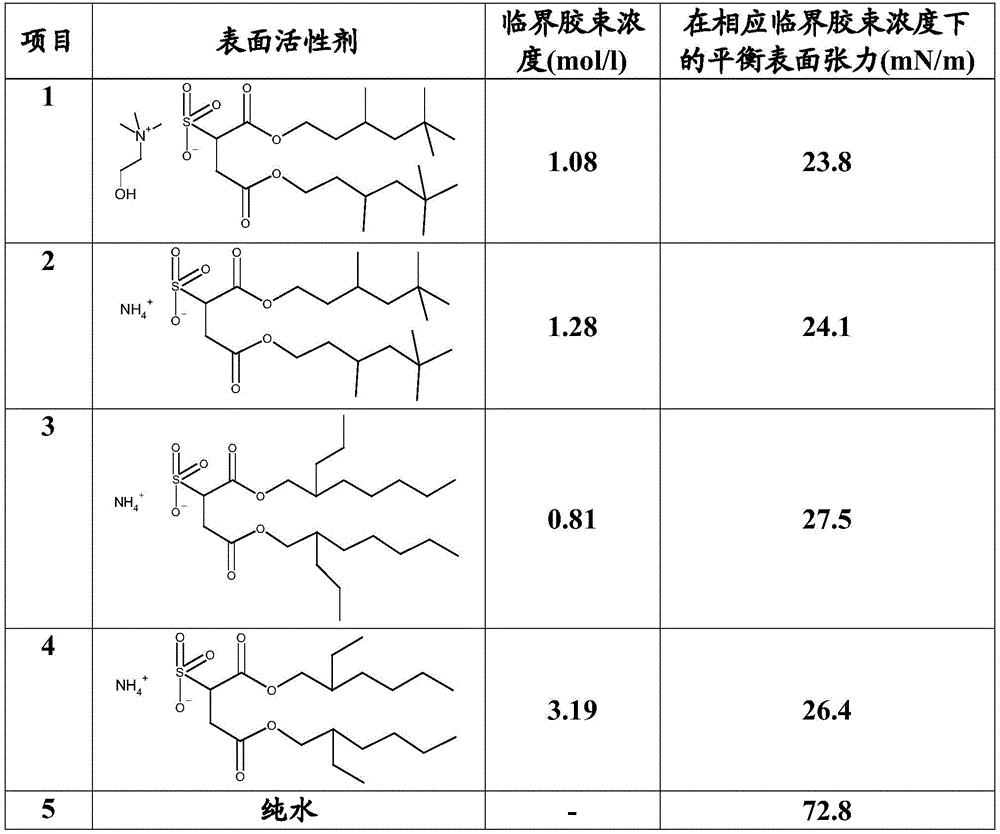

在表1中示出了在相应临界胶束浓度下测定的特定化合物(分别如权利要求书所定义或者作为参照)的平衡表面张力。如权利要求书中所定义的化合物(表1中的最先4项)的平衡表面张力为23.8-27.5mN/m。考虑到这些化合物是具有脂族结构部分的表面活性剂,这些值惊人地非常低。The equilibrium surface tensions of specific compounds (as defined in the claims or as a reference, respectively) determined at the corresponding critical micelle concentrations are shown in Table 1. The compounds as defined in the claims (first 4 entries in Table 1) have equilibrium surface tensions of 23.8-27.5 mN/m. Considering that these compounds are surfactants with aliphatic moieties, these values are surprisingly very low.
表1中的最后两项(纯水和iC13H27O-(CH2CH2O)3SO3NH4)是用于对比的参照化合物。纯水具有高得多的平衡表面张力(约73mN/m)。最后一项说明的是在水中具有质子化氨作为抗衡离子的烷基醚硫酸盐(iC13H27O-(CH2CH2O)3SO3NH4)。平衡表面张力(35mN/m)与本发明配制剂相比高得多。The last two items in Table 1 (pure water and iC 13 H 27 O-(CH 2 CH 2 O) 3 SO 3 NH 4 ) are reference compounds for comparison. Pure water has a much higher equilibrium surface tension (about 73 mN/m). The last item illustrated is an alkyl ether sulfate (iC 13 H 27 O—(CH 2 CH 2 O) 3 SO 3 NH 4 ) with protonated ammonia as a counterion in water. The equilibrium surface tension (35 mN/m) is much higher compared to the formulations of the invention.
申请人用(磺基甲基)丁二酸二酯、甲基磺基丁二酸二酯、磺基戊二酸二酯和磺基丙三羧酸三酯的铵盐进行了根据DIN 53914的进一步测量。这些进一步测量的结果非常类似于上表1中使用磺基丁二酸二酯的铵盐所述的那些。The applicant carried out the ammonium salts of (sulfomethyl)succinic acid diesters, methylsulfosuccinic acid diesters, sulfoglutaric acid diesters and sulfoglyceric acid triesters according to DIN 53914. further measurements. The results of these further measurements were very similar to those described in Table 1 above using the ammonium salt of the sulfosuccinate diester.
泡沫搅打体积(根据DIN 53902的测量方法;试验):Foam whipping volume (measurement method according to DIN 53902; test):
在23℃下将200ml 0.5g/l表面活性剂溶液(对于(i)用于试验中的相应表面活性剂和(ii)单独选择的浓度变化见表2)放入标度1000ml的量筒中。通过以1Hz的频率从1000ml刻度到量筒底部手动推动多孔盘30次而产生泡沫。该多孔盘具有48mm的直径。在该盘中均匀分布的60个孔具有1mm的直径。作为时间的函数检测该水溶液上方的泡沫体积。在表2中示出了200秒后该水溶液上方的泡沫体积。200 ml of a 0.5 g/l surfactant solution (see Table 2 for (i) the corresponding surfactant used in the test and (ii) individually selected concentration changes) were placed in a graduated cylinder of 1000 ml at 23°C. Foam was generated by manually pushing the perforated disk 30 times from the 1000 ml scale to the bottom of the graduated cylinder at a frequency of 1 Hz. The perforated disc has a diameter of 48mm. The 60 holes evenly distributed in the pan have a diameter of 1 mm. The volume of foam over the aqueous solution was measured as a function of time. The foam volume over the aqueous solution after 200 seconds is shown in Table 2.
对于试验数据,见下表2:For test data, see Table 2 below:
表2Table 2


*表面活性剂化合物与根据表2第一项所用化合物相同;在第二项中示出的是在0.2g/l表面活性剂浓度下200秒后的泡沫体积*The surfactant compound is the same as used according to the first entry in Table 2; in the second entry is shown the foam volume after 200 seconds at 0.2 g/l surfactant concentration
**在40℃和1g/l的表面活性剂浓度下的初始泡沫,来自D.Balzer等,SurfactantScience Series第91卷,New York 2000,第263页表31**Initial foam at 40°C and a surfactant concentration of 1 g/l, from D. Balzer et al., SurfactantScience Series Vol. 91, New York 2000, p. 263 Table 31
在表2中示出了有关如上所述的不同表面活性剂和现有技术中已知的表面活性剂的泡沫形成的数据。包含磺基琥珀酸二(2-乙基己基)铵盐的溶液(项目5,本发明配制剂,即包含如上所定义的铵盐的组合物)显示出最低的泡沫形成。对于本发明的其他配制剂(即包含如上所述的铵盐的组合物;项目1-4)得到类似结果。本发明配制剂的泡沫体积值与现有技术中已知的表面活性剂(市售表面活性剂Marlon PS)的非常高的值相比低得多。In Table 2 are shown data on foam formation for different surfactants as described above and surfactants known in the art. Solutions comprising bis(2-ethylhexyl)ammonium sulfosuccinate (Item 5, formulation of the invention, ie compositions comprising ammonium salts as defined above) showed the lowest foam formation. Similar results were obtained for other formulations of the invention (ie compositions comprising ammonium salts as described above; items 1-4). The foam volume values of the formulations according to the invention are much lower than the very high values of surfactants known from the prior art (commercially available surfactant Marlon PS).
因此,本发明配制剂(即包含如上所定义的铵盐的组合物)与现有技术中已知的表面活性剂配制剂相比具有更低的泡沫体积。Thus, the formulations of the present invention (ie compositions comprising an ammonium salt as defined above) have a lower lather volume compared to surfactant formulations known in the prior art.
此外,根据表2中的结果,表面活性剂溶液在一定程度上引起泡沫形成,但第一项与第二项的对比表明当相应表面活性剂的浓度降低时泡沫形成减少。Furthermore, according to the results in Table 2, the surfactant solution caused foam formation to some extent, but a comparison of the first term with the second term shows that foam formation decreases as the concentration of the corresponding surfactant decreases.
申请人用(磺基甲基)丁二酸二酯、甲基磺基丁二酸二酯、磺基戊二酸二酯和磺基丙三羧酸三酯的铵盐进行了根据DIN 53902的进一步测量。这些进一步测量的结果非常类似于上表2中使用磺基丁二酸二酯的铵盐所述的那些。The applicant carried out the ammonium salts of (sulfomethyl)succinic acid diesters, methylsulfosuccinic acid diesters, sulfoglutaric acid diesters and sulfoglyceric acid triesters according to DIN 53902. further measurements. The results of these further measurements were very similar to those described in Table 2 above using the ammonium salt of the sulfosuccinic acid diester.
动态表面张力(根据ASTM D 3825-90的测量;试验)Dynamic surface tension (measurement according to ASTM D 3825-90; test)
动态表面张力用Lauda MPT 2仪器通过最大气泡压力法测定。通过毛细管将空气泵入表面活性剂溶液中。该仪器测量当气泡半径等于毛细管半径时在与毛细管分离的气泡中达到的最大压力。动态表面张力通过LaPlace方程式计算:Dynamic surface tension was determined by the maximum bubble pressure method with a Lauda MPT 2 instrument. Air is pumped into the surfactant solution through a capillary. This instrument measures the maximum pressure reached in the bubble separated from the capillary when the bubble radius is equal to the capillary radius. Dynamic surface tension is calculated by the LaPlace equation:
p=2σ/rp=2σ/r
其中p为气泡中的最大压力,where p is the maximum pressure in the bubble,
对应于毛细管的半径r,和corresponds to the radius r of the capillary, and
σ为气泡和表面活性剂溶液之间的动态表面张力。σ is the dynamic surface tension between the bubbles and the surfactant solution.
气泡频率通过改变空气流而改变。气泡频率越高,表面活性剂不得不迁移到气泡表面以降低气泡周围的动态表面张力的时间越短。由气泡频率的改变产生从几毫秒到几秒的气泡表面年龄的时间轴。作为时间的函数的动态表面张力在恒定表面活性剂浓度(0.5g/l)和恒定环境温度下绘制。在表3中示出了1秒后的相应动态表面张力。The bubble frequency is changed by changing the air flow. The higher the bubble frequency, the less time the surfactant has to migrate to the surface of the bubble to reduce the dynamic surface tension around the bubble. A time axis of bubble surface age from milliseconds to seconds is generated by changes in bubble frequency. Dynamic surface tension as a function of time is plotted at constant surfactant concentration (0.5 g/l) and constant ambient temperature. The corresponding dynamic surface tension after 1 second is shown in Table 3.
对于试验数据,见下表3:For test data, see Table 3 below:
表3table 3
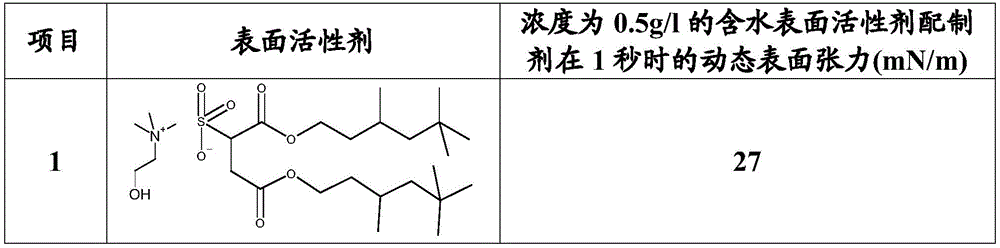

表3中的结果说明本发明不同配制剂(即包含如上所定义的铵盐的组合物)的动态表面张力。本发明不同配制剂(即包含如上所定义的铵盐的组合物)在1秒后的动态表面张力小于30mN/m(并且随着时间延长甚至进一步降低)。表3中的最后两项提供用于对比。纯水具有比本发明配制剂(即包含如上所定义的铵盐的组合物)高得多的动态表面张力(约73mN/m)。表3中的最后一项说明溶于水中的具有质子化氨作为抗衡离子的烷基醚硫酸盐。1秒后的动态表面张力(48mN/m)与本发明配制剂(即包含如上所定义的铵盐的组合物)相比高得多。对于所述用途(清洁或冲洗包含基材和承载于其上的具有线宽为50nm或更小的线-间隙结构的图案化材料层的产品),本发明配制剂(即包含如上所定义的铵盐的组合物)是有利的,因为循环时间可以保持短。The results in Table 3 illustrate the dynamic surface tension of different formulations of the invention, ie compositions comprising ammonium salts as defined above. The dynamic surface tension of the different formulations of the invention (ie compositions comprising ammonium salts as defined above) is less than 30 mN/m after 1 second (and decreases even further with time). The last two items in Table 3 are provided for comparison. Pure water has a much higher dynamic surface tension (about 73 mN/m) than the formulation of the present invention (ie the composition comprising the ammonium salt as defined above). The last entry in Table 3 illustrates the alkyl ether sulfates with protonated ammonia as the counterion dissolved in water. The dynamic surface tension after 1 second (48 mN/m) is much higher compared to the formulation of the invention (ie the composition comprising the ammonium salt as defined above). For said use (cleaning or rinsing a product comprising a substrate and a layer of patterned material with line-gap structures having a line width of 50 nm or less supported thereon), the formulations of the invention (ie comprising the above-defined ammonium salt composition) is advantageous because the cycle time can be kept short.
申请人用(磺基甲基)丁二酸二酯、甲基磺基丁二酸二酯、磺基戊二酸二酯和磺基丙三羧酸三酯的铵盐进行根据ASTM D 3825-90的进一步测量。这些进一步测量的结果非常类似于上表3中使用磺基丁二酸二酯的铵盐所述的那些。Applicants performed tests according to ASTM D 3825- Further measurements of 90. The results of these further measurements were very similar to those described in Table 3 above using the ammonium salt of the sulfosuccinate diester.
水溶液的NTU值(测定方法):NTU value of aqueous solution (measurement method):
NTU值根据EPA方法180.1例如用HACH Lange 2100 G仪器测定。NTU values are determined according to EPA method 180.1, eg with a HACH Lange 2100 G instrument.
例如,对于1g/l 2-羟基乙基三甲基铵磺基丁二酸二(3,5,5-三甲基己基)酯(来自合成部分4b的表面活性剂)在DIW(电子级水,意指去离子水)中在1g/l 1-甲氧基-2-丙醇存在下的溶液,测得NTU值为0.3。For example, for 1 g/l bis(3,5,5-trimethylhexyl) 2-hydroxyethyltrimethylammonium sulfosuccinate (surfactant from synthesis part 4b) in DIW (electronic grade water) , meaning deionized water) in the presence of 1 g/l 1-methoxy-2-propanol, the measured NTU value was 0.3.
对于水(DIW)测得NTU值为0.08。An NTU value of 0.08 was measured for water (DIW).
光刻胶溶胀和图案瓦解(测定方法;试验):Photoresist swelling and pattern collapse (measurement method; test):
图案瓦解和光刻胶溶胀通过使用AFM(原子力显微法)检查测定。对硅晶片提供100nm厚的浸没式光刻胶层。使用超纯水作为浸没液体通过掩模使提供的光刻胶层暴露于波长为193的UV辐射。由于该掩模,得到具有如下线-间隙结构的图案:Pattern collapse and photoresist swelling were determined by inspection using AFM (atomic force microscopy). A 100 nm thick immersion photoresist layer was provided to the silicon wafer. The provided photoresist layer was exposed to 193 wavelength UV radiation through a mask using ultrapure water as the immersion liquid. Due to this mask, a pattern with the following line-gap structure is obtained:
(A)线宽为26nm且间隙宽度(space width)为52nm(光刻胶层“L26P78”)以及纵横比为约4,以及(A) a line width of 26 nm and a space width of 52 nm (photoresist layer "L26P78") and an aspect ratio of about 4, and
(B)线宽为40nm且间隙宽度为80nm(光刻胶层“L40 P120”)以及纵横比为约2.5。(B) The line width is 40 nm and the gap width is 80 nm (photoresist layer "L40 P120") and the aspect ratio is about 2.5.
光刻胶线之间的间隙为(A)52nm[L(线)26nm P(间距)78nm]和(B)80nm[L(线)40nmP(间距)120nm]。The gaps between the photoresist lines were (A) 52 nm [L (line) 26 nm P (pitch) 78 nm] and (B) 80 nm [L (line) 40 nm P (pitch) 120 nm].
然后将曝光的光刻胶层(A)和(B)烘烤并用含有TMAH(四甲基氢氧化铵)的显影剂水溶液显影。将已烘烤和显影的光刻胶层单独进行使用下列三种化学冲洗溶液之一的化学冲洗处理,这些化学冲洗溶液以不同比例含有:The exposed photoresist layers (A) and (B) were then baked and developed with an aqueous developer solution containing TMAH (tetramethylammonium hydroxide). The baked and developed photoresist layer is subjected to a separate chemical rinse treatment using one of the following three chemical rinse solutions containing in varying proportions:
(a)DIW(去离子水),(a) DIW (deionized water),
(b)0.05重量%在DIW中的磺基丁二酸二(3,5,5-三甲基己基)酯铵(本发明配制剂或包含如上所述的铵盐的组合物),(b) 0.05% by weight of ammonium bis(3,5,5-trimethylhexyl)sulfosuccinate in DIW (formulations of the invention or compositions comprising ammonium salts as described above),
(c)0.05重量%在DIW中的磺基丁二酸二(3,5,5-三甲基己基)酯2-羟基乙基三甲基铵(本发明配制剂或包含如上所述的铵盐的组合物)。(c) 0.05% by weight of bis(3,5,5-trimethylhexyl)sulfosuccinate 2-hydroxyethyltrimethylammonium in DIW (formulations of the invention or containing ammonium as described above) salt composition).
各表面活性剂溶液与表面活性剂的量相比含有类似量(基于重量)的1-甲氧基-2-丙醇(用作有机(助)溶剂)。Each surfactant solution contained a similar amount (on a weight basis) of 1-methoxy-2-propanol (used as an organic (co)solvent) compared to the amount of surfactant.
各化学冲洗溶液作为胶泥施加。然后甩干硅晶片。Each chemical rinse solution is applied as a mastic. The silicon wafer is then spun dry.
试验数据:Test Data:
图案瓦解:Pattern collapse:
由下表4中所述试验数据可以得出如下结论:光刻胶层(B)(“L40P120”)在用化学冲洗溶液(b)和(c)处理时不显示出任何图案瓦解:在冲洗之前提供的所有9条线在冲洗之后仍然可见;也见图4和5。相比之下,在用DIW溶液冲洗的光刻胶层(B)中,理论总数为9条线中仅仅7条可见。From the experimental data described in Table 4 below, it can be concluded that the photoresist layer (B) ("L40P120") did not show any pattern collapse when treated with chemical rinse solutions (b) and (c): All 9 lines previously provided were still visible after flushing; see also Figures 4 and 5. In contrast, in the photoresist layer (B) rinsed with DIW solution, only 7 lines out of a theoretical total of 9 lines are visible.
光刻胶(A)(“L26P78”)当用化学冲洗溶液(b)处理时显示出的瓦解图案数目减少:与其中总数为7条线中仅仅3条可见的用DIW溶液冲洗的光刻胶(也见图1)相比,理论总数为7条线中仍有5条可见(也见图2)。The photoresist (A) ("L26P78") showed a reduction in the number of disintegrated patterns when treated with the chemical rinse solution (b): in contrast to the photoresist rinsed with the DIW solution where only 3 of the total 7 lines were visible (See also Figure 1) In comparison, 5 of the theoretical total of 7 lines are still visible (see also Figure 2).
对于试验数据,见下表4:For test data, see Table 4 below:
表4Table 4

因此,本发明配制剂和/或本发明所用组合物显著减少图案瓦解或者甚至防止图案瓦解。Thus, the formulations of the invention and/or the compositions used according to the invention significantly reduce or even prevent pattern collapse.
溶胀:Swell:
对于试验数据,见下图1-5和上表4:For test data, see Figures 1-5 below and Table 4 above:
图1-5说明在用DIW以及包含磺基丁二酸二(3,5,5-三甲基己基)酯铵盐和磺基丁二酸二(3,5,5-三甲基己基)酯2-羟基乙基三甲基铵的溶液冲洗处理之后经由AFM得到的由上至下的图。具有线宽为(A)26nm,间隙为52nm(间距78nm)且纵横比为约4以及线宽为(B)40nm且间隙为80nm(间距120nm)的图案的干燥图案化光刻胶层显示出显著的图案瓦解。Figures 1-5 illustrate the use of DIW with bis(3,5,5-trimethylhexyl) sulfosuccinate ammonium salt and sulfosuccinate bis(3,5,5-trimethylhexyl) Top-to-bottom image via AFM after a solution rinse of the ester 2-hydroxyethyltrimethylammonium. A dry patterned photoresist layer with a pattern of (A) 26nm linewidth, 52nm gap (78nm spacing) and an aspect ratio of about 4 and (B) 40nm linewidth and 80nm gap (120nm spacing) showed Significant pattern disintegration.
对于L40 P120,通过如上所述的显微方法仅仅观察到轻微溶胀(当使用包含磺基丁二酸二(3,5,5-三甲基己基)酯2-羟基乙基三甲基铵的溶液时;也见图5)或无溶胀(当使用包含磺基丁二酸二(3,5,5-三甲基己基)酯铵盐时;也见图4)。For L40 P120, only slight swelling was observed by microscopy as described above (when using bis(3,5,5-trimethylhexyl) sulfosuccinate 2-hydroxyethyltrimethylammonium solution; see also Figure 5) or no swelling (when using ammonium sulfosuccinate-containing bis(3,5,5-trimethylhexyl)ester; see also Figure 4).
对于L26 P78,通过如上所述的显微方法仅仅观察到轻微溶胀(当使用包含磺基丁二酸二(3,5,5-三甲基己基)酯铵盐时)(也见图2)。For L26 P78, only slight swelling was observed by microscopy as described above (when using ammonium salt containing bis(3,5,5-trimethylhexyl)ester sulfosuccinate) (see also Figure 2) .
对于这两种光刻胶(L26 P78和L40 P120),当使用DIW作为冲洗溶液时观察到溶胀(也见图1和3)。For both photoresists (L26 P78 and L40 P120), swelling was observed when DIW was used as the rinse solution (see also Figures 1 and 3).
因此,使用本发明配制剂和/或如上所述的组合物与用DIW的参照冲洗相比显著减少或者甚至防止了(取决于图案化结构的尺寸)光刻胶的溶胀。Thus, the use of the formulations of the invention and/or compositions as described above significantly reduces or even prevents (depending on the size of the patterned structures) swelling of the photoresist compared to a reference rinse with DIW.
申请人用(磺基甲基)丁二酸二酯、甲基磺基丁二酸二酯、磺基戊二酸二酯和磺基丙三羧酸三酯的铵盐进行对光刻胶溶胀和图案瓦解的进一步测量。这些进一步测量的结果非常类似于上表4中使用磺基丁二酸二酯的铵盐所述的那些。Applicants performed photoresist swelling with ammonium salts of (sulfomethyl)succinate diester, methylsulfosuccinate diester, sulfoglutarate diester, and sulfoglyceric acid triester and further measurements of pattern disintegration. The results of these further measurements were very similar to those described in Table 4 above using the ammonium salt of the sulfosuccinate diester.
水印缺陷、斑点缺陷、颗粒除去(测定方法;试验):Watermark defect, speckle defect, grain removal (measurement method; test):
颗粒除去通过扫描晶片的图案化材料层的表面进行。晶片使用连接于ASMLTwinscan NXT:1950i扫描仪的Sokudo Duo导轨制备。Particle removal is performed by scanning the surface of the patterned material layer of the wafer. Wafers were prepared using Sokudo Duo rails attached to an ASMLTwinscan NXT:1950i scanner.
制备相应图案化材料层的典型方法(包括使用本发明组合物或本发明配制剂)包括在250℃下预烘烤60s以及HMDS涂敷并在110℃下烘烤50℃。然后作为BARC(底部抗反射涂层)涂敷95nm Brewer Science ARC29SR并在205℃下烘烤60s。这之后是105nm TOK pi-6001或JSR AIM 5484抗蚀剂的抗蚀剂涂层。将抗蚀剂在120℃下烘烤60℃并且该TOK抗蚀剂得到额外的面漆。曝光在偶极场中进行。在扫描抗蚀剂之后,将晶片浸泡、清洁并在100℃下烘烤。对于手动冲洗试验,随后将晶片转移到FOSB(前开口运输箱)中并运送到实验室。然后将晶片用2.38重量%TMAH溶液显影并将测试溶液用于湿碰湿方法中。A typical method of preparing a corresponding layer of patterned material (including using the inventive composition or inventive formulation) involves prebaking at 250°C for 60 s and HMDS coating and baking at 110°C for 50°C. 95nm Brewer Science ARC29SR was then applied as a BARC (bottom antireflective coating) and baked at 205°C for 60s. This is followed by a resist coating of 105nm TOK pi-6001 or JSR AIM 5484 resist. The resist was baked at 60°C at 120°C and the TOK resist received an additional topcoat. Exposure is performed in a dipole field. After scanning the resist, the wafer was soaked, cleaned and baked at 100°C. For manual rinse experiments, the wafers were then transferred into FOSB (Front Opening Shipping Box) and shipped to the laboratory. The wafers were then developed with a 2.38 wt% TMAH solution and the test solutions were used in a wet-on-wet method.
在通过手动分配施加冲洗溶液(DIW(去离子水;表5中的第4项)对0.05重量%磺基丁二酸二(3,5,5-三甲基己基)酯2-羟基乙基三甲基铵(表面活性剂)、0.05重量%1-甲氧基-2-丙醇(助溶剂)和0.0002重量%N,N-二甲基肉豆蔻基胺氧化物的水溶液(表5中的第1和2项)或0.0002重量%1-辛醇(表5中的第3项))之后,将晶片甩干。Rinse solution (DIW (deionized water; entry 4 in Table 5) to 0.05 wt% bis(3,5,5-trimethylhexyl)sulfosuccinate 2-hydroxyethyl was applied by manual dispensing An aqueous solution of trimethylammonium (surfactant), 0.05 wt% 1-methoxy-2-propanol (cosolvent) and 0.0002 wt% N,N-dimethylmyristylamine oxide (in Table 5 of
用于检查的仪器为:The instruments used for inspection are:
-AFM-AFM
-SEM(Hitachi CG-5000)-SEM (Hitachi CG-5000)
-用于缺陷评估(缺陷表)的缺陷扫描(KLA 2385或类似),任选SEM-Vision- Defect scan (KLA 2385 or similar) for defect assessment (defect table), optional SEM-Vision
在甩干晶片之后检查晶片的缺陷。在KLA2385(KLA Tencor)上产生下列数据。The wafers are inspected for defects after they are spun dry. The following data were generated on KLA2385 (KLA Tencor).
对于试验数据,见下表5:For test data, see Table 5 below:
水印缺陷:Watermark defects:
由扫描电子显微法(SEM,Hitachi CG-5000)和原子力显微法(AFM)证实干燥的硅晶片不显示出任何水印。The dried silicon wafers were confirmed not to show any watermarks by scanning electron microscopy (SEM, Hitachi CG-5000) and atomic force microscopy (AFM).
表5:颗粒除去:Table 5: Particle Removal:

表面活性剂=磺基丁二酸二(3,5,5-三甲基己基)酯2-羟基乙基三甲基铵;助溶剂=1-甲氧基-2-丙醇Surfactant = bis(3,5,5-trimethylhexyl) sulfosuccinate 2-hydroxyethyltrimethylammonium; cosolvent = 1-methoxy-2-propanol
在表5的最后一项(项目4)中,可见在用DIW溶液冲洗根据如上所述的程序制备的光刻胶之后残留477个颗粒。在项目1-3中,可见在用本发明溶液或组合物清洁或冲洗之后在光刻胶(即包含基材和承载于其上的具有线宽为50nm或更小的线-间隙结构的图案化材料层的产品)的表面上残留显著更少的颗粒。已清洁或冲洗光刻胶为用于制备包含基材和承载于其上的具有线宽为50nm或更小的线-间隙结构的图案化材料层的已清洁或冲洗产品的本发明方法的产品。In the last entry of Table 5 (entry 4), it can be seen that 477 particles remained after rinsing the photoresist prepared according to the procedure described above with the DIW solution. In items 1-3, it can be seen that after cleaning or rinsing with the solution or composition of the present invention, the photoresist (ie, comprising the substrate and a pattern having line-gap structures having a line width of 50 nm or less supported thereon) significantly less particles remain on the surface of the product of the chemical layer). A cleaned or rinsed photoresist is a product of the method of the present invention for preparing a cleaned or rinsed product comprising a substrate and a layer of patterned material having a line-gap structure having a line width of 50 nm or less supported thereon .
如表5所示,本发明配制剂和/或本发明所用组合物与用DIW冲洗的光刻胶相比导致残留在光刻胶表面上的颗粒量显著减少。这对于减少水印缺陷和减少斑点缺陷也是有利的。As shown in Table 5, the formulations of the present invention and/or the compositions used in the present invention resulted in a significant reduction in the amount of particles remaining on the surface of the photoresist compared to the photoresist rinsed with DIW. This is also beneficial for reducing watermark defects and reducing speckle defects.
申请人用(磺基甲基)丁二酸二酯、甲基磺基丁二酸二酯、磺基戊二酸二酯和磺基丙三羧酸三酯的铵盐对水印缺陷、斑点缺陷和颗粒的除去进行了进一步测量。这些进一步测量的结果非常类似于上表5中使用磺基丁二酸二酯的铵盐所述的那些。Applicant's use of ammonium salts of (sulfomethyl)succinate diester, methylsulfosuccinate diester, sulfoglutarate diester and sulfoglyceric acid triester on watermark defects, speckle defects and particle removal were further measured. The results of these further measurements were very similar to those described in Table 5 above using the ammonium salt of the sulfosuccinate diester.
合成:synthesis:
1)马来酸二酯/富马酸二酯1) Maleic acid diester/fumaric acid diester
a)混有富马酸二(2-乙基己基)酯的马来酸二(2-乙基己基)酯a) Di(2-ethylhexyl) maleate mixed with bis(2-ethylhexyl) fumarate
在装有桨式搅拌器、PT100热电元件、回流冷凝器和分水器的2升四颈圆底烧瓶中加入390.68g(3mol,2.0eq)2-乙基-1-己醇(工业级,纯度>95重量%,供应商BASF)、6g(0.0315mol,0.021eq)一水合对甲苯磺酸和450g甲苯并在20℃下搅拌。升温至40℃并分批加入147.09g(1.5mol,1.0eq)马来酸酐。在1小时内升温至126℃并通过分水器除去反应水。48小时后分离理论量的水。将反应混合物冷却至50℃并转移至分液漏斗。在50℃下将有机层洗涤3次,每次使用266g水。然后将有机相分离,在硫酸钠上干燥并滤过Seitz K900过滤器。在旋转蒸发器中在90℃和<10毫巴下除去甲苯。得到480g黄色液体(产率94mol%(对于理论量的所需酯结构))。在CDCl3和MeOD中的1H-NMR光谱法证实形成了所需马来酸二酯及其结构异构体富马酸二酯(由于热应力而异构化;马来酸二酯:富马酸二酯=84:16)并显示出完全的酯化度。In a 2-liter four-neck round-bottom flask equipped with a paddle stirrer, PT100 thermoelectric element, reflux condenser and water separator, add 390.68 g (3 mol, 2.0 eq) of 2-ethyl-1-hexanol (technical grade, Purity >95 wt%, supplier BASF), 6 g (0.0315 mol, 0.021 eq) p-toluenesulfonic acid monohydrate and 450 g toluene and stirred at 20°C. The temperature was raised to 40°C and 147.09 g (1.5 mol, 1.0 eq) maleic anhydride was added in portions. The temperature was raised to 126°C within 1 hour and the water of reaction was removed through a water trap. The theoretical amount of water was separated after 48 hours. The reaction mixture was cooled to 50°C and transferred to a separatory funnel. The organic layer was washed 3 times with 266 g of water each time at 50°C. The organic phase was then separated, dried over sodium sulfate and filtered through a Seitz K900 filter. Toluene was removed in a rotary evaporator at 90°C and <10 mbar. 480 g of yellow liquid were obtained (94 mol % yield (for the theoretical amount of the desired ester structure)). 1 H-NMR spectroscopy in CDCl and MeOD confirmed formation of the desired maleic diester and its structural isomer fumaric diester (isomerized due to thermal stress; maleic diester: rich Maleic acid diester = 84:16) and showed a complete degree of esterification.
a’)混有富马酸二(2-乙基己基)酯的马来酸二(2-乙基己基)酯a') Di(2-ethylhexyl) maleate mixed with bis(2-ethylhexyl) fumarate
在装有桨式搅拌器、PT100热电元件、回流冷凝器和分水器的1升四颈圆底烧瓶中加入150.5g(1.158mol,2.0eq)2-乙基-1-己醇(工业级,纯度>95重量%,供应商BASF)、4.4g(0.0232mol,0.04eq)一水合对甲苯磺酸、191g甲苯和56.7g(0.579mol,1.0eq)马来酸酐并在20℃下搅拌。升温至123-125℃并使氮气流在该液体上流过。通过分水器除去反应水。12小时后分离理论量的水。将反应混合物冷却至50℃并转移至分液漏斗。在50℃下将有机层洗涤3次,每次使用127g水。然后分离有机相并在旋转蒸发器中在90℃和<10毫巴下除去甲苯。然后将产物滤过Seitz K900过滤器。得到185g黄色液体(产率94mol%(对于理论量的所需酯结构))。在CDCl3和MeOD中的1H-NMR光谱法证实形成了所需马来酸二酯及其结构异构体富马酸二酯(由于热应力而异构化;马来酸二酯:富马酸二酯=92:8)并显示出完全的酯化度。In a 1 liter four-neck round bottom flask equipped with a paddle stirrer, PT100 thermoelectric element, reflux condenser and water separator, add 150.5 g (1.158 mol, 2.0 eq) of 2-ethyl-1-hexanol (technical grade , purity >95 wt%, supplier BASF), 4.4 g (0.0232 mol, 0.04 eq) p-toluenesulfonic acid monohydrate, 191 g toluene and 56.7 g (0.579 mol, 1.0 eq) maleic anhydride and stirred at 20°C. The temperature was raised to 123-125°C and a stream of nitrogen was passed over the liquid. The water of reaction was removed through a water separator. The theoretical amount of water was separated after 12 hours. The reaction mixture was cooled to 50°C and transferred to a separatory funnel. The organic layer was washed 3 times with 127 g of water each time at 50°C. The organic phase was then separated and the toluene was removed in a rotary evaporator at 90° C. and <10 mbar. The product was then filtered through a Seitz K900 filter. 185 g of yellow liquid were obtained (94 mol % yield (for the theoretical amount of the desired ester structure)). 1 H-NMR spectroscopy in CDCl and MeOD confirmed formation of the desired maleic diester and its structural isomer fumaric diester (isomerized due to thermal stress; maleic diester: rich Maleic acid diester = 92:8) and showed a complete degree of esterification.
b)混有富马酸二(3,5,5-三甲基-1-己基)酯的马来酸二(3,5,5-三甲基-1-己基)酯b) Di(3,5,5-trimethyl-1-hexyl) maleate mixed with bis(3,5,5-trimethyl-1-hexyl) fumarate
在装有桨式搅拌器、PT100热电元件、回流冷凝器和分水器的2升四颈圆底烧瓶中加入390.35g(2.692mol,2.0eq)3,5,5-三甲基-1-己醇(工业级,纯度>85重量%,其余为结构异构体,供应商Oxea)、5.4g(0.0284mol,0.02eq)一水合对甲苯磺酸和450g甲苯并在20℃下搅拌。升温至40℃并分批加入131.99g(1.346mol,1.0eq)马来酸酐。在1小时内升温至125℃并通过分水器除去反应水。67小时后分离理论量的水。将反应混合物冷却至50℃并转移至分液漏斗。在50℃下将有机层洗涤3次,每次使用300g水。然后将有机相分离,在硫酸钠上干燥并滤过Seitz K900过滤器。在旋转蒸发器中在90℃和<10毫巴下除去甲苯。得到468g黄色液体(产率94mol%(对于理论量的所需酯结构))。在CDCl3和MeOD中的1H-NMR光谱法证实形成了所需马来酸二酯及其结构异构体富马酸二酯(由于热应力而异构化;马来酸二酯:富马酸二酯=80:20)并显示出完全的酯化度。To a 2-liter four-neck round-bottom flask equipped with a paddle stirrer, PT100 thermoelectric element, reflux condenser and water separator was added 390.35 g (2.692 mol, 2.0 eq) of 3,5,5-trimethyl-1- Hexanol (technical grade, >85 wt% purity, rest are structural isomers, supplier Oxea), 5.4 g (0.0284 mol, 0.02 eq) p-toluenesulfonic acid monohydrate and 450 g toluene and stirred at 20°C. The temperature was raised to 40°C and 131.99 g (1.346 mol, 1.0 eq) maleic anhydride was added in portions. The temperature was raised to 125°C within 1 hour and the water of reaction was removed through a water trap. The theoretical amount of water was separated after 67 hours. The reaction mixture was cooled to 50°C and transferred to a separatory funnel. The organic layer was washed 3 times with 300 g of water each time at 50°C. The organic phase was then separated, dried over sodium sulfate and filtered through a Seitz K900 filter. Toluene was removed in a rotary evaporator at 90°C and <10 mbar. 468 g of yellow liquid were obtained (94 mol % yield (for the theoretical amount of the desired ester structure)). 1 H-NMR spectroscopy in CDCl and MeOD confirmed formation of the desired maleic diester and its structural isomer fumaric diester (isomerized due to thermal stress; maleic diester: rich Maleic acid diester = 80:20) and showed a complete degree of esterification.
b’)混有富马酸二(3,5,5-三甲基-1-己基)酯的马来酸二(3,5,5-三甲基-1-己基)酯b') Di(3,5,5-trimethyl-1-hexyl) maleate mixed with bis(3,5,5-trimethyl-1-hexyl) fumarate
在装有桨式搅拌器、PT100热电元件、回流冷凝器和分水器的1升四颈圆底烧瓶中加入166.8g(1.158mol,2.0eq)3,5,5-三甲基-1-己醇(工业级,纯度>85重量%,其余为结构异构体,供应商Oxea)、4.4g(0.0232mol,0.04eq)一水合对甲苯磺酸、191g甲苯和56.7g(0.579mol,1.0eq)马来酸酐并在20℃下搅拌。升温至123-125℃并使氮气流在该液体上流过。通过分水器除去反应水。12小时后分离理论量的水。将反应混合物冷却至50℃并转移至分液漏斗。在50℃下将有机层洗涤3次,每次使用127g水。然后分离有机相并在旋转蒸发器中在90℃和<10毫巴下除去甲苯。然后将产物滤过Seitz K900过滤器。得到202g黄色液体(产率94mol%(对于理论量的所需酯结构))。在CDCl3和MeOD中的1H-NMR光谱法证实形成了所需马来酸二酯及其结构异构体富马酸二酯(由于热应力而异构化;马来酸二酯:富马酸二酯=93:7)并显示出完全的酯化度。To a 1-liter four-neck round-bottom flask equipped with a paddle stirrer, PT100 thermoelectric element, reflux condenser and water separator was added 166.8 g (1.158 mol, 2.0 eq) of 3,5,5-trimethyl-1- Hexanol (technical grade, >85 wt% purity, rest are structural isomers, supplier Oxea), 4.4g (0.0232mol, 0.04eq) p-toluenesulfonic acid monohydrate, 191g toluene and 56.7g (0.579mol, 1.0 eq) maleic anhydride and stirred at 20°C. The temperature was raised to 123-125°C and a stream of nitrogen was passed over the liquid. The water of reaction was removed through a water separator. The theoretical amount of water was separated after 12 hours. The reaction mixture was cooled to 50°C and transferred to a separatory funnel. The organic layer was washed 3 times with 127 g of water each time at 50°C. The organic phase was then separated and the toluene was removed in a rotary evaporator at 90° C. and <10 mbar. The product was then filtered through a Seitz K900 filter. 202 g of yellow liquid were obtained (94 mol % yield (for the theoretical amount of the desired ester structure)). 1 H-NMR spectroscopy in CDCl and MeOD confirmed formation of the desired maleic diester and its structural isomer fumaric diester (isomerized due to thermal stress; maleic diester: rich Maleic acid diester = 93:7) and showed a complete degree of esterification.
c)混有富马酸二(异壬基)酯的马来酸二(异壬基)酯c) Di(isononyl) maleate mixed with bis(isononyl) fumarate
在20℃下在装有桨式搅拌器、PT100热电元件、回流冷凝器和分水器的2升四颈圆底烧瓶中加入389.4g(2.699mol,2.0eq)Nonanol N(工业级,纯度>95重量%,供应商BASF)、5.4g(0.0282mol,0.021eq)一水合对甲苯磺酸和450g甲苯。升温至40℃并在搅拌下分批加入132.3g(1.350mol,1.0eq)马来酸酐。升温至126℃。通过分水器除去反应水。72小时后分离理论量的水。将反应混合物冷却至50℃并转移至分液漏斗。在50℃下将有机层洗涤3次,每次使用266g水。然后分离有机相并在旋转蒸发器中在90℃和<10毫巴下除去甲苯。然后将产物滤过Seitz K900过滤器。得到472g黄色液体(产率95mol%(对于理论量的所需酯结构))。在CDCl3和MeOD中的1H-NMR光谱法证实形成了所需马来酸二酯及其结构异构体富马酸二酯(由于热应力而异构化;马来酸二酯:富马酸二酯=83:17)并显示出完全的酯化度。In a 2-liter four-neck round-bottom flask equipped with a paddle stirrer, PT100 thermoelectric element, reflux condenser and water separator at 20 °C, 389.4 g (2.699 mol, 2.0 eq) of Nonanol N (technical grade, purity > 95 wt%, supplier BASF), 5.4 g (0.0282 mol, 0.021 eq) p-toluenesulfonic acid monohydrate and 450 g toluene. The temperature was raised to 40°C and 132.3 g (1.350 mol, 1.0 eq) maleic anhydride was added in portions with stirring. The temperature was raised to 126°C. The water of reaction was removed through a water separator. The theoretical amount of water was separated after 72 hours. The reaction mixture was cooled to 50°C and transferred to a separatory funnel. The organic layer was washed 3 times with 266 g of water each time at 50°C. The organic phase was then separated and the toluene was removed in a rotary evaporator at 90° C. and <10 mbar. The product was then filtered through a Seitz K900 filter. 472 g of yellow liquid were obtained (95 mol % yield (for the theoretical amount of the desired ester structure)). 1 H-NMR spectroscopy in CDCl and MeOD confirmed formation of the desired maleic diester and its structural isomer fumaric diester (isomerized due to thermal stress; maleic diester: rich Maleic acid diester = 83:17) and showed a complete degree of esterification.
d)混有富马酸二(2-丙基庚基)酯的马来酸二(2-丙基庚基)酯d) Di(2-propylheptyl) maleate mixed with bis(2-propylheptyl) fumarate
在20℃下在装有桨式搅拌器、PT100热电元件、回流冷凝器和分水器的2升四颈圆底烧瓶中加入427.4g(2.7mol,2.0eq)2-丙基-1-庚醇(工业级,纯度>95重量%,供应商BASF)、5.4g(0.0282mol,0.021eq)一水合对甲苯磺酸和450g甲苯。升温至40℃并在搅拌下分批加入132.3g(1.350mol,1.0eq)马来酸酐。升温至126℃并使氮气流在该液体上流过。通过分水器除去反应水。8小时之后分离理论量的水。将反应混合物冷却至50℃并转移至分液漏斗。在50℃下将有机层洗涤3次,每次使用200g水。然后分离有机相并在旋转蒸发器中在90℃和<10毫巴下除去甲苯。然后将产物滤过Seitz K900过滤器。得到527g黄色液体(产率94mol%(对于理论量的所需酯结构))。在CDCl3和MeOD中的1H-NMR光谱法证实形成了所需马来酸二酯及其结构异构体富马酸二酯(由于热应力而异构化;马来酸二酯:富马酸二酯=95:5)并显示出完全的酯化度。427.4 g (2.7 mol, 2.0 eq) of 2-propyl-1-heptane were added to a 2-liter four-neck round bottom flask equipped with a paddle stirrer, PT100 thermoelectric element, reflux condenser and water separator at 20°C Alcohol (technical grade, purity >95 wt%, supplier BASF), 5.4 g (0.0282 mol, 0.021 eq) p-toluenesulfonic acid monohydrate and 450 g toluene. The temperature was raised to 40°C and 132.3 g (1.350 mol, 1.0 eq) maleic anhydride was added in portions with stirring. The temperature was raised to 126°C and a stream of nitrogen was passed over the liquid. The water of reaction was removed through a water separator. The theoretical amount of water was separated after 8 hours. The reaction mixture was cooled to 50°C and transferred to a separatory funnel. The organic layer was washed 3 times with 200 g of water each time at 50°C. The organic phase was then separated and the toluene was removed in a rotary evaporator at 90° C. and <10 mbar. The product was then filtered through a Seitz K900 filter. 527 g of yellow liquid were obtained (94 mol% yield (for theoretical amount of desired ester structure)). 1 H-NMR spectroscopy in CDCl and MeOD confirmed formation of the desired maleic diester and its structural isomer fumaric diester (isomerized due to thermal stress; maleic diester: rich Maleic acid diester = 95:5) and showed a complete degree of esterification.
2)磺基琥珀酸二烷基酯铵盐(即磺基丁二酸二烷基酯的铵盐)2) Ammonium salt of dialkyl sulfosuccinate (namely the ammonium salt of dialkyl sulfosuccinate)
a)磺基琥珀酸二(2-乙基己基)酯铵盐a) bis(2-ethylhexyl) sulfosuccinate ammonium salt
在装有桨式搅拌器、PT100热电元件、回流冷凝器的2升四颈圆底烧瓶中加入340.5g(1.0mol,1.0eq)马来酸二(2-乙基己基)酯和富马酸二(2-乙基己基)酯的84:16混合物和432g甲氧基-2-丙醇(电子级)并在20℃下搅拌。升温至105℃并在接下来的2小时内连续加入177g(1.25mol亚硫酸氢铵,1.25eq)亚硫酸氢铵溶液(70重量%水溶液)。在加料过程中温度在100-105℃之间变化并且水在回流下沸腾。将反应混合物降温至100℃并在100℃下搅拌4小时。通过在CDCl3和MeOD中的1H-NMR光谱法分析粗产物证实形成了所需结构且双键由于亚硫酸根的加成而完全消除。二酯官能团保持原样。使氮气流(1.5倍反应器体积/小时)在该液体上流过并通过在80-100℃和800-250毫巴的减压下共沸蒸馏除去水。为了补偿甲氧基-2-丙醇的损失,两次加入每次216g的甲氧基-2-丙醇(电子级)。目标是具有大约50-55重量%相应磺基琥珀酸酯铵盐的活性物含量。将反应混合物冷却至15℃,滤过SeitzK150过滤器以除去不溶性盐。得到754g溶液。该溶液含有54.6重量%所需化合物,45.1重量%甲氧基-2-丙醇和0.3重量%水。该溶液含有再次由在CDCl3和MeOD中的1H-NMR光谱法显示的所需结构。通过Karl-Fischer分析水含量。甲氧基-2-丙醇的含量由定量气相色谱法测定。所需结构的产率为94mol%(对于理论量的所需表面活性剂结构)(由于过滤和除去不溶性盐而存在一定材料损失,此时少部分表面活性剂被吸附)。将该溶液在2℃下储存3周。该溶液清澈且不显示出任何沉淀。金属离子含量<10ppm。340.5 g (1.0 mol, 1.0 eq) of bis(2-ethylhexyl) maleate and fumaric acid were added to a 2-liter four-neck round bottom flask equipped with a paddle stirrer, PT100 thermoelectric element, and reflux condenser An 84:16 mixture of bis(2-ethylhexyl)ester and 432 g methoxy-2-propanol (electronic grade) and stirred at 20°C. The temperature was raised to 105°C and 177 g (1.25 mol of ammonium bisulfite, 1.25 eq) of ammonium bisulfite solution (70 wt % in water) were added continuously over the next 2 hours. The temperature was varied between 100-105°C during the addition and the water boiled under reflux. The reaction mixture was cooled to 100°C and stirred at 100°C for 4 hours. Analysis of the crude product by 1 H-NMR spectroscopy in CDCl 3 and MeOD confirmed formation of the desired structure and complete elimination of the double bond due to sulfite addition. The diester functionality was left as-is. A stream of nitrogen (1.5 times the reactor volume/hour) was passed over the liquid and water was removed by azeotropic distillation at 80-100° C. and reduced pressure of 800-250 mbar. To compensate for the loss of methoxy-2-propanol, 216 g of methoxy-2-propanol (electronic grade) were added in two additions. The goal is to have an active content of about 50-55% by weight of the corresponding ammonium sulfosuccinate. The reaction mixture was cooled to 15°C and filtered through a Seitz K150 filter to remove insoluble salts. 754 g of solution were obtained. The solution contained 54.6% by weight of the desired compound, 45.1% by weight of methoxy-2-propanol and 0.3% by weight of water. This solution contained the desired structure, again revealed by 1 H-NMR spectroscopy in CDCl 3 and MeOD. The water content was analyzed by Karl-Fischer. The content of methoxy-2-propanol was determined by quantitative gas chromatography. The yield of the desired structure was 94 mol% (for the theoretical amount of the desired surfactant structure) (there was some material loss due to filtration and removal of insoluble salts, where a small fraction of the surfactant was adsorbed). The solution was stored at 2°C for 3 weeks. The solution was clear and did not show any precipitation. Metal ion content <10ppm.
b)磺基琥珀酸二(3,5,5-三甲基己基)酯铵盐b) bis(3,5,5-trimethylhexyl) sulfosuccinate ammonium salt
在装有桨式搅拌器、PT100热电元件、回流冷凝器的2升四颈圆底烧瓶中加入313.0g(0.85mol,1.0eq)马来酸二(3,5,5-三甲基己基)酯和富马酸二(3,5,5-三甲基己基)酯的80:20混合物和86.41g新戊二醇并在20℃下搅拌。升温至115℃并在接下来的2小时内连续加入150.44g(1.0625mol亚硫酸氢铵,1.25eq)亚硫酸氢铵溶液(70重量%水溶液)。在加料过程中温度降至103℃并且水在回流下沸腾。将反应混合物降温至100℃并在100℃下搅拌4小时。通过在CDCl3和MeOD中的1H-NMR光谱法分析粗产物证实形成了所需结构且双键由于亚硫酸根的加成而完全消除。二酯官能团保持原样。将反应混合物冷却至90℃并加入171.17g水。在温度进一步降至80℃之后加入171.16g丁基二甘醇。在80℃下搅拌10分钟之后将反应混合物转移至分液漏斗并除去下层相(7.9g)。上层相(875g)含有44.5重量%所需结构(再次由在CDCl3和MeOD中的1H-NMR光谱法显示),8.68重量%新戊二醇,19.61重量%丁基二甘醇和23.5重量%水(其余为2.36重量%盐)。将该溶液在2℃下储存2周。该溶液清澈且不显示出任何沉淀。b’)磺基琥珀酸二(3,5,5-三甲基己基)酯铵盐313.0 g (0.85 mol, 1.0 eq) maleic acid bis(3,5,5-trimethylhexyl) was added to a 2-liter four-neck round bottom flask equipped with a paddle stirrer, PT100 thermoelectric element, and reflux condenser 80:20 mixture of ester and bis(3,5,5-trimethylhexyl) fumarate and 86.41 g of neopentyl glycol and stirred at 20°C. The temperature was raised to 115°C and 150.44 g (1.0625 mol of ammonium bisulfite, 1.25 eq) of ammonium bisulfite solution (70 wt % in water) was added continuously over the next 2 hours. During the addition the temperature dropped to 103°C and the water boiled under reflux. The reaction mixture was cooled to 100°C and stirred at 100°C for 4 hours. Analysis of the crude product by 1 H-NMR spectroscopy in CDCl 3 and MeOD confirmed formation of the desired structure and complete elimination of the double bond due to sulfite addition. The diester functionality was left as-is. The reaction mixture was cooled to 90°C and 171.17 g of water were added. 171.16 g of butyldiglycol were added after the temperature had dropped further to 80°C. After stirring at 80°C for 10 minutes, the reaction mixture was transferred to a separatory funnel and the lower phase (7.9 g) was removed. The upper phase (875 g) contained 44.5 wt % of the desired structure (again shown by 1 H-NMR spectroscopy in CDCl 3 and MeOD), 8.68 wt % neopentyl glycol, 19.61 wt % butyldiglycol and 23.5 wt % Water (remainder 2.36 wt% salt). The solution was stored at 2°C for 2 weeks. The solution was clear and did not show any precipitation. b') bis(3,5,5-trimethylhexyl) sulfosuccinate ammonium salt
在装有桨式搅拌器、PT100热电元件、回流冷凝器的1升四颈圆底烧瓶中加入202g(0.55mol,1.0eq)马来酸二(3,5,5-三甲基己基)酯和富马酸二(3,5,5-三甲基己基)酯的93:7混合物和266g甲氧基-2-丙醇(电子级)并在20℃下搅拌。升温至105℃并在接下来的2小时内连续加入97g(0.69mol亚硫酸氢铵,1.25eq)亚硫酸氢铵溶液(70重量%水溶液)。在加料过程中温度在100-105℃之间变化并且水在回流下沸腾。将反应混合物降温至100℃并在100℃下搅拌4小时。通过在CDCl3和MeOD中的1H-NMR光谱法分析粗产物证实形成了所需结构且双键由于亚硫酸根的加成而完全消除。二酯官能团保持原样。使氮气流(1.5倍反应器体积/小时)在该液体上流过并通过在80-100℃和800-450毫巴的减压下共沸蒸馏除去水。为了补偿甲氧基-2-丙醇的损失,两次加入每次133g的甲氧基-2-丙醇(电子级)。目标是具有大约50-55重量%相应磺基琥珀酸酯铵盐的活性物含量。将反应混合物冷却至20℃,滤过Seitz K150过滤器以除去不溶性盐。得到458g溶液。该溶液含有53.7重量%所需化合物,45.8重量%甲氧基-2-丙醇和0.5重量%水。该溶液含有再次由在CDCl3和MeOD中的1H-NMR光谱法显示的所需结构。水的含量通过Karl-Fischer分析测定。甲氧基-2-丙醇的含量通过定量气相色谱法测定。所需结构的产率为96mol%(对于理论量的所需表面活性剂结构)(由于过滤和除去不溶性盐而存在一定材料损失,此时少部分表面活性剂被吸附)。金属离子含量<10ppm。202g (0.55mol, 1.0eq) of bis(3,5,5-trimethylhexyl)maleate was added to a 1 liter four-neck round bottom flask equipped with a paddle stirrer, PT100 thermoelectric element, reflux condenser A 93:7 mixture of bis(3,5,5-trimethylhexyl) fumarate and 266 g of methoxy-2-propanol (electronic grade) and stirred at 20°C. The temperature was raised to 105°C and 97 g (0.69 mol ammonium bisulfite, 1.25 eq) of ammonium bisulfite solution (70 wt% in water) were added continuously over the next 2 hours. The temperature was varied between 100-105°C during the addition and the water boiled under reflux. The reaction mixture was cooled to 100°C and stirred at 100°C for 4 hours. Analysis of the crude product by 1 H-NMR spectroscopy in CDCl 3 and MeOD confirmed formation of the desired structure and complete elimination of the double bond due to sulfite addition. The diester functionality was left as-is. A stream of nitrogen (1.5 times the reactor volume/hour) was passed over the liquid and water was removed by azeotropic distillation at 80-100°C and reduced pressure of 800-450 mbar. To compensate for the loss of methoxy-2-propanol, 133 g each of methoxy-2-propanol (electronic grade) were added in two additions. The goal is to have an active content of about 50-55% by weight of the corresponding ammonium sulfosuccinate. The reaction mixture was cooled to 20°C and filtered through a Seitz K150 filter to remove insoluble salts. 458 g of solution were obtained. The solution contained 53.7% by weight of the desired compound, 45.8% by weight of methoxy-2-propanol and 0.5% by weight of water. This solution contained the desired structure, again revealed by 1 H-NMR spectroscopy in CDCl 3 and MeOD. The water content was determined by Karl-Fischer analysis. The content of methoxy-2-propanol was determined by quantitative gas chromatography. The yield of the desired structure was 96 mol% (for the theoretical amount of the desired surfactant structure) (there was some material loss due to filtration and removal of insoluble salts, where a small fraction of the surfactant was adsorbed). Metal ion content <10ppm.
c)磺基琥珀酸二(异壬基)酯铵盐c) Di(isononyl) ammonium sulfosuccinate
在装有桨式搅拌器、PT100热电元件、回流冷凝器的1升四颈圆底烧瓶中加入106.7g(0.289mol,1.0eq)马来酸二(异壬基)酯和富马酸二(异壬基)酯的83:17混合物和135g甲氧基-2-丙醇(电子级)并在20℃下搅拌。升温至105℃并在接下来的2小时内连续加入51.3g(0.362mol亚硫酸氢铵,1.25eq)亚硫酸氢铵溶液(70重量%水溶液)。在加料过程中温度在100-105℃之间变化并且水在回流下沸腾。将反应混合物降温至100℃并在100℃下搅拌4小时。通过在CDCl3和MeOD中的1H-NMR光谱法分析粗产物证实形成了所需结构且双键由于亚硫酸根的加成而完全消除。二酯官能团保持原样。使氮气流(1.5倍反应器体积/小时)在该液体上流过并通过在80-100℃和700-250毫巴的减压下共沸蒸馏除去水。为了补偿甲氧基-2-丙醇的损失,两次加入每次62g的甲氧基-2-丙醇(电子级)。目标是具有大约50-57重量%相应磺基琥珀酸酯铵盐的活性物含量。将反应混合物冷却至20℃,滤过SeitzK150过滤器以除去不溶性盐。得到220g溶液。该溶液含有56.5%所需化合物,43.2%甲氧基-2-丙醇和0.3%水。该溶液含有再次由在CDCl3和MeOD中的1H-NMR光谱法显示的所需结构。水的含量通过Karl-Fischer分析测定。甲氧基-2-丙醇的含量通过定量气相色谱法测定。所需结构的产率为92mol%(对于理论量的所需表面活性剂结构)(由于过滤和除去不溶性盐而存在一定材料损失,此时少部分表面活性剂被吸附)。将该溶液在10℃下储存2周。该溶液清澈且不显示出任何沉淀。金属离子含量<10ppm。106.7 g (0.289 mol, 1.0 eq) of bis(isononyl) maleate and bis(isononyl) fumarate were added to a 1 liter four-neck round bottom flask equipped with a paddle stirrer, PT100 thermoelectric element, and reflux condenser. 83:17 mixture of isononyl) ester and 135 g methoxy-2-propanol (electronic grade) and stirred at 20°C. The temperature was raised to 105°C and 51.3 g (0.362 mol of ammonium bisulfite, 1.25 eq) of ammonium bisulfite solution (70 wt% in water) was added continuously over the next 2 hours. The temperature was varied between 100-105°C during the addition and the water boiled under reflux. The reaction mixture was cooled to 100°C and stirred at 100°C for 4 hours. Analysis of the crude product by 1 H-NMR spectroscopy in CDCl 3 and MeOD confirmed formation of the desired structure and complete elimination of the double bond due to sulfite addition. The diester functionality was left as-is. A stream of nitrogen (1.5 times the reactor volume/hour) was passed over the liquid and water was removed by azeotropic distillation at 80-100° C. and reduced pressure of 700-250 mbar. To compensate for the loss of methoxy-2-propanol, two additions of 62 g each of methoxy-2-propanol (electronic grade). The goal is to have an active content of about 50-57% by weight of the corresponding ammonium sulfosuccinate. The reaction mixture was cooled to 20°C and filtered through a Seitz K150 filter to remove insoluble salts. 220 g of solution were obtained. The solution contained 56.5% of the desired compound, 43.2% methoxy-2-propanol and 0.3% water. This solution contained the desired structure, again revealed by 1 H-NMR spectroscopy in CDCl 3 and MeOD. The water content was determined by Karl-Fischer analysis. The content of methoxy-2-propanol was determined by quantitative gas chromatography. The yield of the desired structure was 92 mol% (for the theoretical amount of the desired surfactant structure) (there was some material loss due to filtration and removal of insoluble salts, where a small fraction of the surfactant was adsorbed). The solution was stored at 10°C for 2 weeks. The solution was clear and did not show any precipitation. Metal ion content <10ppm.
d)磺基琥珀酸二(2-丙基庚基)酯铵盐d) bis(2-propylheptyl) sulfosuccinate ammonium salt
在装有桨式搅拌器、PT100热电元件、回流冷凝器的1升四颈圆底烧瓶中加入150g(0.387mol,1.0eq)马来酸二(2-丙基庚基)酯和富马酸二(2-丙基庚基)酯的95:5混合物和190g甲氧基-2-丙醇(电子级)并在20℃下搅拌。升温至105℃并在接下来的2小时内连续加入66.9g(0.473mol亚硫酸氢铵,1.25eq)亚硫酸氢铵溶液(70重量%水溶液)。在加料过程中温度在100-105℃之间变化并且水在回流下沸腾。将反应混合物降温至100℃并在100℃下搅拌4小时。通过在CDCl3和MeOD中的1H-NMR光谱法分析粗产物证实形成了所需结构且双键由于亚硫酸根的加成而完全消除。二酯官能团保持原样。使氮气流(1.5倍反应器体积/小时)在该液体上流过并通过在80-100℃和700-250毫巴的减压下共沸蒸馏除去水。为了补偿甲氧基-2-丙醇的损失,两次加入每次130g的甲氧基-2-丙醇(电子级)。目标是具有大约50-65重量%相应磺基琥珀酸酯铵盐的活性物含量。将反应混合物冷却至20℃,滤过SeitzK150过滤器以除去不溶性盐。得到220g溶液。该溶液含有62.5重量%所需化合物,37.2重量%甲氧基-2-丙醇和0.3重量%水。该溶液含有再次由在CDCl3和MeOD中的1H-NMR光谱法显示的所需结构。水的含量通过Karl-Fischer分析测定。甲氧基-2-丙醇的含量通过定量气相色谱法测定。所需结构的产率为91mol%(对于理论量的所需表面活性剂结构)(由于过滤和除去不溶性盐而存在一定材料损失,此时少部分表面活性剂被吸附)。将该溶液在20℃下储存2周。该溶液轻微散射但仍均匀。金属离子含量<10ppm。In a 1-liter four-neck round-bottom flask equipped with a paddle stirrer, PT100 thermoelectric element, and reflux condenser, add 150 g (0.387 mol, 1.0 eq) of bis(2-propylheptyl) maleate and fumaric acid A 95:5 mixture of bis(2-propylheptyl)ester and 190 g of methoxy-2-propanol (electronic grade) and stirred at 20°C. The temperature was raised to 105°C and 66.9 g (0.473 mol ammonium bisulfite, 1.25 eq) of ammonium bisulfite solution (70% by weight in water) was added continuously over the next 2 hours. The temperature was varied between 100-105°C during the addition and the water boiled under reflux. The reaction mixture was cooled to 100°C and stirred at 100°C for 4 hours. Analysis of the crude product by 1 H-NMR spectroscopy in CDCl 3 and MeOD confirmed formation of the desired structure and complete elimination of the double bond due to sulfite addition. The diester functionality was left as-is. A stream of nitrogen (1.5 times the reactor volume/hour) was passed over the liquid and water was removed by azeotropic distillation at 80-100° C. and reduced pressure of 700-250 mbar. To compensate for the loss of methoxy-2-propanol, 130 g each of methoxy-2-propanol (electronic grade) were added in two additions. The goal is to have an active content of approximately 50-65% by weight of the corresponding ammonium sulfosuccinate. The reaction mixture was cooled to 20°C and filtered through a Seitz K150 filter to remove insoluble salts. 220 g of solution were obtained. The solution contained 62.5% by weight of the desired compound, 37.2% by weight of methoxy-2-propanol and 0.3% by weight of water. This solution contained the desired structure, again revealed by 1 H-NMR spectroscopy in CDCl 3 and MeOD. The water content was determined by Karl-Fischer analysis. The content of methoxy-2-propanol was determined by quantitative gas chromatography. The yield of the desired structure was 91 mol% (for the theoretical amount of the desired surfactant structure) (there was some material loss due to filtration and removal of insoluble salts, where a small fraction of the surfactant was adsorbed). The solution was stored at 20°C for 2 weeks. The solution was slightly scattered but still homogeneous. Metal ion content <10ppm.
3)磺基琥珀酸二烷基酯钠盐(非本发明)3) Dialkyl sulfosuccinate sodium salt (not the present invention)
a)磺基琥珀酸二(2-乙基己基)酯钠盐a) bis(2-ethylhexyl) sulfosuccinate sodium salt
在装有桨式搅拌器、PT100热电元件、回流冷凝器的4升四颈圆底烧瓶中加入55.4g(0.163mol,1.0eq)马来酸二(2-乙基己基)酯和富马酸二(2-乙基己基)酯的84:16混合物和396g 1,4-二

b)磺基琥珀酸二(3,5,5-三甲基己基)酯钠盐b) bis(3,5,5-trimethylhexyl) sulfosuccinate sodium salt
在装有桨式搅拌器、PT100热电元件、回流冷凝器的4升四颈圆底烧瓶中加入60.0g(0.163mol,1.0eq)马来酸二(3,5,5-三甲基己基)酯和富马酸二(3,5,5-三甲基己基)酯的80:20混合物和396g 1,4-二

4)磺基琥珀酸二烷基酯胆碱盐4) Dialkyl sulfosuccinate choline salt
a)磺基琥珀酸二(2-乙基己基)酯胆碱盐a) Di(2-ethylhexyl) sulfosuccinate choline salt
在20℃下在装有桨式搅拌器、PT100热电元件、pH计、回流冷凝器的4升四颈圆底烧瓶中加入1130g甲氧基-2-丙醇和273g Amberlyst 15(离子交换剂,酸型),同时在加料过程中升温至28℃。将180.26g(0.406mol,1.0eq)磺基琥珀酸二(2-乙基己基)酯钠盐溶于898.8g甲氧基-2-丙醇中并滤过Seitz K900过滤器以除去不溶性盐。15分钟之后在20分钟内将溶于甲氧基-2-丙醇中的上述180.26g(0.406mol,1.0eq)磺基琥珀酸二(2-乙基己基)酯钠盐滴加到4升四颈圆底烧瓶中。将反应混合无在40℃下搅拌4小时并滤过Seitz K900过滤器以除去不溶性盐。1130 g of methoxy-2-propanol and 273 g of Amberlyst 15 (ion exchanger, acid type) while raising the temperature to 28°C during the addition. 180.26 g (0.406 mol, 1.0 eq) of bis(2-ethylhexyl) sulfosuccinate sodium salt were dissolved in 898.8 g methoxy-2-propanol and filtered through a Seitz K900 filter to remove insoluble salts. After 15 minutes 180.26 g (0.406 mol, 1.0 eq) of the above sodium salt of bis(2-ethylhexyl) sulfosuccinate dissolved in methoxy-2-propanol was added dropwise to 4 liters over 20 minutes in a four-neck round bottom flask. The reaction mixture was stirred at 40°C for 4 hours and filtered through a Seitz K900 filter to remove insoluble salts.
在4L四颈圆底烧瓶中加入额外560g甲氧基-2-丙醇并随后加入135g Amberlyst15。然后加入上述过滤的溶液并将反应混合物在40℃下搅拌3小时,然后再次过滤。将反应混合物用胆碱氢氧化物水溶液(23%水溶液)中和。为了这样做,要求43.5g(0.359mol)胆碱氢氧化物以在22℃下实现7.2的pH值(不要求理论量的0.406mol胆碱氢氧化物,因为大约10mol%磺基琥珀酸二(2-乙基己基)酯钠盐(对于理论量的所需表面活性剂结构)已经由于在离子交换材料上吸附或者由于过滤而损失)。在旋转蒸发器中在降低的真空(<10毫巴)和60℃下除去甲氧基-2-丙醇和水。得到188.5g物质。正如由在CDCl3和MeOD中的1H-NMR光谱法所显示,形成了所需结构且抗衡离子完全交换。为了得到50重量%溶液,加入188.5g甲氧基-2-丙醇并将该混合物滤过Seitz K200过滤器。得到376g红色液体,其含有50重量%所需最终结构(所需产物)。An additional 560 g of methoxy-2-propanol followed by 135 g of Amberlyst 15 was added to a 4L four neck round bottom flask. The above filtered solution was then added and the reaction mixture was stirred at 40°C for 3 hours and then filtered again. The reaction mixture was neutralized with aqueous choline hydroxide (23% in water). To do so, 43.5 g (0.359 mol) choline hydroxide was required to achieve a pH of 7.2 at 22°C (the theoretical amount of 0.406 mol choline hydroxide was not required because approximately 10 mol % bis(sulfosuccinate) was required. 2-ethylhexyl) ester sodium salt (for the theoretical amount of the desired surfactant structure) has been lost by adsorption on the ion exchange material or by filtration). Methoxy-2-propanol and water were removed in a rotary evaporator under reduced vacuum (<10 mbar) and 60°C. 188.5 g of material were obtained. As shown by 1 H-NMR spectroscopy in CDCl 3 and MeOD, the desired structure was formed and the counter ions were fully exchanged. To obtain a 50% by weight solution, 188.5 g of methoxy-2-propanol were added and the mixture was filtered through a Seitz K200 filter. 376 g of red liquid were obtained, which contained 50% by weight of the desired final structure (desired product).
a’)磺基琥珀酸二(2-乙基己基)酯胆碱盐a') Di(2-ethylhexyl) sulfosuccinate choline salt
将柱用湿Amberlyst(Amberlyst 15氢型,由Fluka提供)填充至约20cm的高度。床体积为约280ml。在该柱中有100g湿Amberlyst,将其用1120g水(电子级)冲洗以除去有色副产物或残留量的钠离子。然后将该柱用560g甲氧基-2-丙醇(电子级)冲洗以除去水。然后将94.9g(0.118mol,1.0eq)磺基琥珀酸二(2-乙基己基)酯铵盐溶液(54.6重量%甲氧基-2-丙醇溶液)用112.3g甲氧基-2-丙醇(电子级)稀释以将活性物含量调节为25%(重量%)。然后在32分钟内将该稀释溶液滴加到该柱上。然后将该柱用560g甲氧基-2-丙醇(电子级)冲洗。The column was packed with wet Amberlyst (Amberlyst 15 hydrogen form, supplied by Fluka) to a height of about 20 cm. The bed volume was about 280ml. There was 100 g of wet Amberlyst in the column, which was rinsed with 1120 g of water (electronic grade) to remove colored by-products or residual amounts of sodium ions. The column was then rinsed with 560 g of methoxy-2-propanol (electronic grade) to remove water. Then 94.9 g (0.118 mol, 1.0 eq) of bis(2-ethylhexyl) sulfosuccinate ammonium salt solution (54.6 wt% solution in methoxy-2-propanol) were added to 112.3 g of methoxy-2- Propanol (electronic grade) was diluted to adjust the active content to 25% by weight. The diluted solution was then added dropwise to the column over 32 minutes. The column was then flushed with 560 g of methoxy-2-propanol (electronic grade).
不收集最初150ml由该柱出来的液体。20分钟之后收集1号级分:170.84g(花大约30分钟收集该量)并分析(2.1重量%水含量,根据定量气相色谱法74.2重量%甲氧基-2-丙醇,酸值:25.6mg KOH/g->0.0781mol酸)。然后收集2号级分:花大约23分钟并分析该级分(1.5重量%水含量,根据定量气相色谱法83重量%甲氧基-2-丙醇,酸值:9.0mg KOH/g->0.0264mol酸)。还收集3号级分(270ml,花大约25分钟),但它没有显示出酸的存在,这确实意味着不存在游离磺酸(1.0重量%水含量,根据定量气相色谱法96.8重量%甲氧基-2-丙醇,酸值:0mg KOH/g->0mol酸)。根据该酸值,该表面活性剂转化成相应磺酸且收集大约90-95mol%(对于理论量的所需表面活性剂结构)表面活性剂。其余的由于在离子交换材料上吸附而损失。将该柱或离子交换剂用3.3L盐酸(电子级)作为在水/甲氧基-2-丙醇(90/10,各自为电子级)中的5重量%溶液再生,最后用3L水(电子级)冲洗。The first 150ml of liquid coming out of the column was not collected. Fraction No. 1 was collected after 20 minutes: 170.84 g (it took about 30 minutes to collect this amount) and analyzed (2.1 wt% water content, 74.2 wt% methoxy-2-propanol according to quantitative gas chromatography, acid number: 25.6 mg KOH/g -> 0.0781 mol acid). Fraction No. 2 was then collected: it took about 23 minutes and the fraction was analyzed (1.5 wt% water content, 83 wt% methoxy-2-propanol according to quantitative gas chromatography, acid number: 9.0 mg KOH/g -> 0.0264 mol acid). Fraction No. 3 was also collected (270 ml, took about 25 minutes), but it showed no presence of acid, which does mean no free sulfonic acid (1.0 wt% water content, 96.8 wt% methoxy according to quantitative gas chromatography) base-2-propanol, acid value: 0 mg KOH/g -> 0 mol acid). Depending on the acid value, the surfactant is converted to the corresponding sulfonic acid and about 90-95 mol % (for the theoretical amount of the desired surfactant structure) surfactant is collected. The rest is lost due to adsorption on the ion exchange material. The column or ion exchanger was regenerated with 3.3 L hydrochloric acid (electronic grade) as a 5 wt% solution in water/methoxy-2-propanol (90/10, each electronic grade), and finally with 3 L water ( electronic grade) rinse.
合并1号和2号级分,将从中取出的样品除去溶剂(使用旋转蒸发器)并分析:元素分析以及在MeOD和CDCl3中的1H-NMR光谱法表明向相应游离磺酸的转化进行至>95mol%的程度(对于理论量的所需表面活性剂结构)。合并1号和2号级分得到335.0g,将其在500ml四颈圆底烧瓶中在22℃下用胆碱氢氧化物水溶液(46重量%水溶液)中和。对于335.0g合并级分需要26.08g(0.0990mol)胆碱氢氧化物以在22℃下调节7.06的pH值(不要求理论量的0.118mol,因为磺基琥珀酸二(2-乙基己基)酯铵盐由于吸附到Amberlyst上而损失)。将该溶液滤过Seitz K150过滤器。得到336.5g红色液体,其含有15.4重量%所需结构(根据定量气相色谱法78.2重量%甲氧基-2-丙醇,根据Karl-Fischer 6.4重量%水)。Fractions No. 1 and 2 were combined and the samples taken therefrom were freed of solvent (using a rotary evaporator) and analyzed: Elemental analysis and H-NMR spectroscopy in MeOD and CDCl indicated that conversion to the corresponding free sulfonic acid proceeded to To the extent of >95 mol% (for the theoretical amount of the desired surfactant structure). Fractions No. 1 and 2 were combined to give 335.0 g, which was neutralized with aqueous choline hydroxide (46 wt % in water) in a 500 ml four-neck round bottom flask at 22°C. 26.08 g (0.0990 mol) of choline hydroxide is required for the 335.0 g combined fractions to adjust the pH to 7.06 at 22°C (the theoretical amount of 0.118 mol is not required because bis(2-ethylhexyl)sulfosuccinate) ester ammonium salts are lost due to adsorption onto Amberlyst). The solution was filtered through a Seitz K150 filter. 336.5 g of a red liquid are obtained which contain 15.4% by weight of the desired structure (78.2% by weight of methoxy-2-propanol according to quantitative gas chromatography, 6.4% by weight of water according to Karl-Fischer).
在减压和温和温度(60℃,10毫巴)下通过与甲氧基-2-丙醇共沸蒸馏而除去水。得到102g液体,对其进行分析。它含有51重量%所需结构,这由在MeOD和CDCl3中的1H-NMR光谱法证实,47.7重量%甲氧基-2-丙醇和0.3重量%水。水含量通过Karl-Fischer分析测定,而活性物含量通过由定量气相色谱法测定甲氧基-2-丙醇的含量并测定水含量而间接测定(作为替换,在真空下完全除去溶剂检验了测定活性物含量的前述方法)。最后使该溶液滤过Seitz K150过滤器。然而,分离少量与产物混合的盐(~1g)。将该溶液在10℃下储存2周。该溶液清澈且不显示出任何沉淀。金属离子含量<10ppm。Water was removed by azeotropic distillation with methoxy-2-propanol under reduced pressure and mild temperature (60° C., 10 mbar). 102 g of liquid were obtained, which were analyzed. It contained 51 wt % of the desired structure, as confirmed by 1 H-NMR spectroscopy in MeOD and CDCl 3 , 47.7 wt % methoxy-2-propanol and 0.3 wt % water. The water content was determined by Karl-Fischer analysis, while the active content was determined indirectly by determining the content of methoxy-2-propanol by quantitative gas chromatography and determining the water content (alternatively, the determination was checked by complete removal of the solvent under vacuum. the aforementioned methods of active content). Finally the solution was filtered through a Seitz K150 filter. However, a small amount of salt (~1 g) mixed with the product was isolated. The solution was stored at 10°C for 2 weeks. The solution was clear and did not show any precipitation. Metal ion content <10ppm.
b)磺基琥珀酸二(3,5,5-三甲基己基)酯胆碱盐b) bis(3,5,5-trimethylhexyl) sulfosuccinate choline salt
在20℃下在装有桨式搅拌器、PT100热电元件、pH计、回流冷凝器的4升四颈圆底烧瓶中加入1130g甲氧基-2-丙醇和273g Amberlyst 15(离子交换剂,酸型),同时在加料过程中升温至28℃。将191.63g(0.406mol,1.0eq)磺基琥珀酸二(3,5,5-三甲基己基)酯钠盐溶于898.8g甲氧基-2-丙醇中并滤过Seitz K900过滤器以除去不溶性盐。15分钟之后在20分钟内将溶于甲氧基-2-丙醇中的上述191.63g(0.406mol,1.0eq)磺基琥珀酸二(3,5,5-三甲基己基)酯钠盐滴加到4升四颈圆底烧瓶。将反应混合物在40℃下搅拌4小时并滤过SeitzK900过滤器以除去不溶性盐。1130 g of methoxy-2-propanol and 273 g of Amberlyst 15 (ion exchanger, acid type) while raising the temperature to 28°C during the addition. 191.63g (0.406mol, 1.0eq) bis(3,5,5-trimethylhexyl)ester sodium salt of sulfosuccinate was dissolved in 898.8g methoxy-2-propanol and filtered through a Seitz K900 filter to remove insoluble salts. After 15 minutes 191.63 g (0.406 mol, 1.0 eq) of the above bis(3,5,5-trimethylhexyl) sulfosuccinate sodium salt dissolved in methoxy-2-propanol over 20 minutes Add dropwise to a 4-liter four-neck round bottom flask. The reaction mixture was stirred at 40°C for 4 hours and filtered through a Seitz K900 filter to remove insoluble salts.
在4升四颈圆底烧瓶中加入额外的560g甲氧基-2-丙醇并随后加入135gAmberlyst 15。然后加入如上所述的过滤溶液并将反应混合物在40℃下搅拌3小时,然后再次过滤。将反应混合物用胆碱氢氧化物水溶液(23重量%水溶液)中和。为了这样做,要求43.5g(0.359mol)胆碱氢氧化物以在22℃下实现7.2的pH值(不要求理论量的0.406mol胆碱氢氧化物,因为大约10mol%磺基琥珀酸二(3,5,5-三甲基己基)酯钠盐(对于理论量的所需表面活性剂结构)已经由于在离子交换材料上吸附或者由于过滤而损失)。在旋转蒸发器中在降低的真空(<10毫巴)和60℃下除去甲氧基-2-丙醇和水。得到190.7g物质。正如由在CDCl3和MeOD中的1H-NMR光谱法所显示,形成了所需结构且抗衡离子完全交换。为了得到50重量%溶液,加入190.7g甲氧基-2-丙醇并将该混合物滤过Seitz K200过滤器。得到368.04g红色液体,其含有50重量%所需最终结构(所需产物)。An additional 560 g of methoxy-2-propanol followed by 135 g of Amberlyst 15 was added to a 4 liter four neck round bottom flask. The filtered solution as described above was then added and the reaction mixture was stirred at 40°C for 3 hours and then filtered again. The reaction mixture was neutralized with aqueous choline hydroxide (23% by weight in water). To do so, 43.5 g (0.359 mol) choline hydroxide was required to achieve a pH of 7.2 at 22°C (the theoretical amount of 0.406 mol choline hydroxide was not required because approximately 10 mol % bis(sulfosuccinate) was required. The 3,5,5-trimethylhexyl) ester sodium salt (for the theoretical amount of the desired surfactant structure) has been lost either by adsorption on the ion exchange material or by filtration). Methoxy-2-propanol and water were removed in a rotary evaporator under reduced vacuum (<10 mbar) and 60°C. 190.7 g of material were obtained. As shown by 1 H-NMR spectroscopy in CDCl 3 and MeOD, the desired structure was formed and the counter ions were fully exchanged. To obtain a 50% by weight solution, 190.7 g of methoxy-2-propanol were added and the mixture was filtered through a Seitz K200 filter. 368.04 g of red liquid were obtained, which contained 50% by weight of the desired final structure (desired product).
b’)磺基琥珀酸二(3,5,5-三甲基己基)酯胆碱盐b') bis(3,5,5-trimethylhexyl) sulfosuccinate choline salt
将柱用湿Amberlyst(Amberlyst 15氢型,由Fluka提供)填充至约20cm的高度。床体积为约280ml。在该柱中有100g湿Amberlyst,将其用1120g水(电子级)冲洗以除去有色副产物或残留量的钠离子。然后将该柱用560g甲氧基-2-丙醇(电子级)冲洗以除去水。然后将102.3g(0.118mol,1.0eq)磺基琥珀酸二(3,5,5-三甲基己基)酯铵盐溶液(53.7重量%甲氧基-2-丙醇溶液)用117.5g甲氧基-2-丙醇(电子级)稀释以将活性物含量调节为25%(重量%)。然后在32分钟内将该稀释溶液滴加到该柱上。然后将该柱用560g甲氧基-2-丙醇(电子级)冲洗。The column was packed with wet Amberlyst (Amberlyst 15 hydrogen form, supplied by Fluka) to a height of about 20 cm. The bed volume was about 280ml. There was 100 g of wet Amberlyst in the column, which was rinsed with 1120 g of water (electronic grade) to remove colored by-products or residual amounts of sodium ions. The column was then rinsed with 560 g of methoxy-2-propanol (electronic grade) to remove water. Then 102.3 g (0.118 mol, 1.0 eq) of bis(3,5,5-trimethylhexyl) sulfosuccinate ammonium salt solution (53.7 wt% solution in methoxy-2-propanol) were added with 117.5 g methyl Oxy-2-propanol (electronic grade) was diluted to adjust the active content to 25% by weight. The diluted solution was then added dropwise to the column over 32 minutes. The column was then flushed with 560 g of methoxy-2-propanol (electronic grade).
不收集最初150ml由该柱出来的液体。20分钟之后收集1号级分:171.77g(花大约30分钟收集该量)并分析(2.2重量%水含量,根据定量气相色谱法74.2重量%甲氧基-2-丙醇,酸值:24.9mg KOH/g->0.0762mol酸)。然后收集2号级分:花大约23分钟并分析该级分(1.6重量%水含量,根据定量气相色谱法86重量%甲氧基-2-丙醇,酸值:10.0mg KOH/g->0.0337mol酸)。还收集3号级分(260ml,花大约20分钟),但它没有显示出酸的存在,这确实意味着不存在游离磺酸(0.8重量%水含量,根据定量气相色谱法93.8重量%甲氧基-2-丙醇,酸值:0mg KOH/g->0mol酸)。根据该酸值,该表面活性剂转化成相应磺酸且收集大约93mol%(对于理论量的所需表面活性剂结构)。其余的由于在离子交换材料上吸附而损失。将该柱或离子交换剂用3.3L盐酸(电子级)作为在水/甲氧基-2-丙醇(90/10,各自为电子级)中的5重量%溶液再生,最后用3L水(电子级)冲洗。The first 150ml of liquid coming out of the column was not collected. Fraction No. 1 was collected after 20 minutes: 171.77 g (it took about 30 minutes to collect this amount) and analyzed (2.2 wt% water content, 74.2 wt% methoxy-2-propanol according to quantitative gas chromatography, acid number: 24.9 mg KOH/g -> 0.0762 mol acid). Fraction No. 2 was then collected: it took about 23 minutes and the fraction was analyzed (1.6 wt% water content, 86 wt% methoxy-2-propanol according to quantitative gas chromatography, acid number: 10.0 mg KOH/g -> 0.0337 mol acid). Fraction No. 3 was also collected (260 ml, took about 20 minutes), but it showed no presence of acid, which does mean no free sulfonic acid (0.8 wt % water content, 93.8 wt % methoxy according to quantitative gas chromatography) base-2-propanol, acid value: 0 mg KOH/g -> 0 mol acid). Based on the acid value, the surfactant was converted to the corresponding sulfonic acid and about 93 mol% was collected (for the theoretical amount of the desired surfactant structure). The rest is lost due to adsorption on the ion exchange material. The column or ion exchanger was regenerated with 3.3 L hydrochloric acid (electronic grade) as a 5 wt% solution in water/methoxy-2-propanol (90/10, each electronic grade), and finally with 3 L water ( electronic grade) rinse.
合并1号和2号级分,将从中取出的样品除去溶剂(使用旋转蒸发器)并分析:元素分析以及在MeOD和CDCl3中的1H-NMR光谱法表明向相应游离磺酸的转化进行至>95mol%的程度(对于理论量的所需表面活性剂结构)。合并1号和2号级分得到333.2g,将其在500ml四颈圆底烧瓶中在22℃下用胆碱氢氧化物水溶液(46重量%水溶液)中和。对于333.2g合并级分需要25.58g(0.0971mol)胆碱氢氧化物以在22℃下调节7.06的pH值(不要求理论量的0.118mol,因为磺基琥珀酸二(3,5,5-三甲基己基)酯铵盐由于吸附到Amberlyst上而损失)。将该溶液滤过Seitz K150过滤器。得到332.4g红色液体,其含有15.2重量%所需结构(根据定量气相色谱法78.8重量%甲氧基-2-丙醇,根据Karl-Fischer 6.0重量%水)。Fractions No. 1 and 2 were combined and the samples taken therefrom were freed of solvent (using a rotary evaporator) and analyzed: Elemental analysis and H-NMR spectroscopy in MeOD and CDCl indicated that conversion to the corresponding free sulfonic acid proceeded to To the extent of >95 mol% (for the theoretical amount of the desired surfactant structure). Fractions No. 1 and 2 were combined to give 333.2 g, which was neutralized with aqueous choline hydroxide (46 wt % in water) in a 500 ml four-neck round bottom flask at 22°C. 25.58 g (0.0971 mol) of choline hydroxide was required for the 333.2 g combined fractions to adjust the pH to 7.06 at 22°C (the theoretical amount of 0.118 mol was not required because bis(3,5,5-sulfosuccinate) Trimethylhexyl)ester ammonium salt was lost due to adsorption onto Amberlyst). The solution was filtered through a Seitz K150 filter. 332.4 g of a red liquid are obtained which contain 15.2% by weight of the desired structure (78.8% by weight of methoxy-2-propanol according to quantitative gas chromatography, 6.0% by weight of water according to Karl-Fischer).
在减压和温和温度(60℃,10毫巴)下通过与甲氧基-2-丙醇共沸蒸馏而除去水。得到101g液体,对其进行分析。它含有50重量%所需结构,这由在MeOD和CDCl3中的1H-NMR光谱法证实,49.8重量%甲氧基-2-丙醇和0.2重量%水。水含量通过Karl-Fischer分析测定,而活性物含量通过由定量气相色谱法测定甲氧基-2-丙醇的含量并测定水含量而间接测定(作为替换,在真空下完全除去溶剂检验了测定活性物含量的前述方法)。最后使该溶液滤过Seitz K150过滤器。然而,分离少量与产物混合的盐(~1g)。将该溶液在10℃下储存2周。该溶液清澈且不显示出任何沉淀。金属离子含量<10ppm。Water was removed by azeotropic distillation with methoxy-2-propanol under reduced pressure and mild temperature (60° C., 10 mbar). 101 g of liquid were obtained, which were analyzed. It contained 50% by weight of the desired structure, as confirmed by1H -NMR spectroscopy in MeOD and CDCl3 , 49.8% by weight of methoxy-2-propanol and 0.2% by weight of water. The water content was determined by Karl-Fischer analysis, while the active content was determined indirectly by determining the content of methoxy-2-propanol by quantitative gas chromatography and determining the water content (alternatively, the determination was checked by complete removal of the solvent under vacuum. the aforementioned methods of active content). Finally the solution was filtered through a Seitz K150 filter. However, a small amount of salt (~1 g) mixed with the product was isolated. The solution was stored at 10°C for 2 weeks. The solution was clear and did not show any precipitation. Metal ion content <10ppm.
c)磺基琥珀酸二(异壬基)酯胆碱盐c) Di(isononyl) sulfosuccinate choline salt
将柱用湿Amberlyst(Amberlyst 15氢型,由Fluka提供)填充至约20cm的高度。床体积为约280ml。在该柱中有100g湿Amberlyst,将其用1120g水(电子级)冲洗以除去有色副产物或残留量的钠离子。然后将该柱用560g甲氧基-2-丙醇(电子级)冲洗以除去水。然后将97.5g(0.118mol,1.0eq)磺基琥珀酸二(异壬基)酯铵盐溶液(56.5重量%甲氧基-2-丙醇溶液)用123g甲氧基-2-丙醇(电子级)稀释以调节活性物含量为25%(重量%)。然后在32分钟内将该稀释溶液滴加到该柱上。然后将该柱用560g甲氧基-2-丙醇(电子级)冲洗。The column was packed with wet Amberlyst (Amberlyst 15 hydrogen form, supplied by Fluka) to a height of about 20 cm. The bed volume was about 280ml. There was 100 g of wet Amberlyst in the column, which was rinsed with 1120 g of water (electronic grade) to remove colored by-products or residual amounts of sodium ions. The column was then rinsed with 560 g of methoxy-2-propanol (electronic grade) to remove water. Then 97.5 g (0.118 mol, 1.0 eq) of bis(isononyl) sulfosuccinate ammonium salt solution (56.5 wt% solution in methoxy-2-propanol) were added to 123 g of methoxy-2-propanol ( Electronic grade) was diluted to adjust the active content to 25% by weight. The diluted solution was then added dropwise to the column over 32 minutes. The column was then flushed with 560 g of methoxy-2-propanol (electronic grade).
不收集最初150ml由该柱出来的液体。20分钟后收集1号级分:172.4g(花大约30分钟收集该量)并分析(2.1重量%水含量,根据定量气相色谱法75.1重量%甲氧基-2-丙醇,酸值:25.3mg KOH/g->0.0778mol酸)。然后收集2号级分:花大约23分钟并分析该级分(1.5重量%水含量,根据定量气相色谱法87重量%甲氧基-2-丙醇,酸值:9.0mg KOH/g->0.0260mol酸)。还收集3号级分(250ml,花大约20分钟),但它没有显示出酸的存在,这确实意味着不存在游离磺酸(0.9重量%水含量,根据定量气相色谱法95.1重量%甲氧基-2-丙醇,酸值:0mg KOH/g->0mol酸)。根据酸值,该表面活性剂转化成相应磺酸且收集大约94mol%(对于理论量的所需表面活性剂结构)。其余的由于在离子交换材料上吸附而损失。将该柱或离子交换剂用3.3L盐酸(电子级)作为在水/甲氧基-2-丙醇(90/10,各自为电子级)中的5重量%溶液再生,最后用3L水(电子级)冲洗。The first 150ml of liquid coming out of the column was not collected. Fraction No. 1 was collected after 20 minutes: 172.4 g (it took about 30 minutes to collect this amount) and analyzed (2.1 wt% water content, 75.1 wt% methoxy-2-propanol according to quantitative gas chromatography, acid number: 25.3 mg KOH/g -> 0.0778 mol acid). Fraction No. 2 was then collected: it took about 23 minutes and the fraction was analyzed (1.5 wt% water content, 87 wt% methoxy-2-propanol according to quantitative gas chromatography, acid number: 9.0 mg KOH/g -> 0.0260 mol acid). Fraction No. 3 was also collected (250 ml, took about 20 minutes), but it showed no presence of acid, which does mean no free sulfonic acid (0.9 wt% water content, 95.1 wt% methoxyl according to quantitative gas chromatography) base-2-propanol, acid value: 0 mg KOH/g -> 0 mol acid). Based on the acid value, the surfactant was converted to the corresponding sulfonic acid and about 94 mol% was collected (for the theoretical amount of the desired surfactant structure). The rest is lost due to adsorption on the ion exchange material. The column or ion exchanger was regenerated with 3.3 L hydrochloric acid (electronic grade) as a 5 wt% solution in water/methoxy-2-propanol (90/10, each electronic grade), and finally with 3 L water ( electronic grade) rinse.
合并1号和2号级分,将从中取出的样品除去溶剂(使用旋转蒸发器)并分析:元素分析以及在MeOD和CDCl3中的1H-NMR光谱法表明向相应游离磺酸的转化进行至>95mol%的程度(对于理论量的所需表面活性剂结构)。合并1号和2号级分得到334.3g,将其在500ml四颈圆底烧瓶中在22℃下用胆碱氢氧化物水溶液(46重量%水溶液)中和。对于334.3g合并级分需要25.29g(0.0960mol)胆碱氢氧化物以在22℃下调节7.06的pH值(不要求理论量的0.118mol,因为磺基琥珀酸二(异壬基)酯铵盐由于吸附到Amberlyst上而损失)。将该溶液滤过Seitz K150过滤器。得到330.8g红色液体,其含有16.0重量%所需结构(根据定量气相色谱法77.9重量%甲氧基-2-丙醇,根据Karl-Fischer 6.1重量%水)。Fractions No. 1 and 2 were combined and the samples taken therefrom were freed of solvent (using a rotary evaporator) and analyzed: Elemental analysis and H-NMR spectroscopy in MeOD and CDCl indicated that conversion to the corresponding free sulfonic acid proceeded to To the extent of >95 mol% (for the theoretical amount of the desired surfactant structure). Fractions No. 1 and 2 were combined to give 334.3 g, which was neutralized with aqueous choline hydroxide (46 wt % in water) in a 500 ml four-neck round bottom flask at 22°C. 25.29 g (0.0960 mol) choline hydroxide was required for the 334.3 g combined fractions to adjust the pH to 7.06 at 22°C (the theoretical amount of 0.118 mol was not required because bis(isononyl)ammonium sulfosuccinate Salt is lost due to adsorption to Amberlyst). The solution was filtered through a Seitz K150 filter. 330.8 g of a red liquid were obtained, which contained 16.0% by weight of the desired structure (77.9% by weight of methoxy-2-propanol according to quantitative gas chromatography, 6.1% by weight of water according to Karl-Fischer).
在减压和温和温度(60℃,10毫巴)下通过与甲氧基-2-丙醇共沸蒸馏而除去水。得到102g液体,对其进行分析。它含有52重量%所需结构,这由在MeOD和CDCl3中的1H-NMR光谱法证实,47.8重量%甲氧基-2-丙醇和0.2重量%水。水含量通过Karl-Fischer分析测定,而活性物含量通过由定量气相色谱法测定甲氧基-2-丙醇的含量并测定水含量而间接测定(作为替换,在真空下完全除去溶剂检验了测定活性物含量的前述方法)。最后使该溶液滤过Seitz K150过滤器。然而,分离少量与产物混合的盐(~1g)。将该溶液在20℃下储存2周。该溶液清澈且不显示出任何沉淀。金属离子含量<10ppm。Water was removed by azeotropic distillation with methoxy-2-propanol under reduced pressure and mild temperature (60° C., 10 mbar). 102 g of liquid were obtained, which were analyzed. It contained 52 wt % of the desired structure, as confirmed by 1 H-NMR spectroscopy in MeOD and CDCl 3 , 47.8 wt % methoxy-2-propanol and 0.2 wt % water. The water content was determined by Karl-Fischer analysis, while the active content was determined indirectly by determining the content of methoxy-2-propanol by quantitative gas chromatography and determining the water content (alternatively, the determination was checked by complete removal of the solvent under vacuum. the aforementioned methods of active content). Finally the solution was filtered through a Seitz K150 filter. However, a small amount of salt (~1 g) mixed with the product was isolated. The solution was stored at 20°C for 2 weeks. The solution was clear and did not show any precipitation. Metal ion content <10ppm.
d)磺基琥珀酸二(2-丙基庚基)酯胆碱盐d) Di(2-propylheptyl) sulfosuccinate choline salt
将柱用湿Amberlyst(Amberlyst 15氢型,由Fluka提供)填充至约20cm的高度。床体积为约280ml。在该柱中有100g湿Amberlyst,将其用1120g水(电子级)冲洗以除去有色副产物或残留量的钠离子。然后将该柱用560g甲氧基-2-丙醇(电子级)冲洗以除去水。然后将93.5g(0.118mol,1.0eq)磺基琥珀酸二(2-丙基庚基)酯铵盐溶液(62.5重量%甲氧基-2-丙醇溶液)用140.1g甲氧基-2-丙醇(电子级)稀释以调节活性物含量为25%(重量%)。然后在32分钟内将该稀释溶液滴加到该柱上。然后将该柱用560g甲氧基-2-丙醇(电子级)冲洗。The column was packed with wet Amberlyst (Amberlyst 15 hydrogen form, supplied by Fluka) to a height of about 20 cm. The bed volume was about 280ml. There was 100 g of wet Amberlyst in the column, which was rinsed with 1120 g of water (electronic grade) to remove colored by-products or residual amounts of sodium ions. The column was then rinsed with 560 g of methoxy-2-propanol (electronic grade) to remove water. Then 93.5 g (0.118 mol, 1.0 eq) of bis(2-propylheptyl) sulfosuccinate ammonium salt solution (62.5 wt% solution in methoxy-2-propanol) were added to 140.1 g of methoxy-2 - Dilution with propanol (electronic grade) to adjust the active content to 25% by weight. The diluted solution was then added dropwise to the column over 32 minutes. The column was then flushed with 560 g of methoxy-2-propanol (electronic grade).
不收集最初150ml由该柱出来的液体。20分钟后收集1号级分:174.8g(花大约30分钟收集该量)并分析(2.3重量%水含量,根据定量气相色谱法78.2重量%甲氧基-2-丙醇,酸值:23.7mg KOH/g->0.0740mol酸)。然后收集2号级分:花大约23分钟并分析该级分(1.4重量%水含量,根据定量气相色谱法87重量%甲氧基-2-丙醇,酸值:11.0mg KOH/g->0.0306mol酸)。也收集3号级分(250ml,花大约20分钟),但它没有显示出酸的存在,这确实意味着不存在游离磺酸(0.8重量%水含量,根据定量气相色谱法93.8重量%甲氧基-2-丙醇,酸值:0mg KOH/g->0mol酸)。根据该酸值,该表面活性剂转化成相应磺酸且收集大约93mol%(对于理论量的所需表面活性剂结构)。其余的由于在离子交换材料上吸附而损失。将该柱或离子交换剂用3.3L盐酸(电子级)作为在水/甲氧基-2-丙醇(90/10,各自为电子级)中的5重量%溶液再生,最后用3L水(电子级)冲洗。The first 150ml of liquid coming out of the column was not collected. Fraction No. 1 was collected after 20 minutes: 174.8 g (it took about 30 minutes to collect this amount) and analyzed (2.3 wt% water content, 78.2 wt% methoxy-2-propanol according to quantitative gas chromatography, acid number: 23.7 mg KOH/g -> 0.0740 mol acid). Fraction No. 2 was then collected: it took about 23 minutes and the fraction was analyzed (1.4 wt% water content, 87 wt% methoxy-2-propanol according to quantitative gas chromatography, acid number: 11.0 mg KOH/g -> 0.0306 mol acid). Fraction No. 3 was also collected (250 ml, took about 20 minutes), but it showed no presence of acid, which does mean the absence of free sulfonic acid (0.8 wt% water content, 93.8 wt% methoxyl according to quantitative gas chromatography base-2-propanol, acid value: 0 mg KOH/g -> 0 mol acid). Based on the acid value, the surfactant was converted to the corresponding sulfonic acid and about 93 mol% was collected (for the theoretical amount of the desired surfactant structure). The rest is lost due to adsorption on the ion exchange material. The column or ion exchanger was regenerated with 3.3 L hydrochloric acid (electronic grade) as a 5 wt% solution in water/methoxy-2-propanol (90/10, each electronic grade), and finally with 3 L water ( electronic grade) rinse.
合并1号和2号级分,将从中取出的样品除去溶剂(使用旋转蒸发器)并分析:元素分析以及在MeOD和CDCl3中的1H-NMR光谱法表明向相应游离磺酸的转化进行至>95mol%的程度(对于理论量的所需表面活性剂结构)。合并1号和2号级分得到330.7g,将其在500ml四颈圆底烧瓶中在22℃下用胆碱氢氧化物水溶液(46重量%水溶液)中和。对于330.7g合并级分需要25.40g(0.0964mol)胆碱氢氧化物以在22℃下调节7.06的pH值(不要求理论量的0.118mol,因为磺基琥珀酸二(2-丙基庚基)酯铵盐由于吸附到Amberlyst上而损失)。将该溶液滤过Seitz K150过滤器。得到334.7g红色液体,其含有16.7重量%所需结构(根据定量气相色谱法77.2重量%甲氧基-2-丙醇,根据Karl-Fischer 6.1重量%水)。Fractions No. 1 and 2 were combined and the samples taken therefrom were freed of solvent (using a rotary evaporator) and analyzed: Elemental analysis and H-NMR spectroscopy in MeOD and CDCl indicated that conversion to the corresponding free sulfonic acid proceeded to To the extent of >95 mol% (for the theoretical amount of the desired surfactant structure). Fractions No. 1 and 2 were combined to give 330.7 g, which was neutralized with aqueous choline hydroxide (46 wt % in water) in a 500 ml four-neck round bottom flask at 22°C. 25.40 g (0.0964 mol) of choline hydroxide was required for the 330.7 g combined fractions to adjust the pH to 7.06 at 22°C (the theoretical amount of 0.118 mol was not required because bis(2-propylheptyl sulfosuccinate) ) ester ammonium salt lost due to adsorption onto Amberlyst). The solution was filtered through a Seitz K150 filter. 334.7 g of a red liquid are obtained which contain 16.7% by weight of the desired structure (77.2% by weight of methoxy-2-propanol according to quantitative gas chromatography, 6.1% by weight of water according to Karl-Fischer).
在减压和温和温度(60℃,10毫巴)下通过与甲氧基-2-丙醇共沸蒸馏而除去水。得到112g液体,对其进行分析。它含有50.1重量%所需结构,这由在MeOD和CDCl3中的1H-NMR光谱法证实,49.7重量%甲氧基-2-丙醇和0.2重量%水。水含量通过Karl-Fischer分析测定,而活性物含量通过由定量气相色谱法测定甲氧基-2-丙醇的含量并测定水含量而间接测定(作为替换,在真空下完全除去溶剂检验了测定活性物含量的前述方法)。最后使该溶液滤过Seitz K150过滤器。然而,分离少量与产物混合的盐(~1g)。金属离子含量<10ppm。Water was removed by azeotropic distillation with methoxy-2-propanol under reduced pressure and mild temperature (60° C., 10 mbar). 112 g of liquid were obtained, which were analyzed. It contained 50.1 wt% of the desired structure, confirmed by 1 H-NMR spectroscopy in MeOD and CDCl3 , 49.7 wt% methoxy-2-propanol and 0.2 wt% water. The water content was determined by Karl-Fischer analysis, while the active content was determined indirectly by determining the content of methoxy-2-propanol by quantitative gas chromatography and determining the water content (alternatively, the determination was checked by complete removal of the solvent under vacuum. the aforementioned methods of active content). Finally the solution was filtered through a Seitz K150 filter. However, a small amount of salt (~1 g) mixed with the product was isolated. Metal ion content <10ppm.
在上面(和下面)所述合成程序中,甲氧基-2-丙醇表示1-甲氧基-2-丙醇。In the synthetic procedures described above (and below), methoxy-2-propanol represents 1-methoxy-2-propanol.
得到第4章中所述结构(例如结构4b)的替换方法是用胆碱亚硫酸氢盐处理第1章中所述的相应马来酸/富马酸二酯(例如结构1b’)。胆碱亚硫酸氢盐可以通过使胆碱氢氧化物或胆碱碳酸氢盐的水溶液与亚硫酸或二氧化硫反应而制备。将亚硫酸或二氧化硫加入胆碱氢氧化物或胆碱碳酸氢盐的水溶液中直到实现4-5(例如~4.5)的pH值。所得胆碱亚硫酸氢盐水溶液可以任选通过在减压下除去水而浓缩(例如>50重量%的胆碱亚硫酸氢盐水溶液)。将胆碱亚硫酸氢盐加入马来酸/富马酸二酯中可以以使得每1.0eq二酯使用1.0-2.5eq(更优选1.0-1.3eq)胆碱亚硫酸氢盐的方式进行。反应可以在水和第二溶剂(例如1-甲氧基-2-丙醇、2-丁醇或2-丙醇,其中优选2-丙醇)中进行。温度可以在40-105℃之间变化。在该二酯完全转化为所需产物之后,通过共沸蒸馏(分别使用甲氧基-2-丙醇或2-丁醇或2-丙醇)和减压除去水。可以得到表面活性剂浓缩物(>30重量%表面活性剂含量),任选可以将其过滤。An alternative approach to obtain structures described in Chapter 4 (eg, structure 4b) is to treat the corresponding maleic/fumaric acid diesters described in Chapter 1 (eg, structure 1b') with choline bisulfite. Choline bisulfite can be prepared by reacting an aqueous solution of choline hydroxide or choline bicarbonate with sulfurous acid or sulfur dioxide. Sulfurous acid or sulfur dioxide is added to the aqueous choline hydroxide or choline bicarbonate solution until a pH of 4-5 (eg, -4.5) is achieved. The resulting aqueous choline bisulfite solution can optionally be concentrated by removing water under reduced pressure (eg, >50 wt% aqueous choline bisulfite solution). The addition of choline bisulfite to the maleic/fumaric diester can be performed in such a way that 1.0-2.5 eq (more preferably 1.0-1.3 eq) of choline bisulfite is used per 1.0 eq of diester. The reaction can be carried out in water and a second solvent such as 1-methoxy-2-propanol, 2-butanol or 2-propanol, with 2-propanol being preferred. The temperature can vary between 40-105°C. After complete conversion of the diester to the desired product, water was removed by azeotropic distillation (with methoxy-2-propanol or 2-butanol or 2-propanol, respectively) and reduced pressure. Surfactant concentrates (>30% by weight surfactant content) can be obtained, which can optionally be filtered.
通常而言,可以以与其合成如上所述的铵盐类似的方式制备上文所述但其合成没有描述的其他铵盐。在本发明三酯基表面活性剂的情况下,不通过使用酸酐而是通过使用相应羧酸(例如丙三羧酸)并用所需醇将其酯化(例如在催化有效量的酸催化剂如对甲苯磺酸存在下1eq.丙三羧酸与3eq.醇混合在一起,反应水在升高的温度下使用甲苯作为溶剂和分水器除去)而开始。亚硫酸氢盐的加入并且任选随后进行的阳离子交换步骤如前所述进行。In general, other ammonium salts, whose synthesis is not described above, can be prepared in a similar manner to the ammonium salts whose synthesis is described above. In the case of the triester-based surfactants of the present invention, not by using an acid anhydride but by using the corresponding carboxylic acid (eg, glycerol) and esterifying it with the desired alcohol (eg, in a catalytically effective amount of an acid catalyst such as
Claims (22)


Applications Claiming Priority (3)
| Application Number | Priority Date | Filing Date | Title |
|---|---|---|---|
| EP15176949.4 | 2015-07-16 | ||
| EP15176949 | 2015-07-16 | ||
| PCT/EP2016/065474 WO2017009068A1 (en) | 2015-07-16 | 2016-07-01 | Defect reduction rinse solution containing ammonium salts of sulfoesters |
Publications (2)
| Publication Number | Publication Date |
|---|---|
| CN107849493A CN107849493A (en) | 2018-03-27 |
| CN107849493B true CN107849493B (en) | 2020-10-09 |
Family
ID=53886832
Family Applications (1)
| Application Number | Title | Priority Date | Filing Date |
|---|---|---|---|
| CN201680041792.4A Active CN107849493B (en) | 2015-07-16 | 2016-07-01 | Defect reducing rinse solution containing ammonium salts of sulfoesters |
Country Status (7)
| Country | Link |
|---|---|
| US (1) | US10538724B2 (en) |
| EP (1) | EP3322787B1 (en) |
| JP (1) | JP6873100B2 (en) |
| KR (1) | KR102628568B1 (en) |
| CN (1) | CN107849493B (en) |
| TW (1) | TWI711898B (en) |
| WO (1) | WO2017009068A1 (en) |
Families Citing this family (9)
| Publication number | Priority date | Publication date | Assignee | Title |
|---|---|---|---|---|
| EP3717609B1 (en) | 2017-11-28 | 2023-10-18 | Basf Se | Composition comprising a primary and a secondary surfactant, for cleaning or rinsing a product |
| WO2021187488A1 (en) | 2020-03-17 | 2021-09-23 | 花王株式会社 | Surfactant composition |
| AU2021238165B2 (en) * | 2020-03-17 | 2026-02-26 | Kao Corporation | Method for cleaning hard article |
| EP4265595A4 (en) * | 2020-12-21 | 2025-01-01 | Kao Corporation | PROCESS FOR MANUFACTURING SULFONATE COMPOSITION |
| US20230332050A1 (en) * | 2020-12-21 | 2023-10-19 | Kao Corporation | Sulfonate composition |
| JP7627114B2 (en) * | 2020-12-24 | 2025-02-05 | 花王株式会社 | Antifouling agent |
| CN116670349A (en) * | 2020-12-25 | 2023-08-29 | 花王株式会社 | Processing method of fiber products |
| JP7633806B2 (en) * | 2020-12-25 | 2025-02-20 | 花王株式会社 | Foam adhesion improver for foamable composition |
| CN119409603A (en) * | 2024-10-31 | 2025-02-11 | 常州时创能源股份有限公司 | A novel wetting agent for silicon wafer cutting, preparation method and application thereof |
Citations (6)
| Publication number | Priority date | Publication date | Assignee | Title |
|---|---|---|---|---|
| US4072632A (en) * | 1972-04-06 | 1978-02-07 | Lever Brothers Company | Dishwashing compositions |
| GB1527020A (en) * | 1975-10-18 | 1978-10-04 | Pfersee Chem Fab | Preparation of dialkyl sulphosuccinates |
| US4784800A (en) * | 1985-06-21 | 1988-11-15 | Lever Brothers Company | Detergent compositions |
| US5891839A (en) * | 1996-08-14 | 1999-04-06 | Colgate Palmolive Company | Light duty liquid microemulsion cleaning compositions containing an alkyl sulfoester |
| CN1918698A (en) * | 2004-02-09 | 2007-02-21 | 三菱化学株式会社 | Cleaning solution and cleaning method for substrates for semiconductor devices |
| CN102725265A (en) * | 2010-01-23 | 2012-10-10 | 考格尼斯知识产权管理有限责任公司 | Sulfosuccinates |
Family Cites Families (17)
| Publication number | Priority date | Publication date | Assignee | Title |
|---|---|---|---|---|
| DK131307A (en) | 1967-05-08 | |||
| JPS6053675B2 (en) | 1978-09-20 | 1985-11-27 | 富士写真フイルム株式会社 | Spin coating method |
| JPS55115045A (en) | 1979-02-27 | 1980-09-04 | Fuji Photo Film Co Ltd | Printing plate preparation |
| US7563753B2 (en) * | 2001-12-12 | 2009-07-21 | Hynix Semiconductor Inc. | Cleaning solution for removing photoresist |
| US6890452B2 (en) | 2002-11-08 | 2005-05-10 | 3M Innovative Properties Company | Fluorinated surfactants for aqueous acid etch solutions |
| JP4040544B2 (en) * | 2003-06-27 | 2008-01-30 | 東京応化工業株式会社 | Developer composition for resist and method for forming resist pattern |
| KR100574349B1 (en) | 2004-02-03 | 2006-04-27 | 삼성전자주식회사 | Cleaning liquid composition and cleaning method of semiconductor device using same |
| WO2007080726A1 (en) * | 2006-01-11 | 2007-07-19 | Tokyo Ohka Kogyo Co., Ltd. | Detergent for lithography and method of forming resist pattern with the same |
| DE102006032391A1 (en) | 2006-07-04 | 2008-01-17 | Merck Patent Gmbh | fluorosurfactants |
| JP2009167327A (en) | 2008-01-17 | 2009-07-30 | Mitsubishi Rayon Co Ltd | Graft copolymer, resin composition containing the same, and molded article |
| CN102057013B (en) | 2008-04-10 | 2014-04-09 | 巴斯夫欧洲公司 | Branched alcohol-based surfactants for tertiary crude oil recovery |
| KR101846597B1 (en) | 2010-10-01 | 2018-04-06 | 미쯔비시 케미컬 주식회사 | Cleaning solution and cleaning method for semiconductor-device substrate |
| EP2668248B1 (en) | 2011-01-25 | 2019-02-27 | Basf Se | Use of surfactants having at least three short-chain perfluorinated groups for manufacturing integrated circuits having patterns with line-space dimensions below 50nm |
| WO2012134226A2 (en) | 2011-04-01 | 2012-10-04 | 주식회사 동진쎄미켐 | Cleaning-solution composition for photolithography |
| JP5732364B2 (en) * | 2011-09-30 | 2015-06-10 | 富士フイルム株式会社 | Pattern forming method and electronic device manufacturing method |
| RU2015128132A (en) | 2012-12-14 | 2017-01-18 | Басф Се | APPLICATION OF COMPOSITIONS CONTAINING SURFACE-ACTIVE SUBSTANCE AND MEANS OF GIVING HYDROPHOBICITY TO PROTECT THE RELIEF FROM DESTRUCTION WHEN PROCESSING RELIEF MATERIALS WITH LINEAR DIMENSIONS EQUAL TO 50 |
| WO2015086468A1 (en) | 2013-12-13 | 2015-06-18 | Basf Se | Method for recovering petroleum |
-
2016
- 2016-07-01 CN CN201680041792.4A patent/CN107849493B/en active Active
- 2016-07-01 KR KR1020187004735A patent/KR102628568B1/en active Active
- 2016-07-01 WO PCT/EP2016/065474 patent/WO2017009068A1/en not_active Ceased
- 2016-07-01 JP JP2018502070A patent/JP6873100B2/en active Active
- 2016-07-01 US US15/743,848 patent/US10538724B2/en active Active
- 2016-07-01 EP EP16733605.6A patent/EP3322787B1/en active Active
- 2016-07-14 TW TW105122199A patent/TWI711898B/en active
Patent Citations (6)
| Publication number | Priority date | Publication date | Assignee | Title |
|---|---|---|---|---|
| US4072632A (en) * | 1972-04-06 | 1978-02-07 | Lever Brothers Company | Dishwashing compositions |
| GB1527020A (en) * | 1975-10-18 | 1978-10-04 | Pfersee Chem Fab | Preparation of dialkyl sulphosuccinates |
| US4784800A (en) * | 1985-06-21 | 1988-11-15 | Lever Brothers Company | Detergent compositions |
| US5891839A (en) * | 1996-08-14 | 1999-04-06 | Colgate Palmolive Company | Light duty liquid microemulsion cleaning compositions containing an alkyl sulfoester |
| CN1918698A (en) * | 2004-02-09 | 2007-02-21 | 三菱化学株式会社 | Cleaning solution and cleaning method for substrates for semiconductor devices |
| CN102725265A (en) * | 2010-01-23 | 2012-10-10 | 考格尼斯知识产权管理有限责任公司 | Sulfosuccinates |
Also Published As
| Publication number | Publication date |
|---|---|
| WO2017009068A1 (en) | 2017-01-19 |
| JP6873100B2 (en) | 2021-05-19 |
| EP3322787A1 (en) | 2018-05-23 |
| KR20180033229A (en) | 2018-04-02 |
| CN107849493A (en) | 2018-03-27 |
| JP2018529989A (en) | 2018-10-11 |
| TWI711898B (en) | 2020-12-01 |
| US20180201885A1 (en) | 2018-07-19 |
| TW201706732A (en) | 2017-02-16 |
| KR102628568B1 (en) | 2024-01-23 |
| EP3322787B1 (en) | 2019-10-09 |
| US10538724B2 (en) | 2020-01-21 |
Similar Documents
| Publication | Publication Date | Title |
|---|---|---|
| CN107849493B (en) | Defect reducing rinse solution containing ammonium salts of sulfoesters | |
| US20040180293A1 (en) | Cleaning solution for photoresist and method for forming pattern using the same | |
| KR101921892B1 (en) | Lithography rinsing fluid and pattern formation method using same | |
| US9829797B2 (en) | Cleaning composition for photolithography and method of forming photoresist pattern using the same | |
| KR20110013374A (en) | Antireflective Coating Composition | |
| CN115322839A (en) | Fluorine-containing composition for rinse solution for lithography, and lithography method for forming photoresist pattern | |
| US20210198602A1 (en) | Use of compositions comprising a solvent mixture for avoiding pattern collapse when treating patterned materials with line-space dimensions of 50 nm or below | |
| US20220187712A1 (en) | Composition for avoiding pattern collapse when treating patterned materials with line-space dimensions of 50 nm or below comprising a boron-type additive | |
| US12084628B2 (en) | Composition comprising a primary and a secondary surfactant, for cleaning or rinsing a product | |
| US20220169956A1 (en) | Composition comprising an ammonia-activated siloxane for avoiding pattern collapse when treating patterned materials with line-space dimensions of 50 nm or below | |
| US11487208B2 (en) | Process liquid for extreme ultraviolet lithography and pattern forming method using same | |
| US20080138747A1 (en) | Method for Forming a Photoresist Pattern | |
| TWI471698B (en) | Pattern forming method and photoresist composition | |
| KR20190078309A (en) | Resist underlayer composition, and method of forming patterns using the composition | |
| US6238849B1 (en) | Cyclic ureas in photoresist developers | |
| US20050233921A1 (en) | Cleaning solution for photoresist, method for forming a photoresist pattern using the same, and semiconductor device | |
| WO2021235273A1 (en) | Silicon-containing composition and method for producing semiconductor substrate | |
| KR20210086231A (en) | High-density resist underlayer film composition for ultrathin film formation | |
| JP2010139845A (en) | Method for forming resist pattern | |
| KR20220115510A (en) | Cleaning composition for photoresist and method of forming photoresist pattern using the same | |
| TW202436613A (en) | Aqueous solution for manufacturing electronic devices, method for manufacturing photoresist patterns, and method for manufacturing components | |
| JP6641954B2 (en) | Composition for forming resist upper layer film and pattern forming method using the composition | |
| KR100745891B1 (en) | Photoresist Cleaning Liquid Composition | |
| KR100745892B1 (en) | Photoresist Cleaning Liquid Composition | |
| CN116120998A (en) | Flushing composition and photoresist pattern forming method thereof |
Legal Events
| Date | Code | Title | Description |
|---|---|---|---|
| PB01 | Publication | ||
| PB01 | Publication | ||
| SE01 | Entry into force of request for substantive examination | ||
| SE01 | Entry into force of request for substantive examination | ||
| GR01 | Patent grant | ||
| GR01 | Patent grant |