CN107847002B - Helmet omnidirectional energy management system and method - Google Patents

Helmet omnidirectional energy management system and method Download PDF

Info

Publication number
CN107847002B
CN107847002B CN201680043684.0A CN201680043684A CN107847002B CN 107847002 B CN107847002 B CN 107847002B CN 201680043684 A CN201680043684 A CN 201680043684A CN 107847002 B CN107847002 B CN 107847002B
Authority
CN
China
Prior art keywords
liner
helmet
damper
inner liner
outer liner
Prior art date
Legal status (The legal status is an assumption and is not a legal conclusion. Google has not performed a legal analysis and makes no representation as to the accuracy of the status listed.)
Active
Application number
CN201680043684.0A
Other languages
Chinese (zh)
Other versions
CN107847002A (en
Inventor
罗伯特·韦伯
罗伯特·丹尼尔·赖辛格
Current Assignee (The listed assignees may be inaccurate. Google has not performed a legal analysis and makes no representation or warranty as to the accuracy of the list.)
Innovation Dynamics LLC
Original Assignee
Innovation Dynamics LLC
Priority date (The priority date is an assumption and is not a legal conclusion. Google has not performed a legal analysis and makes no representation as to the accuracy of the date listed.)
Filing date
Publication date
Application filed by Innovation Dynamics LLC filed Critical Innovation Dynamics LLC
Publication of CN107847002A publication Critical patent/CN107847002A/en
Application granted granted Critical
Publication of CN107847002B publication Critical patent/CN107847002B/en
Active legal-status Critical Current
Anticipated expiration legal-status Critical

Links

Images

Classifications

    • AHUMAN NECESSITIES
    • A42HEADWEAR
    • A42BHATS; HEAD COVERINGS
    • A42B3/00Helmets; Helmet covers ; Other protective head coverings
    • A42B3/04Parts, details or accessories of helmets
    • A42B3/06Impact-absorbing shells, e.g. of crash helmets
    • A42B3/062Impact-absorbing shells, e.g. of crash helmets with reinforcing means
    • A42B3/063Impact-absorbing shells, e.g. of crash helmets with reinforcing means using layered structures
    • A42B3/064Impact-absorbing shells, e.g. of crash helmets with reinforcing means using layered structures with relative movement between layers

Landscapes

  • Helmets And Other Head Coverings (AREA)

Abstract

本发明可提供用于保护人类头部免受重复性冲击、中度冲击及严重冲击以便显著降低平移及旋转脑损伤及震荡两者的可能性的系统及方法。头盔(1400)包括;外壳体;外衬里(1402),其安置于所述外壳体内且耦合到所述外壳体;内衬里(1404),其安置于所述外衬里(1402)内且耦合到所述外衬里(1402);对准器(1440),其耦合到所述外衬里(1402)及所述内衬里(1404)且经配置以相对于所述内衬里(1404)而定位所述外衬里(1402);及阻尼器(1442),其经配置以允许所述内衬里(1404)相对于所述外衬里(1402)及所述外壳体进行全向移动。

Figure 201680043684

The present invention may provide systems and methods for protecting the human head from repetitive, moderate and severe impacts so as to significantly reduce the likelihood of both translational and rotational brain injury and concussion. A helmet (1400) comprising: an outer shell; an outer liner (1402) disposed within the outer shell and coupled to the outer shell; an inner liner (1404) disposed within the outer liner (1402) and coupled to the outer liner (1402); an aligner (1440) coupled to the outer liner (1402) and the inner liner (1404) and configured to align relative to the inner liner (1404) positioning the outer liner (1402); and a damper (1442) configured to allow omnidirectional movement of the inner liner (1404) relative to the outer liner (1402) and the outer shell.

Figure 201680043684

Description

头盔全向能量管理系统及方法Helmet omnidirectional energy management system and method

相关申请案交叉参考Related Application Cross Reference

此申请案是2015年1月27日提出申请且标题为“头盔全向能量管理系统(HELMETOMNIDIRECTIONAL ENERGY MANAGEMENT SYSTEMS)”的美国专利申请案第14/607,004号的部分接续申请案,所述美国专利申请案以其全文引用的方式并入本文中。2015年1月27日提出申请的美国专利申请案第14/607,004号是2012年2月8日提出申请的美国专利申请案第13/368,866号、现在是2015年2月17日发布的美国专利第8,955,169号的接续申请案,所述美国专利以其全文引用的方式并入本文中。美国专利申请案第13/368,866号主张2011年2月9日提出申请的美国临时专利申请案第61/462,914号及2011年11月1日提出申请的美国临时专利申请案第61/554,351号的权益及优先权,所述美国临时专利申请案两者以其全文引用的方式并入本文中。This application is a continuation-in-part of U.S. Patent Application Serial No. 14/607,004, filed January 27, 2015, and entitled HELMETOMNIDIRECTIONAL ENERGY MANAGEMENT SYSTEMS, which The case is incorporated herein by reference in its entirety. U.S. Patent Application No. 14/607,004, filed January 27, 2015, is U.S. Patent Application No. 13/368,866, filed February 8, 2012, now U.S. Patent Application No. 13/368,866, filed February 17, 2015 Continuation Application No. 8,955,169, said US Patent is hereby incorporated by reference in its entirety. U.S. Patent Application No. 13/368,866 asserts the benefits of U.S. Provisional Patent Application No. 61/462,914, filed February 9, 2011, and U.S. Provisional Patent Application No. 61/554,351, filed November 1, 2011 Benefit and priority, both of which are incorporated herein by reference in their entirety.

此申请案主张2015年6月17日提出申请且标题为“全向能量管理系统及方法(OMNIDIRECTIONAL ENERGY MANAGEMENT SYSTEMS AND METHODS)”的美国临时专利申请案第62/181,121号及2015年7月3日提出申请且标题为“全向能量管理系统及方法(OMNIDIRECTIONAL ENERGY MANAGEMENT SYSTEMS AND METHODS)”的美国临时专利申请案第62/188,598号的权益及优先权,所述美国临时专利申请案两者以其全文引用的方式并入本文中。This application asserts U.S. Provisional Patent Application No. 62/181,121, filed June 17, 2015, and entitled "OMNIDIRECTIONAL ENERGY MANAGEMENT SYSTEMS AND METHODS" and filed July 3, 2015 Benefit and priority of U.S. Provisional Patent Application No. 62/188,598, filed and titled "OMNIDIRECTIONAL ENERGY MANAGEMENT SYSTEMS AND METHODS," both of which claim It is incorporated herein by reference in its entirety.

技术领域technical field

本发明的一或多个实施例一般来说涉及安全设备,且更特定来说(举例来说)涉及保护人类头部免受重复性冲击、中度冲击及严重冲击以便显著降低平移及旋转脑损伤及震荡两者的可能性的保护性头盔。One or more embodiments of the invention relate generally to safety equipment, and more specifically, for example, to protecting the human head from repetitive impact, moderate impact, and severe impact to significantly reduce translational and rotational head movement. A protective helmet with the possibility of both injury and shock.

背景技术Background technique

极限远动(例如,滑板、滑板滑雪、自行车越野(BMX)、滑坡山地自行车等等)、赛车运动(例如,越野及道路摩托车骑行及竞赛)及传统接触运动(例如,足球及曲棍球)随着这些运动中的每一者扩展到更广泛的参与人口而遍及全世界以重大步伐不断成长。尽管技术及精细训练制度不断改进此类运动员/参与者的性能能力,但伴随这些活动的损伤风险也增加。当前“现有技术”头盔跟不上运动的演进及运动员的能力的步伐。同时,科学正提供与对头部的重复性但中度冲击及严重冲击两者的创伤性效应相关的令人惊恐的数据。尽管震荡当前最受关注,但来自相同震荡性冲击的旋转脑损伤并未少受关注且事实上潜在地更麻烦。Extreme sports (e.g. skateboarding, snowboarding, bicycle cross-country (BMX), downhill mountain biking, etc.), motorsports (e.g. off-road and road motorcycle riding and racing) and traditional contact sports (e.g. football and hockey) Each of these movements continues to grow at significant pace throughout the world as each of these movements expands to a wider participating population. Although technique and precision training regimes continue to improve the performance capabilities of such athletes/participants, the risk of injury accompanying these activities also increases. Current "state of the art" helmets have not kept pace with the evolution of the sport and the capabilities of the athlete. Meanwhile, science is providing alarming data regarding the traumatic effects of both repetitive but moderate and severe blows to the head. Although concussion is currently the most concerned, rotational brain injury from the same concussive impact is not less concerned and is in fact potentially more troublesome.

发明内容Contents of the invention

根据本发明的一或多个实施例,提供用于保护性头盔的全向冲击能量管理系统,所述全向冲击能量管理系统可显著减小在宽广能级谱内的由对头盔的冲击产生的旋转及线性力两者。In accordance with one or more embodiments of the present invention, an omnidirectional impact energy management system for a protective helmet is provided that can significantly reduce the impact generated by impacts to the helmet over a broad spectrum of energy levels. Both rotational and linear forces.

一或多个实施例的新颖技术使得能够制作可提供其内部组件之间的受控的内部全向相对位移能力(包含相对旋转及平移)的硬壳体的安全头盔。所述系统针对以下各项增强现代头盔设计:在对佩戴者的头部的任何类型的冲击的事件中改进的安全性以及运动员及运动活动中的休闲参与者的健康。除其它之外,这些设计具体解决角加速度力的管理、控制及减小,同时在此类冲击期间减小作用于佩戴者的头部上的线性冲击力。The novel technology of one or more embodiments enables the fabrication of hard-shell safety helmets that can provide controlled internal omnidirectional relative displacement capabilities (including relative rotation and translation) between their internal components. The system enhances modern helmet designs for improved safety in the event of any type of impact to the wearer's head and the health of athletes and recreational participants in athletic activities. Among other things, these designs specifically address the management, control and reduction of angular acceleration forces while reducing the linear impact forces on the wearer's head during such impacts.

根据一实施例,可提供一种头盔。所述头盔可包含:外壳体;外衬里,其安置于所述外壳体内且耦合到所述外壳体;内衬里,其安置于所述外衬里内且耦合到所述外衬里;对准器,其耦合到所述外衬里及所述内衬里且经配置以相对于所述内衬里而定位所述外衬里;及阻尼器,其经配置以允许所述内衬里相对于所述外衬里及所述外壳体进行全向移动。According to an embodiment, a helmet may be provided. The helmet may comprise: an outer shell; an outer liner disposed within the outer shell and coupled to the outer shell; an inner liner disposed within the outer liner and coupled to the outer liner; an aligner , coupled to the outer liner and the inner liner and configured to position the outer liner relative to the inner liner; and a damper configured to allow the inner liner to The outer liner and the outer shell move omnidirectionally.

本发明的范围由以引用的方式并入到本章节中的技术方案定义。通过考虑对一或多个实施例的以下详细描述,将给所属领域的技术人员提供对本发明的实施例的更完全理解以及本发明额外优点的认识。将参考将首先简要描述的所附若干张图式,且在所述图式内使用相同元件符号来识别其图中的一或多者中所图解说明的相同元件。The scope of the present invention is defined by the technical solutions incorporated in this section by reference. A more complete understanding of embodiments of the invention, as well as a realization of additional advantages of the invention will be provided to those skilled in the art from a consideration of the following detailed description of one or more embodiments. Reference will be made to the several accompanying drawings, which will first be briefly described, and like element numbers are used within the drawings to identify like elements illustrated in one or more of their figures.

附图说明Description of drawings

图1是作用于佩戴者的头部或头盔上以造成佩戴者的脑围绕脑的重心的旋转加速度的冲击力的图式。FIG. 1 is a diagram of impact forces acting on a wearer's head or helmet to cause rotational acceleration of the wearer's brain about the center of gravity of the brain.

图2是根据一实施例的在头盔的冠状平面处截取的所述头盔的实例的横截面图。2 is a cross-sectional view of an example of a helmet taken at its coronal plane, according to an embodiment.

图3是根据一实施例的在冠状平面处截取的另一实例性头盔的横截面图,其展示安置于其中的佩戴者的头部。3 is a cross-sectional view of another example helmet taken at a coronal plane showing a wearer's head seated therein, according to an embodiment.

图4是根据一实施例的在冠状平面处截取的另一实例性头盔的横截面图,其展示安置于其中的佩戴者的头部。4 is a cross-sectional view of another example helmet taken at a coronal plane showing a wearer's head seated therein, according to an embodiment.

图5是根据一实施例的另一实例性头盔的经放大部分横截面图,其展示所述头盔的内衬里上的啮合于所述头盔的外衬里中的凹部中的凸耳。5 is an enlarged partial cross-sectional view of another example helmet showing lugs on the inner liner of the helmet engaging in recesses in the outer liner of the helmet, according to an embodiment.

图6是根据一实施例的图5的头盔的经放大部分横截面图,其展示响应于内衬里相对于外衬里的旋转的凹部内的凸耳的位移。6 is an enlarged partial cross-sectional view of the helmet of FIG. 5 showing displacement of the lugs within the recesses in response to rotation of the inner liner relative to the outer liner, according to one embodiment.

图7A及7B是根据一实施例的根据本发明的隔离阻尼器的实例的侧视立面图及顶端透视图。7A and 7B are side elevation and top perspective views of an example of an isolation damper in accordance with the present invention, according to one embodiment.

图8是展示根据一实施例的耦合于头盔的内衬里与外衬里之间的图7A及7B的隔离阻尼器的部分横截面图。8 is a partial cross-sectional view showing the isolation damper of FIGS. 7A and 7B coupled between the inner and outer liners of a helmet according to one embodiment.

图9A及9B是根据本发明的一实施例的隔离阻尼器的其它实例的侧视立面图。9A and 9B are side elevation views of other examples of isolation dampers according to an embodiment of the invention.

图10是根据一实施例的穿过具有内衬里及外衬里的另一实例性头盔的部分横截面图,其展示分别安置于所述衬里中的插入件及保持于所述插入件中的隔离阻尼器。10 is a partial cross-sectional view through another example helmet having an inner liner and an outer liner showing an insert respectively disposed in the liner and a helmet held in the insert, according to an embodiment. isolation damper.

图11A是根据一实施例的头盔衬里的部分横截面图,其展示用于保持模制于其中的隔离阻尼器的一端的插入件的另一实例。11A is a partial cross-sectional view of a helmet liner showing another example of an insert for retaining one end of an isolation damper molded therein, according to an embodiment.

图11B及11C是根据一实施例的隔离阻尼器端保持插入件的另一实例的顶部与侧面透视图。11B and 11C are top and side perspective views of another example of an isolation damper end retention insert according to an embodiment.

图12是根据一实施例的穿过具有内衬里及外衬里的另一实例性头盔的部分横截面图,其展示耦合于衬里之间的隔离阻尼器及延伸穿过外衬里中的凹部且分别耦合到隔离阻尼器的配件。12 is a partial cross-sectional view through another example helmet having an inner liner and an outer liner showing an isolation damper coupled between the liners and a recess extending through the outer liner, according to an embodiment. Fittings that are coupled separately to the isolation damper.

图13是根据一实施例的头盔内衬里及外衬里的部分透视图,其展示隔离阻尼器的另一实例。13 is a partial perspective view of the inner and outer liners of a helmet showing another example of an isolation damper, according to an embodiment.

图14是根据一实施例的头盔的实例的横截面图。14 is a cross-sectional view of an example of a helmet according to an embodiment.

图15是根据一实施例的图14的实例性头盔的另一视图。15 is another view of the example helmet of FIG. 14, according to an embodiment.

图16A及16B是根据一实施例的头盔的冲击吸收系统的等角视图及横截面图。16A and 16B are isometric and cross-sectional views of an impact-absorbing system of a helmet according to one embodiment.

图17A及17B是根据一实施例的头盔的另一冲击吸收系统的等角视图及横截面图。17A and 17B are isometric and cross-sectional views of another impact absorbing system of a helmet according to an embodiment.

图18A及18B是根据一实施例的头盔的另一冲击吸收系统的等角视图及横截面图。18A and 18B are isometric and cross-sectional views of another impact absorbing system of a helmet according to an embodiment.

图19A及19B是根据一实施例的头盔的仍另一冲击吸收系统的等角视图及横截面图。19A and 19B are isometric and cross-sectional views of yet another impact absorbing system of a helmet according to an embodiment.

图20A及20B是根据一实施例的图16A及16B的冲击吸收系统的替代实施例的等角视图及横截面图。20A and 20B are isometric and cross-sectional views of an alternate embodiment of the impact absorbing system of FIGS. 16A and 16B , according to an embodiment.

图21是根据一实施例的具有冲击吸收系统的头盔的额外实施例的部分横截面图。21 is a partial cross-sectional view of an additional embodiment of a helmet with an impact absorbing system according to an embodiment.

图22图解说明根据一实施例的图21的头盔的特定组件。FIG. 22 illustrates certain components of the helmet of FIG. 21 according to one embodiment.

图23是根据一实施例的图21的头盔的额外冲击吸收系统的部分横截面图。23 is a partial cross-sectional view of the additional impact absorbing system of the helmet of FIG. 21 according to one embodiment.

图24是图解说明根据一实施例的冲击吸收系统的额外实施例的部分横截面图。24 is a partial cross-sectional view illustrating additional embodiments of a shock absorbing system according to an embodiment.

图25及26图解说明根据一实施例的利用图24的冲击吸收系统的头盔的组件。25 and 26 illustrate components of a helmet utilizing the impact absorbing system of Fig. 24, according to one embodiment.

图27及28图解说明根据一实施例的另一冲击吸收系统。27 and 28 illustrate another impact absorbing system according to an embodiment.

图29到31图解说明根据一实施例的冲击吸收系统的特定实施例的各种特征。29-31 illustrate various features of a particular embodiment of a shock absorbing system according to an embodiment.

图32是根据一实施例的详述头盔的组装过程的流程图。32 is a flowchart detailing the assembly process of a helmet, according to one embodiment.

具体实施方式Detailed ways

根据本发明的一或多个实施例,提供可显著减小由赋予头盔的冲击产生的旋转及线性力两者的用于头盔的全向冲击能量管理系统。所述系统在具有硬壳体的安全头盔的内部组件之间实现受控的内部全向相对位移能力,包含相对旋转及平移移动。According to one or more embodiments of the present invention, an omnidirectional impact energy management system for a helmet is provided that can significantly reduce both rotational and linear forces resulting from impacts imparted to the helmet. The system achieves controlled internal omnidirectional relative displacement capability, including relative rotational and translational movement, between internal components of a hardshell safety helmet.

本文中所揭示的一或多个实施例特别适于可提供经改进保护以免受潜在地灾难性冲击及变化的力的重复性冲击(尽管不造成严重脑损伤,但可造成积累的伤害)两者的头盔。积累的脑损伤问题(即,二次冲击综合征(SIS))越来越被识别为其中非灾难性接触的许多力被转移到佩戴者的头部的特定运动(例如美式足球)中的严重问题。在各种实例性实施例中,头盔配置有具有特定弯曲及压缩特性的阻尼器以管理来自所有方向的宽广范围的重复性及严重冲击,从而解决与多种运动(例如足球、棒球、自行车骑行、摩托车骑行、滑板、攀岩、曲棍球、滑板滑雪、滑雪、赛车等等)相关联的许多不同风险。One or more embodiments disclosed herein are particularly suitable for repetitive impacts that can provide improved protection from potentially catastrophic impacts and varying forces (which, while not causing serious brain damage, can cause cumulative damage). helmet of the victim. Accumulated brain injury problems (i.e., Second Impact Syndrome (SIS)) are increasingly recognized as severe in specific sports (e.g., American football) in which many of the forces of a non-catastrophic contact are transferred to the wearer's head. question. In various exemplary embodiments, the helmet is configured with a damper with specific flex and compression characteristics to manage a wide range of repetitive and severe impacts from all directions, thereby addressing issues with a variety of sports (e.g., football, baseball, biking). many different risks associated with hiking, motorcycle riding, skateboarding, rock climbing, hockey, snowboarding, skiing, racing, etc.).

头部损伤由两种类型的机械力—接触及非接触造成。当头部打击另一物体或被另一物体打击时,产生接触损伤。非接触损伤由除通过与另一物体接触之外作用于头部上的力(例如鞭击诱发的力)造成的颅加速度或减速度引起。识别可单独或彼此组合地作用的两种类型的颅加速度。当大致位于松果体腺处的脑的重心(CG)沿大体直线移动时,发生“平移”加速度。当头部在不具有CG的线性移动的情况下翻转其CG时,发生“旋转”或角加速度。Head injuries are caused by two types of mechanical forces—contact and noncontact. Contact injuries occur when the head strikes or is hit by another object. Non-contact injuries result from cranial acceleration or deceleration caused by forces acting on the head other than through contact with another object (eg, whiplash-induced forces). Identify two types of cranial accelerations that can act alone or in combination with each other. "Translational" acceleration occurs when the center of gravity (CG) of the brain, located approximately at the pineal gland, moves in a generally straight line. "Rotation" or angular acceleration occurs when the head flips its CG without having a linear movement of the CG.

平移加速度/减速度可导致分别在与物体的冲击部位的正下方及头部的与被冲击的区域相对的侧上发生的所谓的“冲击点”及“对冲性”头部损伤。相比来说,脑损伤的生物力学的研究已确立,导致脑绕其CG旋转的施加到头部的力造成弥漫性脑损伤。此类型的移动造成硬脑膜下血肿及弥漫性轴突损伤(DAI)(最具毁灭性类型的创伤性脑损伤中的一者)。Translational acceleration/deceleration can lead to so-called "point of impact" and "hinge" head injuries occurring directly below the impact site with the object and on the side of the head opposite the impacted area, respectively. In contrast, studies of the biomechanics of brain injury have established that forces applied to the head that cause the brain to rotate about its CG cause diffuse brain injury. This type of movement causes subdural hematoma and diffuse axonal injury (DAI), one of the most devastating types of traumatic brain injury.

参考图1,当从倾斜角度(即,大于或小于90°(相对于穿过脑的CG 16绘制的垂直平面14))向佩戴者的头部或头盔12施加冲击力10时,旋转脑损伤的风险最大。此类冲击造成脑围绕CG的旋转加速度18,从而潜在地剪切脑组织且造DAI。然而,鉴于脑物质的分布,甚至直接线性或平移冲击可在脑内产生足以造成旋转脑损伤的剪切力。取决于冲击的严重性(即,力)、冲击力10与90°(相对于垂直平面14)分离的度数及受伤的个体正佩戴的保护性装置的类型(如果存在),角加速度力可变大。旋转脑损伤可为严重的、持久的且潜在地对生命具有威胁。Referring to FIG. 1 , rotational brain injury occurs when an impact force 10 is applied to the wearer's head or helmet 12 from an oblique angle (i.e., greater or less than 90° (relative to a vertical plane 14 drawn through the CG 16 of the brain)) the greatest risk. Such impacts cause rotational acceleration 18 of the brain about the CG, potentially shearing brain tissue and creating DAI. However, given the distribution of brain matter, even direct linear or translational impacts can generate shear forces in the brain sufficient to cause rotational brain injury. Depending on the severity (i.e., force) of the impact, the degree to which the impact force 10 is separated from 90° (relative to the vertical plane 14), and the type of protective device (if any) the injured individual is wearing, the angular acceleration force can vary big. Rotational brain injuries can be severe, long-lasting, and potentially life-threatening.

安全头盔通常使用相对硬的外部壳体及相对软的柔性可压缩内部填料(例如,装配填料、泡沫填料、空气填充的囊状物或其它结构)来管理冲击力。当施加到头盔的力超出头盔的经组合资源减小冲击的能力时,能量就被转移到用户的头部及脑。取决于冲击能量的量值,此可导致中度震荡或严重脑损伤,包含旋转脑损伤。Safety helmets typically manage impact forces using a relatively stiff outer shell and relatively soft flexible compressible inner padding (eg, fitted padding, foam padding, air-filled bladders, or other structures). When the force applied to the helmet exceeds the ability of the helmet's combined resources to reduce impact, energy is transferred to the user's head and brain. Depending on the magnitude of the impact energy, this can result in moderate concussion or severe brain injury, including rotational brain injury.

安全头盔经设计以在最大可能时间量内吸收且耗散尽可能多的能量。无论冲击造成直接线性或平移加速度/减速度力还是角加速度/减速度力,头盔均应消除或基本上减小传输到用户的头部及脑的能量的量。Safety helmets are designed to absorb and dissipate as much energy as possible in the greatest possible amount of time. Whether the impact causes direct linear or translational acceleration/deceleration forces or angular acceleration/deceleration forces, the helmet should eliminate or substantially reduce the amount of energy transmitted to the user's head and brain.

图2是根据一实施例的在头盔的冠状平面处截取的所述头盔的横截面图。图2是在头盔100的实例性实施例的冠状平面处截取的部分横截面图,所述头盔包含空心半球形外衬里102,所述空心半球形外衬里围绕类似形状的内衬里104圆周地安置且安置于对应形状的相对硬的头盔外壳体106内侧。在所图解说明的特定实例性实施例中,外衬里102直接附接到头盔壳体106的内侧表面,如在常规头盔设计中为典型的。取决于头盔100打算供其使用的特定应用,相对硬的外壳体106可由常规材料制造,例如纤维-树脂铺叠型材料、聚碳酸酯塑料、聚氨基甲酸酯或任何其它适当材料。Figure 2 is a cross-sectional view of the helmet taken at its coronal plane, according to an embodiment. 2 is a partial cross-sectional view taken at the coronal plane of an exemplary embodiment of a helmet 100 comprising a hollow hemispherical outer liner 102 circumferentially surrounding a similarly shaped inner liner 104. Mounted and seated inside a correspondingly shaped, relatively stiff helmet shell 106 . In the particular exemplary embodiment illustrated, the outer liner 102 is attached directly to the inside surface of the helmet shell 106, as is typical in conventional helmet designs. Depending on the particular application for which helmet 100 is intended, relatively rigid outer shell 106 may be fabricated from conventional materials, such as fiber-resin lay-up materials, polycarbonate plastic, polyurethane, or any other suitable material.

内衬里104与外衬里102通过使用本文中称为“隔离阻尼器”的多个有弹力(例如,弹性体)结构而彼此耦合以便形成内部子组合件。如图2中所图解说明,隔离阻尼器108可包括具有安置于其下部表面中的凹状(例如,大体球形)凹部110、从其上部表面延伸的对应形状的凸状突出部及围绕其圆周延伸的凸缘112的大体圆形盘状物。内衬里104可包含多个凸状(例如,大体球形)突出部116,所述凸状突出部各自与安置于外衬里102中的多个对应形状的凹状凹部114中的对应一者间隔开相对安置。Inner liner 104 and outer liner 102 are coupled to each other through the use of a plurality of resilient (eg, elastomeric) structures referred to herein as "isolation dampers" to form an inner subassembly. As illustrated in FIG. 2 , the isolation damper 108 may include a concave (eg, generally spherical) recess 110 having a concave shape disposed in its lower surface, a correspondingly shaped convex protrusion extending from its upper surface, and extending around its circumference. The flange 112 is a generally circular disc. The inner liner 104 may include a plurality of convex (eg, generally spherical) protrusions 116 each spaced from a corresponding one of a plurality of correspondingly shaped concave recesses 114 disposed in the outer liner 102 relative placement.

在一实施例中,隔离阻尼器108的所述凹状及凸状特征中的一者或两者可在形状上分别与内衬里104及外衬里102的凹状及凸状特征的形状中的一者或两者互补。隔离阻尼器108安置于内衬里104与外衬里102之间,使得其凹状凹部110分别安置于内衬里104上的凸状突出部116中的对应一者上方,且隔离阻尼器108上的凸状突出部分别安置于外衬里102中的凹状凹部114中的对应者内。In one embodiment, one or both of the concave and convex features of the isolation damper 108 may be shaped to one of the concave and convex features of the inner liner 104 and the outer liner 102, respectively. or both are complementary. The isolation dampers 108 are disposed between the inner liner 104 and the outer liner 102 such that the concave recesses 110 thereof are respectively disposed above corresponding ones of the convex protrusions 116 on the inner liner 104 and the The convex protrusions are respectively disposed within corresponding ones of the concave recesses 114 in the outer liner 102 .

图3是根据一实施例的在冠状平面处截取的另一实例性头盔的横截面图,其展示安置于其中的佩戴者的头部。图2的头盔150包含围绕内衬里104圆周地安置的外衬里102,且衬里104、102两者均安置于对应形状的相对硬的头盔壳体106内侧。如在图2的头盔100中,外衬里102直接固定到外壳体106的内侧表面,且内衬里104通过多个隔离阻尼器108耦合到外衬里102以便相对所述外衬里进行全向移动。然而,如图3中所图解说明,在一些实施例中,隔离阻尼器108可包括具有分别保持于隔离阻尼器保持器杯或插入件308(其分别附接到内衬里104及外衬里102中的对应者)内的相对端的细长圆柱形部件。如下文更详细地论述,插入件308可包括多种不同材料及配置且可通过多种附接技术附接到对应衬里102、104。3 is a cross-sectional view of another example helmet taken at a coronal plane showing a wearer's head seated therein, according to an embodiment. The helmet 150 of FIG. 2 includes an outer liner 102 disposed circumferentially about an inner liner 104, and both liners 104, 102 are disposed inside a correspondingly shaped, relatively stiff helmet shell 106. As shown in FIG. As in helmet 100 of FIG. 2 , outer liner 102 is secured directly to the inside surface of outer shell 106 , and inner liner 104 is coupled to outer liner 102 by a plurality of isolation dampers 108 for omnidirectional movement relative thereto. However, as illustrated in FIG. 3 , in some embodiments, the isolation damper 108 may include an isolation damper retainer cup or insert 308 (attached to the inner liner 104 and outer liner 102 , respectively). The elongated cylindrical member at the opposite end within the corresponding one in ). As discussed in more detail below, the insert 308 may comprise a variety of different materials and configurations and may be attached to the corresponding liner 102, 104 by a variety of attachment techniques.

如图2及3中所图解说明,可在围绕头盔100或150的圆周的选定点处提供多个隔离阻尼器108。不同隔离阻尼器108可针对特定应用而设计且有效地“经调谐”以管理施加到其的预期旋转及平移力。隔离阻尼器108可经不同配置以控制将造成头盔100的各种衬里的位移的旋转力的量,且(如下文更详细地论述)可经配置使得其将易于在从头盔100或150移除冲击力之后致使内衬里104返回到其相对于外衬里102的原始位置。所属领域的技术人员将容易地明了,隔离阻尼器108可以与实例性实施例中所展示及描述的配置及材料不同的宽广范围的配置及材料配置,且可在不背离本发明的精神及范围的情况下应用本文中所描述的一般原理。As illustrated in FIGS. 2 and 3 , a plurality of isolation dampers 108 may be provided at selected points around the circumference of the helmet 100 or 150 . Different isolation dampers 108 can be designed for a particular application and effectively "tuned" to manage the expected rotational and translational forces applied thereto. Isolation damper 108 can be configured differently to control the amount of rotational force that will cause displacement of the various liners of helmet 100, and (as discussed in more detail below) can be configured so that it will be easily removed from helmet 100 or 150 The impact force then causes the inner liner 104 to return to its original position relative to the outer liner 102 . It will be readily apparent to those skilled in the art that the isolation damper 108 can be configured in a wide variety of configurations and materials other than those shown and described in the example embodiments, and can be configured without departing from the spirit and scope of the present invention. case to apply the general principles described in this paper.

在一些实施例中,可在衬里中及其间设计极限或“停止点”以防止在冲击事故期间层之间的过度旋转或过度位移。再次参考图2,在一个实施例中,内衬里104可具备从内衬里104向外延伸的多个凸缘118以通过在最大位移处与外衬里102中的对应凹部的边缘冲击而充当旋转停止点。其它实施例可使用头盔的外部壳体106、“舒适”衬里(未图解说明)或外围模制件(未图解说明)的特征来充当停止点。In some embodiments, limits or "stop points" may be designed in and between the liners to prevent excessive rotation or displacement between layers during an impact event. Referring again to FIG. 2 , in one embodiment, the inner liner 104 may be provided with a plurality of flanges 118 extending outwardly from the inner liner 104 to act by impacting the edges of corresponding recesses in the outer liner 102 at maximum displacement. Rotation stop point. Other embodiments may use features of the helmet's outer shell 106, a "comfort" liner (not illustrated), or peripheral molding (not illustrated) to act as stop points.

在其它实施例中,一或多个额外层或衬里可插入于内衬里与外衬里之间。举例来说,此类“中间”衬里可由EPS、EPP、EPU或任何其它适合材料形成。举例来说,如图4中所图解说明,在实例性实施例中,多个凸耳120可从内衬里122的外表面延伸以啮合于安置于中间衬里126中的对应凹部124中,而类似凸耳120可从中间层126延伸以啮合于外衬里128中的对应凹部124中。这些凸耳120及对应凹部124可经配置以允许中间衬里126与内衬里122及外衬里128之间的受控的旋转移动量。任选地,在一些实施例中,各种配置的隔离阻尼器130还可安置于(例如)内衬里122及外衬里128及/或中间衬里126之间以进一步耗散冲击能量。另外,如图4中所图解说明,在一些实施例中,经配置以紧密地环绕佩戴者的头部的“舒适”衬里123可附接或以其它方式耦合到内衬里122的内表面。In other embodiments, one or more additional layers or liners may be interposed between the inner and outer liners. For example, such a "middle" liner may be formed from EPS, EPP, EPU, or any other suitable material. For example, as illustrated in FIG. 4 , in an exemplary embodiment, a plurality of lugs 120 may extend from an outer surface of an inner liner 122 to engage in corresponding recesses 124 disposed in a middle liner 126 , while Similar lugs 120 may extend from the middle layer 126 to engage in corresponding recesses 124 in the outer liner 128 . The lugs 120 and corresponding recesses 124 may be configured to allow a controlled amount of rotational movement between the middle liner 126 and the inner and outer liners 122 , 128 . Optionally, in some embodiments, various configurations of isolation dampers 130 may also be disposed, for example, between inner liner 122 and outer liner 128 and/or intermediate liner 126 to further dissipate impact energy. Additionally, as illustrated in FIG. 4 , in some embodiments, a “comfort” liner 123 configured to closely encircle the wearer's head may be attached or otherwise coupled to the inner surface of inner liner 122 .

图4是根据一实施例的在冠状平面处截取的另一实例性头盔的横截面图,其展示安置于其中的佩戴者的头部。如图4中所进一步图解说明,在一些实施例中,隔离阻尼器130可为圆柱形的,且经配置使得其啮合于内衬里122、中间衬里126及外衬里128的邻近表面中的对应凹部132内以便在其相应相对表面之间形成空间或气隙134。隔离阻尼器130可经配置以弯曲、弯折及/或压缩以吸收从所有方向到头盔的冲击能量,且借此使得内衬里122与中间衬里126能够相对于彼此及/或外衬里128移动。4 is a cross-sectional view of another example helmet taken at a coronal plane showing a wearer's head seated therein, according to an embodiment. As further illustrated in FIG. 4 , in some embodiments, isolation damper 130 may be cylindrical and configured such that it engages with corresponding adjacent surfaces of inner liner 122 , middle liner 126 , and outer liner 128 . A space or air gap 134 is formed within the recess 132 between respective opposing surfaces thereof. Isolation damper 130 may be configured to bend, bend, and/or compress to absorb impact energy from all directions to the helmet, and thereby enable inner liner 122 and middle liner 126 to move relative to each other and/or outer liner 128 .

图5是根据一实施例的另一实例性头盔的经放大部分横截面图,其展示所述头盔的内衬里上的啮合于所述头盔的外衬里中的凹部中的凸耳。图6是根据一实施例的图5的头盔的经放大部分横截面图,其展示响应于内衬里相对于外衬里的旋转的凹部内的凸耳的位移。5 is an enlarged partial cross-sectional view of another example helmet showing lugs on the inner liner of the helmet engaging in recesses in the outer liner of the helmet, according to an embodiment. 6 is an enlarged partial cross-sectional view of the helmet of FIG. 5 showing displacement of the lugs within the recesses in response to rotation of the inner liner relative to the outer liner, according to one embodiment.

如图5及6中所图解说明,在另一实施例中,一或多个凸耳136可安置于内衬里138的外表面上以便分别啮合于在内部附接到头盔外壳体144的外衬里142中的对应凹部140内。一或多个凹部140可经配置以允许内衬里138的受控的横向或旋转位移,使得一旦内衬里138相对于外衬里142移动预定距离(如图5中的箭头所指示),凸耳136便将邻接或啮合对应凹部140的壁中的一或多者,借此停止内衬里138相对于外衬里142沿所述方向的移动。还可在不使用互锁凸耳136的情况下(举例来说)通过将两个衬里之间的间隙配置为除球形之外的形状(例如,通过使其符合如佩戴者的头部的形状的长椭圆形形状)而控制衬里之间的旋转量。此非球形形状将在旋转期间由于结构内的冲击点的接触而在几何学上有约束力且借此限制旋转。As illustrated in FIGS. 5 and 6 , in another embodiment, one or more lugs 136 may be disposed on the outer surface of the inner liner 138 to respectively engage the outer shell 144 internally attached to the helmet outer shell 144 . corresponding recess 140 in liner 142 . The one or more recesses 140 may be configured to allow controlled lateral or rotational displacement of the inner liner 138 such that once the inner liner 138 moves a predetermined distance relative to the outer liner 142 (as indicated by the arrow in FIG. The ear 136 will then abut or engage one or more of the walls of the corresponding recess 140, thereby stopping movement of the inner liner 138 relative to the outer liner 142 in that direction. Interlocking lugs 136 can also be avoided, for example, by configuring the gap between the two liners to be a shape other than spherical (eg, by making it conform to the shape of the wearer's head, for example). oblong shape) to control the amount of rotation between the liners. This non-spherical shape will be geometrically constrained during rotation due to the contact of the point of impact within the structure and thereby limit the rotation.

在其它实施例中,可使用仅两个层或衬里138、142或者替代地,使用三个或三个以上衬里来实施凸耳136及隔离阻尼器130的类似系统。所属领域的技术人员将容易地理解,可针对本文中所描述的凸耳136及隔离阻尼器130设想宽广范围的不同配置。实际上,凸耳136及隔离阻尼器130可采取宽广范围的形状、大小、材料及特定物理性质。其还可经配置以啮合不同于如本文中所图解说明及描述的不同层。In other embodiments, a similar system of lugs 136 and isolation dampers 130 may be implemented using only two layers or liners 138 , 142 , or alternatively, three or more liners. Those skilled in the art will readily appreciate that a wide range of different configurations are contemplated for the lugs 136 and isolation dampers 130 described herein. In practice, the lugs 136 and isolation dampers 130 can take on a wide range of shapes, sizes, materials, and specific physical properties. It may also be configured to engage different layers than as illustrated and described herein.

在一些实施例中,隔离阻尼器130可配置有使得其能够耦合内衬里138与外层142且维持其间的预定间隙或者以其它方式控制两个衬里138、142之间的空间关系的特定物理性质。在维持不同层之间的空间的情况下,所述空间可包括气隙或者可完全或部分地填充有呈任何形式(包含但不限于液体、凝胶、泡沫或气垫)的任何适合材料。In some embodiments, the isolation damper 130 may be configured with specific physical features that enable it to couple the inner liner 138 and the outer layer 142 while maintaining a predetermined gap therebetween or otherwise control the spatial relationship between the two liners 138, 142. nature. Where a space between the different layers is maintained, the space may comprise an air gap or may be completely or partially filled with any suitable material in any form including but not limited to liquid, gel, foam or air cushions.

例如,如图3中所图解说明,在一些实施例中,隔离阻尼器108可包括具有可被装配到内衬里104及外衬里102中的对应凹部或通道中的相对端的细长圆柱形特征。举例来说,隔离阻尼器108可由橡胶、EPU泡沫或具有特定应用中所期望的特定设计特性的任何其它适合材料制成。隔离阻尼器108可通过摩擦装配或宽广范围的粘合剂固持在适当位置中,或者替代地,取决于手边的特定应用,可使用其它附接方法。隔离阻尼器10使得内层、外层及一或多个中间层(如果存在)能够相对于彼此(包含与佩戴者的头部贴紧直接接触(最常见地,经由舒适衬里)的内衬里104)全向地移动。For example, as illustrated in FIG. 3 , in some embodiments isolation damper 108 may include an elongated cylindrical feature having opposite ends that may fit into corresponding recesses or channels in inner liner 104 and outer liner 102 . . For example, isolation damper 108 may be made of rubber, EPU foam, or any other suitable material with specific design characteristics desired in a specific application. The isolation damper 108 may be held in place by a friction fit or a wide range of adhesives, or alternatively other methods of attachment may be used depending on the particular application at hand. The isolation damper 10 enables the inner layer, outer layer, and one or more intermediate layers (if present) to be positioned relative to each other, including the inner liner in close direct contact with the wearer's head (most commonly, via a comfort liner) 104) Move omnidirectionally.

如上文所描述,在一些实施例中,隔离阻尼器108经配置以便一旦从内衬里104及外衬里102移除冲击的旋转或平移力,便使所述内衬里及外衬里返回到其相对于彼此的相应初始或“中性”搁置位置。因此,并入此布置的头盔的外壳体144与内部衬里将在冲击之后使自身迅速且自动地相对于彼此重新对准。在此方面,应理解,可按手边的特定应用使隔离阻尼器130的尺寸、形状、定位、对准及材料在宽广范围内变化以调谐头盔。As described above, in some embodiments, isolation damper 108 is configured to return inner and outer liners 104, 102 to their Corresponding initial or "neutral" shelving positions relative to each other. Thus, the outer shell 144 and inner liner of a helmet incorporating this arrangement will quickly and automatically realign themselves relative to each other after impact. In this regard, it should be understood that the size, shape, positioning, alignment and material of the isolation damper 130 may vary widely to tune the helmet to the particular application at hand.

图7A及7B是根据一实施例的根据本发明的隔离阻尼器的实例的侧视立面图及顶端透视图。如图7A及7B中所图解说明,在一些实施例中,实例性隔离阻尼器200的下部端部分208配置有截头圆锥形形状218以帮助确保其牢固地耦合到内衬里202。举例来说,隔离阻尼器200的中间区段216可配置成沙漏的形状以提供特定弯曲、返回及力分散特性。特定来说,此沙漏形状可增强隔离阻尼器200的能力以在不损坏内衬里202及外衬里204的情况下吸收轻到中度冲击的许多能量,且如上文所论述,在此后使衬里202、204返回到其原始相对位置。7A and 7B are side elevation and top perspective views of an example of an isolation damper in accordance with the present invention, according to one embodiment. As illustrated in FIGS. 7A and 7B , in some embodiments, the lower end portion 208 of the example isolation damper 200 is configured with a frustoconical shape 218 to help ensure that it is securely coupled to the inner liner 202 . For example, the middle section 216 of the isolation damper 200 may be configured in an hourglass shape to provide specific flex, return, and force spreading characteristics. In particular, this hourglass shape can enhance the ability of the isolation damper 200 to absorb much of the energy of light to moderate impacts without damaging the inner and outer liners 202, 204, and, as discussed above, thereafter make the liners 202, 204 return to their original relative positions.

图8是展示根据一实施例的耦合于头盔的内衬里与外衬里之间的图7A及7B的隔离阻尼器的部分横截面图。在一些实施例中,对应内衬里202及外衬里204中的用以分别保持隔离阻尼器200的相对端208及212的孔口或凹部210、214可包含特定几何形状以管理隔离阻尼器200与衬里202及204之间的相互作用。举例来说,如图8中所图解说明,在一个实施例中,相对截头圆锥形凹部220可安置于衬里202与204的相对表面中以允许隔离阻尼器200在更大范围的移动的情况下移动且改进其稳定性。具体来说,相对截头圆锥形凹部220在由(举例来说)剪切类型的冲击造成的变形期间提供隔离阻尼器200占据的空间。凹部220的相应几何形状因此帮助控制变形、管理弹簧率且约束对应隔离阻尼器200的形状。8 is a partial cross-sectional view showing the isolation damper of FIGS. 7A and 7B coupled between the inner and outer liners of a helmet according to one embodiment. In some embodiments, the apertures or recesses 210, 214 in the corresponding inner liner 202 and outer liner 204 to hold the opposite ends 208 and 212, respectively, of the isolation damper 200 may comprise specific geometries to manage the isolation damper 200. Interaction with liners 202 and 204. For example, as illustrated in FIG. 8 , in one embodiment, opposing frustoconical recesses 220 may be disposed in opposing surfaces of liners 202 and 204 to allow for a greater range of movement of isolation damper 200 . Move down and improve its stability. In particular, the relatively frusto-conical recess 220 provides space for the isolation damper 200 to occupy during deformation by, for example, a shear-type impact. The corresponding geometry of the recess 220 thus helps control deformation, manage the spring rate, and constrain the shape of the corresponding isolation damper 200 .

如所属领域的技术人员将理解,隔离阻尼器200的特定形状及材料性质是影响其弹簧率的主要控制元素。当隔离阻尼器200的几何形状及/或材料规格被改变时,遵循基本物理性质关系,相关联的弹簧率将相应地改变。举例来说,如果仅增加了长度,那么弹簧率将降低,且隔离阻尼器200将变得在特定值范围内在力/位移上具有较少抵抗。此外,如果隔离阻尼器的几何形状从一个形状改变为另一形状(举例来说,从圆柱形改变为沙漏形状),那么隔离阻尼器200沿轴向压缩的弹簧率对其沿正交于所述轴向压缩的方向的方向的弹簧率可被更改且显著改变以影响所要性能要求。As will be understood by those skilled in the art, the particular shape and material properties of isolation damper 200 are the primary controlling elements affecting its spring rate. As the geometry and/or material specifications of the isolation damper 200 are changed, the associated spring rates will change accordingly, following fundamental physical property relationships. For example, if only the length was increased, the spring rate would decrease and the isolation damper 200 would become less resistant in force/displacement within a certain range of values. Furthermore, if the geometry of the isolation damper 200 is changed from one shape to another (for example, from a cylindrical shape to an hourglass shape), then the spring rate of the isolation damper 200 in axial compression is normal to the The spring rate in the direction of the axial compression direction can be modified and changed significantly to affect the desired performance requirements.

除了隔离阻尼器200的物理形状及其材料性质之外,约束隔离阻尼器200并允许其变形或防止其变形的方法为另一设计技术,所述另一设计技术可用于控制作用于头盔上的冲击力的动态相互作用及所述冲击力如何从一个衬里转移到另一衬里。上文所描述的衬里202及/或204的相对面中的相对截头圆锥形凹部220仅为一种技术,可通过所述技术而管理隔离阻尼器200的动态移动特性以控制且修改外衬里204相对于内层202沿压缩及剪切方向两者以所要方式移动的能力。In addition to the physical shape of the isolation damper 200 and its material properties, the method of constraining the isolation damper 200 and allowing it to deform or preventing it from deforming is another design technique that can be used to control the forces acting on the helmet. The dynamic interplay of impact forces and how said impact forces are transferred from one lining to the other. The relative frusto-conical recesses 220 in the opposing faces of the liners 202 and/or 204 described above are but one technique by which the dynamic movement characteristics of the isolation damper 200 can be managed to control and modify the outer liner The ability of 204 to move in a desired manner relative to inner layer 202 in both compression and shear directions.

如果无法将隔离阻尼器200的体积减小到零,那么必须在其被压缩时将其位移到另一体积中。如果隔离阻尼器200的弹簧率随其材料性质及向自身中的压缩比而变,那么所述隔离阻尼器的弹簧率将为非线性的且将以增加的速率增加。此增加的弹簧率将在隔离阻尼器200被压缩且变形时增长直到其无法再自由变形,此时,隔离阻尼器200的弹簧率将迅速增加使得其变得实际上不能压缩且展现对其的几乎无限阻力。每一衬里202、204中的在隔离阻尼器200的相应附接点处的截头圆锥形凹部200可用于通过其与相关联隔离阻尼器200的凹部的几何关系而使这些所要移动功能在线性压缩、剪切移动及一个衬里与另一衬里接触时最优化,且还减小原本由阻尼器作为额外控制元件强加到外衬里及内衬里上的对所述外衬里及内衬里的损坏。If the volume of the isolation damper 200 cannot be reduced to zero, it must be displaced into another volume when it is compressed. If the spring rate of the isolation damper 200 were a function of its material properties and compression ratio into itself, the spring rate of the isolation damper would be non-linear and would increase at an increasing rate. This increased spring rate will grow as the isolation damper 200 is compressed and deformed until it is no longer free to deform, at which point the spring rate of the isolation damper 200 will increase rapidly such that it becomes virtually incompressible and exhibits resistance to it. Almost unlimited resistance. The frustoconical recesses 200 in each liner 202, 204 at the respective attachment points of the isolation dampers 200 can be used to enable these desired movement functions in linear compression through their geometric relationship to the recesses of the associated isolation dampers 200. , shear movement and contact of one lining with the other and also reduces damage to the outer and inner linings that would otherwise be imposed by the damper as an additional control element.

图9A及9B是根据本发明的一实施例的隔离阻尼器的其它实例的侧视立面图。隔离阻尼器200的特定配置、间距及数量还可经修改以获得适合于手边的特定应用的特定头盔冲击吸收特性。可在图9A及9B中图解说明隔离阻尼器200的其它实例性实施例。9A and 9B are side elevation views of other examples of isolation dampers according to an embodiment of the invention. The particular configuration, spacing, and number of isolation dampers 200 can also be modified to obtain particular helmet impact absorption characteristics suitable for the particular application at hand. Other example embodiments of an isolation damper 200 may be illustrated in FIGS. 9A and 9B .

图10是根据一实施例的穿过具有内衬里及外衬里的另一实例性头盔的部分横截面图,其展示分别安置于所述衬里中的插入件及保持于所述插入件中的隔离阻尼器。如上文结合上文图3的实例性头盔实施例论述及图10中所图解说明,在一些实施例中,头盔300的内衬里304及外衬里306中的其内分别接纳隔离阻尼器310的相对端的凹部或孔口可分别装配有定位隔离阻尼器310并将所述隔离阻尼器保持于适当位置、提供衬里304、306内的隔离阻尼器310的额外支撑且帮助管理并分配作用于头盔300上的冲击力的插入件或杯状插入件308。插入件308可经配置以具有任何适合几何形状且可包含适当大小及/或形状的凸缘312以将力分布于衬里304、306中的对应一者的大区域上。10 is a partial cross-sectional view through another example helmet having an inner liner and an outer liner showing an insert respectively disposed in the liner and a helmet held in the insert, according to an embodiment. isolation damper. As discussed above in connection with the example helmet embodiment of FIG. 3 above and illustrated in FIG. 10 , in some embodiments, the inner liner 304 and the outer liner 306 of the helmet 300 each receive an isolation damper 310 therein. Recesses or apertures at the opposite ends may respectively be fitted to locate and hold the isolation dampers 310 in place, provide additional support for the isolation dampers 310 within the liners 304, 306 and help manage and distribute the action on the helmet 300 The impact force on the insert or cup insert 308 . The insert 308 may be configured to have any suitable geometry and may include a flange 312 of suitable size and/or shape to distribute forces over a large area of a corresponding one of the liners 304,306.

图11A是根据一实施例的头盔衬里的部分横截面图,其展示用于保持模制于其中的隔离阻尼器的一端的插入件的另一实例。图11B及11C是根据一实施例的隔离阻尼器端保持插入件的另一实例的顶部与侧面透视图。如图11A中所图解说明,在一些实施例中,分别安置于内衬里304及/或外衬里306上的插入件308可出于附接目的而包覆模制到相关联衬里304或306中,且(如图11B及11C的实例性实施例中所图解说明)可利用呈各种大小及配置的圆周凸缘312来帮助将力保持并分布于相关联衬里304或306的材料内。11A is a partial cross-sectional view of a helmet liner showing another example of an insert for retaining one end of an isolation damper molded therein, according to an embodiment. 11B and 11C are top and side perspective views of another example of an isolation damper end retention insert according to an embodiment. As illustrated in FIG. 11A , in some embodiments, an insert 308 disposed on an inner liner 304 and/or an outer liner 306 , respectively, may be overmolded to an associated liner 304 or 306 for attachment purposes. , and (as illustrated in the example embodiments of FIGS. 11B and 11C ) a circumferential flange 312 in various sizes and configurations may be utilized to help retain and distribute forces within the material of the associated liner 304 or 306 .

举例来说,插入件308可通过摩擦或替代地通过包含粘合剂、热接合及/或焊接的任何其它适合方式固持于相关联衬里304或306中,且类似地,隔离阻尼器310的相应端可通过摩擦固持于对应插入件308中,或者替代地通过任何适合方法或方式固定于插入件308中。插入件308可由任何适合材料制成,包含热固性或热成型塑料(例如丙烯腈丁二烯苯乙烯(ABS))、聚氯乙烯(PVC)、聚氨基甲酸酯(PU)、聚碳酸酯、尼龙、各种金属合金等等。For example, the insert 308 may be retained in the associated liner 304 or 306 by friction or alternatively by any other suitable means including adhesives, thermal bonding, and/or welding, and similarly, the corresponding The ends may be frictionally retained in the corresponding inserts 308, or alternatively secured in the inserts 308 by any suitable method or means. Insert 308 may be made from any suitable material, including thermoset or thermoformable plastics such as acrylonitrile butadiene styrene (ABS), polyvinyl chloride (PVC), polyurethane (PU), polycarbonate, Nylon, various metal alloys, etc.

类似地,隔离阻尼器200可由多种多样的弹性体材料形成,包含MCU(微蜂窝式氨基甲酸乙酯)、EPU、天然橡胶、合成橡胶、各种化学成分的发泡弹性体、各种化学成分的固体浇铸弹性体、包装液体、提供柔性结构的凝胶或气体以及将提供所要程度的全向移动的任何其它种类的任何柔性组合件。Similarly, the isolation damper 200 can be formed from a wide variety of elastomeric materials, including MCU (microcellular urethane), EPU, natural rubber, synthetic rubber, foamed elastomers of various chemical compositions, various chemical Solid cast elastomers of components, packaging liquids, gels or gases to provide flexible structures, and any other kind of any flexible assembly that will provide the desired degree of omnidirectional movement.

取决于头盔的特定应用,各种衬里及其间的间隙(如果存在)的特定厚度可在宽广范围内变化。还可使各种衬里及其间的任何间隙的几何形状及相对布置变化以响应于来自各种不同方向及量值的冲击而管理头盔的特性。举例来说,在一个特定实例性实施例中,具有约二十(20)毫米及十二(12)毫米的相应厚度的内EPS衬里及外EPS衬里可与其间的约六(6)毫米的气隙一起使用。The particular thickness of the various liners and the gaps (if any) therebetween may vary widely depending on the particular application of the helmet. The geometry and relative arrangement of the various liners and any gaps therebetween can also be varied to manage the properties of the helmet in response to impacts from a variety of different directions and magnitudes. For example, in one particular exemplary embodiment, inner and outer EPS liners having respective thicknesses of about twenty (20) millimeters and twelve (12) millimeters may be separated from about six (6) millimeters in between. Air gap is used together.

图12是根据一实施例的穿过具有内衬里及外衬里的另一实例性头盔的部分横截面图,其展示耦合于衬里之间的隔离阻尼器及延伸穿过外衬里中的凹部且分别耦合到隔离阻尼器的配件。图12是头盔400的另一实例性实施例的横截面图,其中隔离阻尼器402固定(例如,利用粘合剂)到内衬里412的外表面及相关联插塞404,所述相关联插塞延伸穿过安置于外衬里408中的对应凹部406以填充所述凹部从而在隔离阻尼器402上建立所要“预负载”。隔离阻尼器402跨越头盔400的几何形状选择性地分布。如上文所论述,隔离阻尼器402可维持内衬里412与外衬里408之间的选定间距或间隙410。而且,应理解,如在上文实施例中,隔离阻尼器402可以所期望的任何布置分布以调谐头盔400的特定能量管理特性。隔离阻尼器402的布置可为规则或不规则的,且可允许不同衬里之间的完全分离或部分接触。12 is a partial cross-sectional view through another example helmet having an inner liner and an outer liner showing an isolation damper coupled between the liners and a recess extending through the outer liner, according to an embodiment. Fittings that are coupled separately to the isolation damper. 12 is a cross-sectional view of another exemplary embodiment of a helmet 400 in which an isolation damper 402 is affixed (e.g., with an adhesive) to the outer surface of an inner liner 412 and associated plug 404, which The plug extends through a corresponding recess 406 disposed in the outer liner 408 to fill the recess to establish the desired "preload" on the isolation damper 402 . Isolation dampers 402 are selectively distributed across the geometry of helmet 400 . As discussed above, isolation damper 402 may maintain a selected spacing or gap 410 between inner liner 412 and outer liner 408 . Also, it should be understood that, as in the above embodiments, the isolation dampers 402 may be distributed in any arrangement desired to tune the particular energy management characteristics of the helmet 400 . The arrangement of isolation dampers 402 may be regular or irregular, and may allow complete separation or partial contact between different liners.

图13是根据一实施例的头盔内衬里及外衬里的部分透视图,其展示隔离阻尼器的另一实例。图13图解说明头盔衬里组合件700的实施例,其中通过任选隔离阻尼方法间隔开外衬里702与内衬里704,所述头盔衬里组合件通过各种接合剂或机械构件保持。此实施例由外衬里702及内衬里704组成,所述外衬里与所述内衬里由通过机械构件或接合而附接到两个衬里的小直径的柔性柱706(如毛刷或“豪猪刺”)的高密度阵列间隔开,所述两个衬里在冲击下沿任何方向位移,从而提供沿线性冲击及剪切力的全向移动。弹性体豪猪刺材料706可制作为个别组件或经模制组合件且以各种阵列图案施加于两个衬里702、704之间或者作为替代方法经设计以包覆模制到衬里材料中。作为小的圆柱形形状的柱706,此实施例将在冲击负载下压缩并压曲以及当所述柱在负载下弯折并压缩时提供沿旋转剪切的移动。此方法的负面影响为在阻尼器706中存在将压缩到其自身上的许多材料,这是因为所述材料不具有特定体积来在其压缩时退缩到其中(如在所描述的先前实施例中)以获得其可占用两个衬里之间的大得多的间隙以实现所要性能的良好结果。13 is a partial perspective view of the inner and outer liners of a helmet showing another example of an isolation damper, according to an embodiment. 13 illustrates an embodiment of a helmet liner assembly 700 in which an outer liner 702 is separated from an inner liner 704 by an optional isolation damping method, the helmet liner assembly being held by various cements or mechanical means. This embodiment consists of an outer liner 702 and an inner liner 704 by small diameter flexible posts 706 (such as brushes or " Spaced apart in a high-density array of porcupine spines"), the two liners displace in any direction under impact, providing omnidirectional movement along linear impact and shear forces. The elastomeric porcupine material 706 may be fabricated as individual components or a molded assembly and applied in various array patterns between the two liners 702, 704 or alternatively designed to be overmolded into the liner material. As a small cylindrically shaped post 706, this embodiment will compress and buckle under impact loads as well as provide movement in rotational shear as the post bends and compresses under load. The downside of this approach is that there is a lot of material in the damper 706 that will compress onto itself, because the material doesn't have a specific volume to shrink into when it compresses (as in the previous embodiments described ) to obtain good results that it can occupy a much larger gap between the two liners to achieve the desired performance.

图14是根据一实施例的头盔的实例的横截面图。图14的头盔的实施例包含至少两个层且经设计以吸收平移及旋转力两者。图14的头盔800包含外衬里802、内衬里804、衬底806、隔离阻尼器822及插入件824。14 is a cross-sectional view of an example of a helmet according to an embodiment. The embodiment of the helmet of Figure 14 includes at least two layers and is designed to absorb both translational and rotational forces. Helmet 800 of FIG. 14 includes outer liner 802 , inner liner 804 , substrate 806 , isolation damper 822 and insert 824 .

外衬里802可在头盔800的外壳体(未展示)内被处置或容纳于所述外壳体内。外壳体可为相对硬的外壳体(即,比头盔800的衬里硬)且可由(举例来说)聚碳酸酯、ABS塑料、PVC塑料、尼龙、纤维玻璃、碳纤维、碳纤维增强塑料、其它塑料、木材、金属或其它适合材料制成。外壳体可含有图14中所突出显示的各种组件。在各种实施例中,外衬里802可接合到外壳体、附接到外壳体(通过例如在外壳体及外衬里802中的一者或两者上的螺丝、铆钉及机械附接特征等机械紧固件)及/或放置于外壳体内侧且允许进行平移及/或旋转。Outer liner 802 may be disposed of within or contained within an outer shell (not shown) of helmet 800 . The outer shell may be a relatively stiff outer shell (i.e., harder than the liner of the helmet 800) and may be made of, for example, polycarbonate, ABS plastic, PVC plastic, nylon, fiberglass, carbon fiber, carbon fiber reinforced plastic, other plastics, Made of wood, metal or other suitable material. The outer housing may contain various components as highlighted in FIG. 14 . In various embodiments, the outer liner 802 can be bonded to the outer shell, attached to the outer shell (by mechanical means such as screws, rivets, and mechanical attachment features on one or both of the outer shell and outer liner 802). fasteners) and/or placed inside the housing and allow translation and/or rotation.

外衬里802可安置于外壳体与任何内衬里、阻尼器或其它组件之间。在各种实施例中,外衬里802可由任何适合材料形成,包含工业中常用的类型的能量吸收材料,例如膨胀聚苯乙烯(EPS)或膨胀聚丙烯(EPP)。Outer liner 802 may be disposed between the outer shell and any inner liners, dampers, or other components. In various embodiments, the outer liner 802 may be formed from any suitable material, including energy absorbing materials of the type commonly used in the industry, such as expanded polystyrene (EPS) or expanded polypropylene (EPP).

除了外衬里802的材料的性质之外,外衬里802还可包含可吸收力的各种特征。举例来说,在特定实施例中,外衬里802可包含凸耳808。凸耳808可为从外衬里802的一侧的突出部。在各种实施例中,凸耳808可位于外衬里802的外侧(即,较接近于外壳体的侧)上或可位于所述外衬里的内侧(即,较接近于内衬里804的侧)上。凸耳808可在经受力时变形。所述力可为轴向力、横向力、旋转运动、另一类型的力或此类力的组合。在各种实施例中,凸耳808可由与外衬里802相同的材料模制而成且可为外衬里802的一部分(也就是说,举例来说,由相同模具制造)。在图14中所展示的实施例中,内衬里804可包含供凸耳808接触的表面。凸耳808可接触内衬里804或当头盔800处于正常操作条件或搁置位置中(即,并未吸收力)时,可存在将凸耳808与内衬里804分离的空间。在此类实施例中,头盔可通过允许凸耳808在内衬里804的特定变形阶段处接触或啮合内衬里804而使所述衬里的阻力平滑地斜升。因此,外衬里802或内衬里804可包含多个凸耳,例如2个以上、10个以上、20个以上、30个以上或40个以上凸耳。凸耳可全部具有相同高度,或各种凸耳可具有多个不同高度。当凸耳可为多个不同高度中的一者时,处于任何特定高度的凸耳的高度、材料及数量可经选择以允许所述衬里的阻力平滑地斜升。另外,尽管图14中所展示的实施例的内衬里804可不包含用以接触及/或定位凸耳808的掣子或杯状特征,但内衬里804的其它实施例可包含此类特征或可存在具有此类特征的单独层。In addition to the properties of the material of outer liner 802, outer liner 802 may also include various features that can absorb forces. For example, in certain embodiments, outer liner 802 may include lugs 808 . The lug 808 may be a protrusion from one side of the outer liner 802 . In various embodiments, the lugs 808 may be located on the outside (ie, the side closer to the outer shell) of the outer liner 802 or may be located on the inside of the outer liner (ie, the side closer to the inner liner 804 ). )superior. The lugs 808 can deform when subjected to force. The force may be an axial force, a lateral force, rotational motion, another type of force, or a combination of such forces. In various embodiments, the lugs 808 can be molded from the same material as the outer liner 802 and can be part of the outer liner 802 (that is, manufactured by the same mold, for example). In the embodiment shown in FIG. 14 , inner liner 804 may include a surface for lug 808 to contact. The lugs 808 may contact the inner liner 804 or there may be spaces separating the lugs 808 from the inner liner 804 when the helmet 800 is in normal operating conditions or in a rest position (ie, not absorbing forces). In such embodiments, the helmet may smoothly ramp up the resistance of the liner by allowing the lugs 808 to contact or engage the inner liner 804 at certain stages of deformation of the liner. Thus, the outer liner 802 or the inner liner 804 may include a plurality of lugs, such as more than 2, more than 10, more than 20, more than 30, or more than 40 lugs. The lugs may all have the same height, or the various lugs may have multiple different heights. While the lugs may be one of several different heights, the height, material and number of lugs at any particular height may be selected to allow the liner's resistance to ramp up smoothly. Additionally, while the inner liner 804 of the embodiment shown in FIG. 14 may not include detents or cup features to contact and/or locate the lugs 808, other embodiments of the inner liner 804 may include such features. Or there may be separate layers with such features.

内衬里804可在外衬里802内被处置或容纳于所述外衬里内。类似于外衬里802,内衬里804可由任何适合材料形成,包含工业中常用的类型的能量吸收材料,例如膨胀聚苯乙烯(EPS)或膨胀聚丙烯(EPP)。在各种实施例中,内衬里804还可被接合、附接(经由例如螺丝、铆钉及机械附接特征等机械紧固件)及/或放置于外衬里802内侧且允许进行平移及/或旋转。在特定实施例中,内衬里804还可附接到外壳体。Inner liner 804 may be disposed of within outer liner 802 or contained within the outer liner. Like the outer liner 802, the inner liner 804 may be formed from any suitable material, including energy absorbing materials of the type commonly used in the industry, such as expanded polystyrene (EPS) or expanded polypropylene (EPP). In various embodiments, the inner liner 804 can also be joined, attached (via mechanical fasteners such as screws, rivets, and mechanical attachment features) and/or placed inside the outer liner 802 and allowed to translate and/or or rotate. In certain embodiments, the inner liner 804 may also be attached to the outer shell.

在特定实施例中,内衬里804可包含一凸耳或多个凸耳。所述凸耳可类似于凸耳808。在实施例中,当内衬里804包含一凸耳或多个凸耳时,凸耳808可经配置以接触的组件(例如外衬里802、外壳体或中间衬里)可不包含用以接触及/或定位凸耳的掣子或杯状特征。此类组件的其它实施例可包含此类特征或可存在具有此类特征的单独层。In certain embodiments, inner liner 804 may include a lug or a plurality of lugs. The lugs may be similar to lugs 808 . In an embodiment, when inner liner 804 includes a lug or lugs, the component that lug 808 may be configured to contact (eg, outer liner 802, outer shell, or intermediate liner) may not include a lug 808 configured to contact and/or Or a detent or cup feature that locates a lug. Other embodiments of such components may incorporate such features or there may be separate layers having such features.

衬底806可为介于外衬里802与内衬里804之间的中间层。在特定实施例中,衬底806可为用于隔离阻尼器822或多个隔离阻尼器的支撑件。在特定实施例中,隔离阻尼器822可为弹性体结构且经设计以吸收震动及/或允许内衬里804相对于外衬里802的受控的移动。隔离阻尼器822可允许内衬里804相对于外衬里802进行平移及/或旋转。因此,隔离阻尼器822可允许内衬里804相对于外衬里802进行全向移动,或反之亦然。此经允许移动可较好地吸收头盔穿戴者的头部的平移及/或旋转移动且因此提供经改进保护。隔离阻尼器822可由多种多样的弹性体材料形成,包含MCU(微蜂窝式氨基甲酸乙酯)、EPU、天然橡胶、合成橡胶、各种化学成分的发泡弹性体、各种化学成分的固体浇铸弹性体、包装液体、提供柔性结构的凝胶或气体以及将提供所要程度的全向移动的任何其它种类的任何柔性组合件。Substrate 806 may be an intermediate layer between outer liner 802 and inner liner 804 . In a particular embodiment, substrate 806 may be a support for isolation damper 822 or multiple isolation dampers. In a particular embodiment, isolation damper 822 may be an elastomeric structure and designed to absorb shock and/or allow controlled movement of inner liner 804 relative to outer liner 802 . Isolation damper 822 may allow translation and/or rotation of inner liner 804 relative to outer liner 802 . Accordingly, isolation damper 822 may allow omnidirectional movement of inner liner 804 relative to outer liner 802, or vice versa. This allowed movement may better absorb translational and/or rotational movements of the helmet wearer's head and thus provide improved protection. Isolation damper 822 can be formed from a wide variety of elastomeric materials, including MCU (microcellular urethane), EPU, natural rubber, synthetic rubber, foamed elastomers of various chemical compositions, solids of various chemical compositions Cast elastomers, packaged liquids, gels or gases to provide flexible structures, and any other kind of any flexible assembly that would provide the desired degree of omnidirectional movement.

另外,隔离阻尼器822可包含一或多个突出部。在特定实施例中,所述突出部可为任选特征。举例来说,所述突出部可包含用以吸收震动或将各种组件耦合在一起的特征。因此,隔离阻尼器822还可包含圆锥形、球形、部分球形或圆锥形、矩形或者其它此类几何特征。特征及/或具有对应几何形状的特征(例如,经配置以接纳圆锥形或球形形状)可被装配到可接纳隔离阻尼器822的对应衬里或其它组件中。隔离阻尼器822的其它实施例可不包含突出部及/或可为大体上圆柱形轮廓。Additionally, isolation damper 822 may include one or more protrusions. In certain embodiments, the protrusions may be an optional feature. For example, the protrusions may include features to absorb shock or to couple various components together. Accordingly, isolation damper 822 may also include conical, spherical, part-spherical or conical, rectangular, or other such geometric features. Features and/or features having corresponding geometries (eg, configured to accept conical or spherical shapes) may be fitted into corresponding liners or other components that may receive isolation damper 822 . Other embodiments of the isolation damper 822 may not include protrusions and/or may be generally cylindrical in profile.

在特定实施例中,隔离阻尼器822可为用以将外衬里802与内衬里804耦合在一起的组合件的一部分。在此实施例中,举例来说,隔离阻尼器822可以机械方式耦合到外衬里802或内衬里804中的一者或两者。替代地或除此之外,隔离阻尼器822还可耦合到衬底806。衬底806可接着耦合到外衬里802及内衬里804中的一者或两者。在头盔800中,隔离阻尼器822可在一端上耦合到衬底806且在另一端上耦合到外衬里802。衬底806可接着耦合到内衬里804。In particular embodiments, isolation damper 822 may be part of an assembly used to couple outer liner 802 and inner liner 804 together. In this embodiment, isolation damper 822 may be mechanically coupled to one or both of outer liner 802 or inner liner 804, for example. Alternatively or in addition, isolation damper 822 may also be coupled to substrate 806 . Substrate 806 may then be coupled to one or both of outer liner 802 and inner liner 804 . In helmet 800, isolation damper 822 may be coupled to substrate 806 on one end and to outer liner 802 on the other end. Substrate 806 may then be coupled to inner liner 804 .

外衬里802可包含用以接纳隔离阻尼器822的插入件824。插入件824可为位于内衬里804及/或外衬里802内的凹部或孔口。凹部或孔口可装配有插入件或杯状插入件,所述插入件或杯状插入件将隔离阻尼器822定位及保持在适当位置中、为衬里内的隔离阻尼器822提供额外支撑及/或帮助管理及分布作用于头盔800上的冲击力。插入件824可配置有任何适合几何形状且可包含适当大小及/或形状的凸缘以在衬里中的对应者的较大区域上分布力。The outer liner 802 may include an insert 824 to receive an isolation damper 822 . Insert 824 may be a recess or aperture in inner liner 804 and/or outer liner 802 . The recesses or apertures may be fitted with inserts or cup-like inserts that locate and hold the isolation damper 822 in place, provide additional support for the isolation damper 822 within the liner, and/or Or to help manage and distribute impact forces acting on the helmet 800. Insert 824 may be configured with any suitable geometry and may include flanges of appropriate size and/or shape to distribute forces over a larger area of a counterpart in the liner.

在一些实施例中,分别安置于内衬里804及/或外衬里802上的插入件可出于附接目的而被包覆模制到相关联衬里中,且可利用以各种大小及配置的圆周凸缘或多个圆周凸缘来帮助在相关联衬里的材料内保持及分布力。In some embodiments, inserts disposed on the inner liner 804 and/or the outer liner 802, respectively, may be overmolded into the associated liner for attachment purposes, and are available in a variety of sizes and configurations. A peripheral flange or flanges to help retain and distribute forces within the material of the associated liner.

举例来说,插入件824可通过摩擦或替代地通过包含粘合剂、热接合及/或焊接的任何其它适合方式固持于相关联衬里中,且类似地,隔离阻尼器822的相应端可通过摩擦固持于对应插入件824中,或者替代地通过任何适合方法或方式固定于插入件824中。插入件824可由任何适合材料制成,包含热固性或热成型塑料(例如丙烯腈丁二烯苯乙烯(ABS))、聚氯乙烯(PVC)、聚氨基甲酸酯(PU)、聚碳酸酯、尼龙、各种金属合金等等。For example, the insert 824 may be retained in the associated liner by friction or alternatively by any other suitable means including adhesives, thermal bonding, and/or welding, and similarly, the respective ends of the isolation dampers 822 may be secured by Frictionally retained in the corresponding insert 824, or alternatively secured in the insert 824 by any suitable method or means. Insert 824 may be made from any suitable material, including thermoset or thermoformable plastics such as acrylonitrile butadiene styrene (ABS), polyvinyl chloride (PVC), polyurethane (PU), polycarbonate, Nylon, various metal alloys, etc.

除了冲击吸收特征之外,头盔800还可包含用以改进舒适度的特征。举例来说,内衬里804可包含用以改进头盔800内的通风的通风孔820。通风孔820可为内衬里804内的各种几何形状的切口以允许空气流动穿过内衬里804。在其它实施例中,通风孔还可存在于外衬里、中间衬里或头盔800内的其它组件上。In addition to impact absorbing features, helmet 800 may also include features to improve comfort. For example, inner liner 804 may include vents 820 to improve ventilation within helmet 800 . Vents 820 may be various geometrically shaped cutouts in inner liner 804 to allow air to flow through inner liner 804 . In other embodiments, ventilation holes may also be present on the outer liner, middle liner, or other components within the helmet 800 .

返回参考衬底806,衬底806可通过各种不同方法及组件而耦合到内衬里804。图15图解说明一种此类方法。图15是根据一实施例的图14的实例性头盔的另一视图。图15中的头盔800包含外衬里802、内衬里804、衬底806、隔离阻尼器822及附接特征826。图15中的各种组件可类似于图14中的其相应组件。Referring back to the substrate 806, the substrate 806 can be coupled to the inner liner 804 by a variety of different methods and components. Figure 15 illustrates one such method. 15 is another view of the example helmet of FIG. 14, according to an embodiment. Helmet 800 in FIG. 15 includes outer liner 802 , inner liner 804 , substrate 806 , isolation damper 822 , and attachment features 826 . Various components in FIG. 15 may be similar to their corresponding components in FIG. 14 .

在图15中,外衬里802可展示为处于展开配置中。展开配置可与外衬里802的制造方式类似或相同。在此类实施例中,外衬里802可以大体上平坦图案制造。外衬里802以及本文中所描述的其它组件可包含用以允许外衬里802及其它组件折叠成将大体上符合穿戴者的头部的杯状形状的切口。In FIG. 15, outer liner 802 may be shown in a deployed configuration. The deployed configuration may be similar or identical to how outer liner 802 is manufactured. In such embodiments, the outer liner 802 may be fabricated in a generally flat pattern. The outer liner 802 and other components described herein may include cutouts to allow the outer liner 802 and other components to be folded into a cup shape that will generally conform to the wearer's head.

除了图15中的也包含于图14中的组件之外,图15中的头盔800还包含附接特征826。在各种实施例中,附接特征826可为销、螺栓、经配置以啮合螺栓的螺母、支座、粘合剂、焊接件、胶带或维克罗(Velcro)或者其它适合紧固件。举例来说,在图14中所展示的实施例中,附接特征826可为可被插入到内衬里804中以将衬底806耦合到内衬里804的销。内衬里804的可接纳销的部分可包含用以防止所述销容易地退回的特征。举例来说,内衬里804可包含经配置以接纳销的孔且所述孔可包含围绕所述孔的圆周的至少一部分的凸起表面。凸起表面可接着接触销或所述销上的经设计以接纳凸起表面的特征且可防止所述销从所述孔退回。在其它实施例中,所述销而非所述孔可替代地包含此类特征,或者所述孔及所述销均可包含此类特征。Helmet 800 in FIG. 15 includes attachment features 826 in addition to the components in FIG. 15 that are also included in FIG. 14 . In various embodiments, the attachment features 826 may be pins, bolts, nuts configured to engage bolts, standoffs, adhesives, welds, tape, or Velcro or other suitable fasteners. For example, in the embodiment shown in FIG. 14 , the attachment features 826 can be pins that can be inserted into the inner liner 804 to couple the substrate 806 to the inner liner 804 . The portion of the inner liner 804 that receives the pin may include features to prevent the pin from easily withdrawing. For example, inner liner 804 may include a hole configured to receive a pin and the hole may include a raised surface around at least a portion of the hole's circumference. The raised surface can then contact the pin or a feature on the pin designed to receive the raised surface and can prevent the pin from backing out of the hole. In other embodiments, the pin but not the hole may instead include such features, or both the hole and the pin may include such features.

附接特征826还可为其它特征。举例来说,附接特征826可为从内衬里804凸出的支座或销。衬底806可包含可接纳所述支座或销的特征,例如孔。所述支座或销可接着被插入到所述孔中。在衬底806的特定实施例中,衬底806可包含多个孔且内衬里804可包含对应数目个支座或销。在此实施例中,衬底806可在组装期间在内衬里804的支座或销上方伸展。一旦经组装,衬底806便可接着仅通过衬底806的形状、通过例如螺丝、螺栓、粘合剂或维克罗等紧固件或者通过将衬底806固定到内衬里804的多种不同方法的组合被容纳于内衬里804上。Attachment feature 826 can also be other features. Attachment feature 826 may be a standoff or pin protruding from inner liner 804, for example. Substrate 806 may include features, such as holes, that may receive the standoffs or pins. The standoffs or pins may then be inserted into the holes. In a particular embodiment of substrate 806, substrate 806 may include a plurality of holes and inner liner 804 may include a corresponding number of standoffs or pins. In this embodiment, the substrate 806 may stretch over standoffs or pins of the inner liner 804 during assembly. Once assembled, the substrate 806 can then be secured to the inner liner 804 simply by the shape of the substrate 806, by fasteners such as screws, bolts, adhesives, or Velcro, or by various means of securing the substrate 806 to the inner liner 804. A combination of different approaches is accommodated on the inner liner 804 .

除了图14及15中所展示的衬里及隔离阻尼器配置之外,各种其它配置也可能用以吸收冲击。图16到20展示此类可能配置的实例。图16A及16B是根据一实施例的头盔的冲击吸收系统的等角视图及横截面图。In addition to the liner and isolation damper configurations shown in Figures 14 and 15, various other configurations are possible to absorb shocks. Figures 16 to 20 show examples of such possible configurations. 16A and 16B are isometric and cross-sectional views of an impact-absorbing system of a helmet according to one embodiment.

冲击吸收系统900包含外衬里902、内衬里904、阻尼器阵列910及外壳体918。外衬里902、内衬里904及外壳体918可类似于图14中所描述的其相应组件。阻尼器阵列910可包含第一衬底912、阻尼器914及第二衬底916。在图16A中,外壳体918、外衬里902及第二衬底916可为透明的以允许对阻尼器914进行较好的观看。Impact absorbing system 900 includes outer liner 902 , inner liner 904 , damper array 910 , and outer shell 918 . Outer liner 902 , inner liner 904 , and outer shell 918 may be similar to their respective components depicted in FIG. 14 . The damper array 910 may include a first substrate 912 , a damper 914 and a second substrate 916 . In FIG. 16A , outer shell 918 , outer liner 902 , and second substrate 916 may be transparent to allow a better view of damper 914 .

第一衬底912可为由与阻尼器914相同的材料制成或可由不同材料制成的衬底。在特定实施例中,第一衬底可比阻尼器914硬且可为(举例来说)聚碳酸酯、尼龙、ABS塑料、PVC塑料、石墨、木材、金属、纤维玻璃、碳纤维、凯夫拉尔(Kevlar)或其它适合材料。在此类实施例中,阻尼器914可接合或耦合到第一衬底912。举例来说,阻尼器914可通过粘合剂(例如胶)或通过机械紧固件(例如螺丝及推动销(push-pin))而接合。第一衬底912可帮助将力较均匀地分布到阻尼器914及/或衬底。另外,第一衬底912还可通过任何适当方式耦合到内衬里904。举例来说,第一衬底912可接合到、模制或紧固到内衬里904。The first substrate 912 may be a substrate made of the same material as the damper 914 or may be made of a different material. In particular embodiments, the first substrate can be stiffer than the damper 914 and can be, for example, polycarbonate, nylon, ABS plastic, PVC plastic, graphite, wood, metal, fiberglass, carbon fiber, Kevlar (Kevlar) or other suitable material. In such embodiments, the damper 914 may be bonded or coupled to the first substrate 912 . For example, the damper 914 may be joined by an adhesive, such as glue, or by mechanical fasteners, such as screws and push-pins. The first substrate 912 can help distribute force more evenly to the damper 914 and/or the substrate. Additionally, first substrate 912 may also be coupled to inner liner 904 by any suitable means. For example, first substrate 912 may be bonded, molded, or secured to inner liner 904 .

阻尼器914可为冲击吸收阻尼器且可包含隔离阻尼器的任何或全部特征。阻尼器914可允许内衬里904相对于外衬里902及/或外壳体918进行全向移动且可具有任何适当材料或几何形状。适合材料的实例包含MCU(微蜂窝式氨基甲酸乙酯)、EPU、天然橡胶、合成橡胶、各种化学成分的发泡弹性体、各种化学成分的固体浇铸弹性体、包装液体、提供柔性结构的凝胶或气体以及将提供所要程度的全向移动的任何其它种类的任何柔性组合件。适合材料可为各向同性或各向异性的。Damper 914 may be an impact absorbing damper and may include any or all of the features of an isolation damper. Damper 914 may allow omnidirectional movement of inner liner 904 relative to outer liner 902 and/or outer shell 918 and may be of any suitable material or geometry. Examples of suitable materials include MCU (microcellular urethane), EPU, natural rubber, synthetic rubber, foamed elastomers of various chemistries, solid cast elastomers of various chemistries, encapsulating liquids, providing flexible structures Gel or gas and any other kind of any flexible assembly that will provide the desired degree of omnidirectional movement. Suitable materials may be isotropic or anisotropic.

在各种实施例中,阻尼器914的数目可取决于所要变形特性而变化。在特定实施例中,包含多个阻尼器可跨越所述阻尼器较均匀地分布力且因此,降低对阻尼器914、第一衬底912、第二衬底916、内衬里904及/或外衬里902的损坏(例如撕裂、永久性变形或其它擦伤)的可能性。In various embodiments, the number of dampers 914 may vary depending on the desired deformation characteristics. In certain embodiments, the inclusion of multiple dampers can distribute forces more evenly across the dampers and, thus, reduce stress on dampers 914, first substrate 912, second substrate 916, inner liner 904, and/or Possibility of damage to outer liner 902, such as tearing, permanent deformation, or other abrasion.

阻尼器914可具有经定形以吸收震动的几何形状。举例来说,阻尼器914可包含具有安置于其下部表面中的凹状(例如,大体球形)凹部、从其上部表面延伸的对应形状的凸状突出部及围绕其圆周延伸的凸缘的大体圆形盘状物。在一些实施例中,阻尼器914可包含细长圆柱形部件。The damper 914 may have a geometry shaped to absorb shock. For example, damper 914 may comprise a generally circular shape having a concave (eg, generally spherical) recess disposed in its lower surface, a correspondingly shaped convex protrusion extending from its upper surface, and a flange extending around its circumference. shaped disc. In some embodiments, damper 914 may comprise an elongated cylindrical member.

各种实施例可使所有阻尼器具有特定形状或者可包含具有多个不同形状、大小及/或材料的阻尼器。不同阻尼器设计可针对特定应用而使用且可有效地“经调谐”以管理所施加的预期旋转及平移力。阻尼器可经不同配置以控制将造成头盔的各种衬里的位移的旋转力的量,且可经配置使得其将易于在从头盔移除冲击力之后致使内衬里904返回到其相对于外衬里902的原始位置。Various embodiments may have all dampers of a particular shape or may include dampers of multiple different shapes, sizes, and/or materials. Different damper designs can be used for a particular application and can be effectively "tuned" to manage the desired rotational and translational forces applied. The damper can be configured differently to control the amount of rotational force that will cause displacement of the various liners of the helmet, and can be configured so that it will tend to cause the inner liner 904 to return to its relative outer position after the impact force is removed from the helmet. The original position of the liner 902 .

在一些实施例中,可在衬里中及其间设计极限或“停止点”以防止在冲击事故期间层之间的过度旋转或过度位移。其它实施例可使用头盔的其它特征来充当停止点。在特定实施例中,可存在具有各种不同高度或几何形状的阻尼器。随着内衬里902相对于外壳体918从所述内衬里的正常搁置位置进一步压缩,阻尼器可平滑地斜升阻力。举例来说,特定实施例可在正常搁置位置中仅使40%的阻尼器进行啮合及提供对移动的阻力,但随着内衬里902压缩,额外阻尼器可进行啮合并提供对移动的阻力。阻尼器914还可具有多种不同几何形状以允许其阻力斜升的速率取决于内衬里904的位移量而变化。举例来说,出于此类目的,阻尼器914可包含凹槽及扩口(flare)。In some embodiments, limits or "stop points" may be designed in and between the liners to prevent excessive rotation or displacement between layers during an impact event. Other embodiments may use other features of the helmet to act as stopping points. In certain embodiments, there may be dampers of various different heights or geometries. As the inner liner 902 is further compressed relative to the outer shell 918 from its normal resting position, the damper may smoothly ramp up the resistance. For example, certain embodiments may have only 40% of the dampers engaged and providing resistance to movement in the normal rest position, but as inner liner 902 compresses, additional dampers may engage and provide resistance to movement . The damper 914 may also have a variety of different geometries to allow the rate at which its resistance ramps to vary depending on the amount of displacement of the inner liner 904 . For example, damper 914 may include grooves and flares for such purposes.

另外,阻尼器914可耦合到第二衬底916。第二衬底916可为由与第一衬底912及/或阻尼器914相同的材料制成或可由不同材料制成的衬底。在特定实施例中,第二衬底916可接合或耦合到阻尼器914及/或外衬里916的至少一部分。Additionally, a damper 914 may be coupled to a second substrate 916 . The second substrate 916 may be a substrate made of the same material as the first substrate 912 and/or the damper 914 or may be made of a different material. In particular embodiments, second substrate 916 may be bonded or coupled to at least a portion of damper 914 and/or outer liner 916 .

特定实施例可不包含第一衬底912或第二衬底916中的一者或两者。在仅具有一个衬底而非两个衬底的实施例中,阻尼器可在一端上耦合到一个衬底且阻尼器的至少一部分可在另一端处接触或啮合衬里。在不具有衬底的实施例中,阻尼器可耦合到衬里中的至少一者或可模制到衬里中的至少一者中。Certain embodiments may not include one or both of the first substrate 912 or the second substrate 916 . In embodiments having only one substrate instead of two, the damper can be coupled to one substrate on one end and at least a portion of the damper can contact or engage the liner at the other end. In embodiments without a substrate, the damper may be coupled to or molded into at least one of the liners.

各种其它冲击吸收系统是可能的。图17A及17B是根据一实施例的头盔的另一冲击吸收系统的等角视图及横截面图。图17A及17B的冲击吸收系统1000包含外衬里1002、内衬里1004及阻尼器阵列1010。阻尼器阵列1010可包含第一衬底1012、球1030、外壳1032及第二衬底1016。在图17A中,外衬里1002及第二衬底1016可为透明的以允许对球1030及外壳1032进行较好的观看。Various other impact absorbing systems are possible. 17A and 17B are isometric and cross-sectional views of another impact absorbing system of a helmet according to an embodiment. The impact absorbing system 1000 of FIGS. 17A and 17B includes an outer liner 1002 , an inner liner 1004 and a damper array 1010 . The damper array 1010 may include a first substrate 1012 , balls 1030 , housing 1032 and a second substrate 1016 . In FIG. 17A , outer liner 1002 and second substrate 1016 may be transparent to allow a better view of ball 1030 and housing 1032 .

球1030及外壳1032可允许内衬里1004相对于外衬里1002移动。球1030可允许在所有方向上移动。在特定实施例中,球1030可由弹性体材料制成且可在经受力的情况下压缩。尽管特定实施例可允许球1030自由地滚动,但其它实施例可将球1030耦合到内衬里1004、外衬里1002、第一衬底1012及第二衬底1016中的一者、一些或全部。Ball 1030 and housing 1032 may allow inner liner 1004 to move relative to outer liner 1002 . Ball 1030 may allow movement in all directions. In certain embodiments, the ball 1030 can be made of an elastomeric material and can be compressed when subjected to a force. While certain embodiments may allow ball 1030 to roll freely, other embodiments may couple ball 1030 to one, some, or all of inner liner 1004, outer liner 1002, first substrate 1012, and second substrate 1016. .

外壳1032可各自封围一球或多个球。外壳1032可提供对内衬里1004相对于外衬里1002的移动的限制。在特定实施例中,外壳1032可由弹性体材料制成。Shells 1032 may each enclose a ball or balls. Outer shell 1032 may provide a restriction on movement of inner liner 1004 relative to outer liner 1002 . In particular embodiments, housing 1032 may be made of an elastomeric material.

第一衬底1012及/或第二衬底1016可为由相对坚固材料(例如聚碳酸酯)制成的衬底,从而允许球1030进行平移。替代地,第一衬底1012及/或第二衬底1016的材料可经调谐以提供对球1030的平移的阻力。在此实施例中,第一衬底1012及/或第二衬底1016可由弹性体材料制成使得在搁置位置中,衬底可在球1030接触所述衬底处变形且因此提供对球1030的移动的阻力。The first substrate 1012 and/or the second substrate 1016 may be substrates made of a relatively strong material such as polycarbonate, allowing the ball 1030 to translate. Alternatively, the material of the first substrate 1012 and/or the second substrate 1016 may be tuned to provide resistance to translation of the ball 1030 . In this embodiment, the first substrate 1012 and/or the second substrate 1016 may be made of an elastomeric material such that in the rest position the substrates may deform where the ball 1030 contacts the substrate and thus provide support for the ball 1030. resistance to movement.

另外,特定实施例可不包含外壳1032。在此类实施例中,球1030可被允许自由地滚动或者衬底及/或衬里可包含与外壳1032起相同功能(例如限制球1030的移动或在球1030移动远离“中心”位置时使对球1030的移动的阻力斜升)的用以容纳球1030的特征。Additionally, certain embodiments may not include housing 1032 . In such embodiments, the ball 1030 may be allowed to roll freely or the substrate and/or liner may contain the same function as the housing 1032 (e.g., restricting the movement of the ball 1030 or allowing the ball 1030 to move away from the "center" position). The resistance ramp to the movement of the ball 1030) is a feature to accommodate the ball 1030.

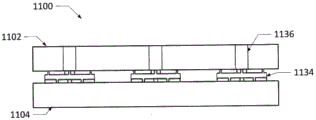
图18A及18B是根据一实施例的头盔的另一冲击吸收系统的等角视图及横截面图。图18A及18B的冲击吸收系统1100包含外衬里1102、内衬里1104、压缩阻尼器1134及圆柱形阻尼器1136。压缩阻尼器1134及圆柱形阻尼器1136可替换阻尼器阵列。在图18A中,外衬里1102可为透明的。18A and 18B are isometric and cross-sectional views of another impact absorbing system of a helmet according to an embodiment. The impact absorbing system 1100 of FIGS. 18A and 18B includes an outer liner 1102 , an inner liner 1104 , a compression damper 1134 and a cylindrical damper 1136 . Compression damper 1134 and cylindrical damper 1136 can replace the damper array. In Figure 18A, the outer liner 1102 may be transparent.

压缩阻尼器1134可为现成的振动压缩阻尼器。替代地,压缩阻尼器1134可为定制形状。圆柱形阻尼器1136可耦合到压缩阻尼器1134或可被模制为与压缩阻尼器1134相同的部分。圆柱形阻尼器1136可接合或耦合到外衬里1102或内衬里1104。在特定其它实施例中,可存在耦合到压缩阻尼器1134的多个圆柱形阻尼器且圆柱形阻尼器可耦合到内衬里及外衬里两者。Compression damper 1134 may be an off-the-shelf vibration compression damper. Alternatively, compression damper 1134 may be a custom shape. Cylindrical damper 1136 may be coupled to compression damper 1134 or may be molded as the same part as compression damper 1134 . Cylindrical damper 1136 may be engaged or coupled to outer liner 1102 or inner liner 1104 . In certain other embodiments, there may be multiple cylindrical dampers coupled to compression damper 1134 and the cylindrical dampers may be coupled to both the inner and outer liners.

图19A及19B是根据一实施例的头盔的仍另一冲击吸收系统的等角视图及横截面图。图19A及19B的冲击吸收系统1200包含外衬里1202、内衬里1204及阻尼器阵列1238。在图19A中,外衬里1202可为透明的以允许对阻尼器阵列1238进行较好的观看。19A and 19B are isometric and cross-sectional views of yet another impact absorbing system of a helmet according to an embodiment. The impact absorbing system 1200 of FIGS. 19A and 19B includes an outer liner 1202 , an inner liner 1204 and an array of dampers 1238 . In FIG. 19A , outer liner 1202 may be transparent to allow better viewing of damper array 1238 .

阻尼器阵列1238可为具有内部空隙区域的可压缩材料薄片。所述薄片可经设计以在经受力时压缩及剪切。阻尼器阵列1238可在任何方向上剪切及/或压缩。阻尼器阵列1238可被定形成薄的横截面。阻尼器阵列1238可线性地压缩或变形或者可经配置而以可为有益的任何力曲线使对压缩或变形的阻力平滑地斜升。尽管阻尼器阵列1238包含矩形形状的空隙区域,但阻尼器阵列1238的其它实施例可包含具有其它形状(例如圆形、六边形及其它几何形状)的空隙区域。由空隙区域构成的阻尼器阵列1238的百分比可取决于所要压缩特性而变化。The array of dampers 1238 may be a sheet of compressible material with internal void regions. The flakes can be designed to compress and shear when subjected to force. The damper array 1238 can shear and/or compress in any direction. The damper array 1238 may be shaped to have a thin cross-section. Damper array 1238 may compress or deform linearly or may be configured to ramp resistance to compression or deformation smoothly with any force profile that may be beneficial. Although the damper array 1238 includes rectangular shaped void regions, other embodiments of the damper array 1238 may include void regions having other shapes, such as circular, hexagonal, and other geometric shapes. The percentage of damper array 1238 comprised of void area can vary depending on the desired compression characteristics.

尽管头盔1200的阻尼器阵列1238不包含衬底,但阻尼器阵列1238的其它实施例可包含第一衬底及/或第二衬底。衬底可用于使力分布均衡。Although the damper array 1238 of the helmet 1200 does not include a substrate, other embodiments of the damper array 1238 may include a first substrate and/or a second substrate. The substrate can be used to equalize the force distribution.

图20A及20B是根据一实施例的图16A及16B的冲击吸收系统的替代实施例的等角视图及横截面图。图20A及20B的冲击吸收系统1300仅包含第一衬底1312。不同于图16A及16B中的实施例,阻尼器1314可直接接触外衬里1302而非计入第二衬底。其它实施例可不包含第一衬底1312。在此类实施例中,阻尼器可接合、附接或模制到与内衬里1304及/或外衬里1302相同的部分中或者从所述相同的部分接合、附接或模制。在其中阻尼器可接合或附接到一衬里或多个衬里的实施例中,阻尼器可为与衬里相同的材料或可为不同冲击吸收材料。20A and 20B are isometric and cross-sectional views of an alternate embodiment of the impact absorbing system of FIGS. 16A and 16B , according to an embodiment. The impact absorbing system 1300 of FIGS. 20A and 20B includes only the first substrate 1312 . Unlike the embodiment in Figures 16A and 16B, the damper 1314 may directly contact the outer liner 1302 without accounting for the second substrate. Other embodiments may not include the first substrate 1312 . In such embodiments, the damper may be joined, attached or molded into or from the same portion as inner liner 1304 and/or outer liner 1302 . In embodiments where the damper may be bonded or attached to the liner or liners, the damper may be the same material as the liner or may be a different impact absorbing material.

图21是根据一实施例的具有冲击吸收系统的头盔的额外实施例的部分横截面图。图21可图解说明具有外衬里1402、内衬里1404、衬底1406、附接阻尼器1440、隔离阻尼器1442及滑动盘1444的头盔1400。在特定实施例中,衬底1406可支撑附接阻尼器1440及/或隔离阻尼器1442中的一或多者。衬底1406可耦合到内衬里1404、外衬里1402及/或头盔1400的另一组件。21 is a partial cross-sectional view of an additional embodiment of a helmet with an impact absorbing system according to an embodiment. FIG. 21 may illustrate a helmet 1400 having an outer liner 1402 , an inner liner 1404 , a substrate 1406 , an attached damper 1440 , an isolation damper 1442 , and a sliding plate 1444 . In a particular embodiment, the substrate 1406 can support one or more of the attachment damper 1440 and/or the isolation damper 1442 . Substrate 1406 may be coupled to inner liner 1404 , outer liner 1402 , and/or another component of helmet 1400 .

附接阻尼器1440可耦合到内衬里1404、外衬里1402及/或头盔1400的另一组件(例如,衬底1406)。在特定实施例中,附接阻尼器1440可相对于外衬里1402的位置而耦合及定位内衬里1404。附接阻尼器1440可耦合到内衬里1404、外衬里1402、衬底1406及/或头盔1400的其它组件,此为通过粘合剂(例如,胶)、通过机械紧固件(例如,销、螺栓、铆钉或其它机械附接组件)及/或通过摩擦或其它附接技术(例如,模制到此类其它组件或其内)进行。Attachment damper 1440 may be coupled to inner liner 1404 , outer liner 1402 , and/or another component of helmet 1400 (eg, substrate 1406 ). In a particular embodiment, the attachment damper 1440 can couple and position the inner liner 1404 relative to the position of the outer liner 1402 . Attachment damper 1440 may be coupled to inner liner 1404, outer liner 1402, backing 1406, and/or other components of helmet 1400 by adhesive (e.g., glue), by mechanical fasteners (e.g., pins). , bolts, rivets, or other mechanically attached components) and/or by friction or other attachment techniques (eg, molded into or into such other components).

在特定冲击情形中,内衬里1404可相对于外衬里1402移动或反之亦然。在内衬里1404相对于外衬里1402移动之后,附接阻尼器1440可接着将内衬里1404及/或外衬里1402返回到其原始位置或大体上移动之前的位置。在特定实施例中,附接阻尼器1440还可经配置以接收赋予头盔的力且吸收所述力。此类力可包含倾斜角度力。In certain impact situations, inner liner 1404 may move relative to outer liner 1402 or vice versa. Following movement of inner liner 1404 relative to outer liner 1402, attaching damper 1440 may then return inner liner 1404 and/or outer liner 1402 to their original position or substantially the position prior to the movement. In certain embodiments, the attachment damper 1440 may also be configured to receive forces imparted to the helmet and absorb the forces. Such forces may include tilt angle forces.

隔离阻尼器1442可耦合到滑动盘1444。在特定实施例中,隔离阻尼器1442可接合、以机械方式紧固、摩擦装配或通过其它技术耦合到滑动盘1444。滑动盘1444可经配置以相对内衬里1404及/或外衬里1402移动(例如,在所述内衬里及/或外衬里上滑动)。举例来说,如果头盔1400经受倾斜力,那么内衬里1404可相对于外衬里1402移动且因此隔离阻尼器1442及滑动盘1444可相对于内衬里1404及/或外衬里1402移动。因此,在其中隔离阻尼器1442中的一些或所有隔离阻尼器耦合到滑动盘1444的实施例中,可存在对内衬里1404相对于外衬里1402的横向移动的较低阻力且如此,可将较低量的倾斜力转移到穿戴者。在特定此类实施例中,头盔1400还可包含附接阻尼器1440,所述附接阻尼器可在冲击之后接着相对于外衬里1402而重新定位内衬里1404。Isolation damper 1442 may be coupled to sliding plate 1444 . In particular embodiments, isolation damper 1442 may be engaged, mechanically fastened, friction fit, or coupled to sliding plate 1444 by other techniques. Sliding plate 1444 may be configured to move relative to (eg, slide on) inner liner 1404 and/or outer liner 1402 . For example, if helmet 1400 is subjected to a tilting force, inner liner 1404 may move relative to outer liner 1402 and thus isolation damper 1442 and sliding plate 1444 may move relative to inner liner 1404 and/or outer liner 1402 . Thus, in embodiments where some or all of the isolation dampers 1442 are coupled to the sliding disc 1444, there may be a lower resistance to lateral movement of the inner liner 1404 relative to the outer liner 1402 and as such, the A lower amount of tilting force is transferred to the wearer. In certain such embodiments, the helmet 1400 may also include an attached damper 1440 that may subsequently reposition the inner liner 1404 relative to the outer liner 1402 following an impact.

图22图解说明根据一实施例的图21的头盔的特定组件。图22可进一步图解说明头盔1400的内衬里1404、衬底1406、附接阻尼器1440及滑动盘1444。如所展示,衬底1406可为头盔1400的各种组件(例如,图21中所展示的隔离阻尼器1442)可被耦合到的框架。在特定实施例中,隔离阻尼器1442可耦合到衬底1406。在特定实施例中,衬底1406可接着经由附接阻尼器1440耦合到内衬里1404及/或外衬里1402。在特定此类实施例中,内衬里1404、外衬里1402及/或衬底1406可包含可接纳附接阻尼器1440的一部分的开口。附接阻尼器1440可接着通过所述开口被插入以将内衬里1404、外衬里1402及/或衬底1406耦合在一起。在特定此类实施例中,所述开口中的一或多者可经定大小以与对应附接阻尼器1440进行摩擦装配。如此,内衬里1404、外衬里1402、衬底1406及/或附接阻尼器1440可接着在无需粘合剂的情况下耦合在一起。举例来说,在特定实施例中,附接阻尼器1440、隔离阻尼器1442及/或其它组件可模制到内衬里1404、其它衬里1402及/或衬底1406中的一或多者中。在其它实施例中,可用多个组件来替换图22中所展示的单个附接阻尼器1440。FIG. 22 illustrates certain components of the helmet of FIG. 21 according to one embodiment. FIG. 22 may further illustrate inner liner 1404 , substrate 1406 , attached damper 1440 , and sliding plate 1444 of helmet 1400 . As shown, substrate 1406 may be a frame to which various components of helmet 1400 (eg, isolation damper 1442 shown in FIG. 21 ) may be coupled. In a particular embodiment, isolation damper 1442 may be coupled to substrate 1406 . In a particular embodiment, substrate 1406 may then be coupled to inner liner 1404 and/or outer liner 1402 via attachment dampers 1440 . In certain such embodiments, inner liner 1404 , outer liner 1402 , and/or substrate 1406 can include openings that can receive a portion of attached damper 1440 . Attachment dampers 1440 may then be inserted through the openings to couple inner liner 1404, outer liner 1402, and/or substrate 1406 together. In certain such embodiments, one or more of the openings may be sized for a friction fit with corresponding attachment dampers 1440 . As such, inner liner 1404, outer liner 1402, substrate 1406, and/or attached damper 1440 may then be coupled together without the need for adhesives. For example, in particular embodiments, attachment dampers 1440, isolation dampers 1442, and/or other components may be molded into one or more of inner liner 1404, other liner 1402, and/or substrate 1406 . In other embodiments, multiple components may be used in place of the single attached damper 1440 shown in FIG. 22 .

滑动盘1444可经配置以在内衬里1404及/或外衬里1402中的一或多者上滑动。滑动盘1444可包含可具有比附接到滑动盘1444的隔离阻尼器1442的表面面积大的表面面积的滑动表面。在特定实施例中,滑动表面可由于滑动盘1444的材料及/或由于施加到所述表面的涂层而具有低摩擦。另外,滑动盘1444可通过粘合剂、机械紧固件及/或通过摩擦或其它附接技术而耦合到隔离阻尼器1442。Sliding plate 1444 may be configured to slide over one or more of inner liner 1404 and/or outer liner 1402 . Sliding plate 1444 may include a sliding surface that may have a larger surface area than the surface area of isolation damper 1442 attached to sliding plate 1444 . In particular embodiments, the sliding surface may have low friction due to the material of the sliding disk 1444 and/or due to the coating applied to the surface. Additionally, sliding plate 1444 may be coupled to isolation damper 1442 by adhesive, mechanical fasteners, and/or by friction or other attachment techniques.

图23是根据一实施例的图21的头盔的额外冲击吸收系统的部分横截面图。图23展示滑动盘1444、隔离阻尼器1442、衬底1406及内衬里1404。隔离阻尼器1442可经配置以在经受力(例如,来自冲击的力)时偏转。在特定实施例中,隔离阻尼器1442可经配置以主要接收在垂直于内衬里1404的表面的方向上施加的力。倾斜力可导致隔离阻尼器1442及滑动盘1444的滑动。23 is a partial cross-sectional view of the additional impact absorbing system of the helmet of FIG. 21 according to one embodiment. FIG. 23 shows sliding plate 1444 , isolation damper 1442 , substrate 1406 and inner liner 1404 . Isolation damper 1442 may be configured to deflect when subjected to a force (eg, force from an impact). In a particular embodiment, isolation damper 1442 may be configured to receive forces applied primarily in a direction perpendicular to the surface of inner liner 1404 . The tilting force can cause the isolation damper 1442 and sliding plate 1444 to slide.

在图23中所展示的实施例中,隔离阻尼器1442可耦合到衬底1406,但其它实施例可另外或替代地将隔离阻尼器1442耦合到内衬里1404、外衬里1402及/或头盔100的另一组件。另外,如图23中所展示,滑动盘1444可包含用以帮助将滑动盘1444耦合到隔离阻尼器1442的特征。举例来说,图23中所展示的实施例包含用以帮助相对于隔离阻尼器1442而定位滑动盘1444及反之亦然的定位特征。In the embodiment shown in FIG. 23, isolation damper 1442 may be coupled to substrate 1406, but other embodiments may additionally or alternatively couple isolation damper 1442 to inner liner 1404, outer liner 1402, and/or the helmet Another component of the 100. Additionally, as shown in FIG. 23 , the sliding disc 1444 may include features to assist in coupling the sliding disc 1444 to the isolation damper 1442 . For example, the embodiment shown in FIG. 23 includes positioning features to assist in positioning the sliding plate 1444 relative to the isolation damper 1442 and vice versa.

图24是图解说明根据一实施例的冲击吸收系统的额外实施例的部分横截面图。尽管隔离阻尼器1442的特定实施例可包含一个震动吸收特征,但图24中所展示的实施例可包含多个震动吸收特征。24 is a partial cross-sectional view illustrating additional embodiments of a shock absorbing system according to an embodiment. Although a particular embodiment of isolation damper 1442 may include one shock absorbing feature, the embodiment shown in FIG. 24 may include multiple shock absorbing features.

图24图解说明具有外衬里1502、内衬里1504及附接阻尼器1540的头盔1500的部分。附接阻尼器1540可类似于本文中所描述的其它附接阻尼器。如此,附接阻尼器1540可帮助相对于头盔1500的外衬里1502及/或另一组件而定位内衬里1504。外衬里1502可包含凸耳1550及次要阻尼器1552。举例来说,凸耳1550可从外衬里1502的第一表面延伸且可经配置以吸收来自冲击的力。另外,凸耳1550还可包含滑动表面。滑动表面可允许凸耳1550在接触后即刻沿着内衬里1504及/或另一组件的表面滑动,从而允许内衬里1504相对于外衬里1502的较大移动。尽管在图24中的实施例中将凸耳1550展示为安置于外衬里1502上,但其它实施例可将凸耳1550安置于内衬里1504上及/或内衬里1504及外衬里1502两者上。在特定实施例中,外衬里1502可包含凹部,所述凹部位于外衬里1502的与凸耳1550的侧相对的侧上。其它实施例可不包含此凹部或可包含隔离阻尼器(例如,隔离阻尼器1442),所述隔离阻尼器可包含一或多个此类凹部。FIG. 24 illustrates a portion of a helmet 1500 having an outer liner 1502 , an inner liner 1504 , and a damper 1540 attached. Attachment damper 1540 may be similar to other attachment dampers described herein. In this manner, attaching dampers 1540 may help position inner liner 1504 relative to outer liner 1502 and/or another component of helmet 1500 . Outer liner 1502 may include lugs 1550 and secondary dampers 1552 . For example, lugs 1550 can extend from the first surface of outer liner 1502 and can be configured to absorb forces from impacts. Additionally, the lug 1550 may also include a sliding surface. The sliding surface may allow the lug 1550 to slide along the surface of the inner liner 1504 and/or another component upon contact, thereby allowing greater movement of the inner liner 1504 relative to the outer liner 1502 . Although lugs 1550 are shown disposed on outer liner 1502 in the embodiment in FIG. 24 , other embodiments may place lugs 1550 on inner liner 1504 and/or both up. In a particular embodiment, outer liner 1502 may include a recess on a side of outer liner 1502 opposite the side of lug 1550 . Other embodiments may not include such a recess or may include an isolation damper (eg, isolation damper 1442 ), which may include one or more such recesses.

特定实施例可包含次要阻尼器1552。在特定实施例中,次要阻尼器1552可安置于凹部内(例如,与凸耳1550相对的凹部内及/或隔离阻尼器1442的凹部内),但其它实施例可将次要阻尼器1552安置于别处(例如,外衬里1502及/或内衬里1504的另一部分上)。举例来说,特定其它实施例可包含在外衬里1502内(例如,在凸耳1550的位置处)的通孔且次要阻尼器1552可安置于通孔或所述通孔的一部分内。Certain embodiments may include a secondary damper 1552 . In certain embodiments, secondary damper 1552 may be positioned within a recess (eg, within a recess opposite lug 1550 and/or within a recess isolating damper 1442 ), but other embodiments may incorporate secondary damper 1552 Disposed elsewhere (eg, on another portion of outer liner 1502 and/or inner liner 1504). For example, certain other embodiments may include a through hole within the outer liner 1502 (eg, at the location of the lug 1550) and the secondary damper 1552 may be disposed within the through hole or a portion of the through hole.

在此类实施例中,凸耳1550及/或外衬里1502可由具有第一率(例如,弹性或弹簧率)的材料制成。次要阻尼器1552可由具有第二率的材料制成。如此,凸耳1550及次要阻尼器1552可各自经调谐以在不同力及/或冲击速度下提供保护。因此,图24可展示可变弹簧率冲击吸收系统的实施例。在特定实施例中,凸耳1550及次要阻尼器1552中的一者或两者可由非牛顿材料制成。举例来说,此类非牛顿材料可在不同力及/或冲击速度下具有不同率。如此,特定实施例可不包含次要阻尼器1552且可替代地仅具有可经调谐以在不同力及/或冲击速度下不同地做出响应的非牛顿凸耳1550,而其它实施例可包含凸耳1550及次要阻尼器1552以及可能其它冲击吸收组件。在至少具有凸耳1550及次要阻尼器1552的实施例中,凸耳1550及次要阻尼器1552中的一或多者可由非牛顿材料制成。In such embodiments, the lugs 1550 and/or the outer liner 1502 can be made of a material having a first rate (eg, an elastic or spring rate). Secondary damper 1552 may be made of a material having a second rate. As such, the lug 1550 and the secondary damper 1552 can each be tuned to provide protection under different forces and/or impact velocities. Accordingly, FIG. 24 may show an embodiment of a variable spring rate shock absorbing system. In particular embodiments, one or both of the lug 1550 and the secondary damper 1552 may be made of a non-Newtonian material. For example, such non-Newtonian materials may have different rates at different forces and/or impact velocities. As such, certain embodiments may not include the secondary damper 1552 and instead have only non-Newtonian lugs 1550 that may be tuned to respond differently at different forces and/or impact velocities, while other embodiments may include lugs. Ears 1550 and secondary dampers 1552 and possibly other shock absorbing components. In embodiments having at least the lug 1550 and the secondary damper 1552, one or more of the lug 1550 and the secondary damper 1552 may be made of a non-Newtonian material.

在特定实施例中,凸耳1550可经配置以在次要阻尼器1552之前啮合及/或反之亦然。如此,针对图24的实例,冲击可首先导致内衬里1504的偏转。针对移动的一部分,内衬里1504不接触凸耳1550。在设定量的偏转之后,内衬里1504可接触及/或“啮合”凸耳1550。如此,凸耳1550可接着提供朝向内衬里1504的移动的额外阻力。当凸耳1550最初啮合时,次要阻尼器1552可不接触头盔1500的组件(例如,外壳体或另一触点)。如此,次要阻尼器1552可不抵抗内衬里1504的移动。在额外偏转之后,次要阻尼器1552可接着啮合且朝向内衬里1504的移动的阻力可接着由于次要阻尼器1552的啮合而增加(假定凸耳1550及次要阻尼器1552的率为恒定的)。凸耳1550与次要阻尼器1552的经组合弹簧率可比仅凸耳1550自身的弹簧率高。In particular embodiments, the lug 1550 can be configured to engage before the secondary damper 1552 and/or vice versa. As such, for the example of FIG. 24 , the impact may first cause deflection of inner liner 1504 . For a portion of the movement, inner liner 1504 does not contact lug 1550 . After a set amount of deflection, inner liner 1504 may contact and/or “engage” lug 1550 . As such, lugs 1550 may then provide additional resistance to movement toward inner liner 1504 . The secondary damper 1552 may not contact a component of the helmet 1500 (eg, the outer shell or another contact point) when the lug 1550 is initially engaged. As such, secondary damper 1552 may not resist movement of inner liner 1504 . After the additional deflection, the secondary damper 1552 may then engage and the resistance to movement towards the inner liner 1504 may then increase due to the engagement of the secondary damper 1552 (assuming constant ratios of the lug 1550 and secondary damper 1552 of). The combined spring rate of the lug 1550 and the secondary damper 1552 may be higher than the spring rate of the lug 1550 alone.

图25到26图解说明根据一实施例的利用图24的冲击吸收系统的头盔的组件。图25到26中所图解说明的头盔1600可为本文中所描述的头盔1400及1500的另一实施例。头盔1600可包含外衬里1602、内衬里1604、衬底1606、附接阻尼器1640A及卡扣底座1640B、凸耳1650以及滑动盘1644。25-26 illustrate components of a helmet utilizing the impact absorbing system of FIG. 24, according to one embodiment. The helmet 1600 illustrated in FIGS. 25-26 may be another embodiment of the helmets 1400 and 1500 described herein. Helmet 1600 may include outer liner 1602 , inner liner 1604 , substrate 1606 , attached damper 1640A and snap mount 1640B, lugs 1650 , and sliding disc 1644 .

图25到26的衬底1606可沿着外衬里1602及/或内衬里1604的边缘耦合到外衬里1602及/或内衬里1604。衬底1606可包含多个附接阻尼器1640A以及卡扣底座1640B。在图25到26中所展示的实施例中,无隔离阻尼器可耦合到衬底1606。然而,附接阻尼器1640A可经配置以耦合到外衬里1602。卡扣底座1640B可耦合到内衬里1604。在特定实施例中,卡扣底座1640B可耦合到内衬里1604(例如,模制于内衬里1604内及/或通过其它粘合剂、机械或其它技术而耦合)。卡扣底座1640B可经配置以接纳销,所述销还可耦合到衬底1606。附接阻尼器1640A可耦合到衬底1606且因此附接阻尼器1640、卡扣底座1640B、衬底1606及任何销可相对于内衬里1604而定位外衬里1602(及反之亦然)。The substrate 1606 of FIGS. 25-26 can be coupled to the outer liner 1602 and/or the inner liner 1604 along the edges of the outer liner 1602 and/or the inner liner 1604 . The substrate 1606 may include a plurality of attachment dampers 1640A and snap mounts 1640B. In the embodiments shown in FIGS. 25-26 , no isolation damper can be coupled to the substrate 1606 . However, attached damper 1640A may be configured to couple to outer liner 1602 . Snap mount 1640B can be coupled to inner liner 1604 . In particular embodiments, the snap mount 1640B can be coupled to the inner liner 1604 (eg, molded into the inner liner 1604 and/or coupled by other adhesive, mechanical, or other techniques). The snap mount 1640B can be configured to receive a pin, which can also be coupled to the substrate 1606 . Attachment damper 1640A can be coupled to substrate 1606 and thus attachment damper 1640 , snap mount 1640B, substrate 1606 and any pins can position outer liner 1602 relative to inner liner 1604 (and vice versa).

在图25到26中所展示的实施例中,特定凸耳1650可包含耦合到凸耳1650的滑动盘1644。其它凸耳1650可不包含滑动盘1644。尽管一些凸耳1650可包含滑动盘1644而其它凸耳可不包含所述滑动盘,但装备有滑动盘1644的凸耳1650及未装备有滑动盘的凸耳1650两者均可经配置以在内衬里1604上滑动。In the embodiment shown in FIGS. 25-26 , a particular lug 1650 may include a sliding disc 1644 coupled to the lug 1650 . Other lugs 1650 may not include sliding disc 1644 . While some lugs 1650 may include sliding discs 1644 and others may not, both lugs 1650 equipped with sliding discs 1644 and lugs 1650 not equipped with sliding discs can be configured to incorporate them. The lining 1604 slides on.

图27到28图解说明根据一实施例的另一冲击吸收系统。图27可图解说明凸耳1750A及1750B。凸耳1750A及1750B可为内衬里1704的一部分。凸耳1750A可经配置以正常地接触外衬里1702,而凸耳1750B可经配置以仅在内衬里1704及/或外衬里1702的变形之后的冲击期间接触外衬里1702。在特定实施例中,开口1760可安置于外衬里1702与内衬里1704之间。开口1760可允许外衬里1702及/或内衬里1704变形。如此,在此类实施例中,开口1760可为气隙。在特定实施例中,开口1760可填充有一或多个震动吸收材料及/或组件。震动吸收材料可为牛顿或非牛顿的。27-28 illustrate another impact absorbing system according to an embodiment. Figure 27 may illustrate lugs 1750A and 1750B. Lugs 1750A and 1750B may be part of inner liner 1704 . Lug 1750A may be configured to contact outer liner 1702 normally, while lug 1750B may be configured to contact outer liner 1702 only during impact following deformation of inner liner 1704 and/or outer liner 1702 . In a particular embodiment, opening 1760 may be disposed between outer liner 1702 and inner liner 1704 . Opening 1760 may allow outer liner 1702 and/or inner liner 1704 to deform. As such, opening 1760 may be an air gap in such embodiments. In certain embodiments, opening 1760 may be filled with one or more shock absorbing materials and/or components. The shock absorbing material can be Newtonian or non-Newtonian.

图27还可包含带1740A及销1740B。带1740A可为耦合到内衬里1704的一部分(例如,部分1704A)且可耦合到销1740B的弹性带。销1740B可耦合到外衬里1702。带1740A及销1740B可帮助相对于内衬里1704而定位外衬里1702。在特定实施例中,带1740A可耦合到内衬里1704及外衬里1702两者。特定此类实施例可不包含销。Figure 27 may also include strap 1740A and pin 1740B. Strap 1740A may be an elastic strap coupled to a portion of inner liner 1704 (eg, portion 1704A) and may be coupled to pin 1740B. Pin 1740B may be coupled to outer liner 1702 . Band 1740A and pin 1740B can help position outer liner 1702 relative to inner liner 1704 . In a particular embodiment, strap 1740A can be coupled to both inner liner 1704 and outer liner 1702 . Certain such embodiments may not include pins.

图27的实施例,内衬里1704可为可移除衬里。在此类实施例中,可移除衬里可为可经配置以吸收大多数特定冲击力的软衬里。如此,可移除衬里可为牺牲性的且可在此类冲击之后被替换并且可防止对头盔1700的其它部分造成损坏。在特定实施例中,可移除衬里可以非破坏性方式从头盔的其它组件解耦(例如,头盔的其它部分可在可移除衬里的移除期间不被损坏)。在特定实施例中,内衬里1704、外衬里1702及/或衬里1770可为此可移除及/或牺牲性衬里。In the embodiment of FIG. 27, inner liner 1704 may be a removable liner. In such embodiments, the removable liner can be a soft liner that can be configured to absorb most specific impact forces. As such, the removable liner can be sacrificial and can be replaced after such an impact and can prevent damage to other parts of the helmet 1700 . In certain embodiments, the removable liner may be decoupled from other components of the helmet in a non-destructive manner (eg, other portions of the helmet may not be damaged during removal of the removable liner). In a particular embodiment, inner liner 1704, outer liner 1702, and/or liner 1770 may be removable and/or sacrificial liners for this purpose.

图28可图解说明具有外壳体1806、内衬里1804、外衬里1802、附接阻尼器1840及衬底1840A的实施例。外衬里1802可包含凸耳。在图28中所展示的实施例中,外衬里1802可包含凸耳,所述凸耳面向外壳体1806及内衬里1804两者且经配置以在所述外壳体及内衬里上滑动。在特定此类实施例中,各种凸耳可经配置以进行啮合及/或吸收各种冲击速度或偏转速率下的冲击。替代凸耳或除了所述凸耳之外,特定其它实施例还可包含可面向外壳体1806及内衬里1804两者的隔离阻尼器。Figure 28 may illustrate an embodiment having an outer shell 1806, an inner liner 1804, an outer liner 1802, an attached damper 1840, and a substrate 1840A. Outer liner 1802 may include lugs. In the embodiment shown in FIG. 28, the outer liner 1802 can include lugs that face both the outer shell 1806 and the inner liner 1804 and are configured to slide over the outer shell and inner liner. In certain such embodiments, various lugs may be configured to engage and/or absorb impact at various impact velocities or deflection rates. Certain other embodiments may include isolation dampers that may face both the outer shell 1806 and the inner liner 1804 instead of or in addition to the lugs.

另外,衬底1840A可安置于内衬里1804与外衬里1802之间。衬底1840A可耦合到或插入到内衬里1804及/或外衬里1802的特征中。在特定实施例中,衬底1840A可在无需粘合剂的情况下耦合到内衬里1804及/或外衬里1802(例如,通过机械紧固件、模制及/或通过摩擦装配或插入到可接着固持衬底1840A的开口中)。另外,衬底1840A可经配置以经由例如摩擦装配或机械紧固件等特征而接纳附接阻尼器1840。附接阻尼器1840可耦合内衬里1804及/或外衬里1802以相对于外衬里1802而定位内衬里1804。图28中所展示的实施例可允许在不使用粘合剂的情况下相对于外衬里1804而耦合内衬里1804。Additionally, a substrate 1840A may be disposed between the inner liner 1804 and the outer liner 1802 . Substrate 1840A may be coupled to or inserted into features of inner liner 1804 and/or outer liner 1802 . In particular embodiments, the substrate 1840A can be coupled to the inner liner 1804 and/or the outer liner 1802 without adhesives (e.g., by mechanical fasteners, molding, and/or by friction fitting or inserting into The substrate 1840A may then be held in the opening). Additionally, the substrate 1840A can be configured to receive an attachment damper 1840 via features such as a friction fit or mechanical fasteners. Attachment damper 1840 may couple inner liner 1804 and/or outer liner 1802 to position inner liner 1804 relative to outer liner 1802 . The embodiment shown in FIG. 28 may allow inner liner 1804 to be coupled relative to outer liner 1804 without the use of adhesives.

图29到31图解说明根据一实施例的冲击吸收系统的特定实施例的各种特征。图29可图解说明带1940的两个不同实施例。举例来说,带1940可为弹性绳索。在第一实施例中,带1940可在一端处插入到内衬里的插孔(receptacle)中。所述插孔可经由摩擦装配或者内衬里的特征(例如,可包围带1940的开口)而固持带1940。带1940的另一端可经由机械帽而耦合到外衬里。在另一实施例中,带1940的第一端可由内衬里的特征接纳,使得带1940的一部分与内衬里的表面齐平或在所述表面下方。在其中带1940为弹性绳索的实施例中,带1940的弹性可允许内衬里1904A相对于外衬里1902A从第一位置进行移动,同时仍使内衬里1904A及外衬里1902A返回到第一位置。如此,带1940可允许内衬里1904A在冲击期间相对于外衬里1902A进行较大偏转,同时仍保持使衬里1902A及1904B返回到其原始位置的能力。29-31 illustrate various features of a particular embodiment of a shock absorbing system according to an embodiment. FIG. 29 may illustrate two different embodiments of strap 1940 . For example, strap 1940 may be an elastic cord. In a first embodiment, the strap 1940 is insertable at one end into a receptacle of the inner liner. The receptacle may retain the strap 1940 via a friction fit or a feature of the inner lining (eg, an opening that may surround the strap 1940). The other end of the strap 1940 may be coupled to the outer liner via a mechanical cap. In another embodiment, the first end of the strap 1940 may be received by a feature of the inner liner such that a portion of the strap 1940 is flush with or below the surface of the inner liner. In embodiments where strap 1940 is an elastic cord, the elasticity of strap 1940 may allow movement of inner liner 1904A relative to outer liner 1902A from the first position while still returning inner liner 1904A and outer liner 1902A to the first position . In this manner, strap 1940 may allow greater deflection of inner liner 1904A relative to outer liner 1902A during impact, while still maintaining the ability to return liners 1902A and 1904B to their original positions.

图30可图解说明隔离阻尼器1442的额外实施例。隔离阻尼器1442A可包含锥体1442-1、凹部1442-2及滑动盘1444。锥体1442-1可经配置以接触内衬里及/或外衬里。锥体1442-1的几何形状可根据隔离阻尼器1442A期望的率来确定。在特定实施例中,锥体1442-1可允许隔离阻尼器1442A具有可变的率。在各种实施例中,凹部1442-2可或可不填充有额外材料。特定此类材料可包含与隔离阻尼器1442的冲击吸收性质不同的冲击吸收性质。FIG. 30 may illustrate additional embodiments of an isolation damper 1442 . Isolation damper 1442A may include cone 1442 - 1 , recess 1442 - 2 and sliding disc 1444 . Cone 1442-1 may be configured to contact the inner and/or outer liner. The geometry of cone 1442-1 may be determined according to the desired rate of isolation damper 1442A. In certain embodiments, cone 1442-1 may allow isolation damper 1442A to have a variable rate. In various embodiments, recess 1442-2 may or may not be filled with additional material. Certain such materials may include shock absorbing properties that differ from those of isolation damper 1442 .

隔离阻尼器1442B可包含第一凹部1442-3、第二凹部1442-4及滑动盘1444。第一凹部1442-3及第二凹部1442-4中的一者或两者可填充或部分填充有额外材料。额外材料可包含与隔离阻尼器1442B的主要部分的性质类似或不同的性质。特定实施例可包含还可填充有具有不同性质的材料的额外凹部。另外,尽管图30图解说明具有锥体及凹部的隔离阻尼器,但其它实施例可包含(举例来说)具有此类锥体及凹部的凸耳及/或衬里。The isolation damper 1442B may include a first recess 1442 - 3 , a second recess 1442 - 4 and a sliding plate 1444 . One or both of the first recess 1442-3 and the second recess 1442-4 may be filled or partially filled with additional material. The additional material may contain similar or different properties to those of the main portion of the isolation damper 1442B. Certain embodiments may include additional recesses that may also be filled with materials having different properties. Additionally, while FIG. 30 illustrates an isolation damper with cones and recesses, other embodiments may include, for example, lugs and/or liners with such cones and recesses.

图31可图解说明第一衬里的剖面图及等角透明视图,所述第一衬里可包含可经配置以安置于第二衬里的定位特征2080之间的凸耳2050A。定位特征2080可帮助相对于外衬里而定位内衬里。举例来说,定位特征2080可将凸耳2050A固持于特定区域中。另外,凸耳2050B可包含用以允许带2040通过凸耳2050B的特征。带2040可帮助相对于外衬里而定位内衬里。在特定实施例中,带2040可为弹性带且可包含在一端处的经模制头部(例如,模制到衬里中)及在另一端处的机械头部。31 can illustrate a cross-sectional view and an isometric transparent view of a first liner that can include lugs 2050A that can be configured to be disposed between locating features 2080 of a second liner. Locating features 2080 can help position the inner liner relative to the outer liner. For example, locating features 2080 can hold lugs 2050A in specific areas. Additionally, the lug 2050B may include features to allow the strap 2040 to pass through the lug 2050B. Band 2040 can help position the inner liner relative to the outer liner. In a particular embodiment, the band 2040 can be an elastic band and can include a molded head at one end (eg, molded into the liner) and a mechanical head at the other end.

图32是详述根据一实施例的头盔的组装过程的流程图。在框3202中,可将外衬里安置于外壳体内。可接着经由(举例来说)接合、粘合剂、机械紧固件、模制或其它技术将外衬里耦合到外壳体。在特定实施例中,可将外衬里模制于外壳体内且因此可大体上同时发生将外衬里安置并耦合到外壳体。Figure 32 is a flowchart detailing the assembly process of a helmet according to one embodiment. In block 3202, an outer liner may be placed within the outer shell. The outer liner may then be coupled to the outer shell via, for example, bonding, adhesives, mechanical fasteners, molding, or other techniques. In particular embodiments, the outer liner can be molded within the outer shell and thus positioning and coupling the outer liner to the outer shell can occur substantially simultaneously.

在框3204中,可将对准器安置于外衬里内并耦合到所述外衬里。可经由(举例来说)接合、粘合剂、机械紧固件、模制或本文中所描述的其它技术将对准器耦合到外衬里。在特定实施例中,可将对准器模制到外衬里中。In block 3204, an aligner may be positioned within and coupled to the outer liner. The aligner may be coupled to the outer liner via, for example, bonding, adhesives, mechanical fasteners, molding, or other techniques described herein. In certain embodiments, the aligners may be molded into the outer liner.

在框3206中,可将内衬里安置于外衬里内。可接着在框3208中将内衬里耦合到对准器,使得可将外衬里、对准器与内衬里耦合。举例来说,耦合可经由接合、粘合剂、机械紧固件、模制或本文中所描述的其它技术。在特定此类实施例中,对准器可控制外衬里的部分与内衬里的部分之间的距离且可经配置以允许所述距离在接收到冲击后即刻改变。在特定实施例中,内衬里、外衬里、对准器及/或另外组件可包含一或多个隔离阻尼器及/或凸耳。在其中另外组件包含一或多个隔离阻尼器及/或凸耳的实施例中,还可将此组件安置于外壳体、外衬里及/或内衬里内及/或耦合到所述外壳体、外衬里及/或内衬里。In block 3206, the inner liner may be positioned within the outer liner. The inner liner can then be coupled to the aligner in block 3208 such that the outer liner, aligner, and inner liner can be coupled. For example, coupling may be via bonding, adhesives, mechanical fasteners, molding, or other techniques described herein. In certain such embodiments, the aligner can control the distance between the portion of the outer liner and the portion of the inner liner and can be configured to allow the distance to change upon receiving an impact. In certain embodiments, the inner liner, outer liner, aligner, and/or additional components may include one or more isolation dampers and/or lugs. In embodiments where the additional component includes one or more isolation dampers and/or lugs, this component may also be disposed within and/or coupled to the outer shell, outer liner, and/or inner liner , outer lining and/or inner lining.

冲击吸收系统的其它实施例可包含在本文中所详述的在各种安全头盔(例如,运动头盔、施工头盔、竞赛头盔、由武装部队人员穿戴的头盔、保护例如学步小孩等人的头盔、自行车头盔、飞行员头盔及其它头盔)以及经设计以保护穿戴者的各种其它安全设备中的冲击吸收系统配置中的任一者。此类其它安全设备的非限制性实例可包含身体盔甲,例如背心、夹克及全身套装、手套、护肘垫、护腿垫、护臀垫、鞋子、头盔保护设备以及护膝垫。Other embodiments of the impact-absorbing system may include those described in detail herein in various safety helmets (e.g., sports helmets, construction helmets, racing helmets, helmets worn by members of the armed forces, helmets that protect people such as toddlers, etc.) , bicycle helmets, pilot helmets, and other helmets) and any of the impact-absorbing system configurations in various other safety equipment designed to protect the wearer. Non-limiting examples of such other safety equipment may include body armor such as vests, jackets and full body suits, gloves, elbow pads, leg pads, hip pads, shoes, helmet protection equipment, and knee pads.

通过使用不同材料及配置,可能调整或调谐由使用本发明的系统的头盔提供的保护,如所属领域的技术人员应理解。衬里及任何其它层可由具有不同柔性、压缩及压碎特性的材料形成,且隔离阻尼器可由各种类型的弹性体或其它适当能量吸收材料(例如MCU)形成。因此,通过控制隔离阻尼器及相关内部构造材料的密度及坚硬度,安全头盔可经配置以基于预期存在于任何给定头盔中的常见头部重量的已知范围且依据头盔大小并且依据任何给定运动活动策略性地管理冲击能量。By using different materials and configurations, it is possible to adjust or tune the protection provided by a helmet using the system of the present invention, as will be appreciated by those skilled in the art. The liner and any other layers may be formed from materials with different flexibility, compression and crush characteristics, and the isolation damper may be formed from various types of elastomers or other suitable energy absorbing materials such as MCU. Thus, by controlling the density and stiffness of the isolation damper and associated internal construction materials, safety helmets can be configured to be based on a known range of common head weights expected to be present in any given helmet and based on the size of the helmet and on any given helmet. Strategically manage impact energy during defined athletic activities.

呈现前述描述以使所属领域的技术人员能够制作及使用本发明。出于解释的目的,已陈述特定命名以提供对本发明的透彻理解。然而,应理解,本文中所提供的特定实施例或应用的描述仅通过本发明的一些实例性实施例的方式而非通过对本发明的任何限制的方式提供。实际上,所属领域的技术人员应容易地明了对实施例的各种修改,且可在不背离本发明的精神及范围的情况下将本文中所定义的一般原理应用于其它实施例及应用。因此,本发明不应限于本文中所图解说明及描述的特定实施例,而是应赋予与本文中所揭示的原理及特征一致的最宽广的可能范围。The foregoing description is presented to enable any person skilled in the art to make and use the invention. For purposes of explanation, specific nomenclature has been set forth in order to provide a thorough understanding of the invention. However, it should be understood that the descriptions of specific embodiments or applications provided herein are provided by way of some exemplary embodiments of the invention only and not by way of any limitation of the invention. Indeed, various modifications to the embodiments will be readily apparent to those skilled in the art, and the generic principles defined herein may be applied to other embodiments and applications without departing from the spirit and scope of the invention. Thus, the invention should not be limited to the particular embodiments illustrated and described herein, but is to be accorded the broadest possible scope consistent with the principles and features disclosed herein.

Claims (20)

1.一种头盔,其包括:1. A helmet comprising: 外壳体;outer shell; 外衬里,其安置于所述外壳体内且耦合到所述外壳体;an outer liner disposed within the outer shell and coupled to the outer shell; 内衬里,其安置于所述外衬里内且耦合到所述外衬里;an inner liner disposed within and coupled to the outer liner; 对准器,其耦合到所述外衬里及所述内衬里且经配置以相对于所述内衬里而定位所述外衬里;及an aligner coupled to the outer liner and the inner liner and configured to position the outer liner relative to the inner liner; and 第一隔离阻尼器,其耦合到所述内衬里及所述外衬里中的一者,且耦合到经配置以允许所述内衬里相对于所述外衬里及所述外壳体进行全向移动的滑动盘,其中所述滑动盘经配置以在所述外衬里及所述内衬里中的另一者上滑动。a first isolation damper coupled to one of the inner liner and the outer liner and configured to allow omnidirectional movement of the inner liner relative to the outer liner and outer shell A moving sliding plate, wherein the sliding plate is configured to slide on the other of the outer liner and the inner liner. 2.根据权利要求1所述的头盔,其中所述第一隔离阻尼器经配置以在接收到对所述内衬里及/或所述外衬里的力的至少正交分量后即刻压缩。2. The helmet of claim 1, wherein the first isolation damper is configured to compress upon receiving at least a quadrature component of force against the inner liner and/or the outer liner. 3.根据权利要求1所述的头盔,其中所述第一隔离阻尼器安置于所述外衬里与所述内衬里之间。3. The helmet of claim 1, wherein the first isolation damper is disposed between the outer liner and the inner liner. 4.根据权利要求1所述的头盔,进一步包括安置于所述外衬里与所述内衬里之间的凸耳。4. The helmet of claim 1, further comprising lugs disposed between the outer liner and the inner liner. 5.根据权利要求1所述的头盔,进一步包括耦合到所述内衬里及/或所述外衬里中的至少一者的第二隔离阻尼器。5. The helmet of claim 1, further comprising a second isolation damper coupled to at least one of the inner liner and/or the outer liner. 6.根据权利要求1所述的头盔,进一步包括耦合到所述外衬里及所述内衬里中的一者的凸耳,且所述凸耳经配置以在凹部内滑动,所述凹部安置于与所述凸耳相对的所述外衬里及所述内衬里中的另一者的一侧上,以允许所述内衬里相对于所述外衬里及所述外壳体进行全向移动。6. The helmet of claim 1, further comprising a lug coupled to one of the outer liner and the inner liner, and the lug is configured to slide within a recess, the recess receiving on the side of the other of the outer liner and the inner liner opposite the lug to allow omnidirectional movement of the inner liner relative to the outer liner and the outer shell . 7.根据权利要求4所述的头盔,其中所述凸耳安置于所述外衬里及/或所述内衬里上。7. The helmet of claim 4, wherein the lugs are disposed on the outer liner and/or the inner liner. 8.根据权利要求5所述的头盔,其中所述第二隔离阻尼器包括至少部分地由额外材料填充的凹部。8. The helmet of claim 5, wherein the second isolation damper includes a recess at least partially filled with additional material. 9.根据权利要求4所述的头盔,其中所述凸耳安置于所述外衬里及所述内衬里的一者上,所述头盔进一步包括耦合到所述凸耳的第二滑动盘,且9. The helmet of claim 4, wherein the lug is disposed on one of the outer liner and the inner liner, the helmet further comprising a second sliding disc coupled to the lug, and 其中所述第二滑动盘经配置以在所述外衬里及所述内衬里中的另一者上滑动。Wherein the second sliding plate is configured to slide on the other of the outer liner and the inner liner. 10.根据权利要求1所述的头盔,其中所述第一隔离阻尼器是主要阻尼器,且所述头盔进一步包括次要阻尼器。10. The helmet of claim 1, wherein the first isolation damper is a primary damper, and the helmet further includes a secondary damper. 11.根据权利要求10所述的头盔,其中所述主要阻尼器是第一弹性,且所述次要阻尼器是第二弹性。11. The helmet of claim 10, wherein the primary damper is a first elastic and the secondary damper is a second elastic. 12.根据权利要求10所述的头盔,其中所述主要阻尼器经配置以在接收到正交于所述内衬里及/或所述外衬里的第一力后即刻压缩,且所述次要阻尼器经配置以在接收到正交于所述内衬里及/或所述外衬里的第二力后即刻压缩,其中所述第二力大于所述第一力。12. The helmet of claim 10, wherein the primary damper is configured to compress upon receiving a first force normal to the inner liner and/or the outer liner, and the secondary damper The desired damper is configured to compress upon receiving a second force normal to the inner liner and/or the outer liner, wherein the second force is greater than the first force. 13.根据权利要求10所述的头盔,进一步包括凸耳,其中所述内衬里及/或所述外衬里包括所述凸耳及凹部,其中所述凸耳安置于所述外衬里与所述内衬里之间,且其中所述次要阻尼器安置于所述凹部内。13. The helmet of claim 10, further comprising lugs, wherein the inner liner and/or the outer liner comprise the lugs and recesses, wherein the lugs are disposed between the outer liner and the outer liner between the inner liners, and wherein the secondary damper is disposed within the recess. 14.根据权利要求1所述的头盔,其中所述对准器经配置以在接收到对所述内衬里及/或所述外衬里的力的至少正交分量后即刻压缩。14. The helmet of claim 1, wherein the aligner is configured to compress upon receiving at least an orthogonal component of force to the inner liner and/or the outer liner. 15.根据权利要求1所述的头盔,其中所述对准器是弹性带,且其中所述对准器的至少一部分被模制于所述内衬里及/或所述外衬里内。15. The helmet of claim 1, wherein the aligner is an elastic band, and wherein at least a portion of the aligner is molded into the inner liner and/or the outer liner. 16.根据权利要求1所述的头盔,其进一步包括安置于所述外衬里与所述内衬里之间且经配置以接纳至少一个对准器及/或阻尼器的衬底。16. The helmet of claim 1, further comprising a substrate disposed between the outer liner and the inner liner and configured to receive at least one aligner and/or damper. 17.根据权利要求4所述的头盔,其中所述凸耳包括非牛顿材料。17. The helmet of claim 4, wherein the lugs comprise a non-Newtonian material. 18.根据权利要求1所述的头盔,进一步包括阻尼器阵列,且其中所述阻尼器阵列包括:18. The helmet of claim 1, further comprising a damper array, and wherein the damper array comprises: 多个阻尼器,每一阻尼器具有第一端及第二端,其中所述第一隔离阻尼器是所述多个阻尼器中的一者;及a plurality of dampers, each damper having a first end and a second end, wherein the first isolation damper is one of the plurality of dampers; and 第一衬底,其中所述多个阻尼器的所述第一端耦合到所述第一衬底,其中:a first substrate, wherein the first ends of the plurality of dampers are coupled to the first substrate, wherein: 所述阻尼器阵列进一步包括第二衬底,The damper array further includes a second substrate, 所述多个阻尼器的所述第二端耦合到所述第二衬底,the second end of the plurality of dampers is coupled to the second substrate, 所述第一衬底耦合到所述内衬里,且the first substrate is coupled to the inner liner, and 所述第二衬底耦合到所述外衬里。The second substrate is coupled to the outer liner. 19.一种组装根据权利要求11所述的头盔的方法,所述方法包括:19. A method of assembling the helmet of claim 11, the method comprising: 将所述外衬里安置并耦合于所述外壳体内;positioning and coupling the outer liner within the outer shell; 将所述对准器安置于所述外衬里内;positioning the aligner within the outer liner; 将所述对准器耦合到所述外衬里;coupling the aligner to the outer liner; 将所述内衬里安置于所述外衬里内;及positioning the inner liner within the outer liner; and 将所述内衬里耦合到所述对准器。The inner liner is coupled to the aligner. 20.一种维修根据权利要求1所述的头盔的方法,其中所述外衬里及/或所述内衬里为可移除衬里,所述方法包括:20. A method of servicing a helmet according to claim 1, wherein said outer liner and/or said inner liner is a removable liner, said method comprising: 将所述头盔的可移除衬里解耦;decoupling the removable liner of the helmet; 提供未损坏的可移除衬里;及provide an undamaged removable liner; and 将所述未损坏的可移除衬里耦合到所述头盔。The undamaged removable liner is coupled to the helmet.
CN201680043684.0A 2015-06-17 2016-06-17 Helmet omnidirectional energy management system and method Active CN107847002B (en)

Applications Claiming Priority (5)

Application Number Priority Date Filing Date Title
US201562181121P 2015-06-17 2015-06-17
US62/181,121 2015-06-17
US201562188598P 2015-07-03 2015-07-03
US62/188,598 2015-07-03
PCT/US2016/038259 WO2016209740A1 (en) 2015-06-17 2016-06-17 Helmet omnidirectional energy management systems and methods

Publications (2)

Publication Number Publication Date
CN107847002A CN107847002A (en) 2018-03-27
CN107847002B true CN107847002B (en) 2023-01-31

Family

ID=56360499

Family Applications (1)

Application Number Title Priority Date Filing Date
CN201680043684.0A Active CN107847002B (en) 2015-06-17 2016-06-17 Helmet omnidirectional energy management system and method

Country Status (3)

Country Link
EP (1) EP3310197B1 (en)
CN (1) CN107847002B (en)
WO (1) WO2016209740A1 (en)

Families Citing this family (12)

* Cited by examiner, † Cited by third party
Publication number Priority date Publication date Assignee Title
WO2018138551A1 (en) * 2017-01-27 2018-08-02 Donald Edward Morgan Compressible damping system for head protection
WO2017192885A2 (en) 2016-05-06 2017-11-09 Walterspiel Juan N Shock absorbing system
CN107080316B (en) * 2017-06-08 2020-11-13 中国科学院长春应用化学研究所 Magnesium alloy helmet using honeycomb reinforcing ribs
ES2880033T3 (en) 2017-11-07 2021-11-23 Locatelli S P A Crash helmet
GB201800255D0 (en) 2018-01-08 2018-02-21 Mips Ab Helmet
CN108825830A (en) * 2018-07-24 2018-11-16 徐燕 A kind of two-way anti-explosive valve
CN109965438B (en) * 2019-02-26 2021-09-10 古正煇 Protective device for helmet
US11849793B2 (en) * 2019-03-29 2023-12-26 Bell Sports, Inc. Flexible slip plane for helmet energy management liner
EP4329549A1 (en) 2021-04-29 2024-03-06 George TFE SCP Cellular energy-absorbing structure fastening device
EP4082373B1 (en) 2021-04-29 2024-06-26 George TFE SCP Cellular energy-absorbing structure fastening device
EP4082372B1 (en) 2021-04-29 2025-10-29 George TFE SCP Cellular energy-absorbing structure fastening device
EP4305990B1 (en) 2022-07-11 2025-12-17 SQlab GmbH Bicycle helmet

Citations (3)

* Cited by examiner, † Cited by third party
Publication number Priority date Publication date Assignee Title
CN102406262A (en) * 2010-09-09 2012-04-11 O·申普夫 Protective helmet and method for reducing or preventing head injury
CN103635112A (en) * 2011-02-09 2014-03-12 6D头盔有限责任公司 Helmet omnidirectional energy management system
CN104244754A (en) * 2012-01-12 2014-12-24 渥太华大学 Head protection for angular acceleration reduction

Family Cites Families (1)

* Cited by examiner, † Cited by third party
Publication number Priority date Publication date Assignee Title
JP3765377B2 (en) * 2000-04-04 2006-04-12 本田技研工業株式会社 helmet

Patent Citations (3)

* Cited by examiner, † Cited by third party
Publication number Priority date Publication date Assignee Title
CN102406262A (en) * 2010-09-09 2012-04-11 O·申普夫 Protective helmet and method for reducing or preventing head injury
CN103635112A (en) * 2011-02-09 2014-03-12 6D头盔有限责任公司 Helmet omnidirectional energy management system
CN104244754A (en) * 2012-01-12 2014-12-24 渥太华大学 Head protection for angular acceleration reduction

Also Published As

Publication number Publication date
EP3310197B1 (en) 2025-08-06
WO2016209740A1 (en) 2016-12-29
EP3310197A1 (en) 2018-04-25
CN107847002A (en) 2018-03-27

Similar Documents

Publication Publication Date Title
CN107847002B (en) Helmet omnidirectional energy management system and method
US20200253314A1 (en) Omnidirectional energy management systems and methods
CN103635112B (en) Helmet omnidirectional EMS
US12336585B2 (en) Omnidirectional energy management systems and methods
US12279665B2 (en) Compressible damping system for head protection
US20200178636A1 (en) Helmet
US11766085B2 (en) Omnidirectional energy management systems and methods
EP3876776B1 (en) Connector
CA3124197C (en) Connector for helmet and helmet including such a connector
EP3713437B1 (en) Connector
US12376655B2 (en) Connector
EP3787431B1 (en) Omnidirectional energy management systems and methods
CA3164983C (en) Connector
CN121218900A (en) helmet

Legal Events

Date Code Title Description
PB01 Publication
PB01 Publication
SE01 Entry into force of request for substantive examination
GR01 Patent grant
GR01 Patent grant