Detailed Description
The invention relates to a high-efficiency artificial transcription activator dCas9-TV and application of the transcription activator in animal and plant cells.
The invention carries out site-directed mutagenesis on Cas9 protein to obtain dCas9 inactivated by nuclease, and a plurality of VP64 and TAL transcription activation structural domains are connected at the carboxyl terminal of the dCas9 inactivated by the Cas, and in an arabidopsis protoplast system, a LUC report system is utilized to screen out a high-efficiency artificial transcription activation factor dCas9-TV, and the transcription activation activity of the dCas9-VP64 inactivated by the Cas gene is greatly improved compared with dCas9-VP 64.
When only one gRNA is used, dCas9-TV can remarkably up-regulate the transcription level of an endogenous WRKY30 gene in an arabidopsis protoplast and a transgenic plant, and the transcription activation efficiency is greatly improved compared with the currently commonly used dCas9-VP 64. In addition, the Arabidopsis thaliana RLP23 gene is selected to verify the performance of dCas9-TV, and the transcription of the RLP23 gene is significantly activated by dCas9-TV in protoplasts and transgenic plants; meanwhile, phenotype analysis is carried out on the transgenic plants, and the fact that the plant has obviously enhanced immune response to an immune signal nlp20 after the transcription level of RLP23 is increased is found.
The invention also shows that dCas9-TV can simultaneously activate the transcription of a plurality of endogenous genes of arabidopsis thaliana or rice when a plurality of gRNAs are used for respectively targeting a plurality of gene promoters, and dCas9-VP64 cannot realize the transcription activation of multiple genes.
In addition to plants, dCas9-TV is also capable of efficiently activating transcription of target genes in human cells.
The invention also provides an in vitro assembled dCas9-TV/gRNA ribonucleoprotein transcription activator complex, and the recombinant expression dCas9-TV and the gRNA assembled ribonucleoprotein complex obtained by in vitro transcription can successfully activate the transcription of a target gene in a plant cell.
The present invention will be further described with reference to the following detailed description of preferred embodiments, but the present invention is not limited to the following embodiments.
Example 1
Construction of CRISPR/Cas 9-derived artificial transcription activator
The 10 th amino acid 'D' and 840 th amino acid 'H' codons of pcoCas9(plant codon-optimized SpCas9) are replaced by the codon of amino acid 'A' in sequence by a PCR site-directed mutagenesis technology, and the Cas9 with inactivated nuclease, namely dCas9, is obtained. The primers used are as follows:
Cas9-D10A-F:GTACTCTATCGGACTTGCTATCGGAACCAACTCTG
Cas9-D10A-R:CAGAGTTGGTTCCGATAGCAAGTCCGATAGAGTAC
Cas9-H840A-F:TGATTACGATGTTGATGCTATCGTTCCACAGTCTT
Cas9-H840A-R:AAGACTGTGGAACGATAGCATCAACATCGTAATCA
q5 high fidelity PCR polymerase was purchased from NEB and the site directed mutagenesis PCR reaction system was as follows:
the HBT-pcoCas9 plasmid was constructed and stored by the laboratory. Reaction procedure: denaturation at 98 ℃ for 30 s; denaturation at 98 ℃ for 10s, annealing at 55 ℃ for 30s, extension at 72 ℃ for 10min, and amplification for 16 cycles; finally, extension is carried out for 10min at 72 ℃. To the resulting PCR product, 0.5. mu.l of DpnI (purchased from NEB) was added and digested overnight, and the product was transformed into E.coli competent cells, and single clones were picked up and subjected to ampicillin resistance screening and sanger sequencing to verify site-directed mutagenesis, thereby obtaining HBT-dCas 9.
PCR reaction was carried out using a long primer containing the VP64 transcription activation domain coding sequence and HBT-dCas9 as a template to obtain a dCas9-VP64 coding fragment, which was digested with BamHI and PstI (NBE Co.), ligated to an HBT vector digested with BamHI and PstI using T4 DNA ligase (NEB Co.), the ligation product was transformed into E.coli and screened for positive clones by ampicillin resistance, and finally, dCas9-VP64 expression vector HBT-dCas9-VP64 was confirmed by sequencing. In addition, an AvrII restriction site is introduced between dCas9 and VP 64. The PCR primers used were as follows:
dCas9-BamHI-F:CGAGGATCCATGGATTACAAGGA
dCas9-VP64-PstI-R:CGACTGCAGTCAAAGCATATCCAAGTCGAAATCATCAAGGGCGTCAGATCCAAGCATATCCAAGTCGAAATCATCAAGGGCGTCAGATCCAAGCATATCCAAGTCGAAATCATCAAGGGCGTCAGATCCAAGCATATCCAAGTCGAAATCATCAAGGGCGTCAGATCCCCTAGGCTTCTTCTTCTTAGCCTGTCC
on the basis of HBT-dCas9-VP64, expression vectors of dCas9-VP128, dCas9-VP192 and dCas9-VP256 are constructed. The coding sequence of VP64 was chemically synthesized by IDT, USA, and the 5 'end and 3' end of the synthesized fragment carry AvrII and NheI cleavage sites, respectively. The VP 64-synthesized fragment was double-digested with AvrII and NheI (NEB Co.) to generate cohesive ends, and subjected to T4 ligation with AvrII-linearized HBT-dCas9-VP 64. And transforming the ligation product into escherichia coli, screening ampicillin, performing enzyme digestion identification on the positive clone extracted plasmid, and finally performing sequencing verification to obtain HBT-dCas9-VP 128. Wherein, the AvrII at the 5 'end of the VP64 fragment retains the AvrII cleavage site after being linked with the AvrII of the vector, and the NheI at the 3' end breaks the two cleavage sites after being linked with the AvrII of the vector, namely, an AvrII cleavage site is finally retained between dCas9 and VP 128. Further, by using this AvrII cleavage site, HBT-dCas9-VP192 and HBT-dCas9-VP256 can be obtained by inserting one or two AvrII-and NheI-digested VP 64-synthesized fragments in addition to HBT-dCas9-VP 128.
Furthermore, expression vectors of dCas9-2TAL-VP128, dCas9-4TAL-VP128, dCas9-6TAL-VP128 (namely dCas9-TV) and dCas9-8TAL-VP128 are further constructed on the basis of HBT-dCas9-VP 128. Wherein "TAL" represents a transcriptional activation domain derived from Xanthomonas. The construction is similar to the method for constructing dCas9-VP128, dCas9-VP192 and dCas9-VP256 on the basis of HBT-dCas9-VP 64. Specifically, the coding sequence of 2TAL (formed by connecting 2TAL in series) is chemically synthesized by American IDT, and the 5 'end and the 3' end of the synthesized fragment respectively have AvrII and NheI enzyme cutting sites. After the HBT-dCas9-VP128 carrier is linearized by AvrII, 1,2, 3 and 4 2TAL coding fragments cut by AvrII and NheI are inserted between dCas9 and VP128 in sequence to obtain HBT-dCas9-2TAL-VP128, HBT-dCas9-4TAL-VP128, HBT-dCas9-TV and HBT-dCas9-8TAL-VP 128. Wherein the recombinant plasmid HBT-dCas9-TV comprises a gene shown as SEQ ID NO. 2.
In order to express the above artificial transcription activator in human cells, the coding sequences of VP64 and TV were amplified by PCR and each had AvrII and XbaI cleavage sites at the 5 'and 3' ends, respectively, and then the PCR products were cleaved by AvrII and XbaI and ligated with XbaI linearized pcDNA3.1-dCas9(Addgene plasmid #47106) vector to obtain pcDNA3.1-dCas9-VP64 and pcDNA3.1-dCas 9-TV. Wherein pcDNA3.1-dCas9-TV comprises the gene shown in SEQ ID NO. 2.
The structural schematic diagram of the constructed CRISPR/Cas 9-derived artificial transcription activator is shown in FIG. 1, dCas9 is nuclease-inactivated Cas9, NLS is a nuclear localization signal, and VP64 and TAL are two transcription activation domains.
Example 2
Transcriptional activation of Arabidopsis WRKY30 Gene based on Artificial transcriptional activator dCas9-TV
(1) Design of arabidopsis WRKY30 gene promoter target sequence and construction of gRNA expression vector
Searching a promoter sequence of an Arabidopsis WRKY30 gene from an NCBI database, and selecting a target sequence 'AAGAACGAAGAAAGCTGATG' within 200bp upstream of a transcription initiation siteTGG"(underlined PAM structure), and gRNA-WRKY30 was designed accordingly. For the gene, two expression boxes AtU6-1: gRNA: TTTTTT and AtU6-26: gRNA: TTTTTT are used, the construction of the gene uses an overlapping PCR method, and the overlapping sequence is a 20nt target sequence. AtU6-1 and AtU6-26 promoters have been previously obtained from this laboratory clone. Construction of AtU6-1: gRNA: TTTTTT PCR primers were as follows:
U6-1-SacI-F:CGAGAGCTCAGAAATCTCAAAATTCCG
U6-1-WRKY30-R:CATCAGCTTTCTTCGTTCTTCAATCACTACTTCGTCTCT
gRNA-WRKY30-F:AAGAACGAAGAAAGCTGATGGTTTTAGAGCTAGAAATAGC
gRNA-SacI-R:CGAGAGCTCAAAAAAGCACCGACTCGGTGC
construction AtU6-26 gRNA TTTTTT PCR primers were as follows:
U6-26-SacI-F:CGAGAGCTCAGCTTTTTTTCTTCTTCT
U6-26-WRKY30-R:CATCAGCTTTCTTCGTTCTTCAATCACTACTTCGACTCT
gRNA-WRKY30-F:AAGAACGAAGAAAGCTGATGGTTTTAGAGCTAGAAATAGC
gRNA-SacI-R:CGAGAGCTCAAAAAAGCACCGACTCGGTGC
the overlapping PCR end products were separated by running gel and then processed by OMEGA
The Cycle Pure Kit was purified according to the instructions. The purified product was digested with SacI (NEB Co.), and ligated with pUC119-RCS linearized with SacI. And transforming the connecting product into escherichia coli, screening positive clones by using ampicillin, extracting plasmids for enzyme digestion identification, and finally verifying the successful construction of a gRNA expression vector through sequencing to obtain plasmids AtU6-1: gRNA-WRKY30 and AtU6-26: gRNA-
WRKY 30.
(2) Preparation and transfection of Arabidopsis protoplasts
The preparation method of Arabidopsis protoplasts is as follows.
Leaves of healthy, well-grown 4-week-old soil-cultivated Arabidopsis thaliana (Col-0) plants were taken, placed on a clean A4 paper on a laboratory bench, cut into strips of about 1mM in width with a sharp blade, and quickly placed in a container containing 10ml of an enzymatic hydrolysate (1.5% cellulase R10, 0.4% pectinase R10, 0.4M mannitol, 20mM MES (pH 5.7), 20mM KCl, 10mM CaCl)2And 0.1% BSA), the leaf strips were completely immersed therein and digested at room temperature in the dark for 3 h. The dish was then placed on a horizontal shaker at 60rpm for 3 min. 10ml of W5 solution (154mM NaCl, 125mM CaCl) was added25mM KCl and 2mM MES (pH 5.7)) and gently shaken, the digested product is aspirated and undigested leaf tissue is filtered off with a clean nylon mesh, the filtrate is collected in a 30ml round-bottomed centrifuge tube and centrifuged for 2min at 100g in a horizontal centrifuge, and the supernatant is aspirated off. 10ml of W5 solution were added again, resuspended and left on ice for 30 min. Followed by centrifugation at 100g for 2min in a horizontal centrifuge, aspiration of the supernatant and addition of an appropriate amount of MMG solution (0.4M mannitol, 15mM MgCl)2And 4mM MES (pH 5.7)), the protoplasts were resuspended, the cell density was determined under a common light microscope using a hemocytometer, and finally the cell density was adjusted to 2X 10 cells/ml5And (4) carrying out transfection on the protoplasts.
The transfection method of Arabidopsis protoplasts is as follows.
In a 2ml round-bottom centrifuge tube, 200. mu.l of Arabidopsis protoplast, 8. mu.l (16. mu.g) of dCas9-TAD expression vector or blank vector, 8. mu.l (16. mu.g) of gRNA-WRKY30 expression vector, 4. mu.l of gRNA-WRKY30 expression vector are addedMu.l (8. mu.g) of WRKY30-LUC plasmid and 1. mu.l (2. mu.g) of UBQ10-GUS plasmid, and further 220. mu.l of PEG solution (40% PEG4000(v/v), 0.2M mannitol and 0.1M CaCl2) The cells were gently mixed well, and then left to stand at room temperature for 5min for transfection, followed by addition of 800. mu. l W5 solution and mixing well to terminate transfection. The cells were centrifuged at 100g for 2min in a horizontal centrifuge, the supernatant was aspirated, resuspended by adding 100. mu. l W5 solution, and transferred to 1ml of WI solution (0.5M mannitol, 20mM KCl and 4mM MES (pH 5.7)) for 12h in the dark at room temperature.
(3) Detection of luciferase reporter Gene Activity
After 12h dark culture of the transfected Arabidopsis protoplasts, centrifugation was performed at 100g for 2min, the supernatant was aspirated, 100. mu.l of lysis buffer (25mM Tris-HCl (pH 7.8), 2mM DTT, 2mM trans-1,2-diaminocyclohexane-N 'N' N 'N' -tetraacetic acid, 10% (v/v) glycerol and 1% (v/v) Triton X-100) was added, and the protoplasts were thoroughly lysed by vigorous shaking.
Mu.l of lysate was placed in a 96-well plate and 100. mu.l of luciferin solution (20mM Tricine, 1.07mM (MgCO)3)4Mg(OH)2,2.67mM MgSO40.1mM EDTA, 33.3mM DTT, 270. mu.M coenzyme A, 0.47mM D-luciferin sodium salt, 0.53mM ATP, pH 7.8), was rapidly placed in a microplate reader to read the fluorescence intensity for 1 second, i.e., LUC reading. At the same time, another 10. mu.l of lysate was placed in a 96-well plate and 50. mu.l of MUG solution (10mM Tris-HCl (pH 8.0), 1mM 4-methylumbelliferyl-. beta. -D-glucuronide (MUG), 2mM MgCl2) After incubation at 37 ℃ for 30min, the reaction was quenched by cooling in an ice-water bath and then placed in a microplate reader to read the fluorescence intensity, i.e., the GUS reading. The activity of the reporter gene for each sample was expressed as the ratio of LUC read to GUS read LUC/GUS. And finally, the residual cracking products are used for carrying out SDS-PAGE and Western blot to detect the expression condition of each artificial transcription activator.
The experimental results are shown in fig. 2, 3 and 4. The results in FIG. 2 show that when AtU6-1: gRNA-WRKY30 is used for targeting WRKY30-LUC, the expression level of the reporter gene can be up-regulated by dCas9-VP64, dCas9-VP128 and dCas9-VP192 compared with a blank control, wherein the transcription activation effect of dCas9-VP128 is optimal (5.1 times) and is better than that of dCas9-VP64 commonly used in plant cells at present. The poor effect of dCas9-VP192 and dCas9-VP256 may be caused by poor protein stability or low expression due to excessive repeated sequences. FIG. 3 further shows the activity of a series of artificial transcription activators constructed based on dCas9-VP128, and the results show that the increase of TAL transcription activation domain can further enhance the transcription activation activity. These transcriptional activators were all able to significantly activate the expression level of the reporter gene, with dCas9-6TAL-VP128 (i.e., dCas9-TV) being the most active (55.6 fold), and thus the present invention will be mainly described later on with respect to the use of dCas 9-TV. FIG. 4 shows that the AtU6-26 promoter when used to express gRNA greatly enhances the transcriptional activation activity of the dCas9-TV/gRNA system in Arabidopsis as compared to the AtU6-1 promoter.
(4) Obtaining transgenic Arabidopsis plants
First, a binary vector for genetically transforming an Arabidopsis plant is constructed. HBT-dCas9-TV and HBT-dCas9-VP64 expression vectors were used as templates to amplify 35SPPDK: dCas9-TV: NOS and 35SPPDK: dCas9-VP64: NOS expression cassettes by PCR using the following primers:
HBT-35SPPDK-StuI-F:CGAAGGCCTTACTCCAAGAATATCAAAGAT
HBT-NOS-StuI-R:CGAAGGCCTGATCTAGTAACATAGATGACA
the amplified product was digested with StuI (NEB), and ligated to StuI site of the binary vector pFGC-RCS. The ligation product was transformed into E.coli competent cells, and plasmids pFGC-dCas9-TV and pFGC-dCas9-VP64 were obtained after kanamycin screening and sequencing verification. AtU6-26 the gRNA-WRKY30 expression cassette was cleaved from the pUC119 vector with AscI (NEB Corp.) and ligated with pFGC-dCas9-TV and pFGC-dCas9-VP64 vectors, respectively, which were linearized with AscI enzyme. And transforming the connecting product into an escherichia coli competent cell, and finally obtaining plasmids pFGC-dCas9-TV-gRNA-WRKY30 and pFGC-dCas9-VP64-gRNA-WRKY30 for genetic transformation after kanamycin screening and sequencing verification.
The final binary vector was transformed into Agrobacterium tumefaciens (Agrobacterium tumefaciens) strain GV3101 by electric shock, and Arabidopsis thaliana plants were transformed by pollen tube introduction (floral dip). Specifically, the strain GV3101 containing the objective binary vector was inoculated into a liquid LB medium containing kanamycin (50mg/L) at a ratio of 1:100, and cultured in a shaker at 28 ℃ at a rotation speed of 220rpm for 2 days. 5000g of the cells were collected, the medium was discarded, and a 5% sucrose solution containing 0.05% Silwet L77 was added for resuspension. Taking a flowering arabidopsis plant, inverting the flowering arabidopsis plant, completely immersing an inflorescence into agrobacterium tumefaciens bacterial liquid, slightly stirring for about 10s, taking out the flowering arabidopsis plant, placing the flowering arabidopsis plant in a humid dark environment for 1 day, and transferring the flowering arabidopsis plant to a normal growth environment until mature seeds are harvested. Seeds were sown in soil containing 1:1000 dilution of Basta herbicide (Amersham) and transgenic plants with Basta resistance were selected.
(5) Detection of transgenic arabidopsis plant WRKY30 gene transcription level
Transgenic plants or wild-type plants with 6 weeks of age and with Basta herbicide resistance were harvested, about 20mg of leaves were cut, and total RNA was extracted from the leaves using the RNAioso Plus reagent (TaKaRa Co.) according to the product instructions. Mu.g of total RNA was treated with RNase-free DNase I (NEB Co.) to remove genomic DNA, and then reverse transcription was performed using Transcriptor First Strand cDNA Synthesis Kit (Roche Co.) according to the product instructions. The resulting cDNA was diluted and subjected to RT-qPCR reaction using FastStart Essential DNA Green Master reagent (Roche Co.) in LightCycler96Instrument (Roche Co.). Arabidopsis ACT2 gene as reference gene, 2-ΔΔCtThe transcription activation level of WRKY30 gene is calculated. The qPCR primers used were as follows:
WRKY30-qPCR-F:TCGGAGCCAAATTTCCAAGAGG
WRKY30-qPCR-R:TCCTCGGTAACTGATCTCAAGGAG
ACT2-qPCR-F:GACCTTTAACTCTCCCGCTATG
ACT2-qPCR-R:AAACCCTCGTAGATTGGCAC
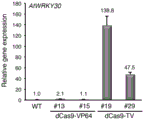
the results of the experiment (FIG. 5) show that dCas9-VP64 can only weakly (#13) or not (#15) activate transcription of the Arabidopsis endogenous WRKY30 gene compared to wild-type plants. In contrast, dCas9-TV has excellent transcription activation activity in transgenic Arabidopsis plants, and can remarkably up-regulate the transcription level of endogenous WRKY30 gene to 47.5-138.8 times. It can be seen that the artificial transcriptional activator dCas9-TV disclosed by the invention has stronger transcriptional activation activity than the currently commonly used dCas9-VP 64.
Example 3
Transcriptional activation of the Arabidopsis RLP23 Gene based on the Artificial transcriptional activator dCas9-TV
(1) Design of arabidopsis thaliana RLP23 gene promoter target sequence and construction of gRNA expression vector
The promoter sequence of the Arabidopsis thaliana RLP23 gene was searched from the NCBI database, and the target sequence "AAATCCCTTAACGTATAACT" was selected within 200bp upstream of the transcription initiation siteTGG"(underlined PAM structure), and gRNA-RLP23 was designed accordingly. An overlapping PCR method was used to construct AtU6-26 gRNA: TTTTTT expression cassettes with overlapping sequences as the 20nt target sequence. The PCR primers used were as follows:
U6-26-SacI-F:CGAGAGCTCAGCTTTTTTTCTTCTTCT
U6-26-RLP23-R:AGTTATACGTTAAGGGATTTCAATCACTACTTCGACTCT
gRNA-RLP23-F:AAATCCCTTAACGTATAACTGTTTTAGAGCTAGAAATA
gRNA-SacI-R:CGAGAGCTCAAAAAAGCACCGACTCGGTGC
the overlapping PCR end products were separated by running gel and then processed by OMEGA
The Cycle Pure Kit was purified according to the instructions. The purified product was digested with SacI (NEB Co.), and ligated with pUC119-RCS linearized with SacI. And transforming the connecting product into escherichia coli, screening positive clones by using ampicillin, extracting plasmids for enzyme digestion identification, and finally verifying the successful construction of a gRNA expression vector by sequencing to obtain AtU6-26 gRNA-RLP23 plasmid.
(2) Preparation and transfection of Arabidopsis protoplasts
Arabidopsis protoplasts were prepared as in (2) of example 2, without modification.
When protoplasts were transfected, the luciferase reporter gene activity was measured by the same transfection method as in (2) in example 2, in which the gene WRKY30 was changed to RLP 23. The transfection method for measuring the transcriptional activation level of the cellular endogenous RLP23 gene was the same as in (2) in example 2, except that the transfection system was changed to: 400 μ l protoplasts, 20 μ l (40 μ g) dCas9-TAD expression vector, and 20 μ l (40 μ g) gRNA expression vector. The amount of the other solution was doubled.
(3) Detection of luciferase reporter Gene Activity
The procedure was as in (3) of example 2. The experimental results are shown in FIG. 6, and indicate that dCas9-TV can significantly activate the expression of RLP23-LUC reporter gene to 28.5 times under the guidance of a single gRNA targeting RLP23 promoter; dCas9-VP64 only weakly up-regulated the expression of the reporter gene (1.4 times), and the activity was poor.
(4) Detection of transcriptional activation level of protoplast endogenous RLP23 gene
After 400. mu.l protoplast were cultured in the dark for 12 hours, they were collected in a centrifuge tube, centrifuged horizontally at 100g for 2min, and the supernatant was aspirated. Total RNA was extracted by adding 1ml of RNAioso Plus reagent according to the product instructions. Mu.g of total RNA was treated with RNase-free DNase I to remove genomic DNA, and then reverse transcription was performed using Transcriptor First Strand cDNA Synthesis Kit according to the product instructions. The resulting cDNA was diluted and subjected to RT-qPCR reaction using FastStart Essential DNA Green Master reagent in LightCycler96 Instrument. Arabidopsis ACT2 gene as reference gene, 2-ΔΔCtThe method calculates the transcriptional activation level of the target gene. The qPCR primers used were as follows:
RLP23-qPCR-F:GCTCTGTGATGGTGCCTCTT
RLP23-qPCR-R:AAGCTTTGAGCCAGAACGGA
ACT2-qPCR-F:GACCTTTAACTCTCCCGCTATG
ACT2-qPCR-R:AAACCCTCGTAGATTGGCAC
the experimental results in FIG. 7 show that dCas9-TV efficiently activates transcription of the endogenous RLP23 gene of Arabidopsis thaliana up to 44.2-fold in transfected protoplasts. In contrast, dCas9-VP64 was not but not effective in enhancing transcription, but rather weakly reduced the transcript level of RLP23 (0.7 fold). This result again demonstrates that dCas9-TV is a CRISPR/Cas 9-derived artificial transcription activator that is more efficient than dCas9-VP 64.
(5) Obtaining transgenic Arabidopsis plants
The method is the same as that in (4) of example 2, and the gene WRKY30 is completely changed into RLP 23.
(6) Detection of transgenic arabidopsis plant RLP23 gene transcription level
The procedure was the same as in (5) of example 2 except that the whole gene WRKY30 was changed to RLP23 and the RT-qPCR primers used were changed to those used in (4) of example 3.
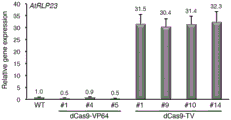
The results of the experiment are shown in FIG. 8. FIG. 8 shows that dCas9-VP64 did not cause transcriptional activation of the endogenous RLP23 gene in any of the three different strains, even producing transcriptional repression (#1 and # 5). The dCas9-TV can raise the transcription level of endogenous RLP23 gene by over 30 times in four different strains, and the dCas9-TV has excellent transcription activating activity in transgenic plants. Combining the above results, the novel artificial transcription activator dCas9-TV can remarkably activate the transcription level of a single target gene in cells and transgenic plants, and the transcription activation performance is far better than that of dCas9-VP64 which is widely used at present.
(7) Phenotypic analysis of transgenic Arabidopsis plants
The protein encoded by the target gene RLP23 in this embodiment is a Pattern Recognition Receptor (PRR) that recognizes a microbe-associated molecular pattern (MAMP) nlp 20. nlp20 is a peptide segment containing 20 amino acids, and is a conserved molecular element derived from bacteria, fungi and oomycetes. When pathogenic bacteria invade an arabidopsis thaliana plant, RLP23 protein located on the cell membrane of arabidopsis thaliana can sense and recognize nlp20 molecular patterns of the pathogenic bacteria and initiate downstream immune signal transduction, thereby causing a Pattern-triggered Immunity (PTI) response to defend against the invading pathogenic bacteria. Therefore, it is speculated that the increase of the plant cell RLP23 protein can enhance the ability of the cell to sense and recognize the immune signal nlp20, and the induced immune response is enhanced, so that stronger disease resistance is finally obtained. Transgenic Arabidopsis plants of example 3(6) were tested for their response to nlp20 immune signals, including MAPK activation and Reactive Oxygen Species (ROS) production.
Protoplasts were prepared from 6-week-old wild-type and transgenic Arabidopsis plants (dCas9-TV/gRNA-RLP23#1, #9, #10, #14) according to (2) in example 2. 6X 10⁴After 2min of horizontal centrifugation of one (300. mu.l) protoplast at 100g,the supernatant was aspirated off, resuspended with 100. mu. l W5 solution and transferred to 1ml of WI solution and incubated at room temperature for 3 h. 10nM of chemically synthesized nlp20 peptide fragment was added, and the control group was treated with an equal volume of sterile water for 10min and centrifuged to collect samples. SDS loading buffer was added to the sample and mixed, and heated at 95 ℃ for 3min, after which the sample was subjected to 10% SDS-PAGE and Western blot, and the MAPK signal was detected using anti-phosphorus ERK antibodies (Cell Signaling Technology) as a primary antibody and HRP-conjugated anti-rabbit antibodies (Cell Signaling Technology) as a secondary antibody.
As shown in FIG. 9, the low concentration of nlp20 signal only weakly activated the MAPK signal of the wild-type plants, while the MAPK signal of the transgenic plants (dCas9-TV/gRNA-RLP23#1, #9, #10, #14) was significantly activated. The result shows that dCas9-TV can make the transgenic plant more sensitive to low-concentration immune signals and enhance the immune response of the plant by increasing the transcription level of the endogenous RLP23 gene of the transgenic plant (figure 8).
6-week-old wild-type and transgenic Arabidopsis plants (dCas9-TV/gRNA-RLP23#1, #9, #10, #14) were harvested, and leaf discs of 5mm in diameter were removed with a punch, 4 each plant. To each well of the 96-well plate, 200. mu.l of sterile water was added, and each leaf disc was placed therein and allowed to stand at room temperature overnight. The sterile water was aspirated, 100. mu.l of HRP-luminol reaction solution containing 1. mu.M of nlp20 peptide fragment was added, and immediately placed in a microplate reader to measure the fluorescence intensity. The cumulative fluorescence signal was read every 1s per well, every 30s, for a total of 100 reads. The data are collated to obtain a time sequence diagram of active oxygen generation, as shown in figure 10, it can be seen that transgenic plants (dCas9-TV/gRNA-RLP23#1, #9, #10, #14) generate more active oxygen than wild plants after sensing an immune signal nlp20, and the result indicates that the transgenic plants have stronger defense response to corresponding pathogenic bacteria.
Example 4
Multi-gene transfer of Arabidopsis genes WRKY30, RLP23 and CDG1 based on artificial transcription activator dCas9-TV
Record activation
(1) Design of target gene promoter target sequence and construction of gRNA expression vector
The design of the promoter target sequence of arabidopsis WRKY30 gene and the construction of gRNA expression vector were the same as in (1) of example 2.
The design of the promoter target sequence of the arabidopsis RLP23 gene and the construction of the gRNA expression vector were the same as in (1) of example 3.
The design of the promoter target sequence of the arabidopsis CDG1 gene and the construction of the gRNA expression vector were the same as those in (1) of example 3, and the system and method used were not changed, and all of the gene RLP23 was changed to CDG 1. Accordingly, the target sequence "AAATCCCTTAACGTATAACTTGG"Change to target sequence" TTGTAGATTATTACCCTCAATGG"; the used primer U6-26-RLP23-R is changed into U6-26-CDG1-R, the primer gRNA-RLP23-F is changed into gRNA-CDG1-F, and the primer sequences are as follows:
U6-26-CDG1-R:TTGAGGGTAATAATCTACAACAATCACTACTTCGACTCT
gRNA-CDG1-F:TTGTAGATTATTACCCTCAAGTTTTAGAGCTAGAAATA
finally AtU6-26 gRNA-CDG1 plasmid is obtained.
(2) Preparation and transfection of Arabidopsis protoplasts
Arabidopsis protoplasts were prepared as in (2) of example 2, without modification.
The transfection method of Arabidopsis protoplasts was the same as in (2) in example 2, except that the transfection system was changed to 400. mu.l of protoplasts, 20. mu.l (40. mu.g) of dCas9-TAD expression vector, 7. mu.l (14. mu.g) of gRNA-WRKY30 expression vector, 7. mu.l (14. mu.g) of gRNA-RLP23 expression vector, and 7. mu.l (14. mu.g) of gRNA-CDG1 expression vector. The amount of the other solution was doubled.
(3) Detection of the level of transcriptional activation of protoplast target genes
The protoplast target gene transcript level was determined as in example 3 (4). The RT-qPCR primers used were as follows:
WRKY30-qPCR-F:TCGGAGCCAAATTTCCAAGAGG
WRKY30-qPCR-R:TCCTCGGTAACTGATCTCAAGGAG
RLP23-qPCR-F:GCTCTGTGATGGTGCCTCTT
RLP23-qPCR-R:AAGCTTTGAGCCAGAACGGA
CDG1-qPCR-F:GGAGCTTATCAGTGGACGCA
CDG1-qPCR-R:AACAACGGTCGTGCCCAAT
ACT2-qPCR-F:GACCTTTAACTCTCCCGCTATG
ACT2-qPCR-R:AAACCCTCGTAGATTGGCAC
the experimental results are shown in fig. 11, and when 3 grnas are used to target the promoters of 3 genes respectively, dCas9-VP64 only weakly up-regulates the transcription level of the arabidopsis thaliana endogenous CDG1 gene (3.2 times), but has no transcription activation effect on the other two genes. In contrast, dCas9-TV can simultaneously and remarkably activate the transcription of the 3 genes, which indicates that the novel artificial transcription activator dCas9-TV can realize high-efficiency multi-gene transcription activation in Arabidopsis cells.
Example 5
Polygene transcriptional activation of rice genes GW7 and ER1 based on artificial transcriptional activator dCas9-TV
(1) Design of target gene promoter target sequence and construction of gRNA expression vector
The target sequence design of the rice GW7 gene and the construction of the gRNA expression vector are as follows. Searching the promoter sequence of the rice GW7 gene from NCBI database, and selecting the target sequence 'TGTCCAGCTCCCGGCACCCA' within 200bp upstream of the transcription initiation siteCGG"(underlined PAM structure), and gRNA-GW7 was designed accordingly. An overlapping PCR approach was used to construct OsU6a gRNA: TTTTTT expression cassette with an overlapping sequence of 20nt target sequence. OsU6 promoter 6a was obtained from the Sizuki laboratory of southern agricultural university, south China. The PCR primers used were as follows:
OsU6a-KpnI-F:CGAGGTACCTTTTTTCCTGTAGTTTTCCCACAAC
OsU6a-GW7-R:TGGGTGCCGGGAGCTGGACACGGCAGCCAAGCCAGCACCC
gRNA-GW7-F:TGTCCAGCTCCCGGCACCCAGTTTTAGAGCTAGAAATAGC
gRNA-HindIII-R:CGAAAGCTTAAAAAAGCACCGACTCGGTGCC
the overlapping PCR end products were separated by running gel and then processed by OMEGA
The Cycle Pure Kit was purified according to the instructions. The purified product was digested with KpnI and HindIIII (NEB Co.), and ligated with pUC119-RCS linearized with KpnI and HindIIII. And transforming the connecting product into escherichia coli, screening positive clones by using ampicillin, extracting plasmids for enzyme digestion identification, and finally verifying the successful construction of a gRNA expression vector by sequencing to obtain OsU6a gRNA-GW7 plasmid, wherein the plasmid contains a gene shown as SEQ ID No. 3.
The target sequence design of rice ER1 gene and the construction method of gRNA expression vector are the same as above, and the gene GW7 is changed into ER 1. Accordingly, the target sequence "TGTCCAGCTCCCGGCACCCACGG"changed to" GTTCTACTCCTACCAACTCTAGG", the promoter" OsU6a "was changed to" OsU6b ". OsU6 promoter 6b was obtained from the Sizuki laboratory of southern agricultural university, south China. The primers used were changed as follows:
OsU6b-KpnI-F:CGAGGTACCTGCAAGAACGAACTAAGCCG
OsU6b-ER1-R:AGAGTTGGTAGGAGTAGAACAACACAAGCGGCAGCGCGC
gRNA-ER1-F:GTTCTACTCCTACCAACTCTGTTTTAGAGCTAGAAATAGC
gRNA-HindIII-R:CGAAAGCTTAAAAAAGCACCGACTCGGTGCC
finally, OsU6b gRNA-ER1 plasmid is obtained, which contains the gene shown in SEQ ID NO. 4.
(2) Preparation and transfection of Rice protoplasts
The preparation method of rice protoplasts was the same as that in (2) of example 2, where "leaves of 4-week-old soil-cultured Arabidopsis thaliana (Col-0) were changed to" stalks of 10-day-old rice (Zhonghua No. 11) "," strips "were changed to" thin grains ", and" 200g centrifugation for 5min "was changed to 100g centrifugation for 2 min".
The transfection method of rice protoplasts was similar to that in (2) of example 2. The transfection system is as follows: 400 μ l protoplast, 20 μ l (40 μ g) dCas9-TAD expression vector, 10 μ l (20 μ g) gRNA-GW7 expression vector and 10 μ l (20 μ g) gRNA-ER1 expression vector. The amount of the other solution was doubled. The room temperature standing for 5min is changed into room temperature standing in dark place for 15min, and centrifugation for 2min at 100g is changed into centrifugation for 5min at 200g "
(3) Detection of the level of transcriptional activation of protoplast target genes
The method for detecting the protoplast target gene transcription level was the same as that in example 3 (4), except that the reference gene "Arabidopsis ACT 2" was changed to "Rice ACT 1". The RT-qPCR primers used were as follows:
OsGW7-qPCR-F:CATCGACACCAAGTCACAAGGG
OsGW7-qPCR-R:TGACGTGTCGAGGACAGAGATG
OsER1-qPCR-F:CTGTAGCCCACGGATAATACAC
OsER1-qPCR-R:GCCATAGCTGTAGACATCAGAC
OsACT1-qPCR-F:CCACTATGTTCCCTGGCATT
OsACT1-qPCR-R:GTACTCAGCCTTGGCAATCC
as shown in FIG. 12, dCas9-TV in rice protoplast can simultaneously and significantly up-regulate the transcription levels of the target genes GW7 and ER1, while dCas9-VP64 can only weakly activate the transcription of GW7 gene, and has transcription inhibition effect on ER1 gene. The above results indicate that the novel artificial transcription activator dCas9-TV can specifically activate transcription of a target gene also in rice and has excellent multigene activation properties.
Example 6
Transcriptional activation of human ASCL1 and OCT4 genes based on the artificial transcriptional activator dCas9-TV
(1) Design of target gene promoter target sequence and construction of gRNA expression vector
The target sequence design of human ASCL1 gene and the construction of gRNA expression vector were similar to those in (1) of example 3, in which "Arabidopsis thaliana" was changed to "human" and "RLP 23" was changed to "ASCL 1". Accordingly, the target sequence "AAATCCCTTAACGTATAACTTGG"Change to" GCAGCCGCTCGCTGCAGCAGCGG"," AtU6-26: gRNA: TTTTTT "is changed into" Hs U6: gRNA: TTTTTTT ", and the used primers are changed into the following parts:
U6-SacI-F:CGAGAGCTCGAGGGCCTATTTCCCATGAT
U6-ASCL1-R:CTGCTGCAGCGAGCGGCTGGTCCTTTCCACAAGATATATAAAGC
gRNA-ASCL1-F:GCAGCCGCTCGCTGCAGCAGGTTTTAGAGCTAGAAATAGC
gRNA-SacI-R:CGAGAGCTCAAAAAAGCACCGACTCGGTGC
finally HsU6 gRNA-ASCL1 plasmid is obtained.
The target sequence design of human OCT4 gene and the construction method of gRNA expression vector are the same as above, and the gene ASCL1 is completely changed into OCT 4. Accordingly, the target sequence "GCAGCCGCTCGCTGCAGCAGCGG"changed to" ACACCATTGCCACCACCATTAGG". The primers used were changed as follows:
U6-SacI-F:CGAGAGCTCGAGGGCCTATTTCCCATGAT
U6-OCT4-R:AATGGTGGTGGCAATGGTGTCGTCCTTTCCACAAGATATATAAAGC
gRNA-OCT4-F:GACACCATTGCCACCACCATTGTTTTAGAGCTAGAAATAGC
gRNA-SacI-R:CGAGAGCTCAAAAAAGCACCGACTCGGTGC
finally HsU6 gRNA-OCT4 plasmid is obtained.
(2) Cell culture and transfection
Human HEK293T cells were passaged in DMEM medium containing 10% FBS and 1% penicillin and placed at 37 ℃ and 5% CO2In the culture environment of (2). Day before DNA transfection, 1.6X 10⁵Individual cells were seeded in 24-well plates. 500ng of the gRNA expression vector, 500ng of the dCas9-TAD expression vector and 30ng of the p-GFP plasmid were transfected into cells using Lipofectamine LTX with PLUS (Thermo Fisher Co.) and cultured for 3 days.
(3) Detection of transcriptional activation level of target Gene
HEK293T cells were harvested, total RNA was extracted using RNeasy Plus RNA isolation kit (Qiagen) according to the product instructions, followed by One-Step RT-qPCR using One Step SYBR PrimeScript RT-PCR kit (TaKaRa) according to the product instructions, using a LightCycler 480Instrument (Roche). Human GAPDH gene as reference gene, application 2-ΔΔCtThe method calculates the transcriptional activation level of the target gene. The qPCR primers used were as follows:
HsOCT4-qPCR-F:GCTCGAGAAGGATGTGGTCC
HsOCT4-qPCR-R:CGTTGTGCATAGTCGCTGCT
HsASCL1-qPCR-F:GGAGCTTCTCGACTTCACCA
HsASCL1-qPCR-R:AACGCCACTGACAAGAAAGC
HsGAPDH-qPCR-F:CGAGATCCCTCCAAAATCAA
HsGAPDH-qPCR-R:ATCCACAGTCTTCTGGGTGG
as shown in FIG. 13, compared with the control, dCas9-TV can increase the transcription level of endogenous genes ASCL1 and OCT4 to 46.0 times and 16.4 times, indicating that dCas9-TV also plays a role in specific transcriptional activation in human HEK293T cells. Compared with dCas9-VP64, the transcriptional activation activity of dCas9-TV is greatly improved.
Example 7
Arabidopsis and rice based on in vitro assembled dCas9-TV/gRNA ribonucleoprotein transcription activator complex
Transcriptional activation of genes
(1) Expression and purification of dCas9-TV artificial transcription activator
The dCas9-TV gene was cloned into a special 6 XHis-tag prokaryotic expression vector. dCas9-TV-His expression vector was transformed into Escherichia coli Rosetta competent cells (Transgen Co.), cultured at 220rpm in 2 XYT medium at 37 ℃ until OD600 became 0.6-0.8. IPTG was added to a final concentration of 0.2mM and cultured at 18 ℃ for 16h with shaking at 220 rpm. Followed by centrifugation at 5000g for 10min at 4 ℃ to collect the cells and removing the supernatant, 1 XPBS (140mM NaCl, 3mM KCl, 1.7mM Na) was added2HPO4pH 7.4) resuspend the cells. Then, the mixture was centrifuged at 5000g at 4 ℃ for 10min, and the supernatant was discarded. To the cells was added 10ml/g of His-tag lysate (300mM NaCl,50mM NaH)2PO420mM imidazole, 10mM Tris-base, pH 8.0), and resuspending the cells at 4 ℃. Adding a proper amount of lysozyme, and crushing for 30min by using an ultrasonic crusher until the bacterial liquid is substantially clear. The supernatant was collected by centrifugation at 7000g for 30min at 4 ℃ and His-tagged recombinant protein was dissolved in the supernatant. Ni-NTA beads (Transgen) were added to the supernatant, incubated at 4 ℃ for 2-3 hours with shaking at 60rpm, and the recombinant protein was bound to the beads. Slowly pouring the incubation liquid into a chromatographic column, and naturally flowing out the liquid. Thereafter, His-tag washing solution (300mM NaCl,50mM NaH) was used first2PO4,50mM imidazole,10mM TrisBase, pH 8.0) 3 washes, 10ml each, discarding the effluent. Then His-tag eluent (300mM NaCl,50mM NaH) was used2PO4200mM imidazole, 10mM Tris-base, 10% glycerol, pH 8.0) is eluted with the recombinant protein of interest in the eluate. Finally, the eluted protein was subjected to buffer exchange (20mM HEPES pH 7.5, 150mM KCl, 1mM DTT, 5% glycerol) using an ultrafiltration tube (50K, Milipore Corp.) and concentrated to a final dCas9-TV-6 XHis recombinant protein concentration of about 750. mu.g/ml. The expression of the recombinant protein was examined by SDS-PAGE (FIG. 14a), and the size of the recombinant protein was as expected.
(2) In vitro transcription and purification of gRNAs
The invention takes Arabidopsis WRKY30, RLP23 gene and rice ER1 gene as examples to illustrate the performance of the in vitro assembled artificial transcription activator RNP complex. 3 fragments of "T7 promoter-target sequence-gRNA framework" were amplified by PCR using AtU6-26: gRNA-WRKY30 plasmid in example 2, (1) AtU6-26: gRNA-RLP23 plasmid in example 3, and (1) OsU6b: gRNA-ER1 plasmid in example 5 as templates, respectively, and the primers used were as follows:
T7p-WRKY30-F:AAGCTAATACGACTCACTATAGGAAGAACGAAGAAAGCTGATG
T7p-RLP23-F:AAGCTAATACGACTCACTATAGGAAATCCCTTAACGTATAACT
T7p-ER1-F:AAGCTAATACGACTCACTATAGGTTCTACTCCTACCAACTCT
gRNA-R:AAAAGCACCGACTCGGTGCCACTT
the above "T7 promoter-target sequence-gRNA backbone" fragment was purified using e.z.n.a Gel Extraction Kit (OMEGA). 75ng of the purified PCR product was used as a template, and in vitro transcription reaction was performed using HiScribe Quick T7 High Yield RNA Synthesis Kit (NEB Co.) according to the instructions. The resulting product was subjected to RNase-free DNase I (NBE) to remove the DNA template, and then the gRNA was purified using RNA Clean & Concentrator-25 kit (Zymo Research). The length and integrity of the 3 gRNAs were confirmed by urea denaturing PAGE (FIG. 14b), and the band sizes were all expected to be about 97 bp.
(3) In vitro Assembly of dCas9-TV/gRNA Ribonucleoprotein (RNP) Complex
For a specific target gene, a 1.5ml centrifuge tube of RNase-free is taken, 40 ul (30 ug) dCas9-TV protein and 10 ul (25 ug) corresponding gRNA are added in sequence, mixed by gentle blowing, and kept stand for 10min at room temperature. The control group replaced gRNA with an equal volume of RNase-free water. The assembled dCas9-TV/gRNA RNP was immediately used for protoplast transfection.
(4) Preparation and transfection of protoplasts
Arabidopsis protoplasts were prepared as in (2) of example 2, using the same method as that used in (2), and using RNase-free water as reagents. Rice protoplasts were prepared in the same manner as in (2) in example 5, using the same reagents as those used in the preparation of RNase-free water.
In vitro assembled dCas9-TV/gRNA RNP through PEG mediated transfection of 400 u l protoplast. The transfection method of Arabidopsis protoplasts was the same as that in (2) of example 2, and the system was expanded by 1-fold without changing the method. The transfection method of rice protoplasts was the same as that in example 5 (2), and the method was not changed, and the system was expanded by 1 fold. And (5) dark culturing the transfected protoplast at room temperature for 5h to detect the transcription level of the target gene.
(5) Detection of transcription level of target gene
The transcription levels of Arabidopsis WRKY30 and RLP23 were tested in the same manner as in (4) of example 3 using the corresponding RT-qPCR primers of (3) of example 4. The transcript level of ER1 in rice was determined by the same method as in (3) in example 5 using RT-qPCR primers corresponding to (3) in example 5.
The experimental results are shown in FIG. 15, which demonstrates that the in vitro assembled dCas9-TV/gRNA RNP complex can specifically activate the transcription of target genes in Arabidopsis and rice.
The present invention is not limited to the above-described embodiments, and various changes and modifications of the present invention are intended to be included within the scope of the claims and the equivalent technology of the present invention if they do not depart from the spirit and scope of the present invention.
SEQUENCE LISTING
<110> Zhongshan university
<120> high-efficiency artificial transcription activator dCas9-TV, and coding gene and application thereof
<130> 0
<160> 4
<170> PatentIn version 3.5
<210> 1
<211> 1875
<212> PRT
<213> Artificial
<220>
<221> VARIANT
<222> (1)...(1875)
<223> dCas9-TV(dCas9-6TAL-VP128)
<400> 1
Met Asp Tyr Lys Asp Asp Asp Asp Lys Asp Tyr Lys Asp Asp Asp Asp
1 5 10 15
Lys Met Ala Pro Lys Lys Lys Arg Lys Val Gly Ile His Gly Val Pro
20 25 30
Ala Ala Asp Lys Lys Tyr Ser Ile Gly Leu Ala Ile Gly Thr Asn Ser
35 40 45
Val Gly Trp Ala Val Ile Thr Asp Glu Tyr Lys Val Pro Ser Lys Lys
50 55 60
Phe Lys Val Leu Gly Asn Thr Asp Arg His Ser Ile Lys Lys Asn Leu
65 70 75 80
Ile Gly Ala Leu Leu Phe Asp Ser Gly Glu Thr Ala Glu Ala Thr Arg
85 90 95
Leu Lys Arg Thr Ala Arg Arg Arg Tyr Thr Arg Arg Lys Asn Arg Ile
100 105 110
Cys Tyr Leu Gln Glu Ile Phe Ser Asn Glu Met Ala Lys Val Asp Asp
115 120 125
Ser Phe Phe His Arg Leu Glu Glu Ser Phe Leu Val Glu Glu Asp Lys
130 135 140
Lys His Glu Arg His Pro Ile Phe Gly Asn Ile Val Asp Glu Val Ala
145 150 155 160
Tyr His Glu Lys Tyr Pro Thr Ile Tyr His Leu Arg Lys Lys Leu Val
165 170 175
Asp Ser Thr Asp Lys Ala Asp Leu Arg Leu Ile Tyr Leu Ala Leu Ala
180 185 190
His Met Ile Lys Phe Arg Gly His Phe Leu Ile Glu Gly Asp Leu Asn
195 200 205
Pro Asp Asn Ser Asp Val Asp Lys Leu Phe Ile Gln Leu Val Gln Thr
210 215 220
Tyr Asn Gln Leu Phe Glu Glu Asn Pro Ile Asn Ala Ser Gly Val Asp
225 230 235 240
Ala Lys Ala Ile Leu Ser Ala Arg Leu Ser Lys Ser Arg Arg Leu Glu
245 250 255
Asn Leu Ile Ala Gln Leu Pro Gly Glu Lys Lys Asn Gly Leu Phe Gly
260 265 270
Asn Leu Ile Ala Leu Ser Leu Gly Leu Thr Pro Asn Phe Lys Ser Asn
275 280 285
Phe Asp Leu Ala Glu Asp Ala Lys Leu Gln Leu Ser Lys Asp Thr Tyr
290 295 300
Asp Asp Asp Leu Asp Asn Leu Leu Ala Gln Ile Gly Asp Gln Tyr Ala
305 310 315 320
Asp Leu Phe Leu Ala Ala Lys Asn Leu Ser Asp Ala Ile Leu Leu Ser
325 330 335
Asp Ile Leu Arg Val Asn Thr Glu Ile Thr Lys Ala Pro Leu Ser Ala
340 345 350
Ser Met Ile Lys Arg Tyr Asp Glu His His Gln Asp Leu Thr Leu Leu
355 360 365
Lys Ala Leu Val Arg Gln Gln Leu Pro Glu Lys Tyr Lys Glu Ile Phe
370 375 380
Phe Asp Gln Ser Lys Asn Gly Tyr Ala Gly Tyr Ile Asp Gly Gly Ala
385 390 395 400
Ser Gln Glu Glu Phe Tyr Lys Phe Ile Lys Pro Ile Leu Glu Lys Met
405 410 415
Asp Gly Thr Glu Glu Leu Leu Val Lys Leu Asn Arg Glu Asp Leu Leu
420 425 430
Arg Lys Gln Arg Thr Phe Asp Asn Gly Ser Ile Pro His Gln Ile His
435 440 445
Leu Gly Glu Leu His Ala Ile Leu Arg Arg Gln Glu Asp Phe Tyr Pro
450 455 460
Phe Leu Lys Asp Asn Arg Glu Lys Ile Glu Lys Ile Leu Thr Phe Arg
465 470 475 480
Ile Pro Tyr Tyr Val Gly Pro Leu Ala Arg Gly Asn Ser Arg Phe Ala
485 490 495
Trp Met Thr Arg Lys Ser Glu Glu Thr Ile Thr Pro Trp Asn Phe Glu
500 505 510
Glu Val Val Asp Lys Gly Ala Ser Ala Gln Ser Phe Ile Glu Arg Met
515 520 525
Thr Asn Phe Asp Lys Asn Leu Pro Asn Glu Lys Val Leu Pro Lys His
530 535 540
Ser Leu Leu Tyr Glu Tyr Phe Thr Val Tyr Asn Glu Leu Thr Lys Val
545 550 555 560
Lys Tyr Val Thr Glu Gly Met Arg Lys Pro Ala Phe Leu Ser Gly Glu
565 570 575
Gln Lys Lys Ala Ile Val Asp Leu Leu Phe Lys Thr Asn Arg Lys Val
580 585 590
Thr Val Lys Gln Leu Lys Glu Asp Tyr Phe Lys Lys Ile Glu Cys Phe
595 600 605
Asp Ser Val Glu Ile Ser Gly Val Glu Asp Arg Phe Asn Ala Ser Leu
610 615 620
Gly Thr Tyr His Asp Leu Leu Lys Ile Ile Lys Asp Lys Asp Phe Leu
625 630 635 640
Asp Asn Glu Glu Asn Glu Asp Ile Leu Glu Asp Ile Val Leu Thr Leu
645 650 655
Thr Leu Phe Glu Asp Arg Glu Met Ile Glu Glu Arg Leu Lys Thr Tyr
660 665 670
Ala His Leu Phe Asp Asp Lys Val Met Lys Gln Leu Lys Arg Arg Arg
675 680 685
Tyr Thr Gly Trp Gly Arg Leu Ser Arg Lys Leu Ile Asn Gly Ile Arg
690 695 700
Asp Lys Gln Ser Gly Lys Thr Ile Leu Asp Phe Leu Lys Ser Asp Gly
705 710 715 720
Phe Ala Asn Arg Asn Phe Met Gln Leu Ile His Asp Asp Ser Leu Thr
725 730 735
Phe Lys Glu Asp Ile Gln Lys Ala Gln Val Ser Gly Gln Gly Asp Ser
740 745 750
Leu His Glu His Ile Ala Asn Leu Ala Gly Ser Pro Ala Ile Lys Lys
755 760 765
Gly Ile Leu Gln Thr Val Lys Val Val Asp Glu Leu Val Lys Val Met
770 775 780
Gly Arg His Lys Pro Glu Asn Ile Val Ile Glu Met Ala Arg Glu Asn
785 790 795 800
Gln Thr Thr Gln Lys Gly Gln Lys Asn Ser Arg Glu Arg Met Lys Arg
805 810 815
Ile Glu Glu Gly Ile Lys Glu Leu Gly Ser Gln Ile Leu Lys Glu His
820 825 830
Pro Val Glu Asn Thr Gln Leu Gln Asn Glu Lys Leu Tyr Leu Tyr Tyr
835 840 845
Leu Gln Asn Gly Arg Asp Met Tyr Val Asp Gln Glu Leu Asp Ile Asn
850 855 860
Arg Leu Ser Asp Tyr Asp Val Asp Ala Ile Val Pro Gln Ser Phe Leu
865 870 875 880
Lys Asp Asp Ser Ile Asp Asn Lys Val Leu Thr Arg Ser Asp Lys Asn
885 890 895
Arg Gly Lys Ser Asp Asn Val Pro Ser Glu Glu Val Val Lys Lys Met
900 905 910
Lys Asn Tyr Trp Arg Gln Leu Leu Asn Ala Lys Leu Ile Thr Gln Arg
915 920 925
Lys Phe Asp Asn Leu Thr Lys Ala Glu Arg Gly Gly Leu Ser Glu Leu
930 935 940
Asp Lys Ala Gly Phe Ile Lys Arg Gln Leu Val Glu Thr Arg Gln Ile
945 950 955 960
Thr Lys His Val Ala Gln Ile Leu Asp Ser Arg Met Asn Thr Lys Tyr
965 970 975
Asp Glu Asn Asp Lys Leu Ile Arg Glu Val Lys Val Ile Thr Leu Lys
980 985 990
Ser Lys Leu Val Ser Asp Phe Arg Lys Asp Phe Gln Phe Tyr Lys Val
995 1000 1005
Arg Glu Ile Asn Asn Tyr His His Ala His Asp Ala Tyr Leu Asn
1010 1015 1020
Ala Val Val Gly Thr Ala Leu Ile Lys Lys Tyr Pro Lys Leu Glu
1025 1030 1035
Ser Glu Phe Val Tyr Gly Asp Tyr Lys Val Tyr Asp Val Arg Lys
1040 1045 1050
Met Ile Ala Lys Ser Glu Gln Glu Ile Gly Lys Ala Thr Ala Lys
1055 1060 1065
Tyr Phe Phe Tyr Ser Asn Ile Met Asn Phe Phe Lys Thr Glu Ile
1070 1075 1080
Thr Leu Ala Asn Gly Glu Ile Arg Lys Arg Pro Leu Ile Glu Thr
1085 1090 1095
Asn Gly Glu Thr Gly Glu Ile Val Trp Asp Lys Gly Arg Asp Phe
1100 1105 1110
Ala Thr Val Arg Lys Val Leu Ser Met Pro Gln Val Asn Ile Val
1115 1120 1125
Lys Lys Thr Glu Val Gln Thr Gly Gly Phe Ser Lys Glu Ser Ile
1130 1135 1140
Leu Pro Lys Arg Asn Ser Asp Lys Leu Ile Ala Arg Lys Lys Asp
1145 1150 1155
Trp Asp Pro Lys Lys Tyr Gly Gly Phe Asp Ser Pro Thr Val Ala
1160 1165 1170
Tyr Ser Val Leu Val Val Ala Lys Val Glu Lys Gly Lys Ser Lys
1175 1180 1185
Lys Leu Lys Ser Val Lys Glu Leu Leu Gly Ile Thr Ile Met Glu
1190 1195 1200
Arg Ser Ser Phe Glu Lys Asn Pro Ile Asp Phe Leu Glu Ala Lys
1205 1210 1215
Gly Tyr Lys Glu Val Lys Lys Asp Leu Ile Ile Lys Leu Pro Lys
1220 1225 1230
Tyr Ser Leu Phe Glu Leu Glu Asn Gly Arg Lys Arg Met Leu Ala
1235 1240 1245
Ser Ala Gly Glu Leu Gln Lys Gly Asn Glu Leu Ala Leu Pro Ser
1250 1255 1260
Lys Tyr Val Asn Phe Leu Tyr Leu Ala Ser His Tyr Glu Lys Leu
1265 1270 1275
Lys Gly Ser Pro Glu Asp Asn Glu Gln Lys Gln Leu Phe Val Glu
1280 1285 1290
Gln His Lys His Tyr Leu Asp Glu Ile Ile Glu Gln Ile Ser Glu
1295 1300 1305
Phe Ser Lys Arg Val Ile Leu Ala Asp Ala Asn Leu Asp Lys Val
1310 1315 1320
Leu Ser Ala Tyr Asn Lys His Arg Asp Lys Pro Ile Arg Glu Gln
1325 1330 1335
Ala Glu Asn Ile Ile His Leu Phe Thr Leu Thr Asn Leu Gly Ala
1340 1345 1350
Pro Ala Ala Phe Lys Tyr Phe Asp Thr Thr Ile Asp Arg Lys Arg
1355 1360 1365
Tyr Thr Ser Thr Lys Glu Val Leu Asp Ala Thr Leu Ile His Gln
1370 1375 1380
Ser Ile Thr Gly Leu Tyr Glu Thr Arg Ile Asp Leu Ser Gln Leu
1385 1390 1395
Gly Gly Asp Lys Arg Pro Ala Ala Thr Lys Lys Ala Gly Gln Ala
1400 1405 1410
Lys Lys Lys Lys Pro Arg Gly Gly Ser Gly Gly Leu Leu Asp Pro
1415 1420 1425
Gly Thr Pro Met Asp Ala Asp Leu Val Ala Ser Ser Thr Val Val
1430 1435 1440
Trp Glu Gln Asp Ala Asp Pro Phe Ala Gly Thr Ala Asp Asp Phe
1445 1450 1455
Pro Ala Phe Asn Glu Glu Glu Leu Ala Trp Leu Met Glu Leu Leu
1460 1465 1470
Pro Gln Gly Gly Ser Gly Gly Leu Leu Asp Pro Gly Thr Pro Met
1475 1480 1485
Asp Ala Asp Leu Val Ala Ser Ser Thr Val Val Trp Glu Gln Asp
1490 1495 1500
Ala Asp Pro Phe Ala Gly Thr Ala Asp Asp Phe Pro Ala Phe Asn
1505 1510 1515
Glu Glu Glu Leu Ala Trp Leu Met Glu Leu Leu Pro Gln Ala Arg
1520 1525 1530
Gly Gly Ser Gly Gly Leu Leu Asp Pro Gly Thr Pro Met Asp Ala
1535 1540 1545
Asp Leu Val Ala Ser Ser Thr Val Val Trp Glu Gln Asp Ala Asp
1550 1555 1560
Pro Phe Ala Gly Thr Ala Asp Asp Phe Pro Ala Phe Asn Glu Glu
1565 1570 1575
Glu Leu Ala Trp Leu Met Glu Leu Leu Pro Gln Gly Gly Ser Gly
1580 1585 1590
Gly Leu Leu Asp Pro Gly Thr Pro Met Asp Ala Asp Leu Val Ala
1595 1600 1605
Ser Ser Thr Val Val Trp Glu Gln Asp Ala Asp Pro Phe Ala Gly
1610 1615 1620
Thr Ala Asp Asp Phe Pro Ala Phe Asn Glu Glu Glu Leu Ala Trp
1625 1630 1635
Leu Met Glu Leu Leu Pro Gln Ala Arg Gly Gly Ser Gly Gly Leu
1640 1645 1650
Leu Asp Pro Gly Thr Pro Met Asp Ala Asp Leu Val Ala Ser Ser
1655 1660 1665
Thr Val Val Trp Glu Gln Asp Ala Asp Pro Phe Ala Gly Thr Ala
1670 1675 1680
Asp Asp Phe Pro Ala Phe Asn Glu Glu Glu Leu Ala Trp Leu Met
1685 1690 1695
Glu Leu Leu Pro Gln Gly Gly Ser Gly Gly Leu Leu Asp Pro Gly
1700 1705 1710
Thr Pro Met Asp Ala Asp Leu Val Ala Ser Ser Thr Val Val Trp
1715 1720 1725
Glu Gln Asp Ala Asp Pro Phe Ala Gly Thr Ala Asp Asp Phe Pro
1730 1735 1740
Ala Phe Asn Glu Glu Glu Leu Ala Trp Leu Met Glu Leu Leu Pro
1745 1750 1755
Gln Ala Arg Gly Gly Ser Gly Gly Gly Gly Ser Gly Gly Asp Ala
1760 1765 1770
Leu Asp Asp Phe Asp Leu Asp Met Leu Gly Ser Asp Ala Leu Asp
1775 1780 1785
Asp Phe Asp Leu Asp Met Leu Gly Ser Asp Ala Leu Asp Asp Phe
1790 1795 1800
Asp Leu Asp Met Leu Gly Ser Asp Ala Leu Asp Asp Phe Asp Leu
1805 1810 1815
Asp Met Leu Ala Arg Gly Ser Asp Ala Leu Asp Asp Phe Asp Leu
1820 1825 1830
Asp Met Leu Gly Ser Asp Ala Leu Asp Asp Phe Asp Leu Asp Met
1835 1840 1845
Leu Gly Ser Asp Ala Leu Asp Asp Phe Asp Leu Asp Met Leu Gly
1850 1855 1860
Ser Asp Ala Leu Asp Asp Phe Asp Leu Asp Met Leu
1865 1870 1875
<210> 2
<211> 5628
<212> DNA
<213> Artificial
<220>
<221> CDS
<222> (1)...(5628)
<223> dCas9-TV(dCas9-6TAL-VP128)
<400> 2
atggattaca aggatgatga tgataaggat tacaaggatg atgatgataa gatggctcca 60
aagaagaaga gaaaggttgg aatccacgga gttccagctg ctgataagaa gtactctatc 120
ggacttgcta tcggaaccaa ctctgttgga tgggctgtta tcaccgatga gtacaaggtt 180
ccatctaaga agttcaaggt tcttggaaac accgatagac actctatcaa gaagaacctt 240
atcggtgctc ttcttttcga ttctggagag accgctgagg ctaccagatt gaagagaacc 300
gctagaagaa gatacaccag aagaaagaac agaatctgct accttcagga aatcttctct 360
aacgagatgg ctaaggttga tgattctttc ttccacagac ttgaggagtc tttccttgtt 420
gaggaggata agaagcacga gagacaccca atcttcggaa acatcgttga tgaggttgct 480
taccacgaga agtacccaac catctaccac cttagaaaga agttggttga ttctaccgat 540
aaggctgatc ttagacttat ctaccttgct cttgctcaca tgatcaagtt cagaggacac 600
ttccttatcg agggagacct taacccagat aactctgatg ttgataagtt gttcatccag 660
cttgttcaga cctacaacca gcttttcgag gagaacccaa tcaacgcttc tggagttgat 720
gctaaggcta tcctttctgc tagactttct aagtctcgta gacttgagaa ccttatcgct 780
cagcttccag gagagaagaa gaacggactt ttcggaaacc ttatcgctct ttctcttgga 840
cttaccccaa acttcaagtc taacttcgat cttgctgagg atgctaagtt gcagctttct 900
aaggatacct acgatgatga tcttgataac cttcttgctc agatcggaga tcagtacgct 960
gatcttttcc ttgctgctaa gaacctttct gatgctatcc ttctttctga catccttaga 1020
gttaacaccg agatcaccaa ggctccactt tctgcttcta tgatcaagag atacgatgag 1080
caccaccagg atcttaccct tttgaaggct cttgttagac agcagcttcc agagaagtac 1140
aaggaaatct tcttcgatca gtctaagaac ggatacgctg gatacatcga tggaggagct 1200
tctcaggagg agttctacaa gttcatcaag ccaatccttg agaagatgga tggaaccgag 1260
gagcttcttg ttaagttgaa cagagaggat cttcttagaa agcagagaac cttcgataac 1320
ggatctatcc cacaccagat ccaccttgga gagcttcacg ctatccttcg tagacaggag 1380
gatttctacc cattcttgaa ggataacaga gagaagatcg agaagatcct taccttcaga 1440
atcccatact acgttggacc acttgctaga ggaaactctc gtttcgcttg gatgaccaga 1500
aagtctgagg agaccatcac cccttggaac ttcgaggagg ttgttgataa gggagcttct 1560
gctcagtctt tcatcgagag aatgaccaac ttcgataaga accttccaaa cgagaaggtt 1620
cttccaaagc actctcttct ttacgagtac ttcaccgttt acaacgagct taccaaggtt 1680
aagtacgtta ccgagggaat gagaaagcca gctttccttt ctggagagca gaagaaggct 1740
atcgttgatc ttcttttcaa gaccaacaga aaggttaccg ttaagcagtt gaaggaggat 1800
tacttcaaga agatcgagtg cttcgattct gttgaaatct ctggagttga ggatagattc 1860
aacgcttctc ttggaaccta ccacgatctt ttgaagatca tcaaggataa ggatttcctt 1920
gataacgagg agaacgagga catccttgag gacatcgttc ttacccttac ccttttcgag 1980
gatagagaga tgatcgagga gagactcaag acctacgctc accttttcga tgataaggtt 2040
atgaagcagt tgaagagaag aagatacacc ggatggggta gactttctcg taagttgatc 2100
aacggaatca gagataagca gtctggaaag accatccttg atttcttgaa gtctgatgga 2160
ttcgctaaca gaaacttcat gcagcttatc cacgatgatt ctcttacctt caaggaggac 2220
atccagaagg ctcaggtttc tggacaggga gattctcttc acgagcacat cgctaacctt 2280
gctggatctc cagctatcaa gaagggaatc cttcagaccg ttaaggttgt tgatgagctt 2340
gttaaggtta tgggtagaca caagccagag aacatcgtta tcgagatggc tagagagaac 2400
cagaccaccc agaagggaca gaagaactct cgtgagagaa tgaagagaat cgaggaggga 2460
atcaaggagc ttggatctca aatcttgaag gagcacccag ttgagaacac ccagcttcag 2520
aacgagaagt tgtaccttta ctaccttcag aacggaagag atatgtacgt tgatcaggag 2580
cttgacatca acagactttc tgattacgat gttgatgcta tcgttccaca gtctttcttg 2640
aaggatgatt ctatcgataa caaggttctt acccgttctg ataagaacag aggaaagtct 2700
gataacgttc catctgagga ggttgttaag aagatgaaga actactggag acagcttctt 2760
aacgctaagt tgatcaccca gagaaagttc gataacctta ccaaggctga gagaggagga 2820
ctttctgagc ttgataaggc tggattcatc aagagacagc ttgttgagac cagacagatc 2880
accaagcacg ttgctcagat ccttgattct cgtatgaaca ccaagtacga tgagaacgat 2940
aagttgatca gagaggttaa ggttatcacc ttgaagtcta agttggtttc tgatttcaga 3000
aaggatttcc agttctacaa ggttagagag atcaacaact accaccacgc tcacgatgct 3060
taccttaacg ctgttgttgg aaccgctctt atcaagaagt acccaaagtt ggagtctgag 3120
ttcgtttacg gagattacaa ggtttacgat gttagaaaga tgatcgctaa gtctgagcag 3180
gagatcggaa aggctaccgc taagtacttc ttctactcta acatcatgaa cttcttcaag 3240
accgagatca cccttgctaa cggagagatc agaaagagac cacttatcga gaccaacgga 3300
gagaccggag agatcgtttg ggataaggga agagatttcg ctaccgttag aaaggttctt 3360
tctatgccac aggttaacat cgttaagaaa accgaggttc agaccggagg attctctaag 3420
gagtctatcc ttccaaagag aaactctgat aagttgatcg ctagaaagaa ggattgggac 3480
ccaaagaagt acggaggatt cgattctcca accgttgctt actctgttct tgttgttgct 3540
aaggttgaga agggaaagtc taagaagttg aagtctgtta aggagcttct tggaatcacc 3600
atcatggagc gttcttcttt cgagaagaac ccaatcgatt tccttgaggc taagggatac 3660
aaggaggtta agaaggatct tatcatcaag ttgccaaagt actctctttt cgagcttgag 3720
aacggaagaa agagaatgct tgcttctgct ggagagcttc agaagggaaa cgagcttgct 3780
cttccatcta agtacgttaa cttcctttac cttgcttctc actacgagaa gttgaaggga 3840
tctccagagg ataacgagca gaagcagctt ttcgttgagc agcacaagca ctaccttgat 3900
gagatcatcg agcaaatctc tgagttctct aagagagtta tccttgctga tgctaacctt 3960
gataaggttc tttctgctta caacaagcac agagataagc caatcagaga gcaggctgag 4020
aacatcatcc accttttcac ccttaccaac cttggtgctc cagctgcttt caagtacttc 4080
gataccacca tcgatagaaa aagatacacc tctaccaagg aggttcttga tgctaccctt 4140
atccaccagt ctatcaccgg actttacgag accagaatcg atctttctca gcttggagga 4200
gataagagac cagctgctac caagaaggct ggacaggcta agaagaagaa gcctagggga 4260
ggatctggtg gtcttttgga tccaggaacc cctatggatg ctgaccttgt tgcttcttcc 4320
accgttgtct gggagcagga tgccgaccct ttcgctggta ccgcagacga cttcccagct 4380
tttaacgagg aagagcttgc ttggctcatg gaattgttgc cacagggagg ttctggtgga 4440
ttgttggatc ctggaactcc aatggacgct gatcttgttg cttcctctac tgtcgtttgg 4500
gagcaagacg ctgacccttt cgctggaacc gctgacgatt tcccagcctt taacgaagag 4560
gaattggcct ggcttatgga gttgcttcct caggctaggg gaggatctgg tggtcttttg 4620
gatccaggaa cccctatgga tgctgacctt gttgcttctt ccaccgttgt ctgggagcag 4680
gatgccgacc ctttcgctgg taccgcagac gacttcccag cttttaacga ggaagagctt 4740
gcttggctca tggaattgtt gccacaggga ggttctggtg gattgttgga tcctggaact 4800
ccaatggacg ctgatcttgt tgcttcctct actgtcgttt gggagcaaga cgctgaccct 4860
ttcgctggaa ccgctgacga tttcccagcc tttaacgaag aggaattggc ctggcttatg 4920
gagttgcttc ctcaggctag gggaggatct ggtggtcttt tggatccagg aacccctatg 4980
gatgctgacc ttgttgcttc ttccaccgtt gtctgggagc aggatgccga ccctttcgct 5040
ggtaccgcag acgacttccc agcttttaac gaggaagagc ttgcttggct catggaattg 5100
ttgccacagg gaggttctgg tggattgttg gatcctggaa ctccaatgga cgctgatctt 5160
gttgcttcct ctactgtcgt ttgggagcaa gacgctgacc ctttcgctgg aaccgctgac 5220
gatttcccag cctttaacga agaggaattg gcctggctta tggagttgct tcctcaggct 5280
aggggtggat ctggaggtgg tggtagcgga ggagatgctc ttgatgattt cgatcttgat 5340
atgcttggat ctgacgctct cgacgacttt gacctcgaca tgttgggatc tgatgctctt 5400
gacgatttcg atttggacat gttgggttct gacgccttgg acgatttcga cctcgacatg 5460
cttgctaggg gatctgacgc ccttgatgat ttcgacttgg atatgcttgg atctgacgcc 5520
cttgatgatt tcgacttgga tatgcttgga tctgacgccc ttgatgattt cgacttggat 5580
atgcttggat ctgacgccct tgatgatttc gacttggata tgctttga 5628
<210> 3
<211> 96
<212> DNA
<213> Artificial
<220>
<221> misc_feature
<222> (1)...(96)
<223> gRNA-GW7
<400> 3
tgtccagctc ccggcaccca gttttagagc tagaaatagc aagttaaaat aaggctagtc 60
cgttatcaac ttgaaaaagt ggcaccgagt cggtgc 96
<210> 4
<211> 96
<212> DNA
<213> Artificial
<220>
<221> misc_feature
<222> (1)...(96)
<223> gRNA-ER1
<400> 4
gttctactcc taccaactct gttttagagc tagaaatagc aagttaaaat aaggctagtc 60
cgttatcaac ttgaaaaagt ggcaccgagt cggtgc 96