CN107709012B - Laminated film and method for producing same - Google Patents
Laminated film and method for producing same Download PDFInfo
- Publication number
- CN107709012B CN107709012B CN201680039810.5A CN201680039810A CN107709012B CN 107709012 B CN107709012 B CN 107709012B CN 201680039810 A CN201680039810 A CN 201680039810A CN 107709012 B CN107709012 B CN 107709012B
- Authority
- CN
- China
- Prior art keywords
- resin
- resin layer
- layer
- acrylic resin
- group
- Prior art date
- Legal status (The legal status is an assumption and is not a legal conclusion. Google has not performed a legal analysis and makes no representation as to the accuracy of the status listed.)
- Active
Links
Classifications
-
- B—PERFORMING OPERATIONS; TRANSPORTING
- B32—LAYERED PRODUCTS
- B32B—LAYERED PRODUCTS, i.e. PRODUCTS BUILT-UP OF STRATA OF FLAT OR NON-FLAT, e.g. CELLULAR OR HONEYCOMB, FORM
- B32B27/00—Layered products comprising a layer of synthetic resin
- B32B27/06—Layered products comprising a layer of synthetic resin as the main or only constituent of a layer, which is next to another layer of the same or of a different material
- B32B27/08—Layered products comprising a layer of synthetic resin as the main or only constituent of a layer, which is next to another layer of the same or of a different material of synthetic resin
-
- B—PERFORMING OPERATIONS; TRANSPORTING
- B29—WORKING OF PLASTICS; WORKING OF SUBSTANCES IN A PLASTIC STATE IN GENERAL
- B29C—SHAPING OR JOINING OF PLASTICS; SHAPING OF MATERIAL IN A PLASTIC STATE, NOT OTHERWISE PROVIDED FOR; AFTER-TREATMENT OF THE SHAPED PRODUCTS, e.g. REPAIRING
- B29C55/00—Shaping by stretching, e.g. drawing through a die; Apparatus therefor
- B29C55/02—Shaping by stretching, e.g. drawing through a die; Apparatus therefor of plates or sheets
-
- B—PERFORMING OPERATIONS; TRANSPORTING
- B29—WORKING OF PLASTICS; WORKING OF SUBSTANCES IN A PLASTIC STATE IN GENERAL
- B29C—SHAPING OR JOINING OF PLASTICS; SHAPING OF MATERIAL IN A PLASTIC STATE, NOT OTHERWISE PROVIDED FOR; AFTER-TREATMENT OF THE SHAPED PRODUCTS, e.g. REPAIRING
- B29C55/00—Shaping by stretching, e.g. drawing through a die; Apparatus therefor
- B29C55/02—Shaping by stretching, e.g. drawing through a die; Apparatus therefor of plates or sheets
- B29C55/04—Shaping by stretching, e.g. drawing through a die; Apparatus therefor of plates or sheets uniaxial, e.g. oblique
-
- B—PERFORMING OPERATIONS; TRANSPORTING
- B32—LAYERED PRODUCTS
- B32B—LAYERED PRODUCTS, i.e. PRODUCTS BUILT-UP OF STRATA OF FLAT OR NON-FLAT, e.g. CELLULAR OR HONEYCOMB, FORM
- B32B27/00—Layered products comprising a layer of synthetic resin
- B32B27/18—Layered products comprising a layer of synthetic resin characterised by the use of special additives
- B32B27/20—Layered products comprising a layer of synthetic resin characterised by the use of special additives using fillers, pigments, thixotroping agents
- B32B27/205—Layered products comprising a layer of synthetic resin characterised by the use of special additives using fillers, pigments, thixotroping agents the fillers creating voids or cavities, e.g. by stretching
-
- B—PERFORMING OPERATIONS; TRANSPORTING
- B32—LAYERED PRODUCTS
- B32B—LAYERED PRODUCTS, i.e. PRODUCTS BUILT-UP OF STRATA OF FLAT OR NON-FLAT, e.g. CELLULAR OR HONEYCOMB, FORM
- B32B27/00—Layered products comprising a layer of synthetic resin
- B32B27/36—Layered products comprising a layer of synthetic resin comprising polyesters
-
- B—PERFORMING OPERATIONS; TRANSPORTING
- B32—LAYERED PRODUCTS
- B32B—LAYERED PRODUCTS, i.e. PRODUCTS BUILT-UP OF STRATA OF FLAT OR NON-FLAT, e.g. CELLULAR OR HONEYCOMB, FORM
- B32B38/00—Ancillary operations in connection with laminating processes
- B32B38/0012—Mechanical treatment, e.g. roughening, deforming, stretching
-
- G—PHYSICS
- G02—OPTICS
- G02B—OPTICAL ELEMENTS, SYSTEMS OR APPARATUS
- G02B1/00—Optical elements characterised by the material of which they are made; Optical coatings for optical elements
- G02B1/10—Optical coatings produced by application to, or surface treatment of, optical elements
- G02B1/14—Protective coatings, e.g. hard coatings
-
- B—PERFORMING OPERATIONS; TRANSPORTING
- B32—LAYERED PRODUCTS
- B32B—LAYERED PRODUCTS, i.e. PRODUCTS BUILT-UP OF STRATA OF FLAT OR NON-FLAT, e.g. CELLULAR OR HONEYCOMB, FORM
- B32B38/00—Ancillary operations in connection with laminating processes
- B32B38/0012—Mechanical treatment, e.g. roughening, deforming, stretching
- B32B2038/0028—Stretching, elongating
-
- B—PERFORMING OPERATIONS; TRANSPORTING
- B32—LAYERED PRODUCTS
- B32B—LAYERED PRODUCTS, i.e. PRODUCTS BUILT-UP OF STRATA OF FLAT OR NON-FLAT, e.g. CELLULAR OR HONEYCOMB, FORM
- B32B2307/00—Properties of the layers or laminate
- B32B2307/50—Properties of the layers or laminate having particular mechanical properties
- B32B2307/514—Oriented
- B32B2307/516—Oriented mono-axially
-
- B—PERFORMING OPERATIONS; TRANSPORTING
- B32—LAYERED PRODUCTS
- B32B—LAYERED PRODUCTS, i.e. PRODUCTS BUILT-UP OF STRATA OF FLAT OR NON-FLAT, e.g. CELLULAR OR HONEYCOMB, FORM
- B32B27/00—Layered products comprising a layer of synthetic resin
- B32B27/30—Layered products comprising a layer of synthetic resin comprising vinyl (co)polymers; comprising acrylic (co)polymers
- B32B27/308—Layered products comprising a layer of synthetic resin comprising vinyl (co)polymers; comprising acrylic (co)polymers comprising acrylic (co)polymers
Landscapes
- Engineering & Computer Science (AREA)
- Mechanical Engineering (AREA)
- Physics & Mathematics (AREA)
- General Physics & Mathematics (AREA)
- Optics & Photonics (AREA)
- Laminated Bodies (AREA)
- Shaping By String And By Release Of Stress In Plastics And The Like (AREA)
Abstract
Description
技术领域technical field
本发明涉及一种叠层膜,其为具有聚酯层和树脂层的叠层膜,其至少一侧的表层为树脂层。The present invention relates to a laminated film, which is a laminated film having a polyester layer and a resin layer, and the surface layer of at least one side is a resin layer.
背景技术Background technique
在热塑性树脂膜中,双轴拉伸聚酯膜由于具有机械性质、电性质、尺寸稳定性、透明性、耐化学品性等优异的性质,因此在磁记录材料、包装材料等多种用途中被广泛使用。特别是近年来,以触控面板、液晶显示器面板(LCD)、等离子体显示器面板(PDP)、有机电致发光(有机EL)等显示构件用途为代表,用于各种光学用膜。Among thermoplastic resin films, biaxially stretched polyester films have excellent properties such as mechanical properties, electrical properties, dimensional stability, transparency, and chemical resistance, so they are used in various applications such as magnetic recording materials and packaging materials. being widely used. In particular, in recent years, it has been used for various optical films, typified by display member applications such as touch panels, liquid crystal display panels (LCD), plasma display panels (PDP), and organic electroluminescence (organic EL).
对于这些光学用膜而言,多数情况下,在聚酯膜上叠层折射率不同的层(以下称为光学调节层),之后设置导电层,用作导电膜。在此,通常在叠层光学调节层时,以下述所谓的辊到辊的(roll to roll)的形式实施加工:在被卷绕成辊状的基材膜上涂布功能涂剂并使之固化,然后卷绕成辊状。另外,导电层通过利用真空环境下的溅射而在辊膜上形成金属氧化物膜来进行。These optical films are often used as a conductive film by laminating a layer having a different refractive index on a polyester film (hereinafter referred to as an optical adjustment layer), and then providing a conductive layer. Here, when laminating an optical adjustment layer, processing is usually carried out in a so-called roll-to-roll process in which a functional coating agent is applied to a base film wound in a roll shape, and the Cured and then wound into rolls. In addition, the conductive layer is performed by forming a metal oxide film on the roll film by sputtering in a vacuum environment.
因此,在这样的用途中,为了防止膜辊输送时的划伤,使用在聚酯膜上叠层有耐擦伤层的叠层膜。Therefore, in such an application, in order to prevent scratches when the film roll is transported, a laminated film in which a scratch-resistant layer is laminated on a polyester film is used.
作为该叠层膜,使用叠层了由UV固化性树脂形成的层作为耐擦伤层的硬涂膜。在用于光学用途的情况下,由于要求透明性,因此为了使透明性提高而进行使树脂层的表面平滑的操作,但是如果使树脂层的表面平滑,则在形成膜辊时发生粘连(粘贴)。因此,近年来要求具有耐粘连性的叠层膜。As the laminated film, a hard coat film in which a layer made of a UV curable resin was laminated as a scratch-resistant layer was used. In the case of optical applications, since transparency is required, the surface of the resin layer is smoothed in order to improve the transparency. However, when the surface of the resin layer is smoothed, blocking (sticking) occurs when forming a film roll. ). Therefore, a laminated film having blocking resistance has been demanded in recent years.
另外,对于用于光学用途的叠层膜,除了耐擦伤性以外,还要求不仅在常温下而且在高温高湿下的与基材的粘接性、透明性等。另外,由于大多用于显示器等的表面,因此对于用于光学用途的叠层膜要求可视性、设计性。Moreover, in addition to scratch resistance, the adhesiveness to a base material, transparency, etc. under not only normal temperature but also high temperature and high humidity are requested|required about the laminated film used for an optical application. Moreover, since it is used for the surface of a display etc. in many cases, visibility and designability are required for the laminated film used for optical use.
对于所述要求,专利文献1提出了通过叠层含有比涂层膜厚大的粒子的涂膜,从而减少硬涂膜的接触面积、使抗粘连性显现出来的方法。另外,专利文献2提出了通过叠层含有比涂层膜厚小的丙烯酸粒子的涂膜而得到防眩性与耐擦伤性优异的叠层膜的方法。In response to such a demand, Patent Document 1 proposes a method of reducing the contact area of the hard coat film by laminating a coating film containing particles having a thickness larger than that of the coating film, thereby making the blocking resistance appear. Moreover, patent document 2 proposes the method of obtaining the laminated|multilayer film excellent in anti-glare property and abrasion resistance by laminating|stacking the coating film which contains the acrylic particle which is smaller than the coating film thickness.
现有技术文献prior art literature
专利文献Patent Literature
专利文献1:日本特开2014-228833号公报Patent Document 1: Japanese Patent Application Laid-Open No. 2014-228833
专利文献2:日本特开2011-186287号公报Patent Document 2: Japanese Patent Laid-Open No. 2011-186287
发明内容SUMMARY OF THE INVENTION
发明所要解决的课题The problem to be solved by the invention
然而,在专利文献1所记载的方法中,由于存在于涂层的粒子的粒径大,因此存在产生光的散射、透明性受损等问题。另外,在专利文献2所记载的方法中,由于存在于膜厚6~8μm的涂布层的丙烯酸粒子的粒径大到约2μm~5μm左右,因此是产生光散射的区域,因此在要求高透明性的光学用途中有透明性方面的课题。However, in the method described in Patent Document 1, since the particle size of the particles present in the coating layer is large, there are problems such as occurrence of scattering of light and loss of transparency. In addition, in the method described in Patent Document 2, since the particle size of the acrylic particles present in the coating layer with a film thickness of 6 to 8 μm is as large as about 2 μm to 5 μm, it is a region where light scattering occurs, and therefore, the demand is high. There is a problem of transparency in optical applications of transparency.
因此,本发明的课题在于,解决上述的缺点,提供透明性、耐擦伤性、抗粘连性优异的叠层膜。Therefore, an object of the present invention is to solve the above-mentioned disadvantages and to provide a laminated film excellent in transparency, scratch resistance, and blocking resistance.
用于解决课题的方法methods for solving problems
为了解决上述课题,本发明的叠层膜具有如下的构成。In order to solve the above-mentioned problems, the laminated film of the present invention has the following structure.
[Ⅰ]一种叠层膜,是具有聚酯层和树脂层的叠层膜,其至少一侧的表层为树脂层,所述表层具有的树脂层的微观表面粗糙度(Ra-1)为1nm以上且20nm以下,且其宏观表面粗糙度(Ra-2)为1nm以上且50nm以下,所述微观表面粗糙度(Ra-1)通过AFM(原子力显微镜,Atomic Force Microscope)求得,所述宏观表面粗糙度(Ra-2)通过三维表面粗糙度计求得。[I] A laminated film comprising a polyester layer and a resin layer, wherein at least one surface layer is a resin layer, and the surface layer has a resin layer having a microscopic surface roughness (Ra-1) of 1 nm or more and 20 nm or less, and its macroscopic surface roughness (Ra-2) is 1 nm or more and 50 nm or less, and the microscopic surface roughness (Ra-1) is determined by AFM (Atomic Force Microscope), the said The macroscopic surface roughness (Ra-2) was obtained by a three-dimensional surface roughness meter.
[Ⅱ]根据[Ⅰ]所述的叠层膜,其中,所述表层具有的树脂层通过三维表面粗糙度计所求得的宏观表面粗糙度(Ra-2)为5nm以上且50nm以下。[II] The laminate film according to [I], wherein the resin layer included in the surface layer has a macroscopic surface roughness (Ra-2) determined by a three-dimensional surface roughness meter of 5 nm or more and 50 nm or less.
[Ⅲ]根据[Ⅰ]或[Ⅱ]所述的叠层膜,其中,所述表层具有的树脂层的微观表面粗糙度(Ra-1)与宏观表面粗糙度(Ra-2)之比(Ra-2/Ra-1)为3以上且30以下。[III] The laminate film according to [I] or [II], wherein the surface layer has a resin layer having a ratio (Ra-1) to macroscopic surface roughness (Ra-2) ( Ra-2/Ra-1) is 3 or more and 30 or less.
[Ⅳ]根据[Ⅰ]~[Ⅲ]中任一项所述的叠层膜,其中,所述表层具有的树脂层含有粒子,在观察该树脂层的厚度方向截面时的、从树脂层表面开始到树脂层厚度的10%的位置为止的范围内的粒子存在比率(P-1)大于从距离该树脂层表面为树脂层厚度的40%的位置开始到60%的位置为止的范围内的粒子存在比率(P-2)。[IV] The laminate film according to any one of [I] to [III], wherein the resin layer included in the surface layer contains particles, and when a cross section in the thickness direction of the resin layer is observed, the surface of the resin layer is The particle presence ratio (P-1) in the range from the position to 10% of the thickness of the resin layer is larger than the range from the position to the position of 40% of the thickness of the resin layer to the position of 60% from the surface of the resin layer Particle presence ratio (P-2).
[Ⅴ]根据[Ⅳ]所述的叠层膜,其中,所述从树脂层表面开始到树脂层厚度的10%的位置为止的范围内的粒子存在比率(P-1)与从距离该树脂层表面为树脂层厚度的40%的位置开始到60%的位置为止的范围内的粒子存在比率(P-2)之比(P-1/P-2)为1.1以上且5.0以下。[V] The laminated film according to [IV], wherein the particle existence ratio (P-1) in the range from the surface of the resin layer to a position of 10% of the thickness of the resin layer is proportional to the distance from the resin layer (P-1). The ratio (P-1/P-2) of the particle existence ratio (P-2) in the range from the position where the layer surface is 40% of the thickness of the resin layer to the position at 60% is 1.1 or more and 5.0 or less.
[Ⅵ]根据[Ⅳ]或[Ⅴ]所述的叠层膜,其中,所述表层具有的树脂层的厚度(t)为100nm以上且5000nm以下。[VI] The laminate film according to [IV] or [V], wherein the thickness (t) of the resin layer included in the surface layer is 100 nm or more and 5000 nm or less.
[Ⅶ]根据[Ⅵ]所述的叠层膜,其中,所述表层具有的树脂层中所含有的粒子的平均粒径(d)为1nm以上且100nm以下,树脂层的厚度(t)与粒子的平均粒径(d)之比(t)/(d)为2以上且1000以下。[VII] The laminate film according to [VI], wherein the average particle diameter (d) of the particles contained in the resin layer included in the surface layer is 1 nm or more and 100 nm or less, and the thickness (t) of the resin layer is equal to or greater than 1 nm. The ratio (t)/(d) of the average particle diameter (d) of the particles is 2 or more and 1000 or less.
[Ⅷ]根据[Ⅰ]至[Ⅶ]中任一项所述的叠层膜,其由聚酯层与树脂层直接叠层而得到。[VIII] The laminated film according to any one of [I] to [VII], which is obtained by directly laminating a polyester layer and a resin layer.
[Ⅸ]一种[Ⅰ]~[Ⅷ]中任一项所述的叠层膜的制造方法,其包括下述工序:将含有多官能丙烯酸系树脂和粒子的涂液涂布于结晶取向完成前的聚酯膜的至少一面上,接着,将所述聚酯膜沿至少一个轴方向进行拉伸,对所述聚酯膜实施热处理,使该聚酯膜的结晶取向完成。[IX] A method for producing a laminated film according to any one of [I] to [VIII], comprising the step of applying a coating solution containing a polyfunctional acrylic resin and particles to a crystal orientation completed On at least one surface of the preceding polyester film, the polyester film is then stretched in at least one axial direction, and the polyester film is subjected to heat treatment to complete the crystal orientation of the polyester film.
发明效果Invention effect
本发明的叠层膜的透明性、耐擦伤性、耐粘连性优异,能够在提高膜加工工序时的输送性的同时抑制对膜造成伤痕。The laminated film of the present invention is excellent in transparency, scratch resistance, and blocking resistance, and can suppress the occurrence of scratches on the film while improving the transportability during the film processing step.
具体实施方式Detailed ways
以下,针对本发明的叠层膜进行详细地说明。Hereinafter, the laminated film of the present invention will be described in detail.
本发明涉及一种叠层膜,其为具有聚酯层和树脂层的叠层膜,其中,至少一侧的表层为树脂层,所述表层具有的树脂层通过AFM(Atomic Force Microscope(原子力显微镜))所求得的微观表面粗糙度(Ra-1)为1nm以上且20nm以下,且通过三维表面粗糙度计所求得的宏观表面粗糙度(Ra-2)为1nm以上且50nm以下。The present invention relates to a laminated film, which is a laminated film having a polyester layer and a resin layer, wherein the surface layer on at least one side is a resin layer, and the resin layer of the surface layer is passed through AFM (Atomic Force Microscope (Atomic Force Microscope) )), the microscopic surface roughness (Ra-1) determined by 1 nm or more and 20 nm or less, and the macroscopic surface roughness (Ra-2) determined by a three-dimensional surface roughness meter was 1 nm or more and 50 nm or less.
本发明中的微观表面粗糙度表示对10μm×10μm的区域使用BRUKER制AFM(AtomicForce Microscope(原子力显微镜))测定的树脂层表面的粗糙度。该微观表面粗糙度是对树脂层的透明性与耐擦伤性产生影响的特性。测定方法的详细情况如后述。The microscopic surface roughness in this invention shows the roughness of the resin layer surface measured using AFM (Atomic Force Microscope (atomic force microscope)) made by BRUKER with respect to the area|region of 10 micrometers x 10 micrometers. The microscopic surface roughness is a characteristic that affects the transparency and scratch resistance of the resin layer. Details of the measurement method will be described later.
如果处于叠层膜的表层的树脂层的微观表面粗糙度为1nm以上且20nm以下,则由于该树脂层不具有使光散射那样大的凹凸,因此能使叠层膜的透明性提高。另外,由于树脂层的突起少,因此能使耐擦伤性提高。更优选为1nm以上且15nm以下。作为使树脂层的微观表面粗糙度为1nm以上且20nm以下的方法,有通过在微观表面粗糙度为1nm以上且20nm以下的聚酯层上涂布包含流动性优异的丙烯酸系树脂的固化性树脂并使其固化来形成树脂层的方法、或者通过涂布包含含有平均粒径为100nm以下的纳米粒子的丙烯酸系树脂的固化性树脂并使其固化来形成树脂层的方法。其中,从透明性优异的方面考虑,优选涂布包含含有纳米粒子、且流动性优异的丙烯酸系树脂的固化性树脂并使其固化的方法。When the microscopic surface roughness of the resin layer in the surface layer of the laminated film is 1 nm or more and 20 nm or less, since the resin layer does not have large irregularities that scatter light, the transparency of the laminated film can be improved. In addition, since there are few protrusions of the resin layer, scratch resistance can be improved. More preferably, it is 1 nm or more and 15 nm or less. As a method for setting the microscopic surface roughness of the resin layer to 1 nm or more and 20 nm or less, there is a method of coating a curable resin containing an acrylic resin with excellent fluidity on a polyester layer having a microscopic surface roughness of 1 nm or more and 20 nm or less. A method of forming a resin layer by curing it, or a method of forming a resin layer by applying a curable resin containing an acrylic resin containing nanoparticles with an average particle diameter of 100 nm or less, and curing it. Among them, a method of applying and curing a curable resin containing an acrylic resin containing nanoparticles and having excellent fluidity is preferable from the viewpoint of being excellent in transparency.
本发明中的宏观表面粗糙度表示对400μm×900μm的区域使用小坂研究所制三维粗糙度计来测定的树脂层表面的粗糙度。该宏观表面粗糙度是对树脂层的抗粘连性与透明性产生影响的特性。测定方法的详细情况如后述。The macroscopic surface roughness in the present invention means the roughness of the surface of the resin layer measured using a three-dimensional roughness meter manufactured by Kosaka Laboratories in an area of 400 μm×900 μm. This macroscopic surface roughness is a characteristic which influences the blocking resistance and transparency of a resin layer. Details of the measurement method will be described later.
如果处于叠层膜的表层的树脂层的宏观表面粗糙度为1nm以上且50nm以下的区域,则由于树脂层表面具有平缓的凹凸结构,因此能使叠层膜的抗粘连性与透明性提高。优选为5nm以上且50nm以下,更优选为5nm以上且30nm以下。作为使宏观表面粗糙度为1nm以上且50nm以下的方法,有使用包含丙烯酸系树脂的固化性树脂来形成树脂层,使该树脂层含有平均粒径比树脂层的膜厚大的粒子的方法;或者在涂布包含丙烯酸系树脂的固化性树脂后,使具有凹凸形状的模具转印至丙烯酸系树脂尚未固化的状态的涂膜,之后使丙烯酸系树脂固化,形成树脂层,即所谓的纳米压印方法;或者在涂布包含丙烯酸系树脂的固化性树脂后,通过在丙烯酸系树脂尚未固化的状态下对树脂层实施拉伸处理来赋予微细的拉伸不均的方法等。其中,从抗粘连性优异的方面考虑,优选在涂布包含丙烯酸系树脂的固化性树脂后,通过在丙烯酸系树脂尚未固化的状态下对树脂层实施拉伸处理来赋予微细的拉伸不均,从而在树脂层表面形成平缓的凹凸结构的方法。另外,由于为平缓的凹凸结构,因此能抑制光的散射,从透明性优异的方面考虑为优选的。When the macroscopic surface roughness of the resin layer in the surface layer of the laminated film is in the region of 1 nm or more and 50 nm or less, since the surface of the resin layer has a gentle uneven structure, the blocking resistance and transparency of the laminated film can be improved. It is preferably 5 nm or more and 50 nm or less, and more preferably 5 nm or more and 30 nm or less. As a method of setting the macroscopic surface roughness to 1 nm or more and 50 nm or less, there is a method of forming a resin layer using a curable resin containing an acrylic resin, and making the resin layer contain particles having an average particle diameter larger than the film thickness of the resin layer; Alternatively, after coating a curable resin containing an acrylic resin, a mold having a concave and convex shape is transferred to a coating film in a state where the acrylic resin has not yet been cured, and then the acrylic resin is cured to form a resin layer, which is a so-called nanopress. A printing method; or a method of imparting fine stretching unevenness by applying a stretching treatment to the resin layer in a state where the acrylic resin is not yet cured after coating a curable resin containing an acrylic resin. Among them, from the viewpoint of excellent blocking resistance, it is preferable to impart fine stretch unevenness by subjecting the resin layer to a stretching treatment in a state where the acrylic resin is not yet cured after coating the curable resin containing the acrylic resin. , so as to form a gentle concave-convex structure on the surface of the resin layer. Moreover, since it is a gentle uneven|corrugated structure, scattering of light can be suppressed, and it is preferable from a viewpoint of being excellent in transparency.
另外,对于本发明的叠层膜而言,如果上述表层具有的树脂层的微观表面粗糙度(Ra-1)与宏观表面粗糙度(Ra-2)之比(Ra-2/Ra-1)为3以上且30以下,则抗粘连性提高,为优选的。优选为5以上且25以下,更优选为5以上且小于10。微观表面粗糙度(Ra-1)与宏观表面粗糙度(Ra-2)之比(Ra-2/Ra-1)可以通过调节树脂层所含有的粒子的平均粒径来实现。具体而言,如果增大使树脂层含有的粒子的平均粒径,则有微观表面粗糙度(Ra-1)和宏观表面粗糙度(Ra-2)同时变大的倾向。特别是宏观表面粗糙度(Ra-2),由于其是在广视野下的表面粗糙度,因此如果增大使树脂层含有的粒子的平均粒径,则倾向于与微观表面粗糙度(Ra-1)相比,数值变得更大。In addition, in the laminated film of the present invention, if the ratio (Ra-2/Ra-1) of the microscopic surface roughness (Ra-1) to the macroscopic surface roughness (Ra-2) of the resin layer in the above-mentioned surface layer When it is 3 or more and 30 or less, the blocking resistance is improved, which is preferable. It is preferably 5 or more and 25 or less, and more preferably 5 or more and less than 10. The ratio (Ra-2/Ra-1) of the microscopic surface roughness (Ra-1) to the macroscopic surface roughness (Ra-2) can be realized by adjusting the average particle diameter of the particles contained in the resin layer. Specifically, when the average particle diameter of the particles contained in the resin layer is increased, the microscopic surface roughness (Ra-1) and the macroscopic surface roughness (Ra-2) tend to increase simultaneously. In particular, the macroscopic surface roughness (Ra-2) is the surface roughness in a wide field of view. Therefore, if the average particle diameter of the particles contained in the resin layer is increased, it tends to be the same as the microscopic surface roughness (Ra-1). ), the value becomes larger.
另外,对于本发明的叠层膜而言,优选表层具有的树脂层含有粒子,并且在观察该树脂层的厚度方向截面时的、从树脂层表面开始到树脂层厚度的10%的位置为止的范围内的粒子存在比率(P-1)大于从距离该树脂层表面为树脂层厚度的40%的位置开始到60%的位置为止的范围内的粒子存在比率(P-2)。通过使(P-1)大于(P-2),能够使耐擦伤性良好。若(P-1)与(P-2)之比(P-1/P-2)为1.1以上且5.0以下,则耐擦伤性尤为提高,为优选的。更优选为1.1以上且2.0以下。作为使(P-1)大于(P-2)的方法,可以列举使用比重小的粒子作为使树脂层含有的粒子的方法、或使用修饰了氟、硅等低表面能量成分的粒子来使粒子排列在空气侧的方法。In addition, in the laminated film of the present invention, it is preferable that the resin layer included in the surface layer contains particles, and the resin layer is preferably formed from the surface of the resin layer to a position of 10% of the thickness of the resin layer when a cross-section in the thickness direction of the resin layer is observed. The particle existence ratio (P-1) in the range is larger than the particle existence ratio (P-2) in the range from the position of 40% of the resin layer thickness to the position of 60% from the surface of the resin layer. By making (P-1) larger than (P-2), abrasion resistance can be made favorable. When the ratio (P-1/P-2) of (P-1) to (P-2) is 1.1 or more and 5.0 or less, scratch resistance is particularly improved, which is preferable. More preferably, it is 1.1 or more and 2.0 or less. As a method of making (P-1) larger than (P-2), there may be mentioned a method of using particles with a small specific gravity as particles contained in the resin layer, or a method of using particles modified with low surface energy components such as fluorine and silicon. Arrange the method on the air side.
另外,对于本发明的叠层膜而言,若上述表层具有的树脂层的厚度(t)为100nm以上,则能够抑制树脂层表层的固化阻碍的影响,耐擦伤性优异,因此优选。树脂层的厚度的上限没有限定,但从透明性及生产性的方面而言,优选为5000nm以下。另外,更优选为300nm以上且3000nm以下,进一步优选为500nm以上且1500nm以下。Moreover, in the laminated film of this invention, when the thickness (t) of the resin layer which the said surface layer has is 100 nm or more, the influence of the hardening inhibition of a resin layer surface layer can be suppressed, and it is excellent in abrasion resistance, and it is preferable. The upper limit of the thickness of the resin layer is not limited, but from the viewpoint of transparency and productivity, it is preferably 5000 nm or less. Moreover, it is more preferable that it is 300 nm or more and 3000 nm or less, and it is still more preferable that it is 500 nm or more and 1500 nm or less.
另外,对于本发明的叠层膜而言,若上述表层具有的树脂层所含有的粒子的平均粒径(d)为1nm以上且100nm以下、且树脂层的厚度(t)与该纳米粒子的平均粒径(d)之比(t)/(d)为2以上且1000以下,则可以抑制因粒子引起的光的漫射,叠层膜的透明性提高,为优选的。更优选为2以上且100以下。上述范围可以通过设计树脂层的膜厚与树脂层含有的粒子的平均粒径而实现。In addition, in the laminated film of the present invention, if the average particle diameter (d) of the particles contained in the resin layer included in the surface layer is 1 nm or more and 100 nm or less, and the thickness (t) of the resin layer is equal to the difference between the nanoparticles When the ratio (t)/(d) of the average particle diameter (d) is 2 or more and 1000 or less, the diffusion of light due to the particles can be suppressed and the transparency of the laminate film can be improved, which is preferable. More preferably, it is 2 or more and 100 or less. The above range can be achieved by designing the film thickness of the resin layer and the average particle diameter of the particles contained in the resin layer.
[丙烯酸系树脂][acrylic resin]
本发明的叠层膜中,优选表层具有的树脂层含有丙烯酸系树脂。特别优选含有后述的丙烯酸系树脂(A)和/或丙烯酸系树脂(F)、和/或丙烯酸系树脂(G)。通过使用丙烯酸系树脂(A)和/或丙烯酸系树脂(F)、和/或丙烯酸系树脂(G),能够维持透明性,且能够使树脂层表面的硬度提高。其结果为能够使叠层膜的耐擦伤性提高。In the laminated film of this invention, it is preferable that the resin layer which the surface layer has contains an acrylic resin. In particular, it is preferable to contain the acrylic resin (A) and/or the acrylic resin (F) and/or the acrylic resin (G) described later. By using the acrylic resin (A) and/or the acrylic resin (F) and/or the acrylic resin (G), transparency can be maintained and the hardness of the surface of the resin layer can be improved. As a result, the scratch resistance of the laminated film can be improved.
本发明中的丙烯酸系树脂(A)为由分子内具有丙烯酰基的单体成分(a)制成的固化组合物。其中,单体成分(a)优选为在分子内具有3个以上丙烯酰基的多官能丙烯酸酯。多官能丙烯酸酯为在1分子中具有3(更优选为4,进一步优选为5以上)个以上(甲基)丙烯酰基的单体或寡聚物。作为这样的组合物,可以列举在1分子中具有3个以上醇性羟基的多元醇的该羟基成为3个以上的(甲基)丙烯酸的酯化物的化合物等。The acrylic resin (A) in this invention is a cured composition which consists of the monomer component (a) which has an acryloyl group in a molecule|numerator. Among them, the monomer component (a) is preferably a polyfunctional acrylate having three or more acryloyl groups in the molecule. The polyfunctional acrylate is a monomer or oligomer having 3 (more preferably 4, further preferably 5 or more) (meth)acryloyl groups in one molecule. As such a composition, the compound etc. which the said hydroxyl group of the polyhydric alcohol which has 3 or more of alcoholic hydroxyl groups in 1 molecule become the esterified product of 3 or more (meth)acrylic acid are mentioned.
作为具体的例子,可以使用季戊四醇三(甲基)丙烯酸酯、季戊四醇四(甲基)丙烯酸酯、二季戊四醇三(甲基)丙烯酸酯、二季戊四醇四(甲基)丙烯酸酯、二季戊四醇四(甲基)丙烯酸酯、二季戊四醇五(甲基)丙烯酸酯、二季戊四醇六(甲基)丙烯酸酯、三羟甲基丙烷三(甲基)丙烯酸酯、季戊四醇三丙烯酸酯六亚甲基二异氰酸酯氨基甲酸酯聚合物等。这些单体可以使用1种或混合2种以上使用。另外,作为市售的多官能丙烯酸类组合物,可列举三菱レーヨン株式会社;(商品名“ダイヤビーム”(注册商标)系列等),长濑产业株式会社;(商品名“デナコール”(注册商标)系列等),新中村株式会社;(商品名“NKエステル”系列等),大日本インキ化学工业株式会社;(商品名“UNIDIC”(注册商标)等),东亚合成化学工业株式会社;(“アロニックス”(注册商标)系列等),日本油脂株式会社;(“ブレンマー”(注册商标)系列等),日本化药株式会社;(商品名“KAYARAD”(注册商标)系列等),共荣社化学株式会社;(商品名“ライトエステル”系列等)等,可利用这些制品。As specific examples, pentaerythritol tri(meth)acrylate, pentaerythritol tetra(meth)acrylate, dipentaerythritol tri(meth)acrylate, dipentaerythritol tetra(meth)acrylate, dipentaerythritol tetra(meth)acrylate, and dipentaerythritol tetra(meth)acrylate can be used. base) acrylate, dipentaerythritol penta(meth)acrylate, dipentaerythritol hexa(meth)acrylate, trimethylolpropane tri(meth)acrylate, pentaerythritol triacrylate, hexamethylene diisocyanate urethane acid ester polymers, etc. These monomers may be used alone or in combination of two or more. Moreover, as a commercially available multifunctional acrylic composition, Mitsubishi Reyn Co., Ltd.; (trade name "ダイヤビーム" (registered trademark) series, etc.), Nagase Sangyo Co., Ltd.; ) series, etc.), Shin Nakamura Co., Ltd.; (trade name "NK エステル" series, etc.), Dainippon Inki Chemical Industry Co., Ltd.; (trade name "UNIDIC" (registered trademark), etc.), Toagosei Chemical Industry Co., Ltd.; ( "Aronicus" (registered trademark) series, etc.), NOF Corporation; ("ブレンマー" (registered trademark) series, etc.), Nippon Kayaku Co., Ltd.; (trade name "KAYARAD" (registered trademark) series, etc.), Kyoei These products can be used by Shaka Chemical Co., Ltd.;
本发明中,若使用利用具有酰胺键的丙烯酸系单体成分所得到的丙烯酸系树脂(A)作为丙烯酸系树脂(A),则耐擦伤性尤其提高,因此优选。作为该理由,本发明人等推定如下。在大气中的氧原子存在时,在使具有丙烯酰基的丙烯酸系单体成分固化的情况下,有时丙烯酰基的自由基聚合反应因大气中的氧原子而阻碍反应,其结果是,有时固化变得不充分,耐擦伤性变差。在含有丙烯酰基的丙烯酸系单体成分中存在酰胺键的情况下,推定大气中的氧原子由于与高极性的酰胺键相互作用,因此由大气中的氧导致的丙烯酰基的自由基聚合反应的固化阻碍受到抑制,其结果是,丙烯酸系树脂固化进行,耐擦伤性尤其提高。作为具有酰胺键的丙烯酸系单体成分,可以列举例如下述(式1)所示的结构的化合物。In this invention, when the acrylic resin (A) obtained by using the acrylic monomer component which has an amide bond is used as an acrylic resin (A), since scratch resistance improves especially, it is preferable. For this reason, the present inventors estimate as follows. When an acrylic monomer component having an acryloyl group is cured in the presence of oxygen atoms in the atmosphere, the radical polymerization reaction of the acryloyl group may be inhibited by the oxygen atoms in the atmosphere, and as a result, the curing may change. If it is not obtained enough, the scratch resistance deteriorates. In the case where an amide bond exists in the acryl group-containing acrylic monomer component, it is presumed that the oxygen atom in the atmosphere interacts with the highly polar amide bond, so that the radical polymerization reaction of the acryloyl group by the oxygen in the atmosphere is presumed. As a result, the curing inhibition of the acrylic resin is suppressed, and as a result, the curing of the acrylic resin proceeds, and the scratch resistance is particularly improved. As an acrylic monomer component which has an amide bond, the compound of the structure shown by following (Formula 1) is mentioned, for example.

本发明中的丙烯酸系树脂(F)是指具有(式2)所表示的单体单元(f3)的树脂。The acrylic resin (F) in the present invention refers to a resin having a monomer unit (f 3 ) represented by (Formula 2).
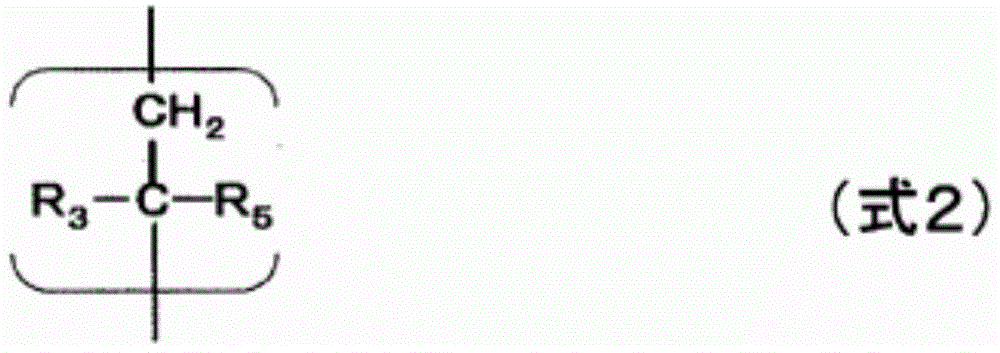
((式2)中,R3基表示氢原子或甲基。另外,R5基表示羟基、羧基、叔氨基、季铵盐基、磺酸基、或磷酸基。)(In (Formula 2), the R 3 group represents a hydrogen atom or a methyl group. In addition, the R 5 group represents a hydroxyl group, a carboxyl group, a tertiary amino group, a quaternary ammonium salt group, a sulfonic acid group, or a phosphoric acid group.)
若使用具有(式2)中的R5基不具有羟基、羧基、叔氨基、季铵盐基、磺酸基、磷酸基中任一者的单体单元的丙烯酸系树脂,则丙烯酸系树脂在水性溶剂中的相容性变得不充分,在树脂组合物中,丙烯酸系树脂(F)不均匀地存在,结果在树脂层的一部分产生耐擦伤性差的点,不优选。If an acrylic resin having a monomeric unit in which the R 5 group in (Formula 2) does not have any one of a hydroxyl group, a carboxyl group, a tertiary amino group, a quaternary ammonium salt group, a sulfonic acid group, and a phosphoric acid group is used, the acrylic resin is Compatibility in the aqueous solvent becomes insufficient, and the acrylic resin (F) is not uniformly present in the resin composition. As a result, a point of poor scratch resistance occurs in a part of the resin layer, which is not preferable.
另外,通过后述的无机粒子(B)凝集或沉降、或在干燥工序中无机粒子(B)凝集,从而摩擦时对树脂层的压力局部变强,结果有时树脂层被破坏,导致划伤。In addition, due to the aggregation or sedimentation of the inorganic particles (B) described later, or the aggregation of the inorganic particles (B) in the drying step, the pressure on the resin layer during rubbing becomes locally strong, and as a result, the resin layer may be broken and scratched.
此外,所述凝集体由于比可见光的波长大,因此有时无法得到透明性良好的叠层膜。本发明中的丙烯酸系树脂(F)为了具有下述(式2)所示的单体单元(f3),需要使用(式3)所示的(甲基)丙烯酸酯单体(f3’)作为原料来进行聚合。Moreover, since the said aggregate is larger than the wavelength of visible light, the laminated|multilayer film with favorable transparency may not be obtained. In order for the acrylic resin (F) in the present invention to have a monomer unit (f 3 ) represented by the following (Formula 2), it is necessary to use a (meth)acrylate monomer (f 3 ′) represented by the (Formula 3) ) as a raw material for polymerization.
作为(式3)所示的(甲基)丙烯酸酯单体(f3’),可例示下述的化合物。The following compounds can be exemplified as the (meth)acrylate monomer (f 3 ′) represented by (Formula 3).

作为具有羟基的(甲基)丙烯酸酯单体,可列举(甲基)丙烯酸2-羟基乙酯、(甲基)丙烯酸2-羟基丙酯、(甲基)丙烯酸2,3-二羟基丁酯、(甲基)丙烯酸4-羟基丁酯、聚乙二醇单(甲基)丙烯酸酯等多元醇与(甲基)丙烯酸的单酯化物、或将ε-己内酯开环聚合于该单酯化物而得到的化合物等,特别优选(甲基)丙烯酸2-羟基乙酯、(甲基)丙烯酸2-羟基丙酯。Examples of the (meth)acrylate monomer having a hydroxyl group include 2-hydroxyethyl (meth)acrylate, 2-hydroxypropyl (meth)acrylate, and 2,3-dihydroxybutyl (meth)acrylate. , (meth)acrylate 4-hydroxybutyl, polyethylene glycol mono(meth)acrylate and other polyols and (meth)acrylic acid monoester, or ring-opening polymerization of ε-caprolactone in the monoester Among the compounds obtained by esterification, 2-hydroxyethyl (meth)acrylate and 2-hydroxypropyl (meth)acrylate are particularly preferred.
作为具有羧基的(甲基)丙烯酸酯单体,可列举丙烯酸、甲基丙烯酸、衣康酸、富马酸、马来酸等α,β-不饱和羧酸、或(甲基)丙烯酸羟基烷基酯与酸酐的半酯化物等,特别优选丙烯酸、甲基丙烯酸。Examples of the (meth)acrylate monomer having a carboxyl group include α,β-unsaturated carboxylic acids such as acrylic acid, methacrylic acid, itaconic acid, fumaric acid, and maleic acid, or hydroxyalkane (meth)acrylate. Half-esterified products of base esters and acid anhydrides, etc., acrylic acid and methacrylic acid are particularly preferred.
作为含叔氨基单体,可列举(甲基)丙烯酸N,N-二甲基氨基乙酯、(甲基)丙烯酸N,N-二乙基氨基乙酯、(甲基)丙烯酸N,N-二甲基氨基丙酯等(甲基)丙烯酸N,N-二烷基氨基烷基酯、N,N-二甲基氨基乙基(甲基)丙烯酰胺、N,N-二乙基氨基乙基(甲基)丙烯酰胺、N,N-二甲基氨基丙基(甲基)丙烯酰胺等N,N-二烷基氨基烷基(甲基)丙烯酰胺等,特别优选(甲基)丙烯酸N,N-二甲基氨基乙酯。Examples of the tertiary amino group-containing monomer include N,N-dimethylaminoethyl (meth)acrylate, N,N-diethylaminoethyl (meth)acrylate, N,N- (meth)acrylate N,N-dialkylaminoalkyl acrylates such as dimethylaminopropyl ester, N,N-dimethylaminoethyl (meth)acrylamide, N,N-diethylaminoethyl N,N-dialkylaminoalkyl(meth)acrylamide, etc., N,N-dialkylaminoalkyl(meth)acrylamide, N,N-dimethylaminopropyl(meth)acrylamide, etc., especially (meth)acrylic acid N,N-Dimethylaminoethyl ester.
作为含季铵盐基单体,优选使表卤醇、卤代苄基、卤代烷基等季铵化剂作用于上述含叔氨基的单体而得到的单体,具体而言,可列举2-(甲基丙烯酰氧基)乙基三甲基氯化铵、2-(甲基丙烯酰氧基)乙基三甲基溴化铵、2-(甲基丙烯酰氧基)乙基三甲基铵二甲基磷酸盐等(甲基)丙烯酰氧基烷基三烷基铵盐、甲基丙烯酰氨基丙基三甲基氯化铵、甲基丙烯酰氨基丙基三甲基溴化铵等(甲基)丙烯酰氨基烷基三烷基铵盐、四丁基(甲基)丙烯酸铵等四烷基(甲基)丙烯酸盐、三甲基苄基(甲基)丙烯酸铵等三烷基苄基(甲基)丙烯酸铵等,特别优选2-(甲基丙烯酰氧基)乙基三甲基氯化铵。The quaternary ammonium salt group-containing monomer is preferably a monomer obtained by acting on the above-mentioned tertiary amino group-containing monomer with a quaternizing agent such as epihalohydrin, halobenzyl, and haloalkyl. Specifically, 2- (methacryloyloxy)ethyltrimethylammonium chloride, 2-(methacryloyloxy)ethyltrimethylammonium bromide, 2-(methacryloyloxy)ethyltrimethylammonium (Meth)acryloyloxyalkyltrialkylammonium salts such as ammonium dimethylphosphate, methacrylamidopropyltrimethylammonium chloride, methacrylamidopropyltrimethyl bromide (meth)acrylamidoalkyl trialkylammonium salts such as ammonium, tetraalkyl (meth)acrylates such as ammonium tetrabutyl (meth)acrylate, trimethylbenzyl (meth)ammonium ammonium salts, etc. 2-(methacryloyloxy)ethyltrimethylammonium chloride is especially preferable, such as alkylbenzylammonium (meth)acrylate.
作为含磺酸基单体,可列举丁基丙烯酰胺磺酸、2-丙烯酰胺-2-甲基丙烷磺酸等(甲基)丙烯酰胺-烷烃磺酸、或2-磺乙基(甲基)丙烯酸酯等磺烷基(甲基)丙烯酸酯等,特别优选2-磺乙基(甲基)丙烯酸酯。Examples of the sulfonic acid group-containing monomer include (meth)acrylamide-alkanesulfonic acid such as butylacrylamide sulfonic acid, 2-acrylamide-2-methylpropanesulfonic acid, etc., or 2-sulfoethyl (methyl) ) acrylate, etc. sulfoalkyl (meth)acrylate etc., 2-sulfoethyl (meth)acrylate is especially preferable.
作为含磷酸基丙烯酸系单体,可列举(甲基)丙烯酸酸式磷酰氧乙酯(acidphosphoxy ethyl(meth)acrylate)等,特别优选(甲基)丙烯酸酸式磷酰氧乙酯。Examples of the phosphoric acid group-containing acrylic monomer include acidphosphoxy ethyl (meth)acrylate and the like, and acidphosphoxy ethyl (meth)acrylate is particularly preferred.
其中,从与后述的无机粒子(B)的吸附力增高、能够形成更牢固的膜、耐擦伤性提高的方面考虑,特别优选丙烯酸系树脂(F)为具有上述(式2)所示的单体单元(f3)的树脂,(式2)中的R5基为羟基、羧基。作为使用丙烯酸系树脂(F)使宏观表面粗糙度为1nm以上且50nm以下的方法,可列举通过在丙烯酸系树脂尚未固化的状态下对树脂层实施拉伸处理来赋予微细的拉伸不均的方法,此时,树脂层的厚度为300nm以上是重要的。通过调节为上述厚度,微细的拉伸不均显现适当的高度,能够使抗粘连性提高。Among them, it is particularly preferable that the acrylic resin (F) has the above-mentioned (Formula 2) from the viewpoints that the adsorption force with the inorganic particles (B) described later is increased, a stronger film can be formed, and the scratch resistance is improved. In the resin of the monomer unit (f 3 ), the R 5 group in (Formula 2) is a hydroxyl group or a carboxyl group. As a method of making the macroscopic surface roughness 1 nm or more and 50 nm or less using the acrylic resin (F), a method of imparting fine stretching unevenness by subjecting the resin layer to a stretching treatment in a state where the acrylic resin has not been cured can be mentioned. In this case, it is important that the thickness of the resin layer is 300 nm or more. By adjusting the thickness to the above-mentioned thickness, the fine stretch unevenness can be expressed at an appropriate height, and the blocking resistance can be improved.
本发明中,优选树脂层中的丙烯酸系树脂的含量为10~90重量%,通过调节成该范围,能够使树脂层的耐擦伤性提高。In the present invention, the content of the acrylic resin in the resin layer is preferably 10 to 90% by weight, and by adjusting to this range, the scratch resistance of the resin layer can be improved.
尤其是在使用丙烯酸系树脂(A)作为丙烯酸系树脂的情况下,丙烯酸系树脂(A)的含量相对于树脂层整体更优选为40重量%以上且90重量%以下,树脂层中的丙烯酸系树脂(A)的含量优选为40重量%以上且80重量%以下,更优选为45重量%以上且70重量%以下。In particular, when the acrylic resin (A) is used as the acrylic resin, the content of the acrylic resin (A) is more preferably 40% by weight or more and 90% by weight or less with respect to the entire resin layer, and the acrylic resin in the resin layer is more preferably 40% by weight or more and 90% by weight or less. The content of the resin (A) is preferably 40% by weight or more and 80% by weight or less, and more preferably 45% by weight or more and 70% by weight or less.
另外,使用丙烯酸系树脂(F)作为丙烯酸系树脂的情况下,树脂层中的丙烯酸系树脂(F)的含量相对于树脂层整体优选为20重量%以上且80重量%以下,更优选为40重量%以上且80重量%以下,进一步优选为45重量%以上且70重量%以下。Moreover, when using an acrylic resin (F) as an acrylic resin, the content of the acrylic resin (F) in the resin layer is preferably 20% by weight or more and 80% by weight or less with respect to the entire resin layer, and more preferably 40% by weight. % by weight or more and 80% by weight or less, more preferably 45% by weight or more and 70% by weight or less.
需要说明的是,在本发明中,树脂层中的含量表示形成树脂层的树脂组合物的固体成分([(树脂组合物的质量)-(溶剂的质量)])中的含量。In addition, in this invention, content in a resin layer shows content in the solid content ([(mass of resin composition) - (mass of solvent)]) of the resin composition which forms a resin layer.
[无机粒子][inorganic particles]
本发明的叠层膜优选为在上述表层具有的树脂层中含有无机粒子(B)。作为无机粒子(B),可列举例如氧化硅(二氧化硅)、氧化钛、氧化铝、氧化锌、氧化锡、氧化锆等微粒。这些之中,优选氧化硅(二氧化硅)、氧化钛、氧化铝、氧化锌、氧化锡、氧化锆的微粒。这些可以单独使用1种,也可以并用2种以上。It is preferable that the laminated film of this invention contains the inorganic particle (B) in the resin layer which the said surface layer has. As the inorganic particles (B), fine particles such as silicon oxide (silica), titanium oxide, aluminum oxide, zinc oxide, tin oxide, and zirconium oxide can be mentioned, for example. Among these, fine particles of silicon oxide (silicon dioxide), titanium oxide, aluminum oxide, zinc oxide, tin oxide, and zirconium oxide are preferable. These may be used individually by 1 type, and may use 2 or more types together.
另外,本发明的无机粒子(B)优选为使无机粒子(B-1)与含有丙烯酰基的树脂成分结合而得到的组合物(B-2),或在无机粒子(B-1)的表面的一部分或全部具有丙烯酸系树脂(G)的组合物(B-3)。在此,所谓的结合可以为共价键合或非共价键合(物理吸附)。Moreover, it is preferable that the inorganic particle (B) of the present invention is a composition (B-2) obtained by combining the inorganic particle (B-1) with an acryl group-containing resin component, or the inorganic particle (B-1) is preferably formed on the surface of the inorganic particle (B-1). A part or all of the composition (B-3) having the acrylic resin (G). Here, the so-called bonding may be covalent bonding or non-covalent bonding (physical adsorption).
作为使无机粒子(B-1)与含有丙烯酰基的树脂成分结合而得到的树脂组合物(B-2)的例子,可列举使无机粒子(B-1)与含有丙烯酰基的树脂成分结合(表面修饰)。通过使无机粒子(B-1)与含有丙烯酰基的树脂成分结合,能够抑制对树脂层施加力时的无机粒子的脱落,能够使耐擦伤性提高。As an example of the resin composition (B-2) obtained by combining inorganic particles (B-1) with an acryl group-containing resin component, inorganic particles (B-1) and an acryl group-containing resin component are combined ( Surface Modification). By combining the inorganic particles (B-1) with the acryl group-containing resin component, it is possible to suppress the dropping of the inorganic particles when a force is applied to the resin layer, and to improve the scratch resistance.
作为使无机粒子(B-1)与含有丙烯酰基的树脂成分结合的具体方法,优选含有丙烯酰基的树脂成分为具有硅醇基的树脂成分、或通过水解而生成硅醇基的树脂成分。As a specific method for combining the inorganic particles (B-1) with the acryloyl group-containing resin component, the acryloyl group-containing resin component is preferably a resin component having a silanol group or a resin component that generates a silanol group by hydrolysis.
接着,针对含有无机粒子(B)的树脂组合物(B-2)所含的、含有丙烯酰基的树脂成分进行说明。含有丙烯酰基的树脂成分为具有丙烯酰基和水解性甲硅烷基的化合物。水解性甲硅烷基是指与水反应而生成硅醇的基团,例如指在硅上键合1个以上甲氧基、乙氧基、正丙氧基、异丙氧基、正丁氧基等烷氧基、芳氧基、乙酰氧基、氨基、或卤素原子而得到的物质。Next, the acryl group-containing resin component contained in the resin composition (B-2) containing the inorganic particles (B) will be described. The acryl group-containing resin component is a compound having an acryl group and a hydrolyzable silyl group. The hydrolyzable silyl group refers to a group that reacts with water to generate silanol, for example, one or more methoxy groups, ethoxy groups, n-propoxy groups, isopropoxy groups, n-butoxy groups are bonded to silicon A substance obtained from an alkoxy group, an aryloxy group, an acetoxy group, an amino group, or a halogen atom.
使无机粒子(B-1)与含有丙烯酰基的树脂成分结合而得到的粒子可以通过将具有水解性甲硅烷基的含有丙烯酰基的树脂成分(B-2)与无机粒子(B-1)混合、使其水解、使两者结合而得到。这样得到的粒子由于与丙烯酸系树脂(A)反应,因此在树脂层被摩擦时无机粒子不易脱落,因此耐擦伤性变得优异。The particles obtained by combining the inorganic particles (B-1) with the acryloyl group-containing resin component can be obtained by mixing the acryl group-containing resin component (B-2) having a hydrolyzable silyl group with the inorganic particles (B-1) , make it hydrolyzed, and combine the two. Since the particles thus obtained react with the acrylic resin (A), the inorganic particles do not easily fall off when the resin layer is rubbed, so that the scratch resistance is excellent.
关于含有无机粒子(B)的树脂组合物(B-2)所含有的、无机粒子(B-1)与含有丙烯酰基的树脂成分比率,在将无机粒子(B-1)与含有丙烯酰基的树脂成分设为100重量份时,含有丙烯酰基的树脂成分(B-2)优选为0.1重量份以上且50重量份以下。通过调节为该范围,从而无机粒子不脱落,能够兼顾耐擦伤性与透明性、抗粘连性。若含有丙烯酰基的树脂成分超过50重量份,则有时树脂层所含有的无机粒子的密度降低,耐擦伤性变差。Regarding the ratio of the inorganic particles (B-1) to the acryloyl group-containing resin component contained in the inorganic particle (B)-containing resin composition (B-2), the ratio of the inorganic particles (B-1) to the acryloyl group-containing resin composition When the resin component is 100 parts by weight, the acryloyl group-containing resin component (B-2) is preferably 0.1 part by weight or more and 50 parts by weight or less. By adjusting to this range, the inorganic particles do not come off, and it is possible to achieve both scratch resistance, transparency, and blocking resistance. When the resin component containing an acryloyl group exceeds 50 parts by weight, the density of the inorganic particles contained in the resin layer may decrease, and the scratch resistance may be deteriorated.
另外,在本发明的无机粒子(B-1)的表面的一部分或全部具有丙烯酸系树脂(G)的组合物(B-3)优选为在无机粒子(B-1)表面的一部分或全部具有上述丙烯酸系树脂(G)的粒子。Moreover, it is preferable that the composition (B-3) which has the acrylic resin (G) on a part or all of the surface of the inorganic particle (B-1) of the present invention has a part or all of the surface of the inorganic particle (B-1) Particles of the above-mentioned acrylic resin (G).
在此,所谓的丙烯酸系树脂(G)是指具有(式4)所示的单体单元(g1)、和(式5)所示的单体单元(g2)的树脂。Here, the acrylic resin (G) refers to a resin having a monomer unit (g 1 ) represented by (Formula 4) and a monomer unit (g 2 ) represented by (Formula 5).

((式4)中,R1基表示氢原子或甲基。另外n表示9以上且34以下的整数。)。(In (Formula 4), R 1 group represents a hydrogen atom or a methyl group. In addition, n represents an integer of 9 or more and 34 or less.).

((式5)中,R2基表示氢原子或甲基。另外,R4基表示含有2个以上的饱和碳环的基团)。(In (Formula 5), the R 2 group represents a hydrogen atom or a methyl group. In addition, the R 4 group represents a group containing two or more saturated carbocyclic rings).
在此,本发明中的丙烯酸系树脂(G)优选为具有(式4)所示的单体单元(g1)的树脂。通过使丙烯酸系树脂(G)具有(式4)所示的单体单元(g1),从而树脂层的表面能量变低,因此实施摩擦处理时施加到树脂层的摩擦系数变小,能够使耐擦伤性提高。Here, the acrylic resin (G) in the present invention is preferably a resin having a monomer unit (g 1 ) represented by (Formula 4). By making the acrylic resin (G) have the monomer unit (g 1 ) represented by (Formula 4), the surface energy of the resin layer is reduced, so that the friction coefficient applied to the resin layer when the rubbing treatment is performed is reduced, and the Scratch resistance is improved.
另外,(式4)中,若使用具有n小于9的单体单元的丙烯酸系树脂,则水性溶剂(关于水性溶剂的详细情况将后述)中的无机粒子(B)的分散性变得不稳定。若使用具有(式4)中的n小于9的单体单元的丙烯酸系树脂,则有时树脂组合物中无机粒子(B)凝集或沉降,或在干燥工序中无机粒子(B)凝集。其结果是,有时叠层膜的透明性受损、或者耐擦伤性差。另一方面,具有(式4)中的n超过34的单体单元的丙烯酸系树脂由于在水性溶剂中的溶解性显著低,因此在水性溶剂中容易引起丙烯酸系树脂的凝集。该凝集体由于比可见光的波长大,因此有时无法得到透明性良好的叠层膜。In addition, in (Formula 4), when an acrylic resin having a monomer unit in which n is less than 9 is used, the dispersibility of the inorganic particles (B) in an aqueous solvent (the details of the aqueous solvent will be described later) becomes poor. Stablize. When an acrylic resin having a monomer unit in which n is less than 9 in (Formula 4) is used, the inorganic particles (B) may aggregate or settle in the resin composition, or the inorganic particles (B) may aggregate in the drying step. As a result, the transparency of the laminated film may be impaired or the scratch resistance may be poor. On the other hand, since the acrylic resin which has a monomeric unit in which n in (Formula 4) exceeds 34 has remarkably low solubility in an aqueous solvent, aggregation of the acrylic resin easily occurs in the aqueous solvent. Since this aggregate is larger than the wavelength of visible light, a laminated film with good transparency may not be obtained.
本发明中的丙烯酸系树脂(G)为了具有(式4)所示的单体单元(g1),需要使用下述的(式6)所示的(甲基)丙烯酸酯单体(g1’)作为原料来进行聚合。In order for the acrylic resin (G) in the present invention to have a monomer unit (g 1 ) represented by (Formula 4), it is necessary to use a (meth)acrylate monomer (g 1 ) represented by the following (Formula 6) ') as a raw material for polymerization.
作为该(甲基)丙烯酸酯单体(g1’),优选(式6)中的n为9以上且34以下的整数所表示的(甲基)丙烯酸酯单体,更优选为11以上且32以下的(甲基)丙烯酸酯单体,进一步优选为13以上且30以下的(甲基)丙烯酸酯单体。As the (meth)acrylate monomer (g 1 ′), a (meth)acrylate monomer represented by n in (Formula 6) is preferably an integer of 9 or more and 34 or less, more preferably 11 or more and The (meth)acrylate monomer of 32 or less is more preferably a (meth)acrylate monomer of 13 or more and 30 or less.

(甲基)丙烯酸酯单体(g1’)只要是(式6)中的n为9以上且34以下的(甲基)丙烯酸酯单体则没有特别限制,具体而言,可列举(甲基)丙烯酸癸酯、(甲基)丙烯酸十二烷酯、(甲基)丙烯酸十三烷酯、(甲基)丙烯酸十四烷酯、(甲基)丙烯酸1-甲基十三烷酯、(甲基)丙烯酸十六烷酯、(甲基)丙烯酸十八烷酯、(甲基)丙烯酸二十烷酯、(甲基)丙烯酸二十二烷酯、(甲基)丙烯酸二十四烷酯、(甲基)丙烯酸三十烷酯等,特别优选(甲基)丙烯酸十二烷酯、(甲基)丙烯酸十三烷酯。这些(甲基)丙烯酸酯单体可以使用1种,也可以使用2种以上的混合物。The (meth)acrylate monomer (g 1 ′) is not particularly limited as long as it is a (meth)acrylate monomer in which n in (Formula 6) is 9 or more and 34 or less. base) decyl acrylate, dodecyl (meth)acrylate, tridecyl (meth)acrylate, tetradecyl (meth)acrylate, 1-methyltridecyl (meth)acrylate, Cetyl (meth)acrylate, octadecyl (meth)acrylate, eicosyl (meth)acrylate, behenyl (meth)acrylate, behenyl (meth)acrylate Esters, tridecyl (meth)acrylate, etc., especially preferably dodecyl (meth)acrylate and tridecyl (meth)acrylate. These (meth)acrylate monomers may be used alone or in combination of two or more.
另外,本发明中的丙烯酸系树脂(G)优选为具有上述(式5)所示的单体单元(g2)的树脂。通过使丙烯酸系树脂(G)具有(式5)所示的单体单元(g2),从而由于饱和碳环的立体障碍的影响,树脂层变得刚直,能够使耐擦伤性提高。Moreover, it is preferable that the acrylic resin (G) in this invention is resin which has the monomer unit (g 2 ) represented by said (Formula 5). By making the acrylic resin (G) have the monomer unit (g 2 ) represented by (Formula 5), the resin layer becomes rigid due to the influence of the steric hindrance of the saturated carbocyclic ring, and the scratch resistance can be improved.
另外,(式5)中,若使用具有仅含有1个饱和碳环的单体单元的丙烯酸系树脂,则作为立体障碍的功能变得不充分,有时在树脂组合物中无机粒子(B)凝集或沉降、或在干燥工序中无机粒子(B)凝集。In addition, in (Formula 5), when an acrylic resin having a monomer unit containing only one saturated carbocyclic ring is used, the function as a steric barrier becomes insufficient, and the inorganic particles (B) may aggregate in the resin composition. Either sedimentation, or aggregation of the inorganic particles (B) in the drying step.
该凝集体由于比可见光的波长大,因此有时无法得到透明性良好的叠层膜。本发明中的丙烯酸系树脂(G)为了具有(式5)所示的单体单元(g2),需要使用下述的(式7)所示的(甲基)丙烯酸酯单体(g2’)作为原料来进行聚合。Since this aggregate is larger than the wavelength of visible light, a laminated film with good transparency may not be obtained. In order for the acrylic resin (G) in the present invention to have a monomer unit (g 2 ) represented by (Formula 5), it is necessary to use a (meth)acrylate monomer (g 2 ) represented by the following (Formula 7) ') as a raw material for polymerization.
作为(式7)所示的(甲基)丙烯酸酯单体(g2’),可例示具有交联稠环式(具有2个或2个以上的环分别共有2个原子而键合的结构)、螺环式(具有共有1个碳原子而使2个环状结构键合的结构)等各种环状结构的化合物,具体而言,具有双环、三环、四环基等的化合物,其中特别是从与粘合剂的相容性的观点考虑,优选含有双环基的(甲基)丙烯酸酯。As the (meth)acrylate monomer (g 2 ′) represented by (Formula 7), there can be exemplified a structure having a cross-linked condensed ring formula (where two or more rings each share two atoms and are bonded to each other) ), spirocyclic (a structure in which two cyclic structures are bonded to each other by one carbon atom in common) and other compounds with various cyclic structures, specifically, compounds with bicyclic, tricyclic, tetracyclic groups, etc., Among them, the bicyclic group-containing (meth)acrylate is preferable from the viewpoint of compatibility with the adhesive.

作为含有上述双环基的(甲基)丙烯酸酯,可列举(甲基)丙烯酸异冰片酯、(甲基)丙烯酸冰片酯、(甲基)丙烯酸二环戊酯、(甲基)丙烯酸二环戊烯酯、(甲基)丙烯酸金刚烷酯、(甲基)丙烯酸二甲基金刚烷酯等,特别优选为(甲基)丙烯酸异冰片酯。Examples of the (meth)acrylate containing the above-mentioned bicyclic group include isobornyl (meth)acrylate, bornyl (meth)acrylate, dicyclopentyl (meth)acrylate, and dicyclopentyl (meth)acrylate. Among the alkenyl esters, adamantyl (meth)acrylate, dimethyladamantyl (meth)acrylate, and the like, isobornyl (meth)acrylate is particularly preferable.
通过使无机粒子(B-1)的表面具有丙烯酸系树脂(G),树脂层中的无机粒子(B-1)与丙烯酸系树脂(G)的界面粘接变得牢固,从而在实施摩擦处理时的粒子脱落受到抑制,耐擦伤性优异。此外,能够抑制在干燥过程中的无机粒子(B)的凝集,使树脂层的微观表面粗糙度、和宏观表面粗糙度处于规定的范围。By having the acrylic resin (G) on the surface of the inorganic particles (B-1), the interface between the inorganic particles (B-1) and the acrylic resin (G) in the resin layer is strongly bonded, and the rubbing treatment is carried out. The particle shedding at the time is suppressed, and the scratch resistance is excellent. In addition, aggregation of the inorganic particles (B) in the drying process can be suppressed, and the microscopic surface roughness and macroscopic surface roughness of the resin layer can be set in a predetermined range.
需要说明的是,无机粒子(B-1)的制造方法没有特别限定,可列举利用丙烯酸系树脂(G)对无机粒子(B-1)进行表面处理的方法等,具体而言,可例示以下(ⅰ)~(ⅳ)的方法。需要说明的是,在本发明中,表面处理是指使丙烯酸系树脂(G)吸附、附着于无机粒子(B-1)的表面的全部或一部分的处理。In addition, the manufacturing method of inorganic particle (B-1) is not specifically limited, The method of surface-treating inorganic particle (B-1) with acrylic resin (G), etc. are mentioned, Specifically, the following can be illustrated. The methods of (i) to (iv). In addition, in this invention, surface treatment means the process which makes an acrylic resin (G) adsorb|suck and adhere to all or a part of the surface of an inorganic particle (B-1).
(ⅰ)将预先混合了无机粒子(B-1)与丙烯酸系树脂(F)的混合物添加至溶剂中,然后分散的方法。(i) A method in which a mixture in which the inorganic particles (B-1) and the acrylic resin (F) are mixed in advance is added to a solvent and then dispersed.
(ⅱ)在溶剂中依次添加无机粒子(B-1)与丙烯酸系树脂(G)并分散的方法。(ii) A method in which the inorganic particles (B-1) and the acrylic resin (G) are sequentially added to a solvent and dispersed.
(ⅲ)在溶剂中预先分散无机粒子(B-1)与丙烯酸系树脂(G),将所得到的分散体混合的方法。(iii) A method of dispersing the inorganic particles (B-1) and the acrylic resin (G) in a solvent in advance, and mixing the obtained dispersion.
(ⅳ)在溶剂中分散无机粒子(B-1),然后在所得到的分散体中添加丙烯酸系树脂(G)的方法。(iv) A method of dispersing the inorganic particles (B-1) in a solvent and then adding the acrylic resin (G) to the obtained dispersion.
通过这些中的任一种方法都可以得到目标效果。The desired effect can be obtained by any of these methods.
另外,作为进行分散的装置,可使用溶解器、高速混合机、均质混合机、捏合机、球磨机、辊磨机、砂磨机、涂料搅拌器(paint shaker)、SC研磨机、环型研磨机、针型研磨机等。In addition, as an apparatus for dispersing, a dissolver, a high-speed mixer, a homomixer, a kneader, a ball mill, a roll mill, a sand mill, a paint shaker, an SC mill, a ring mill can be used machine, needle grinder, etc.
另外,作为分散方法,使用上述装置,以5~15m/s的圆周速度使旋转轴旋转。旋转时间为5~10小时。In addition, as a dispersion method, the above-mentioned apparatus was used, and the rotating shaft was rotated at a peripheral speed of 5 to 15 m/s. The rotation time is 5 to 10 hours.
另外,从提高分散性方面考虑,在分散时更优选使用玻璃珠等分散珠。珠径优选为0.05~0.5mm,更优选为0.08~0.5mm,特别优选为0.08~0.2mm。In addition, from the viewpoint of improving dispersibility, it is more preferable to use dispersed beads such as glass beads in the dispersion. The bead diameter is preferably 0.05 to 0.5 mm, more preferably 0.08 to 0.5 mm, and particularly preferably 0.08 to 0.2 mm.
混合、搅拌的方法可以用手振荡容器来进行、或可以使用磁力搅拌器、搅拌翼、或进行超声波照射、振动分散等。The method of mixing and stirring can be performed by shaking the container by hand, or by using a magnetic stirrer, a stirring blade, or performing ultrasonic irradiation, vibration dispersion, or the like.
需要说明的是,丙烯酸系树脂(G)是否吸附、附着于无机粒子(B-1)的表面的全部或一部分可以通过以下的分析方法确认。将测定对象物(例如,含有无机粒子(B-1)的组合物(B-3))通过日立台式超速离心机(日立工机株式会社制:CS150NX)进行离心分离(转速3,0000rpm、分离时间30分钟),在使无机粒子(B-1)(及吸附于无机粒子(B-1)的表面的丙烯酸系树脂(G))沉降之后,除去上清液,并将沉降物浓缩干固。将浓缩干固了的沉降物通过X射线光电子分光法(XPS)进行分析,确认在无机粒子(B-1)的表面上有无丙烯酸系树脂(F)。在无机粒子(B-1)的表面确认到存在相对于无机粒子(B-1)的合计100质量%为1质量%以上的丙烯酸系树脂(G)的情况下,可以认为丙烯酸系树脂(G)吸附、附着于无机粒子(B-1)的表面。In addition, whether or not the acrylic resin (G) is adsorbed and adhered to all or part of the surface of the inorganic particle (B-1) can be confirmed by the following analysis method. The object to be measured (for example, the composition (B-3) containing the inorganic particles (B-1)) is centrifuged by a Hitachi desktop ultracentrifuge (manufactured by Hitachi Koki Co., Ltd.: CS150NX) (3,0000 rpm, separation time for 30 minutes), after sedimenting the inorganic particles (B-1) (and the acrylic resin (G) adsorbed on the surface of the inorganic particles (B-1)), the supernatant was removed, and the sediment was concentrated to dryness . The concentrated and dried sediment was analyzed by X-ray photoelectron spectroscopy (XPS) to confirm the presence or absence of the acrylic resin (F) on the surfaces of the inorganic particles (B-1). When the presence of 1 mass % or more of the acrylic resin (G) with respect to the total 100 mass % of the inorganic particles (B-1) is confirmed on the surface of the inorganic particles (B-1), it can be considered that the acrylic resin (G) ) adsorbed and adhered to the surface of the inorganic particles (B-1).
在此,针对无机粒子(B-1)的数均粒径进行说明。在此,所谓的数均粒径是指通过透射型电子显微镜(TEM)而求得的粒径。其是指将倍率设定为50万倍,针对10个视野,测定存在于其画面的10个粒子的外径,由此测得的合计100个粒子的数均粒径。在此,所谓的外径是表示粒子的最大直径(即粒子的长径,表示粒子中的最长直径),内部具有空洞的粒子的情况也同样,表示粒子的最大直径。Here, the number average particle diameter of the inorganic particles (B-1) will be described. Here, the number-average particle size refers to a particle size determined by a transmission electron microscope (TEM). This refers to the number average particle diameter of a total of 100 particles measured by setting the magnification to 500,000 times and measuring the outer diameters of 10 particles present on the screen for 10 fields of view. Here, the outer diameter refers to the maximum diameter of the particle (ie, the major diameter of the particle, which refers to the longest diameter in the particle), and similarly in the case of a particle having a cavity inside, it refers to the maximum diameter of the particle.
若无机粒子(B)的数均粒径小于1nm,则粒子彼此的范德华力增大,粒子彼此凝集,结果有时产生光的散射,透明性降低。另一方面,若该无机粒子(B)的数均粒径大于100nm,则从透明性的观点考虑,存在成为光散射的起点、透明性变差等的可能性。另外,有时涂膜内的无机粒子的填充不能充分地进行,耐擦伤性降低。因此,无机粒子(B)优选数均粒径为5nm以上且100nm以下。优选为10nm以上且80nm以下,更优选为20nm以上且60nm以下。When the number-average particle diameter of the inorganic particles (B) is less than 1 nm, the van der Waals force between the particles increases, and the particles agglomerate. As a result, light scattering may occur and transparency may decrease. On the other hand, when the number-average particle diameter of the inorganic particles (B) is larger than 100 nm, it may become a starting point of light scattering, and the transparency may be deteriorated from the viewpoint of transparency. In addition, the filling of the inorganic particles in the coating film may not proceed sufficiently, and the scratch resistance may decrease. Therefore, the inorganic particles (B) preferably have a number average particle diameter of 5 nm or more and 100 nm or less. It is preferably 10 nm or more and 80 nm or less, and more preferably 20 nm or more and 60 nm or less.
在本发明中,树脂层(X)所含有的无机粒子(B)相对于丙烯酸系树脂(A)100重量份优选为在10~50重量份的范围,更优选为在15~50重量份的范围。通过使其处于上述范围,能够兼顾透明性与耐擦伤性。In the present invention, the inorganic particles (B) contained in the resin layer (X) are preferably in the range of 10 to 50 parts by weight, more preferably 15 to 50 parts by weight with respect to 100 parts by weight of the acrylic resin (A). scope. By making it into the said range, transparency and abrasion resistance can be made compatible.
另外,在本发明中,树脂层(X)所含有的无机粒子(B)相对于丙烯酸系树脂(F)和丙烯酸系树脂(G)的合计100重量份,优选在50~200重量份的范围,更优选在100~200重量份的范围。通过使其处于上述范围,能够兼顾透明性与耐擦伤性。Moreover, in the present invention, the inorganic particles (B) contained in the resin layer (X) are preferably in the range of 50 to 200 parts by weight with respect to 100 parts by weight of the total of the acrylic resin (F) and the acrylic resin (G). , more preferably in the range of 100 to 200 parts by weight. By making it into the said range, transparency and abrasion resistance can be made compatible.
[聚酯层][polyester layer]
针对在本发明的叠层膜中用作基材层的聚酯层(以下有时将用作基材层的聚酯层称为聚酯膜)进行说明。首先,所谓的聚酯是指在主链上具有酯键的高分子的总称,可以优选使用将选自对苯二甲酸乙二醇酯、对苯二甲酸丙二醇酯、2,6-萘二甲酸乙二醇酯、对苯二甲酸丁二醇酯、2,6-萘二甲酸丙二醇酯、亚乙基-α,β-双(2-氯苯氧基)乙烷-4,4’-二甲酸酯等中的至少1种作为构成成分的物质。The polyester layer used as a base layer in the laminated film of the present invention (hereinafter, the polyester layer used as a base layer may be referred to as a polyester film) will be described. First, polyester is a general term for polymers having an ester bond in the main chain, and a polymer selected from the group consisting of ethylene terephthalate, propylene terephthalate, and 2,6-naphthalenedicarboxylic acid can be preferably used. Ethylene glycol ester, butylene terephthalate, propylene 2,6-naphthalate, ethylene-α,β-bis(2-chlorophenoxy)ethane-4,4'-di At least one of formate and the like is used as a constituent.
使用了上述聚酯的聚酯膜优选进行了双轴取向。所谓的双轴取向聚酯膜,是指通常将未拉伸状态的聚酯片或膜沿长度方向和与长度方向正交的宽度方向分别拉伸2.5~5倍左右,之后,实施热处理,完成结晶取向而得的膜,是指在广角X射线衍射中显示双轴取向图案的膜。在聚酯膜进行了双轴取向的情况下,热稳定性、特别是尺寸稳定性、机械强度充分,且平面性也良好。The polyester film using the above polyester is preferably biaxially oriented. The so-called biaxially oriented polyester film refers to that the polyester sheet or film in an unstretched state is usually stretched about 2.5 to 5 times in the longitudinal direction and the width direction perpendicular to the longitudinal direction, and then heat treatment is performed to complete the film. A film obtained by crystal orientation means a film showing a biaxially oriented pattern in wide-angle X-ray diffraction. When the polyester film is biaxially oriented, thermal stability, especially dimensional stability, and mechanical strength are sufficient, and planarity is also favorable.
另外,在聚酯膜中,可以在不使其特性变差的程度添加各种添加剂,例如抗氧化剂、耐热稳定剂、耐候稳定剂、紫外线吸收剂、有机类润滑剂、颜料、染料、有机或无机的微粒、填充剂、防静电剂、成核剂等。In addition, various additives such as antioxidants, heat-resistant stabilizers, weather-resistant stabilizers, ultraviolet absorbers, organic lubricants, pigments, dyes, organic Or inorganic particles, fillers, antistatic agents, nucleating agents, etc.
聚酯膜的厚度没有特别限定,根据用途、种类适当选择,但从机械强度、操作性等方面考虑,通常优选为10~500μm,更优选为15~250μm,最优选为20~100μm。另外,聚酯膜可以为通过共挤出而成的复合膜,也可以为将所得到的膜用各种方法贴合而成的膜。The thickness of the polyester film is not particularly limited, and is appropriately selected according to the application and type, but is usually preferably 10 to 500 μm, more preferably 15 to 250 μm, and most preferably 20 to 100 μm in view of mechanical strength and handleability. Moreover, the composite film obtained by co-extrusion may be sufficient as a polyester film, and the film obtained by laminating|bonding the obtained film by various methods may be sufficient as it.
[树脂层的制造方法][Manufacturing method of resin layer]
以下针对本发明的叠层膜的树脂层的制造方法进行例示,但以下所示的材料、用量、比例、处理内容、处理顺序等只要不脱离本发明的主旨,则可以进行适当变更。因此,本发明的范围不应被以下所示的例子限定性地解释。The method for producing the resin layer of the laminated film of the present invention is exemplified below, but the materials, amounts, ratios, processing contents, processing procedures, etc. shown below can be appropriately changed without departing from the gist of the present invention. Therefore, the scope of the present invention should not be limitedly interpreted by the examples shown below.
本发明的树脂层若含有选自丙烯酸系树脂(A)和丙烯酸系树脂(F)中的至少1种丙烯酸系树脂、和无机粒子(B),则树脂层的透明性、耐擦伤性、抗粘连性优异,其是优选的。When the resin layer of the present invention contains at least one acrylic resin selected from the group consisting of acrylic resin (A) and acrylic resin (F), and inorganic particles (B), the transparency, scratch resistance, The blocking resistance is excellent, which is preferable.
另外,在树脂层中,根据需要可以含有(A)、(F)和(B)以外的其他化合物,例如聚酯树脂、丙烯酸系树脂、聚氨酯树脂等聚合物树脂;碳二亚胺化合物;
尤其是作为(A)、(F)和(B)以外的其他化合物,优选为
作为三聚氰胺类化合物,可以使用例如三聚氰胺、三聚氰胺与甲醛缩合而得到的羟甲基化三聚氰胺衍生物、使羟甲基化三聚氰胺与低级醇反应而部分或完全地醚化而得到的化合物、以及它们的混合物等。具体而言,特别优选具有三嗪与羟甲基的化合物。另外,作为三聚氰胺类化合物,可以为单体、包含二聚物以上的多聚物的缩合物中的任一者,也可以为它们的混合物。作为用于醚化的低级醇,可使用甲醇、乙醇、异丙醇、正丁醇、异丁醇等。可以在1分子中具有亚氨基、羟甲基、或甲氧基甲基或丁氧基甲基等烷氧基甲基作为基团,可以为亚氨基型甲基化三聚氰胺树脂、羟甲基型三聚氰胺树脂、羟甲基型甲基化三聚氰胺树脂、完全烷基型甲基化三聚氰胺树脂等。其中最优选羟甲基化三聚氰胺树脂。此外,为了促进三聚氰胺类化合物的热固化,可以使用例如对甲苯磺酸等酸性催化剂。As the melamine-based compound, for example, melamine, a methylolated melamine derivative obtained by condensing melamine and formaldehyde, a compound obtained by reacting methylolated melamine with a lower alcohol to partially or completely etherify, and their compounds can be used. mixture, etc. Specifically, a compound having a triazine and a methylol group is particularly preferable. Moreover, as a melamine type compound, any of a monomer and a condensate containing a multimer of a dimer or more may be sufficient, and these mixtures may be sufficient as them. As the lower alcohol for etherification, methanol, ethanol, isopropanol, n-butanol, isobutanol and the like can be used. Can have imino group, methylol group, or alkoxymethyl group such as methoxymethyl group or butoxymethyl group in one molecule, and can be imino type methylated melamine resin, methylol type Melamine resin, methylol type methylated melamine resin, fully alkyl type methylated melamine resin, etc. Among them, methylolated melamine resins are most preferred. In addition, in order to accelerate the thermal curing of the melamine-based compound, an acidic catalyst such as p-toluenesulfonic acid can be used.
若使用这样的三聚氰胺类化合物,则不仅能看到因三聚氰胺类化合物的自缩合引起涂膜硬度提高,从而引起耐擦伤性提高,而且丙烯酸系树脂所含有的羟基、羧酸基与三聚氰胺类化合物的反应进行,能够得到更牢固的树脂层,能够得到耐擦伤性优异的膜。此外,通过树脂层中的无机粒子(B)的脱落抑制效果,能够防止对于表现抗粘连性而必要的凹凸结构的凸部的削损。When such a melamine-based compound is used, not only is the hardness of the coating film increased due to the self-condensation of the melamine-based compound, and the scratch resistance is improved, but also the hydroxyl group and carboxylic acid group contained in the acrylic resin are found to be combined with the melamine-based compound. The reaction proceeds, a firmer resin layer can be obtained, and a film excellent in scratch resistance can be obtained. In addition, due to the drop-off suppressing effect of the inorganic particles (B) in the resin layer, it is possible to prevent chipping of the convex portion of the concavo-convex structure necessary to express blocking resistance.
[叠层膜的制造方法][Manufacturing method of laminated film]
以下针对本发明的叠层膜的制造方法例示来进行说明,但以下所示的材料、用量、比例、处理内容、处理顺序等只要不脱离本发明的主旨,则可以进行适当变更。因此,本发明的范围不应被以下所示的例子限定性地解释。The method for producing the laminated film of the present invention will be described below as an example, but the materials, amounts, ratios, processing contents, processing procedures, etc. shown below can be appropriately changed without departing from the gist of the present invention. Therefore, the scope of the present invention should not be limitedly interpreted by the examples shown below.
本发明的叠层膜可以如下得到:将含有构成丙烯酸系树脂(A)的丙烯酸系单体(a)和无机粒子(B)的树脂组合物(b)涂布于聚酯膜上,在树脂组合物含有溶剂的情况下,通过使溶剂干燥而在聚酯膜上形成树脂层。The laminated film of the present invention can be obtained by applying the resin composition (b) containing the acrylic monomer (a) and inorganic particles (B) constituting the acrylic resin (A) on a polyester film, and applying the resin composition (b) to the polyester film. When the composition contains a solvent, a resin layer is formed on the polyester film by drying the solvent.
另外,可以如下得到:将含有构成丙烯酸系树脂(F)的丙烯酸系单体(f)和无机粒子(B)的树脂组合物(b)涂布于聚酯膜上,在树脂组合物含有溶剂的情况下,通过使溶剂干燥而在聚酯膜上形成树脂层。In addition, it can be obtained by applying a resin composition (b) containing an acrylic monomer (f) and inorganic particles (B) constituting an acrylic resin (F) on a polyester film, and containing a solvent in the resin composition. In the case of , the resin layer is formed on the polyester film by drying the solvent.
另外,在本发明中,在使树脂组合物含有溶剂的情况下,优选使用水性溶剂作为溶剂。这是因为:通过使用水性溶剂,不仅能够抑制在干燥工序中溶剂的急剧蒸发,能够形成均匀的组合物层,而且从环境负荷方面考虑也是优异的。Moreover, in this invention, when making a resin composition contain a solvent, it is preferable to use an aqueous solvent as a solvent. This is because the use of the aqueous solvent not only suppresses rapid evaporation of the solvent in the drying step and enables formation of a uniform composition layer, but is also excellent in terms of environmental load.
在此,所谓的水性溶剂是指水、或水与甲醇、乙醇、异丙醇、丁醇等醇类、丙酮、甲基乙基酮等酮类、乙二醇、二乙二醇、丙二醇等二醇类等可溶于水的有机溶剂以任意比率混合而得到的溶剂。Here, the term "aqueous solvent" refers to water, or water and alcohols such as methanol, ethanol, isopropanol, and butanol, ketones such as acetone and methyl ethyl ketone, ethylene glycol, diethylene glycol, propylene glycol, and the like. A solvent obtained by mixing water-soluble organic solvents such as glycols in an arbitrary ratio.
另外,在本发明中,在使用水性溶剂的情况下,优选涂布含有下述树脂组合物(b)的水性涂剂,所述树脂组合物(b)含有构成丙烯酸系树脂(A)的丙烯酸系单体(a)或构成丙烯酸系树脂(F)的丙烯酸系单体(f)、和无机粒子(B)。这是因为:通过将其以水性涂剂的形式涂布,从而与有机溶剂类涂剂相比,在溶剂干燥的状态下,水分散化剂或乳化剂排列于涂膜表层,因此上述的丙烯酰基的自由基聚合反应的固化阻碍受到抑制,即使树脂层的厚度薄,耐擦伤性也优异。In addition, in the present invention, when an aqueous solvent is used, it is preferable to apply an aqueous coating agent containing a resin composition (b) containing acrylic acid constituting the acrylic resin (A) type monomer (a) or acrylic type monomer (f) which comprises acrylic type resin (F), and inorganic particle (B). This is because, by applying it as an aqueous coating agent, the aqueous dispersing agent or emulsifier is arranged in the surface layer of the coating film in a state where the solvent is dry compared with the organic solvent-based coating agent, so the above-mentioned propylene The inhibition of curing of the radical polymerization reaction of the acyl group is suppressed, and the scratch resistance is excellent even if the thickness of the resin layer is thin.
需要说明的是,作为将含有构成丙烯酸系树脂(A)的丙烯酸系单体(a)、无机粒子(B)的树脂组合物(b)进行水性涂剂化的方法,可列举使含有构成丙烯酸系树脂(A)的丙烯酸系单体(a)、无机粒子(B)的树脂组合物(b)中含有羧酸、磺酸等亲水基的方法,使用乳化剂进行乳液化的方法。In addition, as a method of converting the resin composition (b) containing the acrylic monomer (a) and inorganic particles (B) constituting the acrylic resin (A) into a water-based coating agent, there may be mentioned A method of containing hydrophilic groups such as carboxylic acid and sulfonic acid in the acrylic monomer (a) of the resin (A) and the resin composition (b) of the inorganic particles (B), and a method of emulsification using an emulsifier.
树脂组合物向聚酯膜的涂布方法优选为在线涂布法(Inline coating method)。所谓的在线涂布法为在聚酯膜的制造工序内进行涂布的方法。具体而言,是指从将聚酯树脂熔融挤出开始到双轴拉伸后热处理并卷起为止的任意阶段进行涂布的方法,通常涂布于在熔融挤出后骤冷而得到的实质上非晶状态的未拉伸(未取向)聚酯膜(A膜)、之后沿长度方向拉伸的单轴拉伸(单轴取向)聚酯膜(B膜)、或进一步沿宽度方向拉伸的热处理前的双轴拉伸(双轴取向)聚酯膜(C膜)中的任一膜。The coating method of the resin composition on the polyester film is preferably an inline coating method. The so-called in-line coating method is a method of coating in the production process of the polyester film. Specifically, it refers to a method of coating at any stage from melt extrusion of polyester resin to post-biaxial stretching heat treatment and winding up, and it is usually coated on a substance obtained by quenching after melt extrusion. Unstretched (unoriented) polyester film (A film) in the upper amorphous state, uniaxially stretched (uniaxially oriented) polyester film (B film) stretched in the longitudinal direction, or further stretched in the width direction Any one of the biaxially stretched (biaxially oriented) polyester films (C films) before the stretching heat treatment.
本发明优选采用下述方法:在结晶取向完成前的上述A膜、B膜中的任一聚酯膜上涂布树脂组合物,之后将聚酯膜沿一个轴(单轴)方向或双轴方向拉伸,在比溶剂的沸点高的温度下实施热处理,使聚酯膜的结晶取向完成,同时设置树脂层。通过该方法,由于能够同时进行聚酯膜的制膜与树脂组合物的涂布干燥(即,树脂层的形成),因此存在制造成本上的优势。另外,由于在涂布后进行拉伸,因此容易使树脂层的厚度更薄。The present invention preferably adopts the following method: coating the resin composition on any polyester film of the above-mentioned A film and B film before the crystal orientation is completed, and then applying the polyester film along one axis (uniaxial) direction or biaxial direction. Directional stretching is performed, and heat treatment is performed at a temperature higher than the boiling point of the solvent to complete the crystal orientation of the polyester film, and at the same time, the resin layer is provided. According to this method, since the film formation of the polyester film and the coating and drying of the resin composition (that is, the formation of the resin layer) can be performed simultaneously, there is an advantage in the production cost. Moreover, since it is extended|stretched after application|coating, it becomes easy to make the thickness of a resin layer thinner.
其中,将树脂组合物涂布于沿长度方向进行了单轴拉伸的膜(B膜),然后沿宽度方向拉伸、进行热处理的方法是优异的。这是因为:在涂布于未拉伸膜后,与双轴拉伸的方法相比,由于拉伸工序少1次,因此由拉伸所引起的组合物层的缺陷、裂纹不易产生,能够形成透明性、平滑性优异的组合物层。Among them, a method of applying a resin composition to a film (B film) uniaxially stretched in the longitudinal direction, then stretching in the width direction, and heat-treating is excellent. This is because, after coating on the unstretched film, since the stretching step is one less than the method of biaxial stretching, defects and cracks in the composition layer caused by stretching are less likely to occur, and it is possible to A composition layer excellent in transparency and smoothness is formed.
此外,通过以在线涂布法设置树脂层,能够在树脂层固化完成前拉伸树脂层,能够简便地形成平缓的凹凸结构。此外,该凹凸结构通过使树脂层的厚度成为300nm以上,能够形成更显著的凹凸结构。其结果是,即使不对树脂层制作大的突起,也能够显现出膜的抗粘连性。需要说明的是,该平缓的凹凸结构表示使用小阪研究所制三维粗糙度计所测定的宏观表面粗糙度为5~50nm。In addition, by providing the resin layer by the in-line coating method, the resin layer can be stretched before the curing of the resin layer is completed, and a gentle uneven structure can be easily formed. In addition, in this uneven structure, a more remarkable uneven structure can be formed by setting the thickness of the resin layer to be 300 nm or more. As a result, the blocking resistance of the film can be exhibited without forming large protrusions on the resin layer. In addition, this gentle uneven|corrugated structure shows that the macroscopic surface roughness measured using the three-dimensional roughness meter manufactured by Kosaka Laboratories is 5 to 50 nm.
在本发明中,从上述的各种优点考虑,该树脂层优选通过在线涂布法而设置。在此,树脂组合物向聚酯膜的涂布方式可以使用公知的涂布方式,例如棒涂法、反转涂布法、凹版涂布法、模涂法、刮刀涂布法等任选方式。In the present invention, the resin layer is preferably provided by an in-line coating method in view of the above-mentioned various advantages. Here, as the method of applying the resin composition to the polyester film, known application methods such as bar coating, reverse coating, gravure coating, die coating, and blade coating can be used. .
因此,本发明中最好的树脂层的形成方法为通过将使用了水性溶剂的树脂组合物用在线涂布法涂布于聚酯膜上,并进行干燥、热处理来形成的方法。另外,更优选为在单轴拉伸后的B膜上在线涂布树脂组合物的方法。本发明的叠层膜的制造方法中,为了使树脂组合物的溶剂的去除完成,干燥可以在80~130℃的温度范围实施。另外,对于热处理而言,为了使聚酯膜的结晶取向完成,同时使树脂组合物的热固化完成从而完成树脂层的形成,可以在160~240℃的温度范围实施。Therefore, the most preferable method for forming the resin layer in the present invention is a method of applying a resin composition using an aqueous solvent on a polyester film by an in-line coating method, drying and heat-treating the resin composition. Moreover, the method of in-line coating of the resin composition on the B film after uniaxial stretching is more preferable. In the manufacturing method of the laminated|multilayer film of this invention, in order to complete the removal of the solvent of a resin composition, drying can be implemented in the temperature range of 80-130 degreeC. In addition, the heat treatment can be performed in a temperature range of 160 to 240° C. in order to complete the crystal orientation of the polyester film and to complete the thermal curing of the resin composition to complete the formation of the resin layer.
接着,对于本发明的叠层膜的制造方法,以使用聚对苯二甲酸乙二醇酯(以下称为PET)膜作为聚酯膜的情况为例子来进行说明,但并不限定于此。首先,将PET的颗粒充分进行真空干燥,然后供给至挤出机,在约280℃熔融挤出成片状,使其冷却固化来制作未拉伸(未取向)PET膜(A膜)。将该膜用加热至80~120℃的辊沿长度方向进行2.5~5.0倍拉伸,得到单轴取向PET膜(B膜)。将调制成规定浓度的本发明的树脂组合物涂布于该B膜的一面。Next, although the manufacturing method of the laminated|multilayer film of this invention is demonstrated using the case where a polyethylene terephthalate (henceforth PET) film is used as an example as a polyester film, it is not limited to this. First, the pellets of PET were fully vacuum-dried, then supplied to an extruder, melt-extruded at about 280° C. into a sheet shape, cooled and solidified, and an unstretched (unoriented) PET film (A film) was produced. This film is stretched 2.5 to 5.0 times in the longitudinal direction with a roll heated at 80 to 120° C. to obtain a uniaxially oriented PET film (B film). The resin composition of the present invention prepared at a predetermined concentration was applied to one side of the B film.
此时,在涂布前可以对PET膜的涂布面进行电晕放电处理等表面处理。通过进行电晕放电处理等表面处理,树脂组合物对PET膜的润湿性提高,能够防止树脂组合物的表面涂布不均,形成均匀的涂布厚度的树脂层。涂布后,用夹具夹持PET膜的端部并导向80~130℃的热处理区(预热区),使树脂组合物的溶剂干燥。干燥后沿宽度方向进行1.1~5.0倍拉伸。接着导向160~240℃的热处理区(热固定区)进行1~30秒的热处理,使结晶取向完成。In this case, a surface treatment such as corona discharge treatment may be performed on the coated surface of the PET film before coating. By performing surface treatment such as corona discharge treatment, the wettability of the resin composition with respect to the PET film is improved, the surface coating unevenness of the resin composition can be prevented, and a resin layer having a uniform coating thickness can be formed. After coating, the end portion of the PET film was clamped with a jig and guided to a heat treatment zone (preheating zone) at 80 to 130° C. to dry the solvent of the resin composition. After drying, it is stretched by 1.1 to 5.0 times in the width direction. Next, the crystal orientation is completed by leading to a heat treatment zone (heat setting zone) at 160 to 240° C. for 1 to 30 seconds of heat treatment.
在该热处理工序(热固定工序)中,可以根据需要对宽度方向、或长度方向实施3%~15%的松弛处理。如此得到的叠层膜成为透明性、耐擦伤性、抗粘连性优异的叠层膜。In this heat treatment step (heat setting step), a relaxation treatment of 3% to 15% in the width direction or the length direction may be performed as necessary. The laminated film thus obtained becomes a laminated film excellent in transparency, scratch resistance, and blocking resistance.
需要说明的是,本发明的叠层膜可以在树脂层与聚酯层之间设置中间层,在设置中间层的情况下,在将叠层有中间层的膜卷绕时、或者直到在之后设置本发明的树脂层为止的工序中,有时对膜造成伤痕。因此,本发明中,优选树脂层与聚酯层直接叠层。In the laminated film of the present invention, an intermediate layer may be provided between the resin layer and the polyester layer, and when the intermediate layer is provided, when the film on which the intermediate layer is laminated is wound, or until after In the steps until the resin layer of the present invention is provided, the film may be damaged. Therefore, in this invention, it is preferable that a resin layer and a polyester layer are laminated|stacked directly.
[特性的测定方法及效果的评价方法][Measuring method of characteristics and evaluation method of effect]
本发明中的特性的测定方法及效果的评价方法如下所示。The measurement method of the characteristic in this invention and the evaluation method of an effect are as follows.
(1)雾度(透明性)(1) Haze (transparency)
关于雾度的测定,在常态(23℃、相对湿度50%)下,将叠层膜样品放置40小时,然后使用日本电色工业株式会社制浊度计“NDH5000”,以依照JIS K7136“透明材料的雾度的求出方法”(2000年版)的方式来进行。需要说明的是,从样品的叠层有树脂层的一面侧照射光而测定。对于样品而言,准备一边50mm的正方形样品10个,将分别各1次、合计10次测定的平均值作为样品的雾度值。Regarding the measurement of haze, the laminated film sample was left to stand for 40 hours under normal conditions (23° C., relative humidity of 50%), and then a turbidity meter “NDH5000” manufactured by Nippon Denshoku Kogyo Co., Ltd. was used to make it transparent in accordance with JIS K7136. The method for obtaining the haze of a material" (2000 edition). In addition, the measurement was performed by irradiating light from the surface side of the sample on which the resin layer was laminated. As for the sample, 10 square samples with a side of 50 mm were prepared, and the average value of each measurement of 10 times in total was used as the haze value of the sample.
另外,透明性根据雾度值进行4等级评价。C为实用上有问题的水平,B为实用水平,A与S为良好。In addition, the transparency was evaluated in 4 grades based on the haze value. C is a practically problematic level, B is a practical level, and A and S are good.
S:0.6%以下S: 0.6% or less
A:超过0.6%且1.0%以下A: More than 0.6% and 1.0% or less
B:超过1.0%且2.0%以下B: More than 1.0% and 2.0% or less
C:超过2.0%。C: More than 2.0%.
(2)耐擦伤性(2) scratch resistance
以负荷200g/cm2往返摩擦10次钢丝绒(ボンスター#0000、日本スチールウール株式会社制),通过目视确认叠层膜的表面中有无产生伤痕,并实施下述评价。Steel wool (Bonスター#0000, manufactured by Nippon Spurtel Co., Ltd.) was rubbed back and forth 10 times with a load of 200 g/cm 2 , and the presence or absence of scratches on the surface of the laminated film was visually confirmed, and the following evaluation was performed.
S:无伤痕S: no scars
A:1~5条伤痕A: 1 to 5 scars
B:6~10条伤痕B: 6 to 10 scars
C:11条以上伤痕。C: 11 or more scars.
(3)抗粘连性(3) Anti-blocking property
使叠层膜的树脂层彼此贴合,以负荷1kg/cm2进行加压,并在常温下保存24小时。之后通过目视确认剥离叠层膜时有无膜的粘连(粘贴),并实施下述评价。The resin layers of the laminated film were bonded together, pressurized with a load of 1 kg/cm 2 , and stored at normal temperature for 24 hours. After that, the presence or absence of blocking (sticking) of the film at the time of peeling the laminated film was visually confirmed, and the following evaluation was performed.
A:无粘连A: No sticking
B:一部分有粘连B: Partial adhesion
C:全部有粘连C: All have adhesion
(4)粘接性(4) Adhesion
在叠层膜的树脂层侧划入100个1mm2的方格(crosscut),粘贴“セロテープ”(注册商标)(ニチバン株式会社制,CT405AP),用手压辊以1.5kg/cm2的负荷按压,然后对叠层膜沿90度方向急速剥离。粘接性根据残留的格子的个数进行4等级评价。以实施10次的平均值来进行评价。C为实用上有问题的水平,B为实用水平,A与S为良好。On the resin layer side of the laminated film, 100 crosscuts of 1 mm 2 were drawn, and "Seroda" (registered trademark) (manufactured by Nippon Co., Ltd., CT405AP) was pasted, and a load of 1.5 kg/cm 2 was applied to a hand pressing roller. After pressing, the laminated film is rapidly peeled off in the 90-degree direction. The adhesiveness was evaluated in four grades based on the number of remaining grids. Evaluation was performed as an average value of 10 implementations. C is a practically problematic level, B is a practical level, and A and S are good.
S:残留90~100个S: 90 to 100 remaining
A:残留80~89个A: 80 to 89 remaining
B:残留50~79个B: 50 to 79 remaining
C:残留0~小于50个。C: 0 to less than 50 pieces remained.
(5)树脂层中含有的粒子的数均粒径(5) Number average particle diameter of particles contained in the resin layer
树脂层含有的粒子的数均粒径通过利用透射型电子显微镜(TEM)观察叠层膜的截面结构而求得。将倍率设定为50万倍,针对10个视野测定存在于其画面的10个粒子的外径,测定合计100个粒子,求出其平均粒径。在画面内不存在10个粒子的情况下,在相同的条件下观察别的地方,测定存在于其画面内的粒子外径,测定合计100个粒子的外径,取平均值。在此,所谓的外径表示粒子的最大直径(即粒子的长径,表示粒子中的最长直径),内部具有空洞的粒子的情况下也同样表示粒子的最大直径。The number average particle diameter of the particles contained in the resin layer was determined by observing the cross-sectional structure of the laminated film with a transmission electron microscope (TEM). The magnification was set to 500,000 times, and the outer diameters of 10 particles existing on the screen were measured for 10 fields of view, and a total of 100 particles were measured to obtain the average particle diameter. When 10 particles do not exist in the screen, other places are observed under the same conditions, the outer diameters of particles existing in the screen are measured, the outer diameters of a total of 100 particles are measured, and the average value is obtained. Here, the outer diameter refers to the maximum diameter of the particle (ie, the major diameter of the particle, which refers to the longest diameter in the particle), and similarly refers to the maximum diameter of the particle in the case of a particle having a cavity inside.
(6)树脂层的膜厚(6) Film thickness of resin layer
通过使用透射型电子显微镜(TEM)观察截面,测定聚酯膜上的树脂层的厚度。关于树脂层的厚度,从利用TEM以10万倍的倍率拍摄得到的图像读取树脂层的厚度。合计测定20处的树脂层厚度,取平均值。The thickness of the resin layer on the polyester film was measured by observing the cross section using a transmission electron microscope (TEM). Regarding the thickness of the resin layer, the thickness of the resin layer was read from an image captured by a TEM at a magnification of 100,000 times. A total of 20 resin layer thicknesses were measured, and the average value was taken.
试样调节:RuO4染色FIB法Sample conditioning: RuO 4 dyeing FIB method
SMI3200SE(SIINT株式会社制)SMI3200SE (manufactured by SIINT Co., Ltd.)
FB-2000A II Micro Sampling System(日立株式会社制)FB-2000A II Micro Sampling System (manufactured by Hitachi, Ltd.)
Strata400S(FEI公司制)Strata400S (manufactured by FEI)
观察装置:高分辨透射型电子显微镜(日立制H9000UHR II)Observation device: High-resolution transmission electron microscope (H9000UHR II manufactured by Hitachi)
观察条件:加速电压300kVObservation conditions: accelerating voltage 300kV
(7)微观表面粗糙度(Ra-1)(7) Microscopic surface roughness (Ra-1)
用BRUKER制AFM(Atomic Force Microscope(原子力显微镜))“Dimension IconScanAsyst”的ScanAsyst Air模式,以测定范围10μm×10μm、测定线数512条、测定速率1.0Hz的条件测定叠层膜的树脂层侧表面,由所得到的表面信息,用JIS-B-0601-1994所规定的方法来算出算术平均粗糙度(Ra)。具体而言,使用“NanoScope Analysis”作为软件,选择“Flatten Order”的“3rd”,进行三维的起伏处理。然后选择“Roughness”,将该图像的“Image Ra”所记载的数值作为算术平均粗糙度。另外,测定合计10次,将除去最大值与最小值以外的计8个数据的平均值作为样品的算术平均粗糙度(Ra),将其作为微观表面粗糙度(Ra-1)求出。The surface of the resin layer side of the laminated film was measured using the ScanAsyst Air mode of AFM (Atomic Force Microscope) "Dimension Icon ScanAsyst" manufactured by BRUKER under the conditions of a measurement range of 10 μm×10 μm, the number of measurement lines 512, and a measurement rate of 1.0 Hz. , and the arithmetic mean roughness (Ra) was calculated by the method specified in JIS-B-0601-1994 from the obtained surface information. Specifically, using "NanoScope Analysis" as software, and selecting "3rd" of "Flatten Order", three-dimensional undulation processing is performed. Then, "Roughness" is selected, and the numerical value described in "Image Ra" of the image is taken as the arithmetic mean roughness. In addition, the measurement was carried out 10 times in total, and the average value of 8 data except the maximum value and the minimum value was taken as the arithmetic mean roughness (Ra) of the sample, and was obtained as the microscopic surface roughness (Ra-1).
(8)宏观表面粗糙度(Ra-2)(8) Macroscopic surface roughness (Ra-2)
将叠层膜的树脂层侧表面使用三维表面粗糙度计(小坂研究所制,ET-4000A),用以下的条件通过触针法来进行测定,将所得到的中心线面粗糙度(SRa)作为宏观表面粗糙度(Ra-2)而求出。The resin layer side surface of the laminated film was measured by a stylus method using a three-dimensional surface roughness meter (manufactured by Kosaka Laboratory, ET-4000A) under the following conditions, and the obtained centerline surface roughness (SRa) It was calculated|required as macroscopic surface roughness (Ra-2).
需要说明的是,测定变更取样场所,测定10个样品,采用除去其最大值与最小值以外的8处的平均值。In addition, the measurement changed the sampling place, measured 10 samples, and used the average value of 8 places except the maximum value and the minimum value.
针径0.5(μmR)Needle diameter 0.5(μmR)
针的按压压力100(μN)Needle pressing pressure 100 (μN)
纵倍率20000(倍)Vertical magnification 20000 (times)
低域CUT OFF200(μm)Low domain CUT OFF200(μm)
广域CUT OFF 0(μm)Wide area CUT OFF 0(μm)
测定速度100(μm/s)Measurement speed 100(μm/s)
测定间隔X方向1(μm)、Y方向5(μm)Measurement interval X direction 1 (μm), Y direction 5 (μm)
记录条数81条81 records
磁滞宽度(hysteresis width)0.000(μm)Hysteresis width 0.000 (μm)
基准面积X方向1mm、Y方向0.4mm。The reference area is 1 mm in the X direction and 0.4 mm in the Y direction.
(9)粒子存在比率(9) Particle Existence Ratio
针对用(6)记载的方法得到的截面TEM的图像(倍率10倍),用软件(图像处理软件Image J/开发单位:美国国立卫星研究所(NIH)),以使得最明部与最暗部收纳在8bit的色调曲线的方式调节白平衡。此外,以可以明确地辨别黑色部(无机粒子)的方式调节对比度。For the cross-sectional TEM image (magnification 10 times) obtained by the method described in (6), software (image processing software Image J/Developer: National Institute of Satellite Research (NIH)) was used so that the brightest part and the darkest part were Adjust the white balance by storing it in an 8bit tone curve. In addition, the contrast was adjusted so that the black portion (inorganic particles) could be clearly identified.
接着针对所得到的图像,将从树脂层表面开始到树脂层厚度的10%的位置为止的范围内的黑色部的比例设为粒子存在比率(P-1),将从距离该树脂层表面为树脂层厚度的40%的位置开始到60%的位置为止的范围内的黑色部的比例设为粒子存在比率(P-2)。Next, regarding the obtained image, the ratio of the black portion in the range from the surface of the resin layer to the position of 10% of the thickness of the resin layer is defined as the particle existence ratio (P-1), and the distance from the surface of the resin layer is The ratio of the black portion in the range from the position of 40% of the thickness of the resin layer to the position of 60% was defined as the particle existence ratio (P-2).
<参考例1>含有构成丙烯酸系树脂(A)成分的丙烯酸系单体(a-1)的乳液(EM-5)<Reference Example 1> Emulsion (EM-5) containing the acrylic monomer (a-1) constituting the acrylic resin (A) component
在安装有搅拌机的烧瓶中投入100重量份的丙烯酸系单体(a-1)(二季戊四醇六丙烯酸酯(Dipentahexaacrylate,日本化药株式会社制KAYARAD DPHA))、79重量份的作为乳化剂的聚氧乙烯多环苯基醚硫酸酯盐(日本乳化剂公司制ニューコール707SF)的10重量%水溶液、2.1重量份的聚氧乙烯月桂醚(花王株式会社制エマルゲン104P)、128.9重量份的离子交换水,搅拌混合。然后一边通过冰浴冷却,一边使用超声波分散机(SMT公司制UH-600S)进行3次120秒的超声波照射,得到乳液。Into a flask equipped with a stirrer, 100 parts by weight of acrylic monomer (a-1) (Dipentahexaacrylate (KAYARAD DPHA, manufactured by Nippon Kayaku Co., Ltd.)) and 79 parts by weight of a polymer as an emulsifier were placed 10% by weight aqueous solution of oxyethylene polycyclic phenyl ether sulfate (Nichol 707SF, manufactured by Nippon Emulsifier Co., Ltd.), 2.1 parts by weight of polyoxyethylene lauryl ether (Emergen 104P, manufactured by Kao Corporation), 128.9 parts by weight of ion exchange water, stir to combine. Then, while cooling in an ice bath, ultrasonic wave irradiation for 120 seconds was performed three times using an ultrasonic disperser (UH-600S, manufactured by SMT Corporation) to obtain an emulsion.
接着将上述的乳液在70MPa的压力下,利用高压均化器(みずほ工业公司制微射流机(microfluidizer)M110Y)进行微细化处理,得到含有丙烯酸系单体(a-1)的乳液(EM-5)。乳液(EM-5)的固体成分浓度为30重量%。Next, the above-mentioned emulsion was micronized with a high-pressure homogenizer (microfluidizer M110Y manufactured by Takashi Kogyo Co., Ltd.) under a pressure of 70 MPa to obtain an emulsion (EM- 5). The solid content concentration of the emulsion (EM-5) was 30% by weight.
<参考例2>含有无机粒子(B)的树脂组合物(b-2)<Reference Example 2> Resin composition (b-2) containing inorganic particles (B)
对于包含221重量份的巯丙基三甲氧基硅烷、1份的二月桂酸二丁基锡和甲基乙基酮的溶液,在搅拌的同时在50℃下经1小时滴加222重量份的异佛尔酮二异氰酸酯和30重量份的全氟聚醚二醇((ソルベイソレクシス公司制FLUOROLINK D10H),然后在70℃下过热搅拌3小时。通过在30℃下经1小时向其中滴加549重量份的多官能丙烯酸酯(新中村化学株式会社制“NKエステル”A-TMM-3LM-N),然后在60℃下经10小时进行搅拌,由此得到含有丙烯酰基的粒子改性剂(b-1)。To a solution containing 221 parts by weight of mercaptopropyltrimethoxysilane, 1 part of dibutyltin dilaurate and methyl ethyl ketone, 222 parts by weight of isophor was added dropwise at 50° C. over 1 hour while stirring Erone diisocyanate and 30 parts by weight of perfluoropolyether diol (FLUOROLINK D10H manufactured by ソルベイソレクシス Co., Ltd.) were then superheated and stirred at 70°C for 3 hours. parts of polyfunctional acrylate ("NK Esutel" A-TMM-3LM-N, manufactured by Shin-Nakamura Chemical Co., Ltd.), and then stirred at 60° C. for 10 hours to obtain an acryl group-containing particle modifier (b -1).
接着,将所得到的50重量份的含有丙烯酰基的粒子改性剂(b-1)、50重量份的胶体二氧化硅水分散体(日产化学制“スノーテックOL”粒径40nm)、0.12重量份的离子交换水、和0.01重量份的对羟基苯基单甲基醚的混合液在60℃下搅拌4小时,然后添加1.36重量份的原甲酸甲酯,再在同一温度下进行过热搅拌1小时,由此得到含有无机粒子(B)的含丙烯酰基的树脂组合物(b-2)。Next, 50 parts by weight of the obtained acryloyl group-containing particle modifier (b-1), 50 parts by weight of an aqueous colloidal silica dispersion (“スノーテックOL” manufactured by Nissan Chemical Co., Ltd., particle size: 40 nm), 0.12 A mixed solution of ion-exchanged water of parts by weight and 0.01 parts by weight of p-hydroxyphenyl monomethyl ether was stirred at 60° C. for 4 hours, then 1.36 parts by weight of methyl orthoformate was added, and then superheated stirring was carried out at the same temperature. In this way, the acryloyl group-containing resin composition (b-2) containing the inorganic particles (B) was obtained in 1 hour.
<参考例3>包含构成丙烯酸系树脂(A)成分的丙烯酸系单体(a-1)、与含有无机粒子(B)的树脂组合物(b-2)的乳液(EM-1)<Reference Example 3> Emulsion (EM-1) containing the acrylic monomer (a-1) constituting the acrylic resin (A) component and the resin composition (b-2) containing the inorganic particles (B)
在安装有搅拌机的烧瓶中添加80重量份的丙烯酸系单体(a-1)(二季戊四醇六丙烯酸酯(日本化药株式会社制KAYARAD DPHA))、20重量份的含有无机粒子(B)的包含丙烯酰基的树脂组合物(b-2)、79重量份的作为乳化剂的聚氧乙烯多环苯基醚硫酸酯盐(日本乳化剂公司制ニューコール707SF)的10%水溶液、和2.1重量份的聚氧乙烯月桂醚(花王株式会社制エマルゲン104P),并投入128.9重量份的离子交换水,进行搅拌混合。然后一边通过冰浴冷却,一边使用超声波分散机(SMT公司制UH-600S)进行3次120秒的超声波照射,得到乳液。80 parts by weight of acrylic monomer (a-1) (dipentaerythritol hexaacrylate (KAYARAD DPHA, manufactured by Nippon Kayaku Co., Ltd.)) and 20 parts by weight of inorganic particle (B)-containing flask were added to a flask equipped with a stirrer. Acryloyl-containing resin composition (b-2), 79 parts by weight of a 10% aqueous solution of polyoxyethylene polycyclic phenyl ether sulfate salt (Nihon Emulsifier 707SF, manufactured by Nippon Emulsifier Co., Ltd.) as an emulsifier, and 2.1 parts by weight part of polyoxyethylene lauryl ether (Emergen 104P manufactured by Kao Co., Ltd.), 128.9 parts by weight of ion-exchanged water was added, and the mixture was stirred and mixed. Then, while cooling in an ice bath, ultrasonic wave irradiation for 120 seconds was performed three times using an ultrasonic disperser (UH-600S, manufactured by SMT Corporation) to obtain an emulsion.
接着将上述的乳液在70MPa的压力下,通过高压均化器(みずほ工业公司制微射流机M110Y)进行微细化处理,得到包含构成丙烯酸系树脂(A)成分的丙烯酸系单体(a-1)、与含有无机粒子(B)的树脂组合物(b-2)的乳液(EM-1)。乳液(EM-1)的固体成分浓度为30重量%。Next, the above-mentioned emulsion was micronized under a pressure of 70 MPa with a high-pressure homogenizer (Microfluidizer M110Y, manufactured by Takashi Kogyo Co., Ltd.) to obtain an acrylic monomer (a-1) containing the component constituting the acrylic resin (A). ), and the emulsion (EM-1) with the resin composition (b-2) containing inorganic particles (B). The solid content concentration of the emulsion (EM-1) was 30% by weight.
<参考例4>包含构成丙烯酸系树脂(A)成分的含有酰胺键的丙烯酸系单体(a-2)、与含有无机粒子(B)的树脂组合物(b-2)的乳液(EM-2)<Reference Example 4> Emulsion (EM- 2)
在安装有搅拌机的烧瓶中加入0.024g的2,6-二叔丁基对甲酚、15g的乙二醇、12g的2,4-甲苯二异氰酸酯(三井化学ポリウレタン公司制“TOLDY-100”)以及甲基乙基酮,并添加0.080g的二月桂酸二丁基锡,然后升温至60℃,加热1.5小时。接着,通过水浴来冷却反应混合物,向其中添加将35g的四羟甲基甲烷三丙烯酸酯(新中村化学株式会社制“NKエステル”A-TMM-3LM-N)用甲基乙基酮稀释成固体成分浓度50质量%而得的溶液。升温至60℃,加热4小时,得到通式1所示的丙烯酸系单体(a-2)。0.024 g of 2,6-di-tert-butyl-p-cresol, 15 g of ethylene glycol, and 12 g of 2,4-toluene diisocyanate ("TOLDY-100" manufactured by Mitsui Chemicals Polytechnic Co., Ltd.) were added to a flask equipped with a stirrer. and methyl ethyl ketone, and 0.080 g of dibutyltin dilaurate was added, then the temperature was raised to 60° C. and heated for 1.5 hours. Next, the reaction mixture was cooled by a water bath, and 35 g of tetramethylolmethane triacrylate ("NK Esther" A-TMM-3LM-N, manufactured by Shin-Nakamura Chemical Co., Ltd.) diluted with methyl ethyl ketone was added thereto. A solution having a solid content concentration of 50% by mass. The temperature was raised to 60° C. and heated for 4 hours to obtain the acrylic monomer (a-2) represented by the general formula 1.
在安装有搅拌机的烧瓶中投入30份的二季戊四醇六丙烯酸酯(日本化药株式会社制KAYARAD DPHA)、50重量份的下述式1所示的丙烯酸系单体(a-2)、20重量份的含有无机粒子(B)的树脂组合物(b-2)、79重量份的作为乳化剂的聚氧乙烯多环苯基醚硫酸酯盐(日本乳化剂公司制ニューコール707SF)的10%水溶液、2.1重量份的聚氧乙烯月桂醚(花王株式会社制エマルゲン104P)、以及128.9重量份的离子交换水,进行搅拌混合。然后一边通过冰浴冷却,一边使用超声波分散机(SMT公司制UH-600S)进行3次120秒的超声波照射,得到乳液。30 parts of dipentaerythritol hexaacrylate (KAYARAD DPHA manufactured by Nippon Kayaku Co., Ltd.), 50 parts by weight of the acrylic monomer (a-2) represented by the following formula 1, 20 parts by weight were put into a flask equipped with a stirrer 10% of resin composition (b-2) containing inorganic particles (B), 79 parts by weight of polyoxyethylene polycyclic phenyl ether sulfate salt (Nippon Emulsifier Co., Ltd. 707SF) as emulsifier The aqueous solution, 2.1 parts by weight of polyoxyethylene lauryl ether (Emergon 104P manufactured by Kao Corporation), and 128.9 parts by weight of ion-exchanged water were mixed with stirring. Then, while cooling in an ice bath, ultrasonic wave irradiation for 120 seconds was performed three times using an ultrasonic disperser (UH-600S, manufactured by SMT Corporation) to obtain an emulsion.
接着将上述的乳液在70MPa的压力下、通过高压均化器(みずほ工业公司制微射流机M110Y)进行微细化处理,得到含有丙烯酸系单体(a-3)的乳液(EM-2)。乳液(EM-2)的固体成分浓度为30重量%。Next, the above-mentioned emulsion was micronized under a pressure of 70 MPa with a high-pressure homogenizer (Microfluidizer M110Y, manufactured by Takashi Kogyo Co., Ltd.) to obtain an emulsion (EM-2) containing an acrylic monomer (a-3). The solid content concentration of the emulsion (EM-2) was 30% by weight.
(式1)丙烯酸系单体(a-2)(Formula 1) Acrylic monomer (a-2)

<参考例5>包含构成丙烯酸系树脂(A)成分的含有酰胺键的丙烯酸系单体(a-3)、与含有无机粒子(B)的树脂组合物(b-2)的乳液(EM-3)<Reference Example 5> Emulsion (EM- 3)
在安装有搅拌机的烧瓶中加入0.024g的2,6-二叔丁基对甲酚、15g的乙二醇、12g的3-异氰酸酯甲基-3,5,5-三甲基环己基异氰酸酯(住友化学バイエルウレタン株式会社制,デスモジュールI)以及甲基乙基酮,并添加0.080g的二月桂酸二丁基锡,然后升温至60℃,加热1.5小时。接着,通过水浴来冷却反应混合物,向其中添加将35g的四羟甲基甲烷三丙烯酸酯(新中村化学株式会社制“NKエステル”A-TMM-3LM-N)用甲基乙基酮稀释成固体成分浓度50质量%而得的溶液。升温至60℃,加热4小时,得到式8所示的丙烯酸系单体(a-3)。0.024g of 2,6-di-tert-butyl-p-cresol, 15g of ethylene glycol, 12g of 3-isocyanate methyl-3,5,5-trimethylcyclohexyl isocyanate ( Sumitomo Chemical Corporation's product, デスモジュールI) and methyl ethyl ketone, 0.080 g of dibutyltin dilaurate was added, and the temperature was raised to 60° C. and heated for 1.5 hours. Next, the reaction mixture was cooled by a water bath, and 35 g of tetramethylolmethane triacrylate ("NK Esther" A-TMM-3LM-N, manufactured by Shin-Nakamura Chemical Co., Ltd.) diluted with methyl ethyl ketone was added thereto. A solution having a solid content concentration of 50% by mass. The temperature was raised to 60° C. and heated for 4 hours to obtain an acrylic monomer (a-3) represented by Formula 8.
接着,在安装有搅拌机的烧瓶中投入30份的二季戊四醇六丙烯酸酯(日本化药株式会社制KAYARAD DPHA)、50重量份的丙烯酸系单体(a-3)、20重量份的含有无机粒子(B)的树脂组合物(b-2)、79重量份的作为乳化剂的聚氧乙烯多环苯基醚硫酸酯盐(日本乳化剂公司制ニューコール707SF)的10%水溶液、2.1重量份的聚氧乙烯月桂醚(花王株式会社制エマルゲン104P)、以及128.9重量份的离子交换水,并搅拌混合。然后一边通过冰浴冷却,一边使用超声波分散机(SMT公司制UH-600S)进行3次120秒的超声波照射,得到乳液。Next, 30 parts by weight of dipentaerythritol hexaacrylate (KAYARAD DPHA, manufactured by Nippon Kayaku Co., Ltd.), 50 parts by weight of acrylic monomer (a-3), and 20 parts by weight of inorganic particles were put into a flask equipped with a stirrer. (B) Resin composition (b-2), 79 parts by weight of a 10% aqueous solution of polyoxyethylene polycyclic phenyl ether sulfate ester salt (Nichol 707SF, manufactured by Nippon Emulsifier Co., Ltd.) as an emulsifier, 2.1 parts by weight of polyoxyethylene lauryl ether (Emergen 104P manufactured by Kao Co., Ltd.), and 128.9 parts by weight of ion-exchanged water, and were stirred and mixed. Then, while cooling in an ice bath, ultrasonic wave irradiation for 120 seconds was performed three times using an ultrasonic disperser (UH-600S, manufactured by SMT Corporation) to obtain an emulsion.
接着将上述的乳液在70MPa的压力下,通过高压均化器(みずほ工业公司制微射流机M110Y)进行微细化处理,得到含有丙烯酸系单体(a-3)的乳液(EM-3)。乳液(EM-3)的浓度为30%。Next, the above-mentioned emulsion was micronized under a pressure of 70 MPa with a high-pressure homogenizer (Microfluidizer M110Y, manufactured by Takashi Kogyo Co., Ltd.) to obtain an emulsion (EM-3) containing an acrylic monomer (a-3). The concentration of the emulsion (EM-3) was 30%.
(式8)丙烯酸系单体(a-3)(Formula 8) Acrylic monomer (a-3)

<参考例6>包含构成丙烯酸系树脂(A)成分的含有酰胺键的丙烯酸系单体(a-2)的乳液(EM-4)<Reference Example 6> Emulsion (EM-4) containing the amide bond-containing acrylic monomer (a-2) constituting the acrylic resin (A) component
在安装有搅拌机的烧瓶中投入30重量份的二季戊四醇六丙烯酸酯(日本化药株式会社制KAYARAD DPHA)、50重量份的所得到的丙烯酸系单体(a-2)、79重量份的作为乳化剂的聚氧乙烯多环苯基醚硫酸酯盐(日本乳化剂公司制ニューコール707SF)的10重量%水溶液、2.1重量份的聚氧乙烯月桂醚(花王株式会社制エマルゲン104P)、以及128.9重量份的离子交换水,搅拌混合。然后一边通过冰浴冷却,一边使用超声波分散机(SMT公司制UH-600S)进行3次120秒的超声波照射,得到乳液。30 parts by weight of dipentaerythritol hexaacrylate (KAYARAD DPHA, manufactured by Nippon Kayaku Co., Ltd.), 50 parts by weight of the obtained acrylic monomer (a-2), and 79 parts by weight were put into a flask equipped with a stirrer. 10% by weight aqueous solution of polyoxyethylene polycyclic phenyl ether sulfate salt (Nihon Emulsifier Co., Ltd. 707SF), 2.1 parts by weight of polyoxyethylene lauryl ether (Emergen 104P, manufactured by Kao Co., Ltd.), and 128.9 parts by weight of ion-exchanged water, stirring and mixing. Then, while cooling in an ice bath, ultrasonic wave irradiation for 120 seconds was performed three times using an ultrasonic disperser (UH-600S, manufactured by SMT Corporation) to obtain an emulsion.
接着将上述的乳液在70MPa的压力下,通过高压均化器(みずほ工业公司制微射流机M110Y)进行微细化处理,得到含有丙烯酸系单体(a-2)的乳液(EM-4)。Next, the above-mentioned emulsion was micronized under a pressure of 70 MPa with a high-pressure homogenizer (Microfluidizer M110Y, manufactured by Takashi Kogyo Co., Ltd.) to obtain an emulsion (EM-4) containing an acrylic monomer (a-2).
<参考例7>包含构成丙烯酸系树脂(A)成分的含有酰胺键的丙烯酸系单体(a-2)、与含有无机粒子(B)的树脂组合物(b-2)的乳液(EM-6)<Reference Example 7> Emulsion (EM- 6)
在安装有搅拌机的烧瓶中投入30份的二季戊四醇六丙烯酸酯((日本化药株式会社制KAYARAD DPHA)、50重量份的丙烯酸系单体(a-2)、40重量份的含有无机粒子(B)的树脂组合物(b-2)、79重量份的作为乳化剂的聚氧乙烯多环苯基醚硫酸酯盐(日本乳化剂公司制ニューコール707SF)的10重量%水溶液、2.1重量份的聚氧乙烯月桂醚(花王株式会社制エマルゲン104P)、以及128.9重量份的离子交换水,搅拌混合。然后一边通过冰浴冷却,一边使用超声波分散机(SMT公司制UH-600S)进行3次120秒的超声波照射,得到乳液。30 parts of dipentaerythritol hexaacrylate ((KAYARAD DPHA, manufactured by Nippon Kayaku Co., Ltd.), 50 parts by weight of acrylic monomer (a-2), and 40 parts by weight of inorganic particles ( B) Resin composition (b-2), 79 parts by weight of an aqueous solution of 79 parts by weight of polyoxyethylene polycyclic phenyl ether sulfate salt (Nichol 707SF, manufactured by Nippon Emulsifier Co., Ltd.) as an emulsifier, 2.1 parts by weight The polyoxyethylene lauryl ether (Emerken 104P manufactured by Kao Co., Ltd.) and 128.9 parts by weight of ion-exchanged water were stirred and mixed. Then, while cooling by an ice bath, an ultrasonic disperser (UH-600S manufactured by SMT Corporation) was used for 3 times. 120 seconds of ultrasonic irradiation to obtain an emulsion.
接着将上述的乳液在70MPa的压力下,通过高压均化器(みずほ工业公司制微射流机M110Y)进行微细化处理,得到含有丙烯酸系单体(a-2)的乳液(EM-6)。乳液(EM-6)的固体成分浓度为30重量%。Next, the above-mentioned emulsion was micronized under a pressure of 70 MPa with a high-pressure homogenizer (Microfluidizer M110Y, manufactured by Takashi Kogyo Co., Ltd.) to obtain an emulsion (EM-6) containing an acrylic monomer (a-2). The solid content concentration of the emulsion (EM-6) was 30% by weight.
<参考例8>含有无机粒子(B)的树脂组合物(b-3)<Reference Example 8> Resin composition (b-3) containing inorganic particles (B)
通过将50重量份的含丙烯酰基的粒子改性剂(b-1)、50重量份的二氧化硅粒子水分散体(Micromod公司制“Sicastar”43-02-103粒径1000nm)、0.12重量份的离子交换水、和0.01份的对羟基苯基单甲基醚的混合液在60℃下搅拌4小时,然后添加1.36份的原甲酸甲酯,再在同一温度下进行过热搅拌1小时,由此得到含有无机粒子(B)的树脂组合物(b-3)。By mixing 50 parts by weight of the acryloyl group-containing particle modifier (b-1), 50 parts by weight of an aqueous silica particle dispersion (“Sicastar” 43-02-103 manufactured by Micromod Corporation, particle size 1000 nm), 0.12 parts by weight A mixed solution of 0.01 part of ion-exchanged water and 0.01 part of p-hydroxyphenyl monomethyl ether was stirred at 60°C for 4 hours, then 1.36 parts of methyl orthoformate was added, and the mixture was overheated and stirred at the same temperature for 1 hour. Thereby, the resin composition (b-3) containing an inorganic particle (B) was obtained.
<参考例9>包含构成丙烯酸系树脂(A)成分的丙烯酸系单体(a-1)、与含有无机粒子(B)的树脂组合物(b-3)的乳液(EM-7)<Reference Example 9> Emulsion (EM-7) containing the acrylic monomer (a-1) constituting the acrylic resin (A) component and the resin composition (b-3) containing the inorganic particles (B)
在安装有搅拌机的烧瓶中投入80重量份的丙烯酸系单体(a-2)(二季戊四醇六丙烯酸酯(日本化药株式会社制KAYARAD DPHA))、20重量份的含有无机粒子(B)的树脂组合物(b-3)、79重量份的作为乳化剂的聚氧乙烯多环苯基醚硫酸酯盐(日本乳化剂公司制ニューコール707SF)的10重量%水溶液、2.1重量份的聚氧乙烯月桂醚(花王株式会社制エマルゲン104P)、以及128.9重量份的离子交换水,搅拌混合。然后一边通过冰浴冷却,一边使用超声波分散机(SMT公司制UH-600S)进行3次120秒的超声波照射,得到乳液。Into a flask equipped with a stirrer, 80 parts by weight of acrylic monomer (a-2) (dipentaerythritol hexaacrylate (KAYARAD DPHA, manufactured by Nippon Kayaku Co., Ltd.)) and 20 parts by weight of inorganic particles (B)-containing Resin composition (b-3), 79 parts by weight of a 10% by weight aqueous solution of polyoxyethylene polycyclic phenyl ether sulfate salt (Nippon Emulsifier Co., Ltd. Nippon 707SF) as an emulsifier, 2.1 parts by weight of polyoxyethylene Vinyl lauryl ether (Emergen 104P manufactured by Kao Co., Ltd.) and 128.9 parts by weight of ion-exchanged water were stirred and mixed. Then, while cooling in an ice bath, ultrasonic wave irradiation for 120 seconds was performed three times using an ultrasonic disperser (UH-600S, manufactured by SMT Corporation) to obtain an emulsion.
接着将上述的乳液在70MPa的压力下,通过高压匀化机(みずほ工业公司制微射流机M110Y)进行微细化处理,得到含有丙烯酸系单体(a-2)的乳液(EM-7)。乳液(EM-7)的固体成分浓度为30重量%。Next, the above-mentioned emulsion was micronized under a pressure of 70 MPa with a high-pressure homogenizer (Microfluidizer M110Y, manufactured by Takashi Kogyo Co., Ltd.) to obtain an emulsion (EM-7) containing an acrylic monomer (a-2). The solid content concentration of the emulsion (EM-7) was 30% by weight.
<参考例10>含有无机粒子(B)的树脂组合物(b-4)<Reference Example 10> Resin composition (b-4) containing inorganic particles (B)
通过将50重量份的含丙烯酰基的粒子改性剂(b-1)、50重量份的二氧化硅粒子水分散体(Micromod公司制“Sicastar”43-02-503粒径5000nm)、0.12重量份的离子交换水、和0.01重量份的对羟基苯基单甲基醚的混合液在60℃下搅拌4小时,然后添加1.36份的原甲酸甲酯,再在同一温度下进行过热搅拌1小时,得到含有无机粒子(B)的树脂组合物(b-4)。By mixing 50 parts by weight of the acryl group-containing particle modifier (b-1), 50 parts by weight of an aqueous silica particle dispersion ("Sicastar" 43-02-503 manufactured by Micromod Corporation, particle size 5000 nm), 0.12 parts by weight Part of ion-exchanged water and 0.01 part by weight of p-hydroxyphenyl monomethyl ether mixed solution was stirred at 60°C for 4 hours, then 1.36 parts of methyl orthoformate was added, and the mixture was overheated and stirred at the same temperature for 1 hour , to obtain a resin composition (b-4) containing inorganic particles (B).
<参考例11>包含构成丙烯酸系树脂(A)成分的丙烯酸系单体(a-1)、与含有无机粒子(B)的树脂组合物(b-4)的乳液(EM-8)<Reference Example 11> Emulsion (EM-8) containing the acrylic monomer (a-1) constituting the acrylic resin (A) component and the resin composition (b-4) containing the inorganic particles (B)
在安装有搅拌机的烧瓶中投入80重量份的丙烯酸系单体(a-1)(二季戊四醇六丙烯酸酯(日本化药株式会社制KAYARAD DPHA))、20重量份的含有无机粒子(B)的树脂组合物(b-4)、79重量份的作为乳化剂的聚氧乙烯多环苯基醚硫酸酯盐(日本乳化剂公司制ニューコール707SF)的10%水溶液、2.1份的聚氧乙烯月桂醚(花王株式会社制エマルゲン104P)、以及128.9重量份的离子交换水,搅拌混合。然后一边通过冰浴冷却,一边使用超声波分散机(SMT公司制UH-600S)进行3次120秒的超声波照射,得到乳液。80 parts by weight of the acrylic monomer (a-1) (dipentaerythritol hexaacrylate (KAYARAD DPHA, manufactured by Nippon Kayaku Co., Ltd.)) and 20 parts by weight of the inorganic particle (B)-containing flask were placed in a flask equipped with a stirrer. Resin composition (b-4), 79 parts by weight of a 10% aqueous solution of polyoxyethylene polycyclic phenyl ether sulfate ester salt (Nippon Emulsifier Co., Ltd. Nippon 707SF) as an emulsifier, 2.1 parts of polyoxyethylene lauryl Ether (Emergon 104P manufactured by Kao Corporation) and 128.9 parts by weight of ion-exchanged water were mixed with stirring. Then, while cooling in an ice bath, ultrasonic wave irradiation for 120 seconds was performed three times using an ultrasonic disperser (UH-600S, manufactured by SMT Corporation) to obtain an emulsion.
接着将上述的乳液在70MPa的压力下,通过高压匀化机(みずほ工业公司制微射流机M110Y)进行微细化处理,得到含有丙烯酸系单体(a-2)的乳液(EM-8)。乳液(EM-8)的固体成分浓度为30重量%。Next, the above-mentioned emulsion was micronized under a pressure of 70 MPa with a high-pressure homogenizer (Microfluidizer M110Y, manufactured by Takashi Kogyo Co., Ltd.) to obtain an emulsion (EM-8) containing an acrylic monomer (a-2). The solid content concentration of the emulsion (EM-8) was 30% by weight.
<参考例12>含有在无机粒子(B)的表面具有丙烯酸系树脂(G)的组合物(B-3)与丙烯酸系树脂(F)的乳液(EM-10)<Reference Example 12> Emulsion (EM-10) containing a composition (B-3) having an acrylic resin (G) on the surface of an inorganic particle (B) and an acrylic resin (F)
在具备搅拌机、温度计、回流冷却管的通常的丙烯酸系树脂反应槽中加入100份的异丙醇作为溶剂,加热搅拌,保持在100℃。100 parts of isopropyl alcohol was added as a solvent to a normal acrylic resin reaction tank equipped with a stirrer, a thermometer, and a reflux cooling pipe, and the temperature was maintained at 100°C with heating and stirring.
经3小时向其中滴加50份的n=19的甲基丙烯酸十九烷酯作为(甲基)丙烯酸酯(g’1)、50份的具有2个环的甲基丙烯酸异冰片酯作为(甲基)丙烯酸酯(g’2)。而且,在滴加结束后,在100℃下加热1小时,接着加入包含1份叔丁基过氧化2-乙基己酸酯的追加催化剂混合液。接着,在100℃下加热3小时,然后冷却,得到丙烯酸系树脂(G1)。50 parts of nonadecyl methacrylate with n=19 as (meth)acrylate (g'1) and 50 parts of isobornyl methacrylate having 2 rings as ( Meth)acrylate (g'2). And after completion|finish of dripping, it heated at 100 degreeC for 1 hour, and then added the additional catalyst liquid mixture containing 1 part of t-butylperoxide 2-ethylhexanoate. Next, it heated at 100 degreeC for 3 hours, and it cooled, and obtained the acrylic resin (G1).
另外,在具备搅拌机、温度计、回流冷却管的通常的丙烯酸系树脂反应槽中加入100份的异丙醇作为溶剂,加热搅拌,保持在100℃。经3小时向其中滴加40份的丙烯酸2-羟基乙酯作为具有羟基的(甲基)丙烯酸酯(f’3)、20份的其他(甲基)丙烯酸乙酯、20份的甲基丙烯酸甲酯。而且,在滴加结束后,在100℃下加热1小时,接着加入包含1份叔丁基过氧化2-乙基己酸酯的追加催化剂混合液。接着,在100℃下加热3小时,然后冷却,得到丙烯酸系树脂(F-1)。In addition, 100 parts of isopropyl alcohol was added as a solvent to a normal acrylic resin reaction tank equipped with a stirrer, a thermometer, and a reflux cooling tube, and the temperature was maintained at 100° C. with heating and stirring. To this, 40 parts of 2-hydroxyethyl acrylate were added dropwise over 3 hours as (meth)acrylate (f'3) having a hydroxyl group, 20 parts of other ethyl (meth)acrylate, and 20 parts of methacrylic acid methyl ester. And after completion|finish of dripping, it heated at 100 degreeC for 1 hour, and then added the additional catalyst liquid mixture containing 1 part of t-butylperoxide 2-ethylhexanoate. Next, it heated at 100 degreeC for 3 hours, and it cooled, and obtained the acrylic resin (F-1).
在水性溶剂中依次添加无机粒子(B)(“NanoTek”Al2O3浆料(シーアイ化成株式会社制数均粒径30nm)与上述丙烯酸系树脂(G-1),用以下的方法使其分散,之后添加丙烯酸系树脂(F1),得到含有粒子(B)、丙烯酸系树脂(G)、丙烯酸系树脂(F)的混合组合物(B-3)的乳液(EM-10)。(上述(ⅱ)的方法)Inorganic particles (B) ("NanoTek" Al 2 O 3 slurry (manufactured by Sia Chemicals Co., Ltd., number-average particle size: 30 nm)) and the above-mentioned acrylic resin (G-1) were sequentially added to the aqueous solvent, and the following method was used to make them After dispersion, the acrylic resin (F1) was added to obtain an emulsion (EM-10) of the mixed composition (B-3) containing the particles (B), the acrylic resin (G) and the acrylic resin (F). (ii) method)
无机粒子(B)和丙烯酸系树脂(F1)、丙烯酸系树脂(G-1)的添加量比(质量比)设为(B)/(F-1)/(G-1)=50/40/10(需要说明的是,质量比为将小数点第1位四舍五入而求出的)。分散处理使用均质混合机来进行,通过以圆周速度10m/s使其旋转5小时来进行。另外,最终所得到的组合物(B-3)中的粒子(B)、丙烯酸系树脂(F-1)、丙烯酸系树脂(G)的质量比为(B)/(F-1)/(G)=50/50(需要说明的是,质量比为将小数点第1位四舍五入而求出)。The addition amount ratio (mass ratio) of the inorganic particles (B), the acrylic resin (F1), and the acrylic resin (G-1) is set to (B)/(F-1)/(G-1)=50/40 /10 (In addition, the mass ratio is obtained by rounding off the first decimal place). The dispersion treatment was performed using a homomixer by rotating at a peripheral speed of 10 m/s for 5 hours. In addition, the mass ratio of particles (B), acrylic resin (F-1), and acrylic resin (G) in the finally obtained composition (B-3) is (B)/(F-1)/( G)=50/50 (In addition, mass ratio is calculated|required by rounding off the 1st decimal place).
需要说明的是,将所得到的组合物(B-3)通过日立台式超速离心机(日立工机株式会社制:CS150NX)进行离心分离(转速3000rpm,分离时间30分钟),使无机粒子(B)(及吸附于无机粒子(B)的表面的丙烯酸系树脂(F-1))沉降,然后除去上清液,使沉降物浓缩干固。将浓缩干固了的沉降物通过X射线光电子分光法(XPS)进行分析,结果确认在无机粒子(B)的表面存在有丙烯酸系树脂(F-1)。即,明确了:丙烯酸系树脂(F-1)吸附、附着于无机粒子(B)的表面,所得到的组合物(B-3)是在无机粒子(B)的表面具有丙烯酸系树脂(F-1)的粒子。In addition, the obtained composition (B-3) was centrifuged by a Hitachi desktop ultracentrifuge (manufactured by Hitachi Koki Co., Ltd.: CS150NX) (rotational speed 3000 rpm, separation time 30 minutes), and the inorganic particles (B ) (and the acrylic resin (F-1) adsorbed on the surface of the inorganic particle (B)) sedimentation, the supernatant liquid was removed, and the sediment was concentrated to dryness. The concentrated and dried sediment was analyzed by X-ray photoelectron spectroscopy (XPS). As a result, it was confirmed that the acrylic resin (F-1) was present on the surfaces of the inorganic particles (B). That is, it became clear that the acrylic resin (F-1) was adsorbed and adhered to the surfaces of the inorganic particles (B), and the obtained composition (B-3) had the acrylic resin (F) on the surfaces of the inorganic particles (B). -1) particles.
<参考例13>含有在无机粒子(B)的表面具有丙烯酸系树脂(G)的组合物(B-3)与丙烯酸系树脂(F)的乳液(EM-11)<Reference Example 13> Emulsion (EM-11) containing a composition (B-3) having an acrylic resin (G) on the surface of an inorganic particle (B) and an acrylic resin (F)
将无机粒子(B)、丙烯酸系树脂(F-1)、丙烯酸系树脂(G-1)的添加量比(质量比)设为(B)/(F-1)/(G-1)=32.5/37.5/30,利用与参考例12同样的方法得到含有粒子(B)与丙烯酸系树脂(F-1)的混合组合物(B-3)的乳液(EM-11)。The addition amount ratio (mass ratio) of the inorganic particles (B), the acrylic resin (F-1), and the acrylic resin (G-1) is (B)/(F-1)/(G-1)= 32.5/37.5/30, the emulsion (EM-11) containing the mixed composition (B-3) of particle (B) and acrylic resin (F-1) was obtained by the method similar to Reference Example 12.
<参考例14>含有在无机粒子(B-1)的表面具有丙烯酸系树脂(G)的组合物(B-3)与丙烯酸系树脂(F)的乳液(EM-12)<Reference Example 14> Emulsion (EM-12) containing a composition (B-3) having an acrylic resin (G) on the surface of an inorganic particle (B-1) and an acrylic resin (F)
使用无机粒子(“NanoTek”TiO2浆料(シーアイ化成株式会社制数均粒径36nm)作为无机粒子(B),除此以外,利用与参考例13同样的方法得到含有在粒子(B)的表面具有丙烯酸系树脂(G)的组合物(B-3)与丙烯酸系树脂(F-1)的混合组合物(B-3)的乳液(EM-12)。Inorganic particles ("NanoTek" TiO2 slurry (manufactured by SHAYI CHEMICALS CO., LTD., number-average particle size: 36 nm) were used as the inorganic particles (B), and the same method as in Reference Example 13 was used to obtain the TiO2 slurry contained in the particles (B). An emulsion (EM-12) of a mixed composition (B-3) of a composition (B-3) having an acrylic resin (G) on the surface and an acrylic resin (F-1).
实施例Example
需要说明的是,将在以下的实施例、比较例所得到的叠层膜的特性等示于表中。In addition, the characteristic etc. of the laminated|multilayer film obtained in the following Examples and Comparative Examples are shown in a table|surface.
<实施例1><Example 1>
首先,如下所述制备树脂组合物1。First, resin composition 1 was prepared as described below.
<树脂组合物><Resin composition>
在水性溶剂中,以表中记载的比率将上述的乳液混合,得到树脂组合物1。In an aqueous solvent, the above-mentioned emulsion was mixed at the ratio described in the table, and the resin composition 1 was obtained.
·含有构成丙烯酸系树脂(A)成分的丙烯酸系单体(a-1)的乳液(EM-5):100重量份·Emulsion (EM-5) containing acrylic monomer (a-1) constituting acrylic resin (A) component: 100 parts by weight
·无机粒子(B)日产化学工业株式会社制“スノーテックOL”(胶体二氧化硅,粒径40nm):20重量份· Inorganic particles (B) Nissan Chemical Industry Co., Ltd. "スノーテックOL" (colloidal silica, particle size 40 nm): 20 parts by weight
·乳化剂:聚氧乙烯多环苯基醚硫酸酯盐(日本乳化剂公司制ニューコール707SF):7.9重量份,聚氧乙烯月桂醚(花王株式会社制エマルゲン104P)2.1重量份Emulsifier: polyoxyethylene polycyclic phenyl ether sulfate (Nippon Emulsifier Co., Ltd. Nippon 707SF): 7.9 parts by weight, polyoxyethylene lauryl ether (Kao Co., Ltd. Emergen 104P) 2.1 parts by weight
(上述乳化剂与(EM-5)一起)(The above emulsifier together with (EM-5))
<叠层膜><Laminated film>
接着,将实质上不含有粒子的PET颗粒(特性粘度0.63dl/g)充分进行真空干燥,然后供给至挤出机并在285℃下熔融,由T字型口模挤出成片状,使用静电施加流延法卷绕在表面温度25℃的镜面流延鼓上并使其冷却固化。将该未拉伸膜加热至90℃并沿长度方向进行3.4倍拉伸,制成单轴拉伸膜(B膜)。Next, PET pellets (intrinsic viscosity: 0.63 dl/g) containing substantially no particles were sufficiently vacuum-dried, then supplied to an extruder, melted at 285° C., extruded from a T-die into a sheet shape, and used The electrostatically applied casting method was wound on a mirror-surface casting drum with a surface temperature of 25° C. and allowed to cool and solidify. The unstretched film was heated to 90° C. and stretched 3.4 times in the longitudinal direction to prepare a uniaxially stretched film (B film).
接着,将树脂组合物1使用棒涂法以涂布厚度约6μm涂布于单轴拉伸膜的电晕放电处理面。用夹具夹持涂布有树脂组合物的单轴拉伸膜的宽度方向两端部并导向预热区,将气氛温度调节为75℃,然后接着使用辐射加热器将气氛温度调节为110℃,接着将气氛温度调节为90℃,使树脂组合物干燥,使树脂层形成。接着连续地在120℃的加热区(拉伸区)沿宽度方向进行3.5倍拉伸,接着在230℃的热处理区(热固定区)实施热处理20秒,得到结晶取向完成的叠层膜。在所得到的叠层膜中,PET膜的厚度为50μm,树脂层的厚度为1000nm。Next, the resin composition 1 was applied to the corona discharge-treated surface of the uniaxially stretched film with a coating thickness of about 6 μm using a bar coating method. Both ends in the width direction of the uniaxially stretched film coated with the resin composition were sandwiched by clips and guided to a preheating zone, the atmosphere temperature was adjusted to 75°C, and then the ambient temperature was adjusted to 110°C using a radiant heater, Next, the atmospheric temperature was adjusted to 90° C., the resin composition was dried, and the resin layer was formed. Next, 3.5-fold stretching was continuously performed in the width direction in a heating zone (stretching zone) at 120° C., followed by heat treatment in a heat treatment zone (heat setting zone) at 230° C. for 20 seconds to obtain a laminated film with completed crystal orientation. In the obtained laminated film, the thickness of the PET film was 50 μm, and the thickness of the resin layer was 1000 nm.
将所得到的叠层膜的特性等示于表中。The properties and the like of the obtained laminated film are shown in the table.
其为透明性、耐擦伤性、抗粘连性、粘接性优异的膜。It is a film excellent in transparency, scratch resistance, blocking resistance, and adhesiveness.
<实施例2><Example 2>
除了将涂液中的树脂组合物进行如下所述变更以外,利用与实施例1同样的方法得到叠层膜。将所得到的叠层膜的特性等示于表中。A laminated film was obtained by the same method as Example 1 except having changed the resin composition in the coating liquid as follows. The properties and the like of the obtained laminated film are shown in the table.
·含有构成丙烯酸系树脂(A)成分的丙烯酸系单体(a-1)的乳液(EM-5):100重量份·Emulsion (EM-5) containing acrylic monomer (a-1) constituting acrylic resin (A) component: 100 parts by weight
·无机粒子(B):触媒化成株式会社制“スフェリカ140”(二氧化硅粒子,粒径140nm):20重量份· Inorganic particles (B): "Sufelika 140" (silica particles, particle size: 140 nm) manufactured by Catalyst Chemicals Co., Ltd.: 20 parts by weight
·乳化剂:聚氧乙烯多环苯基醚硫酸酯盐(日本乳化剂公司制ニューコール707SF):7.9重量份,聚氧乙烯月桂醚(花王株式会社制エマルゲン104P)2.1重量份Emulsifier: polyoxyethylene polycyclic phenyl ether sulfate (Nippon Emulsifier Co., Ltd. Nippon 707SF): 7.9 parts by weight, polyoxyethylene lauryl ether (Kao Co., Ltd. Emergen 104P) 2.1 parts by weight
(上述乳化剂与(EM-5)一起)(The above emulsifier together with (EM-5))
<实施例3><Example 3>
·除了将涂液中的树脂组合物进行如下所述变更以外,利用与实施例1同样的方法得到叠层膜。- A laminated film was obtained by the same method as Example 1 except having changed the resin composition in the coating liquid as follows.
将所得到的叠层膜的特性等示于表中。The properties and the like of the obtained laminated film are shown in the table.
·含有构成丙烯酸系树脂(A)成分的丙烯酸系单体(a-1)的乳液(EM-5):100重量份·Emulsion (EM-5) containing acrylic monomer (a-1) constituting acrylic resin (A) component: 100 parts by weight
·无机粒子(B)(日本触媒株式会社制“シーホスターKEW-50(SEAHOSTAR KEW-50)”(二氧化硅粒子,粒径500nm)):20重量份· Inorganic particles (B) ("SHI ホスター KEW-50 (SEAHOSTAR KEW-50)" manufactured by Nippon Shokubai Co., Ltd. (silica particles, particle size 500 nm)): 20 parts by weight
·乳化剂:聚氧乙烯多环苯基醚硫酸酯盐(日本乳化剂公司制ニューコール707SF):7.9重量份,聚氧乙烯月桂醚(花王株式会社制エマルゲン104P)2.1重量份Emulsifier: polyoxyethylene polycyclic phenyl ether sulfate (Nippon Emulsifier Co., Ltd. Nippon 707SF): 7.9 parts by weight, polyoxyethylene lauryl ether (Kao Co., Ltd. Emergen 104P) 2.1 parts by weight
(上述乳化剂与(EM-5)一起)(The above emulsifier together with (EM-5))
<实施例4><Example 4>
除了将涂液中的树脂组合物进行如下所述变更以外,利用与实施例1同样的方法得到叠层膜。A laminated film was obtained by the same method as Example 1 except having changed the resin composition in the coating liquid as follows.
将所得到的叠层膜的特性等示于表中。The properties and the like of the obtained laminated film are shown in the table.
·含有构成丙烯酸系树脂(A)成分的丙烯酸系单体(a-1)的乳液(EM-5):100重量份·Emulsion (EM-5) containing acrylic monomer (a-1) constituting acrylic resin (A) component: 100 parts by weight
·无机粒子(B)(日产化学工业株式会社制“スノーテックスO”(二氧化硅粒子,粒径10nm)):20重量份Inorganic particles (B) (“スノーテックスO” (silica particles, particle size: 10 nm) manufactured by Nissan Chemical Industry Co., Ltd.): 20 parts by weight
·乳化剂:聚氧乙烯多环苯基醚硫酸酯盐(日本乳化剂公司制ニューコール707SF):7.9重量份,聚氧乙烯月桂醚(花王株式会社制エマルゲン104P)2.1重量份Emulsifier: Polyoxyethylene polycyclic phenyl ether sulfate (Nippon Emulsifier Co., Ltd. Nippon 707SF): 7.9 parts by weight, polyoxyethylene lauryl ether (Kao Co., Ltd. Emergen 104P) 2.1 parts by weight
(上述乳化剂与(EM-5)一起)(The above emulsifier together with (EM-5))
<实施例5><Example 5>
除了将涂液中的树脂组合物进行如下所述变更以外,利用与实施例1同样的方法得到叠层膜。将所得到的叠层膜的特性等示于表中。A laminated film was obtained in the same manner as in Example 1, except that the resin composition in the coating liquid was changed as described below. The properties and the like of the obtained laminated film are shown in the table.
·包含构成丙烯酸系树脂(A)成分的丙烯酸系单体(a-1)、与含有无机粒子(B)的树脂组合物(b-2)的乳液(EM-1):100重量份- Emulsion (EM-1) containing the acrylic monomer (a-1) constituting the acrylic resin (A) component and the resin composition (b-2) containing the inorganic particles (B): 100 parts by weight
·乳化剂:聚氧乙烯多环苯基醚硫酸酯盐(日本乳化剂公司制ニューコール707SF):7.9重量份,聚氧乙烯月桂醚(花王株式会社制エマルゲン104P)2.1重量份Emulsifier: Polyoxyethylene polycyclic phenyl ether sulfate (Nippon Emulsifier Co., Ltd. Nippon 707SF): 7.9 parts by weight, polyoxyethylene lauryl ether (Kao Co., Ltd. Emergen 104P) 2.1 parts by weight
(上述乳化剂与(EM-1)一起)(The above emulsifier together with (EM-1))
<实施例6><Example 6>
除了将涂液中的树脂组合物进行如下所述变更以外,利用与实施例1同样的方法得到叠层膜。将所得到的叠层膜的特性等示于表中。A laminated film was obtained in the same manner as in Example 1, except that the resin composition in the coating liquid was changed as described below. The properties and the like of the obtained laminated film are shown in the table.
·包含构成丙烯酸系树脂(A)成分的含有酰胺键的丙烯酸系单体(a-2)、与含有无机粒子(B)的树脂组合物(b-2)的乳液(EM-2):100重量份Emulsion (EM-2) containing the amide bond-containing acrylic monomer (a-2) that constitutes the acrylic resin (A) component, and the inorganic particle (B)-containing resin composition (b-2): 100 parts by weight
·乳化剂:聚氧乙烯多环苯基醚硫酸酯盐(日本乳化剂公司制ニューコール707SF):7.9重量份,聚氧乙烯月桂醚(花王株式会社制エマルゲン104P)2.1重量份Emulsifier: Polyoxyethylene polycyclic phenyl ether sulfate (Nippon Emulsifier Co., Ltd. Nippon 707SF): 7.9 parts by weight, polyoxyethylene lauryl ether (Kao Co., Ltd. Emergen 104P) 2.1 parts by weight
(上述乳化剂与(EM-2)一起)(The above emulsifier together with (EM-2))
<实施例7><Example 7>
除了将涂液中的树脂组合物进行如下所述变更以外,利用与实施例1同样的方法得到叠层膜。将所得到的叠层膜的特性等示于表中。A laminated film was obtained by the same method as Example 1 except having changed the resin composition in the coating liquid as follows. The properties and the like of the obtained laminated film are shown in the table.
·包含构成丙烯酸系树脂(A)成分的含有酰胺键的丙烯酸系单体(a-2)、与含有无机粒子(B)的树脂组合物(b-2)的乳液(EM-3):100重量份- Emulsion (EM-3) containing the amide bond-containing acrylic monomer (a-2) that constitutes the acrylic resin (A) component, and the inorganic particle (B)-containing resin composition (b-2): 100 parts by weight
·乳化剂:聚氧乙烯多环苯基醚硫酸酯盐(日本乳化剂公司制ニューコール707SF):7.9重量份,聚氧乙烯月桂醚(花王株式会社制エマルゲン104P)2.1重量份Emulsifier: polyoxyethylene polycyclic phenyl ether sulfate (Nippon Emulsifier Co., Ltd. Nippon 707SF): 7.9 parts by weight, polyoxyethylene lauryl ether (Kao Co., Ltd. Emergen 104P) 2.1 parts by weight
(上述乳化剂与(EM-3)一起)(The above emulsifier together with (EM-3))
<实施例8><Example 8>
除了将涂液中的树脂组合物进行如下所述变更以外,利用与实施例1同样的方法得到叠层膜。将所得到的叠层膜的特性等示于表中。A laminated film was obtained by the same method as Example 1 except having changed the resin composition in the coating liquid as follows. The properties and the like of the obtained laminated film are shown in the table.
·包含构成丙烯酸系树脂(A)成分的含有酰胺键的丙烯酸系单体(a-2)的乳液(EM-4):80重量份- Emulsion (EM-4) containing the amide bond-containing acrylic monomer (a-2) constituting the acrylic resin (A) component: 80 parts by weight
·无机粒子(B)(日产化学工业株式会社制“スノーテックOL”(胶体二氧化硅,粒径40nm)):20重量份· Inorganic particles (B) (“スノーテックOL” (colloidal silica, particle size: 40 nm) manufactured by Nissan Chemical Industry Co., Ltd.): 20 parts by weight
·乳化剂:聚氧乙烯多环苯基醚硫酸酯盐(日本乳化剂公司制ニューコール707SF):7.9重量份,聚氧乙烯月桂醚(花王株式会社制エマルゲン104P)2.1重量份Emulsifier: polyoxyethylene polycyclic phenyl ether sulfate (Nippon Emulsifier Co., Ltd. Nippon 707SF): 7.9 parts by weight, polyoxyethylene lauryl ether (Kao Co., Ltd. Emergen 104P) 2.1 parts by weight
(上述乳化剂与(EM-3)一起)(The above emulsifier together with (EM-3))
<实施例9~15><Examples 9 to 15>
除了将树脂层的膜厚变更成表中记载的厚度以外,利用与实施例6同样的方法得到叠层膜。将所得到的叠层薄膜的特性等示于表中。A laminated film was obtained by the same method as Example 6 except having changed the film thickness of the resin layer to the thickness described in the table. The properties and the like of the obtained laminated film are shown in the table.
<实施例16><Example 16>
除了将涂液中的树脂组合物进行如下所述变更以外,利用与实施例6同样的方法得到叠层膜。将所得到的叠层膜的特性等示于表中。A laminated film was obtained in the same manner as in Example 6, except that the resin composition in the coating liquid was changed as described below. The properties and the like of the obtained laminated film are shown in the table.
·包含构成丙烯酸系树脂(A)成分的含有酰胺键的丙烯酸系单体(a-2)、与含有无机粒子(B)的树脂组合物(b-2)的乳液(EM-6):100重量份- Emulsion (EM-6) containing an amide bond-containing acrylic monomer (a-2) constituting the acrylic resin (A) component, and an inorganic particle (B)-containing resin composition (b-2): 100 parts by weight
·乳化剂:聚氧乙烯多环苯基醚硫酸酯盐(日本乳化剂公司制ニューコール707SF):7.9重量份,聚氧乙烯月桂醚(花王株式会社制エマルゲン104P)2.1重量份Emulsifier: polyoxyethylene polycyclic phenyl ether sulfate (Nippon Emulsifier Co., Ltd. Nippon 707SF): 7.9 parts by weight, polyoxyethylene lauryl ether (Kao Co., Ltd. Emergen 104P) 2.1 parts by weight
(上述乳化剂与(EM-2)一起)(The above emulsifier together with (EM-2))
<实施例17><Example 17>
·除了将涂液中的树脂组合物进行如下所述变更以外,利用与实施例1同样的方法得到叠层膜。将所得到的叠层膜的特性等示于表中。- A laminated film was obtained by the same method as Example 1 except having changed the resin composition in the coating liquid as follows. The properties and the like of the obtained laminated film are shown in the table.
·含有在无机粒子(B)的表面具有丙烯酸系树脂(G)的组合物(B-3)、与丙烯酸系树脂(F)的乳液(EM-10):100重量份- Composition (B-3) having acrylic resin (G) on the surface of inorganic particles (B) and emulsion (EM-10) with acrylic resin (F): 100 parts by weight
<实施例18><Example 18>
除了将涂液中的树脂组合物进行如下所述变更以外,利用与实施例1同样的方法得到叠层膜。将所得到的叠层膜的特性等示于表中。A laminated film was obtained by the same method as Example 1 except having changed the resin composition in the coating liquid as follows. The properties and the like of the obtained laminated film are shown in the table.
·含有在无机粒子(B)的表面具有丙烯酸系树脂(G)的组合物(B-3)、与丙烯酸系树脂(F)的乳液(EM-11):100重量份- Composition (B-3) containing acrylic resin (G) on the surface of inorganic particles (B) and emulsion (EM-11) with acrylic resin (F): 100 parts by weight
<实施例19><Example 19>
除了将涂液中的树脂组合物进行如下所述变更以外,利用与实施例1同样的方法得到叠层膜。将所得到的叠层膜的特性等示于表中。A laminated film was obtained by the same method as Example 1 except having changed the resin composition in the coating liquid as follows. The properties and the like of the obtained laminated film are shown in the table.
·含有在无机粒子(B-1)的表面具有丙烯酸系树脂(G)的组合物(B-3)、与丙烯酸系树脂(F)的乳液(EM-12):100重量份- Composition (B-3) containing acrylic resin (G) on the surface of inorganic particles (B-1) and emulsion (EM-12) with acrylic resin (F): 100 parts by weight
<实施例20><Example 20>
除了将涂液中的树脂组合物进行如下所述变更以外,利用与实施例1同样的方法得到叠层膜。将所得到的叠层膜的特性等示于表中。A laminated film was obtained by the same method as Example 1 except having changed the resin composition in the coating liquid as follows. The properties and the like of the obtained laminated film are shown in the table.
·含有在无机粒子(B)的表面具有丙烯酸系树脂(G)的组合物(B-3)、与丙烯酸系树脂(F)的乳液(EM-11):80重量份- Composition (B-3) having acrylic resin (G) on the surface of inorganic particles (B) and emulsion (EM-11) with acrylic resin (F): 80 parts by weight
·三聚氰胺类化合物“ベッカミン”(注册商标)APM(大日本インキ工业株式会社制):20重量份Melamine-based compound "Pekkamin" (registered trademark) APM (manufactured by Dainippon Inki Industry Co., Ltd.): 20 parts by weight
<实施例21、22><Example 21, 22>
除了将树脂层的膜厚变更成表中记载的厚度以外,利用与实施例17同样的方法得到叠层膜。将所得到的叠层膜的特性等示于表中。A laminated film was obtained by the same method as Example 17 except having changed the film thickness of the resin layer to the thickness described in the table. The properties and the like of the obtained laminated film are shown in the table.
<实施例23><Example 23>
除了将涂液中的树脂组合物进行如下所述变更以外,利用与实施例1同样的方法得到叠层膜。A laminated film was obtained by the same method as Example 1 except having changed the resin composition in the coating liquid as follows.
将所得到的叠层膜的特性等示于表中。The properties and the like of the obtained laminated film are shown in the table.
·含有构成丙烯酸系树脂(A)成分的丙烯酸系单体(a-1)的乳液(EM-5):100重量份·Emulsion (EM-5) containing acrylic monomer (a-1) constituting acrylic resin (A) component: 100 parts by weight
·无机粒子(B)(日产化学工业株式会社制“スノーテックスO”(二氧化硅粒子,粒径10nm)):20重量份Inorganic particles (B) (“スノーテックスO” (silica particles, particle size: 10 nm) manufactured by Nissan Chemical Industry Co., Ltd.): 20 parts by weight
·乳化剂:聚氧乙烯多环苯基醚硫酸酯盐(日本乳化剂公司制ニューコール707SF):7.9重量份,聚氧乙烯月桂醚(花王株式会社制エマルゲン104P)2.1重量份Emulsifier: polyoxyethylene polycyclic phenyl ether sulfate (Nippon Emulsifier Co., Ltd. Nippon 707SF): 7.9 parts by weight, polyoxyethylene lauryl ether (Kao Co., Ltd. Emergen 104P) 2.1 parts by weight
(上述乳化剂与(EM-5)一起)(The above emulsifier together with (EM-5))
<比较例1><Comparative Example 1>
除了将涂液中的树脂组合物的组成如表所示进行变更以外,利用与实施例1同样的方法得到叠层膜。将所得到的叠层膜的特性等示于表中。A laminated film was obtained by the same method as Example 1 except having changed the composition of the resin composition in the coating liquid as shown in the table. The properties and the like of the obtained laminated film are shown in the table.
·含有构成丙烯酸系树脂(A)成分的丙烯酸系单体(a-1)的乳液(EM-5):100重量份·Emulsion (EM-5) containing acrylic monomer (a-1) constituting acrylic resin (A) component: 100 parts by weight
·无机粒子(B)(日产化学工业株式会社制“スノーテックOXS”(胶体二氧化硅,粒径5nm)):20重量份· Inorganic particles (B) (“スノーテックOXS” (colloidal silica, particle size: 5 nm) manufactured by Nissan Chemical Industry Co., Ltd.): 20 parts by weight
·乳化剂:聚氧乙烯多环苯基醚硫酸酯盐(日本乳化剂公司制ニューコール707SF):7.9重量份,聚氧乙烯月桂醚(花王株式会社制エマルゲン104P)2.1重量份Emulsifier: polyoxyethylene polycyclic phenyl ether sulfate (Nippon Emulsifier Co., Ltd. Nippon 707SF): 7.9 parts by weight, polyoxyethylene lauryl ether (Kao Co., Ltd. Emergen 104P) 2.1 parts by weight
(上述乳化剂与(EM-5)一起)(The above emulsifier together with (EM-5))
<比较例2><Comparative Example 2>
将实施例6中使用的树脂组合物以使得干燥后的厚度为1000nm的方式涂布于厚50μm的PET膜(東レ株式会社制“ルミラー(注册商标)”U34)的一面,使用热风烘箱,在100℃下使其干燥2分钟,然后再次在230℃下使其干燥20秒,得到叠层膜。将所得到的叠层膜的特性等示于表中。The resin composition used in Example 6 was applied to one side of a 50 μm-thick PET film (“Lumilar (registered trademark)” U34, manufactured by Toray Co., Ltd.) so that the thickness after drying was 1000 nm, and a hot air oven was used. It was made to dry at 100 degreeC for 2 minutes, and was made to dry again at 230 degreeC for 20 second, and the laminated|multilayer film was obtained. The properties and the like of the obtained laminated film are shown in the table.
<比较例3><Comparative Example 3>
除了将溶液中的树脂组合物进行如下所述变更以外,利用与实施例1同样的方法得到叠层膜。将所得到的叠层膜的特性等示于表中。A laminate film was obtained in the same manner as in Example 1, except that the resin composition in the solution was changed as described below. The properties and the like of the obtained laminated film are shown in the table.
·包含构成丙烯酸系树脂(A)成分的丙烯酸系单体(a-1)、与含有无机粒子(B)的树脂组合物(b-3)的乳液(EM-7):100重量份- Emulsion (EM-7) containing the acrylic monomer (a-1) constituting the acrylic resin (A) component and the resin composition (b-3) containing the inorganic particles (B): 100 parts by weight
·乳化剂:聚氧乙烯多环苯基醚硫酸酯盐(日本乳化剂公司制ニューコール707SF):7.9重量份,聚氧乙烯月桂醚(花王株式会社制エマルゲン104P)2.1重量份Emulsifier: polyoxyethylene polycyclic phenyl ether sulfate (Nippon Emulsifier Co., Ltd. Nippon 707SF): 7.9 parts by weight, polyoxyethylene lauryl ether (Kao Co., Ltd. Emergen 104P) 2.1 parts by weight
(上述乳化剂与(EM-7)一起)(The above emulsifier together with (EM-7))
<比较例4><Comparative Example 4>
除了将溶液中的树脂组合物进行如下所述变更以外,利用与实施例1同样的方法得到叠层膜。将所得到的叠层膜的特性等示于表中。A laminate film was obtained in the same manner as in Example 1, except that the resin composition in the solution was changed as described below. The properties and the like of the obtained laminated film are shown in the table.
·包含构成丙烯酸系树脂(A)成分的丙烯酸系单体(a-1)、与含有无机粒子(B)的树脂组合物(b-3)的乳液(EM-8):100重量份- Emulsion (EM-8) containing the acrylic monomer (a-1) constituting the acrylic resin (A) component and the resin composition (b-3) containing the inorganic particles (B): 100 parts by weight
·乳化剂:聚氧乙烯多环苯基醚硫酸酯盐(日本乳化剂公司制ニューコール707SF):7.9重量份,聚氧乙烯月桂醚(花王株式会社制エマルゲン104P)2.1重量份Emulsifier: polyoxyethylene polycyclic phenyl ether sulfate (Nippon Emulsifier Co., Ltd. Nippon 707SF): 7.9 parts by weight, polyoxyethylene lauryl ether (Kao Co., Ltd. Emergen 104P) 2.1 parts by weight
(上述乳化剂与(EM-8)一起)(The above emulsifier together with (EM-8))
<比较例5><Comparative Example 5>
除了将树脂层的膜厚变更成表中记载的厚度以外,利用与实施例17同样的方法得到叠层膜。将所得到的叠层膜的特性等示于表中。A laminated film was obtained by the same method as Example 17 except having changed the film thickness of the resin layer to the thickness described in the table. The properties and the like of the obtained laminated film are shown in the table.
表1Table 1

表2Table 2

表3table 3

表4Table 4

产业可利用性industry availability
本发明为透明性、耐擦伤性、处理性、抗粘连性优异的叠层膜,可以作为用于以往显示器用途的硬涂膜、用于成形装饰用途的硬涂膜利用。The present invention is a laminated film excellent in transparency, scratch resistance, handleability, and blocking resistance, and can be used as a hard coat film for conventional display applications and a hard coat film for molding decoration applications.
Claims (9)


Applications Claiming Priority (3)
| Application Number | Priority Date | Filing Date | Title |
|---|---|---|---|
| JP2015-154751 | 2015-08-05 | ||
| JP2015154751 | 2015-08-05 | ||
| PCT/JP2016/072667 WO2017022765A1 (en) | 2015-08-05 | 2016-08-02 | Laminated film and method for manufacturing same |
Publications (2)
| Publication Number | Publication Date |
|---|---|
| CN107709012A CN107709012A (en) | 2018-02-16 |
| CN107709012B true CN107709012B (en) | 2020-07-28 |
Family
ID=57943266
Family Applications (1)
| Application Number | Title | Priority Date | Filing Date |
|---|---|---|---|
| CN201680039810.5A Active CN107709012B (en) | 2015-08-05 | 2016-08-02 | Laminated film and method for producing same |
Country Status (5)
| Country | Link |
|---|---|
| JP (1) | JP6790827B2 (en) |
| KR (1) | KR102537733B1 (en) |
| CN (1) | CN107709012B (en) |
| TW (1) | TWI686303B (en) |
| WO (1) | WO2017022765A1 (en) |
Families Citing this family (3)
| Publication number | Priority date | Publication date | Assignee | Title |
|---|---|---|---|---|
| JP6787063B2 (en) * | 2016-11-14 | 2020-11-18 | 東レ株式会社 | Laminated film and its manufacturing method |
| JP2019136880A (en) * | 2018-02-07 | 2019-08-22 | 日本製紙株式会社 | Hard coat film |
| WO2023157632A1 (en) * | 2022-02-17 | 2023-08-24 | 東レ株式会社 | Laminated film |
Citations (2)
| Publication number | Priority date | Publication date | Assignee | Title |
|---|---|---|---|---|
| JP2003323713A (en) * | 2002-05-07 | 2003-11-14 | Teijin Dupont Films Japan Ltd | Polyester film and magnetic recording tape for magnetic recording media |
| CN104144975A (en) * | 2012-02-25 | 2014-11-12 | 三菱树脂株式会社 | Coated film |
Family Cites Families (14)
| Publication number | Priority date | Publication date | Assignee | Title |
|---|---|---|---|---|
| JPH09164587A (en) * | 1995-12-14 | 1997-06-24 | Toray Ind Inc | Thermoplastic resin film for metal thin film magnetic recording medium and method for producing the same |
| JP3195219B2 (en) * | 1996-02-22 | 2001-08-06 | 帝人株式会社 | Laminated film |
| TWI247772B (en) * | 2000-02-10 | 2006-01-21 | Teijin Ltd | Polyester film composite, light-diffuser plate and utilization thereof |
| JP4220659B2 (en) * | 2000-07-12 | 2009-02-04 | 帝人株式会社 | Biaxially oriented laminated polyester film |
| JP2002079617A (en) * | 2000-07-07 | 2002-03-19 | Teijin Ltd | Antistatic laminated polyester film |
| WO2004081090A1 (en) * | 2003-03-11 | 2004-09-23 | Mitsubishi Polyester Film Corporation | Biaxially oriented polyester film and release film |
| JP4259166B2 (en) * | 2003-04-11 | 2009-04-30 | 三菱樹脂株式会社 | Biaxially oriented polyester film |
| JP4391255B2 (en) * | 2004-01-29 | 2009-12-24 | 帝人デュポンフィルム株式会社 | Film roll for magnetic recording medium, magnetic recording medium and method for producing the same |
| JP2005336370A (en) * | 2004-05-28 | 2005-12-08 | Mitsubishi Polyester Film Copp | Laminated polyester film |
| JP2009069742A (en) * | 2007-09-18 | 2009-04-02 | Toray Ind Inc | Optical sheet |
| JP2011186287A (en) | 2010-03-10 | 2011-09-22 | Toppan Printing Co Ltd | Antiglare film and method of manufacturing the same |
| JP2013176973A (en) * | 2012-02-04 | 2013-09-09 | Mitsubishi Plastics Inc | Laminated polyester film |
| JP5714035B2 (en) * | 2012-12-10 | 2015-05-07 | 三菱樹脂株式会社 | Laminated polyester film |
| JP6199605B2 (en) | 2013-05-27 | 2017-09-20 | 日東電工株式会社 | Hard coat film and hard coat film roll |
-
2016
- 2016-08-02 CN CN201680039810.5A patent/CN107709012B/en active Active
- 2016-08-02 KR KR1020177032070A patent/KR102537733B1/en active Active
- 2016-08-02 JP JP2016561029A patent/JP6790827B2/en active Active
- 2016-08-02 WO PCT/JP2016/072667 patent/WO2017022765A1/en not_active Ceased
- 2016-08-04 TW TW105124713A patent/TWI686303B/en not_active IP Right Cessation
Patent Citations (2)
| Publication number | Priority date | Publication date | Assignee | Title |
|---|---|---|---|---|
| JP2003323713A (en) * | 2002-05-07 | 2003-11-14 | Teijin Dupont Films Japan Ltd | Polyester film and magnetic recording tape for magnetic recording media |
| CN104144975A (en) * | 2012-02-25 | 2014-11-12 | 三菱树脂株式会社 | Coated film |
Also Published As
| Publication number | Publication date |
|---|---|
| KR20180037918A (en) | 2018-04-13 |
| KR102537733B1 (en) | 2023-05-30 |
| TWI686303B (en) | 2020-03-01 |
| WO2017022765A1 (en) | 2017-02-09 |
| TW201711860A (en) | 2017-04-01 |
| JPWO2017022765A1 (en) | 2018-05-24 |
| JP6790827B2 (en) | 2020-11-25 |
| CN107709012A (en) | 2018-02-16 |
Similar Documents
| Publication | Publication Date | Title |
|---|---|---|
| KR101665429B1 (en) | Multilayer polyester film | |
| CN111918910B (en) | Laminated polyester film and method for producing same | |
| JP6070547B2 (en) | Laminated film and method for producing the same | |
| CN111699092B (en) | Polyester film | |
| CN105555849B (en) | Laminate film and its manufacturing method | |
| JP6326816B2 (en) | Biaxially stretched laminated polyester film | |
| CN107709012B (en) | Laminated film and method for producing same | |
| CN104169085A (en) | Multilayer film and method for producing same | |
| TWI848977B (en) | Resin film and method for producing the same | |
| JP2021138071A (en) | Laminate film and method for producing the same | |
| JP2018122548A (en) | Laminated film and method for producing the same | |
| JP2021160175A (en) | Laminated film and method for manufacturing the same | |
| JP6787063B2 (en) | Laminated film and its manufacturing method | |
| JP2019048447A (en) | Laminate film and manufacturing method therefor | |
| JP2015016677A (en) | Release polyester film | |
| JP2019038247A (en) | Laminated film and method for producing the same | |
| JP2022061121A (en) | Laminate film and method for producing the same | |
| JP2020040350A (en) | Laminated film roll |
Legal Events
| Date | Code | Title | Description |
|---|---|---|---|
| PB01 | Publication | ||
| PB01 | Publication | ||
| SE01 | Entry into force of request for substantive examination | ||
| SE01 | Entry into force of request for substantive examination | ||
| GR01 | Patent grant | ||
| GR01 | Patent grant |