This application claims priority from japanese patent application 2015-151682, filed on 31/7/2015, and japanese patent application 2016, 3/11/2016, filed on 8602/2016, the entire contents of which are incorporated herein by reference.
Summary of The Invention
Technical problem
An object of the present invention is to provide a method for forming a multilayer coating film, whereby a metallic coating film having excellent metallic luster and water-resistant adhesion can be formed.
Solution to the problem
One embodiment of the present invention provides a method for forming a multilayer coating film, comprising sequentially performing the following steps (1) to (4):
(1) applying a colored coating composition (X) to a substrate to form a colored coating film,
(2) applying an effect pigment dispersion (Y) to the colored coating film formed in step (1) to form an effect coating film,
(3) applying a clear coating composition (Z) to the effect coating film formed in step (2) to form a clear coating film, and
(4) heating the uncured colored coating film, the uncured effect coating film and the uncured clear coating film formed in steps (1) to (3), respectively, to simultaneously cure these three coating films;
wherein the effect pigment dispersion (Y) contains water, a surface conditioner (A), a flake-like effect pigment (B) and a viscosity conditioner (C),
the contact angle of the surface conditioner (A) with respect to a previously degreased tin plate (manufactured by Paltek Corporation) was 8 DEG to 20 DEG, the contact angle was measured in such a manner that a liquid in which isopropyl alcohol, water and the surface conditioner (A) were mixed at a ratio of 4.5/95/1 was adjusted to a viscosity of 150mPa · s measured at a temperature of 20 ℃ by a B-type viscometer at a rotor speed of 60rpm, 10 μ L of the liquid was dropped to the tin plate, and the contact angle with respect to the tin plate was measured 10 seconds after dropping, and
the light transmittance of the film obtained by coating the effect pigment dispersion (Y) to a dry film thickness of 0.2 μm at a wavelength of 550nm is 10% to 50%.
Advantageous effects of the invention
According to the method of forming a multilayer coating film of the present invention, a coating film having excellent metallic luster appearance and water-resistant adhesion is obtained.
Description of the embodiments
1. Step (1)
The step (1) is to apply the colored coating composition (X) to a substrate to form a colored coating film.
Coated article
Examples of the substrate used in the method for forming a multilayer coating film of the present invention include: metals such as iron, zinc and aluminum; a metal material such as an alloy containing the above metal; molded articles of the above metals; molded articles of glass, plastic, foam, and the like. Depending on these materials, degreasing treatment or surface treatment may be appropriately performed to obtain a coated object. Examples of the surface treatment include phosphate treatment, chromate treatment, complex oxide treatment, and the like. Further, when the material of the object to be coated is a metal, it is preferable to form an undercoat coating film on the surface-treated metal material using a cationic electrodeposition coating composition or the like. Further, when the material of the object to be coated is plastic, it is preferable to form a primer coating film on the degreased plastic material using the primer coating composition.
Colored coating composition (X)
As the colored coating composition (X), a known thermosetting coating composition containing a vehicle-forming resin (vehicle-forming resin), a pigment, and a solvent such as an organic solvent and/or water as main components can be specifically used. Examples of thermosetting coating compositions include midcoat coating compositions, base coating compositions, and the like.
Examples of the vehicle-forming resin used for the colored coating composition (X) include thermosetting resins, room temperature curable resins, and the like. However, a thermosetting resin is preferably used in terms of water resistance, chemical resistance, weather resistance, and the like. The vehicle-forming resin is preferably used in combination with the matrix resin and the crosslinking agent.
The base resin is preferably a resin having excellent weather resistance, transparency, and the like. Specific examples include acrylic resins, polyester resins, epoxy resins, polyurethane resins, and the like.
Examples of the acrylic resin include resins obtained by copolymerizing α, β -ethylenically unsaturated carboxylic acids, (meth) acrylates having functional groups such as hydroxyl group, amide group or hydroxymethyl group, other (meth) acrylates, styrene and the like.
Usable examples of the polyester resin include polyester resins obtained by condensation reaction of polybasic acids, polyhydric alcohols or denatured oils via a conventional method.
Examples of the epoxy resin include epoxy ester resins, which are obtained by the following method: a method of synthesizing an epoxy ester by the reaction of an epoxy group and an unsaturated fatty acid, and adding an α, β -unsaturated acid to the unsaturated group; or a process for esterifying the hydroxyl groups of an epoxy ester with a polybasic acid such as phthalic acid or trimellitic acid.
Examples of the urethane resin include urethane resins having molecular weights increased by reacting the above-mentioned acrylic resin, polyester resin or epoxy resin with a di (poly) isocyanate compound.
The colored coating composition (X) may be a water-based coating composition or a solvent-based coating composition. However, the colored coating composition (X) is preferably an aqueous coating composition in terms of reducing VOC of the coating composition. When the colored coating composition (X) is an aqueous coating composition, the base resin may be dissolved or dispersed in water by using a resin containing a hydrophilic group such as a carboxyl group, a hydroxyl group, a hydroxymethyl group, an amino group, a sulfonic acid group or a polyoxyethylene bond, most usually a carboxyl group, and neutralizing the hydrophilic group to form a basic salt, in an amount sufficient to dissolve or disperse the resin in water. The amount of the hydrophilic group (for example, carboxyl group) used in this case is not particularly limited and may be appropriately selected depending on the water solubility or water dispersibility. However, the amount of the hydrophilic group is usually such that the acid value is about 10mgKOH/g or more, and preferably from 30mgKOH/g to 200 mgKOH/g. Examples of the alkaline substance used for neutralization include sodium hydroxide, amine compounds, and the like.
Further, the dispersion of the above resin in water can be carried out by emulsion polymerization of the above monomer components in the presence of a surfactant and a water-soluble resin. Further, an aqueous dispersion can also be obtained by, for example, dispersing the above resin in water in the presence of an emulsifier. In the aqueous dispersion, the base resin may not contain the above hydrophilic group at all, or may contain the above hydrophilic group in an amount smaller than that of the water-soluble resin.
The crosslinking agent is used to crosslink and cure the matrix resin by heating. Examples include amino resins, polyisocyanate compounds (including unblocked polyisocyanate compounds and blocked polyisocyanate compounds), epoxy-containing compounds, carboxyl-containing compounds, carbodiimide group-containing compounds, hydrazide group-containing compounds, semicarbazide group-containing compounds, and the like. Among them, preferred are amino resins reactive with hydroxyl groups, polyisocyanate compounds and carbodiimide group-containing compounds reactive with carboxyl groups. These crosslinking agents may be used alone or in combination of two or more.
Specifically, amino resins obtained by condensation or co-condensation of formaldehyde with melamine, benzoguanamine, urea, or the like, or further etherification with a lower monohydric alcohol are suitably used. Further, polyisocyanate compounds can also be suitably used.
The proportions of the respective components in the colored coating composition (X) can be freely selected as required. However, in terms of water resistance, smoothness, and the like, it is generally preferable that the proportion of the matrix resin is 60 to 90 mass%, and particularly 70 to 85 mass%, based on the total mass of the two components; and the proportion of the crosslinking agent is 10 to 40 mass%, and particularly 15 to 30 mass%, based on the total mass of the two components.
The pigment provides color and masking properties to a colored coating film formed from the colored coating composition (X). By adjusting the kind and amount of the pigment, the brightness L value of the coating film obtained from the colored coating composition (X) can be adjusted to 0.1 to 80, preferably 0.1 to 70, and more preferably 0.1 to 60. Examples of the pigment include metallic pigments, rust-preventive pigments, coloring pigments, extender pigments and the like. Among them, in terms of obtaining a coating film having excellent masking property of a coated object and metallic luster, a coloring pigment is preferably used, and a black pigment is more preferably used.
The pigments may be used in an appropriate combination according to light transmittance, masking property of a coated object, desired color, and the like. The amount of the pigment used is suitably an amount such that the light transmittance of a cured coating film having a film thickness of 15 μm formed from the colored coating composition (X) at a wavelength of 400nm to 700nm is 10% or less, and preferably 5% or less, in terms of masking properties of a coated object, weather resistance, and the like.
The light transmittance of the coating film refers to a spectral transmittance measured at a wavelength of 400nm to 700nm by a recording spectrophotometer (model EPS-3T, manufactured by Hitachi, ltd.), using as a sample a coating film obtained by applying the coating composition to a glass plate so that the cured coating film has a predetermined film thickness, followed by curing, immersing in warm water at 60 ℃ to 70 ℃, removing the coating film, and drying. When there is a difference in the measured wavelength (400nm to 700nm), the maximum value is used as the light transmittance.
If necessary, an organic solvent may also be used for the colored coating composition (X). Specifically, organic solvents generally used for coating compositions may be used. Examples include: hydrocarbons such as toluene, xylene, hexane, and heptane; esters such as ethyl acetate, butyl acetate, ethylene glycol monomethyl ether acetate, diethylene glycol monoethyl ether acetate and diethylene glycol monobutyl acetate; ethers such as ethylene glycol monomethyl ether, ethylene glycol diethyl ether, diethylene glycol monomethyl ether, and diethylene glycol dibutyl ether; alcohols such as butanol, propanol, octanol, cyclohexanol and diethylene glycol; ketones such as methyl ethyl ketone, methyl isobutyl ketone, cyclohexanone and isophorone; and other organic solvents. These may be used alone or in combination of two or more.
Among the above organic solvents, esters, ethers, alcohols and ketones are preferable in terms of solubility.
The cured film thickness of the colored coating film obtained from the colored coating composition (X) is 15 μm or more, preferably 15 μm to 30 μm, and more preferably 15 μm to 25 μm in terms of light transmittance, masking property of the coated object, metallic gloss, and the like.
The colored coating composition (X) can be applied by a conventional method. When the colored coating composition (X) is an aqueous coating composition, for example, deionized water and optional additives such as a thickener and a defoamer are added to the colored coating composition (X) so that the solid content is adjusted to about 10 to 60 mass% and the viscosity is adjusted to 200 to 5000cps/6rpm (type B viscometer). Then, the resultant is coated on the surface of the object by spray coating, rotary atomization coating, or the like. If desired, an electrostatic charge may be applied during the coating process.
The monochromatic hiding film thickness of the colored coating composition (X) is preferably 40 μm or less, more preferably 5 to 35 μm, and even more preferably 10 to 30 μm in terms of color stability. In the present specification, the "monochrome cover film thickness" is a value obtained in the following manner. A single color square coverage test paper specified in 4.1.2 of JIS K5600-4-1 was attached to a steel plate. Then, the coating composition is applied by oblique coating so that the film thickness is continuously changed, and dried or cured. The coating surface was then visually observed under diffuse sunlight and the minimum film thickness at which the monochromatic boundaries of the squares of the hiding power test paper disappeared was measured by an electromagnetic film thickness meter. The measurement is "monochrome hiding film thickness. "
2. Step (2)
Step (2) is to apply an effect pigment dispersion (Y) to the colored coating film formed in step (1) to form an effect coating film.
The light transmittance of the film obtained by coating the effect pigment dispersion (Y) to a dry film thickness of 0.2 μm at a wavelength of 550nm is preferably 10% to 50%, and preferably 20% to 50%, because the obtained coating film has excellent metallic luster and water resistance.
When the clear coating composition (Z) is a one-component clear coating composition, the light transmittance of a film obtained by coating the effect pigment dispersion (Y) to a dry film thickness of 0.2 μm at a wavelength of 550nm is 10% to 50%, preferably 15% to 50%, and more preferably 20% to 50%. When the light transmittance at a wavelength of 550nm is 10% or more, the obtained coating film has excellent metallic luster even if the dry film thickness of the effect pigment dispersion (Y) is 0.2 μm. When the light transmittance at a wavelength of 550nm is 50% or less, the obtained coating film has excellent water resistance even if the dry film thickness of the effect pigment dispersion (Y) is 0.2. mu.m.
When the clear coating composition (Z) is a two-component clear coating composition containing a hydroxyl group-containing resin and a polyisocyanate compound, the light transmittance of a film obtained by coating the effect pigment dispersion (Y) to a dry film thickness of 0.2 μm at a wavelength of 550nm is 20% to 50%, preferably 20% to 40%, and more preferably 20% to 30%. When the light transmittance at a wavelength of 550nm is 20% or more, the obtained coating film has excellent metallic luster even if the dry film thickness of the effect pigment dispersion (Y) is 0.2 μm. When the light transmittance at a wavelength of 550nm is 50% or less, the obtained coating film has excellent water resistance even if the dry film thickness of the effect pigment dispersion (Y) is 0.2 μm.
The light transmittance refers to the transmittance measured at a wavelength of 550nm by a recording spectrophotometer (Solid Spec 3700, produced by Shimadzu corp., ltd.) using a sample which is a coating film obtained by coating the effect pigment dispersion (Y) onto an OHP sheet to a cured coating film thickness of 0.2 μm, followed by drying at 80 ℃ for 3 minutes.
Effect pigment Dispersion (Y)
The effect pigment dispersion (Y) contains water, a surface conditioner (A), a flake-like effect pigment (B) and a viscosity conditioner (C).
Surface conditioner (A)
When the effect pigment dispersion is applied to a substrate, the surface conditioner (a) is used to promote the alignment of the plate-like effect pigment (B) dispersed in water described later on the substrate.
The surface conditioner (a) is not particularly limited as long as it has a contact angle of 8 ° to 20 °, preferably 9 ° to 19 °, and more preferably 10 ° to 18 ° with respect to a previously degreased tin plate (manufactured by Paltek Corporation) measured in such a manner that a liquid in which isopropyl alcohol, water, and the surface conditioner (a) are mixed in a ratio of 4.5/95/1 is adjusted to a viscosity of 150mPa · s measured at a temperature of 20 ℃ by a B-type viscometer at a rotor rotation speed of 60rpm, 10 μ L of the liquid is dropped to the tin plate, and the contact angle with respect to the tin plate is measured 10 seconds after dropping. Specifically, The viscosity was controlled by adding Acrysol ASE-60 (trade name, polyacrylic acid-based viscosity modifier, manufactured by The Dow Chemical Company, solid content: 28%) and dimethylethanolamine.
The 4.5/95/1 ratio is the ratio of isopropanol/water/surface conditioner (A), which corresponds to the component ratio of the effect pigment dispersion (Y) for the evaluation of the surface conditioner. The viscosity of 150 mPas measured by a type B viscometer at a spindle speed of 60rpm was a standard value during coating to a substrate. Furthermore, a contact angle of 8 ° to 20 ° with respect to the tin plate represents the wet spreadability of the liquid under standard coating conditions. When the contact angle is more than 8 degrees, the liquid is coated on the coated object without excessive spreading; and when the contact angle is below 20 degrees, the liquid is uniformly coated on the coated object without excessive repulsion.
Examples of the surface conditioner (a) include silicone-based surface conditioners, acrylic-based surface conditioners, vinyl-based surface conditioners and fluorine-based surface conditioners. These surface-regulating agents may be used alone or in combination of two or more.
Examples of commercial products of the surface conditioner (A) include BYK series (produced by BYK-Chemie), Tego series (produced by Evonik), Glanol series and Polyflow series (produced by Kyoeisha Chemical Co., Ltd.), DISPARLON series (produced by Kusumoto Chemicals, Ltd.), and the like.
The surface conditioner (a) is preferably a silicone-based surface conditioner in terms of metallic luster, water resistance, and the like of the obtained coating film. Useful silicone-based surface conditioning agents include polydimethylsiloxanes and modified silicones obtained by modifying polydimethylsiloxanes. Examples of the modified silicone include polyether-modified silicone, acrylic-modified silicone, polyester-modified silicone, and the like.
The dynamic surface tension of the surface conditioner (A) is preferably 50 to 70mN/m, more preferably 53 to 68mN/m, and even more preferably 55 to 65 mN/m. In the present specification, the dynamic surface tension refers to a surface tension value measured by a maximum bubble pressure method at a frequency of 10 Hz. The dynamic surface tension was measured using a SITA measuring apparatus (SITA t60, produced by EKO Instruments).
Further, the static surface tension of the surface conditioner (A) is preferably 15 to 30mN/m, more preferably 18 to 27mN/m, and even more preferably 20 to 24 mN/m. In the present specification, static surface tension refers to a surface tension value measured by a platinum loop method. The static surface tension was measured using a surface tensiometer (DCAT 21, produced by EKO Instruments).
Further, the sheet length of the surface conditioner (a) is preferably 6.0mm to 9.0mm, more preferably 6.5mm to 8.5mm, and even more preferably 7.0mm to 8.0 mm.
Plate-like effect pigments (B)
Examples of the plate-like effect pigment (B) in the effect pigment dispersion (Y) include vapor-deposited metallic plate-like pigments, aluminum plate-like pigments, optical interference pigments, and the like. Among them, vapor-deposited metallic flake pigments are preferable in obtaining a coating film having excellent metallic luster.
The vapor-deposited metallic flake pigment is obtained by vapor-depositing a metallic film on a base material, removing the base material, and then grinding the vapor-deposited metallic film. Examples of the base material include a film and the like.
The material of the above metal is not particularly limited. Examples include aluminum, gold, silver, copper, brass, titanium, chromium, nickel chromium, stainless steel, and the like. Among them, aluminum or chromium is particularly preferable in terms of availability, handleability, and the like. In the present specification, the vapor deposition metal flake pigment obtained by vapor deposition of aluminum refers to "vapor deposition aluminum flake pigment", and the vapor deposition metal flake pigment obtained by vapor deposition of chromium refers to "vapor deposition chromium flake pigment".
Examples of commercial products that can be used as vapor-deposited aluminum flake pigments include the "METALURE" series (trade name, produced by ECKART), "Hydroshine WS" series (trade name, produced by ECKART), "deconet" series (trade name, produced by Schlenk), "Metasheen" series (trade name, produced by BASF), and the like.
Examples of commercial products that can be used as vapor-deposited chromium flake pigments include the "metallic Liquid Black" series (trade name, produced by ECKART) and the like.
The average thickness of the vapor-deposited metal flake pigment is preferably 0.01 μm to 1.0 μm, and more preferably 0.015 μm to 0.1 μm.
The average particle diameter (D50) of the vapor-deposited metal flake pigment is preferably 1 μm to 50 μm, and more preferably 5 μm to 20 μm.
In terms of obtaining a coating film having excellent storage stability and metallic luster, it is preferable to treat the surface of the vapor-deposited aluminum flake pigment with silica.
Flake aluminum pigments are typically prepared by grinding or pulverizing aluminum in a ball mill or an attritor using a grinding aid in the presence of a grinding liquid medium. For the coating composition, aluminum flake pigments having an average particle diameter (D50) of about 1 to 50 μm, particularly about 5 to 20 μm, are generally used in terms of stability in the coating composition and smoothness of the formed coating film. The above average particle diameter means a long axis. Useful grinding aids include: higher fatty acids such as oleic acid, stearic acid, isostearic acid, lauric acid, palmitic acid and myristic acid; and aliphatic amines, aliphatic amides, and aliphatic alcohols. As grinding liquid medium, aliphatic hydrocarbons, such as mineral spirits, are used.
Viscosity modifier (C)
As the viscosity modifier (C) in the effect pigment dispersion (Y), known viscosity modifiers can be used. Examples include silica-based fine powder, mineral-based viscosity modifier, barium sulfate atomized powder, polyamide-based viscosity modifier, organic resin fine particle viscosity modifier, diurea-based viscosity modifier, urethane-associated viscosity modifier, polyacrylic-based viscosity modifier (which is of the acrylic swelling type), cellulose-based viscosity modifier, and the like. Among them, in order to obtain a coating film having excellent metallic luster, it is particularly preferable to use a mineral-based viscosity modifier, a polyacrylic-based viscosity modifier, or a cellulose-based viscosity modifier.
Examples of the mineral-based viscosity modifier include swellable layered silicate having a 2:1 type crystal structure. Specific examples include smectite clay minerals such as natural or synthetic montmorillonite, saponite, hectorite, stevensite, beidellite, nontronite, bentonite and hectorite; swellable mica group clay minerals such as Na-type tetrasilicic fluorine mica, Li-type tetrasilicic fluorine mica, Na salt-type fluorine taeniolite and Li-type fluorine taeniolite; and vermiculite; or substitutes and derivatives thereof, or mixtures thereof.
Examples of polyacrylic acid-based viscosity modifiers include sodium polyacrylate, polyacrylic acid- (meth) acrylate copolymers, and the like.
Examples of commercial products of polyacrylic viscosity modifiers include "Primal ASE-60", "Primal TT 615", and "Primal RM 5" (trade name, manufactured by The Dow Chemical Company); "SN Thickener 613", "SN Thickener 618", "SN Thickener 630", "SN Thickener 634", and "SN Thickener 636" (trade name, produced by San Nopco Limited); and the like. The solid component of the polyacrylic acid-based viscosity modifier has an acid value of 30 to 300mgKOH/g, and preferably 80 to 280 mgKOH/g.
Examples of cellulose-based viscosity modifiers include carboxymethyl cellulose, methyl cellulose, hydroxyethyl methyl cellulose, hydroxypropyl methyl cellulose, cellulose nanocellulose gel, and the like. Among them, cellulose nanofiber gel is particularly preferable because the obtained coating film has excellent metallic luster. Examples of commercial products thereof include "rheochrysta" (trade name, produced by DKS co.
These viscosity modifiers may be used alone or in appropriate combination of two or more.
Other ingredients
Especially when the effect pigment dispersion (Y) contains an aluminum pigment, it is preferable that the effect pigment dispersion (Y) contains a phosphoric acid group-containing resin in terms of metallic luster and water resistance of the obtained coating film.
For example, the phosphoric acid group-containing polymerizable unsaturated monomer can be copolymerized with other polymerizable unsaturated monomer by a known method such as a solution polymerization method or the like to prepare a phosphoric acid group-containing resin. Examples of the polymerizable unsaturated monomer containing a phosphoric acid group include acid phosphoryloxyethyl (meth) acrylate, acid phosphoryloxypropyl (meth) acrylate, a reaction product of glycidyl (meth) acrylate with alkyl phosphoric acid, and the like. These may be used alone or in combination of two or more.
In the phosphoric acid group-containing resin, when the above polymerizable unsaturated monomer containing a phosphoric acid group is copolymerized with another polymerizable unsaturated monomer, the proportion of each monomer used is such that the mass ratio of the former monomer to the latter monomer is preferably from about 1/99 to 40/60, more preferably from about 5/95 to 35/65, and even more preferably from about 10/90 to 30/70.
The effect pigment dispersion (Y) may also suitably contain, if necessary, an organic solvent, a pigment other than the flake-like effect pigment (B), a pigment dispersant, an anti-settling agent, an antifoaming agent, an ultraviolet absorber, a surface conditioner other than the surface conditioner (a), and the like.
The effect pigment dispersion (Y) may contain a matrix resin and a dispersion resin in terms of adhesion and storage stability of the obtained coating film. However, the effects of the present invention can be exhibited even if these resins are not substantially contained.
Examples of the base resin include acrylic resins, polyester resins, alkyd resins, polyurethane resins, and the like.
As the dispersion resin, an existing dispersion resin such as an acrylic resin, an epoxy resin, a polycarboxylic acid resin, and a polyester resin can be used.
Crosslinking component (D)
The effect pigment dispersion (Y) may contain a crosslinking component (D) in terms of the water-resistant adhesion of the obtained coating film. Especially when the clear coating composition (Z) described later does not contain the crosslinking ingredient (D), the effect pigment dispersion (Y) must contain the crosslinking ingredient (D).
In the present specification, the crosslinking component (D) is selected from melamine, melamine derivatives, (meth) acrylamide, copolymers of N-methylol-or N-alkoxymethyl-containing (meth) acrylamides, and blocked or unblocked polyisocyanate compounds.
Examples of melamine derivatives include partially or fully etherified melamine resins obtained by reacting with C1-8A monohydric alcohol such as methanol, ethanol, n-propanol, isopropanol, n-butanol, isobutanol, 2-ethylbutanol or 2-ethylhexanol, etherified part or all of the methylol groups in the methylolated melamine.
Examples of commercially available melamine derivatives include Cymel (サイメル)202, Cymel 232, Cymel 235, Cymel 238, Cymel 254, Cymel 266, Cymel 267, Cymel 272, Cymel 285, Cymel 301, Cymel 303, Cymel 325, Cymel 327, Cymel 350, Cymel 370, Cymel 701, Cymel 703 and Cymel 1141 (all produced by Nihon Cytec Industries inc.); U-Van 20SE60, U-Van 122, and U-Van 28-60 (all manufactured by Mitsui Chemicals, Inc.); super Beckamine J-820-60, Super Beckamine L-127-60 and Super Beckamine G-821-60 (all produced by DIC); and the like.
The above melamine and melamine derivatives may be used alone or in combination of two or more.
Examples of the N-methylol group-or N-alkoxymethyl group-containing (meth) acrylamide include (meth) acrylamides such as N-methylolacrylamide, N-methoxymethylacrylamide, N-methoxybutylacrylamide and N-butoxymethyl (meth) acrylamide.
The above (meth) acrylamide derivatives may be used alone or in combination of two or more.
The unblocked polyisocyanate compound is a compound having at least two isocyanate groups per molecule. Examples include aliphatic polyisocyanates, alicyclic polyisocyanates, aliphatic-aromatic polyisocyanates, derivatives of these polyisocyanates, and the like.
Examples of the aliphatic polyisocyanate include: aliphatic diisocyanates such as trimethylene diisocyanate, tetramethylene diisocyanate, hexamethylene diisocyanate, pentamethylene diisocyanate, 1, 2-propylene diisocyanate, 1, 2-butylene diisocyanate, 2, 3-butylene diisocyanate, 1, 3-butylene diisocyanate, 2,4, 4-trimethylhexamethylene diisocyanate or 2,2, 4-trimethylhexamethylene diisocyanate, dimer acid diisocyanate, and methyl 2, 6-diisocyanatohexanoate (common name: lysine diisocyanate); aliphatic triisocyanates such as 2-isocyanatoethyl-2-diisocyanatohexanoate, 1, 6-diisocyanato-3-isocyanatomethylhexane, 1,4, 8-triisocyanatooctane, 1,6, 11-triisocyanatoundecane, 1, 8-diisocyanato-4-isocyanatomethyloctane, 1,3, 6-triisocyanatohexane and 2,5, 7-trimethyl-1, 8-diisocyanato-5-isocyanatomethyloctane; and the like.
Examples of the alicyclic polyisocyanate include: alicyclic diisocyanates such as 1, 3-cyclopentene diisocyanate, 1, 4-cyclohexane diisocyanate, 1, 3-cyclohexane diisocyanate, 3-isocyanatomethyl-3, 5, 5-trimethylcyclohexyl isocyanate (common name: isophorone diisocyanate), 4-methyl-1, 3-cyclohexylene diisocyanate (common name: hydrogenated TDI), 2-methyl-1, 3-cyclohexylene diisocyanate, 1, 3-bis (isocyanatomethyl) cyclohexane or 1, 4-bis (isocyanatomethyl) cyclohexane (common name: hydrogenated xylylene diisocyanate) or mixtures thereof, and methylenebis (4, 1-cyclohexanediyl) diisocyanate (common name: hydrogenated MDI), And norbornane diisocyanate; alicyclic triisocyanates, for example 1,3, 5-triisocyanatocyclohexane, 1,3, 5-trimethylisocyanatocyclohexane, 2- (3-isocyanatopropyl) -2, 5-bis (isocyanatomethyl) -bicyclo (2.2.1) heptane, 2- (3-isocyanatopropyl) -2, 6-bis (isocyanatomethyl) -bicyclo (2.2.1) heptane, 3- (3-isocyanatopropyl) -2, 5-bis (isocyanatomethyl) -bicyclo (2.2.1) heptane, 5- (2-isocyanatoethyl) -2-isocyanatomethyl-3- (3-isocyanatopropyl) -bicyclo (2.2.1) heptane, 6- (2-isocyanatoethyl) -2-isocyanatomethyl-3- (3-isocyanatopropyl) -bicyclo (2.2.1) heptane, 5- (2-isocyanatoethyl) -2-isocyanatomethyl-2- (3-isocyanatopropyl) -bicyclo (2.2.1) heptane and 6- (2-isocyanatoethyl) -2-isocyanatomethyl-2- (3-isocyanatopropyl) -bicyclo (2.2.1) heptane; and the like.
Examples of aromatic-aliphatic polyisocyanates include: aromatic-aliphatic diisocyanates, such as methylenebis (4, 1-phenylene) diisocyanate (common name: MDI), 1, 3-xylylene diisocyanate or 1, 4-xylylene diisocyanate or mixtures thereof, ω' -diisocyanato-1, 4-diethylbenzene, and 1, 3-bis (1-isocyanato-1-methylethyl) benzene or 1, 4-bis (1-isocyanato-1-methylethyl) benzene (common name: tetramethylxylylene diisocyanate) or mixtures thereof; aromatic-aliphatic triisocyanates, such as 1,3, 5-triisocyanatomethylbenzene; and the like.
Examples of the aromatic polyisocyanate include aromatic diisocyanates such as m-phenylene diisocyanate, p-phenylene diisocyanate, 4 ' -diphenyl diisocyanate, 1, 5-naphthalene diisocyanate, 2, 4-tolylene diisocyanate (common name: 2,4-TDI) or 2, 6-tolylene diisocyanate (common name: 2,6-TDI) or a mixture thereof, 4 ' -toluidine diisocyanate, and 4,4 ' -diphenyl ether diisocyanate; aromatic triisocyanates such as triphenylmethane-4, 4', 4 "-triisocyanate, 1,3, 5-triisocyanatobenzene, and 2,4, 6-triisocyanatotoluene; aromatic tetraisocyanates such as 4,4 ' -diphenylmethane-2, 2 ', 5,5 ' -tetraisocyanate; and the like. Examples of polyisocyanate derivatives include dimers, trimers, biurets, allophanates, uretdiones, uretonimines, isocyanurates, oxadiazinetriones, polymethylene polyphenyl polyisocyanates (crude MDI, polymeric MDI), crude TDI, and the like of the above polyisocyanates. These polyisocyanate derivatives may be used alone or in combination of two or more.
The above polyisocyanates and derivatives thereof may be used alone or in combination of two or more.
Among the aliphatic diisocyanates, hexamethylene diisocyanate compounds are preferably used, and among the cycloaliphatic diisocyanates, 4' -methylenebis (cyclohexyl isocyanate) is preferably used. Among them, the derivative of hexamethylene diisocyanate is particularly most preferable in terms of adhesion, compatibility, and the like.
As the polyisocyanate compound, it is also possible to use a prepolymer formed by reacting a polyisocyanate or a derivative thereof with a compound having an active hydrogen (e.g., a hydroxyl group or an amino group) and reacting with the polyisocyanate in the presence of an excess of isocyanate groups. Examples of the compound reactive with the polyisocyanate include polyols, low molecular weight polyester resins, amines, water and the like.
The above polyisocyanate compounds may be used alone or in combination of two or more.
The blocked polyisocyanate compound is a blocked polyisocyanate compound in which some or all of the isocyanate groups of the above polyisocyanate or derivative thereof are blocked with a blocking agent.
Examples of the blocking agent include: phenol compounds such as phenol, cresol, xylenol, nitrophenol, ethylphenol, hydroxydiphenyl, butylphenol, isopropylphenol, nonylphenol, octylphenol, and methyl hydroxybenzoate; lactam compounds such as epsilon-caprolactam, delta-valerolactam, gamma-butyrolactam and beta-propiolactam; aliphatic alcohols such as methanol, ethanol, propanol, butanol, pentanol and lauryl alcohol; ethers such as ethylene glycol monomethyl ether, ethylene glycol monoethyl ether, ethylene glycol monobutyl ether, diethylene glycol monomethyl ether, diethylene glycol monoethyl ether, propylene glycol monomethyl ether, and methoxymethanol; alcohols such as benzyl alcohol, glycolic acid, methyl glycolate, ethyl glycolate, butyl glycolate, lactic acid, methyl lactate, ethyl lactate, butyl lactate, methylol urea, methylol melamine, diacetone alcohol, 2-hydroxyethyl acrylate, and 2-hydroxyethyl methacrylate; oximes such as formamide oxime, acetamide oxime, acetone oxime, methyl ethyl ketoxime, diacetyl monoxime, benzophenone oxime, and cyclohexanone oxime; active methylene groups such as dimethyl malonate, diethyl malonate, ethyl acetoacetate, methyl acetoacetate, and acetylacetone; mercaptans such as butyl mercaptan, t-butyl mercaptan, hexyl mercaptan, t-dodecyl mercaptan, 2-mercaptobenzothiazole, thiophenol, methylthiophenol, and ethylthiophenol; acid amides (acid amides) such as acetanilide, methoxyacetanilide, acetatolidine, acrylamide, methacrylamide, acetamide, stearamide and benzamide; imides such as succinimide, phthalimide and maleimide; amines such as diphenylamine, phenylnaphthylamine, dimethylaniline, N-phenyldimethylaniline, carbazole, aniline, naphthylamine, butylamine, dibutylamine and butylaniline; imidazoles such as imidazole and 2-ethylimidazole; ureas such as urea, thiourea, ethylene urea, ethylene thiourea and diphenylurea; carbamates, such as phenyl N-phenyl carbamate; imines such as ethyleneimine and propyleneimine; sulfites such as sodium bisulfite and potassium bisulfite; an azole-based compound; and the like. Examples of the azole-based compound include pyrazole or pyrazole derivatives such as pyrazole, 3, 5-dimethylpyrazole, 3-methylpyrazole, 4-benzyl-3, 5-dimethylpyrazole, 4-nitro-3, 5-dimethylpyrazole, 4-bromo-3, 5-dimethylpyrazole, and 3-methyl-5-phenylpyrazole; imidazole or imidazole derivatives such as imidazole, benzimidazole, 2-methylimidazole, 2-ethylimidazole and 2-phenylimidazole; and imidazoline derivatives, such as 2-methylimidazoline and 2-phenylimidazoline.
When the capping (reaction with the capping agent) is carried out, the capping may be carried out by adding a solvent, if necessary. As the solvent used in the blocking reaction, a solvent which does not react with an isocyanate group is preferably used. Examples include: ketones such as acetone and methyl ethyl ketone; esters, such as ethyl acetate; n-methyl-2-pyrrolidone (NMP); and the like.
The above blocked polyisocyanate compounds may be used alone or in combination of two or more.
In terms of the water adhesion resistance of the coating film, when the effect pigment dispersion (Y) contains the crosslinking ingredient (D), the content of the crosslinking ingredient (D) is preferably 10 to 100 parts by mass, more preferably 15 to 95 parts by mass, and even more preferably 20 to 100 parts by mass in terms of solid content, relative to 100 parts by mass of the flake-like effect pigment (B) in the effect pigment dispersion (Y) in terms of solid content.
In forming a coating film having a metallic luster, when the effect pigment dispersion (Y) contains the above-described base resin and dispersion resin, and further contains the crosslinking component (D), the total amount of the flaky effect pigment (B) relative to 100 parts by mass of the solid content in the effect pigment dispersion (Y), in terms of the solid content of the base resin, dispersion resin, and crosslinking component (D), is preferably from 0.1 to 500 parts by mass, more preferably from 1 to 300 parts by mass, and even more preferably from 10 to 100 parts by mass, from the viewpoint of water adhesion resistance of the coating film.
When the effect pigment dispersion (Y) contains the base resin and/or the crosslinking ingredient (D), the ratio of the plate-like effect pigment to the total amount of the base resin and the crosslinking agent is preferably 1/1 to 100/1, more preferably 3/1 to 50/1, and even more preferably 5/1 to 10/1, based on the mass of the solid ingredient.
The amounts of the constituents of the effect pigment dispersion (Y)
In terms of obtaining a coating film having excellent metallic luster, the proportions (solid content mass) of water, surface conditioner (a), plate-like effect pigment (B), and viscosity conditioner (C) in the effect pigment dispersion (Y) are preferably in the following ranges.
The amounts of the respective components are as follows, based on 100 parts by mass of the total amount of water, surface-regulating agent (a), plate-like effect pigment (B) and viscosity-regulating agent (C):
water: 70 to 99 parts by mass, preferably 80 to 99 parts by mass, and more preferably 90 to 99 parts by mass;
surface conditioner (a): 0.1 to 10 parts by mass, preferably 0.2 to 8 parts by mass, and more preferably 0.4 to 6 parts by mass:
plate-like effect pigment (B): 0.05 to 3.0 parts by mass, preferably 0.2 to 1.5 parts by mass, and more preferably 0.3 to 0.6 parts by mass; and
viscosity modifier (C): 0.1 to 26 parts by mass, preferably 0.5 to 10 parts by mass, and more preferably 1.0 to 5.0 parts by mass.
Contact angle of Effect pigment Dispersion (Y)
The contact angle of the effect pigment dispersion (Y) is 8 ° to 20 °, and preferably 10 ° to 18 °, in terms of obtaining a coating film having excellent metallic luster. The contact angle measuring instrument used in this case was CA-X150 (manufactured by Kyowa Chemical Industry Co., Ltd.). The viscosity of the effect pigment dispersion (Y) measured by a B-type viscometer at a rotor speed of 60rpm was adjusted to 150mPa · s, 10 μ L of the effect pigment dispersion (Y) was dropped to a preliminarily degreased tin plate (produced by Paltek Corporation), and the viscosity was measured 10 seconds after dropping. The measurement is called contact angle.
Step (2) of the present invention is to apply the effect pigment dispersion (Y) to the above substrate to form an effect coating film.
Application of effect pigment dispersions (Y)
The effect pigment dispersion (Y) is prepared by mixing and dispersing the above ingredients. In terms of obtaining a coating film having excellent metallic luster, the solid content during coating is preferably adjusted to 0.1 to 15 mass%, and more preferably 0.2 to 5.0 mass%, based on the effect pigment dispersion (Y).
In terms of obtaining a coating film having excellent metallic luster, the viscosity of the effect pigment dispersion (Y) (also referred to as "B60 value" in the present specification) measured after 1 minute at a temperature of 20 ℃ by a B-type viscometer at 60rpm is preferably from 60mPa · s to 1500mPa · s, more preferably from 60mPa · s to 1000mPa · s, and even more preferably from 60mPa · s to 500mPa · s. The viscosity used in this case was a type B viscometer (trade name: LVDV-I, manufactured by Brookfield).
The effect pigment dispersion (Y) can be applied by a method such as electrostatic spraying, air spray coating or airless spray coating. Among the methods of forming a multilayer coating film of the present invention, rotary atomizing type electrostatic spraying is particularly preferable.
The effect coating film obtained by coating the effect pigment dispersion (Y) is preferably dried. The method of drying the effect coating film is not particularly limited. For example, a method of leaving the coating film to stand at ordinary temperature for 15 minutes to 30 minutes, a method of performing preheating at a temperature of 50 ℃ to 100 ℃ for 30 seconds to 10 minutes, or the like can be used.
In terms of obtaining a coating film having excellent metallic luster, the film thickness 30 seconds after the effect pigment dispersion (Y) is attached to the substrate is preferably 3 μm to 25 μm, more preferably 4 μm to 24 μm, and even more preferably 5 μm to 23 μm.
In obtaining a coating film having excellent metallic luster, the thickness of the effect coating film is preferably 0.02 μm to 5.0 μm, more preferably 0.02 μm to 4.0 μm, and even more preferably 0.02 μm to 3.5 μm in terms of dry film thickness.
Especially when the plate-like effect pigment (B) in the effect pigment dispersion (Y) is a vapor deposition metal plate-like pigment, the thickness of the effect coating film is preferably 0.01 μm to 1.0 μm, and more preferably 0.01 μm to 0.5 μm in terms of dry film thickness. For example, the thickness of the effect coating film is 0.01 or more and less than 0.5 μm in terms of dry film thickness.
3. Step (3)
Step (3) is to apply a clear coating composition (Z) to the effect coating film formed in step (2) to form a clear coating film.
Clear coating composition (Z)
The clear coating composition (Z) may be a one-component clear coating composition comprising a base resin and a curing agent, or a two-component clear coating composition having a hydroxyl group-containing resin and a polyisocyanate compound. The polyisocyanate compounds are as described in the section "effect pigment dispersion (Y)".
Examples of the combination of the base resin and the curing agent in the one-component clear coating composition include carboxyl group-containing resins and epoxy group-containing resins, hydroxyl group-containing resins and blocked polyisocyanate compounds, hydroxyl group-containing resins and melamine resins, and the like. In terms of the water-resistant adhesion of the obtained coating film, when a one-component coating composition is used as the clear coating composition (Z), the clear coating composition (Z) preferably contains the crosslinking component (D). In particular, when the effect pigment dispersion (Y) does not contain a crosslinking component (D), the clear coating composition (Z) must contain a crosslinking component (D).
As the hydroxyl group-containing resin, a conventionally known resin can be used without limitation as long as it is a hydroxyl group-containing resin. Examples of the hydroxyl group-containing resin include hydroxyl group-containing acrylic resins, hydroxyl group-containing polyester resins, hydroxyl group-containing polyether resins, hydroxyl group-containing polyurethane resins, and the like; preferably hydroxyl-containing acrylic resins and hydroxyl-containing polyester resins; and particularly preferably a hydroxyl group-containing acrylic resin.
The hydroxyl value of the hydroxyl group-containing acrylic resin is preferably from 80mgKOH/g to 200mgKOH/g, and more preferably from 100mgKOH/g to 180 mgKOH/g. When the hydroxyl value is 80mgKOH/g or more, the crosslink density is high, and therefore the scratch resistance is sufficient. When the hydroxyl value is 200mgKOH/g or less, the water resistance of the coating film is maintained.
The weight average molecular weight of the hydroxyl group-containing acrylic resin is preferably 2500 to 40000, and more preferably 5000 to 30000. When the weight average molecular weight is 2500 or more, coating film properties such as acid resistance are excellent. When the weight average molecular weight is 40000 or less, smoothness of the coating film is maintained, and hence the smoothness is excellent.
In the present specification, the weight average molecular weight refers to a value calculated from a chromatogram measured by gel permeation chromatography based on the molecular weight of standard polystyrene. For the gel permeation chromatography, "HLC 8120 GPC" (manufactured by Tosoh Corporation) was used. Four columns were used: "TSKgel G-4000HX 1", "TSKgel G-3000HX 1", "TSKgel G-2500HX 1" and "TSKgel G-2000 HXL" (trade name, all produced by Tosoh Corporation) were measured under the following conditions: mobile phase: tetrahydrofuran, measurement temperature: 40 ℃, flow rate: 1cc/min, and detector: and RI.
The glass transition temperature of the hydroxyl group-containing acrylic resin is-40 ℃ to 20 ℃, and particularly preferably-30 ℃ to 10 ℃. When the glass transition temperature is-40 ℃ or higher, the hardness of the coating film is sufficient. When the glass transition temperature is 20 ℃ or lower, the coating surface smoothness of the coating film is maintained.
As crosslinking component (D), it is possible to use the compounds described in the section "effect pigment dispersion (Y)".
In terms of the water adhesion resistance of the coating film, when the clear coating composition (Z) contains the crosslinking component (D), the content of the crosslinking component (D) is preferably 5 to 25 parts by mass, more preferably 10 to 20 parts by mass, and even more preferably 15 to 18 parts by mass in terms of solid content, relative to 100 parts by mass of the resin solid content of the clear coating composition (Z).
The clear coating composition (Z) may suitably contain additives such as solvents (e.g., water and organic solvents), curing catalysts, defoaming agents and ultraviolet absorbers, if necessary.
The clear coating composition (Z) may suitably contain a coloring pigment within a range not to impair transparency. As the coloring pigment, conventionally known pigments used for ink or coating compositions may be used alone or in combination of two or more. The amount thereof to be added may be appropriately determined, but is preferably 30 parts by weight or less, and more preferably 0.01 parts by weight to 10 parts by weight, relative to 100 parts by mass of the vehicle-forming resin composition in the clear coating composition (Z).
The form of the clear coating composition (Z) is not particularly limited. The clear coating composition (Z) is generally used as an organic solvent-type coating composition. Examples of the organic solvent used in this case include various organic solvents used for coating compositions, such as aromatic or aliphatic hydrocarbon solvents, ester solvents, ketone solvents, ether solvents, and the like. As the organic solvent used herein, the organic solvent used in the preparation of the hydroxyl group-containing resin may be used as it is, or other organic solvents may be further appropriately added.
The clear coating composition (Z) can be prepared by mixing the hydroxyl group-containing resin, the polyisocyanate compound and optionally a curing catalyst, a pigment, various resins, an ultraviolet absorber, a light stabilizer, an organic solvent and the like by a known method.
The solid concentration of the clear coating composition (Z) is preferably about 30 to 70 mass%, and more preferably about 40 to 60 mass%.
The clear coating composition (Z) is applied to the effect coating film. The application of the clear coating composition (Z) is not particularly limited, and the same method as that for the colored coating composition (X) and the effect pigment dispersion (Y) can be used. For example, the clear coating composition (Z) can be applied by a coating method such as air spray coating, airless spray coating, rotary atomization coating, or curtain coating. In these coating methods, an electrostatic charge may be applied, if necessary. Among them, rotary atomization coating using electrostatic charge is preferable. The coating amount of the clear coating composition (Z) is generally preferably an amount in which the cured film thickness is about 10 μm to 50 μm.
Further, when the clear coating composition (Z) is coated, it is preferable to adjust the viscosity of the clear coating composition (Z) within a viscosity range suitable for the coating method. For example, for the rotary atomization coating using electrostatic charge, it is preferable to appropriately adjust the viscosity of the clear coating composition (Z) in the range of about 15 seconds to 60 seconds measured at 20 ℃ by a number 4 ford cup viscometer using a solvent such as an organic solvent.
After applying the clear coating composition (Z) to form a clear coating film, for example, preheating may be performed at a temperature of about 50 ℃ to 80 ℃ for about 3 minutes to 10 minutes to promote evaporation of volatile components.
4. Step (4)
Step (4) is heating the uncured colored coating film, the uncured effect coating film and the uncured clear coating film formed in steps (1) to (3) to simultaneously cure the three coating films.
Heating can be carried out in a known manner. For example, a drying furnace such as a hot blast furnace, an electric furnace, or an infrared beam heating furnace may be used.
The heating temperature is preferably 70 ℃ to 150 ℃, and more preferably 80 ℃ to 140 ℃.
The heating time is not particularly limited, but is preferably 10 minutes to 40 minutes, and more preferably 20 minutes to 30 minutes.
Examples
The present invention is described in more detail below with reference to examples and comparative examples. However, the present invention is not limited to these examples. "part(s)" and "%" are relative to mass.
Test example 1
1. Surface conditioner (A)
Table 1 shows the properties of the surface conditioner (a) used for preparing the effect pigment dispersion (Y) described later.
(A-1) to (A-4) are commercially available surface conditioners. (A-1) is a silicone-based surface conditioner, (A-2) is a mixture of an amphiphilic oligomer surface conditioner and a silicone-based surface conditioner, (A-3) is a polyether-based siloxane, and (A-4) is a fluorine-modified acrylic surface conditioner.
TABLE 1
Note 1: the contact angle with respect to a previously degreased tin plate (produced by Paltek Corporation) was measured in the following manner: a liquid prepared by mixing isopropyl alcohol, water and a surface conditioner (a) at a ratio of 4.5/95/1 was adjusted to a viscosity of 100mPa · s measured at a temperature of 20 ℃ by a B-type viscometer at a rotor speed of 60rpm, 10 μ L of the liquid was dropped onto a tin plate, and a contact angle with respect to the tin plate was measured by a contact angle meter (CA-X150, trade name, manufactured by Kyowa chemical industry co., ltd.) 10 seconds after dropping.
2. Preparation of phosphoric acid group-containing resin
A mixed solvent of 27.5 parts of methoxypropanol and 27.5 parts of isobutanol was placed in a reaction vessel equipped with a thermometer, a thermostat, a stirrer, a reflux condenser and a dropping funnel, and heated to 110 ℃. While the temperature was maintained at 110 ℃, 121.5 parts of a mixture comprising 25 parts of styrene, 27.5 parts of n-butyl methacrylate, 20 parts of a branched higher alkyl Acrylate (trade name: "Isostearyl Acrylate", manufactured by Osaka Organic Chemical Industry Ltd.), 7.5 parts of 4-hydroxybutyl Acrylate, 15 parts of the following polymerizable monomer containing a phosphoric group, 12.5 parts of 2-methacryloyloxyethyl acid phosphate, 10 parts of isobutanol, and 4 parts of t-butylperoxyoctanoate was added dropwise to the above mixed solvent over 4 hours. Further, a mixture comprising 0.5 part of t-butyl peroctoate and 20 parts of isopropanol was added dropwise for 1 hour. Then, the resultant was stirred and aged for 1 hour, thereby obtaining a phosphoric group-containing resin solution having a solid content of 50%. The phosphoric acid group-containing resin had an acid value of 83mgKOH/g, a hydroxyl value of 29mgKOH/g, and a weight average molecular weight of 10000.
Polymerizable monomer containing phosphoric acid group: 57.5 parts of monobutyl phosphoric acid and 41 parts of isobutanol are placed in a reaction vessel equipped with a thermometer, a thermostat, a stirrer, a reflux condenser and a dropping funnel and heated to 90 ℃. After 42.5 parts of glycidyl methacrylate was added dropwise over 2 hours, the mixture was stirred and aged for 1 hour. Thereafter, 59 parts of isopropyl alcohol was added, thereby obtaining a phosphoric acid group-containing polymerizable monomer solution having a solid content of 50%. The acid value of the obtained monomer was 285 mgKOH/g.
3. Preparation of Effect pigment Dispersion (Y)
Preparation example 1
92 parts of distilled water, 1 part of a surface conditioner (A-2), 5 parts (solid content: 0.5 part) of Hydroshine WS-3004 (aqueous vapor deposition aluminum flake pigment, produced by Eckart, solid content: 10%; internal solvent: isopropanol, average particle diameter D50: 13 μm, thickness: 0.05 μm; surface-treated with silica), 1.7 parts (solid content: 0.48 part) of Acrysol ASE-60 (polyacrylic acid-based viscosity conditioner, produced by The Dow Chemical Company, solid content: 28%) and 0.17 part of dimethylethanolamine were blended, stirred and mixed, thereby preparing an effect pigment dispersion (Y-1).
Preparation examples 2 to 15
Effect pigment dispersions (Y-2) to (Y-16) were obtained in the same manner as in preparation example 1, except that the formulations shown in table 2 were used.
The parenthesized values in the table of Table 2 represent the solids content.
The parenthesized values in the table 2 (continuation) are solids contents.
4. Preparation of coated articles
Production of coated article 1
A cationic electrodeposition coating composition "Erekuron (エレクロン)9400 HB" (trade name, produced by Kansai Paint Co., Ltd., cationic resin based on an amine-modified epoxy resin containing a blocked polyisocyanate compound as a curing agent) was applied by electrodeposition to a degreased and zinc phosphate-treated steel plate (JISG3141, size: 400X 300X 0.8mm) to a film thickness of 20 μm at the time of curing. The resulting film was heated at 170 ℃ for 20 minutes to be cured by crosslinking, whereby a coated object 1 was obtained.
Production of coated article 2
A primer "Soflex 1000" (trade name, produced by Kansai Paint co., ltd., based on a coating composition containing a polyolefin-containing conductive organic solvent) was applied by air spray coating onto an ABS panel (black, degreased) to a dry film thickness of 15 μm. The obtained film was heated at 80 ℃ for 30 minutes to be cured, thereby obtaining a substrate 2.
5. Preparation of test boards
Example 1
A colored coating composition (X-1) "WP-522 HN-2.0" (trade name, produced by Kansai Paint co., ltd., an aqueous intercoat coating composition based on a polyester resin, L X value to obtain a coating film: 20) was applied onto the substrate 1 by electrostatic spraying using a rotary atomizing type bell-shaped coating apparatus to a cured film thickness of 20 μm. After allowing the resulting film to stand for 3 minutes, preheating was performed at 80 ℃ for 3 minutes. Further, the effect pigment dispersion (Y-1) prepared as described above was adjusted to have a coating composition viscosity shown in table 2, and was coated to a dry coating film thickness of 0.1 μm using a robot bell (manufactured by ABB) under conditions in which the coating booth (booth) temperature was 23 ℃ and the humidity was 68%. The resultant was then allowed to stand at 80 ℃ for 3 minutes. Subsequently, a clear coating composition (Z-1) "KINO 6500" (trade name, a two-component organic solvent-based coating composition based on a hydroxyl/isocyanate curable acrylic resin/polyurethane resin, manufactured by Kansai Paint co., ltd.) was coated on the dried coating surface using a robot bell (manufactured by ABB) under conditions in which the coating chamber temperature was 23 ℃ and the humidity was 68% to a dry coating film thickness of 25 μm to 35 μm. After the coating, the resultant was allowed to stand at room temperature for 15 minutes, and then heated in a hot air circulation type dryer at 140 ℃ for 30 minutes to simultaneously dry the multilayer coating film, thereby obtaining a test board.
The film thickness of the dried coating film shown in table 3 was calculated from the following formula. This formula also applies to the following examples.
x=sc/sg/S*10000
x: film thickness [ mu m ]
sc: coating solids content [ g ]
sg: specific gravity of coating film [ g/cm [)3]
S: evaluation area of coating solid content [ cm ]2]
Examples 2 to 15 and comparative examples 1 to 4
Test boards were obtained in the same manner as in example 1, except that the substrates and the coating compositions shown in Table 3 were used.
The clear coating composition (Z-2) in the Table is "KINO 1210" (trade name: Kansai Paint Co., Ltd., acid/epoxy curing type acrylic one-component organic solvent type coating composition).
6. Evaluation of coating film
The appearance and properties of the coating film of each test board obtained in the above manner were evaluated. Table 3 shows the results.
Evaluation of appearance
The appearance of the coating film was evaluated by graininess, water-resistant adhesion, specular gloss (60 ° gloss), and visual observation.
Sense of particle
The graininess was evaluated as a highlight (hi-light) graininess value (hereinafter simply referred to as "HG value"). The HG value is a parameter of low light brightness obtained by microscopic observation of the coating surface, and represents graininess in highlight. The HG value was calculated as follows. First, the coating surface was photographed with a CCD camera at a light incident angle of 15 ° and a reception angle of 0 °, and the obtained digital image data (two-dimensional luminance distribution data) was subjected to two-dimensional fourier transform to obtain a power spectrum. Subsequently, only the spatial frequency region corresponding to the graininess is extracted from the power spectrum, and the obtained measurement parameters are converted into HG values of 0 to 100 in a linear relationship with the graininess. An HG value of 0 indicates that the effect pigment has no graininess at all, and an HG value of 100 indicates the highest possible graininess of the effect pigment.
The granular feel HG is preferably 10 to 40 in terms of the denseness of the metal coating film.
Resistance to water adhesion
Each test panel was immersed in warm water at 80 ℃ for 5 hours. After the test panels were taken out of the water, a cross-cut was made with a cutter knife in the multilayer coating film of the test panels to touch the substrate to form a grid of 100 squares (2mm × 2 mm). Subsequently, an adhesive cellophane tape was applied to the surface of the mesh portion, and the tape was rapidly peeled off at 20 ℃. Then, the condition of the remaining squares was checked, and the water-resistant adhesion was evaluated according to the following criteria.
Pass (pass): there were 100 coated film squares remaining, and no small coated film edge chipping occurred at the edge of the cut produced by the cutter knife.
Fail (fail): the number of remaining coating film squares is 99 or less.
Specular gloss (60 degree gloss)
The 60 ℃ gloss value of the test board obtained above was measured using a gloss meter (micro-TRI-gloss, manufactured by BYK-Gardner). Values above 130 are considered acceptable.
When the 60-degree specular gloss of a multilayer coating film obtained by forming an effect coating film on a colored coating film and further forming a coating film on the effect coating film is 150 to 240 degrees, it is preferable in terms of high gloss.
Visual metal feeling
The test panel obtained above was observed outdoors on a clear day with changing the angle of the test panel with respect to outdoor light, and graininess and difference in brightness (flop: FF property) between a high-light area and a dark area were evaluated. A smaller granular feel and higher color flop indicate that the coating film has an excellent metallic tone. Evaluation was performed on five scales by 2 designers and 3 engineers (total 5) who underwent color development for 3 years or more, and the average value was adopted.
5: the solar reflection is very intense and reflects a blue sky on the painted plate. The graininess was very small and FF property was very high.
4: the solar reflection is strong. The graininess was very small and the flop was very high.
3: the solar reflection is strong. Small granular feeling and high color flop.
2: the solar reflection is weak. The granular feel is large and the flop is low.
1: the solar reflection is weak. Graininess was very large and FF property was very low.
TABLE 3
Table 3 (continuation)
Test example 2
In the following experiment, the same points as in test example 1 were omitted, and different points were described.
1. Surface conditioner (A)
The surface conditioner (A) used herein was the same surface conditioner as the surface conditioners (A-1) to (A-4) of Table 1 used in test example 1.
2. Preparation of Effect pigment Dispersion (Y)
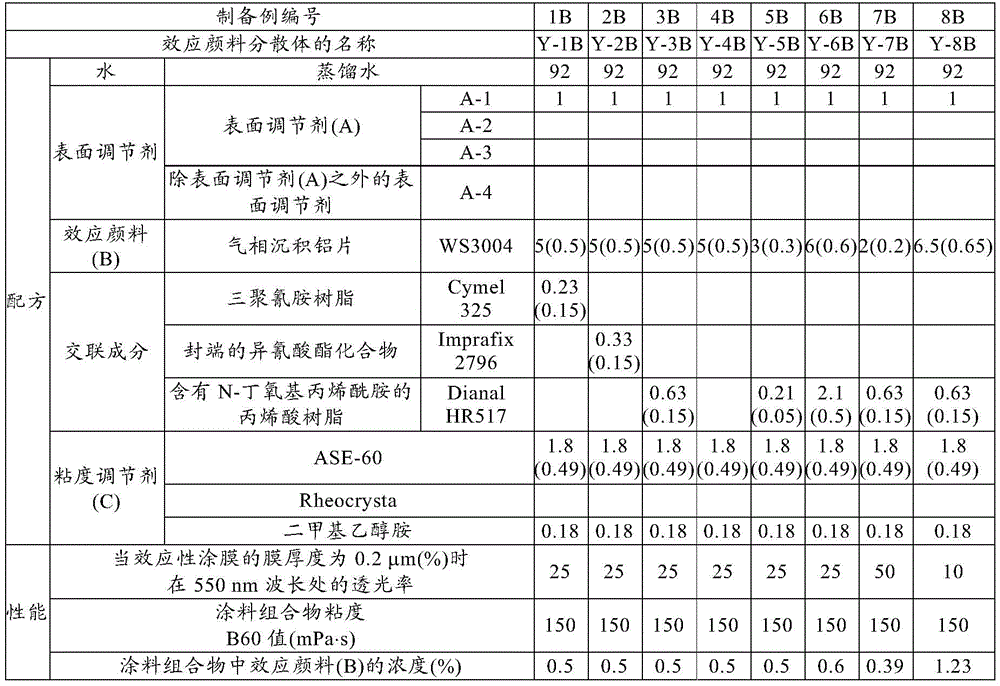
Preparation example 1B
92 parts of distilled water, 1 part of surface conditioner (A-1) (note 1), 5 parts (solid content of 0.5 part) of Hydroshine WS-3004 (trade name, aqueous vapor deposition aluminum flake pigment, manufactured by Eckart, solid content: 10%, internal solvent: isopropyl alcohol, average particle diameter D50: 13 μm, thickness: 0.05 μm; surface treated with silica), 1.23 parts (solid content of 0.15 part) of Cymel 325 (trade name, methyl-etherified melamine resin, manufactured by Nihon Cytec Industries Inc., solid content: 80%), 1.8 parts (solid content of 0.49 part) of Acrysol ASE-60 (polyacrylic viscosity modifier, manufactured by The Dow Chemical Company, solid content: 28%) and 0.18 part of dimethylethanolamine were blended and mixed, thereby obtaining an effect pigment dispersion (Y-1B).
Preparation 2B to preparation 16B
Effect pigment dispersions (Y-2B) to (Y-16B) were obtained in the same manner as in preparation example 1B, except that the formulations shown in table 4 were used.
The details of the components shown in the table are as follows.
"Imprafix 2794 XP": trade name, produced by Covestro AG, blocked aliphatic polyisocyanate compound, solid content: 38 percent of
"Dianal HR 517": a trade name, produced by Mitsubishi Rayon co., ltd., acrylic resin containing N-butoxymethacrylamide as a polymerizable component, solid content: 50 percent of
"rheochrysta": trade name, cellulose-based viscosity modifier (cellulose nanofiber), produced by Dai-Ichi Kogyo Seiyaku co., ltd., solid content: 2 percent of
The parenthesized values in the table of Table 4 are solids contents.
The parenthesized values in the table 4 (continuation) are solids contents.
3. Preparation of coated articles
The substrate 1 was produced according to "4. preparation of substrate" in test example 1.
4. Preparation of test boards
Example 1B
A colored coating composition (X-1) "WP-522H N-2.0" (trade name, produced by Kansai Paint co., ltd., an aqueous intercoat coating composition based on a polyester resin, L value: 20 of a coating film to be obtained) was applied onto the substrate 1 by electrostatic spraying using a bell-shaped coating apparatus of a rotary atomization type to a cured film thickness of 20 μm. After allowing the resulting film to stand for 3 minutes, preheating was performed at 80 ℃ for 3 minutes. Further, the effect pigment dispersion (Y-1B) prepared as described above was adjusted to have a coating composition viscosity shown in table 4, and was coated to a dry coating film thickness of 0.1 μm using a robot bell (manufactured by ABB) under conditions in which the coating room temperature was 23 ℃ and the humidity was 68%. The resultant was then allowed to stand at 80 ℃ for 3 minutes. Subsequently, a clear coating composition (Z-1B) "KINO 1210" (trade name, Kansai Paint co., ltd., carboxyl-containing resin/epoxy-containing resin curing type one-component organic solvent-based coating composition) was coated on the dried coating surface using a robot bell (manufactured by ABB) under conditions in which the coating room temperature was 23 ℃ and the humidity was 68% to a dry coating film thickness of 25 μm to 35 μm. After the coating, the resultant was allowed to stand at room temperature for 15 minutes, and then heated in a hot air circulation type dryer of 140C for 30 minutes to simultaneously dry the multilayer coating films, thereby obtaining test boards.
The film thickness of the dried coating films shown in table 5 was calculated by the following formula. This formula also applies to the following examples.
x=sc/sg/S*10000
x: film thickness [ mu m ]
sc: coating solids content [ g ]
sg: specific gravity of coating film [ g/cm [)3]
S: evaluation area of coating solid content [ cm ]2]
Examples 2B to 18B and comparative examples 1B to 6B
Test panels were obtained in the same manner as in example 1B, but using the substrates and coating compositions shown in table 5.
The clear coating compositions (Z-2B) to (Z-9B) in the tables are as follows.
TABLE 5
TABLE 5 (continuation)
(Z-2B): one-component clear coating composition obtained by adding 10 parts by mass of "Cymel 325" to "KINO 1210" based on 100 parts by mass of the resin solid content contained in "KINO 1210
(Z-3B): one-component clear coating composition obtained by adding 10 parts by mass of "Imprafix 2794 XP" to "KINO 1210" based on 100 parts by mass of resin solid content contained in "KINO 1210
(Z-4B): one-component clear coating composition obtained by adding 10 parts by mass of "Dianal (ダイヤナール) HR 517" to "KINO 1210" based on 100 parts by mass of the resin solids content contained in "KINO 1210
(Z-5B): "TC-71": trade name, manufactured by Kansai Paint co., ltd., hydroxyl-containing resin/melamine resin curing type one-component organic solvent-based coating composition
(Z-6B): one-component clear coating composition obtained by adding 5 parts by mass of "Dianal HR 517" to "KINO 1210" based on 100 parts by mass of the resin solids content contained in "KINO 1210
(Z-7B): one-component clear coating composition obtained by adding 20 parts by mass of "Dianal HR 517" to "KINO 1210" based on 100 parts by mass of the resin solids content contained in "KINO 1210
(Z-8B): one-component clear coating composition obtained by adding 2 parts by mass of "Dianal HR 517" to "KINO 1210" based on 100 parts by mass of the resin solids content contained in "KINO 1210
(Z-9B): one-component clear coating composition obtained by adding 30 parts by mass of "Dianal HR 517" to "KINO 1210" based on 100 parts by mass of the resin solids content contained in "KINO 1210
5. Evaluation of coating film
The appearance and properties of the coating film of each test board obtained in the above manner were evaluated in the same items as "evaluation of coating film 6" in test example 1. Table 5 shows the results. The resistance to water adhesion after exposure to severe weather was evaluated as follows.
Water-resistant attachment after exposure to inclement weatherAdhesion property
Each Test panel was subjected to 2 hours per cycle under the following conditions including 1 hour and 42 minutes of irradiation with a xenon arc lamp and 18 minutes of rain using a super xenon aging tester (trade name, manufactured by Suga Test Instruments co., ltd.) specified in JISB 7754. This cycle was repeated for 2000 hours. Thereafter, the test panels were each immersed in water at 40 ℃ for 10 days. After each test board was taken out of the water, the condition of the remaining squares was checked in the same manner as described above for the water-resistant adhesion, and the water-resistant adhesion was evaluated.
Pass (pass): there were 100 coated film squares remaining, and no small coated film edge chipping occurred at the edge of the cut produced by the cutter knife.
Fail (fail): the number of remaining coating film squares is 99 or less.
The embodiments and examples of the present invention are described above in detail. However, the present invention is not limited to the above-described embodiments, and various modifications can be made based on the technical idea of the present invention.
The present invention may also adopt the following configurations.
[1] A method of forming a multilayer coating film by sequentially performing the following steps (1) to (4):
(1) applying a colored coating composition (X) to a substrate to form a colored coating film,
(2) applying an effect pigment dispersion (Y) to the colored coating film formed in step (1) to form an effect coating film,
(3) applying a clear coating composition (Z) to the effect coating film formed in step (2) to form a clear coating film, and
(4) heating the uncured colored coating film, the uncured effect coating film and the uncured clear coating film formed in steps (1) to (3), respectively, to simultaneously cure the three-layer coating film;
wherein the effect pigment dispersion (Y) contains water, a surface-regulating agent (A), a platelet-shaped effect pigment (B) and a viscosity-regulating agent (C),
the contact angle of the surface conditioner (A) with respect to a preliminarily degreased tin plate (manufactured by Paltek Corporation) was 8 DEG to 20 DEG, the contact angle was measured in such a manner that a liquid in which isopropyl alcohol, water and the surface conditioner (A) were mixed in a ratio of 4.5/95/1 was adjusted to a viscosity of 150mPa · s measured at a temperature of 20 ℃ by a type-B viscometer at a rotor speed of 60rpm, 10 μ L of the liquid was dropped to the tin plate, and the contact angle with respect to the tin plate was measured 10 seconds after dropping, and
the light transmittance of the film obtained by coating the effect pigment dispersion (Y) to a dry film thickness of 0.2 μm at a wavelength of 550nm is 10% to 50%.
[2] The method for forming a multilayer coating film according to [1], wherein the clear coating composition (Z) is a one-component clear coating composition; and is
The effect pigment dispersion (Y) and/or the clear coating composition (Z) contain at least one crosslinking component (D) selected from melamine, melamine derivatives, (meth) acrylamides, N-methylol-containing (meth) acrylamide copolymers or N-alkoxymethyl-containing (meth) acrylamide copolymers and blocked or unblocked polyisocyanate compounds,
when the effect pigment dispersion (Y) contains a crosslinking ingredient (D), the content of the crosslinking ingredient (D) is 10 to 100 parts by mass in terms of solid content with respect to 100 parts by mass of the solid content of the effect pigment in the effect pigment dispersion (Y), and
when the clear coating composition (Z) contains the crosslinking component (D), the content of the crosslinking component (D) is 5 to 25 parts by mass in terms of solid content with respect to 100 parts by mass of the resin solid content of the clear coating composition (Z).
[3] The method for forming a multilayer coating film according to [1], wherein the clear coating composition (Z) is a two-component clear coating composition containing a hydroxyl group-containing resin and a polyisocyanate compound.
[4] The method for forming a multilayer coating film according to any one of [1] to [3], wherein the effect pigment dispersion (Y) has a viscosity (B60) of 60 mPas to 1500 mPas as measured at a temperature of 20 ℃ with a spindle rotation speed of 60rpm using a B-type viscometer.
[5] The method for forming a multilayer coating film according to any one of [1] to [4], wherein the surface conditioner (A) is a silicone-based surface conditioner.
[6] The method for forming a multilayer coating film according to any one of [1] to [5], wherein the dynamic surface tension of the surface conditioner (A) is from 50mN/m to 70 mN/m.
[7] The method for forming a multilayer coating film according to any one of [1] to [6], wherein the plate-like effect pigment (B) is contained in the effect pigment dispersion (Y) in an amount of 0.05 to 3.0 parts by mass with respect to 100 parts by mass of the total amount of water, the surface conditioner (a), the plate-like effect pigment (B), and the viscosity modifier (C).
[8] The method for forming a multilayer coating film according to any one of [1] to [7], wherein the dry film thickness of the effect coating film is 0.02 μm to 5.0 μm.
[9] The method for forming a multilayer coating film according to any one of [1] to [7], wherein the dry film thickness of the effect coating film is 0.01 μm to 1.0 μm.
[10] The method for forming a multilayer coating film according to any one of [1] to [9], wherein the clear coating composition (Z) contains a carboxyl group-containing resin and an epoxy group-containing resin.
[11] The method for forming a multilayer coating film according to any one of [1] to [10], wherein the clear coating composition (Z) contains a hydroxyl group-containing resin and a melamine resin.
Industrial applicability
The method of forming a multilayer coating film of the present invention can be applied to various industrial products, particularly, interior and exterior panels of automobile bodies and automobile components.