CN107493165B - Internet of vehicles authentication and key agreement method with strong anonymity - Google Patents

Internet of vehicles authentication and key agreement method with strong anonymity Download PDF

Info

Publication number
CN107493165B
CN107493165B CN201710931255.3A CN201710931255A CN107493165B CN 107493165 B CN107493165 B CN 107493165B CN 201710931255 A CN201710931255 A CN 201710931255A CN 107493165 B CN107493165 B CN 107493165B
Authority
CN
China
Prior art keywords
vehicle
authentication
representing
parameter
key agreement
Prior art date
Legal status (The legal status is an assumption and is not a legal conclusion. Google has not performed a legal analysis and makes no representation as to the accuracy of the status listed.)
Active
Application number
CN201710931255.3A
Other languages
Chinese (zh)
Other versions
CN107493165A (en
Inventor
周由胜
龙兴旺
刘思伶
蒋溢
刘宴兵
Current Assignee (The listed assignees may be inaccurate. Google has not performed a legal analysis and makes no representation or warranty as to the accuracy of the list.)
Chongqing University of Post and Telecommunications
Original Assignee
Chongqing University of Post and Telecommunications
Priority date (The priority date is an assumption and is not a legal conclusion. Google has not performed a legal analysis and makes no representation as to the accuracy of the date listed.)
Filing date
Publication date
Application filed by Chongqing University of Post and Telecommunications filed Critical Chongqing University of Post and Telecommunications
Priority to CN201710931255.3A priority Critical patent/CN107493165B/en
Publication of CN107493165A publication Critical patent/CN107493165A/en
Application granted granted Critical
Publication of CN107493165B publication Critical patent/CN107493165B/en
Active legal-status Critical Current
Anticipated expiration legal-status Critical

Links

Images

Classifications

    • HELECTRICITY
    • H04ELECTRIC COMMUNICATION TECHNIQUE
    • H04LTRANSMISSION OF DIGITAL INFORMATION, e.g. TELEGRAPHIC COMMUNICATION
    • H04L63/00Network architectures or network communication protocols for network security
    • H04L63/08Network architectures or network communication protocols for network security for authentication of entities
    • H04L63/0815Network architectures or network communication protocols for network security for authentication of entities providing single-sign-on or federations
    • HELECTRICITY
    • H04ELECTRIC COMMUNICATION TECHNIQUE
    • H04LTRANSMISSION OF DIGITAL INFORMATION, e.g. TELEGRAPHIC COMMUNICATION
    • H04L63/00Network architectures or network communication protocols for network security
    • H04L63/08Network architectures or network communication protocols for network security for authentication of entities
    • H04L63/0869Network architectures or network communication protocols for network security for authentication of entities for achieving mutual authentication
    • HELECTRICITY
    • H04ELECTRIC COMMUNICATION TECHNIQUE
    • H04LTRANSMISSION OF DIGITAL INFORMATION, e.g. TELEGRAPHIC COMMUNICATION
    • H04L67/00Network arrangements or protocols for supporting network services or applications
    • H04L67/01Protocols
    • H04L67/12Protocols specially adapted for proprietary or special-purpose networking environments, e.g. medical networks, sensor networks, networks in vehicles or remote metering networks
    • HELECTRICITY
    • H04ELECTRIC COMMUNICATION TECHNIQUE
    • H04LTRANSMISSION OF DIGITAL INFORMATION, e.g. TELEGRAPHIC COMMUNICATION
    • H04L9/00Cryptographic mechanisms or cryptographic arrangements for secret or secure communications; Network security protocols
    • H04L9/06Cryptographic mechanisms or cryptographic arrangements for secret or secure communications; Network security protocols the encryption apparatus using shift registers or memories for block-wise or stream coding, e.g. DES systems or RC4; Hash functions; Pseudorandom sequence generators
    • H04L9/0643Hash functions, e.g. MD5, SHA, HMAC or f9 MAC
    • HELECTRICITY
    • H04ELECTRIC COMMUNICATION TECHNIQUE
    • H04LTRANSMISSION OF DIGITAL INFORMATION, e.g. TELEGRAPHIC COMMUNICATION
    • H04L9/00Cryptographic mechanisms or cryptographic arrangements for secret or secure communications; Network security protocols
    • H04L9/08Key distribution or management, e.g. generation, sharing or updating, of cryptographic keys or passwords
    • H04L9/0816Key establishment, i.e. cryptographic processes or cryptographic protocols whereby a shared secret becomes available to two or more parties, for subsequent use
    • H04L9/0838Key agreement, i.e. key establishment technique in which a shared key is derived by parties as a function of information contributed by, or associated with, each of these
    • HELECTRICITY
    • H04ELECTRIC COMMUNICATION TECHNIQUE
    • H04LTRANSMISSION OF DIGITAL INFORMATION, e.g. TELEGRAPHIC COMMUNICATION
    • H04L9/00Cryptographic mechanisms or cryptographic arrangements for secret or secure communications; Network security protocols
    • H04L9/08Key distribution or management, e.g. generation, sharing or updating, of cryptographic keys or passwords
    • H04L9/0816Key establishment, i.e. cryptographic processes or cryptographic protocols whereby a shared secret becomes available to two or more parties, for subsequent use
    • H04L9/085Secret sharing or secret splitting, e.g. threshold schemes
    • HELECTRICITY
    • H04ELECTRIC COMMUNICATION TECHNIQUE
    • H04LTRANSMISSION OF DIGITAL INFORMATION, e.g. TELEGRAPHIC COMMUNICATION
    • H04L9/00Cryptographic mechanisms or cryptographic arrangements for secret or secure communications; Network security protocols
    • H04L9/08Key distribution or management, e.g. generation, sharing or updating, of cryptographic keys or passwords
    • H04L9/0861Generation of secret information including derivation or calculation of cryptographic keys or passwords
    • H04L9/0869Generation of secret information including derivation or calculation of cryptographic keys or passwords involving random numbers or seeds

Landscapes

  • Engineering & Computer Science (AREA)
  • Computer Networks & Wireless Communication (AREA)
  • Signal Processing (AREA)
  • Computer Security & Cryptography (AREA)
  • Computing Systems (AREA)
  • General Engineering & Computer Science (AREA)
  • Computer Hardware Design (AREA)
  • Health & Medical Sciences (AREA)
  • General Health & Medical Sciences (AREA)
  • Medical Informatics (AREA)
  • Power Engineering (AREA)
  • Storage Device Security (AREA)
  • Mobile Radio Communication Systems (AREA)

Abstract

本发明请求保护一面向车联网的两方认证及密钥协商方法,涉及车联网领域。密钥协商被广泛的应用于车联网认证方案中,但是现有的认证方案中存在大量的三方协议,即完成密钥协商过程需要三方共同合作。在某些特定环境下,这些方案无法达到预期效果。例如,车辆在没有完善的路侧基础设施的情况下,很难完成与其它车辆的认证与安全通信,本发明提供了一种安全的车联网认证及密钥协商方法来解决这种问题。本发明具有身份匿名、消息不可连接、恶意车辆可追踪等安全优势,因此具有良好的隐私保护性和可靠的安全性。由于本方法使用的无双线性对的密码运算,因此本方法执行效率更加高效。本发明具有适用范围的确定性,将范围确定于车联网应用。

Figure 201710931255

The invention claims to protect a two-party authentication and key agreement method for the Internet of Vehicles, and relates to the field of Internet of Vehicles. Key agreement is widely used in the authentication scheme of the Internet of Vehicles, but there are a large number of tripartite agreements in the existing authentication scheme, that is, the completion of the key agreement process requires the cooperation of the three parties. In some specific circumstances, these solutions cannot achieve the desired effect. For example, it is difficult for a vehicle to complete authentication and secure communication with other vehicles without a complete roadside infrastructure. The present invention provides a secure vehicle networking authentication and key agreement method to solve this problem. The present invention has security advantages such as identity anonymity, unconnectable messages, traceability of malicious vehicles, etc., so it has good privacy protection and reliable security. Since this method uses a cryptographic operation without bilinear pairs, the execution efficiency of this method is more efficient. The invention has the certainty of the applicable scope, and the scope is determined in the application of the Internet of Vehicles.

Figure 201710931255

Description

Internet of vehicles authentication and key agreement method with strong anonymity
Technical Field
The invention belongs to the field of Internet of vehicles, and particularly relates to a two-party authentication and key agreement method for the Internet of vehicles.
Background
The internet of vehicles can provide great help for the development and deployment of intelligent transportation systems, and therefore, the internet of vehicles has received wide attention from all social layers. Because a typical car networking structure consists of three parts, namely a trusted third party, a vehicle-mounted unit and a road side unit, a large number of key agreement schemes are three-party authentication schemes which need to be supported by the road side unit, and the key agreement schemes have certain limitations in real life. For example, when a vehicle is driving in a remote area with rare people, some road condition information of the area also needs to be obtained, and the area may be remote and a road side unit is not deployed, so that communication and information exchange can be completed only through two-party authentication between the vehicle and the vehicle. The existing two-party authentication and key agreement methods can also achieve the purpose, but have defects in efficiency. For example, some methods use bilinear pairings, which improves the security of the method but greatly reduces the efficiency of the method. In summary, how to balance the three aspects of security, efficiency, and privacy protection, it is difficult to design a reasonable authentication and key agreement method. Therefore, a bilinear pairing operation-free two-party authentication and key agreement method is provided on the premise of ensuring security and privacy protection.
Disclosure of Invention
The present invention is directed to solving the above problems of the prior art. The invention provides a vehicle networking authentication and key agreement method with strong anonymity, which has relatively small calculation cost and improves the performance of the method on the premise of ensuring safety, and the technical scheme of the invention is as follows:
a vehicle networking authentication and key agreement method with strong anonymity comprises the following three steps:
1) the system initialization step is used for finishing the related work of vehicle and server initialization;
2) a vehicle registration step of registering and registering legal users;
3) the authentication and key agreement step is used for realizing two-party authentication and key agreement by adopting basic knowledge of cryptography including hash function and modular multiplication group under a specific environment on the basis of a computational Diffie-Hellman problem, so that two peer-to-peer communication parties can realize mutual authentication and complete key agreement without the help of a third party, complete the authentication of other vehicles and realize safe communication with the other vehicles;
the system initialization step of step 1) mainly comprises: vehicle user i obtains vehicle ViIs unique identity information IDiAnd setting a password PW known only by oneselfi(ii) a The server S generates a public and private key pair of itself: public key PkPrivate key PsSelecting random number X as its main key, selecting random numbers alpha and beta as secret value, and then selecting hash function h (-) and asymmetric encryption algorithm Ek(. to) finally publish public informationh(·),Ek(. and P)k
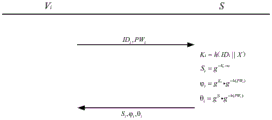
The vehicle registration process includes: vehicle V to be registerediThrough a secure channel, the identity information ID of the user is transmittediAnd user password PWiSubmitting to a server S; after the server S obtains the data, the related parameters K are calculatedi、Si
Figure GDA0002742051140000023
θi(ii) a Wherein KiRepresenting a parameter after hashing the master key and the vehicle identity, SiRepresenting the parameter with the system secret value alpha,
Figure GDA0002742051140000024
representing a parameter with a user password, thetaiRepresenting parameters with user passwords and system secret values beta, and the calculation mode is as follows: ki=h(IDi||X);
Figure GDA0002742051140000025
G denotes the generator of the cyclic addition group G, and the server S will then apply the parameter Si
Figure GDA0002742051140000022
θiReturned to the vehicle ViVehicle ViStoring the received parameters in a tamper-proof device TPD;
the authentication and key agreement process will complete the following work; suppose that under certain circumstances, the vehicle VANeed to communicate with the vehicle VBThe communication is carried out as follows:
for vehicle VATo initiate an authentication and key agreement procedure, it first chooses 3 random numbers rA、ra、rnThen calculating the parameter u required in communication1,u2,w1,w21,u1Representing with a random value rAParameter of (a), u2Representing with a random value ra、rAParameter of (d), w1Representing usage secret valuesBeta will be the parameter u4Hidden parameter, w2Representing the parameter u using the secret value β5Hidden parameter, δ1Representing the use of an asymmetric cryptographic algorithm to apply the parameter u3Encrypted parameters, and then the message M1={u1||u2||w1||w2||δ1||T1U for4Performing hash operation to obtain M2=h(u1||u2||w1||w2||u4||δ1||T1) Finally, the message group (M)1,M2) Sent to vehicle VB
For vehicle VBIn other words, when receiving the signal from the vehicle VAAfter the message(s), the validity of the timestamp is first checked to prevent replay attacks, TC-T1Δ T or less, wherein TCIndicating the current timestamp, T1Representing a first timestamp, Δ T representing the maximum transmission delay in the network, and if the inequality holds, calculating u4=w1·gThen using u4Verifying the hash value M2Whether or not it is correct or not,
Figure GDA0002742051140000031
wherein the symbol? Indicating whether the verification is correct, and if the equation is true, the vehicle VBWill pass through the equation
Figure GDA0002742051140000032
Validating vehicle VAIf the equation is established, the authentication is passed, otherwise, the negotiation is abandoned; if the vehicle VAPassing the authentication, the vehicle VBReturning the verification result to the vehicle VA
Vehicle VAReceiving a vehicle VBAfter the returned message, the validity T of the time stamp is checked firstC-T2Δ T ≦ Δ T, if the inequality holds, then calculate v4=w3·gAnd v5=w4·gAnd by the equation
Figure GDA0002742051140000033
Validating vehicle VBIf the equation is established, the validity is verified; otherwise, abandoning the negotiation; if the vehicle VBAfter passing the authentication, the vehicle VAComputing shared secret keys
Figure GDA0002742051140000034
And pass through
Figure GDA0002742051140000035
Verifying the hash value, and if the hash value is established, completing key agreement; finally calculate M5=h(SKAB||V5||T3) And sends the message (M)5,T3) Sent to vehicle VBWherein T is3Is a third timestamp;
for vehicle VBIn other words, V is receivedAAfter returning the message, first the timestamp, T, is checkedC-T3Δ T ≦ if the equation holds, verify M5=h(SKAB||V5||T3) If the equality is established, the key agreement is completed;
the vehicle VAFor u is paired1,u2,w1,w21The calculation method is as follows:
Figure GDA0002742051140000041
Figure GDA0002742051140000042
w1=u4·gβ
Figure GDA0002742051140000043
w2=u5·gβ
if the vehicle VAPassing the authentication, the vehicle VBReturning the verification result to the vehicle VASpecifically, the method comprises the following steps of;
vehicle VBSelecting 3 random numbers rB、rb、rmAnd calculating the related parameter v to be returned1,v2,w3,w42The calculation method is as follows:
Figure GDA0002742051140000044
Figure GDA0002742051140000045
w3=v4·gβ
Figure GDA0002742051140000046
w4=v5·gβ(ii) a Wherein T is2Is a second time stamp, then VBComputing shared secret keys
Figure GDA00027420511400000410
And will message M3={v1||v2||w3||w4||δ2||T2SK forABPerforming hash operation to obtain M4=h(v1||v2||w3||w4||δ2||T2||SKAB) Finally, the message (M)3,M4) Sent to vehicle VA
The invention has the following advantages and beneficial effects:
the invention creatively constructs a safe authentication and key agreement method by using methods such as modular exponentiation, hash operation and the like on the basis of a computational Diffie-Hellman problem, generally speaking, a two-party authentication scheme based on the Diffie-Hellman problem can ensure certain safety, but has contradiction on anonymity and dispute traceability of users. The personalized features must be hidden to ensure anonymity, but the traceability requirement cannot be met; the need to provide personalized features to ensure traceability, however, does not meet the anonymity requirements. In the case of solutions, therefore, the vehicle-specific features are brought into the transmission parameters by means of modular exponentiation, hash, randomization, etc., for example
Figure GDA0002742051140000047
Figure GDA0002742051140000048
And the like. This allows the scheme to obtain traceability while ensuring anonymity, in addition to the pair delta1,δ2The encryption processing of (1):
Figure GDA0002742051140000049
the scheme has the incoherence among data and more reliable safety. Because the calculation amount of the adopted method is small, the performance of the method can be improved well on the premise of ensuring the safety. The method has a practical application scene, when the vehicle is in a remote area and no roadside unit or base station is arranged nearby, a safe communication process can be carried out by the method, roadside equipment does not need to be deployed in each place, and a large amount of manpower and material resources can be saved.
Drawings
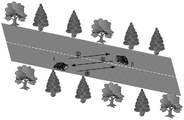
FIG. 1 is a diagram of a scenario in which a preferred embodiment of the present invention is provided;
FIG. 2 is a diagram of a registration process for two-party authentication;
fig. 3 is a diagram of an authentication and key agreement process for two-party authentication.
Detailed Description
The technical solutions in the embodiments of the present invention will be described in detail and clearly with reference to the accompanying drawings. The described embodiments are only some of the embodiments of the present invention.
The technical scheme for solving the technical problems is as follows:
referring to fig. 1 to fig. 3, the technical solution of the present invention is:
1) in the scenario as in fig. 1, we assume that vehicle VAAnd a vehicle VBAre all registered legal users, i.e. vehicles VAAnd a vehicle VBAll relevant parameters required for communication have been obtained.
2) For vehicle VATo initiate an authentication and key agreement procedure, it first chooses 3 random numbers rA、ra、rnThen calculate the time of communicationRequired parameter u1,u2,w1,w21. The calculation method is as follows:
Figure GDA0002742051140000051
Figure GDA0002742051140000052
w1=u4·gβ
Figure GDA0002742051140000053
w2=u5·gβ. Wherein T is1To timestamp, then message M1={u1||u2||w1||w2||δ1||T1U for4Performing hash operation to obtain M2=h(u1||u2||w1||w2||u4||δ1||T1) Finally, the message group (M)1,M2) Sent to vehicle VB. As shown in (r) of fig. 1.
3) For vehicle VBIn other words, when receiving the signal from the vehicle VAAfter the message(s), the validity of the timestamp is first checked to prevent replay attacks, TC-T1Δ T or less, wherein TCRepresenting the current timestamp and deltat representing the maximum transmission delay in the network. If the inequality holds, calculate u4=w1·gThen using u4Verifying the hash value M2Whether or not it is correct or not,
Figure GDA0002742051140000061
this is done to prevent the message from being tampered with. If the equation is true, the vehicle VBWill pass through the equation
Figure GDA0002742051140000062
Validating vehicle VAIf the equation is established, the negotiation is aborted if the equation is verified. If the vehicle VAAfter passing the authentication, the vehicle VBWill select 3 random numbers rB、rb、rmAnd calculating the related parameter v to be returned1,v2,w3,w42. The calculation method is as follows:
Figure GDA0002742051140000063
Figure GDA0002742051140000064
w3=v4·gβ
Figure GDA0002742051140000065
w4=v5·gβ. Wherein T is2Is a time stamp, then VBComputing shared secret keys
Figure GDA0002742051140000066
And will message M3={v1||v2||w3||w4||δ2||T2SK forABPerforming hash operation to obtain M4=h(v1||v2||w3||w4||δ2||T2||SKAB) Finally, the message (M)3,M4) Sent to vehicle VA. As shown in fig. 1.
4) For vehicle VAIn other words, the vehicle V is receivedBAfter the returned message, the validity of the timestamp is first checked to prevent replay attacks, TC-T2Δ T ≦ Δ T, if the inequality holds, then calculate v4=w3·gAnd v5=w4·gAnd by the equation
Figure GDA0002742051140000067
Validating vehicle VBIf the equation is established, the validity is verified; otherwise, the negotiation is abandoned. If the vehicle VBAfter passing the authentication, the vehicle VAComputing shared secret keys
Figure GDA0002742051140000068
And pass through
Figure GDA0002742051140000069
And verifying the hash value, and if the hash value is established, finishing key agreement. Finally calculate M5=h(SKAB||V5||T3) And sends the message (M)5,T3) Sent to vehicle VBWherein T is3Is a time stamp. As shown in fig. 1 c.
5) For vehicle VBIn other words, V is receivedAAfter returning the message, first the timestamp, T, is checkedC-T3Δ T ≦ if the equation holds, verify M5=h(SKAB||V5||T3) If the equation is established, the key agreement is completed.
The above examples are to be construed as merely illustrative and not limitative of the remainder of the disclosure. After reading the description of the invention, the skilled person can make various changes or modifications to the invention, and these equivalent changes and modifications also fall into the scope of the invention defined by the claims.
Claims (1)

1. A vehicle networking authentication and key agreement method with strong anonymity is characterized by comprising the following three steps:
1) the system initialization step is used for finishing the related work of vehicle and server initialization;
2) a vehicle registration step of registering and registering legal users;
3) the authentication and key agreement step, which adopts the basic knowledge of cryptography including hash function and modular multiplication group to realize two-party authentication and key agreement on the basis of the computational Diffie-Hellman difficulty, so that two communication parties can realize mutual authentication and complete key agreement without the help of a third party, complete the authentication of other vehicles and safely communicate with the other vehicles;
the system initialization step of step 1) mainly comprises: vehicle user i obtains vehicle ViIs unique identity information IDiAnd setting a unique self-knowledgePassword PW of tracki(ii) a The server S generates a public and private key pair of itself: public key PkPrivate key PsSelecting random number X as its main key, selecting random numbers alpha and beta as secret value, and then selecting hash function h (-) and asymmetric encryption algorithm Ek(. to), finally publishing the public information h (-), Ek(. and P)k
The vehicle registration process includes: vehicle V to be registerediThrough a secure channel, the identity information ID of the user is transmittediAnd user password PWiSubmitting to a server S; after the server S obtains the data, the related parameters K are calculatedi、Si
Figure FDA0002742051130000011
θi(ii) a Wherein KiRepresenting a parameter after hashing the master key and the vehicle identity, SiRepresenting the parameter with the system secret value alpha,
Figure FDA0002742051130000014
representing a parameter with a user password, thetaiRepresenting parameters with user passwords and system secret values beta, and the calculation mode is as follows: ki=h(IDi||X);
Figure FDA0002742051130000012
G denotes the generator of the cyclic addition group G, and the server S will then apply the parameter Si
Figure FDA0002742051130000013
θiReturned to the vehicle ViVehicle ViStoring the received parameters in a tamper-proof device TPD; sA、SBParameters with system secret values alpha, K, representing system returns to vehicle A, respectively vehicle BA、KBRespectively representing parameters obtained after hash calculation of the master key and the vehicle identities of the vehicle A and the vehicle B,
Figure FDA0002742051130000023
representing the use of a public key P in an asymmetric cryptographic algorithmkPerforming an encryption operation;
the authentication and key agreement process will complete the following work; suppose a vehicle VANeed to communicate with the vehicle VBThe communication is carried out as follows:
for vehicle VATo initiate an authentication and key agreement procedure, it first chooses 3 random numbers rA、ra、rnThen calculating the parameter u required in communication1,u2,w1,w21,u1Representing with a random value rAParameter of (a), u2Representing with a random value ra、rAParameter of (d), w1Representing the parameter u using the secret value β4Hidden parameter, w2Representing the parameter u using the secret value β5Hidden parameter, δ1Representing the use of an asymmetric cryptographic algorithm to apply the parameter u3Encrypted parameters, and then the message M1={u1||u2||w1||w2||δ1||T1U for4Performing hash operation to obtain M2=h(u1||u2||w1||w2||u4||δ1||T1) Finally, the message group (M)1,M2) Sent to vehicle VB
For vehicle VBIn other words, when receiving the signal from the vehicle VAAfter the message(s), the validity of the timestamp is first checked to prevent replay attacks, TC-T1Δ T or less, wherein TCIndicating the current timestamp, T1Representing a first timestamp, Δ T representing the maximum transmission delay in the network, and if the inequality holds, calculating u4=w1·gThen using u4Verifying the hash value M2Whether or not it is correct or not,
Figure FDA0002742051130000021
wherein the symbol? Indicating whether the verification is correct, and if the equation is true, the vehicle VBWill pass through the equation
Figure FDA0002742051130000022
Validating vehicle VAIf the equation is established, the authentication is passed, otherwise, the negotiation is abandoned; if the vehicle VAPassing the authentication, the vehicle VBReturning the verification result to the vehicle VA
Vehicle VAReceiving a vehicle VBAfter the returned message, the validity T of the time stamp is checked firstC-T2Δ T ≦ Δ T, if the inequality holds, then calculate v4=w3·gAnd v5=w4·gAnd by the equation
Figure FDA0002742051130000031
Validating vehicle VBIf the equation is established, the validity is verified; otherwise, abandoning the negotiation; if the vehicle VBAfter passing the authentication, the vehicle VAComputing shared secret keys
Figure FDA0002742051130000032
And pass through
Figure FDA0002742051130000033
Verifying the hash value, and if the hash value is established, completing key agreement; finally calculate M5=h(SKAB||V5||T3) And sends the message (M)5,T3) Sent to vehicle VBWherein T is3Is a third timestamp;
for vehicle VBIn other words, V is receivedAAfter returning the message, first the timestamp, T, is checkedC-T3Δ T ≦ if the equation holds, verify M5=h(SKAB||V5||T3) If the equality is established, the key agreement is completed;
the vehicle VAFor u is paired1,u2,w1,w21The calculation method is as follows:
Figure FDA0002742051130000034
Figure FDA0002742051130000035
w1=u4·gβ
Figure FDA0002742051130000036
w2=u5·gβ
if the vehicle VAPassing the authentication, the vehicle VBReturning the verification result to the vehicle VASpecifically, the method comprises the following steps of;
vehicle VBSelecting 3 random numbers rB、rb、rmAnd calculating the related parameter v to be returned1,v2,w3,w42The calculation method is as follows:
Figure FDA0002742051130000037
Figure FDA0002742051130000038
w3=v4·gβ
Figure FDA0002742051130000039
w4=v5·gβ(ii) a Wherein T is2Is a second time stamp, then VBComputing shared secret keys
Figure FDA00027420511300000310
And will message M3={v1||v2||w3||w4||δ2||T2SK forABPerforming hash operation to obtain M4=h(v1||v2||w3||w4||δ2||T2||SKAB) Finally, the message (M)3,M4) Sent to vehicle VA
CN201710931255.3A 2017-10-09 2017-10-09 Internet of vehicles authentication and key agreement method with strong anonymity Active CN107493165B (en)

Priority Applications (1)

Application Number Priority Date Filing Date Title
CN201710931255.3A CN107493165B (en) 2017-10-09 2017-10-09 Internet of vehicles authentication and key agreement method with strong anonymity

Applications Claiming Priority (1)

Application Number Priority Date Filing Date Title
CN201710931255.3A CN107493165B (en) 2017-10-09 2017-10-09 Internet of vehicles authentication and key agreement method with strong anonymity

Publications (2)

Publication Number Publication Date
CN107493165A CN107493165A (en) 2017-12-19
CN107493165B true CN107493165B (en) 2021-02-09

Family

ID=60654169

Family Applications (1)

Application Number Title Priority Date Filing Date
CN201710931255.3A Active CN107493165B (en) 2017-10-09 2017-10-09 Internet of vehicles authentication and key agreement method with strong anonymity

Country Status (1)

Country Link
CN (1) CN107493165B (en)

Families Citing this family (7)

* Cited by examiner, † Cited by third party
Publication number Priority date Publication date Assignee Title
CN108632820B (en) * 2018-04-11 2021-09-14 上海电机学院 Identity-based anonymous authentication method in vehicle-mounted ad hoc network
CN108322486B (en) * 2018-05-07 2021-06-01 安徽大学 Authentication method for multi-server architecture under Internet of vehicles cloud environment
CN109412790B (en) * 2018-10-26 2021-11-16 重庆邮电大学 User authentication and key agreement system and method facing to Internet of things
CN111324896A (en) * 2018-12-13 2020-06-23 航天信息股份有限公司 Method and device for writing vehicle service information and computing equipment
US10764029B1 (en) 2019-04-02 2020-09-01 Carey Patrick Atkins Asymmetric Encryption Algorithm
CN111447053B (en) * 2020-03-24 2022-09-23 重庆邮电大学 Method and system for secure data transmission
CN114095229B (en) * 2021-11-15 2024-09-17 中国电力科学研究院有限公司 Energy Internet data transmission protocol construction method, device and system

Family Cites Families (5)

* Cited by examiner, † Cited by third party
Publication number Priority date Publication date Assignee Title
CN105141425B (en) * 2015-08-14 2019-03-08 重庆邮电大学 A Two-way Authentication Method Based on Chaos Mapping to Protect Identity
CN105959269B (en) * 2016-04-25 2019-01-25 北京理工大学 An Identity-Based Authentication Method for Dynamic Group Key Agreement
CN106027233A (en) * 2016-04-28 2016-10-12 江苏大学 Method for designing vehicle network group negotiation communication protocol
CN106330910B (en) * 2016-08-25 2019-07-19 重庆邮电大学 Two-factor authentication method for strong privacy protection based on node identity and reputation in the Internet of Vehicles
CN107204850A (en) * 2017-06-06 2017-09-26 北京溢思得瑞智能科技研究院有限公司 A kind of lightweight car networking safety communicating method

Also Published As

Publication number Publication date
CN107493165A (en) 2017-12-19

Similar Documents

Publication Publication Date Title
Son et al. Design of blockchain-based lightweight V2I handover authentication protocol for VANET
Wazid et al. AKM-IoV: Authenticated key management protocol in fog computing-based Internet of vehicles deployment
CN107493165B (en) Internet of vehicles authentication and key agreement method with strong anonymity
Garg et al. An efficient blockchain-based hierarchical authentication mechanism for energy trading in V2G environment
Karim et al. BSDCE-IoV: Blockchain-based secure data collection and exchange scheme for IoV in 5G environment
Liang et al. Physically secure and conditional-privacy authenticated key agreement for VANETs
CN106330910B (en) Two-factor authentication method for strong privacy protection based on node identity and reputation in the Internet of Vehicles
He et al. An efficient identity-based conditional privacy-preserving authentication scheme for vehicular ad hoc networks
Wei et al. A privacy-preserving fog computing framework for vehicular crowdsensing networks
CN104683112B (en) A kind of car car safety communicating method that certification is assisted based on RSU
CN101902476B (en) Method for authenticating identity of mobile peer-to-peer user
Wei et al. A decentralized authenticated key agreement scheme based on smart contract for securing vehicular ad-hoc networks
CN111083131A (en) A method for lightweight identity authentication of power Internet of things sensing terminal
CN109687976A (en) Fleet's establishment and management method and system based on block chain and PKI authentication mechanism
CN108964919A (en) The lightweight anonymous authentication method with secret protection based on car networking
CN109327313A (en) A two-way identity authentication method and server with privacy protection feature
Limbasiya et al. IoVCom: Reliable comprehensive communication system for Internet of Vehicles
CN105847235A (en) An Efficient Identity-Based Anonymous Batch Authentication Method in the Internet of Vehicles Environment
CN103634796B (en) Space information network roaming and trusted security access method
Li et al. A provably secure and lightweight identity‐based two‐party authenticated key agreement protocol for vehicular ad hoc networks
Parameswarath et al. A privacy-preserving authenticated key exchange protocol for V2G communications using SSI
CN107948143A (en) Identity-based privacy protection integrity detection method and system in cloud storage
Yao et al. An Improved and Privacy‐Preserving Mutual Authentication Scheme with Forward Secrecy in VANETs
Zhang et al. A Novel Privacy‐Preserving Authentication Protocol Using Bilinear Pairings for the VANET Environment
CN103546567A (en) Method for certificateless cross-domain authentication in credible could computing environment

Legal Events

Date Code Title Description
PB01 Publication
PB01 Publication
SE01 Entry into force of request for substantive examination
GR01 Patent grant
GR01 Patent grant
