CN107406475B - Transition metal compound, catalyst composition comprising same, and method for producing olefin polymer using the same - Google Patents
Transition metal compound, catalyst composition comprising same, and method for producing olefin polymer using the same Download PDFInfo
- Publication number
- CN107406475B CN107406475B CN201680015630.3A CN201680015630A CN107406475B CN 107406475 B CN107406475 B CN 107406475B CN 201680015630 A CN201680015630 A CN 201680015630A CN 107406475 B CN107406475 B CN 107406475B
- Authority
- CN
- China
- Prior art keywords
- transition metal
- catalyst composition
- chemical formula
- metal compound
- hydrocarbyl
- Prior art date
- Legal status (The legal status is an assumption and is not a legal conclusion. Google has not performed a legal analysis and makes no representation as to the accuracy of the status listed.)
- Active
Links
Classifications
-
- C—CHEMISTRY; METALLURGY
- C07—ORGANIC CHEMISTRY
- C07F—ACYCLIC, CARBOCYCLIC OR HETEROCYCLIC COMPOUNDS CONTAINING ELEMENTS OTHER THAN CARBON, HYDROGEN, HALOGEN, OXYGEN, NITROGEN, SULFUR, SELENIUM OR TELLURIUM
- C07F17/00—Metallocenes
-
- C—CHEMISTRY; METALLURGY
- C07—ORGANIC CHEMISTRY
- C07F—ACYCLIC, CARBOCYCLIC OR HETEROCYCLIC COMPOUNDS CONTAINING ELEMENTS OTHER THAN CARBON, HYDROGEN, HALOGEN, OXYGEN, NITROGEN, SULFUR, SELENIUM OR TELLURIUM
- C07F7/00—Compounds containing elements of Groups 4 or 14 of the Periodic Table
- C07F7/02—Silicon compounds
- C07F7/08—Compounds having one or more C—Si linkages
- C07F7/0803—Compounds with Si-C or Si-Si linkages
-
- C—CHEMISTRY; METALLURGY
- C07—ORGANIC CHEMISTRY
- C07F—ACYCLIC, CARBOCYCLIC OR HETEROCYCLIC COMPOUNDS CONTAINING ELEMENTS OTHER THAN CARBON, HYDROGEN, HALOGEN, OXYGEN, NITROGEN, SULFUR, SELENIUM OR TELLURIUM
- C07F5/00—Compounds containing elements of Groups 3 or 13 of the Periodic Table
- C07F5/02—Boron compounds
-
- C—CHEMISTRY; METALLURGY
- C07—ORGANIC CHEMISTRY
- C07F—ACYCLIC, CARBOCYCLIC OR HETEROCYCLIC COMPOUNDS CONTAINING ELEMENTS OTHER THAN CARBON, HYDROGEN, HALOGEN, OXYGEN, NITROGEN, SULFUR, SELENIUM OR TELLURIUM
- C07F5/00—Compounds containing elements of Groups 3 or 13 of the Periodic Table
- C07F5/06—Aluminium compounds
-
- C—CHEMISTRY; METALLURGY
- C07—ORGANIC CHEMISTRY
- C07F—ACYCLIC, CARBOCYCLIC OR HETEROCYCLIC COMPOUNDS CONTAINING ELEMENTS OTHER THAN CARBON, HYDROGEN, HALOGEN, OXYGEN, NITROGEN, SULFUR, SELENIUM OR TELLURIUM
- C07F7/00—Compounds containing elements of Groups 4 or 14 of the Periodic Table
-
- C—CHEMISTRY; METALLURGY
- C07—ORGANIC CHEMISTRY
- C07F—ACYCLIC, CARBOCYCLIC OR HETEROCYCLIC COMPOUNDS CONTAINING ELEMENTS OTHER THAN CARBON, HYDROGEN, HALOGEN, OXYGEN, NITROGEN, SULFUR, SELENIUM OR TELLURIUM
- C07F7/00—Compounds containing elements of Groups 4 or 14 of the Periodic Table
- C07F7/02—Silicon compounds
-
- C—CHEMISTRY; METALLURGY
- C08—ORGANIC MACROMOLECULAR COMPOUNDS; THEIR PREPARATION OR CHEMICAL WORKING-UP; COMPOSITIONS BASED THEREON
- C08F—MACROMOLECULAR COMPOUNDS OBTAINED BY REACTIONS ONLY INVOLVING CARBON-TO-CARBON UNSATURATED BONDS
- C08F10/00—Homopolymers and copolymers of unsaturated aliphatic hydrocarbons having only one carbon-to-carbon double bond
- C08F10/04—Monomers containing three or four carbon atoms
- C08F10/06—Propene
-
- C—CHEMISTRY; METALLURGY
- C08—ORGANIC MACROMOLECULAR COMPOUNDS; THEIR PREPARATION OR CHEMICAL WORKING-UP; COMPOSITIONS BASED THEREON
- C08F—MACROMOLECULAR COMPOUNDS OBTAINED BY REACTIONS ONLY INVOLVING CARBON-TO-CARBON UNSATURATED BONDS
- C08F110/00—Homopolymers of unsaturated aliphatic hydrocarbons having only one carbon-to-carbon double bond
- C08F110/04—Monomers containing three or four carbon atoms
- C08F110/06—Propene
-
- C—CHEMISTRY; METALLURGY
- C08—ORGANIC MACROMOLECULAR COMPOUNDS; THEIR PREPARATION OR CHEMICAL WORKING-UP; COMPOSITIONS BASED THEREON
- C08F—MACROMOLECULAR COMPOUNDS OBTAINED BY REACTIONS ONLY INVOLVING CARBON-TO-CARBON UNSATURATED BONDS
- C08F4/00—Polymerisation catalysts
- C08F4/42—Metals; Metal hydrides; Metallo-organic compounds; Use thereof as catalyst precursors
- C08F4/44—Metals; Metal hydrides; Metallo-organic compounds; Use thereof as catalyst precursors selected from light metals, zinc, cadmium, mercury, copper, silver, gold, boron, gallium, indium, thallium, rare earths or actinides
- C08F4/60—Metals; Metal hydrides; Metallo-organic compounds; Use thereof as catalyst precursors selected from light metals, zinc, cadmium, mercury, copper, silver, gold, boron, gallium, indium, thallium, rare earths or actinides together with refractory metals, iron group metals, platinum group metals, manganese, rhenium technetium or compounds thereof
- C08F4/62—Refractory metals or compounds thereof
- C08F4/64—Titanium, zirconium, hafnium or compounds thereof
- C08F4/659—Component covered by group C08F4/64 containing a transition metal-carbon bond
- C08F4/6592—Component covered by group C08F4/64 containing a transition metal-carbon bond containing at least one cyclopentadienyl ring, condensed or not, e.g. an indenyl or a fluorenyl ring
- C08F4/65922—Component covered by group C08F4/64 containing a transition metal-carbon bond containing at least one cyclopentadienyl ring, condensed or not, e.g. an indenyl or a fluorenyl ring containing at least two cyclopentadienyl rings, fused or not
- C08F4/65927—Component covered by group C08F4/64 containing a transition metal-carbon bond containing at least one cyclopentadienyl ring, condensed or not, e.g. an indenyl or a fluorenyl ring containing at least two cyclopentadienyl rings, fused or not two cyclopentadienyl rings being mutually bridged
-
- C—CHEMISTRY; METALLURGY
- C08—ORGANIC MACROMOLECULAR COMPOUNDS; THEIR PREPARATION OR CHEMICAL WORKING-UP; COMPOSITIONS BASED THEREON
- C08F—MACROMOLECULAR COMPOUNDS OBTAINED BY REACTIONS ONLY INVOLVING CARBON-TO-CARBON UNSATURATED BONDS
- C08F2420/00—Metallocene catalysts
- C08F2420/10—Heteroatom-substituted bridge, i.e. Cp or analog where the bridge linking the two Cps or analogs is substituted by at least one group that contains a heteroatom
-
- C—CHEMISTRY; METALLURGY
- C08—ORGANIC MACROMOLECULAR COMPOUNDS; THEIR PREPARATION OR CHEMICAL WORKING-UP; COMPOSITIONS BASED THEREON
- C08F—MACROMOLECULAR COMPOUNDS OBTAINED BY REACTIONS ONLY INVOLVING CARBON-TO-CARBON UNSATURATED BONDS
- C08F4/00—Polymerisation catalysts
- C08F4/42—Metals; Metal hydrides; Metallo-organic compounds; Use thereof as catalyst precursors
- C08F4/44—Metals; Metal hydrides; Metallo-organic compounds; Use thereof as catalyst precursors selected from light metals, zinc, cadmium, mercury, copper, silver, gold, boron, gallium, indium, thallium, rare earths or actinides
- C08F4/60—Metals; Metal hydrides; Metallo-organic compounds; Use thereof as catalyst precursors selected from light metals, zinc, cadmium, mercury, copper, silver, gold, boron, gallium, indium, thallium, rare earths or actinides together with refractory metals, iron group metals, platinum group metals, manganese, rhenium technetium or compounds thereof
- C08F4/62—Refractory metals or compounds thereof
- C08F4/64—Titanium, zirconium, hafnium or compounds thereof
- C08F4/659—Component covered by group C08F4/64 containing a transition metal-carbon bond
- C08F4/65912—Component covered by group C08F4/64 containing a transition metal-carbon bond in combination with an organoaluminium compound
-
- C—CHEMISTRY; METALLURGY
- C08—ORGANIC MACROMOLECULAR COMPOUNDS; THEIR PREPARATION OR CHEMICAL WORKING-UP; COMPOSITIONS BASED THEREON
- C08F—MACROMOLECULAR COMPOUNDS OBTAINED BY REACTIONS ONLY INVOLVING CARBON-TO-CARBON UNSATURATED BONDS
- C08F4/00—Polymerisation catalysts
- C08F4/42—Metals; Metal hydrides; Metallo-organic compounds; Use thereof as catalyst precursors
- C08F4/44—Metals; Metal hydrides; Metallo-organic compounds; Use thereof as catalyst precursors selected from light metals, zinc, cadmium, mercury, copper, silver, gold, boron, gallium, indium, thallium, rare earths or actinides
- C08F4/60—Metals; Metal hydrides; Metallo-organic compounds; Use thereof as catalyst precursors selected from light metals, zinc, cadmium, mercury, copper, silver, gold, boron, gallium, indium, thallium, rare earths or actinides together with refractory metals, iron group metals, platinum group metals, manganese, rhenium technetium or compounds thereof
- C08F4/62—Refractory metals or compounds thereof
- C08F4/64—Titanium, zirconium, hafnium or compounds thereof
- C08F4/659—Component covered by group C08F4/64 containing a transition metal-carbon bond
- C08F4/65916—Component covered by group C08F4/64 containing a transition metal-carbon bond supported on a carrier, e.g. silica, MgCl2, polymer
Landscapes
- Chemical & Material Sciences (AREA)
- Organic Chemistry (AREA)
- Health & Medical Sciences (AREA)
- Chemical Kinetics & Catalysis (AREA)
- Medicinal Chemistry (AREA)
- Polymers & Plastics (AREA)
- Engineering & Computer Science (AREA)
- Materials Engineering (AREA)
- Crystallography & Structural Chemistry (AREA)
- Transition And Organic Metals Composition Catalysts For Addition Polymerization (AREA)
Abstract
本发明提供一种过渡金属化合物、包含该过渡金属化合物的催化剂组合物和使用该催化剂组合物制备烯烃聚合物的方法,该过渡金属化合物能够在烯烃聚合反应中表现出高活性,并且还能够容易地控制烯烃聚合物的物理性质。当使用该过渡金属化合物时,可以提供在加工或模制时具有优异的节能效果的烯烃聚合物。The present invention provides a transition metal compound, a catalyst composition comprising the transition metal compound, and a method for producing an olefin polymer using the catalyst composition, which can exhibit high activity in an olefin polymerization reaction, and can also easily control the physical properties of olefin polymers. When the transition metal compound is used, it is possible to provide an olefin polymer having an excellent energy saving effect at the time of processing or molding.
Description
技术领域technical field
相关申请的交叉引用CROSS-REFERENCE TO RELATED APPLICATIONS
本申请要求享有于2015年8月24日向韩国知识产权局提交的韩国专利申请第10-2015-0118902号和于2016年1月20日向韩国知识产权局提交的韩国专利申请第10-2016-0007128号的权益,其公开的全部内容通过引用并入本文。This application claims Korean Patent Application No. 10-2015-0118902 filed with the Korean Intellectual Property Office on August 24, 2015 and Korean Patent Application No. 10-2016-0007128 filed with the Korean Intellectual Property Office on January 20, 2016 No. , the entire disclosure of which is incorporated herein by reference.
本发明涉及一种过渡金属化合物、包含该过渡金属化合物的催化剂组合物以及使用该催化剂组合物制备烯烃聚合物的方法。The present invention relates to a transition metal compound, a catalyst composition comprising the transition metal compound, and a method for preparing an olefin polymer using the catalyst composition.
背景技术Background technique
在现有的聚烯烃商业制备方法中,已广泛使用钛或钒化合物的齐格勒-纳塔催化剂,尽管齐格勒-纳塔催化剂具有高活性,但它是一种多活性位点催化剂,因此所制备的聚合物的分子量分布宽,共聚单体的组成分布不均匀,因此在确保所需性质方面存在限制。In the existing commercial preparation methods of polyolefins, Ziegler-Natta catalysts of titanium or vanadium compounds have been widely used. Although Ziegler-Natta catalysts have high activity, it is a multi-active site catalyst, The polymers thus prepared have a broad molecular weight distribution and a non-uniform compositional distribution of comonomers, thus presenting limitations in ensuring the desired properties.
因此,近来已经开发并广泛使用了其中包含环戊二烯官能团的配体与过渡金属(如钛、锆、铪等)结合的茂金属催化剂。茂金属化合物通常在使用前用铝氧烷、硼烷、硼酸盐或其它活化剂活化。例如,具有包含环戊二烯基的配体和两个σ氯化物配体的茂金属化合物使用铝氧烷作为活化剂。这种茂金属催化剂是具有一种活性位点的单位点催化剂,其特征在于所制备的聚合物的分子量分布窄。因此,由于用茂金属催化剂聚合的聚烯烃具有窄的分子量分布,所以在应用于某些产品的情况下,由于挤出负荷等,生产率显著地降低,因此现场应用困难。Therefore, metallocene catalysts in which ligands containing cyclopentadiene functional groups are combined with transition metals such as titanium, zirconium, hafnium, etc., have recently been developed and widely used. Metallocene compounds are typically activated with alumoxane, borane, borates or other activators prior to use. For example, metallocene compounds with a cyclopentadienyl-containing ligand and two sigma chloride ligands use alumoxanes as activators. The metallocene catalyst is a single-site catalyst with one active site, and is characterized by the narrow molecular weight distribution of the polymer produced. Therefore, since the polyolefin polymerized with the metallocene catalyst has a narrow molecular weight distribution, in the case of application to some products, the productivity is remarkably lowered due to extrusion load and the like, so that the field application is difficult.
发明内容SUMMARY OF THE INVENTION
技术问题technical problem
本发明的一个目的是提供一种过渡金属化合物,其可以提供在加工或模制期间具有优异的节能效果的烯烃聚合物。An object of the present invention is to provide a transition metal compound that can provide an olefin polymer having an excellent energy saving effect during processing or molding.
本发明的另一个目的是提供一种包含所述过渡金属化合物的催化剂组合物和使用该催化剂组合物制备烯烃聚合物的方法。Another object of the present invention is to provide a catalyst composition comprising the transition metal compound and a method for producing an olefin polymer using the catalyst composition.
技术方案Technical solutions
根据本发明的一个实施方式,提供了一种由以下化学式1表示的过渡金属化合物:According to one embodiment of the present invention, there is provided a transition metal compound represented by the following Chemical Formula 1:
[化学式1][Chemical formula 1]

在化学式1中,In Chemical Formula 1,
M1是第3族过渡金属、第4族过渡金属、第5族过渡金属、镧系过渡金属或锕系过渡金属,M 1 is a Group 3 transition metal, a Group 4 transition metal, a Group 5 transition metal, a lanthanide transition metal, or an actinide transition metal,
X1和X2彼此相同或不同,并且各自独立地为卤素或C1-20烷基,X 1 and X 2 are the same or different from each other, and are each independently halogen or C1-20 alkyl,
A为第14族原子,n为1至20的整数,A is a group 14 atom, n is an integer from 1 to 20,
R1是C1-20烷基、C2-20烯基、C7-30烷芳基、C7-30芳烷基或C6-30芳基,R 1 is C1-20 alkyl, C2-20 alkenyl, C7-30 alkaryl, C7-30 aralkyl or C6-30 aryl,
R2是氢、C1-20烷基、C2-20烯基、C7-30烷芳基、C7-30芳烷基或C6-30芳基,R 2 is hydrogen, C1-20 alkyl, C2-20 alkenyl, C7-30 alkaryl, C7-30 aralkyl or C6-30 aryl,
R3和R4各自独立地为氢或C1-20烷基。R 3 and R 4 are each independently hydrogen or C1-20 alkyl.
特别地,在化学式1中,R3和R4可各自独立地为氢或C1-5直链烷基。在化学式1中,R1可以是C3-6支链烷基,n可以是4至8的整数。在化学式1中,R2可以是C1-6直链烷基。In particular, in Chemical Formula 1, R 3 and R 4 may each independently be hydrogen or a C1-5 straight-chain alkyl group. In Chemical Formula 1, R 1 may be a C3-6 branched chain alkyl group, and n may be an integer of 4 to 8. In Chemical Formula 1, R 2 may be a C1-6 straight-chain alkyl group.
在化学式1中,M1可以是第4族过渡金属。In Chemical Formula 1, M 1 may be a Group 4 transition metal.
同时,根据本发明的另一个实施方式,提供了包含由化学式1表示的过渡金属化合物的催化剂组合物。Meanwhile, according to another embodiment of the present invention, a catalyst composition including the transition metal compound represented by Chemical Formula 1 is provided.
所述催化剂组合物可以包含选自由以下化学式2至4表示的化合物的一种或多种助催化剂:The catalyst composition may include one or more cocatalysts selected from compounds represented by the following Chemical Formulas 2 to 4:
[化学式2][Chemical formula 2]
R6-[Al(R5)-O]m-R7 R 6 -[Al(R 5 )-O] m -R 7
在化学式2中,In Chemical Formula 2,
R5、R6和R7各自独立地为氢、卤素、C1-20烃基或被卤素取代的C1-20烃基,R 5 , R 6 and R 7 are each independently hydrogen, halogen, C1-20 hydrocarbyl or C1-20 hydrocarbyl substituted by halogen,
m为2以上的整数,m is an integer of 2 or more,
[化学式3][Chemical formula 3]
D(R8)3 D(R 8 ) 3
在化学式3中in chemical formula 3
D是铝或硼,D is aluminum or boron,
R8各自独立地为卤素、C1-20烃基、C1-20烃氧基或被卤素取代的C1-20烃基,R is each independently halogen, C1-20 hydrocarbyl, C1-20 hydrocarbyloxy, or C1-20 hydrocarbyl substituted by halogen,
[化学式4][Chemical formula 4]
[L-H]+[W(J)4]-或[L]+[W(J)4]- [LH] + [W(J) 4 ] - or [L] + [W(J) 4 ] -
在化学式4中,In Chemical Formula 4,
L是中性或阳离子路易斯碱,L is a neutral or cationic Lewis base,
W为第13族原子,J各自独立地为C1-20烃基;C1-20烃氧基;或其中一个或多个氢原子被一个或多个选自卤素、C1-20烃氧基和C1-20烃基(氧基)甲硅烷基的取代基取代的C1-20烃基或C1-20烃氧基。W is a Group 13 atom, and J are each independently C1-20 hydrocarbyl; C1-20 hydrocarbyloxy; or wherein one or more hydrogen atoms are replaced by one or more selected from halogen, C1-20 hydrocarbyl, and C1- 20 Substituents of hydrocarbyl(oxy)silyl substituted C1-20 hydrocarbyl or C1-20 hydrocarbyloxy.
同时,所述催化剂组合物还可以包含负载所述过渡金属化合物的载体。可以使用二氧化硅、氧化铝、氧化镁或它们的混合物作为载体。Meanwhile, the catalyst composition may further comprise a carrier supporting the transition metal compound. Silica, alumina, magnesia or mixtures thereof can be used as supports.
例如,在催化剂组合物还包含负载所述过渡金属化合物的载体的情况下,所述催化剂组合物可包含摩尔比为10:1至1:1的过渡金属化合物和助催化剂。For example, where the catalyst composition further comprises a carrier supporting the transition metal compound, the catalyst composition may comprise the transition metal compound and the cocatalyst in a molar ratio of 10:1 to 1:1.
由于化学式1的过渡金属化合物的独特构型,催化剂组合物可用于丙烯聚合以提供显示低熔解温度和高熔体流动速率的聚丙烯。Due to the unique configuration of the transition metal compound of Chemical Formula 1, the catalyst composition can be used for propylene polymerization to provide polypropylene exhibiting a low melting temperature and a high melt flow rate.
同时,根据本发明的又一个实施方式,提供了一种制备烯烃聚合物的方法,其包括在上述催化剂组合物的存在下聚合烯烃单体的步骤。Meanwhile, according to still another embodiment of the present invention, there is provided a method for preparing an olefin polymer, which includes the step of polymerizing an olefin monomer in the presence of the above-mentioned catalyst composition.
特别地,制备烯烃聚合物的方法可以使用丙烯作为烯烃单体来提供显示低熔解温度和高熔体流动速率的聚丙烯。例如,聚丙烯的熔解温度可以约为130℃至146℃,重均分子量为150,000g/mol以下的聚丙烯的熔体流动速率(在230℃的温度,2.16kg负荷下测量)可以是70g/10min以上。In particular, methods of making olefin polymers can use propylene as the olefin monomer to provide polypropylenes exhibiting low melting temperatures and high melt flow rates. For example, the melting temperature of polypropylene may be about 130°C to 146°C, and the melt flow rate (measured at a temperature of 230°C, under a 2.16 kg load) of polypropylene having a weight average molecular weight of 150,000 g/mol or less may be 70 g/mol more than 10min.
发明效果Invention effect
根据本发明,提供了一种过渡金属化合物、包含该过渡金属化合物的催化剂组合物和使用该催化剂组合物制备烯烃聚合物的方法,所述过渡金属化合物不仅表现出对于烯烃聚合的高活性,而且易于控制合成的烯烃聚合物的性质。使用所述过渡金属化合物,可以提供在加工或模制期间具有优异的节能效果的烯烃聚合物。According to the present invention, there are provided a transition metal compound, a catalyst composition comprising the transition metal compound, and a method for producing an olefin polymer using the catalyst composition, the transition metal compound not only exhibiting high activity for olefin polymerization, but also The properties of the synthesized olefin polymers are easily controlled. Using the transition metal compound, an olefin polymer having an excellent energy saving effect during processing or molding can be provided.
具体实施方式Detailed ways
以下,将对根据本发明的具体实施方式的过渡金属化合物、含有该过渡金属化合物的催化剂组合物和使用该催化剂组合物制备烯烃聚合物的方法进行说明。Hereinafter, a transition metal compound, a catalyst composition containing the transition metal compound, and a method for producing an olefin polymer using the catalyst composition according to specific embodiments of the present invention will be described.
根据本发明的一个实施方式,提供了由以下化学式1表示的过渡金属化合物:According to one embodiment of the present invention, there is provided a transition metal compound represented by the following Chemical Formula 1:
[化学式1][Chemical formula 1]
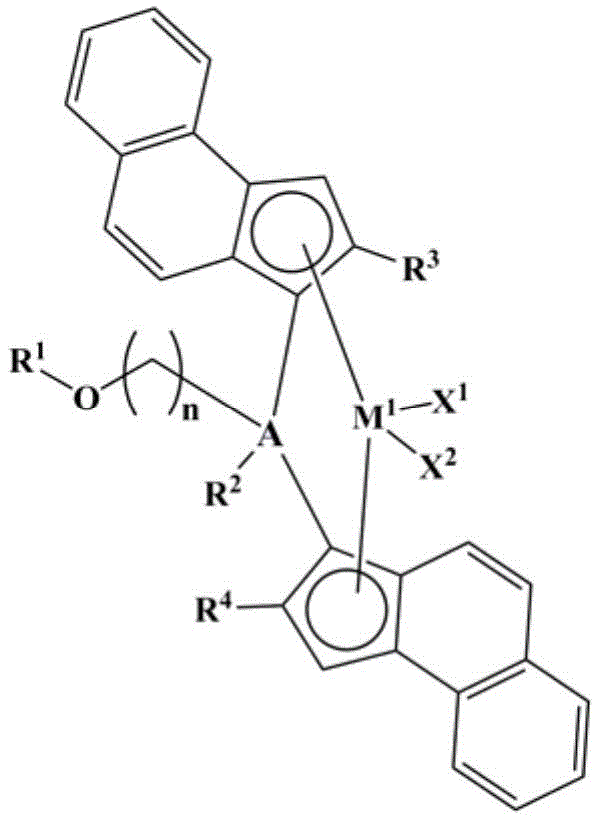
在化学式1中,In Chemical Formula 1,
M1是第3族过渡金属、第4族过渡金属、第5族过渡金属、镧系过渡金属或锕系过渡金属,M 1 is a Group 3 transition metal, a Group 4 transition metal, a Group 5 transition metal, a lanthanide transition metal, or an actinide transition metal,
X1和X2彼此相同或不同,并且各自独立地为卤素或C1-20烷基,X 1 and X 2 are the same or different from each other, and are each independently halogen or C1-20 alkyl,
A为第14族原子,n为1至20的整数,A is a group 14 atom, n is an integer from 1 to 20,
R1是C1-20烷基、C2-20烯基、C7-30烷芳基、C7-30芳烷基或C6-30芳基,R 1 is C1-20 alkyl, C2-20 alkenyl, C7-30 alkaryl, C7-30 aralkyl or C6-30 aryl,
R2是氢、C1-20烷基、C2-20烯基、C7-30烷芳基、C7-30芳烷基或C6-30芳基,R 2 is hydrogen, C1-20 alkyl, C2-20 alkenyl, C7-30 alkaryl, C7-30 aralkyl or C6-30 aryl,
R3和R4各自独立地为氢或C1-20烷基。R 3 and R 4 are each independently hydrogen or C1-20 alkyl.
除非在本文中特别限制,否则可以如下定义以下术语。Unless specifically limited herein, the following terms may be defined as follows.
卤素可以是氟(F)、氯(Cl)、溴(Br)或碘(I)。Halogen can be fluorine (F), chlorine (Cl), bromine (Br) or iodine (I).
C1-20烷基可以是直链、支链或环状的烷基。特别地,C1-20烷基可以是C1-20直链烷基;C1-10直链烷基;C1-5直链烷基;C3-20支链烷基或环状烷基;C3-15支链烷基或环状烷基;或C3-10支链或环状烷基。更特别地,C1-20烷基可以是甲基、乙基、正丙基、异丙基、正丁基、异丁基、叔丁基、正戊基、异戊基或环己基等。The C1-20 alkyl group may be a straight chain, branched chain or cyclic alkyl group. In particular, C1-20 alkyl may be C1-20 straight chain alkyl; C1-10 straight chain alkyl; C1-5 straight chain alkyl; C3-20 branched chain alkyl or cyclic alkyl; C3-15 branched or cyclic alkyl; or C3-10 branched or cyclic alkyl. More particularly, the C1-20 alkyl group may be methyl, ethyl, n-propyl, isopropyl, n-butyl, isobutyl, tert-butyl, n-pentyl, isopentyl, cyclohexyl, and the like.
C2-20烯基可以是直链、支链或环状的烯基。特别地,C2-20烯基可以是C2-20直链烯基,C2-10直链烯基,C2-5直链烯基,C3-20支链烯基,C3-15支链烯基,C3-10支链烯基,C5-20环烯基或C5-10环烯基。更特别地,C2-20烯基可以是乙烯基、丙烯基、丁烯基、戊烯基或环己烯基等。The C2-20 alkenyl group may be a straight chain, branched chain or cyclic alkenyl group. In particular, the C2-20 alkenyl group may be a C2-20 straight chain alkenyl group, a C2-10 straight chain alkenyl group, a C2-5 straight chain alkenyl group, a C3-20 branched chain alkenyl group, a C3-15 branched chain alkenyl group, C3-10 branched alkenyl, C5-20 cycloalkenyl or C5-10 cycloalkenyl. More particularly, the C2-20 alkenyl group may be vinyl, propenyl, butenyl, pentenyl, or cyclohexenyl, and the like.
C6-30芳基是指单环、双环或三环芳烃。特别地,C6-30芳基可以是苯基、萘基或蒽基等。A C6-30 aryl group refers to a monocyclic, bicyclic or tricyclic aromatic hydrocarbon. In particular, the C6-30 aryl group may be a phenyl group, a naphthyl group, an anthracenyl group, or the like.
C7-30烷芳基是指其中一个或多个氢原子被烷基取代的芳基。特别地,C7-30烷芳基可以是甲基苯基、乙基苯基、正丙基苯基、异丙基苯基、正丁基苯基、异丁基苯基、叔丁基苯基或环己基苯基等。A C7-30 alkaryl group refers to an aryl group in which one or more hydrogen atoms are substituted with an alkyl group. In particular, the C7-30 alkylaryl group may be methylphenyl, ethylphenyl, n-propylphenyl, isopropylphenyl, n-butylphenyl, isobutylphenyl, tert-butylphenyl Or cyclohexylphenyl, etc.
C7-30芳烷基是指其中一个或多个氢原子被芳基取代的烷基。特别地,C7-30芳烷基可以是苄基、苯基丙基或苯基己基等。A C7-30 aralkyl group refers to an alkyl group in which one or more hydrogen atoms are replaced by an aryl group. In particular, the C7-30 aralkyl group may be benzyl, phenylpropyl or phenylhexyl and the like.
由化学式1表示的过渡金属化合物包含两个苯并茚基作为配体,并且具有的结构为能够作为路易斯碱的官能团被包含在连接两个配体的桥基中作为氧供体。例如,如果具有这种特定结构的过渡金属化合物通过适当的方法活化并用作烯烃单体的聚合催化剂,则可以显示低熔解温度和高熔体流动速率,因此,可以制备在加工或模制期间具有优异节能效果的烯烃聚合物。特别地,如下所述,当聚合丙烯时,这种效果可以最大化。The transition metal compound represented by Chemical Formula 1 contains two benzoindenyl groups as ligands, and has a structure in which a functional group capable of functioning as a Lewis base is contained in a bridge group connecting the two ligands as an oxygen donor. For example, if a transition metal compound having such a specific structure is activated by an appropriate method and used as a polymerization catalyst for olefin monomers, it can exhibit a low melting temperature and a high melt flow rate, and thus, can be prepared with Olefin polymer with excellent energy saving effect. In particular, as described below, this effect can be maximized when propylene is polymerized.
特别地,在由化学式1表示的过渡金属化合物中,苯并茚基配体可以是未取代的或可以被具有较小空间位阻的取代基取代。因此,可以容易地制备具有目标构象的烯烃聚合物,同时显示出良好的催化活性。例如,化学式1中的R3和R4可以各自独立地为氢或C1-5直链烷基。In particular, in the transition metal compound represented by Chemical Formula 1, the benzoindenyl ligand may be unsubstituted or may be substituted with a substituent having less steric hindrance. Therefore, olefin polymers with targeted conformations can be easily prepared while exhibiting good catalytic activity. For example, R 3 and R 4 in Chemical Formula 1 may each independently be hydrogen or a C1-5 straight-chain alkyl group.
并且,在化学式1中,连接苯并茚基配体的桥基可对过渡金属化合物的负载稳定性有影响。例如,为了提高负载效率,化学式1中的R1可以是C3-6支链烷基,n可以是4至8的整数。而化学式1中的R2可以是C1-6直链烷基。Also, in Chemical Formula 1, the bridge group connecting the benzoindenyl ligand may have an influence on the loading stability of the transition metal compound. For example, in order to improve loading efficiency, R 1 in Chemical Formula 1 may be a C3-6 branched alkyl group, and n may be an integer of 4 to 8. And R 2 in Chemical Formula 1 may be a C1-6 straight-chain alkyl group.
特别地,作为本发明人的实验结果,证实了只有通过其中如在化学式1中的使具有上述结构的配体与具有上述结构的桥基连接的过渡金属化合物,才可以制备在模制或加工期间能够表现出优异的节能效果的烯烃聚合物,并且其不能通过过渡金属化合物(即使该过渡金属化合物包含具有上述结构的配体,其中配体不与具有上述结构的桥基连接)制备。In particular, as a result of experiments by the present inventors, it was confirmed that only by a transition metal compound in which a ligand having the above-mentioned structure and a bridging group having the above-mentioned structure, as in Chemical Formula 1, can be prepared during molding or processing Olefin polymers that can exhibit an excellent energy saving effect during the period, and which cannot be prepared from a transition metal compound (even if the transition metal compound contains a ligand having the above-mentioned structure, wherein the ligand is not connected to a bridging group having the above-mentioned structure).
同时,作为化学式1中的M1,可以使用第4族过渡金属;或者Ti、Zr和Hf中的一种来提高金属络合物的储存稳定性。并且,X1和X2可以彼此相同或不同,并且各自独立地为卤素或C1-20烷基;或各自独立地为卤素或C1-10烷基;或各自独立地为卤素。Meanwhile, as M 1 in Chemical Formula 1, a Group 4 transition metal; or one of Ti, Zr, and Hf may be used to improve the storage stability of the metal complex. And, X 1 and X 2 may be the same or different from each other, and each independently is halogen or C1-20 alkyl; or each independently is halogen or C1-10 alkyl; or each independently is halogen.
可以使用已知的反应合成由化学式1表示的过渡金属化合物,对于更详细的合成方法,可以参考如下所述的制备实施例1。The transition metal compound represented by Chemical Formula 1 can be synthesized using a known reaction, and for a more detailed synthesis method, Preparation Example 1 described below can be referred to.
同时,根据本发明的另一个实施方式,提供了包含由化学式1表示的过渡金属化合物的催化剂组合物。Meanwhile, according to another embodiment of the present invention, a catalyst composition including the transition metal compound represented by Chemical Formula 1 is provided.
所述催化剂组合物还可以包含能够活化过渡金属化合物的助催化剂。作为这样的助催化剂,可以使用在本发明所属技术领域中常用的那些助催化剂,而没有特别限制。例如,助催化剂可以是选自由化学式2至4表示的化合物的一种或多种化合物。The catalyst composition may also include a cocatalyst capable of activating the transition metal compound. As such a cocatalyst, those commonly used in the technical field to which the present invention pertains can be used without particular limitation. For example, the co-catalyst may be one or more compounds selected from the compounds represented by Chemical Formulas 2 to 4.
[化学式2][Chemical formula 2]
R6-[Al(R5)-O]m-R7 R 6 -[Al(R 5 )-O] m -R 7
在化学式2中,In Chemical Formula 2,
R5、R6和R7可以各自独立地为氢、卤素、C1-20烃基或被卤素取代的C1-20烃基,R 5 , R 6 and R 7 can each independently be hydrogen, halogen, C1-20 hydrocarbyl or C1-20 hydrocarbyl substituted by halogen,
m为2以上的整数,m is an integer of 2 or more,
[化学式3][Chemical formula 3]
D(R8)3 D(R 8 ) 3
在化学式3中in chemical formula 3
D是铝或硼,D is aluminum or boron,
R8各自独立地为卤素、C1-20烃基、C1-20烃氧基或被卤素取代的C1-20烃基,R is each independently halogen, C1-20 hydrocarbyl, C1-20 hydrocarbyloxy, or C1-20 hydrocarbyl substituted by halogen,
[化学式4][Chemical formula 4]
[L-H]+[W(J)4]-或[L]+[W(J)4]- [LH] + [W(J) 4 ] - or [L] + [W(J) 4 ] -
在化学式4中,In Chemical Formula 4,
L是中性或阳离子路易斯碱,L is a neutral or cationic Lewis base,
W为第13族原子,J各自独立地为C1-20烃基;C1-20烃氧基;或其中一个或多个氢原子被一个或多个选自卤素、C1-20烃氧基和C1-20烃基(氧基)甲硅烷基的取代基取代的C1-20烃基或C1-20烃氧基。W is a Group 13 atom, and J are each independently C1-20 hydrocarbyl; C1-20 hydrocarbyloxy; or wherein one or more hydrogen atoms are replaced by one or more selected from halogen, C1-20 hydrocarbyl, and C1- 20 Substituents of hydrocarbyl(oxy)silyl substituted C1-20 hydrocarbyl or C1-20 hydrocarbyloxy.
除非在本文中特别限制,否则可以如下定义以下术语。Unless specifically limited herein, the following terms may be defined as follows.
烃基是其中氢原子从烃中除去的一价官能团,它可以包括烷基、烯基、炔基、芳基、芳烷基、芳烯基、芳炔基、烷芳基、烯基芳基和炔基芳基等。另外,C1-20烃基可以是C1-15或C1-10烃基。特别地,C1-20烃基可以是直链、支链或环状烷基,例如甲基、乙基、正丙基、异丙基、正丁基、异丁基,叔丁基、正戊基、正己基、正庚基、环己基等;或芳基,如苯基、萘基、蒽基等。Hydrocarbyl is a monovalent functional group in which a hydrogen atom is removed from a hydrocarbon, and it may include alkyl, alkenyl, alkynyl, aryl, aralkyl, aralkenyl, aralkynyl, alkaryl, alkenylaryl and Alkynyl aryl etc. In addition, the C1-20 hydrocarbyl group may be a C1-15 or C1-10 hydrocarbyl group. In particular, the C1-20 hydrocarbyl group may be a linear, branched or cyclic alkyl group such as methyl, ethyl, n-propyl, isopropyl, n-butyl, isobutyl, tert-butyl, n-pentyl , n-hexyl, n-heptyl, cyclohexyl, etc.; or aryl, such as phenyl, naphthyl, anthracenyl, etc.
烃氧基是其中烃基与氧键合的官能团。特别地,C1-20烃氧基可以是C1-15或C1-10烃氧基。更特别地,C1-20烃氧基可以是直链、支链或环状烷氧基,如甲氧基、乙氧基、正丙氧基、异丙氧基、正丁氧基、异丁氧基、叔丁氧基、正戊氧基、正己氧基、正庚氧基、环己氧基等;或芳氧基,如苯氧基、萘氧基等。Hydrocarbyloxy is a functional group in which a hydrocarbyl group is bonded to oxygen. In particular, the C1-20 hydrocarbyloxy group may be a C1-15 or C1-10 hydrocarbyloxy group. More particularly, the C1-20 hydrocarbyloxy group may be linear, branched or cyclic alkoxy, such as methoxy, ethoxy, n-propoxy, isopropoxy, n-butoxy, isobutoxy oxy, tert-butoxy, n-pentyloxy, n-hexyloxy, n-heptyloxy, cyclohexyloxy, etc.; or aryloxy, such as phenoxy, naphthoxy and the like.
烃基(氧基)甲硅烷基是其中-SiH3的1至3个氢原子被1至3个烃基或烃氧基取代的官能团。特别地,C1-20烃基(氧基)甲硅烷基可以是C1-15、C1-10或C1-5烃基(氧基)甲硅烷基。更特别地,C1-20烃基(氧基)甲硅烷基可以是烷基甲硅烷基,如甲基甲硅烷基、二甲基甲硅烷基、三甲基甲硅烷基、二甲基乙基甲硅烷基、二乙基甲基甲硅烷基、二甲基丙基甲硅烷基等;烷氧基甲硅烷基,如甲氧基甲硅烷基、二甲氧基甲硅烷基、三甲氧基甲硅烷基、二甲氧基乙氧基甲硅烷基等;或烷氧基烷基甲硅烷基,如甲氧基二甲基甲硅烷基、二乙氧基甲基甲硅烷基、二甲氧基丙基甲硅烷基等。A hydrocarbyl(oxy)silyl group is a functional group in which 1 to 3 hydrogen atoms of -SiH 3 are substituted with 1 to 3 hydrocarbyl groups or hydrocarbyloxy groups. In particular, the C1-20 hydrocarbyl(oxy)silyl group may be a C1-15, C1-10 or C1-5 hydrocarbyl(oxy)silyl group. More particularly, the C1-20 hydrocarbyl(oxy)silyl group may be an alkylsilyl group such as methylsilyl, dimethylsilyl, trimethylsilyl, dimethylethylmethylsilyl Silyl, diethylmethylsilyl, dimethylpropylsilyl, etc.; alkoxysilyl, such as methoxysilyl, dimethoxysilyl, trimethoxysilyl or alkoxyalkylsilyl, such as methoxydimethylsilyl, diethoxymethylsilyl, dimethoxypropyl Silyl, etc.
由化学式2表示的化合物的非限制性实例可包括甲基铝氧烷、乙基铝氧烷、异丁基铝氧烷或叔丁基铝氧烷等。并且,由化学式3表示的化合物的非限制性实例可包括三甲基铝、三乙基铝、三异丁基铝、三丙基铝、三丁基铝、二甲基氯铝、三异丙基铝、三仲丁基铝、三环戊基铝、三戊基铝、三异戊基铝、三己基铝、三辛基铝、乙基二甲基铝、甲基二乙基铝、三苯基铝、三对甲苯基铝、二甲基甲氧基铝、二甲基乙氧基铝等。并且,由化学式4表示的化合物的非限定性实例可以包括三甲基铵四(五氟苯基)硼酸盐、三乙基铵四(五氟苯基)硼酸盐、N,N-二甲基苯铵四(五氟苯基)硼酸盐、N,N-二甲基苯铵正丁基三(五氟苯基)硼酸盐、N,N-二甲基苯铵苄基三(五氟苯基)硼酸盐、N,N-二甲基苯铵四(4-(叔丁基二甲基甲硅烷基)-2,3,5,6-四氟苯基)硼酸盐、N,N-二甲基苯铵四(4-(三异丙基甲硅烷基)-2,3,5,6-四氟苯基)硼酸盐、N,N-二甲基苯铵五氟苯氧基三(五氟苯基)硼酸盐、N,N-二甲基(2,4,6-三甲基苯铵)四(五氟苯基)硼酸盐、三甲基铵四(2,3,4,6-四氟苯基)硼酸盐、N,N-二甲基苯铵四(2,3,4,6-四氟苯基)硼酸盐、十六烷基二甲基铵四(五氟苯基)硼酸盐、N-甲基-N-十二烷基苯铵四(五氟苯基)硼酸盐或甲基双(十二烷基)铵四(五氟苯基)硼酸盐等。Non-limiting examples of the compound represented by Chemical Formula 2 may include methylaluminoxane, ethylaluminoxane, isobutylaluminoxane, or t-butylaluminoxane, and the like. And, non-limiting examples of the compound represented by Chemical Formula 3 may include trimethylaluminum, triethylaluminum, triisobutylaluminum, tripropylaluminum, tributylaluminum, dimethylaluminum chloride, triisopropylaluminum aluminum, tri-sec-butyl aluminum, tricyclopentyl aluminum, tripentyl aluminum, triisoamyl aluminum, trihexy aluminum, trioctyl aluminum, ethyl dimethyl aluminum, methyl diethyl aluminum, tri- Phenyl aluminum, tri-p-tolyl aluminum, dimethyl methoxy aluminum, dimethyl ethoxy aluminum, etc. And, non-limiting examples of the compound represented by Chemical Formula 4 may include trimethylammonium tetrakis(pentafluorophenyl)borate, triethylammonium tetrakis(pentafluorophenyl)borate, N,N-di Methylanilinium tetrakis(pentafluorophenyl)borate, N,N-dimethylanilinium n-butyltris(pentafluorophenyl)borate, N,N-dimethylanilinium benzyltris (Pentafluorophenyl) borate, N,N-dimethylanilinium tetrakis(4-(tert-butyldimethylsilyl)-2,3,5,6-tetrafluorophenyl)boronic acid Salt, N,N-dimethylanilinium tetrakis(4-(triisopropylsilyl)-2,3,5,6-tetrafluorophenyl)borate, N,N-dimethylbenzene Ammonium pentafluorophenoxy tris (pentafluorophenyl) borate, N,N-dimethyl (2,4,6-trimethylanilinium) tetrakis (pentafluorophenyl) borate, trimethyl Ammonium tetrakis(2,3,4,6-tetrafluorophenyl)borate, N,N-dimethylanilinium tetrakis(2,3,4,6-tetrafluorophenyl)borate, ten Hexaalkyldimethylammonium tetrakis(pentafluorophenyl)borate, N-methyl-N-dodecylanilinium tetrakis(pentafluorophenyl)borate or methylbis(dodecyl) ) ammonium tetrakis (pentafluorophenyl) borate, etc.
催化剂组合物可以是将上述的过渡金属化合物负载在载体上的负载型催化剂。由于由化学式1表示的过渡金属化合物具有上述结构特征,因此其可以稳定地负载在载体上。而且,负载有这样的过渡金属化合物的负载型催化剂对于烯烃聚合显示出高活性,能够容易提供低分子量的烯烃聚合物。The catalyst composition may be a supported catalyst in which the above-mentioned transition metal compound is supported on a carrier. Since the transition metal compound represented by Chemical Formula 1 has the above-mentioned structural features, it can be stably supported on the carrier. Furthermore, the supported catalyst supporting such a transition metal compound exhibits high activity for olefin polymerization, and can easily provide a low molecular weight olefin polymer.
作为载体,可以使用在表面上含有羟基或硅氧烷基团的载体。特别地,作为载体,可以使用在高温下干燥以除去表面上的水分,因此含有高反应性羟基或硅氧烷基团的载体。更特别地,可以使用二氧化硅、氧化铝、氧化镁或其混合物作为载体。载体可以在高温下干燥,通常包括氧化物,碳酸盐,硫酸盐,硝酸盐组分,如Na2O,K2CO3,BaSO4和Mg(NO3)2等。As the carrier, a carrier containing a hydroxyl group or a siloxane group on the surface can be used. In particular, as a carrier, a carrier that is dried at a high temperature to remove moisture on the surface and thus contains a highly reactive hydroxyl or siloxane group can be used. More particularly, silica, alumina, magnesia or mixtures thereof may be used as supports. The support can be dried at high temperature and usually includes oxide, carbonate, sulfate, nitrate components such as Na 2 O, K 2 CO 3 , BaSO 4 and Mg(NO 3 ) 2 and the like.
如上所述,当以负载型催化剂的形式提供催化剂组合物时,即使使用少量也能活化根据上述实施方式的过渡金属化合物。例如,在催化剂组合物还包含负载过渡金属化合物的载体的情况下,过渡金属化合物和助催化剂可以以10:1至1:1的摩尔比使用。As described above, when the catalyst composition is provided in the form of a supported catalyst, the transition metal compound according to the above-described embodiment can be activated even with a small amount. For example, where the catalyst composition further comprises a carrier supporting the transition metal compound, the transition metal compound and the cocatalyst may be used in a molar ratio of 10:1 to 1:1.
上述催化剂组合物可用于烯烃单体的聚合以显示高催化活性,并且可以容易地提供低分子量烯烃聚合物。特别地,与相同分子量的聚合物相比,催化剂组合物可以用于丙烯的聚合,显示出更低得多的熔解温度和更高的熔体流动速率,从而可以提供在加工或模制期间具有优异的节能效率的聚丙烯。The above catalyst composition can be used for the polymerization of olefin monomers to exhibit high catalytic activity, and can easily provide low molecular weight olefin polymers. In particular, the catalyst composition can be used for the polymerization of propylene, showing a much lower melting temperature and a higher melt flow rate than polymers of the same molecular weight, thereby providing a Excellent energy efficiency of polypropylene.
同时,根据本发明的再一个实施方式,提供了一种制备烯烃聚合物的方法,包括在催化剂组合物存在下聚合烯烃单体的步骤。如上所述,与使用现有金属茂催化剂聚合的聚烯烃相比,由于所述特定结构,催化剂组合物可以容易地提供低分子量烯烃聚合物,并且当聚合烯烃单体时表现出更高的活性。Meanwhile, according to still another embodiment of the present invention, there is provided a method for preparing an olefin polymer, including the step of polymerizing an olefin monomer in the presence of a catalyst composition. As described above, due to the specific structure, the catalyst composition can easily provide low molecular weight olefin polymers and exhibit higher activity when polymerizing olefin monomers compared to polyolefins polymerized using existing metallocene catalysts .
可以用所述催化剂组合物聚合的烯烃单体的实例可以包括乙烯、α-烯烃、环烯烃等,并且也可以聚合具有两个以上双键的二烯烃单体或三烯烃单体等。单体的具体实例可包括乙烯、丙烯、1-丁烯、1-戊烯、4-甲基-1-戊烯、1-己烯、1-庚烯、1-辛烯、1-癸烯、1-十一碳烯、1-十二碳烯、1-十四碳烯、1-十六碳烯、1-二十碳烯、降冰片烯、降冰片二烯、亚乙基降冰片烯、苯基降冰片烯、乙烯基降冰片烯、二环戊二烯、1,4-丁二烯、1,5-戊二烯、1,6-己二烯、苯乙烯、α-甲基苯乙烯、二乙烯基苯、3-氯甲基苯乙烯等,并且可以混合和共聚两种以上单体。Examples of olefin monomers that can be polymerized with the catalyst composition may include ethylene, α-olefin, cycloolefin, and the like, and diolefin monomers or triolefin monomers and the like having two or more double bonds may also be polymerized. Specific examples of the monomer may include ethylene, propylene, 1-butene, 1-pentene, 4-methyl-1-pentene, 1-hexene, 1-heptene, 1-octene, 1-decene , 1-undecene, 1-dodecene, 1-tetradecene, 1-hexadecene, 1-eicosene, norbornene, norbornadiene, ethylidene norbornene ene, phenyl norbornene, vinyl norbornene, dicyclopentadiene, 1,4-butadiene, 1,5-pentadiene, 1,6-hexadiene, styrene, alpha-methyl styrene, divinylbenzene, 3-chloromethylstyrene, etc., and two or more monomers may be mixed and copolymerized.
所述催化剂组合物即使在相同量的氢气进料条件下也具有优异的氢反应性,因此可以提供具有高流动性和窄分子量分布的烯烃聚合物。例如,通过根据上述另一实施方式的制备方法制备的烯烃聚合物可以具有约1.5至3或约1.5至2.5的窄分子量分布。这样的烯烃聚合物具有优异的耐冲击性、强度、弹性等,并且显示出优异的成形性,因此预期可应用于各种产品。The catalyst composition has excellent hydrogen reactivity even under the same amount of hydrogen feed, and thus can provide an olefin polymer having high fluidity and narrow molecular weight distribution. For example, the olefin polymer prepared by the preparation method according to the above-mentioned another embodiment may have a narrow molecular weight distribution of about 1.5 to 3 or about 1.5 to 2.5. Such olefin polymers have excellent impact resistance, strength, elasticity, etc., and exhibit excellent formability, and thus are expected to be applicable to various products.
特别地,由于上述化学式1的过渡金属化合物的特定结构,催化剂组合物可以用于丙烯的聚合以提供具有低熔解温度的聚丙烯。由于熔解温度低,这种丙烯可以以相对低的温度进行加工或模制,因此能够用较少能量提供各种塑料制品。In particular, due to the specific structure of the transition metal compound of the above-mentioned Chemical Formula 1, the catalyst composition may be used for the polymerization of propylene to provide polypropylene having a low melting temperature. Due to the low melting temperature, this propylene can be processed or molded at relatively low temperatures, thus enabling various plastic articles to be provided with less energy.
作为本发明人的实验结果,证实了使用上述催化剂组合物制备的聚丙烯的熔解温度显示出比使用先前已知的齐格勒-纳塔催化剂制备的聚丙烯低约20℃,并且显示出即使与使用先前已知的茂金属催化剂制备的聚丙烯相比也低约6℃。更特别地,使用上述催化剂组合物制备的聚丙烯可以具有约130℃至146℃的熔解温度。因此,所述催化剂组合物可以特别用于制备丙烯聚合物。As a result of experiments by the present inventors, it was confirmed that the melting temperature of polypropylene prepared using the above catalyst composition showed about 20°C lower than that of polypropylene prepared using the previously known Ziegler-Natta catalyst, and showed that even It is also about 6°C lower than polypropylene prepared using previously known metallocene catalysts. More particularly, polypropylene prepared using the above catalyst composition may have a melting temperature of about 130°C to 146°C. Thus, the catalyst composition can be used in particular for the preparation of propylene polymers.
并且,由于化学式1的过渡金属化合物的特定结构,催化剂组合物可用于丙烯聚合以提供显示高熔体流动速率的聚丙烯。这种聚丙烯由于熔体流动速率高而具有优异的流动性和加工性,因此可以显著提高各种塑料制品的生产率。And, due to the specific structure of the transition metal compound of Chemical Formula 1, the catalyst composition may be used for propylene polymerization to provide polypropylene showing a high melt flow rate. This polypropylene has excellent flowability and processability due to its high melt flow rate, so it can significantly improve the productivity of various plastic products.
更特别地,使用该催化剂组合物,可以提供这样的聚丙烯,其中重均分子量为150,000g/mol以上的聚丙烯在230℃,2.16kg负荷下测定的熔体流动速率为70g/10min以上,80g/10min以上,90g/10min以上,或100g/10min以上。熔体流动速率的上限没有特别限制,例如可以控制在约150g/10min以下。More particularly, using the catalyst composition, it is possible to provide polypropylenes having a weight average molecular weight of 150,000 g/mol or more having a melt flow rate of 70 g/10 min or more measured at 230° C. under a load of 2.16 kg, Above 80g/10min, above 90g/10min, or above 100g/10min. The upper limit of the melt flow rate is not particularly limited, for example, it can be controlled to be less than about 150 g/10 min.
同时,对于烯烃单体的聚合,可以使用作为烯烃单体的聚合反应而已知的各种聚合方法,例如连续型溶液聚合法、本体聚合法、悬浮聚合法、淤浆聚合法或乳液聚合法等等。Meanwhile, for the polymerization of olefin monomers, various polymerization methods known as polymerization reactions of olefin monomers, such as a continuous type solution polymerization method, bulk polymerization method, suspension polymerization method, slurry polymerization method, or emulsion polymerization method, etc., can be used. Wait.
特别地,聚合反应可以在约50至110℃,约60至100℃的温度,以及约1至100kgf/cm2的压力下进行。Specifically, the polymerization reaction may be performed at a temperature of about 50 to 110° C., a temperature of about 60 to 100° C., and a pressure of about 1 to 100 kgf/cm 2 .
另外,在聚合反应中,也可以在如戊烷、己烷、庚烷、壬烷、癸烷、甲苯、苯、二氯甲烷、氯苯等的溶剂中溶解或稀释的同时使用所述催化剂组合物。在此,溶剂可以用少量的烷基铝等处理,从而预先除去可能对催化剂有不良影响的少量水或空气等。In addition, in the polymerization reaction, the catalyst combination can also be used while being dissolved or diluted in a solvent such as pentane, hexane, heptane, nonane, decane, toluene, benzene, dichloromethane, chlorobenzene, etc. thing. Here, the solvent may be treated with a small amount of alkyl aluminum or the like to remove a small amount of water or air, etc., which may adversely affect the catalyst in advance.
由于通过上述方法制备的烯烃聚合物是使用上述催化剂组合物制备的,因此其熔解温度低,因此在成型或加工期间可表现出优异的节能效果。Since the olefin polymer prepared by the above method is prepared using the above catalyst composition, it has a low melting temperature and thus can exhibit an excellent energy saving effect during molding or processing.
在下文中,将参照具体实施例更详细地解释本发明的作用和效果。然而,这些仅作为本发明的说明而呈现,并且本发明的范围不限于此。Hereinafter, the action and effect of the present invention will be explained in more detail with reference to specific examples. However, these are presented only as an illustration of the present invention, and the scope of the present invention is not limited thereto.
制备实施例1:过渡金属化合物和负载型催化剂的制备Preparation Example 1: Preparation of Transition Metal Compound and Supported Catalyst
步骤1:2-甲基-1H-苯并茚的制备Step 1: Preparation of 2-methyl-1H-benzoindene

将1.1g NaH和9.1mL甲基丙二酸二乙酯加入到55mL THF(四氢呋喃)中,然后将反应混合物回流1小时。此后,将反应混合物冷却至室温,向其中加入10g的2-溴甲基萘,将反应混合物再次回流3小时以制备化合物A。1.1 g of NaH and 9.1 mL of diethyl methylmalonate were added to 55 mL of THF (tetrahydrofuran), and the reaction mixture was refluxed for 1 hour. Thereafter, the reaction mixture was cooled to room temperature, 10 g of 2-bromomethylnaphthalene was added thereto, and the reaction mixture was refluxed again for 3 hours to prepare Compound A.
随后,向13.6g包含化合物A的反应混合物中,加入30mL乙醇和溶解在29mL水中的9.7g KOH,将反应混合物回流4小时以得到化合物B。Subsequently, to 13.6 g of the reaction mixture containing Compound A, 30 mL of ethanol and 9.7 g of KOH dissolved in 29 mL of water were added, and the reaction mixture was refluxed for 4 hours to obtain Compound B.
然后,向包含化合物B的反应混合物中,加入HCl,然后用乙酸乙酯萃取有机层。然后,将有机层干燥,然后加热直至气体不再出现(加热至约175℃)以得到化合物C。Then, to the reaction mixture containing Compound B, HCl was added, and then the organic layer was extracted with ethyl acetate. Then, the organic layer was dried and then heated until gas ceased to appear (heated to about 175°C) to give compound C.
然后将化合物C溶于24.5mL二氯甲烷中,向其中加入7.2mL亚硫酰氯,然后将反应混合物回流30分钟以得到化合物D。Compound C was then dissolved in 24.5 mL of dichloromethane, 7.2 mL of thionyl chloride was added thereto, and the reaction mixture was refluxed for 30 minutes to obtain compound D.
此后,将包含化合物D的反应混合物干燥以除去溶剂。并将剩余的溶质加入到10mL二氯甲烷中,然后将反应混合物冷却至0℃。向冷却的反应混合物中,在30分钟内缓慢加入分散在40mL二氯甲烷中的5.2g氯化铝。随后,将所得反应混合物回流30分钟,用HCl水溶液和二氯甲烷萃取有机层,由此得到化合物E。After this time, the reaction mixture containing Compound D was dried to remove the solvent. The remaining solute was added to 10 mL of dichloromethane, and the reaction mixture was cooled to 0°C. To the cooled reaction mixture, 5.2 g of aluminum chloride dispersed in 40 mL of dichloromethane was added slowly over 30 minutes. Subsequently, the resulting reaction mixture was refluxed for 30 minutes, and the organic layer was extracted with aqueous HCl and dichloromethane, whereby Compound E was obtained.
此后,将2.1g化合物E溶于12mL THF和6mL甲醇中以制备反应混合物。在0℃的温度下,向含有809mg NaBH4粉末的反应器中,缓慢加入反应混合物1小时。随后,将反应混合物在室温下搅拌1小时,用水萃取有机层,由此得到化合物F。After that, 2.1 g of Compound E was dissolved in 12 mL of THF and 6 mL of methanol to prepare a reaction mixture. To a reactor containing 809 mg of NaBH4 powder, the reaction mixture was slowly added for 1 hour at a temperature of 0 °C. Subsequently, the reaction mixture was stirred at room temperature for 1 hour, and the organic layer was extracted with water, whereby Compound F was obtained.
然后,将2.1g化合物F溶于13mL甲苯中,向其中加入102mg对甲苯磺酸,将反应混合物回流。通过TLC(薄层色谱法)确认反应进程,如果反应结束,用NaCO3水溶液和二乙醚萃取有机层,由此得到2-乙基-1H-苯并茚。Then, 2.1 g of Compound F was dissolved in 13 mL of toluene, 102 mg of p-toluenesulfonic acid was added thereto, and the reaction mixture was refluxed. The progress of the reaction was confirmed by TLC (thin layer chromatography), and if the reaction was completed, the organic layer was extracted with an aqueous NaCO 3 solution and diethyl ether, whereby 2-ethyl-1H-benzoindene was obtained.
步骤2:(6-叔丁氧基己基)二氯甲基硅烷的制备Step 2: Preparation of (6-tert-butoxyhexyl)dichloromethylsilane
向1L烧瓶中,加入95g的Mg,用1.0M HCl洗涤3次,用MeOH洗涤3次,用丙酮洗涤3次,然后在25℃下减压干燥3小时。向含有干燥的Mg的反应器中,依次加入1.0L的THF和5.0mL的1,2-DBE(1,2-二溴乙烷),并搅拌混合物。向滴液漏斗中,加入500g叔丁氧基氯代己烷,然后在5分钟内将其约5%加入反应器中。此后,将反应器的温度升至70℃,将反应混合物搅拌30分钟。随后,将剩余量的叔丁氧基氯代己烷在约3小时内缓慢加入反应器中,并将反应混合物在70℃下搅拌约15小时。此后,将反应器冷却至25℃,过滤反应混合物以除去过量的Mg,将滤液转移到3L烧瓶中。To a 1 L flask, 95 g of Mg was added, washed 3 times with 1.0 M HCl, 3 times with MeOH, 3 times with acetone, and then dried under reduced pressure at 25°C for 3 hours. To the reactor containing dry Mg, 1.0 L of THF and 5.0 mL of 1,2-DBE (1,2-dibromoethane) were sequentially added, and the mixture was stirred. To the dropping funnel, 500 g of tert-butoxychlorohexane was added, then about 5% of it was added to the reactor over 5 minutes. After this time, the temperature of the reactor was raised to 70°C and the reaction mixture was stirred for 30 minutes. Subsequently, the remaining amount of tert-butoxychlorohexane was slowly added to the reactor over about 3 hours, and the reaction mixture was stirred at 70°C for about 15 hours. After this time, the reactor was cooled to 25°C, the reaction mixture was filtered to remove excess Mg, and the filtrate was transferred to a 3 L flask.
同时,将反应器洗涤并减压干燥,然后将583g三氯甲基硅烷和3.3L THF加入反应器中,将反应器冷却至-15℃。然后,向反应器中,缓慢滴加上述制备的滤液,同时在-5℃保持2小时。将反应器的温度升至25℃,将反应混合物在约130rpm下搅拌16小时。此后,将反应混合物在25℃真空蒸馏,分散在4.3L己烷中,然后搅拌30分钟。之后,从反应混合物过滤固体,然后用1.0L己烷再次洗涤反应混合物,过滤,滤液在25℃下真空蒸馏以得到(6-叔丁氧基己基)二氯甲基硅烷,产率为85%。Meanwhile, the reactor was washed and dried under reduced pressure, then 583 g of trichloromethylsilane and 3.3 L of THF were added to the reactor, and the reactor was cooled to -15°C. Then, to the reactor, the filtrate prepared above was slowly added dropwise while maintaining at -5°C for 2 hours. The temperature of the reactor was raised to 25°C and the reaction mixture was stirred at about 130 rpm for 16 hours. After this time, the reaction mixture was vacuum distilled at 25°C, dispersed in 4.3 L of hexane, and stirred for 30 minutes. After that, the solid was filtered from the reaction mixture, then the reaction mixture was washed again with 1.0 L of hexane, filtered, and the filtrate was vacuum distilled at 25°C to obtain (6-tert-butoxyhexyl)dichloromethylsilane in 85% yield .
1H NMR(500MHz,CDCl3,7.24ppm):0.76(3H,s),1.11(2H,t),1.18(9H,s),1.32至1.55(8H,m),3.33(2H,t) 1 H NMR (500 MHz, CDCl 3 , 7.24 ppm): 0.76 (3H,s), 1.11 (2H,t), 1.18 (9H,s), 1.32 to 1.55 (8H,m), 3.33 (2H,t)
步骤3:双(2-甲基-1H-苯并茚-1-基)(6-(叔丁氧基(己基)(甲基)硅烷的制备Step 3: Preparation of bis(2-methyl-1H-benzoinden-1-yl)(6-(tert-butoxy(hexyl)(methyl)silane)
将2g(11.1mmol)2-甲基-1H-苯并茚溶解在101mL甲苯和10.1mL THF的溶剂混合物中。然后,将反应混合物冷却至-25℃,并向反应混合物中缓慢滴加4.7mL正丁基锂溶液(2.5M己烷溶液)。随后,将所得反应混合物在室温下搅拌3小时。然后,将9.9mg CuCN溶解在少量甲苯中,并向反应混合物中以淤浆的形式加入,将反应混合物搅拌30分钟。随后,将1.6g上述制备的(6-叔丁氧基己基)二氯甲基硅烷加入到反应混合物中,并将所得反应混合物在室温下搅拌一天。然后,用水和甲基叔丁基醚从得到的反应混合物中萃取有机层,并干燥以得到配体。2 g (11.1 mmol) of 2-methyl-1H-benzoindene were dissolved in a solvent mixture of 101 mL of toluene and 10.1 mL of THF. Then, the reaction mixture was cooled to -25°C, and 4.7 mL of n-butyllithium solution (2.5M in hexane) was slowly added dropwise to the reaction mixture. Subsequently, the resulting reaction mixture was stirred at room temperature for 3 hours. Then, 9.9 mg of CuCN was dissolved in a small amount of toluene and added as a slurry to the reaction mixture, which was stirred for 30 minutes. Subsequently, 1.6 g of (6-tert-butoxyhexyl)dichloromethylsilane prepared above was added to the reaction mixture, and the resulting reaction mixture was stirred at room temperature for one day. Then, the organic layer was extracted from the obtained reaction mixture with water and methyl tert-butyl ether, and dried to obtain the ligand.
步骤4:双(2-甲基-1H-苯并茚-1-基)(6-(叔丁氧基)己基)(甲基)硅烷二氯化锆的制备Step 4: Preparation of bis(2-methyl-1H-benzoinden-1-yl)(6-(tert-butoxy)hexyl)(methyl)silane zirconium dichloride
将3.1g(5.55mmol)上述制备的双(2-甲基-1H-苯并茚-1-基)(6-(叔丁氧基)己基)(甲基)硅烷溶于55.5mL二乙醚中,然后在-25℃下缓慢滴加4.7mL正丁基锂溶液(2.5M己烷溶液)。然后,将所得反应混合物在室温下搅拌约3小时,然后再次冷却至-25℃。并向含有2.09g双(四氢呋喃)四氯化锆[ZrCl4(C4H5O)2]的反应器中加入反应混合物,并在室温下搅拌一天。此后,将反应混合物干燥以除去溶剂,然后加入二氯甲烷。然后将得到的溶液混合物过滤,干燥滤液。将通过干燥得到的固体在-30℃下用甲苯重结晶,得到过渡金属化合物,产率为17%。3.1 g (5.55 mmol) of bis(2-methyl-1H-benzoinden-1-yl)(6-(tert-butoxy)hexyl)(methyl)silane prepared above was dissolved in 55.5 mL of diethyl ether , and then 4.7 mL of n-butyllithium solution (2.5M hexane solution) was slowly added dropwise at -25°C. The resulting reaction mixture was then stirred at room temperature for about 3 hours and then cooled to -25°C again. To the reactor containing 2.09 g of bis(tetrahydrofuran)zirconium tetrachloride [ZrCl 4 (C 4 H 5 O) 2 ], the reaction mixture was added and stirred at room temperature for one day. After this time, the reaction mixture was dried to remove the solvent and then dichloromethane was added. The resulting solution mixture was then filtered and the filtrate was dried. The solid obtained by drying was recrystallized from toluene at -30°C to obtain a transition metal compound in a yield of 17%.
1H NMR(500MHz,CDCl3,7.26ppm):1.19(9H,s),1.49至1.52(2H,m),1.59至1.62(2H,m),1.66至1.67(2H,m),1.84至1.86(4H,m),2.35(6H,s),3.37(2H,t),7.26(2H,s),7.36(2H,dd),7.48(2H,t),7.51(2H,t),7.55(2H,dd),7.76(2H,d),7.94(2H,d). 1 H NMR (500 MHz, CDCl 3 , 7.26 ppm): 1.19 (9H,s), 1.49 to 1.52 (2H,m), 1.59 to 1.62 (2H,m), 1.66 to 1.67 (2H,m), 1.84 to 1.86 (4H,m),2.35(6H,s),3.37(2H,t),7.26(2H,s),7.36(2H,dd),7.48(2H,t),7.51(2H,t),7.55( 2H,dd), 7.76(2H,d), 7.94(2H,d).
步骤5:负载型催化剂的制备Step 5: Preparation of Supported Catalyst
向含有3g二氧化硅的舒伦克烧瓶中,加入30mmol甲基铝氧烷(MAO),并在90℃下反应24小时。反应完成后,如果反应产物沉降,则去除上层溶液,并将剩余的沉淀物用甲苯洗涤一次。将180μmol上述制备的过渡金属化合物溶解在甲苯中并加入烧瓶中,在70℃下反应5小时。反应结束后,如果反应产物沉降,则去除上层溶液,并将剩余的沉淀物用甲苯洗涤一次。然后,向烧瓶中,加入144μmol二甲基苯铵四(五氟苯基)硼酸盐,在70℃下反应5小时。反应完成后,将反应混合物用甲苯洗涤,再次用己烷洗涤,然后真空干燥以得到固体颗粒形式的二氧化硅负载茂金属催化剂。To a Schlenk flask containing 3 g of silica, 30 mmol of methylaluminoxane (MAO) was added, and the reaction was carried out at 90° C. for 24 hours. After the reaction was completed, if the reaction product settled, the upper layer solution was removed, and the remaining precipitate was washed once with toluene. 180 μmol of the transition metal compound prepared above was dissolved in toluene and added to the flask, and reacted at 70° C. for 5 hours. After the reaction was completed, if the reaction product settled, the upper layer solution was removed, and the remaining precipitate was washed once with toluene. Then, 144 μmol of dimethylanilinium tetrakis (pentafluorophenyl) borate was added to the flask, and the reaction was carried out at 70° C. for 5 hours. After the reaction was completed, the reaction mixture was washed with toluene, washed with hexane again, and then vacuum-dried to obtain the silica-supported metallocene catalyst in the form of solid particles.
制备实施例2:过渡金属化合物和负载型催化剂的制备Preparation Example 2: Preparation of Transition Metal Compound and Supported Catalyst
将3.1g(5.55mmol)在制备实施例1的步骤3中制备的双(2-甲基-1H-苯并茚-1-基)(6-(叔丁氧基)己基)(甲基)硅烷溶于55.5mL的二乙醚中,然后在-25℃下缓慢滴加4.7mL正丁基锂溶液(2.5M己烷溶液)。然后,将所得反应混合物在室温下搅拌约3小时,然后再次冷却至-25℃。并向含有1.78g四氯化铪(HfCl4)的反应器中,加入反应混合物并在室温下搅拌一天。此后,将反应混合物干燥以除去溶剂,然后加入二氯甲烷。并将得到的溶液混合物过滤,干燥滤液。将通过干燥得到的固体在-30℃下用甲苯重结晶,得到过渡金属化合物,产率为12%。3.1 g (5.55 mmol) of bis(2-methyl-1H-benzoinden-1-yl)(6-(tert-butoxy)hexyl)(methyl) prepared in Step 3 of Preparation Example 1 The silane was dissolved in 55.5 mL of diethyl ether, then 4.7 mL of n-butyllithium solution (2.5M in hexane) was slowly added dropwise at -25°C. The resulting reaction mixture was then stirred at room temperature for about 3 hours and then cooled to -25°C again. And to the reactor containing 1.78 g of hafnium tetrachloride (HfCl 4 ), the reaction mixture was added and stirred at room temperature for one day. After this time, the reaction mixture was dried to remove the solvent and then dichloromethane was added. The resulting solution mixture was filtered, and the filtrate was dried. The solid obtained by drying was recrystallized from toluene at -30°C to obtain a transition metal compound in a yield of 12%.
1H NMR(500MHz,CDCl3,7.26ppm):1.20(9H,s),1.50至1.54(2H,m),1.59至1.63(2H,m),1.67至1.69(2H,m),1.81至1.87(4H,m),2.45(6H,d),3.38(2H,t),7.19(2H,s),7.33(2H,dd),7.48(2H,t),7.53(2H,t),7.60(2H,dd),7.77(2H,d),7.92(2H,d). 1 H NMR (500 MHz, CDCl 3 , 7.26 ppm): 1.20 (9H,s), 1.50 to 1.54 (2H,m), 1.59 to 1.63 (2H,m), 1.67 to 1.69 (2H,m), 1.81 to 1.87 (4H,m),2.45(6H,d),3.38(2H,t),7.19(2H,s),7.33(2H,dd),7.48(2H,t),7.53(2H,t),7.60( 2H,dd), 7.77(2H,d), 7.92(2H,d).
使用上述制备的过渡金属化合物,通过与制备实施例1的步骤5相同的方法制备负载型催化剂。Using the transition metal compound prepared above, a supported catalyst was prepared by the same method as in Step 5 of Preparation Example 1.
实施例1:烯烃单体的聚合Example 1: Polymerization of Olefin Monomers
首先,将2L不锈钢反应器在65℃真空干燥,然后冷却,在室温下在其中加入3mL三乙基铝,并在其中加入770g丙烯。将其搅拌10分钟,然后将45mg在制备实施例1中制备的负载型催化剂分散在20mL己烷中,并制备成浆料的形式,使用氮气压力将其加入反应器中。这里,将约331ppm的氢气与催化剂一起加入。此后,将反应器的温度缓慢升至70℃,然后进行聚合1小时。反应完成后,排出未反应的丙烯。First, a 2L stainless steel reactor was vacuum-dried at 65°C, then cooled, and 3 mL of triethylaluminum was added thereto at room temperature, and 770 g of propylene was added thereto. It was stirred for 10 minutes, and then 45 mg of the supported catalyst prepared in Preparation Example 1 was dispersed in 20 mL of hexane and prepared in the form of a slurry, which was charged into the reactor using nitrogen pressure. Here, about 331 ppm of hydrogen was added with the catalyst. After that, the temperature of the reactor was slowly raised to 70°C, and then polymerization was performed for 1 hour. After the reaction was completed, unreacted propylene was discharged.
实施例2:烯烃单体的聚合Example 2: Polymerization of Olefin Monomers
首先,将2L不锈钢反应器在65℃真空干燥,然后冷却,在室温下向其中加入3mL三乙基铝,并在其中加入770g丙烯。将其搅拌10分钟,然后将45mg在制备实施例2中制备的负载型催化剂分散在20mL己烷中,并制备成浆料的形式,使用氮气压力将其加入反应器中。这里,将约331ppm的氢气与催化剂一起加入。此后,将反应器的温度缓慢升至70℃,然后进行聚合1小时。反应完成后,排出未反应的丙烯。First, a 2L stainless steel reactor was vacuum-dried at 65°C, then cooled, and 3 mL of triethylaluminum was added thereto at room temperature, and 770 g of propylene was added thereto. It was stirred for 10 minutes, then 45 mg of the supported catalyst prepared in Preparation Example 2 was dispersed in 20 mL of hexane and prepared in the form of a slurry, which was charged into the reactor using nitrogen pressure. Here, about 331 ppm of hydrogen was added with the catalyst. After that, the temperature of the reactor was slowly raised to 70°C, and then polymerization was performed for 1 hour. After the reaction was completed, unreacted propylene was discharged.
实施例3:烯烃单体的聚合Example 3: Polymerization of Olefin Monomers
首先,将2L不锈钢反应器在65℃真空干燥,然后冷却,在室温下在其中加入3mL三乙基铝,并在其中加入770g丙烯和12,000cc乙烯。将其搅拌10分钟,然后将30mg在制备实施例1中制备的负载型催化剂分散在20mL己烷中,并制备成浆料的形式,使用氮气压力将其加入反应器中。这里,将约331ppm的氢气与催化剂一起加入。此后,将反应器的温度缓慢升至70℃,然后进行聚合1小时。反应完成后,排出未反应的丙烯。First, a 2L stainless steel reactor was vacuum-dried at 65°C, then cooled, 3 mL of triethylaluminum was added thereto at room temperature, and 770 g of propylene and 12,000 cc of ethylene were added thereto. It was stirred for 10 minutes, and then 30 mg of the supported catalyst prepared in Preparation Example 1 was dispersed in 20 mL of hexane and prepared in the form of a slurry, which was charged into the reactor using nitrogen pressure. Here, about 331 ppm of hydrogen was added with the catalyst. After that, the temperature of the reactor was slowly raised to 70°C, and then polymerization was performed for 1 hour. After the reaction was completed, unreacted propylene was discharged.
实施例4:烯烃单体的聚合Example 4: Polymerization of Olefin Monomers
首先,将2L不锈钢反应器在65℃真空干燥,然后冷却,在室温下在其中加入3mL三乙基铝,并在其中加入770g丙烯和12,000cc乙烯。将反应混合物搅拌10分钟,然后将30mg在制备实施例2中制备的负载型催化剂分散在20mL己烷中,并制备成浆料的形式,使用氮气压力将其加入反应器中。这里,将约331ppm的氢气与催化剂一起加入。此后,将反应器的温度缓慢升至70℃,然后进行聚合1小时。反应完成后,排出未反应的丙烯。First, a 2L stainless steel reactor was vacuum-dried at 65°C, then cooled, 3 mL of triethylaluminum was added thereto at room temperature, and 770 g of propylene and 12,000 cc of ethylene were added thereto. The reaction mixture was stirred for 10 minutes, then 30 mg of the supported catalyst prepared in Preparative Example 2 was dispersed in 20 mL of hexane and prepared as a slurry, which was charged into the reactor using nitrogen pressure. Here, about 331 ppm of hydrogen was added with the catalyst. After that, the temperature of the reactor was slowly raised to 70°C, and then polymerization was performed for 1 hour. After the reaction was completed, unreacted propylene was discharged.
比较例1:烯烃单体的聚合Comparative Example 1: Polymerization of Olefin Monomers
使用由以下化学式P1表示的过渡金属化合物,通过与制备实施例1的步骤5相同的方法制备负载型催化剂。A supported catalyst was prepared by the same method as in Step 5 of Preparation Example 1 using the transition metal compound represented by the following Chemical Formula P1.
[化学式P1][Chemical formula P1]

并且,使用包含化学式P1的过渡金属化合物的负载型催化剂,使烯烃单体聚合。由于烯烃单体聚合的最佳条件根据催化剂的种类而变化,使烯烃单体在对包含化学式P1的过渡金属化合物的负载型催化剂优化的条件下聚合。And, the olefin monomer is polymerized using the supported catalyst containing the transition metal compound of Chemical Formula P1. Since the optimum conditions for the polymerization of the olefin monomer vary according to the kind of catalyst, the olefin monomer is polymerized under the conditions optimized for the supported catalyst including the transition metal compound of Chemical Formula P1.
具体地,将2L不锈钢反应器在65℃真空干燥,然后冷却,在室温下在其中加入3mL三乙基铝,并在其中加入1.5L丙烯。将其搅拌10分钟,然后将包含化学式P1的过渡金属化合物的负载催化剂在氮气压力下加入反应器中。这里,约370ppm的氢气与催化剂一起加入。此后,将反应器的温度缓慢升至70℃,然后进行聚合1小时。反应完成后,排出未反应的丙烯。Specifically, a 2 L stainless steel reactor was vacuum-dried at 65° C., then cooled, and 3 mL of triethylaluminum was added thereto, and 1.5 L of propylene was added thereto at room temperature. It was stirred for 10 minutes and then the supported catalyst comprising the transition metal compound of formula P1 was added to the reactor under nitrogen pressure. Here, about 370 ppm of hydrogen was added with the catalyst. After that, the temperature of the reactor was slowly raised to 70°C, and then polymerization was performed for 1 hour. After the reaction was completed, unreacted propylene was discharged.
比较例2:烯烃单体的聚合Comparative Example 2: Polymerization of Olefin Monomers
使用由以下化学式P2表示的过渡金属化合物,使烯烃单体聚合。由于化学式P2的过渡金属化合物具有低的负载稳定性,所以在使用前由过量的助催化剂活化如下。The olefin monomer is polymerized using the transition metal compound represented by the following chemical formula P2. Since the transition metal compound of formula P2 has low loading stability, it is activated by excess cocatalyst before use as follows.
[化学式P2][Chemical formula P2]

具体地,将16L反应器用氮气洗涤,并加入10L液体丙烯。将40mmol甲基铝氧烷(MAO)溶解在甲苯中并加入反应器中,将溶液在30℃下搅拌15分钟。同时将20mmol甲基铝氧烷(MAO)和5.2mg(9μmol)化学式P2的过渡金属化合物加入甲苯中,使溶液静置15分钟。并将溶液加入反应器。此后,将反应器的温度缓慢升至70℃,然后使丙烯聚合1小时。Specifically, a 16L reactor was purged with nitrogen, and 10L of liquid propylene was added. 40 mmol of methylaluminoxane (MAO) was dissolved in toluene and added to the reactor, and the solution was stirred at 30°C for 15 minutes. At the same time, 20 mmol of methylaluminoxane (MAO) and 5.2 mg (9 μmol) of the transition metal compound of formula P2 were added to toluene, and the solution was allowed to stand for 15 minutes. and add the solution to the reactor. After that, the temperature of the reactor was slowly raised to 70°C, and then propylene was polymerized for 1 hour.
实验实施例:烯烃聚合物的性质的评估Experimental Example: Evaluation of Properties of Olefin Polymers
实施例1至4和比较例1至2中制备的烯烃聚合物的性质如下测定,如下表1所示。The properties of the olefin polymers prepared in Examples 1 to 4 and Comparative Examples 1 to 2 were determined as follows, as shown in Table 1 below.
(1)MFR(熔体流动速率)的测定:MFR是使用要测定MFR的烯烃聚合物根据ISO1133在230℃的温度,2.16kg的负荷下测定的。(1) Measurement of MFR (melt flow rate): MFR was measured according to ISO1133 at a temperature of 230° C. under a load of 2.16 kg using an olefin polymer whose MFR is to be measured.
(2)Tm(熔解温度)的测定:使用差示扫描量热计(DSC,由TA仪器制造),将要测量Tm的烯烃聚合物填充在铝盘中,当温度以10℃/min升温至200℃并在200℃保持5分钟后,以-10℃/min降至30℃,然后以10℃/min升至200℃时得到的第二次吸热曲线峰的温度被确定为熔解温度(Tm)。(2) Determination of Tm (melting temperature): Using a differential scanning calorimeter (DSC, manufactured by TA Instruments), the olefin polymer whose Tm is to be measured is filled in an aluminum pan, and the temperature is raised to 200°C at 10°C/min. °C and held at 200 °C for 5 minutes, then decreased to 30 °C at -10 °C/min, and then increased to 200 °C at 10 °C/min. The temperature of the second endothermic peak was determined as the melting temperature (Tm ).
【表1】【Table 1】

Claims (10)

Applications Claiming Priority (5)
| Application Number | Priority Date | Filing Date | Title |
|---|---|---|---|
| KR20150118902 | 2015-08-24 | ||
| KR10-2015-0118902 | 2015-08-24 | ||
| KR10-2016-0007128 | 2016-01-20 | ||
| KR1020160007128A KR101790672B1 (en) | 2015-08-24 | 2016-01-20 | Transition metal compound, catalyst composition comprising the same, and method for preparing olefin polymer using the same |
| PCT/KR2016/006910 WO2017034142A1 (en) | 2015-08-24 | 2016-06-28 | Transition metal compound, catalyst composition comprising same, and method for producing olefin polymer using same |
Publications (2)
| Publication Number | Publication Date |
|---|---|
| CN107406475A CN107406475A (en) | 2017-11-28 |
| CN107406475B true CN107406475B (en) | 2020-11-13 |
Family
ID=58398990
Family Applications (1)
| Application Number | Title | Priority Date | Filing Date |
|---|---|---|---|
| CN201680015630.3A Active CN107406475B (en) | 2015-08-24 | 2016-06-28 | Transition metal compound, catalyst composition comprising same, and method for producing olefin polymer using the same |
Country Status (4)
| Country | Link |
|---|---|
| US (1) | US10280238B2 (en) |
| EP (1) | EP3252061B1 (en) |
| KR (1) | KR101790672B1 (en) |
| CN (1) | CN107406475B (en) |
Families Citing this family (7)
| Publication number | Priority date | Publication date | Assignee | Title |
|---|---|---|---|---|
| WO2019093789A1 (en) * | 2017-11-08 | 2019-05-16 | 주식회사 엘지화학 | Homopolypropylene resin for non-woven fabric and manufacturing method therefor |
| KR102317015B1 (en) * | 2017-11-08 | 2021-10-26 | 주식회사 엘지화학 | Homo polypropylene resin for non-woven fabric and preparation method thereof |
| KR102248557B1 (en) * | 2017-12-20 | 2021-05-06 | 주식회사 엘지화학 | Catalyst composition and method for preparing olefin polymer using the same |
| EP3974618B1 (en) | 2020-09-24 | 2023-04-19 | Doosan Enerbility Co., Ltd. | A technique for cooling squealer tip of a gas turbine blade |
| EP4001591B1 (en) | 2020-11-13 | 2024-07-24 | Doosan Enerbility Co., Ltd. | Trailing edge tip cooling of blade of a gas turbine blade |
| CN119143905A (en) * | 2023-06-15 | 2024-12-17 | 中国石油化工股份有限公司 | Process for isotactic polymerization of alpha-olefins and isotactic polymers of alpha-olefins |
| CN120058994A (en) * | 2023-11-30 | 2025-05-30 | 中石油(上海)新材料研究院有限公司 | Metallocene catalyst composition and preparation method and application thereof |
Citations (2)
| Publication number | Priority date | Publication date | Assignee | Title |
|---|---|---|---|---|
| EP0953581A1 (en) * | 1998-04-27 | 1999-11-03 | Repsol Quimica S.A. | Catalytic systems for the polymerization and copolymerization of alpha-olefins |
| CN101341162A (en) * | 2003-05-08 | 2009-01-07 | 巴塞尔聚烯烃股份有限公司 | Process for producing metallocene halides |
Family Cites Families (21)
| Publication number | Priority date | Publication date | Assignee | Title |
|---|---|---|---|---|
| DE59206948D1 (en) | 1991-11-30 | 1996-09-26 | Hoechst Ag | Metallocenes with benzo-fused indenyl derivatives as ligands, processes for their preparation and their use as catalysts |
| DE4434640C1 (en) | 1994-09-28 | 1996-02-01 | Hoechst Ag | Bridged metallocene prodn. in-situ |
| ATE245665T1 (en) | 1995-09-28 | 2003-08-15 | Basell Polyolefine Gmbh | SUPPORTED CATALYST SYSTEM, METHOD FOR THE PRODUCTION THEREOF AND ITS USE FOR THE POLYMERIZATION OF OLEFINS |
| US5786291A (en) | 1996-02-23 | 1998-07-28 | Exxon Chemical Patents, Inc. | Engineered catalyst systems and methods for their production and use |
| JPH10204112A (en) | 1997-01-17 | 1998-08-04 | Mitsui Chem Inc | Olefin polymerization catalyst, production of olefin polymer and olefin polymer |
| EP1043339A1 (en) | 1997-12-25 | 2000-10-11 | Denki Kagaku Kogyo Kabushiki Kaisha | Polymerization catalyst and process for producing olefin polymer or copolymer with the same |
| ES2216474T3 (en) | 1999-10-26 | 2004-10-16 | Repsol Quimica S.A. | BIS CICOPLENTADIENILO COMPOUNDS WITH SINGLE CARBON LINKS AND METALOCENE COMPLEXES OF THE SAME. |
| JP2002128832A (en) | 2000-10-20 | 2002-05-09 | Chisso Corp | Propylene / ethylene copolymer |
| US6846943B2 (en) | 2000-05-23 | 2005-01-25 | Chisso Corporation | Metallocene compound, olefin polymerization catalyst containing the compound, and method for producing an olefin polymer by use of the catalyst |
| JP4390770B2 (en) | 2002-10-25 | 2009-12-24 | バーゼル、ポリオレフィン、ゲゼルシャフト、ミット、ベシュレンクテル、ハフツング | Racemo-selective synthesis of rac-diorganosilylbis (2-methylbenzo [e] indenyl) zirconium compounds |
| DE102008005947A1 (en) | 2008-01-24 | 2009-07-30 | Evonik Degussa Gmbh | Polyolefins with atactic structural elements, process for their preparation and their use |
| KR101154507B1 (en) | 2009-07-31 | 2012-06-13 | 주식회사 엘지화학 | Metallocene compounds, catalyst composition comprising the same, and method for preparation of olefin-based polymer using the same |
| US8729206B2 (en) | 2010-04-28 | 2014-05-20 | Borealis Ag | Solid particulate catalysts comprising bridged metallocenes |
| KR101503002B1 (en) | 2011-01-28 | 2015-04-01 | 주식회사 엘지화학 | Metallocene compounds and olefin based polymer prepared by using the same |
| KR101499819B1 (en) * | 2011-11-03 | 2015-03-10 | 주식회사 엘지화학 | Non-supported heterogeous catalyst composition for polymerizing polyolefin and preparation method of the same |
| KR101549206B1 (en) * | 2012-05-08 | 2015-09-02 | 주식회사 엘지화학 | Ansa-metallocene catalyst and preparation method of supported catalyst by using the same |
| WO2014169017A1 (en) | 2013-04-11 | 2014-10-16 | Exxonmobil Chemical Patents Inc. | Process of producing polyolefins using metallocene polymerization catalysts and copolymers therefrom |
| KR101631702B1 (en) | 2013-05-10 | 2016-06-17 | 주식회사 엘지화학 | Catalyst for olefin polymerization and preparation method of polyolefin by using the same |
| US9771441B2 (en) | 2013-09-30 | 2017-09-26 | Lg Chem, Ltd. | Preparation method of a polypropylene and a polypropylene obtained therefrom |
| WO2015047031A1 (en) * | 2013-09-30 | 2015-04-02 | 주식회사 엘지화학 | Polypropylene preparation method and polypropylene obtained therefrom |
| KR101637026B1 (en) | 2013-11-18 | 2016-07-07 | 주식회사 엘지화학 | Metallocene supported catalyst and method for preparing polyolefin using the same |
-
2016
- 2016-01-20 KR KR1020160007128A patent/KR101790672B1/en active Active
- 2016-06-28 US US15/557,328 patent/US10280238B2/en active Active
- 2016-06-28 CN CN201680015630.3A patent/CN107406475B/en active Active
- 2016-06-28 EP EP16839432.8A patent/EP3252061B1/en active Active
Patent Citations (2)
| Publication number | Priority date | Publication date | Assignee | Title |
|---|---|---|---|---|
| EP0953581A1 (en) * | 1998-04-27 | 1999-11-03 | Repsol Quimica S.A. | Catalytic systems for the polymerization and copolymerization of alpha-olefins |
| CN101341162A (en) * | 2003-05-08 | 2009-01-07 | 巴塞尔聚烯烃股份有限公司 | Process for producing metallocene halides |
Also Published As
| Publication number | Publication date |
|---|---|
| US20180105616A1 (en) | 2018-04-19 |
| US10280238B2 (en) | 2019-05-07 |
| EP3252061A1 (en) | 2017-12-06 |
| KR20170023705A (en) | 2017-03-06 |
| EP3252061A4 (en) | 2018-06-27 |
| CN107406475A (en) | 2017-11-28 |
| EP3252061B1 (en) | 2019-03-20 |
| KR101790672B1 (en) | 2017-10-26 |
Similar Documents
| Publication | Publication Date | Title |
|---|---|---|
| CN107406475B (en) | Transition metal compound, catalyst composition comprising same, and method for producing olefin polymer using the same | |
| JP6711906B2 (en) | Hybrid supported metallocene catalyst and method for producing polyolefin using the same | |
| KR102204960B1 (en) | Method for preparing of supported hybrid metallocene catalyst, the supported hybrid metallocene catalyst prepared by the same method, and method for preparing polyolefin using the same | |
| JP6681462B2 (en) | Hybrid supported catalyst system for ethylene slurry polymerization and method for producing ethylene polymer using the same | |
| US11767377B2 (en) | Metallocene-supported catalyst and method of preparing polyolefin using the same | |
| JP6440832B2 (en) | Metallocene compound, metallocene supported catalyst, and method for producing polyolefin using the same | |
| EP3312201B1 (en) | Supported hybrid catalyst and method for preparing olefin polymer using the same | |
| CN112020522A (en) | Hybrid supported metallocene catalyst and method for preparing olefin polymer using the same | |
| KR20190076136A (en) | Method For Preparing Supported Hybrid Metallocene Catalyst, Supported Hybrid Metallocene Catalyst Prepared By The Same Method, And Method For Preparing Polyolefin Using The Same | |
| WO2015047030A1 (en) | Method for preparing propylene-1-butene copolymer and propylene-1-butene copolymer obtained thereby | |
| KR20170075533A (en) | Supported hybrid catalyst and method for preparing of olefin based polymer using the same | |
| JP6453483B2 (en) | Metallocene supported catalyst and method for producing polyolefin using the same | |
| CN111164111B (en) | Catalyst composition and method for preparing olefin polymer using the same | |
| KR102089057B1 (en) | Transition metal compound, catalyst composition comprising the same, and method for preparing olefin polymer using the same | |
| KR20180044136A (en) | Method for preparing supported hybrid metallocene catalyst | |
| US10550207B2 (en) | Method for preparing supported hybrid metallocene catalyst, and supported hybrid metallocene catalyst using the same | |
| KR102157784B1 (en) | Transition metal compound, catalyst composition comprising the same, and method for preparing olefin polymer using the same | |
| KR102251397B1 (en) | Transition metal compound, supported metallocene catalyst comprising the same, and method for preparing olefin polymer using the same | |
| CN121646613A (en) | Hybrid supported metallocene catalyst and method for preparing polyethylene using the same | |
| KR20160073081A (en) | Transition metal compound, catalyst composition comprising the same, and method for preparing olefin polymer using the same | |
| WO2015056974A1 (en) | Method for producing hybrid-supported metallocene catalyst | |
| WO2017034142A1 (en) | Transition metal compound, catalyst composition comprising same, and method for producing olefin polymer using same | |
| WO2017155211A1 (en) | Supported hybrid catalyst system for slurry polymerization of ethylene, and method for preparing ethylene polymer by using same |
Legal Events
| Date | Code | Title | Description |
|---|---|---|---|
| PB01 | Publication | ||
| PB01 | Publication | ||
| SE01 | Entry into force of request for substantive examination | ||
| SE01 | Entry into force of request for substantive examination | ||
| GR01 | Patent grant | ||
| GR01 | Patent grant |