CN107207514B - Fused heteroaryl compounds and their use as TRK inhibitors - Google Patents
Fused heteroaryl compounds and their use as TRK inhibitors Download PDFInfo
- Publication number
- CN107207514B CN107207514B CN201580075880.1A CN201580075880A CN107207514B CN 107207514 B CN107207514 B CN 107207514B CN 201580075880 A CN201580075880 A CN 201580075880A CN 107207514 B CN107207514 B CN 107207514B
- Authority
- CN
- China
- Prior art keywords
- compound
- mmol
- alkyl
- ring
- formula
- Prior art date
- Legal status (The legal status is an assumption and is not a legal conclusion. Google has not performed a legal analysis and makes no representation as to the accuracy of the status listed.)
- Active
Links
Classifications
-
- A—HUMAN NECESSITIES
- A61—MEDICAL OR VETERINARY SCIENCE; HYGIENE
- A61P—SPECIFIC THERAPEUTIC ACTIVITY OF CHEMICAL COMPOUNDS OR MEDICINAL PREPARATIONS
- A61P11/00—Drugs for disorders of the respiratory system
- A61P11/06—Antiasthmatics
-
- C—CHEMISTRY; METALLURGY
- C07—ORGANIC CHEMISTRY
- C07D—HETEROCYCLIC COMPOUNDS
- C07D487/00—Heterocyclic compounds containing nitrogen atoms as the only ring hetero atoms in the condensed system, not provided for by groups C07D451/00 - C07D477/00
- C07D487/02—Heterocyclic compounds containing nitrogen atoms as the only ring hetero atoms in the condensed system, not provided for by groups C07D451/00 - C07D477/00 in which the condensed system contains two hetero rings
- C07D487/04—Ortho-condensed systems
-
- A—HUMAN NECESSITIES
- A61—MEDICAL OR VETERINARY SCIENCE; HYGIENE
- A61K—PREPARATIONS FOR MEDICAL, DENTAL OR TOILETRY PURPOSES
- A61K31/00—Medicinal preparations containing organic active ingredients
- A61K31/33—Heterocyclic compounds
- A61K31/395—Heterocyclic compounds having nitrogen as a ring hetero atom, e.g. guanethidine or rifamycins
- A61K31/495—Heterocyclic compounds having nitrogen as a ring hetero atom, e.g. guanethidine or rifamycins having six-membered rings with two or more nitrogen atoms as the only ring heteroatoms, e.g. piperazine or tetrazines
- A61K31/505—Pyrimidines; Hydrogenated pyrimidines, e.g. trimethoprim
- A61K31/519—Pyrimidines; Hydrogenated pyrimidines, e.g. trimethoprim ortho- or peri-condensed with heterocyclic rings
-
- A—HUMAN NECESSITIES
- A61—MEDICAL OR VETERINARY SCIENCE; HYGIENE
- A61P—SPECIFIC THERAPEUTIC ACTIVITY OF CHEMICAL COMPOUNDS OR MEDICINAL PREPARATIONS
- A61P17/00—Drugs for dermatological disorders
-
- A—HUMAN NECESSITIES
- A61—MEDICAL OR VETERINARY SCIENCE; HYGIENE
- A61P—SPECIFIC THERAPEUTIC ACTIVITY OF CHEMICAL COMPOUNDS OR MEDICINAL PREPARATIONS
- A61P29/00—Non-central analgesic, antipyretic or antiinflammatory agents, e.g. antirheumatic agents; Non-steroidal antiinflammatory drugs [NSAID]
-
- A—HUMAN NECESSITIES
- A61—MEDICAL OR VETERINARY SCIENCE; HYGIENE
- A61P—SPECIFIC THERAPEUTIC ACTIVITY OF CHEMICAL COMPOUNDS OR MEDICINAL PREPARATIONS
- A61P35/00—Antineoplastic agents
-
- A—HUMAN NECESSITIES
- A61—MEDICAL OR VETERINARY SCIENCE; HYGIENE
- A61P—SPECIFIC THERAPEUTIC ACTIVITY OF CHEMICAL COMPOUNDS OR MEDICINAL PREPARATIONS
- A61P37/00—Drugs for immunological or allergic disorders
Landscapes
- Health & Medical Sciences (AREA)
- Chemical & Material Sciences (AREA)
- Organic Chemistry (AREA)
- Pharmacology & Pharmacy (AREA)
- Veterinary Medicine (AREA)
- Public Health (AREA)
- General Health & Medical Sciences (AREA)
- Animal Behavior & Ethology (AREA)
- Medicinal Chemistry (AREA)
- Life Sciences & Earth Sciences (AREA)
- General Chemical & Material Sciences (AREA)
- Chemical Kinetics & Catalysis (AREA)
- Nuclear Medicine, Radiotherapy & Molecular Imaging (AREA)
- Engineering & Computer Science (AREA)
- Bioinformatics & Cheminformatics (AREA)
- Rheumatology (AREA)
- Pain & Pain Management (AREA)
- Immunology (AREA)
- Pulmonology (AREA)
- Epidemiology (AREA)
- Dermatology (AREA)
- Pharmaceuticals Containing Other Organic And Inorganic Compounds (AREA)
- Nitrogen Condensed Heterocyclic Rings (AREA)
- Acyclic And Carbocyclic Compounds In Medicinal Compositions (AREA)
- Nitrogen And Oxygen Or Sulfur-Condensed Heterocyclic Ring Systems (AREA)
Abstract
本公开提供了由式I表示的新型化合物或其药学上可接受的盐、溶剂化物、多晶型物、酯、互变异构体或前药。该化合物可用作Trk的抑制剂,并且可用于治疗疼痛、癌症、炎症、神经退行性疾病和某些传染性疾病。在式I的一些化合物中,Q为‑CH=CR3C(O)Nr4R5、‑C=CC(O)NR4R5、‑C≡CC(O)NR4R5或(II)。
Description
技术领域technical field
本公开涉及新化学实体和该实体作为TRK抑制剂的用途。The present disclosure relates to new chemical entities and the use of such entities as TRK inhibitors.
背景技术Background technique
Trk是由神经营养因子(NT)激活的高亲和力酪氨酸激酶受体。Trk受体家族有三个成员:TrkA、TrkB和TrkC。神经营养因子是一组可溶性生长因子,激活TrkA的神经生长因子(NGF),激活TrkB的脑源性神经营养因子(BDNF)和NT-4/5以及激活TrkC的神经营养因子-3(NT3)。Trk在神经组织中广泛表达,并且参与神经元细胞的维持、信号转导和存活(Patapoutian,A.等人,Current Opinion in Neurobiology,2001,11,272-280)。Trk is a high-affinity tyrosine kinase receptor activated by neurotrophic factor (NT). The Trk receptor family has three members: TrkA, TrkB and TrkC. Neurotrophic factors are a group of soluble growth factors, nerve growth factor (NGF) that activates TrkA, brain-derived neurotrophic factor (BDNF) and NT-4/5 that activates TrkB, and neurotrophic factor-3 (NT3) that activates TrkC . Trk is widely expressed in neural tissue and is involved in the maintenance, signal transduction and survival of neuronal cells (Patapoutian, A. et al., Current Opinion in Neurobiology, 2001, 11, 272-280).
已证明Trk/神经营养因子通路的抑制剂在许多疼痛的临床前动物模型中是有效的。已证明拮抗NGF和TrkA抗体在炎性和神经性疼痛动物模型和在人类临床试验中是有效的。(Woolf,C.J.等人,Neuroscience 1994,62,327-331;Zahn,P.K.等人,J.Pain 2004,5,157-163;McMahon,S.B.等人,Nat.Med.1995,1,774-780;Ma,Q.P.和Woolf,C.J.Neuroreport 1997,8,807-810;Shelton,D.L.等人,Pain 2005,116,8-16;Delafoy,L.等人,Pain 2003,105,489-497;Lamb,K.等人,Neurogastroenterol.Motil.2003,15,355-361;Jaggar,S.I.等人,Br.J.Anaesth.1999,83,442-448.)Inhibitors of the Trk/neurotrophin pathway have been shown to be effective in many preclinical animal models of pain. Antibodies against NGF and TrkA have been shown to be effective in animal models of inflammatory and neuropathic pain and in human clinical trials. (Woolf, C.J. et al., Neuroscience 1994, 62, 327-331; Zahn, P.K. et al., J. Pain 2004, 5, 157-163; McMahon, S.B. et al., Nat. Med. 1995, 1,774-780; Ma, Q.P. and Woolf , C.J. Neuroreport 1997, 8, 807-810; Shelton, D. L. et al, Pain 2005, 116, 8-16; Delafoy, L. et al, Pain 2003, 105, 489-497; Lamb, K. et al, Neurogastroenterol. Motil. 2003 , 15, 355-361; Jaggar, S.I. et al., Br. J. Anaesth. 1999, 83, 442-448.)
已证实肿瘤细胞和肿瘤侵袭的巨噬细胞分泌的NGF直接刺激位于外周疼痛纤维上的TrkA。在小鼠和大鼠二者中使用各种肿瘤模型,证实了用单克隆抗体中和NGF抑制癌症相关的疼痛达到相似于或优于最高耐受剂量的吗啡的程度。BDNF/TrkB通路的激活作为包括炎性疼痛(Matayoshi,S.,J.Physiol.2005,569:685-695)、神经性疼痛(Thompson,S.W.Proc.Natl.Acad.Sci.USA 1999,96:7714-7718)和手术疼痛(Li,C.-Q.等人,Molecular Pain,2008,4(28),1-11)的各种类型疼痛的调节剂参与了许多研究。因为TrkA和TrkB激酶可充当NGF驱动的生物反应的介体,因此TrkA和/或其它Trk激酶的抑制剂可以为慢性疼痛状态提供有效的治疗。NGF secreted by tumor cells and tumor-invading macrophages has been shown to directly stimulate TrkA located on peripheral pain fibers. Using various tumor models in both mice and rats, it was demonstrated that neutralization of NGF with monoclonal antibodies inhibited cancer-related pain to an extent similar to or better than the highest tolerated dose of morphine. Activation of the BDNF/TrkB pathway has been implicated in inflammatory pain (Matayoshi, S., J. Physiol. 2005, 569:685-695), neuropathic pain (Thompson, S.W.Proc.Natl.Acad.Sci.USA 1999,96: 7714-7718) and surgical pain (Li, C.-Q. et al., Molecular Pain, 2008, 4(28), 1-11) as modulators of various types of pain involved in many studies. Because TrkA and TrkB kinases can act as mediators of NGF-driven biological responses, inhibitors of TrkA and/or other Trk kinases can provide effective treatments for chronic pain states.
如通过在神经母细胞瘤(Brodeur,G.M.Nat.Rev.Cancer 2003,3,203-216)、卵巢癌(Kruettgen等人,Brain Pathology 2006,16:304-310)、前列腺癌(Dionne等人,Clin.Cancer Res.1998,4(8),1887-1898)、胰腺癌(Dang等人,j of Gastroenterologyand Hepatology 2006,21(5),850-858)、大细胞神经内分泌肿瘤(Marchetti等人,HumanMutation 2008,29(5),609-616)和结肠直肠癌(Bardelli,A.Science 2003,300,949)上进行的研究观察到的,Trk激酶的过表达、激活、扩增和/或突变与几种癌症之间的关系,支持有效的Trk抑制剂的治疗意义可能远远超出疼痛疗法的推论。在癌症的临床前模型中,TrkA、B和C的非选择性小分子抑制剂在抑制肿瘤生长和阻止肿瘤转移二者中均有效(Nakagawara,A.Cancer Letters 2001,169:107-114;Meyer,J.等人,Leukemia 2007,1-10;Pierottia,M.A.和Greco A.Cancer Letters,2006,232:90-98;Eric Adriaenssens,E.等人,Cancer Res 2008,68(2),346-351)。For example, in neuroblastoma (Brodeur, G.M. Nat. Rev. Cancer 2003, 3, 203-216), ovarian cancer (Kruettgen et al, Brain Pathology 2006, 16: 304-310), prostate cancer (Dionne et al, Clin. Cancer Res. 1998, 4(8), 1887-1898), pancreatic cancer (Dang et al., j of Gastroenterology and Hepatology 2006, 21(5), 850-858), large cell neuroendocrine tumors (Marchetti et al., HumanMutation 2008 , 29(5), 609-616) and colorectal cancer (Bardelli, A. Science 2003, 300, 949), overexpression, activation, amplification and/or mutation of Trk kinases are associated with several cancers This relationship supports the inference that effective Trk inhibitors may have therapeutic implications well beyond pain therapy. In preclinical models of cancer, non-selective small molecule inhibitors of TrkA, B and C are effective in both inhibiting tumor growth and preventing tumor metastasis (Nakagawara, A. Cancer Letters 2001, 169:107-114; Meyer , J. et al., Leukemia 2007, 1-10; Pierottia, M.A. and Greco A. Cancer Letters, 2006, 232:90-98; Eric Adriaenssens, E. et al., Cancer Res 2008, 68(2), 346- 351).
此外,已证实神经营养因子/Trk通路的抑制在治疗包括哮喘的炎性肺病(Freund-Michel,V.等人,Pharmacology&Therapeutics 2008,117(1),52-76)、间质性膀胱炎(HuVivian Y等人,The Journal of Urology 2005,173(3),1016-1021)、炎性肠病包括溃疡性结肠炎和克罗恩氏病(Di Mola,F.F,等人,Gut 2000,46(5),670-678)和炎性皮肤病如特应性皮炎(Dou,Y.C.等人,Archives of Dermatological Research 2006,298(1),31-37)、湿疹和牛皮癣(Raychaudhuri,S.P.等人,J.Investigative Dermatology 2004,122(3),812-819)中是有效的。In addition, inhibition of the neurotrophin/Trk pathway has been demonstrated in the treatment of inflammatory lung diseases including asthma (Freund-Michel, V. et al., Pharmacology & Therapeutics 2008, 117(1), 52-76), interstitial cystitis (HuVivian Y et al, The Journal of Urology 2005, 173(3), 1016-1021), inflammatory bowel diseases including ulcerative colitis and Crohn's disease (Di Mola, F.F, et al, Gut 2000, 46 (5 ), 670-678) and inflammatory skin diseases such as atopic dermatitis (Dou, Y.C. et al, Archives of Dermatological Research 2006, 298(1), 31-37), eczema and psoriasis (Raychaudhuri, S.P. et al, J Investigative Dermatology 2004, 122(3), 812-819).
也已证实神经营养因子/Trk通路的调控对病因学神经退行性疾病包括多发性硬化症、帕金森氏病和阿尔茨海默氏病有影响(Sohrabji,F.等人,Neuroendocrinology2006,27(4),404-414)。Regulation of the neurotrophin/Trk pathway has also been shown to have implications for etiological neurodegenerative diseases including multiple sclerosis, Parkinson's disease and Alzheimer's disease (Sohrabji, F. et al. Neuroendocrinology 2006, 27 (4 ), 404-414).
最近的文献已经确定了在携带编码高亲和力神经生长因子受体-TrkA蛋白的NTRK1基因的激酶结构域的肺癌患者中的新基因融合(Vaishnavi,A.等人,NatureMedisine 2013,19(11),1469-1472)。Recent literature has identified novel gene fusions in lung cancer patients harboring the kinase domain of the NTRK1 gene encoding the high-affinity nerve growth factor receptor-TrkA protein (Vaishnavi, A. et al., Nature Medisine 2013, 19(11), 1469-1472).
提供上述信息作为用于理解本发明的特征的背景,并不构成对现有技术的承认。The above information is provided as a background for an understanding of the features of the present invention and is not an admission of prior art.
发明内容SUMMARY OF THE INVENTION
本申请公开了新的化学实体。这些新的化学实体可用作Trk抑制剂,并被认为可用于治疗多种类型的急性和慢性疼痛,包括但不限于炎性疼痛、神经性疼痛和与癌症、手术和骨折相关的疼痛。这些化合物也被认为可用于治疗癌症、炎症、神经退行性疾病和某些传染性疾病。This application discloses new chemical entities. These new chemical entities are useful as Trk inhibitors and are believed to be useful in the treatment of various types of acute and chronic pain, including but not limited to inflammatory pain, neuropathic pain and pain associated with cancer, surgery and fractures. These compounds are also believed to be useful in the treatment of cancer, inflammation, neurodegenerative diseases and certain infectious diseases.
本发明的一个方面提供式I化合物或其药学上可接受的盐、溶剂化物,多晶型物,酯,互变异构体或前药:One aspect of the present invention provides a compound of formula I, or a pharmaceutically acceptable salt, solvate, polymorph, ester, tautomer or prodrug thereof:

在一些实施方案中,式I的R1是任选被一个或多个取代基取代的苯环或任选被一个或多个取代基取代的5-6元杂芳基环,其中所述一个或多个取代基独立地选自卤素、-CF3、-CHF2、NH2、羟基、线性C1-C4烷基、支链C1-C4烷基、线性C1-C4烷氧基和支链C1-C4烷氧基。此外,在式I中,R2选自氢、线性C1-C4烷基和支链线性C1-C4烷基。此外,在式I中,X选自-CH2-、-CH2CH2-、-CH2O-、-CH2NH-、-CH2N(C1-C4烷基)-、-CH(F)-、-CF2-、-CH(Cl)-、-CH(OH)-、-CH(OCH3)-、-CH(NH2)-或-C(CH3)2-。此外,在式I中,Q选自-CH=CR3C(O)NR4R5、-CH=CR3NR4C(O)R5、-CH=CR3NR4C(O)NR4R5、-CH=CR3R5、-C≡CC(O)NR4R5、-C≡CCR5和
在式I的Q中,R3选自氢、卤素、线性C1-C6烷基和支链C1-C6烷基。在式I的Q中,-NR4R5形成4-7元杂环或不形成环结构,杂环为杂芳基环或杂环烷基环。当-NR4R5形成4-7元杂环时,4-7元杂环包括除-NR4R5的氮之外的任选的第二杂原子,并且任选地被一个或多个独立地选自线性C1-C6烷基、支链C1-C6烷基、羟基、羧酸、线性C1-C4烷基羧酸和支链C1-C4烷基羧酸支化的取代基取代。当-NR4R5不形成环结构时,R4选自氢、线性C1-C6烷基和支链C1-C6烷基,且R5选自氢、任选被至少一个氟或至少一个羟基取代的线性C1-C6烷基、任选被至少一个氟或至少一个羟基取代的支链C1-C6烷基和任选被至少一个氟或至少一个羟基取代的C1-C6环烷基。此外,在式I的Q中,Y1、Y2、Y3和Y4各自独立地选自-CH、N、O、S、-CR6和-NR6,其中R6选自氢、线性C1-C4烷基、支链C1-C4烷基、5-6元芳基环、5-6元杂芳基环、3-7元杂环烷基环、3-7元环烷基环、-NHCO-(芳基环)和-CH2CO-(C3-C6元杂环)。In Q of formula I, R3 is selected from hydrogen, halogen, linear C1-C6 alkyl and branched C1-C6 alkyl. In Q of formula I, -NR 4 R 5 forms a 4-7 membered heterocyclic ring or does not form a ring structure, and the heterocyclic ring is a heteroaryl ring or a heterocycloalkyl ring. When -NR4R5 forms a 4-7 membered heterocycle, the 4-7 membered heterocycle includes an optional second heteroatom in addition to the nitrogen of -NR4R5 , and is optionally surrounded by one or more Substituents independently selected from the group consisting of linear C1-C6 alkyl, branched C1-C6 alkyl, hydroxy, carboxylic acid, linear C1-C4 alkyl carboxylic acid, and branched C1-C4 alkyl carboxylic acid branched substituents. When -NR4R5 does not form a ring structure, R4 is selected from hydrogen, linear C1 - C6 alkyl and branched C1 - C6 alkyl, and R5 is selected from hydrogen, optionally by at least one fluorine or at least one hydroxyl Substituted linear C1-C6 alkyl, branched C1-C6 alkyl optionally substituted with at least one fluorine or at least one hydroxy, and C1-C6 cycloalkyl optionally substituted with at least one fluorine or at least one hydroxy. Furthermore, in Q of formula I, Y 1 , Y 2 , Y 3 and Y 4 are each independently selected from -CH, N, O, S, -CR 6 and -NR 6 , wherein R 6 is selected from hydrogen, linear C1-C4 alkyl, branched C1-C4 alkyl, 5-6 membered aryl ring, 5-6 membered heteroaryl ring, 3-7 membered heterocycloalkyl ring, 3-7 membered cycloalkyl ring, -NHCO-(aryl ring) and -CH2CO-(C3 - C6 membered heterocycle).
在其它实施方案中,式I的R1是任选被一个或多个独立地选自卤素、羟基、线性C1-C4烷基、支链C1-C4烷基、线性C1-C4烷氧基和支链C1-C4烷氧基的取代基取代的6-元芳基环或杂芳基环。此外,在式I中,R2是氢、线性C1-C4烷基或支链线性C1-C4烷基;且X是-CH2-、-CH2CH2-、-CH2O-或-CH(Z)-,其中Z是卤素;且Q是-CH=CR3C(O)NR4R5、-C≡CC(O)NR4R5或
此外,在式I的Q中,R3是氢或卤素。此外,在式I的Q中,-NR4R5形成4-7元杂环或不形成环结构,且杂环为杂芳基环或杂环烷基环。当-NR4R5形成4-7元杂环时,4-7元杂环包括除-NR4R5的氮之外的任选的第二杂原子,并且任选地被一个或多个独立地选自线性C1-C6烷基、支链C1-C6烷基、羟基、羧酸、线性C1-C4烷基羧酸和支链C1-C4烷基羧酸支化的取代基取代。当-NR4R5不形成环结构时,R4选自氢、线性C1-C6烷基和支链C1-C6烷基,且R5选自氢、任选被至少一个氟或至少一个羟基取代的线性C1-C6烷基、任选被至少一个氟或至少一个羟基取代的支链C1-C6烷基和任选被至少一个氟或至少一个羟基取代的C1-C6环烷基。在式I的Q中,Y1、Y2、Y3和Y4各自独立地选自-CH、N、O、S、-CR6和-NR6,其中R6选自氢、线性C1-C4烷基、支链C1-C4烷基、5-6元芳基环、5-6元杂芳基环、3-7元杂环烷基环、3-7元环烷基环、-NHCO-(芳基环)和-CH2CO-(C3-C6元杂环)。Furthermore, in Q of formula I, R3 is hydrogen or halogen. In addition, in Q of formula I, -NR 4 R 5 forms a 4-7 membered heterocyclic ring or does not form a ring structure, and the heterocyclic ring is a heteroaryl ring or a heterocycloalkyl ring. When -NR4R5 forms a 4-7 membered heterocycle, the 4-7 membered heterocycle includes an optional second heteroatom in addition to the nitrogen of -NR4R5 , and is optionally surrounded by one or more Substituents independently selected from the group consisting of linear C1-C6 alkyl, branched C1-C6 alkyl, hydroxy, carboxylic acid, linear C1-C4 alkyl carboxylic acid, and branched C1-C4 alkyl carboxylic acid branched substituents. When -NR4R5 does not form a ring structure, R4 is selected from hydrogen, linear C1 - C6 alkyl and branched C1 - C6 alkyl, and R5 is selected from hydrogen, optionally by at least one fluorine or at least one hydroxyl Substituted linear C1-C6 alkyl, branched C1-C6 alkyl optionally substituted with at least one fluorine or at least one hydroxy, and C1-C6 cycloalkyl optionally substituted with at least one fluorine or at least one hydroxy. In Q of formula I, Y 1 , Y 2 , Y 3 and Y 4 are each independently selected from -CH, N, O, S, -CR 6 and -NR 6 , wherein R 6 is selected from hydrogen, linear C1- C4 alkyl, branched C1-C4 alkyl, 5-6 membered aryl ring, 5-6 membered heteroaryl ring, 3-7 membered heterocycloalkyl ring, 3-7 membered cycloalkyl ring, -NHCO -(aryl ring) and -CH2CO-(C3 - C6 membered heterocycle).
在上述式I化合物中,R1是被一个或多个可独立地选自氟、甲氧基和乙氧基的取代基取代的苯环;R2和R3是H;R5可选自H、甲基、乙基、异丙基、环丙基、叔丁基、甲氧基乙基和羟乙基。在式I的化合物中,R1可以是被选自氟和甲氧基中的至少一个取代的吡啶环;R2和R3是H;R5可选自H、甲基、乙基、异丙基、环丙基、叔丁基、甲氧基乙基和羟乙基。在式I的化合物中,R1可以是任选被一个或多个独立地选自卤素和C1-C4烷基的取代基取代的吡啶-2-酮-3-基环。In the above compounds of formula I, R 1 is a benzene ring substituted with one or more substituents that can be independently selected from fluorine, methoxy and ethoxy; R 2 and R 3 are H; R 5 can be selected from H, methyl, ethyl, isopropyl, cyclopropyl, tert-butyl, methoxyethyl and hydroxyethyl. In the compound of formula I, R 1 can be a pyridine ring substituted with at least one selected from fluorine and methoxy; R 2 and R 3 are H; R 5 can be selected from H, methyl, ethyl, iso propyl, cyclopropyl, tert-butyl, methoxyethyl and hydroxyethyl. In compounds of formula I, R1 may be a pyridin-2-on-3-yl ring optionally substituted with one or more substituents independently selected from halogen and C1-C4 alkyl.
在式I的化合物中,当-NR4R5不形成环结构时,R4选自氢、线性C1-C6烷基和支链C1-C6烷基,且R5选自线性C1-C6氟烷基、支链C1-C6氟烷基、线性C1-C6二氟烷基、支链C1-C6二氟烷基、线性C1-C6三氟烷基、支链C1-C6三氟烷基、线性C1-C6羟基烷基、支链C1-C6羟基烷基、线性C2-C6二氟烷基和支链C2-C6二氟烷基。在式I的化合物中,形成4-7元杂环的-NR4R5可以是4-7元杂环烷基环。在式I的化合物中,当-NR4R5形成4-7元杂环时,4-7元杂环中的第二杂原子可选自氮、氧和硫。In the compound of formula I, when -NR4R5 does not form a ring structure, R4 is selected from hydrogen, linear C1 - C6 alkyl and branched C1-C6 alkyl, and R5 is selected from linear C1 - C6 fluoro Alkyl, branched C1-C6 fluoroalkyl, linear C1-C6 difluoroalkyl, branched C1-C6 difluoroalkyl, linear C1-C6 trifluoroalkyl, branched C1-C6 trifluoroalkyl, Linear C1-C6 hydroxyalkyl, branched C1-C6 hydroxyalkyl, linear C2-C6 difluoroalkyl and branched C2-C6 difluoroalkyl. In compounds of formula I, -NR4R5 forming a 4-7 membered heterocycle may be a 4-7 membered heterocycloalkyl ring. In the compounds of formula I, when -NR4R5 forms a 4-7 membered heterocycle, the second heteroatom in the 4-7 membered heterocycle may be selected from nitrogen, oxygen and sulfur.
式I的化合物是式II的化合物:Compounds of formula I are compounds of formula II:

式I的化合物是式III的化合物:Compounds of formula I are compounds of formula III:

式I的化合物是式IV的化合物:Compounds of formula I are compounds of formula IV:
式I的化合物的盐可选自乙酸盐、苯甲酸盐、苯磺酸盐、酸式酒石酸盐、溴化物、碳酸盐、氯化物、依地酸盐、乙二磺酸盐、丙酸酯十二烷基硫酸盐、富马酸盐、葡庚糖酸盐、葡糖酸盐、氢溴酸盐、盐酸盐、碘化物、乳酸盐、乳糖醛酸盐、苹果酸盐、马来酸盐、扁桃酸盐、甲磺酸盐、甲基溴、硫酸二甲酯、粘酸盐、萘磺酸盐、硝酸盐、草酸盐、双羟萘酸盐、磷酸盐、二磷酸盐、水杨酸盐、双水杨酸盐、硬脂酸盐、琥珀酸盐、硫酸盐、酒石酸盐、甲苯磺酸盐、三乙基碘、三氟乙酸盐和戊酸盐。The salt of the compound of formula I can be selected from acetate, benzoate, benzenesulfonate, acid tartrate, bromide, carbonate, chloride, edetate, ethanedisulfonate, propionate Ester lauryl sulfate, fumarate, glucoheptonate, gluconate, hydrobromide, hydrochloride, iodide, lactate, lactobionate, malate, Maleate, Mandelate, Mesylate, Methyl Bromide, Dimethyl Sulfate, Mucate, Naphthalene Sulfonate, Nitrate, Oxalate, Pamoate, Phosphate, Diphosphoric Acid Salts, Salicylates, Salicylates, Stearates, Succinates, Sulfates, Tartrates, Tosylates, Triethyliodide, Trifluoroacetate and Valerate.
本发明的另一方面提供了一种治疗或预防选自甲状腺乳头状癌、胰腺癌、肺癌、结肠癌、乳腺癌、神经母细胞瘤、疼痛、恶病质、皮炎和哮喘的TRK介导的疾病的方法。该方法包括向需要这种治疗的受试者施用药学上有效量的式I的化合物或其药学上可接受的盐。Another aspect of the present invention provides a method for the treatment or prevention of a TRK-mediated disease selected from the group consisting of papillary thyroid cancer, pancreatic cancer, lung cancer, colon cancer, breast cancer, neuroblastoma, pain, cachexia, dermatitis, and asthma. method. The method comprises administering to a subject in need of such treatment a pharmaceutically effective amount of a compound of Formula I, or a pharmaceutically acceptable salt thereof.
本发明的另一方面提供了一种抑制TRK酶的方法。该方法包括向需要这种抑制的受试者施用药学上有效量的式I的化合物或其药学上可接受的盐。Another aspect of the present invention provides a method of inhibiting the TRK enzyme. The method comprises administering to a subject in need of such inhibition a pharmaceutically effective amount of a compound of Formula I, or a pharmaceutically acceptable salt thereof.
具体实施方式Detailed ways
本发明的新特征特别地在所附权利要求中阐述。通过参照以下阐述其中利用本发明的原理的例示性实施方案的详细描述,将获得本发明的特征和优点的更好地理解。虽然本文已经示出和描述了本发明的一些实施方案,但这种实施方案仅通过实施例来提供。应当理解,本文所述的本发明的实施方案的各种替代方案可用于实施本发明。本领域普通技术人员将理解,在不脱离本发明的情况下,许多变化、改变和替换是可能的。以下权利要求旨在限定本发明的各方面的范围,并且由此包括这些权利要求及它们的等同物的范围内的方法和结构。The novel features of the invention are set forth with particularity in the appended claims. A better understanding of the features and advantages of the present invention will be obtained by reference to the following detailed description, which sets forth exemplary embodiments in which the principles of the invention are employed. While some embodiments of the invention have been shown and described herein, such embodiments are provided by way of example only. It should be understood that various alternatives to the embodiments of the invention described herein may be employed in practicing the invention. Those of ordinary skill in the art will appreciate that many variations, changes and substitutions are possible without departing from the present invention. It is intended that the following claims define the scope of various aspects of the invention and that methods and structures within the scope of these claims and their equivalents be included thereby.
本文使用的部分标题仅为了组织目的,并且不应被解释为限制所描述的主题。申请中引用的所有文献或文献的部分,包括但不限于专利、专利申请、文章、书籍、手册和论文,均为了任何目的而通过引用它们的全部内容明确地并入本文。Some headings used herein are for organizational purposes only and should not be construed as limiting the subject matter described. All documents or portions of documents cited in the application, including but not limited to patents, patent applications, articles, books, manuals, and treatises, are expressly incorporated herein by reference in their entirety for any purpose.
定义definition
除非另外定义,否则在此使用的所有技术和科学术语具有与由要求保护的主题所属领域的技术人员通常所理解的相同的含义。除非另有说明,否则所有专利、专利申请、本文的整个披露中提及的公开材料通过引用它们的全部内容并入本文。在本文的术语有多个定义的情况下,以本部分的那些定义为准。在对URL或其它这样的标识符或地址进行参考的情况下,应当理解,这种标识符可变化,并且因特网上的特定信息可变化不定,但可通过搜索因特网或其它适当的参考源来获悉等同的信息。对其的参考证实了这种信息的可用性和公共传播。Unless otherwise defined, all technical and scientific terms used herein have the same meaning as commonly understood by one of ordinary skill in the art to which the claimed subject matter belongs. Unless otherwise indicated, all patents, patent applications, publications mentioned in the entire disclosure herein are incorporated by reference in their entirety. To the extent that a term herein has multiple definitions, those definitions in this section control. Where references are made to URLs or other such identifiers or addresses, it should be understood that such identifiers may vary and that specific information on the Internet may vary, but may be learned by searching the Internet or other appropriate reference sources equivalent information. Reference to it confirms the availability and public dissemination of such information.
应当理解,上述一般描述和以下详细描述仅是示例性和解释性的,并不限制要求保护的任何主题。在本申请中,除非另有特别说明,单数的使用包括复数。必须注意,如说明书和所附权利要求书中所用的,单数形式“一”和“所述”包括复数指示物,除非上下文另有明确规定。还应注意,除非另有说明,否则“或”的使用表示“和/或”。此外,术语“包含”及其其它形式的使用并不是限制性的。同样地,术语“包括”及其其它形式的使用并不是限制性的。It is to be understood that both the foregoing general description and the following detailed description are exemplary and explanatory only and are not restrictive of any claimed subject matter. In this application, the use of the singular includes the plural unless specifically stated otherwise. It must be noted that, as used in the specification and the appended claims, the singular forms "a" and "the" include plural referents unless the context clearly dictates otherwise. It should also be noted that the use of "or" means "and/or" unless stated otherwise. Furthermore, the use of the term "comprising" and its other forms is not limiting. Likewise, the use of the term "comprising" and its other forms is not limiting.
标准化学术语的定义可在参考著作中获悉,包括Carey和Sundberg“ADVANCEDORGANIC CHEMISTRY第四版。”卷A(2000)和B(2001),Plenum Press,纽约。除非另有说明,否则采用本领域技术范围内的常规的质谱、NMR、HPLC、IR和UV/Vis光谱学和药理学方法。除非提供具体定义,否则结合本文所述的分析化学、合成有机化学以及药用和药物化学的实验室程序和技术使用的命名法是本领域已知的。标准技术可用于化学合成、化学分析、药物制备、制剂和递送以及患者的治疗。可例如,使用制造商规格或本领域通常实现的或本文所述的试剂盒进行反应和纯化技术。上述技术和程序通常可用本领域熟知的和如遍及整个本说明书引用和讨论的各种一般和更具体的参考文献中描述的常规方法进行。遍及整个说明书,本领域技术人员可选择其基团和取代基,以提供稳定的部分和化合物。Definitions of standard chemical terms can be found in reference works, including Carey and Sundberg, "ADVANCEDORGANIC CHEMISTRY, Fourth Edition." Volumes A (2000) and B (2001), Plenum Press, New York. Unless otherwise stated, conventional mass spectrometry, NMR, HPLC, IR and UV/Vis spectroscopic and pharmacological methods within the skill of the art were employed. Unless specific definitions are provided, the nomenclature used in connection with the laboratory procedures and techniques of analytical chemistry, synthetic organic chemistry, and pharmaceutical and medicinal chemistry described herein are known in the art. Standard techniques can be used for chemical synthesis, chemical analysis, drug preparation, formulation and delivery, and treatment of patients. Reactions and purification techniques can be performed, for example, using manufacturer specifications or kits commonly implemented in the art or described herein. The above-described techniques and procedures are generally performed using conventional methods well known in the art and as described in various general and more specific references that are cited and discussed throughout this specification. Throughout the specification, those skilled in the art can select groups and substituents to provide stable moieties and compounds.
在取代基由它们的从左至右书写的常规化学式指定的情况下,它们同样包含从右至左书写的结构产生的化学上相同的取代基。作为非限制性实例,CH2O等同于OCH2。除非另有说明,一般化学术语例如但不限于“烷基”、“胺”、“芳基”的使用等同于它们的任意取代的形式。例如,如本文所用,“烷基”包括任选取代的烷基。Where substituents are designated by their conventional formulae, written left to right, they likewise include the chemically identical substituents that result from the structures written from right to left. As a non - limiting example, CH2O is equivalent to OCH2 . Unless otherwise stated, the use of general chemical terms such as, but not limited to, "alkyl", "amine", "aryl" is equivalent to their optionally substituted forms. For example, as used herein, "alkyl" includes optionally substituted alkyl groups.
本文提供的化合物可具有一个或多个立体中心,并且每个中心可以R或S构型或它们的组合的形式存在。同样地,本文给出的化合物可具有一个或多个双键并且各自可以E(反式)或Z(顺式)构型或它们的组合的形式存在。一个特定的立体异构体、区域异构体、非对映异构体、对映异构体或差向异构体的呈现应理解为包括所有可能的立体异构体、区域异构体、非对映异构体、对映体或差向异构体及它们的混合物。因此,本文提供的化合物包括所有单独的构型立体异构、区域异构、非对映异构、对映异构和差向异构形式以及它们相应的混合物。用于反转或保留特定立体中心不变的技术以及用于拆分立体异构体的混合物的技术在本领域中是公知的,并且完全在本领域技术人员在为特定情况选择适当方法的能力的范围内。参见,例如,Fumiss等人(编辑),VOGEL'S ENCYCLOPEDIA OF PRACTICALORGANIC CHEMISTRY 5.sup.TH ED.,Longman Scientific and Technical Ltd.,Essex,1991,809-816;和Heller,Acc.Chem.Res.1990,23,128。The compounds provided herein can have one or more stereocenters, and each center can exist in the R or S configuration or a combination thereof. Likewise, the compounds presented herein may have one or more double bonds and each may exist in the E (trans) or Z (cis) configuration or a combination thereof. The presentation of a particular stereoisomer, regioisomer, diastereomer, enantiomer or epimer should be understood to include all possible stereoisomers, regioisomers, Diastereomers, enantiomers or epimers and mixtures thereof. Accordingly, the compounds provided herein include all individual configurational stereoisomeric, regioisomeric, diastereomeric, enantiomeric and epimeric forms as well as their corresponding mixtures. Techniques for inversion or retention of particular stereocenters and techniques for resolving mixtures of stereoisomers are well known in the art and are well within the ability of those skilled in the art to select the appropriate method for a particular situation In the range. See, eg, Fumiss et al. (eds.), VOGEL'S ENCYCLOPEDIA OF PRACTICAL ORGANIC CHEMISTRY 5. sup. TH ED., Longman Scientific and Technical Ltd., Essex, 1991, 809-816; and Heller, Acc. Chem. Res. 1990, 23,128.
术语“键”或“单键”是指两个原子之间或当通过键连接的原子被认为是较大子结构的一部分时两个部分之间的化学键。The term "bond" or "single bond" refers to a chemical bond between two atoms or between two moieties when the atoms connected by the bond are considered part of a larger substructure.
术语“任选的”或“任选地”意指随后描述的事件或情况可能发生或可能不发生,并且该描述包括其中所述事件或情况发生的实例以及其中它不发生的实例。例如,“任选取代的烷基”是指如下定义的“烷基”或“取代的烷基”。此外,任选取代的基团可以是未取代的(例如,CH2CH3)、完全取代的(例如,CF2CF3)、单取代的(例如,CH2CH2F)或在完全取代和单取代之间以任意程度取代的(例如,CH2CHF2、CF2CH3、CFHCHF2等)。本领域技术人员应当理解,对于包含一个或多个取代基的任何基团,这种基团不意图引入空间上不切实际的和/或合成上不可行的任何取代或取代模式(例如,取代的烷基包括任选取代的环烷基,其又被定义为包括任选取代的烷基,潜在地循环往复)。因此,所描述的任何取代基通常应理解为具有约1,000道尔顿,更典型地高达约500道尔顿的最大分子量(除了在其中明确地意指大分子取代基的那些情况之外,例如多肽、多糖、聚乙二醇、DNA、RNA等)。The term "optional" or "optionally" means that the subsequently described event or circumstance may or may not occur, and that the description includes instances where said event or circumstance occurs and instances where it does not. For example, "optionally substituted alkyl" refers to "alkyl" or "substituted alkyl" as defined below. In addition, optionally substituted groups can be unsubstituted (eg, CH2CH3 ), fully substituted (eg, CF2CF3 ) , monosubstituted (eg, CH2CH2F ) , or in fully substituted and monosubstituted to any degree between ( eg, CH2CHF2 , CF2CH3 , CFHCHF2 , etc. ) . It will be understood by those skilled in the art that for any group containing one or more substituents, such group is not intended to introduce any substitution or substitution pattern that is sterically impractical and/or synthetically impractical (eg, substituted The alkyl group includes optionally substituted cycloalkyl, which in turn is defined to include optionally substituted alkyl, potentially cyclically). Thus, any substituent described should generally be understood to have a maximum molecular weight of about 1,000 Daltons, more typically up to about 500 Daltons (except in those instances where macromolecular substituents are expressly intended, such as Polypeptides, polysaccharides, polyethylene glycol, DNA, RNA, etc.).
如本文所用,C1-Cn包括C1-C2、C1-C3、...C1-Cn。仅举例来说,指定为“C1-C4”的基团表示该部分中有1至4个碳原子,即包含1个碳原子、2个碳原子、3个碳原子或4个碳原子的基团,范围C1-C2和C1-C3亦相同。因此,仅举例来说,“C1-C4烷基”表示烷基中有1至4个碳原子,即烷基选自甲基、乙基、丙基、异丙基、正丁基、异丁基、仲丁基和叔丁基。无论它在本文何时出现,诸如“1至10”的数值范围是指在给定范围内的各个整数;例如“1至10个碳原子”意指该基团可具有1个碳原子、2个碳原子、3个碳原子、4个碳原子、5个碳原子、6个碳原子、7个碳原子、8个碳原子、9个碳原子或10个碳原子。As used herein, C 1 -Cn includes C 1 -C 2 , C 1 -C 3 , . . . C 1 -Cn. By way of example only, a group designated "C 1 -C 4 " means that there are 1 to 4 carbon atoms in the moiety, i.e. 1 carbon atom, 2 carbon atoms, 3 carbon atoms or 4 carbon atoms groups, the ranges C 1 -C 2 and C 1 -C 3 are also the same. Thus, by way of example only, " C1 - C4 alkyl" means that there are 1 to 4 carbon atoms in the alkyl group, i.e. the alkyl group is selected from the group consisting of methyl, ethyl, propyl, isopropyl, n-butyl, isobutyl, sec-butyl and tert-butyl. Whenever it appears herein, a numerical range such as "1 to 10" refers to each integer within the given range; eg "1 to 10 carbon atoms" means that the group may have 1 carbon atom, 2 carbon atoms, 3 carbon atoms, 4 carbon atoms, 5 carbon atoms, 6 carbon atoms, 7 carbon atoms, 8 carbon atoms, 9 carbon atoms, or 10 carbon atoms.
如本文所用,术语“杂原子”或“杂”单独或组合地是指除碳和氢以外的原子。杂原子独立地选自氧、氮、硫、磷、硅、硒和锡,但不限于这些原子。当存在两个或多个杂原子时,两个或多个杂原子可彼此相同,或者两个或多个杂原子中的一些或全部可彼此不同。As used herein, the term "heteroatom" or "hetero", alone or in combination, refers to atoms other than carbon and hydrogen. The heteroatoms are independently selected from, but are not limited to, oxygen, nitrogen, sulfur, phosphorus, silicon, selenium, and tin. When two or more heteroatoms are present, the two or more heteroatoms may be the same as each other, or some or all of the two or more heteroatoms may be different from each other.
如本文所用,术语“烷基”单独或组合地是指具有1至约10个碳原子,更优选1至6个碳原子的任选取代的直链或任选取代的支链饱和烃单价基。示例包括但不限于甲基、乙基、正丙基、异丙基、2-甲基-l-丙基、2-甲基-2-丙基、2-甲基-l-丁基、3-甲基-l-丁基、2-甲基-3-丁基、2,2-二甲基-l-丙基、2-甲基-l-戊基、3-甲基-1-戊基、4-甲基-l-戊基、2-甲基-2-戊基、3-甲基-2-戊基、4-甲基-2-戊基、2,2-二甲基-l-丁基、3,3-二甲基-1-丁基、2-乙基-l-丁基、正丁基、异丁基、仲丁基、叔丁基、正戊基、异戊基、新戊基、叔戊基和己基以及诸如庚基、辛基等的较长烷基基团。无论它在本文何时出现,诸如“C1-C6烷基”或“C1_6烷基”的数值范围意指烷基可由1个碳原子、2个碳原子、3个碳原子、4个碳原子,5个碳原子或6个碳原子组成,尽管本定义还包括其中没有指定数值范围的术语“烷基”的出现。As used herein, the term "alkyl", alone or in combination, refers to an optionally substituted straight or optionally substituted branched saturated hydrocarbon monovalent radical having 1 to about 10 carbon atoms, more preferably 1 to 6 carbon atoms . Examples include, but are not limited to, methyl, ethyl, n-propyl, isopropyl, 2-methyl-1-propyl, 2-methyl-2-propyl, 2-methyl-1-butyl, 3 -Methyl-1-butyl, 2-methyl-3-butyl, 2,2-dimethyl-1-propyl, 2-methyl-1-pentyl, 3-methyl-1-pentyl base, 4-methyl-1-pentyl, 2-methyl-2-pentyl, 3-methyl-2-pentyl, 4-methyl-2-pentyl, 2,2-dimethyl- l-butyl, 3,3-dimethyl-1-butyl, 2-ethyl-l-butyl, n-butyl, isobutyl, sec-butyl, tert-butyl, n-pentyl, isopentyl , neopentyl, tert-pentyl, and hexyl, as well as longer alkyl groups such as heptyl, octyl, and the like. Whenever it appears herein, a numerical range such as "C 1 -C 6 alkyl" or "C 1 -6 alkyl" means that the alkyl group can consist of 1 carbon atom, 2 carbon atoms, 3 carbon atoms, 4 carbon atoms, 5 carbon atoms or 6 carbon atoms, although this definition also includes occurrences of the term "alkyl" in which no numerical range is specified.
如本文所用,术语“亚烷基”单独或组合地是指衍生自上述定义的单价基-烷基的双基(diradical)。实例包括但不限于亚甲基(-CH2)、亚乙基(-CH2CH2)、亚丙基(-CH2CH2CH2)、异亚丙基(-CH(CH3)CH2)等。As used herein, the term "alkylene", alone or in combination, refers to a diradical derived from a monoradical-alkyl group as defined above. Examples include, but are not limited to, methylene ( -CH2 ), ethylene ( -CH2CH2 ), propylene ( -CH2CH2CH2 ) , isopropylene (-CH( CH3 ) CH 2 ) etc.
如本文所用,术语“烯基”单独或组合地是指具有一个或多个碳-碳双键并且具有2至约10个碳原子更优选2至约6个碳原子的任选取代的直链或任选取代的支链烃单价基。该基团可以是关于双键的顺式或反式构象,并且应当理解为包括两种异构体。实例包括但不限于乙烯基(CH=CH2)、1-丙烯基(CH2CH=CH2)、异丙烯基[C(CH3)=CH2]、丁烯基、1,3-丁二烯基等。无论它在本文何时出现,诸如“C2-C6烯基”或“C2_6烯基”的数值范围意指烯基可由2个碳原子、3个碳原子、4个碳原子,5个碳原子或6个碳原子组成,尽管本定义还包括其中没有指定数值范围的术语“烯基”的出现。As used herein, the term "alkenyl", alone or in combination, refers to an optionally substituted straight chain having one or more carbon-carbon double bonds and having 2 to about 10 carbon atoms, more preferably 2 to about 6 carbon atoms or an optionally substituted branched chain hydrocarbon monovalent group. This group may be in cis or trans conformation with respect to the double bond and should be understood to include both isomers. Examples include, but are not limited to, vinyl (CH=CH 2 ), 1-propenyl (CH 2 CH=CH 2 ), isopropenyl [C(CH 3 )=CH 2 ], butenyl, 1,3-butanyl Dienyl, etc. Whenever it appears herein, a numerical range such as "C2 - C6 alkenyl" or "C2-6 alkenyl" means that the alkenyl can be 2 carbon atoms, 3 carbon atoms, 4 carbon atoms, 5 carbon atoms or 6 carbon atoms, although this definition also includes occurrences of the term "alkenyl" in which no numerical range is specified.
如本文所用,术语“炔基”单独或组合地是指具有一个或多个碳-碳三键并且具有2至约10个碳原子更优选2至约6个碳原子的任选取代的直链或任选取代的支链烃单价基。实例包括但不限于乙炔基、2-丙炔基、2-丁炔基、1,3-丁二炔基等。无论它在本文何时出现,诸如“C2-C6炔基”或“C2_6炔基”的数值范围意指炔基可由2个碳原子、3个碳原子、4个碳原子,5个碳原子或6个碳原子组成,尽管本定义还包括其中没有指定数值范围的术语“炔基”的出现。As used herein, the term "alkynyl", alone or in combination, refers to an optionally substituted straight chain having one or more carbon-carbon triple bonds and having 2 to about 10 carbon atoms, more preferably 2 to about 6 carbon atoms or an optionally substituted branched chain hydrocarbon monovalent group. Examples include, but are not limited to, ethynyl, 2-propynyl, 2-butynyl, 1,3-butadiynyl, and the like. Whenever it appears herein, a numerical range such as "C 2 -C 6 alkynyl" or "C 2 - 6 alkynyl" means that the alkynyl group can be of 2 carbon atoms, 3 carbon atoms, 4 carbon atoms, 5 carbon atoms or 6 carbon atoms, although this definition also includes occurrences of the term "alkynyl" in which no numerical range is specified.
如本文所用,术语“脂肪族”单独或组合地是指任选取代的直链或支链、非环状、饱和、部分不饱和或完全不饱和的非芳族烃。因此,该术语包括烷基、烯基和炔基全体。As used herein, the term "aliphatic" alone or in combination refers to an optionally substituted straight or branched chain, acyclic, saturated, partially unsaturated or fully unsaturated non-aromatic hydrocarbon. Thus, the term includes all alkyl, alkenyl and alkynyl groups.
如本文所用,术语“杂烷基”、“杂烯基”和“杂炔基”单独或组合地是指分别如上所述的任选取代的烷基、烯基和炔基结构,其中一个或多个骨架链碳原子(和任何相关的氢原子,视情况而定)各自独立地被杂原子(即除碳之外的原子,例如但不限于氧、氮、硫、硅、磷、锡或它们的组合)取代。As used herein, the terms "heteroalkyl," "heteroalkenyl," and "heteroalkynyl," alone or in combination, refer to the optionally substituted alkyl, alkenyl, and alkynyl structures described above, respectively, wherein one or The plurality of backbone chain carbon atoms (and any associated hydrogen atoms, as the case may be) are each independently replaced by heteroatoms (i.e. atoms other than carbon, such as, but not limited to, oxygen, nitrogen, sulfur, silicon, phosphorus, tin or their combination).
如本文所用,术语“卤代烷基”、“卤代烯基”和“卤代炔基”单独或组合地是指分别如上定义的任选取代的烷基、烯基和炔基,其中一个或多个氢原子被氟、氯、溴或碘原子或它们的组合取代。当两个或多个氢原子可被彼此相同的卤素原子取代时(例如,二氟甲基)。当两个或多个氢原子可被彼此不完全相同的卤素原子取代时(例如,1-氯-1-氟-1-碘乙基)。卤代烷基的非限制性实例是氟甲基和溴乙基。卤代烯基的非限制性实例是溴乙烯基。卤代炔基的非限制性实例是氯乙炔基。As used herein, the terms "haloalkyl," "haloalkenyl," and "haloalkynyl," alone or in combination, refer to optionally substituted alkyl, alkenyl, and alkynyl groups, respectively, as defined above, wherein one or more of A hydrogen atom is replaced by a fluorine, chlorine, bromine or iodine atom or a combination thereof. When two or more hydrogen atoms may be substituted by the same halogen atoms as each other (eg, difluoromethyl). When two or more hydrogen atoms may be replaced by halogen atoms that are not identical to each other (eg, 1-chloro-1-fluoro-1-iodoethyl). Non-limiting examples of haloalkyl are fluoromethyl and bromoethyl. A non-limiting example of haloalkenyl is vinyl bromide. A non-limiting example of haloalkynyl is chloroethynyl.
如本文所用,术语“环”、“环状”和“元环”单独或组合地是指本文描述的任何共价闭环结构,包括脂环族、杂环、芳香族、杂芳族和多环稠合或非稠环体系。环可任选地被取代。环可形成稠环系统的一部分。术语“元”意图是指构成环的骨架原子的数目。因此,仅举例来说,环己烷、吡啶、吡喃和嘧啶为六元环,且环戊烷、吡咯、四氢呋喃和噻吩为五元环。As used herein, the terms "ring", "cyclic" and "membered ring", alone or in combination, refer to any of the covalently closed ring structures described herein, including alicyclic, heterocyclic, aromatic, heteroaromatic, and polycyclic Condensed or non-fused ring systems. Rings can be optionally substituted. Rings may form part of a fused ring system. The term "membered" is intended to refer to the number of backbone atoms that make up the ring. Thus, by way of example only, cyclohexane, pyridine, pyran, and pyrimidine are six-membered rings, and cyclopentane, pyrrole, tetrahydrofuran, and thiophene are five-membered rings.
如本文所用,术语“稠合”单独或组合地是指其中两个或多个环共享一个或多个键的环状结构。As used herein, the term "fused", alone or in combination, refers to a cyclic structure in which two or more rings share one or more bonds.
如本文所用,术语“环烷基”单独或组合地是指包含3至约15个环碳原子或3至约10个环碳原子的任选取代的饱和烃单价环,尽管可包括另外的非环碳原子作为取代基(例如,甲基环丙基)。As used herein, the term "cycloalkyl", alone or in combination, refers to an optionally substituted saturated hydrocarbon monovalent ring containing from 3 to about 15 ring carbon atoms or from 3 to about 10 ring carbon atoms, although additional non- Ring carbon atoms as substituents (eg, methylcyclopropyl).
“环烷基”的非限制性实例包括吖嗪基、氮杂环丁烷基(azetidinyl)、氧杂环丁烷基(oxetanyl)、硫杂环丁烷基(thietanyl)、高哌啶基(homopiperidinyl)、氧杂环庚烷基(oxepanyl)、硫杂环庚烷基(thiepanyl)、氧氮杂环庚烷基(oxazepinyl)、二氮杂环庚烯基(diazepinyl)、硫杂环庚烯基(thiazepinyl)、1,2,3,6-四氢吡啶基、2-吡咯啉基、3-吡咯啉基、吲哚啉基、2H-吡喃基、4H-吡喃基、二氧杂环乙烷基(dioxanyl)、1,3-二氧戊环基(1,3-dioxolanyl)、吡唑啉基、二噻烷基(dithianyl)、二硫戊环基(dithiolanyl)、二氢吡喃基、二氢噻吩基、二氢呋喃基、吡唑烷基、咪唑啉基、咪唑烷基、3-氮杂二环[3.1.0]己基、3-氮杂二环[4.1.0]庚基、3H-吲哚基和喹嗪基(quinolizinyl)等。术语还包括碳水化合物的所有环形式,包括但不限于单糖、二糖和寡糖。Non-limiting examples of "cycloalkyl" include azinyl, azetidinyl, oxetanyl, thietanyl, homopiperidinyl ( homopiperidinyl, oxepanyl, thiepanyl, oxazepinyl, diazepinyl, thiepanyl thiazepinyl, 1,2,3,6-tetrahydropyridyl, 2-pyrrolinyl, 3-pyrrolinyl, indolinyl, 2H-pyranyl, 4H-pyranyl, dioxa Cycloethane (dioxanyl), 1,3-dioxolanyl (1,3-dioxolanyl), pyrazolinyl, dithianyl (dithianyl), dithiolanyl (dithiolanyl), dihydropyridine Alanyl, dihydrothienyl, dihydrofuranyl, pyrazolidine, imidazolinyl, imidazolidinyl, 3-azabicyclo[3.1.0]hexyl, 3-azabicyclo[4.1.0] Heptyl, 3H-indolyl and quinolizinyl and the like. The term also includes all cyclic forms of carbohydrates, including but not limited to monosaccharides, disaccharides, and oligosaccharides.
如本文所用,术语“芳香族”是指具有包含4n+2n电子的离域的at-电子体系的平面、环状或多环的环部分,其中n是整数。芳香族环可由五个、六个、七个、八个、九个或大于九个原子形成。芳香族化合物可任选地被取代,并且可以是单环或稠环多环。术语芳香族包括全是碳的环(例如,苯基)和包含一个或多个杂原子的那些环(例如,吡啶)。As used herein, the term "aromatic" refers to a planar, cyclic or polycyclic ring moiety having a delocalized at-electron system comprising 4n+2n electrons, where n is an integer. Aromatic rings can be formed from five, six, seven, eight, nine, or more than nine atoms. Aromatic compounds may be optionally substituted and may be monocyclic or fused polycyclic. The term aromatic includes rings that are all carbon (eg, phenyl) and those rings that contain one or more heteroatoms (eg, pyridine).
如本文所用,术语“芳基”单独或组合地是指任选取代的具有6至约20个环碳原子的芳香族烃基,并且包括稠合和非稠合芳环。稠合芳环基团包含2至4个稠环,其中连接环是芳环,且其它单个环可以是脂环族、杂环、芳香族、杂芳香族或它们的任何组合。此外,术语芳基包括含有6个至约12个环碳原子的稠合和非稠合环,以及含有6个至约10个环碳原子的稠合和非稠合环。单环芳基的非限制性实例包括苯基;稠环芳基包括萘基、菲基、蒽基、薁基;且非稠合双芳基包括联苯基。The term "aryl" as used herein, alone or in combination, refers to an optionally substituted aromatic hydrocarbon group having from 6 to about 20 ring carbon atoms, and includes fused and non-fused aromatic rings. A fused aromatic ring group contains 2 to 4 fused rings, wherein the linking ring is an aromatic ring, and the other individual rings can be cycloaliphatic, heterocyclic, aromatic, heteroaromatic, or any combination thereof. Furthermore, the term aryl includes fused and non-fused rings containing from 6 to about 12 ring carbon atoms, as well as fused and non-fused rings containing from 6 to about 10 ring carbon atoms. Non-limiting examples of monocyclic aryl groups include phenyl; fused ring aryl groups include naphthyl, phenanthrenyl, anthracenyl, azulenyl; and non-fused biaryl groups include biphenyl.
如本文所用,术语“杂芳基”单独或组合地是指含有约5至约20个骨架环原子的任选取代的芳族单价基,其中一个或多个环原子是独立地选自氧、氮、硫、磷、硅、硒和锡的杂原子,但不限于这些原子,且条件是所述基团的环不包含两个相邻的O或S原子。当在环中存在两个或多个杂原子时,两个或多个杂原子可彼此相同,或者两个或多个杂原子中的一些或全部可彼此不同。术语杂芳基包括具有至少一个杂原子的任选取代的稠合和非稠合杂芳基。术语杂芳基还包括具有5至约12个骨架环原子的稠合和非稠合杂芳基,以及具有5至约10个骨架环原子的那些。与杂芳基键合可通过碳原子或杂原子。因此,作为非限制性实例,咪唑基可通过其任何碳原子(咪唑-2-基、咪唑-4-基或咪唑-5-基)或其氮原子(咪唑-1-基或咪唑-3-基)附接至母体分子。同样地,可通过杂芳基的任何或全部碳原子,和/或其任何或全部杂原子将杂芳基进一步取代。稠合的杂芳基可包含2至4个稠合环,其中连接环是杂芳族环,且其它单个环可以是脂环族、杂环、芳香族,杂芳香族或它们的任何组合。单环杂芳基的非限制性实例包括吡啶基;稠环杂芳基包括苯并咪唑基、喹啉基、吖啶基;并且非稠合双杂芳基包括联吡啶基。杂芳基的其它实例包括但不限于呋喃基、噻吩基、噁唑基、吖啶基、吩嗪基、苯并咪唑基、苯并呋喃基、苯并噁唑基、苯并噻唑基、苯并噻二唑基、苯并噻吩基、苯并噁二唑基、苯并三唑基、咪唑基、吲哚基、异噁唑基、异喹啉基、吲嗪基、异噻唑基、异吲哚基噁二唑基、吲唑基、吡啶基、哒嗪基、嘧啶基、吡嗪基、吡咯基、吡唑基、嘌呤基、酞嗪基、蝶啶基、喹啉基、喹唑啉基、喹喔啉基、三唑基、四唑基、噻唑基、三嗪基、噻二唑基等,以及它们的氧化物,例如像吡啶基-N-氧化物等。As used herein, the term "heteroaryl", alone or in combination, refers to an optionally substituted aromatic monovalent group containing from about 5 to about 20 backbone ring atoms, wherein one or more ring atoms are independently selected from oxygen, Heteroatoms of nitrogen, sulfur, phosphorus, silicon, selenium, and tin, but are not limited to these atoms, provided that the ring of the group does not contain two adjacent O or S atoms. When two or more heteroatoms are present in the ring, the two or more heteroatoms may be the same as each other, or some or all of the two or more heteroatoms may be different from each other. The term heteroaryl includes optionally substituted fused and non-fused heteroaryl groups having at least one heteroatom. The term heteroaryl also includes fused and non-fused heteroaryl groups having 5 to about 12 backbone ring atoms, as well as those having 5 to about 10 backbone ring atoms. Bonding to a heteroaryl group can be through a carbon atom or a heteroatom. Thus, by way of non-limiting example, an imidazolyl group can pass through any of its carbon atoms (imidazol-2-yl, imidazol-4-yl, or imidazol-5-yl) or its nitrogen atom (imidazol-1-yl or imidazol-3-yl) base) attached to the parent molecule. Likewise, a heteroaryl group can be further substituted through any or all of its carbon atoms, and/or any or all of its heteroatoms. A fused heteroaryl group can contain 2 to 4 fused rings, wherein the linking ring is a heteroaromatic ring, and the other individual rings can be cycloaliphatic, heterocyclic, aromatic, heteroaromatic, or any combination thereof. Non-limiting examples of monocyclic heteroaryl groups include pyridyl; fused ring heteroaryl groups include benzimidazolyl, quinolinyl, acridinyl; and non-fused biheteroaryl groups include bipyridyl. Other examples of heteroaryl groups include, but are not limited to, furanyl, thienyl, oxazolyl, acridinyl, phenazinyl, benzimidazolyl, benzofuranyl, benzoxazolyl, benzothiazolyl, benzoyl Thiadiazolyl, benzothienyl, benzoxadiazolyl, benzotriazolyl, imidazolyl, indolyl, isoxazolyl, isoquinolinyl, indazinyl, isothiazolyl, iso Indolyloxadiazolyl, indazolyl, pyridyl, pyridazinyl, pyrimidinyl, pyrazinyl, pyrrolyl, pyrazolyl, purinyl, phthalazinyl, pteridyl, quinolinyl, quinazole olinyl, quinoxalinyl, triazolyl, tetrazolyl, thiazolyl, triazinyl, thiadiazolyl, and the like, and their oxides, such as, for example, pyridyl-N-oxide and the like.
如本文所用,术语“杂环基”单独或组合地共同地是指杂脂环族和杂芳基。在本文,无论何时指示杂环中的碳原子数(例如,C1-C6杂环)时,环中必须存在至少一个非碳原子(杂原子)。诸如“C1-C6杂环”的名称仅指环中的碳原子数,并不指环中的原子总数。诸如“4-6元杂环”的名称是指环中包含的原子总数(即,四、五或六元环,其中至少一个原子是碳原子,至少一个原子是杂原子,其余2至4个原子是碳原子或杂原子)。对于具有两个或多个杂原子的杂环,那些两个或多个杂原子可彼此相同或不同。杂环可任选地被取代。非芳香族杂环基包括在环中只有三个原子的基团,而芳香族杂环基在环中必须具有至少五个原子。与杂环键合(即,与母体分子连接或进一步取代)可通过杂原子或碳原子。如本文所用,术语“烷氧基”单独或组合地是指烷基醚基、O-烷基,包括O-脂族和O-碳环基团,其中烷基、脂族和碳环基团可任选地被取代,且其中术语烷基、脂族和碳环如本文所定义。烷氧基的非限制性实例包括甲氧基、乙氧基、正丙氧基、异丙氧基、正丁氧基、异丁氧基、仲丁氧基、叔丁氧基等。As used herein, the term "heterocyclyl", alone or in combination collectively, refers to heterocycloaliphatic and heteroaryl groups. Whenever the number of carbon atoms in a heterocycle is indicated herein (eg, a C1 - C6 heterocycle), at least one non-carbon atom (heteroatom) must be present in the ring. Designations such as "Ci - C6 heterocycle" refer only to the number of carbon atoms in the ring, not the total number of atoms in the ring. Designations such as "4-6 membered heterocycle" refer to the total number of atoms contained in the ring (i.e., a four-, five- or six-membered ring in which at least one atom is a carbon atom, at least one atom is a heteroatom, and the remaining 2 to 4 atoms is a carbon atom or a heteroatom). For heterocycles having two or more heteroatoms, those two or more heteroatoms may be the same or different from each other. Heterocycles can be optionally substituted. Non-aromatic heterocyclic groups include groups having only three atoms in the ring, while aromatic heterocyclic groups must have at least five atoms in the ring. Bonding to the heterocycle (ie, attachment to or further substitution with the parent molecule) can be through a heteroatom or a carbon atom. As used herein, the term "alkoxy", alone or in combination, refers to alkyl ether groups, O-alkyl groups, including O-aliphatic and O-carbocyclic groups, wherein alkyl, aliphatic and carbocyclic groups may be optionally substituted, and wherein the terms alkyl, aliphatic and carbocyclic are as defined herein. Non-limiting examples of alkoxy groups include methoxy, ethoxy, n-propoxy, isopropoxy, n-butoxy, isobutoxy, sec-butoxy, tert-butoxy, and the like.
如本文所用,术语“药物组合物”是指任选地与至少一种药学上可接受的化学成分混合的生物活性化合物,例如但不限于载体、稳定剂、稀释剂、分散剂、悬浮剂、增稠剂和/或赋形剂。As used herein, the term "pharmaceutical composition" refers to a biologically active compound optionally in admixture with at least one pharmaceutically acceptable chemical ingredient, such as, but not limited to, carriers, stabilizers, diluents, dispersing agents, suspending agents, Thickeners and/or excipients.
如本文所用,术语“溶剂化物”是指本发明的化合物与溶剂分子通过溶剂化形成的组合。在某些情况下,溶剂化物是指水合物,即溶剂分子是水分子,本发明的化合物与水的组合形成水合物。As used herein, the term "solvate" refers to a combination of a compound of the present invention formed by solvation with solvent molecules. In certain instances, a solvate refers to a hydrate, ie, the solvent molecule is a water molecule, and the combination of a compound of the present invention and water forms a hydrate.
如本文所用,术语“药学上可接受的盐”是指保留特定化合物的游离酸和碱的生物有效性并且不是生物学或其它方面不期望的盐。本文所述的化合物可具有酸性或碱性基团,因此可与许多无机或有机碱、无机和有机酸中的任何一种反应以形成药学上可接受的盐。可在本发明化合物的最终分离和纯化期间原位制备这些盐、或者通过将其游离碱形式的纯化化合物与合适的有机或无机酸单独反应,并分离由此形成的盐。药学上可接受的盐的实例包括通过本文所述的化合物与矿物或有机酸或无机碱反应制备的那些盐,所述盐包括乙酸盐、丙烯酸盐、己二酸盐、藻酸盐、天冬氨酸盐、苯甲酸盐、苯磺酸盐、硫酸氢盐、亚硫酸氢盐、溴化物、丁酸盐、丁炔-1,4-二酸盐、樟脑酸盐、樟脑磺酸盐、辛酸盐、氯苯甲酸盐、氯化物、柠檬酸盐、环戊烷丙酸盐、癸酸盐、二葡糖酸盐、磷酸二氢盐、二硝基苯甲酸盐、十二烷基硫酸盐、乙烷磺酸盐、甲酸盐、富马酸盐、葡庚糖酸盐、甘油磷酸盐、乙醇酸盐、半硫酸盐、庚酸盐、己酸盐、己炔-1,6-二酸盐、羟基苯甲酸盐、羟基丁酸盐、盐酸盐、氢溴酸盐、氢碘酸盐、2-羟基乙磺酸盐、碘化物、异丁酸盐、乳酸盐、马来酸盐、丙二酸盐、甲磺酸盐、扁桃酸盐、偏磷酸盐、甲氧基苯甲酸盐、甲基苯甲酸盐、磷酸一氢盐、1-萘磺酸盐、2-萘磺酸盐、烟酸盐、硝酸盐、双羟萘酸盐(palmoate)、果胶酸盐、过硫酸盐、3-苯基丙酸盐、磷酸盐、苦味酸盐、新戊酸盐、丙酸盐、焦硫酸盐、焦磷酸盐、丙炔酸盐、邻苯二甲酸盐、苯基乙酸盐、苯基丁酸盐、丙磺酸盐、水杨酸盐、琥珀酸盐、硫酸盐、亚硫酸盐、辛二酸盐、癸二酸盐、磺酸盐、酒石酸盐、硫氰酸盐、甲苯磺酸盐十一酸盐(tosylate undeconate)和二甲苯磺酸盐。诸如草酸的其它酸虽然本身不是药学上可接受的,但可用于制备可用作获得本发明的化合物及其药学上可接受的酸加成盐的中间体的盐(参见Berge等人,J.Pharm.Sci.1977,66,1-19.)。此外,本文所述的可能包含游离酸基团的那些化合物可与合适的碱例如药学上可接受的金属阳离子的氢氧化物、碳酸盐或碳酸氢盐,与氨,或与药学上可接受的有机伯胺、仲胺或叔胺反应。代表性的碱金属或碱土金属盐包括锂、钠、钾、钙、镁和铝盐等。碱的示例性实例包括氢氧化钠、氢氧化钾、氢氧化胆碱、碳酸钠、IV'(C1_4烷基)4等。可用于形成碱加成盐的代表性有机胺包括乙基胺、二乙基胺、乙二胺、乙醇胺、二乙醇胺、哌嗪等。应当理解,本文所述的化合物还包括它们可包含的季铵化的任何碱性含氮基团。可通过这种季铵化获得水或油可溶或可分散的产品。参见,例如,Berge等人,见上文。As used herein, the term "pharmaceutically acceptable salts" refers to salts that retain the biological availability of the free acids and bases of a particular compound and are not biologically or otherwise undesirable. The compounds described herein can have acidic or basic groups and thus can react with any of a number of inorganic or organic bases, inorganic and organic acids to form pharmaceutically acceptable salts. These salts can be prepared in situ during the final isolation and purification of the compounds of the invention, or by separately reacting the purified compound in its free base form with a suitable organic or inorganic acid, and isolating the salt thus formed. Examples of pharmaceutically acceptable salts include those prepared by reacting the compounds described herein with mineral or organic acids or inorganic bases, including acetates, acrylates, adipates, alginates, Partic acid, benzoate, benzenesulfonate, bisulfate, bisulfite, bromide, butyrate, butyne-1,4-dioate, camphorate, camphorsulfonate , Caprylate, Chlorobenzoate, Chloride, Citrate, Cyclopentane Propionate, Caprate, Digluconate, Dihydrogen Phosphate, Dinitrobenzoate, Dodecane Alkyl sulfate, ethanesulfonate, formate, fumarate, glucoheptonate, glycerophosphate, glycolate, hemisulfate, heptanoate, hexanoate, hexyne-1 ,6-Diacid salt, hydroxybenzoate, hydroxybutyrate, hydrochloride, hydrobromide, hydriodate, 2-hydroxyethanesulfonate, iodide, isobutyrate, lactic acid salt, maleate, malonate, mesylate, mandelate, metaphosphate, methoxybenzoate, methylbenzoate, monohydrogen phosphate, 1-naphthalenesulfonic acid Salt, 2-naphthalene sulfonate, nicotinate, nitrate, palmoate, pectate, persulfate, 3-phenylpropionate, phosphate, picrate, new Valerate, propionate, pyrosulfate, pyrophosphate, propiolate, phthalate, phenylacetate, phenylbutyrate, propanesulfonate, salicylates, Succinate, sulfate, sulfite, suberate, sebacate, sulfonate, tartrate, thiocyanate, tosylate undeconate, and xylene sulfonate Salt. Other acids such as oxalic acid, although not pharmaceutically acceptable by themselves, can be used to prepare salts that can be used as intermediates in obtaining the compounds of the invention and their pharmaceutically acceptable acid addition salts (see Berge et al., J. Pharm. Sci. 1977, 66, 1-19.). In addition, those compounds described herein that may contain free acid groups can be reacted with a suitable base such as a hydroxide, carbonate or bicarbonate of a pharmaceutically acceptable metal cation, with ammonia, or with a pharmaceutically acceptable of organic primary, secondary or tertiary amines. Representative alkali or alkaline earth metal salts include lithium, sodium, potassium, calcium, magnesium and aluminum salts, and the like. Illustrative examples of bases include sodium hydroxide, potassium hydroxide, choline hydroxide, sodium carbonate, IV'(C 1 -4 alkyl) 4 and the like. Representative organic amines that can be used to form base addition salts include ethylamine, diethylamine, ethylenediamine, ethanolamine, diethanolamine, piperazine, and the like. It is to be understood that the compounds described herein also include any basic nitrogen-containing groups that they may contain that are quaternized. Water or oil soluble or dispersible products can be obtained by this quaternization. See, eg, Berge et al., supra.
如本文所用,术语“多晶型物”或“多晶型现象”是指以不同晶格形式存在的本发明化合物。As used herein, the term "polymorph" or "polymorphism" refers to compounds of the present invention that exist in different crystal lattice forms.
如本文所用,术语“酯”是指衍生自酮酸基团和羟基的本发明化合物的衍生物,其中任一种可存在于本发明的化合物中。As used herein, the term "ester" refers to derivatives of the compounds of the present invention derived from ketoacid groups and hydroxyl groups, either of which may be present in the compounds of the present invention.
如本文所用,术语“互变异构体”是指通过例如,氢原子或质子的迁移容易地从本发明的化合物相互转化的异构体。As used herein, the term "tautomer" refers to isomers that are readily interconverted from the compounds of the present invention by, for example, the transfer of a hydrogen atom or a proton.
如本文所用,术语“药学上可接受的衍生物或前药”是指本发明的化合物的任何药学上可接受的盐、酯、酯的盐或其它衍生物,其在给予受试者时能够直接或间接地提供本发明的化合物或其药物活性代谢物或残基。特别有利的衍生物或前药是当将这种化合物施用于患者时(例如,通过允许口服施用化合物以更容易被吸收到血液中)增加本发明化合物的生物利用度,或其增强母体化合物递送至生物室(例如,脑或淋巴系统)。As used herein, the term "pharmaceutically acceptable derivative or prodrug" refers to any pharmaceutically acceptable salt, ester, salt of ester or other derivative of a compound of the present invention which, when administered to a subject, is capable of A compound of the invention or a pharmaceutically active metabolite or residue thereof is provided directly or indirectly. Particularly advantageous derivatives or prodrugs are those which increase the bioavailability of the compounds of the invention when such compounds are administered to a patient (eg, by allowing orally administered compounds to be more readily absorbed into the blood), or which enhance the delivery of the parent compound to biological compartments (eg, brain or lymphatic system).
本文所述的化合物的药学上可接受的前药包括但不限于酯、碳酸酯、硫代碳酸酯、N-酰基衍生物、N-酰氧基烷基衍生物、叔胺的季铵衍生物、N-曼尼希碱、席夫碱、氨基酸共轭物、磷酸酯、金属盐和磺酸酯。各种形式的前药是本领域熟知的。参见例如,Design ofProdrugs,Bundgaard,A.Ed.,Elseview,1985以及Method in Enzymology,Widder,K.等人编辑;Academic,1985,vol.42,p.309-396;Bundgaard,H."Design and Application ofProdrugs"in A Textbook ofDrug Design and Development,Krosgaard-Larsen和H.Bundgaard编辑,1991,Chapter 5,p.113-191;和Bundgaard,H.,Advanced DrugDelivery Review,1992,8,1-38,其各自通过引用并入本文。本文描述的前药包括但不限于以下基团和这些基团的组合;胺衍生前药:羟基前药包括但不限于酰氧基烷基酯、烷氧基羰基氧基烷基酯、烷基酯、芳基酯和含二硫化物的酯。Pharmaceutically acceptable prodrugs of the compounds described herein include, but are not limited to, esters, carbonates, thiocarbonates, N-acyl derivatives, N-acyloxyalkyl derivatives, quaternary ammonium derivatives of tertiary amines , N-Mannich bases, Schiff bases, amino acid conjugates, phosphates, metal salts and sulfonates. Various forms of prodrugs are well known in the art. See, eg, Design of Prodrugs, Bundgaard, A. Ed., Elseview, 1985 and Method in Enzymology, Widder, K. et al. eds.; Academic, 1985, vol. 42, p. 309-396; Bundgaard, H. "Design and Application of Prodrugs" in A Textbook of Drug Design and Development, edited by Krosgaard-Larsen and H. Bundgaard, 1991, Chapter 5, p. 113-191; and Bundgaard, H., Advanced Drug Delivery Review, 1992, 8, 1-38, which Each is incorporated herein by reference. Prodrugs described herein include, but are not limited to, the following groups and combinations of these groups; Amine derived prodrugs: Hydroxy prodrugs include, but are not limited to, acyloxyalkyl esters, alkoxycarbonyloxyalkyl esters, alkyl Esters, aryl esters and disulfide containing esters.
如本文所用,术语“Trk抑制剂”是指按照本文一般描述的pan-Trk激酶测定法测量的,相对于不大于约100μm活性的Trk活性,所显示的IC50不大于约50μM的化合物。“IC50”是将酶(例如,Trk)的活性降低至半数最大水平的抑制剂的浓度。已经发现本文所述的化合物显示对Trk的抑制。本发明的化合物相对于Trk,显示优选不大于约10μM,更优选不大于约5μm,优选地不大于约1μM且最优选地不大于约200nM的IC50,如在本文所述的Trk激酶测定中测量的。As used herein, the term "Trk inhibitor" refers to a compound that exhibits an IC50 of no greater than about 50 μM relative to a Trk activity of no greater than about 100 μM activity as measured by the pan-Trk kinase assay generally described herein. " IC50 " is the concentration of inhibitor that reduces the activity of an enzyme (eg, Trk) to a half-maximal level. The compounds described herein have been found to exhibit inhibition of Trk. Compounds of the invention exhibit an IC50 of preferably no greater than about 10 [mu]M, more preferably no greater than about 5 [mu]M, preferably no greater than about 1 [mu]M and most preferably no greater than about 200 nM relative to Trk, as in the Trk kinase assay described herein measured.
如本文所用,术语“选择性的”,“选择性地”或“选择性”是指与任何其它酶相比,本发明的化合物对Trk酶具有较低的IC50值(例如,低至少2、5、10或更多倍)。As used herein, the term "selective", "selectively" or "selective" means that a compound of the invention has a lower IC50 value for a Trk enzyme (eg, at least 2 lower) than any other enzyme , 5, 10 or more times).
如本文所用,术语“受试者”、“患者”或“个体”是指患有病症、疾病、病况等的个体,包括哺乳动物和非哺乳动物。哺乳动物的实例包括但不限于哺乳动物纲的任何成员:人类、非人灵长类动物如黑猩猩和其它猿类和猴类;农场动物如牛、马、绵羊,山羊、猪;家畜如兔、狗和猫;实验动物包括啮齿动物如大鼠、小鼠和豚鼠等。非哺乳动物的实例包括但不限于鸟类、鱼类等。在本文提供的方法和组合物的一个实施方案中,哺乳动物是人类。As used herein, the term "subject", "patient" or "individual" refers to an individual, including mammals and non-mammals, suffering from a disorder, disease, condition, or the like. Examples of mammals include, but are not limited to, any member of the class Mammalia: humans, non-human primates such as chimpanzees and other apes and monkeys; farm animals such as cattle, horses, sheep, goats, pigs; domestic animals such as rabbits, Dogs and cats; laboratory animals include rodents such as rats, mice and guinea pigs. Examples of non-mammals include, but are not limited to, birds, fish, and the like. In one embodiment of the methods and compositions provided herein, the mammal is a human.
如本文所用,术语“治疗”或“治疗的”和其它语法等同词包括缓解、减轻或改善疾病或病况症状,预防额外的症状,改善或预防症状的潜在代谢原因,抑制疾病或病况,例如阻止疾病或病况的发展,缓解疾病或病况,引起疾病或病况的消退,缓解由疾病或病况引起的病况或停止疾病或病况的症状,以及旨在包括预防。术语还包括实现治疗益处和/或预防益处。关于治疗益处意指根除或改善正在治疗的潜在病症。此外,根除或改善与潜在病症相关的一种或多种生理学症状,使得在患者中观察到改善,即实现了治疗益处,尽管患者可能仍然患有潜在病症。为了预防性的益处,可将组合物施用于处于发展特定疾病风险的患者,或者施用于报告疾病的一种或多种生理症状的患者,即使可能尚未进行该疾病的诊断。As used herein, the terms "treating" or "treating" and other grammatical equivalents include alleviating, alleviating or ameliorating symptoms of a disease or condition, preventing additional symptoms, ameliorating or preventing the underlying metabolic cause of symptoms, inhibiting a disease or condition, such as preventing Development of a disease or condition, alleviation of a disease or condition, causing regression of a disease or condition, alleviating a condition caused by a disease or condition or halting the symptoms of a disease or condition, and is intended to include prevention. The term also includes achieving therapeutic benefit and/or prophylactic benefit. By therapeutic benefit is meant eradication or amelioration of the underlying condition being treated. Furthermore, eradication or amelioration of one or more physiological symptoms associated with the underlying disorder such that improvement is observed in the patient, ie, a therapeutic benefit is achieved, although the patient may still have the underlying disorder. For prophylactic benefit, the compositions can be administered to a patient at risk of developing a particular disease, or to a patient reporting one or more physical symptoms of a disease, even though a diagnosis of the disease may not have been made.
如本文所用,术语“有效量”,“治疗有效量”或“药学有效量”是指被施用的至少一种药剂或化合物的足够量,其将在一定程度上缓解被治疗的疾病或病况的一种或多种症状。结果可以是减轻和/或缓解疾病的体征、症状或病因或生物系统的任何其它期望的改变。例如,用于治疗用途的“有效量”是包含本文所公开的化合物的组合物需要在疾病中提供临床显著降低的量。任何个案中的适当的“有效”量可使用诸如剂量递增研究的技术来确定。As used herein, the term "effective amount", "therapeutically effective amount" or "pharmaceutically effective amount" refers to a sufficient amount of at least one agent or compound to be administered that will alleviate to some extent the effects of the disease or condition being treated one or more symptoms. The result can be a reduction and/or alleviation of the signs, symptoms or etiology of a disease or any other desired change in a biological system. For example, an "effective amount" for therapeutic use is that amount of a composition comprising a compound disclosed herein required to provide a clinically significant reduction in disease. An appropriate "effective" amount in any individual case can be determined using techniques such as dose escalation studies.
如本文所用,术语“施用”、“施用的”等是指可用于实现化合物或组合物递送到期望的生物作用位点的方法。这些方法包括但不限于口服途径、十二指肠内途径、肠胃外注射(包括静脉内、皮下、腹膜内、肌内、血管内或输注)、局部和直肠施用。本领域技术人员熟悉可与本文所述的化合物和方法一起使用的施用技术,例如在Goodman和Gilman,ThePharmacological Basis of Therapeutics,现行版;Pergamon;和Remington's,Pharmaceutical Sciences(现行版),Mack Publishing Co.,Easton,Pa中讨论的。在优选的实施方案中,本文所述的化合物和组合物是口服施用的。As used herein, the terms "administering," "administered," and the like refer to methods that can be used to achieve delivery of a compound or composition to a desired biological site of action. These methods include, but are not limited to, oral routes, intraduodenal routes, parenteral injection (including intravenous, subcutaneous, intraperitoneal, intramuscular, intravascular or infusion), topical and rectal administration. Those skilled in the art are familiar with administration techniques that can be used with the compounds and methods described herein, for example in Goodman and Gilman, The Pharmacological Basis of Therapeutics, current edition; Pergamon; and Remington's, Pharmaceutical Sciences (current edition), Mack Publishing Co. , discussed in Easton, Pa. In preferred embodiments, the compounds and compositions described herein are administered orally.
如本文所用,相对于制剂、组成或成分,术语“可接受的”意指对被治疗的受试者的总体健康没有持续的不利影响。As used herein, with respect to a formulation, composition or ingredient, the term "acceptable" means that there is no persistent adverse effect on the general health of the subject being treated.
如本文所用,术语“药学上可接受的”是指不消除本文所述的化合物的生物活性或性质并且相对无毒的材料,例如载体或稀释剂,即可将该物质施用于个体而不会引起不期望的生物效应或者以有害方式与它所包含的组合物的任何成分相互作用。As used herein, the term "pharmaceutically acceptable" refers to a relatively non-toxic material, such as a carrier or diluent, that does not abrogate the biological activity or properties of the compound described herein, allowing the material to be administered to an individual without the Cause undesired biological effects or interact in a detrimental manner with any component of the composition it contains.
如本文所用,术语“载体”是指有助于将化合物掺入细胞或组织的相对无毒的化合物或试剂。As used herein, the term "carrier" refers to a relatively non-toxic compound or agent that facilitates incorporation of the compound into cells or tissues.
如本文所用,术语“激动剂”是指增强另一分子的活性或受体位点的活性的分子,例如化合物、药物、酶激活剂或激素调节剂。As used herein, the term "agonist" refers to a molecule that enhances the activity of another molecule or the activity of a receptor site, such as a compound, drug, enzyme activator, or hormone modulator.
如本文所用,术语“拮抗剂”是指减少或阻止另一分子的作用或受体位点的活性的分子,例如化合物、药物、酶抑制剂或激素调节剂。As used herein, the term "antagonist" refers to a molecule that reduces or prevents the action of another molecule or the activity of a receptor site, such as a compound, drug, enzyme inhibitor, or hormone modulator.
如本文所用,术语“调控”意指与靶标直接或间接相互作用以改变靶标的活性,仅举例来说包括增强靶标的活性、抑制靶标的活性、限制靶标的活性或延长靶标的活性。As used herein, the term "modulate" means interacting directly or indirectly with a target to alter the activity of the target, including, by way of example only, enhancing the activity of the target, inhibiting the activity of the target, limiting the activity of the target, or prolonging the activity of the target.
如本文所用,术语“调节剂”是指与靶标直接或间接相互作用的分子。相互作用包括但不限于激动剂和拮抗剂的相互作用。As used herein, the term "modulator" refers to a molecule that interacts directly or indirectly with a target. Interactions include, but are not limited to, agonist and antagonist interactions.
如本文所用,术语“增强”或“增强的”意指增加或延长期望效果的效力或持续时间。因此,关于增强治疗剂的效果,术语“增强”是指在效力或持续时间方面增加或延长其它治疗剂对系统的影响的能力。As used herein, the term "enhancing" or "enhancing" means increasing or prolonging the potency or duration of a desired effect. Thus, with respect to enhancing the effect of a therapeutic agent, the term "enhancing" refers to the ability to increase or prolong the effect of other therapeutic agents on a system, either in potency or duration.
如本文所用,“增强有效量”是指足以增强另一治疗剂在期望的系统中的效果的量。As used herein, an "enhancing-effective amount" refers to an amount sufficient to enhance the effect of another therapeutic agent in a desired system.
如本文所用,术语“药物组合”、“施用额外的治疗”、“施用额外的治疗剂”等是指由混合或组合多于一种活性成分而产生的药物疗法,并且包括活性成分的固定和非固定组合两种。术语“固定组合”意指本文所述的至少一种化合物和至少一种共同试剂以单一实体或剂量的形式被同时施用于患者。术语“非固定组合”意指本文所述的至少一种化合物和至少一种共同试剂以单一实体的形式按可变介入期限被同时、共同或相继地施用于患者,其中这种施用在患者体内提供两种或多种化合物的有效水平。这些也适用于鸡尾酒疗法,例如施用三种或多种活性成分。As used herein, the terms "drug combination", "administration of an additional treatment", "administration of an additional therapeutic agent", etc. refer to a drug therapy resulting from mixing or combining more than one active ingredient, and include the immobilization and There are two types of non-fixed combinations. The term "fixed combination" means that at least one compound and at least one co-agent described herein are administered to a patient simultaneously in the form of a single entity or dose. The term "non-fixed combination" means that at least one compound and at least one co-agent described herein are administered in the form of a single entity to a patient simultaneously, jointly or sequentially for variable intervention periods, wherein such administration is in the patient An effective level of two or more compounds is provided. These also apply to cocktail therapy, eg the administration of three or more active ingredients.
如本文所用,术语“共同施用”、“联合施用”及其语法等同词等意在包括将选定的多种治疗剂施用于单个患者,并且旨在包括治疗方案,其中这些药剂通过相同或不同的施用途径或在相同或不同的时间被施用。在一些实施方案中,本文所述的化合物将与其它药剂共同施用。这些术语包括向动物施用两种或多种药剂,使得药剂和/或它们的代谢物同时存在于动物内。它们包括以单独的组合物同时施用,在不同的时间以单独的组合物施用,和/或以存在两种药剂的组合物施用。因此,在一些实施方案中,在单一组合物中施用本发明的化合物和其它(多种)药剂。As used herein, the terms "co-administration," "combined administration," and grammatical equivalents thereof, and the like are intended to encompass the administration of selected multiple therapeutic agents to a single patient, and are intended to include treatment regimens wherein these agents are administered by the same or different route of administration or at the same or different times. In some embodiments, the compounds described herein will be co-administered with other pharmaceutical agents. These terms include administration of two or more agents to an animal such that the agents and/or their metabolites are present in the animal at the same time. They include simultaneous administration in separate compositions, administration in separate compositions at different times, and/or administration in compositions in which both agents are present. Thus, in some embodiments, the compounds of the present invention and the other agent(s) are administered in a single composition.
如本文所用,术语“代谢物”是指当化合物被代谢时形成的化合物的衍生物。As used herein, the term "metabolite" refers to a derivative of a compound that is formed when the compound is metabolized.
如本文所用,术语“活性代谢物”是指当化合物被代谢时形成的化合物的生物活性衍生物。As used herein, the term "active metabolite" refers to a biologically active derivative of a compound that is formed when the compound is metabolized.
如本文所用,术语“代谢的”是指特定物质由生物体改变的过程(包括但不限于水解反应和由酶催化的反应)的总和。因此,酶可对化合物产生特异性的结构改变。例如,细胞色素P450催化多种氧化和还原反应,而尿苷二磷酸葡糖醛酸转移酶催化活化的葡萄糖醛酸分子转移到芳族醇、脂族醇、羧酸、胺和游离巯基。关于代谢的更多信息可从ThePharmacological Basis of Therapeutics,第9版,McGraw-Hill(1996)获得。As used herein, the term "metabolized" refers to the sum of the processes by which a particular substance is altered by an organism, including but not limited to hydrolysis reactions and reactions catalyzed by enzymes. Thus, enzymes can produce specific structural changes to compounds. For example, cytochrome P450 catalyzes a variety of oxidation and reduction reactions, while uridine diphosphate glucuronyltransferase catalyzes the transfer of activated glucuronic acid molecules to aromatic alcohols, aliphatic alcohols, carboxylic acids, amines, and free sulfhydryl groups. More information on metabolism can be obtained from The Pharmacological Basis of Therapeutics, 9th edition, McGraw-Hill (1996).
新型化合物new compound
根据本发明的实施方案,新型化合物包括式I的化合物或其药学上可接受的盐、溶剂化物、多晶型物、酯、互变异构体或前药。According to embodiments of the present invention, novel compounds include compounds of formula I or pharmaceutically acceptable salts, solvates, polymorphs, esters, tautomers or prodrugs thereof.

在一些实施方案中,式I的R1是任选被一个或多个取代基取代的苯环或任选被一个或多个取代基取代的5-6元杂芳基环,其中所述一个或多个取代基独立地选自卤素、-CF3、-CHF2、NH2、羟基、线性C1-C4烷基、支链C1-C4烷基、线性C1-C4烷氧基和支链C1-C4烷氧基。In some embodiments, R1 of Formula I is a benzene ring optionally substituted with one or more substituents or a 5-6 membered heteroaryl ring optionally substituted with one or more substituents, wherein one of the or more substituents are independently selected from halogen, -CF3 , -CHF2, NH2 , hydroxy, linear C1 - C4 alkyl, branched C1-C4 alkyl, linear C1-C4 alkoxy, and branched C1 -C4 alkoxy.
在一些实施方案中,R2选自氢、线性C1-C4烷基和支链线性C1-C4烷基。此外,在式I中,X选自-CH2-、-CH2CH2-、-CH2O-、-CH2NH-、-CH2N(C1-C4烷基)-、-CH(F)-、-CF2-、-CH(Cl)-、-CH(OH)-、-CH(OCH3)-、-CH(NH2)-或-C(CH3)2-。此外,在式I中,Q选自-CH=CR3C(O)NR4R5、-CH=CR3NR4C(O)R5、-CH=CR3NR4C(O)NR4R5、-CH=CR3R5、-C≡CC(O)NR4R5、-C≡CCR5和 In some embodiments, R 2 is selected from hydrogen, linear C1-C4 alkyl, and branched linear C1-C4 alkyl. Furthermore, in formula I, X is selected from -CH2- , -CH2CH2- , -CH2O- , -CH2NH- , -CH2N (C1 - C4 alkyl)-, -CH( F)-, -CF2- , -CH(Cl)-, -CH(OH)-, -CH( OCH3 )-, -CH( NH2 )- or -C( CH3 ) 2- . Furthermore, in formula I, Q is selected from -CH = CR3C (O) NR4R5 , -CH = CR3NR4C (O)R5, -CH = CR3NR4C ( O)NR 4 R 5 , -CH=CR 3 R 5 , -C≡CC(O)NR 4 R 5 , -C≡CCR 5 and
在一些实施方案中,R3选自氢、卤素、线性C1-C6烷基和支链C1-C6烷基。In some embodiments, R 3 is selected from hydrogen, halogen, linear C1-C6 alkyl, and branched C1-C6 alkyl.
在一些实施方案中,-NR4R5形成4-7元杂环或不形成环结构,杂环为杂芳基环或杂环烷基环。 In some embodiments, -NR4R5 forms a 4-7 membered heterocycle or does not form a ring structure, and the heterocycle is a heteroaryl ring or a heterocycloalkyl ring.
在其中-NR4R5形成4-7元杂环的实施方案中,4-7元杂环包括除-NR4R5的氮之外的任选的第二杂原子,并且任选地被一个或多个独立地选自线性C1-C6烷基、支链C1-C6烷基、羟基、羧酸、线性C1-C4烷基羧酸和支链C1-C4烷基羧酸支化的取代基取代。 In embodiments wherein -NR4R5 forms a 4-7 membered heterocycle, the 4-7 membered heterocycle includes an optional second heteroatom other than the nitrogen of -NR4R5 , and is optionally One or more substitutions independently selected from the group consisting of linear C1-C6 alkyl, branched C1-C6 alkyl, hydroxy, carboxylic acid, linear C1-C4 alkyl carboxylic acid, and branched C1-C4 alkyl carboxylic acid branched base substitution.
在其中-NR4R5不形成环结构的实施方案中,R4选自氢、线性C1-C6烷基和支链C1-C6烷基,且R5选自氢、任选被至少一个氟或至少一个羟基取代的线性C1-C6烷基、任选被至少一个氟或至少一个羟基取代的支链C1-C6烷基和任选被至少一个氟或至少一个羟基取代的C1-C6环烷基。 In embodiments wherein -NR4R5 does not form a ring structure, R4 is selected from hydrogen, linear C1 - C6 alkyl and branched C1 - C6 alkyl, and R5 is selected from hydrogen, optionally by at least one fluorine or linear C1-C6 alkyl substituted with at least one hydroxy, branched C1-C6 alkyl optionally substituted with at least one fluorine or at least one hydroxy, and C1-C6 cycloalkane optionally substituted with at least one fluorine or at least one hydroxy base.
在一些实施方案中,Y1、Y2、Y3和Y4各自独立地选自-CH、N、O、S、-CR6和-NR6,其中R6选自氢、线性C1-C4烷基、支链C1-C4烷基、5-6元芳基环、5-6元杂芳基环、3-7元杂环烷基环、3-7元环烷基环、-NHCO-(芳基环)和-CH2CO-(C3-C6元杂环)。In some embodiments, Y 1 , Y 2 , Y 3 and Y 4 are each independently selected from -CH, N, O, S, -CR 6 and -NR 6 , wherein R 6 is selected from hydrogen, linear C1-C4 Alkyl, branched C1-C4 alkyl, 5-6 membered aryl ring, 5-6 membered heteroaryl ring, 3-7 membered heterocycloalkyl ring, 3-7 membered cycloalkyl ring, -NHCO- (aryl ring) and -CH2CO-(C3 - C6 membered heterocycle).
在一些实施方案中,式I的化合物是式II、III或IV的化合物:In some embodiments, the compound of formula I is a compound of formula II, III or IV:

在一些实施方案中,一些式I的化合物或其药学上可接受的盐、溶剂化物、多晶型物、酯、互变异构体或前药具有以下结构,其中,In some embodiments, some compounds of Formula I, or pharmaceutically acceptable salts, solvates, polymorphs, esters, tautomers or prodrugs thereof, have the following structure, wherein,
Q为5-6元杂芳基环,包括但不限于以下结构:Q is a 5-6 membered heteroaryl ring, including but not limited to the following structures:

和前述的互变异构体。and the aforementioned tautomers.
Q的另外的实例包括以下结构:Additional examples of Q include the following structures:
在某些实施方案中,R5选自甲基、乙基、丙基、异丙基、叔丁基、异丁基、-C(CH3)2CH2F、-CHCF2、CH2CHF2、CF3、CH2CF3和CH(CH3)CF3。 In certain embodiments, R5 is selected from methyl, ethyl, propyl, isopropyl, tert-butyl, isobutyl, -C ( CH3 ) 2CH2F , -CHCF2 , CH2CHF 2 , CF3 , CH2CF3 and CH ( CH3 ) CF3 .
在某些实施方案中,R5是-(C1-C6)羟基烷基或[(C1-C6)烷氧基](C1-C6)烷基-。实例包括-CH2CH2OH、-CH2CH2CH2OH、-CH2CH2CH2CH2OH、-CH2CH(OH)CH3、-C(CH3)2CH2OH、-CH2C(CH3)2OH、-CH(CH3)CH2OH、-CH2C(CH3)2CH2OH、-CH(CH2OH)CH(CH3)2、-CH(CH2CH3)CH2OH、-CH(CH2OH)C(CH3)3、-CH2CH2OCH3、-CH2CH2CH2OCH3、-CH2CH2CH2CH2OCH3、-CH2CH(OCH3)CH3、-C(CH3)2CH2OCH3、-CH2C(CH3)2OCH3、-CH(CH3)CH2OCH3、-CH2C(CH3)2CH2OCH3、-CH(CH2OCH3)CH(CH3)2、-CH(CH2CH3)CH2OCH3和-CH(CH2OCH3)C(CH3)3。特殊实例是-CH2CH2OH或CH2CH2OCH3。In certain embodiments, R 5 is -(C1-C6)hydroxyalkyl or [(C1-C6)alkoxy](C1-C6)alkyl-. Examples include -CH2CH2OH , -CH2CH2CH2OH , -CH2CH2CH2CH2OH , -CH2CH ( OH ) CH3 , -C ( CH3 ) 2CH2OH , -CH 2 C(CH 3 ) 2 OH, -CH(CH 3 )CH 2 OH, -CH 2 C(CH 3 ) 2 CH 2 OH, -CH(CH 2 OH)CH(CH 3 ) 2 , -CH ( CH2CH3 ) CH2OH , -CH ( CH2OH ) C ( CH3 ) 3 , -CH2CH2OCH3 , -CH2CH2CH2OCH3 , -CH2CH2CH2CH 2 OCH 3 , -CH 2 CH(OCH 3 )CH 3 , -C(CH 3 ) 2 CH 2 OCH 3 , -CH 2 C(CH 3 ) 2 OCH 3 , -CH(CH 3 )CH 2 OCH 3 , -CH2C ( CH3 ) 2CH2OCH3 , -CH( CH2OCH3 ) CH(CH3)2 , -CH ( CH2CH3 ) CH2OCH3 and -CH ( CH2OCH3 ) C(CH 3 ) 3 . A special example is -CH2CH2OH or CH2CH2OCH3 .
在一个实施方案中,R5是-(C1-C6)羟基烷基或[(C1-C6)烷氧基](C1-C6)烷基-且R4是氢。In one embodiment, R5 is - (C1-C6)hydroxyalkyl or [(C1-C6)alkoxy](C1 - C6)alkyl- and R4 is hydrogen.
在一个实施方案中,R5是-(C1-C6)羟基烷基或[(C1-C6)烷氧基](C1-C6)烷基-且R4是-(C1-C6)烷基。In one embodiment, R5 is - (C1-C6)hydroxyalkyl or [(C1-C6)alkoxy](C1-C6)alkyl- and R4 is - (C1-C6)alkyl.
在某些实施方案中,R5是-(C2-C6)二羟基烷基。实例包括-CH2CH(OH)CH2OH、-C(CH3)(CH2OH)2、-CH(CH2OH)2和-CH(CH2OH)(CHOHCH3)。特殊实例包括-CH2CH(OH)CH2OH和-C(CH3)(CH2OH)2。在一个实施方案中,R5是-(C2-C6)二羟基烷基且R4是氢。在一个实施方案中,R5是-(C2-C6)二羟基烷基且R4是-(C1-C6)烷基。In certain embodiments, R5 is - (C2-C6)dihydroxyalkyl. Examples include -CH2CH(OH)CH2OH, -C( CH3 ) (CH2OH)2 , -CH ( CH2OH )2 and -CH(CH2OH)( CHOHCH3 ) . Particular examples include -CH2CH(OH)CH2OH and -C ( CH3 ) (CH2OH)2 . In one embodiment, R5 is - (C2 - C6)dihydroxyalkyl and R4 is hydrogen. In one embodiment, R5 is - (C2-C6)dihydroxyalkyl and R4 is - (C1-C6)alkyl.
在某些实施方案中,R5是任选被OH或(C1-C4)烷氧基取代的-O(C1-C6)烷基,且R4是氢。R5的实例包括-OMe、-OEt、-OCH2CH2OH、-OCH2CH2CH2OH、-OCH2CH(OH)CH3、-OCH2C(CH3)2OH、-OCH2CH2OCH3、-OCH2CH2CH2OCH3和-OCH2CH(OCH3)CH3。In certain embodiments, R5 is -O(C1 - C6)alkyl optionally substituted with OH or (C1- C4 )alkoxy, and R4 is hydrogen. Examples of R5 include -OMe, -OEt , -OCH2CH2OH, -OCH2CH2CH2OH, -OCH2CH ( OH ) CH3 , -OCH2C ( CH3 ) 2OH , -OCH 2CH2OCH3 , -OCH2CH2CH2OCH3 and -OCH2CH ( OCH3 ) CH3 .
在某些实施方案中,R5是:In certain embodiments, R 5 is:

在某些实施方案中,R5是:In certain embodiments, R 5 is:


在某些实施方案中,NR4R5形成具有环氮原子且任选具有选自N和O的第二环杂原子的4-7元杂环,其中所述环任选地被一个或多个独立地选自(C1-C6)烷基、OH、COOH和(C1-C3烷基)COOH的取代基取代。在某些实施方案中,杂环任选被一个或两个所述取代基取代。特殊实例包括但不限于以下结构: In certain embodiments, NR4R5 forms a 4-7 membered heterocycle having a ring nitrogen atom and optionally a second ring heteroatom selected from N and O, wherein the ring is optionally surrounded by one or more Substituents independently selected from (C1-C6)alkyl, OH, COOH and (C1-C3alkyl)COOH. In certain embodiments, the heterocycle is optionally substituted with one or two of the substituents. Special examples include but are not limited to the following structures:

在一些实施方案中,R1是任选被一个或多个独立地选自卤素、(C1-C4)烷氧基、-CF3、-CHF2、-O(C1-C4烷基)、-(C1-C4)烷基和NH2的取代基取代的苯基,或具有选自N和S的环杂原子的5-6元杂芳基环,其中所述杂芳基环任选地被一个或多个独立地选自卤素、-O(C1-C4烷基)、(C1-C4)烷基和NH2的取代基取代,或任选地被一个或多个独立地选自卤素和(C1-C4)烷基的取代基取代的吡啶-2-酮-3基环。特殊实例包括但不限于以下结构:In some embodiments, R1 is optionally selected by one or more independently selected from halogen, (C1-C4)alkoxy, -CF3 , -CHF2, -O(C1 - C4 alkyl), - (C1 - C4) alkyl and NH substituents substituted phenyl, or 5-6 membered heteroaryl ring with ring heteroatoms selected from N and S, wherein the heteroaryl ring is optionally One or more substituents independently selected from halogen, -O(C1-C4 alkyl), (C1-C4) alkyl and NH2 , or optionally substituted with one or more substituents independently selected from halogen and A pyridin-2-on-3yl ring substituted with a substituent of (C1-C4)alkyl. Special examples include but are not limited to the following structures:
在实施方案中,式I、II、III和IV包括以下示出的化合物:In embodiments, Formulas I, II, III and IV include compounds shown below:


当本文公开的化合物具有至少一个手性中心时,它们可以单独的对映异构体和非对映异构体的形式存在,或以这种异构体的混合物包括外消旋体的形式存在。单个异构体的分离或单个异构体的选择性合成通过应用本领域技术人员熟知的各种方法来实现。除非另有说明,所有这种异构体及其混合物都包括在本文公开的化合物的范围内。此外,本文公开的化合物可以一种或多种晶体或无定形形式存在。除非另有说明,所有这种形式都包括在本文公开的化合物的范围内,其包括任何多晶型物形式。此外,本文公开的一些化合物可与水(即水合物)或常用有机溶剂形成溶剂合物。除非另有说明,否则这种溶剂合物包括在本文公开的化合物的范围内。When the compounds disclosed herein possess at least one chiral center, they may exist as individual enantiomers and diastereomers, or as mixtures of such isomers, including racemates . Isolation of individual isomers or selective synthesis of individual isomers is accomplished by applying various methods well known to those skilled in the art. All such isomers and mixtures thereof are included within the scope of the compounds disclosed herein unless otherwise indicated. Furthermore, the compounds disclosed herein may exist in one or more crystalline or amorphous forms. Unless otherwise indicated, all such forms are included within the scope of the compounds disclosed herein, including any polymorphic forms. In addition, some of the compounds disclosed herein may form solvates with water (ie, hydrates) or common organic solvents. Unless otherwise stated, such solvates are included within the scope of the compounds disclosed herein.
技术人员将认识到,本文所述的一些结构可以是化合物的共振形式或互变异构体,其可由其它化学结构清楚地表示,即使在动力学上;技术人员认识到,这种结构可能仅代表这种化合物的样品的非常小的一部分。这种化合物被认为在所示结构的范围内,尽管本文未表示这种共振形式或互变异构体。The skilled artisan will recognize that some of the structures described herein may be resonance forms or tautomers of compounds that are clearly represented by other chemical structures, even kinetically; the skilled artisan will recognize that such structures may only be A very small portion of the sample representing this compound. Such compounds are believed to be within the scope of the structures shown, although such resonance forms or tautomers are not represented herein.
同位素可存在于所述的化合物中。化合物结构中表示的各个化学元素可包括所述元素的任何同位素。例如,在化合物结构中,可明确地公开或理解氢原子存在于化合物中。在氢原子可能存在的化合物的任何位置处,氢原子可以是氢的任何同位素,包括但不限于氢-1(氕)和氢-2(氘)。因此,除非上下文另有明确规定,否则本文所提及的化合物包括所有潜在的同位素形式。Isotopes may be present in the compounds described. Each chemical element represented in a compound structure can include any isotope of that element. For example, in a compound structure, it may be explicitly disclosed or understood that a hydrogen atom is present in the compound. At any position in the compound where a hydrogen atom may be present, the hydrogen atom may be any isotope of hydrogen, including but not limited to hydrogen-1 (protium) and hydrogen-2 (deuterium). Accordingly, unless the context clearly dictates otherwise, references to compounds herein include all potential isotopic forms.
药物组合物、治疗疾病、施用Pharmaceutical composition, treatment of disease, administration
上述新型化合物是TrkA、TrkB和/或TrkC的抑制剂,并且可用于治疗疼痛、癌症和其它过度增生性疾病。在一个方面中,本发明提供了一种用于治疗疼痛癌(painm cancers)和其它过度增生性疾病的药物组合物,其包含一种或多种式I的化合物或其药学上可接受的盐、溶剂化物、多晶型物、酯、互变异构体或前药。The novel compounds described above are inhibitors of TrkA, TrkB and/or TrkC and are useful in the treatment of pain, cancer and other hyperproliferative diseases. In one aspect, the present invention provides a pharmaceutical composition comprising one or more compounds of formula I or a pharmaceutically acceptable salt thereof for the treatment of pain cancers and other hyperproliferative diseases , solvate, polymorph, ester, tautomer or prodrug.
在实施方案中,药物组合物包含有效量的式I的化合物或其药学上可接受的盐、溶剂化物、多晶型物、酯、互变异构体或前药。此外,药物组合物还包含药学上可接受的载体、佐剂和/或赋形剂。在一些实施方案中,这种组合物可包含防腐剂、延迟吸收剂、填料、粘合剂、吸附剂、缓冲剂、崩解剂、增溶剂和其它载体、佐剂和/或赋形剂中的至少一种作为惰性成分。组合物可用本领域公知的方法配制。In embodiments, the pharmaceutical composition comprises an effective amount of a compound of Formula I or a pharmaceutically acceptable salt, solvate, polymorph, ester, tautomer or prodrug thereof. In addition, the pharmaceutical composition also comprises pharmaceutically acceptable carriers, adjuvants and/or excipients. In some embodiments, such compositions may contain preservatives, absorption delaying agents, fillers, binders, adsorbents, buffers, disintegrants, solubilizers and other carriers, adjuvants and/or excipients of at least one as an inert ingredient. Compositions can be formulated by methods well known in the art.
在一些实施方案中,药物组合物为适合口服施用的形式。在其它或附加的实施方案中,药物组合物为片剂、胶囊剂、丸剂、粉末剂、缓释制剂、溶液剂和悬浮剂的形式。在一些实施方案中,药物组合物为适合肠胃外注射的形式,例如无菌溶液剂、悬浮剂或乳剂;用于局部施用的软膏剂或乳膏剂形式或用于直肠施用的栓剂形式。In some embodiments, the pharmaceutical composition is in a form suitable for oral administration. In other or additional embodiments, the pharmaceutical compositions are in the form of tablets, capsules, pills, powders, sustained release formulations, solutions and suspensions. In some embodiments, the pharmaceutical composition is in a form suitable for parenteral injection, such as a sterile solution, suspension or emulsion; an ointment or cream for topical administration or a suppository for rectal administration.
在一些实施方案中,通过口服、十二指肠内、胃肠外(包括静脉内、皮下、肌内、血管内或通过输注)、局部或直肠施用包含式I的化合物的组合物。在一些实施方案中,药物组合物为适合口服施用的形式。在其它或附加的实施方案中,药物组合物为用于口服施用的片剂、胶囊剂、丸剂、粉末剂、缓释制剂、溶液剂和悬浮剂,用于肠胃外注射的无菌溶液剂、悬浮剂或乳剂,用于局部施用的软膏剂或霜剂,或用于直肠施用的栓剂的形式。在其它或附加的实施方案中,药物组合物是适于单次施用精确剂量的单位剂型。在其它或附加的实施方案中,药物组合物还包含药物载体、赋形剂和/或佐剂。In some embodiments, compositions comprising a compound of Formula I are administered orally, intraduodenal, parenterally (including intravenously, subcutaneously, intramuscularly, intravascularly, or by infusion), topically, or rectally. In some embodiments, the pharmaceutical composition is in a form suitable for oral administration. In other or additional embodiments, the pharmaceutical compositions are tablets, capsules, pills, powders, sustained release formulations, solutions and suspensions for oral administration, sterile solutions for parenteral injection, Suspensions or emulsions, ointments or creams for topical administration, or suppositories for rectal administration. In other or additional embodiments, the pharmaceutical composition is in unit dosage form suitable for single administration of precise doses. In other or additional embodiments, the pharmaceutical composition further comprises a pharmaceutical carrier, excipient and/or adjuvant.
在另一方面中,本发明提供了一种将治疗有效量的药物组合物施用于受试者以治疗哺乳动物包括人类中的疼痛、炎症、神经退行性疾病、某些感染性疾病、癌症、由Trk级联调控的其它过度增殖性疾病或病况的方法。In another aspect, the present invention provides a therapeutically effective amount of a pharmaceutical composition administered to a subject for the treatment of pain, inflammation, neurodegenerative diseases, certain infectious diseases, cancer, mammals, including humans. Methods for other hyperproliferative diseases or conditions regulated by the Trk cascade.
在另一方面中,本发明提供了一种用于抑制Trk酶的方法。该方法包括使所述Trk酶与一定量的组合物接触,所述组合物包含足以抑制所述酶的式I的化合物或其药学上可接受的盐、溶剂化物、多晶型物、酯、互变异构体或前药,其中所述酶被抑制。在一些实施方案中,本发明涉及一种用于选择性抑制Trk酶的方法。In another aspect, the present invention provides a method for inhibiting a Trk enzyme. The method comprises contacting the Trk enzyme with an amount of a composition comprising a compound of formula I or a pharmaceutically acceptable salt, solvate, polymorph, ester, A tautomer or prodrug wherein the enzyme is inhibited. In some embodiments, the present invention relates to a method for selectively inhibiting Trk enzymes.
在另一方面中,本发明涉及式I的化合物或其药学上可接受的盐、溶剂化物、多晶型物、酯、互变异构体或前药在制备用于抑制Trk酶的药物组合物中的用途。In another aspect, the present invention relates to a compound of formula I, or a pharmaceutically acceptable salt, solvate, polymorph, ester, tautomer or prodrug thereof, in the manufacture of a pharmaceutical combination for the inhibition of Trk enzymes use in things.
在实施方案中,Trk酶是Trk激酶。在一些实施方案中,Trk酶是TrkA。在一些实施方案中,Trk酶是TrkB。在一些实施方案中,Trk酶是TrkC。In embodiments, the Trk enzyme is a Trk kinase. In some embodiments, the Trk enzyme is TrkA. In some embodiments, the Trk enzyme is TrkB. In some embodiments, the Trk enzyme is TrkC.
在一些实施方案中,式I的化合物可选择性地抑制TrkA酶、TrkB酶或TrkC酶。在一些其他实施方案中,式I的化合物可能不具有来自TrkA酶、TrkB酶和TrkC酶的选择性。In some embodiments, compounds of Formula I selectively inhibit TrkA, TrkB, or TrkC enzymes. In some other embodiments, compounds of Formula I may not have selectivity from TrkA, TrkB, and TrkC enzymes.
在一些实施方案中,接触发生在细胞内。在其它或附加的实施方案中,细胞是哺乳动物细胞。在其它或附加的实施方案中,哺乳动物细胞是人类细胞。在其它或附加的实施方案中,Trk酶被包含式I的化合物的药学上可接受的盐的组合物抑制。In some embodiments, the contacting occurs intracellularly. In other or additional embodiments, the cells are mammalian cells. In other or additional embodiments, the mammalian cells are human cells. In other or additional embodiments, the Trk enzyme is inhibited by a composition comprising a pharmaceutically acceptable salt of a compound of Formula I.
在一些实施方案中,本发明涉及治疗患有Trk介导的病症的个体中的所述病症的方法,其包括向所述个体施用有效量的包含式I的化合物或其药学上可接受的盐、溶剂化物、多晶型物、酯、互变异构体或前药的组合物。In some embodiments, the present invention relates to a method of treating a Trk-mediated disorder in an individual having said disorder, comprising administering to said individual an effective amount of a compound comprising Formula I, or a pharmaceutically acceptable salt thereof , solvate, polymorph, ester, tautomer or prodrug composition.
在一些实施方案中,本发明涉及式I的化合物或其药学上可接受的盐、溶剂化物、多晶型物、酯、互变异构体或前药在制备用于治疗Trk介导的病症的药物组合物中的用途。In some embodiments, the present invention relates to a compound of Formula I, or a pharmaceutically acceptable salt, solvate, polymorph, ester, tautomer or prodrug thereof, in the manufacture of a compound for the treatment of Trk-mediated disorders use in pharmaceutical compositions.
在其它或附加的实施方案中,药物组合物是适于单次施用精确剂量的单位剂型。在其它或附加的实施方案中,式I的化合物的量在约0.001至约1000mg/kg体重/天的范围内。在其它或附加的实施方案中,式I的化合物的量在约0.5至约50mg/kg体重/天的范围内。在其它或附加的实施方案中,式I的化合物的量为约0.001至约7g/天。在其它或附加的实施方案中,式I的化合物的量为约0.002至约6g/天。在其它或附加的实施方案中,式I的化合物的量为约0.005至约5g/天。在其它或附加的实施方案中,式I的化合物的量为约0.01至约5g/天。在其它或附加的实施方案中,式I的化合物的量为约0.02至约5g/天。在其它或附加的实施方案中,式I的化合物的量为约0.05至约2.5g/天。在其它或附加的实施方案中,式I的化合物的量为约0.1至约1g/天。In other or additional embodiments, the pharmaceutical composition is in unit dosage form suitable for single administration of precise doses. In other or additional embodiments, the amount of compound of formula I ranges from about 0.001 to about 1000 mg/kg body weight/day. In other or additional embodiments, the amount of compound of formula I ranges from about 0.5 to about 50 mg/kg body weight/day. In other or additional embodiments, the amount of compound of formula I is from about 0.001 to about 7 g/day. In other or additional embodiments, the amount of compound of formula I is from about 0.002 to about 6 g/day. In other or additional embodiments, the amount of compound of formula I is from about 0.005 to about 5 g/day. In other or additional embodiments, the amount of compound of formula I is from about 0.01 to about 5 g/day. In other or additional embodiments, the amount of compound of formula I is from about 0.02 to about 5 g/day. In other or additional embodiments, the amount of compound of formula I is from about 0.05 to about 2.5 g/day. In other or additional embodiments, the amount of compound of formula I is from about 0.1 to about 1 g/day.
在其它或附加的实施方案中,低于上述范围的下限的剂量水平可能绰绰有余。在其它或附加的实施方案中,可能需要高于上述范围的上限的剂量水平。在其它或附加的实施方案中,以每日一次的单剂量施用式I的化合物。在其它或附加的实施方案中,以每日多于一次的多次剂量施用式I的化合物。在其它或附加的实施方案中,以每日两次施用式I的化合物。在其它或附加的实施方案中,以每日三次施用式I的化合物。在其它或附加的实施方案中,以每日四次施用式I的化合物。在其它或附加的实施方案中,以多于每日四次施用式I的化合物。在一些实施方案中,药物组合物用于施用给哺乳动物。In other or additional embodiments, dosage levels below the lower end of the above ranges may be more than sufficient. In other or additional embodiments, dosage levels higher than the upper limit of the above ranges may be required. In further or additional embodiments, the compound of formula I is administered in a single dose once daily. In further or additional embodiments, the compound of formula I is administered in multiple doses more than once per day. In other or additional embodiments, the compound of formula I is administered twice daily. In other or additional embodiments, the compound of formula I is administered three times daily. In other or additional embodiments, the compound of formula I is administered four times daily. In further or additional embodiments, the compound of formula I is administered more than four times daily. In some embodiments, the pharmaceutical composition is for administration to a mammal.
在其它或附加的实施方案中,药物组合物还包含至少一种治疗剂。在其它或附加的实施方案中,治疗剂选自细胞毒性剂、抗血管生成剂和抗肿瘤剂。In other or additional embodiments, the pharmaceutical composition further comprises at least one therapeutic agent. In other or additional embodiments, the therapeutic agent is selected from the group consisting of cytotoxic agents, anti-angiogenic agents, and anti-tumor agents.
在其它或附加的实施方案中,抗肿瘤剂选自烷基化剂、抗代谢物、表鬼臼毒素;抗肿瘤酶、拓扑异构酶抑制剂、丙卡巴肼、米托蒽醌、铂配位复合物、生物反应调节剂和生长抑制剂、激素/抗激素治疗剂和造血生长因子。在其它或附加的实施方案中,治疗剂是紫杉醇、硼替佐米或两者。在其它或附加的实施方案中,联合另外的治疗施用药物组合物。在其它或附加的实施方案中,另外的疗法是放射治疗、化学疗法或两者的组合。在其它或附加的实施方案中,药物组合物包含式I的化合物的药学上可接受的盐。In other or additional embodiments, the antineoplastic agent is selected from the group consisting of alkylating agents, antimetabolites, epipodophyllotoxins; antineoplastic enzymes, topoisomerase inhibitors, procarbazine, mitoxantrone, platinum complexes homeostasis complexes, biological response modifiers and growth inhibitors, hormonal/antihormonal therapeutics and hematopoietic growth factors. In other or additional embodiments, the therapeutic agent is paclitaxel, bortezomib, or both. In further or additional embodiments, the pharmaceutical composition is administered in conjunction with an additional therapy. In other or additional embodiments, the additional therapy is radiation therapy, chemotherapy, or a combination of the two. In further or additional embodiments, the pharmaceutical composition comprises a pharmaceutically acceptable salt of the compound of Formula I.
在其它或附加的实施方案中,该酶至少约1%被抑制。在其它或附加的实施方案中,该酶至少约2%被抑制。在其它或附加的实施方案中,该酶至少约3%被抑制。在其它或附加的实施方案中,该酶至少约4%被抑制。在其它或附加的实施方案中,该酶至少约5%被抑制。在其它或附加的实施方案中,该酶至少约10%被抑制。在其它或附加的实施方案中,该酶至少约20%被抑制。在其它或附加的实施方案中,该酶至少约25%被抑制。在其它或附加的实施方案中,该酶至少约30%被抑制。在其它或附加的实施方案中,该酶至少约40%被抑制。在其它或附加的实施方案中,该酶至少约50%被抑制。在其它或附加的实施方案中,该酶至少约60%被抑制。在其它或附加的实施方案中,该酶至少约70%被抑制。在其它或附加的实施方案中,该酶至少约75%被抑制。在其它或附加的实施方案中,该酶至少约80%被抑制。在其它或附加的实施方案中,该酶至少约90%被抑制。在其它或附加的实施方案中,该酶基本上被完全抑制。In other or additional embodiments, the enzyme is inhibited by at least about 1%. In other or additional embodiments, the enzyme is at least about 2% inhibited. In other or additional embodiments, the enzyme is at least about 3% inhibited. In other or additional embodiments, the enzyme is at least about 4% inhibited. In other or additional embodiments, the enzyme is at least about 5% inhibited. In other or additional embodiments, the enzyme is at least about 10% inhibited. In other or additional embodiments, the enzyme is at least about 20% inhibited. In other or additional embodiments, the enzyme is at least about 25% inhibited. In other or additional embodiments, the enzyme is at least about 30% inhibited. In other or additional embodiments, the enzyme is at least about 40% inhibited. In other or additional embodiments, the enzyme is at least about 50% inhibited. In other or additional embodiments, the enzyme is at least about 60% inhibited. In other or additional embodiments, the enzyme is at least about 70% inhibited. In other or additional embodiments, the enzyme is at least about 75% inhibited. In other or additional embodiments, the enzyme is at least about 80% inhibited. In other or additional embodiments, the enzyme is at least about 90% inhibited. In other or additional embodiments, the enzyme is substantially completely inhibited.
在其它或附加的实施方案中,式I的化合物的量在约0.001至约1000mg/kg体重/天的范围内。在其它或附加的实施方案中,式I的化合物的量在约0.5至约50mg/kg体重/天的范围内。在其它或附加的实施方案中,式I的化合物的量为约0.001至约7g/天。在其它或附加的实施方案中,式I的化合物的量为约0.01至约7g/天。在其它或附加的实施方案中,式I的化合物的量为约0.02至约5g/天。在其它或附加的实施方案中,式I的化合物的量为约0.05至约2.5g/天。在其它或附加的实施方案中,式I的化合物的量为约0.1至约1g/天。In other or additional embodiments, the amount of compound of formula I ranges from about 0.001 to about 1000 mg/kg body weight/day. In other or additional embodiments, the amount of compound of formula I ranges from about 0.5 to about 50 mg/kg body weight/day. In other or additional embodiments, the amount of compound of formula I is from about 0.001 to about 7 g/day. In other or additional embodiments, the amount of compound of formula I is from about 0.01 to about 7 g/day. In other or additional embodiments, the amount of compound of formula I is from about 0.02 to about 5 g/day. In other or additional embodiments, the amount of compound of formula I is from about 0.05 to about 2.5 g/day. In other or additional embodiments, the amount of compound of formula I is from about 0.1 to about 1 g/day.
在其它或附加的实施方案中,低于上述范围的下限的剂量水平可能绰绰有余。在其它或附加的实施方案中,可能需要高于上述范围的上限的剂量水平。在其它或附加的实施方案中,以每日一次的单剂量施用式I的化合物。在其它或附加的实施方案中,以每日多于一次的多次剂量施用式I的化合物。在其它或附加的实施方案中,以每日两次施用式I的化合物。在其它或附加的实施方案中,以每日三次施用式I的化合物。在其它或附加的实施方案中,以每日四次施用式I的化合物。在其它或附加的实施方案中,以多于每日四次施用式I的化合物。In other or additional embodiments, dosage levels below the lower end of the above ranges may be more than sufficient. In other or additional embodiments, dosage levels higher than the upper limit of the above ranges may be required. In further or additional embodiments, the compound of formula I is administered in a single dose once daily. In further or additional embodiments, the compound of formula I is administered in multiple doses more than once per day. In other or additional embodiments, the compound of formula I is administered twice daily. In other or additional embodiments, the compound of formula I is administered three times daily. In other or additional embodiments, the compound of formula I is administered four times daily. In further or additional embodiments, the compound of formula I is administered more than four times daily.
在一些实施方案中,患有Trk介导的病症的个体是哺乳动物。在其它或附加的实施方案中,个体是人类。在一些实施方案中,联合另外的疗法施用包含式I的化合物的组合物。在其它或附加的实施方案中,另外的疗法是放射治疗、化学疗法或两者的组合。在其它或附加的实施方案中,联合至少一种治疗剂施用包含式I的化合物的组合物。在其它或附加的实施方案中,治疗剂选自细胞毒性剂、抗血管生成剂和抗肿瘤剂的组。In some embodiments, the individual suffering from the Trk-mediated disorder is a mammal. In other or additional embodiments, the individual is a human. In some embodiments, a composition comprising a compound of Formula I is administered in conjunction with an additional therapy. In other or additional embodiments, the additional therapy is radiation therapy, chemotherapy, or a combination of the two. In further or additional embodiments, a composition comprising a compound of Formula I is administered in combination with at least one therapeutic agent. In further or additional embodiments, the therapeutic agent is selected from the group of cytotoxic, anti-angiogenic, and anti-tumor agents.
在其它或附加的实施方案中,抗肿瘤剂选自烷基化剂、抗代谢物、表鬼臼毒素;抗肿瘤酶、拓扑异构酶抑制剂、丙卡巴肼、米托蒽醌、铂配位复合物、生物反应调节剂和生长抑制剂、激素/抗激素治疗剂和造血生长因子。In other or additional embodiments, the antineoplastic agent is selected from the group consisting of alkylating agents, antimetabolites, epipodophyllotoxins; antineoplastic enzymes, topoisomerase inhibitors, procarbazine, mitoxantrone, platinum complexes homeostasis complexes, biological response modifiers and growth inhibitors, hormonal/antihormonal therapeutics and hematopoietic growth factors.
在其它或附加的实施方案中,治疗剂选自紫杉醇、硼替佐米或两者。在一些实施方案中,Trk介导的病症选自炎性疾病、感染、自身免疫性疾病、中风、缺血、心脏病、神经障碍、纤维化疾病、增生性疾病、过度增生性疾病、非癌症过度增生性疾病、肿瘤、白血病、赘生物、癌症、癌、代谢疾病、恶性疾病、血管再狭窄、牛皮癣、动脉粥样硬化、类风湿性关节炎、骨关节炎、心力衰竭、慢性疼痛、神经性疼痛、干眼症、闭角型青光眼和广角型青光眼。In other or additional embodiments, the therapeutic agent is selected from paclitaxel, bortezomib, or both. In some embodiments, the Trk-mediated disorder is selected from the group consisting of inflammatory diseases, infections, autoimmune diseases, stroke, ischemia, heart disease, neurological disorders, fibrotic diseases, proliferative diseases, hyperproliferative diseases, non-cancer Hyperproliferative disease, tumor, leukemia, neoplasm, cancer, carcinoma, metabolic disease, malignant disease, vascular restenosis, psoriasis, atherosclerosis, rheumatoid arthritis, osteoarthritis, heart failure, chronic pain, neurological Sexual pain, dry eye, angle-closure glaucoma, and wide-angle glaucoma.
在其它或附加的实施方案中,Trk介导的病症是炎性疾病。在其它或附加的实施方案中,Trk介导的病症是过度增生性疾病。在其它或另外的实施方案中,Trk介导的病症选自肿瘤、白血病、赘生物、癌症、癌和恶性疾病。在其它或另外的实施方案中,癌症是脑癌、乳腺癌、肺癌、卵巢癌、胰腺癌、前列腺癌、肾癌、结直肠癌或白血病。在其它或另外的实施方案中,纤维化疾病是硬皮病,多肌炎、系统性红斑狼疮、类风湿性关节炎、肝硬化、瘢痕疙瘩形成、间质性肾炎或肺纤维化。在其它或另外的实施方案中,施用有效量的包含式I的化合物的药学上可接受的盐的组合物。In other or additional embodiments, the Trk-mediated disorder is an inflammatory disease. In other or additional embodiments, the Trk-mediated disorder is a hyperproliferative disease. In further or additional embodiments, the Trk-mediated disorder is selected from the group consisting of tumors, leukemias, neoplasms, cancers, carcinomas, and malignant diseases. In further or additional embodiments, the cancer is brain cancer, breast cancer, lung cancer, ovarian cancer, pancreatic cancer, prostate cancer, kidney cancer, colorectal cancer, or leukemia. In further or additional embodiments, the fibrotic disease is scleroderma, polymyositis, systemic lupus erythematosus, rheumatoid arthritis, liver cirrhosis, keloid formation, interstitial nephritis, or pulmonary fibrosis. In further or additional embodiments, an effective amount of a composition comprising a pharmaceutically acceptable salt of a compound of Formula I is administered.
在一些实施方案中,本发明涉及一种用于降解、抑制癌细胞生长或杀死癌细胞的方法,其包括使所述细胞与一定量的有效以降解、抑制所述细胞的生长或杀死所述细胞的组合物接触,所述组合物包含式I的化合物或其药学上可接受的盐、溶剂化物、多晶型物、酯、互变异构体或前药。In some embodiments, the present invention relates to a method for degrading, inhibiting the growth of, or killing cancer cells, comprising subjecting the cells to an amount effective to degrade, inhibit the growth of, or kill the cells The cells are contacted with a composition comprising a compound of formula I or a pharmaceutically acceptable salt, solvate, polymorph, ester, tautomer or prodrug thereof.
在一些实施方案中,本发明涉及式I的化合物或其药学上可接受的盐、溶剂化物、多晶型物、酯、互变异构体或前药在制备用于降解和/或抑制癌细胞生长或杀死癌细胞的药物组合物中的用途。In some embodiments, the present invention relates to compounds of formula I, or pharmaceutically acceptable salts, solvates, polymorphs, esters, tautomers or prodrugs thereof, in the manufacture of their compounds for use in degrading and/or inhibiting cancer Use in a pharmaceutical composition to grow or kill cancer cells.
在一些实施方案中,癌细胞包括脑、乳腺、肺、卵巢、胰腺、前列腺、肾或结直肠癌细胞。在其它或另外的实施方案中,与至少一种治疗剂一起施用组合物。在其它或附加的实施方案中,治疗剂是紫杉醇、硼替佐米或两者。在其它或附加的实施方案中,治疗剂选自细胞毒性剂、抗血管生成剂和抗肿瘤剂。在其它或附加的实施方案中,抗肿瘤剂选自烷基化剂、抗代谢物、表鬼臼毒素;抗肿瘤酶、拓扑异构酶抑制剂、丙卡巴肼、米托蒽醌、铂配位复合物、生物反应调节剂和生长抑制剂、激素/抗激素治疗剂和造血生长因子。In some embodiments, the cancer cells include brain, breast, lung, ovarian, pancreatic, prostate, kidney, or colorectal cancer cells. In further or additional embodiments, the composition is administered with at least one therapeutic agent. In other or additional embodiments, the therapeutic agent is paclitaxel, bortezomib, or both. In other or additional embodiments, the therapeutic agent is selected from the group consisting of cytotoxic agents, anti-angiogenic agents, and anti-tumor agents. In other or additional embodiments, the antineoplastic agent is selected from the group consisting of alkylating agents, antimetabolites, epipodophyllotoxins; antineoplastic enzymes, topoisomerase inhibitors, procarbazine, mitoxantrone, platinum complexes homeostasis complexes, biological response modifiers and growth inhibitors, hormonal/antihormonal therapeutics and hematopoietic growth factors.
在一些实施方案中,癌细胞被降解。在其它或另外的实施方案中,1%的癌细胞被降解。在其它或另外的实施方案中,2%的癌细胞被降解。在其它或另外的实施方案中,3%的癌细胞被降解。在其它或另外的实施方案中,4%的癌细胞被降解。在其它或另外的实施方案中,5%的癌细胞被降解。在其它或另外的实施方案中,10%的癌细胞被降解。在其它或另外的实施方案中,20%的癌细胞被降解。在其它或另外的实施方案中,25%的癌细胞被降解。在其它或另外的实施方案中,30%的癌细胞被降解。在其它或另外的实施方案中,40%的癌细胞被降解。在其它或另外的实施方案中,50%的癌细胞被降解。在其它或另外的实施方案中,60%的癌细胞被降解。在其它或另外的实施方案中,70%的癌细胞被降解。在其它或另外的实施方案中,75%的癌细胞被降解。在其它或另外的实施方案中,80%的癌细胞被降解。在其它或另外的实施方案中,90%的癌细胞被降解。在其它或另外的实施方案中,100%的癌细胞被降解。在其它或另外的实施方案中,基本上所有的癌细胞被降解。In some embodiments, cancer cells are degraded. In other or additional embodiments, 1% of the cancer cells are degraded. In other or additional embodiments, 2% of the cancer cells are degraded. In other or additional embodiments, 3% of the cancer cells are degraded. In other or additional embodiments, 4% of the cancer cells are degraded. In other or additional embodiments, 5% of the cancer cells are degraded. In other or additional embodiments, 10% of the cancer cells are degraded. In other or additional embodiments, 20% of the cancer cells are degraded. In other or additional embodiments, 25% of the cancer cells are degraded. In other or additional embodiments, 30% of the cancer cells are degraded. In other or additional embodiments, 40% of the cancer cells are degraded. In other or additional embodiments, 50% of the cancer cells are degraded. In other or additional embodiments, 60% of the cancer cells are degraded. In other or additional embodiments, 70% of the cancer cells are degraded. In other or additional embodiments, 75% of the cancer cells are degraded. In other or additional embodiments, 80% of the cancer cells are degraded. In other or additional embodiments, 90% of the cancer cells are degraded. In other or additional embodiments, 100% of the cancer cells are degraded. In other or additional embodiments, substantially all of the cancer cells are degraded.
在一些实施方案中,癌细胞被杀死。在其它或另外的实施方案中,1%的癌细胞被杀死。在其它或另外的实施方案中,2%的癌细胞被杀死。在其它或另外的实施方案中,3%的癌细胞被杀死。在其它或另外的实施方案中,4%的癌细胞被杀死。在其它或另外的实施方案中,5%的癌细胞被杀死。在其它或另外的实施方案中,10%的癌细胞被杀死。在其它或另外的实施方案中,20%的癌细胞被杀死。在其它或另外的实施方案中,25%的癌细胞被杀死。在其它或另外的实施方案中,30%的癌细胞被杀死。在其它或另外的实施方案中,40%的癌细胞被杀死。在其它或另外的实施方案中,50%的癌细胞被杀死。在其它或另外的实施方案中,60%的癌细胞被杀死。在其它或另外的实施方案中,70%的癌细胞被杀死。在其它或另外的实施方案中,75%的癌细胞被杀死。在其它或另外的实施方案中,80%的癌细胞被杀死。在其它或另外的实施方案中,90%的癌细胞被杀死。在其它或另外的实施方案中,100%的癌细胞被杀死。在其它或另外的实施方案中,基本上所有的癌细胞被杀死。In some embodiments, cancer cells are killed. In other or additional embodiments, 1% of the cancer cells are killed. In other or additional embodiments, 2% of the cancer cells are killed. In other or additional embodiments, 3% of the cancer cells are killed. In other or additional embodiments, 4% of the cancer cells are killed. In other or additional embodiments, 5% of the cancer cells are killed. In other or additional embodiments, 10% of the cancer cells are killed. In other or additional embodiments, 20% of the cancer cells are killed. In other or additional embodiments, 25% of the cancer cells are killed. In other or additional embodiments, 30% of the cancer cells are killed. In other or additional embodiments, 40% of the cancer cells are killed. In other or additional embodiments, 50% of the cancer cells are killed. In other or additional embodiments, 60% of the cancer cells are killed. In other or additional embodiments, 70% of the cancer cells are killed. In other or additional embodiments, 75% of the cancer cells are killed. In other or additional embodiments, 80% of the cancer cells are killed. In other or additional embodiments, 90% of the cancer cells are killed. In other or additional embodiments, 100% of the cancer cells are killed. In other or additional embodiments, substantially all cancer cells are killed.
在其它或另外的实施方案中,癌细胞的生长被抑制。在其它或另外的实施方案中,约1%的癌细胞的生长被抑制。在其它或另外的实施方案中,约2%的癌细胞的生长被抑制。在其它或另外的实施方案中,约3%的癌细胞的生长被抑制。在其它或另外的实施方案中,约4%的癌细胞的生长被抑制。在其它或另外的实施方案中,约5%的癌细胞的生长被抑制。在其它或另外的实施方案中,约10%的癌细胞的生长被抑制。在其它或另外的实施方案中,约20%的癌细胞的生长被抑制。在其它或另外的实施方案中,约25%的癌细胞的生长被抑制。在其它或另外的实施方案中,约30%的癌细胞的生长被抑制。在其它或另外的实施方案中,约40%的癌细胞的生长被抑制。在其它或另外的实施方案中,约50%的癌细胞的生长被抑制。在其它或另外的实施方案中,约60%的癌细胞的生长被抑制。在其它或另外的实施方案中,约70%的癌细胞的生长被抑制。在其它或另外的实施方案中,约75%的癌细胞的生长被抑制。在其它或另外的实施方案中,约80%的癌细胞的生长被抑制。在其它或另外的实施方案中,约90%的癌细胞的生长被抑制。在其它或另外的实施方案中,约100%的癌细胞的生长被抑制。在其它或另外的实施方案中,使用包含式I的化合物的药学上可接受的盐的组合物。In other or additional embodiments, the growth of cancer cells is inhibited. In other or additional embodiments, the growth of about 1% of cancer cells is inhibited. In other or additional embodiments, the growth of about 2% of cancer cells is inhibited. In other or additional embodiments, the growth of about 3% of cancer cells is inhibited. In other or additional embodiments, the growth of about 4% of cancer cells is inhibited. In other or additional embodiments, the growth of about 5% of the cancer cells is inhibited. In other or additional embodiments, the growth of about 10% of cancer cells is inhibited. In other or additional embodiments, the growth of about 20% of cancer cells is inhibited. In other or additional embodiments, the growth of about 25% of cancer cells is inhibited. In other or additional embodiments, the growth of about 30% of cancer cells is inhibited. In other or additional embodiments, the growth of about 40% of cancer cells is inhibited. In other or additional embodiments, the growth of about 50% of the cancer cells is inhibited. In other or additional embodiments, the growth of about 60% of cancer cells is inhibited. In other or additional embodiments, the growth of about 70% of the cancer cells is inhibited. In other or additional embodiments, the growth of about 75% of cancer cells is inhibited. In other or additional embodiments, the growth of about 80% of cancer cells is inhibited. In other or additional embodiments, the growth of about 90% of cancer cells is inhibited. In other or additional embodiments, the growth of cancer cells is inhibited by about 100%. In further or additional embodiments, compositions comprising pharmaceutically acceptable salts of compounds of Formula I are used.
在一些实施方案中,本发明涉及一种用于治疗或预防个体中增生性疾病的方法,其包括向所述个体施用有效量的包含式I的化合物或其药学上可接受的盐、溶剂化物、多晶型物、酯、互变异构体或前药的组合物。In some embodiments, the present invention relates to a method for treating or preventing a proliferative disease in an individual comprising administering to said individual an effective amount of a compound comprising formula I, or a pharmaceutically acceptable salt, solvate thereof , polymorph, ester, tautomer or prodrug composition.
在一些实施方案中,本发明涉及式I的化合物或其药学上可接受的盐、溶剂化物、多晶型物、酯、互变异构体或前药在制备用于治疗或预防增生性疾病的药物组合物中的用途。In some embodiments, the present invention relates to a compound of Formula I, or a pharmaceutically acceptable salt, solvate, polymorph, ester, tautomer or prodrug thereof, for the manufacture of a compound for the treatment or prevention of a proliferative disease use in pharmaceutical compositions.
在一些实施方案中,增生性疾病是癌症、牛皮癣、再狭窄、自身免疫性疾病或动脉粥样硬化。在其它或另外的实施方案中,增生性疾病是过度增生性疾病。在其它或另外的实施方案中,增殖性疾病选自肿瘤、白血病、赘生物、癌症、癌和恶性疾病。在其它或另外的实施方案中,癌症是脑癌、乳腺癌、肺癌、卵巢癌、胰腺癌、前列腺癌、肾癌、结直肠癌或白血病。在其它或另外的实施方案中,纤维化疾病是硬皮病,多肌炎、系统性红斑狼疮、类风湿性关节炎、肝硬化、瘢痕疙瘩形成、间质性肾炎或肺纤维化。在其它或另外的实施方案中,癌症是脑癌、乳腺癌、肺癌、卵巢癌、胰腺癌、前列腺癌、肾癌、结直肠癌或白血病。在其它或另外的实施方案中,癌症是脑癌或肾上腺皮质癌。在其它或另外的实施方案中,癌症是乳腺癌。在其它或另外的实施方案中,癌症是卵巢癌。在其它或另外的实施方案中,癌症是胰腺癌。在其它或另外的实施方案中,癌症是前列腺癌。在其它或另外的实施方案中,癌症是肾癌。在其它或另外的实施方案中,癌症是结直肠癌。在其它或另外的实施方案中,癌症是骨髓性白血病。在其它或另外的实施方案中,癌症是胶质母细胞瘤。在其它或另外的实施方案中,癌症是滤泡性淋巴瘤。在其它或另外的实施方案中,癌症是前B型急性白血病。在其它或另外的实施方案中,癌症是慢性淋巴细胞性B型白血病。在其它或另外的实施方案中,癌症是间皮瘤。在其它或另外的实施方案中,癌症是小细胞系癌。In some embodiments, the proliferative disease is cancer, psoriasis, restenosis, autoimmune disease, or atherosclerosis. In further or additional embodiments, the proliferative disease is a hyperproliferative disease. In further or additional embodiments, the proliferative disease is selected from the group consisting of tumors, leukemias, neoplasms, cancers, carcinomas, and malignant diseases. In further or additional embodiments, the cancer is brain cancer, breast cancer, lung cancer, ovarian cancer, pancreatic cancer, prostate cancer, kidney cancer, colorectal cancer, or leukemia. In further or additional embodiments, the fibrotic disease is scleroderma, polymyositis, systemic lupus erythematosus, rheumatoid arthritis, liver cirrhosis, keloid formation, interstitial nephritis, or pulmonary fibrosis. In further or additional embodiments, the cancer is brain cancer, breast cancer, lung cancer, ovarian cancer, pancreatic cancer, prostate cancer, kidney cancer, colorectal cancer, or leukemia. In further or additional embodiments, the cancer is brain cancer or adrenocortical cancer. In other or additional embodiments, the cancer is breast cancer. In other or additional embodiments, the cancer is ovarian cancer. In other or additional embodiments, the cancer is pancreatic cancer. In other or additional embodiments, the cancer is prostate cancer. In other or additional embodiments, the cancer is kidney cancer. In other or additional embodiments, the cancer is colorectal cancer. In further or additional embodiments, the cancer is myeloid leukemia. In further or additional embodiments, the cancer is glioblastoma. In other or additional embodiments, the cancer is follicular lymphoma. In further or additional embodiments, the cancer is pre-B acute leukemia. In further or additional embodiments, the cancer is chronic lymphocytic type B leukemia. In other or additional embodiments, the cancer is mesothelioma. In further or additional embodiments, the cancer is small cell line cancer.
在一些实施方案中,联合另外的治疗施用包含式I的化合物的组合物。在其它或附加的实施方案中,另外的疗法是放射治疗、化学疗法或两者的组合。在其它或附加的实施方案中,联合至少一种治疗剂施用包含式I的化合物的组合物。在其它或附加的实施方案中,治疗剂选自细胞毒性剂、抗血管生成剂和抗肿瘤剂的组。在其它或附加的实施方案中,抗肿瘤剂选自烷基化剂、抗代谢物、表鬼臼毒素;抗肿瘤酶、拓扑异构酶抑制剂、丙卡巴肼、米托蒽醌、铂配位复合物、生物反应调节剂和生长抑制剂、激素/抗激素治疗剂和造血生长因子。在其它或附加的实施方案中,治疗剂选自紫杉醇、硼替佐米或两者。在一些实施方案中,通过口服、十二指肠内、胃肠外(包括静脉内、皮下、肌内、血管内或通过输注)、局部或直肠施用组合物。In some embodiments, a composition comprising a compound of Formula I is administered in conjunction with an additional therapy. In other or additional embodiments, the additional therapy is radiation therapy, chemotherapy, or a combination of the two. In further or additional embodiments, a composition comprising a compound of Formula I is administered in combination with at least one therapeutic agent. In further or additional embodiments, the therapeutic agent is selected from the group of cytotoxic, anti-angiogenic, and anti-tumor agents. In other or additional embodiments, the antineoplastic agent is selected from the group consisting of alkylating agents, antimetabolites, epipodophyllotoxins; antineoplastic enzymes, topoisomerase inhibitors, procarbazine, mitoxantrone, platinum complexes homeostasis complexes, biological response modifiers and growth inhibitors, hormonal/antihormonal therapeutics and hematopoietic growth factors. In other or additional embodiments, the therapeutic agent is selected from paclitaxel, bortezomib, or both. In some embodiments, the composition is administered orally, intraduodenal, parenterally (including intravenously, subcutaneously, intramuscularly, intravascularly, or by infusion), topically, or rectally.
在其它或附加的实施方案中,式I的化合物的量在约0.001至约1000mg/kg体重/天的范围内。在其它或附加的实施方案中,式I的化合物的量在约0.5至约50mg/kg体重/天的范围内。在其它或附加的实施方案中,式I的化合物的量为约0.001至约7g/天。在其它或附加的实施方案中,式I的化合物的量为约0.01至约7g/天。在其它或附加的实施方案中,式I的化合物的量为约0.02至约5g/天。在其它或附加的实施方案中,式I的化合物的量为约0.05至约2.5g/天。在其它或附加的实施方案中,式I的化合物的量为约0.1至约1g/天。在其它或附加的实施方案中,低于上述范围的下限的剂量水平可能绰绰有余。在其它或附加的实施方案中,可能需要高于上述范围的上限的剂量水平。In other or additional embodiments, the amount of compound of formula I ranges from about 0.001 to about 1000 mg/kg body weight/day. In other or additional embodiments, the amount of compound of formula I ranges from about 0.5 to about 50 mg/kg body weight/day. In other or additional embodiments, the amount of compound of formula I is from about 0.001 to about 7 g/day. In other or additional embodiments, the amount of compound of formula I is from about 0.01 to about 7 g/day. In other or additional embodiments, the amount of compound of formula I is from about 0.02 to about 5 g/day. In other or additional embodiments, the amount of compound of formula I is from about 0.05 to about 2.5 g/day. In other or additional embodiments, the amount of compound of formula I is from about 0.1 to about 1 g/day. In other or additional embodiments, dosage levels below the lower end of the above ranges may be more than sufficient. In other or additional embodiments, dosage levels higher than the upper limit of the above ranges may be required.
在其它或附加的实施方案中,以每日一次的单剂量施用式I的化合物。在其它或附加的实施方案中,以每日多于一次的多次剂量施用式I的化合物。在其它或附加的实施方案中,以每日两次施用式I的化合物。在其它或附加的实施方案中,以每日三次施用式I的化合物。在其它或附加的实施方案中,以每日四次施用式I的化合物。在其它或附加的实施方案中,以多于每日四次施用式I的化合物。在一些实施方案中,患有增生性疾病的个体是哺乳动物。在其它或附加的实施方案中,个体是人类。在其它或另外的实施方案中,施用有效量的包含式I的化合物的药学上可接受的盐的组合物。In further or additional embodiments, the compound of formula I is administered in a single dose once daily. In further or additional embodiments, the compound of formula I is administered in multiple doses more than once per day. In other or additional embodiments, the compound of formula I is administered twice daily. In other or additional embodiments, the compound of formula I is administered three times daily. In other or additional embodiments, the compound of formula I is administered four times daily. In further or additional embodiments, the compound of formula I is administered more than four times daily. In some embodiments, the individual with the proliferative disease is a mammal. In other or additional embodiments, the individual is a human. In further or additional embodiments, an effective amount of a composition comprising a pharmaceutically acceptable salt of a compound of Formula I is administered.
在一些实施方案中,本发明涉及一种用于治疗或预防个体中炎性疾病的方法,其包括向所述个体施用有效量的包含式I的化合物或其药学上可接受的盐、溶剂化物、多晶型物、酯、互变异构体或前药的组合物。In some embodiments, the present invention relates to a method for treating or preventing an inflammatory disease in an individual comprising administering to said individual an effective amount of a compound comprising formula I, or a pharmaceutically acceptable salt, solvate thereof , polymorph, ester, tautomer or prodrug composition.
在一些实施方案中,本发明涉及式I的化合物或其药学上可接受的盐、溶剂化物、多晶型物、酯、互变异构体或前药在制备用于治疗或预防炎性疾病的药物组合物中的用途。In some embodiments, the present invention relates to compounds of formula I, or pharmaceutically acceptable salts, solvates, polymorphs, esters, tautomers or prodrugs thereof, for the preparation of use in the treatment or prevention of inflammatory diseases use in pharmaceutical compositions.
在其它或附加的实施方案中,炎性疾病选自慢性炎性疾病、类风湿性关节炎、脊柱关节病、痛风性关节炎、骨关节炎、幼年型关节炎、急性风湿性关节炎、肠病性关节炎、神经病性关节炎、银屑病关节炎、化脓性关节炎、动脉粥样硬化、系统性红斑狼疮、炎性肠病、肠易激综合征、溃疡性结肠炎、反流性食管炎、克罗恩病、胃炎、哮喘、过敏、呼吸窘迫综合征、胰腺炎、慢性阻塞性肺病、肺纤维化、牛皮癣、湿疹或硬皮病。在一些实施方案中,联合另外的治疗施用包含式的化合物的组合物。在其它或附加的实施方案中,联合至少一种治疗剂施用包含式的化合物的组合物。在一些实施方案中,通过口服、十二指肠内、胃肠外(包括静脉内、皮下、肌内、血管内或通过输注)、局部或直肠施用组合物。In further or additional embodiments, the inflammatory disease is selected from the group consisting of chronic inflammatory disease, rheumatoid arthritis, spondyloarthropathy, gouty arthritis, osteoarthritis, juvenile arthritis, acute rheumatoid arthritis, intestinal Sick arthritis, neuropathic arthritis, psoriatic arthritis, septic arthritis, atherosclerosis, systemic lupus erythematosus, inflammatory bowel disease, irritable bowel syndrome, ulcerative colitis, reflux Esophagitis, Crohn's disease, gastritis, asthma, allergies, respiratory distress syndrome, pancreatitis, chronic obstructive pulmonary disease, pulmonary fibrosis, psoriasis, eczema or scleroderma. In some embodiments, a composition comprising a compound of formula is administered in conjunction with an additional therapy. In further or additional embodiments, a composition comprising a compound of formula is administered in combination with at least one therapeutic agent. In some embodiments, the composition is administered orally, intraduodenal, parenterally (including intravenously, subcutaneously, intramuscularly, intravascularly, or by infusion), topically, or rectally.
在其它或附加的实施方案中,式I的化合物的量在约0.001至约1000mg/kg体重/天的范围内。在其它或附加的实施方案中,式I的化合物的量在约0.5至约50mg/kg体重/天的范围内。在其它或附加的实施方案中,式I的化合物的量为约0.001至约7g/天。在其它或附加的实施方案中,式I的化合物的量为约0.01至约7g/天。在其它或附加的实施方案中,式I的化合物的量为约0.02至约5g/天。在其它或附加的实施方案中,式I的化合物的量为约0.05至约2.5g/天。在其它或附加的实施方案中,式I的化合物的量为约0.1至约1g/天。在其它或附加的实施方案中,低于上述范围的下限的剂量水平可能绰绰有余。在其它或附加的实施方案中,可能需要高于上述范围的上限的剂量水平。In other or additional embodiments, the amount of compound of formula I ranges from about 0.001 to about 1000 mg/kg body weight/day. In other or additional embodiments, the amount of compound of formula I ranges from about 0.5 to about 50 mg/kg body weight/day. In other or additional embodiments, the amount of compound of formula I is from about 0.001 to about 7 g/day. In other or additional embodiments, the amount of compound of formula I is from about 0.01 to about 7 g/day. In other or additional embodiments, the amount of compound of formula I is from about 0.02 to about 5 g/day. In other or additional embodiments, the amount of compound of formula I is from about 0.05 to about 2.5 g/day. In other or additional embodiments, the amount of compound of formula I is from about 0.1 to about 1 g/day. In other or additional embodiments, dosage levels below the lower end of the above ranges may be more than sufficient. In other or additional embodiments, dosage levels higher than the upper limit of the above ranges may be required.
在其它或附加的实施方案中,以每日一次的单剂量施用式I的化合物。在其它或附加的实施方案中,以每日多于一次的多次剂量施用式I的化合物。在其它或附加的实施方案中,以每日两次施用式I的化合物。在其它或附加的实施方案中,以每日三次施用式I的化合物。在其它或附加的实施方案中,以每日四次施用式I的化合物。在其它或附加的实施方案中,以多于每日四次施用式I的化合物。在一些实施方案中,患有炎性疾病的个体是哺乳动物。在其它或附加的实施方案中,个体是人类。在其它或另外的实施方案中,施用有效量的包含式I的化合物的药学上可接受的盐的组合物。In further or additional embodiments, the compound of formula I is administered in a single dose once daily. In further or additional embodiments, the compound of formula I is administered in multiple doses more than once per day. In other or additional embodiments, the compound of formula I is administered twice daily. In other or additional embodiments, the compound of formula I is administered three times daily. In other or additional embodiments, the compound of formula I is administered four times daily. In further or additional embodiments, the compound of formula I is administered more than four times daily. In some embodiments, the individual suffering from the inflammatory disease is a mammal. In other or additional embodiments, the individual is a human. In further or additional embodiments, an effective amount of a composition comprising a pharmaceutically acceptable salt of a compound of Formula I is administered.
在一些实施方案中,本发明涉及一种用于治疗或预防个体中的癌症的方法,其包括向所述个体施用有效量的包含式I的化合物或其药学上可接受的盐、溶剂化物、多晶型物、酯、互变异构体或前药的组合物。In some embodiments, the present invention relates to a method for treating or preventing cancer in an individual comprising administering to the individual an effective amount of a compound comprising formula I, or a pharmaceutically acceptable salt, solvate, Compositions of polymorphs, esters, tautomers or prodrugs.
在一些实施方案中,本发明涉及式I的化合物或其药学上可接受的盐、溶剂化物、多晶型物、酯、互变异构体或前药在制备用于治疗或预防癌症的药物组合物中的用途。In some embodiments, the present invention relates to a compound of Formula I, or a pharmaceutically acceptable salt, solvate, polymorph, ester, tautomer or prodrug thereof, in the manufacture of a medicament for the treatment or prevention of cancer Use in compositions.
在其它或另外的实施方案中,癌症是脑癌、乳腺癌、肺癌、卵巢癌、胰腺癌、前列腺癌、肾癌、结直肠癌或白血病。在其它或另外的实施方案中,纤维化疾病是硬皮病,多肌炎、系统性红斑狼疮、类风湿性关节炎、肝硬化、瘢痕疙瘩形成、间质性肾炎或肺纤维化。在其它或另外的实施方案中,癌症是脑癌、乳腺癌、肺癌、卵巢癌、胰腺癌、前列腺癌、肾癌、结直肠癌或白血病。在其它或另外的实施方案中,癌症是脑癌或肾上腺皮质癌。在其它或另外的实施方案中,癌症是乳腺癌。在其它或另外的实施方案中,癌症是卵巢癌。在其它或另外的实施方案中,癌症是胰腺癌。在其它或另外的实施方案中,癌症是前列腺癌。在其它或另外的实施方案中,癌症是肾癌。在其它或另外的实施方案中,癌症是结直肠癌。在其它或另外的实施方案中,癌症是骨髓性白血病。在其它或另外的实施方案中,癌症是胶质母细胞瘤。在其它或另外的实施方案中,癌症是滤泡性淋巴瘤。在其它或另外的实施方案中,癌症是前B型急性白血病。在其它或另外的实施方案中,癌症是慢性淋巴细胞性B型白血病。在其它或另外的实施方案中,癌症是间皮瘤。在其它或另外的实施方案中,癌症是小细胞系癌。In further or additional embodiments, the cancer is brain cancer, breast cancer, lung cancer, ovarian cancer, pancreatic cancer, prostate cancer, kidney cancer, colorectal cancer, or leukemia. In further or additional embodiments, the fibrotic disease is scleroderma, polymyositis, systemic lupus erythematosus, rheumatoid arthritis, liver cirrhosis, keloid formation, interstitial nephritis, or pulmonary fibrosis. In further or additional embodiments, the cancer is brain cancer, breast cancer, lung cancer, ovarian cancer, pancreatic cancer, prostate cancer, kidney cancer, colorectal cancer, or leukemia. In further or additional embodiments, the cancer is brain cancer or adrenocortical cancer. In other or additional embodiments, the cancer is breast cancer. In other or additional embodiments, the cancer is ovarian cancer. In other or additional embodiments, the cancer is pancreatic cancer. In other or additional embodiments, the cancer is prostate cancer. In other or additional embodiments, the cancer is kidney cancer. In other or additional embodiments, the cancer is colorectal cancer. In further or additional embodiments, the cancer is myeloid leukemia. In further or additional embodiments, the cancer is glioblastoma. In other or additional embodiments, the cancer is follicular lymphoma. In further or additional embodiments, the cancer is pre-B acute leukemia. In further or additional embodiments, the cancer is chronic lymphocytic type B leukemia. In other or additional embodiments, the cancer is mesothelioma. In further or additional embodiments, the cancer is small cell line cancer.
在一些实施方案中,联合另外的治疗施用包含式I的化合物的组合物。在其它或附加的实施方案中,另外的疗法是放射治疗、化学疗法或两者的组合。在其它或附加的实施方案中,联合至少一种治疗剂施用包含式I的化合物的组合物。在其它或附加的实施方案中,治疗剂选自细胞毒性剂、抗血管生成剂和抗肿瘤剂的组。在其它或附加的实施方案中,抗肿瘤剂选自烷基化剂、抗代谢物、表鬼臼毒素;抗肿瘤酶、拓扑异构酶抑制剂、丙卡巴肼、米托蒽醌、铂配位复合物、生物反应调节剂和生长抑制剂、激素/抗激素治疗剂和造血生长因子。在其它或附加的实施方案中,治疗剂选自紫杉醇、硼替佐米或两者。在一些实施方案中,通过口服、十二指肠内、胃肠外(包括静脉内、皮下、肌内、血管内或通过输注)、局部或直肠施用组合物。In some embodiments, a composition comprising a compound of Formula I is administered in conjunction with an additional therapy. In other or additional embodiments, the additional therapy is radiation therapy, chemotherapy, or a combination of the two. In further or additional embodiments, a composition comprising a compound of Formula I is administered in combination with at least one therapeutic agent. In further or additional embodiments, the therapeutic agent is selected from the group of cytotoxic, anti-angiogenic, and anti-tumor agents. In other or additional embodiments, the antineoplastic agent is selected from the group consisting of alkylating agents, antimetabolites, epipodophyllotoxins; antineoplastic enzymes, topoisomerase inhibitors, procarbazine, mitoxantrone, platinum complexes homeostasis complexes, biological response modifiers and growth inhibitors, hormonal/antihormonal therapeutics and hematopoietic growth factors. In other or additional embodiments, the therapeutic agent is selected from paclitaxel, bortezomib, or both. In some embodiments, the composition is administered orally, intraduodenal, parenterally (including intravenously, subcutaneously, intramuscularly, intravascularly, or by infusion), topically, or rectally.
在其它或附加的实施方案中,式I的化合物的量在约0.001至约1000mg/kg体重/天的范围内。在其它或附加的实施方案中,式I的化合物的量在约0.5至约50mg/kg体重/天的范围内。在其它或附加的实施方案中,式I的化合物的量为约0.001至约7g/天。在其它或附加的实施方案中,式I的化合物的量为约0.01至约7g/天。在其它或附加的实施方案中,式I的化合物的量为约0.02至约5g/天。在其它或附加的实施方案中,式I的化合物的量为约0.05至约2.5g/天。在其它或附加的实施方案中,式I的化合物的量为约0.1至约1g/天。在其它或附加的实施方案中,低于上述范围的下限的剂量水平可能绰绰有余。在其它或附加的实施方案中,可能需要高于上述范围的上限的剂量水平。In other or additional embodiments, the amount of compound of formula I ranges from about 0.001 to about 1000 mg/kg body weight/day. In other or additional embodiments, the amount of compound of formula I ranges from about 0.5 to about 50 mg/kg body weight/day. In other or additional embodiments, the amount of compound of formula I is from about 0.001 to about 7 g/day. In other or additional embodiments, the amount of compound of formula I is from about 0.01 to about 7 g/day. In other or additional embodiments, the amount of compound of formula I is from about 0.02 to about 5 g/day. In other or additional embodiments, the amount of compound of formula I is from about 0.05 to about 2.5 g/day. In other or additional embodiments, the amount of compound of formula I is from about 0.1 to about 1 g/day. In other or additional embodiments, dosage levels below the lower end of the above ranges may be more than sufficient. In other or additional embodiments, dosage levels higher than the upper limit of the above ranges may be required.
在其它或附加的实施方案中,以每日一次的单剂量施用式I的化合物。在其它或附加的实施方案中,以每日多于一次的多次剂量施用式I的化合物。在其它或附加的实施方案中,以每日两次施用式I的化合物。在其它或附加的实施方案中,以每日三次施用式I的化合物。在其它或附加的实施方案中,以每日四次施用式I的化合物。在其它或附加的实施方案中,以多于每日四次施用式I的化合物。在一些实施方案中,患有癌症的个体是哺乳动物。在其它或附加的实施方案中,个体是人类。在其它或另外的实施方案中,施用有效量的包含式I的化合物的药学上可接受的盐的组合物。In further or additional embodiments, the compound of formula I is administered in a single dose once daily. In further or additional embodiments, the compound of formula I is administered in multiple doses more than once per day. In other or additional embodiments, the compound of formula I is administered twice daily. In other or additional embodiments, the compound of formula I is administered three times daily. In other or additional embodiments, the compound of formula I is administered four times daily. In further or additional embodiments, the compound of formula I is administered more than four times daily. In some embodiments, the individual with cancer is a mammal. In other or additional embodiments, the individual is a human. In further or additional embodiments, an effective amount of a composition comprising a pharmaceutically acceptable salt of a compound of Formula I is administered.
在一些实施方案中,本发明涉及一种减小肿瘤大小、抑制肿瘤大小增加、减少肿瘤增殖或预防个体中的肿瘤增殖的方法,其包括向所述个体施用有效量的包含式I的化合物或其药学上可接受的盐、溶剂化物、多晶型物、酯、互变异构体或前药的组合物。In some embodiments, the present invention relates to a method of reducing tumor size, inhibiting tumor size increase, reducing tumor proliferation, or preventing tumor proliferation in an individual comprising administering to said individual an effective amount of a compound comprising formula I or Compositions of pharmaceutically acceptable salts, solvates, polymorphs, esters, tautomers or prodrugs thereof.
在一些实施方案中,本发明涉及式I的化合物或其药学上可接受的盐、溶剂化物、多晶型物、酯、互变异构体或前药在制备用于减小肿瘤大小、抑制肿瘤大小增加、减少肿瘤增殖或预防肿瘤增殖的药物组合物中的用途。In some embodiments, the present invention relates to compounds of formula I, or pharmaceutically acceptable salts, solvates, polymorphs, esters, tautomers or prodrugs thereof, in the preparation of Use in a pharmaceutical composition for increasing tumor size, reducing tumor proliferation, or preventing tumor proliferation.
在一些实施方案中,肿瘤的大小被减小。在其它或另外的实施方案中,肿瘤的大小被减小至少1%。在其它或另外的实施方案中,肿瘤的大小被减小至少2%。在其它或另外的实施方案中,肿瘤的大小被减小至少3%。在其它或另外的实施方案中,肿瘤的大小被减小至少4%。在其它或另外的实施方案中,肿瘤的大小被减小至少5%。在其它或另外的实施方案中,肿瘤的大小被减小至少10%。在其它或另外的实施方案中,肿瘤的大小被减小至少20%。在其它或另外的实施方案中,肿瘤的大小被减小至少25%。在其它或另外的实施方案中,肿瘤的大小被减小至少30%。在其它或另外的实施方案中,肿瘤的大小被减小至少40%。在其它或另外的实施方案中,肿瘤的大小被减小至少50%。在其它或另外的实施方案中,肿瘤的大小被减小至少60%。在其它或另外的实施方案中,肿瘤的大小被减小至少70%。在其它或另外的实施方案中,肿瘤的大小被减小至少75%。在其它或另外的实施方案中,肿瘤的大小被减小至少80%。在其它或另外的实施方案中,肿瘤的大小被减小至少85%。在其它或另外的实施方案中,肿瘤的大小被减小至少90%。在其它或另外的实施方案中,肿瘤的大小被减小至少95%。在其它或另外的实施方案中,肿瘤被根除。在一些实施方案中,肿瘤的大小不增加。In some embodiments, the size of the tumor is reduced. In other or additional embodiments, the size of the tumor is reduced by at least 1%. In other or additional embodiments, the size of the tumor is reduced by at least 2%. In other or additional embodiments, the size of the tumor is reduced by at least 3%. In other or additional embodiments, the size of the tumor is reduced by at least 4%. In other or additional embodiments, the size of the tumor is reduced by at least 5%. In other or additional embodiments, the size of the tumor is reduced by at least 10%. In other or additional embodiments, the size of the tumor is reduced by at least 20%. In other or additional embodiments, the size of the tumor is reduced by at least 25%. In other or additional embodiments, the size of the tumor is reduced by at least 30%. In other or additional embodiments, the size of the tumor is reduced by at least 40%. In other or additional embodiments, the size of the tumor is reduced by at least 50%. In other or additional embodiments, the size of the tumor is reduced by at least 60%. In other or additional embodiments, the size of the tumor is reduced by at least 70%. In other or additional embodiments, the size of the tumor is reduced by at least 75%. In other or additional embodiments, the size of the tumor is reduced by at least 80%. In other or additional embodiments, the size of the tumor is reduced by at least 85%. In other or additional embodiments, the size of the tumor is reduced by at least 90%. In other or additional embodiments, the size of the tumor is reduced by at least 95%. In other or additional embodiments, the tumor is eradicated. In some embodiments, the tumor does not increase in size.
在一些实施方案中,肿瘤增殖被减少。在一些实施方案中,肿瘤增殖被减少至少1%。在一些实施方案中,肿瘤增殖被减少至少2%。在一些实施方案中,肿瘤增殖被减少至少3%。在一些实施方案中,肿瘤增殖被减少至少4%。在一些实施方案中,肿瘤增殖被减少至少5%。在一些实施方案中,肿瘤增殖被减少至少10%。在一些实施方案中,肿瘤增殖被减少至少20%。在一些实施方案中,肿瘤增殖被减少至少25%。在一些实施方案中,肿瘤增殖被减少至少30%。在一些实施方案中,肿瘤增殖被减少至少40%。在一些实施方案中,肿瘤增殖被减少至少50%。在一些实施方案中,肿瘤增殖被减少至少60%。在一些实施方案中,肿瘤增殖被减少至少70%。在一些实施方案中,肿瘤增殖被减少至少75%。在一些实施方案中,肿瘤增殖被减少至少80%。在一些实施方案中,肿瘤增殖被减少至少90%。在一些实施方案中,肿瘤增殖被减少至少95%。在一些实施方案中,肿瘤增殖被预防。In some embodiments, tumor proliferation is reduced. In some embodiments, tumor proliferation is reduced by at least 1%. In some embodiments, tumor proliferation is reduced by at least 2%. In some embodiments, tumor proliferation is reduced by at least 3%. In some embodiments, tumor proliferation is reduced by at least 4%. In some embodiments, tumor proliferation is reduced by at least 5%. In some embodiments, tumor proliferation is reduced by at least 10%. In some embodiments, tumor proliferation is reduced by at least 20%. In some embodiments, tumor proliferation is reduced by at least 25%. In some embodiments, tumor proliferation is reduced by at least 30%. In some embodiments, tumor proliferation is reduced by at least 40%. In some embodiments, tumor proliferation is reduced by at least 50%. In some embodiments, tumor proliferation is reduced by at least 60%. In some embodiments, tumor proliferation is reduced by at least 70%. In some embodiments, tumor proliferation is reduced by at least 75%. In some embodiments, tumor proliferation is reduced by at least 80%. In some embodiments, tumor proliferation is reduced by at least 90%. In some embodiments, tumor proliferation is reduced by at least 95%. In some embodiments, tumor proliferation is prevented.
在一些实施方案中,联合另外的治疗施用包含式I的化合物的组合物。在其它或附加的实施方案中,另外的疗法是放射治疗、化学疗法或两者的组合。在其它或附加的实施方案中,联合至少一种治疗剂施用包含式I的化合物的组合物。在其它或附加的实施方案中,治疗剂选自细胞毒性剂、抗血管生成剂和抗肿瘤剂的组。In some embodiments, a composition comprising a compound of Formula I is administered in conjunction with an additional therapy. In other or additional embodiments, the additional therapy is radiation therapy, chemotherapy, or a combination of the two. In further or additional embodiments, a composition comprising a compound of Formula I is administered in combination with at least one therapeutic agent. In further or additional embodiments, the therapeutic agent is selected from the group of cytotoxic, anti-angiogenic, and anti-tumor agents.
在其它或附加的实施方案中,抗肿瘤剂选自烷基化剂、抗代谢物、表鬼臼毒素;抗肿瘤酶、拓扑异构酶抑制剂、丙卡巴肼、米托蒽醌、铂配位复合物、生物反应调节剂和生长抑制剂、激素/抗激素治疗剂和造血生长因子。在其它或附加的实施方案中,治疗剂选自紫杉醇、硼替佐米或两者。在一些实施方案中,通过口服、十二指肠内、胃肠外(包括静脉内、皮下、肌内、血管内或通过输注)、局部或直肠施用组合物。In other or additional embodiments, the antineoplastic agent is selected from the group consisting of alkylating agents, antimetabolites, epipodophyllotoxins; antineoplastic enzymes, topoisomerase inhibitors, procarbazine, mitoxantrone, platinum complexes homeostasis complexes, biological response modifiers and growth inhibitors, hormonal/antihormonal therapeutics and hematopoietic growth factors. In other or additional embodiments, the therapeutic agent is selected from paclitaxel, bortezomib, or both. In some embodiments, the composition is administered orally, intraduodenal, parenterally (including intravenously, subcutaneously, intramuscularly, intravascularly, or by infusion), topically, or rectally.
在其它或附加的实施方案中,式I的化合物的量在约0.001至约1000mg/kg体重/天的范围内。在其它或附加的实施方案中,式I的化合物的量在约0.5至约50mg/kg体重/天的范围内。在其它或附加的实施方案中,式I的化合物的量为约0.001至约7g/天。在其它或附加的实施方案中,式I的化合物的量为约0.01至约7g/天。在其它或附加的实施方案中,式I的化合物的量为约0.02至约5g/天。在其它或附加的实施方案中,式I的化合物的量为约0.05至约2.5g/天。在其它或另外的实施方案中,式I的化合物的量为约0.1至约1g/天。在其它或附加的实施方案中,低于上述范围的下限的剂量水平可能绰绰有余。在其它或附加的实施方案中,可能需要高于上述范围的上限的剂量水平。In other or additional embodiments, the amount of compound of formula I ranges from about 0.001 to about 1000 mg/kg body weight/day. In other or additional embodiments, the amount of compound of formula I ranges from about 0.5 to about 50 mg/kg body weight/day. In other or additional embodiments, the amount of compound of formula I is from about 0.001 to about 7 g/day. In other or additional embodiments, the amount of compound of formula I is from about 0.01 to about 7 g/day. In other or additional embodiments, the amount of compound of formula I is from about 0.02 to about 5 g/day. In other or additional embodiments, the amount of compound of formula I is from about 0.05 to about 2.5 g/day. In other or additional embodiments, the amount of compound of formula I is from about 0.1 to about 1 g/day. In other or additional embodiments, dosage levels below the lower end of the above ranges may be more than sufficient. In other or additional embodiments, dosage levels higher than the upper limit of the above ranges may be required.
在其它或附加的实施方案中,以每日一次的单剂量施用式I的化合物。在其它或附加的实施方案中,以每日多于一次的多次剂量施用式I的化合物。在其它或附加的实施方案中,以每日两次施用式I的化合物。在其它或附加的实施方案中,以每日三次施用式I的化合物。在其它或附加的实施方案中,以每日四次施用式I的化合物。在其它或附加的实施方案中,以多于每日四次施用式I的化合物。在一些实施方案中,患有癌症的个体是哺乳动物。在其它或附加的实施方案中,个体是人类。在其它或另外的实施方案中,施用有效量的包含式I的化合物的药学上可接受的盐的组合物。In further or additional embodiments, the compound of formula I is administered in a single dose once daily. In further or additional embodiments, the compound of formula I is administered in multiple doses more than once per day. In other or additional embodiments, the compound of formula I is administered twice daily. In other or additional embodiments, the compound of formula I is administered three times daily. In other or additional embodiments, the compound of formula I is administered four times daily. In further or additional embodiments, the compound of formula I is administered more than four times daily. In some embodiments, the individual with cancer is a mammal. In other or additional embodiments, the individual is a human. In further or additional embodiments, an effective amount of a composition comprising a pharmaceutically acceptable salt of a compound of Formula I is administered.
在一些实施方案中,本发明涉及一种用于在患者中实现一定效果的方法,其包括将有效量的包含式I的化合物或其药学上可接受的盐、溶剂化物、多晶型物、酯、互变异构体或前药的组合物施用至患者,其中所述效果选自各种癌症、免疫疾病和炎性疾病的抑制。在一些实施方案中,效果是各种癌症的抑制。在其它或另外的实施方案中,效果是免疫疾病的抑制。在其它或另外的实施方案中,效果是炎性疾病的抑制。In some embodiments, the present invention relates to a method for achieving an effect in a patient comprising adding an effective amount of a compound comprising Formula I, or a pharmaceutically acceptable salt, solvate, polymorph, Compositions of esters, tautomers or prodrugs are administered to a patient, wherein the effect is selected from inhibition of various cancers, immune diseases and inflammatory diseases. In some embodiments, the effect is inhibition of various cancers. In other or additional embodiments, the effect is suppression of an immune disease. In other or additional embodiments, the effect is inhibition of inflammatory disease.
在一些实施方案中,本发明涉及式I的化合物或其药学上可接受的盐、溶剂化物、多晶型物、酯、互变异构体或前药在制备用于抑制各种癌症、免疫疾病和/或炎性疾病的药物组合物中的用途。In some embodiments, the present invention relates to compounds of formula I, or pharmaceutically acceptable salts, solvates, polymorphs, esters, tautomers or prodrugs thereof, in the manufacture of Use in a pharmaceutical composition for disease and/or inflammatory disease.
在一些实施方案中,联合另外的治疗施用包含式I的化合物的组合物。在其它或附加的实施方案中,另外的疗法是放射治疗、化学疗法或两者的组合。在其它或附加的实施方案中,联合至少一种治疗剂施用包含式I的化合物的组合物。在一些实施方案中,通过口服、十二指肠内、胃肠外(包括静脉内、皮下、肌内、血管内或通过输注)、局部或直肠施用组合物。In some embodiments, a composition comprising a compound of Formula I is administered in conjunction with an additional therapy. In other or additional embodiments, the additional therapy is radiation therapy, chemotherapy, or a combination of the two. In further or additional embodiments, a composition comprising a compound of Formula I is administered in combination with at least one therapeutic agent. In some embodiments, the composition is administered orally, intraduodenal, parenterally (including intravenously, subcutaneously, intramuscularly, intravascularly, or by infusion), topically, or rectally.
在其它或附加的实施方案中,式I的化合物的量在约0.001至约1000mg/kg体重/天的范围内。在其它或附加的实施方案中,式I的化合物的量在约0.5至约50mg/kg体重/天的范围内。在其它或附加的实施方案中,式I的化合物的量为约0.001至约7g/天。在其它或附加的实施方案中,式I的化合物的量为约0.01至约7g/天。在其它或附加的实施方案中,式I的化合物的量为约0.02至约5g/天。在其它或附加的实施方案中,式I的化合物的量为约0.05至约2.5g/天。在其它或附加的实施方案中,式I的化合物的量为约0.1至约1g/天。在其它或附加的实施方案中,低于上述范围的下限的剂量水平可能绰绰有余。在其它或附加的实施方案中,可能需要高于上述范围的上限的剂量水平。In other or additional embodiments, the amount of compound of formula I ranges from about 0.001 to about 1000 mg/kg body weight/day. In other or additional embodiments, the amount of compound of formula I ranges from about 0.5 to about 50 mg/kg body weight/day. In other or additional embodiments, the amount of compound of formula I is from about 0.001 to about 7 g/day. In other or additional embodiments, the amount of compound of formula I is from about 0.01 to about 7 g/day. In other or additional embodiments, the amount of compound of formula I is from about 0.02 to about 5 g/day. In other or additional embodiments, the amount of compound of formula I is from about 0.05 to about 2.5 g/day. In other or additional embodiments, the amount of compound of formula I is from about 0.1 to about 1 g/day. In other or additional embodiments, dosage levels below the lower end of the above ranges may be more than sufficient. In other or additional embodiments, dosage levels higher than the upper limit of the above ranges may be required.
在其它或附加的实施方案中,以每日一次的单剂量施用式I的化合物。在其它或附加的实施方案中,以每日多于一次的多次剂量施用式I的化合物。在其它或附加的实施方案中,以每日两次施用式I的化合物。在其它或附加的实施方案中,以每日三次施用式I的化合物。在其它或附加的实施方案中,以每日四次施用式I的化合物。在其它或附加的实施方案中,以多于每日四次施用式I的化合物。在一些实施方案中,患有癌症的个体是哺乳动物。在其它或附加的实施方案中,个体是人类。在其它或另外的实施方案中,施用有效量的包含式I的化合物的药学上可接受的盐的组合物。In further or additional embodiments, the compound of formula I is administered in a single dose once daily. In further or additional embodiments, the compound of formula I is administered in multiple doses more than once per day. In other or additional embodiments, the compound of formula I is administered twice daily. In other or additional embodiments, the compound of formula I is administered three times daily. In other or additional embodiments, the compound of formula I is administered four times daily. In further or additional embodiments, the compound of formula I is administered more than four times daily. In some embodiments, the individual with cancer is a mammal. In other or additional embodiments, the individual is a human. In further or additional embodiments, an effective amount of a composition comprising a pharmaceutically acceptable salt of a compound of Formula I is administered.
在一些实施方案中,本发明涉及一种用于制备式I的化合物或其药学上可接受的盐、溶剂化物、多晶型物、酯、互变异构体或前药的方法。In some embodiments, the present invention relates to a method for preparing a compound of Formula I or a pharmaceutically acceptable salt, solvate, polymorph, ester, tautomer or prodrug thereof.
式I的化合物的制备Preparation of compounds of formula I

前述方案提供了用于式I、II和IV的化合物的一般合成路线。关键的中间体化合物3可通过环胺化合物与包含各种官能团Q的二环杂环化合物1的偶联反应获得。式I的化合物中的各种五元杂环部分通过来自化合物3的偶联反应、缩合或环化反应引入。式II的化合物可通过HEW反应、水解、然后酰胺偶联反应由包含醛部分的化合物3制备。在式IV的情况下,与碘代化合物3的Sonogashira反应提供目标化合物。The preceding schemes provide general synthetic routes for compounds of formulae I, II and IV. The key intermediate compound 3 can be obtained by the coupling reaction of a cyclic amine compound with a bicyclic heterocyclic compound 1 containing various functional groups Q. Various five-membered heterocyclic moieties in compounds of formula I are introduced by coupling, condensation or cyclization reactions from compound 3. Compounds of formula II can be prepared from compounds 3 containing aldehyde moieties by HEW reaction, hydrolysis followed by amide coupling reaction. In the case of formula IV, Sonogashira reaction with iodo compound 3 provides the target compound.
实验步骤Experimental procedure
在5-mm外径的管(Norell,Inc.507-HP)中,在30℃下,在CDCl3和DMSO-d6溶液中记录NMR谱,并在瓦里安VNMRS-400上采集400MHz下的1H谱。化学位移(δ)相对于四甲基硅烷(TMS=0.00ppm),并且以ppm表示。在FINNIGAN Thermo LCQ Advantage MAX,Agilent LC1200系列的离子阱质谱仪(柱:YMC Hydrosphere(C18,
实施例1:中间体化合物1的制备Example 1: Preparation of Intermediate Compound 1
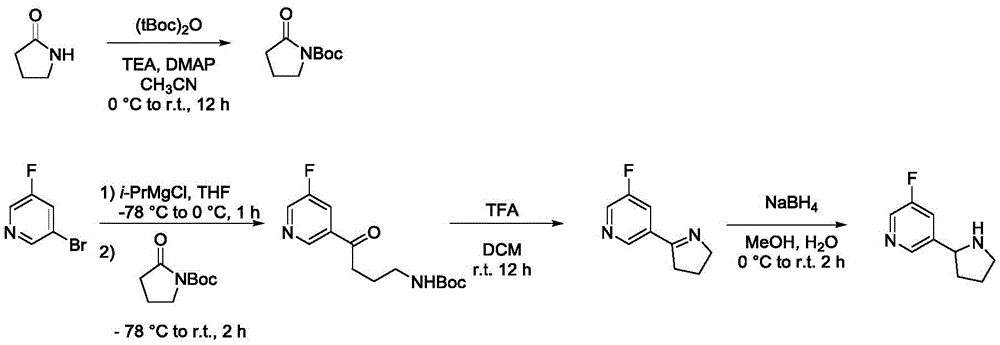
中间体化合物1:3-氟-5-(吡咯烷-2-基)吡啶Intermediate Compound 1: 3-Fluoro-5-(pyrrolidin-2-yl)pyridine

步骤A:2-氧代吡咯烷-1-羧酸叔丁酯Step A: tert-Butyl 2-oxopyrrolidine-1-carboxylate

在0℃下,向吡咯烷-2-酮(10.0g,118mmol)的CH3CN(118mL)溶液中加入TEA(19.6mL,141mmol)、DMAP(7.18g,58.8mmol)和(t-Boc)2O(32.7mL,141mmol)。将反应混合物在室温下搅拌过夜,然后在EtOAc和水之间分层。用1N的HCl水溶液、1N的NaOH水溶液和盐水洗涤分离的有机层,在Na2SO4上干燥,过滤并真空浓缩。残留物通过SiO2柱色谱纯化(Hex:EtOAc=1:1),产生淡黄色油状物形式的2-氧代吡咯烷-1-羧酸叔丁酯(21.0g,96%)。1H-NMR(CDCl3,瓦里安,400MHz):δ1.53(9H,s),2.00(2H,五重峰,J=8.0Hz),2.52(2H,t,J=8.0Hz),3.75(2H,t,J=7.6Hz)。To a solution of pyrrolidin-2-one (10.0 g, 118 mmol) in CH3CN (118 mL) at 0 °C was added TEA (19.6 mL, 141 mmol), DMAP (7.18 g, 58.8 mmol) and (t-Boc) 2 O (32.7 mL, 141 mmol). The reaction mixture was stirred at room temperature overnight, then partitioned between EtOAc and water. The separated organic layer was washed with 1N aqueous HCl, 1N aqueous NaOH and brine, dried over Na2SO4 , filtered and concentrated in vacuo. The residue was purified by SiO2 column chromatography (Hex:EtOAc=1:1) to yield tert-butyl 2-oxopyrrolidine-1-carboxylate (21.0 g, 96%) as a pale yellow oil. 1 H-NMR (CDCl 3 , Varian, 400 MHz): δ 1.53 (9H, s), 2.00 (2H, quintet, J=8.0 Hz), 2.52 (2H, t, J=8.0 Hz), 3.75 (2H, t, J=7.6 Hz).
步骤B:4-(5-氟吡啶-3-基)-4-氧代丁基氨基甲酸叔丁酯Step B: tert-butyl 4-(5-fluoropyridin-3-yl)-4-oxobutylcarbamate

在-78℃下,向3-溴-5-氟吡啶(4.26g,24.2mmol)的干燥THF(25mL)溶液中加入异丙基氯化镁(2.0M的THF溶液,14.5mL,29.0mmol)。将混合物缓慢升温至0℃,在0℃下搅拌1小时,然后冷却至-78℃。在-78℃下加入2-氧代吡咯烷-1-羧酸叔丁酯(5.38g,29.0mmol)的干燥THF(10mL)溶液后,使反应混合物升温至室温,在室温下搅拌2小时并用饱和NH4Cl水溶液淬灭。混合物用EtOAc萃取两次。用盐水洗涤合并的有机层,在Na2SO4上干燥,过滤并真空浓缩。残留物通过SiO2柱色谱纯化(Hex:EtOAc=2:1至1:1),产生黄色油状物形式的4-(5-氟吡啶-3-基)-4-氧代丁基氨基甲酸叔丁酯(4.73g,69%)。To a solution of 3-bromo-5-fluoropyridine (4.26 g, 24.2 mmol) in dry THF (25 mL) at -78 °C was added isopropylmagnesium chloride (2.0 M in THF, 14.5 mL, 29.0 mmol). The mixture was slowly warmed to 0°C, stirred at 0°C for 1 hour, then cooled to -78°C. After adding a solution of tert-butyl 2-oxopyrrolidine-1-carboxylate (5.38 g, 29.0 mmol) in dry THF (10 mL) at -78°C, the reaction mixture was warmed to room temperature, stirred at room temperature for 2 hours and added with Quenched with saturated aqueous NH4Cl . The mixture was extracted twice with EtOAc. The combined organic layers were washed with brine, dried over Na2SO4 , filtered and concentrated in vacuo. The residue was purified by SiO2 column chromatography (Hex:EtOAc = 2:1 to 1:1) to yield tert-4-(5-fluoropyridin-3-yl)-4-oxobutylcarbamate as a yellow oil Butyl ester (4.73 g, 69%).
步骤C:3-(3,4-二氢-2H-吡咯-5-基)-5-氟吡啶Step C: 3-(3,4-Dihydro-2H-pyrrol-5-yl)-5-fluoropyridine

在0℃下,向4-(5-氟吡啶-3-基)-4-氧代丁基氨基甲酸叔丁酯(4.73g,16.7mmol)的DCM(17mL)溶液中加入TFA(6.45mL,84mmol)。将反应混合物在室温下搅拌12小时,然后真空浓缩。将残留物用EtOAc稀释,用饱和NaHCO3水溶液洗涤,在Na2SO4上干燥,过滤并真空浓缩,产生黄色固体形式的3-(3,4-二氢-2H-吡咯-5-基)-5-氟吡啶(1.83g,66.5%),在不对其进一步纯化的情况下,将其用于下一步反应。1H-NMR(CDCl3,瓦里安,400MHz):δ2.10(2H,五重峰,J=8.0Hz),2.96(2H,t,J=8.4Hz),4.10(2H,t,J=7.6Hz),7.94(1H,d,J=9.2Hz),8.53(1H,d,J=2.4Hz),8.79(1H,s)。To a solution of tert-butyl 4-(5-fluoropyridin-3-yl)-4-oxobutylcarbamate (4.73 g, 16.7 mmol) in DCM (17 mL) was added TFA (6.45 mL, 84 mmol). The reaction mixture was stirred at room temperature for 12 hours, then concentrated in vacuo. The residue was diluted with EtOAc, washed with saturated aqueous NaHCO 3 , dried over Na 2 SO 4 , filtered and concentrated in vacuo to yield 3-(3,4-dihydro-2H-pyrrol-5-yl) as a yellow solid -5-Fluoropyridine (1.83 g, 66.5%) was used in the next reaction without further purification. 1 H-NMR (CDCl 3 , Varian, 400 MHz): δ 2.10 (2H, quintet, J=8.0 Hz), 2.96 (2H, t, J=8.4 Hz), 4.10 (2H, t, J =7.6Hz), 7.94(1H,d,J=9.2Hz), 8.53(1H,d,J=2.4Hz), 8.79(1H,s).
步骤D:3-氟-5-(吡咯烷-2-基)吡啶Step D: 3-Fluoro-5-(pyrrolidin-2-yl)pyridine

在0℃下,向3-(3,4-二氢-2H-吡咯-5-基)-5-氟吡啶(1.83g,11.1mmol)的MeOH(16mL)和水(4.0mL)溶液中分批加入硼氢化钠(0.843g,22.3mmol)。将反应混合物在室温下搅拌2小时,然后用2N的HCl水溶液淬灭。在蒸发MeOH后,将残留物用1N的NaOH水溶液碱化并用DCM萃取两次。将合并的有机层在Na2SO4上干燥,过滤并真空浓缩,产生黄色油状物形式的3-氟-5-(吡咯烷-2-基)吡啶(1.62g,87%)。1H-NMR(CDCl3,瓦里安,400MHz):δ1.60-1.69(1H,m),1.81-1.98(3H,m),2.20-2.29(1H,m),3.03-3.10(1H,m),3.15-3.20(1H,m),4.22(1H,t,J=7.6Hz),7.49(1H,d,J=10.0Hz),8.32(1H,d,J=2.4Hz),8.40(1H,s)。To a solution of 3-(3,4-dihydro-2H-pyrrol-5-yl)-5-fluoropyridine (1.83 g, 11.1 mmol) in MeOH (16 mL) and water (4.0 mL) at 0 °C was partitioned Sodium borohydride (0.843 g, 22.3 mmol) was added in portions. The reaction mixture was stirred at room temperature for 2 hours and then quenched with 2N aqueous HCl. After evaporation of MeOH, the residue was basified with IN aqueous NaOH and extracted twice with DCM. The combined organic layers were dried over Na2SO4 , filtered and concentrated in vacuo to yield 3-fluoro-5-(pyrrolidin-2-yl)pyridine (1.62 g, 87%) as a yellow oil. 1 H-NMR (CDCl 3 , Varian, 400MHz): δ 1.60-1.69(1H,m), 1.81-1.98(3H,m), 2.20-2.29(1H,m), 3.03-3.10(1H, m),3.15-3.20(1H,m),4.22(1H,t,J=7.6Hz),7.49(1H,d,J=10.0Hz),8.32(1H,d,J=2.4Hz),8.40( 1H,s).
实施例2:中间体化合物2的制备Example 2: Preparation of Intermediate Compound 2

中间体化合物2:2-(2,5-二氟苯基)吡咯烷Intermediate compound 2: 2-(2,5-difluorophenyl)pyrrolidine

步骤A:4-(2,5-二氟苯基)-4-氧代丁基氨基甲酸叔丁酯Step A: tert-butyl 4-(2,5-difluorophenyl)-4-oxobutylcarbamate

在-78℃下,向2-溴-1,4-二氟苯(5.81mL,51.8mmol)的干燥THF(50mL)溶液中加入异丙基氯化镁(2.0M的THF溶液,31.1mL,62.2mmol)。将混合物缓慢升温至0℃,在该温度下搅拌1小时,然后再次冷却至-78℃。在-78℃下加入2-氧代吡咯烷-1-羧酸叔丁酯(11.5g,62.2mmol)的干燥THF(20mL)溶液后,伴随搅拌2小时使反应混合物升温至室温并用饱和NH4Cl水溶液淬灭。混合物用EtOAc萃取两次。将合并的有机层用盐水洗涤,在Na2SO4上干燥,过滤并真空浓缩,产生淡绿色油状物形式的4-(2,5-二氟苯基)-4-氧代丁基氨基甲酸叔丁基酯(15.5g,100%),在不对其进一步纯化的情况下,将其用于下一步反应。To a solution of 2-bromo-1,4-difluorobenzene (5.81 mL, 51.8 mmol) in dry THF (50 mL) at -78 °C was added isopropylmagnesium chloride (2.0 M in THF, 31.1 mL, 62.2 mmol) ). The mixture was slowly warmed to 0°C, stirred at this temperature for 1 hour, and then cooled again to -78°C. After adding a solution of tert-butyl 2-oxopyrrolidine-1-carboxylate (11.5 g, 62.2 mmol) in dry THF (20 mL) at -78 °C, the reaction mixture was warmed to room temperature with stirring for 2 h and washed with saturated NH4 Aqueous Cl is quenched. The mixture was extracted twice with EtOAc. The combined organic layers were washed with brine, dried over Na2SO4 , filtered and concentrated in vacuo to yield 4- (2,5-difluorophenyl)-4-oxobutylcarbamate as a pale green oil tert-Butyl ester (15.5 g, 100%) was used in the next reaction without further purification.
步骤B:5-(2,5-二氟苯基)-3,4-二氢-2H-吡咯Step B: 5-(2,5-Difluorophenyl)-3,4-dihydro-2H-pyrrole

在0℃下,向4-(2,5-二氟苯基)-4-氧代丁基氨基甲酸叔丁酯(15.5g,51.8mmol)的DCM(52mL)溶液中加入TFA(19.9mL,259mmol)。将反应混合物在室温下搅拌12小时,然后真空浓缩。将残留物用EtOAc稀释,用饱和NaHCO3水溶液洗涤,在Na2SO4上干燥,过滤并真空浓缩,产生淡红色油状物形式的5-(2,5-二氟苯基)-3,4-二氢-2H-吡咯(6.17g,65.8%),在不对其进一步纯化的情况下,将其用于下一步反应。1H-NMR(CDCl3,瓦里安,400MHz):δ2.00-2.08(2H,m),2.97-3.02(2H,m),3.99-4.04(2H,m),7.04-7.08(2H,m),7.64-7.68(1H,m)。To a solution of tert-butyl 4-(2,5-difluorophenyl)-4-oxobutylcarbamate (15.5 g, 51.8 mmol) in DCM (52 mL) was added TFA (19.9 mL, 259 mmol). The reaction mixture was stirred at room temperature for 12 hours, then concentrated in vacuo. The residue was diluted with EtOAc, washed with saturated aqueous NaHCO 3 , dried over Na 2 SO 4 , filtered and concentrated in vacuo to yield 5-(2,5-difluorophenyl)-3,4 as a pale red oil - Dihydro-2H-pyrrole (6.17 g, 65.8%), which was used in the next reaction without further purification. 1 H-NMR (CDCl 3 , Varian, 400MHz): δ 2.00-2.08(2H,m), 2.97-3.02(2H,m), 3.99-4.04(2H,m), 7.04-7.08(2H,m) m), 7.64-7.68 (1H, m).
步骤C:2-(2,5-二氟苯基)吡咯烷Step C: 2-(2,5-Difluorophenyl)pyrrolidine

在0℃下,向5-(2,5-二氟苯基)-3,4-二氢-2H-吡咯(6.17g,34.1mmol)的MeOH(60mL)和水(15mL)溶液中分批加入硼氢化钠(2.58g,68.1mmol)。将反应混合物在室温下搅拌2小时,然后用2N的HCl水溶液淬灭。在蒸发MeOH后,将残留物用1N的NaOH水溶液碱化并用DCM萃取两次。将合并的有机层在Na2SO4上干燥,过滤并真空浓缩,产生黄色油状物形式的2-(2,5-二氟苯基)吡咯烷(5.94g,95%)。1H-NMR(CDCl3,瓦里安,400MHz):δ1.56-1.65(1H,m),1.78-1.94(3H,m),2.21-2.30(1H,m),3.01-3.08(1H,m),3.13-3.18(1H,m),4.40(1H,t,J=7.2Hz),6.82-6.88(1H,m),6.91-6.97(1H,m),7.22-7.26(1H,m)。To a solution of 5-(2,5-difluorophenyl)-3,4-dihydro-2H-pyrrole (6.17 g, 34.1 mmol) in MeOH (60 mL) and water (15 mL) portionwise at 0 °C Sodium borohydride (2.58 g, 68.1 mmol) was added. The reaction mixture was stirred at room temperature for 2 hours and then quenched with 2N aqueous HCl. After evaporation of MeOH, the residue was basified with IN aqueous NaOH and extracted twice with DCM. The combined organic layers were dried over Na2SO4 , filtered and concentrated in vacuo to yield 2-(2,5-difluorophenyl)pyrrolidine (5.94 g, 95%) as a yellow oil. 1 H-NMR (CDCl 3 , Varian, 400MHz): δ 1.56-1.65(1H,m), 1.78-1.94(3H,m), 2.21-2.30(1H,m), 3.01-3.08(1H, m), 3.13-3.18(1H,m), 4.40(1H,t,J=7.2Hz), 6.82-6.88(1H,m), 6.91-6.97(1H,m), 7.22-7.26(1H,m) .
实施例3:中间体化合物3的制备Example 3: Preparation of Intermediate Compound 3

中间体化合物3:5-氟-2-甲氧基-3-(吡咯烷-2-基)吡啶Intermediate Compound 3: 5-Fluoro-2-methoxy-3-(pyrrolidin-2-yl)pyridine

步骤A:2-(丁-3-炔)异吲哚啉-1,3-二酮Step A: 2-(But-3-ynyl)isoindoline-1,3-dione

在0℃下在10分钟内向苯邻二甲酰亚胺(10.0g,68.0mmol)、丁-3-炔-1-醇(5.24g,74.8mmol)和三苯基膦(19.6g,74.8mmol)的甲苯(136mL)溶液中缓慢加入DIAD(15.8mL,82.0mmol)。将反应混合物在室温下搅拌1小时。在加入MeOH(50mL)后,将混合物搅拌30分钟。通过过滤收集沉淀的固体并用MeOH洗涤。将滤液真空浓缩并用MeOH研磨残留的固体,通过过滤收集,产生白色固体形式的2-(丁-3-炔)异吲哚啉-1,3-二酮(10.9g,81%)。1H-NMR(DMSO-d6,瓦里安,400MHz):δ2.52(2H,dt,J=7.2,2.4Hz),2.78-2.80(1H,m),3.68(2H,t,J=6.8Hz),7.80-7.86(4H,m)。To phthalimide (10.0 g, 68.0 mmol), but-3-yn-1-ol (5.24 g, 74.8 mmol) and triphenylphosphine (19.6 g, 74.8 mmol) at 0 °C in 10 min ) in toluene (136 mL) was slowly added DIAD (15.8 mL, 82.0 mmol). The reaction mixture was stirred at room temperature for 1 hour. After the addition of MeOH (50 mL), the mixture was stirred for 30 minutes. The precipitated solid was collected by filtration and washed with MeOH. The filtrate was concentrated in vacuo and the residual solid was triturated with MeOH and collected by filtration to yield 2-(but-3-ynyl)isoindoline-1,3-dione (10.9 g, 81%) as a white solid. 1 H-NMR (DMSO-d 6 , Varian, 400 MHz): δ 2.52 (2H, dt, J=7.2, 2.4 Hz), 2.78-2.80 (1H, m), 3.68 (2H, t, J= 6.8Hz), 7.80-7.86 (4H, m).
步骤B:2-(4-(5-氟-2-甲氧基吡啶-3-基)丁-3-炔)异吲哚啉-1,3-二酮Step B: 2-(4-(5-Fluoro-2-methoxypyridin-3-yl)but-3-ynyl)isoindoline-1,3-dione

用氩气将3-溴-5-氟-2-甲氧基吡啶(4.00g,19.4mmol)、2-(丁-3-炔)异吲哚啉-1,3-二酮(3.87g,19.4mmol)和TEA(10.8mL,78mmol)的DMF(40mL)溶液脱气。在加入Pd(PPh3)4(1.12g,0.971mmol)和CuI(0.370g,1.94mmol)后,将反应混合物在90℃下加热2小时并冷却至室温。在加入MeOH后,通过过滤收集沉淀的固体。将固体用MeOH洗涤并在真空下干燥,产生白色绒毛状固体形式的2-(4-(5-氟-2-甲氧基吡啶-3-基)丁-3-炔)异吲哚啉-1,3-二酮(5.80g,92%)。1H-NMR(CDCl3,瓦里安,400MHz):δ2.90(2H,t,J=6.8Hz),3.85(3H,s),3.99(2H,t,J=6.8Hz),7.34(1H,dd,J=7.6,2.4Hz),7.73-7.75(2H,m),7.87-7.89(3H,m)。3-Bromo-5-fluoro-2-methoxypyridine (4.00 g, 19.4 mmol), 2-(but-3-yn)isoindoline-1,3-dione (3.87 g, 2-(but-3-yn)isoindoline-1,3-dione (3.87 g, 19.4 mmol) and TEA (10.8 mL, 78 mmol) in DMF (40 mL) were degassed. After addition of Pd( PPh3 ) 4 (1.12 g, 0.971 mmol) and CuI (0.370 g, 1.94 mmol), the reaction mixture was heated at 90°C for 2 hours and cooled to room temperature. After addition of MeOH, the precipitated solid was collected by filtration. The solid was washed with MeOH and dried under vacuum to yield 2-(4-(5-fluoro-2-methoxypyridin-3-yl)but-3-yn)isoindoline- as a white fluffy solid- 1,3-Dione (5.80 g, 92%). 1 H-NMR (CDCl 3 , Varian, 400 MHz): δ 2.90 (2H, t, J=6.8 Hz), 3.85 (3H, s), 3.99 (2H, t, J=6.8 Hz), 7.34 ( 1H, dd, J=7.6, 2.4 Hz), 7.73-7.75 (2H, m), 7.87-7.89 (3H, m).
步骤C:4-(5-氟-2-甲氧基吡啶-3-基)丁-3-炔-1-胺Step C: 4-(5-Fluoro-2-methoxypyridin-3-yl)but-3-yn-1-amine

在室温下,向2-(4-(5-氟-2-甲氧基吡啶-3-基)丁-3-炔)异吲哚啉-1,3-二酮(6.44g,19.8mmol)的MeOH(20mL)和DCM(100mL)溶液中加入肼(1.39mL,29.8mmol)。将反应混合物在室温下搅拌12小时,同时观察不溶的固体。将固体滤除并用DCM洗涤。滤液用水洗涤。水层用DCM萃取。将合并的有机层在Na2SO4上干燥,过滤并真空浓缩,产生黄色固体形式的4-(5-氟-2-甲氧基吡啶-3-基)丁-3-炔-1-胺(3.86g,100%),在不对其进一步纯化的情况下,将其用于下一步反应。1H-NMR(CDCl3,瓦里安,400MHz):δ1.41(2H,br.s),2.61(2H,t,J=6,4Hz),2.95(2H,t,J=6.4Hz),3.97(3H,s),7.40(1H,dd,J=8.0,2.8Hz),7.92(1H,d,J=2.8Hz)。To 2-(4-(5-fluoro-2-methoxypyridin-3-yl)but-3-yn)isoindoline-1,3-dione (6.44 g, 19.8 mmol) at room temperature To a solution of MeOH (20 mL) and DCM (100 mL) was added hydrazine (1.39 mL, 29.8 mmol). The reaction mixture was stirred at room temperature for 12 hours while insoluble solids were observed. The solids were filtered off and washed with DCM. The filtrate was washed with water. The aqueous layer was extracted with DCM. The combined organic layers were dried over Na2SO4 , filtered and concentrated in vacuo to yield 4-(5-fluoro-2-methoxypyridin-3-yl)but-3-yn-1-amine as a yellow solid (3.86 g, 100%), which was used in the next reaction without further purification. 1 H-NMR (CDCl 3 , Varian, 400 MHz): δ 1.41 (2H, br.s), 2.61 (2H, t, J=6, 4 Hz), 2.95 (2H, t, J=6.4 Hz) , 3.97(3H,s),7.40(1H,dd,J=8.0,2.8Hz),7.92(1H,d,J=2.8Hz).
步骤D:3-(3,4-二氢-2H-吡咯-5-基)-5-氟-2-甲氧基吡啶Step D: 3-(3,4-Dihydro-2H-pyrrol-5-yl)-5-fluoro-2-methoxypyridine

将4-(5-氟-2-甲氧基吡啶-3-基)丁-3-炔-1-胺(3.86g,19.8mmol)和PdCl2(35.0mg,0.199mmol)在CH3CN(50mL)和水(17mL)中的混合物在80℃下加热5小时并冷却至室温。在真空浓缩后,将残留物在DCM和水之间分层。水层用DCM萃取。将合并的有机层在Na2SO4上干燥,过滤并真空浓缩。残留物通过SiO2柱色谱纯化(Hex:EtOAc=5:1至3:1),产生黄色固体形式的3-(3,4-二氢-2H-吡咯-5-基)-5-氟-2-甲氧基吡啶(2.10g,54%)。1H-NMR(CDCl3,瓦里安,400MHz):δ2.01(2H,五重峰,J=7.6Hz),3.01(2H,t,J=7.6Hz),3.97(3H,s),3.99(2H,t,J=7.6Hz),7.92(1H,dd,J=8.4,2.8Hz),8.04(1H,d,J=2.8Hz)。4-(5-Fluoro-2-methoxypyridin-3-yl)but-3-yn-1-amine (3.86 g, 19.8 mmol) and PdCl 2 (35.0 mg, 0.199 mmol) in CH 3 CN ( A mixture of 50 mL) and water (17 mL) was heated at 80 °C for 5 h and cooled to room temperature. After concentration in vacuo, the residue was partitioned between DCM and water. The aqueous layer was extracted with DCM. The combined organic layers were dried over Na2SO4 , filtered and concentrated in vacuo. The residue was purified by SiO2 column chromatography (Hex:EtOAc = 5:1 to 3:1) to yield 3-(3,4-dihydro-2H-pyrrol-5-yl)-5-fluoro- as a yellow solid 2-Methoxypyridine (2.10 g, 54%). 1 H-NMR (CDCl 3 , Varian, 400 MHz): δ 2.01 (2H, quintet, J=7.6 Hz), 3.01 (2H, t, J=7.6 Hz), 3.97 (3H, s), 3.99 (2H, t, J=7.6Hz), 7.92 (1H, dd, J=8.4, 2.8Hz), 8.04 (1H, d, J=2.8Hz).
步骤E:5-氟-2-甲氧基-3-(吡咯烷-2-基)吡啶Step E: 5-Fluoro-2-methoxy-3-(pyrrolidin-2-yl)pyridine

在0℃下,向3-(3,4-二氢-2H-吡咯-5-基)-5-氟-2-甲氧基吡啶(500mg,2.57mmol)的MeOH(10mL)和水(2.5mL)的分散体中分批加入硼氢化钠(195mg,5.15mmol)。将反应混合物在室温下搅拌2小时,然后用2N的HCl水溶液淬灭。在蒸发MeOH后,将混合物用1N的NaOH水溶液碱化并用DCM萃取两次。将合并的有机层在Na2SO4上干燥,过滤并真空浓缩,产生黄色油状物形式的5-氟-2-甲氧基-3-(吡咯烷-2-基)吡啶(437mg,87%),在不对其进一步纯化的情况下,将其用于下一步反应。1H-NMR(CDCl3,瓦里安,400MHz):δ1.50-1.59(1H,m),1.79-1.87(2H,m),1.93(1H,br.s),2.20-2.28(1H,m),3.01-3.15(2H,m),3.93(3H,s),4.29(1H,t,J=7.6Hz),7.57(1H,dd,J=8.8,3.2Hz),7.83(1H,d,J=3.2Hz)。To 3-(3,4-dihydro-2H-pyrrol-5-yl)-5-fluoro-2-methoxypyridine (500 mg, 2.57 mmol) in MeOH (10 mL) and water (2.5 mmol) at 0 °C mL) was added portionwise sodium borohydride (195 mg, 5.15 mmol). The reaction mixture was stirred at room temperature for 2 hours and then quenched with 2N aqueous HCl. After evaporation of MeOH, the mixture was basified with 1 N aqueous NaOH and extracted twice with DCM. The combined organic layers were dried over Na2SO4 , filtered and concentrated in vacuo to yield 5-fluoro-2-methoxy-3-(pyrrolidin-2-yl)pyridine (437 mg, 87%) as a yellow oil ), which was used in the next reaction without further purification. 1 H-NMR (CDCl 3 , Varian, 400MHz): δ 1.50-1.59(1H,m), 1.79-1.87(2H,m), 1.93(1H, br.s), 2.20-2.28(1H, m),3.01-3.15(2H,m),3.93(3H,s),4.29(1H,t,J=7.6Hz),7.57(1H,dd,J=8.8,3.2Hz),7.83(1H,d , J=3.2Hz).
实施例4:中间体化合物4的制备Example 4: Preparation of Intermediate Compound 4
中间体化合物4:(R)-3-氟-5-(吡咯烷-2-基)吡啶Intermediate Compound 4: (R)-3-Fluoro-5-(pyrrolidin-2-yl)pyridine

步骤A:4-氯-N-甲氧基-N-甲基丁酰胺Step A: 4-Chloro-N-methoxy-N-methylbutanamide

在0℃下,用超过30分钟的时间,向4-氯丁酰氯(50.0g,355mmol)和N-MeO-N-甲胺HCl(34.6g,355mmol)的DCM(709mL)溶液中缓慢加入TEA(109mL,780mmol)。将反应混合物在0℃下搅拌3小时,然后用水(250mL)处理。用盐水洗涤分离的有机层,在Na2SO4上干燥,过滤并真空浓缩,产生黄色油状物形式的4-氯-N-甲氧基-N-甲基丁酰胺(55.0g,94%),在不对其进一步纯化的情况下,将其用于下一步反应。1H-NMR(CDCl3,瓦里安,400MHz):δ2.12(2H,五重峰,J=6.4Hz),2.63(2H,t,J=7.2Hz),3.19(3H,s),3.64(2H,t,J=6.4Hz),3.71(3H,s)。To a solution of 4-chlorobutyryl chloride (50.0 g, 355 mmol) and N-MeO-N-methylamine HCl (34.6 g, 355 mmol) in DCM (709 mL) was slowly added TEA over 30 min at 0 °C (109 mL, 780 mmol). The reaction mixture was stirred at 0°C for 3 hours, then treated with water (250 mL). The separated organic layer was washed with brine, dried over Na2SO4 , filtered and concentrated in vacuo to give 4 -chloro-N-methoxy-N-methylbutanamide (55.0 g, 94%) as a yellow oil , which was used in the next reaction without further purification. 1 H-NMR (CDCl 3 , Varian, 400 MHz): δ 2.12 (2H, quintet, J=6.4 Hz), 2.63 (2H, t, J=7.2 Hz), 3.19 (3H, s), 3.64(2H,t,J=6.4Hz), 3.71(3H,s).
步骤B:4-氯-1-(5-氟吡啶-3-基)丁烷-1-酮Step B: 4-Chloro-1-(5-fluoropyridin-3-yl)butan-1-one
在-78℃下,向3-溴-5-氟吡啶(30.0g,170mmol)的干燥THF(170mL)溶液中加入异丙基氯化镁(2.0M的THF,102mL,205mmol)。将混合物缓慢升温至0℃,在该温度下搅拌1小时,然后再次冷却至-78℃。在加入4-氯-N-甲氧基-N-甲基丁酰胺(31.1g,188mmol)的干燥THF(100mL)溶液后,伴随搅拌4小时使反应混合物升温至室温,并用饱和NH4Cl水溶液淬灭。混合物用EtOAc萃取两次。用盐水洗涤合并的有机层,在Na2SO4上干燥,过滤并真空浓缩。残留物通过SiO2柱色谱纯化(Hex:EtOAc=7:1至6:1),产生黄色油状物形式的4-氯-1-(5-氟吡啶-3-基)丁烷-1-酮(25.1g,125mmol,73%)。1H-NMR(CDCl3,瓦里安,400MHz):δ2.27(2H,五重峰,J=6.4Hz),3.22(2H,t,J=6.8Hz),3.70(2H,t,J=6.4Hz),7.93-7.97(1H,m),8.68(1H,d,J=3.2Hz),9.03(1H,t,J=1.6Hz)。To a solution of 3-bromo-5-fluoropyridine (30.0 g, 170 mmol) in dry THF (170 mL) at -78 °C was added isopropylmagnesium chloride (2.0 M in THF, 102 mL, 205 mmol). The mixture was slowly warmed to 0°C, stirred at this temperature for 1 hour, and then cooled again to -78°C. After addition of a solution of 4-chloro-N-methoxy-N-methylbutanamide (31.1 g, 188 mmol) in dry THF (100 mL), the reaction mixture was allowed to warm to room temperature with stirring for 4 hours and washed with saturated aqueous NH4Cl Quenched. The mixture was extracted twice with EtOAc. The combined organic layers were washed with brine, dried over Na2SO4 , filtered and concentrated in vacuo. The residue was purified by SiO2 column chromatography (Hex:EtOAc = 7:1 to 6:1) to yield 4-chloro-1-(5-fluoropyridin-3-yl)butan-1-one as a yellow oil (25.1 g, 125 mmol, 73%). 1 H-NMR (CDCl 3 , Varian, 400 MHz): δ 2.27 (2H, quintet, J=6.4 Hz), 3.22 (2H, t, J=6.8 Hz), 3.70 (2H, t, J =6.4Hz), 7.93-7.97(1H,m), 8.68(1H,d,J=3.2Hz), 9.03(1H,t,J=1.6Hz).
步骤C:(S,Z)-N-(4-氯-1-(5-氟吡啶-3-基)亚丁基)-2-甲基丙烷-2-亚磺酰胺。Step C: (S,Z)-N-(4-Chloro-1-(5-fluoropyridin-3-yl)butylene)-2-methylpropane-2-sulfinamide.

将4-氯-1-(5-氟吡啶-3-基)丁烷-1-酮(25.1g,125mmol)、(S)-2-甲基丙烷-2-亚磺酰胺(22.6g,187mmol)和四乙氧基钛(42.6g,187mmol)的THF(249mL)溶液在75℃下加热48小时,并冷却至室温。在加入EtOAc(100mL)和盐水(100mL)后,将所得混合物在室温下搅拌1小时。将沉淀的固体滤除并用EtOAc洗涤。滤液用水洗涤两次,在Na2SO4上干燥,过滤并真空浓缩。残留物通过SiO2柱色谱纯化(Hex:EtOAc=3:1to 2:1),产生黄色油状物形式的(S,Z)-N-(4-氯-1-(5-氟吡啶-3-基)亚丁基)-2-甲基丙烷-2-亚磺酰胺(30.0g,79%)。1H-NMR(CDCl3,瓦里安,400MHz):δ1.35(9H,s),2.09-2.26(2H,m),3.31-3.38(1H,m),3.44-3.51(1H,m),3.62-3.71(2H,m),7.87(1H,d,J=9.2Hz),8.59(1H,d,J=2.8Hz),8.92(1H,s)。Combine 4-chloro-1-(5-fluoropyridin-3-yl)butan-1-one (25.1 g, 125 mmol), (S)-2-methylpropane-2-sulfinamide (22.6 g, 187 mmol) ) and titanium tetraethoxide (42.6 g, 187 mmol) in THF (249 mL) was heated at 75 °C for 48 h and cooled to room temperature. After adding EtOAc (100 mL) and brine (100 mL), the resulting mixture was stirred at room temperature for 1 hour. The precipitated solid was filtered off and washed with EtOAc. The filtrate was washed twice with water, dried over Na2SO4 , filtered and concentrated in vacuo. The residue was purified by SiO2 column chromatography (Hex:EtOAc=3:1 to 2:1) to yield (S,Z)-N-(4-chloro-1-(5-fluoropyridine-3-) as a yellow oil yl)butylene)-2-methylpropane-2-sulfenamide (30.0 g, 79%). 1 H-NMR (CDCl 3 , Varian, 400MHz): δ 1.35(9H,s), 2.09-2.26(2H,m), 3.31-3.38(1H,m), 3.44-3.51(1H,m) , 3.62-3.71(2H,m), 7.87(1H,d,J=9.2Hz), 8.59(1H,d,J=2.8Hz), 8.92(1H,s).
步骤D:3-((R)-1-((S)-叔丁基亚磺酰基)-吡咯烷-2-基)-5-氟吡啶Step D: 3-((R)-1-((S)-tert-Butylsulfinyl)-pyrrolidin-2-yl)-5-fluoropyridine

在-78℃下,向(S,Z)-N-(4-氯-1-(5-氟吡啶-3-基)亚丁基)-2-甲基丙烷-2-亚磺酰胺(10.0g,32.8mmol)的干燥THF(131mL)溶液中加入超氢化物(1M的THF溶液,36.1mL,36.1mmol)。将反应混合物在-78℃下搅拌1小时,升温至室温并在室温下搅拌12小时。在用饱和NH4Cl水溶液淬灭后,将混合物用EtOAc萃取两次。将合并的有机层用水洗涤,在Na2SO4上干燥,过滤并真空浓缩。残留物通过SiO2柱色谱纯化(Hex:EtOAc=1:1至1:2至1:3至EtOAc),产生黄色油状物形式的3-((R)-1-((S)-叔丁基亚磺酰基)-吡咯烷-2-基)-5-氟吡啶(3.73g,42%)。1H-NMR(CDCl3,瓦里安,400MHz):δ1.13(9H,s),1.75-1.79(1H,m),1.79-2.04(2H,m),2.28-2.36(1H,m),2.97-3.03(1H,m),3.90-3.95(1H,m),4.71(1H,t,J=7.2Hz),7.33-7.36(1H,m),8.38-8.39(2H,m)。To (S,Z)-N-(4-chloro-1-(5-fluoropyridin-3-yl)butylene)-2-methylpropane-2-sulfinamide (10.0 g) at -78°C , 32.8 mmol) in dry THF (131 mL) was added superhydride (1M in THF, 36.1 mL, 36.1 mmol). The reaction mixture was stirred at -78°C for 1 hour, warmed to room temperature and stirred at room temperature for 12 hours. After quenching with saturated aqueous NH4Cl , the mixture was extracted twice with EtOAc. The combined organic layers were washed with water, dried over Na2SO4 , filtered and concentrated in vacuo. The residue was purified by SiO2 column chromatography (Hex:EtOAc = 1:1 to 1:2 to 1:3 to EtOAc) to yield 3-((R)-1-((S)-tert-butyl as a yellow oil) sulfinyl)-pyrrolidin-2-yl)-5-fluoropyridine (3.73 g, 42%). 1 H-NMR (CDCl 3 , Varian, 400MHz): δ 1.13(9H,s), 1.75-1.79(1H,m), 1.79-2.04(2H,m), 2.28-2.36(1H,m) , 2.97-3.03(1H,m), 3.90-3.95(1H,m), 4.71(1H,t,J=7.2Hz), 7.33-7.36(1H,m), 8.38-8.39(2H,m).
步骤E:(R)-3-氟-5-(吡咯烷-2-基)吡啶Step E: (R)-3-Fluoro-5-(pyrrolidin-2-yl)pyridine
在0℃下,向3-((R)-1-((S)-叔丁基亚磺酰基)-吡咯烷-2-基)-5-氟吡啶(7.47g,27.6mmol)的MeOH(55mL)溶液中加入HCl(4M的二氧六环溶液,34.5mL,138mmol)。将反应混合物在室温下搅拌12小时。在真空浓缩后,将残留物溶于水(100mL)中并用EtOAc(100mL)洗涤。用1N的NaOH水溶液(150mL)中和分离的水层,用DCM(100mL×3)萃取。将合并的有机层用盐水洗涤,在Na2SO4上干燥,过滤并真空浓缩,产生淡红色油状物形式的(R)-3-氟-5-(吡咯烷-2-基)吡啶(4.35g,95%)。1H-NMR(CDCl3,瓦里安,400MHz):δ1.60-1.69(1H,m),1.83-1.97(3H,m),2.20-2.29(1H,m),3.04-3.10(1H,m),3.15-3.21(1H,m),4.23(1H,t,J=7.6Hz),7.47-7.51(1H,m),8.33(1H,d,J=2.8Hz),8.40(1H,s)。To 3-((R)-1-((S)-tert-butylsulfinyl)-pyrrolidin-2-yl)-5-fluoropyridine (7.47 g, 27.6 mmol) in MeOH ( 55 mL) solution was added HCl (4M in dioxane, 34.5 mL, 138 mmol). The reaction mixture was stirred at room temperature for 12 hours. After concentration in vacuo, the residue was dissolved in water (100 mL) and washed with EtOAc (100 mL). The separated aqueous layer was neutralized with 1N aqueous NaOH (150 mL) and extracted with DCM (100 mL x 3). The combined organic layers were washed with brine, dried over Na2SO4 , filtered and concentrated in vacuo to yield (R)-3-fluoro-5-(pyrrolidin-2-yl)pyridine (4.35 g) as a pale red oil g, 95%). 1 H-NMR (CDCl 3 , Varian, 400 MHz): δ 1.60-1.69(1H,m), 1.83-1.97(3H,m), 2.20-2.29(1H,m), 3.04-3.10(1H, m),3.15-3.21(1H,m),4.23(1H,t,J=7.6Hz),7.47-7.51(1H,m),8.33(1H,d,J=2.8Hz),8.40(1H,s ).
实施例5:中间体化合物5的制备Example 5: Preparation of Intermediate Compound 5

中间体化合物5:(R)-2-(2,5-二氟苯基)吡咯烷Intermediate compound 5: (R)-2-(2,5-difluorophenyl)pyrrolidine
步骤A:4-氯-1-(2,5-二氟苯基)丁烷-1-酮Step A: 4-Chloro-1-(2,5-difluorophenyl)butan-1-one

在-78℃下,向2-溴-1,4-二氟苯(30.0g,155mmol)的干燥THF(155mL)溶液中加入异丙基氯化镁(2M的THF溶液,93.0mL,187mmol)。将混合物缓慢升温至0℃,在该温度下搅拌1小时,然后再次冷却至-78℃。在加入4-氯-N-甲氧基-N-甲基丁酰胺(28.3g,171mmol)的THF(100mL)溶液后,伴随搅拌4小时使反应混合物升温至室温时间,并用饱和NH4Cl水溶液淬灭。混合物用EtOAc萃取两次。用盐水洗涤合并的有机层,在Na2SO4上干燥,过滤并真空浓缩。残留物通过SiO2柱色谱纯化(Hex:EtOAc=7:1至6:1),产生淡黄色油状物形式的4-氯-1-(2,5-二氟苯基)丁烷-1-酮(13.3g,39%)。1H-NMR(CDCl3,瓦里安,400MHz):δ2.22(2H,五重峰,J=6.8Hz),3.16-3.20(2H,m),3.67(2H,t,J=6.4Hz),7.11-7.17(1H,m),7.20-7.26(1H,m),7.55-7.59(1H,m)。To a solution of 2-bromo-1,4-difluorobenzene (30.0 g, 155 mmol) in dry THF (155 mL) at -78 °C was added isopropylmagnesium chloride (2M in THF, 93.0 mL, 187 mmol). The mixture was slowly warmed to 0°C, stirred at this temperature for 1 hour, and then cooled again to -78°C. After the addition of 4-chloro-N-methoxy-N-methylbutanamide (28.3 g, 171 mmol) in THF (100 mL), the reaction mixture was allowed to warm to room temperature over a period of 4 hours with stirring and washed with saturated aqueous NH4Cl Quenched. The mixture was extracted twice with EtOAc. The combined organic layers were washed with brine, dried over Na2SO4 , filtered and concentrated in vacuo. The residue was purified by SiO2 column chromatography (Hex:EtOAc=7:1 to 6:1) to yield 4-chloro-1-(2,5-difluorophenyl)butane-1- as a pale yellow oil Ketone (13.3 g, 39%). 1 H-NMR (CDCl 3 , Varian, 400 MHz): δ 2.22 (2H, quintet, J=6.8 Hz), 3.16-3.20 (2H, m), 3.67 (2H, t, J=6.4 Hz) ), 7.11-7.17(1H,m), 7.20-7.26(1H,m), 7.55-7.59(1H,m).
步骤B:(S,Z)-N-(4-氯-1-(2,5-二氟苯基)亚丁基)-2-甲基丙烷-2-亚磺酰胺Step B: (S,Z)-N-(4-Chloro-1-(2,5-difluorophenyl)butylene)-2-methylpropane-2-sulfinamide

将4-氯-1-(2,5-二氟苯基)丁烷-1-酮(16.4g,75.0mmol)、(S)-2-甲基丙烷-2-亚磺酰胺(13.6g,113mmol)和四乙氧基钛(25.7g,113mmol)的THF(150mL)溶液在75℃下加热48小时,并冷却至室温。在加入EtOAc(50mL)和盐水(50mL)后,将所得混合物在室温下剧烈搅拌1小时。将沉淀的固体滤除并用EtOAc洗涤。滤液用水洗涤两次,在Na2SO4上干燥,过滤并真空浓缩。残留物通过SiO2柱色谱纯化(Hex:EtOAc=3:1至2:1),产生黄色油状物形式的(S,Z)-N-(4-氯-1-(2,5-二氟苯基)亚丁基)-2-甲基丙烷-2-亚磺酰胺(16.3g,67%)。1H-NMR(DMSO-d6,瓦里安,400MHz):δ1.15和1.21(9H,s和s),1.86-2.12(2H,m),2.78-3.30(2H,m),3.60-3.76(2H,m),7.20-7.60(3H,m)。4-Chloro-1-(2,5-difluorophenyl)butan-1-one (16.4 g, 75.0 mmol), (S)-2-methylpropane-2-sulfinamide (13.6 g, 113 mmol) and titanium tetraethoxide (25.7 g, 113 mmol) in THF (150 mL) was heated at 75 °C for 48 h and cooled to room temperature. After the addition of EtOAc (50 mL) and brine (50 mL), the resulting mixture was vigorously stirred at room temperature for 1 hour. The precipitated solid was filtered off and washed with EtOAc. The filtrate was washed twice with water, dried over Na2SO4 , filtered and concentrated in vacuo. The residue was purified by SiO2 column chromatography (Hex:EtOAc = 3:1 to 2:1) to yield (S,Z)-N-(4-chloro-1-(2,5-difluoro) as a yellow oil Phenyl)butylene)-2-methylpropane-2-sulfinamide (16.3 g, 67%). 1 H-NMR (DMSO-d 6 , Varian, 400 MHz): δ 1.15 and 1.21 (9H, s and s), 1.86-2.12 (2H, m), 2.78-3.30 (2H, m), 3.60- 3.76(2H,m), 7.20-7.60(3H,m).
步骤C:(R)-1-((S)-叔丁基亚磺酰基)-2-(2,5-二氟苯基)吡咯烷Step C: (R)-1-((S)-tert-Butylsulfinyl)-2-(2,5-difluorophenyl)pyrrolidine

在-78℃下,向(S,Z)-N-(4-氯-1-(2,5-二氟苯基)亚丁基)-2-甲基丙烷-2-亚磺酰胺(16.3g,50.7mmol)的干燥THF(203mL)溶液中加入超氢化物(1M的THF溶液,55.7mL,55.7mmol)。将反应混合物在-78℃下搅拌1小时,升温至室温并在室温下搅拌12小时。在用饱和NH4Cl水溶液淬灭后,将混合物用EtOAc萃取。将分离的有机层用水洗涤,在Na2SO4上干燥,过滤并真空浓缩。残留物通过SiO2柱色谱纯化(Hex:EtOAc=6:1至5:1至4:1),产生黄色油状物形式的(R)-1-((S)-叔丁基亚磺酰基)-2-(2,5-二氟苯基)吡咯烷(8.60g,59%)。1H-NMR(CDCl3,瓦里安,400MHz):δ1.15(9H,s),1.75-1.80(1H,m),1.82-1.98(2H,m),2.24-2.32(1H,m),2.95-3.01(1H,m),3.87-3.93(1H,m),4.96(1H,t,J=7.2Hz),6.87-6.93(1H,m),6.95-7.06(2H,m)。To (S,Z)-N-(4-chloro-1-(2,5-difluorophenyl)butylene)-2-methylpropane-2-sulfinamide (16.3g) at -78°C , 50.7 mmol) in dry THF (203 mL) was added superhydride (1 M in THF, 55.7 mL, 55.7 mmol). The reaction mixture was stirred at -78°C for 1 hour, warmed to room temperature and stirred at room temperature for 12 hours. After quenching with saturated aqueous NH4Cl , the mixture was extracted with EtOAc. The separated organic layer was washed with water, dried over Na2SO4 , filtered and concentrated in vacuo. The residue was purified by SiO2 column chromatography (Hex:EtOAc = 6:1 to 5:1 to 4:1) to yield (R)-1-((S)-tert-butylsulfinyl)- as a yellow oil 2-(2,5-Difluorophenyl)pyrrolidine (8.60 g, 59%). 1 H-NMR (CDCl 3 , Varian, 400MHz): δ 1.15(9H,s), 1.75-1.80(1H,m), 1.82-1.98(2H,m), 2.24-2.32(1H,m) , 2.95-3.01(1H,m), 3.87-3.93(1H,m), 4.96(1H,t,J=7.2Hz), 6.87-6.93(1H,m), 6.95-7.06(2H,m).
步骤D:(R)-2-(2,5-二氟苯基)吡咯烷Step D: (R)-2-(2,5-Difluorophenyl)pyrrolidine
在0℃下,向(R)-1-((S)-叔丁基亚磺酰基)-2-(2,5-二氟苯基)吡咯烷(8.60g,29.9mmol)的MeOH(60mL)溶液中加入HCl(4M的二氧六环溶液,37.4mL,150mmol)。将反应混合物在室温下搅拌12小时。在真空浓缩后,将残留物溶于水(100mL)中并用EtOAc(100mL)洗涤。用1N的NaOH水溶液(150mL)中和分离的水层,用DCM(100mL×3)萃取。将合并的有机层用盐水洗涤,在Na2SO4上干燥,过滤并真空浓缩,产生淡红色油状物形式的(R)-2-(2,5-二氟苯基)吡咯烷(5.06g,92%)。1H-NMR(CDCl3,瓦里安,400MHz):δ1.56-1.65(1H,m),1.78-1.93(3H,m),2.21-2.30(1H,m),3.01-3.08(1H,m),3.13-3.18(1H,m),4.39(1H,t,J=7.6Hz),6.82-6.88(1H,m),6.91-6.97(1H,m),7.22-7.26(1H,m)。To (R)-1-((S)-tert-butylsulfinyl)-2-(2,5-difluorophenyl)pyrrolidine (8.60 g, 29.9 mmol) in MeOH (60 mL) at 0 °C ) solution was added HCl (4M in dioxane, 37.4 mL, 150 mmol). The reaction mixture was stirred at room temperature for 12 hours. After concentration in vacuo, the residue was dissolved in water (100 mL) and washed with EtOAc (100 mL). The separated aqueous layer was neutralized with 1N aqueous NaOH (150 mL) and extracted with DCM (100 mL x 3). The combined organic layers were washed with brine, dried over Na2SO4 , filtered and concentrated in vacuo to yield (R)-2-(2,5-difluorophenyl)pyrrolidine (5.06 g) as a pale red oil , 92%). 1 H-NMR (CDCl 3 , Varian, 400MHz): δ 1.56-1.65(1H,m), 1.78-1.93(3H,m), 2.21-2.30(1H,m), 3.01-3.08(1H,m) m), 3.13-3.18(1H,m), 4.39(1H,t,J=7.6Hz), 6.82-6.88(1H,m), 6.91-6.97(1H,m), 7.22-7.26(1H,m) .
实施例6:中间体化合物6和7的制备Example 6: Preparation of intermediate compounds 6 and 7

中间体化合物6和7:(2R,4S)-2-(2,5-二氟苯基)-4-氟吡咯烷(6)和(2S,4S)-2-(2,5-二氟苯基)-4-氟吡咯烷(7)Intermediate compounds 6 and 7: (2R,4S)-2-(2,5-difluorophenyl)-4-fluoropyrrolidine (6) and (2S,4S)-2-(2,5-difluoro Phenyl)-4-fluoropyrrolidine (7)

步骤A:(R)-4-(叔丁基二甲基甲硅烷氧基)吡咯烷-2-酮Step A: (R)-4-(tert-Butyldimethylsilyloxy)pyrrolidin-2-one

在0℃下,向(R)-4-羟基吡咯烷-2-酮(5.00g,49.5mmol)的DMF(24mL)溶液中加入TBSCl(7.83g,51.9mmol)和咪唑(5.05g,74.2mmol)。将反应混合物在室温下搅拌3小时并倾倒在冰水中。通过过滤收集沉淀的固体并在真空下干燥,产生白色固体形式的(R)-4-(叔丁基二甲基甲硅烷氧基)吡咯烷-2-酮(9.64g,91%)。1H-NMR(CDCl3,瓦里安400MHz):δ0.07(6H,s),0.89(9H,s),2.27和2.54(2H,ABq,JAB=16.8Hz),3.24和3.59(2H,ABq,JAB=9.8Hz),4.53-4.58(1H,m),6.25(1H,s)。To a solution of (R)-4-hydroxypyrrolidin-2-one (5.00 g, 49.5 mmol) in DMF (24 mL) at 0 °C was added TBSCl (7.83 g, 51.9 mmol) and imidazole (5.05 g, 74.2 mmol) ). The reaction mixture was stirred at room temperature for 3 hours and poured into ice water. The precipitated solid was collected by filtration and dried under vacuum to yield (R)-4-(tert-butyldimethylsilyloxy)pyrrolidin-2-one (9.64 g, 91%) as a white solid. 1 H-NMR (CDCl 3 , Varian 400MHz): δ 0.07 (6H,s), 0.89 (9H,s), 2.27 and 2.54 (2H, ABq, J AB = 16.8 Hz), 3.24 and 3.59 (2H , ABq, J AB =9.8Hz), 4.53-4.58(1H,m), 6.25(1H,s).
步骤B:(R)-4-(叔丁基二甲基甲硅烷氧基)-2-氧代吡咯烷-1-羧酸叔丁酯Step B: (R)-tert-Butyl 4-(tert-butyldimethylsilyloxy)-2-oxopyrrolidine-1-carboxylate

在0℃下,向(R)-4-(叔丁基二甲基甲硅烷氧基)吡咯烷-2-酮(9.64g,44.8mmol)的CH3CN(90mL)溶液中加入TEA(7.49mL,53.7mmol)、DMAP(5.47g,44.8mmol)和(t-Boc)2O(12.5mL,53.7mmol)。将反应混合物在室温下搅拌过夜,然后在EtOAc和水之间分层。将分离的有机层用饱和NH4Cl水溶液和盐水洗涤,在Na2SO4上干燥,过滤并真空浓缩。残留物通过SiO2柱色谱纯化(Hex:EtOAc=3:1),产生淡褐色固体形式的(R)-4-(叔丁基二甲基甲硅烷氧基)-2-氧代吡咯烷-1-羧酸叔丁酯(13.4g,95%)。1H-NMR(CDCl3,瓦里安400MHz):δ0.077(3H,s),0.082(3H,s),0.88(9H,s),1.53(9H,s),2.47和2.71(2H,ABq,JAB=17.4Hz),3.62和3.86(2H,ABq,JAB=11.3Hz),4.37-4.41(1H,m)。To a solution of (R)-4-(tert-butyldimethylsilyloxy)pyrrolidin-2-one (9.64 g, 44.8 mmol) in CH 3 CN (90 mL) was added TEA (7.49 mL) at 0 °C mL, 53.7 mmol), DMAP (5.47 g, 44.8 mmol) and (t - Boc)2O (12.5 mL, 53.7 mmol). The reaction mixture was stirred at room temperature overnight, then partitioned between EtOAc and water. The separated organic layer was washed with saturated aqueous NH4Cl and brine, dried over Na2SO4 , filtered and concentrated in vacuo. The residue was purified by SiO2 column chromatography (Hex:EtOAc = 3:1) to yield (R)-4-(tert-butyldimethylsilyloxy)-2-oxopyrrolidine- 1-Carboxylic acid tert-butyl ester (13.4 g, 95%). 1 H-NMR (CDCl 3 , Varian 400MHz): δ 0.077(3H,s), 0.082(3H,s), 0.88(9H,s), 1.53(9H,s), 2.47 and 2.71(2H, ABq, JAB = 17.4 Hz), 3.62 and 3.86 (2H, ABq, JAB = 11.3 Hz), 4.37-4.41 (1H, m).
步骤C:(2R)-2-(叔丁基二甲基甲硅烷氧基)-4-(2,5-二氟苯基)-4-羟基-丁基氨基甲酸叔丁酯Step C: (2R)-2-(tert-Butyldimethylsilyloxy)-4-(2,5-difluorophenyl)-4-hydroxy-butylcarbamate tert-butyl ester

在-78℃下,向2-溴-1,4-二氟苯(3.97mL,35.4mmol)的干燥THF(118mL)溶液中加入异丙基氯化镁(2.0M的THF溶液,21.2mL,42.5mmol)。将混合物缓慢升温至0℃,并在该温度下搅拌1小时,然后再次冷却至-78℃。在-78℃下加入(R)-4-(叔丁基二甲基甲硅烷氧基)-2-氧代吡咯烷-1-羧酸叔丁酯(13.4g,42.5mmol)的干燥THF(40mL)溶液后,伴随搅拌1小时使反应混合物升温至0℃。在0℃下加入MeOH(118mL)然后NaBH4(2.01g,53.1mmol)后,将所得混合物搅拌1小时,然后用饱和NH4Cl水溶液淬灭。混合物用EtOAc萃取两次。用盐水洗涤合并的有机层,在Na2SO4上干燥,过滤并真空浓缩。残留物通过SiO2柱色谱纯化(Hex:EtOAc=6:1),产生白色固体形式的(2R)-2-(叔丁基二甲基甲硅烷氧基)-4-(2,5-二氟苯基)-4-羟基丁基氨基甲酸叔丁酯(10.2g,67%)。1H-NMR(CDCl3,瓦里安400MHz):δ0.09-0.14(6H,m),0.91-0.93(9H,m),1.44(9H,s),1.73-1.93(2H,m),3.22-3.44(2H,m),3.66-3.83(1H,m),4.06-4.15(1H,m),4.81(1H,s),5.15-5.21(1H,m),6.87-6.97(2H,m),7.22-7.29(1H,m)。To a solution of 2-bromo-1,4-difluorobenzene (3.97 mL, 35.4 mmol) in dry THF (118 mL) at -78 °C was added isopropylmagnesium chloride (2.0 M in THF, 21.2 mL, 42.5 mmol) ). The mixture was slowly warmed to 0°C and stirred at this temperature for 1 hour, then cooled to -78°C again. A solution of (R)-tert-butyl 4-(tert-butyldimethylsilyloxy)-2-oxopyrrolidine-1-carboxylate (13.4 g, 42.5 mmol) in dry THF ( 40 mL) solution, the reaction mixture was warmed to 0°C with stirring for 1 hour. After adding MeOH (118 mL) and then NaBH4 ( 2.01 g, 53.1 mmol) at 0 °C, the resulting mixture was stirred for 1 h and then quenched with saturated aqueous NH4Cl . The mixture was extracted twice with EtOAc. The combined organic layers were washed with brine, dried over Na2SO4 , filtered and concentrated in vacuo. The residue was purified by SiO2 column chromatography (Hex:EtOAc = 6:1) to yield (2R)-2-(tert-butyldimethylsilyloxy)-4-(2,5-di as a white solid) Fluorophenyl)-tert-butyl 4-hydroxybutylcarbamate (10.2 g, 67%). 1 H-NMR (CDCl 3 , Varian 400MHz): δ0.09-0.14(6H,m), 0.91-0.93(9H,m), 1.44(9H,s), 1.73-1.93(2H,m), 3.22-3.44(2H,m), 3.66-3.83(1H,m), 4.06-4.15(1H,m), 4.81(1H,s), 5.15-5.21(1H,m), 6.87-6.97(2H,m) ), 7.22-7.29 (1H, m).
步骤D:(4R)-4-(叔丁基二甲基甲硅烷氧基)-2-(2,5-二氟苯基)吡咯烷-1-羧酸叔丁酯Step D: (4R)-tert-Butyl 4-(tert-butyldimethylsilyloxy)-2-(2,5-difluorophenyl)pyrrolidine-1-carboxylate

在-60℃下,向(2R)-2-(叔丁基二甲基甲硅烷氧基)-4-(2,5-二氟苯基)-4-羟基丁基氨基甲酸酯(10.0g,23.2mmol)的DCM(116mL)溶液中加入TEA(9.69mL,69.5mmol)和MsCl(1.99mL,25.5mmol)。将混合物在-60℃下搅拌30分钟。在-60℃下加入DBU(5.24mL,34.8mmol)后,将反应混合物缓慢升温至室温并搅拌过夜。在水的处理之后,将混合物用DCM萃取两次。用盐水洗涤合并的有机层,在Na2SO4上干燥,过滤并真空浓缩。残留物通过SiO2柱色谱纯化(Hex:EtOAc=8:1),产生无色油状物形式的(4R)-4-(叔丁基二甲基甲硅烷氧基)-2-(2,5-二氟苯基)吡咯烷-1-羧酸叔丁酯。1H-NMR(CDCl3,瓦里安400MHz):δ0.00-0.34(6H,m),0.86-1.08(9H,m),1.36-1.62(9H,m),2.04-2.67(2H,m),3.60-3.93(2H,m),4.50-4.55(1H,m),5.17-5.49(1H,m),6.98-7.33(3H,m)。To (2R)-2-(tert-butyldimethylsilyloxy)-4-(2,5-difluorophenyl)-4-hydroxybutylcarbamate (10.0 g, 23.2 mmol) in DCM (116 mL) was added TEA (9.69 mL, 69.5 mmol) and MsCl (1.99 mL, 25.5 mmol). The mixture was stirred at -60°C for 30 minutes. After adding DBU (5.24 mL, 34.8 mmol) at -60°C, the reaction mixture was slowly warmed to room temperature and stirred overnight. After water treatment, the mixture was extracted twice with DCM. The combined organic layers were washed with brine, dried over Na2SO4 , filtered and concentrated in vacuo. The residue was purified by SiO2 column chromatography (Hex:EtOAc=8:1) to yield (4R)-4-(tert-butyldimethylsilyloxy)-2-(2,5 as a colorless oil - tert-butyl difluorophenyl)pyrrolidine-1-carboxylate. 1 H-NMR (CDCl 3 , Varian 400MHz): δ 0.00-0.34(6H,m), 0.86-1.08(9H,m), 1.36-1.62(9H,m), 2.04-2.67(2H,m) ), 3.60-3.93(2H,m), 4.50-4.55(1H,m), 5.17-5.49(1H,m), 6.98-7.33(3H,m).
步骤E:(4R)-2-(2,5-二氟苯基)-4-羟基吡咯烷-1-羧酸叔丁酯Step E: (4R)-tert-Butyl 2-(2,5-difluorophenyl)-4-hydroxypyrrolidine-1-carboxylate
在室温下,向(4R)-4-(叔丁基二甲基甲硅烷氧基)-2-(2,5-二氟苯基)-吡咯烷-1-羧酸叔丁酯(7.23g,17.5mmol)的THF(35.0mL)溶液中加入TBAF(1.0M的THF溶液,22.7mL,22.7mmol)。在室温下搅拌1小时后,将反应混合物倾倒在冰水中并用EtOAc萃取。将有机层用盐水洗涤,在Na2SO4上干燥,过滤并真空浓缩。残留物通过SiO2柱色谱纯化(Hex:EtOAc=2:1),产生白色固体形式的(4R)-2-(2,5-二氟苯基)-4-羟基吡咯烷-1-羧酸叔丁酯(3.81g,73%)。1H-NMR(CDCl3,瓦里安400MHz):δ1.20-1.46(9H,m),1.94-2.13(2H,m),2.42-2.59(1H,m),3.56-3.81(2H,m),4.49-4.50(1H,m),5.06-5.30(1H,m),6.88-7.08(3H,m)。To (4R)-4-(tert-butyldimethylsilyloxy)-2-(2,5-difluorophenyl)-pyrrolidine-1-carboxylate tert-butyl ester (7.23 g) at room temperature , 17.5 mmol) in THF (35.0 mL) was added TBAF (1.0 M in THF, 22.7 mL, 22.7 mmol). After stirring at room temperature for 1 hour, the reaction mixture was poured into ice water and extracted with EtOAc. The organic layer was washed with brine, dried over Na2SO4 , filtered and concentrated in vacuo. The residue was purified by SiO2 column chromatography (Hex:EtOAc=2:1) to yield (4R)-2-(2,5-difluorophenyl)-4-hydroxypyrrolidine-1-carboxylic acid as a white solid tert-Butyl ester (3.81 g, 73%). 1 H-NMR (CDCl 3 , Varian 400MHz): δ 1.20-1.46(9H,m), 1.94-2.13(2H,m), 2.42-2.59(1H,m), 3.56-3.81(2H,m) ), 4.49-4.50(1H,m), 5.06-5.30(1H,m), 6.88-7.08(3H,m).
步骤F:(2R,4S)-2-(2,5-二氟苯基)-4-氟吡咯烷-1-羧酸叔丁酯(6a)和(2S,4S)-2-(2,5-二氟苯基)-4-氟吡咯烷-1-羧酸叔丁酯(7a)Step F: (2R,4S)-2-(2,5-Difluorophenyl)-4-fluoropyrrolidine-1-carboxylate tert-butyl ester (6a) and (2S,4S)-2-(2, 5-Difluorophenyl)-4-fluoropyrrolidine-1-carboxylate tert-butyl ester (7a)

在-78℃下,向(4R)-2-(2,5-二氟苯基)-4-羟基吡咯烷-1-羧酸叔丁酯(1.00g,3.34mmol)的DCM(11mL)溶液中加入DAST(0.883mL,6.68mmol)。在-78℃下搅拌2小时后,将反应混合物缓慢升温至室温并搅拌过夜。在通过缓慢加入饱和NaHCO3水溶液淬灭后,将混合物用DCM萃取两次。将合并的有机层在Na2SO4上干燥,过滤并真空浓缩。残留物通过SiO2柱色谱纯化(Hex:EtOAc=10:1),产生无色油状物形式的(2R,4S)-2-(2,5-二氟苯基)-4-氟吡咯烷-1-羧酸叔丁酯(6a)(383mg,38%)和(2S,4S)-2-(2,5-二氟苯基)-4-氟吡咯烷-1-羧酸叔丁酯(7a)(252mg,25%)。To a solution of (4R)-2-(2,5-difluorophenyl)-4-hydroxypyrrolidine-1-carboxylate tert-butyl ester (1.00 g, 3.34 mmol) in DCM (11 mL) at -78 °C To this was added DAST (0.883 mL, 6.68 mmol). After stirring at -78°C for 2 hours, the reaction mixture was slowly warmed to room temperature and stirred overnight. After quenching by slow addition of saturated aqueous NaHCO3 , the mixture was extracted twice with DCM. The combined organic layers were dried over Na2SO4 , filtered and concentrated in vacuo. The residue was purified by SiO2 column chromatography (Hex:EtOAc=10:1) to give (2R,4S)-2-(2,5-difluorophenyl)-4-fluoropyrrolidine- as a colorless oil tert-Butyl 1-carboxylate (6a) (383 mg, 38%) and (2S,4S)-2-(2,5-difluorophenyl)-4-fluoropyrrolidine-1-carboxylate tert-butyl ester ( 7a) (252 mg, 25%).
(通过与参考文献(WO2012034095A1)比较提出各个异构体的立体化学)(Stereochemistry of each isomer is proposed by comparison with reference (WO2012034095A1))
对于(2R,4S)-2-(2,5-二氟苯基)-4-氟吡咯烷-1-羧酸叔丁酯(6a)For (2R,4S)-2-(2,5-difluorophenyl)-4-fluoropyrrolidine-1-carboxylate tert-butyl ester (6a)
1H-NMR(CDCl3,瓦里安400MHz):δ1.21-1.46(9H,m),1.94-2.10(1H,m),2.71-2.79(1H,m),3.62-3.75(1H,m),3.98-4.14(1H,m),5.09-5.48(2H,m),6.92-7.01(3H,m) 1 H-NMR (CDCl 3 , Varian 400MHz): δ 1.21-1.46(9H,m), 1.94-2.10(1H,m), 2.71-2.79(1H,m), 3.62-3.75(1H,m) ),3.98-4.14(1H,m),5.09-5.48(2H,m),6.92-7.01(3H,m)
对于(2S,4S)-2-(2,5-二氟苯基)-4-氟吡咯烷-1-羧酸叔丁酯(7a)For (2S,4S)-2-(2,5-difluorophenyl)-4-fluoropyrrolidine-1-carboxylate tert-butyl ester (7a)
1H-NMR(CDCl3,瓦里安400MHz):δ1.20-1.49(9H,s),2.25-2.35(1H,m),2.48-2.60(1H,m),3.71-4.03(1H,m),5.19-5.33(2H,m),6.88-6.99(3H,m)。 1 H-NMR (CDCl 3 , Varian 400MHz): δ 1.20-1.49(9H,s), 2.25-2.35(1H,m), 2.48-2.60(1H,m), 3.71-4.03(1H,m) ), 5.19-5.33(2H,m), 6.88-6.99(3H,m).
步骤G:(2R,4S)-2-(2,5-二氟苯基)-4-氟吡咯烷(6)Step G: (2R,4S)-2-(2,5-difluorophenyl)-4-fluoropyrrolidine (6)

在室温下,向(2R,4S)-2-(2,5-二氟苯基)-4-氟吡咯烷-1-羧酸叔丁酯(383mg,1.27mmol)的DCM(2.5mL)溶液中加入TFA(1.96mL,25.4mmol)。在室温下搅拌1小时后,将反应混合物在减压下浓缩。将残留物用饱和NaHCO3水溶液中和,并用EtOAc萃取。将有机层在Na2SO4上干燥,过滤并真空浓缩,产生黄色固体形式的(2R,4S)-2-(2,5-二氟苯基)-4-氟吡咯烷(100mg,39%)。1H-NMR(CDCl3,瓦里安400MHz):δ1.66-1.83(1H,m),1.91(1H,s),2.58-2.69(1H,m),3.16-3.40(2H,m),4.71-4.75(1H,m),5.20-5.35(1H,m),6.84-6.90(1H,m),6.93-6.99(1H,m),7.28-7.31(1H,m)。To a solution of (2R,4S)-2-(2,5-difluorophenyl)-4-fluoropyrrolidine-1-carboxylate tert-butyl ester (383 mg, 1.27 mmol) in DCM (2.5 mL) at room temperature To this was added TFA (1.96 mL, 25.4 mmol). After stirring at room temperature for 1 hour, the reaction mixture was concentrated under reduced pressure. The residue was neutralized with saturated aqueous NaHCO3 and extracted with EtOAc. The organic layer was dried over Na2SO4 , filtered and concentrated in vacuo to yield (2R,4S)-2-(2,5-difluorophenyl)-4-fluoropyrrolidine (100 mg, 39%) as a yellow solid ). 1 H-NMR (CDCl 3 , Varian 400MHz): δ 1.66-1.83(1H,m), 1.91(1H,s), 2.58-2.69(1H,m), 3.16-3.40(2H,m), 4.71-4.75(1H,m), 5.20-5.35(1H,m), 6.84-6.90(1H,m), 6.93-6.99(1H,m), 7.28-7.31(1H,m).
步骤H:(2S,4S)-2-(2,5-二氟苯基)-4-氟吡咯烷(7)Step H: (2S,4S)-2-(2,5-difluorophenyl)-4-fluoropyrrolidine (7)

在室温下向(2S,4S)-2-(2,5-二氟苯基)-4-氟吡咯烷-1-羧酸叔丁酯(252mg,0.836mmol)的DCM(1.67mL)溶液中加入TFA(1.29mL,16.7mmol)。搅拌1小时后,将反应混合物在减压下浓缩。将残留物用饱和NaHCO3水溶液中和,并用EtOAc萃取。将有机层在Na2SO4上干燥,过滤并在减压下浓缩,产生黄色固体形式的(2S,4S)-2-(2,5-二氟苯基)-4-氟吡咯烷(117mg,70%)。1H-NMR(CDCl3,瓦里安400MHz):δ1.90-2.05(2H,m),2.53-2.68(1H,m),2.98-3.11(1H,m),3.44-3.52(1H,m),4.42(1H,t,J=7.8Hz),5.28(1H,dt,J=52.4,4.8Hz),6.87-6.92(1H,m),6.93-7.00(1H,m),7.28-7.31(1H,m)。To a solution of (2S,4S)-2-(2,5-difluorophenyl)-4-fluoropyrrolidine-1-carboxylic acid tert-butyl ester (252 mg, 0.836 mmol) in DCM (1.67 mL) at room temperature TFA (1.29 mL, 16.7 mmol) was added. After stirring for 1 hour, the reaction mixture was concentrated under reduced pressure. The residue was neutralized with saturated aqueous NaHCO3 and extracted with EtOAc. The organic layer was dried over Na2SO4 , filtered and concentrated under reduced pressure to give (2S,4S)-2-(2,5-difluorophenyl)-4-fluoropyrrolidine (117 mg) as a yellow solid , 70%). 1 H-NMR (CDCl 3 , Varian 400MHz): δ 1.90-2.05(2H,m), 2.53-2.68(1H,m), 2.98-3.11(1H,m), 3.44-3.52(1H,m) ),4.42(1H,t,J=7.8Hz),5.28(1H,dt,J=52.4,4.8Hz),6.87-6.92(1H,m),6.93-7.00(1H,m),7.28-7.31( 1H,m).
实施例7:中间体化合物8的制备Example 7: Preparation of Intermediate Compound 8

中间体化合物8:5-(2-(2,5-二氟苯基)吡咯烷-1-基)吡唑并[1,5-a]嘧啶-3-羧酸Intermediate Compound 8: 5-(2-(2,5-Difluorophenyl)pyrrolidin-1-yl)pyrazolo[1,5-a]pyrimidine-3-carboxylic acid

步骤A:5-氧代-4,5-二氢吡唑并[1,5-a]嘧啶-3-羧酸乙酯Step A: Ethyl 5-oxo-4,5-dihydropyrazolo[1,5-a]pyrimidine-3-carboxylate

将5-氨基-1H-吡唑-4-羧酸乙酯(20.0g,129mmol)、(E)-3-乙氧基丙烯酸乙酯(22.4mL,155mmol)和碳酸铯(63.0g,193mmol)在DMF(322mL)中的混合物在110℃下搅拌过夜。在冷却至0℃后,将反应混合物用2N的HCl水溶液酸化。通过过滤收集沉淀的固体并用水和EtOAc洗涤,产生浅黄色固体形式的5-氧代-4,5-二氢吡唑并[1,5-a]嘧啶-3-羧酸乙酯(24.7g,92%)。1H-NMR(DMSO-d6,瓦里安,400MHz):δ1.27(3H,t,J=7.2Hz),4.80(2H,q,J=6.8Hz),6.16(1H,d,J=8.0Hz),8.14(1H,s),8.58(1H,d,J=8.0Hz),11.7(1H,br.s)。Combine ethyl 5-amino-1H-pyrazole-4-carboxylate (20.0 g, 129 mmol), (E)-ethyl 3-ethoxyacrylate (22.4 mL, 155 mmol) and cesium carbonate (63.0 g, 193 mmol) The mixture in DMF (322 mL) was stirred at 110 °C overnight. After cooling to 0°C, the reaction mixture was acidified with 2N aqueous HCl. The precipitated solid was collected by filtration and washed with water and EtOAc to give ethyl 5-oxo-4,5-dihydropyrazolo[1,5-a]pyrimidine-3-carboxylate (24.7 g) as a pale yellow solid , 92%). 1 H-NMR (DMSO-d 6 , Varian, 400 MHz): δ 1.27 (3H, t, J=7.2 Hz), 4.80 (2H, q, J=6.8 Hz), 6.16 (1H, d, J = 8.0 Hz), 8.14 (1H, s), 8.58 (1H, d, J=8.0 Hz), 11.7 (1H, br.s).
步骤B:5-氯吡唑并[1,5-a]嘧啶-3-羧酸乙酯Step B: Ethyl 5-chloropyrazolo[1,5-a]pyrimidine-3-carboxylate

将5-氧代-4,5-二氢吡唑并[1,5-a]嘧啶-3-羧酸乙酯(24.7g,119mmol)和POCl3(111mL,1.19mol)的混合物回流2小时。在冷却至室温后,将反应混合物真空浓缩。残留物通过SiO2柱色谱纯化(Hex:EtOAc:DCM=3:1:1至2:1:1),产生白色固体形式的5-氯吡唑并[1,5-a]嘧啶-3-羧酸乙酯(15.6g,58%)。1H-NMR(CDCl3,瓦里安,400MHz):δ1.42(3H,t,J=7.2Hz),4.42(2H,q,J=7.2Hz),7.00(1H,d,J=7.2Hz),8.64(1H,s),8.64(1H,d,J=7.2Hz)。A mixture of ethyl 5-oxo-4,5-dihydropyrazolo[1,5-a]pyrimidine-3-carboxylate (24.7 g, 119 mmol) and POCl3 (111 mL, 1.19 mol) was refluxed for 2 hours . After cooling to room temperature, the reaction mixture was concentrated in vacuo. The residue was purified by SiO2 column chromatography (Hex:EtOAc:DCM=3:1:1 to 2:1:1) to yield 5-chloropyrazolo[1,5-a]pyrimidine-3- as a white solid Ethyl carboxylate (15.6 g, 58%). 1 H-NMR (CDCl 3 , Varian, 400 MHz): δ 1.42 (3H, t, J=7.2 Hz), 4.42 (2H, q, J=7.2 Hz), 7.00 (1 H, d, J=7.2 Hz), 8.64 (1H, s), 8.64 (1H, d, J=7.2 Hz).
步骤C:5-(2-(2,5-二氟苯基)吡咯烷-1-基)吡唑并[1,5-a]嘧啶-3-羧酸乙酯Step C: Ethyl 5-(2-(2,5-Difluorophenyl)pyrrolidin-1-yl)pyrazolo[1,5-a]pyrimidine-3-carboxylate

将5-氯吡唑并[1,5-a]嘧啶-3-羧酸乙酯(1.00g,4.43mmol)、2-(2,5-二氟苯基)吡咯烷(中间体2,853mg,4.65mmol)和KF(1.28g,22.1mmol)在DMSO(14mL)中的混合物在180℃下搅拌2小时。在冷却至室温后,将反应混合物倾倒至水中。将混合物搅拌30分钟,通过过滤收集沉淀的固体并在真空下干燥,产生黄色固体形式的5-(2-(2,5-二氟苯基)吡咯烷-1-基)吡唑并[1,5-a]嘧啶-3-羧酸乙酯(1.51g,91%)。1H-NMR(CDCl3,瓦里安,400MHz):δ1.30-1.49(3H,m),1.98-2.18(3H,m),2.43-2.58(1H,m),3.95-4.20(2H,m),4.25-4.48(2H,m),5.18-5.23(1H,m),5.82-5.94(1H,m),6.68-6.80(1H,m),6.86-6.98(1H,m),7.00-7.12(1H,m),8.08-8.22(1H,m),8.29(1H,s)。5-Chloropyrazolo[1,5-a]pyrimidine-3-carboxylic acid ethyl ester (1.00 g, 4.43 mmol), 2-(2,5-difluorophenyl)pyrrolidine (intermediate 2,853 mg, A mixture of 4.65 mmol) and KF (1.28 g, 22.1 mmol) in DMSO (14 mL) was stirred at 180 °C for 2 h. After cooling to room temperature, the reaction mixture was poured into water. The mixture was stirred for 30 minutes and the precipitated solid was collected by filtration and dried under vacuum to yield 5-(2-(2,5-difluorophenyl)pyrrolidin-1-yl)pyrazolo[1 as a yellow solid ,5-a]Pyrimidine-3-carboxylate ethyl ester (1.51 g, 91%). 1 H-NMR (CDCl 3 , Varian, 400MHz): δ 1.30-1.49(3H,m), 1.98-2.18(3H,m), 2.43-2.58(1H,m), 3.95-4.20(2H, m), 4.25-4.48(2H,m), 5.18-5.23(1H,m), 5.82-5.94(1H,m), 6.68-6.80(1H,m), 6.86-6.98(1H,m), 7.00- 7.12(1H,m), 8.08-8.22(1H,m), 8.29(1H,s).
步骤D:5-(2-(2,5-二氟苯基)吡咯烷-1-基)吡唑并[1,5-a]嘧啶-3-羧酸Step D: 5-(2-(2,5-Difluorophenyl)pyrrolidin-1-yl)pyrazolo[1,5-a]pyrimidine-3-carboxylic acid

在0℃下,向5-(2-(2,5-二氟苯基)吡咯烷-1-基)吡唑并[1,5-a]嘧啶-3-羧酸乙酯(1.51g,4.06mmol)在EtOH(15mL)和水(5.0mL)中的溶液加入LiOH(291mg,12.1mmol)。将反应混合物回流5小时并冷却至室温。在蒸发EtOH后,将残留物用2N的HCl水溶液酸化直至pH5-6,然后用EtOAc萃取两次。将合并的有机层用盐水洗涤,在Na2SO4上干燥,过滤并真空浓缩,产生淡黄色固体形式的5-(2-(2,5-二氟苯基)吡咯烷-1-基)吡唑并[1,5-a]嘧啶-3-羧酸(1.33g,95%)。1H-NMR(DMSO-d6,瓦里安,400MHz):δ1.80-2.12(3H,m),2.35-2.46(1H,m),3.58-3.85(1H,m),3.94-4.06(1H,m),5.31和5.53(1H,s+s),6.07和6.67(1H,s+s),6.90-7.42(3H,m),8.10-8.24(1H,m),8.58和8.71(1H,s+s),11.4(1H,br.s)。To ethyl 5-(2-(2,5-difluorophenyl)pyrrolidin-1-yl)pyrazolo[1,5-a]pyrimidine-3-carboxylate (1.51 g, 4.06 mmol) in EtOH (15 mL) and water (5.0 mL) was added LiOH (291 mg, 12.1 mmol). The reaction mixture was refluxed for 5 hours and cooled to room temperature. After evaporation of EtOH, the residue was acidified with 2N aqueous HCl until pH 5-6, then extracted twice with EtOAc. The combined organic layers were washed with brine, dried over Na2SO4 , filtered and concentrated in vacuo to yield 5-(2-(2,5-difluorophenyl)pyrrolidin-1-yl) as a pale yellow solid Pyrazolo[1,5-a]pyrimidine-3-carboxylic acid (1.33 g, 95%). 1 H-NMR (DMSO-d 6 , Varian, 400MHz): δ 1.80-2.12(3H,m), 2.35-2.46(1H,m), 3.58-3.85(1H,m), 3.94-4.06( 1H, m), 5.31 and 5.53 (1H, s+s), 6.07 and 6.67 (1H, s+s), 6.90-7.42 (3H, m), 8.10-8.24 (1H, m), 8.58 and 8.71 (1H , s+s), 11.4 (1H, br.s).
实施例8:中间体化合物9的制备Example 8: Preparation of Intermediate Compound 9

中间体化合物9:5-(2-(5-氟吡啶-3-基)吡咯烷-1-基)吡唑并[1,5-a]嘧啶-3-羧酸Intermediate Compound 9: 5-(2-(5-Fluoropyridin-3-yl)pyrrolidin-1-yl)pyrazolo[1,5-a]pyrimidine-3-carboxylic acid

步骤A:5-(2-(5-氟吡啶-3-基)吡咯烷-1-基)吡唑并[1,5-a]嘧啶-3-羧酸乙酯Step A: Ethyl 5-(2-(5-Fluoropyridin-3-yl)pyrrolidin-1-yl)pyrazolo[1,5-a]pyrimidine-3-carboxylate

将5-氯吡唑并[1,5-a]嘧啶-3-羧酸乙酯(1.05g,4.65mmol)、2 3-氟-5-(吡咯烷-2-基)吡啶(中间体1,812mg,4.89mmol)和KF(1.35g,23.3mmol)在DMSO(15mL)中的混合物在180℃下搅拌2小时。在冷却至室温后,将反应混合物倾倒至水中。将混合物搅拌30分钟,通过过滤收集沉淀的固体并在真空下干燥,产生黄色固体形式的5-(2-(5-氟吡啶-3-基)吡咯烷-1-基)吡唑并[1,5-a]嘧啶-3-羧酸乙酯(1.53g,93%)。1H-NMR(CDCl3,瓦里安,400MHz):δ1.22-1.48(3H,m),2.01-2.28(3H,m),2.24-2.61(1H,m),3.51-4.20(2H,m),4.21-4.40(2H,m),5.02和5.62(1H,s+s),5.90和6.31(1H,s+s),7.20-7.50(1H,m),8.10-8.45(4H,m)。5-Chloropyrazolo[1,5-a]pyrimidine-3-carboxylic acid ethyl ester (1.05 g, 4.65 mmol), 2 3-fluoro-5-(pyrrolidin-2-yl)pyridine (Intermediate 1,812 mg, 4.89 mmol) and KF (1.35 g, 23.3 mmol) in DMSO (15 mL) was stirred at 180 °C for 2 h. After cooling to room temperature, the reaction mixture was poured into water. The mixture was stirred for 30 minutes and the precipitated solid was collected by filtration and dried under vacuum to yield 5-(2-(5-fluoropyridin-3-yl)pyrrolidin-1-yl)pyrazolo[1 as a yellow solid ,5-a]Pyrimidine-3-carboxylate ethyl ester (1.53 g, 93%). 1 H-NMR (CDCl 3 , Varian, 400MHz): δ 1.22-1.48(3H,m), 2.01-2.28(3H,m), 2.24-2.61(1H,m), 3.51-4.20(2H, m), 4.21-4.40 (2H, m), 5.02 and 5.62 (1H, s+s), 5.90 and 6.31 (1H, s+s), 7.20-7.50 (1H, m), 8.10-8.45 (4H, m) ).
步骤B:5-(2-(5-氟吡啶-3-基)吡咯烷-1-基)吡唑并[1,5-a]嘧啶-3-羧酸Step B: 5-(2-(5-Fluoropyridin-3-yl)pyrrolidin-1-yl)pyrazolo[1,5-a]pyrimidine-3-carboxylic acid

在0℃下,向5-(2-(5-氟吡啶-3-基)吡咯烷-1-基)吡唑并[1,5-a]嘧啶-3-羧酸乙酯(1.53g,4.31mmol)在EtOH(32mL)和水(10mL)中的溶液加入LiOH(309mg,12.9mmol)。将反应混合物回流5小时并冷却至室温。在蒸发EtOH后,将残留物用2N的HCl水溶液酸化直至pH5-6,然后用EtOAc萃取两次。将合并的有机层用盐水洗涤,在Na2SO4上干燥,过滤并真空浓缩,产生淡黄色固体形式的5-(2-(5-氟吡啶-3-基)吡咯烷-1-基)吡唑并[1,5-a]嘧啶-3-羧酸(1.23g,87%)。1H-NMR(DMSO-d6,瓦里安,400MHz):δ1.19-2.20(3H,m),2.40-2.50(1H,m),3.60-3.82(1H,m),4.00-4.08(1H,m),5.25-5.48(1H,m),6.12和6.65(1H,s+s),7.66-7.80(1H,m),8.10-8.26(1H,m),8.40-8.80(3H,m),11.6(1H,br.s)。To 5-(2-(5-fluoropyridin-3-yl)pyrrolidin-1-yl)pyrazolo[1,5-a]pyrimidine-3-carboxylate ethyl ester (1.53 g, 4.31 mmol) in EtOH (32 mL) and water (10 mL) was added LiOH (309 mg, 12.9 mmol). The reaction mixture was refluxed for 5 hours and cooled to room temperature. After evaporation of EtOH, the residue was acidified with 2N aqueous HCl until pH 5-6, then extracted twice with EtOAc. The combined organic layers were washed with brine, dried over Na2SO4 , filtered and concentrated in vacuo to yield 5-(2-(5-fluoropyridin-3-yl)pyrrolidin-1-yl) as a pale yellow solid Pyrazolo[1,5-a]pyrimidine-3-carboxylic acid (1.23 g, 87%). 1 H-NMR (DMSO-d 6 , Varian, 400MHz): δ 1.19-2.20(3H,m), 2.40-2.50(1H,m), 3.60-3.82(1H,m), 4.00-4.08( 1H,m), 5.25-5.48(1H,m), 6.12 and 6.65(1H,s+s), 7.66-7.80(1H,m), 8.10-8.26(1H,m), 8.40-8.80(3H,m) ), 11.6 (1H, br.s).
化合物1-10的制备Preparation of compounds 1-10

实施例9:化合物1的制备:2-(5-(2-(2,5-二氟苯基)吡咯烷-1-基)吡唑并[1,5-a]Example 9: Preparation of Compound 1: 2-(5-(2-(2,5-difluorophenyl)pyrrolidin-1-yl)pyrazolo[1,5-a] 嘧啶-3-基)-5-甲基-1,3,4-噁二唑pyrimidin-3-yl)-5-methyl-1,3,4-oxadiazole
步骤A:N'-乙酰基-5-(2-(2,5-二氟苯基)吡咯烷-1-基)吡唑并[1,5-a]嘧啶-3-碳酰肼Step A: N'-Acetyl-5-(2-(2,5-difluorophenyl)pyrrolidin-1-yl)pyrazolo[1,5-a]pyrimidine-3-carbohydrazide

在室温下,向5-(2-(2,5-二氟苯基)吡咯烷-1-基)吡唑并[1,5-a]嘧啶-3-羧酸(中间体8,100mg,0.290mmol)的DMF(2.0mL)溶液中加入乙酰肼(43.0mg,0.581mmol)、DIPEA(0.152mL,0.871mmol)、HATU(166mg,0.436mmol)。将反应混合物在室温下搅拌过夜并用EtOAc稀释。将混合物用水和盐水洗涤,在Na2SO4上干燥,过滤并真空浓缩。残留物通过SiO2柱色谱纯化(仅EtOAc到DCM:MeOH=20:1至10:1),产生白色固体形式的N'-乙酰基-5-(2-(2,5-二氟苯基)吡咯烷-1-基)吡唑并[1,5-a]嘧啶-3-碳酰肼(72.0mg,62%)。1H-NMR(DMSO-d6,瓦里安,400MHz):δ1.80-1.92(2H,m),1.90-1.98(1H,m),2.10-2.16(2H,m),2.38-2.48(1H,m),3.66-3.78(1H,m),5.35-5.37(1H,m),6.26-6.27和6.69-6.71(1H,m),7.02-7.34(3H,m),8.14-8.28(1H,m),8.61-8.68(1H,m),8.82-8.93(1H,m),9.78和10.0(1H,s+s)。*未观察到来自NHNH的两个质子。To 5-(2-(2,5-difluorophenyl)pyrrolidin-1-yl)pyrazolo[1,5-a]pyrimidine-3-carboxylic acid (intermediate 8,100 mg, 0.290 mmol) in DMF (2.0 mL) was added acetyl hydrazide (43.0 mg, 0.581 mmol), DIPEA (0.152 mL, 0.871 mmol), HATU (166 mg, 0.436 mmol). The reaction mixture was stirred at room temperature overnight and diluted with EtOAc. The mixture was washed with water and brine, dried over Na2SO4 , filtered and concentrated in vacuo. The residue was purified by SiO2 column chromatography (EtOAc to DCM:MeOH = 20:1 to 10:1 only) to yield N'-acetyl-5-(2-(2,5-difluorophenyl as a white solid) )pyrrolidin-1-yl)pyrazolo[1,5-a]pyrimidine-3-carbohydrazide (72.0 mg, 62%). 1 H-NMR (DMSO-d 6 , Varian, 400MHz): δ 1.80-1.92(2H,m), 1.90-1.98(1H,m), 2.10-2.16(2H,m), 2.38-2.48( 1H,m), 3.66-3.78(1H,m), 5.35-5.37(1H,m), 6.26-6.27 and 6.69-6.71(1H,m), 7.02-7.34(3H,m), 8.14-8.28(1H ,m), 8.61-8.68(1H,m), 8.82-8.93(1H,m), 9.78 and 10.0(1H,s+s). *The two protons from NHNH were not observed.
步骤B:2-(5-(2-(2,5-二氟苯基)吡咯烷-1-基)吡唑并[1,5-a]嘧啶-3-基)-5-甲基-1,3,4-噁二唑。Step B: 2-(5-(2-(2,5-Difluorophenyl)pyrrolidin-1-yl)pyrazolo[1,5-a]pyrimidin-3-yl)-5-methyl- 1,3,4-oxadiazole.

在0℃下,向N'-乙酰基-5-(2-(2,5-二氟苯基)吡咯烷-1-基)吡唑并[1,5-a]嘧啶-3-碳酰肼(40.0mg,0.100mmol)的DCM(0.6mL)溶液中加入吡啶(0.0180mL,0.220mmol)。将混合物冷却至-10℃,然后向其中滴加三氟甲磺酸酐(0.0350mL,0.210mmol)。将反应混合物在-10℃下搅拌1小时,然后在0℃下搅拌1小时。在用水淬灭后,将混合物用DCM萃取两次。将合并的有机层在Na2SO4上干燥,过滤并真空浓缩。残留物通过SiO2柱色谱纯化(Hex:EtOAc=1:3至1:7),产生白色固体形式的2-(5-(2-(2,5-二氟苯基)吡咯烷-1-基)吡唑并[1,5-a]嘧啶-3-基)-5-甲基-1,3,4-噁二唑(15.0mg,40%)。1H-NMR(CDCl3,瓦里安,400MHz):δ2.04-2.25(3H,m),2.43-2.56(3H,m),4.05-4.30(2H,m),5.20和5.70(1H,s+s),5.93和6.37(1H,s+s),6.74-6.83(1H,m),6.85-7.20(2H,m),7.52-7.54和7.67-7.71(1H,m+m),8.19-8.56(2H,m)。MS:383.3[MH+]。To N'-acetyl-5-(2-(2,5-difluorophenyl)pyrrolidin-1-yl)pyrazolo[1,5-a]pyrimidine-3-carbonyl at 0 °C To a solution of hydrazine (40.0 mg, 0.100 mmol) in DCM (0.6 mL) was added pyridine (0.0180 mL, 0.220 mmol). The mixture was cooled to -10°C, and then trifluoromethanesulfonic anhydride (0.0350 mL, 0.210 mmol) was added dropwise thereto. The reaction mixture was stirred at -10°C for 1 hour and then at 0°C for 1 hour. After quenching with water, the mixture was extracted twice with DCM. The combined organic layers were dried over Na2SO4 , filtered and concentrated in vacuo. The residue was purified by SiO2 column chromatography (Hex:EtOAc = 1:3 to 1:7) to yield 2-(5-(2-(2,5-difluorophenyl)pyrrolidine-1- as a white solid) yl)pyrazolo[1,5-a]pyrimidin-3-yl)-5-methyl-1,3,4-oxadiazole (15.0 mg, 40%). 1 H-NMR (CDCl 3 , Varian, 400 MHz): δ 2.04-2.25 (3H,m), 2.43-2.56 (3H,m), 4.05-4.30 (2H,m), 5.20 and 5.70 (1H, s+s), 5.93 and 6.37 (1H, s+s), 6.74-6.83 (1H, m), 6.85-7.20 (2H, m), 7.52-7.54 and 7.67-7.71 (1H, m+m), 8.19 -8.56(2H,m). MS: 383.3 [MH + ].
实施例10:化合物2的制备:2-(5-(2-(2,5-二氟苯基)吡咯烷-1-基)吡唑并[1,5-Example 10: Preparation of Compound 2: 2-(5-(2-(2,5-difluorophenyl)pyrrolidin-1-yl)pyrazolo[1,5- a]嘧啶-3-基)-5-甲基-1,3,4-噻二唑a]pyrimidin-3-yl)-5-methyl-1,3,4-thiadiazole
在室温下,向N'-乙酰基-5-(2-(2,5-二氟苯基)吡咯烷-1-基)吡唑并[1,5-a]嘧啶-3-碳酰肼(63.0mg,0.157mmol)的甲苯(3.0mL)溶液中加入劳森试剂(70.0mg,0.173mmol)。将反应混合物在110℃下搅拌2小时,冷却至室温并在水和EtOAc之间分层。将分离的有机层在Na2SO4上干燥,过滤并真空浓缩。残留物通过SiO2柱色谱纯化(仅DCM到DCM:MeOH=10:1),产生白色固体形式的2-(5-(2-(2,5-二氟苯基)吡咯烷-1-基)吡唑并[1,5-a]嘧啶-3-基)-5-甲基-1,3,4-噻二唑(63.0mg,100%)。1H-NMR(CDCl3,瓦里安,400MHz):δ2.04-2.30(3H,m),2.40-2.60(1H,m),2.32-2.94(2H,m),3.60-4.40(3H,m),5.22和5.66(1H,s+s),5.91和6.39(1H,s+s),6.65-7.18(3H,m),8.20-8.37(1H,m),8.50-8.60(1H,m)。MS:399.3[MH+]。To N'-acetyl-5-(2-(2,5-difluorophenyl)pyrrolidin-1-yl)pyrazolo[1,5-a]pyrimidine-3-carbohydrazide at room temperature (63.0 mg, 0.157 mmol) in toluene (3.0 mL) was added Lawson's reagent (70.0 mg, 0.173 mmol). The reaction mixture was stirred at 110°C for 2 hours, cooled to room temperature and partitioned between water and EtOAc. The separated organic layer was dried over Na2SO4 , filtered and concentrated in vacuo. The residue was purified by SiO2 column chromatography (DCM only to DCM:MeOH = 10:1) to yield 2-(5-(2-(2,5-difluorophenyl)pyrrolidin-1-yl) as a white solid )pyrazolo[1,5-a]pyrimidin-3-yl)-5-methyl-1,3,4-thiadiazole (63.0 mg, 100%). 1 H-NMR (CDCl 3 , Varian, 400 MHz): δ 2.04-2.30(3H,m), 2.40-2.60(1H,m), 2.32-2.94(2H,m), 3.60-4.40(3H, m), 5.22 and 5.66 (1H, s+s), 5.91 and 6.39 (1H, s+s), 6.65-7.18 (3H, m), 8.20-8.37 (1H, m), 8.50-8.60 (1H, m) ). MS: 399.3 [MH + ].
实施例11:化合物3的制备:2-(5-(2-(2,5-二氟苯基)吡咯烷-1-基)吡唑并[1,5-Example 11: Preparation of Compound 3: 2-(5-(2-(2,5-difluorophenyl)pyrrolidin-1-yl)pyrazolo[1,5- a]嘧啶-3-基)-5-乙基-1,3,4-噁二唑a]pyrimidin-3-yl)-5-ethyl-1,3,4-oxadiazole
步骤A:2-丙酰肼羧酸叔丁酯Step A: tert-Butyl 2-Propionhydrazide Carboxylate

在0℃下,向肼羧酸叔丁酯(3.00g,22.7mmol)、TEA(6.33mL,45.4mmol)的DCM(51mL)溶液中加入丙酰氯(3.00mL,34.0mmol)的DCM(10mL)溶液。将反应混合物在0℃下搅拌2小时并用水淬灭。将混合物用DCM萃取,用1N的HCl水溶液和盐水洗涤,在Na2SO4上干燥,过滤并真空浓缩。残留物通过SiO2柱色谱纯化(Hex:EtOAc=2:1至1:1),产生白色固体形式的2-丙酰肼羧酸叔丁酯(2.03g,47%)。1H-NMR(CDCl3,瓦里安,400MHz):δ1.19(3H,t,J=7.6Hz),1.47(9H,s),2.26(2H,q,J=7.6Hz),6.66(1H,br.s),7.67(1H,br.s)。To a solution of tert-butyl hydrazinecarboxylate (3.00 g, 22.7 mmol), TEA (6.33 mL, 45.4 mmol) in DCM (51 mL) at 0 °C was added propionyl chloride (3.00 mL, 34.0 mmol) in DCM (10 mL) solution. The reaction mixture was stirred at 0°C for 2 hours and quenched with water. The mixture was extracted with DCM, washed with IN aqueous HCl and brine, dried over Na2SO4 , filtered and concentrated in vacuo. The residue was purified by SiO2 column chromatography (Hex:EtOAc = 2:1 to 1:1) to yield tert-butyl 2-propionazidecarboxylate (2.03 g, 47%) as a white solid. 1 H-NMR (CDCl 3 , Varian, 400 MHz): δ 1.19 (3H, t, J=7.6 Hz), 1.47 (9H, s), 2.26 (2H, q, J=7.6 Hz), 6.66 ( 1H, br.s), 7.67 (1H, br.s).
步骤B:丙酰肼盐酸盐Step B: Propionyl Hydrazide Hydrochloride

在室温下,向2-丙酰肼羧酸叔丁酯(615mg,3.27mmol)的二氧六环(11mL)溶液中加入HCl(4N的二氧六环溶液,6.53mL,26.1mmol)。将反应混合物在室温下搅拌过夜并真空浓缩。残留物用乙醚处理。通过过滤收集沉淀的固体并在真空下干燥,产生淡黄色固体形式的丙酰肼盐酸盐(272mg,66%)。1H-NMR(DMSO-d6,瓦里安,400MHz):δ1.00(3H,t,J=7.6Hz),2.20(2H,q,J=7.6Hz),10.4(3H,br.s),11.0(1H,br.s)。To a solution of tert-butyl 2-propionylhydrazidecarboxylate (615 mg, 3.27 mmol) in dioxane (11 mL) was added HCl (4N in dioxane, 6.53 mL, 26.1 mmol) at room temperature. The reaction mixture was stirred at room temperature overnight and concentrated in vacuo. The residue was treated with ether. The precipitated solid was collected by filtration and dried under vacuum to yield propionyl hydrazide hydrochloride (272 mg, 66%) as a pale yellow solid. 1 H-NMR (DMSO-d 6 , Varian, 400 MHz): δ 1.00 (3H, t, J=7.6 Hz), 2.20 (2H, q, J=7.6 Hz), 10.4 (3H, br.s) ), 11.0 (1H, br.s).
步骤C:5-(2-(2,5-二氟苯基)吡咯烷-1-基)-N'-丙酰基吡唑并[1,5-a]嘧啶-3-碳酰肼。Step C: 5-(2-(2,5-Difluorophenyl)pyrrolidin-1-yl)-N'-propionylpyrazolo[1,5-a]pyrimidine-3-carbohydrazide.

在室温下,向5-(2-(2,5-二氟苯基)吡咯烷-1-基)吡唑并[1,5-a]嘧啶-3-羧酸(中间体8,200mg,0.581mmol)的DMF(4.0mL)溶液中加入丙酰肼盐酸盐(145mg,1.16mmol)、DIPEA(0.406mL,2.32mmol)、HATU(331mg,0.871mmol)。将反应混合物在室温下搅拌过夜并用EtOAc稀释。将混合物用水和盐水洗涤,在Na2SO4上干燥,过滤并真空浓缩。残留物通过SiO2柱色谱纯化(仅EtOAc到DCM:MeOH=20:1至10:1),产生白色固体形式的5-(2-(2,5-二氟苯基)吡咯烷-1-基)-N'-丙酰基吡唑并[1,5-a]嘧啶-3-碳酰肼(177mg,73%)。1H-NMR(CDCl3,瓦里安,400MHz):δ1.27(3H,t,J=7.4Hz),2.04-2.28(3H,m),2.32-2.48(2H,m),2.48-2.51(1H,m),3.70-4.24(2H,m),5.22(0.7H,d,J=7.2Hz),5.50-5.56(0.3H,m),5.92(0.7H,d,J=7.2Hz),6.30-6.38(0.3H,m),6.72-7.09(3H,m),8.02-8.12(0.3H,m),8.16(0.7H,d,J=7.2Hz),8.27-8.40(1H,m),9.13(0.7H,d,J=6.8Hz),9.44-9.52(0.3H,m),10.9(1H,d,J=6.8Hz)。To 5-(2-(2,5-difluorophenyl)pyrrolidin-1-yl)pyrazolo[1,5-a]pyrimidine-3-carboxylic acid (intermediate 8,200 mg, 0.581 mmol) in DMF (4.0 mL) was added propionyl hydrazide hydrochloride (145 mg, 1.16 mmol), DIPEA (0.406 mL, 2.32 mmol), HATU (331 mg, 0.871 mmol). The reaction mixture was stirred at room temperature overnight and diluted with EtOAc. The mixture was washed with water and brine, dried over Na2SO4 , filtered and concentrated in vacuo. The residue was purified by SiO2 column chromatography (EtOAc to DCM:MeOH = 20:1 to 10:1 only) to yield 5-(2-(2,5-difluorophenyl)pyrrolidine-1- as a white solid yl)-N'-propionylpyrazolo[1,5-a]pyrimidine-3-carbohydrazide (177 mg, 73%). 1 H-NMR (CDCl 3 , Varian, 400 MHz): δ 1.27 (3H, t, J=7.4 Hz), 2.04-2.28 (3H, m), 2.32-2.48 (2H, m), 2.48-2.51 (1H,m),3.70-4.24(2H,m),5.22(0.7H,d,J=7.2Hz),5.50-5.56(0.3H,m),5.92(0.7H,d,J=7.2Hz) ,6.30-6.38(0.3H,m),6.72-7.09(3H,m),8.02-8.12(0.3H,m),8.16(0.7H,d,J=7.2Hz),8.27-8.40(1H,m) ), 9.13 (0.7H, d, J=6.8Hz), 9.44-9.52 (0.3H, m), 10.9 (1H, d, J=6.8Hz).
步骤D:2-(5-(2-(2,5-二氟苯基)吡咯烷-1-基)吡唑并[1,5-a]嘧啶-3-基)-5-乙基-1,3,4-噁二唑Step D: 2-(5-(2-(2,5-Difluorophenyl)pyrrolidin-1-yl)pyrazolo[1,5-a]pyrimidin-3-yl)-5-ethyl- 1,3,4-oxadiazole

在0℃下,向5-(2-(2,5-二氟苯基)吡咯烷-1-基)-N'-丙酰基吡唑并[1,5-a]嘧啶-3-碳酰肼(50.0mg,0.121mmol)的DCM(1.0mL)溶液中加入吡啶(0.0220mL,0.278mmol)。将混合物冷却至-10℃,然后向其中滴加三氟甲磺酸酐(0.0430mL,0.253mmol)。将反应混合物在-10℃下搅拌1小时,然后在0℃下搅拌1小时。在用水淬灭后,将混合物用DCM萃取两次。将合并的有机层在Na2SO4上干燥,过滤并真空浓缩。残留物通过SiO2柱色谱纯化(Hex:EtOAc=1:2至1:3),产生白色固体形式的2-(5-(2-(2,5-二氟苯基)吡咯烷-1-基)吡唑并[1,5-a]嘧啶-3-基)-5-乙基-1,3,4-噁二唑(22.1mg,46%)。1H-NMR(CDCl3,瓦里安,400MHz):δ1.30-1.50(3H,m),2.00-2.18(3H,m),2.40-2.62(1H,m),2.80-3.04(2H,m),3.66-4.26(2H,m),5.21和5.74(1H,s+s),5.93和6.39(1H,s+s),6.72-7.6.80(1H,m),6.82-7.13(2H,m),8.10-8.40(2H,m)。MS:397.3[MH+]。To 5-(2-(2,5-difluorophenyl)pyrrolidin-1-yl)-N'-propionylpyrazolo[1,5-a]pyrimidine-3-carbonyl at 0 °C To a solution of hydrazine (50.0 mg, 0.121 mmol) in DCM (1.0 mL) was added pyridine (0.0220 mL, 0.278 mmol). The mixture was cooled to -10°C, then trifluoromethanesulfonic anhydride (0.0430 mL, 0.253 mmol) was added dropwise thereto. The reaction mixture was stirred at -10°C for 1 hour and then at 0°C for 1 hour. After quenching with water, the mixture was extracted twice with DCM. The combined organic layers were dried over Na2SO4 , filtered and concentrated in vacuo. The residue was purified by SiO2 column chromatography (Hex:EtOAc = 1:2 to 1:3) to yield 2-(5-(2-(2,5-difluorophenyl)pyrrolidine-1-) as a white solid yl)pyrazolo[1,5-a]pyrimidin-3-yl)-5-ethyl-1,3,4-oxadiazole (22.1 mg, 46%). 1 H-NMR (CDCl 3 , Varian, 400MHz): δ 1.30-1.50(3H,m), 2.00-2.18(3H,m), 2.40-2.62(1H,m), 2.80-3.04(2H, m), 3.66-4.26 (2H, m), 5.21 and 5.74 (1H, s+s), 5.93 and 6.39 (1H, s+s), 6.72-7.6.80 (1H, m), 6.82-7.13 (2H ,m),8.10-8.40(2H,m). MS: 397.3 [MH + ].
实施例12:化合物4的制备:2-(5-(2-(2,5-二氟苯基)吡咯烷-1-基)吡唑并[1,5-Example 12: Preparation of Compound 4: 2-(5-(2-(2,5-difluorophenyl)pyrrolidin-1-yl)pyrazolo[1,5- a]嘧啶-3-基)-5-乙基-1,3,4-噻二唑a]pyrimidin-3-yl)-5-ethyl-1,3,4-thiadiazole
在室温下,向5-(2-(2,5-二氟苯基)吡咯烷-1-基)-N'-丙酰基吡唑并[1,5-a]嘧啶-3-碳酰肼(50.0mg,0.121mmol)的甲苯(2.5mL)溶液中加入劳森试剂(54.0mg,0.133mmol)。将反应混合物在110℃下搅拌2小时,冷却至室温并在水和EtOAc之间分层。将分离的有机层在Na2SO4上干燥,过滤并真空浓缩。残留物通过SiO2柱色谱纯化(仅DCM到DCM:MeOH=50:1),产生白色固体形式的2-(5-(2-(2,5-二氟苯基)吡咯烷-1-基)吡唑并[1,5-a]嘧啶-3-基)-5-乙基-1,3,4-噻二唑(32.8mg,65%)。1H-NMR(CDCl3,瓦里安,400MHz):δ1.37-1.52(3H,m),2.00-2.21(3H,m),2.42-2.64(1H,m),3.31-3.22(2H,m),3.36-4.20(2H,m),5.21和5.69(1H,s+s),5.90和6.26(1H,s+s),6.65-6.70(1H,m),6.88-7.05(2H,m),8.20-8.38(1H,m),8.52-8.63(1H,m)。MS:413.3[MH+]。To 5-(2-(2,5-difluorophenyl)pyrrolidin-1-yl)-N'-propionylpyrazolo[1,5-a]pyrimidine-3-carbohydrazide at room temperature (50.0 mg, 0.121 mmol) in toluene (2.5 mL) was added Lawson's reagent (54.0 mg, 0.133 mmol). The reaction mixture was stirred at 110°C for 2 hours, cooled to room temperature and partitioned between water and EtOAc. The separated organic layer was dried over Na2SO4 , filtered and concentrated in vacuo. The residue was purified by SiO2 column chromatography (DCM only to DCM:MeOH=50:1) to yield 2-(5-(2-(2,5-difluorophenyl)pyrrolidin-1-yl) as a white solid )pyrazolo[1,5-a]pyrimidin-3-yl)-5-ethyl-1,3,4-thiadiazole (32.8 mg, 65%). 1 H-NMR (CDCl 3 , Varian, 400MHz): δ 1.37-1.52(3H,m), 2.00-2.21(3H,m), 2.42-2.64(1H,m), 3.31-3.22(2H, m), 3.36-4.20 (2H, m), 5.21 and 5.69 (1H, s+s), 5.90 and 6.26 (1H, s+s), 6.65-6.70 (1H, m), 6.88-7.05 (2H, m) ), 8.20-8.38(1H,m), 8.52-8.63(1H,m). MS: 413.3 [MH + ].
实施例13:化合物5的制备:2-(5-(2-(2,5-二氟苯基)吡咯烷-1-基)吡唑并[1,5-Example 13: Preparation of Compound 5: 2-(5-(2-(2,5-difluorophenyl)pyrrolidin-1-yl)pyrazolo[1,5- a]嘧啶-3-基)-5-异丙基-1,3,4-噁二唑a]pyrimidin-3-yl)-5-isopropyl-1,3,4-oxadiazole
步骤A:2-异丁酰肼羧酸叔丁酯Step A: tert-Butyl 2-Isobutyrate Hydrazide Carboxylate

在0℃下,向肼羧酸叔丁酯(10.0g,76.0mmol)、TEA(21.1mL,151mmol)的DCM(170mL)的混合物加入异丁酰氯(12.1g,113mmol)的DCM(34mL)溶液)。将反应混合物在0℃下搅拌1小时并用水淬灭。将混合物用DCM萃取,用1N的HCl水溶液和盐水洗涤,在Na2SO4上干燥,过滤并真空浓缩。残留物通过SiO2柱色谱纯化(Hex:EtOAc=2:1至1:1),产生白色固体形式的2-异丁酰肼羧酸叔丁酯(14.0g,91%)。1H-NMR(CDCl3,瓦里安,400MHz):δ1.20(6H,d,J=6.8Hz),1.47(9H,s),2.41-2.47(1H,m),6.63(1H,br.s),7.57(1H,br.s)。To a mixture of tert-butyl hydrazinecarboxylate (10.0 g, 76.0 mmol), TEA (21.1 mL, 151 mmol) in DCM (170 mL) at 0 °C was added a solution of isobutyryl chloride (12.1 g, 113 mmol) in DCM (34 mL) ). The reaction mixture was stirred at 0 °C for 1 hour and quenched with water. The mixture was extracted with DCM, washed with IN aqueous HCl and brine, dried over Na2SO4 , filtered and concentrated in vacuo. The residue was purified by SiO2 column chromatography (Hex:EtOAc = 2:1 to 1:1) to yield tert-butyl 2-isobutyrylhydrazidecarboxylate (14.0 g, 91%) as a white solid. 1 H-NMR (CDCl 3 , Varian, 400 MHz): δ 1.20 (6H, d, J=6.8 Hz), 1.47 (9H, s), 2.41-2.47 (1H, m), 6.63 (1H, br) .s), 7.57 (1H, br.s).
步骤B:异丁酰肼盐酸盐Step B: Isobutyryl hydrazide hydrochloride

在室温下,向2-异丁酰肼羧酸叔丁酯(14.0g,69.2mmol)的二氧六环(230mL)溶液中加入HCl(4N的二氧六环溶液,104mL,415mmol)。将反应混合物在室温下搅拌过夜并真空浓缩。残留物用乙醚处理。通过过滤收集沉淀的固体并在真空下干燥,产生淡黄色固体形式的异丁酰肼盐酸盐(8.78g,92%)。1H-NMR(DMSO-d6,瓦里安,400MHz):δ1.06(6H,d,J=6.8Hz),2.52-2.59(1H,m),10.4(3H,br.s),11.1(1H,br.s)。To a solution of tert-butyl 2-isobutyrate hydrazidecarboxylate (14.0 g, 69.2 mmol) in dioxane (230 mL) was added HCl (4N in dioxane, 104 mL, 415 mmol) at room temperature. The reaction mixture was stirred at room temperature overnight and concentrated in vacuo. The residue was treated with ether. The precipitated solid was collected by filtration and dried under vacuum to yield isobutyrylhydrazide hydrochloride (8.78 g, 92%) as a pale yellow solid. 1 H-NMR (DMSO-d 6 , Varian, 400MHz): δ 1.06 (6H, d, J=6.8Hz), 2.52-2.59 (1H, m), 10.4 (3H, br.s), 11.1 (1H, br.s).
步骤C:5-(2-(2,5-二氟苯基)吡咯烷-1-基)-N'-异丁酰吡唑并[1,5-a]嘧啶-3-碳酰肼Step C: 5-(2-(2,5-Difluorophenyl)pyrrolidin-1-yl)-N'-isobutyrylpyrazolo[1,5-a]pyrimidine-3-carbohydrazide

在室温下,向5-(2-(2,5-二氟苯基)吡咯烷-1-基)吡唑并[1,5-a]嘧啶-3-羧酸(中间体8,200mg,0.581mmol)的DMF(4.0mL)溶液中加入异丁酰肼盐酸盐(161mg,1.16mmol)、DIPEA(0.406mL,2.32mmol)、HATU(331mg,0.871mmol)。将反应混合物在室温下搅拌过夜并用EtOAc稀释。将混合物用水和盐水洗涤,在Na2SO4上干燥,过滤并真空浓缩。残留物通过SiO2柱色谱纯化(仅EtOAc到DCM:MeOH=20:1至10:1),产生淡黄色固体形式的5-(2-(2,5-二氟苯基)吡咯烷-1-基)-N'-异丁酰吡唑并[1,5-a]嘧啶-3-碳酰肼(186mg,75%)。1H-NMR(CDCl3,瓦里安,400MHz):δ1.28(6H,d,J=6.0Hz),2.52-2.19(3H,m),2.50-2.61(2H,m),3.71-4.25(2H,m),5.22(0.7H,d,J=7.6Hz),5.58-5.62(0.3H,m),5.92(0.7H,d,J=7.2Hz),6.30-6.38(0.3H,m),6.72-7.09(3H,m),8.02-8.12(0.3H,m),8.19(0.7H,d,J=7.6Hz),8.28-8.37(1H,m),9.02(0.7H,d,J=6.0Hz),9.52-9.60(0.3H,m),10.9(1H,d,J=7.2Hz)。To 5-(2-(2,5-difluorophenyl)pyrrolidin-1-yl)pyrazolo[1,5-a]pyrimidine-3-carboxylic acid (intermediate 8,200 mg, 0.581 mmol) in DMF (4.0 mL) was added isobutyrylhydrazide hydrochloride (161 mg, 1.16 mmol), DIPEA (0.406 mL, 2.32 mmol), HATU (331 mg, 0.871 mmol). The reaction mixture was stirred at room temperature overnight and diluted with EtOAc. The mixture was washed with water and brine, dried over Na2SO4 , filtered and concentrated in vacuo. The residue was purified by SiO2 column chromatography (EtOAc to DCM:MeOH = 20:1 to 10:1 only) to yield 5-(2-(2,5-difluorophenyl)pyrrolidine-1 as a pale yellow solid -yl)-N'-isobutyrylpyrazolo[1,5-a]pyrimidine-3-carbohydrazide (186 mg, 75%). 1 H-NMR (CDCl 3 , Varian, 400 MHz): δ 1.28 (6H, d, J=6.0 Hz), 2.52-2.19 (3H, m), 2.50-2.61 (2H, m), 3.71-4.25 (2H,m),5.22(0.7H,d,J=7.6Hz),5.58-5.62(0.3H,m),5.92(0.7H,d,J=7.2Hz),6.30-6.38(0.3H,m ),6.72-7.09(3H,m),8.02-8.12(0.3H,m),8.19(0.7H,d,J=7.6Hz),8.28-8.37(1H,m),9.02(0.7H,d, J=6.0Hz), 9.52-9.60 (0.3H, m), 10.9 (1H, d, J=7.2Hz).
步骤D:2-(5-(2-(2,5-二氟苯基)吡咯烷-1-基)吡唑并[1,5-a]嘧啶-3-基)-5-异丙基-1,3,4-噁二唑。Step D: 2-(5-(2-(2,5-Difluorophenyl)pyrrolidin-1-yl)pyrazolo[1,5-a]pyrimidin-3-yl)-5-isopropyl -1,3,4-oxadiazole.
在0℃下,向5-(2-(2,5-二氟苯基)吡咯烷-1-基)-N'-异丁酰吡唑并[1,5-a]嘧啶-3-碳酰肼(70.0mg,0.163mmol)的DCM(1.0mL)溶液中加入吡啶(0.0300mL,0.376mmol)。将混合物冷却至-10℃,然后向其中滴加三氟甲磺酸酐(0.0580mL,0.343mmol)。将反应混合物在-10℃下搅拌1小时,然后在0℃下搅拌1小时。在用水淬灭后,将混合物用DCM萃取两次。将合并的有机层在Na2SO4上干燥,过滤并真空浓缩。残留物通过SiO2柱色谱纯化(Hex:EtOAc=1:2至1:3),产生白色固体形式的2-(5-(2-(2,5-二氟苯基)吡咯烷-1-基)吡唑并[1,5-a]嘧啶-3-基)-5-异丙基-1,3,4-噁二唑(39.0mg,58%)。1H-NMR(CDCl3,瓦里安,400MHz):δ1.28-1.52(6H,m),2.00-2.21(2H,m),2.40-2.60(1H,m),3.10-3.30(1H,m),3.50-4.18(3H,m),5.22和5.80(1H,s+s),5.91和6.39(1H,s+s),6.69-6.80(1H,m),6.85-7.12(2H,m),8.12-8.42(2H,m)。MS:411.3[MH+]。To 5-(2-(2,5-difluorophenyl)pyrrolidin-1-yl)-N'-isobutyrylpyrazolo[1,5-a]pyrimidine-3-carbon at 0 °C To a solution of hydrazide (70.0 mg, 0.163 mmol) in DCM (1.0 mL) was added pyridine (0.0300 mL, 0.376 mmol). The mixture was cooled to -10°C, then trifluoromethanesulfonic anhydride (0.0580 mL, 0.343 mmol) was added dropwise thereto. The reaction mixture was stirred at -10°C for 1 hour and then at 0°C for 1 hour. After quenching with water, the mixture was extracted twice with DCM. The combined organic layers were dried over Na2SO4 , filtered and concentrated in vacuo. The residue was purified by SiO2 column chromatography (Hex:EtOAc = 1:2 to 1:3) to yield 2-(5-(2-(2,5-difluorophenyl)pyrrolidine-1-) as a white solid yl)pyrazolo[1,5-a]pyrimidin-3-yl)-5-isopropyl-1,3,4-oxadiazole (39.0 mg, 58%). 1 H-NMR (CDCl 3 , Varian, 400MHz): δ 1.28-1.52(6H,m), 2.00-2.21(2H,m), 2.40-2.60(1H,m), 3.10-3.30(1H, m), 3.50-4.18 (3H, m), 5.22 and 5.80 (1H, s+s), 5.91 and 6.39 (1H, s+s), 6.69-6.80 (1H, m), 6.85-7.12 (2H, m) ), 8.12-8.42 (2H, m). MS: 411.3 [MH + ].
实施例14:化合物6的制备:2-(5-(2-(2,5-二氟苯基)吡咯烷-1-基)吡唑并[1,5-Example 14: Preparation of Compound 6: 2-(5-(2-(2,5-difluorophenyl)pyrrolidin-1-yl)pyrazolo[1,5- a]嘧啶-3-基)-5-异丙基-1,3,4-噻二唑a]pyrimidin-3-yl)-5-isopropyl-1,3,4-thiadiazole

在室温下,向5-(2-(2,5-二氟苯基)吡咯烷-1-基)-N'-异丁酰吡唑并[1,5-a]嘧啶-3-碳酰肼(100mg,0.233mmol)的甲苯(4.6mL)溶液中加入劳森试剂(104mg,0.23mmol)。将反应混合物在110℃下搅拌2小时,冷却至室温并在水和EtOAc之间分层。将分离的有机层在Na2SO4上干燥,过滤并真空浓缩。残留物通过SiO2柱色谱纯化(Hex:EtOAc=1:2到仅EtOAc),产生白色固体形式的2-(5-(2-(2,5-二氟苯基)吡咯烷-1-基)吡唑并[1,5-a]嘧啶-3-基)-5-异丙基-1,3,4-噻二唑(61.0mg,61%)。1H-NMR(CDCl3,瓦里安,400MHz):δ1.38-1.58(6H,m),2.01-2.28(3H,m),2.47-2.60(1H,m),3.42-3.75(2H,m),3.85-4.20(2H,m),5.22和5.72(1H,s+s),5.90和6.38(1H,s+s),6.62-6.80(1H,m),6.81-7.02(2H,m),8.20-8.37(1H,m),8.50-8.61(1H,m)。MS:427.3[MH+]。To 5-(2-(2,5-difluorophenyl)pyrrolidin-1-yl)-N'-isobutyrylpyrazolo[1,5-a]pyrimidine-3-carbonyl at room temperature To a solution of hydrazine (100 mg, 0.233 mmol) in toluene (4.6 mL) was added Lawson's reagent (104 mg, 0.23 mmol). The reaction mixture was stirred at 110°C for 2 hours, cooled to room temperature and partitioned between water and EtOAc. The separated organic layer was dried over Na2SO4 , filtered and concentrated in vacuo. The residue was purified by SiO2 column chromatography (Hex:EtOAc = 1:2 to EtOAc only) to yield 2-(5-(2-(2,5-difluorophenyl)pyrrolidin-1-yl) as a white solid )pyrazolo[1,5-a]pyrimidin-3-yl)-5-isopropyl-1,3,4-thiadiazole (61.0 mg, 61%). 1 H-NMR (CDCl 3 , Varian, 400MHz): δ 1.38-1.58(6H,m), 2.01-2.28(3H,m), 2.47-2.60(1H,m), 3.42-3.75(2H, m), 3.85-4.20 (2H, m), 5.22 and 5.72 (1H, s+s), 5.90 and 6.38 (1H, s+s), 6.62-6.80 (1H, m), 6.81-7.02 (2H, m) ), 8.20-8.37(1H,m), 8.50-8.61(1H,m). MS: 427.3 [MH + ].
实施例15:化合物7的制备:2-环丙基-5-(5-(2-(2,5-二氟苯基)吡咯烷-1-基)吡Example 15: Preparation of compound 7: 2-cyclopropyl-5-(5-(2-(2,5-difluorophenyl)pyrrolidin-1-yl)pyridine 唑并[1,5-a]嘧啶-3-基)-1,3,4-噁二唑azolo[1,5-a]pyrimidin-3-yl)-1,3,4-oxadiazole

步骤A:2-(环丙烷羰基)肼羧酸叔丁酯Step A: tert-Butyl 2-(cyclopropanecarbonyl)hydrazinecarboxylate
在0℃下,向肼羧酸叔丁酯(3.00g,22.7mmol)、TEA(6.33mL,45.4mmol)在DCM(51mL)中的混合物加入环丙烷羰基氯(3.10mL,34.0mmol)的DCM(10mL)溶液。将反应混合物在0℃下搅拌1小时并用水淬灭。将混合物用DCM萃取,用1N的HCl水溶液和盐水洗涤,在Na2SO4上干燥,过滤并真空浓缩。残留物通过SiO2柱色谱纯化(Hex:EtOAc=2:1至1:1),产生白色固体形式的2-(环丙烷羰基)肼羧酸叔丁酯(2.16g,47%)。1H-NMR(CDCl3,瓦里安,400MHz):δ0.81-0.84(2H,m),1.02-1.04(2H,m),1.45-1.52(10H,m),6.65(1H,br.s),7.95(1H,br.s)。To a mixture of tert-butyl hydrazinecarboxylate (3.00 g, 22.7 mmol), TEA (6.33 mL, 45.4 mmol) in DCM (51 mL) at 0 °C was added cyclopropanecarbonyl chloride (3.10 mL, 34.0 mmol) in DCM (10 mL) solution. The reaction mixture was stirred at 0 °C for 1 hour and quenched with water. The mixture was extracted with DCM, washed with IN aqueous HCl and brine, dried over Na2SO4 , filtered and concentrated in vacuo. The residue was purified by SiO2 column chromatography (Hex:EtOAc = 2:1 to 1:1) to yield tert-butyl 2-(cyclopropanecarbonyl)hydrazinecarboxylate (2.16 g, 47%) as a white solid. 1 H-NMR (CDCl 3 , Varian, 400MHz): δ0.81-0.84(2H,m), 1.02-1.04(2H,m), 1.45-1.52(10H,m), 6.65(1H,br. s), 7.95 (1H, br.s).
步骤B:环丙烷碳酰肼盐酸盐Step B: Cyclopropane Carbohydrazide Hydrochloride

在室温下,向2-(环丙烷羰基)肼羧酸叔丁酯(2.16g,10.8mmol)的二氧六环(36mL)溶液加入HCl(4N的二氧六环溶液,6.53mL,26.1mmol)。将反应混合物在室温下搅拌过夜并真空浓缩。残留物用乙醚处理。通过过滤收集沉淀的固体并在真空下干燥,产生淡黄色固体形式的环丙烷碳酰肼盐酸盐(1.38g,94%)。1H-NMR(DMSO-d6,瓦里安,400MHz):δ0.77-0.88(4H,m),1.73-1.79(1H,m),10.5(3H,br.s),11.3(1H,br.s)。To a solution of tert-butyl 2-(cyclopropanecarbonyl)hydrazinecarboxylate (2.16 g, 10.8 mmol) in dioxane (36 mL) was added HCl (4N in dioxane, 6.53 mL, 26.1 mmol) at room temperature ). The reaction mixture was stirred at room temperature overnight and concentrated in vacuo. The residue was treated with ether. The precipitated solid was collected by filtration and dried under vacuum to yield cyclopropanecarbohydrazide hydrochloride (1.38 g, 94%) as a pale yellow solid. 1 H-NMR (DMSO-d 6 , Varian, 400MHz): δ0.77-0.88(4H,m), 1.73-1.79(1H,m), 10.5(3H,br.s), 11.3(1H, br.s).
步骤C:N'-(环丙烷羰基)-5-(2-(2,5-二氟苯基)吡咯烷-1-基)吡唑并[1,5-a]嘧啶-3-碳酰肼。Step C: N'-(Cyclopropanecarbonyl)-5-(2-(2,5-difluorophenyl)pyrrolidin-1-yl)pyrazolo[1,5-a]pyrimidine-3-carbonyl Hydrazine.

在室温下,向5-(2-(2,5-二氟苯基)吡咯烷-1-基)吡唑并[1,5-a]嘧啶-3-羧酸(中间体8,200mg,0.581mmol)的DMF(4.0mL)溶液中加入环丙烷碳酰肼盐酸盐(159mg,1.16mmol)、DIPEA(0.406mL,2.32mmol)、HATU(331mg,0.871mmol)。将反应混合物在室温下搅拌过夜并用EtOAc稀释。将混合物用水和盐水洗涤,在Na2SO4上干燥,过滤并真空浓缩。残留物通过SiO2柱色谱纯化(DCM:MeOH=100:1至20:1),产生白色固体形式的N'-(环丙烷羰基)-5-(2-(2,5-二氟苯基)吡咯烷-1-基)吡唑并[1,5-a]嘧啶-3-碳酰肼(215mg,87%)。1H-NMR(CDCl3,瓦里安,400MHz):δ0.84-0.90(2H,m),1.09-0.15(2H,m),2.00-2.25(3H,m),2.48-2.61(1H,m),3.71-4.17(3H,m),5.22(0.7H,d,J=8.4Hz),5.50-5.58(0.3H,m),5.91(0.7H,d,J=7.6Hz),6.30-6.38(0.3H,m),6.71-7.09(2H,m),8.18(0.7H,d,J=7.2Hz),8.52-8.62(0.3H,m),8.25-8.37(2H,m),9.04-9.46(1H,m),10.65-10.75(1H,m)。To 5-(2-(2,5-difluorophenyl)pyrrolidin-1-yl)pyrazolo[1,5-a]pyrimidine-3-carboxylic acid (intermediate 8,200 mg, 0.581 mmol) in DMF (4.0 mL) was added cyclopropanecarbohydrazide hydrochloride (159 mg, 1.16 mmol), DIPEA (0.406 mL, 2.32 mmol), HATU (331 mg, 0.871 mmol). The reaction mixture was stirred at room temperature overnight and diluted with EtOAc. The mixture was washed with water and brine, dried over Na2SO4 , filtered and concentrated in vacuo. The residue was purified by SiO2 column chromatography (DCM:MeOH=100:1 to 20:1) to yield N'-(cyclopropanecarbonyl)-5-(2-(2,5-difluorophenyl) as a white solid )pyrrolidin-1-yl)pyrazolo[1,5-a]pyrimidine-3-carbohydrazide (215 mg, 87%). 1 H-NMR (CDCl 3 , Varian, 400MHz): δ 0.84-0.90(2H,m), 1.09-0.15(2H,m), 2.00-2.25(3H,m), 2.48-2.61(1H, m), 3.71-4.17 (3H, m), 5.22 (0.7H, d, J=8.4Hz), 5.50-5.58 (0.3H, m), 5.91 (0.7H, d, J=7.6Hz), 6.30- 6.38(0.3H,m), 6.71-7.09(2H,m), 8.18(0.7H,d,J=7.2Hz), 8.52-8.62(0.3H,m), 8.25-8.37(2H,m), 9.04 -9.46(1H,m), 10.65-10.75(1H,m).
步骤D:2-环丙基-5-(5-(2-(2,5-二氟苯基)吡咯烷-1-基)吡唑并[1,5-a]嘧啶-3-基)-1,3,4-噁二唑Step D: 2-Cyclopropyl-5-(5-(2-(2,5-difluorophenyl)pyrrolidin-1-yl)pyrazolo[1,5-a]pyrimidin-3-yl) -1,3,4-oxadiazole

在0℃下,向N'-(环丙烷羰基)-5-(2-(2,5-二氟苯基)吡咯烷-1-基)吡唑并[1,5-a]嘧啶-3-碳酰肼(100mg,0.235mmol)的DCM(1.5mL)溶液中加入吡啶(0.0440mL,0.539mmol)。将混合物冷却至-10℃,然后向其中滴加三氟甲磺酸酐(0.0830mL,0.492mmol)。将反应混合物在-10℃下搅拌1小时,然后在0℃下搅拌1小时。在用水淬灭后,将混合物用DCM萃取两次。将合并的有机层在Na2SO4上干燥,过滤并真空浓缩。残留物通过SiO2柱色谱纯化(Hex:EtOAc=1:3至1:7),产生白色固体形式的2-环丙基-5-(5-(2-(2,5-二氟苯基)吡咯烷-1-基)吡唑并[1,5-a]嘧啶-3-基)-1,3,4-噁二唑(49.0mg,51%)。1H-NMR(CDCl3,瓦里安,400MHz):δ1.00-1.18(4H,m),2.01-2.18(4H,m),2.32-2.61(1H,m),3.61-4.20(2H,m),5.20和5.77(1H,s+s),5.92和6.39(1H,s+s),6.70-6.80(1H,m),6.82-7.12(2H,m),8.12-8.37(2H,m)。MS:409.3[MH+]。To N'-(cyclopropanecarbonyl)-5-(2-(2,5-difluorophenyl)pyrrolidin-1-yl)pyrazolo[1,5-a]pyrimidine-3 at 0 °C - To a solution of carbohydrazide (100 mg, 0.235 mmol) in DCM (1.5 mL) was added pyridine (0.0440 mL, 0.539 mmol). The mixture was cooled to -10°C, and then trifluoromethanesulfonic anhydride (0.0830 mL, 0.492 mmol) was added dropwise thereto. The reaction mixture was stirred at -10°C for 1 hour and then at 0°C for 1 hour. After quenching with water, the mixture was extracted twice with DCM. The combined organic layers were dried over Na2SO4 , filtered and concentrated in vacuo. The residue was purified by SiO2 column chromatography (Hex:EtOAc = 1:3 to 1:7) to yield 2-cyclopropyl-5-(5-(2-(2,5-difluorophenyl) as a white solid )pyrrolidin-1-yl)pyrazolo[1,5-a]pyrimidin-3-yl)-1,3,4-oxadiazole (49.0 mg, 51%). 1 H-NMR (CDCl 3 , Varian, 400MHz): δ 1.00-1.18(4H,m), 2.01-2.18(4H,m), 2.32-2.61(1H,m), 3.61-4.20(2H, m), 5.20 and 5.77 (1H, s+s), 5.92 and 6.39 (1H, s+s), 6.70-6.80 (1H, m), 6.82-7.12 (2H, m), 8.12-8.37 (2H, m) ). MS: 409.3 [MH + ].
实施例16:化合物8的制备:2-环丙基-5-(5-(2-(2,5-二氟苯基)吡咯烷-1-基)吡Example 16: Preparation of compound 8: 2-cyclopropyl-5-(5-(2-(2,5-difluorophenyl)pyrrolidin-1-yl)pyridine 唑并[1,5-a]嘧啶-3-基)-1,3,4-噻二唑azolo[1,5-a]pyrimidin-3-yl)-1,3,4-thiadiazole

在室温下,向N'-(环丙烷羰基)-5-(2-(2,5-二氟苯基)吡咯烷-1-基)吡唑并[1,5-a]嘧啶-3-碳酰肼(80.0mg,0.188mmol)的甲苯(3.5mL)溶液中加入劳森试剂(76.0mg,0.188mmol)。将反应混合物在110℃下搅拌2小时,冷却至室温并在水和EtOAc之间分层。将分离的有机层在Na2SO4上干燥,过滤并真空浓缩。残留物通过SiO2柱色谱纯化(仅EtOAc到DCM:MeOH=10:1),产生白色固体形式的2-环丙基-5-(5-(2-(2,5-二氟苯基)吡咯烷-1-基)吡唑并[1,5-a]嘧啶-3-基)-1,3,4-噻二唑(23.0mg,29%)。1H-NMR(CDCl3,瓦里安,400MHz):δ0.88-0.95(2H,m),1.10-1.30(2H,m),2.01-2.25(3H,m),2.40-2.61(2H,m),3.61-3.67(1H,m),3.82-4.10(1H,m),5.21和5.68(1H,s+s),5.90和6.37(1H,s+s),6.62-6.80(1H,m),6.83-7.02(1H,m),7.04-7.12(1H,m),8.15-8.42(1H,m),8.50-8.61(1H,m)。MS:425.3[MH+]。To N'-(cyclopropanecarbonyl)-5-(2-(2,5-difluorophenyl)pyrrolidin-1-yl)pyrazolo[1,5-a]pyrimidine-3- at room temperature To a solution of carbohydrazide (80.0 mg, 0.188 mmol) in toluene (3.5 mL) was added Lawson's reagent (76.0 mg, 0.188 mmol). The reaction mixture was stirred at 110°C for 2 hours, cooled to room temperature and partitioned between water and EtOAc. The separated organic layer was dried over Na2SO4 , filtered and concentrated in vacuo. The residue was purified by SiO2 column chromatography (EtOAc only to DCM:MeOH = 10:1) to yield 2-cyclopropyl-5-(5-(2-(2,5-difluorophenyl) as a white solid) Pyrrolidin-1-yl)pyrazolo[1,5-a]pyrimidin-3-yl)-1,3,4-thiadiazole (23.0 mg, 29%). 1 H-NMR (CDCl 3 , Varian, 400MHz): δ 0.88-0.95(2H,m), 1.10-1.30(2H,m), 2.01-2.25(3H,m), 2.40-2.61(2H,m) m), 3.61-3.67 (1H, m), 3.82-4.10 (1H, m), 5.21 and 5.68 (1H, s+s), 5.90 and 6.37 (1H, s+s), 6.62-6.80 (1H, m ), 6.83-7.02(1H,m), 7.04-7.12(1H,m), 8.15-8.42(1H,m), 8.50-8.61(1H,m). MS: 425.3 [MH + ].
实施例17:化合物9的制备:2-叔丁基-5-(5-(2-(2,5-二氟苯基)吡咯烷-1-基)吡Example 17: Preparation of compound 9: 2-tert-butyl-5-(5-(2-(2,5-difluorophenyl)pyrrolidin-1-yl)pyridine 唑并[1,5-a]嘧啶-3-基)-1,3,4-噁二唑azolo[1,5-a]pyrimidin-3-yl)-1,3,4-oxadiazole

步骤A:2-新戊酰肼羧酸叔丁酯Step A: tert-Butyl 2-pivalohydrazide carboxylate

在0℃下,向肼羧酸叔丁酯(5.00g,37.8mmol)、TEA(10.6mL,76.0mmol)的DCM(85mL)溶液中加入新戊酰氯(6.98mL,56.7mmol)的DCM(85mL)溶液。将反应混合物在0℃下搅拌1小时并用水淬灭。将混合物用DCM萃取,用1N的HCl水溶液和盐水洗涤,在Na2SO4上干燥,过滤并真空浓缩。残留物通过SiO2柱色谱纯化(Hex:EtOAc=1:1),产生白色固体形式的2-新戊酰肼羧酸叔丁酯(7.65g,93%)。1H-NMR(CDCl3,瓦里安,400MHz):δ1.25(9H,s),1.47(9H,s),6.48(1H,br.s),7.39(1H,br.s)。To a solution of tert-butyl hydrazinecarboxylate (5.00 g, 37.8 mmol), TEA (10.6 mL, 76.0 mmol) in DCM (85 mL) at 0 °C was added pivaloyl chloride (6.98 mL, 56.7 mmol) in DCM (85 mL) ) solution. The reaction mixture was stirred at 0 °C for 1 hour and quenched with water. The mixture was extracted with DCM, washed with IN aqueous HCl and brine, dried over Na2SO4 , filtered and concentrated in vacuo. The residue was purified by SiO2 column chromatography (Hex:EtOAc=1:1) to yield tert-butyl 2-pivalohydrazidecarboxylate (7.65 g, 93%) as a white solid. 1 H-NMR (CDCl 3 , Varian, 400 MHz): δ 1.25 (9H,s), 1.47 (9H,s), 6.48 (1H, br.s), 7.39 (1H, br.s).
步骤B:新戊酰肼盐酸盐Step B: Pivalohydrazide hydrochloride

在室温下,向2-新戊酰肼羧酸叔丁酯(7.65g,35.4mmol)的二氧六环(118mL)溶液中加入HCl(4N的二氧六环溶液,70mL,283mmol)。将反应混合物在室温下搅拌过夜并真空浓缩。残留物用乙醚处理。通过过滤收集沉淀的固体并在真空下干燥,产生淡黄色固体形式的新戊酰肼盐酸盐(5.06g,94%)。1H-NMR(DMSO-d6,瓦里安,400MHz):δ1.17(9H,s),10.3(3H,br.s),10.8(1H,br.s)。To a solution of tert-butyl 2-pivalohydrazidecarboxylate (7.65 g, 35.4 mmol) in dioxane (118 mL) was added HCl (4N in dioxane, 70 mL, 283 mmol) at room temperature. The reaction mixture was stirred at room temperature overnight and concentrated in vacuo. The residue was treated with ether. The precipitated solid was collected by filtration and dried under vacuum to yield pivalohydrazide hydrochloride (5.06 g, 94%) as a pale yellow solid. 1 H-NMR (DMSO-d 6 , Varian, 400 MHz): δ 1.17 (9H, s), 10.3 (3H, br.s), 10.8 (1H, br.s).
步骤C:5-(2-(2,5-二氟苯基)吡咯烷-1-基)-N'-新戊酰吡唑并[1,5-a]嘧啶-3-碳酰肼Step C: 5-(2-(2,5-Difluorophenyl)pyrrolidin-1-yl)-N'-pivaloylpyrazolo[1,5-a]pyrimidine-3-carbohydrazide

在室温下,向5-(2-(2,5-二氟苯基)吡咯烷-1-基)吡唑并[1,5-a]嘧啶-3-羧酸(中间体8,441mg,1.28mmol)的DMF(8.5mL)溶液中加入新戊酰肼盐酸盐(391mg,2.56mmol)、DIPEA(0.895mL,5.12mmol)、HATU(730mg,1.92mmol)。将反应混合物在室温下搅拌过夜,倾倒在水中并在室温下搅拌另外30分钟。通过过滤收集沉淀的固体并在真空下干燥,产生淡黄色固体形式的5-(2-(2,5-二氟苯基)吡咯烷-1-基)-N'-新戊酰吡唑并[1,5-a]嘧啶-3-碳酰肼(454mg,80%)。1H-NMR(DMSO-d6,瓦里安,400MHz):δ1.19(9H,s),1.81-2.15(3H,m),2.45-2.50(1H,m),3.65-3.72(1H,m),4.00-4.08(1H,m),5.36-5.42(1H,m),6.70(1H,d,J=8.0Hz),6.95-7.11(3H,m),8.23(1H,s),8.55(1H,s),8.83(1H,d,J=8.0Hz),9.53(1H,s)。To 5-(2-(2,5-difluorophenyl)pyrrolidin-1-yl)pyrazolo[1,5-a]pyrimidine-3-carboxylic acid (intermediate 8,441 mg, 1.28 g) at room temperature mmol) in DMF (8.5 mL) was added pivalohydrazide hydrochloride (391 mg, 2.56 mmol), DIPEA (0.895 mL, 5.12 mmol), HATU (730 mg, 1.92 mmol). The reaction mixture was stirred at room temperature overnight, poured into water and stirred at room temperature for another 30 minutes. The precipitated solid was collected by filtration and dried under vacuum to yield 5-(2-(2,5-difluorophenyl)pyrrolidin-1-yl)-N'-pivaloylpyrazolo as a pale yellow solid [1,5-a]pyrimidine-3-carbohydrazide (454 mg, 80%). 1 H-NMR (DMSO-d 6 , Varian, 400MHz): δ 1.19(9H,s), 1.81-2.15(3H,m), 2.45-2.50(1H,m), 3.65-3.72(1H, m),4.00-4.08(1H,m),5.36-5.42(1H,m),6.70(1H,d,J=8.0Hz),6.95-7.11(3H,m),8.23(1H,s),8.55 (1H,s), 8.83(1H,d,J=8.0Hz), 9.53(1H,s).
步骤D:2-叔丁基-5-(5-(2-(2,5-二氟苯基)吡咯烷-1-基)吡唑并[1,5-a]嘧啶-3-基)-1,3,4-噁二唑Step D: 2-tert-Butyl-5-(5-(2-(2,5-difluorophenyl)pyrrolidin-1-yl)pyrazolo[1,5-a]pyrimidin-3-yl) -1,3,4-oxadiazole

在0℃下,向5-(2-(2,5-二氟苯基)吡咯烷-1-基)-N'-新戊酰吡唑并[1,5-a]嘧啶-3-碳酰肼(651mg,1.47mmol)的DCM(10mL)溶液中加入吡啶(0.274mL,3.38mmol)。将混合物冷却至-10℃,然后向其中滴加三氟甲磺酸酐(0.522mL,3.09mmol)。将反应混合物在-10℃下搅拌1小时,然后在0℃下搅拌1小时。在用水淬灭后,将混合物用DCM萃取两次。将合并的有机层在Na2SO4上干燥,过滤并真空浓缩。残留物通过SiO2柱色谱纯化(Hex:EtOAc=1:3至1:4),产生白色固体形式的2-叔丁基-5-(5-(2-(2,5-二氟苯基)吡咯烷-1-基)吡唑并[1,5-a]嘧啶-3-基)-1,3,4-噁二唑(402mg,64%)。1H-NMR(DMSO-d6,瓦里安,400MHz):δ1.27和1.44(9H,s+s),1.82-2.18(3H,m),2.32-2.44(1H,m),3.54-3.90(1H,m),4.00-4.08(1H,m),5.32-5.38(0.3H,m),5.67(0.7H,d,J=7.6Hz),6.06-6.12(0.3H,m),6.71(0.7H,d,J=8.0Hz),6.88-7.38(3H,m),8.32-8.42(1H,m),8.58-8.65(0.3H,m),8.84(0.7H,d,J=8.0Hz)。MS:425.3[MH+]。To 5-(2-(2,5-difluorophenyl)pyrrolidin-1-yl)-N'-pivaloylpyrazolo[1,5-a]pyrimidine-3-carbon at 0 °C To a solution of hydrazide (651 mg, 1.47 mmol) in DCM (10 mL) was added pyridine (0.274 mL, 3.38 mmol). The mixture was cooled to -10°C, and then trifluoromethanesulfonic anhydride (0.522 mL, 3.09 mmol) was added dropwise thereto. The reaction mixture was stirred at -10°C for 1 hour and then at 0°C for 1 hour. After quenching with water, the mixture was extracted twice with DCM. The combined organic layers were dried over Na2SO4 , filtered and concentrated in vacuo. The residue was purified by SiO2 column chromatography (Hex:EtOAc = 1:3 to 1:4) to yield 2-tert-butyl-5-(5-(2-(2,5-difluorophenyl) as a white solid )pyrrolidin-1-yl)pyrazolo[1,5-a]pyrimidin-3-yl)-1,3,4-oxadiazole (402 mg, 64%). 1 H-NMR (DMSO-d 6 , Varian, 400 MHz): δ 1.27 and 1.44 (9H, s+s), 1.82-2.18 (3H, m), 2.32-2.44 (1H, m), 3.54- 3.90(1H,m),4.00-4.08(1H,m),5.32-5.38(0.3H,m),5.67(0.7H,d,J=7.6Hz),6.06-6.12(0.3H,m),6.71 (0.7H,d,J=8.0Hz),6.88-7.38(3H,m),8.32-8.42(1H,m),8.58-8.65(0.3H,m),8.84(0.7H,d,J=8.0 Hz). MS: 425.3 [MH + ].
实施例18:化合物10的制备:2-叔丁基-5-(5-(2-(2,5-二氟苯基)吡咯烷-1-基)吡Example 18: Preparation of compound 10: 2-tert-butyl-5-(5-(2-(2,5-difluorophenyl)pyrrolidin-1-yl)pyridine 唑并[1,5-a]嘧啶-3-基)-1,3,4-噻二唑azolo[1,5-a]pyrimidin-3-yl)-1,3,4-thiadiazole
在室温下,向5-(2-(2,5-二氟苯基)吡咯烷-1-基)-N'-新戊酰吡唑并[1,5-a]嘧啶-3-碳酰肼(50.0mg,0.113mmol)的二甘醇二甲醚(2.2mL)溶液中加入P4S10(100mg,0.226mmol)和Na2CO3(48.0mg,0.452mmol)。将反应混合物在90℃下搅拌2小时,冷却至室温并在水和EtOAc之间分层。将分离的有机层在Na2SO4上干燥,过滤并真空浓缩。残留物通过SiO2柱色谱纯化(仅EtOAc到DCM:MeOH=10:1),产生白色固体形式的2-叔丁基-5-(5-(2-(2,5-二氟苯基)吡咯烷-1-基)吡唑并[1,5-a]嘧啶-3-基)-1,3,4-噻二唑(30.0mg,60%)。MS:441.4[MH+]。To 5-(2-(2,5-difluorophenyl)pyrrolidin-1-yl)-N'-pivaloylpyrazolo[1,5-a]pyrimidine-3-carbonyl at room temperature To a solution of hydrazine (50.0 mg, 0.113 mmol) in diglyme (2.2 mL) was added P4S10 ( 100 mg, 0.226 mmol) and Na2CO3 (48.0 mg , 0.452 mmol). The reaction mixture was stirred at 90°C for 2 hours, cooled to room temperature and partitioned between water and EtOAc. The separated organic layer was dried over Na2SO4 , filtered and concentrated in vacuo. The residue was purified by SiO2 column chromatography (EtOAc only to DCM:MeOH = 10:1) to yield 2-tert-butyl-5-(5-(2-(2,5-difluorophenyl) as a white solid) Pyrrolidin-1-yl)pyrazolo[1,5-a]pyrimidin-3-yl)-1,3,4-thiadiazole (30.0 mg, 60%). MS: 441.4 [MH + ].
化合物11-15的制备Preparation of compounds 11-15

实施例19:化合物11的制备:2-(5-(2-(5-氟吡啶-3-基)吡咯烷-1-基)吡唑并[1,Example 19: Preparation of compound 11: 2-(5-(2-(5-fluoropyridin-3-yl)pyrrolidin-1-yl)pyrazolo[1, 5-a]嘧啶-3-基)-5-甲基-1,3,4-噻二唑5-a]pyrimidin-3-yl)-5-methyl-1,3,4-thiadiazole

步骤A:N'-乙酰基-5-(2-(5-氟吡啶-3-基)吡咯烷-1-基)吡唑并[1,5-a]嘧啶-3-碳酰肼Step A: N'-Acetyl-5-(2-(5-fluoropyridin-3-yl)pyrrolidin-1-yl)pyrazolo[1,5-a]pyrimidine-3-carbohydrazide

在室温下,向5-(2-(5-氟吡啶-3-基)吡咯烷-1-基)吡唑并[1,5-a]嘧啶-3-羧酸(中间体9,200mg,0.611mmol)的DMF(4.0mL)溶液中加入乙酰肼(91.0mg,1.22mmol)、DIPEA(0.320mL,283mmol)和HATU(349mg,0.917mmol)。将反应混合物在室温下搅拌过夜并倾倒在水中。将混合物搅拌30分钟,通过过滤收集沉淀的固体并在真空下干燥,产生白色固体形式的N'-乙酰基-5-(2-(5-氟吡啶-3-基)吡咯烷-1-基)吡唑并[1,5-a]嘧啶-3-碳酰肼(168mg,71%)。1H-NMR(CDCl3,瓦里安,400MHz):δ2.00-2.15(5H,m),2.50-2.63(1H,m),3.68-4.30(2H,m),5.06和5.30(1H,s+s),5.68和6.39(1H,s+s),7.10-7.40(1H,m),8.20-9.04(4H,m),9.84和10.8(1H,s+s)。*未观察到来自NHNH的两个质子。At room temperature, to 5-(2-(5-fluoropyridin-3-yl)pyrrolidin-1-yl)pyrazolo[1,5-a]pyrimidine-3-carboxylic acid (intermediate 9,200 mg, 0.611 mmol) in DMF (4.0 mL) was added acetohydrazide (91.0 mg, 1.22 mmol), DIPEA (0.320 mL, 283 mmol) and HATU (349 mg, 0.917 mmol). The reaction mixture was stirred at room temperature overnight and poured into water. The mixture was stirred for 30 minutes and the precipitated solid was collected by filtration and dried under vacuum to yield N'-acetyl-5-(2-(5-fluoropyridin-3-yl)pyrrolidin-1-yl as a white solid ) pyrazolo[1,5-a]pyrimidine-3-carbohydrazide (168 mg, 71%). 1 H-NMR (CDCl 3 , Varian, 400 MHz): δ 2.00-2.15 (5H,m), 2.50-2.63 (1H,m), 3.68-4.30 (2H,m), 5.06 and 5.30 (1H, s+s), 5.68 and 6.39 (1H, s+s), 7.10-7.40 (1H, m), 8.20-9.04 (4H, m), 9.84 and 10.8 (1H, s+s). *The two protons from NHNH were not observed.
步骤B:2-(5-(2-(5-氟吡啶-3-基)吡咯烷-1-基)吡唑并[1,5-a]嘧啶-3-基)-5-甲基-1,3,4-噻二唑Step B: 2-(5-(2-(5-Fluoropyridin-3-yl)pyrrolidin-1-yl)pyrazolo[1,5-a]pyrimidin-3-yl)-5-methyl- 1,3,4-thiadiazole

在室温下,向N'-乙酰基-5-(2-(5-氟吡啶-3-基)吡咯烷-1-基)吡唑并[1,5-a]嘧啶-3-碳酰肼(50.0mg,0.130mmol)的二甘醇二甲醚(2.6mL)溶液中加入P4S10(116mg,0.261mmol)和Na2CO3(55.0mg,0.522mmol)。将反应混合物在90℃下搅拌过夜,冷却至室温并在水和EtOAc之间分层。将分离的有机层在Na2SO4上干燥,过滤并真空浓缩。残留物通过SiO2柱色谱纯化(EtOAc:MeOH=100:1至10:1),产生白色固体形式的2-(5-(2-(5-氟吡啶-3-基)吡咯烷-1-基)吡唑并[1,5-a]嘧啶-3-基)-5-甲基-1,3,4-噻二唑(36.0mg,72%)。1H-NMR(CDCl3,瓦里安,400MHz):δ2.00-2.30(3H,m),2.50-2.80(4H,m),3.62-4.12(2H,m),5.01和5.49(1H,s+s),5.90和6.68(1H,s+s),7.20-2.26(1H,m),8.29-8.62(4H,m)。MS:382.3[MH+]。To N'-acetyl-5-(2-(5-fluoropyridin-3-yl)pyrrolidin-1-yl)pyrazolo[1,5-a]pyrimidine-3-carbohydrazide at room temperature (50.0 mg, 0.130 mmol) in diglyme (2.6 mL) was added P4S10 (116 mg, 0.261 mmol) and Na2CO3 (55.0 mg , 0.522 mmol). The reaction mixture was stirred at 90°C overnight, cooled to room temperature and partitioned between water and EtOAc. The separated organic layer was dried over Na2SO4 , filtered and concentrated in vacuo. The residue was purified by SiO2 column chromatography (EtOAc:MeOH=100:1 to 10:1) to yield 2-(5-(2-(5-fluoropyridin-3-yl)pyrrolidine-1- as a white solid) yl)pyrazolo[1,5-a]pyrimidin-3-yl)-5-methyl-1,3,4-thiadiazole (36.0 mg, 72%). 1 H-NMR (CDCl 3 , Varian, 400 MHz): δ 2.00-2.30 (3H,m), 2.50-2.80 (4H,m), 3.62-4.12 (2H,m), 5.01 and 5.49 (1H, s+s), 5.90 and 6.68 (1H, s+s), 7.20-2.26 (1H, m), 8.29-8.62 (4H, m). MS: 382.3 [MH + ].
实施例20:化合物12的制备:2-乙基-5-(5-(2-(5-氟吡啶-3-基)吡咯烷-1-基)吡Example 20: Preparation of compound 12: 2-ethyl-5-(5-(2-(5-fluoropyridin-3-yl)pyrrolidin-1-yl)pyridine 唑并[1,5-a]嘧啶-3-基)-1,3,4-噻二唑azolo[1,5-a]pyrimidin-3-yl)-1,3,4-thiadiazole
步骤A:N'-乙酰基-5-(2-(5-氟吡啶-3-基)吡咯烷-1-基)吡唑并[1,5-a]嘧啶-3-碳酰肼Step A: N'-Acetyl-5-(2-(5-fluoropyridin-3-yl)pyrrolidin-1-yl)pyrazolo[1,5-a]pyrimidine-3-carbohydrazide

在室温下,向5-(2-(5-氟吡啶-3-基)吡咯烷-1-基)吡唑并[1,5-a]嘧啶-3-羧酸(中间体9,200mg,0.611mmol)的DMF(4.0mL)溶液中加入丙酰肼盐酸盐(152mg,1.22mmol)、DIPEA(0.320mL,283mmol)和HATU(349mg,0.917mmol)。将反应混合物在室温下搅拌过夜并倾倒在水中。将混合物搅拌30分钟,通过过滤收集沉淀的固体并在真空下干燥,产生白色固体形式的N'-乙酰基-5-(2-(5-氟吡啶-3-基)吡咯烷-1-基)吡唑并[1,5-a]嘧啶-3-碳酰肼(168mg,71%)。1H-NMR(CDCl3,瓦里安,400MHz):δ1.27(3H,t,J=7.4Hz),2.00-2.28(3H,m),2.32-2.45(3H,m),2.50-2.67(1H,m),3.73-4.26(2H,m),5.07和5.72(1H,s+s),5.71和5.90(1H,s+s),7.21-7.40(1H,m),8.19-9.04(4H,m),9.96和10.84(1H,s+s)。At room temperature, to 5-(2-(5-fluoropyridin-3-yl)pyrrolidin-1-yl)pyrazolo[1,5-a]pyrimidine-3-carboxylic acid (intermediate 9,200 mg, 0.611 mmol) in DMF (4.0 mL) was added propionyl hydrazide hydrochloride (152 mg, 1.22 mmol), DIPEA (0.320 mL, 283 mmol) and HATU (349 mg, 0.917 mmol). The reaction mixture was stirred at room temperature overnight and poured into water. The mixture was stirred for 30 minutes and the precipitated solid was collected by filtration and dried under vacuum to yield N'-acetyl-5-(2-(5-fluoropyridin-3-yl)pyrrolidin-1-yl as a white solid ) pyrazolo[1,5-a]pyrimidine-3-carbohydrazide (168 mg, 71%). 1 H-NMR (CDCl 3 , Varian, 400 MHz): δ 1.27 (3H, t, J=7.4 Hz), 2.00-2.28 (3H, m), 2.32-2.45 (3H, m), 2.50-2.67 (1H,m), 3.73-4.26(2H,m), 5.07 and 5.72(1H,s+s), 5.71 and 5.90(1H,s+s), 7.21-7.40(1H,m), 8.19-9.04( 4H, m), 9.96 and 10.84 (1H, s+s).
步骤B:2-乙基-5-(5-(2-(5-氟吡啶-3-基)吡咯烷-1-基)吡唑并[1,5-a]嘧啶-3-基)-1,3,4-噻二唑Step B: 2-Ethyl-5-(5-(2-(5-fluoropyridin-3-yl)pyrrolidin-1-yl)pyrazolo[1,5-a]pyrimidin-3-yl)- 1,3,4-thiadiazole

在室温下,向5-(2-(5-氟吡啶-3-基)吡咯烷-1-基)-N'-丙酰基吡唑并[1,5-a]嘧啶-3-碳酰肼(50.0mg,0.126mmol)的二甘醇二甲醚(2.6mL)溶液中加入P4S10(112mg,0.252mmol)和Na2CO3(53.0mg,0.503mmol)。将反应混合物在90℃下搅拌2小时,冷却至室温并在水和EtOAc之间分层。将分离的有机层在Na2SO4上干燥,过滤并真空浓缩。残留物通过SiO2柱色谱纯化(EtOAc:MeOH=50:1至10:1),产生白色固体形式的2-乙基-5-(5-(2-(5-氟吡啶-3-基)吡咯烷-1-基)吡唑并[1,5-a]嘧啶-3-基)-1,3,4-噻二唑(36.0mg,72%)。1H-NMR(CDCl3,瓦里安,400MHz):δ1.40-1.52(3H,m),2.00-2.23(3H,m),2.52-2.65(1H,m),3.05-3.20(2H,m),3.60-3.80(2H,m),5.08和5.52(1H,s+s),5.88和6.38(1H,s+s),7.24-7.26(1H,m),8.30-8.60(4H,m)。MS:396.3[MH+]。To 5-(2-(5-fluoropyridin-3-yl)pyrrolidin-1-yl)-N'-propionylpyrazolo[1,5-a]pyrimidine-3-carbohydrazide at room temperature (50.0 mg, 0.126 mmol) in diglyme (2.6 mL) was added P4S10 (112 mg, 0.252 mmol) and Na2CO3 (53.0 mg , 0.503 mmol). The reaction mixture was stirred at 90°C for 2 hours, cooled to room temperature and partitioned between water and EtOAc. The separated organic layer was dried over Na2SO4 , filtered and concentrated in vacuo. The residue was purified by SiO2 column chromatography (EtOAc:MeOH=50:1 to 10:1) to yield 2-ethyl-5-(5-(2-(5-fluoropyridin-3-yl) as a white solid Pyrrolidin-1-yl)pyrazolo[1,5-a]pyrimidin-3-yl)-1,3,4-thiadiazole (36.0 mg, 72%). 1 H-NMR (CDCl 3 , Varian, 400 MHz): δ 1.40-1.52(3H,m), 2.00-2.23(3H,m), 2.52-2.65(1H,m), 3.05-3.20(2H, m), 3.60-3.80 (2H, m), 5.08 and 5.52 (1H, s+s), 5.88 and 6.38 (1H, s+s), 7.24-7.26 (1H, m), 8.30-8.60 (4H, m) ). MS: 396.3 [MH + ].
实施例21:化合物13的制备:2-(5-(2-(5-氟吡啶-3-基)吡咯烷-1-基)吡唑并[1,Example 21: Preparation of compound 13: 2-(5-(2-(5-fluoropyridin-3-yl)pyrrolidin-1-yl)pyrazolo[1, 5-a]嘧啶-3-基)-5-异丙基-1,3,4-噻二唑5-a]pyrimidin-3-yl)-5-isopropyl-1,3,4-thiadiazole

步骤A:5-(2-(5-氟吡啶-3-基)吡咯烷-1-基)-N'-异丁酰吡唑并[1,5-a]嘧啶-3-碳酰肼Step A: 5-(2-(5-Fluoropyridin-3-yl)pyrrolidin-1-yl)-N'-isobutyrylpyrazolo[1,5-a]pyrimidine-3-carbohydrazide
在室温下,向5-(2-(5-氟吡啶-3-基)吡咯烷-1-基)吡唑并[1,5-a]嘧啶-3-羧酸(中间体9,200mg,0.611mmol)的DMF(4.0mL)溶液中加入异丁酰肼盐酸盐(161mg,1.22mmol)、DIPEA(0.427mL,2.44mmol)和HATU(349mg,0.917mmol)。将反应混合物在室温下搅拌过夜并倾倒在水中。将混合物搅拌30分钟,通过过滤收集沉淀的固体并在真空下干燥,产生淡黄色固体形式的5-(2-(5-氟吡啶-3-基)吡咯烷-1-基)-N'-异丁酰吡唑并[1,5-a]嘧啶-3-碳酰肼(208mg,83%)。1H-NMR(CDCl3,瓦里安,400MHz):δ1.26-1.39(6H,m),2.00-2.26(3H,m),2.50-2.62(2H,m),3.70-4.26(2H,m),5.06和5.32(1H,s+s),5.76(0.3H,s),6.39(0.7H,d,J=8.0Hz),7.26-7.52(1H,m),8.24-8.90(5H,m),10.06和10.85(1H,s+s)。At room temperature, to 5-(2-(5-fluoropyridin-3-yl)pyrrolidin-1-yl)pyrazolo[1,5-a]pyrimidine-3-carboxylic acid (intermediate 9,200 mg, 0.611 mmol) in DMF (4.0 mL) was added isobutyrylhydrazide hydrochloride (161 mg, 1.22 mmol), DIPEA (0.427 mL, 2.44 mmol) and HATU (349 mg, 0.917 mmol). The reaction mixture was stirred at room temperature overnight and poured into water. The mixture was stirred for 30 minutes and the precipitated solid was collected by filtration and dried under vacuum to yield 5-(2-(5-fluoropyridin-3-yl)pyrrolidin-1-yl)-N'- as a pale yellow solid Isobutyrylpyrazolo[1,5-a]pyrimidine-3-carbohydrazide (208 mg, 83%). 1 H-NMR (CDCl 3 , Varian, 400MHz): δ 1.26-1.39(6H,m), 2.00-2.26(3H,m), 2.50-2.62(2H,m), 3.70-4.26(2H, m), 5.06 and 5.32 (1H, s+s), 5.76 (0.3H, s), 6.39 (0.7H, d, J=8.0Hz), 7.26-7.52 (1H, m), 8.24-8.90 (5H, m), 10.06 and 10.85 (1H, s+s).
步骤B:2-(5-(2-(5-氟吡啶-3-基)吡咯烷-1-基)吡唑并[1,5-a]嘧啶-3-基)-5-异丙基-1,3,4-噻二唑Step B: 2-(5-(2-(5-Fluoropyridin-3-yl)pyrrolidin-1-yl)pyrazolo[1,5-a]pyrimidin-3-yl)-5-isopropyl -1,3,4-thiadiazole

在室温下,向5-(2-(5-氟吡啶-3-基)吡咯烷-1-基)-N'-异丁酰吡唑并[1,5-a]嘧啶-3-碳酰肼(50.0mg,0.122mmol)的二甘醇二甲醚(2.6mL)溶液中加入P4S10(108mg,0.243mmol)和Na2CO3(52.0mg,0.486mmol)。将反应混合物在90℃下搅拌过夜,冷却至室温并在水和EtOAc之间分层。将分离的有机层在Na2SO4上干燥,过滤并真空浓缩。残留物通过SiO2柱色谱纯化(EtOAc:MeOH=100:1至20:1),产生白色固体形式的2-(5-(2-(5-氟吡啶-3-基)吡咯烷-1-基)吡唑并[1,5-a]嘧啶-3-基)-5-异丙基-1,3,4-噻二唑(37.0mg,74%)。1H-NMR(CDCl3,瓦里安,400MHz):δ1.35-1.70(7H,m),2.00-2.28(3H,m),2.52-2.67(1H,m),3.38-3.57(1H,m),3.61-3.80(1H,m),3.87-4.17(1H,m),5.08和5.51(1H,s+s),5.84和6.38(1H,s+s),7.22-7.26(1H,m),8.29-8.40(1H,m),8.42(1H,s),8.55(1H,s)。MS:410.3[MH+]。To 5-(2-(5-fluoropyridin-3-yl)pyrrolidin-1-yl)-N'-isobutyrylpyrazolo[1,5-a]pyrimidine-3-carbonyl at room temperature To a solution of hydrazine (50.0 mg, 0.122 mmol) in diglyme (2.6 mL) was added P4S10 (108 mg, 0.243 mmol) and Na2CO3 (52.0 mg , 0.486 mmol). The reaction mixture was stirred at 90°C overnight, cooled to room temperature and partitioned between water and EtOAc. The separated organic layer was dried over Na2SO4 , filtered and concentrated in vacuo. The residue was purified by SiO2 column chromatography (EtOAc:MeOH=100:1 to 20:1) to yield 2-(5-(2-(5-fluoropyridin-3-yl)pyrrolidine-1- as a white solid) yl)pyrazolo[1,5-a]pyrimidin-3-yl)-5-isopropyl-1,3,4-thiadiazole (37.0 mg, 74%). 1 H-NMR (CDCl 3 , Varian, 400MHz): δ 1.35-1.70(7H,m), 2.00-2.28(3H,m), 2.52-2.67(1H,m), 3.38-3.57(1H, m), 3.61-3.80 (1H, m), 3.87-4.17 (1H, m), 5.08 and 5.51 (1H, s+s), 5.84 and 6.38 (1H, s+s), 7.22-7.26 (1H, m) ), 8.29-8.40(1H,m), 8.42(1H,s), 8.55(1H,s). MS: 410.3 [MH + ].
实施例22:化合物14的制备:2-环丙基-5-(5-(2-(5-氟吡啶-3-基)吡咯烷-1-基)Example 22: Preparation of compound 14: 2-cyclopropyl-5-(5-(2-(5-fluoropyridin-3-yl)pyrrolidin-1-yl) 吡唑并[1,5-a]嘧啶-3-基)-1,3,4-噻二唑Pyrazolo[1,5-a]pyrimidin-3-yl)-1,3,4-thiadiazole
步骤A:N'-(环丙烷羰基)-5-(2-(5-氟吡啶-3-基)吡咯烷-1-基)吡唑并[1,5-a]嘧啶-3-碳酰肼Step A: N'-(Cyclopropanecarbonyl)-5-(2-(5-fluoropyridin-3-yl)pyrrolidin-1-yl)pyrazolo[1,5-a]pyrimidine-3-carbonyl Hydrazine

在室温下,向5-(2-(5-氟吡啶-3-基)吡咯烷-1-基)吡唑并[1,5-a]嘧啶-3-羧酸(中间体9,200mg,0.611mmol)的DMF(4.0mL)溶液中加入环丙烷碳酰肼盐酸盐(167mg,1.22mmol)、DIPEA(0.427mL,2.44mmol)和HATU(349mg,0.917mmol)。将反应混合物在室温下搅拌过夜并倾倒在水中。混合物搅拌30分钟,通过过滤收集沉淀的固体并在真空下干燥,产生淡黄色固体形式的N'-(环丙烷羰基)-5-(2-(5-氟吡啶-3-基)吡咯烷-1-基)吡唑并[1,5-a]嘧啶-3-碳酰肼(196mg,78%)。1H-NMR(CDCl3,瓦里安,400MHz):δ0.80-0.98(2H,m),1.15-1.28(2H,m),1.50-1.55(1H,m),1.97-2.27(3H,m),2.47-2.61(1H,m),3.60-4.30(2H,m),5.06和5.66(1H,s+s),5.88和6.39(1H,s+s),7.02-7.33(1H,m),8.24-8.36(4H,m),8.74和9.21(1H,s+s),9.94和10.71(1H,s+s)。At room temperature, to 5-(2-(5-fluoropyridin-3-yl)pyrrolidin-1-yl)pyrazolo[1,5-a]pyrimidine-3-carboxylic acid (intermediate 9,200 mg, 0.611 mmol) in DMF (4.0 mL) was added cyclopropanecarbohydrazide hydrochloride (167 mg, 1.22 mmol), DIPEA (0.427 mL, 2.44 mmol) and HATU (349 mg, 0.917 mmol). The reaction mixture was stirred at room temperature overnight and poured into water. The mixture was stirred for 30 minutes and the precipitated solid was collected by filtration and dried under vacuum to yield N'-(cyclopropanecarbonyl)-5-(2-(5-fluoropyridin-3-yl)pyrrolidine- 1-yl)pyrazolo[1,5-a]pyrimidine-3-carbohydrazide (196 mg, 78%). 1 H-NMR (CDCl 3 , Varian, 400MHz): δ 0.80-0.98(2H,m), 1.15-1.28(2H,m), 1.50-1.55(1H,m), 1.97-2.27(3H, m), 2.47-2.61 (1H, m), 3.60-4.30 (2H, m), 5.06 and 5.66 (1H, s+s), 5.88 and 6.39 (1H, s+s), 7.02-7.33 (1H, m) ), 8.24-8.36 (4H, m), 8.74 and 9.21 (1H, s+s), 9.94 and 10.71 (1H, s+s).
步骤B:2-环丙基-5-(5-(2-(5-氟吡啶-3-基)吡咯烷-1-基)吡唑并[1,5-a]嘧啶-3-基)-1,3,4-噻二唑Step B: 2-Cyclopropyl-5-(5-(2-(5-fluoropyridin-3-yl)pyrrolidin-1-yl)pyrazolo[1,5-a]pyrimidin-3-yl) -1,3,4-thiadiazole

在室温下,向N'-(环丙烷羰基)-5-(2-(5-氟吡啶-3-基)吡咯烷-1-基)吡唑并[1,5-a]嘧啶-3-碳酰肼(50.0mg,0.122mmol)的二甘醇二甲醚(2.6mL)溶液中加入P4S10(109mg,0.244mmol)和Na2CO3(52.0mg,0.488mmol)。将反应混合物在90℃下搅拌2小时,冷却至室温并在水和EtOAc之间分层。将分离的有机层在Na2SO4上干燥,过滤并真空浓缩。残留物通过SiO2柱色谱纯化(EtOAc:MeOH=100:1至20:1),产生白色固体形式的2-环丙基-5-(5-(2-(5-氟吡啶-3-基)吡咯烷-1-基)吡唑并[1,5-a]嘧啶-3-基)-1,3,4-噻二唑(33.0mg,66%)。1H-NMR(CDCl3,瓦里安,400MHz):δ0.94-1.17(2H,m),1.17-1.31(2H,m),2.04-2.28(3H,m),2.37-2.48(1H,m),2.52-2.68(1H,m),3.50-4.17(3H,m),5.07和5.58(1H,s+s),5.90和6.37(1H,s+s),7.22(1H,d,J=7.2Hz),8.30-8.40(1H,m),8.43(1H,s),8.48-5.56(1H,m)。MS:408.3[MH+]。At room temperature, to N'-(cyclopropanecarbonyl)-5-(2-(5-fluoropyridin-3-yl)pyrrolidin-1-yl)pyrazolo[1,5-a]pyrimidine-3- To a solution of carbohydrazide (50.0 mg, 0.122 mmol) in diglyme (2.6 mL) was added P4S10 (109 mg, 0.244 mmol) and Na2CO3 (52.0 mg , 0.488 mmol). The reaction mixture was stirred at 90°C for 2 hours, cooled to room temperature and partitioned between water and EtOAc. The separated organic layer was dried over Na2SO4 , filtered and concentrated in vacuo. The residue was purified by SiO2 column chromatography (EtOAc:MeOH = 100:1 to 20:1) to yield 2-cyclopropyl-5-(5-(2-(5-fluoropyridin-3-yl) as a white solid )pyrrolidin-1-yl)pyrazolo[1,5-a]pyrimidin-3-yl)-1,3,4-thiadiazole (33.0 mg, 66%). 1 H-NMR (CDCl 3 , Varian, 400MHz): δ 0.94-1.17(2H,m), 1.17-1.31(2H,m), 2.04-2.28(3H,m), 2.37-2.48(1H, m), 2.52-2.68 (1H, m), 3.50-4.17 (3H, m), 5.07 and 5.58 (1H, s+s), 5.90 and 6.37 (1H, s+s), 7.22 (1H, d, J) =7.2Hz), 8.30-8.40(1H,m), 8.43(1H,s), 8.48-5.56(1H,m). MS: 408.3 [MH + ].
实施例23:化合物15的制备:2-叔丁基-5-(5-(2-(5-氟吡啶-3-基)吡咯烷-1-基)Example 23: Preparation of Compound 15: 2-tert-Butyl-5-(5-(2-(5-fluoropyridin-3-yl)pyrrolidin-1-yl) 吡唑并[1,5-a]嘧啶-3-基)-1,3,4-噻二唑Pyrazolo[1,5-a]pyrimidin-3-yl)-1,3,4-thiadiazole
步骤A:5-(2-(5-氟吡啶-3-基)吡咯烷-1-基)-N'-新戊酰吡唑并[1,5-a]嘧啶-3-碳酰肼Step A: 5-(2-(5-Fluoropyridin-3-yl)pyrrolidin-1-yl)-N'-pivaloylpyrazolo[1,5-a]pyrimidine-3-carbohydrazide
在室温下,向5-(2-(2,5-二氟苯基)吡咯烷-1-基)吡唑并[1,5-a]嘧啶-3-羧酸(中间体9,316mg,0.965mmol)的DMF(6.4mL)溶液中加入新戊酰肼盐酸盐(442mg,290mmol)、DIPEA(0.674mL,3.86mmol)和HATU(551mg,1.45mmol)。将反应混合物在室温下搅拌过夜并倾倒在水中。混合物搅拌30分钟,通过过滤收集沉淀的固体并在真空下干燥,产生白色固体形式的5-(2-(5-氟吡啶-3-基)吡咯烷-1-基)-N'-新戊酰吡唑并[1,5-a]嘧啶-3-碳酰肼(362mg,88%)。1H-NMR(DMSO-d6,瓦里安,400MHz):δ1.20(9H,s),1.80-2.10(3H,m),2.40-2.50(1H,m),3.62-3.82(1H,m),4.00-4.10(1H,m),5.36(0.7H,d,J=8.0Hz),6.17(0.3H,d,J=8.4Hz),6.71(0.7H,d,J=7.6Hz),7.65(0.3H,d,J=8.0Hz),7.51(1H,d,J=7.4Hz),8.13和8.22(1H,s+s),8.28和8.43(1H,s+s),8.36和8.50(1H,s+s),8.64(0.3H,d,J=7.2Hz),8.83(0.7H,d,J=7.6Hz),8.79(1H,s),9.55和9.80(1H,s+s)。To 5-(2-(2,5-difluorophenyl)pyrrolidin-1-yl)pyrazolo[1,5-a]pyrimidine-3-carboxylic acid (intermediate 9,316 mg, 0.965 mmol) in DMF (6.4 mL) was added pivalohydrazide hydrochloride (442 mg, 290 mmol), DIPEA (0.674 mL, 3.86 mmol) and HATU (551 mg, 1.45 mmol). The reaction mixture was stirred at room temperature overnight and poured into water. The mixture was stirred for 30 minutes and the precipitated solid was collected by filtration and dried under vacuum to yield 5-(2-(5-fluoropyridin-3-yl)pyrrolidin-1-yl)-N'-neopenta as a white solid Acylpyrazolo[1,5-a]pyrimidine-3-carbohydrazide (362 mg, 88%). 1 H-NMR (DMSO-d 6 , Varian, 400MHz): δ 1.20(9H,s), 1.80-2.10(3H,m), 2.40-2.50(1H,m), 3.62-3.82(1H, m),4.00-4.10(1H,m),5.36(0.7H,d,J=8.0Hz),6.17(0.3H,d,J=8.4Hz),6.71(0.7H,d,J=7.6Hz) , 7.65 (0.3H, d, J=8.0Hz), 7.51 (1H, d, J=7.4Hz), 8.13 and 8.22 (1H, s+s), 8.28 and 8.43 (1H, s+s), 8.36 and 8.50(1H,s+s), 8.64(0.3H,d,J=7.2Hz), 8.83(0.7H,d,J=7.6Hz), 8.79(1H,s), 9.55 and 9.80(1H,s+ s).
步骤B:2-叔丁基-5-(5-(2-(5-氟吡啶-3-基)吡咯烷-1-基)吡唑并[1,5-a]嘧啶-3-基)-1,3,4-噻二唑Step B: 2-tert-Butyl-5-(5-(2-(5-fluoropyridin-3-yl)pyrrolidin-1-yl)pyrazolo[1,5-a]pyrimidin-3-yl) -1,3,4-thiadiazole

在室温下,向5-(2-(5-氟吡啶-3-基)吡咯烷-1-基)-N'-新戊酰吡唑并[1,5-a]嘧啶-3-碳酰肼(100mg,0.235mmol)的二甘醇二甲醚(4.7mL)溶液中加入P4S10(209mg,0.470mmol)和Na2CO3(100mg,0.940mmol)。将反应混合物在90℃下搅拌4小时,冷却至室温并在水和EtOAc之间分层。将分离的有机层在Na2SO4上干燥,过滤并真空浓缩。残留物通过SiO2柱色谱纯化(EtOAc:MeOH=20:1),产生白色固体形式的2-叔丁基-5-(5-(2-(5-氟吡啶-3-基)吡咯烷-1-基)吡唑并[1,5-a]嘧啶-3-基)-1,3,4-噻二唑(34.0mg,34%)。1H-NMR(DMSO-d6,瓦里安,400MHz):δ1.42和1.48(9H,s+s),1.90-2.07(3H,m),2.40-2.50(1H,m),3.69(1H,q,J=8.8Hz),4.00-4.18(1H,m),5.35(0.2H,s),5.46(0.8H,d,J=8.4Hz),6.18(0.2H,s),6.71(0.8H,d,J=8.0Hz),7.69(1H,d,J=10.0Hz),8.38-8.40(2H,m),8.48(1H,s),8.83(1H,d,J=7.6Hz)。MS:424.4[MH+]。To 5-(2-(5-fluoropyridin-3-yl)pyrrolidin-1-yl)-N'-pivaloylpyrazolo[1,5-a]pyrimidine-3-carbonyl at room temperature To a solution of hydrazine (100 mg, 0.235 mmol) in diglyme (4.7 mL) was added P4S10 (209 mg, 0.470 mmol) and Na2CO3 ( 100 mg , 0.940 mmol). The reaction mixture was stirred at 90°C for 4 hours, cooled to room temperature and partitioned between water and EtOAc. The separated organic layer was dried over Na2SO4 , filtered and concentrated in vacuo. The residue was purified by SiO2 column chromatography (EtOAc:MeOH=20:1) to yield 2-tert-butyl-5-(5-(2-(5-fluoropyridin-3-yl)pyrrolidine- 1-yl)pyrazolo[1,5-a]pyrimidin-3-yl)-1,3,4-thiadiazole (34.0 mg, 34%). 1 H-NMR (DMSO-d 6 , Varian, 400 MHz): δ 1.42 and 1.48 (9H, s+s), 1.90-2.07 (3H, m), 2.40-2.50 (1H, m), 3.69 ( 1H,q,J=8.8Hz),4.00-4.18(1H,m),5.35(0.2H,s),5.46(0.8H,d,J=8.4Hz),6.18(0.2H,s),6.71( 0.8H,d,J=8.0Hz),7.69(1H,d,J=10.0Hz),8.38-8.40(2H,m),8.48(1H,s),8.83(1H,d,J=7.6Hz) . MS: 424.4 [MH + ].
实施例24:化合物16的制备:2-叔丁基-5-(5-(2-(5-氟吡啶-3-基)吡咯烷-1-基)Example 24: Preparation of Compound 16: 2-tert-Butyl-5-(5-(2-(5-fluoropyridin-3-yl)pyrrolidin-1-yl) 吡唑并[1,5-a]嘧啶-3-基)-1,3,4-噁二唑Pyrazolo[1,5-a]pyrimidin-3-yl)-1,3,4-oxadiazole

将5-(2-(5-氟吡啶-3-基)吡咯烷-1-基)-N'-新戊酰吡唑并[1,5-a]嘧啶-3-碳酰肼(60.0mg,0.141mmol)和POCl3(0.394mL,4.23mmol)的混合物回流2小时。在冷却至室温后,将反应混合物在水和DCM之间分层。将分离的有机层用水和盐水洗涤,在Na2SO4上干燥,过滤并真空浓缩。残留物通过SiO2柱色谱纯化(DCM:MeOH=50:1至30:1),产生白色固体形式的2-叔丁基-5-(5-(2-(5-氟吡啶-3-基)吡咯烷-1-基)吡唑并[1,5-a]嘧啶-3-基)-1,3,4-噁二唑(38.0mg,66%)。1H-NMR(DMSO-d6,瓦里安,400MHz):δ1.27和1.44(9H,s+s),1.89-2.21(3H,m),2.40-2.50(1H,m),3.61-3.88(1H,m),3.93-4.11(1H,m),5.32(0.3H,s),5.55(0.7H,d,J=8.0Hz),6.18(0.3H,s),6.70(0.7H,d,J=7.6Hz),7.65(1H,d,J=9.2Hz),8.34-8.45(3H,m),8.64-8.83(1H,m)。MS:408.4[MH+]。5-(2-(5-Fluoropyridin-3-yl)pyrrolidin-1-yl)-N'-pivaloylpyrazolo[1,5-a]pyrimidine-3-carbohydrazide (60.0 mg , 0.141 mmol) and POCl 3 (0.394 mL, 4.23 mmol) were refluxed for 2 hours. After cooling to room temperature, the reaction mixture was partitioned between water and DCM. The separated organic layer was washed with water and brine, dried over Na2SO4 , filtered and concentrated in vacuo. The residue was purified by SiO2 column chromatography (DCM:MeOH=50:1 to 30:1) to yield 2-tert-butyl-5-(5-(2-(5-fluoropyridin-3-yl) as a white solid )pyrrolidin-1-yl)pyrazolo[1,5-a]pyrimidin-3-yl)-1,3,4-oxadiazole (38.0 mg, 66%). 1 H-NMR (DMSO-d 6 , Varian, 400 MHz): δ 1.27 and 1.44 (9H, s+s), 1.89-2.21 (3H, m), 2.40-2.50 (1H, m), 3.61- 3.88(1H,m),3.93-4.11(1H,m),5.32(0.3H,s),5.55(0.7H,d,J=8.0Hz),6.18(0.3H,s),6.70(0.7H, d, J=7.6 Hz), 7.65 (1H, d, J=9.2 Hz), 8.34-8.45 (3H, m), 8.64-8.83 (1 H, m). MS: 408.4 [MH + ].
实施例25:中间体化合物10的制备Example 25: Preparation of Intermediate Compound 10

中间体化合物10:(R)-5-(2-(2,5-二氟苯基)吡咯烷-1-基)吡唑并[1,5-a]嘧啶-3-羧酸Intermediate Compound 10: (R)-5-(2-(2,5-difluorophenyl)pyrrolidin-1-yl)pyrazolo[1,5-a]pyrimidine-3-carboxylic acid

步骤A:(R)-5-(2-(2,5-二氟苯基)吡咯烷-1-基)吡唑并[1,5-a]嘧啶-3-羧酸乙酯Step A: (R)-ethyl 5-(2-(2,5-difluorophenyl)pyrrolidin-1-yl)pyrazolo[1,5-a]pyrimidine-3-carboxylate

将5-氯吡唑并[1,5-a]嘧啶-3-羧酸乙酯(1.30g,5.76mmol)、(R)-2-(2,5-二氟苯基)吡咯烷(中间体5,1.13g,6.6mmol)和KF(1.67g,28.8mmol)在DMSO(19mL)中的混合物在180℃下搅拌2小时。在冷却至室温后,将反应混合物在水和EtOAc之间分层。将分离的有机层用水和盐水洗涤,在Na2SO4上干燥,过滤并真空浓缩。残留物通过SiO2柱色谱纯化(Hex:EtOAc=1:1),产生黄色固体形式的(R)-5-(2-(2,5-二氟苯基)吡咯烷-1-基)吡唑并[1,5-a]嘧啶-3-羧酸乙酯(2.11g,98%)。MS:372.90[MH+]5-Chloropyrazolo[1,5-a]pyrimidine-3-carboxylate ethyl ester (1.30 g, 5.76 mmol), (R)-2-(2,5-difluorophenyl)pyrrolidine (intermediate A mixture of body 5, 1.13 g, 6.6 mmol) and KF (1.67 g, 28.8 mmol) in DMSO (19 mL) was stirred at 180 °C for 2 h. After cooling to room temperature, the reaction mixture was partitioned between water and EtOAc. The separated organic layer was washed with water and brine, dried over Na2SO4 , filtered and concentrated in vacuo. The residue was purified by SiO2 column chromatography (Hex:EtOAc=1:1) to yield (R)-5-(2-(2,5-difluorophenyl)pyrrolidin-1-yl)pyridine as a yellow solid Azolo[1,5-a]pyrimidine-3-carboxylic acid ethyl ester (2.11 g, 98%). MS: 372.90 [MH + ]
步骤B:(R)-5-(2-(2,5-二氟苯基)吡咯烷-1-基)吡唑并[1,5-a]嘧啶-3-羧酸Step B: (R)-5-(2-(2,5-Difluorophenyl)pyrrolidin-1-yl)pyrazolo[1,5-a]pyrimidine-3-carboxylic acid

在0℃下,向(R)-5-(2-(2,5-二氟苯基)吡咯烷-1-基)吡唑并[1,5-a]嘧啶-3-羧酸酯(2.11g,5.68mmol)的EtOH(42mL)和水(14mL)溶液中加入LiOH(408mg,17.0mmol)。将反应混合物在90℃下加热5小时并冷却至室温。在蒸发EtOH后,将残留物用2N的HCl水溶液酸化直至pH 5-6,然后用EtOAc萃取两次。将合并的有机层用盐水洗涤,在Na2SO4上干燥,过滤并真空浓缩,产生淡黄色固体形式的(R)-5-(2-(2,5-二氟苯基)吡咯烷-1-基)吡唑并[1,5-a]嘧啶-3-羧酸(1.92g,98%)。1H-NMR(DMSO-d6,瓦里安,400MHz):δ1.92-2.04(3H,m),2.33-2.60(1H,br.s),3.64(0.5H,br.s),3.77(0.5H,br.s),4.00(1H,br.s),5.32(0.5H,s),5.53(0.5H,s),6.07(0.5H,s),6.67(0.5H,s),6.99-7.33(3H,m),8.15-8.19(1H,m),8.59和8.77(1H,s+s),11.45(1H,s)。To (R)-5-(2-(2,5-difluorophenyl)pyrrolidin-1-yl)pyrazolo[1,5-a]pyrimidine-3-carboxylate ( To a solution of 2.11 g, 5.68 mmol) in EtOH (42 mL) and water (14 mL) was added LiOH (408 mg, 17.0 mmol). The reaction mixture was heated at 90°C for 5 hours and cooled to room temperature. After evaporation of EtOH, the residue was acidified with 2N aqueous HCl until pH 5-6, then extracted twice with EtOAc. The combined organic layers were washed with brine, dried over Na2SO4 , filtered and concentrated in vacuo to yield (R)-5-(2-(2,5-difluorophenyl)pyrrolidine- 1-yl)pyrazolo[1,5-a]pyrimidine-3-carboxylic acid (1.92 g, 98%). 1 H-NMR (DMSO-d 6 , Varian, 400MHz): δ 1.92-2.04 (3H, m), 2.33-2.60 (1H, br.s), 3.64 (0.5H, br.s), 3.77 (0.5H,br.s),4.00(1H,br.s),5.32(0.5H,s),5.53(0.5H,s),6.07(0.5H,s),6.67(0.5H,s), 6.99-7.33(3H,m), 8.15-8.19(1H,m), 8.59 and 8.77(1H,s+s), 11.45(1H,s).
实施例26:中间体化合物11的制备Example 26: Preparation of Intermediate Compound 11

中间体化合物11:(R)-5-(2-(5-氟吡啶-3-基)吡咯烷-1-基)吡唑并[1,5-a]嘧啶-3-羧酸Intermediate Compound 11: (R)-5-(2-(5-fluoropyridin-3-yl)pyrrolidin-1-yl)pyrazolo[1,5-a]pyrimidine-3-carboxylic acid
步骤A:(R)-5-(2-(5-氟吡啶-3-基)吡咯烷-1-基)吡唑并[1,5-a]嘧啶-3-羧酸乙酯Step A: (R)-ethyl 5-(2-(5-fluoropyridin-3-yl)pyrrolidin-1-yl)pyrazolo[1,5-a]pyrimidine-3-carboxylate

将5-氯吡唑并[1,5-a]嘧啶-3-羧酸乙酯(5.70g,25.3mmol)、(R)-3-氟-5-(吡咯烷-2-基)吡啶(中间体4,4.37g,26.3mmol)和KF(7.34g,126mmol)在DMSO(15mL)中的混合物在180℃下搅拌2小时。在冷却至室温后,将反应混合物在水和EtOAc之间分层。将分离的有机层用水和盐水洗涤,在Na2SO4上干燥,过滤并真空浓缩。残留物通过SiO2柱色谱纯化(Hex:EtOAc=1:3至1:4),产生淡黄色固体形式的(R)-5-(2-(5-氟吡啶-3-基)吡咯烷-1-基)吡唑并[1,5-a]嘧啶-3-羧酸乙酯(6.42g,71%)。1H-NMR(DMSO-d6,瓦里安,400MHz):δ1.17-1.30(3H,m),1.91-2.09(3H,m),2.40-2.50(1H,m),3.61-3.82(1H,m),3.94-4.08(1H,m),4.09-4.29(2H,m),5.24-5.34(0.3H,m),5.35-5.48(0.7H,m),6.10-6.19(0.3H,m),6.65-6.71(0.7H,m),7.60-7.74(1H,m),8.12-8.24(1H,m),8.36-8.54(2H,m),8.55-8.65(0.3H,m),8.70-8.81(0.7H,m)。5-Chloropyrazolo[1,5-a]pyrimidine-3-carboxylic acid ethyl ester (5.70 g, 25.3 mmol), (R)-3-fluoro-5-(pyrrolidin-2-yl)pyridine ( A mixture of Intermediate 4, 4.37 g, 26.3 mmol) and KF (7.34 g, 126 mmol) in DMSO (15 mL) was stirred at 180 °C for 2 h. After cooling to room temperature, the reaction mixture was partitioned between water and EtOAc. The separated organic layer was washed with water and brine, dried over Na2SO4 , filtered and concentrated in vacuo. The residue was purified by SiO2 column chromatography (Hex:EtOAc = 1:3 to 1:4) to yield (R)-5-(2-(5-fluoropyridin-3-yl)pyrrolidine- 1-yl)pyrazolo[1,5-a]pyrimidine-3-carboxylic acid ethyl ester (6.42 g, 71%). 1 H-NMR (DMSO-d 6 , Varian, 400MHz): δ 1.17-1.30(3H,m), 1.91-2.09(3H,m), 2.40-2.50(1H,m), 3.61-3.82( 1H,m), 3.94-4.08(1H,m), 4.09-4.29(2H,m), 5.24-5.34(0.3H,m), 5.35-5.48(0.7H,m), 6.10-6.19(0.3H, m),6.65-6.71(0.7H,m),7.60-7.74(1H,m),8.12-8.24(1H,m),8.36-8.54(2H,m),8.55-8.65(0.3H,m), 8.70-8.81 (0.7H, m).
步骤B:(R)-5-(2-(5-氟吡啶-3-基)吡咯烷-1-基)吡唑并[1,5-a]嘧啶-3-羧酸Step B: (R)-5-(2-(5-Fluoropyridin-3-yl)pyrrolidin-1-yl)pyrazolo[1,5-a]pyrimidine-3-carboxylic acid
在0℃下,向(R)-5-(2-(5-氟吡啶-3-基)吡咯烷-1-基)吡唑并[1,5-a]嘧啶-3-羧酸乙酯(6.56g,18.4mmol)的EtOH(70mL)和水(23mL)溶液中加入LiOH(1.33g,55.4mmol)。将反应混合物在90℃下加热5小时并冷却至室温。在蒸发EtOH后,将残留物用2N的HCl水溶液酸化直至pH 5-6,然后用EtOAc萃取两次。将合并的有机层用盐水洗涤,在Na2SO4上干燥,过滤并真空浓缩,产生淡黄色固体形式的(R)-5-(2-(5-氟吡啶-3-基)吡咯烷-1-基)吡唑并[1,5-a]嘧啶-3-羧酸(5.80g,96%)。1H-NMR(DMSO-d6,瓦里安,400MHz):δ1.89-2.20(3H,m),2.40-2.50(1H,m),3.61-3.82(1H,m),3.92-4.08(1H,m),5.24-5.48(1H,m),6.12和6.63(1H,s+s),7.56-7.78(1H,m),8.46(1H,s),8.32-8.78(3H,m),11.54(1H,s)。To (R)-ethyl 5-(2-(5-fluoropyridin-3-yl)pyrrolidin-1-yl)pyrazolo[1,5-a]pyrimidine-3-carboxylate at 0°C (6.56 g, 18.4 mmol) in EtOH (70 mL) and water (23 mL) was added LiOH (1.33 g, 55.4 mmol). The reaction mixture was heated at 90°C for 5 hours and cooled to room temperature. After evaporation of EtOH, the residue was acidified with 2N aqueous HCl until pH 5-6, then extracted twice with EtOAc. The combined organic layers were washed with brine, dried over Na2SO4 , filtered and concentrated in vacuo to yield (R)-5-(2-(5-fluoropyridin-3-yl)pyrrolidine- 1-yl)pyrazolo[1,5-a]pyrimidine-3-carboxylic acid (5.80 g, 96%). 1 H-NMR (DMSO-d 6 , Varian, 400MHz): δ 1.89-2.20(3H,m), 2.40-2.50(1H,m), 3.61-3.82(1H,m), 3.92-4.08( 1H,m), 5.24-5.48(1H,m), 6.12 and 6.63(1H,s+s), 7.56-7.78(1H,m), 8.46(1H,s), 8.32-8.78(3H,m), 11.54(1H,s).
实施例27:中间体化合物12的制备Example 27: Preparation of Intermediate Compound 12

中间体化合物12:(R)-5-(2-(2,5-二氟苯基)吡咯烷-1-基)吡唑并[1,5-a]嘧啶-3-甲醛Intermediate compound 12: (R)-5-(2-(2,5-difluorophenyl)pyrrolidin-1-yl)pyrazolo[1,5-a]pyrimidine-3-carbaldehyde

步骤A:吡唑并[1,5-a]嘧啶-5-醇Step A: Pyrazolo[1,5-a]pyrimidin-5-ol

在室温下,向钠金属(11.1g,481mmol)的EtOH(344mL)溶液加入1H-吡唑-3-胺(20.0g,241mmol)和1,3-二甲基嘧啶-2,4(1H,3H)-二酮(35.4g,253mmol)。将反应混合物回流过夜并冷却至室温。通过过滤收集沉淀的固体,用冷EtOH洗涤并在真空下干燥,产生白色固体形式的吡唑并[1,5-a]嘧啶-5-醇(36.0g,>99%)。1H-NMR(DMSO-d6,瓦里安,400MHz):δ5.35(1H,d,J=1.6Hz),5.63(1H,d,J=7.2Hz),7.43(1H,d,J=1.6Hz),7.97(1H,d,J=7.2Hz)。*未观察到来自OH的质子。To a solution of sodium metal (11.1 g, 481 mmol) in EtOH (344 mL) was added 1H-pyrazol-3-amine (20.0 g, 241 mmol) and 1,3-dimethylpyrimidine-2,4 (1H, 3H)-dione (35.4 g, 253 mmol). The reaction mixture was refluxed overnight and cooled to room temperature. The precipitated solid was collected by filtration, washed with cold EtOH and dried under vacuum to yield pyrazolo[1,5-a]pyrimidin-5-ol (36.0 g, >99%) as a white solid. 1 H-NMR (DMSO-d 6 , Varian, 400MHz): δ 5.35 (1H,d,J=1.6Hz), 5.63 (1H,d,J=7.2Hz), 7.43 (1H,d,J = 1.6 Hz), 7.97 (1H, d, J = 7.2 Hz). *No protons from OH were observed.
步骤B:5-氯吡唑并[1,5-a]嘧啶Step B: 5-Chloropyrazolo[1,5-a]pyrimidine

将吡唑并[1,5-a]嘧啶-5-醇(32.0g,237mmol)和POCl3(177mL,1.89mol)的混合物回流3小时。在冷却至室温后,将反应混合物真空浓缩。将残留物用DCM稀释,用饱和NaHCO3水溶液洗涤,在Na2SO4上干燥,过滤并真空浓缩。残留物通过SiO2柱色谱纯化(DCM:MeOH=20:1),产生黄色固体形式的5-氯吡唑并[1,5-a]嘧啶(14.1g,38%)。1H-NMR(DMSO-d6,瓦里安,400MHz):δ6.73(1H,dd,J=2.0,0.8Hz),7.14(1H,d,J=7.2Hz),8.29(1H,d,J=2.4Hz),9.19(1H,dd,J=7.2,0.8Hz)。A mixture of pyrazolo[1,5-a]pyrimidin-5-ol (32.0 g, 237 mmol) and POCl3 (177 mL, 1.89 mol) was refluxed for 3 hours. After cooling to room temperature, the reaction mixture was concentrated in vacuo. The residue was diluted with DCM, washed with saturated aqueous NaHCO3 , dried over Na2SO4 , filtered and concentrated in vacuo. The residue was purified by SiO2 column chromatography (DCM:MeOH=20:1) to give 5-chloropyrazolo[1,5-a]pyrimidine (14.1 g, 38%) as a yellow solid. 1 H-NMR (DMSO-d 6 , Varian, 400 MHz): δ 6.73 (1H, dd, J=2.0, 0.8 Hz), 7.14 (1 H, d, J=7.2 Hz), 8.29 (1 H, d , J=2.4Hz), 9.19 (1H, dd, J=7.2, 0.8Hz).
步骤C:5-氯吡唑并[1,5-a]嘧啶-3-甲醛Step C: 5-Chloropyrazolo[1,5-a]pyrimidine-3-carbaldehyde

在室温下,向5-氯吡唑并[1,5-a]嘧啶(14.1g,92.0mmol)的DMF(184mL)溶液中加入POCl3(21.4mL,230mmol)。将反应混合物在室温下搅拌过夜,然后用冰淬灭。将混合物用1N的NaOH水溶液中和。通过过滤收集沉淀的黄色固体并在真空下干燥,产生淡黄色固体形式的5-氯吡唑并[1,5-a]嘧啶-3-甲醛(15.1g,90%)。1H-NMR(DMSO-d6,瓦里安,400MHz):δ7.50(1H,d,J=7.2Hz),8.76(1H,s),9.40(1H,d,J=7.2Hz),10.09(1H,s)。To a solution of 5-chloropyrazolo[1,5-a]pyrimidine (14.1 g, 92.0 mmol) in DMF (184 mL) was added POCl3 (21.4 mL, 230 mmol) at room temperature. The reaction mixture was stirred at room temperature overnight and then quenched with ice. The mixture was neutralized with IN aqueous NaOH. The precipitated yellow solid was collected by filtration and dried under vacuum to yield 5-chloropyrazolo[1,5-a]pyrimidine-3-carbaldehyde (15.1 g, 90%) as a pale yellow solid. 1 H-NMR (DMSO-d 6 , Varian, 400MHz): δ 7.50 (1H, d, J=7.2Hz), 8.76 (1H, s), 9.40 (1H, d, J=7.2Hz), 10.09(1H,s).
步骤D:(R)-5-(2-(2,5-二氟苯基)吡咯烷-1-基)吡唑并[1,5-a]嘧啶-3-甲醛Step D: (R)-5-(2-(2,5-Difluorophenyl)pyrrolidin-1-yl)pyrazolo[1,5-a]pyrimidine-3-carbaldehyde

将5-氯吡唑并[1,5-a]嘧啶-3-甲醛(4.70g,25.9mmol)、(R)-2-(2,5-二氟苯基)吡咯烷(中间体5,5.07g,27.7mmol)和KF(7.52g,129mmol)在DMSO(86mL)中的混合物在180℃下加热2小时。在冷却至室温后,将反应混合物倾倒至水中。混合物用EtOAc萃取两次。用盐水洗涤合并的有机层,在Na2SO4上干燥,过滤并真空浓缩。残留物通过SiO2柱色谱纯化(仅EtOAc到DCM:MeOH=20:1),产生黄色固体形式的5-(2-(2,5-二氟苯基)吡咯烷-1-基)吡唑并[1,5-a]嘧啶-3-甲醛(8.50g,100%)。1H-NMR(CDCl3,瓦里安,400MHz):δ1.90-2.28(3H,m),2.38-2.60(1H,m),3.60-4.18(2H,m),5.14-5.28(0.6H,m),5.54-5.72(0.4H,m),5.84-6.02(0.6H,m),6.35-6.46(0.4H,m),6.68-6.78(1H,m),6.82-7.20(2H,m),8.10-8.36(2H,m),9.77和10.11(1H,s+s)。5-Chloropyrazolo[1,5-a]pyrimidine-3-carbaldehyde (4.70 g, 25.9 mmol), (R)-2-(2,5-difluorophenyl)pyrrolidine (Intermediate 5, A mixture of 5.07 g, 27.7 mmol) and KF (7.52 g, 129 mmol) in DMSO (86 mL) was heated at 180 °C for 2 h. After cooling to room temperature, the reaction mixture was poured into water. The mixture was extracted twice with EtOAc. The combined organic layers were washed with brine, dried over Na2SO4 , filtered and concentrated in vacuo. The residue was purified by SiO2 column chromatography (EtOAc only to DCM:MeOH=20:1) to yield 5-(2-(2,5-difluorophenyl)pyrrolidin-1-yl)pyrazole as a yellow solid and [1,5-a]pyrimidine-3-carbaldehyde (8.50 g, 100%). 1 H-NMR (CDCl 3 , Varian, 400MHz): δ 1.90-2.28(3H,m), 2.38-2.60(1H,m), 3.60-4.18(2H,m), 5.14-5.28(0.6H) ,m),5.54-5.72(0.4H,m),5.84-6.02(0.6H,m),6.35-6.46(0.4H,m),6.68-6.78(1H,m),6.82-7.20(2H,m) ), 8.10-8.36 (2H, m), 9.77 and 10.11 (1H, s+s).
实施例28:化合物17的制备Example 28: Preparation of Compound 17
化合物17:(R)-2-(5-(2-(5-氟吡啶-3-基)吡咯烷-1-基)吡唑并[1,5-a]嘧啶-3-基)-5-异丙基-1,3,4-噻二唑Compound 17: (R)-2-(5-(2-(5-fluoropyridin-3-yl)pyrrolidin-1-yl)pyrazolo[1,5-a]pyrimidin-3-yl)-5 -Isopropyl-1,3,4-thiadiazole

步骤A:(R)-5-(2-(5-氟吡啶-3-基)吡咯烷-1-基)-N'-异丁酰吡唑并[1,5-a]嘧啶-3-碳酰肼Step A: (R)-5-(2-(5-Fluoropyridin-3-yl)pyrrolidin-1-yl)-N'-isobutyrylpyrazolo[1,5-a]pyrimidine-3- Carbohydrazide

在室温下,向(R)-5-(2-(5-氟吡啶-3-基)吡咯烷-1-基)吡唑并[1,5-a]嘧啶-3-羧酸(中间体11,5.65g,17.3mmol)的DMF(115mL)溶液中加入异丁酰肼盐酸盐(4.78g,34.5mmol)、DIPEA(12.1mL,69.0mmol)和HATU(13.1mg,34.5mmol)。将反应混合物在室温下搅拌过夜并在水和EtOAc之间分层。将分离的有机层用水和盐水洗涤,在Na2SO4上干燥,过滤并真空浓缩。残留物通过SiO2柱色谱纯化(EtOAc:MeOH=20:1),产生白色固体形式的(R)-5-(2-(5-氟吡啶-3-基)吡咯烷-1-基)-N'-异丁酰吡唑并[1,5-a]嘧啶-3-碳酰肼(6.14g,86%)。1H-NMR(DMSO-d6,瓦里安,400MHz):δ1.03-1.42(6H,m),1.80-2.10(3H,m),3.66-3.81(1H,m),4.00-4.15(1H,m),5.36(0.3H,d,J=7.2Hz),5.43(0.7H,d,J=6.8Hz),6.17(0.3H,d,J=7.6Hz),6.71(0.7H,d,J=7.6Hz),7.53(0.7H,d,J=9.6Hz),7.65(0.3H,d,J=10.0Hz),8.14和8.23(1H,s+s),8.29和8.43(1H,s+s),8.36和8.50(1H,s+s),8.64(0.3H,d,J=7.2Hz),8.83(0.7H,d,J=8.0Hz),9.08(0.7H,d,J=2.8Hz),9.92(0.3H,s),10.10(0.7H,d,J=3.6Hz),10.44(0.3H,s)。*未观察到来自NHNH的两个质子。To (R)-5-(2-(5-fluoropyridin-3-yl)pyrrolidin-1-yl)pyrazolo[1,5-a]pyrimidine-3-carboxylic acid (intermediate) at room temperature To a solution of 11, 5.65 g, 17.3 mmol) in DMF (115 mL) was added isobutyrylhydrazide hydrochloride (4.78 g, 34.5 mmol), DIPEA (12.1 mL, 69.0 mmol) and HATU (13.1 mg, 34.5 mmol). The reaction mixture was stirred at room temperature overnight and partitioned between water and EtOAc. The separated organic layer was washed with water and brine, dried over Na2SO4 , filtered and concentrated in vacuo. The residue was purified by SiO2 column chromatography (EtOAc:MeOH=20:1) to yield (R)-5-(2-(5-fluoropyridin-3-yl)pyrrolidin-1-yl)- as a white solid N'-isobutyrylpyrazolo[1,5-a]pyrimidine-3-carbohydrazide (6.14 g, 86%). 1 H-NMR (DMSO-d 6 , Varian, 400MHz): δ 1.03-1.42(6H,m), 1.80-2.10(3H,m), 3.66-3.81(1H,m), 4.00-4.15( 1H,m),5.36(0.3H,d,J=7.2Hz),5.43(0.7H,d,J=6.8Hz),6.17(0.3H,d,J=7.6Hz),6.71(0.7H,d , J=7.6Hz), 7.53 (0.7H, d, J=9.6Hz), 7.65 (0.3H, d, J=10.0Hz), 8.14 and 8.23 (1H, s+s), 8.29 and 8.43 (1H, s+s), 8.36 and 8.50 (1H, s+s), 8.64 (0.3H, d, J=7.2Hz), 8.83 (0.7H, d, J=8.0Hz), 9.08 (0.7H, d, J =2.8Hz), 9.92(0.3H,s), 10.10(0.7H,d,J=3.6Hz), 10.44(0.3H,s). *The two protons from NHNH were not observed.
步骤B:(R)-2-(5-(2-(5-氟吡啶-3-基)吡咯烷-1-基)吡唑并[1,5-a]嘧啶-3-基)-5-异丙基-1,3,4-噻二唑Step B: (R)-2-(5-(2-(5-Fluoropyridin-3-yl)pyrrolidin-1-yl)pyrazolo[1,5-a]pyrimidin-3-yl)-5 -Isopropyl-1,3,4-thiadiazole

在室温下,向(R)-5-(2-(5-氟吡啶-3-基)吡咯烷-1-基)-N'-异丁酰吡唑并[1,5-a]嘧啶-3-碳酰肼(5.20g,12.6mmol)的THF(250mL)溶液中加入劳森试剂(10.2g,25.3mmol)。将反应混合物在室温下搅拌过夜并在水和EtOAc之间分层。将分离的有机层用盐水洗涤,在Na2SO4上干燥,过滤并真空浓缩。残留物通过SiO2柱色谱纯化(DCM:MeOH=50:1),产生白色固体形式的(R)-2-(5-(2-(5-氟吡啶-3-基)吡咯烷-1-基)吡唑并[1,5-a]嘧啶-3-基)-5-异丙基-1,3,4-噻二唑(1.88g,36%)。1H-NMR(DMSO-d6,瓦里安,400MHz):δ1.34-1.38(6H,m),1.87-2.10(3H,m),3.35-3.85(1H,m),3.66-3.75(1H,m),4.03-4.12(1H,m),5.35(0.2H,d,J=6.4Hz),5.44(0.8H,d,J=6.8Hz),6.17(0.2H,s),6.71(0.8H,d,J=7.6Hz),7.70(1H,d,J=9.2Hz),8.35-8.44(2H,m),8.45-5.57(2H,m),8.64(0.2H,s),8.83(0.8H,d,J=8.0Hz)。MS:410.4[MH+]。To (R)-5-(2-(5-fluoropyridin-3-yl)pyrrolidin-1-yl)-N'-isobutyrylpyrazolo[1,5-a]pyrimidine- To a solution of 3-carbohydrazide (5.20 g, 12.6 mmol) in THF (250 mL) was added Lawson's reagent (10.2 g, 25.3 mmol). The reaction mixture was stirred at room temperature overnight and partitioned between water and EtOAc. The separated organic layer was washed with brine, dried over Na2SO4 , filtered and concentrated in vacuo. The residue was purified by SiO2 column chromatography (DCM:MeOH=50:1) to yield (R)-2-(5-(2-(5-fluoropyridin-3-yl)pyrrolidine-1- as a white solid) yl)pyrazolo[1,5-a]pyrimidin-3-yl)-5-isopropyl-1,3,4-thiadiazole (1.88 g, 36%). 1 H-NMR (DMSO-d 6 , Varian, 400MHz): δ 1.34-1.38(6H,m), 1.87-2.10(3H,m), 3.35-3.85(1H,m), 3.66-3.75( 1H,m),4.03-4.12(1H,m),5.35(0.2H,d,J=6.4Hz),5.44(0.8H,d,J=6.8Hz),6.17(0.2H,s),6.71( 0.8H,d,J=7.6Hz),7.70(1H,d,J=9.2Hz),8.35-8.44(2H,m),8.45-5.57(2H,m),8.64(0.2H,s),8.83 (0.8H,d,J=8.0Hz). MS: 410.4 [MH + ].
实施例29:化合物18的制备Example 29: Preparation of Compound 18

化合物18:(R)-2-(5-(2-(2,5-二氟苯基)吡咯烷-1-基)吡唑并[1,5-a]嘧啶-3-基)-5-(哌嗪-1-基)-1,3,4-噁二唑Compound 18: (R)-2-(5-(2-(2,5-difluorophenyl)pyrrolidin-1-yl)pyrazolo[1,5-a]pyrimidin-3-yl)-5 -(Piperazin-1-yl)-1,3,4-oxadiazole

步骤A:(R)-5-(5-(2-(2,5-二氟苯基)吡咯烷-1-基)吡唑并[1,5-a]嘧啶-3-基)-1,3,4-噁二唑-2-胺Step A: (R)-5-(5-(2-(2,5-Difluorophenyl)pyrrolidin-1-yl)pyrazolo[1,5-a]pyrimidin-3-yl)-1 ,3,4-oxadiazol-2-amine

在室温下,向肼甲酰胺盐酸盐(85.0mg,0.761mmol)和乙酸钠(62.0mg,0.761mmol)的水(1.5mL)溶液中加入(R)-5-(2-(2,5-二氟苯基)吡咯烷-1-基)吡唑并[1,5-a]嘧啶-3-甲醛(中间体12,250mg,0.761mmol)的MeOH(1.5mL)溶液。将反应混合物在室温下搅拌10分钟并真空浓缩。将所得残留物溶于二氧六环中(7.7mL)。在加入K2CO3(316mg,2.28mmol),然后加入碘(232mg,0.914mmol)后,将反应混合物在80℃下搅拌4小时,冷却至室温,然后用5%Na2S2O3水溶液淬灭。将混合物用DCM/MeOH(10:1,10mL×4)萃取。将合并的有机层在Na2SO4上干燥,过滤并真空浓缩。残留物通过SiO2柱色谱纯化(EtOAc:MeOH=50:1至25:1),产生黄色固体形式的(R)-5-(5-(2-(2,5-二氟苯基)吡咯烷-1-基)吡唑并[1,5-a]嘧啶-3-基)-1,3,4-噁二唑-2-胺(179mg,61%)。1H-NMR(DMSO-d6,瓦里安,400MHz):δ1.80-2.05(3H,m),2.35-2.55(1H,m),3.50-3.80(1H,m),3.90-4.05(1H,m),5.30和5.54(1H,s+s),6.05-6.67(1H,m),6.68-7.38(4H,m),8.00-8.18(1H,m),8.50-8.80(1H,m)。To a solution of hydrazinecarboxamide hydrochloride (85.0 mg, 0.761 mmol) and sodium acetate (62.0 mg, 0.761 mmol) in water (1.5 mL) was added (R)-5-(2-(2,5) at room temperature -Difluorophenyl)pyrrolidin-1-yl)pyrazolo[1,5-a]pyrimidine-3-carbaldehyde (Intermediate 12, 250 mg, 0.761 mmol) in MeOH (1.5 mL). The reaction mixture was stirred at room temperature for 10 minutes and concentrated in vacuo. The resulting residue was dissolved in dioxane (7.7 mL). After adding K2CO3 ( 316 mg, 2.28 mmol) followed by iodine (232 mg, 0.914 mmol), the reaction mixture was stirred at 80 °C for 4 h, cooled to room temperature, and then washed with 5 % aqueous Na2S2O3 Quenched. The mixture was extracted with DCM/MeOH (10:1, 10 mL x 4). The combined organic layers were dried over Na2SO4 , filtered and concentrated in vacuo. The residue was purified by SiO2 column chromatography (EtOAc:MeOH=50:1 to 25:1) to yield (R)-5-(5-(2-(2,5-difluorophenyl)pyrrole) as a yellow solid Alk-1-yl)pyrazolo[1,5-a]pyrimidin-3-yl)-1,3,4-oxadiazol-2-amine (179 mg, 61%). 1 H-NMR (DMSO-d 6 , Varian, 400MHz): δ 1.80-2.05(3H,m), 2.35-2.55(1H,m), 3.50-3.80(1H,m), 3.90-4.05( 1H,m), 5.30 and 5.54(1H,s+s), 6.05-6.67(1H,m), 6.68-7.38(4H,m), 8.00-8.18(1H,m), 8.50-8.80(1H,m) ).
步骤B:(R)-2-溴-5-(5-(2-(2,5-二氟苯基)吡咯烷-1-基)吡唑并[1,5-a]嘧啶-3-基)-1,3,4-噁二唑Step B: (R)-2-Bromo-5-(5-(2-(2,5-difluorophenyl)pyrrolidin-1-yl)pyrazolo[1,5-a]pyrimidine-3- base)-1,3,4-oxadiazole
在室温下,向溴化铜(II)(125mg,0.560mmol)和亚硝酸叔丁酯(0.0670mL,0.560mmol)的CH3CN(1.9mL)溶液中加入(R)-5-(5-(2-(2,5-二氟苯基)吡咯烷-1-基)吡唑并[1,5-a]嘧啶-3-基)-1,3,4-噁二唑-2-胺(179mg,0.467mmol)的CH3CN(3.8mL)溶液。将反应混合物在65℃下搅拌2小时。在冷却至室温后,将反应混合物在水和EtOAc之间分层。分离的水层用EtOAc萃取。将合并的有机层用水和盐水洗涤,在Na2SO4上干燥,过滤并真空浓缩。残留物通过SiO2柱色谱纯化(Hex:EtOAc=2:1至1:1),产生淡黄色固体形式的(R)-2-溴-5-(5-(2-(2,5-二氟苯基)吡咯烷-1-基)吡唑并[1,5-a]嘧啶-3-基)-1,3,4-噁二唑(72.0mg,34%)。1H-NMR(DMSO-d6,瓦里安,400MHz):δ1.80-2.05(3H,m),2.35-2.50(1H,m),3.60-3.88(1H,m),3.96-4.08(1H,m),5.36和5.53(1H,s+s),6.12和6.69(1H,s+s),6.90-7.40(3H,m),8.33-8.40(1H,m),8.62-8.82(1H,m)。To a solution of copper(II) bromide (125 mg, 0.560 mmol) and tert-butyl nitrite (0.0670 mL, 0.560 mmol) in CH3CN (1.9 mL) at room temperature was added (R)-5-(5- (2-(2,5-Difluorophenyl)pyrrolidin-1-yl)pyrazolo[1,5-a]pyrimidin-3-yl)-1,3,4-oxadiazol-2-amine (179 mg, 0.467 mmol) in CH3CN (3.8 mL). The reaction mixture was stirred at 65°C for 2 hours. After cooling to room temperature, the reaction mixture was partitioned between water and EtOAc. The separated aqueous layer was extracted with EtOAc. The combined organic layers were washed with water and brine, dried over Na2SO4 , filtered and concentrated in vacuo. The residue was purified by SiO2 column chromatography (Hex:EtOAc = 2:1 to 1:1) to yield (R)-2-bromo-5-(5-(2-(2,5-di) as a pale yellow solid Fluorophenyl)pyrrolidin-1-yl)pyrazolo[1,5-a]pyrimidin-3-yl)-1,3,4-oxadiazole (72.0 mg, 34%). 1 H-NMR (DMSO-d 6 , Varian, 400MHz): δ 1.80-2.05(3H,m), 2.35-2.50(1H,m), 3.60-3.88(1H,m), 3.96-4.08( 1H, m), 5.36 and 5.53 (1H, s+s), 6.12 and 6.69 (1H, s+s), 6.90-7.40 (3H, m), 8.33-8.40 (1H, m), 8.62-8.82 (1H ,m).
步骤C:(R)-4-(5-(5-(2-(2,5-二氟苯基)吡咯烷-1-基)吡唑并[1,5-a]嘧啶-3-基)-1,3,4-噁二唑-2-基)哌嗪-1-羧酸叔丁酯Step C: (R)-4-(5-(5-(2-(2,5-difluorophenyl)pyrrolidin-1-yl)pyrazolo[1,5-a]pyrimidin-3-yl )-1,3,4-oxadiazol-2-yl)piperazine-1-carboxylate tert-butyl ester

在室温下,向(R)-2-溴-5-(5-(2-(2,5-二氟苯基)吡咯烷-1-基)吡唑并[1,5-a]嘧啶-3-基)-1,3,4-噁二唑(72.0mg,0.161mmol)和叔丁基哌嗪-1-羧酸酯(60.0mg,0.322mmol)的DMF(2.0mL)溶液中加入DIPEA(0.0840mL,0.483mmol)和DMAP(20.0mg,0.161mmol)。将反应混合物在80℃下搅拌7小时并倾倒入H2O中。混合物用EtOAc萃取两次。将合并的有机层用盐水洗涤,干燥并真空浓缩。残留物通过SiO2柱色谱纯化(Hex:EtOAc=1:3至1:9),产生淡黄色固体形式的(R)-4-(5-(5-(2-(2,5-二氟苯基)吡咯烷-1-基)吡唑并[1,5-a]嘧啶-3-基)-1,3,4-噁二唑-2-基)哌嗪-1-羧酸叔丁酯(58.0mg,65%)。1H-NMR(DMSO-d6,瓦里安,400MHz):δ1.45(9H,s),1.80-2.10(3H,m),2.30-2.45(1H,m),2.95-3.08(1H,m),3.20-3.63(4H,m),3.40-3.51(3H,m),3.52-3.88(1H,m),3.98-4.08(1H,m),5.39和5.69(1H,s+s),6.14和6.66(1H,s+s),6.82-7.40(3H,m),8.20-8.30(1H,m),8.55-5.88(1H,m)。To (R)-2-bromo-5-(5-(2-(2,5-difluorophenyl)pyrrolidin-1-yl)pyrazolo[1,5-a]pyrimidine- 3-yl)-1,3,4-oxadiazole (72.0 mg, 0.161 mmol) and tert-butylpiperazine-1-carboxylate (60.0 mg, 0.322 mmol) in DMF (2.0 mL) was added DIPEA (0.0840 mL, 0.483 mmol) and DMAP (20.0 mg, 0.161 mmol). The reaction mixture was stirred at 80°C for 7 hours and poured into H2O . The mixture was extracted twice with EtOAc. The combined organic layers were washed with brine, dried and concentrated in vacuo. The residue was purified by SiO2 column chromatography (Hex:EtOAc = 1:3 to 1:9) to yield (R)-4-(5-(5-(2-(2,5-difluoro) as a pale yellow solid Phenyl)pyrrolidin-1-yl)pyrazolo[1,5-a]pyrimidin-3-yl)-1,3,4-oxadiazol-2-yl)piperazine-1-carboxylate tert-butyl ester (58.0 mg, 65%). 1 H-NMR (DMSO-d 6 , Varian, 400MHz): δ1.45(9H,s), 1.80-2.10(3H,m), 2.30-2.45(1H,m), 2.95-3.08(1H, m), 3.20-3.63(4H,m), 3.40-3.51(3H,m), 3.52-3.88(1H,m), 3.98-4.08(1H,m), 5.39 and 5.69(1H,s+s), 6.14 and 6.66 (1H,s+s), 6.82-7.40 (3H,m), 8.20-8.30 (1H,m), 8.55-5.88 (1H,m).
步骤D:(R)-2-(5-(2-(2,5-二氟苯基)吡咯烷-1-基)吡唑并[1,5-a]嘧啶-3-基)-5-(哌嗪-1-基)-1,3,4-噁二唑Step D: (R)-2-(5-(2-(2,5-Difluorophenyl)pyrrolidin-1-yl)pyrazolo[1,5-a]pyrimidin-3-yl)-5 -(Piperazin-1-yl)-1,3,4-oxadiazole

在室温下,向(R)-4-(5-(5-(2-(2,5-二氟苯基)吡咯烷-1-基)吡唑并[1,5-a]嘧啶-3-基)-1,3,4-噁二唑-2-基)哌嗪-1-羧酸叔丁酯(58.0mg,0.105mmol)的DCM(0.70mL)溶液中加入TFA(0.162mL,2.10mmol)。将反应混合物在室温下搅拌2小时。在真空浓缩后,残留物用DCM稀释,用饱和NaHCO3水溶液碱化,用盐水洗涤,在Na2SO4上干燥,过滤并真空浓缩。残留物通过SiO2柱色谱纯化(DCM:MeOH=30:1至4:1),产生淡黄色固体形式的(R)-2-(5-(2-(2,5-二氟苯基)吡咯烷-1-基)吡唑并[1,5-a]嘧啶-3-基)-5-(哌嗪-1-基)-1,3,4-噁二唑(29.0mg,61%)。1H-NMR(DMSO-d6,瓦里安,400MHz):δ1.82-2.08(4H,m),2.30-2.45(1H,m),2.74-2.90(4H,m),3.10-3.28(3H,m),3.36-3.45(1H,m),3.52-3.84(1H,m),3.96-4.06(1H,m),5.29和5.61(1H,s+s),6.06和6.66(1H,s+s),6.90-7.40(3H,m),8.20-8.30(1H,m),8.55-8.80(1H,m)。MS:453.2[MH+]。To (R)-4-(5-(5-(2-(2,5-difluorophenyl)pyrrolidin-1-yl)pyrazolo[1,5-a]pyrimidine-3 at room temperature -yl)-1,3,4-oxadiazol-2-yl)piperazine-1-carboxylate tert-butyl ester (58.0 mg, 0.105 mmol) in DCM (0.70 mL) was added TFA (0.162 mL, 2.10 mmol). The reaction mixture was stirred at room temperature for 2 hours. After concentration in vacuo, the residue was diluted with DCM, basified with saturated aqueous NaHCO3 , washed with brine, dried over Na2SO4 , filtered and concentrated in vacuo. The residue was purified by SiO2 column chromatography (DCM:MeOH=30:1 to 4:1) to yield (R)-2-(5-(2-(2,5-difluorophenyl)) as a pale yellow solid Pyrrolidin-1-yl)pyrazolo[1,5-a]pyrimidin-3-yl)-5-(piperazin-1-yl)-1,3,4-oxadiazole (29.0 mg, 61% ). 1 H-NMR (DMSO-d 6 , Varian, 400MHz): δ 1.82-2.08(4H,m), 2.30-2.45(1H,m), 2.74-2.90(4H,m), 3.10-3.28( 3H,m), 3.36-3.45(1H,m), 3.52-3.84(1H,m), 3.96-4.06(1H,m), 5.29 and 5.61(1H,s+s), 6.06 and 6.66(1H,s) +s), 6.90-7.40(3H,m), 8.20-8.30(1H,m), 8.55-8.80(1H,m). MS: 453.2 [MH + ].
实施例30:化合物19的制备Example 30: Preparation of Compound 19

化合物19:(R)-2-(5-(2-(2,5-二氟苯基)吡咯烷-1-基)吡唑并[1,5-a]嘧啶-3-基)-5-(1H-吡唑-4-基)-1,3,4-噻二唑Compound 19: (R)-2-(5-(2-(2,5-difluorophenyl)pyrrolidin-1-yl)pyrazolo[1,5-a]pyrimidin-3-yl)-5 -(1H-pyrazol-4-yl)-1,3,4-thiadiazole

步骤A:(R)-5-(5-(2-(2,5-二氟苯基)吡咯烷-1-基)吡唑并[1,5-a]嘧啶-3-基)-1,3,4-噻二唑-2-胺Step A: (R)-5-(5-(2-(2,5-Difluorophenyl)pyrrolidin-1-yl)pyrazolo[1,5-a]pyrimidin-3-yl)-1 ,3,4-thiadiazol-2-amine

在0℃下,向(R)-5-(2-(2,5-二氟苯基)吡咯烷-1-基)吡唑并[1,5-a]嘧啶-3-羧酸(中间体10,1.00g,2.90mmol)和氨基硫脲(265mg,2.90mmol)的混合物加入POCl3(1.08mL,11.6mmol)。在密封管中将反应混合物在80℃下搅拌3小时,同时每小时释放积聚的压力。在冷却至0℃后,将反应混合物倾倒至水中。将混合物剧烈搅拌30分钟,通过过滤收集沉淀的固体,用水洗涤并真空干燥,产生淡黄色固体形式的(R)-5-(5-(2-(2,5-二氟苯基)吡咯烷-1-基)吡唑并[1,5-a]嘧啶-3-基)-1,3,4-噻二唑-2-胺(1.16g,>99%),在不进一步纯化的情况下,将其用于下一步反应。1H-NMR(DMSO-d6,瓦里安,400MHz):δ1.85-2.20(3H,m),2.45-2.55(1H,m),3.50-3.75(4H,m),5.38(0.5H,d,J=8.0Hz),5.50(0.5H,d,J=7.6Hz),6.15(0.5H,d,J=7.6Hz),6.73(0.5H,d,J=7.6Hz),6.95-7.30(2H,m),7.33-7.39(1H,m),8.37和8.49(1H,s+s),8.72(0.5H,d,J=6.0Hz),8.92(0.5H,d,J=7.6Hz)。9.36(1H,br.s)。To (R)-5-(2-(2,5-difluorophenyl)pyrrolidin-1-yl)pyrazolo[1,5-a]pyrimidine-3-carboxylic acid (intermediate) at 0 °C To a mixture of body 10, 1.00 g, 2.90 mmol) and thiosemicarbazide (265 mg, 2.90 mmol) was added POCl3 (1.08 mL, 11.6 mmol). The reaction mixture was stirred at 80° C. for 3 hours in a sealed tube while releasing the built-up pressure every hour. After cooling to 0°C, the reaction mixture was poured into water. The mixture was stirred vigorously for 30 minutes and the precipitated solid was collected by filtration, washed with water and dried in vacuo to yield (R)-5-(5-(2-(2,5-difluorophenyl)pyrrolidine as a pale yellow solid) -1-yl)pyrazolo[1,5-a]pyrimidin-3-yl)-1,3,4-thiadiazol-2-amine (1.16 g, >99%) without further purification below, it was used in the next reaction. 1 H-NMR (DMSO-d 6 , Varian, 400MHz): δ 1.85-2.20(3H,m), 2.45-2.55(1H,m), 3.50-3.75(4H,m), 5.38(0.5H) ,d,J=8.0Hz),5.50(0.5H,d,J=7.6Hz),6.15(0.5H,d,J=7.6Hz),6.73(0.5H,d,J=7.6Hz),6.95- 7.30(2H,m), 7.33-7.39(1H,m), 8.37 and 8.49(1H,s+s), 8.72(0.5H,d,J=6.0Hz), 8.92(0.5H,d,J=7.6 Hz). 9.36 (1H, br.s).
步骤B:(R)-2-溴-5-(5-(2-(2,5-二氟苯基)吡咯烷-1-基)吡唑并[1,5-a]嘧啶-3-基)-1,3,4-噁二唑Step B: (R)-2-Bromo-5-(5-(2-(2,5-difluorophenyl)pyrrolidin-1-yl)pyrazolo[1,5-a]pyrimidine-3- base)-1,3,4-oxadiazole

在室温下,向CuBr2(777mg,3.48mmol)和亚硝酸叔丁酯(4.14mL,3.48mmol)的CH3CN(9.6mL)溶液中加入(R)-5-(5-(2-(2,5-二氟苯基)吡咯烷-1-基)吡唑并[1,5-a]嘧啶-3-基)-1,3,4-噻二唑-2-胺(1.15g,2.90mmol)的CH3CN(19mL)溶液。将反应混合物在65℃下搅拌2小时。在冷却至室温后,将反应混合物在水和EtOAc之间分层。分离的水层用EtOAc萃取。将合并的有机层用水和盐水洗涤,在Na2SO4上干燥,过滤并真空浓缩。残留物通过SiO2柱色谱纯化(Hex:EtOAc=2:1至1:2),产生淡黄色固体形式的(R)-2-溴-5-(5-(2-(2,5-二氟苯基)吡咯烷-1-基)吡唑并[1,5-a]嘧啶-3-基)-1,3,4-噻二唑(586mg,43%)。1H-NMR(CDCl3,瓦里安,400MHz):δ1.14-2.18(3H,m),2.46-2.56(1H,m),3.63-3.82(1H,m),4.03-4.07(1H,m),5.36(0.3H,d,J=8.4H),5.46(0.7H,d.J=8.4),6.37(0.3H,d.J=7.2Hz),6.72(0.7H,d,J=8.0Hz),6.95-7.40(3H,m),8.40和8.50(1H,s+s),8.66(0.3H,d,J=7.2Hz),8.85(0.7H,d,J=7.6Hz)。To a solution of CuBr2 (777 mg, 3.48 mmol) and tert-butyl nitrite (4.14 mL, 3.48 mmol) in CH3CN (9.6 mL) was added (R)-5-(5-(2-() at room temperature 2,5-Difluorophenyl)pyrrolidin-1-yl)pyrazolo[1,5-a]pyrimidin-3-yl)-1,3,4-thiadiazol-2-amine (1.15g, 2.90 mmol) in CH3CN (19 mL). The reaction mixture was stirred at 65°C for 2 hours. After cooling to room temperature, the reaction mixture was partitioned between water and EtOAc. The separated aqueous layer was extracted with EtOAc. The combined organic layers were washed with water and brine, dried over Na2SO4 , filtered and concentrated in vacuo. The residue was purified by SiO2 column chromatography (Hex:EtOAc = 2:1 to 1:2) to yield (R)-2-bromo-5-(5-(2-(2,5-di as a pale yellow solid) Fluorophenyl)pyrrolidin-1-yl)pyrazolo[1,5-a]pyrimidin-3-yl)-1,3,4-thiadiazole (586 mg, 43%). 1 H-NMR (CDCl 3 , Varian, 400MHz): δ 1.14-2.18(3H,m), 2.46-2.56(1H,m), 3.63-3.82(1H,m), 4.03-4.07(1H, m), 5.36 (0.3H, d, J=8.4H), 5.46 (0.7H, dJ=8.4), 6.37 (0.3H, dJ=7.2Hz), 6.72 (0.7H, d, J=8.0Hz), 6.95-7.40(3H,m), 8.40 and 8.50(1H,s+s), 8.66(0.3H,d,J=7.2Hz), 8.85(0.7H,d,J=7.6Hz).
步骤C:(R)-2-(5-(2-(2,5-二氟苯基)吡咯烷-1-基)吡唑并[1,5-a]嘧啶-3-基)-5-(1H-吡唑-4-基)-1,3,4-噻二唑Step C: (R)-2-(5-(2-(2,5-Difluorophenyl)pyrrolidin-1-yl)pyrazolo[1,5-a]pyrimidin-3-yl)-5 -(1H-pyrazol-4-yl)-1,3,4-thiadiazole
用N2气将(R)-2-溴-5-(5-(2-(2,5-二氟苯基)吡咯烷-1-基)吡唑并[1,5-a]嘧啶-3-基)-1,3,4-噻二唑(100mg,0.216mmol)、4-(4,4,5,5-四甲基-1,3,2-二氧硼戊环-2-基)-1H-吡唑-1-羧酸叔丁酯(127mg,0.432mmol)、K3PO4(137mg,0.648mmol)和PdCl2(dppf)-CH2Cl2加合物(35.0mg,0.043mmol)在二氧六环(1.9mL)和水(0.21mL)中的混合物脱气。在密封管中将反应混合物在100℃下搅拌15小时。在真空浓缩后,残留物用EtOAc稀释并通过硅胶垫过滤。将滤液真空浓缩。残留物通过SiO2柱色谱纯化(DCM:MeOH=50:1至15:1),产生白色固体形式的(R)-2-(5-(2-(2,5-二氟苯基)吡咯烷-1-基)吡唑并[1,5-a]嘧啶-3-基)-5-(1H-吡唑-4-基)-1,3,4-噻二唑(14.0mg,14%)。MS:451.2[MH+]。(R) -2 -Bromo-5-(5-(2-(2,5-difluorophenyl)pyrrolidin-1-yl)pyrazolo[1,5-a]pyrimidine- 3-yl)-1,3,4-thiadiazole (100 mg, 0.216 mmol), 4-(4,4,5,5-tetramethyl-1,3,2-dioxaborolane-2- yl)-1H-pyrazole-1-carboxylate tert-butyl ester (127 mg, 0.432 mmol), K 3 PO 4 (137 mg, 0.648 mmol) and PdCl 2 (dppf)-CH 2 Cl 2 adduct (35.0 mg, 0.043 mmol) in dioxane (1.9 mL) and water (0.21 mL) was degassed. The reaction mixture was stirred at 100°C for 15 hours in a sealed tube. After concentration in vacuo, the residue was diluted with EtOAc and filtered through a pad of silica gel. The filtrate was concentrated in vacuo. The residue was purified by SiO2 column chromatography (DCM:MeOH=50:1 to 15:1) to yield (R)-2-(5-(2-(2,5-difluorophenyl)pyrrole) as a white solid Alk-1-yl)pyrazolo[1,5-a]pyrimidin-3-yl)-5-(1H-pyrazol-4-yl)-1,3,4-thiadiazole (14.0 mg, 14 %). MS: 451.2 [MH + ].
实施例31:化合物20的制备:(R)-5-(2-(2,5-二氟苯基)吡咯烷-1-基)-3-(1-(哌Example 31: Preparation of Compound 20: (R)-5-(2-(2,5-difluorophenyl)pyrrolidin-1-yl)-3-(1-(piperidine) 啶-4-基)-1H-1,2,3-三唑-4-基)吡唑并[1,5-a]嘧啶pyridin-4-yl)-1H-1,2,3-triazol-4-yl)pyrazolo[1,5-a]pyrimidine

用N2气将(R)-2-溴-5-(5-(2-(2,5-二氟苯基)吡咯烷-1-基)吡唑并[1,5-a]嘧啶-3-基)-1,3,4-噻二唑(100mg,0.216mmol)、1H-吡唑-3-基硼酸(48.0mg,0.432mmol)、K3PO4(137mg,0.648mmol)和PdCl2(dppf)-CH2Cl2加合物(35.0mg,0.043mmol)在二氧六环(1.9mL)和水(0.21mL)中的混合物脱气。在密封管中将反应混合物在100℃下搅拌15小时。在真空浓缩后,残留物用EtOAc稀释并通过硅胶垫过滤。将滤液真空浓缩。残留物通过SiO2柱色谱纯化(DCM:MeOH=50:1至15:1),产生白色固体形式的(R)-2-(5-(2-(2,5-二氟苯基)吡咯烷-1-基)吡唑并[1,5-a]嘧啶-3-基)-5-(1H-吡唑-3-基)-1,3,4-噻二唑(16.0mg,16%)。MS:451.2[MH+]。(R) -2 -Bromo-5-(5-(2-(2,5-difluorophenyl)pyrrolidin-1-yl)pyrazolo[1,5-a]pyrimidine- 3-yl)-1,3,4-thiadiazole (100 mg, 0.216 mmol), 1H-pyrazol- 3 -ylboronic acid (48.0 mg, 0.432 mmol), K3PO4 (137 mg, 0.648 mmol) and PdCl A mixture of 2 (dppf) -CH2Cl2 adduct (35.0 mg , 0.043 mmol) in dioxane (1.9 mL) and water (0.21 mL) was degassed. The reaction mixture was stirred at 100°C for 15 hours in a sealed tube. After concentration in vacuo, the residue was diluted with EtOAc and filtered through a pad of silica gel. The filtrate was concentrated in vacuo. The residue was purified by SiO2 column chromatography (DCM:MeOH=50:1 to 15:1) to yield (R)-2-(5-(2-(2,5-difluorophenyl)pyrrole) as a white solid Alk-1-yl)pyrazolo[1,5-a]pyrimidin-3-yl)-5-(1H-pyrazol-3-yl)-1,3,4-thiadiazole (16.0 mg, 16 %). MS: 451.2 [MH + ].
实施例32:化合物21的制备:(R)-N-(5-(5-(2-(2,5-二氟苯基)吡咯烷-1-基)吡唑Example 32: Preparation of Compound 21: (R)-N-(5-(5-(2-(2,5-difluorophenyl)pyrrolidin-1-yl)pyrazole 并[1,5-a]嘧啶-3-基)-1,3,4-噻二唑-2-基)苯甲酰胺[1,5-a]pyrimidin-3-yl)-1,3,4-thiadiazol-2-yl)benzamide

在室温下,向(R)-5-(5-(2-(2,5-二氟苯基)吡咯烷-1-基)吡唑并[1,5-a]嘧啶-3-基)-1,3,4-噻二唑-2-胺(50.0mg,0.125mmol)的DMF(0.20mL)溶液中加入TEA(0.0130mL),然后加入苯甲酰氯(0.0150mL,0.125mmol)。将反应混合物在室温下搅拌8小时,然后用水处理。通过过滤收集沉淀的固体,用水洗涤并在真空下干燥。固体通过SiO2柱色谱纯化(Hex:EtOAc=1:4至1:5),产生淡黄色固体形式的(R)-N-(5-(5-(2-(2,5-二氟苯基)吡咯烷-1-基)吡唑并[1,5-a]嘧啶-3-基)-1,3,4-噻二唑-2-基)苯甲酰胺(23.0mg,36%)。MS:504.3[MH+]。To (R)-5-(5-(2-(2,5-difluorophenyl)pyrrolidin-1-yl)pyrazolo[1,5-a]pyrimidin-3-yl) at room temperature To a solution of -1,3,4-thiadiazol-2-amine (50.0 mg, 0.125 mmol) in DMF (0.20 mL) was added TEA (0.0130 mL) followed by benzoyl chloride (0.0150 mL, 0.125 mmol). The reaction mixture was stirred at room temperature for 8 hours and then treated with water. The precipitated solid was collected by filtration, washed with water and dried under vacuum. The solid was purified by SiO2 column chromatography (Hex:EtOAc = 1:4 to 1:5) to yield (R)-N-(5-(5-(2-(2,5-difluorobenzene) as a pale yellow solid yl)pyrrolidin-1-yl)pyrazolo[1,5-a]pyrimidin-3-yl)-1,3,4-thiadiazol-2-yl)benzamide (23.0 mg, 36%) . MS: 504.3 [MH + ].
实施例33:化合物22的制备Example 33: Preparation of Compound 22
化合物22:(R)-5-(2-(2,5-二氟苯基)吡咯烷-1-基)-3-(1-(哌啶-4-基)-1H-1,2,3-三唑-4-基)吡唑并[1,5-a]嘧啶Compound 22: (R)-5-(2-(2,5-difluorophenyl)pyrrolidin-1-yl)-3-(1-(piperidin-4-yl)-1H-1,2, 3-Triazol-4-yl)pyrazolo[1,5-a]pyrimidine

在室温下,向(R)-2-溴-5-(5-(2-(2,5-二氟苯基)吡咯烷-1-基)吡唑并[1,5-a]嘧啶-3-基)-1,3,4-噻二唑(89.0mg,0.192mmol)和哌嗪(41.0mg,0.480mmol)的DMF(2.4mL)溶液中加入DIPEA(0.0840mL,0.480mmol)。将反应混合物在70℃下搅拌16小时,冷却至室温并倾倒在水中。混合物用EtOAc萃取两次。用盐水洗涤合并的有机层,在Na2SO4下干燥,过滤并真空浓缩。残留物通过SiO2柱色谱纯化(DCM:MeOH=20:1至仅MeOH),产生黄色固体形式的(R)-2-(5-(2-(2,5-二氟苯基)吡咯烷-1-基)吡唑并[1,5-a]嘧啶-3-基)-5-(哌嗪-1-基)-1,3,4-噻二唑(12.0mg,13%)。MS:469.3[MH+]。To (R)-2-bromo-5-(5-(2-(2,5-difluorophenyl)pyrrolidin-1-yl)pyrazolo[1,5-a]pyrimidine- 3-yl)-1,3,4-thiadiazole (89.0 mg, 0.192 mmol) and piperazine (41.0 mg, 0.480 mmol) in DMF (2.4 mL) was added DIPEA (0.0840 mL, 0.480 mmol). The reaction mixture was stirred at 70°C for 16 hours, cooled to room temperature and poured into water. The mixture was extracted twice with EtOAc. The combined organic layers were washed with brine, dried over Na2SO4 , filtered and concentrated in vacuo. The residue was purified by SiO2 column chromatography (DCM:MeOH=20:1 to MeOH only) to yield (R)-2-(5-(2-(2,5-difluorophenyl)pyrrolidine) as a yellow solid -1-yl)pyrazolo[1,5-a]pyrimidin-3-yl)-5-(piperazin-1-yl)-1,3,4-thiadiazole (12.0 mg, 13%). MS: 469.3 [MH + ].
实施例34:化合物23的制备:(R)-2-(1,4-二氮杂环庚烷-1-基)-5-(5-(2-(2,5-二Example 34: Preparation of Compound 23: (R)-2-(1,4-diazepan-1-yl)-5-(5-(2-(2,5-bis) 氟苯基)吡咯烷-1-基)吡唑并[1,5-a]嘧啶-3-基)-1,3,4-噻二唑Fluorophenyl)pyrrolidin-1-yl)pyrazolo[1,5-a]pyrimidin-3-yl)-1,3,4-thiadiazole

在室温下,向(R)-2-溴-5-(5-(2-(2,5-二氟苯基)吡咯烷-1-基)吡唑并[1,5-a]嘧啶-3-基)-1,3,4-噻二唑(100mg,0.216mmol)和1,4-二氮杂环庚烷(43.0mg,0.432mmol)的DMF(2.7mL)溶液中加入DIPEA(0.113mL,0.648mmol)。将反应混合物在70℃下搅拌16小时,冷却至室温并倾倒在水中。混合物用EtOAc萃取两次。用盐水洗涤合并的有机层,在Na2SO4下干燥,过滤并真空浓缩。残留物通过SiO2柱色谱纯化(DCM:MeOH=20:1到仅MeOH),产生黄色固体形式的(R)-2-(1,4-二氮杂环庚烷-1-基)-5-(5-(2-(2,5-二氟苯基)吡咯烷-1-基)吡唑并[1,5-a]嘧啶-3-基)-1,3,4-噻二唑(16.0mg,15%)。MS:483.3[MH+]。To (R)-2-bromo-5-(5-(2-(2,5-difluorophenyl)pyrrolidin-1-yl)pyrazolo[1,5-a]pyrimidine- 3-yl)-1,3,4-thiadiazole (100 mg, 0.216 mmol) and 1,4-diazepane (43.0 mg, 0.432 mmol) in DMF (2.7 mL) was added DIPEA (0.113 mmol) mL, 0.648 mmol). The reaction mixture was stirred at 70°C for 16 hours, cooled to room temperature and poured into water. The mixture was extracted twice with EtOAc. The combined organic layers were washed with brine, dried over Na2SO4 , filtered and concentrated in vacuo. The residue was purified by SiO2 column chromatography (DCM:MeOH=20:1 to MeOH only) to yield (R)-2-(1,4-diazepan-1-yl)-5 as a yellow solid -(5-(2-(2,5-Difluorophenyl)pyrrolidin-1-yl)pyrazolo[1,5-a]pyrimidin-3-yl)-1,3,4-thiadiazole (16.0 mg, 15%). MS: 483.3 [MH + ].
实施例35:化合物24的制备Example 35: Preparation of Compound 24

化合物24:(R)-2-(5-(2-(2,5-二氟苯基)吡咯烷-1-基)吡唑并[1,5-a]嘧啶-3-基)-5-(哌啶-4-基)-1,3,4-噁二唑Compound 24: (R)-2-(5-(2-(2,5-difluorophenyl)pyrrolidin-1-yl)pyrazolo[1,5-a]pyrimidin-3-yl)-5 -(Piperidin-4-yl)-1,3,4-oxadiazole
步骤A:4-(肼羰基)哌啶-1-羧酸叔丁酯Step A: tert-Butyl 4-(hydrazinecarbonyl)piperidine-1-carboxylate

在室温下,向4-乙基哌啶-1,4-二羧酸1-叔丁酯(2.00g,7.77mmol)的EtOH(26mL)溶液中加入水合肼(5.84g,117mmol)。将反应混合物回流过夜,冷却至室温并真空浓缩。将残留物溶于DCM中,用水洗涤3次,然后盐水洗涤,在Na2SO4上干燥,过滤并真空浓缩,产生白色固体形式的4-(肼羰基)哌啶-1-羧酸叔丁酯(985mg,52%)。1H-NMR(CDCl3,瓦里安,400MHz):δ1.46(9H,s),1.58-1.70(2H,m),1.73-1.85(2H,m),2.19-2.26(1H,m),2.27(2H,br.s),3.90(2H,s),4.15(2H,br.s),6.99(1H,s)。To a solution of 1-tert-butyl 4-ethylpiperidine-1,4-dicarboxylate (2.00 g, 7.77 mmol) in EtOH (26 mL) was added hydrazine hydrate (5.84 g, 117 mmol) at room temperature. The reaction mixture was refluxed overnight, cooled to room temperature and concentrated in vacuo. The residue was dissolved in DCM, washed 3 times with water, then brine, dried over Na2SO4 , filtered and concentrated in vacuo to yield tert-butyl 4-(hydrazinecarbonyl)piperidine-1-carboxylate as a white solid ester (985 mg, 52%). 1 H-NMR (CDCl 3 , Varian, 400MHz): δ 1.46(9H,s), 1.58-1.70(2H,m), 1.73-1.85(2H,m), 2.19-2.26(1H,m) , 2.27 (2H, br.s), 3.90 (2H, s), 4.15 (2H, br.s), 6.99 (1H, s).
步骤B:(R)-4-(2-(5-(2-(2,5-二氟苯基)吡咯烷-1-基)吡唑并[1,5-a]嘧啶-3-羰基)肼羰基)哌啶-1-羧酸叔丁酯Step B: (R)-4-(2-(5-(2-(2,5-difluorophenyl)pyrrolidin-1-yl)pyrazolo[1,5-a]pyrimidine-3-carbonyl ) hydrazine carbonyl) piperidine-1-carboxylate tert-butyl ester

在室温下,向(R)-5-(2-(2,5-二氟苯基)吡咯烷-1-基)吡唑并[1,5-a]嘧啶-3-羧酸(中间体10,200mg,0.581mmol)的DMF(3.8mL)溶液中加入4-(肼羰基)哌啶-1-羧酸叔丁酯(212mg,0.871mmol)、DIPEA(0.304mL,1.74mmol)、HATU(331mg,0.871mmol)。将反应混合物在室温下搅拌18小时并用EtOAc稀释。混合物用饱和NH4Cl水溶液和盐水洗涤,在Na2SO4上干燥,过滤并真空浓缩。残留物通过SiO2柱色谱纯化(仅EtOAc到DCM:MeOH=20:1至10:1),产生白色固体形式的(R)-4-(2-(5-(2-(2,5-二氟苯基)吡咯烷-1-基)吡唑并[1,5-a]嘧啶-3-羰基)肼羰基)哌啶-1-羧酸叔丁酯(265mg,80%)。MS:569.90[MH+]。To (R)-5-(2-(2,5-difluorophenyl)pyrrolidin-1-yl)pyrazolo[1,5-a]pyrimidine-3-carboxylic acid (intermediate) at room temperature To a solution of 10,200 mg, 0.581 mmol) in DMF (3.8 mL) was added tert-butyl 4-(hydrazinecarbonyl)piperidine-1-carboxylate (212 mg, 0.871 mmol), DIPEA (0.304 mL, 1.74 mmol), HATU (331 mg) , 0.871 mmol). The reaction mixture was stirred at room temperature for 18 hours and diluted with EtOAc. The mixture was washed with saturated aqueous NH4Cl and brine, dried over Na2SO4 , filtered and concentrated in vacuo. The residue was purified by SiO2 column chromatography (EtOAc to DCM:MeOH = 20:1 to 10:1 only) to yield (R)-4-(2-(5-(2-(2,5-) as a white solid Difluorophenyl)pyrrolidin-1-yl)pyrazolo[1,5-a]pyrimidine-3-carbonyl)hydrazinecarbonyl)piperidine-1-carboxylate tert-butyl ester (265 mg, 80%). MS: 569.90 [MH + ].
(R)-2-(5-(2-(2,5-二氟苯基)吡咯烷-1-基)吡唑并[1,5-a]嘧啶-3-基)-5-(哌啶-4-基)-1,3,4-噁二唑(R)-2-(5-(2-(2,5-Difluorophenyl)pyrrolidin-1-yl)pyrazolo[1,5-a]pyrimidin-3-yl)-5-(piperidine) pyridin-4-yl)-1,3,4-oxadiazole

在0℃下,向(R)-4-(2-(5-(2-(2,5-二氟苯基)吡咯烷-1-基)吡唑并[1,5-a]嘧啶-3-羰基)肼羰基)哌啶-1-羧酸叔丁酯(90.0mg,0.158mmol)的DCM(1.0mL)溶液中加入吡啶(0.0290mL,0.363mmol)。将混合物冷却至-10℃,并向其中滴加三氟甲磺酸酐(0.0560mL,0.332mmol)。将反应混合物在-10℃下搅拌1小时,然后在0℃下搅拌1小时。在用水淬灭后,将混合物用DCM萃取两次。将合并的有机层在Na2SO4上干燥,过滤并真空浓缩。残留物通过SiO2柱色谱纯化(DCM:MeOH=20:1至5:1),产生黄色固体形式的(R)-2-(5-(2-(2,5-二氟苯基)吡咯烷-1-基)吡唑并[1,5-a]嘧啶-3-基)-5-(哌啶-4-基)-1,3,4-噁二唑(31.0mg,43%)。1H-NMR(CDCl3,瓦里安,400MHz):δ1.80-2.28(4H,m),2.30-2.62(4H,m),3.13-3.33(2H,m),3.35-3.74(4H,m),3.82-4.22(2H,m),5.21和5.76(1H,s+s),5.93和6.42(1H,s+s),6.65-6.80(1H,m),6.58-7.15(2H,m),8.19-8.38(2H,m)。To (R)-4-(2-(5-(2-(2,5-difluorophenyl)pyrrolidin-1-yl)pyrazolo[1,5-a]pyrimidine- To a solution of tert-butyl 3-carbonyl)hydrazinecarbonyl)piperidine-1-carboxylate (90.0 mg, 0.158 mmol) in DCM (1.0 mL) was added pyridine (0.0290 mL, 0.363 mmol). The mixture was cooled to -10°C, and trifluoromethanesulfonic anhydride (0.0560 mL, 0.332 mmol) was added dropwise thereto. The reaction mixture was stirred at -10°C for 1 hour and then at 0°C for 1 hour. After quenching with water, the mixture was extracted twice with DCM. The combined organic layers were dried over Na2SO4 , filtered and concentrated in vacuo. The residue was purified by SiO2 column chromatography (DCM:MeOH=20:1 to 5:1) to yield (R)-2-(5-(2-(2,5-difluorophenyl)pyrrole) as a yellow solid Alk-1-yl)pyrazolo[1,5-a]pyrimidin-3-yl)-5-(piperidin-4-yl)-1,3,4-oxadiazole (31.0 mg, 43%) . 1 H-NMR (CDCl 3 , Varian, 400MHz): δ 1.80-2.28(4H,m), 2.30-2.62(4H,m), 3.13-3.33(2H,m), 3.35-3.74(4H,m) m), 3.82-4.22 (2H, m), 5.21 and 5.76 (1H, s+s), 5.93 and 6.42 (1H, s+s), 6.65-6.80 (1H, m), 6.58-7.15 (2H, m) ), 8.19-8.38 (2H, m).
实施例36:化合物25的制备:(R)-2-(5-(2-(2,5-二氟苯基)吡咯烷-1-基)吡唑并Example 36: Preparation of Compound 25: (R)-2-(5-(2-(2,5-difluorophenyl)pyrrolidin-1-yl)pyrazolo [1,5-a]嘧啶-3-基)-5-(哌啶-4-基)-1,3,4-噻二唑[1,5-a]pyrimidin-3-yl)-5-(piperidin-4-yl)-1,3,4-thiadiazole

在室温下,向(R)-4-(2-(5-(2-(2,5-二氟苯基)吡咯烷-1-基)吡唑并[1,5-a]嘧啶-3-羰基)肼羰基)哌啶-1-羧酸叔丁酯(90.0mg,0.158mmol)的二甘醇二甲醚(3.1mL)溶液中加入P4S10(140mg,0.316mmol)和Na2CO3(67.0mg,0.632mmol)。将反应混合物在90℃下搅拌2小时,冷却至室温并在水和EtOAc之间分层。将分离的有机层在Na2SO4上干燥,过滤并真空浓缩。残留物通过SiO2柱色谱纯化(仅EtOAc到DCM:MeOH=10:1),产生黄色固体形式的(R)-2-(5-(2-(2,5-二氟苯基)吡咯烷-1-基)吡唑并[1,5-a]嘧啶-3-基)-5-(哌啶-4-基)-1,3,4-噻二唑(49.0mg,66%)。MS:468.2[MH+]。To (R)-4-(2-(5-(2-(2,5-difluorophenyl)pyrrolidin-1-yl)pyrazolo[1,5-a]pyrimidine-3 at room temperature -Carbonyl)hydrazinecarbonyl)piperidine-1-carboxylate tert-butyl ester (90.0 mg, 0.158 mmol) in diglyme (3.1 mL) was added P 4 S 10 (140 mg, 0.316 mmol) and Na 2 CO3 (67.0 mg, 0.632 mmol). The reaction mixture was stirred at 90°C for 2 hours, cooled to room temperature and partitioned between water and EtOAc. The separated organic layer was dried over Na2SO4 , filtered and concentrated in vacuo. The residue was purified by SiO2 column chromatography (EtOAc only to DCM:MeOH = 10:1) to yield (R)-2-(5-(2-(2,5-difluorophenyl)pyrrolidine) as a yellow solid -1-yl)pyrazolo[1,5-a]pyrimidin-3-yl)-5-(piperidin-4-yl)-1,3,4-thiadiazole (49.0 mg, 66%). MS: 468.2 [MH + ].
实施例37:化合物26的制备Example 37: Preparation of Compound 26
化合物26:2-叔丁基-5-(5-((2R,4S)-2-(2,5-二氟苯基)-4-氟吡咯烷-1-基)吡唑并[1,5-a]嘧啶-3-基)-1,3,4-噁二唑Compound 26: 2-tert-Butyl-5-(5-((2R,4S)-2-(2,5-difluorophenyl)-4-fluoropyrrolidin-1-yl)pyrazolo[1, 5-a]pyrimidin-3-yl)-1,3,4-oxadiazole

步骤A:(R)-5-((2R,4S)-2-(2,5-二氟苯基)-4-氟吡咯烷-1-基)吡唑并[1,5-a]嘧啶-3-羧酸乙酯Step A: (R)-5-((2R,4S)-2-(2,5-difluorophenyl)-4-fluoropyrrolidin-1-yl)pyrazolo[1,5-a]pyrimidine -3-Carboxylic acid ethyl ester

将5-氯吡唑并[1,5-a]嘧啶-3-羧酸乙酯(100mg,0.443mmol)、(2R,4S)-2-(2,5-二氟苯基)-4-氟吡咯烷(中间体6,94.0mg,0.465mmol)和KF(129mg,2.21mmol)在DMSO(1.5mL)中的混合物在180℃下搅拌2小时。在冷却至室温后,将反应混合物在水和EtOAc之间分层。将分离的有机层用水和盐水洗涤,在Na2SO4上干燥,过滤并真空浓缩。残留物通过SiO2柱色谱纯化(Hex:EtOAc=1:1),产生淡黄色泡沫形式的(R)-5-((2R,4S)-2-(2,5-二氟苯基)-4-氟吡咯烷-1-基)吡唑并[1,5-a]嘧啶-3-羧酸乙酯(161mg,93%)。1H-NMR(DMSO-d6,瓦里安,400MHz):δ1.16-1.30(3H,m),2.10-2.34(1H,m),2.73-2.95(1H,m),4.00-4.30(3H,m),4.52和5.47(1H,s+s),5.49-5.67(2H,m),6.11和6.74(1H,s+s),7.12-7.40(3H,m),8.15-8.30(1H,m),8.60-8.82(1H,m)。Ethyl 5-chloropyrazolo[1,5-a]pyrimidine-3-carboxylate (100 mg, 0.443 mmol), (2R,4S)-2-(2,5-difluorophenyl)-4- A mixture of fluoropyrrolidine (Intermediate 6, 94.0 mg, 0.465 mmol) and KF (129 mg, 2.21 mmol) in DMSO (1.5 mL) was stirred at 180 °C for 2 h. After cooling to room temperature, the reaction mixture was partitioned between water and EtOAc. The separated organic layer was washed with water and brine, dried over Na2SO4 , filtered and concentrated in vacuo. The residue was purified by SiO2 column chromatography (Hex:EtOAc = 1:1) to yield (R)-5-((2R,4S)-2-(2,5-difluorophenyl)- as a pale yellow foam 4-Fluoropyrrolidin-1-yl)pyrazolo[1,5-a]pyrimidine-3-carboxylate ethyl ester (161 mg, 93%). 1 H-NMR (DMSO-d 6 , Varian, 400MHz): δ 1.16-1.30(3H,m), 2.10-2.34(1H,m), 2.73-2.95(1H,m), 4.00-4.30( 3H, m), 4.52 and 5.47 (1H, s+s), 5.49-5.67 (2H, m), 6.11 and 6.74 (1H, s+s), 7.12-7.40 (3H, m), 8.15-8.30 (1H ,m),8.60-8.82(1H,m).
步骤B:5-((2R,4S)-2-(2,5-二氟苯基)-4-氟吡咯烷-1-基)吡唑并[1,5-a]嘧啶-3-羧酸Step B: 5-((2R,4S)-2-(2,5-difluorophenyl)-4-fluoropyrrolidin-1-yl)pyrazolo[1,5-a]pyrimidine-3-carboxylate acid

在0℃下,向5-((2R,4S)-2-(2,5-二氟苯基)-4-氟吡咯烷-1-基)吡唑并[1,5-a]嘧啶-3-羧酸乙酯(161mg,0.412mmol)的EtOH(3.0mL)和水(1.0mL)溶液中加入LiOH(30.0mg,1.24mmol)。将反应混合物在90℃下加热5小时并冷却至室温。在蒸发EtOH后,将残留物用2N的HCl水溶液酸化直至pH 5-6,然后用EtOAc萃取两次。将合并的有机层用盐水洗涤,在Na2SO4上干燥,过滤并真空浓缩,产生白色固体形式的5-((2R,4S)-2-(2,5-二氟苯基)-4-氟吡咯烷-1-基)吡唑并[1,5-a]嘧啶-3-羧酸(107mg,72%)。1H-NMR(DMSO-d6,瓦里安,400MHz):δ2.93-2.37(1H,m),2.70-2.95(1H,m),3.94-4.60(2H,m),5.35-5.68(2H,m),6.11和6.71(1H,s+s),7.00-7.40(3H,m),8.17(1H,s),8.60-6.82(1H,m),11.60(1H,br.s)。To 5-((2R,4S)-2-(2,5-difluorophenyl)-4-fluoropyrrolidin-1-yl)pyrazolo[1,5-a]pyrimidine- To a solution of ethyl 3-carboxylate (161 mg, 0.412 mmol) in EtOH (3.0 mL) and water (1.0 mL) was added LiOH (30.0 mg, 1.24 mmol). The reaction mixture was heated at 90°C for 5 hours and cooled to room temperature. After evaporation of EtOH, the residue was acidified with 2N aqueous HCl until pH 5-6, then extracted twice with EtOAc. The combined organic layers were washed with brine, dried over Na2SO4 , filtered and concentrated in vacuo to yield 5-((2R,4S)-2-(2,5-difluorophenyl)-4 as a white solid -Fluoropyrrolidin-1-yl)pyrazolo[1,5-a]pyrimidine-3-carboxylic acid (107 mg, 72%). 1 H-NMR (DMSO-d 6 , Varian, 400MHz): δ 2.93-2.37(1H,m), 2.70-2.95(1H,m), 3.94-4.60(2H,m), 5.35-5.68( 2H,m), 6.11 and 6.71(1H,s+s), 7.00-7.40(3H,m), 8.17(1H,s), 8.60-6.82(1H,m), 11.60(1H,br.s).
步骤C:5-((2R,4S)-2-(2,5-二氟苯基)-4-氟吡咯烷-1-基)-N'-新戊酰吡唑并[1,5-a]嘧啶-3-碳酰肼Step C: 5-((2R,4S)-2-(2,5-difluorophenyl)-4-fluoropyrrolidin-1-yl)-N'-pivaloylpyrazolo[1,5- a]Pyrimidine-3-Carbohydrazide

在室温下,向5-((2R,4S)-2-(2,5-二氟苯基)-4-氟吡咯烷-1-基)吡唑并[1,5-a]嘧啶-3-羧酸(107mg,0.295mmol)的DMF(2.0mL)溶液中加入新戊酰肼盐酸盐(135mg,0.886mmol)、DIPEA(0.206mL,1.18mmol)和HATU(168mg,0.443mmol)。将反应混合物在室温下搅拌过夜并倾倒在水中。将混合物搅拌30分钟,通过过滤收集沉淀的固体并在真空下干燥,产生白色固体形式的5-((2R,4S)-2-(2,5-二氟苯基)-4-氟吡咯烷-1-基)-N'-新戊酰吡唑并[1,5-a]嘧啶-3-碳酰肼(101mg,74%)。1H-NMR(DMSO-d6,瓦里安,400MHz):δ1.17-1.26(9H,m),2.10-2.30(1H,m),2.78-2.95(1H,m),4.10-4.38(2H,m),5.35-5.67(2H,m),6.14(0.3H,s),6.76(0.7H,d,J=7.6Hz),7.02-7.40(3H,m),8.15和8.24(1H,s+s),8.39和8.71(1H,s+s),8.86(1H,d,J=7.2Hz),9.48和9.83(1H,s+s)。To 5-((2R,4S)-2-(2,5-difluorophenyl)-4-fluoropyrrolidin-1-yl)pyrazolo[1,5-a]pyrimidine-3 at room temperature - To a solution of carboxylic acid (107 mg, 0.295 mmol) in DMF (2.0 mL) was added pivalohydrazide hydrochloride (135 mg, 0.886 mmol), DIPEA (0.206 mL, 1.18 mmol) and HATU (168 mg, 0.443 mmol). The reaction mixture was stirred at room temperature overnight and poured into water. The mixture was stirred for 30 minutes and the precipitated solid was collected by filtration and dried under vacuum to yield 5-((2R,4S)-2-(2,5-difluorophenyl)-4-fluoropyrrolidine as a white solid -1-yl)-N'-pivaloylpyrazolo[1,5-a]pyrimidine-3-carbohydrazide (101 mg, 74%). 1 H-NMR (DMSO-d 6 , Varian, 400MHz): δ 1.17-1.26(9H,m), 2.10-2.30(1H,m), 2.78-2.95(1H,m), 4.10-4.38( 2H,m), 5.35-5.67(2H,m), 6.14(0.3H,s), 6.76(0.7H,d,J=7.6Hz), 7.02-7.40(3H,m), 8.15 and 8.24(1H, s+s), 8.39 and 8.71 (1H, s+s), 8.86 (1H, d, J=7.2 Hz), 9.48 and 9.83 (1H, s+s).
步骤D:2-叔丁基-5-(5-((2R,4S)-2-(2,5-二氟苯基)-4-氟吡咯烷-1-基)吡唑并[1,5-a]嘧啶-3-基)-1,3,4-噁二唑Step D: 2-tert-Butyl-5-(5-((2R,4S)-2-(2,5-difluorophenyl)-4-fluoropyrrolidin-1-yl)pyrazolo[1, 5-a]pyrimidin-3-yl)-1,3,4-oxadiazole

在0℃下,向5-((2R,4S)-2-(2,5-二氟苯基)-4-氟吡咯烷-1-基)-N'-新戊酰吡唑并[1,5-a]嘧啶-3-碳酰肼(101mg,0.219mmol)的DCM(1.5mL)溶液中加入吡啶(0.0410mL,0.505mmol)。将混合物冷却至-10℃,然后向其中滴加三氟甲磺酸酐(0.0780mL,0.461mmol)。将反应混合物在-10℃下搅拌1小时,然后在0℃下搅拌1小时。在用水淬灭后,将混合物用DCM萃取两次。将合并的有机层在Na2SO4上干燥,过滤并真空浓缩。残留物通过SiO2柱色谱纯化(Hex:EtOAC=1:1),产生白色固体形式的2-叔丁基-5-(5-((2R,4S)-2-(2,5-二氟苯基)-4-氟吡咯烷-1-基)吡唑并[1,5-a]嘧啶-3-基)-1,3,4-噁二唑(68.0mg,70%)。1H-NMR(DMSO-d6,瓦里安,400MHz):δ1.23-1.44(9H,m),2.10-2.38(1H,m),2.80-3.00(1H,m),4.00-4.60(2H,m),5.35-5.51(1H,m),5.52-5.71(1H,m),6.14和6.81(1H,s+s),7.02-7.40(3H,m),8.38(1H,s),8.71-8.87(1H,m)。MS:443.4[MH+]。To 5-((2R,4S)-2-(2,5-difluorophenyl)-4-fluoropyrrolidin-1-yl)-N'-pivaloylpyrazolo[1 at 0 °C ,5-a]pyrimidine-3-carbohydrazide (101 mg, 0.219 mmol) in DCM (1.5 mL) was added pyridine (0.0410 mL, 0.505 mmol). The mixture was cooled to -10°C, and then trifluoromethanesulfonic anhydride (0.0780 mL, 0.461 mmol) was added dropwise thereto. The reaction mixture was stirred at -10°C for 1 hour and then at 0°C for 1 hour. After quenching with water, the mixture was extracted twice with DCM. The combined organic layers were dried over Na2SO4 , filtered and concentrated in vacuo. The residue was purified by SiO2 column chromatography (Hex:EtOAC=1:1) to yield 2-tert-butyl-5-(5-((2R,4S)-2-(2,5-difluoro) as a white solid Phenyl)-4-fluoropyrrolidin-1-yl)pyrazolo[1,5-a]pyrimidin-3-yl)-1,3,4-oxadiazole (68.0 mg, 70%). 1 H-NMR (DMSO-d 6 , Varian, 400MHz): δ 1.23-1.44(9H,m), 2.10-2.38(1H,m), 2.80-3.00(1H,m), 4.00-4.60( 2H,m), 5.35-5.51(1H,m), 5.52-5.71(1H,m), 6.14 and 6.81(1H,s+s), 7.02-7.40(3H,m), 8.38(1H,s), 8.71-8.87 (1H, m). MS: 443.4 [MH + ].
实施例38:化合物27的制备Example 38: Preparation of Compound 27

化合物27:5-((2S,4S)-2-(2,5-二氟苯基)-4-氟吡咯烷-1-基)-N'-新戊酰吡唑并[1,5-a]嘧啶-3-碳酰肼Compound 27: 5-((2S,4S)-2-(2,5-difluorophenyl)-4-fluoropyrrolidin-1-yl)-N'-pivaloylpyrazolo[1,5- a]Pyrimidine-3-Carbohydrazide
步骤A:5-((2S,4S)-2-(2,5-二氟苯基)-4-氟吡咯烷-1-基)吡唑并[1,5-a]嘧啶-3-羧酸酯。Step A: 5-((2S,4S)-2-(2,5-difluorophenyl)-4-fluoropyrrolidin-1-yl)pyrazolo[1,5-a]pyrimidine-3-carboxy acid ester.

将5-氯吡唑并[1,5-a]嘧啶-3-羧酸乙酯(112mg,0.496mmol)、(2S,4S)-2-(2,5-二氟苯基)-4-氟吡咯烷(中间体7,105mg,0.521mmol)和KF(114mg,2.48mmol)在DMSO(1.6mL)中的混合物在180℃下搅拌2小时。在冷却至室温后,将反应混合物倾倒至水中。将混合物搅拌30分钟,通过过滤收集沉淀的固体并在真空下干燥,产生淡黄色固体形式的5-((2S,4S)-2-(2,5-二氟苯基)-4-氟吡咯烷-1-基)吡唑并[1,5-a]嘧啶-3-羧酸乙酯(171mg,88%)。1H-NMR(DMSO-d6,瓦里安,400MHz):δ1.04-1.38(3H,m),2.17-2.40(1H,m),2.62-2.98(1H,m),3.85-4.39(4H,m),5.45-5.53(1H,m),5.61和5.75(1H,s+s),6.17和6.71(1H,s+s),6.87-6.95(1H,m),7.05-7.40(2H,m),8.18-8.29(1H,m),8.60-8.90(1H,m)。Ethyl 5-chloropyrazolo[1,5-a]pyrimidine-3-carboxylate (112 mg, 0.496 mmol), (2S,4S)-2-(2,5-difluorophenyl)-4- A mixture of fluoropyrrolidine (intermediate 7, 105 mg, 0.521 mmol) and KF (114 mg, 2.48 mmol) in DMSO (1.6 mL) was stirred at 180 °C for 2 h. After cooling to room temperature, the reaction mixture was poured into water. The mixture was stirred for 30 minutes and the precipitated solid was collected by filtration and dried under vacuum to yield 5-((2S,4S)-2-(2,5-difluorophenyl)-4-fluoropyrrole as a pale yellow solid Alk-1-yl)pyrazolo[1,5-a]pyrimidine-3-carboxylic acid ethyl ester (171 mg, 88%). 1 H-NMR (DMSO-d 6 , Varian, 400MHz): δ 1.04-1.38(3H,m), 2.17-2.40(1H,m), 2.62-2.98(1H,m), 3.85-4.39( 4H, m), 5.45-5.53 (1H, m), 5.61 and 5.75 (1H, s+s), 6.17 and 6.71 (1H, s+s), 6.87-6.95 (1H, m), 7.05-7.40 (2H ,m), 8.18-8.29(1H,m), 8.60-8.90(1H,m).
步骤B:5-((2S,4S)-2-(2,5-二氟苯基)-4-氟吡咯烷-1-基)吡唑并[1,5-a]嘧啶-3-羧酸Step B: 5-((2S,4S)-2-(2,5-difluorophenyl)-4-fluoropyrrolidin-1-yl)pyrazolo[1,5-a]pyrimidine-3-carboxy acid

在0℃下,向5-((2S,4S)-2-(2,5-二氟苯基)-4-氟吡咯烷-1-基)吡唑并[1,5-a]嘧啶-3-羧酸乙酯(171mg,0.438mmol)的EtOH(3.3mL)和水(1.1mL)溶液中加入LiOH(31.0mg,1.31mmol)。将反应混合物在90℃下加热5小时并冷却至室温。在蒸发EtOH后,将残留物用2N的HCl水溶液酸化直至pH 5-6,然后用EtOAc萃取两次。将合并的有机层用盐水洗涤,在Na2SO4上干燥,过滤并真空浓缩,产生黄色固体形式的5-((2S,4S)-2-(2,5-二氟苯基)-4-氟吡咯烷-1-基)吡唑并[1,5-a]嘧啶-3-羧酸(150mg,95%)。1H-NMR(DMSO-d6,瓦里安,400MHz):δ2.26-2.34(1H,m),2.70-2.95(1H,m),3.92-4.18(1H,m),4.20-4.38(1H,m),5.46-6.17(3H,m),6.84-6.92(1H,m),7.09-7.19(1H,m),7.25-7.28(1H,m),8.18(1H,s),8.60-8.75(1H,m)。*未观察到来自CO2H的质子。To 5-((2S,4S)-2-(2,5-difluorophenyl)-4-fluoropyrrolidin-1-yl)pyrazolo[1,5-a]pyrimidine- To a solution of ethyl 3-carboxylate (171 mg, 0.438 mmol) in EtOH (3.3 mL) and water (1.1 mL) was added LiOH (31.0 mg, 1.31 mmol). The reaction mixture was heated at 90°C for 5 hours and cooled to room temperature. After evaporation of EtOH, the residue was acidified with 2N aqueous HCl until pH 5-6, then extracted twice with EtOAc. The combined organic layers were washed with brine, dried over Na2SO4 , filtered and concentrated in vacuo to yield 5-((2S,4S)-2-(2,5-difluorophenyl)-4 as a yellow solid -Fluoropyrrolidin-1-yl)pyrazolo[1,5-a]pyrimidine-3-carboxylic acid (150 mg, 95%). 1 H-NMR (DMSO-d 6 , Varian, 400MHz): δ 2.26-2.34(1H,m), 2.70-2.95(1H,m), 3.92-4.18(1H,m), 4.20-4.38( 1H,m), 5.46-6.17(3H,m), 6.84-6.92(1H,m), 7.09-7.19(1H,m), 7.25-7.28(1H,m), 8.18(1H,s), 8.60- 8.75 (1H, m). *No protons from CO2H were observed.
步骤C:5-((2S,4S)-2-(2,5-二氟苯基)-4-氟吡咯烷-1-基)-N'-新戊酰吡唑并[1,5-a]嘧啶-3-碳酰肼Step C: 5-((2S,4S)-2-(2,5-difluorophenyl)-4-fluoropyrrolidin-1-yl)-N'-pivaloylpyrazolo[1,5- a]Pyrimidine-3-Carbohydrazide

在室温下,向5-((2S,4S)-2-(2,5-二氟苯基)-4-氟吡咯烷-1-基)吡唑并[1,5-a]嘧啶-3-羧酸(150mg,0.414mmol)的DMF(2.7mL)溶液中加入新戊酰肼盐酸盐(190mg,1.24mmol)、DIPEA(0.289mL,1.65mmol)和HATU(236mg,0.621mmol)。将反应混合物在室温下搅拌过夜并倾倒在水中。将混合物搅拌30分钟,通过过滤收集沉淀的固体并在真空下干燥,产生淡黄色固体形式的5-((2S,4S)-2-(2,5-二氟苯基)-4-氟吡咯烷-1-基)-N'-新戊酰吡唑并[1,5-a]嘧啶-3-碳酰肼(102mg,53%)。1H-NMR(DMSO-d6,瓦里安,400MHz):δ1.47(9H,s),2.15-2.40(1H,m),2.70-2.98(1H,m),3.88-4.18(1H,m),4.20-4.45(1H,m),5.40-5.60(2H,m),6.75(1H,d,J=7.6Hz),6.85-7.40(3H,m),8.17和8.27(1H,s+s),8.53和8.71(1H,s+s),8.91(1H,d,J=7.6Hz),9.39和9.55(1H,s+s)。To 5-((2S,4S)-2-(2,5-difluorophenyl)-4-fluoropyrrolidin-1-yl)pyrazolo[1,5-a]pyrimidine-3 at room temperature - To a solution of carboxylic acid (150 mg, 0.414 mmol) in DMF (2.7 mL) was added pivalohydrazide hydrochloride (190 mg, 1.24 mmol), DIPEA (0.289 mL, 1.65 mmol) and HATU (236 mg, 0.621 mmol). The reaction mixture was stirred at room temperature overnight and poured into water. The mixture was stirred for 30 minutes and the precipitated solid was collected by filtration and dried under vacuum to yield 5-((2S,4S)-2-(2,5-difluorophenyl)-4-fluoropyrrole as a pale yellow solid Alk-1-yl)-N'-pivaloylpyrazolo[1,5-a]pyrimidine-3-carbohydrazide (102 mg, 53%). 1 H-NMR (DMSO-d 6 , Varian, 400MHz): δ 1.47(9H,s), 2.15-2.40(1H,m), 2.70-2.98(1H,m), 3.88-4.18(1H, m), 4.20-4.45(1H,m), 5.40-5.60(2H,m), 6.75(1H,d,J=7.6Hz), 6.85-7.40(3H,m), 8.17 and 8.27(1H,s+ s), 8.53 and 8.71 (1H, s+s), 8.91 (1H, d, J=7.6 Hz), 9.39 and 9.55 (1H, s+s).
步骤D:2-叔丁基-5-(5-((2S,4S)-2-(2,5-二氟苯基)-4-氟吡咯烷-1-基)吡唑并[1,5-a]嘧啶-3-基)-1,3,4-噁二唑Step D: 2-tert-Butyl-5-(5-((2S,4S)-2-(2,5-difluorophenyl)-4-fluoropyrrolidin-1-yl)pyrazolo[1, 5-a]pyrimidin-3-yl)-1,3,4-oxadiazole

在0℃下,向5-((2S,4S)-2-(2,5-二氟苯基)-4-氟吡咯烷-1-基)-N'-新戊酰吡唑并[1,5-a]嘧啶-3-碳酰肼(102mg,0.222mmol)的DCM(1.5mL)溶液中加入吡啶(0.0410mL,0.509mmol)。将混合物冷却至-10℃,然后向其中滴加三氟甲磺酸酐(0.0790mL,0.465mmol)。将反应混合物在-10℃下搅拌1小时,然后在0℃下搅拌1小时。在用水淬灭后,将混合物用DCM萃取两次。将合并的有机层在Na2SO4上干燥,过滤并真空浓缩。残留物通过SiO2柱色谱纯化(Hex:EtOAc=1:3),产生白色固体形式的2-叔丁基-5-(5-((2S,4S)-2-(2,5-二氟苯基)-4-氟吡咯烷-1-基)吡唑并[1,5-a]嘧啶-3-基)-1,3,4-噁二唑(28.0mg,26%)。1H-NMR(DMSO-d6,瓦里安,400MHz):δ1.15-1.52(9H,m),2.20-2.40(1H,m),2.65-2.81(1H,m),3.88-4.38(2H,m),5.40-5.85(2H,m),6.19-6.75(1H,m),6.85-7.40(3H,m),8.34(1H,s),8.70-8.70(1H,m)。MS:443.4[MH+]。To 5-((2S,4S)-2-(2,5-difluorophenyl)-4-fluoropyrrolidin-1-yl)-N'-pivaloylpyrazolo[1 at 0 °C ,5-a]pyrimidine-3-carbohydrazide (102 mg, 0.222 mmol) in DCM (1.5 mL) was added pyridine (0.0410 mL, 0.509 mmol). The mixture was cooled to -10°C, and then trifluoromethanesulfonic anhydride (0.0790 mL, 0.465 mmol) was added dropwise thereto. The reaction mixture was stirred at -10°C for 1 hour and then at 0°C for 1 hour. After quenching with water, the mixture was extracted twice with DCM. The combined organic layers were dried over Na2SO4 , filtered and concentrated in vacuo. The residue was purified by SiO2 column chromatography (Hex:EtOAc = 1:3) to yield 2-tert-butyl-5-(5-((2S,4S)-2-(2,5-difluoro) as a white solid Phenyl)-4-fluoropyrrolidin-1-yl)pyrazolo[1,5-a]pyrimidin-3-yl)-1,3,4-oxadiazole (28.0 mg, 26%). 1 H-NMR (DMSO-d 6 , Varian, 400MHz): δ 1.15-1.52(9H,m), 2.20-2.40(1H,m), 2.65-2.81(1H,m), 3.88-4.38( 2H,m), 5.40-5.85(2H,m), 6.19-6.75(1H,m), 6.85-7.40(3H,m), 8.34(1H,s), 8.70-8.70(1H,m). MS: 443.4 [MH + ].
实施例39:化合物28的制备Example 39: Preparation of Compound 28

化合物28:2-叔丁基-5-(5-(2-(5-氟-2-甲氧基吡啶-3-基)吡咯烷-1-基)吡唑并[1,5-a]嘧啶-3-基)-1,3,4-噁二唑Compound 28: 2-tert-Butyl-5-(5-(2-(5-fluoro-2-methoxypyridin-3-yl)pyrrolidin-1-yl)pyrazolo[1,5-a] pyrimidin-3-yl)-1,3,4-oxadiazole

步骤A:5-(2-(5-氟-2-甲氧基吡啶-3-基)吡咯烷-1-基)吡唑并[1,5-a]嘧啶-3-羧酸乙酯Step A: Ethyl 5-(2-(5-Fluoro-2-methoxypyridin-3-yl)pyrrolidin-1-yl)pyrazolo[1,5-a]pyrimidine-3-carboxylate
将5-氯吡唑并[1,5-a]嘧啶-3-羧酸乙酯(200mg,0.886mmol)、5-氟-2-甲氧基-3-(吡咯烷-2-基)吡啶(中间体3,186mg,0.948mmol)和KF(257mg,4.43mmol)在DMSO(3.0mL)中的混合物在180℃下搅拌2小时。在冷却至室温后,将反应混合物在水和EtOAc之间分层。将分离的有机层用水和盐水洗涤,在Na2SO4上干燥,过滤并真空浓缩。残留物通过SiO2柱色谱纯化(Hex:EtOAc=1:1),产生白色泡沫形式的5-(2-(5-氟-2-甲氧基吡啶-3-基)吡咯烷-1-基)吡唑并[1,5-a]嘧啶-3-羧酸乙酯(225mg,74%)。1H-NMR(DMSO-d6,瓦里安,400MHz):δ1.25-1.30(3H,m),1.88-2.08(3H,m),2.23-2.37(1H,m),3.48-3.85(1H,m),3.90-4.09(5H,m),4.15-4.30(1H,m),5.14(0.3H,m),5.48(0.7H,d,J=7.6Hz),5.98(0.3H,m),6.65(0.7H,d,J=6.8Hz),7.22-7.41(1H,m),7.93-8.11(1H,m),8.12-8.30(1H,m)。8.53(0.3H,s),8.76(0.7H,d,J=7.2Hz)。Ethyl 5-chloropyrazolo[1,5-a]pyrimidine-3-carboxylate (200 mg, 0.886 mmol), 5-fluoro-2-methoxy-3-(pyrrolidin-2-yl)pyridine A mixture of (Intermediate 3, 186 mg, 0.948 mmol) and KF (257 mg, 4.43 mmol) in DMSO (3.0 mL) was stirred at 180 °C for 2 h. After cooling to room temperature, the reaction mixture was partitioned between water and EtOAc. The separated organic layer was washed with water and brine, dried over Na2SO4 , filtered and concentrated in vacuo. The residue was purified by SiO2 column chromatography (Hex:EtOAc=1:1) to yield 5-(2-(5-fluoro-2-methoxypyridin-3-yl)pyrrolidin-1-yl as a white foam ) pyrazolo[1,5-a]pyrimidine-3-carboxylic acid ethyl ester (225 mg, 74%). 1 H-NMR (DMSO-d 6 , Varian, 400MHz): δ 1.25-1.30(3H,m), 1.88-2.08(3H,m), 2.23-2.37(1H,m), 3.48-3.85( 1H,m), 3.90-4.09(5H,m), 4.15-4.30(1H,m), 5.14(0.3H,m), 5.48(0.7H,d,J=7.6Hz), 5.98(0.3H,m) ), 6.65(0.7H,d,J=6.8Hz), 7.22-7.41(1H,m), 7.93-8.11(1H,m), 8.12-8.30(1H,m). 8.53 (0.3H, s), 8.76 (0.7H, d, J=7.2Hz).
步骤B:5-(2-(5-氟-2-甲氧基吡啶-3-基)吡咯烷-1-基)吡唑并[1,5-a]嘧啶-3-羧酸Step B: 5-(2-(5-Fluoro-2-methoxypyridin-3-yl)pyrrolidin-1-yl)pyrazolo[1,5-a]pyrimidine-3-carboxylic acid

在0℃下,向5-(2-(5-氟-2-甲氧基吡啶-3-基)环戊基)吡唑并[1,5-a]嘧啶-3-羧酸乙酯(255mg,0.663mmol)的EtOH(5.0mL)和水(1.6mL)溶液中加入LiOH(48.0mg,1.99mmol)。将反应混合物在90℃下加热5小时并冷却至室温。在蒸发EtOH后,将残留物用2N的HCl水溶液酸化直至pH 5-6,然后用EtOAc萃取两次。将合并的有机层用盐水洗涤,在Na2SO4上干燥,过滤并真空浓缩,产生白色固体形式的5-(2-(5-氟-2-甲氧基吡啶-3-基)吡咯烷-1-基)吡唑并[1,5-a]嘧啶-3-羧酸(170mg,72%)。1H-NMR(DMSO-d6,瓦里安,400MHz):δ1.82-2.08(3H,m),2.26-2.48(1H,m),3.45-3.80(2H,m),3.88-4.08(3H,m),5.15和5.46(1H,s+s),6.64和7.34(1H,s+s),7.34(1H,s),7.92-8.18(2H,m),8.42-8.85(1H,m)。*未观察到来自CO2H的质子。To ethyl 5-(2-(5-fluoro-2-methoxypyridin-3-yl)cyclopentyl)pyrazolo[1,5-a]pyrimidine-3-carboxylate ( To a solution of 255 mg, 0.663 mmol) in EtOH (5.0 mL) and water (1.6 mL) was added LiOH (48.0 mg, 1.99 mmol). The reaction mixture was heated at 90°C for 5 hours and cooled to room temperature. After evaporation of EtOH, the residue was acidified with 2N aqueous HCl until pH 5-6, then extracted twice with EtOAc. The combined organic layers were washed with brine, dried over Na2SO4 , filtered and concentrated in vacuo to yield 5-(2-(5-fluoro-2-methoxypyridin-3-yl)pyrrolidine as a white solid -1-yl)pyrazolo[1,5-a]pyrimidine-3-carboxylic acid (170 mg, 72%). 1 H-NMR (DMSO-d 6 , Varian, 400MHz): δ 1.82-2.08(3H,m), 2.26-2.48(1H,m), 3.45-3.80(2H,m), 3.88-4.08( 3H,m), 5.15 and 5.46(1H,s+s), 6.64 and 7.34(1H,s+s), 7.34(1H,s), 7.92-8.18(2H,m), 8.42-8.85(1H,m) ). *No protons from CO2H were observed.
步骤C:5-(2-(5-氟-2-甲氧基吡啶-3-基)吡咯烷-1-基)-N'-新戊酰吡唑并[1,5-a]嘧啶-3-碳酰肼Step C: 5-(2-(5-Fluoro-2-methoxypyridin-3-yl)pyrrolidin-1-yl)-N'-pivaloylpyrazolo[1,5-a]pyrimidine- 3-Carbohydrazide
在室温下,向5-(2-(5-氟-2-甲氧基吡啶-3-基)吡咯烷-1-基)吡唑并[1,5-a]嘧啶-3-羧酸(170mg,0.476mmol)的DMF(3.1mL)溶液中加入新戊酰肼盐酸盐(218mg,0.1.43mmol)、DIPEA(0.332mL,1.90mmol)和HATU(271mg,0.714mmol)。将反应混合物在室温下搅拌过夜并倾倒在水中。将混合物搅拌30分钟,通过过滤收集沉淀的固体并在真空下干燥,产生白色固体形式的5-(2-(5-氟-2-甲氧基吡啶-3-基)吡咯烷-1-基)-N'-新戊酰吡唑并[1,5-a]嘧啶-3-碳酰肼(164mg,76%)。1H-NMR(DMSO-d6,瓦里安,400MHz):δ1.10-1.23(9H,m),1.77-2.10(3H,m),2.20-2.48(1H,m),3.57-3.78(1H,m),3.88-3.99(3H,m),4.00-4.10(1H,m),5.19(0.3H,d,J=7.2Hz),5.31(0.7H,d,J=8.8Hz),6.01(0.3H,d,J=8.4Hz),6.69(0.7H,d,J=7.6Hz),7.3-7.42(1H,m),7.89-7.98(1H,m),8.05-8.18(1H,m),8.19-8.32(1H,m),8.60(0.3H,d,J=8.0Hz),8.83(0.7H,d,J=7.6Hz),9.29和9.54(1H,s+s)。Addition of 5-(2-(5-fluoro-2-methoxypyridin-3-yl)pyrrolidin-1-yl)pyrazolo[1,5-a]pyrimidine-3-carboxylic acid ( To a solution of 170 mg, 0.476 mmol) in DMF (3.1 mL) was added pivalohydrazide hydrochloride (218 mg, 0.1.43 mmol), DIPEA (0.332 mL, 1.90 mmol) and HATU (271 mg, 0.714 mmol). The reaction mixture was stirred at room temperature overnight and poured into water. The mixture was stirred for 30 minutes and the precipitated solid was collected by filtration and dried under vacuum to yield 5-(2-(5-fluoro-2-methoxypyridin-3-yl)pyrrolidin-1-yl as a white solid )-N'-pivaloylpyrazolo[1,5-a]pyrimidine-3-carbohydrazide (164 mg, 76%). 1 H-NMR (DMSO-d 6 , Varian, 400MHz): δ 1.10-1.23(9H,m), 1.77-2.10(3H,m), 2.20-2.48(1H,m), 3.57-3.78( 1H,m),3.88-3.99(3H,m),4.00-4.10(1H,m),5.19(0.3H,d,J=7.2Hz),5.31(0.7H,d,J=8.8Hz),6.01 (0.3H,d,J=8.4Hz),6.69(0.7H,d,J=7.6Hz),7.3-7.42(1H,m),7.89-7.98(1H,m),8.05-8.18(1H,m) ), 8.19-8.32 (1H, m), 8.60 (0.3H, d, J=8.0 Hz), 8.83 (0.7H, d, J=7.6 Hz), 9.29 and 9.54 (1H, s+s).
步骤D:2-叔丁基-5-(5-(2-(5-氟-2-甲氧基吡啶-3-基)吡咯烷-1-基)吡唑并[1,5-a]嘧啶-3-基)-1,3,4-噁二唑Step D: 2-tert-Butyl-5-(5-(2-(5-fluoro-2-methoxypyridin-3-yl)pyrrolidin-1-yl)pyrazolo[1,5-a] pyrimidin-3-yl)-1,3,4-oxadiazole

将5-(2-(5-氟-2-甲氧基吡啶-3-基)吡咯烷-1-基)-N'-新戊酰吡唑并[1,5-a]嘧啶-3-碳酰肼(110mg,242mmol)和POCl3(0.675mL,7.25mmol)的混合物回流2小时。在冷却至室温后,将反应混合物在水和DCM之间分层。将分离的有机层用水和盐水洗涤,在Na2SO4上干燥,过滤并真空浓缩。残留物通过SiO2柱色谱纯化(Hex:EtOAc=1:1至1:4),产生白色固体形式的2-叔丁基-5-(5-(2-(5-氟-2-甲氧基吡啶-3-基)吡咯烷-1-基)吡唑并[1,5-a]嘧啶-3-基)-1,3,4-噁二唑(61.0mg,58%)。1H-NMR(DMSO-d6,瓦里安,400MHz):δ1.22和1.44(9H,s+s),1.70-2.10(3H,m),2.20-2.40(1H,m),3.52-3.85(1H,m),3.95-4.12(4H,m),5.15(0.3H,d,J=7.6Hz),5.50(0.7H,d,J=7.6Hz),6.00(0.3H,d,J=7.2Hz),6.70(0.7H,d,J=8.0Hz),7.23-7.42(1H,m),7.95-8.15(1H,m),8.30-8.42(1H,m),8.60(0.3H,d,J=7.2Hz),8.83(0.7H,d,J=7.2Hz)。MS:438.4[MH+]。5-(2-(5-Fluoro-2-methoxypyridin-3-yl)pyrrolidin-1-yl)-N'-pivaloylpyrazolo[1,5-a]pyrimidine-3- A mixture of carbohydrazide (110 mg, 242 mmol) and POCl3 (0.675 mL, 7.25 mmol) was refluxed for 2 hours. After cooling to room temperature, the reaction mixture was partitioned between water and DCM. The separated organic layer was washed with water and brine, dried over Na2SO4 , filtered and concentrated in vacuo. The residue was purified by SiO2 column chromatography (Hex:EtOAc = 1:1 to 1:4) to yield 2-tert-butyl-5-(5-(2-(5-fluoro-2-methoxy) as a white solid (61.0 mg, 58%). 1 H-NMR (DMSO-d 6 , Varian, 400 MHz): δ 1.22 and 1.44 (9H, s+s), 1.70-2.10 (3H, m), 2.20-2.40 (1H, m), 3.52- 3.85(1H,m),3.95-4.12(4H,m),5.15(0.3H,d,J=7.6Hz),5.50(0.7H,d,J=7.6Hz),6.00(0.3H,d,J =7.2Hz),6.70(0.7H,d,J=8.0Hz),7.23-7.42(1H,m),7.95-8.15(1H,m),8.30-8.42(1H,m),8.60(0.3H, d, J=7.2Hz), 8.83 (0.7H, d, J=7.2Hz). MS: 438.4 [MH + ].
实施例40:化合物29的制备Example 40: Preparation of Compound 29

化合物29:5-(5-(2-(2,5-二氟苯基)吡咯烷-1-基)吡唑并[1,5-a]嘧啶-3-基)噁唑Compound 29: 5-(5-(2-(2,5-difluorophenyl)pyrrolidin-1-yl)pyrazolo[1,5-a]pyrimidin-3-yl)oxazole

步骤A:5-(2-(2,5-二氟苯基)吡咯烷-1-基)吡唑并[1,5-a]嘧啶-3-甲醛Step A: 5-(2-(2,5-Difluorophenyl)pyrrolidin-1-yl)pyrazolo[1,5-a]pyrimidine-3-carbaldehyde
将5-氯吡唑并[1,5-a]嘧啶-3-甲醛(300mg,1.65mmol)、2-(2,5-二氟苯基)吡咯烷(中间体2,324mg,1.77mmol)和KF(480mg,8.26mmol)在DMSO(5.5mL)中的混合物在180℃下加热2小时。在冷却至室温后,将反应混合物倾倒至水中。混合物用EtOAc萃取两次。用盐水洗涤合并的有机层,在Na2SO4上干燥,过滤并真空浓缩。残留物通过SiO2柱色谱纯化(仅EtOAc到DCM:MeOH=20:1),产生黄色固体形式的5-(2-(2,5-二氟苯基)吡咯烷-1-基)吡唑并[1,5-a]嘧啶-3-甲醛(540mg,100%)。1H-NMR(CDCl3,瓦里安,400MHz):δ1.90-2.28(3H,m),2.38-2.60(1H,m),3.60-4.18(2H,m),5.14-5.28(0.6H,m),5.54-5.72(0.4H,m),5.84-6.02(0.6H,m),6.35-6.46(0.4H,m),6.68-6.78(1H,m),6.82-7.20(2H,m),8.10-8.36(2H,m),9.77和10.11(1H,s+s)。5-Chloropyrazolo[1,5-a]pyrimidine-3-carbaldehyde (300 mg, 1.65 mmol), 2-(2,5-difluorophenyl)pyrrolidine (intermediate 2,324 mg, 1.77 mmol) and A mixture of KF (480 mg, 8.26 mmol) in DMSO (5.5 mL) was heated at 180 °C for 2 h. After cooling to room temperature, the reaction mixture was poured into water. The mixture was extracted twice with EtOAc. The combined organic layers were washed with brine, dried over Na2SO4 , filtered and concentrated in vacuo. The residue was purified by SiO2 column chromatography (EtOAc only to DCM:MeOH=20:1) to yield 5-(2-(2,5-difluorophenyl)pyrrolidin-1-yl)pyrazole as a yellow solid and [1,5-a]pyrimidine-3-carbaldehyde (540 mg, 100%). 1 H-NMR (CDCl 3 , Varian, 400MHz): δ 1.90-2.28(3H,m), 2.38-2.60(1H,m), 3.60-4.18(2H,m), 5.14-5.28(0.6H) ,m),5.54-5.72(0.4H,m),5.84-6.02(0.6H,m),6.35-6.46(0.4H,m),6.68-6.78(1H,m),6.82-7.20(2H,m) ), 8.10-8.36 (2H, m), 9.77 and 10.11 (1H, s+s).
步骤B:5-(5-(2-(2,5-二氟苯基)吡咯烷-1-基)吡唑并[1,5-a]嘧啶-3-基)噁唑Step B: 5-(5-(2-(2,5-Difluorophenyl)pyrrolidin-1-yl)pyrazolo[1,5-a]pyrimidin-3-yl)oxazole

在室温下,向5-(2-(2,5-二氟苯基)吡咯烷-1-基)吡唑并[1,5-a]嘧啶-3-甲醛(300mg,0.914mmol)的MeOH(9.2mL)溶液中加入1-(异氰基甲基磺酰基)-4-甲基苯(178mg,0.914mmol)和K2CO3(126mg,0.914mmol)。将反应混合物回流4小时并冷却至室温。在蒸发MeOH后,将残留物在DCM和水之间分层。将有机层用盐水洗涤,在Na2SO4上干燥,过滤并真空浓缩。残留物通过SiO2柱色谱纯化(Hex:EtOAc=1:1),产生黄色固体形式的5-(5-(2-(2,5-二氟苯基)吡咯烷-1-基)吡唑并[1,5-a]嘧啶-3-基)噁唑(46.0mg,13%)。1H-NMR(MeOH-d4,瓦里安,400MHz):δ1.95-2.25(3H,m),2.40-2.50(1H,m),3.50-3.88(2H,m),3.89-4.10(1H,m),5.20-5.70(1H,m),6.56-6.77(1H,m),6.80-7.20(3H,m),7.07-7.20(1H,m),7.92-8.20(1H,m),8.22-8.55(1H,m)。MS:368.2[MH+]。To 5-(2-(2,5-difluorophenyl)pyrrolidin-1-yl)pyrazolo[1,5-a]pyrimidine-3-carbaldehyde (300 mg, 0.914 mmol) in MeOH at room temperature (9.2 mL) To the solution was added 1-(isocyanomethylsulfonyl)-4-methylbenzene (178 mg, 0.914 mmol) and K2CO3 ( 126 mg , 0.914 mmol). The reaction mixture was refluxed for 4 hours and cooled to room temperature. After evaporation of MeOH, the residue was partitioned between DCM and water. The organic layer was washed with brine, dried over Na2SO4 , filtered and concentrated in vacuo. The residue was purified by SiO2 column chromatography (Hex:EtOAc=1:1) to yield 5-(5-(2-(2,5-difluorophenyl)pyrrolidin-1-yl)pyrazole as a yellow solid and [1,5-a]pyrimidin-3-yl)oxazole (46.0 mg, 13%). 1 H-NMR (MeOH-d 4 , Varian, 400MHz): δ 1.95-2.25(3H,m), 2.40-2.50(1H,m), 3.50-3.88(2H,m), 3.89-4.10( 1H,m), 5.20-5.70(1H,m), 6.56-6.77(1H,m), 6.80-7.20(3H,m), 7.07-7.20(1H,m), 7.92-8.20(1H,m), 8.22-8.55 (1H, m). MS: 368.2 [MH + ].
实施例41:化合物30的制备Example 41: Preparation of Compound 30

化合物30:4-(5-(2-(2,5-二氟苯基)吡咯烷-1-基)吡唑并[1,5-a]嘧啶-3-基)异噁唑Compound 30: 4-(5-(2-(2,5-Difluorophenyl)pyrrolidin-1-yl)pyrazolo[1,5-a]pyrimidin-3-yl)isoxazole
步骤A:5-氯-3-碘代吡唑并[1,5-a]嘧啶Step A: 5-Chloro-3-iodopyrazolo[1,5-a]pyrimidine

在室温下,向5-氯吡唑并[1,5-a]嘧啶(1.00g,6.51mmol)的DMF(13mL)溶液中分批加入N-碘代琥珀酰胺(1.61g,7.16mmol)。将反应混合物在室温下搅拌2小时。在加入水后,将混合物在室温下搅拌另外30分钟。通过过滤收集沉淀的固体并在真空下干燥,产生淡黄色固体形式的5-氯-3-碘代吡唑并[1,5-a]嘧啶(1.74g,96%)。1H-NMR(DMSO-d6,瓦里安,400MHz):δ7.15(1H,d,J=7.2Hz),8.34(1H,s),9.17(1H,d,J=7.2Hz)。To a solution of 5-chloropyrazolo[1,5-a]pyrimidine (1.00 g, 6.51 mmol) in DMF (13 mL) was added N-iodosuccinamide (1.61 g, 7.16 mmol) portionwise at room temperature. The reaction mixture was stirred at room temperature for 2 hours. After the addition of water, the mixture was stirred at room temperature for another 30 minutes. The precipitated solid was collected by filtration and dried under vacuum to yield 5-chloro-3-iodopyrazolo[1,5-a]pyrimidine (1.74 g, 96%) as a pale yellow solid. 1 H-NMR (DMSO-d 6 , Varian, 400 MHz): δ 7.15 (1 H, d, J=7.2 Hz), 8.34 (1 H, s), 9.17 (1 H, d, J=7.2 Hz).
步骤B:5-(2-(2,5-二氟苯基)吡咯烷-1-基)-3-碘代吡唑并[1,5-a]嘧啶Step B: 5-(2-(2,5-Difluorophenyl)pyrrolidin-1-yl)-3-iodopyrazolo[1,5-a]pyrimidine

将5-氯-3-碘代吡唑并[1,5-a]嘧啶(621mg,2.22mmol),2-(2,5-二氟苯基)吡咯烷(中间体2,407mg,2.22mmol)和KF(645mg,11.1mmol)的DMSO(7.4mL)溶液在180℃下搅拌2小时。在冷却至室温后,反应混合物用水稀释。混合物用EtOAc萃取两次。用盐水洗涤合并的有机层,在Na2SO4上干燥,过滤并真空浓缩。残留物通过SiO2柱色谱纯化(Hex:EtOAc=5:1至3:1至2:1),产生淡黄色固体形式的5-(2-(2,5-二氟苯基)吡咯烷-1-基)-3-碘代吡唑并[1,5-a]嘧啶(819mg,86%)。1H-NMR(DMSO-d6,瓦里安,400MHz):δ1.80-2.15(3H,m),2.38-2.50(1H,m),3.50-3.80(1H,m),3.95-3.99(1H,m),5.21-5.51(1H,m),5.99和6.53(1H,s+s),6.97(1H,s),7.11-7.26(1H,m),7.95(1H,m),8.44-8.64(1H,m)。5-Chloro-3-iodopyrazolo[1,5-a]pyrimidine (621 mg, 2.22 mmol), 2-(2,5-difluorophenyl)pyrrolidine (Intermediate 2, 407 mg, 2.22 mmol) and KF (645 mg, 11.1 mmol) in DMSO (7.4 mL) were stirred at 180 °C for 2 h. After cooling to room temperature, the reaction mixture was diluted with water. The mixture was extracted twice with EtOAc. The combined organic layers were washed with brine, dried over Na2SO4 , filtered and concentrated in vacuo. The residue was purified by SiO2 column chromatography (Hex:EtOAc = 5:1 to 3:1 to 2:1) to yield 5-(2-(2,5-difluorophenyl)pyrrolidine- as a pale yellow solid- 1-yl)-3-iodopyrazolo[1,5-a]pyrimidine (819 mg, 86%). 1 H-NMR (DMSO-d 6 , Varian, 400MHz): δ 1.80-2.15(3H,m), 2.38-2.50(1H,m), 3.50-3.80(1H,m), 3.95-3.99( 1H,m), 5.21-5.51(1H,m), 5.99 and 6.53(1H,s+s), 6.97(1H,s), 7.11-7.26(1H,m), 7.95(1H,m), 8.44- 8.64 (1H, m).

步骤C:4-(5-(2-(2,5-二氟苯基)吡咯烷-1-基)吡唑并[1,5-a]嘧啶-3-基)异噁唑Step C: 4-(5-(2-(2,5-Difluorophenyl)pyrrolidin-1-yl)pyrazolo[1,5-a]pyrimidin-3-yl)isoxazole
用N2气将5-(2-(2,5-二氟苯基)吡咯烷-1-基)-3-碘代吡唑并[1,5-a]嘧啶(40.0mg,0.0940mmol)、K3PO4(60.0mg,0.282mmol)、PdCl2(dppf)-CH2Cl2加合物(7.66mg,9.39μmol)和异噁唑-4-基硼酸(21.0mg,0.188mmol)在二氧六环(0.90mL)和水(0.10mL)中的混合物脱气。在密封管中将反应混合物在100℃下加热15小时并冷却至室温。在真空浓缩后,残留物用EtOAc稀释并通过硅胶垫过滤。将滤液真空浓缩。残留物通过SiO2柱色谱纯化(Hex:EtOAc=1:3至1:4),产生褐色油状物形式的4-(5-(2-(2,5-二氟苯基)吡咯烷-1-基)吡唑并[1,5-a]嘧啶-3-基)异噁唑(5.90mg,17%)。1H-NMR(MeOH-d4,瓦里安,400MHz):δ1.95-2.20(3H,m),2.40-2.60(1H,m),3.50-4.12(3H,m),5.12-5.70(1H,m),5.80-6.40(1H,m),6.74(1H,s),6.92(1H,s),7.00-7.18(1H,m),8.00(1H,s),8.10-8.50(2H,m)。MS:368.2[MH+]。5-( 2- (2,5-Difluorophenyl)pyrrolidin-1-yl)-3-iodopyrazolo[1,5-a]pyrimidine (40.0 mg, 0.0940 mmol) was charged with N gas , K 3 PO 4 (60.0 mg, 0.282 mmol), PdCl 2 (dppf)-CH 2 Cl 2 adduct (7.66 mg, 9.39 μmol) and isoxazol-4-ylboronic acid (21.0 mg, 0.188 mmol) in A mixture of dioxane (0.90 mL) and water (0.10 mL) was degassed. The reaction mixture was heated at 100°C for 15 hours in a sealed tube and cooled to room temperature. After concentration in vacuo, the residue was diluted with EtOAc and filtered through a pad of silica gel. The filtrate was concentrated in vacuo. The residue was purified by SiO2 column chromatography (Hex:EtOAc = 1:3 to 1:4) to yield 4-(5-(2-(2,5-difluorophenyl)pyrrolidine-1) as a brown oil -yl)pyrazolo[1,5-a]pyrimidin-3-yl)isoxazole (5.90 mg, 17%). 1 H-NMR (MeOH-d 4 , Varian, 400MHz): δ 1.95-2.20(3H,m), 2.40-2.60(1H,m), 3.50-4.12(3H,m), 5.12-5.70( 1H,m),5.80-6.40(1H,m),6.74(1H,s),6.92(1H,s),7.00-7.18(1H,m),8.00(1H,s),8.10-8.50(2H, m). MS: 368.2 [MH + ].
实施例42:化合物31的制备:4-(5-(2-(2,5-二氟苯基)吡咯烷-1-基)吡唑并[1,5-Example 42: Preparation of Compound 31: 4-(5-(2-(2,5-difluorophenyl)pyrrolidin-1-yl)pyrazolo[1,5- a]嘧啶-3-基)-3,5-二甲基异噁唑a]pyrimidin-3-yl)-3,5-dimethylisoxazole

用N2气将5-(2-(2,5-二氟苯基)吡咯烷-1-基)-3-碘代吡唑并[1,5-a]嘧啶(90.0mg,0.211mmol)、K3PO4(134mg,0.634mmol)、PdCl2(dppf)-CH2Cl2加合物(17.0mg,0.0210mmol)和3,5-二甲基异噁唑-4-基硼酸(60.0mg,0.422mmol)在二氧六环(1.9mL)和水(0.21mL)的混合物中脱气。在密封管中将反应混合物在约100℃下加热15小时,冷却至室温并在EtOAc和水之间分层。将分离的有机层用盐水洗涤,在Na2SO4上干燥,过滤并真空浓缩。残留物通过SiO2柱色谱纯化(Hex:EtOAc=1:3至1:4),产生黄色固体形式的4-(5-(2-(2,5-二氟苯基)吡咯烷-1-基)吡唑并[1,5-a]嘧啶-3-基)-3,5-二甲基异噁唑(13.0mg,15%)。1H-NMR(CDCl3,瓦里安,400MHz):δ1.95-2.63(10H,m),3.70(1H,s),3.91(1H,s),5.08-5.55(1H,m),5.70-6.38(1H,m),6.84(1H,m),6.91(1H,m),7.00-7.10(1H,m),7.84(1H,s),8.27(1H,m)。MS:369.2[MH+]。5-( 2- (2,5-Difluorophenyl)pyrrolidin-1-yl)-3-iodopyrazolo[1,5-a]pyrimidine (90.0 mg, 0.211 mmol) was charged with N gas , K 3 PO 4 (134 mg, 0.634 mmol), PdCl 2 (dppf)-CH 2 Cl 2 adduct (17.0 mg, 0.0210 mmol) and 3,5-dimethylisoxazol-4-ylboronic acid (60.0 mg, 0.422 mmol) was degassed in a mixture of dioxane (1.9 mL) and water (0.21 mL). The reaction mixture was heated at about 100°C for 15 hours in a sealed tube, cooled to room temperature and partitioned between EtOAc and water. The separated organic layer was washed with brine, dried over Na2SO4 , filtered and concentrated in vacuo. The residue was purified by SiO2 column chromatography (Hex:EtOAc = 1:3 to 1:4) to yield 4-(5-(2-(2,5-difluorophenyl)pyrrolidine-1-) as a yellow solid yl)pyrazolo[1,5-a]pyrimidin-3-yl)-3,5-dimethylisoxazole (13.0 mg, 15%). 1 H-NMR (CDCl 3 , Varian, 400MHz): δ 1.95-2.63(10H,m), 3.70(1H,s), 3.91(1H,s), 5.08-5.55(1H,m), 5.70 -6.38(1H,m), 6.84(1H,m), 6.91(1H,m), 7.00-7.10(1H,m), 7.84(1H,s), 8.27(1H,m). MS: 369.2 [MH + ].
实施例43:化合物32的制备Example 43: Preparation of Compound 32

化合物32:5-(2-(2,5-二氟苯基)吡咯烷-1-基)-3-(5-甲基-1H-1,2,4-三唑-3-基)吡唑并[1,5-a]嘧啶Compound 32: 5-(2-(2,5-Difluorophenyl)pyrrolidin-1-yl)-3-(5-methyl-1H-1,2,4-triazol-3-yl)pyridine Azolo[1,5-a]pyrimidine
步骤A:5-氧代-4,5-二氢吡唑并[1,5-a]嘧啶-3-甲腈Step A: 5-oxo-4,5-dihydropyrazolo[1,5-a]pyrimidine-3-carbonitrile
将5-氨基-1H-吡唑-4-甲腈(1.00g,9.25mmol)、3-乙氧基丙烯酸乙酯(2.00mL,13.8mmol)和Cs2CO3(4.52g,13.88mmol)在DMF(18mL)中的混合物在100℃下加热9小时。将反应混合物冷却至0℃并用2N的HCl水溶液酸化直至pH=2-3。通过过滤收集沉淀的固体,用水随后用EtOAc洗涤并在真空下干燥,产生白色固体形式的5-氧代-4,5-二氢吡唑并[1,5-a]嘧啶-3-甲腈(1.33g,90%)。1H-NMR(DMSO-d6,瓦里安,400MHz):δ6.24(1H,d,J=8.0Hz),8.31(1H,s),8.63(1H,d,J=7.6Hz),13.24(1H,br.s)。Combine 5-amino-1H-pyrazole-4-carbonitrile (1.00 g, 9.25 mmol), ethyl 3-ethoxyacrylate (2.00 mL, 13.8 mmol) and Cs 2 CO 3 (4.52 g, 13.88 mmol) in a The mixture in DMF (18 mL) was heated at 100°C for 9 hours. The reaction mixture was cooled to 0°C and acidified with 2N aqueous HCl until pH=2-3. The precipitated solid was collected by filtration, washed with water followed by EtOAc and dried under vacuum to yield 5-oxo-4,5-dihydropyrazolo[1,5-a]pyrimidine-3-carbonitrile as a white solid (1.33 g, 90%). 1 H-NMR (DMSO-d 6 , Varian, 400MHz): δ 6.24 (1H, d, J=8.0Hz), 8.31 (1H, s), 8.63 (1H, d, J=7.6Hz), 13.24 (1H, br.s).
步骤B:5-氯吡唑并[1,5-a]嘧啶-3-甲腈Step B: 5-Chloropyrazolo[1,5-a]pyrimidine-3-carbonitrile

将5-氧代-4,5-二氢吡唑并[1,5-a]嘧啶-3-甲腈(1.33g,8.31mmol)和POCl3(7.74mL,83mmol)的混合物在150℃下加热3小时并冷却至室温。在真空浓缩后,残留物通过SiO2柱色谱纯化(Hex:EtOAc=2:1),产生白色固体形式的5-氯吡唑并[1,5-a]嘧啶-3-甲腈(343mg,23%)。1H-NMR(CDCl3,瓦里安,400MHz):δ7.09(1H,d,J=7.6Hz),8.39(1H,s),8.68(1H,d,J=7.2Hz)。A mixture of 5-oxo-4,5-dihydropyrazolo[1,5-a]pyrimidine-3-carbonitrile (1.33 g, 8.31 mmol) and POCl3 (7.74 mL, 83 mmol) was added at 150 °C Heat for 3 hours and cool to room temperature. After concentration in vacuo, the residue was purified by SiO2 column chromatography (Hex:EtOAc=2:1) to give 5-chloropyrazolo[1,5-a]pyrimidine-3-carbonitrile (343 mg, twenty three%). 1 H-NMR (CDCl 3 , Varian, 400 MHz): δ 7.09 (1 H, d, J=7.6 Hz), 8.39 (1 H, s), 8.68 (1 H, d, J=7.2 Hz).
步骤C:5-(2-(2,5-二氟苯基)吡咯烷-1-基)吡唑并[1,5-a]嘧啶-3-甲腈Step C: 5-(2-(2,5-Difluorophenyl)pyrrolidin-1-yl)pyrazolo[1,5-a]pyrimidine-3-carbonitrile

将5-氯吡唑并[1,5-a]嘧啶-3-甲腈(343mg,1.92mmol)和2-(2,5-二氟苯基)吡咯烷(中间体2,343mg,1.87mmol)在DMSO(10mL)中的混合物在180℃下加热1小时并冷却至室温。反应混合物用水稀释并用EtOAc萃取两次。用盐水洗涤合并的有机层,在Na2SO4上干燥,过滤并真空浓缩。残留物通过SiO2柱色谱纯化(Hex:EtOAc=2:1至1:1),产生乳白色固体形式的5-(2-(2,5-二氟苯基)吡咯烷-1-基)吡唑并[1,5-a]嘧啶-3-甲腈(611mg,98%)。1H-NMR(CDCl3,瓦里安,400MHz):δ2.05-2.11(3H,m),2.47-2.55(1H,m),3.67-4.10(2H,m),5.20(0.7H,s),5.65(0.3H,s),5.96(0.7H,s),6.43(0.3H,s),6.69-6.73(1H,m),6.96-7.09(2H,m),8.01-8.31(3H,m)。5-Chloropyrazolo[1,5-a]pyrimidine-3-carbonitrile (343 mg, 1.92 mmol) and 2-(2,5-difluorophenyl)pyrrolidine (Intermediate 2,343 mg, 1.87 mmol) The mixture in DMSO (10 mL) was heated at 180°C for 1 hour and cooled to room temperature. The reaction mixture was diluted with water and extracted twice with EtOAc. The combined organic layers were washed with brine, dried over Na2SO4 , filtered and concentrated in vacuo. The residue was purified by SiO2 column chromatography (Hex:EtOAc = 2:1 to 1:1) to yield 5-(2-(2,5-difluorophenyl)pyrrolidin-1-yl)pyridine as a milky white solid Azolo[1,5-a]pyrimidine-3-carbonitrile (611 mg, 98%). 1 H-NMR (CDCl 3 , Varian, 400MHz): δ 2.05-2.11(3H,m), 2.47-2.55(1H,m), 3.67-4.10(2H,m), 5.20(0.7H,s) ),5.65(0.3H,s),5.96(0.7H,s),6.43(0.3H,s),6.69-6.73(1H,m),6.96-7.09(2H,m),8.01-8.31(3H, m).
步骤D:5-(2-(2,5-二氟苯基)吡咯烷-1-基)吡唑并[1,5-a]嘧啶-3-甲酰胺Step D: 5-(2-(2,5-Difluorophenyl)pyrrolidin-1-yl)pyrazolo[1,5-a]pyrimidine-3-carboxamide

将5-(2-(2,5-二氟苯基)吡咯烷-1-基)吡唑并[1,5-a]嘧啶-3-甲腈(230mg,0.707mmol)和浓H2SO4(1.13mL,21.2mmol)的混合物在0℃下搅拌5小时。在加入冰水后,混合物用EtOAc萃取两次。将合并的有机层用盐水洗涤,在Na2SO4上干燥,过滤并真空浓缩,产生白色固体形式的5-(2-(2,5-二氟苯基)吡咯烷-1-基)吡唑并[1,5-a]嘧啶-3-甲酰胺(172mg,71%)。1H-NMR(CDCl3,瓦里安,400MHz):δ2.05-1.11(2H,m),2.47-2.55(1H,m),3.67-4.10(2H,m),5.12-5.32(1H,m),5.52(0.6H,s),5.74(0.4H,s),5.90(0.4H,s),6.32(0.6H,s),6.69-6.74(1H,m),6.96-7.09(2H,m),7.80(0.5H,s),8.20(0.5H,s),8.25-8.40(1H,m)。*未观察到来自NH2NH2的两个质子。5-(2-(2,5-Difluorophenyl)pyrrolidin-1-yl)pyrazolo[1,5-a]pyrimidine-3-carbonitrile (230 mg, 0.707 mmol) and concentrated H2SO A mixture of 4 (1.13 mL, 21.2 mmol) was stirred at 0 °C for 5 h. After adding ice water, the mixture was extracted twice with EtOAc. The combined organic layers were washed with brine, dried over Na2SO4 , filtered and concentrated in vacuo to yield 5-(2-(2,5-difluorophenyl)pyrrolidin-1-yl)pyridine as a white solid Azolo[1,5-a]pyrimidine-3-carboxamide (172 mg, 71%). 1 H-NMR (CDCl 3 , Varian, 400MHz): δ 2.05-1.11(2H,m), 2.47-2.55(1H,m), 3.67-4.10(2H,m), 5.12-5.32(1H, m),5.52(0.6H,s),5.74(0.4H,s),5.90(0.4H,s),6.32(0.6H,s),6.69-6.74(1H,m),6.96-7.09(2H, m), 7.80(0.5H,s), 8.20(0.5H,s), 8.25-8.40(1H,m). *The two protons from NH2NH2 were not observed.
步骤E:(Z)-5-(2-(2,5-二氟苯基)吡咯烷-1-基)-N-(1-(二甲基氨基)亚乙基)-吡唑并[1,5-a]嘧啶-3-甲酰胺Step E: (Z)-5-(2-(2,5-Difluorophenyl)pyrrolidin-1-yl)-N-(1-(dimethylamino)ethylene)-pyrazolo[ 1,5-a]pyrimidine-3-carboxamide

在密封管中将5-(2-(2,5-二氟苯基)吡咯烷-1-基)吡唑并[1,5-a]嘧啶-3-甲酰胺(100mg,0.291mmol)和1,1-二甲氧基-N,N-二甲基乙胺(1.06mL,7.28mmol)的混合物在120℃下加热2小时。将反应混合物冷却至室温并真空浓缩,产生粗(Z)-5-(2-(2,5-二氟苯基)吡咯烷-1-基)-N-(1-(二甲基氨基)亚乙基)吡唑并[1,5-a]嘧啶-3-甲酰胺(160mg,99%),在不进一步纯化的情况下,将其用于下一步反应。In a sealed tube, combine 5-(2-(2,5-difluorophenyl)pyrrolidin-1-yl)pyrazolo[1,5-a]pyrimidine-3-carboxamide (100 mg, 0.291 mmol) and A mixture of 1,1-dimethoxy-N,N-dimethylethylamine (1.06 mL, 7.28 mmol) was heated at 120 °C for 2 hours. The reaction mixture was cooled to room temperature and concentrated in vacuo to yield crude (Z)-5-(2-(2,5-difluorophenyl)pyrrolidin-1-yl)-N-(1-(dimethylamino) Ethylene)pyrazolo[1,5-a]pyrimidine-3-carboxamide (160 mg, 99%) was used in the next reaction without further purification.
步骤F:5-(2-(2,5-二氟苯基)吡咯烷-1-基)-3-(5-甲基-1H-1,2,4-三唑-3-基)吡唑并[1,5-a]嘧啶Step F: 5-(2-(2,5-Difluorophenyl)pyrrolidin-1-yl)-3-(5-methyl-1H-1,2,4-triazol-3-yl)pyridine Azolo[1,5-a]pyrimidine

向粗(Z)-5-(2-(2,5-二氟苯基)吡咯烷-1-基)-N-(1-(二甲基氨基)亚乙基)吡唑并[1,5-a]嘧啶-3-甲酰胺(160mg,0.291mmol)的AcOH(1.0mL)溶液中加入水合肼(22.0mg,0.437mmol)。将反应混合物在90℃下加热2小时,然后真空浓缩。残留物用水处理,白色固体被沉淀出。通过过滤收集固体,用水和己烷洗涤并在真空下干燥,产生白色固体形式的5-(2-(2,5-二氟苯基)吡咯烷-1-基)-3-(5-甲基-1H-1,2,4-三唑-3-基)吡唑并[1,5-a]嘧啶(58.0mg,52%)。1H-NMR(MeOH-d4,瓦里安,400MHz):δ1.92-2.26(3H,m),2.34(3H,m),2.44-2.60(2H,m),3.67-4.22(2H,m),5.17(0.4H,s),5.68(0.6H,s),6.11(0.4H,s),6.65(0.6H,s),6.80-7.20(2H,m),7.20-7.43(1H,m),8.20-8.60(2H,m)。MS:382.3[MH+]。To crude (Z)-5-(2-(2,5-difluorophenyl)pyrrolidin-1-yl)-N-(1-(dimethylamino)ethylidene)pyrazolo[1, To a solution of 5-a]pyrimidine-3-carboxamide (160 mg, 0.291 mmol) in AcOH (1.0 mL) was added hydrazine hydrate (22.0 mg, 0.437 mmol). The reaction mixture was heated at 90°C for 2 hours, then concentrated in vacuo. The residue was treated with water and a white solid precipitated out. The solid was collected by filtration, washed with water and hexanes and dried under vacuum to yield 5-(2-(2,5-difluorophenyl)pyrrolidin-1-yl)-3-(5-methyl as a white solid -1H-1,2,4-Triazol-3-yl)pyrazolo[1,5-a]pyrimidine (58.0 mg, 52%). 1 H-NMR (MeOH-d 4 , Varian, 400MHz): δ 1.92-2.26(3H,m), 2.34(3H,m), 2.44-2.60(2H,m), 3.67-4.22(2H, m), 5.17(0.4H,s), 5.68(0.6H,s), 6.11(0.4H,s), 6.65(0.6H,s), 6.80-7.20(2H,m), 7.20-7.43(1H, m), 8.20-8.60 (2H, m). MS: 382.3 [MH + ].
实施例44:中间体化合物13的制备Example 44: Preparation of Intermediate Compound 13

中间体化合物13:3-(4-(5-((R)-2-(2,5-二氟苯基)吡咯烷-1-基)吡唑并[1,5-a]嘧啶-3-基)-1H-1,2,3-三唑-1-基)哌啶-1-羧酸叔丁酯Intermediate Compound 13: 3-(4-(5-((R)-2-(2,5-difluorophenyl)pyrrolidin-1-yl)pyrazolo[1,5-a]pyrimidine-3 -yl)-1H-1,2,3-triazol-1-yl)piperidine-1-carboxylate tert-butyl ester

步骤A:(R)-5-(2-(2,5-二氟苯基)吡咯烷-1-基)吡唑并[1,5-a]嘧啶Step A: (R)-5-(2-(2,5-Difluorophenyl)pyrrolidin-1-yl)pyrazolo[1,5-a]pyrimidine

将5-氯吡唑并[1,5-a]嘧啶(1.18g,7.68mmol)、(R)-2-(2,5-二氟苯基)吡咯烷(1.51g,8.22mmol)和KF(2.32g,39.1mmol)在DMSO(26mL)中的混合物在180℃下加热2小时。将反应混合物冷却至室温并倾倒在水中。将混合物在室温下搅拌另外30分钟。通过过滤收集沉淀的固体并在真空下干燥,产生黄色固体形式的(R)-5-(2-(2,5-二氟苯基)吡咯烷-1-基)吡唑并[1,5-a]嘧啶(1.70g,74%)。1H-NMR(DMSO-d6,瓦里安,400MHz):δ1.88-2.06(3H,m),2.33-2.45(1H,m),3.56-3.70(1H,m),3.90-4.00(1H,m),5.38(1H,s),5.98(1H,s),6.10-6.50(1H,m),6.85-6.91(1H,m),7.10-7.15(1H,m),7.26-7.32(1H,m),7.81(1H,d,J=1.6Hz),8.60(1H,s)。Combine 5-chloropyrazolo[1,5-a]pyrimidine (1.18 g, 7.68 mmol), (R)-2-(2,5-difluorophenyl)pyrrolidine (1.51 g, 8.22 mmol) and KF (2.32 g, 39.1 mmol) in DMSO (26 mL) was heated at 180 °C for 2 h. The reaction mixture was cooled to room temperature and poured into water. The mixture was stirred at room temperature for another 30 minutes. The precipitated solid was collected by filtration and dried under vacuum to yield (R)-5-(2-(2,5-difluorophenyl)pyrrolidin-1-yl)pyrazolo[1,5 as a yellow solid -a]pyrimidine (1.70 g, 74%). 1 H-NMR (DMSO-d 6 , Varian, 400MHz): δ 1.88-2.06(3H,m), 2.33-2.45(1H,m), 3.56-3.70(1H,m), 3.90-4.00( 1H,m), 5.38(1H,s), 5.98(1H,s), 6.10-6.50(1H,m), 6.85-6.91(1H,m), 7.10-7.15(1H,m), 7.26-7.32( 1H,m), 7.81 (1H,d,J=1.6Hz), 8.60 (1H,s).
步骤B:(R)-5-(2-(2,5-二氟苯基)吡咯烷-1-基)-3-碘代吡唑并[1,5-a]嘧啶Step B: (R)-5-(2-(2,5-Difluorophenyl)pyrrolidin-1-yl)-3-iodopyrazolo[1,5-a]pyrimidine

在室温下,向(R)-5-(2-(2,5-二氟苯基)吡咯烷-1-基)吡唑并[1,5-a]嘧啶(975mg,3.25mmol)的DMF(6.5mL)溶液中分批加入NIS(804mg,3.57mmol)。将反应混合物搅拌2小时并倾倒在水中。将混合物搅拌另外30分钟,通过过滤收集沉淀的固体并在真空下干燥,产生淡黄色固体形式的(R)-5-(2-(2,5-二氟苯基)吡咯烷-1-基)-3-碘代吡唑并[1,5-a]嘧啶(1.19g,86%)。1H-NMR(DMSO-d6,瓦里安,400MHz):δ1.80-2.15(3H,m),2.38-2.50(1H,m),3.50-3.80(1H,m),3.95-3.99(1H,m),5.21-5.51(1H,m),5.99和6.53(1H,s+s),6.97(1H,s),7.11-7.26(1H,m),7.95(1H,m),8.44-8.64(1H,m)。To (R)-5-(2-(2,5-difluorophenyl)pyrrolidin-1-yl)pyrazolo[1,5-a]pyrimidine (975 mg, 3.25 mmol) in DMF at room temperature (6.5 mL) NIS (804 mg, 3.57 mmol) was added portionwise to the solution. The reaction mixture was stirred for 2 hours and poured into water. The mixture was stirred for an additional 30 minutes and the precipitated solid was collected by filtration and dried under vacuum to yield (R)-5-(2-(2,5-difluorophenyl)pyrrolidin-1-yl as a pale yellow solid )-3-iodopyrazolo[1,5-a]pyrimidine (1.19 g, 86%). 1 H-NMR (DMSO-d 6 , Varian, 400MHz): δ 1.80-2.15(3H,m), 2.38-2.50(1H,m), 3.50-3.80(1H,m), 3.95-3.99( 1H,m), 5.21-5.51(1H,m), 5.99 and 6.53(1H,s+s), 6.97(1H,s), 7.11-7.26(1H,m), 7.95(1H,m), 8.44- 8.64 (1H, m).
步骤C:(R)-5-(2-(2,5-二氟苯基)吡咯烷-1-基)-3-((三甲基甲硅烷基)乙炔基)吡唑并-[1,5-a]嘧啶Step C: (R)-5-(2-(2,5-Difluorophenyl)pyrrolidin-1-yl)-3-((trimethylsilyl)ethynyl)pyrazolo-[1 ,5-a]pyrimidine

向(R)-5-(2-(2,5-二氟苯基)吡咯烷-1-基)-3-碘代吡唑并[1,5-a]-嘧啶(1.19g,2.79mmol)的THF(10mL)和TEA(10mL)溶液加入CuI(53.0mg,0.279mmol)、PdCl2(PPh3)2(196mg,0.279mmol)和乙炔基三甲基硅烷(0.596mL,4.19mmol)。将反应混合物在室温下搅拌1小时。通过在硅藻土垫上过滤同时用EtOAc洗涤后,将滤液真空浓缩。残留物用EtOAc稀释,用盐水洗涤,在Na2SO4上干燥,过滤并真空浓缩。残留物通过SiO2柱色谱纯化(Hex:EtOAc=2:1至1:1),产生粘稠黄色油状物形式的(R)-5-(2-(2,5-二氟苯基)吡咯烷-1-基)-3-((三甲基甲硅烷基)乙炔基)吡唑并[1,5-a]嘧啶(832mg,75%)。1H-NMR(CDCl3,瓦里安,400MHz):δ0.260(9H,s),2.03-2.20(3H,m),2.49(1H,br.s),3.63-4.15(2H,m),5.17和6.25(1H,br.s+br.s),5.83(1H,br.s),6.73-6.77(1H,m),6.91(1H,br.s),7.04(1H,br.s),7.93(1H,s),8.11(1H,br.s)。To (R)-5-(2-(2,5-difluorophenyl)pyrrolidin-1-yl)-3-iodopyrazolo[1,5-a]-pyrimidine (1.19 g, 2.79 mmol ) in THF (10 mL) and TEA (10 mL) was added CuI (53.0 mg, 0.279 mmol), PdCl2 ( PPh3 ) 2 (196 mg, 0.279 mmol) and ethynyltrimethylsilane (0.596 mL, 4.19 mmol). The reaction mixture was stirred at room temperature for 1 hour. After filtering through a pad of celite while washing with EtOAc, the filtrate was concentrated in vacuo. The residue was diluted with EtOAc, washed with brine, dried over Na2SO4 , filtered and concentrated in vacuo. The residue was purified by SiO2 column chromatography (Hex:EtOAc = 2:1 to 1:1) to yield (R)-5-(2-(2,5-difluorophenyl)pyrrole as a viscous yellow oil Alk-1-yl)-3-((trimethylsilyl)ethynyl)pyrazolo[1,5-a]pyrimidine (832 mg, 75%). 1 H-NMR (CDCl 3 , Varian, 400MHz): δ 0.260(9H,s), 2.03-2.20(3H,m), 2.49(1H,br.s), 3.63-4.15(2H,m) ,5.17 and 6.25(1H,br.s+br.s),5.83(1H,br.s),6.73-6.77(1H,m),6.91(1H,br.s),7.04(1H,br.s) ), 7.93(1H,s), 8.11(1H,br.s).
步骤D:(R)-5-(2-(2,5-二氟苯基)吡咯烷-1-基)-3-乙炔基吡唑并[1,5-a]嘧啶Step D: (R)-5-(2-(2,5-Difluorophenyl)pyrrolidin-1-yl)-3-ethynylpyrazolo[1,5-a]pyrimidine

在0℃下,向(R)-5-(2-(2,5-二氟苯基)吡咯烷-1-基)-3-((三甲基甲硅烷基)乙炔基)-吡唑并[1,5-a]嘧啶(832mg,2.10mmol)的THF(10mL)溶液中加入TBAF(1M的THF溶液,2.52mL,2.52mmol)。将反应混合物在0℃下搅拌30分钟。在用饱和NH4Cl水溶液淬灭后,将混合物用EtOAc萃取两次。用盐水洗涤合并的有机层,在Na2SO4上干燥,过滤并真空浓缩。残留物通过SiO2柱色谱纯化(Hex:EtOAc=3:2至1:1),产生粘稠黄色油状物形式的(R)-5-(2-(2,5-二氟苯基)吡咯烷-1-基)-3-乙炔基吡唑并[1,5-a]嘧啶(659mg,97%)。1H-NMR(CDCl3,瓦里安,400MHz):δ1.98-2.18(3H,m),2.50(1H,br.s),3.24(1H,s),3.93(1H,br.s),4.06(1H,br.s),5.19(1H,br.s),5.87(1H,br.s),6.75(1H,br.s),6.92(1H,br.s),7.05(1H,br.s),7.96(1H,s),8.14(1H,br.s)。To (R)-5-(2-(2,5-difluorophenyl)pyrrolidin-1-yl)-3-((trimethylsilyl)ethynyl)-pyrazole at 0 °C To a solution of [1,5-a]pyrimidine (832 mg, 2.10 mmol) in THF (10 mL) was added TBAF (1 M in THF, 2.52 mL, 2.52 mmol). The reaction mixture was stirred at 0°C for 30 minutes. After quenching with saturated aqueous NH4Cl , the mixture was extracted twice with EtOAc. The combined organic layers were washed with brine, dried over Na2SO4 , filtered and concentrated in vacuo. The residue was purified by SiO2 column chromatography (Hex:EtOAc = 3:2 to 1:1) to yield (R)-5-(2-(2,5-difluorophenyl)pyrrole as a viscous yellow oil Alk-1-yl)-3-ethynylpyrazolo[1,5-a]pyrimidine (659 mg, 97%). 1 H-NMR (CDCl 3 , Varian, 400MHz): δ1.98-2.18(3H,m), 2.50(1H,br.s), 3.24(1H,s), 3.93(1H,br.s) ,4.06(1H,br.s),5.19(1H,br.s),5.87(1H,br.s),6.75(1H,br.s),6.92(1H,br.s),7.05(1H, br.s), 7.96(1H,s), 8.14(1H,br.s).
实施例45:化合物33的制备Example 45: Preparation of Compound 33
化合物33:(R)-5-(2-(2,5-二氟苯基)吡咯烷-1-基)-3-(1-(哌啶-4-基)-1H-1,2,3-三唑-4-基)吡唑并[1,5-a]嘧啶Compound 33: (R)-5-(2-(2,5-difluorophenyl)pyrrolidin-1-yl)-3-(1-(piperidin-4-yl)-1H-1,2, 3-Triazol-4-yl)pyrazolo[1,5-a]pyrimidine

步骤A:4-羟基哌啶-1-羧酸叔丁酯Step A: tert-Butyl 4-Hydroxypiperidine-1-carboxylate
在0℃下,向4-氧代哌啶-1-羧酸叔丁酯(1.00g,5.02mmol)的MeOH(16mL)溶液中加入NaBH4(285mg,7.53mmol)。将反应混合物在0℃下搅拌1小时。在真空浓缩后,将残留物在EtOAc和水之间分层。分离的水层用EtOAc萃取。将合并的有机层在Na2SO4上干燥,过滤并真空浓缩,产生粘稠淡黄色油状物形式的4-羟基哌啶-1-羧酸叔丁酯(1.01g,100%),在不进一步纯化的情况下,将其用于下一步反应。1H-NMR(CDCl3,瓦里安,400MHz):δ1.46(9H,s),1.48-1.50(2H,m),1.84-1.87(2H,m),2.99-3.06(2H,m),3.81-3.87(3H,m)。*未观察到OH。To a solution of tert-butyl 4 -oxopiperidine-1-carboxylate (1.00 g, 5.02 mmol) in MeOH (16 mL) at 0 °C was added NaBH4 (285 mg, 7.53 mmol). The reaction mixture was stirred at 0°C for 1 hour. After concentration in vacuo, the residue was partitioned between EtOAc and water. The separated aqueous layer was extracted with EtOAc. The combined organic layers were dried over Na 2 SO 4 , filtered and concentrated in vacuo to give tert-butyl 4-hydroxypiperidine-1-carboxylate (1.01 g, 100%) as a viscous pale yellow oil which was In the case of further purification, it was used in the next reaction. 1 H-NMR (CDCl 3 , Varian, 400MHz): δ 1.46(9H,s), 1.48-1.50(2H,m), 1.84-1.87(2H,m), 2.99-3.06(2H,m) , 3.81-3.87 (3H, m). *OH not observed.
步骤B:4-(甲基磺酰氧基)哌啶-1-羧酸叔丁酯Step B: tert-Butyl 4-(methylsulfonyloxy)piperidine-1-carboxylate

在0℃下,向4-羟基哌啶-1-羧酸叔丁酯(1.01g,5.02mmol)的DCM(16mL)溶液中加入TEA(0.909mL,6.52mmol)和DMAP(61.0mg,0.502mmol),然后加入MsCl(0.469mL,6.02mmol)。将反应混合物在室温下搅拌3小时。反应混合物用DCM稀释,依次用水、2N的HCl水溶液、饱和NaHCO3水溶液和盐水洗涤,在Na2SO4上干燥,过滤并真空浓缩,产生白色固体形式的4-(甲基磺酰氧基)哌啶-1-羧酸叔丁酯(1.40g,100%),在不进一步纯化的情况下,将其用于下一步反应。1H-NMR(CDCl3,瓦里安,400MHz):δ1.46(9H,s),1.78-1.86(2H,m),1.94-1.99(2H,m),3.04(3H,s),3.27-3.34(2H,m),3.68-3.72(2H,m),4.86-4.91(1H,m)。To a solution of tert-butyl 4-hydroxypiperidine-1-carboxylate (1.01 g, 5.02 mmol) in DCM (16 mL) at 0 °C was added TEA (0.909 mL, 6.52 mmol) and DMAP (61.0 mg, 0.502 mmol) ), then MsCl (0.469 mL, 6.02 mmol) was added. The reaction mixture was stirred at room temperature for 3 hours. The reaction mixture was diluted with DCM, washed sequentially with water, 2N aqueous HCl, saturated aqueous NaHCO3 , and brine, dried over Na2SO4 , filtered, and concentrated in vacuo to yield 4-(methylsulfonyloxy) as a white solid tert-Butyl piperidine-1-carboxylate (1.40 g, 100%) was used in the next reaction without further purification. 1 H-NMR (CDCl 3 , Varian, 400MHz): δ 1.46(9H,s), 1.78-1.86(2H,m), 1.94-1.99(2H,m), 3.04(3H,s), 3.27 -3.34(2H,m), 3.68-3.72(2H,m), 4.86-4.91(1H,m).
步骤C:4-叠氮基哌啶-1-羧酸叔丁酯Step C: tert-Butyl 4-azidopiperidine-1-carboxylate
向4-(甲基磺酰氧基)哌啶-1-羧酸叔丁酯(1.40g,5.02mmol)的DMF(25mL)溶液中加入叠氮化钠(979mg,15.0mmol)。伴随搅拌将反应混合物在100℃下加热12小时,同时白色固体形成。在真空浓缩后,将残留物在EtOAc和水之间分层。水层用EtOAc萃取。用盐水洗涤合并的有机层,在Na2SO4上干燥,过滤并真空浓缩。残留物通过SiO2柱色谱纯化(Hex:EtOAc=5:1),产生无色油状物形式的4-叠氮基哌啶-1-羧酸叔丁酯(948mg,83%)。1H-NMR(CDCl3,瓦里安,400MHz):δ1.46(9H,s),1.53-1.57(2H,m),1.85-1.88(2H,m),3.05-3.12(2H,m),3.54-3.60(1H,m),3.81-3.84(1H,m)。To a solution of tert-butyl 4-(methylsulfonyloxy)piperidine-1-carboxylate (1.40 g, 5.02 mmol) in DMF (25 mL) was added sodium azide (979 mg, 15.0 mmol). The reaction mixture was heated at 100°C for 12 hours with stirring, while a white solid formed. After concentration in vacuo, the residue was partitioned between EtOAc and water. The aqueous layer was extracted with EtOAc. The combined organic layers were washed with brine, dried over Na2SO4 , filtered and concentrated in vacuo. The residue was purified by SiO2 column chromatography (Hex:EtOAc=5:1) to yield tert-butyl 4-azidopiperidine-1-carboxylate (948 mg, 83%) as a colorless oil. 1 H-NMR (CDCl 3 , Varian, 400MHz): δ 1.46(9H,s), 1.53-1.57(2H,m), 1.85-1.88(2H,m), 3.05-3.12(2H,m) , 3.54-3.60(1H,m), 3.81-3.84(1H,m).
步骤D:(R)-4-(4-(5-(2-(2,5-二氟苯基)吡咯烷-1-基)吡唑并[1,5-a]嘧啶-3-基)-1H-1,2,3-三唑-1-基)哌啶-1-羧酸叔丁酯Step D: (R)-4-(4-(5-(2-(2,5-difluorophenyl)pyrrolidin-1-yl)pyrazolo[1,5-a]pyrimidin-3-yl )-1H-1,2,3-triazol-1-yl)piperidine-1-carboxylate tert-butyl ester

向(R)-5-(2-(2,5-二氟苯基)吡咯烷-1-基)-3-乙炔基吡唑并[1,5-a]嘧啶(中间体13,144mg,0.444mmol)和4-叠氮基哌啶-1-羧酸叔丁酯(111mg,0.488mmol)的tBuOH(2.0mL)溶液中加入铜粉(23.0mg,0.355mmol),然后加入水(1.0mL)和1M的硫酸铜的水溶液(0.089mL,0.089mmol)。将反应混合物在90℃下加热90分钟。将反应混合物冷却至室温并用EtOAc稀释。在加入浓NH4OH(2.0mL),然后加入水(2.0mL)后,将混合物剧烈搅拌30分钟并用EtOAc萃取两次。将合并的有机层用盐水洗涤,在Na2SO4上干燥,过滤并真空浓缩。残留物通过SiO2柱色谱纯化(仅EtOAc到DCM:MeOH=30:1),产生黄色泡沫形式的(R)-4-(4-(5-(2-(2,5-二氟苯基)吡咯烷-1-基)吡唑并[1,5-a]嘧啶-3-基)-1H-1,2,3-三唑-1-基)哌啶-1-羧酸叔丁酯(177mg,72%)。1H-NMR(CDCl3,瓦里安,400MHz):δ1.49(9H,s),1.83-2.22(7H,m),2.48(1H,br.s),2.97(2H,s),3.66(1H,br.s),3.91(1H,br.s),4.35(2H,br.s),4.67(1H,br.s),5.70(1H,br.s),6.34(1H,br.s),6.75(1H,br.s),6.91(1H,br.s),7.13(1H,br.s),7.52(1H,s),8.35(1H,br.s),8.48(1H,s)。To (R)-5-(2-(2,5-difluorophenyl)pyrrolidin-1-yl)-3-ethynylpyrazolo[1,5-a]pyrimidine (Intermediate 13, 144 mg, 0.444 mmol) and tert-butyl 4-azidopiperidine-1-carboxylate (111 mg, 0.488 mmol) in tBuOH (2.0 mL) was added copper powder (23.0 mg, 0.355 mmol) followed by water (1.0 mL) and 1 M aqueous solution of copper sulfate (0.089 mL, 0.089 mmol). The reaction mixture was heated at 90°C for 90 minutes. The reaction mixture was cooled to room temperature and diluted with EtOAc. After addition of concentrated NH4OH (2.0 mL) followed by water (2.0 mL), the mixture was vigorously stirred for 30 min and extracted twice with EtOAc. The combined organic layers were washed with brine, dried over Na2SO4 , filtered and concentrated in vacuo. The residue was purified by SiO2 column chromatography (EtOAc only to DCM:MeOH = 30:1) to yield (R)-4-(4-(5-(2-(2,5-difluorophenyl) as a yellow foam )pyrrolidin-1-yl)pyrazolo[1,5-a]pyrimidin-3-yl)-1H-1,2,3-triazol-1-yl)piperidine-1-carboxylate tert-butyl ester (177 mg, 72%). 1 H-NMR (CDCl 3 , Varian, 400MHz): δ 1.49(9H,s), 1.83-2.22(7H,m), 2.48(1H,br.s), 2.97(2H,s), 3.66 (1H,br.s),3.91(1H,br.s),4.35(2H,br.s),4.67(1H,br.s),5.70(1H,br.s),6.34(1H,br.s) s),6.75(1H,br.s),6.91(1H,br.s),7.13(1H,br.s),7.52(1H,s),8.35(1H,br.s),8.48(1H, s).
步骤E:(R)-5-(2-(2,5-二氟苯基)吡咯烷-1-基)-3-(1-(哌啶-4-基)-1H-1,2,3-三唑-4-基)吡唑并[1,5-a]嘧啶Step E: (R)-5-(2-(2,5-Difluorophenyl)pyrrolidin-1-yl)-3-(1-(piperidin-4-yl)-1H-1,2, 3-Triazol-4-yl)pyrazolo[1,5-a]pyrimidine

在0℃下,向(R)-4-(4-(5-(2-(2,5-二氟苯基)吡咯烷-1-基)吡唑并[1,5-a]嘧啶-3-基)-1H-1,2,3-三唑-1-基)哌啶-1-羧酸叔丁酯(177mg,0.321mmol)的DCM(1.6mL)溶液中加入TFA(0.867mL,11.2mmol)。将反应混合物在室温下搅拌2小时。在真空浓缩后,残留物用DCM稀释,用饱和NaHCO3水溶液和盐水洗涤,在Na2SO4上干燥,过滤并真空浓缩。残留物通过SiO2柱色谱纯化(DCM:MeOH=10:1至3:1至2:1),产生黄色泡沫形式的(R)-5-(2-(2,5-二氟苯基)吡咯烷-1-基)-3-(1-(哌啶-4-基)-1H-1,2,3-三唑-4-基)吡唑并[1,5-a]嘧啶(100mg,69%)。1H-NMR(CDCl3,瓦里安,400MHz):δ1.83-2.30(8H,m),2.50(1H,br.s),2.85(2H,t,J=11.2Hz),3.30-3.33(2H,m),3.69(1H,br.s),3.93(1H,br.s),4.58(1H,br.s),5.24和5.68(1H,br.s+br.s),5.87和6.30(1H,br.s+br.s),6.75(1H,br.s),6.90(1H,br.s),7.12(1H,br.s),7.57(1H,s),8.30(1H,br.s),8.48(1H,s)。MS:451.1[MH+]。To (R)-4-(4-(5-(2-(2,5-difluorophenyl)pyrrolidin-1-yl)pyrazolo[1,5-a]pyrimidine- To a solution of tert-butyl 3-yl)-1H-1,2,3-triazol-1-yl)piperidine-1-carboxylate (177 mg, 0.321 mmol) in DCM (1.6 mL) was added TFA (0.867 mL, 11.2 mmol). The reaction mixture was stirred at room temperature for 2 hours. After concentration in vacuo, the residue was diluted with DCM, washed with saturated aqueous NaHCO3 and brine, dried over Na2SO4 , filtered and concentrated in vacuo. The residue was purified by SiO2 column chromatography (DCM:MeOH = 10:1 to 3:1 to 2:1) to yield (R)-5-(2-(2,5-difluorophenyl) as a yellow foam Pyrrolidin-1-yl)-3-(1-(piperidin-4-yl)-1H-1,2,3-triazol-4-yl)pyrazolo[1,5-a]pyrimidine (100 mg , 69%). 1 H-NMR (CDCl 3 , Varian, 400 MHz): δ 1.83-2.30 (8H, m), 2.50 (1H, br.s), 2.85 (2H, t, J=11.2 Hz), 3.30-3.33 (2H,m), 3.69(1H,br.s), 3.93(1H,br.s), 4.58(1H,br.s), 5.24 and 5.68(1H,br.s+br.s), 5.87 and 6.30(1H,br.s+br.s),6.75(1H,br.s),6.90(1H,br.s),7.12(1H,br.s),7.57(1H,s),8.30(1H , br.s), 8.48(1H,s). MS: 451.1 [MH + ].
实施例46:化合物34的制备:5-((R)-2-(2,5-二氟苯基)吡咯烷-1-基)-3-(1-(哌Example 46: Preparation of Compound 34: 5-((R)-2-(2,5-difluorophenyl)pyrrolidin-1-yl)-3-(1-(piperidine) 啶-3-基)-1H-1,2,3-三唑-4-基)吡唑并[1,5-a]嘧啶pyridin-3-yl)-1H-1,2,3-triazol-4-yl)pyrazolo[1,5-a]pyrimidine

步骤A:3-(甲基磺酰氧基)哌啶-1-羧酸叔丁酯Step A: tert-Butyl 3-(methylsulfonyloxy)piperidine-1-carboxylate
在0℃下,向3-羟基哌啶-1-羧酸叔丁酯(1.00g,4.97mmol)的DCM(16mL)溶液中加入TEA(0.895mL,6.46mmol),然后加入MsCl(0.465mL,5.96mmol)。将反应混合物在室温下搅拌2小时。反应混合物用DCM稀释,依次用水、2N的HCl水溶液、饱和NaHCO3水溶液和盐水洗涤,在Na2SO4上干燥,过滤并真空浓缩,产生无色油状物形式的3-(甲基磺酰氧基)哌啶-1-羧酸叔丁酯(1.39g,100%),在不进一步纯化的情况下,将其用于下一部反应。1H-NMR(CDCl3,瓦里安,400MHz):δ1.47(9H,s),1.55(1H,br.s),1.78-2.01(3H,m),3.06(3H,s),3.28-3.38(1H,m),3.42-3.48(1H,m),3.54-3.68(2H,m),4.72(1H,br.s)。To a solution of tert-butyl 3-hydroxypiperidine-1-carboxylate (1.00 g, 4.97 mmol) in DCM (16 mL) at 0°C was added TEA (0.895 mL, 6.46 mmol) followed by MsCl (0.465 mL, 5.96 mmol). The reaction mixture was stirred at room temperature for 2 hours. The reaction mixture was diluted with DCM, washed sequentially with water, 2N aq. HCl, saturated aq. NaHCO3 , and brine, dried over Na2SO4 , filtered, and concentrated in vacuo to yield 3-(methylsulfonyloxy as a colorless oil. yl)piperidine-1-carboxylic acid tert-butyl ester (1.39 g, 100%), which was used in the next reaction without further purification. 1 H-NMR (CDCl 3 , Varian, 400MHz): δ 1.47(9H,s), 1.55(1H,br.s), 1.78-2.01(3H,m), 3.06(3H,s), 3.28 -3.38(1H,m), 3.42-3.48(1H,m), 3.54-3.68(2H,m), 4.72(1H,br.s).
步骤B:3-叠氮基哌啶-1-羧酸叔丁酯Step B: tert-Butyl 3-azidopiperidine-1-carboxylate
向3-(甲基磺酰氧基)哌啶-1-羧酸叔丁酯(1.39g,4.98mmol)的DMF(24mL)溶液中加入叠氮化钠(970mg,14.9mmol)。伴随搅拌将反应混合物在100℃下加热4小时,同时白色固体形成。在真空浓缩后,将残留物在EtOAc和水之间分层。水层用EtOAc萃取。用盐水洗涤合并的有机层,在Na2SO4上干燥,过滤并真空浓缩。残留物通过SiO2柱色谱纯化(Hex:EtOAc=20:1至10:1至5:1),产生无色油状物形式的3-叠氮基哌啶-1-羧酸叔丁酯(840mg,74%)。1H-NMR(CDCl3,瓦里安,400MHz):δ1.47(9H,s),1.49-1.62(2H,m),1.77(1H,br.s),1.96(1H,br.s),2.90-3.30(2H,m),3.44-3.50(1H,m),3.52-3.90(2H,m)。To a solution of tert-butyl 3-(methylsulfonyloxy)piperidine-1-carboxylate (1.39 g, 4.98 mmol) in DMF (24 mL) was added sodium azide (970 mg, 14.9 mmol). The reaction mixture was heated at 100°C for 4 hours with stirring, while a white solid formed. After concentration in vacuo, the residue was partitioned between EtOAc and water. The aqueous layer was extracted with EtOAc. The combined organic layers were washed with brine, dried over Na2SO4 , filtered and concentrated in vacuo. The residue was purified by SiO2 column chromatography (Hex:EtOAc = 20:1 to 10:1 to 5:1) to give tert-butyl 3-azidopiperidine-1-carboxylate (840 mg) as a colorless oil , 74%). 1 H-NMR (CDCl 3 , Varian, 400MHz): δ1.47(9H,s), 1.49-1.62(2H,m), 1.77(1H,br.s), 1.96(1H,br.s) , 2.90-3.30(2H,m), 3.44-3.50(1H,m), 3.52-3.90(2H,m).
步骤C:3-(4-(5-((R)-2-(2,5-二氟苯基)吡咯烷-1-基)吡唑并[1,5-a]嘧啶-3-基)-1H-1,2,3-三唑-1-基)哌啶-1-羧酸叔丁酯Step C: 3-(4-(5-((R)-2-(2,5-difluorophenyl)pyrrolidin-1-yl)pyrazolo[1,5-a]pyrimidin-3-yl )-1H-1,2,3-triazol-1-yl)piperidine-1-carboxylate tert-butyl ester

向(R)-5-(2-(2,5-二氟苯基)吡咯烷-1-基)-3-乙炔基吡唑并[1,5-a]嘧啶(中间体13,92.0mg,0.284mmol)和3-叠氮基哌啶-1-羧酸叔丁酯(71.0mg,0.312mmol)的tBuOH(1.4mL)溶液中加入铜粉(14.0mg,0.227mmol),然后加入水(1.0mL)和1M的硫酸铜的水溶液(0.057mL,0.057mmol)。将反应混合物在90℃下加热90分钟。将反应混合物冷却至室温,然后用EtOAc稀释。在加入浓NH4OH(2.0mL),然后加入水(2.0mL)后,将混合物剧烈搅拌30分钟并用EtOAc萃取两次。用盐水洗涤合并的有机层,在Na2SO4上干燥,过滤并真空浓缩。残留物通过SiO2柱色谱纯化(仅EtOAc到DCM:MeOH=30:1),产生黄色油状物形式的3-(4-(5-((R)-2-(2,5-二氟苯基)吡咯烷-1-基)吡唑并[1,5-a]嘧啶-3-基)-1H-1,2,3-三唑-1-基)哌啶-1-羧酸叔丁酯(123mg,79%)。1H-NMR(CDCl3,瓦里安,400MHz):δ1.48(9H,s),1.63-1.76(2H,m),1.90-1.94(1H,m),2.04(1H,br.s),2.16(2H,br.s),2.29(1H,br.s),2.40-2.58(1H,m),2.80-3.50(2H,m),3.68(1H,br.s),3.92(1H,br.s),4.18(1H,br.s),4.30-4.60(2H,m),5.23和5.66(1H,br.s+br.s),5.86和6.31(1H,br.s+br.s),6.75-6.77(1H,m),6.91(1H,br.s),7.04(1H,br.s),7.56(1H,s),8.31(1H,br.s),8.47(1H,s)。To (R)-5-(2-(2,5-difluorophenyl)pyrrolidin-1-yl)-3-ethynylpyrazolo[1,5-a]pyrimidine (Intermediate 13, 92.0 mg , 0.284 mmol) and tert-butyl 3-azidopiperidine-1-carboxylate (71.0 mg, 0.312 mmol) in tBuOH (1.4 mL) was added copper powder (14.0 mg, 0.227 mmol), followed by water ( 1.0 mL) and a 1 M aqueous solution of copper sulfate (0.057 mL, 0.057 mmol). The reaction mixture was heated at 90°C for 90 minutes. The reaction mixture was cooled to room temperature and then diluted with EtOAc. After addition of concentrated NH4OH (2.0 mL) followed by water (2.0 mL), the mixture was vigorously stirred for 30 min and extracted twice with EtOAc. The combined organic layers were washed with brine, dried over Na2SO4 , filtered and concentrated in vacuo. The residue was purified by SiO2 column chromatography (EtOAc only to DCM:MeOH = 30:1) to yield 3-(4-(5-((R)-2-(2,5-difluorobenzene) as a yellow oil yl)pyrrolidin-1-yl)pyrazolo[1,5-a]pyrimidin-3-yl)-1H-1,2,3-triazol-1-yl)piperidine-1-carboxylate tert-butyl ester (123 mg, 79%). 1 H-NMR (CDCl 3 , Varian, 400MHz): δ 1.48(9H,s), 1.63-1.76(2H,m), 1.90-1.94(1H,m), 2.04(1H,br.s) ,2.16(2H,br.s),2.29(1H,br.s),2.40-2.58(1H,m),2.80-3.50(2H,m),3.68(1H,br.s),3.92(1H, br.s), 4.18 (1H, br.s), 4.30-4.60 (2H, m), 5.23 and 5.66 (1H, br.s+br.s), 5.86 and 6.31 (1H, br.s+br. s),6.75-6.77(1H,m),6.91(1H,br.s),7.04(1H,br.s),7.56(1H,s),8.31(1H,br.s),8.47(1H, s).
步骤D:5-((R)-2-(2,5-二氟苯基)吡咯烷-1-基)-3-(1-(哌啶-3-基)-1H-1,2,3-三唑-4-基)吡唑并[1,5-a]嘧啶Step D: 5-((R)-2-(2,5-difluorophenyl)pyrrolidin-1-yl)-3-(1-(piperidin-3-yl)-1H-1,2, 3-Triazol-4-yl)pyrazolo[1,5-a]pyrimidine

在0℃下,向3-(4-(5-(-2-(2,5-二氟苯基)吡咯烷-1-基)吡唑并[1,5-a]嘧啶-3-基)-1H-1,2,3-三唑-1-基)哌啶-1-羧酸叔丁酯(123mg,0.223mmol)的DCM(1.1mL)溶液中加入TFA(0.602mL,7.82mmol)。将反应混合物在室温下搅拌2小时。在真空浓缩后,残留物用DCM稀释,用饱和NaHCO3水溶液和盐水洗涤,在Na2SO4上干燥,过滤并真空浓缩。残留物通过SiO2柱色谱纯化(DCM:MeOH=10:1至3:1),产生黄色泡沫形式的5-((R)-2-(2,5-二氟苯基)吡咯烷-1-基)-3-(1-(哌啶-3-基)-1H-1,2,3-三唑-4-基)吡唑并[1,5-a]嘧啶(70.0mg,69%)。1H-NMR(CDCl3,瓦里安,400MHz):δ1.92-1.95(1H,m),1.89-2.14(8H,m),2.28(1H,br.s),2.49(1H,br.s),2.77(1H,t,J=10.8Hz)2.85-3.18(2H,m),3.40(1H,br.s),3.66(1H,br.s),3.91(1H,br.s),4.50(1H,br.s),5.30和5.67(1H,br.s+br.s),5.85和6.29(1H,br.s+br.s),6.75(1H,s),6.90(1H,s),7.00-7.10(1H,m),7.57(1H,s),8.31(1H,br.s),8.47(1H,s)。MS:451.1[MH+]。To 3-(4-(5-(-2-(2,5-difluorophenyl)pyrrolidin-1-yl)pyrazolo[1,5-a]pyrimidin-3-yl at 0 °C )-1H-1,2,3-triazol-1-yl)piperidine-1-carboxylate tert-butyl ester (123 mg, 0.223 mmol) in DCM (1.1 mL) was added TFA (0.602 mL, 7.82 mmol) . The reaction mixture was stirred at room temperature for 2 hours. After concentration in vacuo, the residue was diluted with DCM, washed with saturated aqueous NaHCO3 and brine, dried over Na2SO4 , filtered and concentrated in vacuo. The residue was purified by SiO2 column chromatography (DCM:MeOH=10:1 to 3:1) to yield 5-((R)-2-(2,5-difluorophenyl)pyrrolidine-1 as a yellow foam -yl)-3-(1-(piperidin-3-yl)-1H-1,2,3-triazol-4-yl)pyrazolo[1,5-a]pyrimidine (70.0 mg, 69% ). 1 H-NMR (CDCl 3 , Varian, 400MHz): δ 1.92-1.95(1H,m), 1.89-2.14(8H,m), 2.28(1H,br.s), 2.49(1H,br.s) s),2.77(1H,t,J=10.8Hz)2.85-3.18(2H,m),3.40(1H,br.s),3.66(1H,br.s),3.91(1H,br.s), 4.50(1H,br.s), 5.30 and 5.67(1H,br.s+br.s), 5.85 and 6.29(1H,br.s+br.s), 6.75(1H,s), 6.90(1H, s), 7.00-7.10(1H,m), 7.57(1H,s), 8.31(1H,br.s), 8.47(1H,s). MS: 451.1 [MH + ].
实施例47:化合物35的制备:5-((R)-2-(2,5-二氟苯基)吡咯烷-1-基)-3-(1-(吡Example 47: Preparation of Compound 35: 5-((R)-2-(2,5-difluorophenyl)pyrrolidin-1-yl)-3-(1-(pyridine) 咯烷-3-基)-1H-1,2,3-三唑-4-基)吡唑并[1,5-a]嘧啶rolidin-3-yl)-1H-1,2,3-triazol-4-yl)pyrazolo[1,5-a]pyrimidine

步骤A:3-(甲基磺酰氧基)吡咯烷-1-羧酸叔丁酯Step A: tert-Butyl 3-(methylsulfonyloxy)pyrrolidine-1-carboxylate

在0℃下,向3-羟基吡咯烷-1-羧酸叔丁酯(1.00g,5.34mmol)的DCM(17mL)溶液中加入TEA(0.962mL,6.94mmol),然后加入MsCl(0.499mL,6.41mmol)。将反应混合物在室温下搅拌2小时。反应混合物用DCM稀释,依次用水、2N的HCl水溶液、饱和NaHCO3水溶液和盐水洗涤,在Na2SO4上干燥,过滤并真空浓缩,产生无色油状物形式的3-(甲基磺酰氧基)吡咯烷-1-羧酸叔丁酯(1.42g,100%),在不进一步纯化的情况下,将其用于下一步反应。1H-NMR(CDCl3,瓦里安,400MHz):δ1.47(9H,s),2.06-2.20(1H,m),2.21-2.36(1H,m),3.05(3H,s),3.44-3.54(1H,m),3.54-3.72(3H,m),5.27(1H,br.s)。To a solution of tert-butyl 3-hydroxypyrrolidine-1-carboxylate (1.00 g, 5.34 mmol) in DCM (17 mL) at 0 °C was added TEA (0.962 mL, 6.94 mmol) followed by MsCl (0.499 mL, 6.41 mmol). The reaction mixture was stirred at room temperature for 2 hours. The reaction mixture was diluted with DCM, washed sequentially with water, 2N aq. HCl, saturated aq. NaHCO3 , and brine, dried over Na2SO4 , filtered, and concentrated in vacuo to yield 3-(methylsulfonyloxy as a colorless oil. (1.42 g, 100%), which was used in the next reaction without further purification. 1 H-NMR (CDCl 3 , Varian, 400MHz): δ 1.47(9H,s), 2.06-2.20(1H,m), 2.21-2.36(1H,m), 3.05(3H,s), 3.44 -3.54(1H,m), 3.54-3.72(3H,m), 5.27(1H,br.s).
步骤B:3-叠氮基吡咯烷-1-羧酸叔丁酯Step B: tert-Butyl 3-azidopyrrolidine-1-carboxylate

向3-(甲基磺酰氧基)吡咯烷-1-羧酸叔丁酯(1.42g,5.35mmol)的DMF(26mL)溶液中加入叠氮化钠(1.04g,16.0mmol)。伴随搅拌将反应混合物在100℃下加热4小时,同时形成白色固体。在真空浓缩后,将残留物在EtOAc和水之间分层。水层用EtOAc萃取。用盐水洗涤合并的有机层,在Na2SO4上干燥,过滤并真空浓缩。残留物通过SiO2柱色谱纯化(Hex:EtOAc=10:1至5:1),产生无色油状物形式的3-叠氮基吡咯烷-1-羧酸叔丁酯(1.07g,94%)。1H-NMR(CDCl3,瓦里安,400MHz):δ1.47(9H,s),2.02-2.08(2H,m),3.35-3.54(4H,m),4.14-4.16(1H,m)。To a solution of tert-butyl 3-(methylsulfonyloxy)pyrrolidine-1-carboxylate (1.42 g, 5.35 mmol) in DMF (26 mL) was added sodium azide (1.04 g, 16.0 mmol). The reaction mixture was heated at 100°C for 4 hours with stirring while a white solid formed. After concentration in vacuo, the residue was partitioned between EtOAc and water. The aqueous layer was extracted with EtOAc. The combined organic layers were washed with brine, dried over Na2SO4 , filtered and concentrated in vacuo. The residue was purified by SiO2 column chromatography (Hex:EtOAc = 10:1 to 5:1) to give tert-butyl 3-azidopyrrolidine-1-carboxylate (1.07 g, 94%) as a colorless oil ). 1 H-NMR (CDCl 3 , Varian, 400MHz): δ 1.47(9H,s), 2.02-2.08(2H,m), 3.35-3.54(4H,m), 4.14-4.16(1H,m) .
步骤C:3-(4-(5-((R)-2-(2,5-二氟苯基)吡咯烷-1-基)吡唑并[1,5-a]嘧啶-3-基)-1H-1,2,3-三唑-1-基)吡咯烷-1-羧酸叔丁酯Step C: 3-(4-(5-((R)-2-(2,5-difluorophenyl)pyrrolidin-1-yl)pyrazolo[1,5-a]pyrimidin-3-yl )-1H-1,2,3-triazol-1-yl)pyrrolidine-1-carboxylate tert-butyl ester

向(R)-5-(2-(2,5-二氟苯基)吡咯烷-1-基)-3-乙炔基吡唑并[1,5-a]嘧啶(中间体13,92.0mg,0.284mmol)和3-叠氮基吡咯烷-1-羧酸叔丁酯(66.0mg,0.312mmol)的tBuOH(1.4mL)溶液中加入铜粉(14.0mg,0.227mmol),然后加入水(1.0mL)和1M的硫酸铜的水溶液(0.057mL,0.057mmol)。将反应混合物在90℃下加热90分钟。将反应混合物冷却至室温,然后用EtOAc稀释。在加入浓NH4OH(2.0mL),然后加入水(2.0mL)后,将混合物剧烈搅拌30分钟并用EtOAc萃取两次。用盐水洗涤合并的有机层,在Na2SO4上干燥,过滤并真空浓缩。残留物通过SiO2柱色谱纯化(仅EtOAc到DCM:MeOH=30:1),产生黄色泡沫形式的3-(4-(5-((R)-2-(2,5-二氟苯基)吡咯烷-1-基)吡唑并[1,5-a]嘧啶-3-基)-1H-1,2,3-三唑-1-基)吡咯烷-1-羧酸叔丁酯(127mg,83%)。1H-NMR(CDCl3,瓦里安,400MHz):δ1.50(9H,s),1.98-2.20(3H,m),2.22-2.63(3H,m),3.50-3.83(4H,m),3.83-4.20(2H,m),5.15(1H,br.s),5.30和5.66(1H,br.s+br.s),5.84和6.31(1H,br.s+br.s),6.75(1H,br.s),6.91(1H,br.s),7.00-7.18(1H,m),7.52(1H,s),8.32(1H,br.s),8.48(1H,s)。To (R)-5-(2-(2,5-difluorophenyl)pyrrolidin-1-yl)-3-ethynylpyrazolo[1,5-a]pyrimidine (Intermediate 13, 92.0 mg , 0.284 mmol) and tert-butyl 3-azidopyrrolidine-1-carboxylate (66.0 mg, 0.312 mmol) in tBuOH (1.4 mL) was added copper powder (14.0 mg, 0.227 mmol), followed by water ( 1.0 mL) and a 1 M aqueous solution of copper sulfate (0.057 mL, 0.057 mmol). The reaction mixture was heated at 90°C for 90 minutes. The reaction mixture was cooled to room temperature and then diluted with EtOAc. After addition of concentrated NH4OH (2.0 mL) followed by water (2.0 mL), the mixture was vigorously stirred for 30 min and extracted twice with EtOAc. The combined organic layers were washed with brine, dried over Na2SO4 , filtered and concentrated in vacuo. The residue was purified by SiO2 column chromatography (EtOAc only to DCM:MeOH = 30:1) to give 3-(4-(5-((R)-2-(2,5-difluorophenyl) as a yellow foam )pyrrolidin-1-yl)pyrazolo[1,5-a]pyrimidin-3-yl)-1H-1,2,3-triazol-1-yl)pyrrolidine-1-carboxylate tert-butyl ester (127 mg, 83%). 1 H-NMR (CDCl 3 , Varian, 400MHz): δ 1.50(9H,s), 1.98-2.20(3H,m), 2.22-2.63(3H,m), 3.50-3.83(4H,m) ,3.83-4.20(2H,m),5.15(1H,br.s),5.30 and 5.66(1H,br.s+br.s),5.84 and 6.31(1H,br.s+br.s),6.75 (1H,br.s), 6.91(1H,br.s), 7.00-7.18(1H,m), 7.52(1H,s), 8.32(1H,br.s), 8.48(1H,s).
步骤D:5-((R)-2-(2,5-二氟苯基)吡咯烷-1-基)-3-(1-(吡咯烷-3-基)-1H-1,2,3-三唑-4-基)吡唑并[1,5-a]嘧啶Step D: 5-((R)-2-(2,5-difluorophenyl)pyrrolidin-1-yl)-3-(1-(pyrrolidin-3-yl)-1H-1,2, 3-Triazol-4-yl)pyrazolo[1,5-a]pyrimidine

在0℃下,向3-(4-(5-(-2-(2,5-二氟苯基)吡咯烷-1-基)吡唑并[1,5-a]嘧啶-3-基)-1H-1,2,3-三唑-1-基)吡咯烷-1-羧酸叔丁酯(127mg,0.237mmol)的DCM(1.2mL)溶液中加入TFA(0.638mL,8.28mmol)。将反应混合物在室温下搅拌2小时。在真空浓缩后,残留物用DCM稀释,用饱和NaHCO3水溶液和盐水洗涤,在Na2SO4上干燥,过滤并真空浓缩。残留物通过SiO2柱色谱纯化(DCM:MeOH=10:1至3:1至2:1),产生黄色泡沫形式的5-((R)-2-(2,5-二氟苯基)吡咯烷-1-基)-3-(1-(吡咯烷-3-基)-1H-1,2,3-三唑-4-基)吡唑并[1,5-a]嘧啶(78.0mg,76%)。1H-NMR(CDCl3,瓦里安,400MHz):δ2.00-2.20(4H,m),2.26-2.60(3H,m),3.11(1H,br.s),3.24-3.46(3H,m),3.68(1H,br.s),3.91(1H,br.s),5.02(1H,br.s),5.39和5.64(1H,br.s+br.s),5.84和6.30(1H,br.s+br.s),6.75(1H,s),6.90(1H,br.s),7.06(1H,br.s),7.56(1H,s),8.31(1H,br.s),8.46(1H,s)。To 3-(4-(5-(-2-(2,5-difluorophenyl)pyrrolidin-1-yl)pyrazolo[1,5-a]pyrimidin-3-yl at 0 °C )-1H-1,2,3-triazol-1-yl)pyrrolidine-1-carboxylate tert-butyl ester (127 mg, 0.237 mmol) in DCM (1.2 mL) was added TFA (0.638 mL, 8.28 mmol) . The reaction mixture was stirred at room temperature for 2 hours. After concentration in vacuo, the residue was diluted with DCM, washed with saturated aqueous NaHCO3 and brine, dried over Na2SO4 , filtered and concentrated in vacuo. The residue was purified by SiO2 column chromatography (DCM:MeOH=10:1 to 3:1 to 2:1) to yield 5-((R)-2-(2,5-difluorophenyl) as a yellow foam Pyrrolidin-1-yl)-3-(1-(pyrrolidin-3-yl)-1H-1,2,3-triazol-4-yl)pyrazolo[1,5-a]pyrimidine (78.0 mg, 76%). 1 H-NMR (CDCl 3 , Varian, 400MHz): δ 2.00-2.20(4H,m), 2.26-2.60(3H,m), 3.11(1H, br.s), 3.24-3.46(3H, m), 3.68 (1H, br.s), 3.91 (1H, br.s), 5.02 (1H, br.s), 5.39 and 5.64 (1H, br.s+br.s), 5.84 and 6.30 (1H ,br.s+br.s),6.75(1H,s),6.90(1H,br.s),7.06(1H,br.s),7.56(1H,s),8.31(1H,br.s) , 8.46(1H,s).
实施例48:化合物36的制备:(R)-5-(2-(2,5-二氟苯基)吡咯烷-1-基)-3-(1-(四Example 48: Preparation of Compound 36: (R)-5-(2-(2,5-difluorophenyl)pyrrolidin-1-yl)-3-(1-(tetrakis) 氢-2H-吡喃-4-基)-1H-1,2,3-三唑-4-基)吡唑并[1,5-a]嘧啶Hydro-2H-pyran-4-yl)-1H-1,2,3-triazol-4-yl)pyrazolo[1,5-a]pyrimidine

步骤A:四氢-2H-吡喃-4-基甲磺酸酯Step A: Tetrahydro-2H-pyran-4-ylmethanesulfonate

在0℃下,向四氢-2H-吡喃-4-醇(500mg,4.90mmol)的DCM(16mL)溶液中加入TEA(0.882mL,6.36mmol),然后加入MsCl(0.458mL,5.87mmol)。将反应混合物在室温下搅拌2小时。反应混合物用DCM稀释,依次用水、2N的HCl水溶液、饱和NaHCO3水溶液和盐水洗涤,在Na2SO4上干燥,过滤并真空浓缩,产生无色油状物形式的四氢-2H-吡喃-4-基甲磺酸酯(882mg,100%),在不进一步纯化的情况下,将其用于下一步反应。1H-NMR(CDCl3,瓦里安,400MHz):δ1.84-1.92(2H,m),2.03-2.07(2H,m),3.04(3H,s),3.52-3.58(2H,m),3.92-3.97(2H,m),4.87-4.93(1H,m)。To a solution of tetrahydro-2H-pyran-4-ol (500 mg, 4.90 mmol) in DCM (16 mL) at 0 °C was added TEA (0.882 mL, 6.36 mmol) followed by MsCl (0.458 mL, 5.87 mmol) . The reaction mixture was stirred at room temperature for 2 hours. The reaction mixture was diluted with DCM, washed sequentially with water, 2N aqueous HCl, saturated aqueous NaHCO3 , and brine, dried over Na2SO4 , filtered, and concentrated in vacuo to yield tetrahydro-2H-pyran- as a colorless oil. 4-ylmethanesulfonate (882 mg, 100%) was used in the next reaction without further purification. 1 H-NMR (CDCl 3 , Varian, 400MHz): δ 1.84-1.92(2H,m), 2.03-2.07(2H,m), 3.04(3H,s), 3.52-3.58(2H,m) , 3.92-3.97(2H,m), 4.87-4.93(1H,m).
步骤B:4-叠氮基四氢-2H-吡喃Step B: 4-Azidotetrahydro-2H-pyran

向四氢-2H-吡喃-4-基甲磺酸酯(0.882g,4.89mmol)的DMF(16mL)溶液中加入叠氮化钠(954mg,14.68mmol)。将反应混合物在100℃下加热2小时。在真空浓缩后,将残留物在EtOAc和水之间分层。水层用EtOAc萃取。用盐水洗涤合并的有机层,在Na2SO4上干燥,过滤并真空浓缩。残留物通过SiO2柱色谱纯化(Hex:EtOAc=3:1),产生无色油状物形式的4-叠氮基四氢-2H-吡喃(110mg,17%)。1H-NMR(CDCl3,瓦里安,400MHz):δ1.60-1.70(2H,m),1.88-1.92(2H,m),3.44-3.50(2H,m),3.56-3.63(1H,m),3.92-3.97(2H,m)。To a solution of tetrahydro-2H-pyran-4-ylmethanesulfonate (0.882 g, 4.89 mmol) in DMF (16 mL) was added sodium azide (954 mg, 14.68 mmol). The reaction mixture was heated at 100°C for 2 hours. After concentration in vacuo, the residue was partitioned between EtOAc and water. The aqueous layer was extracted with EtOAc. The combined organic layers were washed with brine, dried over Na2SO4 , filtered and concentrated in vacuo. The residue was purified by SiO2 column chromatography (Hex:EtOAc=3:1) to give 4-azidotetrahydro-2H-pyran (110 mg, 17%) as a colorless oil. 1 H-NMR (CDCl 3 , Varian, 400MHz): δ 1.60-1.70(2H,m), 1.88-1.92(2H,m), 3.44-3.50(2H,m), 3.56-3.63(1H, m), 3.92-3.97 (2H, m).
步骤C:(R)-5-(2-(2,5-二氟苯基)吡咯烷-1-基)-3-(1-(四氢-2H-吡喃-4-基)-1H-1,2,3-三唑-4-基)吡唑并[1,5-a]嘧啶Step C: (R)-5-(2-(2,5-Difluorophenyl)pyrrolidin-1-yl)-3-(1-(tetrahydro-2H-pyran-4-yl)-1H -1,2,3-Triazol-4-yl)pyrazolo[1,5-a]pyrimidine

向(R)-5-(2-(2,5-二氟苯基)吡咯烷-1-基)-3-乙炔基吡唑并[1,5-a]嘧啶(96.0mg,0.296mmol)和4-叠氮基四氢-2H-吡喃(41.0mg,0.326mmol)的tBuOH(1.5mL)溶液中加入铜粉(15.0mg,0.237mmol),然后加入水(1.0mL)和1M的硫酸铜的水溶液(0.059mL,0.059mmol)。将反应混合物在90℃下加热90分钟,冷却至室温,然后用EtOAc稀释。在加入浓NH4OH(2.0mL),然后加入水(2.0mL)后,将混合物剧烈搅拌30分钟并用EtOAc萃取两次。用盐水洗涤合并的有机层,在Na2SO4上干燥,过滤并真空浓缩。残留物通过SiO2柱色谱纯化(仅EtOAc到DCM:MeOH=30:1),产生黄色油状物形式的(R)-5-(2-(2,5-二氟苯基)吡咯烷-1-基)-3-(1-(四氢-2H-吡喃-4-基)-1H-1,2,3-三唑-4-基)吡唑并[1,5-a]嘧啶(84.0mg,63%)。1H-NMR(CDCl3,瓦里安,400MHz):δ2.04-2.30(7H,m),2.49(1H,br.s),3.61(2H,t,J=11.6Hz),3.92(1H,br.s),4.18(2H,t,J=11.6Hz),4.73(1H,br.s),5.19和5.66(1H,br.s+br.s),5.88和6.31(1H,br.s+br.s),6.73-6.78(1H,m),6.91(1H,br.s),7.01-7.16(1H,m),7.52(1H,s),8.32(1H,br.s),8.47(1H,s)。MS:452.2[MH+]。To (R)-5-(2-(2,5-difluorophenyl)pyrrolidin-1-yl)-3-ethynylpyrazolo[1,5-a]pyrimidine (96.0 mg, 0.296 mmol) and 4-azidotetrahydro-2H-pyran (41.0 mg, 0.326 mmol) in tBuOH (1.5 mL) was added copper powder (15.0 mg, 0.237 mmol) followed by water (1.0 mL) and 1 M sulfuric acid Aqueous copper solution (0.059 mL, 0.059 mmol). The reaction mixture was heated at 90°C for 90 minutes, cooled to room temperature and diluted with EtOAc. After addition of concentrated NH4OH (2.0 mL) followed by water (2.0 mL), the mixture was vigorously stirred for 30 min and extracted twice with EtOAc. The combined organic layers were washed with brine, dried over Na2SO4 , filtered and concentrated in vacuo. The residue was purified by SiO2 column chromatography (EtOAc only to DCM:MeOH=30:1) to yield (R)-5-(2-(2,5-difluorophenyl)pyrrolidine-1 as a yellow oil -yl)-3-(1-(tetrahydro-2H-pyran-4-yl)-1H-1,2,3-triazol-4-yl)pyrazolo[1,5-a]pyrimidine ( 84.0 mg, 63%). 1 H-NMR (CDCl 3 , Varian, 400MHz): δ 2.04-2.30 (7H, m), 2.49 (1H, br.s), 3.61 (2H, t, J=11.6Hz), 3.92 (1H) , br.s), 4.18 (2H, t, J=11.6Hz), 4.73 (1H, br.s), 5.19 and 5.66 (1H, br.s+br.s), 5.88 and 6.31 (1H, br.s) s+br.s),6.73-6.78(1H,m),6.91(1H,br.s),7.01-7.16(1H,m),7.52(1H,s),8.32(1H,br.s), 8.47(1H,s). MS: 452.2 [MH + ].
实施例49:化合物37的制备:(R)-2-(4-(5-(2-(2,5-二氟苯基)吡咯烷-1-基)吡唑Example 49: Preparation of Compound 37: (R)-2-(4-(5-(2-(2,5-difluorophenyl)pyrrolidin-1-yl)pyrazole 并[1,5-a]嘧啶-3-基)-1H-1,2,3-三唑-1-基)-1-(哌嗪-1-基)乙烷-1-酮[1,5-a]pyrimidin-3-yl)-1H-1,2,3-triazol-1-yl)-1-(piperazin-1-yl)ethan-1-one
步骤A:4-(2-溴乙酰基)哌嗪-1-羧酸叔丁酯Step A: tert-Butyl 4-(2-Bromoacetyl)piperazine-1-carboxylate

在0℃下,向哌嗪-1-羧酸叔丁酯(2.00g,10.7mmol)在5wt%的NaHCO3水溶液(36mL)和DCM(36mL)中的溶液加入2-溴乙酰基溴(1.40mL,16.1mmol)。将反应混合物在0℃下然后在室温下搅拌2小时。在分离相后,有机层用水、2N的HCl水溶液、水和盐水洗涤,在Na2SO4上干燥,过滤并真空浓缩。通过从EtOAc和己烷中重结晶纯化残留的固体,产生白色固体形式的4-(2-叠氮基乙酰基)哌嗪-1-羧酸叔丁酯(2.92g,89%)。1H-NMR(CDCl3,瓦里安,400MHz):δ1.47(9H,s),3.42-3.44(2H,m),3.46-3.54(4H,m),3.58-3.60(2H,m),3.86(2H,s)。To a solution of piperazine-1-carboxylate tert-butyl ester (2.00 g, 10.7 mmol) in 5 wt% aqueous NaHCO (36 mL) and DCM (36 mL) at 0 °C was added 2-bromoacetyl bromide (1.40 mL, 16.1 mmol). The reaction mixture was stirred at 0°C and then at room temperature for 2 hours. After the phases were separated, the organic layer was washed with water, 2N aqueous HCl, water and brine, dried over Na2SO4 , filtered and concentrated in vacuo. The residual solid was purified by recrystallization from EtOAc and hexanes to yield tert-butyl 4-(2-azidoacetyl)piperazine-1-carboxylate (2.92 g, 89%) as a white solid. 1 H-NMR (CDCl 3 , Varian, 400MHz): δ 1.47(9H,s), 3.42-3.44(2H,m), 3.46-3.54(4H,m), 3.58-3.60(2H,m) , 3.86(2H,s).
步骤B:4-(2-叠氮基乙酰基)哌嗪-1-羧酸叔丁酯Step B: tert-butyl 4-(2-azidoacetyl)piperazine-1-carboxylate

将4-(2-叠氮基乙酰基)哌嗪-1-羧酸叔丁酯(2.92g,9.51mmol)和叠氮化钠(1.54g,23.7mmol)的CH3CN(47mL)悬浮液回流1小时,并冷却至室温。反应混合物用EtOAc稀释,用水和盐水洗涤,在Na2SO4上干燥,过滤并真空浓缩。通过从EtOAc和己烷中重结晶纯化残留物,产生白色固体形式的4-(2-叠氮基乙酰基)哌嗪-1-羧酸叔丁酯(2.28g,89%)。1H-NMR(CDCl3,瓦里安,400MHz):δ1.47(9H,s),3.33-3.38(2H,m),3.42-3.50(4H,m),3.58-3.66(2H,m),3.95(2H,s)。A suspension of tert-butyl 4-(2-azidoacetyl)piperazine-1-carboxylate (2.92 g, 9.51 mmol) and sodium azide (1.54 g, 23.7 mmol) in CH3CN (47 mL) Reflux for 1 hour and cool to room temperature. The reaction mixture was diluted with EtOAc, washed with water and brine, dried over Na2SO4 , filtered and concentrated in vacuo. The residue was purified by recrystallization from EtOAc and hexanes to give tert-butyl 4-(2-azidoacetyl)piperazine-1-carboxylate (2.28 g, 89%) as a white solid. 1 H-NMR (CDCl 3 , Varian, 400MHz): δ 1.47(9H,s), 3.33-3.38(2H,m), 3.42-3.50(4H,m), 3.58-3.66(2H,m) , 3.95(2H,s).
步骤C:(R)-4-(2-(4-(5-(2-(2,5-二氟苯基)吡咯烷-1-基)吡唑并[1,5-a]嘧啶-3-基)-1H-1,2,3-三唑-1-基)乙酰基)哌嗪-1-羧酸叔丁酯Step C: (R)-4-(2-(4-(5-(2-(2,5-difluorophenyl)pyrrolidin-1-yl)pyrazolo[1,5-a]pyrimidine- 3-yl)-1H-1,2,3-triazol-1-yl)acetyl)piperazine-1-carboxylate tert-butyl ester
向(R)-5-(2-(2,5-二氟苯基)吡咯烷-1-基)-3-乙炔基吡唑并[1,5-a]嘧啶(中间体13,100mg,0.308mmol)和4-(2-叠氮基乙酰基)哌嗪-1-羧酸叔丁酯(91.0mg,0.339mmol)的tBuOH(1.5mL)溶液中加入铜粉(16.0mg,0.247mmol),然后加入水(0.70mL)和1M的硫酸铜的水溶液(0.0620mL,0.0620mmol)。将反应混合物在90℃下加热90分钟,冷却至室温,然后用EtOAc稀释。在加入浓NH4OH(2.0mL),然后加入水(2.0mL)后,将所得混合物剧烈搅拌30分钟并用EtOAc萃取两次。用盐水洗涤合并的有机层,在Na2SO4上干燥,过滤并真空浓缩。残留物通过SiO2柱色谱纯化(仅EtOAc到DCM:MeOH=30:1),产生黄色泡沫形式的(R)-4-(2-(4-(5-(2-(2,5-二氟苯基)吡咯烷-1-基)吡唑并[1,5-a]嘧啶-3-基)-1H-1,2,3-三唑-1-基)乙酰基)哌嗪-1-羧酸叔丁酯(108mg,59%)。1H-NMR(CDCl3,瓦里安,400MHz):δ1.47(9H,s),2.00-2.25(3H,m),2.42-2.58(1H,m),3.34(4H,br.s),3.59(2H,br.s),3.65(2H,br.s),3.92(1H,br.s),5.20和5.52(1H,br.s+br.s),5.28-5.32(2H,m),5.85和6.27(1H,br.s+br.s),6.78(1H,br.s),6.90(1H,br.s),7.04-7.10(1H,m),7.63(1H,s),8.25(1H,br.s),8.47(1H,s)。To (R)-5-(2-(2,5-difluorophenyl)pyrrolidin-1-yl)-3-ethynylpyrazolo[1,5-a]pyrimidine (Intermediate 13, 100 mg, 0.308 mmol) and tert-butyl 4-(2-azidoacetyl)piperazine-1-carboxylate (91.0 mg, 0.339 mmol) in tBuOH (1.5 mL) was added copper powder (16.0 mg, 0.247 mmol), Water (0.70 mL) and a 1M aqueous solution of copper sulfate (0.0620 mL, 0.0620 mmol) were then added. The reaction mixture was heated at 90°C for 90 minutes, cooled to room temperature and diluted with EtOAc. After addition of concentrated NH4OH (2.0 mL) followed by water (2.0 mL), the resulting mixture was vigorously stirred for 30 min and extracted twice with EtOAc. The combined organic layers were washed with brine, dried over Na2SO4 , filtered and concentrated in vacuo. The residue was purified by SiO2 column chromatography (EtOAc only to DCM:MeOH = 30:1) to yield (R)-4-(2-(4-(5-(2-(2,5-di) as a yellow foam Fluorophenyl)pyrrolidin-1-yl)pyrazolo[1,5-a]pyrimidin-3-yl)-1H-1,2,3-triazol-1-yl)acetyl)piperazine-1 - tert-Butyl carboxylate (108 mg, 59%). 1 H-NMR (CDCl 3 , Varian, 400MHz): δ 1.47(9H,s), 2.00-2.25(3H,m), 2.42-2.58(1H,m), 3.34(4H,br.s) ,3.59(2H,br.s),3.65(2H,br.s),3.92(1H,br.s),5.20 and 5.52(1H,br.s+br.s),5.28-5.32(2H,m ), 5.85 and 6.27(1H,br.s+br.s),6.78(1H,br.s),6.90(1H,br.s),7.04-7.10(1H,m),7.63(1H,s) , 8.25 (1H, br.s), 8.47 (1H, s).
步骤D:(R)-2-(4-(5-(2-(2,5-二氟苯基)吡咯烷-1-基)吡唑并[1,5-a]嘧啶-3-基)-1H-1,2,3-三唑-1-基)-1-(哌嗪-1-基)乙烷-1-酮Step D: (R)-2-(4-(5-(2-(2,5-difluorophenyl)pyrrolidin-1-yl)pyrazolo[1,5-a]pyrimidin-3-yl )-1H-1,2,3-triazol-1-yl)-1-(piperazin-1-yl)ethan-1-one

在室温下,向(R)-4-(2-(4-(5-(2-(2,5-二氟苯基)吡咯烷-1-基)吡唑并[1,5-a]嘧啶-3-基)-1H-1,2,3-三唑-1-基)乙酰基)哌嗪-1-羧酸叔丁酯(108mg,0.182mmol)的DCM(1.0mL)溶液中加入TFA(0.500mL,6.49mmol)。将反应混合物在室温下搅拌2小时。在真空浓缩后,残留物用DCM稀释,用饱和NaHCO3水溶液和盐水洗涤,在Na2SO4上干燥,过滤并真空浓缩。残留物通过SiO2柱色谱纯化(DCM:MeOH=10:1至3:1至2:1),产生淡黄色泡沫形式的(R)-2-(4-(5-(2-(2,5-二氟苯基)吡咯烷-1-基)吡唑并[1,5-a]嘧啶-3-基)-1H-1,2,3-三唑-1-基)-1-(哌嗪-1-基)乙酮(78.0mg,87%)。1H-NMR(CDCl3,瓦里安,400MHz):δ1.47(9H,s),2.00-2.25(3H,m),2.50(1H,br.s),2.85(4H,br.s),3.57(2H,br.s),3.64(2H,br.s),3.90(1H,br.s),5.26和5.52(1H,br.s+br.s),5.26-5.30(2H,m),5.85和6.26(1H,br.s+br.s),6.77(1H,br.s),6.88(1H,br.s),7.00-7.12(1H,m),7.62(1H,s),8.24(1H,br.s),8.46(1H,s)。MS:494.2[MH+]。To (R)-4-(2-(4-(5-(2-(2,5-difluorophenyl)pyrrolidin-1-yl)pyrazolo[1,5-a] at room temperature To a solution of tert-butyl pyrimidin-3-yl)-1H-1,2,3-triazol-1-yl)acetyl)piperazine-1-carboxylate (108 mg, 0.182 mmol) in DCM (1.0 mL) was added TFA (0.500 mL, 6.49 mmol). The reaction mixture was stirred at room temperature for 2 hours. After concentration in vacuo, the residue was diluted with DCM, washed with saturated aqueous NaHCO3 and brine, dried over Na2SO4 , filtered and concentrated in vacuo. The residue was purified by SiO2 column chromatography (DCM:MeOH = 10:1 to 3:1 to 2:1) to yield (R)-2-(4-(5-(2-(2, ) as a pale yellow foam 5-Difluorophenyl)pyrrolidin-1-yl)pyrazolo[1,5-a]pyrimidin-3-yl)-1H-1,2,3-triazol-1-yl)-1-( Piperazin-1-yl)ethanone (78.0 mg, 87%). 1 H-NMR (CDCl 3 , Varian, 400MHz): δ1.47(9H,s), 2.00-2.25(3H,m), 2.50(1H,br.s), 2.85(4H,br.s) ,3.57(2H,br.s),3.64(2H,br.s),3.90(1H,br.s),5.26 and 5.52(1H,br.s+br.s),5.26-5.30(2H,m ), 5.85 and 6.26(1H,br.s+br.s),6.77(1H,br.s),6.88(1H,br.s),7.00-7.12(1H,m),7.62(1H,s) , 8.24 (1H, br.s), 8.46 (1H, s). MS: 494.2 [MH + ].
实施例50:化合物38的制备Example 50: Preparation of Compound 38

化合物38:(E)-N-乙基-3-(5-(2-(5-氟吡啶-3-基)吡咯烷-1-基)吡唑并[1,5-a]嘧啶-3-基)丙烯酰胺Compound 38: (E)-N-ethyl-3-(5-(2-(5-fluoropyridin-3-yl)pyrrolidin-1-yl)pyrazolo[1,5-a]pyrimidine-3 - base) acrylamide
步骤A:5-(2-(5-氟吡啶-3-基)吡咯烷-1-基)吡唑并[1,5-a]嘧啶-3-甲醛Step A: 5-(2-(5-Fluoropyridin-3-yl)pyrrolidin-1-yl)pyrazolo[1,5-a]pyrimidine-3-carbaldehyde

将5-氯吡唑并[1,5-a]嘧啶-3-甲醛(500mg,2.75mmol)、3-氟-5-(吡咯烷-2-基)吡啶(中间体1,490mg,2.95mmol)和KF(800mg,13.8mmol)在DMSO(9.2mL)中的混合物在180℃下搅拌2小时。在冷却至室温后,将反应混合物倾倒至水中。混合物用EtOAc萃取两次。用盐水洗涤合并的有机层,在Na2SO4上干燥,过滤并真空浓缩。残留物通过SiO2柱色谱纯化(仅EtOAc到DCM:MeOH=20:1),产生黄色固体形式的5-(2-(5-氟吡啶-3-基)吡咯烷-1-基)吡唑并[1,5-a]嘧啶-3-甲醛(779mg,91%)。1H-NMR(DMSO-d6,瓦里安,400MHz):δ1.92-2.20(3H,m),2.40-2.50(1H,m),3.62-3.88(1H,m),3.98-4.15(1H,m),5.30-5.45(1H,m),6.22(0.3H,m),6.72(0.7H,d,J=6.8Hz),7.60-7.75(1H,m),8.18-8.36(1H,m),8.38-8.56(2H,m),8.65(0.3H,m),8.80(0.7H,d,J=6.0Hz),9.60和9.94(1H,s+s)。5-Chloropyrazolo[1,5-a]pyrimidine-3-carbaldehyde (500 mg, 2.75 mmol), 3-fluoro-5-(pyrrolidin-2-yl)pyridine (Intermediate 1,490 mg, 2.95 mmol) A mixture of and KF (800 mg, 13.8 mmol) in DMSO (9.2 mL) was stirred at 180 °C for 2 h. After cooling to room temperature, the reaction mixture was poured into water. The mixture was extracted twice with EtOAc. The combined organic layers were washed with brine, dried over Na2SO4 , filtered and concentrated in vacuo. The residue was purified by SiO2 column chromatography (EtOAc only to DCM:MeOH=20:1) to yield 5-(2-(5-fluoropyridin-3-yl)pyrrolidin-1-yl)pyrazole as a yellow solid and [1,5-a]pyrimidine-3-carbaldehyde (779 mg, 91%). 1 H-NMR (DMSO-d 6 , Varian, 400MHz): δ 1.92-2.20(3H,m), 2.40-2.50(1H,m), 3.62-3.88(1H,m), 3.98-4.15( 1H,m), 5.30-5.45(1H,m), 6.22(0.3H,m), 6.72(0.7H,d,J=6.8Hz), 7.60-7.75(1H,m), 8.18-8.36(1H, m), 8.38-8.56 (2H, m), 8.65 (0.3H, m), 8.80 (0.7H, d, J=6.0 Hz), 9.60 and 9.94 (1 H, s+s).
步骤B:(E)-乙基-3-(5-(2-(5-氟吡啶-3-基)吡咯烷-1-基)吡唑并[1,5-a]嘧啶-3-基)丙烯酸酯Step B: (E)-Ethyl-3-(5-(2-(5-fluoropyridin-3-yl)pyrrolidin-1-yl)pyrazolo[1,5-a]pyrimidin-3-yl )Acrylate

在0℃下,向NaH(55wt%,328mg,7.51mmol)的干燥THF(8.0mL)悬浮液加入2-(二乙氧基磷酰基)乙酸乙酯(841mg,3.75mmol)的干燥THF溶液。将混合物室温搅拌30分钟,在加入5-(2-(5-氟吡啶-3-基)吡咯烷-1-基)吡唑并[1,5-a]嘧啶-3-甲醛(0.779g,2.50mmol)的干燥THF溶液后,将反应混合物在室温下搅拌5小时,用饱和NH4Cl水溶液淬灭,并用EtOAc萃取两次。用盐水洗涤合并的有机层,在Na2SO4上干燥,过滤并真空浓缩。残留物通过SiO2柱色谱纯化(Hex:EtOAc=1:1),产生黄色固体形式的(E)-乙基-3-(5-(2-(5-氟吡啶-3-基)吡咯烷-1-基)吡唑并[1,5-a]嘧啶-3-基)丙烯酸酯(511mg,54%)。1H-NMR(DMSO-d6,瓦里安,400MHz):δ1.20-1.32(4H,m),1.85-2.13(3H,m),3.60-3.90(1H,m),3.96-4.22(3H,m),5.28-5.42(1H,m),6.05-6.32(1H,m),6.54-6.70(1H,m),7.40-7.77(2H,m),8.09-8.12(1H,m),8.15-8.80(3H,m)。To a suspension of NaH (55 wt%, 328 mg, 7.51 mmol) in dry THF (8.0 mL) was added a solution of 2-(diethoxyphosphoryl)ethyl acetate (841 mg, 3.75 mmol) in dry THF at 0°C. The mixture was stirred at room temperature for 30 minutes, and 5-(2-(5-fluoropyridin-3-yl)pyrrolidin-1-yl)pyrazolo[1,5-a]pyrimidine-3-carbaldehyde (0.779 g, 2.50 mmol) in dry THF, the reaction mixture was stirred at room temperature for 5 hours, quenched with saturated aqueous NH4Cl , and extracted twice with EtOAc. The combined organic layers were washed with brine, dried over Na2SO4 , filtered and concentrated in vacuo. The residue was purified by SiO2 column chromatography (Hex:EtOAc = 1:1) to yield (E)-ethyl-3-(5-(2-(5-fluoropyridin-3-yl)pyrrolidine as a yellow solid) -1-yl)pyrazolo[1,5-a]pyrimidin-3-yl)acrylate (511 mg, 54%). 1 H-NMR (DMSO-d 6 , Varian, 400MHz): δ 1.20-1.32(4H,m), 1.85-2.13(3H,m), 3.60-3.90(1H,m), 3.96-4.22( 3H,m), 5.28-5.42(1H,m), 6.05-6.32(1H,m), 6.54-6.70(1H,m), 7.40-7.77(2H,m), 8.09-8.12(1H,m), 8.15-8.80 (3H, m).
步骤C:(E)-3-(5-(2-(5-氟吡啶-3-基)吡咯烷-1-基)吡唑并[1,5-a]嘧啶-3-基)丙烯酸Step C: (E)-3-(5-(2-(5-Fluoropyridin-3-yl)pyrrolidin-1-yl)pyrazolo[1,5-a]pyrimidin-3-yl)acrylic acid
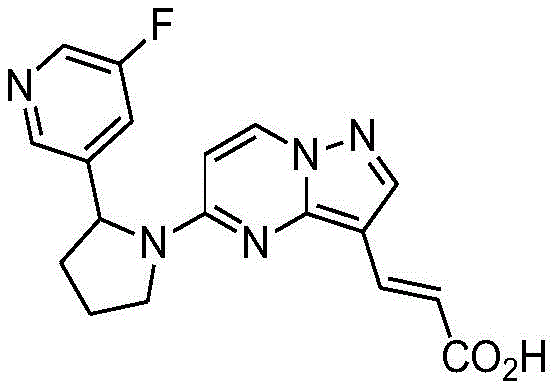
在0℃下,向(E)-乙基-3-(5-(2-(5-氟吡啶-3-基)吡咯烷-1-基)吡唑并[1,5-a]嘧啶-3-基)丙烯酸酯(511mg,1.340mmol)的EtOH(5.0mL)和水(1.7mL)的溶液加入LiOH(96.0mg,4.02mmol)。将反应混合物在90℃下加热5小时并冷却至室温。在蒸发EtOH后,将残留物用2N的HCl水溶液酸化直至pH 5-6,然后用EtOAc萃取两次。将合并的有机层用盐水洗涤,在Na2SO4上干燥,过滤并真空浓缩,产生白色固体形式的(E)-3-(5-(2-(5-氟吡啶-3-基)吡咯烷-1-基)吡唑并[1,5-a]嘧啶-3-基)丙烯酸(373mg,79%)。1H-NMR(DMSO-d6,瓦里安,400MHz):δ1.92-2.13(3H,m),2.40-2.50(1H,m),3.60-3.92(1H,m),3.93-4.12(1H,m),5.28-5.42(1H,m),6.05-6.32(1H,m),6.54-6.70(1H,m),7.40-7.77(2H,m),8.09-8.29(1H,m),8.32-8.80(3H,m),11.73(1H,br.s)。To (E)-ethyl-3-(5-(2-(5-fluoropyridin-3-yl)pyrrolidin-1-yl)pyrazolo[1,5-a]pyrimidine- 3-yl)acrylate (511 mg, 1.340 mmol) in EtOH (5.0 mL) and water (1.7 mL) was added LiOH (96.0 mg, 4.02 mmol). The reaction mixture was heated at 90°C for 5 hours and cooled to room temperature. After evaporation of EtOH, the residue was acidified with 2N aqueous HCl until pH 5-6, then extracted twice with EtOAc. The combined organic layers were washed with brine, dried over Na2SO4 , filtered and concentrated in vacuo to yield (E)-3-(5-(2-(5-fluoropyridin-3-yl)pyrrole as a white solid Alk-1-yl)pyrazolo[1,5-a]pyrimidin-3-yl)acrylic acid (373 mg, 79%). 1 H-NMR (DMSO-d 6 , Varian, 400MHz): δ 1.92-2.13(3H,m), 2.40-2.50(1H,m), 3.60-3.92(1H,m), 3.93-4.12( 1H,m), 5.28-5.42(1H,m), 6.05-6.32(1H,m), 6.54-6.70(1H,m), 7.40-7.77(2H,m), 8.09-8.29(1H,m), 8.32-8.80 (3H, m), 11.73 (1H, br.s).
步骤D:(E)-N-乙基-3-(5-(2-(5-氟吡啶-3-基)吡咯烷-1-基)吡唑并[1,5-a]嘧啶-3-基)丙烯酰胺Step D: (E)-N-Ethyl-3-(5-(2-(5-fluoropyridin-3-yl)pyrrolidin-1-yl)pyrazolo[1,5-a]pyrimidine-3 - base) acrylamide

在室温下,向(E)-3-(5-(2-(5-氟吡啶-3-基)吡咯烷-1-基)吡唑并[1,5-a]嘧啶-3-基)丙烯酸(50.0mg,0.142mmol)的DMF(1.0mL)溶液中加入乙基胺(2.0M的THF溶液,0.142mL,0.283mmol)、DIPEA(0.0740mL,0.425mmol)和HATU(81.0mg,0.212mmol)。将反应混合物在室温下搅拌18小时并用EtOAc稀释。混合物用饱和NH4Cl水溶液和盐水洗涤,在Na2SO4上干燥,过滤并真空浓缩。残留物通过SiO2柱色谱纯化(仅EtOAc到DCM:MeOH=20:1至10:1),产生白色固体形式的(E)-N-乙基-3-(5-(2-(5-氟吡啶-3-基)吡咯烷-1-基)吡唑并[1,5-a]嘧啶-3-基)丙烯酰胺(48.0mg,89%)。1H-NMR(DMSO-d6,瓦里安,400MHz):δ1.10(3H,t,J=6.6Hz),1.92-2.20(3H,m),2.43-2.50(1H,m),3.10-3.30(2H,m),3.60-3.92(1H,m),4.00-4.15(1H,m),5.28-5.58(1H,m),6.05-6.42(1H,m),6.54-6.80(1H,m),7.18-8.10(4H,m),8.32-8.75(3H,m)。MS:381.1[MH+]。To (E)-3-(5-(2-(5-fluoropyridin-3-yl)pyrrolidin-1-yl)pyrazolo[1,5-a]pyrimidin-3-yl) at room temperature To a solution of acrylic acid (50.0 mg, 0.142 mmol) in DMF (1.0 mL) was added ethylamine (2.0 M in THF, 0.142 mL, 0.283 mmol), DIPEA (0.0740 mL, 0.425 mmol) and HATU (81.0 mg, 0.212 mmol) ). The reaction mixture was stirred at room temperature for 18 hours and diluted with EtOAc. The mixture was washed with saturated aqueous NH4Cl and brine, dried over Na2SO4 , filtered and concentrated in vacuo. The residue was purified by SiO2 column chromatography (EtOAc only to DCM:MeOH = 20:1 to 10:1) to yield (E)-N-ethyl-3-(5-(2-(5-) as a white solid Fluoropyridin-3-yl)pyrrolidin-1-yl)pyrazolo[1,5-a]pyrimidin-3-yl)acrylamide (48.0 mg, 89%). 1 H-NMR (DMSO-d 6 , Varian, 400 MHz): δ 1.10 (3H, t, J=6.6 Hz), 1.92-2.20 (3H, m), 2.43-2.50 (1H, m), 3.10 -3.30(2H,m), 3.60-3.92(1H,m), 4.00-4.15(1H,m), 5.28-5.58(1H,m), 6.05-6.42(1H,m), 6.54-6.80(1H, m), 7.18-8.10 (4H, m), 8.32-8.75 (3H, m). MS: 381.1 [MH + ].
实施例51:化合物39的制备:(E)-N-环丙基-3-(5-(2-(5-氟吡啶-3-基)吡咯烷-1-Example 51: Preparation of Compound 39: (E)-N-Cyclopropyl-3-(5-(2-(5-fluoropyridin-3-yl)pyrrolidine-1- 基)吡唑并[1,5-a]嘧啶-3-基)丙烯酰胺yl)pyrazolo[1,5-a]pyrimidin-3-yl)acrylamide

在室温下,向(E)-3-(5-(2-(5-氟吡啶-3-基)吡咯烷-1-基)吡唑并[1,5-a]嘧啶-3-基)丙烯酸(50.0mg,0.142mmol)的DMF(1.0mL)溶液中加入环丙胺(0.0200mL,0.283mmol)、DIPEA(0.0740mL,0.425mmol)和HATU(81.0mg,0.212mmol)。将反应混合物在室温下搅拌18小时并用EtOAc稀释。混合物用饱和NH4Cl水溶液和盐水洗涤,在Na2SO4上干燥,过滤并真空浓缩。残留物通过SiO2柱色谱纯化(仅EtOAc到DCM:MeOH=20:1至10:1),产生白色固体形式的(E)-N-环丙基-3-(5-(2-(5-氟吡啶-3-基)吡咯烷-1-基)吡唑并[1,5-a]嘧啶-3-基)丙烯酰胺(21.0mg,38%)。1H-NMR(DMSO-d6,瓦里安,400MHz):δ0.40-0.60(2H,m),0.61-0.75(2H,m),1.86-2.17(3H,m),2.43-2.50(1H,m),2.72-2.80(1H,m),3.60-3.92(1H,m),4.00-4.15(1H,m),5.25-5.52(1H,m),6.05-6.38(1H,m),6.54-6.70(1H,m),7.28-8.12(4H,m),8.32-8.75(3H,m)。MS:393.1[MH+]。To (E)-3-(5-(2-(5-fluoropyridin-3-yl)pyrrolidin-1-yl)pyrazolo[1,5-a]pyrimidin-3-yl) at room temperature To a solution of acrylic acid (50.0 mg, 0.142 mmol) in DMF (1.0 mL) was added cyclopropylamine (0.0200 mL, 0.283 mmol), DIPEA (0.0740 mL, 0.425 mmol) and HATU (81.0 mg, 0.212 mmol). The reaction mixture was stirred at room temperature for 18 hours and diluted with EtOAc. The mixture was washed with saturated aqueous NH4Cl and brine, dried over Na2SO4 , filtered and concentrated in vacuo. The residue was purified by SiO2 column chromatography (EtOAc only to DCM:MeOH = 20:1 to 10:1) to yield (E)-N-cyclopropyl-3-(5-(2-(5) as a white solid -Fluoropyridin-3-yl)pyrrolidin-1-yl)pyrazolo[1,5-a]pyrimidin-3-yl)acrylamide (21.0 mg, 38%). 1 H-NMR (DMSO-d 6 , Varian, 400MHz): δ0.40-0.60(2H,m), 0.61-0.75(2H,m), 1.86-2.17(3H,m), 2.43-2.50( 1H,m), 2.72-2.80(1H,m), 3.60-3.92(1H,m), 4.00-4.15(1H,m), 5.25-5.52(1H,m), 6.05-6.38(1H,m), 6.54-6.70(1H,m), 7.28-8.12(4H,m), 8.32-8.75(3H,m). MS: 393.1 [MH + ].
实施例52:化合物40的制备:(E)-3-(5-(2-(5-氟吡啶-3-基)吡咯烷-1-基)吡唑并Example 52: Preparation of Compound 40: (E)-3-(5-(2-(5-fluoropyridin-3-yl)pyrrolidin-1-yl)pyrazolo [1,5-a]嘧啶-3-基)-N,N-二甲基丙烯酰胺[1,5-a]pyrimidin-3-yl)-N,N-dimethylacrylamide

在室温下,向(E)-3-(5-(2-(5-氟吡啶-3-基)吡咯烷-1-基)吡唑并[1,5-a]嘧啶-3-基)丙烯酸(50.0mg,0.142mmol)的DMF(1.0mL)溶液中加入二甲基胺盐酸盐(23.0mg,0.283mmol)、DIPEA(0.0740mL,0.425mmol)和HATU(81.0mg,0.212mmol)。将反应混合物在室温下搅拌18小时并用EtOAc稀释。混合物用饱和NH4Cl水溶液和盐水洗涤,在Na2SO4上干燥,过滤并真空浓缩。残留物通过SiO2柱色谱纯化(仅EtOAc到DCM:MeOH=20:1至10:1),产生白色固体形式的(E)-3-(5-(2-(5-氟吡啶-3-基)吡咯烷-1-基)吡唑并[1,5-a]嘧啶-3-基)-N,N-二甲基丙烯酰胺(39.0mg,72%)。1H-NMR(DMSO-d6,瓦里安,400MHz):δ1.86-2.10(3H,m),2.38-2.50(1H,m),2.80-3.00(6H,m),3.54-3.88(1H,m),3.92-4.15(1H,m),5.25-5.50(1H,m),6.05-6.12(0.3H,m),6.48-6.70(0.7H,m),6.73-7.70(3H,m),8.00-8.70(4H,m)。MS:381.1[MH+]。To (E)-3-(5-(2-(5-fluoropyridin-3-yl)pyrrolidin-1-yl)pyrazolo[1,5-a]pyrimidin-3-yl) at room temperature To a solution of acrylic acid (50.0 mg, 0.142 mmol) in DMF (1.0 mL) was added dimethylamine hydrochloride (23.0 mg, 0.283 mmol), DIPEA (0.0740 mL, 0.425 mmol) and HATU (81.0 mg, 0.212 mmol). The reaction mixture was stirred at room temperature for 18 hours and diluted with EtOAc. The mixture was washed with saturated aqueous NH4Cl and brine, dried over Na2SO4 , filtered and concentrated in vacuo. The residue was purified by SiO2 column chromatography (EtOAc to DCM:MeOH = 20:1 to 10:1 only) to yield (E)-3-(5-(2-(5-fluoropyridine-3- as a white solid) yl)pyrrolidin-1-yl)pyrazolo[1,5-a]pyrimidin-3-yl)-N,N-dimethylacrylamide (39.0 mg, 72%). 1 H-NMR (DMSO-d 6 , Varian, 400MHz): δ 1.86-2.10(3H,m), 2.38-2.50(1H,m), 2.80-3.00(6H,m), 3.54-3.88( 1H,m), 3.92-4.15(1H,m), 5.25-5.50(1H,m), 6.05-6.12(0.3H,m), 6.48-6.70(0.7H,m), 6.73-7.70(3H,m) ), 8.00-8.70 (4H, m). MS: 381.1 [MH + ].
实施例53:化合物41的制备Example 53: Preparation of Compound 41

化合物41:(E)-3-(5-(2-(2,5-二氟苯基)吡咯烷-1-基)吡唑并[1,5-a]嘧啶-3-基)-N-乙基丙烯酰胺Compound 41: (E)-3-(5-(2-(2,5-difluorophenyl)pyrrolidin-1-yl)pyrazolo[1,5-a]pyrimidin-3-yl)-N -Ethylacrylamide

步骤A:5-(2-(2,5-二氟苯基)吡咯烷-1-基)吡唑并[1,5-a]嘧啶-3-甲醛Step A: 5-(2-(2,5-Difluorophenyl)pyrrolidin-1-yl)pyrazolo[1,5-a]pyrimidine-3-carbaldehyde

将5-氯吡唑并[1,5-a]嘧啶-3-甲醛(300mg,1.65mmol)、2-(2,5-二氟苯基)吡咯烷(中间体2,324mg,1.77mmol)和KF(480mg,8.26mmol)在DMSO(5.5mL)中的混合物在180℃下加热2小时。在冷却至室温后,将反应混合物倾倒至水中。混合物用EtOAc萃取两次。用盐水洗涤合并的有机层,在Na2SO4上干燥,过滤并真空浓缩。残留物通过SiO2柱色谱纯化(仅EtOAc到DCM:MeOH=20:1),产生黄色固体形式的5-(2-(2,5-二氟苯基)吡咯烷-1-基)吡唑并[1,5-a]嘧啶-3-甲醛(540mg,100%)。1H-NMR(CDCl3,瓦里安,400MHz):δ1.90-2.28(3H,m),2.38-2.60(1H,m),3.60-4.18(2H,m),5.14-5.28(0.6H,m),5.54-5.72(0.4H,m),5.84-6.02(0.6H,m),6.35-6.46(0.4H,m),6.68-6.78(1H,m),6.82-7.20(2H,m),8.10-8.36(2H,m),9.77和10.11(1H,s+s)。5-Chloropyrazolo[1,5-a]pyrimidine-3-carbaldehyde (300 mg, 1.65 mmol), 2-(2,5-difluorophenyl)pyrrolidine (intermediate 2,324 mg, 1.77 mmol) and A mixture of KF (480 mg, 8.26 mmol) in DMSO (5.5 mL) was heated at 180 °C for 2 h. After cooling to room temperature, the reaction mixture was poured into water. The mixture was extracted twice with EtOAc. The combined organic layers were washed with brine, dried over Na2SO4 , filtered and concentrated in vacuo. The residue was purified by SiO2 column chromatography (EtOAc only to DCM:MeOH=20:1) to yield 5-(2-(2,5-difluorophenyl)pyrrolidin-1-yl)pyrazole as a yellow solid and [1,5-a]pyrimidine-3-carbaldehyde (540 mg, 100%). 1 H-NMR (CDCl 3 , Varian, 400MHz): δ 1.90-2.28(3H,m), 2.38-2.60(1H,m), 3.60-4.18(2H,m), 5.14-5.28(0.6H) ,m),5.54-5.72(0.4H,m),5.84-6.02(0.6H,m),6.35-6.46(0.4H,m),6.68-6.78(1H,m),6.82-7.20(2H,m) ), 8.10-8.36 (2H, m), 9.77 and 10.11 (1H, s+s).
步骤B:(E)-3-(5-(2-(2,5-二氟苯基)吡咯烷-1-基)吡唑并[1,5-a]嘧啶-3-基)丙烯酸乙酯Step B: (E)-ethyl 3-(5-(2-(2,5-difluorophenyl)pyrrolidin-1-yl)pyrazolo[1,5-a]pyrimidin-3-yl)acrylate ester

在0℃下,向NaH(55wt%,349mg,8.00mmol)的干燥THF(8.9mL)悬浮液加入2-(二乙氧基磷酰基)乙酸乙酯(896mg,4.00mmol)的干燥THF溶液。将混合物室温搅拌30分钟。在加入5-(2-(2,5-二氟苯基)吡咯烷-1-基)吡唑并[1,5-a]嘧啶-3-甲醛(875mg,2.67mmol)的干燥THF溶液后,将反应混合物搅拌5小时,然后用饱和NH4Cl水溶液淬灭。混合物用EtOAc萃取两次。用盐水洗涤合并的有机层,在Na2SO4上干燥,过滤并真空浓缩。残留物通过SiO2柱色谱纯化(Hex:EtOAc=1:1),产生黄色固体形式的(E)-乙基-3-(5-(2-(2,5-二氟苯基)吡咯烷-1-基)吡唑并[1,5-a]嘧啶-3-基)丙烯酸酯(609mg,57%)。1H-NMR(CDCl3,瓦里安,400MHz):δ1.36(3H,t,J=7.0Hz),1.95-2.20(3H,m),2.45-2.60(1H,m),3.60-4.18(2H,m),4.20-4.43(2H,m),5.14-5.28(0.6H,m),5.54-5.70(0.4H,m),5.84-5.96(0.4H,m),6.25-6.46(0.6H,m),6.65-6.78(2H,m),6.82-7.00(1H,m),7.10-4.15(1H,m),7.50-7.85(1H,m),7.80-8.05(1H,m),8.12-8.35(1H,m)。To a suspension of NaH (55 wt%, 349 mg, 8.00 mmol) in dry THF (8.9 mL) was added a solution of ethyl 2-(diethoxyphosphoryl)acetate (896 mg, 4.00 mmol) in dry THF at 0°C. The mixture was stirred at room temperature for 30 minutes. After adding a solution of 5-(2-(2,5-difluorophenyl)pyrrolidin-1-yl)pyrazolo[1,5-a]pyrimidine-3-carbaldehyde (875 mg, 2.67 mmol) in dry THF , the reaction mixture was stirred for 5 hours and then quenched with saturated aqueous NH4Cl . The mixture was extracted twice with EtOAc. The combined organic layers were washed with brine, dried over Na2SO4 , filtered and concentrated in vacuo. The residue was purified by SiO2 column chromatography (Hex:EtOAc = 1:1) to yield (E)-ethyl-3-(5-(2-(2,5-difluorophenyl)pyrrolidine) as a yellow solid -1-yl)pyrazolo[1,5-a]pyrimidin-3-yl)acrylate (609 mg, 57%). 1 H-NMR (CDCl 3 , Varian, 400 MHz): δ 1.36 (3H, t, J=7.0 Hz), 1.95-2.20 (3H, m), 2.45-2.60 (1H, m), 3.60-4.18 (2H,m), 4.20-4.43(2H,m), 5.14-5.28(0.6H,m), 5.54-5.70(0.4H,m), 5.84-5.96(0.4H,m), 6.25-6.46(0.6 H,m), 6.65-6.78(2H,m), 6.82-7.00(1H,m), 7.10-4.15(1H,m), 7.50-7.85(1H,m), 7.80-8.05(1H,m), 8.12-8.35 (1H, m).
步骤C:(E)-3-(5-(2-(2,5-二氟苯基)吡咯烷-1-基)吡唑并[1,5-a]嘧啶-3-基)丙烯酸Step C: (E)-3-(5-(2-(2,5-Difluorophenyl)pyrrolidin-1-yl)pyrazolo[1,5-a]pyrimidin-3-yl)acrylic acid
在0℃下,向(E)-3-(5-(2-(2,5-二氟苯基)吡咯烷-1-基)吡唑并[1,5-a]嘧啶-3-基)丙烯酸乙酯(345mg,0.866mmol)的EtOH(3.3mL)和水(1.1mL)的溶液中加入LiOH(62.0mg,2.60mmol)。将反应混合物在90℃下加热5小时并冷却至室温。在蒸发EtOH后,将残留物用2N的HCl水溶液酸化直至pH 5-6。混合物用EtOAc萃取两次。将合并的有机层用盐水洗涤,在Na2SO4上干燥,过滤并真空浓缩,产生白色固体形式的(E)-3-(5-(2-(2,5-二氟苯基)吡咯烷-1-基)吡唑并[1,5-a]嘧啶-3-基)丙烯酸(297mg,93%)。1H-NMR(DMSO-d6,瓦里安,400MHz):δ1.80-2.14(3H,m),2.38-2.50(1H,m),3.35-3.88(1H,m),3.98-4.18(1H,m),5.28-5.53(1H,m),6.00-3.20(1H,m),6.50-6.70(1H,m),6.90-7.00(1H,m),7.01-7.70(3H,m),8.05-8.20(1H,m),8.50-8.78(1H,m),11.95(1H,s)。To (E)-3-(5-(2-(2,5-difluorophenyl)pyrrolidin-1-yl)pyrazolo[1,5-a]pyrimidin-3-yl at 0 °C ) ethyl acrylate (345 mg, 0.866 mmol) in EtOH (3.3 mL) and water (1.1 mL) was added LiOH (62.0 mg, 2.60 mmol). The reaction mixture was heated at 90°C for 5 hours and cooled to room temperature. After evaporation of EtOH, the residue was acidified with 2N aqueous HCl until pH 5-6. The mixture was extracted twice with EtOAc. The combined organic layers were washed with brine, dried over Na2SO4 , filtered and concentrated in vacuo to yield (E)-3-(5-(2-(2,5-difluorophenyl)pyrrole as a white solid) Alk-1-yl)pyrazolo[1,5-a]pyrimidin-3-yl)acrylic acid (297 mg, 93%). 1 H-NMR (DMSO-d 6 , Varian, 400MHz): δ 1.80-2.14(3H,m), 2.38-2.50(1H,m), 3.35-3.88(1H,m), 3.98-4.18( 1H,m), 5.28-5.53(1H,m), 6.00-3.20(1H,m), 6.50-6.70(1H,m), 6.90-7.00(1H,m), 7.01-7.70(3H,m), 8.05-8.20(1H,m), 8.50-8.78(1H,m), 11.95(1H,s).
步骤D:(E)-3-(5-(2-(2,5-二氟苯基)吡咯烷-1-基)吡唑并[1,5-a]嘧啶-3-基)-N-乙基丙烯酰胺Step D: (E)-3-(5-(2-(2,5-Difluorophenyl)pyrrolidin-1-yl)pyrazolo[1,5-a]pyrimidin-3-yl)-N -Ethylacrylamide
向(E)-3-(5-(2-(2,5-二氟苯基)吡咯烷-1-基)吡唑并[1,5-a]嘧啶-3-基)丙烯酸(75.0mg,0.203mmol)的DCM(2.0mL)溶液中加入2滴DMF,然后加入草酰氯(0.0355mL,0.405mmol)。将反应混合物在室温下搅拌30分钟,然后减压浓缩,产生相应的酰氯化合物。将残留的粗酰氯化合物溶于DCM(2.0mL)中,然后向其中加入乙胺盐酸盐(18.2mg,0.405mmol)。将反应混合物在室温下搅拌5小时并用1N的HCl水溶液淬灭。将混合物用水和盐水洗涤,在Na2SO4上干燥,过滤并真空浓缩。残留物通过SiO2柱色谱纯化(Hex:EtOAc=1:10到仅EtOAc),产生黄色固体形式的(E)-3-(5-(2-(2,5-二氟苯基)吡咯烷-1-基)吡唑并[1,5-a]嘧啶-3-基)-N-乙基丙烯酰胺(13.0mg,16%)。1H-NMR(CDCl3,瓦里安,400MHz):δ1.15-1.32(6H,m),1.98-2.32(3H,m),2.42-2.60(1H,m),3.38-3.50(2H,m),3.61-4.05(2H,m),5.38-5.50(1H,m),6.23-6.60(1H,m),6.70-6.78(1H,m),6.86-7.13(2H,m),7.80-9.00(1H,m),8.10-8.36(1H,m)。MS:398.1[MH+]。To (E)-3-(5-(2-(2,5-difluorophenyl)pyrrolidin-1-yl)pyrazolo[1,5-a]pyrimidin-3-yl)acrylic acid (75.0 mg , 0.203 mmol) in DCM (2.0 mL) was added 2 drops of DMF followed by oxalyl chloride (0.0355 mL, 0.405 mmol). The reaction mixture was stirred at room temperature for 30 minutes and then concentrated under reduced pressure to yield the corresponding acid chloride compound. The residual crude acid chloride compound was dissolved in DCM (2.0 mL), and ethylamine hydrochloride (18.2 mg, 0.405 mmol) was added thereto. The reaction mixture was stirred at room temperature for 5 hours and quenched with IN aqueous HCl. The mixture was washed with water and brine, dried over Na2SO4 , filtered and concentrated in vacuo. The residue was purified by SiO2 column chromatography (Hex:EtOAc = 1:10 to EtOAc only) to yield (E)-3-(5-(2-(2,5-difluorophenyl)pyrrolidine) as a yellow solid -1-yl)pyrazolo[1,5-a]pyrimidin-3-yl)-N-ethylacrylamide (13.0 mg, 16%). 1 H-NMR (CDCl 3 , Varian, 400MHz): δ 1.15-1.32(6H,m), 1.98-2.32(3H,m), 2.42-2.60(1H,m), 3.38-3.50(2H, m), 3.61-4.05(2H,m), 5.38-5.50(1H,m), 6.23-6.60(1H,m), 6.70-6.78(1H,m), 6.86-7.13(2H,m), 7.80- 9.00(1H,m), 8.10-8.36(1H,m). MS: 398.1 [MH + ].
实施例54:化合物42的制备:(E)-3-(5-(2-(2,5-二氟苯基)-吡咯烷-1-基)吡唑并Example 54: Preparation of Compound 42: (E)-3-(5-(2-(2,5-difluorophenyl)-pyrrolidin-1-yl)pyrazolo [1,5-a]嘧啶-3-基)-N-异丙基丙烯酰胺[1,5-a]pyrimidin-3-yl)-N-isopropylacrylamide

在室温下,向(E)-3-(5-(2-(2,5-二氟苯基)吡咯烷-1-基)吡唑并[1,5-a]嘧啶-3-基)丙烯酸(55.0mg,0.149mmol)的DMF(1.5mL)溶液中加入HATU(73.4mg,0.193mmol)、DIPEA(78.0μL,0.446mmol)和异丙基胺(9.66mg,0.163mmol)。将反应混合物在室温下搅拌1小时并用EtOAc稀释。混合物用饱和NH4Cl水溶液和盐水洗涤,在Na2SO4上干燥,过滤并真空浓缩。残留物通过SiO2柱色谱纯化(Hex:EtOAc=1:10到仅EtOAc),产生黄色固体形式的(E)-3-(5-(2-(2,5-二氟苯基)-吡咯烷-1-基)吡唑并[1,5-a]嘧啶-3-基)-N-异丙基丙烯酰胺(30.0mg,49%)。1H-NMR(CDCl3,瓦里安,400MHz):δ1.13-1.32(6H,m),2.00-2.29(3H,m),2.42-2.60(1H,m),3.60-4.00(2H,m),4.20-4.30(1H,m),5.25-5.38(1H,m),5.62-5.95(1H,m),6.20-6.60(2H,m),6.70-6.77(1H,m),6.82-6.98(1H,m),7.00-7.10(1H,m),7.45-7.55(1H,m),7.82-7.99(1H,m),8.10-8.40(1H,m)。MS:412.1[MH+]。To (E)-3-(5-(2-(2,5-difluorophenyl)pyrrolidin-1-yl)pyrazolo[1,5-a]pyrimidin-3-yl) at room temperature To a solution of acrylic acid (55.0 mg, 0.149 mmol) in DMF (1.5 mL) was added HATU (73.4 mg, 0.193 mmol), DIPEA (78.0 μL, 0.446 mmol) and isopropylamine (9.66 mg, 0.163 mmol). The reaction mixture was stirred at room temperature for 1 hour and diluted with EtOAc. The mixture was washed with saturated aqueous NH4Cl and brine, dried over Na2SO4 , filtered and concentrated in vacuo. The residue was purified by SiO2 column chromatography (Hex:EtOAc = 1:10 to EtOAc only) to yield (E)-3-(5-(2-(2,5-difluorophenyl)-pyrrole) as a yellow solid Alk-1-yl)pyrazolo[1,5-a]pyrimidin-3-yl)-N-isopropylacrylamide (30.0 mg, 49%). 1 H-NMR (CDCl 3 , Varian, 400MHz): δ 1.13-1.32(6H,m), 2.00-2.29(3H,m), 2.42-2.60(1H,m), 3.60-4.00(2H, m), 4.20-4.30(1H,m), 5.25-5.38(1H,m), 5.62-5.95(1H,m), 6.20-6.60(2H,m), 6.70-6.77(1H,m), 6.82- 6.98(1H,m), 7.00-7.10(1H,m), 7.45-7.55(1H,m), 7.82-7.99(1H,m), 8.10-8.40(1H,m). MS: 412.1 [MH + ].
实施例55:化合物43的制备:(E)-N-环丙基-3-(5-(2-(2,5-二氟苯基)吡咯烷-1-Example 55: Preparation of Compound 43: (E)-N-Cyclopropyl-3-(5-(2-(2,5-difluorophenyl)pyrrolidine-1- 基)吡唑并[1,5-a]嘧啶-3-基)丙烯酰胺yl)pyrazolo[1,5-a]pyrimidin-3-yl)acrylamide

在室温下,向(E)-3-(5-(2-(2,5-二氟苯基)吡咯烷-1-基)吡唑并[1,5-a]嘧啶-3-基)丙烯酸(50.0mg,0.135mmol)的DMF(1.4mL)溶液中加入HATU(66.7mg,0.176mmol)、DIPEA(70.7μl,0.405mmol)和环丙基胺(10.5μl,0.149mmol)。将反应混合物在室温下搅拌1小时并用EtOAc稀释。混合物用饱和NH4Cl水溶液和盐水洗涤,在Na2SO4上干燥,过滤并真空浓缩。残留物通过SiO2柱色谱纯化(Hex:EtOAc=10:1到仅EtOAc),产生黄色固体形式的(E)-N-环丙基-3-(5-(2-(2,5-二氟苯基)吡咯烷-1-基)吡唑并[1,5-a]嘧啶-3-基)丙烯酰胺(30.0mg,54%)。1H-NMR(CDCl3,瓦里安,400MHz):δ0.50-0.65(2H,m),0.78-0.92(2H,m),1.92-2.30(4H,m),2.39-2.59(1H,m),2.82-2.85(1H,m),3.58-3.80(1H,m),3.86-4.12(1H,m),5.50-5.70(2H,m),6.23-6.48(1H,m),6.69-6.78(1H,m),6.82-7.08(2H,m),7.45-7.62(1H,m),7.82-8.00(1H,m),8.12-8.40(1H,m)。MS:410.1[MH+]。To (E)-3-(5-(2-(2,5-difluorophenyl)pyrrolidin-1-yl)pyrazolo[1,5-a]pyrimidin-3-yl) at room temperature To a solution of acrylic acid (50.0 mg, 0.135 mmol) in DMF (1.4 mL) was added HATU (66.7 mg, 0.176 mmol), DIPEA (70.7 μl, 0.405 mmol) and cyclopropylamine (10.5 μl, 0.149 mmol). The reaction mixture was stirred at room temperature for 1 hour and diluted with EtOAc. The mixture was washed with saturated aqueous NH4Cl and brine, dried over Na2SO4 , filtered and concentrated in vacuo. The residue was purified by SiO2 column chromatography (Hex:EtOAc = 10:1 to EtOAc only) to yield (E)-N-cyclopropyl-3-(5-(2-(2,5-di as a yellow solid) Fluorophenyl)pyrrolidin-1-yl)pyrazolo[1,5-a]pyrimidin-3-yl)acrylamide (30.0 mg, 54%). 1 H-NMR (CDCl 3 , Varian, 400MHz): δ 0.50-0.65(2H,m), 0.78-0.92(2H,m), 1.92-2.30(4H,m), 2.39-2.59(1H, m), 2.82-2.85(1H,m), 3.58-3.80(1H,m), 3.86-4.12(1H,m), 5.50-5.70(2H,m), 6.23-6.48(1H,m), 6.69- 6.78(1H,m), 6.82-7.08(2H,m), 7.45-7.62(1H,m), 7.82-8.00(1H,m), 8.12-8.40(1H,m). MS: 410.1 [MH + ].
实施例56:化合物44的制备:(E)-N-叔丁基-3-(5-(2-(2,5-二氟苯基)吡咯烷-1-Example 56: Preparation of compound 44: (E)-N-tert-butyl-3-(5-(2-(2,5-difluorophenyl)pyrrolidine-1- 基)吡唑并-[1,5-a]嘧啶-3-基)丙烯酰胺yl)pyrazolo-[1,5-a]pyrimidin-3-yl)acrylamide

在室温下,向(E)-3-(5-(2-(2,5-二氟苯基)吡咯烷-1-基)吡唑并[1,5-a]嘧啶-3-基)丙烯酸(50.0mg,0.135mmol)的DMF(0.90mL)溶液中加入叔丁基胺(20.0mg,0.270mmol)、DIPEA(0.0710mL,0.405mmol)和HATU(77.0mg,0.203mmol)。将反应混合物在室温下搅拌18小时并用EtOAc稀释。混合物用饱和NH4Cl水溶液和盐水洗涤,在Na2SO4上干燥,过滤并真空浓缩。残留物通过SiO2柱色谱纯化(仅EtOAc到DCM:MeOH=20:1至10:1),产生白色固体形式的(E)-N-叔丁基-3-(5-(2-(2,5-二氟苯基)吡咯烷-1-基)吡唑并-[1,5-a]嘧啶-3-基)丙烯酰胺(38.0mg,66%)。1H-NMR(DMSO-d6,瓦里安,400MHz):δ1.31(9H,s),1.80-2.10(3H,m),2.38-2.50(1H,m),3.58-3.90(1H,m),3.95-4.12(1H,m),5.25-5.40(0.4H,m),5.50-5.62(0.6H,m),5.97-6.10(0.4H,m),6.30-6.54(0.6H,m),6.52-6.68(1H,m),6.70-7.00(1H,m),7.01-7.52(4H,m),7.95-8.10(1H,m),8.43-8.72(1H,m)。MS:426.2[MH+]。To (E)-3-(5-(2-(2,5-difluorophenyl)pyrrolidin-1-yl)pyrazolo[1,5-a]pyrimidin-3-yl) at room temperature To a solution of acrylic acid (50.0 mg, 0.135 mmol) in DMF (0.90 mL) was added tert-butylamine (20.0 mg, 0.270 mmol), DIPEA (0.0710 mL, 0.405 mmol) and HATU (77.0 mg, 0.203 mmol). The reaction mixture was stirred at room temperature for 18 hours and diluted with EtOAc. The mixture was washed with saturated aqueous NH4Cl and brine, dried over Na2SO4 , filtered and concentrated in vacuo. The residue was purified by SiO2 column chromatography (EtOAc to DCM:MeOH = 20:1 to 10:1 only) to yield (E)-N-tert-butyl-3-(5-(2-(2) as a white solid ,5-difluorophenyl)pyrrolidin-1-yl)pyrazolo-[1,5-a]pyrimidin-3-yl)acrylamide (38.0 mg, 66%). 1 H-NMR (DMSO-d 6 , Varian, 400MHz): δ 1.31(9H,s), 1.80-2.10(3H,m), 2.38-2.50(1H,m), 3.58-3.90(1H, m), 3.95-4.12(1H,m), 5.25-5.40(0.4H,m), 5.50-5.62(0.6H,m), 5.97-6.10(0.4H,m), 6.30-6.54(0.6H,m) ), 6.52-6.68(1H,m), 6.70-7.00(1H,m), 7.01-7.52(4H,m), 7.95-8.10(1H,m), 8.43-8.72(1H,m). MS: 426.2 [MH + ].
实施例57:化合物45的制备:(E)-3-(5-(2-(2,5-二氟苯基)吡咯烷-1-基)吡唑并Example 57: Preparation of Compound 45: (E)-3-(5-(2-(2,5-difluorophenyl)pyrrolidin-1-yl)pyrazolo [1,5-a]嘧啶-3-基)-N,N-二甲基丙烯酰胺[1,5-a]pyrimidin-3-yl)-N,N-dimethylacrylamide

向(E)-3-(5-(2-(2,5-二氟苯基)吡咯烷-1-基)吡唑并[1,5-a]嘧啶-3-基)丙烯酸(55.0mg,0.149mmol)的DMF(1.5mL)溶液中加入HATU(73.4mg,0.193mmol)、DIPEA(78.0μl,0.446mmol)和二甲胺盐酸盐(7.36mg,0.163mmol)。将反应混合物在室温下搅拌1小时并用EtOAc稀释。混合物用饱和NH4Cl水溶液和盐水洗涤,在Na2SO4上干燥,过滤并真空浓缩。残留物通过SiO2柱色谱纯化(Hex:EtOAc=1:10到仅EtOAc),产生黄色固体形式的(E)-3-(5-(2-(2,5-二氟苯基)吡咯烷-1-基)吡唑并[1,5-a]嘧啶-3-基)-N,N-二甲基丙烯酰胺(38.0mg,64%)。1H-NMR(CDCl3,瓦里安,400MHz):δ1.98-2.15(3H,m),2.35-2.60(1H,m),2.82-3.30(6H,m),3.50-3.78(1H,m),3.80-4.15(2H,m),5.64-6.01(1H,m),6.18-6.44(1H,m),6.60-6.78(1H,m),6.83-7.13(2H,m),7.55-7.86(1H,m),7.90-8.05(1H,m),8.10-8.43(1H,m)。MS:398.1[MH+]。To (E)-3-(5-(2-(2,5-difluorophenyl)pyrrolidin-1-yl)pyrazolo[1,5-a]pyrimidin-3-yl)acrylic acid (55.0 mg , 0.149 mmol) in DMF (1.5 mL) was added HATU (73.4 mg, 0.193 mmol), DIPEA (78.0 μl, 0.446 mmol) and dimethylamine hydrochloride (7.36 mg, 0.163 mmol). The reaction mixture was stirred at room temperature for 1 hour and diluted with EtOAc. The mixture was washed with saturated aqueous NH4Cl and brine, dried over Na2SO4 , filtered and concentrated in vacuo. The residue was purified by SiO2 column chromatography (Hex:EtOAc = 1:10 to EtOAc only) to yield (E)-3-(5-(2-(2,5-difluorophenyl)pyrrolidine) as a yellow solid -1-yl)pyrazolo[1,5-a]pyrimidin-3-yl)-N,N-dimethylacrylamide (38.0 mg, 64%). 1 H-NMR (CDCl 3 , Varian, 400MHz): δ 1.98-2.15(3H,m), 2.35-2.60(1H,m), 2.82-3.30(6H,m), 3.50-3.78(1H, m), 3.80-4.15(2H,m), 5.64-6.01(1H,m), 6.18-6.44(1H,m), 6.60-6.78(1H,m), 6.83-7.13(2H,m), 7.55- 7.86(1H,m), 7.90-8.05(1H,m), 8.10-8.43(1H,m). MS: 398.1 [MH + ].
实施例58:化合物46的制备:(E)-3-(5-(2-(2,5-二氟苯基)吡咯烷-1-基)吡唑并Example 58: Preparation of Compound 46: (E)-3-(5-(2-(2,5-difluorophenyl)pyrrolidin-1-yl)pyrazolo [1,5-a]嘧啶-3-基)-N-(2-甲氧基乙基)-丙烯酰胺[1,5-a]pyrimidin-3-yl)-N-(2-methoxyethyl)-acrylamide

在室温下,向(E)-3-(5-(2-(2,5-二氟苯基)吡咯烷-1-基)吡唑并[1,5-a]嘧啶-3-基)丙烯酸(60.0mg,0.162mmol)的DMF(1.1mL)溶液中加入2-甲氧基乙胺(37.0mg,0.486mmol)、DIPEA(0.0850mL,0.486mmol)和HATU(185mg,0.486mmol)。将反应混合物在室温下搅拌3小时并用水稀释。在搅拌另外30分钟后,通过过滤收集沉淀的白色固体并在真空下干燥,产生白色固体形式的(E)-3-(5-(2-(2,5-二氟苯基)吡咯烷-1-基)吡唑并[1,5-a]嘧啶-3-基)-N-(2-甲氧基乙基)-丙烯酰胺(43.4mg,63%)。1H-NMR(DMSO-d6,瓦里安,400MHz):δ1.80-2.10(3H,m),2.38-2.50(1H,m),3.20-3.30(3H,m),3.33-3.45(2H,m),3.46-3.88(2H,m),3.90-4.15(1H,m),5.20-5.60(1H,m),5.88-6.38(1H,m),6.40-6.80(1H,m),6.81-7.55(4H,m),7.90-8.15(2H,m),8.40-8.80(1H,m)。*未观察到来自NH的质子。MS:428.2[MH+]。To (E)-3-(5-(2-(2,5-difluorophenyl)pyrrolidin-1-yl)pyrazolo[1,5-a]pyrimidin-3-yl) at room temperature To a solution of acrylic acid (60.0 mg, 0.162 mmol) in DMF (1.1 mL) was added 2-methoxyethylamine (37.0 mg, 0.486 mmol), DIPEA (0.0850 mL, 0.486 mmol) and HATU (185 mg, 0.486 mmol). The reaction mixture was stirred at room temperature for 3 hours and diluted with water. After stirring for an additional 30 minutes, the precipitated white solid was collected by filtration and dried under vacuum to yield (E)-3-(5-(2-(2,5-difluorophenyl)pyrrolidine- 1-yl)pyrazolo[1,5-a]pyrimidin-3-yl)-N-(2-methoxyethyl)-acrylamide (43.4 mg, 63%). 1 H-NMR (DMSO-d 6 , Varian, 400MHz): δ 1.80-2.10(3H,m), 2.38-2.50(1H,m), 3.20-3.30(3H,m), 3.33-3.45( 2H,m), 3.46-3.88(2H,m), 3.90-4.15(1H,m), 5.20-5.60(1H,m), 5.88-6.38(1H,m), 6.40-6.80(1H,m), 6.81-7.55(4H,m), 7.90-8.15(2H,m), 8.40-8.80(1H,m). *Protons from NH were not observed. MS: 428.2 [MH + ].
实施例59:化合物47的制备:(E)-3-(5-(2-(2,5-二氟苯基)吡咯烷-1-基)吡唑并Example 59: Preparation of Compound 47: (E)-3-(5-(2-(2,5-difluorophenyl)pyrrolidin-1-yl)pyrazolo [1,5-a]嘧啶-3-基)-1-(3-羟基氮杂环丁二烯-1-基)丙-2-烯-1-酮[1,5-a]pyrimidin-3-yl)-1-(3-hydroxyazetidin-1-yl)prop-2-en-1-one
在室温下,向(E)-3-(5-(2-(2,5-二氟苯基)吡咯烷-1-基)吡唑并[1,5-a]嘧啶-3-基)丙烯酸(50.0mg,0.135mmol)的DMF(0.90mL)溶液中加入氮杂环丁二烯-3-醇盐酸盐(44.0mg,0.405mmol)、DIPEA(0.141mL,0.810mmol)和HATU(0.103g,0.270mmol)。将反应混合物在室温下搅拌18小时并用EtOAc稀释。混合物用饱和NH4Cl水溶液和盐水洗涤,在Na2SO4上干燥,过滤并真空浓缩。残留物通过SiO2柱色谱纯化(仅EtOAc到DCM:MeOH=20:1至10:1),产生白色固体形式的(E)-3-(5-(2-(2,5-二氟苯基)吡咯烷-1-基)吡唑并[1,5-a]嘧啶-3-基)-1-(3-羟基氮杂环丁二烯-1-基)丙-2-烯-1-酮(21.0mg,36%)。1H-NMR(DMSO-d6,瓦里安,400MHz):δ1.86-2.10(3H,m),2.38-2.50(1H,m),3.56-3.90(2H,m),3.92-4.19(3H,m),4.20-4.58(2H,m),5.30-5.40(0.4H,m),5.50-5.62(0.6H,m),5.74(1H,d,J=5.6Hz),5.97-6.10(0.4H,m),6.28-6.40(0.6H,m),6.52-7.70(2H,m),7.05-7.52(3H,m),8.09-8.20(1H,m),8.50-8.78(1H,m)。MS:426.2[MH+]。To (E)-3-(5-(2-(2,5-difluorophenyl)pyrrolidin-1-yl)pyrazolo[1,5-a]pyrimidin-3-yl) at room temperature To a solution of acrylic acid (50.0 mg, 0.135 mmol) in DMF (0.90 mL) was added azetidin-3-ol hydrochloride (44.0 mg, 0.405 mmol), DIPEA (0.141 mL, 0.810 mmol) and HATU (0.103 g, 0.270 mmol). The reaction mixture was stirred at room temperature for 18 hours and diluted with EtOAc. The mixture was washed with saturated aqueous NH4Cl and brine, dried over Na2SO4 , filtered and concentrated in vacuo. The residue was purified by SiO2 column chromatography (EtOAc to DCM:MeOH = 20:1 to 10:1 only) to yield (E)-3-(5-(2-(2,5-difluorobenzene) as a white solid yl)pyrrolidin-1-yl)pyrazolo[1,5-a]pyrimidin-3-yl)-1-(3-hydroxyazetidin-1-yl)prop-2-en-1 - Ketone (21.0 mg, 36%). 1 H-NMR (DMSO-d 6 , Varian, 400MHz): δ 1.86-2.10(3H,m), 2.38-2.50(1H,m), 3.56-3.90(2H,m), 3.92-4.19( 3H,m), 4.20-4.58(2H,m), 5.30-5.40(0.4H,m), 5.50-5.62(0.6H,m), 5.74(1H,d,J=5.6Hz), 5.97-6.10( 0.4H,m), 6.28-6.40(0.6H,m), 6.52-7.70(2H,m), 7.05-7.52(3H,m), 8.09-8.20(1H,m), 8.50-8.78(1H,m) ). MS: 426.2 [MH + ].
实施例60:化合物48的制备Example 60: Preparation of Compound 48

化合物48:(R,E)-3-(5-(2-(2,5-二氟苯基)吡咯烷-1-基)吡唑并[1,5-a]嘧啶-3-基)-N-(2-羟基乙基)-丙烯酰胺Compound 48: (R,E)-3-(5-(2-(2,5-difluorophenyl)pyrrolidin-1-yl)pyrazolo[1,5-a]pyrimidin-3-yl) -N-(2-Hydroxyethyl)-acrylamide

步骤A:(R)-5-(2-(2,5-二氟苯基)吡咯烷-1-基)吡唑并[1,5-a]嘧啶-3-甲醛Step A: (R)-5-(2-(2,5-Difluorophenyl)pyrrolidin-1-yl)pyrazolo[1,5-a]pyrimidine-3-carbaldehyde

将5-氯吡唑并[1,5-a]嘧啶-3-甲醛(中间体10,4.70g,25.9mmol)、(R)-2-(2,5-二氟苯基)吡咯烷(中间体5,5.07g,27.7mmol)和KF(7.52g,129mmol)在DMSO(86mL)中的混合物在180℃下搅拌2小时。在冷却至室温后,反应混合物用水稀释。混合物用EtOAc萃取两次。用盐水洗涤合并的有机层,在Na2SO4上干燥,过滤并真空浓缩。残留物通过SiO2柱色谱纯化(仅EtOAc到DCM:MeOH=20:1),产生黄色油状物形式的(R)-5-(2-(2,5-二氟苯基)吡咯烷-1-基)吡唑并[1,5-a]嘧啶-3-甲醛(8.50g,100%)。1H-NMR(CDCl3,瓦里安,400MHz):δ1.90-2.28(3H,m),2.38-2.60(1H,m),3.60-4.18(2H,m),5.14-5.28(0.6H,m),5.54-5.72(0.4H,m),5.84-6.02(0.6H,m),6.35-6.46(0.4H,m),6.68-6.78(1H,m),6.82-7.20(2H,m),8.10-8.36(2H,m),9.77和10.11(1H,s+s)。5-Chloropyrazolo[1,5-a]pyrimidine-3-carbaldehyde (Intermediate 10, 4.70 g, 25.9 mmol), (R)-2-(2,5-difluorophenyl)pyrrolidine ( A mixture of intermediate 5, 5.07 g, 27.7 mmol) and KF (7.52 g, 129 mmol) in DMSO (86 mL) was stirred at 180 °C for 2 h. After cooling to room temperature, the reaction mixture was diluted with water. The mixture was extracted twice with EtOAc. The combined organic layers were washed with brine, dried over Na2SO4 , filtered and concentrated in vacuo. The residue was purified by SiO2 column chromatography (EtOAc only to DCM:MeOH = 20:1) to yield (R)-5-(2-(2,5-difluorophenyl)pyrrolidine-1 as a yellow oil -yl)pyrazolo[1,5-a]pyrimidine-3-carbaldehyde (8.50 g, 100%). 1 H-NMR (CDCl 3 , Varian, 400MHz): δ 1.90-2.28(3H,m), 2.38-2.60(1H,m), 3.60-4.18(2H,m), 5.14-5.28(0.6H) ,m),5.54-5.72(0.4H,m),5.84-6.02(0.6H,m),6.35-6.46(0.4H,m),6.68-6.78(1H,m),6.82-7.20(2H,m) ), 8.10-8.36 (2H, m), 9.77 and 10.11 (1H, s+s).
步骤B:(R,E)-乙基-3-(5-(2-(2,5-二氟苯基)吡咯烷-1-基)吡唑并[1,5-a]嘧啶-3-基)丙烯酸酯Step B: (R,E)-Ethyl-3-(5-(2-(2,5-difluorophenyl)pyrrolidin-1-yl)pyrazolo[1,5-a]pyrimidine-3 -based) acrylate

在0℃下,向NaH(55wt%,3.30g,76mmol)的干燥THF(80mL)悬浮液加入2-(二乙氧基磷酰基)乙酸乙酯(8.47g,37.8mmol)的干燥THF溶液。将混合物室温搅拌1小时。在加入(R)-5-(2-(2,5-二氟苯基)吡咯烷-1-基)吡唑并[1,5-a]嘧啶-3-甲醛(8.27g,25.2mmol)的干燥THF(40mL)溶液后,将反应混合物在室温下搅拌5小时,然后用饱和NH4Cl水溶液淬灭。混合物用EtOAc萃取,用水和盐水洗涤,在Na2SO4上干燥,过滤并真空浓缩。残留物通过SiO2柱色谱纯化(Hex:EtOAc=1:1),产生淡红色固体形式的(R,E)-乙基-3-(5-(2-(2,5-二氟苯基)吡咯烷-1-基)吡唑并[1,5-a]嘧啶-3-基)丙烯酸酯(6.00g,60%)。1H-NMR(CDCl3,瓦里安,400MHz):δ1.36(3H,t,J=7.0Hz),1.95-2.20(3H,m),2.45-2.60(1H,m),3.60-4.18(2H,m),4.20-4.43(2H,m),5.14-5.28(0.6H,m),5.54-5.70(0.4H,m),5.84-5.96(0.4H,m),6.25-6.46(0.6H,m),6.65-6.78(2H,m),6.82-7.00(1H,m),7.10-4.15(1H,m),7.50-7.85(1H,m),7.80-8.05(1H,m),8.12-8.35(1H,m)。To a suspension of NaH (55 wt%, 3.30 g, 76 mmol) in dry THF (80 mL) was added a solution of ethyl 2-(diethoxyphosphoryl)acetate (8.47 g, 37.8 mmol) in dry THF at 0 °C. The mixture was stirred at room temperature for 1 hour. After adding (R)-5-(2-(2,5-difluorophenyl)pyrrolidin-1-yl)pyrazolo[1,5-a]pyrimidine-3-carbaldehyde (8.27g, 25.2mmol) After a solution of dry THF (40 mL), the reaction mixture was stirred at room temperature for 5 hours and then quenched with saturated aqueous NH4Cl . The mixture was extracted with EtOAc, washed with water and brine, dried over Na2SO4 , filtered and concentrated in vacuo. The residue was purified by SiO2 column chromatography (Hex:EtOAc=1:1) to yield (R,E)-ethyl-3-(5-(2-(2,5-difluorophenyl) as a pale red solid )pyrrolidin-1-yl)pyrazolo[1,5-a]pyrimidin-3-yl)acrylate (6.00 g, 60%). 1 H-NMR (CDCl 3 , Varian, 400 MHz): δ 1.36 (3H, t, J=7.0 Hz), 1.95-2.20 (3H, m), 2.45-2.60 (1H, m), 3.60-4.18 (2H,m), 4.20-4.43(2H,m), 5.14-5.28(0.6H,m), 5.54-5.70(0.4H,m), 5.84-5.96(0.4H,m), 6.25-6.46(0.6 H,m), 6.65-6.78(2H,m), 6.82-7.00(1H,m), 7.10-4.15(1H,m), 7.50-7.85(1H,m), 7.80-8.05(1H,m), 8.12-8.35 (1H, m).
步骤C:(R,E)-3-(5-(2-(2,5-二氟苯基)吡咯烷-1-基)吡唑并[1,5-a]嘧啶-3-基)丙烯酸Step C: (R,E)-3-(5-(2-(2,5-difluorophenyl)pyrrolidin-1-yl)pyrazolo[1,5-a]pyrimidin-3-yl) acrylic acid

在室温下,向(R,E)-乙基-3-(5-(2-(2,5-二氟苯基)吡咯烷-1-基)吡唑并[1,5-a]嘧啶-3-基)丙烯酸酯(6.00g,15.1mmol)的EtOH(56mL)和水(19mL)的溶液加入氢氧化锂水合物(1.90g,45.2mmol)。将反应混合物在90℃下加热5小时并冷却至室温。在蒸发EtOH后,将残留物用2N的HCl水溶液酸化并用EtOAc稀释。通过过滤收集沉淀的黄色固体并用EtOAc洗涤,在真空下干燥,产生淡黄色固体形式的(R,E)-3-(5-(2-(2,5-二氟苯基)吡咯烷-1-基)吡唑并[1,5-a]嘧啶-3-基)丙烯酸(5.58g,>99%)。1H-NMR(DMSO-d6,瓦里安,400MHz):δ1.80-2.14(3H,m),2.38-2.50(1H,m),3.35-3.88(1H,m),3.98-4.18(1H,m),5.28-5.53(1H,m),6.00-6.20(1H,m),6.50-6.70(1H,m),6.90-7.00(1H,m),7.01-7.70(3H,m),8.05-8.20(1H,m),8.50-8.78(1H,m),11.95(1H,s)。MS:371.03[MH+]。To (R,E)-ethyl-3-(5-(2-(2,5-difluorophenyl)pyrrolidin-1-yl)pyrazolo[1,5-a]pyrimidine at room temperature -3-yl)acrylate (6.00 g, 15.1 mmol) in EtOH (56 mL) and water (19 mL) was added lithium hydroxide hydrate (1.90 g, 45.2 mmol). The reaction mixture was heated at 90°C for 5 hours and cooled to room temperature. After evaporation of EtOH, the residue was acidified with 2N aqueous HCl and diluted with EtOAc. The precipitated yellow solid was collected by filtration and washed with EtOAc and dried under vacuum to yield (R,E)-3-(5-(2-(2,5-difluorophenyl)pyrrolidine-1 as a pale yellow solid) -yl)pyrazolo[1,5-a]pyrimidin-3-yl)acrylic acid (5.58 g, >99%). 1 H-NMR (DMSO-d 6 , Varian, 400MHz): δ 1.80-2.14(3H,m), 2.38-2.50(1H,m), 3.35-3.88(1H,m), 3.98-4.18( 1H,m), 5.28-5.53(1H,m), 6.00-6.20(1H,m), 6.50-6.70(1H,m), 6.90-7.00(1H,m), 7.01-7.70(3H,m), 8.05-8.20(1H,m), 8.50-8.78(1H,m), 11.95(1H,s). MS: 371.03 [MH + ].
步骤D:(R,E)-3-(5-(2-(2,5-二氟苯基)吡咯烷-1-基)吡唑并[1,5-a]嘧啶-3-基)-N-(2-羟基乙基)-丙烯酰胺Step D: (R,E)-3-(5-(2-(2,5-Difluorophenyl)pyrrolidin-1-yl)pyrazolo[1,5-a]pyrimidin-3-yl) -N-(2-Hydroxyethyl)-acrylamide

在室温下,向(R,E)-3-(5-(2-(2,5-二氟苯基)吡咯烷-1-基)吡唑并[1,5-a]嘧啶-3-基)丙烯酸(400mg,1.080mmol)的DMF(2.1mL)溶液中加入HATU(616mg,1.62mmol)和DIPEA(0.472mL,2.70mmol)。将混合物在室温下搅拌1小时。在室温下加入2-氨基乙醇(66.0mg,1.08mmol)后,将反应混合物在室温下搅拌过夜。混合物用DCM稀释,用水洗涤两次并用1N的NaOH水溶液洗涤,在Na2SO4上干燥,过滤并真空浓缩。残留物通过SiO2柱色谱纯化(EtOAc:MeOH=20:1至10:1),产生黄色固体形式的(R,E)-3-(5-(2-(2,5-二氟苯基)吡咯烷-1-基)吡唑并[1,5-a]嘧啶-3-基)-N-(2-羟基乙基)-丙烯酰胺(279mg,62%)。1H-NMR(DMSO-d6,瓦里安,400MHz):δ1.82-2.12(3H,m),2.40-2.50(1H,m),3.20-3.30(3H,m),3.33-3.52(2H,m),3.56-3.92(2H,m),3.95-4.15(1H,m),5.23-5.62(1H,m),5.92-6.43(1H,m),6.53-6.83(1H,m),6.90-7.55(4H,m),7.90-8.20(1H,m),8.50-8.80(1H,m)。MS:414.1[MH+]。To (R,E)-3-(5-(2-(2,5-difluorophenyl)pyrrolidin-1-yl)pyrazolo[1,5-a]pyrimidine-3- hydroxy)acrylic acid (400 mg, 1.080 mmol) in DMF (2.1 mL) was added HATU (616 mg, 1.62 mmol) and DIPEA (0.472 mL, 2.70 mmol). The mixture was stirred at room temperature for 1 hour. After adding 2-aminoethanol (66.0 mg, 1.08 mmol) at room temperature, the reaction mixture was stirred at room temperature overnight. The mixture was diluted with DCM, washed twice with water and with IN aqueous NaOH, dried over Na2SO4 , filtered and concentrated in vacuo. The residue was purified by SiO2 column chromatography (EtOAc:MeOH = 20:1 to 10:1) to yield (R,E)-3-(5-(2-(2,5-difluorophenyl) as a yellow solid )pyrrolidin-1-yl)pyrazolo[1,5-a]pyrimidin-3-yl)-N-(2-hydroxyethyl)-acrylamide (279 mg, 62%). 1 H-NMR (DMSO-d 6 , Varian, 400MHz): δ 1.82-2.12(3H,m), 2.40-2.50(1H,m), 3.20-3.30(3H,m), 3.33-3.52( 2H,m), 3.56-3.92(2H,m), 3.95-4.15(1H,m), 5.23-5.62(1H,m), 5.92-6.43(1H,m), 6.53-6.83(1H,m), 6.90-7.55(4H,m), 7.90-8.20(1H,m), 8.50-8.80(1H,m). MS: 414.1 [MH + ].
实施例61:化合物49的制备:(R,E)-3-(5-(2-(2,5-二氟苯基)吡咯烷-1-基)吡唑Example 61: Preparation of Compound 49: (R,E)-3-(5-(2-(2,5-difluorophenyl)pyrrolidin-1-yl)pyrazole 并[1,5-a]嘧啶-3-基)-1-吗啉代丙-2-烯-1-酮[1,5-a]pyrimidin-3-yl)-1-morpholinoprop-2-en-1-one

在室温下,向(R,E)-3-(5-(2-(2,5-二氟苯基)吡咯烷-1-基)吡唑并[1,5-a]嘧啶-3-基)丙烯酸(3.00g,8.10mmol)的DMF(16mL)溶液中加入HATU(4.62g,12.1mmol)和DIPEA(3.54mL,20.2mmol)。将混合物在室温下搅拌30分钟。在室温下加入吗啉(1.05mL,12.1mmol)后,将反应混合物在室温下搅拌过夜。在真空浓缩后,残留物用EtOAc稀释,依次用水洗涤两次,1N的NaOH水溶液和盐水洗涤,在Na2SO4上干燥,过滤并真空浓缩。残留物通过SiO2柱色谱纯化(仅EtOAc到EtOAc:MeOH=10:1),产生粉色固体形式的(R,E)-3-(5-(2-(2,5-二氟苯基)吡咯烷-1-基)吡唑并[1,5-a]嘧啶-3-基)-1-吗啉代丙-2-烯-1-酮(2.13g,60%)。1H-NMR(DMSO-d6,瓦里安,400MHz):δ1.86-2.40(5H,m),2.38-2.50(1H,m),3.40-3.70(6H,m),3.95-4.10(1H,m),5.24-5.40(0.4H,m),5.50-5.62(0.6H,m),5.95-6.18(0.4H,m),6.58-6.70(0.6H,m),6.71-6.85(1H,m),6.86-7.50(5H,m),8.05-8.30(1H,m),8.50-8.83(1H,m)。MS:440.2[MH+]。To (R,E)-3-(5-(2-(2,5-difluorophenyl)pyrrolidin-1-yl)pyrazolo[1,5-a]pyrimidine-3- base)acrylic acid (3.00 g, 8.10 mmol) in DMF (16 mL) was added HATU (4.62 g, 12.1 mmol) and DIPEA (3.54 mL, 20.2 mmol). The mixture was stirred at room temperature for 30 minutes. After adding morpholine (1.05 mL, 12.1 mmol) at room temperature, the reaction mixture was stirred at room temperature overnight. After concentration in vacuo, the residue was diluted with EtOAc, washed twice with water, 1 N aq. NaOH and brine, dried over Na2SO4 , filtered and concentrated in vacuo. The residue was purified by SiO2 column chromatography (EtOAc only to EtOAc:MeOH = 10:1) to yield (R,E)-3-(5-(2-(2,5-difluorophenyl) as a pink solid) Pyrrolidin-1-yl)pyrazolo[1,5-a]pyrimidin-3-yl)-1-morpholinoprop-2-en-1-one (2.13 g, 60%). 1 H-NMR (DMSO-d 6 , Varian, 400MHz): δ 1.86-2.40(5H,m), 2.38-2.50(1H,m), 3.40-3.70(6H,m), 3.95-4.10( 1H,m), 5.24-5.40(0.4H,m), 5.50-5.62(0.6H,m), 5.95-6.18(0.4H,m), 6.58-6.70(0.6H,m), 6.71-6.85(1H ,m), 6.86-7.50(5H,m), 8.05-8.30(1H,m), 8.50-8.83(1H,m). MS: 440.2 [MH + ].
实施例62:化合物50的制备:(R,E)-3-(5-(2-(2,5-二氟苯基)吡咯烷-1-基)吡唑Example 62: Preparation of Compound 50: (R,E)-3-(5-(2-(2,5-difluorophenyl)pyrrolidin-1-yl)pyrazole 并[1,5-a]嘧啶-3-基)-1-(哌嗪-1-基)丙-2-烯-1-酮[1,5-a]pyrimidin-3-yl)-1-(piperazin-1-yl)prop-2-en-1-one

步骤A:(R,E)-4-(3-(5-(2-(2,5-二氟苯基)吡咯烷-1-基)吡唑并[1,5-a]嘧啶-3-基)丙烯酰基)-哌嗪-1-羧酸叔丁酯Step A: (R,E)-4-(3-(5-(2-(2,5-difluorophenyl)pyrrolidin-1-yl)pyrazolo[1,5-a]pyrimidine-3 -yl)acryloyl)-piperazine-1-carboxylate tert-butyl ester
在室温下,向(R,E)-3-(5-(2-(2,5-二氟苯基)吡咯烷-1-基)吡唑并[1,5-a]嘧啶-3-基)丙烯酸(400mg,1.08mmol)的DMF(2.2mL)溶液中加入HATU(616mg,1.62mmol)和DIPEA(0.472mL,2.70mmol)。将混合物在室温下搅拌1小时。在室温下加入哌嗪-1-羧酸叔丁酯(201mg,1.08mmol)后,将反应混合物在室温下搅拌过夜,同时黄色固体形成。混合物用DCM稀释,用水洗涤两次并用1N的NaOH水溶液洗涤,在Na2SO4上干燥,过滤并真空浓缩。残留物通过SiO2柱色谱纯化(Hex:EtOAc=1:1至DCM:EtOAc=1:10),产生黄色固体形式的(R,E)-4-(3-(5-(2-(2,5-二氟苯基)吡咯烷-1-基)吡唑并[1,5-a]嘧啶-3-基)丙烯酰基)-哌嗪-1-羧酸叔丁酯(413mg,71%)。1H-NMR(CDCl3,瓦里安,400MHz):δ1.48(9H,s),1.95-2.09(3H,m),2.43-2.78(1H,m),3.20-4.00(10H,m),5.17和5.75(1H,s+s),5.85和6.34(1H,s+s),6.67(1H,s),6.91(1H,s),7.05(1H,s),7.32(1H,s),7.50-8.32(3H,m)。To (R,E)-3-(5-(2-(2,5-difluorophenyl)pyrrolidin-1-yl)pyrazolo[1,5-a]pyrimidine-3- hydroxy)acrylic acid (400 mg, 1.08 mmol) in DMF (2.2 mL) was added HATU (616 mg, 1.62 mmol) and DIPEA (0.472 mL, 2.70 mmol). The mixture was stirred at room temperature for 1 hour. After addition of tert-butyl piperazine-1-carboxylate (201 mg, 1.08 mmol) at room temperature, the reaction mixture was stirred at room temperature overnight while a yellow solid formed. The mixture was diluted with DCM, washed twice with water and with IN aqueous NaOH, dried over Na2SO4 , filtered and concentrated in vacuo. The residue was purified by SiO2 column chromatography (Hex:EtOAc=1:1 to DCM:EtOAc=1:10) to yield (R,E)-4-(3-(5-(2-(2) as a yellow solid ,5-Difluorophenyl)pyrrolidin-1-yl)pyrazolo[1,5-a]pyrimidin-3-yl)acryloyl)-piperazine-1-carboxylate tert-butyl ester (413 mg, 71% ). 1 H-NMR (CDCl 3 , Varian, 400MHz): δ 1.48(9H,s), 1.95-2.09(3H,m), 2.43-2.78(1H,m), 3.20-4.00(10H,m) ,5.17 and 5.75(1H,s+s),5.85 and 6.34(1H,s+s),6.67(1H,s),6.91(1H,s),7.05(1H,s),7.32(1H,s) , 7.50-8.32 (3H, m).
步骤B:(R,E)-3-(5-(2-(2,5-二氟苯基)吡咯烷-1-基)吡唑并[1,5-a]嘧啶-3-基)-1-(哌嗪-1-基)丙-2-烯-1-酮Step B: (R,E)-3-(5-(2-(2,5-difluorophenyl)pyrrolidin-1-yl)pyrazolo[1,5-a]pyrimidin-3-yl) -1-(Piperazin-1-yl)prop-2-en-1-one

在室温下,向(R,E)-4-(3-(5-(2-(2,5-二氟苯基)吡咯烷-1-基)吡唑并[1,5-a]嘧啶-3-基)丙烯酰基)-哌嗪-1-羧酸叔丁酯(413mg,0.767mmol)的DCM(3.8mL)溶液中加入TFA(2.00mL,26.0mmol)。将反应混合物在室温下搅拌1小时。在真空浓缩后,残留物用DCM稀释,用饱和NaHCO3水溶液碱化,用盐水洗涤,在Na2SO4上干燥,过滤并真空浓缩。残留物通过SiO2柱色谱纯化(DCM:MeOH=10:1至5:1),产生淡黄色固体形式的(R,E)-3-(5-(2-(2,5-二氟苯基)吡咯烷-1-基)吡唑并[1,5-a]嘧啶-3-基)-1-(哌嗪-1-基)丙-2-烯-1-酮(220mg,65%)。1H-NMR(DMSO-d6,瓦里安,400MHz):δ1.86-2.40(3H,m),2.38-2.50(1H,m),2.64-2.80(3H,m),3.40-3.82(7H,m),3.95-4.10(1H,m),5.24-5.40(0.4H,m),5.50-5.62(0.6H,m),5.95-6.18(0.4H,m),6.58-6.70(0.6H,m),6.71-6.85(1H,m),6.86-7.00(1H,m),7.05-7.50(3H,m),8.05-8.25(1H,m),8.46-8.80(1H,m)。MS:439.2[MH+]。To (R,E)-4-(3-(5-(2-(2,5-difluorophenyl)pyrrolidin-1-yl)pyrazolo[1,5-a]pyrimidine at room temperature To a solution of -3-yl)acryloyl)-piperazine-1-carboxylate tert-butyl ester (413 mg, 0.767 mmol) in DCM (3.8 mL) was added TFA (2.00 mL, 26.0 mmol). The reaction mixture was stirred at room temperature for 1 hour. After concentration in vacuo, the residue was diluted with DCM, basified with saturated aqueous NaHCO3 , washed with brine, dried over Na2SO4 , filtered and concentrated in vacuo. The residue was purified by SiO2 column chromatography (DCM:MeOH=10:1 to 5:1) to yield (R,E)-3-(5-(2-(2,5-difluorobenzene) as a pale yellow solid yl)pyrrolidin-1-yl)pyrazolo[1,5-a]pyrimidin-3-yl)-1-(piperazin-1-yl)prop-2-en-1-one (220 mg, 65% ). 1 H-NMR (DMSO-d 6 , Varian, 400MHz): δ 1.86-2.40(3H,m), 2.38-2.50(1H,m), 2.64-2.80(3H,m), 3.40-3.82( 7H,m), 3.95-4.10(1H,m), 5.24-5.40(0.4H,m), 5.50-5.62(0.6H,m), 5.95-6.18(0.4H,m), 6.58-6.70(0.6H ,m), 6.71-6.85(1H,m), 6.86-7.00(1H,m), 7.05-7.50(3H,m), 8.05-8.25(1H,m), 8.46-8.80(1H,m). MS: 439.2 [MH + ].
实施例63:化合物51的制备:(R,E)-4-(3-(5-(2-(2,5-二氟苯基)吡咯烷-1-基)吡Example 63: Preparation of Compound 51: (R,E)-4-(3-(5-(2-(2,5-difluorophenyl)pyrrolidin-1-yl)pyridine 唑并[1,5-a]嘧啶-3-基)丙烯酰基)哌嗪-2-酮azolo[1,5-a]pyrimidin-3-yl)acryloyl)piperazin-2-one
在室温下,向(R,E)-3-(5-(2-(2,5-二氟苯基)吡咯烷-1-基)吡唑并[1,5-a]嘧啶-3-基)丙烯酸(50.0mg,0.162mmol)的DMF(0.68mL)溶液中加入HATU(62.0mg,0.162mmol)和DIPEA(0.0570mL,0.324mmol)。将混合物在室温下搅拌1小时。在室温下加入哌嗪-2-酮(16.0mg,0.162mmol)后,将反应混合物在室温下搅拌过夜,同时黄色固体形成。混合物用DCM稀释,用水洗涤两次并用1N的NaOH水溶液洗涤,在Na2SO4上干燥,过滤并真空浓缩。残留物通过SiO2柱色谱纯化(Hex:EtOAc=1:1至DCM:EtOAc=1:10),产生黄色固体形式的(R,E)-4-(3-(5-(2-(2,5-二氟苯基)吡咯烷-1-基)吡唑并[1,5-a]嘧啶-3-基)丙烯酰基)哌嗪-2-酮(52.0mg,85%)。To (R,E)-3-(5-(2-(2,5-difluorophenyl)pyrrolidin-1-yl)pyrazolo[1,5-a]pyrimidine-3- hydroxy)acrylic acid (50.0 mg, 0.162 mmol) in DMF (0.68 mL) was added HATU (62.0 mg, 0.162 mmol) and DIPEA (0.0570 mL, 0.324 mmol). The mixture was stirred at room temperature for 1 hour. After piperazin-2-one (16.0 mg, 0.162 mmol) was added at room temperature, the reaction mixture was stirred at room temperature overnight while a yellow solid formed. The mixture was diluted with DCM, washed twice with water and with IN aqueous NaOH, dried over Na2SO4 , filtered and concentrated in vacuo. The residue was purified by SiO2 column chromatography (Hex:EtOAc=1:1 to DCM:EtOAc=1:10) to yield (R,E)-4-(3-(5-(2-(2) as a yellow solid ,5-difluorophenyl)pyrrolidin-1-yl)pyrazolo[1,5-a]pyrimidin-3-yl)acryloyl)piperazin-2-one (52.0 mg, 85%).
MS:453.1[MH+]。MS: 453.1 [MH + ].
实施例64:化合物52的制备:(E)-3-(5-((R)-2-(2,5-二氟苯基)吡咯烷-1-基)吡Example 64: Preparation of Compound 52: (E)-3-(5-((R)-2-(2,5-difluorophenyl)pyrrolidin-1-yl)pyridine 唑并[1,5-a]嘧啶-3-基)-1-(3-(2-羟基丙烷-2-基)哌嗪-1-基)丙-2-烯-1-酮azolo[1,5-a]pyrimidin-3-yl)-1-(3-(2-hydroxypropan-2-yl)piperazin-1-yl)prop-2-en-1-one

步骤A:1,4-双(叔丁氧基羰基)哌嗪-2-羧酸Step A: 1,4-Bis(tert-butoxycarbonyl)piperazine-2-carboxylic acid

在室温下,向1,4-双(叔丁氧基羰基)哌嗪-2-羧酸(5.00g,15.1mmol)和Na2CO3(5.79g,54.7mmol)的水(49mL)溶液中加入(t-Boc)2O(7.20mL,31.0mmol)的THF(31mL)溶液。将反应混合物在室温下搅拌18小时。将反应混合物用5N的HCl水溶液小心酸化直到pH=1,然后用EtOAc萃取两次。将合并的有机层用盐水洗涤,在Na2SO4上干燥,过滤并真空浓缩,产生白色固体形式的1,4-双(叔丁氧基羰基)哌嗪-2-羧酸(5.00g,100%),在不进一步纯化的情况下,将其用于下一步反应。1H-NMR(CDCl3,瓦里安,400MHz):δ1.44和1.48(18H,s和s),2.83(1H,br.s),3.08-3.23(2H,m),3.84(1H,dd,J=17.2,13.2Hz),4.01(1H,br.s),4.52-4.60(1H,m),4.75(1H,s),9.56(1H,br.s)。To a solution of 1,4-bis(tert-butoxycarbonyl)piperazine- 2 -carboxylic acid (5.00 g, 15.1 mmol) and Na2CO3 (5.79 g, 54.7 mmol) in water (49 mL) at room temperature A solution of (t - Boc)2O (7.20 mL, 31.0 mmol) in THF (31 mL) was added. The reaction mixture was stirred at room temperature for 18 hours. The reaction mixture was carefully acidified with 5N aqueous HCl until pH=1, then extracted twice with EtOAc. The combined organic layers were washed with brine, dried over Na 2 SO 4 , filtered and concentrated in vacuo to give 1,4-bis(tert-butoxycarbonyl)piperazine-2-carboxylic acid (5.00 g, 100%), which was used in the next reaction without further purification. 1 H-NMR (CDCl 3 , Varian, 400 MHz): δ 1.44 and 1.48 (18H, s and s), 2.83 (1H, br.s), 3.08-3.23 (2H, m), 3.84 (1H, dd, J=17.2, 13.2 Hz), 4.01 (1H, br.s), 4.52-4.60 (1H, m), 4.75 (1H, s), 9.56 (1H, br.s).
步骤B:哌嗪-1,2,4-三羧酸1,4-二叔丁酯2-甲酯Step B: Piperazine-1,2,4-tricarboxylic acid 1,4-di-tert-butyl ester 2-methyl ester

向1,4-双(叔丁氧基羰基)哌嗪-2-羧酸(4.88g,14.7mmol)的DMF(49mL)溶液加入K2CO3(2.65g,19.2mmol),并将混合物冷却至0℃。然后,向混合物缓慢加入碘甲烷(1.38mL,22.1mmol)。将搅拌的反应在室温下搅拌18小时,并用饱和NH4Cl水溶液(100mL)淬灭。混合物用水稀释并用EtOAc萃取两次。将合并的有机层用水和盐水洗涤,在Na2SO4上干燥,过滤并真空浓缩。残留物通过SiO2柱色谱纯化(Hex:EtOAc=7:1至5:1至3:1),产生淡褐色粘稠油状物形式的哌嗪-1,2,4-三羧酸1,4-二叔丁酯2-甲酯(5.09g,100%)。1H-NMR(CDCl3,瓦里安,400MHz):δ1.44(18H,s),2.80(1H,br.s),3.12-3.24(1H,m),3.21(1H,br.s),3.74(3H,s),3.80-4.10(2H,m),4.48-4.73(2H,m)。To a solution of 1,4-bis(tert-butoxycarbonyl)piperazine-2-carboxylic acid (4.88 g, 14.7 mmol) in DMF (49 mL) was added K2CO3 ( 2.65 g , 19.2 mmol) and the mixture was cooled to 0°C. Then, iodomethane (1.38 mL, 22.1 mmol) was slowly added to the mixture. The stirred reaction was stirred at room temperature for 18 hours and quenched with saturated aqueous NH4Cl (100 mL). The mixture was diluted with water and extracted twice with EtOAc. The combined organic layers were washed with water and brine, dried over Na2SO4 , filtered and concentrated in vacuo. The residue was purified by SiO2 column chromatography (Hex:EtOAc = 7:1 to 5:1 to 3:1) to yield piperazine-1,2,4-tricarboxylic acid 1,4 as a light brown viscous oil - Di-tert-butyl ester 2-methyl ester (5.09 g, 100%). 1 H-NMR (CDCl 3 , Varian, 400MHz): δ 1.44 (18H, s), 2.80 (1H, br.s), 3.12-3.24 (1H, m), 3.21 (1H, br.s) , 3.74(3H,s), 3.80-4.10(2H,m), 4.48-4.73(2H,m).
步骤C:2-(2-羟基丙烷-2-基)哌嗪-1,4-二羧酸二叔丁酯Step C: Di-tert-butyl 2-(2-hydroxypropan-2-yl)piperazine-1,4-dicarboxylate

在0℃下,向哌嗪-1,2,4-三羧酸1,4-二叔丁酯2-甲酯(5.09g,14.7mmol)的干燥THF(49mL)溶液中加入甲基溴化镁(3.0M的THF和甲苯溶液,31.7mL,44.3mmol)。将反应混合物在室温下搅拌18小时。在用饱和NH4Cl水溶液淬灭后,将混合物用水稀释并用EtOAc萃取两次。将合并的有机层用盐水洗涤,在Na2SO4上干燥,过滤并真空浓缩。残留物通过SiO2柱色谱纯化(Hex:EtOAc=5:1至3:1至2:1),产生无色粘稠油状物形式的2-(2-羟基丙烷-2-基)哌嗪-1,4-二羧酸二叔丁酯(2.47g,48%)。1H-NMR(CDCl3,瓦里安,400MHz):δ1.21(3H,s),1.31(3H,s),1.46(18H,s),3.01-3.38(4H,m),3.79-4.21(4H,m)。To a solution of piperazine-1,2,4-tricarboxylic acid 1,4-di-tert-butyl ester 2-methyl ester (5.09 g, 14.7 mmol) in dry THF (49 mL) at 0 °C was added methyl bromide Magnesium (3.0 M in THF and toluene, 31.7 mL, 44.3 mmol). The reaction mixture was stirred at room temperature for 18 hours. After quenching with saturated aqueous NH4Cl , the mixture was diluted with water and extracted twice with EtOAc. The combined organic layers were washed with brine, dried over Na2SO4 , filtered and concentrated in vacuo. The residue was purified by SiO2 column chromatography (Hex:EtOAc = 5:1 to 3:1 to 2:1) to yield 2-(2-hydroxypropan-2-yl)piperazine as a colorless viscous oil- Di-tert-butyl 1,4-dicarboxylate (2.47 g, 48%). 1 H-NMR (CDCl 3 , Varian, 400MHz): δ 1.21(3H,s), 1.31(3H,s), 1.46(18H,s), 3.01-3.38(4H,m), 3.79-4.21 (4H, m).
步骤D:2-(哌嗪-2-基)丙烷-2-醇2HClStep D: 2-(Piperazin-2-yl)propan-2-ol 2HCl

在0℃下,向2-(2-羟基丙烷-2-基)哌嗪-1,4-二羧酸二叔丁酯(2.47g,7.17mmol)的MeOH(23mL)溶液中加入HCl(4M的二氧六环溶液,8.96mL,35.9mmol)。将反应混合物在室温下搅拌5小时,同时固体被沉淀出。在真空浓缩后,将残留的固体在真空下干燥,产生淡褐色固体形式的2-(哌嗪-2-基)丙烷-2-醇2HCl(1.17g,75%),在不进一步纯化的情况下,将其用于下一步反应。1H-NMR(DMSO-d6,瓦里安,400MHz):δ1.19(3H,s),1.25(3H,s),2.97(1H,t,J=13.6Hz),3.20-3.34(3H,m),3.34-3.48(2H,m),3.53-3.56(2H,m),9.14(1H,br.s),9.60(1H,br.s),9.89(2H,br.s)。To a solution of di-tert-butyl 2-(2-hydroxypropan-2-yl)piperazine-1,4-dicarboxylate (2.47 g, 7.17 mmol) in MeOH (23 mL) was added HCl (4M) at 0°C solution in dioxane, 8.96 mL, 35.9 mmol). The reaction mixture was stirred at room temperature for 5 hours while a solid precipitated out. After concentration in vacuo, the residual solid was dried in vacuo to yield 2-(piperazin-2-yl)propan-2-ol 2HCl (1.17 g, 75%) as a light brown solid without further purification below, it was used in the next reaction. 1 H-NMR (DMSO-d 6 , Varian, 400MHz): δ 1.19(3H,s), 1.25(3H,s), 2.97(1H,t, J=13.6Hz), 3.20-3.34(3H) ,m), 3.34-3.48(2H,m), 3.53-3.56(2H,m), 9.14(1H,br.s), 9.60(1H,br.s), 9.89(2H,br.s).
步骤E:(E)-3-(5-((R)-2-(2,5-二氟苯基)吡咯烷-1-基)吡唑并[1,5-a]嘧啶-3-基)-1-(3-(2-羟基丙烷-2-基)哌嗪-1-基)丙-2-烯-1-酮Step E: (E)-3-(5-((R)-2-(2,5-difluorophenyl)pyrrolidin-1-yl)pyrazolo[1,5-a]pyrimidine-3- yl)-1-(3-(2-hydroxypropan-2-yl)piperazin-1-yl)prop-2-en-1-one

在0℃下,向(R,E)-3-(5-(2-(2,5-二氟苯基)吡咯烷-1-基)吡唑并[1,5-a]嘧啶-3-基)丙烯酸(67.0mg,0.181mmol)的DMF(1.2mL)溶液中加入HATU(89.0mg,0.235mmol)和DIPEA(0.142mL,0.814mmol)。将混合物在室温下搅拌1小时并冷却至0℃。在0℃下加入2-(哌嗪-2-基)丙烷-2-醇2HCl(47.0mg,0.217mmol)后,将反应混合物在室温下搅拌2小时。在真空浓缩后,残留物用DCM稀释,用水和盐水洗涤,在Na2SO4上干燥,过滤并真空浓缩。残留物通过SiO2柱色谱纯化(DCM:MeOH=20:1至10:1),产生淡黄色固体形式的(E)-3-(5-((R)-2-(2,5-二氟苯基)吡咯烷-1-基)吡唑并[1,5-a]嘧啶-3-基)-1-(3-(2-羟基丙烷-2-基)哌嗪-1-基)丙-2-烯-1-酮(64.0mg,71%)。MS:468.1[MH+]To (R,E)-3-(5-(2-(2,5-difluorophenyl)pyrrolidin-1-yl)pyrazolo[1,5-a]pyrimidine-3 at 0 °C -yl)acrylic acid (67.0 mg, 0.181 mmol) in DMF (1.2 mL) was added HATU (89.0 mg, 0.235 mmol) and DIPEA (0.142 mL, 0.814 mmol). The mixture was stirred at room temperature for 1 hour and cooled to 0°C. After adding 2-(piperazin-2-yl)propan-2-ol 2HCl (47.0 mg, 0.217 mmol) at 0°C, the reaction mixture was stirred at room temperature for 2 hours. After concentration in vacuo, the residue was diluted with DCM, washed with water and brine, dried over Na2SO4 , filtered and concentrated in vacuo. The residue was purified by SiO2 column chromatography (DCM:MeOH=20:1 to 10:1) to yield (E)-3-(5-((R)-2-(2,5-di) as a pale yellow solid Fluorophenyl)pyrrolidin-1-yl)pyrazolo[1,5-a]pyrimidin-3-yl)-1-(3-(2-hydroxypropan-2-yl)piperazin-1-yl) Prop-2-en-1-one (64.0 mg, 71%). MS: 468.1 [MH + ]
实施例65:化合物53的制备:(R,E)-3-(5-(2-(2,5-二氟苯基)吡咯烷-1-基)吡唑Example 65: Preparation of Compound 53: (R,E)-3-(5-(2-(2,5-difluorophenyl)pyrrolidin-1-yl)pyrazole 并[1,5-a]嘧啶-3-基)-1-(4-甲基哌嗪-1-基)丙-2-烯-1-酮[1,5-a]pyrimidin-3-yl)-1-(4-methylpiperazin-1-yl)prop-2-en-1-one

将(R,E)-3-(5-(2-(2,5-二氟苯基)吡咯烷-1-基)吡唑并[1,5-a]嘧啶-3-基)-1-(哌嗪-1-基)丙-2-烯-1-酮(50.0mg,0.114mmol)和甲醛(水溶液37%,0.011mL,0.148mmol)在MeOH(1.1mL)中的混合物在室温下搅拌10分钟。在一次加入氰基硼氢化钠(10.7mg,0.171mmol)后,将反应混合物在室温下搅拌1小时,然后用2N的NaOH水溶液(1.42mL,2.85mmol)淬灭。将混合物在室温下搅拌30分钟并用DCM萃取两次。将合并的有机层在Na2SO4上干燥,过滤并真空浓缩。残留物通过SiO2柱色谱纯化(DCM:MeOH=20:1至10:1),产生黄色固体形式的(R,E)-3-(5-(2-(2,5-二氟苯基)吡咯烷-1-基)吡唑并[1,5-a]嘧啶-3-基)-1-(4-甲基哌嗪-1-基)丙-2-烯-1-酮(44.0mg,85%)。1H-NMR(CDCl3,瓦里安,400MHz):δ1.65-1.85(4H,m),2.34(3H,s),2.40-2.52(5H,m),3.40-4.20(6H,m),5.20(0.5H,s),5.70-5.92(1H,m),6.38(0.5H,s),6.69(1H,s),6.82-7.16(2H,m),7.60-7.82(1H,m),7.95(1H,s),8.10-8.40(1H,m)。MS:453.1[MH+]。(R,E)-3-(5-(2-(2,5-difluorophenyl)pyrrolidin-1-yl)pyrazolo[1,5-a]pyrimidin-3-yl)-1 A mixture of -(piperazin-1-yl)prop-2-en-1-one (50.0 mg, 0.114 mmol) and formaldehyde (37% in water, 0.011 mL, 0.148 mmol) in MeOH (1.1 mL) at room temperature Stir for 10 minutes. After sodium cyanoborohydride (10.7 mg, 0.171 mmol) was added in one portion, the reaction mixture was stirred at room temperature for 1 hour and then quenched with 2N aqueous NaOH (1.42 mL, 2.85 mmol). The mixture was stirred at room temperature for 30 minutes and extracted twice with DCM. The combined organic layers were dried over Na2SO4 , filtered and concentrated in vacuo. The residue was purified by SiO2 column chromatography (DCM:MeOH=20:1 to 10:1) to yield (R,E)-3-(5-(2-(2,5-difluorophenyl) as a yellow solid )pyrrolidin-1-yl)pyrazolo[1,5-a]pyrimidin-3-yl)-1-(4-methylpiperazin-1-yl)prop-2-en-1-one (44.0 mg, 85%). 1 H-NMR (CDCl 3 , Varian, 400MHz): δ 1.65-1.85(4H,m), 2.34(3H,s), 2.40-2.52(5H,m), 3.40-4.20(6H,m) ,5.20(0.5H,s),5.70-5.92(1H,m),6.38(0.5H,s),6.69(1H,s),6.82-7.16(2H,m),7.60-7.82(1H,m) ,7.95(1H,s),8.10-8.40(1H,m). MS: 453.1 [MH + ].
实施例66:化合物54的制备:(R,E)-3-(5-(2-(2,5-二氟苯基)吡咯烷-1-基)吡唑Example 66: Preparation of Compound 54: (R,E)-3-(5-(2-(2,5-difluorophenyl)pyrrolidin-1-yl)pyrazole 并[1,5-a]嘧啶-3-基)-1-(4-乙基哌嗪-1-基)丙-2-烯-1-酮[1,5-a]pyrimidin-3-yl)-1-(4-ethylpiperazin-1-yl)prop-2-en-1-one

将(R,E)-3-(5-(2-(2,5-二氟苯基)吡咯烷-1-基)吡唑并[1,5-a]嘧啶-3-基)-1-(哌嗪-1-基)丙-2-烯-1-酮(100mg,0.228mmol)和乙醛(129μL,0.228mmol)在MeOH(1.1mL)中的混合物在室温下搅拌10分钟。在加入三乙酰氧基硼氢化钠(73.0mg,0.342mmol),然后加入乙酸(261μL,4.56mmol)后,将反应混合物在室温下搅拌1小时,然后用2N的NaOH(1.42mL,2.85mmol)水溶液淬灭。将混合物在室温下搅拌30分钟并用DCM萃取两次。将合并的有机层在Na2SO4上干燥,过滤并真空浓缩。残留物通过SiO2柱色谱纯化(DCM:MeOH=20:1至15:1),产生黄色固体形式的(R,E)-3-(5-(2-(2,5-二氟苯基)吡咯烷-1-基)吡唑并[1,5-a]嘧啶-3-基)-1-(4-乙基哌嗪-1-基)丙-2-烯-1-酮(69.5mg,63%)。1H-NMR(DMSO-d6,瓦里安,400MHz):δ1.03(3H,t,J=7.2Hz),1.83-2.00(2H,m),2.02-2.10(1H,m),2.30-2.48(6H,m),3.40-3.70(4H,m)。4.03(2H,q,J=7.2Hz),5.35和5.59(1H,s+s),6.01和6.64(1H,s+s),6.76-6.79(1H,m),7.05-7.21(1H,m),7.23-7.48(2H,m),8.13-8.23(1H,m),8.54和8.74(1H,s+s)。MS:467.1[MH+]。(R,E)-3-(5-(2-(2,5-difluorophenyl)pyrrolidin-1-yl)pyrazolo[1,5-a]pyrimidin-3-yl)-1 A mixture of -(piperazin-1-yl)prop-2-en-1-one (100 mg, 0.228 mmol) and acetaldehyde (129 μL, 0.228 mmol) in MeOH (1.1 mL) was stirred at room temperature for 10 minutes. After the addition of sodium triacetoxyborohydride (73.0 mg, 0.342 mmol) followed by acetic acid (261 μL, 4.56 mmol), the reaction mixture was stirred at room temperature for 1 hour and then washed with 2N NaOH (1.42 mL, 2.85 mmol) Aqueous solution was quenched. The mixture was stirred at room temperature for 30 minutes and extracted twice with DCM. The combined organic layers were dried over Na2SO4 , filtered and concentrated in vacuo. The residue was purified by SiO2 column chromatography (DCM:MeOH=20:1 to 15:1) to yield (R,E)-3-(5-(2-(2,5-difluorophenyl) as a yellow solid )pyrrolidin-1-yl)pyrazolo[1,5-a]pyrimidin-3-yl)-1-(4-ethylpiperazin-1-yl)prop-2-en-1-one (69.5 mg, 63%). 1 H-NMR (DMSO-d 6 , Varian, 400 MHz): δ 1.03 (3H, t, J=7.2 Hz), 1.83-2.00 (2H, m), 2.02-2.10 (1H, m), 2.30 -2.48(6H,m), 3.40-3.70(4H,m). 4.03(2H,q,J=7.2Hz), 5.35 and 5.59(1H,s+s), 6.01 and 6.64(1H,s+s), 6.76-6.79(1H,m), 7.05-7.21(1H,m ), 7.23-7.48(2H,m), 8.13-8.23(1H,m), 8.54 and 8.74(1H,s+s). MS: 467.1 [MH + ].
实施例67:化合物55的制备:(R,E)-3-(5-(2-(2,5-二氟苯基)吡咯烷-1-基)吡唑Example 67: Preparation of Compound 55: (R,E)-3-(5-(2-(2,5-difluorophenyl)pyrrolidin-1-yl)pyrazole 并[1,5-a]嘧啶-3-基)-1-(4-异丙基哌嗪-1-基)丙-2-烯-1-酮[1,5-a]pyrimidin-3-yl)-1-(4-isopropylpiperazin-1-yl)prop-2-en-1-one

将(R,E)-3-(5-(2-(2,5-二氟苯基)吡咯烷-1-基)吡唑并[1,5-a]嘧啶-3-基)-1-(哌嗪-1-基)丙-2-烯-1-酮(50.0mg,0.114mmol)和丙酮(0.025mL,0.342mmol)在MeOH(1.1mL)中的混合物在室温下搅拌10分钟。在一次加入氰基硼氢化钠(10.7mg,0.171mmol)后,将反应混合物搅拌30小时并用2N的NaOH(1.4mL,2.85mmol)水溶液淬灭。将混合物在室温下搅拌30分钟并用DCM萃取两次。将合并的有机层在Na2SO4上干燥,过滤并真空浓缩。残留物通过SiO2柱色谱纯化(DCM:MeOH=20:1至10:1),产生黄色固体形式的(R,E)-3-(5-(2-(2,5-二氟苯基)吡咯烷-1-基)吡唑并[1,5-a]嘧啶-3-基)-1-(4-异丙基哌嗪-1-基)丙-2-烯-1-酮(46.3mg,84%)。1H-NMR(CDCl3,瓦里安,400MHz):δ1.08(6H,d,J=6.8Hz),1.95-2.36(4H,m),2.40-2.50(5H,m),2.70-2.78(1H,m),3.40-4.20(6H,m),5.18(0.5H,s),5.65-5.92(1H,m),6.34(0.5H,s),6.69(1H,s),6.82-7.20(2H,m),7.60-7.82(1H,m),7.95(1H,s),8.10-8.40(1H,m)。MS:481.1[MH+]。(R,E)-3-(5-(2-(2,5-difluorophenyl)pyrrolidin-1-yl)pyrazolo[1,5-a]pyrimidin-3-yl)-1 A mixture of -(piperazin-1-yl)prop-2-en-1-one (50.0 mg, 0.114 mmol) and acetone (0.025 mL, 0.342 mmol) in MeOH (1.1 mL) was stirred at room temperature for 10 minutes. After adding sodium cyanoborohydride (10.7 mg, 0.171 mmol) in one portion, the reaction mixture was stirred for 30 h and quenched with 2N aqueous NaOH (1.4 mL, 2.85 mmol). The mixture was stirred at room temperature for 30 minutes and extracted twice with DCM. The combined organic layers were dried over Na2SO4 , filtered and concentrated in vacuo. The residue was purified by SiO2 column chromatography (DCM:MeOH=20:1 to 10:1) to yield (R,E)-3-(5-(2-(2,5-difluorophenyl) as a yellow solid )pyrrolidin-1-yl)pyrazolo[1,5-a]pyrimidin-3-yl)-1-(4-isopropylpiperazin-1-yl)prop-2-en-1-one ( 46.3 mg, 84%). 1 H-NMR (CDCl 3 , Varian, 400 MHz): δ 1.08 (6H, d, J=6.8 Hz), 1.95-2.36 (4H, m), 2.40-2.50 (5H, m), 2.70-2.78 (1H,m),3.40-4.20(6H,m),5.18(0.5H,s),5.65-5.92(1H,m),6.34(0.5H,s),6.69(1H,s),6.82-7.20 (2H,m), 7.60-7.82 (1H,m), 7.95 (1H,s), 8.10-8.40 (1H,m). MS: 481.1 [MH + ].
实施例68:化合物56的制备:(R,E)-1-(1,4-二氮杂环庚烷-1-基)-3-(5-(2-(2,5-Example 68: Preparation of Compound 56: (R,E)-1-(1,4-diazepan-1-yl)-3-(5-(2-(2,5- 二氟苯基)吡咯烷-1-基)吡唑并[1,5-a]嘧啶-3-基)丙-2-烯-1-酮Difluorophenyl)pyrrolidin-1-yl)pyrazolo[1,5-a]pyrimidin-3-yl)prop-2-en-1-one

步骤A:1,4-二氮杂环庚烷-1-羧酸叔丁酯Step A: tert-Butyl 1,4-diazepane-1-carboxylate

在室温下,向1,4-二氮杂环庚烷(1.00g,9.98mmol)的DCM(22mL)溶液中加入(t-Boc)2O(1.08g,4.99mmol)的DCM(11mL)溶液。将反应混合物在室温下搅拌过夜并真空浓缩。将残留物溶于Et2O中并用10%的柠檬酸水溶液萃取。水层用固体K2CO3碱化直到pH 11,然后用EtOAc萃取两次。将合并的有机层在Na2SO4上干燥,过滤并真空浓缩,产生黄色油状物形式的1,4-二氮杂环庚烷-1-羧酸叔丁酯(795mg,88%),在不进一步纯化的情况下,将其用于下一步反应。1H-NMR(CDCl3,瓦里安,400MHz):δ1.47(9H,s)1.59(1H,br.s),1.74-1.80(2H,m),2.84-2.93(4H,m),3.39-3.51(4H,m)。To a solution of 1,4-diazepane (1.00 g, 9.98 mmol) in DCM (22 mL) was added a solution of (t-Boc)2O (1.08 g , 4.99 mmol) in DCM (11 mL) at room temperature . The reaction mixture was stirred at room temperature overnight and concentrated in vacuo. The residue was dissolved in Et2O and extracted with 10% aqueous citric acid. The aqueous layer was basified with solid K2CO3 until pH 11 , then extracted twice with EtOAc. The combined organic layers were dried over Na2SO4 , filtered and concentrated in vacuo to yield tert-butyl 1,4-diazepan-1-carboxylate (795 mg, 88%) as a yellow oil on This was used in the next reaction without further purification. 1 H-NMR (CDCl 3 , Varian, 400MHz): δ1.47(9H,s)1.59(1H,br.s), 1.74-1.80(2H,m), 2.84-2.93(4H,m), 3.39-3.51 (4H, m).
步骤B:(R,E)-4-(3-(5-(2-(2,5-二氟苯基)吡咯烷-1-基)吡唑并[1,5-a]嘧啶-3-基)丙烯酰基)-1,4-二氮杂环庚烷-1-羧酸叔丁酯Step B: (R,E)-4-(3-(5-(2-(2,5-difluorophenyl)pyrrolidin-1-yl)pyrazolo[1,5-a]pyrimidine-3 -yl)acryloyl)-1,4-diazepane-1-carboxylate tert-butyl ester

在室温下,向(R,E)-3-(5-(2-(2,5-二氟苯基)吡咯烷-1-基)吡唑并[1,5-a]嘧啶-3-基)丙烯酸(100mg,0.270mmol)的DMF(1.8mL)溶液中加入HATU(154mg,0.405mmol)、DIPEA(118μl,0.675mmol)和1,4-二氮杂环庚烷-1-羧酸叔丁酯(65.0mg,0.324mmol)。将反应混合物在室温下搅拌过夜并用EtOAc稀释。混合物用饱和NH4Cl水溶液和盐水洗涤,在Na2SO4上干燥,过滤并真空浓缩。残留物通过SiO2柱色谱纯化(Hex:EtOAc=1:4至1:5),产生黄色固体形式的(R,E)-4-(3-(5-(2-(2,5-二氟苯基)吡咯烷-1-基)吡唑并[1,5-a]嘧啶-3-基)丙烯酰基)-1,4-二氮杂环庚烷-1-羧酸叔丁酯(137mg,92%)。1H-NMR(DMSO-d6,瓦里安,400MHz):δ1.12-1.43(9H,m),1.55-1.80(2H,m),1.81-2.00(3H,m),2.32-2.50(1H,m),2.19-3.30(3H,m),3.38-3.88(7H,m),4.00-4.10(1H,m),5.32和5.95(1H,s+s),6.11和3.64(1H,s+s),6.67(1H,s),6.91(1H,s),7.05(1H,s),7.32(1H,s),7.50-8.32(3H,m)。To (R,E)-3-(5-(2-(2,5-difluorophenyl)pyrrolidin-1-yl)pyrazolo[1,5-a]pyrimidine-3- base)acrylic acid (100 mg, 0.270 mmol) in DMF (1.8 mL) was added HATU (154 mg, 0.405 mmol), DIPEA (118 μl, 0.675 mmol) and tert-1,4-diazepan-1-carboxylic acid Butyl ester (65.0 mg, 0.324 mmol). The reaction mixture was stirred at room temperature overnight and diluted with EtOAc. The mixture was washed with saturated aqueous NH4Cl and brine, dried over Na2SO4 , filtered and concentrated in vacuo. The residue was purified by SiO2 column chromatography (Hex:EtOAc = 1:4 to 1:5) to yield (R,E)-4-(3-(5-(2-(2,5-di as a yellow solid) Fluorophenyl)pyrrolidin-1-yl)pyrazolo[1,5-a]pyrimidin-3-yl)acryloyl)-1,4-diazepan-1-carboxylate tert-butyl ester ( 137 mg, 92%). 1 H-NMR (DMSO-d 6 , Varian, 400MHz): δ 1.12-1.43(9H,m), 1.55-1.80(2H,m), 1.81-2.00(3H,m), 2.32-2.50( 1H,m), 2.19-3.30(3H,m), 3.38-3.88(7H,m), 4.00-4.10(1H,m), 5.32 and 5.95(1H,s+s), 6.11 and 3.64(1H,s) +s), 6.67(1H,s), 6.91(1H,s), 7.05(1H,s), 7.32(1H,s), 7.50-8.32(3H,m).
步骤C:(R,E)-1-(1,4-二氮杂环庚烷-1-基)-3-(5-(2-(2,5-二氟苯基)吡咯烷-1-基)吡唑并[1,5-a]嘧啶-3-基)丙-2-烯-1-酮Step C: (R,E)-1-(1,4-Diazepan-1-yl)-3-(5-(2-(2,5-difluorophenyl)pyrrolidine-1 -yl)pyrazolo[1,5-a]pyrimidin-3-yl)prop-2-en-1-one

在0℃下,向(R,E)-4-(3-(5-(2-(2,5-二氟苯基)吡咯烷-1-基)吡唑并[1,5-a]嘧啶-3-基)丙烯酰基)-1,4-二氮杂环庚烷-1-羧酸叔丁酯(137mg,0.283mmol)的DCM(2.5mL)溶液中加入TFA(382μl g,4.96mmol)。将反应混合物在室温下搅拌2小时并真空浓缩。将残留物溶于水中,用饱和NaHCO3水溶液中和并用EtOAc洗涤。分离的水层用DCM萃取两次。将合并的有机层(仅DCM)在Na2SO4上干燥,过滤并真空浓缩,产生淡黄色固体形式的(R,E)-1-(1,4-二氮杂环庚烷-1-基)-3-(5-(2-(2,5-二氟苯基)吡咯烷-1-基)吡唑并[1,5-a]嘧啶-3-基)丙-2-烯-1-酮(48.1mg,42%)。MS:453.1[MH+]。To (R,E)-4-(3-(5-(2-(2,5-difluorophenyl)pyrrolidin-1-yl)pyrazolo[1,5-a] at 0°C To a solution of pyrimidin-3-yl)acryloyl)-1,4-diazepane-1-carboxylic acid tert-butyl ester (137 mg, 0.283 mmol) in DCM (2.5 mL) was added TFA (382 μl g, 4.96 mmol) ). The reaction mixture was stirred at room temperature for 2 hours and concentrated in vacuo. The residue was dissolved in water, neutralized with saturated aqueous NaHCO3 and washed with EtOAc. The separated aqueous layer was extracted twice with DCM. The combined organic layers (DCM only) were dried over Na2SO4 , filtered and concentrated in vacuo to yield (R,E)-1-(1,4-diazepan-1- as a pale yellow solid yl)-3-(5-(2-(2,5-difluorophenyl)pyrrolidin-1-yl)pyrazolo[1,5-a]pyrimidin-3-yl)prop-2-ene- 1-keto (48.1 mg, 42%). MS: 453.1 [MH + ].
实施例69:化合物57的制备:(R,E)-3-(5-(2-(2,5-二氟苯基)吡咯烷-1-基)吡唑Example 69: Preparation of Compound 57: (R,E)-3-(5-(2-(2,5-difluorophenyl)pyrrolidin-1-yl)pyrazole 并[1,5-a]嘧啶-3-基)-1-(4-羟基哌啶-1-基)丙-2-烯-1-酮[1,5-a]pyrimidin-3-yl)-1-(4-hydroxypiperidin-1-yl)prop-2-en-1-one

在0℃下,向(R,E)-3-(5-(2-(2,5-二氟苯基)吡咯烷-1-基)吡唑并[1,5-a]嘧啶-3-基)丙烯酸(100mg,0.270mmol)的DMF(1.35mL)溶液中加入HATU(0.133g,0.351mmol)和DIPEA(0.118mL,0.675mmol)。将混合物在室温下搅拌1小时并冷却至0℃。在室温下加入哌啶-4-醇(0.0330g,0.324mmol)后,将反应混合物在室温下搅拌2小时。在真空浓缩后,残留物用DCM稀释,用水和饱和NaHCO3水溶液洗涤,在Na2SO4上干燥,过滤并真空浓缩。残留物通过SiO2柱色谱纯化(仅EtOAc到DCM:MeOH 20:1至10:1),产生黄色泡沫形式的(R,E)-3-(5-(2-(2,5-二氟苯基)吡咯烷-1-基)吡唑并[1,5-a]嘧啶-3-基)-1-(4-羟基哌啶-1-基)丙-2-烯-1-酮(120mg,98%)。MS:454.1[MH+]To (R,E)-3-(5-(2-(2,5-difluorophenyl)pyrrolidin-1-yl)pyrazolo[1,5-a]pyrimidine-3 at 0 °C -yl)acrylic acid (100 mg, 0.270 mmol) in DMF (1.35 mL) was added HATU (0.133 g, 0.351 mmol) and DIPEA (0.118 mL, 0.675 mmol). The mixture was stirred at room temperature for 1 hour and cooled to 0°C. After adding piperidin-4-ol (0.0330 g, 0.324 mmol) at room temperature, the reaction mixture was stirred at room temperature for 2 hours. After concentration in vacuo, the residue was diluted with DCM, washed with water and saturated aqueous NaHCO3 , dried over Na2SO4 , filtered and concentrated in vacuo. The residue was purified by SiO2 column chromatography (EtOAc only to DCM:MeOH 20:1 to 10:1) to yield (R,E)-3-(5-(2-(2,5-difluoro) as a yellow foam Phenyl)pyrrolidin-1-yl)pyrazolo[1,5-a]pyrimidin-3-yl)-1-(4-hydroxypiperidin-1-yl)prop-2-en-1-one ( 120mg, 98%). MS: 454.1 [MH + ]
实施例70:化合物58的制备:(R,E)-3-(5-(2-(2,5-二氟苯基)吡咯烷-1-基)吡唑Example 70: Preparation of Compound 58: (R,E)-3-(5-(2-(2,5-difluorophenyl)pyrrolidin-1-yl)pyrazole 并[1,5-a]嘧啶-3-基)-1-(4-羟基-4-甲基哌啶-1-基)丙-2-烯-1-酮[1,5-a]pyrimidin-3-yl)-1-(4-hydroxy-4-methylpiperidin-1-yl)prop-2-en-1-one
步骤A:4-羟基-4-甲基哌啶-1-羧酸叔丁酯Step A: 4-Hydroxy-4-methylpiperidine-1-carboxylate tert-butyl ester

在-78℃下,向4-氧代哌啶-1-羧酸叔丁酯(1.00g,5.02mmol)的干燥THF(25mL)溶液中加入甲基氯化镁(2.17mL,6.52mmol)。伴随搅拌2小时将反应混合物缓慢升温至0℃,并用饱和NH4Cl水溶液淬灭。混合物用EtOAc萃取两次,并将合并的有机层在Na2SO4上干燥,过滤并真空浓缩,产生无色油状物形式的4-羟基-4-甲基哌啶-1-羧酸叔丁酯(1.08g,>99%),在不进一步纯化的情况下,将其用于下一步反应。1H-NMR(CDCl3,瓦里安,400MHz):δ1.27(3H,s),1.46(9H,s),1.50-1.58(4H,m),3.20-3.27(2H,m),3.64-3.76(2H,m)。To a solution of tert-butyl 4-oxopiperidine-1-carboxylate (1.00 g, 5.02 mmol) in dry THF (25 mL) at -78 °C was added methylmagnesium chloride (2.17 mL, 6.52 mmol). The reaction mixture was slowly warmed to 0 °C with stirring for 2 hours and quenched with saturated aqueous NH4Cl . The mixture was extracted twice with EtOAc and the combined organic layers were dried over Na2SO4 , filtered and concentrated in vacuo to yield tert-butyl 4 -hydroxy-4-methylpiperidine-1-carboxylate as a colorless oil The ester (1.08 g, >99%) was used in the next reaction without further purification. 1 H-NMR (CDCl 3 , Varian, 400MHz): δ 1.27(3H,s), 1.46(9H,s), 1.50-1.58(4H,m), 3.20-3.27(2H,m), 3.64 -3.76(2H,m).
步骤B:4-甲基哌啶-4-醇Step B: 4-Methylpiperidin-4-ol

在0℃下,向4-羟基-4-甲基哌啶-1-羧酸叔丁酯(1.08g,5.02mmol)的DCM溶液中加入TFA(1.93mL,25.1mmol)。将反应混合物在室温下搅拌12小时。在用饱和NaHCO3水溶液碱化后,将分离的水层真空浓缩(将化合物溶于水层中)。残留物用MeOH稀释,然后通过SiO2垫过滤同时用MeOH洗涤。将滤液真空浓缩,产生粘稠油状物形式的4-甲基哌啶-4-醇(235mg,40%),在不进一步纯化的情况下,将其用于下一步反应。To a solution of tert-butyl 4-hydroxy-4-methylpiperidine-1-carboxylate (1.08 g, 5.02 mmol) in DCM at 0 °C was added TFA (1.93 mL, 25.1 mmol). The reaction mixture was stirred at room temperature for 12 hours. After basifying with saturated aqueous NaHCO3 , the separated aqueous layer was concentrated in vacuo (compound was dissolved in the aqueous layer). The residue was diluted with MeOH, then filtered through a pad of Si02 while washing with MeOH. The filtrate was concentrated in vacuo to give 4-methylpiperidin-4-ol as a viscous oil (235 mg, 40%), which was used in the next reaction without further purification.
步骤C:(R,E)-3-(5-(2-(2,5-二氟苯基)吡咯烷-1-基)吡唑并[1,5-a]嘧啶-3-基)-1-(4-羟基-4-甲基哌啶-1-基)丙-2-烯-1-酮Step C: (R,E)-3-(5-(2-(2,5-difluorophenyl)pyrrolidin-1-yl)pyrazolo[1,5-a]pyrimidin-3-yl) -1-(4-Hydroxy-4-methylpiperidin-1-yl)prop-2-en-1-one

在0℃下,向(R,E)-3-(5-(2-(2,5-二氟苯基)吡咯烷-1-基)吡唑并[1,5-a]嘧啶-3-基)丙烯酸(100mg,0.270mmol)的DMF(1.35mL)溶液中加入HATU(133mg,0.351mmol)和DIPEA(0.165mL,0.945mmol)。将混合物在室温下搅拌1小时并冷却至0℃。在室温下加入粗4-甲基哌啶-4-醇(0.155g,1.35mmol)后,将反应混合物在室温下搅拌4小时。在真空浓缩后,残留物用DCM稀释,用水和饱和NaHCO3水溶液洗涤,在Na2SO4上干燥,过滤并真空浓缩。残留物通过SiO2柱色谱纯化(仅EtOAc到DCM:MeOH 20:1),产生淡黄色泡沫形式的(R,E)-3-(5-(2-(2,5-二氟苯基)吡咯烷-1-基)吡唑并[1,5-a]嘧啶-3-基)-1-(4-羟基-4-甲基哌啶-1-基)丙-2-烯-1-酮(126mg,100%)。MS:468.1[MH+]。To (R,E)-3-(5-(2-(2,5-difluorophenyl)pyrrolidin-1-yl)pyrazolo[1,5-a]pyrimidine-3 at 0 °C -yl)acrylic acid (100 mg, 0.270 mmol) in DMF (1.35 mL) was added HATU (133 mg, 0.351 mmol) and DIPEA (0.165 mL, 0.945 mmol). The mixture was stirred at room temperature for 1 hour and cooled to 0°C. After adding crude 4-methylpiperidin-4-ol (0.155 g, 1.35 mmol) at room temperature, the reaction mixture was stirred at room temperature for 4 hours. After concentration in vacuo, the residue was diluted with DCM, washed with water and saturated aqueous NaHCO3 , dried over Na2SO4 , filtered and concentrated in vacuo. The residue was purified by SiO2 column chromatography (EtOAc only to DCM:MeOH 20:1) to yield (R,E)-3-(5-(2-(2,5-difluorophenyl) as a pale yellow foam) Pyrrolidin-1-yl)pyrazolo[1,5-a]pyrimidin-3-yl)-1-(4-hydroxy-4-methylpiperidin-1-yl)prop-2-en-1- Ketone (126 mg, 100%). MS: 468.1 [MH + ].
实施例71:化合物59的制备:(E)-3-(5-((R)-2-(2,5-二氟苯基)吡咯烷-1-基)吡Example 71: Preparation of Compound 59: (E)-3-(5-((R)-2-(2,5-difluorophenyl)pyrrolidin-1-yl)pyridine 唑并[1,5-a]嘧啶-3-基)-1-((R)-3-羟基吡咯烷-1-基)丙-2-烯-1-酮azolo[1,5-a]pyrimidin-3-yl)-1-((R)-3-hydroxypyrrolidin-1-yl)prop-2-en-1-one

向(R,E)-3-(5-(2-(2,5-二氟苯基)吡咯烷-1-基)吡唑并[1,5-a]嘧啶-3-基)丙烯酸(70.0mg,0.189mmol)的DMF(1.5mL)溶液中加入HATU(108mg,0.284mmol)、DIPEA(99.0μl,0.567mmol)和(R)-吡咯烷-3-醇(49.0mg,0.567mmol)。将反应混合物在室温下搅拌过夜并用EtOAc稀释。混合物用饱和NH4Cl水溶液和盐水洗涤,在Na2SO4上干燥,过滤并真空浓缩。残留物通过SiO2柱色谱纯化(EtOAc:MeOH=30:1至10:1),产生黄色固体形式的(E)-3-(5-((R)-2-(2,5-二氟苯基)吡咯烷-1-基)吡唑并[1,5-a]嘧啶-3-基)-1-((R)-3-羟基吡咯烷-1-基)丙-2-烯-1-酮(15.0mg,18%)。MS:440.2[MH+]。To (R,E)-3-(5-(2-(2,5-difluorophenyl)pyrrolidin-1-yl)pyrazolo[1,5-a]pyrimidin-3-yl)acrylic acid ( To a solution of 70.0 mg, 0.189 mmol) in DMF (1.5 mL) was added HATU (108 mg, 0.284 mmol), DIPEA (99.0 μl, 0.567 mmol) and (R)-pyrrolidin-3-ol (49.0 mg, 0.567 mmol). The reaction mixture was stirred at room temperature overnight and diluted with EtOAc. The mixture was washed with saturated aqueous NH4Cl and brine, dried over Na2SO4 , filtered and concentrated in vacuo. The residue was purified by SiO2 column chromatography (EtOAc:MeOH = 30:1 to 10:1) to yield (E)-3-(5-((R)-2-(2,5-difluoro) as a yellow solid Phenyl)pyrrolidin-1-yl)pyrazolo[1,5-a]pyrimidin-3-yl)-1-((R)-3-hydroxypyrrolidin-1-yl)prop-2-ene- 1-keto (15.0 mg, 18%). MS: 440.2 [MH + ].
实施例72:化合物60的制备:(E)-3-(5-((R)-2-(2,5-二氟苯基)吡咯烷-1-基)吡Example 72: Preparation of Compound 60: (E)-3-(5-((R)-2-(2,5-difluorophenyl)pyrrolidin-1-yl)pyridine 唑并[1,5-a]嘧啶-3-基)-1-((S)-3-羟基吡咯烷-1-基)丙-2-烯-1-酮azolo[1,5-a]pyrimidin-3-yl)-1-((S)-3-hydroxypyrrolidin-1-yl)prop-2-en-1-one

向(R,E)-3-(5-(2-(2,5-二氟苯基)吡咯烷-1-基)吡唑并[1,5-a]嘧啶-3-基)丙烯酸(70.0mg,0.189mmol)的DMF(1.5mL)溶液中加入HATU(108mg,0.284mmol)、DIPEA(99.0μl,0.567mmol)和(S)-吡咯烷-3-醇(49.0mg,0.567mmol)。将反应混合物在室温下搅拌过夜并用EtOAc稀释。混合物用饱和NH4Cl水溶液和盐水洗涤,在Na2SO4上干燥,过滤并真空浓缩。残留物通过SiO2柱色谱纯化(EtOAc:MeOH=30:1至10:1),产生黄色固体形式的(E)-3-(5-((R)-2-(2,5-二氟苯基)吡咯烷-1-基)吡唑并[1,5-a]嘧啶-3-基)-1-((S)-3-羟基吡咯烷-1-基)丙-2-烯-1-酮(15.0mg,18%)。MS:440.2[MH+]。To (R,E)-3-(5-(2-(2,5-difluorophenyl)pyrrolidin-1-yl)pyrazolo[1,5-a]pyrimidin-3-yl)acrylic acid ( To a solution of 70.0 mg, 0.189 mmol) in DMF (1.5 mL) was added HATU (108 mg, 0.284 mmol), DIPEA (99.0 μl, 0.567 mmol) and (S)-pyrrolidin-3-ol (49.0 mg, 0.567 mmol). The reaction mixture was stirred at room temperature overnight and diluted with EtOAc. The mixture was washed with saturated aqueous NH4Cl and brine, dried over Na2SO4 , filtered and concentrated in vacuo. The residue was purified by SiO2 column chromatography (EtOAc:MeOH = 30:1 to 10:1) to yield (E)-3-(5-((R)-2-(2,5-difluoro) as a yellow solid Phenyl)pyrrolidin-1-yl)pyrazolo[1,5-a]pyrimidin-3-yl)-1-((S)-3-hydroxypyrrolidin-1-yl)prop-2-ene- 1-keto (15.0 mg, 18%). MS: 440.2 [MH + ].
实施例73:化合物61的制备:3-(5-(2-(2,5-二氟苯基)吡咯烷-1-基)吡唑并[1,5-Example 73: Preparation of Compound 61: 3-(5-(2-(2,5-difluorophenyl)pyrrolidin-1-yl)pyrazolo[1,5- a]嘧啶-3-基)-1-吗啉代丙-2-炔-1-酮a]pyrimidin-3-yl)-1-morpholinoprop-2-yn-1-one

将5-(2-(2,5-二氟苯基)吡咯烷-1-基)-3-碘代吡唑并[1,5-a]嘧啶(456mg,1.070mmol)、1-吗啉代丙-2-炔-1-酮(223mg,1.60mmol)和PdCl2(PPh3)2(75.0mg,0.107mmol)和碘化亚铜(I)(20.0mg,0.107mmol)的TEA(5.0mL)和THF(5.0mL)溶液在70℃下搅拌12小时。在真空浓缩后,残留物通过SiO2柱色谱纯化(Hex:EtOAc=1:1到仅EtOAc),产生橙色固体形式的3-(5-(2-(2,5-二氟苯基)吡咯烷-1-基)吡唑并[1,5-a]嘧啶-3-基)-1-吗啉代丙-2-炔-1-酮(45.7mg,9.7%)。1H-NMR(CDCl3,瓦里安,400MHz):δ2.05-2.20(3H,m),2.24-2.60(1H,m),3.58-4.20(10H,m),5.18和5.73(1H,s+s),5.88和6.36(1H,s+s),6.69(1H,br.s),6.94(1H,br.s),7.13(1H,br.s),7.44-7.77(1H,m),8.15-8.50(1H,m)。MS:438.3[MH+]。5-(2-(2,5-Difluorophenyl)pyrrolidin-1-yl)-3-iodopyrazolo[1,5-a]pyrimidine (456 mg, 1.070 mmol), 1-morpholine Prop-2-yn-1-one (223 mg, 1.60 mmol) and PdCl 2 (PPh 3 ) 2 (75.0 mg, 0.107 mmol) and cuprous(I) iodide (20.0 mg, 0.107 mmol) in TEA (5.0 mL) and THF (5.0 mL) solution was stirred at 70 °C for 12 h. After concentration in vacuo, the residue was purified by SiO2 column chromatography (Hex:EtOAc = 1:1 to EtOAc only) to yield 3-(5-(2-(2,5-difluorophenyl)pyrrole) as an orange solid Alk-1-yl)pyrazolo[1,5-a]pyrimidin-3-yl)-1-morpholinoprop-2-yn-1-one (45.7 mg, 9.7%). 1 H-NMR (CDCl 3 , Varian, 400 MHz): δ 2.05-2.20 (3H,m), 2.24-2.60 (1H,m), 3.58-4.20 (10H,m), 5.18 and 5.73 (1H, s+s),5.88 and 6.36(1H,s+s),6.69(1H,br.s),6.94(1H,br.s),7.13(1H,br.s),7.44-7.77(1H,m ), 8.15-8.50 (1H, m). MS: 438.3 [MH + ].
实施例74:TRK A,B&C激酶测定Example 74: TRK A, B & C Kinase Assay
ADP-Glo测定试剂盒购自Promega。聚(Glu,Tyr)、硫酸镁、牛血清白蛋白(BSA)和二甲基亚砜(DMSO)购自Sigma-Aldrich。Tris-HCl缓冲液购自BDGentest。HTRF KinEASE-TK试剂盒购自cisbio。TRK A,B&C激酶购自Carnabioscience。The ADP-Glo assay kit was purchased from Promega. Poly(Glu, Tyr), magnesium sulfate, bovine serum albumin (BSA) and dimethyl sulfoxide (DMSO) were purchased from Sigma-Aldrich. Tris-HCl buffer was purchased from BDGentest. HTRF KinEASE-TK kit was purchased from cisbio. TRK A, B&C kinases were purchased from Carnabioscience.
使用发光ADP-Glo测定试剂盒(Promega)和HTRF KinEASE-TK测定试剂盒(cisbio),使用两种方法对化合物1-61进行激酶测定。发光ADP-Glo测定试剂盒(Promega)测量由激酶反应形成的ADP。ADP转化成ATP,然后通过Ultra-Glo荧光素酶将其转化为光。HTRF KinEASE-TK测定试剂盒(cisbio)使用一种底物和通用检测系统测量酪氨酸激酶活性。The kinase assays for compounds 1-61 were performed using two methods using the luminescent ADP-Glo assay kit (Promega) and the HTRF KinEASE-TK assay kit (cisbio). The luminescent ADP-Glo assay kit (Promega) measures ADP formed by the kinase reaction. ADP is converted to ATP, which is then converted to light by Ultra-Glo luciferase. The HTRF KinEASE-TK assay kit (cisbio) measures tyrosine kinase activity using one substrate and a universal detection system.
ADP-Glo测定试剂盒(promega)ADP-Glo Assay Kit (promega)
使用一个底物和通用检测系统对化合物1-61进行蛋白激酶测定。ADP转化为ATP,其ich.Cl浓度分别为0.4ng/ul的TrKA,0.5ng/ul的TrKB和3ng/ul的TrKC),5μL的聚(glu,Tyr)的1μg/μl的储备溶液,5μL的化合物或测定缓冲液,5μL的ATP(125μM的储备溶液)。Compound 1-61 was subjected to a protein kinase assay using a single substrate and universal detection system. ADP is converted to ATP with ich.Cl concentrations of 0.4 ng/ul in TrKA, 0.5 ng/ul in TrKB and 3 ng/ul in TrKC), 5 μL of poly(glu,Tyr) stock solution at 1 μg/μl, 5 μL of compound or assay buffer, 5 μL of ATP (125 μM stock solution).
通过在96孔板中将反应混合物在30℃下孵育1小时开始测定。孵育后,通过花费1小时在30℃下加入25个板终止测定。转变成ATP,其ich.Cl浓度为0.4ng/μl的TrKA,0.5ng/μl。然后加入50e incu激酶检测试剂,摇动96孔板,然后在环境温度下孵育另外30分钟。然后在Enspire酶标仪上读取96孔反应板。通过使用SigmaPlot的曲线拟合得到IC50值。The assay was started by incubating the reaction mixture at 30°C for 1 hour in a 96-well plate. After incubation, the assay was terminated by adding 25 plates at 30°C for 1 hour. Converted to ATP, TrKA at ich.Cl concentration of 0.4 ng/μl, 0.5 ng/μl. 50e incu Kinase Detection Reagent was then added, the 96-well plate was shaken, and then incubated for an additional 30 min at ambient temperature. The 96-well plate was then read on an Enspire microplate reader. IC50 values were obtained by curve fitting using SigmaPlot.
HTRF KinEASE-TK测定试剂盒(cisbio)HTRF KinEASE-TK Assay Kit (cisbio)
在384孔低容量微孔板(Greiner)中对化合物1-61进行HTRF KinEASE-TK测定。HTRF KinEASE-TK测定格式包括两个步骤。第一步是激酶反应步骤。根据以下测定反应配方,以10μl的最终体积在RT(室温)下进行该激酶反应步骤:10μl的激酶混合物(激酶(2μl)+ATP(2μl)+底物(2μl)+化合物(4μl))。激酶终浓度分别为0.3ng/μl的TRKA,0.1ng/μl的TRKB,0.03ng/μl的TRKC。ATP最终浓度分别为14.7μM(TRKA),4.77μM(TRKB),25.6μM(TRKC)。TK-底物最终浓度为0.3ng/μl。混合物暴露于0至100nM的剂量反应浓度(DRC)化合物,共40分钟。在激酶反应步骤期间,通过加入ATP开始激酶反应。激酶使底物磷酸化。Compounds 1-61 were subjected to the HTRF KinEASE-TK assay in a 384-well low volume microplate (Greiner). The HTRF KinEASE-TK assay format consists of two steps. The first step is the kinase reaction step. This kinase reaction step was performed in a final volume of 10 μl at RT (room temperature) according to the following assay reaction recipe: 10 μl of kinase mixture (kinase (2 μl) + ATP (2 μl) + substrate (2 μl) + compound (4 μl)). The final concentrations of kinases were 0.3 ng/μl TRKA, 0.1 ng/μl TRKB, 0.03 ng/μl TRKC, respectively. The final concentrations of ATP were 14.7 μM (TRKA), 4.77 μM (TRKB) and 25.6 μM (TRKC), respectively. The final concentration of TK-substrate was 0.3 ng/μl. The mixture was exposed to dose response concentration (DRC) compounds from 0 to 100 nM for 40 minutes. During the kinase reaction step, the kinase reaction is initiated by the addition of ATP. Kinases phosphorylate substrates.
第二步是检测步骤。将10μl的检测试剂(5μl的Sa-XL 665的EDTA+5μl的TK抗体-Eu的EDTA)加入到激酶混合物。将该步骤在室温下进行1小时。检测试剂检测磷酸化的底物。The second step is the detection step. 10 μl of detection reagent (5 μl of Sa-XL 665 in EDTA + 5 μl of TK antibody-Eu in EDTA) was added to the kinase mixture. This step was carried out at room temperature for 1 hour. The detection reagent detects the phosphorylated substrate.
最后,然后在FlexStation 3机器上读取384孔反应板。在620nm(Cryptate)和665nm(XL665)下测量荧光。计算各个孔的比率(655/620)×104。通过使用GraphPad Prism的曲线拟合得到IC 50值。下表1包括测定结果。Finally, the 384-well plate is then read on a FlexStation 3 machine. Fluorescence was measured at 620 nm (Cryptate) and 665 nm (XL665). The ratio (655/620) x 10 4 for each well was calculated. IC50 values were obtained by curve fitting using GraphPad Prism. Table 1 below includes the assay results.
实施例74:细胞增殖测定Example 74: Cell Proliferation Assay
阿霉素购自Sigma Aldrich(D1515)。将所有化合物在DMSO中(Sigma Aldrich,D2650)稀释。
细胞增殖测定Cell Proliferation Assay
在补充有10%FBS的培养基中,使用


表1Table 1


Claims (18)


Applications Claiming Priority (3)
| Application Number | Priority Date | Filing Date | Title |
|---|---|---|---|
| US201462092193P | 2014-12-15 | 2014-12-15 | |
| US62/092,193 | 2014-12-15 | ||
| PCT/IB2015/002521 WO2016097869A1 (en) | 2014-12-15 | 2015-12-14 | Fused ring heteroaryl compounds and their use as trk inhibitors |
Publications (2)
| Publication Number | Publication Date |
|---|---|
| CN107207514A CN107207514A (en) | 2017-09-26 |
| CN107207514B true CN107207514B (en) | 2020-01-24 |
Family
ID=56110505
Family Applications (1)
| Application Number | Title | Priority Date | Filing Date |
|---|---|---|---|
| CN201580075880.1A Active CN107207514B (en) | 2014-12-15 | 2015-12-14 | Fused heteroaryl compounds and their use as TRK inhibitors |
Country Status (17)
| Country | Link |
|---|---|
| US (1) | US9701681B2 (en) |
| EP (2) | EP4420732A3 (en) |
| JP (1) | JP6609631B2 (en) |
| KR (2) | KR102659741B1 (en) |
| CN (1) | CN107207514B (en) |
| AU (1) | AU2015365587B2 (en) |
| BR (1) | BR112017012755B1 (en) |
| CA (1) | CA2971024C (en) |
| DK (1) | DK3233863T3 (en) |
| ES (1) | ES2983908T3 (en) |
| FI (1) | FI3233863T3 (en) |
| HR (1) | HRP20240937T1 (en) |
| HU (1) | HUE067779T2 (en) |
| MX (1) | MX383885B (en) |
| PL (1) | PL3233863T3 (en) |
| RU (1) | RU2708674C2 (en) |
| WO (1) | WO2016097869A1 (en) |
Families Citing this family (55)
| Publication number | Priority date | Publication date | Assignee | Title |
|---|---|---|---|---|
| WO2010033941A1 (en) | 2008-09-22 | 2010-03-25 | Array Biopharma Inc. | Substituted imidazo[1,2b]pyridazine compounds as trk kinase inhibitors |
| MY169791A (en) | 2008-10-22 | 2019-05-15 | Array Biopharma Inc | Substituted pyrazolo [1,5-a] pyrimidine compounds as trk kinase inhibitors |
| AR077468A1 (en) | 2009-07-09 | 2011-08-31 | Array Biopharma Inc | PIRAZOLO COMPOUNDS (1,5-A) PYRIMIDINE SUBSTITUTED AS TRK-QUINASA INHIBITORS |
| ME03376B (en) | 2010-05-20 | 2020-01-20 | Array Biopharma Inc | MACROCYCLIC COMPOUNDS AS TRK KINAZE INHIBITORS |
| ES2933350T3 (en) | 2014-01-24 | 2023-02-06 | Turning Point Therapeutics Inc | Diaryl macrocycles as modulators of protein kinases |
| CN113354649B (en) | 2014-11-16 | 2024-12-10 | 阵列生物制药公司 | A new crystal form |
| AU2016287568B2 (en) | 2015-07-02 | 2020-08-20 | Turning Point Therapeutics, Inc. | Chiral diaryl macrocycles as modulators of protein kinases |
| RU2765181C2 (en) | 2015-07-06 | 2022-01-26 | Тёрнинг Поинт Терапьютикс, Инк. | Polymorphic form of diaryl macrocycle |
| BR112018003588A2 (en) | 2015-08-26 | 2018-09-25 | Blueprint Medicines Corp | compounds and compositions useful for treating ntrk-related disorders |
| EP3368039A1 (en) | 2015-10-26 | 2018-09-05 | The Regents of The University of Colorado, A Body Corporate | Point mutations in trk inhibitor-resistant cancer and methods relating to the same |
| SG10201912607SA (en) | 2015-11-19 | 2020-02-27 | Blueprint Medicines Corp | Compounds and compositions useful for treating disorders related to ntrk |
| US10045991B2 (en) | 2016-04-04 | 2018-08-14 | Loxo Oncology, Inc. | Methods of treating pediatric cancers |
| FI3439662T3 (en) | 2016-04-04 | 2024-09-04 | Loxo Oncology Inc | Liquid formulations of (s)-n-(5-((r)-2-(2,5-difluorophenyl)-pyrrolidin-1-yl)-pyrazolo[1,5-a]pyrimidin-3-yl)-3-hydroxypyrrolidine-1-carboxamide |
| EP3458456B1 (en) | 2016-05-18 | 2020-11-25 | Loxo Oncology Inc. | Preparation of (s)-n-(5-((r)-2-(2,5-difluorophenyl)pyrrolidin-1-yl)pyrazolo[1,5-a]pyrimidin-3-yl)-3-hydroxypyrrolidine-1-carboxamide |
| JOP20190092A1 (en) * | 2016-10-26 | 2019-04-25 | Array Biopharma Inc | PROCESS FOR THE PREPARATION OF PYRAZOLO[1,5-a]PYRIMIDINES AND SALTS THEREOF |
| ES2896943T3 (en) * | 2016-10-28 | 2022-02-28 | Chia Tai Tianqing Pharmaceutical Group Co Ltd | Amino pyrazolopyrimidine compound used as an inhibitor of receptor tyrosine kinase activity of neurotrophic factors |
| US11491136B2 (en) | 2017-02-14 | 2022-11-08 | Research Triangle Institute | Proline-based neuropeptide FF receptor modulators |
| JOP20190213A1 (en) | 2017-03-16 | 2019-09-16 | Array Biopharma Inc | Macrocyclic compounds as ros1 kinase inhibitors |
| US10800760B2 (en) | 2017-05-31 | 2020-10-13 | Nantbio, Inc. | Trk inhibition |
| US10738033B2 (en) | 2017-05-31 | 2020-08-11 | Nantbio, Inc. | Trk inhibition |
| WO2019084285A1 (en) | 2017-10-26 | 2019-05-02 | Qian Zhao | Formulations of a macrocyclic trk kinase inhibitor |
| SG11202005237SA (en) * | 2017-12-15 | 2020-07-29 | Pyramid Biosciences Inc | 5-(2-(2,5-difluorophenyl)pyrrolidin-1 -yl)-3-(1h-pyrazol-1-yl)pyrazolo[1,5-a]pyrimidine derivatives and related compounds as trk kinase inhibitors for treating cancer |
| CN108218754B (en) * | 2018-01-23 | 2021-05-07 | 广东赛烽医药科技有限公司 | Preparation method of 2- (2,5-difluorophenyl) pyrrolidine |
| WO2019165967A1 (en) * | 2018-02-28 | 2019-09-06 | 南京明德新药研发有限公司 | Pyrazolopyrimidine derivative and use thereof |
| CN111936500B (en) * | 2018-03-14 | 2023-09-01 | 重庆复尚源创医药技术有限公司 | Substituted (2-azabicyclo[3.1.0]hex-2-yl)pyrazol[1,5-a]pyrimidine and imidazo[1,2-b]pyridazine compounds as TRK kinase inhibitors |
| WO2019191659A1 (en) | 2018-03-29 | 2019-10-03 | Loxo Oncology, Inc. | Treatment of trk-associated cancers |
| CN108484361B (en) * | 2018-05-11 | 2022-09-30 | 弈柯莱生物科技(上海)股份有限公司 | (S) -4-chloro-1- (2,5) -difluorophenylbutan-1-ol and preparation method and application thereof |
| CN110294761B (en) * | 2018-06-08 | 2020-09-08 | 南京雷正医药科技有限公司 | Substituted pyrazolo [1,5-a ] pyrimidine compounds as Trk kinase inhibitors |
| CN110577532B (en) * | 2018-06-08 | 2022-06-03 | 江苏威凯尔医药科技有限公司 | Tropomyosin receptor kinase inhibitor and preparation method and application thereof |
| WO2019233461A1 (en) * | 2018-06-08 | 2019-12-12 | 江苏威凯尔医药科技有限公司 | Tropomyosin receptor kinase inhibitor, preparation method therefor and use thereof |
| GB201811825D0 (en) | 2018-07-19 | 2018-09-05 | Benevolentai Bio Ltd | Organic compounds |
| CN108794370A (en) * | 2018-07-31 | 2018-11-13 | 上海弈柯莱生物医药科技有限公司 | A kind of preparation method for drawing sieve to replace Buddhist nun's intermediate |
| CN110857304B (en) * | 2018-08-24 | 2021-05-18 | 北京富龙康泰生物技术有限公司 | Trk inhibitor, preparation method and application thereof |
| CN109053525B (en) * | 2018-09-25 | 2020-05-05 | 成都福柯斯医药技术有限公司 | Preparation method of (R) -2- (2-substituted-5-fluorobenzene) pyrrolidine |
| CN113271940A (en) * | 2018-10-15 | 2021-08-17 | 林伯士拉克许米公司 | TYK2 inhibitors and uses thereof |
| CN111138333B (en) * | 2018-11-02 | 2023-05-23 | 上海复星星泰医药科技有限公司 | Preparation method of (R) -2- (2, 5-difluorophenyl) -pyrrolidine |
| AU2019394520A1 (en) * | 2018-12-07 | 2021-07-01 | Betta Pharmaceuticals Co., Ltd | Tyrosine kinase inhibitors, compositions and methods there of |
| CN111302995A (en) * | 2018-12-12 | 2020-06-19 | 上海复星星泰医药科技有限公司 | Preparation method of 2- (2, 5-difluorophenyl) -pyrrolidine racemate |
| CN109593803A (en) * | 2018-12-24 | 2019-04-09 | 上海健康医学院 | (R) preparation method of -2- (2,5- difluorophenyl) pyrrolidines or its salt |
| CN111362946A (en) * | 2018-12-25 | 2020-07-03 | 上海度德医药科技有限公司 | Pharmaceutical compound and composition and application thereof |
| US20220177477A1 (en) * | 2019-03-19 | 2022-06-09 | Central China Normal University | Pyrazolopyrimidine compound, pharmaceutical composition, and application therefor |
| CN112867717B (en) * | 2019-05-08 | 2023-01-10 | 浙江同源康医药股份有限公司 | Compounds useful as kinase inhibitors and their use |
| WO2021037156A1 (en) * | 2019-08-28 | 2021-03-04 | 南京明德新药研发有限公司 | Crystal of carcinogenic fused kinase inhibitor and applications thereof |
| WO2021083345A1 (en) * | 2019-10-30 | 2021-05-06 | 先声药业有限公司 | Preparation method for pyrazolopyrimidine compound and intermediate thereof |
| CN112979654B (en) * | 2019-12-16 | 2024-03-19 | 赛诺哈勃药业(成都)有限公司 | Heteroaryl fused ring compounds, preparation method and application thereof |
| WO2021148807A1 (en) | 2020-01-22 | 2021-07-29 | Benevolentai Bio Limited | Pharmaceutical compositions and their uses |
| IL296921A (en) * | 2020-04-15 | 2022-12-01 | Pyramid Biosciences Inc | Methods for preparing tyrosine receptor kinase inhibitors |
| CN111302997B (en) * | 2020-04-15 | 2022-03-29 | 江苏恒沛药物科技有限公司 | Method for preparing Raatinib intermediate by one-pot method |
| CN111393347B (en) * | 2020-04-30 | 2020-11-17 | 安徽德信佳生物医药有限公司 | Synthetic method of ralotinib intermediate |
| WO2021249450A1 (en) * | 2020-06-11 | 2021-12-16 | 贝达药业股份有限公司 | Salt form, crystal form, pharmaceutical composition and use of tyrosine kinase inhibitor |
| CN114437075B (en) * | 2020-11-03 | 2026-01-30 | 上海瑶琪生物科技有限公司 | Compounds used as NTRK kinase inhibitors and their applications |
| KR102541026B1 (en) | 2020-11-11 | 2023-06-12 | 주식회사 한독 | A manufacturing method of TRK inhibitor compounds |
| CN116102464B (en) * | 2021-11-10 | 2024-11-05 | 凯特立斯(深圳)科技有限公司 | A method for preparing amino alcohols by asymmetric hydrogenation and its application |
| CN117624166A (en) * | 2022-08-09 | 2024-03-01 | 苏州朗睿生物医药有限公司 | A triazole derivative and its preparation method and use |
| WO2025107298A1 (en) * | 2023-11-24 | 2025-05-30 | 浙江同源康医药股份有限公司 | Crystal, pharmaceutical composition, preparation method therefor, and use thereof |
Citations (4)
| Publication number | Priority date | Publication date | Assignee | Title |
|---|---|---|---|---|
| WO2011006074A1 (en) * | 2009-07-09 | 2011-01-13 | Array Biopharma Inc. | SUBSTITUTED PYRAZOLO[1,5-a]PYRIMIDINE COMPOUNDS AS TRK KINASE INHIBITORS |
| WO2011029027A1 (en) * | 2009-09-03 | 2011-03-10 | Array Biopharma Inc. | SUBSTITUTED PYRAZOLO[1,5-a]PYRIMIDINE COMPOUNDS AS mTOR INHIBITORS |
| WO2011146336A1 (en) * | 2010-05-20 | 2011-11-24 | Array Biopharma Inc. | Macrocyclic compounds as trk kinase inhibitors |
| WO2012034095A1 (en) * | 2010-09-09 | 2012-03-15 | Irm Llc | Compounds and compositions as trk inhibitors |
Family Cites Families (4)
| Publication number | Priority date | Publication date | Assignee | Title |
|---|---|---|---|---|
| KR101324804B1 (en) * | 2008-05-13 | 2013-11-01 | 아이알엠 엘엘씨 | Fused nitrogen containing heterocycles and compositions thereof as kinase inhibitors |
| MY169791A (en) | 2008-10-22 | 2019-05-15 | Array Biopharma Inc | Substituted pyrazolo [1,5-a] pyrimidine compounds as trk kinase inhibitors |
| EP2348860B1 (en) | 2008-10-31 | 2015-05-27 | Genentech, Inc. | Pyrazolopyrimidine jak inhibitor compounds and methods |
| CN104302649B (en) * | 2012-03-09 | 2017-06-23 | 莱西肯医药有限公司 | Compound based on pyrazolo [1,5 a] pyrimidine, comprising their compositions and its application method |
-
2015
- 2015-12-14 CA CA2971024A patent/CA2971024C/en active Active
- 2015-12-14 ES ES15869420T patent/ES2983908T3/en active Active
- 2015-12-14 EP EP24169331.6A patent/EP4420732A3/en active Pending
- 2015-12-14 JP JP2017533343A patent/JP6609631B2/en active Active
- 2015-12-14 AU AU2015365587A patent/AU2015365587B2/en active Active
- 2015-12-14 HU HUE15869420A patent/HUE067779T2/en unknown
- 2015-12-14 EP EP15869420.8A patent/EP3233863B1/en active Active
- 2015-12-14 CN CN201580075880.1A patent/CN107207514B/en active Active
- 2015-12-14 HR HRP20240937TT patent/HRP20240937T1/en unknown
- 2015-12-14 KR KR1020177018519A patent/KR102659741B1/en active Active
- 2015-12-14 WO PCT/IB2015/002521 patent/WO2016097869A1/en not_active Ceased
- 2015-12-14 PL PL15869420.8T patent/PL3233863T3/en unknown
- 2015-12-14 DK DK15869420.8T patent/DK3233863T3/en active
- 2015-12-14 US US14/968,208 patent/US9701681B2/en active Active
- 2015-12-14 RU RU2017125025A patent/RU2708674C2/en active
- 2015-12-14 BR BR112017012755-5A patent/BR112017012755B1/en active IP Right Grant
- 2015-12-14 FI FIEP15869420.8T patent/FI3233863T3/en active
- 2015-12-14 MX MX2017007748A patent/MX383885B/en unknown
- 2015-12-14 KR KR1020247012821A patent/KR20240055170A/en active Pending
Patent Citations (4)
| Publication number | Priority date | Publication date | Assignee | Title |
|---|---|---|---|---|
| WO2011006074A1 (en) * | 2009-07-09 | 2011-01-13 | Array Biopharma Inc. | SUBSTITUTED PYRAZOLO[1,5-a]PYRIMIDINE COMPOUNDS AS TRK KINASE INHIBITORS |
| WO2011029027A1 (en) * | 2009-09-03 | 2011-03-10 | Array Biopharma Inc. | SUBSTITUTED PYRAZOLO[1,5-a]PYRIMIDINE COMPOUNDS AS mTOR INHIBITORS |
| WO2011146336A1 (en) * | 2010-05-20 | 2011-11-24 | Array Biopharma Inc. | Macrocyclic compounds as trk kinase inhibitors |
| WO2012034095A1 (en) * | 2010-09-09 | 2012-03-15 | Irm Llc | Compounds and compositions as trk inhibitors |
Also Published As
| Publication number | Publication date |
|---|---|
| KR20240055170A (en) | 2024-04-26 |
| EP4420732A3 (en) | 2024-11-27 |
| BR112017012755A2 (en) | 2017-12-26 |
| JP2017538766A (en) | 2017-12-28 |
| MX383885B (en) | 2025-03-14 |
| AU2015365587A1 (en) | 2017-08-03 |
| KR20170095919A (en) | 2017-08-23 |
| JP6609631B2 (en) | 2019-11-20 |
| HUE067779T2 (en) | 2024-11-28 |
| HRP20240937T1 (en) | 2024-10-25 |
| CA2971024A1 (en) | 2016-06-23 |
| ES2983908T3 (en) | 2024-10-28 |
| EP3233863A1 (en) | 2017-10-25 |
| BR112017012755B1 (en) | 2023-11-14 |
| EP4420732A2 (en) | 2024-08-28 |
| FI3233863T3 (en) | 2024-07-10 |
| WO2016097869A1 (en) | 2016-06-23 |
| US9701681B2 (en) | 2017-07-11 |
| WO2016097869A4 (en) | 2016-08-04 |
| RU2017125025A3 (en) | 2019-06-21 |
| AU2015365587B2 (en) | 2020-07-23 |
| PL3233863T3 (en) | 2024-11-12 |
| MX2017007748A (en) | 2018-01-30 |
| RU2708674C2 (en) | 2019-12-11 |
| EP3233863B1 (en) | 2024-04-10 |
| EP3233863A4 (en) | 2018-06-06 |
| CA2971024C (en) | 2023-09-26 |
| RU2017125025A (en) | 2019-01-17 |
| CN107207514A (en) | 2017-09-26 |
| DK3233863T3 (en) | 2024-07-15 |
| US20160168156A1 (en) | 2016-06-16 |
| KR102659741B1 (en) | 2024-04-23 |
Similar Documents
| Publication | Publication Date | Title |
|---|---|---|
| CN107207514B (en) | Fused heteroaryl compounds and their use as TRK inhibitors | |
| CN111377917B (en) | Heterocyclic compounds, intermediates, preparation methods and applications thereof | |
| CN110312719B (en) | Imidazopyrrolopyridines as JAK Family Kinase Inhibitors | |
| CN113286794A (en) | KRAS mutein inhibitors | |
| TW201602109A (en) | Imidazopyridazines useful as inhibitors of the PAR-2 signaling pathway | |
| CN106715440A (en) | Imidazo isoindole derivative, preparation method therefor and medical use thereof | |
| CN115348961A (en) | Heterocyclic PAD4 inhibitors | |
| WO2019085996A1 (en) | Pyridopyrimidine compounds acting as mtorc 1/2 double-kinase inhibitors | |
| WO2023072301A1 (en) | Pyrazolo[3,4-d]pyrimidin-3-one compound and medical use thereof | |
| HK1242314B (en) | Fused ring heteroaryl compounds and their use as trk inhibitors | |
| HK1242314A1 (en) | Fused ring heteroaryl compounds and their use as trk inhibitors | |
| HK40098770A (en) | Compounds and compositions for treating conditions associated with lpa receptor activity | |
| HK40119559A (en) | Compounds and compositions for treating conditions associated with lpa receptor activity | |
| HK40097123A (en) | Pyridazin-3-formamide compounds as tyk2 inhibitors | |
| HK40126682A (en) | Azetidine and pyrrolidine parp1 inhibitors and uses thereof | |
| HK40110644A (en) | Macrocyclic compounds having ent1 inhibiting activity | |
| HK40104906A (en) | Heterocyclic compounds as triggering receptor expressed on myeloid cells 2 agonists and methods of use | |
| HK40110567B (en) | Azetidine and pyrrolidine parp1 inhibitors and uses thereof | |
| HK40110567A (en) | Azetidine and pyrrolidine parp1 inhibitors and uses thereof | |
| HK40110578A (en) | Bicyclic heterocyclic compounds useful as monoacylglycerol lipase inhibitors | |
| HK40048952A (en) | Heterocyclic compound, intermediate, preparation method therefor and application thereof | |
| HK40058262B (en) | Nitrogen-containing heterocyclic derivative regulator, preparation method therefor and application thereof | |
| HK40008443A (en) | Imidazopyrrolopyridine as inhibitors of the jak family of kinases | |
| HK1234049A1 (en) | Imidazo isoindole derivative, preparation method therefor and medical use thereof |
Legal Events
| Date | Code | Title | Description |
|---|---|---|---|
| PB01 | Publication | ||
| PB01 | Publication | ||
| SE01 | Entry into force of request for substantive examination | ||
| REG | Reference to a national code |
Ref country code: HK Ref legal event code: DE Ref document number: 1242314 Country of ref document: HK |
|
| GR01 | Patent grant | ||
| GR01 | Patent grant |