CN107203998B - A method for segmenting dentition in cone beam CT images - Google Patents
A method for segmenting dentition in cone beam CT images Download PDFInfo
- Publication number
- CN107203998B CN107203998B CN201610157705.3A CN201610157705A CN107203998B CN 107203998 B CN107203998 B CN 107203998B CN 201610157705 A CN201610157705 A CN 201610157705A CN 107203998 B CN107203998 B CN 107203998B
- Authority
- CN
- China
- Prior art keywords
- voxel
- image
- voxels
- dentition
- equation
- Prior art date
- Legal status (The legal status is an assumption and is not a legal conclusion. Google has not performed a legal analysis and makes no representation as to the accuracy of the status listed.)
- Active
Links
Images


Classifications
-
- G—PHYSICS
- G06—COMPUTING OR CALCULATING; COUNTING
- G06T—IMAGE DATA PROCESSING OR GENERATION, IN GENERAL
- G06T2207/00—Indexing scheme for image analysis or image enhancement
- G06T2207/10—Image acquisition modality
- G06T2207/10072—Tomographic images
- G06T2207/10081—Computed x-ray tomography [CT]
-
- G—PHYSICS
- G06—COMPUTING OR CALCULATING; COUNTING
- G06T—IMAGE DATA PROCESSING OR GENERATION, IN GENERAL
- G06T2207/00—Indexing scheme for image analysis or image enhancement
- G06T2207/20—Special algorithmic details
- G06T2207/20092—Interactive image processing based on input by user
- G06T2207/20104—Interactive definition of region of interest [ROI]
-
- G—PHYSICS
- G06—COMPUTING OR CALCULATING; COUNTING
- G06T—IMAGE DATA PROCESSING OR GENERATION, IN GENERAL
- G06T2207/00—Indexing scheme for image analysis or image enhancement
- G06T2207/30—Subject of image; Context of image processing
- G06T2207/30004—Biomedical image processing
- G06T2207/30036—Dental; Teeth
Landscapes
- Apparatus For Radiation Diagnosis (AREA)
- Image Processing (AREA)
Abstract
本发明公布了一种对锥束CT(CBCT)图像进行牙列分割的方法,针对锥束CT图像中的感兴趣体图像区域定义图结构,基于半监督的随机游走算法和三维可变形模型配准定义的柔化约束,从CBCT图像中分割得到完整牙列。其中,利用三维可变形模型引入体图像的柔化约束,用于处理基于半监督标签扩散的体图像分割中的噪声;还采用迭代修正方法,对柔化约束下标记扩散以及三维模型对表面体素集的拟合问题,进行迭代求解,可有效地消除分割误差,改进单次标签扩散所获取的牙列分割,提高分割结果的精度,可满足口腔临床对于精度的要求。
The invention discloses a method for dentition segmentation of cone beam CT (CBCT) images, which defines a graph structure for a body of interest image region in cone beam CT images, a semi-supervised random walk algorithm and a three-dimensional deformable model. With soft constraints defined by registration, the complete dentition is segmented from the CBCT image. Among them, the 3D deformable model is used to introduce the softening constraints of the volume image to deal with the noise in the volume image segmentation based on semi-supervised label diffusion; an iterative correction method is also used to adjust the label diffusion under the softening constraints and the 3D model to the surface volume. For the fitting problem of prime sets, iterative solution can effectively eliminate segmentation errors, improve the dentition segmentation obtained by a single label diffusion, and improve the accuracy of segmentation results, which can meet the requirements of oral clinics for accuracy.
Description
技术领域technical field
本发明涉及计算机视觉和图像处理技术领域,尤其涉及一种对锥束CT(CBCT)图像进行牙列分割的方法。The invention relates to the technical field of computer vision and image processing, and in particular, to a method for segmenting dentition on a cone beam CT (CBCT) image.
背景技术Background technique
锥束CT(CBCT)图像常用于颌面与口腔正畸外科辅助手术预测以及牙列对齐计划的制定。CBCT图像可以提供病人特定的解剖结构信息,其中包含完整的牙列信息。而传统的基于光学的方式,例如三维激光扫描以及立体视觉设备,仅仅能够获取牙冠的几何信息,其中由于牙根被埋藏在牙龈以及颌骨中无法获取其几何形态。在临床口腔外科中,CBCT图像由于其低放射剂量以及较低的采集成本,相对于传统的CT成像技术具有极大的优势。但是,较低的放射剂量以及信噪比一般会造成CBCT图像质量较差,常常出现图像退化现象,例如口腔治疗以及牙齿种植在牙颌结构中放置的金属物体造成的线束硬化(beam hardening)问题,有限视域的截断,以及由于牙齿与周围牙槽骨相似的灰度而造成的模糊的轮廓。同时在图像采集过程中,病人可能有微小的头部运动,也会造成牙齿轮廓的模糊。特别是为了诊断牙齿畸形,CBCT在采集过程中通常上下牙列处于咬合状态,这使得上下牙列在咬合部分的分割变得更加困难。Cone beam computed tomography (CBCT) images are commonly used in the prediction of maxillofacial and orthodontic surgery and the formulation of dentition alignment plans. CBCT images can provide patient-specific anatomical information with complete dentition information. The traditional optical-based methods, such as 3D laser scanning and stereo vision equipment, can only obtain the geometric information of the tooth crown, and the geometric shape of the tooth root cannot be obtained because the tooth root is buried in the gingiva and jawbone. In clinical oral surgery, CBCT images have great advantages over traditional CT imaging techniques due to their low radiation dose and low acquisition cost. However, lower radiation doses and signal-to-noise ratios generally result in poor CBCT image quality, often resulting in image degradation, such as beam hardening problems caused by dental implants and metal objects placed in the jaw structure. , truncation of the limited field of view, and blurred contours due to the similar grayscale of the tooth to the surrounding alveolar bone. At the same time, during the image acquisition process, the patient may have a slight head movement, which will also cause the blurring of the tooth outline. Especially for diagnosing dental deformities, CBCT is usually in the occlusal state of the upper and lower dentition during the acquisition process, which makes the segmentation of the upper and lower dentition in the occlusal part more difficult.
近年来有大量技术被应用于从CT以及CBCT图像中进行牙列分割,其中包括使用积分灰度投影、基于阈值和区域增长的方法、图割法、基于水平集活动轮廓的方法等。积分灰度投影方法仅仅能获取牙列的粗略分割,例如不同牙齿之间的分割平面。阈值与区域增长方法对于CBCT中可能出现的牙列与牙槽骨以及其它组织之间模糊的轮廓难以有效处理,其分割与真实的牙齿轮廓的一致性较差。基于交互的分割方法例如图割法非常依赖初始前景区域的定义,对于不同的初始前景定义所得到的分割常常存在差异,难以重复分割结果。为了获取可靠的分割,活动轮廓方法诸如水平集技术集成形状以及灰度先验、从切片图像分割获取的三维形状先验、以及隐参数表达模型,逐层对CBCT图像进行分割。在基于水平集的方法中,对于约束项需要进行精心设计以避免分割过程中可能出现的收缩(shrinkage)以及泄露(leakage)问题。此外,在基于活动轮廓方法进行逐层分割中还可能有误差累计的问题。此外,三维牙列模型被引入分割系统,包括三维形状图集以及三维形状统计模型。图集以及统计形状模型一般来自大量的CT图像,这势必会增加对数据的需求以及数据处理的负担。In recent years, a large number of techniques have been applied to dentition segmentation from CT and CBCT images, including the use of integral grayscale projection, methods based on threshold and region growth, graph cuts, and methods based on level set active contours. The integral grayscale projection method can only obtain a rough segmentation of the dentition, such as the segmentation plane between different teeth. Threshold and regional growth methods are difficult to effectively deal with the blurred contours between the dentition, alveolar bone and other tissues that may appear in CBCT, and their segmentation has poor consistency with the real tooth contours. Interaction-based segmentation methods such as graph cut are very dependent on the definition of the initial foreground region, and the segmentations obtained for different initial foreground definitions are often different, making it difficult to repeat the segmentation results. To obtain reliable segmentation, active contour methods such as level set techniques integrate shape and grayscale priors, 3D shape priors obtained from slice image segmentation, and latent parameter representation models to segment CBCT images layer by layer. In the level set-based method, the constraints need to be carefully designed to avoid shrinkage and leakage problems that may occur in the segmentation process. In addition, there may also be a problem of error accumulation in the layer-by-layer segmentation based on the active contour method. In addition, a 3D dentition model was introduced into the segmentation system, including a 3D shape atlas and a 3D shape statistical model. Atlases and statistical shape models generally come from a large number of CT images, which will inevitably increase the demand for data and the burden of data processing.
发明内容SUMMARY OF THE INVENTION
为了克服上述现有技术的不足,本发明提供一种对锥束CT(CBCT)图像进行牙列分割的方法,基于可变形模型的随机游走方法,从CBCT图像中分割得到完整牙列。In order to overcome the above-mentioned deficiencies of the prior art, the present invention provides a method for segmenting the dentition of a cone beam CT (CBCT) image. Based on the random walk method of the deformable model, the complete dentition is obtained by segmenting the CBCT image.
本发明的原理是:将体图像中的分割问题定义为图结构中的标签扩散问题,其中,预先对少量切片图像进行标注,并使用扩散机制对感兴趣体图像(volume of interest,VOI)中其它像素进行自动标注。首先,利用原始的随机游走方法对CBCT图像中牙列进行初始分割,基于原始的随机游走的初始分割通常会包含分割错误,例如由于CBCT图像退化出现的线束硬化、图像中模糊的牙列轮廓所造成的标记扩散误差。因此,引入三维可变形模型用于拟合由标记扩散得到的体图像分割,利用组合Logistic函数,并基于经验牙本质厚度定义柔化约束,将柔化约束引入随机游走算法中更新体素的类别标签的估计。此外,为了改善从单步柔化约束下的标记扩散所得到的图像分割精度,引入迭代修正算法,针对系统的两个方面,即柔化约束下标记扩散所对应的大规模稀疏线性系统和三维模型到图像分割所得到的牙列表面体素的拟合,进行迭代求解。在每步迭代中,三维可变形模型的配准可以看作是对体素标记的正则化,该过程可以有效地消除分割误差。The principle of the present invention is to define the segmentation problem in a volume image as a label diffusion problem in a graph structure, in which a small number of slice images are labeled in advance, and a diffusion mechanism is used to classify the volume of interest (VOI) in the volume of interest image (VOI). Other pixels are automatically labeled. First, use the original random walk method to perform the initial segmentation of the dentition in the CBCT image. The initial segmentation based on the original random walk usually contains segmentation errors, such as hardening of the wire bundle due to the degradation of the CBCT image, and blurred dentition in the image. Marker diffusion errors due to contours. Therefore, a three-dimensional deformable model is introduced to fit the volume image segmentation obtained by marker diffusion, and a combined logistic function is used to define a softening constraint based on the empirical dentin thickness, and the softening constraint is introduced into the random walk algorithm to update the voxel's Estimates of class labels. In addition, in order to improve the image segmentation accuracy obtained from label diffusion under single-step softening constraints, an iterative correction algorithm is introduced to address two aspects of the system, namely the large-scale sparse linear system corresponding to label diffusion under softening constraints and the three-dimensional The fitting of the model to the tooth table surface voxels obtained by image segmentation is iteratively solved. At each iteration, the registration of the 3D deformable model can be viewed as a regularization of voxel labels, a process that effectively removes segmentation errors.
本发明提供的技术方案是:The technical scheme provided by the present invention is:
一种对锥束CT图像进行牙列分割的方法,针对锥束CT图像中的感兴趣体图像进行牙列分割,得到牙列表面模型;包括如下步骤:A method for segmenting the dentition of a cone beam CT image, which comprises the following steps:
1)针对锥束CT图像中的感兴趣体图像区域定义图结构;所述图结构中,结点集合对应感兴趣体图像区域中所有的体素;边连接集合为感兴趣体图像区域中相邻体素之间的边连接;1) A graph structure is defined for the body of interest image region in the cone beam CT image; in the graph structure, the node set corresponds to all voxels in the body of interest image region; the edge connection set is the phase in the body of interest image region. Edge connections between neighboring voxels;
2)根据牙列分布情况定义类别标签集合,针对步骤1)所述感兴趣体图像中所有的体素,采用随机游走方法进行牙列的初始分割,得到所述所有体素的类别,对所述所有体素进行类别标记;2) Define a set of category labels according to the distribution of the dentition. For all the voxels in the image of the body of interest in step 1), a random walk method is used to perform the initial segmentation of the dentition, and the categories of all the voxels are obtained. all voxels are class-labeled;
3)根据步骤2)得到的所有体素的类别,利用其中属于牙列的表面体素定义牙列的表面形态,生成初始分割得到的表面体素集;进一步利用三维可变形模型,通过非刚性变形配准拟合所述牙列表面体素集合,得到三维可变形模型的非刚性变换参数,用于拟合所述初始分割得到的表面体素集;3) According to the categories of all voxels obtained in step 2), use the surface voxels belonging to the dentition to define the surface morphology of the dentition, and generate a surface voxel set obtained by initial segmentation; Deformation registration fits the set of surface voxels of the tooth table to obtain non-rigid transformation parameters of the three-dimensional deformable model, which are used to fit the set of surface voxels obtained by the initial segmentation;
4)基于三维可变形模型定义柔化约束,并基于柔化约束下的随机游走方法进行牙列分割,得到感兴趣体图像区域中所有体素的类别标签;4) Defining a softening constraint based on a 3D deformable model, and segmenting the dentition based on a random walk method under the softening constraint, to obtain the category labels of all voxels in the body of interest image area;
5)通过迭代修正过程对牙列分割进行迭代修正,结合步骤4)所述柔化约束下的类别标签扩散和步骤3)所述三维可变形模型的非刚性配准过程,改进单次柔化约束下随机游走方法所得到的体图像分割结果。5) Iteratively corrects the dentition segmentation through an iterative correction process, combining the category label diffusion under the softening constraint in step 4) and the non-rigid registration process of the three-dimensional deformable model in step 3) to improve single softening Volume image segmentation results obtained by random walk method under constraints.
针对上述对锥束CT图像进行牙列分割的方法,进一步地,步骤1)所述图结构中,采用基于上下文的体素特征描述子,通过体素的表观计算相邻体素之间的相似度,用于表示体素的上下文特征差异;所述体素特征描述子向量中的元素对应当前体素的包围图像块与模式中的采样体素的包围图像块之间的像素灰度差异累计;图结构中边连接上的权重通过体素上下文特征描述差异和灰度差异的加权组合得到。For the above-mentioned method for dentition segmentation of cone beam CT images, further, in the graph structure of step 1), a context-based voxel feature descriptor is used to calculate the difference between adjacent voxels based on the appearance of the voxels. The similarity is used to represent the difference of the context features of the voxels; the elements in the voxel feature description sub-vector correspond to the pixel grayscale difference between the surrounding image block of the current voxel and the surrounding image block of the sampled voxels in the pattern Accumulation; the weights on edge connections in the graph structure are obtained by the weighted combination of voxel context feature description differences and grayscale differences.
上述上下文的体素描述子在当前体素的一个半径为
f(vi)={dp(C(vi),C(vi+γ))|vi+γ∈P} (式11)f(vi )={d p (C(vi ),C( vi +γ))| vi + γ∈P } (Equation 11)
式11中,f(vi)表示当前体素vi的特征描述子向量;C(vi)表示体素vi的包围图像块,dp为图像块的灰度差异;γ为当前体素与模式P中采样体素之间的位移;C(vi+γ)表示模式中的采样体素的包围图像块;其中,图像块的灰度差异dp定义为式12:In Equation 11, f(v i ) represents the feature descriptor vector of the current voxel v i ; C(vi ) represents the surrounding image block of the voxel v i , d p is the grayscale difference of the image block; γ is the current volume The displacement between the pixel and the sampled voxel in the pattern P; C(v i +γ) represents the surrounding image block of the sampled voxel in the pattern; wherein, the grayscale difference d p of the image block is defined as Equation 12:

式12中,dp为图像块的灰度差异;C(vi)与C(vk)分别表示体素vi与vk的包围图像块;δv为包围体素块中体素的位移;vi+δv属于图像块C(vi);I(vi+δv)为体素vi+δv的灰度;I(vk+δv)为体素vk+δv的灰度;In Equation 12, d p is the grayscale difference of the image block; C(v i ) and C(v k ) represent the surrounding image blocks of the voxels v i and v k respectively; Displacement; v i +δ v belongs to the image block C(vi ); I(vi +δ v ) is the grayscale of v i +δ v ; I(v k + δ v ) is the voxel v k + the grayscale of δ v ;
所述图像块的灰度差异可通过图像的线性卷积算子计算得到:对差异图像V-V(γ)进行卷积,通过式13得到:The grayscale difference of the image block can be calculated by the linear convolution operator of the image: convolve the difference image V-V(γ), and obtain by formula 13:
dp=(V-V(γ))2*G (式13)d p =(VV(γ)) 2 *G (Equation 13)
式13中,dp为图像块的灰度差异;γ为体素vi与模式中一个采样体素之间的位移向量;对体图像进行平移操作得到V(γ);V-V(γ)为差异图像;G为卷积核;In Equation 13, d p is the grayscale difference of the image block; γ is the displacement vector between the voxel v i and a sampled voxel in the pattern; V(γ) is obtained by translating the volume image; VV(γ) is Difference image; G is the convolution kernel;
图结构中边连接上的权重通过上下文特征描述差异与灰度差异的加权组合得到,如式14:The weight on the edge connection in the graph structure is obtained by the weighted combination of the contextual feature description difference and the grayscale difference, as shown in Equation 14:

式14中,Wij为体素i与相邻体素j之间边连接的权重;α为常数系数用于调节上下文特征以及体素灰度对于权重计算的影响;Ii与Ij对应第i个与第j个体素的灰度,fi与fj对应第i个与第j个体素的上下文描述;Ψ为图结构的边连接集合。In Equation 14, W ij is the weight of the edge connection between voxel i and adjacent voxel j; α is a constant coefficient used to adjust the context feature and the influence of voxel grayscale on the weight calculation; I i and I j correspond to the first The gray levels of the i and jth voxels, f i and fj correspond to the context descriptions of the i and jth voxels; Ψ is the edge connection set of the graph structure.
针对上述对锥束CT图像进行牙列分割的方法,进一步地,步骤2)采用随机游走方法对感兴趣体图像区域中所有的体素的类别进行标记,得到牙列的初始分割结果;具体通过最小化式21的能量函数得到感兴趣体图像中体素类别标记:For the above method of segmenting dentition on cone beam CT images, further, step 2) using a random walk method to mark the categories of all voxels in the image area of the body of interest to obtain the initial segmentation result of the dentition; The voxel class labels in the body of interest image are obtained by minimizing the energy function of Equation 21:

式21中,Erw(X)表示基于随机游走算法的图像分割能量;|S|为系统类别标签的个数;


其中,将所述式21的目标函数转化为矩阵形式,通过将所述式21的一阶导数设为0,将目标函数求解转化为求解式22所示的大规模稀疏的线性系统:Wherein, the objective function of the formula 21 is converted into a matrix form, and the first-order derivative of the formula 21 is set to 0, and the objective function solution is transformed into a large-scale sparse linear system shown in the solution formula 22:

式22中,


通过求解式22的线性系统,得到感兴趣体图像中所有体素的类别,作为牙列的初始分割结果。By solving the linear system of Equation 22, the categories of all voxels in the volume of interest image are obtained as the initial segmentation result of the dentition.
针对上述对锥束CT图像进行牙列分割的方法,进一步地,步骤3)所述三维可变形模型用于处理锥束CT图像自身的局部退化造成的边界混淆问题;所述通过非刚性变形配准拟合所述牙列表面体素集合,具体包括如下步骤:For the above method for dentition segmentation of cone beam CT images, further, step 3) the three-dimensional deformable model is used to deal with the boundary confusion problem caused by the local degradation of cone beam CT images; Quasi-fitting the tooth table surface voxel set specifically includes the following steps:
31)利用Procrustes分析计算三维模型的全局变换使其最大程度地与表面体素集Yc一致;31) Use Procrustes analysis to calculate the global transformation of the 3D model to make it consistent with the surface voxel set Yc to the greatest extent;
32)随后利用非刚性配准获取特定的三维模型,使得所述特定的三维模型与初始分割的表面体素集一致;32) then using non-rigid registration to obtain a specific 3D model so that the specific 3D model is consistent with the initial segmented surface voxel set;
33)为降低非刚性变换的参数空间,利用嵌入变形方法,将所述特定的三维模型表面的非刚性变形定义为一个稀疏基网格顶点变换的线性组合,三维模型非刚性配准的能量函数定义如式31:33) In order to reduce the parameter space of the non-rigid transformation, the non-rigid deformation of the surface of the specific 3D model is defined as a linear combination of the vertex transformation of a sparse base grid by using the embedded deformation method, and the energy function of the non-rigid registration of the 3D model. It is defined as Equation 31:

式31中,


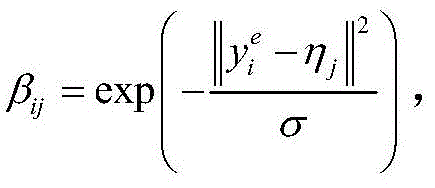


34)通过最小化能量函数Ere,得到三维模型的非刚性变换参数,用于配准拟合所述牙列表面体素集合。34) By minimizing the energy function E re , the non-rigid transformation parameters of the three-dimensional model are obtained, which are used to register and fit the set of surface voxels of the tooth table.
针对上述对锥束CT图像进行牙列分割的方法,进一步地,步骤4)所述基于柔化约束下的随机游走方法进行牙列分割,包括如下步骤:For the above-mentioned method for dentition segmentation on cone beam CT images, further, step 4) described in step 4) to perform dentition segmentation based on the random walk method under softening constraints, including the following steps:
41)通过设定与体图像分割结果拟合后的三维模型表面内部体素更有可能属于牙列,根据体素结点概率定义柔化约束;41) By setting the internal voxels on the surface of the 3D model fitted with the volume image segmentation results, it is more likely to belong to the dentition, and the softening constraints are defined according to the voxel node probability;
42)设定柔化约束下的感兴趣体图像的标签扩散能量为式43:42) Set the label diffusion energy of the body-of-interest image under the softening constraint as Equation 43:
Erwsc(X)=λ1Erw(X)+λ2Esc(X) (式43)E rwsc (X)=λ 1 E rw (X)+λ 2 E sc (X) (Equation 43)
其中Erw与Esc式21式42所定义的随机游走以及柔化约束的能量。λ1与λ2为常数系数。where E rw and E sc Eq. 21 Eq. 42 define the random walk and the energy of the softening constraint. λ 1 and λ 2 are constant coefficients.
将式43中的能量函数的一阶导数设为0,得到关于体素结点概率向量的线性系统如式44,Setting the first derivative of the energy function in Equation 43 to 0, the linear system of the probability vector of the voxel node is obtained as Equation 44,

其中L为拉普拉斯矩阵;H为对角线指示矩阵,当VOI中的第i个结点被预先标注时,H的元素Hii=1;X与


43)利用共轭梯度方法求解线性系统,该线性系统需要求解|S|-1次,其中|S|为系统中类别标签的个数;通过求解线性系统得到感兴趣体图像中所有体素的类别标签。43) Use the conjugate gradient method to solve the linear system, the linear system needs to solve |S|-1 times, where |S| is the number of category labels in the system; by solving the linear system, all voxels in the body of interest image are obtained. Category label.
进一步地,步骤41)采用以下步骤定义所述柔化约束:Further, step 41) adopts the following steps to define the softening constraint:
410)根据牙齿表面内部的灰度分布,对牙本质赋以更大的属于牙齿的概率,定义基于三维可变形模型属于前景牙齿的概率为式41:410) According to the grayscale distribution inside the tooth surface, a greater probability of belonging to the tooth is assigned to the dentin, and the probability of belonging to the foreground tooth based on the three-dimensional deformable model is defined as formula 41:

式41中,pd(r,θ)为基于三维可变形模型属于前景牙齿的概率;r1(θ)与r2(θ)表示牙齿的外轮廓以及牙髓腔轮廓,其中r2(θ)=r1(θ)-a,a为经验的牙本质厚度;
411)针对没有牙髓腔的分层图像,基于三维可变形模型属于前景牙齿的概率定义为式411:411) For the layered image without the pulp cavity, the probability of belonging to the foreground tooth based on the three-dimensional deformable model is defined as formula 411:

式411中,
412)针对牙齿可能出现的多牙根以及多牙尖结构情况,牙齿在切片上呈多轮廓状态时基于三维可变形模型属于前景牙齿的概率表示为式412:412) In view of the possible multi-root and multi-cusp structures of teeth, when the tooth is in a multi-contour state on the slice, the probability of belonging to the foreground tooth based on the three-dimensional deformable model is expressed as formula 412:

式412中,nc为当前牙齿在切片图像中轮廓的个数;pd为单外轮廓的基于三维可变形模型属于前景牙齿的概率(式41与式411);r,θ为体素在极坐标系中的坐标;In Equation 412, n c is the number of contours of the current tooth in the slice image; p d is the probability that the 3D deformable model with a single outer contour belongs to the foreground tooth (Equation 41 and Equation 411); coordinates in polar coordinates;
413)利用卡方核的一对多支持向量机生成分类器,所述分类器的输出被归一化到0-1之间,表示基于体素表观属于前景(牙列)的概率pc,柔化约束定义为式413:413) Using a one-to-many support vector machine with a chi-square kernel to generate a classifier, the output of the classifier is normalized to be between 0-1, representing the probability p c of apparently belonging to the foreground (dentition) based on the voxel , the softening constraint is defined as Equation 413:

式413中,pc表示由体素vi表观估计的体素属于前景(牙列)的概率;

针对上述对锥束CT图像进行牙列分割的方法,进一步地,步骤5)所述通过迭代修正过程对牙列分割进行迭代修正,具体包括如下步骤:For the above-mentioned method for segmenting dentition on a cone beam CT image, further, step 5) performing iterative correction on dentition segmentation through an iterative correction process specifically includes the following steps:
51)将柔化约束下的标签扩散和三维模型的非刚性配准能量结合,定义能量如式51:51) Combine the label diffusion under the softening constraint with the non-rigid registration energy of the 3D model, and define the energy as Eq. 51:
E(X,T)=λ1Erw+λ2Esc+λ3Ere (式51)E(X,T)=λ 1 E rw +λ 2 E sc +λ 3 E re (Equation 51)
式51中,E(X,T)是基于三维可变形模型随机游走算法进行牙列分割的总能量函数;Erw与Esc为式21与式42所定义的随机游走以及柔化约束的能量函数;Ere为式31所定义三维模型非刚性配准的能量;λ1,λ2与λ3为常数,实验中分别设置为1、0.1、1;;In Equation 51, E(X, T) is the total energy function for dentition segmentation based on the three-dimensional deformable model random walk algorithm; E rw and E sc are the random walk and softening constraints defined by Equation 21 and Equation 42 ; E re is the energy of the non-rigid registration of the three-dimensional model defined by Eq. 31; λ 1 , λ 2 and λ 3 are constants, which are set to 1, 0.1, and 1 respectively in the experiment;
52)在第一个阶段,设定基于标签扩散得到的体图像分割获取牙列表面体素集,由于表面体素集由第i-1次迭代中的CBCT图像分割得到,所以将与柔化约束下的随机游走相关的项Erw和Esc从能量函数式51中去掉,通过最小化能量E(X(i-1),T)对三维模型进行变形,用于拟合牙列的表面体素集;此阶段对于三维模型变形参数的求解和步骤3)相同;52) In the first stage, set the volume image segmentation based on label diffusion to obtain the tooth table surface voxel set. Since the surface voxel set is obtained from the CBCT image segmentation in the i-1th iteration, it will be combined with the softening constraint. The random walk-related terms E rw and E sc below are removed from the energy function Equation 51, and the three-dimensional model is deformed by minimizing the energy E(X (i-1) , T ) to fit the surface of the dentition Voxel set; this stage is the same as step 3) for solving the deformation parameters of the 3D model;
53)在第二个阶段,去掉能量函数中与三维模型配准相关的项Ere,最小化能量E(X,T(i-1)),得到感兴趣图像中所有体素的标签;此阶段通过求解一个大规模稀疏的线性系统求解所有体素的标签,和步骤4)所述柔化约束下的随机游走方法相同;53) In the second stage, the term E re related to the registration of the 3D model in the energy function is removed, and the energy E(X,T (i-1) ) is minimized to obtain the labels of all voxels in the image of interest; this In the stage, the labels of all voxels are solved by solving a large-scale sparse linear system, which is the same as the random walk method under the softening constraint described in step 4);
54)迭代优化进行步骤52)和步骤53),当相邻两步迭代中三维模型更新||Ye(i)-Ye (i-1)||2小于预先给定的阈值时终止迭代,得到感兴趣图像中所有体素的标签,作为迭代修正后的牙列分割结果。其中Ye(i)与Ye(i-1)分别为第i步与第i-1步三维表面模型。54) Iterative optimization, proceed to step 52) and step 53), and terminate the iteration when the 3D model update ||Y e(i) -Y e (i-1) || 2 in the adjacent two-step iterations is less than a predetermined threshold , get the labels of all voxels in the image of interest as the iteratively corrected dentition segmentation result. Among them, Y e(i) and Y e(i-1) are the three-dimensional surface models of the i-th step and the i-1-th step, respectively.
针对上述对锥束CT图像进行牙列分割的方法,进一步地,所述得到的牙列表面模型与手工分割得到的表面模型的平均距离误差在0.3mm以下。For the above method for segmenting the dentition of the cone beam CT image, further, the average distance error between the obtained tooth surface model and the surface model obtained by manual segmentation is less than 0.3 mm.
与现有技术相比,本发明的有益效果是:Compared with the prior art, the beneficial effects of the present invention are:
本发明提供一种对锥束CT(CBCT)图像进行牙列分割的方法,基于可变形模型的随机游走方法,从CBCT图像中分割得到完整牙列。本发明方法结合半监督的随机游走算法和三维可变形模型配准定义的柔化约束,获取牙列的可靠分割。其中,利用三维可变形模型引入体图像的柔化约束,可以看作为正则化项用于处理基于半监督标签扩散的体图像分割中的噪声。本发明还采用迭代修正方法,对柔化约束下标记扩散以及三维模型对表面体素集的拟合问题,进行迭代求解,可有效地消除分割误差,改进单次标签扩散所获取的牙列分割,提高分割结果的精度。The invention provides a method for segmenting the dentition of a cone beam CT (CBCT) image. Based on the random walk method of a deformable model, a complete dentition is obtained by segmenting the CBCT image. The method of the invention combines the semi-supervised random walk algorithm and the softening constraints defined by the registration of the three-dimensional deformable model to obtain reliable segmentation of the dentition. Among them, the softening constraint of the volume image is introduced by the 3D deformable model, which can be regarded as a regularization term for dealing with noise in volume image segmentation based on semi-supervised label diffusion. The invention also adopts an iterative correction method to iteratively solve the problem of label diffusion under the softening constraint and the fitting problem of the three-dimensional model to the surface voxel set, which can effectively eliminate the segmentation error and improve the dentition segmentation obtained by a single label diffusion. , to improve the accuracy of segmentation results.
利用本发明提供的方法,可以对医学临床CBCT图像进行自动的牙列分割,分割得到的三维牙列模型可用于颌面与口腔正畸外科辅助手术预测以及牙列对齐计划的制定,该牙列分割可满足口腔临床对于精度的要求。度量自动分割所得到的牙列表面模型与手工分割对应的表面模型的平均距离,该距离误差在0.3mm以下。Using the method provided by the present invention, the medical clinical CBCT images can be automatically segmented into dentition, and the three-dimensional dentition model obtained by segmentation can be used for the prediction of maxillofacial and orthodontic surgery assisted surgery and the formulation of dentition alignment plans. Segmentation can meet the accuracy requirements of oral clinics. The average distance between the tooth table surface model obtained by automatic segmentation and the surface model corresponding to manual segmentation is measured, and the distance error is less than 0.3mm.
附图说明Description of drawings
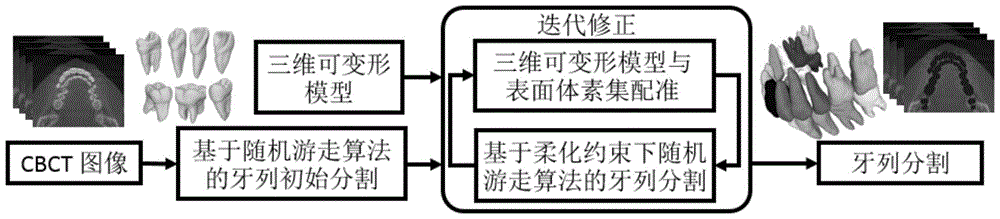
图1是本发明提供方法的流程框图。FIG. 1 is a flowchart of a method provided by the present invention.
图2是本发明中采用的基于上下文的体素描述子的结构示意图;2 is a schematic structural diagram of a context-based voxel descriptor adopted in the present invention;
其中,vi为当前体素;
具体实施方式Detailed ways
下面结合附图,通过实施例进一步描述本发明,但不以任何方式限制本发明的范围。Below in conjunction with the accompanying drawings, the present invention is further described by means of embodiments, but the scope of the present invention is not limited in any way.
CBCT图像是三维体图像,由一系列的二维图像组成,本说明将其中二维图像称作切片图像(分层图像)。本发明实施例针对医学临床CBCT图像,基于CBCT图像中感兴趣体图像区域中定义的图结构和少量用户交互标注的分层图像(切片图像),对CBCT图像中的牙列进行分割。其中,采用三维可变形模型定义柔化约束,通过基于柔化约束下的随机游走算法更新体图像中的牙列分割,再以迭代修正方法获取可靠的分割结果。A CBCT image is a three-dimensional volume image composed of a series of two-dimensional images, of which the two-dimensional images are referred to as slice images (layered images) in this description. For medical clinical CBCT images, the embodiments of the present invention segment the dentition in the CBCT image based on the graph structure defined in the body of interest image region in the CBCT image and a small number of layered images (slice images) annotated interactively by users. Among them, a three-dimensional deformable model is used to define the softening constraints, and the dentition segmentation in the volume image is updated through a random walk algorithm based on the softening constraints, and then the iterative correction method is used to obtain reliable segmentation results.
图1是本发明提供方法的流程框图。具体地,本发明提供方法包括如下步骤:FIG. 1 is a flowchart of a method provided by the present invention. Specifically, the method provided by the present invention includes the following steps:
步骤1:设定CBCT图像中的感兴趣体图像(VOI),定义VOI中的图结构;Step 1: Set the volume of interest image (VOI) in the CBCT image, and define the graph structure in the VOI;
本方法以一种半监督的方式对CBCT图像进行牙列分割,其中,将用户所指定的少量切片图像中的标记扩散到感兴趣体图像的整个区域。该扩散过程在VOI中定义的图结构中进行。针对VOI定义的图结构中,结点集合对应VOI中所有的体素,边连接集合为相邻体素之间的边连接。The method performs dentition segmentation on CBCT images in a semi-supervised manner, in which markers in a small number of slice images specified by the user are diffused over the entire region of the body of interest image. This diffusion process takes place in the graph structure defined in the VOI. In the graph structure defined for VOI, the node set corresponds to all voxels in the VOI, and the edge connection set is the edge connection between adjacent voxels.
一般地,图结构的边连接集合包含两类,一类对应切片图像内部的边连接,该连接对应切片图像中规则的像素网格;另一类对应切片图像之间的边连接,依据由稠密光流算法获取的切片图像之间的对应体素建立边连接。值得注意的是,由稠密光流算法建立的对应并非一一对应,即第i层切片图像中的一个结点可能与第(i+1)层切片图像中不止一个结点对应。该情况常常发生在牙齿区域分叉的切片图像,例如磨牙的多牙根区域,或者牙冠中的多牙尖区域。Generally, there are two types of edge connection sets in a graph structure. One type corresponds to the edge connection inside the sliced image, which corresponds to the regular pixel grid in the sliced image; the other type corresponds to the edge connection between sliced images. The corresponding voxels between the sliced images obtained by the optical flow algorithm establish edge connections. It is worth noting that the correspondence established by the dense optical flow algorithm is not a one-to-one correspondence, that is, a node in the slice image of the i-th layer may correspond to more than one node in the slice image of the (i+1)-th layer. This often occurs in slice images of bifurcations in tooth regions, such as multi-root regions in molars, or multi-cuspid regions in crowns.
系统基于体素的表观计算相邻体素之间的相似度(为上下文特征描述差异与灰度差异的加权组合)。使用体素的灰度I计算体素的相似度是一种较直观的方式,但是仅仅利用体素灰度定义体素相似度对于低辐射剂量采集的CBCT图像并不适合。这是由于CBCT图像中可能存在退化区域,其中仅由灰度相似并不能说明对应体素相似。因此系统引入基于上下文的体素描述子。The system calculates the similarity between adjacent voxels (a weighted combination of contextual feature description differences and grayscale differences) based on the voxel's appearance. It is a more intuitive way to calculate the similarity of voxels by using the grayscale I of the voxel, but it is not suitable for CBCT images collected with low radiation dose to define the similarity of voxels only by the grayscale of the voxels. This is due to the possible existence of degraded regions in CBCT images, where the similarity of corresponding voxels cannot be explained by the similarity of gray levels alone. Therefore, the system introduces context-based voxel descriptors.
图2是基于上下文的体素描述子;其中,当前体素的一个半径为
为了降低计算的复杂度,该上下文的体素描述子并未对当前体素的所有近邻体素进行计算,而是在当前体素的一个半径为
f(vi)={dp(C(vi),C(vi+γ))|vi+γ∈P} (式11)f(vi )={d p (C(vi ),C( vi +γ))| vi + γ∈P } (Equation 11)
式11中,f(vi)表示当前体素vi的特征描述子向量;C(vi)表示体素vi的包围图像块,dp为图像块的灰度差异;γ为当前体素与模式P中采样体素之间的位移;C(vi+γ)表示模式中的采样体素的包围图像块。其中,图像块的灰度差异dp定义为式12:In Equation 11, f(v i ) represents the feature descriptor vector of the current voxel v i ; C(vi ) represents the surrounding image block of the voxel v i , d p is the grayscale difference of the image block; γ is the current volume displacement between voxels and sampled voxels in pattern P; C( vi +γ) represents the enclosing image block of sampled voxels in pattern. Among them, the grayscale difference d p of the image block is defined as Equation 12:

式12中,dp为图像块的灰度差异;C(vi)与C(vk)分别表示体素vi与vk的包围图像块;δv为包围体素块中体素的位移;vi+δv属于图像块C(vi);I(vi+δv)为体素vi+δv的灰度;I(vk+δv)为体素vk+δv的灰度;In Equation 12, d p is the grayscale difference of the image block; C(v i ) and C(v k ) represent the surrounding image blocks of the voxels v i and v k respectively; Displacement; v i +δ v belongs to the image block C(vi ); I(vi +δ v ) is the grayscale of v i +δ v ; I(v k + δ v ) is the voxel v k + the grayscale of δ v ;
图像块的灰度差异可以看作图像块之间对应体素灰度差异的求和,该计算可以通过图像的线性卷积算子实现。如果体素vi与模式中一个采样体素之间的位移向量为γ,则可预先对体图像进行平移操作得到V(γ)。图像块的灰度差异dp则可以对差异图像V-V(γ)进行卷积得到,即通过式13得到:The grayscale difference of the image blocks can be regarded as the summation of the grayscale differences of the corresponding voxels between the image blocks, and the calculation can be realized by the linear convolution operator of the image. If the displacement vector between the voxel v i and a sampled voxel in the pattern is γ, then the volume image can be translated in advance to obtain V(γ). The grayscale difference d p of the image block can be obtained by convolving the difference image VV(γ), that is, it can be obtained by formula 13:
dp=(V-V(γ))2*G (式13)d p =(VV(γ)) 2 *G (Equation 13)
式13中,dp为图像块的灰度差异;G为卷积核,V(γ)为对原始体图像V进行平移γ后得到的体图像。In Equation 13, d p is the grayscale difference of the image block; G is the convolution kernel, and V(γ) is the volume image obtained by translating the original volume image V by γ.
结合体素的上下文特征描述,图结构中边连接上的权重定义为上下文特征描述差异与灰度差异的加权组合,如式14:Combined with the context feature description of voxels, the weight on the edge connection in the graph structure is defined as the weighted combination of the context feature description difference and the gray level difference, as shown in Equation 14:

式14中,Wij为体素i与相邻体素j之间边连接的权重;α为常数系数用于调节上下文特征以及体素灰度对于权重计算的影响;Ii与Ij对应第i个与第j个体素的灰度,fi与fj对应第i个与第j个体素的上下文描述。Ψ为图结构的边连接集合;本实施例中,系统预先将CBCT图像的灰度范围变换到[0,255]区间,其中α被设置为0.1。通过式14计算得到体素的相似度矩阵。In Equation 14, W ij is the weight of the edge connection between voxel i and adjacent voxel j; α is a constant coefficient used to adjust the context feature and the influence of voxel grayscale on the weight calculation; I i and I j correspond to the first The gray levels of the i and j th voxels, f i and f j correspond to the context descriptions of the ith and j th voxels. Ψ is the edge connection set of the graph structure; in this embodiment, the system pre-transforms the grayscale range of the CBCT image to the [0,255] interval, where α is set to 0.1. The similarity matrix of the voxel is obtained by calculating the formula 14.
步骤2:采用随机游走算法进行牙列的初始分割;Step 2: Use the random walk algorithm to perform the initial segmentation of the dentition;
系统根据牙列分布情况定义标签集合S,其中对不同的牙齿分配不同的标签,正常的牙列包含32颗牙齿,其中第三磨牙,即智齿通常未发育完全,系统将其排除在外,还余下28颗牙齿,因而加上背景类别,系统的标签集合中将定义29类标签。但在实际CBCT数据中,由于牙齿缺失等问题,实际CBCT图像中包含的类别可能少于该类别个数。在初始牙列分割中,系统采用原始的随机游走算法对感兴趣体图像区域进行标记。VOI中体素标记可以通过最小化如下的能量函数(式21)得到。The system defines a label set S according to the distribution of the dentition, in which different teeth are assigned different labels. The normal dentition contains 32 teeth, among which the third molar, the wisdom tooth, is usually not fully developed, and the system excludes it, and the remaining 28 teeth, so with the background class, 29 classes of labels will be defined in the system's label set. However, in the actual CBCT data, due to problems such as missing teeth, the actual CBCT images may contain less than the number of categories. In the initial dentition segmentation, the system uses the original random walk algorithm to label the image area of the body of interest. The voxel labels in the VOI can be obtained by minimizing the following energy function (Equation 21).

式21中,Erw(X)表示基于随机游走算法的图像分割能量;|S|为系统类别标签的个数;


式22中,

步骤3:利用三维可变形模型,通过非刚性变形配准拟合步骤2进行图像分割所得到的牙列表面体素集合,得到三维可变形模型的非刚性变换参数;Step 3: Using the three-dimensional deformable model, the non-rigid transformation parameters of the three-dimensional deformable model are obtained by fitting the set of tooth table surface voxels obtained by image segmentation in step 2 through non-rigid deformation registration;
步骤2得到VOI中所有体素的类别,利用其中属于牙列表面的体素,可以定义牙列的表面形态;考虑到CBCT图像中可能存在的退化现象,以及处于咬合状态上下颌接触的牙齿,基于原始的随机游走技术获取的初始分割与真实牙齿轮廓之间会存在较大的差异。系统引入三维可变形模型处理CBCT图像自身的局部退化问题所造成的边界混淆问题。三维可变形模型来自对实体牙齿模型的三维光学扫描,其具有良好的拓扑结构定义。从CBCT图像分割可以定义牙列表面的体素集合,即属于牙列的体素如果其近邻体素属于背景,则该体素被放入表面体素集Yc。对三维可变形模型施加非刚性变换,以拟合初始分割得到的表面体素集。与体图像分割结果拟合后的三维模型表面内部体素更有可能属于牙列,并基于该假设定义柔化约束。Step 2: Obtain the categories of all voxels in the VOI, and use the voxels belonging to the surface of the dentition to define the surface morphology of the dentition; considering the possible degeneration in the CBCT image, and the teeth that are in contact with the upper and lower jaws in the occlusal state, There will be a large difference between the initial segmentation obtained based on the original random walk technique and the real tooth contour. The system introduces a three-dimensional deformable model to deal with the boundary confusion caused by the local degradation of the CBCT image itself. The 3D deformable model is derived from a 3D optical scan of a solid tooth model with well-defined topology. Segmentation from a CBCT image can define a voxel set of the dentition surface, ie a voxel belonging to a dentition is placed into the surface voxel set Yc if its neighbor voxels belong to the background. A non-rigid transformation is applied to the 3D deformable model to fit the set of surface voxels from the initial segmentation. The voxels inside the surface of the 3D model fitted with the volume image segmentation results are more likely to belong to the dentition, and softening constraints are defined based on this assumption.
三维模型非刚性拟合分为两个阶段,首先利用Procrustes分析计算三维模型的全局变换使其最大程度地与表面体素集Yc一致;随后利用非刚性配准获取特定病人的三维模型,使其与初始分割的表面体素集一致。为了降低非刚性变换的参数空间,系统利用嵌入变形技术,将三维模型表面的非刚性变形定义为一个稀疏基网格顶点变换的线性组合,其中变形后的三维模型顶点为


式31中,


步骤4:基于柔化约束下的随机游走算法进行牙列分割,得到VOI中所有体素的类别标签,即哪些体素属于牙列(前景),哪些体素属于背景;Step 4: Perform dentition segmentation based on the random walk algorithm under softening constraints, and obtain the category labels of all voxels in the VOI, that is, which voxels belong to the dentition (foreground) and which voxels belong to the background;
可以直观看到,与体图像分割得到的表面体素集配准后的三维模型表面内部的体素更有可能属于牙列。但是,在体图像中牙齿表面内部体素并不具有均匀的灰度,其中牙本质具有较亮的灰度,而牙髓腔灰度较低,考虑到牙齿表面内部的灰度分布,系统对牙本质赋以更大的属于牙齿的概率。由于三维模型来自对牙齿模型的光学扫描,该模型不包括内部的牙髓腔的表面,利用经验的牙本质厚度定义a,以及组合Logistic函数依据步骤3得到的变形后的三维模型表面定义柔化约束。极坐标系的中心定义为变形后三维模型与切片图像相交轮廓的中心,令r1(θ)与r2(θ)表示牙齿的外轮廓以及牙髓腔轮廓,其中r2(θ)=r1(θ)-a。基于三维可变形模型属于前景牙齿的概率pd定义为式41:It can be intuitively seen that the voxels inside the surface of the 3D model after registration with the surface voxel set obtained by the volume image segmentation are more likely to belong to the dentition. However, in the volume image, the voxels inside the tooth surface do not have uniform grayscale, in which the dentin has a brighter grayscale, while the pulp cavity has a lower grayscale. Considering the grayscale distribution inside the tooth surface, the system can Dentin confers a greater probability of belonging to a tooth. Since the 3D model comes from an optical scan of the tooth model, the model does not include the surface of the internal pulp cavity, use the empirical dentin thickness to define a, and the combined Logistic function to define the softened surface of the deformed 3D model obtained in step 3 constraint. The center of the polar coordinate system is defined as the center of the intersecting contour of the deformed 3D model and the sliced image. Let r 1 (θ) and r 2 (θ) represent the outer contour of the tooth and the contour of the pulp cavity, where r 2 (θ)=r 1 (θ)-a. Based on the three-dimensional deformable model, the probability p d belonging to the foreground tooth is defined as Equation 41:

式41中,pd(r,θ)为基于三维可变形模型属于前景牙齿的概率;r,θ为体素在极坐标系中的坐标;r1(θ)与r2(θ)表示牙齿的外轮廓以及牙髓腔轮廓,其中r2(θ)=r1(θ)-a,a为经验的牙本质厚度;
如果考虑没有牙髓腔的分层图像,基于三维可变形模型属于前景牙齿的概率定义为式411:If a layered image without a pulp cavity is considered, the probability of belonging to the foreground tooth based on the 3D deformable model is defined as Equation 411:

其中,pd(r,θ)为基于三维可变形模型属于前景牙齿的概率;r,θ为体素在极坐标系中的坐标;r1(θ)表示牙齿的外轮廓;
上述的基于三维可变形模型属于前景牙齿的概率针对切片图像中的单轮廓定义,考虑到牙齿可能出现的多牙根以及多牙尖结构,该定义可以直接扩展到牙齿在切片上的多轮廓状态,表示为式412:The above-mentioned probability of belonging to the foreground tooth based on the three-dimensional deformable model is defined for a single contour in the slice image. Considering the possible multi-root and multi-cusp structures of the tooth, the definition can be directly extended to the multi-contour state of the tooth on the slice. Expressed as Equation 412:

其中,nc为当前牙齿在切片图像中轮廓的个数;pd(r,θ)为式41与式411定义的在坐标(r,θ)处基于三维可变形模型属于前景牙齿的概率;
由于三维模型变形后与牙齿真实表面之间可能存在空隙,系统还利用体素的表观定义体素属于牙列的分类器。从交互标注的切片图像中学习该分类器,利用卡方(chi-square)核的一对多(one-vs-rest)支持向量机(SVM)生成分类器,该分类器的输出被归一化到0-1之间,表示体素属于前景(牙列)的概率pc。柔化约束定义为式413:Since there may be gaps between the deformed 3D model and the real surface of the tooth, the system also uses the appearance of the voxel to define the classifier that the voxel belongs to the dentition. The classifier is learned from interactively annotated sliced images, using a one-vs-rest support vector machine (SVM) with a chi-square kernel to generate a classifier whose outputs are normalized To between 0-1, it represents the probability p c that the voxel belongs to the foreground (dentition). The softening constraint is defined as Equation 413:

式413中,pc表示由体素表观估计的体素vi属于前景(牙列)的概率;

柔化约束的能量项定义为式42:The energy term of the softening constraint is defined as Equation 42:

其中,


Erwsc(X)=λ1Erw+λ2Esc (式43)E rwsc (X) = λ 1 E rw +λ 2 E sc (Equation 43)
其中Erw与Esc式21式42所定义的随机游走以及柔化约束的能量。λ1与λ2为常数系数。将该能量函数(式43)的一阶导数设为0,可得到关于体素结点概率向量的线性系统,利用共轭梯度方法求解如下线性系统(式44)。where E rw and E sc Eq. 21 Eq. 42 define the random walk and the energy of the softening constraint. λ 1 and λ 2 are constant coefficients. Setting the first derivative of the energy function (Equation 43) to 0, a linear system with respect to the voxel node probability vector can be obtained, and the following linear system (Equation 44) can be solved by using the conjugate gradient method.

其中L为拉普拉斯矩阵;H为对角线指示矩阵,当VOI中的第i个结点被预先标注时,H的元素Hii=1;X与


步骤5:对牙列分割迭代修正;Step 5: Iteratively correct the dentition segmentation;
为了改进单次柔化约束下随机游走算法所得到的体图像分割,系统引入迭代修正过程,对柔化约束下标记扩散,以及三维模型对表面体素集的拟合问题,进行迭代求解,以改进单次标签扩散所获取的牙列分割。In order to improve the volume image segmentation obtained by the random walk algorithm under a single softening constraint, an iterative correction process was introduced into the system, and the label diffusion under the softening constraint and the fitting problem of the 3D model to the surface voxel set were iteratively solved. To improve dentition segmentation obtained with a single label diffusion.
将柔化约束下的标签扩散以及三维模型的非刚性配准能量结合,定义能量如下:Combining the label diffusion under the softening constraints and the non-rigid registration energy of the 3D model, the energy is defined as follows:
E(X,T)=λ1Erw+λ2Esc+λ3Ere (式51)E(X,T)=λ 1 E rw +λ 2 E sc +λ 3 E re (Equation 51)
式51中,E(X,T)是基于三维可变形模型随机游走算法进行牙列分割的总能量函数;Erw与Esc为式21式42所定义的随机游走以及柔化约束的能量函数;Ere为式31所定义三维模型非刚性配准的能量;λ1,λ2与λ3为常数,实验中分别设置为1、0.1、1。In Equation 51, E(X, T) is the total energy function for dentition segmentation based on the three-dimensional deformable model random walk algorithm; E rw and E sc are the random walk and softening constraints defined in Equation 21 and Equation 42. Energy function; E re is the energy of the non-rigid registration of the three - dimensional model defined by Equation 31 ;
该能量函数的优化可以分解为两个子问题。在第一个阶段,给定基于标签扩散得到的体图像分割定义牙列表面体素集,对三维模型进行变形,用于拟合更新后的表面体素集。该变形通过最小化能量E(X(i-1),T)得到,其中表面体素集由第i-1次迭代中的CBCT图像分割得到,因而与柔化约束下的随机游走相关的项,即Erw与Esc可以从能量函数中去掉。对于三维模型变形参数的求解与步骤3)的描述一致。The optimization of this energy function can be decomposed into two sub-problems. In the first stage, the 3D model is deformed to fit the updated surface voxel set, given a volume image segmentation based on label diffusion to define a set of surface voxels. This deformation is obtained by minimizing the energy E(X (i-1) ,T), where the surface voxel set is obtained from the segmentation of the CBCT image in the i-1th iteration, and thus is related to the random walk under softening constraints. terms, namely Erw and Esc , can be removed from the energy function. The solution for the deformation parameters of the 3D model is consistent with the description in step 3).
在第二个阶段,最小化能量E(X,T(i-1))以得到VOI中所有体素的标签。由于在标签扩散过程中使用的柔化约束来自第i-1步迭代中的三维模型配准,因而能量函数中与三维模型配准相关的项,即Ere可被去掉,该阶段对应步骤4)中柔化约束下的随机游走算法,通过求解一个大规模稀疏的线性系统求解所有体素的标签。In the second stage, the energy E(X,T (i-1) ) is minimized to get the labels of all voxels in the VOI. Since the softening constraint used in the label diffusion process comes from the 3D model registration in the i-1th iteration, the term in the energy function related to the 3D model registration, ie E re , can be removed. This stage corresponds to step 4 ), the random walk algorithm under the softening constraints in ) solves the labels of all voxels by solving a large-scale sparse linear system.
随着两个子问题的优化迭代进行,变形后的三维物体表面与基于标签扩散所得到的表面体素集会越来越接近。当相邻两步迭代中三维模型更新||Ye(i)-Ye(i-1)||2(其中Ye(i)与Ye(i-1)分别为第i步与第i-1步三维表面模型)小于预先给定的阈值时,终止迭代,得到VOI中所有体素的标签,作为迭代修正后的牙列分割结果。As the two sub-problems are optimized iteratively, the deformed 3D object surface will get closer and closer to the surface voxel set based on label diffusion. When the 3D model is updated in two adjacent iterations ||Y e(i) -Y e(i-1) || 2 (wherein Y e(i) and Y e(i-1) are the i-th and Y-th steps, respectively When the three-dimensional surface model of step i-1) is smaller than the preset threshold, the iteration is terminated, and the labels of all voxels in the VOI are obtained as the result of iteratively corrected dentition segmentation.
为了验证基于三维可变形模型随机游走算法对牙列进行分割的精度,利用Dice测度计算自动分割与手工分割的相似度,该相似度大于0.95。同时,度量自动分割所得到的牙列表面模型与手工分割对应的表面模型的平均距离,该距离误差在0.3mm以下,可满足口腔临床对于精度的要求。In order to verify the accuracy of dentition segmentation based on 3D deformable model random walk algorithm, the similarity between automatic segmentation and manual segmentation was calculated using Dice measure, and the similarity was greater than 0.95. At the same time, the average distance between the tooth table surface model obtained by automatic segmentation and the surface model corresponding to manual segmentation is measured, and the distance error is less than 0.3mm, which can meet the requirements of oral clinic for accuracy.
利用本发明的方法,可以对临床采集CBCT图像进行牙列分割。该方法结合半监督的随机游走算法,以及由三维可变形模型配准定义的柔化约束获取牙列的可靠分割。其中利用三维可变形模型引入柔化约束,也可以看作为正则化项用于处理基于半监督标签扩散的体图像分割中的噪声。该发明引入迭代修正方法,其中对系统的两个子问题,即柔化约束下标记扩散,以及三维模型对表面体素集的拟合问题,进行迭代求解以改进单次标签扩散所获取的牙列分割。Using the method of the present invention, dentition segmentation can be performed on the clinically acquired CBCT images. The method combines a semi-supervised random walk algorithm with softening constraints defined by the registration of a 3D deformable model to obtain reliable segmentation of the dentition. The 3D deformable model is used to introduce softening constraints, which can also be regarded as a regularization term for dealing with noise in volume image segmentation based on semi-supervised label diffusion. The invention introduces an iterative correction method, in which two sub-problems of the system, label diffusion under softening constraints, and the fitting of a 3D model to a surface voxel set, are iteratively solved to improve the dentition obtained by a single label diffusion segmentation.
需要注意的是,公布实施例的目的在于帮助进一步理解本发明,但是本领域的技术人员可以理解:在不脱离本发明及所附权利要求的精神和范围内,各种替换和修改都是可能的。因此,本发明不应局限于实施例所公开的内容,本发明要求保护的范围以权利要求书界定的范围为准。It should be noted that the purpose of publishing the embodiments is to help further understanding of the present invention, but those skilled in the art can understand that various replacements and modifications are possible without departing from the spirit and scope of the present invention and the appended claims of. Therefore, the present invention should not be limited to the contents disclosed in the embodiments, and the scope of protection of the present invention shall be subject to the scope defined by the claims.
Claims (6)


Priority Applications (1)
| Application Number | Priority Date | Filing Date | Title |
|---|---|---|---|
| CN201610157705.3A CN107203998B (en) | 2016-03-18 | 2016-03-18 | A method for segmenting dentition in cone beam CT images |
Applications Claiming Priority (1)
| Application Number | Priority Date | Filing Date | Title |
|---|---|---|---|
| CN201610157705.3A CN107203998B (en) | 2016-03-18 | 2016-03-18 | A method for segmenting dentition in cone beam CT images |
Publications (2)
| Publication Number | Publication Date |
|---|---|
| CN107203998A CN107203998A (en) | 2017-09-26 |
| CN107203998B true CN107203998B (en) | 2020-04-03 |
Family
ID=59904364
Family Applications (1)
| Application Number | Title | Priority Date | Filing Date |
|---|---|---|---|
| CN201610157705.3A Active CN107203998B (en) | 2016-03-18 | 2016-03-18 | A method for segmenting dentition in cone beam CT images |
Country Status (1)
| Country | Link |
|---|---|
| CN (1) | CN107203998B (en) |
Families Citing this family (19)
| Publication number | Priority date | Publication date | Assignee | Title |
|---|---|---|---|---|
| EP3462373A1 (en) * | 2017-10-02 | 2019-04-03 | Promaton Holding B.V. | Automated classification and taxonomy of 3d teeth data using deep learning methods |
| CN107703029B (en) * | 2017-11-07 | 2019-05-10 | 大连理工大学 | A method for calculating the diffusion coefficient of CO2 brine by combining CT and PVT |
| CN108257118B (en) * | 2018-01-08 | 2020-07-24 | 浙江大学 | A fracture adhesion segmentation method based on normal corrosion and random walk |
| CN108765474A (en) * | 2018-04-17 | 2018-11-06 | 天津工业大学 | A kind of efficient method for registering for CT and optical scanner tooth model |
| CN108670451B (en) * | 2018-05-04 | 2020-10-13 | 上海正雅齿科科技股份有限公司 | Method and device for repairing adjacent tooth surface, user terminal and storage medium |
| EP3591616A1 (en) * | 2018-07-03 | 2020-01-08 | Promaton Holding B.V. | Automated determination of a canonical pose of a 3d dental structure and superimposition of 3d dental structures using deep learning |
| CN109978841B (en) * | 2019-03-12 | 2021-08-03 | 北京羽医甘蓝信息技术有限公司 | Method and device for recognizing impacted tooth of panoramic picture based on deep learning |
| CN109903396B (en) * | 2019-03-20 | 2022-12-16 | 洛阳中科信息产业研究院 | Tooth three-dimensional model automatic segmentation method based on curved surface parameterization |
| CN110232684B (en) * | 2019-06-13 | 2023-05-23 | 大连理工大学 | A method for automatic segmentation of 3D medical images based on spectral analysis |
| CN113139908B (en) * | 2020-01-17 | 2022-08-26 | 北京大学 | Three-dimensional dentition segmentation and labeling method |
| CN111265317B (en) * | 2020-02-10 | 2022-06-17 | 上海牙典医疗器械有限公司 | A method for predicting the orthodontic process |
| CN111462159A (en) * | 2020-04-03 | 2020-07-28 | 哈尔滨理工大学 | An automatic liver segmentation method based on deformed model of CT images |
| CN112614127A (en) * | 2020-12-31 | 2021-04-06 | 北京朗视仪器有限公司 | Interactive three-dimensional CBCT tooth image segmentation algorithm based on end-to-end |
| CN115252174B (en) * | 2021-04-30 | 2025-02-14 | 合肥美亚光电技术股份有限公司 | Tooth arrangement method, tooth orthodontic simulation method, storage medium and oral CT device |
| CN113506303B (en) * | 2021-07-27 | 2024-01-30 | 四川九洲电器集团有限责任公司 | Interactive tooth segmentation method, device and processing system |
| CN113344950A (en) * | 2021-07-28 | 2021-09-03 | 北京朗视仪器股份有限公司 | CBCT image tooth segmentation method combining deep learning with point cloud semantics |
| CN113628222A (en) * | 2021-08-05 | 2021-11-09 | 杭州隐捷适生物科技有限公司 | A 3D tooth segmentation and classification method based on deep learning |
| CN114241173B (en) * | 2021-12-09 | 2023-03-21 | 电子科技大学 | Tooth CBCT image three-dimensional segmentation method and system |
| CN115423789B (en) * | 2022-09-19 | 2025-02-18 | 杭州柳叶刀机器人有限公司 | A method and device for extracting the position of a metal ball used for positioning in a CBCT image |
Citations (5)
| Publication number | Priority date | Publication date | Assignee | Title |
|---|---|---|---|---|
| CN104835153A (en) * | 2015-04-30 | 2015-08-12 | 天津大学 | Non-rigid surface aligning method based on sparse representation |
| CN104881681A (en) * | 2015-05-22 | 2015-09-02 | 浙江大学 | Image Sequence Classification Method Based on Mixed Graph Model |
| US9129363B2 (en) * | 2011-07-21 | 2015-09-08 | Carestream Health, Inc. | Method for teeth segmentation and alignment detection in CBCT volume |
| CN104933709A (en) * | 2015-06-04 | 2015-09-23 | 西安理工大学 | Automatic random-walk CT lung parenchyma image segmentation method based on prior information |
| CN105279762A (en) * | 2015-11-20 | 2016-01-27 | 北京航空航天大学 | An oral cavity soft and hard tissue CT sequence and three-dimensional grid model registration method |
-
2016
- 2016-03-18 CN CN201610157705.3A patent/CN107203998B/en active Active
Patent Citations (5)
| Publication number | Priority date | Publication date | Assignee | Title |
|---|---|---|---|---|
| US9129363B2 (en) * | 2011-07-21 | 2015-09-08 | Carestream Health, Inc. | Method for teeth segmentation and alignment detection in CBCT volume |
| CN104835153A (en) * | 2015-04-30 | 2015-08-12 | 天津大学 | Non-rigid surface aligning method based on sparse representation |
| CN104881681A (en) * | 2015-05-22 | 2015-09-02 | 浙江大学 | Image Sequence Classification Method Based on Mixed Graph Model |
| CN104933709A (en) * | 2015-06-04 | 2015-09-23 | 西安理工大学 | Automatic random-walk CT lung parenchyma image segmentation method based on prior information |
| CN105279762A (en) * | 2015-11-20 | 2016-01-27 | 北京航空航天大学 | An oral cavity soft and hard tissue CT sequence and three-dimensional grid model registration method |
Non-Patent Citations (1)
| Title |
|---|
| Quantification of Teeth in CT Images Using Statistcal Shape Model Based on Geometrical Complexity;Mohanmmadraza Soltaninejad等;《RearchGate》;20141128;第1-6页 * |
Also Published As
| Publication number | Publication date |
|---|---|
| CN107203998A (en) | 2017-09-26 |
Similar Documents
| Publication | Publication Date | Title |
|---|---|---|
| CN107203998B (en) | A method for segmenting dentition in cone beam CT images | |
| JP7489964B2 (en) | Automated Orthodontic Treatment Planning Using Deep Learning | |
| US11443494B2 (en) | Method for estimating at least one of shape, position and orientation of a dental restoration | |
| US10748651B2 (en) | Method and system of teeth alignment based on simulating of crown and root movement | |
| CN109903396B (en) | Tooth three-dimensional model automatic segmentation method based on curved surface parameterization | |
| US20220361992A1 (en) | System and Method for Predicting a Crown and Implant Feature for Dental Implant Planning | |
| CN108205806B (en) | An automatic analysis method of three-dimensional craniofacial structure in cone beam CT images | |
| CN112639880A (en) | Automatic determination of canonical poses of 3D objects and automatic superimposition of 3D objects using deep learning | |
| CN111685899A (en) | Dental orthodontic treatment monitoring method based on intraoral images and three-dimensional models | |
| US20230298272A1 (en) | System and Method for an Automated Surgical Guide Design (SGD) | |
| US20230419631A1 (en) | Guided Implant Surgery Planning System and Method | |
| CN115409811B (en) | Tooth model reconstruction method, device, equipment and medium based on curvature enhancement | |
| US12469237B2 (en) | System and method for alignment of volumetric and surface scan images | |
| CN115619773A (en) | A method and system for three-dimensional tooth multimodal data registration | |
| Kim et al. | Automatic registration of dental CT and 3D scanned model using deep split jaw and surface curvature | |
| Qian et al. | An automatic tooth reconstruction method based on multimodal data: J. Qian et al. | |
| Zheng et al. | Machine (Deep) Learning for | |
| EP4555481B1 (en) | METHOD AND SYSTEM FOR ESTIMATING TOOTH POSITION | |
| CN117788747A (en) | A three-dimensional reconstruction method of dental crowns using oral scan data and CBCT | |
| CN118967950B (en) | Three-dimensional image guiding correction planning method, system, device and medium | |
| CN114241173A (en) | A method and system for three-dimensional segmentation of dental CBCT images | |
| CN119074289A (en) | Occlusal adjustment method and device | |
| US12579639B2 (en) | System and method for fusion of volumetric and surface scan images | |
| US20230013902A1 (en) | System and Method for Correcting for Distortions of a Diagnostic Image | |
| Chen et al. | Machine (Deep) Learning for Characterization of Craniofacial Variations |
Legal Events
| Date | Code | Title | Description |
|---|---|---|---|
| PB01 | Publication | ||
| PB01 | Publication | ||
| SE01 | Entry into force of request for substantive examination | ||
| SE01 | Entry into force of request for substantive examination | ||
| GR01 | Patent grant | ||
| GR01 | Patent grant |