This application claims 35u.s.c. § 119(e) U.S. provisional application No. 61/479,952 filed 2011 at 4/28, U.S. provisional application No. 61/531,583 filed 2011 at 9/6, U.S. provisional application No. 61/531,574 filed 2011 at 9/6, U.S. provisional application No. 61/538,079 filed 2011 at 9/22, U.S. provisional application No. 61/564,763 filed 2011 at 11/29, U.S. provisional application No. 61/578,192 filed on day 12/20 in 2011, U.S. provisional application No. 61/594,160 filed on day 2/2 in 2012, U.S. provisional application No. 61/598,881 filed on day 2/14 in 2012, U.S. provisional application No. 61/598,892 filed on day 2/14 in 2012, U.S. provisional application No. 61/625,596 filed on day 4/17 in 2012, and U.S. provisional application No. 61/639,017 filed on day 4/26 in 2012, entitled "methods and compositions for multiplex PCR", the disclosures of which are incorporated herein by reference in their entirety.
The present application incorporates by reference the materials of the electronic sequence listing filed herewith. The material of the electronic sequence listing was submitted as a text (.txt) file entitled "2012 _04_25LT00503PCT _ st25.txt" created on 25 d.4.2012, having a file size of 18943KB and is incorporated herein by reference in its entirety.
SUMMARY
In some embodiments, the present disclosure relates generally to methods, compositions, systems, devices, and kits for performing multiplex amplification of nucleic acids. In some embodiments, the method comprises amplifying a plurality of target sequences in a sample comprising two or more target sequences. Optionally, a plurality of target sequences of interest from a sample can be amplified using one or more target-specific primers under amplification conditions in the presence of a polymerase to produce a plurality of amplified target sequences. Amplification optionally comprises contacting a nucleic acid molecule comprising at least one target sequence with one or more target-specific primers and at least one polymerase under amplification conditions. The contacting can result in one or more amplified target sequences.
In some embodiments, the disclosed methods (and related compositions, systems, devices, and kits) can include ligating at least one adaptor to at least one of the amplified target sequences to produce one or more adaptor-ligated amplified target sequences. The linker can include at least one sequence that is not substantially complementary to the target sequence, to the amplified target sequence, and/or to the nucleic acid molecule.
In some embodiments, amplification can result in at least two amplified target sequences that are less than 50% complementary to each other. In some embodiments, at least one amplified target sequence is not substantially complementary to another target sequence in the sample. In some embodiments, the amplified target sequence may not be substantially complementary to any one or more nucleic acid molecules in the sample that do not include the target sequence.
In some embodiments, the disclosed methods (and related compositions, systems, devices, and kits) can involve re-amplifying at least one amplified target sequence. For example, the adaptor-ligated amplified target sequences can be reamplified to produce at least one reamplified adaptor-ligated amplified target sequence. In some embodiments, at least one of the adaptor-ligated amplified target sequences can be contacted with one or more adaptors or their complements and a polymerase under amplification conditions to produce at least one re-amplified adaptor-ligated amplified target sequence. In some embodiments, at least one adapter or its complement is not substantially complementary to at least one amplified target sequence.
In some embodiments, the present disclosure relates generally to compositions (and related methods, kits, devices, and systems using such compositions) comprising one or more target-specific primers for hybridizing to, and optionally amplifying, at least one target sequence in a sample. In some embodiments, a composition can include a plurality of target-specific primers for amplifying 1, 2, or more target sequences in a sample. The composition may also include one or more linkers.
In some embodiments, the target sequence comprises one or more mutation hotspots, Single Nucleotide Polymorphisms (SNPs), Short Tandem Repeats (STRs), coding regions, exons, and genes. In some embodiments, the number of target sequences amplified by one or more methods using the compositions disclosed herein (and related kits, devices, and systems) can be tens, hundreds, or thousands of target sequences in a single reaction. In some embodiments, the number of different targets amplified in a single multiplex amplification may be at least 100, 300, 500, 750, 1000, 2500, 5000, 7500, 10000, 12500, 15000 or more.
In some embodiments, a target-specific primer, linker, amplified target sequence, or nucleic acid molecule can include one or more cleavable moieties. Also referred to herein as a cleavable group. Optionally, the method may further comprise cleaving at least one cleavable group of the target-specific primer, the linker, the amplified target sequence, or the nucleic acid molecule. The cutting may be performed before or after any other step of the disclosed method. In some embodiments, the cleavage step is performed after amplification and before ligation. In one embodiment, cleaving comprises cleaving at least one amplified target sequence prior to ligating. The cleavable moiety may be present in a modified nucleotide, nucleoside, or nucleobase. In some embodiments, a cleavable moiety can include a nucleobase that is not naturally occurring in a target sequence of interest. In some embodiments, uracil or uridine may be incorporated into a DNA-based nucleic acid as a cleavable group. In one exemplary embodiment, uracil DNA glycosylases can be used to cleave a cleavable group from a nucleic acid. In another embodiment, inosine may be incorporated into the DNA-based nucleic acid as a cleavable group. In an exemplary embodiment, EndoV can be used to cleave near inosine residues and other enzymes such as Klenow can be used to generate blunt-ended fragments capable of blunt-end ligation. In another exemplary embodiment, the enzyme hAAG can be used to cleave an inosine residue from a nucleic acid, thereby creating an abasic site that can be further processed by one or more enzymes, such as Klenow (to create blunt-end fragments capable of blunt-end ligation).
In some embodiments, the methods disclosed herein (and related kits, compositions, devices, and systems) can include amplifying at least two target sequences (e.g., a first target sequence and a second target sequence) of a sample that are different from each other. In some embodiments, the methods disclosed herein (and related kits, compositions, devices, and systems) comprise simultaneously amplifying a first target sequence and a second target sequence that are less than 50% complementary to each other. In some embodiments, the first target sequence and the second target sequence are not substantially complementary to each other.
In some embodiments, the methods disclosed herein (and related kits, compositions, devices, and systems) can include amplification using at least two target-specific primers (e.g., a first target-specific primer and a second target-specific primer) that are different from each other. In some embodiments, the first target-specific primer may have at least 50% complementarity to at least some portion of the first target sequence. In some embodiments, the first target-specific primer may not be substantially complementary to another target sequence in the sample. For example, the first target-specific primer may be substantially non-complementary to the second target sequence. Optionally, the first target-specific primer may be substantially complementary to the first target sequence in the sample, and may be substantially non-complementary to any portion of any other nucleic acid molecule in the sample other than the first target sequence.
Optionally, the methods of multiplex amplification disclosed herein comprise amplifying at least a portion of a target sequence in a sample using at least one target-specific primer that is substantially complementary to at least some portion of a nucleic acid molecule comprising the corresponding target sequence. In some embodiments, at least one target-specific primer is substantially complementary to at least some portion of a corresponding target sequence. In some embodiments, amplification may comprise the use of a primer pair comprising a target-specific forward primer and a target-specific reverse primer. In some embodiments, a target-specific primer may include at least one sequence that is substantially complementary or substantially identical to at least some portion of a nucleic acid molecule that includes the corresponding target sequence or its complement. Optionally, the target-specific primer is not substantially complementary to any other nucleic acid molecule present in the sample. In some embodiments, a target-specific primer may include at least one sequence that is substantially complementary or substantially identical to at least some portion of a corresponding target sequence or its complement. In some embodiments, a target-specific primer may include at least one sequence that is complementary or identical to at least some portion of a corresponding target sequence or its complement. In some embodiments, the target-specific primer does not include any nucleic acid sequence: the nucleic acid sequence is at least 5 contiguous nucleotides, 8 nucleotides, 10 contiguous nucleotides, or 15 contiguous nucleotides in length and is not substantially complementary to at least some portion of its corresponding target sequence. In some embodiments, a target-specific primer can hybridize under stringent conditions to at least some portion of a corresponding target sequence in a sample. In some embodiments, at least one of the target-specific primers is not substantially complementary to any nucleic acid sequence present in the sample other than its corresponding target sequence.
In some embodiments, one or more target-specific primers may be designed to exclude one or more sequence motifs. For example, at least one of the target-specific primers can be designed to not include a triplet nucleotide motif that is repeated 5 or more times in the target-specific primer. Optionally, at least one of the target-specific primers may be designed not to include the nucleotide sequence "ACA" repeated 3 or more times. Furthermore, at least one of the target-specific primers can be designed to not include a homopolymer of greater than 8 nucleotides in length. Optionally, at least one of the target-specific primers of the methods disclosed herein can be designed to have a GC content of less than 85%.
In some embodiments, one or more of the amplification methods disclosed herein comprise performing target-specific amplification. Performing target-specific amplification can include amplifying one or more target sequences using one or more proprietary target-specific primers (i.e., primers that do not include any consensus or universal sequence motifs). Typically, one or more of the target-specific primers are substantially complementary to at least some portion of their corresponding target sequence, or to some portion of a nucleic acid molecule comprising the corresponding target sequence. In some embodiments, one, some or all of the target-specific primers are substantially complementary over their entire length to at least some portion of their corresponding target sequence, or to some portion of a nucleic acid molecule comprising the corresponding target sequence.
In some embodiments, the nucleic acid molecules, amplified target sequences, adaptors, or target-specific primers in the sample comprise a 5, terminal end and a 3' terminal end. The 5 'end may include a free 5' phosphate group or an equivalent thereof; the 3 'end may include a free 3' hydroxyl group or an equivalent thereof. Optionally, the ends of the amplified target sequence may not be substantially complementary to the ends of another amplified target sequence. In some embodiments, the 3 'terminus can include about 30 nucleotides or about 15 nucleotides from the 3' hydroxyl group. In some embodiments, the 5 'terminus can include about 30 nucleotides or about 15 nucleotides from the 5' phosphate group, and in some embodiments, any amplified target sequence having a 3 'terminus and a 5' terminus can be substantially non-complementary to any portion of any other amplified target sequence.
Optionally, the disclosed methods can further comprise ligating one or more adaptors comprising a universal priming sequence to amplification products formed as a result of such target-specific amplification. For example, in some embodiments, one or more adaptors can be ligated to the amplified target sequence. Optionally, the linker attached to the amplified target sequence is susceptible to exonuclease degradation. In some embodiments, a linker susceptible to exonuclease degradation may be ligated to the 3' end of the amplified target sequence. In some embodiments, the linker attached to the amplified target sequence does not include a protecting group. In some embodiments, the linker does not include a protecting group that prevents degradation or digestion of the nucleic acid under degradation or digestion conditions. Subsequent enzymatic digestion of the linker-attached amplified target sequence in the presence of nucleic acid that does not contain a protecting group provides a means for selectively digesting unprotected nucleic acid. In some embodiments, the linker may comprise a DNA barcode or tag sequence.
In some embodiments, the methods disclosed herein (and related kits, systems, devices, and compositions) can include contacting an amplified target sequence having a 3 'end and a 5' end with a ligation reaction mixture. In some embodiments the ligation reaction mixture may comprise one or more adaptors and a ligase to generate at least one adaptor-ligated amplified target sequence. In some embodiments, none of the adaptors in the ligation mixture comprises a target-specific sequence prior to ligation. In some embodiments, none of the adaptors in the ligation mixture comprises a sequence that is substantially complementary to the 3 'end or the 5' end of the amplified target sequence prior to ligation. Optionally, the 3 'end or 5' end of the amplified target sequence comprises about 30 nucleotides, and in some cases refers to about 15 nucleotides from the 3 'end or 5' end of the amplified target sequence. In some embodiments, none of the adaptors in the ligation mixture can hybridize to some portion of the amplified target sequence at high stringency prior to ligation. In some embodiments, ligation may comprise direct ligation of one or more adaptors to one or more amplified target sequences. In one embodiment, ligation may comprise performing blunt-end ligation. For example, the process of blunt-end ligation can comprise ligating a substantially blunt-end double-stranded amplified target sequence to a substantially blunt-end double-stranded linker. In some embodiments, ligation does not include one or more additional oligonucleotide adaptors prior to ligating the adaptor to the amplified target sequence.
In some embodiments, the present disclosure relates generally to methods for performing amplification of a target sequence (and related compositions, systems, devices, and kits using the disclosed methods), and may include a digestion step. In some embodiments, the method further comprises a ligation step, and the digestion step is performed prior to the ligation step. In some embodiments, the amplified target sequence may be partially digested, followed by a ligation step. For example, the amplified target sequence may be digested enzymatically, thermally, or chemically. In some embodiments, the amplified target sequences can be digested, followed by ligation to produce blunt-ended amplified target sequences. In some embodiments, the blunt-ended amplified target sequence can comprise a 5 'phosphate group at the 5' end of the digested amplified target sequence.
In some embodiments, the present disclosure relates generally to methods, compositions, systems, devices, and kits for performing multiplex nucleic acid amplification. In some embodiments, methods (and related compositions, kits, devices, and systems using such methods) include amplifying one or more target sequences using one or more target-specific primers in the presence of a polymerase under amplification conditions to produce amplified target sequences, and ligating adaptors to the amplified target sequences. In addition, the method can include re-amplifying the adaptor-ligated amplified target sequence to form a re-amplified adaptor-ligated amplified target sequence. In some embodiments, the reamplified adaptor-ligated amplified target sequences can be generated using no more than two rounds of target-specific selection.
In some embodiments, one or more target-specific primers, target sequences, or linkers can include a cleavable group. In addition, the cleavable group may be located at a nucleotide position on or near the end of the target-specific primer, target sequence, or linker. In some embodiments, the cleavable group can be located within 15 nucleotides of the 3 'end or the 5' end of the nucleic acid having the cleavable group. In some embodiments, the cleavable group can be located at or near the central nucleotide of the target-specific primer. In some embodiments, one or more cleavable groups may be present in a target-specific primer or linker. In some embodiments, cleavage of one or more cleavable groups in a target-specific primer or linker can result in a plurality of nucleic acid fragments having different melting temperatures. In one embodiment, the placement of one or more cleavable groups in a target-specific primer or linker can be adjusted or manipulated by determining a comparable highest lowest melting temperature of each nucleic acid fragment after cleavage of the cleavable group. In some embodiments, the cleavable group may be a uracil or uridine moiety. In some embodiments, the cleavable group can be an inosine moiety. In some embodiments, at least 50% of the target-specific primers can include at least one cleavable group. In some embodiments, each target-specific primer comprises at least one cleavable group.
In one embodiment, disclosed herein is a multiplex nucleic acid amplification method comprising a) amplifying one or more target sequences using one or more target-specific primers in the presence of a polymerase to produce amplified target sequences, and b) ligating an adaptor to the amplified target sequences to form adaptor-ligated amplified target sequences. In some embodiments, amplification may be performed in solution such that the amplified target sequences or target-specific primers are not attached to a solid support or surface. In some embodiments, the ligation may be performed in solution such that the amplified target sequences or adaptors are not attached to a solid support or surface. In another embodiment, amplification and ligation can be performed in solution such that the amplified target sequences, target-specific primers, or adaptors are not attached to a solid support or surface.
In some embodiments, the present disclosure relates generally to methods, compositions, systems, devices, and kits for synthesizing two or more target sequences in a sample. In one embodiment, the synthesis method comprises a) synthesizing two or more target sequences using a plurality of target-specific primers in the presence of a polymerase under polymerization conditions to produce a plurality of synthesized target sequences. In some embodiments, the method further comprises attaching one or more adaptors to the synthetic target sequence. In some embodiments, the target sequence of interest comprises one or more mutational hot spots, Single Nucleotide Polymorphisms (SNPs), Short Tandem Repeats (STRs), coding regions, exons, and genes. In some embodiments, the number of target sequences that can be synthesized in a multiplex reaction using the compositions disclosed herein (and related methods, kits, devices, and systems) can be tens, hundreds, or thousands of target sequences in a single sample. Optionally, a plurality of target sequences of interest from the sample can be synthesized using one or more target-specific primers in the presence of a polymerase under polymerization conditions to produce a plurality of synthesized target sequences. In some embodiments, the synthetic target sequence may be less than 50% complementary to another synthetic target sequence. In some embodiments, the synthetic target sequence may not be substantially complementary to another target sequence in the sample. In some embodiments, the synthesized target sequence may not be substantially complementary to any one or more nucleic acid molecules in the sample that are not target sequences of interest. In some embodiments, synthesizing the target sequence can include ligating an adaptor to the synthesized target sequence, thereby producing an adaptor-ligated synthesized target sequence.
In some embodiments, the disclosure generally relates to synthesizing a target sequence from a plurality of target sequences. For example, a method of synthesis can include synthesizing a target sequence using a plurality of target-specific primers in the presence of a polymerase under polymerization conditions to produce a plurality of synthesized target sequences. Synthesis may also include resynthesis of at least one linker-linked synthetic target sequence. In some embodiments, resynthesizing may include contacting the at least one adapter-ligated synthetic target sequence with at least one adapter or its complement and a polymerase under polymerization conditions to produce a plurality of resynthesized adapter-ligated synthetic target sequences. In some embodiments, the resynthesized adaptor-ligated synthetic target sequences can be generated using no more than two rounds of target-specific selection.
In some embodiments, the method for synthesizing a target sequence may comprise a synthesis and ligation step. In some embodiments, the ligation does not include a linker that is substantially complementary to a portion of the synthetic target sequence. In some embodiments, the linker is not substantially complementary to about 30 contiguous nucleotides or about 20 contiguous nucleotides from the 3 'end or the 5' end of the synthetic target sequence. In some embodiments, the linker may comprise at least one sequence that is substantially complementary to or substantially identical to at least a portion of the universal primer.
In some embodiments, the present disclosure relates generally to methods, compositions, systems, devices, and kits for performing multiplex nucleic acid amplification. In one embodiment, the method comprises amplifying one or more target sequences using one or more target-specific primers under amplification conditions in the presence of a polymerase; ligating an adaptor to the amplified target sequence; and re-amplifying the at least one adaptor-ligated amplified target sequence. In some embodiments, re-amplifying comprises contacting the adaptor-ligated amplified target sequence with one or more adaptors (or their complements) and a polymerase under amplification conditions to produce at least one re-amplified adaptor-ligated amplified target sequence. In some embodiments, the amplified target sequence may be less than 50% complementary to another amplified target sequence. In some embodiments, the amplified target sequence may not be substantially complementary to another target sequence in the sample. In some embodiments, the amplified target sequence may be substantially non-complementary to any one or more nucleic acid molecules in the sample that are not target sequences of interest. In some embodiments, the amplified target sequence can be ligated to at least one adapter or their complement to produce one or more adapter-ligated amplified target sequences. In some embodiments, the adaptor-ligated amplified target sequences may be reamplified to produce at least one reamplified adaptor-ligated amplified target sequence. In some embodiments, the linkers or their complements are not substantially complementary to any portion of any other nucleic acid molecule in the sample. In some embodiments, the adaptors or their complements are not substantially complementary to at least one amplified target sequence. In one embodiment, one or more of the adaptors or their complementary sequences may be universal primers during the re-amplification step. In one embodiment, the ligating step may further comprise ligating a DNA barcode or DNA tag sequence to the amplified target sequence, followed by ligating an adaptor to the amplified target sequence.
In some embodiments, the amplification and synthesis methods of the present disclosure can be performed as an "addition-only" method. In some embodiments, the addition-only method does not include removing all or part of the first reaction mixture (comprising the amplification or synthesis composition) for further manipulation in the amplification or synthesis step. In some embodiments, the addition-only method may be automated, for example, for high throughput processing.
In some embodiments, the present disclosure relates generally to compositions for performing nucleic acid amplification and nucleic acid synthesis (and related kits, methods, systems, and devices using the disclosed compositions). In some embodiments, one or more of the compositions disclosed herein (and related methods, kits, systems, and devices) can include at least one target-specific primer and/or at least one linker. In some embodiments, the composition comprises a plurality of target-specific primers or linkers that are about 15 to about 40 nucleotides in length. In some embodiments, the composition comprises one or more target-specific primers or linkers comprising one or more cleavable groups. In some embodiments, one or more types of cleavable groups can be incorporated into a target-specific primer or linker. In some embodiments, the cleavable group can be located at or near the 3' end of the target-specific primer or linker. In some embodiments, the cleavable group can be located at a terminal nucleotide, a penultimate nucleotide, or any position corresponding to less than 50% of the nucleotide length of the target-specific primer or linker. In some embodiments, the cleavable group can be incorporated at or near a residue located in the center of the target-specific primer or linker. For example, a target-specific primer having 40 bases can comprise a cleavage group at nucleotide positions 15-25. Thus, the target-specific primer or linker may comprise a plurality of cleavable groups at its 3 'end, within its 5' end, or at a central position. In some embodiments, the 5' end of the target-specific primer comprises only non-cleavable nucleotides. In some embodiments, the cleavable group can include a modified nucleobase or a modified nucleotide. In some embodiments, a cleavable group can include a nucleotide or nucleobase that does not naturally occur in the corresponding nucleic acid. For example, a DNA nucleic acid may comprise an RNA nucleotide or nucleobase. In one example, the DNA-based nucleic acid may comprise uracil or uridine. In another example, the DNA-based nucleic acid may include inosine. In some embodiments, a cleavable group can include a moiety that can be cleaved from a target-specific primer or linker by enzymatic, chemical, or thermal methods. In some embodiments, uracil or uridine moieties can be cleaved from target-specific primers or linkers using uracil DNA glycosylase. In some embodiments, the inosine moiety can be cleaved from the target-specific primer or linker using hAAG or EndoV.
In some embodiments, the present disclosure generally relates to compositions comprising a target-specific primer of about 15 to about 40 nucleotides in length, the primer having a cleavable group located near an end of the target-specific primer that hybridizes to a first strand of a double-stranded target sequence. In some embodiments, the primer is substantially complementary to the first strand of the double-stranded target sequence. In some embodiments, the present disclosure relates generally to compositions comprising a target-specific primer of about 15 to about 40 nucleotides in length (the primer having a cleavable group located near the end of the target-specific primer that hybridizes to a first strand of a double-stranded target sequence) and a second target-specific primer of about 15 to about 40 nucleotides in length (the primer having a cleavable group located near the end of the second target-specific primer that hybridizes to a second strand of the double-stranded target sequence). In some embodiments, the second target-specific primer is substantially complementary to the second strand of the double-stranded target sequence.
In some embodiments, the present disclosure relates generally to compositions for performing nucleic acid amplification and nucleic acid synthesis (and related kits, methods, systems, and devices using the disclosed compositions). In some embodiments, the composition comprises a target-specific primer of about 15 to about 40 nucleotides in length having a uracil nucleotide located near the terminus of the target-specific primer and a second uracil nucleotide located near the central nucleotide of the target-specific primer. In some embodiments, the present disclosure relates generally to compositions for performing nucleic acid amplification and nucleic acid synthesis (and related kits, methods, systems, and devices using the disclosed compositions). In some embodiments, the composition comprises a target-specific primer that is about 15 to about 40 nucleotides in length, having an inosine nucleotide located near the 3' end of the target-specific primer and at least a second inosine nucleotide located near the central nucleotide of the target-specific primer.
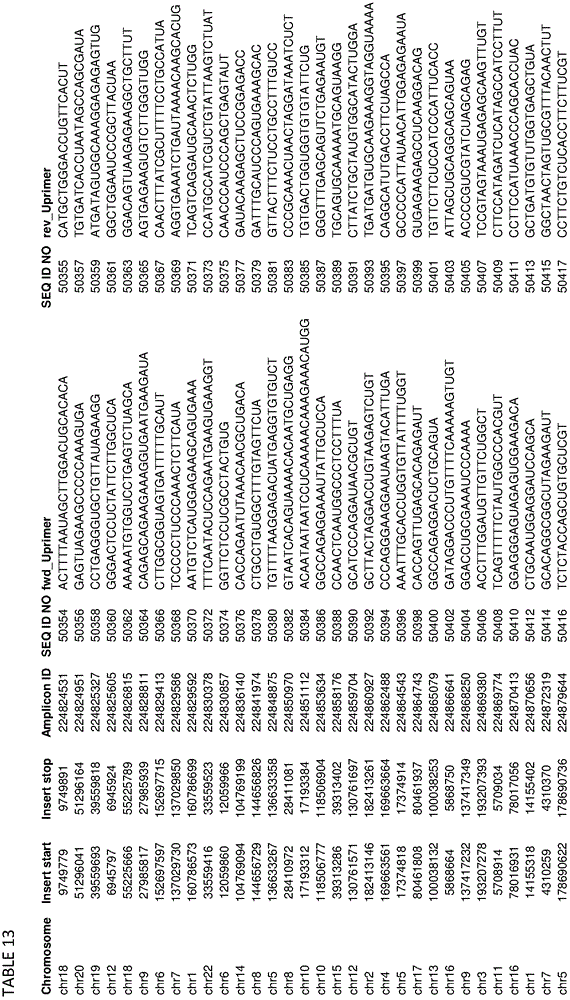
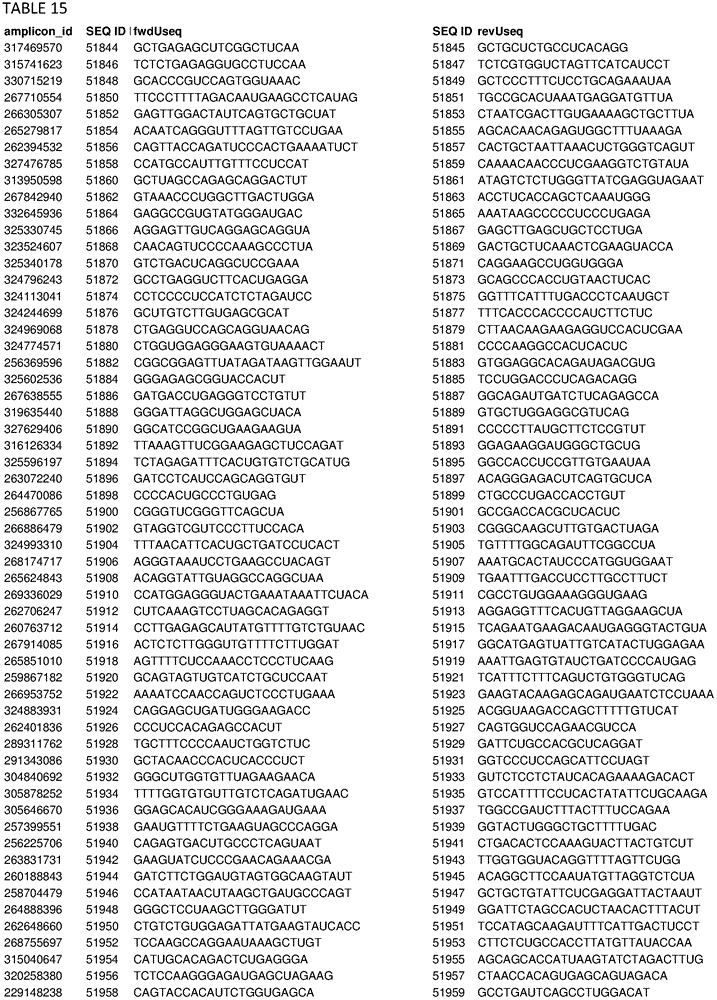
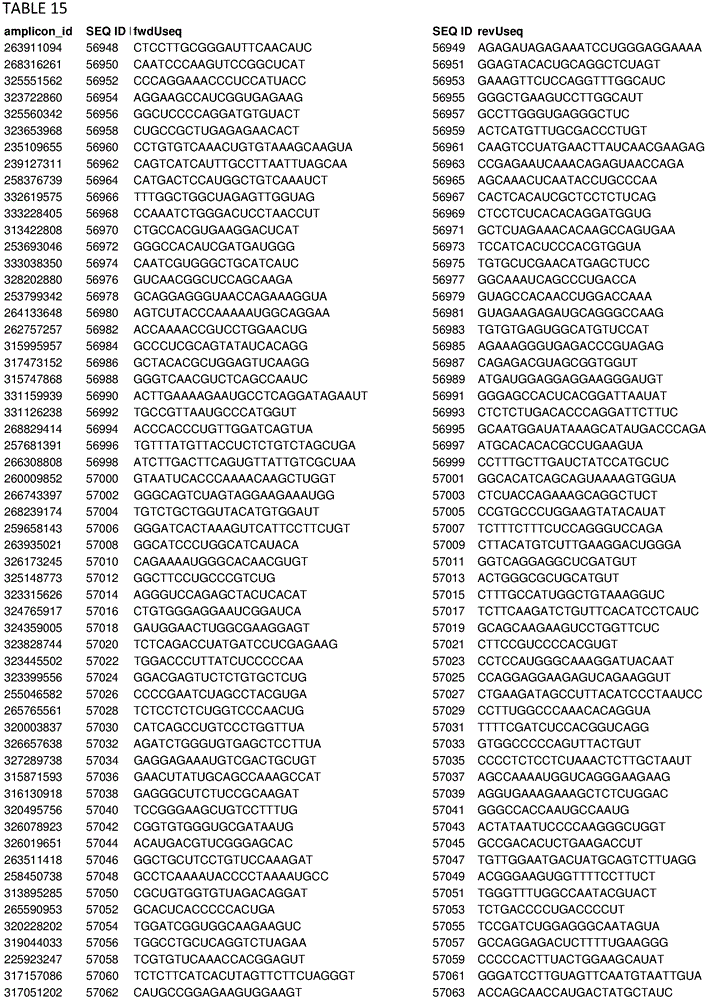
In some embodiments, the present disclosure relates generally to compositions comprising at least one target-specific primer or at least one target-specific primer pair. In some embodiments, the present disclosure relates generally to compositions comprising a plurality of target-specific primers. Optionally, the composition may comprise at least 100, 200, 300, 500, 750, 1000, 1250, 1500, 1750, 2000, 2500, 3000, 4000, 5000, 7500, or 10,000 target-specific primers or target-specific primer pairs. In some embodiments, a composition comprising a plurality of target-specific primers comprises at least one of the target-specific primers disclosed herein. In some embodiments, a composition comprising a plurality of target-specific primers comprises at least one target-specific primer that is at least 90% identical to any of the nucleic acid sequences provided in the sequence listing as provided herein or concurrently filed. In some embodiments, a composition comprising a plurality of target-specific primers comprises one or more target-specific primer pairs disclosed herein, or one or more primer pairs having at least 90% identity to any of the primer pair nucleic acid sequences provided herein. In some embodiments, a composition comprising a plurality of target-specific primers can have a percent identity of at least 91%, 92%, 93%, 94%, 95%, 96%, 97%, 98%, or 99% identity to any one or more of the nucleic acid sequences disclosed in the sequence listing herein or concurrently filed. In some embodiments, a composition comprising a plurality of target-specific primers can comprise any one or more target-specific primers selected from tables 2, 3, 13, 14, 15, 17, and 19. In some embodiments, a composition comprising a plurality of target-specific primers can comprise any one or more target-specific primer pairs selected from tables 2, 3, 13, 14, 15, 17, and 19. In some embodiments, the composition comprising a plurality of target-specific primers relates generally to a primer selected from SEQ ID NOs: 1-103, 143, or comprises a nucleic acid sequence from any one or more of SEQ ID NOs: 1-103, 143, or a pharmaceutically acceptable salt thereof. In some embodiments, the compositions are generally directed to a polypeptide consisting of SEQ ID NO: 1-103, 143.
In some embodiments, the present disclosure relates generally to compositions comprising target-specific primers that are from about 15 nucleotides to about 40 nucleotides in length. In some embodiments, the present disclosure relates generally to compositions comprising a plurality of at least 2 target-specific primers (from about 15 nucleotides to about 40 nucleotides in length). In some embodiments, the composition comprises a plurality of target-specific primer pairs of about 15 nucleotides to about 40 nucleotides in length designed using the primer selection criteria or primer selection methods outlined herein.
In some embodiments, the composition comprises at least one target-specific primer that is substantially complementary over its entire length to at least one target sequence in the sample. In some embodiments, the composition comprises a plurality of target-specific primers, wherein substantially all of the plurality of target-specific primers comprise nucleic acid sequences that are complementary over their entire primer length to one or more target sequences in the sample. In some embodiments, the composition comprises at least one target-specific primer that is complementary over its entire length to at least one target sequence in the sample. In some embodiments, the composition comprises a plurality of target-specific primers, wherein substantially all of the plurality of target-specific primers comprise nucleic acid sequences that are complementary over their entire primer length to one or more target sequences in the sample.
In some embodiments, the present disclosure relates generally to compositions comprising a plurality of target-specific primers having a cleavable group located at the 3' end of at least one of the plurality of target-specific primers. In some embodiments, the composition comprises a cleavable group located at the 3' end of substantially all of the plurality of target-specific primers. In some embodiments, the cleavable group can include a uracil nucleobase, an inosine nucleoside, or analogs thereof. In some embodiments, the 3' end of one or more target-specific primers can include more than one cleavable group and/or more than one cleavable group. For example, a composition having a cleavable group located at the 3 'end of one target-specific primer can include one uracil moiety and an inosine moiety at the 3' end of the same target-specific primer. In some embodiments, the composition can include at least one target-specific primer that includes a non-cleavable moiety on the 3' terminal nucleotide. For example, the target-specific primer can include a cleavable group at the 3 'end of the target-specific primer other than the terminal nucleotide at the 3' end of the target-specific primer. In some embodiments, the composition can include a plurality of target-specific primers, wherein substantially all of the target-specific primers include a cleavable group at the 3' end except for the terminal nucleotide position.
In some embodiments, the present disclosure relates generally to compositions comprising a plurality of target-specific primers having a cleavable group located near or around a central nucleotide of at least one of the target-specific primers. In some embodiments, the composition comprises a cleavable group located near or around the central nucleotide of substantially all of the plurality of target-specific primers. For example, in a target-specific primer having 40 nucleotides, the cleavable group can be located near the central nucleotide, such as at the 15 th nucleotide through the 25 th nucleotide. In some cases, the "vicinity" of the central nucleotide may refer to a percentage of the length of the entire target-specific primer. For example, in a 40 nucleotide target-specific primer, the position of the central cleavable group can include any position from about 40% to about 60% of the length of the target-specific primer. In some embodiments, the central nucleotide of the target-specific primer having an odd number of nucleotides comprises the central nucleotide of the target-specific primer. In a target-specific primer having an even number of nucleotides, the central nucleotide may comprise one nucleotide on either side of the central nucleotide position. For example, in a 20 nucleotide target-specific primer, the central nucleotide can include nucleotide position 10, nucleotide position 11, or both.
In some embodiments, the disclosure relates generally to compositions comprising a plurality of target-specific primers having only non-cleavable nucleotides at the 5' end. In some embodiments, the composition can include substantially all of the plurality of target-specific primers having only non-cleavable nucleotides at the 5' end. In some embodiments, the 5 'ends of the plurality of target-specific primers having only non-cleavable nucleotides may comprise less than 10 nucleotides from the 5' end. In some embodiments, the 5 'end may comprise less than 8, 7, 6, 5, 4, 3, or 2 nucleotides from the 5' end. In some embodiments, the 5 'end having non-cleavable nucleotides can include less than 50% of the length of the target-specific primer, less than 40% of the length of the target-specific primer, less than 30% of the length of the target-specific primer, less than 20% of the length of the target-specific primer, or less than 10% of the length of the target-specific primer (from the 5' end).
In some embodiments, the disclosure relates generally to compositions comprising a plurality of target-specific primers, at least one of which comprises less than 20% of nucleotides comprising a cleavable group over the entire length of the primer. In some embodiments, the composition comprises a plurality of target-specific primers, wherein substantially all of the target-specific primers comprise less than 20% of the nucleotides comprising a cleavable group over the entire length of each primer. For example, a target-specific primer that is 20 nucleotides in length can include 4 or fewer cleavage groups. In some embodiments, the disclosure relates generally to compositions comprising a plurality of target-specific primers, wherein at least one of the target-specific primers comprises less than 10% nucleotides comprising a cleavable group over the entire length of the primer. In some embodiments, the composition comprises a plurality of target-specific primers, wherein substantially all of the target-specific primers comprise less than 10% of the nucleotides comprising a cleavable group over the entire length of each primer. For example, a target-specific primer that is 20 nucleotides in length can comprise 2 or fewer cleavage groups.
In some embodiments, the disclosure relates generally to compositions comprising a plurality of target-specific primers with minimal cross-hybridization to at least one of the target-specific primers in the plurality of primers. In some embodiments, the disclosure relates generally to compositions comprising a plurality of target-specific primers with minimal cross-hybridization to substantially all of the target-specific primers in the plurality of primers. In some embodiments, minimal cross-hybridization to one or more target-specific primers of the plurality of primers can be assessed by primer dimer or dimer-dimer formation. In some embodiments, the composition can include less primer dimers in the multiplex PCR amplification reaction than in prior art multiplex PCR amplification reactions under corresponding amplification conditions.
In some embodiments, the present disclosure relates generally to compositions comprising a plurality of target-specific primers, wherein at least one of the target-specific primers comprises minimal cross-hybridization to non-specific sequences present in the sample. In some embodiments, the composition comprises a plurality of target-specific primers, wherein substantially all target-specific primers comprise minimal cross-hybridization to non-specific sequences present in the sample. In some embodiments, minimal cross-hybridization to non-specific sequences present in the sample can be assessed by the presence of a "percentage off-target reads" or a reduction in a "percentage on-target reads". In some embodiments, the compositions disclosed herein can provide a lesser increase in the "percentage of off-target reads" or "percentage of on-target reads" in a multiplex PCR amplification reaction as compared to a multiplex PCR amplification reaction of the prior art under corresponding amplification conditions. "heavy" for a given multiplex amplification generally refers to the number of different target-specific sequences amplified during a single multiplex amplification according to the present disclosure. In some embodiments, the weight may be about 12, 24, 48, 96, 192, 384, 768, 1536, 3072, 6144, or more. In some embodiments, minimal cross-hybridization to non-specific sequences present in the sample can include less than 15%, less than 12%, or less than 10% off-target reads. In some embodiments, the percentage of reads at the target per multiplex amplification may be greater than 85%, 88%, 90%, 92%, 94%, 95%, 96%, 97%, 98%, or more.
In some embodiments, the disclosure relates generally to compositions comprising a plurality of target-specific primers with minimal self-complementarity. In some embodiments, the composition comprises at least one target-specific primer that does not form a secondary structure, such as a loop or hairpin. In some embodiments, the composition comprises a plurality of target-specific primers, wherein a majority (i.e., more than 50%) or substantially all of the plurality of target-specific primers are incapable of forming secondary structures. "heavy" for a given multiplex amplification generally refers to the number of different target-specific sequences amplified during a single multiplex amplification according to the present disclosure. In some embodiments, the weight may be about 12, 24, 48, 96, 192, 384, 768, 1536, 3072, 6144, or more. In some embodiments, the minimal self-complementarity may comprise less than 10%, less than 8%, less than 5%, or less than 3% of the plurality of target-specific primers having self-complementarity that allows the target-specific primers to form secondary structures.
In some embodiments, the disclosure relates generally to compositions comprising a plurality of target-specific primers having minimal nucleotide sequence overlap at the 3 'end or the 5' end. In some embodiments, the composition can include a minimum nucleotide sequence overlap at the 3' end of at least one target-specific primer. In some embodiments, the composition can comprise a minimum nucleotide sequence overlap in the 3' end of substantially all of the plurality of target-specific primers. In some embodiments, the composition may comprise a minimal nucleotide sequence overlap at the 5' end of at least one target-specific primer. In some embodiments, the composition can comprise minimal nucleotide sequence overlap at the 5' end of substantially all of the plurality of target-specific primers. In some embodiments, the composition can include minimal nucleotide sequence overlap at the 3 'end and the 5' end of at least one target-specific primer. In some embodiments, the composition can include a minimum nucleotide sequence overlap at the 3 'end and the 5' end of substantially all of the plurality of target-specific primers. In some embodiments, the amount of nucleotide sequence overlap between the one or more target-specific primers is less than 8 nucleotides. In some embodiments, the amount of nucleotide sequence overlap between the one or more target-specific primers is less than 5 nucleotides. In some embodiments, the amount of nucleotide sequence overlap between one or more target-specific primers of the plurality of primers is less than 8, 7, 6, 5, 4, 3, 2, or 1 nucleotide. In some embodiments, a composition can include a plurality of target-specific primers comprising a nucleotide sequence gap of one or more nucleotides. In some embodiments, the composition can include a nucleotide sequence gap of 1, 2, 3, 4, 5, 10, 15, 20 or more nucleotides between two or more primers of the plurality of target-specific primers. In some embodiments, the composition can include a nucleotide sequence gap of about 50 nucleotides between two or more target-specific primers of the plurality of target-specific primers. In some embodiments, the composition can include a nucleotide sequence gap of about 10, 20, 30, 40, or 50 nucleotides between substantially all target-specific primers of the plurality of target-specific primers.
In some embodiments, the present disclosure relates generally to compositions comprising a plurality of target-specific primers from about 15 nucleotides to about 40 nucleotides in length, the primers having at least two or more of the following criteria: a cleavable group located at the 3 'end of substantially all of the plurality of primers, a cleavable group located near or around the central nucleotide of substantially all of the plurality of primers, substantially all of the plurality of primers comprising only a non-cleavable moiety at the 5' end, minimal cross-hybridization to substantially all of the primers of the plurality of primers, minimal cross-hybridization to non-specific sequences present in the sample, minimal self-complementarity, and minimal nucleotide sequence overlap at the 3 'end or the 5' end of substantially all of the primers of the plurality of primers. In some embodiments, the composition can include any 3, 4, 5, 6, or 7 of the above criteria.
In some embodiments, the present disclosure relates generally to compositions comprising a plurality of at least 2 target-specific primers from about 15 nucleotides to about 40 nucleotides in length, the primers having two or more of the following criteria: a cleavable group located near or around a central nucleotide of substantially all of the plurality of primers, substantially all of the plurality of primers including only non-cleavable nucleotides at a 5 ' end, substantially all of the plurality of primers having less than 20% of the nucleotides comprising cleavable groups over the entire length of the primers, at least one primer having a nucleic acid sequence complementary over its entire length to a target sequence present in the sample, minimal cross-hybridization to substantially all of the primers of the plurality of primers, minimal cross-hybridization to non-specific sequences present in the sample, and minimal nucleotide sequence overlap at the 3 ' end or the 5 ' end of substantially all of the primers of the plurality of primers. In some embodiments, the composition can include any 3, 4, 5, 6, or 7 of the above criteria.
In some embodiments, the present disclosure relates generally to compositions comprising a plurality of target-specific primers designed according to the criteria disclosed herein or comprising any one or more of the target-specific primers disclosed herein, wherein at least one of the plurality of target-specific primers is substantially complementary over its entire length to at least a portion of one or more genes selected from the group consisting of: ABI 1; ABL 1; ABL 2; ACSL 3; ACSL 6; AFF 1; AFF 3; AFF 4; AKAP 9; AKT 1; AKT 2; ALK; APC; ARHGAP 26; ARHGEF 12; ARID 1A; ARNT; ASPSCR 1; ASXL 1; ATF 1; ATIC; an ATM; AXIN 2; BAP 1; BARD 1; BCAR 3; BCL 10; BCL 11A; BCL 11B; BCL 2; BCL 3; BCL 6; BCL 7A; BCL 9; BCR; BIRC 3; BLM; BMPR 1A; BRAF; BRCA 1; BRCA 2; BRD 3; BRD 4; BRIP 1; BUB 1B; CARD 11; CARS; CASC 5; CBFA2T 3; CBFB; a CBL; CBLB; CBLC; CCDC 6; CCNB1IP 1; CCND 1; CCND 2; CD 74; CD 79A; CDC 73; CDH 1; CDH 11; CDK 4; CDK 6; CDKN 2A; CDKN 2B; CDKN 2C; CDX 2; CEBPA; a CEP 110; CHEK 1; CHEK 2; CHIC 2; CHN 1; CIC; CIITA; CLP 1; CLTC; CLTCL 1; COL1a 1; CREB 1; CREB3L 2; CREBP; CRTC 1; CRTC 3; CSF 1R; CTNNB 1; CXCR 7; CYLD; CYTSB; DCLK 3; DDB 2; DDIT 3; DDR 2; DDX 10; DDX 5; DDX 6; DEK; DGKG; DICER 1; DNMT 3A; an EGFR; EIF4a 2; ELF 4; ELL; ELN; EML 4; EP 300; EPS 15; ERBB 2; ERBB 4; ERC 1; ERCC 2; ERCC 3; ERCC 4; ERCC 5; ERG; ETV 1; ETV 4; ETV 5; ETV 6; EWSR 1; EXT 1; EXT 2; EZH 2; FAM 123B; (ii) a FANCA; (iii) FACCC; FANCD 2; a FANCE; (iv) a FANCF; (iv) FANCG; FAS; FBXW 7; FCRL 4; FGFR 1; FGFR1 OP; FGFR 2; FGFR 3; FH; FIP1L 1; FLCN; FLI 1; FLT 1; FLT 3; FNBP 1; FOXL 2; FOXO 1; FOXO 3; FOXO 4; FOXP 1; FUS; GAS 7; GATA 1; GATA 2; GATA 3; GMPS; GNAQ; GNAS; GOLGA 5; GOPC; GPC 3; GPHNGPR 124; HIP 1; HIST1H 4I; HLF; HNF 1A; HNRNPA2B 1; HOOK 3; HOXA 11; HOXA 13; HOXA 9; HOXC 11; HOXC 13; HOXD 13; HRAS; HSP90AA 1; HSP90AB 1; IDH 1; IDH 2; IKZF 1; IL 2; IL 21R; IL6 ST; IRF 4; ITGA 10; ITGA 9; ITK; JAK 1; JAK 2; JAK 3; KDM 5A; KDM 5C; KDM 6A; KDR; KDSR; KIAA 1549; KIT; KLF 6; KLK 2; KRAS; KTN 1; LASP 1; LCK; LCP 1; LHFP; LIFR; LMO 2; LPP; MAF; MALT 1; MAML 2; MAP2K 1; MAP2K 4; MDM 2; MDM 4; MECOM; MEN 1; MET; MITF; MKL 1; MLH 1; MLL; MLLT 1; MLLT 10; MLLT 3; MLLT 4; MLLT 6; MN 1; MPL; MRE 11A; MSH 2; MSH 6; MSI 2; MSN; MTCP 1; MTOR; MUC 1; MYB; MYC; MYCL 1; MYCN; MYH 11; MYH 9; MYST 3; MYST 4; NACA; NBN; NCOA 1; NCOA 2; NCOA 4; NEK 9; NF 1; NF 2; NFE2L 2; NFKB 2; NIN; NKX 2-1; NLRP 1; NONO; NOTCH 1; NOTCH 2; NPM 1; NR4a 3; NRAS; NSD 1; NTRK 1; NTRK 3; NUMA 1; NUP 214; NUP 98; OLIG 2; OMD; PAFAH1B 2; PALB 2; PATZ 1; PAX 3; PAX 5; PAX 7; PAX 8; PBRM 1; a PBX 1; PCM 1; PDE4 DIP; PDGFB; PDGFRA; PDGFRB; PER 1; PHOX 2B; PICALM; PIK3 CA; PIK3R 1; a PIM 1; PLAG 1; PML; PMS 1; PMS 2; POU2AF 1; POU5F 1; PPARG; PPP2R 1A; PRCC; PRDM 16; PRF 1; PRKAR 1A; PRRX 1; PSIP 1; PTCH 1; PTEN; PTPN 11; RABEP 1; RAD 50; RAD51L 1; RAF 1; RANBP 17; RAP1GDS 1; RARA; RB 1; RBM 15; RECQL 4; REL; RET; RHOH; RNF 213; ROS 1; RPN 1; RPS6KA 2; RUNX 1; RUNX1T 1; SBDS; SDHAF 2; SDHB; SETD 2; SFPQ; SFRS 3; SH3GL 1; SLC45a 3; SMAD 4; SMARCA 4; SMARCB 1; SMO; SOCS 1; SRC; SRGAP 3; SS 18; SS18L 1; STIL; STK 11; STK 36; SUFU; SYK; TAF 15; TAF 1L; TAL 1; TAL 2; TCF 12; TCF 3; TCL 1A; TET 1; TET 2; TEX 14; TFE 3; TFEB; TFG; TFRC; THRAP 3; TLX 1; TLX 3; TMPRSS 2; TNFAIP 3; TOP 1; TP 53; a TPM 3; a TPM 4; TPR; TRIM 27; TRIM 33; TRIP 11; TSC 1; TSC 2; TSHR; USP 6; VHL; WAS; WHSC1L 1; WRN; WT 1; XPA; XPC; ZBTB 16; ZYM 2; ZNF 331; ZNF384 and ZNF 521.
In some embodiments, the present disclosure relates generally to compositions comprising a plurality of target-specific primers designed according to the criteria disclosed herein or comprising any one or more of the target-specific primers disclosed herein, wherein at least one of the plurality of target-specific primers is substantially complementary over its entire length to at least a portion of one or more genes selected from the group consisting of: ABL 1; AKT 1; ALK; APC; an ATM; BRAF; CDH 1; CDKN 2A; CSF 1R; CTNNB 1; an EGFR; ERBB 2; ERBB 4; FBXW 7; FGFR 1; FGFR 2; FGFR 3; FLT 3; GNAS; HNF 1A; HRAS; IDH 1; JAK 2; JAK 3; KDR; KIT; KRAS; MET; MLH 1; MPL; NOTCH 1; NPM 1; NRAS; PDGFRA; PIK3 CA; PTEN; PTPN 11; RB 1; RET; SMAD 4; SMARCB 1; SMO; SRC; STK 11; TP53 and VHL.
In some embodiments, the present disclosure relates generally to compositions comprising a plurality of target-specific primers designed according to the criteria disclosed herein or comprising any one or more of the target-specific primers disclosed herein, wherein at least one of the plurality of target-specific primers is substantially complementary over its entire length to at least a portion of one or more genes selected from the group consisting of: ABCA 4; ABCC 8; ABCD 1; ACADVL; ACTA 2; ACTC; ACTC 1; ACVRL 1; ADA; AIPL 1; AIRE; ALK 1; ALPL; AMT; APC; APP; APTX; AR; ARL 6; ARSA; ASL; ASPA; ASS; ASS 1; ATL; an ATM; ATP2a 2; ATP 7A; ATP 7B; ATXN 1; ATXN 2; ATXN 3; ATXN 7; BBS 6; BCKDHA; BCKDHB; BEST 1; BMPR 1A; BRCA 1; BRCA 2; BRIP 1; BTD; BTK; c2orf 25; CA 4; CALR 3; CAPN 3; CAV 3; CCDC 39; CCDC 40; CDH 23; CEP 290; CERKL; CFTR; CHAT; CHD 7; CHEK 2; CHM; CHRNA 1; CHRNB 1; CHRND; CHRNE; CLCN 1; CNBP; CNGB 1; COH 1; COL11a 1; COL11a 2; COL1a 1; COL1a 2; COL2a 1; COL3a 1; COL4a 5; COL5a 1; COL5a 2; COL7a 1; COL9a 1; CRB 1; CRX; CTDP 1; a CTNS; CYP21a 2; CYP27a 1; DAX 1; DBT; DCX; DES; DHCR 7; DJ 1; DKC 1; DLD; DMD; DMPK; DNAAF 1; DNAAF 2; DNAH 11; DNAH 5; DNAI 1; DNAI 2; DNAL 1; DNM 2; DOK 7; DSC 2; DSG 2; a DSP; DYSF; DYT 1; EMD; ENG; EYA 1; EYS, respectively; f8; f9; (ii) a FANCA; (iii) FACCC; (iv) a FANCF; (iv) FANCG; FANCJ; FANDC 2; FBN 1; FBXO 7; FGFR 1; FGFR 3; FMO 3; FMR 1; FOXL 2; FRG 1; FRMD 7; FSCN 2; FXN; GAA; GALT; GBA; GBE 1; GCSH; GDF 5; GJB 2; GJB 3; GJB 6; GLA; GLDC; GNE; GNPTAB; GPC 3; GPR 143; GUCY 2D; HBA 1; HBA 2; HBB; HD; HERG; HEXA; HFE; HHF; HIBCH; HLA-B27; HMBS; HPLH 1; HPRP 3; HR; HTNB; HTT; IKBKAP; IKBKG; IL2 RG; IMPDH 1; ITGB 4; JAG 1; JPH 3; KCNE 1; KCNE 2; KCNH 2; KCNQ 1; KCNQ 4; KIAA 0196; KLHL 7; KRAS; KRT 14; KRT 5; l1 CAM; LAMB 3; LAMP 2; LDB 3; LMNA; LMX 18; LRAT; LRRK 2; MAPT; MC 1R; MECP 2; MED 12; MEN 1; merks; MFN 2; MKKS; MLH 1; MMAA; MMAB; MMACHC; MMADHC; MPZ, respectively; MSH 2; MTM 1; MTND 5; MTTG; MTTI; MTTK; MTTL 1; MTTQ; a MUT; MYBPC 3; MYH 11; MYH 6; MYH 7; MYL 2; MYL 3; MYLK 2; MYO 7A; ND 5; ND 6; NEMO; NF 1; NF 2; NIPBL; NR0B 1; NR2E 3; NRAS; NSD 1; OCA 2; OCRL; OPA 1; OTC; PABPN 1; PAFAH1B 1; (ii) a PAH; PARK 2; PARK 7; PARKIN; PAX 3; PAX 6; PCDH 15; PEX 1; PEX 2; PEX 10; PEX 13; PEX 14; PEX 19; PEX 26; PEX 3; PEX 5; PINK 1; PKD 1; PKD 2; PKD 3; PKHD 1; PKP 2; PLEC 1; PLOD 1; PMM 2; PMP 22; POLG; PPT 1; a PRCD; PRKAG 2; a PRNP; a PROM 1; PRPF 3; PRPF 8; PRPH 2; PRPN; PSEN 1; PSEN 2; PTCH 1; PTPN 11; RAB 7A; RAF 1; RAI 1; RAPSN; RB 1; RDH 12; RDS; RECQL 3; RET; RHO; ROR 2; RP 1; RP 2; RP 9; RPE 65; RPGR; RPGRIP 1; RPL 11; RPL 35A; RPS 10; RPS 17; RPS 19; RPS 24; RPS 26; RPS6KA 3; RPS 7; RPSL 5; RS 1; RSPH 4A; RSPH 9; RYR 1; RYR 2; SALL 4; SCA 3; SCN 5A; SCN 9A; SEMA 4A; SERPINA 1; SERPING 1; SGCD; SH3BP 2; SHOX; SIX 1; SIX 5; SLC25a 13; SLC25a 4; SLC26a 4; SMAD 4; SMN 1; SNCA; SNRNP 200; SOD 1; SOS 1; SOX 9; SP 110; SPAST; SPATA 7; SPG 3A; SPG 4; SPG 7; TAF 1; TBX 5; TCOF 1; TGFBR 1; TGFBR 2; tnfsc 13C; TNNC 1; TNNI 3; TNNT 1; TNNT 2; TNXB; TOPORS; TOR 1A; TP 53; a TPM 1; TRNG; TRNI; TRNK; TRNL 1; TRNQ; TSC 1; TSC 2; TTN; TTPA; TTR; TULP 1; TWIST 1; TXNDC 3; TYR; USH 1C; USH 1H; USH 2A; VCL; VHL; VPS 13B; WAS; WRN; WT1 and ZNF 9.
In some embodiments, the present disclosure relates generally to compositions comprising a plurality of target-specific primers designed according to the criteria disclosed herein or comprising any one or more of the target-specific primers disclosed herein, wherein at least one of the plurality of target-specific primers is substantially complementary over its entire length to at least a portion of one or more genes associated with breast cancer selected from the group consisting of: AIM1, AR, ATM, BARD1, BCAS1, BRIP1, CCND1, CCND2, CCNE1, CDH1, CDK3, CDKN2 3, CAMK1 3, CHEK 3, DIRAS3, EGFR, ERBB 3, EPHA3, ERBB 3, ETV 3, GNRH 3, KCTD 3, CDCA3, EBF 3, EMRADSY, BNIP3 3, PNMA 3, DPYSL 3, MDMA 1 3, STMN 3, TRIM3, PAK 3, AQP 3, CLSN1 3, RSF 3, KCTD 3, THRSCP 3, NDXC 3, ALG 3, KCKR3672, USP3, GARD 3, GADNAX 3, TFAS 3, PFN 3, FONCKN 3, FONCRADR 3, FONCR 3, FONCK 3, FONCR 3, FONC3672, FONCR 3, FONC3672, FONCK 3, FONC3672, FONCK 3, FONC3672, FONCK 3, FONC3672, FONCK 3, FONC3672, FONCK 3, FONC3672, FONC3636363636363672, FONC3672, FONCK 363672, FONC3672, FONCK 3, FONC3672, FONCK 3, FONC3672, FONCX 3, FONC3672, FO.
In some embodiments, the present disclosure relates generally to combinations of polynucleotides, wherein the combinations of polynucleotides include at least one polynucleotide selected from tables 2, 3, 13, 14, 15, 17, and 19, and one or more additional polynucleotides that are independent of the polynucleotides disclosed herein. In some embodiments, the present disclosure relates generally to combinations of polynucleotides, wherein a combination of polynucleotides comprises a polynucleotide having at least 90% identity to one or more polynucleotides selected from tables 2, 3, 13, 14, 15, 17, and 19. In some embodiments, the present disclosure relates to 2, 3, 4, 5, 6, 7, 8, 9, 10, 20, 30, 40, 50, 60, 70, 80, 90, 100, 200, 500, 1000, 2000, 3000, 4000, 5000, 6000, 7000, 8000, 9000, 10,000 or more polynucleotides selected from tables 2, 3, 13, 14, 15, 17 and 19.
In some embodiments, the present disclosure relates generally to combinations of polynucleotides, wherein the combinations of polynucleotides include at least one polynucleotide selected from tables 2, 3, 13, 14, 15, 17, and 19, and one or more additional polynucleotides that are independent of the polynucleotides disclosed herein. In some embodiments, the present disclosure relates generally to combinations of polynucleotides, wherein the combinations of polynucleotides comprise at least one polynucleotide having at least 90% identity to one or more polynucleotides selected from tables 2, 3, 13, 14, 15, 17, and 19. In some embodiments, the present disclosure relates to 2, 3, 4, 5, 6, 7, 8, 9, 10, 20, 30, 40, 50, 60, 70, 80, 90, 100, 200, 500, 1000, 2000, 3000, 4000, 5000, 6000, 7000, 8000, 9000, 10,000 or more polynucleotides or one or more polynucleotides having at least 90% identity thereto selected from tables 2, 3, 13, 14, 15, 17 and 19.
In some embodiments, the disclosure relates generally to a pair of polynucleotides that specifically anneal to a portion of at least one gene selected from EGFR, BRAF, or KRAS. In one embodiment, a pair of polynucleotides that specifically anneal to a portion of the EGFR gene includes any one or more of the following amplicon IDs: 229910389, 227801665, 229055506, 230397881, 230175199, 230195609, 228630698, 230632980, 227722022, 232978808, 231616816, 230481741, 231198336, 229919273, 227816834, 228030652, 230679876, 229747025, 228741519, 228636601, 230635054, 230738160, 232984355, 228941652, 230495367, 231212482, 229608278, 230461276, 228035285, 230683371, 230173849, 330137554, 228857751, 230742871, 232237229, 228956984, 228732632, 231222418, 231493149, 229630617, 229052979, 230392156, 230683680, 230187475, 228709018, 230628101, 227716821, 227830783, 232260099, 230075336, 231314233 and 231239581. In one embodiment, a pair of polynucleotides that specifically anneal to a portion of a BRAF gene comprises any one or more of the following amplicon IDs: 222636793, 223460541, 223967627, 326913823, 223739184, 223944056, 224404546, 222922922, 224119138, 223519358, 223465859, 223971374, 222680486, 223741661, 223950351, 224410546, 222935598, 224119999, 222629880, 223175118, 223719489, 225222024, 222684242, 223700378, 222258987, 222895407, 223103332, 222635553, 223177865, 223960162, 326889377, 223588249, 223708886, 222259284, 222903910 and 223104608. In one embodiment, a pair of polynucleotides that specifically anneal to a portion of the KRAS gene comprises any one or more of the following amplicon IDs: 233361228, 234355242, 234355242, 233466735, 233466735, 231132733, 231132733, 234764991, 234764991, 233467720, 233467720, 231133990, 231133990, 233356818, 326772204, and 326772204.
In some embodiments, the present disclosure relates generally to kits (and related compositions, methods, devices, and systems using such kits) for amplifying one or more target sequences in a sample. In some embodiments, a kit for amplifying one or more target sequences in a sample includes at least one target-specific primer that can amplify at least one target sequence in a sample. In some embodiments, a kit can include at least two target-specific primers that can amplify at least one target sequence in a sample. In another embodiment, a kit can include a plurality of target-specific primers for amplifying at least two target sequences in a sample, wherein the kit includes a) a primer pair selected from the group consisting of SEQ ID NOs: 1-103, 143, which is substantially complementary to the first target sequence in sense orientation; b) and a sequence selected from SEQ ID NO: 1-103, 143, which is substantially complementary to the first target sequence in the antisense orientation; c) and a sequence selected from SEQ ID NO: 1-103, 143, which is substantially complementary to the second target sequence in sense orientation; and d) a peptide selected from SEQ ID NO: 1-103, 143, which is substantially complementary to the second target sequence in a antisense orientation. In some embodiments, the sample can be a sample comprising environmental, aqueous, microbiological, entomological, plant, fungal, animal, or mammalian nucleic acids. In some embodiments, the sample may comprise a nucleic acid sample obtained clinically, surgically, medicinally, or in a laboratory.
In some embodiments, the present disclosure relates generally to methods for amplifying a plurality of target sequences in a sample, comprising contacting at least some portion of the sample with at least one target-specific primer disclosed herein or designed using primer selection criteria disclosed herein and a polymerase under amplification conditions, thereby producing at least one amplified target sequence. In some embodiments, the method further comprises ligating at least one adaptor to the at least one amplified target sequence, thereby producing at least one adaptor-ligated amplified target sequence. In some embodiments, the method comprises any one or more of the target-specific primers provided in tables 2, 3, 13, 14, 15, 17, and 19 or any nucleic acid sequence having at least 90% identity to any one or more of the target-specific primers provided in tables 2, 3, 13, 14, 15, 17, and 19.
In some embodiments, the present disclosure relates generally to amplification products produced by amplifying at least one target sequence present in a sample with one or more target-specific primers disclosed herein or one or more target-specific primers designed using primer selection criteria disclosed herein. In some embodiments, the present disclosure relates generally to amplification products produced by contacting at least one target sequence in a sample under amplification conditions with one or more target-specific primers disclosed herein or one or more target-specific primers designed using the primer selection criteria disclosed herein. In some embodiments, the amplification product may include one or more mutations associated with cancer or a genetic disease. For example, a sample suspected of comprising one or more mutations associated with at least one cancer may be subjected to any of the amplification methods disclosed herein. The amplification product obtained from the selected amplification method may optionally be compared to a normal or matched sample known to be non-cancerous with respect to the at least one cancer and thus may be used as a reference sample. In some embodiments, the amplification products obtained by the methods disclosed herein can optionally be sequenced using any suitable nucleic acid sequencing platform to determine the nucleic acid sequence of the amplification products, and optionally compare it to sequencing information from normal or non-cancerous samples. In some embodiments, the amplification product may include one or more markers associated with antibiotic resistance, pathogenicity, or genetic modification. In some embodiments, the nucleic acid sequence of one or more amplification products obtained by contacting at least one target sequence with at least one target-specific primer under amplification conditions can be used to determine the presence or absence of a genetic variant in the one or more amplification products.
In some embodiments, the present disclosure relates generally to compositions for performing nucleic acid amplification and nucleic acid synthesis (and related kits, methods, systems, and devices using the disclosed compositions). In some embodiments, the composition comprises a plurality of target-specific primer pairs, at least one target-specific primer pair comprising a target-specific forward primer and a target-specific reverse primer. In some embodiments, the composition comprises at least 100, 200, 500, 750, 1000, 2500, 5000, 7500, 10000, 12000, 15000, 17500, 20000, or 50000 different primer pairs, some or all of which may be target-specific. Optionally, at least two of the different target-specific primer pairs are directed against (i.e., specific for) different target sequences.
In some embodiments, the composition comprises at least one target-specific primer pair that can be specific for at least one amplified target sequence. In some embodiments, the composition comprises a plurality of target-specific primer pairs, at least two target-specific primer pairs being specific for different amplified target sequences. In some embodiments, the composition comprises a target-specific primer pair, each member of the primer pair comprising a target-specific primer that is hybridizable to at least a portion of the first amplified sequence, or a complement thereof, and is not substantially complementary to a 3 'end or a 5' end of any other amplified sequence in the sample. In some embodiments, the composition comprises at least one target-specific primer pair that may be substantially non-complementary to a portion of any other nucleic acid molecule in the sample. In some embodiments, the composition comprises a plurality of target-specific primer pairs comprising one or more cleavable groups at one or more positions within the target-specific primer pairs.
In some embodiments, the composition comprises one or more target-specific primer pairs that can amplify short tandem repeats, single nucleotide polymorphisms, genes, exons, coding regions, exomes, or portions thereof. For example, multiple target-specific primer pairs can consistently amplify a gene, exon, coding region, exome, or portion thereof. In some embodiments, the composition comprises a target-specific primer pair designed to minimize overlap of nucleotide sequences amplified using the one or more target-specific primer pairs. In some embodiments, the nucleotide sequence overlap between one or more target-specific primers can be minimized at the 3 'end, the 5' end, or both. In some embodiments, at least one primer of the plurality of target-specific primers comprises a nucleotide sequence overlap of less than 5 nucleotides at the 3 'end, the 5' end, or both. In some embodiments, at least one target-specific primer of the plurality of target-specific primers comprises a nucleotide sequence gap of at least one nucleotide compared to the plurality of target-specific primers. In some embodiments, the composition comprises one or more target-specific primer pairs designed to fully amplify one or more genes or exons. For example, multiple target-specific primer pairs can be designed to consistently amplify (i.e., provide a representation of 100% of all nucleotides) a single gene or exon.
In some embodiments, at least two pairs of target-specific primers are capable of hybridizing to locations on a template nucleic acid and serve as substrates for template-dependent primer extension with a polymerase. In some embodiments, template-dependent primer extension may include amplification of a region of the template located between the hybridization sites of the primers of at least two pairs of primers, resulting in the formation of an amplified region or "amplicon. Typically, the sequence of the amplicon includes the sequence of the template between the hybridization sites of the primers, as well as at least a portion of the sequence of the primers themselves. In some embodiments, an amplification reaction may include at least about 5, 10, 25, 50, 100, 150, 200, 250, 400, 500, 750, 1000, 1200, 1250, 1500, 1750, 2000, 2250, 2500, 2750, 3000, 5000, 7500, or 10,000 different primer pairs. In some embodiments, the amplification reaction can result in the production of at least about 5, 10, 25, 50, 100, 150, 200, 250, 400, 500, 750, 1000, 1200, 1250, 1500, 1750, 2000, 2250, 2500, 2750, 3000, 5000, 7500, or 10,000 different amplicons. In some embodiments, at least about 75%, 80%, 90%, 95%, 97%, or 99% of the amplicons produced during the amplification reaction are made to have similar sizes, e.g., the amplicons differ in size from each other by no more than 5, 10, 25, 50, 75, 100, 500, 1000, or 2000 nucleotides. In some embodiments, the difference in length between any two amplicons does not exceed 1%, 5%, or 10% of the average amplicon length of the amplification reaction mixture. Optionally, the average amplicon length is about 50, 60, 70, 80, 90, 100, 110, 120, 130, 140, 150, 200, 250, 500, 1000, 2000, 10,000 nucleotides or greater. In some embodiments, the standard deviation in length between amplicons in the mixture is no greater than 0.1, 0.25, 0.4, 0.5, 0.75, 1, 1.5, 2.0, 2.4, or 3.0.
In some embodiments, the composition comprises a target-specific primer pair designed to produce an amplified target sequence that overlaps an adjacent amplified target sequence by a single nucleotide. In some embodiments, the composition comprises a target-specific primer pair designed to produce amplified target sequences that do not overlap with adjacent amplified target sequences. For example, a target-specific primer pair can be designed to produce amplified target sequences separated by one or more nucleotides. In some embodiments, the composition comprises a target-specific primer pair designed to space the amplified target sequences by about 50 nucleotides.
In some embodiments, the composition comprises a plurality of exon-specific or gene-specific target-specific primer pairs that may be substantially complementary to a single exon or gene. In some embodiments, the composition comprises a plurality of exon-specific or gene-specific target-specific primer pairs that may be substantially complementary to one or more exons or genes. In some embodiments, the composition comprises a plurality of substantially complementary exon-specific or gene-specific target-specific primer pairs and no two primer pairs amplify more than 10% of the same target sequence. In some embodiments, no two target-specific primer pairs amplify the same exon or gene. In some embodiments, the target-specific primer pair amplifies about 100 to about 600 nucleotides of the target sequence. In some embodiments, target-specific primer pairs can be used to amplify about 25% to 100% of an exon, gene, or coding region. In some embodiments, the composition comprises a plurality of target-specific primer pairs to produce a plurality of amplified target sequences, and no single amplified target sequence is over-expressed by more than 50% compared to other amplified target sequences. In some embodiments, the composition comprises a plurality of target-specific primer pairs designed to produce a plurality of amplified target sequences that are substantially homogeneous (i.e., homogeneous in GC content, melting temperature, or length of amplified target sequence). In some embodiments, the plurality of target-specific primer pairs overlap in sequence by no more than 5 nucleotides.
In some embodiments, the present disclosure relates generally to methods for preventing or eliminating non-specific amplification products in multiplex PCR reactions. In some embodiments, the methods include (and related compositions, kits, systems, and devices used using the disclosed methods) hybridizing one or more target-specific primer pairs to a target sequence in a sample having a plurality of target sequences, extending the hybridized target-specific primers to form a plurality of amplified target sequences, denaturing and annealing the amplified target sequences to form a plurality of double-stranded amplified target sequences, and performing a digestion step on the sample containing the double-stranded amplified target sequences to eliminate non-specific amplification products. In some embodiments, the method comprises including one or more cleavable groups at one or more positions of one or more target-specific primer pairs. In some embodiments, each target-specific primer pair comprises at least one cleavable group. In some embodiments, each target-specific primer of a primer pair comprises a cleavable group. In some embodiments, the digestion is enzymatic or chemical digestion. In some embodiments, the digesting step comprises partially digesting the target-specific primers of the amplified target sequence. In some embodiments, the method comprises a thermostable polymerase. In some embodiments, the thermostable polymerase can optionally be reactivated by thermal or chemical treatment.
In some embodiments, the composition comprises a plurality of target-specific primer pairs for one or more diseases or disorders. In some embodiments, the target-specific primer pair may be substantially complementary to a target sequence associated with or associated with one or more cancers. In some embodiments, the target-specific primer pair may be substantially complementary to a target sequence associated with or associated with one or more congenital or genetic disorders. In some embodiments, one or more target-specific primer pairs can be associated with one or more neurological, metabolic, neuromuscular, developmental, cardiovascular, or autoimmune disorders. In some embodiments, one or more target-specific primer pairs can be associated with one or more genes or exons associated with one or more neurological, metabolic, neuromuscular, developmental, cardiovascular, or autoimmune disorders. In some embodiments, the plurality of target-specific primers can comprise a gene or gene fragment associated with tumorigenesis in a mammal.
In some embodiments, the disclosure relates generally to compositions (and related kits, methods, systems, and devices using the disclosed compositions) comprising any, some, or all of the primers disclosed herein, including in the examples and in the related appendices, supplementary data, and tables appended thereto. In some embodiments, the present disclosure relates generally to compositions (and related kits, methods, systems, and devices using the disclosed compositions) comprising any primer pool or any subset thereof of the primer pools used in the examples. For example, in some embodiments, the present disclosure relates generally to compositions comprising one or more target-specific primers selected from the primers listed in tables 2, 3, 13, 14, 15,17, and 19, including sets of primers designed and selected using the design methods and selection criteria of the present disclosure, and that have been used to perform highly multiplexed amplifications according to the methods disclosed herein. One skilled in the art will readily appreciate that any subset of each primer set shown in tables 2, 3, 13, 14, 15,17, and 19 can also be expected to support multiplex amplification, as the complete set of primers for each table has been shown to support such multiplex amplification, and that removal of a particular primer pair from the pool is not expected to significantly alter the performance of the remaining primers for the purposes of performing multiplex amplification. In some embodiments, the disclosure relates generally to compositions comprising any 1, 2, 5, 10, 25, 50, 100, 250, 500, 750, 1000, 2500, 5000, 7500, 10000, 12500, 50000, 100000, or more of the different target-specific primer pairs shown in tables 2, 3, 13, 14, 15,17, and 19. In some embodiments, the present disclosure relates to a composition comprising at least 1, 2, 5, 10, 25, 50, 100, 250, 500, 750, 1000, 2500, 5000, 7500, 10000, 12500, 50000, 100000, or more primers selected from 2, 3, 13, 14, 15,17, and 19, or their complementary sequences. In some embodiments, the disclosure relates to a composition comprising at least 1, 2, 5, 10, 25, 50, 100, 250, 500, 750, 1000, 2500, 5000, 7500, 10000, 12500, 50000, 100000, or more primers having at least 85% identity or complementarity to any of the primers of tables 2, 3, 13, 14, 15,17, and 19. In some embodiments, the composition comprises at least one 1, 2, 5, 10, 25, 50, 100, 250, 500, 750, 1000, 2500, 5000, 7500, 10000, 12500, 50000, 100000 or more primers selected from tables 2, 3, 13, 14, 15,17, and 19, or complementary sequences thereof, wherein at least one primer comprises at least one nucleotide substitution. Nucleotide substitutions include the substitution of any nucleotide residue or nucleobase with any other nucleotide or nucleobase to any primer, and may include, for example, purine-to-purine substitutions, pyrimidine-to-pyrimidine substitutions, purine-to-pyrimidine substitutions, and pyrimidine-to-purine substitutions. In some embodiments, at least one primer of the composition may comprise any 1, 2, 3, 4, or more nucleotide substitutions. In some embodiments, the at least one primer of the composition comprises at least one such primer: wherein any, some or all of the uracil containing nucleotide residues or nucleobases of the primer are replaced by thymine containing nucleotide residues or nucleobases. In some embodiments, the at least one primer of the composition comprises at least one such primer: wherein any 1, 2, 3, 4, 5 or more of the uracil containing nucleotide residues or nucleobases of the primer are replaced by thymine containing nucleotide residues or nucleobases.
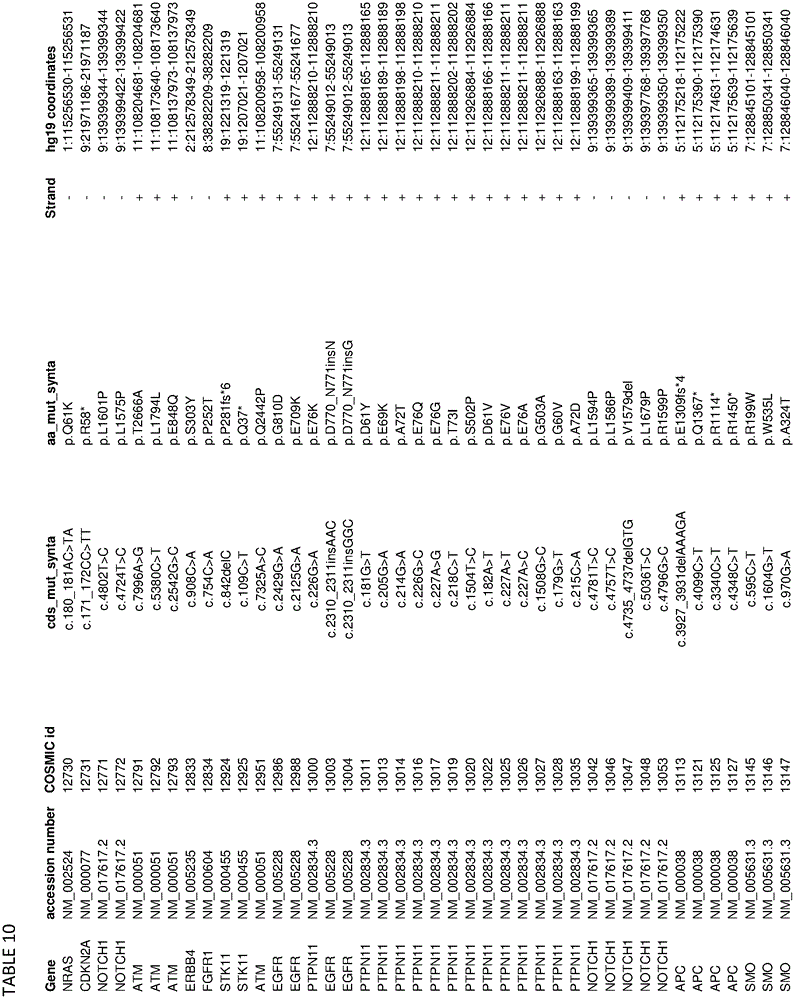
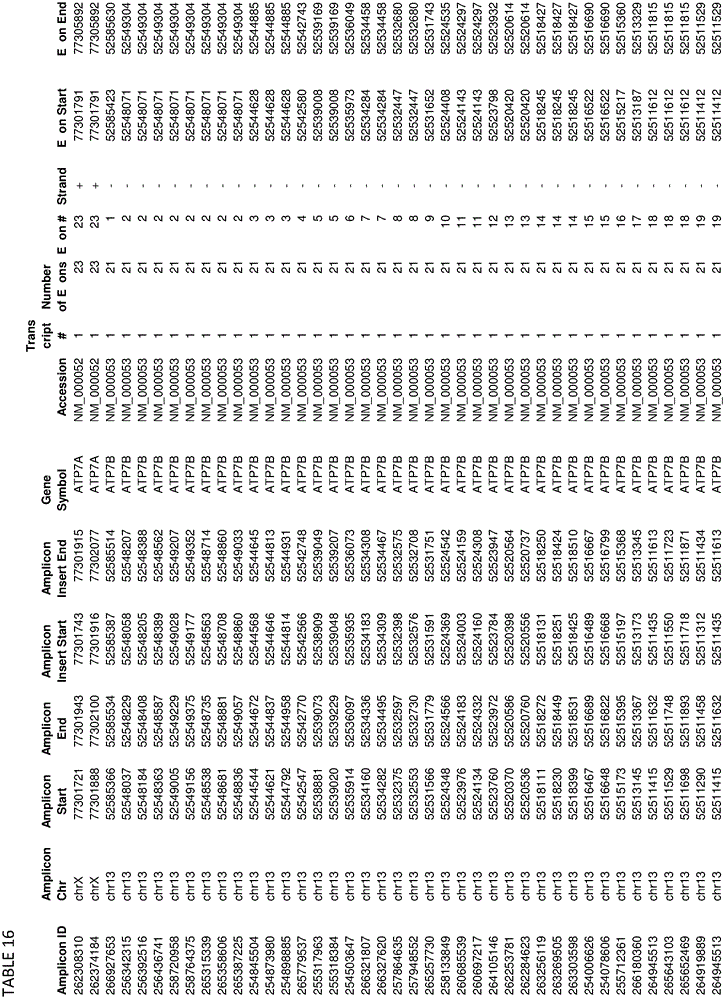
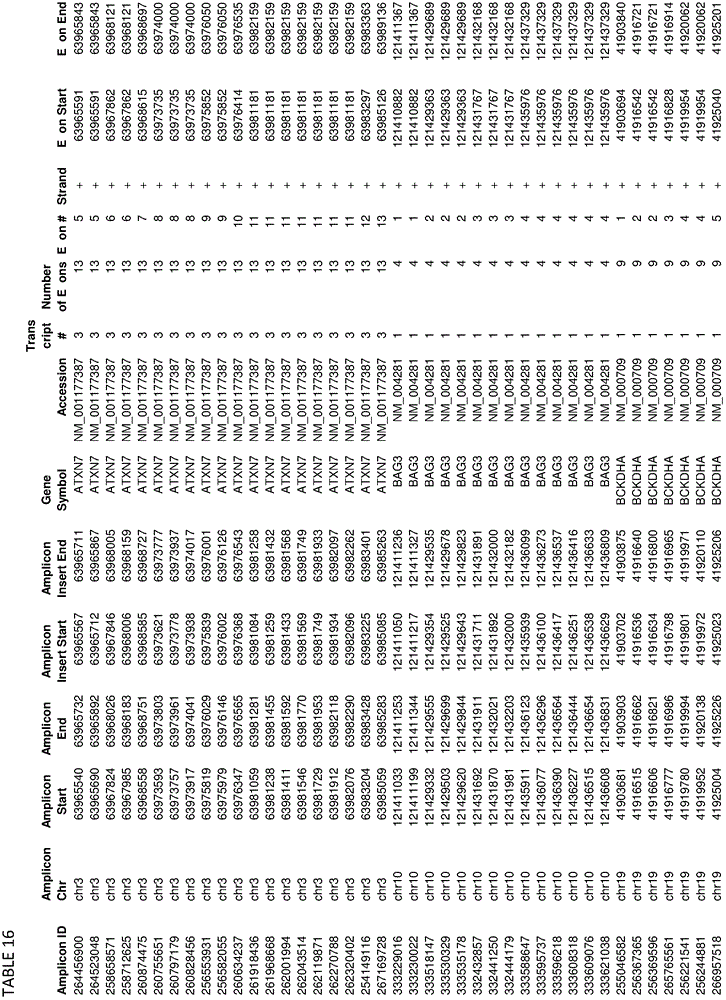
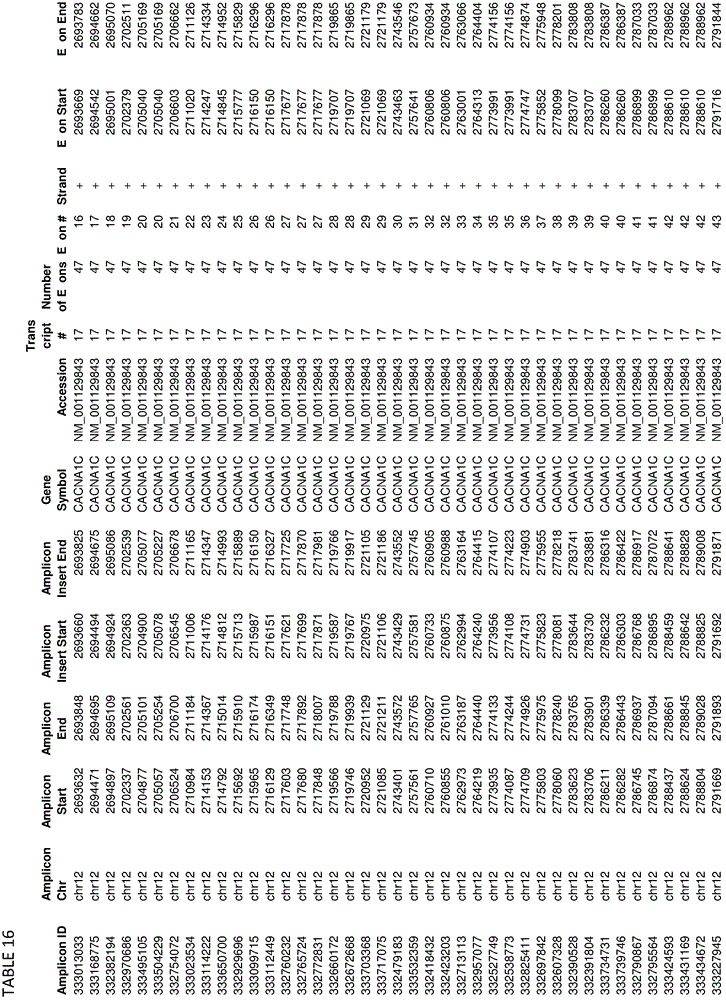
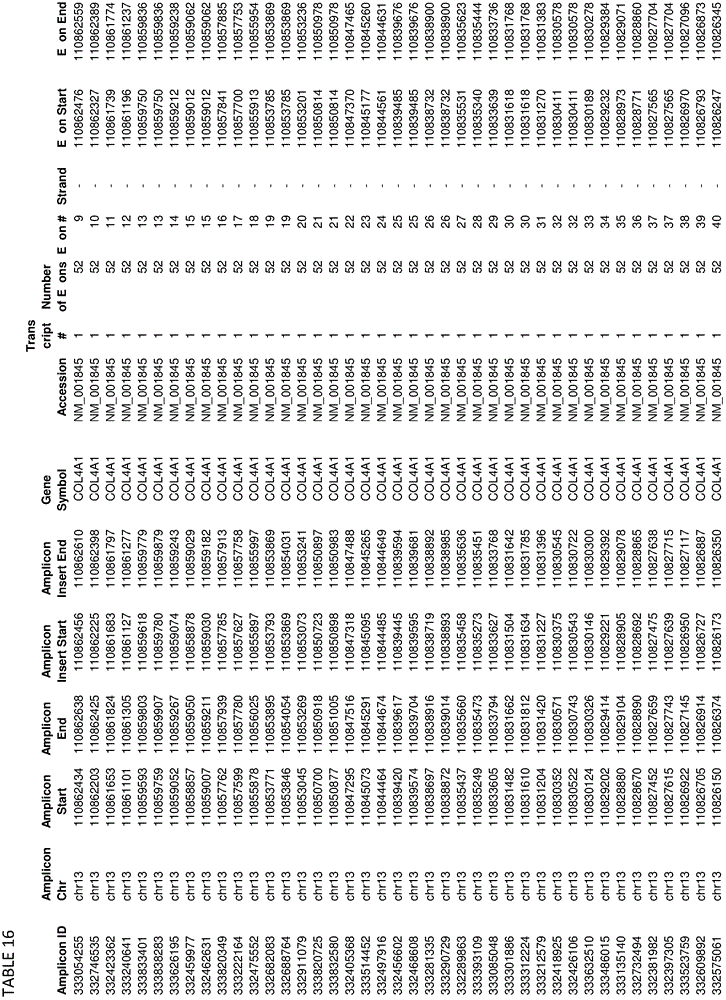
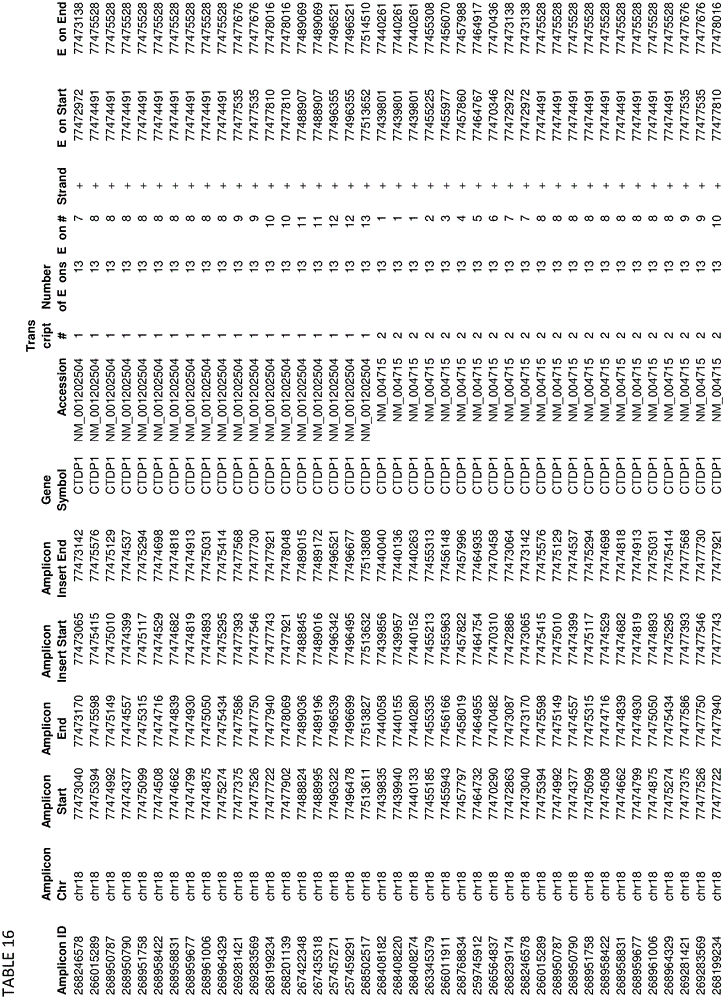
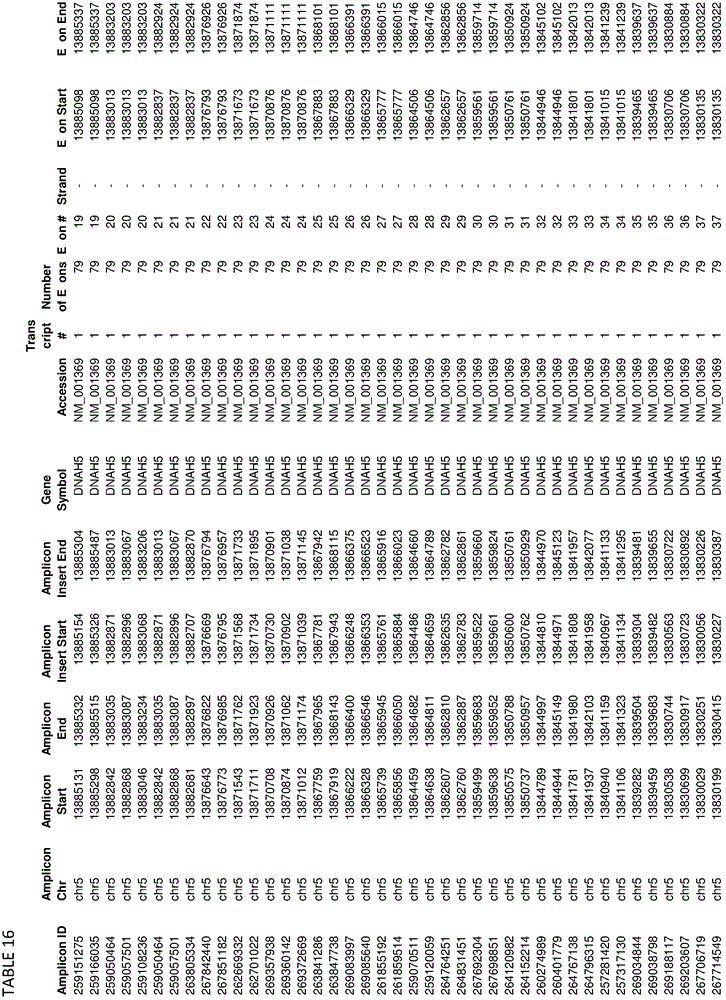
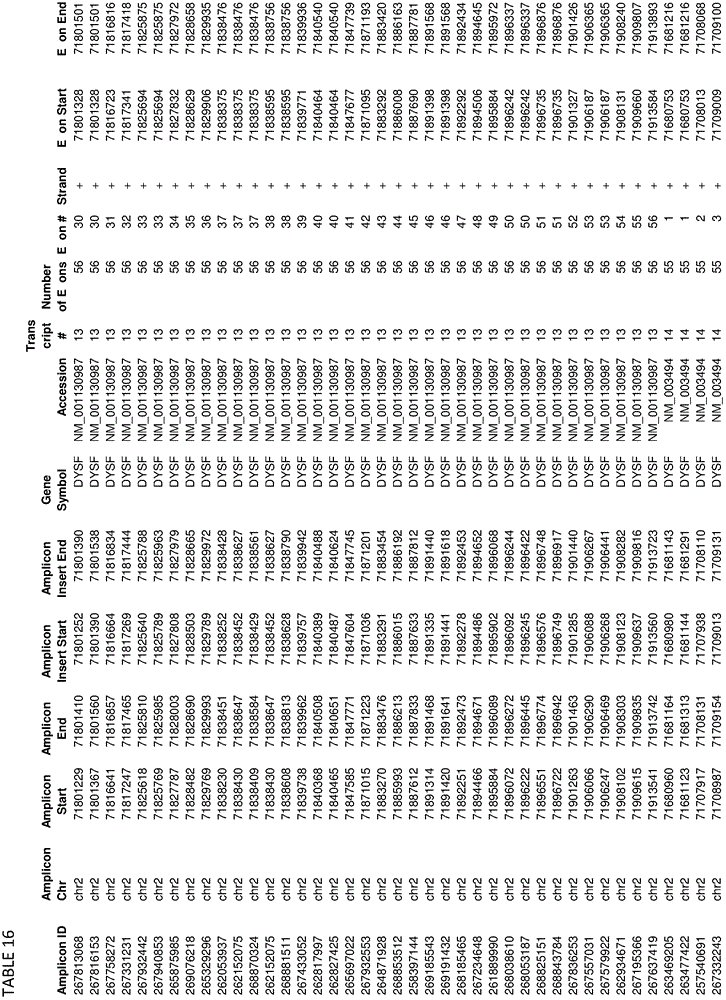
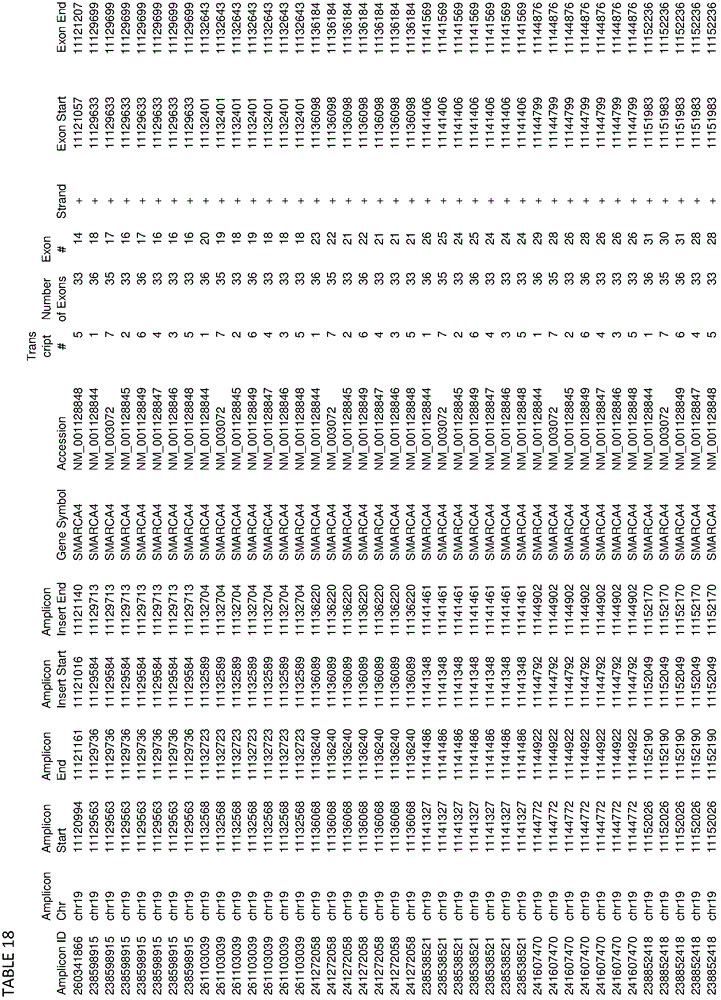
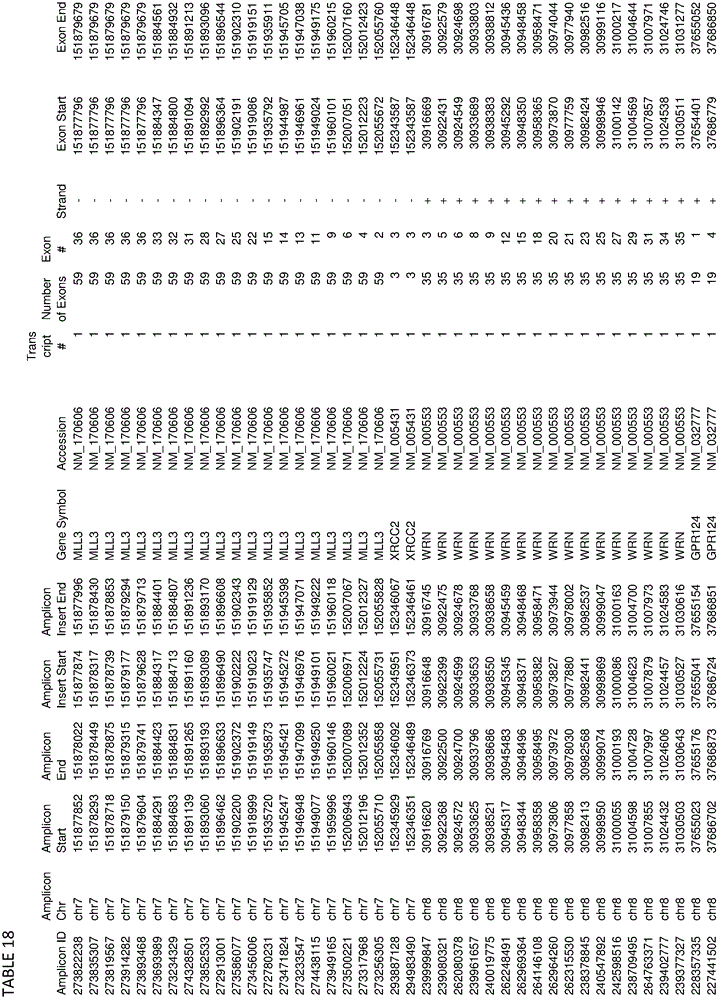
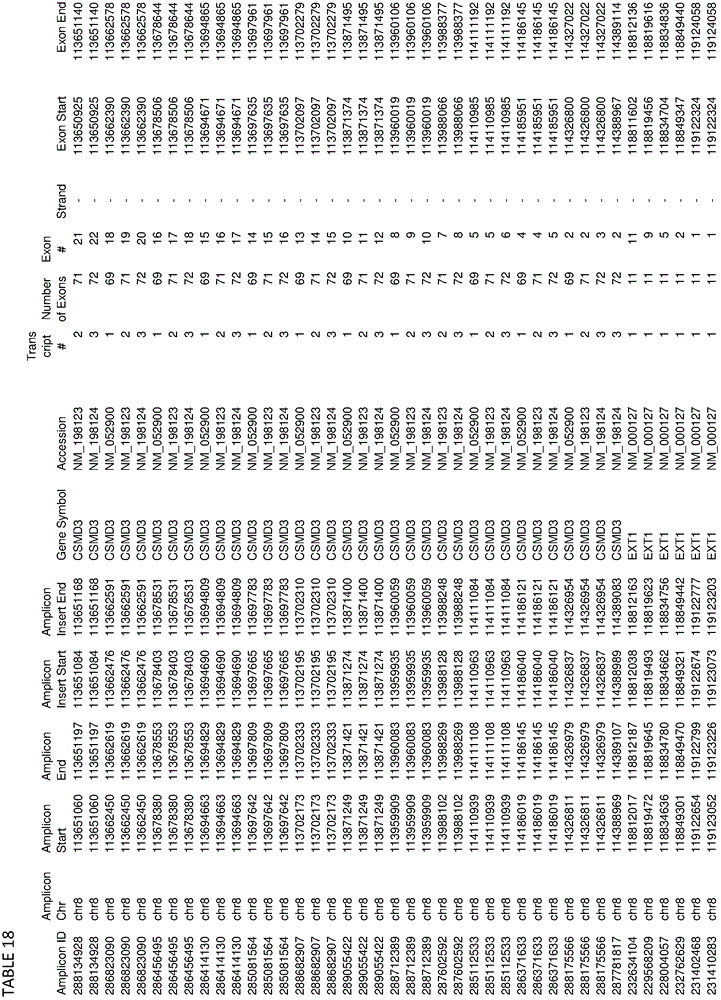
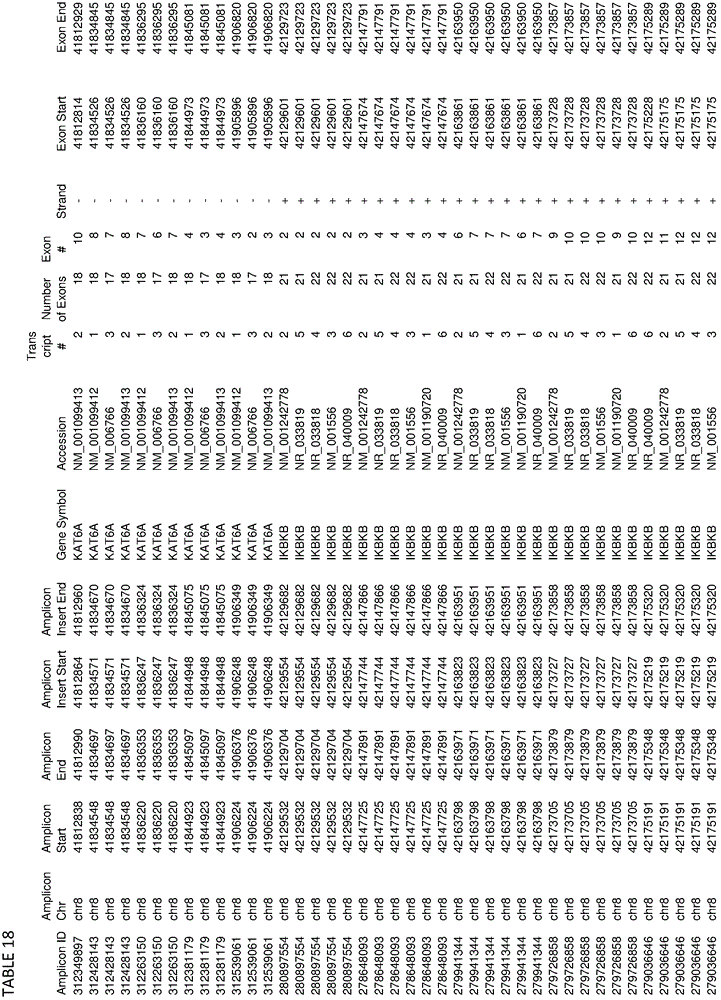
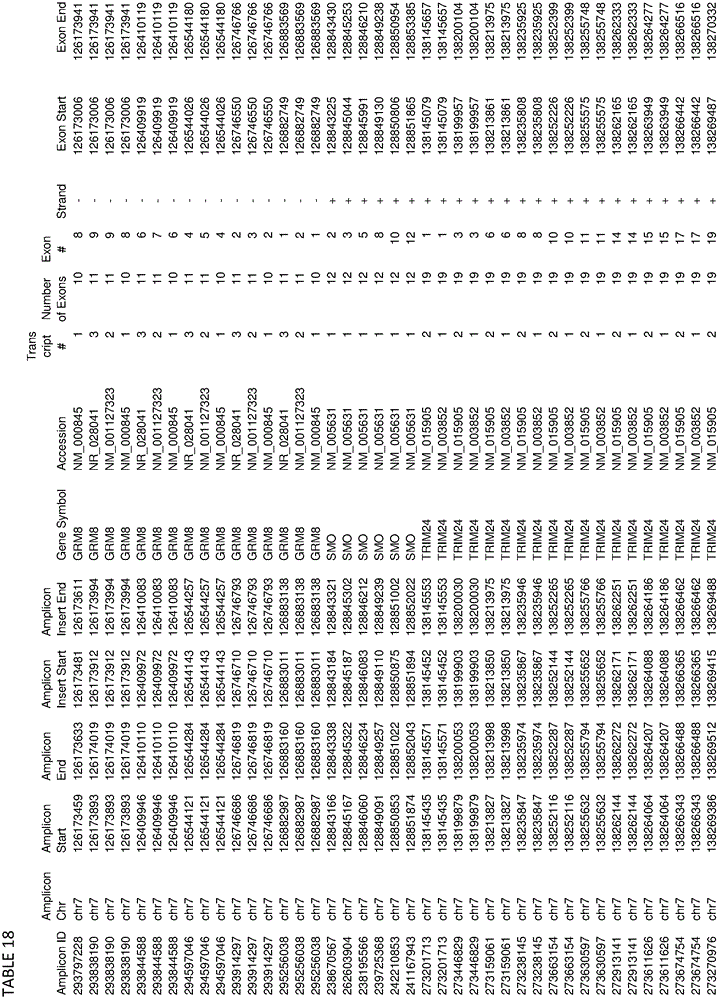
In some embodiments, the target-specific primer pair may comprise a nucleic acid sequence comprising a somatic mutation or a germline mutation. In some embodiments, germline or somatic mutations can be found in any one or more of the genes provided in tables 1, 4, 16, or 18. In some embodiments, target-specific primer pairs can be used to amplify target sequences that can be used to detect the presence of mutations having an allele frequency of less than 5%. In some embodiments, the plurality of target-specific primers comprises at least 500, at least 1000, at least 3000, at least 6000, at least 10000, at least 12000 or more target-specific primer pairs.
In some embodiments, the present disclosure relates generally to kits for performing multiplex nucleic acid amplification or multiplex nucleic acid synthesis. In some embodiments, the kit comprises a plurality of target-specific primers. In some embodiments, the kit may further comprise a polymerase, at least one linker, and/or a cleavage reagent. In some embodiments, the kit can further comprise dATP, dCTP, dGTP, dTTP, and/or an antibody. In some embodiments, the cleavage reagent is any reagent that can cleave one or more cleavage groups present in one or more target-specific primers. In some embodiments, the cleavage reagent may comprise an enzyme or a chemical reagent. In some embodiments, the cleavage reagent may comprise an enzyme having affinity for an apurinic base. In some embodiments, the cleavage reagent can include a first enzyme having an affinity for the first cleavable group, and can also include a second enzyme having an affinity for the second cleavable group. In some embodiments, the kit may further comprise an enzyme having affinity for abasic sites. In some embodiments, the polymerase is a thermostable polymerase. In some embodiments, the kit can include one or more preservatives, adjuvants, or nucleotide sequencing barcodes.
In some embodiments, the present disclosure relates generally to methods (and related compositions, systems, kits, and devices) for determining copy number variation, including any amplification method that performs the amplification methods disclosed herein.
Detailed description of the invention
The following description of various exemplary embodiments is merely exemplary and explanatory and is not to be construed as limiting or restrictive in any way. Other embodiments, features, objects, and advantages of the present teachings will be apparent from the description and drawings, and from the claims.
As used herein, "amplification" or "amplification reaction" and variations thereof generally refers to any action or process by which at least a portion of a nucleic acid molecule (referred to as a template nucleic acid molecule) is replicated or copied into at least one additional nucleic acid molecule. The additional nucleic acid molecule optionally includes a sequence that is substantially identical or substantially complementary to at least some portion of the template nucleic acid molecule. The template nucleic acid molecule may be single-stranded or double-stranded, and the further nucleic acid molecules may independently be single-stranded or double-stranded. In some embodiments, the amplification comprises a template-dependent in vitro enzyme catalyzed reaction for producing at least some portion of the at least one copy of the nucleic acid molecule or producing at least one copy of a nucleic acid sequence complementary to at least some portion of the nucleic acid molecule. Amplification optionally includes linear or exponential replication of the nucleic acid molecule. In some embodiments, such amplification is performed using isothermal conditions; in other embodiments, such amplification may comprise thermal cycling. In some embodiments, the amplification is a multiplex amplification comprising simultaneous amplification of multiple target sequences in a single amplification reaction. At least some of the target sequences may be located on the same nucleic acid molecule or on different target nucleic acid molecules contained in a single amplification reaction. In some embodiments, "amplifying" includes amplification of at least some portions of DNA and RNA based nucleic acids, alone or in combination. The amplification reaction may comprise single-stranded or double-stranded nucleic acid substrates and may also comprise any of the amplification processes known to those skilled in the art. In some embodiments, the amplification reaction comprises a Polymerase Chain Reaction (PCR).
As used herein, "amplification conditions" and derivatives thereof, generally refer to conditions suitable for amplifying one or more nucleic acid sequences. Such amplification may be linear or exponential. In some embodiments, the amplification conditions may comprise isothermal conditions or alternatively may comprise thermal cycling conditions, or a combination of isothermal and thermal cycling conditions. In some embodiments, suitable conditions for amplifying one or more nucleic acid sequences include Polymerase Chain Reaction (PCR) conditions. Generally, amplification conditions refer to a reaction mixture sufficient to amplify a nucleic acid, e.g., one or more target sequences, or to amplify an amplified target sequence, e.g., an adaptor-ligated amplified target sequence, that is ligated to one or more adaptors. Generally, amplification conditions include a catalyst for amplification or for nucleic acid synthesis, such as a polymerase; a primer having a degree of complementarity to the nucleic acid to be amplified; and nucleotides that facilitate primer extension upon hybridization to a nucleic acid, such as deoxyribonucleotide triphosphates (dntps). Amplification conditions may require hybridization or annealing of a primer to a nucleic acid, extension of the primer, and a denaturation step in which the extended primer is separated from the nucleic acid sequence undergoing amplification. Typically, but not necessarily, the amplification conditions may include thermal cycling; in some embodiments, the amplification conditions comprise a plurality of cycles: wherein the steps of annealing, extending and separating are repeated. Typically, the amplification conditions include a cation such as Mg ++Or Mn++(e.g., MgCl)2Etc.) and may also include a variety of modifiers having ionic strength.
As used herein, "target sequence" or "target sequence of interest" and derivatives thereof, generally refer to any single-or double-stranded nucleic acid sequence that can be amplified or synthesized in accordance with the present disclosure, including any nucleic acid sequence suspected or expected to be present in a sample. In some embodiments, the target sequence is present in double stranded form and comprises at least a portion of the specific nucleotide sequence to be amplified or synthesized, or the complement thereof, prior to addition of the target-specific primer or additional adaptor. The target sequence may comprise a nucleic acid that hybridizes to a primer for an amplification or synthesis reaction prior to extension with a polymerase. In some embodiments, the term refers to a nucleic acid sequence that: the sequence identity, order of nucleotides, or position thereof is determined by one or more methods of the present disclosure.
As defined herein, "sample" and derivatives thereof are used in their broadest sense, including any sample, culture, etc., suspected of containing a target. In some embodiments, the sample comprises DNA, RNA, PNA, LNA, chimeric, hybrid or multiplex forms of nucleic acids. The sample may comprise any biological, clinical, surgical, agricultural, atmospheric, or water-based specimen containing one or more nucleic acids. The term also includes any isolated nucleic acid sample such as genomic DNA, freshly frozen or formalin fixed paraffin embedded nucleic acid samples.
As used herein, "contacting" and derivatives thereof, when used in reference to two or more components, generally refers to any process whereby the bringing into close proximity, mixing, or blending of the referenced components is facilitated or accomplished without necessarily requiring physical contact of such components, and includes mixing solutions containing any one or more of the referenced components with each other. The components mentioned may be contacted in any particular order or combination and the particular order in which the components are recited is not limiting. For example, "contacting a with B and C" includes embodiments wherein a is first contacted with B, followed by C, and embodiments wherein C is contacted with a, followed by B, as well as embodiments wherein a mixture of a and C is contacted with B, and the like. Furthermore, such contacting does not necessarily require that the end result of the contacting process be a mixture comprising all of the noted components, so long as at some point during the contacting all of the noted components are present at the same time or contained in the same mixture or solution at the same time. For example, "contacting a with B and C" may include embodiments in which C is first contacted with a to form a first mixture, followed by contacting the first mixture with B to form a second mixture, followed by removal of C from the second mixture; optionally, a may also be subsequently removed, leaving only B. When one or more of the referenced components to be contacted includes the plurality (e.g., "contacting the target sequence with a plurality of target-specific primers and a polymerase"), then each member of the plurality can be considered a single component of the contacting process, such that contacting can include contacting any one or more members of the plurality with any other member of the plurality and/or with any other referenced component in any order or combination (e.g., some, but not all, of the plurality of target-specific primers can be contacted with the target sequence, followed by contacting with the polymerase, followed by contacting with other members of the plurality of target-specific primers).
As used herein, the term "primer" and derivatives thereof generally refers to any polynucleotide that can hybridize to a target sequence of interest. In some embodiments, primers may also be used to prime nucleic acid synthesis. Typically, a primer serves as a substrate to which nucleotides can be polymerized using a polymerase; however, in some embodiments, a primer may be incorporated into a synthetic nucleic acid strand and provide a site to which another primer can hybridize to prime the synthesis of a new strand complementary to the synthetic nucleic acid molecule. The primer may consist of any combination of nucleotides or analogs thereof, which may optionally be linked to form a linear polymer of any suitable length. In some embodiments, the primer is a single-stranded oligonucleotide or polynucleotide (for purposes of this disclosure, the terms "polynucleotide" and "oligonucleotide" are used interchangeably herein and do not necessarily indicate any difference in length between the two). In some embodiments, the primer is single stranded but it may also be double stranded. The primers are optionally naturally occurring, as in a purified restriction digest, or may be synthetically produced. In some embodiments, the primer serves as a starting point for amplification or synthesis when exposed to amplification or synthesis conditions; such amplification or synthesis can occur in a template-dependent manner, and optionally result in the formation of a primer extension product that is complementary to at least a portion of the target sequence. Exemplary amplification or synthesis conditions can include contacting a primer with a polynucleotide template (e.g., a template comprising a target sequence), nucleotides, and an inducing agent such as a polymerase at an appropriate temperature and pH to induce polymerization of the nucleotides onto the ends of the target-specific primer. If double stranded, the primer may optionally be treated to separate its strands prior to being used to prepare the primer extension product. In some embodiments, the primer is an oligodeoxyribonucleotide or an oligoribonucleotide. In some embodiments, the primer may comprise one or more nucleotide analogs. The exact length and/or composition (including sequence) of a target-specific primer can affect a number of properties, including melting temperature (Tm), GC content, formation of secondary structures, repeated nucleotide motifs, length of predicted primer extension products, degree of coverage across the target nucleic acid molecule, number of primers present in a single amplification or synthesis reaction, presence of nucleotide analogs or modified nucleotides in the primers, and the like. In some embodiments, the primers may be paired with compatible primers in an amplification or synthesis reaction to form a primer pair consisting of a forward primer and a reverse primer. In some embodiments, the forward primer of a primer pair comprises a sequence that is substantially complementary to at least a portion of a strand of a nucleic acid molecule and the reverse primer of a primer pair comprises a sequence that is substantially identical to at least a portion of the strand. In some embodiments, the forward primer and the reverse primer are capable of hybridizing to opposite strands of the nucleic acid duplex. Optionally, the forward primer primes synthesis of a first nucleic acid strand, and the reverse primer primes synthesis of a second nucleic acid strand, wherein the first and second strands are substantially complementary to each other, or hybridize to form a double-stranded nucleic acid molecule. In some embodiments, one end of the amplification or synthesis product is defined by the forward primer and the other end of the amplification or synthesis product is defined by the reverse primer. In some embodiments, when amplification or synthesis of long primer extension products is desired, such as amplification of an exon, coding region, or gene, several primer pairs can be generated that cover the desired length to enable sufficient amplification of the region. In some embodiments, a primer can include one or more cleavable groups. In some embodiments, the primer length ranges from about 10 to about 60 nucleotides, from about 12 to about 50 nucleotides, and from about 15 to about 40 nucleotides in length. Typically, a primer is capable of hybridizing to a corresponding target sequence and undergoes primer extension when exposed to amplification conditions in the presence of dntps and a polymerase. In some cases, a particular nucleotide sequence or portion of a primer is known at the beginning of an amplification reaction, or can be determined by one or more of the methods described herein. In some embodiments, a primer includes one or more cleavable groups at one or more positions in the primer.
As used herein, "target-specific primer" and derivatives thereof, generally refer to a single-or double-stranded polynucleotide, generally an oligonucleotide, that includes at least one sequence that is at least 50% complementary, typically at least 75% complementary or at least 85% complementary, more typically at least 90% complementary, more typically at least 95% complementary, more typically at least 98% or at least 99% complementary or identical to at least a portion of a nucleic acid molecule comprising a target sequence. In such cases, the target-specific primer and the target sequence are described as "corresponding" to each other. In some embodiments, a target-specific primer is capable of hybridizing to at least a portion of a corresponding target sequence (or to a sequence complementary to a target sequence); such hybridization can optionally be performed under standard hybridization conditions or under stringent hybridization conditions. In some embodiments, the target-specific primer is unable to hybridize to the target sequence, or to its complement, but is capable of hybridizing to a portion of a nucleic acid strand comprising the target sequence, or to its complement. In some embodiments, the target-specific primer comprises at least one sequence that is at least 75% complementary, typically at least 85% complementary, more typically at least 90% complementary, more typically at least 95% complementary, more typically at least 98% complementary, or more typically at least 99% complementary to at least a portion of the target sequence itself; in other embodiments, the target-specific primer comprises at least one sequence that is at least 75% complementary, typically at least 85% complementary, more typically at least 90% complementary, more typically at least 95% complementary, more typically at least 98% complementary, or more typically at least 99% complementary to at least a portion of the nucleic acid molecule other than the target sequence. In some embodiments, the target-specific primer is not substantially complementary to other target sequences present in the sample; optionally, the target-specific primer is not substantially complementary to other nucleic acid molecules present in the sample. In some embodiments, nucleic acid molecules present in a sample that do not include or correspond to a target sequence (or a complement of a target sequence) are referred to as "non-specific" sequences or "non-specific nucleic acids". In some embodiments, the target-specific primer is designed to include a nucleotide sequence that is substantially complementary to at least a portion of its corresponding target sequence. In some embodiments, the target-specific primer has at least 95% complementarity, or at least 99% complementarity or identity, over its entire length to at least a portion of the nucleic acid molecule that includes its corresponding target sequence. In some embodiments, a target-specific primer may have at least 90%, at least 95% complementarity, at least 98% complementarity, or at least 99% complementarity or identity over its entire length with at least a portion of its corresponding target sequence. In some embodiments, the forward target-specific primer and the reverse target-specific primer define a target-specific primer pair that can be used to amplify a target sequence by template-dependent primer extension. Typically, each primer of a target-specific primer pair comprises at least one sequence that is substantially complementary to at least a portion of a nucleic acid molecule comprising the corresponding target sequence, but has less than 50% complementarity to at least one other target sequence of the sample. In some embodiments, amplification can be performed in a single amplification reaction using a plurality of target-specific primer pairs, wherein each primer pair comprises a forward target-specific primer and a reverse target-specific primer, each primer comprises at least one sequence that is substantially complementary or substantially identical to a corresponding target sequence in the sample, and each primer pair has a different corresponding target sequence. In some embodiments, the target-specific primer may be substantially non-complementary at its 3 'end or its 5' end to any other target-specific primer present in the amplification reaction. In some embodiments, the target-specific primers can include minimal cross-hybridization to other target-specific primers present in the amplification reaction. In some embodiments, the target-specific primers include minimal cross-hybridization to non-specific sequences in the amplification reaction mixture. In some embodiments, the target-specific primer comprises minimal self-complementarity. In some embodiments, the target-specific primer may include one or more cleavable groups at the 3' end. In some embodiments, the target-specific primer can include one or more cleavable groups located near or around the central nucleotide of the target-specific primer. In some embodiments, the one or more target-specific primers comprise only non-cleavable nucleotides at the 5' end of the target-specific primer. In some embodiments, the target-specific primers include minimal nucleotide sequence overlap at the 3 'end or 5' end of the primer as compared to one or more different target-specific primers, optionally in the same amplification reaction. In some embodiments, 1, 2, 3, 4, 5, 6, 7, 8, 9, 10 or more target-specific primers in a single reaction mixture include one or more of the embodiments described above. In some embodiments, substantially all of the plurality of target-specific primers in a single reaction mixture comprises one or more of the embodiments described above.
As used herein, "polymerase" and derivatives thereof generally refer to any enzyme that can catalyze the polymerization of nucleotides (including analogs thereof) into a nucleic acid strand. Typically, but not necessarily, such nucleotide polymerization may occur in a template-dependent manner. Such polymerases can include, but are not limited to, naturally occurring polymerases and any subunits and truncations thereof, mutant polymerases, variant polymerases, recombinant, fused or engineered polymerases, chemically modified polymerases, synthetic molecules or assemblies, and any analogs, derivatives, or fragments thereof that retain the ability to catalyze such polymerization. Optionally, the polymerase may be a mutant polymerase comprising one or more mutations (including substitutions of one or more amino acids with other amino acids, insertion or deletion of one or more amino acids from the polymerase, or ligation of two or more portions of the polymerase). Typically, polymerases contain one or more active sites at which nucleotide binding and/or catalysis of nucleotide polymerization can occur. Some exemplary polymerases include, but are not limited to, DNA polymerases and RNA polymerases. As used herein, the term "polymerase" and variants thereof also refer to fusion proteins comprising at least two moieties linked to each other, wherein a first moiety comprises a peptide that can catalyze the polymerization of nucleotides into a nucleic acid strand and is linked to a second moiety comprising a second polypeptide. In some embodiments, the second polypeptide may comprise a reporter enzyme or a processivity enhancing domain. Optionally, the polymerase may have 5' exonuclease activity or terminal transferase activity. In some embodiments, the polymerase can optionally be reactivated, for example, by using heat, chemicals, or a new amount of polymerase to the reaction mixture for further addition. In some embodiments, the polymerase may include a hot-start polymerase or an aptamer-based polymerase that may optionally be reactivated.
As used herein, the term "nucleotide" and variants thereof include any compound that can selectively bind to, or be polymerized by, a polymerase, including, but not limited to, any naturally occurring nucleotide or analog thereof. Typically, but not necessarily, following selective binding of the nucleotides to a polymerase, the nucleotides are polymerized into a nucleic acid strand by the polymerase; occasionally, however, a nucleotide may dissociate from the polymerase without being incorporated into the nucleic acid strand (an event referred to herein as a "non-productive" event). Such nucleotides include not only naturally occurring nucleotides but also any analogs, regardless of their structure, which can selectively bind to or be polymerized by a polymerase. While naturally occurring nucleotides typically include base, sugar, and phosphate moieties, nucleotides of the disclosure may include compounds in which any, some, or all of such moieties are absent. In some embodiments, the nucleotide may optionally include a chain of phosphorus atoms containing 3, 4, 5, 6, 7, 8, 9, 10, or more phosphorus atoms. In some embodiments, the chain of phosphorus atoms may be linked to any carbon of the sugar ring, for example the 5' carbon. The phosphorus chain may be linked to the sugar by an intervening O or S. In one embodiment, one or more of the phosphorus atoms in the chain may be part of a phosphate group having P and O. In another embodiment, the phosphorus atoms in the chain may be interrupted by O, NH, S, methylene, substituted methylene, ethylene, substituted ethylene, CNH 2、C(O)、C(CH2)、CH2CH2Or C (OH) CH2R (wherein R may be 4-pyridine or 1-imidazole) are linked together. In a fruitIn embodiments, the phosphorus atoms in the chain may have a composition containing O, BH3Or a pendant group of S. In the chain of phosphorus atoms, phosphorus atoms having pendant groups other than O may be substituted phosphate groups. In the chain of phosphorus atoms, phosphorus atoms having an intervening atom other than O may be substituted phosphate groups. Some examples of nucleotide analogs are described in Xu, U.S. patent No. 7,405,281. In some embodiments, the nucleotide comprises a label and is referred to herein as a "labeled nucleotide"; labels that label nucleotides are referred to herein as "nucleotide labels". In some embodiments, the label may be present as a fluorescent dye attached to the terminal phosphate group (i.e., the phosphate group furthest from the sugar). Some examples of nucleotides that can be used in the disclosed methods and compositions include, but are not limited to, ribonucleotides, deoxyribonucleotides, modified ribonucleotides, ribonucleotide polyphosphates, deoxyribonucleotide polyphosphates, modified ribonucleotide polyphosphates, modified deoxyribonucleotide polyphosphates, peptide nucleotides, modified peptide nucleotides, metal nucleosides, nucleoside phosphonates, and modified phosphate-sugar backbone nucleotides, analogs, derivatives, or variants of the foregoing, and the like. In some embodiments, a nucleotide may comprise a non-oxygen moiety, such as a sulfur-or boron-moiety, in place of the oxygen moiety bridging the alpha phosphate of the nucleotide with the sugar or alpha and beta phosphates of the nucleotide or beta and gamma phosphates of the nucleotide, or any other two phosphates of the nucleotide, or any combination thereof. "nucleotide 5 '-triphosphate" refers to a nucleotide having a triphosphate group at the 5' position, sometimes referred to as "NTP" or "dNTP" and "ddNTP" to specifically characterize the structure of ribose. The triphosphate group may include sulfur substitutions to different oxygens, for example, alpha-thio-nucleotide 5' -triphosphate. For a review of nucleic acid chemistry, see: shabarova, Z. and Bogdannov, A.advanced Organic Chemistry of Nucleic Acids, VCH, New York, 1994.
As used herein, the term "extension" and variants thereof, when used in reference to a given primer, includes any in vivo or in vitro enzymatic activity characteristic of a given polymerase that is associated with the polymerization of one or more nucleotides to the end of an existing nucleic acid molecule. Typically, but not necessarily, such primer extension occurs in a template-dependent manner; in the template-dependent extension process, the order and selection of bases is driven by established base-pairing rules, which may include Watson-Crick type base-pairing rules, or alternatively (and particularly in cases involving extension reactions of nucleotide analogs) by some other type of base-pairing paradigm. In one non-limiting example, extension occurs by a polymerase polymerizing nucleotides on the 3' OH end of a nucleic acid molecule.
As used herein, the term "portion" and variations thereof, when used to refer to a given nucleic acid molecule, e.g., a primer or template nucleic acid molecule, includes any number of contiguous nucleotides within the length of the nucleic acid molecule (including part or the entire length of the nucleic acid molecule).
As used herein, the terms "identity" and "identical," and variations thereof, when used in reference to two or more nucleic acid sequences, refer to the similarity in sequence of two or more sequences (e.g., nucleotide or polypeptide sequences). In the context of two or more homologous sequences, percent identity or homology of a sequence or subsequence thereof means the percentage of monomer units (e.g., nucleotides or amino acids) that are all identical (i.e., about 70% identity, preferably 75%, 80%, 85%, 90%, 95%, 98%, or 99% identity). Percent identity may be within a specified region when compared and aligned for maximum correspondence (as measured using the BLAST or BLAST2.0 sequence comparison algorithm, using the default parameters described below, or by manual alignment and visual inspection) within a comparison window or specified region. Sequences are considered "substantially identical" when there is at least 85% identity at the amino acid level or at the nucleotide level. Preferably, identity exists over a region that is at least about 25, 50, or 100 nucleotides in length, or spans the entire length of at least one of the compared sequences. Typical algorithms for determining percent sequence identity and sequence similarity are the BLAST and BLAST2.0 algorithms described in Altschul et al, nuc. acids res.25: 3389 and 3402 (1977). Other methods include Smith & Waterman, adv.appl.math.2: 482(1981) and Needleman & Wunsch, J.mol.biol.48: 443(1970), etc. Another indication that two nucleic acid sequences are substantially identical is that the two molecules, or their complements, hybridize to each other under stringent hybridization conditions.
The terms "complementarity" and "complementary" and variations thereof, as used herein, refer to any two or more nucleic acid sequences (e.g., portions or all of a template nucleic acid molecule, a target sequence, and/or a primer) that can undergo cumulative base pairing in two or more individual, corresponding positions in an anti-parallel orientation (e.g., in a hybridized duplex). Such base pairing can be performed according to any set of established rules, for example according to Watson-Crick base pairing rules or according to some other base pairing paradigm. Optionally, there may be "complete" or "complete" complementarity between the first and second nucleic acid sequences, wherein each nucleotide in the first nucleic acid sequence may undergo stable base-pairing interaction with a nucleotide in a corresponding inverted parallel position on the second nucleic acid sequence. "partial" complementarity describes sequences in which at least 20% but less than 100% of the residues of one nucleic acid sequence are complementary to residues in another nucleic acid sequence. In some embodiments, at least 50% but less than 100% of the residues of one nucleic acid sequence are complementary to residues in another nucleic acid sequence. In some embodiments, at least 70%, 80%, 90%, 95%, or 98% but less than 100% of the residues of one nucleic acid sequence are complementary to residues in another nucleic acid sequence. Sequences are said to be "substantially complementary" when at least 85% of the residues of one nucleic acid sequence are complementary to residues in another nucleic acid sequence. In some embodiments, two complementary or substantially complementary sequences are capable of hybridizing to each other under standard or stringent hybridization conditions. "non-complementary" describes nucleic acid sequences in which less than 20% of the residues of one nucleic acid sequence are complementary to residues in another nucleic acid sequence. Sequences are considered "substantially non-complementary" when less than 15% of the residues of one nucleic acid sequence are complementary to residues in another nucleic acid sequence. In some embodiments, two non-complementary or substantially non-complementary sequences cannot hybridize to each other under standard or stringent hybridization conditions. A "mismatch" can be present at any position in two non-complementary opposing nucleotides. Complementary nucleotides include nucleotides that are efficiently incorporated into one another by NDA polymerase during DNA replication under physiological conditions. In typical embodiments, complementary nucleotides can form base pairs with each other between nucleotides in anti-parallel positions with respect to each other and/or nucleobases of a polynucleotide, such as A-T/U and G-C base pairs formed by specific Watson-Crick type hydrogen bonds, or base pairs formed by some other type of base pairing paradigm. Complementarity of other artificial base pairs can be based on other types of hydrogen bonding and/or hydrophobicity of the bases and/or shape complementarity between two bases.
As used herein, "amplified target sequence" and derivatives thereof, generally refer to a nucleic acid sequence produced by amplification of a target sequence by amplification of the target sequence using target-specific primers and methods provided herein. The amplified target sequence may be the same sense sequence (positive strand produced in the second and subsequent even numbered rounds of amplification) or antisense sequence (i.e., negative strand produced in the first and subsequent odd numbered rounds of amplification) relative to the target sequence. For the purposes of this disclosure, an amplified target sequence has less than 50% complementarity to any portion of another amplified target sequence in a reaction.
As used herein, the term "link" and derivatives thereof generally refer to an action or process for covalently linking two or more molecules together, e.g., covalently linking two or more nucleotides to one another. In some embodiments, ligating comprises ligating a nick between adjacent nucleotides of the nucleic acid. In some embodiments, linking comprises forming a covalent bond between an end of the first nucleic acid molecule and an end of the second nucleic acid molecule. In some embodiments, e.g., embodiments in which the nucleic acid molecule to be ligated comprises conventional nucleotide residues, ligation may comprise forming a covalent bond between the 5 'phosphate group of one nucleic acid and the 3' hydroxyl group of a second nucleic acid, thereby forming a ligated nucleic acid molecule. In some embodiments, any method for ligating a nick or bonding a 5 'phosphate to a 3' hydroxyl between adjacent nucleotides may be used. In exemplary embodiments, enzymes such as ligases may be used. Generally for the purposes of this disclosure, an amplified target sequence can be ligated to an adaptor to produce an adaptor-ligated amplified target sequence.
As used herein, "ligase" and derivatives thereof, generally refer to any agent capable of catalyzing the ligation of two substrate molecules. In some embodiments, the ligase comprises an enzyme capable of catalyzing nicked ligation between adjacent nucleotides of the nucleic acid. In some embodiments, a ligase comprises an enzyme capable of catalyzing the formation of a covalent bond between a 5 'phosphate of one nucleic acid molecule and a 3' hydroxyl of another nucleic acid molecule, thereby forming a ligated nucleic acid molecule. Suitable ligases may include, but are not limited to, T4DNA ligase, T4RNA ligase and E.coli DNA ligase.
As used herein, "linking conditions" and derivatives thereof, generally refer to conditions suitable for linking two molecules to each other. In some embodiments, the ligation conditions are suitable to block nicks or gaps between nucleic acids. As defined herein, a "nick" or "gap" refers to a nucleic acid molecule that lacks direct binding of the 5 'phosphate of a single nucleotide pentose ring to the 3' hydroxyl of an adjacent single nucleotide pentose ring within an internal nucleotide of the nucleic acid sequence. As described herein, the term cut or notch is consistent with the use of that term in the art. Typically, the nicks or gaps are ligated in the presence of an enzyme, such as a ligase, at an appropriate temperature and pH. In some embodiments, T4DNA ligase may ligate nicks between nucleic acids at a temperature of about 70-72 ℃.
As used herein, "blunt-end ligation" and derivatives thereof, generally refer to the ligation of two blunt-end double-stranded nucleic acid molecules to one another. "blunt-ended" refers to the end of a double-stranded nucleic acid molecule in which substantially all of the nucleotides in the end of one strand of the nucleic acid molecule base-pair with the opposing nucleotides in the other strand of the same nucleic acid molecule. A nucleic acid molecule is not blunt-ended if it has a single-stranded portion (referred to herein as an "overhang") that comprises more than 2 nucleotides in length. In some embodiments, the ends of a nucleic acid molecule do not comprise any single-stranded portions, such that each nucleotide in one strand of the end base pairs with an opposing nucleotide in another strand of the same nucleic acid molecule. In some embodiments, the ends of two blunt-ended nucleic acid molecules that are linked to each other do not comprise any overlapping, consensus, or complementary sequences. Typically, blunt-end ligation does not involve the use of additional oligonucleotide linkers to facilitate ligation of the double-stranded amplified target sequence to a double-stranded linker, such as a patch oligonucleotide (patch oligonucleotide) described in Mitra and Varley, US 2010/0129874 (published 5/27 2010). In some embodiments, blunt end ligation comprises a nick translation reaction to close the nicks created during ligation.
As used herein, the term "linker" or "linker and its complementary sequence" and derivatives thereof, generally refers to any linear oligonucleotide that can be ligated to a nucleic acid molecule of the present disclosure. Optionally, the linker comprises a nucleic acid sequence that is not substantially complementary to the 3 'end or the 5' end of at least one target sequence within the sample. In some embodiments, the linker is not substantially complementary to the 3 'end or the 5' end of any target sequence present in the sample. In some embodiments, the adaptor includes any single-stranded or double-stranded linear oligonucleotide that is not substantially complementary to the amplified target sequence. In some embodiments, the linker is not substantially complementary to at least one, some, or all of the nucleic acid molecules of the sample. In some embodiments, suitable linker lengths range from about 10-100 nucleotides, from about 12-60 nucleotides, and from about 15-50 nucleotides in length. In general, a linker may include any combination of nucleotides and/or nucleic acids. In some aspects, the linker may comprise one or more cleavable groups at one or more positions. In another aspect, the linker can include a sequence that is substantially identical to, or substantially complementary to, at least a portion of the primer, e.g., the universal primer. In some embodiments, the linker may comprise a barcode or tag to aid in downstream cataloging, identification, or sequencing. In some embodiments, a single linker may be used as a substrate for amplification when ligated to an amplified target sequence at an appropriate temperature and pH, particularly in the presence of a polymerase and dntps.
As used herein, "re-amplification" and derivatives thereof generally refer to any process by which at least a portion of an amplified nucleic acid molecule is further amplified by any suitable amplification method (referred to in some embodiments as "second" amplification or "re-amplification"), thereby producing a re-amplified nucleic acid molecule. The second amplification need not be the same as the original amplification method by which the amplified nucleic acid molecule was produced; the re-amplified nucleic acid molecule also need not be identical or completely complementary to the amplified nucleic acid molecule; it is desirable that the re-amplified nucleic acid molecule comprises at least a portion of the amplified nucleic acid molecule or a complementary sequence thereof. For example, re-amplification may involve the use of different amplification conditions and/or different primers, including different target-specific primers than the initial amplification.
As defined herein, a "cleavable group" generally refers to any moiety that can be cleaved under appropriate conditions upon incorporation into a nucleic acid. For example, a cleavable group can be incorporated into a target-specific primer, an amplified sequence, a linker, or a nucleic acid molecule of a sample. In exemplary embodiments, the target-specific primer may comprise a cleavable group that is incorporated into the amplified product and subsequently cleaved after amplification, thereby removing some or all of the target-specific primer from the amplified product. The cleavable group can be cleaved or removed from the target-specific primer, amplified sequence, linker, or nucleic acid molecule of the sample by acceptable methods. For example, the cleavable group can be removed from the target-specific primer, amplified sequence, linker, or nucleic acid molecule of the sample by enzymatic, thermal, photo-oxidation, or chemical treatment. In one aspect, the cleavable group can comprise a non-naturally occurring nucleobase, e.g., the oligodeoxyribonucleotide can comprise one or more RNA nucleobases, e.g., uracil, which can be removed by uracil glycosylase. In some embodiments, the cleavable group can include one or more modified nucleobases (e.g., 7-methylguanine, 8-oxoguanine, xanthine, hypoxanthine, 5, 6-dihydrouracil, or 5-methylcytosine) or one or more modified nucleosides (i.e., 7-methylguanine, 8-oxodeoxyguanosine, xanthosine, inosine, dihydrouridine, or 5-methylcytidine). Modified nucleobases or nucleotides can be removed from nucleic acids by enzymatic, chemical, or thermal means. In one embodiment, the cleavable group can include a moiety (i.e., bromodeoxyuridine) that can be removed from the primer after amplification (or synthesis) and after exposure to ultraviolet light. In another embodiment, the cleavable group can comprise a methylated cytosine. Typically, methylated cytosines can be cleaved from the primer, e.g., after amplification (or synthesis) induction, after sodium bisulfite treatment. In some embodiments, the cleavable moiety may comprise a restriction site. For example, the primer or target sequence may include a nucleic acid sequence specific for one or more restriction enzymes, and after amplification (or synthesis), the primer or target sequence may be treated with one or more restriction enzymes to remove the cleavage group. Typically, for a target-specific primer, amplified sequence, linker, or nucleic acid molecule of a sample, one or more cleavable groups may be included at one or more positions.
As used herein, "cleavage step" and derivatives thereof, generally refers to any process by which a cleavable gene is cleaved or removed from a target-specific primer, amplified sequence, linker, or nucleic acid molecule of a sample. In some embodiments, the cleaving step comprises a chemical, thermal, photo-oxidation, or digestion process.
As used herein, the term "hybridization," consistent with its use in the art, generally refers to the process by which two nucleic acid molecules undergo base pairing interactions. Two nucleic acid molecules are said to hybridize when any portion of one nucleic acid molecule is base-paired with any portion of the other nucleic acid molecule; it is not necessarily required that the two nucleic acid molecules hybridize over their respective entire lengths, and in some embodiments, at least one of the nucleic acid molecules may include a portion that does not hybridize to the other nucleic acid molecule. The phrase "hybridization under stringent conditions" and variations thereof generally refers to conditions under which hybridization of a target-specific primer to a target sequence occurs in the presence of a high hybridization temperature and low ionic strength. In an exemplary embodiment, stringent hybridization conditions include an aqueous environment containing about 30mM magnesium sulfate, about 300mM Tris-sulfate, pH8.9, and about 90mM ammonium sulfate at about 60-68 ℃, or an equivalent thereof. As used herein, the phrase "standard hybridization conditions" and variations thereof generally refers to conditions under which hybridization of a primer to an oligonucleotide (i.e., a target sequence) occurs in the presence of a low hybridization temperature and high ionic strength. In an exemplary embodiment, standard hybridization conditions include an aqueous environment containing about 100mM magnesium sulfate, about 500mM Tris-sulfate, pH8.9, and about 200mM ammonium sulfate at about 50-55 deg.C or an equivalent thereof.
As used herein, "trinucleotide motif, and derivatives thereof, generally refers to any nucleotide sequence that repeats continuously over 3 nucleotides, such as AAA or CCC. Typically, the trinucleotide motif will not be repeated more than 5 times in the target-specific primer (or linker) of the present disclosure.
As used herein, "ACA nucleotide motif" and derivatives thereof, generally refer to the nucleotide sequence "ACA". In general, the motif will not be repeated 3 or more times in the target-specific primer (or linker) of the present disclosure.
As used herein, "homopolymer," and derivatives thereof, generally refers to any repeating nucleotide sequence of 8 nucleotides or more in length, such as AAAAAAAA or CCCCCCCC. In general, as defined herein, a homopolymer is not present in the target-specific primer (or linker) of the present disclosure.
As used herein, "GC content," and derivatives thereof, generally refer to the cytosine and guanine content of a nucleic acid molecule. Generally, the GC content of the target-specific primer (or linker) of the present disclosure is 85% or less. More typically, the GC content of the target-specific primers or linkers of the present disclosure is 15-85%.
As used herein, the term "terminal" and variations thereof, when used in reference to a nucleic acid molecule, e.g., a target sequence or amplified target sequence, can include the terminal 30 nucleotides, the terminal 20 nucleotides, and even more typically the terminal 15 nucleotides of the nucleic acid molecule. A linear nucleic acid molecule consisting of a linked series of consecutive nucleotides typically comprises at least two ends. In some embodiments, one end of a nucleic acid molecule can include a 3 'hydroxyl group or an equivalent thereof, and can be referred to as the "3' end" and derivatives thereof. Optionally, the 3 ' terminus includes a 3 ' hydroxyl group that is not linked to the 5 ' phosphate group of the mononucleotide pentose ring. Typically, the 3 'terminus includes one or more 5' linked nucleotides adjacent to a nucleotide comprising an unlinked 3 'hydroxyl group, typically 30 nucleotides adjacent to a 3' hydroxyl group, typically the 20 terminal, and more typically the 15 terminal nucleotides. In general, one or more linked nucleotides can be expressed as a percentage of the nucleotides present in the oligonucleotide, or can be provided as a number of linked nucleotides adjacent to an unlinked 3' hydroxyl group. For example, the 3' end may comprise less than 50% of the nucleotide length of the oligonucleotide. In some embodiments, the 3 'terminus does not include any unlinked 3' hydroxyl groups, but may include sites that can serve as attachment of nucleotides by primer extension and/or nucleotide polymerization. In some embodiments, the term "3 'terminus" for example, when referring to a target-specific primer, can comprise the terminal 10 nucleotides, the terminal 5 nucleotides, the terminal 4, 3, 2, or fewer nucleotides at the 3' terminus. In some embodiments, the term "3 'terminus," when referring to a target-specific primer, can include the nucleotide at the 10 th (or fewer) nucleotide position at the 3' terminus.
As used herein, "5 'terminus" and derivatives thereof, generally refer to the terminus of a nucleic acid molecule, e.g., a target sequence or amplified target sequence, which includes a free 5' phosphate group or equivalent thereof. In some embodiments, the 5 ' terminus comprises a 5 ' phosphate group that is not linked to the 3 ' hydroxyl of an adjacent mononucleotide pentose ring. Typically, the 5 ' terminus comprises one or more linked nucleotides adjacent to the 5 ' phosphate, typically 30 nucleotides adjacent to the nucleotide comprising the 5 ' phosphate group, typically the terminal 20, more typically the terminal 15 nucleotides. In general, one or more of the linked nucleotides can be expressed as a percentage of the nucleotides present in the oligonucleotide or can be provided as a number of linked nucleotides adjacent to the 5' phosphate. For example, the 5' end may be shorter than 50% of the nucleotide length of the oligonucleotide. In another exemplary embodiment, the 5 'terminus can include about 15 nucleotides adjacent to the nucleotide comprising the terminal 5' phosphate. In some embodiments, the 5 'terminus does not include any unlinked 5' phosphate group but can include any moiety that can serve as a site of attachment to a 3 'hydroxyl or the 3' terminus of another nucleic acid molecule. In some embodiments, the term "5 'terminus" when referring to a target-specific primer, for example, can comprise the terminal 10 nucleotides, the terminal 5 nucleotides, the terminal 4, 3, 2, or fewer nucleotides on the 5' terminus. In some embodiments, the term "5 'end," when referring to a target-specific primer, can comprise nucleotides located 10 (or less) positions from the 5' end. In some embodiments, the 5' end of a target-specific primer may comprise only non-cleavable nucleotides (e.g., nucleotides that do not comprise one or more of the cleavable groups disclosed herein), or cleavable nucleotides, as can be readily determined by one of skill in the art.
As used herein, "protecting group" and derivatives thereof, generally refer to any moiety that can be incorporated into, confer chemoselectivity on, or protect a target-specific primer or linker from digestion or chemical degradation. Typically, but not necessarily, the protecting group may comprise a modification of an existing functional group in the target-specific primer or linker to achieve chemoselectivity. Suitable types of protecting groups include alcohol, amine, phosphoric acid, carbonyl, or carboxylic acid protecting groups. In exemplary embodiments, the protecting group may comprise a spacer compound having a chain of carbon atoms.
As used herein, "DNA barcode" or "DNA tag sequence" and derivatives thereof, generally refer to a unique short (6-14 nucleotides) nucleic acid sequence within a linker that can be used as a 'key' to distinguish or isolate multiple amplified target sequences in a sample. For the purposes of this disclosure, a DNA barcode or DNA tag sequence may be incorporated into the nucleotide sequence of the linker.
As used herein, the phrase "two rounds of target-specific hybridization" or "two rounds of target-specific selection" and derivatives thereof generally refers to any process whereby the same target sequence is subjected to two consecutive rounds of hybridization-based target-specific selection, wherein the target sequence hybridizes to the target-specific sequence. Each round of target-specific selection based on hybridization can include a plurality of target-specific hybridizations to at least some portion of the target-specific sequence. In an exemplary embodiment, a round of target-specific selection includes a first target-specific hybridization involving a first region of a target sequence and a second target-specific hybridization involving a second region of the target sequence. The first and second regions may be the same or different. In some embodiments, each round of target-specific selection based on hybridization can include the use of two target-specific oligonucleotides (e.g., a forward target-specific primer and a reverse target-specific primer), such that each round of selection includes two target-specific hybridizations.
As used herein, "comparable maximum minimum melting temperatures" and derivatives thereof, generally refer to the melting temperature (Tm) of each nucleic acid fragment for a single linker or target-specific primer after cleavage of the cleavable group. The hybridization temperatures of each nucleic acid fragment produced by a single adapter or target-specific primer are compared to determine the maximum minimum temperature required to prevent hybridization of any nucleic acid fragment from a target-specific primer or adapter to the target sequence. Once the maximum hybridization temperature is known, it is possible to obtain a comparable maximum minimum melting temperature for each nucleic acid fragment, for example, by manipulating the linker or target-specific primer by moving the position of the cleavable group along the length of the primer.
As used herein, "addition only" and derivatives thereof, generally refer to a series of steps in which reagents and components are added to a first or single reaction mixture. Typically, the series of steps does not include moving the reaction mixture from the first vessel to the second vessel to complete the series of steps. Generally, the addition-only process does not include operating the reaction mixture outside of the vessel containing the reaction mixture. Generally, the additive-only method is easy to automate and high-throughput.
As used herein, "synthesis," and derivatives thereof, generally refers to a reaction that includes nucleotide polymerization using a polymerase, optionally in a template-dependent manner. The polymerase synthesizes an oligonucleotide by transfer of a nucleoside monophosphate from a Nucleoside Triphosphate (NTP), deoxynucleoside triphosphate (dNTP) or dideoxynucleoside triphosphate (ddNTP) to the 3' hydroxyl group of the growing oligonucleotide strand. For the purposes of this disclosure, synthesis includes serial extension of hybridized adaptors or target-specific primers by transfer of nucleoside monophosphates from deoxynucleoside triphosphates.
As used herein, "polymerization conditions" and derivatives thereof, generally refer to conditions suitable for nucleotide polymerization. In a typical embodiment, such nucleotide polymerization is catalyzed by a polymerase. In some embodiments, the polymerization conditions comprise conditions for primer extension (optionally in a template-dependent manner), resulting in the production of a synthetic nucleic acid sequence. In some embodiments, the polymerization conditions comprise Polymerase Chain Reaction (PCR). Typically, the polymerization conditions include the use of a reaction mixture sufficient to synthesize the nucleic acid and comprising a polymerase and nucleotides. The polymerization conditions may include conditions for annealing of the target-specific primer to the target sequence and extension of the primer in the presence of a polymerase in a template-dependent manner. In some embodiments, the polymerization conditions may be carried out using thermal cycling. Further, the polymerization conditions may include a plurality of cycles in which the steps of annealing, extending, and separating two nucleic acid strands are repeated. Typically, the polymerization conditions include cations such as MgCl 2. In general, polymerization of one or more nucleotides to form a nucleic acid strand includes linking the nucleotides to each other via phosphodiester bonds, however, alternative linkages may be possible in the context of particular nucleotide analogs.
As used herein, the term "nucleic acid" refers to natural nucleic acids, artificial nucleic acids, analogs thereof, or combinations thereof, including polynucleotides and oligonucleotides. As used herein, the terms "polynucleotide" and "oligonucleotide" are used interchangeably and mean single-and double-stranded polymers of nucleotides, including but not limited to 2 ' -deoxyribonucleotides (nucleic acids) and Ribonucleotides (RNAs), branched structures, or nucleic acid analogs linked by internucleotide phosphodiester linkages (e.g., 3 ' -5 ' and 2 ' -5 ', reverse links such as 3 ' -3 ' and 5 ' -5 '). Polynucleotides having an associated counterion such as H+、NH4 +Trialkylammonium and Mg2+、Na+And the like. The oligonucleotide may consist entirely of deoxyribonucleotides, entirely of ribonucleotides, or a chimeric mixture thereof. The oligonucleotide may consist of a nucleusBase and sugar analogs. Polynucleotides typically vary in size from a few monomeric units such as (5-40) (when they are more commonly referred to in the art as oligonucleotides) to several thousand monomeric nucleotide units (when they are more commonly referred to in the art as polynucleotides); however, for the purposes of the present invention, both oligonucleotides and polynucleotides may be of any suitable length. Whenever an oligonucleotide sequence is shown, unless otherwise indicated, it is understood that nucleotides are shown from left to right in 5 'to 3' order, and "a" represents deoxyadenosine, "C" represents deoxycytidine, "G" represents deoxyguanosine, "T" represents thymidine, and "U" represents uridine. Oligonucleotides are considered to have "5 'ends" and "3' ends" because a single nucleotide is typically reacted to form an oligonucleotide by the attachment of a 5 'phosphate or equivalent group of one nucleotide to a 3' hydroxyl or equivalent group of its adjacent nucleotide, optionally via a phosphodiester linkage or other suitable attachment.
As described herein, the term "nick translation" and variations thereof include translating one or more nicks or gaps within a nucleic acid strand to a new location along the nucleic acid. In some embodiments, a nick can be formed when a double-stranded linker is ligated to a double-stranded amplified target sequence. In one example, the primer can comprise a phosphate group at its 5' end that can be ligated to the double-stranded amplified target sequence, leaving a nick in the complementary strand between the adaptor and the amplified target sequence. In some embodiments, nick translation results in movement of the nick to the 3' end of the nucleic acid strand. In some embodiments, moving the nick can comprise adapter-ligated amplified target sequences performing a nick translation reaction. In some embodiments, the nick translation reaction may be a coupled 5 'to 3' DNA polymerization/degradation reaction, or coupled to a 5 'to 3' DNA polymerization/strand displacement reaction. In some embodiments, moving the nick may comprise performing a DNA strand extension reaction at the nick location. In some embodiments, moving the nick can comprise performing a single-stranded exonuclease reaction on the nick to form a single-stranded portion of the adaptor-ligated amplified target sequence, and performing a DNA strand extension reaction on the single-stranded portion of the adaptor-ligated amplified target sequence to a new location. In some embodiments, the nick is formed in the nucleic acid strand opposite the location of ligation.
As described herein, the term "polymerase chain reaction" ("PCR") refers to the method of k.b. mullis U.S. patent nos. 4,683,195 and 4,683,202 (incorporated herein by reference), which describe methods for increasing the concentration of a segment of a polynucleotide of interest in a mixture of genomic DNA without the need for cloning or purification. The method for amplifying a target polynucleotide consists of the following steps: a large excess of two oligonucleotide primers is introduced into a DNA mixture containing the desired target polynucleotide, followed by a precise series of thermal cycles in the presence of a DNA polymerase. The two primers are complementary to their respective single strands of the target double-stranded polynucleotide. For amplification, the mixture is denatured, and the primers are subsequently annealed to their complementary sequences within the target polynucleotide molecule. After annealing, the primers are extended by polymerase to form a new pair of complementary strands. The steps of denaturation, primer annealing and polymerase extension (i.e., denaturation, annealing and extension constitute one "cycle"; there may be many "cycles") may be repeated multiple times to obtain a high concentration of the amplified segment of the desired polynucleotide of interest. The length of the desired amplified segment (amplicon) of the target polynucleotide can be determined by the relative positions of the primers with respect to each other, and thus, is a controllable parameter. Due to the repetition of this process, the method is called "polymerase chain reaction" (hereinafter referred to as "PCR"). Because the desired amplified segments of the target polynucleotides become the predominant nucleic acid sequence (in concentration) in the mixture, they are referred to as "PCR amplified". As defined herein, target nucleic acid molecules within a sample comprising a plurality of target nucleic acid molecules are amplified by PCR. In an improvement to the above methods, a plurality of different primer pairs (in some cases, one or more primer pairs per target nucleic acid molecule of interest, thereby forming a multiplex PCR reaction) can be used to PCR amplify the target nucleic acid molecule. By using multiplex PCR, it is possible to amplify multiple nucleic acid molecules of interest simultaneously from a sample to form an amplified target sequence. It is also possible to use several different methods (e.g.quantification by bioanalyzer or qPCR, hybridization by means of labeled probes; incorporation of biotinylated primers followed by Performing avidin-enzyme conjugate detection; will be provided with32P-labeled deoxynucleotide triphosphates such as dCTP or dATP are incorporated into the amplified target sequence). Any oligonucleotide sequence can be amplified using an appropriate primer set, allowing amplification of a target nucleic acid molecule from genomic DNA, cDNA, formalin-fixed paraffin-embedded DNA, fine needle biopsy, and a variety of other sources. In particular, the amplified target sequences produced by the multiplex PCR disclosed herein are themselves highly efficient substrates for subsequent PCR amplification or various downstream assays or operations.
As defined herein, "multiplex amplification" refers to the selective and non-random amplification of two or more target sequences within a sample using at least one target-specific primer. In some embodiments, multiplex amplification is performed such that some or all of the target sequences are amplified in a single reaction vessel. A given multiplex "multiple" or "repeat" of a multiplex amplification generally refers to the number of different target-specific sequences amplified during that single multiplex amplification. In some embodiments, weight may be about 12-weight, 24-weight, 48-weight, 96-weight, 192-weight, 384-weight, 768-weight, 1536-weight, 3072-weight, 6144-weight, or more.
In some embodiments, the present disclosure relates generally to methods, compositions, systems, devices, and kits for avoiding or reducing the formation of amplification artifacts (e.g., primer dimers) in the selective amplification of one or more target nucleic acid molecules in a population of nucleic acid molecules.
In some embodiments, the present disclosure relates generally to amplifying a plurality of target-specific sequences from a population of nucleic acid molecules. In some embodiments, a method comprises hybridizing one or more target-specific primer pairs to a target sequence, extending a first primer of the primer pair, denaturing the extended first primer product from a population of nucleic acid molecules, hybridizing the extended first primer product to a second primer of the primer pair, extending the second primer to form a double-stranded product, digesting the target-specific primer pair from the double-stranded product to produce a plurality of amplified target sequences. In some embodiments, digesting comprises partially digesting one or more target-specific primers from the amplified target sequence. In some embodiments, the amplified target sequence may be ligated to one or more adaptors. In some embodiments, the linker may comprise one or more DNA barcode or tag sequences. In some embodiments, the amplified target sequences, once ligated to the adaptors, can undergo nick translation reactions and/or reamplification to generate a library of adaptor-ligated amplified target sequences.
In some embodiments, the present disclosure relates generally to the preparation and formation of multiple target-specific amplicons. In some embodiments, a method comprises hybridizing one or more target-specific primer pairs to a nucleic acid molecule, extending a first primer of the primer pair, denaturing the extended first primer to the nucleic acid molecule, hybridizing a second primer of the primer pair to the extended first primer product, extending the second primer, digesting the target-specific primer pair to produce a plurality of target-specific amplicons. In some embodiments, adaptors can be ligated to the ends of target-specific amplicons followed by a nick translation reaction to produce a plurality of target-specific amplicons suitable for nucleic acid sequencing. In some embodiments, one or more target-specific amplicons may be amplified using bridge amplification or emPCR to generate a plurality of clonal templates suitable for nucleic acid sequencing. In some embodiments, the present disclosure relates generally to methods for preparing target-specific amplicon libraries for use in various downstream processes or assays, such as nucleic acid sequencing or clonal amplification. In one embodiment, the disclosure relates to a method of performing target-specific multiplex PCR on a nucleic acid sample having a plurality of target sequences using primers having cleavable groups.
In one embodiment, the Ion Torrent PGM to be used can be prepared from a population of nucleic acid molecules using the target-specific amplification techniques outlined hereinTMOr Ion Torrent ProtonTMNucleic acid templates for systematic sequencing. Optionally, after target-specific amplification, a second and/or third amplification method may be performed, including but not limited to a library amplification step and/or a clonal amplification step such as emPCR.
In some embodiments, the disclosure relates to a composition comprising a plurality of target-specific primer pairs, each primer pair comprising a forward primer and a reverse primer having at least one cleavable group located a) at the 3 'end or the 5' end, and/or b) located around a central nucleotide position of the target-specific primer, and wherein the target-specific primer pairs may not be substantially complementary to other primer pairs in the composition. In some embodiments, the composition comprises at least 1000, 2000, 3000, 4000, 6000, 9000, 12000 or more target-specific primer pairs. In some embodiments, the target-specific primer pair comprises from about 15 nucleotides to about 40 nucleotides in length, wherein at least one nucleotide is replaced with a cleavable group. In some embodiments, the cleavable group can be a uridine nucleotide. In some embodiments, the target-specific primer set is designed to amplify an exon, gene, exome, or region of a genome associated with a clinical or pathological condition, e.g., amplification of one or more single nucleotide mutations (SNPs) associated with cancer, e.g., colon cancer, or amplification of a mutation associated with a genetic disease, e.g., cystic fibrosis. In some embodiments, a target-specific primer pair, when hybridized to a target sequence and amplified as described herein, can produce a library of adaptor-ligated amplified target sequences that are about 100 to about 500 bases in length. In some embodiments, none of the adaptor-ligated amplified target sequences is over-expressed in the library by more than 30% (compared to the remaining adaptor-ligated amplified target sequences in the library). In some embodiments, the library of adaptor-ligated amplified target sequences is substantially homogeneous in GC content, amplified target sequence length, or melting temperature (Tm).
In some embodiments, the disclosure relates generally to kits for performing multiplex PCR that include a plurality of target-specific primers having a cleavable group, a DNA polymer, a linker, dATP, dCTP, dGTP, and dTTP. In some embodiments, the cleavable group can be a uracil nucleotide. The kit may further comprise one or more antibodies, nucleic acid barcodes, purification solutions or columns.
In some embodiments, the disclosure relates to a kit for generating a library of target-specific amplicons, comprising a plurality of target-specific primers having a cleavable group, a DNA polymerase, a linker, dATP, dCTP, dGTP, dTTP, and a cleavage reagent. In some embodiments, the kit further comprises one or more antibodies, nucleic acid barcodes, purification solutions, or columns.
In one embodiment, the present disclosure relates generally to the amplification of multiple target-specific sequences from a single nucleic acid source or sample. In another embodiment, the present disclosure relates generally to target-specific amplification of two or more target sequences from two or more nucleic acid sources, samples, or species. For example, it is contemplated in accordance with the present disclosure that a single nucleic acid sample may include genomic DNA or formalin-fixed paraffin-embedded (FFPE) DNA. It is also contemplated that the sample may be from a single individual, a collection of nucleic acid samples from genetically related members, multiple nucleic acid samples from genetically unrelated members, multiple nucleic acid samples from a single individual (matched) such as a tumor sample and a normal tissue sample, or genetic material from a single source comprising two different forms of genetic material such as maternal and fetal DNA obtained from a maternal subject, or the presence of contaminating bacterial DNA in a sample comprising plant or animal DNA. In some embodiments, the source of nucleic acid material may include nucleic acid obtained from a neonate, for example, as typically obtained as a blood sample for neonatal screening.
The nucleic acid sample may comprise high molecular weight material such as genomic DNA or cDNA. The sample may include low molecular weight materials such as nucleic acid molecules obtained from FFPE or archived DNA samples. In another embodiment, the low molecular weight material comprises enzymatically or mechanically sheared DNA. The sample may comprise cell-free circulating DNA, e.g., material obtained from a maternal subject. In some embodiments, the sample may include nucleic acid molecules obtained from biological biopsies, tumors, scrapings, swabs, blood, mucus, urine, plasma, semen, hair, laser capture microdissection, surgical resection, and other clinically or laboratory obtained samples. In some embodiments, the sample may be an epidemiological, agricultural, forensic, or pathogenic sample.
In some embodiments, the sample may comprise nucleic acid molecules obtained from an animal, such as a human or mammalian source. In another embodiment, the sample may comprise nucleic acid molecules obtained from a non-mammalian source, such as a plant, bacteria, virus, or fungus. In some embodiments, the source of the nucleic acid molecule may be an archived or extinct sample or species.
In some embodiments, the disclosure relates generally to the selective amplification of at least one target sequence of a normal or diseased tissue, biopsy tissue, core, tumor, or other sample. In some embodiments, the present disclosure relates generally to the selective amplification of at least one target sequence and the detection and/or identification of mutations in diseased tissues, cores, biopsies, or tumor samples. In some embodiments, the diseased or normal sample may include whole genomic DNA, formalin fixed paraffin embedded tissue (FFPE), sheared, or enzymatically processed DNA. In some embodiments, the present disclosure relates to the selective amplification of at least one target sequence and the detection and/or identification of clinically actionable mutations. In some embodiments, the present disclosure relates to the detection and/or identification of mutations associated with drug resistance or drug sensitivity. In some embodiments, the present disclosure relates generally to the identification and/or quantification of genetic markers associated with organ transplantation or organ rejection.
In some embodiments, the disclosure relates generally to the selective amplification of at least one target sequence in cell-free circulating DNA. In some embodiments, the selective amplification of at least one target sequence in a sample comprises a mixture of different nucleic acid molecules. Selective amplification may optionally be accompanied by detection and/or identification of mutations observed in circulating DNA. In some embodiments, selective amplification may optionally be accompanied by detection and/or identification of mutations associated with cancer or genetic cases such as metabolic, neuromuscular, developmental, cardiovascular, autoimmune or other genetic disorders.
In some embodiments, the target-specific primers and primer pairs are target-specific sequences capable of amplifying a specific region of a nucleic acid molecule. In some embodiments, the target-specific primers can amplify genomic DNA or cDNA. In some embodiments, the target-specific primers can amplify mammalian DNA, such as human DNA. In some embodiments, the amount of DNA required for selective amplification may be about 1ng to 1 microgram. In some embodiments, the amount of DNA required for selective amplification of one or more target sequences may be about 1ng, about 5ng, or about 10 ng. In some embodiments, the amount of DNA required for selective amplification of the target sequence is about 10ng to about 200 ng.
In some embodiments, the selective amplification of at least one target sequence further comprises nucleic acid sequencing of the amplified target sequence. Optionally, the method further comprises detecting and/or identifying mutations present in the sample identified by nucleic acid sequencing of the amplified target sequence.
In some embodiments, the target sequence or amplified target sequence is directed against a mutation associated with cancer. In some embodiments, the target sequence or amplified target sequence is directed against a mutation associated with one or more cancers selected from the group consisting of: head and neck cancer, brain cancer, breast cancer, ovarian cancer, cervical cancer, colorectal cancer, endometrial cancer, gall bladder cancer, gastric cancer, bladder cancer, prostate cancer, testicular cancer, liver cancer, lung cancer, kidney (renal cell) cancer, esophageal cancer, pancreatic cancer, thyroid cancer, cholangiocarcinoma, pituitary tumor, wilms ' tumor, kaposi's sarcoma, osteosarcoma, thymus cancer, skin cancer, heart cancer, mouth and throat cancer, leukemia, neuroblastoma, and non-hodgkin's lymphoma. In one embodiment, mutations may include substitutions, insertions, inversions, point mutations, deletions, mismatches, and translocations. In one embodiment, the mutation may comprise a change in copy number. In one embodiment, the mutation may comprise a germline or somatic mutation. In one embodiment, the mutation associated with cancer is in at least one of the genes provided in table 1 or 4 or provided in table 7 of U.S. application No. 61/598,881 (incorporated herein by reference in its entirety). In some embodiments, the mutation can be any of the genomic coordinates provided in table 18 or provided in table 7 of U.S. application 61/598,881 (incorporated herein by reference in its entirety). In some embodiments, a target sequence for a mutation associated with cancer may comprise any one or more of the mutations provided in table 10. In some embodiments, the mutation may be found within any one or more of the genomic coordinates provided in table 16 or table 18.
In some embodiments, the cancer-associated mutation is in at least one of the genes selected from the group consisting of: ABI 1; ABL 1; ABL 2; ACSL 3; ACSL 6; AFF 1; AFF 3; AFF 4; AKAP 9; AKT 1; AKT 2; ALK; APC; ARHGAP 26; ARHGEF 12; ARID 1A; ARNT; ASPSCR 1; ASXL 1; ATF 1; ATIC; an ATM; AXIN 2; BAP 1; BARD 1; BCAR 3; BCL 10; BCL 11A; BCL 11B; BCL 2; BCL 3; BCL 6; BCL 7A; BCL 9; BCR; BIRC 3; BLM; BMPR 1A; BRAF; BRCA 1; BRCA 2; BRD 3; BRD 4; BRIP 1; BUB 1B; CARD 11; CARS; CASC 5; CBFA2T 3; CBFB; a CBL; CBLB; CBLC; CCDC 6; CCNB1IP 1; CCND 1; CCND 2; CD 74; CD 79A; CDC 73; CDH 1; CDH 11; CDK 4; CDK 6; CDKN 2A; CDKN 2B; CDKN 2C; CDX 2; CEBPA; a CEP 110; CHEK 1; CHEK 2; CHIC 2; CHN 1; CIC; CIITA; CLP 1; CLTC; CLTCL 1; COL1a 1; CREB 1; CREB3L 2; CREBP; CRTC 1; CRTC 3; CSF 1R; CTNNB 1; CXCR 7; CYLD; CYTSB; DCLK 3; DDB 2; DDIT 3; DDR 2; DDX 10; DDX 5; DDX 6; DEK; DGKG; DICER 1; DNMT 3A; an EGFR; EIF4a 2; ELF 4; ELL; ELN; EML 4; EP 300; EPS 15; ERBB 2; ERBB 4; ERC 1; ERCC 2; ERCC 3; ERCC 4; ERCC 5; ERG; ETV 1; ETV 4; ETV 5; ETV 6; EWSR 1; EXT 1; EXT 2; EZH 2; FAM 123B; (ii) a FANCA; (iii) FACCC; FANCD 2; a FANCE; (iv) a FANCF; (iv) FANCG; FAS; FBXW 7; FCRL 4; FGFR 1; FGFR1 OP; FGFR 2; FGFR 3; FH; FIP1L 1; FLCN; FLI 1; FLT 1; FLT 3; FNBP 1; FOXL 2; FOXO 1; FOXO 3; FOXO 4; FOXP 1; FUS; GAS 7; GATA 1; GATA 2; GATA 3; GMPS; GNAQ; GNAS; GOLGA 5; GOPC; GPC 3; GPHNGPR 124; HIP 1; HIST1H 4I; HLF; HNF 1A; HNRNPA2B 1; HOOK 3; HOXA 11; HOXA 13; HOXA 9; HOXC 11; HOXC 13; HOXD 13; HRAS; HSP90AA 1; HSP90AB 1; IDH 1; IDH 2; IKZF 1; IL 2; IL 21R; IL6 ST; IRF 4; ITGA 10; ITGA 9; ITK; JAK 1; JAK 2; JAK 3; KDM 5A; KDM 5C; KDM 6A; KDR; KDSR; KIAA 1549; KIT; KLF 6; KLK 2; KRAS; KTN 1; LASP 1; LCK; LCP 1; LHFP; LIFR; LMO 2; LPP; MAF; MALT 1; MAML 2; MAP2K 1; MAP2K 4; MDM 2; MDM 4; MECOM; MEN 1; MET; MITF; MKL 1; MLH 1; MLL; MLLT 1; MLLT 10; MLLT 3; MLLT 4; MLLT 6; MN 1; MPL; MRE 11A; MSH 2; MSH 6; MSI 2; MSN; MTCP 1; MTOR; MUC 1; MYB; MYC; MYCL 1; MYCN; MYH 11; MYH 9; MYST 3; MYST 4; NACA; NBN; NCOA 1; NCOA 2; NCOA 4; NEK 9; NF 1; NF 2; NFE2L 2; NFKB 2; NIN; NKX 2-1; NLRP 1; NONO; NOTCH 1; NOTCH 2; NPM 1; NR4a 3; NRAS; NSD 1; NTRK 1; NTRK 3; NUMA 1; NUP 214; NUP 98; OLIG 2; OMD; PAFAH1B 2; PALB 2; PATZ 1; PAX 3; PAX 5; PAX 7; PAX 8; PBRM 1; a PBX 1; PCM 1; PDE4 DIP; PDGFB; PDGFRA; PDGFRB; PER 1; PHOX 2B; PICALM; PIK3 CA; PIK3R 1; a PIM 1; PLAG 1; PML; PMS 1; PMS 2; POU2AF 1; POU5F 1; PPARG; PPP2R 1A; PRCC; PRDM 16; PRF 1; PRKAR 1A; PRRX 1; PSIP 1; PTCH 1; PTEN; PTPN 11; RABEP 1; RAD 50; RAD51L 1; RAF 1; RANBP 17; RAP1GDS 1; RARA; RB 1; RBM 15; RECQL 4; REL; RET; RHOH; RNF 213; ROS 1; RPN 1; RPS6KA 2; RUNX 1; RUNX1T 1; SBDS; SDHAF 2; SDHB; SETD 2; SFPQ; SFRS 3; SH3GL 1; SLC45a 3; SMAD 4; SMARCA 4; SMARCB 1; SMO; SOCS 1; SRC; SRGAP 3; SS 18; SS18L 1; STIL; STK 11; STK 36; SUFU; SYK; TAF 15; TAF 1L; TAL 1; TAL 2; TCF 12; TCF 3; TCL 1A; TET 1; TET 2; TEX 14; TFE 3; TFEB; TFG; TFRC; THRAP 3; TLX 1; TLX 3; TMPRSS 2; TNFAIP 3; TOP 1; TP 53; a TPM 3; a TPM 4; TPR; TRIM 27; TRIM 33; TRIP 11; TSC 1; TSC 2; TSHR; USP 6; VHL; WAS; WHSC1L 1; WRN; WT 1; XPA; XPC; ZBTB 16; ZYM 2; ZNF 331; ZNF384 and ZNF 521.
In some embodiments, the cancer-associated mutation is in at least one gene selected from the group consisting of: ABL 1; AKT 1; ALK; APC; an ATM; BRAF; CDH 1; CDKN 2A; CSF 1R; CTNNB 1; an EGFR; ERBB 2; ERBB 4; FBXW 7; FGFR 1; FGFR 2; FGFR 3; FLT 3; GNAS; HNF 1A; HRAS; IDH 1; JAK 2; JAK 3; KDR; KIT; KRAS; MET; MLH 1; MPL; NOTCH 1; NPM 1; NRAS; PDGFRA; PIK3 CA; PTEN; PTPN 11; RB 1; RET; SMAD 4; SMARCB 1; SMO; SRC; STK 11; TP53 and VHL.
In some embodiments, the amplified target sequences are directed to any one or more of the genomic coordinates provided in table 18. In some embodiments, any one or more of the cancer target-specific primers provided in table 2, 3, or 17 can be used to amplify a target sequence disclosed by the methods described herein that is present in a sample.
In some embodiments, the cancer target-specific primers from tables 2, 3, or 17 may comprise 2, 3, 4, 5, 6, 7, 8, 9, 10, 20, 40, 60, 80, 100, 150, 200, 400, 500, 800, 1000, 2000, 3000, 4000, 5000, 6000, 7000, 8000, 9000, 10,000, 11,000, 12,000, 13,000 or more target-specific primers. In some embodiments, the amplified target sequences can include any one or more of the amplified target sequences generated (using amplicon ID target specific primers) at the genomic coordinates provided in tables 10 or 18. In some embodiments, at least one of the target-specific primers associated with cancer is identical to at least one primer selected from SEQ ID NOs: 1-103, 143 has 90% identity. In some embodiments, at least one of the cancer-associated target-specific primers is complementary over its entire length to at least one target sequence in the sample. In some embodiments, at least one of the target-specific primers associated with cancer comprises a non-cleavable nucleotide at the 3' end. In some embodiments, the non-cleavable nucleotide at the 3 'terminus comprises a terminal 3' nucleotide. In one embodiment, the amplified target sequence is directed against a single exon having a mutation associated with cancer. In some embodiments, the disclosure relates generally to the selective amplification of more than one target sequence in a sample and the detection and/or identification of cancer-associated mutations. In some embodiments, the amplified target sequence comprises two or more nucleotide sequences provided in table 2. In some embodiments, the amplified target sequence may comprise any one or more amplified target sequences produced at genomic coordinates using the amplicon ID target specific primers provided in table 18 or provided in table 7 of U.S. application 61/598,881 (incorporated herein by reference in its entirety). In one embodiment, the amplified target sequence comprises 100, 200, 500, 1000, 2000, 3000, 6000, 8000, 10,000, 12,000 or more amplicons from tables 1-5 or tables 6 and 7 of U.S. application 61/598,881 (incorporated herein by reference in its entirety). In some embodiments, the disclosure relates generally to the detection and optionally identification of clinically actionable mutations. As used herein, the term "clinically actionable mutation" includes mutations known to those skilled in the art or that may be associated with, but are not limited to, prognosis of cancer treatment. In one embodiment, prognosis of cancer treatment includes identifying a mutation associated with the response or non-response of the cancer to a drug, drug combination, or treatment regimen. In one embodiment, the disclosure relates generally to the amplification of multiple target sequences associated with or correlated with the onset, progression or amelioration of cancer from a population of nucleic acid molecules.
In some embodiments, target-specific primers are designed using the primer criteria disclosed herein. In some embodiments, the target-specific primers are designed using the primer criteria disclosed herein, and the primers are directed to one or more genes associated with breast cancer. In some embodiments, the target-specific primers associated with breast cancer comprise at least one target-specific primer selected from one or more genes selected from the group consisting of: AIM1, AR, ATM, BARD1, BCAS1, BRIP1, CCND1, CCND2, CCNE1, CDH1, CDK3, CDKN2 3, CAMK1 3, CHEK 3, DIRAS3, EGFR, ERBB 3, EPHA3, ERBB 3, ETV SDC 3, GNRH 3, KCTD 3, CDCA3, EBF 3, EMRADSY, BNIP3 3, PNMA 3, DPYSL 3, MDMRA 1 3, STMN 3, TRIM3, PAK 3, AQP 3, CLSN1 3, RSF 3, KCTD 3, THRSC 3, ALG 3, KCKR 3, USP3, GASBAB 3, GAXN 3, TFN 3, FONCKN 3, FONCRADR 3, FONCR 3, FONCK 3, FONCR 3, FONC3672, FONCK 3, FONC3672, FONCR 3, FONC3672, FONCK 3, FONCX 3, FONC3672, FONCR 3, FONC3672, FONCX 3, FONC3672, FONCX 3, FONC3672, FONCX 3, FONC3672, FONCX 3, FONC3672, FONCX.
In some embodiments, the disclosure relates generally to amplification of a target sequence for a mutation associated with a congenital or genetic disease. In some embodiments, the present disclosure may include amplification of a target sequence against somatic or germline mutations. In some embodiments, the mutation may be autosomal dominant or autosomal recessive. In one embodiment, the mutation associated with the congenital or genetic disease is in at least one of the genes or diseases provided in table 4. In some embodiments, the present disclosure relates to amplifying target sequences in a sample that are associated with one or more genetic diseases selected from the group consisting of: adenosine Aminohydrolase Deficiency (ADA); agammaglobulinemia, X chromosome sex-linked inheritance type 1; alagille syndrome; all hypertrophic and dilated cardiomyopathies; congenital alopecia universalis (ALUNC); alpers syndrome; alpha antitrypsin deficiency; α thalassemia-southeast asia; amyotrophic lateral sclerosis-lou-griege's disease; androgen insensitivity syndrome; no iris; ankylosing spondylitis; familial adenomatous polyposis; arginine succinate lyase deficiency; arrhythmogenic right ventricular dysplasia/cardiomyopathy; ataxia with ocular withdrawal type 2; ataxia with vitamin E deficiency; ataxia telangiectasia; autoimmune polycysterine disorders; β -hydroxyisobutyryl-CoA deacylase deficiency (HIBCH deficiency); a biotinidase deficiency; palpebral fissure, inverted inner canthus excrescence and ptosis; bloom syndrome; brachypodium malformation; brachydactyly-hypertensive syndrome; brachydactyly type B1; gill-ear-kidney disorder; BRCA 1; trunk dysplasia; canavan; brain tendinous xanthoma; Ceroid-lipofuscinoses-Batton; progressive neurotic peroneal atrophy type 2B; progressive neuropathic peroneal muscle atrophy type 1B; neurotic peroneal atrophy type 2a 2; CHARGE syndrome; macromandibular disease; choroids without veins; vitamin P deficiency; citrullinemia type I; Coffin-Lowry syndrome; cohn's syndrome; collagen4a 5; common variable immunodeficiency disease; congenital adrenal cortical hyperplasia; congenital cataracts, facial deformities and neuropathies; congenital glycosylation pattern Ia disorder in adults; congenital myasthenia syndrome; delang's fever syndrome; cystic fibrosis; cystinosis; keratosis pilaris; desmin-depositing myopathy; non-syndromic deafness; congenital pure red blood cell aplastic anemia; double cortical syndrome; duane syndrome; duchenne/becker muscular dystrophy; dysferlinopathy; congenital dyskeratosis; early-onset alzheimer's disease; early-onset dystonia (DYT 1); ehlers Danlos; Ehlers-Danlos syndrome, classical type; Ehlers-Danlos syndrome, hyperkinetic; Ehlers-Danlos syndrome, a form of scoliosis posterior; sex-linked inherited edler muscular dystrophy of the X chromosome; epidermolysis bullosa simplex; fabry disease; facioscapulohumeral muscular dystrophy; familial autonomic dysfunction (HSAN III); familial Hyperinsulinemia (FHI); familial hypertrophic cardiomyopathy; familial transthyretin amyloidosis; fanconi anemia; fragile X chromosome; friedreich ataxia; FRMD 7-related infantile nystagmus; friens syndrome; galectomia; gaucher disease; glycine encephalopathy; glycogen storage disease type VI; lymphohistiocytosis with hemophagic cells; hemophilia a; hemophilia B; has the liver vein occlusive disease and the immune function of immunodeficiency; hereditary hemorrhagic telangiectasia; genetic stress-susceptible neuropathy; hereditary nonpolyposis colon cancer; a deficiency of glycosaminoglycan enzyme A; HFE-related hereditary hemochromatosis; Holt-Oram syndrome; huntington's disease; hydroxymethylretrobilinogen synthase (HMBS) deficiency; hypophosphatase disease; inclusion body myopathy 2; pigment disorders; juvenile polyposis syndrome; a Kalman syndrome; congenital amaurosis; leber congenital amaurosis 10; plum-flumineb syndrome; limb girdle muscular dystrophy type 2A; LIS 1-related lissencephaly; long Q-T interval syndrome; eye, brain and kidney syndrome; susceptibility to malignant overheating; maple syrup urine disease; MAPT-related disorders; mackoch syndrome; MECP2-Rett syndrome; menkes; metachromatic leukodystrophy; methyl malonic acidemia; type II mucolipidosis; multiple endocrine neoplasia type 1; multiple endocrine neoplasia type 2; myotonia congenita; myotonic dystrophy type 1; myotonic dystrophy type 2; patellar nail syndrome; linear body myopathy; neurofibromatosis type 1; neurofibromatosis type 2; noonan syndrome; albinism, X chromosome sex inheritance; type 1 eyelid albinism; type 2 eyelid whitening disease; ocular and pharyngeal muscle dystrophy; type 1 visual atrophy; ornithine carbamoyltransferase deficiency; osteogenesis imperfecta; parkinson's disease; pendely syndrome; peroxisome biogenesis disorder, Zellweger; phenylketonuria; polycystic kidney disease; pompe disease-GSD II; primary ciliary dyskinesia; retinitis pigmentosa; retinoblastoma; saethre Chotzen syndrome; SCN 9A-related hereditary erythromelalgia; SHOX-associated single-dose insufficiency; sickle cell disease; Smith-Lemli-Opitz syndrome; smith-magenta syndrome; infantile megacephalic syndrome; spastic paraplegia 3A; spastic paraplegia 7; spastic paraplegia 8; spastic paraplegia type 1; spastic paraplegia type 4; spinal muscular atrophy; spinocerebellar ataxia 2; spinocerebellar ataxia 3; spinocerebellar ataxia 7; spinocerebellar movement disorder type 1; stickler syndrome; lethal dysplasia; thoracic aortic aneurysm and aortic dissection; tirchester-corinss syndrome; trimethylaminouria; nodular sclerosis; udd distal muscular dystrophy; usher syndrome type 1; very long chain acyl-CoA dehydrogenase deficiency; von hippel-lindau syndrome; waardenburg syndrome type 1; werner syndrome; nephroblastoma; hepatolenticular degeneration; Wiskott-Aldrich; sex-linked inheritance of congenital adrenal dysplasia of the X chromosome; x chromosome sex-linked hereditary adrenoleukodystrophy; x chromosome associated dystonia parkinsonism; x chromosome sex-linked hereditary retinoschisis; x chromosome parasympathetic hereditary myotubular myopathy; sex-linked inheritance of the X chromosome SCIDS and Zellweger syndrome.
In one embodiment, mutations associated with a congenital or genetic disease may include substitutions, insertions, inversions, point mutations, deletions, mismatches, and translocations. In some embodiments, the mutation associated with a genetic or congenital disease comprises a copy number change. In some embodiments, the present disclosure relates generally to the selective amplification of at least one target sequence and the detection and/or identification of mutations associated with genetic diseases. In some embodiments, mutations associated with a congenital or genetic disease may be located in one or more of the genes selected from the group consisting of: ABCA 4; ABCC 8; ABCD 1; ACADVL; ACTA 2; ACTC; ACTC 1; ACVRL 1; ADA; AIPL 1; AIRE; ALK 1; ALPL; AMT; APC; APP; APTX; AR; ARL 6; ARSA; ASL; ASPA; ASS; ASS 1; ATL; an ATM; ATP2a 2; ATP 7A; ATP 7B; ATXN 1; ATXN 2; ATXN 3; ATXN 7; BBS 6; BCKDHA; BCKDHB; BEST 1; BMPR 1A; BRCA 1; BRCA 2; BRIP 1; BTD; BTK; c2orf 25; CA 4; CALR 3; CAPN 3; CAV 3; CCDC 39; CCDC 40; CDH 23; CEP 290; CERKL; CFTR; CHAT; CHD 7; CHEK 2; CHM; CHRNA 1; CHRNB 1; CHRND; CHRNE; CLCN 1; CNBP; CNGB 1; COH 1; COL11a 1; COL11a 2; COL1a 1; COL1a 2; COL2a 1; COL3a 1; COL4a 5; COL5a 1; COL5a 2; COL7a 1; COL9a 1; CRB 1; CRX; CTDP 1; a CTNS; CYP21a 2; CYP27a 1; DAX 1; DBT; DCX; DES; DHCR 7; DJ 1; DKC 1; DLD; DMD; DMPK; DNAAF 1; DNAAF 2; DNAH 11; DNAH 5; DNAI 1; DNAI 2; DNAL 1; DNM 2; DOK 7; DSC 2; DSG 2; a DSP; DYSF; DYT 1; EMD; ENG; EYA 1; EYS, respectively; f8; f9; (ii) a FANCA; (iii) FACCC; (iv) a FANCF; (iv) FANCG; FANCJ; FANDC 2; FBN 1; FBXO 7; FGFR 1; FGFR 3; FMO 3; FMR 1; FOXL 2; FRG 1; FRMD 7; FSCN 2; FXN; GAA; GALT; GBA; GBE 1; GCSH; GDF 5; GJB 2; GJB 3; GJB 6; GLA; GLDC; GNE; GNPTAB; GPC 3; GPR 143; GUCY 2D; HBA 1; HBA 2; HBB; HD; HERG; HEXA; HFE; HHF; HIBCH; HLA-B27; HMBS; HPLH 1; HPRP 3; HR; HTNB; HTT; IKBKAP; IKBKG; IL2 RG; IMPDH 1; ITGB 4; JAG 1; JPH 3; KCNE 1; KCNE 2; KCNH 2; KCNQ 1; KCNQ 4; KIAA 0196; KLHL 7; KRAS; KRT 14; KRT 5; l1 CAM; LAMB 3; LAMP 2; LDB 3; LMNA; LMX 18; LRAT; LRRK 2; MAPT; MC 1R; MECP 2; MED 12; MEN 1; merks; MFN 2; MKKS; MLH 1; MMAA; MMAB; MMACHC; MMADHC; MPZ, respectively; MSH 2; MTM 1; MTND 5; MTTG; MTTI; MTTK; MTTL 1; MTTQ; a MUT; MYBPC 3; MYH 11; MYH 6; MYH 7; MYL 2; MYL 3; MYLK 2; MYO 7A; ND 5; ND 6; NEMO; NF 1; NF 2; NIPBL; NR0B 1; NR2E 3; NRAS; NSD 1; OCA 2; OCRL; OPA 1; OTC; PABPN 1; PAFAH1B 1; (ii) a PAH; PARK 2; PARK 7; PARKIN; PAX 3; PAX 6; PCDH 15; PEX 1; PEX 2; PEX 10; PEX 13; PEX 14; PEX 19; PEX 26; PEX 3; PEX 5; PINK 1; PKD 1; PKD 2; PKD 3; PKHD 1; PKP 2; PLEC 1; PLOD 1; PMM 2; PMP 22; POLG; PPT 1; a PRCD; PRKAG 2; a PRNP; a PROM 1; PRPF 3; PRPF 8; PRPH 2; PRPN; PSEN 1; PSEN 2; PTCH 1; PTPN 11; RAB 7A; RAF 1; RAI 1; RAPSN; RB 1; RDH 12; RDS; RECQL 3; RET; RHO; ROR 2; RP 1; RP 2; RP 9; RPE 65; RPGR; RPGRIP 1; RPL 11; RPL 35A; RPS 10; RPS 17; RPS 19; RPS 24; RPS 26; RPS6KA 3; RPS 7; RPSL 5; RS 1; RSPH 4A; RSPH 9; RYR 1; RYR 2; SALL 4; SCA 3; SCN 5A; SCN 9A; SEMA 4A; SERPINA 1; SERPING 1; SGCD; SH3BP 2; SHOX; SIX 1; SIX 5; SLC25a 13; SLC25a 4; SLC26a 4; SMAD 4; SMN 1; SNCA; SNRNP 200; SOD 1; SOS 1; SOX 9; SP 110; SPAST; SPATA 7; SPG 3A; SPG 4; SPG 7; TAF 1; TBX 5; TCOF 1; TGFBR 1; TGFBR 2; tnfsc 13C; TNNC 1; TNNI 3; TNNT 1; TNNT 2; TNXB; TOPORS; TOR 1A; TP 53; a TPM 1; TRNG; TRNI; TRNK; TRNL 1; TRNQ; TSC 1; TSC 2; TTN; TTPA; TTR; TULP 1; TWIST 1; TXNDC 3; TYR; USH 1C; USH 1H; USH 2A; VCL; VHL; VPS 13B; WAS; WRN; WT1 and ZNF 9.
In some embodiments, target-specific primers for one or more genetic or congenital diseases may be selected from any one or more of the target-specific primers provided in table 15. In some embodiments, target-specific primers from table 15 can include 2, 3, 4, 5, 6, 7, 8, 9, 10, 20, 40, 60, 80, 100, 150, 200, 400, 500, 800, 1000, 2000, 3000, 4000, 5000, 6000, 7000, 8000, 9000, 10,000, 11,000, 12,000, 13,000 or more target-specific primers. In some embodiments, the amplified target sequences can include one or more of the amplified target sequences generated (using amplicon ID target specific primers) at the genomic coordinates provided in table 16. In some embodiments, at least one of the target-specific primers associated with the congenital disease or disorder is identical to at least one primer selected from SEQ ID NOs: 1-103, 143 has at least 90% identity. In some embodiments, at least one of the target-specific primers associated with the congenital disease or disorder is complementary over its entire length to at least one target sequence in the sample. In some embodiments, at least one of the target-specific primers associated with the congenital disease or disorder comprises a non-cleavable nucleotide at the 3' end. In some embodiments, the non-cleavable nucleotide on the 3 'terminus comprises a terminal 3' nucleotide. In one embodiment, the target sequence or resulting amplified target sequence is directed against an exon having a mutation associated with a genetic disease. In some embodiments, the target sequence for congenital or genetic disease amplification may comprise two or more target-specific primers provided in table 15 (or table 8 of U.S. application 61/598,881 (incorporated herein by reference in its entirety)). In some embodiments, the amplified target sequences can include any one or more of the amplified target sequences generated at genomic coordinates using the amplicon ID target specific primers provided in table 16 (or table 9 of U.S. application 61/598,881 (incorporated herein by reference in its entirety)). In some embodiments, the target sequence for congenital or genetic disease amplification may comprise two or more target-specific primers provided in table 15. In some embodiments, the amplified target sequences can include any one or more of the amplified target sequences generated at genomic coordinates using the amplicon ID target specific primers provided in table 16. In one embodiment, the congenital disease or genetic disease target-specific primers may comprise any one or more of the target-specific primers provided in table 8 of U.S. application 61/598,881 (incorporated herein by reference in its entirety). In some embodiments, any one or more target-specific primers are designed according to the target-specific primer selection criteria outlined herein. In some embodiments, the disclosure relates generally to the selective amplification of more than one target sequence in a sample and the detection and/or identification of mutations associated with a congenital or genetic disease. In one embodiment, the disclosure relates generally to amplification of a plurality of target sequences associated with or related to a congenital or genetic disease.
In some embodiments, target-specific primers are prepared to amplify a region or fragment of the human genome associated with a congenital or genetic disease. In some embodiments, target-specific primers can be prepared to amplify regions of the human genome that are associated with: genetic disorders such as cystic fibrosis, Alagille syndrome, Alopex syndrome, alpha thalassemia, amyotrophic lateral sclerosis, ankylosing spondylitis, ataxia telangiectasia, congenital myasthenia syndrome, Dariella disease, congenital aplastic anemia, early-onset Alzheimer's disease, Ehlers-Danlos syndrome, epidermolysis bullosa simplex, familial hypertrophic cardiomyopathy, Fanconi anemia, Glycine encephalopathy, hereditary hemorrhagic telangiectasia, Huntington's disease, juvenile polyposis syndrome, Leber's congenital amaurosis, QT prolongation syndrome, maple syrup urine disease, Marfan syndrome, mitochondrial encephalomyopathy, methylmalonic acidemia, multiple endocrine neoplasia type 2, Noonan syndrome, Parkinson's disease, peroxide biosynthesis disorder, Primary dyerysallinasia, retinitis pigmentosa, Stickler syndrome, Primary sclerosis, Primary biliary cirrhosis, secondary hyperkeratosis, secondary keratosis, and secondary keratosis, and secondary keratosis, and secondary, Thoracic aortic aneurysms and dissections of the aorta, complex tuberous sclerosis, Usher syndrome, Werner's disease, and Zellweger syndrome. In some embodiments, target-specific primers can be prepared from any one or more of the genes provided in table 4.
In some embodiments, the disclosure relates generally to detecting the presence of a target sequence or amplified target sequence associated with one or more neonatal disorders. In some embodiments, the present disclosure relates generally to detecting the presence of amplified target sequences obtained by amplifying a sample (the sample comprising at least one target sequence associated with a neonatal disorder) with one or more target-specific primers disclosed herein. In some embodiments, the present disclosure relates generally to detecting the presence of amplified target sequences obtained by amplifying a sample (the sample comprising at least one target sequence associated with a neonatal disorder) with target-specific primers designed according to primer criteria provided herein.
In some embodiments, the one or more neonatal disorders may include 2-methyl-3-hydroxybutyric acid diabetes (2M3 HBA); 2-methylbutyryl-coa dehydrogenase deficiency (2 MBG); 3-methylpentene aciduria (3 MGA); argininemia (ARG); biopterin cofactor synthesis deficiency (BIOPT-BS); a defect in biopterin coenzyme regeneration (BIOPT-REG); carnitine Acyltransferase (CACT); methylmalonic acidemia (CBL-C, D); citrullinemia type II (CIT-II); carnitine palmitoyltransferase-I (CPT-Ia); carnitine palmitoyltransferase II (CPT-II); a dienyl-CoA reductase (De-Red); glutaratic aciduria type II (GA-II); galactose epimerase (GALE); galactokinase (GALK); benign hyperphenylalaninemia (H-PHE); isobutyryl-coa dehydrogenase (IBG); medium and short chain L-3-hydroxyacyl-CoA dehydrogenase (M/SCHAD); malonemia (MAL); medium chain ketoacyl-coa thiolase (MCKAT); hypermethionine blood disease (MET); short-chain acyl-coa dehydrogenase (SCAD); tyrosinemia type II (TYR-II); tyrosinemia type III (TYR-III); biotinidase (BIO); cystic Fibrosis (CF); transferase deficient Galactosemia (GALT); Sickle-C disease (HB S/C); congenital Adrenal Hyperplasia (CAH); congenital Hypothyroidism (CH); sickle cell anemia (HB S/S); s- β eta thalassemia (HB S/A); severe Combined Immunodeficiency (SCID); 5-hydroxyprolinurine (5-OXO); glucose-6-phosphate dehydrogenase (G6 PD); non-ketotic hyperglycinemia (NKH); carbamoyl Phosphate Synthetase (CPS); hyperammonemia/ornithine/citrullinemia (ornithine transport deficiency) (HHH); prolinemia (PRO); encephalopathy of ethylmalonic acid (EMA); human Immunodeficiency Virus (HIV); toxoplasmosis (TOXO); 3-methylcroton-A carboxylase (3-MCC); carnitine Uptake Deficiency (CUD); long chain 3-hydroxyacyl-coa dehydrogenase (LCHAD); phenylketonuria/hyperphenylalaninemia (PKU); arginine Succinic Aciduria (ASA); glutaremia type 1 (GA-1); medium chain acyl-coa dehydrogenase (MCAD); propionic acidemia (propionyl-coa carboxylase) (PROP); beta ketothiolase (mitochondrial acetoacetyl-CoA thiolase; short chain ketoacyl thiolase; T2) (BKT); homocystinuria (cystathionine β synthase) (HCY); polycarboxylate deficiency (carboxylase holoenzyme synthase) (MCD); trifunctional protein deficiency (TFP); methylmalonic acidemia (vitamin B12 disorder) (CBL a, B); 3-hydroxy-3-methylglutaric aciduria (3-hydroxy-3-methylglutaryl-CoA lyase) (HMG); maple syrup urine disease (branched-chain ketoacid dehydrogenase) (MSUD); tyrosinemia type 1 (TYR-1); citrullinemia type I (argininosuccinate synthetase) (CIT I); isovaleric acidemia (isopentenyl-coa dehydrogenase) (IVA); methylmalonemia (methylmalonyl-CoA Mutase) (MUT) and very long-chain acyl-CoA dehydrogenase (VLCAD).
In some embodiments, the present disclosure relates generally to target-specific primers for detecting neonatal screening disorders. In some embodiments, target-specific primers for neonatal disorders (including the disorders provided above) can be prepared using the primer standards disclosed herein. In some embodiments, the present disclosure relates generally to detecting neonatal disorders by: contacting a sample that may comprise one or more target sequences for one or more neonatal disorders, amplifying the one or more target sequences in the sample, thereby obtaining at least one amplified target sequence associated with the at least one neonatal disorder. In some embodiments, a plurality of target-specific primers can be designed to amplify a plurality of target sequences from a sample, thereby providing a method of detecting a plurality of neonatal disorders, optionally in a single method or process. In some embodiments, target-specific primers designed to amplify a plurality of amplified target sequences associated with one or more neonatal disorders can be mixed and provided in the form of a neonatal screening panel.
In some embodiments, the target sequence or amplified target sequence is directed against a nucleic acid obtained from a forensic sample. In one embodiment, the forensic sample may comprise nucleic acid obtained from a crime scene, nucleic acid obtained from a missing person DNA database, nucleic acid obtained from a laboratory associated with a forensic study, or comprise a forensic sample obtained by a law enforcement agency, one or more military services, or any such personnel. In some embodiments, the target nucleic acid may be present in one or more bodily fluids including, but not limited to, blood, sputum, plasma, semen, urine, and serum. In some embodiments, the target sequence may be obtained from hair, skin, tissue samples, necropsy, or remains of the victim. In some embodiments, the nucleic acid comprises one or more target sequences obtainable from a diseased animal or human. In some embodiments, the target sequence may include a nucleic acid obtained from non-human DNA, such as microbial, plant, or insect DNA. In some embodiments, the target sequence or amplified target sequence is for human identification purposes. In some embodiments, the present disclosure relates generally to methods for identifying nucleic acid samples from animals, including humans. In some embodiments, the present disclosure relates generally to methods for identifying characteristics of a forensic sample. In some embodiments, the disclosure relates generally to human assays using one or more target-specific primers disclosed herein or one or more target-specific primers prepared using primer standards outlined herein.
In one embodiment, a forensic or human identification sample comprising at least one target sequence may be amplified using any one or more of the target-specific primers disclosed herein or using the primer standards outlined herein. In some embodiments, a forensic or human identification sample comprising one or more target sequences may be identified by amplifying at least one or more target sequences with any one or more of the target-specific primers provided in tables 13 and 14. Table 13 provides a plurality of target-specific primers for Single Nucleotide Polymorphisms (SNPs) associated with human identification provided as primer pairs. Table 14 provides a plurality of target-specific primers for Short Tandem Repeats (STRs) associated with human identification provided in the form of primer pairs. An individual inherits one copy of STRs from each parent, which may or may not have similar repeat sizes. The number of repeated sequences in an STR signature can be highly variable from individual to individual, which allows STRs to be effectively used for human identification purposes. In some embodiments, target-specific primers, such as those provided in table 14 or prepared as disclosed herein, which are directed to the gene Amelogenin (AMG), may be used to determine the sex of the individual providing the sample. For example, primers directed to the amelogenin gene may be prepared using the criteria disclosed herein that are specific for, e.g., intron 1. When a sample is amplified using such target-specific primers, the amplification products from a male sample versus a female sample will typically result in amplification products (amplified target sequences) that differ in length by a number of nucleotides, thereby providing a simple method of determining the sex of the individual providing the sample.
In one embodiment, a sample comprising one or more target sequences can be amplified using any one or more of the target-specific primers disclosed herein. In another embodiment, amplified target sequences obtained using the methods disclosed herein (and related compositions, systems, devices, and kits) can be coupled to downstream processing, such as, but not limited to, nucleic acid sequencing. For example, once the nucleic acid sequence of the amplified target sequence is known, the nucleic acid sequence can be compared to one or more reference samples, such as the Hg19 genome. The Hg19 genome is commonly used in the field of genomics as a human reference genomic sample. In some embodiments, a sample suspected of containing one or more SNPs and/or STRs may be identified by amplifying the sample suspected of containing the SNPs or STRs using any one or more of the target-specific primers provided in tables 13 and 14. Thus, the output from the amplification process can optionally be analyzed, e.g., by nucleic acid sequencing, to determine whether the expected target-specific primer-based amplification product is present in the amplification output. The identification of appropriate SNPs or STR amplification products may in some cases provide additional information about the source of the sample or its characteristics (e.g., male or female samples or samples with a particular ancestor source).
It is contemplated that one of skill in the art can readily prepare one or more target-specific primers using the primer standards disclosed herein without undue experimentation. It is also contemplated that one of skill in the art can readily prepare one or more target-specific primers using the criteria disclosed herein to identify at least one medically relevant polymorphism. In some cases, medically relevant polymorphisms may be used for forensic or human identification purposes. Generally, medically relevant polymorphisms include polymorphisms associated with at least one disease state in a plurality of populations (e.g., the european caucasian population). In some embodiments, the medically relevant polymorphism comprises any one or more of the polymorphisms outlined below.
In some embodiments, the medically relevant polymorphism may be present in a single exon of the corresponding disease-associated gene. In some embodiments, the present disclosure relates generally to the selective amplification of at least one target sequence in a sample and the detection and/or identification of medically relevant polymorphisms. In some embodiments, the present disclosure relates generally to selective amplification of at least one target sequence in a sample and detection and/or identification of SNPs or STRs. In some embodiments, the amplified target sequence can be produced by amplifying a sample with one or more target-specific primers of tables 13 or 14. In some embodiments, the amplified target sequence may comprise any one or more of the amplified target sequences produced at the gene coordinates provided in the polymorphism tables described above. In one embodiment, amplified target sequences can be prepared using one or more of the target-specific primers from tables 13 or 14. In some embodiments, any one or more of the nucleic acid sequences corresponding to SEQ ID NOs: 50354 the target specific primers of 50451 can be used to selectively amplify at least one target sequence present in a sample. In some embodiments, for forensic or human identification purposes, at least one is selected from SEQ ID NO: 50354 the target specific primers of 50451 can be used to amplify a target sequence from a sample.
In some embodiments, the target-specific primers used for human identification may be selected from any one or more of the target-specific primers provided in tables 13 or 14. In some embodiments, the target-specific primers from tables 13 or 14 can include 1, 2, 3, 4, 5, 6, 7, 8, 9, 10, 15, 20, 22, 25, 27, 30, 35, 38, 40, 42, 45 or more target-specific primers. In some embodiments, at least one of the target-specific primers associated with human identification has at least 90% identity to at least one of the target-specific primers provided in table 13 or 14. In some embodiments, at least one of the target-specific primers associated with human identification is complementary over its entire length to at least one target sequence in the sample. In some embodiments, at least one of the target-specific primers associated with human identification comprises a non-cleavable nucleotide at the 3' end. In some embodiments, the non-cleavable nucleotide on the 3 'terminus comprises a terminal 3' nucleotide.
In some embodiments, the present disclosure relates generally to methods (and related compositions, systems, devices, and kits) for reducing the formation of amplification artifacts in multiplex PCR. In some embodiments, primer dimers or non-specific amplification products are obtained in fewer numbers or yields compared to standard multiplex PCR of the prior art. In some embodiments, the reduction of amplification artifacts is controlled in part by the use of target-specific primer pairs in multiplex PCR reactions. In one embodiment, the number of target-specific primer pairs in a multiplex PCR reaction may exceed 1000, 3000, 5000, 10000, 12000 or more. In some embodiments, the present disclosure relates generally to methods (and related compositions, systems, devices, and kits) for performing multiplex PCR using target-specific primers comprising a cleavable group. In one embodiment, a target-specific primer comprising a cleavable group can comprise: one or more cleavable moieties for each primer of each primer pair. In some embodiments, the target-specific primer comprising a cleavable group comprises nucleotides that are neither normally present in a non-diseased sample nor native to a population of nucleic acids undergoing multiplex PCR. For example, the target-specific primer may include one or more non-natural nucleic acid molecules such as, but not limited to, thymine dimer, 8-oxo-2' -deoxyguanine, inosine, deoxyuridine, bromodeoxyuridine, purine-free nucleotides, and the like.
In some embodiments, the disclosed methods (and related compositions, systems, etc.) include initial amplification of a target sequence from a population of nucleic acids, optionally using target-specific primers. In some embodiments, the disclosed methods comprise amplifying the target sequence using a target-specific pair of forward and reverse primers. The target-specific forward and reverse primer pairs can optionally include one or more intron-specific and/or exon-specific forward and reverse primer pairs. In some embodiments, each primer pair is directed to a single or discrete exon. In some embodiments, the disclosed methods comprise amplifying the target sequence using an exon-specific pair of forward and reverse primers comprising at least one cleavable group. In some embodiments, the target-specific forward and reverse primer pairs comprise a uracil nucleotide as one or more cleavable groups. In one embodiment, the target-specific primer pairs can comprise uracil nucleotides in each of the forward and reverse primers of each primer pair. In one embodiment, the target-specific forward or reverse primer comprises 1, 2, 3 or more uracil nucleotides. In some embodiments, the disclosed methods comprise amplifying at least 10, 50, 100, 200, 500, 1000, 2000, 3000, 5000, 6000, 8000, 10000, 12000 or more target sequences from a population of nucleic acids having multiple target sequences using target-specific forward and reverse primer pairs comprising at least two uracil nucleotides.
In some embodiments, target-specific primers (including but not limited to intron-specific and exon-specific primers, which may be forward and/or reverse primers) may be newly designed using algorithms that generate oligonucleotide sequences according to specified design criteria. For example, the primers can be selected according to any one or more of the criteria specified herein. In some embodiments, one or more of the target-specific primers are selected or designed to meet any one or more of the following criteria: (1) (ii) two or more modified nucleotides within the primer sequence, at least one of which is contained near or at an end of the primer and at least one of which is contained at or near the central nucleotide position of the primer sequence; (2) a primer length of about 15 to about 40 bases in length; (3) t from about 60 ℃ to about 70 ℃m(ii) a (4) Low cross-reactivity with non-target sequences present in the target genome or sample of interest; (5) for each primer in a given reaction, the sequence of at least the first 4 nucleotides (proceeding in the 3 'to 5' direction) is not complementary to any sequence present within any other primer in the same reaction; and (6) neither amplicon comprises any contiguous segment of at least 5 nucleotides that is complementary to any sequence within any other amplicon.
In some embodiments, the target-specific primers include one or more primers designed to amplify a target sequence from a sample that is about 100 base pairs to about 500 base pairs in length. In some embodiments, the target-specific primers comprise a plurality of primer pairs designed to amplify target sequences, wherein the target sequences predicted to be amplified vary from one another in length by no more than 50%, typically no more than 25%, more typically no more than 10% or 5%. For example, if one target-specific primer pair is selected or predicted to amplify a product of 100 nucleotides in length, the other primer pairs are selected or predicted to amplify products of 50-150 nucleotides in length, typically 75-125 nucleotides in length, more typically 90-110 nucleotides or 95-105 nucleotides or 99-101 nucleotides in length.
In some embodiments, at least one primer pair in an amplification reaction is not designed de novo according to any predetermined selection criteria. For example, at least one primer pair may be an oligonucleotide sequence randomly selected or generated, or previously selected or generated for other applications. In an exemplary embodiment, the amplification reaction may comprise at least one member selected from the group consisting of
Primer pairs for probe reagents (Roche Molecular Systems).
The reagents include labeled probes and can be used, among other things, to measure the amount of target sequence present in a sample, optionally in real time. Some examples of TaqMan techniques are disclosed in U.S. patent nos. 5,210,015, 5,487,972, 5,804,375, 6,214,979, 7,141,377, and 7,445,900 (incorporated herein by reference in their entirety).
In some embodiments, at least one primer in an amplification reaction may be labeled, for example, with an optically detectable label to facilitate a particular target application. For example, the label can facilitate quantification of the target template and/or amplification product, isolation of the target template and/or amplification product, and the like.
In some embodiments, one or more of the primers in an amplification reaction can be used for genotyping a nucleic acid sample.
In some embodiments, target-specific primers may be provided in a single amplification vessel in the form of a set of target-specific primer pairs. In some embodiments, target-specific primers may be provided in one or more aliquots of a target-specific primer pair, which may be mixed in a single amplification vessel or reaction chamber prior to performing a multiplex PCR reaction. In one embodiment, the target-specific primers may be provided in the form of a pool of target-specific forward primers and a separate pool of target-specific reverse primers. In another embodiment, target-specific primer pairs can be mixed into subsets, such as non-overlapping target-specific primer pairs. In some embodiments, a pool of target-specific primer pairs can be provided in a single reaction chamber or microwell on, for example, a PCR plate, for performing multiplex PCR using a thermal cycler. In some embodiments, the target-specific forward and reverse primer pairs can be substantially complementary to the target sequence.
In some embodiments, a method of performing multiplex PCR amplification comprises contacting a plurality of target-specific primer pairs having forward and reverse primers with a population of target sequences to form a plurality of template/primer duplexes; adding a mixture of DNA polymerase and dntps to the plurality of template/primer duplexes for sufficient time and at sufficient temperature to extend either (or both) of the forward or reverse primers of each target-specific primer pair by template-dependent synthesis, thereby generating a plurality of extended primer product/template duplexes; denaturing the extended primer product/template duplex; annealing the extended primer product to a complementary primer from the target-specific primer pair; and extending the annealed primers in the presence of a DNA polymerase and dntps to form a plurality of target-specific double-stranded nucleic acid molecules. In some embodiments, the steps of the amplification PCR method may be performed in any order. In some cases, the methods disclosed herein can be further optimized to remove one or more steps and still obtain sufficient amplified target sequence to be used in a variety of downstream processes. For example, the number of purification or purification steps can be varied to include more or fewer steps than disclosed herein, so long as the amplified target sequence is produced in sufficient yield.
In some embodiments, the target-specific primer pair does not comprise a common extension (tail) at the 3 'or 5' end of the primer. In another embodiment, the target-specific primer does not comprise a tag or universal sequence. In some embodiments, the target-specific primer pair is designed to eliminate or reduce interactions that promote the formation of non-specific amplifications.
In one embodiment, the target-specific primer pair comprises: at least one cleavable group per forward and reverse target-specific primer. In one embodiment, the cleavable group may be a uracil nucleotide. In one embodiment, the target-specific primer pair is partially or substantially removed after the amplified target sequence is generated. In one embodiment, removal may include enzymatic, thermal, or alkaline treatment of the target-specific primer pair as part of the amplified target sequence. In some embodiments, the amplified target sequence is further processed to form blunt-ended amplification products, referred to herein as blunt-ended amplified target sequences.
In some embodiments, any one or more of the target-specific primers disclosed in the methods, compositions, kits, systems, and devices can be designed using the following primer selection criteria.
There is a need for new methods, computer-readable media, and systems or kits for identifying or designing products that use PCR to enrich for one or more genomic regions of interest (which may be, for example, a cumulative region of 1kb to 1 Mb) for subsequent sequencing.
There is a need for new methods, computer-readable media, and systems or kits for identifying or designing products that include primers and assays that maximize coverage of one or more genomic regions or targets of interest while minimizing one or more of off-target hybridization, number of primers, and number of primer pools.
According to the teachings and principles embodied in the present application, there are provided novel methods, computer-readable media and systems, or kits, for identifying or designing products that use PCR to enrich one or more genomic regions of interest for subsequent sequencing, and/or that include primers and assays that maximize coverage of one or more genomic regions or targets of interest while minimizing one or more of off-target hybridization, number of primers, and number of primer pools.
FIG. 16 illustrates a system for designing primers or assays according to exemplary embodiments. The system includes a data receiving module 1701, a primer providing simulation 1702, a scoring (chip PCR) module 1703, a scoring (SNP overlap) module 1704, a filtering module 1705, a mixing module 1706, and a reporting module 1707. The system also includes a database 1708, which may include data regarding genetic annotations, SNP related data, or other genetic data such as identification of repeat sequences, chromosomes, locations, orientations, etc., e.g., or any other type of information related to a genomic region or target of interest, and a database 1709, which may include primer related data such as melting temperature (Tm), chromosome, location, orientation, SNP overlap information, etc., e.g., or any other type of information that may be related to a primer. The system may be executed in or using one or more calculations using one or more software components that may not be available or released to a user who may be ordering customized primers or assays that may be designed using such a system. A user can order customized primers or assays by providing one or more genomic regions or targets of interest in any suitable format, at least in part via a network accessible data channel. In exemplary embodiments, methods are provided for performing the general steps associated with the steps (including with modules 1701 and 1707 and databases 1708 and 1709) (e.g., receiving data, providing primers, scoring primers and/or amplicons, filtering primers and/or amplicons, mixing primers and/or amplicons, reporting results, and querying databases).
FIG. 17 illustrates a system for designing primers or assays according to exemplary embodiments. The system includes a target generator module that can generate one or more coordinate-based genomic regions or targets of interest and can query and/or receive information from an annotation database (which can include data regarding gene annotations, identification of SNP related data or other genetic data, such as repeats, chromosomes, locations, orientations, etc., e.g., as well as information regarding primers or any other type of information that can be related to a genomic region or target of interest); a design module that can design one or more primers or assays and determine and/or apply various scoring and filtering procedures for the primers or assays, and can perform various quality control procedures; a loading module that can load primers or assays and/or related information (e.g., quality control results, for example) into a primer database (which can be communicated with or contained within an annotation database, and which can include primer related data such as melting temperature (Tm), chromosome, location, orientation, SNP overlap information, and the like, e.g., or any other type of information that can be related to primers); a SNP overlap/repeat overlap module; a drive module; a splicing module (tiler module) that can determine a subset of amplicons or cells that maximize coverage of a genomic region or target of interest; a mixer module that can determine a mixture of amplicons or cells as a pool of one or more amplicons; and a report generator module. The system may be executed in or using one or more computers and/or servers using one or more software components that may not be available or released to a user who may be ordering customized primers or assays that may be designed using such a system. A user can order customized primers or assays by providing one or more genomic regions or targets of interest in any suitable format, at least in part via a network accessible data channel. In an exemplary embodiment, a method of performing steps (including the general steps associated with these modules and databases) is provided.
FIG. 18 illustrates an amplicon sequence comprising an insertion sequence surrounded by a pair of primers designed according to an exemplary embodiment. The amplicon may comprise a forward primer and a reverse primer surrounding the insertion sequence. The two primers can together form an assay, which can be customized and ordered. The primer component of the amplicon may be one copy of the incorporated primer, rather than the potential sample, and one or more inserts may be selected to cover the target.
Fig. 19 illustrates PCR amplification of an amplicon sequence (which may be referred to herein as a "cell") comprising an insert surrounded by a pair of primers designed according to an exemplary embodiment. The denaturation, annealing and extension steps are shown, ultimately leading to exponential amplicon growth.
Fig. 20 (section 1-section 3) illustrates a set of candidate amplicons of a given target region, each amplicon comprising an insert surrounded by a pair of primers for splicing and mixing according to an exemplary embodiment. The dotted line indicates the boundary of the target region (on chromosome 19 in this example). In this example there are 112 candidate amplicons for covering the target region, but the number of candidate amplicons is of course different (including much lower or much higher) and can be selected by considering the computational resources, the length of the target region and any other relevant factors.
According to various exemplary embodiments, methods are provided for designing primers using a design pipeline (design pipeline) that allows for the design of oligonucleotide primers that span a genomic region of interest, while incorporating oligonucleotide primers of various design criteria and considerations, including amplicon size, primer composition, potential off-target hybridization, and SNP overlap of the primers. In an embodiment, the design pipeline (design pipeline) comprises several functional modules that can be executed in series as described next.
First, in embodiments, the sequence retrieval module can be configured to retrieve sequences based on operator specifications regarding end products desired by the user. The operator may ask for the design of primer pairs for genomic regions specified by chromosomal and genomic coordinates or by gene symbol designators. In the latter case, the sequence retrieval module may retrieve the sequence based on exon coordinates. The operator may also specify whether 5' UTR sequences (untranslated sequences) are included.
Second, in embodiments, the assay design module can be configured to design Primer pairs using a design engine, which can be, for example, a common tool such as Primer3 or another Primer design software that can generate Primer pairs that span the entire sequence region retrieved by the sequence retrieval module. Primer pairs can be selected to splice densely across the entire nucleotide sequence. Primer design can be based on various parameters, including: (1) melting temperature of the primers (which may be calculated using the nearest neighbor algorithm shown in John Santa Lucia, Jr., "A unidiefied view of polymers, dumbbell, and oligonucleotide DNA nearest-neighbor thermal dynamics," Proc. Natl. Acad. Sci. USA., Vol.95, 1460-1465(1998) (the contents of which are incorporated herein by reference in their entirety)), (2) primer composition (e.g., nucleotide composition such as GC content may be determined and filtered using software and penalized, as is the composition of the GC content of the hairpin, 3' end of the primer, and the specific parameters that may be evaluated are the homopolymer nucleotides in length, hairpin formation, GC content and amplicon size), (3) forward primer, reverse primer and amplicon (e.g., the score may be added to obtain a probe set score that may reflect the degree of conversion of amplicon confirmation to the desired parameters, and the degree of conversion of primer placement to T4. the predicted fragment of the forward primer (T4) may be added to give a score for the probe set score Tm has the minimum average Tm).
Third, in embodiments, the primer Mapping module can be configured to map primers to the Genome using Mapping software (e.g., e-PCR (NCBD, see Rotmstrovsky et al, "A web server for performing Electronic PCR," Nucleic Acids Research, Vol. 32, W108-W112(2004), and Schuler, "Sequence Mapping by Electronic PCR," Genome Research, Vol. 7, 541-550(1997) (both of which are incorporated herein by reference in their entirety) or other similar software). GT, TC, TG, TT, A-, C-, G-, T-, -A, -C, -G, and-T, wherein ' - ' represents an ambiguous base or nick) is combined with each of the specific locations (e.g., the base at the 3 ' end, the second base from the 3 ' end, the third base from the 5 ' end, the second base from the 5 ' end, the bases at the 5 ' end, and positions therebetween), which can be empirically obtained, can be selected to reflect the propensity of a mismatch closer to the 3 ' end to a weaker PCR reaction than a mismatch closer to the 5 ' end, and thus can generally be larger. The mismatch score for a motif with an indeterminate base or gap can be assigned the average of the scores for other motifs that are identical to it (e.g., a-can be assigned the average of the scores for AA, AC, and AG). Based on the number of hits, amplicon costs can be calculated for a particular scoring threshold.
Fourth, in embodiments, the SNP module may be configured to determine potential SNPs and repeat regions: the SNP may be localized to a primer and the primer may be filtered as a potential candidate based on the distance of the SNP from the 3' end. Similarly, if the primer overlaps the repeat region to a certain percentage, the primer may be filtered.
Fifth, in embodiments, the splicer module may be configured to use functionality based on amplicon cost (see primer positioning) and the number of primers necessary to select a set of spliced primers that cover a target while ensuring that the selection of spliced primers for the target is independent of other targets that may be present in a user's request (so that primers for the same set of targets will be selected regardless of whether the user requests only that target or additional targets and whether the amplicon will help cover that target or additional targets).
Sixth, in embodiments, the mixer module can be configured to use a mixing algorithm that prevents amplicon overlap and ensures that the average number of primers in the pool deviates from not exceeding a preset value.
Fig. 21 illustrates a method according to an exemplary embodiment. In step 2201, a module or other hardware and/or software component receives one or more genomic regions or sequences of interest. In step 2202, a module or other hardware and/or software component determines one or more target sequences for the received one or more genomic regions or sequences of interest. In step 2203, a module or other hardware and/or software component provides one or more primer pairs for each of the determined one or more target sequences. In step 2204, the module or other hardware and/or software component scores the one or more primer pairs, wherein the scoring comprises a penalty based on performance of the chip PCR of the one or more primer pairs, and wherein the scoring further comprises an analysis of SNP overlap for the one or more primer pairs. In step 2205, the module or other hardware and/or software component filters one or more primer pairs based on a plurality of factors (including at least a penalty and an analysis of SNP overlap) to identify a filtered set of primer pairs corresponding to one or more candidate amplicon sequences of one or more genomic regions or sequences of interest.
According to an exemplary embodiment, there is provided a method comprising: (1) receiving one or more genomic regions or sequences of interest; (2) determining one or more target sequences of the received one or more genomic regions or sequences of interest; (3) providing one or more primer pairs for each of the identified one or more target sequences; (4) scoring the one or more primer pairs, wherein scoring comprises a penalty based on performance of the chip PCR of the one or more primer pairs, and wherein scoring further comprises analysis of SNP overlap for the one or more primer pairs; (5) one or more primer pairs are filtered based on a plurality of factors, including at least a penalty and analysis of SNP overlap, to identify a filtered set of primer pairs corresponding to one or more candidate amplicon sequences of one or more genomic regions or sequences of interest.
In various embodiments, receiving one or more genomic regions or sequences of interest may include receiving a set of one or more genetic symbols or identifiers. Receiving one or more genomic regions or sequences of interest may include receiving a set of one or more genomic coordinates or other genomic location identifiers. Receiving one or more target genomic regions or sequences may include receiving a set of one or more BED coordinates.
In various embodiments, determining one or more target sequences may comprise determining one or more exons or coding regions corresponding to each of one or more genomic regions or sequences of interest. Determining one or more target sequences can include querying an amplicon or other genomic sequence database for the presence therein and information related thereto of one or more genomic regions or sequences of interest.
In various embodiments, providing one or more primer pairs can include designing one or more primer pairs. Providing one or more primer pairs can include querying an amplicon or other genomic sequence database for the presence therein and information related thereto of one or more genomic regions or sequences of interest or one or more primer pairs.
In various embodiments, performance of chip PCR may include chip PCR against a reference or previously sequenced genome of any species. Performance of chip PCR may include chip PCR against the hg19 reference genome. Performance of chip PCR against a reference genome can include determining multiple off-target hybridizations for each of one or more primer pairs. Performance of chip PCR against a reference genome can include determining a worst-case attribute or score for each of one or more primer pairs. Performance of chip PCR can include determining one or more genomic coordinates for each of the one or more primer pairs. Performance of chip PCR may include determining one or more predicted amplicon sequences for each of the one or more primer pairs. The performance of chip PCR may include querying an amplicon or other genomic sequence database for the presence therein and information related thereto of chip PCR results for one or more genomic regions or sequences of interest or one or more primer pairs.
In various embodiments, analysis of SNP overlap may include determining the SNP class of each of one or more primer pairs. Analysis of SNP overlap may include querying an amplicon or other genomic sequence database for the presence therein and information related thereto of SNP overlap results for one or more genomic regions or sequences of interest or one or more primer pairs.
In various embodiments, the plurality of factors may include one or more of the following: an indication of a forward SNP overlap, an indication of a reverse SNP overlap, an indication of a frequency of a forward repeat, an indication of a frequency of a reverse repeat, an indication of off-target hybridization of each of one or more primer pairs, and a composition of each of one or more primer pairs. The plurality of factors may include one or more of the following: a forward triplet factor, a reverse triplet factor, a forward A run factor, a reverse A run factor, a forward C run factor, a reverse C run factor, a forward G run factor, a reverse G run factor, a forward T run factor, and a reverse T run factor. The plurality of factors may include one or more of the following: each of the one or more primer pairs includes an indication of the extent to which the one or more homopolymers are achieved. The plurality of factors may include an indication of the extent to which each of the one or more primer pairs includes one or more repeat sequences. The plurality of factors may include the length of one or more primer pairs, wherein the score for one or more primer pairs decreases as the length becomes shorter than a minimum length threshold and decreases as the length becomes longer than a maximum length threshold. The plurality of factors may include a maximum number of given bases in one or more primer pairs, wherein a score for one or more primer pairs decreases as the number of given bases exceeds a maximum base inclusion threshold. The plurality of factors may include a maximum number of consecutive events for a given base, wherein the score for one or more primer pairs decreases as the number of consecutive events for the given base exceeds a maximum consecutive base inclusion threshold.
The plurality of factors may include a set of maximum percentages of two given bases, wherein the score of one or more primer pairs decreases as the percentage of two given bases increases. The plurality of factors may include a maximum percentage of G and C bases, wherein the score of one or more primer pairs decreases as the percentage of G and C bases increases. The plurality of factors may include a deviation of the predicted melting temperature of one or more primer pairs from the minimum and maximum melting temperature thresholds. The plurality of factors may include the number of primer dimer inclusions of one or more primer pairs. The plurality of factors may include the level of local complementarity of one or more primer pairs. The plurality of factors may include an indication of a level of complexity of each of the one or more primer pairs. The plurality of factors may include an indication that the SNPs of each of the one or more primers overlap.
In various embodiments, a method can include selecting a subset of one or more candidate amplicon sequences that substantially cover one or more target genomic regions or sequences while minimizing a cost function associated with the candidate amplicon sequences. Minimizing the cost function may include generating an overlay map including a source vertex, one or more amplicon vertices, and a sink vertex.
In various embodiments, the method can include assembling primer pairs in the filtered set of primer pairs corresponding to a selected subset of the one or more candidate amplicon sequences into a pool of a plurality of individual primer pairs. Assembling the primer pairs can include restricting inclusion of one or more primer pairs in the filtered set of primer pairs corresponding to the selected subset of one or more candidate amplicon sequences to a given pool based at least on a minimum threshold distance between amplicon sequences in the given pool. The minimum threshold distance can be, for example, from about 5 base pairs to about 100 base pairs, or from about 15 base pairs to about 90 base pairs, or from about 25 base pairs to about 75 base pairs, or from about 40 base pairs to about 60 base pairs. In some embodiments, the minimum threshold distance between amplicons can include any integer, including negative integers. For example, a value of 0 may indicate that any two amplicons are allowed to "touch," and a value of-8 indicates that any two amplicons may overlap by up to 8 bases.
In various embodiments, fitting filtered sets of primer pairs into separate pools of primer pairs may include separating primer pairs between tubes to prevent amplicon overlap within any given tube. Assembling the primer pairs can include restricting inclusion of one or more primer pairs in the filtered set of primer pairs corresponding to the selected subset of one or more candidate amplicon sequences to a given pool based at least on a predetermined amplicon capacity of the given pool. Assembling the primer pairs can include restricting inclusion of one or more primer pairs in the filtered set of primer pairs corresponding to the selected subset of the one or more candidate amplicon sequences to a given pool based at least on an inequality relating the product between the size of the given pool and the maximum of the balance factor and the size of the individual pool.
In various embodiments, the method may include providing a report of any one or more components reporting information of data used or generated by any one or more of the receiving, providing, scoring, filtering, selecting, and assembling steps.
According to an exemplary embodiment, there is provided a non-transitory machine-readable storage medium containing instructions that, when executed by a processor, cause the processor to perform a method comprising: (1) receiving one or more genomic regions or sequences of interest; (2) determining one or more target sequences of the received one or more genomic regions or sequences of interest; (3) providing one or more primer pairs for each of the identified one or more target sequences; (4) scoring the one or more primer pairs, wherein scoring comprises a penalty based on performance of the chip PCR of the one or more primer pairs, and wherein scoring further comprises analysis of SNP overlap of the one or more primer pairs; and (5) filtering the one or more primer pairs based on a plurality of factors, including at least a penalty and analysis of SNP overlap, to identify a filtered set of primer pairs corresponding to one or more candidate amplicon sequences of the one or more genomic regions or sequences of interest.
In various embodiments, such a non-transitory machine-readable storage medium may contain instructions that, when executed by a processor, cause the processor to perform a method further comprising: (6) selecting a subset of one or more candidate amplicon sequences that substantially cover one or more target genomic regions or sequences while minimizing a cost function associated with the candidate amplicon sequences; and (7) assembling primer pairs in the filtered set of primer pairs corresponding to the selected subset of one or more candidate amplicon sequences into a plurality of separate pools of primer pairs.
According to an exemplary embodiment, a system is provided, comprising: (1) a machine-readable memory; and (2) a processor configured to execute machine-readable instructions that, when executed by the processor, cause the system to perform steps comprising: (a) receiving one or more genomic regions or sequences of interest; (b) determining one or more target sequences of the received one or more genomic regions or sequences of interest; (c) providing one or more primer pairs for each of the identified one or more target sequences; (d) scoring the one or more primer pairs, wherein scoring comprises a penalty based on performance of the chip PCR of the one or more primer pairs, and wherein scoring further comprises analysis of SNP overlap of the one or more primer pairs; and (e) filtering the one or more primer pairs based on a plurality of factors, including at least a penalty and analysis of SNP overlap, to identify a filtered set of primer pairs corresponding to one or more candidate amplicon sequences of the one or more genomic regions or sequences of interest.
In various embodiments, the processor of such a system may be further configured to execute machine-readable instructions that, when executed by the processor, cause the system to perform steps comprising: (f) selecting a subset of one or more candidate amplicon sequences that substantially cover one or more target genomic regions or sequences while minimizing a cost function associated with the candidate amplicon sequences; and (g) assembling primer pairs in the filtered set of primer pairs corresponding to the selected subset of one or more candidate amplicon sequences into a plurality of separate pools of primer pairs.
According to different exemplary embodiments, different parameters or criteria may be used for selecting primers and/or amplicons.
In embodiments, a forward SNP score may be used, which may be assigned a numerical attribute/score of 1 if no SNP is present within a given length of base pairs (e.g., 4, for example) of the forward primer, or a numerical attribute of 0 if 1 or more SNPs are present within a length of 4 base pairs. In one embodiment, if no SNP is present within a given length of base pairs from the 3' end of the forward primer, a forward SNP score may be assigned a numerical attribute/score of 1. In some embodiments, the SNPs may include one or more SNPs found on the Genome Browser webpage of UCSC, including but not limited to a reference table of SNPs referred to as "dbSNP 132 common". An attribute/score of 1 may be the minimum attribute/score so that failure to meet that attribute/score would result in a failure. The attribute/score determined base length threshold may be lower or higher than 4 and may be, for example, 5, 6, 7, 8, 9, 10, 15, 20, or more generally any positive integer greater than 4. The attribute/score may not be binary, which may be a more complex linear or non-linear function of the number of SNPs within a given length of base pairs.
In embodiments, a reverse SNP score may be used, which may be assigned a numerical attribute/score of 1 if no SNP is present within a given length of base pairs (e.g., 4, for example) of the reverse primer, or a numerical attribute of 0 if 1 or more SNPs are present within a length of 4 base pairs. In one embodiment, if no SNP is present within a given length of base pairs from the 3' end of the reverse primer, a reverse SNP score may be assigned a numerical attribute/score of 1. In some embodiments, the SNPs may include one or more SNPs found on the Genome Browser webpage of UCSC, including but not limited to a reference table of SNPs referred to as "dbSNP 132 common". An attribute/score of 1 may be the minimum attribute/score so that failure to meet the attribute/score may result in a failure. The attribute/score determined base length threshold may be lower or higher than 4 and may be, for example, 5, 6, 7, 8, 9, 10, 15, 20, or more generally any positive integer greater than 4. The attribute/score may not be binary, which may be a more complex linear or non-linear function of the number of SNPs within a given length of base pairs.
In embodiments, a forward repeat score may be used, which may be assigned a numerical attribute/score of 1 if no repeat sequences are present within a given length of base pairs (e.g., 4, for example) of the forward primer, or a numerical attribute of 0 if 1 or more repeat sequences are present within a length of 4 base pairs. In one embodiment, a forward repeat score may be assigned a numerical attribute/score of 1 if there is less than 30% overlap of the forward primer with the known repeat sequence. In some embodiments, the known repeat sequence may include one or more repeat sequences reported by Genome Browser of UCSC, such as the repeat sequence region provided by hg19 Genome from the mask repeat sequence of UCSC. An attribute/score of 1 may be the minimum attribute/score so that failure to meet the attribute/score may result in a failure. The attribute/score determined base length threshold may be lower or higher than 4 and may be, for example, 5, 6, 7, 8, 9, 10, 15, 20, or more generally any positive integer greater than 4. The attribute/score may not be binary, which may be a more complex linear or non-linear function of the number of repeated sequences within a given length of base pairs.
In embodiments, an inverted repeat score may be used, which may be assigned a numerical attribute/score of 1 if no repeat is present within a given length of base pairs (e.g., 4, for example) of the reverse primer, or a numerical attribute of 0 if 1 or more repeats are present within a length of 4 base pairs. In one embodiment, an inverted repeat score may be assigned a numerical attribute/score of 1 if there is less than 30% overlap of the reverse primer with the known repeat sequence. In some embodiments, the known repeat sequence may include one or more repeat sequences reported by Genome Browser of UCSC, such as the repeat sequence region provided by hg19 Genome from the mask repeat sequence of UCSC. An attribute/score of 1 may be the minimum attribute/score so that failure to meet the attribute/score may result in a failure. The attribute/score determined base length threshold may be lower or higher than 4 and may be, for example, 5, 6, 7, 8, 9, 10, 15, 20, or more generally any positive integer greater than 4. The attribute/score may not be binary, which may be a more complex linear or non-linear function of the number of repeated sequences within a given length of base pairs.
In various embodiments, one or more of a forward triplet score, a reverse triplet score, a forward aurun score, a reverse aurun score, a forward C run score, a reverse C run score, a forward G run score, a reverse G run score, a forward T run score, and a reverse Trun score may be used, which may be assigned a numerical attribute/score equal to the number of forward triplets, reverse triplets, forward A run, reverse A run, forward C run, reverse C run, forward G run, reverse G run, forward T run, and reverse T run within the entire primer. An attribute/score of 3 may be the maximum attribute/score of the triplet, so failure to remain at or below that attribute/score may result in a failure. An attribute/score of 5 may be the maximum attribute/score of a run, so failure to remain at or below that attribute/score may result in a failure. The attribute/score may not be binary, which may be a more complex linear or non-linear function of the number of triplets/run.
In embodiments, the length of the primer may be limited by a minimum primer length threshold and a maximum primer length, and the length score of the primer may be set to decrease as the length becomes shorter than the minimum primer length threshold and to decrease as the length becomes longer than the maximum primer length threshold. In embodiments, the minimum primer length threshold may be 16. In other embodiments, the minimum primer length threshold may be, for example, 15, 14, 13, 12, 11, 10, 9, 8, 7, 6, or 5, and may also be, for example, 17, 18, 19, 20, 21, 22, 23, and 24. In embodiments, the maximum primer length threshold may be 28. In other embodiments, the maximum primer length threshold can be, for example, 29, 30, 31, 32, 33, 34, 35, 36, 37, 38, 39, and 40, and can also be, for example, 27, 26, 25, 24, 23, 22, 21, and 20. In embodiments, for example, a primer length criterion can be assigned a score of 1.0 if a length threshold is met, and the score can drop to 0.0 as the primer length deviates from a minimum or maximum length threshold. For example, if the maximum primer length threshold is set to 28, the score may be set to 1.0 if the length does not exceed 28, the score may be set to 0.7 if the length is 29, the score may be set to 0.6 if the length is 30, the score may be set to 0.5 if the length is 31, the score may be set to 0.3 if the length is 32, the score may be set to 0.1 if the length is 33, and the score may be set to 0.0 if the length is 34 or longer. Of course, the attribute/score may be made to range between values other than 0.0 and 1.0, and the function that determines how the score varies with increasing variance relative to the threshold may be any other or more complex linear or non-linear function that does not result in an increase in the score of a primer that is further offset from the length threshold.
In embodiments, the number of G bases (or A, C or T bases) in a primer is limited by a maximum threshold, and the corresponding score of the primer is set such that it decreases as the number of G bases (or A, C or T bases) exceeds the maximum threshold. In an embodiment, the maximum threshold may be 3. In other embodiments, the maximum threshold may be, for example, 2, 4, 5, 6, 7, 8, 9, and 10. In embodiments, for example, if the maximum threshold is met, the number criterion of G bases (or A, C or T bases) may be assigned a score of 1.0, and the score may decrease to 0.0 as the number of G bases (or A, C or T bases) deviates from the maximum threshold. For example, if the maximum threshold is set to 4, the score may be set to 1.0 if the number of G bases (or A, C or T bases) does not exceed 4, the score may be set to 0.9 if the number is 5, the score may be set to 0.8 if the number is 6, the score may be set to 0.6 if the number is 7, the score may be set to 0.4 if the number is 8, the score may be set to 0.2 if the number is 9, and the score may be set to 0.0 if the number is 10 or more. Of course, the score may be made to range between values other than 0.0 and 1.0, and the function that determines how the score varies with increasing difference between the number of G bases (or A, C or T bases) and the maximum threshold may be any other or more complex linear or non-linear function that does not result in an increase in the score of the primer that deviates further from the maximum threshold.
In embodiments, the number of consecutive and total matches in a loop (e.g., hairpin) in a primer may be limited by a maximum threshold, and the respective scores of the primers are set to decrease as the number of consecutive and total matches in the loop exceeds the maximum threshold. In an embodiment, the maximum threshold for consecutive matches may be 3, and the maximum threshold for total matches may be 5. In other embodiments, the maximum threshold for consecutive matches may be, for example, 2, 4, 5, 6, 7, 8, 9, and 10, and the maximum threshold for total matches may be, for example, 3, 4, 6, 7, 8, 9, 10, 11, 12, 13, 14, and 15. In an embodiment, for example, if the maximum threshold is met, the number of consecutive and total matches in the ring criteria may be assigned a score of 1.0, and the score may decrease to 0.0 as the number of consecutive and total matches in the ring deviates from the respective maximum threshold. For example, if the maximum threshold for consecutive matches is set to 3, the score may be set to 1.0 if the number of consecutive matches does not exceed 3, the score may be set to 0.9 if the number is 4, the score may be set to 0.7 if the number is 5, the score may be set to 0.4 if the number is 6, the score may be set to 0.2 if the number is 7, the score may be set to 0.1 if the number is 8, and the score may be set to 0.0 if the number is 9 or more. For example, if the maximum threshold for the total matches is set to 5, the score may be set to 1.0 if the number of total matches does not exceed 5, the score may be set to 0.9 if the number is 6, the score may be set to 0.8 if the number is 7, the score may be set to 0.6 if the number is 8, the score may be set to 0.4 if the number is 9, the score may be set to 0.2 if the number is 10, the score may be set to 0.1 if the number is 11, and the score may be set to 0.0 if the number is 12 or more. Of course, the score may be made to range between values other than 0.0 and 1.0, and the function that determines how the score varies with increasing difference between the number of consecutive/total matches and the corresponding maximum threshold may be any other or more complex linear or non-linear function that does not result in an increase in the score of primers that are further off the maximum threshold.
In embodiments, the number of G and C bases (or any two of A, C, G and T bases) of the last 5 bases of a primer may be limited by a maximum threshold, and the score of the corresponding primer may be set such that it decreases as the number of G and C bases (or any two of A, C, G and T bases) exceeds the maximum threshold. In an embodiment, the maximum threshold may be 2. In other embodiments, the maximum threshold may be, for example, 3, 4, and 5. In embodiments, for example, the number of G and C bases (or any two of A, C, G and T bases) criterion can be assigned a score of 1.0 if a maximum threshold is met, e.g., the score can drop to 0.0 as the number of G and C bases (or any two of A, C, G and T bases) deviate from the maximum threshold. For example, if the maximum threshold is set to 2, the score may be set to 1.0 if the number of G and C bases (or any two of A, C, G and T bases) does not exceed 2, 0.8 if the number is 3, 0.4 if the number is 4, and 0.1 if the number is 5. Of course, the score may be made to range between values other than 0.0 and 1.0, and the function that determines how the score varies with increasing difference between the number of G and C bases (or any two of A, C, G and T bases) and the corresponding maximum threshold may be any other or more complex linear or non-linear function that does not result in an increase in the score of a primer that deviates further from the maximum threshold. In other embodiments, for example, the standard contemplates a larger base window, such as the number of G and C bases (or any two of A, C, G and T bases) in the last 6 bases, the last 7 bases, the last 8 bases, and so on.
In embodiments, the percentage of G and C bases (or any two of A, C, G and T bases) in a primer may be limited by a minimum and maximum threshold, and the score of the corresponding primer may be set to decrease as the percentage of G and C bases (or any two of A, C, G and T bases) deviates from the minimum or maximum threshold. In an embodiment, for example, the minimum threshold may be 0.2 (20%) and the maximum threshold may be 0.8 (80%). In other embodiments, for example, the minimum threshold may be any percentage between about 0.2 (20%) and about 0.5 (50%), and the maximum threshold may be any percentage between about 0.8 (80%) and 0.5 (50%). In embodiments, for example, if the minimum and maximum thresholds are met, the percentage criteria of G and C bases (or any two of A, C, G and T bases) may be assigned a score of 1.0, and if either threshold is not met, the value may drop to 0.0. Of course, the score may be made to range between values other than 0.0 and 1.0, and the function that determines how the score varies with increasing difference between the percentage of G and C bases (or any two of the A, C, G and T bases) and the minimum or maximum threshold may be any other or more complex linear or non-linear function that does not result in an increase in the score of the primer that deviates further from the minimum or maximum threshold.
In embodiments, the melting temperature (Tm) of a primer may be limited by a minimum and a maximum threshold, and the score of the corresponding primer may be set such that it decreases as the melting temperature deviates from the minimum or maximum threshold. In an embodiment, for example, the minimum threshold may be 60, the maximum threshold may be 67, and the target melting temperature is 62. In other implementations, for example, the minimum threshold may be a value between about 55 and about 65, and the maximum threshold may be a value between about 62 and about 72. In an embodiment, for example, the melting temperature criterion may be assigned a score of 1.0 if the minimum and maximum thresholds are met, and the score may drop to 0.0 if either threshold is not met. Of course, the score may be made to range between values other than 0.0 and 1.0, and the function that determines how the score varies with increasing difference between the melting temperature and the minimum or maximum threshold may be any other or more complex linear or non-linear function that does not result in an increase in the score of primers that further deviate from the minimum or maximum threshold. The melting temperature of the primers can be calculated using the teachings shown in John Santa Lucia, Jr., "A unidentified view of polymers, dumbbell, and oligonucleotide DNA nearest-neighbor thermomynamides," Proc. Natl. Acad. Sci. USA, Vol.95, 1460-.
In embodiments, primer dimer propensity in a primer may be limited by a maximum threshold for consecutive primer dimers on the 3' end and a maximum threshold for total consecutive matches over the entire length, and the score of the corresponding primer may be set such that it decreases as primer dimer propensity deviates from the maximum threshold. In embodiments, the maximum threshold for consecutive primer dimers on the 3' end may be 4 and the maximum threshold for total consecutive matches over the entire length may be 8. In other embodiments, for example, the maximum threshold for consecutive primer dimers on the 3' end can be a value between about 2 and about 6, and the maximum threshold for total consecutive matches over the entire length can be a value between about 4 and 10. In embodiments, for example, the primer dimer propensity criterion may be assigned a score of 1.0 if the threshold is met, and the score may drop to 0.0 if the threshold is not met. Of course, the score may be made to range between values other than 0.0 and 1.0, and the function that determines how the score varies with increasing difference between primer dimer propensity and the maximum threshold may be any other or more complex linear or non-linear function that does not result in an increase in the score of a primer that is further offset from the maximum threshold.
In embodiments, the percentage of G and C bases (or any two of A, C, G and T bases) in an amplicon sequence may be limited by a minimum and maximum threshold, and the score of the corresponding amplicon may be set such that it decreases as the percentage of G and C bases (or any two of A, C, G and T bases) deviates from the minimum or maximum threshold. In an embodiment, the minimum threshold may be 0.0 (0%) and the maximum threshold may be 1.0 (100%). In other embodiments, for example, the minimum threshold may be any percentage between about 0.1 (10%) and about 0.25 (25%), and the maximum threshold may be any percentage between about 0.75 (75%) and 0.9 (90%). In embodiments, for example, the percentage criterion for G and C bases (or any two of A, C, G and T bases) may be assigned a score of 1.0 if the minimum and maximum thresholds are met, and the score may drop to 0.0 if either threshold is not met. Of course, the score may be made to range between values other than 0.0 and 1.0, and the function that determines how the score varies with increasing difference between the percentage of G and C bases (or any two of A, C, G and T bases) and the minimum or maximum threshold may be any other or more complex linear or non-linear function that does not result in an increase in the score of amplicons that are further off the minimum or maximum threshold.
In embodiments, the length of the amplicon sequence may be limited by a minimum amplicon length threshold and a maximum amplicon length, and the length score of the respective amplicon may be set to decrease as the length becomes shorter than the minimum amplicon length threshold and to decrease as the length becomes longer than the maximum amplicon length threshold. In embodiments, the minimum amplicon length threshold may be 110. In other embodiments, for example, the minimum primer length threshold may be a value between about 80 and about 140. In embodiments, the maximum amplicon length threshold may be 240. In other embodiments, for example, the maximum amplicon length threshold may be a value between about 200 and about 280. In embodiments, the amplicon length criterion may be assigned a score of 1.0 if the length threshold is met, and the amplicon length criterion may be assigned a score of 0.0 if either criterion is not met. In another embodiment, the score may drop to 0.0 as the amplicon length deviates from the minimum or maximum length threshold. For example, if the maximum amplicon length threshold is set to 240, the score may be set to 1.0 if the length does not exceed 240, the score may be set to 0.8 if the length is at least 250, the score may be set to 0.6 if the length is at least 260, the score may be set to 0.4 if the length is at least 270, the score may be set to 0.1 if the length is at least 280, and the score may be set to 0.0 if the length is at least 290. Of course, the score may be made to range between values other than 0.0 and 1.0, and the function that determines how the score varies with increasing difference from the threshold may be any other or more complex linear or non-linear function that does not result in an increase in the score of amplicons that are further offset from the length threshold.
According to exemplary embodiments, methods are provided for selecting a subset (which may be referred to herein as "a tile") of amplicons from a plurality of candidate amplicons using a pool of one or more amplicons to cover one or more particular desired (e.g., customized) genomic regions or targets. The method may include receiving as inputs a set of one or more targets and a set of candidate amplicons, and may include outputting as outputs a subset of the candidate amplicons and an assignment of each amplicon in the subset to a pool in which the amplicons may be multiplexed. Amplicons of any suitable size may be used. In embodiments, for example, assays or primer designs can accommodate 200bp and 150bp amplicons, which can be particularly useful for certain challenging samples such as FFPE, for example. In embodiments, assays or primer designs can be adapted to fit with one or more specific library kits, e.g., Ion AmpliSeqTMLibrary kit 2.0 was compatible.
According to an exemplary embodiment, a method for splicing and mixing is provided, comprising (1) selecting a subset of amplicons from a set of input amplicons (which may be referred to herein as "splicing") such that the subset of amplicons (i) cover as much target as the amplicons in the set of input amplicons, (ii) have many smaller amplicons than the set of input amplicons, and (iii) maximize the quality of the amplicons; and (2) assigning or splicing each amplicon or cell in the subset of amplicons to a pool to allow each pool to be multiplexed.
FIG. 22 illustrates a method for splicing multiple amplicons of one or more given targets according to exemplary embodiments. In step 2301, a module or other hardware and/or software component sorts one or more given targets according to their starting sites (or ensures that a given target has been pre-sorted in such a manner when provided as input). In step 2302, a module or other hardware and/or software component sorts amplicons according to insert start sites (or ensures that the amplicons have been pre-sorted in such a way when provided as input). In step 2303, a module or other hardware and/or software component merges overlapping targets present in the sorted one or more targets. In step 2304, for each merged overlapping target, the module or other hardware and/or software component (i) determines what amplicons have inserts that overlap with the target and identifies such amplicons as candidate amplicons, and (ii) determines a cell using a function of one or more given targets and candidate amplicons. In step 2305, the module or other hardware and/or software component outputs the determined cell. In some embodiments, the targets may or may not be pooled prior to pooling any target amplicons, amplicons may be pooled for non-pooled targets, and, if two targets share at least one amplicon, such two targets may be pooled together (and one of the two targets may already represent a set of pooled input amplicons).
According to an exemplary embodiment, there is provided a method for splicing a plurality of amplicons of one or more given targets, comprising: (1) sorting one or more given targets according to their starting sites, or when provided as input, ensuring that a given target has been pre-sorted in such a way; (2) sorting the amplicons by starting site of the insert, or when provided as input, ensuring that the amplicons have been pre-sorted in such a manner; (3) pooling overlapping targets present in the sorted one or more targets; (4) for each pooled overlapping target, (i) determining what amplicons have inserts that overlap the target and identifying such amplicons as candidate amplicons, and (ii) determining a cell using a function of one or more given target and candidate amplicons; and (5) an output cell.
FIG. 23 illustrates a method for determining a cell for one or more given target and candidate amplicons, according to an exemplary embodiment. In step 2401, a module or other hardware and/or software component generates an overlay map of the candidate insert, the map including a source vertex, one or more amplicon vertices, and a sink vertex along one or more edges connecting the vertices. In step 2402, a module or other hardware and/or software component determines an edge cost function or uses the determined edge cost function. In step 2403, the module or other hardware and/or software component discovers the lowest cost path of such edge cost function from the source vertex to the sink vertex. In step 2404, a module or other hardware and/or software component extracts cells from the lowest cost path from the source to the sink. In step 2405, the module or other hardware and/or software component returns the extracted cell.
According to an exemplary embodiment, there is provided a method for determining a cell of one or more given target and candidate amplicons, comprising: (1) generating an overlay map of the candidate insert, the overlay map comprising a set of vertices V and a set of edges E (e.g., map G = (V, E)), such generating a map comprising (i) a combination of the set of V equal candidate amplicons, each assigned a respective vertex, and the set consisting of the source component and sink component (e.g., V = { amplicon } U { source, sink }), (ii) connecting the source vertex with all initial vertices and the sink vertex to all end vertices, (iii) connecting each amplicon vertex to all subsequent appropriate overlays, and (iv) connecting the rightmost vertex on the left of the gap to the leftmost vertex on the right of the gap; (2) determining an edge cost function or using the determined edge cost function; (3) finding the lowest cost path of such edge cost function from the source vertex to each vertex; (4) extracting cells from a source to sink least cost path; and (5) returning the extracted cell.
FIG. 24A illustrates a set of candidate amplicons for covering a defined target region, each comprising an insert surrounded by a pair of primers, for splicing and mixing according to an exemplary embodiment. The dotted line indicates the boundary of the target region (on chromosome 19 in this example).
FIG. 24B illustrates a set of vertices used to generate a graph. Vertex V includes 15 amplicon vertices (white) corresponding to the 15 candidate amplicons illustrated in fig. 24A, as well as a source vertex (light gray or green, left) and sink vertex (dark gray or red, right).
FIG. 25A illustrates the 15 candidate amplicons of FIG. 24A, except that 3 "initial" amplicons with at least some overlap between their inserts and the start site of the target region are highlighted.
FIG. 25B illustrates the use of edges to connect the source vertices to the 3 vertices corresponding to the initial amplicons of FIG. 25A.
FIG. 26A illustrates the 15 candidate amplicons of FIG. 24A, except that 3 "end" amplicons with at least some overlap between their inserts and the ends of the target region are highlighted.
FIG. 26B illustrates the use of edges to connect sink vertices to the 3 vertices corresponding to the terminal amplicons of FIG. 26A.
FIG. 27A illustrates the 15 candidate amplicons of FIG. 24A, except that the various amplicons used to construct the inner border are highlighted.
FIG. 27B illustrates the attachment of some amplicon insert vertices to subsequent appropriate overlaps, performed according to an exemplary embodiment. Arrows connecting 9767127 amplicon apices to 9767463 and 9767519 amplicon apices (with inserts overlapping inserts of 9767127 amplicon apices), and arrows connecting 9767610 amplicon apices to 9767780 and 9767756 amplicon apices (with inserts overlapping inserts of 9767610 amplicon apices) are shown.
FIG. 28A illustrates additional amplicon insert vertex-to-subsequent appropriate overlap connections made according to an exemplary embodiment. Also shown are breaks or gaps that can occur when the candidate amplicons do not completely cover the target.
FIG. 28B illustrates the basis of the 15 candidate amplicons of FIG. 24A and the gaps shown in FIG. 28A according to an exemplary embodiment.
Fig. 29A illustrates 3 possible additional edges that may be used to stitch the target in this example from source to sink according to an exemplary embodiment. In an embodiment, among the possible paths, the path with the lowest cost may be selected.
FIG. 29B illustrates an exemplary definition of an edge cost function that assigns a cost to each of the edges of the graph that connect the amplicon vertices, according to an exemplary embodiment.
Fig. 29C illustrates the lowest cost path from source to sink in the example of fig. 29B, according to an example embodiment.
FIG. 30 illustrates the 15 candidate amplicons of FIG. 24A, except that the 5 amplicons corresponding to the vertices that form the lowest cost pathway shown in FIG. 29C are highlighted.
According to an exemplary embodiment, the lowest cost path may be determined using an O (| v | + | E |) algorithm. The lowest cost path may be determined as follows: (1) for each vertex v, (i) initialize D [ v ] from source vertex to v to infinity (lowest cost of process so far) and D [ source ] to 0, and (ii) initialize Pred [ v ] to null (predecessor of v in lowest cost path from source vertex to v); and (2) for each vertex u in the topological ordering, for each vertex v in adj [ u ], if D [ u ] + cost (u, v) < D [ v ], then let D [ v ] = D [ u ] + cost (u, v) and Pred [ v ] = u. More information about the algorithm used to construct the path on the graph can be found in Dijkstra, "A Note on Two schemes in Connexion with Graphs," Numerische Mathimatik, Vol.1, 269-271(1959) and Sniedovich, "Dijkstra's algorithm revised: the dynamic programming connection, "Control and Cybernetics, volume 35, 599-620(2006) (both of which are incorporated herein by reference in their entirety).
According to an exemplary embodiment, the cost of a path (e.g., amplicon + "joint" redundancy) may be the sum of the edges forming the path. In an embodiment, the cost of a path may be determined using equation 1 below:
according to an exemplary embodiment, the cost of forming an edge of a path may be the sum of the amplicon cost and the overlap cost weighted using a factor α (e.g., 0 ≦ α ≦ 1) selected to mix the two costs. In an embodiment, the cost of forming an edge of a path may be determined using equation 2 below:
equation 2: cost (u, v) = α cost (v. amplicon) + (1- α) cost (overlap (u, v))
According to exemplary embodiments, methods are provided for determining costs associated with splicing or subgroups of amplicons. In embodiments, the cost of splicing may be the sum of the cost of each amplicon in the splice + the cost of any one or more insert overlaps. The cost of the amplicon can be assigned any suitable value within any suitable predetermined range of values, such that low values assign low costs and high values assign high costs to penalize various undesirable characteristics such as off-target amplification, primer dimer propensity, and the like. For example, the cost of amplicons may be assigned a value of 1 to 10 such that higher/lower costs are associated with higher/lower levels of undesirable features (e.g., using any suitable relationship, which may be linear/proportional or non-linear). The cost of an insert overlap may also be similarly assigned any suitable value within any suitable predetermined range of values, e.g., such that a low value assigns a low cost and a high value assigns a high cost to penalize various undesirable features such as redundancy introduced by overlapping inserts. For example, the cost of insert overlap may also be assigned a value of 1 to 10. In embodiments, the lowest cost splice may be selected from a set of candidate amplicons. In embodiments, the cost of insert overlap may be determined based on the redundancy introduced by overlapping inserts using equation 3 below:
according to exemplary embodiments, the cost of amplicons and specificity can be used to calculate the cost of edges by the splicing hardware or software components of the splicer. In an embodiment, a cost system may be used that allows for a calibration cost calculation of vertices in a mosaic. The cost of an amplicon may be a composite of the cost of the amplicon and the cost of specificity. Amplicon cost may reflect the quality of PCR amplification and specificity cost may reflect the propensity of the amplicon to amplify off-target nucleotides.
In embodiments, the cost of an amplicon can be determined as follows: initially, a threshold value can be used to filter out primers that allow for potentially off-target amplification. The filter can be used based on a program such as e-PCR2(NCBI) (see Rotmistrovsky et al, "A web server for performing Electronic PCR," Nucleic Acids Research, Vol. 32, W108-W112(2004) and Schuler, "Sequence Mapping by Electronic PCR," ome Research, Vol. 7, 541-550(1997) (both of which are incorporated herein by reference)) or other similar programs that can be used to filter primers. Various sorting strategies are available for filtration. In various embodiments, assays that show a sum of scores for the forward and reverse primers that is less than a certain minimum score threshold (e.g., 150) or that show more than 50 hits with scores less than a certain threshold (e.g., 200) may be filtered. Of course, the numerical cutoff may be different and may vary depending on the software used. In various embodiments, the scores for filtering may be converted into costs using a conversion table (e.g., as exemplified below):
| 0-19
|
170+
|
10
|
| 20-39
|
150-169
|
9
|
| 40-59
|
130-149
|
8
|
| 60-79
|
110-129
|
7
|
| 80-99
|
90-109
|
6
|
| 100-119
|
70-89
|
5
|
| 120-149
|
50-69
|
4
|
| 150-179
|
30-49
|
3
|
| 180-210
|
10-29
|
2
|
| 210+
|
0-9
|
1 |
In this exemplary table, the first column represents the sp _ score, which is the specificity score; the second column represents an sp _ hit, which is the number of matches of the forward and reverse primers relative to each other; the third column is the corresponding cost. The first perfect match is free because it is self-matching. In embodiments, Acost is the cost based on the combined sp _ score value, Bcost is the cost based on the sp _ hit value, and the amplicon cost can be calculated using the formula: amplicon cost =0.9 × Acost +0.1 × Bcost.
Fig. 31 illustrates 3 amplicons assigned to a first pool and 2 amplicons assigned to a second pool according to an exemplary embodiment. The dotted line represents the boundary of the target region (on chromosome 19 in this example). As illustrated, amplicons in the first and second pools substantially cover the target region except for gaps.
According to an exemplary embodiment, a method for mixing amplicons into a pool of one or more amplicons is provided. In embodiments, the method may mix amplicons using one or more mixing criteria that are at least partially related to the size of the pool. In embodiments, the number of pools may be limited by a predetermined maximum number of pools, for example, it may be 10 pools, or for example it may be 50, 40, 30, 20, 9, 8, 7, 6, 5, 4, 3, 2 or 1, or any other positive integer. In embodiments, the capacity of each pool (e.g., the maximum size of the pool) may also be limited to a predetermined maximum, which may be any fixed number of amplicons, which may be about 10,000, about 7,500, about 5,000, about 2,500, about 2,000, about 1,500, about 1,000, and about 500, or, for example, any value between these examples, e.g., which may be a maximum of 768 or 1,536 amplicons. In embodiments, a balance factor may be used, which may be a percentage of, for example, about 60% to 100%, or about 65% to 95%, or about 70% to 90%, or about 90%. In an embodiment, the pool size p may be limited by the inequality shown in equation 4 below:
according to an exemplary embodiment, the pool distance may be limited by a minimum threshold distance, which may be, for example, an integer number of base pairs (e.g., 50 base pairs, or 5, 10, 15, 20, etc., or any predetermined number of base pairs).
FIG. 32A illustrates the minimum distance between amplicons according to an exemplary embodiment. FIGS. 32B-D illustrate several issues that can be improved by using the minimum distance illustrated in FIG. 32A, including primer "race conditions" (see FIG. 32B), preferential amplification of sub-amplicons (see FIG. 32C), and super-amplicons (see FIG. 32D). In embodiments, for example, the distance may be determined using equation 5. Such methods may prevent or reduce "race conditions", preferential amplification of sub-amplicons, and super-amplicons.
Equation 5: distance (a, b) = max (a. start, b. start) -min (a. end, b. end) -1
According to exemplary embodiments, amplicons lose the eligibility to be added to the pool in certain cases. For example, an amplicon amp may not be added to pool p if one or more of the following criteria are met: (1) the size of pool p equals or exceeds the pool capacity limit; (2) the size of pool p is equal to the size of the largest pool (e.g., size (p) = size (largest pool)) and the size of the smallest pool is less than the lowest (rounded) value of the product of (i) the size +1 of pool p and (ii) the balancing factor (e.g., size (smallest pool) < lowest ((size (p) +1) balancing factor))); and (3) the distance between amp and any other amplicons already present in the pool is less than the minimum amplicon separation threshold (e.g., the distance can be determined using, for example, equation 5).
FIG. 33 illustrates a method for mixing amplicons among multiple wells according to an exemplary embodiment. In step 3401, a module or other hardware and/or software component sorts the amplicons by decreasing priority. In step 3402, a module or other hardware and/or software component initiates a first available pool. In step 3403, the module or other hardware and/or software component empties all available pools. In step 3404, for each amplicon in the sorted amplicons, a module or other hardware and/or software component (i) determines a set of compatibility pools in which the amplicon can be multiplexed, (ii) if at least one compatibility pool is present, places the amplicon in a first compatibility pool that maximizes the minimum distance between the amplicon and any other amplicons in the compatibility pool, (iii) if a compatibility pool is not present, a new pool is added and returned to step 3403 if a new pool is added, and (iv) if a compatibility pool is not present and no pool is added, the amplicon is placed in an overflow (unmixed)) list of amplicons. In step 3405, the module or other hardware and/or software component outputs the pool.
According to an exemplary embodiment, a method for mixing amplicons among a plurality of pools comprises: (1) sorting the amplicons by decreasing the priority; (2) initiating a first available pool; (3) emptying all available pools; (4) for each amplicon in the sorted amplicons, (i) determining a set of compatibility pools in which the amplicon can be multiplexed, (ii) if at least one compatibility pool is present, placing the amplicon in a first compatibility pool that maximizes the minimum distance between the amplicon and any other amplicon in the compatibility pool, (iii) if a compatibility pool is not present, adding a new pool and returning to step (3) if a new pool can be added, and (iv) if a compatibility pool is not present and no pool can be added, placing the amplicon in an overflow (unmixed) list of amplicons. The method may further comprise outputting the pool of amplicons.
Such a method may help ensure that the PCR pool covers as much target as the candidate amplicons provided as input. It can produce a small number of PCR pools (e.g., 2, 4, etc.). The primers in the pool will not interact, which can help avoid undesirable preferential amplification, "race condition" competition for primer hybridization, and superamplifiers. Furthermore, such a method can be performed very fast and uses only a reasonable amount of memory.
Fig. 34 illustrates a method for stitching according to an exemplary embodiment. In step 3501, a module or other hardware and/or software component receives or provides as input a genomic target region and a set of candidate amplicons of the genomic target region. In step 3502, the module or other hardware and/or software component generates a graph that includes a source vertex, a set of amplicon vertices arranged in correspondence with the set of candidate amplicons, and a sink vertex. In step 3503, a module or other hardware and/or software component determines costs associated with one or more paths through the graph from a source vertex, through an amplicon vertex, to a sink vertex. In step 3504, the module or other hardware and/or software component extracts amplicon vertices from one of the one or more paths over the entire graph having the lowest cost associated therewith. In some embodiments, such methods may be extended to methods for mixing amplicons among multiple pools by using amplicons corresponding to extracted vertices as input. For example, the amplicons corresponding to the extracted vertices may be subjected to different steps, such as described in fig. 33, to mix the amplicons.
According to an exemplary embodiment, there is provided a method comprising: (1) receiving or providing as input a genomic target region and a set of candidate amplicons of the genomic target region; (2) generating a map comprising a source vertex, a set of amplicon vertices arranged in correspondence with the set of candidate amplicons, and a sink vertex; (3) determining costs associated with one or more paths through the graph from a source vertex through an amplicon vertex to a sink vertex; and (4) extracting amplicon vertices from one of the one or more paths across the graph having the lowest cost associated therewith.
In various embodiments, one or more pathways may comprise a series of amplicons, wherein a terminal portion of an insert of a first amplicon in the series of amplicons overlaps with a beginning portion of an insert of a second amplicon in the series of amplicons. The end portion of the insert of the second amplicon in the series of amplicons may overlap the beginning portion of the insert of the third amplicon in the series of amplicons. The end portion of the insert of the third amplicon in the series of amplicons may overlap the beginning portion of the insert of the fourth amplicon in the series of amplicons.
In various embodiments, one or more pathways may comprise a series of N amplicons, N being a positive integer, wherein a terminal portion of an insert of an amplicon amp in the series of amplicons overlaps a starting portion of an insert of an amplicon amp +1 in the amplicon sequence, wherein amp is an integer taking on a value of 1. One or more pathways may comprise a series of L = N + M amplicons, N and M being positive integers, wherein a terminal portion of an insert of an amplicon amp in the series of amplicons overlaps (which may include only contact) with a beginning portion of an insert of an amplicon amp +1 in the amplicon sequence, wherein amp is an integer employing 1,..., N-1; wherein a terminal portion of the insert of the amplicon amp in the series of amplicons overlaps (which may include only contact) with a starting portion of the insert of the amplicon amp +1 in the amplicon sequence, wherein amp is an integer taking on the value N + 1. Wherein a gap is present between the terminal part of the insert of amplicon amp = N and the initial part of the insert of amplicon amp = N + 1.
In various embodiments, the cost associated with each of the one or more paths may be the sum of the costs of each edge of the path connecting the two amplicon vertices. The cost associated with each side of the path connecting the two amplicon vertices may be the sum of a first term associated with the cost of the end-point amplicon vertex of the side and a second term associated with the cost of the overlap between the insert of the end-point amplicon of the side and the insert of the start amplicon of the side. The first term and the second term may be weighted by a blending factor (blending factor) such that the first term is multiplexed by the blending factor or a function thereof and the second term is multiplexed by subtracting the blending factor or a function thereof from 1. The cost of the amplicon peak may be a numerical value representing a ranking between a first value of the one or more undesirable characteristics at a lower level selected from at least a certain level of off-target amplification and a certain level of primer dimer propensity and a second value of the one or more undesirable characteristics at a higher level. The cost of overlap between the insert of the end-point amplicon of a side and the insert of the start amplicon of a side can be determined based on the redundancy introduced by the overlapping inserts. The cost of overlap between the insert of the marginal end-point amplicon and the insert of the marginal start amplicon may be a function of the quotient of the number of base pairs in the overlap between the insert of the marginal end-point amplicon and the insert of the marginal start amplicon and the number of base pairs in the combination of the insert of the marginal end-point amplicon and the insert of the marginal start amplicon.
In various embodiments, such methods may further comprise determining a mix of amplicons corresponding to the extracted amplicons into a pool of one or more amplicons. Determining the mix of amplicons may include limiting the number of amplicon pools and the capacity of each amplicon pool. Determining the mixture of amplicons may include limiting the number of amplicon pools to a threshold number of about 2 to about 5, and, for example, limiting the capacity of each amplicon pool to a threshold capacity of about 500 amplicons to about 2,500 amplicons. Determining the mixture of amplicons may include limiting the size of any of the one or more pools based on the maximum size of the other pools.
In various embodiments, determining the mix of amplicons may include limiting inclusion of one or more amplicons into a given pool based at least on a minimum threshold distance between amplicon sequences in the given pool. For example, the minimum threshold distance can be about 5 base pairs to about 100 base pairs.
According to an exemplary embodiment, there is provided a non-transitory machine-readable storage medium containing instructions that, when executed by a processor, cause the processor to perform a method comprising: (1) receiving or providing as input a genomic target region and a set of candidate amplicons of the genomic target region; (2) generating a map comprising a source vertex, a set of amplicon vertices arranged in correspondence with the set of candidate amplicons, and a sink vertex; (3) determining a cost associated with one or more paths through the graph from the source vertex, through the amplicon vertex, and to the sink vertex; and (4) extracting amplicon vertices from one of the one or more paths across the graph having the lowest cost associated therewith. In some embodiments, such methods may be extended to methods for mixing amplicons among multiple pools by using amplicons corresponding to extracted vertices as input. For example, the amplicons corresponding to the extracted vertices may be subjected to different steps, such as described in fig. 33, to mix the amplicons.
In various embodiments, such a non-transitory machine-readable medium may contain instructions that, when executed by a processor, cause the processor to perform a method further comprising determining a mix of amplicons corresponding to the extracted amplicons into a pool of one or more amplicons.
According to an exemplary embodiment, a system is provided, comprising: (1) a machine-readable memory; and (2) a processor configured to execute machine-readable instructions that, when executed by the processor, cause the system to perform steps comprising: (a) receiving or providing as input a genomic target region and a set of candidate amplicons of the genomic target region; (b) generating a map comprising a source vertex, a set of amplicon vertices arranged in correspondence with the set of candidate amplicons, and a sink vertex; (c) determining a cost associated with one or more paths through the graph from the source vertex, through the amplicon vertex, and to the sink vertex; and (d) extracting amplicon vertices from one of the one or more paths across the graph having the lowest cost associated therewith. In some embodiments, such a system may be extended to a system for mixing amplicons among multiple pools by using amplicons corresponding to extracted vertices as input. For example, the amplicons corresponding to the extracted vertices may be subjected to different steps, such as described in fig. 33, to mix the amplicons.
In various embodiments, the processor of such a system may be further configured to execute machine-readable instructions that, when executed by the processor, cause the system to perform steps comprising determining a mix of amplicons corresponding to the extracted amplicons into a pool of one or more amplicons.
According to various exemplary embodiments, one or more features of any one or more of the above teachings and/or exemplary embodiments may be implemented or performed using appropriately configured and/or programmed hardware and/or software components. Determining whether an embodiment is performed using hardware and/or software components may be based on a number of factors, such as desired computational speed, power levels, heat tolerances, processing cycle budget, input data speeds, output data speeds, memory resources, data bus speeds and the like, as well as other design or performance constraints.
Examples of hardware components may include processors, microprocessors, input and/or output (I/O) devices (or peripherals) that may be communicatively coupled via local interface circuits, circuit elements (e.g., transistors, resistors, capacitors, inductors, and so forth), integrated circuits, Application Specific Integrated Circuits (ASICs), Programmable Logic Devices (PLDs), Digital Signal Processors (DSPs), Field Programmable Gate Arrays (FPGAs), logic gates, registers, semiconductor device, chips, microchips, integrated circuit chips, and so forth. The local interface may include, for example, one or more buses or other wired or wireless connections, controllers, buffers (caches), drivers, repeaters, receivers, and so forth, to allow appropriate communication between the hardware components. A processor is a hardware device for executing software, particularly software stored in a memory. The processor may be any custom made or commercially available processor, a Central Processing Unit (CPU), an auxiliary processor among several processors associated with a computer, a semiconductor based microprocessor (e.g., in the form of a microchip or integrated circuit chip), a macroprocessor, or generally any device for executing software instructions. The processor may also represent a distributed processing architecture. The I/O devices may include input devices such as keyboards, mice, scanners, microphones, touch screens, interfaces for various medical and/or laboratory instruments, bar code readers, input pens, laser readers, radio frequency device readers, and the like. Further, the I/O devices may also include output devices such as printers, barcode printers, displays, and the like. Finally, I/O devices may also include devices that communicate when input and output, such as regulators/demodulators (modems; for accessing another device, system, or network), Radio Frequency (RF) or other transceivers, telephone interfaces, bridges, routers, and the like.
Examples of software may include software components, programs, applications, computer programs, application programs, system programs, machine programs, operating system software, middleware, firmware, software modules, routines, subroutines, functions, methods, procedures, software interfaces, Application Program Interfaces (API), instruction sets, computing code, computer code, code segments, computer code segments, fields, values, symbols, or any combination thereof. The software in memory may include one or more separate programs that may include an ordered listing of executable instructions for implementing logical functions. The software in the memory may include a system for authenticating data streams in accordance with the present teachings and any suitable user-customized or commercially available operating system (O/S) that may control the execution of other computer programs, such as systems and provide scheduling, input-output control, file and data management, storage management, communication control, and the like.
According to various exemplary embodiments, one or more features of any one or more of the above teachings and/or exemplary embodiments may be carried out or performed using a suitably configured and/or programmed non-transitory machine-readable medium or article which may store an instruction or a set of instructions that, if executed by a machine, may cause the machine to perform a method and/or operations in accordance with the exemplary embodiments. Such a machine may include, for example, any suitable processing platform, computing device, processing device, computing system, processing system, computer, processor, scientific or laboratory instrument, or the like, and may be implemented using any suitable combination of hardware and/or software. The machine-readable medium or article may include, for example, any suitable type of memory unit, memory device, memory article, storage medium, storage device, storage article, storage medium and/or storage unit, for example, memory, removable or non-removable media, erasable or non-erasable media, writeable or re-writeable media, digital or analog media, hard disk, floppy disk, compact disk read Only memory (CD-ROM), compact disk readable (CD-R), compact disk Re-writeable (CD-RW), optical disk, magnetic media, magneto-optical media, removable memory cards or disks, various types of Digital Versatile Disk (DVD), a tape, a cassette, or the like, including any medium suitable for use in a computer. Memory may include any one or combination of volatile memory elements (e.g., random access memory (RAM, such as DRAM, SRAM, SDRAM, etc.)) and nonvolatile memory elements (e.g., ROM, EPROM, EEROM, flash memory, hard drive, tape, CDROM, etc.). In addition, the memory may incorporate electronic, magnetic, optical, and/or other types of storage media. The memory may have a distributed architecture where different components may be located remotely from each other, but still be accessible by the processor. The instructions may include any suitable type of code, such as source code, assembly code, interpreted code, executable code, static code, dynamic code, encrypted code, and the like, that is executed using any suitable high-level, low-level, object-oriented, visual, assembly, and/or interpreted programming language.
According to various exemplary embodiments, one or more features of any one or more of the above teachings and/or exemplary embodiments may be performed or carried out, at least in part, using distributed, clustered, remote, or cloud computing resources.
According to various exemplary embodiments, one or more of the features of any one or more of the above teachings and/or exemplary embodiments may be carried out or performed using a source program, executable program (object code), script, or any other entity comprising a set of instructions to be executed. When a source program is used, the program may be translated through a compiler, assembler, interpreter, or the like, which may or may not be included within the memory, so as to function properly in connection with the O/S. Instructions may be written using (a) an object-oriented programming language (which has classes of data and methods), or (b) a procedural programming language (which has routines, subroutines, and/or functions, including, for example, C, C + +, Pascal, Basic, Fortran, Cobol, Perl, Java, and Ada).
According to various exemplary embodiments, one or more of the above-described exemplary embodiments may include communicating, displaying, storing, printing or outputting information related to any information, signals, data and/or intermediate or final results that may be generated, accessed or used by such exemplary embodiments to a user interface device, computer-readable storage medium, local computer system or remote computer system. Such communicated, displayed, stored, printed, or output information may take the form of searchable and/or filtered lists, graphs, tables, charts, photographs, tables, relationships, sequences, and combinations thereof, for example.
Various additional exemplary embodiments may be created by repeating, adding, or substituting any of the generically or specifically described features and/or components and/or substances and/or steps and/or operating conditions (shown in one or more of the above-described exemplary embodiments). Moreover, it is to be understood that unless explicitly indicated otherwise, the order of steps or order of performing certain actions is immaterial so long as the purpose of the steps or actions is still achievable. Furthermore, unless explicitly stated otherwise, two or more steps or actions may be performed concurrently, provided that the purpose of the step or action is still achievable. Furthermore, unless expressly stated otherwise, any one or more features, components, aspects, steps, or other characteristics mentioned in one of the above-described exemplary embodiments may be considered as potentially optional features, components, aspects, steps, or other characteristics of any other of the above-described exemplary embodiments, provided that the objectives of such other any of the above-described exemplary embodiments remain achievable.
Various additional exemplary embodiments may be derived by incorporating one or more of the features described in the above exemplary embodiments in U.S. patent application publication No. 2008/0228589 a1, published on 9/18/2008, and U.S. patent application publication No. 2004/0175733 a1, published on 9/2004, the contents of both of which are incorporated herein by reference in their entirety.
In some embodiments, the amplified target sequences produced by the methods disclosed herein represent at least 60%, 70%, 80%, 90% or more of one or more exons amplified from a plurality of target sequences. In one embodiment, the amplified target sequences of the present invention are about 90 to about 140 base pairs in length, about 100 to about 200 base pairs in length, about 100 to about 300 base pairs in length, or about 100 to about 400 base pairs in length. In one embodiment, the amplified target sequence comprises the length of the forward primer and the length of the complementary reverse primer of each primer pair. In another embodiment, the length of the amplified target sequence includes the length of the reverse primer and the length of the complementary forward primer. In some embodiments, the length of the amplified target sequence minus the length of the forward and reverse primers is from about 40 base pairs to about 350 base pairs. In some embodiments, the amplified target sequences produced in the multiplex PCR reaction are substantially the same length. As defined herein, "substantially identical" with respect to the length of amplified target sequences produced by the methods disclosed herein refers to a deviation in nucleotide length of no more than 30% over the total number of amplified target sequences. In one embodiment, the percent GC content of the amplicon is less than 85%, less than 75%, less than 65%, less than 60%, or less than 50%. In one embodiment, substantially all of the amplified target sequence in the reaction comprises a GC content of 30% to less than 85%. In one embodiment, when the nucleic acid molecule is obtained from an archived or FFPE DNA sample, the length of the amplified target sequence is typically about 100 to about 200 base pairs in length. In one embodiment, if the nucleic acid sample is derived or obtained from genomic DNA, the length of the amplified target sequence may be from about 100 to about 500 base pairs in length.
In some embodiments, the amplified target sequences of the disclosed methods may or may not be used in various downstream analyses and assays with further purification or manipulation. For example, the amplified target sequence can be clonally amplified by techniques known in the art, such as bridge amplification or emPCR, to generate a library of templates that can be used for next generation sequencing. In some embodiments, the amplified target sequences or resulting template libraries of the disclosed methods can be used for Single Nucleotide Polymorphism (SNP) analysis, genotyping or epigenetic analysis, copy number variation analysis, gene expression analysis, analysis of gene mutations including, but not limited to, detection, prognosis and/or diagnosis, detection and analysis of rare or low frequency allelic mutations, nucleic acid sequencing (including, but not limited to, de novo sequencing, targeted sequencing), and synthetic assembly analysis. In one embodiment, the amplified target sequence can be used to detect mutations with allele frequencies below 5%. In some embodiments, the methods disclosed herein can be used to detect mutations with an allele frequency of less than 4%, 3%, 2%, or about 1% in a population of nucleic acids. In another embodiment, amplified target sequences prepared as described herein can be sequenced to detect and/or identify germline or somatic mutations from a population of nucleic acid molecules.
In some embodiments, the forward and/or reverse target-specific primers of a target-specific primer pair may be "complementary" or "substantially complementary" to a population of nucleic acid molecules. As used herein, "substantially complementary to a population of nucleic acid molecules" refers to the percent complementarity between a primer and the nucleic acid molecule to which the primer will hybridize. Generally, as used herein, the term "substantially complementary" refers to complementarity of at least 70%. Thus, substantially complementary refers to a range of complementarity between the primer and the nucleic acid molecule of at least 70% but less than 100% complementarity. Complementary primers are primers that are 100% complementary to a nucleic acid molecule. In one embodiment, each target-specific primer pair is designed to minimize cross-hybridization to another primer (or primer pair) in the same multiplex PCR reaction (i.e., to reduce the prevalence of primer dimers). In another embodiment, each target-specific primer pair is designed to minimize cross-hybridization to non-specific nucleic acid sequences in the population of nucleic acid molecules (i.e., minimize off-target hybridization). In one embodiment, each target-specific primer is designed to minimize the formation of self-complementarity, hairpin structures, or other secondary structures.
In some embodiments, the amplified target sequence is formed by polymerase chain reaction. Extension of the target-specific primer can be achieved using one or more DNA polymerases. In one embodiment, the polymerase can be any family a DNA polymerase (also known as pol I family) or any family B DNA polymerase. In some embodiments, the DNA polymerase can be a recombinant form capable of extending the target-specific primer with greater accuracy and yield (as compared to a non-recombinant DNA polymerase). For example, the polymerase may include a high fidelity polymerase or a thermostable polymerase. In some embodiments, the conditions for target-specific primer extension may comprise 'hot start' conditions, e.g., a hot start polymerase, e.g., Amplitaq
DNA polymerase (Applied Bio)sciences)、
Taq DNA Polymerase High Fidelity (Invitrogen) or KOD Hot Start DNA Polymerase (EMD Biosciences). In general, a 'hot start' polymerase comprises a thermostable polymerase and one or more antibodies that inhibit DNA polymerase and 3 '-5' exonuclease activities at ambient temperatures. In some cases, a 'hot start' condition may include an aptamer.
In some embodiments, the polymerase may be an enzyme such as Taq polymerase (from Thermus aquaticus), Tfi polymerase (from Thermus filiformis), Bst polymerase (from Bacillus stearothermophilus), Pfu polymerase (from hyperthermophilus to riosus), Tth polymerase (from extreme thermophilus), Pow polymerase (from pyrus nigrococcus), Tli polymerase (from thermophilic Bacillus), ultimeria polymerase (from thermophilic Bacillus marinus), KOD polymerase (from Pyrococcus aureus), poli polymerase (from thermophilic staphylococcus), ultiensis, and KOD polymerase (from Pyrococcus paraensis) and Pol I and II polymerase (from Pyrococcus versicolor) and pysis. In some embodiments, the DNA polymerase can include at least one polymerase such as Amplitaq
DNA polymerases (Applied Biosciences),
Stoffel fragment of DNA polymerase (Roche), KOD polymerase (EMD Biosciences), KOD hot start polymerase (EMD Biosciences), Deep Vent
TMDNA Polymerase (New England Biolabs), Phusion Polymerase (New England Biolabs), Klentaq1 Polymerase (DNA Polymerase Technology, Inc), Klentaq Long Accuracy Polymerase (DNA Polymerase Technology, Inc), Omni Klenaq Taq
TMDNA Polymerase (DNA Polymerase Technology, Inc), Omni KlenaTaq
TMLA DNA Polymerase (DNA Polymerase Technol)ogy,Inc)、
Taq DNA polymerase (Invitrogen), Hemo Klentaq
TM(New England Biolabs)、
Taq DNA Polymerase High Fidelity(Invitrogen)、
Pfx(Invitrogen)、Accuprime
TMPfx (Invitrogen), or Accuprime
TM Taq DNA Polymerase High Fidelity(Invitrogen)。
In some embodiments, the DNA polymerase may be a thermostable DNA polymerase. In some embodiments, a mixture of dntps can be used simultaneously or sequentially in random or defined order. In some embodiments, the amount of DNA polymerase present in the multiplex reaction is significantly higher than the amount of DNA polymerase used in the corresponding singleplex PCR reaction. As used herein, the term "significantly higher" means that the concentration of DNA polymerase present in a multiplex PCR reaction is at least 3-fold greater than that present in the corresponding singleplex PCR reaction.
In some embodiments, the amplification reaction does not include circularization of the amplification product, e.g., as disclosed by rolling circle amplification.
In some embodiments, the methods of the present disclosure comprise selectively amplifying a target sequence in a sample comprising a plurality of nucleic acid molecules, and ligating the amplified target sequence to at least one adaptor and/or barcode. Linkers and barcodes useful in the art of molecular biology library preparation are well known to those skilled in the art. The definitions of linkers and barcodes as used herein are consistent with the terms used in the art. For example, the use of barcodes allows for the detection and analysis of a sample, source, tissue or population of multiple nucleic acid molecules per multiplex reaction. The barcoded and amplified target sequences comprise a unique nucleic acid sequence, typically a short 6-15 nucleotide sequence, which identifies the amplified nucleic acid molecule and associates the nucleic acid molecule with anotherThe amplified nucleic acid molecules are distinguished even when both barcoded removed nucleic acid molecules comprise the same nucleic acid sequence. The use of linkers allows each amplified nucleic acid molecule to be amplified in a consistent manner and helps reduce strand preference. The joint may comprise a universal joint or a proprietary adapter, both of which may be used downstream to perform one or more different functions. For example, amplified target sequences prepared by the methods disclosed herein can be ligated to adaptors that can be used downstream as a platform for clonal amplification. The adaptor can be used as a template strand for subsequent amplification using the second set of primers, allowing universal amplification of adaptor-ligated amplified target sequences. In some embodiments, selectively amplifying the target nucleic acid to produce an amplicon pool can further comprise attaching one or more barcodes and/or adaptors to the amplified target sequence. The ability to incorporate barcodes increases sample throughput, allowing multiple samples or material sources to be analyzed simultaneously. In one example, amplified target nucleic acid molecules prepared by the methods of the present disclosure can be ligated to Ion Torrent TMSequencing Adapters (A and P1 linkers, sold as a component of Ion Fragment Library kit, Life Technologies, Part No. 4466464) or Ion TorrentTMDNA barcodes (Life Technologies, Part No. 4468654).
The methods disclosed herein relate to amplifying a plurality of target sequences by Polymerase Chain Reaction (PCR). In some embodiments, multiplex PCR comprises hybridizing one or more target-specific primer pairs to a nucleic acid molecule, extending the primers of the target-specific primer pairs by template-dependent synthesis in the presence of a DNA polymerase and dntps; the hybridization and extension steps are repeated for a sufficient time and at a sufficient temperature to produce a plurality of amplified target sequences. In some embodiments, the steps of the multiplex amplification reaction method may be performed in any order.
The amount of nucleic acid material required for successful multiplex amplification may be about 1 ng. In some embodiments, the amount of nucleic acid agent can be about 10ng to about 50ng, about 10ng to about 100ng, or about 1ng to 200ng of nucleic acid agent. Larger amounts of input substance can be used, however, one aspect of the present disclosure is the selective amplification of multiple target sequences from a low (ng) amount of starting material.
The multiplex PCR amplification reactions disclosed herein can include multiple "cycles" typically performed on a thermal cycler. Generally, each cycle includes at least one annealing step and at least one extension step. In one embodiment, a multiplex PCR amplification reaction is performed in which a target-specific primer pair is hybridized to a target sequence; extending the hybridized primer, thereby generating an extended primer product/nucleic acid duplex; denaturing the extended primer product/nucleic acid duplex, thereby allowing the complementary primer to hybridize to the extended primer product, wherein the complementary primer is extended to produce a plurality of amplified target sequences. In one embodiment, the methods disclosed herein have from about 5 to about 18 cycles per amplification reaction. The annealing temperature and/or annealing duration may be the same per cycle; may include increments or decrements, or a combination of both. The extension temperature and/or extension duration may be the same per cycle; may include increments or decrements, or a combination of both. For example, the annealing temperature or extension temperature may be kept constant per cycle. In some embodiments, the annealing temperature may be held constant for each cycle, while the extension duration may be increased per cycle. In some embodiments, the increase or decrease in duration may occur in increments of 15 seconds, 30 seconds, 1 minute, 2 minutes, or 4 minutes. In some embodiments, the increase or decrease in temperature may occur with a dispersion of 0.5, 1, 2, 3, or 4 ℃. In some embodiments, the amplification reaction may be performed using hot start PCR techniques. These techniques include the use of a heating step (>60 ℃) prior to the start of polymerization to reduce unwanted PCR product formation. Other techniques such as reversible inactivation or physical isolation of one or more key reagents of the reaction, for example, magnesium or DNA polymerase can be isolated in paraffin beads which melt as the reaction is heated in the denaturation step, releasing the reagents only at higher temperatures. DNA polymerases can also be kept active by binding to aptamers or antibodies. This binding is disrupted at higher temperatures, releasing a functional DNA polymerase that can proceed PCR unimpeded.
In some embodiments, the disclosed methods may optionally include disrupting one or more primer-containing amplification artifacts such as primer dimers, dimer-dimers, or superamplifiers. In some embodiments, disrupting can optionally include treating the primer and/or amplification product to cleave a particular cleavable group present in the primer and/or amplification product. In some embodiments, the treatment may comprise partial or complete digestion of one or more target-specific primers. In one embodiment, the treatment may comprise removing at least 40% of the target-specific primers from the amplification product. The cleavable treatment may comprise enzymatic, acid, base, thermal, light or chemical activity. The cleavable treatment can result in cleavage or other disruption of the linkage between one or more nucleotides of the primer or one or more nucleotides of the amplification product. The primer and/or amplification product may optionally include one or more modified nucleotides or nucleobases. In some embodiments, cleavage can be in these sites, or in the modified nucleotide or nucleobases near the selective occurrence. In some embodiments, cleavage or treatment of the amplified target sequence can result in formation of a phosphorylated amplified target sequence. In some embodiments, the amplified target sequence is phosphorylated at the 5' end.
In some embodiments, the template, primer, and/or amplification product includes a nucleotide or nucleobase that is recognized by a particular enzyme. In some embodiments, nucleotides or nucleobases can be bound by a particular enzyme. Optionally, the specific enzyme may also cleave the template, primer and/or amplification product at one or more sites. In some embodiments, such cleavage can occur at specific nucleotides within the template, primer, and/or amplification product. For example, the template, primer and/or amplification product may comprise one or more nucleotides or nucleobases (including uracil) that can be recognized and/or cleaved by an enzyme such as uracil DNA glycosylase (UDG, also known as UNG) or DNA-formamidopyrimidine glycosylase (Fpg). The template, primer and/or amplification product may comprise one or more nucleotides or nucleobases (including RNA-specific bases) that can be recognized and/or cleaved by enzymes such as RNAseH. In some embodiments, the template, primer, and/or amplification product may comprise one or more abasic sites that can be recognized and/or cleaved using various proofreading polymerases or apyrase treatments. In some embodiments, the template, primer, and/or amplification product may comprise a 7, 8-dihydro-8-oxoguanine (8-oxoG) nucleobase, which may be recognized or cleaved by an enzyme, such as Fpg. In some embodiments, one or more amplified target sequences can be partially digested by a FuPa reagent.
In some embodiments, the primer and/or amplification product comprises one or more modified nucleotides (including bases) that bind (e.g., base pair) to other nucleotides, such as nucleotides in a complementary nucleic acid strand, by chemical ligation. In some embodiments, the chemical ligation is subject to a specific chemical attack that selectively cleaves the modified nucleotide (or selectively cleaves one or more covalent linkages between the modified nucleotide and an adjacent nucleotide in the primer and/or amplification product) but leaves other nucleotides unaffected. For example, in some embodiments, the modified nucleotide may form disulfide bonds with other nucleotides in the complementary strand. Such disulfide bonds can be oxidized by appropriate treatment. Similarly, certain modified nucleotides can base pair with other nucleotides in a complementary nucleic acid strand by ligation (which can be selectively broken by base treatment). In some embodiments, the primer and/or amplification product comprises one or more modified nucleotides that bind (e.g., base pair) with other nucleotides in a complementary nucleic acid strand by ligation (which exhibits reduced thermostability relative to typical base-pairing ligations formed between natural bases). Such reduced thermostability ligation may be selectively broken by exposing the primers and/or amplification products to elevated temperatures after amplification.
Exemplary embodiments are depicted in FIG. 1, which depicts a schematic of a degradable amplification primer. The amplification primers are designed as bisulphites, with the 5 'universal forward amplification sequence linked to the 3' target specific forward primer, or the 5 'universal reverse amplification sequence linked to the 3' target specific reverse primer. Both primers contain modified nucleotides.
In some embodimentsIn one embodiment, a method of synthesizing primers complementary to and hybridizable to discrete segments of a nucleic acid template strand comprises: a primer hybridizable to the 5' region of the template, comprising a sequence complementary to the forward or reverse amplification primer. In some embodiments, the forward primer, the reverse primer, or both have no nucleic acid sequence in common such that they hybridize to different nucleic acid sequences. For example, target-specific forward and reverse primers can be prepared that do not compete with other primer pairs in the primer pool for amplification of the same nucleic acid sequence. In this example, primer pairs that do not compete with other primer pairs in the pool of primers help reduce non-specific or spurious amplification products. In some embodiments, the forward and reverse primers of each primer pair are unique, i.e., each primer has a nucleotide sequence that is non-complementary and non-identical to the other primer of the primer pair. In some embodiments, primer pairs may differ by at least 10%, at least 20%, at least 30%, at least 40%, at least 50%, at least 60%, at least 70%, at least 75%, at least 80%, at least 85%, or at least 90% nucleotide identity. In some embodiments, the forward and reverse primers in each primer pair are non-complementary or non-identical to the other primer pairs in the pool of primers or the multiplex reaction. For example, a primer pair in a primer pool or multiplex reaction can differ from other primer pairs in a primer pool or multiplex reaction by at least 5%, at least 10%, at least 20%, at least 30%, at least 40%, at least 50%, at least 60%, or at least 70% nucleotide identity. In general, primers are designed to minimize the formation of primer dimers, dimer-dimers, or other non-specific amplification products. Typically, primers are optimized to reduce GC preference and to reduce melting temperature (Tm) during amplification. In some embodiments, the primer is designed to have a T of about 55 ℃ to about 72 ℃ m. In some embodiments, the primers of the primer pool can have a T of about 59 ℃ to about 70 ℃, 60 ℃ to about 68 ℃, or 60 ℃ to about 65 ℃m. In some embodiments, the pool of primers can have a T that does not deviate by more than 5 ℃m。
In some embodiments, the target-specific primer does not comprise a carbon spacer or a terminal linker. In some embodiments, the target-specific primers or amplified target sequences do not comprise an enzymatic, magnetic, optical, or fluorescent label.
The template may comprise a 3' region comprising sequences surrounding the upstream or downstream region of a particular target gene or region, such that the target region is surrounded by a forward amplification/upstream gene-specific fusion primer and a reverse amplification/target region downstream fusion primer. In some embodiments, the internal spacer sequence may separate the regions of the template that can hybridize to the amplicon and gene specific primers, and this may be used as a key or barcode for subsequent downstream applications such as sequencing and the like. In some embodiments, a barcode or key may be incorporated into each amplification product to aid in data analysis and, for example, cataloguing. In some embodiments, the barcode may be Ion TorrentTMDNA barcodes (Life Technologies).
In some embodiments, the primer comprises a sufficient number of modified nucleotides to allow complete degradation of the functionality of the primer by a cleavage process, but not so much as to interfere with the specificity or functionality of the primer prior to such cleavage process, e.g., in an amplification reaction. In some embodiments, the primer comprises at least one modified nucleotide, but no more than 75% of the nucleotides of the primer are modified.
In some embodiments, a plurality of different primers comprising at least one modified nucleotide may be used in a single amplification reaction. For example, a multiplex primer comprising modified nucleotides can be added to an amplification reaction mixture, wherein each primer (or set of primers) selectively hybridizes to and facilitates amplification of a different target nucleic acid molecule in a population of nucleic acids. In some embodiments, different primer combinations can be added to the amplification reaction in at least about 24, 96, 384, 768, 1000, 2000, 3000, 6000 or 10000 or more folds (where "folds" denotes the total number of different targets that can theoretically be amplified in a sequence-specific manner in the amplification reaction). In some embodiments, the modified primer comprises at least one modified nucleotide near or at the end of the primer. In some embodiments, the modified primer comprises two or more modified nucleotides within the primer sequence. In that In an exemplary embodiment, the primer sequence comprises uracil near or at the end of the primer sequence. For the purposes of this disclosure, "near the end" or "on the end" of a primer sequence refers to up to 10 nucleotides from the end of the primer sequence. In some embodiments, the primer sequence comprises uracil located at or near the central nucleotide position of the primer sequence. For the purposes of this disclosure, "at or near the central nucleotide position of a primer sequence" refers to the incorporation of a uracil moiety at the central nucleotide of the primer or within 8 nucleotides flanking the central nucleotide in the 3 'or 5' direction. In one embodiment, the target-specific primer sequence may comprise a modified nucleobase at or near the central nucleotide position and a modified nucleobase at the 3 'and/or 5' end. In some embodiments, the length of the forward or reverse primer sequence may be from about 15 to about 40 bases in length. In some embodiments, T of primer sequences used in a multiplex reactionmAnd may be from about 55 c to about 72 c. In some embodiments, the primer pair is designed to amplify a sequence from a target nucleic acid molecule or amplicon that is between about 100 base pairs and about 500 base pairs in length.
In some embodiments, amplification reactions are performed in parallel in a single reaction phase (e.g., in the same amplification reaction mixture in a single tube). In some cases, the amplification reaction may produce a product mixture that includes desired amplicon products as well as undesirable, unwanted, non-specific amplification artifacts, such as primer dimers. Following amplification, the reaction is treated with any appropriate reagent that will selectively cleave or selectively disrupt the nucleotide linkages of excess unincorporated primer and modified nucleotides within the amplification artifacts without cleaving or disrupting the specific amplification products. For example, a primer can include a uracil-containing nucleobase that can be selectively cleaved using UNG/UDG (optionally by heat and/or base). In some embodiments, the primer may include uracil containing nucleotides, which can be selectively cleaved using UNG and Fpg. In some embodiments, the cleavage treatment includes exposure to oxidative conditions (to selectively cleave dithiols), treatment with RNase H (to selectively cleave modified nucleotides including RNA-specific moieties (e.g., ribose, etc.), etc. the cleavage treatment can effectively fragment the original amplification primers and non-specific amplification products into small nucleic acid fragments that each contain relatively few nucleotides.
In some embodiments, the amplification product is optionally treated after cleavage or other selective disruption of the nucleotide linkage of the modified nucleotide to produce an amplification product having a phosphate at the 5' end. In some embodiments, the phosphorylation treatment comprises an enzymatic manipulation to produce a 5' phosphorylated amplification product. In one embodiment, an enzyme such as a polymerase can be used to produce the 5' phosphorylated amplification product. For example, T4 polymerase can be used to prepare 5' phosphorylated amplification products. Klenow can be used in combination with one or more other enzymes to produce an amplification product having a 5' phosphate. In some embodiments, other enzymes known in the art can be used to prepare amplification products having a 5' phosphate group. For example, incubation of uracil nucleotide-containing amplification products with the enzymes UDG, Fpg, and T4 polymerase can be used to generate amplification products having a phosphate at the 5' end. It will be apparent to those skilled in the art that other techniques besides those explicitly described herein can be used to generate phosphorylated amplicons. It is understood that such variations and modifications for practicing the methods, systems, kits, compositions, and devices disclosed herein without resort to undue experimentation are deemed to be within the scope of the present disclosure.
In some embodiments, primers incorporated into the desired (specific) amplification product are similarly cleaved or disrupted, resulting in the formation of "sticky ends" (e.g., 5 'or 3' overhangs) within the specific amplification product. Such "sticky ends" can be solved in several ways. For example, if a specific amplification product is to be cloned, the overhang region can be designed to complement the overhang introduced into the cloning vector, thereby enabling sticky-end ligation, which is faster and more efficient than blunt-end ligation. Alternatively, overhangs may need to be repaired (as with several next generation sequencing methods). Such repair may be achieved by a second amplification reaction using only forward and reverse amplification primers consisting of only the natural bases (in the embodiment shown in FIG. 1, this corresponds to the A and P1 primers). In this way, subsequent rounds of amplification recreate the double-stranded template, with the primary copy of the amplicon having the complete sequence of the original strand prior to primer disruption. Alternatively, some form of filling and ligation process may be used to remove sticky ends, wherein the forward and reverse primers are annealed to the template. A polymerase can then be used to extend the primer, and a ligase, optionally a thermostable ligase, can then be used to ligate the resulting nucleic acid strand. This can obviously also be achieved by various other reaction pathways, such as cyclic extension-ligation, etc. In some embodiments, the ligating step may be performed using one or more DNA ligases.
Amplification reactions may include any reaction that optionally increases the copy number of a nucleic acid molecule in a cyclic fashion, and may include, but are not limited to, isothermal amplification (e.g., rolling circle amplification or isothermal amplification as described in U.S. provisional application nos. 61/424,599, 61/445,324, and 61/451,919 (incorporated herein by reference in their entirety)), amplification using thermal cycling, and the like.
In some embodiments, the present disclosure relates generally to methods for single-tube multiplex PCR. In some embodiments, the method for single-tube multiplex PCR may include target-specific or exon-specific primers. In some embodiments, the exon-specific or target-specific primer may comprise at least one uracil nucleotide. In some embodiments, single-tube multiplex PCR can include selective amplification of at least 1000, 2000, 3000, 4000, 5000, 6000 or more target nucleic acid molecules using target-specific or exon-specific uracil-based primers.
In some embodiments, the present disclosure relates generally to methods for generating libraries of target-specific or exon-specific amplicons. In some embodiments, an amplicon library generated using target-specific or exon-specific primers can be correlated with human cancer mutations. In some embodiments, the mutation may be present in the KRAS, BRAF and/or EGFR genes. In some embodiments, the amplicon library may be generated from genomic DNA or formalin-fixed paraffin-embedded (FFPE) tissue. In some embodiments, the amplicons of the amplicon libraries prepared using the methods disclosed herein can be about 100 to about 300 base pairs in length, about 100 to about 250 base pairs in length, about 120 to about 220 base pairs in length, or about 135 to about 205 base pairs in length. In some embodiments, a library of amplicons can be prepared using primer pairs targeted to cancer-specific mutations. In some embodiments, the primer pair may be directed against a non-cancer associated mutation, such as a genetic disease, e.g., cystic fibrosis, and the like. In some embodiments, primer pairs can be used to generate amplicons that, after sequencing by any sequencing platform, including semiconductor sequencing techniques, can be used to detect gene mutations such as inversions, deletions, point mutations, and copy number variations.
In some embodiments, the primer pairs used to generate the amplicon library can result in amplification of a target-specific nucleic acid molecule having one or more of the following criteria: greater than 97% target coverage over 20x if normalized to 100x mean depth of coverage; greater than 97% of the bases have an average value greater than 0.2 x; greater than 90% base strand-free preference; greater than 95% of all on-target reads; greater than 99% of the bases have an average value greater than 0.01 x; and an accuracy per base of greater than 99.5%.
In some embodiments, the amplicon library can be used to detect and/or identify known mutations or de novo mutations in a sample.
In some embodiments, the amplicon library prepared using the target-specific primer pair can be used for downstream enrichment applications such as emulsion PCR or bridge PCR. In some embodiments, the amplicon library can be used for enrichment applications and sequencing applications. For example, the amplicon library may be sequenced using any suitable DNA sequencing platform. In some embodiments, the amplicon library can be sequenced using an IonTorrent PGM sequencer (Life Technologies). In some embodiments, the PGM sequencer can be coupled to a server that uses parameters or software to determine the sequence of an amplified target nucleic acid molecule. In some embodiments, an amplicon library can be prepared, enriched, and sequenced in less than 24 hours. In some embodiments, an amplicon library can be prepared, enriched, and sequenced in about 9 hours. In some embodiments, the amplicon library may be a pair-wise library, i.e., a library comprising amplicons from a tumor sample and amplicons from non-diseased tissue. Each pair can be aligned to detect and/or identify mutations present in the target nucleic acid molecule.
In some embodiments, a method for generating an amplicon library may comprise: amplifying a genomic DNA target using exon-specific or target-specific primers to produce an amplicon; purifying the amplicon from the input DNA and the primers; phosphorylating the amplicon; ligating an adaptor to the phosphorylated amplicon; purifying the ligated amplicon; nick-translating the amplified amplicon; and purifying the nick-translated amplicons to generate a library of amplicons. In some embodiments, additional amplicon library manipulations may be performed after the step of amplifying the genomic DNA target to produce amplicons. In some embodiments, any combination of additional reactions may be performed in any order, which may include: purifying; phosphorylation; connecting a joint; the incision is translated; amplification and/or sequencing. In some embodiments, any of these reactions may be omitted or may be repeated. It will be apparent to those skilled in the art that the method may repeat or omit any one or more of the above steps. It will also be apparent to those skilled in the art that the order and combination of steps may be varied to produce the desired amplicon library, and thus the variations are not limited to the exemplary methods provided.
Phosphorylated amplicons can be ligated to adaptors for nick translation reactions, followed by downstream amplification (e.g., template preparation) or for ligation to particles (e.g., beads), or both. For example, an adaptor ligated to a phosphorylated amplicon may anneal to an oligonucleotide capture primer ligated to a particle, and a primer extension reaction may be performed to generate complementary copies of the ligated toAn amplicon to a particle or surface, thereby attaching the amplicon to the surface or particle. The linker can have one or more amplification primer hybridization sites, sequencing primer hybridization sites, barcode sequences, and combinations thereof. In some embodiments, amplicons made by the methods disclosed herein can be ligated to one or more Ion torrentsTMCompatible linkers to construct a library of amplicons. Amplicons produced by such methods can be ligated to one or more adaptors for library construction compatible with next generation sequencing platforms. For example, amplicons produced by the teachings of the present disclosure can be ligated to linkers provided in the Ion Fragment Library kit (Life Technologies, Catalog No. 4466464).
In some embodiments, amplification of a genomic DNA target (e.g., high molecular weight DNA) or FFPE sample can be performed using a 2x AmpliSeq Hi Fi premix. In some embodiments, the AmpliSeq Hi Fi premix may comprise glycerol, dntps, and a DNA polymerase, e.g.
Taq DNA Polymerase High Fidelity. In some embodiments, the 2x AmpliSeq Hi Fi premix may further comprise at least one of the following: preservatives, magnesium sulphate, tris-sulphate and/or ammonium sulphate.
In some embodiments, amplification of a genomic DNA target (e.g., high molecular weight DNA) or FFPE sample can be performed using a 5x Ion AmpliSeq Hi Fi premix. In some embodiments, the 5x Ion AmpliSeq Hi Fi premix may comprise glycerol, dntps, and a DNA polymerase such as
Taq DNA Polymerase High Fidelity. In some embodiments, the 5x Ion AmpliSeq Hi Fi premix may further comprise at least one of the following: preservatives, magnesium chloride, magnesium sulphate, tris-sulphate and/or ammonium sulphate.
In some embodiments, the amplicon may be phosphorylated using FuP reagents. In some embodiments, the FuP reagent may comprise a DNA polymerase, a DNA ligase, at least one uracil cleaving or modifying enzyme, and/or a storage buffer. In some embodiments, the FuP reagent may further comprise at least one of the following: preservatives and/or detergents.
In some embodiments, the amplicon may be phosphorylated using a FuPa reagent. In some embodiments, the FuPa reagent may comprise a DNA polymerase, at least one uracil cleaving or modifying enzyme, an antibody, and/or a storage buffer. In some embodiments, the FuPa reagent may further comprise at least one of: preservatives and/or detergents. In some embodiments, the antibody is provided to inhibit DNA polymerase and 3 '-5' exonuclease activity at ambient temperatures.
In some embodiments, generating amplicon libraries in accordance with the teachings of the present disclosure is sufficient in yield for a variety of downstream applications, including the use of Ion TorrentTMIon Xpress for PGM systemTMTemplate kit (Life Technologies, Part No.4467389) (e.g., nucleic acid fragment library to Ion SphereTMPCR-mediated addition of particles). For example, instructions for preparing a Template library from an amplicon library can be found in the Ion Xpress Template kit user guide (Life Technologies, Part No.4465884) (incorporated herein by reference in its entirety). For loading subsequent template libraries into Ion Torrent for nucleic acid sequencingTMThe on-chip specification is described in Ion Sequencing user guide (Part No.4467391) (incorporated herein by reference in its entirety). In some embodiments, the amplicon library generated in accordance with the teachings of the present disclosure can be used for paired-end sequencing (e.g., Ion Torrent)TMPaired-end sequencing on the PGM system (Life Technologies, Part No. man0006191) (incorporated herein by reference in its entirety).
It will be apparent to those skilled in the art that: many other techniques, platforms or methods for clonal amplification, such as wildfire PCR and bridge amplification, can be used in conjunction with the amplified target sequences of the present disclosure. It is also contemplated that one skilled in the art, upon further modifying or optimizing the conditions provided herein, can directly perform nucleic acid sequencing (e.g., using Ion Torrent PGM) TMOr ProtonTMA sequencing instrument, a sequencing unit and a sequencing unit,life Technologies) without the need for a clonal amplification step.
In some embodiments, at least one of the amplified target sequences to be clonally amplified can be ligated to a support vector or particle. The support carrier can be composed of any suitable material and have any suitable shape, including, for example, flat, spherical, or granular. In some embodiments, the support carrier is a scaffold polymer particle described in U.S. published application No. 20100304982 (incorporated herein by reference in its entirety).
In some embodiments, nucleic acid sequencing of amplified target sequences generated according to the teachings of the present disclosure includes de novo sequencing or targeted resequencing. In some embodiments, nucleic acid sequencing further comprises comparing the nucleic acid sequencing results of the amplified target sequence to a reference nucleic acid sample. In some embodiments, the reference sample may be a normal tissue or a well-documented tumor sample. In some embodiments, nucleic acid sequencing of the amplified target sequence further comprises determining the presence or absence of a mutation in the nucleic acid sequence. In some embodiments, the method further comprises correlating the presence of the mutation with drug susceptibility, prognosis of treatment, and/or organ rejection. In some embodiments, nucleic acid sequencing comprises identification of genetic markers associated with cancer and/or genetic disease. In some embodiments, nucleic acid sequencing comprises the identification of copy number variations of a sample under study.
In some embodiments, kits are provided for amplifying a plurality of target sequences from a population of nucleic acid molecules in a single reaction. In some embodiments, a kit comprises a plurality of target-specific primer pairs comprising one or more cleavable groups, one or more DNA polymerases, a mixture of dntps, and at least one cleavage reagent. In one embodiment, the cleavable group may be 8-oxo-deoxyguanosine, deoxyuridine or bromodeoxyuridine. In some embodiments, the at least one cleavage agent comprises rnase H, uracil DNA glycosylase, Fpg, or a base. In one embodiment, the cleavage agent may be uracil DNA glycosylase. In some embodiments, the kit is provided for performing multiplex PCR in a single reaction chamber or vessel. In some embodiments, the kit includes at least one DNA polymerase, which may be a thermostable DNA polymerase. In some embodiments, the concentration of the one or more DNA polymerases is present in a 3-fold excess compared to a single PCR reaction. In some embodiments, the final concentration of each target-specific primer pair is about 25nM to about 50 nM. In one embodiment, the final concentration of each target-specific primer pair may be present at a concentration that is 50% lower than that of a conventional single-plex PCR reaction. In some embodiments, the kit provides amplification of at least 100, 500, 1000, 3000, 6000, 10000, 12000 or more target sequences from a population of nucleic acid molecules in a single reaction chamber.
In some embodiments, the kit further comprises one or more linkers, barcodes, and/or antibodies.
The following description of various exemplary embodiments is merely exemplary and explanatory and is not to be construed as limiting or restrictive in any way. Other embodiments, features, objects, and advantages of the present teachings will be apparent from the description and drawings, and from the claims.
While this specification describes in detail certain exemplary embodiments, other embodiments are possible and within the scope of the invention. Variations and modifications will become apparent to those skilled in the art upon practice of the teachings described in the specification and drawings and the claims.
Examples
Example 1 library preparation
PCR amplification of genomic DNA targets
Multiplex polymerase chain reaction was performed to amplify 384 individual amplicons across the entire genomic DNA sample. Pools of over 32,000 primers covering over 300 genes were initially generated. A representative list of genes included for the study of simultaneous synthesis of the initial primer pools is provided in table 1. A subset of the primer pool designated "HSMv 12" was used to generate the data shown in figure 5 (primers from HSMv12 are shown in table 2). Each primer in the pool of primers is designed to contain at least one uracil nucleotide near the end of each forward and reverse primer. Each primer pair is also designed to selectively hybridize to and facilitate amplification of a particular gene or gene fragment of a genomic DNA sample.
To a single well of a 96-well PCR plate, 5 microliters of HSMv12 primer pool (containing 384 primer pairs at a concentration of 15. mu.M (in TE)), 10-50ng of genomic DNA, and 10 microliters of a primer pool that can contain glycerol, dNTPs, and
the amplification reaction mixture (2X AmpliSeq HiFi premix) with Taq High Fidelity DNA polymerase (Invitrogen, Catalog No.11304) was brought to a final volume of 20. mu.l with DNase/RNase free water (Life Technologies, CA, Part No. 600004).
The PCR plate is sealed and loaded into a thermal cycler (
PCR system9700Dual96 well thermocyclers (Life Technologies, CA, Part No. n8050200 and 4314445)) and were run according to the following temperature profile to generate a library of pre-amplified amplicons.
An initial hold phase was performed at 98 ℃ for 2 minutes, followed by 16 cycles: denaturation at 98 ℃ for 15 seconds, and annealing and extension at 60 ℃ for 4 minutes. After cycling, the pre-amplified amplicon library was maintained at 4 ℃ until the purification steps outlined below were performed. A schematic of an exemplary library amplification method is shown in figure 2.
Purification of amplicons from input DNA and primers
To perform two rounds
XP reagent (Beckman Coulter, Calif.) binds, washes and elutes (at a volume ratio of 0.6X and 1.2X) to remove genomic DNA and unbound or excess primers. The amplification and purification steps outlined herein produce amplicons of about 100bp to about 600bp in length.
In a 1.5ml Lobind tube (Eppendorf, Part No.022431021), a pre-amplified amplicon library (20. mu.l) was combined with 12. mu.l (0.6 Xvolume)
XP reagents (Beckman Coulter, CA) combinations. The bead suspension was pipetted up and down to mix well the bead suspension with the pre-amplified amplicon library. The samples were then subjected to a pulse-spin (pulse-spin) and incubated for 5 minutes at room temperature.
Placing the tube containing the sample in a magnetic holder such as
DynaMag TM2 rotating the magnet (Life Technologies, CA, Part No.123-21D) for 2 minutes to capture the beads. After the solution cleared, the supernatant was transferred to a new tube where 24 microliters (1.2x volume) of the supernatant was added


XP beads (Beckman Coulter, Calif.). The mixture was pipetted to ensure that the bead suspension was mixed with the pre-amplified amplicon library. The samples were then subjected to a pulsed rotation and incubated for 5 minutes at room temperature. The tube containing the sample was placed on a magnetic rack for 2 minutes to capture the beads. After the solution was clear, the supernatant was carefully discarded without agitating the bead pellet. The desired pre-amplified amplicon library now binds to the beads. Without removing the tube from the rack, 200 microliters of freshly prepared 70% ethanol was added to the sample. The samples were incubated for 30 seconds with the tubes gently swirled on a magnetic rack. After the solution was clear, the supernatant was discarded without agitating the pellet. A second ethanol wash was performed and the supernatant discarded. Any remaining ethanol was removed by pulsing the spin tube and carefully removing the remaining ethanol without agitating the pellet. The precipitate was air dried at room temperature for about 5 minutes.
After the tubes were dried, the tubes were removed from the rack and 20 microliters of DNase/RNAse free water (Life Technologies, CA, Part No.600004) was added. The tube was vortexed and pipetted to ensure that the sample was well mixed. The samples were subjected to pulsed rotation and placed on a magnetic rack for 2 minutes. After the solution cleared, the supernatant containing the eluted DNA was transferred to a new tube.
Phosphorylated amplicons
To the eluted DNA (. about.20. mu.l) were added 3. mu.l of DNA ligase buffer (Invitrogen, Catalog No.15224041), 2. mu.l of dNTP mix and 2. mu.l of FuP reagent. The reaction mixture was mixed well to ensure homogeneity and incubated at 37 ℃ for 10 minutes.
Ligation of adaptors to amplicons and purification of ligated amplicons
After incubation, the reaction mixture is directly subjected to a ligation step. Here, the reaction mixture now containing the phosphorylated amplicon Library was combined with 1 microliter of A/P1 linker (20 μm each) (sold as a component of Ion Fragment Library kit, Life Technologies, Part No. 4466464) and 1 microliter of DNA ligase (sold as a component of Ion Fragment Library kit, Life Technologies, Part No. 4466464) and incubated at room temperature for 30 minutes.
After the incubation step, 52 microliters (1.8x sample volume) of
Reagents (Beckman Coulter, Calif.) were added to the ligated DNA. The mixture was pipetted thoroughly to mix the bead suspension with the ligated DNA. The mixture was subjected to pulse rotation and incubated at room temperature for 5 minutes. Subjecting the sample to a pulse rotation, and placing on a magnetic holder such as
DynaMag TM2 rotating the magnet (Life Technologies, CA, Part No.123-21D) for 2 minutes. After the solution had cleared, the supernatant was discarded. Without removing the tube from the rack, 200 microliters of freshly prepared 70% ethanol was added to the sample. The samples were incubated for 30 seconds with the tubes gently swirled on a magnetic rack. After the solution is clarified, the supernatant is discarded without agitating the precipitate. A second ethanol wash was performed and the supernatant discarded. Any remaining ethanol was removed by pulsing the spin tube and carefully removing the remaining ethanol without agitating the pellet. The precipitate was air dried at room temperature for about 5 minutes.
The pellet was resuspended in 20 microliters of DNase/RNAse-free water (Life Technologies, CA, Part No.600004) and vortexed to ensure that the sample was well mixed. The samples were pulse spun and placed on a magnetic rack for 2 minutes. After the solution was clarified, the supernatant containing the ligated DNA was transferred to a new Lobind tube (Eppendorf, Part No. 022431021).
Nick translation and amplification amplicon library and purification library
Ligated DNA (. about.20. mu.l) was ligated with 76. mu.l
PCR Supermix High Fidelity (sold as Life Technologies, CA, Part No. 12532-. The solution was added to individual wells of a 96-well PCR plate and then sealed. Loading the plate into a thermal cycler (
PCR system9700Dual96 well thermal cycler (Life Technologies, CA, Part No. N8050200 and 4314445)) was run with the following temperature profiles to generate a library of final amplicons.
Nick translation was performed for 1 minute at 72 ℃, followed by an enzyme activation phase for 2 minutes at 98 ℃, followed by 5-10 cycles: denaturation at 98 ℃ for 15 seconds, and annealing and extension phase at 60 ℃ for 1 minute. After cycling, the final amplicon library was maintained at 4 ℃ until the final purification step outlined below was performed.
In a 1.5ml Lobind tube (Eppendorf, Part No.022431021), the final amplicon library ( 100 microliters) to 180 microliters (1.8x sample volume)
XP reagents (Beckman Coulter, CA) combinations. The bead suspension was pipetted up and down to mix well the bead suspension with the final amplicon library. The samples were then subjected to a pulsed rotation and incubated for 5 minutes at room temperature.
Place tubes containing the final amplicon library in a magnetic rack such as DynaMag TM2 spin on magnet (Life Technologies, CA, Part No.123-21D) for 2 minutes to capture beads. After the solution was clear, the supernatant was carefully discarded without agitating the bead pellet. Without removing the tube from the rack, 400 microliters of freshly prepared 70% ethanol was introduced into the sample. The samples were incubated for 30 seconds with the tubes gently swirled on a magnetic rack. After the solution was clear, the supernatant was discarded without agitating the pellet. A second ethanol wash was performed and the supernatant discarded. Any remaining ethanol was removed by pulsing the spin tube and carefully removing the remaining ethanol without agitating the pellet. The precipitate was air dried at room temperature for about 5 minutes.
After the tubes were dried, the tubes were removed from the rack and 20 microliters of Low TE (Life Technologies, CA, Part No. 602-. Pipette up the tube and vortex to ensure the sample is well mixed. The samples were subjected to pulsed rotation and placed on a magnetic rack for 2 minutes. After the solution was clarified, the supernatant containing the final amplicon library was transferred to a new Lobind tube (Eppendorf, Part No. 022431021).
Assessing library size distribution and determining template dilution factor
Quantification of the final amplicon library for determination of generation for template preparation (e.g., library molecules to Ion Sphere)TMPCR-mediated addition of Particles) of the library dilution (template dilution factor) at concentrations within the optimized target range. Ion Library quantification kit (qPCR) is typically used to determine the molar concentration of the amplicon Library from which the template dilution factor is calculated (Life Technologies, P)art No.4468802) and/or BioanalyzerTM(Agilent Technologies, Agilent2100Bioanalyzer) the final amplicon library was quantified for use in downstream template preparation procedures. For example, instructions for determining template dilution factors using quantitative real-time pcr (qpcr) can be found in the Ion Library quantification kit user guide (Life Technologies, Part No.4468986) (incorporated herein by reference in its entirety).
In this example, at 2100BioanalyzerTMMu.l of the final amplicon library preparation was analyzed using the Agilent High Sensitivity DNA kit (Agilent Technologies, Part No.5067-4626) to be within the size range 135-205bp and at approximately 5X10⁹The concentration of individual copies/microliter gives rise to a peak.
Carrying out template preparation
Aliquots of the final library were used to prepare DNA templates using emulsion PCR (empCR) at Ion Sphere TMClonally amplifying the template on the particles. The preparation of the Template was prepared in this example using the Ion Xpress Template kit (Life Technologies, Part No.4466457) according to the manufacturer's instructions (incorporated herein by reference in its entirety). After enrichment of template-positive Ion Spheres, aliquots of Ion Spheres were loaded to Ion314 as described in the Ion Sequencing user guide (Part No.4467391) (incorporated herein by reference in its entirety)TMThe chip (Life Technologies, Part No.4462923), as described in the Ion Torrent PGM sequencer user guide (Life Technologies, Part No.4462917) (incorporated herein by reference in its entirety), was analyzed and sequenced. The data obtained from this example is provided in fig. 5.
Example 2 optimization of multiplex reactions to minimize GC preference
This example shows that optimization of multiplex PCR reactions performed under the guidance of the exemplary library amplification method described in example 1 helps minimize GC bias.
In this example, a low-weight sample of 94 primer pairs containing target-specific primers and a high-weight sample of 380 primer pairs containing target-specific primers were prepared from the entire human genome. Each low and high weight sample was subjected to library amplification as described in example 1. The melting temperature of the amplicon products was observed to correlate with the measured GC content of the amplicon (fig. 4A-4H). It was observed that the high weight (384 w) sample with high GC content (i.e. 80%) had a higher melting temperature than the corresponding 94 w sample (fig. 4A-4H). Furthermore, high-weight samples with the highest GC content (75% and 80%) were observed to have a single dominant peak, with amplicon products (connected to the X-axis by a dotted line) as opposed to other non-specific amplification products (observed as additional peaks and noise across the X-axis). Low weight samples containing the highest GC content (75% and 80%) were found to form multiple peaks along the X-axis, indicating that significant amounts of non-specific amplification products were formed in addition to the desired amplicon. This example shows that the high-multiplex PCR reaction (394-fold) can be successfully optimized (e.g., by primer design) to increase the melting temperature of the desired amplicon product, increase the amount of amplicon-specific product produced, and reduce the formation of amplification artifacts.
Example 3 optimization of primer design to reduce non-specific amplification
This example shows that target-specific primers comprising modified nucleotides produce significantly less primer dimers than the corresponding unmodified primer pool. In this example, a population of unmodified primer pairs was prepared using conventional methods and subjected to library amplification methods as described in example 1. Corresponding primer sets comprising modified nucleotides were prepared and amplified as described in example 1. The amount of amplicon product and non-specific amplification product produced for each primer pool is compared. The amount of primer dimer observed in the non-modified primer pool was found to far exceed the amount of primer dimer in the corresponding modified primer pool (fig. 3A and 3B). The generation of amplification artifacts can cause significant, if not permanent, amplification problems in downstream amplification events, such as those typically used in next generation sequencing. The use of modified primers disclosed herein can be used to alleviate these problems and reduce the output of amplification artifacts per multiplex reaction.
Appendix a discloses the current general state of the art for conventional multiplex PCR methods and highlights some of the disadvantageous aspects of these methods. Appendix A also discloses some high priority genes that were originally evaluated as HSM (hot spot mutation set). Appendix a provides a schematic overview of the workflow of the multiplex PCR method disclosed herein. The appendix also provides a graph showing the reduction of non-specific amplification products produced using the methods and target-specific primers according to the disclosure compared to standard multiplex primers (without cleavable groups). Appendix A also describes an exemplary method for obtaining DNA from FFPE samples, e.g., using the Epicentre Quick Extract protocol. Through studies using Ion Torrent314, 316, and 318 chips, using the exemplary methods and target-specific primers disclosed herein, exemplary data generated for compliance with each chip type with respect to read number, coverage, and total number of amplicons are provided in appendix a.
EXAMPLE 4.384 Generation of a multiplex PCR reaction
In this example, multiplex polymerase chain reaction was performed to amplify 384 amplicons across the entire genomic DNA. Genomic DNA was subjected to library amplification as described in example 1 using a pool of primers that cycled through pairs of modified forward and reverse primers. Will be from 3 separate at Ion Torrent PGMTMData obtained from runs performed on the sequencer were averaged and then shown in figure 5. Data show 1000 average read rates per amplicon.
Example 5 Effect of Forward and reverse primers on coverage of 384-plex PCR reactions
In this example, a multiplex polymerase chain reaction was performed to amplify 411 amplicons across the entire genomic DNA. The pool of primers used for the amplification reaction contained modified forward and reverse primers, which were subjected to library amplification as described in example 1. From PGM at Ion TorrentTMData obtained from a single run performed on the sequencer showed an average read rate of about 400 for the reverse and forward modified primers (fig. 6A and 6B).
Example 6.384 reproducibility of multiplex reactions
In this example, multiplex polymerase chain reaction was performed to amplify 384 amplicons across the entire genomic DNA. The primer pool comprises Modified forward and reverse primer pairs, which were subjected to library amplification as described in example 1. Will be selected from the range of PGM at Ion TorrentTMThe data obtained for 7 separate runs performed on the sequencer were averaged and are then shown in fig. 7. The data show an average read rate of about 400 per amplicon.
Example 7.411 reproducibility of multiplex reactions
In this example, a multiplex polymerase chain reaction was performed to amplify 411 amplicons across the entire genomic DNA. The primer pool contained modified forward and reverse primer pairs, which were subjected to library amplification as described in example 1. Will be selected from the range of PGM at Ion TorrentTMThe data obtained from 7 separate runs performed on the sequencer were averaged and are then shown in fig. 8. The data show an average read rate of about 400 per amplicon.
Example 8 FFPE samples as compliant substrates for Low multiplex PCR
In this example, multiplex polymerase chain reaction was performed to amplify 96 amplicons from fresh frozen paraffin-embedded (FFPE) samples. Fresh frozen and FFPE samples are often problematic for the amplification process due to the small amount of DNA that can be extracted from such samples. Furthermore, the quality of DNA extracted from such samples is often extremely poor due to the harsh chemical treatments required to preserve these samples. DNA was extracted from FFPE samples and loaded onto agarose gels for visualization (lanes 1 and 3) or subjected to multiplex PCR and library amplification as described in example 1, followed by loading onto agarose gels for visualization (lanes 2 and 4). A96-fold PCR reaction and library amplification was performed on 10ng of FFPE DNA as described in example 1. FIG. 9 shows photographs of agarose electrophoresis gels containing FFPE DNA before and after performing library amplification as described in example 1.
Example 9 FFPE samples as compliant substrates for high multiplex PCR
In this example, multiplex polymerase chain reaction was performed to amplify 384 amplicons from fresh frozen paraffin-embedded (FFPE) samples. As described in example 8, the fresh frozen and FFPE samples were lowerExtraction of DNA quantity and quality is often problematic for amplification. In this example, 10ng of DNA was extracted from FFPE samples, which were subjected to 384-fold PCR reactions and library amplification as described in example 1. Will be from Ion Torrent PGMTMData obtained from the sequencer were averaged and subsequently presented in FIG. 10. The data show an average read rate of about 400 per amplicon. Further analysis of the read rates for some modified forward and reverse primer pairs for the 384-fold reaction is shown in fig. 11A and 11B.
Example 10 detection of variants in control mixtures of KRAS codon 12 and codon 13 mutants
In this example, samples containing DNA incorporating the mutations of KRAS gene at codon 12 and codon 13 were provided as blind samples. The sample was amplified using a primer pair developed for target-specific modification of the KRAS gene. The primer pool and sample were amplified as described in example 1. The amplified library was prepared as a template and enriched. Use of enriched template for Ion314 TMChip, as described in example 1, using Ion Torrent PGMTMThe sequencer performs the analysis. Data from 3 separate runs were averaged and subsequently provided in fig. 12. The amplicon products produced during library amplification correspond to the expected levels of mutations in the KRAS gene at codon 12 and codon 13 present in the control DNA sample.
Example 11 Re-sequencing of the coding region of the cystic fibrosis transmembrane conductance regulator (CFTR) Gene
The CFTR protein is encoded by the CFTR gene, which is approximately 200kbp covering 27 exons. CFTR is an ABC transporter-like ion channel that transports chloride and thiocyanate ions across epithelial cell membranes. Mutations in the CFTR gene affect the function of chloride channels in these cell membranes, resulting in cystic fibrosis and congenital loss of the vas deferens. Therefore, male carriers of CFTR gene mutations may be sterile, and detection of this defect is therefore crucial in IVD considerations.
In this example, genomic dna (gdna) containing a mutation of the CFTR gene was obtained. Preparation ofgDNA for library amplification, template preparation and application to IonTorrent314TMChip as described in example 1. More than 8947 bases were amplified in the multiplex PCR reaction. The resulting amplicon library contained 34 amplicons with an average amplicon length of 104 bp. Sequence analysis of the amplicon library was performed against the CFTR gene sequence with reference to NCBIgi |287325315| ref | NG — 016465.1| 195703 bp.
The resulting amplicon library was used to evaluate the detection of CFTR gene mutations in the sample. The library amplification method was found to detect and identify 5 point mutations and 1 insertion/deletion at low coverage (4,001 reads) (FIG. 13, part 1-part 3). The nomenclature system for the 6 mutations is as follows:
naming system: CFMD (UMD)
c.869+11C>T(1001+11C/T)
c.1408A>G(M470V)
c.2562T>G(2694T/G)
c.4389G>A(4521G/A)
c.1-8G>C(125G/C)
c.1521_1523delCTT(ΔF508)
Most sequencing assays are based on amplicons of more than 100 bp. This example shows the applicability and compliance of the library amplification method exemplified in example 1, producing amplicons of the length necessary for a re-sequencing assay. This example also shows Ion Torrent PGMTMThe sequencer correctly identifies the accuracy of point mutations and insertions/deletions in a given sample.
Example 12 Generation of target-specific primers
Table 2 provides a list of target-specific forward and reverse uracil-containing primers used in the above examples to amplify gDNA or target-specific regions of DNA extracted from a sample, such as an FFPE sample. Table 2 provides the chromosomal location of each primer pair, and the nucleotide sequence of each forward and reverse primer of each primer pair. Table 2 also provides the coordinates of the 5' end of the upstream/forward primers, the length of each amplicon, the nucleotide sequence of the corresponding amplicon, the length of each forward and reverse primer, and And T for each of the forward or reverse primersm. Tables 3a-3d also provide a list of different target-specific forward and reverse primer pairs that were used in example 13 to amplify target-specific regions from the cancer-associated genes of table 1 in gDNA or DNA extracted from FFPE samples. The following primer set was also included to cover the mutation of AKT1 gene (c.49G)>A) In that respect A forward primer: GCCGCCAGGUCTTGATGUA and reverse primer: GCACAUCTGTCCUGGCACA are provided.
Example 13 alternative library protocol
PCR amplification of genomic DNA targets
In this example, multiplex polymerase chain reaction was performed to amplify multiple individual amplicons on whole genomic DNA samples or FFPE samples. Table 1 provides a list of representative cancer-associated genes that were included to conduct the study while synthesizing the primer pool. Each primer pair in the pool of primers is designed to contain at least one uracil nucleotide in each of the forward and reverse primers (tables 3a-3 d). Each primer pair is also designed to selectively hybridize to a specific gene or gene fragment of the genomic DNA sample and facilitate its amplification to reduce the formation of non-specific amplification products.
To each well of a 96-well PCR plate were added 4 microliters of 5X primer pools (containing primer pairs) each at a concentration of 250nm (in TE), 10ng of genomic DNA and 10 microliters of a primer pool that can contain glycerol, dNTPs and
Amplification reaction mixtures (2X Stoffel HiFi premix) of DNA polymerase Stoffel fragments (Invitrogen, Catalog No. N8080038) were adjusted to a final volume of 20 microliters using nuclease-free water (Life Technologies, CA, Part No. 600004).
Sealing the PCR plate, loading it into a thermal cycler (

PCR System9700Dual96 well thermal cycler (Life Technologies, CA, Part No. N8050200 and 4314445)) was run according to the following temperature profiles to produce pre-amplified amplificationsAnd (5) an additive library. The number of cycles was varied based on the total weight of the reaction mixture under study. For example, 48-96 were re-run for 17 cycles; re-running 97-192 for 16 cycles; 193-384-fold operation for 15 cycles; 385-768 re-runs for 14 cycles; 769-1536 cycles will be run again for 13 cycles. In addition, for reaction mixtures containing barcodes or mixed reaction mixtures, the number of cycles is reduced by 1 or more additional cycles. For example, 2-3 barcodes per sample are subtracted by 1 cycle; 4-8 barcodes were cut 2 cycles per sample and 9-16 barcodes were cut 3 cycles. An initial incubation period was performed at 99 ℃ for 2 minutes, followed by x cycles (as determined above): denaturation at 99 ℃ for 15 seconds, annealing and extension stages at 60 ℃ for 4 minutes. After cycling, the pre-amplified amplicon library was maintained at 4 ℃ until the digestion and phosphorylation steps outlined below were performed.
Digestion/phosphorylation/heat-killing amplicons
To the pre-amplified library (. about.20. mu.l) was added 2. mu.l of FuPa reagent. Typically, the FuPa reagent comprises one or more uracil degrading enzymes such as UDG, FPG, and the like, DNA polymerases such as Pol I, T4PNK, Klenow, and the like, and antibodies such as anti-Taq antibodies. In this example, the relative amounts of each enzymatic component in the FuPa reagent are 1: 1, but can be varied depending on the number of cycles required, the temperature profile, and can be determined by one skilled in the art. Sealing the PCR plate, loading it into a thermal cycler: (

PCR system9700Dual96 well thermal cycler (Life Technologies, CA, Part No. N8050200 and 4314445)) was run according to the following temperature profile. The initial incubation period was carried out at 37 ℃ for 5 minutes, followed by 55 ℃ for 10 minutes and then 60 ℃ for 20 minutes. After cycling, the pre-amplified amplicon library was maintained at 4 ℃ until the ligation/nick translation step described below was performed.
Ligation of adaptors to amplicons and nick translation
After phosphorylation, the amplicon pre-amplified library (. about.22. mu.l) was directly subjected to the ligation step. In thatIn this example, a pre-amplified Library, now comprising a Library of phosphorylated amplicons, was combined with 1 microliter of an A/P1 linker (20 μm each) (sold as a component of Ion Fragment Library, Life Technologies, Part No. 4466464), 2 microliter of 10 Xligation buffer, and 1 microliter of DNA ligase (sold as a component of Ion Fragment Library, Life Technologies, Part No. 4466464). Sealing the PCR plate, loading it into a thermal cycler: (
PCR system9700Dual96 well thermal cycler (Life Technologies, CA, Part No. N8050200 and 4314445)) was run according to the following temperature profile. The initial incubation period was carried out at 22 ℃ for 30 minutes, followed by 10 minutes at 65 ℃ and then held at 4 ℃ until the next step.
If the amplicon library contains barcodes (e.g., Ion DNA Barcoding1-16 kit, Life Technologies, Part No.4468654, incorporated herein by reference in its entirety), the barcodes can be added to the PCR plate at this step prior to proceeding to the next step, essentially according to the manufacturer's instructions.
Purification of 1.8X AMPure XP
By volume of 1.8X sample
Reagents (Beckman Coulter, Calif.) were added to the ligated DNA. The mixture was mixed and incubated at room temperature for 5 minutes. After the solution had cleared, the supernatant was discarded. Ethanol washing was performed, and then the supernatant was discarded. Any remaining ethanol was removed and the precipitate was air dried at room temperature for about 5 minutes. The pellet was resuspended in 20 microliters of DNase/RNAse-free water (Life Technologies, CA, Part No. 600004). In some cases, the amplicon library may be subjected to an optional library amplification step, as outlined below.
Nick translation and amplification amplicon library and purification library
Will be connected withDNA (20. mu.l) and 78. mu.l
PCR Supermix High Fidelity (sold as Life Technologies, CA, Part No. 12532-. The solution was added to a single well of a 96-well PCR plate and sealed. Loading the plate into a thermal cycler (
PCR system9700Dual96 well thermocyclers (Life Technologies, CA, Part No. n8050200 and 4314445)) were run according to the following temperature profiles to generate a library of final amplicons.
Nick translation was performed for 1 minute at 72 ℃, followed by an enzyme activation phase at 98 ℃ for 2 minutes, followed by 7 cycles: denaturation at 98 ℃ for 15 seconds, and an annealing and elongation phase at 60 ℃ for 1 minute. After cycling, the final amplicon library was maintained at 4 ℃ until the final purification step outlined below was performed.
The final amplicon library (. about.100. mu.l) was pooled with 1.8X sample volume
XP reagents (Beckman Coulter, CA) combinations. The mixture was then incubated at room temperature for 5 minutes. The PCR plate containing the final amplicon library was washed with 70% ethanol and the supernatant was discarded. Any remaining ethanol was removed and air dried at room temperature for about 5 minutes. After air drying, the library was resuspended in 20. mu.l of Low TE (Life Technologies, CA, Part No. 602-1066-01).
Assessing library size distribution and determining template dilution factor
Mapping the final amplicon libraryAmount to determine production for template preparation (e.g., library molecules to Ion Sphere)TMPCR-mediated addition on particles) of the concentration within the optimized target range (template dilution factor). Ion Library quantification kits (qPCR) (Life Technologies, Part No.4468802) and/or Bioanalyzer that determine the molar concentration of the amplicon Library from which the template dilution factor was calculated are typically usedTM(Agilent Technologies, Agilent2100Bioanalyzer) the final amplicon library was quantified for use in downstream template preparation procedures. For example, instructions for determining template dilution factors using quantitative real-time pcr (qpcr) can be found in the Ion Library quantification kit user guide (Life Technologies, Part No.4468986) (incorporated herein by reference in its entirety).
In this example, at 2100BioanalyzerTMMu.l of the final amplicon library preparation was analyzed using the Agilent High Sensitivity DNA kit (Agilent Technologies, Part No.5067-4626) to be within the size range 135-205bp and at approximately 5X10⁹The concentration of individual copies/microliter gives rise to a peak.
Carrying out template preparation
Aliquots of the final library were used to prepare DNA templates using emulsion PCR (empCR) at Ion Sphere TMClonally amplifying the template on the particles. The preparation of the Template was prepared in this example using the Ion Xpress Template kit (Life Technologies, Part No.4466457) according to the manufacturer's instructions (incorporated herein by reference in its entirety). After enrichment of template-positive Ion Spheres, aliquots of Ion Spheres were loaded to Ion314 as described in the Ion Sequencing user guide (Part No.4467391) (incorporated herein by reference in its entirety)TMThe chip (Life Technologies, Part No.4462923), as described in the Ion Torrent PGM sequencer user guide (Life Technologies, Part No.4462917) (incorporated herein by reference in its entirety), was analyzed and sequenced.
Example 14 alternative library protocol
PCR amplification of genomic DNA targets
In this example, a multiplex polymerase chain reaction was performed to amplify multiple individual amplicons across the entire genomic DNA sample. Table 1 provides a list of representative cancer-associated genes that were included to conduct the study while synthesizing the primer pool. Each primer pair in the primer pool is designed to contain at least one uracil nucleotide in each of the forward and reverse primers (table 2). Each primer pair is also designed to selectively hybridize to a specific gene or gene fragment of the genomic DNA sample and facilitate its amplification to reduce the formation of non-specific amplification products.
To each well of a 96-well PCR plate, 5 microliters of 4X HSM primer pools (containing the primer pairs of table 2) each at a concentration of 250nm (in TE), 50ng of genomic DNA, and 10 microliters of an amplification reaction mixture (2X PreAmp HiFi premix) that can contain glycerol, dntps, and a DNA polymerase (e.g., Taq DNA polymerase, Invitrogen, Catalog No. n8080038) were added, adjusted to a final volume of 20 microliters using nuclease-free water (Life Technologies, CA, Part No. 600004).
Sealing the PCR plate, loading it into a thermal cycler (
PCR system9700Dual96 well thermal cycler (Life Technologies, CA, Part No. N8050200 and 4314445)) was run according to the following temperature profile to generate a library of pre-amplified amplicons. An initial incubation period was performed at 98 ℃ for 2 minutes, followed by 16 cycles: denaturation at 98 ℃ for 15 seconds, and annealing and extension at 60 ℃ for 4 minutes. After cycling, the pre-amplified amplicon library was maintained at 4 ℃ until the purification steps outlined below were performed.
Purification of amplicons from input DNA and primers
To perform two rounds
XP reagent (Beckman Coulter, Calif.) binds, washes and elutes (at a volume ratio of 0.6X and 1.2X) to remove genomic DNA and unbound or excess primers. In a 1.5ml Lobind tube (Eppen) dorf, Part No.022431021), pre-amplified amplicon library (20. mu.l) was mixed with 12. mu.l (0.6X volume)
XP reagents (Beckman Coulter, CA) combinations. The bead suspension was pipetted up and down to mix well the bead suspension with the pre-amplified amplicon library. The samples were then subjected to a pulsed rotation and incubated for 5 minutes at room temperature.
Placing the tube containing the sample in a magnetic holder such as
DynaMag TM2 spin on magnet (Life Technologies, CA, Part No.123-21D) for 2 minutes to capture beads. After the solution cleared, the supernatant was transferred to a new tube where 24 microliters (1.2x volume) of the supernatant was added


XP beads (Beckman Coulter, Calif.). The mixture was pipetted to ensure that the bead suspension was mixed with the pre-amplified amplicon library. The samples were then subjected to a pulsed rotation and incubated for 5 minutes at room temperature. The tube containing the sample was placed on a magnetic rack for 2 minutes to capture the beads. After the solution was clear, the supernatant was carefully discarded without agitating the bead pellet. The desired pre-amplified amplicon library now binds to the beads. Without removing the tube from the rack, 200 microliters of freshly prepared 70% ethanol was introduced into the sample. The samples were incubated for 30 seconds with the tubes gently swirled on a magnetic rack. After the solution was clear, the supernatant was discarded without agitating the pellet. A second ethanol wash was performed and the supernatant discarded. Any remaining ethanol was removed by pulsing the spin tube and carefully removing the remaining ethanol without agitating the pellet. The precipitate was air dried at room temperature for about 5 minutes.
After the tubes were dried, the tubes were removed from the rack and 20 microliters of DNase/RNAse free water (Life Technologies, CA, Part No.600004) was added. The tube was vortexed and pipetted to ensure that the sample was well mixed. The samples were pulse spun and placed on a magnetic rack for 2 minutes. After the solution cleared, the supernatant containing the eluted DNA was transferred to a new tube.
Phosphorylated amplicons
To the eluted DNA (. about.20. mu.l) were added 3. mu.l of DNA ligase buffer (Invitrogen, Catalog No.15224041), 2. mu.l of dNTP mix (10mm) and 2. mu.l of FuP reagent. The reaction mixture was mixed well to ensure homogeneity and incubated at 37 ℃ for 10 minutes.
Ligation of adaptors to amplicons and purification of ligated amplicons
After incubation, the reaction mixture is directly subjected to a ligation step. Here, the reaction mixture now containing the phosphorylated amplicon Library was combined with 1 microliter of A/P1 linker (20 μm each) (sold as a component of Ion Fragment Library kit, Life Technologies, Part No. 4466464) and 1 microliter of DNA ligase (sold as a component of Ion Fragment Library kit, Life Technologies, Part No. 4466464) and incubated at room temperature for 30 minutes.
After the incubation step, 52 microliters (1.8x sample volume) of
Reagents (Beckman Coulter, Calif.) were added to the ligated DNA. The mixture was pipetted thoroughly to mix the bead suspension with the ligated DNA. The mixture was subjected to pulse rotation and incubated at room temperature for 5 minutes. Subjecting the sample to a pulse rotation, and placing on a magnetic holder such as
DynaMag TM2 on rotating magnets (Life Technologies, CA, Part No.123-21D) for 2 minutes. After the solution had cleared, the supernatant was discarded. Without removing the tube from the rack, 200 microliters of freshly prepared 70% ethanol was introduced into the sample. The samples were incubated for 30 seconds with the tubes gently swirled on a magnetic rack. After the solution was clear, the supernatant was discarded without agitating the pellet. Washing with ethanol for the second time, and discardingAnd (5) clear liquid. Any remaining ethanol was removed by pulsing the spin tube and carefully removing the remaining ethanol without agitating the pellet. The precipitate was air dried at room temperature for about 5 minutes.
The pellet was resuspended in 20 microliters of DNase/RNAse-free water (Life Technologies, CA, Part No.600004) and vortexed to ensure that the sample was well mixed. The samples were pulse spun and placed on a magnetic rack for 2 minutes. After the solution was clarified, the supernatant containing the ligated DNA was transferred to a new Lobind tube (Eppendorf, Part No. 022431021).
Nick translation and amplification amplicon library and purification library
Ligated DNA (. about.20. mu.l) was ligated with 76. mu.l
PCR Supermix High Fidelity (sold as Life Technologies, CA, Part No. 12532-. The solution was added to individual wells of a 96-well PCR plate and then sealed. Loading the plate into a thermal cycler (
PCR system9700Dual96 well thermal cycler (Life Technologies, CA, Part No. N8050200 and 4314445)) was run with the following temperature profiles to generate a library of final amplicons.
Nick translation was performed for 1 minute at 72 ℃, followed by an enzyme activation phase at 98 ℃ for 2 minutes, followed by 6 cycles: denaturation at 98 ℃ for 15 seconds, and an annealing and elongation phase at 60 ℃ for 1 minute. After cycling, the final amplicon library was maintained at 4 ℃ until the final purification step outlined below was performed.
In a 1.5ml Lobind tube (Eppendorf, Part No.022431021), the final amplicon library (. about.100. mu.l) was mixed with 180Microliter (1.8x sample volume)
XP reagents (Beckman Coulter, CA) combinations. The bead suspension was pipetted up and down to mix well the bead suspension with the final amplicon library. The samples were then subjected to a pulsed rotation and incubated for 5 minutes at room temperature.
Place tubes containing the final amplicon library in a magnetic rack such as DynaMag TM2 rotating magnet (Life Technologies, CA, Part No.123-21D) for 2 minutes to capture beads. After the solution was clear, the supernatant was carefully discarded without agitating the bead pellet. Without removing the tube from the rack, 400 microliters of freshly prepared 70% ethanol was introduced into the sample. The samples were incubated for 30 seconds with the tubes gently swirled on a magnetic rack. After the solution was clear, the supernatant was discarded without agitating the pellet. A second ethanol wash was performed and the supernatant discarded. Any remaining ethanol was removed by pulsing the spin tube and carefully removing the remaining ethanol without agitating the pellet. The precipitate was air dried at room temperature for about 5 minutes.
After the tubes were dried, the tubes were removed from the rack and 20 microliters of Low TE (Life Technologies, CA, Part No. 602-. Pipette up the tube and vortex to ensure the sample is well mixed. The samples were pulse spun and placed on a magnetic rack for 2 minutes. After the solution was clarified, the supernatant containing the final amplicon library was transferred to a new Lobind tube (Eppendorf, Part No. 022431021).
Assessing library size distribution and determining template dilution factor
Quantification of the final amplicon library for determination of generation in the template preparation (e.g., library molecules to Ion Sphere)TMPCR-mediated addition on particles) of the concentration within the optimized target range (template dilution factor). Ion Library quantification kit (qPCR) to determine the molarity of the amplicon Library from which template dilution factors were calculated (Life Technologies, Part No. 4) is typically used468802) and/or BioanalyzerTM(Agilent Technologies, Agilent2100Bioanalyzer) the final amplicon library was quantified for use in downstream template preparation procedures. For example, instructions for determining template dilution factors using quantitative real-time pcr (qpcr) can be found in the Ion Library quantification kit user guide (Life Technologies, Part No.4468986) (incorporated herein by reference in its entirety).
In this example, at 2100BioanalyzerTMMu.l of the final amplicon library preparation was analyzed using the Agilent High Sensitivity DNA kit (Agilent Technologies, Part No. 5067-4626).
Carrying out template preparation
Aliquots of the final library were used to prepare DNA templates using emulsion PCR (empCR) at Ion SphereTMClonally amplifying the template on the particles. The preparation of the Template was prepared in this example using the Ion Xpress Template kit (Life Technologies, Part No.4466457) according to the manufacturer's instructions (incorporated herein by reference in its entirety). After enrichment of template-positive Ion Spheres, aliquots of Ion Spheres were loaded to Ion314 as described in the Ion Sequencing user guide (Part No.4467391) (incorporated herein by reference in its entirety) TMThe chip (Life Technologies, Part No.4462923), as described in the Ion Torrent PGM sequencer user guide (Life Technologies, Part No.4462917) (incorporated herein by reference in its entirety), was analyzed and sequenced.
Example 15 alternative library protocol
PCR amplification of genomic DNA targets
In this example, a multiplex polymerase chain reaction was performed to amplify multiple individual amplicons across the entire genomic DNA sample. Table 1 provides a list of representative cancer-associated genes that were included to conduct the study while synthesizing the primer pool. Each primer pair in the primer pool is designed to contain at least one uracil nucleotide in each of the forward and reverse primers (table 2). Each primer pair is also designed to selectively hybridize to a specific gene or gene fragment of the genomic DNA sample and facilitate its amplification to reduce the formation of non-specific amplification products.
To each well of a 96-well PCR plate was added 10 microliters of 2X primer pools (containing the primer pairs of table 2) each at a concentration of 250nm, 10ng of genomic DNA, and 4 microliters of a buffer that can contain glycerol, dntps, and a DNA polymerase (e.g.,
amplification reaction mixture of Stoffel fragment of DNA polymerase (Invitrogen Catalog No. N8080038)) (5x Ion Ampliseq premix) was adjusted to a final volume of 20 microliters using nuclease-free water (Life Technologies, CA, Part No. 600004).
Sealing the PCR plate, loading it into a thermal cycler (

PCR system9700Dual96 well thermal cycler (Life Technologies, CA, Part No. N8050200 and 4314445)) was run according to the following temperature profile to generate a library of pre-amplified amplicons. The number of cycles was varied based on the total weight of the reaction mixture under study. For example, 48-96 were re-run for 17 cycles; re-running 97-192 for 16 cycles; 193-384-fold operation for 15 cycles; 385-768 re-runs for 14 cycles; 769-1536 cycles will be run again for 13 cycles. In addition, for reaction mixtures containing barcodes or mixed reaction mixtures, the number of cycles is reduced by 1 or more additional cycles. For example, 2-3 barcodes per sample are subtracted by 1 cycle; 4-8 barcodes were cut 2 cycles per sample and 9-16 barcodes were cut 3 cycles. For samples comprising fragmented DNA, e.g., enzymatically digested DNA, the number of cycles can be increased by up to 3 cycles. For selective amplification of one or more DNA samples using an initial input of 1ng or less of DNA, the cycle number is increased by another 3 cycles. An initial incubation period was performed at 99 ℃ for 2 minutes, followed by x cycles (as determined above): denaturation at 99 ℃ for 15 seconds and an annealing and extension phase at 60 ℃ for 4 minutes. After cycling, the pre-amplified amplicon library was maintained at 4 ℃ until the purification steps outlined below were performed.
Digestion/phosphorylation/heat-killing amplicons
To the pre-amplified library (. about.20. mu.l) was added 2. mu.l of FuPa reagent. Typically, the FuPa reagent comprises one or more uracil degrading enzymes such as UDG, FPG, and the like, a DNA polymerase such as Klenow fragment, and an antibody such as an anti-Taq antibody. In this example, the relative amounts of each enzymatic component in the FuPa reagent are 1: 2, but can be varied depending on the number of cycles required, the temperature profile, and as determined by one skilled in the art. Sealing the PCR plate, loading it into a thermal cycler: (
PCR system9700Dual96 well thermal cycler (Life Technologies, CA, Part No. N8050200 and 4314445)) was run according to the following temperature profile. The initial incubation period was carried out at 37 ℃ for 10 minutes, followed by 55 ℃ for 10 minutes and then 60 ℃ for 20 minutes. After cycling, the pre-amplified amplicon library was maintained at 4 ℃ until the ligation/nick translation step described below was performed.
Ligation of adaptors to amplicons and nick translation
After phosphorylation, the amplicon pre-amplified library (. about.22. mu.l) was directly subjected to the ligation step. In this example, a pre-amplified Library, now comprising a Library of phosphorylated amplicons, was combined with 2 microliters of A/P1 linker (each 5 μm) (sold as a component of Ion Fragment Library kit, Life technologies, Part No. 4466464), 4 microliters of 7.5 Xligation buffer, and 2 microliters of T4DNA ligase (5 u/μ l). Sealing the PCR plate, loading it into a thermal cycler: (
PCR system9700Dual96 well thermal cycler (Life Technologies, CA, Part No. N8050200 and 4314445)) was run according to the following temperature profile. The initial incubation period was carried out at 22 ℃ for 30 minutes, followed by 5 minutes at 60 ℃ and then held at 4 ℃ until the next step.
If the amplicon library contains barcodes (e.g., Ion DNA Barcoding1-16 kit, Life Technologies, Part No.4468654, incorporated herein by reference in its entirety), the barcodes can be added to the PCR plate at this step prior to proceeding to the next step, essentially according to the manufacturer's instructions. Optionally, all samples or barcodes can be mixed in a single tube at this step.
1.6x AMPure XP purification
By volume of 1.8X sample
Reagents (Beckman Coulter, Calif.) were added to the ligated DNA. The mixture was mixed and incubated at room temperature for 5 minutes. Ethanol washing was performed, and then the supernatant was discarded. Any remaining ethanol was removed and the precipitate was air dried at room temperature for about 5 minutes. The dry tubes containing the library were resuspended in 20 microliters of nuclease-free water (Life Technologies, CA, Part No. 600004). In some cases, the amplicon library may be subjected to an optional nick translation/library amplification step, as outlined below.
Nick translation and amplification amplicon library and purification library
Ligated DNA (. about.20. mu.l) with 78. mu.l
PCR Supermix High Fidelity (sold as Life Technologies, CA, Part No. 12532-. The solution was added to a single well of a 96-well PCR plate and sealed. Loading the plate into a thermal cycler (
PCR system9700Dual96 well thermocyclers (Life Technologies, CA, Part No. n8050200 and 4314445)) were run according to the following temperature profiles to generate a library of final amplicons.
Nick translation was performed for 1 minute at 72 ℃, followed by an enzyme activation phase at 98 ℃ for 2 minutes, followed by 7 cycles: denaturation at 98 ℃ for 15 seconds, and an annealing and elongation phase at 60 ℃ for 1 minute. After cycling, the final amplicon library was maintained at 4 ℃ until the final purification step outlined below was performed.
The final amplicon library (. about.100. mu.l) was pooled with 1.8X sample volume
XP reagents (Beckman Coulter, CA) combinations. The mixture was then incubated at room temperature for 5 minutes. The final amplicon library was washed with 70% ethanol and the supernatant was discarded. Any remaining ethanol was removed and air dried at room temperature for about 5 minutes. After air drying, the library was resuspended in 20. mu.l of Low TE (Life Technologies, CA, Part No. 602-1066-01). In this example, at 2100Bioanalyzer
TMMu.l of the final amplicon library preparation was analyzed using the Agilent High Sensitivity DNA kit (Agilent Technologies, Part No. 5067-4626).
Example 16
In this example, a library of amplicons was prepared using 2946 target-specific primer pairs. Primer pairs were prepared from the gene lists of tables 1 and 18. Each primer pair is designed to selectively hybridize to a selected target region and facilitate amplification thereof. Libraries were prepared as in example 14 except that the pool of primers were mixed in a single PCR tube, evaporated and resuspended in Low TE, supplemented with 0.25mM magnesium chloride prior to incubation with DNA and amplification reaction mixture. In this example, high molecular weight DNA or mechanically sheared DNA was used as input DNA (10ng input). The results of this sequencing experiment are provided in the table below and show that about 91-98% of all reads are on target, with greater than 99% target coverage at 1x when normalized to 100x, and with greater than 98% base accuracy.
| Complexity of preamplification
|
2946
|
2946
|
| Target DNA
|
Sheared
|
HMW
|
| |
|
|
| Percentage of average reads greater than 0.01 per base
|
99.40%
|
99.29%
|
| Percentage of average reads greater than 0.1 per base
|
96.33%
|
95.16%
|
| Percentage of average reads greater than 0.2 per base
|
92.26%
|
89.40%
|
| Percentage of strand-free preference for all amplicons
|
71.15%
|
72.98%
|
| Percentage of strand-free preference for all amplicons greater than 100 reads
|
73.31%
|
77.12%
|
| Percent end-to-end reading on target
|
-1.00%
|
-1.00%
|
| Accuracy per base
|
98.34%
|
98.59%
|
| Percentage of total reads localized on target
|
99.10%
|
99.14%
|
| Percentage of wells with read
|
35.94%
|
31.23%
|
| Total number of reads
|
2277968
|
1979529
|
| Number of reads located
|
2257427
|
1962501
|
| Number of targets
|
2946
|
2946
|
| Number of reads on target
|
2094328
|
1941916
|
| Percentage read on all targets
|
91.94%
|
98.10%
|
| Percentage of reads localized on target
|
92.78%
|
98.95%
|
| Percentage of off target reads
|
7.16%
|
1.04%
|
| Percentage of reads not located
|
0.90%
|
0.86%
|
| Base in a targeted reference
|
327815
|
327815
|
| Covered base (at least 1 ×)
|
326642
|
326656
|
| Total base reads on target
|
220235195
|
206585756 |
| Mean base depth of coverage
|
671.83
|
630.19
|
| Maximum base read depth
|
3070
|
2520
|
| Mean base read depth
|
674.23
|
632.43
|
| Standard deviation of base read depth
|
431.42
|
466.91
|
| Target coverage at 1 ×
|
99.64%
|
99.65%
|
| Target coverage at 10 ×
|
99.23%
|
99.12%
|
| Target coverage at 20 ×
|
98.77%
|
98.42%
|
| Target coverage at 1x normalized to 100
|
99.40%
|
99.29%
|
| Target coverage at 10x normalized to 100
|
96.33%
|
95.16%
|
| Target coverage at 20x normalized to 100
|
92.26%
|
89.40%
|
| Percent end-to-end reading on target
|
-1.00%
|
-1.00%
|
| Percentage of forward end-to-end reads read on target
|
-1.00%
|
-1.00%
|
| Percent of reverse end-to-end reads read on target
|
-1.00%
|
-1.00%
|
| 99 percentile bases have a coverage required for at least 1x coverage
|
52.2
|
48.96
|
| 98 percentile bases have coverage required for at least 10x coverage
|
207.65
|
247.24
|
| 95 percentile bases have a coverage required for at least 20x coverage
|
145.33
|
203.58 |
Example 17
In this example, a pool of amplicons was prepared using 6110 target-specific primer pairs. The library corresponds to about 450 oncogenes. Primer pairs were prepared according to the gene lists in tables 1 and 18. Each primer pair is designed to selectively hybridize to and facilitate amplification of a target region selected using the target-specific selection criteria outlined herein. Libraries were prepared as in example 14 except that the primer pools were prepared in two tubes (3188 and 2946 weight) and supplemented with 0.5mM magnesium chloride. The PCR pre-amplification cycle step was also modified to raise the denaturation temperature to 99 ℃ to include: after the 60 ℃ annealing step, an extension step was carried out at 72 ℃ for 5 minutes, which could also be extended to 10 minutes. After cycling, each tube containing the amplicon library was combined into a single emulsion for emulsion PCR enrichment. The amplicon library was used to prepare DNA templates using emulsion PCR (empCR) at Ion Sphere TMClonally amplifying the template on the particles. In this embodiment, the preparation of the Template is made using the Ion Xpress Template kit (Life Technologies, Part No.4466457) according to the manufacturer's instructions (incorporated herein by reference in its entirety). After enrichment of template-positive Ion Spheres, aliquots of Ion Spheres were loaded to Ion316 as described in the Ion Sequencing user guide (Part No.4467391) (incorporated herein by reference in its entirety)TMThe chip (Life Technologies, Part No.4466616) was then analyzed and sequenced as described in the Ion Torrent PGM sequencer user guide (Life Technologies, Part No.4462917), incorporated herein by reference in its entirety.
In this example, high molecular weight DNA was used as input DNA (10 ng). The results of this experiment are provided in the table below and show that about 95% of all reads are on target, about 95% of all reads (greater than 100 reads) show no strand preference, and have greater than 97% base accuracy.
| Percentage of average reads greater than 0.01 per base
|
81.58%
|
| Percentage of average reads greater than 0.1 per base
|
75.40%
|
| Percentage of average reads greater than 0.2 per base
|
69.73%
|
| Percentage of strand-free preference of all bases
|
92.16%
|
| Percentage of strand-free preference for all amplicons
|
72.16%
|
| Percentage of strand-free preference for all amplicons greater than 100 reads
|
95.06%
|
| Percent end-to-end reading on target
|
-1.00%
|
| Accuracy per base
|
97.78%
|
| Percentage of total reads localized to hg19
|
98.05%
|
| Percentage of wells with read
|
34.51%
|
| Total number of reads
|
2190638
|
| Number of reads located
|
2147835
|
| Number of targets
|
6110
|
| Number of reads on target
|
2098176
|
| Percentage read on all targets
|
95.78%
|
| Percentage of reads localized on target
|
97.69%
|
| Percentage of off target reads
|
2.27%
|
| Percentage of reads not located
|
1.95%
|
| Base for targeting reference
|
677270
|
| Covered base (at least 1 ×)
|
556880
|
| Total base reads on target
|
243058082
|
| Mean base depth of coverage
|
358.88
|
| Maximum base read depth
|
2402
|
| Mean base read depth
|
436.45
|
| Standard deviation of base read depth
|
371.45
|
| Target coverage at 1 ×
|
82.22%
|
| Target coverage at 10 ×
|
80.45%
|
| Target coverage at 20 ×
|
78.41%
|
| Target coverage at 100 ×
|
66.15%
|
| Target coverage at 500 ×
|
29.11%
|
| Target coverage at 1x normalized to 100
|
81.58%
|
| Target coverage at 10x normalized to 100
|
75.40%
|
| Target coverage at 20x normalized to 100
|
69.73%
|
| Target coverage at 100x normalized to 100
|
40.40%
|
| Target coverage at 500x normalized to 100
|
0.34% |
| Percent end-to-end reading on target
|
-1.00%
|
| Percentage of forward end-to-end reads read on target
|
-1.00%
|
| Percent of reverse end-to-end reads read on target
|
-1.00%
|
| 99 percentile bases have a coverage required for at least 1x coverage
|
865.36
|
| 98 percentile bases have a coverage required for at least 20x coverage
|
8653.57
|
| 95 percentile bases have a coverage required for at least 350x coverage
|
60574.98
|
| Percentage of priority 1 design covered
|
0
|
| Percentage of priority 9 design covered
|
0 |
Example 18
In this example, a library of amplicons was prepared using about 1500 target-specific primer pairs. Primer pairs were prepared from the genes of table 1. Each primer pair is designed using the target-specific primer selection criteria outlined herein to selectively hybridize to a selected target region and facilitate amplification thereof. Libraries were prepared according to example 15, except that the number of pre-amplification PCR cycles was modified as follows: the weight is as follows: 12-24=18 cycles; 25-48=17 cycles; 48-96=16 cycles; 97-192=15 cycles; 193-384=14 cycles; 385-768=13 cycles; 769 — 1536=12 cycles; 1537-3072=11 cycles. When fragmented DNA is used, up to 2 additional cycles are added to the pre-amplification PCR method. Furthermore, when 1537+ heavy is used, the annealing temperature (60 ℃) can be increased from 4 minutes to 8 minutes.
In the nick translation and library amplification steps, the number of PCR cycles can be increased, for example, to about 10, if necessary.
Amplicon library was used to prepare DNA templates using emulsion PCR (empCR) at Ion SphereTMClonally amplifying the template on the particles. In this embodiment, the preparation of the Template is made using the Ion Xpress Template kit (Life Technologies, Part No.4466457) according to the manufacturer's instructions (incorporated herein by reference in its entirety). After enrichment of template-positive Ion Sphere particles, as in Ion Sequencing user guide (Part No.4467391) (by reference)Incorporated herein in its entirety), aliquots of Ion Spheres were loaded to Ion316TMThe chip (Life Technologies, Part No.4466616) was then analyzed and sequenced as described in the Ion Torrent PGM sequencer user guide (Life Technologies, Part No.4462917), incorporated herein by reference in its entirety.
In this example, 10ng of FFPE DNA was used as input DNA. The results of this experiment are provided in the table below and show that about 94% of the bases show no strand preference, greater than 98% accuracy per base, and 99% of the bases have a coverage greater than 20x when the average coverage is normalized to 100 x.
| Number of targets
|
1459
|
| Accuracy per base
|
98.70%
|
| >Percentage of bases on average 0.2 ×)
|
99.20%
|
| Target coverage at 20x if normalized to 100x mean depth of coverage
|
99.20%
|
| Bases without strand preference
|
94.12%
|
| Percentage read on target
|
80.54%
|
| 98% of the bases have at least 20x coverageCoverage required for degree
|
65.07
|
| >Percentage of bases on average 0.01 ×)
|
99.77% |
Example 19 multiplex PCR Using 12,500 target-specific primers
In this example, several amplicon libraries were prepared in a single reaction using about 12,000 target-specific primer pairs. Target-specific primer pairs were prepared from the cancer-associated genes provided in table 18. Target-specific primers were designed using the primer selection criteria outlined herein. In this embodiment, primers from table 6 of U.S. application 61/598,881 (incorporated herein by reference in its entirety) were used as target-specific primers for the reaction. Each target-specific primer pair is designed to facilitate amplification of the desired target sequence as outlined in table 18. Each amplicon library was prepared according to the section entitled "PCR amplification of genomic DNA targets" of example 13, except that the concentration of target-specific primers in the primer pool was corrected to 25nM and the number of target-specific primers was about 12,000. In addition, the pre-amplification PCR cycle was modified as follows: an initial incubation period of 2 minutes at 99 ℃ was followed by 11 cycles: denaturation at 99 ℃ for 15 seconds; a first annealing stage at 60 ℃ for 10 minutes; a second annealing stage at 63 ℃ for 5 minutes; a third annealing stage at 66 ℃ for 5 minutes; a fourth annealing phase at 69 ℃ for 5 minutes; and an extension phase at 72 ℃ for 5 minutes; then 5 cycles were performed: annealing at 99 deg.C for 15 seconds; a first annealing stage at 60 ℃ for 10 minutes; a second annealing stage at 63 ℃ for 6 minutes; a third annealing stage at 66 ℃ for 6 minutes; a fourth annealing phase at 69 ℃ for 6 minutes; and an extension phase of 6 minutes at 72 ℃. After cycling, the pre-amplified amplicon library was kept at 4 ℃ until the next step outlined below was performed.
Purification of amplicons from input DNA and primers
For one round
XP reagent (Beckman Coulter, CA) bound, washed and eluted (at a volume ratio of 1.2 ×) to remove genomic DNA and unbound or excess primers.
Pre-amplified amplicon libraries (20. mu.l) were pooled with 24. mu.l (1.2 Xvolume) in 1.5ml Lobind tubes (Eppendorf, Part No.022431021)
XP reagents (Beckman Coulter, CA) combinations. The bead suspension was pipetted up and down to mix well the bead suspension with the pre-amplified amplicon library. The samples were then subjected to a pulsed rotation and incubated for 5 minutes at room temperature.
Placing the tube containing the sample in a magnetic holder such as
DynaMag TM2 spin on magnet (Life Technologies, CA, Part No.123-21D) for 2 minutes to capture beads. After the solution was clarified, the supernatant was transferred to a new tube where 13.3ul nuclease-free water was added to the supernatant. Subsequently, 48 microlitres of


XP beads (Beckman Coulter, Calif.) were added to the diluted supernatant. The mixture was pipetted to ensure that the bead suspension was mixed with the pre-amplified amplicon library. The samples were then subjected to a pulsed rotation and incubated for 5 minutes at room temperature. The tube containing the sample was placed on a magnetic rack for 2 minutes to capture the beads. After the solution was clear, the supernatant was carefully discarded without agitating the bead pellet. Desired advance The amplified amplicon library now binds to the beads. Without removing the tube from the rack, 200 microliters of freshly prepared 70% ethanol was introduced into the sample. The samples were incubated for 30 seconds with the tubes gently swirled on a magnetic rack. After the solution was clear, the supernatant was discarded without agitating the pellet. A second ethanol wash was performed and the supernatant discarded. Any remaining ethanol was removed by pulsing the spin tube and carefully removing the remaining ethanol without agitating the pellet. The precipitate was air dried at room temperature for about 5 minutes.
After the tubes were dried, the tubes were removed from the rack and 20 microliters of DNase/RNAse free water (Life Technologies, CA, Part No.600004) was added. The tube was vortexed and pipetted to ensure that the sample was well mixed. The samples were pulse spun and placed on a magnetic rack for 2 minutes. After the solution cleared, the supernatant containing the eluted DNA was transferred to a new tube.
Phosphorylated amplicons
To the eluted DNA (. about.20. mu.l) were added 3. mu.l of DNA ligase buffer (Invitrogen, Catalog No.15224041), 2. mu.l of dNTP mix and 2. mu.l of FuP reagent. The reaction mixture was mixed well to ensure homogeneity and incubated at 37 ℃ for 13 minutes.
Ligation of adaptors to amplicons and purification of ligated amplicons
After incubation, the reaction mixture is directly subjected to a ligation step. Here, the reaction mixture now containing the phosphorylated amplicon Library was combined with 1.5. mu.l of A/P1 linker (20 μm each) (sold as a component of Ion Fragment Library kit, Life Technologies, Part No. 4466464) and 1. mu.l of DNA ligase (sold as a component of Ion Fragment Library kit, Life Technologies, Part No. 4466464) and incubated at room temperature for 30 minutes.
After the incubation step, 52 microliters (1.8x sample volume) of
Reagent (Beckman Coulter, Calif.) is added to the ligationThe DNA of (1). The mixture was pipetted thoroughly to mix the bead suspension with the ligated DNA. The mixture was subjected to pulse rotation and incubated at room temperature for 5 minutes. Subjecting the sample to a pulse rotation, and placing on a magnetic holder such as
DynaMag TM2 on rotating magnets (Life Technologies, CA, Part No.123-21D) for 2 minutes. After the solution had cleared, the supernatant was discarded. Without removing the tube from the rack, 200 microliters of freshly prepared 70% alcohol was introduced into the sample. The samples were incubated for 30 seconds with the tubes gently swirled on a magnetic rack. After the solution was clear, the supernatant was discarded without agitating the pellet. A second ethanol wash was performed and the supernatant discarded. Any remaining ethanol was removed by pulsing the spin tube and carefully removing the remaining ethanol without agitating the pellet. The precipitate was air dried at room temperature for about 5 minutes.
The pellet was resuspended in 20 microliters of DNase/RNAse-free water (Life Technologies, CA, Part No.600004) and vortexed to ensure that the sample was well mixed. The samples were pulse spun and placed on a magnetic rack for 2 minutes. After the solution was clarified, the supernatant containing the ligated DNA was transferred to a new Lobind tube (Eppendorf, Part No. 022431021).
Nick translation and amplification amplicon library and purification library
Ligated DNA (. about.20. mu.l) was ligated with 76. mu.l
PCR Supermix High Fidelity (sold as Life Technologies, CA, Part No. 12532-. The solution was added to individual wells of a 96-well PCR plate and then sealed. Loading the plate into a thermal cycler (
PCR system9700Dual96 wellThermocyclers (Life Technologies, CA, Part No. N8050200 and 4314445)) were run with the following temperature profiles to generate a library of final amplicons.
Nick translation was performed for 1 minute at 72 ℃, followed by an enzyme activation phase at 98 ℃ for 2 minutes, followed by 6 cycles: denaturation at 98 ℃ for 15 seconds, and an annealing and elongation phase at 60 ℃ for 1 minute. After cycling, the final amplicon library was maintained at 4 ℃ until the final purification step outlined below was performed.
In a 1.5ml Lobind tube (Eppendorf, Part No.022431021), the final amplicon library (. about.100. mu.l) was mixed with 180. mu.l (1.8X sample volume)
XP reagents (Beckman Coulter, CA) combinations. The bead suspension was pipetted up and down to mix well the bead suspension with the final amplicon library. The samples were then subjected to a pulsed rotation and incubated for 5 minutes at room temperature.
Place tubes containing the final amplicon library in a magnetic rack such as DynaMag TM2 rotating magnet (Life Technologies, CA, Part No.123-21D) for 2 minutes to capture beads. After the solution was clear, the supernatant was carefully discarded without agitating the bead pellet. Without removing the tube from the rack, 400 microliters of freshly prepared 70% ethanol was introduced into the sample. The samples were incubated for 30 seconds with the tubes gently swirled on a magnetic rack. After the solution was clear, the supernatant was discarded without agitating the pellet. A second ethanol wash was performed and the supernatant discarded. Any remaining ethanol was removed by pulsing the spin tube and carefully removing the remaining ethanol without agitating the pellet. The precipitate was air dried at room temperature for about 5 minutes.
After the tubes were dried, the tubes were removed from the rack and 20 microliters of Low TE (Life Technologies, CA, Part No. 602-. Pipette up the tube and vortex to ensure the sample is well mixed. The samples were pulse spun and placed on a magnetic rack for 2 minutes. After the solution was clarified, the supernatant containing the final amplicon library was transferred to a new Lobind tube (Eppendorf, Part No. 022431021).
Assessing library size distribution and determining template dilution factor
Quantification of the final amplicon library for determination of generation for template preparation (e.g., library molecules to Ion Sphere)TMPCR-mediated addition on Particles) of the concentration within the optimized target range (template dilution factor). Ion Library quantification kits (qPCR) (Life Technologies, Part No.4468802) and/or Bioanalyzer that determine the molar concentration of the amplicon Library from which the template dilution factor was calculated are typically usedTM(Agilent Technologies, Agilent2100Bioanalyzer) the final amplicon library was quantified for use in downstream template preparation procedures. For example, instructions for determining template dilution factors using quantitative real-time pcr (qpcr) can be found in the Ion Library quantification kit user guide (Life Technologies, Part No.4468986) (incorporated herein by reference in its entirety).
In this example, at 2100BioanalyzerTMMu.l of the final amplicon library preparation was analyzed using the Agilent High Sensitivity DNA kit (Agilent Technologies, Part No.5067-4626) to be within the size range 135-205bp and at approximately 5X10⁹The concentration of individual copies/microliter gives rise to a peak.
Carrying out template preparation
Aliquots of the final library were used to prepare DNA templates using emulsion PCR (empCR) at Ion SphereTMClonally amplifying the template on the particles. The preparation of the Template was prepared in this example using the Ion Xpress Template kit (Life Technologies, Part No.4466457) according to the manufacturer's instructions (incorporated herein by reference in its entirety). After enrichment of template-positive Ion Spheres, aliquots of Ion Spheres were loaded to Ion314 as described in the Ion Sequencing user guide (Part No.4467391) (incorporated herein by reference in its entirety)TMThe chip (Life Technologies, Part No.4462923) was then analyzed and sequenced as described in the Ion Torrent PGM sequencer user guide (Life Technologies, Part No.4462917), incorporated herein by reference in its entirety. The data obtained from this embodiment is provided inIn the table below.
Example 20 evaluation of relative Copy Number Variation (CNV)
In this example, several DNA samples were amplified using 3000 target-specific primer pairs. Target-specific primers were designed using the target-specific primer selection criteria outlined herein. The sequences of selected target-specific primers used in this experiment can be found in table 17 (or table 6 of U.S. application 61/598,881 (incorporated herein by reference in its entirety)). The DNA sample was barcoded during library amplification (as outlined in example 13). In this example, DNA samples were obtained from commercial sources (Coriell DNA) and contained known copy number variations to demonstrate that the multiplex amplification methods disclosed herein can be used to assess copy number variations.
4 DNA samples were purchased from Coriell DNA, which contained a 3Mb deletion on chromosome 22 associated with DiGeorge syndrome. Additional DNA samples were purchased from Coriell DNA, which contained a 16Mb deletion on chromosome 7 associated with Grieg headache syndrome (GCPS). An amplicon library was prepared for each DNA sample (containing the barcode in order to distinguish one DNA sample from another DNA sample). Each amplicon library was prepared as outlined in example 15, except that in this example, 3000 target-specific primer pairs were used in a single pre-amplification reaction. Target-specific primer pairs were prepared from the genes in table 18. Each amplicon library was prepared using 10ng of dna from the starting material. Libraries were prepared according to example 15, except that the number of pre-amplification PCR cycles was modified as follows: the weight is as follows: 12-24=18 cycles; 25-48=17 cycles; 48-96=16 cycles; 97-192=15 cycles; 193-384=14 cycles; 385-768=13 cycles; 769 — 1536=12 cycles; 1537-3072=11 cycles. When using fragmented DNA (e.g., FFPE DNA samples), up to 2 additional cycles may be added to the pre-amplification PCR method. Furthermore, if higher yields are desired, the annealing temperature (60 ℃) can be increased from 4 minutes to 8 minutes when 1537+ heavy is used.
If necessary, the number of PCR cycles can be increased, for example, to about 10 cycles in the nick translation and library amplification steps.
Amplicon library was used to prepare DNA templates using emulsion PCR (empCR) at Ion SphereTMClonally amplifying the template on the particles. In this embodiment, the preparation of the Template is made using the Ion Xpress Template kit (Life Technologies, Part No.4466457) according to the manufacturer's instructions (incorporated herein by reference in its entirety). After enrichment of template-positive Ion Spheres, aliquots of Ion Spheres were loaded to Ion316 as described in the Ion Sequencing user guide (Part No.4467391) (incorporated herein by reference in its entirety)TMThe chip (Life Technologies, Part No.4466616) was then analyzed and sequenced as described in the Ion Torrent PGM sequencer user guide (Life Technologies, Part No.4462917), incorporated herein by reference in its entirety.
In this example, 10ng of DNA was used as input DNA. The results of this experiment are provided in fig. 14-15.
FIG. 14 shows that the multiplex amplification PCR method disclosed herein can be used to assess copy number variation. Figure 14 shows amplicon frequency data for 12 amplicons covering portions of the critical region of gene CLTCL1 associated with DiGeorge syndrome. The circles plotted on frequency 0 represent each amplicon of CLTCL1 amplified by the multiplex amplification method. Red (individual) circles are data points from a single DiGeorge syndrome DNA sample obtained from Coriell DNA. 4 DiGeorge syndrome DNA samples were tested in this experiment and the average ratio of the total read percentage for DiGeorge samples compared to control filtration was plotted as a circle with an error bar. The dotted line at frequency 1.0 is the frequency expected for a normal sample (i.e., a sample that does not contain copy number variation). As shown in figure 14, the frequency of the DiGeorge syndrome samples tested was about 0.5, indicating that a deletion within the CLTCL1 gene has occurred and can be observed and detected using the amplification methods disclosed herein.
Figure 15 shows that the multiplex amplification method disclosed herein can be used to assess copy number variation in different chromosomes. Figure 15 shows frequency data for amplicons of 4 amplicons covering a portion of the gene IKZF1 associated with Greig Cephalad Polydactylism (GCPS). The circles plotted on frequency 0 represent each of the 4 amplified subsets of IKZF1 amplified in the multiplex PCR amplification method outlined in this example. Ratios of individual GCPS samples relative to 4 control samples were obtained and their frequencies are depicted in figure 15. GCPS DNA has only 1 copy of the GCPS gene, whereas normal (or control) DNA samples contain two copies of the gene. As indicated in fig. 15, the control samples show 2x (dotted line) versus copy number versus expected frequency. As shown in fig. 15, copy number variation can be determined using the multiplex PCR amplification methods disclosed herein.
Example 21 multiplex amplification Using inosine cleavable groups
In this embodiment, a target-specific primer comprising one or more cleavable groups provided as inosine is prepared according to the primer selection criteria disclosed herein. After initial on-chip evaluation of primer pairs against proposed target sequences, the evaluated target-specific primers (disclosed in table 19) were ordered from Integrated DNA Technologies (IDT) (coravillea, IA). Inosine-containing primers were received from IDT and subjected to multiplex amplification according to the method of example 15 with the following exceptions. The 2X primer pool (containing the primers of Table 2) was replaced with an inosine containing primer (disclosed in Table 19, corresponding to SEQ ID NO: 103122-103143). In addition, after PCR amplification of the genomic DNA target, the samples were digested with EndoV and FuPa.
In this example, an aliquot of the final library was used to prepare a DNA template, which was clonally amplified on Ion sphere tm particles using emulsion pcr (empcr). The preparation of the Template was prepared in this example using the Ion Xpress Template kit (Life Technologies, Part No.4466457) according to the manufacturer's instructions (incorporated herein by reference in its entirety). After enrichment of template-positive Ion Sphere particles, as described in the Ion Sequencing user guide (Part No.4467391) (incorporated herein by reference in its entirety), will beAliquots of Ion Spheres were loaded to Ion314TMThe chip (Life Technologies, Part No.4462923), as described in the IonTorrent PGM sequencer user guide (Life Technologies, Part No.4462917) (incorporated herein by reference in its entirety), was analyzed and sequenced. The data obtained from this example included a per base accuracy percentage of 97.17%, with the percentage of reads on the target observed to be 96.83%.
Example 22 alternative multiplex PCR protocol
In this example, alternative embodiments for one or more of the various previous multiplex PCR methods are provided.
PCR amplification of genomic DNA targets
In this example, a multiplex polymerase chain reaction was performed to amplify multiple individual amplicons (target sequences) on the whole genomic DNA sample or FFPE sample. Tables 1 and 4 provide a list of representative cancer and genetic disease-associated genes that were included to conduct the study while synthesizing the primer pool. Each primer pair in the primer pool is designed to contain at least one uracil nucleotide in each of the forward and reverse primers (table 2) or at least one inosine in each of the forward and reverse primers (table 19). Each primer pair is also designed to selectively hybridize to a specific gene or gene fragment of genomic DNA or FFPE sample and facilitate its amplification to reduce the formation of non-specific amplification products.
To individual wells of a 96-well PCR plate were added 10 microliters of a 2x primer pool (containing the primer pair of table 2), 4 microliters of a 5x cancer primer pool (containing the primer pair of table 17), 4 microliters of a 5x IDP primer pool (containing the primer pair of table 15), or 10 microliters of a 2x HID primer pool (containing the primer pair of tables 13 and 14) at a concentration of 200nm each (for less than 96-fold) or at a concentration of 50nm (for more than 96-fold). Add 10ng of genomic DNA or FFPE DNA and 4. mu.l of amplification reaction mixture (5x Ion Ampliseq HiFi premix) and bring to a final volume of 20. mu.l with nuclease free water (Life Technologies, CA, Part No. 600004).
Sealing the PCR plate, loading it into a thermal cycler (

PCR system9700Dual96 well thermal cycler (Life Technologies, CA, Part No. N8050200 and 4314445)) was run according to the following temperature profile to generate a library of pre-amplified amplicons. The number of cycles was varied based on the total weight of the reaction mixture under study. For example, 12-24 are re-run for 20 cycles; re-running 25-48 for 19 cycles; re-running 48-96 for 18 cycles; the 97-192 operation is repeated for 17 cycles; 193-384-times-run for 16 cycles; 385-768 re-runs for 15 cycles; run 769-1536 more times for 14 cycles; run 1537-3072 for 13 cycles; 3073 and 6144 are operated again for 12 cycles; in addition, for reaction mixtures containing barcodes or mixed reaction mixtures, the number of cycles is reduced by 1 or more additional cycles. For example, 2-3 barcodes per sample are subtracted by 1 cycle; 4-8 barcodes were cut 2 cycles per sample and 9-16 barcodes were cut 3 cycles. For samples comprising fragmented DNA, such as FFPE or enzymatically digested DNA, the number of cycles can be increased by up to 3 cycles.
An initial incubation period was performed at 99 ℃ for 2 minutes, followed by X cycles (as determined above): denaturation at 99 ℃ for 15 seconds and an annealing and extension phase at 60 ℃ for 4 minutes. For weights above 1536, the annealing and extension phase was increased to 8 minutes at 60 ℃. After cycling, the pre-amplified amplicon library was maintained at 10 ℃ until the purification steps outlined below were performed.
Digestion/phosphorylation/heat-killing amplicons
To the pre-amplified library (. about.20. mu.l) was added 2. mu.l of FuPa reagent. Sealing the PCR plate, loading it into a thermal cycler: (
PCR system9700Dual96 well thermal cycler (Life Technologies, CA, Part No. N8050200 and 4314445)) was run according to the following temperature profile. The initial incubation period was carried out at 50 ℃ for 10 minutes, followed by 55 ℃ for 10 minutes and then 60 ℃ for 20 minutes. After cycling, the pre-amplified amplicon library was maintained at 10 ℃ until runThe following join/notch translation step follows.
Ligation of adaptors to amplicons and nick translation
After phosphorylation, the amplicon pre-amplified library (. about.22. mu.l) was directly subjected to the ligation step. In this example, a pre-amplified Library, now comprising a Library of phosphorylated amplicons, was combined with 2 microliters of A/P1 linker (each 5 μm) (sold as a component of Ion Fragment Library kits, Life Technologies, Part No. 4466464), 4 microliters of Switch solution, and 2 microliters of DNA ligase (5 u/μ l). Sealing the PCR plate, loading it into a thermal cycler: (
PCR system9700Dual96 well thermal cycler (Life Technologies, CA, Part No. N8050200 and 4314445)) was run according to the following temperature profile. The initial incubation period was carried out at 22 ℃ for 30 minutes, followed by 72 ℃ for 10 minutes, and then held at 10 ℃ until the next step.
If the amplicon library contains barcodes (e.g., Ion DNA Barcoding1-16 kit, Life Technologies, Part No.4468654, incorporated herein by reference in its entirety), the barcodes can be added to the PCR plate at this step prior to proceeding to the next step, essentially according to the manufacturer's instructions. Optionally, all samples or barcodes can be mixed in a single tube at this step.
1.5x AMPure XP purification
Sample volume 1.5X (45. mu.l)
Reagents (Beckman Coulter, Calif.) were added to the ligated DNA. The mixture was mixed, incubated at room temperature for 5 minutes, and then transferred to a magnetic plate. The samples were incubated on a magnetic plate for 2 minutes and the supernatant was discarded. Ethanol washing was performed, and the supernatant was discarded. Any remaining ethanol was removed and air dried at room temperature for about 5 minutes. The dry tubes containing the library were resuspended in 20. mu.l of nuclease-free water(Life Technologies, CA, Part No.600004) or low Tris-EDTA buffer. In some cases, the amplicon library may be subjected to an optional nick translation/library amplification step, as described below.
Cut translation and amplification amplicon library and purification library
Ligation of DNA (. about.20. mu.l) with 50. mu.l
PCR Supermix high fidelity (Life Technologies, CA, Part No. 12532-. The eluted amplicons in 48ul of PCR supermix were transferred to new wells of a 96 well plate and 2 microliter of the Library amplification primer mix (Life Technologies, CA, Part No. 602-. Sealing the PCR plate, loading it into a thermal cycler: (
PCR system9700Dual96 well thermocyclers (Life Technologies, CA, Part No. n8050200 and 4314445)) were run according to the following temperature profiles to generate a library of final amplicons.
The enzymatic activation phase was carried out at 98 ℃ for 2 minutes, followed by 5 cycles: denaturation at 98 ℃ for 15 seconds, and an annealing and elongation phase at 60 ℃ for 1 minute. After cycling, the final amplicon library was maintained at 4 ℃ until the final purification step outlined below was performed.
The final amplicon library (. about.100. mu.l) was mixed with 0.5X sample volume
XP reagents (Beckman Coulter, CA) combinations. The mixture was then incubated at room temperature for 5 minutes. The samples were transferred to a magnetic plate for 2 minutes and the supernatant (. about.75 microliters) into a new well. Adding 1.2 Xby volume
XP reagent (Beckman Coulter, CA, incubation for 5 minutes at room temperature. subsequently the sample was placed on a magnetic plate for 2 minutes, supernatant discarded. Wash the final amplicon library with 70% ethanol, supernatant discarded. remove any remaining ethanol, air-dry for about 5 minutes at room temperature. after air-drying, the library was resuspended in 20 microliters of Low TE (Life Technologies, CA, Part No. 602-1066-01). in this example, at 2100Bioanalyzer
TMMu.l of the final amplicon library preparation was analyzed either with the Agilent High Sensitivity DNA kit (Agilent Technologies, Part No.5067-4626) or on the Qubit machine using the DSDNA HS Assay kit (Part number Q32851).
Table 1. representative list of genes: the loci were amplified and sequenced from the genes using the library preparation methods disclosed herein
TABLE 4
Watch 19
| SEQ ID NO
|
|
|
| 103122
|
AMP_114F_deoxyl_GSP
|
CCTGCAA/ideoxyl/TAATTT/ideoxyl/AAGAGTT/ideoxyl/T
|
| 103123
|
AMP_114R_deoxyl_GSP
|
TGGCAAC/ideoxyl/ACATTCA/ideoxyl/TTATTTAATT/ideoxyl/G
|
| 103124
|
AMP_135F_deoxyl_GSP
|
GAAGG/ideoxyl/TGTTGA/ideoxyl/GCAAC/ideoxyl/G
|
| 103125
|
AMP_135R_deoxyl_GSP
|
ACAAC/ideoxyl/GGCAAAC/ideoxyl/GATG/ideoxyl/CA
|
| 103126
|
AMP_170F_deoxyl_GSP
|
GACTGTA/ideoxyl/CCTGGA/ideoxyl/ATTATTCTT/ideoxyl/T
|
| 103127
|
AMP_170R_deoxyl_GSP
|
TCT/ideoxyl/TCAA/ideoxyl/ACAACACACAAAC/ideoxyl/CT
|
| 103128
|
AMP_185F_deoxyl_GSP
|
ATGAT/ideoxyl/CTGGAGT/ideoxyl/TTCATGTG/ideoxyl/T
|
| 103129
|
AMP_185R_deoxyl_GSP
|
TCTTCT/ideoxyl/TCACTAC/ideoxyl/GCCAGTAA/ideoxyl/T
|
| 103130
|
AMP_206F_deoxyl_GSP
|
GCATAA/ideoxyl/AATAGG/ideoxyl/ATAGCTTCC/ideoxyl/G
|
| 103131
|
AMP_206R_deoxyl_GSP
|
TGATA/ideoxyl/ACAGCAACA/ideoxyl/CTCTCTT/ideoxyl/G
|
| 103132
|
AMP_411F_deoxyl_GSP
|
ACATCA/ideoxyl/CTACAGT/ideoxyl/CCTCATG/ideoxyl/A
|
| 103133
|
AMP_411R_deoxyl_GSP
|
GCG/ideoxyl/GGT/ideoxyl/CCA/ideoxyl/CCC
|
| 103134
|
AMP_550F_deoxyl_GSP
|
AAAGAA/ideoxyl/GGCAGAC/ideoxyl/GACAG/ideoxyl/T
|
| 103135
|
AMP_550R_deoxyl_GSP
|
TGACT/ideoxyl/ATTTT/ideoxyl/ACCAAGAGT/ideoxyl/CA
|
| 103136
|
AMP_576F_deoxyl_GSP
|
TCTGTTT/ideoxyl/ATGTTT/ideoxyl/CATTCTTG/ideoxyl/G
|
| 103137
|
AMP_576R_deoxyl_GSP
|
GAACA/ideoxyl/TCTGG/ideoxyl/TGGAAT/ideoxyl/G
|
| 103138
|
AMP_650F_deoxyl_GSP
|
TTCAAG/ideoxyl/GAGTGG/ideoxyl/AGCAG/ideoxyl/A
|
| 103139
|
AMP_650R_deoxyl_GSP
|
TTTTAAAAAA/ideoxyl/TTCTCTC/ideoxyl/TATGCTT/ideoxyl/C
|
| 103140
|
AMP_84F_deoxyl_GSP
|
GCAG/ideoxyl/CGTTCACAA/ideoxyl/GT/ideoxyl/CAT
|
| 103141
|
AMP_84R_deoxyl_GSP
|
AACA/ideoxyl/CCAAACAACAGTG/ideoxyl/G
|
| 103142
|
AMP_86F_deoxyl_GSP
|
ACAAGAA/ideoxyl/TAGCCA/ideoxyl/AAGAACA/ideoxyl/G
|
| 103143
|
AMP_86R_deoxyl_GSP
|
AAAAG/ideoxyl/ATAAGTT/ideoxyl/CCAACTGTT/ideoxyl/AT |
"ideoxyyl" represents the position of inosine within the target-specific primer.