CN106463678B - Polymers used as protective layers and other components in electrochemical cells - Google Patents
Polymers used as protective layers and other components in electrochemical cells Download PDFInfo
- Publication number
- CN106463678B CN106463678B CN201580028506.6A CN201580028506A CN106463678B CN 106463678 B CN106463678 B CN 106463678B CN 201580028506 A CN201580028506 A CN 201580028506A CN 106463678 B CN106463678 B CN 106463678B
- Authority
- CN
- China
- Prior art keywords
- optionally substituted
- groups
- alkylene
- monomer
- article
- Prior art date
- Legal status (The legal status is an assumption and is not a legal conclusion. Google has not performed a legal analysis and makes no representation as to the accuracy of the status listed.)
- Active
Links
Images


Classifications
-
- H—ELECTRICITY
- H01—ELECTRIC ELEMENTS
- H01M—PROCESSES OR MEANS, e.g. BATTERIES, FOR THE DIRECT CONVERSION OF CHEMICAL ENERGY INTO ELECTRICAL ENERGY
- H01M50/00—Constructional details or processes of manufacture of the non-active parts of electrochemical cells other than fuel cells, e.g. hybrid cells
- H01M50/40—Separators; Membranes; Diaphragms; Spacing elements inside cells
- H01M50/46—Separators, membranes or diaphragms characterised by their combination with electrodes
-
- C—CHEMISTRY; METALLURGY
- C08—ORGANIC MACROMOLECULAR COMPOUNDS; THEIR PREPARATION OR CHEMICAL WORKING-UP; COMPOSITIONS BASED THEREON
- C08G—MACROMOLECULAR COMPOUNDS OBTAINED OTHERWISE THAN BY REACTIONS ONLY INVOLVING UNSATURATED CARBON-TO-CARBON BONDS
- C08G75/00—Macromolecular compounds obtained by reactions forming a linkage containing sulfur with or without nitrogen, oxygen, or carbon in the main chain of the macromolecule
-
- H—ELECTRICITY
- H01—ELECTRIC ELEMENTS
- H01M—PROCESSES OR MEANS, e.g. BATTERIES, FOR THE DIRECT CONVERSION OF CHEMICAL ENERGY INTO ELECTRICAL ENERGY
- H01M10/00—Secondary cells; Manufacture thereof
- H01M10/05—Accumulators with non-aqueous electrolyte
- H01M10/052—Li-accumulators
-
- H—ELECTRICITY
- H01—ELECTRIC ELEMENTS
- H01M—PROCESSES OR MEANS, e.g. BATTERIES, FOR THE DIRECT CONVERSION OF CHEMICAL ENERGY INTO ELECTRICAL ENERGY
- H01M10/00—Secondary cells; Manufacture thereof
- H01M10/05—Accumulators with non-aqueous electrolyte
- H01M10/052—Li-accumulators
- H01M10/0525—Rocking-chair batteries, i.e. batteries with lithium insertion or intercalation in both electrodes; Lithium-ion batteries
-
- H—ELECTRICITY
- H01—ELECTRIC ELEMENTS
- H01M—PROCESSES OR MEANS, e.g. BATTERIES, FOR THE DIRECT CONVERSION OF CHEMICAL ENERGY INTO ELECTRICAL ENERGY
- H01M10/00—Secondary cells; Manufacture thereof
- H01M10/05—Accumulators with non-aqueous electrolyte
- H01M10/056—Accumulators with non-aqueous electrolyte characterised by the materials used as electrolytes, e.g. mixed inorganic/organic electrolytes
- H01M10/0564—Accumulators with non-aqueous electrolyte characterised by the materials used as electrolytes, e.g. mixed inorganic/organic electrolytes the electrolyte being constituted of organic materials only
- H01M10/0565—Polymeric materials, e.g. gel-type or solid-type
-
- H—ELECTRICITY
- H01—ELECTRIC ELEMENTS
- H01M—PROCESSES OR MEANS, e.g. BATTERIES, FOR THE DIRECT CONVERSION OF CHEMICAL ENERGY INTO ELECTRICAL ENERGY
- H01M4/00—Electrodes
- H01M4/02—Electrodes composed of, or comprising, active material
- H01M4/13—Electrodes for accumulators with non-aqueous electrolyte, e.g. for lithium-accumulators; Processes of manufacture thereof
-
- H—ELECTRICITY
- H01—ELECTRIC ELEMENTS
- H01M—PROCESSES OR MEANS, e.g. BATTERIES, FOR THE DIRECT CONVERSION OF CHEMICAL ENERGY INTO ELECTRICAL ENERGY
- H01M4/00—Electrodes
- H01M4/02—Electrodes composed of, or comprising, active material
- H01M4/13—Electrodes for accumulators with non-aqueous electrolyte, e.g. for lithium-accumulators; Processes of manufacture thereof
- H01M4/134—Electrodes based on metals, Si or alloys
-
- H—ELECTRICITY
- H01—ELECTRIC ELEMENTS
- H01M—PROCESSES OR MEANS, e.g. BATTERIES, FOR THE DIRECT CONVERSION OF CHEMICAL ENERGY INTO ELECTRICAL ENERGY
- H01M4/00—Electrodes
- H01M4/02—Electrodes composed of, or comprising, active material
- H01M4/36—Selection of substances as active materials, active masses, active liquids
- H01M4/38—Selection of substances as active materials, active masses, active liquids of elements or alloys
-
- H—ELECTRICITY
- H01—ELECTRIC ELEMENTS
- H01M—PROCESSES OR MEANS, e.g. BATTERIES, FOR THE DIRECT CONVERSION OF CHEMICAL ENERGY INTO ELECTRICAL ENERGY
- H01M4/00—Electrodes
- H01M4/02—Electrodes composed of, or comprising, active material
- H01M4/36—Selection of substances as active materials, active masses, active liquids
- H01M4/38—Selection of substances as active materials, active masses, active liquids of elements or alloys
- H01M4/381—Alkaline or alkaline earth metals elements
- H01M4/382—Lithium
-
- H—ELECTRICITY
- H01—ELECTRIC ELEMENTS
- H01M—PROCESSES OR MEANS, e.g. BATTERIES, FOR THE DIRECT CONVERSION OF CHEMICAL ENERGY INTO ELECTRICAL ENERGY
- H01M50/00—Constructional details or processes of manufacture of the non-active parts of electrochemical cells other than fuel cells, e.g. hybrid cells
- H01M50/40—Separators; Membranes; Diaphragms; Spacing elements inside cells
- H01M50/409—Separators, membranes or diaphragms characterised by the material
- H01M50/411—Organic material
- H01M50/414—Synthetic resins, e.g. thermoplastics or thermosetting resins
-
- H—ELECTRICITY
- H01—ELECTRIC ELEMENTS
- H01M—PROCESSES OR MEANS, e.g. BATTERIES, FOR THE DIRECT CONVERSION OF CHEMICAL ENERGY INTO ELECTRICAL ENERGY
- H01M50/00—Constructional details or processes of manufacture of the non-active parts of electrochemical cells other than fuel cells, e.g. hybrid cells
- H01M50/40—Separators; Membranes; Diaphragms; Spacing elements inside cells
- H01M50/409—Separators, membranes or diaphragms characterised by the material
- H01M50/449—Separators, membranes or diaphragms characterised by the material having a layered structure
-
- H—ELECTRICITY
- H01—ELECTRIC ELEMENTS
- H01M—PROCESSES OR MEANS, e.g. BATTERIES, FOR THE DIRECT CONVERSION OF CHEMICAL ENERGY INTO ELECTRICAL ENERGY
- H01M2300/00—Electrolytes
- H01M2300/0085—Immobilising or gelification of electrolyte
-
- H—ELECTRICITY
- H01—ELECTRIC ELEMENTS
- H01M—PROCESSES OR MEANS, e.g. BATTERIES, FOR THE DIRECT CONVERSION OF CHEMICAL ENERGY INTO ELECTRICAL ENERGY
- H01M4/00—Electrodes
- H01M4/02—Electrodes composed of, or comprising, active material
- H01M4/36—Selection of substances as active materials, active masses, active liquids
- H01M4/362—Composites
- H01M4/366—Composites as layered products
-
- H—ELECTRICITY
- H01—ELECTRIC ELEMENTS
- H01M—PROCESSES OR MEANS, e.g. BATTERIES, FOR THE DIRECT CONVERSION OF CHEMICAL ENERGY INTO ELECTRICAL ENERGY
- H01M50/00—Constructional details or processes of manufacture of the non-active parts of electrochemical cells other than fuel cells, e.g. hybrid cells
- H01M50/40—Separators; Membranes; Diaphragms; Spacing elements inside cells
- H01M50/403—Manufacturing processes of separators, membranes or diaphragms
-
- H—ELECTRICITY
- H01—ELECTRIC ELEMENTS
- H01M—PROCESSES OR MEANS, e.g. BATTERIES, FOR THE DIRECT CONVERSION OF CHEMICAL ENERGY INTO ELECTRICAL ENERGY
- H01M50/00—Constructional details or processes of manufacture of the non-active parts of electrochemical cells other than fuel cells, e.g. hybrid cells
- H01M50/40—Separators; Membranes; Diaphragms; Spacing elements inside cells
- H01M50/489—Separators, membranes, diaphragms or spacing elements inside the cells, characterised by their physical properties, e.g. swelling degree, hydrophilicity or shut down properties
- H01M50/497—Ionic conductivity
-
- Y—GENERAL TAGGING OF NEW TECHNOLOGICAL DEVELOPMENTS; GENERAL TAGGING OF CROSS-SECTIONAL TECHNOLOGIES SPANNING OVER SEVERAL SECTIONS OF THE IPC; TECHNICAL SUBJECTS COVERED BY FORMER USPC CROSS-REFERENCE ART COLLECTIONS [XRACs] AND DIGESTS
- Y02—TECHNOLOGIES OR APPLICATIONS FOR MITIGATION OR ADAPTATION AGAINST CLIMATE CHANGE
- Y02E—REDUCTION OF GREENHOUSE GAS [GHG] EMISSIONS, RELATED TO ENERGY GENERATION, TRANSMISSION OR DISTRIBUTION
- Y02E60/00—Enabling technologies; Technologies with a potential or indirect contribution to GHG emissions mitigation
- Y02E60/10—Energy storage using batteries
Landscapes
- Chemical & Material Sciences (AREA)
- Chemical Kinetics & Catalysis (AREA)
- Electrochemistry (AREA)
- General Chemical & Material Sciences (AREA)
- Engineering & Computer Science (AREA)
- Materials Engineering (AREA)
- Manufacturing & Machinery (AREA)
- Condensed Matter Physics & Semiconductors (AREA)
- Physics & Mathematics (AREA)
- Dispersion Chemistry (AREA)
- General Physics & Mathematics (AREA)
- Inorganic Chemistry (AREA)
- Health & Medical Sciences (AREA)
- Medicinal Chemistry (AREA)
- Polymers & Plastics (AREA)
- Organic Chemistry (AREA)
- Secondary Cells (AREA)
- Battery Electrode And Active Subsutance (AREA)
- Cell Separators (AREA)
Abstract
本发明提供在电化学电池中用作保护层和其它组分的聚合物。在一些实施方案中,电化学电池是基于锂的电化学电池。The present invention provides polymers for use as protective layers and other components in electrochemical cells. In some embodiments, the electrochemical cell is a lithium-based electrochemical cell.
Description
描述describe
发明领域Field of Invention
本发明总体涉及在电化学电池中用作保护层和/或其它组分的聚合物,包括碱金属电池(例如锂金属或锂离子电池)。The present invention generally relates to polymers for use as protective layers and/or other components in electrochemical cells, including alkali metal cells (eg, lithium metal or lithium ion cells).
背景background
含有锂化合物的电化学电池和含这种电池的电池组代表用于储存能量的现代装置,其在容量和寿命方面具有超过常规二次电池的潜力。而且,可以避免使用毒性材料,例如铅。但是,各种技术问题,包括锂的反应性和相关循环寿命、树枝状体的形成、电解质相容性以及生产和安全问题,已经限制这种电池和电池组的使用。例如,许多基于锂的电化学电池包含在锂表面上经由自由基聚合机理从丙烯酸酯单体(例如丙烯酸聚乙二醇酯)聚合形成的聚合物材料。但是,所得的聚合物含有酯基团,其易于受到在电化学电池中存在的物质的亲核攻击,例如在硫放电期间产生的聚硫化物。聚硫化物对于聚合物酯基团的亲核攻击会导致形成低电导率的聚硫代羧酸盐,严重的交联桥连,产生粘稠和低电导率的锂醇盐,以及部分不可逆的硫损失。Electrochemical cells containing lithium compounds and batteries containing such cells represent modern devices for storing energy that have the potential to exceed conventional secondary batteries in terms of capacity and lifetime. Also, the use of toxic materials such as lead can be avoided. However, various technical issues, including lithium reactivity and associated cycle life, dendrite formation, electrolyte compatibility, and production and safety issues, have limited the use of such cells and batteries. For example, many lithium-based electrochemical cells contain polymeric materials formed from acrylate monomers (eg, polyethylene glycol acrylates) polymerized via a free-radical polymerization mechanism on the lithium surface. However, the resulting polymers contain ester groups that are susceptible to nucleophilic attack by species present in electrochemical cells, such as polysulfides produced during sulfur discharge. Nucleophilic attack of polysulfides on polymer ester groups results in the formation of low-conductivity polythiocarboxylates, severe cross-link bridging, production of viscous and low-conductivity lithium alkoxides, and partially irreversible Sulfur loss.
发明概述SUMMARY OF THE INVENTION
本发明总体涉及在电化学电池中用作保护层和其它组分的聚合物。在一些情况下,本发明的主题涉及相关产物,对于具体问题的替代性解决方案,和/或一个或多个体系和/或制品的多个不同用途。The present invention generally relates to polymers for use as protective layers and other components in electrochemical cells. In some cases, the present subject matter relates to related products, alternative solutions to specific problems, and/or multiple different uses of one or more systems and/or articles of manufacture.
本发明提供了聚合物以及含有这种聚合物的制品。在一些情况下,聚合物包含第一种类型的含至少两个硫醇基团的单体、第二种类型的含至少一个乙烯基或至少一个炔基的单体和任选第三种类型单体的聚合单元,或者是由这些单体的反应形成的。在一些实施方案中,第一种类型的单体含有两个硫醇基团。在一些实施方案中,第一种类型的单体含有三个硫醇基团。在一些实施方案中,第二种类型的单体含有1-3个乙烯基(例如两个乙烯基)。在一些实施方案中,第二种类型的单体含有1-3个炔基(例如三个炔基)。The present invention provides polymers and articles containing such polymers. In some cases, the polymer comprises a first type of monomer containing at least two thiol groups, a second type of monomer containing at least one vinyl group or at least one alkynyl group, and optionally a third type A polymerized unit of monomers, or formed by the reaction of these monomers. In some embodiments, the first type of monomer contains two thiol groups. In some embodiments, the first type of monomer contains three thiol groups. In some embodiments, the second type of monomer contains 1-3 vinyl groups (eg, two vinyl groups). In some embodiments, the second type of monomer contains 1-3 alkynyl groups (eg, three alkynyl groups).
在一些实施方案中,聚合物包含第一种类型的含两个硫醇基团的单体和第二种类型的含两个乙烯基的单体的聚合单元,或是由这些单体的反应形成的。在一些实施方案中,聚合物包含第一种类型的含三个硫醇基团的单体和第二种类型的含两个乙烯基的单体的聚合单元,或是由这些单体的反应形成的。在一些实施方案中,聚合物包含第一种类型的含两个硫醇基团的单体和第二种类型的含三个乙烯基的单体的聚合单元,或是由这些单体的反应形成的。In some embodiments, the polymer comprises polymerized units of a first type of two thiol group-containing monomer and a second type of two vinyl group-containing monomer, or results from the reaction of these monomers Forming. In some embodiments, the polymer comprises polymerized units of a first type of three thiol group-containing monomer and a second type of two vinyl group-containing monomer, or results from the reaction of these monomers Forming. In some embodiments, the polymer comprises polymerized units of a first type of monomer containing two thiol groups and a second type of monomer containing three vinyl groups, or is the result of the reaction of these monomers Forming.
在一些实施方案中,第一种类型的单体是式(A)或式(B)的化合物:In some embodiments, the first type of monomer is a compound of formula (A) or formula (B):
HS-L1-SH (A)HS-L 1 -SH (A)
RaC(L2SH)3 (B)R a C(L 2 SH) 3 (B)
其中:in:
L1或L2是任选取代的亚烷基,任选取代的亚杂烷基,例如亚烷基氧链,任选取代的亚环烷基,任选取代的亚杂环烷基,任选取代的亚芳基,或任选取代的亚杂芳基;和L 1 or L 2 is optionally substituted alkylene, optionally substituted heteroalkylene, such as an alkyleneoxy chain, optionally substituted cycloalkylene, optionally substituted heterocycloalkylene, any optionally substituted arylene, or optionally substituted heteroarylene; and
Ra是H、烷基或–L2SH。R a is H, alkyl or -L 2 SH.
在一些情况下,第一种类型的单体是式(A)的化合物,其中L1是-(C2-C3亚烷基氧)n-(C2-C3亚烷基)-或-(C2-C3亚烷基氧)n-C(O)-(C2-C3亚烷基),其中C2-C3亚烷基氧独立地是氧化乙烯或1,2-氧化丙烯,其中n是1-100的整数。在一些实施方案中,n是1-10的整数。In some cases, the first type of monomer is a compound of formula (A), wherein L 1 is -(C 2 -C 3 alkyleneoxy) n -(C 2 -C 3 alkylene)- or -(C 2 -C 3 alkylene oxide) n -C(O)-(C 2 -C 3 alkylene oxide), wherein C 2 -C 3 alkylene oxide is independently ethylene oxide or 1,2- Propylene oxide, where n is an integer from 1-100. In some embodiments, n is an integer from 1-10.
在一些情况下,第一种类型的单体是式(B)的化合物,其中L2是–(C1-C3亚烷基)-(C2-C3亚烷基氧)n-(C1-C3亚烷基)–或–(C1-C3亚烷基)-(C2-C3亚烷基氧)n-OC(O)-(C1-C3亚烷基)–,其中C2-C3亚烷基氧独立地是氧化乙烯或1,2-氧化丙烯,Ra是H或烷基,并且n是1-10的整数。In some cases, the first type of monomer is a compound of formula (B), wherein L 2 is -(C 1 -C 3 alkylene)-(C 2 -C 3 alkylene oxide) n -( C 1 -C 3 alkylene) - or - (C 1 -C 3 alkylene)-(C 2 -C 3 alkyleneoxy) n -OC(O)-(C 1 -C 3 alkylene ) —wherein C2 - C3 alkylene oxide is independently ethylene oxide or 1,2-propylene oxide, Ra is H or alkyl, and n is an integer from 1-10.
在一个实施方案中,第一种类型的单体是以下化合物:In one embodiment, the first type of monomer is the following compound:

在另一个实施方案中,第一种类型的单体是以下化合物,In another embodiment, the first type of monomer is the following compound,
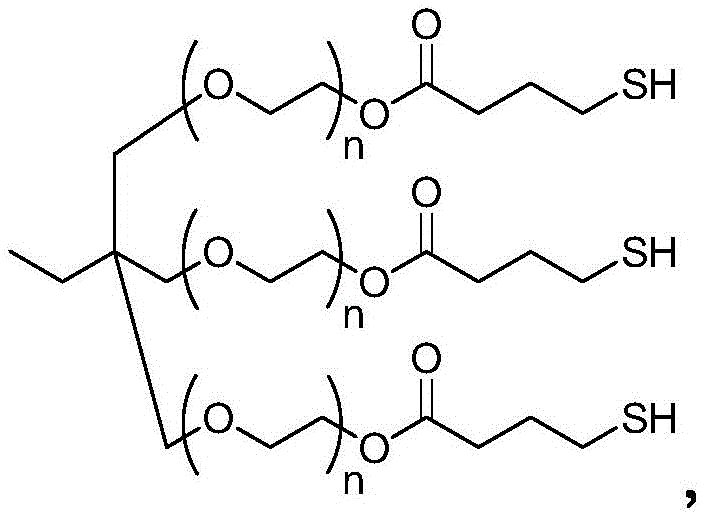
其中n是1-10的整数。where n is an integer from 1-10.
在一些实施方案中,第二种类型的单体是式(C)的化合物:In some embodiments, the second type of monomer is a compound of formula (C):
X1-L3-Rb (C)X 1 -L 3 -R b (C)
其中:in:
X1是-CRc=CH2或-C≡CH;X 1 is -CR c =CH 2 or -C≡CH;
L3是任选取代的亚烷基,任选取代的亚杂烷基,任选取代的亚环烷基,任选取代的亚杂环烷基,任选取代的亚芳基,任选取代的亚杂芳基,-(CO)-,-(CO)O-,-(CO)NH-,-C=NH-,-NH-,-C(OH)-,-O-,或-S-;L 3 is optionally substituted alkylene, optionally substituted heteroalkylene, optionally substituted cycloalkylene, optionally substituted heterocycloalkylene, optionally substituted arylene, optionally substituted The heteroarylene, -(CO)-, -(CO)O-, -(CO)NH-, -C=NH-, -NH-, -C(OH)-, -O-, or -S -;
Rb是任选取代的烷基,任选取代的杂烷基,任选取代的环烷基,任选取代的杂环烷基,任选取代的芳基,或任选取代的杂芳基;和R b is optionally substituted alkyl, optionally substituted heteroalkyl, optionally substituted cycloalkyl, optionally substituted heterocycloalkyl, optionally substituted aryl, or optionally substituted heteroaryl ;and
Rc是H或烷基。R c is H or alkyl.
在一些情况下,L3含有亚烷基氧链,包括构成具有不同化学结构的亚烷基氧单元的共聚物的亚烷基氧链,例如构成氧化乙烯和1,2-氧化丙烯的共聚物的亚烷基氧链。In some cases, L contains alkylene oxide chains, including alkylene oxide chains that make up copolymers of alkylene oxide units with different chemical structures, such as copolymers that make up ethylene oxide and 1,2-propylene oxide the alkylene oxide chain.
在一些实施方案中,第二种类型的单体是式(D)的化合物:In some embodiments, the second type of monomer is a compound of formula (D):
X2-L4-X3 (D)X 2 -L 4 -X 3 (D)
其中:in:
X2和X3是–CRd=CH2或–C≡CH;X 2 and X 3 are -CR d =CH 2 or -C≡CH;
L4是任选取代的亚烷基,任选取代的亚杂烷基,任选取代的亚环烷基,任选取代的亚杂环烷基,任选取代的亚芳基,任选取代的亚杂芳基,-(CO)-,-(CO)O-,-(CO)NH-,-C=NH-,-NH-,-C(OH)-,-O-,或-S-;和L 4 is optionally substituted alkylene, optionally substituted heteroalkylene, optionally substituted cycloalkylene, optionally substituted heterocycloalkylene, optionally substituted arylene, optionally substituted The heteroarylene, -(CO)-, -(CO)O-, -(CO)NH-, -C=NH-, -NH-, -C(OH)-, -O-, or -S -;and
Rd是H或烷基。R d is H or alkyl.
在一些情况下,L4含有亚烷基氧链,包括构成具有不同化学结构的亚烷基氧单元的共聚物的亚烷基氧链,例如构成氧化乙烯和1,2-氧化丙烯的共聚物的亚烷基氧链。In some cases, L 4 contains alkylene oxide chains, including alkylene oxide chains that make up copolymers of alkylene oxide units with different chemical structures, such as copolymers that make up ethylene oxide and 1,2-propylene oxide the alkylene oxide chain.
在一些实施方案中,L4具有以下结构: In some embodiments, L has the following structure:
其中每个n独立地是0-10,并且R6是任选取代的亚烷基,任选取代的亚杂烷基,任选取代的亚环烷基,任选取代的亚杂环烷基,任选取代的亚芳基,或任选取代的亚杂芳基,wherein each n is independently 0-10 , and R is optionally substituted alkylene, optionally substituted heteroalkylene, optionally substituted cycloalkylene, optionally substituted heterocycloalkylene , optionally substituted arylene, or optionally substituted heteroarylene,
在一些实施方案中,L4是–(O)-(C2-C3亚烷基氧)n-,其中C2-C3亚烷基氧独立地是氧化乙烯或1,2-氧化丙烯,并且n是1-10的整数。In some embodiments, L 4 is -(O)-(C 2 -C 3 alkylene oxide) n -, wherein the C 2 -C 3 alkylene oxide is independently ethylene oxide or 1,2-propylene oxide , and n is an integer from 1-10.
在一些实施方案中,L4具有以下结构: In some embodiments, L has the following structure:

其中:in:
R7是任选取代的亚烷基,任选取代的亚杂烷基,任选取代的亚环烷基,任选取代的亚杂环烷基,任选取代的亚芳基,或任选取代的亚杂芳基。 R is optionally substituted alkylene, optionally substituted heteroalkylene, optionally substituted cycloalkylene, optionally substituted heterocycloalkylene, optionally substituted arylene, or optionally substituted Substituted heteroarylene.
在一些实施方案中,第二种类型的单体是以下化合物之一:In some embodiments, the second type of monomer is one of the following compounds:

其中n是1-100的整数。where n is an integer from 1-100.
在一些实施方案中,第三种类型的单体含有至少一个、至少两个或多于两个能与硫醇基团反应的官能团。在一些实施方案中,第三种类型的单体含有一个或多个异氰酸酯基团。在一些实施方案中,第三种类型的单体含有一个或多个氰酸酯基团。在一些实施方案中,第三种类型的单体含有一个或多个硫氰酸酯基团。在一些实施方案中,第三种类型的单体含有一个或多个异硫氰酸酯基团。在一些实施方案中,第三种类型的单体含有一个或多个环氧基。在一些实施方案中,第三种类型的单体含有异氰酸酯基团、氰酸酯基团、硫氰酸酯基团、异硫氰酸酯基团和/或环氧基的组合。In some embodiments, the third type of monomer contains at least one, at least two, or more than two functional groups capable of reacting with thiol groups. In some embodiments, the third type of monomer contains one or more isocyanate groups. In some embodiments, the third type of monomer contains one or more cyanate groups. In some embodiments, the third type of monomer contains one or more thiocyanate groups. In some embodiments, the third type of monomer contains one or more isothiocyanate groups. In some embodiments, the third type of monomer contains one or more epoxy groups. In some embodiments, the third type of monomer contains a combination of isocyanate groups, cyanate groups, thiocyanate groups, isothiocyanate groups, and/or epoxy groups.
在一些实施方案中,第三种类型的单体是式(E)的化合物:In some embodiments, the third type of monomer is a compound of formula (E):
Re-L5-Rf(E)R e -L 5 -R f (E)
其中L5是亚烷基,亚芳基,亚芳基-亚烷基-亚芳基,或亚烷基-亚芳基-亚烷基,其中任何一种是任选取代的;和wherein L is alkylene, arylene, arylene - alkylene-arylene, or alkylene-arylene-alkylene, any of which is optionally substituted; and
Re和Rf是异氰酸酯基团、氰酸酯基团、硫氰酸酯基团、异硫氰酸酯基团或环氧基。 Re and Rf are isocyanate groups, cyanate groups, thiocyanate groups, isothiocyanate groups or epoxy groups.
在一些情况下,L5是以下基团之一:In some cases, L 5 is one of the following groups:

在一些实施方案中,第三种类型的单体是以下化合物之一:In some embodiments, the third type of monomer is one of the following compounds:
在任何一个上述实施方案中,第一种类型的单体与第二种类型的单体之间的比率可以是约1:1至约1:5,或是约1:1,或约1:2,或约1:3,或约1:4,或约1:5。在任何一个上述实施方案中,第一种类型的单体与第三种类型的单体之间的比率可以是约2:1,第一种类型的单体与第二种类型的单体之间的比率可以是约2:1至约2:5,或是约2:1,或约2:2,或约2:3,或约2:4,或约2:5。In any of the above embodiments, the ratio between the first type of monomer and the second type of monomer can be from about 1:1 to about 1:5, or about 1:1, or about 1:1 2, or about 1:3, or about 1:4, or about 1:5. In any of the foregoing embodiments, the ratio between the first type of monomer to the third type of monomer may be about 2:1, the ratio of the first type of monomer to the second type of monomer The ratio can be from about 2:1 to about 2:5, or about 2:1, or about 2:2, or about 2:3, or about 2:4, or about 2:5.
也提供用于电化学电池中的制品,其中此制品含有任何一个上述实施方案中所述的聚合物。在一些情况下,制品可以用作电极。在一些情况下,制品可以是用作保护结构或保护层(例如在电化学电池中)。在一些情况下,制品可以作为分隔器布置在电化学电池中。在一些实施方案中,提供制品,其包含:电活性层;以及与电活性层接触的聚合物层,此聚合物层含有如任何一个上述实施方案中所述的聚合物。在一些实施方案中,制品包含:阳极,与阳极相邻的并且含有如任何一个上述实施方案中所述聚合物的保护层,以及阴极。Also provided is an article for use in an electrochemical cell, wherein the article contains a polymer as described in any one of the above embodiments. In some cases, the article can be used as an electrode. In some cases, the article may be used as a protective structure or protective layer (eg, in an electrochemical cell). In some cases, the article can be placed in an electrochemical cell as a separator. In some embodiments, an article is provided comprising: an electroactive layer; and a polymer layer in contact with the electroactive layer, the polymer layer comprising a polymer as described in any of the above embodiments. In some embodiments, an article comprises: an anode, a protective layer adjacent to the anode and comprising a polymer as described in any of the above embodiments, and a cathode.
也提供电化学电池,其中电化学电池包含:阳极,阴极,以及与阳极和/或阴极相邻的聚合物层,此聚合物层含有如任何一个上述实施方案中所述的聚合物。在一些实施方案中,电化学电池包含:阴极;制品,此制品含有聚合物层和含阳极活性材料的电活性层,其中聚合物层是布置在阴极和电活性层之间。在一些实施方案中,提供电化学电池,其包含:含锂的阳极;与阳极相邻的并含有如任何一个上述实施方案中所述聚合物的保护层;以及阴极。An electrochemical cell is also provided, wherein the electrochemical cell comprises: an anode, a cathode, and a polymer layer adjacent the anode and/or the cathode, the polymer layer comprising a polymer as described in any one of the above embodiments. In some embodiments, an electrochemical cell comprises: a cathode; an article comprising a polymer layer and an electroactive layer comprising an anode active material, wherein the polymer layer is disposed between the cathode and the electroactive layer. In some embodiments, there is provided an electrochemical cell comprising: a lithium-containing anode; a protective layer adjacent to the anode and comprising a polymer as described in any of the above embodiments; and a cathode.
在任何一个上述实施方案中,电活性层可以含有锂,包括锂金属或锂金属合金。在任何一个上述实施方案中,阳极可以含有锂,包括锂金属或锂金属合金。In any of the foregoing embodiments, the electroactive layer may contain lithium, including lithium metal or lithium metal alloys. In any of the above embodiments, the anode may contain lithium, including lithium metal or lithium metal alloys.
在任何一个上述实施方案中,阴极可以含有硫作为阴极活性物质,例如元素硫。In any of the above embodiments, the cathode may contain sulfur as the cathode active material, such as elemental sulfur.
在任何一个上述实施方案中,聚合物层的电导率可以是大于或等于约10-5S/cm2,大于或等于约10-4S/cm2,或者大于或等于约10-3S/cm2。In any of the foregoing embodiments, the conductivity of the polymer layer may be greater than or equal to about 10-5 S/cm 2 , greater than or equal to about 10-4 S/cm 2 , or greater than or equal to about 10-3 S/
在任何一个上述实施方案中,保护层可以具有小于1μm的厚度。In any of the above embodiments, the protective layer may have a thickness of less than 1 μm.
在任何一个上述实施方案中,保护层可以是在阳极的表面上形成的。在任何一个上述实施方案中,保护层可以是在阴极的表面上形成的。In any of the above embodiments, a protective layer may be formed on the surface of the anode. In any of the above embodiments, a protective layer may be formed on the surface of the cathode.
在任何一个上述实施方案中,聚合物层或保护层可以还含有至少一种锂盐。例如,锂盐可以选自:LiNO3,LiPF6,LiBF4,LiClO4,LiAsF6,Li2SiF6,LiSbF6,LiAlCl4,二草酸根合硼酸锂,LiCF3SO3,LiN(SO2F)2,LiC(CjF2j+1SO2)3,其中j是1-20的整数,以及具有通式(CjF2j+ 1SO2)kXLi的盐,其中j是1-20的整数,当X选自氧或硫时k是1,当X选自氮或磷时k是2,以及当X选自碳或硅时k是3。In any of the above embodiments, the polymer layer or protective layer may further contain at least one lithium salt. For example, the lithium salt may be selected from: LiNO3 , LiPF6, LiBF4 , LiClO4 , LiAsF6 , Li2SiF6 , LiSbF6 , LiAlCl4 , lithium bisoxalatoborate , LiCF3SO3 , LiN ( SO2 F) 2 , LiC(C j F 2j+1 SO 2 ) 3 , where j is an integer from 1-20, and salts of the general formula (C j F 2j+ 1 SO 2 ) k XLi where j is 1-20 An integer of , k is 1 when X is selected from oxygen or sulfur, k is 2 when X is selected from nitrogen or phosphorus, and k is 3 when X is selected from carbon or silicon.
在任何一个上述实施方案中,聚合物的离子电导率在室温下在干态下可以是至少约1x 10⁻⁴S/cm。In any of the above embodiments, the ionic conductivity of the polymer may be at least about 1 x 10⁻⁴ S/cm in the dry state at room temperature.
在任何一个上述实施方案中,聚合物可以是凝胶,其在溶胀状态下在施加至少10kg/cm2的压力时是稳定的。In any of the above embodiments, the polymer may be a gel that is stable in the swollen state upon application of a pressure of at least 10 kg/cm 2 .
在任何一个上述实施方案中,聚合物层或保护层的厚度是约0.5-25μm。In any of the above embodiments, the thickness of the polymer layer or protective layer is about 0.5-25 μm.
在任何一个上述实施方案中,在与液体电解质接触时,聚合物的重量可以增加约10-60%。In any of the above embodiments, the weight of the polymer may increase by about 10-60% when in contact with the liquid electrolyte.
本发明也提供作为保护层、作为分隔器或作为电解质的聚合物,其中聚合物包含第一种类型的含至少两个硫醇基团的单体、第二种类型的含至少一个乙烯基或至少一个炔基的单体和任选第三种类型的单体的聚合单元,如任何一个上述实施方案中所述。The present invention also provides a polymer as a protective layer, as a separator or as an electrolyte, wherein the polymer comprises a first type of monomer containing at least two thiol groups, a second type of monomer containing at least one vinyl group or Polymerized units of at least one alkynyl monomer and optionally a third type of monomer as described in any of the above embodiments.
本发明的其它方面、实施方案和特征将在以下详细描述并参考附图反映出来。附图是示意图,并且不是按比例绘制的。为了清楚起见,在每个图中没有标出每个组分,而且在这里显示出的本发明每个实施方案的每个组分也不是对于本领域技术人员理解本发明而言必要的。所有这里引用的专利申请和专利的全部内容引入本文以供参考。在有矛盾之处时,以本发明的说明书为准,包括定义。Other aspects, embodiments and features of the present invention will be described in detail below and will be reflected with reference to the accompanying drawings. The figures are schematic representations and are not drawn to scale. In the interest of clarity, not every component is labeled in each figure, nor is every component of each embodiment of the invention shown herein essential to those skilled in the art to understand the invention. All patent applications and patents cited herein are incorporated by reference in their entirety. In case of conflict, the present specification, including definitions, will control.
附图简述Brief Description of Drawings
下面将参考附图描述本发明的非限制性实施方案,所述附图是示意图,并且不是按比例绘制的。在这些图中,所示的各个相同或接近相同的组分一般用一个数字表示。为了清楚起见,在每个图中没有标出每个组分,而且在这里显示出的本发明每个实施方案的每个组分也不是对于本领域技术人员理解本发明而言必要的。在附图中:Non-limiting embodiments of the present invention will be described below with reference to the accompanying drawings, which are schematic and not drawn to scale. In these figures, each component shown that is identical or nearly identical is generally represented by a number. In the interest of clarity, not every component is labeled in each figure, nor is every component of each embodiment of the invention shown herein essential to those skilled in the art to understand the invention. In the attached image:
图1A显示通过含两个硫醇基团的单体与含两个乙烯基的单体进行反应合成硫醇-烯聚合物;Figure 1A shows the synthesis of a thiol-ene polymer by reacting a monomer containing two thiol groups with a monomer containing two vinyl groups;
图1B显示通过含两个硫醇基团的单体与含两个乙烯基的单体反应合成交替共聚物;Figure 1B shows the synthesis of alternating copolymers by reacting a monomer containing two thiol groups with a monomer containing two vinyl groups;
图1C显示通过含两个硫醇基团的低聚物与含两个乙烯基的低聚物反应合成多相嵌段共聚物;Figure 1C shows the synthesis of a heterophasic block copolymer by reacting an oligomer containing two thiol groups with an oligomer containing two vinyl groups;
图1D显示含三个硫醇基团的单体与含两个乙烯基的单体反应合成支化共聚物;Figure 1D shows the reaction of monomers containing three thiol groups with monomers containing two vinyl groups to synthesize branched copolymers;
图2A显示用于电化学电池中的包含保护结构的制品;Figure 2A shows an article comprising a protective structure for use in an electrochemical cell;
图2B显示包含电活性层和聚合物层的电极;Figure 2B shows an electrode comprising an electroactive layer and a polymer layer;
图2C显示包含电活性层和多层保护结构的电极;Figure 2C shows an electrode comprising an electroactive layer and a multilayer protective structure;
图3显示电化学电池;Figure 3 shows an electrochemical cell;
图4显示单体的非限制性例子;和Figure 4 shows non-limiting examples of monomers; and
图5显示水解稳定性硫醇的合成路线。Figure 5 shows the synthetic route of hydrolytically stable thiols.
图6显示涉及(a)含两个异氰酸酯基团的单体与(b)含两个氰酸酯基团的单体的环加成反应。Figure 6 shows a cycloaddition reaction involving (a) a monomer containing two isocyanate groups and (b) a monomer containing two cyanate groups.
发明详述Detailed description of the invention
本发明提供聚合物,更尤其是用于制品和/或电化学电池中的聚合物。可以将所述聚合物引入碱金属电化学电池(例如锂金属和/或锂离子电化学电池)中,例如用作保护层,和/或引入在电化学电池内的任何其它合适组分中。本文所述的聚合物可以显示改进的与电池环境的相容性(例如在Li聚硫化物、Li表面的存在下,等等)。例如,聚合物可以在亲核物质(例如聚硫化物)的存在下是稳定的,所述亲核物质可以存在于制品或电化学电池内,这允许改进的机械完整性和/或离子电导率。另外,聚合物可以是在各种表面、例如锂表面上快速形成和/或固化的。The present invention provides polymers, more particularly polymers for use in articles and/or electrochemical cells. The polymers can be incorporated into alkali metal electrochemical cells (eg, lithium metal and/or lithium ion electrochemical cells), eg, as a protective layer, and/or into any other suitable components within the electrochemical cell. The polymers described herein can exhibit improved compatibility with the battery environment (eg, in the presence of Li polysulfides, Li surfaces, etc.). For example, polymers can be stable in the presence of nucleophiles (eg, polysulfides) that can be present within articles or electrochemical cells, which allow for improved mechanical integrity and/or ionic conductivity . Additionally, polymers can be rapidly formed and/or cured on various surfaces, such as lithium surfaces.
可以将本文所述的聚合物引入制品内,例如电极或电化学电池,作为保护层和/或用于保护结构中(例如多层结构),作为电解质,和/或作为分隔器。在一个实例中,可以将聚合物引入含有电活性层和一种或多种本文所述聚合物(例如聚合物层)的制品(例如电极)中。聚合物可以用作保护层和/或用于保护结构中,可以例如作为分隔器布置在电活性材料和电解质(或在电解质内的一种或多种反应性物质)之间。电活性层从电化学电池的电解质分隔开,这可以以各种方式改进电化学电池的性能,包括(例如对于锂电池)减少或防止在充电期间形成树枝状物,减少或防止锂与电解质或在电解质中的组分(例如溶剂、盐和/或阴极放电产物)反应,增加循环寿命,并且改进安全性(例如防止热失控)。作为示例,电活性锂层与电解质的反应可以导致在阳极上形成电阻膜阻挡,并且可以增加电池的内部电阻,并降低在额定电压下由电池所提供的电流量。The polymers described herein can be incorporated into articles, such as electrodes or electrochemical cells, as protective layers and/or in protective structures (eg, multilayer structures), as electrolytes, and/or as separators. In one example, a polymer can be incorporated into an article (eg, an electrode) containing an electroactive layer and one or more polymers (eg, polymer layers) described herein. The polymer can be used as a protective layer and/or in a protective structure, and can be disposed, for example, as a separator between the electroactive material and the electrolyte (or one or more reactive species within the electrolyte). The electroactive layer is separated from the electrolyte of the electrochemical cell, which can improve the performance of the electrochemical cell in various ways, including (for example, for lithium cells) reducing or preventing the formation of dendrites during charging, reducing or preventing lithium from interacting with the electrolyte Or components in the electrolyte (eg, solvents, salts, and/or cathode discharge products) react, increasing cycle life, and improving safety (eg, preventing thermal runaway). As an example, the reaction of the electroactive lithium layer with the electrolyte can result in the formation of a resistive film barrier on the anode and can increase the internal resistance of the battery and reduce the amount of current provided by the battery at rated voltage.
也可以将聚合物引入制品、例如电化学电池内。例如,制品可以包含阳极(例如含有锂的阳极),含有聚合物并与阳极相邻的的保护层,以及阴极。电化学电池可以例如是初级电池或二次电池,其可以进行多次的充电和放电。例如,本文所述的聚合物、制品和/或电化学电池可以用于锂-硫电池。本文所述的电化学电池也可以用于各种应用中,包括生产/操作汽车,计算机,个人数码辅助用品,移动电话,手表,摄像机,数码相机,温度计,计算器,可移动式BIOS,通讯设备或遥控车锁。Polymers can also be incorporated into articles, such as electrochemical cells. For example, an article may include an anode (eg, an anode containing lithium), a protective layer containing a polymer adjacent to the anode, and a cathode. The electrochemical cell can be, for example, a primary cell or a secondary cell, which can be charged and discharged multiple times. For example, the polymers, articles and/or electrochemical cells described herein can be used in lithium-sulfur batteries. The electrochemical cells described herein can also be used in a variety of applications including production/operation of automobiles, computers, personal digital aids, mobile phones, watches, video cameras, digital cameras, thermometers, calculators, removable BIOS, communications device or remote control car lock.
A.聚合物组合物A. Polymer Composition
本文所述的聚合物(例如硫醇-烯聚合物)可以通过第一种类型的含至少两个硫醇基团的单体与第二种类型的含至少一个乙烯基或至少一个炔基的单体的反应形成。此反应可以任选地涉及第三种类型的单体,例如含有一个或多个能与硫醇基团反应的官能团的单体。The polymers (eg, thiol-ene polymers) described herein can be obtained by combining a first type of monomers containing at least two thiol groups with a second type of monomers containing at least one vinyl or at least one alkynyl group. Reaction of monomers to form. This reaction may optionally involve a third type of monomer, such as a monomer containing one or more functional groups capable of reacting with thiol groups.
尤其是,提供各种硫醇-烯聚合物。这些聚合物可以有利地用于本文所述的制品和电化学电池中,因为它们可以显示改进的在电池组分存在下的稳定性,例如锂-硫电池(例如锂聚硫化物、锂表面等)。例如,虽然其它材料可以与在电池使用期间产生的聚硫化物(例如在硫放电期间)和在电池内存在的其它亲核物质反应,但是本文所述的硫醇-烯聚合物可以具有减少量的或可以基本上不含易于受亲核攻击的官能团,例如酯基。聚合物可以包含对锂聚硫化物的亲核攻击而言稳定的酰胺基团。另外,含有酰胺基团的聚合物可以显示改进的与各种表面的粘合性,例如电极表面(例如锂阳极表面)。In particular, various thiol-ene polymers are provided. These polymers can be advantageously used in the articles and electrochemical cells described herein because they can exhibit improved stability in the presence of battery components, such as lithium-sulfur batteries (eg, lithium polysulfides, lithium surfaces, etc. ). For example, the thiol-ene polymers described herein can have reduced amounts of polysulfides produced during battery use (eg, during sulfur discharge) and other nucleophiles present within the battery, for example, although other materials can react with or may be substantially free of functional groups susceptible to nucleophilic attack, such as ester groups. The polymer may contain amide groups that are stable to nucleophilic attack by lithium polysulfides. Additionally, polymers containing amide groups can exhibit improved adhesion to various surfaces, such as electrode surfaces (eg, lithium anode surfaces).
本文所述的聚合物可以是共聚物,包括无规共聚物和嵌段共聚物。用于形成聚合物的方法可以是快速、稳固和选择性的。在硫醇-烯聚合物的情况下,在硫醇基团和乙烯基之间的反应一般涉及硫醇向烯属双键的自由基加成反应。但是,与自由基链增长反应不同的是,自由基诱导的硫醇-烯聚合反应可以一般按照分步增长方式进行,这允许更大程度地控制所得宏观分子的微观结构,并进而控制聚合物性能。此外,硫醇-烯聚合物的聚合可以快速地在锂表面上进行。The polymers described herein can be copolymers, including random copolymers and block copolymers. The method for forming the polymer can be fast, robust and selective. In the case of thiol-ene polymers, the reaction between the thiol group and the vinyl group generally involves a free radical addition reaction of the thiol to the olefinic double bond. However, unlike radical chain growth reactions, radical-induced thiol-ene polymerizations can generally proceed in a stepwise growth fashion, which allows for greater control over the microstructure of the resulting macromolecules and, in turn, polymers performance. Furthermore, the polymerization of thiol-ene polymers can proceed rapidly on lithium surfaces.
由于反应对象(例如单体)的选择性,硫醇-烯聚合物可以通常以高度规则的交替方式构成。如图1A所示,聚合可以涉及第一种类型的含两个硫醇基团的单体与第二种类型的含两个乙烯基的单体反应,制得硫醇-烯聚合物。图1B显示线性的非交联的硫醇-烯聚合物的反应示意图。这些材料一般显示较低的玻璃化转变温度(Tg),这来源于柔性C-S-C硫醚键。使用低聚物原料(例如含两个硫醇基团的低聚物与含两个乙烯基的低聚物反应)可以制备多段的嵌段共聚物,其具有诱导相分离,其中材料参数可以通过分段比率来设计,如图1C所示。使用单体原料制备嵌段共聚物的其它方法也是本领域公知的(例如“活性”聚合)。Due to the selectivity of reactants (eg, monomers), thiol-ene polymers can typically be constructed in a highly regular alternating fashion. As shown in Figure 1A, polymerization may involve the reaction of a first type of monomer containing two thiol groups with a second type of monomer containing two vinyl groups to produce a thiol-ene polymer. Figure IB shows a reaction scheme for a linear non-crosslinked thiol-ene polymer. These materials generally show lower glass transition temperatures ( Tg ), which are derived from flexible CSC thioether linkages. Using an oligomer starting material (eg, reacting an oligomer containing two thiol groups with an oligomer containing two vinyl groups) can prepare multistage block copolymers with induced phase separation, where the material parameters can be determined by The segment ratio is designed as shown in Figure 1C. Other methods of preparing block copolymers using monomeric feedstocks are also known in the art (eg, "living" polymerization).
应当注意的是根据乙烯基的性质,聚合物也可以经由迈克尔加成机理形成。例如,第二种类型的单体可以包含缺电子的双键(例如α,β-不饱和羰基),其可以被第一种类型单体的硫醇基团进行亲核攻击。代替或另外,含有缺电子双键的单体也可以经由阴离子性分步增长反应来增长。It should be noted that depending on the nature of the vinyl, polymers can also be formed via a Michael addition mechanism. For example, the second type of monomer may contain an electron deficient double bond (eg, an α,β-unsaturated carbonyl group) that can be nucleophilically attacked by the thiol group of the first type of monomer. Alternatively or additionally, monomers containing electron deficient double bonds can also be grown via anionic step growth reactions.
超支化和/或交联的聚合物可以使用至少一种含有多于两个反应性官能团的单体制备。例如,第一种类型的单体可以含有两个硫醇基团,并且第二种类型的单体可以含有多于两个乙烯基。或者,第一种类型的单体可以含有多于两个硫醇基团,并且第二种类型的单体可以含有两个乙烯基,如图1D所示。在其它例子中,第一种类型的单体可以含有多于两个硫醇基团,并且第二种类型的单体可以含有多于两个乙烯基。在其它情况下,可以加入第三种类型的单体以制备超支化和/或交联的聚合物,如下文详述。Hyperbranched and/or crosslinked polymers can be prepared using at least one monomer containing more than two reactive functional groups. For example, a first type of monomer may contain two thiol groups, and a second type of monomer may contain more than two vinyl groups. Alternatively, the first type of monomer may contain more than two thiol groups, and the second type of monomer may contain two vinyl groups, as shown in Figure ID. In other examples, the first type of monomer may contain more than two thiol groups, and the second type of monomer may contain more than two vinyl groups. In other cases, a third type of monomer can be added to prepare hyperbranched and/or crosslinked polymers, as detailed below.
虽然这里的许多讨论集中于第一种类型的含两个或三个硫醇基团的单体和/或第二种类型的含两个或三个乙烯基的单体,但是应当理解的是,这些单体仅仅是举例描述,本文所述的每种类型的单体可以含有适合用于具体应用的任何数目的官能团(例如聚合位点)。例如,第一种类型的单体可以含有4、5、6或更多个硫醇基团,和/或第二种类型的单体可以含有4、5、6或更多个乙烯基。聚合物可以通过第一种类型的含至少两个硫醇基团的单体与第二种类型的含至少两个乙烯基的单体反应形成。例如,第一种类型的单体可以含有2、3或4个硫醇基团,和/或第二种类型的单体可以含有2、3或4个乙烯基。While much of the discussion herein focuses on the first type of monomers containing two or three thiol groups and/or the second type of monomers containing two or three vinyl groups, it should be understood that , these monomers are described by way of example only, and each type of monomer described herein may contain any number of functional groups (eg, polymerization sites) suitable for use in a particular application. For example, the first type of monomer may contain 4, 5, 6 or more thiol groups, and/or the second type of monomer may contain 4, 5, 6 or more vinyl groups. The polymer can be formed by reacting a first type of monomer containing at least two thiol groups with a second type of monomer containing at least two vinyl groups. For example, the first type of monomer may contain 2, 3 or 4 thiol groups, and/or the second type of monomer may contain 2, 3 or 4 vinyl groups.
在特定情况下,聚合物是通过第一种类型的含两个硫醇基团的单体与第二种类型的含两个乙烯基的单体反应形成的。在一些情况下,聚合物是通过第一种类型的含两个硫醇基团的单体与第二种类型的含三个乙烯基的单体反应形成的。在一些情况下,聚合物是通过第一种类型的含三个硫醇基团的单体与第二种类型的含两个乙烯基的单体反应形成的。在一些情况下,聚合物是通过第一种类型的含三个硫醇基团的单体与第二种类型的含三个乙烯基的单体反应形成的。In certain instances, polymers are formed by reacting a first type of monomer containing two thiol groups with a second type of monomer containing two vinyl groups. In some cases, the polymer is formed by reacting a first type of monomer containing two thiol groups with a second type of monomer containing three vinyl groups. In some cases, the polymer is formed by reacting a first type of monomer containing three thiol groups with a second type of monomer containing two vinyl groups. In some cases, the polymer is formed by reacting a first type of monomer containing three thiol groups with a second type of monomer containing three vinyl groups.
这些单体可以按照任何合适的比率提供。在一些情况下,第一种类型的单体与第二种类型的单体之间的比率是约1:1至约1:5,或是约1:1,或约1:2,或约1:3,或约1:4,或约1:5。These monomers can be provided in any suitable ratio. In some cases, the ratio between the first type of monomer and the second type of monomer is about 1:1 to about 1:5, or about 1:1, or about 1:2, or about 1:3, or about 1:4, or about 1:5.
第一种类型的含至少两个硫醇基团的单体与第三种类型的单体之间的比率可以是约2:1,并且第一种类型的含至少两个硫醇基团的单体与第二种类型的含至少两个乙烯基的单体之间的比率可以是约2:1至约2:5,或是约2:1,或约2:2,或约2:3,或约2:4,或约2:5。The ratio between the first type of monomers containing at least two thiol groups to the third type of monomers may be about 2:1, and the first type of monomers containing at least two thiol groups The ratio between the monomer and the second type of monomer containing at least two vinyl groups can be from about 2:1 to about 2:5, or about 2:1, or about 2:2, or about 2:2: 3, or about 2:4, or about 2:5.
第一种类型的单体可以例如含有两个硫醇基团、三个硫醇基团,或更多个硫醇基团。例如,第一种类型的单体可以是式(A)或式(B)的化合物:The first type of monomer may, for example, contain two thiol groups, three thiol groups, or more thiol groups. For example, the first type of monomer can be a compound of formula (A) or formula (B):
HS-L1-SH (A)HS-L 1 -SH (A)
RaC(L2SH)3 (B)R a C(L 2 SH) 3 (B)
其中:in:
L1或L2是任选取代的亚烷基,任选取代的亚杂烷基,例如亚烷基氧链,任选取代的亚环烷基,任选取代的亚杂环烷基,任选取代的亚芳基,或任选取代的亚杂芳基;并且Ra是H、烷基或–L2SH。例如,L1或L2可以包括亚烷基氧链,例如含有具有不同化学结构的亚烷基氧单元的亚烷基氧链(例如C2亚烷基氧,C3亚烷基氧,等等)。L 1 or L 2 is optionally substituted alkylene, optionally substituted heteroalkylene, such as an alkyleneoxy chain, optionally substituted cycloalkylene, optionally substituted heterocycloalkylene, any optionally substituted arylene, or optionally substituted heteroarylene; and R a is H, alkyl, or —L 2 SH. For example, L1 or L2 can include an alkylene oxide chain, such as an alkylene oxide chain containing alkylene oxide units with different chemical structures (eg, C2 alkylene oxide , C3 alkylene oxide , etc. Wait).
第一种类型的单体可以是式(A)化合物:HS-L1-SH,其中L1是-(C2-C3亚烷基氧)n-(C2-C3亚烷基)-,或-(C2-C3亚烷基氧)n-C(O)-(C2-C3亚烷基),其中C2-C3亚烷基氧独立地是氧化乙烯或1,2-氧化丙烯,其中n是1-100的整数,例如1-10的整数。The first type of monomer may be a compound of formula (A): HS-L 1 -SH, where L 1 is -(C 2 -C 3 alkyleneoxy) n -(C 2 -C 3 alkylene) -, or -(C 2 -C 3 alkylene oxide) n -C(O)-(C 2 -C 3 alkylene oxide), wherein C 2 -C 3 alkylene oxide is independently ethylene oxide or 1 ,2-propylene oxide, wherein n is an integer of 1-100, eg, an integer of 1-10.
第一种类型的单体也可以是式(B)的化合物:RaC(L2SH)3,其中L2是–(C1-C3亚烷基)-(C2-C3亚烷基氧)n-(C1-C3亚烷基)–,或–(C1-C3亚烷基)-(C2-C3亚烷基氧)n-OC(O)-(C1-C3亚烷基)–,其中C2-C3亚烷基氧独立地是氧化乙烯或1,2-氧化丙烯,Ra是H或烷基,并且n是1-10的整数。The first type of monomer may also be a compound of formula (B): R a C(L 2 SH) 3 where L 2 is -(C 1 -C 3 alkylene)-(C 2 -C 3 alkylene) Alkyloxy) n -(C 1 -C 3 alkylene)-, or -(C 1 -C 3 alkylene)-(C 2 -C 3 alkylene oxide) n -OC(O)-( C 1 -C 3 alkylene)—wherein C 2 -C 3 alkylene oxide is independently ethylene oxide or 1,2-propylene oxide, R a is H or alkyl, and n is an integer from 1 to 10 .
第一种类型的单体的例子包括以下化合物:Examples of monomers of the first type include the following compounds:

其中n是1-10的整数。where n is an integer from 1-10.
第二种类型的单体可以包含至少一个能与第一种类型单体反应的基团,从而形成聚合物。例如,第二种类型的单体可以含有至少一个乙烯基,例如1-3个乙烯基(例如两个乙烯基)。第二种类型的单体也可以含有至少一个炔基,例如1-3个炔基(例如三个炔基)。The second type of monomer may contain at least one group reactive with the first type of monomer to form a polymer. For example, the second type of monomer may contain at least one vinyl group, eg, 1-3 vinyl groups (eg, two vinyl groups). The second type of monomer may also contain at least one alkynyl group, eg, 1-3 alkynyl groups (eg, three alkynyl groups).
第二种类型的单体可以是式(C)的化合物:The second type of monomer can be a compound of formula (C):
X1-L3-Rb (C)X 1 -L 3 -R b (C)
其中:in:
X1是-CRc=CH2或-C≡CH;X 1 is -CR c =CH 2 or -C≡CH;
L3是任选取代的亚烷基,任选取代的亚杂烷基,任选取代的亚环烷基,任选取代的亚杂环烷基,任选取代的亚芳基,任选取代的亚杂芳基,-(CO)-,-(CO)O-,-(CO)NH-,-C=NH-,-NH-,-C(OH)-,-O-,或-S-;L 3 is optionally substituted alkylene, optionally substituted heteroalkylene, optionally substituted cycloalkylene, optionally substituted heterocycloalkylene, optionally substituted arylene, optionally substituted The heteroarylene, -(CO)-, -(CO)O-, -(CO)NH-, -C=NH-, -NH-, -C(OH)-, -O-, or -S -;
Rb是任选取代的烷基,任选取代的杂烷基,任选取代的环烷基,任选取代的杂环烷基,任选取代的芳基,或任选取代的杂芳基;和R b is optionally substituted alkyl, optionally substituted heteroalkyl, optionally substituted cycloalkyl, optionally substituted heterocycloalkyl, optionally substituted aryl, or optionally substituted heteroaryl ;and
Rc是H或烷基。R c is H or alkyl.
第二种类型的单体也可以是式(D)的化合物:The second type of monomer can also be a compound of formula (D):
X2-L4-X3 (D)X 2 -L 4 -X 3 (D)
其中:in:
X2和X3是–CRd=CH2或–C≡CH;X 2 and X 3 are -CR d =CH 2 or -C≡CH;
L4是任选取代的亚烷基,任选取代的亚杂烷基,任选取代的亚环烷基,任选取代的亚杂环烷基,任选取代的亚芳基,任选取代的亚杂芳基,-(CO)-,-(CO)O-,-(CO)NH-,-C=NH-,-NH-,-C(OH)-,-O-,或-S-;和L 4 is optionally substituted alkylene, optionally substituted heteroalkylene, optionally substituted cycloalkylene, optionally substituted heterocycloalkylene, optionally substituted arylene, optionally substituted The heteroarylene, -(CO)-, -(CO)O-, -(CO)NH-, -C=NH-, -NH-, -C(OH)-, -O-, or -S -;and
Rd是H或烷基。R d is H or alkyl.
在式(C)或式(D)中,L3或L4可以含有亚烷基氧链,包括构成具有不同化学结构的亚烷基氧单元的共聚物的亚烷基氧链,例如构成氧化乙烯和1,2-氧化丙烯的共聚物的亚烷基氧链。In formula (C) or formula (D), L 3 or L 4 may contain an alkylene oxide chain, including an alkylene oxide chain constituting a copolymer of alkylene oxide units having different chemical structures, such as constituting an oxygen Alkylene oxide chains of copolymers of ethylene and 1,2-propylene oxide.
第二种类型的单体可以是式(D)的化合物,其中L4具有以下结构:The second type of monomer can be a compound of formula (D), wherein L has the following structure:

其中每个n独立地是0-10,并且R6是任选取代的亚烷基,任选取代的亚杂烷基,任选取代的亚环烷基,任选取代的亚杂环烷基,任选取代的亚芳基,或任选取代的亚杂芳基。或者,L4可以是-(O)-(C2-C3亚烷基氧)n-,其中C2-C3亚烷基氧是氧化乙烯或1,2-氧化丙烯,并且n是1-10的整数,wherein each n is independently 0-10 , and R is optionally substituted alkylene, optionally substituted heteroalkylene, optionally substituted cycloalkylene, optionally substituted heterocycloalkylene , optionally substituted arylene, or optionally substituted heteroarylene. Alternatively, L 4 can be -(O)-(C 2 -C 3 alkylene oxide) n -, wherein the C 2 -C 3 alkylene oxide is ethylene oxide or 1,2-propylene oxide, and n is 1 an integer of -10,
第二种类型的单体也可以是式(D)的化合物,其中L4具有以下结构:The second type of monomer can also be a compound of formula (D), wherein L has the following structure:

其中:in:
R7是任选取代的亚烷基,任选取代的亚杂烷基,任选取代的亚环烷基,任选取代的亚杂环烷基,任选取代的亚芳基,或任选取代的亚杂芳基。例如,R7可以含有亚烷基链或氧化烯链,包括构成具有不同化学结构的亚烷基氧单元的共聚物的亚烷基氧链,例如构成氧化乙烯和1,2-氧化丙烯的共聚物的亚烷基氧链。 R is optionally substituted alkylene, optionally substituted heteroalkylene, optionally substituted cycloalkylene, optionally substituted heterocycloalkylene, optionally substituted arylene, or optionally substituted Substituted heteroarylene. For example, R 7 may contain an alkylene chain or an oxyalkylene chain, including an alkylene oxide chain that constitutes a copolymer of alkylene oxide units with different chemical structures, such as a copolymer of ethylene oxide and 1,2-propylene oxide the alkylene oxide chain of the substance.
第二种类型的单体的例子包括以下化合物:Examples of the second type of monomer include the following compounds:

其中n是1-100的整数。C2-C3亚烷基氧可以例如是氧化乙烯或1,2-氧化丙烯。where n is an integer from 1-100. The C2 - C3 - alkylene oxide can be, for example, ethylene oxide or 1,2-propylene oxide.
第三种类型的单体含有至少一个、至少两个或多于两个能与硫醇基团反应的官能团,例如异氰酸酯基团、氰酸酯基团、硫氰酸酯基团、异硫氰酸酯基团、环氧基或其组合。例如,第三种类型的单体可以是式(E)化合物:The third type of monomer contains at least one, at least two or more than two functional groups reactive with thiol groups such as isocyanate groups, cyanate groups, thiocyanate groups, isothiocyanate groups ester groups, epoxy groups, or combinations thereof. For example, the third type of monomer can be a compound of formula (E):
Re-L5-Rf(E)R e -L 5 -R f (E)
其中L5是亚烷基,亚芳基,亚芳基-亚烷基-亚芳基,或亚烷基-亚芳基-亚烷基,其中任何一种是任选取代的,例如where L is an alkylene, arylene, arylene - alkylene-arylene, or alkylene-arylene-alkylene, any of which is optionally substituted, such as

Re和Rf是异氰酸酯基团、氰酸酯基团、硫氰酸酯基团、异硫氰酸酯基团或环氧基。第三种类型的单体的例子包括以下化合物: Re and Rf are isocyanate groups, cyanate groups, thiocyanate groups, isothiocyanate groups or epoxy groups. Examples of the third type of monomer include the following compounds:


引入第三种类型的单体可以提供制备交联聚合物结构的能力。例如,第三种类型的单体可以包含能与第一聚合物链中的硫醇基团、乙烯基和/或炔基反应的第一官能团(例如与之形成键),以及能与第二聚合物链中的硫醇基团、乙烯基和/或炔基反应的第二官能团(例如与之形成键),从而在第一和第二聚合物之间形成交联。通常,在第三种类型单体上的异氰酸酯基团、氰酸酯基团、硫氰酸酯基团、异硫氰酸酯基团或环氧基可以耐受从硫醇基团对第一种类型单体或对聚合物施加的亲核攻击。The introduction of a third type of monomer can provide the ability to prepare cross-linked polymer structures. For example, the third type of monomer may comprise a first functional group capable of reacting with (eg, forming a bond with) thiol, vinyl and/or alkynyl groups in the first polymer chain, and a second functional group capable of reacting with The thiol, vinyl, and/or alkynyl groups in the polymer chain react with (eg, form bonds with) a second functional group to form a crosslink between the first and second polymers. In general, isocyanate groups, cyanate groups, thiocyanate groups, isothiocyanate groups or epoxy groups on the third type of monomers can tolerate changes from thiol groups to the first type of monomer or nucleophilic attack on the polymer.
第三单体也可以与其它单体或聚合物的官能团进行环加成反应,从而形成环状结构。在一些情况下,环加成反应可以在多种第三单体之间进行以形成环状结构。这些环状结构可以改进聚合物的稳定性和/或机械完整性,并可以另外改进制品或电化学电池的性能。例如,第三单体可以含有两个异氰酸酯基团,其中一个异氰酸酯基团可以与两个其它第三单体的异氰酸酯基团进行环加成反应以形成取代的六元杂环,如图6A所示。在一些情况下,在聚合物中存在的至少一个异氰酸酯基团可以经由环加成反应与其它单体或聚合物的异氰酸酯基团反应,从而形成取代的六元杂环。在另一个例子中,第三单体可以含有两个氰酸酯基团,其中一个氰酸酯基团可以与两个其它第三单体的氰酸酯基团进行环加成反应,从而形成取代的三嗪环(图6B)。在一些情况下,在聚合物中存在的至少一个氰酸酯基团可以经由环加成反应与其它单体或聚合物的氰酸酯基团反应以形成取代的三嗪环。这些环状结构可以用作交联基团(例如在两个聚合物之间)。The third monomer can also undergo a cycloaddition reaction with other monomers or functional groups of the polymer, thereby forming a cyclic structure. In some cases, a cycloaddition reaction can be performed between multiple third monomers to form a cyclic structure. These cyclic structures can improve the stability and/or mechanical integrity of the polymer, and can additionally improve the performance of the article or electrochemical cell. For example, the third monomer can contain two isocyanate groups, one of which can undergo a cycloaddition reaction with the isocyanate groups of two other third monomers to form a substituted six-membered heterocycle, as shown in Figure 6A Show. In some cases, at least one isocyanate group present in the polymer can react with isocyanate groups of other monomers or polymers via a cycloaddition reaction to form a substituted six-membered heterocycle. In another example, the third monomer can contain two cyanate groups, one of which can undergo a cycloaddition reaction with the cyanate groups of two other third monomers to form Substituted triazine rings (Figure 6B). In some cases, at least one cyanate group present in the polymer can react with cyanate groups of other monomers or polymers via a cycloaddition reaction to form a substituted triazine ring. These cyclic structures can be used as crosslinking groups (eg between two polymers).
聚合物可以使用本领域公知的方法形成。聚合可以在溶剂的存在下进行,或者在一些情况下在不存在溶剂的情况下进行。聚合物可以在暴露于UV光时形成,任选地在光引发剂的存在下进行。例如,本文所述的单体的混合物可以在光引发剂的存在下与溶剂组合以形成预聚物溶液。聚合可以在表面上进行,例如通过首先使得表面暴露于预聚物溶液。预聚物溶液可以然后暴露于电磁辐照(例如UV辐照)以引发聚合。在一些情况下,可以将预聚物溶液施用到表面上,从而在表面上形成含有单体混合物的膜或层,其可以然后暴露于电磁辐照以引发聚合。第一种、第二种和/或第三种类型的单体可以同时聚合。如果希望的话,第一种、第二种和/或第三种类型的单体中的任何一种可以依次聚合。Polymers can be formed using methods known in the art. The polymerization can be carried out in the presence of a solvent, or in some cases in the absence of a solvent. The polymer can be formed upon exposure to UV light, optionally in the presence of a photoinitiator. For example, a mixture of monomers described herein can be combined with a solvent in the presence of a photoinitiator to form a prepolymer solution. Polymerization can be carried out on the surface, for example by first exposing the surface to a prepolymer solution. The prepolymer solution can then be exposed to electromagnetic radiation (eg, UV radiation) to initiate polymerization. In some cases, a prepolymer solution can be applied to a surface to form a film or layer on the surface containing the monomer mixture, which can then be exposed to electromagnetic radiation to initiate polymerization. The first, second and/or third types of monomers can be polymerized simultaneously. If desired, any of the first, second and/or third types of monomers can be polymerized in sequence.
聚合可以进行任何合适的时间以制备所需的聚合物。在一些情况下,此反应进行达到使反应基本上完成所需的时间,和在一些情况下,此时间可以保持为对于基本上完成此反应而言尽可能短的时间。聚合的终止可以使用本领域公知的方法进行。例如,单官能单体可以作为终止剂加入,和/或降低聚合物的链长度。在一些情况下,聚合可以简单地通过停止暴露于电磁辐照来终止。Polymerization can be carried out for any suitable time to produce the desired polymer. In some cases, the reaction is carried out for the time necessary for the reaction to be substantially complete, and in some cases, this time can be kept as short as possible for the reaction to be substantially complete. Termination of the polymerization can be carried out using methods well known in the art. For example, monofunctional monomers can be added as terminators, and/or reduce the chain length of the polymer. In some cases, polymerization can be terminated simply by ceasing exposure to electromagnetic radiation.
在一些情况下,聚合可以在电活性材料(例如金属,例如锂,或金属合金,例如锂合金)的表面上进行。在电活性材料表面上形成聚合物可以具有许多优点。例如,聚合物能传导锂阳离子,但是不能传导可能存在的其它不需要的阳离子/阴离子(例如,聚硫化物阴离子,其可以在涉及硫阴极的实施方案中存在)。所以,电活性材料可以免受不利反应的影响,和/或电化学电池的循环寿命可以增加。或者,可以在保护层(例如陶瓷、玻璃)的表面上进行聚合。In some cases, polymerization can be performed on the surface of an electroactive material (eg, a metal, such as lithium, or a metal alloy, such as a lithium alloy). Forming polymers on the surface of electroactive materials can have many advantages. For example, the polymer can conduct lithium cations, but cannot conduct other unwanted cations/anions that may be present (eg, polysulfide anions, which may be present in embodiments involving sulfur cathodes). Therefore, the electroactive material can be protected from adverse reactions, and/or the cycle life of the electrochemical cell can be increased. Alternatively, the polymerization can be carried out on the surface of a protective layer (eg ceramic, glass).
任何合适的溶剂可以用于聚合反应中(例如为了形成预聚物溶液)。溶剂可以选择为具有低沸点和/或基本上对于单体和/或反应组分没有反应性。溶剂可以是非水性的溶剂,含水的溶剂,或其混合物。非水性溶剂的例子包括但不限于:非水性有机溶剂,例如N-甲基乙酰胺,例如二甲基乙酰胺(DMAc),乙腈,缩醛,缩酮,酯(例如丁酮),碳酸酯,砜,亚硫酸盐,环丁砜,脂族醚,无环的醚,环醚,甘醇二甲醚,聚醚,磷酸酯,硅氧烷,二氧戊环,N-烷基吡咯烷酮,例如N-甲基吡咯烷酮(NMP),上述物质的取代形式,以及它们的混合物。可以使用的无环醚的例子包括但不限于:二乙基醚,二丙基醚,二丁基醚,二甲氧基甲烷(DME),三甲氧基甲烷,二甲氧基乙烷,二乙氧基乙烷,1,2-二甲氧基丙烷,和1,3-二甲氧基丙烷。可以使用的环醚的例子包括但不限于:四氢呋喃,四氢吡喃(THF),2-甲基四氢呋喃,1,4-二烷,1,3-二氧戊环(DOL)和三
通常用于本文所述聚合物的聚合反应中的溶剂包括丁酮(也称为甲基乙基酮或MEK)和二氧戊环。Solvents commonly used in the polymerization of the polymers described herein include butanone (also known as methyl ethyl ketone or MEK) and dioxolane.
任何合适的光引发剂可以用于聚合物的聚合中。在一些情况下,光引发剂是自由基光引发剂。自由基光引发剂的非限制性例子包括二(2,4,6-三甲基苯甲酰基)-苯基氧化膦(例如
聚合可以在惰性气氛中进行,例如在真空或惰性气体气氛(例如氮气、氩气)中。在一些实施方案中,此反应在大气压下进行。The polymerization can be carried out in an inert atmosphere, for example in a vacuum or an inert gas atmosphere (eg nitrogen, argon). In some embodiments, this reaction is carried out at atmospheric pressure.
此反应可以在任何合适的温度下进行。在一些实施方案中,此反应在约20-70℃下进行。在某些(虽然不是全部)情况下,此反应可以优选在大约室温的温度下进行。This reaction can be carried out at any suitable temperature. In some embodiments, this reaction is carried out at about 20-70°C. In some (though not all) cases, this reaction may preferably be carried out at a temperature of about room temperature.
在形成聚合物(例如在表面上)之后,聚合物可以干燥。例如,聚合物可以在真空下加热和/或放置,从而除去残余的溶剂,或静置合适的时间(例如过夜)以允许溶剂蒸发。在一些情况下,将聚合物加热到50-200℃的温度,或50-140℃,或50-100℃。其它范围的温度也是可能的。After forming the polymer (eg, on a surface), the polymer can be dried. For example, the polymer can be heated and/or placed under vacuum to remove residual solvent, or left to stand for a suitable time (eg, overnight) to allow the solvent to evaporate. In some cases, the polymer is heated to a temperature of 50-200°C, or 50-140°C, or 50-100°C. Other ranges of temperatures are also possible.
应当理解的是,在预聚物溶液和/或所得的聚合物中也可以包含其它组分。例如,在一些情况下可以存在一种或多种碱金属盐(例如锂盐),例如本文所述的那些。聚合物(例如聚合物保护层或聚合物凝胶层)和/或电解质可以包含一种或多种离子电解质盐,它们也是本领域公知的,从而增加离子电导率。盐可以是选自锂盐或钠盐。尤其是,如果阳极或阴极含有锂,则盐可以是锂盐。It should be understood that other components may also be included in the prepolymer solution and/or the resulting polymer. For example, in some cases one or more alkali metal salts (eg, lithium salts), such as those described herein, may be present. The polymer (eg, polymer protective layer or polymer gel layer) and/or electrolyte may contain one or more ionic electrolyte salts, which are also known in the art, to increase ionic conductivity. The salt may be selected from lithium or sodium salts. In particular, if the anode or cathode contains lithium, the salt may be a lithium salt.
合适的锂盐可以选自例如LiNO3,LiPF6,LiBF4,LiClO4,LiAsF6,Li2SiF6,LiSbF6,LiAlCl4,二草酸根合硼酸锂(LiBOB),LiCF3SO3,LiN(SO2F)2,LiC(CjF2j+1SO2)3,其中j是1-20的整数,以及具有通式(CjF2j+1SO2)kXLi的盐,其中j是1-20的整数,当X选自氧或硫时k是1,当X选自氮或磷时k是2,和当X选自碳或硅时k是3。合适的盐是选自LiC(CF3SO2)3,LiN(CF3SO2)2,LiN(SO2F)2,LiPF6,LiBF4,LiClO4,和LiCF3SO3。盐在溶剂中的浓度可以是约0.5-2.0M,约0.7-1.5M,或约0.8-1.2M(其中M表示摩尔当量,或摩尔/升)。其它合适的锂盐是如本文所述的。Suitable lithium salts can be selected, for example, from LiNO3 , LiPF6, LiBF4 , LiClO4 , LiAsF6, Li2SiF6 , LiSbF6 , LiAlCl4 , lithium bisoxalatoborate ( LiBOB ) , LiCF3SO3 , LiN (SO 2 F) 2 , LiC(C j F 2j+1 SO 2 ) 3 , where j is an integer from 1 to 20, and salts of the general formula (C j F 2j+1 SO 2 ) k XLi, where j is an integer from 1 to 20, k is 1 when X is selected from oxygen or sulfur, k is 2 when X is selected from nitrogen or phosphorus, and k is 3 when X is selected from carbon or silicon. Suitable salts are selected from LiC(CF3SO2) 3 , LiN ( CF3SO2 ) 2 , LiN ( SO2F ) 2 , LiPF6 , LiBF4 , LiClO4 , and LiCF3SO3 . The concentration of the salt in the solvent can be about 0.5-2.0M, about 0.7-1.5M, or about 0.8-1.2M (where M represents molar equivalents, or moles per liter). Other suitable lithium salts are as described herein.
本文所述的用于电化学电池中的聚合物层可以包含本文所述聚合物的混合物,和/或可以与其它聚合材料组合。例如,聚合物层可以包含本文所述的硫醇-烯聚合物与聚醚均聚物或聚醚共聚物的共混物。聚醚均聚物或聚醚共聚物的非限制性例子包括PEO,PPO,以及pTHF,或它们的共聚物(例如Alkox
B.电化学电池B. Electrochemical Cells
上文已经总体描述了合适的聚合物组合物的类型,下面将描述将部分A中所述的聚合物引入电化学电池中。虽然本文所述的许多实施方案描述了基于锂的电化学电池,但是应当理解的是可以使用任何类似的碱金属电化学电池(包括碱金属阳极)。Having generally described types of suitable polymer compositions above, the introduction of the polymers described in Section A into electrochemical cells will now be described. While many of the embodiments described herein describe lithium-based electrochemical cells, it should be understood that any similar alkali metal electrochemical cells (including alkali metal anodes) may be used.
如本文所述,聚合物可以用于制品、例如电极(例如阳极,例如Li-阳极,或阴极,例如硫阴极)中,或用于电化学电池中,作为保护层和/或保护结构(例如多层结构)。保护层和/或保护结构可以排布成物理分离的,或至少减少在电化学电池内的各组分之间的接触,例如电活性材料和电解质(或在电解质内的物质)之间的接触。例如,对于锂-硫电化学电池,包含本文所述聚合物的保护层可以有利地减少或防止在聚硫化物物质(例如聚硫化物阴离子)与在电池内的锂表面(例如阳极)之间的接触。保护层和/或保护结构也可以基本上不能透过电解质(或在电解质内的物质)。在特定情况下,保护层和/或保护结构可以在电解质的存在下基本上不溶胀。保护层和/或保护结构可以排布成与电活性材料之间直接物理接触,或可以经由一个或多个夹层从电活性材料以物理方式分隔开。As described herein, polymers can be used in articles, such as electrodes (eg, anodes, such as Li- anodes, or cathodes, such as sulfur cathodes), or in electrochemical cells, as protective layers and/or protective structures (eg, multilayer structure). Protective layers and/or protective structures may be arranged to physically separate, or at least reduce, contact between components within an electrochemical cell, such as contact between an electroactive material and the electrolyte (or species within the electrolyte) . For example, for a lithium-sulfur electrochemical cell, a protective layer comprising the polymers described herein can advantageously reduce or prevent interposition between polysulfide species (eg, polysulfide anions) and the lithium surface (eg, anode) within the cell s contact. The protective layer and/or protective structure may also be substantially impermeable to the electrolyte (or substances within the electrolyte). In certain instances, the protective layer and/or protective structure can be substantially non-swellable in the presence of the electrolyte. The protective layer and/or protective structure can be arranged in direct physical contact with the electroactive material, or can be physically separated from the electroactive material via one or more interlayers.
在一些情况下,保护层和/或保护结构可以基本上是无孔的。但是,应当理解的是在特定实施方案中,可以需要多孔的保护层或结构。例如,保护层和/或保护结构的平均孔径可以小于或等于10微米,小于或等于5微米,小于或等于2微米,小于或等于1微米,小于或等于0.5微米,小于或等于0.1微米,小于或等于50nm,小于或等于20nm,小于或等于10nm,或者小于或等于5nm。In some cases, the protective layer and/or protective structure may be substantially non-porous. However, it should be understood that in certain embodiments, a porous protective layer or structure may be desired. For example, the protective layer and/or protective structure may have an average pore size less than or equal to 10 microns, less than or equal to 5 microns, less than or equal to 2 microns, less than or equal to 1 micron, less than or equal to 0.5 microns, less than or equal to 0.1 microns, less than or equal to 0.1 microns or equal to 50 nm, less than or equal to 20 nm, less than or equal to 10 nm, or less than or equal to 5 nm.
含有本文所述聚合物的一个或多个层可以位于电活性材料的活性表面和电解质之间。例如,一个或多个聚合物层可以作为保护层用于阳极。在另一个例子中,一个或多个聚合物层可以作为保护层用于阴极(例如在阴极表面不平滑的情况下)。One or more layers containing the polymers described herein can be located between the active surface of the electroactive material and the electrolyte. For example, one or more polymer layers can be used as a protective layer for the anode. In another example, one or more polymer layers can be used as a protective layer for the cathode (eg, if the cathode surface is not smooth).
虽然已经知道多种用于保护锂和其它碱金属阳极的技术和组分,但是这些保护层提出特别的挑战,尤其是在可充电式电池中。因为锂电池是通过在每个放电/充电循环中从锂阳极移除和再镀覆锂起作用的,所以锂离子必须能穿过任何保护层。当材料在阳极被移除和再镀覆时,保护层还必须能耐受形态变化。保护层在保护电活性层方面的效力也可以至少部分地取决于保护层如何好地与电活性层整合,在层中任何缺陷的存在,和/或一个或多个层的光滑性。允许锂离子充足穿过的那些保护层可以有利地强制显著量的Li表面参与电流传导,保护金属Li阳极以抵抗特定物质(例如液体电解质和/或从硫基阴极产生的聚硫化物)从阴极迁移,并阻碍由高电流密度引起的表面损伤。但是,任何单种薄膜材料,当沉积在电活性锂层的表面上时,无法具有允许Li离子从中充足穿过的所有必需性能。While a variety of techniques and compositions are known for protecting lithium and other alkali metal anodes, these protective layers present particular challenges, especially in rechargeable batteries. Because lithium batteries function by removing and replating lithium from the lithium anode at each discharge/charge cycle, lithium ions must be able to pass through any protective layer. The protective layer must also withstand morphological changes when the material is removed and replated at the anode. The effectiveness of the protective layer in protecting the electroactive layer may also depend, at least in part, on how well the protective layer integrates with the electroactive layer, the presence of any defects in the layer, and/or the smoothness of one or more layers. Those protective layers that allow adequate passage of lithium ions can advantageously force a significant amount of the Li surface to participate in current conduction, protecting the metallic Li anode against certain species (such as liquid electrolytes and/or polysulfides generated from sulfur-based cathodes) from the cathode. migration, and hinders surface damage caused by high current densities. However, no single thin film material, when deposited on the surface of an electroactive lithium layer, cannot have all the necessary properties to allow sufficient passage of Li ions therethrough.
在一些情况下,解决本文所述问题的技术方案涉及使用制品,其包含含有锂或任何其它合适电活性材料的阳极,以及位于电活性层和电池电解质之间的含有本文所述聚合物的保护层。保护层可以是单层的聚合物(例如硫醇-烯聚合物)。In some cases, solutions to the problems described herein involve the use of articles comprising an anode comprising lithium or any other suitable electroactive material, and a protection comprising a polymer described herein between the electroactive layer and the battery electrolyte Floor. The protective layer may be a monolayer of polymer (eg, a thiol-ene polymer).
本文所述的制品可以包含多层结构,其含有本文所述的聚合物,并且位于电活性层和电化学电池的电解质之间(例如作为保护层或结构)。多层结构可以例如包含至少第一离子传导材料层(例如陶瓷层、玻璃层、玻璃-陶瓷层,或第二聚合物层),以及从一种或多种本文所述聚合物形成的并且处于离子传导材料相邻位置的至少第一聚合物层。在此实施方案中,多层结构可以任选地包含多组的交替的离子传导材料层和聚合物层,和/或可以包含不同聚合物的多个层。多层结构可以允许充足的锂离子穿过,同时限制那些会不利影响阳极的特定化学物质(例如在电解质中的物质)穿过。这种排布可以提供显著的优点,这是因为能选择聚合物以向最需要的体系提供柔性,即在当充电和放电时发生形态变化的电极表面上。Articles described herein may comprise a multilayer structure comprising a polymer described herein and positioned between the electroactive layer and the electrolyte of the electrochemical cell (eg, as a protective layer or structure). The multilayer structure may, for example, comprise at least a first layer of ion-conducting material (eg, a ceramic layer, a glass layer, a glass-ceramic layer, or a second polymer layer), and a layer formed from one or more polymers described herein and in At least a first polymer layer adjacent to the ion conductive material. In this embodiment, the multi-layer structure may optionally comprise sets of alternating layers of ion-conducting material and polymer, and/or may comprise multiple layers of different polymers. The multilayer structure can allow sufficient lithium ions to pass through, while limiting the passage of certain chemistries that would adversely affect the anode, such as those in the electrolyte. This arrangement can provide significant advantages because the polymer can be selected to provide flexibility to the most desired system, ie on the electrode surface that undergoes morphological changes when charged and discharged.
离子化合物(即盐)也可以包含在本文所述的聚合物和聚合物层中。例如,锂盐可以有利地按照较高的量包含在聚合物层中。锂和/或其它盐的包含可以增加聚合物的离子电导率。聚合物的离子电导率的增加能改进在电化学电池内的相关阳极和阴极之间的离子扩散。所以,盐的包含能增加可从电化学电池获得的比功率,和/或由于增加离子物质的扩散速率而延长电化学电池的使用寿命。Ionic compounds (ie, salts) can also be included in the polymers and polymer layers described herein. For example, lithium salts may advantageously be included in the polymer layer in relatively high amounts. The inclusion of lithium and/or other salts can increase the ionic conductivity of the polymer. An increase in the ionic conductivity of a polymer can improve ionic diffusion between the associated anode and cathode within an electrochemical cell. Therefore, the inclusion of salt can increase the specific power available from the electrochemical cell, and/or prolong the lifetime of the electrochemical cell by increasing the rate of diffusion of ionic species.
参见附图,图2A显示可以用于电化学电池中的制品的一个具体实例。制品10包括电极15(例如阳极或阴极),其包含含有电活性材料(例如锂金属)的电活性层20。电活性层可以被保护结构30覆盖,此保护结构可以例如包含位于电活性层20的活性表面20'上的离子传导层30a(例如陶瓷层、玻璃层、玻璃-陶瓷层或第二聚合物层),以及从一种或多种本文所述聚合物形成的聚合物层30b。此保护结构可以用作有效阻隔以保护电活性材料免于与电解质中的特定物质反应,如本文所述。任选地,制品10包含电解质40,其可以位于与保护结构相邻的位置,例如在与电活性层相对的那侧上。电解质可以作为介质用于储存和输送离子。电解质40也可以含有从本文所述组合物形成的凝胶聚合物电解质。Referring to the drawings, Figure 2A shows one specific example of an article that can be used in an electrochemical cell.
在这里称为与其它层“被覆盖”、“在...上”或者“与...相邻”的层是表示此层可以被其它层直接覆盖,直接位于其它层上,或与其它层相邻,或者也可以存在夹层。例如,与阳极或阴极相邻的本文所述聚合物层可以是直接与阳极或阴极相邻的(例如可以与之直接物理接触),或夹层(例如其它保护层)可以位于阳极和聚合物层之间。与其它层“直接相邻”、“直接在...上”或者“与...接触”的层是表示不存在夹层。也应当理解的是,当一个层被称为“被其它层覆盖”、“在其它层上”或者“与其它层相邻”时,此层可以被整个其它层或一部分其它层覆盖,位于整个其它层或一部分其它层上,或者与整个其它层或一部分其它层相邻。A layer referred to herein as being "covered", "on" or "adjacent to" other layers means that the layer may be directly covered by, directly on, or adjacent to other layers Layers are adjacent, or interlayers may also be present. For example, a polymer layer described herein adjacent to the anode or cathode may be directly adjacent to the anode or cathode (eg, may be in direct physical contact with it), or an interlayer (eg, other protective layer) may be located between the anode and the polymer layer between. A layer that is "directly adjacent", "directly on" or "in contact with" other layers means that no interlayers are present. It will also be understood that when a layer is referred to as being "covered by", "on" or "adjacent to" other layers, it can be covered by the entire other layer or a portion of the other layer, located throughout on other layers or a portion of other layers, or adjacent to all or a portion of other layers.
应当理解的是,图2A是示例性的说明,在图中所示的所有组分并不是必须存在的,或者可以存在图中未显示的其它组分。例如,保护结构30可以是包括3、4、5或更多层的多层结构。尽管图2A显示了直接位于电活性层表面上的离子传导层30a,但是聚合物层30b可以直接位于电活性层的表面上。在另一个例子中,在制品中可以不存在电解质40。其它构造也是可能的。It should be understood that Figure 2A is an exemplary illustration and that not all components shown in the figure are necessarily present, or that other components not shown in the figure may be present. For example, the
在另一个例子中,不存在离子传导层30a,并且聚合物层30b是直接与电活性层相邻的。如图2B所示,制品11(例如电极)包括电活性层20,其被从单个聚合物层30b形成的保护结构30覆盖。聚合物层30b可以从本文所述的聚合物形成,并且可以位于电活性层的活性表面20'上。此制品也可以包括这样的保护结构,其含有一个或多个本文所述聚合物层和/或一个或多个离子传导材料层,如图2C所示。此保护结构可以位于阳极的活性表面和阴极之间,例如在电活性材料的活性表面与电池的相应电解质之间。一个或多个聚合物层和/或一个或多个离子传导材料层可以形成本文所述的多层结构。In another example, the
使用多层结构的优点是结构的有利机械性能。聚合物层处于与离子传导层相邻的位置可以降低离子传导层断裂的倾向,并且可以提高此结构的阻隔性能。因此,与不含聚合物夹层的结构相比,这些层压材料或复合材料结构可以对于在生产工艺期间的操作引起的应力而言是更坚固的。另外,多层结构也可以具有增加的耐体积变化性,这种体积变化伴随着在电池的放电和充电循环期间锂从阳极的往返迁移。The advantage of using a multilayer structure is the favorable mechanical properties of the structure. The placement of the polymer layer adjacent to the ion-conducting layer can reduce the tendency of the ion-conducting layer to fracture and can improve the barrier properties of the structure. Thus, these laminate or composite structures may be more robust to stresses induced by operation during the production process than structures without a polymer interlayer. Additionally, the multi-layer structure may also have increased resistance to volume changes that accompany the back-and-forth migration of lithium from the anode during discharge and charge cycles of the battery.
在图2C中,制品12包括电极17(例如阳极或阴极),其包含含有电活性材料(例如锂金属)的电活性层20。保护结构30位于电活性层20上并覆盖电活性层20,并且是多层结构,其包括至少从本文所述聚合物形成的第一聚合物层30b。第一聚合物层是与电活性层相邻的,并且第一离子传导层30a是与第一聚合物层相邻的。多层结构可以任选地包括多组的交替的离子传导材料层30a和聚合物层30b。多层结构可以允许例如锂离子穿过,同时限制会不利影响阳极的特定化学物质(例如在电解质中的物质)穿过。这种排布可以提供显著的优点,因为聚合物可以选择成向其中最需要的体系赋予柔性,即在充电和放电时发生形态变化的电极的表面上。虽然图2C显示直接与电活性层相邻的第一聚合物层30b,但是离子传导层30a可以直接与电活性层相邻。其它构造也是可能的.In Figure 2C,
如图3所示,包含图2C所示阳极17的制品10(或在其它实施方案中,包含图2A所示的制品15或图2B所示的制品11)可以与其它组分一起引入以形成电化学电池13。电化学电池包括分隔器50,其与电解质相邻或位于电解质内。在一些情况下,分隔器50可以从一种或多种本文所述的聚合物形成。电化学电池可以还包括阴极60,其含有阴极活性材料。如上所述,保护结构30可以被引入电活性层20和电解质40之间,和/或引入电活性层20和阴极60之间。在图3中,保护结构30含有多个离子传导层30a和聚合物层30b。离子传导层30a和聚合物层30b是按照交替方式排布的,但是其它排布也是可能的。聚合物层30b可以从本文所述的聚合物形成(例如上文的部分A中所述)。虽然描述了四个单独的层,但是应当理解的是,可以使用任何合适数目的所需层。As shown in FIG. 3 ,
本文所述的多层结构可以具有各种总厚度,这可以取决于例如电解质、阴极或电化学电池的具体用途。在一些情况下,多层结构的总厚度可以是小于或等于1mm,小于或等于700微米,小于或等于300微米,小于或等于250微米,小于或等于200微米,小于或等于150微米,小于或等于100微米,小于或等于75微米,小于或等于50微米,小于或等于20微米,小于或等于10微米,小于或等于5微米,或者小于或等于2微米。多层结构的厚度可以是大于100nm,大于250nm,大于500nm,大于1微米,大于2微米,大于5微米,大于10微米,或大于20微米。其它厚度也是可能的。上述范围的组合也是可能的.The multilayer structures described herein can have various overall thicknesses, which can depend on, for example, the particular use of the electrolyte, cathode, or electrochemical cell. In some cases, the total thickness of the multilayer structure can be 1 mm or less, 700 microns or less, 300 microns or less, 250 microns or less, 200 microns or less, 150 microns or less, or less than or equal to 150 microns. 100 microns or less, 75 microns or less, 50 microns or less, 20 microns or less, 10 microns or less, 5 microns or less, or 2 microns or less. The thickness of the multilayer structure may be greater than 100 nm, greater than 250 nm, greater than 500 nm, greater than 1 micron, greater than 2 microns, greater than 5 microns, greater than 10 microns, or greater than 20 microns. Other thicknesses are also possible. Combinations of the above ranges are also possible.
当聚合物要用作保护层时,其厚度可以例如是约1微米或更小。例如,此厚度可以是约10-200nm(例如约20-100nm,或约50-100nm),或大于1微米,例如约1-50微米(例如约1-25微米,或约25-50微米)。When the polymer is to be used as a protective layer, its thickness can be, for example, about 1 micron or less. For example, this thickness can be about 10-200 nm (eg, about 20-100 nm, or about 50-100 nm), or greater than 1 micron, such as about 1-50 microns (eg, about 1-25 microns, or about 25-50 microns) .
一般而言,聚合物层可以具有任何合适的厚度。此厚度可以在约0.01-20微米的范围内变化。例如,聚合物层的厚度可以是0.05-0.15微米厚,0.1-1微米厚,1-5微米厚,或5-10微米厚。聚合物层的厚度可以例如小于或等于10微米,小于或等于5微米,小于或等于2.5微米,小于或等于1微米,小于或等于500nm,小于或等于250nm,小于或等于100nm,小于或等于50nm,小于或等于25nm,或者小于或等于10nm。聚合物层的厚度也可以大于10nm,大于25nm,大于50nm,大于100nm,大于250nm,大于500nm,大于1微米,或大于1.5微米。例如,聚合物层可以具有1微米的厚度。其它厚度也是可能的。上述范围的组合也是可能的(例如厚度为大于10nm且小于或等于1微米)。In general, the polymer layer can have any suitable thickness. This thickness can vary in the range of about 0.01-20 microns. For example, the thickness of the polymer layer may be 0.05-0.15 microns thick, 0.1-1 microns thick, 1-5 microns thick, or 5-10 microns thick. The thickness of the polymer layer may be, for example, less than or equal to 10 microns, less than or equal to 5 microns, less than or equal to 2.5 microns, less than or equal to 1 micron, less than or equal to 500 nm, less than or equal to 250 nm, less than or equal to 100 nm, less than or equal to 50 nm , less than or equal to 25nm, or less than or equal to 10nm. The thickness of the polymer layer can also be greater than 10 nm, greater than 25 nm, greater than 50 nm, greater than 100 nm, greater than 250 nm, greater than 500 nm, greater than 1 micron, or greater than 1.5 microns. For example, the polymer layer may have a thickness of 1 micron. Other thicknesses are also possible. Combinations of the above ranges are also possible (eg thicknesses greater than 10 nm and less than or equal to 1 micron).
电化学电池一般包含电活性层。电活性层可以形成阳极的一部分。合适的电活性材料包括但不限于:锂金属,例如锂箔和沉积在导电底材上的锂,以及锂合金(例如锂-铝合金和锂-锡合金)。锂可以是作为一层膜或作为多个膜包含,任选地被保护层分隔开。阳极可以含有一种或多种粘合剂材料(例如聚合物等)。通常,电活性层(例如作为电极的一部分)含有锂金属或锂金属合金。Electrochemical cells generally contain electroactive layers. The electroactive layer may form part of the anode. Suitable electroactive materials include, but are not limited to, lithium metals such as lithium foils and lithium deposited on conductive substrates, and lithium alloys such as lithium-aluminum alloys and lithium-tin alloys. Lithium may be contained as one film or as multiple films, optionally separated by a protective layer. The anode may contain one or more binder materials (eg, polymers, etc.). Typically, the electroactive layer (eg, as part of an electrode) contains lithium metal or a lithium metal alloy.
在本发明电化学电池的阴极中,用作阴极活性材料的合适电活性材料可以包括但不限于电活性过渡金属硫属元素化物,电活性导电聚合物,硫,碳,和/或它们的组合。这里使用的术语“硫属元素化物”表示含有氧、硫和硒中的一种或多种元素的化合物。过渡金属硫属元素化物的合适例子包括但不限于选自以下的过渡金属的电活性氧化物、硫化物和硒化物:Mn,V,Cr,Ti,Fe,Co,Ni,Cu,Y,Zr,Nb,Mo,Ru,Rh,Pd,Ag,Hf,Ta,W,Re,Os,和Ir。在一个实施方案中,过渡金属硫属元素化物是选自镍、锰、钴和钒的电活性氧化物,以及铁的电活性硫化物。在一个实施方案中,阴极包含一种或多种以下材料:二氧化锰,碘,铬酸银,氧化银,以及五氧化钒,氧化铜,氧基磷酸铜,硫化铅,硫化铜,硫化铁,铋酸铅,三氧化铋,二氧化钴,氯化铜,二氧化锰,以及碳。在另一个实施方案中,阴极活性层含有电活性导电聚合物。合适的电活性导电聚合物的例子包括但不限于选自以下的电活性和电子导电聚合物:聚吡咯,聚苯胺,聚亚苯基,聚噻吩,以及聚乙炔。导电聚合物的例子包括聚吡咯、聚苯胺和聚乙炔。In the cathodes of the electrochemical cells of the present invention, suitable electroactive materials for use as cathode active materials may include, but are not limited to, electroactive transition metal chalcogenides, electroactive conductive polymers, sulfur, carbon, and/or combinations thereof . The term "chalcogenide" as used herein refers to a compound containing one or more of oxygen, sulfur and selenium. Suitable examples of transition metal chalcogenides include, but are not limited to, electroactive oxides, sulfides and selenides of transition metals selected from the group consisting of: Mn, V, Cr, Ti, Fe, Co, Ni, Cu, Y, Zr , Nb, Mo, Ru, Rh, Pd, Ag, Hf, Ta, W, Re, Os, and Ir. In one embodiment, the transition metal chalcogenide is selected from electroactive oxides of nickel, manganese, cobalt and vanadium, and electroactive sulfides of iron. In one embodiment, the cathode comprises one or more of the following materials: manganese dioxide, iodine, silver chromate, silver oxide, and vanadium pentoxide, copper oxide, copper oxyphosphate, lead sulfide, copper sulfide, iron sulfide , lead bismuthate, bismuth trioxide, cobalt dioxide, copper chloride, manganese dioxide, and carbon. In another embodiment, the cathode active layer contains an electroactive conductive polymer. Examples of suitable electroactive conducting polymers include, but are not limited to, electroactive and electron conducting polymers selected from the group consisting of polypyrrole, polyaniline, polyphenylene, polythiophene, and polyacetylene. Examples of conductive polymers include polypyrrole, polyaniline, and polyacetylene.
在一些实施方案中,在本文所述的电化学电池中,用作阴极活性材料的电活性材料包括电活性含硫材料。这里使用的“电活性含硫材料”表示以任何形式含有元素硫的阴极活性材料,其中电化学活性涉及硫原子或结构部分的氧化或还原。可用于本发明中的电活性含硫材料的性质可以在宽范围内变化,如本领域所公知。例如,在一个实施方案中,电活性含硫材料含有元素硫。在另一个实施方案中,电活性含硫材料含有元素硫和含硫聚合物的混合物。因此,合适的电活性含硫材料可以包括但不限于元素硫,以及含有硫原子和碳原子的有机材料,其可以是聚合的,或不是聚合的。合适的有机材料包括还含有杂原子的那些,导电聚合物链段,复合材料,以及导电聚合物。In some embodiments, in the electrochemical cells described herein, the electroactive material used as the cathode active material includes an electroactive sulfur-containing material. As used herein, "electroactive sulfur-containing material" refers to a cathode active material containing elemental sulfur in any form, wherein the electrochemical activity involves the oxidation or reduction of sulfur atoms or moieties. The properties of the electroactive sulfur-containing materials useful in the present invention can vary widely, as is known in the art. For example, in one embodiment, the electroactive sulfur-containing material contains elemental sulfur. In another embodiment, the electroactive sulfur-containing material contains a mixture of elemental sulfur and sulfur-containing polymers. Thus, suitable electroactive sulfur-containing materials may include, but are not limited to, elemental sulfur, as well as organic materials containing sulfur atoms and carbon atoms, which may or may not be polymeric. Suitable organic materials include those that also contain heteroatoms, conductive polymer segments, composite materials, and conductive polymers.
作为示例性方案,本文所述的制品或电化学电池可以包含Li阳极和硫阴极。By way of example, the articles or electrochemical cells described herein can include a Li anode and a sulfur cathode.
离子传导层可以例如包括陶瓷层、玻璃层、玻璃-陶瓷层或第二聚合物层。合适的离子传导材料例如包括氧化硅,氧化铝,或含锂的玻璃材料,例如磷酸锂、铝酸锂、硅酸锂、氧基氮化锂磷、氧化锂钽、铝硫化锂、氧化锂钛、硅硫化锂、锗硫化锂、铝硫化锂、硼硫化锂和磷硫化锂,以及两种或更多种这些物质的组合。适用于本文所述实施方案中的锂合金可以包括锂与铝、镁、硅、铟和/或锡的合金。虽然这些材料在一些实施方案中可以是优选的,但是也可以考虑其它电池化学组成。The ion-conducting layer may, for example, comprise a ceramic layer, a glass layer, a glass-ceramic layer or a second polymer layer. Suitable ion-conducting materials include, for example, silicon oxides, aluminum oxides, or lithium-containing glass materials such as lithium phosphates, lithium aluminates, lithium silicates, lithium phosphorus oxynitrides, lithium tantalum oxides, lithium aluminum sulfides, lithium titanium oxides , lithium silicon sulfide, lithium germanium sulfide, lithium aluminum sulfide, lithium borosulfide, and lithium phosphorus sulfide, and combinations of two or more of these substances. Lithium alloys suitable for use in the embodiments described herein may include alloys of lithium with aluminum, magnesium, silicon, indium, and/or tin. While these materials may be preferred in some embodiments, other battery chemistries are also contemplated.
如图2A所示,在一组实施方案中,用于电化学电池中的制品可以包括离子传导层。在一些实施方案中,离子传导层是陶瓷层,玻璃层,或玻璃-陶瓷层,例如能传导锂离子的离子传导陶瓷/玻璃。在其它实施方案中,离子传导层是第二聚合物层,其能传导金属离子(例如锂离子)。As shown in Figure 2A, in one set of embodiments, an article for use in an electrochemical cell can include an ionically conductive layer. In some embodiments, the ion-conducting layer is a ceramic layer, a glass layer, or a glass-ceramic layer, such as an ion-conducting ceramic/glass capable of conducting lithium ions. In other embodiments, the ion-conducting layer is a second polymer layer that is capable of conducting metal ions (eg, lithium ions).
在一些实施方案中,合适的第二聚合物包括能高度地传导金属离子(例如锂离子)并尽可能少地传导电子的聚合物。这种第二聚合物的例子包括离子传导聚合物,磺化聚合物,以及烃聚合物。这种聚合物的选择将取决于许多因素,包括用于电池中的电解质和阴极的性能。合适的离子传导聚合物可以例如包括已知可用于锂电化学电池内的固体聚合物电解质和凝胶聚合物电解质中的离子传导聚合物,例如聚氧化乙烯。合适的磺化聚合物可以例如包括磺化硅氧烷聚合物,磺化聚苯乙烯-乙烯-丁烯聚合物,和磺化聚苯乙烯聚合物。合适的烃聚合物可以例如包括乙烯-丙烯聚合物,聚苯乙烯聚合物,等等。In some embodiments, suitable second polymers include polymers that conduct metal ions (eg, lithium ions) to a high degree and conduct electrons as little as possible. Examples of such second polymers include ion conducting polymers, sulfonated polymers, and hydrocarbon polymers. The choice of this polymer will depend on many factors, including the properties of the electrolyte and cathode used in the battery. Suitable ion-conducting polymers may include, for example, ion-conducting polymers known to be useful in solid polymer electrolytes and gel polymer electrolytes in lithium electrochemical cells, such as polyethylene oxide. Suitable sulfonated polymers may include, for example, sulfonated siloxane polymers, sulfonated polystyrene-ethylene-butylene polymers, and sulfonated polystyrene polymers. Suitable hydrocarbon polymers may include, for example, ethylene-propylene polymers, polystyrene polymers, and the like.
第二聚合物也可以包括交联的聚合物材料,例如从以下单体的聚合形成:丙烯酸烷基酯,二醇丙烯酸酯,聚二醇丙烯酸酯,聚二醇乙烯基醚,聚二醇二乙烯基醚,以及聚二乙烯基聚乙二醇。交联的聚合物材料还可以含有盐,例如锂盐,从而改进离子电导率。The second polymer may also include crosslinked polymeric materials, for example formed from the polymerization of the following monomers: alkyl acrylates, glycol acrylates, polyglycol acrylates, polyglycol vinyl ethers, polyglycol diacrylates vinyl ether, and polydivinyl polyethylene glycol. The crosslinked polymeric material may also contain salts, such as lithium salts, to improve ionic conductivity.
合适的玻璃和/或陶瓷包括但不限于可表征为含有“改性剂”部分和“网络”部分的那些,如本领域公知的那样。改性剂可以包括在玻璃或陶瓷中传导金属离子的金属氧化物。网络部分可以包括金属硫属元素化物,例如金属氧化物或硫化物。对于锂金属和其它含有锂的电极,离子传导层可以被锂化或含有锂,从而允许锂离子穿过。离子传导层可以包括含有例如以下材料的层:氮化锂,硅酸锂,硼酸锂,铝酸锂,磷酸锂,锂磷氧氮化物,硅硫化锂,锗硫化锂,氧化锂(例如Li2O,LiO,LiO2,LiRO2,其中R是稀土金属),氧化锂镧,氧化锂钛,硼硫化锂,铝硫化锂,磷硫化锂,和它们的组合。离子传导材料的选择将取决于多个因素,包括但不限于在电池中使用的电解质和阴极的性能。Suitable glasses and/or ceramics include, but are not limited to, those that can be characterized as containing "modifier" moieties and "network" moieties, as is known in the art. Modifiers may include metal oxides that conduct metal ions in the glass or ceramic. The network portion may include metal chalcogenides, such as metal oxides or sulfides. For lithium metal and other lithium-containing electrodes, the ion-conducting layer can be lithiated or contain lithium, allowing lithium ions to pass through. The ion-conducting layer may include a layer containing, for example, lithium nitride, lithium silicate, lithium borate, lithium aluminate, lithium phosphate, lithium phosphorus oxynitride, lithium silicon sulfide, lithium germanium sulfide, lithium oxide (eg, Li2 O, LiO, LiO2, LiRO2 , where R is a rare earth metal), lithium lanthanum oxide , lithium titanium oxide, lithium borosulfide, lithium aluminum sulfide, lithium phosphosulfide, and combinations thereof. The choice of ionically conductive material will depend on a number of factors including, but not limited to, the properties of the electrolyte and cathode used in the battery.
在一组实施方案中,离子传导层是非电活性的金属层。非电活性的金属层可以含有金属合金层,例如锂化金属层,尤其在其中使用锂阳极的情况下。金属合金层的锂含量可以是约0.5-20重量%,这取决于例如金属的具体选择,所需的锂离子电导率,以及金属合金层的所需柔性。适用于离子传导材料中的金属包括但不限于Al、Zn、Mg、Ag、Pb、Cd、Bi、Ga、In、Ge、Sb、As和Sn。有时,多种金属、例如上述金属的组合可以用于离子传导材料中。In one set of embodiments, the ion-conducting layer is an electro-inactive metal layer. The non-electroactive metal layer may contain a metal alloy layer, such as a lithiated metal layer, especially where a lithium anode is used. The lithium content of the metal alloy layer may be about 0.5-20 wt%, depending on, for example, the specific choice of metal, the desired lithium ion conductivity, and the desired flexibility of the metal alloy layer. Metals suitable for use in ion conducting materials include, but are not limited to, Al, Zn, Mg, Ag, Pb, Cd, Bi, Ga, In, Ge, Sb, As, and Sn. Occasionally, multiple metals, such as a combination of the aforementioned metals, can be used in the ionically conductive material.
在一些实施方案中,离子传导材料是非聚合物的。在特定实施方案中,离子传导材料定义为部分或全部地被能高度传导锂离子(或其它离子)并尽可能少地传导电子的层覆盖。换句话说,离子传导材料可以选择成允许特定离子、例如锂离子穿过此层,但是阻碍电子穿过此层。在一些实施方案中,离子传导材料形成仅仅允许单种离子物质穿过的层(即,此层可以是单离子传导层)。在其它实施方案中,离子传导材料可以是基本上能传导电子的。In some embodiments, the ionically conductive material is non-polymeric. In certain embodiments, an ion-conducting material is defined as being partially or fully covered by a layer that conducts lithium ions (or other ions) to a high degree and conducts electrons as little as possible. In other words, the ion-conducting material can be selected to allow certain ions, such as lithium ions, to pass through this layer, but block electrons from passing through this layer. In some embodiments, the ion-conducting material forms a layer that allows only a single ionic species to pass through (ie, this layer may be a single ion-conducting layer). In other embodiments, the ionically conductive material may be substantially electronically conductive.
离子传导层可以通过任何合适的方法形成或沉积,例如使用基于等离子体转化的技术(例如等离子体促进的化学真空沉积(PECVD)),电子束蒸发,磁控溅射,化学蒸气沉积(例如激光促进的化学蒸气沉积),加热蒸发,喷射蒸气沉积,激光消融,和任何其它合适的形成技术、沉积技术,和/或任何合适的这些技术的组合。所用的技术可以取决于要沉积的材料的类型,层厚度等等。或者,电活性材料层可以在合适条件下暴露于气体,例如氮气,从而在电活性材料层的表面上与电活性材料反应以形成离子传导层。The ion-conducting layer may be formed or deposited by any suitable method, such as using plasma conversion-based techniques (eg, plasma-promoted chemical vacuum deposition (PECVD)), electron beam evaporation, magnetron sputtering, chemical vapor deposition (eg, laser promoted chemical vapor deposition), heated evaporation, jet vapor deposition, laser ablation, and any other suitable formation techniques, deposition techniques, and/or any suitable combination of these techniques. The technique used may depend on the type of material to be deposited, layer thickness, etc. Alternatively, the electroactive material layer may be exposed to a gas, such as nitrogen, under suitable conditions to react with the electroactive material on the surface of the electroactive material layer to form an ionically conductive layer.
离子传导材料层的厚度可以在约1nm至约10微米的范围内变化。例如,离子传导材料层的厚度可以是1-10nm厚,10-100nm厚,100-1000nm厚,1-5微米厚,或5-10微米厚。在一些实施方案中,离子传导材料层的厚度可以例如小于或等于10微米,小于或等于5微米,小于或等于1000nm,小于或等于500nm,小于或等于250nm,小于或等于100nm,小于或等于50nm,小于或等于25nm,或者小于或等于10nm。在特定实施方案中,离子传导层的厚度可以是大于或等于10nm,大于或等于25nm,大于或等于50nm,大于或等于100nm,大于或等于250nm,大于或等于500nm,大于或等于1000nm,或者大于或等于1500nm。上述范围的组合也是可能的(例如厚度大于或等于10nm且小于或等于500nm)。其它厚度也是可能的。在一些情况下,离子传导层具有与多层结构中的聚合物层相同的厚度。The thickness of the layer of ion-conducting material may vary from about 1 nm to about 10 microns. For example, the thickness of the layer of ion-conducting material may be 1-10 nm thick, 10-100 nm thick, 100-1000 nm thick, 1-5 microns thick, or 5-10 microns thick. In some embodiments, the thickness of the layer of ion-conducting material may be, for example, 10 microns or less, 5 microns or less, 1000 nm or less, 500 nm or less, 250 nm or less, 100 nm or less, 50 nm or less , less than or equal to 25nm, or less than or equal to 10nm. In particular embodiments, the thickness of the ion conducting layer can be greater than or equal to 10 nm, greater than or equal to 25 nm, greater than or equal to 50 nm, greater than or equal to 100 nm, greater than or equal to 250 nm, greater than or equal to 500 nm, greater than or equal to 1000 nm, or greater than or equal to 1500nm. Combinations of the above ranges are also possible (eg thickness greater than or equal to 10 nm and less than or equal to 500 nm). Other thicknesses are also possible. In some cases, the ion-conducting layer has the same thickness as the polymer layer in the multilayer structure.
在一些实施方案中,聚合物的电导率是在干态下测定的。聚合物层的干态离子电导率可以在例如约10-7S/cm至约10-3S/cm的范围内变化。在一些实施方案中,干态离子电导率是约0.1-1mS/cm,或约0.1-0.9mS/cm,或约0.15-0.85mS/cm。在特定实施方案中,干态离子电导率可以是大于或等于10-5S/cm,大于或等于10-4S/cm。在一些实施方案中,干态离子电导率可以例如小于或等于10-3S/cm,小于或等于10-4S/cm,小于或等于10-5S/cm。上述范围的组合也是可能的(例如干态离子电导率是大于或等于10-5S/cm并且小于或等于10-3S/cm)。其它干态离子电导率也是可能的。In some embodiments, the conductivity of the polymer is determined in the dry state. The dry state ionic conductivity of the polymer layer can vary, for example, in the range of about 10-7 S/cm to about 10-3 S/cm. In some embodiments, the dry state ionic conductivity is about 0.1-1 mS/cm, or about 0.1-0.9 mS/cm, or about 0.15-0.85 mS/cm. In particular embodiments, the dry state ionic conductivity may be greater than or equal to 10-5 S/cm, greater than or equal to 10-4 S/cm. In some embodiments, the dry state ionic conductivity may be, for example, less than or equal to 10-3 S/cm, less than or equal to 10-4 S/cm, or less than or equal to 10-5 S/cm. Combinations of the above ranges are also possible (eg dry state ionic conductivity is greater than or equal to 10-5 S/cm and less than or equal to 10-3 S/cm). Other dry state ionic conductivities are also possible.
干态离子电导率可以通过阻抗谱检测。在一些实施方案中,电导率可以在“电容器”型电池中检测(例如在干态下),其中含有聚合物(例如本文所述的)的层是夹在两个电极之间。这些电极可以是惰性的(例如含有Ni、Pt、Cu或碳),或是活性的(例如Li、Li合金)。全谱电化学阻抗可以在频率范围内(例如0.1Hz至1MHz)在例如约5-10mV的电压幅值下检测。阻抗的虚拟部分可以相对于全频率范围的实际部分来绘制。对于电导率的计算,在下式中使用在高频率下具有实际轴的图中的截距数值R(Ohm):Dry state ionic conductivity can be detected by impedance spectroscopy. In some embodiments, conductivity can be measured in a "capacitor" type cell (eg, in the dry state), where a layer containing a polymer (eg, as described herein) is sandwiched between two electrodes. These electrodes can be inert (eg containing Ni, Pt, Cu or carbon), or active (eg Li, Li alloys). Full-spectrum electrochemical impedance can be detected over a frequency range (eg, 0.1 Hz to 1 MHz) at voltage amplitudes of, eg, about 5-10 mV. The virtual part of the impedance can be plotted against the actual part of the full frequency range. For the calculation of conductivity, the intercept value R(Ohm) in the plot with the actual axis at high frequencies is used in the following formula:
s=1/R*T/A,s=1/R*T/A,
其中s是电导率(S/cm),R是高频率截距值(Ohm),T是聚合物层厚度(cm),并且A是夹在电极之间的聚合物膜面积(cm2)。where s is the electrical conductivity (S/cm), R is the high frequency intercept value (Ohm), T is the polymer layer thickness (cm), and A is the area of the polymer film sandwiched between electrodes (cm 2 ).
也可以将本文所述的聚合物作为分隔器引入电化学电池中。例如,电化学电池可以包括含电活性层的阳极,含有本文所述聚合物的分隔器(例如作为聚合物层),以及阴极。这种分隔器可以适合用于包含含有锂(例如金属锂)的电活性材料的电化学电池中。通常,分隔器置于电化学电池中的阴极和阳极之间。分隔器可以将阳极和阴极彼此分离或隔绝,从而防止短路,同时允许在阳极和阴极之间输送离子。分隔器可以是多孔的,其中这些孔可以部分地或基本上被电解质填充。The polymers described herein can also be incorporated into electrochemical cells as separators. For example, an electrochemical cell can include an anode containing an electroactive layer, a separator containing a polymer described herein (eg, as a polymer layer), and a cathode. Such separators may be suitable for use in electrochemical cells containing electroactive materials containing lithium (eg, metallic lithium). Typically, a separator is placed between the cathode and the anode in an electrochemical cell. The separator can separate or isolate the anode and cathode from each other, preventing short circuits while allowing ions to be transported between the anode and cathode. The separator may be porous, wherein the pores may be partially or substantially filled with electrolyte.
分隔器可以作为自由直立膜提供,将其在生产电池之间嵌入阳极和阴极。或者,可以将分隔器层直接施用到电极之一的表面上。分隔器可以位于电化学电池的阳极和阴极之间,包括与电化学电池的阳极和/或阴极相邻(例如直接相邻的)。分隔器的厚度可以是例如约1-20微米。Separators can be provided as free standing membranes that embed anode and cathode between production cells. Alternatively, the separator layer can be applied directly to the surface of one of the electrodes. The separator can be located between the anode and cathode of the electrochemical cell, including adjacent (eg, directly adjacent) to the anode and/or cathode of the electrochemical cell. The thickness of the separator can be, for example, about 1-20 microns.
本文所述的制品可以还含有本领域公知的底材。底材作为载体用于沉积阳极活性材料,并可以提供用于在电池生产期间处理薄锂膜阳极的额外稳定性。另外,在导电底材的情况下,底材也可以用作集电器,其用于有效地收集在阳极中产生的电流,并且提供用于指向外部电路的电接触连接的有效表面。宽范围的底材是本领域公知的阳极。合适的底材包括但不限于选自以下的那些:金属箔,聚合物膜,金属化的聚合物膜,电子传导聚合物膜,具有电子传导涂层的聚合物膜,具有电子传导金属涂层的电子传导聚合物膜,和在其中分散有导电粒子的聚合物膜。在一个实施方案中,底材是金属化的聚合物膜。在其它实施方案中,底材可以选自非导电材料。The articles described herein may further contain substrates known in the art. The substrate acts as a support for the deposition of anode active materials and can provide additional stability for handling thin lithium film anodes during battery production. Additionally, in the case of a conductive substrate, the substrate can also act as a current collector for efficiently collecting the current generated in the anode and providing an effective surface for electrical contact connections to external circuits. A wide range of substrates are anodes known in the art. Suitable substrates include, but are not limited to, those selected from the group consisting of metal foils, polymer films, metallized polymer films, electron conducting polymer films, polymer films with electron conducting coatings, electron conducting metal coatings The electron-conducting polymer film, and the polymer film in which the conductive particles are dispersed. In one embodiment, the substrate is a metallized polymer film. In other embodiments, the substrate may be selected from non-conductive materials.
用于电化学电池或电池组中的电解质可以作为介质用于储存和输送离子,并且在固体电解质和凝胶电解质的具体情况下,这些材料可以另外用作在阳极和阴极之间的分隔器。可以使用能储存和输送离子的任何液体、固体或凝胶材料,只要这些材料能促进在阳极和阴极之间的离子(例如锂离子)输送即可。电解质是不能传导电子的,从而防止在阳极和阴极之间的短路。在一些实施方案中,电解质可以包含非固体电解质。Electrolytes used in electrochemical cells or batteries can act as mediators for storing and transporting ions, and in the specific case of solid electrolytes and gel electrolytes, these materials can additionally serve as separators between anode and cathode. Any liquid, solid, or gel material capable of storing and transporting ions can be used, so long as these materials facilitate the transport of ions (eg, lithium ions) between the anode and cathode. The electrolyte is incapable of conducting electrons, thus preventing a short circuit between the anode and cathode. In some embodiments, the electrolyte may comprise a non-solid electrolyte.
例如,如图3所示的电解质40可以含有从本文所述聚合物形成的聚合物凝胶(例如聚合物凝胶电解质)。如本领域技术人员公知,当将溶剂加入聚合物中、并且聚合物在溶剂中溶胀以形成凝胶时,聚合物凝胶是比不存在溶剂时的聚合物更容易变形的(因此具有较低的屈服强度)。具体聚合物凝胶的屈服强度可以取决于各种因素,例如聚合物的化学组成,聚合物的分子量,如果有的话聚合物的交联度,聚合物凝胶层的厚度,用于溶胀聚合物的溶剂的化学组成,在聚合物凝胶中的溶剂量,加入聚合物凝胶中的任何添加剂例如盐,任何这些添加剂的浓度,以及在聚合物凝胶中存在的任何阴极放电产物。For example,
聚合物凝胶可以通过在溶剂中溶胀至少一部分聚合物以形成凝胶而形成。聚合物可以在任何合适的溶剂中溶胀,例如关于液体电解质所描述的那些溶剂。溶剂可以例如包括二甲基乙酰胺(DMAc),N-甲基吡咯烷酮(NMP),二甲基亚砜(DMSO),二甲基甲酰胺(DMF),环丁砜,砜,和/或任何其它合适的溶剂。聚合物可以在含有对聚合物具有亲合性的溶剂和对聚合物没有亲合性的溶剂(所谓的非溶剂)的溶剂混合物中溶胀,例如对于PVOH,可以使用1,2-二甲氧基乙烷(DME),二甘醇二甲醚,三甘醇二甲醚,1.3-二氧戊环(DOL),THF,1,4-二
聚合物可以在1,2-二甲氧基乙烷和/或1,3-二氧戊环溶剂中溶胀,用于制备聚合物凝胶的溶剂可以选自本文所述的溶剂,并可以含有电解质盐,包括锂盐,其选自本文所述的锂盐,The polymer may be swollen in 1,2-dimethoxyethane and/or 1,3-dioxolane solvent, and the solvent used to prepare the polymer gel may be selected from the solvents described herein and may contain Electrolyte salts, including lithium salts, selected from the lithium salts described herein,
本文所述的电解质层的厚度可以是至少1微米,至少5微米,至少10微米,至少15微米,至少20微米,至少25微米,至少30微米,至少40微米,至少50微米,至少70微米,至少100微米,至少200微米,至少500微米,或至少1mm。在一些实施方案中,电解质层的厚度是小于或等于1mm,小于或等于500微米,小于或等于200微米,小于或等于100微米,小于或等于70微米,小于或等于50微米,小于或等于40微米,小于或等于30微米,小于或等于20微米,小于或等于10微米,或者小于或等于50微米。其它数值也是可能的。上述范围的组合也是可能的。在一些实施方案中(例如,其中聚合物要用作凝胶聚合物层),厚度可以例如是约1-10微米。The thickness of the electrolyte layer described herein can be at least 1 micron, at least 5 microns, at least 10 microns, at least 15 microns, at least 20 microns, at least 25 microns, at least 30 microns, at least 40 microns, at least 50 microns, at least 70 microns, At least 100 microns, at least 200 microns, at least 500 microns, or at least 1 mm. In some embodiments, the thickness of the electrolyte layer is 1 mm or less, 500 microns or less, 200 microns or less, 100 microns or less, 70 microns or less, 50 microns or less, 40 microns or less microns, less than or equal to 30 microns, less than or equal to 20 microns, less than or equal to 10 microns, or less than or equal to 50 microns. Other values are also possible. Combinations of the above ranges are also possible. In some embodiments (eg, where the polymer is to be used as the gel polymer layer), the thickness may be, for example, about 1-10 microns.
在其中多于一种溶剂用于电解质(例如液体电解质或凝胶聚合物电解质)的实施方案中,溶剂可以按照任何合适的比率存在,例如第一溶剂与第二溶剂之间的比率是约1:1,约1.5:1,约2:1,约1:1.5,或约1:2。在特定实施方案中,第一和第二溶剂之间的比率可以是100:1至1:100,或50:1至1:50,或25:1至1:25,或10:1至1:10,或5:1至1:5。在一些实施方案中,第一溶剂与第二溶剂之间的比率是大于或等于约0.2:1,大于或等于约0.5:1,大于或等于约0.8:1,大于或等于约1:1,大于或等于约1.2:1,大于或等于约1.5:1,大于或等于约1.8:1,大于或等于约2:1,或者大于或等于约5:1。第一溶剂与第二溶剂之间的比率可以是小于或等于约5:1,小于或等于约2:1,小于或等于约1.8:1,小于或等于约1.5:1,小于或等于约1.2:1,小于或等于约1:1,小于或等于约0.8:1,或者小于或等于约0.5:1。上述范围的组合也是可能的(例如,比率为大于或等于约0.8:1且小于或等于约1.5:1)。在一些实施方案中,第一溶剂是1,2-二甲氧基乙烷,并且第二溶剂是1,3-二氧戊环,但是应当理解的是任何本文所述的溶剂可以用作第一或第二溶剂。也可以包含额外的溶剂(例如第三溶剂)。In embodiments in which more than one solvent is used in the electrolyte (eg, liquid electrolyte or gel polymer electrolyte), the solvents may be present in any suitable ratio, eg, the ratio between the first solvent and the second solvent is about 1 :1, about 1.5:1, about 2:1, about 1:1.5, or about 1:2. In certain embodiments, the ratio between the first and second solvents may be 100:1 to 1:100, or 50:1 to 1:50, or 25:1 to 1:25, or 10:1 to 1 :10, or 5:1 to 1:5. In some embodiments, the ratio between the first solvent and the second solvent is greater than or equal to about 0.2:1, greater than or equal to about 0.5:1, greater than or equal to about 0.8:1, greater than or equal to about 1:1, Greater than or equal to about 1.2:1, greater than or equal to about 1.5:1, greater than or equal to about 1.8:1, greater than or equal to about 2:1, or greater than or equal to about 5:1. The ratio between the first solvent and the second solvent can be less than or equal to about 5:1, less than or equal to about 2:1, less than or equal to about 1.8:1, less than or equal to about 1.5:1, less than or equal to about 1.2 :1, less than or equal to about 1:1, less than or equal to about 0.8:1, or less than or equal to about 0.5:1. Combinations of the above ranges are also possible (eg, ratios of greater than or equal to about 0.8:1 and less than or equal to about 1.5:1). In some embodiments, the first solvent is 1,2-dimethoxyethane and the second solvent is 1,3-dioxolane, although it should be understood that any solvent described herein can be used as the first solvent one or the second solvent. Additional solvents (eg, a third solvent) may also be included.
有用的非水性液体电解质溶剂的例子包括但不限于非水性有机溶剂,例如N-甲基乙酰胺,乙腈,缩醛,缩酮,酯,碳酸酯,砜,亚硫酸盐,环丁砜,脂族醚,无环醚,环状醚,甘醇二甲醚,聚醚,磷酸酯,硅氧烷,二氧戊环,N-烷基吡咯烷酮,上述物质的取代形式,以及它们的混合物。可以使用的无环醚的例子包括但不限于:二乙基醚,二丙基醚,二丁基醚,二甲氧基甲烷,三甲氧基甲烷,二甲氧基乙烷,二乙氧基乙烷,1,2-二甲氧基丙烷,和1,3-二甲氧基丙烷。可以使用的环醚的例子包括但不限于:四氢呋喃,四氢吡喃,2-甲基四氢呋喃,1,4-二

电解质可以含有一种或多种离子电解质盐以提供离子电导率和一种或多种液体电解质溶剂、凝胶聚合物材料或聚合物材料。合适的非水性电解质可以包括有机电解质,其含有选自液体电解质、凝胶聚合物电解质和固体聚合物电解质的一种或多种材料。The electrolyte may contain one or more ionic electrolyte salts to provide ionic conductivity and one or more liquid electrolyte solvents, gel polymer materials, or polymer materials. Suitable non-aqueous electrolytes may include organic electrolytes containing one or more materials selected from liquid electrolytes, gel polymer electrolytes, and solid polymer electrolytes.
如本文所述,可以希望确定聚合物与其它材料相比是否具有用于特定电化学体系的有利性能。所以,简单的筛选实验可以用于帮助从备选材料中选择。一种简单的筛选实验包括将具有所需化学组成的所得聚合物层置于电化学电池中,例如在电池中作为凝胶电解质层、作为分隔器或作为保护层。此电化学电池然后可以进行多个放电/充电循环,并且可以观察与对比体系相比,此电化学电池是否会出现抑制或其它破坏行为(例如电活性材料表面的劣化)。如果与对比体系相比在电池的循环期间观察到抑制或其它破坏行为,则可以说明在组装的电化学电池内的聚合物发生分解或其它可能的降解机制。使用相同的电化学电池,也可以采用本领域技术人员公知的方法评价聚合物的电子传导率和离子传导率。检测值可以进行比较,从而在备选材料中进行选择,并可以用于与在对比实验中的基础材料对比。As described herein, it may be desirable to determine whether a polymer has advantageous properties for a particular electrochemical system compared to other materials. Therefore, simple screening experiments can be used to help select from candidate materials. A simple screening experiment involves placing the resulting polymer layer of the desired chemical composition in an electrochemical cell, for example in a cell as a gel electrolyte layer, as a separator, or as a protective layer. The electrochemical cell can then be subjected to a number of discharge/charge cycles, and it can be observed whether the electrochemical cell exhibits inhibition or other destructive behavior (eg, degradation of the electroactive material surface) compared to the control system. If inhibition or other destructive behavior is observed during cycling of the cell compared to the control system, it may indicate that the polymer within the assembled electrochemical cell decomposes or other possible degradation mechanisms. Using the same electrochemical cell, the electronic and ionic conductivity of polymers can also be evaluated using methods known to those skilled in the art. Detected values can be compared to select among alternative materials and can be used for comparison with the base material in comparative experiments.
其它简单的筛选实验用于检测聚合物是否具有合适的机械强度,这可以通过任何合适的机械检测方法完成,包括但不限于使用硬度计检测,使用拉伸试验仪器检测屈服强度,以及其它合适的检测方法。在一组实施方案中,聚合物的屈服强度是大于或等于电活性材料(例如金属锂)的屈服强度。例如,聚合物的屈服强度可以比电活性材料(例如金属锂)的屈服强度高出约2倍、3倍或4倍。在一些实施方案中,聚合物的屈服强度小于或等于电活性材料(例如金属锂)屈服强度的10倍、8倍、6倍、5倍、4倍或3倍。上述范围的组合也是可能的。在一个特定实施方案中,聚合物的屈服强度是大于约10kg/cm2(即约980kPa)。大于或小于上述上限的其它屈服强度也是可能的。用于表征聚合物的其它简单试验也可以由本领域技术人员进行。Other simple screening tests are used to test whether a polymer has suitable mechanical strength, which can be accomplished by any suitable mechanical testing method, including but not limited to testing using a durometer, testing yield strength using a tensile testing instrument, and other suitable Detection method. In one set of embodiments, the yield strength of the polymer is greater than or equal to the yield strength of the electroactive material (eg, metallic lithium). For example, the yield strength of the polymer may be about 2, 3, or 4 times higher than that of the electroactive material (eg, metallic lithium). In some embodiments, the yield strength of the polymer is less than or equal to 10 times, 8 times, 6 times, 5 times, 4 times, or 3 times the yield strength of the electroactive material (eg, metallic lithium). Combinations of the above ranges are also possible. In a particular embodiment, the yield strength of the polymer is greater than about 10 kg/cm 2 (ie, about 980 kPa). Other yield strengths greater or less than the above upper limit are also possible. Other simple experiments for characterizing polymers can also be performed by those skilled in the art.
在其中本文所述聚合物用作聚合物凝胶电解质层的一些实施方案中,聚合物层是在溶胀状态下对于施加的至少10kg/cm2、至少20kg/cm2或至少30kg/cm2的压力而言稳定的。在一些实施方案中,稳定性可以是在电化学电池所用的电解质溶剂中检测。在一些实施方案中,电解质是在重量比为1:1的1,2-二甲氧基乙烷和1,3-二氧戊环的混合物中的8重量%锂双三氟甲烷磺酰亚胺和4重量%LiNO2。在一些实施方案中,在电解质中的总盐浓度可以是约8-24重量%。其它浓度也是可能的。In some embodiments wherein the polymers described herein are used as the polymer gel electrolyte layer, the polymer layer is at least 10 kg/cm 2 , at least 20 kg/cm 2 , or at least 30 kg/cm 2 in the swollen state for the applied Stable under pressure. In some embodiments, stability can be measured in electrolyte solvents used in electrochemical cells. In some embodiments, the electrolyte is 8 wt % lithium bistrifluoromethanesulfonylidene in a 1:1 weight ratio mixture of 1,2-dimethoxyethane and 1,3-dioxolane Amine and 4 wt% LiNO2 . In some embodiments, the total salt concentration in the electrolyte may be about 8-24% by weight. Other concentrations are also possible.
本文所述的电化学电池可以用于各种应用,例如用于生产或操作汽车、计算机、个人数码用品、移动电话、手表、录像机、数码相机、温度计、计算器、移动式BIOS、通讯设备或遥控车锁。The electrochemical cells described herein can be used in a variety of applications, such as in the production or operation of automobiles, computers, personal digital appliances, mobile phones, watches, video recorders, digital cameras, thermometers, calculators, mobile BIOS, communications equipment or Remote control car lock.
C.定义c. Definition
为了方便起见,在说明书、实施例和所附权利要求中所用的某些术语如下所列。For convenience, certain terms used in the specification, examples and appended claims are listed below.
下面详细描述具体官能团和化学术语的定义。为了本发明目的,化学元素是根据元素周期表CAS版本,化学和物理手册(Handbook of Chemistry and Physic)第75版的内页确定的,并且具体官能团一般如本文所定义。另外,有机化学、以及具体官能结构部分和反应性的一般原理可以参见《有机化学》,Thomas Sorrell,University Science Books,Sausalito:1999,将此文献的全部内容引入本文供参考。Definitions of specific functional groups and chemical terms are described in detail below. For the purposes of the present invention, chemical elements are identified according to the CAS version of the Periodic Table of the Elements, the inner page of the Handbook of Chemistry and Physic, 75th edition, and specific functional groups are generally as defined herein. Additionally, general principles of organic chemistry, and specific functional moieties and reactivity can be found in Organic Chemistry, Thomas Sorrell, University Science Books, Sausalito: 1999, which is incorporated herein by reference in its entirety.
这里使用的术语“脂族”包括饱和和不饱和的、直链(即非支化的)、支化的、无环的、环状或多环的脂族烃,它们任选地被一个或多个官能团取代。如本领域技术人员公知,“脂族”在这里包括但不限于烷基、链烯基、炔基、环烷基、环烯基和环炔基结构部分。因此,这里使用的术语“烷基”包括直链、支化和环状的烷基。类似的规则适用于其他通用术语,例如“链烯基”、“炔基”等。此外,这是使用的术语“烷基”、“链烯基”、“炔基”等同时包括取代和未取代的基团。在特定实施方案中,这里使用的术语“低级烷基”表示具有1-6个碳原子的烷基(环状,无环的,取代的,未取代的,支化或未支化的)。The term "aliphatic" as used herein includes saturated and unsaturated, straight-chain (ie, unbranched), branched, acyclic, cyclic, or polycyclic aliphatic hydrocarbons optionally composed of one or more Multiple functional group substitutions. As known to those skilled in the art, "aliphatic" herein includes, but is not limited to, alkyl, alkenyl, alkynyl, cycloalkyl, cycloalkenyl, and cycloalkynyl moieties. Thus, the term "alkyl" as used herein includes straight chain, branched and cyclic alkyl groups. Similar rules apply to other generic terms such as "alkenyl", "alkynyl", etc. Furthermore, this is used the terms "alkyl", "alkenyl", "alkynyl" and the like to include both substituted and unsubstituted groups. In certain embodiments, the term "lower alkyl" as used herein refers to an alkyl group (cyclic, acyclic, substituted, unsubstituted, branched or unbranched) having 1-6 carbon atoms.
在特定实施方案中,在本文化合物中使用的烷基、链烯基和炔基含有1-20个脂族碳原子。例如,在一些实施方案中,烷基、链烯基或炔基可以具有大于或等于2个碳原子,大于或等于4个碳原子,大于或等于6个碳原子,大于或等于8个碳原子,大于或等于10个碳原子,大于或等于12个碳原子,大于或等于14个碳原子,大于或等于16个碳原子,或者大于或等于18个碳原子。在一些实施方案中,烷基、链烯基或炔基可以具有小于或等于20个碳原子,小于或等于18个碳原子,小于或等于16个碳原子,小于或等于14个碳原子,小于或等于12个碳原子,小于或等于10个碳原子,小于或等于8个碳原子,小于或等于6个碳原子,小于或等于4个碳原子,或者小于或等于2个碳原子。上述范围的组合也是可能的(例如大于或等于2个碳原子且小于或等于6个碳原子)。其它范围也是可能的。In certain embodiments, the alkyl, alkenyl, and alkynyl groups used in the compounds herein contain 1-20 aliphatic carbon atoms. For example, in some embodiments, an alkyl, alkenyl, or alkynyl group can have 2 or more carbon atoms, 4 or more carbon atoms, 6 or more carbon atoms, or 8 or more carbon atoms , greater than or equal to 10 carbon atoms, greater than or equal to 12 carbon atoms, greater than or equal to 14 carbon atoms, greater than or equal to 16 carbon atoms, or greater than or equal to 18 carbon atoms. In some embodiments, an alkyl, alkenyl, or alkynyl group can have 20 or less carbon atoms, 18 or less carbon atoms, 16 or less carbon atoms, 14 or less carbon atoms, or less or equal to 12 carbon atoms, less than or equal to 10 carbon atoms, less than or equal to 8 carbon atoms, less than or equal to 6 carbon atoms, less than or equal to 4 carbon atoms, or less than or equal to 2 carbon atoms. Combinations of the above ranges are also possible (eg greater than or equal to 2 carbon atoms and less than or equal to 6 carbon atoms). Other ranges are also possible.
脂族基团的例子包括但不限于例如甲基,乙基,正丙基,异丙基,环丙基,-CH2-环丙基,乙烯基,烯丙基,正丁基,仲丁基,异丁基,叔丁基,环丁基,-CH2-环丁基,正戊基,仲戊基,异戊基,叔戊基,环戊基,-CH2-环戊基,正己基,仲己基,环己基,-CH2-环己基结构部分等,它们也可以还带有一个或多个取代基。链烯基包括但不限于例如乙烯基、丙烯基、丁烯基、1-甲基-2-丁烯-1-基等。代表性的炔基包括但不限于乙炔基,2-丙炔基(炔丙基),1-丙炔基等。Examples of aliphatic groups include, but are not limited to, for example, methyl, ethyl, n-propyl, isopropyl, cyclopropyl, -CH2 -cyclopropyl, vinyl, allyl, n-butyl, sec-butyl base, isobutyl, tert-butyl, cyclobutyl, -CH2 -cyclobutyl, n-pentyl, sec-pentyl, isopentyl, tert-pentyl, cyclopentyl, -CH2 -cyclopentyl, n-hexyl, sec-hexyl, cyclohexyl, -CH2 -cyclohexyl moieties, etc., which may also carry one or more substituents. Alkenyl groups include, but are not limited to, for example, vinyl, propenyl, butenyl, 1-methyl-2-buten-1-yl, and the like. Representative alkynyl groups include, but are not limited to, ethynyl, 2-propynyl (propargyl), 1-propynyl, and the like.
这里使用的术语“亚烷基”表示二价烷基。"亚烷基”是多亚甲基,即-(CH2)z-,其中z是例如1-20、1-10、1-6、1-4、1-3、1-2或2-3的正整数。取代的亚烷基链是多亚甲基,其中亚甲基的一个或多个氢原子被取代基取代。合适的取代基包括本文关于取代的脂族基团所述的那些基团。The term "alkylene" as used herein refers to a divalent alkyl group. "Alkylene" is polymethylene, ie -( CH2 ) z- , where z is, for example, 1-20, 1-10, 1-6, 1-4, 1-3, 1-2, or 2- A positive integer of 3. A substituted alkylene chain is a polymethylene group in which one or more hydrogen atoms of the methylene group are replaced by a substituent. Suitable substituents include those groups described herein for substituted aliphatic groups.
通常,前缀“亚”用于描述二价基团。因此,这里定义的任何术语可以用前缀“亚”修饰以表示此结构部分的二价形式。例如,二价碳环是"亚碳环基",二价芳基环是"亚芳基",二价苯环是"亚苯基",二价杂环是"亚杂环基",二价杂芳基环是"亚杂芳基",二价烷基链是"亚烷基",二价链烯基链是"亚烯基",二价炔基链是"亚炔基",二价杂烷基链是"亚杂烷基",二价杂环烷基环是"亚杂环烷基",二价杂链烯基链是"亚杂链烯基",二价杂炔基链是"亚杂炔基",等等。Typically, the prefix "sub" is used to describe divalent groups. Thus, any term defined herein may be modified with the prefix "sub" to represent the bivalent form of this moiety. For example, a bivalent carbocyclic ring is "carbocyclylene", a bivalent aryl ring is "arylene", a bivalent benzene ring is "phenylene", a bivalent heterocycle is "heterocyclylene", The valent heteroaryl ring is "heteroarylene", the divalent alkyl chain is "alkylene", the divalent alkenyl chain is "alkenylene", the divalent alkynyl chain is "alkynylene", Divalent heteroalkyl chain is "heteroalkylene", divalent heterocycloalkyl ring is "heterocycloalkylene", divalent heteroalkenyl chain is "heteroalkenyl", divalent heteroalkyne The radical chain is "heteroalkynylene", etc.
这里使用的术语“烷氧基”或“硫烷基”表示如上定义的烷基,其经由氧原子或硫原子与母体分子连接。在特定实施方案中,烷氧基或硫烷基含有一定范围的碳原子,例如本文关于烷基、链烯基或炔基所述的碳原子范围。烷氧基的例子包括但不限于甲氧基,乙氧基,丙氧基,异丙氧基,正丁氧基,叔丁氧基,新戊氧基,以及正己氧基。硫烷基的例子包括但不限于甲硫基,乙硫基,丙硫基,异丙硫基,正丁硫基等。The term "alkoxy" or "sulfanyl" as used herein refers to an alkyl group, as defined above, which is attached to the parent molecule via an oxygen or sulfur atom. In certain embodiments, the alkoxy or sulfanyl group contains a range of carbon atoms, such as those described herein for alkyl, alkenyl, or alkynyl groups. Examples of alkoxy groups include, but are not limited to, methoxy, ethoxy, propoxy, isopropoxy, n-butoxy, t-butoxy, neopentyloxy, and n-hexyloxy. Examples of sulfanyl groups include, but are not limited to, methylthio, ethylthio, propylthio, isopropylthio, n-butylthio, and the like.
本发明化合物的上述脂族(和其它)结构部分的取代基的一些例子包括但不限于:脂族基团;杂脂族基团;芳基;杂芳基;芳基烷基;杂芳基烷基;烷氧基;芳氧基;杂烷氧基;杂芳氧基;烷硫基;芳硫基;杂烷硫基;杂芳硫基;F;Cl;Br;I;-OH;-NO2;-CN;-CF3;-CH2CF3;-CHCl2;-CH2OH;-CH2CH2OH;-CH2NH2;-CH2SO2CH3;-C(O)Rx;-CO2(Rx);-CON(Rx)2;-OC(O)Rx;-OCO2Rx;-OCON(Rx)2;-N(Rx)2;-S(O)2Rx;-NRx(CO)Rx,其中每次出现的Rx独立地包括但不限于脂族基团、杂脂族基团、芳基、杂芳基、芳基烷基或杂芳基烷基,其中上述和这里所述的任何脂族、杂脂族、芳基烷基或杂芳基烷基取代基可以是取代或未取代的,支化或未支化的,环状或无环的,和其中上述和这里所述的任何芳基或杂芳基取代基可以是取代或未取代的。通常可使用的取代基的额外例子是通过本文实施例中显示的具体实施方案说明的。Some examples of substituents on the aforementioned aliphatic (and other) moieties of the compounds of the present invention include, but are not limited to: aliphatic groups; heteroaliphatic groups; aryl groups; heteroaryl groups; arylalkyl groups; heteroaryl groups Alkyl; Alkoxy; Aryloxy; Heteroalkoxy; Heteroaryloxy; Alkylthio; Arylthio; Heteroalkylthio; Heteroarylthio; F;Cl;Br;I;-OH; -NO2 ;-CN; -CF3 ; -CH2CF3 ; -CHCl2 ; -CH2OH ; -CH2CH2OH ; -CH2NH2 ; -CH2SO2CH3 ; -C ( O)Rx; -CO2 ( Rx );-CON( Rx ) 2 ;-OC(O) Rx ; -OCO2Rx ; -OCON (Rx ) 2 ;-N( Rx ) 2 ;-S(O) 2Rx ; -NRx ( CO )Rx, wherein each occurrence of Rx independently includes, but is not limited to, aliphatic, heteroaliphatic, aryl, heteroaryl, Arylalkyl or heteroarylalkyl wherein any of the aliphatic, heteroaliphatic, arylalkyl or heteroarylalkyl substituents above and described herein may be substituted or unsubstituted, branched or unsubstituted Branched, cyclic or acyclic, and any of the aryl or heteroaryl substituents described above and herein may be substituted or unsubstituted. Additional examples of commonly used substituents are illustrated by the specific embodiments shown in the Examples herein.
一般而言,这里使用的术语“芳基”和“杂芳基”表示稳定的单环或多环、杂环、多环状和多杂环状的不饱和结构部分,其具有优选3-14个碳原子,各自可以是取代或未取代的。取代基包括但不限于任何上述提到的取代基,即关于脂族结构部分或关于这里其它结构部分所述的取代基,其导致形成稳定的化合物。在这里所述的特定实施方案中,“芳基”表示单环或双环的碳环体系,其具有1或2个芳环,包括但不限于苯基、萘基、四氢萘基、2,3-二氢化茚基、茚基等。在特定实施方案中,这里使用的术语“杂芳基”表示具有5-10个环原子的环状芳族基团,其中一个环原子是选自S、O和N;0、1或2个环原子是独立地选自S、O和N的额外杂原子;其余的环原子是碳,此基团与分子的其余部分经由任何环原子连接,例如吡啶基、吡嗪基、嘧啶基、吡咯基、吡唑基、咪唑基、噻唑基、


应当理解的是,芳基和杂芳基可以是未取代的或取代的,其中取代包括1、2、3或更多个氢原子独立地被以下任一个或多个结构部分代替,所述结构部分包括但不限于:脂族基团;杂脂族基团;芳基;杂芳基;芳基烷基;杂芳基烷基;烷氧基;芳氧基;杂烷氧基;杂芳氧基;烷硫基;芳硫基;杂烷硫基;杂芳硫基;-F;-Cl;-Br;-I;-OH;-NO2;-CN;-CF3;-CH2CF3;-CHCl2;-CH2OH;-CH2CH2OH;-CH2NH2;-CH2SO2CH3;-C(O)Rx;-CO2(Rx);-CON(Rx)2;-OC(O)Rx;-OCO2Rx;-OCON(Rx)2;-N(Rx)2;-S(O)2Rx;-NRx(CO)Rx,其中每次出现的Rx独立地包括但不限于脂族基团,杂脂族基团,芳基,杂芳基,芳基烷基,或杂芳基烷基,其中上述和这里所述的任何脂族、杂脂族、芳基烷基或杂芳基烷基取代基可以是取代或未取代的,支化或未支化的,环状或无环的,和其中上述和这里所述的任何芳基或杂芳基取代基可以是取代或未取代的。通常可使用的取代基的额外例子是通过本文实施例中显示的具体实施方案说明的。It is to be understood that aryl and heteroaryl groups may be unsubstituted or substituted, wherein substitution includes 1, 2, 3 or more hydrogen atoms independently replaced by any one or more of the following moieties, the structure Moieties include, but are not limited to: aliphatic groups; heteroaliphatic groups; aryl groups; heteroaryl groups; arylalkyl groups; heteroarylalkyl groups; alkoxy groups; aryloxy groups; heteroalkoxy groups; heteroaryl groups oxy; alkylthio; arylthio; heteroalkylthio; heteroarylthio; -F; -Cl; -Br; -I; -OH; -NO 2 ; -CN; -CF 3 ; -CH 2 CF3 ; -CHCl2 ; -CH2OH ; -CH2CH2OH ; -CH2NH2 ; -CH2SO2CH3 ; -C (O) Rx ; -CO2 ( Rx ); - CON(Rx) 2 ;-OC(O)Rx; -OCO2Rx ; -OCON (Rx ) 2 ;-N( Rx ) 2 ; -S(O ) 2Rx ; -NRx ( CO)R x , wherein each occurrence of R x independently includes, but is not limited to, aliphatic, heteroaliphatic, aryl, heteroaryl, arylalkyl, or heteroarylalkyl, wherein the above and any aliphatic, heteroaliphatic, arylalkyl or heteroarylalkyl substituents described herein may be substituted or unsubstituted, branched or unbranched, cyclic or acyclic, and wherein Any of the aryl or heteroaryl substituents described above and herein may be substituted or unsubstituted. Additional examples of commonly used substituents are illustrated by the specific embodiments shown in the Examples herein.
这里使用的术语“环烷基”特别表示具有3-7个、优选3-10个碳原子的基团。合适的环烷基包括但不限于环丙基、环丁基、环戊基、环己基、环戊基等,其与其他脂族、杂脂族或杂环状结构部分一样可以任选地是被取代基取代的,取代基包括但不限于:脂族基团;杂脂族基团;芳基;杂芳基;芳基烷基;杂芳基烷基;烷氧基;芳氧基;杂烷氧基;杂芳氧基;烷硫基;芳硫基;杂烷硫基;杂芳硫基;-F;-Cl;-Br;-I;-OH;-NO2;-CN;-CF3;-CH2CF3;-CHCl2;-CH2OH;-CH2CH2OH;-CH2NH2;-CH2SO2CH3;-C(O)Rx;-CO2(Rx);-CON(Rx)2;-OC(O)Rx;-OCO2Rx;-OCON(Rx)2;-N(Rx)2;-S(O)2Rx;-NRx(CO)Rx,其中每次出现的Rx独立地包括但不限于脂族基团,杂脂族基团,芳基,杂芳基,芳基烷基,或杂芳基烷基,其中上述和这里所述的任何脂族、杂脂族、芳基烷基或杂芳基烷基取代基可以是取代或未取代的,支化或未支化的,环状或无环的,和其中上述和这里所述的任何芳基或杂芳基取代基可以是取代或未取代的。通常可使用的取代基的额外例子是通过本文实施例中显示的具体实施方案说明的。The term "cycloalkyl" as used herein particularly denotes a group having 3 to 7, preferably 3 to 10, carbon atoms. Suitable cycloalkyl groups include, but are not limited to, cyclopropyl, cyclobutyl, cyclopentyl, cyclohexyl, cyclopentyl, and the like, which, like other aliphatic, heteroaliphatic, or heterocyclic moieties, may optionally be Substituted by substituents, substituents include but are not limited to: aliphatic groups; heteroaliphatic groups; aryl groups; heteroaryl groups; arylalkyl groups; heteroarylalkyl groups; alkoxy groups; aryloxy groups; Heteroalkoxy; Heteroaryloxy; Alkylthio; Arylthio; Heteroalkylthio; Heteroarylthio; -F; -Cl; -Br; -I; -OH; -NO 2 ; -CN; -CF3 ; -CH2CF3 ; -CHCl2 ; -CH2OH ; -CH2CH2OH ; -CH2NH2 ; -CH2SO2CH3 ; -C (O ) Rx ; -CO 2 (Rx);-CON( Rx ) 2 ;-OC(O) Rx ; -OCO2Rx ; -OCON (Rx ) 2 ;-N( Rx ) 2 ;-S(O ) 2 Rx; -NRx ( CO)Rx, wherein each occurrence of Rx independently includes, but is not limited to, aliphatic, heteroaliphatic, aryl, heteroaryl, arylalkyl, or hetero Arylalkyl wherein any of the aliphatic, heteroaliphatic, arylalkyl or heteroarylalkyl substituents above and described herein may be substituted or unsubstituted, branched or unbranched, cyclic or acyclic, and wherein any of the aryl or heteroaryl substituents described above and herein may be substituted or unsubstituted. Additional examples of commonly used substituents are illustrated by the specific embodiments shown in the Examples herein.
这里使用的术语“杂脂族”表示含有一个或多个氧、硫、氮、磷或硅原子的脂族结构部分,例如代替碳原子。杂脂族结构部分可以是支化的、非支化的、环状或无环的,包括饱和的和不饱和的杂环,例如吗啉基、吡咯烷基等。在特定实施方案中,杂脂族结构部分在其一个或多个氢原子上被一个或多个结构部分独立地取代,所述结构部分包括但不限于:脂族基团;杂脂族基团;芳基;杂芳基;芳基烷基;杂芳基烷基;烷氧基;芳氧基;杂烷氧基;杂芳氧基;烷硫基;芳硫基;杂烷硫基;杂芳硫基;-F;-Cl;-Br;-I;-OH;-NO2;-CN;-CF3;-CH2CF3;-CHCl2;-CH2OH;-CH2CH2OH;-CH2NH2;-CH2SO2CH3;-C(O)Rx;-CO2(Rx);-CON(Rx)2;-OC(O)Rx;-OCO2Rx;-OCON(Rx)2;-N(Rx)2;-S(O)2Rx;-NRx(CO)Rx,其中每次出现的Rx独立地包括但不限于:脂族基团,杂脂族基团,芳基,杂芳基,芳基烷基,或杂芳基烷基,其中上述和这里所述的任何脂族、杂脂族、芳基烷基或杂芳基烷基取代基可以是取代或未取代的,支化或未支化的,环状或无环的,和其中上述和这里所述的任何芳基或杂芳基取代基可以是取代或未取代的。通常可使用的取代基的额外例子是通过本文实施例中显示的具体实施方案说明的。The term "heteroaliphatic" as used herein refers to an aliphatic moiety containing one or more oxygen, sulfur, nitrogen, phosphorus or silicon atoms, eg, in place of a carbon atom. Heteroaliphatic moieties can be branched, unbranched, cyclic or acyclic, including saturated and unsaturated heterocycles such as morpholinyl, pyrrolidinyl, and the like. In certain embodiments, a heteroaliphatic moiety is independently substituted on one or more of its hydrogen atoms with one or more moieties including, but not limited to: aliphatic groups; heteroaliphatic groups ; Aryl; Heteroaryl; Arylalkyl; Heteroarylalkyl; Alkoxy; Aryloxy; Heteroalkoxy; Heteroaryloxy; Alkylthio; -F;-Cl;-Br;-I;-OH; -NO2 ;-CN; -CF3 ; -CH2CF3 ; -CHCl2 ; -CH2OH ; -CH2CH 2OH; -CH2NH2 ; -CH2SO2CH3 ; -C (O) Rx ; -CO2 ( Rx );-CON( Rx ) 2 ; -OC(O) Rx ;- OCO2Rx ;-OCON(Rx) 2 ;-N( Rx ) 2 ; -S(O) 2Rx ; -NRx ( CO ) Rx , wherein each occurrence of Rx independently includes but Without limitation: aliphatic, heteroaliphatic, aryl, heteroaryl, arylalkyl, or heteroarylalkyl, wherein any of the aliphatic, heteroaliphatic, aryl groups above and described herein Alkyl or heteroarylalkyl substituents may be substituted or unsubstituted, branched or unbranched, cyclic or acyclic, and any of the aryl or heteroaryl substituents described above and herein Can be substituted or unsubstituted. Additional examples of commonly used substituents are illustrated by the specific embodiments shown in the Examples herein.
术语“乙烯基”具有本领域中的常规含义,并表示基团-CH=CH2,其可以是任选取代的。The term "vinyl" has its conventional meaning in the art and denotes the group -CH= CH2 , which may be optionally substituted.
术语“硫醇基团”具有本领域中的常规含义,并表示基团-SH。The term "thiol group" has its conventional meaning in the art and refers to the group -SH.
术语“硫氰酸酯基团”具有本领域中的常规含义,并表示基团–S–C≡N。The term "thiocyanate group" has its conventional meaning in the art and denotes the group -S-C≡N.
术语“异氰酸酯基团”具有本领域中的常规含义,并表示基团–N=C=O。The term "isocyanate group" has its conventional meaning in the art and denotes the group -N=C=O.
术语“异硫氰酸酯基团”具有本领域中的常规含义,并表示基团–N=C=S。The term "isothiocyanate group" has its conventional meaning in the art and denotes the group -N=C=S.
术语“环氧基”具有本领域中的常规含义,并表示以下基团:The term "epoxy" has its conventional meaning in the art and refers to the following groups:

其可以是任选取代的。It can be optionally substituted.
术语“氰酸酯基团”具有本领域中的常规含义,并表示基团–O-C≡N。The term "cyanate group" has its conventional meaning in the art and denotes the group -O-C≡N.
这里使用的术语“卤代”和“卤素”表示选自氟、氯、溴和碘的原子。The terms "halo" and "halogen" as used herein refer to atoms selected from the group consisting of fluorine, chlorine, bromine and iodine.
术语“卤代烷基”表示上述定义的烷基,其具有1、2或3个与之连接的卤素原子,例如是氯甲基、溴乙基、三氟甲基等。The term "haloalkyl" refers to an alkyl group as defined above having 1, 2 or 3 halogen atoms attached thereto, eg chloromethyl, bromoethyl, trifluoromethyl, and the like.
这里使用的术语“杂环烷基”或“杂环”表示非芳族的5、6或7元环或多环基团,包括但不限于含有稠合六元环的双环或三环基团,其具有1-3个独立选自氧、硫和氮的杂原子,其中(i)每个5元环具有0-1个双键,每个6元环具有0-2个双键,(ii)氮和硫杂原子可以任选地被氧化,(iii)氮杂原子可以任选地被季化,和(iv)任何上述杂环可以与苯环稠合。代表性的杂环包括但不限于吡咯烷基,吡唑啉基,吡唑烷基,咪唑啉基,咪唑烷基,哌啶基,哌嗪基,唑烷基,异
这里使用的术语“独立地选自”表示R基团可以是相同或不同的。The term "independently selected from" as used herein means that the R groups may be the same or different.
实施例Example
通过以下工作实施例说明本文所述聚合物的非限制性例子。Non-limiting examples of the polymers described herein are illustrated by the following working examples.
实施例1Example 1
以下实施例描述通过含至少两个硫醇基团的单体与含两个乙烯基的单体反应形成的聚合物。The following examples describe polymers formed by reacting monomers containing at least two thiol groups with monomers containing two vinyl groups.
各种二硫醇和三硫醇化合物可以商购(例如来自Bruno Bock Chemische FabrikGmbH&Co.KG Marschacht,德国,或来自Sigma Aldrich)。图4显示在此实施例中使用的硫醇分子1。使用两个不同的级别、即ETTMP 700和ETTMP 1300级别,都表示PEG链的分子量。1HNMR光谱显示对于ETTMP 700,n=2-3;并且对于ETTMP 1300,n=6-7。在一些情况下,发现与前一种硫醇相比,后一种硫醇获得了改进的离子电导率,这可能是因为增加量的PEG能更好地支持Li离子输送。在一些情况下,工业来源的硫醇可以含有相应的酯。酯的存在可能影响在Li/S电池应用中的使用,这是因为聚硫化物的攻击会导致聚合物分解。因此,不含酯的硫醇(例如水解稳定性的硫醇)可以是理想的,并可以例如根据图5中所示的路线制备。Various dithiol and trithiol compounds are commercially available (eg from Bruno Bock Chemische Fabrik GmbH & Co. KG Marschacht, Germany, or from Sigma Aldrich). Figure 4 shows the
用于合成聚合物的二乙烯基单体也显示在图4中(A-E)。这些单体主要是水解稳定的乙烯基醚(B)、丙烯酰胺(C-F)和非活化的烯烃,例如A。在一些实施方案中,B分别与1和2之间的反应是在没有加入光引发剂(例如819)的情况下进行的。在使用六亚甲基二乙烯基醚和环己基二乙烯基醚时观察到相似的结果。丙烯酰胺C-F与1在硫醇-烯加成中的反应性是如所预期的那样。制备在溶剂(例如MEK、二氧戊环)中的溶液,并且将刮刀涂覆的膜在385nm下进行UV固化,其中使用1重量%819作为光引发剂。在一些情况下,在+6℃储存时,制得的溶液在一星期后胶凝化。The divinyl monomers used to synthesize the polymers are also shown in Figure 4 (AE). These monomers are mainly hydrolytically stable vinyl ethers (B), acrylamides (CF) and non-activated olefins such as A. In some embodiments, the reaction between B and 1 and 2, respectively, is in the absence of the addition of a photoinitiator (eg, 819). Similar results were observed when using hexamethylene divinyl ether and cyclohexyl divinyl ether. The reactivity of acrylamide CF with 1 in the thiol-ene addition is as expected. Solutions in solvents (eg MEK, dioxolane) were prepared and knife coated films were UV cured at 385 nm using 1 wt% 819 as photoinitiator. In some cases, the resulting solutions gelled after one week when stored at +6°C.
为了研究离子电导率,使得硫醇-烯膜在玻璃上固化和进行阻抗谱检测。目测观察所有膜的机械完整性。观察电解质吸收的影响。将小块的被硫醇-烯膜涂覆的Ni底材附着在盖子上,并放入被溶剂混合物填充的小瓶内。由于蒸气压,这些膜与电解质接触,并且观察膜形态的变化。To study ionic conductivity, thiol-ene films were cured on glass and subjected to impedance spectroscopy. All membranes were visually observed for mechanical integrity. Observe the effect of electrolyte absorption. A small piece of the thiol-ene film-coated Ni substrate was attached to the lid and placed into the vial filled with the solvent mixture. Due to the vapor pressure, these membranes were brought into contact with the electrolyte and changes in membrane morphology were observed.
与硫醇-烯加成反应相似,硫醇-炔反应也是公知的,其中硫醇可以与炔的三键进行自由基加成反应。在此实施例中,选择1,3-二乙炔基苯作为共聚单体。在
膜厚度是在约1-20微米的范围内,通常是约5-10微米。但是,也达到更大的膜厚度,一些在约50-75微米的范围内。也得到具有甚至更大厚度(1mm以上)的自由直立膜。发现,厚度大于约1mm的膜可以本体聚合。The film thickness is in the range of about 1-20 microns, typically about 5-10 microns. However, larger film thicknesses are also achieved, some in the range of about 50-75 microns. Free standing films with even greater thicknesses (above 1 mm) are also obtained. It was found that films with thicknesses greater than about 1 mm could be polymerized in bulk.
表1.从1和A制备的硫醇-烯聚合物膜的离子电导率。Table 1. Ionic conductivity of thiol-ene polymer membranes prepared from 1 and A.

固化膜的干态离子电导率一般是>10-6S/cm,这通过阻抗谱检测。当使用ETTMP1300时,PEO的添加对于电导率基本上没有影响。但是,向ETTMP 700级别加入PEO使得电导率降低两个数量级。这可能是由于ETTMP 700(n=2-3)不能容纳Li传导盐,后者优先进入PEO相。但是,已经知道由于结晶性,其在室温下是不良导体(<<10-6S/cm)。对于膜的机械研究显示较软和发粘的膜。通过加入PEO,粘性和软度降低。在电解质吸收之后的膜品质方面产生挑战。在数分钟内,聚合物涂层起皱,并观察到在表面上出现可见的裂纹。The dry ionic conductivity of the cured films is typically > 10-6 S/cm, as detected by impedance spectroscopy. When using ETTMP1300, the addition of PEO has essentially no effect on the conductivity. However, the addition of PEO to the ETTMP 700 grade reduces the conductivity by two orders of magnitude. This may be due to the inability of ETTMP 700 (n=2-3) to accommodate Li conductive salts, which preferentially enter the PEO phase. However, it is known to be a poor conductor at room temperature (<< 10-6 S/cm) due to crystallinity. Mechanical studies on the films showed softer and tacky films. By adding PEO, viscosity and softness are reduced. Challenges arise in terms of membrane quality after electrolyte absorption. Within minutes, the polymer coating was wrinkled and visible cracks were observed on the surface.
研究的其它种类的烯组分是双丙烯酰胺。合成极性的被PEG化的形式(C,D),非极性的衍生物(E,F)是购自Aldrich。参见表2-4。Another class of alkene components studied is bisacrylamide. The polar PEGylated forms (C, D) were synthesized, and the non-polar derivatives (E, F) were purchased from Aldrich. See Table 2-4.
表2.离子电导率:从1与C-F的化学计算量反应制备的硫醇-烯聚合物膜Table 2. Ionic Conductivity: Thiol-ene Polymer Films Prepared from Stoichiometric Reactions of 1 with C-F

表3.从1与C-F的化学计算量反应制备的硫醇-烯聚合物膜的膜性能Table 3. Membrane properties of thiol-ene polymer membranes prepared from stoichiometric reactions of 1 with C-F

表4.电解质吸收:从1与C-F的化学计算量反应制备的硫醇-烯聚合物膜的膜性能Table 4. Electrolyte absorption: membrane properties of thiol-ene polymer membranes prepared from stoichiometric reactions of 1 with C-F
1在1小时之后记录 1 record after 1 hour
在表2中列出了固化膜的离子电导率。表3和4显示分别在电解质吸收之前和之后目测观察到的膜的机械性能。为了比较,将这些膜从纯的双丙烯酰胺单体C和D流延和固化,其中没有硫醇化合物。较短链的单体C显示非常低的电导率(10-11S/cm),而

在三硫醇1与双丙烯酰胺C-F的硫醇-烯反应中制得的共聚物膜显示相似的干态离子电导率。与基于的单体D和ETTMP三硫醇(与其分子量无关)的组合达到了优良的数值;但是,在没有共混线性PEO的情况下观察到改进的数值。如上所述,线性PEO可以容纳显著量的LiTFSI传导盐,其能被移动性较差的结晶相捕捉,并基本上对于电导率没有贡献。在电解质吸收之前,聚合物膜1+C是清澈和轻微发粘的,膜1+D是清澈和更发粘的。在所有情况下,加入10重量%PEO导致膜的粘性显著降低。对于聚合物膜1+C,在电解质吸收之后(8小时之后)没有观察到形成裂纹。但是,在一星期后,观察到从镍箔反润湿,然后在整个膜内形成裂纹。Copolymer films prepared in the thiol-ene reaction of
另外,双丙烯酰胺单体可以按照相对于硫醇化合物而言过量使用。在快速的硫醇-烯聚合之后,可以出现过量双丙烯酰胺的均聚,并可以形成互穿网络(IPN)。较软的硫醇-烯网络可以被较硬的交联的聚丙烯酰胺穿透,后者支撑膜的整个机械性能。1与3倍过量的
表5.从1与过量D反应制备的硫醇-烯聚合物膜的离子电导率Table 5. Ionic conductivity of thiol-ene polymer films prepared from the reaction of 1 with excess D
总之,已经证明硫醇-烯化学反应是可用于现场制备受保护的Li阳极的可行路线。此反应快速地进行,并可以通过在各种底材上固化而有效地形成膜。膜具有接近10-5S/cm的离子电导率,同时具有可接受的机械性能。In conclusion, thiol-ene chemistry has been demonstrated to be a viable route for in situ preparation of protected Li anodes. This reaction proceeds rapidly and can efficiently form films by curing on a variety of substrates. The membrane has an ionic conductivity close to 10-5 S/cm, while having acceptable mechanical properties.
实验:如下制备硫醇-烯膜:将共聚单体组合物(1:1,基于官能度计)在较低沸点的惰性溶剂例如二烷、二氧戊环或甲基乙基酮(MEK)中的5-50重量%溶液流延到所选择的底材上。此溶液还含有5-10重量%的LiTFSI作为传导盐。新流延膜的固化是用自由基光引发剂
实施例2Example 2
制备含有摩尔官能比率为1:1、1:2和1:3的三羟甲基丙烷三(3-巯基丙酸酯):三甘醇二乙烯基醚与2重量%三芳基锍六氟锑酸盐的混合物。这些混合物用干的1,3-二氧戊环、二
实施例3Example 3
制备摩尔官能比率为1:1和1:3的三羟甲基丙烷三(3-巯基丙酸酯):三甘醇二乙烯基醚和三羟甲基丙烷三(3-巯基丙酸酯):1,4-环己烷二甲醇二乙烯基醚与2重量%三芳基锍六氟磷酸盐的混合物。这些混合物用1,3-二氧戊环稀释,或在一些情况下用甲基乙基酮或二
实施例4Example 4
在第一个实例中,向2.31g二烷加入0.72g硫代二乙烷硫醇和1.59g三甘醇二乙烯基醚。这些溶液进行搅拌,然后加入0.05g三芳基锍六锑酸盐,后者作为用于乙烯基的阳离子光引发剂。将所得溶液涂覆到金属底材、例如铝箔上,并以2ft/min的网速度在UV灯下通过(λ=385nm)以使材料聚合。所得的膜具有约10微米的厚度。所得聚合物的凝胶电导率是1.3*10-4S/cm。In the first instance, to 2.31g two 0.72 g of thiodiethanethiol and 1.59 g of triethylene glycol divinyl ether were added. These solutions were stirred and then 0.05 g of triarylsulfonium hexaantimonate was added as a cationic photoinitiator for vinyl. The resulting solution is coated onto a metal substrate, such as aluminum foil, and passed under a UV lamp (λ=385 nm) at a web speed of 2 ft/min to polymerize the material. The resulting film had a thickness of about 10 microns. The gel conductivity of the resulting polymer was 1.3* 10-4 S/cm.
在第二个实例中,向2.31g二
在第三个实例中,向0.16g的LiTFSI加入0.72g硫代二乙烷硫醇和1.59g三甘醇二乙烯基醚。这些溶液进行搅拌,然后加入2.31g二
在第四个实例中,向2.31g的1,3-二氧戊环加入1.31g三羟甲基丙烷三(3-巯基丙酸酯)和1.08g三甘醇二乙烯基醚。一旦所得的溶液搅拌1小时,就加入0.05g三芳基锍六锑酸盐并搅拌直到形成均匀的溶液。将所得溶液涂覆到金属底材、例如铜箔上,然后以2ft/min的网速度在UV灯下通过以确保固化。凝胶电导率是1.6*10-4S/cm。In a fourth example, 1.31 g of trimethylolpropane tris(3-mercaptopropionate) and 1.08 g of triethylene glycol divinyl ether were added to 2.31 g of 1,3-dioxolane. Once the resulting solution was stirred for 1 hour, 0.05 g of triarylsulfonium hexaantimonate was added and stirred until a homogeneous solution was formed. The resulting solution was coated onto a metal substrate, such as copper foil, and passed under a UV lamp at a web speed of 2 ft/min to ensure curing. The gel conductivity is 1.6* 10-4 S/cm.
在第五个实例中,向2.31g的1,3-二氧戊环加入0.91g三羟甲基丙烷三(3-巯基丙酸酯)和1.46g三甘醇二乙烯基醚。一旦所得的溶液搅拌1小时,就加入0.05g三芳基锍六锑酸盐并搅拌直到形成均匀的溶液。将所得溶液涂覆到金属底材、例如铜箔上,然后以2ft/min的网速度在UV灯下通过以确保固化。所得的膜具有约10微米的厚度。凝胶电导率是约1*10-5S/cm。In a fifth example, 0.91 g of trimethylolpropane tris(3-mercaptopropionate) and 1.46 g of triethylene glycol divinyl ether were added to 2.31 g of 1,3-dioxolane. Once the resulting solution was stirred for 1 hour, 0.05 g of triarylsulfonium hexaantimonate was added and stirred until a homogeneous solution was formed. The resulting solution was coated onto a metal substrate, such as copper foil, and passed under a UV lamp at a web speed of 2 ft/min to ensure curing. The resulting film had a thickness of about 10 microns. The gel conductivity is about 1* 10-5 S/cm.
在第六个实例中,向2.31g的1,3-二氧戊环加入0.70g三羟甲基丙烷三(3-巯基丙酸酯)和1.61g三甘醇二乙烯基醚。一旦所得的溶液搅拌1小时,就加入0.05g三芳基锍六锑酸盐并搅拌直到形成均匀的溶液。将所得溶液涂覆到金属底材、例如铜箔上,然后以2ft/min的网速度在UV灯下通过以确保固化。所得的膜具有约10微米的厚度。凝胶电导率是3.1*10-5S/cm。In a sixth example, 0.70 g of trimethylolpropane tris(3-mercaptopropionate) and 1.61 g of triethylene glycol divinyl ether were added to 2.31 g of 1,3-dioxolane. Once the resulting solution was stirred for 1 hour, 0.05 g of triarylsulfonium hexaantimonate was added and stirred until a homogeneous solution was formed. The resulting solution was coated onto a metal substrate, such as copper foil, and passed under a UV lamp at a web speed of 2 ft/min to ensure curing. The resulting film had a thickness of about 10 microns. The gel conductivity is 3.1* 10-5 S/cm.
在第七个实例中,向2.31g二烷加入1.31g三羟甲基丙烷三(3-巯基丙酸酯)和1.00g的1,4-环己二醇二乙烯基醚。接着向溶液加入0.05g三芳基锍六锑酸盐,并搅拌直到形成均匀的溶液。将所得溶液涂覆到金属底材上,然后以2ft/min的网速度在UV灯下通过以使涂层聚合。所得的膜具有约10微米的厚度。凝胶电导率是1.59*10-6S/cm。In the seventh example, to 2.31 g of two 1.31 g of trimethylolpropane tris(3-mercaptopropionate) and 1.00 g of 1,4-cyclohexanediol divinyl ether were added. Next, 0.05 g of triarylsulfonium hexaantimonate was added to the solution and stirred until a homogeneous solution was formed. The resulting solution was coated onto a metal substrate and passed under a UV lamp at a web speed of 2 ft/min to polymerize the coating. The resulting film had a thickness of about 10 microns. The gel conductivity is 1.59* 10-6 S/cm.
在第八个实例中,向2.31g二
所有上述实例的膜厚度是使用轮廓检测法和液滴检测计检测的。上述实施例的凝胶电导率是使用阻抗谱检测的。The film thicknesses of all of the above examples were detected using a profile detection method and a drop detection meter. The gel conductivity of the above examples was measured using impedance spectroscopy.
尽管已经在此描述并且说明了本发明的数个实施方案,但本领域的普通技术人员将易于预见用于发挥在此所述的功能和/或获得在此所述的结果和/或一个或多个优点的多种其他方式和/或结构,并且这些变化和/或修改各自被视为在本发明的范围内。更通常而言,本领域的普通技术人员将易于理解,在此所述的所有参数、尺寸、材料以及配置都意在为示例性的,并且实际参数、尺寸、材料和/或配置将取决于使用本发明的传授内容的一个或多个具体应用。本领域的普通技术人员仅使用常规实验就将认识到或能够确定在此所述的本发明这些具体实施方案的许多等效形式。因此,应了解,前述实施方案是仅借助于实施例来呈现,并且在所附权利要求书和其等效形式的范围内,本发明可以按与所具体描述和要求的不同的方式来实践。本发明是针对在此所述的每一个个别特征、系统、物品、材料、试剂盒和/或方法。此外,如果这些特征、系统、物品、材料、试剂盒和/或方法并非相互不一致的,那么两个或更多个这些特点、系统、物品、材料、试剂盒和/或方法的任何组合都被包括在本发明的范围内。Although several embodiments of the invention have been described and illustrated herein, those of ordinary skill in the art would readily envision ways to perform the functions and/or obtain the results described herein and/or one or Various other manners and/or configurations for various advantages, and such variations and/or modifications are each deemed to be within the scope of the invention. More generally, those of ordinary skill in the art will readily appreciate that all parameters, dimensions, materials and configurations described herein are intended to be exemplary and that actual parameters, dimensions, materials and/or configurations will depend on One or more specific applications using the teachings of the present invention. Those skilled in the art will recognize, or be able to ascertain using no more than routine experimentation, many equivalents to the specific embodiments of the invention described herein. Therefore, it is to be understood that the foregoing embodiments have been presented by way of example only, and that within the scope of the appended claims and their equivalents, the invention may be practiced otherwise than as specifically described and claimed. The present invention is directed to each individual feature, system, article, material, kit and/or method described herein. Furthermore, any combination of two or more of these features, systems, articles, materials, kits and/or methods is intended to be included within the scope of the present invention.
除非清楚地作相反指示,否则在说明书中和在权利要求中,如在此使用的不定冠词“一个(种)”应理解为是指“至少一个(种)”。In the specification and in the claims, the indefinite article "a (species)" as used herein should be understood to mean "at least one (species)" unless clearly indicated to the contrary.
在说明书中和在权利要求中,如在此使用的短语“和/或”应理解为是指如此联合的要素,即,在一些情况下结合出现的要素以及在其他情况下分离出现的要素的“任一者或两者”。除用该“和/或”字句具体指定的要素外,还可任选地出现其他要素,无论这些其他要素与所具体指定的那些要素相关或无关,除非清楚地作相反指示。因此,作为一个非限制性实施例,提到的“A和/或B”当与开放式语言如“包括”结合使用时可以,在一个实施方案中指代A而无B(任选地包括除B之外的要素);在另一个实施方案中指代B而无A(任选地包括除A之外的要素);在又一个实施方案中,指代A与B两者(任选地包括其他要素);等等。In the specification and in the claims, the phrase "and/or" as used herein should be understood to refer to elements that are conjoined, in some instances in combination with the elements present in combination and in other instances separately of the elements present. "either or both". Other elements may optionally be present other than the elements specifically designated by the "and/or" clause, whether related or unrelated to those elements specifically designated, unless expressly indicated to the contrary. Thus, as a non-limiting example, reference to "A and/or B" when used in conjunction with open-ended language such as "includes" may, in one embodiment, refer to A without B (optionally including other than elements other than B); in another embodiment refers to B without A (optionally including elements other than A); in yet another embodiment refers to both A and B (optionally including other elements); etc.
在说明书中和在权利要求中,如在此使用的“或”应理解为具有与如以上定义的“和/或”相同的含义。举例来说,当分离一个清单中的多个项目时,“或”或“和/或”应解读为是包括性的,即,包括多个要素或要素清单中的至少一个,但还包括多个要素或要素清单中的多于一个,并且任选地包括另外的未列出的项目。只有术语清楚地作相反指示,如“仅一个”或“确切一个”或当在权利要求中使用时,“由…组成”将是指包括多个要素或要素清单中的确切一个要素。总体而言,如在此使用的术语“或”只有在排外性术语,如“任一个”、“之一”、“仅一个”或“确切一个”之后时,才被解读为指示排除性替代方案(即,“一个或另一个但不是两者”)。当在权利要求中使用时,“基本由…组成”应具有其如在专利法领域中所使用的普通含义。In the specification and in the claims, "or" as used herein should be understood to have the same meaning as "and/or" as defined above. For example, when separating items in a list, "or" or "and/or" should be read as inclusive, that is, including multiple elements or at least one of the list of elements, but also including multiple elements. more than one element or list of elements, and optionally including additional unlisted items. Only terms clearly indicating to the contrary, such as "only one" or "exact one" or when used in the claims, "consisting of" will mean including a plurality of elements or an exact one of a list of elements. In general, the term "or" as used herein should only be read as indicating an exclusive alternative when followed by an exclusive term such as "either", "one", "only one" or "exact one" Scheme (ie, "one or the other but not both"). When used in the claims, "consisting essentially of" shall have its ordinary meaning as used in the field of patent law.
在说明书中和在权利要求中,如在此所使用,关于具有一个或多个要素的清单的短语“至少一个”应理解为是指选自该要素清单中的任何一个或多个要素的至少一个要素,但不一定包括在该要素清单内具体列出的一切要素中的至少一个并且不包括该要素清单中的要素的任意组合。这一定义还允许,可以任选地存在除该短语“至少一个”所指代的、在该要素清单内具体指定的要素之外的要素,无论这些要素与所具体指定的那些要素相关或无关。因此,作为一个非限制性实施例,“A和B中的至少一个”(或,等效地“A或B中的至少一个”、或等效地,“A和/或B中的至少一个”)可以,在一个实施方案中,指代至少一个(任选地包括多于一个)A,而B不存在(并且任选地包括除B之外的要素);在另一个实施方案中,指代至少一个(任选地包括多于一个)B,而A不存在(并且任选地包括除A之外的要素);在又一个实施方案中,指代至少一个(任选地包括多于一个)A,以及至少一个(任选地包括多于一个)B(并且任选地包括其他要素);等等。In the specification and in the claims, as used herein, the phrase "at least one" in reference to a list of one or more elements should be understood to mean at least one selected from any one or more of the elements in the list of elements An element, but not necessarily at least one of all elements specifically listed in this list of elements and excluding any combination of elements in this list of elements. This definition also allows that elements may optionally be present other than the elements specifically identified within this list of elements to which the phrase "at least one" refers, whether related or unrelated to those elements specifically identified . Thus, as a non-limiting example, "at least one of A and B" (or, equivalently, "at least one of A or B", or equivalently, "at least one of A and/or B" ") may, in one embodiment, refer to at least one (optionally including more than one) A, while B is absent (and optionally includes elements other than B); in another embodiment, refers to at least one (optionally including more than one) B, while A is absent (and optionally includes elements other than A); in yet another embodiment, refers to at least one (optionally including multiple) more than one) A, and at least one (optionally including more than one) B (and optionally including other elements); and so on.
在权利要求中以及在以上说明书中,所有过渡性短语,如“包含”、“包括”、“带有”、“具有”、“含有”、“涉及”、“持有”等等应理解为是开放式的,即,是指包括但不限于。只有过渡性短语“由…组成”和“基本由…组成”分别应是封闭性或半封闭性的过渡性短语,如在美国专利局的专利审查程序手册的第2111.03章所陈述。In the claims as well as in the above specification, all transitional phrases such as "comprising", "including", "with", "having", "containing", "relating to", "possessing" and the like should be understood as is open ended, that is, means including but not limited to. Only the transitional phrases "consisting of" and "consisting essentially of" shall be closed or semi-closed transitional phrases, respectively, as set forth in Chapter 2111.03 of the US Patent Office's Manual of Patent Examining Procedure.
Claims (33)


Applications Claiming Priority (3)
| Application Number | Priority Date | Filing Date | Title |
|---|---|---|---|
| US201462005667P | 2014-05-30 | 2014-05-30 | |
| US62/005,667 | 2014-05-30 | ||
| PCT/EP2015/061660 WO2015181210A1 (en) | 2014-05-30 | 2015-05-27 | Polymer for use as protective layers and other components in electrochemical cells |
Publications (2)
| Publication Number | Publication Date |
|---|---|
| CN106463678A CN106463678A (en) | 2017-02-22 |
| CN106463678B true CN106463678B (en) | 2020-01-03 |
Family
ID=53298328
Family Applications (1)
| Application Number | Title | Priority Date | Filing Date |
|---|---|---|---|
| CN201580028506.6A Active CN106463678B (en) | 2014-05-30 | 2015-05-27 | Polymers used as protective layers and other components in electrochemical cells |
Country Status (6)
| Country | Link |
|---|---|
| US (1) | US9735411B2 (en) |
| EP (1) | EP3149798B1 (en) |
| JP (1) | JP6676861B2 (en) |
| KR (1) | KR102400831B1 (en) |
| CN (1) | CN106463678B (en) |
| WO (1) | WO2015181210A1 (en) |
Families Citing this family (73)
| Publication number | Priority date | Publication date | Assignee | Title |
|---|---|---|---|---|
| WO2011028251A2 (en) | 2009-08-24 | 2011-03-10 | Sion Power Corporation | Release system for electrochemical cells |
| KR20130105838A (en) | 2010-08-24 | 2013-09-26 | 바스프 에스이 | Electrolyte materials for use in electrochemical cells |
| US10243202B2 (en) | 2012-11-02 | 2019-03-26 | Sion Power Corporation | Polymers for use as protective layers and other components in electrochemical cells |
| US9577289B2 (en) | 2012-12-17 | 2017-02-21 | Sion Power Corporation | Lithium-ion electrochemical cell, components thereof, and methods of making and using same |
| US12261284B2 (en) | 2013-03-15 | 2025-03-25 | Sion Power Corporation | Protective structures for electrodes |
| WO2014140198A1 (en) | 2013-03-15 | 2014-09-18 | Basf Se | Protected electrode structures |
| EP2973789B1 (en) | 2013-03-15 | 2019-05-08 | Sion Power Corporation | Protected electrode structures and methods |
| US10490796B2 (en) | 2014-02-19 | 2019-11-26 | Sion Power Corporation | Electrode protection using electrolyte-inhibiting ion conductor |
| KR102316170B1 (en) | 2014-02-19 | 2021-10-21 | 시온 파워 코퍼레이션 | Electrode protection using a composite comprising an electrolyte-inhibiting ion conductor |
| WO2015144738A1 (en) | 2014-03-27 | 2015-10-01 | Basf Se | Gel electrolytes and electrodes |
| CN106463678B (en) | 2014-05-30 | 2020-01-03 | 巴斯夫欧洲公司 | Polymers used as protective layers and other components in electrochemical cells |
| KR102493741B1 (en) | 2014-10-23 | 2023-01-30 | 시온 파워 코퍼레이션 | Ion-conductive composite for electrochemical cells |
| EP3298643B1 (en) | 2015-05-21 | 2019-06-12 | Basf Se | Glass-ceramic electrolytes for lithium-sulfur batteries |
| US10320031B2 (en) | 2015-11-13 | 2019-06-11 | Sion Power Corporation | Additives for electrochemical cells |
| CN117558971A (en) | 2015-11-24 | 2024-02-13 | 锡安能量公司 | Ion conducting compounds and related uses |
| US9851267B1 (en) * | 2016-06-01 | 2017-12-26 | Microsoft Technology Licensing, Llc | Force-sensing element |
| US10991925B2 (en) | 2016-06-21 | 2021-04-27 | Sion Power Corporation | Coatings for components of electrochemical cells |
| US10418630B2 (en) * | 2016-07-14 | 2019-09-17 | Ford Global Technologies, Llc | Lithium-sulfur battery cell electrode |
| FR3056341B1 (en) * | 2016-09-19 | 2021-01-01 | Commissariat Energie Atomique | PROCESS FOR THE REALIZATION OF AN ELECTROCHEMICAL DEVICE AND ELECTROCHEMICAL DEVICE. |
| KR102172824B1 (en) * | 2016-09-30 | 2020-11-02 | 후지필름 가부시키가이샤 | Curable composition and coating film |
| KR102093965B1 (en) * | 2016-11-21 | 2020-03-26 | 주식회사 엘지화학 | Lithium-sulfur battery |
| WO2018119392A1 (en) | 2016-12-23 | 2018-06-28 | Sion Power Corporation | Protective layers comprising metals for electrochemical cells |
| US11024923B2 (en) | 2017-03-09 | 2021-06-01 | Sion Power Corporation | Electrochemical cells comprising short-circuit resistant electronically insulating regions |
| KR102617864B1 (en) | 2017-03-10 | 2023-12-26 | 주식회사 엘지에너지솔루션 | Negative electrode with carbon coating layer, manufacturing method thereof, and lithium secondary battery comprising the same |
| US10720648B2 (en) | 2017-03-17 | 2020-07-21 | Sion Power Corporation | Electrode edge protection in electrochemical cells |
| JP7210475B2 (en) | 2017-05-19 | 2023-01-23 | シオン・パワー・コーポレーション | Electrochemical cell passivator |
| US10868306B2 (en) | 2017-05-19 | 2020-12-15 | Sion Power Corporation | Passivating agents for electrochemical cells |
| KR102833170B1 (en) | 2017-05-24 | 2025-07-10 | 시온 파워 코퍼레이션 | Ionically conductive compounds and related uses |
| KR102609863B1 (en) | 2017-06-09 | 2023-12-04 | 시온 파워 코퍼레이션 | In-situ whole house |
| JP6723461B2 (en) * | 2017-07-21 | 2020-07-15 | 富士フイルム株式会社 | Solid electrolyte composition, solid electrolyte-containing sheet and all-solid secondary battery, and method for producing solid electrolyte-containing sheet and all-solid secondary battery |
| EP3657586A4 (en) * | 2017-07-21 | 2020-08-12 | FUJIFILM Corporation | Solid electrolyte composition, solid electrolyte-containing sheet, all-solid-state secondary battery, and production method for solid electrolyte-containing sheet and all-solid-state secondary battery |
| JP2020534647A (en) | 2017-09-15 | 2020-11-26 | シオン・パワー・コーポレーション | Protective layer for electrochemical cells |
| US11387488B2 (en) * | 2018-01-26 | 2022-07-12 | The Johns Hopkins University | Gel polymer electrolyte compositions and electrochemical cells including the same |
| JP6972318B2 (en) * | 2018-04-20 | 2021-11-24 | 富士フイルム株式会社 | A method for manufacturing a solid electrolyte composition, an all-solid secondary battery sheet, an all-solid secondary battery electrode sheet and an all-solid secondary battery, and an all-solid secondary battery sheet and an all-solid secondary battery. |
| WO2019221456A1 (en) * | 2018-05-14 | 2019-11-21 | 주식회사 엘지화학 | Electrolyte and lithium secondary battery comprising same |
| KR102229461B1 (en) * | 2018-05-14 | 2021-03-18 | 주식회사 엘지화학 | Electrolyte and lithium secondary battery comprising the same |
| CN112514196A (en) | 2018-07-31 | 2021-03-16 | 赛昂能源有限公司 | Multi-path charging and discharging battery management system |
| JP7165747B2 (en) * | 2018-10-15 | 2022-11-04 | 富士フイルム株式会社 | Electrode composition, electrode sheet for all-solid secondary battery, all-solid secondary battery, and method for producing electrode composition, electrode sheet for all-solid secondary battery, and all-solid secondary battery |
| US11230662B2 (en) * | 2018-10-15 | 2022-01-25 | Gentex Corporation | Thiol-ene formulation for electrochromic devices, device components and related methods |
| US11637353B2 (en) | 2018-12-27 | 2023-04-25 | Sion Power Corporation | Electrodes, heaters, sensors, and associated articles and methods |
| US11322804B2 (en) | 2018-12-27 | 2022-05-03 | Sion Power Corporation | Isolatable electrodes and associated articles and methods |
| WO2020139802A2 (en) | 2018-12-27 | 2020-07-02 | Sion Power Corporation | Electrochemical devices and related articles, components, configurations, and methods |
| CN109888381B (en) * | 2019-03-12 | 2020-11-13 | 清华大学 | Metal lithium negative electrode protective solution, metal lithium negative electrode surface protection method, negative electrode plate, lithium battery and lithium air battery |
| WO2020237015A1 (en) | 2019-05-22 | 2020-11-26 | Sion Power Corporation | Electrically coupled electrodes, and associated articles and methods |
| US11710828B2 (en) | 2019-05-22 | 2023-07-25 | Sion Power Corporation | Electrochemical devices including porous layers |
| WO2020257414A1 (en) | 2019-06-21 | 2020-12-24 | Sion Power Corporation | Methods, systems, and devices for applying forces to electrochemical devices |
| US11894515B2 (en) * | 2019-06-28 | 2024-02-06 | The Johns Hopkins University | Electrochemical cells and electrolytes contained therein |
| KR102582050B1 (en) * | 2019-07-16 | 2023-09-21 | 주식회사 엘지에너지솔루션 | Lithium metal anode and lithium metal anode including the same |
| CN114270562A (en) * | 2019-08-21 | 2022-04-01 | 赛昂能源有限公司 | Electrochemical cells and assemblies comprising thiol-group containing materials |
| JP7313046B2 (en) * | 2019-09-06 | 2023-07-24 | 学校法人早稲田大学 | lithium sulfur secondary battery |
| US11056728B2 (en) | 2019-10-31 | 2021-07-06 | Sion Power Corporation | System and method for operating a rechargeable electrochemical cell or battery |
| US11424492B2 (en) | 2019-10-31 | 2022-08-23 | Sion Power Corporation | System and method for operating a rechargeable electrochemical cell or battery |
| US11978917B2 (en) | 2019-11-19 | 2024-05-07 | Sion Power Corporation | Batteries with components including carbon fiber, and associated systems and methods |
| US11824228B2 (en) | 2019-11-19 | 2023-11-21 | Sion Power Corporation | Compression systems for batteries |
| US11791511B2 (en) | 2019-11-19 | 2023-10-17 | Sion Power Corporation | Thermally insulating compressible components for battery packs |
| US11984575B2 (en) | 2019-11-19 | 2024-05-14 | Sion Power Corporation | Battery alignment, and associated systems and methods |
| CN119252862A (en) | 2019-12-20 | 2025-01-03 | 赛昂能源有限公司 | Lithium metal electrode |
| US12068461B2 (en) | 2019-12-20 | 2024-08-20 | Sion Power Corporation | Systems and methods for providing, assembling, and managing integrated power bus for rechargeable electrochemical cell or battery |
| EP4118701A1 (en) | 2020-03-13 | 2023-01-18 | Sion Power Corporation | Application of pressure to electrochemical devices including deformable solids, and related systems |
| WO2022031579A1 (en) | 2020-08-03 | 2022-02-10 | Sion Power Corporation | Electrochemical cell clamps and related methods |
| US11826861B1 (en) | 2020-08-12 | 2023-11-28 | Sion Power Corporation | Joining systems, clamping fixtures, and related systems and methods |
| CN112011026B (en) * | 2020-08-21 | 2021-05-07 | 华南农业大学 | A tung oil-based lithium-sulfur battery positive electrode binder, a lithium-sulfur battery positive electrode and a preparation method thereof |
| EP4208931A1 (en) * | 2020-09-01 | 2023-07-12 | Sion Power Corporation | Multiplexed battery management system |
| US11705554B2 (en) | 2020-10-09 | 2023-07-18 | Sion Power Corporation | Electrochemical cells and/or components thereof comprising nitrogen-containing species, and methods of forming them |
| CN116491008A (en) | 2020-10-13 | 2023-07-25 | 赛昂能源有限公司 | Electrolyte for lithium batteries |
| CN116438676A (en) | 2020-10-14 | 2023-07-14 | 赛昂能源有限公司 | Electrolyte for gas reduction |
| WO2022169980A1 (en) | 2021-02-05 | 2022-08-11 | Sion Power Corporation | Charge/discharge management in electrochemical cells, including partial cycle control |
| KR20230167411A (en) | 2021-04-08 | 2023-12-08 | 시온 파워 코퍼레이션 | Electrolyte for lithium batteries |
| US12278357B2 (en) | 2021-07-23 | 2025-04-15 | Sion Power Corporation | Battery module with multiplexing and associated systems and methods |
| HUE072151T2 (en) * | 2021-07-29 | 2025-10-28 | Lg Energy Solution Ltd | Gel polymer electrolyte and lithium secondary battery including the same |
| FR3130803B1 (en) * | 2021-12-17 | 2023-11-24 | Ifp Energies Now | Cross-linked solid electrolyte |
| US20230207884A1 (en) * | 2021-12-23 | 2023-06-29 | Lg Energy Solution, Ltd. | Electrolyte Solution for Lithium Secondary Battery and Lithium Secondary Battery Comprising the Same |
| CN115133119A (en) * | 2022-06-22 | 2022-09-30 | 武汉工程大学 | Sulfur-containing polymer gel electrolyte and preparation method and application thereof |
Citations (6)
| Publication number | Priority date | Publication date | Assignee | Title |
|---|---|---|---|---|
| CN1166168A (en) * | 1995-08-22 | 1997-11-26 | 住友精化株式会社 | Novel sulfur compounds and process for producing the same |
| US20030008977A1 (en) * | 1997-02-19 | 2003-01-09 | Zook Jonathan D. | Sealants and potting formulations including mercapto-terminated polymers produced by the reaction of a polythiol and polyvinyl ether monomer |
| CN103025797A (en) * | 2010-06-25 | 2013-04-03 | Prc-迪索托国际公司 | Polythioether polymers, methods for preparation thereof, and compositions comprising them |
| WO2013052328A1 (en) * | 2011-10-03 | 2013-04-11 | Synthes Usa, Llc | Thiol-ene polymerization with vinylesters and vinylcarbonate |
| CN103119086A (en) * | 2010-08-13 | 2013-05-22 | Prc-迪索托国际公司 | Methods for making cured sealants by actinic radiation and related compositions |
| WO2014068036A1 (en) * | 2012-11-02 | 2014-05-08 | Basf Se | Polymers for use as protective layers and other components in electrochemical cells |
Family Cites Families (31)
| Publication number | Priority date | Publication date | Assignee | Title |
|---|---|---|---|---|
| JP3164238B2 (en) * | 1992-01-09 | 2001-05-08 | 日本電信電話株式会社 | Optical connector cleaning tool |
| US5593795A (en) * | 1995-05-01 | 1997-01-14 | Minnesota Mining And Manufacturing Company | Polymer electrolyte composition based upon thiol-ene chemistry |
| JP3155925B2 (en) * | 1995-05-12 | 2001-04-16 | 三井化学株式会社 | Polysulfide resin composition, resin and optical material comprising the resin |
| WO1997019964A1 (en) * | 1995-11-27 | 1997-06-05 | Sumitomo Seika Chemicals Co., Ltd. | Curable resin compositions |
| US7247408B2 (en) | 1999-11-23 | 2007-07-24 | Sion Power Corporation | Lithium anodes for electrochemical cells |
| US20070221265A1 (en) | 2006-03-22 | 2007-09-27 | Sion Power Corporation | Rechargeable lithium/water, lithium/air batteries |
| US10629947B2 (en) | 2008-08-05 | 2020-04-21 | Sion Power Corporation | Electrochemical cell |
| US7625596B2 (en) * | 2004-12-15 | 2009-12-01 | General Electric Company | Adhesion promoter, electroactive layer and electroactive device comprising same, and method |
| WO2007111901A2 (en) * | 2006-03-22 | 2007-10-04 | Sion Power Corporation | Electrode protection in both aqueous and non-aqueous electrochemical cells, including rechargeable lithium batteries |
| RU2310005C1 (en) * | 2006-03-27 | 2007-11-10 | Открытое акционерное общество "Каменск-Уральский металлургический завод" | Aluminum base alloy and product of such alloy |
| CN101601150B (en) | 2006-12-04 | 2015-02-18 | 赛昂能源有限公司 | Separation of electrolytes |
| FR2910351B1 (en) * | 2006-12-22 | 2009-02-27 | Total France Sa | HYDROTREATING CATALYST, PROCESS FOR PREPARING THE SAME AND USE THEREOF |
| JP2011501383A (en) | 2007-10-26 | 2011-01-06 | サイオン パワー コーポレイション | Battery electrode primer |
| WO2011028251A2 (en) | 2009-08-24 | 2011-03-10 | Sion Power Corporation | Release system for electrochemical cells |
| KR20130105838A (en) | 2010-08-24 | 2013-09-26 | 바스프 에스이 | Electrolyte materials for use in electrochemical cells |
| EP2675010B1 (en) * | 2011-02-10 | 2019-03-27 | Mitsubishi Chemical Corporation | Non-aqueous electrolyte solution for secondary battery, and non-aqueous electrolyte secondary battery using same |
| CN103636040B (en) | 2011-04-05 | 2016-08-17 | 阿克里奥瑞典Ict公司 | colloid electrolyte composition |
| EP2721665B1 (en) | 2011-06-17 | 2021-10-27 | Sion Power Corporation | Plating technique for electrode |
| CN103947027B (en) | 2011-10-13 | 2016-12-21 | 赛昂能源有限公司 | Electrode structure and manufacture method thereof |
| US9005311B2 (en) | 2012-11-02 | 2015-04-14 | Sion Power Corporation | Electrode active surface pretreatment |
| US12261284B2 (en) | 2013-03-15 | 2025-03-25 | Sion Power Corporation | Protective structures for electrodes |
| WO2014140198A1 (en) | 2013-03-15 | 2014-09-18 | Basf Se | Protected electrode structures |
| WO2015003123A1 (en) | 2013-07-03 | 2015-01-08 | Sion Power Corporation | Ceramic/polymer matrix for electrode protection in electrochemical cells, including rechargeable lithium batteries |
| EP3031096B1 (en) | 2013-08-08 | 2019-06-05 | Sion Power Corporation | Self-healing electrode protection in electrochemical cells |
| US20150162586A1 (en) | 2013-12-05 | 2015-06-11 | Sion Power Corporation | New separator |
| US10020512B2 (en) | 2013-12-19 | 2018-07-10 | Sion Power Corporation | Polymer for use as protective layers and other components in electrochemical cells |
| JP6110885B2 (en) * | 2014-02-03 | 2017-04-05 | 富士フイルム株式会社 | Solid electrolyte composition, battery electrode sheet and all-solid secondary battery using the same, and battery electrode sheet and method for producing all-solid secondary battery |
| KR102316170B1 (en) | 2014-02-19 | 2021-10-21 | 시온 파워 코퍼레이션 | Electrode protection using a composite comprising an electrolyte-inhibiting ion conductor |
| US10490796B2 (en) | 2014-02-19 | 2019-11-26 | Sion Power Corporation | Electrode protection using electrolyte-inhibiting ion conductor |
| WO2015144738A1 (en) | 2014-03-27 | 2015-10-01 | Basf Se | Gel electrolytes and electrodes |
| CN106463678B (en) | 2014-05-30 | 2020-01-03 | 巴斯夫欧洲公司 | Polymers used as protective layers and other components in electrochemical cells |
-
2015
- 2015-05-27 CN CN201580028506.6A patent/CN106463678B/en active Active
- 2015-05-27 JP JP2017514952A patent/JP6676861B2/en active Active
- 2015-05-27 US US14/723,132 patent/US9735411B2/en active Active
- 2015-05-27 WO PCT/EP2015/061660 patent/WO2015181210A1/en not_active Ceased
- 2015-05-27 EP EP15727337.6A patent/EP3149798B1/en active Active
- 2015-05-27 KR KR1020167036856A patent/KR102400831B1/en active Active
Patent Citations (6)
| Publication number | Priority date | Publication date | Assignee | Title |
|---|---|---|---|---|
| CN1166168A (en) * | 1995-08-22 | 1997-11-26 | 住友精化株式会社 | Novel sulfur compounds and process for producing the same |
| US20030008977A1 (en) * | 1997-02-19 | 2003-01-09 | Zook Jonathan D. | Sealants and potting formulations including mercapto-terminated polymers produced by the reaction of a polythiol and polyvinyl ether monomer |
| CN103025797A (en) * | 2010-06-25 | 2013-04-03 | Prc-迪索托国际公司 | Polythioether polymers, methods for preparation thereof, and compositions comprising them |
| CN103119086A (en) * | 2010-08-13 | 2013-05-22 | Prc-迪索托国际公司 | Methods for making cured sealants by actinic radiation and related compositions |
| WO2013052328A1 (en) * | 2011-10-03 | 2013-04-11 | Synthes Usa, Llc | Thiol-ene polymerization with vinylesters and vinylcarbonate |
| WO2014068036A1 (en) * | 2012-11-02 | 2014-05-08 | Basf Se | Polymers for use as protective layers and other components in electrochemical cells |
Also Published As
| Publication number | Publication date |
|---|---|
| KR20170012468A (en) | 2017-02-02 |
| EP3149798B1 (en) | 2018-04-11 |
| KR102400831B1 (en) | 2022-05-20 |
| JP2017517130A (en) | 2017-06-22 |
| JP6676861B2 (en) | 2020-04-08 |
| EP3149798A1 (en) | 2017-04-05 |
| CN106463678A (en) | 2017-02-22 |
| US20150349310A1 (en) | 2015-12-03 |
| WO2015181210A9 (en) | 2017-11-09 |
| US9735411B2 (en) | 2017-08-15 |
| WO2015181210A1 (en) | 2015-12-03 |
Similar Documents
| Publication | Publication Date | Title |
|---|---|---|
| CN106463678B (en) | Polymers used as protective layers and other components in electrochemical cells | |
| US10020512B2 (en) | Polymer for use as protective layers and other components in electrochemical cells | |
| CN106104897B (en) | Gel electrolyte and electrode | |
| CN104956520B (en) | It is used as the polymer of protective layer and other components in an electrochemical cell | |
| KR101527560B1 (en) | Polymer electrolyte for rechargable lithium battery, manufacturing method of the same, and rechargable lithium battery including the polymer electrolyte | |
| CN105474448A (en) | Self-healing electrode protection in electrochemical cells | |
| US12191476B2 (en) | Solid electrolyte, method for preparing same, and all-solid-state battery including same | |
| US20130130102A1 (en) | Ether compound, electrolyte composition for non-aqueous battery, binder composition for non-aqueous battery electrode, slurry composition for non-aqueous battery electrode, electrode for non-aqueous battery and non-aqueous battery | |
| CN121507309A (en) | Compositions for forming laminated separators for non-aqueous electrolyte secondary batteries and their applications |
Legal Events
| Date | Code | Title | Description |
|---|---|---|---|
| C06 | Publication | ||
| PB01 | Publication | ||
| C10 | Entry into substantive examination | ||
| SE01 | Entry into force of request for substantive examination | ||
| GR01 | Patent grant | ||
| GR01 | Patent grant | ||
| TR01 | Transfer of patent right |
Effective date of registration: 20200316 Address after: Arizona, USA Patentee after: Sion Power Corp. Address before: Ludwigshafen, Germany Co-patentee before: Sion Power Corp. Patentee before: BASF SE |
|
| TR01 | Transfer of patent right |