Disclosure of Invention
In view of the defects in the prior art, the present invention provides a control method for color enhancement of a display image.
According to an aspect of the present invention, there is provided a control method for color enhancement of a display image, comprising the steps of:
a. carrying out skin color detection on display input data, and judging whether the display input data belongs to the skin color category or not;
b. if the display input data belong to skin color, performing enhancement processing adaptive to the skin color on the display input data to obtain corrected display data;
c. and if the display input data do not belong to skin color, performing enhancement processing adaptive to non-skin color on the display input data to obtain corrected display data.
Preferably, the step of performing enhancement processing on the display input data includes the steps of:
and selecting an image enhancement mapping curve, and enhancing the display input data based on the image enhancement mapping curve.
Preferably, the step of performing enhancement processing on the display input data further comprises the steps of:
b1. performing saturation statistics on the display input data;
b2. and performing enhancement processing of different degrees on the display input data according to the saturation statistical result, so that the enhancement processing has self-adaptability.
Preferably, the step b1 includes the following steps: b11. quantizing the saturation space to [0, 255 ];
b12. determining two reference amounts s0 and s1, wherein 0 < s0 < s1 < 255;
b13. if the statistical histogram of the saturation of the display input data is mainly distributed in [0, s0], determining that the statistical result of the saturation is low saturation; if the statistical histogram of the saturation of the display input data is mainly distributed in [ s0, s1], determining that the statistical result of the saturation is middle saturation; and if the statistical histogram of the saturation of the display input data is mainly distributed in [ s1, 255], determining that the statistical result of the saturation is high saturation.
Preferably, the reference amounts s0 and s1 satisfy the following condition:
(s1-s0)/s0≈4.7,(s1-s0)/(255-s1)≈4.7。
preferably, the range of s0 is 15-60, and the range of s1 is 180-220.
Preferably, in the step b2, different algorithms are selected for enhancement processing according to the saturation level of the display input data.
Preferably, step b2 further includes the steps of:
b21. and selecting the most appropriate image enhancement mapping curve from three different image enhancement mapping curves according to the saturation statistical result as a target image enhancement mapping curve, and enhancing the display input data based on the target image enhancement mapping curve.
Preferably, the three image enhancement mapping curves are respectively:
-an enhancement mapping curve corresponding to an image of high saturation level;
-an enhancement mapping curve corresponding to a medium saturation level image; and
-an enhancement mapping curve corresponding to an image of low saturation level.
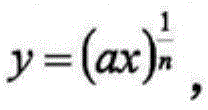
Preferably, the image enhancement mapping curve is represented as
Wherein n ranges from [1.00, 2.00],a=255n-1。
Preferably, the step of performing skin color processing on the display input data in the step c includes the steps of: and performing skin color processing on the display input data by adopting an image enhancement mapping curve with a lower enhancement coefficient.
Preferably, in the step a, the step of performing skin color detection on the display input data includes the following steps:
-determining H chroma component values in the HSV color model to which the display input data corresponds;
accordingly, if the H chroma component value is within a first threshold range, the display input data is determined to be a skin tone.
Preferably, the first threshold value ranges from 0 to 50.
According to another aspect of the present invention, there is provided a control apparatus for color enhancing a display image, comprising:
the device comprises a detection device, a processing device and a processing device, wherein the detection device is used for carrying out skin color detection on display input data and judging whether the display input data belongs to the skin color category or not;
a first processing means for performing enhancement processing adapted to skin color on the display input data to obtain corrected display data when the display input data belongs to skin color; and
second processing means for performing enhancement processing adapted to a non-skin tone on the display input data to obtain modified display data when the display input data does not belong to a skin tone.
Preferably, the first processing device includes: and the selecting device is used for selecting an image enhancement mapping curve and enhancing the display input data based on the image enhancement mapping curve.
The method comprises the steps of detecting the skin color of display input data, judging whether the display input data belong to the skin color category, and if the display input data belong to the skin color, performing enhancement processing adaptive to the skin color on the display input data to obtain corrected display data; and if the display input data do not belong to skin color, performing enhancement processing adaptive to non-skin color on the display input data to obtain corrected display data. The invention completes the enhancement of the color and improves the saturation of the color through the operation.
Detailed Description
Fig. 1 shows a flow chart of a control method for color enhancement of a display image according to an embodiment of the present invention, specifically comprising the steps of:
first, step S1 is executed to perform skin color detection on the display input data and determine whether the display input data belongs to the skin color category. The purpose of performing skin color detection on the display input data and judging whether the display input data belongs to the skin color category is that the skin color is very sensitive to the adjustment of the saturation degree through testing, and in the process of using the image enhancement, a person picture appears or is involved, so that the processed effect is too false, namely the skin color is excessively enhanced, and therefore, the user must determine whether the image contains a skin part. Furthermore, the display data is converted from a display image, and the display image may be an image shot by using an electronic device such as a mobile phone and a camera in our daily life, or an image scanned by using a computer, and the image may be in a format such as JPEG, BMP, or the like. Further, one skilled in the art understands that we can convert the display image into 2-ary display input data by electronic software.
Further, those skilled in the art understand that the display input data, i.e. the three RGB primaries of 2 system that we understand, are red, green and blue, respectively, and it is well known that these three primaries can constitute all colors in our nature, and other colors are only caused by the different composition ratios of these three primaries. And judging whether the display input data belongs to the skin color category or not by converting the color space in the RGB into an HSV space, then determining the H chroma component value in an HSV color model corresponding to the display input data, if the H chroma component value is within a first threshold range, determining that the display input data is skin color, and if not, determining that the display input data is not skin color. The HSV color model is a three-dimensional model formed by three parameters of hue (H), saturation (S) and brightness (V). Further, the H chromaticity component value means that the value of the H chromaticity component is measured by an angle, the value range is 0-360 degrees, the value is calculated from red in a counterclockwise direction, the red is 0 degree, the green is 120 degrees, and the blue is 240 degrees. Their complementary colors are: yellow is 60 °, cyan is 180 °, and magenta is 300 °. In a preferred embodiment, the first threshold is in a range of 0 to 50, and further, as those skilled in the art understand, the chromaticity within the first threshold is the skin color category, and further, it can be determined whether the display input data belongs to the skin color category. Further, those skilled in the art will appreciate that if the H chroma component value is within the first threshold range, the display input data is determined to be a skin tone, whereas if the H chroma component value is not within the first threshold range, the display input data is determined not to be a skin tone.
Further, referring to the subsequent embodiments, those skilled in the art understand that, in another variation, the range of the first threshold may be varied, for example, the first threshold may be determined to be 10 to 75, which belongs to a part of the variation of the technical solution of the present invention and does not affect the technical solution of the present invention, and details are not described herein.
Further, those skilled in the art understand that in another embodiment, the three primary colors of RGB can be directly used to calculate whether the display input data is a skin color, which is not described herein again.
Then, step S2 is executed, if the display input data belongs to skin color, the display input data is subjected to enhancement processing adapted to skin color to obtain modified display data. It is understood by those skilled in the art that the purpose of subjecting the display input data to enhancement processing adapted to skin tones to obtain modified display data is to enable the image to be processed without using transitional enhancement in respect of colors in the category of skin tones. After the colors in the skin color scope are enhanced, the whole image is very false, further, the actual effect of the invention cannot be achieved, and the adverse effect is achieved.
In particular, when the image relates to an image in the skin color category, the image should be micro-processed, and in a preferred variation, an image enhancement mapping curve may be selected, and the display input data may be enhanced based on the image enhancement mapping curve. Further, the display input data after the enhancement processing is restored to the RGB data, and finally the RGB data is converted into the picture which we see through the device. In the process of converting the picture data into RGB data and reducing the RGB data into the picture after processing, the picture is digitized, formulated and reduced into the picture through scientific calculation. The corrected display picture has smaller chroma enhancement than the original picture, but the enhancement effect is to make the corrected display picture look more vivid and vivid.
Finally, step S3 is executed, if the display input data does not belong to skin color, the display input data is subjected to enhancement processing adapted to non-skin color to obtain modified display data. Those skilled in the art will appreciate that the purpose of performing the enhancement processing adapted to the non-skin color on the display input data to obtain the modified display data is to enhance the picture, and that the modified picture is more vivid and clearer than the original picture. In the pictures shot in our daily life, because of the reasons of weather, environment, equipment and the like, the obtained images are not very clear and the picture feeling is not strong. Those skilled in the art will appreciate that the non-skin tone adapted enhancement process is the same as the skin tone adapted enhancement process in the described embodiment, except that the magnitude of the curve for the non-skin tone adapted enhancement process is greater than the magnitude of the curve for the skin tone adapted enhancement process, also because the chroma in the skin tone domain is more sensitive than the chroma in the non-skin tone domain and does not require much enhancement. In a variation, if a picture does not relate to a person or a skin of a person, but relates to chromaticity in the skin category, the chromaticity in the skin category is a lighter color than the chromaticity in the non-skin category when the picture is processed, the lighter color is enhanced, but rather the lighter color looks unnatural and adversely affects, so that the display input data is subjected to skin color processing using an image enhancement mapping curve with a lower enhancement factor. The processed picture still has the picture enhancement effect and is very natural.
Fig. 2 shows a flowchart of the enhancement processing of the display input data according to an embodiment of the present invention, the flowchart is a detailed explanation of the enhancement processing of the display input data, and the step is after the step S1 is completed. Specifically, the steps are as follows:
first, step S21 is executed to perform saturation statistics on the display input data. The purpose of performing saturation statistics on the display input data is to perform one division on the saturation, and in different divisions, for example, different image enhancement mapping curves are preferably used to perform different levels of enhancement on different parts of the picture, so as to further achieve the effect of overall picture enhancement. The skilled person will understand that the display is subdivided into a number of groups based on pixels, and each group is determined by identifying the saturation and then counted in order from the low saturation to the high saturation.
Further, specifically, 3 different image enhancement mapping curves may be classified, which are an enhancement mapping curve for an image with a high saturation level, an enhancement mapping curve for an image with a medium saturation level, and an enhancement mapping curve corresponding to an image with a low saturation level. The 3 different enhancement curves are respectively applied to high saturation, medium saturation and low saturation of 3 saturation degrees. The enhancement coefficient of the high saturation is lowest, and the amplitude is smallest; the middle saturated enhancement coefficient is in the middle, and the amplitude is in the middle; the enhancement coefficient of the low saturation is the highest, and the amplitude is the largest, which is also based on the practical situation that in the chromaticity of the low saturation, the definition and the naturalness are improved by adopting a high enhancement mode; in the highly saturated chromaticity, low enhancement should be used to ensure that the color is not too dark. Those skilled in the art understand how to use different curves for different saturation, which will be described in the detailed description, and will not be described herein.
Then, step S22 is executed to perform enhancement processing of different degrees on the display input data according to the saturation statistical result, so that the enhancement processing is adaptive. According to the aboveThe purpose of enhancing the display input data to different degrees according to the saturation statistical result is to enable each place of the picture to look natural and clear according to a reasonable and scientific curve enhancement mode of the display input data. The image enhancement mapping curve is expressed as
n is the enhancement factor in the range of 1.00, 2.00]Where a is a convergence factor, the mapping curve is converged by adjusting the magnitude of a, and if it is determined to converge to (255 ), a may be defined as 255
n-1Wherein n is in the range of [1.00, 2.00 ]],a=255
n-1. When the display input data is enhanced, a curve in a parabolic shape is needed for calculation, so that the image enhancement mapping curve is a parabola. The knowledge about the curve form in this step is the conventional theoretical knowledge, and is not described herein again.
The display input data should be enhanced by selecting different algorithms according to the saturation level, specifically, a most suitable image enhancement mapping curve should be selected from three different image enhancement mapping curves according to the saturation statistical result as a target image enhancement mapping curve, and the display input data should be enhanced based on the target image enhancement mapping curve. The person skilled in the art understands that the enhancement processing is adaptive, which means that the enhancement processing is performed on the display input data to different degrees, so that the picture can be more real and natural, and has a certain degree of saturation, and the situation that a certain part in the picture cannot be matched with the rest of the picture due to the enhancement processing does not occur. In a variant, the image enhancement is performed on a pair of landscape paintings, and if the display input data is not subjected to different degrees of enhancement processing, it appears that the mountains and the water are not in one painting, and are also greatly different from surrounding scenery, and in short, do not appear to have a sense of saturation in the usual sense.
Fig. 3 is a flowchart illustrating saturation statistics of the display input data according to an embodiment of the present invention, and further, is a detailed exploded description of the saturation statistics of step S21, which is after step S1 and before step S22, and specifically includes the following steps:
step S211 is entered first, the saturation space is quantized to [0, 255], and the saturation space is quantized to [0, 255] for dividing the saturation into a segment in which the saturation is arranged from low to high, so that the saturation can be divided into low saturation, medium saturation and high saturation in a specific manner.
Further, the color composition is composed of 3 colors of red, green and blue in different proportions, and we generally quantize the three primary colors to [0, 255], for example, pure white, we can see that the composition is composed of 255 red, 255 green and 255 blue. We can also quantify the saturation as 0, 255, the lower the saturation the darker the color, and conversely the higher the saturation the brighter the color.
Then, step S212 is performed to determine two reference amounts S0 and S1, where 0 < S0 < S1 < 255, and the purpose of determining the two reference amounts S0 and S1 is to distinguish high saturation, medium saturation, and low saturation.
Specifically, from the determined reference quantities, through a large number of scientific calculations and practices, we can determine that the reference quantities s0 and s1 satisfy the following conditions: (s1-s0)/s0 ≈ 4.7, (s1-s0)/(255-s1) ≈ 4.7, and in one embodiment, preferably, the range of s0 is 15-60, and the range of s1 is 180-220. These knowledge are the prior theoretical knowledge and are not described herein.
Finally, step S213 is executed, if the statistical histogram of the saturation of the display input data is mainly distributed in [0, S0], it is determined that the statistical result of the saturation is low saturation; if the statistical histogram of the saturation of the display input data is mainly distributed in [ s0, s1], determining that the statistical result of the saturation is middle saturation; and if the statistical histogram of the saturation of the display input data is mainly distributed in [ s1, 255], determining that the statistical result of the saturation is high saturation. The step is to determine whether the main distribution is in low saturation, medium saturation or high saturation in the saturation statistical histogram [0, 255], where the main distribution is a portion where the saturation proportion of the display input data is the largest in the divided saturation space. Further, it may be considered that an operation formula for determining which saturation should be selected for the display input data is calculated according to the statistical histogram of the saturation of the display input data and the division of the saturation range, and then the modified display data is obtained.
Those skilled in the art understand that, specifically, which part corresponds to low saturation, which part corresponds to medium saturation, and which part corresponds to high saturation, as described in this step, after determining the saturation space and the two references S0 and S1, we can divide the saturation space into 3 segments, and if the saturation counted in step S21 is within [0, S0], then it is determined that the saturation statistic result is low saturation; if the statistical histogram of the saturation of the display input data is mainly distributed in [ s0, s1], determining that the statistical result of the saturation is middle saturation; and if the statistical histogram of the saturation of the display input data is mainly distributed in [ s1, 255], determining that the statistical result of the saturation is high saturation. After determining which section the saturation counted in step S21 belongs to, performing effective enhancement according to the image enhancement mapping curve of the section, thereby achieving the purpose of enhancing the picture.
Fig. 4 shows another flowchart of the control method for color enhancement of a displayed image according to an embodiment of the present invention, and further, fig. 1 to fig. 3 specifically analyze the flow description of each step, while fig. 4 integrally reflects the flow, first, inputting an image, performing skin color detection, then performing judgment, if the image contains a skin color pixel part, performing enhancement according to a processing mode that skin color is consistent, and performing enhancement using different enhancement curves according to saturation statistics instead of the skin color part, mapping, and finally outputting the image.
Fig. 5 shows distribution diagrams of three image enhancement mapping curves required for three different saturation levels according to an embodiment of the present invention, where the distribution diagrams are taken as three values, 1.55, 1.30 and 1.0, respectively corresponding to low saturation, medium saturation and high saturation mapping curves, and more visually describe the three image enhancement mapping curves required for the different saturation levels. As shown in fig. 5, we can see the three image enhancement mapping curves: one is a curve which tends to be linear, the other is a curve with larger bending amplitude, the other is a curve between the 2 curves, further, the curve which tends to be linear corresponds to the mapping curve with high saturation, the curve with larger bending amplitude corresponds to the mapping curve with low saturation, the curve between the 2 curves corresponds to the mapping curve with medium saturation, in particular, in order to enhance the display picture, the high saturation part should be subjected to micro-enhancement, and the transition enhancement high saturation part can lead the picture to be over-saturated, so the curve which tends to be linear is adopted; the low saturation portion should use a curve with a large curvature because the display lacks saturation.
As shown in fig. 5, it is understood by those skilled in the art that the curve is Y ═ n × X, X is the display input data, and Y is the correction display data. In particular, said formula is obtained in correspondence with the present invention

In a preferred variation, the saturation statistical data may be an enhancement mapping curve with different coefficients according to different situations. For example, in the saturation space [0, 255]]In this case, we define s0 as 20 and s1 as 200, and when the statistical histogram of the saturation of the display input data is mainly distributed in [ s0, s1]]In the above, and the statistical histogram of the saturation of the display input data is mainly distributed between 20 and 30, we will use a middle saturation mapping curve, specifically, assuming that the saturation of a certain display input data is 25, the display input data with the saturation of 25 is 34 according to the modified display data value corresponding to the middle saturation mapping curve, further, if we stipulate that s0 is 30 and s1 is 200, the display input data in the variation should use a low saturation mapping curve, and accordinglyAnd the display input data with the saturation of 25 corresponds to a corrected display data value of 54 according to the low saturation mapping curve. This is part of the variation of the technical solution of the present invention, and does not affect the technical solution of the present invention, and is not described herein again.
Those skilled in the art understand that there are many criteria for measuring color, and the CIE1931 color system has strong representativeness, and defines all colors in nature, and is widely accepted. In actual physical devices (such as a camera, a printer, and a projector), the color space represented by the input image is a subset thereof, so that colors as rich as those in the natural world can be obtained by expanding the range of the subset. This function is well achieved by saturation enhancement of the image. The image saturation enhancement is to extract the saturation information in the RGB data, improve the integral saturation of the image through an enhancement algorithm and finally restore the image into the RGB data. The color of the processed image is greatly improved, but the skin color is very sensitive to the adjustment of the saturation degree in the application process, and if a person picture is involved in the image, the processed effect is too false, namely the skin color is excessively enhanced. Special processing is performed for the skin color part.
The technical scheme of the invention is as follows:
firstly, selecting a proper image enhancement mapping curve, and selecting four curves in total, wherein three curves respectively correspond to a high saturation image, a medium saturation image and a low saturation image, and the fourth curve is a special curve for skin color. The definition of the curve is
The value ranges of a and n are determined according to specific equipment characteristics.
The saturation of the image is then determined according to the description of the above embodiment. And then judging whether the color of the pixel to be processed belongs to the skin color according to the method described in the embodiment.
And finally, enhancing the flesh tone spots and the non-flesh tone spots by adopting different mapping curves.
The skin color adjusting algorithm relates to skin color detection, the skin color judgment is based on an H (chroma) component in an HSV color model, and when the H component of a pixel is in a specific range [ H0, H1], the skin color is judged.
The specific range is characterized by the clustering of skin colors, covers most of the skin colors, has the non-correlation with saturation and brightness, and does not need to consider other influencing factors in the judgment process.
After the skin color detection, saturation statistics needs to be performed on the non-skin color part of the image. And (3) quantizing the saturation space to [0, 255], taking two reference quantities s0 and s1, and judging the image saturation to be low saturation if the image saturation statistical histogram is mainly distributed in [0, s0 ]. Similarly, the saturation is medium at s0 and s1, and high at s1 and 255.
The characteristic function of the mapping curve is y ═ ax1/nWherein n is an enhancement factor in the range of [1.00, 2.00%]Where a is a convergence factor, the mapping curve is converged by adjusting the magnitude of a, and if it is to be converged to (255 ), a may be defined as 255n-1.
The method has the advantages that the mapping curve with a higher enhancement coefficient is adopted for non-skin color pixel points, a better color adjusting effect is achieved, and the mapping curve with a lower enhancement coefficient is adopted for skin color pixel points, so that the skin color can be slightly adjusted while the natural skin color is kept.
And converting the RGB color space into HSV space, and respectively extracting the chrominance, saturation and brightness components of the image. For example, the angles in the HSV model represent the chrominance, the height represents the luminance, and the radius represents the saturation.
For example, n takes three values of 1.55, 1.30 and 1.0, which correspond to the low saturation, medium saturation and high saturation mapping curves, respectively, and the distribution of the curves is shown in fig. 5.
And judging the saturation of the image. The image is determined in the manner described in the above embodiment, and fig. 6 shows a low saturation histogram, fig. 7 shows a medium saturation histogram, and fig. 8 shows a high saturation histogram.
And identifying skin color, for example, identifying the part of the chroma components between 5 and 40 as skin color.
The enhanced image effect, fig. 9 is the enhanced effect without skin color identification, and fig. 10 is the enhanced effect after skin color adjustment by the control method provided by the present invention. It can be found that the color of the image is improved more naturally after the skin color adjustment is adopted.
Further, as understood by those skilled in the art, according to another aspect of the present invention, there is provided a control apparatus for color enhancement of a display image, comprising:
the device comprises a detection device, a processing device and a processing device, wherein the detection device is used for carrying out skin color detection on display input data and judging whether the display input data belongs to the skin color category or not;
a first processing means for performing enhancement processing adapted to skin color on the display input data to obtain corrected display data when the display input data belongs to skin color; and
second processing means for performing enhancement processing adapted to a non-skin tone on the display input data to obtain modified display data when the display input data does not belong to a skin tone.
Preferably, the first processing device includes: and the selecting device is used for selecting an image enhancement mapping curve and enhancing the display input data based on the image enhancement mapping curve.
Further, those skilled in the art understand that the control device may be implemented in combination with the embodiments shown in fig. 1 to 10, and will not be described herein again.
The invention relates to a color enhancement part in an image enhancement algorithm. The algorithm structure comprises an image saturation evaluation algorithm, a mapping curve selection algorithm and a skin color adjustment algorithm. The saturation evaluation can effectively distinguish the saturation levels of the image, and enhancement processing with different degrees is performed according to different levels, so that the enhancement processing has self-adaptability; in the mapping curve selection algorithm, the quasi-parabola is used as the mapping relation, specific enhancement processing can be carried out on pixel points with different saturation degrees, and the enhancement effect of the whole image is improved; the skin color adjusting algorithm can effectively detect the pixel distribution with skin color characteristics and perform weak enhancement processing on the part of pixels, so that the excessive enhancement of skin color is avoided, and the image enhancement effect is more natural.
The foregoing description of specific embodiments of the present invention has been presented. It is to be understood that the present invention is not limited to the specific embodiments described above, and that various changes and modifications may be made by one skilled in the art within the scope of the appended claims without departing from the spirit of the invention.