CN103589650A - Production of carotenoids in oleaginous yeast and fungi - Google Patents
Production of carotenoids in oleaginous yeast and fungi Download PDFInfo
- Publication number
- CN103589650A CN103589650A CN201310334980.4A CN201310334980A CN103589650A CN 103589650 A CN103589650 A CN 103589650A CN 201310334980 A CN201310334980 A CN 201310334980A CN 103589650 A CN103589650 A CN 103589650A
- Authority
- CN
- China
- Prior art keywords
- carotenoid
- polypeptide
- fungi
- produce
- shi yeast
- Prior art date
- Legal status (The legal status is an assumption and is not a legal conclusion. Google has not performed a legal analysis and makes no representation as to the accuracy of the status listed.)
- Pending
Links
- 235000021466 carotenoid Nutrition 0.000 title claims abstract description 363
- 150000001747 carotenoids Chemical class 0.000 title claims abstract description 357
- 241000233866 Fungi Species 0.000 title claims abstract description 131
- 240000004808 Saccharomyces cerevisiae Species 0.000 title claims abstract description 100
- 238000004519 manufacturing process Methods 0.000 title description 20
- 108090000765 processed proteins & peptides Proteins 0.000 claims description 329
- 229920001184 polypeptide Polymers 0.000 claims description 325
- 102000004196 processed proteins & peptides Human genes 0.000 claims description 325
- 150000003505 terpenes Chemical class 0.000 claims description 73
- 108090000623 proteins and genes Proteins 0.000 claims description 66
- 150000002632 lipids Chemical class 0.000 claims description 60
- 230000001580 bacterial effect Effects 0.000 claims description 58
- 238000000034 method Methods 0.000 claims description 54
- 241000235015 Yarrowia lipolytica Species 0.000 claims description 51
- 235000013793 astaxanthin Nutrition 0.000 claims description 51
- JEBFVOLFMLUKLF-IFPLVEIFSA-N Astaxanthin Natural products CC(=C/C=C/C(=C/C=C/C1=C(C)C(=O)C(O)CC1(C)C)/C)C=CC=C(/C)C=CC=C(/C)C=CC2=C(C)C(=O)C(O)CC2(C)C JEBFVOLFMLUKLF-IFPLVEIFSA-N 0.000 claims description 50
- 239000001168 astaxanthin Substances 0.000 claims description 50
- MQZIGYBFDRPAKN-ZWAPEEGVSA-N astaxanthin Chemical compound C([C@H](O)C(=O)C=1C)C(C)(C)C=1/C=C/C(/C)=C/C=C/C(/C)=C/C=C/C=C(C)C=CC=C(C)C=CC1=C(C)C(=O)[C@@H](O)CC1(C)C MQZIGYBFDRPAKN-ZWAPEEGVSA-N 0.000 claims description 50
- 229940022405 astaxanthin Drugs 0.000 claims description 50
- 230000000694 effects Effects 0.000 claims description 43
- 102000004190 Enzymes Human genes 0.000 claims description 41
- 108090000790 Enzymes Proteins 0.000 claims description 41
- 230000014509 gene expression Effects 0.000 claims description 41
- 230000004048 modification Effects 0.000 claims description 40
- 238000012986 modification Methods 0.000 claims description 40
- 238000009825 accumulation Methods 0.000 claims description 36
- 230000003570 biosynthesizing effect Effects 0.000 claims description 34
- 230000001851 biosynthetic effect Effects 0.000 claims description 34
- OENHQHLEOONYIE-UKMVMLAPSA-N all-trans beta-carotene Natural products CC=1CCCC(C)(C)C=1/C=C/C(/C)=C/C=C/C(/C)=C/C=C/C=C(C)C=CC=C(C)C=CC1=C(C)CCCC1(C)C OENHQHLEOONYIE-UKMVMLAPSA-N 0.000 claims description 30
- 235000013734 beta-carotene Nutrition 0.000 claims description 30
- 239000011648 beta-carotene Substances 0.000 claims description 30
- TUPZEYHYWIEDIH-WAIFQNFQSA-N beta-carotene Natural products CC(=C/C=C/C=C(C)/C=C/C=C(C)/C=C/C1=C(C)CCCC1(C)C)C=CC=C(/C)C=CC2=CCCCC2(C)C TUPZEYHYWIEDIH-WAIFQNFQSA-N 0.000 claims description 30
- 229960002747 betacarotene Drugs 0.000 claims description 30
- OENHQHLEOONYIE-JLTXGRSLSA-N β-Carotene Chemical compound CC=1CCCC(C)(C)C=1\C=C\C(\C)=C\C=C\C(\C)=C\C=C\C=C(/C)\C=C\C=C(/C)\C=C\C1=C(C)CCCC1(C)C OENHQHLEOONYIE-JLTXGRSLSA-N 0.000 claims description 30
- 108010074633 Mixed Function Oxygenases Proteins 0.000 claims description 25
- -1 carotenoid ketones Chemical class 0.000 claims description 25
- 239000000203 mixture Substances 0.000 claims description 25
- 102000008109 Mixed Function Oxygenases Human genes 0.000 claims description 24
- FDSDTBUPSURDBL-LOFNIBRQSA-N canthaxanthin Chemical compound CC=1C(=O)CCC(C)(C)C=1/C=C/C(/C)=C/C=C/C(/C)=C/C=C/C=C(C)C=CC=C(C)C=CC1=C(C)C(=O)CCC1(C)C FDSDTBUPSURDBL-LOFNIBRQSA-N 0.000 claims description 22
- 108010022535 Farnesyl-Diphosphate Farnesyltransferase Proteins 0.000 claims description 19
- 102100037997 Squalene synthase Human genes 0.000 claims description 19
- JKQXZKUSFCKOGQ-LQFQNGICSA-N Z-zeaxanthin Natural products C([C@H](O)CC=1C)C(C)(C)C=1C=CC(C)=CC=CC(C)=CC=CC=C(C)C=CC=C(C)C=CC1=C(C)C[C@@H](O)CC1(C)C JKQXZKUSFCKOGQ-LQFQNGICSA-N 0.000 claims description 19
- QOPRSMDTRDMBNK-RNUUUQFGSA-N Zeaxanthin Natural products CC(=C/C=C/C=C(C)/C=C/C=C(C)/C=C/C1=C(C)CCC(O)C1(C)C)C=CC=C(/C)C=CC2=C(C)CC(O)CC2(C)C QOPRSMDTRDMBNK-RNUUUQFGSA-N 0.000 claims description 19
- JKQXZKUSFCKOGQ-LOFNIBRQSA-N all-trans-Zeaxanthin Natural products CC(=C/C=C/C=C(C)/C=C/C=C(C)/C=C/C1=C(C)CC(O)CC1(C)C)C=CC=C(/C)C=CC2=C(C)CC(O)CC2(C)C JKQXZKUSFCKOGQ-LOFNIBRQSA-N 0.000 claims description 19
- 235000013305 food Nutrition 0.000 claims description 19
- KBPHJBAIARWVSC-XQIHNALSSA-N trans-lutein Natural products CC(=C/C=C/C=C(C)/C=C/C=C(C)/C=C/C1=C(C)CC(O)CC1(C)C)C=CC=C(/C)C=CC2C(=CC(O)CC2(C)C)C KBPHJBAIARWVSC-XQIHNALSSA-N 0.000 claims description 19
- 235000010930 zeaxanthin Nutrition 0.000 claims description 19
- 239000001775 zeaxanthin Substances 0.000 claims description 19
- 229940043269 zeaxanthin Drugs 0.000 claims description 19
- JKQXZKUSFCKOGQ-JLGXGRJMSA-N (3R,3'R)-beta,beta-carotene-3,3'-diol Chemical compound C([C@H](O)CC=1C)C(C)(C)C=1/C=C/C(/C)=C/C=C/C(/C)=C/C=C/C=C(C)C=CC=C(C)C=CC1=C(C)C[C@@H](O)CC1(C)C JKQXZKUSFCKOGQ-JLGXGRJMSA-N 0.000 claims description 18
- 108090000895 Hydroxymethylglutaryl CoA Reductases Proteins 0.000 claims description 16
- 101710104378 Putative malate oxidoreductase [NAD] Proteins 0.000 claims description 14
- 102000004146 ATP citrate synthases Human genes 0.000 claims description 13
- 108090000662 ATP citrate synthases Proteins 0.000 claims description 13
- OOUTWVMJGMVRQF-DOYZGLONSA-N Phoenicoxanthin Natural products CC(=C/C=C/C=C(C)/C=C/C=C(C)/C=C/C1=C(C)C(=O)C(O)CC1(C)C)C=CC=C(/C)C=CC2=C(C)C(=O)CCC2(C)C OOUTWVMJGMVRQF-DOYZGLONSA-N 0.000 claims description 13
- 239000009871 tenuigenin Substances 0.000 claims description 12
- 102100039291 Geranylgeranyl pyrophosphate synthase Human genes 0.000 claims description 11
- 235000012682 canthaxanthin Nutrition 0.000 claims description 11
- 239000001659 canthaxanthin Substances 0.000 claims description 11
- 229940008033 canthaxanthin Drugs 0.000 claims description 11
- 102000006267 AMP Deaminase Human genes 0.000 claims description 10
- 108700016228 AMP deaminases Proteins 0.000 claims description 10
- CWHJIJJSDGEHNS-MYLFLSLOSA-N Senegenin Chemical compound C1[C@H](O)[C@H](O)[C@@](C)(C(O)=O)[C@@H]2CC[C@@]3(C)C(CC[C@]4(CCC(C[C@H]44)(C)C)C(O)=O)=C4[C@@H](CCl)C[C@@H]3[C@]21C CWHJIJJSDGEHNS-MYLFLSLOSA-N 0.000 claims description 10
- 108010016219 Acetyl-CoA carboxylase Proteins 0.000 claims description 9
- 102000000452 Acetyl-CoA carboxylase Human genes 0.000 claims description 9
- 108010018763 Biotin carboxylase Proteins 0.000 claims description 9
- 108010007508 Farnesyltranstransferase Proteins 0.000 claims description 8
- 108010053763 Pyruvate Carboxylase Proteins 0.000 claims description 8
- 102100039895 Pyruvate carboxylase, mitochondrial Human genes 0.000 claims description 8
- 239000000654 additive Substances 0.000 claims description 8
- 230000002269 spontaneous effect Effects 0.000 claims description 8
- 239000000463 material Substances 0.000 claims description 4
- 238000012258 culturing Methods 0.000 claims description 3
- 241000235013 Yarrowia Species 0.000 claims description 2
- 238000002955 isolation Methods 0.000 claims description 2
- 102000004286 Hydroxymethylglutaryl CoA Reductases Human genes 0.000 claims 2
- 239000003921 oil Substances 0.000 description 168
- 210000004027 cell Anatomy 0.000 description 137
- 235000014680 Saccharomyces cerevisiae Nutrition 0.000 description 53
- 239000012634 fragment Substances 0.000 description 49
- 238000005336 cracking Methods 0.000 description 47
- 239000000047 product Substances 0.000 description 38
- 239000013612 plasmid Substances 0.000 description 36
- 230000035508 accumulation Effects 0.000 description 34
- KRKNYBCHXYNGOX-UHFFFAOYSA-N citric acid Chemical compound OC(=O)CC(O)(C(O)=O)CC(O)=O KRKNYBCHXYNGOX-UHFFFAOYSA-N 0.000 description 31
- 241000223252 Rhodotorula Species 0.000 description 30
- 241000894006 Bacteria Species 0.000 description 25
- 230000008569 process Effects 0.000 description 22
- FJKROLUGYXJWQN-UHFFFAOYSA-N 4-hydroxybenzoic acid Chemical compound OC(=O)C1=CC=C(O)C=C1 FJKROLUGYXJWQN-UHFFFAOYSA-N 0.000 description 20
- UPYKUZBSLRQECL-UKMVMLAPSA-N Lycopene Natural products CC(=C/C=C/C=C(C)/C=C/C=C(C)/C=C/C1C(=C)CCCC1(C)C)C=CC=C(/C)C=CC2C(=C)CCCC2(C)C UPYKUZBSLRQECL-UKMVMLAPSA-N 0.000 description 20
- 150000001746 carotenes Chemical class 0.000 description 20
- 235000005473 carotenes Nutrition 0.000 description 20
- NCYCYZXNIZJOKI-UHFFFAOYSA-N vitamin A aldehyde Natural products O=CC=C(C)C=CC=C(C)C=CC1=C(C)CCCC1(C)C NCYCYZXNIZJOKI-UHFFFAOYSA-N 0.000 description 20
- 230000008859 change Effects 0.000 description 19
- 241000235395 Mucor Species 0.000 description 18
- 230000006696 biosynthetic metabolic pathway Effects 0.000 description 18
- 102000004169 proteins and genes Human genes 0.000 description 18
- 108020004414 DNA Proteins 0.000 description 17
- 241000223218 Fusarium Species 0.000 description 17
- 150000001875 compounds Chemical class 0.000 description 17
- 238000013461 design Methods 0.000 description 17
- 108060004506 lycopene beta-cyclase Proteins 0.000 description 17
- 108060004507 lycopene cyclase Proteins 0.000 description 17
- ZSLZBFCDCINBPY-ZSJPKINUSA-N acetyl-CoA Chemical compound O[C@@H]1[C@H](OP(O)(O)=O)[C@@H](COP(O)(=O)OP(O)(=O)OCC(C)(C)[C@@H](O)C(=O)NCCC(=O)NCCSC(=O)C)O[C@H]1N1C2=NC=NC(N)=C2N=C1 ZSLZBFCDCINBPY-ZSJPKINUSA-N 0.000 description 16
- 229910052799 carbon Inorganic materials 0.000 description 15
- YVLPJIGOMTXXLP-UHFFFAOYSA-N 15-cis-phytoene Chemical compound CC(C)=CCCC(C)=CCCC(C)=CCCC(C)=CC=CC=C(C)CCC=C(C)CCC=C(C)CCC=C(C)C YVLPJIGOMTXXLP-UHFFFAOYSA-N 0.000 description 14
- 241000221961 Neurospora crassa Species 0.000 description 14
- 108010001545 phytoene dehydrogenase Proteins 0.000 description 14
- OKTJSMMVPCPJKN-UHFFFAOYSA-N Carbon Chemical group [C] OKTJSMMVPCPJKN-UHFFFAOYSA-N 0.000 description 13
- KJTLQQUUPVSXIM-UHFFFAOYSA-N DL-mevalonic acid Natural products OCCC(O)(C)CC(O)=O KJTLQQUUPVSXIM-UHFFFAOYSA-N 0.000 description 13
- 101710173432 Phytoene synthase Proteins 0.000 description 13
- 238000006243 chemical reaction Methods 0.000 description 13
- KJTLQQUUPVSXIM-ZCFIWIBFSA-N (R)-mevalonic acid Chemical compound OCC[C@](O)(C)CC(O)=O KJTLQQUUPVSXIM-ZCFIWIBFSA-N 0.000 description 12
- XEKOWRVHYACXOJ-UHFFFAOYSA-N Ethyl acetate Chemical compound CCOC(C)=O XEKOWRVHYACXOJ-UHFFFAOYSA-N 0.000 description 12
- 241000081271 Phaffia rhodozyma Species 0.000 description 12
- 239000002253 acid Substances 0.000 description 12
- 239000002502 liposome Substances 0.000 description 12
- 230000003321 amplification Effects 0.000 description 11
- 235000015165 citric acid Nutrition 0.000 description 11
- 238000003199 nucleic acid amplification method Methods 0.000 description 11
- CBIDRCWHNCKSTO-UHFFFAOYSA-N prenyl diphosphate Chemical compound CC(C)=CCO[P@](O)(=O)OP(O)(O)=O CBIDRCWHNCKSTO-UHFFFAOYSA-N 0.000 description 11
- OINNEUNVOZHBOX-QIRCYJPOSA-K 2-trans,6-trans,10-trans-geranylgeranyl diphosphate(3-) Chemical compound CC(C)=CCC\C(C)=C\CC\C(C)=C\CC\C(C)=C\COP([O-])(=O)OP([O-])([O-])=O OINNEUNVOZHBOX-QIRCYJPOSA-K 0.000 description 10
- 229940090248 4-hydroxybenzoic acid Drugs 0.000 description 10
- 241000196324 Embryophyta Species 0.000 description 10
- OINNEUNVOZHBOX-XBQSVVNOSA-N Geranylgeranyl diphosphate Natural products [P@](=O)(OP(=O)(O)O)(OC/C=C(\CC/C=C(\CC/C=C(\CC/C=C(\C)/C)/C)/C)/C)O OINNEUNVOZHBOX-XBQSVVNOSA-N 0.000 description 10
- 230000012010 growth Effects 0.000 description 10
- 230000010354 integration Effects 0.000 description 10
- 238000012216 screening Methods 0.000 description 10
- UHPMCKVQTMMPCG-UHFFFAOYSA-N 5,8-dihydroxy-2-methoxy-6-methyl-7-(2-oxopropyl)naphthalene-1,4-dione Chemical compound CC1=C(CC(C)=O)C(O)=C2C(=O)C(OC)=CC(=O)C2=C1O UHPMCKVQTMMPCG-UHFFFAOYSA-N 0.000 description 9
- 102100036869 Diacylglycerol O-acyltransferase 1 Human genes 0.000 description 9
- 108050004099 Diacylglycerol O-acyltransferase 1 Proteins 0.000 description 9
- 241000235400 Phycomyces Species 0.000 description 9
- 238000012239 gene modification Methods 0.000 description 9
- 230000005017 genetic modification Effects 0.000 description 9
- 235000013617 genetically modified food Nutrition 0.000 description 9
- 230000001965 increasing effect Effects 0.000 description 9
- VLKZOEOYAKHREP-UHFFFAOYSA-N n-Hexane Chemical compound CCCCCC VLKZOEOYAKHREP-UHFFFAOYSA-N 0.000 description 9
- 238000000926 separation method Methods 0.000 description 9
- 239000000126 substance Substances 0.000 description 9
- 241000228212 Aspergillus Species 0.000 description 8
- RRHGJUQNOFWUDK-UHFFFAOYSA-N Isoprene Chemical compound CC(=C)C=C RRHGJUQNOFWUDK-UHFFFAOYSA-N 0.000 description 8
- 241000221960 Neurospora Species 0.000 description 8
- 241000235070 Saccharomyces Species 0.000 description 8
- 229930182558 Sterol Natural products 0.000 description 8
- 102000004357 Transferases Human genes 0.000 description 8
- 108090000992 Transferases Proteins 0.000 description 8
- 239000003814 drug Substances 0.000 description 8
- 239000004744 fabric Substances 0.000 description 8
- 239000003925 fat Substances 0.000 description 8
- 235000019197 fats Nutrition 0.000 description 8
- 229920001195 polyisoprene Polymers 0.000 description 8
- 235000003702 sterols Nutrition 0.000 description 8
- GVJHHUAWPYXKBD-UHFFFAOYSA-N (±)-α-Tocopherol Chemical compound OC1=C(C)C(C)=C2OC(CCCC(C)CCCC(C)CCCC(C)C)(C)CCC2=C1C GVJHHUAWPYXKBD-UHFFFAOYSA-N 0.000 description 7
- YVLPJIGOMTXXLP-UUKUAVTLSA-N 15,15'-cis-Phytoene Natural products C(=C\C=C/C=C(\CC/C=C(\CC/C=C(\CC/C=C(\C)/C)/C)/C)/C)(\CC/C=C(\CC/C=C(\CC/C=C(\C)/C)/C)/C)/C YVLPJIGOMTXXLP-UUKUAVTLSA-N 0.000 description 7
- YVLPJIGOMTXXLP-BAHRDPFUSA-N 15Z-phytoene Natural products CC(=CCCC(=CCCC(=CCCC(=CC=C/C=C(C)/CCC=C(/C)CCC=C(/C)CCC=C(C)C)C)C)C)C YVLPJIGOMTXXLP-BAHRDPFUSA-N 0.000 description 7
- 241000195493 Cryptophyta Species 0.000 description 7
- ROHFNLRQFUQHCH-YFKPBYRVSA-N L-leucine Chemical compound CC(C)C[C@H](N)C(O)=O ROHFNLRQFUQHCH-YFKPBYRVSA-N 0.000 description 7
- 241001465754 Metazoa Species 0.000 description 7
- 241000907999 Mortierella alpina Species 0.000 description 7
- 241000235648 Pichia Species 0.000 description 7
- 230000033228 biological regulation Effects 0.000 description 7
- 239000007795 chemical reaction product Substances 0.000 description 7
- 239000003795 chemical substances by application Substances 0.000 description 7
- 230000029087 digestion Effects 0.000 description 7
- 238000005886 esterification reaction Methods 0.000 description 7
- 150000002148 esters Chemical class 0.000 description 7
- 230000006372 lipid accumulation Effects 0.000 description 7
- 235000011765 phytoene Nutrition 0.000 description 7
- 238000012545 processing Methods 0.000 description 7
- 230000001105 regulatory effect Effects 0.000 description 7
- 239000011734 sodium Substances 0.000 description 7
- 239000002904 solvent Substances 0.000 description 7
- 101710165761 (2E,6E)-farnesyl diphosphate synthase Proteins 0.000 description 6
- ATCICVFRSJQYDV-UHFFFAOYSA-N (6E,8E,10E,12E,14E,16E,18E,20E,22E,26E)-2,6,10,14,19,23,27,31-octamethyldotriaconta-2,6,8,10,12,14,16,18,20,22,26,30-dodecaene Chemical compound CC(C)=CCCC(C)=CCCC(C)=CC=CC(C)=CC=CC=C(C)C=CC=C(C)C=CC=C(C)CCC=C(C)C ATCICVFRSJQYDV-UHFFFAOYSA-N 0.000 description 6
- 102100028704 Acetyl-CoA acetyltransferase, cytosolic Human genes 0.000 description 6
- 241000228245 Aspergillus niger Species 0.000 description 6
- IJGRMHOSHXDMSA-UHFFFAOYSA-N Atomic nitrogen Chemical compound N#N IJGRMHOSHXDMSA-UHFFFAOYSA-N 0.000 description 6
- 241001157813 Cercospora Species 0.000 description 6
- 241001527609 Cryptococcus Species 0.000 description 6
- 101710156207 Farnesyl diphosphate synthase Proteins 0.000 description 6
- 102100035111 Farnesyl pyrophosphate synthase Human genes 0.000 description 6
- 101710125754 Farnesyl pyrophosphate synthase Proteins 0.000 description 6
- 101710089428 Farnesyl pyrophosphate synthase erg20 Proteins 0.000 description 6
- 101150021904 HMGB1 gene Proteins 0.000 description 6
- 101000837584 Homo sapiens Acetyl-CoA acetyltransferase, cytosolic Proteins 0.000 description 6
- 101000598552 Homo sapiens Acetyl-CoA acetyltransferase, mitochondrial Proteins 0.000 description 6
- 102000002284 Hydroxymethylglutaryl-CoA Synthase Human genes 0.000 description 6
- 108010000775 Hydroxymethylglutaryl-CoA synthase Proteins 0.000 description 6
- 241001138401 Kluyveromyces lactis Species 0.000 description 6
- OKKJLVBELUTLKV-UHFFFAOYSA-N Methanol Chemical compound OC OKKJLVBELUTLKV-UHFFFAOYSA-N 0.000 description 6
- 241000235575 Mortierella Species 0.000 description 6
- 101710150389 Probable farnesyl diphosphate synthase Proteins 0.000 description 6
- 241000221300 Puccinia Species 0.000 description 6
- 241000223253 Rhodotorula glutinis Species 0.000 description 6
- 241001558929 Sclerotium <basidiomycota> Species 0.000 description 6
- 241000223259 Trichoderma Species 0.000 description 6
- 241000223230 Trichosporon Species 0.000 description 6
- 101150050575 URA3 gene Proteins 0.000 description 6
- 101100215634 Yarrowia lipolytica (strain CLIB 122 / E 150) XPR2 gene Proteins 0.000 description 6
- XJLXINKUBYWONI-DQQFMEOOSA-N [[(2r,3r,4r,5r)-5-(6-aminopurin-9-yl)-3-hydroxy-4-phosphonooxyoxolan-2-yl]methoxy-hydroxyphosphoryl] [(2s,3r,4s,5s)-5-(3-carbamoylpyridin-1-ium-1-yl)-3,4-dihydroxyoxolan-2-yl]methyl phosphate Chemical compound NC(=O)C1=CC=C[N+]([C@@H]2[C@H]([C@@H](O)[C@H](COP([O-])(=O)OP(O)(=O)OC[C@@H]3[C@H]([C@@H](OP(O)(O)=O)[C@@H](O3)N3C4=NC=NC(N)=C4N=C3)O)O2)O)=C1 XJLXINKUBYWONI-DQQFMEOOSA-N 0.000 description 6
- 238000013459 approach Methods 0.000 description 6
- 238000006356 dehydrogenation reaction Methods 0.000 description 6
- 235000014113 dietary fatty acids Nutrition 0.000 description 6
- 108010030074 endodeoxyribonuclease MluI Proteins 0.000 description 6
- 230000032050 esterification Effects 0.000 description 6
- 229930195729 fatty acid Natural products 0.000 description 6
- 239000000194 fatty acid Substances 0.000 description 6
- 108020004999 messenger RNA Proteins 0.000 description 6
- 235000015097 nutrients Nutrition 0.000 description 6
- 230000035479 physiological effects, processes and functions Effects 0.000 description 6
- 239000002243 precursor Substances 0.000 description 6
- 229910052708 sodium Inorganic materials 0.000 description 6
- 235000014101 wine Nutrition 0.000 description 6
- NLZUEZXRPGMBCV-UHFFFAOYSA-N Butylhydroxytoluene Chemical compound CC1=CC(C(C)(C)C)=C(O)C(C(C)(C)C)=C1 NLZUEZXRPGMBCV-UHFFFAOYSA-N 0.000 description 5
- 241001478240 Coccus Species 0.000 description 5
- ACTIUHUUMQJHFO-UHFFFAOYSA-N Coenzym Q10 Natural products COC1=C(OC)C(=O)C(CC=C(C)CCC=C(C)CCC=C(C)CCC=C(C)CCC=C(C)CCC=C(C)CCC=C(C)CCC=C(C)CCC=C(C)CCC=C(C)C)=C(C)C1=O ACTIUHUUMQJHFO-UHFFFAOYSA-N 0.000 description 5
- 241000192700 Cyanobacteria Species 0.000 description 5
- 241000235649 Kluyveromyces Species 0.000 description 5
- 241000124008 Mammalia Species 0.000 description 5
- 238000012408 PCR amplification Methods 0.000 description 5
- 241000228143 Penicillium Species 0.000 description 5
- 241000233639 Pythium Species 0.000 description 5
- 241001489223 Saccharomycodes Species 0.000 description 5
- 125000002015 acyclic group Chemical group 0.000 description 5
- 235000017471 coenzyme Q10 Nutrition 0.000 description 5
- ACTIUHUUMQJHFO-UPTCCGCDSA-N coenzyme Q10 Chemical compound COC1=C(OC)C(=O)C(C\C=C(/C)CC\C=C(/C)CC\C=C(/C)CC\C=C(/C)CC\C=C(/C)CC\C=C(/C)CC\C=C(/C)CC\C=C(/C)CC\C=C(/C)CCC=C(C)C)=C(C)C1=O ACTIUHUUMQJHFO-UPTCCGCDSA-N 0.000 description 5
- 230000001276 controlling effect Effects 0.000 description 5
- 235000006932 echinenone Nutrition 0.000 description 5
- 238000005516 engineering process Methods 0.000 description 5
- 238000000605 extraction Methods 0.000 description 5
- 239000011663 gamma-carotene Substances 0.000 description 5
- 229930182478 glucoside Natural products 0.000 description 5
- 230000006698 induction Effects 0.000 description 5
- 229930027945 nicotinamide-adenine dinucleotide Natural products 0.000 description 5
- 108020004707 nucleic acids Proteins 0.000 description 5
- 102000039446 nucleic acids Human genes 0.000 description 5
- 150000007523 nucleic acids Chemical class 0.000 description 5
- 230000003647 oxidation Effects 0.000 description 5
- 238000007254 oxidation reaction Methods 0.000 description 5
- 229910052760 oxygen Inorganic materials 0.000 description 5
- 230000026731 phosphorylation Effects 0.000 description 5
- 238000006366 phosphorylation reaction Methods 0.000 description 5
- 150000003432 sterols Chemical class 0.000 description 5
- 239000006228 supernatant Substances 0.000 description 5
- 238000012360 testing method Methods 0.000 description 5
- 229940088594 vitamin Drugs 0.000 description 5
- 229930003231 vitamin Natural products 0.000 description 5
- 235000013343 vitamin Nutrition 0.000 description 5
- 239000011782 vitamin Substances 0.000 description 5
- 150000003722 vitamin derivatives Chemical class 0.000 description 5
- OILXMJHPFNGGTO-UHFFFAOYSA-N (22E)-(24xi)-24-methylcholesta-5,22-dien-3beta-ol Natural products C1C=C2CC(O)CCC2(C)C2C1C1CCC(C(C)C=CC(C)C(C)C)C1(C)CC2 OILXMJHPFNGGTO-UHFFFAOYSA-N 0.000 description 4
- RQOCXCFLRBRBCS-UHFFFAOYSA-N (22E)-cholesta-5,7,22-trien-3beta-ol Natural products C1C(O)CCC2(C)C(CCC3(C(C(C)C=CCC(C)C)CCC33)C)C3=CC=C21 RQOCXCFLRBRBCS-UHFFFAOYSA-N 0.000 description 4
- KKAJSJJFBSOMGS-UHFFFAOYSA-N 3,6-diamino-10-methylacridinium chloride Chemical compound [Cl-].C1=C(N)C=C2[N+](C)=C(C=C(N)C=C3)C3=CC2=C1 KKAJSJJFBSOMGS-UHFFFAOYSA-N 0.000 description 4
- OQMZNAMGEHIHNN-UHFFFAOYSA-N 7-Dehydrostigmasterol Natural products C1C(O)CCC2(C)C(CCC3(C(C(C)C=CC(CC)C(C)C)CCC33)C)C3=CC=C21 OQMZNAMGEHIHNN-UHFFFAOYSA-N 0.000 description 4
- QTBSBXVTEAMEQO-UHFFFAOYSA-N Acetic acid Chemical compound CC(O)=O QTBSBXVTEAMEQO-UHFFFAOYSA-N 0.000 description 4
- 108090000489 Carboxy-Lyases Proteins 0.000 description 4
- 108091026890 Coding region Proteins 0.000 description 4
- 241000235646 Cyberlindnera jadinii Species 0.000 description 4
- DNVPQKQSNYMLRS-NXVQYWJNSA-N Ergosterol Natural products CC(C)[C@@H](C)C=C[C@H](C)[C@H]1CC[C@H]2C3=CC=C4C[C@@H](O)CC[C@]4(C)[C@@H]3CC[C@]12C DNVPQKQSNYMLRS-NXVQYWJNSA-N 0.000 description 4
- 108700007698 Genetic Terminator Regions Proteins 0.000 description 4
- 101150091750 HMG1 gene Proteins 0.000 description 4
- 101100246753 Halobacterium salinarum (strain ATCC 700922 / JCM 11081 / NRC-1) pyrF gene Proteins 0.000 description 4
- 241000238631 Hexapoda Species 0.000 description 4
- 108010065958 Isopentenyl-diphosphate Delta-isomerase Proteins 0.000 description 4
- 102100027665 Isopentenyl-diphosphate Delta-isomerase 1 Human genes 0.000 description 4
- ROHFNLRQFUQHCH-UHFFFAOYSA-N Leucine Natural products CC(C)CC(N)C(O)=O ROHFNLRQFUQHCH-UHFFFAOYSA-N 0.000 description 4
- 108091034117 Oligonucleotide Proteins 0.000 description 4
- 108091000080 Phosphotransferase Proteins 0.000 description 4
- 102000001253 Protein Kinase Human genes 0.000 description 4
- 241000221523 Rhodotorula toruloides Species 0.000 description 4
- 241000222057 Xanthophyllomyces dendrorhous Species 0.000 description 4
- 229940024606 amino acid Drugs 0.000 description 4
- 150000001413 amino acids Chemical class 0.000 description 4
- 238000004458 analytical method Methods 0.000 description 4
- QVGXLLKOCUKJST-UHFFFAOYSA-N atomic oxygen Chemical compound [O] QVGXLLKOCUKJST-UHFFFAOYSA-N 0.000 description 4
- 230000008901 benefit Effects 0.000 description 4
- 230000015572 biosynthetic process Effects 0.000 description 4
- 238000006555 catalytic reaction Methods 0.000 description 4
- 230000001419 dependent effect Effects 0.000 description 4
- 230000002708 enhancing effect Effects 0.000 description 4
- 101150116391 erg9 gene Proteins 0.000 description 4
- DNVPQKQSNYMLRS-SOWFXMKYSA-N ergosterol Chemical compound C1[C@@H](O)CC[C@]2(C)[C@H](CC[C@]3([C@H]([C@H](C)/C=C/[C@@H](C)C(C)C)CC[C@H]33)C)C3=CC=C21 DNVPQKQSNYMLRS-SOWFXMKYSA-N 0.000 description 4
- 238000004108 freeze drying Methods 0.000 description 4
- 230000002538 fungal effect Effects 0.000 description 4
- 235000000633 gamma-carotene Nutrition 0.000 description 4
- HRQKOYFGHJYEFS-RZWPOVEWSA-N gamma-carotene Natural products C(=C\C=C\C(=C/C=C/C=C(\C=C\C=C(/C=C/C=1C(C)(C)CCCC=1C)\C)/C)\C)(\C=C\C=C(/CC/C=C(\C)/C)\C)/C HRQKOYFGHJYEFS-RZWPOVEWSA-N 0.000 description 4
- 239000003112 inhibitor Substances 0.000 description 4
- 239000012528 membrane Substances 0.000 description 4
- 125000002496 methyl group Chemical group [H]C([H])([H])* 0.000 description 4
- VOFUROIFQGPCGE-UHFFFAOYSA-N nile red Chemical compound C1=CC=C2C3=NC4=CC=C(N(CC)CC)C=C4OC3=CC(=O)C2=C1 VOFUROIFQGPCGE-UHFFFAOYSA-N 0.000 description 4
- 239000001301 oxygen Substances 0.000 description 4
- 102000020233 phosphotransferase Human genes 0.000 description 4
- 239000000049 pigment Substances 0.000 description 4
- 108060006633 protein kinase Proteins 0.000 description 4
- NPCOQXAVBJJZBQ-UHFFFAOYSA-N reduced coenzyme Q9 Natural products COC1=C(O)C(C)=C(CC=C(C)CCC=C(C)CCC=C(C)CCC=C(C)CCC=C(C)CCC=C(C)CCC=C(C)CCC=C(C)CCC=C(C)C)C(O)=C1OC NPCOQXAVBJJZBQ-UHFFFAOYSA-N 0.000 description 4
- 239000000523 sample Substances 0.000 description 4
- 150000003431 steroids Chemical class 0.000 description 4
- DCXXMTOCNZCJGO-UHFFFAOYSA-N tristearoylglycerol Chemical compound CCCCCCCCCCCCCCCCCC(=O)OCC(OC(=O)CCCCCCCCCCCCCCCCC)COC(=O)CCCCCCCCCCCCCCCCC DCXXMTOCNZCJGO-UHFFFAOYSA-N 0.000 description 4
- 229940035936 ubiquinone Drugs 0.000 description 4
- QRBLKGHRWFGINE-UGWAGOLRSA-N 2-[2-[2-[[2-[[4-[[2-[[6-amino-2-[3-amino-1-[(2,3-diamino-3-oxopropyl)amino]-3-oxopropyl]-5-methylpyrimidine-4-carbonyl]amino]-3-[(2r,3s,4s,5s,6s)-3-[(2s,3r,4r,5s)-4-carbamoyl-3,4,5-trihydroxy-6-(hydroxymethyl)oxan-2-yl]oxy-4,5-dihydroxy-6-(hydroxymethyl)- Chemical compound N=1C(C=2SC=C(N=2)C(N)=O)CSC=1CCNC(=O)C(C(C)=O)NC(=O)C(C)C(O)C(C)NC(=O)C(C(O[C@H]1[C@@]([C@@H](O)[C@H](O)[C@H](CO)O1)(C)O[C@H]1[C@@H]([C@](O)([C@@H](O)C(CO)O1)C(N)=O)O)C=1NC=NC=1)NC(=O)C1=NC(C(CC(N)=O)NCC(N)C(N)=O)=NC(N)=C1C QRBLKGHRWFGINE-UGWAGOLRSA-N 0.000 description 3
- 101710158485 3-hydroxy-3-methylglutaryl-coenzyme A reductase Proteins 0.000 description 3
- QXNWZXMBUKUYMD-ITUXNECMSA-N 4-keto-beta-carotene Chemical compound CC=1C(=O)CCC(C)(C)C=1/C=C/C(/C)=C/C=C/C(/C)=C/C=C/C=C(C)C=CC=C(C)C=CC1=C(C)CCCC1(C)C QXNWZXMBUKUYMD-ITUXNECMSA-N 0.000 description 3
- WEVYAHXRMPXWCK-UHFFFAOYSA-N Acetonitrile Chemical compound CC#N WEVYAHXRMPXWCK-UHFFFAOYSA-N 0.000 description 3
- 241000251468 Actinopterygii Species 0.000 description 3
- HRQKOYFGHJYEFS-UHFFFAOYSA-N Beta psi-carotene Chemical compound CC(C)=CCCC(C)=CC=CC(C)=CC=CC(C)=CC=CC=C(C)C=CC=C(C)C=CC1=C(C)CCCC1(C)C HRQKOYFGHJYEFS-UHFFFAOYSA-N 0.000 description 3
- 101150028535 CRTZ gene Proteins 0.000 description 3
- 101100083507 Caenorhabditis elegans acl-2 gene Proteins 0.000 description 3
- 241000345998 Calamus manan Species 0.000 description 3
- 201000007336 Cryptococcosis Diseases 0.000 description 3
- 241000221204 Cryptococcus neoformans Species 0.000 description 3
- 101710095468 Cyclase Proteins 0.000 description 3
- 102000004594 DNA Polymerase I Human genes 0.000 description 3
- 108010017826 DNA Polymerase I Proteins 0.000 description 3
- 102000016928 DNA-directed DNA polymerase Human genes 0.000 description 3
- 108010014303 DNA-directed DNA polymerase Proteins 0.000 description 3
- LFQSCWFLJHTTHZ-UHFFFAOYSA-N Ethanol Chemical compound CCO LFQSCWFLJHTTHZ-UHFFFAOYSA-N 0.000 description 3
- 108010066605 Geranylgeranyl-Diphosphate Geranylgeranyltransferase Proteins 0.000 description 3
- WQZGKKKJIJFFOK-GASJEMHNSA-N Glucose Natural products OC[C@H]1OC(O)[C@H](O)[C@@H](O)[C@@H]1O WQZGKKKJIJFFOK-GASJEMHNSA-N 0.000 description 3
- 206010028980 Neoplasm Diseases 0.000 description 3
- ATCICVFRSJQYDV-DDRHJXQASA-N Neurosporene Natural products C(=C\C=C\C(=C/C=C/C=C(\C=C\C=C(/CC/C=C(\CC/C=C(\C)/C)/C)\C)/C)\C)(\C=C\C=C(/CC/C=C(\C)/C)\C)/C ATCICVFRSJQYDV-DDRHJXQASA-N 0.000 description 3
- 101100168661 Paracoccus sp. (strain N81106 / MBIC 01143) crtW gene Proteins 0.000 description 3
- LTQCLFMNABRKSH-UHFFFAOYSA-N Phleomycin Natural products N=1C(C=2SC=C(N=2)C(N)=O)CSC=1CCNC(=O)C(C(O)C)NC(=O)C(C)C(O)C(C)NC(=O)C(C(OC1C(C(O)C(O)C(CO)O1)OC1C(C(OC(N)=O)C(O)C(CO)O1)O)C=1NC=NC=1)NC(=O)C1=NC(C(CC(N)=O)NCC(N)C(N)=O)=NC(N)=C1C LTQCLFMNABRKSH-UHFFFAOYSA-N 0.000 description 3
- 108010035235 Phleomycins Proteins 0.000 description 3
- 241000921313 Phyllopodium Species 0.000 description 3
- 101100010928 Saccharolobus solfataricus (strain ATCC 35092 / DSM 1617 / JCM 11322 / P2) tuf gene Proteins 0.000 description 3
- 241000235347 Schizosaccharomyces pombe Species 0.000 description 3
- 101150001810 TEAD1 gene Proteins 0.000 description 3
- 101150074253 TEF1 gene Proteins 0.000 description 3
- 102100029898 Transcriptional enhancer factor TEF-1 Human genes 0.000 description 3
- 244000301083 Ustilago maydis Species 0.000 description 3
- 235000015919 Ustilago maydis Nutrition 0.000 description 3
- 229930003427 Vitamin E Natural products 0.000 description 3
- 101150023061 acpP gene Proteins 0.000 description 3
- NBZANZVJRKXVBH-ITUXNECMSA-N all-trans-alpha-cryptoxanthin Natural products CC(=C/C=C/C=C(C)/C=C/C=C(C)/C=C/C1=C(C)CC(O)CC1(C)C)C=CC=C(/C)C=CC2C(=CCCC2(C)C)C NBZANZVJRKXVBH-ITUXNECMSA-N 0.000 description 3
- 230000003078 antioxidant effect Effects 0.000 description 3
- 239000002775 capsule Substances 0.000 description 3
- 239000003054 catalyst Substances 0.000 description 3
- 238000001514 detection method Methods 0.000 description 3
- 201000010099 disease Diseases 0.000 description 3
- 208000037265 diseases, disorders, signs and symptoms Diseases 0.000 description 3
- 150000004665 fatty acids Chemical class 0.000 description 3
- 235000019688 fish Nutrition 0.000 description 3
- 230000006870 function Effects 0.000 description 3
- WIGCFUFOHFEKBI-UHFFFAOYSA-N gamma-tocopherol Natural products CC(C)CCCC(C)CCCC(C)CCCC1CCC2C(C)C(O)C(C)C(C)C2O1 WIGCFUFOHFEKBI-UHFFFAOYSA-N 0.000 description 3
- 239000008103 glucose Substances 0.000 description 3
- 150000008131 glucosides Chemical class 0.000 description 3
- 238000004128 high performance liquid chromatography Methods 0.000 description 3
- HNDVDQJCIGZPNO-UHFFFAOYSA-N histidine Natural products OC(=O)C(N)CC1=CN=CN1 HNDVDQJCIGZPNO-UHFFFAOYSA-N 0.000 description 3
- 230000002779 inactivation Effects 0.000 description 3
- 230000001939 inductive effect Effects 0.000 description 3
- 239000007788 liquid Substances 0.000 description 3
- 235000008665 neurosporene Nutrition 0.000 description 3
- 229910052757 nitrogen Inorganic materials 0.000 description 3
- 235000008935 nutritious Nutrition 0.000 description 3
- 238000002360 preparation method Methods 0.000 description 3
- 235000012950 rattan cane Nutrition 0.000 description 3
- 239000000243 solution Substances 0.000 description 3
- 241000894007 species Species 0.000 description 3
- 238000001228 spectrum Methods 0.000 description 3
- 239000000758 substrate Substances 0.000 description 3
- 150000003628 tricarboxylic acids Chemical class 0.000 description 3
- 238000011144 upstream manufacturing Methods 0.000 description 3
- 235000019165 vitamin E Nutrition 0.000 description 3
- 239000011709 vitamin E Substances 0.000 description 3
- 229940046009 vitamin E Drugs 0.000 description 3
- DMASLKHVQRHNES-UPOGUZCLSA-N (3R)-beta,beta-caroten-3-ol Chemical compound C([C@H](O)CC=1C)C(C)(C)C=1/C=C/C(/C)=C/C=C/C(/C)=C/C=C/C=C(C)C=CC=C(C)C=CC1=C(C)CCCC1(C)C DMASLKHVQRHNES-UPOGUZCLSA-N 0.000 description 2
- CABVTRNMFUVUDM-VRHQGPGLSA-N (3S)-3-hydroxy-3-methylglutaryl-CoA Chemical compound O[C@@H]1[C@H](OP(O)(O)=O)[C@@H](COP(O)(=O)OP(O)(=O)OCC(C)(C)[C@@H](O)C(=O)NCCC(=O)NCCSC(=O)C[C@@](O)(CC(O)=O)C)O[C@H]1N1C2=NC=NC(N)=C2N=C1 CABVTRNMFUVUDM-VRHQGPGLSA-N 0.000 description 2
- AJPADPZSRRUGHI-RFZPGFLSSA-N 1-deoxy-D-xylulose 5-phosphate Chemical compound CC(=O)[C@@H](O)[C@H](O)COP(O)(O)=O AJPADPZSRRUGHI-RFZPGFLSSA-N 0.000 description 2
- FPIPGXGPPPQFEQ-UHFFFAOYSA-N 13-cis retinol Natural products OCC=C(C)C=CC=C(C)C=CC1=C(C)CCCC1(C)C FPIPGXGPPPQFEQ-UHFFFAOYSA-N 0.000 description 2
- VHVPQPYKVGDNFY-DFMJLFEVSA-N 2-[(2r)-butan-2-yl]-4-[4-[4-[4-[[(2r,4s)-2-(2,4-dichlorophenyl)-2-(1,2,4-triazol-1-ylmethyl)-1,3-dioxolan-4-yl]methoxy]phenyl]piperazin-1-yl]phenyl]-1,2,4-triazol-3-one Chemical compound O=C1N([C@H](C)CC)N=CN1C1=CC=C(N2CCN(CC2)C=2C=CC(OC[C@@H]3O[C@](CN4N=CN=C4)(OC3)C=3C(=CC(Cl)=CC=3)Cl)=CC=2)C=C1 VHVPQPYKVGDNFY-DFMJLFEVSA-N 0.000 description 2
- 108010092861 2-acylglycerol O-acyltransferase Proteins 0.000 description 2
- 102100029077 3-hydroxy-3-methylglutaryl-coenzyme A reductase Human genes 0.000 description 2
- 101100178203 Arabidopsis thaliana HMGB3 gene Proteins 0.000 description 2
- 241001530056 Athelia rolfsii Species 0.000 description 2
- 241000972773 Aulopiformes Species 0.000 description 2
- 239000002028 Biomass Substances 0.000 description 2
- 241000123650 Botrytis cinerea Species 0.000 description 2
- 102000004031 Carboxy-Lyases Human genes 0.000 description 2
- HEDRZPFGACZZDS-UHFFFAOYSA-N Chloroform Chemical compound ClC(Cl)Cl HEDRZPFGACZZDS-UHFFFAOYSA-N 0.000 description 2
- 241000238424 Crustacea Species 0.000 description 2
- 241001290628 Cunninghamella echinulata Species 0.000 description 2
- 241000223233 Cutaneotrichosporon cutaneum Species 0.000 description 2
- YMWUJEATGCHHMB-UHFFFAOYSA-N Dichloromethane Chemical compound ClCCl YMWUJEATGCHHMB-UHFFFAOYSA-N 0.000 description 2
- 239000004258 Ethoxyquin Substances 0.000 description 2
- 241000223195 Fusarium graminearum Species 0.000 description 2
- 102100039555 Galectin-7 Human genes 0.000 description 2
- 108700010013 HMGB1 Proteins 0.000 description 2
- 102100037907 High mobility group protein B1 Human genes 0.000 description 2
- 101000608772 Homo sapiens Galectin-7 Proteins 0.000 description 2
- 101000873502 Homo sapiens S-adenosylmethionine decarboxylase proenzyme Proteins 0.000 description 2
- WHUUTDBJXJRKMK-VKHMYHEASA-N L-glutamic acid Chemical compound OC(=O)[C@@H](N)CCC(O)=O WHUUTDBJXJRKMK-VKHMYHEASA-N 0.000 description 2
- HNDVDQJCIGZPNO-YFKPBYRVSA-N L-histidine Chemical compound OC(=O)[C@@H](N)CC1=CN=CN1 HNDVDQJCIGZPNO-YFKPBYRVSA-N 0.000 description 2
- 101150007280 LEU2 gene Proteins 0.000 description 2
- 102000003960 Ligases Human genes 0.000 description 2
- 108090000364 Ligases Proteins 0.000 description 2
- 241001149691 Lipomyces starkeyi Species 0.000 description 2
- 241001123676 Metschnikowia pulcherrima Species 0.000 description 2
- 101100313266 Mus musculus Tead1 gene Proteins 0.000 description 2
- NRGONRDRXCPMIC-GDKBPFBDSA-N N1C=2C(=O)NC(N)=NC=2NCC1CNC1=CC=C(C(=O)N[C@@H](CC(C=O)C(O)=O)C(O)=O)C=C1 Chemical compound N1C=2C(=O)NC(N)=NC=2NCC1CNC1=CC=C(C(=O)N[C@@H](CC(C=O)C(O)=O)C(O)=O)C=C1 NRGONRDRXCPMIC-GDKBPFBDSA-N 0.000 description 2
- 240000007594 Oryza sativa Species 0.000 description 2
- 235000007164 Oryza sativa Nutrition 0.000 description 2
- ZJPGOXWRFNKIQL-JYJNAYRXSA-N Phe-Pro-Pro Chemical compound C([C@H](N)C(=O)N1[C@@H](CCC1)C(=O)N1[C@@H](CCC1)C(O)=O)C1=CC=CC=C1 ZJPGOXWRFNKIQL-JYJNAYRXSA-N 0.000 description 2
- OOUTWVMJGMVRQF-NWYYEFBESA-N Phoenicoxanthin Chemical compound C([C@H](O)C(=O)C=1C)C(C)(C)C=1\C=C\C(\C)=C\C=C\C(\C)=C\C=C\C=C(/C)\C=C\C=C(/C)\C=C\C1=C(C)C(=O)CCC1(C)C OOUTWVMJGMVRQF-NWYYEFBESA-N 0.000 description 2
- 108010021757 Polynucleotide 5'-Hydroxyl-Kinase Proteins 0.000 description 2
- 102000008422 Polynucleotide 5'-hydroxyl-kinase Human genes 0.000 description 2
- 108010042687 Pyruvate Oxidase Proteins 0.000 description 2
- LCTONWCANYUPML-UHFFFAOYSA-N Pyruvic acid Chemical compound CC(=O)C(O)=O LCTONWCANYUPML-UHFFFAOYSA-N 0.000 description 2
- 102100035914 S-adenosylmethionine decarboxylase proenzyme Human genes 0.000 description 2
- 101100281497 Saccharomyces cerevisiae (strain ATCC 204508 / S288c) FOL3 gene Proteins 0.000 description 2
- 102000005782 Squalene Monooxygenase Human genes 0.000 description 2
- 108020003891 Squalene monooxygenase Proteins 0.000 description 2
- 102000017168 Sterol 14-Demethylase Human genes 0.000 description 2
- 108010013803 Sterol 14-Demethylase Proteins 0.000 description 2
- 101150077059 TPS1 gene Proteins 0.000 description 2
- BGNXCDMCOKJUMV-UHFFFAOYSA-N Tert-Butylhydroquinone Chemical compound CC(C)(C)C1=CC(O)=CC=C1O BGNXCDMCOKJUMV-UHFFFAOYSA-N 0.000 description 2
- 241000499912 Trichoderma reesei Species 0.000 description 2
- 101150044776 URA5 gene Proteins 0.000 description 2
- 241000306282 Umbelopsis isabellina Species 0.000 description 2
- 241000134363 Umbelopsis ramanniana Species 0.000 description 2
- FPIPGXGPPPQFEQ-BOOMUCAASA-N Vitamin A Natural products OC/C=C(/C)\C=C\C=C(\C)/C=C/C1=C(C)CCCC1(C)C FPIPGXGPPPQFEQ-BOOMUCAASA-N 0.000 description 2
- 229930003448 Vitamin K Natural products 0.000 description 2
- MCMNRKCIXSYSNV-UHFFFAOYSA-N Zirconium dioxide Chemical compound O=[Zr]=O MCMNRKCIXSYSNV-UHFFFAOYSA-N 0.000 description 2
- 230000000996 additive effect Effects 0.000 description 2
- 150000001299 aldehydes Chemical class 0.000 description 2
- ANVAOWXLWRTKGA-XHGAXZNDSA-N all-trans-alpha-carotene Chemical compound CC=1CCCC(C)(C)C=1/C=C/C(/C)=C/C=C/C(/C)=C/C=C/C=C(C)C=CC=C(C)C=CC1C(C)=CCCC1(C)C ANVAOWXLWRTKGA-XHGAXZNDSA-N 0.000 description 2
- FPIPGXGPPPQFEQ-OVSJKPMPSA-N all-trans-retinol Chemical compound OC\C=C(/C)\C=C\C=C(/C)\C=C\C1=C(C)CCCC1(C)C FPIPGXGPPPQFEQ-OVSJKPMPSA-N 0.000 description 2
- 239000003963 antioxidant agent Substances 0.000 description 2
- 235000006708 antioxidants Nutrition 0.000 description 2
- YZXBAPSDXZZRGB-DOFZRALJSA-N arachidonic acid Chemical compound CCCCC\C=C/C\C=C/C\C=C/C\C=C/CCCC(O)=O YZXBAPSDXZZRGB-DOFZRALJSA-N 0.000 description 2
- 239000011774 beta-cryptoxanthin Substances 0.000 description 2
- 235000002360 beta-cryptoxanthin Nutrition 0.000 description 2
- DMASLKHVQRHNES-ITUXNECMSA-N beta-cryptoxanthin Natural products CC(=C/C=C/C=C(C)/C=C/C=C(C)/C=C/C1=C(C)CC(O)CC1(C)C)C=CC=C(/C)C=CC2=C(C)CCCC2(C)C DMASLKHVQRHNES-ITUXNECMSA-N 0.000 description 2
- 235000013361 beverage Nutrition 0.000 description 2
- 210000004899 c-terminal region Anatomy 0.000 description 2
- 201000011510 cancer Diseases 0.000 description 2
- 229940041514 candida albicans extract Drugs 0.000 description 2
- 238000009833 condensation Methods 0.000 description 2
- 230000005494 condensation Effects 0.000 description 2
- 239000006071 cream Substances 0.000 description 2
- 230000003247 decreasing effect Effects 0.000 description 2
- 230000007547 defect Effects 0.000 description 2
- 108010042764 delta(14)-sterol reductase Proteins 0.000 description 2
- 108010048070 delta(8)-delta(7)-sterol isomerase Proteins 0.000 description 2
- WGIYGODPCLMGQH-UHFFFAOYSA-N delta-carotene Chemical compound CC(C)=CCCC(C)=CC=CC(C)=CC=CC(C)=CC=CC=C(C)C=CC=C(C)C=CC1C(C)=CCCC1(C)C WGIYGODPCLMGQH-UHFFFAOYSA-N 0.000 description 2
- 150000005690 diesters Chemical class 0.000 description 2
- 235000015872 dietary supplement Nutrition 0.000 description 2
- XPPKVPWEQAFLFU-UHFFFAOYSA-J diphosphate(4-) Chemical compound [O-]P([O-])(=O)OP([O-])([O-])=O XPPKVPWEQAFLFU-UHFFFAOYSA-J 0.000 description 2
- 235000011180 diphosphates Nutrition 0.000 description 2
- 238000004043 dyeing Methods 0.000 description 2
- 239000002532 enzyme inhibitor Substances 0.000 description 2
- QABFXOMOOYWZLZ-UKMVMLAPSA-N epsilon-carotene Chemical compound CC1=CCCC(C)(C)C1/C=C/C(/C)=C/C=C/C(/C)=C/C=C/C=C(C)C=CC=C(C)C=CC1C(C)=CCCC1(C)C QABFXOMOOYWZLZ-UKMVMLAPSA-N 0.000 description 2
- 235000019285 ethoxyquin Nutrition 0.000 description 2
- 229940093500 ethoxyquin Drugs 0.000 description 2
- DECIPOUIJURFOJ-UHFFFAOYSA-N ethoxyquin Chemical compound N1C(C)(C)C=C(C)C2=CC(OCC)=CC=C21 DECIPOUIJURFOJ-UHFFFAOYSA-N 0.000 description 2
- 238000002474 experimental method Methods 0.000 description 2
- 239000000284 extract Substances 0.000 description 2
- 238000000855 fermentation Methods 0.000 description 2
- 230000004151 fermentation Effects 0.000 description 2
- 229960004884 fluconazole Drugs 0.000 description 2
- RFHAOTPXVQNOHP-UHFFFAOYSA-N fluconazole Chemical compound C1=NC=NN1CC(C=1C(=CC(F)=CC=1)F)(O)CN1C=NC=N1 RFHAOTPXVQNOHP-UHFFFAOYSA-N 0.000 description 2
- 235000013350 formula milk Nutrition 0.000 description 2
- 238000007710 freezing Methods 0.000 description 2
- 230000008014 freezing Effects 0.000 description 2
- SJWWTRQNNRNTPU-ABBNZJFMSA-N fucoxanthin Chemical compound C[C@@]1(O)C[C@@H](OC(=O)C)CC(C)(C)C1=C=C\C(C)=C\C=C\C(\C)=C\C=C\C=C(/C)\C=C\C=C(/C)C(=O)C[C@]1(C(C[C@H](O)C2)(C)C)[C@]2(C)O1 SJWWTRQNNRNTPU-ABBNZJFMSA-N 0.000 description 2
- 125000000524 functional group Chemical group 0.000 description 2
- 101150114010 ggs1 gene Proteins 0.000 description 2
- 230000013595 glycosylation Effects 0.000 description 2
- 238000006206 glycosylation reaction Methods 0.000 description 2
- 101150087371 gpd1 gene Proteins 0.000 description 2
- 238000005469 granulation Methods 0.000 description 2
- 230000003179 granulation Effects 0.000 description 2
- 238000009396 hybridization Methods 0.000 description 2
- 238000005984 hydrogenation reaction Methods 0.000 description 2
- 125000002887 hydroxy group Chemical group [H]O* 0.000 description 2
- 206010020718 hyperplasia Diseases 0.000 description 2
- 208000027866 inflammatory disease Diseases 0.000 description 2
- 229960004130 itraconazole Drugs 0.000 description 2
- 150000002634 lipophilic molecules Chemical class 0.000 description 2
- 239000007937 lozenge Substances 0.000 description 2
- 230000002503 metabolic effect Effects 0.000 description 2
- 239000002207 metabolite Substances 0.000 description 2
- MYWUZJCMWCOHBA-VIFPVBQESA-N methamphetamine Chemical compound CN[C@@H](C)CC1=CC=CC=C1 MYWUZJCMWCOHBA-VIFPVBQESA-N 0.000 description 2
- QJGQUHMNIGDVPM-UHFFFAOYSA-N nitrogen group Chemical group [N] QJGQUHMNIGDVPM-UHFFFAOYSA-N 0.000 description 2
- 230000002018 overexpression Effects 0.000 description 2
- 239000002245 particle Substances 0.000 description 2
- 239000002304 perfume Substances 0.000 description 2
- SHUZOJHMOBOZST-UHFFFAOYSA-N phylloquinone Natural products CC(C)CCCCC(C)CCC(C)CCCC(=CCC1=C(C)C(=O)c2ccccc2C1=O)C SHUZOJHMOBOZST-UHFFFAOYSA-N 0.000 description 2
- 210000002706 plastid Anatomy 0.000 description 2
- 230000002265 prevention Effects 0.000 description 2
- DFNMSBYEEKBETA-FXGCUYOLSA-N rac-3-Hydroxyechinenon Natural products CC(=C/C=C/C=C(C)/C=C/C=C(C)/C=C/C1=C(C)C(=O)C(O)CC1(C)C)C=CC=C(/C)C=CC2=C(C)CCCC2(C)C DFNMSBYEEKBETA-FXGCUYOLSA-N 0.000 description 2
- 239000000376 reactant Substances 0.000 description 2
- 239000001054 red pigment Substances 0.000 description 2
- 230000009467 reduction Effects 0.000 description 2
- 238000011160 research Methods 0.000 description 2
- 238000003757 reverse transcription PCR Methods 0.000 description 2
- CNYVJTJLUKKCGM-MCBZMHSTSA-N rhodopin Natural products OC(CCC/C(=C\C=C\C(=C/C=C/C(=C\C=C\C=C(/C=C/C=C(\C=C\C=C(/CC/C=C(\C)/C)\C)/C)\C)/C)\C)/C)(C)C CNYVJTJLUKKCGM-MCBZMHSTSA-N 0.000 description 2
- 235000009566 rice Nutrition 0.000 description 2
- 235000019515 salmon Nutrition 0.000 description 2
- 239000000344 soap Substances 0.000 description 2
- 239000004059 squalene synthase inhibitor Substances 0.000 description 2
- 239000000725 suspension Substances 0.000 description 2
- 239000003826 tablet Substances 0.000 description 2
- DOMXUEMWDBAQBQ-WEVVVXLNSA-N terbinafine Chemical compound C1=CC=C2C(CN(C\C=C\C#CC(C)(C)C)C)=CC=CC2=C1 DOMXUEMWDBAQBQ-WEVVVXLNSA-N 0.000 description 2
- 229960002722 terbinafine Drugs 0.000 description 2
- 235000019155 vitamin A Nutrition 0.000 description 2
- 239000011719 vitamin A Substances 0.000 description 2
- 235000019168 vitamin K Nutrition 0.000 description 2
- 239000011712 vitamin K Substances 0.000 description 2
- 150000003721 vitamin K derivatives Chemical class 0.000 description 2
- 229940045997 vitamin a Drugs 0.000 description 2
- 229940046010 vitamin k Drugs 0.000 description 2
- 238000005406 washing Methods 0.000 description 2
- XLYOFNOQVPJJNP-UHFFFAOYSA-N water Substances O XLYOFNOQVPJJNP-UHFFFAOYSA-N 0.000 description 2
- 239000003643 water by type Substances 0.000 description 2
- 235000008210 xanthophylls Nutrition 0.000 description 2
- 150000003735 xanthophylls Chemical class 0.000 description 2
- 239000012138 yeast extract Substances 0.000 description 2
- DFKDOZMCHOGOBR-NCSQYGPNSA-N zaragozic acid A Chemical compound C([C@@H](C)[C@H](OC(C)=O)C(=C)CC[C@]12[C@H](O)[C@H]([C@](O2)(C(O)=O)[C@@](O)([C@H](O1)C(O)=O)C(O)=O)OC(=O)/C=C/[C@@H](C)C[C@@H](C)CC)C1=CC=CC=C1 DFKDOZMCHOGOBR-NCSQYGPNSA-N 0.000 description 2
- WTFXTQVDAKGDEY-UHFFFAOYSA-N (-)-chorismic acid Natural products OC1C=CC(C(O)=O)=CC1OC(=C)C(O)=O WTFXTQVDAKGDEY-UHFFFAOYSA-N 0.000 description 1
- LTNNRNSQXHVIJE-BWQDPLAKSA-N (2E,6E,10E,12E,14E,16E,18E,20E,22E,24E,26E)-2,6,10,14,19,23,27,31-octamethyldotriaconta-2,6,10,12,14,16,18,20,22,24,26,30-dodecaen-1-ol Chemical compound OC\C(\C)=C\CC\C(\C)=C\CC\C(\C)=C\C=C\C(\C)=C\C=C\C=C(/C)\C=C\C=C(/C)\C=C\C=C(/C)\CCC=C(C)C LTNNRNSQXHVIJE-BWQDPLAKSA-N 0.000 description 1
- RYAUSSKQMZRMAI-ALOPSCKCSA-N (2S,6R)-4-[3-(4-tert-butylphenyl)-2-methylpropyl]-2,6-dimethylmorpholine Chemical compound C=1C=C(C(C)(C)C)C=CC=1CC(C)CN1C[C@H](C)O[C@H](C)C1 RYAUSSKQMZRMAI-ALOPSCKCSA-N 0.000 description 1
- BIPAHAFBQLWRMC-LOFNIBRQSA-N (3R,3'R,6R,6'S)-Tunaxanthin Natural products CC1=CC(O)CC(C)(C)C1/C=C/C(/C)=C/C=C/C(/C)=C/C=C/C=C(C)C=CC=C(C)C=CC1C(C)=CC(O)CC1(C)C BIPAHAFBQLWRMC-LOFNIBRQSA-N 0.000 description 1
- NBZANZVJRKXVBH-DJPRRHJBSA-N (3R,6'R)-beta,epsilon-caroten-3-ol Chemical compound C([C@H](O)CC=1C)C(C)(C)C=1/C=C/C(/C)=C/C=C/C(/C)=C/C=C/C=C(C)C=CC=C(C)C=C[C@H]1C(C)=CCCC1(C)C NBZANZVJRKXVBH-DJPRRHJBSA-N 0.000 description 1
- GVOIABOMXKDDGU-XRODXAHISA-N (3S,3'S,5R,5'R)-3,3'-dihydroxy-kappa,kappa-carotene-6,6'-dione Chemical compound O=C([C@@]1(C)C(C[C@H](O)C1)(C)C)/C=C/C(/C)=C/C=C/C(/C)=C/C=C/C=C(C)C=CC=C(C)C=CC(=O)[C@]1(C)C[C@@H](O)CC1(C)C GVOIABOMXKDDGU-XRODXAHISA-N 0.000 description 1
- GVOIABOMXKDDGU-LOFNIBRQSA-N (3S,3'S,5R,5'R)-3,3'-dihydroxy-kappa,kappa-carotene-6,6'-dione Natural products CC(=C/C=C/C=C(C)/C=C/C=C(C)/C=C/C(=O)C1(C)CC(O)CC1(C)C)C=CC=C(/C)C=CC(=O)C2(C)CC(O)CC2(C)C GVOIABOMXKDDGU-LOFNIBRQSA-N 0.000 description 1
- SUCKEYMKNGZJHK-ZARIWKGHSA-N (3e,5e,7e,9e,11e,13e,15e,17e)-3-(hydroxymethyl)-18-[(1r,4r)-4-hydroxy-2,6,6-trimethylcyclohex-2-en-1-yl]-1-[(4r)-4-hydroxy-2,6,6-trimethylcyclohexen-1-yl]-7,12,16-trimethyloctadeca-3,5,7,9,11,13,15,17-octaen-2-one Chemical compound C([C@H](O)CC=1C)C(C)(C)C=1CC(=O)C(\CO)=C\C=C\C(\C)=C\C=C\C=C(/C)\C=C\C=C(/C)\C=C\[C@H]1C(C)=C[C@H](O)CC1(C)C SUCKEYMKNGZJHK-ZARIWKGHSA-N 0.000 description 1
- CKVKZAJXACTIEL-GHMZBOCLSA-N (3r)-8-[(3r)-9,10-dihydroxy-7-methoxy-3-methyl-1-oxo-3,4-dihydrobenzo[g]isochromen-8-yl]-10-hydroxy-7-methoxy-3-methyl-3,4-dihydrobenzo[g]isochromene-1,6,9-trione Chemical compound C1[C@@H](C)OC(=O)C2=C(O)C3=C(O)C(C4=C(C(C5=CC=6C[C@@H](C)OC(=O)C=6C(O)=C5C4=O)=O)OC)=C(OC)C=C3C=C21 CKVKZAJXACTIEL-GHMZBOCLSA-N 0.000 description 1
- JVBLPSSXRSHBAY-OQINAPANSA-N (5z)-3-[2-[(1r,4r)-4-hydroxy-2,6,6-trimethylcyclohex-2-en-1-yl]ethyl]-5-[(2e,4e,6e,8e,10e,12e)-13-[(1r,3s,6s)-3-hydroxy-1,5,5-trimethyl-7-oxabicyclo[4.1.0]heptan-6-yl]-2,7,11-trimethyltrideca-2,4,6,8,10,12-hexaenylidene]furan-2-one Chemical compound C(\[C@]12[C@@](O1)(C)C[C@@H](O)CC2(C)C)=C/C(/C)=C/C=C/C(/C)=C/C=C/C=C(\C)/C=C(C=1)\OC(=O)C=1CC[C@H]1C(C)=C[C@H](O)CC1(C)C JVBLPSSXRSHBAY-OQINAPANSA-N 0.000 description 1
- LXJXRIRHZLFYRP-VKHMYHEASA-L (R)-2-Hydroxy-3-(phosphonooxy)-propanal Natural products O=C[C@H](O)COP([O-])([O-])=O LXJXRIRHZLFYRP-VKHMYHEASA-L 0.000 description 1
- BJEPYKJPYRNKOW-REOHCLBHSA-N (S)-malic acid Chemical compound OC(=O)[C@@H](O)CC(O)=O BJEPYKJPYRNKOW-REOHCLBHSA-N 0.000 description 1
- 108091032973 (ribonucleotides)n+m Proteins 0.000 description 1
- PLZRVZWMWJQZSE-DSWSVDFDSA-N 1'-<(beta-D-glucopyranosyl)oxy>-1',2'-dihydro-beta,psi-caroten-4-one Natural products CC(=C/C=C/C(=C/C=C/C(=C/C=C/C=C(C)/C=C/C=C(C)/C=C/C1=C(C)C(=O)CCC1(C)C)/C)/C)CCCC(C)(C)OC2OC(CO)C(O)C(O)C2O PLZRVZWMWJQZSE-DSWSVDFDSA-N 0.000 description 1
- 102000016752 1-Alkyl-2-acetylglycerophosphocholine Esterase Human genes 0.000 description 1
- PMGZJNCIQHGNLT-UHFFFAOYSA-N 1-[bis(2,2-dimethylpropanoyloxymethoxy)phosphoryl]-4-(3-phenoxyphenyl)butane-1-sulfonic acid Chemical compound CC(C)(C)C(=O)OCOP(=O)(OCOC(=O)C(C)(C)C)C(S(O)(=O)=O)CCCC1=CC=CC(OC=2C=CC=CC=2)=C1 PMGZJNCIQHGNLT-UHFFFAOYSA-N 0.000 description 1
- CMLUGNQVANVZHY-POURPWNDSA-N 2-[1-[2-[(3r,5s)-1-(3-acetyloxy-2,2-dimethylpropyl)-7-chloro-5-(2,3-dimethoxyphenyl)-2-oxo-5h-4,1-benzoxazepin-3-yl]acetyl]piperidin-4-yl]acetic acid Chemical compound COC1=CC=CC([C@@H]2C3=CC(Cl)=CC=C3N(CC(C)(C)COC(C)=O)C(=O)[C@@H](CC(=O)N3CCC(CC(O)=O)CC3)O2)=C1OC CMLUGNQVANVZHY-POURPWNDSA-N 0.000 description 1
- LXCUAFVVTHZALS-UHFFFAOYSA-N 3-(3-methoxyphenyl)piperidine Chemical compound COC1=CC=CC(C2CNCCC2)=C1 LXCUAFVVTHZALS-UHFFFAOYSA-N 0.000 description 1
- SEHFUALWMUWDKS-UHFFFAOYSA-N 5-fluoroorotic acid Chemical compound OC(=O)C=1NC(=O)NC(=O)C=1F SEHFUALWMUWDKS-UHFFFAOYSA-N 0.000 description 1
- 108010009924 Aconitate hydratase Proteins 0.000 description 1
- 229920001817 Agar Polymers 0.000 description 1
- 102100034613 Annexin A2 Human genes 0.000 description 1
- 101000910389 Arabidopsis thaliana Cytochrome P450 710A1 Proteins 0.000 description 1
- 101000910388 Arabidopsis thaliana Cytochrome P450 710A2 Proteins 0.000 description 1
- 101000910391 Arabidopsis thaliana Cytochrome P450 710A3 Proteins 0.000 description 1
- 101000910390 Arabidopsis thaliana Cytochrome P450 710A4 Proteins 0.000 description 1
- 101100246087 Arabidopsis thaliana PUP7 gene Proteins 0.000 description 1
- 206010003210 Arteriosclerosis Diseases 0.000 description 1
- 108010024976 Asparaginase Proteins 0.000 description 1
- 241000351920 Aspergillus nidulans Species 0.000 description 1
- 241001465318 Aspergillus terreus Species 0.000 description 1
- 241000235548 Blakeslea Species 0.000 description 1
- 241000235553 Blakeslea trispora Species 0.000 description 1
- 241001465180 Botrytis Species 0.000 description 1
- 206010006326 Breath odour Diseases 0.000 description 1
- 241000222120 Candida <Saccharomycetales> Species 0.000 description 1
- 241000222178 Candida tropicalis Species 0.000 description 1
- 241000282461 Canis lupus Species 0.000 description 1
- GVOIABOMXKDDGU-SUKXYCKUSA-N Capsorubin Natural products O=C(/C=C/C(=C\C=C\C(=C/C=C/C=C(\C=C\C=C(/C=C/C(=O)[C@@]1(C)C(C)(C)C[C@H](O)C1)\C)/C)\C)/C)[C@@]1(C)C(C)(C)C[C@H](O)C1 GVOIABOMXKDDGU-SUKXYCKUSA-N 0.000 description 1
- 239000004215 Carbon black (E152) Substances 0.000 description 1
- 102000007132 Carboxyl and Carbamoyl Transferases Human genes 0.000 description 1
- 108010072957 Carboxyl and Carbamoyl Transferases Proteins 0.000 description 1
- 208000024172 Cardiovascular disease Diseases 0.000 description 1
- 241001157784 Cercospora nicotianae Species 0.000 description 1
- WTFXTQVDAKGDEY-HTQZYQBOSA-N Chorismic acid Natural products O[C@@H]1C=CC(C(O)=O)=C[C@H]1OC(=C)C(O)=O WTFXTQVDAKGDEY-HTQZYQBOSA-N 0.000 description 1
- 229910021094 Co(NO3)2-6H2O Inorganic materials 0.000 description 1
- 108700010070 Codon Usage Proteins 0.000 description 1
- 241000235555 Cunninghamella Species 0.000 description 1
- 241000235556 Cunninghamella elegans Species 0.000 description 1
- 241000580885 Cutaneotrichosporon curvatus Species 0.000 description 1
- 241001042096 Cyberlindnera tropicalis Species 0.000 description 1
- 229940093444 Cyclooxygenase 2 inhibitor Drugs 0.000 description 1
- 102100039868 Cytoplasmic aconitate hydratase Human genes 0.000 description 1
- LXJXRIRHZLFYRP-VKHMYHEASA-N D-glyceraldehyde 3-phosphate Chemical compound O=C[C@H](O)COP(O)(O)=O LXJXRIRHZLFYRP-VKHMYHEASA-N 0.000 description 1
- ODBLHEXUDAPZAU-ZAFYKAAXSA-N D-threo-isocitric acid Chemical compound OC(=O)[C@H](O)[C@@H](C(O)=O)CC(O)=O ODBLHEXUDAPZAU-ZAFYKAAXSA-N 0.000 description 1
- 241000238557 Decapoda Species 0.000 description 1
- 101710088194 Dehydrogenase Proteins 0.000 description 1
- 206010012438 Dermatitis atopic Diseases 0.000 description 1
- 206010012689 Diabetic retinopathy Diseases 0.000 description 1
- HNYJHQMUSVNWPV-DRCJTWAYSA-N Diatoxanthin Chemical compound C([C@H](O)CC=1C)C(C)(C)C=1C#CC(\C)=C\C=C\C(\C)=C\C=C\C=C(/C)\C=C\C=C(/C)\C=C\C1=C(C)C[C@@H](O)CC1(C)C HNYJHQMUSVNWPV-DRCJTWAYSA-N 0.000 description 1
- HNYJHQMUSVNWPV-QWJHPLASSA-N Diatoxanthin Natural products CC(=C/C=C/C=C(C)/C=C/C=C(C)/C#CC1=C(C)CC(O)CC1(C)C)C=CC=C(/C)C=CC2=C(C)CC(O)CC2(C)C HNYJHQMUSVNWPV-QWJHPLASSA-N 0.000 description 1
- PVNVIBOWBAPFOE-UHFFFAOYSA-N Dinoxanthin Natural products CC1(O)CC(OC(=O)C)CC(C)(C)C1=C=CC(C)=CC=CC(C)=CC=CC=C(C)C=CC=C(C)C=CC1(C(CC(O)C2)(C)C)C2(C)O1 PVNVIBOWBAPFOE-UHFFFAOYSA-N 0.000 description 1
- 241000206602 Eukaryota Species 0.000 description 1
- 108700024394 Exon Proteins 0.000 description 1
- 241000282326 Felis catus Species 0.000 description 1
- 239000005778 Fenpropimorph Substances 0.000 description 1
- LLKMUZAISVDKFO-REPGOVCFSA-N Flexixanthin Natural products CC(=C/C=C/C(=C/C=C/C(=C/C=C/C=C(C)/C=C/C=C(C)/C=C/C1=C(C)C(=O)C(O)CC1(C)C)/C)/C)C=CCC(C)(C)O LLKMUZAISVDKFO-REPGOVCFSA-N 0.000 description 1
- 108010058643 Fungal Proteins Proteins 0.000 description 1
- 241000221778 Fusarium fujikuroi Species 0.000 description 1
- 101150094690 GAL1 gene Proteins 0.000 description 1
- 241001149475 Gaeumannomyces graminis Species 0.000 description 1
- 102100021736 Galectin-1 Human genes 0.000 description 1
- 102100024637 Galectin-10 Human genes 0.000 description 1
- 101001011019 Gallus gallus Gallinacin-10 Proteins 0.000 description 1
- 101001011021 Gallus gallus Gallinacin-12 Proteins 0.000 description 1
- 230000010558 Gene Alterations Effects 0.000 description 1
- 102100036669 Glycerol-3-phosphate dehydrogenase [NAD(+)], cytoplasmic Human genes 0.000 description 1
- 208000032139 Halitosis Diseases 0.000 description 1
- 101000924474 Homo sapiens Annexin A2 Proteins 0.000 description 1
- 101001072574 Homo sapiens Glycerol-3-phosphate dehydrogenase [NAD(+)], cytoplasmic Proteins 0.000 description 1
- 101000616288 Homo sapiens Lysozyme-like protein 6 Proteins 0.000 description 1
- 208000031226 Hyperlipidaemia Diseases 0.000 description 1
- 206010020772 Hypertension Diseases 0.000 description 1
- GRSZFWQUAKGDAV-KQYNXXCUSA-N IMP Chemical compound O[C@@H]1[C@H](O)[C@@H](COP(O)(O)=O)O[C@H]1N1C(NC=NC2=O)=C2N=C1 GRSZFWQUAKGDAV-KQYNXXCUSA-N 0.000 description 1
- 101710122479 Isocitrate lyase 1 Proteins 0.000 description 1
- ODBLHEXUDAPZAU-FONMRSAGSA-N Isocitric acid Natural products OC(=O)[C@@H](O)[C@H](C(O)=O)CC(O)=O ODBLHEXUDAPZAU-FONMRSAGSA-N 0.000 description 1
- KFZMGEQAYNKOFK-UHFFFAOYSA-N Isopropanol Chemical compound CC(C)O KFZMGEQAYNKOFK-UHFFFAOYSA-N 0.000 description 1
- ZCIHMQAPACOQHT-YSEOPJLNSA-N Isorenieratene Chemical compound CC=1C=CC(C)=C(C)C=1\C=C\C(\C)=C\C=C\C(\C)=C\C=C\C=C(/C)\C=C\C=C(/C)\C=C\C1=C(C)C=CC(C)=C1C ZCIHMQAPACOQHT-YSEOPJLNSA-N 0.000 description 1
- 244000285963 Kluyveromyces fragilis Species 0.000 description 1
- 235000014663 Kluyveromyces fragilis Nutrition 0.000 description 1
- 241000235058 Komagataella pastoris Species 0.000 description 1
- COLNVLDHVKWLRT-QMMMGPOBSA-N L-phenylalanine Chemical compound OC(=O)[C@@H](N)CC1=CC=CC=C1 COLNVLDHVKWLRT-QMMMGPOBSA-N 0.000 description 1
- OUYCCCASQSFEME-QMMMGPOBSA-N L-tyrosine Chemical compound OC(=O)[C@@H](N)CC1=CC=C(O)C=C1 OUYCCCASQSFEME-QMMMGPOBSA-N 0.000 description 1
- 101150044775 LYS1 gene Proteins 0.000 description 1
- 240000008415 Lactuca sativa Species 0.000 description 1
- 235000003228 Lactuca sativa Nutrition 0.000 description 1
- BIPAHAFBQLWRMC-IUSVJEKLSA-N Lactucaxanthin Natural products O[C@H]1C=C(C)[C@H](/C=C/C(=C\C=C\C(=C/C=C/C=C(\C=C\C=C(/C=C/[C@H]2C(C)=C[C@H](O)CC2(C)C)\C)/C)\C)/C)C(C)(C)C1 BIPAHAFBQLWRMC-IUSVJEKLSA-N 0.000 description 1
- 102100037199 Lathosterol oxidase Human genes 0.000 description 1
- 241001149698 Lipomyces Species 0.000 description 1
- 102100021801 Lysozyme-like protein 6 Human genes 0.000 description 1
- 102000013460 Malate Dehydrogenase Human genes 0.000 description 1
- 108010026217 Malate Dehydrogenase Proteins 0.000 description 1
- VAZQBTJCYODOSV-UHFFFAOYSA-N Me ether-Bacteriopurpurin Natural products COC(C)(C)CC=CC(C)=CC=CC(C)=CC=CC(C)=CC=CC=C(C)C=CC=C(C)C=CC=C(C)C=CCC(C)(C)OC VAZQBTJCYODOSV-UHFFFAOYSA-N 0.000 description 1
- JHKXZYLNVJRAAJ-WDSKDSINSA-N Met-Ala Chemical compound CSCC[C@H](N)C(=O)N[C@@H](C)C(O)=O JHKXZYLNVJRAAJ-WDSKDSINSA-N 0.000 description 1
- 241000306281 Mucor ambiguus Species 0.000 description 1
- 241001149951 Mucor mucedo Species 0.000 description 1
- 108010047290 Multifunctional Enzymes Proteins 0.000 description 1
- 102000006833 Multifunctional Enzymes Human genes 0.000 description 1
- 208000034578 Multiple myelomas Diseases 0.000 description 1
- 101100390535 Mus musculus Fdft1 gene Proteins 0.000 description 1
- 101100396743 Mus musculus Il3ra gene Proteins 0.000 description 1
- XUYPXLNMDZIRQH-LURJTMIESA-N N-acetyl-L-methionine Chemical compound CSCC[C@@H](C(O)=O)NC(C)=O XUYPXLNMDZIRQH-LURJTMIESA-N 0.000 description 1
- 101100390536 Neurospora crassa (strain ATCC 24698 / 74-OR23-1A / CBS 708.71 / DSM 1257 / FGSC 987) erg-6 gene Proteins 0.000 description 1
- 244000061176 Nicotiana tabacum Species 0.000 description 1
- 235000002637 Nicotiana tabacum Nutrition 0.000 description 1
- 241000383839 Novosphingobium Species 0.000 description 1
- 241000233540 Novosphingobium aromaticivorans Species 0.000 description 1
- 108091028043 Nucleic acid sequence Proteins 0.000 description 1
- 102000004316 Oxidoreductases Human genes 0.000 description 1
- 108090000854 Oxidoreductases Proteins 0.000 description 1
- 101150091926 PEX17 gene Proteins 0.000 description 1
- 241000611236 Paracoccus marcusii Species 0.000 description 1
- 239000001888 Peptone Substances 0.000 description 1
- 108010080698 Peptones Proteins 0.000 description 1
- 241001542817 Phaffia Species 0.000 description 1
- 241000070023 Phoenicopterus roseus Species 0.000 description 1
- 229940099471 Phosphodiesterase inhibitor Drugs 0.000 description 1
- 206010035226 Plasma cell myeloma Diseases 0.000 description 1
- 241001519581 Puccinia distincta Species 0.000 description 1
- 244000184734 Pyrus japonica Species 0.000 description 1
- 241001505297 Pythium irregulare Species 0.000 description 1
- 241000173901 Ramaria pinicola Species 0.000 description 1
- 206010063897 Renal ischaemia Diseases 0.000 description 1
- 241000223254 Rhodotorula mucilaginosa Species 0.000 description 1
- 208000032826 Ring chromosome 3 syndrome Diseases 0.000 description 1
- 101900202417 Saccharomyces cerevisiae AMP deaminase Proteins 0.000 description 1
- HKQXGRCDKWFDBE-CZJSGJJBSA-N Siphonaxanthin Natural products CC(=C/C=C/C=C(C)/C=C/C=C(C)/C(=O)CC1=C(C)CC(O)CC1(C)CO)C=CC=C(/C)C=CC2C(=CC(O)CC2(C)C)C HKQXGRCDKWFDBE-CZJSGJJBSA-N 0.000 description 1
- 101000910385 Solanum lycopersicum Cytochrome P450 710A11 Proteins 0.000 description 1
- ZSLHSVCDHQRPAB-UHFFFAOYSA-N Spirilloxanthin Natural products COC(C)(C)CC=CC(=CC=CC(=CC=CC(=CC=CC=C(/C)C=CC=C(/C)C=CC=C(/C)CCCC(C)(C)C)C)C)C ZSLHSVCDHQRPAB-UHFFFAOYSA-N 0.000 description 1
- 241001122767 Theaceae Species 0.000 description 1
- 208000007536 Thrombosis Diseases 0.000 description 1
- 241000180122 Umbelopsis vinacea Species 0.000 description 1
- JVBLPSSXRSHBAY-QZEUTGNPSA-N Uriolide Natural products CC(=C/C=C/C=C(C)/C=C/1OC(=O)C(=C1)CCC2C(=CC(O)CC2(C)C)C)C=CC=C(/C)C=CC34OC3(C)CC(O)CC4(C)C JVBLPSSXRSHBAY-QZEUTGNPSA-N 0.000 description 1
- 241000221566 Ustilago Species 0.000 description 1
- CKVKZAJXACTIEL-UHFFFAOYSA-N Viomellein Natural products C1C(C)OC(=O)C2=C(O)C3=C(O)C(C4=C(C(C5=CC=6CC(C)OC(=O)C=6C(O)=C5C4=O)=O)OC)=C(OC)C=C3C=C21 CKVKZAJXACTIEL-UHFFFAOYSA-N 0.000 description 1
- 241001000247 Xanthophyllomyces Species 0.000 description 1
- UYRDHEJRPVSJFM-VSWVFQEASA-N [(1s,3r)-3-hydroxy-4-[(3e,5e,7e,9e,11z)-11-[4-[(e)-2-[(1r,3s,6s)-3-hydroxy-1,5,5-trimethyl-7-oxabicyclo[4.1.0]heptan-6-yl]ethenyl]-5-oxofuran-2-ylidene]-3,10-dimethylundeca-1,3,5,7,9-pentaenylidene]-3,5,5-trimethylcyclohexyl] acetate Chemical compound C[C@@]1(O)C[C@@H](OC(=O)C)CC(C)(C)C1=C=C\C(C)=C\C=C\C=C\C=C(/C)\C=C/1C=C(\C=C\[C@]23[C@@](O2)(C)C[C@@H](O)CC3(C)C)C(=O)O\1 UYRDHEJRPVSJFM-VSWVFQEASA-N 0.000 description 1
- 230000002159 abnormal effect Effects 0.000 description 1
- 125000002777 acetyl group Chemical group [H]C([H])([H])C(*)=O 0.000 description 1
- 238000010306 acid treatment Methods 0.000 description 1
- 230000002730 additional effect Effects 0.000 description 1
- 239000008272 agar Substances 0.000 description 1
- PGYAYSRVSAJXTE-CLONMANBSA-N all-trans-neoxanthin Chemical compound C(\[C@]12[C@@](O1)(C)C[C@@H](O)CC2(C)C)=C/C(/C)=C/C=C/C(/C)=C/C=C/C=C(\C)/C=C/C=C(\C)C=C=C1C(C)(C)C[C@H](O)C[C@@]1(C)O PGYAYSRVSAJXTE-CLONMANBSA-N 0.000 description 1
- IUUXWKRRZDDNQG-UHFFFAOYSA-N all-trans-spheroidene Natural products COC(C)(C)CCCC(C)=CC=CC(C)=CC=CC(C)=CC=CC=C(C)C=CC=C(C)CCC=C(C)CCC=C(C)C IUUXWKRRZDDNQG-UHFFFAOYSA-N 0.000 description 1
- BIWLELKAFXRPDE-UHFFFAOYSA-N all-trans-zeta-carotene Natural products CC(C)=CCCC(C)=CCCC(C)=CC=CC(C)=CC=CC=C(C)C=CC=C(C)CCC=C(C)CCC=C(C)C BIWLELKAFXRPDE-UHFFFAOYSA-N 0.000 description 1
- NBZANZVJRKXVBH-GYDPHNCVSA-N alpha-Cryptoxanthin Natural products O[C@H]1CC(C)(C)C(/C=C/C(=C\C=C\C(=C/C=C/C=C(\C=C\C=C(/C=C/[C@H]2C(C)=CCCC2(C)C)\C)/C)\C)/C)=C(C)C1 NBZANZVJRKXVBH-GYDPHNCVSA-N 0.000 description 1
- IGABZIVJSNQMPZ-UHFFFAOYSA-N alpha-Zeacarotene Natural products CC(C)=CCCC(C)=CCCC(C)=CC=CC(C)=CC=CC=C(C)C=CC=C(C)C=CC1C(C)=CCCC1(C)C IGABZIVJSNQMPZ-UHFFFAOYSA-N 0.000 description 1
- 239000011795 alpha-carotene Substances 0.000 description 1
- 235000003903 alpha-carotene Nutrition 0.000 description 1
- ANVAOWXLWRTKGA-HLLMEWEMSA-N alpha-carotene Natural products C(=C\C=C\C=C(/C=C/C=C(\C=C\C=1C(C)(C)CCCC=1C)/C)\C)(\C=C\C=C(/C=C/[C@H]1C(C)=CCCC1(C)C)\C)/C ANVAOWXLWRTKGA-HLLMEWEMSA-N 0.000 description 1
- 235000005861 alpha-cryptoxanthin Nutrition 0.000 description 1
- BJEPYKJPYRNKOW-UHFFFAOYSA-N alpha-hydroxysuccinic acid Natural products OC(=O)C(O)CC(O)=O BJEPYKJPYRNKOW-UHFFFAOYSA-N 0.000 description 1
- 229910000147 aluminium phosphate Inorganic materials 0.000 description 1
- 230000003698 anagen phase Effects 0.000 description 1
- 230000033115 angiogenesis Effects 0.000 description 1
- 239000003674 animal food additive Substances 0.000 description 1
- 230000001093 anti-cancer Effects 0.000 description 1
- 229940114079 arachidonic acid Drugs 0.000 description 1
- 235000021342 arachidonic acid Nutrition 0.000 description 1
- 208000011775 arteriosclerosis disease Diseases 0.000 description 1
- 150000001514 astaxanthins Chemical class 0.000 description 1
- 208000006673 asthma Diseases 0.000 description 1
- 201000008937 atopic dermatitis Diseases 0.000 description 1
- 150000003851 azoles Chemical class 0.000 description 1
- 230000004888 barrier function Effects 0.000 description 1
- 229960003328 benzoyl peroxide Drugs 0.000 description 1
- 230000008033 biological extinction Effects 0.000 description 1
- 230000005540 biological transmission Effects 0.000 description 1
- 235000015895 biscuits Nutrition 0.000 description 1
- 101150038738 ble gene Proteins 0.000 description 1
- 210000004556 brain Anatomy 0.000 description 1
- 210000001043 capillary endothelial cell Anatomy 0.000 description 1
- 235000009132 capsorubin Nutrition 0.000 description 1
- 150000001721 carbon Chemical class 0.000 description 1
- 150000001722 carbon compounds Chemical class 0.000 description 1
- 230000003197 catalytic effect Effects 0.000 description 1
- 230000030570 cellular localization Effects 0.000 description 1
- 239000004568 cement Substances 0.000 description 1
- 238000005119 centrifugation Methods 0.000 description 1
- 208000026106 cerebrovascular disease Diseases 0.000 description 1
- BQFCCCIRTOLPEF-UHFFFAOYSA-N chembl1976978 Chemical compound CC1=CC=CC=C1N=NC1=C(O)C=CC2=CC=CC=C12 BQFCCCIRTOLPEF-UHFFFAOYSA-N 0.000 description 1
- 239000003153 chemical reaction reagent Substances 0.000 description 1
- 210000003763 chloroplast Anatomy 0.000 description 1
- 238000004587 chromatography analysis Methods 0.000 description 1
- 108010075600 citrate-binding transport protein Proteins 0.000 description 1
- 238000010367 cloning Methods 0.000 description 1
- 239000013599 cloning vector Substances 0.000 description 1
- 239000003086 colorant Substances 0.000 description 1
- 230000002860 competitive effect Effects 0.000 description 1
- 239000002131 composite material Substances 0.000 description 1
- 238000006482 condensation reaction Methods 0.000 description 1
- 230000003750 conditioning effect Effects 0.000 description 1
- 238000012790 confirmation Methods 0.000 description 1
- 101150081158 crtB gene Proteins 0.000 description 1
- 101150079391 crtW gene Proteins 0.000 description 1
- 239000010987 cubic zirconia Substances 0.000 description 1
- 230000001186 cumulative effect Effects 0.000 description 1
- 239000003255 cyclooxygenase 2 inhibitor Substances 0.000 description 1
- 210000000805 cytoplasm Anatomy 0.000 description 1
- 238000013016 damping Methods 0.000 description 1
- 230000009849 deactivation Effects 0.000 description 1
- 238000006114 decarboxylation reaction Methods 0.000 description 1
- 230000002950 deficient Effects 0.000 description 1
- WGIYGODPCLMGQH-ZNTKZCHQSA-N delta-Carotene Natural products C(=C\C=C\C(=C/C=C/C=C(\C=C\C=C(/C=C/[C@H]1C(C)=CCCC1(C)C)\C)/C)\C)(\C=C\C=C(/CC/C=C(\C)/C)\C)/C WGIYGODPCLMGQH-ZNTKZCHQSA-N 0.000 description 1
- 235000001581 delta-carotene Nutrition 0.000 description 1
- 206010012601 diabetes mellitus Diseases 0.000 description 1
- 238000010586 diagram Methods 0.000 description 1
- 235000005911 diet Nutrition 0.000 description 1
- 230000037213 diet Effects 0.000 description 1
- 238000007865 diluting Methods 0.000 description 1
- 239000012153 distilled water Substances 0.000 description 1
- 229930004069 diterpene Natural products 0.000 description 1
- 150000004141 diterpene derivatives Chemical class 0.000 description 1
- DVSZKTAMJJTWFG-UHFFFAOYSA-N docosa-2,4,6,8,10,12-hexaenoic acid Chemical compound CCCCCCCCCC=CC=CC=CC=CC=CC=CC(O)=O DVSZKTAMJJTWFG-UHFFFAOYSA-N 0.000 description 1
- MBMBGCFOFBJSGT-KUBAVDMBSA-N docosahexaenoic acid Natural products CC\C=C/C\C=C/C\C=C/C\C=C/C\C=C/C\C=C/CCC(O)=O MBMBGCFOFBJSGT-KUBAVDMBSA-N 0.000 description 1
- 150000002031 dolichols Chemical class 0.000 description 1
- 229940079593 drug Drugs 0.000 description 1
- 239000000975 dye Substances 0.000 description 1
- 235000013399 edible fruits Nutrition 0.000 description 1
- 239000000839 emulsion Substances 0.000 description 1
- 238000005538 encapsulation Methods 0.000 description 1
- 125000003700 epoxy group Chemical group 0.000 description 1
- 235000002680 epsilon-carotene Nutrition 0.000 description 1
- QABFXOMOOYWZLZ-UWXQCODUSA-N epsilon-carotene Natural products CC(=CC=CC=C(C)C=CC=C(C)C=C[C@H]1C(=CCCC1(C)C)C)C=CC=C(C)C=C[C@H]2C(=CCCC2(C)C)C QABFXOMOOYWZLZ-UWXQCODUSA-N 0.000 description 1
- 238000011156 evaluation Methods 0.000 description 1
- 239000013604 expression vector Substances 0.000 description 1
- 125000004030 farnesyl group Chemical group [H]C([*])([H])C([H])=C(C([H])([H])[H])C([H])([H])C([H])([H])C([H])=C(C([H])([H])[H])C([H])([H])C([H])([H])C([H])=C(C([H])([H])[H])C([H])([H])[H] 0.000 description 1
- 150000002190 fatty acyls Chemical group 0.000 description 1
- 238000001914 filtration Methods 0.000 description 1
- 239000012530 fluid Substances 0.000 description 1
- 238000002189 fluorescence spectrum Methods 0.000 description 1
- 239000007850 fluorescent dye Substances 0.000 description 1
- 239000002778 food additive Substances 0.000 description 1
- 238000009472 formulation Methods 0.000 description 1
- 238000005194 fractionation Methods 0.000 description 1
- 238000013467 fragmentation Methods 0.000 description 1
- 238000006062 fragmentation reaction Methods 0.000 description 1
- 235000015203 fruit juice Nutrition 0.000 description 1
- 235000019990 fruit wine Nutrition 0.000 description 1
- AQLRNQCFQNNMJA-UHFFFAOYSA-N fucoxanthin Natural products CC(=O)OC1CC(C)(C)C(=C=CC(=CC=CC(=CC=CC=C(/C)C=CC=C(/C)C(=O)CC23OC2(C)CC(O)CC3(C)C)C)CO)C(C)(O)C1 AQLRNQCFQNNMJA-UHFFFAOYSA-N 0.000 description 1
- HRQKOYFGHJYEFS-BXOLYSJBSA-N gamma-carotene Chemical compound CC(C)=CCC\C(C)=C\C=C\C(\C)=C\C=C\C(\C)=C\C=C\C=C(/C)\C=C\C=C(/C)\C=C\C1=C(C)CCCC1(C)C HRQKOYFGHJYEFS-BXOLYSJBSA-N 0.000 description 1
- 239000007789 gas Substances 0.000 description 1
- 230000002068 genetic effect Effects 0.000 description 1
- 229960002989 glutamic acid Drugs 0.000 description 1
- 229930182470 glycoside Natural products 0.000 description 1
- 239000008187 granular material Substances 0.000 description 1
- 230000036541 health Effects 0.000 description 1
- 238000000265 homogenisation Methods 0.000 description 1
- 229930195733 hydrocarbon Natural products 0.000 description 1
- 150000002430 hydrocarbons Chemical class 0.000 description 1
- 230000033444 hydroxylation Effects 0.000 description 1
- 238000005805 hydroxylation reaction Methods 0.000 description 1
- 230000002390 hyperplastic effect Effects 0.000 description 1
- 230000006872 improvement Effects 0.000 description 1
- 238000011534 incubation Methods 0.000 description 1
- 230000002401 inhibitory effect Effects 0.000 description 1
- 229910052816 inorganic phosphate Inorganic materials 0.000 description 1
- 238000003780 insertion Methods 0.000 description 1
- 230000037431 insertion Effects 0.000 description 1
- 229940046732 interleukin inhibitors Drugs 0.000 description 1
- 230000000968 intestinal effect Effects 0.000 description 1
- 239000010977 jade Substances 0.000 description 1
- 235000015110 jellies Nutrition 0.000 description 1
- 239000008274 jelly Substances 0.000 description 1
- 125000000468 ketone group Chemical group 0.000 description 1
- 150000002576 ketones Chemical class 0.000 description 1
- 230000003907 kidney function Effects 0.000 description 1
- 150000002596 lactones Chemical class 0.000 description 1
- BIPAHAFBQLWRMC-KLCRVCSUSA-N lactucaxanthin Chemical compound C(\[C@@H]1C(C[C@@H](O)C=C1C)(C)C)=C/C(/C)=C/C=C/C(/C)=C/C=C/C=C(C)C=CC=C(C)C=C[C@H]1C(C)=C[C@H](O)CC1(C)C BIPAHAFBQLWRMC-KLCRVCSUSA-N 0.000 description 1
- 235000004490 lactucaxanthin Nutrition 0.000 description 1
- 229940058690 lanosterol Drugs 0.000 description 1
- 208000019423 liver disease Diseases 0.000 description 1
- 241000238565 lobster Species 0.000 description 1
- 239000006210 lotion Substances 0.000 description 1
- OAIJSZIZWZSQBC-GYZMGTAESA-N lycopene Chemical compound CC(C)=CCC\C(C)=C\C=C\C(\C)=C\C=C\C(\C)=C\C=C\C=C(/C)\C=C\C=C(/C)\C=C\C=C(/C)CCC=C(C)C OAIJSZIZWZSQBC-GYZMGTAESA-N 0.000 description 1
- 239000008176 lyophilized powder Substances 0.000 description 1
- 208000002780 macular degeneration Diseases 0.000 description 1
- 239000001630 malic acid Substances 0.000 description 1
- 235000011090 malic acid Nutrition 0.000 description 1
- 230000013011 mating Effects 0.000 description 1
- 239000003771 matrix metalloproteinase inhibitor Substances 0.000 description 1
- 229940121386 matrix metalloproteinase inhibitor Drugs 0.000 description 1
- 230000007246 mechanism Effects 0.000 description 1
- 208000030159 metabolic disease Diseases 0.000 description 1
- 230000037353 metabolic pathway Effects 0.000 description 1
- 229930182817 methionine Natural products 0.000 description 1
- GRVDJDISBSALJP-UHFFFAOYSA-N methyloxidanyl Chemical group [O]C GRVDJDISBSALJP-UHFFFAOYSA-N 0.000 description 1
- 244000005700 microbiome Species 0.000 description 1
- 235000013336 milk Nutrition 0.000 description 1
- 239000008267 milk Substances 0.000 description 1
- 210000004080 milk Anatomy 0.000 description 1
- 230000002438 mitochondrial effect Effects 0.000 description 1
- 238000002156 mixing Methods 0.000 description 1
- 238000010369 molecular cloning Methods 0.000 description 1
- 238000012544 monitoring process Methods 0.000 description 1
- 229930003658 monoterpene Natural products 0.000 description 1
- 150000002773 monoterpene derivatives Chemical class 0.000 description 1
- 235000002577 monoterpenes Nutrition 0.000 description 1
- 239000002324 mouth wash Substances 0.000 description 1
- 229940051866 mouthwash Drugs 0.000 description 1
- OWAAYLVMANNJOG-OAKWGMHJSA-N neoxanthin Natural products CC(=C/C=C(C)/C=C/C=C(C)/C=C=C1C(C)(C)CC(O)CC1(C)O)C=CC=C(/C)C=CC23OC2(C)CC(O)CC3(C)C OWAAYLVMANNJOG-OAKWGMHJSA-N 0.000 description 1
- 230000000050 nutritive effect Effects 0.000 description 1
- KIMVTSGNCBGHES-UHFFFAOYSA-N octane;dihydrochloride Chemical compound Cl.Cl.CCCCCCCC KIMVTSGNCBGHES-UHFFFAOYSA-N 0.000 description 1
- 150000007524 organic acids Chemical class 0.000 description 1
- 239000012860 organic pigment Substances 0.000 description 1
- KHPXUQMNIQBQEV-UHFFFAOYSA-N oxaloacetic acid Chemical compound OC(=O)CC(=O)C(O)=O KHPXUQMNIQBQEV-UHFFFAOYSA-N 0.000 description 1
- 230000001590 oxidative effect Effects 0.000 description 1
- 239000003973 paint Substances 0.000 description 1
- 239000001688 paprika extract Substances 0.000 description 1
- 235000012658 paprika extract Nutrition 0.000 description 1
- 230000036961 partial effect Effects 0.000 description 1
- 244000052769 pathogen Species 0.000 description 1
- 230000001717 pathogenic effect Effects 0.000 description 1
- 239000008188 pellet Substances 0.000 description 1
- 235000019319 peptone Nutrition 0.000 description 1
- UTIQDNPUHSAVDN-UHFFFAOYSA-N peridinin Natural products CC(=O)OC1CC(C)(C)C(=C=CC(=CC=CC=CC=C2/OC(=O)C(=C2)C=CC34OC3(C)CC(O)CC4(C)C)C)C(C)(O)C1 UTIQDNPUHSAVDN-UHFFFAOYSA-N 0.000 description 1
- JTJMJGYZQZDUJJ-UHFFFAOYSA-N phencyclidine Chemical compound C1CCCCN1C1(C=2C=CC=CC=2)CCCCC1 JTJMJGYZQZDUJJ-UHFFFAOYSA-N 0.000 description 1
- 125000001997 phenyl group Chemical group [H]C1=C([H])C([H])=C(*)C([H])=C1[H] 0.000 description 1
- COLNVLDHVKWLRT-UHFFFAOYSA-N phenylalanine Natural products OC(=O)C(N)CC1=CC=CC=C1 COLNVLDHVKWLRT-UHFFFAOYSA-N 0.000 description 1
- 239000002571 phosphodiesterase inhibitor Substances 0.000 description 1
- 239000003358 phospholipase A2 inhibitor Substances 0.000 description 1
- 150000003009 phosphonic acids Chemical class 0.000 description 1
- NBIIXXVUZAFLBC-UHFFFAOYSA-N phosphoric acid Substances OP(O)(O)=O NBIIXXVUZAFLBC-UHFFFAOYSA-N 0.000 description 1
- 230000029553 photosynthesis Effects 0.000 description 1
- 238000010672 photosynthesis Methods 0.000 description 1
- 230000000704 physical effect Effects 0.000 description 1
- 239000006187 pill Substances 0.000 description 1
- 229920000642 polymer Polymers 0.000 description 1
- 238000006116 polymerization reaction Methods 0.000 description 1
- 238000001556 precipitation Methods 0.000 description 1
- 125000001844 prenyl group Chemical group [H]C([*])([H])C([H])=C(C([H])([H])[H])C([H])([H])[H] 0.000 description 1
- 230000002062 proliferating effect Effects 0.000 description 1
- 101150022630 prp5 gene Proteins 0.000 description 1
- 229940107700 pyruvic acid Drugs 0.000 description 1
- 239000002994 raw material Substances 0.000 description 1
- 230000002829 reductive effect Effects 0.000 description 1
- 235000021067 refined food Nutrition 0.000 description 1
- 238000007670 refining Methods 0.000 description 1
- 230000026267 regulation of growth Effects 0.000 description 1
- 230000008521 reorganization Effects 0.000 description 1
- 230000000717 retained effect Effects 0.000 description 1
- CNYVJTJLUKKCGM-RGGGOQHISA-N rhodopin Chemical compound CC(C)=CCC\C(C)=C\C=C\C(\C)=C\C=C\C(\C)=C\C=C\C=C(/C)\C=C\C=C(/C)\C=C\C=C(/C)CCCC(C)(C)O CNYVJTJLUKKCGM-RGGGOQHISA-N 0.000 description 1
- 239000011435 rock Substances 0.000 description 1
- 239000000455 rubixanthin Substances 0.000 description 1
- 150000003839 salts Chemical class 0.000 description 1
- 229930004725 sesquiterpene Natural products 0.000 description 1
- 150000004354 sesquiterpene derivatives Chemical class 0.000 description 1
- 239000002453 shampoo Substances 0.000 description 1
- 150000003384 small molecules Chemical class 0.000 description 1
- 239000007787 solid Substances 0.000 description 1
- 238000000638 solvent extraction Methods 0.000 description 1
- FJOCMTHZSURUFA-AXYGSFPTSA-N spheroidene Chemical compound COC(C)(C)C\C=C\C(\C)=C\C=C\C(\C)=C\C=C\C(\C)=C\C=C\C=C(/C)\C=C\C=C(/C)CC\C=C(/C)CCC=C(C)C FJOCMTHZSURUFA-AXYGSFPTSA-N 0.000 description 1
- QCZWKLBJYRVKPW-LYWCOASQSA-N spheroidene Natural products COC(C)(C)CC=CC(=CC=CC(=CC=CC(=CC=CC=CC(C)C=C/C=C(C)/CCC=C(/C)CC=C(C)C)C)C)C QCZWKLBJYRVKPW-LYWCOASQSA-N 0.000 description 1
- VAZQBTJCYODOSV-HZUCFJANSA-N spirilloxanthin Chemical compound COC(C)(C)C\C=C\C(\C)=C\C=C\C(\C)=C\C=C\C(\C)=C\C=C\C=C(/C)\C=C\C=C(/C)\C=C\C=C(/C)\C=C\CC(C)(C)OC VAZQBTJCYODOSV-HZUCFJANSA-N 0.000 description 1
- 238000005507 spraying Methods 0.000 description 1
- 239000003381 stabilizer Substances 0.000 description 1
- 210000000130 stem cell Anatomy 0.000 description 1
- 108010046606 sterol delta-5 desaturase Proteins 0.000 description 1
- 238000003756 stirring Methods 0.000 description 1
- 238000003860 storage Methods 0.000 description 1
- 238000005728 strengthening Methods 0.000 description 1
- 230000004960 subcellular localization Effects 0.000 description 1
- 150000003467 sulfuric acid derivatives Chemical class 0.000 description 1
- 235000021147 sweet food Nutrition 0.000 description 1
- 238000003786 synthesis reaction Methods 0.000 description 1
- 230000002194 synthesizing effect Effects 0.000 description 1
- 230000008685 targeting Effects 0.000 description 1
- 235000013616 tea Nutrition 0.000 description 1
- 239000004250 tert-Butylhydroquinone Substances 0.000 description 1
- 235000019281 tert-butylhydroquinone Nutrition 0.000 description 1
- 150000003535 tetraterpenes Chemical class 0.000 description 1
- 235000009657 tetraterpenes Nutrition 0.000 description 1
- ODBLHEXUDAPZAU-UHFFFAOYSA-N threo-D-isocitric acid Natural products OC(=O)C(O)C(C(O)=O)CC(O)=O ODBLHEXUDAPZAU-UHFFFAOYSA-N 0.000 description 1
- 235000010384 tocopherol Nutrition 0.000 description 1
- 229960001295 tocopherol Drugs 0.000 description 1
- 229930003799 tocopherol Natural products 0.000 description 1
- 239000011732 tocopherol Substances 0.000 description 1
- 229940034610 toothpaste Drugs 0.000 description 1
- 239000000606 toothpaste Substances 0.000 description 1
- 230000000699 topical effect Effects 0.000 description 1
- AIBOHNYYKWYQMM-MXBSLTGDSA-N torulene Chemical compound CC(C)=C\C=C\C(\C)=C\C=C\C(\C)=C\C=C\C(\C)=C\C=C\C=C(/C)\C=C\C=C(/C)\C=C\C1=C(C)CCCC1(C)C AIBOHNYYKWYQMM-MXBSLTGDSA-N 0.000 description 1
- VAZQBTJCYODOSV-SRGNDVFZSA-N trans-Spirilloxanthin Natural products COC(C)(C)CC=C/C(=C/C=C/C(=C/C=C/C(=C/C=C/C=C(C)/C=C/C=C(C)/C=C/C=C(C)/C=CCC(C)(C)OC)/C)/C)/C VAZQBTJCYODOSV-SRGNDVFZSA-N 0.000 description 1
- ZCIHMQAPACOQHT-ZGMPDRQDSA-N trans-isorenieratene Natural products CC(=C/C=C/C=C(C)/C=C/C=C(C)/C=C/c1c(C)ccc(C)c1C)C=CC=C(/C)C=Cc2c(C)ccc(C)c2C ZCIHMQAPACOQHT-ZGMPDRQDSA-N 0.000 description 1
- 238000012546 transfer Methods 0.000 description 1
- 125000003203 triacylglycerol group Chemical group 0.000 description 1
- SOBHUZYZLFQYFK-UHFFFAOYSA-K trisodium;hydroxy-[[phosphonatomethyl(phosphonomethyl)amino]methyl]phosphinate Chemical class [Na+].[Na+].[Na+].OP(O)(=O)CN(CP(O)([O-])=O)CP([O-])([O-])=O SOBHUZYZLFQYFK-UHFFFAOYSA-K 0.000 description 1
- 150000003648 triterpenes Chemical class 0.000 description 1
- 230000001228 trophic effect Effects 0.000 description 1
- OUYCCCASQSFEME-UHFFFAOYSA-N tyrosine Natural products OC(=O)C(N)CC1=CC=C(O)C=C1 OUYCCCASQSFEME-UHFFFAOYSA-N 0.000 description 1
- 230000000007 visual effect Effects 0.000 description 1
- 235000019154 vitamin C Nutrition 0.000 description 1
- 239000011718 vitamin C Substances 0.000 description 1
- 238000005303 weighing Methods 0.000 description 1
- 210000005253 yeast cell Anatomy 0.000 description 1
- 125000001695 zeaxanthin group Chemical group 0.000 description 1
- GVJHHUAWPYXKBD-IEOSBIPESA-N α-tocopherol Chemical compound OC1=C(C)C(C)=C2O[C@@](CCC[C@H](C)CCC[C@H](C)CCCC(C)C)(C)CCC2=C1C GVJHHUAWPYXKBD-IEOSBIPESA-N 0.000 description 1
Images





Classifications
-
- C—CHEMISTRY; METALLURGY
- C12—BIOCHEMISTRY; BEER; SPIRITS; WINE; VINEGAR; MICROBIOLOGY; ENZYMOLOGY; MUTATION OR GENETIC ENGINEERING
- C12N—MICROORGANISMS OR ENZYMES; COMPOSITIONS THEREOF; PROPAGATING, PRESERVING, OR MAINTAINING MICROORGANISMS; MUTATION OR GENETIC ENGINEERING; CULTURE MEDIA
- C12N15/00—Mutation or genetic engineering; DNA or RNA concerning genetic engineering, vectors, e.g. plasmids, or their isolation, preparation or purification; Use of hosts therefor
- C12N15/09—Recombinant DNA-technology
- C12N15/63—Introduction of foreign genetic material using vectors; Vectors; Use of hosts therefor; Regulation of expression
- C12N15/79—Vectors or expression systems specially adapted for eukaryotic hosts
- C12N15/80—Vectors or expression systems specially adapted for eukaryotic hosts for fungi
-
- C—CHEMISTRY; METALLURGY
- C12—BIOCHEMISTRY; BEER; SPIRITS; WINE; VINEGAR; MICROBIOLOGY; ENZYMOLOGY; MUTATION OR GENETIC ENGINEERING
- C12N—MICROORGANISMS OR ENZYMES; COMPOSITIONS THEREOF; PROPAGATING, PRESERVING, OR MAINTAINING MICROORGANISMS; MUTATION OR GENETIC ENGINEERING; CULTURE MEDIA
- C12N15/00—Mutation or genetic engineering; DNA or RNA concerning genetic engineering, vectors, e.g. plasmids, or their isolation, preparation or purification; Use of hosts therefor
- C12N15/09—Recombinant DNA-technology
-
- A—HUMAN NECESSITIES
- A23—FOODS OR FOODSTUFFS; TREATMENT THEREOF, NOT COVERED BY OTHER CLASSES
- A23L—FOODS, FOODSTUFFS OR NON-ALCOHOLIC BEVERAGES, NOT OTHERWISE PROVIDED FOR; PREPARATION OR TREATMENT THEREOF
- A23L31/00—Edible extracts or preparations of fungi; Preparation or treatment thereof
-
- A—HUMAN NECESSITIES
- A23—FOODS OR FOODSTUFFS; TREATMENT THEREOF, NOT COVERED BY OTHER CLASSES
- A23L—FOODS, FOODSTUFFS OR NON-ALCOHOLIC BEVERAGES, NOT OTHERWISE PROVIDED FOR; PREPARATION OR TREATMENT THEREOF
- A23L31/00—Edible extracts or preparations of fungi; Preparation or treatment thereof
- A23L31/10—Yeasts or derivatives thereof
-
- A—HUMAN NECESSITIES
- A61—MEDICAL OR VETERINARY SCIENCE; HYGIENE
- A61P—SPECIFIC THERAPEUTIC ACTIVITY OF CHEMICAL COMPOUNDS OR MEDICINAL PREPARATIONS
- A61P1/00—Drugs for disorders of the alimentary tract or the digestive system
- A61P1/16—Drugs for disorders of the alimentary tract or the digestive system for liver or gallbladder disorders, e.g. hepatoprotective agents, cholagogues, litholytics
-
- A—HUMAN NECESSITIES
- A61—MEDICAL OR VETERINARY SCIENCE; HYGIENE
- A61P—SPECIFIC THERAPEUTIC ACTIVITY OF CHEMICAL COMPOUNDS OR MEDICINAL PREPARATIONS
- A61P11/00—Drugs for disorders of the respiratory system
- A61P11/06—Antiasthmatics
-
- A—HUMAN NECESSITIES
- A61—MEDICAL OR VETERINARY SCIENCE; HYGIENE
- A61P—SPECIFIC THERAPEUTIC ACTIVITY OF CHEMICAL COMPOUNDS OR MEDICINAL PREPARATIONS
- A61P13/00—Drugs for disorders of the urinary system
- A61P13/12—Drugs for disorders of the urinary system of the kidneys
-
- A—HUMAN NECESSITIES
- A61—MEDICAL OR VETERINARY SCIENCE; HYGIENE
- A61P—SPECIFIC THERAPEUTIC ACTIVITY OF CHEMICAL COMPOUNDS OR MEDICINAL PREPARATIONS
- A61P17/00—Drugs for dermatological disorders
-
- A—HUMAN NECESSITIES
- A61—MEDICAL OR VETERINARY SCIENCE; HYGIENE
- A61P—SPECIFIC THERAPEUTIC ACTIVITY OF CHEMICAL COMPOUNDS OR MEDICINAL PREPARATIONS
- A61P27/00—Drugs for disorders of the senses
- A61P27/02—Ophthalmic agents
-
- A—HUMAN NECESSITIES
- A61—MEDICAL OR VETERINARY SCIENCE; HYGIENE
- A61P—SPECIFIC THERAPEUTIC ACTIVITY OF CHEMICAL COMPOUNDS OR MEDICINAL PREPARATIONS
- A61P29/00—Non-central analgesic, antipyretic or antiinflammatory agents, e.g. antirheumatic agents; Non-steroidal antiinflammatory drugs [NSAID]
-
- A—HUMAN NECESSITIES
- A61—MEDICAL OR VETERINARY SCIENCE; HYGIENE
- A61P—SPECIFIC THERAPEUTIC ACTIVITY OF CHEMICAL COMPOUNDS OR MEDICINAL PREPARATIONS
- A61P3/00—Drugs for disorders of the metabolism
-
- A—HUMAN NECESSITIES
- A61—MEDICAL OR VETERINARY SCIENCE; HYGIENE
- A61P—SPECIFIC THERAPEUTIC ACTIVITY OF CHEMICAL COMPOUNDS OR MEDICINAL PREPARATIONS
- A61P3/00—Drugs for disorders of the metabolism
- A61P3/06—Antihyperlipidemics
-
- A—HUMAN NECESSITIES
- A61—MEDICAL OR VETERINARY SCIENCE; HYGIENE
- A61P—SPECIFIC THERAPEUTIC ACTIVITY OF CHEMICAL COMPOUNDS OR MEDICINAL PREPARATIONS
- A61P3/00—Drugs for disorders of the metabolism
- A61P3/08—Drugs for disorders of the metabolism for glucose homeostasis
- A61P3/10—Drugs for disorders of the metabolism for glucose homeostasis for hyperglycaemia, e.g. antidiabetics
-
- A—HUMAN NECESSITIES
- A61—MEDICAL OR VETERINARY SCIENCE; HYGIENE
- A61P—SPECIFIC THERAPEUTIC ACTIVITY OF CHEMICAL COMPOUNDS OR MEDICINAL PREPARATIONS
- A61P35/00—Antineoplastic agents
-
- A—HUMAN NECESSITIES
- A61—MEDICAL OR VETERINARY SCIENCE; HYGIENE
- A61P—SPECIFIC THERAPEUTIC ACTIVITY OF CHEMICAL COMPOUNDS OR MEDICINAL PREPARATIONS
- A61P35/00—Antineoplastic agents
- A61P35/04—Antineoplastic agents specific for metastasis
-
- A—HUMAN NECESSITIES
- A61—MEDICAL OR VETERINARY SCIENCE; HYGIENE
- A61P—SPECIFIC THERAPEUTIC ACTIVITY OF CHEMICAL COMPOUNDS OR MEDICINAL PREPARATIONS
- A61P37/00—Drugs for immunological or allergic disorders
- A61P37/08—Antiallergic agents
-
- A—HUMAN NECESSITIES
- A61—MEDICAL OR VETERINARY SCIENCE; HYGIENE
- A61P—SPECIFIC THERAPEUTIC ACTIVITY OF CHEMICAL COMPOUNDS OR MEDICINAL PREPARATIONS
- A61P43/00—Drugs for specific purposes, not provided for in groups A61P1/00-A61P41/00
-
- A—HUMAN NECESSITIES
- A61—MEDICAL OR VETERINARY SCIENCE; HYGIENE
- A61P—SPECIFIC THERAPEUTIC ACTIVITY OF CHEMICAL COMPOUNDS OR MEDICINAL PREPARATIONS
- A61P7/00—Drugs for disorders of the blood or the extracellular fluid
- A61P7/02—Antithrombotic agents; Anticoagulants; Platelet aggregation inhibitors
-
- A—HUMAN NECESSITIES
- A61—MEDICAL OR VETERINARY SCIENCE; HYGIENE
- A61P—SPECIFIC THERAPEUTIC ACTIVITY OF CHEMICAL COMPOUNDS OR MEDICINAL PREPARATIONS
- A61P9/00—Drugs for disorders of the cardiovascular system
- A61P9/04—Inotropic agents, i.e. stimulants of cardiac contraction; Drugs for heart failure
-
- A—HUMAN NECESSITIES
- A61—MEDICAL OR VETERINARY SCIENCE; HYGIENE
- A61P—SPECIFIC THERAPEUTIC ACTIVITY OF CHEMICAL COMPOUNDS OR MEDICINAL PREPARATIONS
- A61P9/00—Drugs for disorders of the cardiovascular system
- A61P9/10—Drugs for disorders of the cardiovascular system for treating ischaemic or atherosclerotic diseases, e.g. antianginal drugs, coronary vasodilators, drugs for myocardial infarction, retinopathy, cerebrovascula insufficiency, renal arteriosclerosis
-
- A—HUMAN NECESSITIES
- A61—MEDICAL OR VETERINARY SCIENCE; HYGIENE
- A61P—SPECIFIC THERAPEUTIC ACTIVITY OF CHEMICAL COMPOUNDS OR MEDICINAL PREPARATIONS
- A61P9/00—Drugs for disorders of the cardiovascular system
- A61P9/12—Antihypertensives
-
- C—CHEMISTRY; METALLURGY
- C12—BIOCHEMISTRY; BEER; SPIRITS; WINE; VINEGAR; MICROBIOLOGY; ENZYMOLOGY; MUTATION OR GENETIC ENGINEERING
- C12P—FERMENTATION OR ENZYME-USING PROCESSES TO SYNTHESISE A DESIRED CHEMICAL COMPOUND OR COMPOSITION OR TO SEPARATE OPTICAL ISOMERS FROM A RACEMIC MIXTURE
- C12P23/00—Preparation of compounds containing a cyclohexene ring having an unsaturated side chain containing at least ten carbon atoms bound by conjugated double bonds, e.g. carotenes
Landscapes
- Health & Medical Sciences (AREA)
- Life Sciences & Earth Sciences (AREA)
- Engineering & Computer Science (AREA)
- Chemical & Material Sciences (AREA)
- Organic Chemistry (AREA)
- Bioinformatics & Cheminformatics (AREA)
- General Health & Medical Sciences (AREA)
- Genetics & Genomics (AREA)
- Chemical Kinetics & Catalysis (AREA)
- General Chemical & Material Sciences (AREA)
- Veterinary Medicine (AREA)
- Public Health (AREA)
- Medicinal Chemistry (AREA)
- Pharmacology & Pharmacy (AREA)
- Nuclear Medicine, Radiotherapy & Molecular Imaging (AREA)
- Animal Behavior & Ethology (AREA)
- Zoology (AREA)
- Wood Science & Technology (AREA)
- General Engineering & Computer Science (AREA)
- Biotechnology (AREA)
- Microbiology (AREA)
- Biomedical Technology (AREA)
- Mycology (AREA)
- Biochemistry (AREA)
- Diabetes (AREA)
- Molecular Biology (AREA)
- Physics & Mathematics (AREA)
- Plant Pathology (AREA)
- Biophysics (AREA)
- Polymers & Plastics (AREA)
- Food Science & Technology (AREA)
- Nutrition Science (AREA)
- Cardiology (AREA)
- Hematology (AREA)
- Heart & Thoracic Surgery (AREA)
- Pulmonology (AREA)
- Obesity (AREA)
- Urology & Nephrology (AREA)
- Ophthalmology & Optometry (AREA)
- Immunology (AREA)
Abstract
The present invention provides a system for producing engineered oleaginous yeast or fungi that express carotenoids.
Description
The application is to be on March 20th, 2006 applying date, and application number is 200680008816.2, and what denomination of invention was the application of " generation of carotenoid in oleaginous yeast and fungi " divides an application.
related application
The application's case is advocated the U.S. Provisional Application case the 60/663rd of application on March 18th, 2005, the rights and interests of No. 621, and the content of described application case is that the mode of quoting is in full incorporated herein.
Technical field
Nothing
Background technology
Carotenoid is for example, by some organism (comprising photosynthesis organism) (, plant, algae, blue-green algae) and the spontaneous organic pigment of some fungies, and its color is in yellow arrives red scope.Carotenoid is responsible for making Radix Dauci Sativae to be orange, is also simultaneously the reason that causes flamingo and salmon pinkiness and lobster and shrimp to take on a red color.Yet animal cannot produce carotenoid and must receive carotenoid by diet.
The industrial composition that carotenoid pigment (for example, β-carotene and astaxanthin (astaxanthin)) is used as to food and feed raw material, thus trophic function is provided and strengthens human consumer's acceptability.For instance, astaxanthin is widely used in salmon culture fishery to make it have the orange feature of its wild counterpart.Some carotenoid or the precursor of vitamin A.Meanwhile, carotenoid has antioxidant properties, and can have multiple health advantages (for example, referring to people such as Jyonouchi, Nutr.Cancer16:93,1991; The people such as Giovannucci, J.Natl.Cancer Inst.87:1767,1995; Miki, Pure Appl.Chem63:141,1991; The people such as Chew, Anticancer Res.19:1849,1999; The people such as Wang, Antimicrob.Agents Chemother.44:2452,2000).Some carotenoid (such as β-carotene, Lyeopene and xenthophylls) are current is to sell as nutritious supplementary.
In general, the biosystem of generation carotenoid operates and/or because only producing low-level compound, technical scale separation cannot be carried out in industrial extremely difficulty.Therefore, most of carotenoid of industrial use are all to prepare by chemosynthesis.Therefore need to be through the biosystem that can produce carotenoid of improvement.Previously to genetically engineered design some bacterium or fungi with produce the carotenoid of higher level carry out some attempt (for example, referring to people such as Misawa, J.Biotechnol.59:169,1998; The people such as Visser, FEMS Yeast Research4:221,2003).Yet, still need to allow produce and be easier to separated through improved system with high yield.
Summary of the invention
The invention provides a kind of recombinant fungus, wherein: to account for its dry cell weight be produce oil fungi at least about 20% lipid to the above-mentioned fungi of a. because accumulating; And the above-mentioned fungi of b. produces at least one carotenoid, and it can accumulate and accounts for its dry cell weight at least about 1% the carotenoid producing; Wherein above-mentioned fungi comprises at least one choosing and freely produces that carotenoid is modified, produce oil is modified and the modification of the group that its combination forms, and wherein above-mentioned at least one modify the above-mentioned fungi of change oil-producing capacity, give above-mentioned fungi oil-producing capacity, give above-mentioned fungi generation and account for its dry cell weight at least about the ability of above-mentioned at least one carotenoid of 1% level or give above-mentioned fungi and produce the ability that at least one above-mentioned fungi can spontaneous carotenoid.
Above-mentioned fungi is nature produce oil.
Above-mentioned fungi is not nature produce oil.
Above-mentioned fungi can not produce above-mentioned at least one carotenoid naturally.
Above-mentioned fungi produces above-mentioned at least one carotenoid naturally.
Above-mentioned fungi can not produce at least one carotenoid naturally.
Above-mentioned fungi produces at least one carotenoid naturally.
Above-mentioned fungi is the form growth with single cell.
Above-mentioned fungi is yeast.
Above-mentioned fungi contains at least one produce oil modifies.
Above-mentioned at least one produce oil is modified and is given above-mentioned fungi oil-producing capacity.
Above-mentioned at least one produce oil is modified the oil-producing capacity that changes above-mentioned fungi.
Above-mentioned fungi comprises in addition at least one and produces carotenoid modification, wherein above-mentioned product carotenoid is modified and is given above-mentioned fungi and produce and account for its dry cell weight at least about the ability of above-mentioned at least one carotenoid of 1% level, or gives above-mentioned fungi and produce the ability that at least one above-mentioned fungi can spontaneous carotenoid.
Above-mentioned at least one produce oil is modified expression or the activity that increases at least one produce oil polypeptide.
Above-mentioned at least one produce oil is modified expression or the activity that reduces at least one produce oil polypeptide.
Above-mentioned at least one produce oil is modified expression or the activity that increases at least one produce oil polypeptide, and reduces expression or the activity of at least one other produce oil polypeptide.
Above-mentioned fungi is rhodotorula (Xanthophyllomyces dendrorhous) (red phaffia rhodozyma (Phqffia rhodozyma)).
Above-mentioned fungi is yeast saccharomyces cerevisiae (Saccharomyces cerevisae).
The group that the freely following polypeptide of above-mentioned at least one produce oil polypeptide choosing forms: acetyl-CoA carboxylase polypeptide, pyruvic carboxylase polypeptide, isocitric enzyme polypeptide, ATP-citrate lyase polypeptide, malic enzyme polypeptide, AMP deaminase polypeptide and its combination.
Above-mentioned at least one produce oil polypeptide is at least one selects the polypeptide of the group that Free Surface 1 forms to the polypeptide in arbitrary table in table 6.
Above-mentioned at least one produce oil is modified to be included in and in above-mentioned fungi, is expressed at least one allos produce oil polypeptide.
Above-mentioned at least one produce oil is modified and is comprised the heterologous gene of expressing above-mentioned at least one the allos produce oil polypeptide of at least one coding.
Above-mentioned at least one allos produce oil polypeptide comprises animal polypeptide, Mammals polypeptide, insect polypeptide, plant polypeptide, fungi polypeptide, yeast polypeptides, algae polypeptide, bacterial peptide, blue-green algae polypeptide, archeobacteria polypeptide or protozoon polypeptide.
Above-mentioned at least one allos produce oil polypeptide comprises at least two kinds of allos produce oil polypeptide.
Above-mentioned at least two kinds of allos produce oil polypeptide are from single primeval life body.
Above-mentioned at least two kinds of allos produce oil polypeptide are from least two kinds of different primeval life bodies.
Above-mentioned fungi contains at least one and produces carotenoid modification.
Above-mentioned at least one produce carotenoid and modify and give above-mentioned fungi and produce and account for its dry cell weight at least about the ability of above-mentioned at least one carotenoid of 1% level.
Above-mentioned at least one produce carotenoid and modify and give above-mentioned fungi and produce the ability that at least one above-mentioned fungi can spontaneous carotenoid.
Above-mentioned fungi comprises at least one produce oil in addition modifies, and wherein above-mentioned produce oil is modified and changed the oil-producing capacity of above-mentioned fungi or give above-mentioned fungi oil-producing capacity.
Above-mentioned at least one produce the ability that carotenoid is modified above-mentioned at least one carotenoid of giving the group that above-mentioned fungi produces the following level composition that choosing freely reaches the dry cell weight that accounts for above-mentioned fungi: at least about 2%, at least about 3%, at least about 5% with at least about 10%.
The group that above-mentioned at least one carotenoid selects free astaxanthin, β-carotene, canthaxanthin, zeaxanthin, xenthophylls, Lyeopene and its combination to form.
Above-mentioned at least one carotenoid is mainly astaxanthin.
Above-mentioned at least one product carotenoid is modified and is increased expression or the activity of producing carotenoid polypeptide.
Above-mentioned at least one product carotenoid is modified and is reduced expression or the activity of producing carotenoid polypeptide.
Above-mentioned at least one produce carotenoid and modify and increase at least one expression of producing carotenoid polypeptide or active and reduce at least one other produces expression or the activity of carotenoid polypeptide.
Above-mentioned at least one product carotenoid is modified to comprise and is expressed at least one allos product carotenoid polypeptide.
Above-mentioned at least one product carotenoid is modified to comprise and is expressed the heterologous gene that above-mentioned at least one allos of at least one coding is produced carotenoid polypeptide.
The group that the freely following polypeptide of above-mentioned product carotenoid polypeptide choosing forms: isoprenoid biosynthetic polypeptide, carotenoid biosynthetic polypeptide, isoprenoid biosynthesizing competitor polypeptide and its combination.
The group that the freely following polypeptide of above-mentioned isoprenoid biosynthetic polypeptide choosing forms: acetoacetyl coenzyme A thiolase polypeptide, HMG-CoA synthase polypeptide, HMG-CoA reductase enzyme polypeptide, Mevalonic kinase polypeptide, Phosphomevalonic kinase polypeptide, mevalonic acid tetra-sodium decarboxylase polypeptide, IPP isomerase polypeptides, FPP synthase polypeptide and GGPP synthase polypeptide.
The group that the freely following polypeptide of above-mentioned carotenoid biosynthetic polypeptide choosing forms: phytoene synthase polypeptide, phytoene dehydrogenase polypeptide, lycopene cyclase polypeptide, carotenoid ketones enzyme polypeptide, carotenoid hydroxylase enzymes polypeptide, astaxanthin synthase polypeptide, carotenoid ε hydroxylase polypeptide, carotenoid glucosylation enzyme polypeptide, lycopene cyclase (βHe ε subunit) polypeptide and DGAT polypeptide.
The group that above-mentioned isoprenoid biosynthesizing competitor polypeptide selects free squalene synthase polypeptide, prenyl diphosphate synthase and PHB polyisoprene based transferase to form.
Above-mentioned product carotenoid polypeptide selects the group that in Free Surface 7-25, table 29 and table 30, any and its combination in the polypeptide in arbitrary table forms.
Above-mentioned at least one allos is produced carotenoid polypeptide and is comprised animal polypeptide, Mammals polypeptide, insect polypeptide, plant polypeptide, fungi polypeptide, yeast polypeptides, algae polypeptide, bacterial peptide, blue-green algae polypeptide, archeobacteria polypeptide or protozoon polypeptide.
Above-mentioned at least one allos is produced carotenoid polypeptide and is comprised at least two kinds of allos product carotenoid polypeptide.
It is from single primeval life body that above-mentioned at least two kinds of allos are produced carotenoid polypeptide.
It is from least two kinds of different primeval life bodies that above-mentioned at least two kinds of allos are produced carotenoid polypeptide.
At least one carotenoid that the accumulation of above-mentioned fungi produces reaches the level of the group that the freely following level of choosing forms: the dry cell weight that accounts for above-mentioned fungi is greater than approximately 1%, be greater than approximately 2%, be greater than approximately 3%, be greater than approximately 5% and be greater than approximately 10%.
The lipid of above-mentioned fungi accumulation cytosome form.
Above-mentioned at least one carotenoid accumulates in above-mentioned tenuigenin oil body.
The invention provides a kind of Yarrowia lipolytica (Yarrowia lipolytica) bacterial strain, it comprises one or more and selects free produce oil to modify, produce the modification of the group of carotenoid modification and its combination composition, makes above-mentioned bacterial strains accumulation account at least one carotenoid of its dry cell weight 1% to 10%.
Above-mentioned bacterial strains accumulation accounts for the lipid of its dry cell weight 20% to 50%.
Above-mentioned bacterial strains accumulation accounts for the lipid of the tenuigenin oil body form of its dry cell weight 20% to 50%.
The product carotenoid that above-mentioned bacterial strains comprises the group of modifying composition below choosing is freely modified: a. expresses the polypeptide of the group that selects freely following polypeptide composition: the endogenous HMG-CoA reductase enzyme of the truncation type polypeptide, acetoacetyl coenzyme A thiolase, HMG-CoA synthase, FPP synthase and the GGPP synthase that lack N end membrane spaning domain; B. express the heterologous polypeptide of the group of the freely following polypeptide composition of choosing: phytoene synthase, phytoene desaturase, lycopene cyclase, carotenoid ketolase, carotenoid hydroxylase enzymes and its combination; C. reduce expression or the activity of the endogenous polypeptide of the group that selects freely following polypeptide composition: squalene synthase polypeptide, prenyl diphosphate synthase polypeptide and PHB polyisoprene based transferase polypeptide; With its combination.
Above-mentioned bacterial strains accumulation accounts for the β-carotene of its dry cell weight 1%-10%.
The product carotenoid that above-mentioned bacterial strains comprises the group of modifying composition below choosing is freely modified: a. expresses the polypeptide of the group that selects freely following polypeptide composition: the endogenous HMG-CoA reductase enzyme of the truncation type polypeptide, acetoacetyl coenzyme A thiolase, HMG-CoA synthase, FPP synthase and the GGPP synthase that lack N end membrane spaning domain; B. express the heterologous polypeptide of the group of the freely following polypeptide composition of choosing: phytoene synthase, phytoene desaturase, lycopene cyclase, carotenoid ketolase, carotenoid hydroxylase enzymes, astaxanthin synthase, carotenoid ε hydroxylase, lycopene cyclase (βHe ε subunit), carotenoid Transglucosylase, DGAT and its combination; C. reduce expression or the activity of endogenous squalene synthase polypeptide; With its combination.
Above-mentioned bacterial strains accumulation accounts for astaxanthin or the xenthophylls of its dry cell weight 1%-10%.
The invention provides a kind of method that produces carotenoid, the method includes the steps of: a. is allowing, under the condition of the above-mentioned carotenoid of generation, to cultivate above-mentioned fungi; B. with separated above-mentioned produced carotenoid.
Above-mentioned separating step comprises the part that isolation medium is rich in carotenoid to obtain at least one.
Above-mentioned culturing step is included in and allows above-mentioned carotenoid to accumulate and under the condition in tenuigenin oil body, cultivate above-mentioned fungi, and above-mentioned separating step comprises the separated oil obtaining from above-mentioned tenuigenin oil body.
The group that the freely following material of above-mentioned carotenoid choosing forms: astaxanthin, β-carotene, canthaxanthin, zeaxanthin, xenthophylls, Lyeopene and its combination.
Above-mentioned carotenoid comprises astaxanthin.
The invention provides a kind of food that contains carotenoid or method of fodder additives prepared, aforesaid method comprises following steps: a. produces under the condition of above-mentioned carotenoid allowing, and cultivates above-mentioned fungi; B. separated above-mentioned carotenoid; With c. by above-mentioned separated carotenoid and one or more other food or fodder additives combination of components.
The invention provides for biological production carotenoid through improved system.On the one hand, to be encompassed in and to produce carotenoid in produce oil organism be desirable this discovery in the present invention.Do not wish to be subject to the constraint of any particular theory, the present invention proposes, if by carotenoid chelating in liposome, biosystem just can accumulate the described compound of higher level so.Yet no matter whether abswolute level is higher, the carotenoid accumulating in produce oil organism liposome all can be separated easily by the separation of liposome.
Therefore, the invention provides the produce oil fungi (for example, comprising yeast or other unicellular fungi) that produces one or more carotenoid.The present invention also provides the method for the described yeast of structure and fungi; Use described yeast and fungi to produce the method for carotenoid; Method with the composition that uses the carotenoid preparation produce in described oleaginous yeast or fungi to contain carotenoid (such as food or fodder additives, or nutritious supplementary).Specifically, the invention provides for generation of containing one or more produce oils and/or producing the yeast of carotenoid modification and the system and method for fungi, compare with other same organisms that lacks described modification, described modification makes the oil-producing capacity of described organism improve and/or change the ability that it produces carotenoid.
The universal identification that lipid accumulation system can be used for generation and/or separated lipophilic agent (such as (but not limited to) isoprenoid or the derivative compound of isoprenoid) is contained in the present invention in addition.Therefore,, according to the present invention, need engineering design organism to produce described lipophilic agent and/or accumulation lipid.
One of ordinary skill in the art will be apparent to each other side of the present invention according to the present invention who comprises the claim of enclosing.
Definition
Product carotenoid is modified: as used herein term " producing carotenoid modifies " refers to the modification of the output of one or more carotenoid of adjusting that as described herein host organisms carried out.For instance, producing carotenoid modification can increase the output of one or more carotenoid, and/or can change the fractional yield of inhomogeneity carotene.Substantially, product carotenoid of the present invention is modified and be can be any chemistry, physiology, gene or other modification, with do not experience other same organisms of identical modification in the level of one or more carotenoid of producing compare, described modification suitably changes the output of the described carotenoid being produced by described organism in host organisms.Yet, in most of embodiment, produce carotenoid and modify the genetic modification that conventionally causes that by comprising one or more selected carotenoid outputs increase.In certain embodiments, selected carotenoid is for example, in the variant (, glucosides, esterification zeaxanthin or astaxanthin) of astaxanthin, β-carotene, canthaxanthin, xenthophylls, Lyeopene, phytoene, zeaxanthin and/or zeaxanthin or astaxanthin one or more.In certain embodiments, selected carotenoid is one or more xenthophylls and/or its variant (for example, glucosides, esterified xanthophylls).In certain embodiments, selected xenthophylls selects the group that free astaxanthin, xenthophylls, zeaxanthin, Lyeopene and its variant form.In certain embodiments, selected carotenoid is one or more in the variant of astaxanthin, β-carotene, canthaxanthin, xenthophylls, Lyeopene and zeaxanthin and/or zeaxanthin or astaxanthin.In certain embodiments, carotenoid is β-carotene.In certain embodiments, selected carotenoid is astaxanthin.In certain embodiments, selected carotenoid is the material except β-carotene.
Produce carotenoid polypeptide: as used herein term " produces carotenoid polypeptide " and refers to any polypeptide related in the process that produces carotenoid in cell, and it can comprise related polypeptide in other process except the process of generation carotenoid, but production degree or output that the substrate that the carotenoid polypeptide that the activity meeting (for example) of described polypeptide is directly involved in producing by removing carotenoid utilizes or reactant affect one or more carotenoid.Produce carotenoid polypeptide and comprise isoprenoid biosynthetic polypeptide, carotenoid biosynthetic polypeptide and isoprenoid biosynthesizing competitor polypeptide, described term is in definition herein.The polypeptide that may affect the degree of carotenoid accumulation in liposome also contained in described term.
Carotenoid: term " carotenoid " should be interpreted as to the different pigment of a class formation that the intermediate that refers in isoprenoid path obtains in affiliated field.Agreement step in carotenoid biosynthesizing is to form phytoene by GGPP.Carotenoid can be acyclic or be ring-type, and can containing or can be oxygen-free, so term carotenoid comprises carotene and xenthophylls.Generally speaking, carotenoid is the hydrocarbon polymer having in form derived from the conjugated polyene carbon skeleton of five carbon compound IPP, comprises triterpene (C
30two-A Piao carotenoid (C
30and tetraterpene (C diapocarotenoid))
40carotenoid), take and oxidized derivatives and for example length are C
35, C
50, C
60, C
70, C
80or other compound of other length.Much carotenoid all has strong extinction characteristic, and its length can surpass C
200scope in.C
30two-A Piao carotenoid is normally comprised of 6 isoprenoid unit, described isoprenoid unit is so that thereby the reversing Shi Liangge center, molecule center that the is arranged in methyl of isoprenoid unit is 1,6 relations and remain the mode that non-terminal methyl group is 1,5 relation and connect.In form, described C
30carotenoid can be by the following method from having the acyclic C of the long center chain of tool conjugated double bond
30h
42structure obtains: (i) hydrogenation; (ii) dehydrogenation; (iii) cyclisation; (iv) oxidation; (v) esterification/glycosylation; Or any combination of these methods.C
40carotenoid is normally comprised of eight isoprenoid unit, described isoprenoid unit is so that thereby the reversing Shi Liangge center, molecule center that the is arranged in methyl of isoprenoid unit is 1,6 relations and remain the mode that non-terminal methyl group is 1,5 relation and connect.In form, described C
40carotenoid can be by the following method from having the acyclic C of the long center chain of tool conjugated double bond
40h
56structure obtains: (i) hydrogenation; (ii) dehydrogenation; (iii) cyclisation; (iv) oxidation; (v) esterification/glycosylation; Or any combination of these methods.This class C
40in carotenoid, also comprise by carbon skeleton and resetting or (in form) removes the described structure of part and some compound of producing.Occurring in nature has identified and has surpassed 600 kinds of different carotenoid; Some common carotenoid is depicted in Fig. 1.Carotenoid includes, but is not limited to: xantheine, mary bush red pigment, mary bush flavine, astaxanthin, canthaxanthin, Capsorubin, β-cryptoxanthin, alpha-carotene, β-carotene, β, ψ-carotene, δ-carotene, ε-carotene, myoxanthin, 3-hydroxyechinenon, 3 '-hydroxyl myoxanthin, gamma carotene, ψ-carotene, 4-ketone group-gamma carotene, sigma carotene, α-cryptoxanthin, deoxidation flexixanthin, diatoxanthin, 7,8-, bis-dehydrogenation astaxanthins, two dehydrogenation Lyeopenes, fucoxanthin, fucoxanthol, different carotene (isorenieratene), β-different carotene, lettuce flavine (lactucaxanthin), xenthophylls, Lyeopene, myxobactone, neoxanthin, neurosporene, hydroxyl neurosporene, peridinin, phytoene, rhodopin, rhodopin glucosides, 4-ketone group-rubixanthin, siphonaxanthin, spheroidene, spherical ketone, spirilloxanthin, torulin, 4-ketone group-torulin, 3-hydroxyl-4-ketone group-torulin, crow Leo profit moral (uriolide), acetic acid crow Leo profit moral, viomellein, zeaxanthin-β-bioside, zeaxanthin and C30 carotenoid.In addition, carotinoid compounds comprises the derivative of these molecules, its can comprise hydroxyl-, methoxyl group-, oxygen base-, epoxy group(ing)-, carboxyl-Huo Quan formula functional group.In addition, included carotinoid compounds comprises ester (for example, glucosides ester, fatty acid ester) and sulfate derivative (for example, through esterified xanthophylls).
Carotenoid biosynthetic polypeptide: term " carotenoid biosynthetic polypeptide " refers to any polypeptide related in the building-up process of one or more carotenoid.Only lift several examples, these carotenoid biosynthetic polypeptides for example comprise phytoene synthase, phytoene dehydrogenase (or desaturase), lycopene cyclase, carotenoid ketolase, carotenoid hydroxylase enzymes, astaxanthin synthase, carotenoid ε hydroxylase, lycopene cyclase (βHe ε subunit), carotenoid Transglucosylase and DGAT.The representative example of carotenoid biosynthetic polypeptide sequence is provided in to show in 17-25.
Gene: as used herein term " gene " generally refers to the nucleic acid of coded polypeptide, it optionally comprises some controlling element of the expression that can affect one or more gene products (that is, RNA or protein).
Allos: as used herein term " allos " refers to gene or polypeptide, refers to that nature is not present in described gene or the polypeptide in the organism of expressing gene or polypeptide.Should be appreciated that, in general, when heterologous gene or polypeptide being selected to be introduced into host cell and/or during by host cell expression, can selecting the specific primeval life body of heterologous gene or polypeptide unimportant for putting into practice the present invention.Relevant consideration can comprise how (for example) potential source and host organisms are closely related during evolution; Or primeval life body with carried out other related polypeptide sequence selection other primeval life body relation how.
Host cell: as used herein " host cell " thus for to process according to the present invention and can accumulate lipid and/or express one or more yeast cell or fungal cells of carotenoid as described herein.As used herein term " modified host cell " is the host cell containing with good grounds at least one produce oil of the present invention is modified and/or at least one product carotenoid is modified.
Through separation: as used herein term " through separation " means separated entity and at least one were previously separated with the component of its association.When other component of major part being removed, described through separate entities " purified ".Under separation and/or purifying can be used, the known any technology in field is carried out, for example, comprise fractionation, extraction, precipitation or other separation method.
Isoprenoid biosynthesizing competitor polypeptide: as used herein term " isoprenoid biosynthesizing competitor polypeptide " refers to that the expression in cell can reduce the polypeptide of the level of the available GGPP (GGPP) that enters carotenoid Biosynthetic pathway.For instance, thus isoprenoid biosynthesizing competitor polypeptide comprise the isoprenoid intermediate before GGPP worked and produces the enzyme (for example, referring to Fig. 5) of less GGPP.Squalene synthase is just a kind of according to isoprenoid biosynthesizing competitor polypeptide of the present invention; Representative squalene synthase sequence is provided in table 16.Prenyl diphosphate synthase and P-hydroxybenzoic acid (PHB) polyisoprene based transferase is also according to other isoprenoid biosynthesizing competitor polypeptide of the present invention; Representative prenyl diphosphate synthase and PHB polyisoprene based transferase polypeptide are provided in table 29 and table 30 respectively.
Isoprenoid biosynthetic polypeptide: term " isoprenoid biosynthetic polypeptide " refers to any polypeptide related in the building-up process of isoprenoid.For instance, as discussed herein, acetoacetyl coenzyme A thiolase, HMG-CoA synthase, HMG-CoA reductase enzyme, Mevalonic kinase, Phosphomevalonic kinase, mevalonic acid tetra-sodium decarboxylase, IPP isomerase, FPP synthase and GGPP synthase are related all enzymes in the biosynthetic mevalonic acid of isoprenoid path.For purposes of the present invention, each in these protein is also isoprenoid biosynthetic polypeptide, and the sequence of the representative example of these enzymes is provided in to show in 7-15.
Isoprenoid path: " isoprenoid path " should be interpreted as in affiliated field and refer to the metabolic pathway that produces or utilize five carbon metabolite tetra-sodium isopentyl ester (IPP).As discussed herein, there are two kinds of different paths can produce common isoprenoid precursor I PP-" mevalonic acid path " and " non-mevalonic acid path ".Term " isoprenoid path " is generally enough to contain this path of two types.By IPP biosynthesizing isoprenoid, be to occur by several Wu Tan isoprene subunit polymerizations.The isoprenoid metabolite that is derived from IPP is of different sizes and chemical structure, comprises ring-type and acyclic molecules.Isoprenoid metabolite includes, but is not limited to monoterpene, sesquiterpene, diterpene, sterol and dolichol (such as carotenoid).
Produce oil is modified: as used herein term " produce oil modification " refers to the modification of the required oil-producing capacity of the described host organisms of adjusting that host organisms is carried out as described herein.In some cases, host organisms is by because having accumulation, to account for its dry cell weight be produce oil organism at least about the ability of 20% lipid.However; still needing, according to the present invention, this type of organism is implemented to produce oil modifies; for example, for example, (to increase; may reduce in some cases) its TL accumulation; or regulate the type of its one or more specific lipid that accumulate or the amount of one or more specific lipid (for example, increasing the relative accumulation of triacylglycerol).In other cases, host organisms may be produce oil organism not (but may contain in other organism for accumulating some enzymes and the regulation and control component of lipid), and may need according to the present invention, to carry out produce oil modification so that can produce oil.The present invention also expects that produce oil host strain is not implemented to produce oil to be modified, thereby its oil-producing capacity is increased, even even after modified, it is produce oil organism as herein defined.Substantially, produce oil is modified and be can be any chemistry, physiology, gene or other modification, compares with other same organisms that does not experience produce oil modification, and described modification suitably changes the oil-producing capacity of host organisms.Yet in most of embodiment, produce oil is modified and is conventionally caused the output increase of one or more produce oil polypeptide and/or the genetic modification of increased activity by comprising.In certain embodiments, produce oil is modified and is comprised at least one chemistry, physiology, gene or other modification; In other embodiments, described produce oil is modified and is comprised more than one chemistry, physiology, gene or other modification.Utilizing aspect some of more than one modifications, described modification can comprise any combination (for example, one or more genetic modifications and chemistry or physiology are modified) of chemistry, physiology, gene or other modification.
Produce oil polypeptide: as used herein term " produce oil polypeptide " refers to any polypeptide related in cytolipin cumulative process, and it can comprise related polypeptide in other process except lipid biosynthesizing, but degree or level that the substrate that its active produce oil polypeptide that (for example) is directly involved in by removing lipid accumulation utilizes or reactant affect one or more lipid accumulation.For instance, as discussed herein, in other oroteins, acetyl-CoA carboxylase, pyruvic oxidase, isocitric enzyme, ATP-citrate lyase, malic enzyme and AMP deaminase are all involved in cytolipin accumulation.In general, expection reduces the activity of pyruvic carboxylase or isocitric enzyme and/or the activity of enhancing acetyl-CoA carboxylase, ATP-citrate lyase, malic enzyme and/or AMP deaminase will promote oil-producing capacity.For purposes of the present invention, each in these protein is all produce oil polypeptide, and the sequence of the representative example of these enzymes is provided in to show in 1-6.
Produce oil: term " produce oil " refers to that organism accumulation accounts for its dry cell weight at least about the ability of 20% lipid.In certain embodiments of the present invention, oleaginous yeast or fungi can accumulate and account for its dry cell weight at least about 25% lipid.In other embodiments, oleaginous yeast of the present invention or fungi can accumulate and account for the lipid of its dry cell weight within the scope of about 20%-45%.In other embodiments, produce oil organism can accumulate and account for the lipid of its dry cell weight up to about 70%.In some embodiments of the invention, produce oil organism can accumulate and account for the greatly lipid of the triacylglycerol form of minute rate of TL accumulation.In certain embodiments, the most of lipid accumulating is all the form of triacylglycerol.In addition or other, described lipid can born of the same parents' lactones plastid or the form accumulation of oil body.In certain embodiments, the present invention utilizes yeast or the fungi of nature produce oil.In some respects, the organism of natural produce oil can treated (for example,, with genomical way, chemical mode or otherwise processed) thereby the level of the lipid that further increases in organism to be accumulated.In other embodiments, as described herein to the yeast of produce oil or fungi are not processed (for example,, with genomical way, chemical mode or otherwise processed) to accumulate lipid naturally.For purposes of the present invention, rhodotorula (Xanthophyllomyces dendrorhous) (red phaffia rhodozyma (Phaffia rhodozyma)) and Candida utilis (Candida utilis) are the not fungi of produce oil of nature.
Polypeptide: as used herein term " polypeptide " generally has its implication generally acknowledged in affiliated field, has at least three amino acid whose polymkeric substance.Yet this term is also used in reference to the polypeptide of specific function kind, such as produce oil polypeptide, product carotenoid polypeptide, isoprenoid biosynthetic polypeptide, carotenoid biosynthetic polypeptide and isoprenoid biosynthesizing competitor polypeptide.With regard to kind described in each, this specification sheets all provides some examples of the known array of described polypeptide.Yet, it will be appreciated by those skilled in the art that, expection term " polypeptide " is generally not only enough to contain the polypeptide of the complete sequence with (or described in reference or database of mentioning especially) described herein herein, but also contain the polypeptide of the function fragment (that is, retaining at least one active fragment) that represents described complete polypeptide.In addition, one of ordinary skill in the art should be appreciated that, protein sequence is generally allowed and had certain replacement active in the situation that not destroying.Therefore, as used herein relational language " polypeptide " is contained any polypeptide, its retentive activity and total at least about 30%-40% with another polypeptide of identical type, conventionally be greater than approximately 50%, 60%, 70% or 80% whole sequence identity, and generally include in addition the region that at least one has higher consistence (being conventionally greater than 90%), or even in the region of one or more high conservatives, there is 95%, 96%, 97%, 98% or 99% consistence (for example, isocitric enzyme polypeptide total conservative AMP binding motif conventionally; HMG-CoA reductase enzyme polypeptide generally includes the catalyst structure domain (for example, referring to Fig. 7) of high conservative; Acetyl-CoA carboxylase has carboxyltransferase structural domain conventionally; Such as referring to people such as Downing, Chem.Abs.93:484,1980; The people such as Gi1, Cell41:249,1985; The people Curr Protein Pept Sci.4:217 such as Jitrapakdee, 2003; United States Patent (USP) the 5th, 349, No. 126, in described reference, each is all that the mode of quoting is in full incorporated herein), conventionally contain at least 3-4 and nearly 20 or more amino acid conventionally.
Primeval life body (source organism): as used herein term " primeval life body " refers to that specific peptide sequence can be found in natural organism.Therefore, for instance, if express one or more heterologous polypeptides in host organisms, so the organism of expressing described polypeptide (and/or at first its gene being cloned) at occurring in nature is called as to " primeval life body ".If express more than one heterologous polypeptides in host organisms, can utilize so one or more primeval life bodies independently to select each heterologous polypeptide.Should be understood that any organism and all organisms that nature contains related polypeptide sequence all can be used as primeval life body of the present invention.Representative primeval life body comprises (for example) animal, Mammals, insect, plant, fungi, yeast, algae, bacterium, blue-green algae, archeobacteria and protozoon primeval life body.
Accompanying drawing explanation
Figure 1A-1D describes some common carotenoid.
Fig. 2 describes enough acetyl-CoAs and thereby how NADPH accumulates the kytoplasm lipid that allows to produce conspicuous level in the kytoplasm of produce oil organism.Enzyme: 1, pyruvic carboxylase; 2, malate dehydrogenase (malic acid dehydrogenase); 3, malic enzyme; 4, pyruvic oxidase; 5, Oxalacetic transacetase; 6, ATP-citrate lyase; 7, citric acid/oxysuccinic acid translocase.
Fig. 3 A and 3B describe the mevalonic acid isoprenoid Biosynthetic pathway of running in eukaryote (comprising fungi) conventionally.
Fig. 4 describes the mevalonic acid dependent/non-dependent isoprenoid Biosynthetic pathway (also referred to as DXP path) conventionally operating in bacterium and plant plastid.
Fig. 5 describes intermediate in isoprenoid Biosynthetic pathway and how by other biomolecules of its feed-in Biosynthetic pathway of (comprising carotenoid and non-carotinoid compounds, such as sterol, steroid with such as the VITAMIN of vitamin-E or vitamin K).
Fig. 6 A-6D describes the Biosynthetic pathway of various types of carotene.The outstanding individual path that produces various ring-types and acyclic xenthophylls of describing of Fig. 6 A; Fig. 6 B illustrates some rhodotorula (X.dendrorhous) path that produces two rings and monocycle carotenoid (comprising astaxanthin); Fig. 6 C illustrates β-carotene is changed into any the interconnection path in multiple other carotenoid (comprising astaxanthin); Fig. 6 D describes the possible approaches by neurosporene synthesis of cyclic carotenoid and frequently seen plants and algae xenthophylls.
Fig. 7 A-7I illustrates the comparison of some representative fungi HMG-CoA reductase enzyme polypeptide.As can be seen, these polypeptide have high consistence in catalytic domain, and also have complicated membrane spaning domain.In some embodiments of the invention, these membrane spaning domains are destroyed or remove, and the polypeptide that makes (for example) extremely enliven pattern is produced.
Fig. 8 A-8D describes the schematic representation of the plasmid that produces and describe in detail in illustration.
Embodiment
As described above, the present invention is contained carotenoid and can desirably in oleaginous yeast and fungi, be produced this discovery.According to the present invention, by processing host cell, produce the bacterial strain (that is, bacterial strain comprises such as bacterial strain naturally existing, previously modified bacterial strain etc.) with following characteristic: (i) accumulation is often tenuigenin oil body form and conventionally accounts for dry cell weight at least about 20% lipid; And (ii) produce and to account for dry cell weight at least about 1% and to be at least about in certain embodiments the carotenoid of the level of 3%-20%.Subsequently, use these treated host cells to produce carotenoid, thereby separation is assigned to the carotenoid in liposome easily.
In general, need to make oil-producing capacity and carotenoid output balance in cell of the present invention, make to reach minimum as far as possible required oil production level, thereby other all in fact carbon that can utilize and proceed in product biosynthesizing all proceeds in carotenoid production path.In some embodiments of the invention, this strategy relates to engineering design produce oil cell; In other embodiments, it relates to the high lipid of lipid level that engineering design cell accumulates than cell with accumulation in the situation that lacking this engineering design, especially tenuigenin lipid, even be also like this when the cell of engineering design possibly cannot reach as herein defined " produce oil ".In other embodiments, the degree of produce oil host cell accumulation lipid reduces in fact, and therefore remaining carbon can be used in the production of carotenoid.
Host cell
One of ordinary skill in the art are easy to understand, have nature produce oil or naturally produce each primary yeast and the fungal bacterial strain of carotenoid.Any in described bacterial strain all can be used as host strain of the present invention, and can be through engineering design or treated to produce produce oil of the present invention, product carotenoid bacterial strain in addition.Or, also can use nature not produce oil naturally do not produce the bacterial strain of carotenoid yet.In addition, even, when specific bacterial strain has natural produce oil or produces the ability of carotenoid, also can as described herein its natural ability be regulated, thus the output of change lipid and/or carotenoid.In certain embodiments, engineering design or processing bacterial strain are by the change causing the type of produced lipid and/or carotenoid.For instance, bacterial strain can natural produce oil and/or is produced carotenoid, yet, can carry out engineering design or modification to bacterial strain, thereby change the type of lipid or the type of the carotenoid that change produces accumulating.
When selecting specific yeast or fungal bacterial strain when of the present invention, generally can need to select cultural characters to be suitable for the bacterial strain of industrial-scale production.For instance, general (but conventionally nonessential) need to avoid filamentous organisms, or growth conditions had to the organism of rare especially or harsh requirement.Yet, when application allows to utilize the industrial-scale production condition of filamentous organisms, these filamentous organisms can be elected to be to host cell.In some embodiments of the invention, when can optionally host cell being directly deployed into food or fodder additives, or while being optionally deployed into nutritious supplementary, need to utilize edible biological body as host cell.For ease of producing, some embodiments of the present invention utilization is easy to process, be suitable for molecular genetics with genetic method (for example, especially can be through establishing or available support effectively transforms; Optionally can for example be incorporated to continuously and/or integrate a plurality of genes; And/or there is known gene order etc.), without complicated growth, (for example require, demand to light), have a liking for temperature (for example, preferred growth temperature in the scope of approximately 25 ℃-32 ℃), can absorb several kinds of carbon source and nitrogenous source and/or can grow into the host cell of high-cell density.In addition or other, each embodiment of the present invention is grown to single cell by utilization but not the host cell of multicellular organisms (for example, mycelium).
In general, in the time need to utilizing the organism of nature produce oil according to the present invention, any modify and educable produce oil organism all can be used.In certain embodiments of the present invention, the yeast using or fungi include, but is not limited to the mould genus of cloth Laplace (Blakeslea), mycocandida (Candida), genera cryptococcus (Cryptococcus), Cunninghammella (Cunninghamella), saccharomyces oleaginosus belongs to (Lipomyces), genus mortierella (Mortierella), mucor (Mucor), phycomyces (Phycomyces), pythium (Pythium), Rhodosporidium (Rhodosporidium), Rhodotorula (Rhodotorula), trichosporon (Trichosporon) and Ye Shi yeast belong (Yarrowia).In some specific embodiments, the organism kind of using includes, but is not limited to three spore cloth Laplaces mould (Blakeslea trispora), Candida pulcherrima (Candida pulcherrima), C.revkaufi, candida tropicalis (C.tropicalis), crooked cryptococcus (Cryptococcus curvatus), cunninghamella echinulata bacterium (Cunninghamella echinulata), Cunninghamella elegans (C elegans), Mucor mucedo (C.japonica), Lipomyces starkeyi (Lipomyces starkeyi), produce oil saccharomyces oleaginosus (L.lipoferus), Mortierella alpina (Mortierella alpina), Mortierella isabellina (M.isabellina), mortierella ramanniana (M.ramanniana), Portugal's wine and women-sensual pursuits mortierella (M.vinacea), volume branch Mucor (Mucor circinelloides), Bu Shi palpus mould (Phycomyces blakesleanus), abnormal female corruption mould (Pythium irregulare), Rhodosporidium toruloides (Rhodosporidium toruloides), rhodotorula glutinis (Rhodotorula glutinis), Rhodotorula gracilis (R.gracilis), herbage rhodotorula (R.graminis), cement rhodotorula (R.mucilaginosa), R.pinicola, short stalk trichosporon (Trichosporon pullans) sprouts, trichosporon cutaneum (T.cutaneum) and Yarrowia lipolytica (Yarrowia lipolytica).
In the bacterial strain of these natural produce oils, some bacterial strains also can produce carotenoid naturally and some bacterial strains can not.In most of the cases, the product carotenoid, oleaginous yeast or the fungi that naturally exist only produce low-level carotenoid (account for dry cell weight and be less than approximately 0.05%).Produce sometimes the β-carotene of higher level, but generally can not observe high-caliber other carotenoid.
Any organism of generally speaking, can be by natural produce oil but not producing carotenoid (for example, produce be less than the carotenoid of approximately 0.05% dry cell weight, do not produce paid close attention to carotenoid) is as host cell of the present invention.In certain embodiments, organism is from yeast or fungi such as (but not limited to) kinds such as mycocandida, genera cryptococcus, Cunninghammella, saccharomyces oleaginosus genus, genus mortierella, pythium, hair spore genus and Ye Shi yeast belong; In certain embodiments, described organism belongs to the organism that includes, but is not limited to Mortierella alpina reconciliation fat Ye Shi yeast specie.
By contrast, the present invention can be by the organism of any natural produce oil, product carotenoid as host cell.In general, the present invention can be used for increase flowing into the carbon in the isoprenoid path in the organism (the especially organism except the mould genus of cloth Laplace and phycomyces) that nature produces carotenoid, and/or will produce a Carotenoids (for example β-carotene) and be transformed into generation another kind of carotenoid (for example astaxanthin).According to the present invention, introduce one or more product carotenoid modifications (for example, increasing the expression that one or more endogenous or heterology produce carotenoid polypeptide) and can reach these targets.
In certain embodiments of the present invention, the produce oil utilizing, product carotenoid organism are such as the yeast or the fungi that belong to such as (but not limited to) kinds such as the mould genus of cloth Laplace, mucor, phycomyces, Rhodosporidium and Rhodotorulas; In certain embodiments, described organism belongs to the kind such as volume branch Mucor and rhodotorula glutinis.
When need to by naturally the bacterial strain of produce oil when the host cell of the present invention, oleaginous yeast or fungi do not include, but is not limited to Aspergillus (Aspergillus), Staphlosporonites (Botrytis), Cercospora (Cercospora), Fusarium (Fusarium) (Gibberella (Gibberella)), genus kluyveromyces (Kluyveromyces), neurospora (Neurospora), Penicillium (Penicillium), Pichia (Pichia) (Chinese Sen Shi yeast belong (Hansenula)), Puccinia (Puccinia), Saccharomycodes (Saccharomyces), sclerotium (Sclerotium), Trichoderma (Trichoderma) and Rhodotorula (Xanthophyllomyces) (Fife belongs to (Phaffia)), in certain embodiments, the kind of described organism includes, but is not limited to hook nest aspergillus (Aspergillus nidulans), aspergillus niger (A.niger), terreus (A.terreus), the pathogen of Botrytis cinerea (Botrytis cinerea), tobacco tail spore (Cercospora nicotianae), rattan storehouse fusarium (Fusarium fujikuroi) (Gibberella zeae (Gibberella zeae)), Kluyveromyces lactis (Kluyveromyces lactis), Kluyveromyces lactis (K.lactis), Neurospora crassa (Neurospora crassa), Bath obtains pichia spp (Pichia pastoris), unique rest fungus (Puccinia distincta), yeast saccharomyces cerevisiae (Saccharomyces cerevisiae), Sclerotium rolfsii (Sclerotium rolfsii), Trichodermareesei (Trichoderma reesei) and rhodotorula (Xanthophyllomyces dendrorhous) (red phaffia rhodozyma (Phaffia rhodozyma)).
Should be understood that as used herein term " not produce oil " contain nature have accumulation lipid, especially tenuigenin lipid certain ability but accumulation reach the bacterial strain of the degree that is enough to become as herein defined " produce oil "; The bacterial strain for example, can naturally without any ability of the extra lipid of accumulation (the outer lipid of film).Should be understood that in addition in some embodiments of the invention, even if modified cell cannot become produce oil cell as described herein, but it is enough to increase the natural birth oil level of particular host cell.
The same with the organism of natural produce oil, some naturally not the fungi of produce oil naturally produce carotenoid, other organism can not.Can be desirably as host cell of the present invention can naturally not produce carotenoid (for example, produce be less than the carotenoid of approximately 0.05% dry cell weight, do not produce paid close attention to carotenoid) naturally not produce oil fungi include, but is not limited to Aspergillus, genus kluyveromyces, Penicillium, Saccharomycodes and Pichia; Kind includes, but is not limited to aspergillus niger and yeast saccharomyces cerevisiae.Can naturally not produce carotenoid and can be desirably as host cell of the present invention naturally not produce oil fungi include, but is not limited to Staphlosporonites, Cercospora, Fusarium (Gibberella), neurospora, Puccinia, sclerotium, Trichoderma and Rhodotorula (Fife's genus); Kind includes, but is not limited to rhodotorula (red phaffia rhodozyma).
As discussed above, can be by any in multiple organism as host cell of the present invention.In certain embodiments of the present invention, host cell will be yarrowia lipolytica cell.The advantage of Yarrowia lipolytica such as comprising that genetics and molecular biology are easily processed, the operability of genome sequence (such as referring to people Nucleic Acids Res.32 (Database issue): D315-8 such as Sherman, 2004), to the suitability of various cost-effective growth conditionss with grow into the ability of high-cell density.In addition, Yarrowia lipolytica is nature produce oil organism, the Yarrowia lipolytica strain that therefore may need processing that the processing more required than other organism is few can produce produce oil, produce carotenoid.In addition, Yarrowia lipolytica is obtained to abundant industrial-scale production experience.
Yeast saccharomyces cerevisiae is also special because its experiment tractability and investigator become useful host cell of the present invention to described organism accumulating and enriching experience.Although culturing yeast bacterium may cause the increase of ethanol production under high-carbon condition, this generally can process by method and/or gene alteration.
Other useful host comprises experimentally the easily rhodotorula (red phaffia rhodozyma) of processing and natural birth carotenoid.Rhodotorula (red phaffia rhodozyma) bacterial strain can produce several carotenoid, comprises astaxanthin.
Aspergillus niger and Mortierella alpina accumulate respectively a large amount of citric acids and lipid acid; Mortierella alpina also can produce oil.
Neurospora or Gibberella are also extremely useful.It is produce oil and tend to produce the carotenoid of minute quantity not naturally, therefore may need extensively to modify according to the present invention.From experimental viewpoint, think that be easy to relative with Gibberella of neurospora process.The two is all filamentous fungus, therefore, owing to overcoming the utilization of described bacterial strain, is essential, therefore industrial-scale production will become a kind of challenge.
Volume branch Mucor is another kind of available useful kind.Although its molecular genetics is than some, other organism is difficult for understanding, because it produces β-carotene naturally, therefore may need the modification fewer than other available types.
Can carry out molecular genetics modification to cloth Laplace is mould, but may need a large amount of trials.In addition, owing to for example may needing that two kinds of mating types are mixed, therefore cost-effective fermentation condition can be a challenge.Phycomyces fungi also may become the reason that likely causes the challenge in fermenting process, and these fungies also may be not easy to process than several other potential host organisms.
One of ordinary skill in the art should understand, the selection of the particular host cell for the present invention also will be affected to (for example) selection to the expressed sequence that will introduce any heterologous polypeptide of described cell and utilize, and can affect all respects of culture condition etc.Now to the different genes regulation and control of the different hosts cell utilizing in the present invention require, protein target sequence requires and fostering requirement is had gained some understanding (for example referring to, about the people FEMS Microbiol Rev.19:219 such as Barth of Ye Shi yeast belong, 1997; The people JBiotechnol.109:63 such as Madzak, 2004; For example referring to, about the people Appl Environ Microbiol69:3728-38 such as Verdoes of Rhodotorula, 2003; The people FEMS Yeast Res4:221-31 such as Visser, 2003; People Antonie Van Leeuwenhoek.73 (2): the 147-53 such as Martinez, 1998; People Appl Environ Microbiol.64 (5): the 1947-9 such as Kim, 1998; People Gene.184 (l): the 89-97 such as Wery, 1997; For example referring to, about Guthrie and the Fink Methods in Emymology194:1-933 of Saccharomycodes, 1991).For instance, in some aspects, can comprise valuably that the target sequence (or its closely-related analogue) of host cell is to guide heterologous protein Subcellular Localization.Therefore, described useful target sequence can be added in heterologous sequence to the suitable inner cellular localization for tool activity.For example, other side (, mitochondrial targeting sequence add aspect), can remove allos target sequence or make selected heterologous sequence change (for example, change or remove primeval life body plant chloroplast target sequence).
Engineering design oil-producing capacity
The organism of all work is all synthesized lipid in its film and various other structure.Yet most of organism can not accumulate the TL over its dry cell weight approximately 10%, and the major part in described lipid generally can be retained in cytolemma.
Carried out large number of biological chemical work and defined that to give the necessary metabolic enzyme of microorganism produce oil ability (be mainly the object as the industrial source of arachidonic acid and docosahexenoic acid for engineering design single cell oil; For example, referring to Ratledge Biochimie86:807,2004, the full content of described document is all incorporated herein by reference).Although before the present invention, this biological chemistry work is quite noticeable, there is no the report that has re-established oil-producing capacity about design the gene of the crucial metabolic enzyme of coding by genetically engineered.
It should be noted that produce oil organism only accumulates lipid conventionally when growing under the excessive and nitrogen of carbon or the limited condition of other nutrient.Under these conditions, organism is easy to exhaust limited nutrient, but continues to absorb carbon source.The carbon of " excessive " will be introduced in lipid biosynthesizing, so lipid (being generally triacylglycerol) accumulates in kytoplasm with the form of group conventionally.
In general, generally believe, for can produce oil, organism need produce acetyl-CoA and NADPH in kytoplasm, and these two kinds of materials can produce lipid by Fatty acid synthetase machinery utilization subsequently.In at least some produce oil organisms, acetyl-CoA is that the effect by the ATP-citrate lyase of the following reaction of catalysis results from kytoplasm:
(1) citric acid+CoA+ATP → acetyl-CoA+ oxaloacetic acid+ADP+P
i.
Certainly, in order to make ATP-citrate lyase produce appropriate acetyl-CoA in kytoplasm, first it must have its available substrate citric acid storehouse.Citric acid is to result from all eukaryotic plastosomes by tricarboxylic acid (TCA) circulation, and can move on to (to exchange oxysuccinic acid) in kytoplasm by citric acid/oxysuccinic acid translocase.
In most of produce oil organisms and some not in produce oil organism, the enzyme isocitric enzyme as the part running of TCA circulation in plastosome has strong AMP dependency.Therefore,, when the AMP in plastosome is exhausted, this kind of enzyme will lose activity.When isocitric enzyme non-activity, isocitric acid can accumulate in plastosome.This citric acid once accumulation may reach balance with citric acid by the effect of aconitase subsequently.Therefore,, under low AMP condition, citric acid can accumulate in plastosome.As described above, can be easily by the citrate transporter in plastosome in kytoplasm.
Think that in produce oil organism it is to occur because nutrient referred to above exhausts that the initial AMP that causes the cascade of tenuigenin citric acid accumulation (and therefore acetyl-CoA accumulation) exhausts.While growing in the situation that making produce oil cell have excessive carbon source and under the condition of restriction nitrogen or some other nutrients, the activity of the AMP deaminase that induced strong catalysis is reacted below:
(2) AMP → inosine 5 '-mono-phosphoric acid+NH
3.
The increase of this kind of enzyme activity is by the cell AMP exhausting in kytoplasm and plastosome.Generally believe that the AMP exhausting in plastosome can make AMP dependency isocitric enzyme inactivation, thereby cause citric acid to accumulate in plastosome, and therefore in kytoplasm, accumulate.This sequence of events is described in Fig. 2 with diagram.
As described above, oil-producing capacity needs kytoplasm acetyl-CoA and kytoplasm NADPH.Think in many produce oil organisms, appropriate kytoplasm NAPDH provides by malic enzyme (enzyme 3 in Fig. 2) effect.Yet, some produce oil organisms (for example, saccharomyces oleaginosus belongs to and some mycocandidas) in seem not there is malic enzyme, therefore obviously other enzyme can provide analogous activity, but expect that special-purpose NADPH source may be synthetic required for lipid acid (such as referring to people such as Wynn, Microbiol145:1911,1999; Ratledge Adv.Appl.Microbiol.51:1,2002, each mode of quoting in full naturally of described document is incorporated herein).
Therefore, according to the present invention, can be by modifying expression or the active oil-producing capacity that strengthens host organisms of one or more polypeptide related in kytoplasm acetyl-CoA and/or NADPH generation.Expression or the activity of for instance, according to the present invention, modifying one or more enzymes in acetyl-CoA carboxylase, pyruvic carboxylase, isocitric enzyme, ATP-citrate lyase, malic enzyme and AMP deaminase can strengthen oil-producing capacity.Thereby the exemplary polypeptide that can utilize or obtain enhancing oil-producing capacity according to the present invention includes, but is not limited to those and is provided in respectively acetyl-CoA carboxylase, pyruvic carboxylase, isocitric enzyme, ATP-citrate lyase, malic enzyme and the AMP deaminase polypeptide in table 1, table 2, table 3, table 4, table 5 and table 6.
In some embodiments of the invention, when using produce oil host cell, with oil-producing capacity involved enzyme and regulation and control component in appropriate location, but optionally (for example) by changing the expression of one or more produce oil polypeptide or active and/or modify by introducing one or more allos produce oil polypeptide.In using those embodiment of the present invention of produce oil host cell not, be generally expected that introducing one or more allos produce oil polypeptide at least.
Introducing allos produce oil polypeptide is not only contained in the present invention, but also contains expression or the activity level that regulates allos or endogenous produce oil polypeptide, comprises that (for example) changes composition or inducibility expression pattern.In some embodiments of the invention, thus expression pattern through regulate can be without the condition at restriction nutrient under growth with induction oil-producing capacity.For instance, can utilize the change that comprises regulating and controlling sequence (for example, promoter element, terminator element) and/or the genetic modification adding, to give the specific regulation and control to expression pattern.Described genetic modification can utilize (for example,, for regulating and controlling endogenous produce oil polypeptide) with native gene combination; Or, thereby can comprise that described genetic modification gives the regulation and control that at least one heterologous polypeptide (for example, produce oil polypeptide) is expressed.For instance, include, but is not limited to Tef1, Gpd1 promotor can be used in combination for modifying the expression pattern of endogenous produce oil polypeptide and/or allos produce oil polypeptide with native gene and/or heterologous gene in interior promotor.Similarly, exemplary terminator sequence includes, but is not limited to use Yarrowia lipolytica XPR2 terminator sequence.
In certain embodiments, at least one produce oil polypeptide is introduced in host cell.In some embodiments of the invention, multiple (for example two or more) different produce oil polypeptide is introduced in identical host cell.In certain embodiments, multiple produce oil polypeptide contains the polypeptide from identical primeval life body; In other embodiments, multiple polypeptides comprises the polypeptide independently selected from different primeval life bodies.
According to the present invention, can introduce in host cell or the representative example of the various produce oil polypeptide of modifying in host cell includes, but is not limited to be provided in to show the those polypeptides in 1-6.As described above, expect in these polypeptide that at least some (for example, malic enzyme and ATP-citrate lyase) coordinative role desirably, and may work with one or more Fatty acid synthetase components one, therefore, in some embodiments of the invention, need to utilize two or more from the produce oil polypeptide of identical primeval life body.
Generally speaking, for the primeval life body of the present invention's produce oil polypeptide, include, but is not limited to cloth Laplace mould, mycocandida, genera cryptococcus, Cunninghammella, saccharomyces oleaginosus belongs to, genus mortierella, mucor, phycomyces, pythium, Rhodosporidium, Rhodotorula, trichosporon, Ye Shi yeast, aspergillus, Staphlosporonites, Cercospora, Fusarium (Gibberella), genus kluyveromyces, neurospora, Penicillium, Pichia (Chinese Sen Shi yeast belong), Puccinia, Saccharomycodes, sclerotium, Trichoderma and Rhodotorula (Fife's genus).In certain embodiments, the original species of acetyl-CoA carboxylase, ATP-citrate lyase, malic enzyme and/or AMP deaminase polypeptide include, but is not limited to hook nest aspergillus, Cryptococcus neoformans (Cryptococcus neoformans), rattan storehouse fusarium, Kluyveromyces lactis, Neurospora crassa, yeast saccharomyces cerevisiae, schizosaccharomyces pombe (Schizosaccharomyces pombe), Ustilago maydis (D C.) Corola. (Ustilago maydis) and Yarrowia lipolytica; In certain embodiments, the original species of pyruvic carboxylase or isocitric enzyme polypeptide include, but is not limited to Neurospora crassa, Rhodotorula rhodotorula (red phaffia rhodozyma), aspergillus niger, yeast saccharomyces cerevisiae, volume branch Mucor, rhodotorula glutinis, Candida utilis, Mortierella alpina and Yarrowia lipolytica.
The generation of engineering design carotenoid
Carotenoid is to be synthesized by isoprenoid precursor, and in described precursor, some also relates in the production of steroid and sterol.Most of common isoprenoid Biosynthetic pathway (being sometimes referred to as " mevalonic acid path ") is roughly described in Fig. 3.As shown in the figure, acetyl-CoA changes into mevalonic acid via hydroxy-methyl-glutaryl coenzyme A (HMG-CoA).Subsequently by mevalonic acid phosphorylation and change into five carbon compound isopentenyl pyrophosphates (IPP).IPP isomery is turned to after dimethylallylpyrophosphate (DMAPP), three continuous condensatings that carry out with extra IPP molecule react and will produce ten carbon Molecular Gastronomy phyllopodium tetra-sodiums (GPP), produce subsequently 15 carbon molecule process Thessaloniki tetra-sodiums (FPP) and finally produce c20 compounds GGPP (GGPP).
The optional isoprenoid Biosynthetic pathway that utilizes and be sometimes referred to as " mevalonic acid dependent/non-dependent path " through some organisms (especially bacterium) is described in Fig. 4.This path is by initial from pyruvic acid and the synthetic DX-5-phosphoric acid (DOXP) of glyceraldehyde-3-phosphate.DOXP changes into IPP via the series reaction shown in Fig. 4 subsequently, and it is isomerizated into as DMAPP and via GPP and FPP, changes into as shown in Figure 3 subsequently and GGPP as discussed above.
Range protein related in isoprenoid biosynthesizing in multiple organism is differentiated and its characteristic is described.In addition, all respects in isoprenoid Biosynthetic pathway are conservative all the time in fungi, bacterium, plant and animal kingdom.For instance, polypeptide corresponding with the acetoacetyl coenzyme A thiolase shown in Fig. 3, HMG-CoA synthase, HMG-CoA reductase enzyme, Mevalonic kinase, Phosphomevalonic kinase, mevalonic acid tetra-sodium decarboxylase, IPP isomerase, FPP synthase and GGPP synthase in multiple organism and cell is differentiated, and by its from described organism with separated cell.The representative example of multiple described polypeptide is provided in to show in 7-15.Can utilize or obtain one or more polypeptide that are selected from the polypeptide that in table 7-15, arbitrary table provides in method and composition of the present invention.
According to the present invention, can be by one or more protein expressions related in modification of isoprenoid biosynthetic process or the active output that regulates carotenoid in host organisms.In certain embodiments, described modification relates in one or more allos isoprenoid biosynthetic polypeptide introducing host cells; In addition or other, can expression or activity endogenous to one or more or allos isoprenoid biosynthetic polypeptide modify.Consider the considerable conservative property of isoprenoid biosynthetic polypeptide component, expection allos isoprenoid biosynthetic polypeptide even conventionally also can work in the organism of significant difference.In addition, introduce more than one allos isoprenoid biosynthetic polypeptides and should be desirable, in many cases, from the polypeptide of different primeval life bodies, will work together.In some embodiments of the invention, multiple different allos isoprenoid biosynthetic polypeptide is introduced in identical host cell.In certain embodiments, described multiple polypeptides only contains polypeptide from identical primeval life body (for example, two or more sequence of identical primeval life body or be derived from the sequence of same organisms); In other embodiments, described multiple polypeptides independently selected from the polypeptide of the polypeptide from different primeval life bodies (for example comprises, two or more sequence of at least two kinds of independent primeval life bodies, or be derived from the sequence of at least two kinds of independent primeval life bodies).
In utilizing the some embodiments of the present invention of allos isoprenoid biosynthetic polypeptide, primeval life body includes, but is not limited to the mould genus of cloth Laplace, mycocandida, genera cryptococcus, Cunninghammella, saccharomyces oleaginosus belongs to, genus mortierella, mucor, phycomyces, pythium, Rhodosporidium, Rhodotorula, trichosporon, Ye Shi yeast, Aspergillus, Staphlosporonites, Cercospora, Fusarium (Gibberella), genus kluyveromyces, neurospora, Penicillium, Pichia (Chinese Sen Shi yeast belong), Puccinia, Saccharomycodes, Schizosccharomyces, sclerotium, Trichoderma, the fungi of Ustilago and Rhodotorula (Fife's genus).In certain embodiments, primeval life body belongs to following kind, includes, but is not limited to Cryptococcus neoformans, rattan storehouse fusarium, Kluyveromyces lactis, Neurospora crassa, yeast saccharomyces cerevisiae, schizosaccharomyces pombe, Ustilago maydis (D C.) Corola. and Yarrowia lipolytica.
As described above, in isoprenoid Biosynthetic pathway, also relate to the production of non-carotinoid compounds, such as sterol, steroid and VITAMIN (such as vitamin-E or vitamin K).Therefore the protein that the intermediate in isoprenoid Biosynthetic pathway is worked and proceeded in the biosynthesizing of non-carotinoid compounds is the biosynthetic indirect inhibitor of carotenoid (for example, referring to Fig. 5, its explanation is directed to the point in other Biosynthetic pathway by isoprenoid intermediate).Therefore, think that described protein is isoprenoid biosynthesizing competitor polypeptide.Level or activity that expection reduces described isoprenoid biosynthesizing competitor polypeptide increase according to the output of carotenoid in host cell of the present invention making.
In some embodiments of the invention, can reduce or remove output or the activity of endogenous isoprenoid biosynthesizing competitor polypeptide in host cell.In certain embodiments, can process reduction or the removal that host organisms is reached described isoprenoid biosynthesizing competitor polypeptide active by the small molecules enzyme inhibitors with in ergosterol Biosynthetic pathway.Enzyme in ergosterol Biosynthetic pathway for example comprises squalene synthase, squalene epoxidase, 2,3-oxo squalene-lanosterol cyclase, Cytochrome P450 lanosterol 14 α-demethylase, C-14 sterol reductase enzyme, C-4 sterol methyl oxidation enzyme, SAM:C-24 sterol methyltransgerase, C-8 sterol isomerase, C-5 sterol desaturase, C-22 sterol desaturase and C-24 sterol reductase enzyme.Think that each in these enzymes is all isoprenoid biosynthesizing competitor polypeptide.Also can think the adjusting control agent of these enzymes be isoprenoid biosynthesizing competitor polypeptide (for example, Yeast protein Sut1 (Genebank deposits numbering JC4374GI:2133159) and Mot3 (Genebank deposits numbering NP_013786GI:6323715)), it can have or can not have the homologue in other organism.
In other embodiments, reduction or the removal that can reach isoprenoid biosynthesizing competitor polypeptide active by reducing the activity of ubiquinone Biosynthetic pathway.Agreement step in ubiquinone biosynthesizing is that tyrosine or the chorismic acid in phenylalanine or bacterium in Mammals forms P-hydroxybenzoic acid (PHB), makes subsequently PHB and the condensation of isoprene precursor, causes the addition of prenyl.This reaction is by the catalysis of PHB-polyisoprene based transferase.The isoprenoid side chain of ubiquinone is to be determined by prenyl diphosphate synthase.The 3-ten prenyls-4-HBA being produced by the condensation reaction of PHB and ten prenyl bisphosphate will experience other and modify (it comprises hydroxylation, methylates and decarboxylation), so that formation ubiquinone (CoQ10).Therefore, suppress the prenyl diphosphate synthase that causes farnesyl tetra-sodium to become extension class isoprene or suppress the amount that PHB polyisoprene based transferase can be used for increasing available isoprenoid in carotenoid biosynthesizing.(example of prenyl diphosphate synthase and PHB-polyisoprene based transferase is described in respectively in table 29 and 30).
The micromolecular inhibitor of known isoprenoid biosynthesizing competitor enzyme includes, but is not limited to Sa Lage acid (zaragosic acid) and (comprises its analogue, such as TAN1607A (Biochem Biophys Res Commun1996 February 15,219 (2): 515-520)), RPR107393 (3-hydroxyl-3-[4-(quinoline-6-yl) phenyl]-1-azabicyclo [2-2-2] octane dihydrochloride; J Pharmacol Exp Ther.1997 May, 281 (2): 746-52), ER-28448 (5-{N-[2-butenyl-3-(2-p-methoxy-phenyl)]-N-methylamino-1, two (phosphonic acids) trisodium salts of 1-pentylidene; Journal of Lipid Research, the 41st volume, 1136-1144, in July, 2000), BMS-188494 (The Journal of Clinical Pharmacology, 1998; 38:1116-1121), TAK-475 (1-[2-[(3R, 5S)-1-(3-acetoxyl group-2,2-dimethyl propyl)-7-chloro-1,2,3,5-tetrahydrochysene-2-oxo-5-(2,3-Dimethoxyphenyl)-4,1-benzazepine-3-yl] ethanoyl] piperidines-4-acetic acid; Eur J Pharmacol2003 April 11; 466 (1-2): 155-61), YM-53601 (the fluoro-2-of (E)-2-[2-(sub-quinoline give repeated exhortations ring-3-yl) oxyethyl group]-9H-carbazole mono-hydrochloric salts; Br J Pharmacol.2000 September; 131 (1): 63-70) or suppress the squalestatin I (squalestatin I) of squalene synthase, suppress squalene epoxidase Terbinafine (terbinafine), suppress the various azoles of Cytochrome P450 lanosterol 14 α-demethylase and suppress the Fen Pufu (fenpropimorph) of C-14 sterol reductase enzyme and C-8 sterol isomerase.In other embodiments, can utilize allos isoprenoid biosynthesizing competitor polypeptide (functional or non-functional polypeptide no matter; In certain embodiments, can use dominant negative mutant).
The squalene synthase of special defects isoprene biosynthesizing competitor polypeptide in a kind of the present invention of can be used for for having identified and characterized from multiple organism; Table 16 comprises the representative example of squalene synthase peptide sequence.In utilizing the some embodiments of the present invention of squalene synthase (or variant of squalene synthase), primeval life body includes, but is not limited to Neurospora crassa, rhodotorula (red phaffia rhodozyma), aspergillus niger, yeast saccharomyces cerevisiae, volume branch Mucor, rhodotorula glutinis, Candida utilis, Mortierella alpina and Yarrowia lipolytica.
Carotenoid Biosynthetic pathway separates with isoprenoid Biosynthetic pathway from forming GGPP point.Agreement step in carotenoid biosynthesizing is for to form phytoene by two GGPP molecule head-to-head condensations by phytoene synthase (being commonly referred to crtB, referring to Fig. 6) catalysis.The dehydrogenation reaction that increases by 2 through a series of quantity that makes separately conjugated double bond changes into Lyeopene by phytoene via neurosporene.Described path can be pitched in a plurality of some punishment before producing Lyeopene and afterwards, therefore can produce multiple types carotene.For instance, cyclase works generation gamma carotene to Lyeopene; And with desaturase, Lyeopene is worked generation 3,4-bis-dehydrogenation Lyeopenes.Gamma carotene is to change into β-carotene by cyclase effect.β-carotene can be in being processed into multi-products any (for example, referring to Fig. 6 C), comprise astaxanthin (via myoxanthin, hydroxyl myoxanthin and phoenicoxanthin (phoenicoxanthin)).
According to the present invention, can be by modifying one or more protein expressions related in carotenoid biosynthesizing or the active output that regulates carotenoid in host organisms.As described in, in certain embodiments, need to be by the organism that naturally produces one or more carotenoid as host cell.In some other cases, the focus of paying close attention to will for example, be passed through level and/or the activity of a kind of or a kind of protein related in synthesizing of the spontaneous carotenoid of increase for (), and/or by reducing level or the active output that increases described carotenoid of one or more protein related in competitive Biosynthetic pathway.In addition or other, in certain embodiments, need to produce the output of one or more and the spontaneous carotenoid of non-host cell.
According to some embodiments of the present invention, one or more allos need to be produced to carotenoid polypeptide and introduce in host cell.As apparent in one of ordinary skill in the art, can use any in multiple heterologous polypeptide; For example will consider select output to need the certain kinds carotene strengthening.The present invention is not only contained introducing allos and is produced carotenoid polypeptide, but also contains expression or the activity that regulates allos or endogenous product carotenoid polypeptide, for example, comprise and change composition or inducibility expression pattern.In some embodiments of the invention, expression pattern is through regulating, thereby can be without growth under the condition at restriction nutrient with induction oil-producing capacity.For instance, can utilize the change that comprises regulating and controlling sequence (for example, promoter element, terminator element) and/or the genetic modification adding, to give the specific regulation and control to expression pattern.Described genetic modification can utilize (for example,, for regulating and controlling endogenous product carotenoid polypeptide) with native gene combination; Or, thereby can comprise that described genetic modification gives for example, regulation and control to the expression of at least one heterologous polypeptide (, produce carotenoid polypeptide).For instance, include, but is not limited to Tef1, Gpd1 promotor and can be used in combination the expression pattern that produces carotenoid polypeptide for modifying endogenous product carotenoid polypeptide and/or allos with native gene and/or heterologous gene in interior promotor.Similarly, exemplary terminator sequence includes, but is not limited to use Yarrowia lipolytica XPR2 terminator sequence.
Described in Fig. 6 and document; in carotenoid biosynthesizing, related protein includes, but is not limited to phytoene synthase, phytoene dehydrogenase, lycopene cyclase, carotenoid ketolase, carotenoid hydroxylase enzymes, astaxanthin synthase (see the single multifunctional enzyme in some primeval life bodies, conventionally have ketolase and hydroxylase activity), carotenoid ε hydroxylase, lycopene cyclase (βHe ε subunit), carotenoid Transglucosylase and DGAT.The representative example sequence of these carotenoid biosynthetic polypeptides is provided in to show in 17-25.
On ring-type end group due to xenthophylls, there is oxygen-containing functional group, therefore itself and other carotenoid can be distinguished.For instance, xenthophylls and zeaxanthin all contain single hydroxyl in its each end-rings structure, and astaxanthin all contains ketone group and hydroxyl in each end-rings.This characteristic makes the polarity of xenthophylls stronger than the polarity of carotene (such as β-carotene and Lyeopene), and therefore makes its solvability in fat and lipid significantly reduce.Found that the xenthophylls of nature existence is normally the form of terminal hydroxyl ester (being fatty acid monoester and diester).In the bacterium of some kind, it also exists as glucosides.By adding ester moiety can greatly change solvability and the dispersibility of xenthophylls, and known esterification also can affect absorbability and/or the biological usability of specified class carotene.The amount that the object of the invention is to make to accumulate the particular leaf flavine in triacylglycerol ester moiety in the born of the same parents of oleaginous yeast maximizes, and a mechanism reaching this target is the hydrophobicity of the xenthophylls product that accumulates of increase.A kind of mode of reaching this purpose is that the generation of the fatty acyl monoester of target xenthophylls compound and/or diester is carried out to engineering design.
Plurality of enzymes can play the effect of esterification carotenoid.For instance, in several bacterial species, identified carotenoid Transglucosylase (for example, referring to table 24).In addition the DGAT (DGAT) and the acyl-CoA that in the biosynthetic final step of triacylglycerol, work: monoacylglycerol acyltransferase (MGAT) probably plays additional effect in xenthophylls esterification reaction.Representative DGAT polypeptide is showed in table 25.In addition, other enzyme can to carotenoid and the molecule (for example sterol) with similar structures carry out specificity modification and can be used for modifying and ester production in.
In some embodiments of the invention, the potential primeval life body of carotenoid biosynthetic polypeptide includes, but is not limited to the natural produce oil of natural birth carotenoid or produce oil fungi not.These fungis include, but is not limited to Staphlosporonites, Cercospora, Fusarium (Gibberella), mucor, neurospora, phycomyces, Puccinia, Rhodotorula, sclerotium, Trichoderma and Rhodotorula.Exemplary kind includes, but is not limited to Neurospora crassa, rhodotorula (red phaffia rhodozyma), volume branch Mucor and rhodotorula glutinis.Certainly, carotenoid is to be produced by multiple different organism, such as plant, algae, yeast, fungi, bacterium, blue-green algae etc.Any described organism all can be the primeval life body of carotenoid biosynthetic polypeptide of the present invention.
Should be understood which kind of carotenoid the specific product carotenoid modification of host cell being done according to the present invention will be subject to produce and affect.For instance, isoprenoid biosynthetic polypeptide is relevant to the production of most of carotenoid.Carotenoid biosynthetic polypeptide is also extensively relevant.Ketolase is especially relevant to the production of canthaxanthin, and hydroxylase is relevant to the production of xenthophylls and zeaxanthin.Hydroxylase and ketolase (or astaxanthin synthase) especially can be used for producing astaxanthin.
The generation of carotenoid is with separated
As discussed above, the accumulation of liposome in produce oil organism is generally to answer organism to induce by growth phase in the situation that there is excessive carbon source and limited nitrogenous source.Previously for multiple different produce oil organism, established for inducing the specified conditions of described accumulation (for example, referring to Wolf (volume) Nonconventional yeasts in biotechnology the 1st volume, Springer-Verlag, Berlin, Germany, 313-338 page; Lipids18 (9): 623,1983; IndianJ.Exp.Biol.35 (3): 313,1997; J.Ind.Microbiol.Biotechnol.30 (1): 75,2003; Bioresour Technol.95 (3): 287,2004, described in each, document is all that the mode of quoting is in full incorporated herein).
In general, allowing accumulation to account for to cultivate modified host cell of the present invention under the condition of dry cell weight at least about 20% lipid that people's will will be conformed with.In other embodiments, modified host cell of the present invention is to allow accumulation to account for its dry cell weight at least about 15%, 16%, 17%, 18%, 19%, 20%, 21%, 22%, 23%, 24%, 25%, 30%, 35%, 40%, 45%, 50%, 55%, 60%, 65%, 70%, 75% or even 80% or more grow under the condition of greasiness matter.In certain embodiments, the host cell utilizing is for natural produce oil and through inducing to produce the cell of the lipid of desired level.In other embodiments, thus host cell is nature produces lipid but engineering design produces the lipid of desired content and reaches the cell of accumulation to increase lipid output.
In certain embodiments, host cell of the present invention is not the cell of nature produce oil, thereby but engineering design can obtain the lipid generation of desired level to produce lipid.It will be appreciated by those skilled in the art that in general, it is useful that the growth conditions of effectively inducing lipid accumulation in primeval life body also may have been introduced the accumulation of lipid in the host cell of produce oil polypeptide of primeval life body for induction.Certainly, according to the feature of host cell, may need to modify, described modification is in one of ordinary skill in the art's technical scope.
Thereby one of ordinary skill in the art should also be understood that and generally need to guarantee that it is to occur that modified host cell of the present invention produces required carotenoid when making carotenoid accumulate appropriate time relevant in liposome to induction oil-producing capacity.In certain embodiments, need induction can naturally not produce in the host cell of carotenoid and produce carotenoid, thus produce can detection level carotenoid.The host cell that in some aspects, can naturally not produce certain (some) carotenoid can produce other carotenoid (for example, some host cell can produce β-carotene naturally, but may not can naturally produces astaxanthin); In other side, described host cell can not produce any carotenoid naturally.In other embodiments, need to increase the output of carotenoid in the host cell that nature produces low-level carotenoid, thereby make can increasing by detection level of described carotenoid.In some aspects, the host cell of generation carotenoid (for example, β-carotene) also produces other carotenoid (for example, astaxanthin) naturally; In other side, the cell that naturally produces carotenoid (for example β-carotene) does not produce other carotenoid.
In certain embodiments of the present invention, needs accumulation is accounted for to dry cell weight and be greater than the carotenoid (that is, considering the total amount of all produced carotenoid) at least about 1% level.In certain embodiments, accumulate total carotinoid in liposome and account for its total dry cell weight at least about 2%, at least about 3%, at least about 4%, at least about 5%, at least about 6%, at least about 7%, at least about 8%, at least about 9%, at least about 10%, at least about 11%, at least about 12%, at least about 13%, at least about 14%, at least about 15%, at least about 16%, at least about 17%, at least about 18%, at least about 19%, at least about 20% or higher level by reaching.In certain embodiments of the present invention, needs realization is accounted for to dry cell weight and be greater than the total content (that is, considering the total amount of all produced carotenoid) at least about carotenoid accumulation in 1% liposome.In certain embodiments, accumulate total carotinoid in liposome and account for its total dry cell weight at least about 2%, at least about 3%, at least about 4%, at least about 5%, at least about 6%, at least about 7%, at least about 8%, at least about 9%, at least about 10%, at least about 11%, at least about 12%, at least about 13%, at least about 14%, at least about 15%, at least about 16%, at least about 17%, at least about 18%, at least about 19%, at least about 20% or higher level by reaching.
Therefore confirm, Production by Bacteria carotenoids plain gene can be transferred in other organism, and is particularly useful in the present invention (such as referring to people such as Miura, Appl.Environ.Microbiol.64:1226,1998).In other embodiments, may need to utilize the gene from other primeval life body, such as plant, algae or microalgae; These organisms will provide a plurality of potential sources of ketolase and hydroxylase polypeptide.Other useful primeval life body comprises fungi, yeast, insect, protozoon and the Mammals source of polypeptide.
In certain embodiments, the volume branch multi-functional phytoene synthase/lycopene cyclase of Mucor and Neurospora crassa Phytoene dehydrogenase gene all can be expressed in Yarrowia lipolytica.Subsequently, the overexpression of the catalyst structure domain of Neurospora crassa 3-hydroxy-3-methylglutaryl coenzyme A reductase, and/or will further increase the output of carotenoid with the modified Yarrowia lipolytica strain of squalene synthase inhibitor Sa Lage acid treatment.Finally, secondary coccus (Paracoccus marcusii) gene of coding carotenoid hydroxylase enzymes and carotenoid ketolase will produce in β-carotene bacterial strain and express at Yarrowia lipolytica, and this modification will cause the accumulation of astaxanthin.Can be at other produce oil that can adopt or do not use the similar approach of utilizing enhancing carotenoid that identical homology or functionally similar product carotenoid polypeptide carry out to produce in produce oil host organisms.
It should be noted that by growth regulation condition, regulating the relative quantity of produced indivedual carotenoid is possible sometimes for the organism of the present invention that produces more than one carotenoid.For instance, according to reports, the fractional yield that dissolved oxygen concentration between control incubation period in culture can regulate and control some carotenoid (such as β-carotene, myoxanthin, β-cryptoxanthin, 3-hydroxyechinenon, asteroidenone, canthaxanthin, zeaxanthin, mary bush red pigment, mary bush flavine and astaxanthin) is (such as the United States Patent (USP) referring to people such as Tsubokura the 6th, 825, No. 002, the complete content of described patent is to be incorporated herein by reference).
Especially in the embodiments of the invention for production of astaxanthin, conventionally need to utilize one or more from the gene of natural birth astaxanthin biological body.But when intending expressing multiple heterologous polypeptide, may need to utilize identical primeval life body or utilize closely-related primeval life body.
An advantage provided by the present invention is, except allowing to produce high-caliber carotenoid, in the liposome of produced build up of compounds in produce oil organism, therefore the present invention also makes these compounds that produce be easy to separation.In multiple produce oil organism, established separated liposome method and system (for example, referring to United States Patent (USP) the 5th, 164, No. 308, the 5th, 374, No. 657, the 5th, 422, No. 247, the 5th, 550, No. 156, the 5th, 583, No. 019, the 6th, 166, No. 231, the 6th, 541, No. 049, the 6th, 727, No. 373, the 6th, 750, No. 048 and the 6th, 812, No. 001, in described patent, each is all that the mode of quoting is in full incorporated herein).In simple terms, often, filtration dry by spraying or the centrifugal cell that reclaims from culture.In some cases, for example, by cell homogenization and make subsequently its experience supercritical liq extraction or solvent extraction (, using such as chloroform, hexane, methylene dichloride, methyl alcohol, Virahol, ethyl acetate equal solvent), obtain thick oily suspensions.Known to affiliated field, can optionally described oily suspensions be refined.Through refining oily matter, can directly be used as feed or foodstuff additive.In addition or other, can use routine techniques from oily matter, to isolate carotenoid.
Consider that carotenoid is generally responsive to oxidizing reaction, therefore in many embodiment of the present invention all in carotenoid sepn process and/or after separating use oxidation stabilizer (for example, tocopherol, vitamins C, ethoxyquin (ethoxyquin), vitamin-E, BHT, BHA, TBHQ etc. or its combination).In addition or other, for example can use with protein micro encapsulation to increase the entity barrier of oxidation and/or to improve and process (for example, referring to U.S. patent application case 2004/0191365).
Purposes
The carotenoid producing according to the present invention can be used in any in multiple application, for example, developing its biology or nutritive property (for example, antioxidant, anti-hyperplasia etc.) and/or its Pigment Properties.For instance, according to the present invention, carotenoid can be used for medicine (for example referring to, Bertram, Nutr.Rev.57:182,1999; The people such as Singh, Oncology12:1643,1998; Rock, Pharmacol.Ther.75:185,1997; The people such as Edge, J.Photochem Photobiol41:189,1997; U.S. patent application case 2004/0116514; U.S. patent application case 2004/0259959), food supplement (for example referring to, the people such as Koyama, J.Photochem Photobiol9:265,1991; Bauernfeind, Carotenoids as colorants and vitamin A precursors, Academic Press, NY, 1981; U.S. patent application case 2004/0115309; U.S. patent application case 2004/0234579), photoelectronic applications, animal feedstuff additive (for example referring to, Krinski, Pure Appl.Chem.66:1003,1994; The people such as Polazza, Meth.Enzymol.213:403,1992), makeup (as antioxidant and/or as makeup, comprise perfume compound; Such as referring to U.S. patent application case 2004/0127554) etc. in.The carotenoid producing according to the present invention also can be used as preparing the intermediate of other compound (such as steroid etc.).
For instance, astaxanthin and/or its ester can be used in multiple medical applications and heath food, comprise treatment inflammatory diseases, asthma, atopic dermatitis, Sensitive disease, multiple myeloma, arteriosclerosis, cardiovascular disorder, hepatopathy, cerebrovascular disease, thrombosis, angiogenesis-associated diseases (comprising cancer, rheumatosis, diabetic retinopathy, macular degeneration and brain illness), hyperlipidemia, renal ischaemia, diabetes, hypertension, tumor proliferative and transfer and metabolic disorder.In addition, carotenoid can be used for astaxanthin renal function and the prevention disease relevant to living habit with treating other that prevention is tired with treatment, improve the ephrosis being caused by inflammatory diseases.In addition, found that astaxanthin is as the effect of the inhibitor of each biological procedures, comprised interleukin inhibitors, phosphodiesterase inhibitor, Lp-PLA2 inhibitor, Cyclooxygenase-2 Inhibitor, matrix metallo-proteinase inhibitor, capillary endothelial cells hyperplastic inhibitory agent, fats oxidn enzyme inhibitors.For example referring to, 20060126 disclosed days No. 2006022121st, disclosure cases (No. 2005-301156th, the JP application case of 20051017 applications), 20060119 disclosed days No. 2006016408th, disclosure cases (No. 2005-301155th, the JP application case of 20051017 applications), 20060119 disclosed days No. 2006016409th, disclosure cases (No. 2005-301157th, the JP application case of 20051017 applications), 20060119 disclosed days No. 2006016407th, disclosure cases (No. 2005-301153rd, the JP application case of 20051017 applications), 20060112 disclosed days No. 2006008717th, disclosure cases (No. 2005-301151st, the JP application case of 20051017 applications), 20060112 disclosed days No. 2006008716th, disclosure cases (No. 2005-301150th, the JP application case of 20051017 applications), 20060112 disclosed days No. 2006008720th, disclosure cases (No. 2005-301158th, the JP application case of 20051017 applications), 20060112 disclosed days No. 2006008719th, disclosure cases (No. 2005-301154th, the JP application case of 20051017 applications), 20060112 disclosed days No. 2006008718th, disclosure cases (No. 2005-301152nd, the JP application case of 20051017 applications), 20060112 disclosed days No. 2006008713rd, disclosure cases (No. 2005-301147th, the JP application case of 20051017 applications), 20060112 disclosed days No. 2006008715th, disclosure cases (No. 2005-301149th, the JP application case of 20051017 applications), 20060112 disclosed days No. 2006008714th, disclosure cases (No. 2005-301148th, the JP application case of 20051017 applications), 20060112 disclosed days No. 2006008712nd, disclosure cases (No. 2005-301146th, the JP application case of 20051017 applications).
Should understand, in some embodiments of the invention, carotenoid by treated host cell produces is as described herein incorporated to for example, in the end product (, food or feed additive, medicine, makeup, containing dyestuff article etc.) of the host cell in context.For instance, can be by host cell freeze-drying, lyophilize, freezing or otherwise deactivation, and full cell can be incorporated to subsequently in end product or as end product.Also before can be in being incorporated to described product, host cell be processed to (for example, via dissolving) to increase biological usability.In addition or other, in end product, can only be incorporated to a part separated host cell (for example,, by size, solvability separation) from full cell.For instance, in some embodiments of the invention, lipid droplet is separated from host cell, and be incorporated in end product or as end product.In other embodiments, separated carotenoid itself or indivedual carotinoid compounds and it is deployed into end product again.
As described above, Fatty acid and sugar glycosides ester is the main ester of carotenoid of occurring in nature visible, but can synthesize other ester (for example,, with organic acid or inorganic phosphate) to produce useful product form.For transmission, also ester of carotenoid can be deployed into the form No. 20050096477th, the open case of, United States Patent (USP) (for example referring to) of ester salt.
Be incorporated to and specify the visual product of amount of the carotenoid in product and related certain kinds carotene and noticeable change.Dosage can for example be less than 0.01 % by weight to being greater than in the scope of 1 % by weight, 10 % by weight, 20 % by weight, 30 % by weight or more voluminous thing; In some cases, described carotenoid can comprise 100% product.
In some embodiments of the invention, the carotenoid one or more being produced is for example incorporated to, in food or feed (, food supplement) component.According to the present invention, to being incorporated to the restriction especially of type of the food of carotenoid, and it comprises beverage, such as tea, fruit juice and wine; Sweet food, such as fruit jelly and biscuit; Fat-containing food and beverage, such as milk preparation; Processed food, such as rice and soft rice (or congee); Infant formulas etc.In some embodiment of this one side of the present invention, because carotenoid can promote to be incorporated in some fat-containing food, therefore be incorporated to described carotenoid in edible lipid body, can be useful.
The example (for example) that can be incorporated to the feed of the carotenoid that the present invention produces comprises pet food, such as cat food, dog food etc.; The feed of aquarium fish, cultivation fish or crustacean etc.; The feed of farm-animals (comprise domestic animal and comprise in addition fish or the crustacean of feeding in culture fishery).Food or the feed substances that can be incorporated to the carotenoid that the present invention produces preferably can conform with the taste as intended recipient's organism.This food or feed substances can have current for example, to the known any physical property of food substances (, solid, liquid, soft).
The carotenoid that one or more can be produced in some embodiments of the invention, is incorporated in makeup.The example of described makeup (for example) comprises that skin care product (for example, washing lotion, emulsion, face cream etc.), lipstick, sun care preparations, makeup, perfume, daily necessities (for example, toothpaste, collutory, anti-halitosis reagent, bar soap, liquid soap, shampoo, conditioning liquid) etc.
In certain embodiments, the carotenoid one or more being produced is incorporated in medicine.The example of described medicine (such as) comprise all kinds of tablets, capsule, drink agent, lozenge, mouth wash shua etc.In certain embodiments, described medicine is suitable for topical application.Formulation is not particularly limited, and it comprises capsule, oil, granule, concentrated particulate (granula subtilae), lyophilized powder (pulveres), tablet, pill, lozenge etc.It because oil and oil-filled capsule decompose without composition in manufacturing processed, and the carotenoid lipid droplet that contains of the present invention is incorporated in oil base composite owing to being easy to, therefore can provide additional advantage.
Can for example, according to the technology of having established in affiliated field (comprising the common programs described in American Pharmacopeia (United States Pharmacopoeia)), prepare medicine of the present invention.
The carotenoid producing according to the present invention can be incorporated to any containing in the product (such as comprising fabric, paint etc.) of pigment.Also can be incorporated in the product as environment indicator, or as in the instrument such as biological inductor of detection agent.
illustration:
Following table 26 is described the Yarrowia lipolytica strain of using in following illustration:
Table 26: Yarrowia lipolytica strain

(genotype of LYC1, LYS1, XPR2 and PEX17 is determined without intersecting, also about ATCC bacterial strain, is not verified.)
All base molecule biology as herein described and DNA schedule of operation are generally to carry out (Sambrook J described in the people such as the people such as Sambrook or Ausubel, Fritsch EF, Maniatis T (volume) .1989.Molecular Cloning:ALaboratory Manual.Cold Spring Harbor Laboratory Press:New York; Ausubel FM, Brent R, Kingston RE, Moore DD, Seidman JG, Smith JA, Struhl K (volume) .1998.Current Protocols in Molecular Biology.Wiley:New York).
example 1: produce for constructing the plasmid of carotenoid bacterial strain
Produce the plasmid that produces carotenoid bacterial strain for constructing.Following part is produced description encoding the generation of the plasmid of carotenoid polypeptide.The plasmid using in these researchs and the details of relevant its structure are described in table 27.Other plasmid structure detail and the description of its purposes being found in the content of related Sections.Unless otherwise mentioned, otherwise all pcr amplifications are all used NRRL Y-1095 genomic dna as template.Hereinafter described URA5 gene is for having the auxotrophic allelotrope of above-mentioned ura2-21.GPD1 and TEF1 promotor are from Yarrowia lipolytica, and XPR2 terminator is also from Yarrowia lipolytica.
GGS1 is the gene of coding Yarrowia lipolytica gene, described Yarrowia lipolytica genes encoding Geranylgeranyl Pyrophosphate Synthase.The encoded Ggs1 albumen of nucleic acid coding sequence and pMB4591 and pMB4683 is as follows:
atggattataacagcgcggatttcaaggagatatggggcaaggccgccgacaccgcgctgctgggaccgta?caactacctcgccaacaaccggggccacaacatcagagaacacttgatcgcagcgttcggagcggttatcaaggtggacaagagcg?atctcgagaccatttcgcacatcaccaagattttgcataactcgtcgctgcttgttgatgacgtggaagacaactcgatgctccgacgagg?cctgccggcagcccattgtctgtttggagtcccccaaaccatcaactccgccaactacatgtactttgtggctctgcaggaggtgctcaa?gctcaagtcttatgatgccgtctccattttcaccgaggaaatgatcaacttgcatagaggtcagggtatggatctctactggagagaaaca?ctcacttgcccctcggaagacgagtatctggagatggtggtgcacaagaccggtggactgtttcggctggctctgagacttatgctgtcg?gtggcatcgaaacaggaggaccatgaaaagatcaactttgatctcacacaccttaccgacacactgggagtcatttaccagattctggat?gattacctcaacctgcagtccacggaattgaccgagaacaagggattctgcgaagatatcagcgaaggaaagttttcgtttccgctgatt?cacagcatacgcaccaacccggataaccacgagattctcaacattctcaaacagcgaacaagcgacgcttcactcaaaaagtacgcc?gtggactacatgagaacagaaaccaagagtttcgactactgcctcaagaggatacaggccatgtcactcaaggcaagttcgtacattga?tgatctagcagcagctggccacgatgtctccaagctacgagccattttgcattattttgtgtccacctctgactgtgaggagagaaagtact?ttgaggatgcgcagtga
mdynsadfkeiwgkaadtallgpynylannrghnirehliaafgavikvdksdletishitkilhnssllvdd?vednsmlrrglpaahclfgvpqtinsanymyfvalqevlklksydavsifteeminlhrgqgmdlywretltcpsedeylemvv?hktgglfrlalrlmlsvaskqedhekinfdlthltdtlgviyqilddylnlqsteltenkgfcedisegkfsfplihsirtnpdnheilnilk?qrtsdaslkkyavdymrtetksfdyclkriqamslkassyiddlaaaghdvsklrailhyfvstsdceerkyfedaq。
Table 27: plasmid
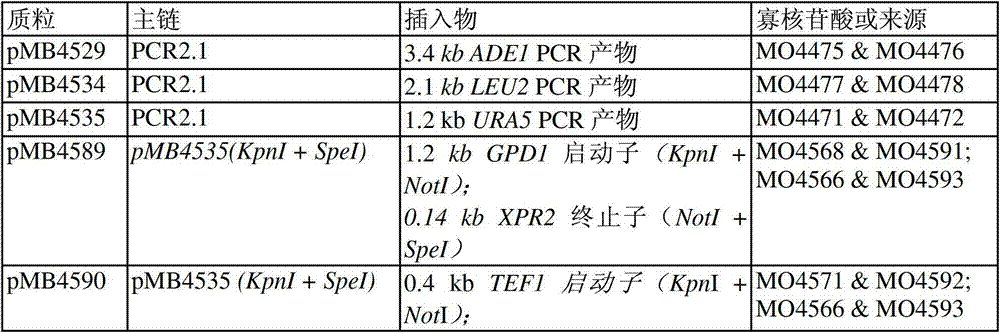

Some oligonucleotide mentioned in upper table 27 is as follows:
MO44715′-CTGGGTGACCTGGAAGCCTT
MO44725′-AAGATCAATCCGTAGAAGTTCAG
MO44755′-AAGCGATTACAATCTTCCTTTGG
MO44765′-CCAGTCCATCAACTCAGTCTCA
MO44775′-GCATTGCTTATTACGAAGACTAC
MO44785′-CCACTGTCCTCCACTACAAACAC
MO45345′-CACAAACGCGTTCACTGCGCATCCTCAAAGT
MO45445′-CACAATCTAGACACAAATGGATTATAACAGCGCGGAT
MO45665′-CACAAACTAGTTTGCCACCTACAAGCCAGAT
MO45685′-CACAAGGTACCAATGTGAAAGTGCGCGTGAT
MO45715′-CACAAGGTACCAGAGACCGGGTTGGCGG
MO45915′-CACAAGCGGCCGCGCTAGCATGGGGATCGATCTCTTATAT
MO45925′-CACAAGCGGCCGCGCTAGCGAATGATTCTTATACTCAGAAG
MO45935′-CACAAGCGGCCGCACGCGTGCAATTAACAGATAGTTTGCC
MO46595′-CACAAGCTAGCTGGGGATGCGATCTCTTATATC
1A: the pMB4628 (tef1p-carRP that produces coding phytoene synthase/lycopene cyclase?
lEU2): by volume branch Mucor (ATCC90680) genomic dna, use MO4525 and MO4541 amplification to contain the carRP of intron:
MO45255′-CACAAACGCGTTTAAATGGTATTTAGATTTCTCATT
MO45415′-CACAATCTAGACACAAATGCTGCTCACCTACATGGA;
And make gained 1.9kb fragment phosphorylation with T4 polynucleotide kinase.The flat end of gained fragment is engaged with the pBluescriptSKII through EcoRV cracking, obtain pMB4599.1.9kb XbaI-MluI fragment from pMB4599 is inserted in the pMB4603 of NheI-and MluI-cracking, obtained pMB4628.Coding is as follows containing the sequence of nucleic acid and the encoded CarRP albumen of pMB4628 of intron:
atgctgctcacctacatggaagtccacctctactacacgctgcctgtgctgggcgtcctgtcctggctgtcgcg?gccgtactacacagccaccgatgcgctcaaattcaaatttctgacactggttgccttcacgaccgcctccgcctgggacaactacattgt?ctaccacaaggcgtggtcctactgccccacctgcgtcaccgctgtcattggctacgtgcccttggaggagtacatgttcttcatcatcatg?actctgttgaccgtggcattcaccaatctggtgatgcgctggcacctgcacagcttctttatcaggcctgaaacgcccgtcatgcagtcc?gtcctggtccgtcttgtccccataacagccttattaatcactgcatacaaggcttgggtaagcaaacaaacaaatgatgtgccgcatcgca?ttttaatattaaccattgcatacacagcatttggcggtccctggaaagccactgttctacggatcatgcattttgtggtacgcctgtccggttt?tggccttattgtggtttggtgctggcgagtacatgatgcgtcgtccgctggcggtgctcgtctccattgcgctgcccacgctgtttctctgct?gggtcgatgtcgtcgctattggcgccggcacatgggacatttcgctggccacaagcaccggcaagttcgtcgtgccccacctgcccgt?ggaggaattcatgttctttgcgctaattaataccgttttggtatttggtacgtgtgcgatcgatcgcacgatggcgatcctccacctgttcaa?aaacaagagtccttatcagcgcccataccagcacagcaagtcgttcctccaccagatcctcgagatgacctgggccttctgtttacccga?ccaagtgctgcattcagacacattccacgacctgtccgtcagctgggacatcctgcgcaaggcctccaagtccttttacacggcctctgc?tgtctttcccggcgacgtgcgccaagagctcggtgtgctatacgccttttgcagagccacggacgatctctgcgacaacgagcaggtc?cctgtgcagacgcgaaaggagcagctgatactgacacatcagttcgtcagcgatctgtttggccaaaagacaagcgcgccgactgcc?attgactgggacttttacaacgaccaactgcctgcctcgtgcatctctgccttcaagtcgttcacccgtttgcgccatgtgctggaagctgg?agccatcaaggaactgctcgacgggtacaagtgggatttggagcgtcgctccatcagggatcaggaggatctcagatattactcagctt?gtgtcgccagcagtgttggtgaaatgtgcactcgcatcatactggcccacgccgacaagcccgcctcccgccagcaaacacagtgga?tcattcagcgtgcgcgtgaaatgggtctggtactccaatatacaaacattgcaagagacattgtcaccgacagcgaggaactgggcag?atgctacctgcctcaggattggcttaccgagaaggaggtggcgctgattcaaggcggccttgcccgagaaattggcgaggagcgatt?gctctcactgtcgcatcgcctcatctaccaggcagacgagctcatggtggttgccaacaagggcatcgacaagctgcccagccattgtc?aaggcggcgtgcgtgcggcctgcaacgtctatgcttccattggcaccaagctcaagtcttacaagcaccactatcccagcagagcaca?tgtcggcaattcgaaacgagtggaaattgctcttcttagcgtatacaacctttacaccgcgccaattgcgactagtagtaccacacattgc?agacagggaaaaatgagaaatctaaataccatttaa;
mlltymevhlyytlpvlgvlswlsrpyytatdalkfkfltlvafttasawdnyivyhkawsycptcvtavig?yvpleeymffiimtlltvaftnlvmrwhlhsffirpetpvmqsvlvrlvpitallitaykawhlavpgkplfygscilwyacpvlall?wfgageymmrrplavlvsialptlflcwvdvvaigagtwdislatstgkfvvphlpveefmffalintvlvfgtcaidrtmailhlfk?nkspyqrpyqhsksflhqilemtwafclpdqvlhsdtfhdlsvswdilrkasksfytasavfpgdvrqelgvlyafcratddlcdne?qvpvqtrkeqlilthqfvsdlfgqktsaptaidwdfyndqlpascisafksftrlrhvleagaikelldgykwdlerrsirdqedlryys?acvassvgemctriilahadkpasrqqtqwiiqraremglvlqytniardivtdseelgrcylpqdwltekevaliqgglareigeerl?lslshrliyqadelmvvankgidklpshcqggvraacnvyasigtklksykhhypsrahvgnskrveiallsvynlytapiatsstth?crqgkmrnlnti
Or the pcr amplification also pMB4599 being carried out for use MO4318, MO4643, MO4644 and MO4639 as template also produces 0.5kb and 0.95kb fragment:
MO43185′-GTAAAACGACGGCCAGT
MO46435′-CACACGGTCTCATGCCAAGCCTTGTATGCAGTGATTAA
MO46395′-CCACTGTGTTTGCTGGCGG
MO46445′-CACACGGTCTCTGGCATTTGGCGGTCCCTGGAAA,
Use respectively subsequently fragment described in Acc65I and BsaI and BsaI and PpuMI cracking.These fragments are engaged with the pMB4599 of Acc65I and PpuMI digestion, obtain having the pMB4613 of intronless carRP.Can will in the pMB4603 of the 1.85kb XbaI-MluI fragment insertion NheI-from pMB4613 and MluI-cracking, obtain pC arRPdelI.
1B: the pMB4638 (teflp-carB ADE1) that produces coding phytoene dehydrogenase: by volume branch Mucor (ATCC90680) genomic dna, use MO4530 and MO4542 amplification to contain the carB of intron:
MO45305′-CACAAACGCGTTTAAATGACATTAGAGTTATGAAC
MO45425′-CACAATCTAGACACAAATGTCCAAGAAACACATTGTC,
And with T4 polynucleotide kinase, by gained 1.9kb fragment phosphorylation, and flat end is engaged with the pBS-SKII-through EcoRV cracking, obtain pMB4606.Subsequently by pMB4606 as template for the pcr amplification that uses MO4318 and MO4648 and MO4646 and MO4647 and MO4343 and MO4645 to carry out:
MO43185′-GTAAAACGACGGCCAGT
MO46485′-CACAAGGTCTCAAGCACGCATCCCGGAACTG
MO46465′-CACACGGTCTCAGGCATGTCGCCCTACGATGC
MO46475′-CACACGGTCTCATGCTTGCACCCACAAAGAATAGG
MO43435′-CAGGAAACAGCTATGAC
MO46455′-CACACGGTCTCTTGCCC?ATATACATGGTCTGAAACG,
Produce the fragment of 0.4kb and 0.85kb and 0.7kb, use respectively subsequently fragment described in Acc65I and BsaI and BsaI and BsaI and BamHI cracking.These fragments are engaged with the pBS-SKII-that Acc65I and BamHI cut off, obtain having the pMB4619 of intronless carB.1.75kb XbaI-MluI fragment from pMB4619 is inserted in the pMB4629 of NheI-and MluI-cracking, obtained pMB4638.The encoded CarB albumen of gained nucleic acid coding sequence and pMB4638 is as follows:
atgtccaagaaacacattgtcattatcggtgctggcgtgggtggcacggctacagctgctcgtttggcccgcga?aggcttcaaggtcactgtggtggagaaaaacgactttggtggcggccgctgctccttgatccatcaccagggccatcgctttgatcagg?gcccgtcgctctacctgatgcccaagtactttgaggacgcctttgccgatctggacgagcgcattcaagaccacctggagctgctgcga?tgcgacaacaactacaaggtgcactttgacgacggtgagtcgatccagctgtcgtctgacttgacacgcatgaaggctgaattggaccg?cgtggagggcccccttggttttggccgattcctggatttcatgaaagagacacacatccactacgaaagcggcaccctgattgcgctca?agaagaatttcgaatccatctgggacctgattcgcatcaagtacgctccagagatctttcgcttgcacctgtttggcaagatctacgaccg?cgcttccaagtacttcaagaccaagaagatgcgcatggcattcacgtttcagaccatgtatatgggcatgtcgccctacgatgcgcctgc?tgtctacagcctgttgcagtacaccgagttcgctgaaggcatctggtatccccgtggcggcttcaacatggtggttcagaagctagagg?cgattgcaaagcaaaagtacgatgccgagtttatctacaatgcgcctgttgccaagattaacaccgatgatgccaccaaacaagtgaca?ggtgtaaccttggaaaatggccacatcatcgatgccgatgcggttgtgtgtaacgcagatctggtctatgcttatcacaatctgttgcctcc?ctgccgatggacgcaaaacacactggcttccaagaaattgacgtcttcttccatttccttctactggtccatgtccaccaaggtgcctcaat?tggacgtgcacaacatctttttggccgaggcttatcaggagagctttgacgaaatcttcaaggactttggcctgccttctgaagcctccttc?tacgtcaatgtgccctctcgcatcgatccttctgctgctcccgacggcaaggactctgtcattgtcttggtgcctattggtcatatgaagag?caagacgggcgatgcttccaccgagaactacccggccatggtggacaaggcacgcaagatggtgctggctgtgattgagcgtcgtct?gggcatgtcgaatttcgccgacttgattgagcatgagcaagtcaatgatcccgctgtatggcagagcaagttcaatctgtggagaggct?caattctgggtttgtctcatgatgtgcttcaggtgctgtggttccgtcccagcacaaaggattctaccggtcgttatgataacctattctttgt?gggtgcaagcacgcatcccggaactggtgttcccattgtccttgcaggaagcaagctcacctctgaccaagttgtcaagagctttggaa?agacgcccaagccaagaaagatcgagatggagaacacgcaagcacctttggaggagcctgatgctgaatcgacattccctgtgtggt?tctggttgcgcgctgccttttgggtcatgtttatgttcttttacttcttccctcaatccaatggccaaacgcccgcatcttttatcaataatttgtta?cctgaagtattccgcgttcataactctaatgtcatttaa,
mskkhiviigagvggtataarlaregfkvtvvekndfgggrcslihhqghrfdqgpslylmpkyfedafad?lderiqdhlellrcdnnykvhfddgesiqlssdltrmkaeldrvegplgfgrfldfmkethihyesgtlialkknfesiwdlirikyap?eifrlhlfgkiydraskyfktkkmrmaftfqtmymgmspydapavysllqytefaegiwyprggfnmvvqkleaiakqkydae?fiynapvakintddatkqvtgvtlenghiidadavvcnadlvyayhnllppcrwtqntlaskkltsssisfywsmstkvpqldvhni?flaeayqesfdeifkdfglpseasfyvnvpsridpsaapdgkdsvivlvpighmksktgdastenypamvdkarkmvlavierrl?gmsnfadlieheqvndpavwqskfnlwrgsilglshdvlqvlwfrpstkdstgrydnlffvgasthpgtgvpivlagskltsdqvv?ksfgktpkprkiementqapleepdaestfpvwfwlraafwvmfmffyfpqsngqtpasfinnllpevfrvhnsnvi。
1C: the pMB4660 (tef1p-carB URA3) that produces coding phytoene dehydrogenase: the 4.3kb XhoI-NotI fragment from pMB4638 and 1.8kb NotI-SpeI fragment are engaged with 1.9kbBsaI-and SpeI-cracking URA3 gene that the pcr amplification of the Yarrowia lipolytica genomic dna being undertaken by use MO4684 and MO4685 produces, obtain pMB4660:
MO46845′-CATTCACTAGTGGTGTGTTCTGTGGAGCATTC
MO46855′-CACACGGTCTCATCGAGGTGTAGTGGTAGTGCAGTG。
Encoded CarB (i) albumen of gained nucleic acid coding sequence and pMB4660 is as follows:
atgtccaagaaacacattgtcattatcggtgctggcgtgggtggcacggctacagctgctcgtttggcccgcga?aggcttcaaggtcactgtggtggagaaaaacgactttggtggcggccgctgctccttgatccatcaccagggccatcgctttgatcagg?gcccgtcgctctacctgatgcccaagtactttgaggacgcctttgccgatctggacgagcgcattcaagaccacctggagctgctgcga?tgcgacaacaactacaaggtgcactttgacgacggtgagtcgatccagctgtcgtctgacttgacacgcatgaaggctgaattggaccg?cgtggagggcccccttggttttggccgattcctggatttcatgaaagagacacacatccactacgaaagcggcaccctgattgcgctca?agaagaatttcgaatccatctgggacctgattcgcatcaagtacgctccagagatctttcgcttgcacctgtttggcaagatctacgaccg?cgcttccaagtacttcaagaccaagaagatgcgcatggcattcacgtttcagaccatgtatatgggcatgtcgccctacgatgcgcctgc?tgtctacagcctgttgcagtacaccgagttcgctgaaggcatctggtatccccgtggcggcttcaacatggtggttcagaagctagagg?cgattgcaaagcaaaagtacgatgccgagtttatctacaatgcgcctgttgccaagattaacaccgatgatgccaccaaacaagtgaca?ggtgtaaccttggaaaatggccacatcatcgatgccgatgcggttgtgtgtaacgcagatctggtctatgcttatcacaatctgttgcctcc?ctgccgatggacgcaaaacacactggcttccaagaaattgacgtcttcttccatttccttctactggtccatgtccaccaaggtgcctcaat?tggacgtgcacaacatctttttggccgaggcttatcaggagagctttgacgaaatcttcaaggactttggcctgccttctgaagcctccttc?tacgtcaatgtgccctctcgcatcgatccttctgctgctcccgacggcaaggactctgtcattgtcttggtgcctattggtcatatgaagag?caagacgggcgatgcttccaccgagaactacccggccatggtggacaaggcacgcaagatggtgctggctgtgattgagcgtcgtct?gggcatgtcgaatttcgccgacttgattgagcatgagcaagtcaatgatcccgctgtatggcagagcaagttcaatctgtggagaggct?caattctgggtttgtctcatgatgtgcttcaggtgctgtggttccgtcccagcacaaaggattctaccggtcgttatgataacctattctttgt?gggtgcaagcacgcatcccggaactggtgttcccattgtccttgcaggaagcaagctcacctctgaccaagttgtcaagagctttggaa?agacgcccaagccaagaaagatcgagatggagaacacgcaagcacctttggaggagcctgatgctgaatcgacattccctgtgtggt?tctggttgcgcgctgccttttgggtcatgtttatgttcttttacttcttccctcaatccaatggccaaacgcccgcatcttttatcaataatttgtta?cctgaagtattccgcgttcataactctaatgtcatttaa;
mskkhiviigagvggtataarlaregfkvtvvekndfgggrcslihhqghrfdqgpslylmpkyfedafad?lderiqdhlellrcdnnykvhfddgesiqlssdltrmkaeldrvegplgfgrfldfmkethihyesgtlialkknfesiwdlirikyap?eifrlhlfgkiydraskyfktkkmrmaftfqtmymgmspydapavysllqytefaegiwyprggfnmvvqkleaiakqkydae?fiynapvakintddatkqvtgvtlenghiidadavvcnadlvyayhnllppcrwtqntlaskkltsssisfywsmstkvpqldvhni?flaeayqesfdeifkdfglpseasfyvnvpsridpsaapdgkdsvivlvpighmksktgdastenypamvdkarkmvlavierrl?gmsnfadlieheqvndpavwqskfnlwrgsilglshdvlqvlwfrpstkdstgrydnlffvgasthpgtgvpivlagskltsdqvv?ksfgktpkprkiementqapleepdaestfpvwfwlraafwvmfmffyffpqsngqtpasfinnllpevfrvhnsnvi
1D: the pTef-HMG that produces pMB4637 and coding truncation type HMG1
For producing the truncation type varient of HMG-CoA reductase gene (it goes back 77 amino acid whose leader sequences of coding source home-brewed wine yeast), synthetic following oligonucleotide:
Primer O5 '-TTCTAGACACAAAAATGGCTGCAGACCAATTGGTGA
Primer P5 '-CATTAATTCTTCTAAAGGACGTATTTTCTTATC
Primer Q5 '-GTTCTCTGGACGACCTAGAGG
MO46585′-CACACACGCGTACACCTATGACCGTATGCAAAT。
Use genomic dna as template, with primer O and P, carry out the 0.23kb fragment of amplification coding Met-Ala, the residue 530 to 604 of the Hmg1 albumen of the yeast saccharomyces cerevisiae that increases subsequently.Use genomic dna as template, the 1.4kb fragment of 448 residues of C-terminal of the Hmg1 albumen of use primer Q and MO4658 amplification coding Yarrowia lipolytica.These fragments are engaged with suitable cloning vector, and verify gained plasmid by order-checking, by its called after pOP and pQMO4658.With XbaI and AseI, discharge OP fragment, and discharge QMO4658 with MaeI and MluI.Subsequently these fragments are engaged to produce TefHMG with the ADE1TEF1p expression vector pMB4629 through XbaI and MluI cut-out.
Or, can in the situation that but on the described yeast saccharomyces cerevisiae sequence of table, use primer MO4658 (as described above) and MO4657 modification from the natural HMG1 gene of Yarrowia lipolytica, thereby obtain pMB4637:
MO46575′-CACACTCTAGACACAAAAATGACCCAGTCTGTGAAGGTGG。
The encoded Hmg1 of gained nucleic acid coding sequence and pMB4637
brachymemmaalbumen is as follows:
atgacccagtctgtgaaggtggttgagaagcacgttcctatcgtcattgagaagcccagcgagaaggaggag?gacacctcttctgaagactccattgagctgactgtcggaaagcagcccaagcccgtgaccgagacccgttctctggacgacctagagg?ctatcatgaaggcaggtaagaccaagcttctggaggaccacgaggttgtcaagctctctctcgagggcaagcttcctttgtatgctcttga?gaagcagcttggtgacaacacccgagctgttggcatccgacgatctatcatctcccagcagtctaataccaagactttagagacctcaa?agcttccttacctgcactacgactacgaccgtgtttttggagcctgttgcgagaacgttattggttacatgcctctccccgttggtgttgctg?gccccatgaacattgatggcaagaactaccacattcctatggccaccactgagggttgtcttgttgcctcaaccatgcgaggttgcaagg?ccatcaacgccggtggcggtgttaccactgtgcttactcaggacggtatgacacgaggtccttgtgtttccttcccctctctcaagcgggc?tggagccgctaagatctggcttgattccgaggagggtctcaagtccatgcgaaaggccttcaactccacctctcgatttgctcgtctcca?gtctcttcactctacccttgctggtaacctgctgtttattcgattccgaaccaccactggtgatgccatgggcatgaacatgatctccaagg?gcgtcgaacactctctggccgtcatggtcaaggagtacggcttccctgatatggacattgtgtctgtctcgggtaactactgcactgacaa?gaagcccgcagcgatcaactggatcgaaggccgaggcaagagtgttgttgccgaagccaccatccctgctcacattgtcaagtctgtt?ctcaaaagtgaggttgacgctcttgttgagctcaacatcagcaagaatctgatcggtagtgccatggctggctctgtgggaggtttcaatg?cacacgccgcaaacctggtgaccgccatctaccttgccactggccaggatcctgctcagaatgtcgagtcttccaactgcatcacgctg?atgagcaacgtcgacggtaacctgctcatctccgtttccatgccttctatcgaggtcggtaccattggtggaggtactattttggagcccc?agggggctatgctggagatgcttggcgtgcgaggtcctcacatcgagacccccggtgccaacgcccaacagcttgctcgcatcattgc?ttctggagttcttgcagcggagctttcgctgtgttctgctcttgctgccggccatcttgtgcaaagtcatatgacccacaaccggtcccagg?ctcctactccggccaagcagtctcaggccgatctgcagcgtctacaaaacggttcgaatatttgcatacggtcatag
mtqsvkvvekhvpiviekpsekeedtssedsieltvgkqpkpvtetrslddleaimkagktklledhevvk?lslegklplyalekqlgdntravgirrsiisqqsntktletsklpylhydydrvfgaccenvigymplpvgvagpmnidgknyhip?mattegclvastmrgckainagggvttvltqdgmtrgpcvsfpslkragaakiwldseeglksmrkafnstsrfarlqslhstlagnl?lfirfrtttgdamgmnmiskgvehslavmvkeygfpdmdivsvsgnyctdkkpaainwiegrgksvvaeatipahivksvlks?evdalvelnisknligsamagsvggfnahaanlvtaiylatgqdpaqnvessncitlmsnvdgnllisvsmpsievgtigggtilep?qgamlemlgvrgphietpganaqqlariiasgvlaaelslcsalaaghlvqshmthnrsqaptpakqsqadlqrlqngsnicirs。
1E: the pMB4692 (URA3teflp-crtZ) that produces coding Cartoene hydroxylase: the protein sequence based on Novosphingobium (Novosphingobium aromaticivorans), is used synthetic following Cartoene hydroxylase (CrtZ) the ORF sequence of Yarrowia lipolytica codon bias:
5’-
ttctagacacaaaa

 tagacgcgt
Use XbaI and this sequence of MluI cracking, and it is engaged with the pMB4662 through Acc65I and MluI cut-out together with the Acc65I-NheITEFl promoter fragment from pMB4629, thereby obtain pMB4692.Above with runic underscore unlabeled nucleic acid encoding sequence.The encoded crtZ albumen of gained pMB4692 is as follows:
mggamqtlaailivlgtvlamefvawsshkyimhgfgwgwhrdhhephegflekndlyaivgaalsil?mfalgspmimgadawwpgtwiglgvlfygviytlvhdglvhqrwfrwvpkrgyakrlvqahklhhatigkeggvsfgfvfar?dpavlkqelraqreagiavlreavdg。
1F: the pMB4698 (ADElteflp-crtW) that produces coding carotene ketolase: based on having from the protein sequence of the separated environment sequence (evvironmental sequence) of Sargasso Sea (Sargasso Sea) (Genebank deposits numbering AACY01034193.1), synthetic following carotene ketolase (CrtW) ORF sequence:
5’-
ttctagacacaaaa


 acgcgt。
Use XbaI and this sequence of MluI cracking, and it is engaged with the pMB4629 through NheI and MluI cut-out, thereby obtain pMB4698.Above with runic underscore unlabeled nucleic acid encoding sequence.The encoded crtW albumen of gained pMB4698 is as follows:
mtrsiswpstywhlqpscsswvanefspqarkglvlagligsawlltlglgfslplhqtswlligclvllrsflh?tglfivahdamhaslvpdhpglnrwigrvcllmyaglsykrccrnhrrhhqapetvedpdyqrctnnnildwyvhfmgnylgw?qqllnlscvwlaltfrvsdysaqffhlllfsvlplivsscqlflvgtwlphrrgattrpgvttrslnfhpalsfaacyhfgyhrehhespst?pwfqlpklregsli。
example 2: engineering design Yarrowia lipolytica is to increase carotenoid output
2A: produce the Yarrowia lipolytica of expressing Geranylgeranyl Pyrophosphate Synthase and phytoene dehydrogenase: with the pMB4591 (tef1p-GGS1) of SspI cracking of URA5 upstream, transform MF350 (MATBura2-21leu2-35ade1); Discriminating is loaded with the Ura of plasmid in ura2 site
+transformant, and by its called after MF364.With the pMB4638 (tef1p-carB) of SspI cracking of ADE1 place, transformed subsequently, and be chosen in the prototroph transformant that ade1 site has plasmid.By described transformant called after MF502.
2B: generation expression Geranylgeranyl Pyrophosphate Synthase, phytoene dehydrogenase and phytoene synthase/ the Yarrowia lipolytica of lycopene cyclase: with the pMB4628 (tef1p-carRP) that SspI processes, transform MF502.Nine prototrophic bacterium that are colourless, orange or darkorange after selecting grow for two days or three days on conversion culture plate (the YNB agar with 1% glucose and 0.1% L-glutamic acid [YNBglut]) fall.At 30 ℃, in YPD, growing after 4 days, two bacterium colonies, is that MF597 and MF600 (be darkorange person) produce the carotene that is greater than every gram of dry cell weight (DCW) 4mg.Southern analyzes to disclose in genomic dna has the difference single KpnI-HindIII bands of a spectrum from MF597 and MF600, there is no bands of a spectrum and is illustrated in leu2-270 place generation Homologous integration.
2C: produce the solution fat Ye Shi that expresses phytoene synthase/lycopene cyclase and phytoene dehydrogenase yeast: with the pMB4628 of SspI cracking, transform ATCC201249 (MATA ura3-302leu2-270lys8-11).Collect hundreds of Leu
+bacterium colony, makes its regrowth and with the pMB4660 (TEF1p-carB) of SalI cracking of URA3 upstream, it is transformed.Be chosen at 30 ℃ in YNBglut and add after cultivating 5 days on 0.6mM Methionin and be a jonquilleous bacterium colony (being called MF447), and find in YPD, to grow after 4 days, it produces every gram of dry cell weight 0.2mg carotene.
With 1g/L5-fluororotic acid and the Ura through selecting
-hive off and excite MF447.Unexpectedly, find that it all retains the yellow appearance identical with its parent, this shows that functional URA3 gene do not lose along with the forfeiture of functional CarB enzyme.Southern analyzes confirmation, and two fragments that obtained by KpnI-HindIII digestion MF447DNA all contain URA3p hybridization sequences, and wherein only a sequence is also hybridized with carB.Another sequence lacks in MF578, selects Ura3
-hive off for further processing.Plasmid rescue (plasmid rescue) and disclosing containing the analysis of the DNA sequence dna of carRP intron in bacterial strain MF447, MF597 (example 2c) and MF600 (example 2c), exons 1 and exon 2 are adjacent, and separated by the intron sequences that lacks initial internal SspI site (being present in pMB4628) each other.
2D: produce and express phytoene synthase/lycopene cyclase, phytoene dehydrogenase and spiceleaf basic note the Yarrowia lipolytica of phyllopodium pyrophosphate synthase: with SalI (URA3 upstream) or through the pMB4683 (tef1p-GGS1) of StuI (GGS1ORF in) cracking conversion MF578.In both cases, Ura
+leu
+bacterium colony is all bright orange on YNBglut+Lys and YPD, and when growing as described above, some bacterium colonies produce and are greater than every gram of dry cell weight 4mg carotene.As analyzed by Southern, inferring, bacterium colony, is that MF633 contains single plasmid copy in GGS1 site.There is non-homogeneous or more complicated integration in other bacterium colony.
2E: produce and express phytoene synthase/lycopene cyclase, phytoene dehydrogenase and spiceleaf basic note the Yarrowia lipolytica of phyllopodium pyrophosphate synthase: make MF364 and MF578 hybridization, and will in YPD is upper, at 30 ℃, cultivate 2 to 3 days from the diplontic spore inoculating of gained.By PCR, screen the orange Leu that has tefp-carB, tefp-carRP and tefp-GGS1
+ade
-ura
-bacterium colony, and screening has the bacterium colony of high carotenoid output (being greater than every gram of dry cell weight 4mg) in YPD substratum after growth.Selection meets these standards and represents the bacterium colony of the resistance of 5-fluororotic acid (showing that it has ura3-302 allelotrope) with for further study, and is referred to as hereinafter GBRPua bacterial strain.Select described bacterial strain to use with for further analysis and modification.
example 3: extract carotenoid in yarrowia lipolytica cell
Use YPD substratum (1% yeast extract, 2% peptone, 2% glucose) to carry out shaking flask test to produced bacterial strain.At 30 ℃, make the 20ml culture growth in 125ml flask.From 72-96 hour, culture, gather yarrowia lipolytica cell, and extract to determine form and the quantity of carotenoid.1.8ml culture is put into Eppdendorf pipe.Make cell granulations, and use 1ml H
2o washed twice.For the second time after washing, the cell suspending is again transferred in the bayonet socket bottle cap pipe (snap-cap tube) through weighing in advance that top has acanthopore, and by cell freeze-drying whole night.After being dried, pipe is weighed to calculate dry cell weight.0.25ml is put into 2ml bottle screw cap pipe from the culture of identical shaking flask to be extracted for carotenoid.Make cell granulations, and suction supernatant liquor.Can be at-80 ℃ freezing and store globoferous cell.Isopyknic cubic zirconia particle and the ice-cold extraction solvent (the 50/50v/v hexane that contains 0.01% butylhydroxy toluene (BHT) and the mixture of ethyl acetate) of 1ml are added in cell pellet.At 4 ℃, with top speed, stir (Mini-BeadBeater-8, BioSpec Products, Inc.) mixture 5 minutes subsequently.Then, with top speed, make mixture rotation 1 minute, and collect supernatant liquor, and be preserved in cold 16ml vial.Remaining cell fragment is extracted at least 3 times again, but do not add zirconia particles; All supernatant liquors are all come together in described 16ml vial.After extraction, at 4 ℃, in Sorvall desk centrifuge, with 2000rpm, make vial rotation 5 minutes, and supernatant liquor is transferred in new cold 16ml vial.Use Speed Vac concentrated supernatant (under room temperature in the dark), and by sample storage at-20 ℃ or-80 ℃ until be about to carry out HPLC analysis.Before carrying out HPLC analysis, sample is suspended in the solvent that 1ml is ice-cold again and is transferred to subsequently in cold amber vial.In whole scheme, should be noted that and avoid contacting with oxygen, light, heat and acid.
example 4: the output that quantizes carotenoid by HPLC
For carotenoid is analyzed, sample is suspended in ice-cold extraction solvent (the 50/50v/v hexane that contains 0.01% butylhydroxy toluene (BHT) and the mixture of ethyl acetate) again.At 25 ℃, use the Alliance2795HPLC (Waters) that is equipped with Waters XBridge C18 post (3.5 μ m, 2.1 * 50mm) and Thermo Basic8 guard column (2.1 * 10mm) to split carotenoid; The carotenoid sample of confirming is used as to standard substance.Moving phase and flow rate are showed in hereinafter (solvent orange 2 A=ethyl acetate; Solvent B=water; Solvent C=methyl alcohol; Solvent D=acetonitrile).Injecting volume is 10 μ L.Detector is Waters996 photodiode array detector.The residence time of lipophilic molecules comprises astaxanthin (1.159 minutes), zeaxanthin (1.335 minutes), β-A Piao-8 '-Radix Dauci Sativae aldehyde (2.86 minutes), ergosterol (3.11 minutes), Lyeopene (3.69 minutes), β-carotene (4.02 minutes) and phytoene (4.13 minutes).Astaxanthin, zeaxanthin, β-A Piao-8 '-Radix Dauci Sativae aldehyde, Lyeopene and β-carotene are to detect under 475nm, and ergosterol and phytoene are to detect under 286nm.
Table 28: the residence time of lipophilic molecules
| Time (minute) | Flow velocity (mL/min) | A% | B% | C% | D% | Curve |
| ? | 0.50 | 0.0 | 20.0 | 0.0 | 80.0 | ? |
| 3.00 | 1.00 | 20.0 | 0.0 | 0.0 | 80.0 | 6 |
| 4.50 | 1.00 | 80.0 | 0.0 | 20.0 | 0.0 | 6 |
| 5.50 | 1.00 | 0.0 | 0.0 | 60.0 | 40.0 | 6 |
| 6.50 | 1.00 | 0.0 | 0.0 | 80.0 | 20.0 | 6 |
| 7.50 | 1.00 | 0.0 | 0.0 | 100.0 | 0.0 | 6 |
| 8.50 | 1.00 | 0.0 | 0.0 | 100.0 | 0.0 | 6 |
| 9.50 | 1.00 | 0.0 | 20.0 | 0.0 | 80.0 | 6 |
| 10.50 | 0.50 | 0.0 | 20.0 | 0.0 | 80.0 | 6 |
the expression of the clipped form of example 5:HMG-CoA reductase enzyme causes that carotenoid output increases
For increasing carotenoid output, by the carbon of introducing the brachymemma varient of HMG-CoA reductase gene and increasing by isoprenoid path, flow.
In one approach, the brachymemma varient of HMG-CoA reductase gene (it goes back 77 amino acid whose leader sequences of coding source home-brewed wine yeast Hmg1) is introduced in GRPBua bacterial strain (described in example 2E above).Can be with SnaBI, BbvCI or Bsu36I cracking plasmid pTefHMG integration in ade1 site with guide in GRPBua bacterial strain, or the integration in HMG1 site with guide with BamHI cracking, or with EcoRV cracking to promote random integration, thereby make it revert to VITAMIN B4 prototroph.The gained Ade that screening carotenoid output increases
+transformant.
Or, can in the situation that but above the yeast saccharomyces cerevisiae sequence described in example 1D modify the natural HMG1 gene from Yarrowia lipolytica, thereby obtain pMB4637.Can as described in about pTefHMG, to this plasmid, digest, and be transformed in GRPBua bacterial strain, and as described in, the gained transformant that screening carotenoid output increases.
In another approach, can utilize the brachymemma varient of Neurospora crassa HMG-CoA reductase gene, and be introduced in Yarrowia lipolytica strain.For producing the plasmid be suitable for expressing heterologous HMG-CoA reductase enzyme, by carrying out (the Yeast2001 to p641P by GPD promotor replacement ICL1 promotor the sequence of giving phleomycin (phleomycin) resistance by adding; 18 (2001): 97-113) modify.With following two kinds of primers Yarrowia lipolytica genomic dna that increases:
GPDdist:5′CACACGGTacctgtaggttgggttgggtg
GPDprox:5′CACACGGATCCtgtttaattcaagaatgaatatagagaagagaag,
And by BamHI and KpnI cracking gained fragment (0.7kb), and it is engaged with the p641P of BamHI-and KpnI-cracking, produce plasmid " p641Pgpd ".Subsequently under the control of hook nest aspergillus GPD promotor, by ble gene from pBCphleo (Silar, Fungal Genetics Newsletter42:73) excision, obtain 3.2kb BclI-BamHI fragment, and so that BamHI site and the immediate direction of GPD promotor are inserted described fragment in BamHI site unique in " p641Pgpd ", obtain " p641Pgpdble ".
With following two kinds of primer amplification Neurospora crassa genomic dnas:
Neuhmg?fwd:5′CACACGGATCCACATCAACAatggcatctgccacccttcccc
Neuhmg?rev:5′CACACGGATCcaagtgctgacgcggaacttg,
And by BamHI cracking gained fragment, and with correct direction, be inserted in " p641Pgpdble " of BamHI digestion.Gained plasmid " pZg " contains encodes under composition GPD promotor is controlled that (Genebank deposits numbering to Neurospora crassa 3-hydroxy-3-methylglutaryl coenzyme A reductase: the sequence of truncation type kytoplasm catalyst structure domain XP_324892).This plasmid can be introduced in the Yarrowia lipolytica strain producing in example 2E above, and select transformant by its resistance to phleomycin (100 μ g/ml).As described above, the β-carotene output of test gained transformant.
example 6: allos Cartoene hydroxylase and carotene ketolase gene are introduced to the solution fat Ye Shi that produces carotenoid
in yeast strain to produce astaxanthin
For Cartoene hydroxylase and carotene ketolase are introduced in the Yarrowia lipolytica that produces carotenoid, can be successively by above the pMB4692 described in example 1E and 1F and pM4698 introduce in GRPBua bacterial strain (described in example 2E).For introducing pMB4692, available SalI or BsrGI cracking plasmid to be to guide the integration in ura3 site, or with XbaI cracking to promote random integration, thereby selection uridylic prototroph.Screening produces the GRPBua Ura with pMB4692 of zeaxanthin in YPD
+transformant.With pMB4698 (it can be through PpuMI, SspI or BbvCI cracking to guide the integration in ade1 site, or with EcoRV cracking to promote random integration), transform and produce zeaxanthin cell, and the prototroph bacterium colony of screening generation astaxanthin.
Or the order that plasmid transforms can be put upside down, wherein first transform pMB4698 and select transformant about VITAMIN B4 prototroph.Screening produces the GRPBua Ade with pMB4698 of canthaxanthin
+transformant.With pMB4692, transform the GRPBua[pMB4698 that produces canthaxanthin] cell, and screening produces the prototroph bacterium colony of astaxanthin.
In another approach, the carotenoid ketolase from secondary coccus and carotenoid hydroxylase enzymes gene can be introduced above in the bacterial strain described in example 2, to β-carotene is changed into astaxanthin.With the secondary coccus genomic dna of following two kinds of primer amplifications:
CrtZ?fwd:5′CACACCGTCTCAAatgaccaatttcctgatcgtcgtc
CrtZ?rev:5′CACACAGATCtcacgtgcgctcctgcgcc,
And by BsmBI cracking gained fragment, by the Klenow fragment of archaeal dna polymerase, modify, and use BglH cracking.This fragment is inserted to the pINA1269 (J.Mol.Microbiol.Biotechnol.2 (2000): 207-216), described plasmid contains hp4d promotor, XPR2 terminator, optional LEU2 gene and select and breed essential sequence in intestinal bacteria of PmlI-and BamHI-cracking.The sequence that gained plasmid " pA " contains secondary coccus (crtZ gene) (Genebank the deposits numbering CAB56060.1) Cartoene hydroxylase of encoding under hp4d promotor is controlled.
" pYEG1TEF " is by replacing XPR2 terminator to modify as follows with LIP2 terminator.With AvrII, digest pINA1291, by the Klenow fragment of archaeal dna polymerase, modify and use EcoRI cracking, and by the small segment that contains LIP2t with the digestion of SacH, modify and engage through " pYEG1TEF " of EcoRI cracking through T4DNA polysaccharase in the situation that there is dNTP.Gained plasmid is called to " pYEG1TEF-LIP2t ".
For amplification carotenoid ketolase gene, with following two kinds of primer amplifications pair coccus genomic dna:
CrtW?fwd:5′CACACCCTAGGCCatgagcgcacatgccctgc
CrtW?rev:5′CACACAAGCTTtcatgcggtgtcccccttg,
And by AvrII and HindIII cracking gained fragment, and be inserted in " pYEG1TEF-LIP2t " of AvrII-and HindIII-cracking.The sequence that gained plasmid " pBt " contains carotene ketolase (crtW gene) (Genebank deposits numbering CAB56059.1) of encoding under composition TEF1 promotor is controlled.
For two expression cassettes are incorporated in single plasmid, " pBt " used to ClaI cracking, by the Klenow fragment of archaeal dna polymerase, modify, and use EcoRI cracking, and the separated fragment that contains crtW, by its with the phosphorylation oligonucleotide joint through NotI cracking to mixing:
5 ' AATTCGCGGCCGCT and
5′AGCGGCCGCG,
And it is engaged with " pA " through NotI digestion.Gained plasmid " pABt " contains TEF1p/crtW/LIP2t box and hp4d/crtZ/XPR2t box and selectable LEU2 gene.
" pABt " can be introduced to the Yarrowia lipolytica strain (TEF1p/al-1/XPR2t described in example 4 above; Hp4d/carRP/LIP2t; GPDp/HMGR
brachymemma) in, and select transformant about leucine prototroph.
example 7: the part inactivation of the Yarrowia lipolytica ERG9 gene of coding squalene synthase causes carotenoid output
increase
7A.for the ERG9 Gene Partial inactivation of the squalene synthase that makes to encode, adjacent FOL3 gene is interrupted, thereby cause the demand to formyl tetrahydrofolic acid.Subsequently, the sudden change induce dna fragment of crossing over described two genes by part transforms this bacterial strain, and the Fol of screening squalene synthase activity decreased
+transformant.
Synthetic following oligonucleotide:
Primer K5 '-CCTTCTAGTCGTACGTAGTCAGC;
Primer L5 '-CCACTGATCTAGAATCTCTTTCTGG,
And use it for use that Pfu polysaccharase carries out to crossing over the amplification of the 2.3kb Yarrowia lipolytica genomic DNA fragment of most of FOL3 gene.By XbaI cracking phosphorylation for gained fragment, subsequently by it with KpnI cracking, process and with the pBluescriptSK by XbaI cracking through T4DNA polysaccharase (T4pol) in the situation that there is dNTP
-engage.Then, by being called Acc65I and the EcoRI cracking for gained plasmid of pBS-fol3, with T4pol as above, process, and it is engaged with the 3.4kb EcoRV-SpeIADE1 fragment (processing through T4pol) from pMB4529.
Available BsiWI and XbaI cracking gained plasmid pBSfol3 Δ ade, to discharge 5.5kb fragment, are used described fragment that GRBPua bacterial strain mentioned above is changed into VITAMIN B4 prototroph.Screening needs the gained Ade of formyl tetrahydrofolic acid
+transformant, and by pcr analysis, screen the described transformant of Homologous integration.
Availablely by using following primer and usining Yarrowia lipolytica genomic dna, as the sudden change of template, bring out 3.5kb DNA fragmentation that pcr amplification produced and transform and there is the allelic bacterial strain of gained fol3 Δ ADE1:
Primer M5 '-GGCTCATTGCGCATGCTAACATCG;
Primer N5 '-CGACGATGCTATGAGCTTCTAGACG.
The fragment of N-terminal 3/4ths sequences that use gained contains FOL3ORF and C-terminal 9/10ths sequences of ERG9ORF transforms bacterial strain.By the susceptibility of the medicament to such as Sa Lage acid, itraconazole (itraconazole) or fluconazole (fluconazole), screen the gained Fol of squalene synthase activity decreased
+ade
-transformant.In addition the gained transformant that, screening carotenoid output increases.
7B.or, the PCR fragment that produces in 7A can gram be fallen and to remove the mode change in 3 of ERG9 gene '-untranslated region.The interruptions that substitutes fol3 Δ ADE1 with this fragment will cause squalene synthase to be expressed reducing [the people (2005) such as Schuldiner, Cell123:507-519] [Muhlrad and Parker (1999), RNA5:1299-1307], this can be confirmed described in 7A.This method also can be used for using ADE1 mark to interrupt the Fol of ERG93 '-UTR
+ade
-in bacterial strain.
7C.in other method, can use plasmid reorganization (plasmid shuffling) technology people (1987) such as [, Methods Enzymol.154:164-175] Boeke and with drug susceptibility, as phenotype, differentiate the ERG9 allelotrope of part defect in yeast saccharomyces cerevisiae.Can use standard molecule genetics technology that defective gene is transferred in Yarrowia lipolytica.
example 8: process and produce carotenoid solution fat Ye Shi ferment with the inhibitor of isoprenoid biosynthesizing competitor polypeptide
mother strains causes carotenoid output to increase
As described above, with squalene synthase inhibitor Sa Lage acid (0.5 μ M Sa Lage acid), process the culture producing in example 2 output of monitoring β-carotene.
example 9: structure produce oil Wine brewing yeast strain
The gene of the Liang Ge subunit of overexpression coding Neurospora crassa ATP-citrate lyase, yeast saccharomyces cerevisiae AMP deaminase and volume branch Mucor cytoplasm malic enzyme in Wine brewing yeast strain, to increase total lipid content.Can be by the similar approach of the enhancing lipid output of using identical homology or functionally similar produce oil polypeptide to carry out for other host organisms such as rhodotorula (red phaffia rhodozyma).
Use Qiagen RNAEasy test kit (Qiagen, Valencia, CA.) to prepare messenger RNA(mRNA) by the prepared freeze-drying biomass of Neurospora crassa culture.Subsequently, with any one two reactions that contain in mRNA template and following primer pair, carry out RT-PCR.
acl1:
l?fwd:5′CACACGGATCCTATAatgccttccgcaacgaccg
l?rev:5′CACACACTAGttaaatttggacctcaacacgaccc;
acl2:
2fwd:5′CACACGGATCCAATATAAatgtctgcgaagagcatcctcg
2rev:5′CACACGCATGCttaagcttggaactccaccgcac。
The fragment being obtained by acl1 reaction with SpeI and BamHI cracking, and the fragment being obtained by acl2 reaction with BamHI and SphI cracking, and two fragments are engaged with together with Yep24 that NheI and SphI digest, plasmid " p12 " obtained.Use following primer by the two-way GAL1-10 promotor of genes of brewing yeast group DNA cloning:
gal10:5′CACACGGATCCaatmcaaaaattcttactttttttttggatggac
gal1:5′CACACGGATCCttttttctccttgacgttaaagtatagagg,
And by BamHI cracking gained 0.67kb fragment, and with either direction, it being engaged to obtain " p1gal2 " and " p1gal1 " with " p12 " of BamHI digestion, it contains respectively GAL1-acl1/GAL10-acl2 and GAL10-acl1/GAL1-acl2, and (Genebank deposits numbering: acl1:CAB91740.2; Acl2:CAB91741.2).
For the genes of brewing yeast of amplification coding AMP deaminase be suitable for expressing the promotor of this gene, two primer pairs amplification genes of brewing yeast group DNA below using in reaction separately:
AMD1ORF:
AMD1fwd:5′CACACGAGCTCAAAAatggacaatcaggctacacagag
AMD1rev:5′CACACCCTAGGtcacttttcttcaatggttctcttgaaattg
GAL7p:
gal7prox:5′CACACGAGCTCggaatattcaactgtttttttttatcatgttgatg
gal7dist:5′CACACGGAtccttcttgaaaatatgcactctatatcttttag,
And the fragment (2.4kb) being obtained by AMD1 reaction with SacI and AvrII cracking, and the fragment (0.7kb) being obtained by GAL7 reaction with BamHI and SphI cracking, and together with the YEp13 of two fragments and NheI and BamHI digestion, engage, obtain plasmid " pAMPD ".This plasmid has the genes of brewing yeast AMD1 of the AMP deaminase of encoding under the derivable GAL7 promotor of semi-lactosi is controlled.
As described above, by the volume branch Mucor biomass of freeze-drying, prepare messenger RNA(mRNA) and the RT-PCR reaction for carrying out with two kinds of primers by mRNA template:
MAEfwd:5′CACACGCTAGCTACAAAatgttgtcactcaaacgcatagcaac
MAErev:5′CACACGTCGACttaatgatctcggtatacgagaggaac,
And by NheI and SalI cracking gained fragment, and by the pRS413TEF (Mumberg of itself and XbaI-and XhoI-digestion, the people such as D (1995) Gene, 156:119-122) engage, obtain plasmid " pTEFMAE ", it contains coding volume branch Mucor kytoplasm NADP under composition TEF1 promotor is controlled
+dependency malic enzyme (E.C.1.1.1.40; Mce gene; Genebank deposits numbering: sequence AY209191).
Plasmid " p1gal2 ", " pAMPD " and " pTEFMAE " are transformed in Wine brewing yeast strain successively to retain uridylic (" p1gal2 "), leucine (" pAMPD ") and Histidine (" pTEFMAE ") prototroph (Guthrie and Fink Methods in Enzymology194:1-933,1991).Follow in synthetic (SC) substratum completely of shortage uridylic, leucine and Histidine described in example 3 or the shaking flask test of carrying out in 2 step fermentation process, the total lipid content in test gained transformant.In described 2 step method, 1.5ml, from the cell centrifugation in the swivel pipe of the 2ml whole night culture that contains the SC substratum that lacks uridylic, leucine and Histidine, is suspended in to 20ml limit nitrogen substratum (30g/L glucose, 1.5g/L yeast extract, the 0.5g/L NH that is suitable for lipid accumulation again with distilled water wash and by it
4cl, 7g/L KH
2pO
4, 5g/L Na
2hPO
4-12H
2o, 1.5g/L MgSO
4-7H
2o, 0.08g/LFeCl
3-6H
2o, 0.01g/L ZnSO
4-7H
2o, 0.1g/L CaCl
2-2H
2o, 0.1mg/L MnSO
4-5H
2o, 0.1mg/LCuSO
4-5H
2o, 0.1mg/L Co (NO
3)
2-6H
2o; PH5.5 (J Am Oil Chem Soc70:891-894 (1993))) in.
Use fluorescent probe, Nile red (Nile Red) to analyze born of the same parents' inner lipid content (J Microbiol Meth (2004) 56:331-338) modified and contrast Wine brewing yeast strain.In simple terms, with Nile red, to the cell dyeing diluting in damping fluid, under 488nm, excite, and obtain the fluorescence emission spectrum in 400nm-700nm wavelength region, and it is compared with the corresponding spectrum of the cell dyeing without Nile red.For the result that confirms to be obtained by fast evaluation method, as described in, by the total fatty acids being obtained by the direct transmethylase esterification of stem cell is carried out to gas chromatographic analysis, measure total lipid content (Appl Microbiol Biotechnol.2002Nov; 60 (3): 275-80).The Wine brewing yeast strain of unconverted produces respectively 6% and 10% TL (in dry cell weight) after growing in YPD and lipid accumulation substratum.After growing in YPD and lipid accumulation substratum, the yeast strain of expressing multiple produce oil polypeptide produces respectively 17% and 25% TL.
example 10: allos Cartoene hydroxylase is introduced and produced in carotenoid Yarrowia lipolytica bacterial strain to produce jade
cream colour element
With the pMB4692 of SalI cracking, transform MF578 (tef-carRP tef-carB).By pcr analysis, infer the some Ura that contain tef-crtZ
+bacterium colony can produce zeaxanthin in YPD shaking flask, and in one case, all carotene all exhausts.
The following table of this specification reference:
The example of table 1. acetyl-CoA carboxylase polypeptide

The example of table 2. pyruvic carboxylase polypeptide

The example of table 3. isocitric enzyme polypeptide

The example of table 4.ATP-citrate lyase polypeptide

The example of table 5. malic enzyme polypeptide


The example of table 6.AMP desaminase polypeptide

The example of table 7. acetoacetyl coenzyme A thiolase polypeptide

The example of table 8.HMG-CoA synthase polypeptide

The example of table 9.HMG-CoA reductase enzyme polypeptide
The example of table 10. Mevalonic kinase polypeptide


The example of table 11. Phosphomevalonic kinase polypeptide

The example of table 12. mevalonic acid tetra-sodium decarboxylase polypeptide

The example of table 13.IPP isomerase polypeptides


The example of table 14.FPP synthase polypeptide


The example of table 15.GGPP synthase polypeptide


The example of table 16. squalene synthase polypeptide
The example of table 17. phytoene dehydrogenase polypeptide


The example of table 18. phytoene synthase polypeptide and lycopene cyclase polypeptide


The example of table 19. carotenoid ketones enzyme polypeptide

The example of table 20. carotenoid hydroxylase enzymes polypeptide

The example of table 21. astaxanthin synthase polypeptide and supposition astaxanthin synthase polypeptide

The example of table 22. carotenoid ε hydroxylase polypeptide
The example of table 23. lycopene cyclase polypeptide (βHe ε subunit)


The example of table 24. carotenoid glucosylation enzyme polypeptide


The example of table 25. DGAT (DGAT) polypeptide


Table 29: the example of prenyl diphosphate synthase polypeptide

The example of table 30:PHB-polyisoprene based transferase polypeptide

One of ordinary skill in the art will recognize or only use normal experiment just can determine many equivalents of specific embodiment of the present invention as herein described.Scope of the present invention is not intended to be limited to embodiment above, but as described in the following claims.


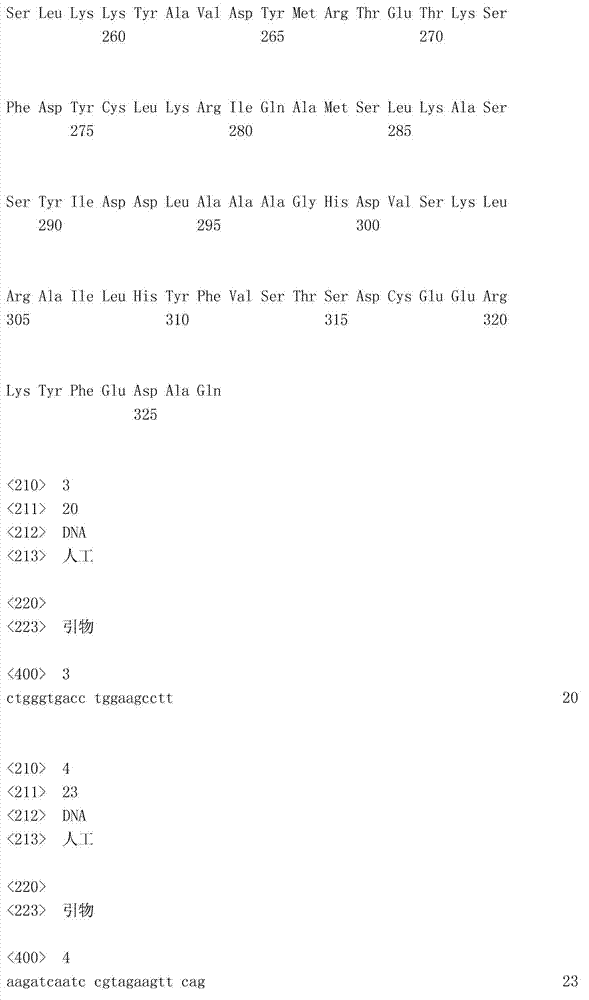


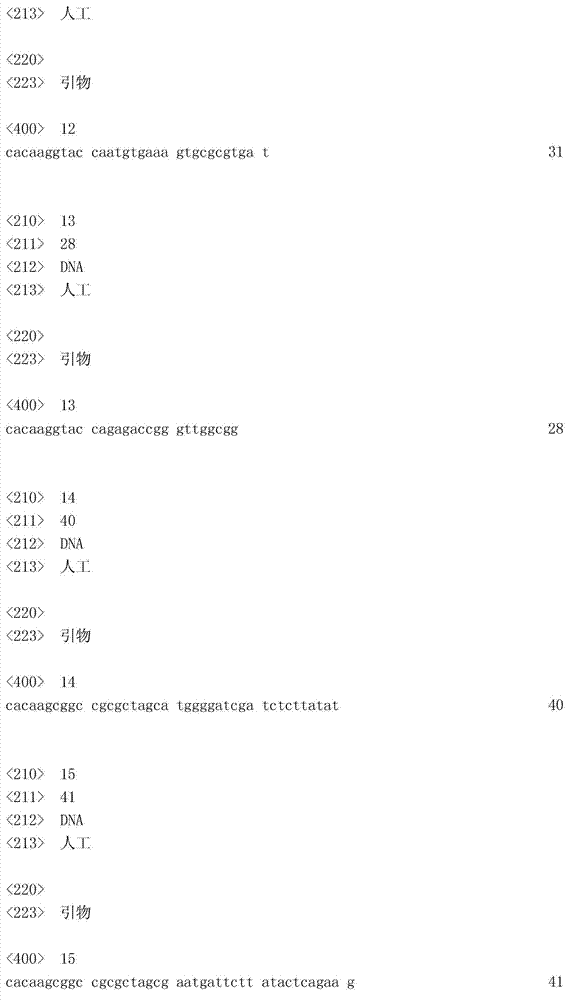


Claims (38)
1. restructuring Ye Shi yeast belong (Yarrowia) fungi, is characterized in that:
A. described fungi because accumulating, to account for its dry cell weight be produce oil fungi at least about 20% lipid; And
B. described Ye Shi yeast belong fungi produces at least one carotenoid, and it can accumulate and accounts for its dry cell weight at least about 1% the carotenoid producing;
Wherein said fungi comprises at least one and produces carotenoid modification, and wherein said at least one produce carotenoid and modify and give described fungi and produce and account for its dry cell weight at least about the ability of described at least one carotenoid of 1% level, or give described fungi and produce the ability that fungi described at least one can spontaneous carotenoid
Wherein said at least one expression or activity of producing carotenoid modification increase or reducing product carotenoid polypeptide, the group that the freely following polypeptide of described product carotenoid polypeptide choosing forms: isoprenoid biosynthetic polypeptide, carotenoid biosynthetic polypeptide, isoprenoid biosynthesizing competitor polypeptide and its combination, and wherein:
(i) group forming below described isoprenoid biosynthetic polypeptide choosing freely: HMG-CoA reductase enzyme polypeptide and GGPP synthase polypeptide; And/or
(ii) group forming below described carotenoid biosynthetic polypeptide choosing freely: carotenoid ketones enzyme polypeptide and carotenoid hydroxylase enzymes polypeptide; And/or
(iii) described isoprenoid biosynthesizing competitor polypeptide is squalene synthase polypeptide.
2. Ye Shi yeast belong fungi according to claim 1, wherein said Ye Shi yeast belong fungi is Yarrowia lipolytica (Yarrowia lipolytica) bacterial strain.
3. Ye Shi yeast belong fungi according to claim 1, wherein said fungi contains at least one produce oil modifies.
4. Ye Shi yeast belong fungi according to claim 3, wherein said at least one produce oil is modified the oil-producing capacity that changes described fungi.
5. Ye Shi yeast belong fungi according to claim 3, wherein said at least one produce oil is modified expression or the activity that increases at least one produce oil polypeptide.
6. Ye Shi yeast belong fungi according to claim 3, wherein said at least one produce oil is modified expression or the activity that reduces at least one produce oil polypeptide.
7. Ye Shi yeast belong fungi according to claim 3, wherein said at least one produce oil is modified expression or the activity that increases at least one produce oil polypeptide, and reduces expression or the activity of at least one other produce oil polypeptide.
8. according to the Ye Shi yeast belong fungi described in claim 5 or 6, wherein said at least one produce oil polypeptide selects the group of freely following polypeptide composition: acetyl-CoA carboxylase polypeptide, pyruvic carboxylase polypeptide, isocitric enzyme polypeptide, ATP-citrate lyase polypeptide, malic enzyme polypeptide, AMP deaminase polypeptide and its combination.
9. according to the Ye Shi yeast belong fungi described in claim 5 or 6, wherein said at least one produce oil polypeptide is at least one selects the polypeptide of the group that Free Surface 1 forms to the polypeptide in arbitrary table in table 6.
10. according to the Ye Shi yeast belong fungi described in claim 5 or 6, wherein said at least one produce oil is modified to be included in and in described fungi, is expressed at least one allos produce oil polypeptide.
11. Ye Shi yeast belong fungies according to claim 10, wherein said at least one produce oil is modified and is comprised the heterologous gene of expressing described at least one the allos produce oil polypeptide of at least one coding.
12. Ye Shi yeast belong fungies according to claim 10, wherein said at least one allos produce oil polypeptide comprises at least two kinds of allos produce oil polypeptide.
13. Ye Shi yeast belong fungies according to claim 12, wherein said at least two kinds of allos produce oil polypeptide are from single primeval life body.
14. Ye Shi yeast belong fungies according to claim 12, wherein said at least two kinds of allos produce oil polypeptide are from least two kinds of different primeval life bodies.
15. Ye Shi yeast belong fungi according to claim 1, wherein said at least one produce carotenoid and modify and give described fungi and produce and account for its dry cell weight at least about the ability of described at least one carotenoid of 1% level.
16. Ye Shi yeast belong fungies according to claim 1, wherein said at least one produce carotenoid and modify and give described fungi and produce the ability that fungi described at least one can spontaneous carotenoid.
17. Ye Shi yeast belong fungi according to claim 1, wherein said fungi comprises at least one produce oil in addition modifies, and wherein said produce oil is modified and changed the oil-producing capacity of described fungi or give described fungi oil-producing capacity.
18. Ye Shi yeast belong fungi according to claim 1, the group that wherein said at least one carotenoid selects free astaxanthin, β-carotene, canthaxanthin, zeaxanthin, xenthophylls, Lyeopene and its combination to form.
19. Ye Shi yeast belong fungies according to claim 1, wherein said at least one carotenoid is mainly astaxanthin.
20. Ye Shi yeast belong fungies according to claim 1, wherein said at least one produce carotenoid and modify and increase at least one expression of producing carotenoid polypeptide or active and reduce at least one other produces expression or the activity of carotenoid polypeptide.
21. according to the Ye Shi yeast belong fungi described in claim 1 or 20, and wherein said at least one product carotenoid is modified to comprise and expressed at least one allos product carotenoid polypeptide.
22. Ye Shi yeast belong fungies according to claim 21, wherein said at least one product carotenoid is modified and is comprised the heterologous gene of expressing described at least one allos product carotenoid polypeptide of at least one coding.
23. Ye Shi yeast belong fungies according to claim 21, wherein said at least one allos is produced carotenoid polypeptide and is comprised at least two kinds of allos product carotenoid polypeptide.
24. Ye Shi yeast belong fungies according to claim 23, it is from single primeval life body that wherein said at least two kinds of allos are produced carotenoid polypeptide.
25. Ye Shi yeast belong fungies according to claim 23, it is from least two kinds of different primeval life bodies that wherein said at least two kinds of allos are produced carotenoid polypeptide.
26. according to the Ye Shi yeast belong fungi described in arbitrary claim in claim 1-7 and 15-20, it is characterized in that the lipid of described fungi accumulation cytosome form.
27. Ye Shi yeast belong fungies according to claim 26, wherein said at least one carotenoid accumulates in described tenuigenin oil body.
28. 1 kinds of Yarrowia lipolyticas (Yarrowia lipolytica) bacterial strain, it comprises one or more and produces carotenoid modification, make described strain for accumulating account at least one carotenoid of its dry cell weight 1% to 10%, the product carotenoid that wherein said Yarrowia lipolytica strain comprises the group that selects the modification composition of freely expressing following heterologous polypeptide is modified: HMG-CoA reductase enzyme polypeptide, GGPP synthase polypeptide, carotenoid ketones enzyme polypeptide, carotenoid hydroxylase enzymes polypeptide and squalene synthase polypeptide.
29. bacterial strains according to claim 28, its another feature is, its accumulation accounts for the lipid of its dry cell weight 20% to 50%.
30. bacterial strains according to claim 29, wherein said strain for accumulating accounts for the lipid of the tenuigenin oil body form of its dry cell weight 20% to 50%.
31. according to the bacterial strain described in arbitrary claim in claim 28 to 30, and wherein said strain for accumulating accounts for the β-carotene of its dry cell weight 1%-10%.
32. according to the bacterial strain described in arbitrary claim in claim 28 to 30, and wherein said strain for accumulating accounts for astaxanthin or the xenthophylls of its dry cell weight 1%-10%.
33. 1 kinds of methods that produce carotenoid, described method comprises following steps:
A. allowing, under the condition of the described carotenoid of generation, to cultivate the Ye Shi yeast belong fungi described in arbitrary claim in aforementioned claim;
B. with separated described produced carotenoid.
34. methods according to claim 33, wherein said separating step comprises the part that isolation medium is rich in carotenoid to obtain at least one.
35. methods according to claim 33, wherein: described culturing step is included in and allows described carotenoid to accumulate and under the condition in tenuigenin oil body, cultivate described Ye Shi yeast belong fungi, and described separating step comprises the separated oil obtaining from described tenuigenin oil body.
36. method according to claim 33, the group that the freely following material of wherein said carotenoid choosing forms: astaxanthin, β-carotene, canthaxanthin, zeaxanthin, xenthophylls, Lyeopene and its combination.
37. methods according to claim 33, wherein said carotenoid comprises astaxanthin.
38. 1 kinds of food of preparing to contain carotenoid or the method for fodder additives, described method comprises following steps:
A. allowing to produce under the condition of described carotenoid, cultivating the Ye Shi yeast belong fungi described in arbitrary claim in claims 1 to 32;
B. separated described carotenoid; With
C. by described separated carotenoid and one or more other food or fodder additives combination of components.
Applications Claiming Priority (2)
| Application Number | Priority Date | Filing Date | Title |
|---|---|---|---|
| US66362105P | 2005-03-18 | 2005-03-18 | |
| US60/663,621 | 2005-03-18 |
Related Parent Applications (1)
| Application Number | Title | Priority Date | Filing Date |
|---|---|---|---|
| CN2006800088162A Division CN101218352B (en) | 2005-03-18 | 2006-03-20 | Production of carotenoids in oleaginous yeast and fungi |
Publications (1)
| Publication Number | Publication Date |
|---|---|
| CN103589650A true CN103589650A (en) | 2014-02-19 |
Family
ID=37024534
Family Applications (2)
| Application Number | Title | Priority Date | Filing Date |
|---|---|---|---|
| CN201310334980.4A Pending CN103589650A (en) | 2005-03-18 | 2006-03-20 | Production of carotenoids in oleaginous yeast and fungi |
| CN2006800088162A Expired - Fee Related CN101218352B (en) | 2005-03-18 | 2006-03-20 | Production of carotenoids in oleaginous yeast and fungi |
Family Applications After (1)
| Application Number | Title | Priority Date | Filing Date |
|---|---|---|---|
| CN2006800088162A Expired - Fee Related CN101218352B (en) | 2005-03-18 | 2006-03-20 | Production of carotenoids in oleaginous yeast and fungi |
Country Status (15)
| Country | Link |
|---|---|
| US (3) | US7851199B2 (en) |
| EP (2) | EP2371967B1 (en) |
| JP (4) | JP2008537878A (en) |
| KR (1) | KR101482081B1 (en) |
| CN (2) | CN103589650A (en) |
| AU (1) | AU2006227165B2 (en) |
| BR (1) | BRPI0609040B1 (en) |
| CA (1) | CA2602183C (en) |
| EA (1) | EA016258B1 (en) |
| ES (1) | ES2546484T3 (en) |
| IL (1) | IL185713A0 (en) |
| NO (1) | NO20075200L (en) |
| UA (1) | UA94038C2 (en) |
| WO (1) | WO2006102342A2 (en) |
| ZA (1) | ZA200707651B (en) |
Cited By (13)
| Publication number | Priority date | Publication date | Assignee | Title |
|---|---|---|---|---|
| CN104962488A (en) * | 2015-07-22 | 2015-10-07 | 天津大学 | Recombinant yeast strain, and construction method and application thereof |
| CN105087406A (en) * | 2015-07-22 | 2015-11-25 | 天津大学 | Recombinant yeast strain as well as construction method and application thereof |
| CN105316246A (en) * | 2014-06-03 | 2016-02-10 | 上海来益生物药物研究开发中心有限责任公司 | Beta-carotene high-yield strain and use thereof |
| CN106676019A (en) * | 2016-11-28 | 2017-05-17 | 无锡新和源发酵技术研究院有限公司 | Method for producing astaxanthin by utilizing microbial fermentation |
| CN108118007A (en) * | 2016-11-30 | 2018-06-05 | 上海医药工业研究院 | A kind of method and its genetic engineering bacterium of genetic engineering bacterium production beta carotene |
| CN109234216A (en) * | 2017-07-10 | 2019-01-18 | 上海医药工业研究院 | A kind of genetic engineering bacterium producing squalene and its method |
| CN109890961A (en) * | 2016-10-27 | 2019-06-14 | 帝斯曼知识产权资产管理有限公司 | Geranyl geranyl pyrophosphate ester synthase |
| CN111454854A (en) * | 2020-05-02 | 2020-07-28 | 昆明理工大学 | A genetically engineered strain of Rhodosporidium to produce astaxanthin |
| CN113308387A (en) * | 2021-03-31 | 2021-08-27 | 南京工业大学 | Bacterial strain for co-production of unsaturated fatty acid and carotenoid and application thereof |
| CN114107340A (en) * | 2021-08-11 | 2022-03-01 | 昆明理工大学 | Mevalonate kinase gene RKMK and application thereof |
| CN114806914A (en) * | 2022-05-20 | 2022-07-29 | 南京工业大学 | A kind of Yarrowia lipolytica with high β-carotene and its application |
| CN118909806A (en) * | 2024-09-24 | 2024-11-08 | 广东芭薇生物科技股份有限公司 | Rhodotorula for high yield of carotenoid, fermentation product and application thereof |
| CN119736365A (en) * | 2025-03-06 | 2025-04-01 | 云南西草资源开发有限公司 | A preparation method and application of fermentation product containing carotenoids |
Families Citing this family (126)
| Publication number | Priority date | Publication date | Assignee | Title |
|---|---|---|---|---|
| US8577205B2 (en) * | 1998-07-30 | 2013-11-05 | Tivo Inc. | Digital video recording system |
| CN101077006A (en) * | 2004-11-19 | 2007-11-21 | Tivo股份有限公司 | Method and apparatus for secure transfer and playback of multimedia content |
| CN103589650A (en) | 2005-03-18 | 2014-02-19 | 米克罗比亚公司 | Production of carotenoids in oleaginous yeast and fungi |
| PL1940465T3 (en) | 2005-10-26 | 2013-01-31 | Novartis Ag | Novel use of anti il-1beta antibodies |
| EP2004801A2 (en) * | 2006-03-20 | 2008-12-24 | Microbia Precision Engineering | Production of quinone derived compounds in oleaginous yeast fungi |
| WO2008042338A2 (en) * | 2006-09-28 | 2008-04-10 | Microbia, Inc. | Production of carotenoids in oleaginous yeast and fungi |
| US8846374B2 (en) * | 2006-12-12 | 2014-09-30 | E I Du Pont De Nemours And Company | Carotenoid production in a recombinant oleaginous yeast |
| US20090004715A1 (en) | 2007-06-01 | 2009-01-01 | Solazyme, Inc. | Glycerol Feedstock Utilization for Oil-Based Fuel Manufacturing |
| JP2009000046A (en) * | 2007-06-21 | 2009-01-08 | Hitachi Zosen Corp | A gene encoding an enzyme in the mevalonate pathway of Eucommia |
| WO2009006386A2 (en) * | 2007-06-29 | 2009-01-08 | The Regents Of The University Of California | Host cells and methods for producing isoprenyl alkanoates |
| WO2009010826A2 (en) * | 2007-07-13 | 2009-01-22 | Ocean Nutrition Canada Ltd. | Novel genes and methods of producing carotenoids |
| CA2702924C (en) | 2007-10-26 | 2017-08-15 | Suntory Holdings Limited | Atp:citrate lyase genes |
| WO2009086423A2 (en) | 2007-12-23 | 2009-07-09 | Gevo, Inc. | Yeast organism producing isobutanol at a high yield |
| US8455239B2 (en) | 2007-12-23 | 2013-06-04 | Gevo, Inc. | Yeast organism producing isobutanol at a high yield |
| MY153731A (en) | 2007-12-27 | 2015-03-13 | Gevo Inc | Recovery of higher alcohols from dilute aqueous solutions |
| CA2720828C (en) | 2008-04-09 | 2017-03-21 | Solazyme, Inc. | Direct chemical modification of microbial biomass and microbial oils |
| WO2009126890A2 (en) * | 2008-04-10 | 2009-10-15 | Microbia, Inc. | Production of carotenoids in oleaginous yeast and fungi |
| JP2011520471A (en) * | 2008-05-23 | 2011-07-21 | サイバス オイルズ,エルエルシー | Production of squalene using yeast |
| US8609371B2 (en) | 2008-08-12 | 2013-12-17 | Allylix, Inc. | Isoprenoid compounds |
| WO2010062707A1 (en) * | 2008-10-30 | 2010-06-03 | Joule Unlimited, Inc. | Methods and compositions for producing carbon-based products of interest in micro-organisms |
| WO2010053636A1 (en) * | 2008-11-06 | 2010-05-14 | Tate & Lyle Technology Ltd | Enhanced production and purification of a natural high intensity sweetener |
| AU2009319722B2 (en) | 2008-11-28 | 2016-08-04 | Corbion Biotech, Inc. | Production of tailored oils in heterotrophic microorganisms |
| CA2760631C (en) | 2009-05-01 | 2015-02-17 | Nissan Motor Co., Ltd. | Gas diffusion layer for fuel cell |
| CN102459627B (en) | 2009-06-16 | 2015-07-29 | 纳幕尔杜邦公司 | By the expression of the Acyl-coenzyme A lysophospholipid acyltransferase biosynthetic improvement to long-chain omega-3 and omega 6 polyunsaturated fatty acid |
| EP2292741A1 (en) * | 2009-08-26 | 2011-03-09 | OrganoBalance GmbH | Genetically modified organisms for the production of lipids |
| CN102666837A (en) * | 2009-11-23 | 2012-09-12 | 纽塞利斯公司 | Methods and compositions for producing squalene using yeast |
| WO2011133610A1 (en) | 2010-04-22 | 2011-10-27 | E. I. Du Pont De Nemours And Company | Method for obtaining polyunsaturated fatty acid-containing compositions from microbial biomass |
| US8592188B2 (en) | 2010-05-28 | 2013-11-26 | Solazyme, Inc. | Tailored oils produced from recombinant heterotrophic microorganisms |
| KR101283149B1 (en) | 2010-08-06 | 2013-07-05 | 문기혁 | Development of medium and culture condition for mixed culture Lyophyllum cinerascens, Pleurotus ostreatus, Flammulina velutipes, Pleurotus eryngii etc with phaffia rhodozyma and Method for production of feed additive with astaxanthin having antioxidant effect. |
| US20120040076A1 (en) * | 2010-08-11 | 2012-02-16 | E. I. Du Pont De Nemours And Company | Aquaculture feed compositions |
| EP2609203B1 (en) | 2010-08-26 | 2018-06-20 | E. I. du Pont de Nemours and Company | Recombinant microbial host cells for high eicosapentaenoic acid production |
| CA2808002A1 (en) | 2010-08-26 | 2012-03-01 | E. I. Du Pont De Nemours And Company | Mutant hpgg motif and hdash motif delta-5 desaturases and their use in making polyunsaturated fatty acids |
| AU2011293167B2 (en) | 2010-08-26 | 2016-12-08 | E. I. Du Pont De Nemours And Company | Mutant delta-9 elongases and their use in making polyunsaturated fatty acids |
| EP2635663B1 (en) | 2010-11-03 | 2019-05-08 | Corbion Biotech, Inc. | Microbial oils with lowered pour points, dielectric fluids produced therefrom, and related methods |
| CN102071154B (en) * | 2010-12-08 | 2013-05-22 | 江南大学 | A kind of α-ketoglutarate-producing yeast engineering bacteria and its construction method |
| JP2014505472A (en) * | 2010-12-30 | 2014-03-06 | イー・アイ・デュポン・ドウ・ヌムール・アンド・カンパニー | Oil content increased by increasing YAP1 transcription factor activity in oleaginous yeast |
| DK2668284T3 (en) * | 2011-01-28 | 2014-12-15 | Amyris Inc | Screening of colony micro encapsulated in gel |
| KR101964965B1 (en) | 2011-02-02 | 2019-04-03 | 테라비아 홀딩스 인코포레이티드 | Tailored oils produced from recombinant oleaginous microorganisms |
| US9051587B2 (en) * | 2011-02-28 | 2015-06-09 | Organobalance Gmbh | Yeast cell for the production of terpenes and uses thereof |
| EP2691518A1 (en) | 2011-03-31 | 2014-02-05 | E.I. Du Pont De Nemours And Company | Yarrowia diacylglycerol acyltransferase promoter regions for gene expression in yeast |
| US20120247066A1 (en) | 2011-04-01 | 2012-10-04 | Ice House America, Llc | Ice bagging apparatus and methods |
| EP2694665A1 (en) | 2011-04-01 | 2014-02-12 | E. I. Du Pont de Nemours and Company | Yarrowia esterase/lipase promoter regions for gene expression in yeast |
| US8735094B2 (en) | 2011-04-05 | 2014-05-27 | E I Du Pont De Nemours And Company | Yarrowia n-alkane-hydroxylating cytochrome P450 promoter regions for gene expression in yeast |
| EP2702148A1 (en) | 2011-04-07 | 2014-03-05 | E.I. Du Pont De Nemours And Company | Yarrowia peroxisomal 2,4-dienoyl-coa reductase promoter regions for gene expression in yeast |
| MX339607B (en) | 2011-05-06 | 2016-05-31 | Solazyme Inc | Genetically engineered microorganisms that metabolize xylose. |
| CN102250958B (en) * | 2011-07-08 | 2013-01-02 | 山东大学 | Method for quickly extracting carotenoid generated by in-vitro enzyme reaction |
| CN102286593B (en) * | 2011-07-08 | 2013-03-13 | 山东大学 | Method for increasing phytoene dehydrogenase in vitro reaction rate |
| AU2013211605B2 (en) | 2012-01-23 | 2017-04-06 | Dsm Ip Assets B.V. | Diterpene production |
| US10059974B2 (en) * | 2012-02-06 | 2018-08-28 | The Research Foundation Of The City University Of New York | Cells and methods for producing lutein |
| RU2014143811A (en) * | 2012-03-30 | 2016-05-27 | Конинклейке Филипс Н.В. | PORTABLE MEDICAL VISUALIZATION DEVICE WITH GRAPHIC USER INTERFACE |
| US8916365B2 (en) | 2012-04-03 | 2014-12-23 | E I Du Pont De Nemours And Company | Expression of cytosolic malic enzyme in transgenic Yarrowia to increase lipid production |
| US8945908B2 (en) | 2012-04-18 | 2015-02-03 | Solazyme, Inc. | Tailored oils |
| US9416382B2 (en) | 2012-06-19 | 2016-08-16 | E I Du Pont De Nemours And Company | Production of polyunsaturated fatty acids by coexpression of acyl-CoA:lysophosphatidylcholine acyltransferases and phospholipid:diacylglycerol acyltransferases |
| AU2013289943B2 (en) * | 2012-07-13 | 2017-06-08 | Calysta Inc. | Biorefinery system, methods and compositions thereof |
| US10597665B1 (en) | 2012-11-27 | 2020-03-24 | University Of Kentucky Research Foundation | Method and System for diterpene production platforms in yeast |
| BR112015014258B1 (en) * | 2012-12-20 | 2022-05-17 | Dsm Ip Assets B.V. | TRANSFORMED MICRO-ORGANISM, ITS PRODUCTION PROCESS AND USE TO PRODUCE CAROTENOIDS |
| CN105308180A (en) | 2012-12-20 | 2016-02-03 | 帝斯曼知识产权资产管理有限公司 | Carotene hydroxylase and its use for producing carotenoids |
| WO2014140924A2 (en) * | 2013-03-12 | 2014-09-18 | International Park Of Creativity | Biological devices and methods for increasing the production of lycopene from plants |
| ES2762154T3 (en) | 2013-03-15 | 2020-05-22 | Dsm Ip Assets Bv | Using thermophilic nucleases to degrade nucleic acids |
| EP2993993A2 (en) | 2013-04-26 | 2016-03-16 | Solazyme, Inc. | Low polyunsaturated fatty acid oils and uses thereof |
| DE102013209950A1 (en) | 2013-05-28 | 2014-12-04 | Technische Universität Dresden | Yeast strain and method for the production of lycopene |
| CL2014001475A1 (en) * | 2013-06-05 | 2015-10-30 | Vale Sa | Process for obtaining copper nanoparticles from mucilaginous rhodotorula and use of mucilaginous rhodotorula in wastewater bioremediation and production of copper nanoparticles. |
| MX369685B (en) | 2013-10-04 | 2019-11-19 | Terravia Holdings Inc | Tailored oils. |
| KR20160095049A (en) | 2013-12-06 | 2016-08-10 | 디에스엠 아이피 어셋츠 비.브이. | Biomass formulation |
| BR112016017468A2 (en) * | 2014-01-31 | 2017-10-10 | Dsm Ip Assets Bv | suitable promoters for the expression of heterologous genes in yeast |
| JP2017515512A (en) * | 2014-05-16 | 2017-06-15 | アカデミア シニカAcademia Sinica | Recombinant polynucleotide sequences for producing astaxanthin and uses thereof |
| US9969990B2 (en) | 2014-07-10 | 2018-05-15 | Corbion Biotech, Inc. | Ketoacyl ACP synthase genes and uses thereof |
| CN104152473B (en) * | 2014-08-18 | 2019-07-12 | 中国烟草总公司郑州烟草研究院 | Tobacco Carotenoid isomerase gene and its application |
| CN104293874B (en) * | 2014-09-23 | 2017-12-01 | 中国海洋大学 | A kind of method for preparing free astaxanthin |
| JP6436417B2 (en) * | 2014-12-01 | 2018-12-12 | 住友ゴム工業株式会社 | Amorpha-4,11-diene production increase method and natural rubber production increase method |
| US10563190B2 (en) | 2014-12-09 | 2020-02-18 | Dsm Ip Assets B.V. | Methods for producing abienol |
| WO2016099401A1 (en) | 2014-12-15 | 2016-06-23 | Temasek Life Sciences Laboratory Limited | Methods for tuning carotenoid production levels and compositions in rhodosporidium and rhodotorula genera |
| WO2016110512A1 (en) | 2015-01-06 | 2016-07-14 | Dsm Ip Assets B.V. | A crispr-cas system for a yeast host cell |
| CN104673813B (en) * | 2015-03-24 | 2017-07-28 | 武汉大学 | A kind of ophiobolin class compound parent nucleus synthetic gene AuOS and its application |
| US11332724B2 (en) | 2015-04-21 | 2022-05-17 | Dsm Ip Assets B.V. | Microbial production of terpenoids |
| WO2017120426A1 (en) * | 2016-01-08 | 2017-07-13 | Dsm Ip Assets B.V. | Mating type switch in yarrowia lipolytica |
| JP2019165635A (en) * | 2016-08-10 | 2019-10-03 | 味の素株式会社 | Method for producing L-amino acid |
| CN106858552B (en) * | 2017-01-21 | 2020-07-31 | 湖北工业大学 | Preparation method of olive paste rich in carotenoid |
| CA3049126A1 (en) | 2017-01-25 | 2018-08-02 | Amyris Bio Products Portugal, Unipessoal, Lda | Co-production of isoprenoids |
| CN107058526B (en) * | 2017-03-21 | 2020-12-29 | 济南大学 | A method to analyze the regulation mechanism of maize grain carotenoid metabolism based on the dynamic association of gene pair co-expression patterns |
| US11603549B2 (en) | 2017-09-12 | 2023-03-14 | Bio Capital Holdings, LLC | Biological devices and methods of use thereof to produce carotenoids |
| US11905542B2 (en) * | 2017-09-25 | 2024-02-20 | Dsm Ip Assets B.V. | Production of retinyl esters |
| US12049658B2 (en) | 2017-09-25 | 2024-07-30 | Dsm Ip Assets B.V. | Production of retinyl esters |
| WO2019057998A1 (en) | 2017-09-25 | 2019-03-28 | Dsm Ip Assets B.V. | Production of retinol |
| JP2020535794A (en) | 2017-09-25 | 2020-12-10 | ディーエスエム アイピー アセッツ ビー.ブイ.Dsm Ip Assets B.V. | Production of trans-retinal |
| CN111107834A (en) | 2017-09-25 | 2020-05-05 | 帝斯曼知识产权资产管理有限公司 | Retinoid biosynthesis |
| WO2020060948A1 (en) | 2018-09-17 | 2020-03-26 | Levadura Biotechnology, Inc. | Production of cannabinoids in yeast using a fatty acid feedstock |
| CN109536518A (en) * | 2018-10-31 | 2019-03-29 | 昆明理工大学 | A kind of Phytoene dehydrogenase gene RKcrtI and its application |
| CN111321156B (en) * | 2018-12-14 | 2021-05-25 | 华中农业大学 | Application of OsLUT1 gene in regulating rice photoprotection |
| BR112021012401A2 (en) | 2018-12-31 | 2021-12-14 | Dsm Ip Assets Bv | Innovative acetyltransferases |
| CN119498443A (en) * | 2019-01-03 | 2025-02-25 | 柯碧恩生物技术公司 | Method for producing lysed cell suspension |
| CN109666683B (en) * | 2019-02-27 | 2021-10-29 | 昆明理工大学 | Acetyl-CoA acetyltransferase gene RKAcaT2 and its application |
| CN109777815B (en) * | 2019-03-28 | 2021-10-29 | 昆明理工大学 | HMG-CoA synthase gene RKHMGCS and its application |
| EP3999634A1 (en) | 2019-07-16 | 2022-05-25 | DSM IP Assets B.V. | Novel beta-carotene oxidases |
| CN110499259B (en) * | 2019-07-22 | 2021-07-27 | 浙江工业大学 | A kind of Yarrowia Yarrowia YW100-1 and its application |
| EP4007817A1 (en) | 2019-08-01 | 2022-06-08 | DSM IP Assets B.V. | Beta-carotene fermentation method |
| CN110540952B (en) * | 2019-09-09 | 2021-05-11 | 北京科技大学 | Lutein-producing prokaryotic microorganism and its application in the production of lutein |
| CN110747206B (en) * | 2019-11-05 | 2021-11-23 | 昆明理工大学 | 3-hydroxy-3-methylglutaryl coenzyme A reductase gene RKHMGR and application thereof |
| CA3166033A1 (en) | 2019-12-30 | 2021-07-08 | Dsm Ip Assets B.V. | Lipase-modified strain |
| CN111171129B (en) * | 2020-03-09 | 2022-02-01 | 山东省农业科学院作物研究所 | Lce mutant of key gene in wheat carotenoid synthetic pathway and application thereof |
| WO2022003130A2 (en) | 2020-07-01 | 2022-01-06 | Dsm Ip Assets B.V. | Yeast expression system |
| US20230174922A1 (en) * | 2020-07-08 | 2023-06-08 | The Regents Of The University Of California | Modified yeast host cells useful for producing isoprenol |
| WO2023006179A1 (en) | 2020-07-27 | 2023-02-02 | Dsm Ip Assets B.V. | Method to produce retinyl acetate |
| EP4189079A1 (en) | 2020-07-27 | 2023-06-07 | DSM IP Assets B.V. | Reduction of fatty acid retinyl ester formation |
| WO2022090549A1 (en) | 2020-10-30 | 2022-05-05 | Dsm Ip Assets B.V. | In situ two-phase extraction system |
| WO2022090547A1 (en) | 2020-10-30 | 2022-05-05 | Dsm Ip Assets B.V. | Production of carotenoids by fermentation |
| US20230407344A1 (en) | 2020-10-30 | 2023-12-21 | Dsm Ip Assets B.V. | Fermentative production of isoprenoids |
| CN113151340B (en) * | 2020-11-25 | 2023-03-24 | 广州智特奇生物科技股份有限公司 | Genetic engineering bacterium for increasing yield of beta-carotene and application thereof |
| KR20230171982A (en) | 2021-04-16 | 2023-12-21 | 카프라 바이오사이언시즈 인코포레이티드 | Isoprenoid synthesis method using genetically engineered hydrocarbon-degrading organisms in biofilm bioreactors |
| KR102600520B1 (en) * | 2021-06-09 | 2023-11-09 | 씨제이제일제당 주식회사 | Geranylgeranyl pyrophosphate synthase variant and method of producing tetraterpene, precursor thereof and compounds in which the precursor is tetraterpene using the variant |
| WO2023006851A1 (en) | 2021-07-27 | 2023-02-02 | Dsm Ip Assets B.V. | Fermentative production of retinyl acetate in the presence of ethanol |
| US20250002873A1 (en) | 2021-10-19 | 2025-01-02 | Dsm Ip Assets B.V. | Retinoid production |
| CN114540403B (en) * | 2021-11-12 | 2024-04-05 | 嘉必优生物技术(武汉)股份有限公司 | Method for producing esterified astaxanthin and use of esterified gene |
| EP4469591A2 (en) * | 2022-01-28 | 2024-12-04 | Massachusetts Institute of Technology | Methods of producing carotenoids from acid whey |
| US20250109422A1 (en) | 2022-02-02 | 2025-04-03 | Dsm Ip Assets B.V. | Yarrowia production process |
| KR102828745B1 (en) * | 2022-03-23 | 2025-07-03 | 씨제이제일제당 주식회사 | Microorganism comprising Geranylgeranyl pyrophosphate synthase derived from Haematococcus pluvialis, for producing carotenoid or compound in which a precursor thereof is carotenoid, and method using the same |
| KR102828744B1 (en) * | 2022-03-23 | 2025-07-03 | 씨제이제일제당 주식회사 | Microorganism comprising Geranylgeranyl pyrophosphate synthase derived from Dunaliella salina, for producing carotenoid or compound in which a precursor thereof is carotenoid, and method using the same |
| CN115029257B (en) * | 2022-05-05 | 2023-09-26 | 南京工业大学 | Recombinant Yarrowia lipolytica producing β-carotene and its construction method and application |
| CN115160443B (en) * | 2022-06-21 | 2026-04-07 | 广州智特奇生物科技股份有限公司 | A genetically engineered bacterium that increases maize xanthine yield, its construction method and application |
| CN115851861A (en) * | 2022-11-11 | 2023-03-28 | 中国农业科学院油料作物研究所 | Application of esterification gene in esterification of astaxanthin |
| JP2026508737A (en) | 2022-12-02 | 2026-03-12 | ディーエスエム アイピー アセッツ ビー.ブイ. | A retinoid-containing composition produced by fermentation, and a method for producing and using the same. |
| KR20250140584A (en) | 2023-01-30 | 2025-09-25 | 디에스엠 아이피 어셋츠 비.브이. | Novel acetyltransferase |
| AU2024214641A1 (en) | 2023-01-30 | 2025-08-21 | Dsm Ip Assets B.V. | Novel mutants of acetyl-transferase sb-atf |
| AU2024213498A1 (en) | 2023-01-30 | 2025-08-14 | Dsm Ip Assets B.V. | Carrp enzyme variants and their use in producing carotenoid and apocarotenoid |
| CN118064533B (en) * | 2023-07-04 | 2024-11-29 | 广东筑美生物医疗科技有限公司 | A method for strengthening Yarrowia lipolytica to produce beta-carotene |
| WO2025228974A1 (en) | 2024-04-30 | 2025-11-06 | Basf Se | Improved method and enzymes for the production of vitamin a |
Family Cites Families (274)
| Publication number | Priority date | Publication date | Assignee | Title |
|---|---|---|---|---|
| NZ190194A (en) | 1978-05-08 | 1982-02-23 | Cpc International Inc | Production of oil by fermenting yeast in fatty acids |
| US4318987A (en) * | 1979-11-16 | 1982-03-09 | Murillo Araujo Francisco J | β-Carotene producing strains of the fungus phycomyces blakesleenus |
| EP0052777A1 (en) * | 1980-11-20 | 1982-06-02 | F. HOFFMANN-LA ROCHE & CO. Aktiengesellschaft | Process for the extraction of beta-carotene from algae |
| IN163393B (en) | 1983-10-06 | 1988-09-17 | Pfizer | |
| US5071764A (en) * | 1983-10-06 | 1991-12-10 | Pfizer Inc. | Process for integrative transformation of yarrowia lipolytica |
| US4880741A (en) * | 1983-10-06 | 1989-11-14 | Pfizer Inc. | Process for transformation of Yarrowia lipolytica |
| DE3572688D1 (en) | 1984-06-26 | 1989-10-05 | Agronomique Inst Nat Rech | Transformation vector for yeast yarrowia lipolytica, transformation process and transformed yeast |
| US4870011A (en) | 1985-01-22 | 1989-09-26 | Director General Of Agency Of Industrial Science And Technology | Method for obtaining lipids from fungus bodies |
| US4680314A (en) * | 1985-08-30 | 1987-07-14 | Microbio Resources, Inc. | Process for producing a naturally-derived carotene/oil composition by direct extraction from algae |
| US4937189A (en) * | 1985-10-18 | 1990-06-26 | Pfizer Inc. | Expression and secretion of heterologous proteins by Yarrowia lipolytica transformants |
| US4851339A (en) * | 1986-04-01 | 1989-07-25 | Hills Christopher B | Extraction of anti-mutagenic pigments from algae and vegetables |
| DK199887D0 (en) | 1987-04-15 | 1987-04-15 | Danisco Bioteknologi As | yeast strain |
| US5356810A (en) * | 1987-04-15 | 1994-10-18 | Gist-Brocades N.V. | Astaxanthin-producing yeast cells, methods for their preparation and their use |
| US5360730A (en) * | 1987-06-05 | 1994-11-01 | Universal Foods Corporation | Zeaxanthin producing strains of Neospongiococcum Excentricum |
| US5182208A (en) | 1988-08-08 | 1993-01-26 | Igene Biotechnology, Inc. | Processes for in vivo production of astaxanthin and phaffia rhodozyma yeast of enhanced astaxanthin content |
| US5356809A (en) | 1988-08-08 | 1994-10-18 | Igene Biotechnology, Inc. | Processes for in vivo production of astaxanthin and phaffia rhodozyma yeast of enhanced astaxanthin content |
| ATE147784T1 (en) | 1988-08-08 | 1997-02-15 | Igene Biotechnology Inc | METHOD FOR THE IN VIVO PRODUCTION OF ASTAXANTHIN AND PHAFFIA RHODOZYMA YEAST WITH INCREASED ASTAXANTHIN CONTENT |
| US6849434B2 (en) | 1988-08-31 | 2005-02-01 | University Of Florida Research Foundation, Inc. | Ethanol production in recombinant hosts |
| US5429939A (en) * | 1989-04-21 | 1995-07-04 | Kirin Beer Kabushiki Kaisha | DNA sequences useful for the synthesis of carotenoids |
| JP2950888B2 (en) * | 1989-04-21 | 1999-09-20 | 麒麟麦酒株式会社 | DNA strands useful for carotenoid synthesis |
| NZ232366A (en) | 1989-07-28 | 1991-08-27 | Igene Biotechnology Inc | Production of astaxanthin and the enhancement of its content in yeast |
| NO904447L (en) | 1989-10-27 | 1991-04-29 | Enzymatix Ltd | PROCEDURE FOR PREPARING A YEAR TRIBLE. |
| US5164308A (en) | 1990-05-21 | 1992-11-17 | Martek Corporation | Preparation of labelled triglyceride oils by cultivation of microorganisms |
| US5306862A (en) | 1990-10-12 | 1994-04-26 | Amoco Corporation | Method and composition for increasing sterol accumulation in higher plants |
| US5212088A (en) | 1990-10-23 | 1993-05-18 | Phillips Petroleum Company | Spheroplast fusions of phaffia rhodozyma cells |
| US5460949A (en) * | 1990-11-15 | 1995-10-24 | Amoco Corporation | Method and composition for increasing the accumulation of squalene and specific sterols in yeast |
| CA2101274C (en) | 1991-01-24 | 1998-12-15 | David J. Kyle | Microbial oil mixtures and uses thereof |
| EP0543023A4 (en) | 1991-06-06 | 1993-12-01 | Kyowa Hakko Kogyo Kabushiki Kaisha | Process for producing astaxanthin by fermentation |
| US5648261A (en) * | 1991-12-17 | 1997-07-15 | Gist-Brocades, N.V. | Strains of Phaffia rhodozyma containing high levels of astaxanthin and low levels of 3-hydroxy-3',4'-didehydro-β, Ψ-caroten-4-one (HDCO) |
| IL104736A0 (en) | 1992-03-27 | 1993-06-10 | Zeagen Inc | Method for producing beta-carotene using a fungal mated culture |
| US5328845A (en) * | 1992-03-27 | 1994-07-12 | Universal Foods Corporation | Fungal negative microorganism capable of producing high levels of beta-carotene |
| EP0587872B1 (en) | 1992-04-03 | 2000-05-31 | Dsm N.V. | Intersexual heterozygous phycomyces |
| CN1079001A (en) * | 1992-04-03 | 1993-12-01 | 吉斯特·布罗卡迪斯公司 | The phycomyces of intersexuality heterozygosis (phycomyces) |
| NZ248628A (en) | 1992-09-11 | 1996-02-27 | Gist Brocades Nv | Transformed phaffia (yeast) strains and methods and vectors used |
| US5310554A (en) * | 1992-10-27 | 1994-05-10 | Natural Carotene Corporation | High purity beta-carotene |
| FR2700552B1 (en) * | 1993-01-19 | 1995-04-21 | Pernod Ricard | Mutants of Phaffia rhodozyma, process for producing beta-carotene and use of biomass rich in beta-carotene. |
| ZA94614B (en) * | 1993-02-11 | 1994-08-12 | Sasol Chem Ind Pty | Solvent extraction |
| US5466599A (en) | 1993-04-19 | 1995-11-14 | Universal Foods Corporation | Astaxanthin over-producing strains of phaffia rhodozyma |
| US5607839A (en) | 1993-07-22 | 1997-03-04 | Nippon Oil Company, Ltd. | Bacteria belonging to new genus process for production of carotenoids using same |
| US5786212A (en) * | 1993-09-02 | 1998-07-28 | Pfizer Inc. | Multiple integrative vectors and Yarrowia lipolytica transformants |
| US5792903A (en) | 1993-10-25 | 1998-08-11 | Yissum Research Development Company Of Hebrew University Of Jerusalem | Lycopene cyclase gene |
| EP1203818A3 (en) | 1993-12-27 | 2002-06-12 | Kirin Beer Kabushiki Kaisha | DNA Strands useful for the synthesis of xanthophylls and the process for producing the xanthophylls |
| JPH07242621A (en) | 1994-03-02 | 1995-09-19 | Nippon Oil Co Ltd | Method for extracting carotenoid compound |
| JP3198842B2 (en) * | 1994-03-24 | 2001-08-13 | トヨタ自動車株式会社 | Geranylgeranyl diphosphate synthase and DNA encoding the same |
| JPH08173170A (en) | 1994-05-25 | 1996-07-09 | Kirin Brewery Co Ltd | Transformation system of Candida utilis yeast and expression of heterologous gene by it |
| WO1998055632A1 (en) | 1997-06-05 | 1998-12-10 | Calgene Llc | FATTY ACYL-CoA: FATTY ALCOHOL ACYLTRANSFERASES |
| JP3087575B2 (en) | 1994-07-29 | 2000-09-11 | トヨタ自動車株式会社 | Heptaprenyl diphosphate synthase and DNA encoding the same |
| US5928696A (en) | 1994-08-16 | 1999-07-27 | Dr. Frische Gmbh | Process for extracting native products which are not water-soluble from native substance mixtures by centrifugal force |
| KR0178871B1 (en) | 1994-08-23 | 1999-04-01 | 게이사쿠 마나베 | Keto group transduction enzymes, DNA encoding them and methods for producing ketocarotenoids |
| DE69526842T3 (en) * | 1994-08-23 | 2005-10-27 | Kirin Beer K.K. | KETOGRUPPE-INTRODUCING ENZYME, DNA COORDINATING THEREFOR AND METHOD FOR PRODUCING KETOCAROTENOIDE |
| JP3727077B2 (en) * | 1994-09-27 | 2005-12-14 | 新日本石油株式会社 | Extraction method of carotenoid compounds from bacterial cells |
| EP0785995A1 (en) | 1994-10-14 | 1997-07-30 | Novo Nordisk A/S | A novel enzyme with beta-1,3-glucanase activity |
| US5786193A (en) * | 1995-01-11 | 1998-07-28 | Human Genome Sciences, Inc. | Human geranylgeranyl pyrophosphate synthethase |
| JPH10512145A (en) | 1995-01-11 | 1998-11-24 | ヒューマン ジノーム サイエンシーズ,インコーポレイテッド | Human geranylgeranyl pyrophosphate synthetase |
| US5583019A (en) | 1995-01-24 | 1996-12-10 | Omegatech Inc. | Method for production of arachidonic acid |
| JP3120684B2 (en) * | 1995-02-14 | 2000-12-25 | トヨタ自動車株式会社 | Mutant farnesyl diphosphate synthase that synthesizes geranylgeranyl diphosphate and DNA encoding the same |
| JP3151371B2 (en) | 1995-03-10 | 2001-04-03 | 麒麟麦酒株式会社 | DNA strands useful for increasing carotenoid production |
| WO1996033276A1 (en) | 1995-04-21 | 1996-10-24 | Human Genome Sciences, Inc. | NUCLEOTIDE SEQUENCE OF THE HAEMOPHILUS INFLUENZAE Rd GENOME, FRAGMENTS THEREOF, AND USES THEREOF |
| EP0747484A1 (en) | 1995-06-08 | 1996-12-11 | Institut National De La Recherche Agronomique (Inra) | Upstream activator sequences and recombinant promoter sequences functional in yarrowia and vectors containing them |
| ES2216027T3 (en) | 1995-06-09 | 2004-10-16 | Dsm Ip Assets B.V. | PRODUCTION OF FERMENTATIVE CAROTENOIDS. |
| AU724054B2 (en) | 1995-08-17 | 2000-09-14 | Regents Of The University Of California, The | Genes and proteins controlling cholesterol synthesis |
| JP3538998B2 (en) * | 1995-09-01 | 2004-06-14 | トヨタ自動車株式会社 | Long-chain prenyl diphosphate synthase |
| JPH09107974A (en) | 1995-10-19 | 1997-04-28 | Toyota Motor Corp | Thermostable geranylgeranyl diphosphate synthase |
| US5916791A (en) | 1995-11-24 | 1999-06-29 | Hirschberg; Joseph | Polynucleotide molecule from Haematococcus pluvialis encoding a polypeptide having a β--C--4--oxygenase activity for biotechnological production of (3S,3S)astaxanthin |
| DE69633343T2 (en) | 1995-12-22 | 2005-09-22 | Dsm Ip Assets B.V. | IMPROVED METHODS FOR THE TRANSFORMATION OF PHAFFIASTAMENTS, TRANSFORMED PHAFFIASTAMAS IN THIS WAY, AND RECOMMINANT DNA USED IN A SPECIFIC PROCESS |
| IL116995A (en) | 1996-02-01 | 2000-08-31 | Univ Ben Gurion | Procedure for large-scale production of astaxanthin from haematococcus |
| WO1997029114A1 (en) | 1996-02-08 | 1997-08-14 | Board Of Regents Of The University Of Washington | Biotin-containing compounds, biotinylation reagents and methods |
| US6255505B1 (en) | 1996-03-28 | 2001-07-03 | Gist-Brocades, B.V. | Microbial polyunsaturated fatty acid containing oil from pasteurised biomass |
| EP0904359A1 (en) | 1996-04-12 | 1999-03-31 | Novo Nordisk A/S | AN ENZYME WITH $g(b)-1,3-GLUCANASE ACTIVITY |
| WO1997044470A1 (en) * | 1996-05-21 | 1997-11-27 | Novo Nordisk A/S | Novel yeast promoters suitable for expression cloning in yeast and heterologous expression of proteins in yeast |
| US6174715B1 (en) | 1996-06-14 | 2001-01-16 | Toyota Jidosha Kabushiki Kaisha | Prenyl diphosphate synthetase genes |
| JP3209103B2 (en) | 1996-07-03 | 2001-09-17 | トヨタ自動車株式会社 | Mutant prenyl diphosphate synthase |
| JP3379344B2 (en) | 1996-07-24 | 2003-02-24 | トヨタ自動車株式会社 | Farnesyl diphosphate synthase |
| WO1998007830A2 (en) | 1996-08-22 | 1998-02-26 | The Institute For Genomic Research | COMPLETE GENOME SEQUENCE OF THE METHANOGENIC ARCHAEON, $i(METHANOCOCCUS JANNASCHII) |
| JP4469026B2 (en) | 1996-10-31 | 2010-05-26 | ヒューマン ジノーム サイエンシーズ,インコーポレイテッド | Streptococcus pneumoniae antigens and vaccines |
| JP3376838B2 (en) | 1996-11-05 | 2003-02-10 | トヨタ自動車株式会社 | Prenyl diphosphate synthase |
| ES2200110T3 (en) | 1996-12-02 | 2004-03-01 | F. Hoffmann-La Roche Ag | IMPROVED CAROTENIOD FERMENTATIVE PRODUCTION. |
| CZ299290B6 (en) | 1997-02-20 | 2008-06-11 | Dsm Ip Assets B.V. | Process for preparing beta-lactam compound, process for preparing and/or improving fibrous microbial strain and use of chemically defined fermentation medium |
| WO1998039468A1 (en) | 1997-03-04 | 1998-09-11 | Suntory Limited | Process for preparing highly unsaturated fatty acid and lipid containing highly unsaturated fatty acid |
| US6131086A (en) | 1997-04-02 | 2000-10-10 | Walker Digital, Llc | Method and system for allowing viewers to purchase program products |
| US5858700A (en) | 1997-04-03 | 1999-01-12 | Kemin Foods, Lc | Process for the isolation and purification of lycopene crystals |
| US5968809A (en) | 1997-04-11 | 1999-10-19 | Abbot Laboratories | Methods and compositions for synthesis of long chain poly-unsaturated fatty acids |
| DE69841382D1 (en) | 1997-05-02 | 2010-01-28 | Dsm Ip Assets Bv | ISOLATION OF CAROTENOIDES CRYSTALS FROM MICROBIAL BIOMASS |
| CA2289116A1 (en) | 1997-05-06 | 1998-11-12 | Human Genome Sciences, Inc. | Enterococcus faecalis polynucleotides and polypeptides |
| WO1998059071A1 (en) | 1997-06-20 | 1998-12-30 | Human Genome Sciences, Inc. | Lyme disease vaccines |
| US5935808A (en) | 1997-07-29 | 1999-08-10 | Yissum Research And Development Company Of The Hebrew University Of Jerusalem | Carotenoid-producing bacterial species and process for production of carotenoids using same |
| JP2001512029A (en) | 1997-08-01 | 2001-08-21 | マーテック・バイオサイエンスィズ・コーポレーション | DHA-containing nutritional compositions and methods for their production |
| WO1999055887A2 (en) | 1998-04-24 | 1999-11-04 | E.I. Du Pont De Nemours And Company | Carotenoid biosynthesis enzymes |
| US6600089B1 (en) | 1998-04-24 | 2003-07-29 | E. I. Du Pont De Nemours And Company | Carotenoid biosynthesis enzymes |
| TWI250210B (en) | 1998-05-06 | 2006-03-01 | Dsm Ip Assets Bv | An isolated DNA sequence coding for an enzyme involved in the mevalonate pathway or the pathway from isopentenyl pyrophosphate to farnesyl pyrophosphate |
| DE19821009A1 (en) | 1998-05-11 | 1999-11-18 | Siegfried Peter | Extraction of carotenes useful as antioxidants and natural colorants in food |
| EP1185682A4 (en) | 1998-05-22 | 2002-08-21 | Univ Maryland | CAROTENOID CETOLASE GENES AND GENE PRODUCTS, PRODUCTION OF CAROTENOIDS, AND METHODS FOR MODIFYING CAROTENOIDS USING THE SAME |
| US20020012979A1 (en) | 1998-06-08 | 2002-01-31 | Alan Berry | Vitamin c production in microorganisms and plants |
| JP4579415B2 (en) | 1998-07-06 | 2010-11-10 | ディーシーブイ・インコーポレイテッド・ドゥーイング・ビジネス・アズ・バイオ−テクニカル・リソーシィズ | Vitamin production method |
| US6531303B1 (en) * | 1998-07-06 | 2003-03-11 | Arkion Life Sciences Llc | Method of producing geranylgeraniol |
| WO2000005382A2 (en) | 1998-07-23 | 2000-02-03 | Genset | A nucleic acid encoding a geranyl-geranyl pyrophosphate synthetase (ggpps) and polymorphic markers associated with said nucleic acid |
| EP0982404A1 (en) | 1998-08-27 | 2000-03-01 | Wallaart, Thorvald Eelco | DNA encoding amorpha-4,11-diene synthase |
| FR2782733B1 (en) | 1998-09-01 | 2002-02-08 | Agronomique Inst Nat Rech | NON-APPROVED PROCESS OF YARROWIA LIPOLYTICA |
| US6166231A (en) | 1998-12-15 | 2000-12-26 | Martek Biosciences Corporation | Two phase extraction of oil from biomass |
| AU776046B2 (en) | 1998-12-22 | 2004-08-26 | Dow Agrosciences Llc | Transgenic plants and methods for production thereof |
| AU773353B2 (en) | 1998-12-22 | 2004-05-20 | Dow Agrosciences Llc | Methods and genetic compositions to limit outcrossings and undesired gene flow in crop plants |
| JP4307609B2 (en) | 1999-02-10 | 2009-08-05 | 株式会社カネカ | Method for producing coenzyme Q10 |
| DE19909637A1 (en) | 1999-03-05 | 2000-09-07 | Peter Beyer | Process for improving the agronomic value and nutritional properties of plants |
| DE60005871T2 (en) | 1999-03-09 | 2004-05-06 | Dsm Ip Assets B.V. | Astaxanthin synthetase |
| DE19916140A1 (en) | 1999-04-09 | 2000-10-12 | Basf Ag | Carotene hydroxylase and process for the preparation of xanthophyll derivatives |
| NO309386B1 (en) | 1999-04-19 | 2001-01-22 | Norsk Hydro As | Pigment |
| FR2792651B1 (en) | 1999-04-21 | 2005-03-18 | Centre Nat Rech Scient | GENOMIC SEQUENCE AND POLYPEPTIDES OF PYROCOCCUS ABYSSI, THEIR FRAGMENTS AND USES THEREOF |
| DE19919751A1 (en) | 1999-04-29 | 2000-11-09 | Basf Ag | Stable, aqueous dispersions and stable, water-dispersible dry powder of xanthophylls, their preparation and use |
| WO2000078935A1 (en) | 1999-06-22 | 2000-12-28 | Smithkline Beecham Corporation | Mevalonate pathway genes |
| ES2157166B1 (en) | 1999-08-12 | 2002-02-16 | Antibioticos Sau | PROCEDURE FOR OBTAINING LICOPEN. |
| SE9903336D0 (en) | 1999-09-17 | 1999-09-17 | Astacarotene Ab | DNA construct and its use |
| CA2324625C (en) | 1999-12-01 | 2011-09-27 | F. Hoffmann-La Roche Ag | Recombinant production of carotenoids, particularly astaxanthin |
| EP1238068A1 (en) | 1999-12-08 | 2002-09-11 | California Institute Of Technology | Directed evolution of biosynthetic and biodegration pathways |
| BR0016432A (en) | 1999-12-16 | 2002-09-17 | Basf Plant Science Gmbh | Isolated nucleic acid molecule, vector, host cell, descendants, seeds or reproducible cell material, method of producing one or more polypeptide (s), isolated tcmrp, isolated polypeptide, antibody, test kit, method for producing a fine chemical , fine chemical product, and, use of a fine chemical product or polypeptide (s). |
| US20030157592A1 (en) | 1999-12-16 | 2003-08-21 | Jens Lerchl | Moss genes from physcomitrella patens encoding proteins involved in the synthesis of tocopherols and carotenoids |
| GB2358862B (en) | 1999-12-21 | 2004-07-21 | Fermentron Ltd | Processes for Extracting Carotenoids from Biomass Carotenoid Sources |
| AU778014B2 (en) | 1999-12-24 | 2004-11-11 | Syngenta Participations Ag | Method for the production of vitamin A |
| RU2336307C2 (en) | 2000-01-19 | 2008-10-20 | Мартек Биосайнсис Корпорейшн | Method of obtaining lipids (versions) and lipids obtained by this method |
| EP1250322A1 (en) | 2000-01-27 | 2002-10-23 | Dsm N.V. | Isolation of carotenoid crystals |
| WO2001066703A1 (en) | 2000-03-07 | 2001-09-13 | Cargill, Incorporated | Production of lutein in microorganisms |
| KR100388110B1 (en) | 2000-05-04 | 2003-06-18 | 해태제과식품주식회사 | Process for extracting astaxanthin pigment from yeast and extracted pigment thereof |
| AU784237B2 (en) | 2000-05-24 | 2006-02-23 | Dsm Ip Assets B.V. | Process for astaxanthin |
| JP4427167B2 (en) | 2000-06-12 | 2010-03-03 | 新日本石油株式会社 | Production of carotenoid pigments |
| ES2168971B1 (en) | 2000-07-19 | 2003-11-01 | Antibioticos Sau | BETA-CAROTENE PRODUCTION PROCEDURE. |
| US6807568B1 (en) | 2000-07-27 | 2004-10-19 | Union Beach, L.P. | Recipient selection of information to be subsequently delivered |
| AU2001278098A1 (en) | 2000-07-31 | 2002-02-13 | Frederick M. Hahn | Manipulation of genes of the mevalonate and isoprenoid pathways to create novel traits in transgenic organisms |
| US6660507B2 (en) | 2000-09-01 | 2003-12-09 | E. I. Du Pont De Nemours And Company | Genes involved in isoprenoid compound production |
| US6818424B2 (en) | 2000-09-01 | 2004-11-16 | E. I. Du Pont De Nemours And Company | Production of cyclic terpenoids |
| BR0114080A (en) | 2000-09-22 | 2003-07-29 | Mars Uk Ltd | Dietary supplement, use thereof, method to assist in the prevention or treatment of oxidative damage, food, and methods for manufacturing the same, and to improve or increase the work output of an animal. |
| EP1383864B1 (en) | 2000-09-29 | 2008-01-16 | Cargill Incorporated | Isoprenoid production |
| US6645767B1 (en) * | 2000-10-03 | 2003-11-11 | Carnegie Mellon University | Cells engineered to contain genes of interest without expressed bacterial sequences and materials and methods therefor |
| EP1360313A4 (en) | 2000-11-22 | 2004-08-04 | Cargill Inc | Carotenoid biosynthesis |
| JP4013535B2 (en) | 2000-12-28 | 2007-11-28 | トヨタ自動車株式会社 | High production method of prenyl alcohol by microorganisms |
| JP3838033B2 (en) | 2000-12-28 | 2006-10-25 | トヨタ自動車株式会社 | Method for producing prenyl alcohol |
| EP1354955A4 (en) | 2000-12-28 | 2005-01-05 | Toyota Motor Co Ltd | PROCESS FOR THE PRODUCTION OF ALCOHOL PR NYLE |
| WO2002053747A1 (en) | 2000-12-28 | 2002-07-11 | Toyota Jidosha Kabushiki Kaisha | Process for producing prenyl alcohol |
| JP2002253284A (en) * | 2000-12-28 | 2002-09-10 | Toyota Motor Corp | Method for producing geranylgeraniol and related compounds by microorganism |
| US7238514B2 (en) * | 2001-01-05 | 2007-07-03 | William Marsh Rice University | Diterpene-producing unicellular organism |
| JP2002209574A (en) | 2001-01-19 | 2002-07-30 | Kanegafuchi Chem Ind Co Ltd | Gene disrupted yeast |
| WO2002059290A2 (en) | 2001-01-25 | 2002-08-01 | Evolva Biotech A/S | A method for evolving a cell having desired phenotype and envolved cells |
| WO2002059297A2 (en) | 2001-01-25 | 2002-08-01 | Evolva Biotech A/S | A library of a collection of cells |
| CA2436366A1 (en) | 2001-01-26 | 2002-10-10 | Cargill, Incorporated | Carotenoid biosynthesis |
| US20040078846A1 (en) | 2002-01-25 | 2004-04-22 | Desouza Mervyn L. | Carotenoid biosynthesis |
| US20050003474A1 (en) | 2001-01-26 | 2005-01-06 | Desouza Mervyn L. | Carotenoid biosynthesis |
| EP1379549A2 (en) | 2001-02-07 | 2004-01-14 | Institut Pasteur | Sequence of the photorhabdus luminescens strain tt01 genome and uses |
| US20030207947A1 (en) | 2001-03-07 | 2003-11-06 | Desouza Mervyn L. | Production of lutein in microorganisms |
| EP1379666A2 (en) | 2001-03-08 | 2004-01-14 | Arnau, José | Recombinant dimorphic fungal cell |
| US20030134353A1 (en) | 2001-03-08 | 2003-07-17 | Bioteknologisk Institut | Recombinant dimorphic fungal cell |
| GB0107661D0 (en) | 2001-03-27 | 2001-05-16 | Chiron Spa | Staphylococcus aureus |
| JP2002345469A (en) | 2001-04-25 | 2002-12-03 | Kanegafuchi Chem Ind Co Ltd | Method for producing coenzyme Q10 |
| ITMI20011019A1 (en) | 2001-05-17 | 2002-11-17 | Carlo Ghisalberti | FURILIC SUBSTANCES FOR TOPICAL USE |
| DE60228439D1 (en) | 2001-06-06 | 2008-10-02 | Dsm Ip Assets Bv | IMPROVED ISOPRENOID PRODUCTION |
| US7252964B2 (en) | 2001-06-12 | 2007-08-07 | Institut De Recherche Pour Le Developpement (I.R.D.) | Isolated carotenoid biosynthesis gene cluster involved in canthaxanthin production and applications thereof |
| JPWO2003000902A1 (en) | 2001-06-21 | 2004-10-21 | 独立行政法人 科学技術振興機構 | Aphidicolin biosynthesis gene cluster |
| US6984523B2 (en) | 2001-08-02 | 2006-01-10 | E.I. Du Pont De Nemours And Company | Carotenoid ketolase gene |
| US20030148319A1 (en) * | 2001-08-15 | 2003-08-07 | Brzostowicz Patricia C. | Genes encoding carotenoid compounds |
| WO2003017785A1 (en) | 2001-08-23 | 2003-03-06 | Dsm Ip Assets B.V. | Novel stabilized carotenoid compositions |
| WO2003020936A1 (en) | 2001-08-31 | 2003-03-13 | The Dow Chemical Company | Nucleic acid compositions conferring altered metabolic characteristics |
| US20040077068A1 (en) * | 2001-09-04 | 2004-04-22 | Brzostowicz Patricia C. | Carotenoid production from a single carbon substrate |
| US6797303B2 (en) | 2001-09-04 | 2004-09-28 | Lycored Natural Products Industries Ltd. | Carotenoid extraction process |
| US20030054070A1 (en) | 2001-09-07 | 2003-03-20 | Aquasearch, Inc. | Edible solvent extraction of carotenoids from microorganisms |
| DE10145043A1 (en) | 2001-09-13 | 2003-04-03 | Degussa | Process and manufacture of fine chemicals |
| CN1558953A (en) * | 2001-09-26 | 2004-12-29 | 维塔特内有限公司 | Biosynthetic genes of blakeslea trispora beta-carotene that code for lycopene cyclase/phytoene synthase (carRP) and phytoene dehydrogenase (carB) |
| US7026460B2 (en) | 2001-10-09 | 2006-04-11 | Microbia, Inc. | lovE variant regulator molecules |
| US7196189B2 (en) | 2001-10-09 | 2007-03-27 | Microbia, Inc. | love variant regulator molecules |
| RU2211862C2 (en) | 2001-10-29 | 2003-09-10 | Федеральное государственное унитарное предприятие "Государственный научно-исследовательский институт генетики и селекции промышленных микроорганизмов" | (-)-strain of heterothallic phycomycetus blakeslea trispora producing lycopin in pair with different (+)-strains of blakeslea trispora and method for micribiological synthesis of lycopin |
| IL161738A0 (en) * | 2001-11-05 | 2005-11-20 | Dorma Gmbh & Co Kg | Fitting system |
| IL146449A0 (en) | 2001-11-12 | 2002-07-25 | Lycored Natural Prod Ind Ltd | Method and pharmaceutical preparations for reducing the activity of cells |
| US7063955B2 (en) | 2001-11-20 | 2006-06-20 | E. I. Du Pont De Nemours And Company | Method for production of asymmetric carotenoids |
| EP1318192A2 (en) | 2001-12-06 | 2003-06-11 | greenovation Biotech GmbH | Prenyltransferase from Arabidopsis |
| ES2195758B1 (en) | 2001-12-31 | 2005-03-01 | Antibioticos, S.A.U. | IMPROVED LICOPENO PRODUCTION PROCEDURE THROUGH THE FERMENTATION OF SELECTED BLISES OF BLAKESLEA TRISPORA, FORMULATIONS AND USES OF THE LICOPENO OBTAINED. |
| WO2003062416A1 (en) | 2002-01-21 | 2003-07-31 | Takeda Chemical Industries, Ltd. | Method of screening preventive and remedy for arteriosclerosis |
| EP1472349B1 (en) | 2002-01-25 | 2008-10-29 | Evolva AG | Methods for multiple parameter screening and evolution of cells to produce small molecules with multiple functionalities |
| ES2195766B1 (en) | 2002-01-29 | 2005-04-01 | Antibioticos, S.A.U. | BETA-CAROTENE PRODUCTION PROCEDURE FOR FERMENTATION IN MIXED CULTURE USING BLAPESLEA TRISPORA (+) 4 (-). |
| US20040116514A1 (en) | 2002-01-31 | 2004-06-17 | Hoyoku Nishino | Compositions for preventing human cancer and method of preventing human cancer |
| JP4420675B2 (en) | 2002-02-06 | 2010-02-24 | ディーエスエム アイピー アセッツ ビー.ブイ. | Astaxanthin ester |
| US7105634B2 (en) | 2002-02-11 | 2006-09-12 | E. I. Du Pont De Nemours And Company | Genetic constructs encoding carotenoid biosynthetic enzymes |
| US20060068386A1 (en) | 2002-03-04 | 2006-03-30 | Alexei Slesarev | Complete genome and protein sequence of the hyperthermophile methanopyrus kandleri av19 and monophyly of archael methanogens and methods of use thereof |
| EP1510583A1 (en) | 2002-05-10 | 2005-03-02 | Kyowa Hakko Kogyo Co., Ltd. | Process for producing mevalonic acid |
| ATE473284T1 (en) | 2002-05-14 | 2010-07-15 | Martek Biosciences Corp | CAROTINE SYNTHASE GENE AND ITS USE |
| CA2487144C (en) | 2002-06-21 | 2012-06-12 | Dsm Ip Assets B.V. | Increased carotenoid production by inhibition of squalene biosynthesis |
| DE10234126A1 (en) | 2002-07-26 | 2004-02-05 | Basf Ag | Process for the biotransformation of carotenoids |
| CN101845009B (en) | 2002-07-29 | 2012-10-03 | 卡达克斯药物公司 | Structural carotenoid analogs for the inhibition and amelioration of disease |
| US20050049248A1 (en) | 2002-07-29 | 2005-03-03 | Lockwood Samuel Fournier | Carotenoid ether analogs or derivatives for controlling C-reactive protein levels |
| WO2004016791A1 (en) | 2002-08-01 | 2004-02-26 | Evolva Ltd | Methods of mixing large numbers of heterologous genes |
| EP1532263B1 (en) | 2002-08-20 | 2006-10-11 | Sungene GmbH & Co. KGaA | Method for hydrolysing carotenoids esters |
| ATE484198T1 (en) | 2002-08-20 | 2010-10-15 | Sungene Gmbh & Co Kgaa | USE OF PLANTS OR PLANT PARTS OF THE GENUS TAGETES CONTAINING ASTAXANT AS FEED |
| US20060059584A1 (en) | 2002-08-20 | 2006-03-16 | Sungene Gmbh & Co. Kgaa | Method for the production of $g(b)-carotinoids |
| WO2004029261A2 (en) | 2002-09-27 | 2004-04-08 | Dsm Ip Assets B.V. | Production of canthaxanthin by phaffia |
| ATE360083T1 (en) | 2002-09-27 | 2007-05-15 | Dsm Ip Assets Bv | METHOD FOR PRODUCING ACTINOL FROM KETOISOPHORONE |
| CN100510097C (en) | 2002-09-27 | 2009-07-08 | Dsmip资产公司 | Production of zeaxanthin by Phaffia |
| CA2498800C (en) | 2002-09-27 | 2012-01-03 | Dsm Ip Assets B.V. | Sqs gene |
| KR101196180B1 (en) | 2002-09-27 | 2012-11-01 | 디에스엠 아이피 어셋츠 비.브이. | Acc gene |
| MXPA05004237A (en) | 2002-10-25 | 2005-07-05 | Prodemex Sa De Cv | Method for producing esterified astaxanthin from esterified zeaxanthin. |
| AU2003297563A1 (en) | 2002-11-25 | 2004-06-18 | Cargill, Incorporated | Production of ubiquinones |
| US20040219629A1 (en) | 2002-12-19 | 2004-11-04 | Qiong Cheng | Increasing carotenoid production in bacteria via chromosomal integration |
| US7232665B2 (en) | 2002-12-19 | 2007-06-19 | E. I. Du Pont De Nemours And Company | Mutations affecting carotenoid production |
| US7252942B2 (en) | 2002-12-19 | 2007-08-07 | E.I. Du Pont De Nemours And Company | Parallel chromosomal stacking of traits in bacteria |
| UA55331C2 (en) | 2002-12-23 | 2006-07-17 | Товариство З Обмеженою Відповідальністю "Науково-Виробниче Підприємство "Вітан" | A STRAIN (ТКSТ) BLAKESLEA TRISPORA ІМВ F-100022 PRODUCER OF 0100090000039d00000002001c00000000000500000009020000000005000000020101000000050000000102ffffff00050000002e0118000000050000000b0200000000050000000c020002a0011200000026060f001a00ffffffff000010000000c0ffffffc6ffffff60010000c60100000b00000026060f000c004d61746854797065000050001c000000fb0280fe0000000000009001010000020402001053796d626f6c007740000000af060af97da8f47786a8f4770100000000003000040000002d01000008000000320a600146000100000062790a00000026060f000a00ffffffff0100000000001c000000fb021000070000000000bc02000000cc0102022253797374656d000000000a000000040000000000ffffffff0100000000003000040000002d01010004000000f0010000030000000000--CAROTENE |
| KR20050092740A (en) | 2003-01-09 | 2005-09-22 | 바스프 악티엔게젤샤프트 | Method for the genetic modification of organisms of the genus blakeslea, corresponding organisms and the use of the same |
| DE10300649A1 (en) | 2003-01-09 | 2004-07-22 | Basf Ag | Process for the production of ketocarotenoids by cultivating genetically modified organisms |
| KR20050092739A (en) * | 2003-01-09 | 2005-09-22 | 바스프 악티엔게젤샤프트 | Method for producing carotenoids or their precursors using genetically modified organisms of the blakeslea genus, cartotenoids or their precursors produced by said method and use thereof |
| US6943028B2 (en) * | 2003-01-17 | 2005-09-13 | E. I. Du Pont De Nemours And Company | Regulator/promoter for tunable gene expression and metabolite sensing |
| WO2004067709A2 (en) | 2003-01-17 | 2004-08-12 | Elitra Pharmaceuticals, Inc. | Identification of essential genes of aspergillus fumigatus and methods of use |
| EP1591531B1 (en) * | 2003-01-22 | 2016-03-23 | Showa Denko K.K. | Process for acyl-transfer enzyme reactions with acyl- coenzyme a |
| WO2004070035A2 (en) | 2003-02-03 | 2004-08-19 | Sungene Gmbh & Co. Kgaa | Method for increasing efficiency of homologous recombination in plants |
| EP1597371A2 (en) | 2003-02-17 | 2005-11-23 | Metanomics GmbH | Preparation of organisms with faster growth and/or higher yield |
| WO2004074490A2 (en) | 2003-02-24 | 2004-09-02 | Genoclipp Biotechnology B.V. | Method for transforming blakeslea strains |
| BRPI0410342A (en) | 2003-05-05 | 2006-06-20 | Dow Agrosciences Llc | stable immunoprophylactic and therapeutic compositions derived from transgenic plant cells and processes for producing |
| US7214491B2 (en) * | 2003-05-07 | 2007-05-08 | E. I. Du Pont De Nemours And Company | Δ-12 desaturase gene suitable for altering levels of polyunsaturated fatty acids in oleaginous yeasts |
| US8313911B2 (en) * | 2003-05-07 | 2012-11-20 | E I Du Pont De Nemours And Company | Production of polyunsaturated fatty acids in oleaginous yeasts |
| US7125672B2 (en) * | 2003-05-07 | 2006-10-24 | E. I. Du Pont De Nemours And Company | Codon-optimized genes for the production of polyunsaturated fatty acids in oleaginous yeasts |
| US7070952B2 (en) | 2003-05-07 | 2006-07-04 | E. I. Du Pont Nemours And Company | Genes encoding carotenoid compounds |
| US7238482B2 (en) * | 2003-05-07 | 2007-07-03 | E. I. Du Pont De Nemours And Company | Production of polyunsaturated fatty acids in oleaginous yeasts |
| US7064196B2 (en) | 2003-05-20 | 2006-06-20 | E. I. Du Pont De Nemours And Company | Genes encoding carotenoid compounds |
| US20040234579A1 (en) | 2003-05-22 | 2004-11-25 | Mark D. Finke, Inc. | Dietary supplements and methods of preparing and administering dietary supplements |
| US6929928B2 (en) * | 2003-06-12 | 2005-08-16 | E. I. Du Pont De Nemours And Company | Genes encoding carotenoid compounds |
| DE602004020218D1 (en) | 2003-06-12 | 2009-05-07 | Dsm Ip Assets Bv | FEEDBACK RESISTANT MEVALONATE KINASE |
| US7259255B2 (en) | 2003-06-25 | 2007-08-21 | E. I. Du Pont De Nemours And Company | Glyceraldehyde-3-phosphate dehydrogenase and phosphoglycerate mutase promoters for gene expression in oleaginous yeast |
| US7132257B2 (en) | 2003-07-10 | 2006-11-07 | E. I. Du Pont De Nemours And Company | Production or aromatic carotenoids in gram negative bacteria |
| CA2527557A1 (en) | 2003-07-17 | 2005-02-03 | E.I. Du Pont De Nemours And Company | Genes encoding carotenoid compounds |
| DE602004013160T2 (en) | 2003-07-17 | 2009-07-02 | University Of Dundee, Dundee | METHOD FOR APPLYING AN LKB1 / STRAD / MO25 COMPLEX |
| EP1684776A1 (en) | 2003-07-25 | 2006-08-02 | Washington State University Research Foundation | Natural astaxanthin extract reduces dna oxidation |
| AU2004262656A1 (en) | 2003-08-01 | 2005-02-17 | Basf Plant Science Gmbh | Process for the production of fine chemicals in plants |
| DE102004007622A1 (en) | 2004-02-17 | 2005-08-25 | Sungene Gmbh & Co. Kgaa | Preparation of ketocarotenoids, useful in foods and animal feeds, by growing genetically modified organism that has altered activity of ketolase and beta-cyclase |
| US20050078123A1 (en) * | 2003-09-28 | 2005-04-14 | Denny Jaeger | Method for creating and using text objects as control devices |
| WO2005049805A2 (en) * | 2003-11-14 | 2005-06-02 | E.I. Dupont De Nemours And Company | Fructose-bisphosphate aldolase regulatory sequences for gene expression in oleaginous yeast |
| US7262257B2 (en) * | 2004-02-17 | 2007-08-28 | The Penn State Research Foundation | Telechelic polymers containing reactive functional groups |
| US20080233620A1 (en) * | 2004-03-04 | 2008-09-25 | Yuji Okubo | Novel Transformant and Process for Producing Polyester Using the Same |
| JP2006134855A (en) | 2004-03-11 | 2006-05-25 | Nissan Motor Co Ltd | FUEL CELL SEPARATOR, FUEL CELL STACK, FUEL CELL VEHICLE, AND METHOD FOR PRODUCING FUEL CELL SEPARATOR |
| US7598521B2 (en) * | 2004-03-29 | 2009-10-06 | Sanyo Electric Co., Ltd. | Semiconductor device in which the emitter resistance is reduced |
| JP4428121B2 (en) | 2004-04-15 | 2010-03-10 | 凸版印刷株式会社 | Pattern forming method and pattern forming apparatus |
| JP4340186B2 (en) | 2004-04-15 | 2009-10-07 | カナレ電気株式会社 | Adapter unit and optical plug |
| JP2005301148A (en) | 2004-04-15 | 2005-10-27 | Fuji Photo Film Co Ltd | Heat developable photosensitive material |
| JP2005301153A (en) | 2004-04-15 | 2005-10-27 | Canare Electric Co Ltd | plug |
| JP2005301157A (en) | 2004-04-15 | 2005-10-27 | Toyoda Gosei Co Ltd | Planar illuminant |
| JP2005301150A (en) | 2004-04-15 | 2005-10-27 | Ricoh Co Ltd | Image forming method and image forming apparatus |
| JP2005301156A (en) | 2004-04-15 | 2005-10-27 | Sony Corp | Mask defect inspection method, mask defect inspection apparatus, and mask inspection reference creation method |
| JP4464184B2 (en) | 2004-04-15 | 2010-05-19 | キヤノン株式会社 | Optical filter |
| JP4120940B2 (en) | 2004-04-15 | 2008-07-16 | ソニー株式会社 | Lens barrel and imaging device |
| JP2005301154A (en) | 2004-04-15 | 2005-10-27 | Canon Inc | Image forming apparatus |
| JP2005301149A (en) | 2004-04-15 | 2005-10-27 | Ricoh Co Ltd | Image forming method and image forming apparatus |
| JP2005301151A (en) | 2004-04-15 | 2005-10-27 | Canare Electric Co Ltd | Optical contact unit and optical plug |
| JP4212509B2 (en) | 2004-04-15 | 2009-01-21 | シャープ株式会社 | Liquid crystal display |
| US7260790B2 (en) | 2004-04-27 | 2007-08-21 | International Business Machines Corporation | Integrated circuit yield enhancement using Voronoi diagrams |
| US20050266132A1 (en) | 2004-06-01 | 2005-12-01 | Feral Temelli | Supercritical carbon dioxide extraction of carotenoids from natural materials using a continuous co-solvent |
| US7814293B2 (en) | 2004-07-19 | 2010-10-12 | Infotrend Technology Inc. | Redundant controller host-side IO rerouting |
| BRPI0403102A (en) | 2004-07-26 | 2006-03-07 | Ricardo Ernesto Levy | pantographic winery |
| BRPI0513837B1 (en) | 2004-07-27 | 2021-10-13 | The Regents Of The University Of California | GENETICLY MODIFIED SACCHAROMYCES CEREVISIAE HOST CELL; COMPOSITION COMPRISING THE SAME AND METHOD TO INCREASE THE PRODUCTION OF ISOPRENOIDS |
| JP4559151B2 (en) | 2004-07-29 | 2010-10-06 | 富士通株式会社 | Termination circuit, semiconductor device, and electronic device |
| US7145380B2 (en) | 2004-09-27 | 2006-12-05 | Etron Technology, Inc. | Low power consumed and small circuit area occupied temperature sensor |
| US20090176287A1 (en) | 2005-02-24 | 2009-07-09 | Regents Of The University Of Minnesota | Producing carotenoids |
| WO2006096392A2 (en) | 2005-03-04 | 2006-09-14 | Diversa Corporation | Enzymes involved in astaxanthin, carotenoid and isoprenoid biosynthetic pathways, genes encoding them and methods of making and using them |
| JP2006008714A (en) | 2005-03-17 | 2006-01-12 | Yamaha Motor Co Ltd | Matrix metalloproteinase inhibitor |
| CN103589650A (en) | 2005-03-18 | 2014-02-19 | 米克罗比亚公司 | Production of carotenoids in oleaginous yeast and fungi |
| JP2006008713A (en) | 2005-03-24 | 2006-01-12 | Yamaha Motor Co Ltd | Vascular endothelial cell growth inhibitor |
| JP2006008712A (en) | 2005-03-24 | 2006-01-12 | Yamaha Motor Co Ltd | Angiogenesis inhibitor |
| JP2006008715A (en) | 2005-05-17 | 2006-01-12 | Yamaha Motor Co Ltd | Phospholipase A2 inhibitor |
| JP2006008716A (en) | 2005-05-20 | 2006-01-12 | Yamaha Motor Co Ltd | Lipoxygenase inhibitor |
| JP2006008717A (en) | 2005-05-31 | 2006-01-12 | Yamaha Motor Co Ltd | Interleukin inhibitor |
| JP2006008718A (en) | 2005-06-03 | 2006-01-12 | Yamaha Motor Co Ltd | Cyclooxygenase activity inhibitor |
| JP2006016407A (en) | 2005-06-15 | 2006-01-19 | Yamaha Motor Co Ltd | Phosphodiesterase inhibitor |
| KR100664065B1 (en) | 2005-06-20 | 2007-01-03 | 엘지전자 주식회사 | Magnet fixing structure of electric motor |
| JP2006008719A (en) | 2005-06-23 | 2006-01-12 | Yamaha Motor Co Ltd | Blood lipid peroxide inhibitor |
| JP2006016408A (en) | 2005-06-23 | 2006-01-19 | Yamaha Motor Co Ltd | Blood neutral fat inhibitor |
| JP2006016409A (en) | 2005-06-28 | 2006-01-19 | Yamaha Motor Co Ltd | Fatigue recovery agent |
| JP2006022121A (en) | 2005-07-04 | 2006-01-26 | Yamaha Motor Co Ltd | Atopic dermatitis inhibitor |
| JP2006008720A (en) | 2005-07-06 | 2006-01-12 | Yamaha Motor Co Ltd | Kidney function improver |
| US20100285993A1 (en) | 2006-02-14 | 2010-11-11 | Gregory Prelich | Systematic Genomic Library and Uses Thereof |
| WO2008042338A2 (en) | 2006-09-28 | 2008-04-10 | Microbia, Inc. | Production of carotenoids in oleaginous yeast and fungi |
| US8846374B2 (en) | 2006-12-12 | 2014-09-30 | E I Du Pont De Nemours And Company | Carotenoid production in a recombinant oleaginous yeast |
| US8173405B2 (en) | 2006-12-13 | 2012-05-08 | William Marsh Rice University | Nerolidol, terpene, and terpene deriviative synthesis |
| WO2009010826A2 (en) | 2007-07-13 | 2009-01-22 | Ocean Nutrition Canada Ltd. | Novel genes and methods of producing carotenoids |
| WO2009126890A2 (en) | 2008-04-10 | 2009-10-15 | Microbia, Inc. | Production of carotenoids in oleaginous yeast and fungi |
-
2006
- 2006-03-20 CN CN201310334980.4A patent/CN103589650A/en active Pending
- 2006-03-20 KR KR1020077021286A patent/KR101482081B1/en not_active Expired - Fee Related
- 2006-03-20 ES ES11167788.6T patent/ES2546484T3/en not_active Expired - Lifetime
- 2006-03-20 WO PCT/US2006/010271 patent/WO2006102342A2/en not_active Ceased
- 2006-03-20 BR BRPI0609040-0A patent/BRPI0609040B1/en not_active IP Right Cessation
- 2006-03-20 JP JP2008502155A patent/JP2008537878A/en active Pending
- 2006-03-20 US US11/385,580 patent/US7851199B2/en active Active
- 2006-03-20 CN CN2006800088162A patent/CN101218352B/en not_active Expired - Fee Related
- 2006-03-20 EP EP11167788.6A patent/EP2371967B1/en not_active Expired - Lifetime
- 2006-03-20 EA EA200701974A patent/EA016258B1/en not_active IP Right Cessation
- 2006-03-20 AU AU2006227165A patent/AU2006227165B2/en not_active Ceased
- 2006-03-20 UA UAA200710335A patent/UA94038C2/en unknown
- 2006-03-20 EP EP06748522A patent/EP1866428A2/en not_active Ceased
- 2006-03-20 CA CA2602183A patent/CA2602183C/en not_active Expired - Fee Related
-
2007
- 2007-09-04 IL IL185713A patent/IL185713A0/en unknown
- 2007-09-05 ZA ZA2007/07651A patent/ZA200707651B/en unknown
- 2007-10-11 NO NO20075200A patent/NO20075200L/en not_active Application Discontinuation
-
2009
- 2009-03-06 JP JP2009054243A patent/JP2009112320A/en active Pending
-
2010
- 2010-10-13 US US12/903,938 patent/US8288149B2/en not_active Expired - Lifetime
-
2012
- 2012-08-15 US US13/586,611 patent/US9909130B2/en not_active Expired - Fee Related
-
2013
- 2013-03-29 JP JP2013072043A patent/JP2013128497A/en not_active Withdrawn
-
2015
- 2015-09-14 JP JP2015180275A patent/JP6267679B2/en not_active Expired - Fee Related
Non-Patent Citations (8)
Cited By (22)
| Publication number | Priority date | Publication date | Assignee | Title |
|---|---|---|---|---|
| CN105316246A (en) * | 2014-06-03 | 2016-02-10 | 上海来益生物药物研究开发中心有限责任公司 | Beta-carotene high-yield strain and use thereof |
| CN105316246B (en) * | 2014-06-03 | 2019-10-01 | 上海来益生物药物研究开发中心有限责任公司 | Beta carotene high-yield strains and its application |
| CN105087406A (en) * | 2015-07-22 | 2015-11-25 | 天津大学 | Recombinant yeast strain as well as construction method and application thereof |
| CN104962488A (en) * | 2015-07-22 | 2015-10-07 | 天津大学 | Recombinant yeast strain, and construction method and application thereof |
| CN104962488B (en) * | 2015-07-22 | 2019-03-05 | 天津大学 | A kind of restructuring yeast strains and its construction method and application |
| CN105087406B (en) * | 2015-07-22 | 2019-03-05 | 天津大学 | A kind of restructuring yeast strains and its construction method and application |
| US11781121B2 (en) | 2016-10-27 | 2023-10-10 | Dsm Ip Assets B.V. | Geranylgeranyl pyrophosphate synthases |
| CN109890961A (en) * | 2016-10-27 | 2019-06-14 | 帝斯曼知识产权资产管理有限公司 | Geranyl geranyl pyrophosphate ester synthase |
| CN106676019A (en) * | 2016-11-28 | 2017-05-17 | 无锡新和源发酵技术研究院有限公司 | Method for producing astaxanthin by utilizing microbial fermentation |
| CN106676019B (en) * | 2016-11-28 | 2019-09-17 | 无锡新和源发酵技术研究院有限公司 | A method of utilizing Production of Astaxanthin from Fermentation by Microorganisms |
| CN108118007A (en) * | 2016-11-30 | 2018-06-05 | 上海医药工业研究院 | A kind of method and its genetic engineering bacterium of genetic engineering bacterium production beta carotene |
| CN109234216A (en) * | 2017-07-10 | 2019-01-18 | 上海医药工业研究院 | A kind of genetic engineering bacterium producing squalene and its method |
| CN109234216B (en) * | 2017-07-10 | 2022-05-20 | 上海医药工业研究院 | Genetically engineered bacterium for producing squalene and method thereof |
| CN111454854B (en) * | 2020-05-02 | 2022-05-06 | 昆明理工大学 | A genetically engineered strain of Rhodosporidium to produce astaxanthin |
| CN111454854A (en) * | 2020-05-02 | 2020-07-28 | 昆明理工大学 | A genetically engineered strain of Rhodosporidium to produce astaxanthin |
| CN113308387A (en) * | 2021-03-31 | 2021-08-27 | 南京工业大学 | Bacterial strain for co-production of unsaturated fatty acid and carotenoid and application thereof |
| CN114107340A (en) * | 2021-08-11 | 2022-03-01 | 昆明理工大学 | Mevalonate kinase gene RKMK and application thereof |
| CN114107340B (en) * | 2021-08-11 | 2023-04-21 | 昆明理工大学 | Mevalonate kinase gene RKMK and application thereof |
| CN114806914A (en) * | 2022-05-20 | 2022-07-29 | 南京工业大学 | A kind of Yarrowia lipolytica with high β-carotene and its application |
| CN114806914B (en) * | 2022-05-20 | 2024-01-30 | 南京工业大学 | A kind of Yarrowia lipolytica with high production of β-carotene and its application |
| CN118909806A (en) * | 2024-09-24 | 2024-11-08 | 广东芭薇生物科技股份有限公司 | Rhodotorula for high yield of carotenoid, fermentation product and application thereof |
| CN119736365A (en) * | 2025-03-06 | 2025-04-01 | 云南西草资源开发有限公司 | A preparation method and application of fermentation product containing carotenoids |
Also Published As
Similar Documents
| Publication | Publication Date | Title |
|---|---|---|
| CN103589650A (en) | Production of carotenoids in oleaginous yeast and fungi | |
| JP2008537878A5 (en) | ||
| US8633009B2 (en) | Production of quinone derived compounds in oleaginous yeast and fungi | |
| US11332724B2 (en) | Microbial production of terpenoids | |
| US8367395B2 (en) | Production of sterols in oleaginous yeast and fungi | |
| US20120149886A1 (en) | Production of carotenoids in oleaginous yeast and fungi | |
| Dufossé | Pigments, microbial | |
| EP2078092A2 (en) | Production of carotenoids in oleaginous yeast and fungi | |
| US20180105839A1 (en) | Compositions and methods of biosynthesizing xanthophylls | |
| MX2007011219A (en) | Production of carotenoids in oleaginous yeast and fungi |
Legal Events
| Date | Code | Title | Description |
|---|---|---|---|
| C06 | Publication | ||
| PB01 | Publication | ||
| SE01 | Entry into force of request for substantive examination | ||
| SE01 | Entry into force of request for substantive examination | ||
| WD01 | Invention patent application deemed withdrawn after publication |
Application publication date: 20140219 |
|
| WD01 | Invention patent application deemed withdrawn after publication |