CN103562387A - Oligonucleotide modulation of the Toll-like receptor pathway - Google Patents
Oligonucleotide modulation of the Toll-like receptor pathway Download PDFInfo
- Publication number
- CN103562387A CN103562387A CN201280020460.XA CN201280020460A CN103562387A CN 103562387 A CN103562387 A CN 103562387A CN 201280020460 A CN201280020460 A CN 201280020460A CN 103562387 A CN103562387 A CN 103562387A
- Authority
- CN
- China
- Prior art keywords
- seq
- nucleic acid
- double
- acid molecule
- stranded nucleic
- Prior art date
- Legal status (The legal status is an assumption and is not a legal conclusion. Google has not performed a legal analysis and makes no representation as to the accuracy of the status listed.)
- Pending
Links
Classifications
-
- C—CHEMISTRY; METALLURGY
- C12—BIOCHEMISTRY; BEER; SPIRITS; WINE; VINEGAR; MICROBIOLOGY; ENZYMOLOGY; MUTATION OR GENETIC ENGINEERING
- C12N—MICROORGANISMS OR ENZYMES; COMPOSITIONS THEREOF; PROPAGATING, PRESERVING, OR MAINTAINING MICROORGANISMS; MUTATION OR GENETIC ENGINEERING; CULTURE MEDIA
- C12N15/00—Mutation or genetic engineering; DNA or RNA concerning genetic engineering, vectors, e.g. plasmids, or their isolation, preparation or purification; Use of hosts therefor
- C12N15/09—Recombinant DNA-technology
- C12N15/11—DNA or RNA fragments; Modified forms thereof; Non-coding nucleic acids having a biological activity
- C12N15/113—Non-coding nucleic acids modulating the expression of genes, e.g. antisense oligonucleotides; Antisense DNA or RNA; Triplex- forming oligonucleotides; Catalytic nucleic acids, e.g. ribozymes; Nucleic acids used in co-suppression or gene silencing
-
- A—HUMAN NECESSITIES
- A61—MEDICAL OR VETERINARY SCIENCE; HYGIENE
- A61P—SPECIFIC THERAPEUTIC ACTIVITY OF CHEMICAL COMPOUNDS OR MEDICINAL PREPARATIONS
- A61P11/00—Drugs for disorders of the respiratory system
-
- A—HUMAN NECESSITIES
- A61—MEDICAL OR VETERINARY SCIENCE; HYGIENE
- A61P—SPECIFIC THERAPEUTIC ACTIVITY OF CHEMICAL COMPOUNDS OR MEDICINAL PREPARATIONS
- A61P25/00—Drugs for disorders of the nervous system
- A61P25/02—Drugs for disorders of the nervous system for peripheral neuropathies
-
- A—HUMAN NECESSITIES
- A61—MEDICAL OR VETERINARY SCIENCE; HYGIENE
- A61P—SPECIFIC THERAPEUTIC ACTIVITY OF CHEMICAL COMPOUNDS OR MEDICINAL PREPARATIONS
- A61P25/00—Drugs for disorders of the nervous system
- A61P25/04—Centrally acting analgesics, e.g. opioids
-
- A—HUMAN NECESSITIES
- A61—MEDICAL OR VETERINARY SCIENCE; HYGIENE
- A61P—SPECIFIC THERAPEUTIC ACTIVITY OF CHEMICAL COMPOUNDS OR MEDICINAL PREPARATIONS
- A61P29/00—Non-central analgesic, antipyretic or antiinflammatory agents, e.g. antirheumatic agents; Non-steroidal antiinflammatory drugs [NSAID]
-
- A—HUMAN NECESSITIES
- A61—MEDICAL OR VETERINARY SCIENCE; HYGIENE
- A61P—SPECIFIC THERAPEUTIC ACTIVITY OF CHEMICAL COMPOUNDS OR MEDICINAL PREPARATIONS
- A61P37/00—Drugs for immunological or allergic disorders
- A61P37/02—Immunomodulators
- A61P37/06—Immunosuppressants, e.g. drugs for graft rejection
-
- A—HUMAN NECESSITIES
- A61—MEDICAL OR VETERINARY SCIENCE; HYGIENE
- A61P—SPECIFIC THERAPEUTIC ACTIVITY OF CHEMICAL COMPOUNDS OR MEDICINAL PREPARATIONS
- A61P41/00—Drugs used in surgical methods, e.g. surgery adjuvants for preventing adhesion or for vitreum substitution
-
- A—HUMAN NECESSITIES
- A61—MEDICAL OR VETERINARY SCIENCE; HYGIENE
- A61P—SPECIFIC THERAPEUTIC ACTIVITY OF CHEMICAL COMPOUNDS OR MEDICINAL PREPARATIONS
- A61P43/00—Drugs for specific purposes, not provided for in groups A61P1/00-A61P41/00
-
- A—HUMAN NECESSITIES
- A61—MEDICAL OR VETERINARY SCIENCE; HYGIENE
- A61P—SPECIFIC THERAPEUTIC ACTIVITY OF CHEMICAL COMPOUNDS OR MEDICINAL PREPARATIONS
- A61P7/00—Drugs for disorders of the blood or the extracellular fluid
- A61P7/10—Antioedematous agents; Diuretics
-
- A—HUMAN NECESSITIES
- A61—MEDICAL OR VETERINARY SCIENCE; HYGIENE
- A61P—SPECIFIC THERAPEUTIC ACTIVITY OF CHEMICAL COMPOUNDS OR MEDICINAL PREPARATIONS
- A61P9/00—Drugs for disorders of the cardiovascular system
- A61P9/10—Drugs for disorders of the cardiovascular system for treating ischaemic or atherosclerotic diseases, e.g. antianginal drugs, coronary vasodilators, drugs for myocardial infarction, retinopathy, cerebrovascula insufficiency, renal arteriosclerosis
-
- C—CHEMISTRY; METALLURGY
- C12—BIOCHEMISTRY; BEER; SPIRITS; WINE; VINEGAR; MICROBIOLOGY; ENZYMOLOGY; MUTATION OR GENETIC ENGINEERING
- C12N—MICROORGANISMS OR ENZYMES; COMPOSITIONS THEREOF; PROPAGATING, PRESERVING, OR MAINTAINING MICROORGANISMS; MUTATION OR GENETIC ENGINEERING; CULTURE MEDIA
- C12N15/00—Mutation or genetic engineering; DNA or RNA concerning genetic engineering, vectors, e.g. plasmids, or their isolation, preparation or purification; Use of hosts therefor
- C12N15/09—Recombinant DNA-technology
- C12N15/11—DNA or RNA fragments; Modified forms thereof; Non-coding nucleic acids having a biological activity
- C12N15/113—Non-coding nucleic acids modulating the expression of genes, e.g. antisense oligonucleotides; Antisense DNA or RNA; Triplex- forming oligonucleotides; Catalytic nucleic acids, e.g. ribozymes; Nucleic acids used in co-suppression or gene silencing
- C12N15/1138—Non-coding nucleic acids modulating the expression of genes, e.g. antisense oligonucleotides; Antisense DNA or RNA; Triplex- forming oligonucleotides; Catalytic nucleic acids, e.g. ribozymes; Nucleic acids used in co-suppression or gene silencing against receptors or cell surface proteins
-
- C—CHEMISTRY; METALLURGY
- C12—BIOCHEMISTRY; BEER; SPIRITS; WINE; VINEGAR; MICROBIOLOGY; ENZYMOLOGY; MUTATION OR GENETIC ENGINEERING
- C12N—MICROORGANISMS OR ENZYMES; COMPOSITIONS THEREOF; PROPAGATING, PRESERVING, OR MAINTAINING MICROORGANISMS; MUTATION OR GENETIC ENGINEERING; CULTURE MEDIA
- C12N2310/00—Structure or type of the nucleic acid
- C12N2310/10—Type of nucleic acid
- C12N2310/14—Type of nucleic acid interfering nucleic acids [NA]
-
- C—CHEMISTRY; METALLURGY
- C12—BIOCHEMISTRY; BEER; SPIRITS; WINE; VINEGAR; MICROBIOLOGY; ENZYMOLOGY; MUTATION OR GENETIC ENGINEERING
- C12N—MICROORGANISMS OR ENZYMES; COMPOSITIONS THEREOF; PROPAGATING, PRESERVING, OR MAINTAINING MICROORGANISMS; MUTATION OR GENETIC ENGINEERING; CULTURE MEDIA
- C12N2310/00—Structure or type of the nucleic acid
- C12N2310/30—Chemical structure
- C12N2310/32—Chemical structure of the sugar
- C12N2310/321—2'-O-R Modification
Landscapes
- Health & Medical Sciences (AREA)
- Engineering & Computer Science (AREA)
- Life Sciences & Earth Sciences (AREA)
- Bioinformatics & Cheminformatics (AREA)
- Organic Chemistry (AREA)
- Chemical & Material Sciences (AREA)
- Genetics & Genomics (AREA)
- Biomedical Technology (AREA)
- General Health & Medical Sciences (AREA)
- General Chemical & Material Sciences (AREA)
- Medicinal Chemistry (AREA)
- Nuclear Medicine, Radiotherapy & Molecular Imaging (AREA)
- Chemical Kinetics & Catalysis (AREA)
- Pharmacology & Pharmacy (AREA)
- Animal Behavior & Ethology (AREA)
- Public Health (AREA)
- Veterinary Medicine (AREA)
- Biotechnology (AREA)
- Molecular Biology (AREA)
- Zoology (AREA)
- Wood Science & Technology (AREA)
- General Engineering & Computer Science (AREA)
- Microbiology (AREA)
- Physics & Mathematics (AREA)
- Biochemistry (AREA)
- Plant Pathology (AREA)
- Biophysics (AREA)
- Immunology (AREA)
- Pain & Pain Management (AREA)
- Neurology (AREA)
- Neurosurgery (AREA)
- Diabetes (AREA)
- Hematology (AREA)
- Transplantation (AREA)
- Heart & Thoracic Surgery (AREA)
- Surgery (AREA)
- Urology & Nephrology (AREA)
- Cardiology (AREA)
- Vascular Medicine (AREA)
- Rheumatology (AREA)
Abstract
Description
相关申请related application
本申请要求2011年3月3日提交的,题目为“TLR2,TLR4,MYD88,TICAM1and TIRAP NUCLEOTIDE INHIBITORS ANDMETHODS OF USE THEREOF”的美国临时申请第61/448,707号的权益,该美国临时申请的全文以引用的方式并入本文并用于所有目的。This application claims the benefit of U.S. Provisional Application No. 61/448,707, filed March 3, 2011, entitled "TLR2, TLR4, MYD88, TICAM1 and TIRAP NUCLEOTIDE INHIBITORS ANDMETHODS OF USE THEREOF," the entirety of which is incorporated by reference is incorporated herein and used for all purposes.
序列表sequence listing
本申请包含2012年2月28日创建的大小为3,908kb的命名为233-PCT1_ST25.txt的序列表,并且其全文据此以引用的方式并入。This application contains a Sequence Listing designated 233-PCT1_ST25.txt of size 3,908 kb created on February 28, 2012 and is hereby incorporated by reference in its entirety.
发明领域field of invention
本文提供了核酸分子、包含所述核酸分子的药物组合物及使用它们抑制Toll-样受体(TLR)途径中的哺乳动物靶基因TLR2、TLR4、MYD88、TICAM1和TIRAP的方法。具体化合物包括未经修饰和化学修饰的dsRNA和siRNA寡核苷酸及包含它们的组合物。Provided herein are nucleic acid molecules, pharmaceutical compositions comprising said nucleic acid molecules, and methods of using them to inhibit mammalian target genes TLR2, TLR4, MYD88, TICAM1 and TIRAP in the Toll-like receptor (TLR) pathway. Specific compounds include unmodified and chemically modified dsRNA and siRNA oligonucleotides and compositions comprising them.
发明背景Background of the invention
本公开的申请人已经在,尤其,美国专利公布第US20080293655号、第US20090162365号、第US20100292301号和第US20110112168号及PCT专利公布第WO2011/066475号、第WO2011/084193号和第WO2011/085056号中描述了可用于产生dsRNA的寡核苷酸序列和核苷酸修饰,所述文献的全文据此以引用的方式并入。The applicants of the present disclosure have, inter alia, US Patent Publication Nos. US20080293655, US20090162365, US20100292301 and US20110112168 and PCT Patent Publication Nos. WO2011/066475, WO2011/084193 and WO2011/085056 Oligonucleotide sequences and nucleotide modifications useful for generating dsRNA are described, which are hereby incorporated by reference in their entirety.
仍然需要表现出增强的敲低活性、增加的稳定性和/或降低的脱靶效应的可用于调节Toll样受体途径的有活性且有效的dsRNA治疗剂。There remains a need for active and effective dsRNA therapeutics useful for modulating the Toll-like receptor pathway that exhibit enhanced knockdown activity, increased stability, and/or reduced off-target effects.
发明概要Summary of the invention
本文提供了可用于调节Toll-样受体途径中的靶基因的表达的组合物、方法和试剂盒。在各个方面,提供了选自由具有SEQ ID NO:1-12所示的mRNA多核苷酸序列的TLR2、TLR4、MYD88、TICAM1和TIRAP组成的组的哺乳动物基因的核酸分子抑制剂,所述的SEQID NO:1-12包括SEQ ID NO:1(TLR2mRNA)、SEQ ID NO:2-4(TLR4mRNA)、SEQ ID NO:5-9(MYD88mRNA)、SEQ ID NO:10(TICAM1mRNA)或SEQ ID NO:11-12(TIRAP mRNA)。Provided herein are compositions, methods and kits useful for modulating the expression of target genes in the Toll-like receptor pathway. In various aspects, there is provided a nucleic acid molecule inhibitor of a mammalian gene selected from the group consisting of TLR2, TLR4, MYD88, TICAM1 and TIRAP having an mRNA polynucleotide sequence shown in SEQ ID NO: 1-12, said SEQ ID NO: 1-12 comprises SEQ ID NO: 1 (TLR2mRNA), SEQ ID NO: 2-4 (TLR4mRNA), SEQ ID NO: 5-9 (MYD88mRNA), SEQ ID NO: 10 (TICAM1mRNA) or SEQ ID NO :11-12 (TIRAP mRNA).
在具体实施方案中,本文提供了抑制、下调或降低选自由TLR2、TLR4、MYD88、TICAM1和TIRAP组成的组的基因的表达的新型双链核酸分子,具体地,双链RNA(dsRNA),及包含一种或多种此类寡核苷酸的药物组合物或能够表达所述寡核苷酸的载体。本文进一步提供了用于治疗炎症和炎性疾病及与诸如肺移植的器官移植关联的移植物排斥的方法,其中TLR2、TLR4、MYD88、TICAM1和TIRAP基因中的一种或多种的表达与炎症及和器官移植相关的移植物排斥的病因或进展相关联。In specific embodiments, provided herein are novel double-stranded nucleic acid molecules that inhibit, down-regulate or reduce the expression of a gene selected from the group consisting of TLR2, TLR4, MYD88, TICAM1 and TIRAP, specifically double-stranded RNA (dsRNA), and A pharmaceutical composition comprising one or more such oligonucleotides or a vector capable of expressing said oligonucleotides. Further provided herein are methods for treating inflammation and inflammatory diseases and graft rejection associated with organ transplantation, such as lung transplantation, wherein expression of one or more of TLR2, TLR4, MYD88, TICAM1, and TIRAP genes is associated with inflammation and the etiology or progression of graft rejection associated with organ transplantation.
在一些方面和实施方案中,双链寡核苷酸为化学修饰的dsRNA化合物。在一些实施方案中,dsRNA有义和反义寡核苷酸选自SEQ IDNO:13-5846(靶向TLR2)、SEQ ID NO:5847-12144(靶向TLR4)、SEQ ID NO:12145-16332(靶向MYD88)、SEQ ID NO:16333-18242(靶向TICAM1)和SEQ ID NO:18243-20606(靶向TIRAP)所示的有义寡核苷酸和相应反义寡核苷酸。In some aspects and embodiments, double-stranded oligonucleotides are chemically modified dsRNA compounds. In some embodiments, the dsRNA sense and antisense oligonucleotides are selected from the group consisting of SEQ ID NO: 13-5846 (targeting TLR2), SEQ ID NO: 5847-12144 (targeting TLR4), SEQ ID NO: 12145-16332 (targeting MYD88), SEQ ID NO:16333-18242 (targeting TICAM1) and SEQ ID NO:18243-20606 (targeting TIRAP) and the corresponding antisense oligonucleotides.
因此,在一方面,本文提供了具有以下双链结构的核酸分子:Accordingly, in one aspect, provided herein are nucleic acid molecules having the following double-stranded structure:
(A1)5’(N)x-Z3’(反义链)(A1)5'(N)x-Z3'(antisense strand)
3’Z’-(N’)y-z”5’(有义链)3'Z'-(N')y-z"5' (sense strand)
其中每个N和N’均为核苷酸或非常规部分,所述核苷酸可为未经修饰或经修饰的核苷酸;wherein each of N and N' is a nucleotide or an unconventional moiety, which nucleotide may be an unmodified or modified nucleotide;
其中(N)x和(N’)y中的每一个均为寡核苷酸,其中每个连续N或N’均通过共价键接合至下一个N或N’;wherein each of (N)x and (N')y is an oligonucleotide, wherein each consecutive N or N' is covalently bonded to the next N or N';
其中Z和Z’中的每一个均独立地存在或不存在,但是如果存在,则独立地包含共价连接在其存在于其中的链的3’末端的1-5个连续核苷酸或非核苷酸部分或它们的组合;wherein each of Z and Z' is independently present or absent, but if present, independently comprises 1-5 consecutive nucleotides covalently linked at the 3' end of the strand in which it is present or non-nuclear nucleotide moieties or combinations thereof;
其中z”可以存在或不存在,但是如果存在,则为共价连接在(N’)y的5’末端的加帽部分;wherein z" may or may not be present, but if present, is a capping moiety covalently attached to the 5' end of (N')y;
其中x和y中的每一个均独立地为介于18与25之间的整数;wherein each of x and y is independently an integer between 18 and 25;
其中(N’)y的序列与(N)x的序列互补,并且(N)x包括SEQ IDNO:1-12中的任一个所示的靶RNA的反义序列。Wherein the sequence of (N')y is complementary to the sequence of (N)x, and (N)x comprises the antisense sequence of the target RNA shown in any one of SEQ ID NO:1-12.
在一些实施方案中,使每个连续N或N’相接合的共价键为磷酸二酯键。In some embodiments, the covalent bond joining each consecutive N or N' is a phosphodiester bond.
在一些实施方案中,x=y并且x和y中的每一个均独立地为19、20、21、22或23。在各个实施方案中,x=y=19。In some embodiments, x=y and each of x and y is independently 19, 20, 21, 22, or 23. In various embodiments, x=y=19.
在一些实施方案中,有义链寡核苷酸和反义链寡核苷酸选自针对靶TLR2的SEQ ID NO:13-3060、针对靶TLR4的SEQ IDNO:5847-8612、针对靶MYD88的SEQ ID NO:12145-13924、针对靶TICAM1的SEQ ID NO:16333-16882或针对靶TIRAP的SEQ IDNO:18243-19046所示的寡核苷酸对。In some embodiments, the sense strand oligonucleotides and antisense strand oligonucleotides are selected from SEQ ID NOs: 13-3060 for target TLR2, SEQ ID NOs: 5847-8612 for target TLR4, The oligonucleotide pair shown in SEQ ID NO: 12145-13924, SEQ ID NO: 16333-16882 for the target TICAM1 or SEQ ID NO: 18243-19046 for the target TIRAP.
在某些优选实施方案中,如本文所公开的双链核酸分子(例如,siNA分子)的有义链和反义链包括与SEQ ID NO:13-1448或1449-3060(靶向TLR2);或者SEQ ID NO:5847-8320或8321-8612(靶向TLR4);或者SEQ ID NO:12145-13108或13109-13924(靶向MYD88);或者SEQ ID NO:16333-16866或16867-16882(靶向TICAM1);或者SEQ ID NO:18243-19010或19011-19046(靶向TIRAP)所示的有义序列和反义序列中的任一个相对应的序列。In certain preferred embodiments, the sense strand and the antisense strand of a double-stranded nucleic acid molecule (e.g., siNA molecule) as disclosed herein comprise sequences with SEQ ID NO: 13-1448 or 1449-3060 (targeting TLR2); Or SEQ ID NO:5847-8320 or 8321-8612 (targeting TLR4); or SEQ ID NO:12145-13108 or 13109-13924 (targeting MYD88); or SEQ ID NO:16333-16866 or 16867-16882 (targeting to TICAM1); or the sequence corresponding to any one of the sense sequence and antisense sequence shown in SEQ ID NO:18243-19010 or 19011-19046 (targeting TIRAP).
在一些实施方案中,双链核酸分子的有义链和反义链选自TLR2_25、TLR2_28、TLR2_42、TLR2_43和TLR2_47所示的序列对。在一些实施方案中,有义链和反义链选自TLR2_25(SEQ IDNO:20607和20614)、TLR2_28(SEQ ID NO:20608和20615)、TLR2_42(SEQ ID NO:20609和20616)、TLR2_43(SEQ ID NO:20610和20617)及TLR2_47(SEQ ID NO:20611和20618)所示的序列对。In some embodiments, the sense strand and the antisense strand of the double-stranded nucleic acid molecule are selected from the sequence pairs represented by TLR2_25, TLR2_28, TLR2_42, TLR2_43 and TLR2_47. In some embodiments, the sense and antisense strands are selected from TLR2_25 (SEQ ID NOs: 20607 and 20614), TLR2_28 (SEQ ID NOs: 20608 and 20615), TLR2_42 (SEQ ID NOs: 20609 and 20616), TLR2_43 (SEQ ID NOs: 20609 and 20616), TLR2_43 (SEQ ID NOs: ID NO:20610 and 20617) and the sequence pair shown in TLR2_47 (SEQ ID NO:20611 and 20618).
在一些实施方案中,如本文所公开的核酸分子(例如,siNA分子)包括TLR2_25(SEQ ID NO:20607和20614)所示的序列对。在一些实施方案中,如本文所公开的核酸分子(例如,siNA分子)包括TLR2_28(SEQ ID NO:20608和20615)所示的序列对的有义和反义链。在一些实施方案中,如本文所公开的核酸分子(例如,siNA分子)包括TLR2_42(SEQ ID NO:20609和20616)所示的序列对。在一些实施方案中,如本文所公开的核酸分子(例如,siNA分子)包括TLR2_43(SEQ ID NO:20610和20617)所示的序列对的有义和反义链。在一些实施方案中,如本文所公开的核酸分子(例如,siNA分子)包括TLR2_47(SEQ ID NO:20611和20618)所示的序列对的有义和反义链。In some embodiments, a nucleic acid molecule (eg, a siNA molecule) as disclosed herein includes the sequence pair represented by TLR2_25 (SEQ ID NO: 20607 and 20614). In some embodiments, a nucleic acid molecule (eg, a siNA molecule) as disclosed herein includes the sense and antisense strands of the sequence pair set forth in TLR2_28 (SEQ ID NOs: 20608 and 20615). In some embodiments, a nucleic acid molecule (eg, a siNA molecule) as disclosed herein includes the sequence pair set forth as TLR2_42 (SEQ ID NO: 20609 and 20616). In some embodiments, a nucleic acid molecule (eg, a siNA molecule) as disclosed herein includes the sense and antisense strands of the sequence pair set forth in TLR2_43 (SEQ ID NO: 20610 and 20617). In some embodiments, a nucleic acid molecule (eg, a siNA molecule) as disclosed herein includes the sense and antisense strands of the sequence pair set forth in TLR2_47 (SEQ ID NOs: 20611 and 20618).
在一些实施方案中,双链核酸分子的有义链和反义链选自TLR4_08、TLR4_10、TLR4_11、TLR4_14、TLR4_15、TLR4_28、TLR4_29、TLR4_31和TLR4_33所示的序列对。在一些实施方案中,有义链和反义链选自TLR4_08(SEQ ID NO:20621和20630)、TLR4_10(SEQ ID NO:20622和20631)、TLR4_11(SEQ ID NO:20623和20632)、TLR4_14(SEQ ID NO:20624和20633)、TLR4_15(SEQID NO:20625和20634)、TLR4_28(SEQ ID NO:20626和20635)、TLR4_29(SEQ ID NO:20627和20636)、TLR4_31(SEQ ID NO:20628和20637)和TLR4_33(SEQ ID NO:20629和20638)所示的序列对。In some embodiments, the sense strand and the antisense strand of the double-stranded nucleic acid molecule are selected from the sequence pairs represented by TLR4_08, TLR4_10, TLR4_11, TLR4_14, TLR4_15, TLR4_28, TLR4_29, TLR4_31 and TLR4_33. In some embodiments, the sense and antisense strands are selected from TLR4_08 (SEQ ID NOs: 20621 and 20630), TLR4_10 (SEQ ID NOs: 20622 and 20631), TLR4_11 (SEQ ID NOs: 20623 and 20632), TLR4_14 ( SEQ ID NO:20624 and 20633), TLR4_15 (SEQ ID NO:20625 and 20634), TLR4_28 (SEQ ID NO:20626 and 20635), TLR4_29 (SEQ ID NO:20627 and 20636), TLR4_31 (SEQ ID NO:20628 and 20637 ) and the sequence pair shown in TLR4_33 (SEQ ID NO: 20629 and 20638).
在一些实施方案中,如本文所公开的核酸分子(例如,siNA分子)包括TLR4_08(SEQ ID NO:20621和20630)所示的序列对。在一些实施方案中,如本文所公开的核酸分子(例如,siNA分子)包括TLR4_10(SEQ ID NO:20622和20631)所示的序列对的有义和反义链。在一些实施方案中,如本文所公开的核酸分子(例如,siNA分子)包括TLR4_11(SEQ ID NO:20623和20632)所示的序列对。在一些实施方案中,如本文所公开的核酸分子(例如,siNA分子)包括TLR4_14(SEQ ID NO:20624和20633)所示的序列对的有义和反义链。在一些实施方案中,如本文所公开的核酸分子(例如,siNA分子)包括TLR4_15(SEQ ID NO:20625和20634)所示的序列对的有义和反义链。在一些实施方案中,如本文所公开的核酸分子(例如,siNA分子)包括TLR4_28(SEQ ID NO:20626和20635)所示的序列对。在一些实施方案中,如本文所公开的核酸分子(例如,siNA分子)包括TLR4_29(SEQ ID NO:20627和20636)所示的序列对的有义和反义链。在一些实施方案中,如本文所公开的核酸分子(例如,siNA分子)包括TLR4_31(SEQ ID NO:20628和20637)所示的序列对。在一些实施方案中,如本文所公开的核酸分子(例如,siNA分子)包括TLR4_33(SEQ ID NO:20629和20638)所示的序列对的有义和反义链。In some embodiments, a nucleic acid molecule (eg, a siNA molecule) as disclosed herein includes the sequence pair set forth as TLR4_08 (SEQ ID NO: 20621 and 20630). In some embodiments, a nucleic acid molecule (eg, a siNA molecule) as disclosed herein includes the sense and antisense strands of the sequence pair set forth in TLR4_10 (SEQ ID NOs: 20622 and 20631). In some embodiments, a nucleic acid molecule (eg, a siNA molecule) as disclosed herein includes the sequence pair shown in TLR4_11 (SEQ ID NO: 20623 and 20632). In some embodiments, a nucleic acid molecule (eg, a siNA molecule) as disclosed herein includes the sense and antisense strands of the sequence pair shown in TLR4_14 (SEQ ID NO: 20624 and 20633). In some embodiments, a nucleic acid molecule (eg, a siNA molecule) as disclosed herein includes the sense and antisense strands of the sequence pair set forth in TLR4_15 (SEQ ID NOs: 20625 and 20634). In some embodiments, a nucleic acid molecule (eg, a siNA molecule) as disclosed herein includes the sequence pair represented by TLR4_28 (SEQ ID NO: 20626 and 20635). In some embodiments, a nucleic acid molecule (eg, a siNA molecule) as disclosed herein includes the sense and antisense strands of the sequence pair shown in TLR4_29 (SEQ ID NO: 20627 and 20636). In some embodiments, a nucleic acid molecule (eg, a siNA molecule) as disclosed herein includes the sequence pair represented by TLR4_31 (SEQ ID NO: 20628 and 20637). In some embodiments, a nucleic acid molecule (eg, a siNA molecule) as disclosed herein includes the sense and antisense strands of the sequence pair shown in TLR4_33 (SEQ ID NO: 20629 and 20638).
在一些实施方案中,有义链和反义链选自MYD88_11所示的序列对。在一些实施方案中,反义链和有义链选自MYD88_11(SEQ IDNO:12178和12660)所示的序列对。在一些实施方案中,如本文所公开的核酸分子(例如,siNA分子)包括MYD88_11(SEQ IDNO:12178和12660)所示的序列对。In some embodiments, the sense strand and the antisense strand are selected from the sequence pair shown in MYD88_11. In some embodiments, the antisense and sense strands are selected from the sequence pair shown in MYD88_11 (SEQ ID NO: 12178 and 12660). In some embodiments, a nucleic acid molecule (eg, a siNA molecule) as disclosed herein includes the sequence pair set forth in MYD88_11 (SEQ ID NO: 12178 and 12660).
在一些实施方案中,有义链和反义链选自TICAM1_20所示的序列对。在一些实施方案中,有义链和反义链为TICAM1_20(SEQ IDNO:20644和20655)所示的序列对。在一些实施方案中,如本文所公开的核酸分子(例如,siNA分子)包括TICAM1_20(SEQ IDNO:20644和20655)所示的序列对。In some embodiments, the sense and antisense strands are selected from the sequence pair represented by TICAM1_20. In some embodiments, the sense and antisense strands are the sequence pair shown in TICAM1_20 (SEQ ID NO: 20644 and 20655). In some embodiments, a nucleic acid molecule (eg, a siNA molecule) as disclosed herein includes the sequence pair set forth in TICAM1_20 (SEQ ID NO: 20644 and 20655).
在一些实施方案中,有义链和反义链选自TIRAP_16所示的序列对。在一些实施方案中,反义链和有义链选自TIRAP_16(SEQ IDNO:20661和20673)所示的序列对。在一些实施方案中,如本文所公开的核酸分子(例如,siNA分子)包括TIRAP_16(SEQ ID NO:20661和20673)所示的序列对。In some embodiments, the sense and antisense strands are selected from the sequence pair shown in TIRAP_16. In some embodiments, the antisense and sense strands are selected from the sequence pair shown in TIRAP_16 (SEQ ID NO: 20661 and 20673). In some embodiments, a nucleic acid molecule (eg, a siNA molecule) as disclosed herein includes the sequence pair shown in TIRAP_16 (SEQ ID NO: 20661 and 20673).
在各个实施方案中,双链分子在引导链(反义链)的5’末端核苷酸上包含与靶mRNA的错配。In various embodiments, the double-stranded molecule comprises a mismatch to the target mRNA on the 5' terminal nucleotide of the guide strand (antisense strand).
因此,提供了具有以下结构的双链核酸分子:Accordingly, there is provided a double stranded nucleic acid molecule having the following structure:
(A2)5’N1-(N)x-Z3’(反义链)(A2)5'N 1 -(N)x-Z3' (antisense strand)
3’Z’-N2-(N’)y-z”5’(有义链)3'Z'-N 2 -(N')yz"5' (sense strand)
其中每个N2、N和N’均为未经修饰或经修饰的核糖核苷酸,或非常规部分;wherein each of N2 , N and N' is an unmodified or modified ribonucleotide, or an unconventional moiety;
其中(N)x和(N’)y中的每一个均为寡核苷酸,其中每个连续N或N’均通过共价键接合至相邻的N或N’;wherein each of (N)x and (N')y is an oligonucleotide, wherein each consecutive N or N' is covalently bonded to an adjacent N or N';
其中x和y中的每一个均独立地为介于17与24之间的整数;wherein each of x and y is independently an integer between 17 and 24;
其中(N’)y的序列与(N)x的序列互补,并且(N)x与选自TLR2、TLR4、MYD88、TICAM和TIRAP的靶RNA中的连续序列互补;wherein the sequence of (N')y is complementary to the sequence of (N)x, and (N)x is complementary to a contiguous sequence in the target RNA selected from TLR2, TLR4, MYD88, TICAM and TIRAP;
其中N1共价结合至(N)x并且与靶RNA错配或为靶RNA的互补DNA部分;wherein N is covalently bound to (N)x and is a mismatch with the target RNA or is a complementary DNA portion of the target RNA;
其中N1为选自由未经修饰或经修饰的核苷酸组成的组的部分,所述未经修饰或经修饰的核苷酸选自尿苷(rU)、脱氧核糖尿苷(dU)、核糖胸苷(rT)、脱氧核糖胸苷(dT)、腺苷(rA)和脱氧腺苷(dA);wherein N is a moiety selected from the group consisting of unmodified or modified nucleotides selected from uridine (rU), deoxyribonuridine (dU), Ribothymidine (rT), deoxyribothymidine (dT), adenosine (rA) and deoxyadenosine (dA);
其中z”可以存在或不存在,但是如果存在,则为共价连接在N2-(N’)y的5’末端的加帽部分;以及wherein z" may or may not be present, but if present, is a capping moiety covalently attached to the 5' end of N2- (N')y; and
其中Z和Z’中的每一个均独立地存在或不存在,但是如果存在,则独立地为共价连接在其存在于其中的链的3’末端的1-5个连续核苷酸、连续非核苷酸部分或它们的组合。wherein each of Z and Z' is independently present or absent, but if present, is independently 1-5 contiguous nucleotides covalently linked at the 3' end of the strand in which it is present, contiguous Non-nucleotide moieties or combinations thereof.
在一些实施方案中,(N’)y的序列与(N)x的序列完全互补。在各个实施方案中,N2-(N’)y的序列与N1-(N)x的序列互补。在一些实施方案中,(N)x包含与靶RNA中的约17至约24个连续核苷酸完全互补的反义序列。在其他实施方案中,(N)x包含与靶RNA中的约17至约39个连续核苷酸基本上互补的反义序列。In some embodiments, the sequence of (N')y is completely complementary to the sequence of (N)x. In various embodiments, the sequence of N2- (N')y is complementary to the sequence of N1- (N)x. In some embodiments, (N)x comprises an antisense sequence that is fully complementary to about 17 to about 24 contiguous nucleotides in the target RNA. In other embodiments, (N)x comprises an antisense sequence that is substantially complementary to about 17 to about 39 contiguous nucleotides in the target RNA.
在一些实施方案中,N1和N2形成至少一个氢键。在一些实施方案中,N1和N2形成沃森-克里克(Watson-Crick)碱基对。在一些实施方案中,N1和N2形成非沃森-克里克碱基对。在一些实施方案中,在核糖核苷酸与脱氧核糖核苷酸之间形成碱基对。In some embodiments, N1 and N2 form at least one hydrogen bond. In some embodiments, N1 and N2 form a Watson-Crick base pair. In some embodiments, N1 and N2 form a non-Watson-Crick base pair. In some embodiments, base pairs are formed between ribonucleotides and deoxyribonucleotides.
在结构A2的一些实施方案中,x=y=18,x=y=19或x=y=20。在优选实施方案中,x=y=18。In some embodiments of Structure A2, x=y=18, x=y=19 or x=y=20. In a preferred embodiment, x=y=18.
在一些实施方案中,N1共价结合至(N)x并且与靶RNA错配。在各个实施方案中,N1共价结合至(N)x并且为与靶RNA互补的DNA部分。In some embodiments, N1 is covalently bound to (N)x and is mismatched to the target RNA. In various embodiments, N1 is covalently bound to (N)x and is a DNA moiety that is complementary to the target RNA.
在一些实施方案中,N1共价结合至(N)x并且为与靶RNA互补的DNA部分。In some embodiments, N1 is covalently bound to (N)x and is a DNA moiety that is complementary to the target RNA.
在一些实施方案中,N1选自腺苷、脱氧腺苷、脱氧尿苷、核糖胸苷或脱氧胸苷,并且靶RNA中的配对核苷酸为腺苷。在优选实施方案中,N1选自腺苷、脱氧腺苷或脱氧尿苷。In some embodiments, N1 is selected from adenosine, deoxyadenosine, deoxyuridine, ribothymidine, or deoxythymidine, and the paired nucleotide in the target RNA is adenosine. In a preferred embodiment N1 is selected from adenosine, deoxyadenosine or deoxyuridine.
在一些实施方案中,N1选自腺苷、脱氧腺苷、尿苷、脱氧尿苷、核糖胸苷或脱氧胸苷,并且靶RNA中的配对核苷酸为胞苷。在优选实施方案中,N1选自腺苷、脱氧腺苷、尿苷或脱氧尿苷。In some embodiments, N1 is selected from adenosine, deoxyadenosine, uridine, deoxyuridine, ribothymidine, or deoxythymidine, and the paired nucleotide in the target RNA is cytidine. In a preferred embodiment N1 is selected from adenosine, deoxyadenosine, uridine or deoxyuridine.
在一些实施方案中,N1选自未经修饰或经修饰的腺苷、脱氧腺苷、尿苷、脱氧尿苷、核糖胸苷或脱氧胸苷,并且靶RNA中的配对核苷酸为鸟苷。在一些实施方案中,N1包含2’-OMe糖修饰的腺苷、尿苷或核糖胸苷。在一些实施方案中,N1包含2’氟或2’氨基糖修饰的腺苷、尿苷或核糖胸苷。In some embodiments, N is selected from unmodified or modified adenosine, deoxyadenosine, uridine, deoxyuridine, ribosethymidine, or deoxythymidine, and the paired nucleotide in the target RNA is guanide Glycosides. In some embodiments, N1 comprises a 2'-OMe sugar modified adenosine, uridine, or ribothymidine. In some embodiments, N1 comprises a 2' fluoro or 2' amino sugar modified adenosine, uridine or ribothymidine.
在优选实施方案中,N1选自腺苷、脱氧腺苷、尿苷或脱氧尿苷。在一些实施方案中,N1选自腺苷和脱氧腺苷,并且N2为尿苷,并且N1和N2形成碱基对。在一些实施方案中,N1选自尿苷或脱氧尿苷,并且N2为腺苷,并且N1和N2形成碱基对。In a preferred embodiment N1 is selected from adenosine, deoxyadenosine, uridine or deoxyuridine. In some embodiments, N1 is selected from adenosine and deoxyadenosine, and N2 is uridine, and N1 and N2 form a base pair. In some embodiments, N1 is selected from uridine or deoxyuridine, and N2 is adenosine, and N1 and N2 form a base pair.
在一些实施方案中,N1选自脱氧腺苷、脱氧尿苷、核糖胸苷或脱氧胸苷,并且其中靶RNA中的配对核苷酸中的核苷酸为尿苷。在优选实施方案中,N1选自脱氧腺苷或脱氧尿苷。In some embodiments, N1 is selected from deoxyadenosine, deoxyuridine, ribothymidine, or deoxythymidine, and wherein the nucleotide in the paired nucleotides in the target RNA is uridine. In a preferred embodiment N1 is selected from deoxyadenosine or deoxyuridine.
在一些实施方案中,N1选自尿苷或脱氧尿苷,并且N2选自腺苷或脱氧腺苷,并且N1和N2形成碱基对。In some embodiments, N1 is selected from uridine or deoxyuridine, and N2 is selected from adenosine or deoxyadenosine, and N1 and N2 form a base pair.
在一些实施方案中,N1选自腺苷或脱氧腺苷,并且N2选自尿苷或脱氧尿苷,并且N1和N2形成碱基对。在其他实施方案中,N1为脱氧尿苷,并且N2为腺苷,并且N1和N2形成碱基对。在一些实施方案中,N1为腺苷,并且N2为尿苷,并且N1和N2形成碱基对。In some embodiments, N1 is selected from adenosine or deoxyadenosine, and N2 is selected from uridine or deoxyuridine, and N1 and N2 form a base pair. In other embodiments, N1 is deoxyuridine and N2 is adenosine, and N1 and N2 form a base pair. In some embodiments, N1 is adenosine and N2 is uridine, and N1 and N2 form a base pair.
在一些实施方案中,有义链寡核苷酸和反义链寡核苷酸选自针对靶TLR2的SEQ ID NO:3061-5260或5261-5846、针对靶TLR4的SEQID NO:8613-12040或12041-12144、针对靶MYD88的SEQ IDNO:13925-15910或15911-16332、针对靶TICAM1的SEQ IDNO:16883-18236或18237-18242,或针对靶TIRAP的SEQ IDNO:19047-20590或20591-20606所示的寡核苷酸对。In some embodiments, the sense strand oligonucleotides and antisense strand oligonucleotides are selected from SEQ ID NOs: 3061-5260 or 5261-5846 for target TLR2, SEQ ID NOs: 8613-12040 for target TLR4, or 12041-12144, SEQ ID NO: 13925-15910 or 15911-16332 for target MYD88, SEQ ID NO: 16883-18236 or 18237-18242 for target TICAM1, or SEQ ID NO: 19047-20590 or 20591-20606 for target TIRAP The indicated oligonucleotide pairs.
在一些实施方案中,有义链和反义链选自TLR2_31和TLR2_34所示的序列对。在一些实施方案中,有义链和反义链选自TLR2_31(SEQ ID NO:20612和20619)和TLR2_34(SEQ ID NO:20613和20620)所示的序列对。在各个实施方案中,反义链中的N1包括尿苷或化学修饰的尿苷,并且有义链中的N2包括核糖腺嘌呤或化学修饰的核糖腺嘌呤。在一些实施方案中,如本文所公开的核酸分子(例如,siNA分子)包括TLR2_31(SEQ ID NO:20612和20619)所示的序列对。在一些实施方案中,如本文所公开的核酸分子(例如,siNA分子)包括TLR2_34(SEQ ID NO:20613和20620)所示的序列对的有义和反义链。In some embodiments, the sense strand and the antisense strand are selected from the sequence pair represented by TLR2_31 and TLR2_34. In some embodiments, the sense strand and the antisense strand are selected from the sequence pair represented by TLR2_31 (SEQ ID NOs: 20612 and 20619) and TLR2_34 (SEQ ID NOs: 20613 and 20620). In various embodiments, N1 in the antisense strand comprises uridine or a chemically modified uridine, and N2 in the sense strand comprises riboadenine or a chemically modified riboadenine. In some embodiments, a nucleic acid molecule (eg, a siNA molecule) as disclosed herein includes the sequence pair represented by TLR2_31 (SEQ ID NO: 20612 and 20619). In some embodiments, a nucleic acid molecule (eg, a siNA molecule) as disclosed herein includes the sense and antisense strands of the sequence pair represented by TLR2_34 (SEQ ID NOs: 20613 and 20620).
在一些实施方案中,有义链和反义链选自TICAM1_15、TICAM1_16、TICAM1_17、TICAM1_18、TICAM1_19、TICAM1_21、TICAM1_22、TICAM1_23、TICAM1_24和TICAM1_25所示的序列对。在一些实施方案中,有义链和反义链选自TICAM1_15(SEQ IDNO:20639和20650)、TICAM1_16(SEQ ID NO:20640和20651)、TICAM1_17(SEQ ID NO:20641和20652)、TICAM1_18(SEQ IDNO:20642和20653);TICAM1_19(SEQ ID NO:20643和20654);TICAM1_21(SEQ ID NO:20645和20656)、TICAM1_22(SEQ IDNO:20646和20657)、TICAM1_23(SEQ ID NO:20647和20658)、TICAM1_24(SEQ ID NO:20448和20659)和TICAM1_25(SEQ IDNO:20649和20660)所示的序列对。In some embodiments, the sense and antisense strands are selected from the sequence pair set forth in TICAM1_15, TICAM1_16, TICAM1_17, TICAM1_18, TICAM1_19, TICAM1_21, TICAM1_22, TICAM1_23, TICAM1_24, and TICAM1_25. In some embodiments, the sense and antisense strands are selected from TICAM1_15 (SEQ ID NOs: 20639 and 20650), TICAM1_16 (SEQ ID NOs: 20640 and 20651), TICAM1_17 (SEQ ID NOs: 20641 and 20652), TICAM1_18 (SEQ ID NOs: 20641 and 20652), IDNOs: 20642 and 20653); TICAM1_19 (SEQ ID NOs: 20643 and 20654); TICAM1_21 (SEQ ID NOs: 20645 and 20656), TICAM1_22 (SEQ ID NOs: 20646 and 20657), TICAM1_23 (SEQ ID NOs: 20647 and 20658), The sequence pair shown in TICAM1_24 (SEQ ID NO: 20448 and 20659) and TICAM1_25 (SEQ ID NO: 20649 and 20660).
在一些实施方案中,如本文所公开的核酸分子(例如,siNA分子)包括TICAM1_15(SEQ ID NO:20639和20650)所示的序列对。在一些实施方案中,如本文所公开的核酸分子(例如,siNA分子)包括TICAM1_16(SEQ ID NO:20640和20651)所示的序列对的有义和反义链。在一些实施方案中,如本文所公开的核酸分子(例如,siNA分子)包括TICAM1_17(SEQ ID NO:20641和20652)所示的序列对。在一些实施方案中,如本文所公开的核酸分子(例如,siNA分子)包括TICAM1_18(SEQ ID NO:20642和20653)所示的序列对的有义和反义链。在一些实施方案中,如本文所公开的核酸分子(例如,siNA分子)包括TICAM1_19(SEQ ID NO:20643和20654)所示的序列对。在一些实施方案中,如本文所公开的核酸分子(例如,siNA分子)包括TICAM1_21(SEQ ID NO:20645和20656)所示的序列对的有义和反义链。在一些实施方案中,如本文所公开的核酸分子(例如,siNA分子)包括TICAM1_22(SEQ ID NO:20646和20657)所示的序列对。在一些实施方案中,如本文所公开的核酸分子(例如,siNA分子)包括TICAM1_23(SEQ ID NO:20647和20658)所示的序列对的有义和反义链。在一些实施方案中,如本文所公开的核酸分子(例如,siNA分子)包括TICAM1_24(SEQ ID NO:20448和20659)所示的序列对。在一些实施方案中,如本文所公开的核酸分子(例如,siNA分子)包括TICAM1_25(SEQ ID NO:20649和20660)所示的序列对的有义和反义链。In some embodiments, a nucleic acid molecule (eg, a siNA molecule) as disclosed herein includes the sequence pair shown in TICAM1_15 (SEQ ID NO: 20639 and 20650). In some embodiments, a nucleic acid molecule (eg, a siNA molecule) as disclosed herein includes the sense and antisense strands of the sequence pair set forth in TICAM1_16 (SEQ ID NOs: 20640 and 20651). In some embodiments, a nucleic acid molecule (eg, a siNA molecule) as disclosed herein includes the sequence pair set forth in TICAM1_17 (SEQ ID NO: 20641 and 20652). In some embodiments, a nucleic acid molecule (eg, a siNA molecule) as disclosed herein includes the sense and antisense strands of the sequence pair set forth in TICAM1_18 (SEQ ID NOs: 20642 and 20653). In some embodiments, a nucleic acid molecule (eg, a siNA molecule) as disclosed herein includes the sequence pair shown in TICAM1_19 (SEQ ID NO: 20643 and 20654). In some embodiments, a nucleic acid molecule (eg, a siNA molecule) as disclosed herein includes the sense and antisense strands of the sequence pair set forth in TICAM1_21 (SEQ ID NOs: 20645 and 20656). In some embodiments, a nucleic acid molecule (eg, a siNA molecule) as disclosed herein includes the sequence pair set forth in TICAM1_22 (SEQ ID NO: 20646 and 20657). In some embodiments, a nucleic acid molecule (eg, a siNA molecule) as disclosed herein includes the sense and antisense strands of the sequence pair set forth in TICAM1_23 (SEQ ID NOs: 20647 and 20658). In some embodiments, a nucleic acid molecule (eg, a siNA molecule) as disclosed herein includes the sequence pair shown in TICAM1_24 (SEQ ID NO: 20448 and 20659). In some embodiments, a nucleic acid molecule (eg, a siNA molecule) as disclosed herein includes the sense and antisense strands of the sequence pair set forth in TICAM1_25 (SEQ ID NOs: 20649 and 20660).
在一些实施方案中,有义链和反义链选自TIRAP_17、TIRAP_18、TIRAP_19、TIRAP_20、TIRAP_21、TIRAP_22、TIRAP_23、TIRAP_24、TIRAP_25、TIRAP_26和TIRAP_27所示的序列对。在一些实施方案中,有义链和反义链选自TIRAP_17(SEQ ID NO:20662和20674)、TIRAP_18(SEQ ID NO:20663和20675)、TIRAP_19(SEQ IDNO:20664和20676)、TIRAP_20(SEQ ID NO:20665和20677)、TIRAP_21(SEQ ID NO:20666和20678)、TIRAP_22(SEQ IDNO:20667和20679)、TIRAP_23(SEQ ID NO:20668和20680)、TIRAP_24(SEQ ID NO:20669和20681)、TIRAP_25(SEQ IDNO:20670和20682)、TIRAP_26(SEQ ID NO:20671和20683)及TIRAP_27(SEQ ID NO:20672和20684)所示的序列对。In some embodiments, the sense and antisense strands are selected from the sequence pairs set forth in TIRAP_17, TIRAP_18, TIRAP_19, TIRAP_20, TIRAP_21, TIRAP_22, TIRAP_23, TIRAP_24, TIRAP_25, TIRAP_26, and TIRAP_27. In some embodiments, the sense and antisense strands are selected from TIRAP_17 (SEQ ID NOs: 20662 and 20674), TIRAP_18 (SEQ ID NOs: 20663 and 20675), TIRAP_19 (SEQ ID NOs: 20664 and 20676), TIRAP_20 (SEQ ID NOs: 20664 and 20676), ID NO:20665 and 20677), TIRAP_21 (SEQ ID NO:20666 and 20678), TIRAP_22 (SEQ ID NO:20667 and 20679), TIRAP_23 (SEQ ID NO:20668 and 20680), TIRAP_24 (SEQ ID NO:20669 and 20681) , TIRAP_25 (SEQ ID NO: 20670 and 20682), TIRAP_26 (SEQ ID NO: 20671 and 20683) and TIRAP_27 (SEQ ID NO: 20672 and 20684).
在一些实施方案中,如本文所公开的核酸分子(例如,siNA分子)包括TIRAP_17(SEQ ID NO:20662和20674)所示的序列对。在一些实施方案中,如本文所公开的核酸分子(例如,siNA分子)包括TIRAP_18(SEQ ID NO:20663和20675)所示的序列对的有义和反义链。在一些实施方案中,如本文所公开的核酸分子(例如,siNA分子)包括TIRAP_19(SEQ ID NO:20664和20676)所示的序列对。在一些实施方案中,如本文所公开的核酸分子(例如,siNA分子)包括TIRAP_20(SEQ ID NO:20665和20677)所示的序列对的有义和反义链。在一些实施方案中,如本文所公开的核酸分子(例如,siNA分子)包括TIRAP_21(SEQ ID NO:20666和20678)所示的序列对。在一些实施方案中,如本文所公开的核酸分子(例如,siNA分子)包括TIRAP_22(SEQ ID NO:20667和20679)所示的序列对的有义和反义链。在一些实施方案中,如本文所公开的核酸分子(例如,siNA分子)包括TIRAP_23(SEQ ID NO:20668和20680)所示的序列对。在一些实施方案中,如本文所公开的核酸分子(例如,siNA分子)包括TIRAP_24(SEQ ID NO:20669和20681)所示的序列对的有义和反义链。在一些实施方案中,如本文所公开的核酸分子(例如,siNA分子)包括TIRAP_25(SEQ ID NO:20670和20682)所示的序列对。在一些实施方案中,如本文所公开的核酸分子(例如,siNA分子)包括TIRAP_26(SEQ ID NO:20671和20683)所示的序列对的有义和反义链。在一些实施方案中,如本文所公开的核酸分子(例如,siNA分子)包括TIRAP_27(SEQ ID NO:20672和20684)所示的序列对的有义和反义链。In some embodiments, a nucleic acid molecule (eg, a siNA molecule) as disclosed herein includes the sequence pair shown in TIRAP_17 (SEQ ID NO: 20662 and 20674). In some embodiments, a nucleic acid molecule (eg, a siNA molecule) as disclosed herein includes the sense and antisense strands of the sequence pair shown in TIRAP_18 (SEQ ID NO: 20663 and 20675). In some embodiments, a nucleic acid molecule (eg, a siNA molecule) as disclosed herein includes the sequence pair shown in TIRAP_19 (SEQ ID NO: 20664 and 20676). In some embodiments, a nucleic acid molecule (eg, a siNA molecule) as disclosed herein includes the sense and antisense strands of the sequence pair shown as TIRAP_20 (SEQ ID NOs: 20665 and 20677). In some embodiments, a nucleic acid molecule (eg, a siNA molecule) as disclosed herein includes the sequence pair shown in TIRAP_21 (SEQ ID NO: 20666 and 20678). In some embodiments, a nucleic acid molecule (eg, a siNA molecule) as disclosed herein includes the sense and antisense strands of the sequence pair shown in TIRAP_22 (SEQ ID NO: 20667 and 20679). In some embodiments, a nucleic acid molecule (eg, a siNA molecule) as disclosed herein includes the sequence pair shown in TIRAP_23 (SEQ ID NO: 20668 and 20680). In some embodiments, a nucleic acid molecule (eg, a siNA molecule) as disclosed herein includes the sense and antisense strands of the sequence pair shown in TIRAP_24 (SEQ ID NO: 20669 and 20681). In some embodiments, a nucleic acid molecule (eg, a siNA molecule) as disclosed herein includes the sequence pair shown in TIRAP_25 (SEQ ID NO: 20670 and 20682). In some embodiments, a nucleic acid molecule (eg, a siNA molecule) as disclosed herein includes the sense and antisense strands of the sequence pair shown in TIRAP_26 (SEQ ID NO: 20671 and 20683). In some embodiments, a nucleic acid molecule (eg, a siNA molecule) as disclosed herein includes the sense and antisense strands of the sequence pair set forth in TIRAP_27 (SEQ ID NOs: 20672 and 20684).
在各个实施方案中,基于SEQ ID NO:13-5846(靶向TLR2)、SEQ ID NO:5847-12144(靶向TLR4)、SEQ ID NO:12145-16332(靶向MYD88)、SEQ ID NO:16333-18242(靶向TICAM1)和SEQ IDNO:18243-20606(靶向TIRAP)或优选下文表1-5中所示的寡核苷酸对产生双链核酸分子,并且包括以下一种或多种根据结构(A1)和结构(A2)的修饰:In various embodiments, based on SEQ ID NO: 13-5846 (targeting TLR2), SEQ ID NO: 5847-12144 (targeting TLR4), SEQ ID NO: 12145-16332 (targeting MYD88), SEQ ID NO: 16333-18242 (targeting TICAM1) and SEQ ID NO: 18243-20606 (targeting TIRAP) or preferably the oligonucleotide pair shown in Tables 1-5 below produce double-stranded nucleic acid molecules and include one or more of the following Modifications according to Structure (A1) and Structure (A2):
a.(N)x=19或N1-(N)x=19,并且从(N)x或N1-(N)x的5’末端起的位置5、6、7、8,或9中的至少一个位置处的选自苏糖核酸(TNA)部分、2’5’核苷酸、镜像核苷酸、UNA或脱碱基部分;a. (N)x=19 or N1- (N)x=19, and positions 5, 6, 7, 8, or 9 from the 5' end of (N)x or N1- (N)x At least one position in is selected from threose nucleic acid (TNA) moieties, 2'5' nucleotides, mirror nucleotides, UNA or abasic moieties;
b.(N)x=19或N1-(N)x=19,(N)x或N1-(N)x中的至少一个嘧啶核糖核苷酸包含2’糖修饰的核糖核苷酸;b. (N)x=19 or N 1 -(N)x=19, at least one pyrimidine ribonucleotide in (N)x or N 1 -(N)x comprises a 2' sugar modified ribonucleotide ;
c.在(N)x或N1-(N)x中,位置11、13、15、17和19处的N包含2’-OMe糖修饰的核糖核苷酸,并且位置10、12、14、16和18处的N包含未经修饰的核糖核苷酸;c. In (N)x or N 1 -(N)x, the N at positions 11, 13, 15, 17, and 19 contains a 2'-OMe sugar-modified ribonucleotide, and positions 10, 12, 14 , N at 16 and 18 places comprise unmodified ribonucleotides;
d.在(N)x或N1-(N)x中,位置1、3、5、9、11、13、15、17和19处的N包含2’-OMe糖修饰的核糖核苷酸,并且位置2、4、6、8、10、12、14、16和18处的N包含未经修饰的核糖核苷酸;d. In (N)x or N 1 -(N)x, the N at positions 1, 3, 5, 9, 11, 13, 15, 17 and 19 contains a 2'-OMe sugar modified ribonucleotide , and the N at positions 2, 4, 6, 8, 10, 12, 14, 16, and 18 comprises an unmodified ribonucleotide;
e.在(N)x或N1-(N)x中,位置2、4、6、8、11、13、15、17和19处的N包含2’-OMe糖修饰的核糖核苷酸;e. In (N)x or N 1 -(N)x, the N at positions 2, 4, 6, 8, 11, 13, 15, 17 and 19 contains a 2'-OMe sugar modified ribonucleotide ;
f.Z共价连接至(N)x或N1-(N)x的3’末端,并且包括选自由以下组成的组的非核苷酸部分:C3OH、C3Pi、C3Pi-C3OH和C3Pi-C3Pi;fZ is covalently linked to the 3' end of (N)x or N1- (N)x and comprises a non-nucleotide moiety selected from the group consisting of: C3OH, C3Pi, C3Pi-C3OH and C3Pi-C3Pi;
g.从(N’)y或N2-(N’)y的5’末端起的位置7、8、9或10中的至少一个位置处的N’选自苏糖核酸部分、2’5’核苷酸和假尿苷;g. N' at at least one of positions 7, 8, 9 or 10 from the 5' end of (N')y or N2- (N')y is selected from a threose nucleic acid moiety, 2'5 'Nucleotides and pseudouridines;
h.N’包含位于(N’)y或N2-(N’)y的3’末端或3’倒数第二位置处的4、5或6个连续位置中的苏糖核酸(TNA)部分或2’5’核苷酸;h. N' comprises a threose nucleic acid (TNA) moiety in 4, 5 or 6 consecutive positions at the 3' end or 3' penultimate position of (N')y or N2- (N')y or 2'5'nucleotides;
i.(N’)y或N2-(N’)y中的至少一个嘧啶核糖核苷酸为2’糖修饰的核糖核苷酸;i. at least one pyrimidine ribonucleotide in (N')y or N 2 -(N')y is a 2' sugar modified ribonucleotide;
j.z”为共价连接至(N’)y或N2-(N’)y的5’末端的帽部分,并且选自反向脱碱基脱氧核糖部分,及反向脱碱基核糖部分、脱碱基脱氧核糖部分、脱碱基核糖部分、如本文下面所定义的C3部分、L-DNA、L-RNA;jz" is a cap moiety covalently linked to the 5' end of (N')y or N2- (N')y, and is selected from the group consisting of inverted abasic deoxyribose moieties, and inverted abasic ribose moieties, Abasic deoxyribose moieties, abasic ribose moieties, C3 moieties as defined herein below, L-DNA, L-RNA;
k.Z’共价连接至(N’)y或N2-(N’)y的3’末端,并且包括C3OH、C3Pi、C3Pi-C3OH或C3Pi-C3Pi中的一种。k. Z' is covalently linked to the 3' end of (N')y or N2- (N')y and includes one of C3OH, C3Pi, C3Pi-C3OH or C3Pi-C3Pi.
在优选实施方案中,x=y=19。In a preferred embodiment, x=y=19.
在一些实施方案中,使每个连续N或N’相接合的共价键为磷酸二酯键。在各个实施方案中,所有共价键都为磷酸二酯键。In some embodiments, the covalent bond joining each consecutive N or N' is a phosphodiester bond. In various embodiments, all covalent linkages are phosphodiester linkages.
在结构A1和结构A2的双链核酸分子的一些实施方案中,从反义链[(N)x或N1-(N)x]的5’末端起的位置5、6、7、8或9中的至少一个位置处的N选自苏糖核酸(TNA)部分、2’5’核苷酸、镜像核苷酸、UNA或它们的组合。不希望受理论约束,在前述位置中的任一个或多个位置处具有苏糖核酸(TNA)部分、2’5’核苷酸、镜像核苷酸的双链核酸分子赋予该双链分子增加的中靶(on-target)活性和/或减小的脱靶(off-target)活性和或增加的对核酸酶的稳定性。In some embodiments of the double-stranded nucleic acid molecules of Structure A1 and Structure A2, positions 5 , 6, 7, 8, or The N at at least one position in 9 is selected from a threose nucleic acid (TNA) moiety, a 2'5' nucleotide, a mirror image nucleotide, UNA, or a combination thereof. Without wishing to be bound by theory, a double-stranded nucleic acid molecule having a threose nucleic acid (TNA) moiety, a 2'5' nucleotide, a mirror image nucleotide at any one or more of the aforementioned positions confers on the double-stranded molecule an increased On-target activity and/or reduced off-target activity and or increased stability to nucleases.
在一些实施方案中,反义链[结构A1的(N)x或结构A2的N1-(N)x]在位置5处、在位置6处、在位置7处、在位置8处、在位置9处、在位置5-6处、在位置6-7处、在位置7-8处、在位置8-9处、在位置5-7处、在位置6-8处、在位置7-9处、在位置5-8处、在位置6-9处或在位置5-9处包含TNA部分。In some embodiments, the antisense strand [(N)x of Structure A1 or N 1 -(N)x of Structure A2] is at position 5, at position 6, at position 7, at position 8, at at position 9, at position 5-6, at position 6-7, at position 7-8, at position 8-9, at position 5-7, at position 6-8, at position 7- 9, at positions 5-8, at positions 6-9, or at positions 5-9 comprising a TNA moiety.
在一些实施方案中,反义链[结构A1的(N)x或结构A2的N1-(N)x]在位置5处、在位置6处、在位置7处、在位置8处、在位置9处、在位置5-6处、在位置6-7处、在位置7-8处、在位置8-9处、在位置5-7处、在位置6-8处、在位置7-9处、在位置5-8处、在位置6-9处或在位置5-9处包含2’-5’核苷酸。In some embodiments, the antisense strand [(N)x of Structure A1 or N 1 -(N)x of Structure A2] is at position 5, at position 6, at position 7, at position 8, at at position 9, at position 5-6, at position 6-7, at position 7-8, at position 8-9, at position 5-7, at position 6-8, at position 7- 9, at positions 5-8, at positions 6-9, or at positions 5-9 comprising 2'-5' nucleotides.
在一些实施方案中,反义链[结构A1的(N)x或结构A2的N1-(N)x]在位置5处、在位置6处、在位置7处、在位置8处、在位置9处、在位置5-6处、在位置6-7处、在位置7-8处、在位置8-9处、在位置5-7处、在位置6-8处、在位置7-9处、在位置5-8处、在位置6-9处或在位置5-9处包含镜像核苷酸。在一些实施方案中,镜像核苷酸包含L-DNA或L-RNA。In some embodiments, the antisense strand [(N)x of Structure A1 or N 1 -(N)x of Structure A2] is at position 5, at position 6, at position 7, at position 8, at at position 9, at position 5-6, at position 6-7, at position 7-8, at position 8-9, at position 5-7, at position 6-8, at position 7- 9, at positions 5-8, at positions 6-9, or at positions 5-9 comprising mirror nucleotides. In some embodiments, mirror nucleotides comprise L-DNA or L-RNA.
在双链核酸分子的一些实施方案中,从有义链[结构A1中的(N’)y或结构A2中的N2-(N’)y]的5’末端起的位置9或10中的至少一个位置处的N’选自苏糖核酸(TNA)部分、2’5’核苷酸、假尿苷或它们的组合。不希望受理论束缚,在有义(过客)链中的位置9或10中的任一个或多个位置处具有苏糖核酸(TNA)部分、2’5’核苷酸、假尿苷的双链核酸分子赋予该双链分子增加的中靶活性和/或增加的核酸酶稳定性。In some embodiments of a double-stranded nucleic acid molecule, in position 9 or 10 from the 5' end of the sense strand [(N')y in Structure A1 or N2- (N')y in Structure A2] The N' at at least one position of is selected from a threose nucleic acid (TNA) moiety, a 2'5' nucleotide, a pseudouridine, or a combination thereof. Without wishing to be bound by theory, the bis having a threose nucleic acid (TNA) moiety, 2'5' nucleotide, pseudouridine at any one or more of positions 9 or 10 in the sense (passenger) strand The stranded nucleic acid molecule confers increased on-target activity and/or increased nuclease stability to the double-stranded molecule.
在一些实施方案中,结构A1中的(N’)y或结构A2中的N2-(N’)y在位置9处和/或在位置10处包含苏糖核酸(TNA)部分。In some embodiments, (N')y in Structure A1 or N2- (N')y in Structure A2 comprises a threose nucleic acid (TNA) moiety at position 9 and/or at position 10.
在一些实施方案中,结构A1中的(N’)y或结构A2中的N2-(N’)y在位置9处和/或在位置10处包含2’5’核苷酸。In some embodiments, (N')y in Structure A1 or N2- (N')y in Structure A2 comprises a 2'5' nucleotide at position 9 and/or at position 10.
在一些实施方案中,结构A1中的(N’)y或结构A2中的N2-(N’)y在位置9处和/或在位置10处包含假尿苷。In some embodiments, (N')y in Structure A1 or N2- (N')y in Structure A2 comprises a pseudouridine at position 9 and/or at position 10.
在双链核酸分子的一些实施方案中,N’包含位于有义链[结构A1中的(N’)y或结构A2中的N2-(N’)y]的3’末端或倒数第二位置处的4、5或6个连续的2’5’核苷酸。不希望受理论约束,在有义(过客)链的3’末端或倒数第二位置处具有4、5或6个连续2’5’核苷酸的双链核酸分子赋予该双链体增加的核酸酶稳定性或减小的有义(过客)链脱靶效应。在一些实施方案中,有义链进一步包含Z’。在一些实施方案中,Z包含C3部分(例如C3Pi、C3-OH)或3’末端磷酸酯(Pi)。In some embodiments of the double stranded nucleic acid molecule, N' comprises the 3' end or penultimate of the sense strand [(N')y in Structure A1 or N2- (N')y in Structure A2] 4, 5 or 6 consecutive 2'5' nucleotides at a position. Without wishing to be bound by theory, a double-stranded nucleic acid molecule having 4, 5 or 6 consecutive 2'5' nucleotides at the 3' end or penultimate position of the sense (passenger) strand confers increased Nuclease stability or reduced sense (passenger) strand off-target effects. In some embodiments, the sense strand further comprises Z'. In some embodiments, Z comprises a C3 moiety (eg, C3Pi, C3-OH) or a 3' terminal phosphate (Pi).
在结构A1和A2的一些实施方案中,有义链在3’末端或倒数第二位置处包含四个连续的2’5’核苷酸。在结构A1的一些实施方案中,x=y=19并且(N’)y在位置15、16、17和18处或在位置16、17、18和19处包含2’5’核苷酸。在结构A2的一些实施方案中,x=y=18并且N2-(N’)y在位置15、16、17和18处或在位置16、17、18和19处包含2’5’核苷酸。In some embodiments of Structures A1 and A2, the sense strand comprises four consecutive 2'5' nucleotides at the 3' end or penultimate position. In some embodiments of Structure A1, x=y=19 and (N')y comprises 2'5' nucleotides at positions 15, 16, 17 and 18 or at positions 16, 17, 18 and 19. In some embodiments of Structure A2, x=y=18 and N2-(N')y comprises a 2'5' nucleoside at positions 15, 16, 17 and 18 or at positions 16, 17, 18 and 19 acid.
在结构A1和A2的一些实施方案中,有义链在3’末端或倒数第二位置处包含五个连续的2’5’核苷酸。在结构A1的一些实施方案中,x=y=19并且(N’)y在位置14、15、16、17和18处或在位置15、16、17、18和19处包含2’5’核苷酸。在结构A2的一些实施方案中,x=y=18并且N2-(N’)y在位置14、15、16、17和18处或在位置15、16、17、18和N2处包含2’5’核苷酸。In some embodiments of Structures A1 and A2, the sense strand comprises five consecutive 2'5' nucleotides at the 3' end or penultimate position. In some embodiments of structure A1, x=y=19 and (N')y comprises 2'5' at positions 14, 15, 16, 17 and 18 or at positions 15, 16, 17, 18 and 19 Nucleotides. In some embodiments of Structure A2, x=y=18 and N2-(N')y comprises 2' at positions 14, 15, 16, 17 and 18 or at positions 15, 16, 17, 18 and N2 5' nucleotides.
在结构A1和A2的一些实施方案中,有义链在3’末端或倒数第二位置处包含六个连续的2’5’核苷酸。在结构A1的一些实施方案中,x=y=19并且(N’)y在位置13、14、15、16、17和18处或在位置14、15、16、17、18和19处包含2’5’核苷酸。在结构A2的一些实施方案中,x=y=18并且N2-(N’)y在位置13、14、15、16、17和18处或在位置14、15、16、17、18和N2处包含2’5’核苷酸。In some embodiments of Structures A1 and A2, the sense strand comprises six consecutive 2'5' nucleotides at the 3' end or penultimate position. In some embodiments of structure A1, x=y=19 and (N')y comprises 2'5' nucleotides. In some embodiments of structure A2, x=y=18 and N2-(N')y is at positions 13, 14, 15, 16, 17 and 18 or at positions 14, 15, 16, 17, 18 and N2 contains the 2'5' nucleotides.
在一些实施方案中,x=y=19并且双链核酸分子包含In some embodiments, x=y=19 and the double-stranded nucleic acid molecule comprises
从反义链的5’末端起的位置5、6、7、8或9中的至少一个位置处的N选自苏糖核酸部分、2’5’核苷酸或镜像核苷酸;N at least one of positions 5, 6, 7, 8 or 9 from the 5' end of the antisense strand is selected from a threose nucleic acid moiety, a 2'5' nucleotide or a mirror nucleotide;
从有义链的5’末端起的位置9或10中的至少一个位置处的N’选自苏糖核酸部分、2’5’核苷酸和假尿苷;以及N' at at least one of positions 9 or 10 from the 5' end of the sense strand is selected from the group consisting of threose nucleic acid moieties, 2'5' nucleotides and pseudouridine; and
反义链中的至少一个嘧啶核糖核苷酸为2’-OMe糖修饰的核糖核苷酸。At least one pyrimidine ribonucleotide in the antisense strand is a 2'-OMe sugar modified ribonucleotide.
在一些实施方案中,双链分子在反义链的位置9处包含2’5’核苷酸并且在有义链的位置5或6处包含2’5’核苷酸。在另外的实施方案中,反义链进一步包括2’-OMe修饰的嘧啶核糖核苷酸。In some embodiments, the double-stranded molecule comprises 2'5' nucleotides at position 9 of the antisense strand and 2'5' nucleotides at positions 5 or 6 of the sense strand. In additional embodiments, the antisense strand further comprises 2'-OMe modified pyrimidine ribonucleotides.
在另一个实施方案中,x=y=19并且双链核酸分子包含In another embodiment, x=y=19 and the double stranded nucleic acid molecule comprises
从反义链的5’末端起的位置5、6、7、8或9中的至少一个位置处的N选自苏糖核酸部分、2’5’核苷酸或镜像核苷酸;以及N at at least one of positions 5, 6, 7, 8 or 9 from the 5' end of the antisense strand is selected from a threose nucleic acid moiety, a 2'5' nucleotide or a mirror nucleotide; and
从有义链的3’末端或倒数第二位置开始的4、5或6个连续位置处的N’包含2’5’核苷酸。N' at 4, 5 or 6 consecutive positions from the 3' end or the penultimate position of the sense strand comprises 2'5' nucleotides.
在一些实施方案中,双链核酸分子为包括dsRNA、siRNA、siNA或miRNA在内的双链寡核苷酸。在一些实施方案中,(N)x和(N’)y包含SEQ ID NO:13-5846(靶向TLR2)、SEQ ID NO:5847-12144(靶向TLR4)、SEQ ID NO:12145-16332(靶向MYD88)、SEQ IDNO:16333-18242(靶向TICAM1)和SEQ ID NO:18243-20606(靶向TIRAP)所示的寡核苷酸对,并且优选包括以下有义和反义链对之一:TLR2_25(SEQ ID NO:20607和20614)、TLR2_28(SEQ ID NO:20608和20615)、TLR2_42(SEQ ID NO:20609和20616)、TLR2_43(SEQID NO:20610和20617)、TLR2_47(SEQ ID NO:20611和20618)、TLR2_31(SEQ ID NO:20612和20619)、TLR2_34(SEQ ID NO:20613和20620)所示的有义和反义链对;或In some embodiments, the double-stranded nucleic acid molecule is a double-stranded oligonucleotide comprising dsRNA, siRNA, siNA, or miRNA. In some embodiments, (N)x and (N')y comprise SEQ ID NO: 13-5846 (targeting TLR2), SEQ ID NO: 5847-12144 (targeting TLR4), SEQ ID NO: 12145-16332 (targeting MYD88), SEQ ID NO:16333-18242 (targeting TICAM1) and SEQ ID NO:18243-20606 (targeting TIRAP) oligonucleotide pairs, and preferably include the following sense and antisense strand pairs One of: TLR2_25 (SEQ ID NO: 20607 and 20614), TLR2_28 (SEQ ID NO: 20608 and 20615), TLR2_42 (SEQ ID NO: 20609 and 20616), TLR2_43 (SEQ ID NO: 20610 and 20617), TLR2_47 (SEQ ID NOs: 20611 and 20618), TLR2_31 (SEQ ID NOs: 20612 and 20619), TLR2_34 (SEQ ID NOs: 20613 and 20620) the sense and antisense strand pair; or
TLR4_08(SEQ ID NO:20621和20630)、TLR4_10(SEQ IDNO:20622和20631)、TLR4_11(SEQ ID NO:20623和20632)、TLR4_14(SEQ ID NO:20624和20633)、TLR4_15(SEQ ID NO:20625和20634)、TLR4_28(SEQ ID NO:20626和20635)、TLR4_29(SEQID NO:20627和20636)、TLR4_31(SEQ ID NO:20628和20637)、TLR4_33(SEQ ID NO:20629和20638)所示的有义和反义链对;或TLR4_08 (SEQ ID NO:20621 and 20630), TLR4_10 (SEQ ID NO:20622 and 20631), TLR4_11 (SEQ ID NO:20623 and 20632), TLR4_14 (SEQ ID NO:20624 and 20633), TLR4_15 (SEQ ID NO:2062 and 20634), TLR4_28 (SEQ ID NO:20626 and 20635), TLR4_29 (SEQ ID NO:20627 and 20636), TLR4_31 (SEQ ID NO:20628 and 20637), TLR4_33 (SEQ ID NO:20629 and 20638) are shown sense and antisense strand pairs; or
MYD88_11(SEQ ID NO:12178和12660)所示的有义和反义链对;或The sense and antisense strand pair shown in MYD88_11 (SEQ ID NO: 12178 and 12660); or
TICAM1_20(SEQ ID NO:20644和20655)、TICAM1_15(SEQID NO:20639和20650)、TICAM1_16(SEQ ID NO:20640和20651)、TICAM1_17(SEQ ID NO:20641和20652)、TICAM1_18(SEQ IDNO:20642和20653);TICAM1_19(SEQ ID NO:20643和20654);TICAM1_21(SEQ ID NO:20645和20656)、TICAM1_22(SEQ IDNO:20646和20657)、TICAM1_23(SEQ ID NO:20647和20658)、TICAM1_24(SEQ ID NO:20448和20659)、TICAM1_25(SEQ IDNO:20649和20660)所示的有义和反义链对;或TICAM1_20 (SEQ ID NO:20644 and 20655), TICAM1_15 (SEQ ID NO:20639 and 20650), TICAM1_16 (SEQ ID NO:20640 and 20651), TICAM1_17 (SEQ ID NO:20641 and 20652), TICAM1_18 (SEQ ID NO:20641 and 20652), TICAM1_18 (SEQ ID NO:20641 and 20652) 20653); TICAM1_19 (SEQ ID NO:20643 and 20654); TICAM1_21 (SEQ ID NO:20645 and 20656), TICAM1_22 (SEQ ID NO:20646 and 20657), TICAM1_23 (SEQ ID NO:20647 and 20658), TICAM1_24 ( NO:20448 and 20659), the sense and antisense strand pair shown in TICAM1_25 (SEQ ID NO:20649 and 20660); or
TIRAP_16(SEQ ID NO:20661和20673)、TIRAP_17(SEQ IDNO:20662和20674)、TIRAP_18(SEQ ID NO:20663和20675);TIRAP_19(SEQ ID NO:20664和20676);TIRAP_20(SEQ IDNO:20665和20677)、TIRAP_21(SEQ ID NO:20666和20678)、TIRAP_22(SEQ ID NO:20667和20679)、TIRAP_23(SEQ IDNO:20668和20680)、TIRAP_24(SEQ ID NO:20669和20681)、TIRAP_25(SEQ ID NO:20670和20682)、TIRAP_26(SEQ IDNO:20671和20683)及TIRAP_27(SEQ ID NO:20672和20684)所示的有义和反义链对;或TIRAP_16 (SEQ ID NO:20661 and 20673), TIRAP_17 (SEQ ID NO:20662 and 20674), TIRAP_18 (SEQ ID NO:20663 and 20675); TIRAP_19 (SEQ ID NO:20664 and 20676); TIRAP_20 (SEQ ID NO:20665 and 20677), TIRAP_21 (SEQ ID NO: 20666 and 20678), TIRAP_22 (SEQ ID NO: 20667 and 20679), TIRAP_23 (SEQ ID NO: 20668 and 20680), TIRAP_24 (SEQ ID NO: 20669 and 20681), TIRAP_25 (SEQ ID NO: 20669 and 20681), TIRAP_25 (SEQ ID NO: NOs: 20670 and 20682), TIRAP_26 (SEQ ID NOs: 20671 and 20683) and TIRAP_27 (SEQ ID NOs: 20672 and 20684) the sense and antisense strand pair; or
或or
或or
在一些实施方案中,双链分子包含磷酸二酯键。在各个实施方案中,双链分子包含核糖核苷酸,其中x=y并且其中x为选自由19、20、21、22和23组成的组的整数。在一些实施方案中,x=y=19。In some embodiments, double-stranded molecules comprise phosphodiester linkages. In various embodiments, the double stranded molecule comprises ribonucleotides, where x=y and where x is an integer selected from the group consisting of 19, 20, 21, 22 and 23. In some embodiments, x=y=19.
在一些实施方案中,结构1的(N)x或结构A2的N1-(N)x包含未经修饰的核糖核苷酸。In some embodiments, (N)x of Structure 1 or N1-(N)x of Structure A2 comprise unmodified ribonucleotides.
在一些实施方案中,结构1的(N)x或结构A2的N1-(N)x包含经修饰和未经修饰的核糖核苷酸,每种经修饰的核糖核苷酸均为2’-OMe糖修饰的核糖核苷酸,其中(N)x的3’末端上的N为经修饰的核糖核苷酸,(N)x包含从3’端开始的至少五个交替的经修饰的核糖核苷酸并且总共包含至少九个经修饰的核糖核苷酸,而每个剩余的N均为未经修饰的核糖核苷酸。在另外的实施方案中,(N)x在交替的位置处包含经修饰的核糖核苷酸,其中5’和3’末端上的每个N均为2’-OMe糖修饰的核糖核苷酸,而中间的核糖核苷酸未被修饰,例如,位于19-mer链中的位置10处的核糖核苷酸。In some embodiments, (N)x of Structure 1 or N1-(N)x of Structure A2 comprises modified and unmodified ribonucleotides, each modified ribonucleotide being 2'- OMe sugar-modified ribonucleotides, wherein the N on the 3' end of (N)x is a modified ribonucleotide, and (N)x comprises at least five alternating modified ribose sugars starting from the 3' end nucleotides and comprise at least nine modified ribonucleotides in total, with each remaining N being unmodified ribonucleotides. In additional embodiments, (N)x comprises modified ribonucleotides at alternating positions, wherein each N on the 5' and 3' ends is a 2'-OMe sugar modified ribonucleotide , while the ribonucleotide in the middle is not modified, for example, the ribonucleotide at position 10 in the 19-mer chain.
在一些实施方案中,结构1的(N)x或结构A2的N1-(N)x由单个交替的2’-O甲基(2’-OMe)糖修饰的核糖核苷酸和未经修饰的核糖核苷酸组成,例如,其中位于位置1、3、5、7、9、11、13、15、17和19处的核糖核苷酸为2’-OMe糖修饰的核糖核苷酸。在其他实施方案中,位于位置2、4、6、8、11、13、15、17和19处的核糖核苷酸为2’-OMe糖修饰的核糖核苷酸,而其余核糖核苷酸未被修饰。In some embodiments, (N)x of Structure 1 or N1-(N)x of Structure A2 is composed of single alternating 2'-Omethyl (2'-OMe) sugar modified ribonucleotides and unmodified The ribonucleotide composition of , for example, wherein the ribonucleotides at positions 1, 3, 5, 7, 9, 11, 13, 15, 17 and 19 are 2'-OMe sugar modified ribonucleotides. In other embodiments, the ribonucleotides at positions 2, 4, 6, 8, 11, 13, 15, 17, and 19 are 2'-OMe sugar-modified ribonucleotides, and the remaining ribonucleotides Not embellished.
在一些实施方案中,结构A1中的(N’)y或结构A2中的N2-(N’)y包含至少一个非常规部分,所述非常规部分选自镜像核苷酸或通过2’-5’核苷酸间磷酸酯键接合至相邻核苷酸的核苷酸。In some embodiments, (N')y in Structure A1 or N2-(N')y in Structure A2 comprises at least one unconventional moiety selected from mirror nucleotides or through 2'- A 5' internucleotide phosphate bond joins a nucleotide to an adjacent nucleotide.
在以上结构的一个实施方案中,所述化合物在结构A1中的(N’)y或结构A2中的N2-(N’)y的一个或两个末端上包含至少一个镜像核苷酸。在各个实施方案中,所述化合物包含两个连续的镜像核苷酸,一个位于结构A1中的(N’)y或结构A2中的N2-(N’)y的3’倒数第二位置,并且一个位于结构A1中的(N’)y或结构A2中的N2-(N’)y的3’末端。在一个优选实施方案中,x=y=19,并且结构A1中的(N’)y或结构A2中的N2-(N’)y在位置18处包含L-脱氧核糖核苷酸。In one embodiment of the above structure, the compound comprises at least one mirror nucleotide at one or both ends of (N')y in Structure A1 or N2-(N')y in Structure A2. In various embodiments, the compound comprises two consecutive mirror nucleotides, one at the 3' penultimate position of (N')y in Structure A1 or N2-(N')y in Structure A2, And one is located at the 3' end of (N')y in structure A1 or N2-(N')y in structure A2. In a preferred embodiment, x=y=19 and (N')y in structure A1 or N2-(N')y in structure A2 comprises an L-deoxyribonucleotide at position 18.
在一些实施方案中,镜像核苷酸选自L-核糖核苷酸和L-脱氧核糖核苷酸。在各个实施方案中,镜像核苷酸为L-脱氧核糖核苷酸。在一些实施方案中,y=19,并且结构A1中的(N’)y或结构A2中的N2-(N’)y由位于位置1-17和19处的未经修饰的核糖核苷酸及位于3’倒数第二位置(位置18)处的一个L-DNA组成。在其他实施方案中,y=19,并且(N’)y由位于位置1-16和19处的未经修饰的核糖核苷酸及位于3’倒数第二位置(位置17和18)处的两个连续L-DNA组成。在一些实施方案中,结构A1中的(N’)y或结构A2中的N2-(N’)y进一步包括Z’,例如C3OH和或z”,例如及反向脱碱基部分或氨基部分。In some embodiments, mirror nucleotides are selected from L-ribonucleotides and L-deoxyribonucleotides. In various embodiments, the mirror nucleotides are L-deoxyribonucleotides. In some embodiments, y=19, and (N')y in Structure A1 or N2-(N')y in Structure A2 consists of unmodified ribonucleotides at positions 1-17 and 19 and one L-DNA at the 3' penultimate position (position 18). In other embodiments, y=19, and (N')y consists of the unmodified ribonucleotides at positions 1-16 and 19 and the ribonucleotides at the 3' penultimate positions (positions 17 and 18) Composed of two consecutive L-DNAs. In some embodiments, (N')y in Structure A1 or N2-(N')y in Structure A2 further includes Z', such as C3OH and or z", for example and inverted abasic moiety or amino moiety .
在以上结构的另一个实施方案中,结构A1中的(N’)y或结构A2中的N2-(N’)y在一个或两个末端上包含通过2’-5’磷酸二酯键与下一个核苷酸接合在一起的至少两个连续核苷酸。在某些优选实施方案中,在结构A1中的(N’)y或结构A2中的N2-(N’)y中,3’倒数第二核苷酸经由2’-5’磷酸二酯桥与3’末端核苷酸相连接。In another embodiment of the above structure, (N')y in Structure A1 or N2-(N')y in Structure A2 comprises a 2'-5' phosphodiester bond with At least two consecutive nucleotides joined together by the next nucleotide. In certain preferred embodiments, in (N')y in Structure A1 or N2-(N')y in Structure A2, the 3' penultimate nucleotide is via a 2'-5' phosphodiester bridge Ligated to the 3' terminal nucleotide.
在某些优选实施方案中,双链RNA分子是平端的(即z”、Z和Z’不存在)双链寡核苷酸结构,x=y=19,其中结构A1中的(N’)y或结构A2中的N2-(N’)y包含其中3’末端上的三个连续核苷酸通过两个2'-5'磷酸二酯键接合在一起的未经修饰的核糖核苷酸,及交替的未经修饰和2'-OMe糖-修饰的核糖核苷酸的反义链(AS)。In certain preferred embodiments, the double-stranded RNA molecule is a blunt-ended (i.e., z", Z, and Z' are absent) double-stranded oligonucleotide structure, x=y=19, wherein (N') in structure A1 y or N2-(N')y in structure A2 comprises an unmodified ribonucleotide in which three consecutive nucleotides on the 3' end are joined together by two 2'-5' phosphodiester bonds , and the antisense strand (AS) of alternating unmodified and 2'-OMe sugar-modified ribonucleotides.
在一个实施方案中,双链核酸分子包含选自SEQ ID NO:13-5846(靶向TLR2)、SEQ ID NO:5847-12144(靶向TLR4)、SEQ IDNO:12145-16332(靶向MYD88)、SEQ ID NO:16333-18242(靶向TICAM1)和SEQ ID NO:18243-20606(靶向TIRAP)所示的寡核苷酸对,或优选下文表1-5中所示的寡核苷酸对的反义链和有义链,所述反义链包括至少一个2’-OMe糖修饰的嘧啶核糖核苷酸,TNA、2’-5’核糖核苷酸、镜像核苷酸、UNA或位于位置1、5、6或7(5’>3’)中的至少一个位置处的脱碱基部分,及共价连接至3’末端的3’末端非核苷酸部分;并且所述有义链包括至少一个2’5’核糖核苷酸或2’-OMe修饰的核糖核苷酸、和共价连接在3’末端的非核苷酸部分及共价连接在5’末端的帽部分。In one embodiment, the double-stranded nucleic acid molecule comprises a sequence selected from SEQ ID NO: 13-5846 (targeting TLR2), SEQ ID NO: 5847-12144 (targeting TLR4), SEQ ID NO: 12145-16332 (targeting MYD88) , the oligonucleotide pairs shown in SEQ ID NO: 16333-18242 (targeting TICAM1) and SEQ ID NO: 18243-20606 (targeting TIRAP), or preferably the oligonucleotides shown in Tables 1-5 below A pair of antisense strand and sense strand, said antisense strand includes at least one 2'-OMe sugar modified pyrimidine ribonucleotide, TNA, 2'-5' ribonucleotide, mirror nucleotide, UNA or an abasic moiety at at least one of positions 1, 5, 6, or 7 (5'>3'), and a 3' terminal non-nucleotide moiety covalently linked to the 3' end; and the sense The strand includes at least one 2'5' ribonucleotide or 2'-OMe modified ribonucleotide, and a non-nucleotide moiety covalently linked at the 3' end and a cap moiety covalently linked at the 5' end.
在一个实施方案中,双链核酸分子包含选自SEQ ID NO:13-5846(靶向TLR2)、SEQ ID NO:5847-12144(靶向TLR4)、SEQ IDNO:12145-16332(靶向MYD88)、SEQ ID NO:16333-18242(靶向TICAM1)和SEQ ID NO:18243-20606(靶向TIRAP)所示的寡核苷酸对,或优选下文表1-5中所示的寡核苷酸对的反义链和有义链,所述反义链包括至少一个2’-OMe糖修饰的嘧啶核糖核苷酸、位于位置7处的TNA或2’-5’核糖核苷酸,及共价连接在3’末端的核苷酸或非核苷酸部分;并且所述有义链包括位于3’末端位置16-19或15-19(5’>3’)处的4-5个连续2’5’核糖核苷酸或TNA、共价连接在3’末端的非核苷酸部分,及共价连接在5’末端的帽部分如反向脱碱基部分;并且任选地包括位于反义链的位置1处的2’-OMe糖修饰的核糖核苷酸或位于反义链的位置1处的2’5’核糖核苷酸。In one embodiment, the double-stranded nucleic acid molecule comprises a sequence selected from SEQ ID NO: 13-5846 (targeting TLR2), SEQ ID NO: 5847-12144 (targeting TLR4), SEQ ID NO: 12145-16332 (targeting MYD88) , the oligonucleotide pairs shown in SEQ ID NO: 16333-18242 (targeting TICAM1) and SEQ ID NO: 18243-20606 (targeting TIRAP), or preferably the oligonucleotides shown in Tables 1-5 below The antisense strand and the sense strand of the pair, the antisense strand comprises at least one 2'-OMe sugar-modified pyrimidine ribonucleotide, TNA or 2'-5' ribonucleotide at position 7, and a total of A nucleotide or non-nucleotide moiety linked at the 3' end; and the sense strand includes 4-5 consecutive 2 A '5' ribonucleotide or TNA, a non-nucleotide moiety covalently linked at the 3' end, and a cap moiety such as an inverted abasic moiety covalently linked at the 5' end; and optionally includes an antisense The 2'-OMe sugar-modified ribonucleotide at position 1 of the strand or the 2'5' ribonucleotide at position 1 of the antisense strand.
在一个实施方案中,双链核酸分子包含选自SEQ ID NO:13-5846(靶向TLR2)、SEQ ID NO:5847-12144(靶向TLR4)、SEQ IDNO:12145-16332(靶向MYD88)、SEQ ID NO:16333-18242(靶向TICAM1)和SEQ ID NO:18243-20606(靶向TIRAP)所示的寡核苷酸对,或优选下文表1-5中所示的寡核苷酸对的反义链和有义链,所述反义链包括至少一个2’-OMe糖修饰的嘧啶核糖核苷酸、位于位置7处的2’-5’核糖核苷酸,及共价连接在3’末端的核苷酸或C3Pi-C3OH非核苷酸部分;并且所述有义链包括至少一个2’-OMe糖修饰的嘧啶核糖核苷酸、位于位置9处的TNA或2’5’核糖核苷酸、共价连接在3’末端的C3OH或C3Pi非核苷酸部分,及共价连接在5’末端的帽部分如反向脱碱基部分。In one embodiment, the double-stranded nucleic acid molecule comprises a sequence selected from SEQ ID NO: 13-5846 (targeting TLR2), SEQ ID NO: 5847-12144 (targeting TLR4), SEQ ID NO: 12145-16332 (targeting MYD88) , the oligonucleotide pairs shown in SEQ ID NO: 16333-18242 (targeting TICAM1) and SEQ ID NO: 18243-20606 (targeting TIRAP), or preferably the oligonucleotides shown in Tables 1-5 below A pair of antisense strand and sense strand, said antisense strand comprising at least one 2'-OMe sugar modified pyrimidine ribonucleotide, a 2'-5' ribonucleotide at position 7, and covalently linked Nucleotides or C3Pi-C3OH non-nucleotide moieties at the 3' end; and the sense strand includes at least one 2'-OMe sugar-modified pyrimidine ribonucleotide, TNA at position 9, or 2'5' Ribonucleotides, a C3OH or C3Pi non-nucleotide moiety covalently linked at the 3' end, and a cap moiety such as an inverted abasic moiety covalently linked at the 5' end.
在一个实施方案中,双链核酸分子包含选自SEQ ID NO:13-5846(靶向TLR2)、SEQ ID NO:5847-12144(靶向TLR4)、SEQ IDNO:12145-16332(靶向MYD88)、SEQ ID NO:16333-18242(靶向TICAM1)和SEQ ID NO:18243-20606(靶向TIRAP)所示的寡核苷酸对,或优选下文表1-5中所示的寡核苷酸对的反义链和有义链,所述有义链包括至少一个2’-OMe糖修饰的嘧啶核糖核苷酸、共价连接在3’末端的核苷酸或非核苷酸部分,及共价连接在5’末端的帽部分;并且所述反义链包括至少一个2’-OMe糖修饰的核糖核苷酸,位于位置5、6或7中的至少一个位置处的TNA或2’-5’核糖核苷酸,及共价连接在3’末端的核苷酸或非核苷酸部分。In one embodiment, the double-stranded nucleic acid molecule comprises a sequence selected from SEQ ID NO: 13-5846 (targeting TLR2), SEQ ID NO: 5847-12144 (targeting TLR4), SEQ ID NO: 12145-16332 (targeting MYD88) , the oligonucleotide pairs shown in SEQ ID NO: 16333-18242 (targeting TICAM1) and SEQ ID NO: 18243-20606 (targeting TIRAP), or preferably the oligonucleotides shown in Tables 1-5 below The antisense strand of the pair and the sense strand, the sense strand comprises at least one 2'-OMe sugar-modified pyrimidine ribonucleotide, a nucleotide or non-nucleotide moiety covalently linked at the 3' end, and a covalent and the antisense strand includes at least one 2'-OMe sugar-modified ribonucleotide, TNA or 2'- at least one of positions 5, 6 or 7 A 5' ribonucleotide, and a nucleotide or non-nucleotide moiety covalently linked to the 3' terminus.
在一个实施方案中,双链核酸分子包含选自SEQ ID NO:13-5846(靶向TLR2)、SEQ ID NO:5847-12144(靶向TLR4)、SEQ IDNO:12145-16332(靶向MYD88)、SEQ ID NO:16333-18242(靶向TICAM1)和SEQ ID NO:18243-20606(靶向TIRAP)所示的寡核苷酸对,或优选下文表1-5中所示的寡核苷酸对的反义链和有义链,所述有义链包括至少一个2’-OMe糖修饰的嘧啶核糖核苷酸、共价连接在3’末端的核苷酸或非核苷酸部分,及共价连接在5’末端的帽部分;并且所述反义链包括至少一个2’-OMe糖修饰的核糖核苷酸,位于位置7处的TNA或2’-5’核糖核苷酸,及共价连接在3’末端的核苷酸或非核苷酸部分。In one embodiment, the double-stranded nucleic acid molecule comprises a sequence selected from SEQ ID NO: 13-5846 (targeting TLR2), SEQ ID NO: 5847-12144 (targeting TLR4), SEQ ID NO: 12145-16332 (targeting MYD88) , the oligonucleotide pairs shown in SEQ ID NO: 16333-18242 (targeting TICAM1) and SEQ ID NO: 18243-20606 (targeting TIRAP), or preferably the oligonucleotides shown in Tables 1-5 below The antisense strand of the pair and the sense strand, the sense strand comprises at least one 2'-OMe sugar-modified pyrimidine ribonucleotide, a nucleotide or non-nucleotide moiety covalently linked at the 3' end, and a covalent and the antisense strand includes at least one 2'-OMe sugar-modified ribonucleotide, TNA or 2'-5' ribonucleotide at position 7, and a total of A nucleotide or non-nucleotide moiety attached to the 3' end.
在一个实施方案中,双链核酸分子包含选自SEQ ID NO:13-5846(靶向TLR2)、SEQ ID NO:5847-12144(靶向TLR4)、SEQ IDNO:12145-16332(靶向MYD88)、SEQ ID NO:16333-18242(靶向TICAM1)和SEQ ID NO:18243-20606(靶向TIRAP)所示的寡核苷酸对,或优选下文表1-5中所示的寡核苷酸对的反义链和有义链,所述有义链包括至少一个2’-OMe糖修饰的嘧啶核糖核苷酸、共价连接在3’末端的C3OH部分,及共价连接在5’末端的帽部分如反向脱碱基脱氧核糖核苷酸部分;并且所述反义链包括至少一个2’-OMe糖修饰的嘧啶核糖核苷酸、位于位置7(5’>3’)处的TNA或2’-5’核糖核苷酸,及共价连接在3’末端的核苷酸或C3Pi-C3OH非核苷酸部分。In one embodiment, the double-stranded nucleic acid molecule comprises a sequence selected from SEQ ID NO: 13-5846 (targeting TLR2), SEQ ID NO: 5847-12144 (targeting TLR4), SEQ ID NO: 12145-16332 (targeting MYD88) , the oligonucleotide pairs shown in SEQ ID NO: 16333-18242 (targeting TICAM1) and SEQ ID NO: 18243-20606 (targeting TIRAP), or preferably the oligonucleotides shown in Tables 1-5 below The antisense strand of the pair and the sense strand, the sense strand comprises at least one 2'-OMe sugar modified pyrimidine ribonucleotide, a C3OH moiety covalently linked at the 3' end, and a C3OH moiety covalently linked at the 5' end and the antisense strand includes at least one 2'-OMe sugar-modified pyrimidine ribonucleotide, located at position 7 (5'>3') TNA or 2'-5' ribonucleotides, and a nucleotide or C3Pi-C3OH non-nucleotide moiety covalently linked at the 3' end.
在一个实施方案中,双链核酸分子包含选自SEQ ID NO:13-5846(靶向TLR2)、SEQ ID NO:5847-12144(靶向TLR4)、SEQ IDNO:12145-16332(靶向MYD88)、SEQ ID NO:16333-18242(靶向TICAM1)和SEQ ID NO:18243-20606(靶向TIRAP)所示的寡核苷酸对,或优选下文表1-5中所示的寡核苷酸对的反义链和有义链,所述有义链包括位于3’末端位置处的2’-5’核糖核苷酸:共价连接在3’末端的非核苷酸部分及共价连接在5’末端的帽部分;并且所述反义链包括至少一个2’-OMe糖修饰的核糖核苷酸,位于位置5、6或7(5’>3’)中的至少一个位置处的TNA或2’-5’核糖核苷酸,及共价连接在3’末端的核苷酸或非核苷酸部分。In one embodiment, the double-stranded nucleic acid molecule comprises a sequence selected from SEQ ID NO: 13-5846 (targeting TLR2), SEQ ID NO: 5847-12144 (targeting TLR4), SEQ ID NO: 12145-16332 (targeting MYD88) , the oligonucleotide pairs shown in SEQ ID NO: 16333-18242 (targeting TICAM1) and SEQ ID NO: 18243-20606 (targeting TIRAP), or preferably the oligonucleotides shown in Tables 1-5 below The antisense strand of the pair and the sense strand comprising 2'-5' ribonucleotides at the 3' end position: a non-nucleotide moiety covalently linked at the 3' end and a non-nucleotide moiety covalently linked at the A cap portion at the 5' end; and the antisense strand includes at least one 2'-OMe sugar-modified ribonucleotide located in at least one of positions 5, 6, or 7 (5'>3') of the TNA or 2'-5' ribonucleotides, and a nucleotide or non-nucleotide moiety covalently linked at the 3' end.
在一个实施方案中,双链核酸分子包含选自SEQ ID NO:13-5846(靶向TLR2)、SEQ ID NO:5847-12144(靶向TLR4)、SEQ IDNO:12145-16332(靶向MYD88)、SEQ ID NO:16333-18242(靶向TICAM1)和SEQ ID NO:18243-20606(靶向TIRAP)所示的寡核苷酸对,或优选下文表1-5中所示的寡核苷酸对的反义链和有义链,所述有义链包括位于位置(5’>3’)15-19或16-19处的4-5个连续TNA或2’-5’核糖核苷酸、共价连接在3’末端的C3-OH3’部分,及共价连接在5’末端的帽部分如反向脱碱基脱氧核糖核苷酸部分;并且所述反义链包括至少一个2’-OMe糖修饰的嘧啶核糖核苷酸、位于位置7处的TNA或2’-5’核糖核苷酸,及共价连接在3’末端的核苷酸或C3Pi-C3OH部分。In one embodiment, the double-stranded nucleic acid molecule comprises a sequence selected from SEQ ID NO: 13-5846 (targeting TLR2), SEQ ID NO: 5847-12144 (targeting TLR4), SEQ ID NO: 12145-16332 (targeting MYD88) , the oligonucleotide pairs shown in SEQ ID NO: 16333-18242 (targeting TICAM1) and SEQ ID NO: 18243-20606 (targeting TIRAP), or preferably the oligonucleotides shown in Tables 1-5 below Antisense and sense strands of a pair comprising 4-5 consecutive TNAs or 2'-5' ribonucleotides at positions (5'>3') 15-19 or 16-19 , a C3-OH3' moiety covalently linked at the 3' end, and a cap moiety such as an inverted abasic deoxyribonucleotide moiety covalently linked at the 5' end; and the antisense strand includes at least one 2' -OMe sugar modified pyrimidine ribonucleotide, TNA or 2'-5' ribonucleotide at position 7, and a nucleotide or C3Pi-C3OH moiety covalently linked at the 3' end.
在一个实施方案中,双链核酸分子包含选自SEQ ID NO:13-5846(靶向TLR2)、SEQ ID NO:5847-12144(靶向TLR4)、SEQ IDNO:12145-16332(靶向MYD88)、SEQ ID NO:16333-18242(靶向TICAM1)和SEQ ID NO:18243-20606(靶向TIRAP)所示的寡核苷酸对,或优选下文表1-5中所示的寡核苷酸对的反义链和有义链,所述有义链包括至少一个2’-OMe糖修饰的嘧啶核糖核苷酸、位于位置9或10之一处的任选的2’-5’核糖核苷酸、共价连接在3’末端的非核苷酸部分,及共价连接在5’末端的帽部分;并且所述反义链包括至少一个2’-OMe糖修饰的核糖核苷酸、位于位置5、6或7中的至少一个位置处的TNA或2’5’核糖核苷酸,及共价连接在3’末端的核苷酸或非核苷酸部分。In one embodiment, the double-stranded nucleic acid molecule comprises a sequence selected from SEQ ID NO: 13-5846 (targeting TLR2), SEQ ID NO: 5847-12144 (targeting TLR4), SEQ ID NO: 12145-16332 (targeting MYD88) , the oligonucleotide pairs shown in SEQ ID NO: 16333-18242 (targeting TICAM1) and SEQ ID NO: 18243-20606 (targeting TIRAP), or preferably the oligonucleotides shown in Tables 1-5 below The antisense strand of the pair and the sense strand comprising at least one 2'-OMe sugar modified pyrimidine ribonucleotide, an optional 2'-5' ribonucleotide at one of positions 9 or 10 nucleotide, a non-nucleotide moiety covalently linked at the 3' end, and a cap moiety covalently linked at the 5' end; and the antisense strand includes at least one 2'-OMe sugar-modified ribonucleotide located at A TNA or a 2'5' ribonucleotide at at least one of positions 5, 6 or 7, and a nucleotide or non-nucleotide moiety covalently linked at the 3' end.
在一个实施方案中,双链核酸分子包含选自SEQ ID NO:13-5846(靶向TLR2)、SEQ ID NO:5847-12144(靶向TLR4)、SEQ IDNO:12145-16332(靶向MYD88)、SEQ ID NO:16333-18242(靶向TICAM1)和SEQ ID NO:18243-20606(靶向TIRAP)所示的寡核苷酸对,或优选下文表1-5中所示的寡核苷酸对的反义链和有义链,所述有义链包括至少一个2’-OMe糖修饰的嘧啶核糖核苷酸、位于位置9处的2’-5’核糖核苷酸、共价连接在3’末端的C3OH非核苷酸部分,及共价连接在5’末端的帽部分如反向脱碱基脱氧核糖核苷酸部分;并且所述反义链包括至少一个2’-OMe糖修饰的嘧啶核糖核苷酸、位于位置6处的TNA或2’5’核糖核苷酸,及共价连接在3’末端的核苷酸或C3Pi-C3OH部分。In one embodiment, the double-stranded nucleic acid molecule comprises a sequence selected from SEQ ID NO: 13-5846 (targeting TLR2), SEQ ID NO: 5847-12144 (targeting TLR4), SEQ ID NO: 12145-16332 (targeting MYD88) , the oligonucleotide pairs shown in SEQ ID NO: 16333-18242 (targeting TICAM1) and SEQ ID NO: 18243-20606 (targeting TIRAP), or preferably the oligonucleotides shown in Tables 1-5 below The antisense strand of the pair and the sense strand comprising at least one 2'-OMe sugar-modified pyrimidine ribonucleotide, a 2'-5' ribonucleotide at position 9, covalently linked at A C3OH non-nucleotide moiety at the 3' end, and a cap moiety such as an inverted abasic deoxyribonucleotide moiety covalently linked at the 5' end; and the antisense strand includes at least one 2'-OMe sugar-modified A pyrimidine ribonucleotide, TNA or 2'5' ribonucleotide at position 6, and a nucleotide or C3Pi-C3OH moiety covalently linked at the 3' end.
在一个实施方案中,双链核酸分子包含选自SEQ ID NO:13-5846(靶向TLR2)、SEQ ID NO:5847-12144(靶向TLR4)、SEQ IDNO:12145-16332(靶向MYD88)、SEQ ID NO:16333-18242(靶向TICAM1)和SEQ ID NO:18243-20606(靶向TIRAP)所示的寡核苷酸对,或优选下文表1-5中所示的寡核苷酸对的反义链和有义链,所述有义链包括至少一个2’-OMe糖修饰的嘧啶核糖核苷酸、共价连接在3’末端的C3OH或C3Pi非核苷酸部分,及共价连接在5’末端的帽部分如反向脱碱基脱氧核糖核苷酸部分;并且所述反义链包括至少一个2’-OMe糖修饰的嘧啶核糖核苷酸、位于位置6处的2’5’核糖核苷酸,及共价连接在3’末端的核苷酸或C3Pi-C3OH部分。In one embodiment, the double-stranded nucleic acid molecule comprises a sequence selected from SEQ ID NO: 13-5846 (targeting TLR2), SEQ ID NO: 5847-12144 (targeting TLR4), SEQ ID NO: 12145-16332 (targeting MYD88) , the oligonucleotide pairs shown in SEQ ID NO: 16333-18242 (targeting TICAM1) and SEQ ID NO: 18243-20606 (targeting TIRAP), or preferably the oligonucleotides shown in Tables 1-5 below The antisense strand and the sense strand of the pair, the sense strand comprises at least one 2'-OMe sugar-modified pyrimidine ribonucleotide, a C3OH or C3Pi non-nucleotide moiety covalently linked at the 3' end, and a covalent A cap moiety such as an inverted abasic deoxyribonucleotide moiety attached to the 5' end; and the antisense strand includes at least one 2'-OMe sugar-modified pyrimidine ribonucleotide, the 2' at position 6 5' ribonucleotides, and a nucleotide or C3Pi-C3OH moiety covalently linked at the 3' end.
在一些实施方案中,共价连接在3’末端的核苷酸部分包含二核苷酸dTdT。In some embodiments, the nucleotide moiety covalently linked to the 3' end comprises the dinucleotide dTdT.
根据一个方面,本发明提供了产生双链RNA分子的方法,所述双链RNA分子由具有针对靶TLR2的SEQ ID NO:13-3060、针对靶TLR4的SEQ ID NO:5847-8612、针对靶MYD88的SEQ IDNO:12145-13924、针对靶TICAM1的SEQ ID NO:16333-16882或针对靶TIRAP的SEQ ID NO:18243-19046所示的寡核苷酸序列的有义链和反义链组成,所述方法包括以下步骤:According to one aspect, the present invention provides a method of producing a double-stranded RNA molecule comprising SEQ ID NO: 13-3060 for target TLR2, SEQ ID NO: 5847-8612 for target TLR4, The sense strand and antisense strand composition of the oligonucleotide sequence shown in SEQ ID NO: 12145-13924 of MYD88, SEQ ID NO: 16333-16882 for target TICAM1 or SEQ ID NO: 18243-19046 for target TIRAP, The method comprises the steps of:
a)合成有义链;a) synthesizing the sense strand;
b)合成反义链;b) synthesizing the antisense strand;
c)使有义链与反义链退火;c) annealing the sense and antisense strands;
从而产生双链RNA分子。在一些实施方案中,合成包括合成未经化学修饰的dsRNA链。在一些实施方案中,合成包括掺入包括2’-OMe糖修饰的核糖核苷酸在内的经修饰核苷酸,或包括2’5’连接的核酸、脱碱基和反向脱碱基部分等在内的非常规部分。A double-stranded RNA molecule is thereby produced. In some embodiments, synthesizing comprises synthesizing a dsRNA strand that has not been chemically modified. In some embodiments, synthesis includes the incorporation of modified nucleotides including 2'-OMe sugar modified ribonucleotides, or nucleic acids including 2'5' linkages, abasic and inverted abasic Unconventional parts including parts etc.
在一些实施方案中,(N)x和(N’)y都没有在3’和5’末端磷酸化。在其他实施方案中,(N)x和(N’)y中的任一者或两者在3’末端磷酸化。In some embodiments, neither (N)x nor (N')y are phosphorylated at the 3' and 5' ends. In other embodiments, either or both of (N)x and (N')y are phosphorylated at the 3' end.
在第二方面,本文提供了药物组合物,其包含有效抑制靶基因表达的量的一种或多种如本文所公开的双链分子,及药学上可接受的载体,其中靶基因选自具有SEQ ID NO:1-12所示的mRNA的基因。In a second aspect, provided herein is a pharmaceutical composition comprising one or more double-stranded molecules as disclosed herein in an amount effective to inhibit the expression of a target gene, and a pharmaceutically acceptable carrier, wherein the target gene is selected from the group consisting of Genes for the mRNAs shown in SEQ ID NOs: 1-12.
在另一方面,提供了细胞,其包含有效抑制靶基因表达的量的一种或多种如本文所公开的双链分子。In another aspect, cells are provided comprising one or more double-stranded molecules as disclosed herein in an amount effective to inhibit expression of a target gene.
在各个实施方案中,所述化合物包含反义寡核苷酸(N)x和相应的有义寡核苷酸,即,SEQ ID NO:13-5846(靶向TLR2)、SEQ IDNO:5847-12144(靶向TLR4)、SEQ ID NO:12145-16332(靶向MYD88)、SEQ ID NO:16333-18242(靶向TICAM1)和SEQ ID NO:18243-20606(靶向TIRAP)所示的寡核苷酸对,或优选下文表1-5中所示的寡核苷酸对。In various embodiments, the compound comprises an antisense oligonucleotide (N)x and a corresponding sense oligonucleotide, i.e., SEQ ID NO: 13-5846 (targeting TLR2), SEQ ID NO: 5847- 12144 (targets TLR4), SEQ ID NO:12145-16332 (targets MYD88), SEQ ID NO:16333-18242 (targets TICAM1) and SEQ ID NO:18243-20606 (targets TIRAP) nucleotide pairs, or preferably the oligonucleotide pairs shown in Tables 1-5 below.
在其他方面,公开了可用于预防或治疗有此需要的受试者的以下疾病的寡核苷酸化合物:慢性或急性无菌性炎症、神经性疼痛、原发性移植物无功能(primary graft failure)、缺血再灌注损伤、再灌注损伤、再灌注水肿、同种异体移植物功能障碍(allograft dysfunction)、肺再植反应(pulmonary reimplantation response)和/或诸如肺移植的器官移植中的原发性移植物功能障碍(PGD)。In other aspects, oligonucleotide compounds useful for the prevention or treatment of chronic or acute sterile inflammation, neuropathic pain, primary graft nonfunction in a subject in need thereof are disclosed. failure), ischemia-reperfusion injury, reperfusion injury, reperfusion edema, allograft dysfunction, pulmonary reimplantation response, and/or causes in organ transplantation such as lung transplantation Paroxysmal graft dysfunction (PGD).
在另一方面,提供了用于治疗需要治疗的受试者的与同靶基因表达相关的疾病或病症相关联的疾病或病症或症状或病状的方法,其包括向所述受试者施用一定量的降低或抑制靶基因表达的如本文所公开的双链分子。在优选实施方案中,所述双链分子如本文所描述的那样进行化学修饰。In another aspect, there is provided a method for treating a disease or disorder or symptom or condition associated with a disease or disorder associated with expression of a target gene in a subject in need thereof comprising administering to said subject a certain An amount of a double-stranded molecule as disclosed herein that reduces or inhibits expression of a target gene. In preferred embodiments, the double-stranded molecule is chemically modified as described herein.
还提供了用于治疗选自以下的疾病或损伤的如本文所描述的双链分子:慢性或急性无菌性炎症、神经性疼痛、原发性移植物无功能、缺血再灌注损伤、再灌注损伤、再灌注水肿、同种异体移植物功能障碍、肺再植反应和/或诸如肺移植的器官移植中的原发性移植物功能障碍(PGD)。Also provided is a double-stranded molecule as described herein for use in the treatment of a disease or injury selected from the group consisting of chronic or acute sterile inflammation, neuropathic pain, primary graft nonfunction, ischemia-reperfusion injury, reperfusion Perfusion injury, reperfusion edema, allograft dysfunction, lung replantation reaction and/or primary graft dysfunction (PGD) in organ transplantation such as lung transplantation.
进一步提供了用于制备用于治疗选自以下的疾病或损伤的药物的如本文所描述的双链分子:慢性或急性无菌性炎症、神经性疼痛、原发性移植物无功能、缺血再灌注损伤、再灌注损伤、再灌注水肿、同种异体移植物功能障碍、肺再植反应和/或诸如肺移植的器官移植中的原发性移植物功能障碍(PGD)。Further provided is a double-stranded molecule as described herein for use in the manufacture of a medicament for the treatment of a disease or injury selected from chronic or acute sterile inflammation, neuropathic pain, primary graft non-function, ischemia Reperfusion injury, reperfusion injury, reperfusion edema, allograft dysfunction, lung replantation reaction and/or primary graft dysfunction (PGD) in organ transplantation such as lung transplantation.
在其他方面,本公开涉及用于治疗或预防有此需要的受试者中的移植后(例如,肺移植后)并发症的发病率或严重性的方法,所述并发症选自而不限于:原发性移植物无功能、缺血再灌注损伤、再灌注损伤、再灌注水肿、同种异体移植物功能障碍、肺再植反应和/或原发性移植物功能障碍(PGD),其中所述并发症与选自表A1中所示基因的基因的表达相关联。此类方法涉及向需要此种治疗的哺乳动物施用预防或治疗有效量的一种或多种本文所公开的双链分子来抑制或降低至少一种此种基因的表达或活性。在其他方面,本公开涉及用于减轻有此需要的受试者中的急性或慢性炎症的方法,其中所述炎症与选自表A1中所示基因的基因的表达相关联。此类方法涉及向需要此种治疗的哺乳动物施用预防或治疗有效量的一种或多种本文所公开的双链分子来抑制或降低至少一种此种基因的表达或活性。In other aspects, the present disclosure relates to methods for treating or preventing the incidence or severity of post-transplantation (eg, post-lung transplantation) complications selected from, without limitation, in a subject in need thereof : primary graft nonfunction, ischemia-reperfusion injury, reperfusion injury, reperfusion edema, allograft dysfunction, lung replantation reaction and/or primary graft dysfunction (PGD), where Said complication is associated with the expression of a gene selected from the genes shown in Table A1. Such methods involve administering to a mammal in need of such treatment a prophylactically or therapeutically effective amount of one or more double-stranded molecules disclosed herein to inhibit or reduce the expression or activity of at least one such gene. In other aspects, the present disclosure relates to methods for reducing acute or chronic inflammation in a subject in need thereof, wherein the inflammation is associated with the expression of a gene selected from the genes shown in Table A1. Such methods involve administering to a mammal in need of such treatment a prophylactically or therapeutically effective amount of one or more double-stranded molecules disclosed herein to inhibit or reduce the expression or activity of at least one such gene.
在一些实施方案中,移植后并发症存在于器官移植接受者(例如肺移植接受者)中,并且靶基因选自具有SEQ ID NO:1-12所示的mRNA多核苷酸序列的TLR2、TLR4、MYD88、TICAM1和TIRAP。可用于制备用于抑制TLR2、TLR4、MYD88、TICAM1和TIRAP的表达的dsRNA的有义和反义寡核苷酸对如SEQ ID NO:13-5846(靶向TLR2)、SEQ ID NO:5847-12144(靶向TLR4)、SEQ IDNO:12145-16332(靶向MYD88)、SEQ ID NO:16333-18242(靶向TICAM1)和SEQ ID NO:18243-20606(靶向TIRAP)所示,或者优选为下文表1-5中所示的寡核苷酸对。In some embodiments, post-transplantation complications exist in organ transplant recipients (such as lung transplant recipients), and the target gene is selected from TLR2, TLR4 having the mRNA polynucleotide sequence shown in SEQ ID NO: 1-12 , MYD88, TICAM1 and TIRAP. Sense and antisense oligonucleotide pairs such as SEQ ID NO: 13-5846 (targeting TLR2), SEQ ID NO: 5847- 12144 (targeting TLR4), SEQ ID NO:12145-16332 (targeting MYD88), SEQ ID NO:16333-18242 (targeting TICAM1) and SEQ ID NO:18243-20606 (targeting TIRAP), or preferably Oligonucleotide pairs shown in Tables 1-5 below.
现将描述方法、材料和实施例,它们仅仅是说明性的,而不是限制性的;可在本发明的实践或测试中使用与本文所描述的材料和方法类似或等效的材料和方法。从以下详细描述和从权利要求将显而易见本发明的其他特征和优势。Methods, materials, and examples are now described, which are illustrative only and not limiting; materials and methods similar or equivalent to those described herein can be used in the practice or testing of the invention. Other features and advantages of the invention will be apparent from the following detailed description and from the claims.
本公开意欲覆盖本文各个实施方案中所公开的特征的组合的任何和所有修改或变型。尽管本文已举例说明和描述具体实施方案,但是应理解,本发明涵盖用于实现相同目的的这些实施方案的特征的任何排列(arrangement)。在阅读本说明书之后,用于形成本文没有具体描述的实施方案的以上特征的组合将对本领域技术人员显而易见。This disclosure is intended to cover any and all adaptations or variations of combinations of features disclosed in various embodiments herein. While specific embodiments have been illustrated and described herein, it is to be understood that the invention encompasses any arrangement of the features of these embodiments to achieve the same purpose. Combinations of the above features to form embodiments not specifically described herein will be apparent to those of skill in the art upon reading this specification.
发明详述Detailed description of the invention
本发明一般涉及下调某些与移植后(例如,肺移植后)并发症关联的靶基因的表达的化合物,及它们在治疗罹患与此类移植后并发症关联的疾病或病症的受试者中的用途。抑制选自TLR2、TLR4、MYD88、TICAM1和TIRAP的一种或多种靶基因的表达现已被证明对治疗遭受诸如肺移植的器官移植的不良反应,更具体地罹患选自而不限于以下的移植后(例如,肺移植后)并发症的受试者有益处:原发性移植物无功能、缺血再灌注损伤、再灌注损伤、再灌注水肿、同种异体移植物功能障碍、肺再植反应和/或原发性移植物功能障碍(PGD)。本发明具体地涉及抑制TLR2、TLR4、MYD88、TICAM1和TIRAP的表达的小双链RNA化合物,例如干扰RNA(siRNA)化合物,及这些siRNA化合物在治疗某些疾病和病症中的用途。可用于制备dsRNA化合物的优选有义和反义寡核苷酸如SEQ ID NO:13-5846(靶向TLR2)、SEQ ID NO:5847-12144(靶向TLR4)、SEQ IDNO:12145-16332(靶向MYD88)、SEQ ID NO:16333-18242(靶向TICAM1)和SEQ ID NO:18243-20606(靶向TIRAP)所示。The present invention relates generally to compounds that down-regulate the expression of certain target genes associated with post-transplantation (e.g., post-lung transplantation) complications, and their use in treating a subject suffering from a disease or condition associated with such post-transplantation complications the use of. Inhibition of expression of one or more target genes selected from the group consisting of TLR2, TLR4, MYD88, TICAM1 and TIRAP has been shown to be useful in the treatment of adverse reactions to organ transplantation, such as lung transplantation, more particularly in patients selected from, but not limited to, Subjects with post-transplantation (eg, post-lung transplantation) complications are of benefit: primary graft nonfunction, ischemia-reperfusion injury, reperfusion injury, reperfusion edema, allograft dysfunction, lung reperfusion graft reaction and/or primary graft dysfunction (PGD). The present invention specifically relates to small double-stranded RNA compounds, such as interfering RNA (siRNA) compounds, that inhibit the expression of TLR2, TLR4, MYD88, TICAM1 and TIRAP, and the use of these siRNA compounds in the treatment of certain diseases and conditions. Preferred sense and antisense oligonucleotides that can be used to prepare dsRNA compounds such as SEQ ID NO: 13-5846 (targeting TLR2), SEQ ID NO: 5847-12144 (targeting TLR4), SEQ ID NO: 12145-16332 ( Targeting MYD88), SEQ ID NO:16333-18242 (targeting TICAM1) and SEQ ID NO:18243-20606 (targeting TIRAP).
本文详尽讨论了用于抑制具有SEQ ID NO:1-12中任一个所示的mRNA的靶基因的化合物、组合物和方法,并且任何所述化合物和/或组合物均可有益地用于治疗罹患在移植后遭遇的移植后(例如,肺移植后)并发症的患者。Compounds, compositions and methods for inhibiting a target gene having an mRNA shown in any one of SEQ ID NOs: 1-12 are discussed in detail herein, and any such compounds and/or compositions may be beneficially used in the treatment of Patients suffering from post-transplantation (eg, post-lung transplantation) complications encountered after transplantation.
本文提供了用于在体内抑制选自TLR2、TLR4、MYD88、TICAM1和TIRAP基因的靶基因的表达的组合物和方法。一般而言,所述方法包括施用靶向选自SEQ ID NO:1(TLR2mRNA)、SEQ ID NO:2-4(TLR4mRNA)、SEQ ID NO:5-9(MYD88mRNA)、SEQ ID NO:10(TICAM1mRNA)或SEQ ID NO:11-12(TIRAP mRNA)的mRNA的寡核糖核苷酸,例如dsRNA化合物,包括小干扰RNA(即,siRNA)。Provided herein are compositions and methods for inhibiting in vivo the expression of a target gene selected from the group consisting of TLR2, TLR4, MYD88, TICAM1 and TIRAP genes. In general, the method comprises administering a target selected from the group consisting of SEQ ID NO: 1 (TLR2 mRNA), SEQ ID NO: 2-4 (TLR4 mRNA), SEQ ID NO: 5-9 (MYD88 mRNA), SEQ ID NO: 10 ( TICAM1 mRNA) or the oligoribonucleotides of the mRNA of SEQ ID NO:11-12 (TIRAP mRNA), such as dsRNA compounds, including small interfering RNA (i.e., siRNA).
本文详尽讨论了用于向受试者递送化学修饰的dsRNA化合物的方法,并且所述分子和/或组合物可有益地用于治疗罹患本文所公开的疾病和病症的受试者。治疗可以为全面治疗或局部治疗,并且容易由本领域技术人员确定。Methods for delivering chemically modified dsRNA compounds to a subject are discussed in detail herein, and such molecules and/or compositions may be beneficially used to treat subjects afflicted with the diseases and disorders disclosed herein. Treatment can be global or topical and is readily determined by one of skill in the art.
当与未经修饰的dsRNA化合物相比较时,本文所公开的化合物具有增加活性、增加稳定性、最大限度地减少毒性、降低脱靶效应和/或减少免疫反应的结构和修饰;本文所公开的dsRNA的新型修饰有益地应用于可用于阻止或减弱靶基因表达,特别是本文所讨论的靶基因的表达的双链寡核苷酸序列。Compounds disclosed herein have structures and modifications that increase activity, increase stability, minimize toxicity, reduce off-target effects, and/or reduce immune response when compared to unmodified dsRNA compounds; the dsRNAs disclosed herein The novel modifications of <RTI ID=0.0>beneficially</RTI> apply to double-stranded oligonucleotide sequences that can be used to prevent or attenuate the expression of target genes, in particular the expression of the target genes discussed herein.
本文所公开的靶基因的细节在下文表A1中给出。Details of the target genes disclosed herein are given in Table A1 below.
表A1:靶基因Table A1: Target Genes

表A1提供了如本文所公开的寡核苷酸抑制剂针对的人mRNA的示例性多核苷酸序列的gi(GeneInfo标识符)和登录号。Table A1 provides the gi (GeneInfo identifier) and accession numbers of exemplary polynucleotide sequences of human mRNAs targeted by oligonucleotide inhibitors as disclosed herein.
抑制表A1中所示的mRNA多核苷酸中的任一种可用于预防、治疗和/或减轻以下疾病:急性或慢性炎症、神经性疼痛、器官移植(例如肺移植)患者中的移植后并发症,例如原发性移植物无功能、缺血再灌注损伤、再灌注损伤、再灌注水肿、同种异体移植物功能障碍、肺再植反应和/或原发性移植物功能障碍(PGD)。Inhibition of any one of the mRNA polynucleotides shown in Table A1 can be used to prevent, treat and/or alleviate the following diseases: acute or chronic inflammation, neuropathic pain, post-transplantation complications in patients with organ transplantation (such as lung transplantation) symptoms such as primary graft nonfunction, ischemia-reperfusion injury, reperfusion injury, reperfusion edema, allograft dysfunction, lung replantation reaction, and/or primary graft dysfunction (PGD) .
在各个实施方案中,公开了包括小干扰RNA(siRNA)在内的化学修饰的dsRNA分子,及dsRNA在预防和治疗诸如肺移植的器官移植患者中的各种移植后并发症中的用途。待治疗的疾病和病状是针对慢性或急性无菌性炎症、神经性疼痛、原发性移植物无功能、缺血再灌注损伤、再灌注损伤、再灌注水肿、同种异体移植物功能障碍、肺再植反应和/或原发性移植物功能障碍(PGD)。In various embodiments, chemically modified dsRNA molecules, including small interfering RNA (siRNA), and the use of dsRNA in the prevention and treatment of various post-transplant complications in organ transplant patients, such as lung transplants, are disclosed. The diseases and conditions to be treated are for chronic or acute sterile inflammation, neuropathic pain, primary graft nonfunction, ischemia-reperfusion injury, reperfusion injury, reperfusion edema, allograft dysfunction, Lung replantation response and/or primary graft dysfunction (PGD).
可用于合成dsRNA化合物的优选有义和反义寡核苷酸的列表在SEQ ID NO:13-5846(靶向TLR2)、SEQ ID NO:5847-12144(靶向TLR4)、SEQ ID NO:12145-16332(靶向MYD88)、SEQ IDNO:16333-18242(靶向TICAM1)和SEQ ID NO:18243-20606(靶向TIRAP)中给出。基于根据专有算法的得分,按照靶向人基因表达的最佳顺序,以优先顺序排列可用于合成dsRNA化合物的18-和19-mer有义寡核苷酸和相应反义寡核苷酸。本文详尽讨论了抑制靶基因的分子、组合物和方法,并且任何所述分子和/或组合物均可有益地用于治疗罹患任何所述移植后并发症的患者。Lists of preferred sense and antisense oligonucleotides that can be used to synthesize dsRNA compounds are at SEQ ID NO: 13-5846 (targeting TLR2), SEQ ID NO: 5847-12144 (targeting TLR4), SEQ ID NO: 12145 -16332 (targets MYD88), SEQ ID NO:16333-18242 (targets TICAM1) and SEQ ID NO:18243-20606 (targets TIRAP). 18- and 19-mer sense oligonucleotides and corresponding antisense oligonucleotides available for the synthesis of dsRNA compounds are prioritized in order of optimal targeting of human gene expression based on scores according to a proprietary algorithm. Molecules, compositions and methods of inhibiting target genes are discussed in detail herein, and any such molecules and/or compositions may be beneficially used in the treatment of patients suffering from any such post-transplantation complications.
结构设计structural design
一方面,本文提供了包含有义链和反义链的双链核酸分子,其中至少一条链包含共价连接在3’末端的1、2、3、4或5个非核苷酸部分;其中所述非核苷酸部分选自烷基(烃)部分或其衍生物及基于磷酸酯的部分。在某些优选实施方案中,所述非核苷酸部分包括烷基部分或烷基衍生物部分。在一些实施方案中,所述至少一条链为反义链。在优选实施方案中,反义链包含共价连接在3’末端的2个非核苷酸部分,包括如下文所定义的C3-C3、C3-C3-Pi、C3-C3-Ps、idAb-idAb部分。In one aspect, provided herein are double stranded nucleic acid molecules comprising a sense strand and an antisense strand, wherein at least one strand comprises 1, 2, 3, 4 or 5 non-nucleotide moieties covalently linked to the 3' end; wherein all The non-nucleotide moieties are selected from alkyl (hydrocarbon) moieties or derivatives thereof and phosphate-based moieties. In certain preferred embodiments, the non-nucleotide moiety comprises an alkyl moiety or an alkyl derivative moiety. In some embodiments, the at least one strand is an antisense strand. In a preferred embodiment, the antisense strand comprises two non-nucleotide moieties covalently linked at the 3' end, including C3-C3, C3-C3-Pi, C3-C3-Ps, idAb-idAb as defined below part.
在各个实施方案中,本文提供了双链核酸分子,其中:In various embodiments, provided herein are double-stranded nucleic acid molecules, wherein:
(a)核酸分子包括有义链和反义链;(a) the nucleic acid molecule includes a sense strand and an antisense strand;
(b)核酸分子的每条链的长度均独立地为17至40个核苷酸;(b) each strand of the nucleic acid molecule is independently 17 to 40 nucleotides in length;
(c)反义链的17至40个核苷酸的序列与选自以下的mRNA的序列互补:编码TLR2(例如,SEQ ID NO:1)的mRNA、编码TLR4(例如,SEQ ID NO:2-4)的mRNA、编码MYD88(例如,SEQ IDNO:5-9)的mRNA、编码TICAM1(例如,SEQ ID NO:10)的mRNA或编码TIRAP(例如,SEQ ID NO:11-12)的mRNA;(c) The sequence of 17 to 40 nucleotides of the antisense strand is complementary to the sequence of an mRNA encoding TLR2 (eg, SEQ ID NO: 1 ), encoding TLR4 (eg, SEQ ID NO: 2 -4), mRNA encoding MYD88 (eg, SEQ ID NO:5-9), mRNA encoding TICAM1 (eg, SEQ ID NO:10), or mRNA encoding TIRAP (eg, SEQ ID NO:11-12) ;
以及as well as
(d)有义链的17至40个核苷酸的序列与反义链互补,并且包括选自以下的mRNA的17至40个核苷酸的序列:编码TLR2(例如,SEQ ID NO:1)的mRNA、编码TLR4(例如,SEQ ID NO:2-4)的mRNA、编码MYD88(例如,SEQ ID NO:5-9)的mRNA、编码TICAM1(例如,SEQ ID NO:10)的mRNA或编码TIRAP(例如,SEQ IDNO:11-12)的mRNA(d) a sequence of 17 to 40 nucleotides of the sense strand is complementary to the antisense strand and comprises a sequence of 17 to 40 nucleotides of an mRNA selected from the group consisting of: encoding TLR2 (e.g., SEQ ID NO: 1 ), mRNA encoding TLR4 (eg, SEQ ID NO:2-4), mRNA encoding MYD88 (eg, SEQ ID NO:5-9), mRNA encoding TICAM1 (eg, SEQ ID NO:10), or mRNA encoding TIRAP (e.g., SEQ ID NO: 11-12)
在一些实施方案中,提供了具有结构(A1)的双链核酸分子:In some embodiments, a double-stranded nucleic acid molecule having structure (A1) is provided:
(A1)5’(N)x-Z3’(反义链)(A1)5'(N)x-Z3'(antisense strand)
3’Z’-(N’)y-z”5’(有义链)3'Z'-(N')y-z"5' (sense strand)
其中N和N’中的每一个均为核苷酸或非常规部分,所述核苷酸可为未经修饰的或经修饰的核苷酸;wherein each of N and N' is a nucleotide or an unconventional moiety, the nucleotide may be an unmodified or a modified nucleotide;
其中(N)x和(N’)y中的每一个均为寡核苷酸,其中每个连续N或N’均通过共价键接合至下一个N或N’;wherein each of (N)x and (N')y is an oligonucleotide, wherein each consecutive N or N' is covalently bonded to the next N or N';
其中Z或Z’中的至少一者存在,并且包含共价连接在其存在于其中的链的3’末端的非核苷酸部分;wherein at least one of Z or Z' is present and comprises a non-nucleotide moiety covalently linked to the 3' end of the strand in which it is present;
其中z”可以存在或不存在,但是如果存在,则为共价连接在(N’)y的5’末端的加帽部分;wherein z" may or may not be present, but if present, is a capping moiety covalently attached to the 5' end of (N')y;
其中x和y中的每一个均独立地为介于18与40之间的整数;wherein each of x and y is independently an integer between 18 and 40;
其中(N’)y的序列与(N)x的序列具有互补性;并且其中(N)x的序列与SEQ ID NO:1-12中的任一个所示的靶RNA中的连续序列具有互补性。Wherein the sequence of (N')y is complementary to the sequence of (N)x; and wherein the sequence of (N)x is complementary to the continuous sequence in the target RNA shown in any one of SEQ ID NO:1-12 sex.
在一些实施方案中,使每个连续N或N’相接合的共价键为磷酸二酯键。In some embodiments, the covalent bond joining each consecutive N or N' is a phosphodiester bond.
在一些实施方案中,x=y=18至25或者19至27,例如18、19、20、21、22、23、24、25、26、27。在一些实施方案中,x=y,并且x和y中的每一个均为19、20、21、22或23。在各个实施方案中,x=y=19。In some embodiments, x=y=18 to 25 or 19 to 27, eg, 18, 19, 20, 21, 22, 23, 24, 25, 26, 27. In some embodiments, x=y, and each of x and y is 19, 20, 21, 22, or 23. In various embodiments, x=y=19.
在一些实施方案中,x=y=19,并且Z或Z'之一存在且由两个非核苷酸部分组成。In some embodiments, x=y=19, and one of Z or Z' is present and consists of two non-nucleotide moieties.
在一些实施方案中,x=y=19,并且Z’存在且由两个非核苷酸部分组成。In some embodiments, x=y=19, and Z' is present and consists of two non-nucleotide moieties.
在优选实施方案中,x=y=19,并且Z存在且由两个非核苷酸部分组成。In a preferred embodiment, x=y=19 and Z is present and consists of two non-nucleotide moieties.
在优选实施方案中,x=y=19,并且Z存在且由两个非核苷酸部分组成;并且Z’存在且由一个非核苷酸部分组成。In a preferred embodiment, x=y=19, and Z is present and consists of two non-nucleotide moieties; and Z' is present and consists of one non-nucleotide moiety.
在另外的实施方案中,x=y=19,并且Z和Z'存在并且每个均独立地包含两个非核苷酸部分。In additional embodiments, x=y=19, and Z and Z' are present and each independently comprise two non-nucleotide moieties.
在一些实施方案中,双链核酸分子在反义链的位置1(5’末端)处包含DNA部分或与靶的错配。此种结构在本文中有描述。根据一个实施方案,提供了具有下面所示结构(A2)的双链核酸分子:In some embodiments, the double stranded nucleic acid molecule comprises a DNA portion or a mismatch to the target at position 1 (5' end) of the antisense strand. Such structures are described herein. According to one embodiment, there is provided a double-stranded nucleic acid molecule having the structure (A2) shown below:
(A2)5’N1-(N)x-Z3’(反义链)(A2)5'N 1 -(N)x-Z3' (antisense strand)
3’Z’-N2-(N’)y-z”5’(有义链)3'Z'-N 2 -(N')yz"5' (sense strand)
其中N2、N和N’中的每一个均为未经修饰的或经修饰的核糖核苷酸,或非常规部分;wherein each of N2 , N and N' is an unmodified or modified ribonucleotide, or an unconventional moiety;
其中(N)x和(N’)y中的每一个均为寡核苷酸,其中每个连续N或N’均通过共价键接合至相邻的N或N’;wherein each of (N)x and (N')y is an oligonucleotide, wherein each consecutive N or N' is covalently bonded to an adjacent N or N';
其中x和y中的每一个均独立地为介于17与39之间的整数;wherein each of x and y is independently an integer between 17 and 39;
其中(N’)y的序列与(N)x的序列具有互补性,并且(N)x与SEQ IDNO:1-12所示的靶RNA中的连续序列具有互补性;Wherein the sequence of (N')y has complementarity to the sequence of (N)x, and (N)x has complementarity to the continuous sequence in the target RNA shown in SEQ ID NO:1-12;
其中N1共价结合至(N)x并且与靶RNA错配或者为靶RNA的互补DNA部分;wherein N is covalently bound to (N)x and is a mismatch with the target RNA or is a complementary DNA portion of the target RNA;
其中N1为选自由以下组成的组的部分:天然或经修饰的尿苷、脱氧核糖尿苷、核糖胸苷、脱氧核糖胸苷、腺苷或脱氧腺苷;wherein N is a moiety selected from the group consisting of natural or modified uridine, deoxyribouridine, ribothymidine, deoxyribothymidine, adenosine or deoxyadenosine;
其中z”可以存在或不存在,但是如果存在,则为共价连接在N2-(N’)y的5’末端的加帽部分;以及wherein z" may or may not be present, but if present, is a capping moiety covalently attached to the 5' end of N2- (N')y; and
其中Z或Z’中的至少一者存在并且包含共价连接在其存在于其中的链的3’末端的非核苷酸部分。wherein at least one of Z or Z' is present and comprises a non-nucleotide moiety covalently linked to the 3' end of the strand in which it is present.
在一些实施方案中,x=y=17至24或者18至23。在优选实施方案中,x=y-18。In some embodiments, x=y=17-24 or 18-23. In a preferred embodiment, x=y-18.
在一些实施方案中,x=y=18,并且Z’存在且由两个非核苷酸部分组成。In some embodiments, x=y=18, and Z' is present and consists of two non-nucleotide moieties.
在优选实施方案中,x=y=18,并且Z存在且由两个非核苷酸部分组成。In a preferred embodiment, x=y=18 and Z is present and consists of two non-nucleotide moieties.
在优选实施方案中,x=y=18,并且Z存在且由两个非核苷酸部分组成;并且Z’存在且由一个非核苷酸部分组成。In a preferred embodiment, x=y=18, and Z is present and consists of two non-nucleotide moieties; and Z' is present and consists of one non-nucleotide moiety.
在另外的实施方案中,x=y=18,并且Z和Z'存在并且每个均独立地包含两个非核苷酸部分。In additional embodiments, x=y=18, and Z and Z' are present and each independently comprise two non-nucleotide moieties.
在一些实施方案中,(N’)y的序列与(N)x的序列完全互补。在各个实施方案中,N2-(N’)y的序列与N1-(N)x的序列互补。在一些实施方案中,(N)x包含与靶RNA中的约17至约39个连续核苷酸完全互补的反义序列。在其他实施方案中,(N)x包含与靶RNA中的约17至约39个连续核苷酸基本上互补的反义序列。In some embodiments, the sequence of (N')y is completely complementary to the sequence of (N)x. In various embodiments, the sequence of N2- (N')y is complementary to the sequence of N1- (N)x. In some embodiments, (N)x comprises an antisense sequence that is fully complementary to about 17 to about 39 contiguous nucleotides in the target RNA. In other embodiments, (N)x comprises an antisense sequence that is substantially complementary to about 17 to about 39 contiguous nucleotides in the target RNA.
在一些实施方案中,N1和N2形成沃森-克里克碱基对。在一些实施方案中,N1和N2形成非沃森-克里克碱基对。在一些实施方案中,在核糖核苷酸与脱氧核糖核苷酸之间形成碱基对。In some embodiments, N1 and N2 form a Watson-Crick base pair. In some embodiments, N1 and N2 form a non-Watson-Crick base pair. In some embodiments, base pairs are formed between ribonucleotides and deoxyribonucleotides.
在一些实施方案中,x=y=18,x=y=19或者x=y=20。在优选实施方案中,x=y=18。当N1-(N)x中的x=18时,N1是指位置1,并且位置2-19包括在(N)18中。当N2-(N’)y中的y=18时,N2是指位置19并且位置1-18包括在(N’)18中。In some embodiments, x=y=18, x=y=19 or x=y=20. In a preferred embodiment, x=y=18. When x=18 in N 1 −(N)x, N 1 refers to position 1, and positions 2-19 are included in (N) 18 . When y=18 in N 2 −(N′)y, N 2 refers to position 19 and positions 1-18 are included in (N′) 18 .
在一些实施方案中,N1共价结合至(N)x并且与靶RNA错配。在各个实施方案中,N1共价结合至(N)x并且为与靶RNA互补的DNA部分。In some embodiments, N1 is covalently bound to (N)x and is mismatched to the target RNA. In various embodiments, N1 is covalently bound to (N)x and is a DNA moiety that is complementary to the target RNA.
在一些实施方案中,反义链位置1处的尿苷被选自腺苷、脱氧腺苷、脱氧尿苷(dU)、核糖胸苷或脱氧胸苷的N1取代。在各个实施方案中,N1选自腺苷、脱氧腺苷或脱氧尿苷。In some embodiments, the uridine at position 1 of the antisense strand is substituted with N1 selected from adenosine, deoxyadenosine, deoxyuridine (dU), ribothymidine, or deoxythymidine. In various embodiments, N1 is selected from adenosine, deoxyadenosine or deoxyuridine.
在一些实施方案中,反义链位置1处的鸟苷被选自腺苷、脱氧腺苷、尿苷、脱氧尿苷、核糖胸苷或脱氧胸苷的N1取代。在各个实施方案中,N1选自腺苷、脱氧腺苷、尿苷或脱氧尿苷。In some embodiments, the guanosine at position 1 of the antisense strand is substituted with N1 selected from adenosine, deoxyadenosine, uridine, deoxyuridine, ribothymidine, or deoxythymidine. In various embodiments, N1 is selected from adenosine, deoxyadenosine, uridine or deoxyuridine.
在一些实施方案中,反义链位置1处的胞苷被选自腺苷、脱氧腺苷、尿苷、脱氧尿苷、核糖胸苷或脱氧胸苷的N1取代。在各个实施方案中,N1选自腺苷、脱氧腺苷、尿苷或脱氧尿苷。In some embodiments, the cytidine at position 1 of the antisense strand is substituted with N1 selected from adenosine, deoxyadenosine, uridine, deoxyuridine, ribothymidine, or deoxythymidine. In various embodiments, N1 is selected from adenosine, deoxyadenosine, uridine or deoxyuridine.
在一些实施方案中,反义链位置1处的腺苷被选自脱氧腺苷、脱氧尿苷、核糖胸苷或脱氧胸苷的N1取代。在各个实施方案中,N1选自脱氧腺苷或脱氧尿苷。In some embodiments, the adenosine at position 1 of the antisense strand is substituted with N1 selected from deoxyadenosine, deoxyuridine, ribothymidine, or deoxythymidine. In various embodiments, N1 is selected from deoxyadenosine or deoxyuridine.
在一些实施方案中,N1和N2在尿苷或脱氧尿苷与腺苷或脱氧腺苷之间形成碱基对。在其他实施方案中,N1和N2在脱氧尿苷与腺苷之间形成碱基对。In some embodiments, N1 and N2 form a base pair between uridine or deoxyuridine and adenosine or deoxyadenosine. In other embodiments, N1 and N2 form a base pair between deoxyuridine and adenosine.
在一些实施方案中,双链核酸分子为双链RNA,例如siRNA,siNA或miRNA。如本文所提供的双链核酸分子也称为“双链体”。In some embodiments, the double-stranded nucleic acid molecule is double-stranded RNA, such as siRNA, siNA or miRNA. Double-stranded nucleic acid molecules as provided herein are also referred to as "duplexes."
在某些优选实施方案中,x=y=18。在一些实施方案中,N1和N2形成沃森-克里克碱基对。在其他实施方案中,N1和N2形成非沃森-克里克碱基对。在某些实施方案中,N1选自由核糖腺苷、经修饰的核糖腺苷、脱氧核糖腺苷、经修饰的脱氧核糖腺苷组成的组。在其他实施方案中,N1选自由核糖尿苷、脱氧核糖尿苷、经修饰的核糖尿苷和经修饰的脱氧核糖尿苷组成的组。In certain preferred embodiments, x=y=18. In some embodiments, N1 and N2 form a Watson-Crick base pair. In other embodiments, N1 and N2 form a non-Watson-Crick base pair. In certain embodiments, N1 is selected from the group consisting of riboadenosine, modified riboadenosine, deoxyriboadenosine, modified deoxyriboadenosine. In other embodiments, N1 is selected from the group consisting of ribouridine, deoxyriburidine, modified ribouridine, and modified deoxyriburidine.
在某些实施方案中,反义链中的位置1(5’末端)包含脱氧核糖尿苷(dU)或腺苷。在一些实施方案中,N1选自由核糖腺苷、经修饰的核糖腺苷、脱氧核糖腺苷、经修饰的脱氧核糖腺苷组成的组,并且N2选自由核糖尿苷、脱氧核糖尿苷、经修饰的核糖尿苷和经修饰的脱氧核糖尿苷组成的组。在某些实施方案中,N1选自由核糖腺苷和经修饰的核糖腺苷组成的组,并且N2选自由核糖尿苷和经修饰的核糖尿苷组成的组。In certain embodiments, position 1 (5' end) in the antisense strand comprises deoxyribouridine (dU) or adenosine. In some embodiments, N1 is selected from the group consisting of riboadenosine, modified riboadenosine, deoxyriboadenosine, modified deoxyriboadenosine, and N2 is selected from ribouridine, deoxyribouridine , the group consisting of modified ribouridines and modified deoxyribouridines. In certain embodiments, N1 is selected from the group consisting of riboadenosine and modified riboadenosine, and N2 is selected from the group consisting of ribouridine and modified ribouridine.
在某些实施方案中,N1选自由核糖尿苷、脱氧核糖尿苷、经修饰的核糖尿苷和经修饰的脱氧核糖尿苷组成的组,并且N2选自由核糖腺苷、经修饰的核糖腺苷、脱氧核糖腺苷、经修饰的脱氧核糖腺苷组成的组。在某些实施方案中,N1选自由核糖尿苷和脱氧核糖尿苷组成的组,并且N2选自由核糖腺苷和经修饰的核糖腺苷组成的组。在某些实施方案中,N1为核糖尿苷并且N2为核糖腺苷。在某些实施方案中,N1为脱氧核糖尿苷并且N2为核糖腺苷。In certain embodiments, N is selected from the group consisting of ribouridine, deoxyriburidine, modified ribouridine, and modified deoxyriburidine, and N is selected from the group consisting of ribadenosine, modified The group consisting of riboadenosine, deoxyriboadenosine, and modified deoxyriboadenosine. In certain embodiments, N1 is selected from the group consisting of ribouridine and deoxyribouridine, and N2 is selected from the group consisting of riboadenosine and modified riboadenosine. In certain embodiments, N1 is ribouridine and N2 is riboadenosine. In certain embodiments, N1 is deoxyribouridine and N2 is riboadenosine.
在结构(A2)的一些实施方案中,N1包括2’-OMe糖修饰的核糖尿嘧啶或2’-OMe糖修饰的核糖腺苷。N1包括2’氟和2’氨基糖修饰的核糖尿嘧啶或2’氟和2’氨基糖修饰的核糖腺苷。在结构(A2)的某些实施方案中,N2包括2’-OMe糖修饰的核糖核苷酸或脱氧核糖核苷酸。In some embodiments of Structure (A2), N1 comprises a 2'-OMe sugar-modified ribouracil or a 2'-OMe sugar-modified riboadenosine. N 1 includes 2' fluoro and 2' amino sugar modified ribouracil or 2' fluoro and 2' amino sugar modified riboadenosine. In certain embodiments of Structure (A2), N2 comprises a 2'-OMe sugar modified ribonucleotide or deoxyribonucleotide.
在结构(A2)的一些实施方案中,N1包括2’-OMe糖修饰的核糖尿嘧啶或2’-OMe糖修饰的核糖胞嘧啶。在结构(A2)的某些实施方案中,N2包括2’-OMe糖修饰的核糖核苷酸。In some embodiments of Structure (A2), N1 comprises 2'-OMe sugar-modified ribouracil or 2'-OMe sugar-modified ribocytosine. In certain embodiments of Structure (A2), N2 comprises a 2'-OMe sugar modified ribonucleotide.
下表,表A2给出N1和相应N2的非限制性实例。The following table, Table A2, gives non-limiting examples of N1 and corresponding N2 .

在一些实施方案中,N和N’中的每一个均为未经修饰的核苷酸。在一些实施方案中,N或N’中的至少一者包括化学修饰的核苷酸或非常规部分。在一些实施方案中,非常规部分选自镜像核苷酸、脱碱基核糖部分和脱碱基脱氧核糖部分。在一些实施方案中,非常规部分为镜像核苷酸,优选L-DNA部分。在一些实施方案中,N或N’中的至少一者包括2’-OMe糖修饰的核糖核苷酸。In some embodiments, each of N and N' is an unmodified nucleotide. In some embodiments, at least one of N or N' includes chemically modified nucleotides or unconventional moieties. In some embodiments, the unconventional moiety is selected from mirror nucleotides, abasic ribose moieties, and abasic deoxyribose moieties. In some embodiments, the unconventional moiety is a mirror nucleotide, preferably a L-DNA moiety. In some embodiments, at least one of N or N' comprises a 2'-OMe sugar modified ribonucleotide.
在一些实施方案中,(N’)y的序列与(N)x的序列完全互补。在其他实施方案中,(N’)y的序列与(N)x的序列基本上互补。In some embodiments, the sequence of (N')y is completely complementary to the sequence of (N)x. In other embodiments, the sequence of (N')y is substantially complementary to the sequence of (N)x.
在一些实施方案中,(N)x包括与靶RNA中的约17至约39个连续核苷酸完全互补的反义序列。在其他实施方案中,(N)x包括与靶RNA中的约17至约39个连续核苷酸基本上互补的反义序列。In some embodiments, (N)x includes an antisense sequence that is fully complementary to about 17 to about 39 contiguous nucleotides in the target RNA. In other embodiments, (N)x includes an antisense sequence that is substantially complementary to about 17 to about 39 contiguous nucleotides in the target RNA.
在一些实施方案中,本文所公开的核酸分子为dsRNA分子,例如siRNA,siNA或miRNA。In some embodiments, the nucleic acid molecules disclosed herein are dsRNA molecules, such as siRNA, siNA or miRNA.
在结构A1和A2的一些实施方案中,Z存在,而Z’不存在。在其他实施方案中,Z'存在,而Z不存在。在另外的实施方案中,Z和Z'都存在。在一些实施方案中,Z和Z'存在并且是相同的。在进一步的实施方案中,Z和Z'存在并且是不同的。在一些实施方案中,Z和Z'独立地为2、3、4或5个非核苷酸部分,或者2、3、4或5个非核苷酸部分与核苷酸的组合。在一些实施方案中,Z和或Z’中的每一个均由两(2)个经由磷酸二酯键共价连接至dsRNA链3’末端的非核苷酸部分组成。In some embodiments of structures A1 and A2, Z is present and Z' is absent. In other embodiments, Z' is present and Z is absent. In other embodiments, both Z and Z' are present. In some embodiments, Z and Z' are present and are the same. In further embodiments, Z and Z' are present and different. In some embodiments, Z and Z' are independently 2, 3, 4 or 5 non-nucleotide moieties, or a combination of 2, 3, 4 or 5 non-nucleotide moieties and nucleotides. In some embodiments, each of Z and or Z' consists of two (2) non-nucleotide moieties covalently linked to the 3' end of the dsRNA strand via a phosphodiester bond.
非核苷酸部分选自由脱碱基部分、反向脱碱基部分、烷基部分或其衍生物,及无机磷酸酯组成的组。在一些实施方案中,非核苷酸部分为烷基部分或其衍生物。在一些实施方案中,烷基部分包含选自由醇、末端胺、末端磷酸酯和末端硫代磷酸酯部分组成的组的末端官能团。The non-nucleotide moieties are selected from the group consisting of abasic moieties, inverted abasic moieties, alkyl moieties or derivatives thereof, and inorganic phosphates. In some embodiments, the non-nucleotide moiety is an alkyl moiety or a derivative thereof. In some embodiments, the alkyl moiety comprises a terminal functional group selected from the group consisting of alcohol, terminal amine, terminal phosphate, and terminal phosphorothioate moieties.
在一些实施方案中,Z存在并且包含一个或多个选自由脱碱基部分、反向脱碱基部分、烃部分或其衍生物,及无机磷酸酯组成的组的非核苷酸部分。在一些实施方案中,Z存在并且由两个烷基部分或其衍生物组成。In some embodiments, Z is present and comprises one or more non-nucleotide moieties selected from the group consisting of abasic moieties, inverted abasic moieties, hydrocarbon moieties or derivatives thereof, and inorganic phosphates. In some embodiments, Z is present and consists of two alkyl moieties or derivatives thereof.
在另外的实施方案中,Z'存在并且包含一个或多个选自由脱碱基部分、反向脱碱基部分、烃部分,及无机磷酸酯组成的组的非核苷酸部分。在一些实施方案中,Z’存在并且包含一个或多个烷基部分或其衍生物。In additional embodiments, Z' is present and comprises one or more non-nucleotide moieties selected from the group consisting of abasic moieties, inverted abasic moieties, hydrocarbon moieties, and inorganic phosphates. In some embodiments, Z' is present and comprises one or more alkyl moieties or derivatives thereof.
在一些实施方案中,Z存在并且由两个烷基部分或其衍生物组成,并且Z’存在并且由单个烷基部分或其衍生物组成。In some embodiments, Z is present and consists of two alkyl moieties or derivatives thereof, and Z' is present and consists of a single alkyl moiety or derivatives thereof.
在一些实施方案中,Z和Z'中的每一个均包括脱碱基部分,例如脱氧核糖脱碱基部分(在本文称为“dAb”)或核糖脱碱基部分(在本文称为“rAb”)。在一些实施方案中,Z和/或Z'中的每一个均包含两个共价连接的脱碱基部分,并且为例如5’>3’dAb-dAb或rAb-rAb或dAb-rAb或rAb-dAb。每个部分均经由共价键,优选基于磷酸基的键共价缀合至相邻部分。在一些实施方案中,基于磷酸基的键为硫代磷酸酯键、膦酰基乙酸酯键或磷酸二酯键。In some embodiments, each of Z and Z' includes an abasic moiety, such as a deoxyribose abasic moiety (referred to herein as a "dAb") or a ribose abasic moiety (referred to herein as a "rAb") "). In some embodiments, each of Z and/or Z' comprises two covalently linked abasic moieties and is, for example, 5'>3' dAb-dAb or rAb-rAb or dAb-rAb or rAb -dAb. Each moiety is covalently conjugated to an adjacent moiety via a covalent bond, preferably a phosphate-based bond. In some embodiments, the phosphate-based linkage is a phosphorothioate linkage, a phosphonoacetate linkage, or a phosphodiester linkage.
在一些实施方案中,Z和/或Z'中的每一个均独立地包括C2、C3、C4、C5或C6烷基部分,任选C3[丙烷,-(CH2)3-]部分或其衍生物,例如,丙醇(C3-OH)、丙二醇,或丙二醇的磷酸二酯衍生物(“C3Pi”)。在优选实施方案中,Z和/或Z'中的每一个均包括两个烃部分,并且在一些实施例中为C3-C3。每个C3经由共价键,优选基于磷酸基的键共价缀合至相邻C3。在一些实施方案中,基于磷酸基的键为硫代磷酸酯键、膦酰基乙酸酯键或磷酸二酯键。In some embodiments, each of Z and/or Z' independently comprises a C2, C3, C4, C5 or C6 alkyl moiety, optionally a C3[propane, -(CH2) 3- ] moiety or a derivative thereof substances such as propanol (C3-OH), propylene glycol, or phosphodiester derivatives of propylene glycol ("C3Pi"). In preferred embodiments, each of Z and/or Z' includes two hydrocarbon moieties, and in some embodiments is C3-C3. Each C3 is covalently conjugated to an adjacent C3 via a covalent bond, preferably a phosphate-based bond. In some embodiments, the phosphate-based linkage is a phosphorothioate linkage, a phosphonoacetate linkage, or a phosphodiester linkage.
在一些实施方案中,Z和Z’中的每一个均独立地选自丙醇、磷酸丙酯、硫代磷酸丙酯、其组合或其中的多个。In some embodiments, each of Z and Z' is independently selected from propanol, propyl phosphate, propyl phosphorothioate, combinations thereof, or multiples thereof.
非限制性示例性非核苷酸部分如下图所示:Non-limiting exemplary non-nucleotide moieties are shown in the diagram below:
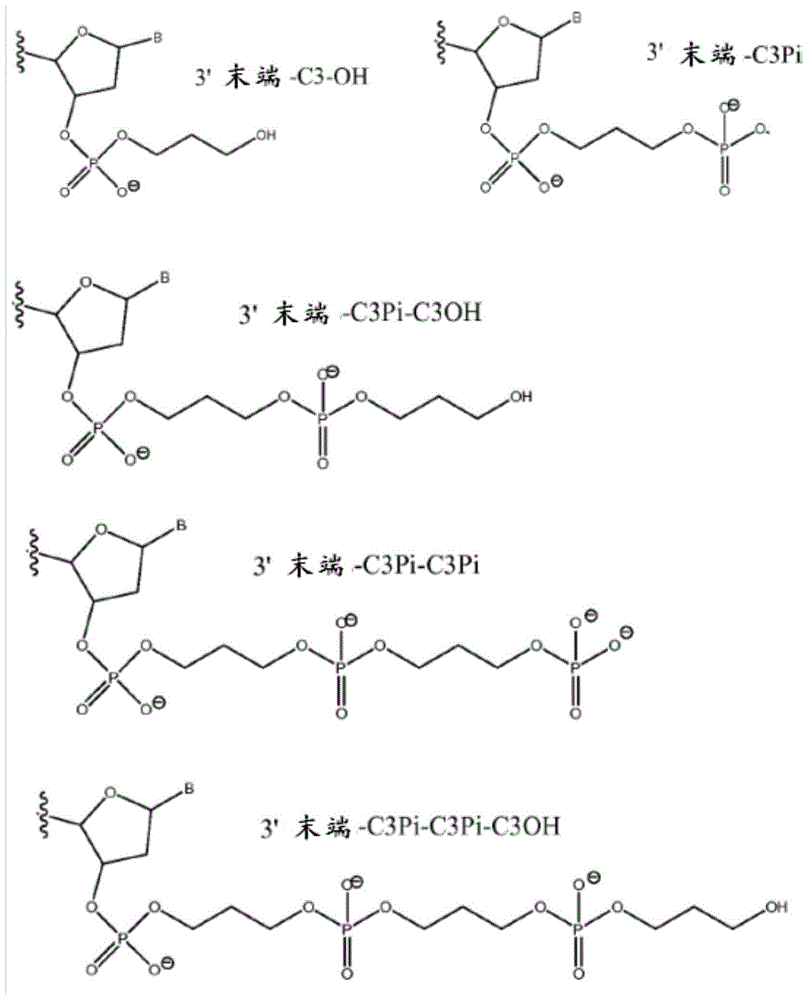
在结构A1和结构A2的一些实施方案中,Z或Z’中的至少一者存在并且包含至少两个共价连接至其存在于其中的链的非核苷酸部分。在一些实施方案中,Z和Z’中的每一个均独立地包括C3烷基、C3醇或C3酯部分。在一些实施方案中,Z’不存在,而Z存在并且包括非核苷酸C3部分。在一些实施方案中,Z不存在,而Z’存在并且包括非核苷酸C3部分。In some embodiments of Structure A1 and Structure A2, at least one of Z or Z' is present and comprises at least two non-nucleotide moieties covalently linked to the strand in which it is present. In some embodiments, each of Z and Z' independently includes a C3 alkyl, C3 alcohol, or C3 ester moiety. In some embodiments, Z' is absent and Z is present and includes a non-nucleotide C3 moiety. In some embodiments, Z is absent and Z' is present and includes a non-nucleotide C3 moiety.
在结构A1和A2的一些实施方案中,N和N’中的每一个均为未经修饰的核苷酸。在一些实施方案中,N或N’中的至少一者包括化学修饰的核苷酸或非常规部分。在一些实施方案中,非常规部分选自镜像核苷酸、脱碱基核糖部分和脱碱基脱氧核糖部分。在一些实施方案中,非常规部分为镜像核苷酸,优选L-DNA部分。在一些实施方案中,N或N’中的至少一者包括2’-OMe糖修饰的核糖核苷酸。In some embodiments of Structures A1 and A2, each of N and N' is an unmodified nucleotide. In some embodiments, at least one of N or N' includes chemically modified nucleotides or unconventional moieties. In some embodiments, the unconventional moiety is selected from mirror nucleotides, abasic ribose moieties, and abasic deoxyribose moieties. In some embodiments, the unconventional moiety is a mirror nucleotide, preferably a L-DNA moiety. In some embodiments, at least one of N or N' comprises a 2'-OMe sugar modified ribonucleotide.
在一些实施方案中,(N’)y的序列与(N)x的序列完全互补。在其他实施方案中,(N’)y的序列与(N)x的序列基本上互补。In some embodiments, the sequence of (N')y is completely complementary to the sequence of (N)x. In other embodiments, the sequence of (N')y is substantially complementary to the sequence of (N)x.
在其他实施方案中,结构A1或结构A2的化合物包括至少一个在糖残基中经修饰的核糖核苷酸。在一些实施方案中,所述化合物在糖残基的2’位置处包括修饰。在一些实施方案中,2’位置处的修饰包括存在氨基、氟、烷氧基或烷基部分。在某些实施方案中,2’修饰包括烷氧基部分,在优选实施方案中,烷氧基部分为甲氧基部分(也称为2’-O-甲基、2’-OMe、2’-OCH3)。在一些实施方案中,核酸化合物在反义和有义链中的一者或两者中包括2’-OMe糖修饰的交替核糖核苷酸。在其他实施方案中,所述化合物仅在反义链,(N)x或N1-(N)x中包含2’-OMe糖修饰的核糖核苷酸。在某些实施方案中,反义链的中间核糖核苷酸,例如,位于19-mer链中的位置10处的核糖核苷酸未被修饰。在各个实施方案中,核酸化合物包括至少5个交替的2’-OMe糖修饰的和未经修饰的核糖核苷酸。在另外的实施方案中,结构A1或结构A2的化合物在交替位置处包含经修饰的核糖核苷酸,其中(N)x或N1-(N)x的5’和3’末端上的每个核糖核苷酸的糖残基均被修饰,而(N’)y或N2-(N)y的5’和3’末端上的每个核糖核苷酸的糖残基均未被修饰。In other embodiments, the compound of Structure A1 or Structure A2 includes at least one ribonucleotide modified in the sugar residue. In some embodiments, the compound includes a modification at the 2' position of the sugar residue. In some embodiments, modifications at the 2' position include the presence of amino, fluoro, alkoxy, or alkyl moieties. In certain embodiments, the 2' modification includes an alkoxy moiety, in preferred embodiments, the alkoxy moiety is a methoxy moiety (also known as 2'-O-methyl, 2'-OMe, 2' -OCH3). In some embodiments, the nucleic acid compound includes 2'-OMe sugar modified alternating ribonucleotides in one or both of the antisense and sense strands. In other embodiments, the compounds comprise 2'-OMe sugar modified ribonucleotides only in the antisense strand, (N)x or N1- (N)x. In certain embodiments, the middle ribonucleotide of the antisense strand, eg, the ribonucleotide at position 10 in the 19-mer strand, is not modified. In various embodiments, the nucleic acid compound comprises at least 5 alternating 2'-OMe sugar modified and unmodified ribonucleotides. In additional embodiments, the compound of Structure A1 or Structure A2 comprises modified ribonucleotides at alternate positions, wherein each of the 5' and 3' ends of (N)x or N 1 -(N)x The sugar residues of each ribonucleotide are modified, while the sugar residues of each ribonucleotide on the 5' and 3' ends of (N')y or N2- (N)y are not modified .
在一些实施方案中,双链分子包括以下一种或多种修饰In some embodiments, the double-stranded molecule includes one or more of the following modifications
a)从反义链5’末端起的位置5、6、7、8或9中的至少一个位置处的N选自2’5’核苷酸或镜像核苷酸;a) N at at least one of positions 5, 6, 7, 8 or 9 from the 5' end of the antisense strand is selected from 2'5' nucleotides or mirror nucleotides;
b)从有义链5’末端起的位置9或10中的至少一个位置处的N’选自2’5’核苷酸和假尿苷;以及b) N' at at least one of positions 9 or 10 from the 5' end of the sense strand is selected from 2'5' nucleotides and pseudouridine; and
c)(N’)y的3’末端位置处的4、5或6个连续位置中的N’包含2’5’核苷酸。c) N' in 4, 5 or 6 consecutive positions at the 3' terminal position of (N')y comprises 2'5' nucleotides.
在一些实施方案中,双链分子包括以下修饰的组合In some embodiments, the double-stranded molecule comprises a combination of the following modifications
a)反义链在从5’末端起的位置5、6、7、8或9中的至少一个位置处包括2’5’核苷酸或镜像核苷酸;以及a) the antisense strand includes 2'5' nucleotides or mirror nucleotides at at least one of positions 5, 6, 7, 8 or 9 from the 5' end; and
b)有义链在从5’末端起的位置9或10处包括2’5’核苷酸和假尿苷中的至少一者。b) The sense strand includes at least one of 2'5' nucleotides and pseudouridine at position 9 or 10 from the 5' end.
在一些实施方案中,双链分子包括以下修饰的组合In some embodiments, the double-stranded molecule comprises a combination of the following modifications
a)反义链在从5’末端起的位置5、6、7、8或9中的至少一个位置处包括2’5’核苷酸或镜像核苷酸;以及a) the antisense strand includes 2'5' nucleotides or mirror nucleotides at at least one of positions 5, 6, 7, 8 or 9 from the 5' end; and
c)有义链在3’倒数第二或3’末端位置处包括4、5或6个连续的2’5’核苷酸。c) The sense strand includes 4, 5 or 6 consecutive 2'5' nucleotides at the 3' penultimate or 3' terminal position.
在一些实施方案中,有义链[(N)x或N1-(N)x]包括1、2、3、4、5、6、7、8或9个2’-OMe糖修饰的核糖核苷酸。在一些实施方案中,反义链在位置2、4、6、8、11、13、15、17和19处包括2’-OMe修饰的核糖核苷酸。在其他实施方案中,反义链在位置1、3、5、7、9、11、13、15、17和19处包括2’-OMe修饰的核糖核苷酸。在其他实施方案中,反义链在位置3、5、7、9、11、13、15、17和19处包括2’-OMe修饰的核糖核苷酸。在一些实施方案中,反义链包括一个或多个2’-OMe糖修饰的嘧啶。在一些实施方案中,反义链中的所有嘧啶核苷酸都为2’-OMe糖修饰的。在一些实施方案中,有义链包括2’-OMe糖修饰的嘧啶。In some embodiments, the sense strand [(N)x or Ni- (N)x] includes 1, 2, 3, 4, 5, 6, 7, 8, or 9 2'-OMe sugar modified ribose Nucleotides. In some embodiments, the antisense strand includes 2′-OMe modified ribonucleotides at positions 2, 4, 6, 8, 11, 13, 15, 17, and 19. In other embodiments, the antisense strand includes 2′-OMe modified ribonucleotides at positions 1, 3, 5, 7, 9, 11, 13, 15, 17, and 19. In other embodiments, the antisense strand includes 2′-OMe modified ribonucleotides at positions 3, 5, 7, 9, 11, 13, 15, 17, and 19. In some embodiments, the antisense strand includes one or more 2'-OMe sugar modified pyrimidines. In some embodiments, all pyrimidine nucleotides in the antisense strand are 2'-OMe sugar modified. In some embodiments, the sense strand includes a 2'-OMe sugar modified pyrimidine.
在结构A1和结构A2的一些实施方案中,有义链和反义链独立地在3’末端和在5’末端磷酸化或未磷酸化。在结构A1和结构A2的一些实施方案中,有义链和反义链在3’和5’末端未磷酸化。在其他实施方案中,有义链和反义链在3’末端磷酸化。In some embodiments of Structure A1 and Structure A2, the sense and antisense strands are independently phosphorylated or unphosphorylated at the 3' end and at the 5' end. In some embodiments of Structure A1 and Structure A2, the sense and antisense strands are unphosphorylated at the 3' and 5' ends. In other embodiments, the sense and antisense strands are phosphorylated at the 3' end.
在结构A1和结构A2的一些实施方案中,(N)y包括至少一个选自镜像核苷酸、2’5’核苷酸和TNA的非常规部分。在一些实施方案中,非常规部分为镜像核苷酸。在各个实施方案中,镜像核苷酸选自L-核糖核苷酸(L-RNA)和L-脱氧核糖核苷酸(L-DNA)。在优选实施方案中,镜像核苷酸为L-DNA。在某些实施方案中,有义链在位置9或10(从5’末端起)处包含非常规部分。在优选实施方案中,有义链在位置9(从5’末端起)处包括非常规部分。在一些实施方案中,有义链的长度为19个核苷酸,并且在位置15(从5’末端起)处包含4、5或6个连续的非常规部分。在一些实施方案中,有义链在位置15、16、17和18处包括4个连续的2’5’核糖核苷酸。在一些实施方案中,有义链在位置15、16、17、18和19处包括5个连续的2’5’核糖核苷酸。在各个实施方案中,有义链进一步包含Z’。在一些实施方案中,Z’包括C3OH部分或C3Pi部分。In some embodiments of Structure A1 and Structure A2, (N)y includes at least one unconventional moiety selected from mirror nucleotides, 2'5' nucleotides, and TNA. In some embodiments, the unconventional moiety is a mirror nucleotide. In various embodiments, the mirror nucleotides are selected from L-ribonucleotides (L-RNA) and L-deoxyribonucleotides (L-DNA). In a preferred embodiment, the mirror nucleotide is L-DNA. In certain embodiments, the sense strand comprises an unconventional portion at position 9 or 10 (from the 5' end). In a preferred embodiment, the sense strand includes an unconventional portion at position 9 (from the 5' end). In some embodiments, the sense strand is 19 nucleotides in length and comprises 4, 5 or 6 contiguous unconventional segments at position 15 (from the 5' end). In some embodiments, the sense strand includes 4 consecutive 2'5' ribonucleotides at positions 15, 16, 17 and 18. In some embodiments, the sense strand includes 5 consecutive 2'5' ribonucleotides at positions 15, 16, 17, 18, and 19. In various embodiments, the sense strand further comprises Z'. In some embodiments, Z' includes a C3OH moiety or a C3Pi moiety.
在结构A1的一些实施方案中,(N’)y包括至少一个L-DNA部分。在一些实施方案中,x=y=19,并且(N’)y由位于位置1-17和19处的未经修饰的核糖核苷酸和位于3’倒数第二位置(位置18)处的一个L-DNA组成。在其他实施方案中,x=y=19,并且(N’)y由位于位置1-16和19处的未经修饰的核糖核苷酸和位于3’倒数第二位置(位置17和18)处的两个连续L-DNA组成。在各个实施方案中,非常规部分为通过2’-5’核苷酸间磷酸酯连键接合至相邻核苷酸的核苷酸。根据各个实施方案,(N’)y在3'末端上包括通过2’-5’核苷酸间连键相连接的2、3、4、5、或6个连续核糖核苷酸。在一个实施方案中,(N’)y的3’末端上的四个连续核苷酸通过三个2’-5’磷酸二酯键相接合,其中形成2’-5’磷酸二酯键的2’-5’核苷酸中的一个或多个进一步包括3’-O-甲基(3’OMe)糖修饰。优选地,(N’)y的3’末端核苷酸包括2’-OMe糖修饰。在某些实施方案中,x=y=19,并且(N’)y在位置15、16、17、18和19处包括两个或更多个连续核苷酸,其包括通过2’-5’核苷酸间键接合至相邻核苷酸的核苷酸(2’-5’核苷酸)。在各个实施方案中,形成2’-5’核苷酸间键的核苷酸包括3’脱氧核糖核苷酸或3’甲氧基核苷酸(3’H或3’OMe代替3’OH)。在一些实施方案中,x=y=19,并且(N’)y在位置15、16和17处包括2’-5’核苷酸,使得相邻核苷酸通过位置15-16、16-17和17-18之间的2’-5’核苷酸间键相连接;或者在位置15、16、17、18和19处包括2’-5’核苷酸,使得相邻核苷酸通过位置15-16、16-17、17-18和18-19之间的2’-5’核苷酸间键相连接,并且3’OH在3’末端核苷酸或在位置16、17和18处是可用的,使得相邻核苷酸通过位置16-17、17-18和18-19之间的2’-5’核苷酸间键相连接。在一些实施方案中,x=y=19,并且(N’)y在位置16和17处或在位置17和18处或在位置15和17处包括2’-5’核苷酸,使得相邻核苷酸分别通过位置16-17和17-18之间或位置17-18和18-19之间或位置15-16和17-18之间的2’-5’核苷酸间键相连接。在其他实施方案中,(N’)y中的嘧啶核糖核苷酸(rU、rC)被通过2’-5’核苷酸间键接合至相邻核苷酸的核苷酸取代。在一些实施方案中,x=y=19,并且(N’)y在3’末端上包含通过四个2’-5’连键,具体地,核苷酸位置15-16、16-17、17-18和18-19之间的连键相接合的五个连续核苷酸。In some embodiments of Structure Al, (N')y includes at least one L-DNA moiety. In some embodiments, x=y=19, and (N')y consists of the unmodified ribonucleotides at positions 1-17 and 19 and the ribonucleotide at the 3' penultimate position (position 18) An L-DNA composition. In other embodiments, x=y=19, and (N')y consists of unmodified ribonucleotides at positions 1-16 and 19 and at the 3' penultimate position (positions 17 and 18) The composition of two consecutive L-DNAs. In various embodiments, unconventional moieties are nucleotides joined to adjacent nucleotides by 2'-5' internucleotide phosphate linkages. According to various embodiments, (N')y comprises 2, 3, 4, 5, or 6 contiguous ribonucleotides on the 3' terminus connected by 2'-5' internucleotide linkages. In one embodiment, four consecutive nucleotides on the 3' end of (N')y are joined by three 2'-5' phosphodiester bonds, wherein the 2'-5' phosphodiester bonds form One or more of the 2'-5' nucleotides further includes a 3'-O-methyl (3'OMe) sugar modification. Preferably, the 3' terminal nucleotide of (N')y includes a 2'-OMe sugar modification. In certain embodiments, x=y=19, and (N')y includes two or more consecutive nucleotides at positions 15, 16, 17, 18, and 19, which includes 'Internucleotide linkages to nucleotides (2'-5' nucleotides) to adjacent nucleotides. In various embodiments, the nucleotides forming the 2'-5' internucleotide linkage include 3'deoxyribonucleotides or 3'methoxynucleotides (3'H or 3'OMe instead of 3'OH ). In some embodiments, x=y=19, and (N')y includes 2'-5' nucleotides at positions 15, 16, and 17 such that adjacent nucleotides pass through positions 15-16, 16- 2'-5' internucleotide linkage between 17 and 17-18; or include 2'-5' nucleotides at positions 15, 16, 17, 18 and 19 such that adjacent nucleotides Linked by 2'-5' internucleotide linkages between positions 15-16, 16-17, 17-18 and 18-19 with 3'OH at the 3' terminal nucleotide or at positions 16, 17 and 18 are available such that adjacent nucleotides are connected by 2'-5' internucleotide linkages between positions 16-17, 17-18 and 18-19. In some embodiments, x=y=19, and (N')y includes 2'-5' nucleotides at positions 16 and 17 or at positions 17 and 18 or at positions 15 and 17 such that the relative Neighboring nucleotides are connected by a 2'-5' internucleotide linkage between positions 16-17 and 17-18 or between positions 17-18 and 18-19 or between positions 15-16 and 17-18, respectively. In other embodiments, the pyrimidine ribonucleotides (rU, rC) in (N')y are substituted with nucleotides joined to adjacent nucleotides by 2'-5' internucleotide linkages. In some embodiments, x=y=19, and (N')y comprises four 2'-5' linkages on the 3' end, specifically, nucleotide positions 15-16, 16-17, Five consecutive nucleotides joined by linkages between 17-18 and 18-19.
在一些实施方案中,x=y=19,并且(N’)y在3’末端上包含通过四个2’-5’连键相接合的五个连续核苷酸,并任选地进一步包括独立地选自反向脱碱基部分和C3烷基[C3;1,3-丙二醇单(磷酸二氢酯)]帽的Z’和z’。在一些实施方案中,C3烷基帽共价连接至3’或5’末端核苷酸。在一些实施方案中,3’C3末端帽进一步包含3’磷酸酯。在一些实施方案中,3’C3末端帽进一步包含3’末端羟基。In some embodiments, x=y=19, and (N')y comprises five consecutive nucleotides joined by four 2'-5' linkages on the 3' end, and optionally further comprises Z' and z' independently selected from the inverted abasic moiety and the C3 alkyl [C3; 1,3-propanediol mono(dihydrogen phosphate)] cap. In some embodiments, the C3 alkyl cap is covalently attached to the 3' or 5' terminal nucleotide. In some embodiments, the 3' C3 end cap further comprises a 3' phosphate. In some embodiments, the 3' C3 terminal cap further comprises a 3' terminal hydroxyl.
在一些实施方案中,x=y=19,并且(N’)y在位置18处包含L-DNA;并且(N’)y任选地进一步包括独立地选自反向脱碱基部分和C3烷基[C3;1,3-丙二醇单(磷酸二氢酯)]帽的Z’和z’。In some embodiments, x=y=19, and (N')y comprises L-DNA at position 18; and (N')y optionally further comprises independently selected from reverse abasic moiety and C3 Z' and z' of the alkyl [C3; 1,3-propanediol mono(hydrogen phosphate)] cap.
在一些实施方案中,(N’)y包含3’末端磷酸酯(即,在3’末端磷酸化)。在一些实施方案中,(N’)y包含3’末端羟基。In some embodiments, (N')y comprises a 3' terminal phosphate (i.e., is phosphorylated at the 3' end). In some embodiments, (N')y comprises a 3' terminal hydroxyl group.
在一些实施方案中,x=y=19,并且(N)x在位置1、3、5、7、9、11、13、15、17、19处或在位置2、4、6、8、11、13、15、17、19处包括2’-OMe糖修饰的核糖核苷酸。在一些实施方案中,x=y=19,并且(N)x包括2’-OMe糖修饰的嘧啶。在一些实施方案中,(N)x中的所有嘧啶都包括2’-OMe糖修饰。In some embodiments, x=y=19, and (N)x is at position 1, 3, 5, 7, 9, 11, 13, 15, 17, 19 or at position 2, 4, 6, 8, 11, 13, 15, 17, 19 include 2'-OMe sugar modified ribonucleotides. In some embodiments, x=y=19, and (N)x includes a 2'-OMe sugar-modified pyrimidine. In some embodiments, all pyrimidines in (N)x include a 2'-OMe sugar modification.
在结构A2的一些实施方案中,x=y=18,并且N2为核糖腺苷部分。在一些实施方案中,x=y=18,并且N2-(N’)y在3’末端上包含通过四个2’-5’连键,具体地,核苷酸位置15-16、16-17、17-18和18-19之间的连键相接合的五个连续核苷酸。在一些实施方案中,所述连键包括磷酸二酯键。在一些实施方案中,x=y=18,并且N2-(N’)y在3’末端上包含通过四个2’-5’连键相接合的五个连续核苷酸,并任选地进一步包括独立地选自反向脱碱基部分和C3烷基[C3;1,3-丙二醇单(磷酸二氢酯)]帽的Z’和z’。在一些实施方案中,x=y=18,并且N2-(N’)y在位置18处包含L-DNA;并且(N’)y任选地进一步包括独立地选自反向脱碱基部分和C3烷基[C3;1,3-丙二醇单(磷酸二氢酯)]帽的Z’和z’。在一些实施方案中,N2-(N’)y包含3’末端磷酸酯。在一些实施方案中,N2-(N’)y包含3’末端羟基。在一些实施方案中,x=y=18,并且N1-(N)x在位置1、3、5、7、9、11、13、15、17、19处或在位置1、3、5、9、11、13、15、17、19处,或在位置3、5、9、11、13、15、17处,或在位置2、4、6、8、11、13、15、17、19处包括2’-OMe糖修饰的核糖核苷酸。在一些实施方案中,x=y=18,并且N1-(N)x在位置11、13、15、17和19(从5’末端起)处包括2’-OMe糖修饰的核糖核苷酸。在一些实施方案中,x=y=18,并且N1-(N)x在位置1、3、5、7、9、11、13、15、17、19处或在位置3、5、7、9、11、13、15、17、19处包括2’-OMe糖修饰的核糖核苷酸。在一些实施方案中,x=y=18,并且N1-(N)x在位置2、4、6、8、11、13、15、17、19处包括2’-OMe糖修饰的核糖核苷酸。In some embodiments of Structure A2, x=y=18, and N2 is a riboadenosine moiety. In some embodiments, x=y=18, and N 2 -(N')y comprises four 2'-5' linkages on the 3' end, specifically, nucleotide positions 15-16, 16 Five consecutive nucleotides joined by linkages between -17, 17-18 and 18-19. In some embodiments, the linkage comprises a phosphodiester linkage. In some embodiments, x=y=18, and N 2 -(N')y comprises five consecutive nucleotides joined by four 2'-5' linkages on the 3' end, and optionally Di further comprises Z' and z' independently selected from an inverted abasic moiety and a C3 alkyl [C3; 1,3-propanediol mono(dihydrogen phosphate)] cap. In some embodiments, x=y=18, and N 2 -(N')y comprises L-DNA at position 18; and (N')y optionally further comprises a base independently selected from reverse abasic Z' and z' of the moiety and the C3 alkyl [C3; 1,3-propanediol mono(dihydrogen phosphate)] cap. In some embodiments, N2- (N')y comprises a 3' terminal phosphate. In some embodiments, N2- (N')y comprises a 3' terminal hydroxyl group. In some embodiments, x=y=18, and N 1 -(N)x is at position 1, 3, 5, 7, 9, 11, 13, 15, 17, 19 or at position 1, 3, 5 , 9, 11, 13, 15, 17, 19, or at position 3, 5, 9, 11, 13, 15, 17, or at position 2, 4, 6, 8, 11, 13, 15, 17 , 19 include 2'-OMe sugar modified ribonucleotides. In some embodiments, x=y=18 and N 1 -(N)x includes 2'-OMe sugar modified ribonucleosides at positions 11, 13, 15, 17 and 19 (from the 5' end) acid. In some embodiments, x=y=18, and N1-(N)x is at position 1, 3, 5, 7, 9, 11, 13, 15, 17, 19 or at position 3, 5, 7, 9, 11, 13, 15, 17, 19 include 2'-OMe sugar modified ribonucleotides. In some embodiments, x=y=18 and N 1 -(N)x includes a 2′-OMe sugar modified ribonuclei at positions 2, 4, 6, 8, 11, 13, 15, 17, 19 glycosides.
在一些实施方案中,x=y=18,并且N1-(N)x包括2’-OMe糖修饰的嘧啶。在一些实施方案中,(N)x中的所有嘧啶都包括2’-OMe糖修饰。在一些实施方案中,反义链进一步在位置5、6或7(5’>3’)处包含L-DNA或2’-5’核苷酸。在其他实施方案中,反义链进一步包含核糖核苷酸,其在位置5-6或6-7(5’>3’)处的核糖核苷酸之间产生2’5’核苷酸间连键。In some embodiments, x=y=18, and N 1 -(N)x includes a 2′-OMe sugar-modified pyrimidine. In some embodiments, all pyrimidines in (N)x include a 2'-OMe sugar modification. In some embodiments, the antisense strand further comprises L-DNA or 2'-5' nucleotides at position 5, 6 or 7 (5'>3'). In other embodiments, the antisense strand further comprises ribonucleotides that create a 2'5' internucleotide between ribonucleotides at positions 5-6 or 6-7 (5'>3'). even key.
在另外的实施方案中,N1-(N)x进一步包括Z,其中Z包含非核苷酸突出。在一些实施方案中,非核苷酸突出为C3–C3[1,3-丙二醇单(磷酸二氢酯)]2。In additional embodiments, N 1 -(N)x further comprises Z, wherein Z comprises a non-nucleotide overhang. In some embodiments, the non-nucleotide overhang is C3-C3[1,3-propanediol mono(dihydrogen phosphate)]2.
在结构A2的一些实施方案中,(N)y包括至少一个L-DNA部分。在一些实施方案中,x=y=18,并且(N’)y由位于位置1-16和18处的未经修饰的核糖核苷酸和位于3’倒数第二位置(位置17)处的一个L-DNA组成。在其他实施方案中,x=y=18,并且(N’)y由位于位置1-15和18处的未经修饰的核糖核苷酸和位于3’倒数第二位置(位置16和17)处的两个连续L-DNA组成。在各个实施方案中,非常规部分为通过2’-5’核苷酸间磷酸酯连键接合至相邻核苷酸的核苷酸。根据各个实施方案,(N’)y在3'末端上包括通过2’-5’核苷酸间连键相连接的2、3、4、5或6个连续核糖核苷酸。在一个实施方案中,(N’)y的3’末端上的四个连续核苷酸通过三个2’-5’磷酸二酯键相接合,其中形成2’-5’磷酸二酯键的2’-5’核苷酸中的一个或多个进一步包括3’-O-甲基(3’OMe)糖修饰。优选地,(N’)y的3’末端核苷酸包括2’-OMe糖修饰。在某些实施方案中,x=y=18,并且在(N’)y中,位于位置14、15、16、17和18处的两个或更多个连续核苷酸包括通过2’-5’核苷酸间键接合至相邻核苷酸的核苷酸。在各个实施方案中,形成2’-5’核苷酸间键的核苷酸包括3’脱氧核糖核苷酸或3’甲氧基核苷酸。在一些实施方案中,x=y=18,并且(N’)y包括通过位置15-16、16-17和17-18之间或位置16-17和17-18之间的2’-5’核苷酸间键接合至相邻核苷酸的核苷酸。在一些实施方案中,x=y=18,并且(N’)y包括通过位置14-15、15-16、16-17和17-18之间或位置15-16、16-17和17-18之间或位置16-17和17-18之间或位置17-18之间或位置15-16和17-18之间的2’-5’核苷酸间键接合至相邻核苷酸的核苷酸。在其他实施方案中,(N’)y中的嘧啶核糖核苷酸(rU、rC)被通过2’-5’核苷酸间键接合至相邻核苷酸的核苷酸取代。In some embodiments of Structure A2, (N)y includes at least one L-DNA moiety. In some embodiments, x=y=18, and (N')y consists of the unmodified ribonucleotides at positions 1-16 and 18 and the ribonucleotide at the 3' penultimate position (position 17) An L-DNA composition. In other embodiments, x=y=18, and (N')y consists of unmodified ribonucleotides at positions 1-15 and 18 and at the 3' penultimate position (positions 16 and 17) The composition of two consecutive L-DNAs. In various embodiments, unconventional moieties are nucleotides joined to adjacent nucleotides by 2'-5' internucleotide phosphate linkages. According to various embodiments, (N')y comprises 2, 3, 4, 5 or 6 contiguous ribonucleotides at the 3' terminus connected by 2'-5' internucleotide linkages. In one embodiment, four consecutive nucleotides on the 3' end of (N')y are joined by three 2'-5' phosphodiester bonds, wherein the 2'-5' phosphodiester bonds form One or more of the 2'-5' nucleotides further includes a 3'-O-methyl (3'OMe) sugar modification. Preferably, the 3' terminal nucleotide of (N')y includes a 2'-OMe sugar modification. In certain embodiments, x=y=18, and in (N')y, two or more consecutive nucleotides at positions 14, 15, 16, 17 and 18 are included by 2'- A 5' internucleotide bond joins a nucleotide to an adjacent nucleotide. In various embodiments, the nucleotides forming the 2'-5' internucleotide linkage include 3' deoxyribonucleotides or 3' methoxy nucleotides. In some embodiments, x=y=18 and (N')y includes 2'-5' through between positions 15-16, 16-17 and 17-18 or between positions 16-17 and 17-18 Internucleotide bonds join nucleotides to adjacent nucleotides. In some embodiments, x=y=18, and (N')y includes passages between positions 14-15, 15-16, 16-17, and 17-18 or positions 15-16, 16-17, and 17-18 Nucleotides joined to adjacent nucleotides by 2'-5' internucleotide linkages between or between positions 16-17 and 17-18 or between positions 17-18 or between positions 15-16 and 17-18 . In other embodiments, the pyrimidine ribonucleotides (rU, rC) in (N')y are substituted with nucleotides joined to adjacent nucleotides by 2'-5' internucleotide linkages.
在结构A1和结构A2的一些实施方案中,每个N均由未经修饰的核糖核苷酸组成。在结构A1和结构A2的一些实施方案中,每个N’均由未经修饰的核苷酸组成。在优选的实施方案中,N和N’中的至少一者为经修饰的核糖核苷酸或非常规部分。In some embodiments of Structure A1 and Structure A2, each N consists of an unmodified ribonucleotide. In some embodiments of Structure A1 and Structure A2, each N' consists of unmodified nucleotides. In preferred embodiments, at least one of N and N' is a modified ribonucleotide or an unconventional moiety.
在其他实施方案中,结构A1或结构A2的分子包括至少一个在糖残基中经修饰的核糖核苷酸。在一些实施方案中,所述化合物在糖残基2’位置处包括修饰。在一些实施方案中,2’位置处的修饰包括存在氨基、氟、烷氧基或烷基部分。在某些实施方案中,2’修饰包括烷氧基部分,在优选实施方案中,烷氧基部分为甲氧基部分(也称为2’-O-甲基;2’-OMe;2’-OCH3)。在一些实施方案中,核酸化合物在反义和有义链中的一者或两者中包括2’-OMe糖修饰的交替核糖核苷酸。在其他实施方案中,所述化合物仅在反义链,(N)x或N1-(N)x中包括2’-OMe糖修饰的核糖核苷酸。在某些实施方案中,反义链的中间核糖核苷酸,例如,位于19mer链中的位置10处的核糖核苷酸未被修饰。在各个实施方案中,核酸化合物包括至少5个交替的2’-OMe糖修饰的和未经修饰的核糖核苷酸。In other embodiments, the molecule of Structure A1 or Structure A2 includes at least one ribonucleotide modified in a sugar residue. In some embodiments, the compound includes a modification at the 2' position of the sugar residue. In some embodiments, modifications at the 2' position include the presence of amino, fluoro, alkoxy, or alkyl moieties. In certain embodiments, the 2' modification includes an alkoxy moiety, in preferred embodiments, the alkoxy moiety is a methoxy moiety (also known as 2'-O-methyl; 2'-OMe; 2' -OCH3). In some embodiments, the nucleic acid compound includes 2'-OMe sugar modified alternating ribonucleotides in one or both of the antisense and sense strands. In other embodiments, the compounds include 2'-OMe sugar modified ribonucleotides only in the antisense strand, (N)x or N1-(N)x. In certain embodiments, the middle ribonucleotide of the antisense strand, eg, the ribonucleotide at position 10 in the 19mer strand, is not modified. In various embodiments, the nucleic acid compound comprises at least 5 alternating 2'-OMe sugar modified and unmodified ribonucleotides.
在另外的实施方案中,结构A1或结构A2的化合物在交替的位置处包括经修饰的核糖核苷酸,其中(N)x或N1-(N)x的5’和3’末端上的每个核糖核苷酸在其糖残基处均被修饰,而(N’)y或N2-(N)y的5’和3’末端上的每个核糖核苷酸在其糖残基处均未被修饰。In additional embodiments, the compound of Structure A1 or Structure A2 includes modified ribonucleotides at alternating positions, wherein each of the 5' and 3' ends of (N)x or N1-(N)x ribonucleotides are modified at their sugar residues, and each ribonucleotide on the 5' and 3' ends of (N')y or N2- (N)y is modified at its sugar residue Neither was modified.
在一些实施方案中,(N)x或N1-(N)x在位置2、4、6、8、11、13、15、17和19处包括2’-OMe修饰的核糖核苷酸。在其他实施方案中,(N)x(N)x或N1-(N)x在位置1、3、5、7、9、11、13、15、17和19处包括2’-OMe修饰的核糖核苷酸。在一些实施方案中,(N)x或N1-(N)x包括2’-OMe修饰的嘧啶。在一些实施方案中,(N)x或N1-(N)x中的所有嘧啶核苷酸都为2’-OMe修饰的。在一些实施方案中,(N’)y或N2-(N’)y包括2’-OMe修饰的嘧啶。在另外的实施方案中,结构A1或结构A2的化合物在交替的位置处包括经修饰的核糖核苷酸,其中(N)x或N1-(N)x的5’和3’末端上的每个核糖核苷酸在其糖残基处均被修饰,而(N’)y或N2-(N)y的5’和3’末端上的每个核糖核苷酸在其糖残基处均未被修饰。In some embodiments, (N)x or N 1 -(N)x includes a 2′-OMe modified ribonucleotide at positions 2, 4, 6, 8, 11, 13, 15, 17, and 19. In other embodiments, (N)x(N)x or N1- (N)x comprises a 2'-OMe modification at positions 1, 3, 5, 7, 9, 11, 13, 15, 17, and 19 of ribonucleotides. In some embodiments, (N)x or N 1 -(N)x comprises a 2′-OMe modified pyrimidine. In some embodiments, all pyrimidine nucleotides in (N)x or N 1 -(N)x are 2′-OMe modified. In some embodiments, (N')y or N2- (N')y comprises a 2'-OMe modified pyrimidine. In additional embodiments, the compound of Structure A1 or Structure A2 includes modified ribonucleotides at alternating positions, wherein the 5' and 3' ends of (N)x or N 1 -(N)x Each ribonucleotide is modified at its sugar residue, and each ribonucleotide on the 5' and 3' ends of (N')y or N2- (N)y is modified at its sugar residue Nothing has been modified.
本文所公开的核酸分子可在一端具有平端,例如当Z和z”不存在或其中Z’不存在时。所述核酸分子可以用可位于沿着有义或反义链的任何位置处的经修饰核苷酸或非常规部分进行修饰。所述核酸分子可包括约1、2、3、4、5、6、7、8、9、10、11、12、13、14或15个经修饰的核苷酸。所述核酸分子可包括约1、2、3、4、5、6、7或8个非常规部分。所述核酸分子可包括一组约1、2、3、4、5、6、7或8个,优选1、2、3或4个连续的经修饰的核苷酸或非常规部分。经修饰的核酸可仅存在于有义链、仅存在于反义链,或者存在于有义链和反义链两者中。在一些实施方案中,经修饰的核苷酸包含2’糖修饰的核苷酸,包括2’O-甲基修饰的核苷酸、2’脱氧氟代修饰的核苷酸、2’-氨基修饰的核苷酸。在一些实施方案中,非常规部分包含镜像核苷酸(即,L-DNA或L-RNA)或能够形成2’-5’连键的核苷酸(2’5’核苷酸)。Nucleic acid molecules disclosed herein may have a blunt end at one end, for example when Z and z" are absent or where Z' is absent. The nucleic acid molecules may be modified with a DNA molecule that may be located at any position along the sense or antisense strand. modified nucleotides or unconventional moieties. The nucleic acid molecule may comprise about 1, 2, 3, 4, 5, 6, 7, 8, 9, 10, 11, 12, 13, 14 or 15 modified nucleotides. The nucleic acid molecule can include about 1, 2, 3, 4, 5, 6, 7 or 8 unconventional parts. The nucleic acid molecule can include a set of about 1, 2, 3, 4, 5 , 6, 7 or 8, preferably 1, 2, 3 or 4 consecutive modified nucleotides or unconventional moieties. Modified nucleic acids may be present only on the sense strand, only on the antisense strand, or present in both the sense and antisense strands. In some embodiments, the modified nucleotides comprise 2' sugar modified nucleotides, including 2' O-methyl modified nucleotides, 2' Deoxyfluoro-modified nucleotides, 2'-amino-modified nucleotides. In some embodiments, unconventional moieties comprise mirror-image nucleotides (ie, L-DNA or L-RNA) or are capable of forming 2'- 5' linked nucleotides (2'5' nucleotides).
如本文所使用的术语“双链体区域”是指双链分子中的区域,其中两个互补或基本上互补的寡核苷酸通常通过沃森-克里克碱基配对或通过任何其他允许双链体形成的方式彼此形成碱基对。例如,具有19个核苷酸单元的寡核苷酸链可与19个核苷酸单元的互补寡核苷酸碱基配对,或者可与每条链上的15、16、17或18个碱基碱基配对,使得“双链体区域”由15、16、17或18个碱基对组成。其余的碱基对可例如以5’和3’突出存在。进一步地,在双链体区域内,不需要100%的互补性;基本上互补在双链体区域内是允许的。突出区域可由核苷酸或非核苷酸部分组成。如本文所公开的,至少一个突出区域由一个或多个非核苷酸部分组成。As used herein, the term "duplex region" refers to the region in a double-stranded molecule in which two complementary or substantially complementary oligonucleotides, usually by Watson-Crick base pairing or by any other The duplexes are formed in such a way that they form base pairs with each other. For example, an oligonucleotide chain of 19 nucleotide units can base pair with a complementary oligonucleotide of 19 nucleotide units, or it can pair with 15, 16, 17, or 18 bases on each strand. The bases are base paired such that the "duplex region" consists of 15, 16, 17 or 18 base pairs. The remaining base pairs may, for example, be present as 5' and 3' overhangs. Further, 100% complementarity is not required within the duplex region; substantial complementarity is permitted within the duplex region. Overhanging regions can consist of nucleotide or non-nucleotide moieties. As disclosed herein, at least one overhanging region consists of one or more non-nucleotide moieties.
通用非限制性核酸分子模式在下面示出,其中N’=双链体区域中的有义链核苷酸;z”=共价连接在有义链5’末端的5’-加帽部分;C3=3个碳的非核苷酸部分;N=双链体区域中的反义链核苷酸;idB=反向脱碱基脱氧核糖核苷酸非核苷酸部分。每个N、N’均独立地经修饰或未经修饰或为非常规部分。有义和反义链的长度各自独立地为18-40个核苷酸。下面提供的实例具有19个核苷酸的双链体区域;然而,本文所公开的核酸分子可在任何地方具有介于18与40个核苷酸之间的双链体区域,并且其中每条链的长度独立地介于18与40个核苷酸之间。在每个双链体中,反义链(N)x均在上部示出。可用于产生根据结构A1的dsRNA的优选19-mer有义序列和反义序列如SEQ IDNO:13-3060(靶向TLR2)、SEQ ID NO:5847-8612(靶向TLR4)、SEQID NO:12145-13924(靶向MYD88)、SEQ ID NO:16333-16882(靶向TICAM1)和SEQ ID NO:18243-19046(靶向TIRAP)所示。可用于产生根据结构A2的dsRNA的优选18-mer有义序列和反义序列如SEQ ID NO:3061-5846(靶向TLR2)、SEQ ID NO:8613-12144(靶向TLR4)、SEQ ID NO:13925-16332(靶向MYD88)、SEQ IDNO:16883-18242(靶向TICAM1)和SEQ ID NO:19047-20606(靶向TIRAP)所示。可用于产生dsNA的某些优选寡核苷酸对如表1-5中所示。A general non-limiting nucleic acid molecule schema is shown below, where N' = nucleotides of the sense strand in the duplex region; z" = 5'-capping moiety covalently linked at the 5' end of the sense strand; C3 = non-nucleotide portion of 3 carbons; N = antisense strand nucleotide in the duplex region; idB = inverted abasic deoxyribonucleotide non-nucleotide portion. Each N, N' Independently modified or unmodified or unconventional. The length of the sense and antisense strands is each independently 18-40 nucleotides. The example provided below has a duplex region of 19 nucleotides; However, the nucleic acid molecules disclosed herein can have a duplex region anywhere between 18 and 40 nucleotides, and wherein each strand is independently between 18 and 40 nucleotides in length In each duplex, the antisense strand (N)x is shown in the upper part. The preferred 19-mer sense sequence and antisense sequence that can be used to produce dsRNA according to structure A1 are as SEQ ID NO: 13-3060 ( Targeting TLR2), SEQ ID NO:5847-8612 (targeting TLR4), SEQ ID NO:12145-13924 (targeting MYD88), SEQ ID NO:16333-16882 (targeting TICAM1) and SEQ ID NO:18243-19046 (targeting TIRAP). The preferred 18-mer sense and antisense sequences that can be used to generate dsRNA according to structure A2 such as SEQ ID NO:3061-5846 (targeting TLR2), SEQ ID NO:8613-12144 ( Targeting TLR4), SEQ ID NO:13925-16332 (targeting MYD88), SEQ ID NO:16883-18242 (targeting TICAM1) and SEQ ID NO:19047-20606 (targeting TIRAP). Can be used to generate dsNA Certain preferred oligonucleotide pairs are shown in Tables 1-5.
在一些实施方案中,双链核酸分子具有以下结构,其中每个N或N’均包含未经修饰的或经修饰的核糖核苷酸,或非常规部分:In some embodiments, the double-stranded nucleic acid molecule has the following structure, wherein each N or N' comprises unmodified or modified ribonucleotides, or unconventional moieties:


在一些优选实施方案中,本文所公开的核酸分子具有以下结构In some preferred embodiments, the nucleic acid molecules disclosed herein have the structure

其中N和N’均独立地为核糖核苷酸或者为非常规部分,所述核糖核苷酸可为未经修饰的或经修饰的核糖核苷酸;Wherein N and N' are independently ribonucleotides or unconventional parts, and the ribonucleotides can be unmodified or modified ribonucleotides;
其中每个N均通过共价键连接至相邻的N;wherein each N is connected to an adjacent N by a covalent bond;
其中每个N’均通过共价键连接至相邻的N’;以及wherein each N' is covalently bonded to an adjacent N'; and
其中z”为共价连接至有义链5’末端的加帽部分。where z" is a capping moiety covalently attached to the 5' end of the sense strand.
术语“aB”是指脱碱基部分,其可为核糖脱碱基部分或脱氧核糖脱碱基部分,或反向核糖脱碱基部分或反向脱氧核糖脱碱基部分。The term "aB" refers to an abasic moiety, which may be a ribose abasic moiety or a deoxyribose abasic moiety, or an inverted ribose abasic moiety or an inverted deoxyribose abasic moiety.
在一些实施方案中,本文所公开的核酸分子包含Z。在其他实施方案中,本文所公开的核酸分子包含Z'。在另外的实施方案中,Z和Z'都存在。在一些实施方案中,Z和Z'都存在并且是相同的。在进一步的实施方案中,Z和Z'都存在并且是不同的。在一些实施方案中,Z和Z'独立地包含1或2个非核苷酸部分。在一些实施方案中,Z和Z'独立地包含2个非核苷酸部分。In some embodiments, a nucleic acid molecule disclosed herein comprises Z. In other embodiments, the nucleic acid molecules disclosed herein comprise Z'. In other embodiments, both Z and Z' are present. In some embodiments, both Z and Z' are present and are the same. In further embodiments, Z and Z' are both present and different. In some embodiments, Z and Z' independently comprise 1 or 2 non-nucleotide moieties. In some embodiments, Z and Z' independently comprise 2 non-nucleotide moieties.
在一些实施方案中,Z存在并且包含一种或多种选自脱碱基部分、反向脱碱基部分、烷基部分或其衍生物,及无机磷酸酯部分的非核苷酸部分。In some embodiments, Z is present and comprises one or more non-nucleotide moieties selected from abasic moieties, inverted abasic moieties, alkyl moieties or derivatives thereof, and inorganic phosphate moieties.
在另外的实施方案中,Z'存在并且包含一种或多种选自脱碱基部分、反向脱碱基部分、烷基部分或其衍生物,或无机磷酸酯部分的非核苷酸部分。In additional embodiments, Z' is present and comprises one or more non-nucleotide moieties selected from abasic moieties, inverted abasic moieties, alkyl moieties or derivatives thereof, or inorganic phosphate moieties.
在另外的实施方案中,Z和/或Z'存在并且独立地包含一种或多种核苷酸与一种或多种选自本文所公开的部分的非核苷酸部分的组合。In additional embodiments, Z and/or Z' are present and independently comprise one or more nucleotides in combination with one or more non-nucleotide moieties selected from the moieties disclosed herein.
在一些实施方案中,Z和Z'中的每一个均包括脱碱基部分,任选地为脱氧核糖脱碱基(在本文称为“dAb”)或核糖脱碱基(在本文称为“rAb”)核苷酸。在一些实施方案中,Z和/或Z'中的每一个均为dAb-dAb或rAb-rAb。In some embodiments, each of Z and Z' includes an abasic moiety, optionally a deoxyribose abasic (referred to herein as a "dAb") or a ribose abasic (referred to herein as a "dAb") rAb") nucleotides. In some embodiments, each of Z and/or Z' is dAb-dAb or rAb-rAb.
在一些实施方案中,Z和/或Z'中的每一个均独立地包括烷基部分,任选地为丙二醇的磷酸二酯衍生物((CH2)3-Pi,在本文中也称为“C3Pi”)修饰的部分。在一些实施方案中,Z和/或Z'为C3Pi-C3Pi。在具体实施方案中,x=y=19并且Z包含两个丙二醇衍生物,C3-C3(即,-C3-Pi-C3-Pi)。在各个实施方案中,C3部分经由磷酸二酯键共价连接至有义或反义链的3’末端。In some embodiments, each of Z and/or Z' independently includes an alkyl moiety, optionally a phosphodiester derivative of propylene glycol ((CH2)3-Pi, also referred to herein as " C3Pi") modified part. In some embodiments, Z and/or Z' is C3Pi-C3Pi. In a specific embodiment, x=y=19 and Z comprises two propylene glycol derivatives, C3-C3 (ie, -C3-Pi-C3-Pi). In various embodiments, the C3 moiety is covalently linked to the 3' end of the sense or antisense strand via a phosphodiester bond.
在另外的实施方案中,Z和/或Z'包含一种或多种脱碱基部分与未经修饰的核苷酸的组合,或一种或多种烃部分与未经修饰的核苷酸的组合,或一种或多种脱碱基与烃部分的组合。在此类实施方案中,Z和/或Z’任选地为C3-rAb或C3-dAb。In additional embodiments, Z and/or Z' comprise one or more abasic moieties in combination with unmodified nucleotides, or one or more hydrocarbon moieties and unmodified nucleotides A combination of, or a combination of one or more abasic and hydrocarbon moieties. In such embodiments, Z and/or Z' is optionally a C3-rAb or C3-dAb.
在涉及结构A1或A2的进一步的实施方案中,核酸分子进一步在反义链的位置2、4、6、8、11、13、15、17和19处包含2'-OMe糖修饰的核糖核苷酸。在另外的实施方案中,所述化合物还在有义链的位置18处包含L-DNA核苷酸。在另外的实施方案中,所述化合物包含通过2’-5’核苷酸间磷酸酯键接合至相邻核苷酸的核苷酸。在另外的实施方案中,x=y=19,并且位于(N’)y中的位置15-19或16-19或17-19处的核苷酸通过2’-5’核苷酸间磷酸酯键接合至相邻核苷酸。在一些实施方案中,x=y=19,并且位于(N’)y中的位置15-19或16-19或17-19或15-18或16-18处的核苷酸通过2’-5’核苷酸间磷酸酯键接合至相邻核苷酸。In a further embodiment involving structures A1 or A2, the nucleic acid molecule further comprises a 2'-OMe sugar modified ribonuclei at positions 2, 4, 6, 8, 11, 13, 15, 17 and 19 of the antisense strand glycosides. In additional embodiments, the compound further comprises an L-DNA nucleotide at position 18 of the sense strand. In additional embodiments, the compound comprises nucleotides joined to adjacent nucleotides by 2'-5' internucleotide phosphate bonds. In additional embodiments, x=y=19, and the nucleotides at positions 15-19 or 16-19 or 17-19 in (N')y pass through the 2'-5' internucleotide phosphate An ester bond is attached to an adjacent nucleotide. In some embodiments, x=y=19, and the nucleotides at positions 15-19 or 16-19 or 17-19 or 15-18 or 16-18 in (N')y are passed 2'- The 5' internucleotide phosphate bonds to adjacent nucleotides.
根据某些实施方案,本文提供了dsRNA化合物,如siRNA化合物,其进一步包含一个或多个经修饰的核苷酸,其中经修饰的核苷酸在糖部分中、在碱基部分中或在核苷酸间连键部分中具有修饰。According to certain embodiments, provided herein are dsRNA compounds, such as siRNA compounds, further comprising one or more modified nucleotides, wherein the modified nucleotides are in the sugar moiety, in the base moiety, or in the core Modifications in the linkage between nucleotides.
在一些实施方案中,(N)x包含经修饰和未经修饰的核糖核苷酸,每个经修饰的核糖核苷酸均为2’-OMe糖修饰的核糖核苷酸,其中(N)x的3’末端上的N为经修饰的核糖核苷酸,(N)x包含从3’端开始的至少五个交替的经修饰的核糖核苷酸并且总共包含至少九个经修饰的核糖核苷酸,而每个剩余的N均为未经修饰的核糖核苷酸。In some embodiments, (N)x comprises modified and unmodified ribonucleotides, each modified ribonucleotide being a 2'-OMe sugar modified ribonucleotide, wherein (N) N on the 3' end of x is a modified ribonucleotide, (N)x comprises at least five alternating modified ribonucleotides starting from the 3' end and a total of at least nine modified ribose sugars nucleotides, and each remaining N is an unmodified ribonucleotide.
在一些实施方案中,(N)x和(N’)y中的至少一者包含至少一个镜像核苷酸。在一些实施方案中,在(N’)y中,存在至少一个非常规部分,所述非常规部分可为脱碱基核糖部分、脱碱基脱氧核糖部分、经修饰的或未经修饰的脱氧核糖核苷酸、镜像核苷酸,及通过2’-5’核苷酸间磷酸酯键接合至相邻核苷酸的核苷酸,或本文所公开的任何其他非常规部分。In some embodiments, at least one of (N) x and (N') y comprises at least one mirror nucleotide. In some embodiments, in (N')y there is at least one unconventional moiety which may be an abasic ribose moiety, an abasic deoxyribose moiety, a modified or unmodified deoxyribose moiety Ribonucleotides, mirror nucleotides, and nucleotides joined to adjacent nucleotides by 2'-5' internucleotide phosphate bonds, or any other unconventional moiety disclosed herein.
在一些实施方案中,非常规部分为L-DNA镜像核苷酸;在另外的实施方案中,在(N’)y中的位置15、16、17或18处存在至少一个非常规部分。在一些实施方案中,非常规部分选自镜像核苷酸、脱碱基核糖部分和脱碱基脱氧核糖部分。在一些实施方案中,非常规部分为镜像核苷酸,优选L-DNA部分。在一些实施方案中,在位置17、位置18或位置17和18处存在L-DNA部分。In some embodiments, the unconventional moiety is an L-DNA mirror nucleotide; in other embodiments, at least one unconventional moiety is present at position 15, 16, 17 or 18 in (N')y. In some embodiments, the unconventional moiety is selected from mirror nucleotides, abasic ribose moieties, and abasic deoxyribose moieties. In some embodiments, the unconventional moiety is a mirror nucleotide, preferably a L-DNA moiety. In some embodiments, the L-DNA moiety is present at position 17, position 18, or positions 17 and 18.
在一些实施方案中,(N)x包含九个交替的经修饰的核糖核苷酸。在其他实施方案中,(N)x包含九个交替的经修饰的核糖核苷酸,所述经修饰的核糖核苷酸进一步在位置2处包含2’修饰的核苷酸。在一些实施方案中,(N)x在奇数的位置1、3、5、7、9、11、13、15、17、19处包含2’-OMe修饰的核糖核苷酸。在其他实施方案中,(N)x进一步在位置2和18中的一者或两者处包含2’-OMe糖修饰的核糖核苷酸。在又一些其他实施方案中,(N)x在位置2、4、6、8、11、13、15、17、19处包含2’-OMe糖修饰的核糖核苷酸。在一些实施方案中,(N)x中的至少一个嘧啶核糖核苷酸包含2’-OMe糖修饰。在一些实施方案中,(N)x中的所有嘧啶核糖核苷酸都包含2’-OMe糖修饰。在一些实施方案中,N(x)中的2、3、4、5、6、7、8、9、1`0、11、12、13、14或15个嘧啶核糖核苷酸包含2’-OMe糖修饰。In some embodiments, (N)x comprises nine alternating modified ribonucleotides. In other embodiments, (N)x comprises nine alternating modified ribonucleotides further comprising a 2' modified nucleotide at position 2. In some embodiments, (N)x comprises a 2'-OMe modified ribonucleotide at odd positions 1, 3, 5, 7, 9, 11, 13, 15, 17, 19. In other embodiments, (N)x further comprises a 2'-OMe sugar modified ribonucleotide at one or both of positions 2 and 18. In still other embodiments, (N)x comprises a 2'-OMe sugar modified ribonucleotide at positions 2, 4, 6, 8, 11, 13, 15, 17, 19. In some embodiments, at least one pyrimidine ribonucleotide in (N)x comprises a 2'-OMe sugar modification. In some embodiments, all pyrimidine ribonucleotides in (N)x comprise a 2'-OMe sugar modification. In some embodiments, 2, 3, 4, 5, 6, 7, 8, 9, 10, 11, 12, 13, 14, or 15 pyrimidine ribonucleotides in N(x) comprise 2' -OMe sugar modification.
在各个实施方案中,z”存在并且选自脱碱基核糖部分、脱氧核糖部分;反向脱碱基核糖部分、脱氧核糖部分;C6-氨基-Pi;镜像核苷酸。In various embodiments, z" is present and selected from the group consisting of an abasic ribose moiety, a deoxyribose moiety; an inverted abasic ribose moiety, a deoxyribose moiety; C6-amino-Pi; a mirror nucleotide.
在核酸分子的一个实施方案中,(N’)y在(N’)y的5’和3’末端中的任一者或两者上包含通过2’-5’磷酸二酯键相接合的至少两个核苷酸。在某些实施方案中,x=y=19;在(N)x中,核苷酸在经修饰的核糖核苷酸与未经修饰的核糖核苷酸之间交替,每个经修饰的核糖核苷酸均为位于未经修饰的(N)x的中间的2’-OMe糖修饰的核糖核苷酸;并且(N’)y的3’末端上的三个核苷酸通过两个2’-5’磷酸二酯键相接合。在其他实施方案中,x=y=19;在(N)x中,核苷酸在经修饰的核糖核苷酸与未经修饰的核糖核苷酸之间交替,每个经修饰的核糖核苷酸均为位于未经修饰的(N)x的中间的2’-OMe糖修饰的核糖核苷酸;并且(N’)y的5’末端上的四个连续核苷酸通过三个2’-5’磷酸二酯键相接合。在进一步的实施方案中,位于(N)y中间位置的另外核苷酸可为2’-OMe糖修饰的核糖核苷酸。在另一个实施方案中,在(N)x中,核苷酸在2’-OMe糖修饰的核糖核苷酸与未经修饰的核糖核苷酸之间交替,并且在(N’)y中,5’末端上的四个连续核苷酸通过三个2’-5’磷酸二酯键相接合,并且5’末端核苷酸或5’末端上的两个或三个连续核苷酸包含3’-O-Me糖修饰。In one embodiment of the nucleic acid molecule, (N')y comprises at either or both of the 5' and 3' ends of (N')y joined by a 2'-5' phosphodiester bond. At least two nucleotides. In certain embodiments, x=y=19; in (N)x, nucleotides alternate between modified ribonucleotides and unmodified ribonucleotides, each modified ribonucleotide The nucleotides are all 2'-OMe sugar-modified ribonucleotides in the middle of unmodified (N)x; and the three nucleotides on the 3' end of (N')y are passed through two 2 '-5' phosphodiester linkage. In other embodiments, x=y=19; in (N)x, nucleotides alternate between modified ribonucleotides and unmodified ribonucleotides, each modified ribonucleotide The nucleotides are all 2'-OMe sugar-modified ribonucleotides in the middle of the unmodified (N)x; and four consecutive nucleotides on the 5' end of (N')y are separated by three 2 '-5' phosphodiester linkage. In a further embodiment, the additional nucleotide at the middle position of (N)y may be a 2'-OMe sugar modified ribonucleotide. In another embodiment, in (N)x, the nucleotides alternate between 2'-OMe sugar-modified ribonucleotides and unmodified ribonucleotides, and in (N')y , four consecutive nucleotides on the 5' end are joined by three 2'-5' phosphodiester bonds, and the 5' end nucleotides or two or three consecutive nucleotides on the 5' end contain 3'-O-Me sugar modification.
在结构(A1)的某些实施方案中,x=y=19,并且在(N’)y中,至少一个位置处的核苷酸包含镜像核苷酸、脱氧核糖核苷酸及通过2’-5’核苷酸间键接合至相邻核苷酸的核苷酸;In certain embodiments of structure (A1), x=y=19, and in (N')y, the nucleotide at at least one position comprises a mirror nucleotide, a deoxyribonucleotide, and a nucleotide through 2' - a nucleotide with a 5' internucleotide bond joined to an adjacent nucleotide;
在结构(A1)的某些实施方案中,x=y=19并且(N’)y包含镜像核苷酸。在各个实施方案中,镜像核苷酸为L-DNA核苷酸。在某些实施方案中,L-DNA为L-脱氧核糖胞苷。在一些实施方案中,(N’)y在位置18处包含L-DNA。在其他实施方案中,(N’)y在位置17和18处包含L-DNA。在某些实施方案中,(N’)y在位置2处及在位置17和18中的一者或两者处包含L-DNA取代。构想了其中x=y=21或其中x=y=23的结构(A1)的其他实施方案;在这些实施方案中,上面讨论的针对(N’)y的修饰不是在位置15、16、17、18处,而是对于21mer在位置17、18、19、20处,并且对于23mer在位置19、20、21、22处;类似地,位置17和18中的一者或两者处的修饰对于21mer在位置19或20中的一者或两者处,并且对于23mer在位置21和22中的一者或两者处。根据21和23mer,对19mer中的所有修饰进行类似地调整。In certain embodiments of Structure (A1), x=y=19 and (N')y comprises a mirror nucleotide. In various embodiments, the mirror nucleotides are L-DNA nucleotides. In certain embodiments, the L-DNA is L-deoxyribocytidine. In some embodiments, (N')y comprises L-DNA at position 18. In other embodiments, (N')y comprises L-DNA at positions 17 and 18. In certain embodiments, (N')y comprises an L-DNA substitution at position 2 and at one or both of positions 17 and 18. Other embodiments of structure (A1) where x = y = 21 or where x = y = 23 are contemplated; in these embodiments, the modifications to (N')y discussed above are not at positions 15, 16, 17 , 18, but at positions 17, 18, 19, 20 for 21mer, and at positions 19, 20, 21, 22 for 23mer; similarly, modifications at one or both of positions 17 and 18 At one or both of positions 19 or 20 for the 21mer, and at one or both of positions 21 and 22 for the 23mer. All modifications in the 19mer were similarly adjusted against the 21 and 23mers.
根据结构A1或A2的各个实施方案,(N’)y或N2-(N’)y的3'末端上的2、3、4、5、6、7、8、9、10、11、12、13或14个连续核糖核苷酸通过2’-5’核苷酸间连键相连接。在一个实施方案中,(N’)y的3’末端上的四个连续核苷酸通过三个2’-5’磷酸二酯键相接合,其中形成2’-5’磷酸二酯键的2’-5’核苷酸中的一个或多个进一步包含3’-O-甲基糖修饰。优选地,(N’)y的3’末端核苷酸包含2’-O-甲基糖修饰。在结构(A1)的某些实施方案中,x=y=19,并且在(N’)y中,位于位置15、16、17、18和19处的两个或更多个连续核苷酸包含通过2’-5’核苷酸间键接合至相邻核苷酸的核苷酸。在各个实施方案中,形成2’-5’核苷酸间键的核苷酸包含3’脱氧核糖核苷酸或3’甲氧基核苷酸。在一些实施方案中,(N’)y中位置17和18处的核苷酸通过2’-5’核苷酸间键相接合。在其他实施方案中,(N’)y中位置16、17、18、16-17、17-18或16-18处的核苷酸通过2’-5’核苷酸间键相接合。According to various embodiments of structure A1 or A2, 2, 3, 4, 5, 6, 7, 8, 9, 10, 11, 12 on the 3' end of (N')y or N2-(N')y , 13 or 14 consecutive ribonucleotides connected by 2'-5' internucleotide linkages. In one embodiment, four consecutive nucleotides on the 3' end of (N')y are joined by three 2'-5' phosphodiester bonds, wherein the 2'-5' phosphodiester bonds form One or more of the 2'-5' nucleotides further comprise a 3'-O-methyl sugar modification. Preferably, the 3' terminal nucleotide of (N')y comprises a 2'-O-methyl sugar modification. In certain embodiments of structure (A1), x=y=19, and in (N')y, two or more consecutive nucleotides at positions 15, 16, 17, 18 and 19 Contains nucleotides joined to adjacent nucleotides by 2'-5' internucleotide linkages. In various embodiments, the nucleotides forming the 2'-5' internucleotide linkage comprise 3' deoxyribonucleotides or 3' methoxy nucleotides. In some embodiments, the nucleotides at positions 17 and 18 in (N')y are joined by a 2'-5' internucleotide linkage. In other embodiments, the nucleotides at positions 16, 17, 18, 16-17, 17-18, or 16-18 in (N')y are joined by a 2'-5' internucleotide linkage.
在某些实施方案中,(N’)y包含位于位置2处的L-DNA和位于位置16、17、18、16-17、17-18或16-18处的2’-5’核苷酸间键。在某些实施方案中,(N’)y包含位于位置16、17、18、16-17、17-18或16-18处的2’-5’核苷酸间键,及5’末端帽核苷酸。In certain embodiments, (N')y comprises L-DNA at position 2 and a 2'-5' nucleoside at position 16, 17, 18, 16-17, 17-18, or 16-18 Acid bond. In certain embodiments, (N')y comprises a 2'-5' internucleotide linkage at position 16, 17, 18, 16-17, 17-18, or 16-18, and a 5' end cap Nucleotides.
在核酸分子的一个实施方案中,(N’)y的3’末端核苷酸或者3’末端上的两个或三个连续核苷酸为L-脱氧核糖核苷酸。In one embodiment of the nucleic acid molecule, the 3' terminal nucleotide of (N')y or two or three consecutive nucleotides on the 3' terminus are L-deoxyribonucleotides.
在核酸分子的其他实施方案中,在(N’)y中,任一末端上的2、3、4、5、6、7、8、9、10、11、12、13或14个连续核糖核苷酸或5’和3’末端中的每一个上的2-8个经修饰的核苷酸独立地为2’糖修饰的核苷酸。在一些实施方案中,2’糖修饰包含存在氨基、氟、烷氧基或烷基部分。在某些实施方案中,2’糖修饰包含甲氧基部分(2’-OMe)。In other embodiments of the nucleic acid molecule, in (N')y, 2, 3, 4, 5, 6, 7, 8, 9, 10, 11, 12, 13 or 14 consecutive ribose sugars on either end The nucleotides or 2-8 modified nucleotides on each of the 5' and 3' ends are independently 2' sugar modified nucleotides. In some embodiments, the 2' sugar modification comprises the presence of an amino, fluoro, alkoxy or alkyl moiety. In certain embodiments, the 2' sugar modification comprises a methoxy moiety (2'-OMe).
在一个实施方案中,(N’)y的5’末端上的三个、四个或五个连续核苷酸包含2’-OMe修饰。在另一个实施方案中,(N’)y的3’末端上的三个连续核苷酸包含2’-OMe糖修饰。In one embodiment, three, four or five consecutive nucleotides on the 5' end of (N')y comprise a 2'-OMe modification. In another embodiment, three consecutive nucleotides on the 3' end of (N')y comprise a 2'-OMe sugar modification.
在结构A1或A2的一些实施方案中,在(N’)y或N2-(N’)y或更多中,任一末端上的连续核糖核苷酸或5’和3’末端中的每一个上的2-8个经修饰的核苷酸独立地为双环核苷酸。在各个实施方案中,双环核苷酸为锁核酸(LNA)。2'-O,4'-C-亚乙基-桥接核酸(ENA)是一种LNA。In some embodiments of structure A1 or A2, in (N')y or N2-(N')y or more, consecutive ribonucleotides on either end or each of the 5' and 3' ends 2-8 modified nucleotides on one are independently bicyclic nucleotides. In various embodiments, the bicyclic nucleotide is a locked nucleic acid (LNA). 2'-O,4'-C-Ethylene-bridging nucleic acid (ENA) is a type of LNA.
在各个实施方案中,(N’)y或N2-(N’)y在5’末端或在3’和5’末端两者上包含经修饰的核苷酸。In various embodiments, (N')y or N2-(N')y comprises modified nucleotides at the 5' end or at both the 3' and 5' ends.
在结构A1或A2的一些实施方案中,(N’)y的5’和3’末端中的任一者或两者上的至少两个核苷酸通过P-乙氧基主链修饰相接合。在某些实施方案中,x=y=19或x=y=23;在(N)x中,核苷酸在经修饰的核糖核苷酸与未经修饰的核糖核苷酸之间交替,每个经修饰的核糖核苷酸均为2’-OMe糖修饰的核糖核苷酸,并且位于(N)x中间位置处的核糖核苷酸未被修饰;并且(N’)y的3’末端或5’末端上的四个连续核苷酸通过三个P-乙氧基主链修饰相接合。在另一个实施方案中,(N’)y的3’末端或5’末端上的三个连续核苷酸通过两个P-乙氧基主链修饰相接合。In some embodiments of Structure A1 or A2, at least two nucleotides on either or both of the 5' and 3' ends of (N')y are joined by a P-ethoxy backbone modification . In certain embodiments, x=y=19 or x=y=23; in (N)x, the nucleotides alternate between modified ribonucleotides and unmodified ribonucleotides, Each modified ribonucleotide is a 2'-OMe sugar-modified ribonucleotide, and the ribonucleotide at the middle position of (N)x is unmodified; and the 3' of (N')y Four consecutive nucleotides on the terminal or 5' end are joined by three P-ethoxy backbone modifications. In another embodiment, three consecutive nucleotides on the 3' end or the 5' end of (N')y are joined by two P-ethoxy backbone modifications.
在结构A1或A2的一些实施方案中,在(N’)y或N2-(N’)y中,5’和3’末端中的每一个上的2、3、4、5、6、7或8个连续核糖核苷酸独立地为镜像核苷酸、通过2’-5’磷酸二酯键相接合的核苷酸、2’-OMe糖修饰的核苷酸或双环核苷酸。在一个实施方案中,(N’)y的5’和3’末端上的修饰是相同的。在一个实施方案中,(N’)y的5’末端上的四个连续核苷酸通过三个2’-5’磷酸二酯键相接合,而(N’)y的3’末端上的三个连续核苷酸通过两个2’-5’磷酸二酯键相接合。在另一个实施方案中,(N’)y的5’末端上的修饰与(N’)y的3’末端上的修饰是不同的。在一个实施方案中,(N’)y的5’末端上的经修饰的核苷酸为镜像核苷酸,而(N’)y的3’末端上的经修饰的核苷酸通过2’-5’磷酸二酯键相接合。在另一个具体实施方案中,(N’)y的5’末端上的三个连续核苷酸为LNA核苷酸,而(N’)y的3’末端上的三个连续核苷酸通过两个2’-5’磷酸二酯键相接合。在(N)x中,核苷酸在经修饰的核糖核苷酸与未经修饰的核糖核苷酸之间交替,每个经修饰的核糖核苷酸均为2’-OMe糖修饰的核糖核苷酸,并且位于(N)x中间位置处的核糖核苷酸未被修饰,或者(N)x中的核糖核苷酸未被修饰。In some embodiments of structure A1 or A2, in (N')y or N2-(N')y, 2, 3, 4, 5, 6, 7 on each of the 5' and 3' ends Or the eight consecutive ribonucleotides are independently mirror nucleotides, nucleotides joined by 2'-5' phosphodiester bonds, 2'-OMe sugar-modified nucleotides or bicyclic nucleotides. In one embodiment, the modifications on the 5' and 3' ends of (N')y are the same. In one embodiment, the four consecutive nucleotides on the 5' end of (N')y are joined by three 2'-5' phosphodiester bonds, and the nucleotides on the 3' end of (N')y Three consecutive nucleotides joined by two 2'-5' phosphodiester bonds. In another embodiment, the modification on the 5' end of (N')y is different from the modification on the 3' end of (N')y. In one embodiment, the modified nucleotides on the 5' end of (N')y are mirror nucleotides, while the modified nucleotides on the 3' end of (N')y pass through the 2' -5' phosphodiester linkage. In another specific embodiment, the three consecutive nucleotides on the 5' end of (N')y are LNA nucleotides, and the three consecutive nucleotides on the 3' end of (N')y pass through Joined by two 2'-5' phosphodiester linkages. In (N)x, the nucleotides alternate between modified ribonucleotides and unmodified ribonucleotides, each modified ribonucleotide being a 2'-OMe sugar modified ribose sugar nucleotides, and the ribonucleotide at the middle position of (N)x is not modified, or the ribonucleotide in (N)x is not modified.
在结构A1的另一个实施方案中,本文提供了其中x=y=19的化合物;在(N)x中,核苷酸在经修饰的核糖核苷酸与未经修饰的核糖核苷酸之间交替,每个经修饰的核糖核苷酸均被修饰成2’-OMe糖修饰的核糖核苷酸,并且位于(N)x中间位置处的核糖核苷酸未被修饰;(N’)y的3’末端上的三个核苷酸通过两个2’-5’磷酸二酯键相接合,而(N’)y的5’末端上的三个核苷酸为LNA如ENA;并且Z和/或Z'独立地包含一个或多个选自由脱碱基部分、反向脱碱基部分、烃部分和无机磷酸酯组成的组的非核苷酸部分,或一个或多个非核苷酸部分与一个或多个核苷酸的组合。在一些实施方案中,Z选自C3Pi-C3Pi、C3Pi-C3OH、C3Pi-rAb、C3Pi-dAb、dAb-dAb和rAb-rAb。In another embodiment of Structure A1, provided herein are compounds wherein x=y=19; in (N)x, the nucleotide is between the modified ribonucleotide and the unmodified ribonucleotide alternately, each modified ribonucleotide is modified into a 2'-OMe sugar-modified ribonucleotide, and the ribonucleotide at the middle position of (N)x is unmodified; (N') the three nucleotides on the 3' end of y are joined by two 2'-5' phosphodiester bonds, and the three nucleotides on the 5' end of (N')y are LNA such as ENA; and Z and/or Z' independently comprise one or more non-nucleotide moieties selected from the group consisting of abasic moieties, inverted abasic moieties, hydrocarbon moieties and inorganic phosphates, or one or more non-nucleotide moieties A combination of part and one or more nucleotides. In some embodiments, Z is selected from C3Pi-C3Pi, C3Pi-C3OH, C3Pi-rAb, C3Pi-dAb, dAb-dAb, and rAb-rAb.
在另一个实施方案中,(N’)y或N2-(N’)y的5’末端上的五个连续核苷酸包含2’-O-甲基糖修饰,并且(N’)y的3’末端上的两个连续核苷酸为L-DNA。In another embodiment, five consecutive nucleotides on the 5' end of (N')y or N2-(N')y comprise a 2'-O-methyl sugar modification, and the (N')y Two consecutive nucleotides on the 3' end are L-DNA.
根据其他实施方案,在N’)y或N2-(N’)y中,5’或3’末端核苷酸,或任一末端上的2、3、4、5或6个连续核苷酸或5’和3’末端中的每一个上的1-4个经修饰的核苷酸独立地为膦酰基羧酸酯或膦基羧酸酯核苷酸(PACE核苷酸)。在一些实施方案中,PACE核苷酸为脱氧核糖核苷酸。在一些实施方案中,在N’)y或N2-(N’)y中,5’和3’末端中的每一个上的1或2个连续核苷酸为PACE核苷酸。PACE核苷酸和类似物的实例公开于美国专利第6,693,187号和第7,067,641号中,它们都以引用的方式并入本文。According to other embodiments, in N')y or N2-(N')y, the 5' or 3' terminal nucleotide, or 2, 3, 4, 5 or 6 consecutive nucleotides on either end Or the 1-4 modified nucleotides on each of the 5' and 3' ends are independently phosphonocarboxylate or phosphonocarboxylate nucleotides (PACE nucleotides). In some embodiments, PACE nucleotides are deoxyribonucleotides. In some embodiments, in N')y or N2-(N')y, 1 or 2 consecutive nucleotides on each of the 5' and 3' ends are PACE nucleotides. Examples of PACE nucleotides and analogs are disclosed in US Patent Nos. 6,693,187 and 7,067,641, both of which are incorporated herein by reference.
在结构(A1)的一个实施方案中,x=y=19;(N)x包含未经修饰的核糖核苷酸,其中在3’末端两个连续核苷酸通过一个2'-5'核苷酸间连键相连接;(N’)y包含未经修饰的核糖核苷酸,其中在5’末端两个连续核苷酸通过一个2'-5'核苷酸间连键相连接;并且Z和/或Z'独立地包含一个或多个选自由脱碱基部分、反向脱碱基部分、烃部分和无机磷酸酯组成的组的非核苷酸部分,或一个或多个非核苷酸部分与一个或多个核苷酸的组合。在一些实施方案中,Z选自C3Pi-C3Ps、C3Pi-C3OH、C3Pi-C3Pi、C3Pi-rAb、C3Pi-dAb、dAb-dAb和rAb-rAb,每个C3、rAb、dAb均经由基于磷酸基的键共价连接至相邻C3Pi、rAb、dAb。在一些实施方案中,基于磷酸基的键为磷酸二酯键或磷酸硫代磷酸酯(phosphorothiophosphate)键。In one embodiment of structure (A1), x=y=19; (N)x comprises unmodified ribonucleotides in which two consecutive nucleotides at the 3' end pass through a 2'-5' core (N')y comprises unmodified ribonucleotides in which two consecutive nucleotides at the 5' end are linked by a 2'-5' internucleotide linkage; and Z and/or Z' independently comprise one or more non-nucleotide moieties selected from the group consisting of abasic moieties, inverted abasic moieties, hydrocarbon moieties and inorganic phosphates, or one or more non-nucleosides A combination of an acid moiety and one or more nucleotides. In some embodiments, Z is selected from the group consisting of C3Pi-C3Ps, C3Pi-C3OH, C3Pi-C3Pi, C3Pi-rAb, C3Pi-dAb, dAb-dAb, and rAb-rAb, each of C3, rAb, and dAb via a phosphate-based Bonds covalently connect to adjacent C3Pi, rAb, dAb. In some embodiments, the phosphate-based linkage is a phosphodiester linkage or a phosphorothiophosphate linkage.
在一些实施方案中,x=y=19;(N)x包含未经修饰的核糖核苷酸,其中3’末端上的三个连续核苷酸通过两个2'-5'磷酸二酯键接合在一起;(N’)y包含未经修饰的核糖核苷酸,其中5’末端上的四个连续核苷酸通过三个2'-5'磷酸二酯键接合在一起;并且Z和/或Z'独立地包含一个或多个选自由脱碱基部分、反向脱碱基部分、烃部分和无机磷酸酯组成的组的非核苷酸部分,或一个或多个非核苷酸部分与一个或多个核苷酸的组合。在一些实施方案中,Z选自C3Pi-C3Ps、C3Pi-C3OH、C3Pi-C3Pi、C3Pi-rAb、C3Pi-dAb、dAb-dAb和rAb-rAb,其中每个C3Pi、rAb、dAb均经由基于磷酸基的键共价连接至相邻C3Pi、rAb、dAb。在一些实施方案中,基于磷酸基的键为磷酸二酯键或磷酸硫代磷酸酯键。In some embodiments, x=y=19; (N)x comprises unmodified ribonucleotides in which three consecutive nucleotides on the 3' end are passed through two 2'-5' phosphodiester bonds joined together; (N')y comprises unmodified ribonucleotides in which four consecutive nucleotides on the 5' end are joined together by three 2'-5' phosphodiester bonds; and Z and /or Z' independently comprises one or more non-nucleotide moieties selected from the group consisting of abasic moieties, inverted abasic moieties, hydrocarbon moieties and inorganic phosphates, or one or more non-nucleotide moieties combined with A combination of one or more nucleotides. In some embodiments, Z is selected from C3Pi-C3Ps, C3Pi-C3OH, C3Pi-C3Pi, C3Pi-rAb, C3Pi-dAb, dAb-dAb, and rAb-rAb, wherein each of C3Pi, rAb, dAb is The bonds of are covalently linked to adjacent C3Pi, rAb, dAb. In some embodiments, the phosphate-based linkage is a phosphodiester linkage or a phosphophosphorothioate linkage.
根据结构A1或A2的一个实施方案,(N’)y或(N’)y-N2的5’末端上的四个连续核苷酸分别通过三个2’-5’磷酸二酯键相接合;(N’)x的3’末端上的三个连续核苷酸通过两个2’-5’磷酸二酯键相接合;并且Z和/或Z'独立地包含一个或多个选自由脱碱基部分、反向脱碱基部分、烃部分和无机磷酸酯组成的组的非核苷酸部分,或一个或多个非核苷酸部分与一个或多个核苷酸的组合。在一些实施方案中,Z选自C3Pi-C3Ps、C3Pi-C3OH、C3Pi-C3Pi、C3Pi-rAb、C3Pi-dAb、C3-dAb、dAb-dAb和rAb-rAb。(N’)y的5’末端上的三个核苷酸和(N’)x的3’末端上的两个核苷酸也可以包含3’-O-Me糖修饰。According to one embodiment of structure A1 or A2, the four consecutive nucleotides on the 5' end of (N')y or (N')y-N2, respectively, are joined by three 2'-5' phosphodiester bonds ; three consecutive nucleotides on the 3' end of (N')x are joined by two 2'-5' phosphodiester bonds; and Z and/or Z' independently comprise one or more selected from A non-nucleotide moiety of the group consisting of a base moiety, an inverted abasic moiety, a hydrocarbon moiety, and an inorganic phosphate, or a combination of one or more non-nucleotide moieties with one or more nucleotides. In some embodiments, Z is selected from C3Pi-C3Ps, C3Pi-C3OH, C3Pi-C3Pi, C3Pi-rAb, C3Pi-dAb, C3-dAb, dAb-dAb, and rAb-rAb. The three nucleotides on the 5' end of (N')y and the two nucleotides on the 3' end of (N')x may also contain a 3'-O-Me sugar modification.
在结构A1或A2的一个实施方案中,(N’)y或(N’)y-N2的5’末端上的五个连续核苷酸分别包含2’-O-Me糖修饰,而(N’)x的3’末端上的五个连续核苷酸包含2’-O-Me糖修饰。在另一个实施方案中,(N’)y的5’末端上的十个连续核苷酸包含2’-O-Me糖修饰,并且(N’)x的3’末端上的五个连续核苷酸包含2’-O-Me糖修饰。在另一个实施方案中,(N’)y的5’末端上的十三个连续核苷酸包含2’-O-Me糖修饰;(N’)x的3’末端上的五个连续核苷酸包含2’-O-Me糖修饰;并且Z和/或Z'独立地包含一个或多个选自由脱碱基部分、反向脱碱基部分、烃部分和无机磷酸酯组成的组的非核苷酸部分,或一个或多个非核苷酸部分与一个或多个核苷酸的组合。在一些实施方案中,Z选自C3Pi-C3Ps、C3Pi-C3OH、C3Pi-C3Pi、C3Pi-rAb、C3Pi-dAb、dAb-dAb和rAb-rAb。In one embodiment of structure A1 or A2, the five consecutive nucleotides on the 5' end of (N')y or (N')y-N2 respectively comprise a 2'-O-Me sugar modification, and (N Five consecutive nucleotides on the 3' end of ')x contain a 2'-O-Me sugar modification. In another embodiment, ten consecutive nucleotides on the 5' end of (N')y contain a 2'-O-Me sugar modification and five consecutive cores on the 3' end of (N')x The nucleotide contains a 2'-O-Me sugar modification. In another embodiment, thirteen consecutive nucleotides on the 5' end of (N')y comprise a 2'-O-Me sugar modification; five consecutive cores on the 3' end of (N')x The nucleotide comprises a 2'-O-Me sugar modification; and Z and/or Z' independently comprise one or more moieties selected from the group consisting of an abasic moiety, an inverted abasic moiety, a hydrocarbon moiety, and an inorganic phosphate A non-nucleotide moiety, or a combination of one or more non-nucleotide moieties and one or more nucleotides. In some embodiments, Z is selected from C3Pi-C3Ps, C3Pi-C3OH, C3Pi-C3Pi, C3Pi-rAb, C3Pi-dAb, dAb-dAb, and rAb-rAb.
在具体实施方案中,(N’)y或(N’)y-N2的5’末端上的五个连续核苷酸分别包含2’-O-Me糖修饰,并且(N’)y的3’末端上的两个连续核苷酸为L-DNA。另外,所述化合物可进一步在(N’)x的3’末端上包含五个连续的2’-O-甲基修饰的核苷酸,并且Z和/或Z'可独立地包含一个或多个选自由脱碱基部分、反向脱碱基部分、烃部分和无机磷酸酯组成的组的非核苷酸部分,或一个或多个非核苷酸部分与一个或多个核苷酸的组合。在一些实施方案中,Z选自C3Pi-C3Ps、C3Pi-C3OH、C3Pi-C3Pi、C3Pi-rAb、C3Pi-dAb、dAb-dAb和rAb-rAb。In specific embodiments, five consecutive nucleotides on the 5' end of (N')y or (N')y-N2 respectively comprise a 2'-O-Me sugar modification, and 3 of (N')y The two consecutive nucleotides on the 'end are L-DNA. In addition, the compound may further comprise five consecutive 2'-O-methyl modified nucleotides on the 3' end of (N')x, and Z and/or Z' may independently comprise one or more a non-nucleotide moiety selected from the group consisting of an abasic moiety, an inverted abasic moiety, a hydrocarbon moiety, and an inorganic phosphate, or a combination of one or more non-nucleotide moieties and one or more nucleotides. In some embodiments, Z is selected from C3Pi-C3Ps, C3Pi-C3OH, C3Pi-C3Pi, C3Pi-rAb, C3Pi-dAb, dAb-dAb, and rAb-rAb.
在结构A1或A2的各个实施方案中,(N)x中的经修饰的核苷酸与(N’)y中的经修饰的核苷酸不同。例如,(N)x中的经修饰的核苷酸为2’糖修饰的核苷酸,而(N’)y中的经修饰的核苷酸为通过2’-5’核苷酸间连键相连接的核苷酸。在另一个实例中,(N)x中的经修饰的核苷酸为镜像核苷酸,而(N’)y中的经修饰的核苷酸为通过2’-5’核苷酸间连键相连接的核苷酸。在另一个实例中,(N)x中的经修饰的核苷酸为通过2’-5’核苷酸间连键相连接的核苷酸,而(N’)y中的经修饰的核苷酸为镜像核苷酸。In various embodiments of structures A1 or A2, the modified nucleotide in (N)x is different from the modified nucleotide in (N')y. For example, the modified nucleotides in (N)x are 2' sugar modified nucleotides, while the modified nucleotides in (N')y are Nucleotides linked by bonds. In another example, the modified nucleotides in (N)x are mirror nucleotides and the modified nucleotides in (N')y are linked via 2'-5' nucleotides. Nucleotides linked by bonds. In another example, the modified nucleotides in (N)x are nucleotides linked by 2'-5' internucleotide linkages, and the modified core in (N')y Nucleotides are mirror nucleotides.
在一些实施方案中,N'(y)在3’末端上包含通过2’-5’核苷酸间键接合至相邻核苷酸的2、3、4、5、6、7或8个核苷酸。在一些实施方案中,N'(y)在3’倒数第二位置处包含通过2’-5’核苷酸间键接合至相邻核苷酸的2、3、4、5、6、7或8个核苷酸。在一些实施方案中,x=y=19,并且N'(y)在3’末端上包含通过2’-5’核苷酸间键接合至相邻核苷酸的2、3、4或5个核苷酸。在一些实施方案中,x=y=19,并且N'(y)在3’末端,即在位置15、16、17、18和19(5’>3’)处包含通过2’-5’核苷酸间键接合至相邻核苷酸的5个核苷酸。在一些实施方案中,(N)x包含2’-OMe糖修饰的核糖核苷酸。在一些实施方案中,(N)x包含2’-OMe糖修饰的嘧啶核糖核苷酸。在一些实施方案中,(N)x包含与未经修饰的核糖核苷酸交替的2’-OMe糖修饰的核糖核苷酸。在一些实施方案中,x=y=19,并且(N)x在位置(5’>3’)3、5和11、13、15、17及19处包含2’-OMe糖修饰的核糖核苷酸。在一些实施方案中,(N)x进一步在位置6或7处包含镜像核苷酸或2’5’核苷酸。In some embodiments, N'(y) comprises 2, 3, 4, 5, 6, 7, or 8 nucleotides joined to adjacent nucleotides by 2'-5' internucleotide linkages on the 3' end Nucleotides. In some embodiments, N'(y) comprises 2, 3, 4, 5, 6, 7 joined to adjacent nucleotides by a 2'-5' internucleotide linkage at the 3' penultimate position. or 8 nucleotides. In some embodiments, x=y=19, and N'(y) comprises 2, 3, 4, or 5 on the 3' end joined to adjacent nucleotides by 2'-5' internucleotide linkages. nucleotides. In some embodiments, x=y=19, and N'(y) is at the 3' end, i.e., at positions 15, 16, 17, 18 and 19 (5'>3') comprising the passage 2'-5' Internucleotide bonds are joined to 5 nucleotides of adjacent nucleotides. In some embodiments, (N)x comprises a 2'-OMe sugar modified ribonucleotide. In some embodiments, (N)x comprises a 2'-OMe sugar modified pyrimidine ribonucleotide. In some embodiments, (N)x comprises 2'-OMe sugar modified ribonucleotides alternating with unmodified ribonucleotides. In some embodiments, x=y=19 and (N)x comprises a 2'-OMe sugar modified ribonuclei at positions (5'>3') 3, 5 and 11, 13, 15, 17 and 19 glycosides. In some embodiments, (N)x further comprises a mirror image nucleotide or a 2'5' nucleotide at position 6 or 7.
在一些实施方案中,(N)x的序列与(N’)y的序列具有互补性;并且(N’)y的序列与靶基因编码的mRNA内的序列具有同一性。In some embodiments, the sequence of (N)x is complementary to the sequence of (N')y; and the sequence of (N')y is identical to the sequence within the mRNA encoded by the target gene.
在一些优选实施方案中,本文所公开的核酸分子具有以下结构In some preferred embodiments, the nucleic acid molecules disclosed herein have the structure

其中N和N’独立地为核糖核苷酸或非常规部分,所述核糖核苷酸可为未经修饰的或经修饰的核糖核苷酸;wherein N and N' are independently ribonucleotides or unconventional moieties, said ribonucleotides may be unmodified or modified ribonucleotides;
其中每个N均通过共价键连接至相邻的N;wherein each N is connected to an adjacent N by a covalent bond;
其中每个N’均通过共价键连接至相邻的N’;wherein each N' is covalently bonded to an adjacent N';
其中1至10个N为2’-O Me糖修饰的核糖核苷酸;Wherein 1 to 10 N are 2'-O Me sugar-modified ribonucleotides;
其中位置5、6、7、8或9(5’>3’)处的N为2’5核苷酸或镜像核苷酸;Wherein the N at position 5, 6, 7, 8 or 9 (5'>3') is a 2'5 nucleotide or a mirror image nucleotide;
其中位置15-19(5’>3’)处的N’为2’5’核糖核苷酸;Wherein the N' at position 15-19 (5'>3') is 2'5' ribonucleotide;
其中z”为共价连接至有义链5’末端的加帽部分。where z" is a capping moiety covalently attached to the 5' end of the sense strand.
在一些优选实施方案中,本文所公开的核酸分子具有以下结构In some preferred embodiments, the nucleic acid molecules disclosed herein have the structure
其中N和N’独立地为核糖核苷酸或非常规部分,所述核糖核苷酸可为未经修饰的或经修饰的核糖核苷酸;wherein N and N' are independently ribonucleotides or unconventional moieties, said ribonucleotides may be unmodified or modified ribonucleotides;
其中每个N均通过共价键连接至相邻的N;wherein each N is connected to an adjacent N by a covalent bond;
其中每个N’均通过共价键连接至相邻的N’;wherein each N' is covalently bonded to an adjacent N';
其中1至10个N为2’-O Me糖修饰的核糖核苷酸;Wherein 1 to 10 N are 2'-O Me sugar-modified ribonucleotides;
其中位置5、6、7、8或9(5’>3’)处的N为2’5核苷酸或镜像核苷酸;Wherein the N at position 5, 6, 7, 8 or 9 (5'>3') is a 2'5 nucleotide or a mirror image nucleotide;
其中N’包含一个或多个2’-O Me糖修饰的嘧啶核糖核苷酸;Wherein N' comprises one or more 2'-O Me sugar-modified pyrimidine ribonucleotides;
其中位置9或10(5’>3’)处的N为2’5核苷酸;以及wherein the N at position 9 or 10 (5'>3') is 2'5 nucleotides; and
其中z”为共价连接至有义链5’末端的加帽部分。where z" is a capping moiety covalently attached to the 5' end of the sense strand.
在结构(A1–A2)的一些实施方案中,有义链或反义链中的任一者或有义链和反义链两者在3'末端上包含无机磷酸酯部分。In some embodiments of Structures (A1 - A2), either or both the sense strand or the antisense strand comprise an inorganic phosphate moiety on the 3' end.
在双链核酸分子的一些实施方案中,3'末端上的N为经修饰的核糖核苷酸,并且(N)x包含至少8个经修饰的核糖核苷酸。在一些实施方案中,经修饰的核糖核苷酸包含2’-OMe糖修饰的核糖核苷酸。在其他实施方案中,至少8个经修饰的核糖核苷酸中的至少5个是从3'端开始交替的。In some embodiments of the double stranded nucleic acid molecule, the N on the 3' end is a modified ribonucleotide, and (N)x comprises at least 8 modified ribonucleotides. In some embodiments, the modified ribonucleotides comprise 2'-OMe sugar modified ribonucleotides. In other embodiments, at least 5 of the at least 8 modified ribonucleotides are alternated from the 3' end.
在双链核酸分子的一些实施方案中,z”存在并且选自脱碱基核糖部分、脱氧核糖部分;反向脱碱基核糖部分、脱氧核糖部分;C6-氨基-Pi;镜像核苷酸。In some embodiments of the double stranded nucleic acid molecule, z" is present and selected from the group consisting of an abasic ribose moiety, a deoxyribose moiety; an inverted abasic ribose moiety, a deoxyribose moiety; C6-amino-Pi; a mirror nucleotide.
在双链核酸分子的一些实施方案中,在(N’)y中,存在至少一个另外的非常规部分,所述非常规部分可为脱碱基核糖部分、脱碱基脱氧核糖部分、经修饰或未经修饰的脱氧核糖核苷酸、镜像核苷酸、非碱基配对核苷酸类似物或通过2’-5’核苷酸间磷酸酯键接合至相邻核苷酸的核苷酸。在一些实施方案中,(N)x和(N’)y都没有在3’和5’末端磷酸化。在其他实施方案中,(N)x和(N’)y中的任一者或两者在3’末端磷酸化。在又一个实施方案中,使用不可裂解的磷酸酯基团使(N)x和(N’)y中的任一者或两者在3’末端磷酸化。在又一个实施方案中,使用可裂解的或不可裂解的磷酸酯基团使(N)x和(N’)y中的任一者或两者在末端的2’末端位置处磷酸化。In some embodiments of double-stranded nucleic acid molecules, in (N')y, there is at least one additional unconventional moiety which may be an abasic ribose moiety, an abasic deoxyribose moiety, a modified or unmodified deoxyribonucleotides, mirror nucleotides, non-base paired nucleotide analogs, or nucleotides joined to adjacent nucleotides by 2'-5' internucleotide phosphate bonds . In some embodiments, neither (N)x nor (N')y are phosphorylated at the 3' and 5' ends. In other embodiments, either or both of (N)x and (N')y are phosphorylated at the 3' end. In yet another embodiment, either or both of (N)x and (N')y are phosphorylated at the 3' end using a non-cleavable phosphate group. In yet another embodiment, either or both of (N)x and (N')y are phosphorylated at the terminal 2' terminal position using a cleavable or non-cleavable phosphate group.
在针对所有上述结构的某些实施方案中,Z存在。在其他实施方案中,Z'存在。在另外的实施方案中,Z和Z'都存在。在一些实施方案中,Z和Z'都存在并且是相同的。在进一步的实施方案中,Z和Z'都存在并且是不同的。在一些实施方案中,Z和Z'独立地为1、2、3、4或5个非核苷酸部分,或非核苷酸部分与核苷酸的组合。In certain embodiments for all of the above structures, Z is present. In other embodiments, Z' is present. In other embodiments, both Z and Z' are present. In some embodiments, both Z and Z' are present and are the same. In further embodiments, Z and Z' are both present and different. In some embodiments, Z and Z' are independently 1, 2, 3, 4, or 5 non-nucleotide moieties, or a combination of non-nucleotide moieties and nucleotides.
在一些实施方案中,Z存在并且包含一个或多个选自脱碱基部分、反向脱碱基部分、诸如(CH2)3的烃部分,及无机磷酸酯部分的非核苷酸部分。In some embodiments, Z is present and comprises one or more non-nucleotide moieties selected from abasic moieties, inverted abasic moieties, hydrocarbon moieties such as ( CH2 )3, and inorganic phosphate moieties.
在另外的实施方案中,Z'存在并且包含一个或多个选自脱碱基部分、反向脱碱基部分、诸如(CH2)3的烃部分,及无机磷酸酯部分的非核苷酸部分。In additional embodiments, Z' is present and comprises one or more non-nucleotide moieties selected from abasic moieties, inverted abasic moieties, hydrocarbon moieties such as ( CH2 )3, and inorganic phosphate moieties .
在一些实施方案中,Z和/或Z'中的每一个均包含一个或两个非核苷酸部分并且进一步包含核苷酸。In some embodiments, each of Z and/or Z' comprises one or two non-nucleotide moieties and further comprises nucleotides.
在一些实施方案中,Z和/或Z'包含脱碱基部分,任选地为脱氧核糖脱碱基部分(在本文称为“dAb”)或核糖脱碱基部分(在本文称为“rAb”)。在一些实施方案中,Z和/或Z'中的每一个均为dAb-dAb或rAb-rAb。In some embodiments, Z and/or Z' comprise an abasic moiety, optionally a deoxyribose abasic moiety (referred to herein as a "dAb") or a ribose abasic moiety (referred to herein as a "rAb") "). In some embodiments, each of Z and/or Z' is dAb-dAb or rAb-rAb.
在一些实施方案中,Z和/或Z'包含一个或多个烃部分,任选地为(CH2)3-Pi(在本文称为“C3Pi”)。在一些实施方案中,Z和/或Z'为C3Pi-C3Ps、C3Pi-C3OH或C3Pi-C3Pi。In some embodiments, Z and/or Z' comprise one or more hydrocarbon moieties, optionally (CH 2 )3-Pi (referred to herein as "C3Pi"). In some embodiments, Z and/or Z' is C3Pi-C3Ps, C3Pi-C3OH, or C3Pi-C3Pi.
在另外的实施方案中,Z和/或Z'包含脱碱基部分与未经修饰的核苷酸的组合,或烃修饰的部分与未经修饰的核苷酸的组合,或脱碱基部分与烃修饰的部分的组合。在此类实施方案中,Z和/或Z'任选地为C3Pi-rAb。在具体实施方案中,仅Z存在并且为C3Pi-C3Ps、C3Pi-C3OH、C3Pi-C3Pi。In additional embodiments, Z and/or Z' comprise a combination of abasic moieties and unmodified nucleotides, or a combination of hydrocarbon modified moieties and unmodified nucleotides, or abasic moieties Combinations with hydrocarbon modified moieties. In such embodiments, Z and/or Z' is optionally a C3Pi-rAb. In specific embodiments, only Z is present and is C3Pi-C3Ps, C3Pi-C3OH, C3Pi-C3Pi.
在上述结构的实施方案中,所述化合物包含至少一个3’突出(Z和或Z’),所述突出包含至少一个非核苷酸部分。Z和Z’独立地包含一个非核苷酸部分及一个或多个共价连接的经修饰或未经修饰的核苷酸或非常规部分,例如反向dT或dA;dT、LNA、镜像核苷酸等。当与其中Z和/或Z’不存在或其中Z和/或Z为dTdT的siRNA相比较时,其中存在Z和/或Z’的siRNA具有改善的活性和/或稳定性和/或脱靶活性和或降低的免疫反应。In embodiments of the above structures, the compound comprises at least one 3' overhang (Z and or Z'), said overhang comprising at least one non-nucleotide moiety. Z and Z' independently comprise a non-nucleotide moiety and one or more covalently linked modified or unmodified nucleotides or unconventional moieties, such as inverted dT or dA; dT, LNA, mirror-image nucleosides Acid etc. siRNAs wherein Z and/or Z' are present have improved activity and/or stability and/or off-target activity when compared to siRNAs wherein Z and/or Z' are absent or wherein Z and/or Z is dTdT and or decreased immune response.
在针对所有上述结构的某些实施方案中,所述化合物包含一个或多个膦酰基羧酸酯和/或膦基羧酸酯核苷酸(PACE核苷酸)。在一些实施方案中,PACE核苷酸为脱氧核糖核苷酸,并且膦基羧酸酯核苷酸为膦基乙酸酯核苷酸。PACE核苷酸和类似物的实例公开于美国专利第6,693,187号和第7,067,641号中,它们都以引用的方式并入本文。In certain embodiments for all of the above structures, the compound comprises one or more phosphonocarboxylate and/or phosphonocarboxylate nucleotides (PACE nucleotides). In some embodiments, the PACE nucleotides are deoxyribonucleotides and the phosphinocarboxylate nucleotides are phosphinoacetate nucleotides. Examples of PACE nucleotides and analogs are disclosed in US Patent Nos. 6,693,187 and 7,067,641, both of which are incorporated herein by reference.
在针对所有上述结构的某些实施方案中,所述化合物包含一个或多个锁核酸(LNA),其也被定义为桥接核酸或双环核苷酸。示例性锁核酸包括2′-O,4′-C-亚乙基核苷(ENA)或2′-O,4′-C-亚甲基核苷。LNA和ENA核苷酸的其他实例公开于WO98/39352、WO00/47599和WO99/14226中,它们都以引用的方式并入本文。In certain embodiments for all of the above structures, the compound comprises one or more locked nucleic acids (LNAs), also defined as bridging nucleic acids or bicyclic nucleotides. Exemplary locked nucleic acids include 2'-O,4'-C-ethylene nucleosides (ENA) or 2'-O,4'-C-methylene nucleosides. Additional examples of LNA and ENA nucleotides are disclosed in WO98/39352, WO00/47599 and WO99/14226, all of which are incorporated herein by reference.
在针对所有上述结构的某些实施方案中,所述化合物包含一个或多个阿卓糖醇(altritol)单体(核苷酸),其也被定义为1,5无水-2-脱氧-D-阿卓-己糖醇(参见例如,Allart等人,1998.Nucleosides&Nucleotides17:1523-1526;Herdewijn等人,1999.Nucleosides&Nucleotides18:1371-1376;Fisher等人,2007,NAR35(4):1064-1074;所有都以引用的方式并入本文)。In certain embodiments for all of the above structures, the compound comprises one or more altritol monomers (nucleotides), also defined as 1,5 anhydro-2-deoxy- D-aldro-hexitol (see, e.g., Allart et al., 1998. Nucleosides & Nucleotides 17:1523-1526; Herdewijn et al., 1999. Nucleosides & Nucleotides 18:1371-1376; Fisher et al., 2007, NAR35(4):1064-1074 ; all incorporated herein by reference).
本发明明确地排除了其中N和/或N’中的每一个均为脱氧核糖核苷酸(dA、dC、dG、dT)的双链化合物。在某些实施方案中,(N)x和(N’)y可独立地包含1、2、3、4、5、6、7、8、9或10个脱氧核糖核苷酸。在某些实施方案中,本文提供了其中每个N均为未经修饰的核糖核苷酸并且(N’)y的3’末端核苷酸或3’末端上的2、3、4、5、6、7、8、9或10个连续核苷酸为脱氧核糖核苷酸的化合物。在进一步的实施方案中,(N)x的5’末端核苷酸或5’末端上的2、3、4、5、6、7、8或9个连续核苷酸及3’末端上的1、2、3、4、5或6个连续核苷酸为脱氧核糖核苷酸,并且每个N’均为未经修饰的核糖核苷酸。在又一个进一步实施方案中,(N)x包含未经修饰的核糖核苷酸及独立地位于5’和3’末端中的每一个上的1或2、3或4个连续脱氧核糖核苷酸及位于内部位置处的1或2、3、4、5或6个连续脱氧核糖核苷酸;并且每个N’均为未经修饰的核糖核苷酸。在一些实施方案中,N的5’末端核苷酸或者2或3个连续的N及1、2或3个N’为脱氧核糖核苷酸。活性DNA/RNA siRNA嵌合体的某些实例公开于美国专利公布2005/0004064,及Ui-Tei、2008(NAR36(7):2136-2151)中,它们的全文以引用的方式并入本文。Double-stranded compounds in which each of N and/or N' are deoxyribonucleotides (dA, dC, dG, dT) are specifically excluded by the present invention. In certain embodiments, (N)x and (N')y may independently comprise 1, 2, 3, 4, 5, 6, 7, 8, 9 or 10 deoxyribonucleotides. In certain embodiments, provided herein are wherein each N is an unmodified ribonucleotide and the 3' terminal nucleotide of (N')y or 2, 3, 4, 5 on the 3' end , 6, 7, 8, 9 or 10 consecutive nucleotides are deoxyribonucleotides. In a further embodiment, the 5' terminal nucleotide of (N)x or 2, 3, 4, 5, 6, 7, 8 or 9 consecutive nucleotides on the 5' end and the 3' terminal 1, 2, 3, 4, 5 or 6 consecutive nucleotides are deoxyribonucleotides and each N' is an unmodified ribonucleotide. In yet a further embodiment, (N)x comprises an unmodified ribonucleotide and 1 or 2, 3 or 4 consecutive deoxyribonucleosides independently located on each of the 5' and 3' ends acid and 1 or 2, 3, 4, 5 or 6 consecutive deoxyribonucleotides at internal positions; and each N' is an unmodified ribonucleotide. In some embodiments, the 5' terminal nucleotide of N or 2 or 3 consecutive N's and 1, 2 or 3 N's are deoxyribonucleotides. Some examples of active DNA/RNA siRNA chimeras are disclosed in U.S. Patent Publication 2005/0004064, and Ui-Tei, 2008 (NAR 36(7):2136-2151), the entire contents of which are incorporated herein by reference.
共价键是指使一个核苷酸单体连接至相邻核苷酸单体的核苷酸间连键。共价键包括例如磷酸二酯键、硫代磷酸酯键、P-烷氧基键、P-羧基键等。RNA和DNA的正常核苷间连键为3'至5'磷酸二酯连键。在某些实施方案中,共价键为磷酸二酯键。共价键涵盖非含磷核苷间连键,例如尤其是WO2004/041924中公开的那些。除非另外指出,否则在本文所讨论的结构的实施方案中,介于每个连续N或N’之间的共价键为磷酸二酯键。A covalent bond refers to an internucleotide linkage linking one nucleotide monomer to an adjacent nucleotide monomer. Covalent bonds include, for example, phosphodiester bonds, phosphorothioate bonds, P-alkoxy bonds, P-carboxy bonds, and the like. The normal internucleoside linkage for RNA and DNA is a 3' to 5' phosphodiester linkage. In certain embodiments, the covalent bond is a phosphodiester bond. Covalent linkages encompass non-phosphorus internucleoside linkages such as those disclosed in WO2004/041924, among others. Unless otherwise indicated, in the structural embodiments discussed herein, the covalent bond between each consecutive N or N' is a phosphodiester bond.
在一些实施方案中,(N)x的寡核苷酸序列与(N')y的寡核苷酸序列完全互补。在其他实施方案中,(N)x与(N’)y基本上互补。在某些实施方案中,(N)x与靶mRNA中的连续序列完全互补。在其他实施方案中,(N)x与靶mRNA中的连续序列基本上互补。In some embodiments, the oligonucleotide sequence of (N)x is completely complementary to the oligonucleotide sequence of (N')y. In other embodiments, (N)x and (N')y are substantially complementary. In certain embodiments, (N)x is perfectly complementary to a contiguous sequence in the target mRNA. In other embodiments, (N)x is substantially complementary to a contiguous sequence in the target mRNA.
定义definition
为了方便起见,本文中描述了说明书、实施例和权利要求中采用的某些术语。Certain terms employed in the Specification, Examples, and Claims are described herein for convenience.
应注意,如本文所使用的,单数形式“一”、一个”和“该(所述)”包括复数形式,除非上下文另外明确说明。It should be noted that, as used herein, the singular forms "a", "an" and "the (the)" include plural forms unless the context clearly dictates otherwise.
“抑制剂”是能够使基因的表达或此种基因的产物的活性降低(部分或全部)至足以达到所需生物或生理效应的程度的化合物。如本文所使用的,术语“抑制剂”是指双链核酸抑制剂。An "inhibitor" is a compound capable of reducing (partially or totally) the expression of a gene or the activity of the product of such a gene to an extent sufficient to achieve a desired biological or physiological effect. As used herein, the term "inhibitor" refers to double-stranded nucleic acid inhibitors.
“dsRNA抑制剂”或dsNA抑制剂是指能够使基因的表达或此种基因的产物的活性降低至足以达到所需生物或生理效应的程度的双链核酸化合物或分子。如本文所使用的术语“siRNA抑制剂”是指siRNA、shRNA、合成shRNA;miRNA中的一种或多种。如本文所使用的,关于基因表达的术语“抑制”、“下调”或“降低”意指将靶基因的表达,或编码一种或多种蛋白质或蛋白质亚基(例如,mRNA)的RNA分子或等效RNA分子的水平,或一种或多种蛋白质或蛋白质亚基的活性降低至低于在不存在抑制剂(诸如例如具有如本文所描述的结构特征的核酸分子,例如dsNA)的情况下观察到的水平;例如,可将所述表达降低至90%、80%、70%、60%、50%、40%、30%、20%、10%、5%或低于在不存在抑制剂的情况下观察到的水平。"dsRNA inhibitor" or dsNA inhibitor refers to a double-stranded nucleic acid compound or molecule capable of reducing the expression of a gene or the activity of the product of such a gene to an extent sufficient to achieve a desired biological or physiological effect. The term "siRNA inhibitor" as used herein refers to one or more of siRNA, shRNA, synthetic shRNA; miRNA. As used herein, the terms "inhibit", "down-regulate" or "decrease" with respect to gene expression mean to reduce the expression of a target gene, or an RNA molecule encoding one or more proteins or protein subunits (e.g., mRNA) Or the level of equivalent RNA molecules, or the activity of one or more proteins or protein subunits is reduced to lower than in the absence of inhibitors (such as, for example, nucleic acid molecules having structural characteristics as described herein, such as dsNA) For example, the expression can be reduced to 90%, 80%, 70%, 60%, 50%, 40%, 30%, 20%, 10%, 5% or lower than in the absence of levels observed in the presence of inhibitors.
如本文所使用的,靶基因的术语“抑制”意指抑制靶基因的基因表达(转录或翻译)或多肽活性,其中靶基因为选自由TLR2、TLR4、MYD88、TICAM1和TIRAP或其变体组成的组的哺乳动物基因。靶mRNA序列的多核苷酸序列,或具有mRNA序列的靶基因是指mRNA序列或其任何同源序列,所述同源序列优选与TLR2、TLR4、MYD88、TICAM1和TIRAP的mRNA具有至少70%的同一性,更优选80%的同一性,甚至更优选90%或95%的同一性。因此,已经受如本文所描述的突变、改变或修饰的来源于选自由TLR2、TLR4、MYD88、TICAM1及TIRAP RNA和mRNA组成的组的哺乳动物基因的多核苷酸序列涵盖在本发明中。术语“mRNA多核苷酸序列”、“mRNA序列”和“mRNA”可互换使用。As used herein, the term "inhibition" of a target gene means inhibition of gene expression (transcription or translation) or polypeptide activity of a target gene, wherein the target gene is selected from the group consisting of TLR2, TLR4, MYD88, TICAM1 and TIRAP or variants thereof set of mammalian genes. A polynucleotide sequence of a target mRNA sequence, or a target gene having an mRNA sequence refers to an mRNA sequence or any homologous sequence thereof, preferably at least 70% identical to the mRNA of TLR2, TLR4, MYD88, TICAM1 and TIRAP Identity, more preferably 80% identity, even more preferably 90% or 95% identity. Accordingly, polynucleotide sequences derived from mammalian genes selected from the group consisting of TLR2, TLR4, MYD88, TICAM1 and TIRAP RNA and mRNA that have been mutated, altered or modified as described herein are encompassed by the present invention. The terms "mRNA polynucleotide sequence", "mRNA sequence" and "mRNA" are used interchangeably.
如本文所使用的,术语“多核苷酸”和“核酸”可以互换使用,并且是指包含脱氧核糖核酸(DNA)和核糖核酸(RNA)的核苷酸序列。该术语还应被理解为包括作为等效物的由核苷酸类似物制得的RNA或DNA类似物。在本申请全文中,示出mRNA序列代表其相应基因的靶。术语“mRNA多核苷酸序列”和mRNA可互换使用。As used herein, the terms "polynucleotide" and "nucleic acid" are used interchangeably and refer to a sequence of nucleotides comprising deoxyribonucleic acid (DNA) and ribonucleic acid (RNA). The term should also be understood to include, as equivalents, RNA or DNA analogs made from nucleotide analogs. Throughout this application, mRNA sequences are shown representing the targets of their corresponding genes. The terms "mRNA polynucleotide sequence" and mRNA are used interchangeably.
“寡核苷酸”或“寡聚物”是指约2个至约50个核苷酸的脱氧核糖核苷酸或核糖核苷酸序列。每个DNA或RNA核苷酸可以独立地为天然的或合成的和或经修饰的或未经修饰的。修饰包括对糖部分、碱基部分和/或寡核苷酸中的核苷酸之间的连键的改变。本文所公开的寡核苷酸涵盖包含脱氧核糖核苷酸、核糖核苷酸、经修饰的脱氧核糖核苷酸、经修饰的核糖核苷酸及它们的组合的分子。如本文所使用的,术语“非配对核苷酸类似物”意指包含非碱基配对部分的核苷酸类似物,所述非碱基配对部分包括但不限于:6-去氨基腺苷(水粉蕈素(Nebularine))、4-Me-吲哚、3-硝基吡咯、5-硝基吲哚、Ds、Pa、N3-Meribo U、N3-Me riboT、N3-Me dC、N3-Me-dT、N1-Me-dG、N1-Me-dA、N3-乙基-dC、N3-Me dC。在一些实施方案中,非碱基配对核苷酸类似物为核糖核苷酸。在其他实施方案中,它为脱氧核糖核苷酸。"Oligonucleotide" or "oligomer" refers to a deoxyribonucleotide or ribonucleotide sequence of about 2 to about 50 nucleotides. Each DNA or RNA nucleotide may independently be natural or synthetic and either modified or unmodified. Modifications include changes to sugar moieties, base moieties and/or linkages between nucleotides in an oligonucleotide. Oligonucleotides disclosed herein encompass molecules comprising deoxyribonucleotides, ribonucleotides, modified deoxyribonucleotides, modified ribonucleotides, and combinations thereof. As used herein, the term "non-pairing nucleotide analog" means a nucleotide analog comprising a non-base pairing moiety including, but not limited to: 6-deaminoadenosine ( Nebularine), 4-Me-indole, 3-nitropyrrole, 5-nitroindole, Ds, Pa, N3-Meribo U, N3-Me riboT, N3-Me dC, N3-Me -dT, N1-Me-dG, N1-Me-dA, N3-ethyl-dC, N3-Me dC. In some embodiments, the non-base pairing nucleotide analogs are ribonucleotides. In other embodiments, it is a deoxyribonucleotide.
本文提供了用于在体内抑制靶基因表达的方法和组合物。一般而言,所述方法包括施用足以通过RNA干扰机制下调靶基因的表达的量的靶向哺乳动物mRNA的寡核糖核苷酸,例如双链RNA,具体地,小干扰RNA(即,siRNA)或在细胞中产生siRNA的核酸材料。具体地,所述方法可用于抑制所述基因的表达以治疗罹患与所述基因的表达相关的疾病的受试者。如本文所公开的,靶基因的dsRNA分子或抑制剂用作用于治疗各种病变的药物。Provided herein are methods and compositions for inhibiting expression of a target gene in vivo. In general, the method comprises administering an oligoribonucleotide targeting mammalian mRNA, such as double-stranded RNA, in particular small interfering RNA (i.e., siRNA) in an amount sufficient to down-regulate the expression of the target gene by an RNA interference mechanism. Or nucleic acid material that produces siRNA in cells. In particular, the method can be used to inhibit the expression of the gene to treat a subject suffering from a disease associated with the expression of the gene. As disclosed herein, dsRNA molecules or inhibitors of target genes are used as drugs for the treatment of various pathologies.
“siRNA化合物”和“核酸分子”在本文可互换使用。"siRNA compound" and "nucleic acid molecule" are used interchangeably herein.
“核苷酸”意欲涵盖由核苷(糖,通常为核糖或脱氧核糖,及嘌呤或嘧啶碱基)和磷酸基接头组成的化合物,如脱氧核糖核苷酸和核糖核苷酸,其可以为天然的或合成的,以及经修饰的或未经修饰的。修饰包括对糖部分、碱基部分和/或核苷酸间连键的改变和取代。"Nucleotide" is intended to cover compounds consisting of nucleosides (sugars, usually ribose or deoxyribose, and a purine or pyrimidine base) and a phosphate-based linker, such as deoxyribonucleotides and ribonucleotides, which may be Natural or synthetic, and modified or unmodified. Modifications include changes and substitutions to sugar moieties, base moieties and/or internucleotide linkages.
“基于磷酸酯的”部分包括无机磷酸酯(Pi)和硫代磷酸酯(Ps)。"Phosphate-based" moieties include inorganic phosphates (Pi) and phosphorothioates (Ps).
核苷酸/寡核苷酸的所有类似物或修饰可与本文所公开的分子一起使用,条件是所述类似物或修饰不会对核苷酸/寡核苷酸的功能产生显著的不利影响。可接受的修饰包括糖部分的修饰、碱基部分的修饰、核苷酸间连键中的修饰以及它们的组合。All analogs or modifications of nucleotides/oligonucleotides can be used with the molecules disclosed herein, provided that the analogs or modifications do not significantly adversely affect the function of the nucleotide/oligonucleotide . Acceptable modifications include modifications in sugar moieties, modifications in base moieties, modifications in internucleotide linkages, and combinations thereof.
有时称为“脱碱基核苷酸”或“脱碱基核苷酸类似物”的物质更适合称为假核苷酸或非常规部分。核苷酸为核酸的单体单元,由核糖或脱氧核糖、磷酸酯和碱基(在DNA中为腺嘌呤、鸟嘌呤、胸腺嘧啶或胞嘧啶;在RNA中为腺嘌呤、鸟嘌呤、尿嘧啶或胞嘧啶)组成。经修饰的核苷酸在糖、磷酸酯和/或碱基中的一者或多者中包含修饰。脱碱基假核苷酸缺乏碱基,并且因此并非严格意义上的核苷酸。脱碱基脱氧核糖部分包括例如脱碱基脱氧核糖-3’-磷酸酯、1,2-二脱氧-D-呋喃核糖-3-磷酸酯、1,4-无水-2-脱氧-D-核糖醇-3-磷酸酯。反向脱碱基脱氧核糖部分包括反向脱氧核糖脱碱基、3’,5’反向脱氧脱碱基5’-磷酸酯。一般而言,反向脱碱基部分经由3’-3’连键共价连接至3’末端核苷酸;反向脱碱基部分经由5’-5’连键共价连接至5’末端核苷酸;反向脱碱基部分一般经由5’-3’连键共价连接至反向脱碱基部分。What are sometimes called "abasic nucleotides" or "abasic nucleotide analogs" are more properly called pseudonucleotides or unconventional moieties. A nucleotide is a monomeric unit of nucleic acid consisting of ribose or deoxyribose sugar, a phosphate ester, and a base (adenine, guanine, thymine, or cytosine in DNA; adenine, guanine, uracil in RNA or cytosine). Modified nucleotides comprise modifications in one or more of sugar, phosphate and/or base. Abasic pseudonucleotides lack a base and are therefore not strictly nucleotides. Abasic deoxyribose moieties include, for example, abasic deoxyribose-3'-phosphate, 1,2-dideoxy-D-ribofuranose-3-phosphate, 1,4-anhydro-2-deoxy-D- Ribitol-3-phosphate. Inverted abasic deoxyribose moieties include inverted deoxyribose abasic, 3',5' inverted deoxyribose 5'-phosphate. In general, the inverted abasic moiety is covalently linked to the 3' terminal nucleotide via a 3'-3' linkage; the inverted abasic moiety is covalently linked to the 5' terminal via a 5'-5' linkage Nucleotides; the inverted abasic moiety is typically covalently linked to the inverted abasic moiety via a 5'-3' linkage.
如本文所使用的术语“加帽部分”(z”)包括可共价连接至(N’)y的5'末端的部分,并且包括脱碱基核糖部分、脱碱基脱氧核糖部分、包括2’O烷基修饰的经修饰脱碱基核糖和脱碱基脱氧核糖部分;反向脱碱基核糖和脱碱基脱氧核糖部分以及它们的修饰;C6-亚氨基-Pi;包括L-DNA和L-RNA的镜像核苷酸;5’OMe核苷酸;及包括4',5'-亚甲基核苷酸的核苷酸类似物;1-(β-D-赤呋喃糖基)核苷酸;4'-硫代核苷酸,碳环核苷酸;5'-氨基烷基磷酸酯;1,3-二氨基-2-丙基磷酸酯,3-氨基丙基磷酸酯;6-氨基己基磷酸酯;12-氨基十二烷基磷酸酯;羟丙基磷酸酯;1,5-失水己糖醇核苷酸;α-核苷酸;苏-戊呋喃糖基核苷酸;无环3',4'-开环核苷酸;3,4-二羟基丁基核苷酸;3,5-二羟基戊基核苷酸,5'-5-反向脱碱基部分;1,4-丁二醇磷酸酯;5'-氨基;及桥接或非桥接膦酸甲酯以及5'-巯基部分。As used herein, the term "capping moiety" (z") includes moieties that can be covalently linked to the 5' end of (N')y, and includes abasic ribose moieties, abasic deoxyribose moieties, including 2 'O alkyl-modified modified abasic ribose and abasic deoxyribose moieties; inverted abasic ribose and abasic deoxyribose moieties and their modifications; C6-imino-Pi; including L-DNA and Mirror nucleotides of L-RNA; 5'OMe nucleotides; and nucleotide analogs including 4',5'-methylene nucleotides; 1-(β-D-erythrofuranosyl) core Nucleotides; 4'-thionucleotides, carbocyclic nucleotides; 5'-aminoalkyl phosphates; 1,3-diamino-2-propyl phosphates, 3-aminopropyl phosphates; 6 -aminohexyl phosphate; 12-aminododecyl phosphate; hydroxypropyl phosphate; 1,5-anhydrohexitol nucleotide; alpha-nucleotide; threo-pentofuranosyl nucleotide ; acyclic 3',4'-opened nucleotide; 3,4-dihydroxybutyl nucleotide; 3,5-dihydroxypentyl nucleotide, 5'-5-inverted abasic moiety ; 1,4-butanediol phosphate; 5'-amino; and bridged or unbridged methyl phosphonate and 5'-mercapto moieties.
某些加帽部分为脱碱基核糖或脱碱基脱氧核糖部分;反向脱碱基核糖或反向脱碱基脱氧核糖部分;C6-氨基-Pi、包括L-DNA和L-RNA的镜像核苷酸。本文所公开的化合物可使用一种或多种反向核苷酸,例如反向胸苷或反向腺嘌呤合成(例如参见Takei,等人,2002.JBC277(26):23800-06。Certain capping moieties are abasic ribose or abasic deoxyribose moieties; inverted abasic ribose or inverted abasic deoxyribose moieties; mirror images of C6-amino-Pi, including L-DNA and L-RNA Nucleotides. Compounds disclosed herein can be synthesized using one or more inverted nucleotides, such as inverted thymidine or inverted adenine (see, eg, Takei, et al., 2002. JBC 277(26):23800-06.
化学修饰还包括为非核苷酸、无环类似物的解锁核酸或UNA,其中C2’-C3’键不存在(虽然UNA并非真正的核苷酸,但是UNA显然包括在如本文所考虑到的“经修饰的”核苷酸或经修饰的核酸范围内)。在具体实施方案中,具有突出的核酸分子可被修饰成在突出位置处具有UNA(即,2核苷酸悬突)。在其他实施方案中,UNA包括在3’-或5’-端上。UNA可位于沿核酸链的任何地方,即,位于位置5、6、7、8或9处。核酸分子可含有一个或多于一个UNA。示例性UNA公开于Nucleic Acids Symposium Series No.52133–134页(2008)中。Chemical modifications also include unlocked nucleic acids, or UNAs, which are non-nucleotide, acyclic analogs, in which the C2'-C3' bond is absent (although UNAs are not true nucleotides, UNAs are clearly included in " Modified" nucleotides or modified nucleic acids). In specific embodiments, a nucleic acid molecule having an overhang can be modified to have a UNA (ie, a 2 nucleotide overhang) at the position of the overhang. In other embodiments, UNA is included on the 3'- or 5'-end. The UNA can be located anywhere along the nucleic acid strand, ie at position 5, 6, 7, 8 or 9. A nucleic acid molecule may contain one or more than one UNA. Exemplary UNAs are disclosed in Nucleic Acids Symposium Series No. 52133-134 pages (2008).
术语“非核苷酸部分”是指不是核苷酸的部分,即不包括核苷酸的所有组分:糖、碱基和接头。The term "non-nucleotide moiety" refers to a moiety that is not a nucleotide, ie does not include all components of a nucleotide: sugars, bases and linkers.
如本文所使用的术语“非常规部分”是指包括脱碱基部分、反向脱碱基部分、烷基部分或醇,及无机磷酸酯的非核苷酸部分,并且进一步包括脱氧核糖核苷酸、经修饰的脱氧核糖核苷酸、镜像核苷酸(L-DNA或L-RNA)、非碱基配对核苷酸类似物和通过2’-5’核苷酸间磷酸酯键接合至相邻核苷酸的核苷酸(也称为2’5’核苷酸);包括LNA和乙烯桥接核酸的桥接核酸、连键修饰的(如PACE)和碱基修饰的核苷酸,以及本文明确公开为非常规部分的另外的部分。The term "unconventional moiety" as used herein refers to non-nucleotide moieties including abasic moieties, inverted abasic moieties, alkyl moieties or alcohols, and inorganic phosphates, and further includes deoxyribonucleotides , modified deoxyribonucleotides, mirror nucleotides (L-DNA or L-RNA), non-base-pairing nucleotide analogs, and 2'-5' internucleotide phosphate bonds to phase Nucleotides adjacent to nucleotides (also known as 2'5' nucleotides); bridging nucleic acids including LNA and ethylene-bridging nucleic acids, linkage-modified (eg, PACE) and base-modified nucleotides, and herein Additional sections that are explicitly disclosed as non-conventional sections.
当针对突出使用时,“烷基部分”或“烃部分”是指C2、C3、C4、C5或C6直链或支链烷基部分,包括例如C2(乙基)、C3(丙基)。当针对突出使用时,烷基或烃部分的“衍生物”是指包含可尤其选自醇、磷酸二酯、硫代磷酸酯、膦酰基乙酸酯、胺、羧酸、酯、酰胺和醛的官能团的C2、C3、C4、C5或C6直链或支链烷基部分。When used for prominence, "alkyl moiety" or "hydrocarbon moiety" refers to a C2, C3, C4, C5 or C6 straight or branched chain alkyl moiety, including eg C2(ethyl), C3(propyl). When used for prominence, "derivatives" of alkyl or hydrocarbon moieties refer to compounds containing compounds which may be selected especially from alcohols, phosphodiesters, phosphorothioates, phosphonoacetates, amines, carboxylic acids, esters, amides and aldehydes C2, C3, C4, C5 or C6 linear or branched alkyl moiety of the functional group.
当针对核糖或脱氧核糖部分的修饰使用时,“烷基”意欲包括直链、支链或环状饱和烃结构以及它们的组合。当针对核糖或脱氧核糖部分的修饰使用时,“低级烷基”具体指具有1至6个碳原子的烷基。低级烷基的实例包括甲基、乙基、丙基、异丙基、丁基、仲丁基和叔丁基等。优选的烷基为C20或以下的那些。环烷基是烷基的子集,并且包括具有3至8个碳原子的环状饱和烃基。环烷基的实例包括环丙基、环丁基、环戊基、降冰片基(norbornyl)、金刚烷基等。"Alkyl" when used with respect to modifications of ribose or deoxyribose moieties is intended to include linear, branched or cyclic saturated hydrocarbon structures and combinations thereof. "Lower alkyl" when used with respect to modifications of ribose or deoxyribose moieties specifically refers to an alkyl group having 1 to 6 carbon atoms. Examples of lower alkyl groups include methyl, ethyl, propyl, isopropyl, butyl, sec-butyl and tert-butyl, and the like. Preferred alkyl groups are those of C20 or less. Cycloalkyl is a subset of alkyl and includes cyclic saturated hydrocarbon groups having 3 to 8 carbon atoms. Examples of cycloalkyl groups include cyclopropyl, cyclobutyl, cyclopentyl, norbornyl, adamantyl, and the like.
“末端官能团”包括卤素、醇、胺、羧酸、酯、酰胺、醛、酮、醚基。"Terminal functional groups" include halogen, alcohol, amine, carboxylic acid, ester, amide, aldehyde, ketone, ether groups.
如本文所使用的,“镜像”核苷酸(也称为镜像异构体(spiegelmer))是与天然存在的或常用的核苷酸的手性相反的核苷酸类似物,即,为天然存在的或常用的核苷酸的镜像。镜像核苷酸为核糖核苷酸(L-RNA)或脱氧核糖核苷酸(L-DNA),并且可以进一步包含至少一个糖或碱基修饰和/或主链修饰,如硫代磷酸酯或膦酸酯部分。美国专利第6,602,858号公开了包含至少一个L-核苷酸取代的核酸催化剂。镜像核苷酸包括例如L-DNA(L-脱氧核糖腺苷-3’-磷酸酯(镜像dA)、L-脱氧核糖胞苷-3’-磷酸酯(镜像dC)、L-脱氧核糖鸟苷-3’-磷酸酯(镜像dG)、L-脱氧核糖胸苷-3’-磷酸酯(镜像dT))和L-RNA(L-核糖腺苷-3’-磷酸酯(镜像rA)、L-核糖胞苷-3’-磷酸酯(镜像rC)、L-核糖鸟苷-3’-磷酸酯(镜像rG)、L-核糖尿嘧啶-3’-磷酸酯(镜像dU)。As used herein, a "mirror image" nucleotide (also known as a spiegelmer) is a nucleotide analog that has the opposite chirality to a naturally occurring or commonly used nucleotide, i.e., is naturally A mirror image of an existing or commonly used nucleotide. Mirror nucleotides are ribonucleotides (L-RNA) or deoxyribonucleotides (L-DNA), and can further comprise at least one sugar or base modification and/or backbone modification, such as phosphorothioate or Phosphonate moiety. US Patent No. 6,602,858 discloses nucleic acid catalysts comprising at least one L-nucleotide substitution. Mirror nucleotides include, for example, L-DNA (L-deoxyriboadenosine-3'-phosphate (mirror dA), L-deoxyribocytidine-3'-phosphate (mirror dC), L-deoxyriboguanosine -3'-phosphate (mirror dG), L-deoxyribothymidine-3'-phosphate (mirror dT)) and L-RNA (L-riboadenosine-3'-phosphate (mirror rA), L - Ribocytidine-3'-phosphate (mirror rC), L-riboguanosine-3'-phosphate (mirror rG), L-ribouracil-3'-phosphate (mirror dU).
经修饰的脱氧核糖核苷酸包括,例如:5’OMe DNA(5-甲基-脱氧核糖鸟苷-3'-磷酸酯),其可用作5’末端位置(1号位置)处的核苷酸;PACE(脱氧核糖腺嘌呤3'膦酰基乙酸酯、脱氧核糖胞苷3’膦酰基乙酸酯、脱氧核糖鸟苷3'膦酰基乙酸酯、脱氧核糖胸苷3'膦酰基乙酸酯。Modified deoxyribonucleotides include, for example: 5'OMe DNA (5-methyl-deoxyriboguanosine-3'-phosphate), which can be used as a core at the 5' terminal position (position 1) PACE (deoxyribose adenine 3' phosphonoacetate, deoxyribocytidine 3' phosphonoacetate, deoxyriboguanosine 3' phosphonoacetate, deoxyribothymidine 3' phosphonoacetate esters.
非常规部分包括桥接核酸,包括LNA(2'-O,4'-C-亚甲基桥接核酸腺苷3'单磷酸酯、2'-O,4'-C-亚甲基桥接核酸5-甲基-胞苷3'单磷酸酯、2'-O,4'-C-亚甲基桥接核酸鸟苷3'单磷酸酯、5-甲基-尿苷(或胸苷)3'单磷酸酯);及ENA(2'-O,4'-C-亚乙基桥接核酸腺苷3'单磷酸酯、2'-O,4'-C-亚乙基桥接核酸5-甲基-胞苷3'单磷酸酯、2'-O,4'-C-亚乙基桥接核酸鸟苷3'单磷酸酯、5-甲基-尿苷(或胸苷)3'单磷酸酯)。Unconventional parts include bridging nucleic acids, including LNA (2'-O,4'-C-methylene bridging nucleic acid adenosine 3' monophosphate, 2'-O,4'-C-methylene bridging nucleic acid 5- Methyl-cytidine 3' monophosphate, 2'-O,4'-C-methylene bridging nucleic acid guanosine 3' monophosphate, 5-methyl-uridine (or thymidine) 3' monophosphate ester); and ENA (2'-O,4'-C-ethylene bridging nucleic acid adenosine 3' monophosphate, 2'-O,4'-C-ethylene bridging nucleic acid 5-methyl-cytidine Glycoside 3' monophosphate, 2'-O,4'-C-ethylene bridging nucleic acid guanosine 3' monophosphate, 5-methyl-uridine (or thymidine) 3' monophosphate).
在一些实施方案中,非常规部分为脱碱基核糖部分、脱碱基脱氧核糖部分、脱氧核糖核苷酸、镜像核苷酸及通过2’-5’核苷酸间磷酸酯键接合至相邻核苷酸的核苷酸。In some embodiments, the unconventional moiety is an abasic ribose moiety, an abasic deoxyribose moiety, a deoxyribonucleotide, a mirror nucleotide, and a 2'-5' internucleotide phosphate bond to a corresponding Nucleotides adjacent to nucleotides.
核苷酸选自天然存在的或合成的经修饰碱基。天然存在的碱基包括腺嘌呤、鸟嘌呤、胞嘧啶、胸腺嘧啶和尿嘧啶。核苷酸的经修饰碱基包括肌苷、黄嘌呤、次黄嘌呤、2-氨基腺嘌呤、6-甲基、2-丙基和其他烷基腺嘌呤、5-卤代尿嘧啶、5-卤代胞嘧啶、6-氮杂胞嘧啶和6-氮杂胸腺嘧啶、假尿嘧啶、4-硫尿嘧啶、8-卤代腺嘌呤、8-氨基腺嘌呤、8-硫醇腺嘌呤、8-硫醇烷基腺嘌呤、8-羟基腺嘌呤和其他8-取代的腺嘌呤、8-卤代鸟嘌呤、8-氨基鸟嘌呤、8-硫醇鸟嘌呤、8-硫代烷基鸟嘌呤、8-羟基鸟嘌呤和其他取代的鸟嘌呤、其他氮杂和去氮杂腺嘌呤、其他氮杂和去氮杂鸟嘌呤、5-三氟甲基尿嘧啶和5-三氟胞嘧啶。本发明涵盖包含一个或多个脱碱基假核苷酸的dsRNA化合物。可用包括脱碱基假核苷酸单体在内的包含经修饰碱基的核苷酸单体取代寡核苷酸的一种或多种核糖核苷酸。脱碱基假核苷酸单体可包括在末端位置的一个或多个处或作为5’末端帽。5’末端帽还可选自反向脱碱基假核苷酸类似物、L-DNA核苷酸和C6-亚胺基磷酸酯。Nucleotides are selected from naturally occurring or synthetically modified bases. Naturally occurring bases include adenine, guanine, cytosine, thymine and uracil. Modified bases for nucleotides include inosine, xanthine, hypoxanthine, 2-aminoadenine, 6-methyl, 2-propyl and other alkyladenines, 5-halouracil, 5- Halogenated cytosine, 6-azacytosine and 6-azathymine, pseudouracil, 4-thiouracil, 8-halogenated adenine, 8-aminoadenine, 8-thiol adenine, 8 -thiolalkyladenine, 8-hydroxyadenine and other 8-substituted adenines, 8-haloguanine, 8-aminoguanine, 8-thiolguanine, 8-thioalkylguanine , 8-hydroxyguanine and other substituted guanines, other aza and deazaadenines, other aza and deazaguanines, 5-trifluoromethyluracil and 5-trifluorocytosine. The invention encompasses dsRNA compounds comprising one or more abasic pseudonucleotides. One or more ribonucleotides of the oligonucleotide may be replaced with nucleomonomers comprising modified bases, including abasic pseudonucleotide monomers. Abasic pseudonucleotide monomers can be included at one or more of the terminal positions or as a 5' end cap. The 5' end cap can also be selected from inverted abasic pseudonucleotide analogues, L-DNA nucleotides and C6-imino phosphates.
此外,制备多核苷酸的类似物,其中一种或多种核苷酸的结构从根本上被改变并且更适合作为治疗剂或实验剂。核苷酸类似物的实例为肽核酸(PNA),其中DNA(或RNA)中的脱氧核糖(或核糖)磷酸酯主链包含与在肽中发现的聚酰胺主链类似的聚酰胺主链。PNA类似物已被证明耐酶降解,并且具有延长的体内和体外寿命。In addition, analogs of polynucleotides are prepared in which the structure of one or more nucleotides is fundamentally altered and are more suitable as therapeutic or experimental agents. An example of a nucleotide analog is peptide nucleic acid (PNA), wherein the deoxyribose (or ribose) phosphate backbone in the DNA (or RNA) comprises a polyamide backbone similar to that found in peptides. PNA analogs have been shown to be resistant to enzymatic degradation and have extended in vivo and in vitro lifetimes.
糖残基的可能修饰是多种多样的,并且包括2’-O烷基、2’-卤素(例如,2’脱氧氟代)、锁核酸(LNA)、二醇核酸(GNA)、苏糖核酸(TNA)、阿拉伯糖苷;阿卓糖醇(ANA)和其他6-元糖,包括吗啉代类和环己基类(cyclohexinyls)。糖残基的2’部分上的可能修饰包括氨基、氟、甲氧基烷氧基、烷基、氨基、氟、氯、溴、CN、CF、咪唑、羧酸酯、硫代酯(thioate)、C1至C10低级烷基、取代的低级烷基、烷芳基或芳烷基、OCF3、OCN、O-、S-或N-烷基;O-、S或N-烯基;SOCH3;SO2CH3;ONO2;NO2、N3;杂环烷基;杂环烷芳基;氨基烷基氨基;多烷基氨基或取代的甲硅烷基,尤其如欧洲专利EP0586520B1或EP0618925B1中所描述的。本文所公开的化合物中也容许存在一种或多种脱氧核糖核苷酸。在一些实施方案中,(N’)包含1、2、3、4、5、6、7、8、9或10个DNA部分。Possible modifications of sugar residues are diverse and include 2'-Oalkyl, 2'-halogen (e.g., 2'deoxyfluoro), locked nucleic acid (LNA), diol nucleic acid (GNA), threose Nucleic acids (TNA), arabinosides; altritol (ANA) and other 6-membered sugars, including morpholinos and cyclohexinyls. Possible modifications on the 2' portion of the sugar residue include amino, fluoro, methoxyalkoxy, alkyl, amino, fluoro, chloro, bromo, CN, CF, imidazole, carboxylate, thioate , C 1 to C 10 lower alkyl, substituted lower alkyl, alkaryl or aralkyl, OCF 3 , OCN, O-, S- or N-alkyl; O-, S or N-alkenyl; SOCH 3 ; SO 2 CH 3 ; ONO 2 ; NO 2 , N 3 ; Heterocycloalkyl; Heterocycloalkaryl; Aminoalkylamino; described in EP0618925B1. One or more deoxyribonucleotides are also tolerated in the compounds disclosed herein. In some embodiments, (N') comprises 1, 2, 3, 4, 5, 6, 7, 8, 9 or 10 DNA moieties.
LNA化合物公开于国际专利公布第WO00/47599号、第WO99/14226号和第WO98/39352号中。包含LNA核苷酸的siRNA化合物的实例公开于Elmen等人,(NAR2005.33(1):439-447)及国际专利公布第WO2004/083430号中。六元环核苷酸类似物公开于Allart等人(Nucleosides & Nucleotides,1998,17:1523-1526;及Perez-Perez,等人,1996,Bioorg.and Medicinal Chem Letters6:1457-1460)中。包含含有己糖醇和阿卓糖醇核苷酸单体的6-元环核苷酸类似物的寡核苷酸公开于国际专利申请公布第WO2006/047842号中。LNA compounds are disclosed in International Patent Publication Nos. WO00/47599, WO99/14226 and WO98/39352. Examples of siRNA compounds comprising LNA nucleotides are disclosed in Elmen et al., (NAR2005.33(1):439-447) and International Patent Publication No. WO2004/083430. Six-membered cyclic nucleotide analogs are disclosed in Allart et al. (Nucleosides & Nucleotides, 1998, 17:1523-1526; and Perez-Perez, et al., 1996, Bioorg. and Medicinal Chem Letters 6:1457-1460). Oligonucleotides comprising 6-membered cyclic nucleotide analogs comprising hexitol and altritol nucleotide monomers are disclosed in International Patent Application Publication No. WO2006/047842.
诸如乙基(产生磷酸乙三酯)、丙基(产生磷酸丙三酯)和丁基(产生磷酸丁三酯)的主链修饰(也称为核苷酸间连键修饰)也是可能的。其他主链修饰包括聚合物主链、环状主链、无环主链、硫代磷酸酯-D-核糖主链、酰胺化物、膦酰基乙酸酯衍生物。某些结构包括具有一个或多个2’-5’核苷酸间连键(桥或主链)的dsRNA化合物。Backbone modifications (also known as internucleotide linkage modifications) such as ethyl (yielding ethylene phosphate), propyl (yielding glyceryl phosphate), and butyl (yielding tetramethylene phosphate) are also possible. Other backbone modifications include polymeric backbones, cyclic backbones, acyclic backbones, phosphorothioate-D-ribose backbones, amidates, phosphonoacetate derivatives. Certain structures include dsRNA compounds with one or more 2'-5' internucleotide linkages (bridges or backbones).
在一些实施方案中,(N)x和(N’)y都没有在3’和5’末端磷酸化。在其他实施方案中,(N)x和(N’)y中的任一者或两者在3’末端(3'Pi)磷酸化。在又一个实施方案中,使用不可裂解的磷酸酯基团使(N)x和(N’)y中的任一者或两者在3’末端磷酸化。在又一个实施方案中,使用可裂解或不可裂解的磷酸酯基团使(N)x和(N’)y中的任一者或两者在末端的2’末端位置处磷酸化。进一步地,本文所公开的抑制性核酸分子可包含一个或多个空位和/或一个或多个缺口和/或一个或多个错配。不希望受理论的约束,空位、缺口和错配具有使核酸/siRNA部分去稳定的优点,使得它可更容易地由诸如DICER、DROSHA或RISC的内源性细胞机制加工成它的抑制性组分。In some embodiments, neither (N)x nor (N')y are phosphorylated at the 3' and 5' ends. In other embodiments, either or both of (N)x and (N')y are phosphorylated at the 3' end (3'Pi). In yet another embodiment, either or both of (N)x and (N')y are phosphorylated at the 3' end using a non-cleavable phosphate group. In yet another embodiment, either or both of (N)x and (N')y are phosphorylated at the terminal 2' terminal position using a cleavable or non-cleavable phosphate group. Further, the inhibitory nucleic acid molecules disclosed herein may comprise one or more gaps and/or one or more gaps and/or one or more mismatches. Without wishing to be bound by theory, gaps, gaps and mismatches have the advantage of partially destabilizing the nucleic acid/siRNA so that it can be more easily processed into its inhibitory components by endogenous cellular machinery such as DICER, DROSHA or RISC. point.
如本文所使用的,核酸中的空位是指一条链中不存在一个或多个内部核苷酸,而核酸中的缺口是指一条链中的两个相邻核苷酸之间不存在核苷酸间连键。本文所公开的任何分子都可含有一个或多个空位和/或一个或多个缺口。As used herein, a gap in a nucleic acid refers to the absence of one or more internal nucleotides in a strand, while a gap in a nucleic acid refers to the absence of a nucleoside between two adjacent nucleotides in a strand acid link. Any of the molecules disclosed herein may contain one or more vacancies and/or one or more gaps.
核酸分子包括具有平端,即不包括任何突出的核苷酸的端部的核酸分子。核酸分子可包括一个或多个平端。平端核酸分子的碱基对数量与核酸分子每条链中存在的核苷酸的数量相等。例如当反义链的5’-端和有义链的3’-端不具有任何突出的核苷酸时,核酸分子可包括一个平端。例如当反义链的3’-端和有义链的5’-端不具有任何突出的核苷酸时,核酸分子可包括一个平端。例如当反义链的3’-端和有义链的5’-端以及反义链的5’-端和有义链的3’-端不具有任何突出的核苷酸时,核酸分子可包括两个平端。平端核酸分子中存在的其他核苷酸可包括例如错配、凸起、环或摆动碱基对以调节核酸分子例如介导RNA干扰的活性。Nucleic acid molecules include nucleic acid molecules having blunt ends, ie, ends that do not include any overhanging nucleotides. A nucleic acid molecule may include one or more blunt ends. A blunt-ended nucleic acid molecule has the number of base pairs equal to the number of nucleotides present in each strand of the nucleic acid molecule. For example, a nucleic acid molecule may comprise a blunt end when the 5'-end of the antisense strand and the 3'-end of the sense strand do not have any overhanging nucleotides. For example, a nucleic acid molecule may comprise a blunt end when the 3'-end of the antisense strand and the 5'-end of the sense strand do not have any overhanging nucleotides. For example, when the 3'-end of the antisense strand and the 5'-end of the sense strand and the 5'-end of the antisense strand and the 3'-end of the sense strand do not have any overhanging nucleotides, the nucleic acid molecule can be Includes two plain ends. Other nucleotides present in a blunt-ended nucleic acid molecule may include, for example, mismatches, bulges, loops, or wobble base pairs to modulate the activity of the nucleic acid molecule, eg, to mediate RNA interference.
在本文所提供的核酸分子(例如,dsNA分子)的某些实施方案中,所述分子的至少一个端部具有至少一个核苷酸(例如1至8个共价连接至寡核苷酸末端的核苷酸)的突出。例如,本文所公开的双链核酸分子的一条或两条链可在5’-端或3’-端或两者上具有突出。突出可存在于核酸分子的有义链和反义链的任一者或两者上。突出的长度可短至1个核苷酸并且可长至1至8个或更多个核苷酸(例如,1、2、3、4、5、6、7或8个核苷酸;在一些优选的实施方案中,突出为2、3、4、5、6、7或8个核苷酸;例如突出可为2个核苷酸。形成突出的一个(多个)核苷酸可包括一个(多个)脱氧核糖核苷酸、一个(多个)核糖核苷酸、天然和非天然核碱基或任何在糖、碱基或磷酸酯基团中经修饰的核苷酸,例如本文所公开的。双链核酸分子可同时具有5’-和3’-突出。5’-和3’-端上的突出可具有不同长度。突出可包括至少一个可为脱氧核糖核苷酸的核酸修饰。一个或多个脱氧核糖核苷酸可位于5’-末端。核酸分子各对应链的3’-端可能不具有突出,更优选不具有脱氧核糖核苷酸突出。所述一个或多个脱氧核糖核苷酸可位于3’-末端。dsRNA各对应链的5’-端可能不具有突出,更优选不具有脱氧核糖核苷酸突出。链5’或3’-端中的突出可为1至8个(例如,约1、2、3、4、5、6、7或8个)未配对核苷酸,优选地,所述突出为2-3个未配对核苷酸;更优选2个未配对核苷酸。核酸分子可包括具有约1至约20个(例如,约1、2、3、4、5、6、7、8、9、10、11、12、13、1、15、16、17、18、19或20个),优选1-8个(例如,约1、2、3、4、5、6、7或8个)核苷酸的突出端的双链体核酸分子,例如,具有约19个碱基对和3’-末端单核苷酸、二核苷酸或三核苷酸突出的约21个核苷酸的双链体。本文所提供的核酸分子可包括具有平端的双链体核酸分子,其中两个端部都为平端,或替代地,其中一个端部为平端。本文所公开的核酸分子可包括一个或多个平端,即其中平端不具有任何突出的核苷酸。在一个实施方案中,平端核酸分子的碱基对数量与核酸分子每条链中存在的核苷酸数量相等。例如当反义链的5’-端和有义链的3’-端不具有任何突出的核苷酸时,核酸分子可包括一个平端。例如当反义链的3’-端和有义链的5’-端不具有任何突出的核苷酸时,核酸分子可包括一个平端。例如当反义链的3’-端和有义链的5’-端以及反义链的5’-端和有义链的3’-端不具有任何突出的核苷酸时,核酸分子可包括两个平端。在某些优选的实施方案中,核酸化合物具有平端。平端dsNA分子中存在的其他核苷酸可包括例如错配、凸起、环或摆动碱基对以调节核酸分子介导RNA干扰的活性。In certain embodiments of the nucleic acid molecules (eg, dsNA molecules) provided herein, at least one end of the molecule has at least one nucleotide (eg, 1 to 8 nucleotides covalently linked to the terminus of the oligonucleotide). Nucleotides) prominence. For example, one or both strands of the double-stranded nucleic acid molecules disclosed herein may have an overhang at the 5'-end or the 3'-end or both. Overhangs can be present on either or both the sense and antisense strands of a nucleic acid molecule. The length of the overhang can be as short as 1 nucleotide and can be as long as 1 to 8 or more nucleotides (e.g., 1, 2, 3, 4, 5, 6, 7, or 8 nucleotides; at In some preferred embodiments, the overhang is 2, 3, 4, 5, 6, 7 or 8 nucleotides; for example, the overhang can be 2 nucleotides. The nucleotide(s) that form the overhang can include A deoxyribonucleotide(s), a ribonucleotide(s), natural and unnatural nucleobases, or any nucleotide modified in a sugar, base or phosphate group, such as herein Disclosed. Double-stranded nucleic acid molecules can have both 5'- and 3'-overhangs. The overhangs on the 5'- and 3'-ends can have different lengths. The overhangs can include at least one nucleic acid which can be a deoxyribonucleotide Modification. One or more deoxyribonucleotides may be located at the 5'-end. The 3'-end of each corresponding strand of the nucleic acid molecule may not have an overhang, more preferably no deoxyribonucleotide overhang. The one or more The deoxyribonucleotides may be located at the 3'-end. The 5'-end of each corresponding strand of the dsRNA may have no overhang, more preferably no deoxyribonucleotide overhang. The overhang in the 5' or 3'-end of the strand may be 1 to 8 (e.g., about 1, 2, 3, 4, 5, 6, 7 or 8) unpaired nucleotides, preferably the overhang is 2-3 unpaired nucleotides; more preferably 2 unpaired nucleotides. Nucleic acid molecules can include about 1 to about 20 (e.g., about 1, 2, 3, 4, 5, 6, 7, 8, 9, 10, 11, 12, 13, 1 , 15, 16, 17, 18, 19 or 20), preferably 1-8 (e.g., about 1, 2, 3, 4, 5, 6, 7 or 8) nucleotide overhang duplex A nucleic acid molecule, for example, a duplex of about 21 nucleotides having about 19 base pairs and a 3'-terminal mononucleotide, dinucleotide or trinucleotide overhang. The nucleic acid molecules provided herein Can include duplex nucleic acid molecules with blunt ends, wherein both ends are blunt ends, or alternatively, one of the ends is blunt ends. Nucleic acid molecules disclosed herein can include one or more blunt ends, that is, wherein the blunt ends do not have Any protruding nucleotides. In one embodiment, the number of base pairs of a blunt-ended nucleic acid molecule is equal to the number of nucleotides present in each strand of the nucleic acid molecule. For example, when the 5'-end of the antisense strand and the sense strand A nucleic acid molecule may comprise a blunt end when the 3'-end of the antisense strand does not have any overhanging nucleotides. For example, when the 3'-end of the antisense strand and the 5'-end of the sense strand do not have any overhanging nucleotides , the nucleic acid molecule may comprise a blunt end. For example, when the 3'-end of the antisense strand and the 5'-end of the sense strand and the 5'-end of the antisense strand and the 3'-end of the sense strand do not have any protruding Nucleotides, nucleic acid molecules can include two blunt ends. In certain preferred embodiments, nucleic acid compounds have blunt ends. Other nucleotides present in blunt-ended dsNA molecules can include, for example, mismatches, bulges, loops, or wobble bases base pair to regulate the RNA interference-mediated activity of nucleic acid molecules.
在许多实施方案中,如本文所述的核酸分子(例如,dsNA分子)的突出核苷酸中的一个或多个或全部被修饰,例如本文所述;例如所述核苷酸中的一个或多个或全部可为2’-脱氧核苷酸。In many embodiments, one or more or all of the protruding nucleotides of a nucleic acid molecule as described herein (e.g., a dsNA molecule) are modified, e.g., as described herein; e.g., one or Multiple or all may be 2'-deoxynucleotides.
核酸化合物的修饰的量、位置和模式Amount, location and pattern of modification of nucleic acid compounds
本文所公开的核酸分子(例如,dsNA分子)可包括占核酸分子中存在的核苷酸总数量一定百分比的经修饰的核苷酸。因此,核酸分子可包括约5%至约100%经修饰的核苷酸(例如,约5%、10%、15%、20%、25%、30%、35%、40%、45%、50%、55%、60%、65%、70%、75%、80%、85%、90%、95%或100%经修饰的核苷酸)。给定核酸分子中存在的经修饰的核苷酸的实际百分比将取决于核酸中存在的核苷酸的总数量。如果核酸分子为单链,则修饰百分比可基于单链核酸分子中存在的核苷酸的总数量。同样,如果核酸分子为双链,则修饰百分比可基于有义链、反义链,或有义链和反义链两者中存在的核苷酸的总数量。Nucleic acid molecules (eg, dsNA molecules) disclosed herein can include modified nucleotides as a percentage of the total number of nucleotides present in the nucleic acid molecule. Thus, a nucleic acid molecule can comprise from about 5% to about 100% modified nucleotides (e.g., about 5%, 10%, 15%, 20%, 25%, 30%, 35%, 40%, 45%, 50%, 55%, 60%, 65%, 70%, 75%, 80%, 85%, 90%, 95% or 100% modified nucleotides). The actual percentage of modified nucleotides present in a given nucleic acid molecule will depend on the total number of nucleotides present in the nucleic acid. If the nucleic acid molecule is single stranded, the percent modification can be based on the total number of nucleotides present in the single stranded nucleic acid molecule. Likewise, if the nucleic acid molecule is double-stranded, the percent modification can be based on the total number of nucleotides present in the sense strand, the antisense strand, or both the sense and antisense strands.
本文所公开的核酸分子可包括占核酸分子中总核苷酸一定百分比的未经修饰的RNA。因此,核酸分子可包括约5%至约100%的未经修饰的核苷酸(例如,占核酸分子中存在的总核苷酸的约5%、10%、15%、20%、25%、30%、35%、40%、45%、50%、55%、60%、65%、70%、75%、80%、85%、90%、95%或100%)。The nucleic acid molecules disclosed herein can include unmodified RNA as a percentage of the total nucleotides in the nucleic acid molecule. Thus, a nucleic acid molecule can comprise from about 5% to about 100% unmodified nucleotides (e.g., about 5%, 10%, 15%, 20%, 25% of the total nucleotides present in the nucleic acid molecule , 30%, 35%, 40%, 45%, 50%, 55%, 60%, 65%, 70%, 75%, 80%, 85%, 90%, 95% or 100%).
核酸分子(例如,dsNA分子)可包括有义链,所述有义链包括约1至约5个,具体地,约1、2、3、4或5个硫代磷酸酯核苷酸间连键,和/或一个或多个(例如,约1、2、3、4、5个或更多个)2’-脱氧基、2’-O-甲基、2’-脱氧-2’-氟,和/或一个或多个(例如,约1、2、3、4、5个或更多个)通用碱基修饰的核苷酸,及任选的在有义链的3-端、5’-端或3’-和5’端两者上的末端帽分子;并且其中反义链包括约1至约5个或更多个,具体地,约1、2、3、4或5个或更多个硫代磷酸酯核苷酸间连键,和/或一个或多个(例如,约1、2、3、4、5、6、7、8、9、10个或更多个)2’-脱氧基、2’-O-甲基、2’-脱氧-2’-氟,和/或一个或多个(例如,约1、2、3、4、5、6、7、8、9、10个或更多个)通用碱基修饰的核苷酸,及任选的在反义链的3’-端、5’-端,或3’-和5’-端两者上的末端帽分子。核酸分子的有义和/或反义核酸链可包括约1、2、3、4、5、6、7、8、9、10个或更多个嘧啶核苷酸,其经2’-脱氧基、2’-O-甲基和/或2’-脱氧-2’-氟核苷酸化学修饰,具有或不具有约1至约5个或更多个,例如约1、2、3、4、5或更多个硫代磷酸酯核苷酸间连键和/或存在于相同或不同链中的3’-端、5’-端,或3’-端和5’-端两者上的末端帽分子。A nucleic acid molecule (e.g., a dsNA molecule) can include a sense strand that includes about 1 to about 5, specifically, about 1, 2, 3, 4, or 5 phosphorothioate internucleotide linkages. bond, and/or one or more (eg, about 1, 2, 3, 4, 5 or more) of 2'-deoxy, 2'-O-methyl, 2'-deoxy-2'- Fluorine, and/or one or more (e.g., about 1, 2, 3, 4, 5 or more) universal base-modified nucleotides, and optionally at the 3-terminus of the sense strand, 5'-ends or terminal cap molecules on both 3'- and 5' ends; and wherein the antisense strand comprises about 1 to about 5 or more, specifically about 1, 2, 3, 4 or 5 one or more phosphorothioate internucleotide linkages, and/or one or more (e.g., about 1, 2, 3, 4, 5, 6, 7, 8, 9, 10 or more a) 2'-deoxy, 2'-O-methyl, 2'-deoxy-2'-fluoro, and/or one or more (e.g., about 1, 2, 3, 4, 5, 6, 7 , 8, 9, 10 or more) universal base-modified nucleotides, and optionally at the 3'-end, 5'-end, or both 3'- and 5'-ends of the antisense strand or end-cap molecules on them. The sense and/or antisense nucleic acid strands of a nucleic acid molecule may include about 1, 2, 3, 4, 5, 6, 7, 8, 9, 10 or more pyrimidine nucleotides, which are 2'-deoxy base, 2'-O-methyl and/or 2'-deoxy-2'-fluoronucleotide chemical modifications, with or without about 1 to about 5 or more, such as about 1, 2, 3, 4, 5 or more phosphorothioate internucleotide linkages and/or 3'-terminal, 5'-terminal, or both 3'-terminal and 5'-terminal present in the same or different strands end-cap molecules on .
核酸分子可在核酸分子的每条链中包括约1至约5个或更多个(具体地,约1、2、3、4、5或更多个)硫代磷酸酯核苷酸间连键。A nucleic acid molecule may include about 1 to about 5 or more (specifically, about 1, 2, 3, 4, 5 or more) phosphorothioate internucleotide linkages in each strand of the nucleic acid molecule. key.
核酸分子可包括例如在一条或两条核酸序列链的3’-端、5’-端,或3’-端和5’-端二端上的2’-5’核苷酸间连键。另外,一个(多个)2’-5’核苷酸间连键可存在于一条或两条核酸序列链中的各个其他位置处,例如,包括siNA分子的一条或两条链中的嘧啶核苷酸的每个核苷酸间连键在内的约1、2、3、4、5、6、7、8、9、10个或更多个可包括2’-5’核苷酸间连键,或包括siNA分子的一条或两条链中嘌呤核苷酸的每个核苷酸间连键在内的约1、2、3、4、5、6、7、8、9、10个或更多个可包括2’-5’核苷酸间连键。Nucleic acid molecules may include, for example, 2'-5' internucleotide linkages at the 3'-end, 5'-end, or both the 3'-end and 5'-end of one or both nucleic acid sequence strands. Additionally, a 2'-5' internucleotide linkage(s) may be present at various other positions in one or both nucleic acid sequence strands, e.g., including pyrimidine cores in one or both strands of the siNA molecule About 1, 2, 3, 4, 5, 6, 7, 8, 9, 10 or more of each internucleotide linkage of nucleotides may include 2'-5' internucleotides linkages, or about 1, 2, 3, 4, 5, 6, 7, 8, 9, 10 linkages including each internucleotide linkage of purine nucleotides in one or both strands of the siNA molecule One or more may include a 2'-5' internucleotide linkage.
化学修饰的短干扰核酸(dsNA)分子可包括反义区,其中反义区中存在的任何(例如,一个或多个或全部)嘧啶核苷酸为2’-脱氧-2’-氟嘧啶核苷酸(例如,其中所有嘧啶核苷酸都为2’-脱氧-2’-氟嘧啶核苷酸,或者替代地,多个嘧啶核苷酸为2’-脱氧-2’-氟嘧啶核苷酸),并且其中反义区中存在的任何(例如,一个或多个或全部)嘌呤核苷酸为2’-脱氧嘌呤核苷酸(例如,其中所有嘌呤核苷酸均为2’-脱氧嘌呤核苷酸,或者替代地,多个嘌呤核苷酸为2’-脱氧嘌呤核苷酸)。A chemically modified short interfering nucleic acid (dsNA) molecule can include an antisense region wherein any (e.g., one or more or all) pyrimidine nucleotides present in the antisense region are 2'-deoxy-2'-fluoropyrimidine nuclei Nucleotides (e.g., where all pyrimidine nucleotides are 2'-deoxy-2'-fluoropyrimidine nucleotides, or alternatively, multiple pyrimidine nucleotides are 2'-deoxy-2'-fluoropyrimidine nucleotides acid), and wherein any (e.g., one or more or all) purine nucleotides present in the antisense region are 2'-deoxypurine nucleotides (e.g., wherein all purine nucleotides are 2'-deoxy purine nucleotides, or alternatively, the plurality of purine nucleotides are 2'-deoxypurine nucleotides).
化学修饰的短干扰核酸(dsNA)分子可包括反义区,其中反义区中存在的任何(例如,一个或多个或全部)嘧啶核苷酸为2’-脱氧-2’-氟嘧啶核苷酸(例如,其中所有嘧啶核苷酸都为2’-脱氧-2’-氟嘧啶核苷酸,或者替代地,多个嘧啶核苷酸为2’-脱氧-2’-氟嘧啶核苷酸),并且其中反义区中存在的任何(例如,一个或多个或全部)嘌呤核苷酸为2’-O-甲基嘌呤核苷酸(例如,其中所有嘌呤核苷酸都为2’-O-甲基嘌呤核苷酸,或者替代地,多个嘌呤核苷酸为2’-O-甲基嘌呤核苷酸)。A chemically modified short interfering nucleic acid (dsNA) molecule can include an antisense region wherein any (e.g., one or more or all) pyrimidine nucleotides present in the antisense region are 2'-deoxy-2'-fluoropyrimidine nuclei Nucleotides (e.g., where all pyrimidine nucleotides are 2'-deoxy-2'-fluoropyrimidine nucleotides, or alternatively, multiple pyrimidine nucleotides are 2'-deoxy-2'-fluoropyrimidine nucleotides acid), and wherein any (e.g., one or more or all) purine nucleotides present in the antisense region are 2'-O-methyl purine nucleotides (e.g., wherein all purine nucleotides are 2 '-O-methyl purine nucleotides, or alternatively, the plurality of purine nucleotides are 2'-O-methyl purine nucleotides).
能够在细胞或重组体外系统内部介导对抗TLR2和/或TLR4的RNA干扰(RNAi)的化学修饰的短干扰核酸(dsNA)分子可包括有义区和反义区,其中有义区中存在的一个或多个嘧啶核苷酸为2’-脱氧-2’-氟嘧啶核苷酸(例如,其中所有嘧啶核苷酸都为2’-脱氧-2’-氟嘧啶核苷酸,或者替代地,多个嘧啶核苷酸为2’-脱氧-2’-氟嘧啶核苷酸),并且有义区中存在的一个或多个嘌呤核苷酸为2’-脱氧嘌呤核苷酸(例如,其中所有嘌呤核苷酸都为2’-脱氧嘌呤核苷酸,或者替代地,多个嘌呤核苷酸为2’-脱氧嘌呤核苷酸),其中反义区中存在的一个或多个嘧啶核苷酸为2’-脱氧-2’-氟嘧啶核苷酸(例如,其中所有嘧啶核苷酸都为2’-脱氧-2’-氟嘧啶核苷酸,或者替代地,多个嘧啶核苷酸为2’-脱氧-2’-氟嘧啶核苷酸),并且反义区中存在的一个或多个嘌呤核苷酸为2’-O-甲基嘌呤核苷酸(例如,其中所有嘌呤核苷酸都为2’-O-甲基嘌呤核苷酸,或者替代地,多个嘌呤核苷酸为2’-O-甲基嘌呤核苷酸)。有义区和/或反义区可具有末端帽修饰,例如任选地存在于有义和/或反义序列的3’-端、5’-端,或3’-端和5’-端二端上的任何修饰。有义区和/或反义区可任选地进一步包括具有约1至约4个(例如,约1、2、3或4个)2’-脱氧核苷酸的3’-末端核苷酸突出。突出核苷酸可进一步包括一个或多个(例如,约1、2、3、4个或更多个)硫代磷酸酯、膦酰基乙酸酯和/或硫代膦酰基乙酸酯核苷酸间连键。有义区中的嘌呤核苷酸可替代地为2’-O-甲基嘌呤核苷酸(例如,其中所有嘌呤核苷酸都为2’-O-甲基嘌呤核苷酸,或者替代地,多个嘌呤核苷酸为2’-O-甲基嘌呤核苷酸),并且反义区中存在的一个或多个嘌呤核苷酸为2’-O-甲基嘌呤核苷酸(例如,其中所有嘌呤核苷酸都为2’-O-甲基嘌呤核苷酸,或者替代地,多个嘌呤核苷酸为2’-O-甲基嘌呤核苷酸)。有义区中的一个或多个嘌呤核苷酸可替代地为嘌呤核糖核苷酸(例如,其中所有嘌呤核苷酸都为嘌呤核糖核苷酸,或者替代地,多个嘌呤核苷酸为嘌呤核糖核苷酸),并且反义区中存在的任何嘌呤核苷酸为2’-O-甲基嘌呤核苷酸(例如,其中所有嘌呤核苷酸都为2’-O-甲基嘌呤核苷酸,或者替代地,多个嘌呤核苷酸为2’-O-甲基嘌呤核苷酸)。有义区中和/或存在于反义区中的一个或多个嘌呤核苷酸可替代地选自由2’-脱氧核苷酸、锁核酸(LNA)核苷酸、2’-甲氧基乙基核苷酸、4’-硫代核苷酸和2’-O-甲基核苷酸(例如,其中所有嘌呤核苷酸都选自由2’-脱氧核苷酸、锁核酸(LNA)核苷酸、2’-甲氧基乙基核苷酸、4’-硫代核苷酸和2’-O-甲基核苷酸组成的组,或者替代地,多个嘌呤核苷酸选自由2’-脱氧核苷酸、锁核酸(LNA)核苷酸、2’-甲氧基乙基核苷酸、4’-硫代核苷酸和2’-O-甲基核苷酸组成的组)组成的组。A chemically modified short interfering nucleic acid (dsNA) molecule capable of mediating RNA interference (RNAi) against TLR2 and/or TLR4 inside a cell or recombinant in vitro system may comprise a sense region and an antisense region, wherein the sense region presents One or more pyrimidine nucleotides are 2'-deoxy-2'-fluoropyrimidine nucleotides (e.g., wherein all pyrimidine nucleotides are 2'-deoxy-2'-fluoropyrimidine nucleotides, or alternatively , multiple pyrimidine nucleotides are 2'-deoxy-2'-fluoropyrimidine nucleotides), and one or more purine nucleotides present in the sense region are 2'-deoxypurine nucleotides (e.g., wherein all purine nucleotides are 2'-deoxypurine nucleotides, or alternatively, a plurality of purine nucleotides are 2'-deoxypurine nucleotides), wherein one or more pyrimidines present in the antisense region The nucleotides are 2'-deoxy-2'-fluoropyrimidine nucleotides (e.g., where all pyrimidine nucleotides are 2'-deoxy-2'-fluoropyrimidine nucleotides, or alternatively, multiple pyrimidine nuclei nucleotides are 2'-deoxy-2'-fluoropyrimidine nucleotides), and one or more purine nucleotides present in the antisense region are 2'-O-methyl purine nucleotides (e.g., all The purine nucleotides are all 2'-O-methyl purine nucleotides, or alternatively, the purine nucleotides are 2'-O-methyl purine nucleotides). The sense and/or antisense regions may have terminal cap modifications, e.g., optionally present at the 3'-end, 5'-end, or both the 3'-end and the 5'-end of the sense and/or antisense sequence Any modification on both ends. The sense region and/or the antisense region may optionally further comprise a 3'-terminal nucleotide having about 1 to about 4 (eg, about 1, 2, 3 or 4) 2'-deoxynucleotides protrude. Overhang nucleotides may further comprise one or more (e.g., about 1, 2, 3, 4, or more) phosphorothioate, phosphonoacetate, and/or thiophosphonoacetate nucleosides acid link. The purine nucleotides in the sense region may alternatively be 2'-O-methyl purine nucleotides (e.g., wherein all purine nucleotides are 2'-O-methyl purine nucleotides, or alternatively , multiple purine nucleotides are 2'-O-methyl purine nucleotides), and one or more purine nucleotides present in the antisense region are 2'-O-methyl purine nucleotides (e.g. , wherein all of the purine nucleotides are 2'-O-methyl purine nucleotides, or alternatively, a plurality of the purine nucleotides are 2'-O-methyl purine nucleotides). One or more purine nucleotides in the sense region may alternatively be purine ribonucleotides (e.g., wherein all purine nucleotides are purine ribonucleotides, or alternatively, a plurality of purine nucleotides are purine ribonucleotides), and any purine nucleotides present in the antisense region are 2'-O-methyl purine nucleotides (e.g., where all purine nucleotides are 2'-O-methyl purine nucleotides, or alternatively, the plurality of purine nucleotides are 2'-O-methyl purine nucleotides). The one or more purine nucleotides in the sense region and/or present in the antisense region may alternatively be selected from 2'-deoxynucleotides, locked nucleic acid (LNA) nucleotides, 2'-methoxy Ethyl nucleotides, 4'-thionucleotides and 2'-O-methyl nucleotides (e.g., where all purine nucleotides are selected from 2'-deoxynucleotides, locked nucleic acid (LNA) The group consisting of nucleotides, 2'-methoxyethyl nucleotides, 4'-thionucleotides and 2'-O-methyl nucleotides, or alternatively, a plurality of purine nucleotides selected Composed of free 2'-deoxynucleotides, locked nucleic acid (LNA) nucleotides, 2'-methoxyethyl nucleotides, 4'-thionucleotides and 2'-O-methyl nucleotides group) composed of groups.
双链寡核苷酸double stranded oligonucleotide
与已知基因相对应的诸如siRNA的dsRNA的选择和合成已广泛报道;参见,例如Ui-Tei等人,J Biomed Biotechnol.2006;65052;Chalk等人,BBRC.2004,319(1):264-74;Sioud & Leirdal,Met.MolBiol.2004,252:457-69;Levenkova等人,Bioinform.2004,20(3):430-2;Ui-Tei等人,NAR.2004,32(3):936-48。对于经修饰的dsRNA的使用和产生的实例,参见例如Braasch等人,Biochem.2003,42(26):7967-75;Chiu等人,RNA.2003,9(9):1034-48;PCT公布第WO2004/015107号和第WO02/44321号及美国专利第5,898,031号和第6,107,094号。The selection and synthesis of dsRNAs such as siRNAs corresponding to known genes has been widely reported; see, for example, Ui-Tei et al., J Biomed Biotechnol. 2006;65052; Chalk et al., BBRC.2004, 319(1):264 -74; Sioud & Leirdal, Met.MolBiol.2004,252:457-69; Levenkova et al., Bioinform.2004,20(3):430-2; Ui-Tei et al., NAR.2004,32(3) :936-48. For examples of the use and production of modified dsRNAs see, e.g., Braasch et al., Biochem. 2003, 42(26):7967-75; Chiu et al., RNA. 2003, 9(9):1034-48; PCT publication WO2004/015107 and WO02/44321 and US Patent Nos. 5,898,031 and 6,107,094.
本文提供了下调所需基因的表达的双链寡核苷酸(例如dsRNA,包括siRNA)。本文所公开的dsRNA为双链体寡核糖核苷酸,其中有义链来源于所需基因的mRNA序列,而反义链至少基本上与有义链互补。一般而言,可以在不损害siRNA活性的情况下容忍与靶mRNA序列的某些偏差(参见例如Czauderna等人,NAR.2003,31(11):2705-2716)。本文所公开的dsRNA在破坏或不破坏mRNA的情况下在转录后水平上抑制基因表达。不受理论的约束,dsRNA可为使mRNA靶向特异性裂解和降解和/或可抑制由所靶向的信息的翻译的siRNA。Provided herein are double-stranded oligonucleotides (eg, dsRNA, including siRNA) that down-regulate the expression of a desired gene. The dsRNAs disclosed herein are duplex oligoribonucleotides in which the sense strand is derived from the mRNA sequence of a desired gene and the antisense strand is at least substantially complementary to the sense strand. In general, some deviations from the target mRNA sequence can be tolerated without compromising siRNA activity (see eg Czauderna et al., NAR. 2003, 31(11):2705-2716). The dsRNAs disclosed herein inhibit gene expression at the post-transcriptional level with or without damaging mRNA. Without being bound by theory, a dsRNA can be an siRNA that targets specific cleavage and degradation of an mRNA and/or can inhibit translation of the message targeted.
在其他实施方案中,两条链中的至少一条可在5’-末端具有至少一个核苷酸的突出;该突出可由至少一个脱氧核糖核苷酸组成。RNA双链体的长度为约16至约40个核糖核苷酸,优选19个核糖核苷酸。进一步地,每条链可独立地具有选自由下列组成的组的长度:约16至约40个碱基,优选18至23个碱基,并且更优选19个核糖核苷酸。In other embodiments, at least one of the two strands may have an overhang of at least one nucleotide at the 5'-terminus; this overhang may consist of at least one deoxyribonucleotide. The length of the RNA duplex is from about 16 to about 40 ribonucleotides, preferably 19 ribonucleotides. Further, each strand may independently have a length selected from the group consisting of about 16 to about 40 bases, preferably 18 to 23 bases, and more preferably 19 ribonucleotides.
在某些实施方案中,所述第一链与靶核酸之间的互补是完美的。在一些实施方案中,所述链基本上互补,即,在所述第一链与靶mRNA之间或在第一和第二链之间具有一个、两个或最多五个错配。基本上互补是指与另一序列具有大于约70%并小于100%的互补性。例如,在由19个碱基对组成的双链体区域中,一个错配导致94.7%的互补性,两个错配导致约89.5%的互补性,3个错配导致约84.2%的互补性,4个错配导致约79%的互补性以及5个错配导致约74%的互补性,从而使得双链体区域基本上互补。因此,基本上同一的是指与另一个序列具有大于约70%的同一性。In certain embodiments, the complementarity between the first strand and the target nucleic acid is perfect. In some embodiments, the strands are substantially complementary, ie, there are one, two, or up to five mismatches between the first strand and the target mRNA or between the first and second strands. Substantially complementary refers to greater than about 70% and less than 100% complementarity to another sequence. For example, in a duplex region consisting of 19 base pairs, one mismatch results in 94.7% complementarity, two mismatches result in approximately 89.5% complementarity, and three mismatches result in approximately 84.2% complementarity , 4 mismatches result in about 79% complementarity and 5 mismatches result in about 74% complementarity, making the duplex regions substantially complementary. Thus, substantially identical refers to greater than about 70% identity to another sequence.
第一链和第二链可通过环结构相连接,该环结构可由非核酸聚合物诸如尤其是聚乙二醇构成。替代地,环结构可由核酸构成,包括经修饰和未经修饰的核糖核苷酸以及经修饰和未经修饰的脱氧核糖核苷酸。The first and second strands may be linked by a loop structure, which may consist of a non-nucleic acid polymer such as polyethylene glycol, among others. Alternatively, the loop structure may be composed of nucleic acids, including modified and unmodified ribonucleotides and modified and unmodified deoxyribonucleotides.
进一步地,dsRNA的第一链的5’-末端可连接至第二链的3’-末端,或者第一链的3’-末端可连接至第二链的5’-末端,所述连接经由通常具有介于2-100个核碱基之间,优选约2至约30个核碱基长度的核酸接头进行。Further, the 5'-end of the first strand of the dsRNA may be ligated to the 3'-end of the second strand, or the 3'-end of the first strand may be ligated to the 5'-end of the second strand, the ligation via Typically nucleic acid linkers are performed with a length of between 2-100 nucleobases, preferably about 2 to about 30 nucleobases.
在一些实施方案中,所述化合物在其反义和有义链的至少一者中包括交替的经修饰的核糖核苷酸,对于19mer和23mer寡聚物,反义链5’和3’末端上的核糖核苷酸的糖残基被修饰,而有义链5’和3’末端上的核糖核苷酸的糖残基未被修饰。对于21mer寡聚物,有义链5’和3’末端上的核糖核苷酸的糖残基被修饰,而反义链5’和3’末端上的核糖核苷酸的糖残基未被修饰,或者可在3’末端具有任选的另外修饰。如上所提及的,在一些实施方案中,反义链的中间核苷酸未被修饰。In some embodiments, the compound comprises alternating modified ribonucleotides in at least one of its antisense and sense strands, the 5' and 3' ends of the antisense strand for 19mer and 23mer oligomers The sugar residues of the ribonucleotides on the sense strand are modified, while the sugar residues of the ribonucleotides on the 5' and 3' ends of the sense strand are not modified. For 21mer oligomers, the sugar residues of the ribonucleotides on the 5' and 3' ends of the sense strand are modified, while the sugar residues of the ribonucleotides on the 5' and 3' ends of the antisense strand are not. modifications, or may have optional additional modifications at the 3' end. As mentioned above, in some embodiments, the middle nucleotide of the antisense strand is not modified.
根据一个实施方案,寡核苷酸/siRNA的反义和有义链只在3’-末端磷酸化而不在5’-末端磷酸化。根据另一个实施方案,反义和有义链未磷酸化。根据又一个实施方案,有义链中的5’最末端核糖核苷酸被修饰从而消除体内5’-磷酸化的任何可能性。According to one embodiment, the antisense and sense strands of the oligonucleotide/siRNA are only phosphorylated at the 3'-end and not at the 5'-end. According to another embodiment, the antisense and sense strands are not phosphorylated. According to yet another embodiment, the 5'-most ribonucleotide in the sense strand is modified so as to eliminate any possibility of 5'-phosphorylation in vivo.
本文所公开的dsRNA序列被制备成具有本文所公开的任何修饰/结构。序列与结构的组合是新型的,并且可用于治疗本文所公开的病状。The dsRNA sequences disclosed herein are prepared with any of the modifications/structures disclosed herein. Combinations of sequences and structures are novel and are useful in the treatment of the conditions disclosed herein.
“靶”或“靶基因”是指SEQ ID NO:1-12所示的TLR2、TLR4、MYD88、TICAM1及TIRAP RNA和mRNA多核苷酸序列,或它们的任何同源序列,所述同源序列优选具有至少70%的同一性、更优选80%的同一性、甚至更优选90%或95%的同一性。这包括已经受如本文所描述的突变、改变、多态性或修饰的来源于SEQ ID NO:1-12的任何序列。"Target" or "target gene" refers to TLR2, TLR4, MYD88, TICAM1 and TIRAP RNA and mRNA polynucleotide sequences shown in SEQ ID NO: 1-12, or any homologous sequence thereof, said homologous sequence Preferably at least 70% identity, more preferably 80% identity, even more preferably 90% or 95% identity. This includes any sequence derived from SEQ ID NO: 1-12 that has been subjected to mutation, alteration, polymorphism or modification as described herein.
本文提供了具有治疗特性的新型未经修饰的及化学修饰的寡核苷酸和寡核糖核苷酸。具体地,本文提供了化学修饰的dsRNA化合物。本文所公开的dsRNA具有新型结构和新型修饰,其具有一个或多个以下优势:增加的活性或降低的毒性或降低的脱靶效应或降低的免疫反应或增加的稳定性;所述dsRNA的新型修饰可有益地应用于可用于下调、抑制或减弱TLR2、TLR4、MYD88、TICAM1和TIRAP基因表达的双链RNA中,并且可有益地应用于所述新型siRNA在治疗各种医学病状中的用途中。待治疗的具体病状包括而不限于,预防、治疗和减轻诸如肺移植的器官移植患者中的移植后并发症,例如,原发性移植物无功能、缺血再灌注损伤、再灌注损伤、再灌注水肿、同种异体移植物功能障碍、肺再植反应和/或原发性移植物功能障碍(PGD)。Provided herein are novel unmodified and chemically modified oligonucleotides and oligoribonucleotides with therapeutic properties. In particular, provided herein are chemically modified dsRNA compounds. The dsRNAs disclosed herein have novel structures and novel modifications that have one or more of the following advantages: increased activity or reduced toxicity or reduced off-target effects or reduced immune response or increased stability; novel modifications of the dsRNAs It can be beneficially applied in double-stranded RNAs useful for down-regulating, inhibiting or attenuating the expression of TLR2, TLR4, MYD88, TICAM1 and TIRAP genes, and in the use of the novel siRNAs in the treatment of various medical conditions. Specific conditions to be treated include, without limitation, prevention, treatment and alleviation of post-transplant complications in organ transplant patients such as lung transplants, e.g., primary graft nonfunction, ischemia-reperfusion injury, reperfusion injury, reperfusion Perfusion edema, allograft dysfunction, lung replantation reaction, and/or primary graft dysfunction (PGD).
本文所公开的化合物具有赋予增加的活性、增加的稳定性、降低的毒性、降低的脱靶效应,和/或降低的免疫反应中的一者或多者的结构和修饰。本文所公开的双链结构可有益地应用于可用于预防或减弱TLR2、TLR4、MYD88、TICAM1和TIRAP基因的表达的双链RNA中。The compounds disclosed herein have structures and modifications that confer one or more of increased activity, increased stability, reduced toxicity, reduced off-target effects, and/or reduced immune response. The double-stranded structures disclosed herein can be beneficially applied in double-stranded RNAs that can be used to prevent or attenuate the expression of TLR2, TLR4, MYD88, TICAM1 and TIRAP genes.
本文还公开了化学修饰的dsRNA在预防、治疗和/或减轻以下疾病中的用途:诸如肺移植的器官移植患者中的移植后并发症,例如,原发性移植物无功能、缺血再灌注损伤、再灌注损伤、再灌注水肿、同种异体移植物功能障碍、肺再植反应和/或原发性移植物功能障碍(PGD)。可用于合成如本文所公开的dsRNA的有义和反义寡核苷酸提供在SEQ ID NO:13-5846(靶向TLR2)、SEQ ID NO:5847-12144(靶向TLR4)、SEQ ID NO:12145-16332(靶向MYD88)、SEQ IDNO:16333-18242(靶向TICAM1)和SEQ ID NO:18243-20606(靶向TIRAP)中。Also disclosed herein is the use of chemically modified dsRNA for the prevention, treatment and/or alleviation of post-transplantation complications, e.g., primary graft non-function, ischemia-reperfusion, in organ transplantation patients such as lung transplantation injury, reperfusion injury, reperfusion edema, allograft dysfunction, lung replantation reaction, and/or primary graft dysfunction (PGD). Sense and antisense oligonucleotides that can be used to synthesize dsRNA as disclosed herein are provided in SEQ ID NO: 13-5846 (targeting TLR2), SEQ ID NO: 5847-12144 (targeting TLR4), SEQ ID NO :12145-16332 (targeting MYD88), SEQ ID NO:16333-18242 (targeting TICAM1) and SEQ ID NO:18243-20606 (targeting TIRAP).
SEQ ID NO:13-3060提供可用于产生针对靶TLR2产生根据结构(A1)的dsRNA化合物的寡核苷酸;SEQ ID NO:3061-5846提供可用于产生针对靶TLR2产生根据结构(A2)的dsRNA化合物的寡核苷酸。可用于产生用于下调TLR2表达的双链核酸分子的某些优选寡核苷酸对如下文表1所示。SEQ ID NOs: 13-3060 provide oligonucleotides that can be used to generate dsRNA compounds that target TLR2 according to structure (A1); Oligonucleotides for dsRNA compounds. Certain preferred oligonucleotide pairs that can be used to generate double-stranded nucleic acid molecules for down-regulating TLR2 expression are shown in Table 1 below.
SEQ ID NO:5847-8612提供可用于产生针对靶TLR4产生根据结构(A1)的dsRNA化合物的寡核苷酸;SEQ ID NO:8613-12144提供可用于产生针对靶TLR4产生根据结构(A2)的dsRNA化合物的寡核苷酸。SEQ ID NOs:5847-8612 provide oligonucleotides that can be used to generate dsRNA compounds that target TLR4 according to structure (A1); Oligonucleotides for dsRNA compounds.
SEQ ID NO:12145-13924提供可用于产生针对靶MYD88产生根据结构(A1)的dsRNA化合物的寡核苷酸;SEQ ID NO:13925-16332提供可用于产生针对靶MYD88产生根据结构(A2)的dsRNA化合物的寡核苷酸。可用于产生用于下调MYD88表达的双链核酸分子的优选寡核苷酸对如下文表3所示。SEQ ID NOs: 12145-13924 provide oligonucleotides that can be used to generate dsRNA compounds that are directed against target MYD88 according to structure (A1); Oligonucleotides for dsRNA compounds. Preferred oligonucleotide pairs that can be used to generate double-stranded nucleic acid molecules for down-regulating MYD88 expression are shown in Table 3 below.
SEQ ID NO:16333-16882提供可用于产生针对靶TICAM1产生根据结构(A1)的dsRNA化合物的寡核苷酸;SEQ ID NO:16333-18242提供可用于产生针对靶TICAM1产生根据结构(A2)的dsRNA化合物的寡核苷酸。可用于产生用于下调TICAM1表达的双链核酸分子的某些优选寡核苷酸对如下文表4所示。SEQ ID NOs: 16333-16882 provide oligonucleotides that can be used to generate dsRNA compounds that target TICAM1 according to structure (A1); Oligonucleotides for dsRNA compounds. Certain preferred oligonucleotide pairs that can be used to generate double-stranded nucleic acid molecules for down-regulating TICAM1 expression are shown in Table 4 below.
SEQ ID NO:18243-19010提供可用于产生针对靶TIRAP产生根据结构(A1)的dsRNA化合物的寡核苷酸;SEQ ID NO:19011-20606提供可用于产生针对靶TIRAP产生根据结构(A2)的dsRNA化合物的寡核苷酸。可用于产生用于下调TIRAP表达的双链核酸分子的某些优选寡核苷酸对如下文表5所示。SEQ ID NOs:18243-19010 provide oligonucleotides that can be used to generate dsRNA compounds that target TIRAP according to structure (A1); Oligonucleotides for dsRNA compounds. Certain preferred oligonucleotide pairs that can be used to generate double-stranded nucleic acid molecules for downregulating TIRAP expression are shown in Table 5 below.
另外的21-或23-mer dsRNA序列通过本文所公开的19-mer寡核苷酸序列的5’和/或3’延伸产生。此种延伸优选与相对应的mRNA序列互补。Additional 21- or 23-mer dsRNA sequences are generated by 5' and/or 3' extensions of the 19-mer oligonucleotide sequences disclosed herein. Such an extension is preferably complementary to the corresponding mRNA sequence.
本文详尽讨论了抑制TLR2、TLR4、MYD88、TICAM1和TIRAP基因的本文所公开的方法、分子和组合物,并且任何所述分子和/或组合物均可有益地用于治疗罹患一种或多种所述病状的受试者。The methods, molecules and compositions disclosed herein for inhibiting TLR2, TLR4, MYD88, TICAM1 and TIRAP genes are discussed in detail herein, and any such molecules and/or compositions may be beneficially used in the treatment of patients suffering from one or more Subjects with said condition.
在本说明书全文中,核苷酸位置从1至19编号,并且从反义链或有义链的5'端计数。例如,(N)x上的位置1是指反义寡核苷酸链上的5'末端核苷酸,而(N’)y上的位置1是指有义寡核苷酸链上的5'末端核苷酸。在根据结构A2的双链核酸分子中,N1代表反义链中的位置1(5’末端核苷酸),而N2代表有义链中的3’末端核苷酸。Throughout this specification, nucleotide positions are numbered from 1 to 19 and are counted from the 5' end of the antisense or sense strand. For example, position 1 on (N)x refers to the 5' terminal nucleotide on the antisense oligonucleotide strand, while position 1 on (N')y refers to the 5' terminal nucleotide on the sense oligonucleotide strand. ' terminal nucleotide. In a double-stranded nucleic acid molecule according to structure A2, N1 represents position 1 (5' terminal nucleotide) in the antisense strand, while N2 represents the 3' terminal nucleotide in the sense strand.
本文所公开的另外的分子为包含连续核苷酸的寡核苷酸,其中此类核苷酸的第一区段编码第一抑制性RNA分子,此类核苷酸的第二区段编码第二抑制性RNA分子,并且此类核苷酸的第三区段编码第三抑制性RNA分子。第一、第二和第三区段中的每一个均可包含双链RNA的一条链,并且第一、第二和第三区段可通过接头接合在一起。进一步地,寡核苷酸可包含通过一个或多个接头接合在一起的三个双链区段。Additional molecules disclosed herein are oligonucleotides comprising contiguous nucleotides, wherein a first stretch of such nucleotides encodes a first inhibitory RNA molecule and a second stretch of such nucleotides encodes a first inhibitory RNA molecule. two inhibitory RNA molecules, and a third segment of such nucleotides encodes a third inhibitory RNA molecule. Each of the first, second and third segments can comprise one strand of double stranded RNA, and the first, second and third segments can be joined together by a linker. Further, an oligonucleotide may comprise three double-stranded segments joined together by one or more linkers.
因而,本文所公开的一种分子为包含连续核苷酸的寡核苷酸,所述连续核苷酸编码三种抑制性RNA分子;所述寡核苷酸可具有三链结构,使得三个双链臂通过一个或多个接头,例如上文提到的任何接头连接在一起。这种分子形成“星”状结构,并且也可以在本文中称为RNAstar。此类结构公开于转让给本发明的受让人的PCT专利公布WO2007/091269中,并且其全文以引用的方式并入本文。Thus, one molecule disclosed herein is an oligonucleotide comprising consecutive nucleotides encoding three inhibitory RNA molecules; the oligonucleotide may have a triple-stranded structure such that three The double stranded arms are linked together by one or more linkers, such as any of the linkers mentioned above. Such molecules form "star" like structures and may also be referred to herein as RNAstars. Such structures are disclosed in PCT Patent Publication WO 2007/091269, assigned to the assignee of the present invention, and incorporated herein by reference in its entirety.
所述三链寡核苷酸可为具有一般结构的寡核糖核苷酸:The triple stranded oligonucleotide can be an oligoribonucleotide with a general structure:
5’寡核苷酸1(有义) 接头A 寡核苷酸2(有义)3’5' Oligo 1 (sense) Adapter A Oligo 2 (sense) 3'
3’寡核苷酸1(反义) 接头B 寡核苷酸3(有义)5’3' Oligo 1 (antisense) Linker B Oligo 3 (sense) 5'
3’寡核苷酸3(反义) 接头C 寡核苷酸2(反义)5’3' Oligo 3 (antisense) Linker C Oligo 2 (antisense) 5'
或or
5’寡核苷酸1(有义) 接头A 寡核苷酸2(反义)3’5' Oligo 1 (sense) Linker A Oligo 2 (antisense) 3'
3’寡核苷酸1(反义) 接头B 寡核苷酸3(有义)5’3' Oligo 1 (antisense) Linker B Oligo 3 (sense) 5'
3’寡核苷酸3(反义) 接头C 寡核苷酸2(有义)5’3' Oligo 3 (antisense) Linker C Oligo 2 (sense) 5'
或or
5’寡核苷酸1(有义) 接头A 寡核苷酸3(反义)3’5' Oligo 1 (sense) Linker A Oligo 3 (antisense) 3'
3’寡核苷酸1(反义) 接头B 寡核苷酸2(有义)5’3' Oligo 1 (antisense) Adapter B Oligo 2 (sense) 5'
5’寡核苷酸3(有义) 接头C 寡核苷酸2(反义)3’5' Oligo 3 (sense) Linker C Oligo 2 (antisense) 3'
其中存在接头A、接头B或接头C中的一种或多种;两种或更多种寡核苷酸与接头A-C中的一种或多种的任何组合都是可能的,只要保留链的极性和分子的一般结构即可。进一步地,如果存在接头A-C中的两种或更多种,那么它们可以是相同或不同的。where one or more of Adapter A, Adapter B or Adapter C is present; any combination of two or more oligonucleotides with one or more of Adapter A-C is possible as long as the strands remain Polarity and the general structure of the molecule will suffice. Further, if two or more of linkers A-C are present, they may be the same or different.
因而,形成三臂结构,其中每个臂均包含有义链和互补反义链(即寡核苷酸1反义碱基与寡核苷酸1有义碱基配对等)。三臂结构可以为三链的,由此每个臂均具有碱基配对。Thus, a three-armed structure is formed, wherein each arm comprises a sense strand and a complementary antisense strand (ie oligonucleotide 1 antisense base pairs with oligonucleotide 1 sense base, etc.). The three-arm structure can be triple-stranded, whereby each arm has base pairing.
进一步地,上述三链结构在一条或多条链中可以具有代替接头的空位。具有一个空位的此种分子技术上是四链的而不是三链的;插入另外的空位或缺口将产生具有另外的链的分子。本发明的发明人获得的初步结果指示,所述有空位的分子在抑制TLR2、TLR4、MYD88、TICAM1和TIRAP靶基因方面比相似的但无空位的分子更活跃。Further, the above three-chain structure may have gaps in one or more chains instead of linkers. Such molecules with one gap are technically four-stranded and not three-stranded; insertion of additional gaps or gaps will result in molecules with additional strands. Preliminary results obtained by the inventors of the present invention indicate that the gapped molecules are more active in inhibiting TLR2, TLR4, MYD88, TICAM1 and TIRAP target genes than similar but non-gapped molecules.
在一些实施方案中,本文所公开的新型dsRNA化合物的反义和有义链都没有在3’和5’末端磷酸化。在其他实施方案中,有义和反义链中的任一者或两者在3’末端磷酸化。在又一个实施方案中,使用不可裂解的磷酸酯基团使有义和反义链中的任一者或两者在3’末端磷酸化。在又一个实施方案中,使用可裂解的或不可裂解的磷酸酯基团使有义和反义链中的任一者或两者在末端的5’末端位置处磷酸化。在又一个实施方案中,使用可裂解的或不可裂解的磷酸酯基团使有义和反义链中的任一者或两者在末端的2’末端位置处磷酸化。在一些实施方案中,dsRNA化合物为平端的并且在末端上未磷酸化;然而,比较实验已证明,在一个或两个3’-末端上都磷酸化的dsRNA化合物具有与未磷酸化的化合物相似的体内活性。In some embodiments, neither the antisense nor the sense strands of the novel dsRNA compounds disclosed herein are phosphorylated at the 3' and 5' ends. In other embodiments, either or both of the sense and antisense strands are phosphorylated at the 3' end. In yet another embodiment, either or both the sense and antisense strands are phosphorylated at the 3' end using a non-cleavable phosphate group. In yet another embodiment, either or both the sense and antisense strands are phosphorylated at the terminal 5' terminal position using a cleavable or non-cleavable phosphate group. In yet another embodiment, either or both the sense and antisense strands are phosphorylated at the terminal 2' terminal position using a cleavable or non-cleavable phosphate group. In some embodiments, the dsRNA compounds are blunt-ended and unphosphorylated on the ends; however, comparative experiments have demonstrated that dsRNA compounds phosphorylated on one or both 3'-terminals have similar in vivo activity.
本文所公开的任何dsRNA序列可被制备成具有本文所公开的任何修饰/结构。序列与结构的组合是新型的,并且可用于治疗本文所公开的病状。Any of the dsRNA sequences disclosed herein can be prepared with any of the modifications/structures disclosed herein. Combinations of sequences and structures are novel and are useful in the treatment of the conditions disclosed herein.
除非另外指明,否则在本文所讨论的结构的优选实施方案中,介于每个连续N与N’之间的共价键为磷酸二酯键。Unless otherwise indicated, in preferred embodiments of the structures discussed herein, the covalent bond between each consecutive N and N' is a phosphodiester bond.
对于所有以上结构,在一些实施方案中,反义链的寡核苷酸序列与有义链的寡核苷酸序列完全互补。在其他实施方案中,有义和反义链基本上互补。在某些实施方案中,反义链与SEQ ID NO:1-12中任一个所示的靶mRNA中的约18至约40个连续核糖核苷酸完全互补。For all of the above structures, in some embodiments, the oligonucleotide sequence of the antisense strand is completely complementary to the oligonucleotide sequence of the sense strand. In other embodiments, the sense and antisense strands are substantially complementary. In certain embodiments, the antisense strand is fully complementary to about 18 to about 40 contiguous ribonucleotides in the target mRNA set forth in any one of SEQ ID NOs: 1-12.
在其他实施方案中,反义链与SEQ ID NO:1-12中任一个所示的靶mRNA中的约18至约40个连续核糖核苷酸基本上互补。In other embodiments, the antisense strand is substantially complementary to about 18 to about 40 contiguous ribonucleotides in the target mRNA set forth in any one of SEQ ID NOs: 1-12.
在一些实施方案中,本文公开了包含SEQ ID NO:13-20606中的任一个中所公开的反义寡核苷酸的表达载体。在一些实施方案中,表达载体进一步包含与反义寡核苷酸具有互补性的有义寡核苷酸。在各个实施方案中,进一步提供了包含表达载体的细胞,所述表达载体包含SEQ ID NO:13-20606或20602-20684中的任一个中所公开的有义和反义寡核苷酸。本文进一步公开了在包含表达载体的细胞中表达的siRNA、包含所述siRNA的药物组合物及它们在治疗本文所公开的任何一种病症中的用途,所述表达载体包含SEQ ID NO:13-20606或20602-20684中的任一个中所公开的有义和反义寡核苷酸。In some embodiments, disclosed herein are expression vectors comprising an antisense oligonucleotide disclosed in any one of SEQ ID NOs: 13-20606. In some embodiments, the expression vector further comprises a sense oligonucleotide that is complementary to the antisense oligonucleotide. In various embodiments, cells comprising an expression vector comprising the sense and antisense oligonucleotides disclosed in any of SEQ ID NOs: 13-20606 or 20602-20684 are further provided. Further disclosed herein are siRNA expressed in cells comprising an expression vector comprising SEQ ID NO: 13- The sense and antisense oligonucleotides disclosed in 20606 or any of 20602-20684.
在其他实施方案中,本文公开了包含SEQ ID NO:13-20606中的任一个中所公开的反义寡核苷酸的第一表达载体,及包含与包含在第一表达载体中的反义寡核苷酸具有互补性的有义寡核苷酸的第二表达载体。在各个实施方案中,本文公开了包含第一表达载体和第二表达载体的细胞,所述第一表达载体包含SEQ ID NO:13-20606中的任一个中所公开的反义寡核苷酸,所述第二表达载体包含与包含在第一表达载体中的反义寡核苷酸具有互补性的有义寡核苷酸。本文进一步公开了在包含此种第一和第二表达载体的细胞中表达的dsRNA、包含所述dsRNA的药物组合物及它们在治疗本文所公开的任何一种疾病和病症中的用途。In other embodiments, disclosed herein is a first expression vector comprising an antisense oligonucleotide disclosed in any one of SEQ ID NO: 13-20606, and an antisense oligonucleotide comprising and contained in the first expression vector The oligonucleotide has a complementary sense oligonucleotide to the second expression vector. In various embodiments, disclosed herein is a cell comprising a first expression vector comprising an antisense oligonucleotide disclosed in any one of SEQ ID NOs: 13-20606 and a second expression vector , the second expression vector comprises a sense oligonucleotide complementary to the antisense oligonucleotide contained in the first expression vector. Further disclosed herein are dsRNAs expressed in cells comprising such first and second expression vectors, pharmaceutical compositions comprising said dsRNAs, and their use in the treatment of any of the diseases and disorders disclosed herein.
RNA干扰RNA interference
RNA干扰(RNAi)是涉及双链(ds)RNA依赖性基因特异性转录后沉默的现象。RNAi是指在哺乳动物中受小干扰RNA(siRNA)(Fire等人,Nature1998.391,806)或微RNA(miRNA;Ambros,Nature2004431:7006,350-55;及Bartel,Cell.2004.116(2):281-97)介导的序列特异性转录后基因沉默的过程。RNAi在许多出版物中有描述,包括Gil等人Apoptosis,2000.5:107-114,Elbashir等人Nature2001,411:494-498,及Caplen等人PNAS USA2001,98:9742-9747。siRNA是双链RNA分子,其抑制(部分抑制或完全抑制)其内源性或细胞对应物(counterpart)的基因/mRNA的表达,或诸如病毒核酸的外源基因的表达。下文详述了RNA干扰机制。RNA interference (RNAi) is a phenomenon involving double-stranded (ds) RNA-dependent gene-specific post-transcriptional silencing. RNAi refers to the stimulation in mammals by small interfering RNA (siRNA) (Fire et al., Nature1998.391,806) or microRNA (miRNA; Ambros, Nature2004431:7006,350-55; and Bartel, Cell.2004.116(2):281 -97) mediated sequence-specific post-transcriptional gene silencing process. RNAi has been described in many publications, including Gil et al. Apoptosis, 2000. 5:107-114, Elbashir et al. Nature 2001, 411:494-498, and Caplen et al. PNAS USA 2001, 98:9742-9747. siRNA is a double-stranded RNA molecule that inhibits (either partially or completely) the expression of a gene/mRNA of its endogenous or cellular counterpart, or the expression of an exogenous gene such as a viral nucleic acid. The mechanism of RNA interference is detailed below.
研究已揭示,siRNA在包括人在内的哺乳动物体内有效。对于siRNA的治疗应用的综述,参见例如Barik(Mol.Med2005,83:764-773),Chakraborty(Current Drug Targets20078(3):469-82);Durcan(Mol.Pharma.2008.5(4):559–566);Kim和Rossi(BioTechniques2008.44:613-616);Grimm和Kay,(JCI,2007.117(12):3633-41)。Research has revealed that siRNA is effective in mammals, including humans. For a review of the therapeutic applications of siRNA, see e.g. Barik (Mol.Med2005, 83:764-773), Chakraborty (Current Drug Targets 20078(3):469-82); Durcan (Mol.Pharma.2008.5(4):559– 566); Kim and Rossi (BioTechniques 2008.44:613-616); Grimm and Kay, (JCI, 2007.117(12):3633-41).
许多涉及RNAi现象的PCT申请已被公布。这些包括:PCT公布WO00/44895、PCT公布WO00/49035、PCT公布WO00/63364、PCT公布WO01/36641、PCT公布WO01/36646、PCT公布WO99/32619、PCT公布WO00/44914、PCT公布WO01/29058及PCT公布WO01/75164。A number of PCT applications dealing with the phenomenon of RNAi have been published. These include: PCT Publication WO 00/44895, PCT Publication WO 00/49035, PCT Publication WO 00/63364, PCT Publication WO 01/36641, PCT Publication WO 01/36646, PCT Publication WO 99/32619, PCT Publication WO 00/44914, PCT Publication WO 01/29058 and PCT Publication WO 01/75164.
RNA干扰(RNAi)基于dsRNA物质进入胞浆蛋白复合体的能力,其中dsRNA然后被靶向互补的细胞RNA并将它特异性地降解。RNA干扰反应的特征是含有dsRNA的内切核酸酶复合体,通常称为RNA诱导的沉默复合体(RISC),其介导具有与dsRNA双链体的反义链互补的序列的单链RNA的裂解。靶RNA的裂解可发生在与dsRNA双链体的反义链互补的区域的中间(Elbashir等人,Genes Dev.,2001,15(2):188-200)。更具体地讲,较长的dsRNA被III型RNA酶(DICER,DROSHA,等;Bernstein等人,Nature,2001,409(6818):363-6;Lee等人,Nature,2003,425(6956):415-9)消化成短(17-29bp)dsRNA片段(也称为短抑制性RNA,“siRNAs”)。RISC蛋白复合体识别这些片段和互补的mRNA。整个过程以靶mRNA的内切酶裂解结束(McManus & Sharp,Nature Rev Genet,2002,3(10):737-47;Paddison& Hannon,Curr Opin Mol Ther.2003,5(3):217-24)。(对于有关这些术语和提出的机制的另外的信息,参见例如Bernstein等人,RNA2001,7(11):1509-21;Nishikura,Cell2001,107(4):415-8和PCT公布WO01/36646)。RNA interference (RNAi) is based on the ability of dsRNA species to enter cytoplasmic protein complexes, where the dsRNA is then targeted to complementary cellular RNA and specifically degrades it. The RNA interference response is characterized by a dsRNA-containing endonuclease complex, commonly referred to as the RNA-induced silencing complex (RISC), that mediates the transcription of single-stranded RNA with a sequence complementary to the antisense strand of the dsRNA duplex. crack. Cleavage of the target RNA can occur in the middle of the region complementary to the antisense strand of the dsRNA duplex (Elbashir et al., Genes Dev., 2001, 15(2):188-200). More specifically, longer dsRNAs are depleted by type III RNases (DICER, DROSHA, et al.; Bernstein et al., Nature, 2001, 409(6818):363-6; Lee et al., Nature, 2003, 425(6956) :415-9) into short (17-29bp) dsRNA fragments (also known as short inhibitory RNAs, "siRNAs"). The RISC protein complex recognizes these fragments and the complementary mRNA. The whole process ends with endonuclease cleavage of target mRNA (McManus & Sharp, Nature Rev Genet, 2002, 3(10): 737-47; Paddison & Hannon, Curr Opin Mol Ther. 2003, 5(3): 217-24) . (For additional information on these terms and proposed mechanisms see, eg, Bernstein et al., RNA 2001, 7(11):1509-21; Nishikura, Cell 2001, 107(4):415-8 and PCT Publication WO01/36646) .
与已知基因相对应的dsRNA的选择和合成已被广泛报道;参见例如Ui-Tei等人,J Biomed Biotechnol.2006;2006:65052;Chalk等人,BBRC.2004,319(1):264-74;Sioud&Leirdal,Met.Mol Biol.;2004,252:457-69;Levenkova等人,Bioinform.2004,20(3):430-2;Ui-Tei等人,Nuc.Acid Res.2004,32(3):936-48。例如,对于经修饰的dsRNA的使用和产生,参见Braasch等人,Biochem.,2003,42(26):7967-75;Chiu等人,RNA,2003,9(9):1034-48;PCT公布WO2004/015107(Atugen);WO02/44321(Tuschl等人),及美国专利第5,898,031号和第6,107,094号。The selection and synthesis of dsRNAs corresponding to known genes has been widely reported; see for example Ui-Tei et al., J Biomed Biotechnol. 2006;2006:65052; Chalk et al., BBRC.2004,319(1):264- 74; Sioud & Leirdal, Met.Mol Biol.; 2004,252:457-69; Levenkova et al., Bioinform.2004,20(3):430-2; Ui-Tei et al., Nuc.Acid Res.2004,32( 3): 936-48. For example, for the use and production of modified dsRNA, see Braasch et al., Biochem., 2003, 42(26):7967-75; Chiu et al., RNA, 2003, 9(9):1034-48; PCT publication WO2004/015107 (Atugen); WO02/44321 (Tuschl et al.), and US Patent Nos. 5,898,031 and 6,107,094.
dsRNA合成dsRNA synthesis
使用专有算法及本文所公开的靶基因的已知序列,产生许多潜在dsRNA的序列。根据上述说明书的dsRNA分子基本上如本文所描述的那样制备。Using a proprietary algorithm and the known sequences of the target genes disclosed herein, the sequences of a number of potential dsRNAs were generated. A dsRNA molecule according to the above specification is prepared essentially as described herein.
本文所公开的dsRNA化合物通过本领域中熟知的用于合成核糖核酸(或脱氧核糖核酸)寡核苷酸的任何方法合成。此种合成尤其描述于Beaucage和Iyer,Tetrahedron1992;48:2223-2311;Beaucage和Iyer,Tetrahedron1993;49:6123-6194及Caruthers,等人,MethodsEnzymol.1987;154:287-313中;硫代酯的合成尤其描述于Eckstein,Ann.Rev.Biochem.1985;54:367-402中,RNA分子的合成描述于Sproat,Humana Press2005,Herdewijn P.编著;Kap.2:17-31中,并且相应的下游过程尤其描述于Pingoud等人,IRL Press1989,Oliver R.W.A.编著;Kap.7:183-208中。The dsRNA compounds disclosed herein are synthesized by any method well known in the art for the synthesis of ribonucleic acid (or deoxyribonucleic acid) oligonucleotides. Such synthesis is described inter alia in Beaucage and Iyer, Tetrahedron 1992; 48:2223-2311; Beaucage and Iyer, Tetrahedron 1993; 49:6123-6194 and Caruthers, et al., Methods Enzymol. 1987; 154:287-313; Synthesis is described inter alia in Eckstein, Ann.Rev.Biochem.1985; 54:367-402, the synthesis of RNA molecules is described in Sproat, Humana Press 2005, Herdewijn P. ed.; Kap.2:17-31, and the corresponding downstream The process is described inter alia in Pingoud et al., IRL Press 1989, in Oliver R.W.A. eds.; Kap. 7:183-208.
其他合成程序在本领域中是已知的,例如,Usman等人,1987,J.Am.Chem.Soc.,109,7845;Scaringe等人,1990,NAR.,18,5433;Wincott等人,1995,NAR.23,2677-2684;及Wincott等人,1997,Methods Mol.Bio.,74,59中描述的程序可利用常见的核酸保护和偶联基团,例如在5′-端上的二甲氧基三苯甲基及在3′-端上的亚磷酰胺。需要时掺入经修饰的(例如,2′-O-甲基化的)核苷酸和未经修饰的核苷酸。Other synthetic procedures are known in the art, for example, Usman et al., 1987, J.Am.Chem.Soc., 109, 7845; Scaringe et al., 1990, NAR., 18, 5433; Wincott et al., 1995, NAR.23,2677-2684; And people such as Wincott, the procedure described in 1997, Methods Mol.Bio., 74,59 can utilize common nucleic acid protection and coupling group, for example on the 5 '-end Dimethoxytrityl and phosphoramidite at the 3'-end. Modified (eg, 2'-O-methylated) nucleotides and unmodified nucleotides are incorporated as desired.
可单独地合成本文所公开的寡核苷酸,并在合成后,例如,通过连结(Moore等人,1992,Science256,9923;Draper等人,国际专利公布第WO93/23569号;Shabarova等人,1991,NAR19,4247;Bellon等人,1997,Nucleosides&Nucleotides,16,951;Bellon等人,1997,Bioconjugate Chem.8,204),或通过在合成和/或去保护后进行杂交来使它们接合在一起。The oligonucleotides disclosed herein can be synthesized individually and after synthesis, for example, by ligation (Moore et al., 1992, Science 256, 9923; Draper et al., International Patent Publication No. WO93/23569; Shabarova et al., 1991, NAR19, 4247; Bellon et al., 1997, Nucleosides & Nucleotides, 16, 951; Bellon et al., 1997, Bioconjugate Chem.8, 204), or by hybridization after synthesis and/or deprotection to bring them together.
应注意,可以使用可商购获得的机器(尤其可从AppliedBiosystems获得);根据本文所公开的序列制备寡核苷酸。化学合成的片段的重叠对可以使用本领域熟知的方法进行连接(例如,参见,美国专利第6,121,426号)。单独合成链,并且然后在管中将它们彼此退火。然后,通过HPLC将双链RNA与未退火(例如,因为其中一种过量)的单链寡核苷酸分离。关于本文所公开的dsRNA或dsRNA片段,可合成两个或更多个此类序列并将它们连接到一起以供本文使用。It should be noted that commercially available machines can be used (notably from Applied Biosystems); oligonucleotides can be prepared according to the sequences disclosed herein. Overlapping pairs of chemically synthesized fragments can be joined using methods well known in the art (see, eg, US Patent No. 6,121,426). The strands are synthesized individually, and then they are annealed to each other in the tube. Double-stranded RNA is then separated from single-stranded oligonucleotides that have not annealed (for example, because one of them is in excess) by HPLC. With respect to the dsRNA or dsRNA fragments disclosed herein, two or more such sequences can be synthesized and linked together for use herein.
本文所公开的化合物还可经由如描述于例如美国专利公布第2004/0019001号中的串联合成方法合成,其中将两条dsRNA链合成为以下形式:单个连续寡核苷酸片段,或通过可裂解的接头(其随后被裂解从而提供单独的RNA片段)分离的链,或杂交并允许纯化RNA双链体的链。接头选自多核苷酸接头或非核苷酸接头。The compounds disclosed herein can also be synthesized via tandem synthesis as described in, e.g., U.S. Patent Publication No. 2004/0019001, wherein the two dsRNA strands are synthesized as a single contiguous oligonucleotide fragment, or via cleavable An adapter (which is subsequently cleaved to provide individual RNA fragments) separates the strands, or hybridizes and allows the strands of the RNA duplex to be purified. Linkers are selected from polynucleotide linkers or non-nucleotide linkers.
药物组合物pharmaceutical composition
虽然本文所公开的化合物可能作为原始化学品施用,但是优选将它们作为药物组合物提供。因此,本文公开了药物组合物,其包含一种或多种本文所公开的化学修饰的dsRNA化合物及药学上可接受的赋形剂或载体。在一些实施方案中,药物组合物包含两种或更多种如本文所公开的新型dsRNA化合物。Although it is possible for the compounds disclosed herein to be administered as raw chemicals, it is preferred that they be presented as pharmaceutical compositions. Accordingly, disclosed herein are pharmaceutical compositions comprising one or more chemically modified dsRNA compounds disclosed herein and a pharmaceutically acceptable excipient or carrier. In some embodiments, a pharmaceutical composition comprises two or more novel dsRNA compounds as disclosed herein.
本文进一步公开了这样的药物组合物,其包含有效抑制TLR2、TLR4、MYD88、TICAM1和TIRAP基因的量的至少一种共价或非共价结合至一种或多种本文所公开的化合物的双链RNA分子,及药学上可接受的载体。在一些实施方案中,通过内源细胞复合物/酶在细胞内加工dsRNA化合物从而产生一种或多种如本文所公开的分子。Further disclosed herein is a pharmaceutical composition comprising an amount effective to inhibit TLR2, TLR4, MYD88, TICAM1 and TIRAP genes of at least one bismuth, covalently or non-covalently bound to one or more of the compounds disclosed herein. Strand RNA molecule, and pharmaceutically acceptable carrier. In some embodiments, the dsRNA compound is processed intracellularly by endogenous cellular complexes/enzymes to produce one or more molecules as disclosed herein.
本文进一步公开了这样的药物组合物,其包含药学上可接受的载体及有效抑制靶基因在细胞中的表达的量的一种或多种本文所公开的化学修饰的dsRNA化合物,所述化合物包含与SEQ ID NO:1-12所示的靶mRNA序列基本上互补的序列。可用于产生用于治疗用途的双链核酸分子的优选寡核苷酸序列如SEQ ID NO:13-5846(靶向TLR2)、SEQ ID NO:5847-12144(靶向TLR4)、SEQ IDNO:12145-16332(靶向MYD88)、SEQ ID NO:16333-18242(靶向TICAM1)和SEQ ID NO:18243-20606(靶向TIRAP)所示,并且优选如SEQ ID NO:20607-20684所示。Further disclosed herein is a pharmaceutical composition comprising a pharmaceutically acceptable carrier and one or more chemically modified dsRNA compounds disclosed herein in an amount effective to inhibit expression of a target gene in a cell, the compound comprising A sequence that is substantially complementary to a target mRNA sequence set forth in SEQ ID NO: 1-12. Preferred oligonucleotide sequences useful for generating double-stranded nucleic acid molecules for therapeutic use such as SEQ ID NO: 13-5846 (targeting TLR2), SEQ ID NO: 5847-12144 (targeting TLR4), SEQ ID NO: 12145 -16332 (targeting MYD88), SEQ ID NO:16333-18242 (targeting TICAM1) and SEQ ID NO:18243-20606 (targeting TIRAP), and preferably as shown in SEQ ID NO:20607-20684.
在一些实施方案中,本文所公开的dsRNA化合物为药物组合物中的主要活性组分。在其他实施方案中,本文所公开的dsRNA化合物为含有两种或更多种dsRNA的药物组合物的活性组分之一,所述药物组合物进一步由一种或多种靶向本文所公开的基因的另外的dsRNA分子构成。在其他实施方案中,本文所公开的dsRNA化合物为含有两种或更多种dsRNA的药物组合物的活性组分之一,所述药物组合物进一步由一种或多种靶向一种或多种另外的基因的另外的dsRNA分子构成。在一些实施方案中,两种或更多种如本文所公开的dsRNA化合物对靶基因的同时抑制提供了对于治疗本文所公开的疾病的相加或协同效应。在一些实施方案中,对例如TLR2基因和TLR4的同时抑制提供了对于治疗本文所公开的疾病的相加或协同效应。In some embodiments, a dsRNA compound disclosed herein is the main active ingredient in a pharmaceutical composition. In other embodiments, a dsRNA compound disclosed herein is one of the active ingredients of a pharmaceutical composition comprising two or more dsRNAs further mediated by one or more of the dsRNA compounds disclosed herein. Additional dsRNA molecules make up the gene. In other embodiments, a dsRNA compound disclosed herein is one of the active ingredients of a pharmaceutical composition containing two or more dsRNAs that are further targeted by one or more An additional dsRNA molecule constitutes an additional gene. In some embodiments, simultaneous inhibition of a target gene by two or more dsRNA compounds as disclosed herein provides an additive or synergistic effect on treating a disease as disclosed herein. In some embodiments, simultaneous inhibition of, for example, the TLR2 gene and TLR4 provides an additive or synergistic effect on treating the diseases disclosed herein.
在一些实施方案中,使本文所公开的dsRNA化合物连接或结合(共价或非共价)至针对在靶细胞上表达的细胞表面可内在化分子的抗体或适体,以便增强针对本文所公开的病状的治疗的靶向性。在一个具体实施方案中,使抗-Fas抗体(优选中和抗体)与如本文所公开的双链RNA分子,例如siRNA组合(共价或非共价)。在各个实施方案中,使起到类似于配体/抗体的作用的适体与如本文所公开的双链RNA分子,例如siRNA组合(共价或非共价)。In some embodiments, a dsRNA compound disclosed herein is linked or bound (covalently or non-covalently) to an antibody or aptamer directed against a cell surface internalizable molecule expressed on a target cell in order to enhance the targeting of a cell surface internalizable molecule disclosed herein. The targeted nature of the treatment of the disease. In a specific embodiment, an anti-Fas antibody, preferably a neutralizing antibody, is combined (covalently or non-covalently) with a double-stranded RNA molecule as disclosed herein, eg siRNA. In various embodiments, an aptamer that acts like a ligand/antibody is combined (covalently or non-covalently) with a double-stranded RNA molecule as disclosed herein, eg, siRNA.
递送deliver
将化学修饰的双链RNA分子作为化合物本身(例如,作为裸siRNA)或作为药学上可接受的盐施用,并且单独地施用或作为与一种或多种药学上可接受的载体、溶剂、稀释剂、赋形剂、佐剂和媒介物组合的活性成分施用。在一些实施方案中,通过直接施用与载体或稀释剂一起制备的裸分子来将如本文所公开的dsRNA分子递送至靶组织。The chemically modified double-stranded RNA molecule is administered as the compound itself (e.g., as a naked siRNA) or as a pharmaceutically acceptable salt, and administered alone or as a dilution with one or more pharmaceutically acceptable carriers, solvents, Active ingredient administration in combination with agents, excipients, adjuvants and vehicles. In some embodiments, a dsRNA molecule as disclosed herein is delivered to a target tissue by direct administration of a naked molecule prepared with a carrier or diluent.
术语“裸siRNA”是指不含任何有助于、促进或利于进入细胞的递送媒介物的siRNA分子,所述媒介物包括病毒序列、病毒粒子、脂质体制剂、lipofectin或沉淀剂等。例如,PBS中的siRNA是“裸siRNA”。The term "naked siRNA" refers to an siRNA molecule that does not contain any delivery vehicle that facilitates, facilitates or facilitates entry into cells, such as viral sequences, virions, liposome formulations, lipofectin or precipitating agents, and the like. For example, siRNA in PBS is "naked siRNA".
已经开发出了专门针对增强和改善dsRNA向哺乳动物细胞的递送的递送系统(参见例如,Shen等人FEBS Let.539:111-114(2003),Xia等人,Nat.Biotech.20:1006-1010(2002),Reich等人,Mol.Vision9:210-216(2003),Sorensen等人,J.Mol.Biol.327:761-766(2003),Lewis等人,Nat.Gen.32:107-108(2002),及Simeoni等人,NAR31,11:2717-2724(2003))。siRNA最近已被成功地用于抑制灵长类动物中的基因表达(参见,例如,Tolentino等人,Retina2004.24(1):132-138)。Delivery systems have been developed specifically aimed at enhancing and improving delivery of dsRNA to mammalian cells (see, e.g., Shen et al. FEBS Let. 539:111-114 (2003), Xia et al., Nat. Biotech. 20:1006- 1010 (2002), Reich et al., Mol. Vision 9:210-216 (2003), Sorensen et al., J. Mol. Biol. 327:761-766 (2003), Lewis et al., Nat.Gen.32:107 -108 (2002), and Simeoni et al., NAR 31, 11:2717-2724 (2003)). siRNA has recently been successfully used to inhibit gene expression in primates (see, eg, Tolentino et al., Retina 2004.24(1):132-138).
药学上可接受的载体、溶剂、稀释剂、赋形剂、佐剂和媒介物一般是指不与本文所公开的活性siRNA化合物反应的惰性无毒固体或液体填充剂、稀释剂或包封材料。例如,本文所公开的siRNA化合物可与聚乙烯亚胺(PEI),与PEI衍生物,例如,支化PEI的油酸和硬脂酸修饰的衍生物,与壳聚糖或与聚乳酸-羟基乙酸共聚物(PLGA)一起配制。在例如脂质体、微球体或纳米球体,及纳米颗粒中配制组合物可增强稳定性并有益于吸收。Pharmaceutically acceptable carriers, solvents, diluents, excipients, adjuvants and vehicles generally refer to inert nontoxic solid or liquid fillers, diluents or encapsulating materials that do not react with the active siRNA compounds disclosed herein . For example, the siRNA compounds disclosed herein can be combined with polyethyleneimine (PEI), with PEI derivatives, e.g., oleic acid and stearic acid modified derivatives of branched PEI, with chitosan or with polylactic acid-hydroxyl Copolymer acetic acid (PLGA) was formulated together. Formulation of the composition in, for example, liposomes, microspheres or nanospheres, and nanoparticles can enhance stability and facilitate absorption.
另外,所述组合物可包括人工氧载体,例如全氟化碳(PFC),例如全氟溴辛烷(perflubron),因为不同的呼吸治疗方法(例如,液体通气或雾化的PFC)已被证明除了能提高肺损伤动物模型及临床试验中的肺顺应性之外还能减少肺部的炎症反应(Lehmler HJ.2008.ExpertReview of Respiratory Medicine,第2卷,No.2:273-289)。Additionally, the composition may include artificial oxygen carriers, such as perfluorocarbons (PFCs), such as perflubron, as different respiratory therapies (eg, liquid ventilation or nebulized PFCs) have been It has been proved that in addition to improving lung compliance in animal models of lung injury and clinical trials, it can also reduce the inflammatory response of the lungs (Lehmler HJ. 2008. Expert Review of Respiratory Medicine, Volume 2, No. 2: 273-289).
如本文所公开的递送系统的实例包括美国专利第5,225,182号、第5,169,383号、第5,167,616号、第4,959,217号、第4,925,678号、第4,487,603号、第4,486,194号、第4,447,233号、第4,447,224号、第4,439,196号及第4,475,196号。许多此类递送系统和模块是本领域技术人员熟知的。在具体实施方案中,选择吸入用制剂。Examples of delivery systems as disclosed herein include U.S. Pat. No. 4,475,196. Many such delivery systems and modules are well known to those skilled in the art. In a specific embodiment, a formulation for inhalation is selected.
因此,在一些实施方案中,本文所公开的siRNA分子以脂质体制剂和lipofectin制剂等形式递送,并且通过本领域技术人员熟知的方法制备。此类方法描述于例如美国专利第5,593,972号、第5,589,466号和第5,580,859号中,它们以引用的方式并入本文。Accordingly, in some embodiments, the siRNA molecules disclosed herein are delivered in liposomal formulations, lipofectin formulations, and the like, and are prepared by methods well known to those skilled in the art. Such methods are described, for example, in US Patent Nos. 5,593,972, 5,589,466, and 5,580,859, which are incorporated herein by reference.
用于改进如本文所公开的化合物的递送的另外的制剂可包括使siRNA分子与靶向性分子缀合。缀合物通常通过使靶向性分子共价连接至siRNA的有义链,以便不扰乱沉默活性来形成。可用于本文中的潜在靶向分子包括蛋白质、肽和适体,以及天然化合物,例如胆固醇。对于靶向性抗体,已使用与鱼精蛋白融合蛋白的缀合(参见,例如:Song等人,Antibody mediated in vivo delivery of small interferingRNAs via cell-surface receptors,Nat Biotechnol.2005.23(6):709-17)。Additional formulations for improving delivery of compounds as disclosed herein may include conjugating siRNA molecules to targeting molecules. Conjugates are typically formed by covalently linking a targeting molecule to the sense strand of the siRNA so as not to disturb the silencing activity. Potential targeting molecules useful herein include proteins, peptides and aptamers, as well as natural compounds such as cholesterol. For targeting antibodies, conjugation to protamine fusion proteins has been used (see, e.g.: Song et al., Antibody mediated in vivo delivery of small interfering RNAs via cell-surface receptors, Nat Biotechnol. 2005.23(6):709- 17).
裸siRNA或包含如本文所公开的化学修饰的siRNA的药物组合物根据良好的医学实践施用和给药,要考虑个体患者的临床病状、待治疗疾病、施用部位和方法、施用日程安排、患者年龄、性别、体重及医师已知的其他因素。Naked siRNA or pharmaceutical compositions comprising chemically modified siRNA as disclosed herein are administered and dosed according to good medical practice, taking into account the clinical condition of the individual patient, the disease to be treated, the site and method of administration, the schedule of administration, the age of the patient , gender, body weight, and other factors known to physicians.
因而,用于本文目的的“治疗有效剂量”由如本领域中已知的此类因素决定。该剂量必须有效实现改善,包括但不限于改善的存活率或更快速的恢复,或者症状的改善或消除以及本领域技术人员选择作为合适量度的其他指标。本文所公开的siRNA可以单次剂量或多刺剂量施用。Thus, a "therapeutically effective dose" for purposes herein is determined by such factors as are known in the art. The dosage must be effective to achieve an improvement including, but not limited to, improved survival or more rapid recovery, or amelioration or elimination of symptoms and other indicators that those skilled in the art choose as an appropriate measure. The siRNAs disclosed herein can be administered in single doses or in multiple doses.
一般而言,用于人的dsRNA化合物的活性剂量在每剂1ng/kg至约20-100mg/kg体重的范围内,优选每剂约0.01mg至约2-10mg/kg体重的范围内,所述剂量以单次剂量或以短(例如1-5分钟)间隔给予的一系列剂量的方案,在灌注后在数分钟至数小时内施用。In general, the active dosage of dsRNA compounds for humans is in the range of 1 ng/kg to about 20-100 mg/kg body weight per dose, preferably in the range of about 0.01 mg to about 2-10 mg/kg body weight per dose, so The above doses are given as a single dose or as a regimen of a series of doses given at short (eg, 1-5 minute) intervals, administered over a period of minutes to hours after infusion.
如本文所公开的化学修饰的dsRNA化合物通过任何常规施用途径施用。化学修饰的dsRNA化合物通过口服、皮下或肠胃外施用,所述肠胃外施用包括静脉内、动脉内、肌内、腹膜内、眼内、冠脉内、经鼓膜和鼻内施用以及鞘内和输注技术。化合物的植入也是有用的。Chemically modified dsRNA compounds as disclosed herein are administered by any conventional route of administration. Chemically modified dsRNA compounds are administered orally, subcutaneously, or parenterally, including intravenous, intraarterial, intramuscular, intraperitoneal, intraocular, intracoronary, transtympanic, and intranasal, as well as intrathecal and infusion. Note technology. Implantation of compounds is also useful.
液体形式被制备用于侵入性施用,例如注射或用于外用或局部施用。术语注射包括皮下、经皮、静脉内、肌内、鞘内、眼内、经鼓膜和其他肠胃外施用途径。液体组合物包括含有和不含有机共溶剂的水溶液、水性或油性混悬剂、含有可食用油的乳状液,以及类似的药物媒介物。Liquid forms are prepared for invasive administration such as injection or for topical or topical administration. The term injection includes subcutaneous, transdermal, intravenous, intramuscular, intrathecal, intraocular, transtympanic and other parenteral routes of administration. Liquid compositions include aqueous solutions with and without organic co-solvents, aqueous or oily suspensions, emulsions with edible oils, and similar pharmaceutical vehicles.
在其中受试者已经受肺移植的实施方案中,优选通过以下方式将如本文所公开的治疗性化合物和组合物施用给受试者:通过吸入含有这些组合物/化合物的气溶胶、通过鼻内或气管内滴注所述组合物,或通过经由通气机(ventilation machine)吸入(例如,用于施用给无意识的患者)。在一些实施方案中,如本文所公开的siRNA化合物通过吸入到已经受肺移植的受试者的肺中来施用。对于有关药物组合物的肺递送的进一步信息,参见Weiss等人,Human Gene Therapy1999.10:2287-2293;Densmore等人,Molecular therapy1999.1:180-188;Gautam等人,Molecular Therapy2001.3:551-556;及Shahiwala &Misra,AAPS PharmSciTech2004.24;6(3):E482-6。另外,siRNA的呼吸制剂描述于美国专利申请公布第2004/0063654号中。siRNA的呼吸制剂描述于美国专利申请公布第2004/0063654号中。以引用方式完整地并入本文的本发明受让人的国际专利公布第WO2008/132723号公开了siRNA向呼吸系统的治疗递送。In embodiments wherein the subject has received a lung transplant, the therapeutic compounds and compositions as disclosed herein are administered to the subject, preferably by inhalation of an aerosol containing these compositions/compounds, by nasal The composition is instilled intratracheally or intratracheally, or by inhalation through a ventilation machine (eg, for administration to an unconscious patient). In some embodiments, an siRNA compound as disclosed herein is administered by inhalation into the lungs of a subject who has undergone a lung transplant. For further information on pulmonary delivery of pharmaceutical compositions, see Weiss et al., Human Gene Therapy 1999.10:2287-2293; Densmore et al., Molecular therapy 1999.1:180-188; Gautam et al., Molecular Therapy 2001.3:551 -556; and Shahiwala & Misra, AAPS PharmSciTech 2004.24;6(3):E482-6. Additionally, respiratory formulations of siRNA are described in US Patent Application Publication No. 2004/0063654. Respiratory formulations of siRNA are described in US Patent Application Publication No. 2004/0063654. The assignee's International Patent Publication No. WO2008/132723, which is incorporated herein by reference in its entirety, discloses therapeutic delivery of siRNA to the respiratory system.
在一些实施方案中,如本文所公开的化学修饰的dsRNA化合物被配制用于例如通过静脉内施用来全身递送。In some embodiments, a chemically modified dsRNA compound as disclosed herein is formulated for systemic delivery, eg, by intravenous administration.
另外,在某些实施方案中,用于本文所公开的新型治疗中的组合物被制成气溶胶,例如用于鼻内施用。在某些实施方案中,用于本文所公开的新型治疗中的组合物被制成滴鼻剂,例如用于鼻内滴注。Additionally, in certain embodiments, compositions for use in the novel treatments disclosed herein are formulated as aerosols, eg, for intranasal administration. In certain embodiments, compositions for use in the novel treatments disclosed herein are formulated as nasal drops, eg, for intranasal instillation.
治疗方法treatment method
在一方面,本文公开了治疗罹患与TLR2、TLR4、MYD88、TICAM1和TIRAP表达或活性相关联的移植后并发症、损伤或病状的受试者的方法,其包括向所述受试者施用治疗有效量的如本文所公开的siRNA化合物。在优选实施方案中,受治疗的受试者为温血动物,特别是,包括人在内的哺乳动物。In one aspect, disclosed herein is a method of treating a subject suffering from a post-transplant complication, injury or condition associated with TLR2, TLR4, MYD88, TICAM1 and TIRAP expression or activity comprising administering to the subject a treatment An effective amount of an siRNA compound as disclosed herein. In a preferred embodiment, the subject to be treated is a warm-blooded animal, in particular, a mammal including a human.
“治疗受试者”是指向所述受试者施用有效改善与病状、并发症或损伤相关联的症状,从而减轻严重程度或治愈病状或者预防病状发生的治疗物质。“治疗”是指治疗性处理和预防性或预防措施,其中目的是预防病状、并发症或损伤或者减轻其症状。需要治疗的那些包括已经历病状的那些、易于罹患病状的那些,及需要预防病状的那些。本文所公开的化合物在病状发作之前、期间或之后施用。在各个实施方案中,受试者在器官移植(例如肺移植)后治疗选自而不限于以下的病状、并发症或损伤:慢性或急性无菌性炎症、神经性疼痛、原发性移植物无功能、缺血再灌注损伤、再灌注损伤、再灌注水肿、同种异体移植物功能障碍、肺再植反应和/或原发性移植物功能障碍(PGD)。"Treating a subject" refers to administering to said subject a therapeutic substance effective to ameliorate the symptoms associated with a condition, complication or injury, thereby reducing the severity or curing the condition or preventing the condition from occurring. "Treatment" refers to both therapeutic treatment and prophylactic or preventive measures, wherein the object is to prevent or alleviate the symptoms of a condition, complication or injury. Those in need of treatment include those already experiencing the condition, those prone to have the condition, and those in which the condition is to be prevented. The compounds disclosed herein are administered before, during or after the onset of a condition. In various embodiments, the subject is treated after organ transplantation (eg, lung transplantation) for a condition, complication or injury selected from, but not limited to, chronic or acute sterile inflammation, neuropathic pain, primary graft Nonfunction, ischemia-reperfusion injury, reperfusion injury, reperfusion edema, allograft dysfunction, lung replantation response, and/or primary graft dysfunction (PGD).
“治疗有效量”是指有效实现受试者或其生理系统的改善的药物化合物或组合物的量,所述改善包括但不限于,改善的存活率、更快速的恢复,或症状的改善或消除,及由本领域技术人员选择为合适的确定量度的其他指标。"Therapeutically effective amount" means an amount of a pharmaceutical compound or composition effective to effect an improvement in a subject or its physiological system, including, but not limited to, improved survival, more rapid recovery, or amelioration of symptoms or Elimination, and other indicators selected as appropriate determination measures by those skilled in the art.
治疗本文所公开的疾病的方法包括将TLR2、TLR4、MYD88、TICAM1和TIRAP dsRNA抑制剂与另外的抑制剂,即,改善如下面所详述的活性成分(例如,siRNA)的药理学性质的物质,或已知在治疗罹患或易患任何上文所提及的病状、并发症和病症的受试者方面有效的另外的化合物(例如,免疫抑制剂)联合和组合施用。在另一方面,本文提供了治疗性双链RNA分子与至少一种另外的治疗活性剂的组合。另外,提供了使靶基因的表达与对照相比下调至少40%的方法,其包括使靶基因mRNA与一种或多种如本文所公开的化学修饰的RNA化合物接触。Methods of treating the diseases disclosed herein include combining TLR2, TLR4, MYD88, TICAM1 and TIRAP dsRNA inhibitors with additional inhibitors, i.e., substances that improve the pharmacological properties of the active ingredient (e.g., siRNA) as detailed below , or additional compounds (eg, immunosuppressants) known to be effective in treating subjects suffering from or susceptible to any of the above-mentioned conditions, complications and disorders are administered in conjunction and in combination. In another aspect, provided herein are therapeutic double-stranded RNA molecules in combination with at least one additional therapeutically active agent. Additionally provided are methods of downregulating expression of a target gene by at least 40% compared to a control comprising contacting target gene mRNA with one or more chemically modified RNA compounds as disclosed herein.
在一个实施方案中,如本文所公开的化学修饰的dsRNA化合物抑制或下调哺乳动物TLR2、TLR4、MYD88、TICAM1和TIRAP基因,由此所述抑制或下调选自包含以下的组:基因功能的下调的抑制、多肽的抑制或下调,及mRNA表达的抑制和下调。In one embodiment, a chemically modified dsRNA compound as disclosed herein inhibits or down-regulates mammalian TLR2, TLR4, MYD88, TICAM1 and TIRAP genes, whereby said inhibition or down-regulation is selected from the group comprising: down-regulation of gene function Inhibition, inhibition or downregulation of polypeptides, and inhibition and downregulation of mRNA expression.
本文公开了使TLR2、TLR4、MYD88、TICAM1和TIRAP基因的表达与对照相比抑制至少40%、优选50%、60%或70%,更优选75%、80%或90%的方法,其包括使TLR2、TLR4、MYD88、TICAM1和TIRAP基因的mRNA转录本与一种或多种本文所公开的dsRNA化合物接触。Disclosed herein is a method of inhibiting the expression of TLR2, TLR4, MYD88, TICAM1 and TIRAP genes by at least 40%, preferably 50%, 60% or 70%, more preferably 75%, 80% or 90% compared to a control, comprising The mRNA transcripts of the TLR2, TLR4, MYD88, TICAM1 and TIRAP genes are contacted with one or more dsRNA compounds disclosed herein.
在一个实施方案中,如本文所公开的化学修饰的siRNA化合物的抑制效果通过检查siRNA对mRNA或相应蛋白质的效果来确定,由此所述抑制选自由以下组成的组:功能的抑制(其通过例如尤其是酶法测定或利用天然基因/多肽的已知相互作用物的结合测定进行检查)、蛋白质的抑制(其通过例如尤其是Western印迹法、ELISA或免疫沉淀法进行检查),及靶基因mRNA表达的抑制(其通过例如尤其是Northern印迹法、定量RT-PCR、原位杂交或微阵列杂交进行检查)。In one embodiment, the inhibitory effect of a chemically modified siRNA compound as disclosed herein is determined by examining the effect of the siRNA on mRNA or the corresponding protein, whereby said inhibition is selected from the group consisting of: Inhibition of function (by e.g. checked by, inter alia, enzymatic assays or binding assays using known interactors of native genes/polypeptides), inhibition of proteins (which is checked by, e.g., Western blotting, ELISA or immunoprecipitation), and target genes Inhibition of mRNA expression (checked by, for example, Northern blotting, quantitative RT-PCR, in situ hybridization or microarray hybridization, among others).
在一个实施方案中,化学修饰的双链RNA分子是下调TLR2、TLR4、MYD88、TICAM1和TIRAP基因或多肽,由此下调选自由以下组成的组:功能的下调(其通过例如尤其是酶法测定或利用天然基因/多肽的已知相互作用物的结合测定进行检查)、蛋白质的下调(其通过例如尤其是Western印迹法、ELISA或免疫沉淀法进行检查),及靶基因mRNA表达的下调(其通过例如尤其是Northern印迹法、定量RT-PCR、原位杂交或微阵列杂交进行检查)。In one embodiment, the chemically modified double-stranded RNA molecule is a down-regulation of the TLR2, TLR4, MYD88, TICAM1 and TIRAP genes or polypeptides, whereby the down-regulation is selected from the group consisting of: down-regulation of function (as determined by, for example, inter alia enzymatic means) or using binding assays of known interactors of native genes/polypeptides), downregulation of proteins (which is checked by, inter alia, Western blotting, ELISA or immunoprecipitation), and downregulation of target gene mRNA expression (which Check by, for example, Northern blotting, quantitative RT-PCR, in situ hybridization or microarray hybridization, among others).
在另外的实施方案中,提供了在器官移植(例如肺移植)后治疗受试者的方法,其中所述受试者正罹患或易患伴随着哺乳动物TLR2、TLR4、MYD88、TICAM1和TIRAP基因的水平升高的任何病状、并发症或病症,所述方法包括向所述受试者施用治疗有效剂量的如本文所公开的化学修饰的siRNA化合物或组合物,从而治疗所述受试者。In additional embodiments, there is provided a method of treating a subject following organ transplantation (e.g., lung transplantation), wherein the subject is suffering from or is susceptible to the disease associated with mammalian TLR2, TLR4, MYD88, TICAM1, and TIRAP genes. Any condition, complication or disorder in which the level of siRNA is increased, the method comprising administering to the subject a therapeutically effective dose of a chemically modified siRNA compound or composition as disclosed herein, thereby treating the subject.
本文提供了下调选自TLR2、TLR4、MYD88、TICAM1和TIRAP基因的哺乳动物基因的表达的化合物,具体地,新型小干扰RNA(siRNA)在治疗其中抑制哺乳动物TLR2、TLR4、MYD88、TICAM1和TIRAP基因的表达是有益的以下疾病中的用途:慢性或急性无菌性炎症、神经性疼痛、原发性移植物无功能、缺血再灌注损伤、再灌注损伤、再灌注水肿、同种异体移植物功能障碍、肺再植反应和/或原发性移植物功能障碍(PGD)。Provided herein are compounds that down-regulate the expression of mammalian genes selected from TLR2, TLR4, MYD88, TICAM1 and TIRAP genes, in particular novel small interfering RNAs (siRNAs) that inhibit mammalian TLR2, TLR4, MYD88, TICAM1 and TIRAP in therapeutically Gene expression is beneficial for use in the following diseases: chronic or acute sterile inflammation, neuropathic pain, primary graft nonfunction, ischemia-reperfusion injury, reperfusion injury, reperfusion edema, allograft graft dysfunction, lung replantation response, and/or primary graft dysfunction (PGD).
本文详尽讨论了抑制哺乳动物TLR2、TLR4、MYD88、TICAM1和TIRAP基因或多肽表达的方法、新型化学修饰的dsRNA分子和包含所述dsRNA化合物的药物组合物,并且任何所述dsRNA分子和/或药物组合物均可有益地用于治疗罹患或易患任何所述病状的受试者。应当明确地理解,已知化合物被排除在本发明之外。使用已知化合物和组合物治疗的新型方法落在本发明的范围内。Methods of inhibiting expression of mammalian TLR2, TLR4, MYD88, TICAM1 and TIRAP genes or polypeptides, novel chemically modified dsRNA molecules and pharmaceutical compositions comprising said dsRNA compounds, and any of said dsRNA molecules and/or medicaments are discussed in detail herein. The compositions are beneficially used in the treatment of a subject suffering from or susceptible to any of the conditions described. It should be expressly understood that known compounds are excluded from the present invention. Novel methods of treatment using known compounds and compositions fall within the scope of this invention.
本文所公开的方法包括施用治疗有效量的一种或多种本文所公开的化学修饰的dsRNA化合物,其下调TLR2、TLR4、MYD88、TICAM1和TIRAP基因的表达。The methods disclosed herein comprise administering a therapeutically effective amount of one or more chemically modified dsRNA compounds disclosed herein, which downregulates the expression of TLR2, TLR4, MYD88, TICAM1 and TIRAP genes.
本文还公开了制备药物组合物的工艺,其包括:Also disclosed herein is a process for preparing a pharmaceutical composition comprising:
提供一种或多种化学修饰的双链RNA分子;以及providing one or more chemically modified double-stranded RNA molecules; and
将所述化合物与药学上可接受的载体混合。The compound is mixed with a pharmaceutically acceptable carrier.
在优选实施方案中,将在制备药物组合物中使用的dsRNA化合物以药学上有效的剂量与载体混合。在一个实施方案中,使如本文所公开的化学修饰的dsRNA化合物与类固醇或与脂质或与另一种合适的靶向性分子,例如与蛋白质、肽、适体、天然化合物(例如,胆固醇、木糖)缀合。In a preferred embodiment, the dsRNA compound used in the preparation of the pharmaceutical composition is mixed with a carrier in a pharmaceutically effective amount. In one embodiment, a chemically modified dsRNA compound as disclosed herein is combined with a steroid or with a lipid or with another suitable targeting molecule, for example with a protein, peptide, aptamer, natural compound (e.g., cholesterol , xylose) conjugation.
联合疗法combination therapy
治疗本文所公开的疾病的方法包括将新型化学修饰的双链RNA分子与另外的TLR2、TLR4、MYD88、TICAM1和TIRAP抑制剂,即,改善所述化学修饰的dsRNA化合物的药理学性质的物质,或已知在治疗罹患或易患诸如肺移植的器官移植后的并发症或损伤的受试者方面有效的另外的化合物联合和组合施用,所述并发症或损伤例如而不限于:原发性移植物无功能、缺血再灌注损伤、再灌注损伤、再灌注水肿、同种异体移植物功能障碍、肺再植反应和/或原发性移植物功能障碍(PGD)、慢性或急性无菌性炎症,或神经性疼痛。Methods of treating the diseases disclosed herein comprise combining novel chemically modified double-stranded RNA molecules with additional TLR2, TLR4, MYD88, TICAM1 and TIRAP inhibitors, i.e. substances that improve the pharmacological properties of said chemically modified dsRNA compounds, or additional compounds known to be effective in treating subjects suffering from or susceptible to post-organ transplantation complications or injuries such as lung transplantation, such as, but not limited to, primary Graft nonfunction, ischemia-reperfusion injury, reperfusion injury, reperfusion edema, allograft dysfunction, lung replantation reaction and/or primary graft dysfunction (PGD), chronic or acute sterility Sexual inflammation, or neuropathic pain.
在另一方面,本文提供了药物组合物,其包含治疗性双链RNA分子与至少一种另外的治疗活性剂的组合。所谓“与……联合”或“与……组合”意指之前、同时或之后。因此,此种组合的各种组分与同一个或分开的药物制剂依序或同时施用。In another aspect, provided herein are pharmaceutical compositions comprising a therapeutic double-stranded RNA molecule in combination with at least one additional therapeutically active agent. The so-called "in association with" or "in combination with" means before, at the same time or after. Accordingly, the various components of such combinations are administered sequentially or simultaneously with the same or separate pharmaceutical formulations.
包含用于治疗易患诸如肺移植的器官移植后的并发症或损伤的受试者的已知治疗与本文所描述的新型化学修饰的dsRNA化合物和疗法的联合的组合疗法被认为是本发明的一部分,其中所述并发症或损伤例如而不限于原发性移植物无功能、缺血再灌注损伤、再灌注损伤、再灌注水肿、同种异体移植物功能障碍、肺再植反应和/或原发性移植物功能障碍(PGD)。此类已知治疗包括而不限于,药理学免疫抑制。Combination therapies comprising known treatments for treating subjects susceptible to post-organ transplantation complications or injury, such as lung transplantation, in combination with the novel chemically modified dsRNA compounds and therapies described herein are considered to be part of the present invention A portion wherein the complication or injury is such as, without limitation, primary graft nonfunction, ischemia-reperfusion injury, reperfusion injury, reperfusion edema, allograft dysfunction, lung replantation reaction, and/or Primary Graft Dysfunction (PGD). Such known treatments include, without limitation, pharmacological immunosuppression.
另外,本文所公开的dsRNA化合物用于制备用作与第二治疗活性化合物(例如,免疫抑制剂)一起治疗此类病状的辅助治疗的药物。本领域技术人员容易意识到用于与化学修饰的双链RNA分子联合使用的已知第二治疗剂的合适剂量。Additionally, the dsRNA compounds disclosed herein are useful in the manufacture of medicaments for use as adjunctive therapy with a second therapeutically active compound (eg, an immunosuppressant) in the treatment of such conditions. Those of skill in the art will readily recognize appropriate dosages of known second therapeutic agents for use in combination with chemically modified double-stranded RNA molecules.
在一些实施方案中,提供上面提及的组合以供在单一药物制剂形式中使用。In some embodiments, the above-mentioned combinations are provided for use in a single pharmaceutical formulation.
包含本文所公开的任何一种有药物活性的siRNA化合物的药物组合物的施用通过如由技术人员确定的许多已知施用途径中的任一种途径进行,所述许多已知施用途径包括静脉内施用、动脉内施用、鼻内或气管内滴注或通过吸入施用。使用专门制剂,可能冠脉内、经由吸入或经由鼻内滴注施用组合物。Administration of a pharmaceutical composition comprising any of the pharmaceutically active siRNA compounds disclosed herein is by any of a number of known routes of administration as determined by the skilled artisan, including intravenous Administration, intraarterial administration, intranasal or intratracheal instillation or administration by inhalation. Using specialized formulations, it is possible to administer the composition intracoronally, via inhalation or via intranasal instillation.
“与……联合”意指另外的药学上有效的化合物在本发明药物组合物的施用之前、同时或之后施用。上面提及的此种组合的各种组分因此与同一个或分开的药物制剂依序或同时施用。与本发明siRNA化合物的情况一样,第二治疗剂通过如上面详述的任何方式施用,例如但不限于,经口、颊、吸入、舌下、直肠、阴道、经尿道、鼻、外用、穿透皮肤(即,经皮)或肠胃外(包括静脉内、肌内、皮下和冠脉内)施用。"In combination with" means that another pharmaceutically effective compound is administered before, simultaneously with or after administration of the pharmaceutical composition of the invention. The various components of such combinations mentioned above are thus administered sequentially or simultaneously with the same or separate pharmaceutical preparations. As in the case of the siRNA compounds of the invention, the second therapeutic agent is administered by any means as detailed above, such as, but not limited to, oral, buccal, inhalational, sublingual, rectal, vaginal, transurethral, nasal, topical, transurethral Transdermal (ie, percutaneous) or parenteral (including intravenous, intramuscular, subcutaneous, and intracoronary) administration.
在一些实施方案中,本文所公开的化学修饰的双链RNA分子与第二治疗剂通过相同的途径施用,要么在单一组合物中提供,要么作为两种或更多种不同的药物组合物提供。然而,在其他实施方案中,本文所公开的新型双链RNA分子与第二治疗剂的施用途径可能不同。本领域技术人员可意识到,每种治疗剂单独或组合的最佳施用方式。In some embodiments, the chemically modified double-stranded RNA molecules disclosed herein are administered by the same route as the second therapeutic agent, either provided in a single composition or as two or more different pharmaceutical compositions . However, in other embodiments, the routes of administration of the novel double-stranded RNA molecules disclosed herein and the second therapeutic agent may differ. Those of skill in the art will recognize the optimal manner of administering each therapeutic agent alone or in combination.
在另一方面,本文提供了包含两种或更多种用于治疗本文所提及的任何并发症和病状的dsRNA分子的药物组合物。在一些实施方案中,将两种或更多种dsRNA分子或包含所述分子的制剂以产生相同或其他方面有益的活性的量混合在药物组合物中。在某些实施方案中,所述两种或更多种dsRNA分子是共价或非共价结合的,或者通过长度为2-100,优选2-50或2-30个核苷酸的核酸接头接合在一起。在一个实施方案中,所述两种或更多种dsRNA分子靶向针对TLR2、TLR4、MYD88、TICAM1和TIRAP的mRNA。在一些实施方案中,所述两种或更多种dsRNA化合物中的至少一种靶向TLR2、TLR4、MYD88、TICAM1和TIRAP RNA。在一些实施方案中,所述RNA化合物中的至少一种包含与SEQ ID NO:13-20606中任一个所示的反义序列具有基本上同一性的反义序列。在一些实施方案中,dsRNA有义和反义寡核苷酸选自SEQ ID NO:13-20606中任一个所示的有义和相应(互补的)反义寡核苷酸。优选的有义和反义寡核苷酸对如本文下面的表1-5所示。In another aspect, provided herein are pharmaceutical compositions comprising two or more dsRNA molecules for the treatment of any of the complications and conditions mentioned herein. In some embodiments, two or more dsRNA molecules, or formulations comprising such molecules, are combined in a pharmaceutical composition in amounts that produce the same or other beneficial activity. In certain embodiments, the two or more dsRNA molecules are bound covalently or non-covalently, or via a nucleic acid linker of 2-100, preferably 2-50 or 2-30 nucleotides in length Join together. In one embodiment, the two or more dsRNA molecules target mRNAs for TLR2, TLR4, MYD88, TICAM1 and TIRAP. In some embodiments, at least one of the two or more dsRNA compounds targets TLR2, TLR4, MYD88, TICAM1, and TIRAP RNA. In some embodiments, at least one of the RNA compounds comprises an antisense sequence substantially identical to the antisense sequence set forth in any one of SEQ ID NOs: 13-20606. In some embodiments, the dsRNA sense and antisense oligonucleotides are selected from the sense and corresponding (complementary) antisense oligonucleotides set forth in any one of SEQ ID NOs: 13-20606. Preferred sense and antisense oligonucleotide pairs are shown in Tables 1-5 herein below.
在一些实施方案中,本文所公开的药物组合物进一步包含一种或多种靶向一种或多种另外的基因的另外的dsRNA分子。在一些实施方案中,对所述的一种(多种)另外的基因的同时抑制提供了对于治疗本文所公开的并发症、损伤或病症的相加或协同效应。In some embodiments, the pharmaceutical compositions disclosed herein further comprise one or more additional dsRNA molecules targeting one or more additional genes. In some embodiments, simultaneous inhibition of the additional gene(s) provides an additive or synergistic effect on the treatment of a complication, injury or condition disclosed herein.
本文所公开的治疗方案依照施用方式、施用时程和剂量进行,以便改善患者从本文所公开的病状的不利后果的功能恢复。The treatment regimens disclosed herein are in accordance with the mode of administration, the schedule of administration and the dosage in order to improve the functional recovery of the patient from the adverse consequences of the conditions disclosed herein.
在一些实施方案中,本文所公开的药物组合物进一步包含一种或多种靶向一种或多种另外的基因的另外的dsRNA分子。在一些实施方案中,对所述的一种(多种)另外的基因的同时抑制提供了对于治疗本文所公开的疾病的相加或协同效应。In some embodiments, the pharmaceutical compositions disclosed herein further comprise one or more additional dsRNA molecules targeting one or more additional genes. In some embodiments, simultaneous inhibition of the additional gene(s) provides an additive or synergistic effect on treating a disease disclosed herein.
本文所公开的治疗方案依照施用方式、施用时程和剂量进行,以便改善患者从本文所公开的病状的不利后果的功能恢复或者以便推迟病症的发作。在细胞中各种核酸分子的有效浓度可为约1飞摩尔、约50飞摩尔、100飞摩尔、1皮摩尔、1.5皮摩尔、2.5皮摩尔、5皮摩尔、10皮摩尔、25皮摩尔、50皮摩尔、100皮摩尔、500皮摩尔、1纳摩尔、2.5纳摩尔、5纳摩尔、10纳摩尔、25纳摩尔、50纳摩尔、100纳摩尔、500纳摩尔、1微摩尔、2.5微摩尔、5微摩尔、10微摩尔、100微摩尔或更高。The treatment regimens disclosed herein are in accordance with the mode of administration, the schedule of administration and the dosage in order to improve the patient's functional recovery from the adverse consequences of the conditions disclosed herein or to delay the onset of the conditions. Effective concentrations of various nucleic acid molecules in the cell can be about 1 femtomolar, about 50 femtomolar, 100 femtomolar, 1 picomolar, 1.5 picomolar, 2.5 picomolar, 5 picomolar, 10 picomolar, 25 picomolar, 50 picomolar, 100 picomolar, 500 picomolar, 1 nanomolar, 2.5 nanomolar, 5 nanomolar, 10 nanomolar, 25 nanomolar, 50 nanomolar, 100 nanomolar, 500 nanomolar, 1 micromolar, 2.5 micromolar mol, 5 micromolar, 10 micromolar, 100 micromolar or higher.
用于哺乳动物的合适剂量可为每千克体重0.01mg至1g(例如,每千克体重0.1mg、0.25mg、0.5mg、0.75mg、1mg、2.5mg、5mg、10mg、25mg、50mg、100mg、250mg、500mg、1mg、2.5mg、5mg、10mg、25mg、50mg、100mg、250mg或500mg)。Suitable doses for mammals may range from 0.01 mg to 1 g per kg body weight (e.g. 0.1 mg, 0.25 mg, 0.5 mg, 0.75 mg, 1 mg, 2.5 mg, 5 mg, 10 mg, 25 mg, 50 mg, 100 mg, 250 mg per kg body weight , 500mg, 1mg, 2.5mg, 5mg, 10mg, 25mg, 50mg, 100mg, 250mg or 500mg).
每天每千克体重约0.01mg至约100mg的剂量水平可用于治疗上文指出的病状。可与载体组合从而产生单一剂型的活性成分的量取决于治疗的宿主和具体施用方式而变化。剂量单位形式一般含有约0.1mg至约500mg的活性成分。可针对局部递送,例如针对玻璃体内递送或针对经鼓膜递送调整剂量单位。Dosage levels of from about 0.01 mg to about 100 mg per kilogram of body weight per day may be used in the treatment of the conditions noted above. The amount of active ingredient which can be combined with a carrier to produce a single dosage form will vary depending upon the host treated and the particular mode of administration. Dosage unit forms will generally contain from about 0.1 mg to about 500 mg of active ingredient. Dosage units may be adjusted for local delivery, eg, for intravitreal delivery or for transtympanic delivery.
试剂盒Reagent test kit
在另一方面,提供了试剂盒,其包含由靶向TLR2的双链核酸组成的治疗剂,及任选的使用说明书。在一些实施方案中,靶向TLR2的双链核酸包含具有SEQ ID NO:13-5846所示的序列的寡核苷酸。In another aspect, kits are provided comprising a therapeutic agent consisting of a TLR2-targeting double-stranded nucleic acid, and optionally instructions for use. In some embodiments, the TLR2-targeting double-stranded nucleic acid comprises an oligonucleotide having the sequence set forth in SEQ ID NO: 13-5846.
在另一方面,提供了试剂盒,其包含由靶向TLR4的双链核酸组成的治疗剂,及任选的使用说明书。在一些实施方案中,靶向TLR4的双链核酸包含具有SEQ ID NO:5847-12144所示的序列的寡核苷酸。In another aspect, kits are provided comprising a therapeutic agent consisting of a TLR4-targeting double-stranded nucleic acid, and optionally instructions for use. In some embodiments, the TLR4-targeting double-stranded nucleic acid comprises an oligonucleotide having the sequence set forth in SEQ ID NO:5847-12144.
在另一方面,提供了试剂盒,其包含由靶向MYD88的双链核酸组成的治疗剂,及任选的使用说明书。在一些实施方案中,靶向MYD88的双链核酸包含具有SEQ ID NO:12145-16332所示的序列的寡核苷酸。In another aspect, kits are provided comprising a therapeutic agent consisting of a MYD88-targeting double-stranded nucleic acid, and optionally instructions for use. In some embodiments, the MYD88-targeting double-stranded nucleic acid comprises an oligonucleotide having the sequence set forth in SEQ ID NO: 12145-16332.
在另一方面,提供了试剂盒,其包含由靶向TICAM1的双链核酸组成的治疗剂,及任选的使用说明书。在一些实施方案中,靶向TICAM1的双链核酸包含具有SEQ ID NO:16333-18242所示的序列的寡核苷酸。In another aspect, kits are provided comprising a therapeutic agent consisting of a double-stranded nucleic acid targeting TICAM1, and optionally instructions for use. In some embodiments, the double-stranded nucleic acid targeting TICAM1 comprises an oligonucleotide having the sequence set forth in SEQ ID NO: 16333-18242.
在另一方面,提供了试剂盒,其包含由靶向TIRAP的双链核酸组成的治疗剂,及任选的使用说明书。在一些实施方案中,靶向TIRAP的双链核酸包含具有SEQ ID NO:18243-20606所示的序列的寡核苷酸。In another aspect, kits are provided comprising a therapeutic agent consisting of a TIRAP-targeting double-stranded nucleic acid, and optionally instructions for use. In some embodiments, the TIRAP-targeting double-stranded nucleic acid comprises an oligonucleotide having the sequence set forth in SEQ ID NO: 18243-20606.
在另一方面,提供了包含至少两种治疗剂及任选的使用说明书的试剂盒,其中所述的两种治疗剂选自由TLR2抑制剂、TLR4抑制剂、MYD88抑制剂、TICAM1抑制剂和TIRAP抑制剂组成的组。In another aspect, there is provided a kit comprising at least two therapeutic agents selected from the group consisting of a TLR2 inhibitor, a TLR4 inhibitor, a MYD88 inhibitor, a TICAM1 inhibitor, and TIRAP, optionally with instructions for use. group of inhibitors.
在试剂盒的一些实施方案中,每种治疗剂均独立地选自由以下组成的组:与编码选自TLR2、TLR4、MYD88、TICAM1和TIRAP的靶基因的核苷酸序列(例如mRNA序列)结合的短干扰核酸(siNA)、短干扰RNA(siRNA)、双链RNA(dsRNA)、微-RNA(miRNA)或短发夹RNA(shRNA)。在一些实施方案中,每种核酸分子均为双链RNA(dsRNA)或短干扰RNA(siRNA)。在一些实施方案中,每种核酸分子均选自由靶向TLR2、TLR4、MYD88、TICAM1和TIRAP的dsRNA组成的组。在一些实施方案中,本文所提供的试剂盒包含组合抑制剂及任选的使用说明书,所述组合抑制剂意指能够抑制至少两种选自由TLR2、TLR4、MYD88、TICAM1和TIRAP组成的组的基因和/或基因产物的单一药剂。In some embodiments of the kit, each therapeutic agent is independently selected from the group consisting of: binding to a nucleotide sequence (e.g., an mRNA sequence) encoding a target gene selected from TLR2, TLR4, MYD88, TICAM1, and TIRAP short interfering nucleic acid (siNA), short interfering RNA (siRNA), double-stranded RNA (dsRNA), micro-RNA (miRNA) or short hairpin RNA (shRNA). In some embodiments, each nucleic acid molecule is double-stranded RNA (dsRNA) or short interfering RNA (siRNA). In some embodiments, each nucleic acid molecule is selected from the group consisting of dsRNAs targeting TLR2, TLR4, MYD88, TICAM1, and TIRAP. In some embodiments, the kits provided herein comprise a combination inhibitor capable of inhibiting at least two agents selected from the group consisting of TLR2, TLR4, MYD88, TICAM1, and TIRAP, and optionally instructions for use. Single agents of genes and/or gene products.
在一些实施方案中,试剂盒中的每种治疗剂均包含核酸分子,其中:In some embodiments, each therapeutic agent in the kit comprises a nucleic acid molecule wherein:
(a)所述核酸分子包括有义链和反义链;(a) the nucleic acid molecule comprises a sense strand and an antisense strand;
(b)所述核酸分子的每条链的长度均独立地为17至40个核苷酸;(b) each strand of the nucleic acid molecule is independently 17 to 40 nucleotides in length;
(c)反义链的17至40个核苷酸的序列与选自编码TLR2、TLR4、MYD88、TICAM1或TIRAP的mRNA的mRNA序列互补;(c) the sequence of 17 to 40 nucleotides of the antisense strand is complementary to the mRNA sequence selected from the mRNA encoding TLR2, TLR4, MYD88, TICAM1 or TIRAP;
(d)有义链的17至40个核苷酸的序列与反义链互补,并且包括选自编码TLR2、TLR4、MYD88、TICAM1或TIRAP的mRNA的mRNA的17至40个核苷酸的序列(d) a sequence of 17 to 40 nucleotides of the sense strand is complementary to the antisense strand and comprises a sequence of 17 to 40 nucleotides of an mRNA selected from mRNA encoding TLR2, TLR4, MYD88, TICAM1 or TIRAP
适应症Indications
肺损伤、肺缺血再灌注损伤Lung injury, pulmonary ischemia-reperfusion injury
肺移植lung transplant
肺移植是用来自供者的肺部分或完全替代患者的患病的肺的外科程序。肺移植已变成晚期/终末期肺疾病患者的治疗首选。在过去的几十年中,在供者管理、器官保存、免疫抑制方案及对感染并发症的控制方面已有显著改进,并且已开发出移植程序的手术技术。尽管如此,原发性移植物功能障碍(PGD)影响估计10%至25%的肺移植,并且是肺接受者的早期移植后发病率和死亡率的主要原因(Lee JC和Christie JD.2009.Proc Am Thorac Soc,第6卷:39-46)。PGD已反复不定地称为原发性移植物无功能、缺血再灌注损伤、再灌注损伤、再灌注水肿、同种异体移植物功能障碍和肺再植反应。另外,有一些证据表明在灌注损伤、急性排斥反应与慢性移植物功能障碍的后续发展之间存在关联。Lung transplantation is a surgical procedure to partially or completely replace a patient's diseased lung with a lung from a donor. Lung transplantation has become the treatment of choice for patients with advanced/end-stage lung disease. Over the past few decades, there have been dramatic improvements in donor management, organ preservation, immunosuppressive regimens, and control of infectious complications, and surgical techniques for transplantation procedures have been developed. Nonetheless, primary graft dysfunction (PGD) affects an estimated 10% to 25% of lung transplants and is a major cause of early post-transplant morbidity and mortality in lung recipients (Lee JC and Christie JD.2009. Proc Am Thorac Soc, Vol. 6:39-46). PGD has been referred to invariably as primary graft nonfunction, ischemia-reperfusion injury, reperfusion injury, reperfusion edema, allograft dysfunction, and lung replantation response. Additionally, there is some evidence for an association between perfusion injury, acute rejection, and the subsequent development of chronic graft dysfunction.
可用于预防或治疗慢性或急性无菌性炎症、神经性疼痛、原发性移植物无功能、缺血再灌注损伤、再灌注损伤、再灌注水肿、同种异体移植物功能障碍、肺再植反应和/或器官移植,特别是肺移植后的原发性移植物功能障碍(PGD)的有效的基于寡核苷酸的疗法将具有很大的治疗价值。May be used to prevent or treat chronic or acute sterile inflammation, neuropathic pain, primary graft nonfunction, ischemia-reperfusion injury, reperfusion injury, reperfusion edema, allograft dysfunction, lung replantation An effective oligonucleotide-based therapy for primary graft dysfunction (PGD) following response and/or organ transplantation, especially lung transplantation, would be of great therapeutic value.
在各个实施方案中,本文所公开的化学修饰的dsRNA化合物可用于治疗或预防肺移植后的并发症或损伤,例如而不限于,慢性或急性无菌性炎症、神经性疼痛、原发性移植物无功能、缺血再灌注损伤、再灌注损伤、再灌注水肿、同种异体移植物功能障碍、肺再植反应和/或原发性移植物功能障碍(PGD)。In various embodiments, the chemically modified dsRNA compounds disclosed herein are useful for treating or preventing complications or injuries following lung transplantation, such as, without limitation, chronic or acute sterile inflammation, neuropathic pain, primary transplantation graft nonfunction, ischemia-reperfusion injury, reperfusion injury, reperfusion edema, allograft dysfunction, lung replantation reaction, and/or primary graft dysfunction (PGD).
术语“肺移植”意指涵盖用来自供者的肺部分或完全替代患者的患病的肺的外科程序。尽管在某些情况下可考虑异种移植,但是通常优选同种异体移植。The term "lung transplantation" is meant to encompass the surgical procedure of partial or complete replacement of a patient's diseased lung with a lung from a donor. Although xenotransplantation may be considered in certain circumstances, allogeneic transplantation is generally preferred.
肺移植的适应症包括慢性阻塞性肺疾病(COPD)、肺高血压、囊胞性纤维症、特发性肺纤维化和艾森曼格(Eisenmenger)综合征。通常,使用四种不同的外科技术:单侧肺移植、两侧相继移植、心肺联合移植及肺叶移植,其中大多数器官是从已故供者获得的。Indications for lung transplantation include chronic obstructive pulmonary disease (COPD), pulmonary hypertension, cystic fibrosis, idiopathic pulmonary fibrosis, and Eisenmenger syndrome. Typically, four different surgical techniques are used: unilateral lung transplantation, bilateral sequential transplantation, combined heart-lung transplantation, and lobar transplantation, where most organs are obtained from deceased donors.
本文所公开的dsRNA化合物特别可用于治疗经受肺移植的医学并发症的受试者,包括而不限于,改善、减轻、治疗或预防以下任一种疾病:慢性或急性无菌性炎症、神经性疼痛、原发性移植物无功能、缺血再灌注损伤、再灌注损伤、再灌注水肿、同种异体移植物功能障碍、肺再植反应和/或原发性移植物功能障碍(PGD)。The dsRNA compounds disclosed herein are particularly useful for treating subjects undergoing medical complications of lung transplantation, including, without limitation, ameliorating, alleviating, treating or preventing any of the following diseases: chronic or acute sterile inflammation, neurological Pain, primary graft nonfunction, ischemia-reperfusion injury, reperfusion injury, reperfusion edema, allograft dysfunction, lung replantation reaction, and/or primary graft dysfunction (PGD).
在一些实施方案中,靶基因选自MYD88、TICAM1、TLR2、TLR4和TIRAP。在另一些其他实施方案中,可用于合成siRNA化合物的有义和反义寡核苷酸序列如SEQ ID NO:13-5846(靶向TLR2)、SEQID NO:5847-12144(靶向TLR4)、SEQ ID NO:12145-16332(靶向MYD88)、SEQ ID NO:16333-18242(靶向TICAM1)和SEQ IDNO:18243-20606(靶向TIRAP)所示。In some embodiments, the target gene is selected from MYD88, TICAM1, TLR2, TLR4, and TIRAP. In some other embodiments, sense and antisense oligonucleotide sequences that can be used to synthesize siRNA compounds such as SEQ ID NO: 13-5846 (targeting TLR2), SEQ ID NO: 5847-12144 (targeting TLR4), Shown in SEQ ID NO:12145-16332 (targeting MYD88), SEQ ID NO:16333-18242 (targeting TICAM1) and SEQ ID NO:18243-20606 (targeting TIRAP).
急性肺损伤(ALI)/急性呼吸窘迫综合征(ARDS)Acute Lung Injury (ALI)/Acute Respiratory Distress Syndrome (ARDS)
急性呼吸窘迫综合征(ARDS),也被称为呼吸窘迫综合征(RDS),是对各种形式的肺损伤的严重反应。这是导致渗透性肺水肿增加的最相关病症。Acute respiratory distress syndrome (ARDS), also known as respiratory distress syndrome (RDS), is a severe response to various forms of lung injury. This is the most relevant condition leading to increased osmotic pulmonary edema.
ARDS是由多种直接和间接损害引起的严重的肺部疾病。它的特征是导致换气受损的肺实质炎症,伴随着导致炎症、低氧血症并经常导致多个器官的功能衰竭的炎性介质的全身释放。这种病状危及生命而且经常是致命的,通常需要机械通气和进入重症监护病房。不太严重的形式被称为急性肺损伤(ALI)。ARDS is a severe lung disease caused by multiple direct and indirect damages. It is characterized by inflammation of the lung parenchyma leading to impaired ventilation, with systemic release of inflammatory mediators leading to inflammation, hypoxemia, and often failure of multiple organs. The condition is life-threatening and often fatal, often requiring mechanical ventilation and admission to an intensive care unit. The less severe form is called acute lung injury (ALI).
在一些实施方案中,本文所公开的方法可用于治疗或预防急性肺损伤,特别是由缺血/再灌注损伤或氧化应激引起的病状的发病率或严重性。例如,由冠状病毒感染或内毒素、严重急性呼吸系统综合症(SARS)、与肺移植和其他肺损伤关联的缺血再灌注损伤引起的急性呼吸窘迫综合征(ARDS)。In some embodiments, the methods disclosed herein are useful for treating or preventing acute lung injury, particularly the incidence or severity of conditions resulting from ischemia/reperfusion injury or oxidative stress. For example, acute respiratory distress syndrome (ARDS) caused by coronavirus infection or endotoxin, severe acute respiratory syndrome (SARS), ischemia-reperfusion injury associated with lung transplantation and other lung injuries.
炎性病状inflammatory condition
本发明化合物可应用于以下炎性病状:喘息性病状、克罗恩氏(Crohn's)病、溃疡性结肠炎、再灌注损伤、自身免疫疾病、炎症性肠疾病(IBD)、动脉粥样硬化、再狭窄、冠心病、糖尿病、类风湿病、诸如银屑病和皮脂溢的皮肤病、移植物排斥,及肺、心脏、肾脏、口腔、子宫的炎症。The compounds of the invention are useful in the following inflammatory conditions: wheezing conditions, Crohn's disease, ulcerative colitis, reperfusion injury, autoimmune disease, inflammatory bowel disease (IBD), atherosclerosis, Restenosis, coronary heart disease, diabetes, rheumatoid disease, skin diseases such as psoriasis and seborrhea, graft rejection, and inflammation of the lungs, heart, kidneys, mouth, uterus.
神经性疼痛neuropathic pain
神经性疼痛是复杂的慢性疼痛状态,往往伴随着组织损伤或功能障碍。神经性疼痛可能由影响躯体感觉系统的病损或疾病造成,并且以痛觉过敏、自发疼痛和痛觉异常为特征。痛觉异常是作为对非疼痛性刺激的反应的疼痛或由正常不会引起疼痛反应的刺激造成的疼痛,并且痛觉异常可引发为对正常不会被感觉为疼痛的热或机械刺激的超敏反应。Neuropathic pain is a complex chronic pain state often accompanied by tissue damage or dysfunction. Neuropathic pain may result from a lesion or disease affecting the somatosensory system and is characterized by hyperalgesia, spontaneous pain, and allodynia. Allodynia is pain in response to nonpainful stimuli or caused by stimuli that would not normally elicit a pain response, and allodynia can be elicited as a hypersensitivity response to thermal or mechanical stimuli that would not normally be perceived as pain .
神经性疼痛可能由脊髓损伤(SCI),或周围神经损伤(PNI)、背根神经节或脑导致。在人中,所引发的呈灼热感、刺痛感和/或类似电的感觉的慢性疼痛可在损伤后数个月内发生。神经性疼痛的另一个原因是糖尿病。糖尿病性神经病变是糖尿病最常见的并发症之一,并且痛觉异常是其症状之一。神经性疼痛的另外原因包括带状疱疹感染、与HIV相关的神经病变、肢体截除、营养缺乏、毒素、遗传和免疫介导的病症。由于压迫外周神经的肿瘤或者作为治疗(例如,用紫杉烷化疗)的副作用,神经性疼痛可能出现在癌症患者中。Neuropathic pain may result from spinal cord injury (SCI), or peripheral nerve injury (PNI), dorsal root ganglia, or brain. In humans, the resulting chronic pain in the form of a burning, tingling, and/or electrical-like sensation can occur within months of the injury. Another cause of neuropathic pain is diabetes. Diabetic neuropathy is one of the most common complications of diabetes, and allodynia is one of its symptoms. Additional causes of neuropathic pain include herpes zoster infection, HIV-associated neuropathy, amputation of limbs, nutritional deficiencies, toxins, genetic and immune-mediated disorders. Neuropathic pain can occur in cancer patients as a result of tumors compressing peripheral nerves or as a side effect of treatment (eg, chemotherapy with taxanes).
痛觉异常和脊髓损伤(SCI)Allodynia and Spinal Cord Injury (SCI)
慢性疼痛是SCI的较频繁且令人烦恼的后遗症,经常干扰患者的有效康复。除了在非SCI群体中见到的慢性疼痛综合征如偏头痛和疱疹后神经痛之外,SCI患者还可能罹患SCI特有的疼痛综合征。报告的慢性SCI疼痛的患病率在25%与94%之间变化,其中这些患者的近三分之一经历剧烈疼痛(Bonica JJ.Introduction:semantic,epidemiologic,and educational issues.见:Casey KL编著,Pain andcentral nervous system disease:the central pain syndromes.New York:Raven Press,1991:13–29;Siddall PJ,等人Pain1999;81:187–97;GerhartKA,等人Paraplegia1992;30:282–7)。数项研究已报告各种类型的SCI疼痛的患病率。肌肉骨骼疼痛是损伤后6个月(40%)(Siddall PJ,Pain1999;81:187–97)和SCI后5年(59%)(Siddall PJ,等人Pain2003;103:249–57)经历的最常见的类型。类似地,观察到在SCI后多于5年,损伤水平和损伤水平以下神经性疼痛的发病率增加。影响SCI疼痛发展的变量还不清楚。已考虑了诸如损伤水平、损伤完全度、损伤原因和心理因素的因素(Siddall PJ,等人,见:Yezierski RP,Burchiel KJ,编著,Spinal cord injury pain:assessment,mechanisms,management.Progress in Pain Research and Management.第23卷Seattle:IASP Press,2002:9–24)。肌肉骨骼疼痛在具有胸廓水平损伤的患者中更常见,并且被报道在SCI后2周接受手术干预的那些患者中更流行(Sved P,等人Spinal Cord1997;35:526–30)。观察到与痛觉异常关联的神经性疼痛在具有不完全脊髓病损的患者中、在颈而不是胸廓脊髓损伤中,及在中央脊髓综合征中更常见(Siddall PJ,等人Pain1999;81:187–97)。Chronic pain is a more frequent and troublesome sequelae of SCI, often interfering with the patient's effective recovery. In addition to chronic pain syndromes such as migraine and postherpetic neuralgia seen in non-SCI populations, SCI patients may also suffer from pain syndromes specific to SCI. The reported prevalence of chronic SCI pain varies between 25% and 94%, with nearly a third of these patients experiencing severe pain (Bonica JJ. Introduction: semantic, epidemiologic, and educational issues. In: Casey KL ed. , Pain and central nervous system disease: the central pain syndromes. New York: Raven Press, 1991:13–29; Siddall PJ, et al. Pain 1999;81:187–97; Gerhart KA, et al. Paraplegia 1992;30:282–7). Several studies have reported the prevalence of various types of SCI pain. Musculoskeletal pain is experienced 6 months (40%) after injury (Siddall PJ, Pain1999;81:187–97) and 5 years (59%) after SCI (Siddall PJ, et al. Pain2003;103:249–57) The most common type. Similarly, an increased incidence of neuropathic pain at the lesion level and below the lesion level was observed more than 5 years after SCI. The variables that affect the development of pain in SCI are unclear. Factors such as level of injury, completeness of injury, cause of injury, and psychological factors have been considered (Siddall PJ, et al., in: Yezierski RP, Burchiel KJ, eds. Spinal cord injury pain: assessment, mechanisms, management. Progress in Pain Research and Management. Vol. 23 Seattle: IASP Press, 2002:9–24). Musculoskeletal pain is more common in patients with thoracic level injuries and has been reported to be more prevalent in those patients undergoing surgical intervention 2 weeks after SCI (Sved P, et al Spinal Cord 1997;35:526–30). Neuropathic pain associated with allodynia was observed to be more common in patients with incomplete myelopathy, in cervical rather than thoracic spinal cord injuries, and in central cord syndromes (Siddall PJ, et al. Pain 1999;81:187 –97).
SCI后疼痛类型Pain Types After SCI
除了属于Tier2的SCI疼痛的四种主要类型外,还存在其他公认的疼痛病状,其中的大多数在国际疼痛分类研究协会(InternationalAssociation for the Study of Pain Taxonomy)中属于Tier3(Siddall PJ,等人International Association for the Study of Pain Newsletter2000;3:3–7)。需要对这些进行临床鉴定以便可制定适当的治疗。In addition to the four major types of SCI pain at Tier 2, there are other recognized pain pathologies, most of which are at Tier 3 in the International Association for the Study of Pain Taxonomy (Siddall PJ, et al International Association for the Study of Pain Newsletter 2000; 3:3–7). Clinical identification of these is required so that appropriate treatment can be instituted.
肌肉骨骼疼痛musculoskeletal pain
脊柱的机械不稳定性:这种类型的疼痛是由造成脊柱不稳定的韧带/关节受损或骨折所引起的。它发生在损伤后早期,并且位于脊柱的靠近SCI部位的区域。它与位置有关,随活动恶化并且随休息减轻。通过放射照相、计算机断层扫描或MRI辅助诊断以鉴定病变的性质和部位。Mechanical instability of the spine: This type of pain is caused by damaged or fractured ligaments/joints that cause spinal instability. It occurs early after injury and is located in the area of the spine close to the site of the SCI. It is position related, worsens with activity and lessens with rest. Radiography, computed tomography, or MRI are used to assist diagnosis to identify the nature and location of the lesion.
肌肉痉挛疼痛:痉挛状态被定义一种运动障碍,其特征是紧张性牵张反射(肌肉紧张)的速度依赖性增加,伴随着由于牵张反射过度兴奋导致的腱反射亢进。对α运动神经元和肌肉的众多兴奋性和抑制性调节突触影响中的任何一个的不平衡造成牵张反射弧的活性过高。这种疼痛类型通常发生于SCI后晚期,并经常见于具有不完全SCI的人中。Painful muscle spasms: Spasticity is defined as a movement disorder characterized by a velocity-dependent increase in the tonic stretch reflex (muscle tension) with hyperreflexia of the tendon due to hyperexcitability of the stretch reflex. An imbalance in any of the many excitatory and inhibitory modulatory synaptic influences on alpha motor neurons and muscles results in hyperactivity of the stretch reflex arc. This type of pain usually occurs late after SCI and is often seen in people with incomplete SCI.
损伤水平神经性疼痛lesion level neuropathic pain
节段性去传入/Girdle或Border或移行带疼痛:这是发生在二至四节段带内SCI水平以上或以下的损伤水平神经性疼痛的变化形式。它经常发生在正常感觉与麻醉的皮肤边界。Segmental deafferentation/Girdle or Border or transitional zone pain: This is a variation of neuropathic pain at the level of injury that occurs above or below the level of the SCI within two to four segments. It often occurs at the border of normal sensation to anesthetized skin.
脊髓空洞症:瘘管(即,脊髓中的异常囊肿)造成的疼痛经常以延迟发作发生,平均为6年。具有颈损伤的对脊髓中央部分的损害导致中央脊髓综合征,其特征为手臂的疼痛和虚弱以及相对强壮但痉挛性的腿功能。脊髓空洞症的疼痛有时被描述为伴有痛觉异常的不断的灼烧痛。Syringomyelia: Pain from a fistula (that is, an abnormal cyst in the spinal cord) often occurs with a delayed onset, averaging 6 years. Damage to the central portion of the spinal cord with neck injury results in central cord syndrome, characterized by pain and weakness in the arms and relatively strong but spastic leg function. Pain in syringomyelia is sometimes described as a constant burning pain with allodynia.
损伤水平以下神经性疼痛Neuropathic Pain Below Lesion Level
中央触物感痛综合征/中央疼痛/去传入疼痛:弥散性地位于SCI水平尾侧,即遍及从肩到足的整个身体的疼痛,是典型的损伤水平以下神经性疼痛。该疼痛可能与痛觉过敏相关联并且可随时间逐渐恶化。它自发和/或诱发发作地发生,并经常因感染、突然的噪音和冲突性运动而恶化。Central allodynia/central pain/deafferent pain: Pain that is diffusely caudal to the level of the SCI, i.e., throughout the body from shoulder to foot, is typical of neuropathic pain below the level of injury. This pain may be associated with hyperalgesia and can gradually worsen over time. It occurs spontaneously and/or with induced seizures and is often exacerbated by infection, sudden noises, and conflicting movements.
SCI疼痛的病理生理学和机制Pathophysiology and mechanisms of SCI pain
与SCI关联的疼痛是以机械性外伤所致的病理学变化为特征的损伤和脊髓实质的血管受损两者的结果。它受病损的性质、所损害的神经结构和存活组织的次级病理生理学变化影响。存在至少三种建议的SCI疼痛的潜在基本机制:增加的神经元过度兴奋、降低的抑制,及神经元再组织或可塑性。Pain associated with SCI is the result of both injury and vascular damage to the spinal cord parenchyma characterized by pathological changes resulting from mechanical trauma. It is influenced by the nature of the lesion, the neural structures damaged and secondary pathophysiological changes in the surviving tissue. There are at least three proposed underlying mechanisms of SCI pain: increased neuronal hyperexcitation, decreased inhibition, and neuronal reorganization or plasticity.
增加的神经元过度兴奋increased neuronal hyperexcitation
外伤性或缺血性SCI后SCI的初始结果是兴奋性氨基酸的短暂但显著的增加,这触发次级病理学变化的损伤级联。这一脊柱“中央损伤级联”的主要组成部分包括共同地相互作用以增加损伤水平的神经元反应的解剖学、神经化学、兴奋性中毒和炎性事件,从而造成产生痛觉异常和痛觉过敏的临床症状(Yezierski RP.Pathophysiology andanimal models of spinal cord injury pain.见:Yezierski RP,Burchiel KJ编著,Spinal cord injury pain:assessment,mechanisms,management.Progress in pain research and management.第23卷.Seattle:IASP Press,2002:117–36)。The initial consequence of SCI after traumatic or ischemic SCI is a transient but marked increase in excitatory amino acids, which triggers an injury cascade of secondary pathological changes. The major components of this spinal "central injury cascade" include anatomical, neurochemical, excitotoxic, and inflammatory events that collectively interact to increase the level of injury resulting in neuronal responses that produce allodynia and hyperalgesia. Clinical symptoms (Yezierski RP. Pathophysiology and animal models of spinal cord injury pain. In: Yezierski RP, Burchiel KJ eds. Spinal cord injury pain: assessment, mechanisms, management. Progress in pain research and management. Vol. 23. Seattle: IASP Press , 2002:117–36).
牙周炎Periodontitis
牙周炎在牙龈的炎症或感染未到得治疗或治疗延误时发生。感染和炎症从齿龈蔓延至支撑牙齿的韧带和骨骼,最终导致牙齿脱落。由积累在牙齿底部的牙菌斑和牙垢导致的炎症将牙菌斑捕获于在牙齿与齿龈之间形成的袋中。持续的炎症最终导致牙齿周围的组织和骨骼的破坏。Periodontitis occurs when inflammation or infection of the gums goes untreated or treatment is delayed. Infection and inflammation spread from the gums to the ligaments and bones that support the teeth, eventually leading to tooth loss. Inflammation caused by plaque and tartar that accumulates on the bottom of the teeth traps the plaque in pockets that form between the teeth and gums. Continued inflammation eventually leads to the destruction of the tissue and bone surrounding the tooth.
经修饰化合物的合成Synthesis of Modified Compounds
本文所公开的化合物可通过本领域中熟知的用于合成核糖核酸(或脱氧核糖核酸)寡核苷酸的任何方法合成。此种合成尤其描述于Beaucage和Iyer,Tetrahedron1992;48:2223-2311;Beaucage和Iyer,Tetrahedron1993;49:6123-6194及Caruthers,等人,Methods Enzymol.1987;154:287-313中;硫代酯的合成尤其描述于Eckstein,Annu.Rev.Biochem.1985;54:367-402中,RNA分子的合成描述于Sproat,Humana Press2005,Herdewijn P.编著;Kap.2:17-31中,并且相应的下游过程尤其描述于Pingoud等人,IRL Press1989,Oliver R.W.A.编著;Kap.7:183-208中。The compounds disclosed herein can be synthesized by any method well known in the art for the synthesis of ribonucleic acid (or deoxyribonucleic acid) oligonucleotides. Such synthesis is described inter alia in Beaucage and Iyer, Tetrahedron 1992; 48:2223-2311; Beaucage and Iyer, Tetrahedron 1993; 49:6123-6194 and Caruthers, et al., Methods Enzymol. 1987; 154:287-313; Thioesters The synthesis of is described inter alia in Eckstein, Annu.Rev.Biochem.1985; 54:367-402, the synthesis of RNA molecules is described in Sproat, Humana Press 2005, edited by Herdewijn P.; Kap.2:17-31, and the corresponding Downstream processes are described inter alia in Pingoud et al., IRL Press 1989, in Oliver R.W.A. eds.; Kap. 7:183-208.
其他合成程序在本领域中是已知的,例如,如Usman等人,J.Am.Chem.Soc.,1987,109:7845;Scaringe等人,NAR,1990,18:5433;Wincott等人,NAR1995.23:2677-2684;及Wincott等人,Methods Mol.Bio.,1997,74:59中描述的程序,并且这些程序可利用常见的核酸保护和偶联基团,例如在5′-端上的二甲氧基三苯甲基,及在3′-端上的亚磷酰胺。需要时掺入经修饰的(例如,2′-O-甲基化的)核苷酸和未经修饰的核苷酸。Other synthetic procedures are known in the art, e.g., as Usman et al., J.Am.Chem.Soc., 1987, 109:7845; Scaringe et al., NAR, 1990, 18:5433; Wincott et al., NAR1995.23:2677-2684; and the procedures described in Wincott et al., Methods Mol.Bio., 1997,74:59, and these procedures can utilize common nucleic acid protection and coupling groups, for example at the 5'-end Dimethoxytrityl on the , and phosphoramidite on the 3'-end. Modified (eg, 2'-O-methylated) nucleotides and unmodified nucleotides are incorporated as desired.
可单独地合成本文所公开的寡核苷酸,并在合成后,例如,通过连结(Moore等人,Science1992,256:9923;国际专利公布第WO93/23569号;Shabarova等人,NAR1991,19:4247;Bellon等人,Nucleosides & Nucleotides,1997,16:951;Bellon等人,BioconjugateChem1997,8:204),或通过在合成和/或去保护后进行杂交来使它们接合在一起。The oligonucleotides disclosed herein can be synthesized individually and after synthesis, for example, by ligation (Moore et al., Science 1992, 256:9923; International Patent Publication No. WO93/23569; Shabarova et al., NAR 1991, 19: 4247; Bellon et al., Nucleosides & Nucleotides, 1997, 16:951; Bellon et al., BioconjugateChem 1997, 8:204), or they are joined together by hybridization after synthesis and/or deprotection.
应注意,可以使用可商购获得的机器(尤其可从AppliedBiosystems获得);根据本文所公开的序列制备寡核苷酸。化学合成的片段的重叠对可以使用本领域熟知的方法进行连结(例如,参见,美国专利第6,121,426号)。单独合成链,并且然后在管中使它们彼此退火。然后,通过HPLC将双链寡核苷酸与未退火(例如,因为其中一种过量)的单链寡核苷酸分离。关于本文所公开的siRNA或siRNA片段,可合成两个或更多个此类序列并将它们连接到一起用于本文使用。It should be noted that commercially available machines can be used (notably from Applied Biosystems); oligonucleotides can be prepared according to the sequences disclosed herein. Overlapping pairs of chemically synthesized fragments can be joined using methods well known in the art (see, eg, US Patent No. 6,121,426). The strands are synthesized individually and then annealed to each other in the tube. Double-stranded oligonucleotides are then separated from single-stranded oligonucleotides that are not annealed (for example, because one of them is in excess) by HPLC. With respect to siRNA or siRNA fragments disclosed herein, two or more such sequences can be synthesized and linked together for use herein.
如本文所公开的化合物还可经由如描述于例如美国专利公布第2004/0019001号(McSwiggen)中的串联合成方法合成,其中将两条dsRNA链作为以下形式合成:单个连续寡核苷酸片段,或通过可裂解的接头(其随后被裂解从而提供单独的RNA片段)隔开的链,或杂交并允许纯化RNA双链体的链。接头选自多核苷酸接头或非核苷酸接头。Compounds as disclosed herein can also be synthesized via tandem synthesis as described in, e.g., U.S. Patent Publication No. 2004/0019001 (McSwiggen), wherein the two dsRNA strands are synthesized as a single contiguous oligonucleotide segment, Either strands separated by cleavable linkers that are subsequently cleaved to provide individual RNA fragments, or strands that hybridize and allow purification of RNA duplexes. Linkers are selected from polynucleotide linkers or non-nucleotide linkers.
如本文所使用的术语“共价键合”是指以原子之间共用电子对为特征的化学键合。The term "covalent bonding" as used herein refers to a chemical bond characterized by the sharing of pairs of electrons between atoms.
如本文所使用的术语“非共价键合”是指介于分子或分子的一部分之间的非共价性质的多种相互作用,所述相互作用提供使分子或分子的一部分通常以特定取向或构象结合在一起的力。这些非共价相互作用包括:离子键、疏水相互作用、氢键、范德华力和偶极-偶极键。The term "non-covalent bonding" as used herein refers to a variety of interactions of a non-covalent nature between molecules or parts of molecules that provide for holding molecules or parts of molecules, usually in a particular orientation. Or the force that holds the conformations together. These non-covalent interactions include: ionic bonds, hydrophobic interactions, hydrogen bonds, van der Waals forces, and dipole-dipole bonds.
实施例Example
无需进一步详细阐述,据信,本领域技术人员使用前述描述能够最大程度地利用本发明。因此,以下优选的具体实施方案应被解释为仅为说明性的,而不以任何方式限制要求保护的发明。Without further elaboration, it is believed that one skilled in the art can, using the preceding description, utilize the present invention to its fullest extent. Accordingly, the following preferred embodiments should be construed as illustrative only, and not restrictive of the claimed invention in any way.
本文未具体描述的本领域中已知的标准分子生物学方案一般基本上遵循如以下文献中的方案:Sambrook等人,Molecular cloning:Alaboratory manual,Cold Springs Harbor Laboratory,New-York(1989,1992),及Ausubel等人,Current Protocols in Molecular Biology,JohnWiley和Sons,Baltimore,Maryland(1988),及Ausubel等人,CurrentProtocols in Molecular Biology,John Wiley和Sons,Baltimore,Maryland(1989)及Perbal,A Practical Guide to Molecular Cloning,JohnWiley & Sons,New York(1988),及Watson等人,Recombinant DNA,Scientific American Books,New York及Birren等人(编著)GenomeAnalysis:A Laboratory Manual Series,1-4卷Cold Spring HarborLaboratory Press,New York(1998),以及如美国专利第4,666,828号、第4,683,202号、第4,801,531号、第5,192,659号和第5,272,057号中所示并以引用的方式并入本文的方法。聚合酶链式反应(PCR)如标准PCR方案:A Guide To Methods And Applications,Academic Press,SanDiego,CA(1990)中那样进行。结合流式细胞术(FACS)的原位PCR可用于检测含有特异性DNA和mRNA序列的细胞(Testoni等人,Blood1996,87:3822.)。执行qPCR和RT-PCR的方法在本领域中是熟知的。Standard molecular biology protocols known in the art, not specifically described herein, generally follow essentially those in: Sambrook et al., Molecular cloning: A laboratory manual, Cold Springs Harbor Laboratory, New-York (1989, 1992) , and Ausubel et al., Current Protocols in Molecular Biology, John Wiley and Sons, Baltimore, Maryland (1988), and Ausubel et al., Current Protocols in Molecular Biology, John Wiley and Sons, Baltimore, Maryland (1989) and Perbal, A Practical Guide to Molecular Cloning, John Wiley & Sons, New York (1988), and Watson et al., Recombinant DNA, Scientific American Books, New York, and Birren et al. (eds.) Genome Analysis: A Laboratory Manual Series, Volumes 1-4 Cold Spring Harbor Laboratory Press , New York (1998), and methods as shown in US Patent Nos. 4,666,828, 4,683,202, 4,801,531, 5,192,659, and 5,272,057 and incorporated herein by reference. Polymerase chain reaction (PCR) was performed as in standard PCR protocol: A Guide To Methods And Applications, Academic Press, San Diego, CA (1990). In situ PCR combined with flow cytometry (FACS) can be used to detect cells containing specific DNA and mRNA sequences (Testoni et al., Blood 1996, 87:3822.). Methods of performing qPCR and RT-PCR are well known in the art.
实施例1:针对靶基因的活性siRNA化合物的序列的产生及所述Example 1: Generation and description of the sequence of the active siRNA compound against the target gene siRNA的产生siRNA production
使用专有算法及本文所公开的基因的已知序列产生siRNA的反义和相应有义序列。除了所述算法之外,还通过19-mer序列的5’和/或3’延伸产生20-、21-、22-和23-mer寡聚物序列。已使用这种方法产生的序列与相应mRNA序列的区段完全互补。Antisense and corresponding sense sequences of siRNAs are generated using proprietary algorithms and the known sequences of the genes disclosed herein. In addition to the algorithm described, 20-, 21-, 22- and 23-mer oligomer sequences were generated by 5' and/or 3' extension of 19-mer sequences. Sequences that have been generated using this method are fully complementary to segments of the corresponding mRNA sequence.
SEQ ID NO;13-20606提供可用于制备如本文所公开的dsRNA化合物的寡核苷酸序列。每个寡核苷酸序列均以5’至3’取向示出。SEQ ID NO; 13-20606 provides oligonucleotide sequences that can be used to prepare dsRNA compounds as disclosed herein. Each oligonucleotide sequence is shown in 5' to 3' orientation.
对于每个基因而言,存在19-mer有义和相应反义寡核苷酸序列的单独列表,基于在专有算法中的得分按照靶向人基因表达的最佳顺序以优先顺序排列所述19-mer有义和相应反义寡核苷酸序列。For each gene, there is a separate list of 19-mer sense and corresponding antisense oligonucleotide sequences, prioritized in order of best targeting human gene expression based on scores in a proprietary algorithm 19-mer sense and corresponding antisense oligonucleotide sequences.
本文所公开的dsRNA化合物通过本文下文所描述的任何方法合成。The dsRNA compounds disclosed herein are synthesized by any of the methods described herein below.
下文表1–5提供了可用于产生双链核酸分子的序列对。Tables 1-5 below provide sequence pairs that can be used to generate double-stranded nucleic acid molecules.
表1:所选择的可用于产生针对靶TLR2的双链核酸化合物的寡核苷酸。Table 1: Selected oligonucleotides useful for generating double-stranded nucleic acid compounds targeting TLR2.

表2.所选择的可用于产生针对靶TLR4的双链核酸化合物的寡核苷酸。Table 2. Selected oligonucleotides useful for generating double-stranded nucleic acid compounds targeting TLR4.

表3.所选择的可用于产生针对靶MYD88的双链核酸化合物的寡核苷酸。Table 3. Selected oligonucleotides that can be used to generate double-stranded nucleic acid compounds against the target MYD88.

表4.所选择的可用于产生针对靶TICAM1的双链核酸化合物的寡核苷酸。Table 4. Selected oligonucleotides that can be used to generate double-stranded nucleic acid compounds targeting TICAM1.

表5.所选择的可用于产生针对靶TIRAP的双链核酸化合物的寡核苷酸。Table 5. Selected oligonucleotides that can be used to generate double-stranded nucleic acid compounds against target TIRAP.

下文表6提供在制备根据结构(A1)的dsRNA寡核苷酸中利用的经修饰的核苷酸/非常规部分的序列编码Table 6 below provides the sequence codes for the modified nucleotides/unconventional parts utilized in the preparation of dsRNA oligonucleotides according to structure (A1)


下文表7提供在制备根据结构(A2)的dsRNA寡核苷酸中利用的经修饰的核苷酸/非常规部分的序列编码Table 7 below provides the sequence codes for the modified nucleotides/unconventional parts utilized in the preparation of dsRNA oligonucleotides according to structure (A2)


表8.经修饰的核苷酸/非常规部分的编码Table 8. Coding of Modified Nucleotides/Unconventional Parts
实施例2:示例性双链寡核苷酸化合物的RNAi活性Example 2: RNAi Activity of Exemplary Double-Stranded Oligonucleotide Compounds
活性:active:
使用标准合成程序合成单链寡核苷酸(有义链和反义链)。使DMT-丙烷-二醇亚磷酰胺ChemGenes;CLP-9908)以0.05M的浓度偶联。通过使互补的单链寡核苷酸退火来产生双链体。在层流罩中,通过在WFI(注射用水,Norbrook)中稀释来制备约500μM单链寡核苷酸储备液。通过使用WFI按1:200的比例稀释各500μM ssRNA并使用Nano Drop测量OD来确定实际的ssRNA(单链)浓度。将该程序重复3次,并计算平均浓度。然后将储备液稀释到250μM的最终浓度。通过将互补的单链加热至85℃并使其经至少45分钟冷却至室温来对其进行退火。通过在20%聚丙烯酰胺凝胶上测试5μl并染色来测试双链体是否完全退火。将双链体保存在-80℃。Synthesize single-stranded oligonucleotides (sense and antisense strands) using standard synthesis procedures. DMT-propane-diol phosphoramidites (ChemGenes; CLP-9908) were coupled at a concentration of 0.05M. Duplexes are generated by annealing complementary single-stranded oligonucleotides. In a laminar flow hood, prepare approximately 500 μM single-stranded oligonucleotide stock solutions by diluting in WFI (Water for Injection, Norbrook). The actual ssRNA (single-stranded) concentration was determined by diluting each 500 μM ssRNA 1:200 with WFI and measuring OD with Nano Drop. This procedure was repeated 3 times and the average concentration was calculated. The stock solutions were then diluted to a final concentration of 250 μM. Anneal the complementary single strands by heating them to 85°C and allowing to cool to room temperature over at least 45 minutes. Test for complete annealing of duplexes by testing 5 μl on a 20% polyacrylamide gel and staining. Duplexes were stored at -80°C.
如下测试本文所公开的双链核酸分子的活性:将约1.5-2×10⁵个被测细胞(对于靶向人基因的siRNA为HeLa细胞和/或293T细胞;以及对于靶向大鼠/小鼠基因的siRNA为NRK52细胞(正常大鼠肾近端小管细胞)和/或NMuMG细胞(小鼠乳腺上皮细胞系))接种到6孔板中的每个孔中(70-80%汇合度)。The activity of the double-stranded nucleic acid molecules disclosed herein is tested as follows: about 1.5-2×10 5 cells to be tested (HeLa cells and/or 293T cells for siRNA targeting human genes; and for targeting rat/small siRNA for the mouse gene was seeded into each well of a 6-well plate (70-80% confluent) in NRK52 cells (normal rat kidney proximal tubular cells) and/or NMuMG cells (mouse mammary epithelial cell line) .
约24小时后,使用LipofectamineTM2000试剂(Invitrogen)以0.001nM至约50nM的最终浓度用经修饰的siRNA化合物转染细胞。将细胞在37℃下在CO2温育器中温育72h。After about 24 hours, cells are transfected with the modified siRNA compound using Lipofectamine ™ 2000 reagent (Invitrogen) at final concentrations ranging from 0.001 nM to about 50 nM. Cells were incubated for 72 h at 37 °C in a CO incubator.
作为转染的阳性对照,使用PTEN-Cy3标记的经修饰siRNA化合物。将GFP siRNA化合物用作siRNA活性的阴性对照。As a positive control for transfection, a PTEN-Cy3 labeled modified siRNA compound was used. GFP siRNA compound was used as a negative control for siRNA activity.
转染后72h时,收获细胞,并从细胞中提取RNA。通过荧光显微镜法测试转染效率。At 72 h after transfection, the cells were harvested, and RNA was extracted from the cells. Transfection efficiency was tested by fluorescence microscopy.
在表达内源基因的细胞中,使用靶基因的qPCR分析确定使用特定优选的siRNA结构时的基因表达抑制百分比。In cells expressing the endogenous gene, qPCR analysis of the target gene was used to determine the percent inhibition of gene expression using a particular preferred siRNA construct.
表9:某些优选TLR2化合物的活性Table 9: Activity of some preferred TLR2 compounds

通过使用利用各种最终siRNA浓度获得的活性结果构建剂量反应曲线来确定被测RNAi活性的IC50值。通过用残余靶mRNA的相对量对转染siRNA浓度的对数绘图构建剂量反应曲线。通过将最佳S形曲线拟合为测量数据来计算曲线。S形拟合方法也称为3点曲线拟合。IC50 values for the tested RNAi activities were determined by constructing dose response curves using the activity results obtained with various final siRNA concentrations. Dose response curves were constructed by plotting the relative amount of residual target mRNA versus the logarithm of the transfected siRNA concentration. Curves are calculated by fitting an optimal sigmoid curve to the measured data. The sigmoid fitting method is also known as 3-point curve fitting.
其中Y为残余靶mRNA反应,X为转染siRNA浓度的对数,Bot为底部平台的Y值,LogIC50为当Y在底部和顶部平台之间的一半处时的X值,以及HillSlope为曲线的陡度。where Y is the residual target mRNA response, X is the logarithm of the transfected siRNA concentration, Bot is the Y value of the bottom plateau, LogIC50 is the X value when Y is halfway between the bottom and top plateau, and HillSlope is the curve's steepness.
血清稳定性serum stability
在人血清或人组织提取物中测试双链核酸分子的双链体稳定性,方法如下:Test the duplex stability of double-stranded nucleic acid molecules in human serum or human tissue extracts as follows:
在37℃下在100%人血清(Sigma目录号H4522)中孵育最终浓度为7uM的dsRNA分子。(以1:14.29的比例在人血清中稀释成100uM的siRNA储备液,或来自各种组织类型的人组织提取物)。在不同的时间点(例如0、30分钟、1小时、3小时、6小时、8小时、10小时、16小时和24小时)将五ul(5ul)加入到15μl1.5×TBE上样缓冲液中。立即将样品冷冻在液氮中,并保持在-20℃。Incubate the dsRNA molecules at a final concentration of 7 uM in 100% human serum (Sigma cat# H4522) at 37°C. (diluted 1:14.29 to 100uM siRNA stocks in human serum, or human tissue extracts from various tissue types). Add five ul (5 ul) to 15 μl 1.5x TBE loading buffer at different time points (e.g. 0, 30 min, 1 hr, 3 hr, 6 hr, 8 hr, 10 hr, 16 hr and 24 hr) middle. Samples were immediately frozen in liquid nitrogen and kept at -20 °C.
将每种样品上样到根据本领域已知的方法制备的非变性20%丙烯酰胺凝胶中。在紫外灯下利用溴化乙锭使寡聚物显现。Each sample was loaded onto a native 20% acrylamide gel prepared according to methods known in the art. Oligomers were visualized using ethidium bromide under UV light.
一般而言,选择用于体外测试的具有特定序列的dsRNA对人和第二物种如大鼠和家兔基因具有特异性。In general, dsRNAs with specific sequences selected for in vitro testing are specific for human and second species such as rat and rabbit genes.
对外切核酸酶的稳定性Exonuclease Stability
为了研究3’非核苷酸部分对核酸分子的稳定作用,在由不同细胞类型制备的胞质提取物中孵育有义链、反义链和退火的siRNA双链体。下面提供了在HCT116细胞中测试稳定性的方案。To investigate the stabilizing effect of the 3' non-nucleotide moiety on nucleic acid molecules, the sense strand, antisense strand, and annealed siRNA duplexes were incubated in cytoplasmic extracts prepared from different cell types. A protocol for testing stability in HCT116 cells is provided below.
提取物:HCT116胞质提取物(12mg/ml)。Extract: HCT116 cytoplasmic extract (12mg/ml).
提取缓冲液:25mM HEPES pH-7.3,37℃;8mM MgCl;在使用前添加现配的含有1mM DTT的150mM NaCl。Extraction buffer: 25mM HEPES pH-7.3, 37°C; 8mM MgCl; add freshly prepared 150mM NaCl containing 1mM DTT before use.
方法:将3.5ml测试siRNA(100mM)与含有120mg HCT116胞质提取物的46.5ml溶液混合。该46.5ml溶液由12ml HCT116提取物和34.5ml提取缓冲液组成,该缓冲液中补充有DDT和蛋白酶抑制剂混合物/100(Calbiochem,setIII-539134)。孵育管中siRNA的最终浓度为7mM。在37℃下孵育样品,并且在指定的时间点,取出5ml到新的管中,将其与15ml1XTBE-50%甘油上样缓冲液混合,并且速冻于液体N2中。上样缓冲液中siRNA的最终浓度为约1.75mM(21ngsiRNA/ml)。为通过自然PAGE和EtBr染色进行分析,在每个泳道上上样50ng。为进行Northern分析,在每个泳道上上样1ng被测siRNA。其他细胞类型包括HeLa和肝星状细胞(HSC)。Method: 3.5 ml of test siRNA (100 mM) was mixed with 46.5 ml of a solution containing 120 mg of HCT116 cytoplasmic extract. The 46.5 ml solution consisted of 12 ml HCT116 extract and 34.5 ml extraction buffer supplemented with DDT and protease inhibitor cocktail/100 (Calbiochem, set III-539134). The final concentration of siRNA in the incubation tube was 7 mM. Samples were incubated at 37°C and at indicated time points, 5ml was removed into a new tube, mixed with 15ml 1XTBE-50% glycerol loading buffer, and snap frozen in liquid N2. The final concentration of siRNA in the loading buffer was about 1.75 mM (21 ng siRNA/ml). For analysis by native PAGE and EtBr staining, 50 ng was loaded on each lane. For Northern analysis, 1 ng of siRNA to be tested was loaded on each lane. Other cell types include HeLa and hepatic stellate cells (HSC).
申请人已证明,包括3’末端烷基或烷基衍生物突出的核酸分子与平端核酸分子和包含3’核苷酸突出的核酸分子相比表现出增强的稳定性。Applicants have demonstrated that nucleic acid molecules comprising 3' terminal alkyl or alkyl derivative overhangs exhibit enhanced stability compared to blunt ended nucleic acid molecules and nucleic acid molecules comprising 3' nucleotide overhangs.
实施例3:双链RNA分子在支气管肺泡灌洗液中的的稳定性Example 3: Stability of double-stranded RNA molecules in bronchoalveolar lavage fluid
在人血清和/或在支气管肺泡灌洗液(BALF)中测试本文所公开的dsRNA化合物的核酸酶抗性。为进行稳定性测试,将dsRNA化合物稀释在人血清或支气管肺泡灌洗液(BALF)中至所需最终浓度(例如7μM)。将5μL等分试样转移到15μL1.5x TBE-上样缓冲液中,立即冷冻在液氮中,并转移到-20℃。这代表“时间点0”。将剩余dsRNA溶液分为5μL等分试样,将该等分试样在37℃下孵育30分钟、1小时、6小时、8小时、10小时、16小时或24小时。The dsRNA compounds disclosed herein are tested for nuclease resistance in human serum and/or in bronchoalveolar lavage fluid (BALF). For stability testing, dsRNA compounds are diluted in human serum or bronchoalveolar lavage fluid (BALF) to a desired final concentration (eg, 7 μΜ). Transfer a 5 µL aliquot to 15 µL of 1.5x TBE-loading buffer, immediately freeze in liquid nitrogen, and transfer to -20 °C. This stands for "time point 0". The remaining dsRNA solution was divided into 5 μL aliquots and the aliquots were incubated at 37°C for 30 minutes, 1 hour, 6 hours, 8 hours, 10 hours, 16 hours or 24 hours.
孵育后,将dsRNA化合物样品转移到15μL1.5xTBE-上样缓冲液中。将在上样缓冲液中的5μL每种dsRNA化合物上样到非变性的20%聚丙烯酰胺凝胶中并执行电泳。将阳性对照、双链迁移参考(具有相似化学修饰的非相关的19-碱基对平端双链RNA)和单链迁移参考(具有化学修饰的非相关ssRNA),以及时间点0样品上样到相同的凝胶上并且并行地进行电泳。After incubation, transfer the dsRNA compound samples into 15 μL of 1.5xTBE-loading buffer. Load 5 μL of each dsRNA compound in loading buffer onto a non-denaturing 20% polyacrylamide gel and perform electrophoresis. Load the positive control, double-stranded migration reference (unrelated 19-bp blunt-ended dsRNA with similar chemical modifications), and single-stranded migration reference (unrelated ssRNA with chemical modifications), and time point 0 samples to Electrophoresis was performed on the same gel and in parallel.
为使dsRNA显现,用溴化乙锭溶液(1.0μg/μL)对凝胶染色。To visualize dsRNA, the gel was stained with ethidium bromide solution (1.0 μg/μL).
通过检查继在人血清中和/或在支气管肺泡灌洗液(BALF)中孵育之后siRNA样品在PAGE上的迁移模式来确定本文所公开的dsRNA化合物的稳定性。The stability of the dsRNA compounds disclosed herein was determined by examining the migration pattern of siRNA samples on PAGE following incubation in human serum and/or in bronchoalveolar lavage fluid (BALF).
实施例4:针对TLR2 (SEQ ID NO1)、TLR4 (SEQ ID NO:2-4)、Embodiment 4: For TLR2 (SEQ ID NO1), TLR4 (SEQ ID NO:2-4), MYD88 (SEQ ID NO:5-9)、TICAM1(SEQ ID NO:10)和TIRAP (SEQ IDMYD88 (SEQ ID NO:5-9), TICAM1 (SEQ ID NO:10) and TIRAP (SEQ ID NO:11-12)的dsRNA在小鼠原位血管化充气肺移植模型中的治疗活性Therapeutic activity of dsRNA of NO:11-12) in mouse orthotopic vascularized inflated lung transplantation model 功效effect
在同系和同种异体的小鼠原位肺移植模型中测试本文所描述的dsRNA化合物在预防长时间冷缺血和免疫排斥反应二者所导致的原发性移植物功能障碍中的治疗功效。在小鼠中的原位血管化充气左肺移植的方法利用套管技术用于肺动脉、肺静脉和支气管的吻合术。这种方法已报道在数个出版物(Okazaki等人,Am J Transplant,2007;7:1672-9及Krupnick等人Nature Protocols,2009;第4卷1:86-93号)中。The therapeutic efficacy of the dsRNA compounds described herein in preventing primary graft dysfunction resulting from both prolonged cold ischemia and immune rejection was tested in syngeneic and allogeneic mouse orthotopic lung transplantation models. The method of orthotopic vascularized inflated left lung transplantation in mice utilizes a cannula technique for pulmonary artery, pulmonary vein, and bronchial anastomosis. This approach has been reported in several publications (Okazaki et al., Am J Transplant, 2007; 7:1672-9 and Krupnick et al. Nature Protocols, 2009; Vol. 4, No. 1:86-93).
dsRNA测试化合物:测试化合物优选为具有针对人和小鼠或人和大鼠mRNA靶序列的跨物种特异性的dsRNA。靶向TLR2的dsRNA化合物的有义和反义序列如SEQ ID NO:13-5846所示;靶向TLR4的dsRNA化合物的有义和反义序列如SEQ ID NO:5847-12144所示;靶向MYD88的dsRNA化合物的有义和反义序列如SEQ ID NO:12145-16332所示;靶向TICAM1的dsRNA化合物的有义和反义序列如SEQ ID NO:16333-18242所示;靶向TIRAP的dsRNA化合物的有义和反义序列如SEQ ID NO:18243-20606所示。可用于产生双链核酸分子的某些优选寡核苷酸对如表1-5所示。有义和/或反义链优选如在前公开的那样进行化学修饰。dsRNA test compound: The test compound is preferably a dsRNA with cross-species specificity for human and mouse or human and rat mRNA target sequences. The sense and antisense sequences of dsRNA compounds targeting TLR2 are shown in SEQ ID NO:13-5846; the sense and antisense sequences of dsRNA compounds targeting TLR4 are shown in SEQ ID NO:5847-12144; The sense and antisense sequences of the dsRNA compound of MYD88 are shown in SEQ ID NO:12145-16332; the sense and antisense sequences of the dsRNA compound targeting TICAM1 are shown in SEQ ID NO:16333-18242; The sense and antisense sequences of the dsRNA compounds are shown in SEQ ID NO: 18243-20606. Some preferred oligonucleotide pairs that can be used to generate double-stranded nucleic acid molecules are shown in Tables 1-5. The sense and/or antisense strands are preferably chemically modified as previously disclosed.
剂量和施用:在肺移植手术结束时(在形成吻合口之后立即)通过气管内滴注将dsRNA化合物施用至接受者动物。在这些动物模型中测试以下剂量的各种dsRNA化合物:6μg/小鼠、12.5μg/小鼠、25μg/小鼠和50μg/小鼠。优选的双链核酸分子使用表1-5中所示的寡核苷酸对的序列产生。Dosage and Administration: The dsRNA compounds were administered to recipient animals by intratracheal instillation at the conclusion of the lung transplantation procedure (immediately after formation of the anastomosis). The following doses of various dsRNA compounds were tested in these animal models: 6 μg/mouse, 12.5 μg/mouse, 25 μg/mouse and 50 μg/mouse. Preferred double-stranded nucleic acid molecules are produced using the sequences of the oligonucleotide pairs shown in Tables 1-5.
小鼠同系肺移植(C57Bl/6->C57Bl/6)Mouse syngeneic lung transplantation (C57Bl/6->C57Bl/6)
实验设计:供者和接受者都为C57BL/6小鼠。在移植之前,通过在冷藏库中在含有与用于保存人肺移植物的溶液类似的组分的低葡萄糖溶液中对肺移植物进行18小时的长时间冷保存(18小时冷缺血时间(CIT))来诱导缺血再灌注损伤。这种方法在移植后24小时诱导与原发性移植物功能障碍一致的症状。将测试dsRNA施用到气管中。24小时后评估肺接受者的肺损伤。Experimental Design: Both donors and recipients were C57BL/6 mice. Prior to transplantation, lung grafts were stored by prolonged cold storage for 18 hours in a freezer in a low glucose solution containing similar components to those used to preserve human lung grafts (18-hour cold ischemia time ( CIT)) to induce ischemia-reperfusion injury. This approach induces symptoms consistent with primary graft dysfunction 24 hours after transplantation. Test dsRNA was administered into the trachea. Lung recipients were assessed for lung injury after 24 hours.
施用:通过气管内滴注将dsRNA溶液施用至肺中;在第0天在形成吻合口之后立即施用1剂dsRNA化合物或dsRNA化合物的组合。Administration: The dsRNA solution was administered into the lung by intratracheal instillation; 1 dose of the dsRNA compound or combination of dsRNA compounds was administered on Day 0 immediately after the anastomosis was formed.
评价:在移植后24小时通过评估肺功能来评价肺接受者,如由以下衡量:Evaluation: Lung recipients were evaluated 24 hours after transplantation by evaluating lung function, as measured by:
·大体病理–肺水肿的出现;Gross pathology – the presence of pulmonary edema;
·肺功能–PaO2,动脉血的氧合;Lung function – PaO2, oxygenation of arterial blood;
·细胞浸润物在气道内的积累;以及Accumulation of cellular infiltrates in the airways; and
·支气管肺泡灌洗(BAL)细胞的总量和分类计数Total and differential counts of bronchoalveolar lavage (BAL) cells
结果:在这个同系模型中,暴露于长时间冷缺血(18小时CIT)的小鼠同系移植物发展氧合受损、肺水肿、炎性细胞因子的产生增加及粒细胞的移植物内和气道内积累,如在移植后的24小时测得的。对比之下,在移植后的24小时,1小时冷保存的移植物(1小时CIT)的小鼠肺接受者几乎没有显示出肺损伤的证据。RESULTS: In this syngeneic model, mouse isografts exposed to prolonged cold ischemia (18 h CIT) developed impaired oxygenation, pulmonary edema, increased production of inflammatory cytokines, and intragraft aerosolization of granulocytes. Tract accumulation, as measured 24 hours after transplantation. In contrast, mouse lung recipients of 1-hour cryopreserved grafts (1-hour CIT) showed little evidence of lung injury at 24 hours post-transplantation.
在形成吻合口并开始再灌注之后立即施用测试物品(包含TLR2和TLR4双链核酸分子的组合的组合物;对TLR2特异性的dsRNA、对TLR4特异性的dsRNA或媒介物)。优选的双链核酸分子使用表1-5中所示的寡核苷酸对的序列产生。The test article (composition comprising a combination of TLR2 and TLR4 double-stranded nucleic acid molecules; dsRNA specific for TLR2, dsRNA specific for TLR4, or vehicle) is administered immediately after the anastomosis is formed and reperfusion begins. Preferred double-stranded nucleic acid molecules are produced using the sequences of the oligonucleotide pairs shown in Tables 1-5.
实施例5:针对TLR2(SEQ ID NO1)、TLR4(SEQ ID NO:2-4)、Embodiment 5: for TLR2 (SEQ ID NO1), TLR4 (SEQ ID NO:2-4), MYD88(SEQ ID NO:5-9)、TICAM1(SEQ ID NO:10)和TIRAP(SEQ IDMYD88 (SEQ ID NO:5-9), TICAM1 (SEQ ID NO:10) and TIRAP (SEQ ID NO:11-12)的dsRNA在小鼠同种异体肺移植(Balb/C->C57Bl/6)中的治NO:11-12) dsRNA therapy in mouse allogeneic lung transplantation (Balb/C->C57Bl/6) 疗活性therapeutic activity
实验设计:在这个模型中,长时间冷缺血阻止免疫抑制介导的肺同种异体移植物的接受。在这个模型中,使Balb/c肺经受18小时的冷缺血时间(CIT),并将其移植到C57Bl/6接受者中,所述C57Bl/6接受者在手术后第0天用抗-CD40L的免疫抑制剂加以处理并在第2天用抗CTLA4Ig的免疫抑制剂加以处理。与接受储存1小时的同种异体移植物的接受者相比较,储存18小时的这些强烈地排斥它们的同种异体移植物,其中IFNγ+CD8+T细胞在移植物内显著积累。Experimental Design: In this model, prolonged cold ischemia prevents immunosuppression-mediated lung allograft acceptance. In this model, Balb/c lungs were subjected to 18 hours of cold ischemia time (CIT) and transplanted into C57Bl/6 recipients treated with anti- Immunosuppressants for CD40L were treated on day 2 with anti-CTLA4Ig immunosuppressants. These allografts stored for 18 hours strongly rejected them, with a significant accumulation of IFNy+CD8+ T cells within the grafts compared to recipients who received allografts stored for 1 hour.
评价:在移植后7天通过评估以下来评价肺接受者:Evaluation: Lung recipients were evaluated 7 days post-transplantation by evaluating:
·在移植物内的丰度IFNγ+CD8+T细胞(通过FACS)Abundance of IFNγ+CD8+ T cells within the graft (by FACS)
·急性移植物排斥反应的组织病理学征兆,得分· Histopathological signs of acute graft rejection, score
施用:通过气管内滴注将dsRNA溶液施用至肺中;在第0天在形成吻合口后立即及在Tx后的第1天施用2剂dsRNA化合物或dsRNA化合物的组合。Administration: The dsRNA solution was administered into the lung by intratracheal instillation; 2 doses of the dsRNA compound or combination of dsRNA compounds were administered on Day 0 immediately after the formation of the anastomosis and on Day 1 after Tx.
实施例6:神经性疼痛的动物模型:针对TLR2(SEQ ID NO1)、Embodiment 6: the animal model of neuropathic pain: for TLR2 (SEQ ID NO1), TLR4(SEQ ID NO:2-4)、MYD88(SEQ ID NO:5-9)、TICAM1(SEQ IDTLR4 (SEQ ID NO:2-4), MYD88 (SEQ ID NO:5-9), TICAM1 (SEQ ID NO:10)和TIRAP(SEQ ID NO:11-12)的dsRNA在大鼠脊神经结扎模NO:10) and TIRAP (SEQ ID NO:11-12) dsRNA in rat spinal nerve ligation model 型(Chung)中的治疗活性Therapeutic activity in type (Chung)
Chung大鼠模型(Kim和Chung,1992.Pain.1992年9月;50(3):355-63.)复制了具有灼性神经痛或周围神经损伤造成的灼伤性疼痛的人患者的症状。Chung程序针对有害的热产生持久的痛觉过敏并产生受影响足的机械性痛觉异常。具有脊神经结扎(SNL)的大鼠可用于鉴定用于缓解神经性疼痛的活性dsRNA化合物。优选的dsNA分子使用表1-5中所示的寡核苷酸对的序列产生。The Chung rat model (Kim and Chung, 1992. Pain. 1992 Sep;50(3):355-63.) replicates the symptoms of human patients with causalgia or burning pain from peripheral nerve injury. The Chung procedure produces persistent hyperalgesia to noxious heat and mechanical allodynia of the affected foot. Rats with spinal nerve ligation (SNL) can be used to identify active dsRNA compounds for the relief of neuropathic pain. Preferred dsNA molecules are generated using the sequences of the oligonucleotide pairs shown in Tables 1-5.
Chung模型大鼠中的神经性疼痛的缓解:在重190至210克的雄性Sprague-Dawley大鼠中执行Chung模型,以诱导痛觉异常状态。使动物适应至少5天。在适应过程中和贯穿整个研究期间,将动物圈养在限制访问的啮齿动物设施内,并保持在组中,其中每个笼子最多5只大鼠。给动物随意提供市售的啮齿动物食物并且动物可自由饮水。每日监测自动控制的环境条件。给予动物唯一的动物识别尾部标志。Relief of neuropathic pain in Chung model rats: The Chung model was performed in male Sprague-Dawley rats weighing 190 to 210 grams to induce a state of allodynia. Animals were acclimated for at least 5 days. During acclimatization and throughout the study period, animals were housed in a restricted-access rodent facility and maintained in groups with a maximum of 5 rats per cage. Animals were provided with commercial rodent chow ad libitum and animals had free access to water. The environmental conditions of the automatic control were monitored daily. Animals are given unique animal identification tail markings.
在适应期期间,将动物随机分配到实验组。使每个给药组保持在分开的笼中,以避免可通过食用粪便物发生的交叉污染。每笼将圈养2-3只动物。During the acclimatization period, animals were randomly assigned to experimental groups. Each dosing group was kept in a separate cage to avoid cross-contamination that could occur through consumption of fecal matter. Each cage will house 2-3 animals.
简言之,用氯胺酮/甲苯噻嗪钠麻醉大鼠,并且随后,分离出邻近脊柱的左侧L-5和L-6脊柱神经并进行结扎。缝合肌肉,并用夹钳闭合皮肤。手术恢复期后七天,测试动物以纳入研究。当满足以下标准中的一个或多个时,检测疼痛:Briefly, rats were anesthetized with ketamine/sodium xylazine, and subsequently, the left L-5 and L-6 spinal nerves adjacent to the spine were isolated and ligated. Suture the muscle and close the skin with clamps. Seven days after the surgical recovery period, animals were tested for inclusion in the study. Pain is detected when one or more of the following criteria are met:
用嘴舔动过手术的爪,伴有用嘴轻度咬或牵拉尾部;将动过手术的腿抬升到空中;以神经损伤对侧的一侧承重;后爪变形和异常行走;左后爪虚弱。动物能够移动它的腿以确保L4完整。Mouth licking of operated paw with mild mouth biting or tail pulling; lifting of operated leg into the air; weight bearing on side opposite to nerve injury; deformed hind paw and abnormal gait; left hind paw weak. The animal was able to move its legs to ensure L4 was intact.
Alzet泵:在手术日在来自相同组的动物中皮下植入渗透泵。将聚乙烯管材植入到脊髓的鞘内间隙中,终止于L4节段,并将插管连接至该泵。Alzet pumps: Osmotic pumps were implanted subcutaneously in animals from the same group on the day of surgery. Polyethylene tubing was implanted in the intrathecal space of the spinal cord, terminating at the L4 level, and the cannula was connected to the pump.
腰椎注射:在来自相同组的动物的腰椎中团注,方法如下:将鞘内管插入到动物IT间隙的L4-L5节段中并缓慢给予测试药剂。Lumbar Injection: Bolus injection in the lumbar spine of animals from the same group by inserting an intrathecal tube into the L4-L5 segment of the animal's IT space and slowly administering the test agent.
本领域技术人员容易明了,在不脱离本发明的范围和精神的情况下可对本文所公开的分子、组合物和方法进行替换和修改。因此,此类另外的实施方案在本公开和所附权利要求的范围内。本公开教导本领域技术人员本文所描述的寡核苷酸和化学修饰的各种组合旨在产生用于下调TLR2、TLR4、MYD88、TICAM1和TIRAP的表达的治疗上有效的双链核酸分子。所述治疗上有效的双链核酸分子表现出以下的一种或多个种:在生物流体中的稳定性、生物利用率、高中靶活性、低脱靶活性。因此,本文所描述的具体实施方案不是限制性的,并且本领域技术人员可容易地明了,无需针对鉴定具有增强的活性的治疗剂组合的过度实验就可测试另外的特定组合。It will be readily apparent to those skilled in the art that substitutions and modifications can be made in the molecules, compositions and methods disclosed herein without departing from the scope and spirit of the invention. Accordingly, such additional embodiments are within the scope of the disclosure and the appended claims. The present disclosure teaches those skilled in the art that various combinations of oligonucleotides and chemical modifications described herein are intended to generate therapeutically effective double-stranded nucleic acid molecules for down-regulating the expression of TLR2, TLR4, MYD88, TICAM1 and TIRAP. The therapeutically effective double-stranded nucleic acid molecule exhibits one or more of the following: stability in biological fluids, bioavailability, high on-target activity, low off-target activity. Thus, the particular embodiments described herein are not limiting, and one skilled in the art will readily appreciate that additional specific combinations can be tested without undue experimentation aimed at identifying combinations of therapeutic agents with enhanced activity.
术语“包含”、“具有”、“包括”、“含有”等应从广义上理解并且不是限制性的(例如,意指“包括,但不限于”)。除非本文另外指出,否则本文数值范围的列举仅意欲用作单独提及每个落入该范围内的单独数值的简记方法,并且每个单独数值并入在说明书中,如同它被单独地列举在本文中一样。除非本文另外指出或与上下文明显矛盾,否则可按任何合适的顺序执行本文所描述的所有方法。本文提供的任何和所有实施例或示例性语言(例如,“例如”)的使用仅意在更好地阐明本发明,而没有对本发明的范围构成限制,除非另外要求保护。不得将本说明书中的语言解读为指示任何未要求保护的元素为本发明实践所必需。另外,本文所采用的术语和表达已用作描述性而非限制性的术语,并且此类术语和表达的使用无意于排除所示和所描述特征的任何等价物或其部分,但应认识到在要求保护的本发明范围内,各种修改都是可能的。The terms "comprising", "having", "including", "containing", etc. are to be read broadly and are not limiting (eg, meaning "including, but not limited to"). Recitation of ranges of values herein are merely intended to serve as a shorthand method of referring individually to each separate value falling within the range, unless otherwise indicated herein, and each separate value is incorporated into the specification as if it were individually recited. Same in this article. All methods described herein can be performed in any suitable order unless otherwise indicated herein or otherwise clearly contradicted by context. The use of any and all examples, or exemplary language (eg, "such as") provided herein, is intended merely to better illuminate the invention and does not pose a limitation on the scope of the invention unless otherwise claimed. No language in the specification should be construed as indicating any non-claimed element as essential to the practice of the invention. Additionally, the terms and expressions employed herein have been used as terms of description rather than limitation, and the use of such terms and expressions is not intended to exclude any equivalents or portions thereof to the features shown and described, but it should be recognized that Various modifications are possible within the scope of the claimed invention.
本文广泛且一般性地描述了本公开。落在类属公开范围内的每个较窄的物类和亚类属分组也形成本发明的部分。这包括本发明的类属描述,其带有从属中除去任何主题的限制性条件或负性限制,而不管本文是否具体列举了被除去的材料。其他实施方案在所附权利要求的范围内。另外,在本发明的特征或方面是依据马库西群组(Markushgroup)描述的情况下,本领域技术人员将认识到本发明也因此是依据马库西群组的单独成员或成员亚组描述的。This disclosure has been described broadly and generically herein. Each of the narrower species and subgeneric groupings falling within the generic disclosure also form part of the invention. This includes the generic description of the invention with a proviso or negative limitation removing any subject matter from the genus, regardless of whether the excised material is specifically recited herein. Other implementations are within the scope of the following claims. Additionally, where features or aspects of the invention are described in terms of a Markush group, those skilled in the art will recognize that the invention is thus also described in terms of an individual member or subgroup of members of a Markush group of.
贯穿本申请引用了各种专利和出版物。这些文献的全部公开内容的全部据此以引用的方式并入本申请中,从而更全面地描述本发明所属领域的现有技术状态。Various patents and publications are cited throughout this application. The entire disclosures of these documents are hereby incorporated by reference into this application in their entirety to more fully describe the state of the art to which this invention pertains.
尽管以上实施例已举例说明实施实施方案的具体方式,但是在实践中,本领域技术人员将会意识到本文未明确示出的实施实施方案的替代方式。应理解,本公开应视为本发明原理的例证,而无意于将本发明限制为所举例说明的实施方案。Although the above examples have illustrated specific ways of carrying out the embodiments, in practice those skilled in the art will recognize alternative ways of carrying out the embodiments not expressly shown herein. It should be understood that the present disclosure is to be considered as exemplification of the principles of the invention and is not intended to limit the invention to the illustrated embodiments.
本领域技术人员将会认识到或能够仅使用常规实验确定本文所描述的本发明具体实施方案的等价物。此类等价物意欲包括在所附权利要求中。Those skilled in the art will recognize, or be able to ascertain using no more than routine experimentation, equivalents to the specific embodiments of the invention described herein. Such equivalents are intended to be covered by the appended claims.
Claims (81)
Applications Claiming Priority (3)
| Application Number | Priority Date | Filing Date | Title |
|---|---|---|---|
| US201161448707P | 2011-03-03 | 2011-03-03 | |
| US61/448,707 | 2011-03-03 | ||
| PCT/US2012/027174 WO2012118911A1 (en) | 2011-03-03 | 2012-03-01 | Oligonucleotide modulators of the toll-like receptor pathway |
Publications (1)
| Publication Number | Publication Date |
|---|---|
| CN103562387A true CN103562387A (en) | 2014-02-05 |
Family
ID=45816002
Family Applications (1)
| Application Number | Title | Priority Date | Filing Date |
|---|---|---|---|
| CN201280020460.XA Pending CN103562387A (en) | 2011-03-03 | 2012-03-01 | Oligonucleotide modulation of the Toll-like receptor pathway |
Country Status (9)
| Country | Link |
|---|---|
| US (1) | US9487778B2 (en) |
| EP (1) | EP2681315B1 (en) |
| JP (2) | JP6132775B2 (en) |
| CN (1) | CN103562387A (en) |
| AU (1) | AU2012223366B2 (en) |
| CA (1) | CA2828544A1 (en) |
| IL (1) | IL228260B (en) |
| SG (2) | SG193280A1 (en) |
| WO (1) | WO2012118911A1 (en) |
Cited By (2)
| Publication number | Priority date | Publication date | Assignee | Title |
|---|---|---|---|---|
| CN104450710A (en) * | 2014-11-28 | 2015-03-25 | 广州爱格生物医药有限公司 | Oligomerization nucleic acid inhibiting MYD88 gene and application of oligomerization nucleic acid |
| CN108699556A (en) * | 2015-11-16 | 2018-10-23 | 奥利克斯医药有限公司 | Use the RNA complex therapies senile macular degenerations of targeting MYD88 or TLR3 |
Families Citing this family (37)
| Publication number | Priority date | Publication date | Assignee | Title |
|---|---|---|---|---|
| DK2631291T3 (en) | 2010-10-22 | 2019-06-11 | Olix Pharmaceuticals Inc | NUCLEAR ACID MOLECULES INDUCING RNA INTERFERENCE AND USES THEREOF |
| EP2681314B1 (en) | 2011-03-03 | 2017-11-01 | Quark Pharmaceuticals, Inc. | Compositions and methods for treating lung disease and injury |
| US9796979B2 (en) | 2011-03-03 | 2017-10-24 | Quark Pharmaceuticals Inc. | Oligonucleotide modulators of the toll-like receptor pathway |
| US20130297023A1 (en) * | 2012-05-07 | 2013-11-07 | Hee-Jeong Im Sampen | Methods and Devices For Treating Intervertebral Disc Disease |
| KR101567576B1 (en) | 2012-05-22 | 2015-11-10 | 올릭스 주식회사 | Nucleic Acid Molecules Inducing RNA interference with Cell-penetrating Ability and the Use Thereof |
| CN103757024B (en) * | 2014-01-29 | 2015-10-28 | 中国人民解放军第二军医大学 | A kind of tiny RNA and application thereof disturbing TLR4 acceptor |
| ES2555160B1 (en) * | 2014-06-24 | 2016-10-25 | Aptus Biotech, S.L. | Specific aptamers of TLR-4 and their uses |
| WO2016141236A1 (en) * | 2015-03-03 | 2016-09-09 | Ionis Pharmaceuticals, Inc. | Compositions for modulating mecp2 expression |
| RS62672B1 (en) | 2015-04-03 | 2021-12-31 | Univ Massachusetts | Oligonucleotide compounds for treatment of preeclampsia and other angiogenic disorders |
| PL3277814T3 (en) | 2015-04-03 | 2020-11-30 | University Of Massachusetts | Oligonucleotide compounds for targeting huntingtin mrna |
| US20160319278A1 (en) | 2015-04-03 | 2016-11-03 | University Of Massachusetts | Fully stabilized asymmetric sirna |
| WO2017019660A1 (en) | 2015-07-27 | 2017-02-02 | Alnylam Pharmaceuticals, Inc. | Xanthine dehydrogenase (xdh) irna compositions and methods of use thereof |
| WO2017030973A1 (en) | 2015-08-14 | 2017-02-23 | University Of Massachusetts | Bioactive conjugates for oligonucleotide delivery |
| WO2017037324A1 (en) * | 2015-09-04 | 2017-03-09 | Servicio Andaluz De Salud | Biomarkers for amyotrophic lateral sclerosis (als) |
| US10478503B2 (en) | 2016-01-31 | 2019-11-19 | University Of Massachusetts | Branched oligonucleotides |
| JP6944942B2 (en) | 2016-02-02 | 2021-10-06 | オリックス ファーマシューティカルズ,インコーポレーテッド | Treatment of atopic dermatitis and asthma with RNA complexes targeting IL4Rα, TRPA1, or F2RL1 |
| KR101916652B1 (en) | 2016-06-29 | 2018-11-08 | 올릭스 주식회사 | Compounds improving RNA interference of small interfering RNA and use thereof |
| CA3033368A1 (en) | 2016-08-12 | 2018-02-15 | University Of Massachusetts | Conjugated oligonucleotides |
| CA3043768A1 (en) | 2016-11-29 | 2018-06-07 | PureTech Health LLC | Exosomes for delivery of therapeutic agents |
| EP3580339A4 (en) | 2017-02-10 | 2020-12-23 | Research & Business Foundation Sungkyunkwan University | LONG DOUBLE STRANDED RNA FOR RNA INTERFERENCE |
| JP7406793B2 (en) | 2017-06-23 | 2023-12-28 | ユニバーシティー オブ マサチューセッツ | Two-tail self-delivery siRNA and related methods |
| CA3103429A1 (en) * | 2018-06-14 | 2019-12-19 | Don W. Cleveland | Compounds and methods for increasing stmn2 expression |
| WO2020011869A2 (en) | 2018-07-11 | 2020-01-16 | Roche Innovation Center Copenhagen A/S | Antisense oligonucleotides targeting tlr2 |
| WO2020033899A1 (en) | 2018-08-10 | 2020-02-13 | University Of Massachusetts | Modified oligonucleotides targeting snps |
| US11279930B2 (en) | 2018-08-23 | 2022-03-22 | University Of Massachusetts | O-methyl rich fully stabilized oligonucleotides |
| CN113614232A (en) | 2019-01-18 | 2021-11-05 | 马萨诸塞大学 | Dynamic pharmacokinetic modified anchor |
| KR20220047989A (en) | 2019-08-09 | 2022-04-19 | 유니버시티 오브 매사추세츠 | Chemically modified oligonucleotides targeting SNPs |
| US12365894B2 (en) | 2019-09-16 | 2025-07-22 | University Of Massachusetts | Branched lipid conjugates of siRNA for specific tissue delivery |
| WO2021241802A1 (en) * | 2020-05-26 | 2021-12-02 | 올릭스 주식회사 | Rnai agent targeting connective tissue growth factor and use thereof |
| WO2021242883A1 (en) | 2020-05-26 | 2021-12-02 | University Of Massachusetts | Synthetic oligonucleotides having regions of block and cluster modifications |
| WO2021257782A1 (en) | 2020-06-18 | 2021-12-23 | Alnylam Pharmaceuticals, Inc. | XANTHINE DEHYDROGENASE (XDH) iRNA COMPOSITIONS AND METHODS OF USE THEREOF |
| CN117677699A (en) | 2021-06-23 | 2024-03-08 | 马萨诸塞大学 | Optimized anti-FLT1 oligonucleotide compounds for the treatment of preeclampsia and other angiogenic disorders |
| WO2023117738A1 (en) | 2021-12-20 | 2023-06-29 | F. Hoffmann-La Roche Ag | Threose nucleic acid antisense oligonucleotides and methods thereof |
| CN120615125A (en) * | 2022-07-27 | 2025-09-09 | e-生物有限公司 | Nucleic acid compounds |
| AU2023313030A1 (en) * | 2022-07-27 | 2025-01-09 | E-Therapeutics Plc | Nucleic acid compounds |
| EP4332221A1 (en) | 2022-08-29 | 2024-03-06 | Roche Innovation Center Copenhagen A/S | Threose nucleic acid antisense oligonucleotides and methods thereof |
| WO2024126654A1 (en) | 2022-12-14 | 2024-06-20 | F. Hoffmann-La Roche Ag | Antisense oligonucleotides targeting actl6b |
Citations (2)
| Publication number | Priority date | Publication date | Assignee | Title |
|---|---|---|---|---|
| CN101848724A (en) * | 2007-08-03 | 2010-09-29 | 奥普索纳医疗有限公司 | Use of TRL-2 antagonists in the treatment of reperfusion injury and tissue damage |
| WO2010131009A2 (en) * | 2009-05-15 | 2010-11-18 | Medical Research Council | Treatment of il-25 mediated diseases with tlr antagonists |
Family Cites Families (64)
| Publication number | Priority date | Publication date | Assignee | Title |
|---|---|---|---|---|
| US4475196A (en) | 1981-03-06 | 1984-10-02 | Zor Clair G | Instrument for locating faults in aircraft passenger reading light and attendant call control system |
| US4447233A (en) | 1981-04-10 | 1984-05-08 | Parker-Hannifin Corporation | Medication infusion pump |
| US4439196A (en) | 1982-03-18 | 1984-03-27 | Merck & Co., Inc. | Osmotic drug delivery system |
| US4447224A (en) | 1982-09-20 | 1984-05-08 | Infusaid Corporation | Variable flow implantable infusion apparatus |
| US4487603A (en) | 1982-11-26 | 1984-12-11 | Cordis Corporation | Implantable microinfusion pump system |
| US4486194A (en) | 1983-06-08 | 1984-12-04 | James Ferrara | Therapeutic device for administering medicaments through the skin |
| US4666828A (en) | 1984-08-15 | 1987-05-19 | The General Hospital Corporation | Test for Huntington's disease |
| US4683202A (en) | 1985-03-28 | 1987-07-28 | Cetus Corporation | Process for amplifying nucleic acid sequences |
| US4801531A (en) | 1985-04-17 | 1989-01-31 | Biotechnology Research Partners, Ltd. | Apo AI/CIII genomic polymorphisms predictive of atherosclerosis |
| US4959217A (en) | 1986-05-22 | 1990-09-25 | Syntex (U.S.A.) Inc. | Delayed/sustained release of macromolecules |
| US4925678A (en) | 1987-04-01 | 1990-05-15 | Ranney David F | Endothelial envelopment drug carriers |
| US5080646A (en) | 1988-10-03 | 1992-01-14 | Alza Corporation | Membrane for electrotransport transdermal drug delivery |
| US5272057A (en) | 1988-10-14 | 1993-12-21 | Georgetown University | Method of detecting a predisposition to cancer by the use of restriction fragment length polymorphism of the gene for human poly (ADP-ribose) polymerase |
| US5270030A (en) | 1988-12-29 | 1993-12-14 | Bio-Technology General Corp. | Fibrin binding domain polypeptide and method of producing |
| US5703055A (en) | 1989-03-21 | 1997-12-30 | Wisconsin Alumni Research Foundation | Generation of antibodies through lipid mediated DNA delivery |
| US5192659A (en) | 1989-08-25 | 1993-03-09 | Genetype Ag | Intron sequence analysis method for detection of adjacent and remote locus alleles as haplotypes |
| US5167616A (en) | 1989-12-14 | 1992-12-01 | Alza Corporation | Iontophoretic delivery method |
| US5378825A (en) | 1990-07-27 | 1995-01-03 | Isis Pharmaceuticals, Inc. | Backbone modified oligonucleotide analogs |
| US5225182A (en) | 1991-10-31 | 1993-07-06 | Sharma Yash P | Vectored drug delivery system using a cephaloplastin linking agent and a methed of using the system |
| JP3131222B2 (en) | 1991-12-24 | 2001-01-31 | アイシス・ファーマシューティカルス・インコーポレーテッド | 2 'modified oligonucleotide having a gap |
| EP0642589A4 (en) | 1992-05-11 | 1997-05-21 | Ribozyme Pharm Inc | Method and reagent for inhibiting viral replication. |
| US5593972A (en) | 1993-01-26 | 1997-01-14 | The Wistar Institute | Genetic immunization |
| US5898031A (en) | 1996-06-06 | 1999-04-27 | Isis Pharmaceuticals, Inc. | Oligoribonucleotides for cleaving RNA |
| US20050032067A1 (en) | 2002-11-05 | 2005-02-10 | Prakash Thazha P. | Non-phosphorous-linked oligomeric compounds and their use in gene modulation |
| JP3756313B2 (en) | 1997-03-07 | 2006-03-15 | 武 今西 | Novel bicyclonucleosides and oligonucleotide analogues |
| US6251666B1 (en) | 1997-03-31 | 2001-06-26 | Ribozyme Pharmaceuticals, Inc. | Nucleic acid catalysts comprising L-nucleotide analogs |
| JP4236812B2 (en) | 1997-09-12 | 2009-03-11 | エクシコン エ/エス | Oligonucleotide analogues |
| US6506559B1 (en) | 1997-12-23 | 2003-01-14 | Carnegie Institute Of Washington | Genetic inhibition by double-stranded RNA |
| CA2361201A1 (en) | 1999-01-28 | 2000-08-03 | Medical College Of Georgia Research Institute, Inc. | Composition and method for in vivo and in vitro attenuation of gene expression using double stranded rna |
| DE19956568A1 (en) | 1999-01-30 | 2000-08-17 | Roland Kreutzer | Method and medicament for inhibiting the expression of a given gene |
| ES2234563T5 (en) | 1999-02-12 | 2018-01-17 | Daiichi Sankyo Company, Limited | New nucleoside and oligonucleotide analogs |
| WO2000049035A1 (en) | 1999-02-19 | 2000-08-24 | The General Hospital Corporation | Gene silencing |
| KR20070118315A (en) | 1999-04-21 | 2007-12-14 | 와이어쓰 | Compositions for Inhibiting the Function of Polynucleotide Sequences |
| HK1047109A1 (en) | 1999-10-15 | 2003-02-07 | University Of Massachusetts | Rna interference pathway genes as tools for targeted genetic interference |
| WO2001036641A2 (en) | 1999-11-02 | 2001-05-25 | Chiron Corporation | DOUBLE-STRANDED RNA RECEPTOR (dsRNA-R) AND METHODS RELATING THERETO |
| GB9927444D0 (en) | 1999-11-19 | 2000-01-19 | Cancer Res Campaign Tech | Inhibiting gene expression |
| WO2001066475A1 (en) | 2000-03-08 | 2001-09-13 | Kyong-Ho Engineering & Architects Co., Ltd. | Apparatus and method for purifying wastewater |
| ES2336887T5 (en) | 2000-03-30 | 2019-03-06 | Whitehead Inst Biomedical Res | Mediators of RNA interference specific to RNA sequences |
| US6693187B1 (en) | 2000-10-17 | 2004-02-17 | Lievre Cornu Llc | Phosphinoamidite carboxlates and analogs thereof in the synthesis of oligonucleotides having reduced internucleotide charge |
| CA2429814C (en) * | 2000-12-01 | 2014-02-18 | Thomas Tuschl | Rna interference mediating small rna molecules |
| US20040019001A1 (en) | 2002-02-20 | 2004-01-29 | Mcswiggen James A. | RNA interference mediated inhibition of protein typrosine phosphatase-1B (PTP-1B) gene expression using short interfering RNA |
| US20040063654A1 (en) | 2001-11-02 | 2004-04-01 | Davis Mark E. | Methods and compositions for therapeutic use of RNA interference |
| EP1445312B1 (en) | 2001-11-21 | 2012-12-26 | Astellas Pharma Inc. | Method of inhibiting gene expression |
| DE60310944T3 (en) | 2002-08-05 | 2017-08-03 | Silence Therapeutics Gmbh | OTHER NEW FORMS OF INTERFERING RNS MOLECULES |
| ATE443765T1 (en) | 2003-03-21 | 2009-10-15 | Santaris Pharma As | ANALOGUE OF SHORT INTERFERING RNA (SIRNA) |
| IL155561A0 (en) | 2003-04-24 | 2006-12-31 | Yeda Res & Dev | Oligonucleotides that block toll-like receptors |
| US20060058255A1 (en) * | 2004-03-01 | 2006-03-16 | Jianzhu Chen | RNAi-based therapeutics for allergic rhinitis and asthma |
| JP2007536253A (en) * | 2004-05-04 | 2007-12-13 | ナステック・ファーマシューティカル・カンパニー・インコーポレーテッド | Compositions and methods for enhancing delivery of nucleic acids into cells and modifying expression of target genes in cells |
| WO2005116204A1 (en) * | 2004-05-11 | 2005-12-08 | Rnai Co., Ltd. | Polynucleotide causing rna interfere and method of regulating gene expression with the use of the same |
| US20060089324A1 (en) * | 2004-10-22 | 2006-04-27 | Sailen Barik | RNAi modulation of RSV, PIV and other respiratory viruses and uses thereof |
| WO2006047842A2 (en) | 2004-11-08 | 2006-05-11 | K.U. Leuven Research And Development | Modified nucleosides for rna interference |
| WO2007041218A2 (en) | 2005-09-30 | 2007-04-12 | Oklahoma Medical Research Foundation | Regulation of tool-like receptors on stem cells |
| EP1989307B1 (en) | 2006-02-08 | 2012-08-08 | Quark Pharmaceuticals, Inc. | NOVEL TANDEM siRNAS |
| JP2010507387A (en) | 2006-10-25 | 2010-03-11 | クアーク・ファーマスーティカルス、インコーポレイテッド | Novel siRNA and method of using the same |
| US20100292301A1 (en) | 2007-02-28 | 2010-11-18 | Elena Feinstein | Novel sirna structures |
| JP2010527914A (en) | 2007-04-26 | 2010-08-19 | クォーク ファーマシューティカルズ インコーポレーティッド | Therapeutic delivery of inhibitory nucleic acid molecules to the respiratory system |
| WO2009000929A2 (en) | 2007-06-28 | 2008-12-31 | Opsona Therapeutics Limited | Composition and method for treatment of autoimmune disease |
| WO2009015107A1 (en) | 2007-07-20 | 2009-01-29 | Yeda Research And Development Co. Ltd. | Modulation of toll-like receptors for controlling neurogenesis |
| RU2487716C2 (en) | 2007-10-03 | 2013-07-20 | Кварк Фармасьютикалс, Инк. | New structures of small interfering rna (sirna) |
| KR20110081336A (en) * | 2008-11-04 | 2011-07-13 | 이데라 파마슈티칼즈, 인코포레이티드 | Modulation of TOL-Like Receptor 2 Expression by Antisense Oligonucleotides |
| CN102458418B (en) | 2009-06-08 | 2015-09-16 | 夸克制药公司 | Pharmaceutical use of a kind of oligonucleotide compound |
| US20140154783A1 (en) * | 2009-07-06 | 2014-06-05 | Alnylam Pharmaceuticals, Inc. | Bioprocessing |
| AU2010324658A1 (en) * | 2009-11-26 | 2012-05-03 | Quark Pharmaceuticals, Inc. | siRNA compounds comprising terminal substitutions |
| WO2011084193A1 (en) | 2010-01-07 | 2011-07-14 | Quark Pharmaceuticals, Inc. | Oligonucleotide compounds comprising non-nucleotide overhangs |
-
2012
- 2012-03-01 CA CA2828544A patent/CA2828544A1/en not_active Abandoned
- 2012-03-01 AU AU2012223366A patent/AU2012223366B2/en not_active Ceased
- 2012-03-01 SG SG2013066220A patent/SG193280A1/en unknown
- 2012-03-01 SG SG10201604479YA patent/SG10201604479YA/en unknown
- 2012-03-01 CN CN201280020460.XA patent/CN103562387A/en active Pending
- 2012-03-01 WO PCT/US2012/027174 patent/WO2012118911A1/en not_active Ceased
- 2012-03-01 EP EP12708475.4A patent/EP2681315B1/en not_active Not-in-force
- 2012-03-01 US US14/002,901 patent/US9487778B2/en not_active Expired - Fee Related
- 2012-03-01 JP JP2013556834A patent/JP6132775B2/en not_active Expired - Fee Related
-
2013
- 2013-09-02 IL IL228260A patent/IL228260B/en active IP Right Grant
-
2017
- 2017-04-17 JP JP2017081112A patent/JP6407347B2/en not_active Expired - Fee Related
Patent Citations (2)
| Publication number | Priority date | Publication date | Assignee | Title |
|---|---|---|---|---|
| CN101848724A (en) * | 2007-08-03 | 2010-09-29 | 奥普索纳医疗有限公司 | Use of TRL-2 antagonists in the treatment of reperfusion injury and tissue damage |
| WO2010131009A2 (en) * | 2009-05-15 | 2010-11-18 | Medical Research Council | Treatment of il-25 mediated diseases with tlr antagonists |
Non-Patent Citations (4)
| Title |
|---|
| J. LI等: "The dendritic cell mannose receptor mediates allergen internalization and maturation involving notch 1 signalling", 《 CLINICAL & EXPERIMENTAL IMMUNOLOGY》 * |
| NM¬¬_003264: "NM¬¬_003264", 《GENBANK》 * |
| NM¬¬_003264: "NM¬¬_003264", 《GENBANK》, 24 March 1999 (1999-03-24) * |
| 罗冰: "小鼠肿瘤细胞TLR2的表达及其生物学意义", 《中国优秀硕士学位论文全文数据库》 * |
Cited By (4)
| Publication number | Priority date | Publication date | Assignee | Title |
|---|---|---|---|---|
| CN104450710A (en) * | 2014-11-28 | 2015-03-25 | 广州爱格生物医药有限公司 | Oligomerization nucleic acid inhibiting MYD88 gene and application of oligomerization nucleic acid |
| CN104450710B (en) * | 2014-11-28 | 2018-06-05 | 广州市锐博生物科技有限公司 | Inhibit nucleic acid oligomer and its application of MYD88 genes |
| CN108699556A (en) * | 2015-11-16 | 2018-10-23 | 奥利克斯医药有限公司 | Use the RNA complex therapies senile macular degenerations of targeting MYD88 or TLR3 |
| CN108699556B (en) * | 2015-11-16 | 2023-02-17 | 奥利克斯医药有限公司 | Treatment of age-related macular degeneration using RNA complexes targeting MYD88 or TLR3 |
Also Published As
| Publication number | Publication date |
|---|---|
| JP2014509511A (en) | 2014-04-21 |
| CA2828544A1 (en) | 2012-09-07 |
| AU2012223366A1 (en) | 2014-02-20 |
| EP2681315B1 (en) | 2017-05-03 |
| JP6407347B2 (en) | 2018-10-17 |
| SG193280A1 (en) | 2013-10-30 |
| AU2012223366B2 (en) | 2017-02-23 |
| NZ614712A (en) | 2015-09-25 |
| JP2017148060A (en) | 2017-08-31 |
| JP6132775B2 (en) | 2017-05-24 |
| WO2012118911A1 (en) | 2012-09-07 |
| EP2681315A1 (en) | 2014-01-08 |
| IL228260B (en) | 2018-02-28 |
| NZ712025A (en) | 2017-03-31 |
| SG10201604479YA (en) | 2016-07-28 |
| US9487778B2 (en) | 2016-11-08 |
| US20140329878A1 (en) | 2014-11-06 |
Similar Documents
| Publication | Publication Date | Title |
|---|---|---|
| EP2681315B1 (en) | Oligonucleotide modulators of the toll-like receptor pathway | |
| US9249414B2 (en) | Oligonucleotide compounds comprising non-nucleotide overhangs | |
| US8362229B2 (en) | Tandem siRNAS | |
| TW201124160A (en) | SiRNA compounds comprising terminal substitutions | |
| CN103140582A (en) | Single-stranded RNAi reagents containing internal non-nucleic acid spacers | |
| EP2681314A2 (en) | Compositions and methods for treating lung disease and injury | |
| US8278287B2 (en) | siRNA compounds for inhibiting NRF2 | |
| EP2609106A1 (en) | RNA INTERFERENCE MEDIATED INHIBITION OF PROLYL HYDROXYLASE DOMAIN 2 (PHD2) GENE EXPRESSION USING SHORT INTERFERING NUCLEIC ACID (siNA) | |
| CN102439152A (en) | RNA Interference-Mediated Inhibition of Intercellular Adhesion Molecule 1 (ICAM-1) Gene Expression Using Short Interfering Nucleic Acids (siNA) | |
| US9796979B2 (en) | Oligonucleotide modulators of the toll-like receptor pathway | |
| NZ614712B2 (en) | Oligonucleotide modulators of the toll-like receptor pathway | |
| NZ712025B2 (en) | Oligonucleotide modulators of the toll-like receptor pathway | |
| DK2521783T3 (en) | OLIGONUCLEOTIDE COMPOUNDS INCLUDING NON-NUCLEOTIDE COVERAGE | |
| HK1178566B (en) | Oligonucleotide compounds comprising non-nucleotide overhangs |
Legal Events
| Date | Code | Title | Description |
|---|---|---|---|
| C06 | Publication | ||
| PB01 | Publication | ||
| C53 | Correction of patent of invention or patent application | ||
| CB02 | Change of applicant information |
Address after: American California Applicant after: Quark Pharmaceuticals Inc. Address before: American California Applicant before: Quark Pharmaceuticals Inc |
|
| C10 | Entry into substantive examination | ||
| SE01 | Entry into force of request for substantive examination | ||
| WD01 | Invention patent application deemed withdrawn after publication |
Application publication date: 20140205 |
|
| WD01 | Invention patent application deemed withdrawn after publication |