CN103328489A - New (triorganosilyl)alkynes and their derivatives and a new catalytic method for obtaining new and conventional substituted (triorganosilyl)alkynes and their derivatives - Google Patents
New (triorganosilyl)alkynes and their derivatives and a new catalytic method for obtaining new and conventional substituted (triorganosilyl)alkynes and their derivatives Download PDFInfo
- Publication number
- CN103328489A CN103328489A CN2011800634764A CN201180063476A CN103328489A CN 103328489 A CN103328489 A CN 103328489A CN 2011800634764 A CN2011800634764 A CN 2011800634764A CN 201180063476 A CN201180063476 A CN 201180063476A CN 103328489 A CN103328489 A CN 103328489A
- Authority
- CN
- China
- Prior art keywords
- same
- alkyl
- group
- general formula
- substituents
- Prior art date
- Legal status (The legal status is an assumption and is not a legal conclusion. Google has not performed a legal analysis and makes no representation as to the accuracy of the status listed.)
- Granted
Links
Classifications
-
- C—CHEMISTRY; METALLURGY
- C07—ORGANIC CHEMISTRY
- C07F—ACYCLIC, CARBOCYCLIC OR HETEROCYCLIC COMPOUNDS CONTAINING ELEMENTS OTHER THAN CARBON, HYDROGEN, HALOGEN, OXYGEN, NITROGEN, SULFUR, SELENIUM OR TELLURIUM
- C07F7/00—Compounds containing elements of Groups 4 or 14 of the Periodic Table
- C07F7/02—Silicon compounds
- C07F7/08—Compounds having one or more C—Si linkages
- C07F7/0803—Compounds with Si-C or Si-Si linkages
- C07F7/0825—Preparations of compounds not comprising Si-Si or Si-cyano linkages
- C07F7/0827—Syntheses with formation of a Si-C bond
-
- C—CHEMISTRY; METALLURGY
- C07—ORGANIC CHEMISTRY
- C07F—ACYCLIC, CARBOCYCLIC OR HETEROCYCLIC COMPOUNDS CONTAINING ELEMENTS OTHER THAN CARBON, HYDROGEN, HALOGEN, OXYGEN, NITROGEN, SULFUR, SELENIUM OR TELLURIUM
- C07F7/00—Compounds containing elements of Groups 4 or 14 of the Periodic Table
- C07F7/02—Silicon compounds
- C07F7/08—Compounds having one or more C—Si linkages
-
- C—CHEMISTRY; METALLURGY
- C07—ORGANIC CHEMISTRY
- C07F—ACYCLIC, CARBOCYCLIC OR HETEROCYCLIC COMPOUNDS CONTAINING ELEMENTS OTHER THAN CARBON, HYDROGEN, HALOGEN, OXYGEN, NITROGEN, SULFUR, SELENIUM OR TELLURIUM
- C07F13/00—Compounds containing elements of Groups 7 or 17 of the Periodic Table
-
- C—CHEMISTRY; METALLURGY
- C07—ORGANIC CHEMISTRY
- C07F—ACYCLIC, CARBOCYCLIC OR HETEROCYCLIC COMPOUNDS CONTAINING ELEMENTS OTHER THAN CARBON, HYDROGEN, HALOGEN, OXYGEN, NITROGEN, SULFUR, SELENIUM OR TELLURIUM
- C07F17/00—Metallocenes
- C07F17/02—Metallocenes of metals of Groups 8, 9 or 10 of the Periodic Table
-
- C—CHEMISTRY; METALLURGY
- C07—ORGANIC CHEMISTRY
- C07F—ACYCLIC, CARBOCYCLIC OR HETEROCYCLIC COMPOUNDS CONTAINING ELEMENTS OTHER THAN CARBON, HYDROGEN, HALOGEN, OXYGEN, NITROGEN, SULFUR, SELENIUM OR TELLURIUM
- C07F7/00—Compounds containing elements of Groups 4 or 14 of the Periodic Table
- C07F7/02—Silicon compounds
- C07F7/08—Compounds having one or more C—Si linkages
- C07F7/0803—Compounds with Si-C or Si-Si linkages
- C07F7/0805—Compounds with Si-C or Si-Si linkages comprising only Si, C or H atoms
-
- C—CHEMISTRY; METALLURGY
- C07—ORGANIC CHEMISTRY
- C07F—ACYCLIC, CARBOCYCLIC OR HETEROCYCLIC COMPOUNDS CONTAINING ELEMENTS OTHER THAN CARBON, HYDROGEN, HALOGEN, OXYGEN, NITROGEN, SULFUR, SELENIUM OR TELLURIUM
- C07F7/00—Compounds containing elements of Groups 4 or 14 of the Periodic Table
- C07F7/02—Silicon compounds
- C07F7/08—Compounds having one or more C—Si linkages
- C07F7/0803—Compounds with Si-C or Si-Si linkages
- C07F7/081—Compounds with Si-C or Si-Si linkages comprising at least one atom selected from the elements N, O, halogen, S, Se or Te
-
- C—CHEMISTRY; METALLURGY
- C07—ORGANIC CHEMISTRY
- C07F—ACYCLIC, CARBOCYCLIC OR HETEROCYCLIC COMPOUNDS CONTAINING ELEMENTS OTHER THAN CARBON, HYDROGEN, HALOGEN, OXYGEN, NITROGEN, SULFUR, SELENIUM OR TELLURIUM
- C07F7/00—Compounds containing elements of Groups 4 or 14 of the Periodic Table
- C07F7/02—Silicon compounds
- C07F7/08—Compounds having one or more C—Si linkages
- C07F7/0834—Compounds having one or more O-Si linkage
- C07F7/0838—Compounds with one or more Si-O-Si sequences
-
- C—CHEMISTRY; METALLURGY
- C07—ORGANIC CHEMISTRY
- C07F—ACYCLIC, CARBOCYCLIC OR HETEROCYCLIC COMPOUNDS CONTAINING ELEMENTS OTHER THAN CARBON, HYDROGEN, HALOGEN, OXYGEN, NITROGEN, SULFUR, SELENIUM OR TELLURIUM
- C07F7/00—Compounds containing elements of Groups 4 or 14 of the Periodic Table
- C07F7/02—Silicon compounds
- C07F7/08—Compounds having one or more C—Si linkages
- C07F7/0834—Compounds having one or more O-Si linkage
- C07F7/0838—Compounds with one or more Si-O-Si sequences
- C07F7/0872—Preparation and treatment thereof
- C07F7/0876—Reactions involving the formation of bonds to a Si atom of a Si-O-Si sequence other than a bond of the Si-O-Si linkage
-
- C—CHEMISTRY; METALLURGY
- C07—ORGANIC CHEMISTRY
- C07F—ACYCLIC, CARBOCYCLIC OR HETEROCYCLIC COMPOUNDS CONTAINING ELEMENTS OTHER THAN CARBON, HYDROGEN, HALOGEN, OXYGEN, NITROGEN, SULFUR, SELENIUM OR TELLURIUM
- C07F7/00—Compounds containing elements of Groups 4 or 14 of the Periodic Table
- C07F7/02—Silicon compounds
- C07F7/08—Compounds having one or more C—Si linkages
- C07F7/0896—Compounds with a Si-H linkage
-
- C—CHEMISTRY; METALLURGY
- C07—ORGANIC CHEMISTRY
- C07F—ACYCLIC, CARBOCYCLIC OR HETEROCYCLIC COMPOUNDS CONTAINING ELEMENTS OTHER THAN CARBON, HYDROGEN, HALOGEN, OXYGEN, NITROGEN, SULFUR, SELENIUM OR TELLURIUM
- C07F7/00—Compounds containing elements of Groups 4 or 14 of the Periodic Table
- C07F7/02—Silicon compounds
- C07F7/08—Compounds having one or more C—Si linkages
- C07F7/10—Compounds having one or more C—Si linkages containing nitrogen having a Si-N linkage
-
- C—CHEMISTRY; METALLURGY
- C07—ORGANIC CHEMISTRY
- C07F—ACYCLIC, CARBOCYCLIC OR HETEROCYCLIC COMPOUNDS CONTAINING ELEMENTS OTHER THAN CARBON, HYDROGEN, HALOGEN, OXYGEN, NITROGEN, SULFUR, SELENIUM OR TELLURIUM
- C07F7/00—Compounds containing elements of Groups 4 or 14 of the Periodic Table
- C07F7/02—Silicon compounds
- C07F7/08—Compounds having one or more C—Si linkages
- C07F7/18—Compounds having one or more C—Si linkages as well as one or more C—O—Si linkages
-
- C—CHEMISTRY; METALLURGY
- C07—ORGANIC CHEMISTRY
- C07F—ACYCLIC, CARBOCYCLIC OR HETEROCYCLIC COMPOUNDS CONTAINING ELEMENTS OTHER THAN CARBON, HYDROGEN, HALOGEN, OXYGEN, NITROGEN, SULFUR, SELENIUM OR TELLURIUM
- C07F7/00—Compounds containing elements of Groups 4 or 14 of the Periodic Table
- C07F7/02—Silicon compounds
- C07F7/08—Compounds having one or more C—Si linkages
- C07F7/18—Compounds having one or more C—Si linkages as well as one or more C—O—Si linkages
- C07F7/1804—Compounds having Si-O-C linkages
-
- C—CHEMISTRY; METALLURGY
- C07—ORGANIC CHEMISTRY
- C07F—ACYCLIC, CARBOCYCLIC OR HETEROCYCLIC COMPOUNDS CONTAINING ELEMENTS OTHER THAN CARBON, HYDROGEN, HALOGEN, OXYGEN, NITROGEN, SULFUR, SELENIUM OR TELLURIUM
- C07F7/00—Compounds containing elements of Groups 4 or 14 of the Periodic Table
- C07F7/02—Silicon compounds
- C07F7/08—Compounds having one or more C—Si linkages
- C07F7/18—Compounds having one or more C—Si linkages as well as one or more C—O—Si linkages
- C07F7/1804—Compounds having Si-O-C linkages
- C07F7/1872—Preparation; Treatments not provided for in C07F7/20
- C07F7/1876—Preparation; Treatments not provided for in C07F7/20 by reactions involving the formation of Si-C linkages
-
- C—CHEMISTRY; METALLURGY
- C07—ORGANIC CHEMISTRY
- C07F—ACYCLIC, CARBOCYCLIC OR HETEROCYCLIC COMPOUNDS CONTAINING ELEMENTS OTHER THAN CARBON, HYDROGEN, HALOGEN, OXYGEN, NITROGEN, SULFUR, SELENIUM OR TELLURIUM
- C07F7/00—Compounds containing elements of Groups 4 or 14 of the Periodic Table
- C07F7/02—Silicon compounds
- C07F7/08—Compounds having one or more C—Si linkages
- C07F7/18—Compounds having one or more C—Si linkages as well as one or more C—O—Si linkages
- C07F7/1804—Compounds having Si-O-C linkages
- C07F7/1872—Preparation; Treatments not provided for in C07F7/20
- C07F7/188—Preparation; Treatments not provided for in C07F7/20 by reactions involving the formation of Si-O linkages
-
- C—CHEMISTRY; METALLURGY
- C07—ORGANIC CHEMISTRY
- C07F—ACYCLIC, CARBOCYCLIC OR HETEROCYCLIC COMPOUNDS CONTAINING ELEMENTS OTHER THAN CARBON, HYDROGEN, HALOGEN, OXYGEN, NITROGEN, SULFUR, SELENIUM OR TELLURIUM
- C07F7/00—Compounds containing elements of Groups 4 or 14 of the Periodic Table
- C07F7/02—Silicon compounds
- C07F7/08—Compounds having one or more C—Si linkages
- C07F7/18—Compounds having one or more C—Si linkages as well as one or more C—O—Si linkages
- C07F7/1804—Compounds having Si-O-C linkages
- C07F7/1872—Preparation; Treatments not provided for in C07F7/20
- C07F7/1892—Preparation; Treatments not provided for in C07F7/20 by reactions not provided for in C07F7/1876 - C07F7/1888
Landscapes
- Chemical & Material Sciences (AREA)
- Organic Chemistry (AREA)
- Chemical Kinetics & Catalysis (AREA)
Abstract
Description
本发明涉及新的(三有机甲硅烷基)炔以及它们的衍生物和通过末端炔与卤代三有机硅烷的甲硅烷基化偶联来获得新的和常规的(三有机甲硅烷基)炔以及它们的衍生物的新的选择性方法。The present invention relates to novel (triorganosilyl) alkynes and their derivatives and to novel and conventional (triorganosilyl) alkynes obtained by silylation coupling of terminal alkynes with halotriorganosilanes. ) new selective method for alkynes and their derivatives.
用于合成取代的三有机甲硅烷基炔的已知方法可分为两组:非催化反应和用过渡金属络合物催化的方法。The known methods for the synthesis of substituted triorganosilyl alkynes can be divided into two groups: non-catalyzed reactions and methods catalyzed with transition metal complexes.
前者主要包括卤代三有机硅烷与有机锂或有机镁化合物之间的化学计量反应。基于卤代硅烷与锂或镁的炔基有机化合物(alkinyloorganiccompound)的化学计量反应的官能化的取代的三有机甲硅烷基炔的获得能够合成宽范围的这一类型的化合物(1)。The former mainly involves stoichiometric reactions between halotriorganosilanes and organolithium or organomagnesium compounds. The acquisition of functionalized substituted triorganosilyl alkynes based on the stoichiometric reaction of halosilanes with lithium or magnesium alkinyloorganic compounds enables the synthesis of a wide range of compounds of this type (1).
在与合适的烷基-芳基酮的反应中,使用三有机甲硅烷基乙炔化锂(Li+-C≡CSiR3)也可以引入有机甲硅烷基取代基,产生官能化的取代的三有机甲硅烷基炔(2)。Organosilyl substituents can also be introduced using lithium triorganosilylacetylides (Li +- C≡CSiR 3 ) in reactions with appropriate alkyl-aryl ketones to produce functionalized substituted Triorganosilyl alkynes (2).
可选择地,Arcadi(3)公开了通过N,N-双(三甲基甲硅烷基氨基)-丙炔锂与氯三甲基硅烷反应合成1-N,N-双(三甲基甲硅烷基)氨基-3-三甲基甲硅烷基丙-2-炔的方法。Alternatively, Arcadi (3) discloses the synthesis of 1-N,N-bis(trimethylsilyl) by reaction of lithium N,N-bis(trimethylsilylamino)-propyne with chlorotrimethylsilane base) amino-3-trimethylsilylprop-2-yne method.
Corriu(4)描述了通过(3-溴丙-1-炔-1-基)三甲基硅烷与N,N-双(三甲基甲硅烷基)酰胺锂反应来获得1-N,N-双(三甲基甲硅烷基)氨基-3-三甲基甲硅烷基丙-2-炔的方法。Corriu (4) describes the 1-N,N- Bis(trimethylsilyl)amino-3-trimethylsilylprop-2-yne method.
两种方法都需要使用强反应性有机金属试剂(Li、Mg),它们是非常昂贵的或是不稳定的,且必须仅在进行所关注的反应之前合成,这使其难以获得预期的取代的三有机甲硅烷基炔,特别是在较大规模下。这些金属的有机金属衍生物的高反应性导致大量的不期望的反应产物的形成,降低主要产物(甲硅烷基炔)的产率,并使其难以从所得的反应混合物分离这种产物。Both approaches require the use of highly reactive organometallic reagents (Li, Mg), which are very expensive or unstable, and must be synthesized only prior to the reaction of interest, making it difficult to obtain desired substituted Triorganosilyl alkynes, especially at larger scales. The high reactivity of the organometallic derivatives of these metals leads to the formation of large amounts of undesired reaction products, reduces the yield of the main product (silyl alkynes) and makes it difficult to isolate this product from the resulting reaction mixture.
如MacInnnes(5)所公开的,获得氨基官能的乙炔基硅烷的另外已知的方法是由有机过氧化物引发的氯三甲基硅烷、溴化丙炔和六甲基二硅氮烷之间的反应(5)。爆炸性的有机过氧化物作为自由基反应的引发剂的使用是非常有问题的:需要在进行该过程和监控该过程的进程中特别警惕。Another known method for obtaining amino-functional ethynylsilanes is the reaction between chlorotrimethylsilane, propyne bromide and hexamethyldisilazane initiated by organoperoxides, as disclosed by MacInnnes (5). response to (5). The use of explosive organic peroxides as initiators of radical reactions is very problematic: special vigilance is required in carrying out and monitoring the progress of the process.
能够合成取代的三有机甲硅烷基炔的另一组方法是末端炔在化学计算量的锌盐(ZnCl2,Zn(OSO2CF3)2)的存在下的直接甲硅烷基化反应。这一组包括使用硅烷基胺(6)、氯硅烷(7)以及三甲基甲硅烷基三氟甲基磺酸酯(F3CS(O)2OSiMe3)(8)的末端炔的甲硅烷基化。尽管这样的方法具有良好的产率和选择性的特征,但是它们需要相对于末端炔的至少等摩尔量的作为中间体反应物质的锌盐以及更高甚至10倍化学计量过量的甲硅烷基化试剂的使用。在氯硅烷或F3CS(O)2OSiMe3的情况下,还必须使用叔胺,其结合在反应期间形成的三氟甲基磺酸或卤化氢。Another group of methods enabling the synthesis of substituted triorganosilyl alkynes is the direct silylation of terminal alkynes in the presence of stoichiometric amounts of zinc salts (ZnCl 2 , Zn(OSO 2 CF 3 ) 2 ). This group includes the use of silylamines (6), chlorosilanes (7), and trimethylsilyl trifluoromethanesulfonate (F 3 CS(O) 2 OSiMe 3 ) (8) for the formation of terminal alkynes. Silylation. Although such methods are characterized by good yield and selectivity, they require at least an equimolar amount of zinc salt as an intermediate reactant relative to the terminal alkyne and a higher or even 10-fold stoichiometric excess of silylation Reagent use. In the case of chlorosilanes or F 3 CS(O) 2 OSiMe 3 , it is also necessary to use tertiary amines, which bind triflic acid or hydrogen halides formed during the reaction.
已知一种方法通过合适的硅烯前体(诸如1,1-二叔丁基硅杂-2,3-二甲基环丙烷)与1,4-取代的-1,3-丁二炔的光化学反应的方式合成双甲硅烷基官能化二炔(9)。然而,该方法的特征是非常低的产率,不超过52%。反应期间形成的二叔丁基硅烯是爆炸性化合物,其限制了该方法的任何商业用途的机会。A method is known to combine a suitable silicene precursor (such as 1,1-di-tert-butylsila-2,3-dimethylcyclopropane) with a 1,4-substituted-1,3-butadiyne Synthesis of bissilyl-functionalized diynes (9) by way of photochemical reactions. However, this method is characterized by a very low yield, not exceeding 52%. The di-tert-butylsilene formed during the reaction is an explosive compound that limits the chances of any commercial use of the process.
在通过过渡金属络合物或盐催化的反应中获得取代的三有机甲硅烷基炔。通过过渡金属络合物催化以获得取代的三有机甲硅烷基炔的反应的实例是在三有机甲硅烷基乙炔基锂或镁与烷基卤化物之间(10)或在钯络合物的存在下,乙炔基三有机硅烷与烯基或芳基卤化物之间(11)的偶联反应。这些方法的特征在于高至80%的高度可变的选择性,这取决于反应物质和所使用的催化剂的类型。正常的反应产物还伴有许多副产物,包括起始炔的二聚物,这使得其难以从后反应(post-reaction)化合物中分离和纯化甲硅烷基炔。Substituted triorganosilyl alkynes are obtained in reactions catalyzed by transition metal complexes or salts. Examples of reactions catalyzed by transition metal complexes to obtain substituted triorganosilyl alkynes are between lithium or magnesium triorganosilylethynyls and alkyl halides (10) or between palladium complexes Coupling reaction of (11) between ethynyltriorganosilanes and alkenyl or aryl halides in the presence of ethynyl triorganosilanes. These processes are characterized by a highly variable selectivity of up to 80%, depending on the reaction species and the type of catalyst used. The normal reaction products are also accompanied by many by-products, including dimers of the starting alkyne, which makes it difficult to separate and purify silyl alkynes from post-reaction compounds.
本领域技术人员熟悉在铱络合物催化的末端炔和三有机取代的硅烷之间的反应中获得三有机甲硅烷基炔的方法(12)。这样的方法基于脱氢化甲硅烷基化反应,该反应产生了三有机甲硅烷基官能的炔和许多副产物。如果使用已知的铱催化剂,则以不超过40%的产率获得所期望的产物,因为同时发生其他竞争反应。然而,所得的后反应混合物的组成如此复杂,以致该方法难以有任何实际应用。Those skilled in the art are familiar with methods for obtaining triorganosilyl alkynes in iridium complex-catalyzed reactions between terminal alkynes and triorganosubstituted silanes (12). Such methods are based on dehydrosilylation reactions that produce triorganosilyl-functional alkynes and a number of by-products. If the known iridium catalyst is used, the desired product is obtained in yields not exceeding 40%, since other competing reactions take place simultaneously. However, the composition of the resulting post-reaction mixture is so complex that any practical application of this method is difficult.
专利申请WO2008020774中公开了通过在钌(II)络合物的存在下,硅的烯基-取代的化合物与末端炔之间的甲硅烷基化偶联合成取代的三有机甲硅烷基炔的方法。该方法以良好和高的产率进行,虽然所期望的产物可伴随有烯基-取代的有机硅化合物的自身偶联(homocoupling)产物,影响了该方法的选择性。Patent application WO2008020774 discloses the synthesis of substituted triorganosilyl alkynes by silylation coupling between alkenyl-substituted compounds of silicon and terminal alkynes in the presence of ruthenium(II) complexes. method. The process proceeds in good and high yields, although the desired product may be accompanied by homocoupling products of the alkenyl-substituted organosilicon compound, affecting the selectivity of the process.
本领域还知晓在铀络合物的存在下,1,2-双(三甲基甲硅烷基)乙炔与末端炔的交叉复分解的过程中合成三有机甲硅烷基取代的炔的方法(13)。还在这一实例中,主要过程伴随着许多副反应,其降低了三有机甲硅烷基取代的炔的产率,并且妨碍了它们的分离和纯化中涉及的操作;这降低了最终过程的有效性。Also known in the art are methods for the synthesis of triorganosilyl-substituted alkynes during the cross-metathesis of 1,2-bis(trimethylsilyl)acetylenes with terminal alkynes in the presence of uranium complexes (13 ). Also in this example, the main process is accompanied by many side reactions which reduce the yield of triorganosilyl substituted alkynes and hinder the operations involved in their isolation and purification; this reduces the yield of the final process. effectiveness.
官能化的三有机甲硅烷基炔还通过在氯化镓(III)的存在下借助氯乙炔基硅烷的甲硅烷基烯醇化物的炔化(14),或通过由铱(I)络合物催化的醛亚胺与乙炔基三甲基硅烷反应(15)来获得。虽然,这样的过程的特征是高产率和产物选择性,但它们需要使用醛亚胺形式的特定底物或不稳定的取代的氯乙炔基硅烷,这将该方法的应用限制于仅仅是所选择的三有机甲硅烷基-官能化的炔的合成。Functionalized triorganosilyl alkynes are also obtained by acetylenation of silyl enolates with the aid of chloroethynyl silanes in the presence of gallium(III) chloride (14), or by complexation with iridium(I) It is obtained by reacting (15) the compound-catalyzed aldimine with ethynyltrimethylsilane. Although, such processes are characterized by high yields and product selectivity, they require the use of specific substrates in the form of aldimines or unstable substituted chloroethynylsilanes, which limits the application of the method to only selected Synthesis of triorganosilyl-functionalized alkynes.
本领域技术人员还熟悉如Arcadi(3)所描述的,通过在络合物[Pd(O(O)CCH3)2(PPh3)2]和三乙胺的存在下,乙炔基三有机硅烷和卤代芳基胺的反应中催化合成取代的1-(氨基芳基)-2-(三有机甲硅烷基)炔的方法,其产生了分别的1-(H2N-芳基)-2-(三有机甲硅烷基)乙炔。这样的化合物是在1-(N,N-双(三有机甲硅烷基氨基)芳基)-2-(三有机甲硅烷基)乙炔的合成中的中间产物,因为仅在第二步中,需要进行用三有机甲硅烷基取代基取代胺基团-NH2中的氢原子的反应。该方法具有需要使用非常特殊的卤代芳基胺的重要缺点。Those skilled in the art are also familiar with the ethynyltriorganosilane Process for the catalytic synthesis of substituted 1-(aminoaryl)-2-(triorganosilyl)alkynes in the reaction with haloarylamines, which yields the respective 1-( H2N -aryl) -2-(triorganosilyl)acetylene. Such compounds are intermediates in the synthesis of 1-(N,N-bis(triorganosilylamino)aryl)-2-(triorganosilyl)acetylene, since only in the second step In , the reaction of substituting a triorganosilyl substituent for the hydrogen atom in the amine group -NH2 needs to be performed. This method has the important disadvantage of requiring the use of very specific haloarylamines.
Tomioka(16)描述了在络合物[PdCl2(PPh3)2]和三乙胺的存在下偶联乙炔基三有机硅烷与分别的卤代-硝基芳基衍生物的方法,藉此获得分别的1-(O2N-芳基)-2-(三有机甲硅烷基)乙炔。Tomioka (16) describes a method for coupling ethynyltriorganosilanes with respective halo-nitroaryl derivatives in the presence of the complex [PdCl 2 (PPh 3 ) 2 ] and triethylamine, whereby The respective 1-( O2N -aryl)-2-(triorganosilyl)acetylenes are obtained.
这样的化合物是1-(N,N-双(三有机-甲硅烷基氨基)芳基)-2-(三有机甲硅烷基)乙炔的合成中的中间体,因为仅随后的步骤包括将硝基(-NO2)还原为胺基团-(NH2),随后用三有机甲硅烷基取代基取代胺基团-NH2中的氢原子。Such compounds are intermediates in the synthesis of 1-(N,N-bis(triorgano-silylamino)aryl)-2-(triorganosilyl)acetylene, since only subsequent steps involve the addition of The nitro group ( -NO2 ) is reduced to the amine group -( NH2 ), followed by replacement of the hydrogen atom in the amine group -NH2 with a triorganosilyl substituent.
本发明的目的是提供新的(三有机甲硅烷基)炔和它们的衍生物,以及用于获得新的和常规的(三有机甲硅烷基)炔和它们的衍生物的新方法。It is an object of the present invention to provide novel (triorganosilyl)alkynes and their derivatives, as well as novel processes for obtaining novel and conventional (triorganosilyl)alkynes and their derivatives.
本发明涉及新的(三有机甲硅烷基)炔,其具有通式1,The present invention relates to novel (triorganosilyl) alkynes having the general formula 1,
R1-C≡C-Z (1)R 1 -C≡CZ (1)
其中,R1表示-SiR2R3R4,其中R2R3R4是相同的,并且表示C1-5烷基或苯基,Wherein, R 1 represents -SiR 2 R 3 R 4 , wherein R 2 R 3 R 4 are the same and represent C 1-5 alkyl or phenyl,
Z表示3-N,N-双(三甲基甲硅烷基氨基)苯基、4-N,N-双(三甲基甲硅烷基氨基)苯基、具有通式2的基团Z represents 3-N, N-bis(trimethylsilylamino)phenyl, 4-N,N-bis(trimethylsilylamino)phenyl, a group with general formula 2
-E-C≡C-R1 (2)-EC≡CR 1 (2)
其中E表示亚苯基或具有通式3的基团Where E represents phenylene or a group with general formula 3

其中in
-R5、R6、R7、R8表示C1-5烷基、苯基-R 5 , R 6 , R 7 , R 8 represent C 1-5 alkyl, phenyl
-o值取1-o value takes 1
-n值取0或1-n value takes 0 or 1
-Y表示O或基团-CH2-CH2--Y represents O or the group -CH 2 -CH 2 -
使得:makes:
如果n表示0,则R5和R6是彼此相同的,或不同的;If n represents 0, then R 5 and R 6 are the same as each other, or different;
如果n=1,则R5、R6、R7和R8是彼此相同的。If n=1, R 5 , R 6 , R 7 and R 8 are identical to each other.
在其第二方法,本发明涉及一种获得新的和常规的(三有机甲硅烷基)炔和它们的衍生物的方法。In its second approach, the present invention relates to a method for obtaining novel and conventional (triorganosilyl)alkynes and their derivatives.
令人意外地,公开了具有通式4的一些铱(I)络合物在具有通式5的叔胺的存在下,形成具有通式6的胺络合物,其催化末端炔与卤代硅烷的甲硅烷基化偶联的选择性反应,这产生了(三有机甲硅烷基)炔或它们的衍生物。Surprisingly, it is disclosed that some iridium(I) complexes of general formula 4, in the presence of tertiary amines of general formula 5, form amine complexes of general formula 6, which catalyze terminal alkynes with halogenated Selective reactions for the silylation coupling of silanes, which give (triorganosilyl)alkynes or their derivatives.
使用的催化剂是具有通式4的铱催化剂The catalyst used is an iridium catalyst having the general formula 4
[{Ir(μ-Cl)(L)}2] (4)[{Ir(μ-Cl)(L)} 2 ] (4)
其中L表示(CO)2或顺,顺-1,5-环辛二烯(cod),Wherein L represents (CO) 2 or cis, cis-1,5-cyclooctadiene (cod),
和具有通式5的叔胺and tertiary amines of formula 5
NA1A2A3 (5)NA 1 A 2 A 3 (5)
其中A1A2A3是相同的或不同的,并且表示C1-5烷基、C5-7环烷基、芳基、其中烷基链含有C1-4的芳基烷基、其中烷基链含有C1-4的烷基芳基,使得取代基中没有一个是杂芳基或杂芳基衍生物。wherein A 1 A 2 A 3 are the same or different, and represent C 1-5 alkyl, C 5-7 cycloalkyl, aryl, wherein the alkyl chain contains C 1-4 arylalkyl, wherein The alkyl chain contains C 1-4 alkylaryl groups such that none of the substituents are heteroaryl or heteroaryl derivatives.
铱络合物与功能为助催化剂的胺一起形成具有通式6的络合物The iridium complex forms a complex with the general formula 6 together with an amine that functions as a cocatalyst
[IrCl(L)(NA1A2A3)] (6)[IrCl(L)(NA 1 A 2 A 3 )] (6)
其中L、A1A2A3表示与如上所述地相同,并且这一络合物在本发明的方法中仅显示催化性质。where L, A 1 A 2 A 3 represent the same as described above, and this complex exhibits only catalytic properties in the process of the invention.
其结构由于与胺组合而改变的催化剂催化末端炔与卤代硅烷的甲硅烷基化偶联的选择性反应,产生(三有机甲硅烷基)炔和它们的衍生物。Catalysts whose structure is altered by combination with amines catalyze the selective reaction of the silylation coupling of terminal alkynes with halosilanes to yield (triorganosilyl)alkynes and their derivatives.
优选地,所用的催化剂是络合物[{Ir(μ-Cl)(CO)2}2]。Preferably, the catalyst used is the complex [{Ir(μ-Cl)(CO) 2 } 2 ].
胺络合物可以在末端炔和卤代硅烷之间的反应中形成,或可以作为最终胺络合物引入其中。在前一情况中,将胺和铱络合物加入到反应介质,并且在混合的过程中获得胺络合物;在后一情况中,胺和铱络合物被溶解在溶剂中,并混合,直到作为预催化剂的起始铱络合物溶解并且与叔胺形成以合适比例引入合适的反应介质的合适的催化剂。Amine complexes can be formed in the reaction between terminal alkynes and halosilanes, or can be introduced as final amine complexes. In the former case, the amine and the iridium complex are added to the reaction medium, and the amine complex is obtained during mixing; in the latter case, the amine and the iridium complex are dissolved in the solvent, and mixed , until the starting iridium complex as precatalyst dissolves and forms a suitable catalyst with the tertiary amine in suitable ratios for introduction into a suitable reaction medium.
在本发明的方法中,铱络合物以相对于官能末端乙炔基团的0.01至4mol%的范围内的量使用。In the method of the present invention, the iridium complex is used in an amount ranging from 0.01 to 4 mol % relative to the functional terminal acetylene group.
具有式5的胺以相对于所使用的络合物中铱离子的至少2.2倍过量加上相对于在末端炔和卤代硅烷之间的反应中形成的卤化氢的至少化学计算量来使用。The amine of formula 5 is used in at least a 2.2-fold excess relative to the iridium ion in the complex used plus at least a stoichiometric amount relative to the hydrogen halide formed in the reaction between the terminal alkyne and the halosilane.
在本发明的方法中使用的叔胺具有两个作用:一方面,其功能为助催化剂,其在与具有通式4的络合物组合后将改变其结构,并导致具有通式6的络合物的形成;另一方面,其过量结合在反应中形成的卤化氢。The tertiary amine used in the process of the invention has two functions: on the one hand, it functions as a co-catalyst which, after combining with the complex of formula 4, will change its structure and lead to the complex of formula 6 compound formation; on the other hand, it binds hydrogen halide formed in the reaction in excess.
在其第一实施方案种,获得新的和常规的具有通式1的(三有机甲硅烷基)炔的本发明的方法,其中In its first embodiment, the process according to the invention obtains novel and conventional (triorganosilyl)alkynes having the general formula 1, wherein
R1表示-SiR2R3R4,R 1 represents -SiR 2 R 3 R 4 ,
其中R2R3R4是相同的或不同的,并且表示where R 2 R 3 R 4 are the same or different and represent
C1-5烷基C 1-5 alkyl
苯基、芳基,其包含1至5个含有C1-4的烷基取代基,Phenyl, aryl containing 1 to 5 C 1-4 containing alkyl substituents,
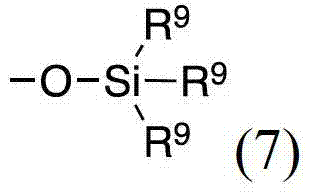
具有式7的甲硅烷氧基,A siloxy group having formula 7,

其中R9是相同的或不同的,并且表示C1-3烷基、芳基或烷基芳基,其包含1至5个C1-4烷基取代基,wherein R 9 are the same or different and represent C 1-3 alkyl, aryl or alkylaryl containing 1 to 5 C 1-4 alkyl substituents,
使得R2R3R4取代基中没有一个具有杂芳基或杂芳基衍生物,such that none of the R2R3R4 substituents has a heteroaryl or heteroaryl derivative ,
-Z表示具有式2的基团,其中R1表示与如上所述地相同-Z represents a group having the formula 2, wherein R represents the same as described above
-E表示亚苯基或具有式3的基团,其中:-E represents phenylene or a group of formula 3 wherein:
R5、R6、R7、R8表示C1-5烷基,苯基,或具有通式7的甲硅烷氧基,其中R9表示与如上所述地相同,R 5 , R 6 , R 7 , R 8 represent C 1-5 alkyl, phenyl, or silyloxy groups with general formula 7, wherein R 9 represents the same as described above,
n值取0或50The value of n is 0 or 50
o值取0或1The value of o is 0 or 1
Y表示O、其中m=1-16的基团(CH2)m、其中基团R10表示H的NR10、C1-5烷基、含有1至5个C1-4烷基取代基或具有C1-4烷基的烷氧基取代基的芳基、其中烷基链含有C1-4的芳基烷基、具有通式8的甲硅烷基,其中:Y represents O, a group (CH 2 ) m where m=1-16, NR 10 where the group R 10 represents H, C 1-5 alkyl, containing 1 to 5 C 1-4 alkyl substituents Or an aryl group having an alkoxy substituent of C 1-4 alkyl, an arylalkyl group wherein the alkyl chain contains C 1-4 , a silyl group having the general formula 8, wherein:

其中取代基R11是相同的或不同的,并且表示C1-3烷基、含有1至5个含有C1-4的烷基取代基的芳基、具有通式7的甲硅烷氧基,其中R9表示与如上所述地相同,除了基团R10不是杂芳基或杂芳基衍生物,wherein the substituents R are the same or different, and represent a C1-3 alkyl group, an aryl group containing 1 to 5 C1-4 -containing alkyl substituents, a silyloxy group having the general formula 7, wherein R represents the same as above except that the group R is not a heteroaryl or a heteroaryl derivative,
使得:makes:
如果n=0,则R4和R5是彼此相同的,或不同的,If n=0, then R4 and R5 are the same as each other, or different,
如果n=1,且o=1,并且Y表示(CH2)m或O或NR10,则R5、R6、R7和R8是彼此相同的;或成对的R5和R7,R6和R8,R5和R6,R7和R8是彼此相同的,但与另一对不同,If n=1, and o=1, and Y represents (CH 2 ) m or O or NR 10 , then R 5 , R 6 , R 7 and R 8 are identical to each other; or a pair of R 5 and R 7 , R 6 and R 8 , R 5 and R 6 , R 7 and R 8 are identical to each other but different from the other pair,
如果n=1且o=0,则以下是可能的:R5、R6、R7和R8是彼此相同的;或成对的R5和R7,R6和R8是相同的但与另一对不同,If n=1 and o=0, the following are possible: R 5 , R 6 , R 7 and R 8 are identical to each other; or pairs of R 5 and R 7 , R 6 and R 8 are identical but Unlike the other pair,
如果Y是O且n=2-50,则R4、R5、R6和R7是彼此相同的,在于在具有通式4的铱催化剂和具有通式5的叔胺的存在下,使合适的具有通式9的末端炔,其中If Y is O and n=2-50, then R 4 , R 5 , R 6 and R 7 are identical to each other in that in the presence of an iridium catalyst of formula 4 and a tertiary amine of formula 5, such that Suitable terminal alkynes have the general formula 9, wherein
H-C≡C-Z(9)H-C≡C-Z(9)
Z表示与如上所述地相同,Z means the same as above,
与合适的具有通式10的卤代三有机硅烷反应,其中Reaction with a suitable halotriorganosilane of general formula 10, wherein
X-R1(10)XR 1 (10)
-X表示Cl、Br、I,特别是碘,-X represents Cl, Br, I, especially iodine,
-R1表示与如上所述地相同。-R 1 means the same as above.
所使用的铱催化剂是具有通式4的铱络合物,优选是[{Ir(μ-Cl)(CO)2}2]。The iridium catalyst used is an iridium complex having the general formula 4, preferably [{Ir(μ-Cl)(CO) 2 } 2 ].
该催化剂以相对于所述官能末端炔基团的0.01至4mol%的范围内的量,优选以1-2mol%的范围内的量使用。The catalyst is used in an amount ranging from 0.01 to 4 mol%, preferably in an amount ranging from 1 to 2 mol%, relative to the functional terminal alkyne groups.
在其第二实施方案中,获得新的和常规的具有通式1的(三有机甲硅烷基)炔的本发明的方法,其中In its second embodiment, the process according to the invention obtains novel and conventional (triorganosilyl)alkynes having the general formula 1, wherein
R1表示-SiR2R3R4,R 1 represents -SiR 2 R 3 R 4 ,
其中R2R3R4是相同的或不同的,并且表示where R 2 R 3 R 4 are the same or different and represent
C1-5烷基、C5-7环烷基C 1-5 alkyl, C 5-7 cycloalkyl
苯基、芳基,其包含1至5个含有C1-4的烷基取代基,Phenyl, aryl containing 1 to 5 C 1-4 containing alkyl substituents,
具有式7的甲硅烷氧基,A siloxy group having formula 7,

其中R9是相同的或不同的,并且表示C1-3烷基、芳基或烷基芳基,其包含1至5个含有C1-4的烷基取代基,wherein R 9 are the same or different and represent C 1-3 alkyl, aryl or alkylaryl containing 1 to 5 C 1-4 containing alkyl substituents,
使得R2R3R4取代基中没有一个具有杂芳基或杂芳基衍生物,such that none of the R2R3R4 substituents has a heteroaryl or heteroaryl derivative ,
Z表示Z means
具有通式8的甲硅烷基,其中R11表示与如上所述地相同,具有通式7的甲硅烷氧基,其中R9表示与如上所述地相同A silyl group of general formula 8, wherein R represents the same as described above, a silyloxy group of general formula 7, wherein R represents the same as described above
二茂铁基,ferrocenyl,
C1-5烷基,C 1-5 alkyl,
C5-7环烷基,C 5-7 cycloalkyl,
-CH2NR1 2,其中R1表示与如上所述地相同,-CH 2 NR 1 2 , wherein R 1 represents the same as above,
具有2至6个范围内的稠合芳环数的芳烃,Aromatic hydrocarbons having a number of fused aromatic rings ranging from 2 to 6,
具有通式11的基团,A group having the general formula 11,
其中:in:
y值取0或1,且w值取0至2The y value takes 0 or 1, and the w value takes 0 to 2
-R12表示C1-5亚烷基、C5-7环亚烷基,-R 12 represents C 1-5 alkylene, C 5-7 cycloalkylene,
-R13、R14、R15、R16、R17是相同的或不同的,且表示氢原子、C1-4烷基链、卤素、其中烷基含有C1-3的烷氧基、-NH2、-OH、-OR1或NR1 2,其中R1表示与如上所述地相同,-R 13 , R 14 , R 15 , R 16 , R 17 are the same or different, and represent a hydrogen atom, a C 1-4 alkyl chain, a halogen, an alkoxy group in which the alkyl group contains C 1-3 , -NH 2 , -OH, -OR 1 or NR 1 2 , wherein R 1 represents the same as described above,
使得当:makes when:
在通式11中,w=1且y=1,则R13、R14、R15、R16、R17是相同的或不同的,且表示氢原子、C1-4烷基链、卤素、其中烷基含有C1-3的烷氧基,In formula 11, w=1 and y=1, then R 13 , R 14 , R 15 , R 16 , R 17 are the same or different, and represent hydrogen atom, C 1-4 alkyl chain, halogen , wherein the alkyl group contains a C 1-3 alkoxy group,
在通式中,y=0且w值范围取0至2,则R13、R14、R15、R16、R17表示与如上所述地相同,且此外取代基R13、R14、R15、R16、R17中的至少一个表示苯基、排除杂芳基的芳基、-NH2、-OH、-OR1或NR1 2,其中R1表示与如上所述地相同,In the general formula, y=0 and w ranges from 0 to 2, then R 13 , R 14 , R 15 , R 16 , R 17 represent the same as above, and in addition the substituents R 13 , R 14 , At least one of R 15 , R 16 , R 17 represents phenyl, aryl excluding heteroaryl, -NH 2 , -OH, -OR 1 or NR 1 2 , wherein R 1 represents the same as described above,
在于在具有通式4的铱催化剂和具有通式5的叔胺的存在下,使合适的具有通式9的末端炔,其中Z表示与如上所述地相同,与合适的具有通式10的卤代三有机硅烷反应,其中X表示Cl、Br、I,特别是碘,并且R1表示与如上所述地相同。In the presence of an iridium catalyst of formula 4 and a tertiary amine of formula 5, a suitable terminal alkyne of formula 9, wherein Z represents the same as described above, is combined with a suitable terminal alkyne of formula 10 Halogenated triorganosilane reactions wherein X represents Cl, Br, I, especially iodine, and R represents the same as described above.
所使用的铱络合物是具有通式4的铱络合物,优选[{Ir(μ-Cl)(CO)2}2]。The iridium complexes used are those of the general formula 4, preferably [{Ir(μ-Cl)(CO) 2 } 2 ].
该催化剂以相对于所述官能末端炔基团的0.01至4mol%的范围内的量使用,优选以0.5至1mol%的范围内的量使用。在含有胺取代基的化合物的合成中,该催化剂优选以0.5至2mol%的范围内的量使用。The catalyst is used in an amount ranging from 0.01 to 4 mol%, preferably in an amount ranging from 0.5 to 1 mol%, relative to the functional terminal alkyne groups. In the synthesis of compounds containing amine substituents, the catalyst is preferably used in an amount ranging from 0.5 to 2 mol%.
在其第三个实施方案中,获得新的和常规的具有通式1的(三有机甲硅烷基)炔的本发明的方法,其中In its third embodiment, the process according to the invention obtains novel and conventional (triorganosilyl)alkynes having the general formula 1, wherein
R1表示-SiR2R3R4,R 1 represents -SiR 2 R 3 R 4 ,
其中R2R3R4是相同的或不同的,并且表示where R 2 R 3 R 4 are the same or different and represent
C1-5烷基、C5-7环烷基C 1-5 alkyl, C 5-7 cycloalkyl
苯基、芳基,其包含1至5个含有C1-4的烷基取代基,Phenyl, aryl containing 1 to 5 C 1-4 containing alkyl substituents,
具有式7的甲硅烷氧基,A siloxy group having formula 7,

其中R9是相同的或不同的,并且表示C1-3烷基、芳基或烷基芳基,其包含1至5个含有C1-4的烷基取代基,wherein R 9 are the same or different and represent C 1-3 alkyl, aryl or alkylaryl containing 1 to 5 C 1-4 containing alkyl substituents,
使得R2R3R4取代基中没有一个具有杂芳基或杂芳基衍生物,such that none of the R2R3R4 substituents has a heteroaryl or heteroaryl derivative ,
Z表示Z means
-CH2NH2,-CH 2 NH 2 ,
具有通式11的基团,A group having the general formula 11,

其中in
y值取0或1,且w值取0至2The y value takes 0 or 1, and the w value takes 0 to 2
R12表示C1-5亚烷基、C5-7环亚烷基,R 12 represents C 1-5 alkylene, C 5-7 cycloalkylene,
R13、R14、R15、R16、R17是相同的或不同的,且表示氢原子、C1-4烷基链、卤素、其中烷基含有C1-3的烷氧基,并且此外,至少一个取代基是或含有-NH2基团,R 13 , R 14 , R 15 , R 16 , R 17 are the same or different, and represent a hydrogen atom, a C 1-4 alkyl chain, halogen, wherein the alkyl group contains a C 1-3 alkoxy group, and Furthermore, at least one substituent is or contains an -NH2 group,
在于进行“一锅”法,包括两个连续反应的序列,其中第一阶段包括在具有通式5的叔胺的存在下合适的具有通式9的末端氨基有机炔,其中Z表示与如上所述地相同,与合适的具有通式10的卤代三有机硅烷之间的反应,其后向反应混合物加入合适的其中R1表示与如上所述地相同的具有通式10的碘代三有机硅烷连同铱络合物和胺,而不分离反应产物,除了在当过量的胺足以提供形成的碘化氢的结合以及胺-铱络合物的形成的情况,不需要加入胺。consists in carrying out a "one-pot" process comprising a sequence of two consecutive reactions, wherein the first stage comprises a suitable terminal aminoorganoalkyne of general formula 9 in the presence of a tertiary amine of general formula 5, wherein Z represents the same as above The same as described above, with the reaction between a suitable halotriorganosilane of general formula 10, thereafter adding to the reaction mixture a suitable iodotriorganosilane of general formula 10 wherein R represents the same as described above. The silane along with the iridium complex and amine without isolation of the reaction product requires no addition of amine except in cases when excess amine is sufficient to provide incorporation of the hydrogen iodide formed and formation of the amine-iridium complex.
在“一锅”法的第二阶段,催化剂优选地以0.5至2mol%的范围内的量使用。In the second stage of the "one pot" process, the catalyst is preferably used in an amount ranging from 0.5 to 2 mol%.
在“一锅”法的第一阶段,胺优选地以相对于卤代硅烷和炔之间的反应中形成的卤化氢的1.1∶1的比例被加入,而在第二阶段,胺以相对于所使用的络合物中的铱离子的2.2倍摩尔过量加上结合在第一阶段所形成的炔与碘代三有机硅烷之间的反应中的、在第二阶段形成的碘化氢所必须的量被加入。In the first stage of the "one-pot" process, the amine is preferably added in a ratio of 1.1:1 relative to the hydrogen halide formed in the reaction between the halosilane and the alkyne, while in the second stage the amine is added relative to A 2.2-fold molar excess of iridium ions in the complex used plus the hydrogen iodide formed in the second stage necessary to bind the reaction between the alkyne formed in the first stage and iodotriorganosilane amount is added.
在本发明的所有实施方案中,在室温下在溶剂中并具有剧烈混合,将具有通式5的叔胺引入悬浮液形式的具有通式4的铱络合物,并且继续混合,直到溶解铱络合物。In all embodiments of the invention, the tertiary amine of general formula 5 is introduced into the iridium complex of general formula 4 in the form of a suspension in a solvent at room temperature with vigorous mixing, and the mixing is continued until the iridium is dissolved complexes.
在室温下,合适的末端炔和三有机卤代硅烷接连被引入所得的系统,并且所得的反应混合物被加热到60℃以上但不高于140℃的温度,直到反应完成,即直到起始末端炔完全转化,之后分离和纯化粗产物。A suitable terminal alkyne and a triorganohalosilane are successively introduced into the resulting system at room temperature, and the resulting reaction mixture is heated to a temperature above 60°C but not above 140°C until the reaction is complete, i.e. until the initial terminal The alkyne is completely converted, after which the crude product is isolated and purified.
反应在选自包括芳族有机化合物的组的溶剂中,最优选在甲苯中,在惰性气体下进行。The reaction is carried out in a solvent selected from the group comprising aromatic organic compounds, most preferably in toluene, under an inert gas.
反应以任何所选的反应物质的比例进行,然而,不利的比例导致大量副产物的形成。如果以相对于末端炔中的单一炔基团的等摩尔量使用卤代三有机硅烷,则过程的选择性将达不到其可实现的最大值,因为除了所需的产物,形成了许多竞争反应(即起始末端炔的三聚和寡聚)的产物。如果系统包括相对于单一炔基团的至少0.1倍化学计量过量的卤代三有机硅烷和叔胺,则通过以合适的氢铵盐[HNA1A2A3]X的形式更加有效地结合卤化氢使选择性移向具有通式1的合适产物,其导致增加的过程选择性的效果。根据本发明,该反应优选地以相对于单一官能的炔基团的0.4-0.7倍摩尔过量的卤代三有机硅烷和0.5-0.8倍摩尔过量的叔胺进行。根据本发明,反应在60-140℃的范围内,最优选在80℃的温度下进行。通常,反应时间是24小时。The reaction is carried out in any chosen ratio of the reacting substances, however, unfavorable ratios lead to the formation of large amounts of by-products. If the halotriorganosilane is used in an equimolar amount relative to the single alkyne group in the terminal alkyne, the selectivity of the process will not reach its achievable maximum, because in addition to the desired product, many competing The product of the reaction (ie trimerization and oligomerization of the initial terminal alkyne). If the system includes at least a 0.1-fold stoichiometric excess of the halotriorganosilane and the tertiary amine relative to the single alkyne group, it is more efficient to combine the halogenated Hydrogen shifts the selectivity towards suitable products of general formula 1, which has the effect of increasing process selectivity. According to the invention, the reaction is preferably carried out with a 0.4-0.7-fold molar excess of the halotriorganosilane and a 0.5-0.8-fold molar excess of the tertiary amine relative to the monofunctional alkynyl group. According to the invention, the reaction is carried out at a temperature in the range of 60-140°C, most preferably at 80°C. Typically, the reaction time is 24 hours.
在“一锅”法的情况下,炔和卤代硅烷之间的反应优选在60℃以上的温度下进行,但优选不高于110℃;在第二阶段,(N,N-双(三有机甲硅烷基氨基有机))炔和碘代硅烷之间的反应在60℃以上但不高于140℃的温度下进行。低于60℃,反应将几乎不进行,而高于140℃,将发生催化剂的分解和失活。In the case of the "one-pot" method, the reaction between the alkyne and the halosilane is preferably carried out at a temperature above 60°C, but preferably not higher than 110°C; in the second stage, (N,N-bis(tri The reaction between the organosilylaminoorgano)) alkyne and the iodosilane is carried out at a temperature above 60°C but not above 140°C. Below 60°C, the reaction will hardly proceed, while above 140°C, decomposition and deactivation of the catalyst will occur.
根据本发明的方法,合成在反应器中在惰性气体,最优选氩气下进行,其避免水分。所有液体反应物质和溶剂应该被脱水和脱氧,这是因为痕量水和氧的存在下的催化剂和起始卤代硅烷的敏感性和可能的降解。反应混合物然后被加热并混合,直到反应完成。According to the method of the invention, the synthesis is carried out in a reactor under an inert gas, most preferably argon, which avoids moisture. All liquid reaction materials and solvents should be dehydrated and deoxygenated due to the sensitivity and possible degradation of the catalyst and starting halosilane in the presence of traces of water and oxygen. The reaction mixture is then heated and mixed until the reaction is complete.
反转加入反应物质的顺序,即先加入卤代三有机硅烷,第二加入炔,且第三加入叔胺,也是可能的,尽管这可能导致减少的过程选择性或铱催化系统的被完全阻断的活性。Reversing the order of addition of the reactants, i.e. adding the halotriorganosilane first, the alkyne second, and the tertiary amine third, is also possible, although this may result in reduced process selectivity or complete inhibition of the iridium-catalyzed system. interrupted activity.
通过已知的方法分离并纯化粗产物。通常,分离在于从后反应混合物蒸发溶剂,随后在硅胶填充的色谱柱上使用脂肪族烃(优选己烷或戊烷)作为洗脱液,从催化剂和作为副产物形成的氢化三有机铵卤化物(hydrogentriorganoammonium halide)分离粗产物。The crude product is isolated and purified by known methods. Typically, the separation consists in evaporating the solvent from the post-reaction mixture, followed by a chromatographic column packed with silica gel using an aliphatic hydrocarbon (preferably hexane or pentane) as eluent, from the catalyst and the hydrogenated triorganoammonium halide formed as a by-product (hydrogentriorganoammonium halide) to isolate the crude product.
不同于目前已知的现有技术方法,根据本发明的方法的合成是选择性达到98%的方法,其中相比于如Jiang所描述的已知方法,催化剂以少量并以卤代三有机硅烷和叔胺小得多的化学计量过量使用。Unlike the currently known prior art methods, the synthesis according to the method of the invention is a method with a selectivity up to 98%, in which the catalyst is present in a small amount and with halotriorganosilane and a much smaller stoichiometric excess of the tertiary amine.
本发明的方法所获得的化合物可用作能够合成具有清楚专一的化学、电子和光电性质的高π-共轭多键系统的分子化合物和大分子化合物的底物,用于制备电子发光的、光致发光的元件或光传感器。The compounds obtained by the method of the present invention can be used as substrates capable of synthesizing molecular compounds and macromolecular compounds of high π-conjugated multi-bond systems with clear and specific chemical, electronic and photoelectric properties, for the preparation of electroluminescent , photoluminescent elements or light sensors.
本发明的主题通过实施例的方式阐述,所述实施例意在示例,而非限制本发明的范围。The subject matter of the invention is illustrated by way of examples, which are intended to illustrate, but not to limit the scope of the invention.
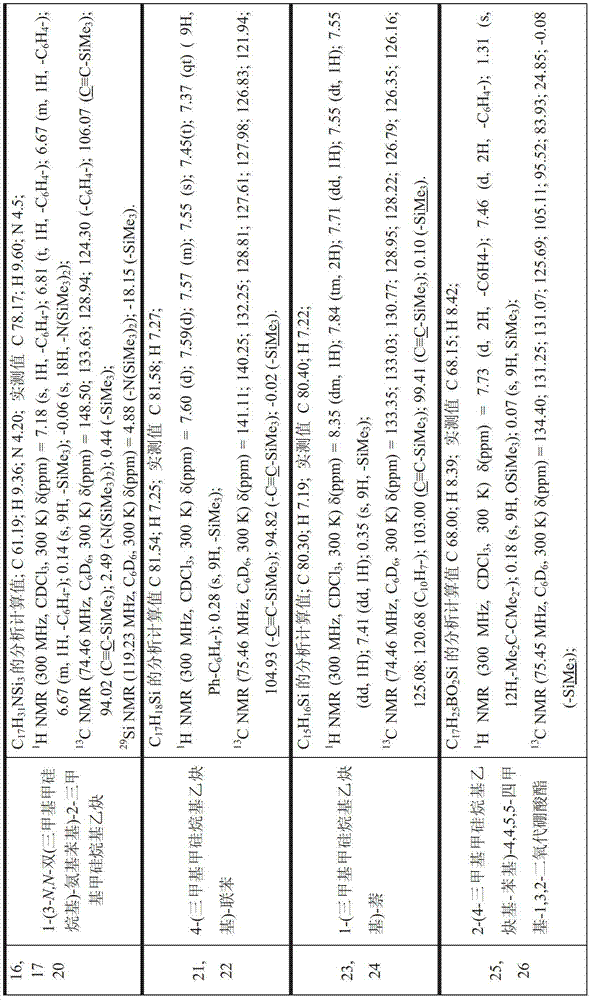
产物基于以下结果鉴别:The product was identified based on the following results:
-1H、13C和29Si NMR的图谱分析,其使用谱仪Brucker Ultra Shield600MHz和Varian Mercury VT400MHz记录。- Spectral analysis of 1 H, 13 C and 29 Si NMR, recorded using spectrometers Brucker Ultra Shield 600 MHz and Varian Mercury VT 400 MHz.
-元素分析,使用Vario EL Elemental仪器进行。- Elemental analysis, carried out with a Vario EL Elemental instrument.
表1显示了通过元素分析和NMR获得的数据。Table 1 shows the data obtained by elemental analysis and NMR.
实施例1Example 1
在氩气气氛下,向装备有磁力搅拌器的具有容量40mL的反应器中添加0.0085g(0.015mmol)的[{Ir(μ-Cl)(CO)2}2],然后添加8mL无水并脱氧的甲苯和0.7g(5.4mmol)的NEt(i-Pr)2。搅拌整个混合物,直到起始铱(I)络合物溶解,然后将0.306g(3mmol)苯乙炔和0.96g(4.8mmol)的ISiMe3加入到所得混合物。使反应在80℃的温度下进行,直到苯乙炔完全转化。反应完成后,在减压下蒸发溶剂,以及任何残留未反应的底物,为的是从反应混合物除去催化剂,然后将残余物转移到填充硅胶的色谱柱,并且使用己烷作为洗脱液分离产物。从洗脱物开始蒸发溶剂,并且残余产物借助“阱至阱(trap-to-trap)”技术在减压下蒸馏,以获得0.47g苯基乙炔基三甲基硅烷,产率90%。Under an argon atmosphere, to a reactor with a capacity of 40 mL equipped with a magnetic stirrer was added 0.0085 g (0.015 mmol) of [{Ir(μ-Cl)(CO) 2 } 2 ], followed by 8 mL of anhydrous and Deoxygenated toluene and 0.7 g (5.4 mmol) of NEt(i-Pr) 2 . The whole mixture was stirred until the starting iridium(I) complex was dissolved, then 0.306 g (3 mmol) of phenylacetylene and 0.96 g (4.8 mmol) of ISiMe 3 were added to the resulting mixture. The reaction was carried out at a temperature of 80° C. until complete conversion of phenylacetylene. After the reaction was complete, the solvent, and any remaining unreacted substrate were evaporated under reduced pressure in order to remove the catalyst from the reaction mixture, and then the residue was transferred to a chromatography column packed with silica gel, and separated using hexane as an eluent. product. Starting from the eluate the solvent was evaporated and the residual product was distilled under reduced pressure by means of the "trap-to-trap" technique to obtain 0.47 g of phenylethynyltrimethylsilane in 90% yield.
实施例2Example 2
按照实施例1中使用的程序,在Following the procedure used in Example 1, in
-0.0085g(0.015mmol)的络合物[{Ir(μ-Cl)(CO)2}2]-0.0085g (0.015mmol) of the complex [{Ir(μ-Cl)(CO) 2 } 2 ]
-0.70g(5.4mmol)的NEt(i-Pr)2的存在下In the presence of -0.70g (5.4mmol) of NEt(i-Pr) 2
进行以下之间的反应:Perform a reaction between:
-0.475g(3mmol)4-叔丁基苯乙炔-0.475g (3mmol) 4-tert-butylphenylacetylene
-0.96g(4.8mmol)的ISiMe3。- 0.96 g (4.8 mmol) of ISiMe3 .
产物是以85%产率获得的0.59g的1-(4-叔丁基苯基)-2-三甲基甲硅烷基乙炔。The product was 0.59 g of 1-(4-tert-butylphenyl)-2-trimethylsilylacetylene obtained in 85% yield.
实施例3Example 3
按照实施例1中使用的程序,在Following the procedure used in Example 1, in
-0.017g(0.03mmol)的络合物[{Ir(μ-Cl)(CO)2}2]-0.017g (0.03mmol) of the complex [{Ir(μ-Cl)(CO) 2 } 2 ]
-0.70g(5.4mmol)的NEt(i-Pr)2的存在下In the presence of -0.70g (5.4mmol) of NEt(i-Pr) 2
进行以下之间的反应:Perform a reaction between:
-0.511g(3mmol)的HC≡CC(Me)(Et)(OSiMe3)-0.511g (3mmol) of HC≡CC(Me)(Et)(OSiMe 3 )
-0.96g(4.8mmol)的ISiMe3。- 0.96 g (4.8 mmol) of ISiMe3 .
产物是以94%产率获得的0.68g的1-三甲基甲硅烷基-3-甲基-3-三甲基甲硅烷氧基-1-丁炔。The product was 0.68 g of 1-trimethylsilyl-3-methyl-3-trimethylsilyloxy-1-butyne obtained in 94% yield.
实施例4Example 4
按照实施例1中使用的程序,在Following the procedure used in Example 1, in
-0.0113g(0.02mmol)的络合物[{Ir(μ-Cl)(CO)2}2]-0.0113g (0.02mmol) of the complex [{Ir(μ-Cl)(CO) 2 } 2 ]
-0.47g(3.6mmol)的NEt(i-Pr)2的存在下In the presence of -0.47g (3.6mmol) of NEt(i-Pr) 2
进行以下之间的反应:Perform a reaction between:
-0.393g(2mmol)的1-乙炔基-1-三甲基甲硅烷氧基-环己烷-0.393g (2mmol) of 1-ethynyl-1-trimethylsilyloxy-cyclohexane
-0.64g(3.2mmol)的ISiMe3。- 0.64 g (3.2 mmol) of ISiMe3 .
产物是以95%产率获得的0.51g的1-三甲基甲硅烷基乙炔基-1-三甲基甲硅烷氧基-环己烷。The product was 0.51 g of 1-trimethylsilylethynyl-1-trimethylsilyloxy-cyclohexane obtained in 95% yield.
实施例5Example 5
在氩气气氛下,向装备有磁力搅拌器的具有容量30mL的反应器中添加0.0113g(0.02mmol)的络合物[{Ir(μ-Cl)(CO)2}2]、10mL的甲苯和0.827g(6.4mmol)的NEt(i-Pr)2。搅拌整个混合物,直到起始铱(I)络合物溶解,然后加入0.248g(2mmol)的1-乙炔基-1-羟基-环己烷。在随后的步骤中,在室温下缓慢加入1.200g(6mmol)的ISiMe3,之后将混合物加热至80℃,同时剧烈搅拌。使反应继续进行,直到起始炔完全转化。反应完成后,在减压下蒸发溶剂,以及任何未反应的底物。借助戊烷,使用套管系统分离甲硅烷基化产物。从萃取物开始蒸发溶剂,然后将残余物在填充SiO2的柱(用15%Et3N的己烷溶液改性)上使用己烷作为洗脱液来纯化。产物是以91%产率获得的0.52g的1-三甲基甲硅烷基乙炔基-1-三甲基甲硅烷氧基-环己烷。Under an argon atmosphere, 0.0113 g (0.02 mmol) of the complex [{Ir(μ-Cl)(CO) } 2 ], 10 mL of toluene were added to a reactor with a capacity of 30 mL equipped with a magnetic stirrer and 0.827 g (6.4 mmol) of NEt(i-Pr) 2 . The whole mixture was stirred until the starting iridium(I) complex had dissolved, then 0.248 g (2 mmol) of 1-ethynyl-1-hydroxy-cyclohexane were added. In a subsequent step, 1.200 g (6 mmol) of ISiMe 3 were added slowly at room temperature, after which the mixture was heated to 80° C. while stirring vigorously. The reaction is continued until complete conversion of the starting alkyne. After the reaction was complete, the solvent, as well as any unreacted substrate, were evaporated under reduced pressure. The silylated product was separated using a cannula system with the aid of pentane. Starting from the extract the solvent was evaporated and the residue was purified on a SiO2 packed column (modified with 15% Et3N in hexane) using hexane as eluent. The product was 0.52 g of 1-trimethylsilylethynyl-1-trimethylsilyloxy-cyclohexane obtained in 91% yield.
实施例6Example 6
按照实施例1中使用的程序,在Following the procedure used in Example 1, in
-0.0113g(0.02mmol)的络合物[{Ir(μ-Cl)(CO)2}2]-0.0113g (0.02mmol) of the complex [{Ir(μ-Cl)(CO) 2 } 2 ]
-0.47g(3.6mmol)的NEt(i-Pr)2的存在下In the presence of -0.47g (3.6mmol) of NEt(i-Pr) 2
进行以下之间的反应:Perform a reaction between:
-0.561g(2mmol)的3,3-二苯基-3-三甲基甲硅烷氧基-1-丙炔-0.561g (2mmol) of 3,3-diphenyl-3-trimethylsilyloxy-1-propyne
-0.64g(3.2mmol)的ISiMe3。- 0.64 g (3.2 mmol) of ISiMe3 .
产物是以95%产率获得的0.67g的1-三甲基甲硅烷基-3,3-二苯基-3-三甲基甲硅烷氧基-1-丙炔。The product was 0.67 g of 1-trimethylsilyl-3,3-diphenyl-3-trimethylsilyloxy-1-propyne obtained in 95% yield.
实施例7Example 7
按照实施例1中使用的程序,在Following the procedure used in Example 1, in
-0.0113g(0.02mmol)的络合物[{Ir(μ-Cl)(CO)2}2]-0.0113g (0.02mmol) of the complex [{Ir(μ-Cl)(CO) 2 } 2 ]
-0.47g(3.6mmol)的NEt(i-Pr)2的存在下In the presence of -0.47g (3.6mmol) of NEt(i-Pr) 2
进行以下之间的反应:Perform a reaction between:
-0.42g(2mmol)的乙炔基二茂铁-0.42g (2mmol) of ethynyl ferrocene
-0.64g(3.2mmol)的ISiMe3。- 0.64 g (3.2 mmol) of ISiMe3 .
产物是以90%产率获得的0.51g的1-二茂铁基-2-三甲基甲硅烷基乙炔。The product was 0.51 g of 1-ferrocenyl-2-trimethylsilylacetylene obtained in 90% yield.
实施例8Example 8
按照实施例1中使用的程序,在Following the procedure used in Example 1, in
-0.0113g(0.02mmol)的络合物[{Ir(μ-Cl)(CO)2}2]-0.0113g (0.02mmol) of the complex [{Ir(μ-Cl)(CO) 2 } 2 ]
-0.47g(3.6mmol)的NEt(i-Pr)2的存在下In the presence of -0.47g (3.6mmol) of NEt(i-Pr) 2
进行以下之间的反应:Perform a reaction between:
-0.363g(2mmol)的HC≡CSi(i-Pr)3 -0.363g (2mmol) of HC≡CSi(i-Pr) 3
-0.64g(3.2mmol)的ISiMe3。- 0.64 g (3.2 mmol) of ISiMe3 .
产物是以97%产率获得的0.49g的1-(三异丙基甲硅烷基)-2-三甲基甲硅烷基乙炔。The product was 0.49 g of 1-(triisopropylsilyl)-2-trimethylsilylacetylene obtained in 97% yield.
实施例9Example 9
按照实施例1中使用的程序,在Following the procedure used in Example 1, in
-0.0113g(0.02mmol)的络合物[{Ir(μ-Cl)(CO)2}2]-0.0113g (0.02mmol) of the complex [{Ir(μ-Cl)(CO) 2 } 2 ]
-0.47g(3.6mmol)的NEt(i-Pr)2的存在下In the presence of -0.47g (3.6mmol) of NEt(i-Pr) 2
进行以下之间的反应:Perform a reaction between:
-0.32g(2mmol)的HC≡CSiMe2Ph-0.32g (2mmol) of HC≡CSiMe 2 Ph
-0.64g(3.2mmol)的ISiMe3。- 0.64 g (3.2 mmol) of ISiMe3 .
产物是以95%产率获得的0.44g的1-二甲基苯基甲硅烷基-2-三甲基甲硅烷基乙炔。The product was 0.44 g of 1-dimethylphenylsilyl-2-trimethylsilylacetylene obtained in 95% yield.
实施例10Example 10
在氩气气氛下,向装备有磁力搅拌器的具有容量25mL的反应器中添加0.017g(0.03mmol)的[{Ir(μ-Cl)(CO)2}2],然后添加10mL无水并脱氧的甲苯和0.7g(5.4mmol)的NEt(i-Pr)2。搅拌整个混合物,直到起始铱(I)络合物溶解,然后将0.274g(1.5mmol)的1,3-二乙炔基四甲基二硅氧烷和1.02g(5.1mmol)的ISiMe3加入到所得混合物。使反应在80℃的温度下进行,直到1.3-二乙炔基四甲基二硅氧烷完全转化。反应完成后,为了从反应混合物除去催化剂,蒸发溶剂,以及任何残留未反应的底物,然后将残余物转移到填充硅胶的色谱柱,并且使用己烷作为洗脱液分离产物。产物是以92%产率获得的0.45g的1,3-双(三甲基甲硅烷基乙炔基)-1,1,3,3-四甲基二硅氧烷。Under an argon atmosphere, 0.017 g (0.03 mmol) of [{Ir(μ-Cl)(CO) } 2 ] was added to a reactor with a capacity of 25 mL equipped with a magnetic stirrer, followed by 10 mL of anhydrous and Deoxygenated toluene and 0.7 g (5.4 mmol) of NEt(i-Pr) 2 . The whole mixture was stirred until the starting iridium(I) complex was dissolved, then 0.274 g (1.5 mmol) of 1,3-diethynyltetramethyldisiloxane and 1.02 g (5.1 mmol) of ISiMe were added to the resulting mixture. The reaction was allowed to proceed at a temperature of 80° C. until complete conversion of the 1.3-diethynyltetramethyldisiloxane. After the reaction was complete, to remove the catalyst from the reaction mixture, the solvent, and any remaining unreacted substrate were evaporated, then the residue was transferred to a chromatography column packed with silica gel, and the product was isolated using hexane as the eluent. The product was 0.45 g of 1,3-bis(trimethylsilylethynyl)-1,1,3,3-tetramethyldisiloxane obtained in 92% yield.
实施例11Example 11
按照实施例10中使用的程序,在According to the procedure used in Example 10, in
-0.017g(0.03mmol)的络合物[{Ir(μ-Cl)(CO)2}2]-0.017g (0.03mmol) of the complex [{Ir(μ-Cl)(CO) 2 } 2 ]
-0.70g(5.4mmol)的NEt(i-Pr)2的存在下In the presence of -0.70g (5.4mmol) of NEt(i-Pr) 2
进行以下之间的反应:Perform a reaction between:
-0.292g(1.5mmol)的1,2-双(二甲基乙炔基甲硅烷基)乙烷-0.292g (1.5mmol) of 1,2-bis(dimethylethynylsilyl)ethane
-0.96g(5.1mmol)的ISiMe3。- 0.96 g (5.1 mmol) of ISiMe3 .
产物是以86%产率获得的0.44g的1,2-(双(三甲基甲硅烷基乙炔基)二甲基甲硅烷基)乙烷。The product was 0.44 g of 1,2-(bis(trimethylsilylethynyl)dimethylsilyl)ethane obtained in 86% yield.
实施例12Example 12
按照实施例10中使用的程序,在According to the procedure used in Example 10, in
-0.017g(0.03mmol)的络合物[{Ir(μ-Cl)(CO)2}2]-0.017g (0.03mmol) of the complex [{Ir(μ-Cl)(CO) 2 } 2 ]
-0.70g(5.4mmol)的NEt(i-Pr)2的存在下In the presence of -0.70g (5.4mmol) of NEt(i-Pr) 2
进行以下之间的反应:Perform a reaction between:
-0.189g(1.5mmol)的1,4-二乙炔基苯-0.189g (1.5mmol) of 1,4-diethynylbenzene
-1.02g(5.1mmol)的ISiMe3。- 1.02 g (5.1 mmol) of ISiMe3 .
产物是以97%产率获得的0.39g的1,4-双(三甲基甲硅烷基乙炔基)苯。The product was 0.39 g of 1,4-bis(trimethylsilylethynyl)benzene obtained in 97% yield.
实施例13Example 13
按照实施例10中使用的程序,在According to the procedure used in Example 10, in
-0.017g(0.03mmol)的络合物[{Ir(μ-Cl)(CO)2}2]-0.017g (0.03mmol) of the complex [{Ir(μ-Cl)(CO) 2 } 2 ]
-0.70g(5.4mmol)的NEt(i-Pr)2的存在下In the presence of -0.70g (5.4mmol) of NEt(i-Pr) 2
进行以下之间的反应:Perform a reaction between:
-0.255g(1.5mmol)的二乙炔基甲基苯基硅烷-0.255g (1.5mmol) of diethynylmethylphenylsilane
-1.02g(5.1mmol)的ISiMe3。- 1.02 g (5.1 mmol) of ISiMe3 .
产物是以91%产率获得的0.43g双(三甲基甲硅烷基乙炔基)苯基甲基硅烷。The product was 0.43 g of bis(trimethylsilylethynyl)phenylmethylsilane obtained in 91% yield.
实施例14Example 14
按照实施例10中使用的程序,在According to the procedure used in Example 10, in
-0.017g(0.03mmol)的络合物[{Ir(μ-Cl)(CO)2}2]-0.017g (0.03mmol) of the complex [{Ir(μ-Cl)(CO) 2 } 2 ]
-0.70g(5.4mmol)的NEt(i-Pr)2的存在下In the presence of -0.70g (5.4mmol) of NEt(i-Pr) 2
进行以下之间的反应:Perform a reaction between:
-0.384g(1.5mmol)的二乙炔基二苯基硅烷-0.384g (1.5mmol) of diethynyldiphenylsilane
-1.02g(5.1mmol)的ISiMe3。- 1.02 g (5.1 mmol) of ISiMe3 .
产物是以96%产率获得的0.54g双(三甲基甲硅烷基乙炔基)二苯基硅烷。The product was 0.54 g of bis(trimethylsilylethynyl)diphenylsilane obtained in 96% yield.
实施例15Example 15
在氩气气氛下,向装备有磁力搅拌器的具有容量40mL的反应器中添加0.0085g(0.015mmol)的[{Ir(μ-Cl)(CO)2}2],然后添加25mL无水并脱氧的甲苯和0.7g(5.4mmol)的NEt(i-Pr)2。搅拌整个混合物,直到起始铱(I)络合物溶解,然后将0.598g(3mmol)的(Me3Si)2NCH2C≡CH和0.96g(4.8mmol)的ISiMe3加入到所得混合物。使反应在80℃的温度下进行,直到(Me3Si)2NCH2C≡CH完全转化。反应完成后,为了从反应混合物除去催化剂,在减压下蒸发溶剂,以及任何残留未反应的底物,然后将无水戊烷加入到残余物。过滤所得的悬浮液,并且所得的沉淀物用两部分溶剂淋洗。从滤液开始蒸发溶剂,并且残余产物借助“阱至阱”技术在减压下蒸馏,以获得以96%产率获得的1.45g的1-(N,N-双(三甲基-甲硅烷基)氨基)-3-三甲基甲硅烷基丙-2-炔。Under an argon atmosphere, to a reactor with a capacity of 40 mL equipped with a magnetic stirrer was added 0.0085 g (0.015 mmol) of [{Ir(μ-Cl)(CO) 2 } 2 ], followed by 25 mL of anhydrous and Deoxygenated toluene and 0.7 g (5.4 mmol) of NEt(i-Pr) 2 . The whole mixture was stirred until the starting iridium(I) complex was dissolved, then 0.598 g (3 mmol) of (Me 3 Si) 2 NCH 2 C≡CH and 0.96 g (4.8 mmol) of ISiMe 3 were added to the resulting mixture. The reaction was carried out at a temperature of 80°C until complete conversion of (Me 3 Si) 2 NCH 2 C≡CH. After the reaction was completed, in order to remove the catalyst from the reaction mixture, the solvent, and any remaining unreacted substrate were evaporated under reduced pressure, and then anhydrous pentane was added to the residue. The resulting suspension was filtered and the resulting precipitate was rinsed with two portions of solvent. Starting from the filtrate, the solvent was evaporated and the residual product was distilled under reduced pressure by means of a "trap-to-trap" technique to obtain 1.45 g of 1-(N,N-bis(trimethyl-silyl) obtained in 96% yield )amino)-3-trimethylsilylprop-2-yne.
实施例16Example 16
按照实施例15中使用的程序,在Following the procedure used in Example 15, in
-0.034g(0.06mmol)的络合物[{Ir(μ-Cl)(CO)2}2]-0.034g (0.06mmol) of the complex [{Ir(μ-Cl)(CO) 2 } 2 ]
-1.40g(10.8mmol)的NEt(i-Pr)2的存在下In the presence of -1.40g (10.8mmol) of NEt(i-Pr) 2
进行以下之间的反应:Perform a reaction between:
-1.57g(6mmol)的3-N,N-双(三甲基甲硅烷基氨基)苯乙炔-1.57g (6mmol) of 3-N, N-bis(trimethylsilylamino)phenylacetylene
-1.92g(9.6mmol)的ISiMe3。- 1.92 g (9.6 mmol) of ISiMe3 .
产物是以95%产率获得的1.9g的1-(3-N,N-双(三甲基甲硅烷基)氨基苯基)-2-三甲基甲硅烷基乙炔。The product was 1.9 g of 1-(3-N,N-bis(trimethylsilyl)aminophenyl)-2-trimethylsilylacetylene obtained in 95% yield.
实施例17Example 17
按照实施例15中使用的程序,在Following the procedure used in Example 15, in
-0.0403g(0.06mmol)的络合物[{Ir(μ-Cl)(cod)}2]-0.0403g (0.06mmol) of the complex [{Ir(μ-Cl)(cod)} 2 ]
-1.40g(10.8mmol)的NEt(i-Pr)2的存在下In the presence of -1.40g (10.8mmol) of NEt(i-Pr) 2
进行以下之间的反应:Perform a reaction between:
-1.57g(6mmol)的3-N,N-双(三甲基甲硅烷基氨基)苯乙炔-1.57g (6mmol) of 3-N, N-bis(trimethylsilylamino)phenylacetylene
-1.92g(9.6mmol)的ISiMe3。- 1.92 g (9.6 mmol) of ISiMe3 .
产物是以78%产率获得的1.9g的1-(3-N,N-双(三甲基甲硅烷基)氨基苯基)-2-三甲基甲硅烷基乙炔。The product was 1.9 g of 1-(3-N,N-bis(trimethylsilyl)aminophenyl)-2-trimethylsilylacetylene obtained in 78% yield.
实施例18Example 18
在氩气气氛下,向装备有磁力搅拌器的具有容量50mL的反应器中添加25mL的甲苯、3.26g(25.2mmol)的NEt(i-Pr)2;0.330(6mmol)的丙-2-炔-1-胺。然后加入小份的4.56g(22.8mmol)的ISiMe3,之后将反应器中的物质加热至80℃的温度,并继续加热1小时。这产生了含有丙-2-炔-1-双(三甲基甲硅烷基)胺的后反应混合物,在室温下向其中加入0.034g(0.06mmol)的络合物[{Ir(μ-Cl)(CO)2}2],并继续搅拌,直到铱化合物完全溶解,然后使反应在80℃的温度下进行,直到丙-2-炔-1-双(三甲基甲硅烷基)胺完全转化。反应完成后,为了从反应混合物除去催化剂,在减压下蒸发溶剂,以及任何残留未反应的底物,然后将一定量的无水戊烷加入到残余物。过滤所得的悬浮液,并且所得的沉淀物用两部分溶剂淋洗。从滤液开始蒸发溶剂,并且残余产物借助“阱至阱”技术在减压下蒸馏,以获得以91%产率的1.48g的1-(N,N-双(三甲基甲硅烷基)氨基)-3-三甲基甲硅烷基丙-2-炔。Under an argon atmosphere, to a reactor with a capacity of 50 mL equipped with a magnetic stirrer was added 25 mL of toluene, 3.26 g (25.2 mmol) of NEt(i-Pr) 2 ; 0.330 (6 mmol) of prop-2-yne -1-amine. A small portion of 4.56 g (22.8 mmol) of ISiMe3 was then added, after which the contents of the reactor were heated to a temperature of 80°C and heating was continued for 1 hour. This produced a post reaction mixture containing prop-2-yne-1-bis(trimethylsilyl)amine, to which 0.034 g (0.06 mmol) of the complex [{Ir(μ-Cl )(CO) 2 } 2 ], and continue to stir until the iridium compound is completely dissolved, then allow the reaction to proceed at a temperature of 80°C until prop-2-yn-1-bis(trimethylsilyl)amine is completely transform. After the reaction was completed, in order to remove the catalyst from the reaction mixture, the solvent, and any remaining unreacted substrate were evaporated under reduced pressure, and then a certain amount of anhydrous pentane was added to the residue. The resulting suspension was filtered and the resulting precipitate was rinsed with two portions of solvent. Starting from the filtrate, the solvent was evaporated and the residual product was distilled under reduced pressure by means of a "trap-to-trap" technique to obtain 1.48 g of 1-(N,N-bis(trimethylsilyl)amino in 91% yield )-3-trimethylsilylprop-2-yne.
实施例19Example 19
在氩气气氛下,向装备有磁力搅拌器的具有容量40mL的反应器中添加18mL的甲苯、3.26g(25.2mmol)的NEt(i-Pr)2;0.330(6mmol)的丙-2-炔-1-胺。然后加入小份的1.43g(13.2mmol)ClSiMe3,之后将反应器中的物质加热至80℃的温度,并继续加热1小时。这产生了含有丙-2-炔-1-双(三甲基甲硅烷基)胺的后反应混合物,在室温下向其中加入0.034g(0.06mmol)的络合物[{Ir(μ-Cl)(CO)2}2],并继续搅拌,直到铱化合物完全溶解,然后将1.92g(9.60mmol)的ISiMe3加入到所得混合物。反应在80℃的温度下进行,直到丙-2-炔-1-双(三甲基甲硅烷基)胺完全转化。反应完成后,为了从反应混合物除去催化剂,在减压下蒸发溶剂,以及任何残留未反应的底物,然后将无水戊烷加入到残余物。过滤所得的悬浮液,并且所得的沉淀物用两部分溶剂淋洗。从滤液开始蒸发溶剂,并且残余产物借助“阱至阱”技术在减压下蒸馏,以获得以89%产率获得的1.45g的1-N,N-双(三甲基-甲硅烷基)氨基-3-三甲基甲硅烷基丙-2-炔。Under an argon atmosphere, to a reactor with a capacity of 40 mL equipped with a magnetic stirrer was added 18 mL of toluene, 3.26 g (25.2 mmol) of NEt(i-Pr) 2 ; 0.330 (6 mmol) of prop-2-yne -1-amine. A small portion of 1.43 g (13.2 mmol) of ClSiMe3 was then added, after which the contents of the reactor were heated to a temperature of 80°C and heating was continued for 1 hour. This produced a post-reaction mixture containing prop-2-yne-1-bis(trimethylsilyl)amine, to which 0.034 g (0.06 mmol) of the complex [{Ir(μ-Cl )(CO) 2 } 2 ], and continued stirring until the iridium compound was completely dissolved, then 1.92 g (9.60 mmol) of ISiMe 3 was added to the resulting mixture. The reaction was carried out at a temperature of 80° C. until complete conversion of prop-2-yn-1-bis(trimethylsilyl)amine. After the reaction was completed, in order to remove the catalyst from the reaction mixture, the solvent, and any remaining unreacted substrate were evaporated under reduced pressure, and then anhydrous pentane was added to the residue. The resulting suspension was filtered and the resulting precipitate was rinsed with two portions of solvent. Starting from the filtrate, the solvent was evaporated and the residual product was distilled under reduced pressure by means of the "trap-to-trap" technique to obtain 1.45 g of 1-N,N-bis(trimethyl-silyl) obtained in 89% yield Amino-3-trimethylsilylprop-2-yne.
实施例20Example 20
按照实施例18中使用的程序,在Following the procedure used in Example 18, in
-0.034g(0.06mmol)的络合物[{Ir(μ-Cl)(CO)2}2]-0.034g (0.06mmol) of the complex [{Ir(μ-Cl)(CO) 2 } 2 ]
-3.26g(25.2mmol)的NEt(i-Pr)2的存在下In the presence of -3.26g (25.2mmol) of NEt(i-Pr) 2
进行以下之间的反应:Perform a reaction between:
-0.33g(6mmol)的3-氨基苯乙炔-0.33g (6mmol) of 3-aminophenylacetylene
-4.56g(4.8mmol)的ISiMe3。- 4.56 g (4.8 mmol) of ISiMe3 .
产物是以90%产率获得的1.8g的1-(3-N,N-双(三甲基甲硅烷基)氨基苯基)-2-三甲基甲硅烷基乙炔。The product was 1.8 g of 1-(3-N,N-bis(trimethylsilyl)aminophenyl)-2-trimethylsilylacetylene obtained in 90% yield.
实施例21Example 21
在氩气气氛下,向装备有磁力搅拌器的具有容量40mL的反应器中添加0.0085g(0.015mmol)的[{Ir(μ-Cl)(CO)2}2],然后添加8mL无水并脱氧的甲苯和0.7g(5.4mmol)的NEt(i-Pr)2。搅拌整个混合物,直到起始铱(I)络合物溶解,然后将0.535g(3mmol)的4-乙炔基联苯和0.96g(4.8mmol)的ISiMe3加入到所得混合物。使反应在80℃的温度下进行,直到4-乙炔基联苯完全转化。反应完成后,为了从反应混合物除去催化剂,在减压下蒸发溶剂,以及任何残留未反应的底物。借助戊烷,使用套管系统萃取甲硅烷基化产物。从萃取物开始蒸发溶剂,然后将粗产物在填充SiO2的柱(用15%Et3N的己烷溶液改性)上使用己烷作为洗脱液来纯化。产物是以94%产率获得的0.706g的4-(三甲基甲硅烷基乙炔基)联苯。Under an argon atmosphere, to a reactor with a capacity of 40 mL equipped with a magnetic stirrer was added 0.0085 g (0.015 mmol) of [{Ir(μ-Cl)(CO) 2 } 2 ], followed by 8 mL of anhydrous and Deoxygenated toluene and 0.7 g (5.4 mmol) of NEt(i-Pr) 2 . The whole mixture was stirred until the starting iridium(I) complex was dissolved, then 0.535 g (3 mmol) of 4-ethynylbiphenyl and 0.96 g (4.8 mmol) of ISiMe 3 were added to the resulting mixture. The reaction was carried out at a temperature of 80°C until complete conversion of 4-ethynylbiphenyl. After the reaction was complete, to remove the catalyst from the reaction mixture, the solvent was evaporated under reduced pressure, as well as any remaining unreacted substrate. The silylated product was extracted using a cannula system with the aid of pentane. Starting from the extract the solvent was evaporated and the crude product was purified on a SiO2 packed column (modified with 15% Et3N in hexane) using hexane as eluent. The product was 0.706 g of 4-(trimethylsilylethynyl)biphenyl obtained in 94% yield.
实施例22Example 22
按照实施例21中使用的程序,在Following the procedure used in Example 21, at
-0.017g(0.03mmol)的络合物[{Ir(μ-Cl)(CO)2}2]-0.017g (0.03mmol) of the complex [{Ir(μ-Cl)(CO) 2 } 2 ]
-1.40g(10.8mmol)的NEt(i-Pr)2的存在下In the presence of -1.40g (10.8mmol) of NEt(i-Pr) 2
进行以下之间的反应:Perform a reaction between:
-1.07g(6mmol)的4-乙炔基联苯-1.07g (6mmol) of 4-ethynyl biphenyl
-1.92g(9.6mmol)的ISiMe3。- 1.92 g (9.6 mmol) of ISiMe3 .
产物是以96%产率获得的1.44g的4-(三甲基甲硅烷基乙炔基)联苯。The product was 1.44 g of 4-(trimethylsilylethynyl)biphenyl obtained in 96% yield.
实施例23Example 23
按照实施例21中使用的程序,在Following the procedure used in Example 21, at
-0.0085g(0.015mmol)的络合物[{Ir(μ-Cl)(CO)2}2]-0.0085g (0.015mmol) of the complex [{Ir(μ-Cl)(CO) 2 } 2 ]
-0.70g(5.4mmol)的NEt(i-Pr)2的存在下In the presence of -0.70g (5.4mmol) of NEt(i-Pr) 2
进行以下之间的反应:Perform a reaction between:
-0.457g(3mmol)的1-乙炔基萘-0.457g (3mmol) of 1-ethynylnaphthalene
-0.96g(4.8mmol)的ISiMe3。- 0.96 g (4.8 mmol) of ISiMe3 .
产物是以95%产率获得的0.639g的1-(三甲基甲硅烷基乙炔基)萘。The product was 0.639 g of 1-(trimethylsilylethynyl)naphthalene obtained in 95% yield.
实施例24Example 24
按照实施例21中使用的程序,在Following the procedure used in Example 21, at
-0.017g(0.03mmol)的络合物[{Ir(μ-Cl)(CO)2}2]-0.017g (0.03mmol) of the complex [{Ir(μ-Cl)(CO) 2 } 2 ]
-1.4g(10.8mmol)的NEt(i-Pr)2的存在下In the presence of -1.4g (10.8mmol) of NEt(i-Pr) 2
进行以下之间的反应:Perform a reaction between:
-0.914g(6mmol)的1-乙炔基萘-0.914g (6mmol) of 1-ethynylnaphthalene
-1.92g(9.6mmol)的ISiMe3。- 1.92 g (9.6 mmol) of ISiMe3 .
产物是以97%产率获得的1.305g的1-(三甲基甲硅烷基乙炔基)萘。The product was 1.305 g of 1-(trimethylsilylethynyl)naphthalene obtained in 97% yield.
实施例25Example 25
按照实施例21中使用的程序,在Following the procedure used in Example 21, at
-0.017g(0.03mmol)的络合物[{Ir(μ-Cl)(CO)2}2]-0.017g (0.03mmol) of the complex [{Ir(μ-Cl)(CO) 2 } 2 ]
-0.70g(5.4mmol)的NEt(i-Pr)2的存在下In the presence of -0.70g (5.4mmol) of NEt(i-Pr) 2
进行以下之间的反应:Perform a reaction between:
-0.684g(3mmol)的2-(4-乙炔基苯基)-4,4,5,5-四甲基-1,3,2-二氧代硼酸酯-0.684g (3mmol) of 2-(4-ethynylphenyl)-4,4,5,5-tetramethyl-1,3,2-dioxoboronate
-0.96g(4.8mmol)的ISiMe3。- 0.96 g (4.8 mmol) of ISiMe3 .
产物是以94%产率获得的0.807g的2-(4-三甲基甲硅烷基乙炔基苯基)-4,4,5,5-四甲基-1,3,2-二氧代硼酸酯。The product was 0.807 g of 2-(4-trimethylsilylethynylphenyl)-4,4,5,5-tetramethyl-1,3,2-dioxo, obtained in 94% yield Borates.
实施例26Example 26
按照实施例21中使用的程序,在Following the procedure used in Example 21, at
-0.034g(0.06mmol)的络合物[{Ir(μ-Cl)(CO)2}2]-0.034g (0.06mmol) of the complex [{Ir(μ-Cl)(CO) 2 } 2 ]
-1.4g(10.8mmol)的NEt(i-Pr)2的存在下In the presence of -1.4g (10.8mmol) of NEt(i-Pr) 2
进行以下之间的反应:Perform a reaction between:
-1.368g(6mmol)的2-(4-乙炔基苯基)-4,4,5,5-四甲基-1,3,2-二氧代硼酸酯-1.368g (6mmol) of 2-(4-ethynylphenyl)-4,4,5,5-tetramethyl-1,3,2-dioxoboronate
-1.92g(9.6mmol)的ISiMe3。- 1.92 g (9.6 mmol) of ISiMe3 .
产物是以96%产率获得的1.649g的2-(4-三甲基甲硅烷基乙炔基苯基)-4,4,5,5-四甲基-1,3,2-二氧代硼酸酯。The product was 1.649 g of 2-(4-trimethylsilylethynylphenyl)-4,4,5,5-tetramethyl-1,3,2-dioxo, obtained in 96% yield Borates.
实施例27Example 27
在氩气气氛下,向装备有磁力搅拌器的具有容量40mL的反应器中添加0.017g(0.03mmol)的[{Ir(μ-Cl)(CO)2}2],然后添加25mL无水并脱氧的甲苯和0.7g(5.4mmol)的NEt(i-Pr)2。搅拌整个混合物,直到起始铱(I)络合物溶解,然后将0.785g(3mmol)的4-(Me3Si)2NC6H4C≡CH和0.96g(4.8mmol)的ISiMe3加入到所得混合物。使反应在80℃的温度下进行,直到4-(Me3Si)2NC6H4C≡CH完全转化。反应完成后,为了从反应混合物除去催化剂,在减压下蒸发溶剂,以及任何残留未反应的底物,然后将无水戊烷加入到残余物。过滤所得的悬浮液,并且所得的沉淀物用两部分溶剂淋洗。从滤液开始蒸发溶剂,并且残余产物借助“阱至阱”技术在减压下蒸馏,以获得以94%产率获得的0.941g的1-(4-N,N-双(三甲基-甲硅烷基)氨基苯基)-2-三甲基甲硅烷基乙炔。Under an argon atmosphere, 0.017 g (0.03 mmol) of [{Ir(μ-Cl)(CO) } 2 ] was added to a reactor with a capacity of 40 mL equipped with a magnetic stirrer, followed by 25 mL of anhydrous and Deoxygenated toluene and 0.7 g (5.4 mmol) of NEt(i-Pr) 2 . The whole mixture was stirred until the starting iridium(I) complex was dissolved, then 0.785 g (3 mmol) of 4-( Me3Si ) 2NC6H4C≡CH and 0.96 g (4.8 mmol) of ISiMe3 were added to the resulting mixture. The reaction was allowed to proceed at a temperature of 80°C until complete conversion of 4-(Me 3 Si) 2 NC 6 H 4 C≡CH. After the reaction was completed, in order to remove the catalyst from the reaction mixture, the solvent, and any remaining unreacted substrate were evaporated under reduced pressure, and then anhydrous pentane was added to the residue. The resulting suspension was filtered and the resulting precipitate was rinsed with two portions of solvent. Starting from the filtrate, the solvent was evaporated and the residual product was distilled under reduced pressure by means of the "trap-to-trap" technique to obtain 0.941 g of 1-(4-N,N-bis(trimethyl-formazol) obtained in 94% yield silyl)aminophenyl)-2-trimethylsilylacetylene.
实施例28Example 28
按照实施例21中使用的程序,在Following the procedure used in Example 21, at
-0.034g(0.06mmol)的络合物[{Ir(μ-Cl)(CO)2}2]-0.034g (0.06mmol) of the complex [{Ir(μ-Cl)(CO) 2 } 2 ]
-1.40g(10.8mmol)的NEt(i-Pr)2的存在下In the presence of -1.40g (10.8mmol) of NEt(i-Pr) 2
进行以下之间的反应:Perform a reaction between:
-1.57g(6mmol)的4-N,N-双(三甲基甲硅烷基氨基)苯乙炔-1.57g (6mmol) of 4-N, N-bis(trimethylsilylamino)phenylacetylene
-1.92g(9.6mmol)的ISiMe3。- 1.92 g (9.6 mmol) of ISiMe3 .
产物是以95%产率获得的1.9g的1-(4-N,N-双(三甲基甲硅烷基)氨基苯基)-2-三甲基甲硅烷基乙炔。The product was 1.9 g of 1-(4-N,N-bis(trimethylsilyl)aminophenyl)-2-trimethylsilylacetylene obtained in 95% yield.
实施例29Example 29
在氩气气氛下,向装备有磁力搅拌器的具有容量50mL的反应器中添加25mL的甲苯、3.26g(25.2mmol)的NEt(i-Pr)2;0.703(6mmol)的4-氨基苯乙炔。然后加入小份的4.56g(22.8mmol)的ISiMe3,之后将反应器中的物质加热至80℃的温度,并继续加热1小时。这产生了含有4-N,N-双(三甲基-甲硅烷基氨基)苯乙炔的后反应混合物,在室温下向其中加入0.034g(0.06mmol)的络合物[{Ir(μ-Cl)(CO)2}2],并继续搅拌,直到铱化合物完全溶解,然后使反应在80℃的温度下进行,直到4-N,N-双(三甲基甲硅烷基氨基)苯乙炔完全转化。反应完成后,为了从反应混合物除去催化剂,在减压下蒸发溶剂,以及任何残留未反应的底物,然后将无水戊烷加入到残余物。过滤所得的悬浮液,并且所得的沉淀物用两部分溶剂淋洗。从滤液开始蒸发溶剂,并且残余产物借助“阱至阱”技术在减压下蒸馏,以获得以92%产率的1.84g的1-(4-N,N-双(三甲基甲硅烷基)氨基苯基)-2-三甲基甲硅烷基乙炔。Under an argon atmosphere, add 25 mL of toluene, 3.26 g (25.2 mmol) of NEt(i-Pr) 2 ; 0.703 (6 mmol) of 4-aminophenylacetylene to a reactor with a capacity of 50 mL equipped with a magnetic stirrer . A small portion of 4.56 g (22.8 mmol) of ISiMe3 was then added, after which the contents of the reactor were heated to a temperature of 80°C and heating was continued for 1 hour. This produced a post-reaction mixture containing 4-N,N-bis(trimethyl-silylamino)phenylacetylene, to which 0.034 g (0.06 mmol) of the complex [{Ir(μ- Cl) (CO) 2 } 2 ], and continue to stir until the iridium compound is completely dissolved, then allow the reaction to proceed at a temperature of 80°C until 4-N, N-bis(trimethylsilylamino)phenylacetylene Totally converted. After the reaction was completed, in order to remove the catalyst from the reaction mixture, the solvent, and any remaining unreacted substrate were evaporated under reduced pressure, and then anhydrous pentane was added to the residue. The resulting suspension was filtered and the resulting precipitate was rinsed with two portions of solvent. Starting from the filtrate, the solvent was evaporated and the residual product was distilled under reduced pressure by means of a "trap-to-trap" technique to obtain 1.84 g of 1-(4-N,N-bis(trimethylsilyl) in 92% yield )aminophenyl)-2-trimethylsilylacetylene.
实施例30Example 30
在氩气气氛下,向装备有磁力搅拌器的具有容量40mL的反应器中添加25mL的甲苯、3.26g(25.2mmol)的NEt(i-Pr)2;0.703(6mmol)的4-氨基苯乙炔。然后加入小份的1.43g(13.2mmol)ClSiMe3,之后将反应器中的物质加热至80℃的温度,并继续加热1小时。这产生了含有4-N,N-双(三甲基甲硅烷基氨基)苯乙炔的后反应混合物,在室温下向其中加入0.034g(0.06mmol)的络合物[{Ir(μ-Cl)(CO)2}2],并继续搅拌,直到铱化合物完全溶解,然后将1.92g(9.60mmol)的ISiMe3加入到所得混合物。反应在80℃的温度下进行,直到4-N,N-双(三甲基甲硅烷基氨基)苯乙炔完全转化。反应完成后,为了从反应混合物除去催化剂,在减压下蒸发溶剂,以及任何残留未反应的底物,然后将一定量的无水戊烷加入到残余物。过滤所得的悬浮液,并且所得的沉淀物用两部分溶剂淋洗。从滤液开始蒸发溶剂,并且残余产物借助“阱至阱”技术在减压下蒸馏,以获得以88%产率获得的1.76g的1-(4-N,N-双(三甲基甲硅烷基)氨基苯基)-2-三甲基甲硅烷基乙炔。Under an argon atmosphere, to a reactor with a capacity of 40 mL equipped with a magnetic stirrer was added 25 mL of toluene, 3.26 g (25.2 mmol) of NEt(i-Pr) 2 ; 0.703 (6 mmol) of 4-aminophenylacetylene . A small portion of 1.43 g (13.2 mmol) of ClSiMe3 was then added, after which the contents of the reactor were heated to a temperature of 80°C and heating was continued for 1 hour. This produced a post-reaction mixture containing 4-N,N-bis(trimethylsilylamino)phenylacetylene, to which 0.034 g (0.06 mmol) of the complex [{Ir(μ-Cl )(CO) 2 } 2 ], and continued stirring until the iridium compound was completely dissolved, then 1.92 g (9.60 mmol) of ISiMe 3 was added to the resulting mixture. The reaction was carried out at a temperature of 80° C. until complete conversion of 4-N,N-bis(trimethylsilylamino)phenylacetylene. After the reaction was completed, in order to remove the catalyst from the reaction mixture, the solvent, and any remaining unreacted substrate were evaporated under reduced pressure, and then a certain amount of anhydrous pentane was added to the residue. The resulting suspension was filtered and the resulting precipitate was rinsed with two portions of solvent. Starting from the filtrate, the solvent was evaporated and the residual product was distilled under reduced pressure by means of the "trap-to-trap" technique to obtain 1.76 g of 1-(4-N,N-bis(trimethylsilane) obtained in 88% yield base) aminophenyl)-2-trimethylsilylacetylene.
参考文献references
1.W.P.Weber,Silicon Reagents for Organic Synthesis,Springer-Verlag,Berlin,1983,129-1581. W.P. Weber, Silicon Reagents for Organic Synthesis, Springer-Verlag, Berlin, 1983, 129-158
2.M.Bolourtchian,R.Zadmard,M.R.Saidi,Monatshefte füf Chemie1999,130,333-3362. M. Bolourtchian, R. Zadmard, M. R. Saidi, Monatshefte füf Chemie 1999, 130, 333-336
3.A.Arcadi,S.Cacchi,F.Marinelli Tetrahedron Lett.,1986,27,6397-64003. A. Arcadi, S. Cacchi, F. Marinelli Tetrahedron Lett., 1986, 27, 6397-6400
4.R.J.P Corriu,Robert,V.Huynh,J.J.E.Moreau,Tetrahedron Lett.,1984,25,1887-18904. R.J.P Corriu, Robert, V.Huynh, J.J.E.Moreau, Tetrahedron Lett., 1984, 25, 1887-1890
5.I.MacInnes,lain;J,C.Walton,J.Chem.Soc.,Perkin Transactions2:Physical OrganicChemistry,1987,1077-10825. I. MacInnes, lain; J, C. Walton, J. Chem. Soc., Perkin Transactions 2: Physical Organic Chemistry, 1987, 1077-1082
6.A.A.Anreev,V.V.Konshin,N.V.Komarov,M.Rubin,Ch.Brouwer,V.Gevorgyan,V.Org.Lett.2004,6,421-4246. A.A. Anreev, V.V. Konshin, N.V. Komarov, M. Rubin, Ch. Brouwer, V. Gevorgyan, V. Org. Lett. 2004, 6, 421-424
7.H.Jiang,S.Zhu,S.Tetrahedron Lett.2005,46,517-5197. H. Jiang, S. Zhu, S. Tetrahedron Lett. 2005, 46, 517-519
8.R.J.Rahaim Jr.,J.T.Shaw,J.Org.Chem.2008,73,2912-29158. R. J. Rahaim Jr., J. T. Shaw, J. Org. Chem. 2008, 73, 2912-2915
9.D.Osterdorf,L.Kirmaier,W.Saak,H.Marsmann,M.Weidenbruch,Eur.J.Inorg.Chem.1999,12,2301-2307)9. D. Osterdorf, L. Kirmaier, W. Saak, H. Marsmann, M. Weidenbruch, Eur. J. Inorg. Chem. 1999, 12, 2301-2307)
10.L.-M.Yang,L.-F.Huang,T.-Y.Luh,Org.Lett.2004,6,1461-146310. L.-M. Yang, L.-F. Huang, T.-Y. Luh, Org. Lett. 2004, 6, 1461-1463
11.S.Takahashi,Y.Kuroyama,K.Sonogashira,N.Hagihara,Synthesis,198011. S. Takahashi, Y. Kuroyama, K. Sonogashira, N. Hagihara, Synthesis, 1980
12.B.Marciniec,I.Kownacki Transformations of(organo)siliocon compounds catalyzed byiridium complexes in Iridum Complexes in organic synthesis(Luis A.Oro,Carmen Claver,eds.),Wiley-VCH Verlag GmbH & Co.KGaA,Weinheim,2009,chapter14,pp.345-36712.B.Marciniec, I.Kownacki Transformations of(organo)siliocon compounds catalyzed byiridium complexes in Iridum Complexes in organic synthesis (Luis A.Oro, Carmen Claver, eds.), Wiley-VCH Verlag GmbH & Co.KGaA, Weinheim, 2009, chapter14, pp.345-367
13.J.Wang,Y.Gurevich,M.Botoshansky,M.S.Eisen,J.Am.Chem.Soc.2006,128,9350-935113. J. Wang, Y. Gurevich, M. Botoshansky, M. S. Eisen, J. Am. Chem. Soc. 2006, 128, 9350-9351
14.14.R.Amemiya,M.Yamaguchi,Eur.J.Org.Chem.2005,5145-515014.14. R. Amemiya, M. Yamaguchi, Eur. J. Org. Chem. 2005, 5145-5150
15.15.Ch.Fischer,E.M.Carreira,Organic Letters,2001,3,4319-432115.15. Ch. Fischer, E.M. Carreira, Organic Letters, 2001, 3, 4319-4321
16.H.Tomioka,S.Sawai,Organic and Biomolecular Chemistry,2003,1,4441-445016. H. Tomioka, S. Sawai, Organic and Biomolecular Chemistry, 2003, 1, 4441-4450
表1:实施例中获得的化合物的表征。Table 1: Characterization of the compounds obtained in the examples.



Claims (17)



Applications Claiming Priority (9)
| Application Number | Priority Date | Filing Date | Title |
|---|---|---|---|
| PL393476A PL220987B1 (en) | 2010-12-30 | 2010-12-30 | New bis(triorganosililo) terminal dialkynes and new catalytic process for the preparation of new and known substituted bis (triorganosililo) terminal dialkynes |
| PLP.393475 | 2010-12-30 | ||
| PL393475A PL218555B1 (en) | 2010-12-30 | 2010-12-30 | New catalytic process for the preparation of basic (triorganosililo) alkynes |
| PLP.393476 | 2010-12-30 | ||
| PLP.394454 | 2011-04-06 | ||
| PL394454A PL217836B1 (en) | 2011-04-06 | 2011-04-06 | New 1-(3-N,N-bis(trimethylsilylamino)phenyl)-2-(trimethylsilyl)ethine and a new catalytic process for the preparation of 1-(N,N-bis (triorganosilylamino)organo)-2- (triorganosilyl)ethines |
| PL397507A PL216696B1 (en) | 2011-12-24 | 2011-12-24 | Novel 1-(4-N,N-bis(triorganosililoamino)phenyl-2-(triorganosililo)etin and a new catalytic process for the preparation of substituted (triorganosililo)alkynes |
| PLP.397507 | 2011-12-24 | ||
| PCT/PL2011/050056 WO2012091588A2 (en) | 2010-12-30 | 2011-12-29 | New (triorganosilyl)alkynes and their derivatives and a new catalytic method for obtaining new and conventional substituted (triorganosilyl)alkynes and their derivatives |
Publications (2)
| Publication Number | Publication Date |
|---|---|
| CN103328489A true CN103328489A (en) | 2013-09-25 |
| CN103328489B CN103328489B (en) | 2016-11-02 |
Family
ID=45688221
Family Applications (1)
| Application Number | Title | Priority Date | Filing Date |
|---|---|---|---|
| CN201180063476.4A Expired - Fee Related CN103328489B (en) | 2010-12-30 | 2011-12-29 | New (three Organosilyls) alkynes and their derivant and obtain new and conventional substituted (three Organosilyls) alkynes and the new catalysis process of their derivant |
Country Status (7)
| Country | Link |
|---|---|
| US (2) | US9108994B2 (en) |
| EP (1) | EP2658861B8 (en) |
| JP (1) | JP5886876B2 (en) |
| KR (1) | KR101631132B1 (en) |
| CN (1) | CN103328489B (en) |
| PL (1) | PL2658861T3 (en) |
| WO (1) | WO2012091588A2 (en) |
Cited By (1)
| Publication number | Priority date | Publication date | Assignee | Title |
|---|---|---|---|---|
| CN106661059A (en) * | 2014-09-02 | 2017-05-10 | 加州理工学院 | Base-catalyzed silylation of terminial alkyne c-h bonds |
Citations (2)
| Publication number | Priority date | Publication date | Assignee | Title |
|---|---|---|---|---|
| JPH0892257A (en) * | 1994-09-29 | 1996-04-09 | Sagami Chem Res Center | Production of alkynylsilanes |
| WO2008020774A1 (en) * | 2006-08-16 | 2008-02-21 | Adam Mickiewicz University | New silylsubstituted 1,2-alkynes and synthesis of silylsubstituted 1,2-aikynes |
Family Cites Families (4)
| Publication number | Priority date | Publication date | Assignee | Title |
|---|---|---|---|---|
| JPH09295986A (en) * | 1996-03-08 | 1997-11-18 | Sagami Chem Res Center | Production of alkinylsilane compounds |
| JPH11228579A (en) * | 1998-02-10 | 1999-08-24 | Sagami Chem Res Center | Production of n-silylimines |
| FR2830188B1 (en) * | 2001-09-28 | 2005-01-28 | Oreal | TINCTORIAL COMPOSITION CONTAINING A PARA-AMINOPHENOL OR PARA-PHENYLENE DIAMINE COMPOUND SUBSTITUTED WITH A SILANIC RADICAL |
| US8153835B2 (en) * | 2006-03-07 | 2012-04-10 | Japan Science And Technology Agency | Fullerene derivatives |
-
2011
- 2011-12-29 JP JP2013547383A patent/JP5886876B2/en not_active Expired - Fee Related
- 2011-12-29 CN CN201180063476.4A patent/CN103328489B/en not_active Expired - Fee Related
- 2011-12-29 WO PCT/PL2011/050056 patent/WO2012091588A2/en not_active Ceased
- 2011-12-29 KR KR1020137020283A patent/KR101631132B1/en not_active Expired - Fee Related
- 2011-12-29 EP EP11819029.7A patent/EP2658861B8/en not_active Not-in-force
- 2011-12-29 PL PL11819029T patent/PL2658861T3/en unknown
- 2011-12-29 US US13/976,260 patent/US9108994B2/en not_active Expired - Fee Related
-
2015
- 2015-07-10 US US14/796,370 patent/US9518069B2/en not_active Expired - Fee Related
Patent Citations (2)
| Publication number | Priority date | Publication date | Assignee | Title |
|---|---|---|---|---|
| JPH0892257A (en) * | 1994-09-29 | 1996-04-09 | Sagami Chem Res Center | Production of alkynylsilanes |
| WO2008020774A1 (en) * | 2006-08-16 | 2008-02-21 | Adam Mickiewicz University | New silylsubstituted 1,2-alkynes and synthesis of silylsubstituted 1,2-aikynes |
Non-Patent Citations (2)
| Title |
|---|
| ANNETTE D. ALLEN等,: "Preparation and crystal structure of a stable and persistent twisted tetraketene", 《CHEM. COMMUN.》, 31 December 1996 (1996-12-31), pages 2171 - 2172 * |
| RIE SHIMIZU等,: "Dehydrogenative silylation of terminal alkynes by iridium catalyst", 《TETRAHEDRON LETTERS》, vol. 40, 31 December 2000 (2000-12-31), pages 907 - 910 * |
Cited By (1)
| Publication number | Priority date | Publication date | Assignee | Title |
|---|---|---|---|---|
| CN106661059A (en) * | 2014-09-02 | 2017-05-10 | 加州理工学院 | Base-catalyzed silylation of terminial alkyne c-h bonds |
Also Published As
| Publication number | Publication date |
|---|---|
| CN103328489B (en) | 2016-11-02 |
| JP5886876B2 (en) | 2016-03-16 |
| US9108994B2 (en) | 2015-08-18 |
| US9518069B2 (en) | 2016-12-13 |
| WO2012091588A2 (en) | 2012-07-05 |
| EP2658861B1 (en) | 2016-10-12 |
| PL2658861T3 (en) | 2017-05-31 |
| EP2658861A2 (en) | 2013-11-06 |
| EP2658861B8 (en) | 2016-12-07 |
| KR20130132969A (en) | 2013-12-05 |
| WO2012091588A3 (en) | 2012-10-04 |
| JP2014501275A (en) | 2014-01-20 |
| US20140005427A1 (en) | 2014-01-02 |
| KR101631132B1 (en) | 2016-06-16 |
| US20150361111A1 (en) | 2015-12-17 |
Similar Documents
| Publication | Publication Date | Title |
|---|---|---|
| KR101710043B1 (en) | Hydrosilylation catalysts | |
| EP2643329B1 (en) | In-situ activation of metal complexes used as hydrosilylation catalysts | |
| KR20140035318A (en) | Metal-catalyzed mono-hydrosilylation of polyunsaturated compounds | |
| CN105916870A (en) | Cobalt catalysts and their use for hydrosilylation and dehydrogenative silylation | |
| CN109999905B (en) | Preparation and application of high-selectivity hydrosilylation catalyst | |
| CN103328489B (en) | New (three Organosilyls) alkynes and their derivant and obtain new and conventional substituted (three Organosilyls) alkynes and the new catalysis process of their derivant | |
| JPH0812682A (en) | Bis(dichloroorganosilyl)alkane derivative and its production | |
| Corriu et al. | Intramolecular nitrogen ligand stabilization of phenyl-imidazolidine derived silicon species | |
| JP3856088B2 (en) | Method for producing bissilylnorbornane compound | |
| JPH04124189A (en) | Production of organosilicon compound | |
| CN107226822A (en) | A kind of preparation method of hexa-atomic silaoxacyclen | |
| JP2003212884A (en) | Method for producing phenylsilane | |
| JPH0314590A (en) | Unsaturated group-containing organosilicon compound and its production | |
| PL217836B1 (en) | New 1-(3-N,N-bis(trimethylsilylamino)phenyl)-2-(trimethylsilyl)ethine and a new catalytic process for the preparation of 1-(N,N-bis (triorganosilylamino)organo)-2- (triorganosilyl)ethines | |
| Kamitani | Studies on the Syntheses of Iron Complexes Bearing ER_3 Ligand (E= Si, Ge, Sn, P) and Their Reactivity toward an EH Bond | |
| JP2003277389A (en) | Method for producing phenylsilane | |
| PL216696B1 (en) | Novel 1-(4-N,N-bis(triorganosililoamino)phenyl-2-(triorganosililo)etin and a new catalytic process for the preparation of substituted (triorganosililo)alkynes | |
| PL188754B1 (en) | Method of obtaining silylethenes | |
| JP2003277388A (en) | Method for producing phenylsilane |
Legal Events
| Date | Code | Title | Description |
|---|---|---|---|
| C06 | Publication | ||
| PB01 | Publication | ||
| C10 | Entry into substantive examination | ||
| SE01 | Entry into force of request for substantive examination | ||
| C14 | Grant of patent or utility model | ||
| GR01 | Patent grant | ||
| CF01 | Termination of patent right due to non-payment of annual fee |
Granted publication date: 20161102 Termination date: 20171229 |
|
| CF01 | Termination of patent right due to non-payment of annual fee |