CN102924576A - Helicobacter pylori immunodominance epitope peptide and preparation method and application thereof - Google Patents
Helicobacter pylori immunodominance epitope peptide and preparation method and application thereof Download PDFInfo
- Publication number
- CN102924576A CN102924576A CN2012104358774A CN201210435877A CN102924576A CN 102924576 A CN102924576 A CN 102924576A CN 2012104358774 A CN2012104358774 A CN 2012104358774A CN 201210435877 A CN201210435877 A CN 201210435877A CN 102924576 A CN102924576 A CN 102924576A
- Authority
- CN
- China
- Prior art keywords
- peptide
- amino acid
- helicobacter pylori
- epitope
- immunodominant
- Prior art date
- Legal status (The legal status is an assumption and is not a legal conclusion. Google has not performed a legal analysis and makes no representation as to the accuracy of the status listed.)
- Granted
Links
Images


Landscapes
- Peptides Or Proteins (AREA)
- Medicines Containing Antibodies Or Antigens For Use As Internal Diagnostic Agents (AREA)
Abstract
本发明涉及一种幽门螺杆菌免疫显性表位肽及其制备方法和应用,所述显性表位肽的氨基酸序列如SEQ ID NO:97、100、108和115所示。本发明还提供了所述显性表位肽的制备方法,并进一步提供了所述显性表位肽用于预防或治疗幽门螺杆菌感染的制剂中的应用。

The present invention relates to an immunodominant epitope peptide of Helicobacter pylori and its preparation method and application. The amino acid sequence of the dominant epitope peptide is shown in SEQ ID NO:97, 100, 108 and 115. The present invention also provides a preparation method of the dominant epitope peptide, and further provides an application of the dominant epitope peptide in a preparation for preventing or treating Helicobacter pylori infection.
Description
技术领域technical field
本发明属于医药生物技术领域,涉及一种幽门螺杆菌免疫显性表位肽及其制备方法和应用。The invention belongs to the technical field of medicine and biology, and relates to a helicobacter pylori immunodominant epitope peptide and a preparation method and application thereof.
背景技术Background technique
幽门螺杆菌(Helicobacter pylori,Hp)1982年由澳大利亚学者Warren和Marshall发现,其定植于人胃粘膜局部,致使全球50%以上人群感染,成为慢性胃炎,胃十二指肠溃疡及胃粘膜相关淋巴组织淋巴瘤等胃肠疾病发生的主要致病因素。同时世界卫生组织已将Hp列为与胃癌发生密切相关的一类致癌因子。目前临床上针对Hp感染问题,主要采用抗生素加质子泵抑制剂的多联疗法,但存在高耐药性、易复发和再次感染等不足,严重制约了抗生素多联疗法的临床疗效和使用范围,而疫苗的免疫接种有可能成为彻底消除Hp感染和治疗相关胃肠疾病的有效手段。Helicobacter pylori (Hp) was discovered by Australian scholars Warren and Marshall in 1982. It colonizes localized human gastric mucosa, causing more than 50% of the world's population to infect, becoming chronic gastritis, gastroduodenal ulcer and gastric mucosa-related lymphocytes. The main pathogenic factor of gastrointestinal diseases such as tissue lymphoma. At the same time, the World Health Organization has listed Hp as a kind of carcinogenic factor closely related to the occurrence of gastric cancer. At present, the multi-drug therapy of antibiotics and proton pump inhibitors is mainly used clinically for H. Vaccine immunization may become an effective means to completely eliminate Hp infection and treat related gastrointestinal diseases.
全球现已广泛开展Hp疫苗研究,包括全菌疫苗、亚单位疫苗和核酸疫苗等,但绝大多数处于实验室研发和临床试验阶段,且免疫保护效果仍不十分理想。上述已有疫苗可激发以抗体为主的体液免疫应答且作为其主要免疫保护机制,而对于胞外感染菌所诱导的CD4+T淋巴细胞应答未能在疫苗设计和研究策略上给予足够的重视。大量研究结果表明:无论是Hp自然感染还是疫苗接种,抗原特异性CD4+T淋巴细胞发挥重要作用,其中以产IFN-γ的CD4+T淋巴细胞的免疫保护作用较为明确。为了有效激发机体产生抗原特异性IFN-γ+CD4+T淋巴细胞应答,需对现有疫苗候选保护性抗原中免疫优势表位进行系统的筛选并从中确定保护性表位。Hp vaccine research has been widely carried out around the world, including whole bacterial vaccines, subunit vaccines, and nucleic acid vaccines, but most of them are still in the stage of laboratory research and clinical trials, and the immune protection effect is still not very satisfactory. The above-mentioned existing vaccines can stimulate antibody-based humoral immune response as the main immune protection mechanism, but the CD4 + T lymphocyte response induced by extracellular infection has not been given enough attention in vaccine design and research strategies . A large number of research results have shown that whether it is Hp natural infection or vaccination, antigen-specific CD4 + T lymphocytes play an important role, and the immune protection of IFN-γ-producing CD4 + T lymphocytes is relatively clear. In order to effectively stimulate the body to generate antigen-specific IFN-γ + CD4 + T lymphocyte responses, it is necessary to systematically screen the immunodominant epitopes in the protective antigens of existing vaccine candidates and determine the protective epitopes from them.
目前表位的筛选与鉴定方法主要包括质谱法、软件预测、步移合成重叠肽等多种方法。质谱法操作简单、省时、快速,但不能排除自身反应性表位和在自然状态下不能被抗原递呈细胞加工递呈的表位。软件预测法虽简便、快速,但预测结果常与真实情况存在一定的出入,需实验加以验证。步移合成重叠肽是一种系统筛选表位的方法,可有效克服质谱法和预测法的不足,明确表位的免疫优势应答特性,避免漏筛和误筛现象。因此本研究采用步移合成重叠肽法进行优势表位的筛选。Currently, epitope screening and identification methods mainly include mass spectrometry, software prediction, step-by-step synthesis of overlapping peptides and other methods. Mass spectrometry is simple, time-saving and fast, but cannot exclude self-reactive epitopes and epitopes that cannot be processed and presented by antigen-presenting cells in their natural state. Although the software prediction method is simple and fast, the prediction results are often different from the real situation, which needs to be verified by experiments. Step-by-step synthesis of overlapping peptides is a method for systematic screening of epitopes, which can effectively overcome the shortcomings of mass spectrometry and prediction methods, clarify the immunodominant response characteristics of epitopes, and avoid missed screening and false screening. Therefore, in this study, the method of synthesizing overlapping peptides by walking was used to screen the dominant epitopes.
现已研究发现:同一种抗原联合不同佐剂可诱导机体产生不同的免疫保护作用,其保护作用的差异可能是由于诱导产生的优势应答表位不同而导致的,因此,本研究采用幽门螺杆菌疫苗候选抗原结合不同佐剂免疫接种小鼠,分析其免疫保护作用,并通过步移合成重叠肽技术筛选鉴定优势应答表位肽,进而对优势应答表位肽进行免疫保护效果评价。It has been found that the same antigen combined with different adjuvants can induce different immune protection effects in the body, and the difference in the protective effects may be caused by the difference in the induced dominant response epitopes. Therefore, this study uses Helicobacter pylori Vaccine candidate antigens were combined with different adjuvants to immunize mice, and their immune protection effects were analyzed. The dominant response epitope peptides were screened and identified by step-step synthetic overlapping peptide technology, and then the immune protection effect of the dominant response epitope peptides was evaluated.
发明内容Contents of the invention
本发明的目的是从幽门螺杆菌抗原中筛选鉴定出优势应答的CD4+T细胞免疫显性表位肽,所述免疫显性表位肽能有效激发CD4+T细胞产生高水平IFN-γ应答,并具有显著的抗幽门螺杆菌感染的免疫保护作用。The purpose of the present invention is to screen and identify CD4 + T cell immunodominant epitope peptides with dominant responses from Helicobacter pylori antigens, and the immunodominant epitope peptides can effectively stimulate CD4 + T cells to produce high-level IFN-γ responses , and has significant immune protection against Helicobacter pylori infection.
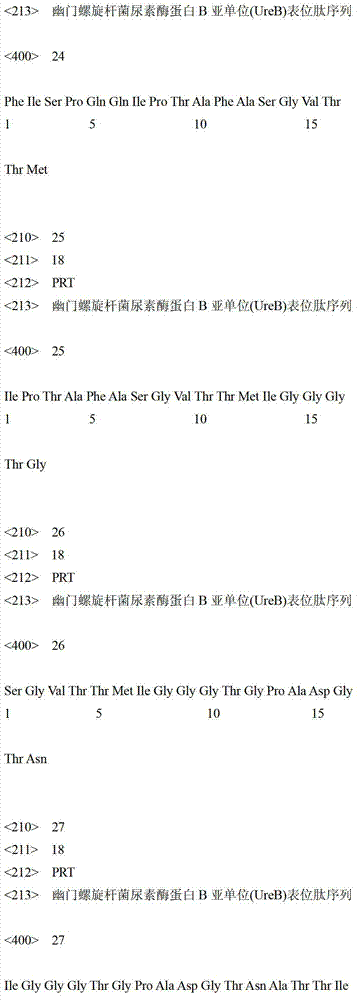
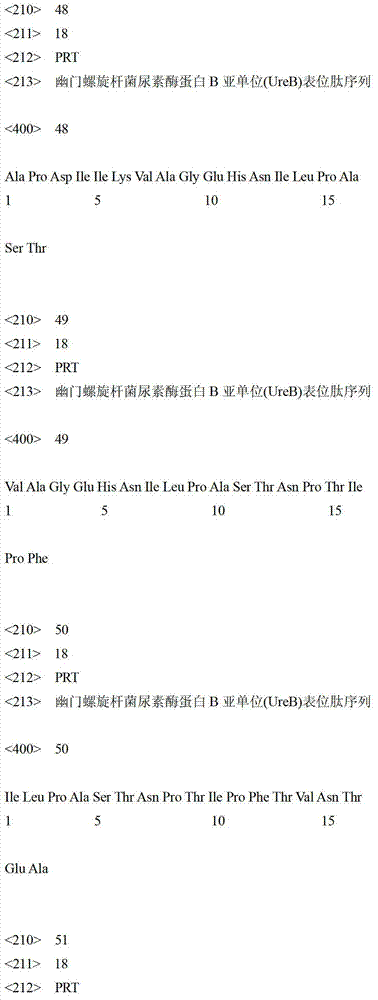
本发明提供了一种幽门螺杆菌免疫显性表位肽,其氨基酸序列如SEQ IDNO:97、100、108和115所示。The present invention provides a Helicobacter pylori immunodominant epitope peptide, the amino acid sequence of which is shown in SEQ ID NO:97, 100, 108 and 115.
本发明所提供的幽门螺杆菌尿素酶B亚单位(UreB)抗原的优势应答的免疫显性表位肽可用于幽门螺杆菌预防性或治疗性疫苗。所述疫苗优选为蛋白疫苗或核酸疫苗。The immunodominant epitope peptide of the dominant response to the Helicobacter pylori urease B subunit (UreB) antigen provided by the invention can be used for the preventive or therapeutic vaccine of Helicobacter pylori. The vaccine is preferably a protein vaccine or a nucleic acid vaccine.
所使用制剂包含医学上可接受的免疫佐剂,优选为弗氏佐剂、CPG ODN1826或AddaVax。The formulation used contains a medically acceptable immune adjuvant, preferably Freund's adjuvant, CPG ODN1826 or AddaVax.
本发明进一步提供了所述免疫显性表位肽的制备方法,包含以下步骤:The present invention further provides a method for preparing the immunodominant epitope peptide, comprising the following steps:
1)从蛋白数据库中获取幽门螺杆菌来源的UreB蛋白质序列;1) Obtain the UreB protein sequence derived from Helicobacter pylori from the protein database;
2)从步骤1)获取的UreB蛋白质序列的第1号氨基酸开始,每次步移6个氨基酸,以步移重叠的18个氨基酸为一个多肽段,形成第一多肽库,和/或在获得的第一多肽中;2) Starting from the first amino acid of the UreB protein sequence obtained in step 1), move 6 amino acids each time, and use the overlapping 18 amino acids as a polypeptide segment to form the first polypeptide library, and/or in In the obtained first polypeptide;
3)利用抗原特异性CD4+T细胞从步骤2)所述的第一多肽库中筛选18个氨基酸短肽的免疫显性表位肽;3) Using antigen-specific CD4 + T cells to screen immunodominant epitope peptides of 18 amino acid short peptides from the first polypeptide library described in step 2);
4)利用步骤3)筛选出的18个氨基酸短肽的免疫显性表位肽采用步移法,每次步移2个氨基酸,以步移重叠的至少13个氨基酸为一个多肽段,形成第二多肽库;4) The immunodominant epitope peptide of the 18-amino acid short peptide screened in step 3) adopts the walking method, and each step is 2 amino acids, and at least 13 amino acids with overlapping steps are used as a polypeptide segment to form the first Two polypeptide libraries;
5)利用抗原特异性CD4+T细胞从步骤4)所述的第二多肽库中筛选13个氨基酸短肽的免疫显性表位肽;5) Using antigen-specific CD4 + T cells to screen immunodominant epitope peptides of 13 amino acid short peptides from the second polypeptide library described in step 4);
6)利用MHC分子抗体阻断实验确定步骤5)筛选的免疫显性表位肽的限制性。6) Use MHC molecular antibody blocking experiments to determine the limitations of the immunodominant epitope peptides screened in step 5).
结果显示所制备的免疫显性表位肽具有明显免疫保护作用,其保护效果不亚于甚至优于全蛋白抗原。本发明中所提供的免疫显性表位肽均可诱导机体针对相应表位产生强烈的免疫应答反应。因此通过诱导机体针对免疫保护性表位产生应答,或直接用保护性表位免疫机体将对幽门螺杆菌感染起到有效免疫保护作用,可用于进一步的幽门螺杆菌预防性和治疗性表位疫苗的研究。The results show that the prepared immunodominant epitope peptide has obvious immune protective effect, and its protective effect is no less than or even better than the whole protein antigen. The immunodominant epitope peptides provided in the present invention can all induce the body to generate a strong immune response against the corresponding epitope. Therefore, by inducing the body to respond to the immune protective epitope, or directly immunizing the body with the protective epitope, it will have an effective immune protection against Helicobacter pylori infection, which can be used for further Helicobacter pylori preventive and therapeutic epitope vaccines Research.
为让本发明的上述及其它目的、特征和优点能更明显易懂,下文特举较佳实施例,并配合附图,作详细说明如下。In order to make the above and other objects, features and advantages of the present invention more comprehensible, preferred embodiments will be described in detail below together with the accompanying drawings.
附图说明Description of drawings
图1表示UreB抗原联合不同佐剂免疫攻毒后检测胃组织幽门螺杆菌定植量,可见不同佐剂组免疫保护作用存在差异。Figure 1 shows the detection of Helicobacter pylori colonization in gastric tissue after UreB antigen combined with different adjuvant immune challenge, it can be seen that there are differences in the immune protection effect of different adjuvant groups.
图2A和图2B表示ELISA方法检测不同佐剂组血清IgG(图2A)/胃局部sIgA(图2B)抗体水平,可见IgG抗体应答与免疫保护作用之间并不十分吻合。sIgA抗体应答与免疫保护作用之间存在一定相关性。Figure 2A and Figure 2B show the ELISA method to detect serum IgG (Figure 2A)/stomach local sIgA (Figure 2B) antibody levels in different adjuvant groups. It can be seen that the IgG antibody response and immune protection are not very consistent. There is a certain correlation between sIgA antibody response and immune protection.
图3A表示经流式细胞术方法检测脾淋巴细胞中抗原特异性CD4+T细胞,可见免疫组存在抗原特异性CD4+T细胞。Figure 3A shows the detection of antigen-specific CD4 + T cells in splenic lymphocytes by flow cytometry, and it can be seen that there are antigen-specific CD4 + T cells in the immunized group.
图3B表示各组脾淋巴细胞中抗原特异性CD4+T细胞的频率,可见免疫组较PBS对照组存在明显区别。Fig. 3B shows the frequency of antigen-specific CD4 + T cells in splenic lymphocytes in each group, and it can be seen that there is a significant difference between the immune group and the PBS control group.
图4表示利用抗原特异性CD4+T细胞和步移合成重叠肽对所有18个氨基酸组成的短肽进行筛选,其中P53、P63、P68、P69、P81、P82为免疫显性肽段。Figure 4 shows the screening of all short peptides consisting of 18 amino acids by using antigen-specific CD4 + T cells and step-by-step synthesis of overlapping peptides, in which P53, P63, P68, P69, P81, and P82 are immunodominant peptides.
图5A-图5F表示利用抗原特异性CD4+T细胞和步移重叠合成肽对13个氨基酸组成的短肽进行筛选,其中P53-4,P63-2,P68-5,P81-4为更短的免疫显性肽段。Figure 5A-Figure 5F shows the screening of short peptides consisting of 13 amino acids by using antigen-specific CD4 + T cells and walking overlapping synthetic peptides, among which P53-4, P63-2, P68-5, and P81-4 are shorter immunodominant peptides.
图6表示利用MHC分子抗体阻断实验确定免疫显性表位MHC限制性,发现均为MHC-Ⅱ(I-A)亚型限制性。Figure 6 shows the determination of MHC restriction of immunodominant epitopes by MHC molecular antibody blocking experiment, and it was found that they were all MHC-II (I-A) subtype restriction.
图7表示用免疫显性表位肽免疫小鼠后攻毒,检测胃局部幽门螺杆菌定植量,可见不同表位免疫组保护作用存在差异,P53、P63表位具有更显著的免疫保护作用。Figure 7 shows that mice were challenged after immunization with immunodominant epitope peptides, and the amount of Helicobacter pylori colonization in the stomach was detected. It can be seen that the protective effects of different epitope immunization groups are different, and the P53 and P63 epitopes have more significant immune protection effects.
图8A和图8B表示ELISA法检测不同表位免疫组血清抗UreB和相应表位IgG抗体水平,可见表位免疫不能有效诱导血清抗体产生。Figure 8A and Figure 8B show the ELISA method to detect serum anti-UreB and corresponding epitope IgG antibody levels in different epitope immunization groups, it can be seen that epitope immunization cannot effectively induce serum antibody production.
图9A和图9B表示ELISA法检测不同表位免疫组胃局部抗UreB和相应表位sIgA抗体水平,可见表位免疫不能有效诱导粘膜抗体产生。Figure 9A and Figure 9B show the ELISA method to detect the local anti-UreB and corresponding epitope sIgA antibody levels in the stomach of different epitope immunization groups. It can be seen that epitope immunization cannot effectively induce mucosal antibody production.
图10表示ICS法检测各表位免疫组脾淋巴细胞中表位特异性CD4+T细胞的比例,可见各免疫组均可诱导表位特异性CD4+T细胞产生。Figure 10 shows the ratio of epitope-specific CD4 + T cells in spleen lymphocytes of each epitope immunization group detected by ICS method, and it can be seen that each immunization group can induce the generation of epitope-specific CD4 + T cells.
具体实施方式Detailed ways
为了使本发明目的、技术方案及优点更加清楚明白,下面结合附图及实施例,对本发明进行进一步详细说明。应当理解,此处所描述的具体实施例仅用以解释本发明,并不用于限定本发明。In order to make the object, technical solution and advantages of the present invention more clear, the present invention will be further described in detail below in conjunction with the accompanying drawings and embodiments. It should be understood that the specific embodiments described here are only used to explain the present invention, not to limit the present invention.
材料与方法Materials and Methods
(一)蛋白和肽段(1) Proteins and peptides
重组幽门螺杆菌尿素酶B亚单位(rUreB)蛋白由本单位重组构建(吴超“幽门螺杆菌尿素酶B亚单位基因克隆表达及临床应用”《中华检验医学杂志》2001年5期);Recombinant Helicobacter pylori urease B subunit (rUreB) protein was recombined and constructed by our unit (Wu Chao, "Helicobacter pylori urease B subunit gene cloning, expression and clinical application", "Chinese Journal of Laboratory Medicine",
多肽肽段通过化学方法合成(由上海吉尔生化公司合成),二甲亚砜(DMSO)溶解至10mM的浓度,-70℃保存,临用时经RPMI-1640完全培养基稀释到1mM浓度。Peptides were chemically synthesized (synthesized by Shanghai Jill Biochemical Company), dissolved in dimethylsulfoxide (DMSO) to a concentration of 10mM, stored at -70°C, and diluted to a concentration of 1mM with RPMI-1640 complete medium before use.
(二)主要溶液及试剂配制(2) Preparation of main solutions and reagents
1.RPMI-1640不完全培养基:1. RPMI-1640 incomplete medium:
分别称取10.4g RPMI-1640粉末,2.4g Hepes和2g NaHCO3,加入去离子水至1000mL,搅匀过滤除菌,分装冻存。Weigh 10.4g RPMI-1640 powder, 2.4g Hepes and 2g NaHCO 3 respectively, add deionized water to 1000mL, stir well, filter and sterilize, and store in aliquots.
2.RPMI-1640完全培养基:2. RPMI-1640 complete medium:
分别量取900ml RPMI-1640不完全培养基和100ml胎牛血清,加入20万单位/mL青霉素和链霉素双抗各0.5mL(终浓度为100U/mL),混匀分装。Measure 900ml of RPMI-1640 incomplete medium and 100ml of fetal bovine serum respectively, add 0.5mL each of 200,000 units/mL of penicillin and streptomycin (final concentration is 100U/mL), mix and distribute.
3.冻存液:3. Freezing solution:
胎牛血清与DMSO按照9︰1的比例混合,分装冻存。Fetal bovine serum and DMSO were mixed according to the ratio of 9:1, subpackaged and frozen.
(三)所使用的主要试剂及其来源(3) The main reagents used and their sources
实施例1:18个氨基酸短肽的步移重叠合成及混合肽库的制备 Example 1: Step-overlap synthesis of 18 amino acid short peptides and preparation of a mixed peptide library
幽门螺杆菌尿素酶蛋白B亚单位(UreB),全长569个氨基酸,在各菌株之间序列保守,重组构建幽门螺杆菌尿素酶B亚单位为1-569多肽,源于11637国际标准菌株。UniProt蛋白数据库中检索幽门螺杆菌11637源尿素酶蛋白B亚单位氨基酸序列(编号P69996),从第1号氨基酸开始步移重叠合成18个氨基酸短肽(由上海吉尔生化公司协助合成),共93条(最后一条为17个氨基酸短肽)。纯度均大于70%。合成肽信息见表1。将合成的肽段用DMSO溶解至10mM储存浓度,另取93条短肽各10μL混合组成肽库。分装后-70℃保存。Helicobacter pylori urease protein B subunit (UreB) has a full length of 569 amino acids, and its sequence is conserved among various strains. The recombinantly constructed Helicobacter pylori urease B subunit is a 1-569 polypeptide, which is derived from the 11637 international standard strain. The amino acid sequence of the B subunit of urease protein derived from Helicobacter pylori 11637 (number P69996) was retrieved from the UniProt protein database, and a short peptide of 18 amino acids was synthesized by stepping and overlapping from the first amino acid (synthesized with the assistance of Shanghai Jier Biochemical Company), a total of 93 strips (the last one is a 17 amino acid short peptide). The purity is greater than 70%. The synthetic peptide information is shown in Table 1. The synthesized peptides were dissolved in DMSO to a storage concentration of 10 mM, and 10 μL of each of 93 short peptides were mixed to form a peptide library. Store at -70°C after aliquoting.
UniProt蛋白数据库检索网址:UniProt protein database search URL:
http://www.uniprot.org/uniprot/P69996http://www.uniprot.org/uniprot/P69996
幽门螺杆菌尿素酶蛋白B亚单位(UreB)18个氨基酸表位肽序列如表1所示。The 18-amino acid epitope peptide sequence of Helicobacter pylori urease protein B subunit (UreB) is shown in Table 1.
表1步移重叠合成UreB 18个氨基酸短肽基本信息Table 1 Basic information of step-overlap synthesis of 18 amino acid short peptides of UreB
(依次分别为SEQ ID NO.1-93)(respectively SEQ ID NO.1-93)
实施例2:不同佐剂组免疫效果评价及抗体应答分析 Example 2: Evaluation of immune effects and antibody response analysis of different adjuvant groups
1.动物免疫及攻毒实验方案1. Experimental protocol for animal immunization and challenge
rUreB抗原与不同佐剂联合免疫小鼠。具体免疫方案如下:Mice were immunized with rUreB antigen and different adjuvants. The specific immunization plan is as follows:
实验动物:BALB/c小鼠雌性6-8周龄。Experimental animals: BALB/c female mice aged 6-8 weeks.
免疫方式:滴鼻、皮下。Immunization methods: nasal drops, subcutaneous.
免疫体积:滴鼻,8ul/只;皮下,200ul/只。Immunization volume: intranasal, 8ul/monkey; subcutaneous, 200ul/monkey.
实验分组:Experimental group:
①rUreB(100ug/只)+弗氏佐剂(体积1:1)。皮下免疫3次(第0,2,4周)。① rUreB (100ug/cause) + Freund's adjuvant (volume 1:1).
②rUreB(50ug/只)+CpG(20ug/只)。滴鼻免疫4次(第1,2,3,4周)。②rUreB (50ug/piece) + CpG (20ug/piece).
③rUreB(100ug/只)+CpG(20ug/只)。皮下免疫3次(第0,2,4周)。③rUreB (100ug/piece) + CpG (20ug/piece).
④rUreB(100ug/只)+AddaVax(体积1:1)。皮下免疫3次(第0,2,4周)。④ rUreB (100ug/piece) + AddaVax (volume 1:1).
⑤rUreB(100ug/只)+PBS(体积1:1)。皮下免疫3次(第0,2,4周)。⑤ rUreB (100ug/piece) + PBS (volume 1:1).
⑥PBS。皮下免疫3次(第0,2,4周)。⑥PBS.
末次免疫后一周,1.0×108CFU幽门螺杆菌灌胃,每天一次,连续4天。攻毒后第4周处死小鼠,检测小鼠胃组织中幽门螺杆菌定值量,分析其免疫保护效果。One week after the last immunization, 1.0×10 8 CFU of Helicobacter pylori was administered orally, once a day, for 4 consecutive days. The mice were sacrificed at 4 weeks after the challenge, and the amount of Helicobacter pylori in the gastric tissue of the mice was detected to analyze its immune protection effect.
2.胃组织中幽门螺杆菌定植量检测2. Detection of Helicobacter pylori colonization in gastric tissue
取步骤1处死小鼠1/2胃组织,匀浆后采用细菌基因组提取试剂盒提取DNA。以此为模板采用实时定量PCR检测16S rDNA水平。包括:合成幽门螺杆菌16S rDNA特异性上游引物(SEQ ID NO.:120):5’-TTTGTTAGAGAAGATAATGACGGTATCTAAC-3’;下游引物(SEQ ID NO.:121):5’-CATAGGATTTCACACCTGACTGACTATC-3’;Taqman探针:5’-FAM-CGTGCCAGCAGCCGCGGT-TAMRA-3’。绘制标准曲线,依16S rDNA计算出胃局部幽门螺杆菌的定植量(Roussel Y,Wilks M,Harris A,Mein C,Tabaqchali S.Evaluation of DNAextraction methods from mouse stomachs for the quantification of H.pylori byreal-time PCR.J Microbiol Methods 2005;62(1):71-81)。测定结果如图1所示,可见CpG滴鼻组和弗氏佐剂皮下注射组胃局部幽门螺杆菌定植量明显降低,其它各组与PBS对照组相比无明显区别。Take 1/2 stomach tissue of the mouse that was killed in
3.血清抗UreB IgG抗体检测3. Serum anti-UreB IgG antibody detection
UreB抗原(终浓度5ug/ml)包被ELISA板,将上述步骤获得的免疫血清按1:1000稀释作为一抗,辣根酶标记山羊抗小鼠IgG抗体作为二抗,分别测定450nm处的OD值。结果如图2A所示,可见免疫组血清IgG抗体水平较PBS组明显增高,佐剂免疫组中CpG皮下组、AddaVax皮下组、弗氏佐剂皮下注射组血清抗体水平较CpG滴鼻组明显要高。UreB antigen (final concentration 5ug/ml) was coated on the ELISA plate, the immune serum obtained in the above steps was diluted 1:1000 as the primary antibody, horseradish enzyme-labeled goat anti-mouse IgG antibody was used as the secondary antibody, and the OD at 450nm was measured respectively value. The results are shown in Figure 2A. It can be seen that the serum IgG antibody level of the immunized group was significantly higher than that of the PBS group. high.
4.胃局部抗UreB sIgA抗体检测4. Local anti-UreB sIgA antibody detection in the stomach
取步骤1处死小鼠1/2胃组织,加500ul生理盐水,匀浆,8000rpm,5min离心,取上清得胃局部sIgA溶液。Take 1/2 gastric tissue of the mouse that was killed in
UreB抗原(终浓度5ug/ml)包被ELISA板,上述sIgA溶液作为一抗,辣根酶标记山羊抗小鼠IgA抗体作为二抗,分别测定450nm处的OD值。结果如图2B所示,可见CpG滴鼻组可诱导胃粘膜局部产生明显的sIgA抗体,其它各组与对照组无区别。UreB antigen (final concentration 5ug/ml) was coated on the ELISA plate, the above sIgA solution was used as the primary antibody, horseradish enzyme-labeled goat anti-mouse IgA antibody was used as the secondary antibody, and the OD value at 450nm was measured respectively. The results are shown in Figure 2B. It can be seen that the CpG intranasal drop group can induce significant local production of sIgA antibody in the gastric mucosa, and there is no difference between the other groups and the control group.
实施例3:小鼠脾脏中淋巴细胞的收集和保存 Example 3: Collection and preservation of lymphocytes in mouse spleen
无菌条件下分离小鼠脾脏,研磨,制成单细胞悬液,经小鼠淋巴细胞分离液密度梯度离心后收集白膜层淋巴细胞。分离得到的脾淋巴细胞除体外培养使用之外,多余细胞用冻存液调整细胞浓度为1×10⁷/mL,以1mL/管的量加入冻存管,放入冻存盒-70℃过夜,转入液氮冻存。The mouse spleen was isolated under aseptic conditions, ground, and made into a single cell suspension, and the buffy coat lymphocytes were collected after density gradient centrifugation of mouse lymphocyte separation medium. In addition to the isolated splenic lymphocytes used for in vitro culture, the excess cells were adjusted to a cell concentration of 1×10 7 /mL with a cryopreservation medium, added to a cryopreservation tube at a volume of 1 mL/tube, and placed in a cryopreservation box at -70°C overnight , transferred to liquid nitrogen for cryopreservation.
实施例4:脾组织中抗原特异性CD4+T淋巴细胞的体外扩增 Example 4: In vitro expansion of antigen-specific CD4 + T lymphocytes in spleen tissue
1.体外扩增抗原特异性T细胞1. Expansion of antigen-specific T cells in vitro
免疫后小鼠脾脏按上述实施例3中所述处理,得脾淋巴细胞,完全1640培养基调整细胞浓度为2.5×10⁶/ml,铺于12孔板,4ml/孔。添加mIL-2至终浓度5U/ml,同时以0.5μM终浓度rUreB刺激培养,5天后再次进行淋巴细胞分离,在20U/ml mIL-2条件下继续培养,直至检测。After immunization, the spleen of the mouse was treated as described in the above-mentioned Example 3 to obtain splenic lymphocytes. The cell concentration was adjusted to 2.5×10 6 /ml in complete 1640 medium, and spread on a 12-well plate, 4 ml/well. Add mIL-2 to a final concentration of 5U/ml, and at the same time stimulate the culture with 0.5μM final concentration of rUreB. After 5 days, separate lymphocytes again, and continue to culture under the condition of 20U/ml mIL-2 until detection.
2.UreB抗原特异性CD4+T淋巴细胞频率的检测分析2. Detection and analysis of UreB antigen-specific CD4 + T lymphocyte frequency
收集步骤1中培养的细胞,离心去除含有mIL-2的培养基(mIL-2会刺激细胞非特异性应答)。加入新鲜不含mIL-2的RPMI-1640完全培养基重悬细胞至1×10⁶/ml。96孔U型板中加入100微升RPMI-1640完全培养基,然后加入刺激肽段1μl(终浓度10μM)及Golgistop 0.15μl,再加入细胞悬液100μl,37℃、5%CO2细胞孵箱培养5个小时后离心收集细胞,用FITC标记的抗小鼠CD3单抗、APC标记的抗小鼠CD4单抗以及PE标记的抗小鼠IFN-γ单抗进行染色,流式细胞仪检测分泌IFN-γ的CD4+T细胞的比例。结果可见免疫组抗原特异性CD4+T细胞的比例明显高于PBS对照组(图3A-3B)。Collect the cells cultured in
实施例5:利用抗原特异性CD4+T细胞和步移合成的重叠肽进行免疫显性表位肽的筛选 Example 5: Screening of immunodominant epitope peptides using antigen-specific CD4 + T cells and overlapping peptides synthesized by walking
1.免疫显性的18个氨基酸短肽的筛选1. Screening of immunodominant 18 amino acid short peptides
按照实施例4方法,体外培养各佐剂免疫组抗原特异性CD4+T细胞。利用实施例1中合成的93条18个氨基酸短肽分别刺激细胞5h,按实施例4中描述的流式细胞术方法检测各短肽刺激所产生的特异性T细胞频率。According to the method in Example 4, antigen-specific CD4 + T cells of each adjuvant immunized group were cultured in vitro. The cells were stimulated for 5 h with 93 short peptides of 18 amino acids synthesized in Example 1, and the frequency of specific T cells stimulated by each short peptide was detected according to the flow cytometry method described in Example 4.
2.针对所筛选的免疫显性18个氨基酸表位肽,进行13个氨基酸短肽的步移重叠合成2. For the screened immunodominant 18 amino acid epitope peptides, perform step-overlap synthesis of 13 amino acid short peptides
针对步骤1中所筛选到的免疫显性18个氨基酸短肽,采用步移法合成13个氨基酸短肽,每次步移两个氨基酸(上海吉尔生化公司合成),合成肽纯度均大于90%。合成肽信息表见表2。合成肽用二甲亚砜(DMSO)溶解成10mM,分装,-70℃冻存。使用时用DMSO稀释成1mM,工作浓度为5μM。For the immunodominant 18-amino acid short peptide screened in
表2步移合成免疫显性18mer肽的13me短肽基本信息Table 2 Basic information of 13me short peptides for stepwise synthesis of immunodominant 18mer peptides
(依次分别为SEQ ID NO..94-119)(respectively SEQ ID NO..94-119)
3.18个氨基酸显性短肽的特异性T淋巴细胞的体外扩增3. In vitro expansion of specific T lymphocytes of 18 amino acid dominant short peptides
调整各组脾淋巴浓度为5×10⁶/ml,12孔板中加入2ml RPMI-1640完全培养基,再加入免疫显性18个氨基酸短肽(终浓度5μM),与2ml细胞混匀。按照实施例4第1步所述方法进行培养。Adjust the spleen lymph concentration of each group to 5×10 6 /ml, add 2ml RPMI-1640 complete medium to the 12-well plate, then add immunodominant 18 amino acid short peptide (final concentration 5μM), and mix with 2ml cells. Cultivate according to the method described in
4.免疫显性13个氨基酸短肽的筛选4. Screening of
免疫显性18个氨基酸多肽特异性T淋巴细胞体外培养至第6天,用上述第2点中步移合成的相应13个氨基酸短肽刺激,按实施例4第2步所述的ICS方法检测各短肽刺激产生的特异性T细胞的频率。The immunodominant 18 amino acid polypeptide-specific T lymphocytes were cultured in vitro until the 6th day, stimulated with the corresponding 13 amino acid short peptide synthesized by walking in the
结果:不同佐剂免疫组筛选得到的免疫显性18mer多肽存在差异,如图4。CpG滴鼻组免疫显性18mer肽为P63,CpG皮下注射组免疫显性18mer肽为P53、P68-69,CFA皮下注射组免疫显性18mer肽为P53、P68-69,AddaVax皮下注射组免疫显性18mer肽为P81-82,rUreB单独皮下注射组免疫显性18mer肽为P81-82。对免疫显性18mer肽相应的13个氨基酸短肽进行筛选发现,P53-4、P63-2、P68-5、P81-4可诱导与对应18mer多肽相当的信号,如图5A-图5F,即此13mer短肽为相应佐剂免疫组的免疫显性表位。Results: There were differences in the immunodominant 18mer polypeptides screened by different adjuvant immunization groups, as shown in Figure 4. The immunodominant 18mer peptides in the CpG nasal drop group were P63, the immunodominant 18mer peptides in the CpG subcutaneous injection group were P53 and P68-69, the immunodominant 18mer peptides in the CFA subcutaneous injection group were P53 and P68-69, and the immunodominant 18mer peptides in the AddaVax subcutaneous injection group were significantly different. The dominant 18mer peptide was P81-82, and the immunodominant 18mer peptide of the rUreB subcutaneous injection group alone was P81-82. Screening of 13 amino acid short peptides corresponding to immunodominant 18mer peptides found that P53-4, P63-2, P68-5, and P81-4 can induce signals equivalent to those of corresponding 18mer peptides, as shown in Figure 5A-Figure 5F, namely The 13mer short peptide is the immunodominant epitope of the corresponding adjuvant immunized group.
实施例6:利用MHC分子抗体阻断实验确定显性表位肽的MHC限制性 Example 6: Determination of MHC Restriction of Dominant Epitope Peptides Using MHC Molecular Antibody Blocking Experiment
1.免疫显性13mer短肽P53-4、P63-2、P68-5、P81-4特异性T淋巴细胞的体外扩增1. In vitro expansion of immunodominant 13mer short peptides P53-4, P63-2, P68-5, P81-4 specific T lymphocytes
调整脾淋巴细胞浓度为5×10⁶/mL,12孔板中加入2ml RPMI-1640完全培养基,分别加入免疫显性13个氨基酸短肽P53-4、P63-2、P68-5、P81-4(终浓度5μM),与2ml细胞悬液混匀,按实施例4第1步所述方法进行培养。Adjust the spleen lymphocyte concentration to 5×10 6 /mL, add 2ml RPMI-1640 complete medium to the 12-well plate, and add
2.利用MHC分子抗体阻断实验确定免疫显性表位P53-4、P63-2、P68-5、P81-4的MHC限制性2. Determine the MHC restriction of immunodominant epitopes P53-4, P63-2, P68-5, and P81-4 by using MHC molecular antibody blocking experiments
收集第1步中培养6d的13mer短肽特异性T淋巴细胞,离心去除含mIL-2的培养基,以新鲜的不含mIL-2的RPMI-1640完全培养基重悬细胞至1×10⁶/mL,分至96孔U型板4孔,100μL/孔,其中三孔分别加入MHC-Ⅰ、MHC-Ⅱ(I-A)、MHC-Ⅱ(I-E)三种抗体各1μL,另外一孔加入不含mIL-2的RPMI-1640完全培养基1μL,混匀,37℃、5%CO2细胞培养孵箱培养30分钟,每孔再加入100μL含13mer显性表位(终浓度10μM)和0.15μL GolgiStop的RPMI-1640完全培养基,混匀后37℃、5%CO2细胞孵箱培养5个小时,收集细胞进行ICS和流式检测。Collect the 13mer short peptide-specific T lymphocytes cultured for 6 days in
结果:免疫显性13mer短肽刺激表位特异性T细胞的应答均可被MHC-Ⅱ(I-A)单抗阻断,而不能被MHC-Ⅰ和MHC-Ⅱ(I-E)单克隆抗体所阻断(图6),证明免疫显性13mer表位均为MHC-Ⅱ(I-A)限制性。Results: The response of immunodominant 13mer short peptide to stimulate epitope-specific T cells could be blocked by MHC-Ⅱ(I-A) monoclonal antibody, but not by MHC-Ⅰ and MHC-Ⅱ(I-E) monoclonal antibody (Figure 6), demonstrating that the immunodominant 13mer epitopes are all MHC-II (I-A) restricted.
实施例7:显性表位肽的免疫保护效果评价 Example 7: Evaluation of the immune protection effect of dominant epitope peptides
1.显性表位肽免疫及攻毒方案1. Dominant epitope peptide immunization and attack plan
将筛选到的免疫显性表位肽与佐剂CpG联合,滴鼻免疫小鼠,具体免疫方案如下:Combine the screened immunodominant epitope peptide with the adjuvant CpG, and immunize mice with nasal drops. The specific immunization scheme is as follows:
实验动物:BALB/c小鼠雌性6-8周龄。Experimental animals: BALB/c female mice aged 6-8 weeks.
免疫方式:滴鼻。Immunization method: nasal drops.
免疫体积:8ul/只。Immunization volume: 8ul/only.
佐剂:CpG OND 1826:20ug/只。Adjuvant: CpG OND 1826: 20ug/piece.
表位肽:50ug/只。Epitope peptide: 50ug/piece.
实验分组:Experimental group:
①P53+CpG。滴鼻免疫4次(1、2、3、4周)。①P53+CpG.
②P63+CpG。滴鼻免疫4次(1、2、3、4周)。②P63+CpG.
③P68-69+CpG。滴鼻免疫4次(1、2、3、4周)。③P68-69+CpG.
④P81-82+CpG。滴鼻免疫4次(1、2、3、4周)。④P81-82+CpG.
⑤P7(对照肽)+CpG。滴鼻免疫4次(1、2、3、4周)。⑤ P7 (control peptide) + CpG.
⑥PBS+CpG。滴鼻免疫4次(1、2、3、4周)。⑥PBS+CpG.
末次免疫后一周,1.0×108CFU幽门螺杆菌灌胃,每天一次,连续4天。攻毒后4周处死小鼠,评价免疫保护效果。One week after the last immunization, 1.0×10 8 CFU of Helicobacter pylori was administered orally, once a day, for 4 consecutive days. Mice were sacrificed 4 weeks after challenge, and the immune protection effect was evaluated.
2.胃局部幽门螺杆菌定植量检测2. Detection of local Helicobacter pylori colonization in the stomach
取步骤1处死小鼠1/2胃组织,匀浆后采用细菌基因组提取试剂盒提取DNA。以此为模板采用实时定量PCR检测16S rDNA水平。包括:合成幽门螺杆菌16S rDNA特异性上游引物(SEQ ID NO.:120):5’-TTTGTTAGAGAAGATAATGACGGTATCTAAC-3’,下游引物(SEQ ID NO.:121):5’-CATAGGATTTCACACCTGACTGACTATC-3’,Taqman探针:5’-FAM-CGTGCCAGCAGCCGCGGT-TAMRA-3’。绘制标准曲线,依16S rDNA计算出胃局部幽门螺杆菌的定植量。测定结果如图7所示,可见P53、P63表位免疫组胃局部幽门螺杆菌定植量明显降低,其它各组与PBS对照组相比无统计学差异,说明P53、P63为免疫保护性表位。Take 1/2 stomach tissue of the mouse that was killed in
3.血清IgG抗体检测3. Serum IgG antibody detection
UreB抗原(终浓度5ug/ml)和相应显性表位(终浓度5ug/ml)分别包被ELISA板,将上述步骤获得的免疫血清按1:10稀释作为一抗,辣根酶标记山羊抗小鼠IgG抗体作为二抗,分别测定450nm处的OD值。结果如图8A和图8B所示,可见表位免疫组不能有效诱导机体产生抗UreB和抗表位的血清IgG抗体。UreB antigen (final concentration 5ug/ml) and the corresponding dominant epitope (final concentration 5ug/ml) were coated on ELISA plates, the immune serum obtained in the above steps was diluted 1:10 as the primary antibody, horseradish enzyme-labeled goat antibody Mouse IgG antibody was used as the secondary antibody, and the OD value at 450nm was measured respectively. The results are shown in Fig. 8A and Fig. 8B. It can be seen that the epitope immunization group cannot effectively induce the body to produce anti-UreB and anti-epitope serum IgG antibodies.
4.胃局部sIgA抗体检测4. Detection of local sIgA antibody in the stomach
取步骤1处死小鼠1/2胃组织,加500ul生理盐水,匀浆,8000rpm,5min离心,取上清得胃局部sIgA溶液。Take 1/2 gastric tissue of the mouse that was killed in
UreB抗原(终浓度5ug/ml)和相应显性表位(终浓度5ug/ml)包被ELISA板,上述sIgA溶液作为一抗,辣根酶标记山羊抗小鼠IgA抗体作为二抗,分别测定450nm处的OD值。结果如图9A和图9B所示,可见表位免疫组不能有效诱导机体产生抗UreB和抗表位的粘膜sIgA抗体。UreB antigen (final concentration 5ug/ml) and the corresponding dominant epitope (final concentration 5ug/ml) coated ELISA plate, the above sIgA solution was used as the primary antibody, and horseradish enzyme-labeled goat anti-mouse IgA antibody was used as the secondary antibody, respectively. OD value at 450nm. The results are shown in Figure 9A and Figure 9B, it can be seen that the epitope immunization group cannot effectively induce the body to produce anti-UreB and anti-epitope mucosal sIgA antibodies.
实施例8:表位肽免疫小鼠的脾组织中表位特异性CD4+T淋巴细胞的应答分析 Example 8: Response analysis of epitope-specific CD4 + T lymphocytes in spleen tissue of mice immunized with epitope peptides
1.特异性T细胞的培养1. Culture of specific T cells
分离实施例7中各表位免疫组小鼠的脾,研磨制单细胞悬液,经小鼠淋巴细胞分离液分离,收集白膜层脾淋巴细胞。RPMI-1640完全培养基调整细胞浓度为2.5×10⁶/ml,铺于12孔板,4ml/孔。添加mIL-2至终浓度5U/ml,同时以0.5μM终浓度rUreB刺激培养,5天后再次进行淋巴细胞分离,在20U/ml mIL-2条件下继续培养,直至检测。The spleens of the mice in each epitope immunization group in Example 7 were isolated, ground to make a single cell suspension, separated by mouse lymphocyte separation medium, and the buffy coat splenic lymphocytes were collected. RPMI-1640 complete medium was used to adjust the cell concentration to 2.5×10 6 /ml, spread on a 12-well plate, 4ml/well. Add mIL-2 to a final concentration of 5U/ml, and at the same time stimulate the culture with 0.5μM final concentration of rUreB. After 5 days, separate lymphocytes again, and continue to culture under the condition of 20U/ml mIL-2 until detection.
2.表位肽免疫小鼠的脾组织中表位肽特异性CD4+T细胞应答频率分析2. Analysis of epitope peptide-specific CD4 + T cell response frequency in spleen tissue of mice immunized with epitope peptide
收集第1步中经rUreB蛋白抗原刺激培养6d的细胞,离心去除含有mIL-2的培养基,加入新鲜的不含mIL-2的RPMI-1640完全培养基重悬细胞至1×10⁶/ml,96孔U型板中加入100μl RPMI-1640完全培养基,然后加入刺激肽段1μl(终浓度10μM)及Golgistop 0.15μl,再加入细胞悬液100μl,37℃、5%CO2细胞孵箱培养5个小时后离心收集细胞,用FITC标记的抗小鼠CD3单抗、APC标记的抗小鼠CD4单抗以及PE标记的抗小鼠IFN-γ单抗进行染色,流式细胞仪检测分泌IFN-γ的CD4+T细胞的比例。结果如图10,可见优势应答表位P53、P63、P68-69、P81-82滴鼻免疫可诱导机体针对相应表位产生特异性CD4+T细胞,非应答表位P7即使免疫机体也不能诱导产生表位特异性CD4+T细胞。Collect the cells cultured for 6 days stimulated by rUreB protein antigen in
以上所述仅为本发明的较佳实施例,并非用来限定本发明的实施范围;如果不脱离本发明的精神和范围,对本发明进行修改或者等同替换,均应涵盖在本发明权利要求的保护范围当中。The above description is only a preferred embodiment of the present invention, and is not intended to limit the implementation scope of the present invention; if it does not depart from the spirit and scope of the present invention, any modification or equivalent replacement of the present invention shall be covered by the claims of the present invention. within the scope of protection.






Claims (9)
Priority Applications (1)
| Application Number | Priority Date | Filing Date | Title |
|---|---|---|---|
| CN201210435877.4A CN102924576B (en) | 2012-11-05 | 2012-11-05 | Helicobacter pylori immunodominance epitope peptide and preparation method and application thereof |
Applications Claiming Priority (1)
| Application Number | Priority Date | Filing Date | Title |
|---|---|---|---|
| CN201210435877.4A CN102924576B (en) | 2012-11-05 | 2012-11-05 | Helicobacter pylori immunodominance epitope peptide and preparation method and application thereof |
Publications (2)
| Publication Number | Publication Date |
|---|---|
| CN102924576A true CN102924576A (en) | 2013-02-13 |
| CN102924576B CN102924576B (en) | 2014-04-16 |
Family
ID=47639525
Family Applications (1)
| Application Number | Title | Priority Date | Filing Date |
|---|---|---|---|
| CN201210435877.4A Expired - Fee Related CN102924576B (en) | 2012-11-05 | 2012-11-05 | Helicobacter pylori immunodominance epitope peptide and preparation method and application thereof |
Country Status (1)
| Country | Link |
|---|---|
| CN (1) | CN102924576B (en) |
Cited By (5)
| Publication number | Priority date | Publication date | Assignee | Title |
|---|---|---|---|---|
| CN106480003A (en) * | 2016-10-31 | 2017-03-08 | 中国人民解放军第三军医大学 | Helicobacter pylori dominant antigen combination based on CD4+T cellular immunization and screening technique |
| CN108752436A (en) * | 2018-04-26 | 2018-11-06 | 南方医科大学 | Helicobacter pylori immunodominant epitope peptide L79-96And its application |
| CN108752427A (en) * | 2018-04-26 | 2018-11-06 | 南方医科大学 | Helicobacter pylori immunodominant epitope peptide L55-72And its application |
| CN116178511A (en) * | 2023-02-23 | 2023-05-30 | 中国人民解放军陆军军医大学 | Lipopeptide and application for preventing Helicobacter pylori infection |
| CN118068017A (en) * | 2024-04-18 | 2024-05-24 | 中国疾病预防控制中心传染病预防控制所 | Method and application of identifying Helicobacter pylori antigenic peptides |
Citations (1)
| Publication number | Priority date | Publication date | Assignee | Title |
|---|---|---|---|---|
| CN102746381A (en) * | 2012-07-26 | 2012-10-24 | 中国人民解放军第三军医大学 | Helicobacter pylori antigen HLA restrictive immunodominance epitope peptide and preparation method and application thereof |
-
2012
- 2012-11-05 CN CN201210435877.4A patent/CN102924576B/en not_active Expired - Fee Related
Patent Citations (1)
| Publication number | Priority date | Publication date | Assignee | Title |
|---|---|---|---|---|
| CN102746381A (en) * | 2012-07-26 | 2012-10-24 | 中国人民解放军第三军医大学 | Helicobacter pylori antigen HLA restrictive immunodominance epitope peptide and preparation method and application thereof |
Non-Patent Citations (3)
| Title |
|---|
| CHIRISTINA A: "Identification and characterization of HLA-A*0301 epitopes in HIV-1 gag proteins using a novel approach", 《JOURNAL OF IMMUNOLOGICAL METHODS》 * |
| 石云: "幽门螺杆菌尿素酶亚单位丁表位的免疫学特性研究", 《现代免疫学》 * |
| 郭慧芳: "UreB蛋白B细胞抗原表位快速筛选与鉴定", 《生物化学和生物物理进展》 * |
Cited By (7)
| Publication number | Priority date | Publication date | Assignee | Title |
|---|---|---|---|---|
| CN106480003A (en) * | 2016-10-31 | 2017-03-08 | 中国人民解放军第三军医大学 | Helicobacter pylori dominant antigen combination based on CD4+T cellular immunization and screening technique |
| CN106480003B (en) * | 2016-10-31 | 2019-09-10 | 中国人民解放军第三军医大学 | The combination of helicobacter pylori dominant antigen and screening technique based on CD4+T cellular immunity |
| CN108752436A (en) * | 2018-04-26 | 2018-11-06 | 南方医科大学 | Helicobacter pylori immunodominant epitope peptide L79-96And its application |
| CN108752427A (en) * | 2018-04-26 | 2018-11-06 | 南方医科大学 | Helicobacter pylori immunodominant epitope peptide L55-72And its application |
| CN116178511A (en) * | 2023-02-23 | 2023-05-30 | 中国人民解放军陆军军医大学 | Lipopeptide and application for preventing Helicobacter pylori infection |
| CN116178511B (en) * | 2023-02-23 | 2026-04-03 | 中国人民解放军陆军军医大学 | Lipopeptides and applications for the prevention of Helicobacter pylori infection |
| CN118068017A (en) * | 2024-04-18 | 2024-05-24 | 中国疾病预防控制中心传染病预防控制所 | Method and application of identifying Helicobacter pylori antigenic peptides |
Also Published As
| Publication number | Publication date |
|---|---|
| CN102924576B (en) | 2014-04-16 |
Similar Documents
| Publication | Publication Date | Title |
|---|---|---|
| CN116143938B (en) | COVID-19 subunit vaccine and preparation method and application thereof | |
| de la Maza et al. | Chlamydia trachomatis vaccines for genital infections: where are we and how far is there to go? | |
| CN114096675A (en) | Coronavirus immunogenic compositions and uses thereof | |
| Huang et al. | Priming with SARS CoV S DNA and boosting with SARS CoV S epitopes specific for CD4+ and CD8+ T cells promote cellular immune responses | |
| ES2373055T3 (en) | ANTIQUE PENCIL OF CANCER REJECTION DERIVED FROM GLIPICAN-3 (GPC3) FOR USE IN PATIENTS POSITIVE TO HLA-A2 AND PHARMACEUTICAL PRODUCT THAT INCLUDES THE ANTIGEN. | |
| JP7250032B2 (en) | Peptide immunogen of IL-31 and preparation thereof for treatment and/or prevention of atopic dermatitis | |
| TW202039587A (en) | Artificial promiscuous t helper cell epitopes as immune stimulators for synthetic peptide immunogens | |
| CN102924576A (en) | Helicobacter pylori immunodominance epitope peptide and preparation method and application thereof | |
| Ratsimandresy et al. | Active immunization against IL-23p19 improves experimental arthritis | |
| EA030005B1 (en) | Compositions and methods for treating fungal and bacterial pathogens | |
| CN102353794B (en) | Method for screening and identifying helicobacter pylori epitope peptides | |
| CN102276697A (en) | Helicobacter pylori antigen HLA restricted immuno-dominant epitope peptide and application thereof | |
| Shi et al. | Identification of H-2d restricted Th epitopes in Urease B subunit of Helicobacter pylori | |
| CN100588430C (en) | Epitope-based SARS-Cov Gene Vaccine and Its Construction | |
| JP2022516871A (en) | IL-6-targeted peptide immunogens and their formulations for immunotherapy of diseases affected by interleukin 6 (IL-6) dysregulation | |
| CN106480003B (en) | The combination of helicobacter pylori dominant antigen and screening technique based on CD4+T cellular immunity | |
| CN111285931A (en) | A kind of E-ASV polypeptide and its use in the preparation of non-small cell lung cancer neoantigen vaccine | |
| He et al. | Recombinant Mip-PilE-FlaA dominant epitopes vaccine candidate against Legionella pneumophila | |
| CN113151331B (en) | SARS-ConV-2 virus S protein extramembranous BD end domain high targeting recombinant protein and subunit vaccine thereof | |
| CN105198982A (en) | IL-6-based epitope and application thereof | |
| ES2606950T3 (en) | Immune system mediator | |
| AU2005306186B2 (en) | Immunotherapeutic formulations with Interleukin-2-neutralising capacity | |
| JP2008500802A5 (en) | ||
| CN103509815A (en) | Preparation method of recombinant panda IL-2 immune adjuvant | |
| CN110603053A (en) | Recombinant chlamydia-activated B cell platform and methods of use thereof |
Legal Events
| Date | Code | Title | Description |
|---|---|---|---|
| C06 | Publication | ||
| PB01 | Publication | ||
| C10 | Entry into substantive examination | ||
| SE01 | Entry into force of request for substantive examination | ||
| C14 | Grant of patent or utility model | ||
| GR01 | Patent grant | ||
| CF01 | Termination of patent right due to non-payment of annual fee |
Granted publication date: 20140416 Termination date: 20211105 |
|
| CF01 | Termination of patent right due to non-payment of annual fee |