CN102712610A - New 3-Hydroxy-5-arylisothiazole Derivatives - Google Patents
New 3-Hydroxy-5-arylisothiazole Derivatives Download PDFInfo
- Publication number
- CN102712610A CN102712610A CN2010800591730A CN201080059173A CN102712610A CN 102712610 A CN102712610 A CN 102712610A CN 2010800591730 A CN2010800591730 A CN 2010800591730A CN 201080059173 A CN201080059173 A CN 201080059173A CN 102712610 A CN102712610 A CN 102712610A
- Authority
- CN
- China
- Prior art keywords
- group
- groups
- formula
- compound
- optionally substituted
- Prior art date
- Legal status (The legal status is an assumption and is not a legal conclusion. Google has not performed a legal analysis and makes no representation as to the accuracy of the status listed.)
- Granted
Links
- 0 CC1(*)C(O)=N*C1C(C=C1)=CC#CC1OC1c2ccccc2CC1 Chemical compound CC1(*)C(O)=N*C1C(C=C1)=CC#CC1OC1c2ccccc2CC1 0.000 description 5
Classifications
-
- C—CHEMISTRY; METALLURGY
- C07—ORGANIC CHEMISTRY
- C07D—HETEROCYCLIC COMPOUNDS
- C07D275/00—Heterocyclic compounds containing 1,2-thiazole or hydrogenated 1,2-thiazole rings
- C07D275/02—Heterocyclic compounds containing 1,2-thiazole or hydrogenated 1,2-thiazole rings not condensed with other rings
- C07D275/03—Heterocyclic compounds containing 1,2-thiazole or hydrogenated 1,2-thiazole rings not condensed with other rings with hetero atoms or with carbon atoms having three bonds to hetero atoms with at the most one bond to halogen, e.g. ester or nitrile radicals, directly attached to ring carbon atoms
-
- A—HUMAN NECESSITIES
- A61—MEDICAL OR VETERINARY SCIENCE; HYGIENE
- A61K—PREPARATIONS FOR MEDICAL, DENTAL OR TOILETRY PURPOSES
- A61K9/00—Medicinal preparations characterised by special physical form
- A61K9/14—Particulate form, e.g. powders, Processes for size reducing of pure drugs or the resulting products, Pure drug nanoparticles
- A61K9/16—Agglomerates; Granulates; Microbeadlets ; Microspheres; Pellets; Solid products obtained by spray drying, spray freeze drying, spray congealing,(multiple) emulsion solvent evaporation or extraction
- A61K9/1605—Excipients; Inactive ingredients
- A61K9/1617—Organic compounds, e.g. phospholipids, fats
- A61K9/1623—Sugars or sugar alcohols, e.g. lactose; Derivatives thereof; Homeopathic globules
-
- A—HUMAN NECESSITIES
- A61—MEDICAL OR VETERINARY SCIENCE; HYGIENE
- A61K—PREPARATIONS FOR MEDICAL, DENTAL OR TOILETRY PURPOSES
- A61K9/00—Medicinal preparations characterised by special physical form
- A61K9/20—Pills, tablets, discs, rods
- A61K9/2004—Excipients; Inactive ingredients
- A61K9/2013—Organic compounds, e.g. phospholipids, fats
- A61K9/2018—Sugars, or sugar alcohols, e.g. lactose, mannitol; Derivatives thereof, e.g. polysorbates
-
- A—HUMAN NECESSITIES
- A61—MEDICAL OR VETERINARY SCIENCE; HYGIENE
- A61K—PREPARATIONS FOR MEDICAL, DENTAL OR TOILETRY PURPOSES
- A61K9/00—Medicinal preparations characterised by special physical form
- A61K9/48—Preparations in capsules, e.g. of gelatin, of chocolate
- A61K9/4841—Filling excipients; Inactive ingredients
- A61K9/4858—Organic compounds
-
- A—HUMAN NECESSITIES
- A61—MEDICAL OR VETERINARY SCIENCE; HYGIENE
- A61P—SPECIFIC THERAPEUTIC ACTIVITY OF CHEMICAL COMPOUNDS OR MEDICINAL PREPARATIONS
- A61P3/00—Drugs for disorders of the metabolism
- A61P3/08—Drugs for disorders of the metabolism for glucose homeostasis
- A61P3/10—Drugs for disorders of the metabolism for glucose homeostasis for hyperglycaemia, e.g. antidiabetics
-
- A—HUMAN NECESSITIES
- A61—MEDICAL OR VETERINARY SCIENCE; HYGIENE
- A61P—SPECIFIC THERAPEUTIC ACTIVITY OF CHEMICAL COMPOUNDS OR MEDICINAL PREPARATIONS
- A61P43/00—Drugs for specific purposes, not provided for in groups A61P1/00-A61P41/00
-
- A—HUMAN NECESSITIES
- A61—MEDICAL OR VETERINARY SCIENCE; HYGIENE
- A61P—SPECIFIC THERAPEUTIC ACTIVITY OF CHEMICAL COMPOUNDS OR MEDICINAL PREPARATIONS
- A61P5/00—Drugs for disorders of the endocrine system
- A61P5/48—Drugs for disorders of the endocrine system of the pancreatic hormones
- A61P5/50—Drugs for disorders of the endocrine system of the pancreatic hormones for increasing or potentiating the activity of insulin
-
- C—CHEMISTRY; METALLURGY
- C07—ORGANIC CHEMISTRY
- C07D—HETEROCYCLIC COMPOUNDS
- C07D417/00—Heterocyclic compounds containing two or more hetero rings, at least one ring having nitrogen and sulfur atoms as the only ring hetero atoms, not provided for by group C07D415/00
- C07D417/02—Heterocyclic compounds containing two or more hetero rings, at least one ring having nitrogen and sulfur atoms as the only ring hetero atoms, not provided for by group C07D415/00 containing two hetero rings
- C07D417/12—Heterocyclic compounds containing two or more hetero rings, at least one ring having nitrogen and sulfur atoms as the only ring hetero atoms, not provided for by group C07D415/00 containing two hetero rings linked by a chain containing hetero atoms as chain links
-
- C—CHEMISTRY; METALLURGY
- C07—ORGANIC CHEMISTRY
- C07D—HETEROCYCLIC COMPOUNDS
- C07D417/00—Heterocyclic compounds containing two or more hetero rings, at least one ring having nitrogen and sulfur atoms as the only ring hetero atoms, not provided for by group C07D415/00
- C07D417/14—Heterocyclic compounds containing two or more hetero rings, at least one ring having nitrogen and sulfur atoms as the only ring hetero atoms, not provided for by group C07D415/00 containing three or more hetero rings
Landscapes
- Health & Medical Sciences (AREA)
- Chemical & Material Sciences (AREA)
- Organic Chemistry (AREA)
- Life Sciences & Earth Sciences (AREA)
- Public Health (AREA)
- Veterinary Medicine (AREA)
- Medicinal Chemistry (AREA)
- General Health & Medical Sciences (AREA)
- Pharmacology & Pharmacy (AREA)
- Animal Behavior & Ethology (AREA)
- Bioinformatics & Cheminformatics (AREA)
- Engineering & Computer Science (AREA)
- Epidemiology (AREA)
- Diabetes (AREA)
- Molecular Biology (AREA)
- Biophysics (AREA)
- General Chemical & Material Sciences (AREA)
- Nuclear Medicine, Radiotherapy & Molecular Imaging (AREA)
- Chemical Kinetics & Catalysis (AREA)
- Endocrinology (AREA)
- Hematology (AREA)
- Obesity (AREA)
- Emergency Medicine (AREA)
- Pharmaceuticals Containing Other Organic And Inorganic Compounds (AREA)
- Plural Heterocyclic Compounds (AREA)
- Thiazole And Isothizaole Compounds (AREA)
- Medicines That Contain Protein Lipid Enzymes And Other Medicines (AREA)
- Acyclic And Carbocyclic Compounds In Medicinal Compositions (AREA)
Abstract
Description
技术领域 technical field
本发明涉及用于调节G蛋白偶联受体40(GPR40)的功能的化合物。具体而言,本发明涉及式(I)的具有3-羟基-5-芳基异噻唑环的化合物、所述化合物的盐、所述化合物或所述盐的溶剂化物、含作为活性成分的所述化合物的药物组合物、针对GPR40-相关疾病、尤其是糖尿病的预防剂和/或治疗剂、以及胰岛素促分泌剂。The present invention relates to compounds useful for modulating the function of G protein-coupled receptor 40 (GPR40). Specifically, the present invention relates to a compound having a 3-hydroxy-5-arylisothiazole ring of formula (I), a salt of the compound, a solvate of the compound or the salt, a compound containing as an active ingredient all Pharmaceutical compositions of the above compounds, preventive and/or therapeutic agents for GPR40-related diseases, especially diabetes, and insulin secretagogues.
背景技术 Background technique
糖尿病分为1型糖尿病(胰岛素依赖型糖尿病)和2型糖尿病(非-胰岛素依赖型糖尿病),且近年来临界型糖尿病(葡萄糖耐量障碍)作为前驱糖尿病病症也已经引起注意。1型糖尿病特征为胰岛素(为血糖调节激素)产生能力部分或完全丧失。2型糖尿病特征为诱导的外周胰岛素抵抗和胰岛素分泌受损。临界型糖尿病是表现出葡萄糖耐量异常(IGT)或空腹血糖异常(IFG)的病理状态,伴有发展为2型糖尿病或糖尿病并发症的风险。Diabetes is classified into type 1 diabetes (insulin-dependent diabetes) and type 2 diabetes (non-insulin-dependent diabetes), and borderline diabetes (impaired glucose tolerance) has also attracted attention as a prediabetic condition in recent years. Type 1 diabetes is characterized by a partial or complete loss of the ability to produce insulin, the blood sugar regulating hormone. Type 2 diabetes is characterized by induced peripheral insulin resistance and impaired insulin secretion. Borderline diabetes is a pathological state exhibiting impaired glucose tolerance (IGT) or abnormal fasting glucose (IFG), with an associated risk of developing type 2 diabetes or diabetic complications.
糖尿病由几种诱病因素引起,是通常以空腹和餐后状态中或口服葡萄糖耐量测试期间血浆中的血糖水平高为特征或者以慢性高血糖为特征的疾病。在糖尿病的临床处理和治疗中控制慢性高血糖是至关重要的。特别是,在2型糖尿病中或临界型糖尿病中胰腺β细胞的胰岛素分泌减少可以诱导餐后血糖水平的突然增加。一项国际性大规模临床试验揭示,对于葡萄糖耐量异常控制餐后高血糖不仅对抑制糖尿病的出现和发展很必要而且对抑制高血压和心血管疾病的出现和发展也很必要(JAMA,290,486-494(2003)(非专利文献1))。在这些发现的基础上,国际糖尿病联合会在2007年印发了新的糖尿病治疗指南(餐后血糖控制指南),其中建议1型和2型糖尿病患者有必要控制餐后血糖水平以减轻糖尿病和降低并发症的风险。作为实践,增加施用用于降低与糖尿病相关的过高的餐后血糖水平的药物α-葡糖苷酶抑制剂(伏格列波糖)作为针对糖尿病的预防剂已经在日本被批准,目的为“抑制由葡萄糖耐量异常发展为2型糖尿病”。如上所述,近年来对于靶标为控制餐后血糖水平的针对糖尿病和临界型糖尿病的非药理学和药理学治疗的需求的认识已经提高。Diabetes mellitus is caused by several predisposing factors and is a disease usually characterized by high blood glucose levels in the plasma in the fasted and fed state or during an oral glucose tolerance test, or by chronic hyperglycemia. Control of chronic hyperglycemia is crucial in the clinical management and treatment of diabetes. In particular, reduced insulin secretion from pancreatic beta cells in type 2 diabetes or in borderline diabetes can induce a sudden increase in postprandial blood glucose levels. An international large-scale clinical trial revealed that controlling postprandial hyperglycemia for impaired glucose tolerance is not only necessary for suppressing the emergence and development of diabetes but also for suppressing the occurrence and development of hypertension and cardiovascular disease (JAMA, 290, 486-494 (2003) (Non-Patent Document 1)). On the basis of these findings, the International Diabetes Federation issued new diabetes treatment guidelines (guidelines for postprandial blood glucose control) in 2007, which suggested that patients with type 1 and type 2 diabetes should control postprandial blood glucose levels in order to reduce diabetes and reduce diabetes. risk of complications. As a practice, increased administration of a drug α-glucosidase inhibitor (voglibose) for reducing excessively high postprandial blood sugar levels associated with diabetes has been approved in Japan as a preventive agent against diabetes for the purpose of " Inhibition of progression from impaired glucose tolerance to type 2 diabetes." As mentioned above, in recent years there has been an increased awareness of the need for non-pharmacological and pharmacological treatments for diabetes and borderline diabetes with the goal of controlling postprandial blood glucose levels.
糖尿病主要通过饮食调节和锻炼治疗。当这些对于缓解症状无效时,需要进行药物治疗。多种类型的药物可作为糖尿病的预防剂或治疗剂。其中,胰岛素促分泌剂的实例包括磺酰脲类药物(例如,格列本脲、格列美脲)和速效胰岛素促分泌剂(例如,米格列奈),这些都刺激胰腺的β细胞以促进胰岛素分泌。但是已知这些药物存在无效(原发性治疗失败、继发性治疗失败)和副作用诸如诱导的低血糖作用。胰高血糖素样肽-1(GLP-1)的类似物(例如,艾塞那肽、利拉糖肽),是促进胰腺的β细胞中对葡萄糖响应的胰岛素分泌的激素,已经可用作新的胰岛素促分泌剂,但它们需要注射施用,并已知它们有短暂胃肠道障碍的副作用。其它的胰岛素促分泌剂的实例包括二肽基肽酶IV(DPP-IV)抑制剂(例如,西格列汀、维格列汀),其抑制原有GLP-1的降解,已知有它们有咽上部炎、头痛和感染的副作用。α-葡糖苷酶抑制剂(例如,阿卡波糖、伏格列波糖)抑制碳水化合物的降解和消化,并因此限制餐后血糖水平的突然增加,但它们需要在餐后立即施用,且已知有诸如腹胀和腹泻及严重的肝脏障碍的副作用。双胍类(例如,二甲双胍、丁双胍)为胰岛素抵抗改进剂,其增强胰岛素敏感度,并由此缓解高血糖,但已知其可能诱导副作用,诸如乳酸性酸中毒、恶心和呕吐。噻唑烷二酮衍生物(例如,匹格列酮、罗格列酮)为过氧化物酶体增殖物激活受体(PPAR)γ激动剂。所述衍生物在脂肪组织、肝脏和骨骼肌增加胰岛素敏感度并由此减轻慢性高血糖,但已知引起水肿、体重增加和严重的肝脏障碍的副作用。这些药物的副作用不一定发生,但仍是获得高满意度的治疗的一个主要障碍。所以,对于胰岛素促分泌剂、特别是口服施用的胰岛素促分泌剂的需求一直在增加,其带来很少的问题和由上文所述常规预防剂和治疗剂所引起的副作用,并抑制餐后高血糖而不诱导低血糖。Diabetes is mainly treated through diet modification and exercise. When these are not effective in relieving symptoms, drug treatment is required. Various types of drugs are available as preventive or therapeutic agents for diabetes. Among them, examples of insulin secretagogues include sulfonylurea drugs (eg, glibenclamide, glimepiride) and rapid-acting insulin secretagogues (eg, mitiglinide), which stimulate the β cells of the pancreas to Promote insulin secretion. But these drugs are known to be ineffective (primary treatment failure, secondary treatment failure) and side effects such as induced hypoglycemia. Analogs of glucagon-like peptide-1 (GLP-1) (eg, exenatide, liraglutide), hormones that promote glucose-responsive insulin secretion in the beta cells of the pancreas, have been used as Newer insulin secretagogues, but they require administration by injection and they are known to have side effects of transient gastrointestinal disturbances. Examples of other insulin secretagogues include dipeptidyl peptidase IV (DPP-IV) inhibitors (e.g., sitagliptin, vildagliptin), which inhibit the degradation of native GLP-1, known to have Side effects of suprapharyngitis, headache and infection. Alpha-glucosidase inhibitors (e.g., acarbose, voglibose) inhibit the degradation and digestion of carbohydrates and thus limit sudden increases in blood glucose levels after meals, but they need to be administered immediately after meals, and Side effects such as bloating and diarrhea and severe liver disturbances are known. Biguanides (for example, metformin, buformin) are insulin resistance improvers that enhance insulin sensitivity and thereby relieve hyperglycemia, but are known to induce side effects such as lactic acidosis, nausea and vomiting. Thiazolidinedione derivatives (eg, pioglitazone, rosiglitazone) are peroxisome proliferator-activated receptor (PPAR) gamma agonists. Said derivatives increase insulin sensitivity in adipose tissue, liver and skeletal muscle and thereby alleviate chronic hyperglycemia, but are known to cause side effects of edema, weight gain and severe hepatic impairment. The side effects of these drugs do not necessarily occur, but remain a major obstacle to achieving high levels of satisfaction with treatment. Therefore, there has been an increasing demand for insulin secretagogues, especially insulin secretagogues administered orally, which cause few problems and side effects caused by the above-mentioned conventional preventive and therapeutic agents, and suppress mealtimes. hyperglycemia without inducing hypoglycemia.
脂肪酸在肝脏和骨骼肌中的胰岛素应用、胰腺中对葡萄糖响应的胰岛素分泌和脂肪组织中与炎症相关的脂肪累积中起重要作用。已知血浆中脂肪酸增加的水平与糖尿病、代谢综合征、肥胖和肥胖症的发展有很强的关联。Fatty acids play an important role in insulin utilization in the liver and skeletal muscle, glucose-responsive insulin secretion in the pancreas, and inflammation-related fat accumulation in adipose tissue. Increased levels of fatty acids in plasma are known to be strongly associated with the development of diabetes, metabolic syndrome, obesity and obesity.
GPR40是一种G-蛋白偶联受体,被归类为游离脂肪酸受体(FFAR)家族,并由C6-22饱和的或不饱和的脂肪酸激活。据报道在胰腺的β细胞中观测到GPR40的高表达,在胰腺中所述受体涉及由脂肪酸引起的胰岛素分泌(Nature,422,173-176(2003)(非专利文献2))。近年来已发现了具有GPR40激动剂作用的非脂肪酸低分子量化合物,据报道噻唑烷二酮类(为胰岛素敏感度改进剂)和MEDICA 16(为降血脂药物)也显示出激动剂作用(Biochem.Biophys.Res.Comm.,301,406-410(2003)(非专利文献3))。GPR40 is a G-protein coupled receptor classified in the free fatty acid receptor (FFAR) family and activated by C6-22 saturated or unsaturated fatty acids. High expression of GPR40, the receptor involved in insulin secretion by fatty acids, was reported to be observed in β cells of the pancreas (Nature, 422, 173-176 (2003) (Non-Patent Document 2)). In recent years, non-fatty acid low-molecular-weight compounds with GPR40 agonist effects have been discovered, and it has been reported that thiazolidinediones (for insulin sensitivity improvers) and MEDICA 16 (for blood lipid-lowering drugs) also show agonist effects (Biochem. Biophys. Res. Comm., 301, 406-410 (2003) (Non-Patent Document 3)).
在由GPR40敲除小鼠分离的胰的胰岛中脂肪酸的对葡萄糖响应的胰岛素促分泌作用低于正常小鼠。因此,基于在胰腺中对葡萄糖响应的胰岛素促分泌作用,具有GPR40激动剂作用的物质如脂肪酸被预期具有抑制餐后高血糖的效果。所以认为具有GPR40激动剂作用的物质可有效用作糖尿病或临界型糖尿病的预防剂和治疗剂。Insulin secretagogues of fatty acids in response to glucose were lower in islets of pancreas isolated from GPR40 knockout mice than in normal mice. Therefore, substances having a GPR40 agonist action such as fatty acids are expected to have an effect of suppressing postprandial hyperglycemia based on the insulin secretagogue action in response to glucose in the pancreas. Therefore, substances having GPR40 agonist action are considered to be effective as preventive and therapeutic agents for diabetes or borderline diabetes.
对用作胰岛素促分泌剂或针对糖尿病的治疗剂的具有GPR40激活作用的化合物的研究已经取得了进展。关于具有GPR40激动剂作用的物质的技术内容公开于例如WO 2004/041266小册子(专利文献1)、WO2005/086661小册子(专利文献2)、WO 2007/123225小册子(专利文献3)、WO 2008/001931小册子(专利文献4)、WO 2009/054390小册子(专利文献5)和WO 2009/054423小册子(专利文献6)中。但这些文献没有公开或提示任何具有3-羟基-5-芳基异噻唑基的化合物。Research on compounds with GPR40 activation for use as insulin secretagogues or therapeutic agents against diabetes has progressed. Technical contents about substances having GPR40 agonist action are disclosed in, for example, WO 2004/041266 pamphlet (Patent Document 1), WO 2005/086661 Pamphlet (Patent Document 2), WO 2007/123225 Pamphlet (Patent Document 3), WO 2008/001931 Pamphlet (Patent Document 4), WO 2009/054390 Pamphlet (Patent Document 5) and WO 2009/054423 Pamphlet (Patent Document 6). However, these documents do not disclose or suggest any compound having a 3-hydroxy-5-arylisothiazolyl group.
关于具有3-羟基-5-芳基异噻唑基的化合物的技术内容公开于WO2005/035551小册子(专利文献7)中。但专利文献7中公开的化合物是对蛋白酪氨酸磷酸酶1B(PTP1B)具有抑制作用的化合物,且其结构与本发明化合物根本不同。另一个具有3-羟基-5-芳基异噻唑基的化合物公开于WO2000/042029小册子(专利文献8)中。但专利文献8中公开的化合物是对MAP激酶激酶(MEK)具有抑制作用的化合物,且在其侧链包含特定取代基。The technical content about the compound having a 3-hydroxy-5-arylisothiazolyl group is disclosed in WO2005/035551 pamphlet (Patent Document 7). However, the compound disclosed in Patent Document 7 is a compound having an inhibitory effect on protein tyrosine phosphatase 1B (PTP1B), and its structure is fundamentally different from the compound of the present invention. Another compound having a 3-hydroxy-5-arylisothiazolyl group is disclosed in WO2000/042029 pamphlet (Patent Document 8). However, the compound disclosed in Patent Document 8 is a compound having an inhibitory effect on MAP kinase kinase (MEK), and contains a specific substituent in its side chain.
WO 2008/066131小册子(专利文献9)和WO 2009/147990小册子(专利文献10)公开了具有3-羟基-5-芳基异唑基的化合物和具有G蛋白偶联受体120(GPR120)激动剂作用的化合物。但这些文献没有公开或提示任何如本发明中的具有GPR40激动剂作用或3-羟基-5-芳基异噻唑基的化合物。WO 2008/066131 pamphlet (Patent Document 9) and WO 2009/147990 pamphlet (Patent Document 10) disclose Azolyl-based compounds and compounds with G protein-coupled receptor 120 (GPR120) agonist action. But these documents do not disclose or suggest any compound having GPR40 agonist effect or 3-hydroxy-5-arylisothiazolyl as in the present invention.
在药物开发中必须满足多个严格的条件:吸收、分布、代谢、排泄和其它的因素以及目标药理作用。药物开发要考虑各种因素,例如,与其它药物的相互作用、脱敏作用或持久性、口服施用后的消化道吸收、到达小肠的速度、吸收速度和首过效应、器官屏障、蛋白结合、药物代谢酶诱导或抑制、排泄途径和身体的清除率以及应用方法(应用部位、方法、目的)。找到满足所有条件的药物是很困难的。Multiple stringent conditions must be met in drug development: absorption, distribution, metabolism, excretion and other factors as well as target pharmacological effects. Drug development considers various factors such as interactions with other drugs, desensitization or persistence, gastrointestinal absorption after oral administration, speed of reaching the small intestine, absorption rate and first-pass effect, organ barriers, protein binding, Drug-metabolizing enzyme induction or inhibition, excretion route and body clearance rate, and application method (application site, method, purpose). Finding a drug that meets all criteria can be difficult.
据报道若干化合物具有GPR40激动剂作用,但迄今为止它们都未上市。此类激动剂也可能涉及上述药物研发期中一般问题。更具体而言,它们在有效性和安全性方面有问题,诸如代谢稳定性低和通过口服施用时全身性暴露的困难,不理想的药物动力学作用(包括吸收和持久性方面的性质),抑制人ether-a-go-go相关基因(hERG))通道的活性,其可能导致心律失常,以及诱导或抑制药物代谢酶(例如,细胞色素P450)的活性。所以,需要尽可能解决这些问题并仍有高疗效的化合物。Several compounds have been reported to have GPR40 agonist action, but none of them has been marketed so far. Such agonists may also be relevant to the general issues in drug development described above. More specifically, they have problems with efficacy and safety, such as low metabolic stability and difficulties in systemic exposure when administered orally, unfavorable pharmacokinetic effects (including properties with respect to absorption and persistence), Inhibits the activity of the human ether-a-go-go-related gene (hERG) channel, which may lead to cardiac arrhythmias, and induces or inhibits the activity of drug-metabolizing enzymes (eg, cytochrome P450). Therefore, there is a need for compounds that resolve these problems as much as possible and still have high efficacy.
此外,作为GPR40激动剂所需要的化合物是与前述已用于预防或治疗糖尿病(特别是2型糖尿病或临界型糖尿病)的常规药物化合物相比具有较少上述问题或副作用的化合物。In addition, a desired compound as a GPR40 agonist is a compound that has less of the above-mentioned problems or side effects than the aforementioned conventional drug compounds that have been used for the prevention or treatment of diabetes, especially type 2 diabetes or borderline diabetes.
[相关文件][Related documents]
[专利文献][Patent Document]
专利文献1:WO 2004/041266小册子Patent Document 1: WO 2004/041266 Pamphlet
专利文献2:WO 2005/086661小册子Patent Document 2: WO 2005/086661 Pamphlet
专利文献3:WO 2007/123225小册子Patent Document 3: WO 2007/123225 Pamphlet
专利文献4:WO 2008/001931小册子Patent Document 4: WO 2008/001931 Pamphlet
专利文献5:WO 2009/054390小册子Patent Document 5: WO 2009/054390 Pamphlet
专利文献6:WO 2009/054423小册子Patent Document 6: WO 2009/054423 Pamphlet
专利文献7:WO 2005/035551小册子Patent Document 7: WO 2005/035551 Pamphlet
专利文献8:WO 2000/042029小册子Patent Document 8: WO 2000/042029 Pamphlet
专利文献9:WO 2008/066131小册子Patent Document 9: WO 2008/066131 Pamphlet
专利文献10:WO 2009/147990小册子Patent Document 10: WO 2009/147990 Pamphlet
[非-专利文献][Non-patent literature]
非专利文献1:JAMA,290,486-494(2003)Non-Patent Document 1: JAMA, 290, 486-494 (2003)
非专利文献2:Nature,422,173-176(2003)Non-Patent Document 2: Nature, 422, 173-176 (2003)
非专利文献3:Biochem.Biophys.Res.Comm.,301,406-410(2003)Non-Patent Document 3: Biochem. Biophys. Res. Comm., 301, 406-410 (2003)
发明内容 Contents of the invention
[本发明要解决的问题][Problems to be Solved by the Invention]
考虑到糖尿病的医疗现状,需要如下的预防性和治疗性的药物:通过激活GPR40促进胰岛素分泌、特别是对葡萄糖响应的胰岛素分泌,并因此显示降低血糖水平、特别是抑制餐后高血糖的作用。Considering the current medical situation of diabetes, there is a need for preventive and therapeutic drugs that promote insulin secretion, especially insulin secretion in response to glucose, by activating GPR40, and thus show the effect of lowering blood sugar levels, especially suppressing postprandial hyperglycemia .
特别需要的是可口服施用的GPR40激活剂、胰岛素促分泌剂、GPR40-相关疾病的预防剂和/或治疗剂(特别是糖尿病或肥胖的预防剂和/或治疗剂),其均具有高安全性、高效力和对FFAR家族的其他成员或类似受体的高选择性。In particular, orally administrable GPR40 activators, insulin secretagogues, preventive and/or therapeutic agents for GPR40-associated diseases (especially preventive and/or therapeutic agents for diabetes or obesity), all of which have high safety sex, high potency, and high selectivity for other members of the FFAR family or similar receptors.
特别是,存在待解决的问题,如上述常规技术所伴有的问题。更具体而言,存在需要用糖尿病的预防剂和治疗剂解决的以下问题:无效(原发性治疗失败、继发性治疗失败)和副作用,诸如磺酰脲类药物和速效胰岛素促分泌剂所引起的诱导的低血糖作用;GLP-1类似物引起的短暂胃肠道障碍;DPP-IV抑制剂引起的咽上部炎、头痛和感染的副作用;α-葡糖苷酶抑制剂引起的副作用,诸如腹胀和腹泻及严重的肝脏障碍;双胍类引起的副作用,诸如乳酸性酸中毒、恶心和呕吐;噻唑烷二酮衍生物引起的水肿、体重增加和严重的肝脏障碍;等。要解决的其他问题包括溶解度、改善代谢稳定性、增强吸收性、改善药物动力学作用、降低抑制hERG的活性和降低诱导或抑制药物代谢酶(例如,细胞色素P450)的活性。所以,需要针对GPR40-相关疾病的胰岛素促分泌剂和预防剂和/或治疗剂(特别是糖尿病或肥胖的预防剂和/或治疗剂),它们都至少解决所述问题之一,且可口服施用于包括人的哺乳动物,特别是可用于临床。In particular, there are problems to be solved, such as those accompanying the conventional techniques described above. More specifically, there are problems that need to be solved with preventive and therapeutic agents for diabetes: ineffectiveness (primary treatment failure, secondary treatment failure) and side effects, such as those caused by sulfonylurea drugs and fast-acting insulin secretagogues. induced hypoglycemia; transient gastrointestinal disturbances caused by GLP-1 analogues; side effects of supraparyngitis, headache, and infection caused by DPP-IV inhibitors; side effects caused by alpha-glucosidase inhibitors such as Abdominal distension and diarrhea and severe liver disturbance; side effects caused by biguanides, such as lactic acidosis, nausea and vomiting; edema, weight gain and severe liver disturbance caused by thiazolidinedione derivatives; etc. Other issues to address include solubility, improved metabolic stability, enhanced absorption, improved pharmacokinetics, reduced hERG-inhibitory activity, and reduced activity that induces or inhibits drug-metabolizing enzymes (eg, cytochrome P450). Therefore, there is a need for insulin secretagogues and preventive and/or therapeutic agents for GPR40-associated diseases (especially preventive and/or therapeutic agents for diabetes or obesity), which all address at least one of the problems and are orally available Administration to mammals including humans is particularly useful clinically.
[解决所述问题的手段][Means to solve said problem]
为了通过获得具有高安全性和/或高效力并调节GPR40的功能的化合物来解决以上问题,进行了坚持不懈的研究,因此,本发明的发明人已发现式(I)的3-羟基-5-芳基异噻唑衍生物具有GPR40激动剂作用。本发明化合物具有极好的对葡萄糖响应的胰岛素促分泌作用,并在糖负荷期间具有强的抑制高血糖的作用。In order to solve the above problems by obtaining compounds with high safety and/or high potency and modulating the function of GPR40, persistent research was carried out, and therefore, the inventors of the present invention have found that 3-hydroxy-5 - Arylisothiazole derivatives have GPR40 agonist action. The compound of the present invention has an excellent glucose-responsive insulin secretagogue and a strong hyperglycemia-inhibiting effect during glucose load.
[发明效果][Invention effect]
本发明提供了:特征为具有3-羟基-5-芳基异噻唑环的式(I)化合物、所述化合物的盐、或者所述化合物或所述盐的溶剂化物;和药物组合物,其特征为包含作为活性成分的所述化合物、所述化合物的可药用盐、或者所述化合物或所述可药用盐的溶剂化物。The present invention provides: a compound of formula (I) characterized by having a 3-hydroxy-5-arylisothiazole ring, a salt of the compound, or a solvate of the compound or the salt; and a pharmaceutical composition, which It is characterized by comprising said compound, a pharmaceutically acceptable salt of said compound, or a solvate of said compound or said pharmaceutically acceptable salt as an active ingredient.
本发明化合物是具有GPR40激动剂作用的化合物,或通过激活GPR40来促进胰岛素分泌、特别是促进对葡萄糖响应的胰岛素分泌而具有降低血糖水平的作用、特别是抑制餐后高血糖的作用的化合物。包含作为活性成分的本发明化合物的药物组合物可以口服施用,且被预期作为胰岛素促分泌剂或者GPR40-相关疾病、特别是糖尿病(特别是2型糖尿病或临界型糖尿病)或肥胖和肥胖症的预防剂和/或治疗剂。The compound of the present invention is a compound having the effect of GPR40 agonist, or a compound having the effect of lowering blood sugar level, especially suppressing postprandial hyperglycemia, by activating GPR40 to promote insulin secretion, especially insulin secretion in response to glucose. A pharmaceutical composition comprising a compound of the present invention as an active ingredient can be administered orally and is expected to act as an insulin secretagogue or as a therapeutic agent for GPR40-associated diseases, especially diabetes (especially type 2 diabetes or borderline diabetes) or obesity and obesity. Prophylactic and/or therapeutic agents.
本发明的化合物组具有至少一个诸如具有有利的溶解性、具有高的代谢稳定性、具有极好的口服吸收特性和具有的抑制hERG通道的活性小的特征,因此所述化合物非常有用。The group of compounds of the present invention has at least one feature such as having favorable solubility, having high metabolic stability, having excellent oral absorption properties and having little hERG channel inhibitory activity, and thus the compounds are very useful.
本发明的最佳实施方式BEST MODE FOR CARRYING OUT THE INVENTION
本发明提供了:式(I)化合物,其特征为具有下文各方面中所示的3-羟基-5-芳基异噻唑环,所述化合物的盐,或者所述化合物或所述盐的溶剂化物;和药物组合物或GPR40激活剂,其特征为包含作为活性成分的所述化合物、所述盐或所述溶剂化物。The present invention provides: a compound of formula (I), characterized by having a 3-hydroxyl-5-arylisothiazole ring shown in the following aspects, a salt of the compound, or a solvent for the compound or the salt compound; and a pharmaceutical composition or GPR40 activator characterized by comprising said compound, said salt or said solvate as an active ingredient.
[本发明的方面][Aspects of the invention]
[1]本发明的方面[1][1] Aspects of the invention [1]
本发明的第一个方面是,A first aspect of the invention is,
式(I)化合物:Compound of formula (I):

(其中n是0至2的整数;p是0至4的整数;j是0至3的整数;k是0至2的整数;(wherein n is an integer from 0 to 2; p is an integer from 0 to 4; j is an integer from 0 to 3; k is an integer from 0 to 2;
环A是任选地被1至5个L所取代的C6-14芳基或任选地被1至5个L所取代的3-至14-元的杂环基;Ring A is a C6-14 aryl optionally substituted by 1 to 5 L or a 3- to 14-membered heterocyclic group optionally substituted by 1 to 5 L;
环B是苯环、吡啶环或嘧啶环;Ring B is a benzene ring, a pyridine ring or a pyrimidine ring;
X是氧原子、硫原子或-NR7-;X is an oxygen atom, a sulfur atom or -NR 7 -;
R1独立地是任意地选自以下的基团:卤素原子、任选地被1至5个取代基RI所取代的C1-6烷基、任选地被1至5个取代基RI所取代的C2-6烯基、任选地被1至5个取代基RI所取代的C2-6炔基、任选地被1至5个取代基RI所取代的C1-6烷氧基、和氰基; R is independently a group arbitrarily selected from the group consisting of a halogen atom, a C 1-6 alkyl optionally substituted by 1 to 5 substituents RI, optionally substituted by 1 to 5 substituents RI Substituted C 2-6 alkenyl, C 2-6 alkynyl optionally substituted by 1 to 5 substituents RI, C 1-6 alkoxy optionally substituted by 1 to 5 substituents RI group, and cyano group;
R2是氢原子、卤素原子、C1-6烷基、C2-6烯基、C2-6炔基、C1-6烷氧基或氰基;R 2 is a hydrogen atom, a halogen atom, C 1-6 alkyl, C 2-6 alkenyl, C 2-6 alkynyl, C 1-6 alkoxy or cyano;
R3、R4、R5、R6和R7独立地是任意地选自以下的基团:氢原子、C1-6烷基、卤代的C1-6烷基、C2-6烯基和C2-6炔基;R 3 , R 4 , R 5 , R 6 and R 7 are independently a group arbitrarily selected from the following groups: hydrogen atom, C 1-6 alkyl, halogenated C 1-6 alkyl, C 2-6 Alkenyl and C 2-6 alkynyl;
L独立地是卤素原子、-OH、氰基、任选地被1至5个取代基RI所取代的C1-10烷基、任选地被1至5个取代基RI所取代的C2-10烯基、任选地被1至5个取代基RI所取代的C2-10炔基、任选地被1至5个取代基RI所取代的C1-10烷氧基、任选地被1至5个取代基RI所取代的C1-10烯基氧基、任选地被1至5个取代基RI所取代的C1-10炔基氧基、任选地被1至5个取代基RII所取代的芳基、任选地被1至5个取代基RII所取代的杂环基、任选地被1至5个取代基RII所取代的芳烷基、任选地被1至5个取代基RII所取代的杂芳烷基、任选地被1至5个取代基RII所取代的芳氧基、任选地被1至5个取代基RII所取代的杂芳基氧基、任选地被1至5个取代基RII所取代的非芳族杂环基氧基、任选地被1至5个取代基RII所取代的芳烷基氧基、任选地被1至5个取代基RII所取代的杂芳基烷基氧基、-SH、-S(O)iRa(i是0至2的整数)基团或-NRbRc基团;L is independently a halogen atom, -OH, cyano, C 1-10 alkyl optionally substituted by 1 to 5 substituents RI, C 2 optionally substituted by 1 to 5 substituents RI -10 alkenyl, C 2-10 alkynyl optionally substituted by 1 to 5 substituents RI, C 1-10 alkoxy optionally substituted by 1 to 5 substituents RI, optionally C 1-10 alkenyloxy optionally substituted by 1 to 5 substituents RI, C 1-10 alkynyloxy optionally substituted by 1 to 5 substituents RI, optionally substituted by 1 to 5 Aryl substituted by 5 substituents RII, heterocyclyl optionally substituted by 1 to 5 substituents RII, aralkyl optionally substituted by 1 to 5 substituents RII, optionally Heteroaralkyl substituted by 1 to 5 substituents RII, aryloxy optionally substituted by 1 to 5 substituents RII, heteroaryl optionally substituted by 1 to 5 substituents RII Baseoxy, non-aromatic heterocyclyloxy optionally substituted by 1 to 5 substituents RII, aralkyloxy optionally substituted by 1 to 5 substituents RII, optionally Heteroarylalkyloxy, -SH, -S(O) i R a (i is an integer from 0 to 2) groups or -NR b R c groups substituted by 1 to 5 substituents RII;
Ra是任意地选自C1-6烷基和卤代的C1-6烷基的基团; R is a group optionally selected from C 1-6 alkyl and halogenated C 1-6 alkyl;
Rb和Rc独立地是任意地选自以下的基团:氢原子、C1-6烷基、卤代的C1-6烷基、C2-6烯基、C2-6炔基、C2-7烷酰基(所述烷酰基任选地被-OH或C1-6烷氧基所取代)、C1-6烷基磺酰基、芳基羰基和杂环羰基,其中Rb和Rc与它们所连接的氮原子一起任选地形成3-至8-元的环状基团,其中在所述环状基团中,一个碳原子任选地被任意地选自氧原子、硫原子和氮原子(该氮原子任选地被C1-6烷基所取代,所述C1-6烷基任选地被1至5个取代基RI所取代)的原子所替代或者任选地被羰基所替代,且所述环状基团任选地被1至5个取代基RII进一步取代;R b and R c are independently arbitrarily selected from the following groups: hydrogen atom, C 1-6 alkyl, halogenated C 1-6 alkyl, C 2-6 alkenyl, C 2-6 alkynyl , C 2-7 alkanoyl (the alkanoyl is optionally substituted by -OH or C 1-6 alkoxy), C 1-6 alkylsulfonyl, arylcarbonyl and heterocyclic carbonyl, wherein R b and R together with the nitrogen atom to which they are attached optionally form a 3- to 8-membered cyclic group, wherein in said cyclic group one carbon atom is optionally optionally selected from oxygen atoms , a sulfur atom and a nitrogen atom (the nitrogen atom is optionally substituted by C 1-6 alkyl, said C 1-6 alkyl is optionally substituted by 1 to 5 substituents RI) atoms or optionally substituted by carbonyl, and said cyclic group is optionally further substituted by 1 to 5 substituents RII;
其中所述取代基RI可以是彼此相同的或不同的,且各自是任意地选自以下的基团:卤素原子、-OH、氰基、C1-6烷氧基(所述C1-6烷氧基任选地被1至5个卤素原子、1至5个-OH、1至5个C1-6烷氧基、1至5个非芳族杂环基(所述杂环基任选地被C1-6烷基所取代)、1至5个-S(O)iRa(i是0至2的整数)基团、1至5个-SO2NRdRe基团、1至5个-CONRdRe基团或1至5个-NRb1Rc1基团所取代)、-NRb1Rc1基团和非芳族杂环基氧基;Wherein the substituents RI can be the same or different from each other, and are each arbitrarily selected from the following groups: halogen atom, -OH, cyano group, C 1-6 alkoxy group (the C 1-6 Alkoxy is optionally replaced by 1 to 5 halogen atoms, 1 to 5 -OH, 1 to 5 C 1-6 alkoxy groups, 1 to 5 non-aromatic heterocyclic groups (the heterocyclic groups are optionally optionally substituted by C 1-6 alkyl), 1 to 5 -S(O) i R a (i is an integer from 0 to 2) groups, 1 to 5 -SO 2 NR d R e groups , 1 to 5 -CONR d R e groups or 1 to 5 -NR b1 R c1 groups substituted), -NR b1 R c1 groups and non-aromatic heterocyclyloxy groups;
所述取代基RII可以是彼此相同的或不同的,且各自是任意地选自以下的基团:所述取代基RI和C1-6烷基(所述C1-6烷基任选地被1至5个卤素原子、1至5个-OH、1至5个C1-6烷氧基、1至5个-S(O)iRa(i是0至2的整数)基团、1至5个-SO2NRdRe基团、1至5个-CONRdRe基团或1至5个-NRb1Rc1基团所取代);The substituents RII may be the same or different from each other, and each is a group arbitrarily selected from the substituent RI and C 1-6 alkyl (the C 1-6 alkyl is optionally By 1 to 5 halogen atoms, 1 to 5 -OH, 1 to 5 C 1-6 alkoxy groups, 1 to 5 -S(O) i R a (i is an integer from 0 to 2) groups , 1 to 5 -SO 2 NR d R e groups, 1 to 5 -CONR d R e groups or 1 to 5 -NR b1 R c1 groups substituted);
Rd和Re独立地是氢原子或C1-6烷基;R d and R e are independently a hydrogen atom or a C 1-6 alkyl group;
Rb1和Rc1独立地是任意地选自以下的基团:氢原子、C1-6烷基、C2-7烷酰基和C1-6烷基磺酰基,其中Rb1和Rc1与它们所连接的氮原子一起任选地形成3-至8-元的环状基团,其中在所述环状基团中,一个碳原子任选地被任意地选自氧原子、硫原子和氮原子(该氮原子任选地被C1-6烷基所取代)的原子所替代或者任选地被羰基所替代;R b1 and R c1 are independently arbitrarily selected from the following groups: hydrogen atom, C 1-6 alkyl, C 2-7 alkanoyl and C 1-6 alkylsulfonyl, wherein R b1 and R c1 and The nitrogen atoms to which they are attached together optionally form a 3- to 8-membered cyclic group, wherein in said cyclic group, one carbon atom is optionally arbitrarily selected from an oxygen atom, a sulfur atom and A nitrogen atom (the nitrogen atom is optionally substituted by C 1-6 alkyl) is replaced by an atom or is optionally replaced by a carbonyl group;
(条件是排除化合物5-(3-苯基甲氧基苯基)-异噻唑-3-醇1,1-二氧化物或5-(4-(((4-苯氧基苯基)甲氧基)甲基)苯基)-异噻唑-3-醇1,1-二氧化物和排除如下化合物,其中3-羟基异噻唑基键合于碳原子,而该碳原子与环B中的含X的连接基团所键合的碳原子相邻,且环A是4-碘苯基、2-氯-4-碘苯基或4-碘-2-甲基苯基)),(provided that the compound 5-(3-phenylmethoxyphenyl)-isothiazol-3-ol 1,1-dioxide or 5-(4-(((4-phenoxyphenyl)methyl Oxygen)methyl)phenyl)-isothiazol-3-ol 1,1-dioxide and excludes compounds wherein the 3-hydroxyisothiazolyl group is bonded to a carbon atom which is linked to the The carbon atoms to which the X-containing linking group is bonded are adjacent, and ring A is 4-iodophenyl, 2-chloro-4-iodophenyl or 4-iodo-2-methylphenyl)),
或所述化合物的可药用盐或所述盐的可药用溶剂化物或所述化合物的可药用溶剂化物。 Or a pharmaceutically acceptable salt of said compound or a pharmaceutically acceptable solvate of said salt or a pharmaceutically acceptable solvate of said compound.
依据方面[1]的式(I)的各基团具体描述如下。Each group of the formula (I) according to the aspect [1] is specifically described below.
在对本发明的化合物的解释中,例如,“C1-6”表示作为构成成分的碳原子的数量(除非另外指出,所述数量为直链、支链或环状基团中的碳原子数量)为1至6。作为构成成分的碳原子的数量包括具有被环状基团所取代的直链或支链基团的基团中或者被直链或支链基团所取代的环状基团中的碳原子的总数量。因此,对于无环基团而言,“C1-6”意指“作为构成成分的碳原子的数量为1至6个的直链或支链的链”。对于环状基团而言,“C1-6”意指“成环碳原子的数量为1至6的环状基团”。对于具有无环基团和环状基团的基团而言,“C1-6”意指“碳原子总数量为1至6的基团”。In the explanation of the compounds of the present invention, for example, "C 1-6 " means the number of carbon atoms as a constituent (unless otherwise specified, the number is the number of carbon atoms in a linear, branched or cyclic group ) is 1 to 6. The number of carbon atoms as a constituent includes the number of carbon atoms in a group having a straight-chain or branched chain group substituted by a cyclic group or in a cyclic group substituted by a straight-chain or branched group The total amount. Therefore, for an acyclic group, "C 1-6 " means "a linear or branched chain having 1 to 6 carbon atoms as a constituent". For a cyclic group, "C 1-6 " means "a cyclic group having 1 to 6 ring-forming carbon atoms". "C 1-6 " means "a group whose total number of carbon atoms is 1 to 6" for a group having an acyclic group and a cyclic group.
“烷基”是直链、支链或环状的烷基。例如,“C1-6烷基”的实例包括甲基、乙基、丙基、异丙基、丁基、异丁基、仲丁基、叔丁基、戊基、异戊基、新戊基、叔戊基、1-甲基丁基、2-甲基丁基、3-甲基丁基、1,2-二甲基丙基、1-乙基丙基、己基、异己基、1-甲基戊基、2-甲基戊基、3-甲基戊基、1,1-二甲基丁基、1,2-二甲基丁基、2,2-二甲基丁基、1,3-二甲基丁基、2,3-二甲基丁基、3,3-二甲基丁基、1-乙基丁基、2-乙基丁基、1,1,2-三甲基丙基、1,2,2-三甲基丙基、1-乙基-1-甲基丙基、1-乙基-2-甲基丙基、环丙基、环丁基、环戊基、环己基、环丙基甲基、环丁基甲基、环戊基甲基、1-环丙基乙基、2-环丙基乙基、2-环丁基乙基、2-甲基环丙基等。除包括作为“C1-6烷基”而提及的各基团之外,“C1-10烷基”的实例还包括庚基、1-甲基己基、辛基、2-乙基己基、1,1-二甲基己基、壬基、癸基、环庚基、环己基甲基、2-环己基乙基、4-甲基环己基、4,4-二甲基环己基、3,3,5,5-四甲基环己基等。"Alkyl" is a linear, branched or cyclic alkyl group. For example, examples of "C 1-6 alkyl" include methyl, ethyl, propyl, isopropyl, butyl, isobutyl, sec-butyl, tert-butyl, pentyl, isopentyl, neopentyl Base, tert-amyl, 1-methylbutyl, 2-methylbutyl, 3-methylbutyl, 1,2-dimethylpropyl, 1-ethylpropyl, hexyl, isohexyl, 1 -Methylpentyl, 2-methylpentyl, 3-methylpentyl, 1,1-dimethylbutyl, 1,2-dimethylbutyl, 2,2-dimethylbutyl, 1,3-dimethylbutyl, 2,3-dimethylbutyl, 3,3-dimethylbutyl, 1-ethylbutyl, 2-ethylbutyl, 1,1,2- Trimethylpropyl, 1,2,2-trimethylpropyl, 1-ethyl-1-methylpropyl, 1-ethyl-2-methylpropyl, cyclopropyl, cyclobutyl, Cyclopentyl, cyclohexyl, cyclopropylmethyl, cyclobutylmethyl, cyclopentylmethyl, 1-cyclopropylethyl, 2-cyclopropylethyl, 2-cyclobutylethyl, 2-methyl Cyclopropyl etc. Examples of "C 1-10 alkyl" include heptyl, 1-methylhexyl, octyl, 2-ethylhexyl, in addition to the groups mentioned as "C 1-6 alkyl". , 1,1-dimethylhexyl, nonyl, decyl, cycloheptyl, cyclohexylmethyl, 2-cyclohexylethyl, 4-methylcyclohexyl, 4,4-dimethylcyclohexyl, 3 , 3,5,5-tetramethylcyclohexyl, etc.
“烯基”是直链、支链或环状的烯基。例如,“C2-6烯基”的实例包括乙烯基、烯丙基、异丙烯基、2-甲基烯丙基、丁烯基、戊烯基、异戊烯基、己烯基、1-环丙烯-1-基、2-环丙烯-1-基、1-环丁烯-1-基、1-环戊烯-1-基、2-环戊烯-1-基、3-环戊烯-1-基、1-环己烯-1-基、2-环己烯-1-基、3-环己烯-1-基、2,4-环戊二烯-1-基、2,5-环己二烯-1-基等。除包括作为“C1-6烯基”而提及的各基团之外,“C1-10烯基”的实例还包括庚烯基、辛烯基、壬烯基、癸烯基、1-环庚烯-1-基、1-环己烯-1-基甲基、4-甲基-1-环己烯-1-基、4,4-二甲基-1-环己烯-1-基、3,3,5,5-四甲基-1-环己烯-1-基等。"Alkenyl" is straight chain, branched or cyclic alkenyl. For example, examples of "C 2-6 alkenyl" include vinyl, allyl, isopropenyl, 2-methallyl, butenyl, pentenyl, isopentenyl, hexenyl, 1 -cyclopropen-1-yl, 2-cyclopropen-1-yl, 1-cyclobuten-1-yl, 1-cyclopenten-1-yl, 2-cyclopenten-1-yl, 3-cyclo Penten-1-yl, 1-cyclohexen-1-yl, 2-cyclohexen-1-yl, 3-cyclohexen-1-yl, 2,4-cyclopentadien-1-yl, 2,5-cyclohexadien-1-yl, etc. Examples of the "C 1-10 alkenyl" include heptenyl, octenyl, nonenyl, decenyl, 1 -Cyclohepten-1-yl, 1-cyclohexen-1-ylmethyl, 4-methyl-1-cyclohexen-1-yl, 4,4-dimethyl-1-cyclohexene- 1-yl, 3,3,5,5-tetramethyl-1-cyclohexen-1-yl, etc.
“炔基”是直链、支链或环状的炔基。例如,“C2-6炔基”的实例包括乙炔基、1-丙炔基、2-丙炔基、丁炔基、戊炔基、己炔基等。除包括作为“C1-6炔基”而提及的各基团之外,“C1-10炔基”的实例还包括庚炔基、辛炔基、壬炔基、癸炔基等。"Alkynyl" is a straight chain, branched chain or cyclic alkynyl group. For example, examples of "C alkynyl " include ethynyl, 1-propynyl, 2-propynyl, butynyl, pentynyl, hexynyl and the like. Examples of the "C 1-10 alkynyl" include heptynyl, octynyl, nonynyl, decynyl and the like in addition to each group mentioned as the "C 1-6 alkynyl".
“烷氧基”是直链、支链或环状的烷氧基,且概括而言是基团RO-(对于C1-6烷氧基而言,R是上文列出的C1-6烷基)。例如,“C1-6烷氧基”的实例包括甲氧基、乙氧基、丙氧基、异丙氧基、丁氧基、异丁氧基、仲丁氧基、叔丁氧基、戊氧基、异戊氧基、新戊氧基、叔戊氧基、1-甲基丁氧基、2-甲基丁氧基、1,2-二甲基丙氧基、1-乙基丙氧基、己氧基、异己氧基、1-甲基戊氧基、2-甲基戊氧基、3-甲基戊氧基、1,1-二甲基丁基氧基、1,2-二甲基丁基氧基、2,2-二甲基丁基氧基、1,3-二甲基丁基氧基、2,3-二甲基丁基氧基、3,3-二甲基丁氧基、1-乙基丁基氧基、2-乙基丁基氧基、1,1,2-三甲基丙基氧基、1,2,2-三甲基丙基氧基、1-乙基-1-甲基丙基氧基、1-乙基-2-甲基丙基氧基、环丙基氧基、环丁基氧基、环戊基氧基、环己基氧基、环丙基甲氧基、环丁基甲氧基、环戊基甲氧基、1-环丙基乙氧基、2-环丙基乙氧基、2-环丁基乙氧基、2-甲基环丙基氧基等。除包括作为“C1-6烷氧基”而提及的各基团之外,“C1-10烷氧基”的实例还包括庚氧基、辛氧基、2-乙基己氧基、壬氧基、癸氧基、环庚基氧基、环己基甲氧基、2-环己基乙氧基、4-甲基环己基氧基、4,4-二甲基环己基氧基、3,3,5,5-四甲基环己基氧基等。"Alkoxy" is a straight chain, branched or cyclic alkoxy group, and generally is the group RO- (for C 1-6 alkoxy, R is the C 1- 6 alkyl). For example, examples of "C 1-6 alkoxy" include methoxy, ethoxy, propoxy, isopropoxy, butoxy, isobutoxy, sec-butoxy, tert-butoxy, Pentyloxy, isopentyloxy, neopentyloxy, tert-pentyloxy, 1-methylbutoxy, 2-methylbutoxy, 1,2-dimethylpropoxy, 1-ethyl Propoxy, hexyloxy, isohexyloxy, 1-methylpentyloxy, 2-methylpentyloxy, 3-methylpentyloxy, 1,1-dimethylbutyloxy, 1, 2-Dimethylbutyloxy, 2,2-dimethylbutyloxy, 1,3-dimethylbutyloxy, 2,3-dimethylbutyloxy, 3,3- Dimethylbutoxy, 1-ethylbutyloxy, 2-ethylbutyloxy, 1,1,2-trimethylpropyloxy, 1,2,2-trimethylpropyl Oxygen, 1-ethyl-1-methylpropyloxy, 1-ethyl-2-methylpropyloxy, cyclopropyloxy, cyclobutyloxy, cyclopentyloxy, cyclo Hexyloxy, cyclopropylmethoxy, cyclobutylmethoxy, cyclopentylmethoxy, 1-cyclopropylethoxy, 2-cyclopropylethoxy, 2-cyclobutylethoxy, 2-methylcyclopropyloxy etc. Examples of "C 1-10 alkoxy" include, in addition to the groups mentioned as "C 1-6 alkoxy", heptyloxy, octyloxy, 2-ethylhexyloxy , nonyloxy, decyloxy, cycloheptyloxy, cyclohexylmethoxy, 2-cyclohexylethoxy, 4-methylcyclohexyloxy, 4,4-dimethylcyclohexyloxy, 3,3,5,5-Tetramethylcyclohexyloxy and the like.
“烯基氧基”是被氧原子取代的“烯基”,是指直链、支链或环状的烯基氧基。例如,“C2-6烯基氧基”的实例包括乙烯基氧基、烯丙基氧基、异丙烯基氧基、2-甲基烯丙基氧基、丁烯基氧基、戊烯基氧基、异戊烯基氧基、己烯基氧基、1-环丙烯-1-基氧基、2-环丙烯-1-基氧基、1-环丁烯-1-基氧基、1-环戊烯-1-基氧基、2-环戊烯-1-基氧基、3-环戊烯-1-基氧基、1-环己烯-1-基氧基、2-环己烯-1-基氧基、3-环己烯-1-基氧基、2,4-环戊二烯-1-基氧基、2,5-环己二烯-1-基氧基等。除包括作为“C2-6烯基氧基”而提及的各基团之外,“C2-10烯基氧基”的实例还包括庚烯基氧基、辛烯基氧基、壬烯基氧基、癸烯基氧基、1-环庚烯-1-基氧基、1-环己烯-1-基甲氧基、4-甲基-1-环己烯-1-基氧基、4,4-二甲基-1-环己烯-1-基氧基、3,3,5,5-四甲基-1-环己烯-1-基氧基等。"Alkenyloxy" is an "alkenyl" substituted with an oxygen atom, and refers to straight-chain, branched or cyclic alkenyloxy. For example, examples of "C 2-6 alkenyloxy" include vinyloxy, allyloxy, isopropenyloxy, 2-methallyloxy, butenyloxy, pentene yloxy, isopentenyloxy, hexenyloxy, 1-cyclopropen-1-yloxy, 2-cyclopropen-1-yloxy, 1-cyclobuten-1-yloxy , 1-cyclopenten-1-yloxy, 2-cyclopenten-1-yloxy, 3-cyclopenten-1-yloxy, 1-cyclohexen-1-yloxy, 2 -Cyclohexen-1-yloxy, 3-cyclohexen-1-yloxy, 2,4-cyclopentadien-1-yloxy, 2,5-cyclohexadien-1-yl Oxygen etc. Examples of "C 2-10 alkenyloxy" include heptenyloxy , octenyloxy, nonyloxy, Alkenyloxy, Decenyloxy, 1-cyclohepten-1-yloxy, 1-cyclohexen-1-ylmethoxy, 4-methyl-1-cyclohexen-1-yl oxy, 4,4-dimethyl-1-cyclohexen-1-yloxy, 3,3,5,5-tetramethyl-1-cyclohexen-1-yloxy and the like.
“炔基氧基”是被氧原子取代的“炔基”,表示直链、支链或环状的炔基氧基。例如,“C2-6炔基氧基”的实例包括乙炔基氧基、1-丙炔基氧基、2-丙炔基氧基、丁炔基氧基、戊炔基氧基、己炔基氧基等。除包括作为“C2-6炔基氧基”而提及的各基团之外,“C2-10炔基氧基”的实例还包括庚炔基氧基、辛炔基氧基、壬炔基氧基、癸炔基氧基等。"Alkynyloxy" is an "alkynyl" substituted by an oxygen atom, and means straight-chain, branched or cyclic alkynyloxy. For example, examples of "C alkynyloxy " include ethynyloxy, 1-propynyloxy, 2-propynyloxy, butynyloxy, pentynyloxy, hexyne base oxygen etc. Examples of "C 2-10 alkynyloxy" include, in addition to the groups mentioned as "C 2-6 alkynyloxy", heptynyloxy, octynyloxy, nonyl Alkynyloxy, Decynyloxy, etc.
“芳基”的实例包括单环或稠环C6-14芳基,例如,苯基、1-萘基、2-萘基、蒽基、菲基、苊基(acenaphthyl)等,或者部分氢化的稠合的芳基,诸如(1-、2-、4-或5-)2,3-二氢化茚基、茚基、四氢萘基等。部分氢化的芳基意指从部分氢化的稠合的环移去任意氢原子而获得的一价基团,所述移去的氢原子任选地是芳族环部分中的氢原子或稠合的环的氢化部分的氢原子。例如,四氢萘基包括1,2,3,4-四氢萘(-1-基、-2-基、-3-基、-4-基、-5-基、-6-基、-7-基、-8-基)等。Examples of "aryl" include monocyclic or fused ring C 6-14 aryl, for example, phenyl, 1-naphthyl, 2-naphthyl, anthracenyl, phenanthrenyl, acenaphthyl, etc., or partially hydrogenated fused aryl groups, such as (1-, 2-, 4- or 5-)2,3-indanyl, indenyl, tetrahydronaphthyl and the like. Partially hydrogenated aryl means a monovalent radical obtained from a partially hydrogenated fused ring by removal of any hydrogen atom, optionally a hydrogen atom in an aromatic ring portion or a fused The hydrogen atoms of the hydrogenated portion of the ring. For example, tetrahydronaphthyl includes 1,2,3,4-tetrahydronaphthalene (-1-yl, -2-yl, -3-yl, -4-yl, -5-yl, -6-yl, - 7-base, -8-base) and so on.
“杂环基”的实例包括杂芳基和饱和的或不饱和的非芳族杂环基。用于这些基团的术语“环基”意指通过从具有3-至14-元、优选3-至12-元的单环或稠环的环移去任意的氢原子而获得的一价基团,所述单环或稠环除包含碳原子之外,还包含至少一个(优选1至4个)任意地选自N、O和S的杂原子。Examples of "heterocyclic group" include heteroaryl group and saturated or unsaturated non-aromatic heterocyclic group. The term "cyclic group" used for these groups means a monovalent group obtained by removing an arbitrary hydrogen atom from a monocyclic or condensed ring having 3- to 14-membered, preferably 3- to 12-membered A group, the monocyclic or condensed ring contains, in addition to carbon atoms, at least one (preferably 1 to 4) heteroatoms arbitrarily selected from N, O and S.
“杂芳基”可以是单环或稠环的,且单环杂芳基优选具有5至7个环成员,且包括例如,吡咯基、呋喃基、噻吩基、咪唑基、吡唑基、唑基、异


稠环杂芳基优选具有8至12个环成员,且包括通过从稠合的环移去任意氢原子而获得的一价基团,所述稠合的环通过将5-至7-元的杂环和单环的芳基或单环的杂芳基等稠合而形成。所述氢原子任选地从任何稠合的环移去。Fused ring heteroaryl groups preferably have 8 to 12 ring members and include monovalent groups obtained by removing any hydrogen atom from a fused ring by adding a 5- to 7-membered A heterocyclic ring is fused with a monocyclic aryl group or a monocyclic heteroaryl group. The hydrogen atoms are optionally removed from any fused rings.
特别提及的有吲哚基、异吲哚基、苯并呋喃基、异苯并呋喃基、苯并噻吩基、异苯并噻吩基、苯并


此外,提及的有部分氢化的稠环杂芳基等,诸如二氢吲哚基、二氢苯并呋喃基、二氢苯并唑基、二氢苯并噻唑基、苯并二氢吡喃基、异苯并二氢吡喃基、3,4-二氢-2H-1,4-苯并


“非芳族杂环基”的实例包括3-至8-元的饱和的或不饱和的非芳族杂环基,例如,吖丙啶基、氮杂环丁烷基、环氧乙烷基、氧杂环丁基、硫杂环丁烷基、吡咯烷基、四氢呋喃基、噻戊环基、吡唑啉基、吡唑烷基、哌啶基、二氢吡喃基、四氢吡喃基(


除包括作为“非芳族杂环基”而提及的各基团之外,“非芳族杂环基(所述杂环基任选地被C1-6烷基所取代)”的实例还包括其中环状基团被“C1-6烷基”在任意位置所取代的基团。例如,提及的有甲基吖丙啶基、甲基氮杂环丁烷基、甲基环氧乙烷基、甲基氧杂环丁基、甲基硫杂环丁烷基、甲基吡咯烷基、甲基四氢呋喃基、甲基噻戊环基、甲基吡唑啉基、甲基吡唑烷基、甲基哌啶基、甲基四氢吡喃基、甲基哌嗪基、甲基


“芳烷基”是其中的“C1-6烷基”的直链或支链烷基被“芳基”所取代的基团,且“芳烷基”的实例包括例如,苄基、苯乙基、3-苯基丙基、1-萘基甲基、2-萘基甲基、2-(1-萘基)乙基、2-(2-萘基)乙基、1-2,3-二氢化茚基甲基、2-2,3-二氢化茚基甲基、1,2,3,4-四氢萘-1-基甲基、1,2,3,4-四氢萘-2-基甲基等。"Aralkyl" is a group in which the linear or branched alkyl of "C 1-6 alkyl" is replaced by "aryl", and examples of "aralkyl" include, for example, benzyl, benzene Ethyl, 3-phenylpropyl, 1-naphthylmethyl, 2-naphthylmethyl, 2-(1-naphthyl)ethyl, 2-(2-naphthyl)ethyl, 1-2, 3-indanylmethyl, 2-2,3-indanylmethyl, 1,2,3,4-tetrahydronaphthalen-1-ylmethyl, 1,2,3,4-tetrahydro Naphthalene-2-ylmethyl, etc.
“杂芳基烷基”是其中的“C1-6烷基”的直链或支链烷基被“杂芳基”所取代的基团,且“杂芳基烷基的实例”包括被“单环杂芳基”所取代的那些,诸如吡咯基甲基、呋喃基甲基、噻吩基甲基、咪唑基甲基、吡唑基甲基、


被“稠环杂芳基”所取代的那些,诸如吲哚基甲基、异吲哚基甲基、苯并呋喃基甲基、异苯并呋喃基甲基、苯并噻吩基甲基、异苯并噻吩基甲基、苯并唑基甲基、1,2-苯并异


“芳氧基”是其中的“芳基”被氧原子所取代的基团,且其实例包括例如,苯氧基、1-萘基氧基、2-萘基氧基、2-蒽基氧基、菲基氧基、1-2,3-二氢化茚基氧基、2-2,3-二氢化茚基氧基、1,2,3,4-四氢萘-1-基氧基、1,2,3,4-四氢萘-2-基氧基、1,2,3,4-四氢萘-8-基氧基等。"Aryloxy" is a group in which "aryl" is replaced by an oxygen atom, and examples thereof include, for example, phenoxy, 1-naphthyloxy, 2-naphthyloxy, 2-anthracenyloxy Base, phenanthrenyloxy, 1-2,3-indanyloxy, 2-2,3-indanyloxy, 1,2,3,4-tetrahydronaphthalene-1-yloxy , 1,2,3,4-tetrahydronaphthalen-2-yloxy, 1,2,3,4-tetrahydronaphthalen-8-yloxy and the like.
“杂芳基氧基”是其中的“杂芳基”被氧原子所取代的基团,且其实例包括例如,吡咯基氧基、呋喃基氧基、噻吩基氧基、咪唑基氧基、吡唑基氧基、


“芳烷基氧基”是其中的“芳烷基”被氧原子所取代的基团,且其实例包括例如,苄氧基、苯乙基氧基、3-苯基丙氧基、1-萘基甲氧基、2-萘基甲氧基、2-(1-萘基)乙氧基、2-(2-萘基)乙氧基、1-2,3-二氢化茚基甲氧基、2-2,3-二氢化茚基甲氧基、1,2,3,4-四氢萘-1-基甲氧基、1,2,3,4-四氢萘-2-基甲氧基等。"Aralkyloxy" is a group in which "aralkyl" is substituted by an oxygen atom, and examples thereof include, for example, benzyloxy, phenethyloxy, 3-phenylpropoxy, 1- Naphthylmethoxy, 2-naphthylmethoxy, 2-(1-naphthyl)ethoxy, 2-(2-naphthyl)ethoxy, 1-2,3-indanylmethoxy Base, 2-2,3-indanylmethoxy, 1,2,3,4-tetrahydronaphthalen-1-ylmethoxy, 1,2,3,4-tetrahydronaphthalen-2-yl Methoxy, etc.
“杂芳基烷基氧基”是其中的“杂芳基烷基”被氧原子所取代的基团,且其实例包括被氧原子所取代的“单环杂芳基烷基”,诸如吡咯基甲氧基、呋喃基甲氧基、噻吩基甲氧基、咪唑基甲氧基、吡唑基甲氧基、


任选地被部分氢化的且被氧原子所取代的“稠环杂芳基烷基”,诸如吲哚基甲氧基、异吲哚基甲氧基、苯并呋喃基甲氧基、异苯并呋喃基甲氧基、苯并噻吩基甲氧基、异苯并噻吩基甲氧基、苯并唑基甲氧基、1,2-苯并异唑基甲氧基、苯并噻唑基甲氧基、1,2-苯并异噻唑基甲氧基、1H-苯并咪唑基甲氧基、1H-吲唑基甲氧基、1H-苯并三唑基甲氧基、2,1,3-苯并噻二嗪基甲氧基、色烯基甲氧基、异色烯基甲氧基、4H-1,4-苯并嗪基甲氧基、4H-1,4-苯并噻嗪基甲氧基、喹啉基甲氧基、异喹啉基甲氧基、噌啉基甲氧基、喹唑啉基甲氧基、喹喔啉基甲氧基、酞嗪基甲氧基、苯并氧杂氮杂环庚三烯基甲氧基、苯并氮杂


“非芳族杂环基氧基”是其中的“非芳族杂环基”被氧原子所取代的基团,且其实例包括例如3-至8-元的饱和的或不饱和的非芳族杂环基氧基,诸如吖丙啶基氧基、氮杂环丁烷基氧基、环氧乙烷基氧基、氧杂环丁基氧基、硫杂环丁烷基氧基、吡咯烷基氧基、四氢呋喃基氧基、噻戊环基氧基、吡唑啉基氧基、吡唑烷基氧基、(1-、2-、3-或4-)哌啶基氧基、二氢吡喃基氧基、(2-、3-或4-)四氢吡喃基氧基((2-、3-或4-)


“卤素原子”的实例包括氟原子、氯原子、溴原子和碘原子。Examples of "halogen atom" include fluorine atom, chlorine atom, bromine atom and iodine atom.
“卤代的C1-6烷基”是其中的“C1-6烷基”任选地被1至5个卤素原子所取代的基团。例如,提及的有三氟甲基、三氟乙基、四氟乙基、五氟乙基等。The "halogenated C 1-6 alkyl" is a group in which the "C 1-6 alkyl" is optionally substituted with 1 to 5 halogen atoms. For example, trifluoromethyl, trifluoroethyl, tetrafluoroethyl, pentafluoroethyl and the like are mentioned.
“C2-7烷酰基(所述烷酰基任选地被-OH或C1-6烷氧基所取代)”意指任选地被-OH或C1-6烷氧基所取代的“直链、支链或环状的C2-7烷基羰基”,且是R-CO-(R是任选地被-OH或C1-6烷氧基所取代的“C1-6烷基”)。其实例包括例如,乙酰基、丙酰基、丁酰基、异丁酰基、戊酰基、异戊酰基、新戊酰、己酰、庚酰、环丙基羰基、环丁基羰基、环戊基羰基、环己基羰基、环丙基甲基羰基、2-甲基环丙基羰基、羟基乙酰基、甲氧基乙酰基等。"C 2-7 alkanoyl (the alkanoyl optionally substituted by -OH or C 1-6 alkoxy)" means "optionally substituted by -OH or C 1-6 alkoxy" Straight chain, branched or cyclic C 2-7 alkylcarbonyl", and R-CO-(R is "C 1-6 alkane optionally substituted by -OH or C 1-6 alkoxy base"). Examples thereof include, for example, acetyl, propionyl, butyryl, isobutyryl, valeryl, isovaleryl, pivaloyl, hexanoyl, heptanoyl, cyclopropylcarbonyl, cyclobutylcarbonyl, cyclopentylcarbonyl, Cyclohexylcarbonyl, cyclopropylmethylcarbonyl, 2-methylcyclopropylcarbonyl, hydroxyacetyl, methoxyacetyl and the like.
“芳基羰基”是其中羰基与“芳基”键合的基团,且其实例包括例如C6-14芳基羰基,诸如苯甲酰基和萘基羰基。"Arylcarbonyl" is a group in which carbonyl is bonded to "aryl", and examples thereof include, for example, C 6-14 arylcarbonyl such as benzoyl and naphthylcarbonyl.
“杂环羰基”意指“杂环基羰基”,且其实例包括与羰基键合的“杂环基”(例如,杂芳基、饱和的或不饱和的非芳族杂环基等),包括与“单环杂芳基”键合的羰基,诸如吡咯基羰基、呋喃基羰基、噻吩基羰基、咪唑基羰基、吡唑基羰基、


与“饱和的或不饱和的非芳族杂环基”键合的羰基,诸如吖丙啶基羰基、氮杂环丁烷基羰基、吡咯烷基羰基、四氢呋喃基羰基、哌啶基羰基、四氢吡喃基羰基、哌嗪基羰基和吗啉基羰基。A carbonyl group bonded to a "saturated or unsaturated non-aromatic heterocyclic group", such as aziridinylcarbonyl, azetidinylcarbonyl, pyrrolidinylcarbonyl, tetrahydrofuranylcarbonyl, piperidinylcarbonyl, tetrahydrofuranylcarbonyl, tetrahydrofurylcarbonyl, Hydropyranylcarbonyl, piperazinylcarbonyl and morpholinylcarbonyl.
在“-S(O)iRa基团”中,i是0至2的整数,且Ra是任意地选自C1-6烷基和卤代的C1-6烷基的基团。当i是0时,“-S(O)iRa基团”的实例包括“C1-6烷硫基”和“卤代的C1-6烷硫基”,当i是1时,“-S(O)iRa基团”的实例包括“C1-6烷基亚磺酰基”和“卤代的C1-6烷基亚磺酰基”,且当i是2时,“-S(O)iRa基团”的实例包括“C1-6烷基磺酰基”和“卤代的C1-6烷基磺酰基”。In "-S(O) i R a group", i is an integer of 0 to 2, and R a is a group arbitrarily selected from C 1-6 alkyl and halogenated C 1-6 alkyl . When i is 0, examples of the "-S(O) iRa group " include "C 1-6 alkylthio" and "halogenated C 1-6 alkylthio", when i is 1, Examples of "-S(O) i R a group" include "C 1-6 alkylsulfinyl" and "halogenated C 1-6 alkylsulfinyl", and when i is 2, " Examples of the -S(O) iRa group " include "C 1-6 alkylsulfonyl" and "halogenated C 1-6 alkylsulfonyl".
“C1-6烷硫基”意指直链、支链或环状的C1-6烷硫基,且其实例包括例如,甲硫基、乙硫基、丙硫基、异丙硫基、丁硫基、异丁硫基、仲丁硫基、叔丁硫基、戊硫基、异戊硫基、新戊硫基、叔戊硫基、1-甲基丁硫基、2-甲基丁硫基、1,2-二甲基丙硫基、1-乙基丙硫基、己硫基、异己硫基、1-甲基戊硫基、2-甲基戊硫基、3-甲基戊硫基、1,1-二甲基丁硫基、1,2-二甲基丁硫基、2,2-二甲基丁硫基、1,3-二甲基丁硫基、2,3-二甲基丁硫基、3,3-二甲基丁硫基、1-乙基丁硫基、2-乙基丁硫基、1,1,2-三甲基丙硫基、1,2,2-三甲基丙硫基、1-乙基-1-甲基丙硫基、1-乙基-2-甲基丙硫基、环丙基硫基、环丁基硫基、环戊基硫基、环己基硫基、环丙基甲硫基、环丁基甲硫基、环戊基甲硫基、1-环丙基乙硫基、2-环丙基乙硫基、2-环丁基乙硫基、2-甲基环丙基硫基等。“卤代的C1-6烷硫基”是其中的“C1-6烷硫基”任选地被1至5个卤素原子所取代的基团,且其实例包括例如三氟甲硫基。"C 1-6 alkylthio" means linear, branched or cyclic C 1-6 alkylthio, and examples thereof include, for example, methylthio, ethylthio, propylthio, isopropylthio , butylthio, isobutylthio, sec-butylthio, tert-butylthio, pentylthio, isopentylthio, neopentylthio, tert-pentylthio, 1-methylbutylthio, 2-methyl butylthio, 1,2-dimethylpropylthio, 1-ethylpropylthio, hexylthio, isohexylthio, 1-methylpentylthio, 2-methylpentylthio, 3- Methylpentylthio, 1,1-dimethylbutylthio, 1,2-dimethylbutylthio, 2,2-dimethylbutylthio, 1,3-dimethylbutylthio, 2,3-Dimethylbutylthio, 3,3-Dimethylbutylthio, 1-ethylbutylthio, 2-ethylbutylthio, 1,1,2-trimethylpropylthio , 1,2,2-trimethylpropylthio, 1-ethyl-1-methylpropylthio, 1-ethyl-2-methylpropylthio, cyclopropylthio, cyclobutylthio Base, cyclopentylthio, cyclohexylthio, cyclopropylmethylthio, cyclobutylmethylthio, cyclopentylmethylthio, 1-cyclopropylethylthio, 2-cyclopropylethylthio, 2-cyclobutylethylthio, 2-methylcyclopropylthio and the like. "Halogenated C 1-6 alkylthio" is a group in which "C 1-6 alkylthio" is optionally substituted with 1 to 5 halogen atoms, and examples thereof include, for example, trifluoromethylthio .
“C1-6烷基亚磺酰基”意指直链、支链或环状的C1-6烷基亚磺酰基,且其实例包括例如,甲基亚磺酰基、乙基亚磺酰基、丙基亚磺酰基、异丙基亚磺酰基、环丙基亚磺酰基、环丙基甲基亚磺酰基、2-甲基环丙基亚磺酰基等。“卤代的C1-6烷基亚磺酰基”是其中的“C1-6烷基亚磺酰基”任选地被1至5个卤素原子所取代的基团,且其实例包括例如三氟甲基亚磺酰基。"C 1-6 alkylsulfinyl" means straight-chain, branched or cyclic C 1-6 alkylsulfinyl, and examples thereof include, for example, methylsulfinyl, ethylsulfinyl, Propylsulfinyl, isopropylsulfinyl, cyclopropylsulfinyl, cyclopropylmethylsulfinyl, 2-methylcyclopropylsulfinyl, and the like. The "halogenated C 1-6 alkylsulfinyl group" is a group in which the "C 1-6 alkylsulfinyl group" is optionally substituted with 1 to 5 halogen atoms, and examples thereof include, for example, three Fluoromethylsulfinyl.
“C1-6烷基磺酰基”意指直链、支链或环状的C1-6烷基磺酰基,且其实例包括例如,甲磺酰基、乙磺酰基、丙基磺酰基、异丙基磺酰基、环丙基磺酰基、环丙基甲磺酰基、2-甲基环丙基磺酰基等。“卤代的C1-6烷基磺酰基”是其中的“C1-6烷基磺酰基”任选地被1至5个卤素原子所取代的基团,且其实例包括例如,三氟甲磺酰基。"C 1-6 alkylsulfonyl" means straight-chain, branched or cyclic C 1-6 alkylsulfonyl, and examples thereof include, for example, methylsulfonyl, ethylsulfonyl, propylsulfonyl, iso Propylsulfonyl, cyclopropylsulfonyl, cyclopropylmethylsulfonyl, 2-methylcyclopropylsulfonyl and the like. "Halogenated C 1-6 alkylsulfonyl" is a group in which "C 1-6 alkylsulfonyl" is optionally substituted with 1 to 5 halogen atoms, and examples thereof include, for example, trifluoro methanesulfonyl.
“-SO2NRdRe基团”,其中Rd和Re独立地是氢原子或C1-6烷基,意指其中氨磺酰基的氮原子上的1或2个氢原子任选地被“C1-6烷基”所取代的氨磺酰基。特别提及的有例如,氨磺酰基、甲基氨磺酰基、乙基氨磺酰基、丙基氨磺酰基、异丙基氨磺酰基、环丙基氨磺酰基、丁基氨磺酰基、异丁基氨磺酰基、戊基氨磺酰基、异戊基氨磺酰基、己基氨磺酰基、异己基氨磺酰基、二甲基氨磺酰基、二乙基氨磺酰基、二丙基氨磺酰基、二-异丙基氨磺酰基、二丁基氨磺酰基、二戊基氨磺酰基、乙基甲基氨磺酰基、甲基丙基氨磺酰基、乙基丙基氨磺酰基、丁基甲基氨磺酰基、丁基乙基氨磺酰基、丁基丙基氨磺酰基等。"-SO 2 NR d R e group", wherein R d and R e are independently a hydrogen atom or a C 1-6 alkyl group, means that 1 or 2 hydrogen atoms on the nitrogen atom of the sulfamoyl group are optionally A sulfamoyl group substituted by "C 1-6 alkyl". Particular mention is made, for example, of sulfamoyl, methylsulfamoyl, ethylsulfamoyl, propylsulfamoyl, isopropylsulfamoyl, cyclopropylsulfamoyl, butylsulfamoyl, isosulfamoyl, Butylsulfamoyl, Amylsulfamoyl, Isopentylsulfamoyl, Hexylsulfamoyl, Isohexylsulfamoyl, Dimethylsulfamoyl, Diethylsulfamoyl, Dipropylsulfamoyl , Di-isopropylsulfamoyl, dibutylsulfamoyl, dipentylsulfamoyl, ethylmethylsulfamoyl, methylpropylsulfamoyl, ethylpropylsulfamoyl, butylmethyl Sulfamoyl, butylethylsulfamoyl, butylpropylsulfamoyl, etc.
“-CONRdRe基团”,其中Rd和Re独立地是氢原子或C1-6烷基,意指其中氨基甲酰基的氮原子上的1或2个氢原子任选地被“C1-6烷基”所取代的氨基甲酰基。特别提及的有例如,氨基甲酰基、甲基氨基甲酰基、乙基氨基甲酰基、丙基氨基甲酰基、异丙基氨基甲酰基、环丙基氨基甲酰基、丁基氨基甲酰基、异丁基氨基甲酰基、戊基氨基甲酰基、异戊基氨基甲酰基、己基氨基甲酰基、异己基氨基甲酰基、二甲基氨基甲酰基、二乙基氨基甲酰基、二丙基氨基甲酰基、二-异丙基氨基甲酰基、二丁基氨基甲酰基、二戊基氨基甲酰基、乙基甲基氨基甲酰基、甲基丙基氨基甲酰基、乙基丙基氨基甲酰基、丁基甲基氨基甲酰基、丁基乙基氨基甲酰基、丁基丙基氨基甲酰基等。"-CONR d R e group", wherein R d and R e are independently a hydrogen atom or a C 1-6 alkyl group, means that 1 or 2 hydrogen atoms on the nitrogen atom of the carbamoyl group are optionally replaced by Carbamoyl substituted by "C 1-6 alkyl". Particular mention is made, for example, of carbamoyl, methylcarbamoyl, ethylcarbamoyl, propylcarbamoyl, isopropylcarbamoyl, cyclopropylcarbamoyl, butylcarbamoyl, iso Butylcarbamoyl, pentylcarbamoyl, isopentylcarbamoyl, hexylcarbamoyl, isohexylcarbamoyl, dimethylcarbamoyl, diethylcarbamoyl, dipropylcarbamoyl , Di-isopropylcarbamoyl, dibutylcarbamoyl, dipentylcarbamoyl, ethylmethylcarbamoyl, methylpropylcarbamoyl, ethylpropylcarbamoyl, butylmethyl Carbamoyl, butylethylcarbamoyl, butylpropylcarbamoyl, etc.
在“-NRbRc基团”中,Rb和Rc独立地是任意地选自以下的基团:氢原子、C1-6烷基、卤代的C1-6烷基、C2-6烯基、C2-6炔基、C2-7烷酰基(所述烷酰基任选地被-OH或C1-6烷氧基所取代)、C1-6烷基磺酰基、芳基羰基和杂环羰基。Rb和Rc与它们所连接的氮原子一起任选地形成3-至8-元的环状基团,其中在所述环状基团中,一个碳原子任选地被任意地选自氧原子、硫原子和氮原子(该氮原子任选地被C1-6烷基所取代,所述C1-6烷基任选地被1至5个取代基RI所取代)的原子所替代或者任选地被羰基所替代,且所述环状基团任选地被1至5个取代基RII进一步取代。“-NRbRc基团”的实例包括例如,氨基、“单/二C1-6烷基氨基”、“卤代的单/二C1-6烷基氨基”、“单/二C2-6烯基氨基”、“单/二C2-6炔基氨基”、“任选地被-OH或C1-6烷氧基所取代的C2-7烷酰基氨基”、“C1-6烷基磺酰基氨基”、“芳基羰基氨基”、“杂环羰基氨基”等。In the "-NR b R c group", R b and R c are independently a group arbitrarily selected from the following groups: hydrogen atom, C 1-6 alkyl, halogenated C 1-6 alkyl, C 2-6 alkenyl, C 2-6 alkynyl, C 2-7 alkanoyl (the alkanoyl is optionally substituted by -OH or C 1-6 alkoxy), C 1-6 alkylsulfonyl , arylcarbonyl and heterocyclic carbonyl. R b and R c together with the nitrogen atom to which they are attached optionally form a 3- to 8-membered cyclic group, wherein in said cyclic group one carbon atom is optionally selected from Oxygen atom, sulfur atom and nitrogen atom (this nitrogen atom is optionally replaced by C 1-6 alkyl, and described C 1-6 alkyl is optionally replaced by 1 to 5 substituent RI) atoms substituted or optionally substituted by carbonyl, and said cyclic group is optionally further substituted with 1 to 5 substituents RII. Examples of "-NR b R c group" include, for example, amino, "mono/di C 1-6 alkylamino", "halogenated mono/di C 1-6 alkylamino", "mono/di C 2-6 alkenylamino", "mono/di C 2-6 alkynylamino", "C 2-7 alkanoylamino optionally substituted by -OH or C 1-6 alkoxy", "C 1-6 alkylsulfonylamino", "arylcarbonylamino", "heterocyclic carbonylamino", etc.
在“-NRb1Rc1基团”中,Rb1和Rc1独立地是任意地选自以下的基团:氢原子、C1-6烷基、C2-7烷酰基和C1-6烷基磺酰基。Rb1和Rc1与它们所连接的氮原子一起任选地形成3-至8-元的环状基团,其中在所述环状基团中,一个碳原子任选地被任意地选自氧原子、硫原子和氮原子(该氮原子任选地被C1-6烷基所取代)的原子所替代或者任选地被羰基所替代。“-NRb1Rc1基团”的实例包括例如,氨基、“单/二C1-6烷基氨基”、“C2-7烷酰基氨基”、“C1-6烷基磺酰基氨基”等。In "-NR b1 R c1 group", R b1 and R c1 are independently arbitrarily selected from the following groups: hydrogen atom, C 1-6 alkyl, C 2-7 alkanoyl and C 1-6 Alkylsulfonyl. R b1 and R c1 together with the nitrogen atom to which they are attached optionally form a 3- to 8-membered cyclic group, wherein in said cyclic group one carbon atom is optionally selected from An atom of an oxygen atom, a sulfur atom, and a nitrogen atom (the nitrogen atom is optionally substituted with a C 1-6 alkyl group) or optionally a carbonyl group. Examples of "-NR b1 R c1 group" include, for example, amino, "mono/di C 1-6 alkylamino", "C 2-7 alkanoylamino", "C 1-6 alkylsulfonylamino" wait.
“单/二C1-6烷基氨基”意指其中的1或2个氢原子被直链、支链或环状的“C1-6烷基”所取代的氨基。特别提及的有甲氨基、乙氨基、丙基氨基、异丙基氨基、丁基氨基、异丁基氨基、戊基氨基、异戊基氨基、己基氨基、异己基氨基、环丙基氨基、环丁基氨基、环戊基氨基、环己基氨基、1-环丙基甲氨基、1-环丁基甲氨基、1-环戊基甲氨基、1-环己基甲氨基、二甲氨基、二乙氨基、二丙基氨基、二异丙基氨基、二丁基氨基、二戊基氨基、乙基甲氨基、丙基甲氨基、丙基乙氨基、丁基甲氨基、丁基乙氨基、丁基丙基氨基、N-环丙基-N-甲氨基、N-环丁基-N-甲氨基、N-环戊基-N-甲氨基、N-环己基-N-甲氨基等。"Mono/di C 1-6 alkylamino" means an amino group in which 1 or 2 hydrogen atoms are replaced by straight-chain, branched or cyclic "C 1-6 alkyl". Particular mention may be made of methylamino, ethylamino, propylamino, isopropylamino, butylamino, isobutylamino, pentylamino, isopentylamino, hexylamino, isohexylamino, cyclopropylamino, Cyclobutylamino, cyclopentylamino, cyclohexylamino, 1-cyclopropylmethylamino, 1-cyclobutylmethylamino, 1-cyclopentylmethylamino, 1-cyclohexylmethylamino, dimethylamino, diethylamino , Dipropylamino, Diisopropylamino, Dibutylamino, Dipentylamino, Ethylmethylamino, Propylmethylamino, Propylethylamino, Butylmethylamino, Butylethylamino, Butylpropylamino , N-cyclopropyl-N-methylamino, N-cyclobutyl-N-methylamino, N-cyclopentyl-N-methylamino, N-cyclohexyl-N-methylamino, etc.
“卤代的单/二C1-6烷基氨基”是其中的“单/二C1-6烷基氨基”任选地被1至5个卤素原子所取代的基团。例如,提及的有三氟甲氨基。The "halogenated mono/di C 1-6 alkylamino" is a group in which the "mono/di C 1-6 alkylamino" is optionally substituted with 1 to 5 halogen atoms. For example, trifluoromethylamino is mentioned.
“单/二C2-6烯基氨基”意指其中的1或2个氢原子被直链、支链或环状的“C2-6烯基”所取代的氨基。特别提及的有乙烯基氨基、烯丙基氨基、异丙烯基氨基、2-甲基烯丙基氨基、丁烯基氨基、戊烯基氨基、己烯基氨基、1-环丙烯-1-基氨基、2-环丙烯-1-基氨基、1-环丁烯-1-基氨基、1-环戊烯-1-基氨基、2-环戊烯-1-基氨基、3-环戊烯-1-基氨基、1-环己烯-1-基氨基、2-环己烯-1-基氨基、3-环己烯-1-基氨基、2,4-环戊二烯-1-基氨基、2,5-环己二烯-1-基氨基、二乙烯基氨基、二烯丙基氨基、二异丙烯基氨基、二(2-甲基烯丙基)氨基、二丁烯基氨基、二戊烯基氨基、二己烯基氨基、二(1-环丙烯-1-基)氨基、二(2-环丙烯-1-基)氨基、二(1-环丁烯-1-基)氨基、二(1-环戊烯-1-基)氨基、二(2-环戊烯-1-基)氨基、二(3-环戊烯-1-基)氨基、二(1-环己烯-1-基)氨基、二(2-环己烯-1-基)氨基、二(3-环己烯-1-基)氨基、二(2,4-环戊二烯-1-基)氨基、二(2,5-环己二烯-1-基)氨基等。"Mono/di C 2-6 alkenylamino" means an amino group in which 1 or 2 hydrogen atoms are replaced by straight-chain, branched or cyclic "C 2-6 alkenyl". Particularly mentioned are vinylamino, allylamino, isopropenylamino, 2-methallylamino, butenylamino, pentenylamino, hexenylamino, 1-cyclopropene-1- Amino, 2-cyclopropen-1-ylamino, 1-cyclobuten-1-ylamino, 1-cyclopenten-1-ylamino, 2-cyclopenten-1-ylamino, 3-cyclopentene En-1-ylamino, 1-cyclohexen-1-ylamino, 2-cyclohexen-1-ylamino, 3-cyclohexen-1-ylamino, 2,4-cyclopentadiene-1 -ylamino, 2,5-cyclohexadien-1-ylamino, divinylamino, diallylamino, diisopropenylamino, bis(2-methallyl)amino, dibutene Amino, Dipentenylamino, Dihexenylamino, Di(1-cyclopropen-1-yl)amino, Di(2-cyclopropen-1-yl)amino, Di(1-cyclobutene-1 -yl) amino, two (1-cyclopenten-1-yl) amino, two (2-cyclopenten-1-yl) amino, two (3-cyclopenten-1-yl) amino, two (1 -cyclohexen-1-yl) amino, two (2-cyclohexen-1-yl) amino, two (3-cyclohexen-1-yl) amino, two (2,4-cyclopentadiene- 1-yl)amino, bis(2,5-cyclohexadien-1-yl)amino, etc.
“单/二C2-6炔基氨基”意指其中的1或2个氢原子被直链、支链或环状的“C2-6炔基”所取代的氨基。特别提及的有乙炔基氨基、1-丙炔基氨基、2-丙炔基氨基、丁炔基氨基、戊炔基氨基、己炔基氨基、二乙炔基氨基、二(1-丙炔基)氨基、二(2-丙炔基)氨基、二丁炔基氨基、二戊炔基氨基、二己炔基氨基等。"Mono/di C 2-6 alkynylamino" means an amino group in which 1 or 2 hydrogen atoms are replaced by straight-chain, branched or cyclic "C 2-6 alkynyl". Particular mention is made of ethynylamino, 1-propynylamino, 2-propynylamino, butynylamino, pentynylamino, hexynylamino, diethynylamino, bis(1-propynylamino) ) amino group, bis(2-propynyl)amino group, dibutynylamino group, dipentynylamino group, dihexynylamino group, etc.
“任选地被-OH或C1-6烷氧基所取代的C2-7烷酰基氨基”意指氨基,其氢原子被直链、支链或环状的“C2-7烷酰基(所述烷酰基任选地被-OH或C1-6烷氧基所取代)”所取代。特别提及的有乙酰氨基、丙酰胺、丁酰胺、异丁酰胺、戊酰胺、异戊酰胺、三甲基乙酰胺、己酰胺、更酰胺、环丙烷甲酰胺、环丁烷甲酰胺、环戊烷甲酰胺、环己烷甲酰胺、2-甲基环丙烷甲酰胺、羟基乙酰基氨基、甲氧基乙酰基氨基等。"C 2-7 alkanoylamino optionally substituted by -OH or C 1-6 alkoxy" means an amino group whose hydrogen atom is replaced by a straight-chain, branched or cyclic "C 2-7 alkanoyl (the alkanoyl group is optionally substituted by -OH or C 1-6 alkoxy group)" substituted. Particular mention may be made of acetamido, propionamide, butanamide, isobutyramide, valeramide, isovaleramide, trimethylacetamide, caproamide, genamide, cyclopropanecarboxamide, cyclobutanecarboxamide, cyclopentanecarboxamide, Alkanecarboxamide, cyclohexanecarboxamide, 2-methylcyclopropanecarboxamide, hydroxyacetylamino, methoxyacetylamino, etc.
“C1-6烷基磺酰基氨基”意指氨基,其氢原子被直链、支链或环状的C1-6烷基磺酰基所取代。特别提及的有甲磺酰基氨基、乙磺酰基氨基、丙基磺酰基氨基、异丙基磺酰基氨基、环丙基磺酰基氨基、环丙基甲磺酰基氨基、2-甲基环丙基磺酰基氨基等。"C 1-6 alkylsulfonylamino" means an amino group whose hydrogen atom is replaced by a straight-chain, branched or cyclic C 1-6 alkylsulfonyl group. Particularly mentioned are methylsulfonylamino, ethylsulfonylamino, propylsulfonylamino, isopropylsulfonylamino, cyclopropylsulfonylamino, cyclopropylmethylsulfonylamino, 2-methylcyclopropyl Sulfonylamino, etc.
“芳基羰基氨基”意指氨基,其氢原子被“芳基羰基”所取代。特别提及的有C6-14芳基羰基氨基,诸如苯甲酰胺和萘甲酰胺。"Arylcarbonylamino" means an amino group whose hydrogen atom is replaced by "arylcarbonyl". Particular mention is made of C 6-14 arylcarbonylamino groups such as benzamide and naphthylcarboxamide.
“杂环羰基氨基”意指氨基,其氢原子被“杂环羰基”所取代。特别提及的有吡咯甲酰胺、呋喃甲酰胺、噻吩甲酰胺、咪唑甲酰胺、吡唑甲酰胺、吡啶甲酰胺、吲哚甲酰胺、喹啉甲酰胺、哌啶甲酰胺等。"Heterocyclic carbonylamino" means an amino group whose hydrogen atom is replaced by "heterocyclic carbonyl". Specifically mentioned are pyrrole carboxamide, furan carboxamide, thiophene carboxamide, imidazole carboxamide, pyrazole carboxamide, pyridine carboxamide, indole carboxamide, quinoline carboxamide, piperidine carboxamide and the like.
论及“Rb和Rc与它们所连接的氮原子一起任选地形成3-至8-元的环状基团”和“Rb1和Rc1与它们所连接的氮原子一起任选地形成3-至8-元的环状基团”时,所述3-至8-元的环状基团具体是指例如,通过从3-至8-元的饱和的或不饱和的非芳族杂环基中的除具有碳原子之外还具有氮原子的环移去与氮原子键合的氢原子而获得的一价的环状基团,所述3-至8-元的饱和的或不饱和的非芳族杂环基是“非芳族杂环基”之一。例如,提及的有吖丙啶基、氮杂环丁烷基、吡咯烷基、吡唑啉基、吡唑烷基、哌啶基、哌嗪基、


对于Rb和Rc而言,当论及“其中该氮原子被C1-6烷基所取代,所述C1-6烷基任选地被1至5个取代基RI所取代”时,所述环状基团的实例包括例如,4-甲基哌嗪-1-基、4-乙基哌嗪-1-基、4-丙基哌嗪-1-基、4-三氟甲基哌嗪-1-基等。For R b and R c , when referring to "wherein the nitrogen atom is substituted by C 1-6 alkyl, said C 1-6 alkyl is optionally substituted by 1 to 5 substituents RI" , Examples of the cyclic group include, for example, 4-methylpiperazin-1-yl, 4-ethylpiperazin-1-yl, 4-propylpiperazin-1-yl, 4-trifluoromethyl Basepiperazin-1-yl, etc.
对于Rb1和Rc1而言,当论及“其中该氮原子被C1-6烷基所取代”时,所述环状基团的实例包括例如,4-甲基哌嗪-1-基、4-乙基哌嗪-1-基、4-丙基哌嗪-1-基等。For R b1 and R c1 , when referring to "wherein the nitrogen atom is substituted by a C 1-6 alkyl group", examples of the cyclic group include, for example, 4-methylpiperazin-1-yl , 4-ethylpiperazin-1-yl, 4-propylpiperazin-1-yl, etc.
对于Rb和Rc而言,当论及“其中所述环状基团被1至5个取代基RII进一步取代”时,所述环状基团的实例包括例如4,4-二氟哌啶-1-基。For R b and R c , when referring to "wherein the cyclic group is further substituted with 1 to 5 substituents RII", examples of the cyclic group include, for example, 4,4-difluoropiper Pyridine-1-yl.
“取代基RI”是任意地选自以下的基团:卤素原子、-OH、氰基、C1-6烷氧基(所述C1-6烷氧基任选地被1至5个卤素原子、1至5个-OH、1至5个C1-6烷氧基、1至5个非芳族杂环基(所述杂环基任选地被C1-6烷基所取代)、1至5个-S(O)iRa(i是0至2的整数)基团、1至5个-SO2NRdRe基团、1至5个-CONRdRe基团或1至5个-NRb1Rc1基团所取代)、-NRb1Rc1基团和非芳族杂环基氧基。"Substituent RI" is a group arbitrarily selected from the group consisting of halogen atom, -OH, cyano group, C 1-6 alkoxy group (the C 1-6 alkoxy group is optionally replaced by 1 to 5 halogen atom, 1 to 5 -OH, 1 to 5 C 1-6 alkoxy groups, 1 to 5 non-aromatic heterocyclic groups (the heterocyclic groups are optionally substituted by C 1-6 alkyl groups) , 1 to 5 -S(O) i R a (i is an integer from 0 to 2) groups, 1 to 5 -SO 2 NR d R e groups, 1 to 5 -CONR d R e groups Or substituted by 1 to 5 -NR b1 R c1 groups), -NR b1 R c1 groups and non-aromatic heterocyclic oxy groups.
“取代基RII”是任意地选自以下的基团:与在“取代基RI”的情况中相同的基团,及C1-6烷基(所述C1-6烷基任选地被1至5个卤素原子、1至5个-OH、1至5个C1-6烷氧基、1至5个-S(O)iRa(i是0至2的整数)基团、1至5个-SO2NRdRe基团、1至5个-CONRdRe基团或1至5个-NRb1Rc1基团所取代);"Substituent RII" is a group arbitrarily selected from the same groups as in the case of "substituent RI", and C 1-6 alkyl (the C 1-6 alkyl is optionally replaced by 1 to 5 halogen atoms, 1 to 5 -OH, 1 to 5 C 1-6 alkoxy groups, 1 to 5 -S(O) i R a (i is an integer from 0 to 2) groups, 1 to 5 -SO 2 NR d R e groups, 1 to 5 -CONR d R e groups or 1 to 5 -NR b1 R c1 groups substituted);
Rd和Re独立地是氢原子或C1-6烷基,且Rb1和Rc1独立地是任意地选自以下的基团:氢原子、C1-6烷基、C2-7烷酰基和C1-6烷基磺酰基。Rb1和Rc1与它们所连接的氮原子一起任选地形成3-至8-元的环状基团,其中在所述环状基团中,一个碳原子任选地被任意地选自氧原子、硫原子和氮原子(该氮原子任选地被C1-6烷基所取代)的原子所替代或者任选地被羰基所替代;R d and R e are independently hydrogen atoms or C 1-6 alkyl groups, and R b1 and R c1 are independently arbitrarily selected from the following groups: hydrogen atoms, C 1-6 alkyl groups, C 2-7 Alkanoyl and C 1-6 alkylsulfonyl. R b1 and R c1 together with the nitrogen atom to which they are attached optionally form a 3- to 8-membered cyclic group, wherein in said cyclic group one carbon atom is optionally selected from An atom of an oxygen atom, a sulfur atom and a nitrogen atom (the nitrogen atom is optionally substituted by a C 1-6 alkyl group) or is optionally substituted by a carbonyl group;
“任选地被1至5个取代基RI所取代的C1-6烷基”是任选地被1至5个任意地选自以下的基团所取代的C1-6烷基:卤素原子、-OH、氰基、C1-6烷氧基(所述C1-6烷氧基任选地被1至5个卤素原子、1至5个-OH、1至5个C1-6烷氧基、1至5个非芳族杂环基(所述杂环基任选地被C1-6烷基所取代)、1至5个-S(O)iRa(i是0至2的整数)基团、1至5个-SO2NRdRe基团、1至5个-CONRdRe基团或1至5个-NRb1Rc1基团所取代)、-NRb1Rc1基团和非芳族杂环基氧基,且其具体实例包括以下内容。"C 1-6 alkyl optionally substituted with 1 to 5 substituents RI" is C 1-6 alkyl optionally substituted with 1 to 5 groups optionally selected from: halogen atom, -OH, cyano, C 1-6 alkoxy (the C 1-6 alkoxy is optionally replaced by 1 to 5 halogen atoms, 1 to 5 -OH, 1 to 5 C 1- 6 alkoxy groups, 1 to 5 non-aromatic heterocyclic groups (the heterocyclic groups are optionally substituted by C 1-6 alkyl groups), 1 to 5 -S(O) i R a (i is 0 to 2 integer) group, 1 to 5 -SO 2 NR d R e group, 1 to 5 -CONR d R e group or 1 to 5 -NR b1 R c1 group substituted), -NR b1 R c1 group and non-aromatic heterocyclic group oxy, and specific examples thereof include the following.
例如,“任选地被1至5个卤素原子所取代的C1-6烷基”除了包括“C1-6烷基”之外,还包括其中的烷基任选地被1至5个卤素原子所取代的基团。具体而言,除了提及甲基、乙基、丙基、异丙基、丁基、异丁基、仲丁基和叔丁基之外,还提及例如三氟甲基、三氟乙基、四氟乙基、五氟乙基等。For example, "C 1-6 alkyl optionally substituted by 1 to 5 halogen atoms" includes not only "C 1-6 alkyl", but also where the alkyl is optionally substituted by 1 to 5 A group substituted by a halogen atom. In particular, besides methyl, ethyl, propyl, isopropyl, butyl, isobutyl, sec-butyl and tert-butyl there are also mentioned, for example, trifluoromethyl, trifluoroethyl , tetrafluoroethyl, pentafluoroethyl, etc.
例如,“任选地被1至5个-OH所取代的C1-6烷基”除了包括“C1-6烷基”之外,还包括其中的烷基任选地被1至5个羟基所取代的基团,且根据取代位置不同有多种位置异构体。除了提及甲基、乙基、丙基、异丙基、丁基、异丁基、仲丁基和叔丁基之外,还特别提及例如羟基甲基、2-羟基乙基、1-羟基乙基、3-羟基-1-丙基、2-羟基-1-丙基、1-羟基-1-丙基、2,3-二羟基-1-丙基、1-羟基-1-甲基-1-乙基、2-羟基-1-甲基-1-乙基、4-羟基-1-丁基、3-羟基-1-丁基、2-羟基-1-丁基、1-羟基-1-丁基、3-羟基-2-甲基丙基、2-羟基-2-甲基丙基、3-羟基-2-羟基甲基丙基、2-羟基-1,1-二甲基-1-乙基、1-羟基-2-甲基丙基、5-羟基-1-戊基、4-羟基-1-戊基、3-羟基-1-戊基、2-羟基-1-戊基、1-羟基-1-戊基、4-羟基-3-甲基丁基、4-羟基-2-甲基丁基、4-羟基-1-甲基丁基、3-羟基-3-甲基丁基、3-羟基-2-甲基丁基、3-羟基-1-甲基丁基、2-羟基-3-甲基丁基、2-羟基-2-甲基丁基、2-羟基-1-甲基丁基、3-羟基-2,2-二甲基丙基、3-羟基-1,1-二甲基丙基、3-羟基-2-羟基甲基-2-甲基丙基、6-羟基-1-己基、4-羟基-1,1-二甲基-1-丁基、4-羟基-3,3-二甲基-1-丁基、2-羟基环丙基、4-羟基环己基等。For example, "C 1-6 alkyl optionally substituted by 1 to 5 -OH" includes not only "C 1-6 alkyl", but also where the alkyl is optionally substituted by 1 to 5 A group substituted by a hydroxyl group, and there are various positional isomers depending on the substitution position. In addition to mentioning methyl, ethyl, propyl, isopropyl, butyl, isobutyl, sec-butyl and tert-butyl, particular mention is made of, for example, hydroxymethyl, 2-hydroxyethyl, 1- Hydroxyethyl, 3-hydroxy-1-propyl, 2-hydroxy-1-propyl, 1-hydroxy-1-propyl, 2,3-dihydroxy-1-propyl, 1-hydroxy-1-methyl Base-1-ethyl, 2-hydroxy-1-methyl-1-ethyl, 4-hydroxy-1-butyl, 3-hydroxy-1-butyl, 2-hydroxy-1-butyl, 1- Hydroxy-1-butyl, 3-hydroxy-2-methylpropyl, 2-hydroxy-2-methylpropyl, 3-hydroxy-2-hydroxymethylpropyl, 2-hydroxy-1,1-di Methyl-1-ethyl, 1-hydroxy-2-methylpropyl, 5-hydroxy-1-pentyl, 4-hydroxy-1-pentyl, 3-hydroxy-1-pentyl, 2-hydroxy- 1-pentyl, 1-hydroxy-1-pentyl, 4-hydroxy-3-methylbutyl, 4-hydroxy-2-methylbutyl, 4-hydroxy-1-methylbutyl, 3-hydroxy -3-Methylbutyl, 3-Hydroxy-2-Methylbutyl, 3-Hydroxy-1-Methylbutyl, 2-Hydroxy-3-Methylbutyl, 2-Hydroxy-2-Methylbutyl Base, 2-hydroxy-1-methylbutyl, 3-hydroxy-2,2-dimethylpropyl, 3-hydroxy-1,1-dimethylpropyl, 3-hydroxy-2-hydroxymethyl -2-methylpropyl, 6-hydroxy-1-hexyl, 4-hydroxy-1,1-dimethyl-1-butyl, 4-hydroxy-3,3-dimethyl-1-butyl, 2-hydroxycyclopropyl, 4-hydroxycyclohexyl, etc.
例如,“任选地被1至5个C1-6烷氧基所取代的C1-6烷基”除了包括“C1-6烷基”之外,还包括其中的烷基任选地被1至5个“C1-6烷氧基”所取代的基团。除了提及甲基、乙基、丙基、异丙基、丁基、异丁基、仲丁基和叔丁基之外,还特别提及例如甲氧基甲基、甲氧基乙基、甲氧基丙基等。For example, "C 1-6 alkyl optionally substituted by 1 to 5 C 1-6 alkoxy" includes not only "C 1-6 alkyl", but also where the alkyl is optionally A group substituted by 1 to 5 "C 1-6 alkoxy". In addition to mentioning methyl, ethyl, propyl, isopropyl, butyl, isobutyl, sec-butyl and tert-butyl, particular mention is made of, for example, methoxymethyl, methoxyethyl, Methoxypropyl etc.
例如,“任选地被1至5个C1-6烷氧基所取代的C1-6烷基,所述C1-6烷氧基任选地被1至5个卤素原子所取代”除了包括“C1-6烷基”和“任选地被1至5个C1-6烷氧基所取代的C1-6烷基”之外,还包括其中的烷基任选地被“C1-6烷氧基”(所述C1-6烷氧基任选地被1至5个卤素原子所取代)中的1至5个所取代的基团。除了提及甲基、乙基、丙基、异丙基、丁基、异丁基、仲丁基、叔丁基、甲氧基甲基、甲氧基乙基和甲氧基丙基之外,还特别提及例如三氟甲氧基甲基、三氟甲氧基乙基、三氟甲氧基丙基等。For example , "C 1-6 alkyl optionally substituted by 1 to 5 C 1-6 alkoxy optionally substituted by 1 to 5 halogen atoms" In addition to including "C 1-6 alkyl" and "C 1-6 alkyl optionally substituted by 1 to 5 C 1-6 alkoxy", it also includes the alkyl in which is optionally substituted by A group substituted by 1 to 5 of "C 1-6 alkoxy" (the C 1-6 alkoxy is optionally substituted by 1 to 5 halogen atoms). In addition to mentioning methyl, ethyl, propyl, isopropyl, butyl, isobutyl, sec-butyl, tert-butyl, methoxymethyl, methoxyethyl and methoxypropyl , also specifically mentioning, for example, trifluoromethoxymethyl, trifluoromethoxyethyl, trifluoromethoxypropyl and the like.
或者,所述烷基任选地被2至5个选自两种或更多种类的以下基团所取代:卤素原子、-OH、氰基和C1-6烷氧基(所述C1-6烷氧基任选地被1至5个卤素原子、1至5个-OH、1至5个C1-6烷氧基或1至5个-NRbRc基团所取代)。例如,提及的有被单个-OH和单个C1-6烷氧基所取代的C1-6烷基,诸如2-羟基-3-甲氧基丙基和3-羟基-2-甲氧基丙基等。Alternatively, the alkyl group is optionally substituted by 2 to 5 groups selected from two or more of the following groups: halogen atom, -OH, cyano group and C 1-6 alkoxy group (the C 1 -6 alkoxy is optionally substituted by 1 to 5 halogen atoms, 1 to 5 -OH, 1 to 5 C 1-6 alkoxy or 1 to 5 -NR b R c groups). For example, C 1-6 alkyl substituted by a single -OH and a single C 1-6 alkoxy, such as 2-hydroxy-3-methoxypropyl and 3-hydroxy-2-methoxy Propyl etc.
类似地,“任选地被1至5个取代基RI所取代的C2-6烯基”除了包括“C2-6烯基”之外,还包括其中的烯基任选地被1至5个任意地选自以下的基团所取代的基团:卤素原子、-OH、氰基、C1-6烷氧基(所述C1-6烷氧基任选地被1至5个卤素原子、1至5个-OH、1至5个C1-6烷氧基、1至5个非芳族杂环基(所述杂环基任选地被C1-6烷基所取代)、1至5个-S(O)iRa(i是0至2的整数)基团、1至5个-SO2NRdRe基团、1至5个-CONRdRe基团或1至5个-NRb1Rc1基团所取代)、-NRb1Rc1基团和非芳族杂环基氧基。除了提及乙烯基、烯丙基、异丙烯基、2-甲基烯丙基、丁烯基、戊烯基和己烯基之外,还特别提及例如三氟乙烯基、2-羟基乙烯基、2-甲氧基乙烯基、2-三氟甲氧基乙烯基等。Similarly, "C 2-6 alkenyl optionally substituted by 1 to 5 substituents RI" includes, in addition to "C 2-6 alkenyl", in which alkenyl is optionally substituted by 1 to A group substituted by 5 groups arbitrarily selected from the following groups: halogen atom, -OH, cyano group, C 1-6 alkoxy group (the C 1-6 alkoxy group is optionally replaced by 1 to 5 Halogen atom, 1 to 5 -OH, 1 to 5 C 1-6 alkoxy groups, 1 to 5 non-aromatic heterocyclic groups (the heterocyclic groups are optionally substituted by C 1-6 alkyl groups ), 1 to 5 -S(O) i R a (i is an integer from 0 to 2) groups, 1 to 5 -SO 2 NR d R e groups, 1 to 5 -CONR d R e groups group or 1 to 5 -NR b1 R c1 groups substituted), -NR b1 R c1 groups and non-aromatic heterocyclic group oxy. In addition to mentioning vinyl, allyl, isopropenyl, 2-methallyl, butenyl, pentenyl and hexenyl, particular mention is made of, for example, trifluorovinyl, 2-hydroxyvinyl , 2-methoxyvinyl, 2-trifluoromethoxyvinyl, etc.
“任选地被1至5个取代基RI所取代的C2-6炔基”除了包括“C2-6炔基”之外,还包括其中的炔基任选地被1至5个任意地选自以下的基团所取代的基团:卤素原子、-OH、氰基、C1-6烷氧基(所述C1-6烷氧基任选地被1至5个卤素原子、1至5个-OH、1至5个C1-6烷氧基、1至5个非芳族杂环基(所述杂环基任选地被C1-6烷基所取代)、1至5个-S(O)iRa(i是0至2的整数)基团、1至5个-SO2NRdRe基团、1至5个-CONRdRe基团或1至5个-NRb1Rc1基团所取代)、-NRb1Rc1基团和非芳族杂环基氧基。除了提及乙炔基、1-丙炔基、2-丙炔基、丁炔基、戊炔基和己炔基之外,还特别提及例如氟代乙炔基、2-羟基乙炔基、2-甲氧基乙炔基、2-三氟甲氧基乙炔基等。"C 2-6 alkynyl optionally substituted by 1 to 5 substituents RI" includes not only "C 2-6 alkynyl", but also the alkynyl in which the alkynyl is optionally substituted by 1 to 5 any A group substituted by a group selected from the following groups: halogen atom, -OH, cyano group, C 1-6 alkoxy group (the C 1-6 alkoxy group is optionally replaced by 1 to 5 halogen atoms, 1 to 5 -OH, 1 to 5 C 1-6 alkoxy groups, 1 to 5 non-aromatic heterocyclic groups (the heterocyclic groups are optionally substituted by C 1-6 alkyl groups), 1 to 5 -S(O) i R a (i is an integer from 0 to 2) groups, 1 to 5 -SO 2 NR d R e groups, 1 to 5 -CONR d R e groups or 1 to 5 -NR b1 R c1 groups), -NR b1 R c1 groups and non-aromatic heterocyclyloxy groups. In addition to mentioning ethynyl, 1-propynyl, 2-propynyl, butynyl, pentynyl and hexynyl, particular mention is made of, for example, fluoroethynyl, 2-hydroxyethynyl, 2-methynyl Oxyethynyl, 2-trifluoromethoxyethynyl and the like.
“任选地被1至5个取代基RI所取代的C1-6烷氧基”除了包括“C1-6烷氧基”之外,还包括其中的烷氧基任选地被1至5个任意地选自以下的基团所取代的基团:卤素原子、-OH、氰基、C1-6烷氧基(所述C1-6烷氧基任选地被1至5个卤素原子、1至5个-OH、1至5个C1-6烷氧基、1至5个非芳族杂环基(所述杂环基任选地被C1-6烷基所取代)、1至5个-S(O)iRa(i是0至2的整数)基团、1至5个-SO2NRdRe基团、1至5个-CONRdRe基团或1至5个-NRb1Rc1基团所取代)、-NRb1Rc1基团和非芳族杂环基氧基。除了提及甲氧基、乙氧基、丙氧基、异丙氧基、丁氧基、异丁氧基、仲丁氧基和叔丁氧基之外,还特别提及例如三氟甲氧基、羟基甲氧基、2-羟基乙氧基、3-羟基丙氧基、3-羟基丁氧基、3-羟基-3-甲基丁氧基、2,3-二羟基丙氧基、3-羟基-2-羟基甲基丙氧基、3-羟基-2-羟基甲基-2甲基丙氧基、2-甲氧基乙氧基、2-乙氧基乙氧基、2-三氟甲氧基乙氧基、2-甲氧基-3-羟基丙氧基、2-羟基-3-甲氧基丙氧基等。"C 1-6 alkoxy optionally substituted by 1 to 5 substituents RI" includes not only "C 1-6 alkoxy", but also wherein the alkoxy is optionally substituted by 1 to 5 A group substituted by 5 groups arbitrarily selected from the following groups: halogen atom, -OH, cyano group, C 1-6 alkoxy group (the C 1-6 alkoxy group is optionally replaced by 1 to 5 Halogen atom, 1 to 5 -OH, 1 to 5 C 1-6 alkoxy groups, 1 to 5 non-aromatic heterocyclic groups (the heterocyclic groups are optionally substituted by C 1-6 alkyl groups ), 1 to 5 -S(O) i R a (i is an integer from 0 to 2) groups, 1 to 5 -SO 2 NR d R e groups, 1 to 5 -CONR d R e groups group or 1 to 5 -NR b1 R c1 groups substituted), -NR b1 R c1 groups and non-aromatic heterocyclic group oxy. In addition to mentioning methoxy, ethoxy, propoxy, isopropoxy, butoxy, isobutoxy, sec-butoxy and tert-butoxy, particular mention is made, for example, of trifluoromethoxy hydroxymethoxy, 2-hydroxyethoxy, 3-hydroxypropoxy, 3-hydroxybutoxy, 3-hydroxy-3-methylbutoxy, 2,3-dihydroxypropoxy, 3-Hydroxy-2-hydroxymethylpropoxy, 3-hydroxy-2-hydroxymethyl-2methylpropoxy, 2-methoxyethoxy, 2-ethoxyethoxy, 2- Trifluoromethoxyethoxy, 2-methoxy-3-hydroxypropoxy, 2-hydroxy-3-methoxypropoxy and the like.
“任选地被1至5个取代基RII所取代的芳基”是其中的“芳基”中的任意氢原子任选地被1至5个取代基RII所取代的基团。换言之,所述“任选地被1至5个取代基RII所取代的芳基”除了包括“芳基”之外,还包括“被1至5个任意地选自以下的基团所取代的芳基:卤素原子、-OH、氰基、C1-6烷氧基(所述C1-6烷氧基任选地被1至5个卤素原子、1至5个-OH、1至5个C1-6烷氧基、1至5个非芳族杂环基(所述杂环基任选地被C1-6烷基所取代)、1至5个-S(O)iRa(i是0至2的整数)基团、1至5个-SO2NRdRe基团、1至5个-CONRdRe基团或1至5个-NRb1Rc1基团所取代)、-NRb1Rc1基团、非芳族杂环基氧基和C1-6烷基(所述C1-6烷基任选地被1至5个卤素原子、1至5个-OH、1至5个C1-6烷氧基、1至5个-S(O)iRa(i是0至2的整数)基团、1至5个-SO2NRdRe基团、1至5个-CONRdRe基团或1至5个-NRb1Rc1基团所取代)”。The "aryl group optionally substituted with 1 to 5 substituents RII" is a group in which any hydrogen atom in the "aryl group" is optionally substituted with 1 to 5 substituents RII. In other words, the "aryl optionally substituted by 1 to 5 substituents RII" includes, in addition to "aryl", "substituted by 1 to 5 groups arbitrarily selected from Aryl: halogen atom, -OH, cyano group, C 1-6 alkoxy group (the C 1-6 alkoxy group is optionally replaced by 1 to 5 halogen atoms, 1 to 5 -OH, 1 to 5 C 1-6 alkoxy groups, 1 to 5 non-aromatic heterocyclic groups (the heterocyclic groups are optionally substituted by C 1-6 alkyl groups), 1 to 5 -S(O) i R a (i is an integer from 0 to 2) group, 1 to 5 -SO 2 NR d R e groups, 1 to 5 -CONR d R e groups, or 1 to 5 -NR b1 R c1 groups substituted), -NR b1 R c1 group, non-aromatic heterocyclyloxy group and C 1-6 alkyl group (the C 1-6 alkyl group is optionally replaced by 1 to 5 halogen atoms, 1 to 5 -OH, 1 to 5 C 1-6 alkoxy groups, 1 to 5 -S(O) i R a (i is an integer from 0 to 2) groups, 1 to 5 -SO 2 NR d R e group, 1 to 5 -CONR d R e groups or 1 to 5 -NR b1 R c1 groups)".
除了提及“芳基”之外,还特别提及例如“任选地被1至5个卤素原子所取代的芳基”、“被1至5个任意地选自“C1-6烷氧基”(所述C1-6烷氧基任选地被卤素原子、-OH、C1-6烷氧基、非芳族杂环基(所述杂环基任选地被C1-6烷基所取代)、-S(O)iRa(i是0至2的整数)基团、-SO2NRdRe基团、-CONRdRe基团或-NRb1Rc1基团所取代)的基团所取代的芳基”、“被1至5个任意地选自“C1-6烷基”(所述C1-6烷基任选地被卤素原子、-OH、C1-6烷氧基、-S(O)iRa(i是0至2的整数)基团、-SO2NRdRe基团、-CONRdRe基团或-NRb1Rc1基团所取代)的基团所取代的芳基”等。更优选地提及例如“任选地被“C1-6烷基”中的1个或2个所取代的芳基”等。In addition to mentioning "aryl", there are also specific mentions such as "aryl optionally substituted by 1 to 5 halogen atoms", "aryl optionally substituted by 1 to 5 halogen atoms selected from "C 1-6 alkoxy Group" (the C 1-6 alkoxy group is optionally replaced by a halogen atom, -OH, C 1-6 alkoxy group, non-aromatic heterocyclic group (the heterocyclic group is optionally replaced by a C 1-6 Alkyl substituted), -S(O) i R a (i is an integer from 0 to 2) group, -SO 2 NR d R e group, -CONR d R e group or -NR b1 R c1 group group substituted) aryl group", "by 1 to 5 arbitrarily selected from "C 1-6 alkyl" (the C 1-6 alkyl is optionally replaced by a halogen atom, -OH , C 1-6 alkoxy group, -S(O) i R a (i is an integer from 0 to 2) group, -SO 2 NR d R e group, -CONR d R e group or -NR b1 R c1 group substituted) aryl group substituted by the group" and the like. More preferably mentioned are, for example, "aryl group optionally substituted with 1 or 2 of "C 1-6 alkyl"" and the like.
或者,所述芳基任选地被2至5个选自两种或更多种类的以下基团所取代:卤素原子、-OH、氰基、C1-6烷氧基(所述C1-6烷氧基任选地被1至5个卤素原子、1至5个-OH、1至5个C1-6烷氧基、1至5个非芳族杂环基(所述杂环基任选地被C1-6烷基所取代)、1至5个-S(O)iRa(i是0至2的整数)基团、1至5个-SO2NRdRe基团、1至5个-CONRdRe基团或1至5个-NRb1Rc1基团所取代)、-NRb1Rc1基团、非芳族杂环基氧基和C1-6烷基(所述C1-6烷基任选地被1至5个卤素原子、1至5个-OH、1至5个C1-6烷氧基、1至5个-S(O)iRa(i是0至2的整数)基团、1至5个-SO2NRdRe基团、1至5个-CONRdRe基团或1至5个-NRb1Rc1基团所取代)。特别提及的有例如“任选地被“C1-6烷基”中的1个或2个和“C1-6烷氧基”(所述C1-6烷氧基任选地被1至5个卤素原子、1至5个-OH、1至5个C1-6烷氧基、1至5个非芳族杂环基(所述杂环基任选地被C1-6烷基所取代)、1至5个-S(O)iRa(i是0至2的整数)基团、1至5个-SO2NRdRe基团、1至5个-CONRdRe基团或1至5个-NRb1Rc1基团所取代)中的1个或2个所取代的芳基”等。更优选地,提及的有例如“任选地被“C1-6烷基”中的1个或2个和“C1-6烷氧基”(所述C1-6烷氧基任选地被1或2个-OH、1或2C1-6烷氧基、1或2个非芳族杂环基(所述杂环基任选地被C1-6烷基所取代)、1或2个-S(O)iRa(i是0至2的整数)基团或者1或2个-NRb1Rc1基团所取代)中的1个所取代的芳基”等。Alternatively, the aryl group is optionally substituted by 2 to 5 groups selected from two or more of the following groups: halogen atom, -OH, cyano group, C 1-6 alkoxy group (the C 1 -6 alkoxy is optionally replaced by 1 to 5 halogen atoms, 1 to 5 -OH, 1 to 5 C 1-6 alkoxy groups, 1 to 5 non-aromatic heterocyclic groups (the heterocyclic optionally substituted by C 1-6 alkyl), 1 to 5 -S(O) i R a (i is an integer from 0 to 2) groups, 1 to 5 -SO 2 NR d R e group, 1 to 5 -CONR d R e groups or 1 to 5 -NR b1 R c1 groups substituted), -NR b1 R c1 groups, non-aromatic heterocyclyloxy and C 1- 6 alkyl (the C 1-6 alkyl is optionally replaced by 1 to 5 halogen atoms, 1 to 5 -OH, 1 to 5 C 1-6 alkoxy groups, 1 to 5 -S(O ) i R a (i is an integer from 0 to 2) group, 1 to 5 -SO 2 NR d R e group, 1 to 5 -CONR d R e group or 1 to 5 -NR b1 R c1 group substituted). Particular mention is made, for example, of "optionally by 1 or 2 of "C 1-6 alkyl" and "C 1-6 alkoxy" (the C 1-6 alkoxy is optionally 1 to 5 halogen atoms, 1 to 5 -OH, 1 to 5 C 1-6 alkoxy groups, 1 to 5 non-aromatic heterocyclic groups (the heterocyclic groups are optionally replaced by C 1-6 Alkyl substituted), 1 to 5 -S(O) i R a (i is an integer from 0 to 2) groups, 1 to 5 -SO 2 NR d R e groups, 1 to 5 -CONR d R e group or 1 to 5 -NR b1 R c1 groups substituted by 1 or 2 substituted aryl groups" and the like. More preferably, there are mentioned, for example, "optionally by 1 or 2 of "C 1-6 alkyl" and "C 1-6 alkoxy" (the C 1-6 alkoxy is optionally optionally by 1 or 2 -OH, 1 or 2C 1-6 alkoxy, 1 or 2 non-aromatic heterocyclic groups (the heterocyclic groups are optionally substituted by C 1-6 alkyl), Aryl group substituted by one of 1 or 2 -S(O) i R a (i is an integer from 0 to 2) groups or 1 or 2 -NR b1 R c1 groups), etc.
更具体而言,“任选地被1至5个取代基RII所取代的芳基”的实例除了包括苯基、萘基、2,3-二氢化茚基和四氢萘基之外,还包括例如(2-、3-或4-)氟代苯基、(2-、3-或4-)氯代苯基、(2-、3-或4-)羟基苯基、(2-、3-或4-)甲氧基苯基、(2-、3-或4-)乙氧基苯基、(2-、3-或4-)丙氧基苯基、(2-、3-或4-)异丙氧基苯基、(2-、3-或4-)三氟甲氧基苯基、(2-、3-或4-)甲基苯基、(2-、3-或4-)三氟甲基苯基、3,5-二甲氧基苯基、(2,6-、2,5-、2,4-或2,3-)二甲基苯基、3,5-双三氟甲基苯基、4-甲氧基-2-甲基苯基、4-甲氧基-(2,6-、2,5-或2,3-)二甲基苯基、4-(2-羟基乙氧基)-2-甲基苯基、4-(2,3-二羟基丙氧基)-2-甲基苯基、4-(3-羟基-3-甲基丁氧基)-2-甲基苯基、3-(3-羟基-3-甲基丁氧基)-2-甲基苯基、4-(2-羟基乙氧基)-(2,6-、2,5-或2,3-)二甲基苯基、4-(3-羟基丙氧基)-2-甲基苯基、4-(3-羟基丙氧基)-(2,6-、2,5-或2,3-)二甲基苯基、4-(2,3-二羟基丙氧基)-(2,6-、2,5-或2,3-)二甲基苯基、4-((2R)-2,3-二羟基丙氧基)-(2,6-、2,5-或2,3-)二甲基苯基、4-((2S)-2,3-二羟基丙氧基)-(2,6-、2,5-或2,3-)二甲基苯基、4-(3-羟基-2-羟基甲基丙氧基)-2-甲基苯基、4-(3-羟基-2-羟基甲基-2-甲基丙氧基)-2-甲基苯基、4-(3-羟基丁氧基)-2-甲基苯基、4-((3S)-3-羟基丁氧基)-2-甲基苯基、4-((3R)-3-羟基丁氧基)-2-甲基苯基、4-(3-羟基-2-羟基甲基丙氧基)-(2,6-、2,5-或2,3-)二甲基苯基、4-(3-羟基-2-羟基甲基-2-甲基丙氧基)-(2,6-、2,5-或2,3-)二甲基苯基、4-(3-羟基丁氧基)-(2,6-、2,5-或2,3-)二甲基苯基、4-((3S)-3-羟基丁氧基)-(2,6-、2,5-或2,3-)二甲基苯基、4-((3R)-3-羟基丁氧基)-(2,6-、2,5-或2,3-)二甲基苯基、4-(3-羟基-3-甲基丁氧基)-(2,6-、2,5-或2,3-)二甲基苯基、4-(3-氨基丙氧基)-2-甲基苯基、4-(3-氨基丙氧基)-(2,6-、2,5-或2,3-)二甲基苯基、4-(2-(2-氧代-1-吡咯烷基)乙氧基)-2-甲基苯基、4-(2-(2-氧代-1-吡咯烷基)乙氧基)-(2,6-、2,5-或2,3-)二甲基苯基、4-(3-(2-氧代-1-吡咯烷基)丙氧基)-2-甲基苯基、4-(3-(2-氧代-1-吡咯烷基)丙氧基)-(2,6-、2,5-或2,3-)二甲基苯基、4-(2-乙氧基-乙氧基)-2-甲基苯基、4-(2-乙氧基-乙氧基)-(2,6-、2,5-或2,3-)二甲基苯基、4-(2-甲磺酰基-乙氧基)-2-甲基苯基、4-(2-甲磺酰基-乙氧基)-(2,6-、2,5-或2,3-)二甲基苯基、4-(3-甲磺酰基-丙氧基)-2-甲基苯基、4-(3-甲磺酰基-丙氧基)-(2,6-、2,5-或2,3-)二甲基苯基、4-((1,1-二氧代四氢-2H-噻喃-4-基)氧基)-2-甲基苯基、4-((1,1-二氧代四氢-2H-噻喃-4-基)氧基)-(2,6-、2,5-或2,3-)二甲基苯基、4-((4-羟基-1,1-二氧代四氢-2H-噻喃-4-基)甲氧基)-2-甲基苯基、4-((4-羟基-1,1-二氧代四氢-2H-噻喃-4-基)甲氧基)-(2,6-、2,5-或2,3-)二甲基苯基、4-((3-甲基氧杂环丁-3-基)甲氧基)-2-甲基苯基、4-((3-甲基氧杂环丁-3-基)甲氧基)-(2,6-、2,5-或2,3-)二甲基苯基、4-(2-乙酰基氨基-乙氧基)-2-甲基苯基、4-(2-乙酰基氨基-乙氧基)-(2,6-、2,5-或2,3-)二甲基苯基、4-(3-乙酰基氨基-丙氧基)-2-甲基苯基、4-(3-乙酰基氨基-丙氧基)-(2,6-、2,5-或2,3-)二甲基苯基、4-(2-甲磺酰基氨基-乙氧基)-2-甲基苯基、4-(2-甲磺酰基氨基-乙氧基)-(2,6-、2,5-或2,3-)二甲基苯基、4-(3-甲磺酰基氨基-丙氧基)-2-甲基苯基、4-(3-甲磺酰基氨基-丙氧基)-(2,6-、2,5-或2,3-)二甲基苯基、4-(2-氨基甲酰基-乙氧基)-2-甲基苯基、4-(2-氨基甲酰基-乙氧基)-(2,6-、2,5-或2,3-)二甲基苯基、4-(3-氨基甲酰基-丙氧基)-2-甲基苯基、4-(3-氨基甲酰基-丙氧基)-(2,6-、2,5-或2,3-)二甲基苯基、4-(2-甲基氨基甲酰基-乙氧基)-2-甲基苯基、4-(2-甲基氨基甲酰基-乙氧基)-(2,6-、2,5-或2,3-)二甲基苯基、4-(3-甲基氨基甲酰基-丙氧基)-2-甲基苯基、4-(3-甲基氨基甲酰基-丙氧基)-(2,6-、2,5-或2,3-)二甲基苯基、4-(2-二甲基氨基甲酰基-乙氧基)-2-甲基苯基、4-(2-二甲基氨基甲酰基-乙氧基)-(2,6-、2,5-或2,3-)二甲基苯基、4-(3-二甲基氨基甲酰基-丙氧基)-2-甲基苯基、4-(3-二甲基氨基甲酰基-丙氧基)-(2,6-、2,5-或2,3-)二甲基苯基、4-(2-氨磺酰基-乙氧基)-2-甲基苯基、4-(2-氨磺酰基-乙氧基)-(2,6-、2,5-或2,3-)二甲基苯基、4-(3-氨磺酰基-丙氧基)-2-甲基苯基、4-(3-氨磺酰基-丙氧基)-(2,6-、2,5-或2,3-)二甲基苯基、4-(2-甲基氨磺酰基-乙氧基)-2-甲基苯基、4-(2-甲基氨磺酰基-乙氧基)-(2,6-、2,5-或2,3-)二甲基苯基、4-(3-甲基氨磺酰基-丙氧基)-2-甲基苯基、4-(3-甲基氨磺酰基-丙氧基)-(2,6-、2,5-或2,3-)二甲基苯基、4-(2-二甲基氨磺酰基-乙氧基)-2-甲基苯基、4-(2-二甲基氨磺酰基-乙氧基)-(2,6-、2,5-或2,3-)二甲基苯基、4-(3-二甲基氨磺酰基-丙氧基)-2-甲基苯基、4-(3-二甲基氨磺酰基-丙氧基)-(2,6-、2,5-或2,3-)二甲基苯基、3-氟-4-(2-羟基乙氧基)-2-甲基苯基、3-氟-4-(2,3-二羟基丙氧基)-2-甲基苯基、3-氟-4-(3-羟基-3-甲基丁氧基)-2-甲基苯基、3-氟-4-(2-羟基乙氧基)-(2,6-或2,5-)二甲基苯基、4-((2R)-2,3-二羟基丙氧基)-3-氟-(2,6-或2,5-)二甲基苯基、4-((2S)-2,3-二羟基丙氧基)-3-氟-(2,6-或2,5-)二甲基苯基、3-氟-4-(3-羟基丙氧基)-2-甲基苯基、3-氟-4-(3-羟基丙氧基)-(2,6-或2,5-)二甲基苯基、3-氟-4-(2,3-二羟基丙氧基)-(2,6-或2,5-)二甲基苯基、3-氟-4-(3-羟基-2-羟基甲基丙氧基)-2-甲基苯基、3-氟-4-(3-羟基-2-羟基甲基丙氧基)-(2,6-或2,5-)二甲基苯基、3-氟-4-(3-羟基-2-羟基甲基-2-甲基丙氧基)-2-甲基苯基、3-氟-4-(3-羟基-2-羟基甲基-2-甲基丙氧基)-(2,6-或2,5-)二甲基苯基、3-氟-4-(3-羟基丁氧基)-2-甲基苯基、3-氟-4-(3-羟基丁氧基)-(2,6-或2,5-)二甲基苯基、3-氟-4-(3-羟基-3-甲基丁氧基)-(2,6-或2,5-)二甲基苯基、3-氟-4-(3-氨基丙氧基)-2-甲基苯基、3-氟-4-(3-氨基丙氧基)-(2,6-或2,5-)二甲基苯基、3-氟-4-(2-(2-氧代-1-吡咯烷基)乙氧基)-2-甲基苯基、3-氟-4-(2-(2-氧代-1-吡咯烷基)乙氧基)-(2,6-或2,5-)二甲基苯基、3-氟-4-(3-(2-氧代-1-吡咯烷基)丙氧基)-2-甲基苯基、3-氟-4-(3-(2-氧代-1-吡咯烷基)丙氧基)-(2,6-或2,5-)二甲基苯基、3-氟-4-(2-乙氧基-乙氧基)-2-甲基苯基、3-氟-4-(2-乙氧基-乙氧基)-(2,6-或2,5-)二甲基苯基、3-氟-4-(2-甲磺酰基-乙氧基)-2-甲基苯基、3-氟-4-(2-甲磺酰基-乙氧基)-(2,6-、2,5-或2,3-)二甲基苯基、3-氟-4-(3-甲磺酰基-丙氧基)-2-甲基苯基、3-氟-4-(3-甲磺酰基-丙氧基)-(2,6-或2,5-)二甲基苯基、3-氟-4-((1,1-二氧代四氢-2H-噻喃-4-基)氧基)-2-甲基苯基、3-氟-4-((1,1-二氧代四氢-2H-噻喃-4-基)氧基)-(2,6-或2,5-)二甲基苯基、3-氟-4-((4-羟基-1,1-二氧代四氢-2H-噻喃-4-基)甲氧基)-2-甲基苯基、3-氟-4-((4-羟基-1,1-二氧代四氢-2H-噻喃-4-基)甲氧基)-(2,6-或2,5-)二甲基苯基、3-氟-4-((3-甲基氧杂环丁-3-基)甲氧基)-2-甲基苯基、3-氟-4-((3-甲基氧杂环丁-3-基)甲氧基)-(2,6-或2,5-)二甲基苯基、3-氟-4-(2-乙酰基氨基-乙氧基)-2-甲基苯基、3-氟-4-(2-乙酰基氨基-乙氧基)-(2,6-或2,5-)二甲基苯基、3-氟-4-(3-乙酰基氨基-丙氧基)-2-甲基苯基、3-氟-4-(3-乙酰基氨基-丙氧基)-(2,6-或2,5-)二甲基苯基、3-氟-4-(2-甲磺酰基氨基-乙氧基)-2-甲基苯基、3-氟-4-(2-甲磺酰基氨基-乙氧基)-(2,6-或2,5-)二甲基苯基、3-氟-4-(3-甲磺酰基氨基-丙氧基)-2-甲基苯基、3-氟-4-(3-甲磺酰基氨基-丙氧基)-(2,6-或2,5-)二甲基苯基、3-氟-4-(2-氨基甲酰基-乙氧基)-2-甲基苯基、3-氟-4-(2-氨基甲酰基-乙氧基)-(2,6-或2,5-)二甲基苯基、3-氟-4-(3-氨基甲酰基-丙氧基)-2-甲基苯基、3-氟-4-(3-氨基甲酰基-丙氧基)-(2,6-或2,5-)二甲基苯基、3-氟-4-(2-甲基氨基甲酰基-乙氧基)-2-甲基苯基、3-氟-4-(2-甲基氨基甲酰基-乙氧基)-(2,6-或2,5-)二甲基苯基、3-氟-4-(3-甲基氨基甲酰基-丙氧基)-2-甲基苯基、3-氟-4-(3-甲基氨基甲酰基-丙氧基)-(2,6-或2,5-)二甲基苯基、3-氟-4-(2-二甲基氨基甲酰基-乙氧基)-2-甲基苯基、3-氟-4-(2-二甲基氨基甲酰基-乙氧基)-(2,6-或2,5-)二甲基苯基、3-氟-4-(3-二甲基氨基甲酰基-丙氧基)-2-甲基苯基、3-氟-4-(3-二甲基氨基甲酰基-丙氧基)-(2,6-或2,5-)二甲基苯基、3-氟-4-(2-氨磺酰基-乙氧基)-2-甲基苯基、3-氟-4-(2-氨磺酰基-乙氧基)-(2,6-或2,5-)二甲基苯基、3-氟-4-(3-氨磺酰基-丙氧基)-2-甲基苯基、3-氟-4-(3-氨磺酰基-丙氧基)-(2,6-或2,5-)二甲基苯基、3-氟-4-(2-甲基氨磺酰基-乙氧基)-2-甲基苯基、3-氟-4-(2-甲基氨磺酰基-乙氧基)-(2,6-或2,5-)二甲基苯基、3-氟-4-(3-甲基氨磺酰基-丙氧基)-2-甲基苯基、3-氟-4-(3-甲基氨磺酰基-丙氧基)-(2,6-或2,5-)二甲基苯基、3-氟-4-(2-二甲基氨磺酰基-乙氧基)-2-甲基苯基、3-氟-4-(2-二甲基氨磺酰基-乙氧基)-(2,6-或2,5-)二甲基苯基、3-氟-4-(3-二甲基氨磺酰基-丙氧基)-2-甲基苯基、3-氟-4-(3-二甲基氨磺酰基-丙氧基)-(2,6-或2,5-)二甲基苯基、4-(2-羟基乙氧基)-2-羟基甲基苯基、4-(2,3-二羟基丙氧基)-2-羟基甲基苯基、4-(3-羟基-3-甲基丁氧基)-2-羟基甲基苯基、4-(2-羟基乙氧基)-6-甲基-2-羟基甲基苯基、4-(3-羟基丙氧基)-2-羟基甲基苯基、4-(3-羟基丙氧基)-6-甲基-2-羟基甲基苯基、4-(2,3-二羟基丙氧基)-6-甲基-2-羟基甲基苯基、4-(3-羟基-2-羟基甲基丙氧基)-2-羟基甲基苯基、4-(3-羟基-2-羟基甲基丙氧基)-6-甲基-2-羟基甲基苯基、4-(3-羟基-2-羟基甲基-2-甲基丙氧基)-2-羟基甲基苯基、4-(3-羟基-2-羟基甲基-2-甲基丙氧基)-6-甲基-2-羟基甲基苯基、4-(3-羟基丁氧基)-2-羟基甲基苯基、4-(3-羟基丁氧基)-6-甲基-2-羟基甲基苯基、4-(3-羟基-3-甲基丁氧基)-6-甲基-2-羟基甲基苯基、4-(3-氨基丙氧基)-2-羟基甲基苯基、4-(3-氨基丙氧基)-6-甲基-2-羟基甲基苯基、4-(2-(2-氧代-1-吡咯烷基)乙氧基)-2-羟基甲基苯基、4-(2-(2-氧代-1-吡咯烷基)乙氧基)-6-甲基-2-羟基甲基苯基、4-(3-(2-氧代-1-吡咯烷基)丙氧基)-2-羟基甲基苯基、4-(3-(2-氧代-1-吡咯烷基)丙氧基)-6-甲基-2-羟基甲基苯基、4-(2-乙氧基-乙氧基)-2-羟基甲基苯基、4-(2-乙氧基-乙氧基)-6-甲基-2-羟基甲基苯基、4-(2-甲磺酰基-乙氧基)-2-羟基甲基苯基、4-(2-甲磺酰基-乙氧基)-6-甲基-2-羟基甲基苯基、4-(3-甲磺酰基-丙氧基)-2-羟基甲基苯基、4-(3-甲磺酰基-丙氧基)-6-甲基-2-羟基甲基苯基、4-((1,1-二氧代四氢-2H-噻喃-4-基)氧基)-2-羟基甲基苯基、4-((1,1-二氧代四氢-2H-噻喃-4-基)氧基)-6-甲基-2-羟基甲基苯基、4-((4-羟基-1,1-二氧代四氢-2H-噻喃-4-基)甲氧基)-2-羟基甲基苯基、4-((4-羟基-1,1-二氧代四氢-2H-噻喃-4-基)甲氧基)-6-甲基-2-羟基甲基苯基、4-((3-甲基氧杂环丁-3-基)甲氧基)-2-羟基甲基苯基、4-((3-甲基氧杂环丁-3-基)甲氧基)-6-甲基-2-羟基甲基苯基、4-(2-乙酰基氨基-乙氧基)-2-羟基甲基苯基、4-(2-乙酰基氨基-乙氧基)-6-甲基-2-羟基甲基苯基、4-(3-乙酰基氨基-丙氧基)-2-羟基甲基苯基、4-(3-乙酰基氨基-丙氧基)-6-甲基-2-羟基甲基苯基、4-(2-甲磺酰基氨基-乙氧基)-2-羟基甲基苯基、4-(2-甲磺酰基氨基-乙氧基)-6-甲基-2-羟基甲基苯基、4-(3-甲磺酰基氨基-丙氧基)-2-羟基甲基苯基、4-(3-甲磺酰基氨基-丙氧基)-6-甲基-2-羟基甲基苯基、4-(2-氨基甲酰基-乙氧基)-2-羟基甲基苯基、4-(2-氨基甲酰基-乙氧基)-6-甲基-2-羟基甲基苯基、4-(3-氨基甲酰基-丙氧基)-2-羟基甲基苯基、4-(3-氨基甲酰基-丙氧基)-6-甲基-2-羟基甲基苯基、4-(2-甲基氨基甲酰基-乙氧基)-2-羟基甲基苯基、4-(2-甲基氨基甲酰基-乙氧基)-6-甲基-2-羟基甲基苯基、4-(3-甲基氨基甲酰基-丙氧基)-2-羟基甲基苯基、4-(3-甲基氨基甲酰基-丙氧基)-6-甲基-2-羟基甲基苯基、4-(2-二甲基氨基甲酰基-乙氧基)-2-羟基甲基苯基、4-(2-二甲基氨基甲酰基-乙氧基)-6-甲基-2-羟基甲基苯基、4-(3-二甲基氨基甲酰基-丙氧基)-2-羟基甲基苯基、4-(3-二甲基氨基甲酰基-丙氧基)-6-甲基-2-羟基甲基苯基、4-(2-氨磺酰基-乙氧基)-2-羟基甲基苯基、4-(2-氨磺酰基-乙氧基)-6-甲基-2-羟基甲基苯基、4-(3-氨磺酰基-丙氧基)-2-羟基甲基苯基、4-(3-氨磺酰基-丙氧基)-6-甲基-2-羟基甲基苯基、4-(2-甲基氨磺酰基-乙氧基)-2-羟基甲基苯基、4-(2-甲基氨磺酰基-乙氧基)-6-甲基-2-羟基甲基苯基、4-(3-甲基氨磺酰基-丙氧基)-2-羟基甲基苯基、4-(3-甲基氨磺酰基-丙氧基)-6-甲基-2-羟基甲基苯基、4-(2-二甲基氨磺酰基-乙氧基)-2-羟基甲基苯基、4-(2-二甲基氨磺酰基-乙氧基)-6-甲基-2-羟基甲基苯基、4-(3-二甲基氨磺酰基-丙氧基)-2-羟基甲基苯基、4-(3-二甲基氨磺酰基-丙氧基)-6-甲基-2-羟基甲基苯基、(4-、5-、6-或7-)氟-1-2,3-二氢化茚基、(4-、5-、6-或7-)氯-1-2,3-二氢化茚基、(4-、5-、6-或7-)溴-1-2,3-二氢化茚基、(4-、5-、6-或7-)三氟甲基-1-2,3-二氢化茚基、(4-、5-、6-或7-)氟-2-2,3-二氢化茚基、(4-、5-、6-或7-)氯-2-2,3-二氢化茚基、(4-、5-、6-或7-)溴-2-2,3-二氢化茚基、(4-、5-、6-或7-)三氟甲基-2-2,3-二氢化茚基等。More specifically, examples of "aryl optionally substituted with 1 to 5 substituents RII" include, in addition to phenyl, naphthyl, indanyl and tetrahydronaphthyl, Including for example (2-, 3- or 4-) fluorophenyl, (2-, 3- or 4-) chlorophenyl, (2-, 3- or 4-) hydroxyphenyl, (2-, 3- or 4-) methoxyphenyl, (2-, 3- or 4-) ethoxyphenyl, (2-, 3- or 4-) propoxyphenyl, (2-, 3- Or 4-) isopropoxyphenyl, (2-, 3- or 4-) trifluoromethoxyphenyl, (2-, 3- or 4-) methylphenyl, (2-, 3- or 4-) trifluoromethylphenyl, 3,5-dimethoxyphenyl, (2,6-, 2,5-, 2,4- or 2,3-)dimethylphenyl, 3 , 5-bistrifluoromethylphenyl, 4-methoxy-2-methylphenyl, 4-methoxy-(2,6-, 2,5- or 2,3-)dimethylbenzene base, 4-(2-hydroxyethoxy)-2-methylphenyl, 4-(2,3-dihydroxypropoxy)-2-methylphenyl, 4-(3-hydroxy-3- Methylbutoxy)-2-methylphenyl, 3-(3-hydroxy-3-methylbutoxy)-2-methylphenyl, 4-(2-hydroxyethoxy)-(2 , 6-, 2,5- or 2,3-) dimethylphenyl, 4-(3-hydroxypropoxy)-2-methylphenyl, 4-(3-hydroxypropoxy)-( 2,6-, 2,5- or 2,3-)dimethylphenyl, 4-(2,3-dihydroxypropoxy)-(2,6-, 2,5- or 2,3- ) dimethylphenyl, 4-((2R)-2,3-dihydroxypropoxy)-(2,6-, 2,5- or 2,3-)dimethylphenyl, 4-( (2S)-2,3-dihydroxypropoxy)-(2,6-, 2,5- or 2,3-)dimethylphenyl, 4-(3-hydroxy-2-hydroxymethylpropane Oxy)-2-methylphenyl, 4-(3-hydroxy-2-hydroxymethyl-2-methylpropoxy)-2-methylphenyl, 4-(3-hydroxybutoxy) -2-methylphenyl, 4-((3S)-3-hydroxybutoxy)-2-methylphenyl, 4-((3R)-3-hydroxybutoxy)-2-methylbenzene base, 4-(3-hydroxy-2-hydroxymethylpropoxy)-(2,6-, 2,5- or 2,3-)dimethylphenyl, 4-(3-hydroxy-2- Hydroxymethyl-2-methylpropoxy)-(2,6-, 2,5- or 2,3-)dimethylphenyl, 4-(3-hydroxybutoxy)-(2,6 -, 2,5- or 2,3-)dimethylphenyl, 4-((3S)-3-hydroxybutoxy)-(2,6-, 2,5- or 2,3-)di Methylphenyl, 4-((3R)-3-hydroxybutoxy)-(2,6-, 2,5- or 2,3-)dimethylphenyl, 4-(3-hydroxybutoxy) -Methylbutoxy)-(2,6-, 2,5- or 2,3-)dimethylphenyl, 4-(3-aminopropoxy)-2-methylphenyl, 4- (3-Aminopropyl Oxy)-(2,6-, 2,5- or 2,3-)dimethylphenyl, 4-(2-(2-oxo-1-pyrrolidinyl)ethoxy)-2- Methylphenyl, 4-(2-(2-oxo-1-pyrrolidinyl)ethoxy)-(2,6-, 2,5- or 2,3-)dimethylphenyl, 4 -(3-(2-oxo-1-pyrrolidinyl)propoxy)-2-methylphenyl, 4-(3-(2-oxo-1-pyrrolidinyl)propoxy)- (2,6-, 2,5- or 2,3-)dimethylphenyl, 4-(2-ethoxy-ethoxy)-2-methylphenyl, 4-(2-ethoxy Base-ethoxy)-(2,6-, 2,5- or 2,3-)dimethylphenyl, 4-(2-methylsulfonyl-ethoxy)-2-methylphenyl, 4-(2-Methanesulfonyl-ethoxy)-(2,6-, 2,5- or 2,3-)dimethylphenyl, 4-(3-Methanesulfonyl-propoxy)- 2-methylphenyl, 4-(3-methylsulfonyl-propoxy)-(2,6-, 2,5- or 2,3-)dimethylphenyl, 4-((1,1 -Dioxotetrahydro-2H-thiopyran-4-yl)oxy)-2-methylphenyl, 4-((1,1-dioxotetrahydro-2H-thiopyran-4-yl) Oxy)-(2,6-, 2,5- or 2,3-)dimethylphenyl, 4-((4-hydroxy-1,1-dioxotetrahydro-2H-thiopyran-4 -yl)methoxy)-2-methylphenyl, 4-((4-hydroxy-1,1-dioxotetrahydro-2H-thiopyran-4-yl)methoxy)-(2, 6-, 2,5- or 2,3-)dimethylphenyl, 4-((3-methyloxetan-3-yl)methoxy)-2-methylphenyl, 4- ((3-Methyloxetan-3-yl)methoxy)-(2,6-, 2,5- or 2,3-)dimethylphenyl, 4-(2-acetylamino -ethoxy)-2-methylphenyl, 4-(2-acetylamino-ethoxy)-(2,6-, 2,5- or 2,3-)dimethylphenyl, 4 -(3-acetylamino-propoxy)-2-methylphenyl, 4-(3-acetylamino-propoxy)-(2,6-, 2,5- or 2,3-) Dimethylphenyl, 4-(2-methanesulfonylamino-ethoxy)-2-methylphenyl, 4-(2-methanesulfonylamino-ethoxy)-(2,6-,2 , 5- or 2,3-) dimethylphenyl, 4-(3-methanesulfonylamino-propoxy)-2-methylphenyl, 4-(3-methanesulfonylamino-propoxy )-(2,6-, 2,5- or 2,3-)dimethylphenyl, 4-(2-carbamoyl-ethoxy)-2-methylphenyl, 4-(2- Carbamoyl-ethoxy)-(2,6-, 2,5- or 2,3-)dimethylphenyl, 4-(3-carbamoyl-propoxy)-2-methylbenzene Base, 4-(3-carbamoyl-propoxy)-(2,6-, 2,5- or 2,3-)dimethylphenyl, 4-(2-methylcarbamoyl-ethyl Oxy)-2-methylphenyl , 4-(2-methylcarbamoyl-ethoxy)-(2,6-, 2,5- or 2,3-)dimethylphenyl, 4-(3-methylcarbamoyl- Propoxy)-2-methylphenyl, 4-(3-methylcarbamoyl-propoxy)-(2,6-, 2,5- or 2,3-)dimethylphenyl, 4-(2-Dimethylcarbamoyl-ethoxy)-2-methylphenyl, 4-(2-Dimethylcarbamoyl-ethoxy)-(2,6-,2,5 - or 2,3-) dimethylphenyl, 4-(3-dimethylcarbamoyl-propoxy)-2-methylphenyl, 4-(3-dimethylcarbamoyl-propanyl Oxygen)-(2,6-, 2,5- or 2,3-)dimethylphenyl, 4-(2-sulfamoyl-ethoxy)-2-methylphenyl, 4-( 2-sulfamoyl-ethoxy)-(2,6-, 2,5- or 2,3-)dimethylphenyl, 4-(3-sulfamoyl-propoxy)-2-methyl phenyl, 4-(3-sulfamoyl-propoxy)-(2,6-, 2,5- or 2,3-)dimethylphenyl, 4-(2-methylsulfamoyl -ethoxy)-2-methylphenyl, 4-(2-methylsulfamoyl-ethoxy)-(2,6-, 2,5- or 2,3-)dimethylphenyl , 4-(3-methylsulfamoyl-propoxy)-2-methylphenyl, 4-(3-methylsulfamoyl-propoxy)-(2,6-,2,5- Or 2,3-)dimethylphenyl, 4-(2-dimethylsulfamoyl-ethoxy)-2-methylphenyl, 4-(2-dimethylsulfamoyl-ethoxy Base)-(2,6-, 2,5- or 2,3-)dimethylphenyl, 4-(3-dimethylsulfamoyl-propoxy)-2-methylphenyl, 4 -(3-Dimethylsulfamoyl-propoxy)-(2,6-, 2,5- or 2,3-)dimethylphenyl, 3-fluoro-4-(2-hydroxyethoxy Base)-2-methylphenyl, 3-fluoro-4-(2,3-dihydroxypropoxy)-2-methylphenyl, 3-fluoro-4-(3-hydroxy-3-methyl Butoxy)-2-methylphenyl, 3-fluoro-4-(2-hydroxyethoxy)-(2,6- or 2,5-)dimethylphenyl, 4-((2R) -2,3-dihydroxypropoxy)-3-fluoro-(2,6- or 2,5-)dimethylphenyl, 4-((2S)-2,3-dihydroxypropoxy) -3-fluoro-(2,6- or 2,5-)dimethylphenyl, 3-fluoro-4-(3-hydroxypropoxy)-2-methylphenyl, 3-fluoro-4- (3-hydroxypropoxy)-(2,6- or 2,5-)dimethylphenyl, 3-fluoro-4-(2,3-dihydroxypropoxy)-(2,6-or 2,5-)Dimethylphenyl, 3-fluoro-4-(3-hydroxy-2-hydroxymethylpropoxy)-2-methylphenyl, 3-fluoro-4-(3-hydroxy- 2-hydroxymethylpropoxy)-(2,6- or 2,5-)dimethylphenyl, 3-fluoro-4-(3-hydroxy-2-hydroxymethyl-2-methylpropoxy base)-2-methyl Phenyl, 3-fluoro-4-(3-hydroxy-2-hydroxymethyl-2-methylpropoxy)-(2,6- or 2,5-)dimethylphenyl, 3-fluoro- 4-(3-hydroxybutoxy)-2-methylphenyl, 3-fluoro-4-(3-hydroxybutoxy)-(2,6- or 2,5-)dimethylphenyl, 3-fluoro-4-(3-hydroxy-3-methylbutoxy)-(2,6- or 2,5-)dimethylphenyl, 3-fluoro-4-(3-aminopropoxy )-2-methylphenyl, 3-fluoro-4-(3-aminopropoxy)-(2,6-or 2,5-)dimethylphenyl, 3-fluoro-4-(2- (2-oxo-1-pyrrolidinyl)ethoxy)-2-methylphenyl, 3-fluoro-4-(2-(2-oxo-1-pyrrolidinyl)ethoxy)- (2,6- or 2,5-)dimethylphenyl, 3-fluoro-4-(3-(2-oxo-1-pyrrolidinyl)propoxy)-2-methylphenyl, 3-fluoro-4-(3-(2-oxo-1-pyrrolidinyl)propoxy)-(2,6-or 2,5-)dimethylphenyl, 3-fluoro-4-( 2-ethoxy-ethoxy)-2-methylphenyl, 3-fluoro-4-(2-ethoxy-ethoxy)-(2,6- or 2,5-)dimethyl Phenyl, 3-fluoro-4-(2-methylsulfonyl-ethoxy)-2-methylphenyl, 3-fluoro-4-(2-methylsulfonyl-ethoxy)-(2,6 -, 2,5- or 2,3-)dimethylphenyl, 3-fluoro-4-(3-methylsulfonyl-propoxy)-2-methylphenyl, 3-fluoro-4-( 3-Methanesulfonyl-propoxy)-(2,6- or 2,5-)dimethylphenyl, 3-fluoro-4-((1,1-dioxotetrahydro-2H-thiopyran -4-yl)oxy)-2-methylphenyl, 3-fluoro-4-((1,1-dioxotetrahydro-2H-thiopyran-4-yl)oxy)-(2, 6- or 2,5-)dimethylphenyl, 3-fluoro-4-((4-hydroxy-1,1-dioxotetrahydro-2H-thiopyran-4-yl)methoxy)- 2-methylphenyl, 3-fluoro-4-((4-hydroxy-1,1-dioxotetrahydro-2H-thiopyran-4-yl)methoxy)-(2,6- or 2 , 5-) dimethylphenyl, 3-fluoro-4-((3-methyloxetan-3-yl)methoxy)-2-methylphenyl, 3-fluoro-4-( (3-Methyloxetan-3-yl)methoxy)-(2,6- or 2,5-)dimethylphenyl, 3-fluoro-4-(2-acetylamino-ethyl Oxy)-2-methylphenyl, 3-fluoro-4-(2-acetylamino-ethoxy)-(2,6- or 2,5-)dimethylphenyl, 3-fluoro- 4-(3-acetylamino-propoxy)-2-methylphenyl, 3-fluoro-4-(3-acetylamino-propoxy)-(2,6- or 2,5-) Dimethylphenyl, 3-fluoro-4-(2-methanesulfonylamino-ethoxy)-2-methylphenyl, 3-fluoro-4-(2-methanesulfonylamino-ethoxy) -(2,6- or 2,5-)dimethylphenyl , 3-fluoro-4-(3-methylsulfonylamino-propoxy)-2-methylphenyl, 3-fluoro-4-(3-methylsulfonylamino-propoxy)-(2,6 -or 2,5-)dimethylphenyl, 3-fluoro-4-(2-carbamoyl-ethoxy)-2-methylphenyl, 3-fluoro-4-(2-carbamoyl -Ethoxy)-(2,6- or 2,5-)dimethylphenyl, 3-fluoro-4-(3-carbamoyl-propoxy)-2-methylphenyl, 3- Fluoro-4-(3-carbamoyl-propoxy)-(2,6- or 2,5-)dimethylphenyl, 3-fluoro-4-(2-methylcarbamoyl-ethoxy Base)-2-methylphenyl, 3-fluoro-4-(2-methylcarbamoyl-ethoxy)-(2,6- or 2,5-)dimethylphenyl, 3-fluoro -4-(3-methylcarbamoyl-propoxy)-2-methylphenyl, 3-fluoro-4-(3-methylcarbamoyl-propoxy)-(2,6- or 2,5-)Dimethylphenyl, 3-fluoro-4-(2-dimethylcarbamoyl-ethoxy)-2-methylphenyl, 3-fluoro-4-(2-dimethyl Carbamoyl-ethoxy)-(2,6- or 2,5-)dimethylphenyl, 3-fluoro-4-(3-dimethylcarbamoyl-propoxy)-2- Methylphenyl, 3-fluoro-4-(3-dimethylcarbamoyl-propoxy)-(2,6- or 2,5-)dimethylphenyl, 3-fluoro-4-( 2-sulfamoyl-ethoxy)-2-methylphenyl, 3-fluoro-4-(2-sulfamoyl-ethoxy)-(2,6- or 2,5-)dimethyl Phenyl, 3-fluoro-4-(3-sulfamoyl-propoxy)-2-methylphenyl, 3-fluoro-4-(3-sulfamoyl-propoxy)-(2,6 -or 2,5-)dimethylphenyl, 3-fluoro-4-(2-methylsulfamoyl-ethoxy)-2-methylphenyl, 3-fluoro-4-(2-methyl Amylsulfamoyl-ethoxy)-(2,6- or 2,5-)dimethylphenyl, 3-fluoro-4-(3-methylsulfamoyl-propoxy)-2-methyl phenyl, 3-fluoro-4-(3-methylsulfamoyl-propoxy)-(2,6- or 2,5-)dimethylphenyl, 3-fluoro-4-(2- Dimethylsulfamoyl-ethoxy)-2-methylphenyl, 3-fluoro-4-(2-dimethylsulfamoyl-ethoxy)-(2,6- or 2,5- ) Dimethylphenyl, 3-fluoro-4-(3-dimethylsulfamoyl-propoxy)-2-methylphenyl, 3-fluoro-4-(3-dimethylsulfamoyl -propoxy)-(2,6- or 2,5-)dimethylphenyl, 4-(2-hydroxyethoxy)-2-hydroxymethylphenyl, 4-(2,3-di Hydroxypropoxy)-2-hydroxymethylphenyl, 4-(3-hydroxy-3-methylbutoxy)-2-hydroxymethylphenyl, 4-(2-hydroxyethoxy)-6 -Methyl-2-hydroxymethylphenyl, 4-(3-hydroxypropoxy)-2-hydroxymethylphenyl, 4-(3-hydroxypropoxy)-6-methyl-2- Hydroxymethylphenyl, 4-(2,3-dihydroxypropoxy)-6-methyl-2-hydroxymethylphenyl, 4-(3-hydroxy-2-hydroxymethylpropoxy)- 2-hydroxymethylphenyl, 4-(3-hydroxy-2-hydroxymethylpropoxy)-6-methyl-2-hydroxymethylphenyl, 4-(3-hydroxy-2-hydroxymethyl -2-methylpropoxy)-2-hydroxymethylphenyl, 4-(3-hydroxy-2-hydroxymethyl-2-methylpropoxy)-6-methyl-2-hydroxymethyl Phenyl, 4-(3-hydroxybutoxy)-2-hydroxymethylphenyl, 4-(3-hydroxybutoxy)-6-methyl-2-hydroxymethylphenyl, 4-(3 -Hydroxy-3-methylbutoxy)-6-methyl-2-hydroxymethylphenyl, 4-(3-aminopropoxy)-2-hydroxymethylphenyl, 4-(3-amino Propoxy)-6-methyl-2-hydroxymethylphenyl, 4-(2-(2-oxo-1-pyrrolidinyl)ethoxy)-2-hydroxymethylphenyl, 4- (2-(2-oxo-1-pyrrolidinyl)ethoxy)-6-methyl-2-hydroxymethylphenyl, 4-(3-(2-oxo-1-pyrrolidinyl) Propoxy)-2-hydroxymethylphenyl, 4-(3-(2-oxo-1-pyrrolidinyl)propoxy)-6-methyl-2-hydroxymethylphenyl, 4- (2-ethoxy-ethoxy)-2-hydroxymethylphenyl, 4-(2-ethoxy-ethoxy)-6-methyl-2-hydroxymethylphenyl, 4-( 2-methylsulfonyl-ethoxy)-2-hydroxymethylphenyl, 4-(2-methylsulfonyl-ethoxy)-6-methyl-2-hydroxymethylphenyl, 4-(3 -Methanesulfonyl-propoxy)-2-hydroxymethylphenyl, 4-(3-methylsulfonyl-propoxy)-6-methyl-2-hydroxymethylphenyl, 4-((1 , 1-dioxotetrahydro-2H-thiopyran-4-yl)oxy)-2-hydroxymethylphenyl, 4-((1,1-dioxotetrahydro-2H-thiopyran-4 -yl)oxy)-6-methyl-2-hydroxymethylphenyl, 4-((4-hydroxy-1,1-dioxotetrahydro-2H-thiopyran-4-yl)methoxy )-2-hydroxymethylphenyl, 4-((4-hydroxy-1,1-dioxotetrahydro-2H-thiopyran-4-yl)methoxy)-6-methyl-2-hydroxy Methylphenyl, 4-((3-methyloxetan-3-yl)methoxy)-2-hydroxymethylphenyl, 4-((3-methyloxetan-3- base)methoxy)-6-methyl-2-hydroxymethylphenyl, 4-(2-acetylamino-ethoxy)-2-hydroxymethylphenyl, 4-(2-acetylamino -Ethoxy)-6-methyl-2-hydroxymethylphenyl, 4-(3-acetylamino-propoxy)-2-hydroxymethylphenyl, 4-(3-acetylamino- Propoxy)-6-methyl-2-hydroxymethylphenyl, 4-(2-methanesulfonylamino-ethoxy)-2-hydroxymethylphenyl, 4-(2-methanesulfonylamino -Ethoxy)-6-methyl-2-hydroxymethylphenyl, 4-(3-methylsulfonyl Amino-propoxy)-2-hydroxymethylphenyl, 4-(3-methylsulfonylamino-propoxy)-6-methyl-2-hydroxymethylphenyl, 4-(2-amino Formyl-ethoxy)-2-hydroxymethylphenyl, 4-(2-carbamoyl-ethoxy)-6-methyl-2-hydroxymethylphenyl, 4-(3-aminomethyl Acyl-propoxy)-2-hydroxymethylphenyl, 4-(3-carbamoyl-propoxy)-6-methyl-2-hydroxymethylphenyl, 4-(2-methylamino Formyl-ethoxy)-2-hydroxymethylphenyl, 4-(2-methylcarbamoyl-ethoxy)-6-methyl-2-hydroxymethylphenyl, 4-(3- Methylcarbamoyl-propoxy)-2-hydroxymethylphenyl, 4-(3-methylcarbamoyl-propoxy)-6-methyl-2-hydroxymethylphenyl, 4- (2-Dimethylcarbamoyl-ethoxy)-2-hydroxymethylphenyl, 4-(2-Dimethylcarbamoyl-ethoxy)-6-methyl-2-hydroxymethyl Phenyl, 4-(3-dimethylcarbamoyl-propoxy)-2-hydroxymethylphenyl, 4-(3-dimethylcarbamoyl-propoxy)-6-methyl- 2-Hydroxymethylphenyl, 4-(2-sulfamoyl-ethoxy)-2-hydroxymethylphenyl, 4-(2-sulfamoyl-ethoxy)-6-methyl-2 -Hydroxymethylphenyl, 4-(3-sulfamoyl-propoxy)-2-hydroxymethylphenyl, 4-(3-sulfamoyl-propoxy)-6-methyl-2- Hydroxymethylphenyl, 4-(2-methylsulfamoyl-ethoxy)-2-hydroxymethylphenyl, 4-(2-methylsulfamoyl-ethoxy)-6-methyl -2-Hydroxymethylphenyl, 4-(3-methylsulfamoyl-propoxy)-2-hydroxymethylphenyl, 4-(3-methylsulfamoyl-propoxy)-6 -Methyl-2-hydroxymethylphenyl, 4-(2-dimethylsulfamoyl-ethoxy)-2-hydroxymethylphenyl, 4-(2-dimethylsulfamoyl-ethyl Oxy)-6-methyl-2-hydroxymethylphenyl, 4-(3-dimethylsulfamoyl-propoxy)-2-hydroxymethylphenyl, 4-(3-dimethyl Sulfamoyl-propoxy)-6-methyl-2-hydroxymethylphenyl, (4-, 5-, 6- or 7-) fluoro-1-2,3-indanyl, (4 -, 5-, 6- or 7-) chloro-1-2,3-indanyl, (4-, 5-, 6- or 7-) bromo-1-2,3-indanyl, (4-, 5-, 6- or 7-) trifluoromethyl-1-2, 3-indanyl, (4-, 5-, 6- or 7-) fluoro-2-2, 3- Indanyl, (4-, 5-, 6- or 7-) chloro-2-2,3-indanyl, (4-, 5-, 6- or 7-) bromo-2-2, 3-indanyl, (4-, 5-, 6- or 7-)trifluoromethyl-2-2,3-indanyl and the like.
“任选地被1至5个取代基RII所取代的杂环基”是其中的“杂环基”中的任意氢原子任选地被1至5个取代基RII所取代的基团。即,所述“任选地被1至5个取代基RII所取代的杂环基”除了是未被取代的“杂芳基”和“非芳族杂环基”(这二者作为“杂环基”在上文进行了举例说明)(这些环各自是通过从具有3-至14-元或优选3-至12-元的单环或稠环的环移去任意氢原子而获得的一价基团,所述单环或稠环除包含碳原子之外,还包含至少一个(优选1至4个原子)任意地选自N、O和S的杂原子)之外,还是:“被1至5个任意地选自以下的基团所取代的杂环基:卤素原子、-OH、氰基、C1-6烷氧基(所述C1-6烷氧基任选地被1至5个卤素原子、1至5个-OH、1至5个C1-6烷氧基、1至5个非芳族杂环基(所述杂环基任选地被C1-6烷基所取代)、1至5个-S(O)iRa(i是0至2的整数)基团、1至5个-SO2NRdRe基团、1至5个-CONRdRe基团或1至5个-NRb1Rc1基团所取代)、-NRb1Rc1基团、非芳族杂环基氧基和C1-6烷基(所述C1-6烷基任选地被1至5个卤素原子、1至5个-OH、1至5个C1-6烷氧基、1至5个-S(O)iRa(i是0至2的整数)基团、1至5个-SO2NRdRe基团、1至5个-CONRdRe基团或1至5个-NRb1Rc1基团所取代)”。The "heterocyclic group optionally substituted with 1 to 5 substituents RII" is a group in which any hydrogen atom in the "heterocyclic group" is optionally substituted with 1 to 5 substituents RII. That is, the "heterocyclic group optionally substituted with 1 to 5 substituents RII" is an unsubstituted "heteroaryl" and "non-aromatic heterocyclic group" (both of which are referred to as "heterocyclic group") "Cyclic group" is exemplified above) (these rings are each obtained by removing any hydrogen atom from a ring having 3- to 14-membered or preferably 3- to 12-membered monocyclic or condensed rings) valent group, said monocyclic or condensed ring contains, in addition to carbon atoms, at least one (preferably 1 to 4 atoms) heteroatoms arbitrarily selected from N, O and S), or: "by A heterocyclic group substituted by 1 to 5 groups arbitrarily selected from the following groups: halogen atom, -OH, cyano group, C 1-6 alkoxy group (the C 1-6 alkoxy group is optionally replaced by 1 to 5 halogen atoms, 1 to 5 -OH, 1 to 5 C 1-6 alkoxy groups, 1 to 5 non-aromatic heterocyclic groups (the heterocyclic groups are optionally replaced by C 1-6 alkane group), 1 to 5 -S(O) i R a (i is an integer from 0 to 2) groups, 1 to 5 -SO 2 NR d R e groups, 1 to 5 -CONR d R e group or 1 to 5 -NR b1 R c1 group substituted), -NR b1 R c1 group, non-aromatic heterocyclic group oxy group and C 1-6 alkyl (the C 1-6 The alkyl group is optionally replaced by 1 to 5 halogen atoms, 1 to 5 -OH, 1 to 5 C 1-6 alkoxy groups, 1 to 5 -S(O) i R a (i is 0 to 2 Integer of ) groups, 1 to 5 -SO 2 NR d R e groups, 1 to 5 -CONR d R e groups or 1 to 5 -NR b1 R c1 groups substituted)".
“任选地被1至5个取代基RII所取代的杂环基”的具体实例除了包括“杂环基”之外,还包括“任意地被1至5个卤素原子所取代的杂环基”、“被1至5个任意地选自“C1-6烷氧基”(所述C1-6烷氧基任选地被卤素原子、-OH、C1-6烷氧基、非芳族杂环基(所述杂环基任选地被C1-6烷基所取代)、-S(O)iRa(i是0至2的整数)基团、-SO2NRdRe基团、-CONRdRe基团或-NRb1Rc1基团所取代)的基团所取代的杂环基”和“被1至5个任意地选自“C1-6烷基”(所述C1-6烷基任选地被卤素原子、-OH、C1-6烷氧基、-S(O)iRa(i是0至2的整数)基团、-SO2NRdRe基团、-CONRdRe基团或-NRb1Rc1基团所取代)的基团所取代的杂环基”。其更具体的实例包括“被1至5个任意地选自“C1-6烷基”(所述C1-6烷基任选地被卤素原子、-OH、C1-6烷氧基、-S(O)iRa(i是0至2的整数)基团、-SO2NRdRe基团、-CONRdRe基团或-NRb1Rc1基团所取代)的基团所取代的杂芳基”和“被1至5个任意地选自“C1-6烷氧基”(所述C1-6烷氧基任选地被卤素原子、-OH、C1-6烷氧基、非芳族杂环基(所述杂环基任选地被C1-6烷基所取代)、-S(O)iRa(i是0至2的整数)基团、-SO2NRdRe基团、-CONRdRe基团或-NRb1Rc1基团所取代)的基团所取代的杂芳基”。其更优选的实例包括“任选地被1或2个“C1-6烷基”所取代的杂芳基”。Specific examples of "heterocyclic group optionally substituted with 1 to 5 substituents RII" include "heterocyclic group optionally substituted with 1 to 5 halogen atoms" in addition to "heterocyclic group". "," by 1 to 5 arbitrarily selected from "C 1-6 alkoxy" (the C 1-6 alkoxy is optionally replaced by a halogen atom, -OH, C 1-6 alkoxy, non- Aromatic heterocyclic group (the heterocyclic group is optionally substituted by C 1-6 alkyl), -S(O) i R a (i is an integer from 0 to 2) group, -SO 2 NR d R e group, -CONR d R e group or -NR b1 R c1 group substituted by a heterocyclic group" and "by 1 to 5 arbitrarily selected from "C 1-6 alkane Group" (the C 1-6 alkyl group is optionally replaced by a halogen atom, -OH, C 1-6 alkoxy group, -S(O) i R a (i is an integer from 0 to 2) group, - A heterocyclic group substituted by a group substituted by SO 2 NR d R e group, -CONR d R e group or -NR b1 R c1 group". More specific examples thereof include "1 to 5 randomly selected from "C 1-6 alkyl" (the C 1-6 alkyl is optionally replaced by a halogen atom, -OH, C 1-6 alkoxy , -S(O) i R a (i is an integer from 0 to 2) group, -SO 2 NR d R e group, -CONR d R e group or -NR b1 R c1 group substituted) Group substituted heteroaryl" and "by 1 to 5 arbitrarily selected from "C 1-6 alkoxy" (the C 1-6 alkoxy is optionally replaced by a halogen atom, -OH, C 1-6 alkoxy, non-aromatic heterocyclic group (the heterocyclic group is optionally substituted by C 1-6 alkyl), -S (O) i R a (i is an integer from 0 to 2) group, -SO 2 NR d R e group, -CONR d R e group or -NR b1 R c1 group substituted heteroaryl group". More preferable examples thereof include "heteroaryl optionally substituted with 1 or 2 "C 1-6 alkyl"".
此外,所述杂环基任选地被选自2种或更多类型的以下基团在2至5位取代:卤素原子、-OH、氰基、C1-6烷氧基(所述C1-6烷氧基任选地被1至5个卤素原子、1至5个-OH、1至5个C1-6烷氧基、1至5个非芳族杂环基(所述杂环基任选地被C1-6烷基所取代)、1至5个-S(O)iRa(i是0至2的整数)基团、1至5个-SO2NRdRe基团、1至5个-CONRdRe基团或1至5个-NRb1Rc1基团所取代)和C1-6烷基(所述C1-6烷基任选地被1至5个卤素原子、1至5个-OH、1至5个C1-6烷氧基、1至5个-S(O)iRa(i是0至2的整数)基团、1至5个-SO2NRdRe基团、1至5个-CONRdRe基团或1至5个-NRb1Rc1基团所取代)。其具体实例包括“任选地被1或2个“C1-6烷基”和1或2个“C1-6烷氧基”(所述C1-6烷氧基任选地被1至5个卤素原子、1至5个-OH、1至5个C1-6烷氧基、1至5个非芳族杂环基(所述杂环基任选地被C1-6烷基所取代)、1至5个-S(O)iRa(i是0至2的整数)基团、1至5个-SO2NRdRe基团、1至5个-CONRdRe基团或1至5个-NRb1Rc1基团所取代)所取代的杂环基”。其更优选的实例包括“任选地被1或2个“C1-6烷基”和1个“C1-6烷氧基”(所述C1-6烷氧基任选地被1或2个-OH、1或2C1-6烷氧基、1或2个非芳族杂环基(所述杂环基任选地被C1-6烷基所取代)、1或2个-S(O)iRa(i是0至2的整数)基团或者1或2个-NRb1Rc1基团所取代)所取代的杂芳基”。In addition, the heterocyclic group is optionally substituted at the 2 to 5 positions by the following groups selected from 2 or more types: halogen atom, -OH, cyano group, C 1-6 alkoxy group (the C 1-6 alkoxy is optionally replaced by 1 to 5 halogen atoms, 1 to 5 -OH, 1 to 5 C 1-6 alkoxy, 1 to 5 non-aromatic heterocyclic groups (the heterocyclic The ring group is optionally substituted by C 1-6 alkyl), 1 to 5 -S(O) i R a (i is an integer from 0 to 2) groups, 1 to 5 -SO 2 NR d R e group, 1 to 5 -CONR d R e groups or 1 to 5 -NR b1 R c1 groups substituted) and C 1-6 alkyl (the C 1-6 alkyl is optionally replaced by 1 to 5 halogen atoms, 1 to 5 -OH, 1 to 5 C 1-6 alkoxy groups, 1 to 5 -S(O) i R a (i is an integer from 0 to 2) groups, 1 to 5 -SO 2 NR d R e groups, 1 to 5 -CONR d R e groups or 1 to 5 -NR b1 R c1 groups). Specific examples thereof include "optionally replaced by 1 or 2 "C 1-6 alkyl" and 1 or 2 "C 1-6 alkoxy" (the C 1-6 alkoxy optionally replaced by 1 to 5 halogen atoms, 1 to 5 -OH, 1 to 5 C 1-6 alkoxy groups, 1 to 5 non-aromatic heterocyclic groups (the heterocyclic groups are optionally replaced by C 1-6 alkane group), 1 to 5 -S(O) i R a (i is an integer from 0 to 2) groups, 1 to 5 -SO 2 NR d R e groups, 1 to 5 -CONR d R e group or a heterocyclic group substituted by 1 to 5 -NR b1 R c1 groups). More preferable examples thereof include "optionally replaced by 1 or 2 "C 1-6 alkyl" and 1 "C 1-6 alkoxy" (the C 1-6 alkoxy optionally replaced by 1 or 2 -OH, 1 or 2C 1-6 alkoxy, 1 or 2 non-aromatic heterocyclic groups (the heterocyclic groups are optionally substituted by C 1-6 alkyl groups), 1 or 2 A heteroaryl group substituted by -S(O) i R a (i is an integer from 0 to 2) group or 1 or 2 -NR b1 R c1 groups).
“任选地被1至5个取代基RII所取代的杂环基”中的“杂芳基”可以是可以是单环或稠环的。所述单环杂芳基优选具有5-至7-元环,且其实例包括在“杂芳基”的定义中描述的那些基团,诸如吡咯基、呋喃基、噻吩基、咪唑基、吡唑基、


“任选地被1至5个取代基RII所取代的杂环基”中的“非芳族杂环基”的实例包括3-至8-元的饱和的或不饱和的非芳族杂环基。其具体实例包括吖丙啶基、氮杂环丁烷基、环氧乙烷基、氧杂环丁基、硫杂环丁烷基、吡咯烷基、四氢呋喃基、噻戊环基、吡唑啉基、吡唑烷基、哌啶基、二氢吡喃基、四氢吡喃基(


“任选地被1至5个取代基RII所取代的杂环基”的具体实例包括吡咯基、呋喃基、吡唑基、异


“任选地被1至5个取代基RII所取代的芳烷基”是其中的任意氢原子任选地被1至5个取代基RII所取代的“芳烷基”。换言之,所述“任选地被1至5个取代基RII所取代的芳烷基”除了包括作为“芳烷基”所例举的未被取代的基团之外,还包括:“被1至5个任意地选自以下的基团所取代的芳烷基:卤素原子、-OH、氰基、C1-6烷氧基(所述C1-6烷氧基任选地被1至5个卤素原子、1至5个-OH、1至5个C1-6烷氧基、1至5个非芳族杂环基(所述杂环基任选地被C1-6烷基所取代)、1至5个-S(O)iRa(i是0至2的整数)基团、1至5个-SO2NRdRe基团、1至5个-CONRdRe基团或1至5个-NRb1Rc1基团所取代)、-NRb1Rc1基团、非芳族杂环基氧基和C1-6烷基(所述C1-6烷基任选地被1至5个卤素原子、1至5个-OH、1至5个C1-6烷氧基、1至5个-S(O)iRa(i是0至2的整数)基团、1至5个-SO2NRdRe基团、1至5个-CONRdRe基团或1至5个-NRb1Rc1基团所取代)”。所述芳烷基的取代基可以取代于芳基部分或烷基部分。其具体实例除了包括未被取代的苄基、苯乙基、1-萘基甲基或2-萘基甲基之外,还包括:(2-、3-或4-)氟苄基、(2-、3-或4-)氯苄基、(2-、3-或4-)羟基苄基、(2-、3-或4-)甲氧基苄基、(2-、3-或4-)三氟甲氧基苄基、(2-、3-或4-)甲基苄基、(2-、3-或4-)三氟甲基苄基、(2,6-、2,5-、2,4-或2,3-)二甲基苄基、3,5-双三氟甲基苄基、4-(2-羟基乙氧基)-2,6-二甲基苄基、4-(2,3-二羟基丙氧基)-2,6-二甲基苄基和4-(3-羟基-3-甲基丁氧基)-2,6-二甲基苄基。"Aralkyl optionally substituted with 1 to 5 substituents RII" is "aralkyl" in which any hydrogen atom is optionally substituted with 1 to 5 substituents RII. In other words, the "aralkyl group optionally substituted with 1 to 5 substituents RII" includes, in addition to the unsubstituted groups exemplified as "aralkyl group", also includes: "by 1 Aralkyl groups substituted by up to 5 groups arbitrarily selected from the following groups: halogen atoms, -OH, cyano groups, C 1-6 alkoxy groups (the C 1-6 alkoxy groups are optionally replaced by 1 to 5 halogen atoms, 1 to 5 -OH, 1 to 5 C 1-6 alkoxy groups, 1 to 5 non-aromatic heterocyclic groups (the heterocyclic groups are optionally replaced by C 1-6 alkyl substituted), 1 to 5 -S(O) i R a (i is an integer from 0 to 2) groups, 1 to 5 -SO 2 NR d R e groups, 1 to 5 -CONR d R e group or 1 to 5 -NR b1 R c1 group substituted), -NR b1 R c1 group, non-aromatic heterocyclyloxy group and C 1-6 alkyl (the C 1-6 alkane The group is optionally replaced by 1 to 5 halogen atoms, 1 to 5 -OH, 1 to 5 C 1-6 alkoxy groups, 1 to 5 -S(O) i R a (i is 0 to 2 integer) group, 1 to 5 -SO 2 NR d R e groups, 1 to 5 -CONR d R e groups or 1 to 5 -NR b1 R c1 groups substituted)". The substituent of the aralkyl group may be substituted for an aryl moiety or an alkyl moiety. Its specific examples include, in addition to unsubstituted benzyl, phenethyl, 1-naphthylmethyl or 2-naphthylmethyl, also include: (2-, 3- or 4-) fluorobenzyl, ( 2-, 3- or 4-) chlorobenzyl, (2-, 3- or 4-) hydroxybenzyl, (2-, 3- or 4-) methoxybenzyl, (2-, 3- or 4-) Trifluoromethoxybenzyl, (2-, 3- or 4-) methylbenzyl, (2-, 3- or 4-) trifluoromethylbenzyl, (2,6-, 2 , 5-, 2,4- or 2,3-) dimethylbenzyl, 3,5-bistrifluoromethylbenzyl, 4-(2-hydroxyethoxy)-2,6-dimethyl Benzyl, 4-(2,3-dihydroxypropoxy)-2,6-dimethylbenzyl and 4-(3-hydroxy-3-methylbutoxy)-2,6-dimethyl benzyl.
“任选地被1至5个取代基RII所取代的杂芳基烷基”是其中的任意氢原子任选地被1至5个取代基RII所取代的“杂芳基烷基”。换言之,所述“任选地被1至5个取代基RII所取代的杂芳基烷基”除了包括作为“杂芳基烷基”所例举的未被取代的基团之外,还包括:“被1至5个任意地选自以下的基团所取代的杂芳基烷基:卤素原子、-OH、氰基、C1-6烷氧基(所述C1-6烷氧基任选地被1至5个卤素原子、1至5个-OH、1至5个C1-6烷氧基、1至5个非芳族杂环基(所述杂环基任选地被C1-6烷基所取代)、1至5个-S(O)iRa(i是0至2的整数)基团、1至5个-SO2NRdRe基团、1至5个-CONRdRe基团或1至5个-NRb1Rc1基团所取代)、-NRb1Rc1基团、非芳族杂环基氧基和C1-6烷基(所述C1-6烷基任选地被1至5个卤素原子、1至5个-OH、1至5个C1-6烷氧基、1至5个-S(O)iRa(i是0至2的整数)基团、1至5个-SO2NRdRe基团、1至5个-CONRdRe基团或1至5个-NRb1Rc1基团所取代)”。所述杂芳基烷基取代基可以取代于杂芳基部分或烷基部分。其具体实例除了包括未被取代的吡咯基甲基、呋喃基甲基、吡啶基甲基或喹啉基甲基之外,还包括:(2-、4-、5-或6-)氯吡啶-3-基甲基、(2-、4-、5-或6-)羟基吡啶-3-基甲基、(2-、4-、5-或6-)甲氧基吡啶-3-基甲基、(2-、4-、5-或6-)甲基吡啶-3-基甲基、(2,4-、2,5-、2,6-、4,5-或4,6-)二甲基吡啶-3-基甲基、6-(2-羟基乙氧基)-2,4-二甲基吡啶-3-基甲基、6-(2,3-二羟基丙氧基)-2,4-二甲基吡啶-3-基甲基和6-(3-羟基-3-甲基丁氧基)-2,4-二甲基吡啶-3-基甲基。"Heteroarylalkyl optionally substituted with 1 to 5 substituents RII" is "heteroarylalkyl" in which any hydrogen atom is optionally substituted with 1 to 5 substituents RII. In other words, the "heteroarylalkyl optionally substituted with 1 to 5 substituents RII" includes, in addition to the unsubstituted groups exemplified as "heteroarylalkyl", : "Heteroarylalkyl substituted by 1 to 5 groups arbitrarily selected from the following groups: halogen atom, -OH, cyano group, C 1-6 alkoxy group (the C 1-6 alkoxy group Optionally replaced by 1 to 5 halogen atoms, 1 to 5 -OH, 1 to 5 C 1-6 alkoxy groups, 1 to 5 non-aromatic heterocyclic groups (the heterocyclic groups are optionally replaced by C 1-6 alkyl substituted), 1 to 5 -S(O) i R a (i is an integer from 0 to 2) groups, 1 to 5 -SO 2 NR d R e groups, 1 to 5 5 -CONR d R e groups or 1 to 5 -NR b1 R c1 groups substituted), -NR b1 R c1 groups, non-aromatic heterocyclyloxy and C 1-6 alkyl (all The C 1-6 alkyl is optionally replaced by 1 to 5 halogen atoms, 1 to 5 -OH, 1 to 5 C 1-6 alkoxy groups, 1 to 5 -S(O) i R a ( i is an integer from 0 to 2) group, 1 to 5 -SO 2 NR d R e group, 1 to 5 -CONR d R e group or 1 to 5 -NR b1 R c1 group substituted )". The heteroarylalkyl substituents may be substituted for a heteroaryl moiety or an alkyl moiety. Specific examples thereof include, in addition to unsubstituted pyrrolylmethyl, furylmethyl, pyridylmethyl or quinolinylmethyl, (2-, 4-, 5- or 6-)chloropyridine -3-ylmethyl, (2-, 4-, 5- or 6-) hydroxypyridin-3-ylmethyl, (2-, 4-, 5- or 6-) methoxypyridin-3-yl Methyl, (2-, 4-, 5- or 6-)methylpyridin-3-ylmethyl, (2,4-, 2,5-, 2,6-, 4,5- or 4,6 -) Dimethylpyridin-3-ylmethyl, 6-(2-hydroxyethoxy)-2,4-dimethylpyridin-3-ylmethyl, 6-(2,3-dihydroxypropoxy base)-2,4-dimethylpyridin-3-ylmethyl and 6-(3-hydroxy-3-methylbutoxy)-2,4-dimethylpyridin-3-ylmethyl.
“任选地被1至5个取代基RII所取代的芳氧基”是其中的任意氢原子任选地被1至5个取代基RII所取代的“芳氧基”。换言之,所述“任选地被1至5个取代基RII所取代的芳氧基”除了包括作为“芳氧基”所例举的未被取代的基团之外,还包括:“被1至5个任意地选自以下的基团所取代的芳氧基:卤素原子、-OH、氰基、C1-6烷氧基(所述C1-6烷氧基任选地被1至5个卤素原子、1至5个-OH、1至5个C1-6烷氧基、1至5个非芳族杂环基(所述杂环基任选地被C1-6烷基所取代)、1至5个-S(O)iRa(i是0至2的整数)基团、1至5个-SO2NRdRe基团、1至5个-CONRdRe基团或1至5个-NRb1Rc1基团所取代)、-NRb1Rc1基团、非芳族杂环基氧基和C1-6烷基(所述C1-6烷基任选地被1至5个卤素原子、1至5个-OH、1至5个C1-6烷氧基、1至5个-S(O)iRa(i是0至2的整数)基团、1至5个-SO2NRdRe基团、1至5个-CONRdRe基团或1至5个-NRb1Rc1基团所取代)”。其具体实例除了包括未被取代的苯氧基、1-萘基氧基、2-萘基氧基、1-2,3-二氢化茚基氧基或2-2,3-二氢化茚基氧基之外,还包括:(2-、3-或4-)氟苯氧基、(2-、3-或4-)氯苯氧基、(2-、3-或4-)羟基苯氧基、(2-、3-或4-)甲氧基苯氧基、(2-、3-或4-)三氟甲氧基苯氧基、(2-、3-或4-)甲基苯氧基、(2-、3-或4-)三氟甲基苯氧基、(2,6-、2,5-、2,4-或2,3-)二甲基苯氧基、4-(2-羟基乙氧基)苯氧基、4-(2,3-二羟基丙氧基)苯氧基、4-(3-羟基-3-甲基丁氧基)苯氧基、4-(2-羟基乙氧基)-2,6-二甲基苯氧基、4-(2,3-二羟基丙氧基)-2,6-二甲基苯氧基和4-(3-羟基-3-甲基丁氧基)-2,6-二甲基苯氧基。"Aryloxy group optionally substituted with 1 to 5 substituents RII" is an "aryloxy group" in which any hydrogen atom is optionally substituted with 1 to 5 substituents RII. In other words, the "aryloxy group optionally substituted with 1 to 5 substituents RII" includes, in addition to the unsubstituted groups exemplified as "aryloxy", the following: "by 1 Aryloxy groups substituted by 5 groups arbitrarily selected from the following groups: halogen atoms, -OH, cyano groups, C 1-6 alkoxy groups (the C 1-6 alkoxy groups are optionally replaced by 1 to 5 halogen atoms, 1 to 5 -OH, 1 to 5 C 1-6 alkoxy groups, 1 to 5 non-aromatic heterocyclic groups (the heterocyclic groups are optionally replaced by C 1-6 alkyl substituted), 1 to 5 -S(O) i R a (i is an integer from 0 to 2) groups, 1 to 5 -SO 2 NR d R e groups, 1 to 5 -CONR d R e group or 1 to 5 -NR b1 R c1 group substituted), -NR b1 R c1 group, non-aromatic heterocyclyloxy group and C 1-6 alkyl (the C 1-6 alkane The group is optionally replaced by 1 to 5 halogen atoms, 1 to 5 -OH, 1 to 5 C 1-6 alkoxy groups, 1 to 5 -S(O) i R a (i is 0 to 2 integer) group, 1 to 5 -SO 2 NR d R e groups, 1 to 5 -CONR d R e groups or 1 to 5 -NR b1 R c1 groups substituted)". Specific examples thereof include unsubstituted phenoxy, 1-naphthyloxy, 2-naphthyloxy, 1-2,3-indanyloxy or 2-2,3-indanyl In addition to oxygen, it also includes: (2-, 3- or 4-) fluorophenoxy, (2-, 3- or 4-) chlorophenoxy, (2-, 3- or 4-) hydroxyphenyl Oxygen, (2-, 3- or 4-) methoxyphenoxy, (2-, 3- or 4-) trifluoromethoxyphenoxy, (2-, 3- or 4-) methyl ylphenoxy, (2-, 3- or 4-) trifluoromethylphenoxy, (2,6-, 2,5-, 2,4- or 2,3-) dimethylphenoxy , 4-(2-hydroxyethoxy)phenoxy, 4-(2,3-dihydroxypropoxy)phenoxy, 4-(3-hydroxy-3-methylbutoxy)phenoxy , 4-(2-hydroxyethoxy)-2,6-dimethylphenoxy, 4-(2,3-dihydroxypropoxy)-2,6-dimethylphenoxy and 4- (3-Hydroxy-3-methylbutoxy)-2,6-dimethylphenoxy.
“任选地被1至5个取代基RII所取代的杂芳基氧基”是其中的任意氢原子任选地被1至5个取代基RII所取代的“杂芳基氧基”。换言之,所述“任选地被1至5个取代基RII所取代的杂芳基氧基”除了包括作为“杂芳基氧基”所例举的未被取代的基团之外,还包括:“被1至5个任意地选自以下的基团所取代的杂芳基氧基:卤素原子、-OH、氰基、C1-6烷氧基(所述C1-6烷氧基任选地被1至5个卤素原子、1至5个-OH、1至5个C1-6烷氧基、1至5个非芳族杂环基(所述杂环基任选地被C1-6烷基所取代)、1至5个-S(O)iRa(i是0至2的整数)基团、1至5个-SO2NRdRe基团、1至5个-CONRdRe基团或1至5个-NRb1Rc1基团所取代)、-NRb1Rc1基团、非芳族杂环基氧基和C1-6烷基(所述C1-6烷基任选地被1至5个卤素原子、1至5个-OH、1至5个C1-6烷氧基、1至5个-S(O)iRa(i是0至2的整数)基团、1至5个-SO2NRdRe基团、1至5个-CONRdRe基团或1至5个-NRb1Rc1基团所取代)”。其具体实例除了包括吡咯基氧基、呋喃基氧基、(2-、3-或4-)吡啶基氧基或喹啉基氧基之外,还包括:(2-、4-、5-或6-)氯吡啶-3-基氧基、(2-或3-)氯吡啶-4-基氧基、(2-、4-、5-或6-)羟基吡啶-3-基氧基、(2-或3-)羟基吡啶-4-基氧基、(2-、4-、5-或6-)甲氧基吡啶-3-基氧基、(2-或3-)甲氧基吡啶-4-基氧基、(2-、4-、5-或6-)甲基吡啶-3-基氧基、(2-或3-)甲基吡啶-4-基氧基、(2,4-、2,5-、2,6-、4,5-或4,6-)二甲基吡啶-3-基氧基、(2,3-、2,5-、2,6-或3,5-)二甲基吡啶-4-基氧基、6-(2-羟基乙氧基)吡啶-3-基氧基、6-(2,3-二羟基丙氧基)吡啶-3-基氧基、6-(3-羟基-3-甲基丁氧基)吡啶-3-基氧基、6-(2-羟基乙氧基)-2,4-二甲基吡啶-3-基氧基、6-(2,3-二羟基丙氧基)-2,4-二甲基吡啶-3-基氧基和6-(3-羟基-3-甲基丁氧基)-2,4-二甲基吡啶-3-基氧基。"Heteroaryloxy optionally substituted with 1 to 5 substituents RII" is "heteroaryloxy" in which any hydrogen atom is optionally substituted with 1 to 5 substituents RII. In other words, the "heteroaryloxy optionally substituted with 1 to 5 substituents RII" includes, in addition to the unsubstituted groups exemplified as "heteroaryloxy", : "heteroaryloxy group substituted by 1 to 5 groups arbitrarily selected from the following groups: halogen atom, -OH, cyano group, C 1-6 alkoxy group (the C 1-6 alkoxy group Optionally replaced by 1 to 5 halogen atoms, 1 to 5 -OH, 1 to 5 C 1-6 alkoxy groups, 1 to 5 non-aromatic heterocyclic groups (the heterocyclic groups are optionally replaced by C 1-6 alkyl substituted), 1 to 5 -S(O) i R a (i is an integer from 0 to 2) groups, 1 to 5 -SO 2 NR d R e groups, 1 to 5 5 -CONR d R e groups or 1 to 5 -NR b1 R c1 groups substituted), -NR b1 R c1 groups, non-aromatic heterocyclyloxy and C 1-6 alkyl (all The C 1-6 alkyl is optionally replaced by 1 to 5 halogen atoms, 1 to 5 -OH, 1 to 5 C 1-6 alkoxy groups, 1 to 5 -S(O) i R a ( i is an integer from 0 to 2) group, 1 to 5 -SO 2 NR d R e group, 1 to 5 -CONR d R e group or 1 to 5 -NR b1 R c1 group substituted )". Its specific examples include, in addition to pyrrolyloxy, furyloxy, (2-, 3- or 4-) pyridyloxy or quinolinyloxy, also include: (2-, 4-, 5- Or 6-) chloropyridin-3-yloxy, (2- or 3-) chloropyridin-4-yloxy, (2-, 4-, 5- or 6-) hydroxypyridin-3-yloxy , (2- or 3-) hydroxypyridin-4-yloxy, (2-, 4-, 5- or 6-) methoxypyridin-3-yloxy, (2- or 3-) methoxy Basepyridin-4-yloxy, (2-, 4-, 5- or 6-)methylpyridin-3-yloxy, (2- or 3-)methylpyridin-4-yloxy, ( 2,4-, 2,5-, 2,6-, 4,5- or 4,6-) dimethylpyridin-3-yloxy, (2,3-, 2,5-, 2,6 - or 3,5-)dimethylpyridin-4-yloxy, 6-(2-hydroxyethoxy)pyridin-3-yloxy, 6-(2,3-dihydroxypropoxy)pyridine -3-yloxy, 6-(3-hydroxy-3-methylbutoxy)pyridin-3-yloxy, 6-(2-hydroxyethoxy)-2,4-lutidine- 3-yloxy, 6-(2,3-dihydroxypropoxy)-2,4-dimethylpyridin-3-yloxy and 6-(3-hydroxy-3-methylbutoxy) -2,4-Dimethylpyridin-3-yloxy.
“任选地被1至5个取代基RII所取代的非芳族杂环基氧基”是其中的任意氢原子任选地被1至5个取代基RII所取代的“非芳族杂环基氧基”。换言之,所述“任选地被1至5个取代基RII所取代的非芳族杂环基氧基”除了包括作为“非芳族杂环基氧基”所例举的未被取代的基团之外,还包括:“被1至5个任意地选自以下的基团所取代的非芳族杂环基氧基:卤素原子、-OH、氰基、C1-6烷氧基(所述C1-6烷氧基任选地被1至5个卤素原子、1至5个-OH、1至5个C1-6烷氧基、1至5个非芳族杂环基(所述杂环基任选地被C1-6烷基所取代)、1至5个-S(O)iRa(i是0至2的整数)基团、1至5个-SO2NRdRe基团、1至5个-CONRdRe基团或1至5个-NRb1Rc1基团所取代)、-NRb1Rc1基团、非芳族杂环基氧基和C1-6烷基(所述C1-6烷基任选地被1至5个卤素原子、1至5个-OH、1至5个C1-6烷氧基、1至5个-S(O)iRa(i是0至2的整数)基团、1至5个-SO2NRdRe基团、1至5个-CONRdRe基团或1至5个-NRb1Rc1基团所取代)”。例如,包括任选地被1至5个取代基RII所取代的3-至8-元的饱和的或不饱和的非芳族杂环基氧基。其实例除了包括吡咯烷基氧基、四氢呋喃基氧基、哌啶基氧基、二氢吡喃基氧基或四氢吡喃基氧基(


“任选地被1至5个取代基RII所取代的芳烷基氧基”是其中的任意氢原子任选地被1至5个取代基RII所取代的“芳烷基氧基”。换言之,所述“任选地被1至5个取代基RII所取代的芳烷基氧基”除了包括作为“芳烷基氧基”所例举的未被取代的基团之外,还包括:“被1至5个任意地选自以下的基团所取代的芳烷基氧基:卤素原子、-OH、氰基、C1-6烷氧基(所述C1-6烷氧基任选地被1至5个卤素原子、1至5个-OH、1至5个C1-6烷氧基、1至5个非芳族杂环基(所述杂环基任选地被C1-6烷基所取代)、1至5个-S(O)iRa(i是0至2的整数)基团、1至5个-SO2NRdRe基团、1至5个-CONRdRe基团或1至5个-NRb1Rc1基团所取代)、-NRb1Rc1基团、非芳族杂环基氧基和C1-6烷基(所述C1-6烷基任选地被1至5个卤素原子、1至5个-OH、1至5个C1-6烷氧基、1至5个-S(O)iRa(i是0至2的整数)基团、1至5个-SO2NRdRe基团、1至5个-CONRdRe基团或1至5个-NRb1Rc1基团所取代)”。所述芳烷基氧基的取代基可以取代于芳基部分或烷基部分。其具体实例除了包括苄氧基、苯乙基氧基、1-萘基甲氧基或2-萘基甲氧基之外,还包括:(2-、3-或4-)氟苄氧基、(2-、3-或4-)氯苄氧基、(2-、3-或4-)羟基苄氧基、(2-、3-或4-)甲氧基苄氧基、(2-、3-或4-)三氟甲氧基苄氧基、(2-、3-或4-)甲基苄氧基、(2-、3-或4-)三氟甲基苄氧基、(2-、3-或4-)甲氧基苯乙基氧基、(2,6-、2,5-、2,4-或2,3-)二甲基苄氧基、4-(2-羟基乙氧基)-2,6-二甲基苄氧基、4-(2,3-二羟基丙氧基)-2,6-二甲基苄氧基和4-(3-羟基-3-甲基丁氧基)-2,6-二甲基苄氧基。"Aralkyloxy optionally substituted with 1 to 5 substituents RII" is "aralkyloxy" in which any hydrogen atom is optionally substituted with 1 to 5 substituents RII. In other words, the "aralkyloxy optionally substituted with 1 to 5 substituents RII" includes, in addition to the unsubstituted groups exemplified as "aralkyloxy", : "Aralkyloxy group substituted by 1 to 5 groups arbitrarily selected from: halogen atom, -OH, cyano group, C 1-6 alkoxy group (the C 1-6 alkoxy group Optionally replaced by 1 to 5 halogen atoms, 1 to 5 -OH, 1 to 5 C 1-6 alkoxy groups, 1 to 5 non-aromatic heterocyclic groups (the heterocyclic groups are optionally replaced by C 1-6 alkyl substituted), 1 to 5 -S(O) i R a (i is an integer from 0 to 2) groups, 1 to 5 -SO 2 NR d R e groups, 1 to 5 5 -CONR d R e groups or 1 to 5 -NR b1 R c1 groups substituted), -NR b1 R c1 groups, non-aromatic heterocyclyloxy and C 1-6 alkyl (all The C 1-6 alkyl is optionally replaced by 1 to 5 halogen atoms, 1 to 5 -OH, 1 to 5 C 1-6 alkoxy groups, 1 to 5 -S(O) i R a ( i is an integer from 0 to 2) group, 1 to 5 -SO 2 NR d R e group, 1 to 5 -CONR d R e group or 1 to 5 -NR b1 R c1 group substituted )". The substituent of the aralkyloxy group may be substituted for an aryl moiety or an alkyl moiety. Specific examples thereof include, in addition to benzyloxy, phenethyloxy, 1-naphthylmethoxy or 2-naphthylmethoxy, (2-, 3- or 4-)fluorobenzyloxy , (2-, 3- or 4-) chlorobenzyloxy, (2-, 3- or 4-) hydroxybenzyloxy, (2-, 3- or 4-) methoxybenzyloxy, (2 -, 3- or 4-) Trifluoromethoxybenzyloxy, (2-, 3- or 4-) methylbenzyloxy, (2-, 3- or 4-) trifluoromethylbenzyloxy , (2-, 3- or 4-) methoxyphenethyloxy, (2,6-, 2,5-, 2,4- or 2,3-) dimethylbenzyloxy, 4- (2-hydroxyethoxy)-2,6-dimethylbenzyloxy, 4-(2,3-dihydroxypropoxy)-2,6-dimethylbenzyloxy and 4-(3- Hydroxy-3-methylbutoxy)-2,6-dimethylbenzyloxy.
“任选地被1至5个取代基RII所取代的杂芳基烷基氧基”是其中的任意氢原子任选地被1至5个取代基RII所取代的“杂芳基烷基氧基”。换言之,所述“任选地被1至5个取代基RII所取代的杂芳基烷基氧基”除了包括作为“杂芳基烷基氧基”所例举的未被取代的基团之外,还包括:“被1至5个任意地选自以下的基团所取代的杂芳基烷基氧基:卤素原子、-OH、氰基、C1-6烷氧基(所述C1-6烷氧基任选地被1至5个卤素原子、1至5个-OH、1至5个C1-6烷氧基、1至5个非芳族杂环基(所述杂环基任选地被C1-6烷基所取代)、1至5个-S(O)iRa(i是0至2的整数)基团、1至5个-SO2NRdRe基团、1至5个-CONRdRe基团或1至5个-NRb1Rc1基团所取代)、-NRb1Rc1基团、非芳族杂环基氧基和C1-6烷基(所述C1-6烷基任选地被1至5个卤素原子、1至5个-OH、1至5个C1-6烷氧基、1至5个-S(O)iRa(i是0至2的整数)基团、1至5个-SO2NRdRe基团、1至5个-CONRdRe基团或1至5个-NRb1Rc1基团所取代)”。所述杂芳基烷基氧基的取代基可以取代于杂芳基部分或烷基部分。其具体实例除了包括吡咯基甲氧基、呋喃基甲氧基、吡啶基甲氧基或喹啉基甲氧基之外,还包括:(2-、4-、5-或6-)氯吡啶-3-基甲氧基、(2-、4-、5-或6-)羟基吡啶-3-基甲氧基、(2-、4-、5-或6-)甲氧基吡啶-3-基甲氧基、(2-、4-、5-或6-)甲基吡啶-3-基甲氧基、(2,4-、2,5-、2,6-、4,5-或4,6-)二甲基吡啶-3-基甲氧基、6-(2-羟基乙氧基)-2,4-二甲基吡啶-3-基甲氧基、6-(2,3-二羟基丙氧基)-2,4-二甲基吡啶-3-基甲氧基和6-(3-羟基-3-甲基丁氧基)-2,4-二甲基吡啶-3-基甲氧基。"Heteroarylalkyloxy optionally substituted with 1 to 5 substituents RII" is a "heteroarylalkyloxy" in which any hydrogen atom is optionally substituted with 1 to 5 substituents RII. base". In other words, the "heteroarylalkyloxy group optionally substituted with 1 to 5 substituents RII" includes, in addition to unsubstituted groups exemplified as "heteroarylalkyloxy" In addition, it also includes: "heteroarylalkyloxy group substituted by 1 to 5 groups arbitrarily selected from the following groups: halogen atom, -OH, cyano group, C 1-6 alkoxy group (the C 1-6 alkoxy is optionally replaced by 1 to 5 halogen atoms, 1 to 5 -OH, 1 to 5 C 1-6 alkoxy, 1 to 5 non-aromatic heterocyclic groups (the heterocyclic The ring group is optionally substituted by C 1-6 alkyl), 1 to 5 -S(O) i R a (i is an integer from 0 to 2) groups, 1 to 5 -SO 2 NR d R e group, 1 to 5 -CONR d R e groups or 1 to 5 -NR b1 R c1 groups substituted), -NR b1 R c1 groups, non-aromatic heterocyclyloxy and C 1 -6 alkyl (the C 1-6 alkyl is optionally replaced by 1 to 5 halogen atoms, 1 to 5 -OH, 1 to 5 C 1-6 alkoxy groups, 1 to 5 -S( O) i R a (i is an integer of 0 to 2) groups, 1 to 5 -SO 2 NR d R e groups, 1 to 5 -CONR d R e groups, or 1 to 5 -NR b1 R c1 group substituted)". The heteroarylalkyloxy substituents may be substituted on the heteroaryl moiety or the alkyl moiety. Specific examples thereof include, in addition to pyrrolylmethoxy, furylmethoxy, pyridylmethoxy or quinolinylmethoxy, (2-, 4-, 5- or 6-)chloropyridine -3-ylmethoxy, (2-, 4-, 5- or 6-) hydroxypyridin-3-ylmethoxy, (2-, 4-, 5- or 6-) methoxypyridine-3 -ylmethoxy, (2-, 4-, 5- or 6-)methylpyridin-3-ylmethoxy, (2,4-,2,5-,2,6-,4,5- Or 4,6-)dimethylpyridin-3-ylmethoxy, 6-(2-hydroxyethoxy)-2,4-dimethylpyridin-3-ylmethoxy, 6-(2, 3-dihydroxypropoxy)-2,4-lutidine-3-ylmethoxy and 6-(3-hydroxy-3-methylbutoxy)-2,4-lutidine- 3-ylmethoxy.
在式(I)化合物中,3-羟基-异噻唑基可以通过质子互变异构成为3(2H)-异噻唑酮基,且所得到的互变异构体包括在式(I)中。该结构的丰度比可根据式(I)化合物是固态或是在液体中的溶解状态而不同。In the compound of formula (I), 3-hydroxy-isothiazolyl can be converted into 3(2H)-isothiazolonyl by proton tautomerism, and the resulting tautomers are included in formula (I). The abundance ratio of this structure may vary depending on whether the compound of formula (I) is solid or dissolved in a liquid.
对本说明书的任何结构式中的任何具体类型的互变异构体的描述并非意欲限制本发明,而是旨在表示可应用的一整套互变异构体。The description of any particular type of tautomer in any formula of this specification is not intended to limit the invention, but is intended to represent the complete set of tautomers that is applicable.
具体而言,例如,在实施例1的化合物中的被描述为5-(4-((3-苯氧基苯基)甲氧基)苯基)异噻唑-3-醇的化合物的互变异构体,即5-(4-((3-苯氧基苯基)甲氧基)苯基)-3(2H)-异噻唑酮也被归类为实施例1的化合物。Specifically, for example, the interconversion of the compound described as 5-(4-((3-phenoxyphenyl)methoxy)phenyl)isothiazol-3-ol among the compounds of Example 1 The isomer, namely 5-(4-((3-phenoxyphenyl)methoxy)phenyl)-3(2H)-isothiazolone was also classified as the compound of Example 1.
[1-1]在依据方面[1]的式(I)化合物中,[1-1] In the compound of formula (I) according to aspect [1],
L独立地是卤素原子、-OH、氰基、任选地被1至5个取代基RI所取代的C1-10烷基、任选地被1至5个取代基RI所取代的C2-10烯基、任选地被1至5个取代基RI所取代的C2-10炔基、任选地被1至5个取代基RI所取代的C1-10烷氧基、任选地被1至5个取代基RI所取代的C1-10烯基氧基、任选地被1至5个取代基RI所取代的C1-10炔基氧基、任选地被1至5个取代基RII所取代的芳基、任选地被1至5个取代基RII所取代的杂环基、任选地被1至5个取代基RII所取代的芳烷基、任选地被1至5个取代基RII所取代的杂芳烷基、任选地被1至5个取代基RII所取代的芳氧基、任选地被1至5个取代基RII所取代的杂芳基氧基、任选地被1至5个取代基RII所取代的非芳族杂环基氧基、任选地被1至5个取代基RII所取代的芳烷基氧基、任选地被1至5个取代基RII所取代的杂芳基烷基氧基、-SH、-S(O)iRa(i是0至2的整数)基团或-NRbRc基团;且L is independently a halogen atom, -OH, cyano, C 1-10 alkyl optionally substituted by 1 to 5 substituents RI, C 2 optionally substituted by 1 to 5 substituents RI -10 alkenyl, C 2-10 alkynyl optionally substituted by 1 to 5 substituents RI, C 1-10 alkoxy optionally substituted by 1 to 5 substituents RI, optionally C 1-10 alkenyloxy optionally substituted by 1 to 5 substituents RI, C 1-10 alkynyloxy optionally substituted by 1 to 5 substituents RI, optionally substituted by 1 to 5 Aryl substituted by 5 substituents RII, heterocyclyl optionally substituted by 1 to 5 substituents RII, aralkyl optionally substituted by 1 to 5 substituents RII, optionally Heteroaralkyl substituted by 1 to 5 substituents RII, aryloxy optionally substituted by 1 to 5 substituents RII, heteroaryl optionally substituted by 1 to 5 substituents RII Baseoxy, non-aromatic heterocyclyloxy optionally substituted by 1 to 5 substituents RII, aralkyloxy optionally substituted by 1 to 5 substituents RII, optionally Heteroarylalkyloxy, -SH, -S(O) i R a (i is an integer from 0 to 2) groups or -NR b R c groups substituted by 1 to 5 substituents RII; and
所述取代基RI、取代基RII、i、Ra、Rb、Rc与方面[1]中所定义的相同。The substituents RI, RII, i, R a , R b , R c are the same as defined in aspect [1].
[1-1-a]L的优选的实例包括卤素原子、氰基、任选地被1至5个取代基RI所取代的C1-10烷基、任选地被1至5个取代基RI所取代的C2-10烯基、任选地被1至5个取代基RI所取代的C2-10炔基、任选地被1至5个取代基RI所取代的C1-10烷氧基、任选地被1至5个取代基RI所取代的C1-10烯基氧基、任选地被1至5个取代基RI所取代的C1-10炔基氧基、任选地被1至5个取代基RII所取代的芳基、任选地被1至5个取代基RII所取代的杂环基、任选地被1至5个取代基RII所取代的芳烷基、任选地被1至5个取代基RII所取代的杂芳烷基、任选地被1至5个取代基RII所取代的芳氧基、任选地被1至5个取代基RII所取代的杂芳基氧基、任选地被1至5个取代基RII所取代的非芳族杂环基氧基、任选地被1至5个取代基RII所取代的芳烷基氧基、任选地被1至5个取代基RII所取代的杂芳基烷基氧基和-NRbRc基团(所述取代基RI和取代基RII与方面[1]中所定义的相同)。[1-1-a] Preferred examples of L include a halogen atom, a cyano group, a C 1-10 alkyl group optionally substituted by 1 to 5 substituents RI, optionally substituted by 1 to 5 substituents C 2-10 alkenyl substituted by RI, C 2-10 alkynyl optionally substituted by 1 to 5 substituents RI, C 1-10 optionally substituted by 1 to 5 substituents RI Alkoxy, C 1-10 alkenyloxy optionally substituted by 1 to 5 substituents RI, C 1-10 alkynyloxy optionally substituted by 1 to 5 substituents RI, Aryl optionally substituted by 1 to 5 substituents RII, heterocyclyl optionally substituted by 1 to 5 substituents RII, aryl optionally substituted by 1 to 5 substituents RII Alkyl, heteroaralkyl optionally substituted by 1 to 5 substituents RII, aryloxy optionally substituted by 1 to 5 substituents RII, optionally substituted by 1 to 5 substituents Heteroaryloxy substituted by RII, non-aromatic heterocyclyloxy optionally substituted by 1 to 5 substituents RII, aralkyl optionally substituted by 1 to 5 substituents RII Oxygen, heteroarylalkyloxy optionally substituted by 1 to 5 substituents RII and -NR b R c groups (the substituents RI and substituents RII are as defined in aspect [1] the same).
[1-1-b]L的更优选的实例包括卤素原子、氰基、任选地被1至5个取代基RI所取代的C1-10烷基、任选地被1至5个取代基RI所取代的C2-10烯基、任选地被1至5个取代基RI所取代的C1-10烷氧基、任选地被1至5个取代基RI所取代的C1-10烯基氧基、任选地被1至5个取代基RII所取代的芳基、任选地被1至5个取代基RII所取代的杂环基、任选地被1至5个取代基RII所取代的芳烷基、任选地被1至5个取代基RII所取代的杂芳烷基、任选地被1至5个取代基RII所取代的芳氧基、任选地被1至5个取代基RII所取代的杂芳基氧基、任选地被1至5个取代基RII所取代的非芳族杂环基氧基、任选地被1至5个取代基RII所取代的芳烷基氧基、任选地被1至5个取代基RII所取代的杂芳基烷基氧基和-NRbRc基团(所述取代基RI和取代基RII与方面[1]中所定义的相同)。[1-1-b] More preferable examples of L include a halogen atom, a cyano group, a C 1-10 alkyl group optionally substituted by 1 to 5 substituents RI, optionally substituted by 1 to 5 substituents C 2-10 alkenyl substituted by RI, C 1-10 alkoxy optionally substituted by 1 to 5 substituent RI, C 1 optionally substituted by 1 to 5 substituent RI -10 alkenyloxy, aryl optionally substituted by 1 to 5 substituent RII, heterocyclyl optionally substituted by 1 to 5 substituent RII, optionally substituted by 1 to 5 Aralkyl substituted by substituent RII, heteroaralkyl optionally substituted by 1 to 5 substituents RII, aryloxy optionally substituted by 1 to 5 substituents RII, optionally Heteroaryloxy substituted by 1 to 5 substituents RII, non-aromatic heterocyclyloxy optionally substituted by 1 to 5 substituents RII, optionally substituted by 1 to 5 substituents Aralkyloxy substituted by RII, heteroarylalkyloxy optionally substituted by 1 to 5 substituents RII, and -NR b R c groups (the substituents RI and substituents RII and same as defined in aspect [1]).
[1-1-c]L的进一步优选的实例包括卤素原子、氰基、任选地被1至5个取代基RI所取代的C1-10烷基、任选地被1至5个取代基RI所取代的C2-10烯基、任选地被1至5个取代基RI所取代的C1-10烷氧基、任选地被1至5个取代基RI所取代的C1-10烯基氧基、任选地被1至5个取代基RII所取代的芳基、任选地被1至5个取代基RII所取代的杂环基、任选地被1至5个取代基RII所取代的芳烷基、任选地被1至5个取代基RII所取代的芳氧基、任选地被1至5个取代基RII所取代的杂芳基氧基、任选地被1至5个取代基RII所取代的非芳族杂环基氧基和任选地被1至5个取代基RII所取代的芳烷基氧基(所述取代基RI和取代基RII与方面[1]中所定义的相同)。Further preferred examples of [1-1-c] L include a halogen atom, a cyano group, a C 1-10 alkyl group optionally substituted by 1 to 5 substituents RI, optionally substituted by 1 to 5 substituents C 2-10 alkenyl substituted by RI, C 1-10 alkoxy optionally substituted by 1 to 5 substituent RI, C 1 optionally substituted by 1 to 5 substituent RI -10 alkenyloxy, aryl optionally substituted by 1 to 5 substituent RII, heterocyclyl optionally substituted by 1 to 5 substituent RII, optionally substituted by 1 to 5 Aralkyl substituted by substituent RII, aryloxy optionally substituted by 1 to 5 substituents RII, heteroaryloxy optionally substituted by 1 to 5 substituents RII, optionally Non-aromatic heterocyclyloxy optionally substituted by 1 to 5 substituents RII and aralkyloxy optionally substituted by 1 to 5 substituents RII (the substituent RI and substituent RII Same as defined in facet [1]).
[1-1-d]L的最优选的实例包括卤素原子、氰基、C1-10烷基(所述C1-10烷基任选地被1至5个卤素原子、1至5个-OH或1至5个C1-4烷氧基所取代)、C1-10烯基(所述C1-10烯基任选地被1至5个卤素原子、1至5个-OH或1至5个C1-4烷氧基所取代)、C1-10烷氧基(所述C1-10烷氧基任选地被1至5个卤素原子、1至5个-OH或1至5个C1-4烷氧基所取代)、C1-10烯基氧基(所述C1-10烯基氧基任选地被1至5个卤素原子、1至5个-OH或1至5个C1-4烷氧基所取代)、任选地被1至5个取代基RIIa所取代的芳基、任选地被1至5个取代基RIIa所取代的杂环基、任选地被1至5个取代基RIIa所取代的芳烷基、任选地被1至5个取代基RIIa所取代的芳氧基、任选地被1至5个取代基RIIa所取代的杂芳基氧基、任选地被1至5个取代基RIIa所取代的非芳族杂环基氧基或任选地被1至5个取代基RIIa所取代的芳烷基氧基(所述取代基RIIa是彼此相同或不同的,且各自是任意地选自以下的基团:卤素原子、C1-6烷氧基(所述C1-6烷氧基任选地被1至5个卤素原子、1至5个-OH或1至5个C1-4烷氧基、1至5个非芳族杂环基(所述杂环基任选地被C1-6烷基所取代)、1至5个-S(O)iRa(i是0至2的整数)基团、1至5个-SO2NRdRe基团、1至5个-CONRdRe基团或1至5个-NRb1Rc1基团所取代)、-NRb1Rc1基团、非芳族杂环基氧基和C1-6烷基(所述C1-6烷基任选地被1至5个卤素原子、1至5个-OH、1至5个C1-4烷氧基或1至5个-NRb1Rc1基团所取代)。被1至3个取代基RIIa所取代是优选的。[1-1-d] The most preferable examples of L include a halogen atom, a cyano group, a C 1-10 alkyl group (the C 1-10 alkyl group is optionally replaced by 1 to 5 halogen atoms, 1 to 5 -OH or 1 to 5 C 1-4 alkoxy substituted), C 1-10 alkenyl (the C 1-10 alkenyl is optionally substituted by 1 to 5 halogen atoms, 1 to 5 -OH or 1 to 5 C 1-4 alkoxy groups), C 1-10 alkoxy groups (the C 1-10 alkoxy groups are optionally substituted by 1 to 5 halogen atoms, 1 to 5 -OH or 1 to 5 C 1-4 alkoxy substituted), C 1-10 alkenyloxy (the C 1-10 alkenyloxy is optionally substituted by 1 to 5 halogen atoms, 1 to 5 -OH or 1 to 5 C 1-4 alkoxy substituted), aryl optionally substituted by 1 to 5 substituent RIIa, hetero optionally substituted by 1 to 5 substituent RIIa Cyclo, aralkyl optionally substituted by 1 to 5 substituents RIIa, aryloxy optionally substituted by 1 to 5 substituents RIIa, optionally substituted by 1 to 5 substituents RIIa Substituted heteroaryloxy, non-aromatic heterocyclyloxy optionally substituted with 1 to 5 substituents RIIa or aralkyloxy optionally substituted with 1 to 5 substituents RIIa (the substituents RIIa are the same or different from each other, and are each arbitrarily selected from the following groups: a halogen atom, a C 1-6 alkoxy group (the C 1-6 alkoxy group is optionally replaced by 1 to 5 halogen atoms, 1 to 5 -OH or 1 to 5 C 1-4 alkoxy groups, 1 to 5 non-aromatic heterocyclic groups (the heterocyclic groups are optionally replaced by C 1-6 Alkyl substituted), 1 to 5 -S(O) i R a (i is an integer from 0 to 2) groups, 1 to 5 -SO 2 NR d R e groups, 1 to 5 -CONR d R e group or 1 to 5 -NR b1 R c1 group substituted), -NR b1 R c1 group, non-aromatic heterocyclyloxy group and C 1-6 alkyl (the C 1- 6 alkyl groups are optionally substituted by 1 to 5 halogen atoms, 1 to 5 -OH, 1 to 5 C 1-4 alkoxy groups or 1 to 5 -NR b1 R c1 groups). By 1 Substitution by up to 3 substituents RIIa is preferred.
L的具体实例包括氟原子、氯原子、溴原子、氰基、甲基、乙基、三氟甲基、环丙基、环己基、4,4-二甲基环己基、乙烯基、烯丙基、1-环己烯-1-基、4,4-二甲基-1-环己烯-1-基、甲氧基、乙氧基、异丙氧基、环己氧基、乙烯基氧基、烯丙基氧基、戊烯基氧基、异戊烯基氧基、苯基、(2-、3-或4-)氟苯基、(2-、3-或4-)氯苯基、(2-、3-或4-)羟基苯基、(2-、3-或4-)甲氧基苯基、(2-、3-或4-)乙氧基苯基、(2-、3-或4-)丙氧基苯基、(2-、3-或4-)异丙氧基苯基、(2-、3-或4-)三氟甲氧基苯基、(2-、3-或4-)甲基苯基、(2-、3-或4-)三氟甲基苯基、3,5-二甲氧基苯基、(2,6-、2,5-、2,4-或2,3-)二甲基苯基、3,5-双三氟甲基苯基、4-甲氧基-2-甲基苯基、4-甲氧基-(2,6-、2,5-或2,3-)二甲基苯基、4-(2-羟基乙氧基)-2-甲基苯基、4-(2,3-二羟基丙氧基)-2-甲基苯基、4-(3-羟基-3-甲基丁氧基)-2-甲基苯基、3-(3-羟基-3-甲基丁氧基)-2-甲基苯基、4-(2-羟基乙氧基)-(2,6-、2,5-或2,3-)二甲基苯基、4-(3-羟基丙氧基)-2-甲基苯基、4-(3-羟基丙氧基)-(2,6-、2,5-或2,3-)二甲基苯基、4-(2,3-二羟基丙氧基)-(2,6-、2,5-或2,3-)二甲基苯基、4-((2R)-2,3-二羟基丙氧基)-(2,6-、2,5-或2,3-)二甲基苯基、4-((2S)-2,3-二羟基丙氧基)-(2,6-、2,5-或2,3-)二甲基苯基、4-(3-羟基-2-羟基甲基丙氧基)-2-甲基苯基、4-(3-羟基-2-羟基甲基-2-甲基丙氧基)-2-甲基苯基、4-(3-羟基丁氧基)-2-甲基苯基、4-((3S)-3-羟基丁氧基)-2-甲基苯基、4-((3R)-3-羟基丁氧基)-2-甲基苯基、4-(3-羟基-2-羟基甲基丙氧基)-(2,6-、2,5-或2,3-)二甲基苯基、4-(3-羟基-2-羟基甲基-2-甲基丙氧基)-(2,6-、2,5-或2,3-)二甲基苯基、4-(3-羟基丁氧基)-(2,6-、2,5-或2,3-)二甲基苯基、4-((3S)-3-羟基丁氧基)-(2,6-、2,5-或2,3-)二甲基苯基、4-((3R)-3-羟基丁氧基)-(2,6-、2,5-或2,3-)二甲基苯基、4-(3-羟基-3-甲基丁氧基)-(2,6-、2,5-或2,3-)二甲基苯基、4-(3-氨基丙氧基)-2-甲基苯基、4-(3-氨基丙氧基)-(2,6-、2,5-或2,3-)二甲基苯基、4-(2-(2-氧代-1-吡咯烷基)乙氧基)-2-甲基苯基、4-(2-(2-氧代-1-吡咯烷基)乙氧基)-(2,6-、2,5-或2,3-)二甲基苯基、4-(3-(2-氧代-1-吡咯烷基)丙氧基)-2-甲基苯基、4-(3-(2-氧代-1-吡咯烷基)丙氧基)-(2,6-、2,5-或2,3-)二甲基苯基、4-(2-乙氧基-乙氧基)-2-甲基苯基、4-(2-乙氧基-乙氧基)-(2,6-、2,5-或2,3-)二甲基苯基、4-(2-甲磺酰基-乙氧基)-2-甲基苯基、4-(2-甲磺酰基-乙氧基)-(2,6-、2,5-或2,3-)二甲基苯基、4-(3-甲磺酰基-丙氧基)-2-甲基苯基、4-(3-甲磺酰基-丙氧基)-(2,6-、2,5-或2,3-)二甲基苯基、4-((1,1-二氧代四氢-2H-噻喃-4-基)氧基)-2-甲基苯基、4-((1,1-二氧代四氢-2H-噻喃-4-基)氧基)-(2,6-、2,5-或2,3-)二甲基苯基、4-((4-羟基-1,1-二氧代四氢-2H-噻喃-4-基)甲氧基)-2-甲基苯基、4-((4-羟基-1,1-二氧代四氢-2H-噻喃-4-基)甲氧基)-(2,6-、2,5-或2,3-)二甲基苯基、4-((3-甲基氧杂环丁-3-基)甲氧基)-2-甲基苯基、4-((3-甲基氧杂环丁-3-基)甲氧基)-(2,6-、2,5-或2,3-)二甲基苯基、4-(2-乙酰基氨基-乙氧基)-2-甲基苯基、4-(2-乙酰基氨基-乙氧基)-(2,6-、2,5-或2,3-)二甲基苯基、4-(3-乙酰基氨基-丙氧基)-2-甲基苯基、4-(3-乙酰基氨基-丙氧基)-(2,6-、2,5-或2,3-)二甲基苯基、4-(2-甲磺酰基氨基-乙氧基)-2-甲基苯基、4-(2-甲磺酰基氨基-乙氧基)-(2,6-、2,5-或2,3-)二甲基苯基、4-(3-甲磺酰基氨基-丙氧基)-2-甲基苯基、4-(3-甲磺酰基氨基-丙氧基)-(2,6-、2,5-或2,3-)二甲基苯基、4-(2-氨基甲酰基-乙氧基)-2-甲基苯基、4-(2-氨基甲酰基-乙氧基)-(2,6-、2,5-或2,3-)二甲基苯基、4-(3-氨基甲酰基-丙氧基)-2-甲基苯基、4-(3-氨基甲酰基-丙氧基)-(2,6-、2,5-或2,3-)二甲基苯基、4-(2-甲基氨基甲酰基-乙氧基)-2-甲基苯基、4-(2-甲基氨基甲酰基-乙氧基)-(2,6-、2,5-或2,3-)二甲基苯基、4-(3-甲基氨基甲酰基-丙氧基)-2-甲基苯基、4-(3-甲基氨基甲酰基-丙氧基)-(2,6-、2,5-或2,3-)二甲基苯基、4-(2-二甲基氨基甲酰基-乙氧基)-2-甲基苯基、4-(2-二甲基氨基甲酰基-乙氧基)-(2,6-、2,5-或2,3-)二甲基苯基、4-(3-二甲基氨基甲酰基-丙氧基)-2-甲基苯基、4-(3-二甲基氨基甲酰基-丙氧基)-(2,6-、2,5-或2,3-)二甲基苯基、4-(2-氨磺酰基-乙氧基)-2-甲基苯基、4-(2-氨磺酰基-乙氧基)-(2,6-、2,5-或2,3-)二甲基苯基、4-(3-氨磺酰基-丙氧基)-2-甲基苯基、4-(3-氨磺酰基-丙氧基)-(2,6-、2,5-或2,3-)二甲基苯基、4-(2-甲基氨磺酰基-乙氧基)-2-甲基苯基、4-(2-甲基氨磺酰基-乙氧基)-(2,6-、2,5-或2,3-)二甲基苯基、4-(3-甲基氨磺酰基-丙氧基)-2-甲基苯基、4-(3-甲基氨磺酰基-丙氧基)-(2,6-、2,5-或2,3-)二甲基苯基、4-(2-二甲基氨磺酰基-乙氧基)-2-甲基苯基、4-(2-二甲基氨磺酰基-乙氧基)-(2,6-、2,5-或2,3-)二甲基苯基、4-(3-二甲基氨磺酰基-丙氧基)-2-甲基苯基、4-(3-二甲基氨磺酰基-丙氧基)-(2,6-、2,5-或2,3-)二甲基苯基、3-氟-4-(2-羟基乙氧基)-2-甲基苯基、3-氟-4-(2,3-二羟基丙氧基)-2-甲基苯基、3-氟-4-(3-羟基-3-甲基丁氧基)-2-甲基苯基、3-氟-4-(2-羟基乙氧基)-(2,6-或2,5-)二甲基苯基、4-((2R)-2,3-二羟基丙氧基)-3-氟-(2,6-或2,5-)二甲基苯基、4-((2S)-2,3-二羟基丙氧基)-3-氟-(2,6-或2,5-)二甲基苯基、3-氟-4-(3-羟基丙氧基)-2-甲基苯基、3-氟-4-(3-羟基丙氧基)-(2,6-或2,5-)二甲基苯基、3-氟-4-(2,3-二羟基丙氧基)-(2,6-或2,5-)二甲基苯基、3-氟-4-(3-羟基-2-羟基甲基丙氧基)-2-甲基苯基、3-氟-4-(3-羟基-2-羟基甲基丙氧基)-(2,6-或2,5-)二甲基苯基、3-氟-4-(3-羟基-2-羟基甲基-2-甲基丙氧基)-2-甲基苯基、3-氟-4-(3-羟基-2-羟基甲基-2-甲基丙氧基)-(2,6-或2,5-)二甲基苯基、3-氟-4-(3-羟基丁氧基)-2-甲基苯基、3-氟-4-(3-羟基丁氧基)-(2,6-或2,5-)二甲基苯基、3-氟-4-(3-羟基-3-甲基丁氧基)-(2,6-或2,5-)二甲基苯基、3-氟-4-(3-氨基丙氧基)-2-甲基苯基、3-氟-4-(3-氨基丙氧基)-(2,6-或2,5-)二甲基苯基、3-氟-4-(2-(2-氧代-1-吡咯烷基)乙氧基)-2-甲基苯基、3-氟-4-(2-(2-氧代-1-吡咯烷基)乙氧基)-(2,6-或2,5-)二甲基苯基、3-氟-4-(3-(2-氧代-1-吡咯烷基)丙氧基)-2-甲基苯基、3-氟-4-(3-(2-氧代-1-吡咯烷基)丙氧基)-(2,6-或2,5-)二甲基苯基、3-氟-4-(2-乙氧基-乙氧基)-2-甲基苯基、3-氟-4-(2-乙氧基-乙氧基)-(2,6-或2,5-)二甲基苯基、3-氟-4-(2-甲磺酰基-乙氧基)-2-甲基苯基、3-氟-4-(2-甲磺酰基-乙氧基)-(2,6-、2,5-或2,3-)二甲基苯基、3-氟-4-(3-甲磺酰基-丙氧基)-2-甲基苯基、3-氟-4-(3-甲磺酰基-丙氧基)-(2,6-或2,5-)二甲基苯基、3-氟-4-((1,1-二氧代四氢-2H-噻喃-4-基)氧基)-2-甲基苯基、3-氟-4-((1,1-二氧代四氢-2H-噻喃-4-基)氧基)-(2,6-或2,5-)二甲基苯基、3-氟-4-((4-羟基-1,1-二氧代四氢-2H-噻喃-4-基)甲氧基)-2-甲基苯基、3-氟-4-((4-羟基-1,1-二氧代四氢-2H-噻喃-4-基)甲氧基)-(2,6-或2,5-)二甲基苯基、3-氟-4-((3-甲基氧杂环丁-3-基)甲氧基)-2-甲基苯基、3-氟-4-((3-甲基氧杂环丁-3-基)甲氧基)-(2,6-或2,5-)二甲基苯基、3-氟-4-(2-乙酰基氨基-乙氧基)-2-甲基苯基、3-氟-4-(2-乙酰基氨基-乙氧基)-(2,6-或2,5-)二甲基苯基、3-氟-4-(3-乙酰基氨基-丙氧基)-2-甲基苯基、3-氟-4-(3-乙酰基氨基-丙氧基)-(2,6-或2,5-)二甲基苯基、3-氟-4-(2-甲磺酰基氨基-乙氧基)-2-甲基苯基、3-氟-4-(2-甲磺酰基氨基-乙氧基)-(2,6-或2,5-)二甲基苯基、3-氟-4-(3-甲磺酰基氨基-丙氧基)-2-甲基苯基、3-氟-4-(3-甲磺酰基氨基-丙氧基)-(2,6-或2,5-)二甲基苯基、3-氟-4-(2-氨基甲酰基-乙氧基)-2-甲基苯基、3-氟-4-(2-氨基甲酰基-乙氧基)-(2,6-或2,5-)二甲基苯基、3-氟-4-(3-氨基甲酰基-丙氧基)-2-甲基苯基、3-氟-4-(3-氨基甲酰基-丙氧基)-(2,6-或2,5-)二甲基苯基、3-氟-4-(2-甲基氨基甲酰基-乙氧基)-2-甲基苯基、3-氟-4-(2-甲基氨基甲酰基-乙氧基)-(2,6-或2,5-)二甲基苯基、3-氟-4-(3-甲基氨基甲酰基-丙氧基)-2-甲基苯基、3-氟-4-(3-甲基氨基甲酰基-丙氧基)-(2,6-或2,5-)二甲基苯基、3-氟-4-(2-二甲基氨基甲酰基-乙氧基)-2-甲基苯基、3-氟-4-(2-二甲基氨基甲酰基-乙氧基)-(2,6-或2,5-)二甲基苯基、3-氟-4-(3-二甲基氨基甲酰基-丙氧基)-2-甲基苯基、3-氟-4-(3-二甲基氨基甲酰基-丙氧基)-(2,6-或2,5-)二甲基苯基、3-氟-4-(2-氨磺酰基-乙氧基)-2-甲基苯基、3-氟-4-(2-氨磺酰基-乙氧基)-(2,6-或2,5-)二甲基苯基、3-氟-4-(3-氨磺酰基-丙氧基)-2-甲基苯基、3-氟-4-(3-氨磺酰基-丙氧基)-(2,6-或2,5-)二甲基苯基、3-氟-4-(2-甲基氨磺酰基-乙氧基)-2-甲基苯基、3-氟-4-(2-甲基氨磺酰基-乙氧基)-(2,6-或2,5-)二甲基苯基、3-氟-4-(3-甲基氨磺酰基-丙氧基)-2-甲基苯基、3-氟-4-(3-甲基氨磺酰基-丙氧基)-(2,6-或2,5-)二甲基苯基、3-氟-4-(2-二甲基氨磺酰基-乙氧基)-2-甲基苯基、3-氟-4-(2-二甲基氨磺酰基-乙氧基)-(2,6-或2,5-)二甲基苯基、3-氟-4-(3-二甲基氨磺酰基-丙氧基)-2-甲基苯基、3-氟-4-(3-二甲基氨磺酰基-丙氧基)-(2,6-或2,5-)二甲基苯基、4-(2-羟基乙氧基)-2-羟基甲基苯基、4-(2,3-二羟基丙氧基)-2-羟基甲基苯基、4-(3-羟基-3-甲基丁氧基)-2-羟基甲基苯基、4-(2-羟基乙氧基)-6-甲基-2-羟基甲基苯基、4-(3-羟基丙氧基)-2-羟基甲基苯基、4-(3-羟基丙氧基)-6-甲基-2-羟基甲基苯基、4-(2,3-二羟基丙氧基)-6-甲基-2-羟基甲基苯基、4-(3-羟基-2-羟基甲基丙氧基)-2-羟基甲基苯基、4-(3-羟基-2-羟基甲基丙氧基)-6-甲基-2-羟基甲基苯基、4-(3-羟基-2-羟基甲基-2-甲基丙氧基)-2-羟基甲基苯基、4-(3-羟基-2-羟基甲基-2-甲基丙氧基)-6-甲基-2-羟基甲基苯基、4-(3-羟基丁氧基)-2-羟基甲基苯基、4-(3-羟基丁氧基)-6-甲基-2-羟基甲基苯基、4-(3-羟基-3-甲基丁氧基)-6-甲基-2-羟基甲基苯基、4-(3-氨基丙氧基)-2-羟基甲基苯基、4-(3-氨基丙氧基)-6-甲基-2-羟基甲基苯基、4-(2-(2-氧代-1-吡咯烷基)乙氧基)-2-羟基甲基苯基、4-(2-(2-氧代-1-吡咯烷基)乙氧基)-6-甲基-2-羟基甲基苯基、4-(3-(2-氧代-1-吡咯烷基)丙氧基)-2-羟基甲基苯基、4-(3-(2-氧代-1-吡咯烷基)丙氧基)-6-甲基-2-羟基甲基苯基、4-(2-乙氧基-乙氧基)-2-羟基甲基苯基、4-(2-乙氧基-乙氧基)-6-甲基-2-羟基甲基苯基、4-(2-甲磺酰基-乙氧基)-2-羟基甲基苯基、4-(2-甲磺酰基-乙氧基)-6-甲基-2-羟基甲基苯基、4-(3-甲磺酰基-丙氧基)-2-羟基甲基苯基、4-(3-甲磺酰基-丙氧基)-6-甲基-2-羟基甲基苯基、4-((1,1-二氧代四氢-2H-噻喃-4-基)氧基)-2-羟基甲基苯基、4-((1,1-二氧代四氢-2H-噻喃-4-基)氧基)-6-甲基-2-羟基甲基苯基、4-((4-羟基-1,1-二氧代四氢-2H-噻喃-4-基)甲氧基)-2-羟基甲基苯基、4-((4-羟基-1,1-二氧代四氢-2H-噻喃-4-基)甲氧基)-6-甲基-2-羟基甲基苯基、4-((3-甲基氧杂环丁-3-基)甲氧基)-2-羟基甲基苯基、4-((3-甲基氧杂环丁-3-基)甲氧基)-6-甲基-2-羟基甲基苯基、4-(2-乙酰基氨基-乙氧基)-2-羟基甲基苯基、4-(2-乙酰基氨基-乙氧基)-6-甲基-2-羟基甲基苯基、4-(3-乙酰基氨基-丙氧基)-2-羟基甲基苯基、4-(3-乙酰基氨基-丙氧基)-6-甲基-2-羟基甲基苯基、4-(2-甲磺酰基氨基-乙氧基)-2-羟基甲基苯基、4-(2-甲磺酰基氨基-乙氧基)-6-甲基-2-羟基甲基苯基、4-(3-甲磺酰基氨基-丙氧基)-2-羟基甲基苯基、4-(3-甲磺酰基氨基-丙氧基)-6-甲基-2-羟基甲基苯基、4-(2-氨基甲酰基-乙氧基)-2-羟基甲基苯基、4-(2-氨基甲酰基-乙氧基)-6-甲基-2-羟基甲基苯基、4-(3-氨基甲酰基-丙氧基)-2-羟基甲基苯基、4-(3-氨基甲酰基-丙氧基)-6-甲基-2-羟基甲基苯基、4-(2-甲基氨基甲酰基-乙氧基)-2-羟基甲基苯基、4-(2-甲基氨基甲酰基-乙氧基)-6-甲基-2-羟基甲基苯基、4-(3-甲基氨基甲酰基-丙氧基)-2-羟基甲基苯基、4-(3-甲基氨基甲酰基-丙氧基)-6-甲基-2-羟基甲基苯基、4-(2-二甲基氨基甲酰基-乙氧基)-2-羟基甲基苯基、4-(2-二甲基氨基甲酰基-乙氧基)-6-甲基-2-羟基甲基苯基、4-(3-二甲基氨基甲酰基-丙氧基)-2-羟基甲基苯基、4-(3-二甲基氨基甲酰基-丙氧基)-6-甲基-2-羟基甲基苯基、4-(2-氨磺酰基-乙氧基)-2-羟基甲基苯基、4-(2-氨磺酰基-乙氧基)-6-甲基-2-羟基甲基苯基、4-(3-氨磺酰基-丙氧基)-2-羟基甲基苯基、4-(3-氨磺酰基-丙氧基)-6-甲基-2-羟基甲基苯基、4-(2-甲基氨磺酰基-乙氧基)-2-羟基甲基苯基、4-(2-甲基氨磺酰基-乙氧基)-6-甲基-2-羟基甲基苯基、4-(3-甲基氨磺酰基-丙氧基)-2-羟基甲基苯基、4-(3-甲基氨磺酰基-丙氧基)-6-甲基-2-羟基甲基苯基、4-(2-二甲基氨磺酰基-乙氧基)-2-羟基甲基苯基、4-(2-二甲基氨磺酰基-乙氧基)-6-甲基-2-羟基甲基苯基、4-(3-二甲基氨磺酰基-丙氧基)-2-羟基甲基苯基、4-(3-二甲基氨磺酰基-丙氧基)-6-甲基-2-羟基甲基苯基、(4-,5-,6-或7-)氟-1-2,3-二氢化茚基、(4-,5-,6-或7-)氯-1-2,3-二氢化茚基、(4-,5-,6-或7-)溴-1-2,3-二氢化茚基、(4-,5-,6-或7-)三氟甲基-1-2,3-二氢化茚基、(4-,5-,6-或7-)氟-2-2,3-二氢化茚基、(4-,5-,6-或7-)氯-2-2,3-二氢化茚基、(4-,5-,6-或7-)溴-2-2,3-二氢化茚基、(4-,5-,6-或7-)三氟甲基-2-2,3-二氢化茚基、1-甲基吡唑-4-基、3,5-二甲基异


[1-2]在依据方面[1]的式(I)化合物中,R1独立地是任意地选自以下的基团:卤素原子、任选地被1至5个取代基RI所取代的C1-6烷基、任选地被1至5个取代基RI所取代的C2-6烯基、任选地被1至5个取代基RI所取代的C2-6炔基、任选地被1至5个取代基RI所取代的C1-6烷氧基、和氰基(所述取代基RI是彼此相同或不同的,且与上文取代基RI的定义相同)。[1-2] In the compound of formula (I) according to aspect [1], R 1 is independently a group arbitrarily selected from the following: a halogen atom, optionally substituted by 1 to 5 substituents RI C 1-6 alkyl, C 2-6 alkenyl optionally substituted by 1 to 5 substituents RI, C 2-6 alkynyl optionally substituted by 1 to 5 substituents RI, any C 1-6 alkoxy, and cyano optionally substituted by 1 to 5 substituents RI (the substituents RI are the same or different from each other, and have the same definition as the substituent RI above).
[1-2-a]R1的优选的实例包括卤素原子、任选地被1至5个取代基RI所取代的C1-6烷基、任选地被1至5个取代基RI所取代的C1-6烷氧基、和氰基(所述取代基RI是彼此相同或不同的,且与上文取代基RI的定义相同)。[1-2-a] Preferred examples of R include a halogen atom, C 1-6 alkyl optionally substituted by 1 to 5 substituents RI, optionally substituted by 1 to 5 substituents RI Substituted C 1-6 alkoxy, and cyano (the substituents RI are the same or different from each other, and have the same definition as the substituent RI above).
[1-2-b]R1的更优选的实例包括卤素原子、任选地被1至5个卤素原子所取代的C1-4烷基、任选地被1至5个卤素原子所取代的C1-4烷氧基、和氰基。R1的具体实例包括氟原子、氯原子、溴原子、甲基、乙基、丙基、异丙基、丁基、异丁基、仲丁基、叔丁基、三氟甲基、甲氧基、三氟甲氧基和氰基。[1-2-b] More preferable examples of R include a halogen atom, C 1-4 alkyl optionally substituted by 1 to 5 halogen atoms, optionally substituted by 1 to 5 halogen atoms C 1-4 alkoxy, and cyano. Specific examples of R include fluorine atom, chlorine atom, bromine atom, methyl, ethyl, propyl, isopropyl, butyl, isobutyl, sec-butyl, tert-butyl, trifluoromethyl, methoxy group, trifluoromethoxy group and cyano group.
[1-3]在依据方面[1]的式(I)化合物中,R2是氢原子、卤素原子、C1-6烷基、C2-6烯基、C2-6炔基、C1-6烷氧基或氰基。[1-3] In the compound of formula (I) according to aspect [1], R 2 is hydrogen atom, halogen atom, C 1-6 alkyl, C 2-6 alkenyl, C 2-6 alkynyl, C 1-6 alkoxy or cyano.
[1-3-a]R2的优选的实例包括氢原子和卤素原子,且其具体实例包括氢原子、氟原子、氯原子和溴原子。Preferable examples of [1-3-a] R 2 include a hydrogen atom and a halogen atom, and specific examples thereof include a hydrogen atom, a fluorine atom, a chlorine atom and a bromine atom.
[1-4]在依据方面[1]的式(I)化合物中,R3、R4、R5、R6、R7独立地是任意地选自以下的基团:氢原子、C1-6烷基、卤代的C1-6烷基、C2-6烯基和C2-6炔基。R3、R4、R5、R6、R7的优选的实例包括氢原子和C1-4烷基。[1-4] In the compound of formula (I) according to aspect [1], R 3 , R 4 , R 5 , R 6 , and R 7 are independently a group randomly selected from the following groups: hydrogen atom, C 1 -6 alkyl, halogenated C 1-6 alkyl, C 2-6 alkenyl and C 2-6 alkynyl. Preferable examples of R 3 , R 4 , R 5 , R 6 , R 7 include a hydrogen atom and a C 1-4 alkyl group.
[1-4-a]更优选地,R3、R4、R5、R6、R7是氢原子。[1-4-a] More preferably, R 3 , R 4 , R 5 , R 6 , R 7 are hydrogen atoms.
[1-5]在依据方面[1]的式(I)化合物中,X是氧原子、硫原子或-NR7(R7与上文的R7的定义相同)。[1-5] In the compound of formula (I) according to aspect [1], X is an oxygen atom, a sulfur atom or -NR 7 (R 7 has the same definition as R 7 above).
[1-5-a]优选地,X是氧原子或-NH-。[1-5-a] Preferably, X is an oxygen atom or -NH-.
[1-5-b]更优选地,X是氧原子。[1-5-b] More preferably, X is an oxygen atom.
[1-6]在依据方面[1]的式(I)化合物中,j是0至3的整数,而k是0至2的整数。优选地,j是0、1或2,而k是0或1。更优选地,j是0或1,而k是0。[1-6] In the compound of formula (I) according to aspect [1], j is an integer of 0 to 3, and k is an integer of 0 to 2. Preferably j is 0, 1 or 2 and k is 0 or 1 . More preferably j is 0 or 1 and k is 0.
[1-7]在依据方面[1]的式(I)化合物中,环B是苯环、吡啶环或嘧啶环。环B优选是苯环或吡啶环,且更优选是苯环。[1-7] In the compound of formula (I) according to aspect [1], ring B is a benzene ring, a pyridine ring or a pyrimidine ring. Ring B is preferably a benzene ring or a pyridine ring, and more preferably a benzene ring.
[1-8]在依据方面[1]的式(I)化合物中,p是0至4的整数。p优选是0或1。[1-8] In the compound of formula (I) according to aspect [1], p is an integer of 0 to 4. p is preferably 0 or 1.
[1-9]在依据方面[1]的式(I)化合物中,n是0至2的整数。n优选是1或2,且更优选是1。[1-9] In the compound of formula (I) according to aspect [1], n is an integer of 0 to 2. n is preferably 1 or 2, and more preferably 1.
[1-10]在依据方面[1]的式(I)化合物中,环A是任选地被1至5个L所取代的C6-14芳基或任选地被1至5个L所取代的3-至14-元的杂环基。[1-10] In the compound of formula (I) according to aspect [1], ring A is a C 6-14 aryl group optionally substituted by 1 to 5 L or optionally substituted by 1 to 5 L Substituted 3- to 14-membered heterocyclic group.
[1-10-a]优选地,环A是任选地被1至5个L所取代的苯基、任选地被1至5个L所取代的且部分氢化的稠合的芳基、任选地被1至5个L所取代的5-至7-元的单环杂芳基、任选地被1至5个L所取代的且部分氢化的8-至12-元的稠环杂芳基或任选地被1至5个L所取代的3-至8-元的非芳族杂环基。其具体实例包括苯基、2,3-二氢化茚基、四氢萘基、

[1-10-b]更优选地,环A是任选地被1至5个L所取代的苯基、任选地被1至5个L所取代的2,3-二氢化茚基、任选地被1至5个L所取代的四氢萘基、任选地被1至5个L所取代的吡啶基、任选地被1至5个L所取代的二氢苯并呋喃基、任选地被1至5个L所取代的苯并二氢吡喃基、任选地被1至5个L所取代的1,3-苯并二
[1-10-c]式(I)的环A优选是局部结构式(A):[1-10-c] Ring A of formula (I) is preferably partial structural formula (A):
(其中q和r独立地是0至4的整数;s是0至2的整数;环A′是苯环、吡啶环或嘧啶环;V是单键或氧原子;(wherein q and r are independently an integer from 0 to 4; s is an integer from 0 to 2; ring A' is a benzene ring, a pyridine ring or a pyrimidine ring; V is a single bond or an oxygen atom;
R8独立地是任选地被1至5个取代基RIII所取代的C1-6烷氧基、或者非芳族杂环基氧基;所述取代基RIII是任意地选自以下的基团:-OH、C1-6烷氧基、非芳族杂环基(所述杂环基任选地被C1-6烷基所取代)、-S(O)iRa(i是0至2的整数,Ra与式(I)中的Ra的定义相同)基团、-SO2NRdRe(Rd和Re与式(I)中的Rd和Re的定义相同)基团、-CONRdRe(Rd和Re与式(I)中的Rd和Re的定义相同)基团和-NRb1Rc1(Rb1和Rc1与式(I)中的Rb1和Rc1的定义相同)基团;R 8 is independently C 1-6 alkoxy or non-aromatic heterocyclyloxy optionally substituted by 1 to 5 substituents RIII; said substituent RIII is a group optionally selected from Group: -OH, C 1-6 alkoxyl group, non-aromatic heterocyclic group (the heterocyclic group is optionally substituted by C 1-6 alkyl group), -S(O) i R a (i is An integer of 0 to 2, R a has the same definition as R a in formula (I)) group, -SO 2 NR d R e (R d and Re and R d and Re in formula (I ) same definition) group, -CONR d R e (R d and R e are identical to the definition of R d and Re e in formula (I)) group and -NR b1 R c1 (R b1 and R c1 are the same as formula ( R b1 and R c1 in 1) have the same definition) group;
R9和R10独立地是卤素原子、C1-6烷基(所述C1-6烷基任选地被1至5个卤素原子、1至5个-OH或1至5个C1-6烷氧基所取代)或C1-6烷氧基(所述C1-6烷氧基任选地被1至5个卤素原子所取代)。在式(A)中,环A′-V-和R10的键合位置是它们在苯环中可以任选地键合的任意位置,且R8和R9的键合位置是它们在环A′中可以任选地键合的任意位置。R 9 and R 10 are independently a halogen atom, a C 1-6 alkyl group (the C 1-6 alkyl group is optionally replaced by 1 to 5 halogen atoms, 1 to 5 -OH or 1 to 5 C 1 -6 alkoxy) or C 1-6 alkoxy (the C 1-6 alkoxy is optionally substituted by 1 to 5 halogen atoms). In formula (A), the bonding position of ring A'-V- and R 10 is any position they can optionally bond in the benzene ring, and the bonding position of R 8 and R 9 is that they are in the ring Any position in A' that may optionally be bonded.
式(A)的优选的实例包括式(A1)或式(A2):Preferred examples of formula (A) include formula (A1) or formula (A2):

(其中q、r、s、环A′、R8、R9和R10与在以上式(A)中所定义的相同,且虚线和数字3和4或数字3′和4′表示环A′、环A′-O-或R8键合的位置)。(wherein q, r, s, ring A', R 8 , R 9 and R 10 are the same as defined in the above formula (A), and the dotted line and numbers 3 and 4 or numbers 3' and 4' represent ring A ', Ring A'-O- or the position where R 8 is bonded).
在式(A1)中,当苯基的单键的位置(含X的连接基团的键合位置)被确定为1位时,环A′的键合位置优选在3位或4位,且更优选在3位。在式(A1)中,当与苯基键合的环A′的位置被确定为1′位时,R8的键合位置优选在3′位或4′位。In formula (A1), when the position of the single bond of the phenyl group (the bonding position of the linking group containing X) is determined to be the 1 position, the bonding position of the ring A' is preferably at the 3 position or the 4 position, and More preferably at position 3. In formula (A1), when the position of the ring A' bonded to the phenyl group is determined to be the 1' position, the bonding position of R 8 is preferably at the 3' position or the 4' position.
在式(A2)中,当苯基的单键的位置(含X的连接基团的键合位置)被确定为1位时,环A′-O-的键合位置优选在3位或4位,且更优选在3位。在式(A2)中,当与苯基-O-键合的环A′的位置被确定为1′位时,R8的键合位置优选在3′或4′位。In formula (A2), when the position of the single bond of the phenyl group (the bonding position of the linking group containing X) is determined to be the 1 position, the bonding position of the ring A'-O- is preferably at the 3 position or 4 position, and more preferably at position 3. In formula (A2), when the position of the ring A' bonded to phenyl-O- is determined to be the 1' position, the bonding position of R 8 is preferably at the 3' or 4' position.
[1-10-c-1]具体而言,式(A)优选是以上的局部结构式(A1)。[1-10-c-1] Specifically, the formula (A) is preferably the above partial structural formula (A1).
[1-10-c-2]具体而言,式(A)优选是以上的局部结构式(A1),其中s是0或1。[1-10-c-2] Specifically, the formula (A) is preferably the above partial structural formula (A1), wherein s is 0 or 1.
[1-10-c-3]更优选地,当在式(A1)中s是1时,式(A)是式(A1a)或式(A1b),且当在式(A1)中s是0时,式(A)是式(A1c):[1-10-c-3] More preferably, when s is 1 in formula (A1), formula (A) is formula (A1a) or formula (A1b), and when s is in formula (A1) When 0, formula (A) is formula (A1c):

(其中q、r、R8、R9和R10与在以上式(A)中所定义的相同,G1、G2、G3和G4是=CH-基团、=CR9-基团或氮原子(条件是当G1是氮原子时,G2和G3各自是=CH-基团或=CR9-基团))。(wherein q, r, R 8 , R 9 and R 10 are the same as defined in the above formula (A), G 1 , G 2 , G 3 and G 4 are =CH-group, =CR 9 -group group or nitrogen atom (provided that when G 1 is a nitrogen atom, G 2 and G 3 are each =CH-group or =CR 9 -group)).
在式(A1a)、式(A1b)或式(A1c)中,当苯基的单键的位置(含X的连接基团的键合位置)被确定为1位时,R10可以键合于2、4、5或6位。R9的键合位置是包含G1或G4的环中的任意位置。In formula (A1a), formula (A1b) or formula (A1c), when the position of the single bond of the phenyl group (bonding position of the linking group containing X) is determined to be 1 position, R 10 can be bonded to 2, 4, 5 or 6 digits. The bonding position of R9 is any position in the ring containing G1 or G4 .
式(A)更优选地是式(A1a)或式(A1c)。Formula (A) is more preferably formula (A1a) or formula (A1c).
[1-10-c-4]在式(A1a)中,优选地,G1是=CH-基团或=CR9-基团,G2和G3独立地是=CH-基团、=CR9-基团或氮原子。更优选地,G1和G3独立地是=CH-基团或=CR9-基团,G2是=CH-基团、=CR9-基团或氮原子。[1-10-c-4] In the formula (A1a), preferably, G 1 is a =CH-group or a =CR 9 -group, G 2 and G 3 are independently a =CH-group, = CR 9 -group or nitrogen atom. More preferably, G 1 and G 3 are independently a =CH-group or a =CR 9 -group, and G 2 is a =CH-group, a =CR 9 -group or a nitrogen atom.
在式(A1c)中,优选地,G1是=CH-基团或=CR9-基团,G2和G3独立地是=CH-基团、=CR9-基团或氮原子。更优选地,G1和G3独立地是=CH-基团或=CR9-基团,G2是=CH-基团、=CR9-基团或氮原子。In formula (A1c), preferably, G 1 is a =CH-group or a =CR 9 -group, and G 2 and G 3 are independently a =CH-group, a =CR 9 -group or a nitrogen atom. More preferably, G 1 and G 3 are independently a =CH-group or a =CR 9 -group, and G 2 is a =CH-group, a =CR 9 -group or a nitrogen atom.
[1-10-c-5]在式(A1a)、式(A1b)或式(A1c)中,当r不是0时,R10的键合位置中至少一个优选是2位,且当r是1时,R10的键合位置优选是2位。[1-10-c-5] In formula (A1a), formula (A1b) or formula (A1c), when r is not 0, at least one of the bonding positions of R 10 is preferably 2, and when r is When 1, the bonding position of R 10 is preferably the 2-position.
[1-10-c-6]在式(A1a)中,当与苯基的3位键合的含G1的环的位置被确定为1′位时,当q是1时,R9的键合位置优选是2′位(除了其中G1是氮原子的情况外)或6′位。当q是2时,R9的键合位置优选是2′和6′位,2′和5′位或者5′和6′位(除了其中键合位置是氮原子的情况),且更优选是2′和6′位。[1-10-c-6] In the formula (A1a), when the position of the G1 -containing ring bonded to the 3-position of the phenyl group is determined as the 1′ position, when q is 1, the R9 The bonding position is preferably the 2' position (except in the case where G 1 is a nitrogen atom) or the 6' position. When q is 2, the bonding positions of R9 are preferably 2' and 6' positions, 2' and 5' positions or 5' and 6' positions (except where the bonding position is a nitrogen atom), and more preferably are the 2' and 6' positions.
在式(A1c)中,当与苯基的3位键合的含G1的环的位置被确定为1′位时,当q是1时,R9的键合位置优选是2′位(除了其中G1是氮原子的情况)或6′位。当q是2时,R9的键合位置优选是2′和6′位、2′和5′位、2′和4′位、4′和6′位或者5′和6′位(除了其中键合位置是氮原子的情况),且更优选是2′和6′位。In formula (A1c), when the position of the G1 -containing ring bonded to the 3-position of the phenyl group is determined as the 1' position, when q is 1, the bonding position of R9 is preferably the 2' position ( except in the case where G is a nitrogen atom) or the 6' position. When q is 2, the bonding position of R9 is preferably 2' and 6', 2' and 5', 2' and 4', 4' and 6' or 5' and 6' (except The case where the bonding position is a nitrogen atom), and more preferably the 2' and 6' positions.
[1-10-c-7]在式(A1a)中,r优选是0或1。当r是1时,R10的键合位置优选是2位。当G1是=CH-基团或=CR9-基团,G2是=CH-基团或氮原子,G3是=CH-基团,且q是1或2时,R9键合位置更优选是2′和/或6′位。[1-10-c-7] In formula (A1a), r is preferably 0 or 1. When r is 1, the bonding position of R 10 is preferably the 2-position. When G 1 is a =CH-group or a =CR 9 -group, G 2 is a =CH-group or a nitrogen atom, G 3 is a =CH-group, and q is 1 or 2, R 9 is bonded The position is more preferably the 2' and/or 6' position.
在式(A1c)中,r优选是0或1。当r是1时,R10的键合位置优选是2位。当G1是=CH-基团或=CR9-基团,G2是=CH-基团或氮原子,G3是=CH-基团,且q是1或2时,R9键合位置更优选是2′和/或6′位。In formula (A1c), r is preferably 0 or 1. When r is 1, the bonding position of R 10 is preferably the 2-position. When G 1 is a =CH-group or a =CR 9 -group, G 2 is a =CH-group or a nitrogen atom, G 3 is a =CH-group, and q is 1 or 2, R 9 is bonded The position is more preferably the 2' and/or 6' position.
[1-10-c-8]在式(A)中,R8的优选的实例包括C1-6烷氧基(所述C1-6烷氧基任选地被1至5个任意地选自-OH、C1-6烷氧基、非芳族杂环基(所述杂环基任选地被C1-6烷基所取代)、-S(O)iRa(i是0至2的整数)基团、-SO2NRdRe基团、-CONRdRe基团或-NRb1Rc1基团的基团所取代)和非芳族杂环基氧基。Rb1和Rc1独立地是任意地选自以下的基团:氢原子、C2-7烷酰基、C1-6烷基磺酰基和C1-6烷基。Rb1和Rc1与它们所连接的氮原子一起任选地形成3-至8-元的环状基团。在所述环状基团中,一个碳原子任选地被羰基所替代。[1-10-c-8] In formula (A), preferred examples of R include C 1-6 alkoxy (the C 1-6 alkoxy is optionally replaced by 1 to 5 selected from -OH, C 1-6 alkoxy, non-aromatic heterocyclic group (the heterocyclic group is optionally substituted by C 1-6 alkyl), -S(O) i R a (i is an integer of 0 to 2) group, -SO 2 NR d R e group, -CONR d R e group or -NR b1 R c1 group substituted by a group) and a non-aromatic heterocyclic group. R b1 and R c1 are independently a group arbitrarily selected from a hydrogen atom, a C 2-7 alkanoyl group, a C 1-6 alkylsulfonyl group, and a C 1-6 alkyl group. R b1 and R c1 together with the nitrogen atom to which they are attached optionally form a 3- to 8-membered cyclic group. In the cyclic group, one carbon atom is optionally replaced by a carbonyl group.
更优选地,R8是例如被1至5个-OH、乙氧基、甲磺酰基、氨磺酰基、甲基氨磺酰基、二甲基氨磺酰基、氨基甲酰基、甲基氨基甲酰基、二甲基氨基甲酰基、-NH2、乙酰基氨基、甲磺酰基氨基、2-氧代-1-吡咯烷基或3-甲基氧杂环丁-3-基所取代的C1-6烷氧基,和(1,1-二氧代四氢-2H-噻喃-4-基)氧基。More preferably, R is, for example, replaced by 1 to 5 -OH, ethoxy, methanesulfonyl, sulfamoyl, methylsulfamoyl, dimethylsulfamoyl, carbamoyl, methylcarbamoyl C 1- 6 alkoxy, and (1,1-dioxotetrahydro-2H-thiopyran-4-yl)oxy.
被-OH、乙氧基、甲磺酰基、氨磺酰基、甲基氨磺酰基、二甲基氨磺酰基、氨基甲酰基、甲基氨基甲酰基、二甲基氨基甲酰基、-NH2、乙酰基氨基、甲磺酰基氨基、2-氧代-1-吡咯烷基或3-甲基氧杂环丁-3-基取代的基团的数量优选是1或2。-OH, ethoxy, methylsulfonyl, sulfamoyl, methylsulfamoyl, dimethylsulfamoyl, carbamoyl, methylcarbamoyl, dimethylcarbamoyl, -NH 2 , The number of groups substituted by acetylamino, methanesulfonylamino, 2-oxo-1-pyrrolidinyl or 3-methyloxetan-3-yl is preferably 1 or 2.
R8的具体实例包括2-羟基乙氧基、3-羟基丙氧基、3-羟基丁氧基、3-羟基-3-甲基丁氧基、2,3-二羟基丙氧基、(2R)-2,3-二羟基丙氧基、(2S)-2,3-二羟基丙氧基、(3S)-3-羟基丁氧基、(3R)-3-羟基丁氧基、3-羟基-2-羟基甲基丙氧基、3-羟基-2-羟基甲基-2-甲基丙氧基、2-氨基乙氧基、3-氨基丙氧基、2-(2-氧代-1-吡咯烷基)乙氧基、3-(2-氧代-1-吡咯烷基)丙氧基、2-乙氧基乙氧基、2-甲磺酰基乙氧基、3-甲磺酰基-丙氧基、(1,1-二氧代四氢-2H-噻喃-4-基)氧基、(4-羟基-1,1-二氧代四氢-2H-噻喃-4-基)甲氧基、(3-甲基氧杂环丁-3-基)甲氧基、2-乙酰基氨基-乙氧基、2-乙酰基氨基-乙氧基、3-乙酰基氨基-丙氧基、2-甲磺酰基氨基-乙氧基、3-甲磺酰基氨基-丙氧基、2-氨基甲酰基-乙氧基、3-氨基甲酰基-丙氧基、2-甲基氨基甲酰基-乙氧基、3-甲基氨基甲酰基-丙氧基、2-二甲基氨基甲酰基-乙氧基、3-二甲基氨基甲酰基-丙氧基、2-氨磺酰基-乙氧基、3-氨磺酰基-丙氧基、2-甲基氨磺酰基-乙氧基、3-甲基氨磺酰基-丙氧基、2-二甲基氨磺酰基-乙氧基和3-二甲基氨磺酰基-丙氧基。Specific examples of R include 2-hydroxyethoxy, 3-hydroxypropoxy, 3-hydroxybutoxy, 3-hydroxy-3-methylbutoxy, 2,3-dihydroxypropoxy, ( 2R)-2,3-dihydroxypropoxy, (2S)-2,3-dihydroxypropoxy, (3S)-3-hydroxybutoxy, (3R)-3-hydroxybutoxy, 3 -Hydroxy-2-hydroxymethylpropoxy, 3-hydroxy-2-hydroxymethyl-2-methylpropoxy, 2-aminoethoxy, 3-aminopropoxy, 2-(2-oxy Generation-1-pyrrolidinyl)ethoxy, 3-(2-oxo-1-pyrrolidinyl)propoxy, 2-ethoxyethoxy, 2-methanesulfonylethoxy, 3- Methanesulfonyl-propoxy, (1,1-dioxotetrahydro-2H-thiopyran-4-yl)oxy, (4-hydroxy-1,1-dioxotetrahydro-2H-thiopyran -4-yl)methoxy, (3-methyloxetan-3-yl)methoxy, 2-acetylamino-ethoxy, 2-acetylamino-ethoxy, 3-acetyl Amino-propoxy, 2-methanesulfonylamino-ethoxy, 3-methanesulfonylamino-propoxy, 2-carbamoyl-ethoxy, 3-carbamoyl-propoxy, 2 -Methylcarbamoyl-ethoxy, 3-methylcarbamoyl-propoxy, 2-dimethylcarbamoyl-ethoxy, 3-dimethylcarbamoyl-propoxy, 2 -sulfamoyl-ethoxy, 3-sulfamoyl-propoxy, 2-methylsulfamoyl-ethoxy, 3-methylsulfamoyl-propoxy, 2-dimethylsulfamoyl-propoxy Acyl-ethoxy and 3-dimethylsulfamoyl-propoxy.
[1-10-c-9]在式(A)中,R9和R10优选地独立地是卤素原子、任选地被1至5个卤素原子所取代的C1-4烷基、任选地被1至5个卤素原子所取代的C1-4烷氧基等。其具体实例包括氟原子、氯原子、溴原子、甲基、乙基、丙基、异丙基、丁基、异丁基、仲丁基、叔丁基、三氟甲基、甲氧基、乙氧基、三氟甲氧基和三氟乙氧基。更优选地,R9的实例包括氟原子、甲基或甲氧基,R10的实例包括甲基。[1-10-c-9] In formula (A), R 9 and R 10 are preferably independently a halogen atom, C 1-4 alkyl optionally substituted by 1 to 5 halogen atoms, any C 1-4 alkoxy optionally substituted by 1 to 5 halogen atoms, etc. Specific examples thereof include fluorine atom, chlorine atom, bromine atom, methyl group, ethyl group, propyl group, isopropyl group, butyl group, isobutyl group, sec-butyl group, tert-butyl group, trifluoromethyl group, methoxy group, Ethoxy, trifluoromethoxy and trifluoroethoxy. More preferably, examples of R 9 include a fluorine atom, a methyl group or a methoxy group, and examples of R 10 include a methyl group.
[1-10-c-10]在式(A)中,当V是单键时,在方面[1-1-d]中描述的L的优选的方面中,局部结构式(A′)的优选的方面是例如包括苯环、吡啶环或嘧啶环的基团:[1-10-c-10] In formula (A), when V is a single bond, in the preferred aspect of L described in aspect [1-1-d], the partial structural formula (A') is preferably Aspects are for example groups comprising benzene, pyridine or pyrimidine rings:

(其中q、s、环A′、V、R8和R9与在以上式(A)中所定义的相同)。当V是氧原子时,在方面[1-1-d]中描述的L的优选的方面中,局部结构式(A′)的优选的方面是例如包括被氧原子所取代的苯环、吡啶环或嘧啶环的基团。(wherein q, s, ring A', V, R 8 and R 9 are the same as defined in the above formula (A)). When V is an oxygen atom, among the preferred aspects of L described in aspect [1-1-d], the preferred aspect of the partial structural formula (A') includes, for example, a benzene ring substituted by an oxygen atom, a pyridine ring Or the group of pyrimidine ring.
[1-10-c-11]在式(A)、式(A1)和式(A2)中,q优选是1、2或3,且s优选是0或1。[1-10-c-11] In formula (A), formula (A1) and formula (A2), q is preferably 1, 2 or 3, and s is preferably 0 or 1.
[1-10-c-12]在式(A)、式(A1)、式(A2)、式(A1a)、式(A1b)、式(A1c)中,r优选是0或1。[1-10-c-12] In formula (A), formula (A1), formula (A2), formula (A1a), formula (A1b), formula (A1c), r is preferably 0 or 1.
[1-10-d]在式(I)中,环A优选是局部结构式(AA):[1-10-d] In formula (I), ring A is preferably a partial structural formula (AA):

(其中f是0至2的整数;g是1至4的整数;q1是0至4的整数;r1是0至2的整数;(wherein f is an integer from 0 to 2; g is an integer from 1 to 4; q1 is an integer from 0 to 4; r1 is an integer from 0 to 2;
环A″是苯环或吡啶环;Ring A" is a benzene ring or a pyridine ring;
T是-CH2-、氧原子、-S(O)i-(i是0至2的整数)或-NR7(R7与式(I)中的R7的定义相同);T is -CH 2 -, an oxygen atom, -S(O) i - (i is an integer from 0 to 2) or -NR 7 (R 7 has the same definition as R 7 in formula (I));
R12独立地是卤素原子、-OH、氰基、任选地被1至5个取代基RI所取代的C1-6烷基、任选地被1至5个取代基RI所取代的C2-6烯基、任选地被1至5个取代基RI所取代的C2-6炔基、任选地被1至5个取代基RI所取代的C1-6烷氧基、-SH、-S(O)iRa(i是0至2的整数,Ra与式(I)中的Ra的定义相同)基团或-NRbRc(Rb和Rc与式(I)中的Rb和Rc的定义相同)基团; R is independently a halogen atom, -OH, cyano, C 1-6 alkyl optionally substituted by 1 to 5 substituents RI, C optionally substituted by 1 to 5 substituents RI 2-6 alkenyl, C 2-6 alkynyl optionally substituted by 1 to 5 substituent RI, C 1-6 alkoxy optionally substituted by 1 to 5 substituent RI, - SH, -S(O) i R a (i is an integer from 0 to 2, R a is the same as the definition of R a in formula (I)) group or -NR b R c (R b and R c are the same as formula (I) R b and R c have the same definition) group;
R11对应于式(I)中的L,且与L的定义相同;R 11 corresponds to L in the formula (I), and has the same definition as L;
取代基RI与以上式(I)中所定义的相同)。The substituent RI is the same as defined in the above formula (I)).
具体而言,式(AA)的实例包括式(AA′):Specifically, examples of formula (AA) include formula (AA'):

(其中f、g、r1、环A″、T、R11和R12与以上式(AA)中所定义的相同,q、s、环A′、V、R8和R9与以上在方面[1-10-c]中描述的式(A)中所定义的相同,q1-1是0至3的整数)。(wherein f, g, r1, ring A", T, R11 and R12 are the same as defined in the above formula (AA), q, s, ring A', V, R8 and R9 are the same as above in terms of The same as defined in the formula (A) described in [1-10-c], q1-1 is an integer of 0 to 3).
具体而言,式(AA)的实例包括式(AA1)和式(AA2):Specifically, examples of formula (AA) include formula (AA1) and formula (AA2):

(其中q1、r1、R11和R12与以上式(AA)中所定义的相同,g′是1或2的整数)。(wherein q1, r1, R11 and R12 are the same as defined in the above formula (AA), and g' is an integer of 1 or 2).
[1-10-d-1]具体而言,式(AA)优选是式(AA1)。[1-10-d-1] Specifically, the formula (AA) is preferably the formula (AA1).
[1-10-d-2]具体而言,式(AA)更优选是式(AA1),其中g′是1。[1-10-d-2] Specifically, the formula (AA) is more preferably the formula (AA1), wherein g' is 1.
[1-10-d-3]含X的连接基团在式(AA)中的含T的稠合的环中的键合位置是其可以任选地键合于包含T的环中的任意位置,且其在式(AA1)中当g′是1时是式(AA1a)或式(AA1b):[1-10-d-3] The bonding position of the X-containing linking group in the T-containing fused ring in formula (AA) is any position, and it is formula (AA1a) or formula (AA1b) when g' is 1 in formula (AA1):

(其中q1、r1、R11和R12与在以上式(AA)中所定义的相同)。在式(AA1a)中,当含X的连接基团的键合位置被确定为1位时,R11可以键合于4、5、6或7位,且R12可以键合于1、2或3位。在式(AA1b)中,当含X的连接基团的键合位置为确定为2位时,R11可以键合于4、5、6或7位,且R12可以键合于1、2或3位。尤其是,式(AA)是式(AA1a)。(wherein q1, r1, R11 and R12 are the same as defined in the above formula (AA)). In formula (AA1a), when the bonding position of the X-containing linking group is determined as position 1, R 11 may be bonded to position 4, 5, 6 or 7, and R 12 may be bonded to position 1, 2 or 3 digits. In formula (AA1b), when the bonding position of the linking group containing X is determined to be 2, R 11 can be bonded to 4, 5, 6 or 7, and R 12 can be bonded to 1, 2 or 3 digits. In particular, formula (AA) is formula (AA1a).
[1-10-d-4]在式(AA1a)中,R11的取代位置优选是4或5位,且更优选是4位。[1-10-d-4] In the formula (AA1a), the substitution position of R 11 is preferably the 4- or 5-position, and more preferably the 4-position.
[1-10-d-5]在式(AA)中的R11的定义和优选的方面与方面[1-1]中的L的定义相同。R11的具体实例包括方面[1-1]中所述的L的具体实例。[1-10-d-5] The definition and preferred aspects of R 11 in formula (AA) are the same as the definition of L in aspect [1-1]. Specific examples of R 11 include specific examples of L described in aspect [1-1].
R11的具体实例包括局部结构式(A′)。Specific examples of R 11 include partial structural formula (A').

(其中q、s、环A′、V、R8和R9与在以上式(A)中所定义的相同)。更具体而言,当V是单键时,在方面[1-1-d]中所述L的具体基团中,式(A′)是例如包括苯环、吡啶环或嘧啶环的基团。当V是氧原子时,在方面[1-1-d]中描述的L的具体的基团中,局部结构式(A′)的具体的方面是例如包括被氧原子所取代的苯环、吡啶环或嘧啶环的基团。(wherein q, s, ring A', V, R 8 and R 9 are the same as defined in the above formula (A)). More specifically, when V is a single bond, among the specific groups of L described in aspect [1-1-d], formula (A') is, for example, a group including a benzene ring, a pyridine ring or a pyrimidine ring . When V is an oxygen atom, among the specific groups of L described in aspect [1-1-d], specific aspects of the partial structural formula (A') include, for example, benzene rings substituted by oxygen atoms, pyridine ring or pyrimidine ring group.
[1-10-d-6]在式(AA)中,R12的优选的实例包括卤素原子或任选地被1至5个卤素原子所取代的C1-4烷基。R12的具体实例包括氟原子、氯原子、溴原子、甲基、乙基、丙基、异丙基、丁基、异丁基、仲丁基、叔丁基和三氟甲基。[1-10-d-6] In formula (AA), preferred examples of R 12 include a halogen atom or a C 1-4 alkyl group optionally substituted by 1 to 5 halogen atoms. Specific examples of R 12 include fluorine atom, chlorine atom, bromine atom, methyl group, ethyl group, propyl group, isopropyl group, butyl group, isobutyl group, sec-butyl group, tert-butyl group and trifluoromethyl group.
[1-10-d-7]在式(AA)、式(AA1)、式(AA2)、式(AA1a)和式(AA1b)中,q1优选是0、1或2,更优选是1或2,且进一步优选是1。在式(AA′)中,q1-1优选是0或1,且更优选是0。[1-10-d-7] In formula (AA), formula (AA1), formula (AA2), formula (AA1a) and formula (AA1b), q1 is preferably 0, 1 or 2, more preferably 1 or 2, and more preferably 1. In formula (AA'), q1-1 is preferably 0 or 1, and more preferably 0.
[1-10-d-8]在式(AA)、式(AA′)、式(AA1)、式(AA2)、式(AA1a)、式(AA1b)中,r1优选是0或1,且更优选是0。[1-10-d-8] In formula (AA), formula (AA'), formula (AA1), formula (AA2), formula (AA1a), formula (AA1b), r1 is preferably 0 or 1, and More preferably 0.
[1-11]当含X的连接基团的键合位置被确定为局部结构式(B)中的1位时,式(I)中的环B中的异噻唑基和R1取代基可以键合于2、3、4、5或6位:[1-11] When the bonding position of the linking group containing X is determined as the 1 position in the partial structural formula (B), the isothiazolyl and R substituents in the ring B in the formula (I) can be bonded For 2, 3, 4, 5 or 6 digits:

(其中n、p、环B、R1和R2与以上式(I)中所定义的相同)。(wherein n, p, ring B, R 1 and R 2 are the same as defined in the above formula (I)).
式(B)的优选的实例包括式(B1)或式(B2):Preferred examples of formula (B) include formula (B1) or formula (B2):

(其中n、p、环B、R1和R2与以上式(I)中所定义的相同)。当含X的连接基团的键合位置被确定为1位时,R1可以键合于式(B1)中的2、3、5或6位,且R1可以键合于式(B2)中的2、4、5或6位。(wherein n, p, ring B, R 1 and R 2 are the same as defined in the above formula (I)). When the bonding position of the X-containing linking group is determined to be position 1, R 1 may be bonded to position 2, 3, 5, or 6 in formula (B1), and R 1 may be bonded to position 1 of formula (B2) 2, 4, 5 or 6 digits in .
[1-11-a]式(B)优选是式(B1)。[1-11-a] Formula (B) is preferably formula (B1).
[1-11-b]式(B)的更优选的实例包括式(B1a)和式(B1b):[1-11-b] More preferable examples of formula (B) include formula (B1a) and formula (B1b):
(其中n、p、R1和R2与以上式(I)中所定义的相同)。(wherein n, p, R 1 and R 2 are the same as defined in formula (I) above).
在式(B1a)和式(B1b)中,R1优选是卤素原子、任选地被1至5个卤素原子所取代的C1-4烷基、任选地被1至5个卤素原子所取代的C1-4烷氧基、或者氰基。具体而言,R1优选是氟原子、氯原子、溴原子、甲基、乙基、丙基、异丙基、丁基、异丁基、仲丁基、叔丁基、三氟甲基、甲氧基、三氟甲氧基或氰基。p优选是0或1。In formula (B1a) and formula (B1b), R 1 is preferably a halogen atom, C 1-4 alkyl optionally substituted by 1 to 5 halogen atoms, optionally substituted by 1 to 5 halogen atoms Substituted C 1-4 alkoxy, or cyano. Specifically, R is preferably a fluorine atom, a chlorine atom, a bromine atom, methyl, ethyl, propyl, isopropyl, butyl, isobutyl, sec-butyl, tert-butyl, trifluoromethyl, Methoxy, trifluoromethoxy or cyano. p is preferably 0 or 1.
在式(B1a)和式(B1b)中,R2优选是氢原子或卤素原子,更具体而言,是氢原子、氟原子、氯原子或溴原子,且更优选是氢原子。n优选是1或2,且更优选是1。In formula (B1a) and formula (B1b), R 2 is preferably a hydrogen atom or a halogen atom, more specifically, a hydrogen atom, a fluorine atom, a chlorine atom or a bromine atom, and more preferably a hydrogen atom. n is preferably 1 or 2, and more preferably 1.
[1-11-c]式(B)的进一步优选的实例包括式(B1a)。[1-11-c] Further preferred examples of the formula (B) include the formula (B1a).
[1-12]在式(I)中的j、k、X、R3、R4、R5和R6的组合中,键合于环A和环B的该含X的连接基团是局部结构式(C):[1-12] In the combination of j, k, X, R 3 , R 4 , R 5 and R 6 in formula (I), the X-containing linking group bonded to ring A and ring B is Partial structural formula (C):
(其中j、k、X、R3、R4、R5和R6与以上式(I)中所定义的相同,且●是与环A的结合的单键)。(wherein j, k, X, R 3 , R 4 , R 5 and R 6 are the same as defined in the above formula (I), and ● is a single bond bound to ring A).
式(C)的具体实例包括式(c1)至式(c6):Specific examples of formula (C) include formula (c1) to formula (c6):

[1-12-a]更优选地,式(C)是式(c1)、式(c2)、式(c4)或式(c5)。[1-12-a] More preferably, formula (C) is formula (c1), formula (c2), formula (c4) or formula (c5).
[1-12-b]当环A是单环时,式(C)优选是式(c2)或式(c5),且更优选是式(c2)。[1-12-b] When ring A is a single ring, formula (C) is preferably formula (c2) or formula (c5), and more preferably formula (c2).
[1-12-c]当环A是式(AA)时,式(C)优选是式(c1)或式(c4),且更优选是式(c1)。[1-12-c] When ring A is formula (AA), formula (C) is preferably formula (c1) or formula (c4), and more preferably formula (c1).
[1-13]在依据方面[1]的式(I)化合物中,优选的化合物是式(II)化合物:[1-13] Among the compounds of formula (I) according to aspect [1], preferred compounds are compounds of formula (II):

(其中n、p、j、k、环B、X、R1、R2、R3、R4、R5和R6与以上式(I)中所定义的相同,q、r、s、环A′、V、R8、R9和R10与以上在方面[1-10-c]中描述的式(A)中所定义的相同(不包括5-(4-(((4-苯氧基苯基)甲氧基)甲基)苯基)-异噻唑-3-醇1,1-二氧化物)),(where n, p, j, k, ring B, X, R 1 , R 2 , R 3 , R 4 , R 5 and R 6 are the same as defined in the above formula (I), q, r, s, Ring A', V, R 8 , R 9 and R 10 are the same as defined above in formula (A) described in aspect [1-10-c] (excluding 5-(4-(((4- phenoxyphenyl)methoxy)methyl)phenyl)-isothiazol-3-ol 1,1-dioxide)),
或所述化合物的可药用盐或所述盐的可药用溶剂化物或所述化合物的可药用溶剂化物。 Or a pharmaceutically acceptable salt of said compound or a pharmaceutically acceptable solvate of said salt or a pharmaceutically acceptable solvate of said compound.
尤其是,n、p、q、r、s、j、k、环A′、环B、X、V、R1、R2、R3、R4、R5、R6、R8、R9和R10的定义和优选的方面与方面[1-1]至[1-12]中任意一个所定义的相同。In particular, n, p, q, r, s, j, k, ring A', ring B, X, V, R 1 , R 2 , R 3 , R 4 , R 5 , R 6 , R 8 , R Definitions and preferred aspects of 9 and R 10 are the same as defined in any one of aspects [1-1] to [1-12].
[1-13-a]在依据方面[1-13]的式(II)化合物中,通过任选地组合式(II)中的局部结构式(A)(在左边的波浪线的左侧)、局部结构式(B)(在右边的波浪线的右侧)、局部结构式(C)(两个波浪线之间)的基团而得到的化合物可任选地被制备:[1-13-a] In the compound of the formula (II) according to the aspect [1-13], by optionally combining the partial structural formula (A) in the formula (II) (on the left side of the left wavy line), Compounds obtained from groups of partial formula (B) (to the right of the wavy line on the right), partial formula (C) (between the two wavy lines):

具体而言,局部结构式(A)是任意地选自方面[1-10-c]和[1-10-c-3]中描述的式(A1)、式(A2)、式(A1a)、式(A1b)和式(A1c)的基团,局部结构式(B)是任意地选自方面[1-11]和[1-11-b]中描述的式(B1)、式(B2)、式(B1a)和式(B1b)的基团,且局部结构式(C)是任意地选自方面[1-12]中描述的式(c1)至式(c6)的基团。每个式的任选的组合形成一部分本发明的式(I)或式(II)化合物。Specifically, the partial structural formula (A) is arbitrarily selected from formula (A1), formula (A2), formula (A1a), The group of formula (A1b) and formula (A1c), partial structural formula (B) is arbitrarily selected from formula (B1), formula (B2), formula (B2) described in aspect [1-11] and [1-11-b] The groups of formula (B1a) and formula (B1b), and the partial structural formula (C) are groups arbitrarily selected from formula (c1) to formula (c6) described in aspect [1-12]. Optional combinations of each formula form part of the compounds of formula (I) or formula (II) of the invention.
[1-13-a-1]在依据方面[1-13]的式(II)化合物中,优选地,局部结构式(A)是式(A1a)、式(A1b)或式(A1c),局部结构式(B)是式(B1a)或式(B1b),且局部结构式(C)是式(c2)或式(c5)。更优选地,局部结构式(A)是式(A1a)或式(A1c),局部结构式(B)是式(B1a),且局部结构式(C)是式(c2)。每个式的任选的组合形成一部分本发明的优选的式(I)或式(II)化合物。[1-13-a-1] In the compound of formula (II) according to aspect [1-13], preferably, partial structural formula (A) is formula (A1a), formula (A1b) or formula (A1c), partial Structural formula (B) is formula (B1a) or formula (B1b), and partial structural formula (C) is formula (c2) or formula (c5). More preferably, partial structural formula (A) is formula (A1a) or formula (A1c), partial structural formula (B) is formula (B1a), and partial structural formula (C) is formula (c2). Optional combinations of each formula form part of the preferred compounds of formula (I) or formula (II) of the invention.
[1-13-b]依据方面[1-13]的式(II)化合物更优选是式(II-A):[1-13-b] The compound of formula (II) according to aspect [1-13] is more preferably formula (II-A):

(其中n、p、环B、R1和R2与以上式(I)中所定义的相同,q、r、s、环A′、R8、R9和R10与以上在方面[1-10-c]中描述的式(A)中所定义的相同,虚线与在方面[1-10-c]中描述的式(A1)中所定义的相同,E是任意地选自在方面[1-12]中描述的式(C)中作为具体实例的式(c1)至式(c6)的基团)。(wherein n, p, ring B, R 1 and R 2 are the same as defined in the above formula (I), q, r, s, ring A', R 8 , R 9 and R 10 are the same as above in aspect [1 -10-c] as defined in the formula (A), the dotted line is the same as defined in the formula (A1) described in the aspect [1-10-c], E is arbitrarily selected from the aspect Groups of formula (c1) to formula (c6) as specific examples in formula (C) described in [1-12]).
尤其是,n、p、q、r、s、环A′、环B、R1、R2、R8、R9、R10和E的定义和优选的方面与方面[1-1]至[1-12]中任意一个所定义的相同。 In particular , the definitions and preferred aspects and aspects [ 1-1] to The same as defined in any one of [1-12].
[1-13-c]依据方面[1-13]的式(II)化合物进一步优选是式(II-B):[1-13-c] The compound of formula (II) according to aspect [1-13] is further preferably formula (II-B):

(其中n、p、R1和R2与以上式(I)中所定义的相同,q、r、R8、R9和R10与以上在方面[1-10-c]中描述的式(A)中所定义的相同,G2与以上在方面[1-10-c-3]中描述的式(A1a)中所定义的相同)。(wherein n, p, R 1 and R 2 are the same as defined in the above formula (I), q, r, R 8 , R 9 and R 10 are the same as the formula described above in aspect [1-10-c] The same as defined in (A), G 2 is the same as defined in formula (A1a) described above in aspect [1-10-c-3]).
尤其是,n、p、q、r、R1、R2、R8、R9、R10和G2的定义和优选的方面与方面[1-1]至[1-12]中任意一个所定义的相同。In particular, the definitions and preferred aspects of n, p, q, r, R 1 , R 2 , R 8 , R 9 , R 10 and G 2 and any one of aspects [1-1] to [1-12] The same as defined.
[1-13-c-1]在式(II-B)中,优选地,r是0或1且R10是C1-4烷基。优选地,q是1、2或3,且R9独立地是卤素原子或C1-4烷基。R8是C1-6烷氧基(所述C1-6烷氧基被1至5个-OH、1至5个乙氧基、1至5个甲磺酰基、1至5个氨磺酰基、1至5个甲基氨磺酰基、1至5个二甲基氨磺酰基、1至5个氨基甲酰基、1至5个甲基氨基甲酰基、1至5个二甲基氨基甲酰基、1至5个-NH2、1至5个乙酰基氨基、1至5个甲磺酰基氨基、1至5个2-氧代-1-吡咯烷基或1至5个3-甲基氧杂环丁-3-基所取代)或(1,1-二氧代四氢-2H-噻喃-4-基)氧基。G2优选是=CH-基团或氮原子。[1-13-c-1] In formula (II-B), preferably, r is 0 or 1 and R 10 is C 1-4 alkyl. Preferably, q is 1, 2 or 3, and R 9 is independently a halogen atom or a C 1-4 alkyl group. R 8 is a C 1-6 alkoxy group (the C 1-6 alkoxy group is replaced by 1 to 5 -OH, 1 to 5 ethoxy groups, 1 to 5 methanesulfonyl groups, 1 to 5 sulfamoyl groups Acyl, 1 to 5 methylsulfamoyl, 1 to 5 dimethylsulfamoyl, 1 to 5 carbamoyl, 1 to 5 methylcarbamoyl, 1 to 5 dimethylcarbamoyl Acyl, 1 to 5 -NH 2 , 1 to 5 acetylamino, 1 to 5 methanesulfonylamino, 1 to 5 2-oxo-1-pyrrolidinyl or 1 to 5 3-methyl Oxetan-3-yl substituted) or (1,1-dioxotetrahydro-2H-thiopyran-4-yl)oxy. G 2 is preferably a =CH-group or a nitrogen atom.
更优选地,r是0或1,R10是甲基,q是1、2或3,R9独立地是氟原子或甲基,R8是C2-6烷氧基(所述C2-6烷氧基被1或2个-OH、1或2个乙氧基、1或2个甲磺酰基、1或2个-NH2、1或2个乙酰基氨基、1或2个甲磺酰基氨基、1或2个2-氧代-1-吡咯烷基或者1或2个3-甲基氧杂环丁-3-基所取代)或(1,1-二氧代四氢-2H-噻喃-4-基)氧基,且G2是=CH-基团或氮原子。More preferably, r is 0 or 1, R 10 is a methyl group, q is 1, 2 or 3, R 9 is independently a fluorine atom or a methyl group, R 8 is a C 2-6 alkoxy group (the C 2 -6 alkoxy is replaced by 1 or 2 -OH, 1 or 2 ethoxy, 1 or 2 methylsulfonyl, 1 or 2 -NH 2 , 1 or 2 acetylamino, 1 or 2 methyl Sulfonylamino, 1 or 2 2-oxo-1-pyrrolidinyl or 1 or 2 3-methyloxetan-3-yl substituted) or (1,1-dioxotetrahydro- 2H-thiopyran-4-yl)oxy, and G 2 is a =CH-group or a nitrogen atom.
R8的特别优选的实例包括2-羟基乙氧基、3-羟基丙氧基、3-羟基丁氧基、3-羟基-3-甲基丁氧基、2,3-二羟基丙氧基、3-羟基-2-羟基甲基丙氧基、2-乙氧基乙氧基、3-(甲磺酰基)丙氧基、3-氨基丙氧基、3-乙酰基氨基丙氧基、3-甲磺酰基氨基丙氧基、2-(2-氧代吡咯烷-1-基)乙氧基、3-(2-氧代吡咯烷-1-基)丙氧基、(3-甲基-3-氧杂环丁基)甲氧基和(1,1-二氧代四氢-2H-噻喃-4-基)氧基。Particularly preferred examples of R include 2-hydroxyethoxy, 3-hydroxypropoxy, 3-hydroxybutoxy, 3-hydroxy-3-methylbutoxy, 2,3-dihydroxypropoxy , 3-hydroxy-2-hydroxymethylpropoxy, 2-ethoxyethoxy, 3-(methylsulfonyl)propoxy, 3-aminopropoxy, 3-acetylaminopropoxy, 3-Methanesulfonylaminopropoxy, 2-(2-oxopyrrolidin-1-yl)ethoxy, 3-(2-oxopyrrolidin-1-yl)propoxy, (3-methyl (3-oxetanyl)methoxy and (1,1-dioxotetrahydro-2H-thiopyran-4-yl)oxy.
[1-13-d]依据方面[1-13]的式(II)化合物甚至更优选是式(II-C):[1-13-d] The compound of formula (II) according to aspect [1-13] is even more preferably formula (II-C):

(其中n、p、R1和R2与以上式(I)中所定义的相同,q、r、R9和R10与以上在方面[1-10-c]中描述的式(A)中所定义的相同,G2与以上在方面[1-10-c-3]中描述的式(A1a)中所定义的相同)。(wherein n, p, R 1 and R 2 are the same as defined in the above formula (I), q, r, R 9 and R 10 are the same as the formula (A) described above in aspect [1-10-c] is the same as defined in and G 2 is the same as defined above in formula (A1a) described in aspect [1-10-c-3]).
尤其是,n、p、q、r、R1、R2、R9、R10和G2的定义和优选的方面与方面[1-1]至[1-12]中任意一个所定义的相同。In particular, the definitions and preferred aspects of n, p, q, r, R 1 , R 2 , R 9 , R 10 and G 2 are as defined in any one of aspects [1-1] to [1-12] same.
[1-13-d-1]在式(II-C)中,优选地,r是0或1,且R10是C1-4烷基。优选地,q是1或2,且R9是C1-4烷基。[1-13-d-1] In formula (II-C), preferably, r is 0 or 1, and R 10 is C 1-4 alkyl. Preferably, q is 1 or 2, and R 9 is C 1-4 alkyl.
[1-14]在依据方面[1]的式(I)化合物中,优选的化合物是式(III)化合物:[1-14] Among the compounds of formula (I) according to aspect [1], preferred compounds are compounds of formula (III):

(其中n、p、j、k、环B、X、R1、R2、R3、R4、R5和R6与以上式(I)中所定义的相同,且f、g、q1、r1、环A″、T、R11和R12与以上在方面[1-10-d]中描述的式(AA)中所定义的相同),或所述化合物的可药用盐或所述盐的可 药用溶剂化物或所述化合物的可药用溶剂化物。(wherein n, p, j, k, ring B, X, R 1 , R 2 , R 3 , R 4 , R 5 and R 6 are the same as defined in the above formula (I), and f, g, q1 , r1, ring A", T, R 11 and R 12 are the same as defined above in formula (AA) described in aspect [1-10-d]), or a pharmaceutically acceptable salt of the compound or the A pharmaceutically acceptable solvate of the salt or a pharmaceutically acceptable solvate of the compound.
尤其是,n、f、g、p、q1、r1、j、k、环A″、环B、X、T、R1、R2、R3、R4、R5、R6、R11和R12的定义和优选的方面与方面[1-1]至[1-12]中任意一个所定义的相同。In particular, n, f, g, p, q1, r1, j, k, ring A", ring B, X, T, R 1 , R 2 , R 3 , R 4 , R 5 , R 6 , R 11 The definitions and preferred aspects of and R 12 are the same as those defined in any one of the aspects [1-1] to [1-12].
[1-14-a]在依据方面[1-14]的式(III)化合物中,通过任选地组合式(III)中的局部结构式(AA)(在左边的波浪线的左侧)、局部结构式(B)(在右边的波浪线的右侧)、局部结构式(C)(两个波浪线之间)的基团而得到的化合物可任选地被制备:[1-14-a] In the compound of the formula (III) according to the aspect [1-14], by optionally combining the partial structural formula (AA) in the formula (III) (on the left side of the wavy line on the left), Compounds obtained from groups of partial formula (B) (to the right of the wavy line on the right), partial formula (C) (between the two wavy lines):

具体而言,局部结构式(AA)是任意地选自方面[1-10-d]和[1-10-d-3]中描述的式(AA1)、式(AA2)、式(AA1a)和式(AA1b)的基团,局部结构式(B)是任意地选自方面[1-11]和[1-11-b]中描述的式(B1)、式(B2)、式(B1a)和式(B1b)的基团,且局部结构式(C)是任意地选自方面[1-12]中描述的式(c1)至式(c6)的基团。每个式的任选的组合形成一部分本发明的式(I)或式(III)化合物。Specifically, partial structural formula (AA) is arbitrarily selected from formula (AA1), formula (AA2), formula (AA1a) and In the group of formula (AA1b), the partial structural formula (B) is arbitrarily selected from formula (B1), formula (B2), formula (B1a) and The group of formula (B1b), and the partial structural formula (C) is a group arbitrarily selected from formula (c1) to formula (c6) described in aspect [1-12]. Optional combinations of each formula form part of the compounds of formula (I) or formula (III) of the invention.
[1-14-a-1]在依据方面[1-14]的式(III)化合物中,优选地,局部结构式(AA)是式(AA1a)或式(AA1b),局部结构式(B)是式(B1a)或式(B1b),且局部结构式(C)是式(c1)或式(c4)。更优选地,局部结构式(AA)是式(AA1a),局部结构式(B)是式(B1a),且局部结构式(C)是式(c1)。每个式的任选的组合形成一部分本发明的优选的式(I)或式(III)化合物。[1-14-a-1] In the compound of formula (III) according to aspect [1-14], preferably, partial structural formula (AA) is formula (AA1a) or formula (AA1b), partial structural formula (B) is formula (B1a) or formula (B1b), and the partial structural formula (C) is formula (c1) or formula (c4). More preferably, partial structural formula (AA) is formula (AA1a), partial structural formula (B) is formula (B1a), and partial structural formula (C) is formula (c1). Optional combinations of each formula form part of the preferred compounds of formula (I) or formula (III) of the invention.
[1-14-b]依据方面[1-14]的式(III)化合物更优选是式(III-A):[1-14-b] The compound of formula (III) according to aspect [1-14] is more preferably formula (III-A):

(其中n、p、R1和R2与以上式(I)中所定义的相同,q1、r1、R11和R12与以上在方面[1-10-d]中描述的式(AA)中所定义的相同,g′与以上在方面[1-10-d]中描述的式(AA1)中所定义的相同,且E是任意地选自在方面[1-12]中描述的式(C)中作为具体实例的式(c1)至式(c6)的基团)。(wherein n, p, R 1 and R 2 are the same as defined in the above formula (I), q1, r1, R 11 and R 12 are the same as the formula (AA) described above in aspect [1-10-d] is the same as defined in , g' is the same as defined above in formula (AA1) described in aspect [1-10-d], and E is arbitrarily selected from the formulas described in aspect [1-12] Groups of formula (c1) to formula (c6) as specific examples in (C)).
尤其是,n、g′、p、q1、r1、R1、R2、R11、R12和E的定义和优选的方面与方面[1-1]至[1-12]中任意一个所定义的相同。In particular, the definitions and preferred aspects of n, g', p, q1, r1, R 1 , R 2 , R 11 , R 12 and E are described in any one of aspects [1-1] to [1-12] defined the same.
[1-14-c]依据方面[1-14]的式(III)化合物进一步优选是式(III-B)化合物:[1-14-c] The compound of formula (III) according to aspect [1-14] is further preferably a compound of formula (III-B):

(其中n、p、R1和R2与以上式(I)中所定义的相同,且q1、r1、R11和R12与在以上在方面[1-10-d]中描述的式(AA)中所定义的相同)。(wherein n, p, R 1 and R 2 are the same as defined in the above formula (I), and q1, r1, R 11 and R 12 are the same as the formula described above in aspect [1-10-d] ( the same as defined in AA).
尤其是,n、p、q1、r1、R1、R2、R11和R12的定义和优选的方面与方面[1-1]至[1-12]中任意一个所定义的相同。In particular, the definitions and preferred aspects of n, p, q1, r1, R1 , R2 , R11 and R12 are the same as defined in any one of aspects [1-1] to [1-12].
R11的特别优选的方面的实例包括与[1-1-d]中描述的L的优选的方面相同的基团。Examples of particularly preferred aspects of R 11 include the same groups as the preferred aspects of L described in [1-1-d].
[1-14-c-1]在式(III-B)中,优选地,r1是0。q1是1或2的整数。R11的优选的实例包括卤素原子、氰基、C1-10烷基(所述C1-10烷基任选地被1至5个卤素原子、1至5个-OH或1至5个C1-4烷氧基所取代)、C1-10烯基(所述C1-10烯基任选地被1至5个卤素原子、1至5个-OH或1至5个C1-4烷氧基所取代)、C1-10烷氧基(所述C1-10烷氧基任选地被1至5个卤素原子、1至5个-OH或1至5个C1-4烷氧基所取代)、C1-10烯基氧基(所述C1-10烯基氧基任选地被1至5个卤素原子、1至5个-OH或1至5个C1-4烷氧基所取代)、任选地被1至5个取代基RIIa所取代的芳基、任选地被1至5个取代基RIIa所取代的杂环基、任选地被1至5个取代基RIIa所取代的芳烷基、任选地被1至5个取代基RIIa所取代的芳氧基、任选地被1至5个取代基RIIa所取代的杂芳基氧基、任选地被1至5个取代基RIIa所取代的非芳族杂环基氧基或任选地被1至5个取代基RIIa所取代的芳烷基氧基(所述取代基RIIa是彼此相同或不同的,且各自是任意地选自以下的基团:卤素原子、C1-6烷氧基(所述C1-6烷氧基任选地被1至5个卤素原子、1至5个-OH或1至5个C1-4烷氧基、1至5个非芳族杂环基(所述杂环基任选地被C1-6烷基所取代)、1至5个-S(O)iRa(i是0至2的整数)基团、1至5个-SO2NRdRe基团、1至5个-CONRdRe基团或1至5个-NRb1Rc1基团所取代)、-NRb1Rc1基团、非芳族杂环基氧基和C1-6烷基(所述C1-6烷基任选地被1至5个卤素原子、1至5个-OH、1至5个C1-4烷氧基或1至5个-NRb1Rc1基团所取代))。[1-14-c-1] In formula (III-B), r1 is preferably 0. q1 is an integer of 1 or 2. Preferred examples of R include a halogen atom, a cyano group, a C 1-10 alkyl group (the C 1-10 alkyl group is optionally replaced by 1 to 5 halogen atoms, 1 to 5 -OH or 1 to 5 C 1-4 alkoxy substituted), C 1-10 alkenyl (the C 1-10 alkenyl is optionally 1 to 5 halogen atoms, 1 to 5 -OH or 1 to 5 C 1 -4 alkoxy substituted), C 1-10 alkoxy (the C 1-10 alkoxy is optionally 1 to 5 halogen atoms, 1 to 5 -OH or 1 to 5 C 1 -4 alkoxy substituted), C 1-10 alkenyloxy (the C 1-10 alkenyloxy is optionally 1 to 5 halogen atoms, 1 to 5 -OH or 1 to 5 C 1-4 alkoxy substituted), aryl optionally substituted by 1 to 5 substituents RIIa, heterocyclyl optionally substituted by 1 to 5 substituents RIIa, optionally substituted by Aralkyl substituted by 1 to 5 substituents RIIa, aryloxy optionally substituted by 1 to 5 substituents RIIa, heteroaryloxy optionally substituted by 1 to 5 substituents RIIa A group, a non-aromatic heterocyclyloxy group optionally substituted by 1 to 5 substituents RIIa or an aralkyloxy group optionally substituted by 1 to 5 substituents RIIa (the substituent RIIa are the same or different from each other, and each is a group arbitrarily selected from a halogen atom, a C 1-6 alkoxy group (the C 1-6 alkoxy group is optionally replaced by 1 to 5 halogen atoms, 1 to 5 -OH or 1 to 5 C 1-4 alkoxy groups, 1 to 5 non-aromatic heterocyclic groups (the heterocyclic groups are optionally substituted by C 1-6 alkyl groups), 1 to 5 -S(O) i R a (i is an integer from 0 to 2) groups, 1 to 5 -SO 2 NR d R e groups, 1 to 5 -CONR d R e groups or 1 to 5 -NR b1 R c1 groups substituted), -NR b1 R c1 groups, non-aromatic heterocyclyloxy groups and C 1-6 alkyl groups (the C 1-6 alkyl groups are optionally replaced by 1 to 5 halogen atoms, 1 to 5 -OH, 1 to 5 C 1-4 alkoxy groups or 1 to 5 -NR b1 R c1 groups substituted)).
[1-15]本发明的方面[1-1]至[1-14]、上文所述的各个优选的方面和取代基的定义可以任选地组合,所以能够任选地提供依据方面[1]的式(I)化合物的优选的方面。[1-15] Aspects [1-1] to [1-14] of the present invention, each preferred aspect described above and definitions of substituents can be optionally combined, so it is possible to optionally provide a basis for the aspect [ 1] Preferred aspects of compounds of formula (I).
[1-16]作为依据方面[1]的式(I)化合物的优选的化合物的实例包括以下化合物:[1-16] Examples of preferred compounds as the compound of formula (I) according to aspect [1] include the following compounds:
5-(4-((3-苯氧基苯基)甲氧基)苯基)异噻唑-3-醇(实施例1);5-(4-((3-phenoxyphenyl)methoxy)phenyl)isothiazol-3-ol (Example 1);
5-(4-((3-苯氧基苯基)甲氧基)苯基)异噻唑-3-醇1-氧化物(实施例2);5-(4-((3-phenoxyphenyl)methoxy)phenyl)isothiazol-3-ol 1-oxide (Example 2);
5-(4-(苄氧基)苯基)异噻唑-3-醇(实施例3);5-(4-(Benzyloxy)phenyl)isothiazol-3-ol (Example 3);
5-(4-(苄氧基)苯基)异噻唑-3-醇1-氧化物(实施例4);5-(4-(Benzyloxy)phenyl)isothiazol-3-ol 1-oxide (Example 4);
5-(4-(5-氯-2,3-二氢-1H-茚-1-基氧基)苯基)异噻唑-3-醇(实施例5);5-(4-(5-Chloro-2,3-dihydro-1H-inden-1-yloxy)phenyl)isothiazol-3-ol (Example 5);
5-(4-(5-氯-2,3-二氢-1H-茚-1-基氧基)苯基)异噻唑-3-醇1-氧化物(实施例6);5-(4-(5-Chloro-2,3-dihydro-1H-inden-1-yloxy)phenyl)isothiazol-3-ol 1-oxide (Example 6);
5-(4-((3-(2,6-二甲基苯基)苯基)甲氧基)苯基)异噻唑-3-醇(实施例7);5-(4-((3-(2,6-dimethylphenyl)phenyl)methoxy)phenyl)isothiazol-3-ol (Example 7);
5-(4-((3-(2,6-二甲基苯基)苯基)甲氧基)苯基)异噻唑-3-醇1-氧化物(实施例8);5-(4-((3-(2,6-Dimethylphenyl)phenyl)methoxy)phenyl)isothiazol-3-ol 1-oxide (Example 8);
5-(4-((3-(2,6-二甲基苯基)苯基)甲氧基)苯基)异噻唑-3-醇1,1-二氧化物(实施例9);5-(4-((3-(2,6-Dimethylphenyl)phenyl)methoxy)phenyl)isothiazol-3-ol 1,1-dioxide (Example 9);
5-(4-((3-(6-(3-羟基-3-甲基丁氧基)-4-甲基吡啶-3-基)-2-甲基苯基)甲氧基)苯基)异噻唑-3-醇1-氧化物(实施例10);5-(4-((3-(6-(3-hydroxy-3-methylbutoxy)-4-methylpyridin-3-yl)-2-methylphenyl)methoxy)phenyl ) isothiazol-3-ol 1-oxide (Example 10);
5-(4-((3-(6-(3-羟基-3-甲基丁氧基)-2-甲基吡啶-3-基)-2-甲基苯基)甲氧基)苯基)异噻唑-3-醇1-氧化物(实施例11);5-(4-((3-(6-(3-hydroxy-3-methylbutoxy)-2-methylpyridin-3-yl)-2-methylphenyl)methoxy)phenyl ) isothiazol-3-ol 1-oxide (Example 11);
5-(4-((3-(2,4-二甲基-6-(3-羟基-3-甲基丁氧基)吡啶-3-基)-2-甲基苯基)甲氧基)苯基)异噻唑-3-醇1-氧化物(实施例12);5-(4-((3-(2,4-dimethyl-6-(3-hydroxy-3-methylbutoxy)pyridin-3-yl)-2-methylphenyl)methoxy ) phenyl) isothiazol-3-ol 1-oxide (Example 12);
5-(4-((3-(2,6-二甲基-4-(3-羟基-3-甲基丁氧基)苯基)-2-甲基苯基)甲氧基)苯基)异噻唑-3-醇1-氧化物(实施例13);5-(4-((3-(2,6-Dimethyl-4-(3-hydroxy-3-methylbutoxy)phenyl)-2-methylphenyl)methoxy)phenyl ) isothiazol-3-ol 1-oxide (Example 13);
5-(4-((3-(2,6-二甲基苯基)苯基)甲氧基)苯基)异噻唑-3-醇1-氧化物(实施例14);5-(4-((3-(2,6-Dimethylphenyl)phenyl)methoxy)phenyl)isothiazol-3-ol 1-oxide (Example 14);
5-(4-((3-(2,6-二甲基苯基)苯基)甲氧基)苯基)异噻唑-3-醇1-氧化物(A)(实施例15);5-(4-((3-(2,6-Dimethylphenyl)phenyl)methoxy)phenyl)isothiazol-3-ol 1-oxide (A) (Example 15);
5-(4-((3-(2,6-二甲基苯基)苯基)甲氧基)苯基)异噻唑-3-醇1-氧化物(B)(实施例16);5-(4-((3-(2,6-Dimethylphenyl)phenyl)methoxy)phenyl)isothiazol-3-ol 1-oxide (B) (Example 16);
5-(4-((3-(2,6-二甲基-4-(2-乙氧基乙氧基)苯基)苯基)甲氧基)苯基)异噻唑-3-醇1-氧化物(A)(实施例17);5-(4-((3-(2,6-Dimethyl-4-(2-ethoxyethoxy)phenyl)phenyl)methoxy)phenyl)isothiazol-3-ol 1 - Oxide (A) (Example 17);
5-(4-((3-(2,6-二甲基-4-(2-乙氧基乙氧基)苯基)-2-甲基苯基)甲氧基)苯基)异噻唑-3-醇1-氧化物(A)(实施例18);5-(4-((3-(2,6-Dimethyl-4-(2-ethoxyethoxy)phenyl)-2-methylphenyl)methoxy)phenyl)isothiazole -3-alcohol 1-oxide (A) (Example 18);
5-(4-((3-(2,4-二甲基-6-(2-乙氧基乙氧基)吡啶-3-基)苯基)甲氧基)苯基)异噻唑-3-醇1-氧化物(A)(实施例19);5-(4-((3-(2,4-Dimethyl-6-(2-ethoxyethoxy)pyridin-3-yl)phenyl)methoxy)phenyl)isothiazole-3 - Alcohol 1-oxide (A) (Example 19);
5-(4-((3-(6-(2-乙氧基乙氧基)-2-甲基吡啶-3-基)-2-甲基苯基)甲氧基)苯基)异噻唑-3-醇1-氧化物(A)(实施例20);5-(4-((3-(6-(2-ethoxyethoxy)-2-methylpyridin-3-yl)-2-methylphenyl)methoxy)phenyl)isothiazole -3-alcohol 1-oxide (A) (Example 20);
5-(4-((3-(4,6-二甲基-2-(2-乙氧基乙氧基)嘧啶-5-基)-2-甲基苯基)甲氧基)苯基)异噻唑-3-醇1-氧化物(A)(实施例21);5-(4-((3-(4,6-Dimethyl-2-(2-ethoxyethoxy)pyrimidin-5-yl)-2-methylphenyl)methoxy)phenyl ) isothiazol-3-ol 1-oxide (A) (Example 21);
5-(4-((3-(2,6-二甲基-4-(2-乙氧基乙氧基)-3-氟苯基)苯基)甲氧基)苯基)异噻唑-3-醇1-氧化物(A)(实施例22);5-(4-((3-(2,6-Dimethyl-4-(2-ethoxyethoxy)-3-fluorophenyl)phenyl)methoxy)phenyl)isothiazole- 3-alcohol 1-oxide (A) (Example 22);
5-(4-((3-(2,6-二甲基-4-(3-(甲磺酰基)丙氧基)苯基)-2-甲基苯基)甲氧基)苯基)异噻唑-3-醇1-氧化物(A)(实施例23);5-(4-((3-(2,6-Dimethyl-4-(3-(methylsulfonyl)propoxy)phenyl)-2-methylphenyl)methoxy)phenyl) Isothiazol-3-ol 1-oxide (A) (Example 23);
5-(4-((3-(2,4-二甲基-6-(3-(甲磺酰基)丙氧基)吡啶-3-基)苯基)甲氧基)苯基)异噻唑-3-醇1-氧化物(A)(实施例24);5-(4-((3-(2,4-Dimethyl-6-(3-(methylsulfonyl)propoxy)pyridin-3-yl)phenyl)methoxy)phenyl)isothiazole -3-alcohol 1-oxide (A) (Example 24);
5-(4-((3-(2-甲基-6-(3-(甲磺酰基)丙氧基)吡啶-3-基)-2-甲基苯基)甲氧基)苯基)异噻唑-3-醇1-氧化物(A)(实施例25);5-(4-((3-(2-methyl-6-(3-(methylsulfonyl)propoxy)pyridin-3-yl)-2-methylphenyl)methoxy)phenyl) Isothiazol-3-ol 1-oxide (A) (Example 25);
5-(4-((3-(4,6-二甲基-2-(3-(甲磺酰基)丙氧基)嘧啶-5-基)-2-甲基苯基)甲氧基)苯基)异噻唑-3-醇1-氧化物(A)(实施例26);5-(4-((3-(4,6-Dimethyl-2-(3-(methylsulfonyl)propoxy)pyrimidin-5-yl)-2-methylphenyl)methoxy) Phenyl)isothiazol-3-ol 1-oxide (A) (Example 26);
5-(4-((3-(2,6-二甲基-3-氟-4-(3-(甲磺酰基)丙氧基)苯基)苯基)甲氧基)苯基)异噻唑-3-醇1-氧化物(A)(实施例27);5-(4-((3-(2,6-Dimethyl-3-fluoro-4-(3-(methylsulfonyl)propoxy)phenyl)phenyl)methoxy)phenyl)iso Thiazol-3-ol 1-oxide (A) (Example 27);
5-(4-((3-(2,6-二甲基-4-((1,1-二氧代四氢-2H-噻喃-4-基)氧基)苯基)苯基)甲氧基)苯基)异噻唑-3-醇1-氧化物(A)(实施例28);5-(4-((3-(2,6-Dimethyl-4-((1,1-dioxotetrahydro-2H-thiopyran-4-yl)oxy)phenyl)phenyl) Methoxy)phenyl)isothiazol-3-ol 1-oxide (A) (Example 28);
5-(4-((3-(2,6-二甲基-4-((1,1-二氧代四氢-2H-噻喃-4-基)氧基)苯基)-2-甲基苯基)甲氧基)苯基)异噻唑-3-醇1-氧化物(A)(实施例29);5-(4-((3-(2,6-Dimethyl-4-((1,1-dioxotetrahydro-2H-thiopyran-4-yl)oxy)phenyl)-2- Methylphenyl)methoxy)phenyl)isothiazol-3-ol 1-oxide (A) (Example 29);
5-(4-((3-(2,4-二甲基-6-(3-羟基-3-甲基丁氧基)吡啶-3-基)苯基)甲氧基)苯基)异噻唑-3-醇1-氧化物(A)(实施例30);5-(4-((3-(2,4-dimethyl-6-(3-hydroxy-3-methylbutoxy)pyridin-3-yl)phenyl)methoxy)phenyl)iso Thiazol-3-ol 1-oxide (A) (Example 30);
5-(4-((3-(2,6-二甲基-4-(3-羟基-3-甲基丁氧基)苯基)-2-甲基苯基)甲氧基)苯基)异噻唑-3-醇1-氧化物(A)(实施例31);5-(4-((3-(2,6-Dimethyl-4-(3-hydroxy-3-methylbutoxy)phenyl)-2-methylphenyl)methoxy)phenyl ) isothiazol-3-ol 1-oxide (A) (Example 31);
5-(4-((3-(2,6-二甲基-3-氟-4-(3-羟基-3-甲基丁氧基)苯基)苯基)甲氧基)苯基)异噻唑-3-醇1-氧化物(A)(实施例32);5-(4-((3-(2,6-Dimethyl-3-fluoro-4-(3-hydroxy-3-methylbutoxy)phenyl)phenyl)methoxy)phenyl) Isothiazol-3-ol 1-oxide (A) (Example 32);
5-(4-((3-(2,6-二甲基-4-(3-(2-氧代吡咯烷-1-基)丙氧基)苯基)苯基)甲氧基)苯基)异噻唑-3-醇1-氧化物(A)(实施例33);5-(4-((3-(2,6-Dimethyl-4-(3-(2-oxopyrrolidin-1-yl)propoxy)phenyl)phenyl)methoxy)benzene base) isothiazol-3-ol 1-oxide (A) (Example 33);
5-(4-((3-(2,6-二甲基-4-(3-(2-氧代吡咯烷-1-基)丙氧基)苯基)-2-甲基苯基)甲氧基)苯基)异噻唑-3-醇1-氧化物(A)(实施例34);5-(4-((3-(2,6-Dimethyl-4-(3-(2-oxopyrrolidin-1-yl)propoxy)phenyl)-2-methylphenyl) Methoxy)phenyl)isothiazol-3-ol 1-oxide (A) (Example 34);
5-(4-((3-(2,4-二甲基-6-(3-(2-氧代吡咯烷-1-基)丙氧基)吡啶-3-基)苯基)甲氧基)苯基)异噻唑-3-醇1-氧化物(A)(实施例35);5-(4-((3-(2,4-Dimethyl-6-(3-(2-oxopyrrolidin-1-yl)propoxy)pyridin-3-yl)phenyl)methoxy yl)phenyl)isothiazol-3-ol 1-oxide (A) (Example 35);
5-(4-((3-(2-甲基-6-(3-(2-氧代吡咯烷-1-基)丙氧基)吡啶-3-基)-2-甲基苯基)甲氧基)苯基)异噻唑-3-醇1-氧化物(A)(实施例36);5-(4-((3-(2-methyl-6-(3-(2-oxopyrrolidin-1-yl)propoxy)pyridin-3-yl)-2-methylphenyl) Methoxy)phenyl)isothiazol-3-ol 1-oxide (A) (Example 36);
5-(4-((3-(4,6-二甲基-2-(3-(2-氧代吡咯烷-1-基)丙氧基)嘧啶-5-基)-2-甲基苯基)甲氧基)苯基)异噻唑-3-醇1-氧化物(A)(实施例37);5-(4-((3-(4,6-Dimethyl-2-(3-(2-oxopyrrolidin-1-yl)propoxy)pyrimidin-5-yl)-2-methyl Phenyl)methoxy)phenyl)isothiazol-3-ol 1-oxide (A) (Example 37);
5-(4-((3-(2,6-二甲基-3-氟-4-(3-(2-氧代吡咯烷-1-基)丙氧基)苯基)苯基)甲氧基)苯基)异噻唑-3-醇1-氧化物(A)(实施例38);5-(4-((3-(2,6-Dimethyl-3-fluoro-4-(3-(2-oxopyrrolidin-1-yl)propoxy)phenyl)phenyl)methyl Oxy)phenyl)isothiazol-3-ol 1-oxide (A) (Example 38);
5-(4-((3-(2,4-二甲基-6-(2-(2-氧代吡咯烷-1-基)乙氧基)吡啶-3-基)苯基)甲氧基)苯基)异噻唑-3-醇1-氧化物(A)(实施例39);5-(4-((3-(2,4-Dimethyl-6-(2-(2-oxopyrrolidin-1-yl)ethoxy)pyridin-3-yl)phenyl)methoxy yl)phenyl)isothiazol-3-ol 1-oxide (A) (Example 39);
5-(4-((3-(2-甲基-6-(2-(2-氧代吡咯烷-1-基)乙氧基)吡啶-3-基)-2-甲基苯基)甲氧基)苯基)异噻唑-3-醇1-氧化物(A)(实施例40);5-(4-((3-(2-methyl-6-(2-(2-oxopyrrolidin-1-yl)ethoxy)pyridin-3-yl)-2-methylphenyl) Methoxy)phenyl)isothiazol-3-ol 1-oxide (A) (Example 40);
5-(4-((3-(2,6-二甲基-4-(2-(2-氧代吡咯烷-1-基)乙氧基)苯基)-2-甲基苯基)甲氧基)苯基)异噻唑-3-醇1-氧化物(A)(实施例41);5-(4-((3-(2,6-Dimethyl-4-(2-(2-oxopyrrolidin-1-yl)ethoxy)phenyl)-2-methylphenyl) Methoxy)phenyl)isothiazol-3-ol 1-oxide (A) (Example 41);
5-(4-((3-(2,6-二甲基-4-((3-甲基-3-氧杂环丁基)甲氧基)苯基)-2-甲基苯基)甲氧基)苯基)异噻唑-3-醇1-氧化物(A)(实施例42);5-(4-((3-(2,6-Dimethyl-4-((3-methyl-3-oxetanyl)methoxy)phenyl)-2-methylphenyl) Methoxy)phenyl)isothiazol-3-ol 1-oxide (A) (Example 42);
5-(4-((3-(2,6-二甲基-3-氟-4-((3-甲基-3-氧杂环丁基)甲氧基)苯基)苯基)甲氧基)苯基)异噻唑-3-醇1-氧化物(A)(实施例43);5-(4-((3-(2,6-Dimethyl-3-fluoro-4-((3-methyl-3-oxetanyl)methoxy)phenyl)phenyl)methyl Oxy)phenyl)isothiazol-3-ol 1-oxide (A) (Example 43);
5-(4-((3-(2,6-二甲基-4-(3-(甲磺酰基)丙氧基)苯基)苯基)甲氧基)苯基)异噻唑-3-醇1-氧化物(A)(实施例44);5-(4-((3-(2,6-Dimethyl-4-(3-(methylsulfonyl)propoxy)phenyl)phenyl)methoxy)phenyl)isothiazole-3- Alcohol 1-oxide (A) (Example 44);
5-(4-((3-(2,6-二甲基-4-(2-(2-氧代吡咯烷-1-基)乙氧基)苯基)苯基)甲氧基)苯基)异噻唑-3-醇1-氧化物(A)(实施例45);5-(4-((3-(2,6-Dimethyl-4-(2-(2-oxopyrrolidin-1-yl)ethoxy)phenyl)phenyl)methoxy)benzene base) isothiazol-3-ol 1-oxide (A) (Example 45);
5-(4-((3-(2,6-二甲基-4-((3-甲基-3-氧杂环丁基)甲氧基)苯基)苯基)甲氧基)苯基)异噻唑-3-醇1-氧化物(A)(实施例46);5-(4-((3-(2,6-Dimethyl-4-((3-methyl-3-oxetanyl)methoxy)phenyl)phenyl)methoxy)benzene base) isothiazol-3-ol 1-oxide (A) (Example 46);
5-(4-((3-(2,6-二甲基-4-(3-羟基丙氧基)苯基)苯基)甲氧基)苯基)异噻唑-3-醇1-氧化物(A)(实施例47);5-(4-((3-(2,6-Dimethyl-4-(3-hydroxypropoxy)phenyl)phenyl)methoxy)phenyl)isothiazol-3-ol 1-oxidation Object (A) (Example 47);
5-(4-((3-(2,6-二甲基-4-(3-羟基丙氧基)苯基)-2-甲基苯基)甲氧基)苯基)异噻唑-3-醇1-氧化物(A)(实施例48);5-(4-((3-(2,6-Dimethyl-4-(3-hydroxypropoxy)phenyl)-2-methylphenyl)methoxy)phenyl)isothiazole-3 - Alcohol 1-oxide (A) (Example 48);
5-(4-((3-(2,4-二甲基-6-(3-羟基丙氧基)吡啶-3-基)苯基)甲氧基)苯基)异噻唑-3-醇1-氧化物(A)(实施例49);5-(4-((3-(2,4-Dimethyl-6-(3-hydroxypropoxy)pyridin-3-yl)phenyl)methoxy)phenyl)isothiazol-3-ol 1-oxide (A) (Example 49);
5-(4-((3-(2-甲基-6-(3-羟基丙氧基)吡啶-3-基)-2-甲基苯基)甲氧基)苯基)异噻唑-3-醇1-氧化物(A)(实施例50);5-(4-((3-(2-methyl-6-(3-hydroxypropoxy)pyridin-3-yl)-2-methylphenyl)methoxy)phenyl)isothiazole-3 - Alcohol 1-oxide (A) (Example 50);
5-(4-((3-(2,6-二甲基-4-(2-羟基乙氧基)苯基)-2-甲基苯基)甲氧基)苯基)异噻唑-3-醇1-氧化物(A)(实施例51);5-(4-((3-(2,6-Dimethyl-4-(2-hydroxyethoxy)phenyl)-2-methylphenyl)methoxy)phenyl)isothiazole-3 - Alcohol 1-oxide (A) (Example 51);
5-(4-((3-(2-甲基-6-(2-羟基乙氧基)吡啶-3-基)-2-甲基苯基)甲氧基)苯基)异噻唑-3-醇1-氧化物(A)(实施例52);5-(4-((3-(2-methyl-6-(2-hydroxyethoxy)pyridin-3-yl)-2-methylphenyl)methoxy)phenyl)isothiazole-3 - Alcohol 1-oxide (A) (Example 52);
5-(4-((3-(2,4-二甲基-6-(2-羟基乙氧基)吡啶-3-基)苯基)甲氧基)苯基)异噻唑-3-醇1-氧化物(A)(实施例53);5-(4-((3-(2,4-Dimethyl-6-(2-hydroxyethoxy)pyridin-3-yl)phenyl)methoxy)phenyl)isothiazol-3-ol 1-oxide (A) (Example 53);
5-(4-((3-(4,6-二甲基-2-(2-羟基乙氧基)嘧啶-5-基)-2-甲基苯基)甲氧基)苯基)异噻唑-3-醇1-氧化物(A)(实施例54);5-(4-((3-(4,6-dimethyl-2-(2-hydroxyethoxy)pyrimidin-5-yl)-2-methylphenyl)methoxy)phenyl)iso Thiazol-3-ol 1-oxide (A) (Example 54);
5-(4-((3-(4-((2R)-2,3-二羟基丙氧基)-2,6-二甲基苯基)苯基)甲氧基)苯基)异噻唑-3-醇1-氧化物(A)(实施例55);5-(4-((3-(4-((2R)-2,3-dihydroxypropoxy)-2,6-dimethylphenyl)phenyl)methoxy)phenyl)isothiazole -3-alcohol 1-oxide (A) (Example 55);
5-(4-((3-(4-((2R)-2,3-二羟基丙氧基)-2,6-二甲基苯基)-2-甲基苯基)甲氧基)苯基)异噻唑-3-醇1-氧化物(A)(实施例56);5-(4-((3-(4-((2R)-2,3-dihydroxypropoxy)-2,6-dimethylphenyl)-2-methylphenyl)methoxy) Phenyl)isothiazol-3-ol 1-oxide (A) (Example 56);
5-(4-((3-(6-((2R)-2,3-二羟基丙氧基)-2-甲基吡啶-3-基)-2-甲基苯基)甲氧基)苯基)异噻唑-3-醇1-氧化物(A)(实施例57);5-(4-((3-(6-((2R)-2,3-dihydroxypropoxy)-2-methylpyridin-3-yl)-2-methylphenyl)methoxy) Phenyl)isothiazol-3-ol 1-oxide (A) (Example 57);
5-(4-((3-(2-((2R)-2,3-二羟基丙氧基)-4,6-二甲基嘧啶-5-基)-2-甲基苯基)甲氧基)苯基)异噻唑-3-醇1-氧化物(A)(实施例58);5-(4-((3-(2-((2R)-2,3-dihydroxypropoxy)-4,6-dimethylpyrimidin-5-yl)-2-methylphenyl)methyl Oxy)phenyl)isothiazol-3-ol 1-oxide (A) (Example 58);
5-(4-((3-(4-((2R)-2,3-二羟基丙氧基)-2,6-二甲基-3-氟苯基)苯基)甲氧基)苯基)异噻唑-3-醇1-氧化物(A)(实施例59);5-(4-((3-(4-((2R)-2,3-dihydroxypropoxy)-2,6-dimethyl-3-fluorophenyl)phenyl)methoxy)benzene base) isothiazol-3-ol 1-oxide (A) (Example 59);
5-(4-((3-(6-((2S)-2,3-二羟基丙氧基)-2-甲基吡啶-3-基)-2-甲基苯基)甲氧基)苯基)异噻唑-3-醇1-氧化物(A)(实施例60);5-(4-((3-(6-((2S)-2,3-dihydroxypropoxy)-2-methylpyridin-3-yl)-2-methylphenyl)methoxy) Phenyl)isothiazol-3-ol 1-oxide (A) (Example 60);
5-(4-((3-(2,6-二甲基-4-((3S)-3-羟基丁氧基)苯基)-2-甲基苯基)甲氧基)苯基)异噻唑-3-醇1-氧化物(A)(实施例61);5-(4-((3-(2,6-Dimethyl-4-((3S)-3-hydroxybutoxy)phenyl)-2-methylphenyl)methoxy)phenyl) Isothiazol-3-ol 1-oxide (A) (Example 61);
5-(4-((3-(2-甲基-6-((3S)-3-羟基丁氧基)吡啶-3-基)-2-甲基苯基)甲氧基)苯基)异噻唑-3-醇1-氧化物(A)(实施例62)5-(4-((3-(2-methyl-6-((3S)-3-hydroxybutoxy)pyridin-3-yl)-2-methylphenyl)methoxy)phenyl) Isothiazol-3-ol 1-oxide (A) (Example 62)
5-(4-((3-(2,6-二甲基-4-((3R)-3-羟基丁氧基)苯基)苯基)甲氧基)苯基)异噻唑-3-醇1-氧化物(A)(实施例63);5-(4-((3-(2,6-Dimethyl-4-((3R)-3-hydroxybutoxy)phenyl)phenyl)methoxy)phenyl)isothiazole-3- Alcohol 1-oxide (A) (Example 63);
5-(4-((3-(2,6-二甲基-4-((3R)-3-羟基丁氧基)苯基)-2-甲基苯基)甲氧基)苯基)异噻唑-3-醇1-氧化物(A)(实施例64);5-(4-((3-(2,6-Dimethyl-4-((3R)-3-hydroxybutoxy)phenyl)-2-methylphenyl)methoxy)phenyl) Isothiazol-3-ol 1-oxide (A) (Example 64);
5-(4-((3-(2-甲基-6-((3R)-3-羟基丁氧基)吡啶-3-基)-2-甲基苯基)甲氧基)苯基)异噻唑-3-醇1-氧化物(A)(实施例65);5-(4-((3-(2-methyl-6-((3R)-3-hydroxybutoxy)pyridin-3-yl)-2-methylphenyl)methoxy)phenyl) Isothiazol-3-ol 1-oxide (A) (Example 65);
5-(4-((1R)-4-溴-2,3-二氢-1H-茚-1-基氧基)苯基)异噻唑-3-醇1-氧化物(A)(实施例66);5-(4-((1R)-4-bromo-2,3-dihydro-1H-inden-1-yloxy)phenyl)isothiazol-3-ol 1-oxide (A) (Example 66);
5-(4-((1S)-4-溴-2,3-二氢-1H-茚-1-基氧基)苯基)异噻唑-3-醇1-氧化物(A)(实施例67);5-(4-((1S)-4-bromo-2,3-dihydro-1H-inden-1-yloxy)phenyl)isothiazol-3-ol 1-oxide (A) (Example 67);
5-(4-(4-氯-2,3-二氢-1H-茚-1-基氧基)苯基)异噻唑-3-醇1-氧化物(A)(实施例68);5-(4-(4-Chloro-2,3-dihydro-1H-inden-1-yloxy)phenyl)isothiazol-3-ol 1-oxide (A) (Example 68);
5-(4-(4-三氟甲基-2,3-二氢-1H-茚-1-基氧基)苯基)异噻唑-3-醇1-氧化物(A)(实施例69);5-(4-(4-trifluoromethyl-2,3-dihydro-1H-inden-1-yloxy)phenyl)isothiazol-3-ol 1-oxide (A) (Example 69 );
N-[3-[4-[3-[[4-(3-羟基-1-氧代-异噻唑-5-基)苯氧基]甲基]苯基]-3,5-二甲基苯氧基]丙基]乙酰胺(A)(实施例70);N-[3-[4-[3-[[4-(3-Hydroxy-1-oxo-isothiazol-5-yl)phenoxy]methyl]phenyl]-3,5-dimethyl Phenoxy]propyl]acetamide (A) (Example 70);
N-[3-[5-[3-[[4-(3-羟基-1-氧代-异噻唑-5-基)苯氧基]甲基]-2-甲基苯基]-6-甲基吡啶-2-基]氧基丙基]乙酰胺(A)(实施例71);N-[3-[5-[3-[[4-(3-Hydroxy-1-oxo-isothiazol-5-yl)phenoxy]methyl]-2-methylphenyl]-6- Pyridin-2-yl]oxypropyl]acetamide (A) (Example 71);
N-[3-[4-[3-[[4-(3-羟基-1-氧代-异噻唑-5-基)苯氧基]甲基]苯基]-3,5-二甲基苯氧基]丙基]甲磺酰胺(A)(实施例72);N-[3-[4-[3-[[4-(3-Hydroxy-1-oxo-isothiazol-5-yl)phenoxy]methyl]phenyl]-3,5-dimethyl Phenoxy]propyl]methanesulfonamide (A) (Example 72);
5-[4-[[3-[2,5-二甲基-4-(3-甲磺酰基丙氧基)苯基]苯基]甲氧基]苯基]异噻唑-3-醇1-氧化物(A)(实施例73);5-[4-[[3-[2,5-Dimethyl-4-(3-methylsulfonylpropoxy)phenyl]phenyl]methoxy]phenyl]isothiazol-3-ol 1 - Oxide (A) (Example 73);
5-[4-[[3-[2,5-二甲基-6-(3-甲磺酰基丙氧基)吡啶-3-基]苯基]甲氧基]苯基]异噻唑-3-醇1-氧化物(A)(实施例74);5-[4-[[3-[2,5-Dimethyl-6-(3-methylsulfonylpropoxy)pyridin-3-yl]phenyl]methoxy]phenyl]isothiazole-3 - Alcohol 1-oxide (A) (Example 74);
5-[4-[[3-[4-(3-羟基-3-甲基丁氧基)-2,5-二甲基苯基]苯基]甲氧基]苯基]异噻唑-3-醇1-氧化物(A)(实施例75);5-[4-[[3-[4-(3-Hydroxy-3-methylbutoxy)-2,5-dimethylphenyl]phenyl]methoxy]phenyl]isothiazole-3 - Alcohol 1-oxide (A) (Example 75);
5-[4-[[3-[4-(3-羟基-3-甲基丁氧基)-2,6-二甲基苯基]苯基]甲氧基]苯基]异噻唑-3-醇1-氧化物(A)(实施例76);5-[4-[[3-[4-(3-Hydroxy-3-methylbutoxy)-2,6-dimethylphenyl]phenyl]methoxy]phenyl]isothiazole-3 - Alcohol 1-oxide (A) (Example 76);
2-[[4-[3-[[4-(3-羟基-1-氧代-异噻唑-5-基)苯氧基]甲基]苯基]-3,5-二甲基苯氧基]甲基]丙-1,3-二醇(A)(实施例77);2-[[4-[3-[[4-(3-Hydroxy-1-oxo-isothiazol-5-yl)phenoxy]methyl]phenyl]-3,5-dimethylphenoxy Base] methyl] propane-1,3-diol (A) (Example 77);
5-[4-[[3-[4-(3-氨基丙氧基)-2,6-二甲基苯基]苯基]甲氧基]苯基]异噻唑-3-醇1-氧化物(A)(实施例78);5-[4-[[3-[4-(3-aminopropoxy)-2,6-dimethylphenyl]phenyl]methoxy]phenyl]isothiazol-3-ol 1-oxidation Object (A) (Example 78);
5-[2-氯-4-[[3-[2,4-二甲基-6-(3-甲磺酰基丙氧基)吡啶-3-基]苯基]甲氧基]苯基]异噻唑-3-醇1-氧化物(A)(实施例79);5-[2-chloro-4-[[3-[2,4-dimethyl-6-(3-methylsulfonylpropoxy)pyridin-3-yl]phenyl]methoxy]phenyl] Isothiazol-3-ol 1-oxide (A) (Example 79);
1-氧代-5-[4-[[7-(三氟甲基)-2,3-二氢-1-苯并呋喃-3-基]氧基]苯基]-1,2-噻唑-3-醇(A)(实施例80);1-oxo-5-[4-[[7-(trifluoromethyl)-2,3-dihydro-1-benzofuran-3-yl]oxy]phenyl]-1,2-thiazole -3-ol (A) (Example 80);
5-[4-[[8-(三氟甲基)-3,4-二氢-2H-色烯-4-基]氧基]苯基]异噻唑-3-醇1-氧化物(A)(实施例81);5-[4-[[8-(Trifluoromethyl)-3,4-dihydro-2H-chromen-4-yl]oxy]phenyl]isothiazol-3-ol 1-oxide (A ) (Example 81);
5-[4-[(2,2-二甲基-4H-1,3-苯并二
5-[4-[[7-(三氟甲基)-3,4-二氢-2H-色烯-4-基]氧基]苯基]异噻唑-3-醇1-氧化物(A)(实施例83);5-[4-[[7-(trifluoromethyl)-3,4-dihydro-2H-chromen-4-yl]oxy]phenyl]isothiazol-3-ol 1-oxide (A ) (Example 83);
5-[4-[(2,6-二甲基苯基)甲氧基]苯基]异噻唑-3-醇1-氧化物(A)(实施例84);5-[4-[(2,6-Dimethylphenyl)methoxy]phenyl]isothiazol-3-ol 1-oxide (A) (Example 84);
5-[4-[(5,5,8,8-四甲基-6,7-二氢萘-2-基)甲氧基]苯基]异噻唑-3-醇1-氧化物(A)(实施例85);5-[4-[(5,5,8,8-tetramethyl-6,7-dihydronaphthalen-2-yl)methoxy]phenyl]isothiazol-3-ol 1-oxide (A ) (Example 85);
5-[4-[(2,3-二氯苯基)甲氧基]苯基]异噻唑-3-醇1-氧化物(A)(实施例86);5-[4-[(2,3-Dichlorophenyl)methoxy]phenyl]isothiazol-3-ol 1-oxide (A) (Example 86);
5-[4-[(1R)-1-(3-氯苯基)乙氧基]苯基]异噻唑-3-醇1-氧化物(A)(实施例87);5-[4-[(1R)-1-(3-Chlorophenyl)ethoxy]phenyl]isothiazol-3-ol 1-oxide (A) (Example 87);
5-[4-[(1R)-1-(3-溴苯基)乙氧基]苯基]异噻唑-3-醇1-氧化物(A)(实施例88);5-[4-[(1R)-1-(3-Bromophenyl)ethoxy]phenyl]isothiazol-3-ol 1-oxide (A) (Example 88);
5-[4-[(3-氯苯基)甲氧基]苯基]异噻唑-3-醇1-氧化物(A)(实施例89);5-[4-[(3-Chlorophenyl)methoxy]phenyl]isothiazol-3-ol 1-oxide (A) (Example 89);
5-[4-[(1S)-1-(3-溴苯基)乙氧基]苯基]异噻唑-3-醇1-氧化物(A)(实施例90);5-[4-[(1S)-1-(3-Bromophenyl)ethoxy]phenyl]isothiazol-3-ol 1-oxide (A) (Example 90);
5-[4-[(3-溴-2-甲基苯基)甲氧基]苯基]异噻唑-3-醇1-氧化物(A)(实施例91);5-[4-[(3-Bromo-2-methylphenyl)methoxy]phenyl]isothiazol-3-ol 1-oxide (A) (Example 91);
5-[4-[2-(4-甲氧基苯基)乙氧基]苯基]异噻唑-3-醇1-氧化物(A)(实施例92);5-[4-[2-(4-Methoxyphenyl)ethoxy]phenyl]isothiazol-3-ol 1-oxide (A) (Example 92);
5-[4-[[3-(4,4-二氟哌啶-1-基)苯基]甲氧基]苯基]异噻唑-3-醇1-氧化物(A)(实施例93);5-[4-[[3-(4,4-difluoropiperidin-1-yl)phenyl]methoxy]phenyl]isothiazol-3-ol 1-oxide (A) (Example 93 );
5-[4-[[3-(2,6-二甲基苯基)-2-甲氧基苯基]甲氧基]苯基]异噻唑-3-醇1-氧化物(A)(实施例94);5-[4-[[3-(2,6-dimethylphenyl)-2-methoxyphenyl]methoxy]phenyl]isothiazol-3-ol 1-oxide (A)( Example 94);
5-[4-(2,3-二氢-1-苯并呋喃-7-基甲氧基)苯基]异噻唑-3-醇1-氧化物(A)(实施例95);5-[4-(2,3-Dihydro-1-benzofuran-7-ylmethoxy)phenyl]isothiazol-3-ol 1-oxide (A) (Example 95);
5-[4-[[(3S)-1-(2,6-二甲基苯基)哌啶-3-基]甲氧基]苯基]异噻唑-3-醇1-氧化物(A)(实施例96);5-[4-[[(3S)-1-(2,6-Dimethylphenyl)piperidin-3-yl]methoxy]phenyl]isothiazol-3-ol 1-oxide (A ) (Example 96);
5-[4-[[(3R)-1-(2,6-二甲基苯基)哌啶-3-基]甲氧基]苯基]异噻唑-3-醇1-氧化物(A)(实施例97);5-[4-[[(3R)-1-(2,6-Dimethylphenyl)piperidin-3-yl]methoxy]phenyl]isothiazol-3-ol 1-oxide (A ) (Example 97);
5-[4-[[3-(4,4-二氟哌啶-1-基)-2-甲氧基苯氧基]甲基]苯基]异噻唑-3-醇1-氧化物(A)(实施例98);5-[4-[[3-(4,4-difluoropiperidin-1-yl)-2-methoxyphenoxy]methyl]phenyl]isothiazol-3-ol 1-oxide ( A) (Example 98);
5-[4-[[3-(三氟甲基)苯基]甲氧基]苯基]异噻唑-3-醇1-氧化物(实施例99);5-[4-[[3-(Trifluoromethyl)phenyl]methoxy]phenyl]isothiazol-3-ol 1-oxide (Example 99);
5-[4-[2-氯-4-(三氟甲基)苯氧基]苯基]异噻唑-3-醇1-氧化物(实施例100);5-[4-[2-Chloro-4-(trifluoromethyl)phenoxy]phenyl]isothiazol-3-ol 1-oxide (Example 100);
5-[4-[(3-溴苯基)甲氨基]苯基]异噻唑-3-醇1-氧化物(实施例101);5-[4-[(3-Bromophenyl)methylamino]phenyl]isothiazol-3-ol 1-oxide (Example 101);
5-[4-[(3-溴苯基)甲氧基]苯基]异噻唑-3-醇1-氧化物(A)(实施例102);5-[4-[(3-Bromophenyl)methoxy]phenyl]isothiazol-3-ol 1-oxide (A) (Example 102);
5-[4-[(3-溴苯氧基)甲基]苯基]异噻唑-3-醇1-氧化物(实施例103);5-[4-[(3-Bromophenoxy)methyl]phenyl]isothiazol-3-ol 1-oxide (Example 103);
5-[3-[(3-溴苯基)甲氧基]苯基]异噻唑-3-醇1-氧化物(实施例104);5-[3-[(3-Bromophenyl)methoxy]phenyl]isothiazol-3-ol 1-oxide (Example 104);
5-[4-[(2R)-1-(3-丙-2-基氧基苯基)丙-2-基]氧基苯基]异噻唑-3-醇1-氧化物(实施例105);5-[4-[(2R)-1-(3-prop-2-yloxyphenyl)prop-2-yl]oxyphenyl]isothiazol-3-ol 1-oxide (Example 105 );
5-[4-[2-(3-苯氧基苯基)乙氧基]苯基]异噻唑-3-醇1-氧化物(实施例106);5-[4-[2-(3-Phenoxyphenyl)ethoxy]phenyl]isothiazol-3-ol 1-oxide (Example 106);
5-[4-[[(1R)-4-(2,6-二甲基苯基)-2,3-二氢-1H-茚-1-基]氧基]苯基]异噻唑-3-醇1-氧化物(A)(实施例107);5-[4-[[(1R)-4-(2,6-dimethylphenyl)-2,3-dihydro-1H-inden-1-yl]oxy]phenyl]isothiazole-3 - Alcohol 1-oxide (A) (Example 107);
5-[4-[[(1R)-4-(环己烯-1-基)-2,3-二氢-1H-茚-1-基]氧基]苯基]异噻唑-3-醇1-氧化物(A)(实施例108);5-[4-[[(1R)-4-(cyclohexen-1-yl)-2,3-dihydro-1H-inden-1-yl]oxy]phenyl]isothiazol-3-ol 1-oxide (A) (Example 108);
5-[4-[[(1R)-4-环丙基-2,3-二氢-1H-茚-1-基]氧基]苯基]异噻唑-3-醇1-氧化物(A)(实施例109);5-[4-[[(1R)-4-cyclopropyl-2,3-dihydro-1H-inden-1-yl]oxy]phenyl]isothiazol-3-ol 1-oxide (A ) (Example 109);
5-[4-[[(1R)-4-苯基-2,3-二氢-1H-茚-1-基]氧基]苯基]异噻唑-3-醇1-氧化物(A)(实施例110);5-[4-[[(1R)-4-phenyl-2,3-dihydro-1H-inden-1-yl]oxy]phenyl]isothiazol-3-ol 1-oxide (A) (Example 110);
5-[4-[[(1R)-4-吡啶-3-基-2,3-二氢-1H-茚-1-基]氧基]苯基]异噻唑-3-醇1-氧化物(A)(实施例111);5-[4-[[(1R)-4-pyridin-3-yl-2,3-dihydro-1H-inden-1-yl]oxy]phenyl]isothiazol-3-ol 1-oxide (A) (Example 111);
5-[4-[[(1R)-4-(6-甲氧基吡啶-3-基)-2,3-二氢-1H-茚-1-基]氧基]苯基]异噻唑-3-醇1-氧化物(A)三氟乙酸盐(实施例112);5-[4-[[(1R)-4-(6-methoxypyridin-3-yl)-2,3-dihydro-1H-inden-1-yl]oxy]phenyl]isothiazole- 3-alcohol 1-oxide (A) trifluoroacetate (Example 112);
5-[4-[[(1R)-4-(2-甲基吡啶-3-基)-2,3-二氢-1H-茚-1-基]氧基]苯基]异噻唑-3-醇1-氧化物(A)三氟乙酸盐(实施例113);5-[4-[[(1R)-4-(2-methylpyridin-3-yl)-2,3-dihydro-1H-inden-1-yl]oxy]phenyl]isothiazole-3 - Alcohol 1-oxide (A) trifluoroacetate (Example 113);
5-[4-[[(1R)-4-(2-甲氧基吡啶-3-基)-2,3-二氢-1H-茚-1-基]氧基]苯基]异噻唑-3-醇1-氧化物(A)(实施例114);5-[4-[[(1R)-4-(2-methoxypyridin-3-yl)-2,3-dihydro-1H-inden-1-yl]oxy]phenyl]isothiazole- 3-alcohol 1-oxide (A) (Example 114);
5-[4-[[(1R)-4-(4-甲氧基-2,6-二甲基苯基)-2,3-二氢-1H-茚-1-基]氧基]苯基]异噻唑-3-醇1-氧化物(A)(实施例115);5-[4-[[(1R)-4-(4-methoxy-2,6-dimethylphenyl)-2,3-dihydro-1H-inden-1-yl]oxy]benzene Base] isothiazol-3-ol 1-oxide (A) (Example 115);
5-[4-[[(1R)-4-(2,6-二甲氧基吡啶-3-基)-2,3-二氢-1H-茚-1-基]氧基]苯基]异噻唑-3-醇1-氧化物(A)(实施例116);5-[4-[[(1R)-4-(2,6-dimethoxypyridin-3-yl)-2,3-dihydro-1H-inden-1-yl]oxy]phenyl] Isothiazol-3-ol 1-oxide (A) (Example 116);
5-[4-[[(1R)-4-[2-(三氟甲基)吡啶-3-基]-2,3-二氢-1H-茚-1-基]氧基]苯基]异噻唑-3-醇1-氧化物(A)(实施例117);5-[4-[[(1R)-4-[2-(trifluoromethyl)pyridin-3-yl]-2,3-dihydro-1H-inden-1-yl]oxy]phenyl] Isothiazol-3-ol 1-oxide (A) (Example 117);
5-[4-[[(1R)-4-(6-(哌啶-1-基)吡啶-3-基)-2,3-二氢-1H-茚-1-基]氧基]苯基]异噻唑-3-醇1-氧化物(A)(实施例118);5-[4-[[(1R)-4-(6-(piperidin-1-yl)pyridin-3-yl)-2,3-dihydro-1H-inden-1-yl]oxy]benzene Base] isothiazol-3-ol 1-oxide (A) (Example 118);
5-[4-[[(1R)-4-(6-甲氧基-2-甲基吡啶-3-基)-2,3-二氢-1H-茚-1-基]氧基]苯基]异噻唑-3-醇1-氧化物(A)三氟乙酸盐(实施例119);5-[4-[[(1R)-4-(6-methoxy-2-methylpyridin-3-yl)-2,3-dihydro-1H-inden-1-yl]oxy]benzene Base] isothiazol-3-ol 1-oxide (A) trifluoroacetate (Example 119);
5-[4-[[(1R)-4-(4,4-二甲基环己烯-1-基)-2,3-二氢-1H-茚-1-基]氧基]苯基]异噻唑-3-醇1-氧化物(A)(实施例120);5-[4-[[(1R)-4-(4,4-dimethylcyclohexen-1-yl)-2,3-dihydro-1H-inden-1-yl]oxy]phenyl ]isothiazol-3-ol 1-oxide (A) (Example 120);
5-[4-[[(1R)-4-(3,6-二氢-2H-吡喃-4-基)-2,3-二氢-1H-茚-1-基]氧基]苯基]异噻唑-3-醇1-氧化物(A)(实施例121);5-[4-[[(1R)-4-(3,6-dihydro-2H-pyran-4-yl)-2,3-dihydro-1H-inden-1-yl]oxy]benzene Base] isothiazol-3-ol 1-oxide (A) (Example 121);
5-[4-[[(1R)-4-(吡啶-4-基)-2,3-二氢-1H-茚-1-基]氧基]苯基]异噻唑-3-醇1-氧化物(A)三氟乙酸盐(实施例122);5-[4-[[(1R)-4-(pyridin-4-yl)-2,3-dihydro-1H-inden-1-yl]oxy]phenyl]isothiazol-3-ol 1- Oxide (A) trifluoroacetate (Example 122);
5-[4-[[(1R)-4-(2-甲氧基嘧啶-5-基)-2,3-二氢-1H-茚-1-基]氧基]苯基]异噻唑-3-醇1-氧化物(A)(实施例123);5-[4-[[(1R)-4-(2-methoxypyrimidin-5-yl)-2,3-dihydro-1H-inden-1-yl]oxy]phenyl]isothiazole- 3-alcohol 1-oxide (A) (Example 123);
5-[4-[(4-苯氧基-2,3-二氢-1H-茚-1-基)氧基]苯基]异噻唑-3-醇1-氧化物(A)(实施例124);5-[4-[(4-phenoxy-2,3-dihydro-1H-inden-1-yl)oxy]phenyl]isothiazol-3-ol 1-oxide (A) (Example 124);
5-[4-[[4-(2-甲基吡啶-3-基)氧基-2,3-二氢-1H-茚-1-基]氧基]苯基]异噻唑-3-醇1-氧化物(A)(实施例125);5-[4-[[4-(2-methylpyridin-3-yl)oxy-2,3-dihydro-1H-inden-1-yl]oxy]phenyl]isothiazol-3-ol 1-oxide (A) (Example 125);
5-[4-[[4-(2-甲氧基吡啶-4-基)氧基-2,3-二氢-1H-茚-1-基]氧基]苯基]异噻唑-3-醇1-氧化物(A)(实施例126);5-[4-[[4-(2-Methoxypyridin-4-yl)oxy-2,3-dihydro-1H-inden-1-yl]oxy]phenyl]isothiazole-3- Alcohol 1-oxide (A) (Example 126);
5-[4-[(4-吡啶-4-基氧基-2,3-二氢-1H-茚-1-基)氧基]苯基]异噻唑-3-醇1-氧化物(A)(实施例127);5-[4-[(4-pyridin-4-yloxy-2,3-dihydro-1H-inden-1-yl)oxy]phenyl]isothiazol-3-ol 1-oxide (A ) (Example 127);
5-[4-[[3-(2-甲氧基吡啶-3-基)苯基]甲氧基]苯基]异噻唑-3-醇1-氧化物(A)(实施例128);5-[4-[[3-(2-Methoxypyridin-3-yl)phenyl]methoxy]phenyl]isothiazol-3-ol 1-oxide (A) (Example 128);
5-[4-[(4-苯基甲氧基-2,3-二氢-1H-茚-1-基)氧基]苯基]异噻唑-3-醇1-氧化物(A)(实施例129);5-[4-[(4-phenylmethoxy-2,3-dihydro-1H-inden-1-yl)oxy]phenyl]isothiazol-3-ol 1-oxide (A)( Example 129);
5-[4-[[4-(2,2,2-三氟乙氧基)-2,3-二氢-1H-茚-1-基]氧基]苯基]异噻唑-3-醇1-氧化物(A)(实施例130);5-[4-[[4-(2,2,2-trifluoroethoxy)-2,3-dihydro-1H-inden-1-yl]oxy]phenyl]isothiazol-3-ol 1-oxide (A) (Example 130);
5-[4-[(4-环己氧基-2,3-二氢-1H-茚-1-基)氧基]苯基]异噻唑-3-醇1-氧化物(A)(实施例131);5-[4-[(4-cyclohexyloxy-2,3-dihydro-1H-inden-1-yl)oxy]phenyl]isothiazol-3-ol 1-oxide (A) (implementation Example 131);
5-[4-[[4-(
5-[4-[[4-(2-乙氧基乙氧基)-2,3-二氢-1H-茚-1-基]氧基]苯基]异噻唑-3-醇1-氧化物(A)(实施例133);5-[4-[[4-(2-Ethoxyethoxy)-2,3-dihydro-1H-inden-1-yl]oxy]phenyl]isothiazol-3-ol 1-oxidation Substance (A) (Example 133);
[5-[4-[[4-(1-甲基哌啶-4-基)氧基-2,3-二氢-1H-茚-1-基]氧基]苯基]-1-氧代-异噻唑-3-基]醇钠(实施例134);[5-[4-[[4-(1-methylpiperidin-4-yl)oxy-2,3-dihydro-1H-inden-1-yl]oxy]phenyl]-1-oxo Sodium oxo-isothiazol-3-yl]alkoxide (Example 134);
5-[4-[[(1R)-4-[6-(3-羟基-3-甲基丁氧基)-2-甲基吡啶-3-基]-2,3-二氢-1H-茚-1-基]氧基]苯基]异噻唑-3-醇1-氧化物(A)(实施例135);5-[4-[[(1R)-4-[6-(3-Hydroxy-3-methylbutoxy)-2-methylpyridin-3-yl]-2,3-dihydro-1H- Inden-1-yl]oxy]phenyl]isothiazol-3-ol 1-oxide (A) (Example 135);
5-[4-[[(1R)-4-[6-(2-乙氧基乙氧基)-2-甲基吡啶-3-基]-2,3-二氢-1H-茚-1-基]氧基]苯基]异噻唑-3-醇1-氧化物(A)(实施例136);5-[4-[[(1R)-4-[6-(2-ethoxyethoxy)-2-methylpyridin-3-yl]-2,3-dihydro-1H-indene-1 -yl]oxy]phenyl]isothiazol-3-ol 1-oxide (A) (Example 136);
5-[4-[[(1R)-4-[2-甲基-6-(3-甲磺酰基丙氧基)吡啶-3-基]-2,3-二氢-1H-茚-1-基]氧基]苯基]异噻唑-3-醇1-氧化物(A)(实施例137);5-[4-[[(1R)-4-[2-methyl-6-(3-methanesulfonylpropoxy)pyridin-3-yl]-2,3-dihydro-1H-indene-1 -yl]oxy]phenyl]isothiazol-3-ol 1-oxide (A) (Example 137);
5-[4-[[(1R)-4-[2,6-二甲基-4-(3-甲磺酰基丙氧基)苯基]-2,3-二氢-1H-茚-1-基]氧基]苯基]异噻唑-3-醇1-氧化物(A)(实施例138);5-[4-[[(1R)-4-[2,6-Dimethyl-4-(3-methylsulfonylpropoxy)phenyl]-2,3-dihydro-1H-indene-1 -yl]oxy]phenyl]isothiazol-3-ol 1-oxide (A) (Example 138);
5-[4-[[(1R)-4-[4-(2-乙氧基乙氧基)-2,6-二甲基苯基]-2,3-二氢-1H-茚-1-基]氧基]苯基]异噻唑-3-醇1-氧化物(A)(实施例139);5-[4-[[(1R)-4-[4-(2-ethoxyethoxy)-2,6-dimethylphenyl]-2,3-dihydro-1H-indene-1 -yl]oxy]phenyl]isothiazol-3-ol 1-oxide (A) (Example 139);
5-[4-[[(1R)-4-[6-(3-羟基-3-甲基丁氧基)-2,6-二甲基苯基]-2,3-二氢-1H-茚-1-基]氧基]苯基]异噻唑-3-醇1-氧化物(A)(实施例140);5-[4-[[(1R)-4-[6-(3-hydroxy-3-methylbutoxy)-2,6-dimethylphenyl]-2,3-dihydro-1H- Inden-1-yl]oxy]phenyl]isothiazol-3-ol 1-oxide (A) (Example 140);
5-[4-[(3-溴苯基)甲氧基甲基]苯基]异噻唑-3-醇1-氧化物(实施例141);5-[4-[(3-Bromophenyl)methoxymethyl]phenyl]isothiazol-3-ol 1-oxide (Example 141);
5-(4-((1R)-4-三氟甲基-2,3-二氢-1H-茚-1-基氧基)苯基)异噻唑-3-醇1-氧化物(A)(实施例142);5-(4-((1R)-4-trifluoromethyl-2,3-dihydro-1H-inden-1-yloxy)phenyl)isothiazol-3-ol 1-oxide (A) (Example 142);
5-(4-((1R)-4-氯-2,3-二氢-1H-茚-1-基氧基)苯基)异噻唑-3-醇1-氧化物(A)(实施例143);5-(4-((1R)-4-chloro-2,3-dihydro-1H-inden-1-yloxy)phenyl)isothiazol-3-ol 1-oxide (A) (Example 143);
5-[4-[[(1R)-4-(6-氟吡啶-3-基)-2,3-二氢-1H-茚-1-基]氧基]苯基]异噻唑-3-醇1-氧化物(A)(实施例144);和5-[4-[[(1R)-4-(6-fluoropyridin-3-yl)-2,3-dihydro-1H-inden-1-yl]oxy]phenyl]isothiazol-3- Alcohol 1-oxide (A) (Example 144); and
这些化合物的盐,所述化合物或所述盐的溶剂化物,和所述化合物、所述盐或所述溶剂化物的旋光异构体。Salts of these compounds, solvates of the compounds or the salts, and optical isomers of the compounds, the salts or the solvates.
[2]本发明的第二个方面是药物组合物,其特征为包含作为活性成分的式(I)化合物、所述化合物的可药用盐和所述化合物或所述盐的可药用溶剂化物中的至少一种。[2] The second aspect of the present invention is a pharmaceutical composition characterized by comprising a compound of formula (I) as an active ingredient, a pharmaceutically acceptable salt of the compound, and a pharmaceutically acceptable solvent for the compound or the salt at least one of the compounds.
[3]本发明第三个方面是用于GPR40-相关疾病的预防剂和/或治疗剂,其特征为包含作为活性成分的式(I)化合物、所述化合物的可药用盐和所述化合物或所述盐的可药用溶剂化物中的至少一种。[3] The third aspect of the present invention is a preventive and/or therapeutic agent for GPR40-associated diseases, characterized by comprising a compound of formula (I) as an active ingredient, a pharmaceutically acceptable salt of the compound, and the at least one of the pharmaceutically acceptable solvates of the compound or the salt.
[3-1]尤其是,用于糖尿病的每种疾病[更具体而言,任何一种或所有的1型糖尿病(胰岛素依赖型糖尿病)、2型糖尿病(非-胰岛素依赖型糖尿病)和临界型糖尿病(葡萄糖耐量异常(IGT)和/或空腹血糖异常(IFG))]、肥胖和肥胖症的预防剂和/或治疗剂,其特征为包含作为活性成分的式(I)化合物、所述化合物的可药用盐和所述化合物或所述盐的可药用溶剂化物中的至少一种。葡萄糖耐量异常中2型糖尿病的抑制剂也包括在以上预防剂和治疗剂的实例中。用于磺酰脲类继发性治疗失败的糖尿病的治疗剂也包括在其实例中,且通过所述治疗剂,在甚至通过施用磺酰脲类药物(诸如格列本脲和格列美脲)或速效的胰岛素促分泌剂(诸如米格列奈)也不能获得满意的降血糖作用的(施用无效)糖尿病患者中,也能获得胰岛素分泌作用或降血糖作用。[3-1] In particular, for each disease of diabetes [more specifically, any or all of type 1 diabetes (insulin-dependent diabetes), type 2 diabetes (non-insulin-dependent diabetes) and borderline type diabetes mellitus (impaired glucose tolerance (IGT) and/or abnormal fasting glucose (IFG))], obesity and a preventive and/or therapeutic agent for obesity, characterized in that it contains a compound of formula (I) as an active ingredient, said at least one of a pharmaceutically acceptable salt of the compound and a pharmaceutically acceptable solvate of the compound or the salt. Inhibitors of type 2 diabetes mellitus in impaired glucose tolerance are also included in the above examples of preventive and therapeutic agents. Therapeutic agents for diabetes secondary to sulfonylurea treatment failure are also included in its examples, and by said therapeutic agents, even by administering sulfonylurea drugs such as glibenclamide and glimepiride ) or rapid-acting insulin secretagogues (such as mitiglinide) can not obtain satisfactory hypoglycemic effect (administration ineffective) diabetic patients, insulin secretion or hypoglycemic effect can also be obtained.
本文在血糖水平和疾病之间的关系中,将糖尿病表征为出现空腹血糖水平为126mg/dL或更高或者75g口服葡萄糖耐量试验(OGTT)的临时血糖水平或2小时值为200mg/dL或更高。临界型糖尿病(也称为葡萄糖耐量障碍)是指空腹血糖异常(IFG),其中空腹血糖水平是110mg/dL或更高且低于126mg/dL,和/或葡萄糖耐量异常(IGT),其中75g OGTT的2小时值是140mg/dL或更高且低于200mg/dL。In this paper on the relationship between blood glucose levels and disease, diabetes is characterized by the presence of a fasting blood glucose level of 126 mg/dL or greater or a provisional blood glucose level of 75 g oral glucose tolerance test (OGTT) or a 2-hour value of 200 mg/dL or greater high. Borderline diabetes (also known as impaired glucose tolerance) refers to impaired fasting glucose (IFG), in which fasting blood glucose levels are 110 mg/dL or higher and less than 126 mg/dL, and/or impaired glucose tolerance (IGT), in which 75 g The 2-hour value of the OGTT is 140 mg/dL or higher and less than 200 mg/dL.
胰岛素抵抗是指其中胰岛素变得不能降低有机体的血糖水平的病理状态,且在临床实践中通过定量的葡萄糖钳制技术或HOMA-IR对其进行评价。已知胰岛素抵抗引起高胰岛素血症,并成为引起高血压和冠状动脉疾病的风险因素。Insulin resistance refers to the pathological state in which insulin becomes unable to lower the blood glucose level of an organism, and it is evaluated in clinical practice by the quantitative glucose clamp technique or HOMA-IR. Insulin resistance is known to cause hyperinsulinemia and is a risk factor for hypertension and coronary artery disease.
日本肥胖学会(Japan Society for the Study of Obesity)将“肥胖症”定义为“医学上需要进行降低体重的病理状态,在其中肥胖-衍生的或-相关的健康损害是组合的,或者在其中预期产生该种组合”。本文定义的“肥胖”通过测定BMI(体重系数,kg/m2)而评价。通常,身体的BMI为25或更高被诊断为肥胖。治疗结果的实例包括BMI的减少。The Japan Society for the Study of Obesity defines "obesity" as "a pathological condition in which weight reduction is medically warranted, in which obesity-derived or -related health impairment is combined, or in which produce this combination". "Obesity" as defined herein is assessed by determining BMI (body mass index, kg/ m2 ). Typically, a body with a BMI of 25 or higher is diagnosed as obese. An example of a treatment outcome includes a reduction in BMI.
[4]本发明的第四个方面是胰岛素促分泌剂,其特征为包含作为活性成分的式(I)化合物、所述化合物的可药用盐和所述化合物或所述盐的可药用溶剂化物中的至少一种。[4] The fourth aspect of the present invention is an insulin secretagogue characterized by comprising a compound of formula (I) as an active ingredient, a pharmaceutically acceptable salt of the compound, and a pharmaceutically acceptable salt of the compound or the salt. at least one of the solvates.
[5]本发明的第五个方面是GPR40激活剂,其包含式(I)化合物、所述化合物的可药用盐和所述化合物或所述盐的可药用溶剂化物中的一种或多种。[5] The fifth aspect of the present invention is a GPR40 activator comprising one or more of a compound of formula (I), a pharmaceutically acceptable salt of the compound, and a pharmaceutically acceptable solvate of the compound or the salt Various.
在第二个至第五个方面中以及其优选的方面中,式(I)中更优选的取代基及其组合依据的是在第一个方面中所描述的内容。In the second to fifth aspects and preferred aspects thereof, more preferred substituents and combinations thereof in formula (I) are as described in the first aspect.
在本发明的[1]至[5]中描述的每一个方面中,当GPR40激动剂作用通过相应选择的方法测定时(例如,下文描述的药理测试实施例1(对人源的GPR40的激动剂作用)),优选使用EC50优选为3μM或更低、更优选为1μM或更低、进一步优选为300nM或更低和最优选为100nM或更低的化合物。In each aspect described in [1] to [5] of the present invention, when the GPR40 agonist effect is determined by a correspondingly selected method (for example, Pharmacological Test Example 1 described below (agonism to human GPR40 agent effect)), it is preferred to use a compound with an EC50 of preferably 3 μM or lower, more preferably 1 μM or lower, further preferably 300 nM or lower and most preferably 100 nM or lower.
[6]本发明的第六个方面是式(I)化合物的制备方法:[6] The sixth aspect of the present invention is the preparation method of the compound of formula (I):
(其中p、j、k、n、环A、环B、R1、R2、R3、R4、R5和R6与以上式(I)中所定义的相同),其特征在于:将式(VI)化合物:(wherein p, j, k, n, ring A, ring B, R 1 , R 2 , R 3 , R 4 , R 5 and R 6 are the same as defined in the above formula (I)), characterized in that: With formula (VI) compound:

(其中p、j、k、环A、环B、R1、R3、R4、R5和R6与以上式(I)中所定义的相同)与硫羟(SH)来源诸如硫氢化钠和硫化氢气体在反应惰性溶剂中、在从0℃至所述溶剂回流温度的温度下进行反应;将得到的硫羟加合物在卤素的存在下、并且还在有或没有碱的存在下、在反应惰性溶剂中、在从0℃至所述溶剂回流温度的温度下进行反应,得到式(I)-a化合物:(wherein p, j, k, ring A, ring B, R 1 , R 3 , R 4 , R 5 and R 6 are the same as defined in formula (I) above) with thiol (SH) sources such as hydrosulfhydration Sodium and hydrogen sulfide gas are reacted in a reaction-inert solvent at a temperature from 0° C. to the reflux temperature of said solvent; the resulting thiol adduct is reacted in the presence of a halogen and also in the presence or absence of a base , in a reaction inert solvent, at a temperature from 0°C to the reflux temperature of the solvent, the reaction is carried out to obtain a compound of formula (I)-a:

(其中p、j、k、环A、环B、R1、R3、R4、R5和R6与以上式(I)中所定义的相同);且如需要,则将式(I)-a化合物在过酸或过氧化物诸如双氧水、间氯过苯甲酸(MCPBA)、过乙酸、三氟过乙酸和叔丁基过氧化氢(TBHP)的存在下、在反应惰性溶剂中、在从0℃至所述溶剂回流温度的温度下进行反应,得到式(I)-b化合物:(wherein p, j, k, ring A, ring B, R 1 , R 3 , R 4 , R 5 and R 6 are the same as defined in the above formula (I)); and if necessary, the formula (I )-a compound in a reaction-inert solvent in the presence of peracids or peroxides such as hydrogen peroxide, m-chloroperbenzoic acid (MCPBA), peracetic acid, trifluoroperacetic acid and tert-butyl hydroperoxide (TBHP), The reaction is carried out at a temperature from 0° C. to the reflux temperature of the solvent to obtain a compound of formula (I)-b:

(其中p、j、k、环A、环B、R1、R3、R4、R5和R6与以上式(I)中所定义的相同;且m是1或2的整数),(wherein p, j, k, ring A, ring B, R 1 , R 3 , R 4 , R 5 and R 6 are the same as defined in the above formula (I); and m is an integer of 1 or 2),
或者特征在于:用作为P2的选自烷氧基烷基、芳基甲基、硅烷基、烷酰基、芳酰基、烷基羰基和芳基甲基羰基的基团保护式(I)-a化合物的酚羟基,得到式(B-VI)化合物:Or it is characterized in that: protect the formula (I)-a with a group selected from alkoxyalkyl, arylmethyl, silyl, alkanoyl, aroyl, alkylcarbonyl and arylmethylcarbonyl as P The phenolic hydroxyl group of compound obtains formula (B-VI) compound:
(其中p、j、k、环A、环B、R1、R3、R4、R5和R6与以上式(I)中所定义的相同;且P2是选自烷氧基烷基、芳基甲基、硅烷基、烷酰基、芳酰基、烷基羰基和芳基甲基羰基的基团);(wherein p, j, k, ring A, ring B, R 1 , R 3 , R 4 , R 5 and R 6 are the same as defined in the above formula (I); and P 2 is selected from alkoxyalkane radical, arylmethyl, silyl, alkanoyl, aroyl, alkylcarbonyl and arylmethylcarbonyl groups);
将得到的化合物在卤化剂和碱的存在下在反应惰性溶剂中、在从-78℃至所述溶剂回流温度的温度下进行反应;如需要,则在相应的氰化剂,钯催化剂,基于膦的试剂或代替基于膦的试剂的四甲基氯化铵、四丁基氯化铵等,以及碱的存在下,在反应惰性溶剂中,在从0℃至所述溶剂回流温度的温度下,将得到的反应产物进行反应,得到式(D-I)化合物:The resulting compound is reacted in the presence of a halogenating agent and a base in a reaction-inert solvent at a temperature from -78°C to the reflux temperature of said solvent; if necessary, in the presence of a corresponding cyanating agent, palladium catalyst, based Phosphine-based reagents or tetramethylammonium chloride, tetrabutylammonium chloride, etc. instead of phosphine-based reagents, and in the presence of a base, in a reaction-inert solvent, at a temperature from 0°C to the reflux temperature of said solvent , the reaction product obtained is reacted to obtain the compound of formula (D-I):
(其中p、j、k、环A、环B、R1、R2、R3、R4、R5和R6与以上式(I)中所定义的相同;且P2是选自烷氧基烷基、芳基甲基、硅烷基、烷酰基、芳酰基、烷基羰基和芳基甲基羰基的基团);如需要,则在过酸或过氧化物诸如双氧水、间氯过苯甲酸(MCPBA)、过乙酸、三氟过乙酸和叔丁基过氧化氢(TBHP)的存在下,在反应惰性溶剂中,在从0℃至所述溶剂回流温度的温度下,对式(D-I)化合物的硫原子进行氧化反应,得到式(D-II)化合物:(wherein p, j, k, ring A, ring B, R 1 , R 2 , R 3 , R 4 , R 5 and R 6 are the same as defined in formula (I) above; and P 2 is selected from the group consisting of oxyalkyl, arylmethyl, silyl, alkanoyl, aroyl, alkylcarbonyl and arylmethylcarbonyl groups); if desired, in the presence of peracids or peroxides such as hydrogen peroxide, m-chloroperoxide The reaction of formula ( DI) the sulfur atom of compound carries out oxidation reaction, obtains formula (D-II) compound:

(其中p、j、k、环A、环B、R1、R2、R3、R4、R5、R6和P2与以上式(D-I)中所定义的相同;且m是1或2的整数);(wherein p, j, k, ring A, ring B, R 1 , R 2 , R 3 , R 4 , R 5 , R 6 and P 2 are the same as defined in the above formula (DI); and m is 1 or an integer of 2);
并对式(D-I)化合物或式(D-II)化合物的保护基团P2进行脱保护反应。And carry out deprotection reaction to the protecting group P 2 of the compound of formula (DI) or the compound of formula (D-II).
[7]本发明的第七个方面是式(I)化合物的制备方法:[7] The seventh aspect of the present invention is the preparation method of the compound of formula (I):

(其中p、j、k、n、环A、环B、R1、R2、R3、R4、R5和R6与上式中所定义的相同),其特征在于将式(C-I)化合物:(where p, j, k, n, ring A, ring B, R 1 , R 2 , R 3 , R 4 , R 5 and R 6 are the same as defined in the above formula), characterized in that the formula (CI ) compounds:

(其中p、j、k、n、环A、环B、R1、R3、R4、R5和R6与以上式(I)中所定义的相同;且W是硼酸(boronic acid)、硼酸酯或三氟硼酸盐)与式(C-II)化合物:(wherein p, j, k, n, ring A, ring B, R 1 , R 3 , R 4 , R 5 and R 6 are the same as defined in the above formula (I); and W is boronic acid , borate or trifluoroborate) and formula (C-II) compound:

(其中n和R2与以上式(I)中所定义的相同;且Y是卤素原子)在钯催化剂,基于膦的试剂或代替基于膦的试剂的四甲基氯化铵、四丁基氯化铵等,以及碱的存在下,在反应惰性溶剂中,在从0℃至所述溶剂回流温度的温度下,进行反应。(wherein n and R 2 are the same as defined in the above formula (I); and Y is a halogen atom) in palladium catalyst, based on phosphine reagent or tetramethylammonium chloride, tetrabutyl chloride instead of based on phosphine reagent In the presence of ammonium chloride, etc., and a base, the reaction is carried out in a reaction-inert solvent at a temperature from 0°C to the reflux temperature of the solvent.
[8]本发明的第八个方面是式(I-I)化合物:[8] The eighth aspect of the present invention is a compound of formula (I-I):

(其中R2与以上式(I)中所定义的相同;Y是卤素原子;且m是1或2的整数,条件是当m是1时,排除其中Y和R2是氯原子的情况),所述化合物的盐或所述化合物或所述盐的溶剂化物。(where R is the same as defined in the above formula (I); Y is a halogen atom; and m is an integer of 1 or 2, provided that when m is 1, the case where Y and R are chlorine atoms is excluded) , a salt of said compound or a solvate of said compound or said salt.
在式(I-I)中,当m是1时,式(I-I)化合物具有旋光异构体。当除了氧原子的不对称之外还存在作为本发明化合物的式(I)化合物分子的另一个部分的不对称(例如存在不对称碳)时,所述化合物具有非对映异构体。In formula (I-I), when m is 1, the compound of formula (I-I) has optical isomers. Compounds of the invention have diastereomers when, in addition to the asymmetry of the oxygen atom, there is also an asymmetry in another part of the molecule of the compound of formula (I) as a compound of the invention (for example the presence of an asymmetric carbon).
在本发明的以上的方面中,“治疗剂”不仅用于治疗疾病或症状,而且用于改善疾病或症状。In the above aspects of the present invention, the "therapeutic agent" is used not only for treating a disease or a symptom but also for ameliorating a disease or a symptom.
在所有以上的方面中,当使用术语“化合物”时,所述化合物还涉及“化合物的可药用盐”。此外,有本发明化合物具有不对称碳的情况,且因此,本发明化合物包括多种立体异构体诸如几何异构体、互变异构体和旋光异构体的混合物及分离出的立体异构体。由于立体位阻,式(I)化合物可具有轴向不对称性,且由轴向不对称性(轴手性)引起的异构体也包括在式(I)化合物中。所述立体异构体的分离和纯化可通过本领域的技术人员通过普通的技术经由光学拆分或不对称合成使用优先结晶法或者柱色谱法进行。In all the above aspects, when the term "compound" is used, said compound also relates to a "pharmaceutically acceptable salt of the compound". In addition, there are cases where the compound of the present invention has an asymmetric carbon, and therefore, the compound of the present invention includes a mixture of various stereoisomers such as geometric isomers, tautomers and optical isomers and isolated stereoisomers Construct. Compounds of formula (I) may have axial asymmetry due to steric hindrance, and isomers caused by axial asymmetry (axial chirality) are also included in compounds of formula (I). Separation and purification of the stereoisomers can be performed by those skilled in the art by ordinary techniques via optical resolution or asymmetric synthesis using preferential crystallization or column chromatography.
根据取代基的类型本发明的式(I)化合物可形成酸加成盐或与碱形成的盐。对所述盐没有特别限制,只要是可药用盐即可。其具体实例包括与以下酸形成的酸加成盐:无机酸诸如盐酸、氢溴酸、氢碘酸、硫酸、硝酸和磷酸;有机羧酸例如脂肪族一元羧酸诸如甲酸、乙酸、丙酸、丁酸、戊酸、庚酸、癸酸、十四酸、棕榈酸、硬脂酸、乳酸、山梨酸和扁桃酸,芳族的一元羧酸诸如苯甲酸和水杨酸,脂肪族二元羧酸诸如草酸、丙二酸、琥珀酸、富马酸、马来酸、苹果酸和酒石酸,脂肪族三元羧酸诸如柠檬酸、肉桂酸、乙醇酸、丙酮酸、肉铁质酸(oxylic acid)、水杨酸和N-乙酰基半胱氨酸;有机磺酸,例如脂肪族磺酸诸如甲磺酸、乙磺酸和2-羟基乙磺酸,和芳族的磺酸诸如苯磺酸和对甲苯磺酸;和酸性氨基酸诸如天冬氨酸和谷氨酸;与金属形成的盐(除了包括单盐外还包括二钠盐和二钾盐),所述金属例如碱金属,诸如锂、钠、钾和铯和碱土金属诸如镁、钙和钡,与金属诸如铝、铁、铜、镍、钴和锌形成的盐,与有机碱诸如甲胺、乙胺、叔丁基胺、叔辛基胺、二乙胺、三乙胺、环己基胺、二苄胺、乙醇胺、二乙醇胺、三乙醇胺、哌啶、吗啉、吡啶、赖氨酸、精氨酸、鸟氨酸、乙二胺、N-甲基葡糖胺、氨基葡糖、苯基甘氨酸烷基酯和胍形成的盐,以及与甘氨酸、组胺酸、胆碱和铵形成的盐。Depending on the type of substituents, the compounds of the formula (I) according to the invention can form acid addition salts or salts with bases. The salt is not particularly limited as long as it is a pharmaceutically acceptable salt. Specific examples thereof include acid addition salts formed with inorganic acids such as hydrochloric acid, hydrobromic acid, hydroiodic acid, sulfuric acid, nitric acid and phosphoric acid; organic carboxylic acids such as aliphatic monocarboxylic acids such as formic acid, acetic acid, propionic acid, Butyric, valeric, heptanoic, capric, myristic, palmitic, stearic, lactic, sorbic and mandelic acids, aromatic monocarboxylic acids such as benzoic and salicylic acids, aliphatic dicarboxylic acids Acids such as oxalic acid, malonic acid, succinic acid, fumaric acid, maleic acid, malic acid and tartaric acid, aliphatic tricarboxylic acids such as citric acid, cinnamic acid, glycolic acid, pyruvic acid, oxylic acid ), salicylic acid and N-acetylcysteine; organic sulfonic acids, for example aliphatic sulfonic acids such as methanesulfonic acid, ethanesulfonic acid and 2-hydroxyethanesulfonic acid, and aromatic sulfonic acids such as benzenesulfonic acid and p-toluenesulfonic acid; and acidic amino acids such as aspartic acid and glutamic acid; salts (including disodium and dipotassium salts in addition to monosalts) with metals such as alkali metals such as lithium , sodium, potassium and cesium and alkaline earth metals such as magnesium, calcium and barium, salts with metals such as aluminum, iron, copper, nickel, cobalt and zinc, and organic bases such as methylamine, ethylamine, tert-butylamine, tertiary Octylamine, Diethylamine, Triethylamine, Cyclohexylamine, Dibenzylamine, Ethanolamine, Diethanolamine, Triethanolamine, Piperidine, Morpholine, Pyridine, Lysine, Arginine, Ornithine, Ethylenedi Salts with amines, N-methylglucamine, glucosamine, alkyl phenylglycine esters, and guanidine, and salts with glycine, histidine, choline, and ammonium.
这些盐可以通过包括以下的普通方法获得:例如,将一当量的本发明化合物与含所需的酸、碱等的溶液混合,并通过过滤或蒸馏溶剂收集所需的盐。本发明化合物或所述化合物的盐可以与溶剂诸如水、乙醇和甘油形成溶剂化物。These salts can be obtained by common methods including, for example, mixing one equivalent of the present compound with a solution containing a desired acid, base, etc., and collecting the desired salt by filtration or distilling off the solvent. The compounds of the present invention or salts of said compounds may form solvates with solvents such as water, ethanol and glycerin.
本发明化合物的盐包括单盐和二盐。本发明化合物可以根据侧链中取代基的类型同时形成酸加成盐和与碱的盐。此外,本发明还包含本发明的式(I)化合物的水合物、各种可药用溶剂化物和结晶多晶型物。当然在本文中本发明不限于下文实施例中描述的化合物,并包括所有的本发明的式(I)化合物和所述化合物的可药用盐。Salts of the compounds of the present invention include monosalts and disalts. The compounds of the present invention can simultaneously form acid addition salts and salts with bases depending on the type of substituents in the side chains. Furthermore, the present invention also includes hydrates, various pharmaceutically acceptable solvates and crystalline polymorphs of the compound of formula (I) of the present invention. Of course in this context the invention is not limited to the compounds described in the examples below and includes all compounds of formula (I) according to the invention and pharmaceutically acceptable salts of said compounds.
本发明化合物可用同位素(诸如3H、14C和35S)标记。Compounds of the invention may be labeled with isotopes such as3H , 14C and35S .
[制备本发明化合物的方法][Method for producing the compound of the present invention]
下文将描述制备本发明的式(I)化合物的方法。The method for preparing the compound of formula (I) of the present invention will be described below.
本发明的式(I)化合物、所述化合物的盐和所述化合物或所述盐的溶剂化物可以通过组合通常已知的化学制备方法而制备。下文将描述典型的制备方法。The compound of formula (I), the salt of the compound and the solvate of the compound or the salt of the present invention can be produced by combining generally known chemical production methods. A typical preparation method will be described below.
除非另外说明,否则在以下制备方法的各式中,环A、环A′、环A″、环B、R1、R2、R3、R4、R5、R6、R7、R8、R9、R10、R11、R12、X、V、T、f、g、n、p、q、q1、q1-1、r、r1、s、j和k的每个定义与上文第一方面中描述的式(I)、式(II)、式(III)、式(A)、式(AA)、式(AA′)中的每个定义相同。Unless otherwise stated, in the formulas of the following preparation methods, Ring A, Ring A', Ring A", Ring B, R 1 , R 2 , R 3 , R 4 , R 5 , R 6 , R 7 , R 8 , R 9 , R 10 , R 11 , R 12 , X, V, T, f, g, n, p, q, q1, q1-1, r, r1, s, j and k are each defined with Each of formula (I), formula (II), formula (III), formula (A), formula (AA), formula (AA') described in the first aspect above has the same definition.
在所述制备方法中,m的定义是1或2的整数。In the preparation method, m is defined as an integer of 1 or 2.
在所述制备方法中,g-1的定义是1至3的整数。In the preparation method, g-1 is defined as an integer of 1 to 3.
在所述制备方法中,除非另外说明,否则R′的定义是低级烷基诸如甲基和乙基。In the preparation methods, unless otherwise specified, R' is defined as lower alkyl such as methyl and ethyl.
在所述制备方法中,除非另外说明,否则R″的定义是氢原子、羟基或低级烷氧基诸如甲氧基和乙氧基。In the production methods, unless otherwise specified, R" is defined as a hydrogen atom, a hydroxyl group or a lower alkoxy group such as methoxy and ethoxy.
在所述制备方法中,除非另外说明,否则Y的定义是卤素原子。In the production methods, Y is defined as a halogen atom unless otherwise specified.
在所述制备方法中,除非另外说明,否则Z的定义是羟基、卤素原子或磺酰基氧基诸如甲磺酰基氧基、对甲苯磺酰基氧基和三氟甲磺酰基氧基。In the production methods, unless otherwise specified, Z is defined as a hydroxyl group, a halogen atom or a sulfonyloxy group such as methanesulfonyloxy, p-toluenesulfonyloxy and trifluoromethanesulfonyloxy.
在所述制备方法中,除非另外说明,否则W的定义是硼酸、硼酸酯或三氟硼酸盐。In the preparation methods, unless otherwise specified, W is defined as boric acid, boric acid ester or trifluoroborate.
在所述制备方法中,对于W1和W2的定义而言,除非另外说明,否则当W1是羟基、卤素原子或三氟甲磺酰基氧基时,W2是硼酸、硼酸酯或三氟硼酸盐,且当W1是硼酸、硼酸酯或三氟硼酸盐时,W2是羟基、卤素原子或三氟甲磺酰基氧基。In the preparation method, regarding the definitions of W1 and W2 , unless otherwise stated, when W1 is a hydroxyl group, a halogen atom or a trifluoromethanesulfonyloxyl group, W2 is boric acid, boric acid ester or Trifluoroborate, and when W is boronic acid, borate or trifluoroborate, W is hydroxyl, a halogen atom or trifluoromethanesulfonyloxy.
在所述制备方法中,除非另外说明,否则P1的定义是用于羟基(-OH)、硫羟基(-SH)或亚氨基(-NH-)的保护基团。用于羟基保护基团的实例包括烷氧基烷基诸如甲氧基甲基、甲氧基乙氧基甲基和四氢吡喃基;芳基甲基诸如苄基和三苯基甲基;硅烷基诸如三乙基硅烷基和叔丁基二甲基硅烷基;烷酰基诸如乙酰基;芳酰基诸如苯甲酰基;烷基羰基诸如甲氧基羰基;和芳基甲基羰基诸如苄氧基羰基。用于硫羟基的保护基团的实例包括芳基甲基诸如苄基和三苯基甲基;烷酰基诸如乙酰基和新戊酰基;和芳酰基诸如苯甲酰基。用于亚氨基的保护基团的实例包括烷酰基诸如乙酰基;烷氧基羰基诸如甲氧基羰基、乙氧基羰基和叔丁氧基羰基;芳基甲氧基羰基诸如苄氧基羰基、对甲氧基苄氧基羰基和对硝基苄氧基羰基;芳基甲基诸如苄基和三苯基甲基;和芳酰基诸如苯甲酰基。In the preparation methods, unless otherwise stated, P 1 is defined as a protecting group for hydroxyl (-OH), thiol (-SH) or imino (-NH-). Examples of protecting groups for hydroxy include alkoxyalkyl such as methoxymethyl, methoxyethoxymethyl and tetrahydropyranyl; arylmethyl such as benzyl and triphenylmethyl; Silyl groups such as triethylsilyl and t-butyldimethylsilyl; alkanoyl such as acetyl; aroyl such as benzoyl; alkylcarbonyl such as methoxycarbonyl; and arylmethylcarbonyl such as benzyloxy carbonyl. Examples of protecting groups for thiol groups include arylmethyl groups such as benzyl and triphenylmethyl; alkanoyl groups such as acetyl and pivaloyl; and aroyl groups such as benzoyl. Examples of protecting groups for imino groups include alkanoyl such as acetyl; alkoxycarbonyl such as methoxycarbonyl, ethoxycarbonyl and tert-butoxycarbonyl; arylmethoxycarbonyl such as benzyloxycarbonyl, p-methoxybenzyloxycarbonyl and p-nitrobenzyloxycarbonyl; arylmethyl such as benzyl and triphenylmethyl; and aroyl such as benzoyl.
在所述制备方法中,除非另外说明,否则P2的定义是用于酚羟基的保护基团。保护基团的实例包括烷氧基烷基诸如甲氧基甲基、甲氧基乙氧基甲基和四氢吡喃基;芳基甲基诸如苄基;硅烷基诸如三甲基硅烷基和叔丁基二甲基硅烷基;烷酰基诸如乙酰基和新戊酰基;芳酰基诸如苯甲酰基;烷基羰基诸如甲氧基羰基;和芳基甲基羰基诸如苄氧基羰基。In the preparation methods, unless otherwise stated, the definition of P2 is a protecting group for a phenolic hydroxyl group. Examples of protecting groups include alkoxyalkyl groups such as methoxymethyl, methoxyethoxymethyl and tetrahydropyranyl; arylmethyl groups such as benzyl; silyl groups such as trimethylsilyl and tert-butyldimethylsilyl; alkanoyl such as acetyl and pivaloyl; aroyl such as benzoyl; alkylcarbonyl such as methoxycarbonyl; and arylmethylcarbonyl such as benzyloxycarbonyl.
在所述制备方法中,除非另外说明,否则P3的定义是用于亚氨基(-NH-)的保护基团。保护基团的实例包括芳基甲基诸如苄基和三苯基甲基;烷氧基烷基诸如甲氧基甲基和甲氧基乙氧基甲基;烷基诸如叔丁基;烷酰基诸如乙酰基;烷氧基羰基诸如甲氧基羰基、乙氧基羰基和叔丁氧基羰基;芳基甲氧基羰基诸如苄氧基羰基、对甲氧基苄氧基羰基和对硝基苄氧基羰基;和芳酰基诸如苯甲酰基。In the preparation methods, unless otherwise stated, the definition of P3 is a protecting group for imino (-NH-). Examples of protecting groups include arylmethyl such as benzyl and triphenylmethyl; alkoxyalkyl such as methoxymethyl and methoxyethoxymethyl; alkyl such as tert-butyl; alkanoyl such as acetyl; alkoxycarbonyl such as methoxycarbonyl, ethoxycarbonyl and tert-butoxycarbonyl; arylmethoxycarbonyl such as benzyloxycarbonyl, p-methoxybenzyloxycarbonyl and p-nitrobenzyl oxycarbonyl; and aroyl such as benzoyl.
所述保护基团的脱保护的方法根据被保护的反应基团(羟基、硫羟基或亚氨基)和所使用的保护基团的化学性质而不同。例如,酰基类型的保护基团诸如烷酰基、烷氧基羰基和芳酰基,可以使用适合的碱诸如包括氢氧化锂、氢氧化钠和氢氧化钾在内的碱金属氢氧化物进行水解而脱保护。烷氧基烷基类型的保护基团诸如甲氧基甲基、甲氧基乙氧基甲基和四氢吡喃基,被取代的甲氧基羰基类型的保护基团诸如叔丁氧基羰基和对甲氧基苄氧基羰基和硅烷基类型的保护基团诸如三乙基硅烷基和叔丁基二甲基硅烷基,可以使用适合的酸诸如乙酸、盐酸、氢溴酸、硫酸、磷酸、三氟乙酸和三氟甲磺酸或其组合而除去。所述硅烷基类型的保护基团还可以使用适合的产生氟离子(F-)的试剂诸如四丁基氟化铵和氟化氢而除去。芳基甲氧基羰基诸如苄氧基羰基、对甲氧基苄氧基羰基和对硝基苄氧基羰基和芳基甲基诸如苄基可以使用钯碳催化剂通过氢解而除去。苄基可以在液氨中使用金属钠通过伯奇还原而除去。三苯基甲基可以使用适合的酸诸如乙酸、盐酸、氢溴酸、硫酸、磷酸、三氟乙酸和三氟甲磺酸或其组合而除去。其还可以在液氨中使用金属钠通过伯奇还原而除去,以及使用钯碳催化剂通过氢解而除去。The method of deprotection of the protecting group varies according to the reactive group being protected (hydroxyl, thiol or imino) and the chemical nature of the protecting group used. For example, acyl-type protecting groups such as alkanoyl, alkoxycarbonyl and aroyl groups can be detached by hydrolysis using a suitable base such as alkali metal hydroxides including lithium hydroxide, sodium hydroxide and potassium hydroxide. Protect. Alkoxyalkyl type protecting groups such as methoxymethyl, methoxyethoxymethyl and tetrahydropyranyl, substituted methoxycarbonyl type protecting groups such as tert-butoxycarbonyl and p-methoxybenzyloxycarbonyl and silyl-type protecting groups such as triethylsilyl and tert-butyldimethylsilyl, suitable acids such as acetic acid, hydrochloric acid, hydrobromic acid, sulfuric acid, phosphoric acid can be used , trifluoroacetic acid and trifluoromethanesulfonic acid or a combination thereof. The silyl-type protecting groups can also be removed using suitable fluoride ion (F-) generating reagents such as tetrabutylammonium fluoride and hydrogen fluoride. Arylmethoxycarbonyl such as benzyloxycarbonyl, p-methoxybenzyloxycarbonyl and p-nitrobenzyloxycarbonyl and arylmethyl such as benzyl can be removed by hydrogenolysis using a palladium carbon catalyst. Benzyl groups can be removed by Birch reduction using metallic sodium in liquid ammonia. The triphenylmethyl group can be removed using a suitable acid such as acetic acid, hydrochloric acid, hydrobromic acid, sulfuric acid, phosphoric acid, trifluoroacetic acid, and trifluoromethanesulfonic acid, or combinations thereof. It can also be removed by Birch reduction using metallic sodium in liquid ammonia and by hydrogenolysis using a palladium on carbon catalyst.
在本发明的式(I)化合物的制备过程中,当化合物具有诸如羟基氨基和羧基的反应基团时,该基团可在任何反应步骤被适当地保护,且保护基团可在适合的步骤被除去。根据要保护的基团或保护基团的类型而适当地采用引入和除去所述保护基团的方法。例如,所述引入和除去可以通过[Protective Groups in Organic Synthesis(有机合成中的保护基团),由Greene等人编撰,第四版(2007),John Wiley&Sons]中描述的方法进行。In the preparation process of the compound of formula (I) of the present invention, when the compound has a reactive group such as hydroxyamino group and carboxyl group, the group can be properly protected at any reaction step, and the protecting group can be protected at an appropriate step was removed. Methods of introducing and removing the protecting group are appropriately employed depending on the group to be protected or the type of the protecting group. For example, the introduction and removal can be performed by the method described in [Protective Groups in Organic Synthesis (protective groups in organic synthesis), edited by Greene et al., 4th edition (2007), John Wiley & Sons].
在以下每一个制备步骤中,当X是硫原子时,根据各步骤中的中间体或官能团的情况,在适当地选择中间体或适当地保护其它的官能团之后,可以将所述硫原子氧化。依据文献中已知的方法,例如,[Jikken KagakuKoza(Experimental Chemistry Course(实验化学课程)),第四版,第20卷,Organic Synthesis V,Oxidation Reaction(有机合成V,氧化反应),第276-280页(1992),Maruzen有限公司]中描述的方法,在待反应的化合物的存在下,在过酸或过氧化物诸如双氧水、间氯过苯甲酸(MCPBA)、过乙酸、三氟过乙酸、Oxone(注册商标)(DuPont)和叔丁基过氧化氢(TBHP)的存在下,在反应惰性溶剂(包括卤化溶剂诸如二氯甲烷和氯仿,芳族烃溶剂诸如甲苯和苯,以及极性溶剂诸如乙腈、甲醇、丙酮和水)中,在从0℃至溶剂回流温度的温度下,通过将中间体进行反应可以得到氧化物。在所述氧化反应中,选择氧化剂并适当地选择试剂的当量、反应温度、反应时间、溶剂等可以分别地得到亚砜和砜。所述亚砜和砜可以通过常用的技术诸如柱色谱进行分离。In each of the following preparation steps, when X is a sulfur atom, according to the intermediates or functional groups in each step, the sulfur atom can be oxidized after properly selecting intermediates or properly protecting other functional groups. According to methods known in the literature, for example, [Jikken Kagaku Koza (Experimental Chemistry Course (Experimental Chemistry Course)), Fourth Edition, Volume 20, Organic Synthesis V, Oxidation Reaction (Organic Synthesis V, Oxidation Reaction), No. 276- 280 pages (1992), the method described in Maruzen Co., Ltd.], in the presence of the compound to be reacted, in the presence of a peracid or peroxide such as hydrogen peroxide, m-chloroperbenzoic acid (MCPBA), peracetic acid, trifluoroperacetic acid , Oxone (registered trademark) (DuPont) and tert-butyl hydroperoxide (TBHP), in reaction inert solvents (including halogenated solvents such as dichloromethane and chloroform, aromatic hydrocarbon solvents such as toluene and benzene, and polar Oxides can be obtained by reacting intermediates in solvents such as acetonitrile, methanol, acetone and water at temperatures from 0°C to the reflux temperature of the solvent. In the oxidation reaction, selecting an oxidizing agent and appropriately selecting the equivalent of reagents, reaction temperature, reaction time, solvent, etc. can give sulfoxide and sulfone, respectively. The sulfoxide and sulfone can be separated by common techniques such as column chromatography.
所需原料商购可得,或可以通过有机化学中常用的制备方法容易地由商品制得。The required starting materials are commercially available or can be readily prepared commercially by preparative methods commonly used in organic chemistry.
除非另外说明,否则所述制备方法中的反应条件如下。反应温度范围为-78℃至溶剂的回流温度,且反应时间是足够进行反应的时间。反应惰性溶剂的实例包括但不限于芳族烃溶剂诸如甲苯和苯;极性溶剂诸如水、甲醇、N,N-二甲基甲酰胺、二甲基亚砜和1,3-二甲基-2-咪唑烷酮;碱性溶剂诸如三乙胺和吡啶;卤化溶剂诸如氯仿、二氯甲烷和1,2-二氯乙烷;醚类溶剂诸如乙醚、四氢呋喃和二
在下文中将描述制备方法,但本发明不限于这些方法。Hereinafter, the production methods will be described, but the present invention is not limited to these methods.
本发明的式(I)化合物可以从式(VI)化合物得到。Compounds of formula (I) according to the invention can be obtained from compounds of formula (VI).

(1)以下将描述用于制备本发明的式(I)化合物的方法。(1) The method for producing the compound of formula (I) of the present invention will be described below.
<制备方法A><Preparation method A>
<当在式(I)中R2=H><When R 2 =H in Formula (I)>

<步骤1><step 1>
使式(VI)化合物进行形成异噻唑环的反应。依据文献中已知的方法,例如,[Heterocyclic Compounds,新版,Applications,第41-57页(2004),Kodansha Ltd.],[Chemische Berichte,第94卷,第2950页(1961)]或[Chemische Berichte,第96卷,第944页(1963)]中描述的方法,式(I)-a化合物可以通过以下方法制备:将式(VI)化合物与硫羟(SH)来源诸如硫氢化钠和硫化氢气体在反应惰性溶剂诸如甲醇、乙醇和水或其混合溶剂中、在从0℃至溶剂回流温度的温度下反应,然后在卤素诸如碘和溴和的存在下,在有或没有碱诸如吡啶和碳酸钾的存在下,在反应惰性溶剂诸如甲醇、乙醇、乙酸乙酯和水或其混合溶剂中,在从0℃至溶剂回流温度的温度下使得到的硫羟加合物进行反应。A compound of formula (VI) is subjected to a reaction to form an isothiazole ring. According to methods known in the literature, for example, [Heterocyclic Compounds, new edition, Applications, pp. 41-57 (2004), Kodansha Ltd.], [Chemische Berichte, Vol. 94, p. 2950 (1961)] or [Chemische Berichte, volume 96, the method described on page 944 (1963)], the compound of formula (I)-a can be prepared by the following method: compound of formula (VI) and thiol (SH) source such as sodium hydrosulfide and sulfide Hydrogen gas is reacted in a reaction inert solvent such as methanol, ethanol and water or a mixed solvent thereof at a temperature from 0°C to the reflux temperature of the solvent, and then in the presence of a halogen such as iodine and bromine and with or without a base such as pyridine The resulting thiol adduct is reacted in the presence of potassium carbonate in a reaction inert solvent such as methanol, ethanol, ethyl acetate and water or a mixed solvent thereof at a temperature from 0°C to the reflux temperature of the solvent.
<步骤2><Step 2>
将式(I)-a化合物中的硫原子氧化。依据文献中已知的方法,例如,[Jikken Kagaku Koza(Experimental Chemistry Course(实验化学课程)),第四版,第20卷,Organic Synthesis V,Oxidation Reaction(有机合成V,氧化反应),第276-280页(1992),Maruzen有限公司]中描述的方法,通过将式(I)-a化合物在过酸或过氧化物诸如双氧水、间氯过苯甲酸(MCPBA)、过乙酸、三氟过乙酸、Oxone(注册商标)(DuPont)和叔丁基过氧化氢(TBHP)的存在下、在反应惰性溶剂(包括卤化溶剂诸如二氯甲烷和氯仿,芳族烃溶剂诸如甲苯和苯,以及极性溶剂诸如乙腈和水)中或在其混合溶剂中、在从0℃至溶剂回流温度的温度下反应可以制备式(I)-b化合物。The sulfur atom in the compound of formula (I)-a is oxidized. According to methods known in the literature, for example, [Jikken Kagaku Koza (Experimental Chemistry Course (Experimental Chemistry Course)), Fourth Edition, Volume 20, Organic Synthesis V, Oxidation Reaction (Organic Synthesis V, Oxidation Reaction), No. 276 -280 pages (1992), the method described in Maruzen Co., Ltd.], by the formula (I)-a compound in peracid or peroxide such as hydrogen peroxide, m-chloroperbenzoic acid (MCPBA), peracetic acid, trifluoroperoxide In the presence of acetic acid, Oxone (registered trademark) (DuPont) and tert-butyl hydroperoxide (TBHP), in reaction inert solvents (including halogenated solvents such as dichloromethane and chloroform, aromatic hydrocarbon solvents such as toluene and benzene, and polar A compound of formula (I)-b can be prepared by reacting in a neutral solvent such as acetonitrile and water) or in a mixed solvent thereof at a temperature from 0° C. to the reflux temperature of the solvent.
在(制备方法A)中,式(I)化合物包括式(I)-a化合物和式(I)-b化合物。In (Production Method A), the compound of formula (I) includes the compound of formula (I)-a and the compound of formula (I)-b.
<制备方法B><Preparation method B>
<当在式(I)中R2=H><When R 2 =H in Formula (I)>

<步骤1><step 1>
使式(B-I)化合物进行形成异噻唑环的反应。通过将式(B-I)化合物(其在本领域是已知的,或者可以容易地从已知的如下文在(制备方法E)中所述的化合物制备,而且例如,其是通过适当地保护下文所述的实施例1的步骤2中的化合物而获得的化合物)以与(制备方法A)中的<步骤1>类似的方式进行反应,可以制备式(B-II)化合物。A compound of formula (B-I) is subjected to a reaction to form an isothiazole ring. By preparing a compound of formula (B-I) (which is known in the art, or can be readily prepared from a known compound as described below in (Preparation E) and, for example, by suitably protecting The compound obtained from the compound in step 2 of Example 1) can be reacted in a similar manner to <step 1> in (Preparation Method A) to prepare the compound of formula (B-II).
<步骤2><Step 2>
使用保护基团P2保护式(B-II)化合物。通过适合所述保护基团的方法通过将式(B-II)化合物与保护基团P2进行反应,可以制备式(B-III)化合物。The compound of formula (B-II) is protected with a protecting group P 2 . Compounds of formula (B-III) can be prepared by reacting compounds of formula (B-II) with a protecting group P2 by methods appropriate to said protecting group.
<步骤3><Step 3>
将式(B-III)化合物中的保护基团P1进行脱保护。通过适合所述保护基团的方法将式(B-III)化合物中的保护基团P1脱保护可以制备式(B-IV)化合物(例如,下文所述的实施例8的步骤2中的化合物)。The protecting group P 1 in the compound of formula (B-III) is deprotected. Deprotecting the protecting group P in the compound of formula (B-III) by a method suitable for said protecting group can prepare the compound of formula (B-IV) (for example, in step 2 of Example 8 described below compound).
<步骤4><Step 4>
将式(B-IV)化合物与式(B-V)化合物进行取代反应。A compound of formula (B-IV) is subjected to a substitution reaction with a compound of formula (B-V).
<当Z≠羟基><When Z≠Hydroxy>
依据文献中已知的方法,例如,[Jikken Kagaku Koza(ExperimentalChemistry Course(实验化学课程)),第四版,第20卷,Organic Synthesis II,Alcohol and Amine(有机合成II,醇和胺),第187-200和284-292页(1992),Maruzen有限公司]和[Jikken Kagaku Koza(Experimental ChemistryCourse(实验化学课程)),第四版,第20卷,Organic Synthesis VI,HeteroElement-or Main Group Metal Element-Containing Compound(有机合成VI,含杂元素-或主族金属元素的化合物),第319-350页(1992),Maruzen有限公司]中描述的方法,在有或没有碱诸如三乙胺、吡啶、氢化钠、氢氧化钠和碳酸钾的存在下,在反应惰性溶剂(包括卤化溶剂诸如二氯甲烷和氯仿,醚类溶剂诸如乙醚和四氢呋喃,芳族烃溶剂诸如甲苯和苯,以及极性溶剂诸如N,N-二甲基甲酰胺)中或在其混合溶剂中,在从0℃至溶剂回流温度的温度下,在式(B-V)化合物的存在下通过式(B-IV)化合物的取代反应可以制备式(B-VI)化合物。According to methods known in the literature, for example, [Jikken Kagaku Koza (Experimental Chemistry Course (Experimental Chemistry Course)), Fourth Edition, Volume 20, Organic Synthesis II, Alcohol and Amine (Organic Synthesis II, Alcohol and Amine), No. 187 -200 and 284-292 pages (1992), Maruzen Co., Ltd.] and [Jikken Kagaku Koza (Experimental Chemistry Course (Experimental Chemistry Course)), Fourth Edition, Volume 20, Organic Synthesis VI, HeteroElement-or Main Group Metal Element- Containing Compound (Organic Synthesis VI, Compounds Containing Heteroelements-or Main Group Metal Elements), Pages 319-350 (1992), Maruzen Co., Ltd.], with or without bases such as triethylamine, pyridine, In the presence of sodium hydride, sodium hydroxide and potassium carbonate, reaction inert solvents (including halogenated solvents such as dichloromethane and chloroform, ether solvents such as diethyl ether and tetrahydrofuran, aromatic hydrocarbon solvents such as toluene and benzene, and polar solvents such as N, N-dimethylformamide) or in a mixed solvent thereof, at a temperature from 0°C to the reflux temperature of the solvent, in the presence of the compound of the formula (B-V) through the substitution reaction of the compound of the formula (B-IV) Compounds of formula (B-VI) can be prepared.
<当Z=羟基,X≠-NR7-,且k=0><When Z=hydroxyl group, X≠-NR 7 -, and k=0>
依据文献中已知的方法,例如,[Journal of Medicinal Chemistry,第51卷(23),第7640-7644页(2008)]中描述的方法,在有机磷化合物诸如三苯基膦和偶氮化合物诸如偶氮二甲酸酯和偶氮二甲酰胺的存在下,在反应惰性溶剂诸如卤化溶剂诸如二氯甲烷和氯仿、醚类溶剂诸如乙醚和四氢呋喃、芳族烃溶剂诸如甲苯和苯以及极性溶剂诸如N,N-二甲基甲酰胺中或在其混合溶剂中,在从0℃至溶剂回流温度的温度下,在式(B-V)化合物的存在下通过式(B-IV)化合物的光延(Mitsunobu)反应可以制备式(B-VI)化合物(例如,下文所述的实施例4-1和8-3中的化合物)。According to methods known in the literature, for example, the method described in [Journal of Medicinal Chemistry, Vol. 51 (23), pp. 7640-7644 (2008)], in organophosphorus compounds such as triphenylphosphine and azo compounds In the presence of such as azodicarboxylate and azodicarbonamide, in reaction-inert solvents such as halogenated solvents such as methylene chloride and chloroform, ether solvents such as diethyl ether and tetrahydrofuran, aromatic hydrocarbon solvents such as toluene and benzene, and polar In a solvent such as N, N-dimethylformamide or in a mixed solvent thereof, at a temperature from 0° C. to the reflux temperature of the solvent, in the presence of a compound of formula (B-V) through the Mitsunobu of the compound of formula (B-IV) (Mitsunobu) reaction can produce the compound of formula (B-VI) (for example, the compounds in Examples 4-1 and 8-3 described below).
用于该步骤的式(B-V)化合物是本领域已知的,或者可以依据如下文(制备方法N)、(制备方法O)、(制备方法P)和(制备方法Q)中所述在文献中已知的方法从相应的已知的化合物制备。例如,其可以依据[WO2005/063729小册子,参考实施例2和3等]、[WO 2008/001931小册子,反应流程2,参考实施例15-19等]和[WO 2009/054423小册子,制备实施例12,24和37等]中描述的方法从相应的化合物制备。式(B-V)化合物的实例包括通过适当地保护下文所述的参考实施例2、参考实施例3、实施例10-3、实施例124-2等中的化合物而获得的化合物。Compounds of formula (B-V) used in this step are known in the art or can be obtained in the literature as described in (Preparation N), (Preparation O), (Preparation P) and (Preparation Q) below. prepared from the corresponding known compounds by known methods. For example, it can be based on [WO2005/063729 pamphlet, reference examples 2 and 3, etc.], [WO 2008/001931 pamphlet, reaction scheme 2, reference examples 15-19, etc.] and [WO 2009/054423 pamphlet, Prepared from the corresponding compounds by the methods described in Preparative Examples 12, 24 and 37 etc.]. Examples of the compound of formula (B-V) include compounds obtained by appropriately protecting the compounds in Reference Example 2, Reference Example 3, Example 10-3, Example 124-2 and the like described below.
<当n≠0><when n≠0>
<步骤5><Step 5>
将式(B-VI)化合物中的硫原子氧化。通过将式(B-VI)化合物以与(制备方法A)中的<步骤2>类似的方式进行反应,可以制备式(B-VII)化合物。The sulfur atom in the compound of formula (B-VI) is oxidized. The compound of formula (B-VII) can be produced by reacting the compound of formula (B-VI) in a similar manner to <Step 2> in (Production method A).
<步骤6><Step 6>
将式(B-VII)化合物中的保护基团P2脱保护。通过适合所述保护基团的方法将式(B-VII)化合物中的保护基团P2脱保护,可以制备式(I)化合物。The protecting group P2 in the compound of formula (B-VII) is deprotected. Compounds of formula (I) can be prepared by deprotecting the protecting group P 2 in compounds of formula (B-VII) by methods appropriate for said protecting group.
<当n=0><when n=0>
<步骤7><Step 7>
将式(B-VI)化合物中的保护基团P2脱保护。通过将式(B-VI)化合物以与(制备方法B)中的<步骤6>类似的方式进行反应,可以制备式(I)化合物。The protecting group P2 in the compound of formula (B-VI) is deprotected. The compound of formula (I) can be produced by reacting the compound of formula (B-VI) in a similar manner to <Step 6> in (Production method B).
<制备方法C><Preparation Method C>

将式(C-I)化合物与式(C-II)化合物进行取代反应。依据文献中已知的方法,例如,[Jikken Kagaku Koza(Experimental Chemistry Course(实验化学课程)),第五版,第18卷,Synthesis of Organic Compound VI,Organic Synthesis Using Metal(有机化合物的合成VI,使用金属的有机合成),第327-352页(2004),Maruzen有限公司]和[Journal of MedicinalChemistry,第48卷(20),第6326-6339页(2005)]中描述的方法,在钯催化剂诸如乙酸钯(II)、四(三苯基膦)钯、三(二亚苄基丙酮)二钯、双(二亚苄基丙酮)钯和[1,1′-双(二苯基膦)二茂铁]二氯化钯(II)、膦试剂诸如三苯基膦、三(叔丁基)膦、三(邻甲苯基)膦、2-双环己基膦-2′,6′-二甲氧基联苯和2-双环己基膦-2′,4′,6′-三异丙基联苯以及有机或无机碱诸如三乙胺、N,N-二异丙基乙胺和磷酸钾的存在下,使用反应惰性溶剂诸如甲苯、二甲苯、N,N-二甲基甲酰胺和N,N-二甲基乙酰胺或其混合溶剂,在从0℃至溶剂回流温度的温度下,在式(C-II)化合物的存在下通过将式(C-I)化合物进行反应,可以制备式(I)化合物。或者,其可以以相似的方法使用四甲基氯化铵、四丁基氯化铵等代替膦试剂来制备。A compound of formula (C-I) is subjected to a substitution reaction with a compound of formula (C-II). According to methods known in the literature, for example, [Jikken Kagaku Koza (Experimental Chemistry Course (Experimental Chemistry Course)), Fifth Edition, Volume 18, Synthesis of Organic Compound VI, Organic Synthesis Using Metal (Synthesis of Organic Compounds VI, Organic Synthesis Using Metals), pp. 327-352 (2004), Maruzen Co., Ltd.] and [Journal of Medicinal Chemistry, Vol. 48 (20), pp. 6326-6339 (2005)], in a palladium catalyst Such as palladium(II) acetate, tetrakis(triphenylphosphine)palladium, tris(dibenzylideneacetone)dipalladium, bis(dibenzylideneacetone)palladium, and [1,1′-bis(diphenylphosphine) Ferrocene]palladium(II) dichloride, phosphine reagents such as triphenylphosphine, tri(tert-butyl)phosphine, tri(o-tolyl)phosphine, 2-bicyclohexylphosphine-2',6'-dimethyl Oxybiphenyl and 2-bicyclohexylphosphine-2',4',6'-triisopropylbiphenyl and organic or inorganic bases such as triethylamine, N,N-diisopropylethylamine and potassium phosphate In the presence, using a reaction inert solvent such as toluene, xylene, N,N-dimethylformamide and N,N-dimethylacetamide or a mixed solvent thereof, at a temperature from 0°C to the reflux temperature of the solvent, in Compounds of formula (I) can be prepared by reacting compounds of formula (C-I) in the presence of compounds of formula (C-II). Alternatively, it can be prepared in a similar manner using tetramethylammonium chloride, tetrabutylammonium chloride, etc. instead of the phosphine reagent.
当n=0时,用于该步骤的式(C-II)是下文的式(G-III)化合物,且当n≠0时,是下文的式(I-I)化合物。The formula (C-II) used in this step is the compound of formula (G-III) below when n=0, and the compound of formula (I-I) below when n≠0.
<制备方法D><Preparation method D>
<当在式(I)中R2≠氢原子><When R 2 ≠hydrogen atom in formula (I)>

<步骤1><step 1>
将式(B-VI)化合物在异噻唑环上进行取代反应。The compound of formula (B-VI) is subjected to a substitution reaction on the isothiazole ring.
<当R2=卤素原子><When R 2 =halogen atom>
依据文献中已知的方法,例如,[WO 1997/031906小册子,实施例68]中描述的方法,在相应的卤化剂诸如N-氟代双苯磺酰胺(N-fluorodibenzenesulfonimide)、N-氯琥珀酰亚胺、N-溴琥珀酰亚胺和N-碘琥珀酰亚胺的存在下,在碱诸如正丁基锂、二异丙基氨基锂、双(三甲基硅烷基)氨基锂、双(三甲基硅烷基)氨基钠和双(三甲基硅烷基)氨基钾的存在下,在反应惰性溶剂(包括卤化溶剂诸如二氯甲烷和氯仿,醚类溶剂诸如乙醚和四氢呋喃,芳族烃溶剂诸如甲苯和苯,以及极性溶剂诸如N,N-二甲基甲酰胺)中或在其混合溶剂中,在从-78℃至溶剂回流温度的温度下,通过将式(B-VI)化合物进行反应,可以制备式(D-I)化合物。According to methods known in the literature, for example, the method described in [WO 1997/031906 brochure, Example 68], in the corresponding halogenating agent such as N-fluorobisbenzenesulfonamide (N-fluorodibenzonesulfonimide), N-chloro In the presence of succinimide, N-bromosuccinimide and N-iodosuccinimide, in the presence of bases such as n-butyllithium, lithium diisopropylamide, lithium bis(trimethylsilyl)amide, In the presence of sodium bis(trimethylsilyl)amide and potassium bis(trimethylsilyl)amide, reaction inert solvents (including halogenated solvents such as dichloromethane and chloroform, ether solvents such as ether and tetrahydrofuran, aromatic Hydrocarbon solvent such as toluene and benzene, and polar solvent such as N, N-dimethylformamide) or in its mixed solvent, at the temperature from -78 ℃ to solvent reflux temperature, by formula (B-VI ) compound reacts to prepare the compound of formula (D-I).
<当R2=氰基><When R 2 =cyano>
依据文献中已知的方法,例如,[Tetrahedron Letters,第40卷(47),第8193-8195页(1999)]中描述的方法,在相应的氰化剂诸如氰化锌和亚铁氰化钾的存在下,在钯催化剂诸如乙酸钯(II)、四(三苯基膦)钯、三(二亚苄基丙酮)二钯和[1,1′-双(二苯基膦)二茂铁]二氯化钯(II)、膦试剂诸如三苯基膦、三(叔丁基)膦和三(邻甲苯基)膦以及有机或无机碱诸如三乙胺、N,N-二异丙基乙胺和磷酸钾的存在下或者在代替膦试剂的四甲基氯化铵、四丁基氯化铵等的存在下,使用反应惰性溶剂诸如甲苯、二甲苯、N,N-二甲基甲酰胺和N,N-二甲基乙酰胺或其混合溶剂,在从0℃至溶剂回流温度的温度下,通过将式(D-I)化合物(R2=I、Br)(在(制备方法D)的<步骤1>的<当R2=卤素原子>中获得)进行反应,可以制备式(D-I)化合物。According to methods known in the literature, for example, the method described in [Tetrahedron Letters, Vol. 40 (47), pp. 8193-8195 (1999)], in the corresponding cyanating agents such as zinc cyanide and ferrocyanide In the presence of potassium, in the presence of palladium catalysts such as palladium(II) acetate, tetrakis(triphenylphosphine)palladium, tris(dibenzylideneacetone)dipalladium and [1,1'-bis(diphenylphosphine)dicene Iron]palladium(II) dichloride, phosphine reagents such as triphenylphosphine, tri(tert-butyl)phosphine and tri(o-tolyl)phosphine and organic or inorganic bases such as triethylamine, N,N-diisopropyl In the presence of ethylamine and potassium phosphate or in the presence of tetramethylammonium chloride, tetrabutylammonium chloride, etc. instead of phosphine reagents, using reaction inert solvents such as toluene, xylene, N,N-dimethyl Formamide and N,N-dimethylacetamide or their mixed solvents, at the temperature from 0°C to the reflux temperature of the solvent, by adding the compound of formula (DI) (R 2 =I, Br) (in (Preparation method D ) in <Step 1><when R 2 =halogen atom>) to react, the compound of formula (DI) can be prepared.
<当n≠0><when n≠0>
<步骤2><Step 2>
将式(D-I)化合物中的硫原子氧化。通过将式(D-I)化合物以与(制备方法A)中的<步骤2>类似的方式进行后应,可以制备式(D-II)化合物。The sulfur atom in the compound of formula (D-I) is oxidized. The compound of formula (D-II) can be produced by post-processing the compound of formula (D-I) in a similar manner to <Step 2> in (Production method A).
<步骤3><Step 3>
将式(D-II)化合物中的保护基团P2脱保护。通过将式(D-II)化合物以与(制备方法B)中的<步骤6>类似的方式进行反应,可以制备式(I)化合物。The protecting group P2 in the compound of formula (D-II) is deprotected. The compound of formula (I) can be produced by reacting the compound of formula (D-II) in a similar manner to <Step 6> in (Production method B).
<当n=0><when n=0>
<步骤4><Step 4>
将式(D-I)化合物中的保护基团P2脱保护。通过将式(D-I)化合物以与(制备方法B)中的<步骤6>类似的方式进行反应,可以制备式(I)化合物。The protecting group P2 in the compound of formula (DI) is deprotected. The compound of formula (I) can be produced by reacting the compound of formula (DI) in a similar manner to <Step 6> in (Production method B).
(2)接下来将描述用于制备式(VI)、式(B-I)和式(B-II)化合物的方法。(2) Next, methods for producing compounds of formula (VI), formula (B-I) and formula (B-II) will be described.
式(VI)和式(B-I)化合物可以通过以下方法制备。Compounds of formula (VI) and formula (B-I) can be prepared by the following methods.
<制备方法E><Preparation Method E>

<步骤1><step 1>
将式(E-I)化合物进行炔基化反应。依据文献中已知的方法,例如,[Jikken Kagaku Koza(Experimental Chemistry Course(实验化学课程)),第四版,第19卷,Organic Synthesis I,Hydrocarbon and HalogenatedCompounds(有机合成I,烃和卤代的化合物),第318-335页(1992),Maruzen有限公司]和[WO 2008/066131小册子,参考实施例1]中描述的方法,在相应的丙炔酸酯诸如丙炔酸甲酯和丙炔酸乙酯以及氧化铜(II)的存在下,使用反应惰性溶剂诸如甲苯、二甲苯、N,N-二甲基甲酰胺和N,N-二甲基乙酰胺或其混合溶剂,在从0℃至溶剂回流温度的温度下,通过将式(E-I)化合物(其在本领域是已知的或者可以从已知的化合物容易地制备)进行反应,可以制备式(E-II)化合物(例如,通过适当地保护下文所述的参考实施例1中的化合物而得到的化合物)。The compound of formula (E-I) is subjected to an alkynylation reaction. According to methods known in the literature, for example, [Jikken Kagaku Koza (Experimental Chemistry Course (Experimental Chemistry Course)), Fourth Edition, Volume 19, Organic Synthesis I, Hydrocarbon and Halogenated Compounds (Organic Synthesis I, Hydrocarbon and Halogenated Compounds compound), pp. 318-335 (1992), Maruzen Co., Ltd.] and [WO 2008/066131 brochure, Reference Example 1], in the corresponding propiolates such as methyl propiolate and propiolate In the presence of ethyl alkynoate and copper(II) oxide, use a reaction inert solvent such as toluene, xylene, N,N-dimethylformamide and N,N-dimethylacetamide or a mixed solvent thereof, from At a temperature from 0°C to the reflux temperature of the solvent, the compound of formula (E-II) can be prepared by reacting the compound of formula (E-I) (which is known in the art or can be easily prepared from known compounds). For example, a compound obtained by appropriately protecting the compound in Reference Example 1 described below).
或者,通过在相应的丙炔酸的原酸酯诸如3,3,3-三乙氧基丙炔或相应的丙炔酸酯诸如丙炔酸甲酯和丙炔酸乙酯的存在下,在碘化亚铜(I)或溴化锌的存在下,在钯催化剂诸如乙酸钯(II)、四(三苯基膦)钯、三(二亚苄基丙酮)二钯和[1,1′-双(二苯基膦)二茂铁]二氯化钯(II)、膦试剂诸如三苯基膦、三(叔丁基)膦和三(邻甲苯基)膦以及有机或无机碱诸如三乙胺、N,N-二异丙基乙胺、磷酸钾和碳酸钾的存在下,使用反应惰性溶剂诸如甲苯、二甲苯、N,N-二甲基甲酰胺和N,N-二甲基乙酰胺或其混合溶剂,在从0℃至溶剂回流温度的温度下进行反应,可以制备式(E-II)化合物。Alternatively, in the presence of the corresponding orthoester of propiolic acid such as 3,3,3-triethoxypropyne or the corresponding propiolate such as methyl propiolate and ethyl propiolate, In the presence of copper(I) iodide or zinc bromide, in the presence of palladium catalysts such as palladium(II) acetate, tetrakis(triphenylphosphine)palladium, tris(dibenzylideneacetone)dipalladium and [1,1' - bis(diphenylphosphino)ferrocene]palladium(II) dichloride, phosphine reagents such as triphenylphosphine, tri(tert-butyl)phosphine and tri(o-tolyl)phosphine and organic or inorganic bases such as tris In the presence of ethylamine, N,N-diisopropylethylamine, potassium phosphate and potassium carbonate, reaction inert solvents such as toluene, xylene, N,N-dimethylformamide and N,N-dimethyl The compound of formula (E-II) can be prepared by reacting acetamide or its mixed solvent at a temperature ranging from 0°C to the reflux temperature of the solvent.
<步骤2><Step 2>
将式(E-II)化合物水解。依据文献中已知的方法,例如,[Jikken KagakuKoza(Experimental Chemistry Course(实验化学课程)),第四版,第22卷,Organic Synthesis IV,Acid,Amino Acid,and Peptide(有机合成IV,酸、氨基酸和肽),第1-43页(1992),Maruzen有限公司]中描述的方法,在碱诸如氢氧化锂、氢氧化钠、氢氧化钾、碳酸锂、碳酸钠和碳酸钾的存在下,使用反应惰性溶剂诸如水、甲醇、乙醇、2-丙醇、N,N-二甲基甲酰胺、1,4-二烷和四氢呋喃或其混合溶剂,在从0℃至溶剂回流温度的温度下,通过将式(E-II)化合物进行反应,可以制备式(E-III)化合物(例如,通过适当地保护下文所述的实施例1的步骤1中的化合物而得到的化合物)。The compound of formula (E-II) is hydrolyzed. According to methods known in the literature, for example, [Jikken KagakuKoza (Experimental Chemistry Course (Experimental Chemistry Course)), Fourth Edition, Volume 22, Organic Synthesis IV, Acid, Amino Acid, and Peptide (Organic Synthesis IV, Acid, amino acids and peptides), pages 1-43 (1992), the method described in Maruzen Co., Ltd.], in the presence of bases such as lithium hydroxide, sodium hydroxide, potassium hydroxide, lithium carbonate, sodium carbonate and potassium carbonate, Use reaction inert solvents such as water, methanol, ethanol, 2-propanol, N,N-dimethylformamide, 1,4-bis alkane and tetrahydrofuran or a mixed solvent thereof, at a temperature from 0°C to the reflux temperature of the solvent, by reacting the compound of the formula (E-II), the compound of the formula (E-III) can be prepared (for example, by properly protecting the The compound obtained from the compound in step 1 of Example 1 described above).
<步骤3><Step 3>
将式(E-III)化合物进行酰胺化反应。依据文献中已知的方法,例如,[Jikken Kagaku Koza(Experimental Chemistry Course(实验化学课程)),第四版,第22卷,Organic Synthesis IV,Acid,Amino Acid,and Peptide(有机合成IV,酸、氨基酸和肽),第191-309页(1992),Maruzen有限公司]中描述的方法,在缩合剂诸如1,3-二环己基碳二亚胺(DCC)、1-乙基-3-(3′-二甲氨基丙基)碳二亚胺盐酸盐(WSC·HCl)、苯并三唑-1-基氧基三(二甲氨基)BOP六氟磷酸盐(BOP试剂)、双(2-氧代-3-唑烷基)次膦酰氯(BOP-Cl)、2-氯-1,3-二甲基咪唑啉六氟磷酸盐(CIP)和4-(4,6-二甲氧基-1,3,5-三嗪-2-基)-4-甲基吗啉盐酸盐(DMTMM)的存在下,在反应惰性溶剂(包括卤化溶剂诸如二氯甲烷和氯仿,醚类溶剂诸如乙醚和四氢呋喃,芳族烃溶剂诸如甲苯和苯,极性溶剂诸如N,N-二甲基甲酰胺,以及醇类溶剂诸如甲醇、乙醇和2-丙醇)中或在其混合溶剂中,在有或没有碱诸如三乙胺和吡啶的存在下,在从0℃至溶剂回流温度的温度下,通过将式(E-III)化合物与氨水或氨气进行反应,可以制备式(B-I)化合物。当将式(E-III)化合物转化为酰基氯时,依据[Jikken Kagaku Koza(Experimental ChemistryCourse(实验化学课程)),第四版,第22卷,Organic Synthesis IV,Acid,Amino Acid,and Peptide(有机合成IV,酸、氨基酸和肽),第144-146页(1992),Maruzen有限公司]等中描述的方法,在碱诸如三乙胺和吡啶的存在下,在反应惰性溶剂(包括卤化溶剂诸如二氯甲烷和氯仿,醚类溶剂诸如乙醚和四氢呋喃,芳族烃溶剂诸如甲苯和苯,以及极性溶剂诸如N,N-二甲基甲酰胺)中或在其混合溶剂中,在从0℃至溶剂回流温度的温度下,通过将所述酰基氯进行反应,可以制备式(B-I)化合物。The compound of formula (E-III) is subjected to amidation reaction. According to methods known in the literature, for example, [Jikken Kagaku Koza (Experimental Chemistry Course (Experimental Chemistry Course)), Fourth Edition, Volume 22, Organic Synthesis IV, Acid, Amino Acid, and Peptide (Organic Synthesis IV, Acid , Amino Acids and Peptides), pp. 191-309 (1992), Maruzen Co., Ltd.], in the presence of condensing agents such as 1,3-dicyclohexylcarbodiimide (DCC), 1-ethyl-3- (3′-Dimethylaminopropyl)carbodiimide hydrochloride (WSC·HCl), benzotriazol-1-yloxytris(dimethylamino)BOP hexafluorophosphate (BOP reagent), bis (2-oxo-3- oxazolidinyl) phosphinyl chloride (BOP-Cl), 2-chloro-1,3-dimethylimidazoline In the presence of hexafluorophosphate (CIP) and 4-(4,6-dimethoxy-1,3,5-triazin-2-yl)-4-methylmorpholine hydrochloride (DMTMM), In reaction inert solvents (including halogenated solvents such as dichloromethane and chloroform, ether solvents such as diethyl ether and tetrahydrofuran, aromatic hydrocarbon solvents such as toluene and benzene, polar solvents such as N,N-dimethylformamide, and alcohol solvents such as methanol, ethanol and 2-propanol) or in a mixed solvent thereof, with or without the presence of a base such as triethylamine and pyridine, at a temperature from 0°C to the reflux temperature of the solvent, by applying the formula (E -III) The compound of formula (BI) can be prepared by reacting the compound with ammonia water or ammonia gas. When converting the compound of formula (E-III) into an acid chloride, according to [Jikken Kagaku Koza (Experimental Chemistry Course (Experimental Chemistry Course)), fourth edition, volume 22, Organic Synthesis IV, Acid, Amino Acid, and Peptide ( Organic Synthesis IV, Acids, Amino Acids, and Peptides), pp. 144-146 (1992), Maruzen Co., Ltd.] et al., in the presence of bases such as triethylamine and pyridine, in reaction-inert solvents (including halogenated solvents) such as dichloromethane and chloroform, ether solvents such as diethyl ether and tetrahydrofuran, aromatic hydrocarbon solvents such as toluene and benzene, and polar solvents such as N, N-dimethylformamide) or in their mixed solvents, from 0 Compounds of formula (BI) can be prepared by reacting said acid chlorides at temperatures ranging from the reflux temperature of the solvent.
<步骤4><Step 4>
将式(B-I)化合物中的保护基团P1进行脱保护。通过将式(B-I)化合物以与(制备方法B)的<步骤3>类似的方式进行反应,可以制备式(E-IV)化合物。The protecting group P 1 in the compound of formula (BI) is deprotected. The compound of formula (E-IV) can be produced by reacting the compound of formula (BI) in a similar manner to <Step 3> of (Production method B).
<步骤5><Step 5>
将式(E-IV)化合物与式(B-V)化合物进行取代反应。通过将式(E-IV)化合物与式(B-V)化合物以与(制备方法B)的<步骤4>类似的方式进行反应,可以制备式(VI)化合物。A compound of formula (E-IV) is subjected to a substitution reaction with a compound of formula (B-V). The compound of formula (VI) can be produced by reacting the compound of formula (E-IV) with the compound of formula (B-V) in a similar manner to <Step 4> of (Production method B).
还可以通过以下方法制备式(VI)化合物。Compounds of formula (VI) can also be prepared by the following methods.
<制备方法F><Preparation Method F>

<步骤1><step 1>
将式(F-I)化合物与式(B-V)化合物进行取代反应。通过以与(制备方法B)的<步骤4>类似的方式将式(F-I)化合物(其在本领域是已知的或者可以从已知的化合物容易地制备)与式(B-V)化合物进行反应,可以制备式(F-II)化合物。A compound of formula (F-I) is subjected to a substitution reaction with a compound of formula (B-V). By reacting a compound of formula (F-I) (which is known in the art or can be easily prepared from known compounds) with a compound of formula (B-V) in a manner similar to <step 4> of (Preparation Method B) , the compound of formula (F-II) can be prepared.
<步骤2><Step 2>
将式(F-II)化合物进行炔基化反应。通过将式(F-II)化合物以与(制备方法E)的<步骤1>类似的方式进行反应,可以制备式(F-III)化合物(例如,下文所述的实施例3的步骤1中的化合物)。The compound of formula (F-II) is subjected to an alkynylation reaction. By reacting the compound of formula (F-II) in a similar manner to <step 1> of (Preparation Method E), the compound of formula (F-III) can be prepared (for example, in step 1 of Example 3 described below compound of).
<步骤3><Step 3>
将式(F-III)化合物水解。通过将式(F-III)化合物以与(制备方法E)的<步骤2>类似的方式进行反应,可以制备式(F-IV)化合物(例如,下文所述的实施例3-2、5-1和7-1中的化合物)。The compound of formula (F-III) is hydrolyzed. By reacting the compound of the formula (F-III) in a manner similar to <step 2> of (Preparation method E), the compound of the formula (F-IV) can be prepared (for example, Examples 3-2, 5 described below -1 and compounds in 7-1).
<步骤4><Step 4>
将式(F-IV)化合物进行酰胺化反应。通过将式(F-IV)化合物以与(制备方法E)的<步骤3>类似的方式进行反应,可以制备式(VI)化合物。The compound of formula (F-IV) is subjected to amidation reaction. The compound of formula (VI) can be produced by reacting the compound of formula (F-IV) in a similar manner to <Step 3> of (Production method E).
式(B-II)化合物还可以通过以下方法制备。Compounds of formula (B-II) can also be prepared by the following methods.
<制备方法G><Preparation method G>

<步骤1><step 1>
将式(G-I)化合物进行硼酸化反应。The compound of formula (G-I) is subjected to borylation reaction.
<当W=硼酸酯><When W = Borate>
依据文献中已知的方法,例如,[The Journal of Organic Chemistry,第60卷,第7508-2665页(1995)]中描述的方法,在联硼酸(diboronic acid)酯诸如联硼酸频哪醇酯(bis(pinacolato)diboron)和联硼酸新戊二醇酯(bis(neopentylglycolato)diboron)的存在下,在钯催化剂诸如乙酸钯(II)、四(三苯基膦)钯、三(二亚苄基丙酮)二钯和[1,1′-双(二苯基膦)二茂铁]二氯化钯(II)的存在下,在有或没有膦试剂诸如三苯基膦、三(叔丁基)膦、三(邻甲苯基)膦和2-双环己基膦-2′,6′-二甲氧基联苯以及有机或无机碱诸如三乙胺、N,N-二异丙基乙胺和醋酸钾的存在下或者在有或没有代替膦试剂的四甲基氯化铵、四丁基氯化铵等的存在下,使用反应惰性溶剂诸如甲苯、N,N-二甲基甲酰胺、二甲基亚砜和1,4-二
<当W=硼酸><When W=boric acid>
依据文献中已知的方法,例如,[Chemische Berichte,第42卷,第3090页(1909)]中描述的方法,可以通过以下方法制备式(G-II)的一烃基硼酸:使用反应惰性溶剂诸如甲苯、四氢呋喃和1,4-二
<当W=三氟硼酸盐><When W=trifluoroborate>
依据文献中已知的方法,例如,[Chemical Reviews,第108卷,第288-325页(2008)]中描述的方法,在二氟氢化钾(KHF2)的存在下,使用反应惰性溶剂诸如甲醇、乙醇和水或其混合溶剂,在从0℃至溶剂回流温度的温度下,通过将在(制备方法G)的<步骤1>中的<当W=硼酸酯或硼酸>中获得的式(G-II)化合物(W=硼酸酯或硼酸)进行反应,可以制备式(G-II)的三氟硼酸盐。According to methods known in the literature, for example, the method described in [Chemical Reviews, vol. 108, pp. 288-325 (2008)], in the presence of potassium bifluoride (KHF 2 ), using a reaction-inert solvent such as Methanol, ethanol, and water or a mixed solvent thereof, obtained by mixing <when W = boric acid ester or boric acid> in <step 1> of (Production method G) at a temperature from 0°C to solvent reflux temperature The compound of formula (G-II) (W = boric acid ester or boronic acid) can be reacted to prepare the trifluoroborate of formula (G-II).
<当W=硼酸N-甲基亚氨基二乙酸(MIDA)酯><When W = boric acid N-methyliminodiacetic acid (MIDA) ester>
依据文献中已知的方法,例如,[Journal of Organometallic Chemistry,第307卷(1),第1-6页(1986)]中描述的方法,在N-甲基亚氨基二乙酸(MIDA)的存在下,使用反应惰性溶剂诸如苯、甲苯、二甲苯和二甲基亚砜或其混合溶剂,在从0℃至溶剂回流温度的温度下,通过将在(制备方法G)的<步骤1>中的<当W=硼酸>中获得的式(G-II)化合物(W=硼酸)进行反应,可以制备式(G-II)的一烃基硼酸N-甲基亚氨基二乙酸(MIDA)酯。According to methods known in the literature, for example, the method described in [Journal of Organometallic Chemistry, Vol. 307 (1), pp. 1-6 (1986)], in N-methyliminodiacetic acid (MIDA) In the presence, using a reaction-inert solvent such as benzene, toluene, xylene, and dimethyl sulfoxide or a mixed solvent thereof, at a temperature from 0° C. to the reflux temperature of the solvent, by adding The formula (G-II) compound (W=boric acid) obtained in <when W=boronic acid> in reacts, can prepare the monohydrocarbyl boronic acid N-methyliminodiacetic acid (MIDA) ester of formula (G-II) .
<步骤2><Step 2>
将式(G-II)化合物与式(G-III)化合物进行取代反应。通过以与(制备方法C)相似的方式将式(G-II)化合物与式(G-III)化合物(其在本领域是已知的或者可以从已知的化合物容易地制备)进行反应,可以制备式(B-II)化合物。The compound of formula (G-II) is subjected to a substitution reaction with the compound of formula (G-III). By reacting a compound of formula (G-II) with a compound of formula (G-III) (which is known in the art or can be easily prepared from known compounds) in a similar manner to (Preparation C), Compounds of formula (B-II) can be prepared.
(3)接下来,将描述用于制备式(C-I)化合物的方法。(3) Next, the method for producing the compound of formula (C-I) will be described.
<制备方法H><Preparation method H>

<步骤1><step 1>
将式(H-I)化合物与式(B-V)化合物进行取代反应。通过将式(H-I)化合物(其在本领域是已知的或者可以从已知的化合物容易地制备)与式(B-V)化合物以与(制备方法B)的<步骤4>类似的方式进行反应,可以制备式(H-II)化合物。A compound of formula (H-I) is subjected to a substitution reaction with a compound of formula (B-V). By reacting a compound of formula (H-I) (which is known in the art or can be easily prepared from known compounds) with a compound of formula (B-V) in a manner similar to <step 4> of (Preparation method B) , the compound of formula (H-II) can be prepared.
<步骤2><Step 2>
将式(H-II)化合物进行硼酸化反应。通过将式(H-II)化合物以与(制备方法G)的<步骤1>类似的方式进行反应,可以制备式(C-I)化合物。The compound of formula (H-II) is subjected to borylation reaction. The compound of formula (C-I) can be produced by reacting the compound of formula (H-II) in a similar manner to <Step 1> of (Production method G).
<步骤3><Step 3>
将式(H-I)化合物进行硼酸化反应。通过将式(H-I)化合物以与(制备方法G)的<步骤1>类似的方式进行反应,可以制备式(H-III)化合物。The compound of formula (H-I) is subjected to a borylation reaction. The compound of formula (H-III) can be produced by reacting the compound of formula (H-I) in a similar manner to <Step 1> of (Production method G).
<步骤4><Step 4>
将式(H-III)化合物与式(B-V)化合物进行取代反应。通过将式(H-III)化合物与式(B-V)化合物以与(制备方法B)的<步骤4>类似的方式进行反应,可以制备式(C-I)化合物。A compound of formula (H-III) is subjected to a substitution reaction with a compound of formula (B-V). The compound of formula (C-I) can be produced by reacting the compound of formula (H-III) with the compound of formula (B-V) in a similar manner to <Step 4> of (Production method B).
(4)接下来,将描述用于制备式(C-II)化合物的方法。(4) Next, a method for producing the compound of formula (C-II) will be described.
<制备方法I><Preparation method I>
<当在以上的式(C-II)中n是1或2><When n is 1 or 2 in the above formula (C-II)>

将式(G-III)化合物中的硫原子氧化。通过将式(G-III)化合物以与(制备方法A)中的<步骤2>类似的方式进行反应,可以制备式(I-I)化合物。The sulfur atom in the compound of formula (G-III) is oxidized. The compound of formula (I-I) can be produced by reacting the compound of formula (G-III) in a similar manner to <Step 2> in (Production method A).
(制备方法I)中式(I-I)化合物包含在式(C-II)化合物中。(Production method I) The compound of formula (I-I) is included in the compound of formula (C-II).
当在式(I-I)中m是1时,式(I-I)化合物包括旋光异构体。对于旋光异构体而言,每个对映异构体可以由本领域的技术人员基于常规技术通过光学拆分使用柱色谱或不对称合成而得到。例如,每个对映异构体可以使用如下文所述的实施例15的步骤1中所述的制备型色谱法得到。When m is 1 in formula (I-I), the compound of formula (I-I) includes optical isomers. Regarding optical isomers, each enantiomer can be obtained by those skilled in the art by optical resolution using column chromatography or asymmetric synthesis based on conventional techniques. For example, each enantiomer can be obtained using preparative chromatography as described in step 1 of Example 15 described below.
(5)式(I)-b化合物还可以通过以下方法制备。(5) The compound of formula (I)-b can also be prepared by the following method.
<制备方法J><Preparation method J>
<当在以上式(I)-b中X=氧原子><When X=oxygen atom in the above formula (I)-b>

<步骤1><step 1>
将式(E-IV)化合物进行形成异噻唑环的反应。通过将式(E-IV)化合物以与(制备方法A)的<步骤1>类似的方式进行反应,可以制备式(J-I)化合物。A compound of formula (E-IV) is subjected to a reaction to form an isothiazole ring. The compound of formula (J-I) can be produced by reacting the compound of formula (E-IV) in a similar manner to <Step 1> of (Production method A).
<步骤2><step 2>
将式(J-I)化合物中的硫原子氧化。通过将式(J-I)化合物以与(制备方法A)中的<步骤2>类似的方式进行反应,可以制备式(J-II)化合物。The sulfur atom in the compound of formula (J-I) is oxidized. The compound of formula (J-II) can be produced by reacting the compound of formula (J-I) in a similar manner to <Step 2> in (Production method A).
<步骤3><Step 3>
使用保护基团P3保护式(J-II)化合物。通过将式(J-II)化合物与保护基团P3以适合所述保护基团的方法进行反应,可以制备式(J-III)化合物。The compound of formula (J-II) is protected with a protecting group P 3 . Compounds of formula (J-III) can be prepared by reacting compounds of formula (J-II) with a protecting group P 3 in a manner appropriate for the protecting group.
<步骤4><Step 4>
将式(J-III)化合物与式(B-V)化合物进行取代反应。通过将式(J-III)化合物与式(B-V)化合物以与(制备方法B)的<步骤4>类似的方式进行反应,可以制备式(J-IV)化合物。A compound of formula (J-III) is subjected to a substitution reaction with a compound of formula (B-V). The compound of formula (J-IV) can be produced by reacting the compound of formula (J-III) with the compound of formula (B-V) in a similar manner to <Step 4> of (Production method B).
<步骤5><Step 5>
将式(J-IV)化合物中的保护基团P3脱保护。通过将式(J-IV)化合物中的保护基团P3以适合所述保护基团的方法脱保护可以制备式(I)-b化合物。The protecting group P3 in the compound of formula (J-IV) is deprotected. The compound of formula (I)-b can be prepared by deprotecting the protecting group P3 in the compound of formula (J-IV) by a method suitable for the protecting group.
<制备方法K><Preparation method K>
<当在以上式(I)-b中环A是局部结构式(A):<When ring A is a partial structural formula (A) in the above formula (I)-b:
且X=氧原子>and X=oxygen atom>

<步骤1><step 1>
将式(H-III)化合物与式(K-I)化合物进行取代反应。通过将式(H-III)化合物(其在本领域是已知的或者可以从已知的化合物容易地制备)与式(K-I)化合物以与(制备方法B)的<步骤4>类似的方式进行反应,可以制备式(K-II)化合物。A compound of formula (H-III) is subjected to a substitution reaction with a compound of formula (K-I). By combining a compound of formula (H-III) (which is known in the art or can be easily prepared from known compounds) with a compound of formula (K-I) in a manner similar to <step 4> of (Preparation method B) By carrying out the reaction, the compound of formula (K-II) can be prepared.
<步骤2><Step 2>
将式(K-II)化合物与式(I-I)化合物进行取代反应。通过将式(K-II)化合物和式(I-I)化合物以与(制备方法C)类似的方式进行反应,可以制备式(K-III)化合物。A compound of formula (K-II) is subjected to a substitution reaction with a compound of formula (I-I). The compound of the formula (K-III) can be produced by reacting the compound of the formula (K-II) and the compound of the formula (I-I) in a similar manner to (Production method C).
<步骤3><Step 3>
将式(K-III)化合物与式(K-IV)化合物进行取代反应。The compound of formula (K-III) is subjected to a substitution reaction with the compound of formula (K-IV).
<当V=单键><When V=single key>
通过将式(K-III)化合物与式(K-IV)化合物以与(制备方法C)类似的方式进行反应,可以制备式(II)-b化合物。The compound of formula (II)-b can be produced by reacting the compound of formula (K-III) with the compound of formula (K-IV) in a similar manner to (Production Method C).
<当V=氧原子><When V=Oxygen atom>
依据文献中已知的方法,例如,[Tetrahedron Letters,第49卷,第1851-1855页(2008)]中描述的方法,在式(K-IV)化合物的存在下,在铜催化剂诸如碘化亚铜(I)、溴化亚铜(I)、氯化亚铜(I)和氧化铜(I)、碱诸如磷酸钾、碳酸钾和叔丁醇钠和添加物诸如1-丁基咪唑、1-甲基咪唑和2,2′-联吡啶的存在下,使用反应惰性溶剂诸如甲苯、二甲苯、1,4-二
依据文献中已知的另一种方法,例如,[Journal of the AmericanChemical Society,第121卷,第4369-4378页(1999)]中描述的方法,式(II)-b化合物还可以通过在式(K-III)和式(K-IV)化合物的存在下、在钯催化剂诸如乙酸钯(II)、四(三苯基膦)钯、三(二亚苄基丙酮)二钯、双(二亚苄基丙酮)钯和[1,1′-双(二苯基膦)二茂铁]二氯化钯(II)、膦试剂诸如(2-联苯基)二-(叔丁基)膦、2-二-(叔丁基)-2′-(N,N--二甲氨基)联苯和2-二环己基-2′-(N,N--二甲氨基)联苯和碱诸如磷酸钾、氢化钠和叔丁醇钠的存在下、使用反应惰性溶剂诸如二氯甲烷、1,4-二
用于该步骤的式(K-IV)化合物是本领域已知的或者可以从已知的化合物容易地制备。尤其是,依据文献中已知的方法,例如,[WO 2005/063729小册子,参考实施例1等]、[WO 2008/001931小册子,反应流程2的<步骤4A>,参考实施例1和54等]和[WO 2009/054423小册子,制备实施例37等]中描述的方法,可以从相应的化合物制备相应的卤代的衍生物,且可以通过卤代的衍生物的硼酸化反应以与(制备方法G)的<步骤1>相似的方式来制备式(K-IV)化合物。Compounds of formula (K-IV) used in this step are known in the art or can be readily prepared from known compounds. In particular, according to methods known in the literature, for example, [WO 2005/063729 brochure, Reference Example 1, etc.], [WO 2008/001931 brochure, <Step 4A> of Reaction Scheme 2, Reference Example 1 and 54, etc.] and [WO 2009/054423 pamphlet, Preparation Example 37, etc.], the corresponding halogenated derivatives can be prepared from the corresponding compounds, and can be obtained by borylation of the halogenated derivatives The compound of formula (K-IV) is produced in a similar manner to <Step 1> of (Production Method G).
<制备方法L><Preparation method L>
<当在以上式(I)-b中环A是局部结构式(AA′):<When ring A is a partial structural formula (AA') in the above formula (I)-b:
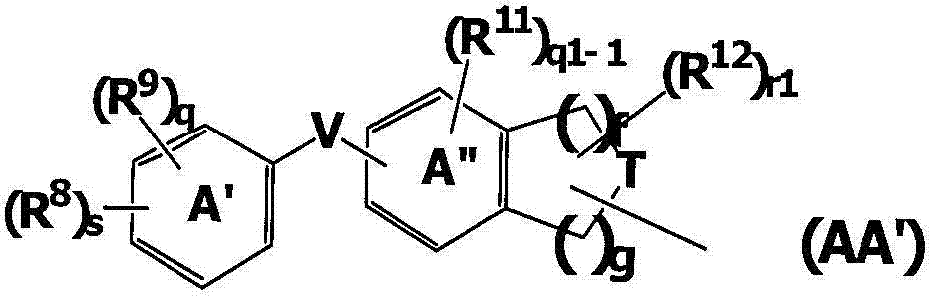
且X=氧原子>and X=oxygen atom>

<步骤1><step 1>
将式(H-III)化合物与式(L-I)化合物进行取代反应。通过将式(H-III)化合物(其在本领域是已知的或者可以从已知的化合物容易地制备)与式(L-I)化合物以与(制备方法B)的<步骤4>类似的方式进行反应,可以制备式(L-II)化合物。A compound of formula (H-III) is subjected to a substitution reaction with a compound of formula (L-I). By combining a compound of formula (H-III) (which is known in the art or can be easily prepared from known compounds) with a compound of formula (L-I) in a manner similar to <step 4> of (Preparation method B) By carrying out the reaction, the compound of formula (L-II) can be prepared.
<步骤2><Step 2>
将式(L-II)化合物与式(I-I)化合物进行取代反应。通过将式(L-II)化合物与式(I-I)化合物以与(制备方法C)类似的方式进行反应,可以制备式(L-III)化合物。The compound of formula (L-II) is subjected to a substitution reaction with the compound of formula (I-I). The compound of formula (L-III) can be produced by reacting the compound of formula (L-II) with the compound of formula (I-I) in a similar manner to (Production Method C).
<步骤3><Step 3>
将式(L-III)化合物与式(K-IV)化合物进行取代反应。通过将式(L-III)化合物与式(K-IV)化合物以与(制备方法K)的<步骤3>类似的方式进行反应,可以制备每个式(III)a-b化合物。The compound of formula (L-III) is subjected to a substitution reaction with the compound of formula (K-IV). Each of the compounds of the formula (III) a-b can be produced by reacting the compound of the formula (L-III) with the compound of the formula (K-IV) in a similar manner to <Step 3> of (Production method K).
当包含T的环中的碳原子由于键合于包含Z的连接基团而是不对称碳原子时,式(L-I)化合物包括旋光异构体。所述异构体是本领域已知的或者可以从已知的化合物容易地制备。每个对映异构体可以由本领域的技术人员基于常规技术通过光学拆分使用柱色谱法或不对称合成而得到。例如,所述对映异构体可以使用光学拆分柱分离,且各绝对构型可以依据[Agric.Biol.Chem.,第46卷(10),第2579-2585页(1982)]进行确定。此外,可以依据[WO 2009/157418小册子,实施例51和实施例52]中描述的方法得到所述对映异构体。When the carbon atom in the ring containing T is an asymmetric carbon atom due to bonding to the linking group containing Z, the compound of formula (L-I) includes optical isomers. Such isomers are known in the art or may be readily prepared from known compounds. Each enantiomer can be obtained by optical resolution using column chromatography or asymmetric synthesis by those skilled in the art based on conventional techniques. For example, the enantiomers can be separated using an optical resolution column, and each absolute configuration can be determined according to [Agric. Biol. Chem., Vol. 46 (10), pp. 2579-2585 (1982)] . Furthermore, the enantiomers can be obtained according to the methods described in [WO 2009/157418 pamphlet, Example 51 and Example 52].
使用所述异构体,可以制备式(L-II)、式(L-III)和式(III)a-b的各个对映异构体(例如,下文所述的实施例66和实施例107中的化合物)。Using said isomers, the individual enantiomers of formula (L-II), formula (L-III) and formula (III) a-b can be prepared (for example, in Example 66 and Example 107 described below compound of).
(6)式(E-IV)化合物还可以通过以下方法制备。(6) The compound of formula (E-IV) can also be prepared by the following method.
<制备方法M><Preparation method M>
<当在以上式(E-IV)中X=氧原子><When X=oxygen atom in the above formula (E-IV)>

将式(F-I)化合物进行炔基化反应。通过将式(F-I)化合物(其在本领域是已知的或者可以从已知的化合物容易地制备)与丙炔酰胺以与(制备方法E)的<步骤1>相似的方式进行反应,可以制备式(E-IV)化合物。A compound of formula (F-I) is subjected to an alkynylation reaction. By reacting a compound of formula (F-I) (which is known in the art or can be easily prepared from known compounds) with propynamide in a manner similar to <step 1> of (Preparation Method E), Preparation of compounds of formula (E-IV).
(7)在下文中将进一步详细描述用于制备本发明的式(B-V)化合物的方法。作为典型的实例,将描述用于制备具有以上局部结构式(A)的式(Ba-V)化合物和具有以上局部结构式(AA′)的式(Bb-V)化合物的方法。(7) Hereinafter, the method for preparing the compound of formula (B-V) of the present invention will be described in further detail. As typical examples, methods for producing the compound of formula (Ba-V) having the above partial structural formula (A) and the compound of formula (Bb-V) having the above partial structural formula (AA') will be described.
<制备方法N><Preparation method N>

将式(N-I)化合物在苯环上进行取代反应。The compound of formula (N-I) is subjected to a substitution reaction on the benzene ring.
<当V=单键><When V=single key>
通过将式(N-I)化合物(其在本领域是已知的或者可以从已知的化合物容易地制备)与式(N-II)化合物以与(制备方法C)类似的方式进行反应,可以制备式(Ba-V)化合物。By reacting a compound of formula (N-I) (which is known in the art or can be easily prepared from known compounds) with a compound of formula (N-II) in a similar manner to (Preparation C), it can be prepared Compounds of formula (Ba-V).
<当V=氧原子><When V=Oxygen atom>
依据文献中已知的方法,例如,[Tetrahedron Letters,第44卷,第3863-3865页(2003)]中描述的方法,在铜催化剂诸如醋酸铜(II)和三氟醋酸铜(II)和碱诸如三乙胺、N,N-二异丙基乙胺和吡啶的存在下,使用反应惰性溶剂诸如二氯甲烷、1,4-二烷、四氢呋喃和N,N-二甲基甲酰胺或其混合溶剂,在从0℃至溶剂回流温度的温度下,在式(N-II)化合物的存在下通过将式(N-I)化合物进行反应,可以制备式(Ba-V)化合物。According to methods known in the literature, for example, the method described in [Tetrahedron Letters, Vol. 44, Pages 3863-3865 (2003)], in copper catalysts such as copper (II) acetate and copper (II) trifluoroacetate and In the presence of bases such as triethylamine, N,N-diisopropylethylamine and pyridine, reaction inert solvents such as dichloromethane, 1,4-di Alkane, tetrahydrofuran and N, N-dimethylformamide or its mixed solvent, under the temperature from 0 ℃ to solvent reflux temperature, in the presence of the compound of formula (N-II) by reacting the compound of formula (NI) , compounds of formula (Ba-V) can be prepared.
用于该步骤的式(N-II)化合物是本领域已知的或者可以从已知的化合物容易地制备。尤其是,依据文献中已知的方法,例如,[WO 2005/063729小册子,参考实施例1等]、[WO 2008/001931小册子,反应流程2的<步骤4A>,参考实施例1和54等]和[WO 2009/054423小册子,制备实施例37等]中描述的方法,可以从相应的化合物制备相应的卤代的衍生物。此外,通过卤代的衍生物的硼酸化反应以与(制备方法G)的<步骤1>相似的方式,可以制备一烃基硼酸衍生物。Compounds of formula (N-II) used in this step are known in the art or can be readily prepared from known compounds. In particular, according to methods known in the literature, for example, [WO 2005/063729 brochure, Reference Example 1, etc.], [WO 2008/001931 brochure, <Step 4A> of Reaction Scheme 2, Reference Example 1 and 54 etc.] and [WO 2009/054423 pamphlet, Preparation Example 37 etc.], the corresponding halogenated derivatives can be prepared from the corresponding compounds. In addition, a monohydrocarbylboronic acid derivative can be produced by borylation reaction of a halogenated derivative in a similar manner to <Step 1> of (Production method G).
<制备方法O><Preparation method O>
<当在以上的式(Ba-V)中,j=1,R3、R4=H,且Z=OH><When in the above formula (Ba-V), j=1, R 3 , R 4 =H, and Z=OH>
<步骤1><step 1>
将式(O-I)化合物在苯环上进行取代反应。The compound of formula (O-I) is subjected to a substitution reaction on the benzene ring.
<当V=单键><When V=single key>
通过将式(O-I)化合物(其在本领域是已知的或者可以从已知的化合物容易地制备)与式(N-II)化合物以与(制备方法N)中的<当V=单键>类似的方式进行反应,可以制备式(O-II)化合物。By combining a compound of formula (O-I) (which is known in the art or can be easily prepared from known compounds) with a compound of formula (N-II) with <when V=single bond in (Preparation method N) > react in a similar manner to prepare the compound of formula (O-II).
<当V=氧原子><When V=Oxygen atom>
通过将式(O-I)化合物与式(N-II)化合物以与(制备方法N)中的<当V=氧原子>类似的方式进行反应,可以制备式(O-II)化合物。The compound of formula (O-II) can be produced by reacting the compound of formula (O-I) with the compound of formula (N-II) in a similar manner to <when V=oxygen atom> in (Production method N).
<步骤2><Step 2>
将式(O-II)化合物进行还原反应。依据文献中已知的方法,例如,[Jikken Kagaku Koza(Experimental Chemistry Course(实验化学课程)),第四版,第26卷,Organic Synthesis VIII,Asymmetric Synthesis,Reduction,Sugar,and Labelled Compound(有机合成VIII,不对称合成、还原、糖和标记的化合物),第234-245页(1992),Maruzen有限公司]等中描述的方法,在硼氢化钠、二异丁基氢化铝(DIBAH)、氢化铝锂(LAH)、三乙氧基氢化铝锂、硼烷-四氢呋喃(BH3·THF)或硼烷二甲基硫醚(BH3·Me2S)等的存在下,使用反应惰性溶剂(包括醚类溶剂诸如乙醚、四氢呋喃、1,2-二甲氧基乙烷和1,4-二
还可以依据文献中已知的方法,例如,[WO 2005/063729小册子,参考实施例2和3等]、[WO 2008/001931小册子,反应流程2,参考实施例15-19等]和[WO 2009/054423小册子,制备实施例12、24和37等]中描述的方法,从相应的化合物制备式(Ba-V)化合物-O。It can also be based on methods known in the literature, for example, [WO 2005/063729 pamphlet, reference examples 2 and 3, etc.], [WO 2008/001931 pamphlet, reaction scheme 2, reference examples 15-19, etc.] and [WO 2009/054423 pamphlet, Preparation Examples 12, 24 and 37, etc.], the compound-O of the formula (Ba-V) was prepared from the corresponding compound.
<制备方法P><Preparation method P>
将式(P-I)化合物在环A″上进行取代反应。The compound of formula (P-I) is subjected to a substitution reaction on the ring A".
<当V=单键><When V=single key>
通过将式(P-I)化合物(其在本领域是已知的或者可以从已知的化合物容易地制备)与式(N-II)化合物以与(制备方法N)中的<当V=单键>类似的方式进行反应,可以制备式(Bb-V)化合物。By combining a compound of formula (P-I) (which is known in the art or can be easily prepared from known compounds) with a compound of formula (N-II) with <when V=single bond in (Preparation method N) > react in a similar manner to prepare formula (Bb-V) compounds.
<当V=氧原子><When V=Oxygen atom>
通过将式(P-I)化合物与式(N-II)化合物以与(制备方法N)中的<当V=氧原子>类似的方式进行反应,可以制备式(Bb-V)化合物。The compound of formula (Bb-V) can be produced by reacting the compound of formula (P-I) with the compound of formula (N-II) in a similar manner to <when V=oxygen atom> in (Production method N).
<制备方法Q><Preparation Method Q>
<当在以上的式(Bb-V)中j=0且Z=OH><When j=0 and Z=OH in the above formula (Bb-V)>
<步骤1><step 1>
将式(Q-I)化合物在环A″上进行取代反应。The compound of formula (Q-I) is subjected to a substitution reaction on the ring A".
<当V=单键><When V=single key>
通过将式(Q-I)化合物(其在本领域是已知的或者可以从已知的化合物容易地制备)与式(N-II)化合物以与(制备方法N)中的<当V=单键>类似的方式进行反应,可以制备式(Q-II)化合物。By combining a compound of formula (Q-I) (which is known in the art or can be easily prepared from known compounds) with a compound of formula (N-II) with <when V=single bond in (Preparation method N) > react in a similar manner to prepare the compound of formula (Q-II).
<当V=氧原子><When V=Oxygen atom>
通过将式(Q-I)化合物与式(N-II)化合物以与(制备方法N)中的<当V=氧原子>类似的方式进行反应,可以制备式(Q-II)化合物。The compound of formula (Q-II) can be produced by reacting the compound of formula (Q-I) with the compound of formula (N-II) in a similar manner to <when V=oxygen atom> in (Production method N).
<步骤2><Step 2>
将式(Q-II)化合物进行还原反应。通过将式(Q-II)化合物以与(制备方法N)的<步骤2>类似的方式进行反应,可以制备式(Bb-V)-Q化合物。The compound of formula (Q-II) is subjected to a reduction reaction. The compound of formula (Bb-V)-Q can be produced by reacting the compound of formula (Q-II) in a similar manner to <Step 2> of (Production method N).
还可以依据文献中已知的方法从相应的化合物制备式(Bb-V)-Q,例如,[WO 2005/063729小册子,参考实施例2和3等]、[WO 2008/001931小册子,反应流程2,参考实施例15-19等]和[WO 2009/054423小册子,制备实施例12、24和37等]中描述的方法。Formula (Bb-V)-Q can also be prepared from the corresponding compound according to methods known in the literature, for example, [WO 2005/063729 pamphlet, reference examples 2 and 3, etc.], [WO 2008/001931 pamphlet, Reaction scheme 2, refer to the methods described in Examples 15-19, etc.] and [WO 2009/054423 pamphlet, Preparative Examples 12, 24 and 37, etc.].
(8)式(C-I)化合物还可以通过以下方法制备。(8) The compound of formula (C-I) can also be prepared by the following method.
<制备方法R><Preparation method R>
<当在以上的式(C-I)中环A是以上的局部结构式(A),j=1,k=0,R3、R4=H,且X=NR7><When ring A in the above formula (CI) is the above partial structural formula (A), j=1, k=0, R 3 , R 4 =H, and X=NR 7 >

将式(R-I)化合物进行还原性胺化反应。依据文献中已知的方法,例如,[The Journal of Organic Chemistry,第61卷,第3849-3862页(1996)]中描述的方法,在还原剂诸如三乙酰氧基硼氢化钠和氰基硼氢化钠的存在下,在有或没有催化量的乙酸的存在下,使用反应惰性溶剂诸如二氯甲烷、1,2-二氯乙烷、四氢呋喃、乙腈和甲苯或其混合溶剂,在从0℃至溶剂回流温度的温度下,通过将式(R-I)化合物(所述式(R-I)化合物包括在式(O-II)化合物中,且可以从如以上(制备方法O)的<步骤1>所述的已知的化合物容易地制备)与式(R-II)化合物(其在本领域是已知的或者可以从已知的化合物容易地制备)进行反应,可以制备式(Ca-I)化合物。The compound of formula (R-I) is subjected to reductive amination reaction. According to methods known in the literature, for example, the method described in [The Journal of Organic Chemistry, Vol. 61, pp. 3849-3862 (1996)], in reducing agents such as sodium triacetoxyborohydride and cyanoborohydride In the presence of sodium hydride, with or without a catalytic amount of acetic acid, using a reaction-inert solvent such as dichloromethane, 1,2-dichloroethane, tetrahydrofuran, acetonitrile, and toluene, or a mixture thereof, at 0°C At a temperature to the reflux temperature of the solvent, by adding the compound of formula (R-I) (the compound of formula (R-I) is included in the compound of formula (O-II), and can be obtained from <step 1> of the above (production method O) Compounds of formula (Ca-I) can be prepared by reacting compounds of formula (R-II) (which are known in the art or can be easily prepared from known compounds) with compounds of formula (R-II) .
<制备方法S><Preparation method S>
<当在以上的式(C-I)中,环A是局部结构式(AA):<When in the above formula (C-I), ring A is a partial structural formula (AA):

j、k=0,且X=NH>j, k=0, and X=NH>
将式(S-I)化合物进行还原性胺化反应。通过将式(S-I)化合物(其在本领域是已知的或者可以从如以上(制备方法Q)的<步骤1>等中所述的已知的化合物容易地制备)与式(S-II)化合物(其在本领域是已知的或者可以从已知的化合物容易地制备)以与(制备方法R)类似的方式进行反应,可以制备式(Cb-I)化合物。The compound of formula (S-I) is subjected to reductive amination reaction. By combining a compound of formula (S-I) (which is known in the art or can be easily prepared from a known compound as described in <step 1> of the above (Preparation Method Q), etc.) with formula (S-II ) compounds (which are known in the art or can be easily prepared from known compounds) react in a similar manner to (Preparation method R) to prepare compounds of formula (Cb-I).
[包含本发明化合物的合并用药物(concomitant drug)][Concomitant drug comprising the compound of the present invention]
本发明的化合物和药物组合物可以用于与其他药物或药品通过医疗实践中运用的通用方法联合使用。这样的组合产品特别用于GPR40激动剂所调节的状态的预防、进程延缓和治疗,且进一步特别用于对抗至少一种选自以下的疾病:糖尿病(1型糖尿病、2型糖尿病和临界糖尿病(葡萄糖耐量异常(IGT)和/或空腹血糖异常(IFG)))、胰岛素抵抗、高胰岛素血症、肥胖、肥胖症和这些疾病衍生的或与这些疾病相关的各种疾病。The compounds and pharmaceutical compositions of the present invention may be used in combination with other drugs or pharmaceuticals by conventional methods employed in medical practice. Such combination products are especially useful in the prophylaxis, progression delay and treatment of states modulated by GPR40 agonists, and further in particular in combating at least one disease selected from the group consisting of diabetes mellitus (type 1 diabetes, type 2 diabetes and borderline diabetes ( Impaired Glucose Tolerance (IGT) and/or Impaired Fasting Glycemia (IFG)), Insulin Resistance, Hyperinsulinemia, Obesity, Obesity and various diseases derived from or associated with these diseases.
胰岛素增敏剂和抗糖尿病药实例包括1)PPAR γ激动剂(尤其是,匹格列酮、罗格列酮、曲格列酮、环格列酮、达格列酮、恩格列酮、萘格列酮等),2)双胍类药物(尤其是,二甲双胍、丁双胍、苯乙双胍等),3)磺酰脲类(尤其是,甲苯磺丁脲、醋磺己脲、氯磺丙脲、格列本脲、格列齐特、格列吡嗪、格列美脲、格列戊脲、格列喹酮、格列索脲、妥拉磺脲等),4)速效胰岛素促分泌剂(尤其是,那格列奈、米格列奈、瑞格列奈等),5)α-葡糖苷酶抑制剂(尤其是,阿卡波糖、伏格列波糖、米格列醇、卡格列波糖、肥胖菌素(adiposin)、乙格列酯、普拉米星Q、salbostatin等),6)胰岛素或胰岛素衍生物(尤其是,胰岛素锌混悬液、赖脯胰岛素、门冬胰岛素、普通胰岛素、NPH胰岛素、甘精胰岛素、地特胰岛素、混合胰岛素等),7)GLP-1和GLP-1激动剂(尤其是,艾塞那肽、利拉糖肽、利司那肽(lixisenatide)、他司鲁肽(tasp oglutide)等),8)DPP-IV抑制剂(尤其是,西格列汀、维格列汀、阿格列汀(alogliptin)、沙格列汀、利拉利汀(linagliptin)、替格列汀(teneligliptin)、NVP-DPP-728等),9)α-2拮抗剂(尤其是,咪格列唑、伊格列哚、德格列哚、亚达唑散、依法克生等),和10)SGLT2抑制剂。胰岛素增敏剂和抗糖尿病药的实例还包括包含两种或更多以上所述组分(尤其是,匹格列酮/二甲双胍、匹格列酮/格列美脲等)的组合药物。Examples of insulin sensitizers and antidiabetics include 1) PPARγ agonists (especially, pioglitazone, rosiglitazone, troglitazone, ciglitazone, daglitazone, emglitazone, naglitazone, etc.), 2) biguanides (especially metformin, buformin, phenformin, etc.), 3) sulfonylureas (especially tolbutamide, acetohexamide, chlorpropamide urea, glibenclamide, gliclazide, glipizide, glimepiride, glibenclamide, glibenclamide, glibenclamide, tolazamide, etc.), 4) rapid-acting insulin secretion (especially, nateglinide, mitiglinide, repaglinide, etc.), 5) α-glucosidase inhibitors (especially, acarbose, voglibose, miglitol , caglibose, adiposin (adiposin), etigliaxate, pramamicin Q, salbostatin, etc.), 6) insulin or insulin derivatives (especially, insulin zinc suspension, insulin lispro, insulin aspart, insulin regular, insulin NPH, insulin glargine, insulin detemir, mixed insulins, etc.), 7) GLP-1 and GLP-1 agonists (especially, exenatide, liraglutide, lisex That peptide (lixisenatide, tasp oglutide, etc.), 8) DPP-IV inhibitors (especially, sitagliptin, vildagliptin, alogliptin, saxagliptin , linagliptin, teneligliptin, NVP-DPP-728, etc.), 9) α-2 antagonists (especially, miglitazole, igglidole, deglitadole , Yadazole powder, Effexor, etc.), and 10) SGLT2 inhibitors. Examples of insulin sensitizers and antidiabetic drugs also include combination drugs comprising two or more of the above components (in particular, pioglitazone/metformin, pioglitazone/glimepiride, etc.).
胰岛素增敏剂和抗糖尿病药的实例还包括降血脂药和异常脂血症治疗剂。所述降血脂药和异常脂血症治疗剂的实例包括1)ω-3脂肪酸(尤其是,二十碳五烯酸乙酯(EPA-E制剂)、二十二碳六烯酸(DHA)等),2)HMG-CoA还原酶抑制剂(尤其是,阿托伐他汀、辛伐他汀、匹伐他汀、伊伐他汀、氟伐他汀、洛伐他汀、普伐他汀、利伐他汀、罗苏伐他汀等),3)HMG-CoA合酶抑制剂,4)胆固醇吸收抑制剂(尤其是,依泽麦布),5)酰基-CoA-胆甾醇酰基转移酶(ACAT)抑制剂,6)CETP抑制剂,7)鲨烯合酶抑制剂、8)抗氧化剂(尤其是,普罗布考等),9)PPARα激动剂(尤其是,氯贝特、依托贝特、非诺贝特、苯扎贝特、环丙贝特、吉非贝齐、KRP-101等),10)PPAR δ激动剂,11)LXR激动剂,12)FXR激动剂(尤其是,INT-747等),13)MTTP抑制剂,14)鲨烯环氧酶抑制剂,和15)胆汁酸吸收抑制剂(尤其是,消胆胺、考来替泊等)。Examples of insulin sensitizers and antidiabetic agents also include hypolipidemic agents and therapeutic agents for dyslipidemia. Examples of the blood lipid-lowering drug and dyslipidemia therapeutic agent include 1) omega-3 fatty acid (especially, eicosapentaenoic acid ethyl ester (EPA-E preparation), docosahexaenoic acid (DHA) etc.), 2) HMG-CoA reductase inhibitors (especially, atorvastatin, simvastatin, pitavastatin, itavastatin, fluvastatin, lovastatin, pravastatin, rivastatin, rovastatin Suvastatin, etc.), 3) HMG-CoA synthase inhibitors, 4) cholesterol absorption inhibitors (especially, ezetimibe), 5) acyl-CoA-cholesterol acyltransferase (ACAT) inhibitors, 6 ) CETP inhibitors, 7) squalene synthase inhibitors, 8) antioxidants (especially, probucol, etc.), 9) PPARα agonists (especially, clofibrate, etofibrate, fenofibrate, bezafibrate, ciprofibrate, gemfibrozil, KRP-101, etc.), 10) PPAR δ agonists, 11) LXR agonists, 12) FXR agonists (especially, INT-747, etc.), 13 ) MTTP inhibitors, 14) squalene epoxidase inhibitors, and 15) bile acid absorption inhibitors (in particular, cholestyramine, colestipol, etc.).
此外,胰岛素增敏剂和抗糖尿病药的实例还包括抗肥胖药物。抗肥胖药物的具体实例包括1)CB-1受体拮抗剂(尤其是,利莫那班、SR-147778、BAY-65-2520等),2)单胺再摄取抑制剂(尤其是,西布曲明、马吲哚等),3)5-羟色胺再摄取抑制剂(尤其是,氟西汀、帕罗西汀等),4)脂肪酶抑制剂(尤其是,奥利司他、西替司他等),5)神经肽Y(NPY)受体拮抗剂(尤其是,S-2367等),6)肽YY(PYY)受体拮抗剂,和7)肾上腺素能β-3受体激动剂(尤其是,KRP-204、TRK-380/TAC-301等)。In addition, examples of insulin sensitizers and antidiabetic drugs also include anti-obesity drugs. Specific examples of anti-obesity drugs include 1) CB-1 receptor antagonists (especially, rimonabant, SR-147778, BAY-65-2520, etc.), 2) monoamine reuptake inhibitors (especially, Western butramine, mazindol, etc.), 3) serotonin reuptake inhibitors (especially, fluoxetine, paroxetine, etc.), 4) lipase inhibitors (especially, orlistat, cetex He et al.), 5) neuropeptide Y (NPY) receptor antagonists (especially, S-2367, etc.), 6) peptide YY (PYY) receptor antagonists, and 7) adrenergic beta-3 receptor agonists agents (especially, KRP-204, TRK-380/TAC-301, etc.).
这些治疗不仅可以与其他的药物而且可以与其他的治疗法联合施行。所述治疗的实例包括通过控制体重、运动疗法和饮食疗法改善生活方式以及放射疗法。These treatments can be combined not only with other drugs but also with other treatments. Examples of such treatments include lifestyle modification through weight control, exercise therapy and diet therapy, and radiation therapy.
所述治疗可以与用于各自领域的药物联合施行来对抗除了糖尿病和肥胖之外的GPR40-相关疾病。The treatment can be administered in combination with drugs used in the respective fields to combat GPR40-associated diseases other than diabetes and obesity.
合并用药物的实例优选地包括PPAR γ激动剂(更优选地,匹格列酮和罗格列酮)、双胍类药物(更优选地,二甲双胍和丁双胍)、磺酰脲类(更优选地,格列本脲、格列齐特和格列美脲)、速效胰岛素促分泌剂(更优选地,那格列奈和米格列奈)、α-葡糖苷酶抑制剂(更优选地,阿卡波糖、伏格列波糖和米格列醇)、胰岛素或胰岛素衍生物和DPP-IV抑制剂(更优选地,西格列汀、维格列汀和阿格列汀)。Examples of concomitant drugs preferably include PPARγ agonists (more preferably, pioglitazone and rosiglitazone), biguanides (more preferably, metformin and buformin), sulfonylureas (more preferably , glibenclamide, gliclazide, and glimepiride), rapid-acting insulin secretagogues (more preferably, nateglinide and mitiglinide), alpha-glucosidase inhibitors (more preferably, acarbose, voglibose and miglitol), insulin or an insulin derivative and a DPP-IV inhibitor (more preferably sitagliptin, vildagliptin and alogliptin).
对抗上文所述的疾病的合并用药物和常规药物的组合应用使得能够减少常规药物的剂量,这可以减少常规药物副作用。当然所述的使用所述药物的联合方法不限于所述疾病,而且联合使用的药物不限于上文例举的化合物。The combined use of concomitant drugs against the diseases described above and conventional drugs enables reduction of the dose of conventional drugs, which can reduce the side effects of conventional drugs. Of course, the combined method of using the drugs is not limited to the diseases, and the drugs used in combination are not limited to the compounds exemplified above.
为了联合使用本发明化合物与欲被联合使用的药物,它们可以是单个制剂或是药物组合产品。当为单个制剂形式时,所述化合物和药物可以同时施用或可以在不同时间施用。For the combined use of the compounds of the present invention and drugs to be used in combination, they may be a single preparation or a drug combination product. When in a single formulation, the compound and drug may be administered at the same time or may be administered at different times.
[制备本发明的预防剂或治疗剂的制剂][Preparation of preparation of preventive or therapeutic agent of the present invention]
本发明的药物以药物组合物形式施用。The medicament of the present invention is administered in the form of a pharmaceutical composition.
本发明的药物组合物可至少包含本发明式(I)或式(II)化合物,并与可药用添加剂一起制备。更具体而言,通过适当地组合本发明化合物与例如赋形剂(例如,乳糖、绵白糖、甘露醇、微晶纤维素、硅酸、玉米淀粉和马铃薯淀粉)、粘合剂(例如,纤维素(羟丙基纤维素(HPC)、羟丙基甲基纤维素(HPMC)、微晶纤维素、糖(乳糖、甘露醇、绵白糖、山梨醇、赤藓醇和木糖醇)、淀粉(玉米淀粉和马铃薯淀粉)、胶凝淀粉、糊精、聚乙烯吡咯烷酮(PVP)、聚乙二醇、聚乙烯醇(PVA))、润滑剂(例如,硬脂酸镁、硬脂酸钙、滑石粉和羧甲基纤维素)、崩解剂(例如,淀粉(玉米淀粉和马铃薯淀粉)、羧甲基淀粉钠、羧甲纤维素、羧甲纤维素钙、交联羧甲纤维素钠和交聚维酮)、包衣材料(例如,纤维素(羟丙基纤维素(HPC)、羟丙基甲基纤维素(HPMC)、甲基丙烯酸氨烷基酯共聚物E型和甲基丙烯酸共聚物LD)、增塑剂(例如,柠檬酸三乙酯和聚乙二醇)、掩蔽剂(例如,氧化钛)、着色剂、矫味剂、防腐剂(例如,苯扎氯铵和对羟基苯甲酸酯)、张度剂(tonicity agent)(例如,甘油、氯化钠、氯化钙、甘露醇和右旋糖)、pH调节剂(例如,氢氧化钠、氢氧化钾、碳酸钠、盐酸、硫酸和缓冲溶液诸如磷酸盐缓冲溶液)、稳定剂(例如,糖、糖醇和黄原胶)、分散剂、抗氧化剂(例如,抗坏血酸、丁基化羟基苯甲醚(BHA)、桔酸丙酯和dl-α-生育酚)、缓冲剂、防腐剂(例如,对羟基苯甲酸酯、苯甲醇和苯扎氯铵)、香料(例如,香草醛、l-薄荷醇和玫瑰油)、增溶剂(例如,聚氧乙烯氢化蓖麻油、聚山梨酯80、聚乙二醇、磷脂胆固醇和三乙醇胺)、促吸收剂(例如,羟乙酸钠、依地酸钠、癸酸钠、酰基肉碱和苧烯)、凝胶因子(gelator)、助悬剂、乳化剂和通用的适合的添加剂和溶剂,可以制备各种剂型。The pharmaceutical composition of the present invention may at least contain the compound of formula (I) or formula (II) of the present invention, and be prepared together with pharmaceutically acceptable additives. More specifically, by appropriately combining the compound of the present invention with, for example, excipients (for example, lactose, sucrose, mannitol, microcrystalline cellulose, silicic acid, corn starch, and potato starch), binders (for example, fiber Vegetables (hydroxypropyl cellulose (HPC), hydroxypropyl methyl cellulose (HPMC), microcrystalline cellulose, sugars (lactose, mannitol, soft white sugar, sorbitol, erythritol and xylitol), starch ( corn starch and potato starch), gelatinized starch, dextrin, polyvinylpyrrolidone (PVP), polyethylene glycol, polyvinyl alcohol (PVA)), lubricants (for example, magnesium stearate, calcium stearate, talc powder and carboxymethylcellulose), disintegrants (for example, starch (corn starch and potato starch), sodium carboxymethyl starch, carmellose, carmellose calcium, croscarmellose sodium and cross-linked povidone), coating materials (e.g., cellulose (hydroxypropyl cellulose (HPC), hydroxypropyl methylcellulose (HPMC), aminoalkyl methacrylate copolymer Type E, and methacrylic acid copolymer LD), plasticizers (e.g., triethyl citrate and polyethylene glycol), masking agents (e.g., titanium oxide), coloring agents, flavoring agents, preservatives (e.g., benzalkonium chloride and p-hydroxyl benzoate), tonicity agent (for example, glycerin, sodium chloride, calcium chloride, mannitol, and dextrose), pH adjuster (for example, sodium hydroxide, potassium hydroxide, sodium carbonate, Hydrochloric acid, sulfuric acid, and buffer solutions such as phosphate buffered saline), stabilizers (for example, sugars, sugar alcohols, and xanthan gum), dispersants, antioxidants (for example, ascorbic acid, butylated hydroxyanisole (BHA), citric acid propyl esters and dl-alpha-tocopherol), buffers, preservatives (e.g., parabens, benzyl alcohol, and benzalkonium chloride), fragrances (e.g., vanillin, l-menthol, and rose oil), Solubilizers (for example, polyoxyethylene hydrogenated castor oil, polysorbate 80, polyethylene glycol, phospholipid cholesterol, and triethanolamine), absorption enhancers (for example, sodium glycolate, sodium edetate, sodium caprate, acyl carbamate Alkali and limonene), gelators, suspending agents, emulsifying agents and general suitable additives and solvents, various dosage forms can be prepared.
各种剂型的实例包括片剂、胶囊剂、颗粒剂、粉末、丸剂、气雾剂、吸入剂、软膏剂、胶粘贴剂、栓剂、注射剂、锭剂、液体制剂、醑剂、混悬剂、浸膏剂和酏剂。所述剂型可以经由口服施用、皮下注射、肌内注射、鼻内施用、透皮施用、静脉注射、动脉内注射、神经周围施用(perineuraladministration)、硬膜外施用、硬膜下腔中施用、心室内施用、直肠施用、吸入等施用于患者。Examples of various dosage forms include tablets, capsules, granules, powders, pills, aerosols, inhalants, ointments, adhesive pastes, suppositories, injections, lozenges, liquid preparations, spirits, suspensions , extracts and elixirs. The dosage form can be administered via oral administration, subcutaneous injection, intramuscular injection, intranasal administration, transdermal administration, intravenous injection, intraarterial injection, perineural administration, epidural administration, intradural administration, cardiac Indoor administration, rectal administration, inhalation, etc. are administered to patients.
本发明化合物的剂量对成人而言通常为每天0.005mg至3.0g,优选0.05mg至2.5g,且更优选0.1mg至1.5g,但可以根据症状或施用途径的需要减少或增加。The dose of the compound of the present invention is usually 0.005 mg to 3.0 g, preferably 0.05 mg to 2.5 g, and more preferably 0.1 mg to 1.5 g per day for an adult, but may be decreased or increased as required by symptoms or administration route.
化合物可以经由口服施用或肠胃外施用作为整体一次给药或者被分为2至6个剂量而分开给药,或者可以经由反复施用诸如静脉输注而给药。The compound may be administered via oral administration or parenteral administration as a whole or divided into 2 to 6 doses for administration, or may be administered via repeated administration such as intravenous infusion.
本说明书中引用的全部的出版物作为参考被涵盖在本说明书中,所述出版物例如相关领域的文献、未审查的申请的出版物、专利出版物和其它的专利文献。All publications cited in this specification, such as documents in the related art, publications of unexamined applications, patent publications, and other patent documents, are incorporated herein by reference.
[药理测试实施例][Pharmacological Test Example]
下文根据测试实施例具体描述本发明,但本发明不限于所述测试实施例。Hereinafter, the present invention is specifically described based on Test Examples, but the present invention is not limited to the Test Examples.
以下的药理测试实施例1至7提供了用于考查本发明化合物功效的方法。The following Pharmacological Test Examples 1 to 7 provide methods for examining the efficacy of the compounds of the present invention.
药理测试实施例1:对人源的GPR40的激动剂作用Pharmacological Test Example 1: Agonist Effect on Human GPR40
使用稳定表达人源的GPR40的CHO细胞株测定受试化合物的激动剂作用。将该细胞株以4×10⁴细胞/100μL/孔接种于透明底的96孔板中。使用含10%胎牛血清、100U/mL青霉素、0.1mg/mL链霉素和400μg/mL遗传霉素的Ham′s F-12培养基将该细胞株在CO2培养箱中培养过夜。使用Calcium 4Assay Kit(Molecular Devices)作为荧光钙指示剂。将1mL 77mg/mL丙磺舒(Invitrogen)加入100mL钙指示剂溶液中以制备与含20mMHEPES的汉克斯平衡盐溶液(HBSS)等比例混合的溶液(负载溶液)。将200μL的该负载溶液加入除去培养液的细胞中,并将细胞在CO2培养箱中培养1小时。将受试化合物用含20mM HEPES的HBSS稀释,并向细胞中加入50μL,并通过胞内离子检测仪测定Ca2+浓度的波动。使用荧光强度变化的剂量-响应曲线来计算受试化合物的EC50值。表1显示EC50值小于0.3μM的本发明化合物(以A表示),和EC50值为0.3μM或更高且小于3μM的本发明化合物(以B表示)。Agonist effects of test compounds were determined using CHO cell lines stably expressing human GPR40. The cell line was seeded in a 96-well plate with a transparent bottom at 4×10 4 cells/100 μL/well. The cell line was cultured overnight in a CO 2 incubator using Ham's F-12 medium containing 10% fetal bovine serum, 100 U/mL penicillin, 0.1 mg/mL streptomycin, and 400 μg/mL geneticin. A Calcium 4 Assay Kit (Molecular Devices) was used as a fluorescent calcium indicator. 1 mL of 77 mg/mL probenecid (Invitrogen) was added to 100 mL of the calcium indicator solution to prepare a solution mixed in equal proportions with Hanks' balanced salt solution (HBSS) containing 20 mM HEPES (loading solution). 200 μL of this loading solution was added to the cells from which the medium was removed, and the cells were incubated in a CO incubator for 1 hour. The test compound was diluted with HBSS containing 20 mM HEPES, and 50 μL was added to the cells, and the fluctuation of Ca 2+ concentration was measured by an intracellular ion detector. Dose-response curves for changes in fluorescence intensity were used to calculate EC50 values for test compounds. Table 1 shows the compounds of the present invention (represented by A) with an EC 50 value of less than 0.3 μM, and the compounds of the present invention (represented by B) with an EC 50 value of 0.3 μM or higher and less than 3 μM.
表1Table 1

药理测试实施例2:对小鼠的口服葡萄糖耐量试验Pharmacological Test Example 2: Oral Glucose Tolerance Test on Mice
使用禁食过夜的雄性C57BL/6J小鼠考查糖负荷后受试化合物的血糖波动的减少。将受试化合物与溶剂(例如,0.5%羧甲基纤维素)混悬,并在糖负荷之前口服施用。将溶剂单独施用于对照组。在化合物施用之前(施用前血液采集),化合物施用之后和即将糖负荷之前,糖负荷期间,在15、30、60和120分钟之后,进行血液标本采集,并测定所采集血液的血糖水平。通过口服施用3至10mg/kg的剂量的本发明化合物中的优选的化合物减少了血糖的波动。Overnight fasted male C57BL/6J mice were used to examine the reduction of blood glucose excursions of test compounds after glucose loading. Test compounds are suspended in a solvent (eg, 0.5% carboxymethylcellulose) and administered orally prior to sugar loading. The solvent was applied alone to the control group. Blood samples were collected before compound administration (pre-administration blood collection), after compound administration and immediately before glucose load, during glucose load, and after 15, 30, 60, and 120 minutes, and blood glucose levels in the collected blood were measured. Preferred compounds of the present invention reduce blood glucose excursions by oral administration at doses of 3 to 10 mg/kg.
药理测试实施例3:溶解度测试Pharmacological Test Example 3: Solubility Test
(1)DMSO沉淀溶解度(precipitation solubility)(动力学溶解度)(1) DMSO precipitation solubility (precipitation solubility) (kinetic solubility)
将10mM本发明化合物的DMSO溶液加入50mM磷酸盐缓冲溶液(pH 7.4)中以到达100μM的最终浓度。在室温将得到的溶液孵育同时以600rpm搅拌1.5小时,然后经由滤板(4μm,MultiScreen Solubility FilterPlate,Millipore)过滤。使用读板器(Powerscan HT,(DainipponPharmaceutical))在最大吸收波长测定得到的滤液的吸光度。在该方法中,制备已知浓度的测试化合物的DMSO溶液(1、3、10、30和100μM),作为用于校正曲线的标准溶液。测定每个标准溶液的吸光度以得到校正曲线。使用所述滤液和标准溶液的吸光度值计算化合物的溶解度(μM)。10 mM DMSO solution of the compound of the present invention was added to 50 mM phosphate buffered saline solution (pH 7.4) to reach a final concentration of 100 μM. The resulting solution was incubated at room temperature while stirring at 600 rpm for 1.5 hours, then filtered through a filter plate (4 μm, MultiScreen Solubility Filter Plate, Millipore). The absorbance of the obtained filtrate was measured at the maximum absorption wavelength using a plate reader (Powerscan HT, (Dainippon Pharmaceutical)). In this method, known concentrations of test compounds in DMSO (1, 3, 10, 30 and 100 μM) were prepared as standard solutions for the calibration curve. The absorbance of each standard solution was measured to obtain a calibration curve. The solubility ([mu]M) of the compound was calculated using the absorbance values of the filtrate and the standard solution.
(2)晶体溶解度(热力的溶解度)(2) Crystal solubility (thermal solubility)
将本发明化合物加入水中,使其浓度为1mg/mL。将得到的溶液在37℃孵育24小时,然后进行离心。通过HPLC分析得到的上清液以检出在最大吸收波长峰检测峰,并由此计算峰面积。类似地,制备已知浓度的测试化合物的DMSO溶液(0.03、0.1、0.3、1、3和10μg/mL),作为用于校正曲线的标准溶液。测定每个标准溶液的峰面积。使用得到的校正曲线的峰面积计算化合物的溶解度(μg/mL)。The compound of the present invention was added to water to make a concentration of 1 mg/mL. The resulting solution was incubated at 37°C for 24 hours and then centrifuged. The resulting supernatant was analyzed by HPLC to detect a peak at the wavelength of maximum absorption, and the peak area was calculated therefrom. Similarly, DMSO solutions (0.03, 0.1, 0.3, 1, 3, and 10 μg/mL) of test compounds of known concentrations were prepared as standard solutions for calibration curves. Determine the peak area of each standard solution. The solubility (μg/mL) of the compound was calculated using the peak area of the obtained calibration curve.
药理测试实施例4:代谢稳定性测试Pharmacological Test Example 4: Metabolic Stability Test
将10mM本发明化合物的DMSO溶液加入含肝微粒体(人或小鼠;XenoTech)和NADPH生成系统(含β-NADP、葡萄糖-6-磷酸、G-6-PDH(Y)和MgCl2的水)的溶液中以达到1μM的最终浓度。将得到的溶液在37℃孵育20分钟,然后通过加入乙腈终止该反应。使用滤板(MultiScreenHTS-HV plate,Millipore)通过离心过滤该反应溶液。通过高效液相色谱/质谱测定滤液中的测试化合物。类似地,测定反应时间为0的样品作为对照,并由微粒体反应样品和对照之间的比率计算分解率(%)。A 10 mM solution of a compound of the invention in DMSO was added to liver microsomes (human or mouse; XenoTech) and an NADPH generating system (water containing β-NADP, glucose-6-phosphate, G-6-PDH(Y) and MgCl ) to a final concentration of 1 μM. The resulting solution was incubated at 37°C for 20 minutes, then the reaction was terminated by the addition of acetonitrile. The reaction solution was filtered by centrifugation using a filter plate (MultiScreenHTS-HV plate, Millipore). Test compounds in the filtrate were determined by high performance liquid chromatography/mass spectrometry. Similarly, a sample with a reaction time of 0 was determined as a control, and the decomposition rate (%) was calculated from the ratio between the microsomal reaction sample and the control.
药理测试实施例5:通过膜片钳技术进行的hERG抑制测试Pharmacological Test Example 5: hERG Inhibition Test by Patch Clamp Technique
使用全自动的膜片钳系统(Patchliner(Nanion))测定对人ether-a-go-go相关基因(hERG)通道的作用。为确定细胞(hERG-HEK(Upstate))的hERGIkr电流,将膜电位保持在-80mV,并定期向细胞施以去极化脉冲。待产生的电流变得稳定后,加入测试化合物。从在40mV进行去极化脉冲0.5秒之后在-40mV进行复极化脉冲0.5秒而诱导的尾电流的变化确定测试化合物对hERG通道的作用。所述刺激以每10秒一次的频率进行。在室温进行测定。将hERG通道抑制率计算为测试化合物应用2分钟之后的尾电流相对于应用前的最大尾电流的降低率(抑制率)。The effect on the human ether-a-go-go related gene (hERG) channel was determined using a fully automated patch clamp system (Patchliner (Nanion)). To determine hERGI kr currents in cells (hERG-HEK (Upstate)), the membrane potential was maintained at -80 mV and depolarizing pulses were periodically applied to the cells. After the generated current became stable, the test compound was added. The effect of test compounds on hERG channels was determined from the change in tail current induced by a depolarizing pulse at 40 mV for 0.5 sec followed by a repolarizing pulse at -40 mV for 0.5 sec. The stimulation was performed at a frequency of once every 10 seconds. Assays were performed at room temperature. The hERG channel inhibition rate was calculated as the reduction rate (inhibition rate) of the tail current after 2 minutes of application of the test compound relative to the maximum tail current before application.
所计算的抑制率显示药物-诱导的QT延长(之后是致命的副作用(诸如室性心动过速和猝死))的可能性。The calculated inhibition rates indicate the potential for drug-induced QT prolongation followed by fatal side effects such as ventricular tachycardia and sudden death.
药理测试实施例6:药物动力学研究(小鼠盒式给药药物动力学)Pharmacological Test Example 6: Pharmacokinetic Study (Mouse Cassette Administration Pharmacokinetics)
以单剂量将本发明化合物以1mg/kg(介质为DMSO∶吐温80∶超纯水=1∶1∶8,10mL/kg)口服施用于7-或8-周龄的雄性C57BL/6J Jcl,然后在给药后的0.25、0.5、1和2小时从腹主动脉采集血液。将血液离心(3000rpm,15分钟,4℃),得到血浆,并经高效液相色谱/质谱测定血浆中的测试化合物。相似地,测定已知浓度的测试化合物的标准溶液(0.01、0.02、0.05、0.1、0.2、0.5和1μg/mL)以制作校正曲线。使用该校正曲线计算血浆中的化合物的浓度(μg/mL),并将血浆中的最大浓度称为Cmax(μg/mL)。The compound of the present invention was orally administered to 7- or 8-week-old male C57BL/6J Jcl in a single dose at 1 mg/kg (vehicle: DMSO: Tween 80: ultrapure water = 1:1:8, 10 mL/kg). , and then blood was collected from the abdominal aorta at 0.25, 0.5, 1 and 2 hours after drug administration. The blood was centrifuged (3000 rpm, 15 minutes, 4°C) to obtain plasma, and the test compound in the plasma was determined by high performance liquid chromatography/mass spectrometry. Similarly, standard solutions (0.01, 0.02, 0.05, 0.1, 0.2, 0.5, and 1 μg/mL) of known concentrations of test compounds were assayed to prepare a calibration curve. The concentration (μg/mL) of the compound in plasma was calculated using this calibration curve, and the maximum concentration in plasma was called Cmax (μg/mL).
药理测试实施例7:安全性评价研究Pharmacological Test Example 7: Safety Evaluation Study
将本发明化合物以单剂量口服施用于小鼠或大鼠。当没有观测到死亡和显著的行为异常时,证明了本发明化合物的安全性。Compounds of the invention are administered orally to mice or rats as a single dose. The safety of the compounds of the present invention was demonstrated when no deaths and no significant behavioral abnormalities were observed.
结果,本发明化合物在使用正常小鼠进行的单个口服剂量葡萄糖耐量试验中显示了极好的GPR40激动剂作用并降低了血糖波动。在安全性评价研究中,无异常表明本发明化合物的毒性低。As a result, the compound of the present invention showed an excellent GPR40 agonist effect and reduced blood sugar fluctuation in a single oral dose glucose tolerance test using normal mice. In the safety evaluation study, no abnormalities indicated that the compounds of the present invention have low toxicity.
通过进行上文所述的测试,在一方面证实了本发明化合物具有良好的性质,诸如溶解度、代谢稳定性、药物动力学和避免抑制hERG通道。By performing the tests described above, it was demonstrated in one aspect that the compounds of the invention possess favorable properties such as solubility, metabolic stability, pharmacokinetics and avoidance of inhibition of hERG channels.
因此,预期本发明化合物用作用于促胰岛素分泌的GPR40激动剂和针对糖尿病(特别是,2型糖尿病或临界型糖尿病)、肥胖和肥胖症的预防剂和/或治疗剂。Therefore, the compound of the present invention is expected to be useful as a GPR40 agonist for stimulating insulin secretion and a preventive and/or therapeutic agent for diabetes (especially, type 2 diabetes or borderline diabetes), obesity and obesity.
[制备实施例][Preparation Example]
在下文中描述本发明的药物组合物的实施例。Examples of the pharmaceutical composition of the present invention are described below.
制备实施例1片剂Preparation Example 1 tablet

将以上组分称重,然后混匀。将该混合物制成重150mg的片剂。Weigh the above components and mix well. The mixture is formulated into tablets weighing 150 mg.
制备实施例2薄膜包衣Preparation Example 2 Film Coating
羟丙基甲基纤维素 9gHydroxypropyl Methyl Cellulose 9g
聚乙二醇6000 1gPolyethylene glycol 6000 1g
氧化钛 2gTitanium oxide 2g
将以上组分称重。随后,将羟丙基甲基纤维素和聚乙二醇6000溶于水中来分散氧化钛。用得到的液体对300g的制备实施例1的片剂进行包薄膜衣,得到薄膜衣片剂。Weigh the above components. Subsequently, hydroxypropylmethylcellulose and polyethylene glycol 6000 were dissolved in water to disperse titanium oxide. With the obtained liquid, 300 g of the tablet of Preparation Example 1 was film-coated to obtain a film-coated tablet.
制备实施例3胶囊剂Preparation Example 3 Capsules
实施例6的化合物 50gThe compound of embodiment 6 50g
乳糖 435Lactose 435
硬脂酸镁 15gMagnesium Stearate 15g
将以上组分称重,然后混匀。使用胶囊填充装置将该混合物填充至适合的硬胶囊中(内容物重300mg)以制备胶囊。Weigh the above components and mix well. The mixture was filled into suitable hard capsules (content weight 300 mg) using a capsule filling device to prepare capsules.
制备实施例4胶囊剂Preparation Example 4 Capsules

将以上组分称重,然后将实施例8的化合物、乳糖和玉米淀粉混匀。将羟丙基纤维素水溶液加入得到的混合物中,通过湿法制粒得到颗粒。将滑石粉与所述颗粒混匀,并将所述混合物填充至适合的硬胶囊中(内容物重200mg)以制备胶囊剂。The above components were weighed, and then the compound of Example 8, lactose and cornstarch were mixed. An aqueous solution of hydroxypropylcellulose was added to the resulting mixture, and granules were obtained by wet granulation. Talc powder is mixed with the granules, and the mixture is filled into suitable hard capsules (the content weighs 200 mg) to prepare capsules.
制备实施例5粉末Preparation of Example 5 powder
实施例11的化合物 200gThe compound of embodiment 11 200g
乳糖 790gLactose 790g
硬脂酸镁 10gMagnesium stearate 10g
将以上组分称重,然后混匀,得到20%的粉状药物。The above components are weighed and then mixed to obtain 20% powdered medicine.
制备实施例6颗粒剂和微粒剂Preparation of Example 6 Granules and Microgranules

将以上组分称重,并将实施例13的化合物、乳糖、微晶纤维素和部分预胶化淀粉混匀。将羟丙基纤维素(HPC)水溶液加入得到的混合液中,通过湿法制粒得到颗粒或微粒。将所述颗粒或微粒干燥以得到颗粒剂或微粒剂。The above components were weighed, and the compound of Example 13, lactose, microcrystalline cellulose and partially pregelatinized starch were mixed. Hydroxypropyl cellulose (HPC) aqueous solution is added to the obtained mixed liquid, and granules or microparticles are obtained by wet granulation. The granules or microparticles are dried to obtain granules or microgranules.
[实施例][Example]
为进一步详细描述本发明,接下来描述实施例,但其不应被视为对本发明的范围的限制。In order to further describe the present invention in detail, examples are described next, but they should not be construed as limiting the scope of the present invention.
为测定核磁共振波谱(NMR),使用JEOL JNM-ECX400FT-NMR(由JEOL有限公司制造)、JEOL JNM-ECX300FT-NMR(由JEOL有限公司制造)或JEOL JNM-EX270FT-NMR(由JEOL有限公司制造)。就LC-质谱而言,使用Waters Fraction Lynx MS系统(由Waters公司制造),就柱而言,使用Sun Fire柱(4.6mm×5cm,5μm)(由Waters公司制造)。用甲醇∶0.05%乙酸水溶液=1∶9(0分钟)→10∶0(5分钟)→10∶0(7分钟)(梯度条件)或甲醇∶0.05%三氟乙酸水溶液=1∶9(0分钟)→10∶0(5分钟)→10∶0(7分钟)(梯度条件)作为流动相。对于制备型分离系统,根据所使用的化合物的类型不同,梯度条件相应地改变。在本发明中,在旋光异构体混合物的制备型色谱法中,具有高洗脱速度的对映异构体表示为(A),具有低洗脱速度的对映异构体表示为(B)。For the measurement of nuclear magnetic resonance (NMR), JEOL JNM-ECX400FT-NMR (manufactured by JEOL Co., Ltd.), JEOL JNM-ECX300FT-NMR (manufactured by JEOL Co., Ltd.), or JEOL JNM-EX270FT-NMR (manufactured by JEOL Co., Ltd. ). For LC-mass spectrometry, a Waters Fraction Lynx MS system (manufactured by Waters Corporation) was used, and for a column, a Sun Fire column (4.6 mm×5 cm, 5 μm) (manufactured by Waters Corporation) was used. With methanol: 0.05% acetic acid aqueous solution=1:9 (0 minutes)→10:0 (5 minutes)→10:0 (7 minutes) (gradient condition) or methanol:0.05% trifluoroacetic acid aqueous solution=1:9 (0 minutes) → 10:0 (5 minutes) → 10:0 (7 minutes) (gradient conditions) as the mobile phase. For preparative separation systems, the gradient conditions vary depending on the type of compound used. In the present invention, in the preparative chromatography of a mixture of optical isomers, the enantiomer with a high elution rate is represented as (A), and the enantiomer with a low elution rate is represented as (B ).
(参考实施例1)(Reference Example 1)
3-(4-羟基苯基)丙炔酸乙酯的合成Synthesis of ethyl 3-(4-hydroxyphenyl)propiolate
依据[WO 2008/066131小册子,(参考实施例1)]中描述的方法,从4-碘苯酚(33.0g)得到主题化合物(10.5g),为淡黄色固体。According to the method described in [WO 2008/066131 pamphlet, (Reference Example 1)], the subject compound (10.5 g) was obtained from 4-iodophenol (33.0 g) as a pale yellow solid.
(参考实施例2)(Reference Example 2)
3-(2,6-二甲基苯基)苄基氯的合成Synthesis of 3-(2,6-dimethylphenyl)benzyl chloride
向根据[WO 2004/041266小册子,(参考实施例200)]中描述的方法合成的3-(2,6-二甲基苯基)苯甲醇(51.9g)中逐步加入亚硫酰二氯(130mL),并将得到的反应混合液在回流下加热3小时。将该反应混合液逐步滴加至用冰冷却的甲醇(内部温度:15℃或更低)中,并用饱和的碳酸氢钠水溶液将得到的反应混合液调节至约pH 8,随后将该反应混合液用乙酸乙酯萃取。将得到的有机相用饱和的碳酸氢钠水溶液、水和饱和的盐水依次洗涤,并经无水硫酸钠干燥。将溶剂从有机相中减压蒸馏掉,并将得到的残余物经硅胶柱色谱纯化(洗脱液:正己烷∶乙酸乙酯=70∶1),得到主题化合物(36.1g),为无色油状物。Thionyl chloride was gradually added to 3-(2,6-dimethylphenyl)benzyl alcohol (51.9 g) synthesized according to the method described in [WO 2004/041266 pamphlet, (Reference Example 200)] (130 mL), and the resulting reaction mixture was heated at reflux for 3 hours. The reaction mixture was gradually added dropwise to ice-cooled methanol (internal temperature: 15° C. or lower), and the resulting reaction mixture was adjusted to about pH 8 with saturated aqueous sodium bicarbonate solution, followed by mixing the reaction The liquid was extracted with ethyl acetate. The obtained organic phase was washed successively with saturated aqueous sodium bicarbonate solution, water and saturated brine, and dried over anhydrous sodium sulfate. The solvent was distilled off from the organic phase under reduced pressure, and the obtained residue was purified by silica gel column chromatography (eluent: n-hexane:ethyl acetate=70:1) to obtain the subject compound (36.1 g) as a colorless Oil.
(参考实施例3)(Reference Example 3)
2-((3-溴-2-甲基苯基)甲氧基)四氢-2H-吡喃的合成Synthesis of 2-((3-bromo-2-methylphenyl)methoxy)tetrahydro-2H-pyran
向3-溴-2-甲基苯甲醇(7.80g)在二氯甲烷(78.0mL)中的混悬液中,依次加入3,4-二氢-2H-吡喃(7.08mL)和对甲苯磺酸吡啶
(参考实施例4)(Reference Example 4)
4-(5,5-二甲基-1,3,2-二氧杂硼杂环己-2-基)苯酚的合成Synthesis of 4-(5,5-Dimethyl-1,3,2-dioxaborin-2-yl)phenol
将4-羟基苯基硼酸(15.0g)和2,2-二甲基-1,3-二醇(11.4g)在甲苯(100mL)中的溶液在回流下加热6小时30分钟(使用迪安-斯脱克(Dean-Stark)装置)。使得到的反应混合液冷却并静置,并将来自其中的沉淀过滤,并将溶剂减压蒸馏掉,得到主题化合物(21.6g),为浅灰色固体。A solution of 4-hydroxyphenylboronic acid (15.0 g) and 2,2-dimethyl-1,3-diol (11.4 g) in toluene (100 mL) was heated at reflux for 6 h 30 min (using Dean - Dean-Stark device). The resulting reaction mixture was cooled and left to stand, and the precipitate therefrom was filtered, and the solvent was distilled off under reduced pressure to obtain the subject compound (21.6 g) as a light gray solid.
(参考实施例5)(Reference Example 5)
4-(5-溴-4,6-二甲基吡啶-2-基氧基)-2-甲基丁-2-醇的合成Synthesis of 4-(5-bromo-4,6-dimethylpyridin-2-yloxy)-2-methylbutan-2-ol
依据[WO 2009/054423小册子,(制备实施例37)]中描述的方法,从5-溴-4,6-二甲基-2-羟基吡啶(1.50g)和4-甲基苯磺酸3-羟基-3-甲基丁基酯(2.11g),得到主题化合物(1.50g),为无色油状物。According to the method described in [WO 2009/054423 pamphlet, (Preparation Example 37)], from 5-bromo-4,6-dimethyl-2-hydroxypyridine (1.50 g) and 4-methylbenzenesulfonic acid 3-Hydroxy-3-methylbutyl ester (2.11 g) gave the title compound (1.50 g) as a colorless oil.
(参考实施例6)(Reference Example 6)
4-羟基苯基硼酸N-甲基亚氨基二乙酸酯的合成Synthesis of N-Methyliminodiacetate of 4-Hydroxyphenylboronic Acid
将4-羟基苯基硼酸(10.3g)和N-甲基亚氨基二乙酸(11.0g)在二甲基亚砜(37mL)-甲苯(333mL)中的混悬液加热至回流达1.5小时。从得到的反应混合液将甲苯减压蒸馏掉,并将该反应混合液倾入水(400mL)中,随后将得到的反应混合液搅拌1.5小时。将沉淀从该反应混合液中过滤,并将沉淀用水洗涤,随后将沉淀物减压干燥,得到主题化合物(16.4g),为灰白色固体。A suspension of 4-hydroxyphenylboronic acid (10.3 g) and N-methyliminodiacetic acid (11.0 g) in dimethylsulfoxide (37 mL)-toluene (333 mL) was heated to reflux for 1.5 hours. From the resulting reaction mixture, toluene was distilled off under reduced pressure, and the reaction mixture was poured into water (400 mL), followed by stirring the resulting reaction mixture for 1.5 hours. The precipitate was filtered from the reaction mixture, washed with water, and dried under reduced pressure to give the subject compound (16.4 g) as an off-white solid.
(实施例1)(Example 1)
5-(4-((3-苯氧基苯基)甲氧基)苯基)异噻唑-3-醇的合成Synthesis of 5-(4-((3-phenoxyphenyl)methoxy)phenyl)isothiazol-3-ol
<步骤1>3-(4-羟基苯基)丙炔酸的合成<Step 1> Synthesis of 3-(4-hydroxyphenyl) propiolic acid
向(参考实施例1)中得到的化合物(1.00g)在乙醇(5.0mL)-水(5.0mL)中的溶液中加入氢氧化锂一水合物(0.49g),并将得到的反应混合液在60至80℃搅拌3小时。向该反应混合液中加入1N盐酸水溶液,并将得到的反应混合液用乙酸乙酯萃取。将有机相用水和饱和的盐水依次洗涤,并经无水硫酸钠干燥。将溶剂从有机相中减压蒸馏掉,得到主题化合物(0.85g),为米黄色固体。To a solution of the compound (1.00 g) obtained in (Reference Example 1) in ethanol (5.0 mL)-water (5.0 mL) was added lithium hydroxide monohydrate (0.49 g), and the resulting reaction mixture was Stir at 60 to 80°C for 3 hours. To the reaction mixture was added 1N aqueous hydrochloric acid solution, and the resulting reaction mixture was extracted with ethyl acetate. The organic phase was washed successively with water and saturated brine, and dried over anhydrous sodium sulfate. The solvent was distilled off from the organic phase under reduced pressure to give the subject compound (0.85 g) as a beige solid.
<步骤2>3-(4-羟基苯基)丙炔酰胺的合成<Step 2> Synthesis of 3-(4-hydroxyphenyl) propynamide
向(实施例1)<步骤1>中得到的化合物(0.20g)在四氢呋喃(3.0mL)中的溶液中加入1,1’-羰基咪唑(0.24g),并将得到的反应混合液在室温搅拌1小时。向该反应混合液中加入28%氨水溶液(1.0mL),并将该反应混合液在室温搅拌过夜。向该反应混合液中加入水,并将得到的反应混合液用乙酸乙酯萃取。将有机相用水和饱和的盐水依次洗涤,并经无水硫酸钠干燥。将溶剂从有机相中减压蒸馏掉,并将得到的残余物经硅胶柱色谱纯化两次(NH-硅胶:洗脱液:乙酸乙酯∶甲醇=100∶0至0∶100,和硅胶:洗脱液:正己烷∶乙酸乙酯=70∶30至0∶100),得到主题化合物(45mg),为白色固体。To a solution of the compound (0.20 g) obtained in (Example 1) <Step 1> in tetrahydrofuran (3.0 mL) was added 1,1'-carbonylimidazole (0.24 g), and the resulting reaction mixture was heated at room temperature Stir for 1 hour. To the reaction mixture was added 28% aqueous ammonia solution (1.0 mL), and the reaction mixture was stirred at room temperature overnight. Water was added to the reaction mixture, and the resulting reaction mixture was extracted with ethyl acetate. The organic phase was washed successively with water and saturated brine, and dried over anhydrous sodium sulfate. The solvent was distilled off from the organic phase under reduced pressure, and the resulting residue was purified twice by silica gel column chromatography (NH-silica gel: eluent: ethyl acetate: methanol = 100:0 to 0:100, and silica gel: Eluent: n-hexane: ethyl acetate = 70:30 to 0:100), to obtain the subject compound (45 mg) as a white solid.
<步骤3>3-(4-((3-苯氧基苯基)甲氧基)苯基)丙炔酰胺的合成<Step 3> Synthesis of 3-(4-((3-phenoxyphenyl)methoxy)phenyl)propynamide
在冰冷却下在向(实施例1)<步骤2>中得到的化合物(40mg)、3-苯氧基苯甲醇(65μL)和三苯基膦(98mg)在四氢呋喃(1.0mL)中的溶液中加入偶氮二甲酸二乙酯(2.2M甲苯溶液)(0.17mL),并将得到的反应混合液在室温搅拌过夜。向该反应混合液中加入水,并将得到的反应混合液用乙酸乙酯萃取。将有机相用水和饱和的盐水依次洗涤,并经无水硫酸钠干燥。将溶剂从有机相中减压蒸馏掉,并将得到的残余物经硅胶色谱纯化(洗脱液:正己烷∶乙酸乙酯=60∶40至20∶80),得到主题化合物的粗制产品(75mg)。In a solution of the compound (40 mg) obtained in (Example 1) <Step 2>, 3-phenoxybenzyl alcohol (65 μL) and triphenylphosphine (98 mg) in tetrahydrofuran (1.0 mL) under ice-cooling Diethyl azodicarboxylate (2.2M in toluene) (0.17 mL) was added and the resulting reaction mixture was stirred at room temperature overnight. Water was added to the reaction mixture, and the resulting reaction mixture was extracted with ethyl acetate. The organic phase was washed successively with water and saturated brine, and dried over anhydrous sodium sulfate. The solvent was distilled off from the organic phase under reduced pressure, and the resulting residue was purified by silica gel chromatography (eluent: n-hexane:ethyl acetate=60:40 to 20:80) to obtain the crude product of the subject compound ( 75mg).
<步骤4>5-(4-((3-苯氧基苯基)甲氧基)苯基)异噻唑-3-醇的合成<Step 4> Synthesis of 5-(4-((3-phenoxyphenyl)methoxy)phenyl)isothiazol-3-ol
向(实施例1)<步骤3>中得到的化合物(70mg)在乙醇(3.0mL)中的溶液中加入硫氢化钠n-水合物(34mg),并将该反应系统内部用氮气净化,随后将得到的反应混合液在回流下加热3小时。向该反应混合液中加入1N盐酸水溶液,并将得到的反应混合液用乙酸乙酯萃取。将有机相用水和饱和的盐水依次洗涤,并经无水硫酸钠干燥。将溶剂从有机相中减压蒸馏掉,得到残余物,并向残余物在乙醇(2.0mL)中的溶液中依次加入碳酸钾(85mg)和碘(52mg),随后将得到的反应混合液在室温搅拌2小时。向该反应混合液中依次加入1N盐酸和硫代硫酸钠的水溶液,并将得到的反应混合液在室温搅拌2小时。将该反应混合液用乙酸乙酯萃取,并将有机相用饱和的盐水洗涤,并经无水硫酸钠干燥。将溶剂从有机相中减压蒸馏掉,并将得到的残余物经薄层硅胶色谱纯化(洗脱液:正己烷∶乙酸乙酯=67∶33),得到主题化合物的粗制产品(20mg)。Sodium hydrosulfide n-hydrate (34 mg) was added to a solution of the compound (70 mg) obtained in (Example 1) <Step 3> in ethanol (3.0 mL), and the inside of the reaction system was purged with nitrogen, followed by The resulting reaction mixture was heated at reflux for 3 hours. To the reaction mixture was added 1N aqueous hydrochloric acid solution, and the resulting reaction mixture was extracted with ethyl acetate. The organic phase was washed successively with water and saturated brine, and dried over anhydrous sodium sulfate. The solvent was distilled off from the organic phase under reduced pressure to obtain a residue, and potassium carbonate (85 mg) and iodine (52 mg) were successively added to a solution of the residue in ethanol (2.0 mL), and then the resulting reaction mixture was dissolved in Stir at room temperature for 2 hours. To the reaction mixture were successively added 1N hydrochloric acid and an aqueous solution of sodium thiosulfate, and the resulting reaction mixture was stirred at room temperature for 2 hours. The reaction mixture was extracted with ethyl acetate, and the organic phase was washed with saturated brine, and dried over anhydrous sodium sulfate. The solvent was distilled off from the organic phase under reduced pressure, and the resulting residue was purified by thin-layer silica gel chromatography (eluent: n-hexane:ethyl acetate=67:33) to obtain a crude product of the subject compound (20 mg) .
(实施例2)(Example 2)
5-(4-((3-苯氧基苯基)甲氧基)苯基)异噻唑-3-醇1-氧化物的合成Synthesis of 5-(4-((3-phenoxyphenyl)methoxy)phenyl)isothiazol-3-ol 1-oxide
向(实施例1)<步骤4>中得到的化合物(20mg)在二氯甲烷(1.0mL)中的混悬液中加入间氯过苯甲酸(含量:65%)(18mg),并将得到的反应混合液在室温搅拌3小时。向该反应混合液中加入硫代硫酸钠的水溶液,并将得到的反应混合液用乙酸乙酯萃取。将有机相用饱和的盐水洗涤,并经无水硫酸钠干燥。将溶剂从有机相中减压蒸馏掉,并将得到的残余物经薄层硅胶柱色谱纯化三次(第一次/洗脱液:正己烷∶乙酸乙酯=67∶33,第二次/洗脱液:乙酸乙酯∶甲醇=80∶20(NH-硅胶),第三次/洗脱液:正己烷∶乙酸乙酯=67∶33),得到主题化合物(1.3mg),为淡黄色固体。To a suspension of the compound (20 mg) obtained in (Example 1) <Step 4> in dichloromethane (1.0 mL) was added m-chloroperbenzoic acid (content: 65%) (18 mg), and The reaction mixture was stirred at room temperature for 3 hours. To the reaction mixture was added an aqueous solution of sodium thiosulfate, and the resulting reaction mixture was extracted with ethyl acetate. The organic phase was washed with saturated brine, and dried over anhydrous sodium sulfate. The solvent was distilled off from the organic phase under reduced pressure, and the resulting residue was purified three times by thin-layer silica gel column chromatography (first time/eluent: n-hexane:ethyl acetate=67:33, second time/washing Eluting: ethyl acetate: methanol = 80: 20 (NH-silica gel), the third time / eluent: n-hexane: ethyl acetate = 67: 33), to obtain the title compound (1.3 mg) as a pale yellow solid .
(实施例3)(Example 3)
5-(4-(苄氧基)苯基)异噻唑-3-醇的合成Synthesis of 5-(4-(Benzyloxy)phenyl)isothiazol-3-ol
<步骤1>3-(4-(苄氧基)苯基)丙炔酸乙酯的合成<Step 1> Synthesis of ethyl 3-(4-(benzyloxy)phenyl)propiolate
向(参考实施例1)中得到的化合物(1.00g)在N,N-二甲基甲酰胺(10.0mL)中的溶液中依次加入苄基溴(0.69mL)和碳酸钾(1.60g),并将得到的反应混合液在室温搅拌过夜。向该反应混合液中加入水,并将得到的反应混合液用乙酸乙酯萃取。将有机相用水和饱和的盐水依次洗涤,并经无水硫酸钠干燥。将溶剂从有机相中减压蒸馏掉,并将得到的残余物经硅胶色谱纯化(洗脱液:正己烷∶乙酸乙酯=100∶0至80∶20),得到主题化合物(1.44g),为白色固体。To a solution of the compound (1.00 g) obtained in (Reference Example 1) in N,N-dimethylformamide (10.0 mL) were successively added benzyl bromide (0.69 mL) and potassium carbonate (1.60 g), The resulting reaction mixture was stirred overnight at room temperature. Water was added to the reaction mixture, and the resulting reaction mixture was extracted with ethyl acetate. The organic phase was washed successively with water and saturated brine, and dried over anhydrous sodium sulfate. The solvent was distilled off from the organic phase under reduced pressure, and the resulting residue was purified by silica gel chromatography (eluent: n-hexane:ethyl acetate=100:0 to 80:20) to obtain the subject compound (1.44 g), It is a white solid.
<步骤2>3-(4-(苄氧基)苯基)丙炔酸的合成<Step 2> Synthesis of 3-(4-(benzyloxy)phenyl)propiolic acid
向(实施例3)<步骤1>中得到的化合物(1.0g)在乙醇(5.0mL)-水(5.0mL)中的溶液中加入氢氧化锂一水合物(0.18g),并将得到的反应混合液在室温搅拌1小时,并在50℃搅拌30分钟。向该反应混合液中加入1N盐酸,并将得到的反应混合液用乙酸乙酯萃取。将有机相用水和饱和的盐水依次洗涤,并经无水硫酸钠干燥。将溶剂从有机相中减压蒸馏掉,得到主题化合物(0.87g),为白色固体。Lithium hydroxide monohydrate (0.18 g) was added to a solution of the compound (1.0 g) obtained in (Example 3) <step 1> in ethanol (5.0 mL)-water (5.0 mL), and the obtained The reaction mixture was stirred at room temperature for 1 hour and at 50°C for 30 minutes. To the reaction mixture was added 1N hydrochloric acid, and the resulting reaction mixture was extracted with ethyl acetate. The organic phase was washed successively with water and saturated brine, and dried over anhydrous sodium sulfate. The solvent was distilled off from the organic phase under reduced pressure to give the subject compound (0.87 g) as a white solid.
<步骤3>3-(4-(苄氧基)苯基)丙炔酰胺的合成<Step 3> Synthesis of 3-(4-(benzyloxy)phenyl)propynamide
向(实施例3)<步骤2>中得到的化合物(0.72g)在四氢呋喃(15.0mL)中的溶液中加入三乙胺(0.44mL)。在冰冷却下向得到的反应混合液中加入氯甲酸乙酯(0.30mL),并将该反应混合液搅拌15分钟。向该反应混合液中加入28%氨水溶液(1.50mL),并将得到的反应混合液在冰冷却下再搅拌5分钟。向该反应混合液中加入冰水,并将得到的反应混合液用乙酸乙酯萃取。将有机相用1N盐酸水溶液、1N氢氧化钠水溶液、水和饱和的盐水依次洗涤,并经无水硫酸钠干燥。将溶剂从有机相中减压蒸馏掉,得到主题化合物(0.64g),为白色固体。To a solution of the compound (0.72 g) obtained in (Example 3) <Step 2> in tetrahydrofuran (15.0 mL) was added triethylamine (0.44 mL). To the resulting reaction mixture was added ethyl chloroformate (0.30 mL) under ice-cooling, and the reaction mixture was stirred for 15 minutes. To the reaction mixture was added 28% aqueous ammonia solution (1.50 mL), and the resulting reaction mixture was further stirred under ice-cooling for 5 minutes. Ice water was added to the reaction mixture, and the resulting reaction mixture was extracted with ethyl acetate. The organic phase was washed successively with 1N aqueous hydrochloric acid solution, 1N aqueous sodium hydroxide solution, water and saturated brine, and dried over anhydrous sodium sulfate. The solvent was distilled off from the organic phase under reduced pressure to give the subject compound (0.64 g) as a white solid.
<步骤4>5-(4-(苄氧基)苯基)异噻唑-3-醇的合成<Step 4> Synthesis of 5-(4-(benzyloxy)phenyl)isothiazol-3-ol
向硫氢化钠n-水合物(0.33g)在乙醇(3.0mL)中的混悬液中加入(实施例3)<步骤3>中得到的化合物(0.50g),并将得到的反应混合液在回流下加热2小时。向该反应混合液中加入1N盐酸,并将得到的反应混合液用乙酸乙酯萃取。将有机相用水和饱和的盐水依次洗涤,并经无水硫酸钠干燥。将溶剂从有机相中减压蒸馏掉,得到残余物,并向残余物在乙醇(2.0mL)中的混悬液中依次加入碳酸钾(0.83g)和碘(0.51g),随后将得到的反应混合液在室温搅拌过夜。向该反应混合液中依次加入1N盐酸和亚硫酸钠水溶液,并将得到的反应混合液在室温搅拌。从该反应混合中通过过滤收集沉淀,得到主题化合物(0.35g),为黄色固体。To the suspension of sodium hydrosulfide n-hydrate (0.33g) in ethanol (3.0mL), add the compound (0.50g) that obtains in (embodiment 3)<step 3>, and the reaction mixture obtained Heat at reflux for 2 hours. To the reaction mixture was added 1N hydrochloric acid, and the resulting reaction mixture was extracted with ethyl acetate. The organic phase was washed successively with water and saturated brine, and dried over anhydrous sodium sulfate. The solvent was distilled off from the organic phase under reduced pressure to obtain a residue, and potassium carbonate (0.83 g) and iodine (0.51 g) were successively added to a suspension of the residue in ethanol (2.0 mL), and the obtained The reaction mixture was stirred overnight at room temperature. To the reaction mixture were successively added 1N hydrochloric acid and an aqueous sodium sulfite solution, and the resulting reaction mixture was stirred at room temperature. The precipitate was collected from the reaction mixture by filtration to give the title compound (0.35 g) as a yellow solid.
(实施例4)(Example 4)
5-(4-(苄氧基)苯基)异噻唑-3-醇1-氧化物的合成Synthesis of 5-(4-(benzyloxy)phenyl)isothiazol-3-ol 1-oxide
<步骤1>5-(4-(苄氧基)苯基)-3-(叔丁基二甲基硅氧基)异噻唑的合成<Step 1> Synthesis of 5-(4-(benzyloxy)phenyl)-3-(tert-butyldimethylsilyloxy)isothiazole
向(实施例3)<步骤4>中得到的化合物(0.10g)和咪唑(36mg)在N,N-二甲基甲酰胺(2.0mL)中的混悬液中加入叔丁基二甲基氯硅烷(80mg),并将得到的反应混合液在室温搅拌1小时。向该反应混合液中加入水,并将得到的反应混合液用乙酸乙酯萃取。将有机相用水、饱和的碳酸氢钠水溶液和饱和的盐水依次洗涤,并经无水硫酸钠干燥。将溶剂从有机相中减压蒸馏掉,并将得到的残余物经硅胶色谱纯化(洗脱液:正己烷∶乙酸乙酯=90∶10至70∶30),得到主题化合物(0.10g),为淡黄色固体。To a suspension of the compound (0.10 g) and imidazole (36 mg) obtained in (Example 3) <Step 4> in N,N-dimethylformamide (2.0 mL) was added tert-butyldimethyl Chlorosilane (80 mg), and the resulting reaction mixture was stirred at room temperature for 1 hour. Water was added to the reaction mixture, and the resulting reaction mixture was extracted with ethyl acetate. The organic phase was washed successively with water, saturated aqueous sodium bicarbonate solution and saturated brine, and dried over anhydrous sodium sulfate. The solvent was distilled off from the organic phase under reduced pressure, and the resulting residue was purified by silica gel chromatography (eluent: n-hexane:ethyl acetate=90:10 to 70:30) to obtain the subject compound (0.10 g), It is light yellow solid.
<步骤2>5-(4-(苄氧基)苯基)异噻唑-3-醇1-氧化物的合成<Step 2> Synthesis of 5-(4-(benzyloxy)phenyl)isothiazol-3-ol 1-oxide
在冰冷却下向(实施例4)<步骤1>中得到的化合物(40mg)在二氯甲烷(4.0mL)中的混悬液中加入间氯过苯甲酸(含量:65%)(35mg),并将得到的反应混合液在室温搅拌3小时。向该反应混合液中加入硫代硫酸钠水溶液,并将得到的反应混合液用乙酸乙酯萃取。将有机相用饱和的碳酸氢钠水溶液和饱和的盐水依次洗涤,并经无水硫酸钠干燥。将溶剂从有机相中减压蒸馏掉,得到主题化合物(29mg),为淡黄色固体。To a suspension of the compound (40 mg) obtained in (Example 4) <Step 1> in dichloromethane (4.0 mL) was added m-chloroperbenzoic acid (content: 65%) (35 mg) under ice-cooling, The resulting reaction mixture was stirred at room temperature for 3 hours. To the reaction mixture was added an aqueous sodium thiosulfate solution, and the resulting reaction mixture was extracted with ethyl acetate. The organic phase was washed successively with saturated aqueous sodium bicarbonate solution and saturated brine, and dried over anhydrous sodium sulfate. The solvent was distilled off from the organic phase under reduced pressure to obtain the subject compound (29 mg) as a pale yellow solid.
(实施例5)(Example 5)
5-(4-(5-氯-2,3-二氢-1H-茚-1-基氧基)苯基)异噻唑-3-醇的合成Synthesis of 5-(4-(5-chloro-2,3-dihydro-1H-inden-1-yloxy)phenyl)isothiazol-3-ol
<步骤1>3-(4-(5-氯-2,3-二氢-1H-茚-1-基氧基)丙炔酸的合成<Step 1> Synthesis of 3-(4-(5-chloro-2,3-dihydro-1H-inden-1-yloxy)propiolic acid
在冰冷却下向(参考实施例1)中得到的化合物(0.20g)、5-氯-2,3-二氢-1H-茚-1-醇(0.27g)和三苯基膦(0.41g)在四氢呋喃(2.0mL)中的溶液中加入偶氮二甲酸二乙酯(2.2M甲苯溶液)(0.72mL),并将得到的反应混合液在室温搅拌6小时。向该反应混合液中加入水,并将得到的反应混合液用乙酸乙酯萃取。将有机相用饱和的盐水洗涤,并经无水硫酸钠干燥。将溶剂从有机相中减压蒸馏掉,并将得到的残余物经硅胶色谱纯化(洗脱液:正己烷∶乙酸乙酯=100∶0至90∶10),得到主题化合物的乙酯形式(0.33g)。向该乙酯形式在乙醇(2.5mL)-水(2.5mL)中的溶液中加入氢氧化锂一水合物(49mg),并将得到的反应混合液在60至80℃搅拌着加热3小时。向该反应混合液中加入1N盐酸,并将得到的反应混合液用乙酸乙酯萃取。将有机相用水和饱和的盐水依次洗涤,并经无水硫酸钠干燥。将溶剂从有机相中减压蒸馏掉,得到主题化合物(0.18g),为浅棕色固体。The compound (0.20 g), 5-chloro-2,3-dihydro-1H-inden-1-ol (0.27 g) and triphenylphosphine (0.41 g) obtained in (Reference Example 1) were mixed under ice-cooling To a solution in tetrahydrofuran (2.0 mL) was added diethyl azodicarboxylate (2.2M in toluene) (0.72 mL), and the resulting reaction mixture was stirred at room temperature for 6 hr. Water was added to the reaction mixture, and the resulting reaction mixture was extracted with ethyl acetate. The organic phase was washed with saturated brine, and dried over anhydrous sodium sulfate. The solvent was distilled off from the organic phase under reduced pressure, and the resulting residue was purified by silica gel chromatography (eluent: n-hexane:ethyl acetate=100:0 to 90:10) to obtain the ethyl ester form of the subject compound ( 0.33g). To a solution of the ethyl ester form in ethanol (2.5 mL)-water (2.5 mL) was added lithium hydroxide monohydrate (49 mg), and the resulting reaction mixture was stirred and heated at 60 to 80° C. for 3 hr. To the reaction mixture was added 1N hydrochloric acid, and the resulting reaction mixture was extracted with ethyl acetate. The organic phase was washed successively with water and saturated brine, and dried over anhydrous sodium sulfate. The solvent was distilled off from the organic phase under reduced pressure to give the subject compound (0.18 g) as a light brown solid.
<步骤2>3-(4-(5-氯-2,3-二氢-1H-茚-1-基氧基)丙炔酰胺的合成<Step 2> Synthesis of 3-(4-(5-chloro-2,3-dihydro-1H-inden-1-yloxy)propynamide
依据(实施例1)<步骤2>的方法,从(实施例5)<步骤1>中得到的化合物(0.18g)得到主题化合物(75mg),为淡黄色固体。According to the method of (Example 1) <Step 2>, the subject compound (75 mg) was obtained as a light yellow solid from the compound (0.18 g) obtained in (Example 5) <Step 1>.
<步骤3>5-(4-(5-氯-2,3-二氢-1H-茚-1-基氧基)异噻唑-3-醇的合成<Step 3> Synthesis of 5-(4-(5-chloro-2,3-dihydro-1H-inden-1-yloxy)isothiazol-3-ol
依据(实施例1)<步骤4>的方法,从(实施例5)<步骤2>中得到的化合物(70mg)得到主题化合物(20mg)。According to the method of (Example 1) <Step 4>, the subject compound (20 mg) was obtained from the compound (70 mg) obtained in (Example 5) <Step 2>.
(实施例6)(Example 6)
5-(4-(5-氯-2,3-二氢-1H-茚-1-基氧基)苯基)异噻唑-3-醇1-氧化物的合成Synthesis of 5-(4-(5-chloro-2,3-dihydro-1H-inden-1-yloxy)phenyl)isothiazol-3-ol 1-oxide
依据(实施例2)的方法,从(实施例5)<步骤3>中得到的化合物(20mg)得到主题化合物(4.0mg),为淡黄色固体。According to the method of (Example 2), the subject compound (4.0 mg) was obtained as a pale yellow solid from the compound (20 mg) obtained in (Example 5) <Step 3>.
(实施例7)(Example 7)
5-(4-((3-(2,6-二甲基苯基)苯基)甲氧基)苯基)异噻唑-3-醇的合成Synthesis of 5-(4-((3-(2,6-dimethylphenyl)phenyl)methoxy)phenyl)isothiazol-3-ol
<步骤1>3-(4-((3-(2,6-二甲基苯基)苯基)甲氧基)苯基)丙炔酸的合成<Step 1> Synthesis of 3-(4-((3-(2,6-dimethylphenyl)phenyl)methoxy)phenyl)propiolic acid
向(参考实施例1)中得到的化合物(0.50g)和(参考实施例2)中得到的化合物(0.61g)在N,N-二甲基甲酰胺(10.0mL)中的溶液中加入碳酸钾(0.40g)和碘化钾(44mg),并将得到的反应混合液在室温搅拌过夜。向该反应混合液中加入水,并将得到的反应混合液用乙酸乙酯萃取。将有机相用水和饱和的盐水依次洗涤,并经无水硫酸钠干燥。将溶剂从有机相中减压蒸馏掉,得到残余物,并向该残余物在甲醇(15.0mL)-水(15.0mL)中的溶液中加入氢氧化锂一水合物(0.12g),随后将得到的反应混合液在回流下加热6小时。向该反应混合液中加入1N盐酸,并将得到的反应混合液用乙酸乙酯萃取。将有机相用水和饱和的盐水依次洗涤,并经无水硫酸钠干燥。将溶剂从有机相中减压蒸馏掉,并将得到的残余物用正己烷-乙酸乙酯研磨,得到主题化合物(0.49g),为乳黄色固体。Carbonic acid was added to a solution of the compound (0.50 g) obtained in (Reference Example 1) and the compound (0.61 g) obtained in (Reference Example 2) in N,N-dimethylformamide (10.0 mL) Potassium (0.40 g) and potassium iodide (44 mg), and the resulting reaction mixture was stirred at room temperature overnight. Water was added to the reaction mixture, and the resulting reaction mixture was extracted with ethyl acetate. The organic phase was washed successively with water and saturated brine, and dried over anhydrous sodium sulfate. The solvent was distilled off from the organic phase under reduced pressure to obtain a residue, and to a solution of the residue in methanol (15.0 mL)-water (15.0 mL) was added lithium hydroxide monohydrate (0.12 g), followed by The resulting reaction mixture was heated at reflux for 6 hours. To the reaction mixture was added 1N hydrochloric acid, and the resulting reaction mixture was extracted with ethyl acetate. The organic phase was washed successively with water and saturated brine, and dried over anhydrous sodium sulfate. The solvent was distilled off from the organic phase under reduced pressure, and the obtained residue was triturated with n-hexane-ethyl acetate to obtain the subject compound (0.49 g) as a cream-yellow solid.
<步骤2>3-(4-((3-(2,6-二甲基苯基)苯基)甲氧基)苯基)丙炔酰胺的合成<Step 2> Synthesis of 3-(4-((3-(2,6-dimethylphenyl)phenyl)methoxy)phenyl)propynamide
向(实施例7)<步骤1>中得到的化合物(0.20g)在二氯甲烷(2.0mL)中的溶液中依次加入草酰氯(96μL)和N,N-二甲基甲酰胺(一滴),并将得到的反应混合液在室温搅拌1小时。将该反应混合液减压浓缩,得到残余物,并将残余物在四氢呋喃(3.0mL)中的溶液滴加至冰冷却下的28%氨水溶液(1.0mL)中,随后将得到的反应混合液在室温搅拌过夜。将该反应混合液减压浓缩,得到残余物,并将该残余物中加入水,随后将得到的反应混合液用乙酸乙酯萃取。将有机相用水和饱和的盐水依次洗涤,并经无水硫酸钠干燥。将溶剂从有机相中减压蒸馏掉,并将得到的残余物用乙醚研磨,得到主题化合物(60mg),为白色固体。To a solution of the compound (0.20 g) obtained in (Example 7) <Step 1> in dichloromethane (2.0 mL) were sequentially added oxalyl chloride (96 μL) and N,N-dimethylformamide (one drop) , and the resulting reaction mixture was stirred at room temperature for 1 hour. The reaction mixture was concentrated under reduced pressure to obtain a residue, and a solution of the residue in tetrahydrofuran (3.0 mL) was added dropwise to 28% aqueous ammonia solution (1.0 mL) under ice-cooling, and then the obtained reaction mixture was dissolved in Stir overnight at room temperature. The reaction mixture was concentrated under reduced pressure to obtain a residue, and water was added to the residue, and the resulting reaction mixture was extracted with ethyl acetate. The organic phase was washed successively with water and saturated brine, and dried over anhydrous sodium sulfate. The solvent was distilled off from the organic phase under reduced pressure and the resulting residue was triturated with diethyl ether to give the title compound (60 mg) as a white solid.
<步骤3>3-(4-((3-(2,6-二甲基苯基)苯基)甲氧基)苯基)异噻唑-3-醇的合成<Step 3> Synthesis of 3-(4-((3-(2,6-dimethylphenyl)phenyl)methoxy)phenyl)isothiazol-3-ol
向(实施例7)<步骤2>中得到的化合物(115mg)在乙醇(2.0mL)中的溶液中加入硫氢化钠n-水合物(250mg),并将得到的反应混合液在回流下加热2小时。向该反应混合液中加入1N盐酸,并将得到的反应混合液用乙酸乙酯萃取。将有机相用水和饱和的盐水依次洗涤,并经无水硫酸钠干燥。将溶剂从有机相中减压蒸馏掉,得到残余物,并向一半量的(65mg)得到的残余物(130mg)在乙醇(2.0mL)中的溶液中依次加入碳酸钾(69mg)和碘(55mg),随后将得到的反应混合液在室温搅拌2小时。向该反应混合液中依次加入1N盐酸和亚硫酸氢钠水溶液,并将得到的反应混合液在室温搅拌2小时。将该反应混合液用二氯甲烷萃取,并将有机相用饱和的盐水洗涤,并经无水硫酸钠干燥。将溶剂从有机相中减压蒸馏掉,并将得到的残余物用乙酸乙酯研磨,得到主题化合物(30mg),为淡黄色固体。To a solution of the compound (115 mg) obtained in (Example 7) <Step 2> in ethanol (2.0 mL) was added sodium hydrosulfide n-hydrate (250 mg), and the resulting reaction mixture was heated under reflux 2 hours. To the reaction mixture was added 1N hydrochloric acid, and the resulting reaction mixture was extracted with ethyl acetate. The organic phase was washed successively with water and saturated brine, and dried over anhydrous sodium sulfate. The solvent was distilled off from the organic phase under reduced pressure to obtain a residue, and to a solution of half the amount (65 mg) of the obtained residue (130 mg) in ethanol (2.0 mL) were added potassium carbonate (69 mg) and iodine ( 55 mg), and the resulting reaction mixture was stirred at room temperature for 2 hours. To the reaction mixture were successively added 1N hydrochloric acid and an aqueous sodium bisulfite solution, and the resulting reaction mixture was stirred at room temperature for 2 hr. The reaction mixture was extracted with dichloromethane, and the organic phase was washed with saturated brine, and dried over anhydrous sodium sulfate. The solvent was distilled off from the organic phase under reduced pressure, and the resulting residue was triturated with ethyl acetate to give the title compound (30 mg) as a pale yellow solid.
(实施例8)(Embodiment 8)
5-(4-((3-(2,6-二甲基苯基)苯基)甲氧基)苯基)异噻唑-3-醇1-氧化物的合成Synthesis of 5-(4-((3-(2,6-dimethylphenyl)phenyl)methoxy)phenyl)isothiazol-3-ol 1-oxide
[方法A][Method A]
依据(实施例2)的方法,从(实施例7)<步骤3>中得到的化合物(20mg)得到主题化合物(7.0mg),为淡黄色固体。According to the method of (Example 2), the subject compound (7.0 mg) was obtained as a light yellow solid from the compound (20 mg) obtained in (Example 7) <Step 3>.
[方法B][Method B]
<步骤1>5-氯-3-(甲氧基甲氧基)异噻唑的合成<Step 1> Synthesis of 5-chloro-3-(methoxymethoxy)isothiazole
向5-氯-异噻唑-3-醇(5.00g)在四氢呋喃(50mL)中的溶液中加入1,8-二氮杂二环[5.4.0]十一碳-7-烯(8.42g),并在冰冷却下在10℃或更低的内部温度向得到的反应混合液中滴加氯甲基甲醚(4.45g)在四氢呋喃(25mL)中的溶液。滴加完成后,使内部温度升至室温,并将该反应混合液搅拌10分钟。向该反应混合液中加入水,并将得到的反应混合液用乙酸乙酯萃取。将有机相用饱和的盐水洗涤,并经无水硫酸钠干燥。将溶剂从有机相中减压蒸馏掉,得到主题化合物(6.15g),为棕色油状物。To a solution of 5-chloro-isothiazol-3-ol (5.00 g) in tetrahydrofuran (50 mL) was added 1,8-diazabicyclo[5.4.0]undec-7-ene (8.42 g) , and to the resulting reaction mixture was added dropwise a solution of chloromethyl methyl ether (4.45 g) in tetrahydrofuran (25 mL) under ice-cooling at an internal temperature of 10° C. or lower. After the dropwise addition was complete, the internal temperature was allowed to rise to room temperature, and the reaction mixture was stirred for 10 minutes. Water was added to the reaction mixture, and the resulting reaction mixture was extracted with ethyl acetate. The organic phase was washed with saturated brine, and dried over anhydrous sodium sulfate. The solvent was distilled off from the organic phase under reduced pressure to give the subject compound (6.15 g) as a brown oil.
<步骤2>4-(3-(甲氧基甲氧基)异噻唑-5-基)苯酚的合成<Step 2> Synthesis of 4-(3-(methoxymethoxy)isothiazol-5-yl)phenol
向(实施例8)[方法B]<步骤1>中得到的化合物(4.00g)、4-羟基苯基硼酸(4.61g)、双(二亚苄基丙酮)钯(1.30g)和2-双环己基膦-2’,6’-二甲氧基联苯(SPhos;0.91g)在1,4-二
<步骤3>5-(4-((3-(2,6-二甲基苯基)苯基)甲氧基)苯基)-3-(甲氧基甲氧基)异噻唑的合成<Step 3> Synthesis of 5-(4-((3-(2,6-dimethylphenyl)phenyl)methoxy)phenyl)-3-(methoxymethoxy)isothiazole
依据(实施例7)<步骤1>的方法,从(实施例8)[方法B]<步骤2>中得到的化合物(0.40g)和(参考实施例2)中得到的化合物(0.47g)得到主题化合物(0.75g),为无色油状物。According to the method of (Example 7) <Step 1>, from the compound (0.40 g) obtained in (Example 8) [Method B] <Step 2> and the compound (0.47 g) obtained in (Reference Example 2) The subject compound (0.75 g) was obtained as a colorless oil.
<步骤4>5-(4-((3-(2,6-二甲基苯基)苯基)甲氧基)苯基)异噻唑-3-醇1-氧化物的合成<Step 4> Synthesis of 5-(4-((3-(2,6-dimethylphenyl)phenyl)methoxy)phenyl)isothiazol-3-ol 1-oxide
依据(实施例2)的方法,从(实施例8)[方法B]<步骤3>中得到的化合物(0.73g)得到主题化合物(96mg),为淡黄色固体。According to the method of (Example 2), the subject compound (96 mg) was obtained as a pale yellow solid from the compound (0.73 g) obtained in (Example 8) [Method B] <Step 3>.
(实施例9)(Example 9)
5-(4-((3-(2,6-二甲基苯基)苯基)甲氧基)苯基)异噻唑-3-醇1,1-二氧化物的合成Synthesis of 5-(4-((3-(2,6-dimethylphenyl)phenyl)methoxy)phenyl)isothiazol-3-ol 1,1-dioxide
向(实施例7)<步骤3>中得到的化合物(30mg)在二氯甲烷(3.0mL)中的混悬液中加入间氯过苯甲酸(含量:65%)(60mg),并将得到的反应混合液在室温搅拌过夜。向该反应混合液中加入硫代硫酸钠的水溶液,并将得到的反应混合液用乙酸乙酯萃取。将有机相用饱和的盐水洗涤,并经无水硫酸钠干燥。将溶剂从有机相中减压蒸馏掉,并将得到的残余物经薄层硅胶色谱纯化,得到主题化合物(7.0mg),为淡黄色固体。To a suspension of the compound (30 mg) obtained in (Example 7) <Step 3> in dichloromethane (3.0 mL) was added m-chloroperbenzoic acid (content: 65%) (60 mg), and The reaction mixture was stirred overnight at room temperature. To the reaction mixture was added an aqueous solution of sodium thiosulfate, and the resulting reaction mixture was extracted with ethyl acetate. The organic phase was washed with saturated brine, and dried over anhydrous sodium sulfate. The solvent was distilled off from the organic phase under reduced pressure, and the obtained residue was purified by thin-layer silica gel chromatography to obtain the subject compound (7.0 mg) as a pale yellow solid.
(实施例10)(Example 10)
5-(4-((3-(6-(3-羟基-3-甲基丁氧基)-4-甲基吡啶-3-基)-2-甲基苯基)甲氧基)苯基)异噻唑-3-醇1-氧化物的合成5-(4-((3-(6-(3-hydroxy-3-methylbutoxy)-4-methylpyridin-3-yl)-2-methylphenyl)methoxy)phenyl ) Synthesis of isothiazol-3-ol 1-oxide
<步骤1>5,5-二甲基-2-(2-甲基-3-((四氢-2H-吡喃-2-基氧基)甲基)苯基)-1,3,2-二氧杂硼杂环己烷的合成<Step 1> 5,5-Dimethyl-2-(2-methyl-3-((tetrahydro-2H-pyran-2-yloxy)methyl)phenyl)-1,3,2 - Synthesis of dioxaborinane
向(参考实施例3)中得到的化合物(2.57g)和联硼酸新戊二醇酯(2.65g)在1,4-二
<步骤2>4-(5-溴-4-甲基吡啶-2-基氧基)-2-甲基丁-2-醇的合成<Step 2> Synthesis of 4-(5-bromo-4-methylpyridin-2-yloxy)-2-methylbutan-2-ol
在冰冷却下向氢化钠(其中加入了约40%的矿物油,0.23g)在N,N-二甲基甲酰胺(10mL)中的混悬液中加入5-溴-2-羟基-4-甲基吡啶(1.00g),并将得到的反应混合液搅拌30分钟。向该反应混合液中加入4-甲基苯磺酸3-羟基-3-甲基丁基酯(1.51g),并将得到的反应混合液在60℃搅拌4小时。向该反应混合液中加入饱和的氯化铵的水溶液,并将得到的反应混合液用乙酸乙酯萃取。将有机相用饱和的盐水洗涤,并经无水硫酸钠干燥。将溶剂从有机相中减压蒸馏掉,并将得到的残余物经硅胶柱色谱纯化(洗脱液:正己烷∶乙酸乙酯=50∶50至33∶67),得到主题化合物(0.92g),为淡黄色油状物。Add 5-bromo-2-hydroxyl-4- picoline (1.00 g), and the resulting reaction mixture was stirred for 30 minutes. To the reaction mixture was added 3-hydroxy-3-methylbutyl 4-methylbenzenesulfonate (1.51 g), and the resulting reaction mixture was stirred at 60° C. for 4 hours. To the reaction mixture was added a saturated aqueous ammonium chloride solution, and the resulting reaction mixture was extracted with ethyl acetate. The organic phase was washed with saturated brine, and dried over anhydrous sodium sulfate. The solvent was distilled off from the organic phase under reduced pressure, and the obtained residue was purified by silica gel column chromatography (eluent: n-hexane:ethyl acetate=50:50 to 33:67) to obtain the subject compound (0.92 g) , as light yellow oil.
<步骤3>(3-(6-(3-羟基-3-甲基丁氧基)-4-甲基吡啶-3-基)-2-甲基苯基)甲醇的合成<Step 3> Synthesis of (3-(6-(3-hydroxy-3-methylbutoxy)-4-methylpyridin-3-yl)-2-methylphenyl)methanol
向(实施例10)<步骤1>中得到的化合物(2.32g)和(实施例10)<步骤2>中得到的化合物(2.00g)在甲苯(20mL)中的溶液中依次加入乙酸钯(82mg)、2-双环己基膦-2’,6’-二甲氧基联苯(SPhos,0.30g)和7.3M磷酸钾水溶液(3.0mL),并将得到的反应混合液在回流下加热30分钟。向该反应混合液中加入乙酸(40mL)和水(10mL),并将该反应混合液在回流下再加热2小时。将该反应混合液进行相分离,并将有机相经Celite垫过滤。向得到的滤液中加入饱和的碳酸氢钠水溶液,并将滤液用乙酸乙酯萃取。将萃取物用饱和的盐水洗涤,并经无水硫酸钠干燥。将溶剂从有机相中减压蒸馏掉,并将得到的残余物经硅胶柱色谱纯化(洗脱液:正己烷∶乙酸乙酯=70∶30-50∶50-40∶60),得到主题化合物(0.48g),为无色油状物。Palladium acetate ( 82mg), 2-bicyclohexylphosphine-2', 6'-dimethoxybiphenyl (SPhos, 0.30g) and 7.3M potassium phosphate aqueous solution (3.0mL), and the resulting reaction mixture was heated under reflux for 30 minute. To the reaction mixture were added acetic acid (40 mL) and water (10 mL), and the reaction mixture was heated at reflux for an additional 2 hours. The reaction mixture was phase separated and the organic phase was filtered through a pad of Celite. To the obtained filtrate was added saturated aqueous sodium bicarbonate solution, and the filtrate was extracted with ethyl acetate. The extract was washed with saturated brine, and dried over anhydrous sodium sulfate. The solvent was distilled off from the organic phase under reduced pressure, and the obtained residue was purified by silica gel column chromatography (eluent: n-hexane:ethyl acetate=70:30-50:50-40:60) to obtain the subject compound (0.48g) as a colorless oil.
用1N氢氧化钠水溶液使水相呈碱性,并将用乙酸乙酯萃取。将萃取物用饱和的盐水洗涤,并经无水硫酸钠干燥。将溶剂从有机相中减压蒸馏掉,并将得到的残余物经硅胶柱色谱纯化(洗脱液:正己烷∶乙酸乙酯=70∶30-50∶50-40∶60),得到主题化合物(0.89g),为无色油状物。The aqueous phase was made basic with 1N aqueous sodium hydroxide solution and extracted with ethyl acetate. The extract was washed with saturated brine, and dried over anhydrous sodium sulfate. The solvent was distilled off from the organic phase under reduced pressure, and the obtained residue was purified by silica gel column chromatography (eluent: n-hexane:ethyl acetate=70:30-50:50-40:60) to obtain the subject compound (0.89 g) as a colorless oil.
总计得到1.37g主题化合物,为无色油状物。A total of 1.37 g of the subject compound was obtained as a colorless oil.
<步骤4>4-(5-(3-((4-(5,5-二甲基-1,3,2-二氧杂硼杂环己-2-基)苯氧基)甲基)-2-甲基苯基)-4-甲基吡啶-2-基氧基)-2-甲基丁-2-醇的合成<Step 4> 4-(5-(3-((4-(5,5-Dimethyl-1,3,2-dioxaborin-2-yl)phenoxy)methyl) Synthesis of -2-methylphenyl)-4-methylpyridin-2-yloxy)-2-methylbutan-2-ol
在冰冷却下向(实施例10)<步骤3>中得到的化合物(89mg)、(参考实施例4)中得到的化合物(49mg)和三正丁基膦(86mg)在四氢呋喃(2.0mL)中的溶液中加入1,1’-偶氮双(N,N-二甲基甲酰胺)(73mg),并将得到的反应混合液在室温搅拌2小时。将溶剂从该反应混合液中减压蒸馏掉,并将得到的残余物经硅胶柱色谱纯化(洗脱液:正己烷∶乙酸乙酯),得到主题化合物的粗制产品(59mg),为无色油状物。The compound (89 mg) obtained in (Example 10) <Step 3>, the compound (49 mg) obtained in (Reference Example 4) and tri-n-butylphosphine (86 mg) were dissolved in tetrahydrofuran (2.0 mL) under ice-cooling 1,1'-azobis(N,N-dimethylformamide) (73 mg) was added, and the resulting reaction mixture was stirred at room temperature for 2 hours. The solvent was distilled off from the reaction mixture under reduced pressure, and the obtained residue was purified by silica gel column chromatography (eluent: n-hexane: ethyl acetate) to obtain the crude product (59 mg) of the subject compound as free Color oil.
<步骤5>5-氯-异噻唑-3-醇1-氧化物的合成<Step 5> Synthesis of 5-chloro-isothiazol-3-ol 1-oxide
在冰冷却下向5-氯-异噻唑-3-醇(31.8g)在二氯甲烷(640mL)中的混悬液中加入间氯过苯甲酸(含量:65%)(60.7g),并将得到的反应混合液在室温搅拌15小时。将该反应混合液过滤,并将滤液减压浓缩。向得到的残余物中加入二氯甲烷,并将得到的沉淀滤出。将滤液减压浓缩,并将得到的残余物经硅胶色谱纯化(洗脱液:正己烷∶乙酸乙酯=67∶33至60∶40),得到主题化合物(26.0g),为白色固体。To a suspension of 5-chloro-isothiazol-3-ol (31.8 g) in dichloromethane (640 mL) was added m-chloroperbenzoic acid (content: 65%) (60.7 g) under ice-cooling, and The resulting reaction mixture was stirred at room temperature for 15 hours. The reaction mixture was filtered, and the filtrate was concentrated under reduced pressure. To the obtained residue was added dichloromethane, and the obtained precipitate was filtered off. The filtrate was concentrated under reduced pressure, and the obtained residue was purified by silica gel chromatography (eluent: n-hexane:ethyl acetate=67:33 to 60:40) to obtain the subject compound (26.0 g) as a white solid.
<步骤6>5-(4-((3-(6-(3-羟基-3-甲基丁氧基)-4-甲基吡啶-3-基)-2-甲基苯基)甲氧基)苯基)异噻唑-3-醇1-氧化物的合成<Step 6> 5-(4-((3-(6-(3-hydroxy-3-methylbutoxy)-4-methylpyridin-3-yl)-2-methylphenyl)methoxy Synthesis of yl)phenyl)isothiazol-3-ol 1-oxide
将(实施例10)<步骤4>中得到的化合物(56mg)、(实施例10)<步骤5>中得到的化合物(17mg)、双(二亚苄基丙酮)钯(6.5mg)、2-双环己基膦-2’,6’-二甲氧基联苯(SPhos,4.6mg)和磷酸钾(71mg)在1,4-二
(实施例11)(Example 11)
5-(4-((3-(6-(3-羟基-3-甲基丁氧基)-2-甲基吡啶-3-基)-2-甲基苯基)甲氧基)苯基)异噻唑-3-醇1-氧化物的合成5-(4-((3-(6-(3-hydroxy-3-methylbutoxy)-2-methylpyridin-3-yl)-2-methylphenyl)methoxy)phenyl ) Synthesis of isothiazol-3-ol 1-oxide
<步骤1>4-(5-溴-6-甲基吡啶-2-基氧基)-2-甲基丁-2-醇的合成<Step 1> Synthesis of 4-(5-bromo-6-methylpyridin-2-yloxy)-2-methylbutan-2-ol
依据(实施例10)<步骤2>的方法,从5-溴-2-羟基-6-甲基吡啶(1.0g)得到主题化合物(1.3g),为淡黄色油状物。According to the method of (Example 10) <Step 2>, the subject compound (1.3 g) was obtained from 5-bromo-2-hydroxy-6-picoline (1.0 g) as a pale yellow oil.
<步骤2>3-(6-(3-羟基-3-甲基丁氧基)-2-甲基吡啶-3-基)-2-甲基苯基)甲醇的合成<Step 2> Synthesis of 3-(6-(3-hydroxy-3-methylbutoxy)-2-methylpyridin-3-yl)-2-methylphenyl)methanol
依据(实施例10)<步骤3>的方法,从(实施例11)<步骤1>中得到的化合物(2.00g)和(实施例10)<步骤1>中得到的化合物(2.32g)得到主题化合物(1.46g),为无色油状物。According to the method of (Example 10) <Step 3>, the compound (2.00g) obtained in (Example 11) <Step 1> and the compound (2.32g) obtained in (Example 10) <Step 1> were obtained The subject compound (1.46 g) was a colorless oil.
<步骤3>4-(5-(3-((4-(5,5-二甲基-1,3,2-二氧杂硼杂环己-2-基)苯氧基)甲基)-2-甲基苯基)-6-甲基吡啶-2-基氧基)-2-甲基丁-2-醇的合成<Step 3> 4-(5-(3-((4-(5,5-Dimethyl-1,3,2-dioxaborin-2-yl)phenoxy)methyl) Synthesis of -2-methylphenyl)-6-methylpyridin-2-yloxy)-2-methylbutan-2-ol
依据(实施例10)<步骤4>的方法,从(实施例11)<步骤2>中得到的化合物(0.23g)和(参考实施例4)中得到的化合物(0.13g)得到主题化合物(0.10g),为无色油状物。According to the method of (embodiment 10) <step 4>, obtain the subject compound ( 0.10 g), as a colorless oil.
<步骤4>5-(4-((3-(6-(3-羟基-3-甲基丁氧基)-2-甲基吡啶-3-基)-2-甲基苯基)甲氧基)苯基)异噻唑-3-醇1-氧化物的合成<Step 4> 5-(4-((3-(6-(3-hydroxy-3-methylbutoxy)-2-methylpyridin-3-yl)-2-methylphenyl)methoxy Synthesis of yl)phenyl)isothiazol-3-ol 1-oxide
依据(实施例10)<步骤6>的方法,从(实施例11)<步骤3>中得到的化合物(0.10g)和(实施例10)<步骤5>中得到的化合物(31mg)得到主题化合物(23mg),为淡黄色固体。According to the method of (Example 10) <Step 6>, the compound (0.10 g) obtained in (Example 11) <Step 3> and the compound (31 mg) obtained in (Example 10) <Step 5> obtained the subject Compound (23 mg) as a pale yellow solid.
(实施例12)(Example 12)
5-(4-((3-(2,4-二甲基-6-(3-羟基-3-甲基丁氧基)吡啶-3-基)-2-甲基苯基)甲氧基)苯基)异噻唑-3-醇1-氧化物的合成5-(4-((3-(2,4-dimethyl-6-(3-hydroxy-3-methylbutoxy)pyridin-3-yl)-2-methylphenyl)methoxy ) Synthesis of phenyl)isothiazol-3-ol 1-oxide
<步骤1>(3-(2,4-二甲基-6-(3-羟基-3-甲基丁氧基)吡啶-3-基)-2-甲基苯基)甲醇的合成<Step 1> Synthesis of (3-(2,4-dimethyl-6-(3-hydroxy-3-methylbutoxy)pyridin-3-yl)-2-methylphenyl)methanol
依据(实施例10)<步骤3>的方法,从(参考实施例5)中得到的化合物(2.00g)和(实施例10)<步骤1>中得到的化合物(2.21g)得到主题化合物(1.63g),为无色油状物。According to the method of (embodiment 10) <step 3>, obtain the subject compound ( 1.63g), as a colorless oil.
<步骤2>4-(5-(3-((4-(5,5-二甲基-1,3,2-二氧杂硼杂环己-2-基)苯氧基)甲基)-2甲基苯基)-4,6-二甲基吡啶-2-基氧基)-2-甲基丁-2-醇的合成<Step 2> 4-(5-(3-((4-(5,5-dimethyl-1,3,2-dioxaborin-2-yl)phenoxy)methyl) Synthesis of -2-methylphenyl)-4,6-dimethylpyridin-2-yloxy)-2-methylbutan-2-ol
依据(实施例10)<步骤4>的方法,从(实施例12)<步骤1>中得到的化合物(96mg)和(参考实施例4)中得到的化合物(60mg)得到主题化合物(43mg),为无色油状物。According to the method of (Example 10) <Step 4>, the subject compound (43mg) was obtained from the compound (96mg) obtained in (Example 12) <Step 1> and the compound (60mg) obtained in (Reference Example 4) , as a colorless oil.
<步骤3>5-(4-((3-(2,4-二甲基-6-(3-羟基-3-甲基丁氧基)吡啶-3-基)-2-甲基苯基)甲氧基)苯基)异噻唑-3-醇1-氧化物的合成<Step 3> 5-(4-((3-(2,4-dimethyl-6-(3-hydroxy-3-methylbutoxy)pyridin-3-yl)-2-methylphenyl )methoxy)phenyl)isothiazol-3-ol 1-oxide synthesis
依据(实施例10)<步骤6>的方法,从(实施例11)<步骤2>中得到的化合物(41mg)和(实施例10)<步骤5>中得到的化合物(12mg)得到主题化合物(14mg),为淡黄色固体。According to the method of (Example 10) <Step 6>, the compound (12 mg) obtained from (Example 11) <Step 2> and the compound (12 mg) obtained in (Example 10) <Step 5> obtained the subject compound (14 mg) as a pale yellow solid.
(实施例13)(Example 13)
5-(4-((3-(2,6-二甲基-4-(3-羟基-3-甲基丁氧基)苯基)-2-甲基苯基)甲氧基)苯基)异噻唑-3-醇1-氧化物的合成5-(4-((3-(2,6-Dimethyl-4-(3-hydroxy-3-methylbutoxy)phenyl)-2-methylphenyl)methoxy)phenyl ) Synthesis of isothiazol-3-ol 1-oxide
<步骤1>3-(5,5-二甲基-1,3,2-二氧杂硼杂环己-2-基)-2-甲基苯甲酸甲酯的合成<Step 1> Synthesis of methyl 3-(5,5-dimethyl-1,3,2-dioxaborin-2-yl)-2-methylbenzoate
依据(实施例10)<步骤1>的方法,从3-溴-2-甲基苯甲酸甲酯(1.0g)得到主题化合物(0.96g),为淡橙色油状物。According to the method of (Example 10) <Step 1>, the subject compound (0.96 g) was obtained from methyl 3-bromo-2-methylbenzoate (1.0 g) as a pale orange oil.
<步骤2>4-(4-溴-3,5-二甲基苯氧基)-2-甲基丁-2-醇的合成<Step 2> Synthesis of 4-(4-bromo-3,5-dimethylphenoxy)-2-methylbutan-2-ol
依据(实施例10)<步骤2>的方法,从4-溴-3,5-二甲基苯酚(3.60g)和4-甲基苯磺酸3-羟基-3-甲基丁基酯(5.09g)得到主题化合物(5.24g),为无色油状物。According to the method of (embodiment 10) <step 2>, from 4-bromo-3,5-dimethylphenol (3.60g) and 4-methylbenzenesulfonic acid 3-hydroxyl-3-methylbutyl ester ( 5.09 g) to obtain the subject compound (5.24 g) as a colorless oil.
<步骤3>3-(2,6-二甲基-4-(3-羟基-3-甲基丁氧基)苯基)-2-苯甲酸甲酯的合成<Step 3> Synthesis of 3-(2,6-dimethyl-4-(3-hydroxy-3-methylbutoxy)phenyl)-2-benzoic acid methyl ester
依据(实施例10)<步骤3>的方法,从(实施例13)<步骤1>中得到的化合物(0.46g)和(实施例13)<步骤2>中得到的化合物(0.50g)得到主题化合物(0.62g),为棕色油状物。According to the method of (Example 10) <Step 3>, the compound (0.46g) obtained in (Example 13) <Step 1> and the compound (0.50g) obtained in (Example 13) <Step 2> were obtained The subject compound (0.62 g) as a brown oil.
<步骤4>(3-(2,6-二甲基-4-(3-羟基-3-甲基丁氧基)苯基)-2-甲基苯基)甲醇的合成<Step 4> Synthesis of (3-(2,6-dimethyl-4-(3-hydroxy-3-methylbutoxy)phenyl)-2-methylphenyl)methanol
在冰冷却下向氢化铝锂(64mg)在四氢呋喃(8.0mL)中的混悬液中加入(实施例13)<步骤3>中得到的化合物(0.60g)在四氢呋喃(2.0mL)中的溶液,并将得到的反应混合液在室温搅拌3小时。向该反应混合液中加入1N盐酸,并将得到的反应混合液用乙酸乙酯萃取。将有机相用饱和的盐水洗涤,并经无水硫酸钠干燥。将溶剂从有机相中减压蒸馏掉,得到主题化合物(0.48g),为浅灰色固体。To a suspension of lithium aluminum hydride (64 mg) in tetrahydrofuran (8.0 mL) was added a solution of the compound (0.60 g) obtained in (Example 13) <Step 3> in tetrahydrofuran (2.0 mL) under ice-cooling, The resulting reaction mixture was stirred at room temperature for 3 hours. To the reaction mixture was added 1N hydrochloric acid, and the resulting reaction mixture was extracted with ethyl acetate. The organic phase was washed with saturated brine, and dried over anhydrous sodium sulfate. The solvent was distilled off from the organic phase under reduced pressure to give the subject compound (0.48 g) as a light gray solid.
<步骤5>4-(4-(3-((4-(5,5-二甲基-1,3,2-二氧杂硼杂环己-2-基)苯氧基)甲基)-2-甲基苯基)-3,5-二甲基苯基氧基)-2-甲基丁-2-醇的合成<Step 5> 4-(4-(3-((4-(5,5-Dimethyl-1,3,2-dioxaborin-2-yl)phenoxy)methyl) Synthesis of -2-methylphenyl)-3,5-dimethylphenyloxy)-2-methylbutan-2-ol
依据(实施例10)<步骤4>的方法,从(实施例13)<步骤4>中得到的化合物(0.23g)和(参考实施例4)中得到的化合物(0.17g)得到主题化合物的粗制产品(0.11g),为淡黄色固体。According to the method of (Example 10) <Step 4>, the compound (0.23g) obtained in (Example 13) <Step 4> and the compound (0.17g) obtained in (Reference Example 4) obtained the subject compound Crude product (0.11 g) as a pale yellow solid.
<步骤6>5-(4-((3-(2,6-二甲基-4-(3-羟基-3-甲基丁氧基)苯基)-2-甲基苯基)甲氧基)苯基)异噻唑-3-醇1-氧化物的合成<Step 6> 5-(4-((3-(2,6-dimethyl-4-(3-hydroxy-3-methylbutoxy)phenyl)-2-methylphenyl)methoxy Synthesis of yl)phenyl)isothiazol-3-ol 1-oxide
依据(实施例10)<步骤6>的方法,从(实施例13)<步骤5>中得到的化合物(0.11g)和(实施例10)<步骤5>中得到的化合物(65mg)得到主题化合物(18mg),为白色固体。According to the method of (Example 10) <Step 6>, from the compound (0.11g) obtained in (Example 13) <Step 5> and the compound (65mg) obtained in (Example 10) <Step 5> to obtain the subject Compound (18 mg), as a white solid.
(实施例14)(Example 14)
5-(4-((3-(2,6-二甲基苯基)苯基)甲氧基)苯基)异噻唑-3-醇1-氧化物的光学拆分Optical Resolution of 5-(4-((3-(2,6-Dimethylphenyl)phenyl)methoxy)phenyl)isothiazol-3-ol 1-oxide
使用制备型色谱法(柱:CHIRALPAK IC(2.0cm×25cm)(由DaicelChemical Industries有限公司制造),洗脱液:乙腈∶乙酸=100∶0.1(v/v),流速:8mL/分钟,检测:UV 330nm,柱温:40℃)对(实施例8)中得到的化合物(50mg)进行光学拆分,得到主题化合物的各个对映异构体。Using preparative chromatography (column: CHIRALPAK IC (2.0cm×25cm) (manufactured by Daicel Chemical Industries Co., Ltd.), eluent: acetonitrile: acetic acid = 100: 0.1 (v/v), flow rate: 8 mL/min, detection: UV 330nm, column temperature: 40°C) optically resolved the compound (50 mg) obtained in (Example 8) to obtain each enantiomer of the subject compound.
第一级分(25mg,淡黄色固体,>99%ee,保留时间5.3分钟(对映异构体A:实施例14-(A)))First fraction (25 mg, pale yellow solid, >99% ee, retention time 5.3 minutes (Enantiomer A: Example 14-(A)))
第二级分(25mg,淡黄色固体,>99%ee,保留时间7.1分钟(对映异构体B:实施例14-(B)))Second fraction (25 mg, pale yellow solid, >99% ee, retention time 7.1 minutes (Enantiomer B: Example 14-(B)))
在以下条件下测定其光学纯度和保留时间。The optical purity and retention time thereof were measured under the following conditions.
柱:CHIRALPAK IC(0.46cm×25cm)(由Daicel Chemical Industries有限公司制造),Column: CHIRALPAK IC (0.46cm×25cm) (manufactured by Daicel Chemical Industries Co., Ltd.),
洗脱液:乙腈∶乙酸=100∶0.1(v/v),Eluent: acetonitrile: acetic acid = 100: 0.1 (v/v),
流速:1.0mL/分钟,Flow rate: 1.0mL/min,
检测:UV 330nm,Detection: UV 330nm,
柱温:40℃Column temperature: 40°C
(实施例15)(Example 15)
5-(4-((3-(2,6-二甲基苯基)苯基)甲氧基)苯基)异噻唑-3-醇1-氧化物(A)的合成Synthesis of 5-(4-((3-(2,6-dimethylphenyl)phenyl)methoxy)phenyl)isothiazol-3-ol 1-oxide (A)
<步骤1>(外消旋)-5-氯-异噻唑-3-醇1-氧化物光学拆分<Step 1> Optical resolution of (racemic)-5-chloro-isothiazol-3-ol 1-oxide
使用制备型色谱法(柱:CHIRALPAK AS-H(5cm×25cm)(制造由Daicel Chemical Industries有限公司),洗脱液:二氧化碳∶甲醇=86∶14(v/v),流速:200g/秒,检测:UV 238nm,室温)对(实施例10)<步骤5>中得到的化合物(30.5g)进行光学拆分,得到主题化合物的各个对映异构体。Using preparative chromatography (column: CHIRALPAK AS-H (5cm×25cm) (manufactured by Daicel Chemical Industries Co., Ltd.), eluent: carbon dioxide:methanol=86:14 (v/v), flow rate: 200g/sec, Detection: UV 238nm, room temperature) Optically resolve the compound (30.5g) obtained in (Example 10) <step 5> to obtain each enantiomer of the subject compound.
第一级分(14.7g,白色固体,>99%ee,保留时间4.8分钟(对映异构体A:实施例15-1(A)))First fraction (14.7 g, white solid, >99% ee, retention time 4.8 minutes (Enantiomer A: Example 15-1(A)))
第二级分(14.1g,白色固体,>98%ee,保留时间5.3分钟(对映异构体B:实施例15-1(B)))Second fraction (14.1 g, white solid, >98% ee, retention time 5.3 minutes (Enantiomer B: Example 15-1(B)))
在以下条件下测定其光学纯度和保留时间。The optical purity and retention time thereof were measured under the following conditions.
柱:CHIRALPAK AD-H(0.46cm×25cm)(由Daicel ChemicalIndustries有限公司制造),Column: CHIRALPAK AD-H (0.46cm×25cm) (manufactured by Daicel Chemical Industries Co., Ltd.),
洗脱液:甲醇∶乙酸=100∶0.1(v/v),Eluent: methanol: acetic acid = 100: 0.1 (v/v),
流速:1.0mL/分钟,Flow rate: 1.0mL/min,
检测:UV 282nm,Detection: UV 282nm,
柱温:40℃Column temperature: 40°C
<步骤2>2-(4-((3-(2,6-二甲基苯基)苯基)甲氧基)苯基)-5,5-二甲基-1,3,2-二氧杂硼杂环己烷的合成<Step 2> 2-(4-((3-(2,6-dimethylphenyl)phenyl)methoxy)phenyl)-5,5-dimethyl-1,3,2-di Synthesis of Oxaborinane
依据(实施例10)<步骤4>的方法,从3-(2,6-二甲基苯基)苯甲醇(1.00g)和(参考实施例4)中得到的化合物(0.97g)得到主题化合物(1.02g),为黄色油状物。According to the method of (Example 10) <Step 4>, the subject was obtained from 3-(2,6-dimethylphenyl)benzyl alcohol (1.00 g) and the compound (0.97 g) obtained in (Reference Example 4) Compound (1.02 g) as a yellow oil.
<步骤3>5-(4-((3-(2,6-二甲基苯基)苯基)甲氧基)苯基)异噻唑-3-醇1-氧化物(A)的合成<Step 3> Synthesis of 5-(4-((3-(2,6-dimethylphenyl)phenyl)methoxy)phenyl)isothiazol-3-ol 1-oxide (A)
依据(实施例10)<步骤6>的方法,从(实施例15)<步骤1>中得到的对映异构体A(实施例15-1(A))(45mg)和(实施例15)<步骤2>中得到的化合物(0.10g)得到主题化合物(55mg),为白色固体。According to the method of (embodiment 10) <step 6>, enantiomer A (embodiment 15-1 (A)) (45mg) and (embodiment 15) obtained in (embodiment 15) <step 1> ) The compound (0.10 g) obtained in <Step 2> gave the subject compound (55 mg) as a white solid.
该主题化合物在手性柱中的保留时间与(实施例14)中得到的对映异构体A(实施例14-(A))一致。The retention time of the subject compound in the chiral column is consistent with that of enantiomer A (Example 14-(A)) obtained in (Example 14).
下文中使用(实施例15)<步骤1>中得到的对映异构体A(实施例15-1(A))合成的化合物被表示为“化合物的名称+(A)”,使用(实施例15)<步骤1>中得到的对映异构体B(实施例15-1(B))合成的化合物被表示为“化合物的名称+(B)”。Hereinafter, the compound synthesized using the enantiomer A (Example 15-1(A)) obtained in (Example 15) <Step 1> is represented as "the name of the compound + (A)", using (Example 15) Example 15) Enantiomer B obtained in <Step 1> (Example 15-1(B)) The compound synthesized is represented by "name of compound + (B)".
(实施例16)(Example 16)
5-(4-((3-(2,6-二甲基苯基)苯基)甲氧基)苯基)异噻唑-3-醇1-氧化物(B)的合成Synthesis of 5-(4-((3-(2,6-dimethylphenyl)phenyl)methoxy)phenyl)isothiazol-3-ol 1-oxide (B)
依据(实施例10)<步骤6>的方法,从(实施例15)<步骤1>中得到的对映异构体B(实施例15-1(B))(45mg)和(实施例15)<步骤2>中得到的化合物(0.10g)得到主题化合物(58mg),为白色固体。According to the method of (embodiment 10) <step 6>, enantiomer B (embodiment 15-1 (B)) (45mg) and (embodiment 15) obtained in (embodiment 15) <step 1> ) The compound (0.10 g) obtained in <Step 2> gave the subject compound (58 mg) as a white solid.
该主题化合物的在手性柱中的保留时间与(实施例14)中得到的对映异构体B(实施例14-(B))一致。The retention time of the subject compound in the chiral column was consistent with that of enantiomer B (Example 14-(B)) obtained in (Example 14).
(实施例17)(Example 17)
5-(4-((3-(2,6-二甲基-4-(2-乙氧基乙氧基)苯基)苯基)甲氧基)苯基)异噻唑-3-醇1-氧化物(A)的合成5-(4-((3-(2,6-Dimethyl-4-(2-ethoxyethoxy)phenyl)phenyl)methoxy)phenyl)isothiazol-3-ol 1 - Synthesis of oxide (A)
<步骤1>1-溴-2,6-二甲基-4-(2-乙氧基乙氧基)苯的合成<Step 1> Synthesis of 1-bromo-2,6-dimethyl-4-(2-ethoxyethoxy)benzene
依据[WO 2005/063729小册子,(参考实施例31)]中描述的方法,从4-溴-3,5-二甲基苯酚(10.0g)和2-氯乙基乙醚(5.94mL)得到主题化合物(12.8g),为无色油状物。According to the method described in [WO 2005/063729 pamphlet, (Reference Example 31)], from 4-bromo-3,5-dimethylphenol (10.0 g) and 2-chloroethyl ethyl ether (5.94 mL) to obtain The subject compound (12.8 g) was a colorless oil.
<步骤2>(3-(2,6-二甲基-4-(2-乙氧基乙氧基)苯基)苯基)甲醇的合成<Step 2> Synthesis of (3-(2,6-dimethyl-4-(2-ethoxyethoxy)phenyl)phenyl)methanol
向(实施例17)<步骤1>中得到的化合物(6.40g)和3-(羟基甲基)苯基硼酸(3.56g)在1,4-二烷(70mL)-水(7mL)中的混合溶液中依次加入双(二亚苄基丙酮)钯(1.35g)、2-双环己基膦-2’,6’-二甲氧基联苯(SPhos;1.92g)和磷酸钾一水合物(10.8g),并将得到的反应混合液在100℃搅拌着加热4小时。向该反应混合液中加入水,并将得到的反应混合液用乙酸乙酯萃取。将萃取物用饱和的盐水洗涤,并经无水硫酸钠干燥。将溶剂从有机相中减压蒸馏掉,并将得到的残余物经硅胶柱色谱纯化(洗脱液:正己烷∶乙酸乙酯=80∶20至75∶25),得到主题化合物(4.13g),为无色油状物。To the compound (6.40g) obtained in (Example 17) <Step 1> and 3-(hydroxymethyl)phenylboronic acid (3.56g) in 1,4-bis Add bis(dibenzylideneacetone)palladium (1.35g), 2-bicyclohexylphosphine-2', 6'-dimethoxybiphenyl (SPhos ; 1.92 g) and potassium phosphate monohydrate (10.8 g), and the resulting reaction mixture was stirred and heated at 100° C. for 4 hours. Water was added to the reaction mixture, and the resulting reaction mixture was extracted with ethyl acetate. The extract was washed with saturated brine, and dried over anhydrous sodium sulfate. The solvent was distilled off from the organic phase under reduced pressure, and the obtained residue was purified by silica gel column chromatography (eluent: n-hexane: ethyl acetate = 80:20 to 75:25) to obtain the subject compound (4.13 g) , as a colorless oil.
<步骤3>4-((3-(2,6-二甲基-4-(2-乙氧基乙氧基)苯基)苯基)甲氧基)苯基硼酸N-甲基亚氨基二乙酸酯的合成<Step 3> 4-((3-(2,6-dimethyl-4-(2-ethoxyethoxy)phenyl)phenyl)methoxy)phenylboronic acid N-methylimino Synthesis of diacetate
依据(实施例10)<步骤4>的方法,从(实施例17)<步骤2>中得到的化合物(1.50g)和(参考实施例6)中得到的化合物(1.49g)得到主题化合物(2.37g),为白色无定形固体。According to the method of (embodiment 10) <step 4>, obtain the subject compound ( 2.37 g), as a white amorphous solid.
<步骤4>5-(4-((3-(2,6-二甲基-4-(2-乙氧基乙氧基)苯基)苯基)甲氧基)苯基)异噻唑-3-醇1-氧化物(A)的合成<Step 4> 5-(4-((3-(2,6-dimethyl-4-(2-ethoxyethoxy)phenyl)phenyl)methoxy)phenyl)isothiazole- Synthesis of 3-alcohol 1-oxide (A)
向(实施例17)<步骤3>中得到的化合物(0.20g)在1,4-二
通过与(实施例17)相同的方法或与(实施例17)的方法等价的方法,从各个相应的商购可得的原料起始或从由公知的化合物而合成的原料起始、经由相应的被取代的苯基硼酸酯,合成了以下(实施例18)至(实施例43)的化合物。By the same method as (Example 17) or a method equivalent to the method of (Example 17), starting from each corresponding commercially available raw material or starting from a raw material synthesized from a known compound, via Corresponding to the substituted phenylboronic esters, the following compounds (Example 18) to (Example 43) were synthesized.
(实施例18)(Example 18)
5-(4-((3-(2,6-二甲基-4-(2-乙氧基乙氧基)苯基)-2-甲基苯基)甲氧基)苯基)异噻唑-3-醇1-氧化物(A)5-(4-((3-(2,6-Dimethyl-4-(2-ethoxyethoxy)phenyl)-2-methylphenyl)methoxy)phenyl)isothiazole -3-ol 1-oxide (A)
(实施例19)(Example 19)
5-(4-((3-(2,4-二甲基-6-(2-乙氧基乙氧基)吡啶-3-基)苯基)甲氧基)苯基)异噻唑-3-醇1-氧化物(A)5-(4-((3-(2,4-Dimethyl-6-(2-ethoxyethoxy)pyridin-3-yl)phenyl)methoxy)phenyl)isothiazole-3 -alcohol 1-oxide (A)
(实施例20)(Example 20)
5-(4-((3-(6-(2-乙氧基乙氧基)-2-甲基吡啶-3-基)-2-甲基苯基)甲氧基)苯基)异噻唑-3-醇1-氧化物(A)5-(4-((3-(6-(2-ethoxyethoxy)-2-methylpyridin-3-yl)-2-methylphenyl)methoxy)phenyl)isothiazole -3-ol 1-oxide (A)
(实施例21)(Example 21)
5-(4-((3-(4,6-二甲基-2-(2-乙氧基乙氧基)嘧啶-5-基)-2-甲基苯基)甲氧基)苯基)异噻唑-3-醇1-氧化物(A)5-(4-((3-(4,6-Dimethyl-2-(2-ethoxyethoxy)pyrimidin-5-yl)-2-methylphenyl)methoxy)phenyl ) Isothiazol-3-ol 1-oxide (A)
(实施例22)(Example 22)
5-(4-((3-(2,6-二甲基-4-(2-乙氧基乙氧基)-3-氟苯基)苯基)甲氧基)苯基)异噻唑-3-醇1-氧化物(A)5-(4-((3-(2,6-Dimethyl-4-(2-ethoxyethoxy)-3-fluorophenyl)phenyl)methoxy)phenyl)isothiazole- 3-alcohol 1-oxide (A)
(实施例23)(Example 23)
5-(4-((3-(2,6-二甲基-4-(3-(甲磺酰基)丙氧基)苯基)-2-甲基苯基)甲氧基)苯基)异噻唑-3-醇1-氧化物(A)5-(4-((3-(2,6-Dimethyl-4-(3-(methylsulfonyl)propoxy)phenyl)-2-methylphenyl)methoxy)phenyl) Isothiazol-3-ol 1-oxide (A)
(实施例24)(Example 24)
5-(4-((3-(2,4-二甲基-6-(3-(甲磺酰基)丙氧基)吡啶-3-基)苯基)甲氧基)苯基)异噻唑-3-醇1-氧化物(A)5-(4-((3-(2,4-Dimethyl-6-(3-(methylsulfonyl)propoxy)pyridin-3-yl)phenyl)methoxy)phenyl)isothiazole -3-ol 1-oxide (A)
(实施例25)(Example 25)
5-(4-((3-(2-甲基-6-(3-(甲磺酰基)丙氧基)吡啶-3-基)-2-甲基苯基)甲氧基)苯基)异噻唑-3-醇1-氧化物(A)5-(4-((3-(2-methyl-6-(3-(methylsulfonyl)propoxy)pyridin-3-yl)-2-methylphenyl)methoxy)phenyl) Isothiazol-3-ol 1-oxide (A)
(实施例26)(Example 26)
5-(4-((3-(4,6-二甲基-2-(3-(甲磺酰基)丙氧基)嘧啶-5-基)-2-甲基苯基)甲氧基)苯基)异噻唑-3-醇1-氧化物(A)5-(4-((3-(4,6-Dimethyl-2-(3-(methylsulfonyl)propoxy)pyrimidin-5-yl)-2-methylphenyl)methoxy) Phenyl)isothiazol-3-ol 1-oxide (A)
(实施例27)(Example 27)
5-(4-((3-(2,6-二甲基-3-氟-4-(3-(甲磺酰基)丙氧基)苯基)苯基)甲氧基)苯基)异噻唑-3-醇1-氧化物(A)5-(4-((3-(2,6-Dimethyl-3-fluoro-4-(3-(methylsulfonyl)propoxy)phenyl)phenyl)methoxy)phenyl)iso Thiazol-3-ol 1-oxide (A)
(实施例28)(Example 28)
5-(4-((3-(2,6-二甲基-4-((1,1-二氧代四氢-2H-噻喃-4-基)氧基)苯基)苯基)甲氧基)苯基)异噻唑-3-醇1-氧化物(A)5-(4-((3-(2,6-Dimethyl-4-((1,1-dioxotetrahydro-2H-thiopyran-4-yl)oxy)phenyl)phenyl) Methoxy)phenyl)isothiazol-3-ol 1-oxide (A)
(实施例29)(Example 29)
5-(4-((3-(2,6-二甲基-4-((1,1-二氧代四氢-2H-噻喃-4-基)氧基)苯基)-2-甲基苯基)甲氧基)苯基)异噻唑-3-醇1-氧化物(A)5-(4-((3-(2,6-Dimethyl-4-((1,1-dioxotetrahydro-2H-thiopyran-4-yl)oxy)phenyl)-2- Methylphenyl)methoxy)phenyl)isothiazol-3-ol 1-oxide (A)
(实施例30)(Example 30)
5-(4-((3-(2,4-二甲基-6-(3-羟基-3-甲基丁氧基)吡啶-3-基)苯基)甲氧基)苯基)异噻唑-3-醇1-氧化物(A)5-(4-((3-(2,4-dimethyl-6-(3-hydroxy-3-methylbutoxy)pyridin-3-yl)phenyl)methoxy)phenyl)iso Thiazol-3-ol 1-oxide (A)
(实施例31)(Example 31)
5-(4-((3-(2,6-二甲基-4-(3-羟基-3-甲基丁氧基)苯基)-2-甲基苯基)甲氧基)苯基)异噻唑-3-醇1-氧化物(A)5-(4-((3-(2,6-Dimethyl-4-(3-hydroxy-3-methylbutoxy)phenyl)-2-methylphenyl)methoxy)phenyl ) Isothiazol-3-ol 1-oxide (A)
(实施例32)(Example 32)
5-(4-((3-(2,6-二甲基-3-氟-4-(3-羟基-3-甲基丁氧基)苯基)苯基)甲氧基)苯基)异噻唑-3-醇1-氧化物(A)5-(4-((3-(2,6-Dimethyl-3-fluoro-4-(3-hydroxy-3-methylbutoxy)phenyl)phenyl)methoxy)phenyl) Isothiazol-3-ol 1-oxide (A)
(实施例33)(Example 33)
5-(4-((3-(2,6-二甲基-4-(3-(2-氧代吡咯烷-1-基)丙氧基)苯基)苯基)甲氧基)苯基)异噻唑-3-醇1-氧化物(A)5-(4-((3-(2,6-Dimethyl-4-(3-(2-oxopyrrolidin-1-yl)propoxy)phenyl)phenyl)methoxy)benzene base) isothiazol-3-ol 1-oxide (A)
(实施例34)(Example 34)
5-(4-((3-(2,6-二甲基-4-(3-(2-氧代吡咯烷-1-基)丙氧基)苯基)-2-甲基苯基)甲氧基)苯基)异噻唑-3-醇1-氧化物(A)5-(4-((3-(2,6-Dimethyl-4-(3-(2-oxopyrrolidin-1-yl)propoxy)phenyl)-2-methylphenyl) Methoxy)phenyl)isothiazol-3-ol 1-oxide (A)
(实施例35)(Example 35)
5-(4-((3-(2,4-二甲基-6-(3-(2-氧代吡咯烷-1-基)丙氧基)吡啶-3-基)苯基)甲氧基)苯基)异噻唑-3-醇1-氧化物(A)5-(4-((3-(2,4-Dimethyl-6-(3-(2-oxopyrrolidin-1-yl)propoxy)pyridin-3-yl)phenyl)methoxy Base) phenyl) isothiazol-3-ol 1-oxide (A)
(实施例36)(Example 36)
5-(4-((3-(2-甲基-6-(3-(2-氧代吡咯烷-1-基)丙氧基)吡啶-3-基)-2-甲基苯基)甲氧基)苯基)异噻唑-3-醇1-氧化物(A)5-(4-((3-(2-methyl-6-(3-(2-oxopyrrolidin-1-yl)propoxy)pyridin-3-yl)-2-methylphenyl) Methoxy)phenyl)isothiazol-3-ol 1-oxide (A)
(实施例37)(Example 37)
5-(4-((3-(4,6-二甲基-2-(3-(2-氧代吡咯烷-1-基)丙氧基)嘧啶-5-基)-2-甲基苯基)甲氧基)苯基)异噻唑-3-醇1-氧化物(A)5-(4-((3-(4,6-Dimethyl-2-(3-(2-oxopyrrolidin-1-yl)propoxy)pyrimidin-5-yl)-2-methyl Phenyl)methoxy)phenyl)isothiazol-3-ol 1-oxide (A)
(实施例38)(Example 38)
5-(4-((3-(2,6-二甲基-3-氟-4-(3-(2-氧代吡咯烷-1-基)丙氧基)苯基)苯基)甲氧基)苯基)异噻唑-3-醇1-氧化物(A)5-(4-((3-(2,6-Dimethyl-3-fluoro-4-(3-(2-oxopyrrolidin-1-yl)propoxy)phenyl)phenyl)methyl Oxy)phenyl)isothiazol-3-ol 1-oxide (A)
(实施例39)(Example 39)
5-(4-((3-(2,4-二甲基-6-(2-(2-氧代吡咯烷-1-基)乙氧基)吡啶-3-基)苯基)甲氧基)苯基)异噻唑-3-醇1-氧化物(A)5-(4-((3-(2,4-Dimethyl-6-(2-(2-oxopyrrolidin-1-yl)ethoxy)pyridin-3-yl)phenyl)methoxy Base) phenyl) isothiazol-3-ol 1-oxide (A)
(实施例40)(Example 40)
5-(4-((3-(2-甲基-6-(2-(2-氧代吡咯烷-1-基)乙氧基)吡啶-3-基)-2-甲基苯基)甲氧基)苯基)异噻唑-3-醇1-氧化物(A)5-(4-((3-(2-methyl-6-(2-(2-oxopyrrolidin-1-yl)ethoxy)pyridin-3-yl)-2-methylphenyl) Methoxy)phenyl)isothiazol-3-ol 1-oxide (A)
(实施例41)(Example 41)
5-(4-((3-(2,6-二甲基-4-(2-(2-氧代吡咯烷-1-基)乙氧基)苯基)-2-甲基苯基)甲氧基)苯基)异噻唑-3-醇1-氧化物(A)5-(4-((3-(2,6-Dimethyl-4-(2-(2-oxopyrrolidin-1-yl)ethoxy)phenyl)-2-methylphenyl) Methoxy)phenyl)isothiazol-3-ol 1-oxide (A)
(实施例42)(Example 42)
5-(4-((3-(2,6-二甲基-4-((3-甲基-3-氧杂环丁基)甲氧基)苯基)-2-甲基苯基)甲氧基)苯基)异噻唑-3-醇1-氧化物(A)5-(4-((3-(2,6-Dimethyl-4-((3-methyl-3-oxetanyl)methoxy)phenyl)-2-methylphenyl) Methoxy)phenyl)isothiazol-3-ol 1-oxide (A)
(实施例43)(Example 43)
5-(4-((3-(2,6-二甲基-3-氟-4-((3-甲基-3-氧杂环丁基)甲氧基)苯基)苯基)甲氧基)苯基)异噻唑-3-醇1-氧化物(A)5-(4-((3-(2,6-Dimethyl-3-fluoro-4-((3-methyl-3-oxetanyl)methoxy)phenyl)phenyl)methyl Oxy)phenyl)isothiazol-3-ol 1-oxide (A)
(实施例44)(Example 44)
5-(4-((3-(2,6-二甲基-4-(3-(甲磺酰基)丙氧基)苯基)苯基)甲氧基)苯基)异噻唑-3-醇1-氧化物(A)的合成5-(4-((3-(2,6-Dimethyl-4-(3-(methylsulfonyl)propoxy)phenyl)phenyl)methoxy)phenyl)isothiazole-3- Synthesis of alcohol 1-oxide (A)
<步骤1>(3-(2,6-二甲基-4-((叔丁基二甲基硅烷基)氧基)苯基)苯基)甲醇的合成<Step 1> Synthesis of (3-(2,6-dimethyl-4-((tert-butyldimethylsilyl)oxy)phenyl)phenyl)methanol
依据(实施例17)<步骤2>的方法,依据[WO 2005/063729小册子]中描述的方法合成的从1-溴-4-((叔丁基二甲基硅烷基)氧基)-2,6-二甲基苯(15.0g)得到主题化合物(10.4g),为橙色固体。According to the method of (Example 17) <step 2>, according to the method described in [WO 2005/063729 pamphlet] synthesized from 1-bromo-4-((tert-butyldimethylsilyl)oxy)- 2,6-Dimethylbenzene (15.0 g) gave the title compound (10.4 g) as an orange solid.
<步骤2>4-((3-(2,6-二甲基-4-((叔丁基二甲基硅烷基)氧基)苯基)苯基)甲氧基)苯基硼酸N-甲基亚氨基二乙酸酯的合成<Step 2> 4-((3-(2,6-dimethyl-4-((tert-butyldimethylsilyl)oxy)phenyl)phenyl)methoxy)phenylboronic acid N- Synthesis of Methyliminodiacetate
依据(实施例17)<步骤3>的方法,从(实施例44)<步骤1>中得到的化合物(0.20g)得到主题化合物(0.24g),为淡黄色无定形固体。According to the method of (Example 17) <Step 3>, the subject compound (0.24 g) was obtained as a light yellow amorphous solid from the compound (0.20 g) obtained in (Example 44) <Step 1>.
<步骤3>4-((3-(2,6-二甲基-4-羟基苯基)苯基)甲氧基)苯基硼酸N-甲基亚氨基二乙酸酯的合成<Step 3> Synthesis of 4-((3-(2,6-dimethyl-4-hydroxyphenyl)phenyl)methoxy)phenylboronic acid N-methyliminodiacetate
在冰冷却下向(实施例44)<步骤2>中得到的化合物(4.18g)在四氢呋喃(70mL)中的溶液中加入1N四丁基氟化铵-四氢呋喃溶液(14.6mL),并将得到的反应混合液在冰冷却下搅拌30分钟。向该反应混合液中加入水,并将得到的反应混合液用乙酸乙酯萃取。将有机相用饱和的盐水洗涤,并经无水硫酸钠干燥。将溶剂从有机相中减压蒸馏掉,并将得到的残余物经硅胶柱色谱纯化(洗脱液:正己烷∶乙酸乙酯=33∶67至20∶80),得到主题化合物(1.06g),为米黄色无定形固体。To a solution of the compound (4.18 g) obtained in (Example 44) <Step 2> in tetrahydrofuran (70 mL) was added 1N tetrabutylammonium fluoride-tetrahydrofuran solution (14.6 mL) under ice-cooling, and the obtained The reaction mixture was stirred for 30 minutes under ice cooling. Water was added to the reaction mixture, and the resulting reaction mixture was extracted with ethyl acetate. The organic phase was washed with saturated brine, and dried over anhydrous sodium sulfate. The solvent was distilled off from the organic phase under reduced pressure, and the obtained residue was purified by silica gel column chromatography (eluent: n-hexane: ethyl acetate = 33:67 to 20:80) to obtain the subject compound (1.06 g) , It is beige amorphous solid.
<步骤4>4-((3-(2,6-二甲基-4-(3-(甲磺酰基)丙氧基)苯基)苯基)甲氧基)苯基硼酸N-甲基亚氨基二乙酸酯的合成<Step 4> 4-((3-(2,6-Dimethyl-4-(3-(methylsulfonyl)propoxy)phenyl)phenyl)methoxy)phenylboronic acid N-methyl Synthesis of iminodiacetate
依据(实施例17)<步骤1>的方法,从(实施例44)<步骤3>中得到的化合物(0.20g)和依据[WO 2007/018314小册子]中描述的方法合成的4-甲基苯磺酸3-(甲磺酰基)丙酯(0.14g)得到主题化合物(79mg),为白色固体。According to the method of (Example 17) <Step 1>, the compound (0.20 g) obtained from (Example 44) <Step 3> and 4-formaldehyde synthesized according to the method described in [WO 2007/018314 brochure] 3-(Methylsulfonyl)propyl phenylsulfonate (0.14 g) gave the title compound (79 mg) as a white solid.
<步骤5>5-(4-((3-(2,6-二甲基-4-(3-(甲磺酰基)丙氧基)苯基)苯基)甲氧基)苯基)异噻唑-3-醇1-氧化物(A)的合成<Step 5> 5-(4-((3-(2,6-dimethyl-4-(3-(methylsulfonyl)propoxy)phenyl)phenyl)methoxy)phenyl)iso Synthesis of Thiazol-3-ol 1-oxide (A)
依据(实施例17)<步骤4>的方法,从(实施例44)<步骤4>中得到的化合物(76mg)得到主题化合物(15mg),为米黄色固体。According to the method of (Example 17) <Step 4>, the title compound (15 mg) was obtained as a beige solid from the compound (76 mg) obtained in (Example 44) <Step 4>.
通过与(实施例44)相同的方法或与(实施例44)的方法等价的方法,从各个相应的商购可得的原料起始或从由公知的化合物而合成的原料起始、经由相应的被取代的苯基硼酸酯,合成了以下(实施例45)至(实施例46)的化合物。By the same method as (Example 44) or a method equivalent to the method of (Example 44), starting from each corresponding commercially available raw material or starting from a raw material synthesized from a known compound, via The following compounds (Example 45) to (Example 46) were synthesized corresponding to the substituted phenylboronic esters.
(实施例45)(Example 45)
5-(4-((3-(2,6-二甲基-4-(2-(2-氧代吡咯烷-1-基)乙氧基)苯基)苯基)甲氧基)苯基)异噻唑-3-醇1-氧化物(A)5-(4-((3-(2,6-Dimethyl-4-(2-(2-oxopyrrolidin-1-yl)ethoxy)phenyl)phenyl)methoxy)benzene base) isothiazol-3-ol 1-oxide (A)
(实施例46)(Example 46)
5-(4-((3-(2,6-二甲基-4-((3-甲基-3-氧杂环丁基)甲氧基)苯基)苯基)甲氧基)苯基)异噻唑-3-醇1-氧化物(A)5-(4-((3-(2,6-Dimethyl-4-((3-methyl-3-oxetanyl)methoxy)phenyl)phenyl)methoxy)benzene base) isothiazol-3-ol 1-oxide (A)
(实施例47)(Example 47)
5-(4-((3-(2,6-二甲基-4-(3-羟基丙氧基)苯基)苯基)甲氧基)苯基)异噻唑-3-醇1-氧化物(A)的合成5-(4-((3-(2,6-Dimethyl-4-(3-hydroxypropoxy)phenyl)phenyl)methoxy)phenyl)isothiazol-3-ol 1-oxidation Synthesis of substance (A)
<步骤1>1-溴-4-(3-((叔丁基二甲基硅烷基)氧基)丙氧基)-2,6-二甲基苯的合成<Step 1> Synthesis of 1-bromo-4-(3-((tert-butyldimethylsilyl)oxy)propoxy)-2,6-dimethylbenzene
依据(实施例17)<步骤1>的方法,从4-溴-3,5-二甲基苯酚(4.00g)和3-((叔丁基二甲基硅烷基)氧基)丙基溴(5.55g)得到主题化合物(7.60g),为无色油状物。According to the method of (Example 17) <Step 1>, from 4-bromo-3,5-dimethylphenol (4.00g) and 3-((tert-butyldimethylsilyl)oxyl group) propyl bromide (5.55g) afforded the title compound (7.60g) as a colorless oil.
<步骤2>(3-(2,6-二甲基-4-(3-(叔丁基二甲基硅烷基)氧基)丙氧基苯基)苯基)甲醇的合成<Step 2> Synthesis of (3-(2,6-dimethyl-4-(3-(tert-butyldimethylsilyl)oxy)propoxyphenyl)phenyl)methanol
依据(实施例10)<步骤4>的方法,从(实施例47)<步骤1>中得到的化合物(3.60g)得到主题化合物(1.34g),为棕色油状物。According to the method of (Example 10) <Step 4>, the subject compound (1.34 g) was obtained as a brown oil from the compound (3.60 g) obtained in (Example 47) <Step 1>.
<步骤3>4-((3-(4-(3-((叔丁基二甲基硅烷基)氧基)丙氧基)-2,6-二甲基苯基)苯基)甲氧基)苯基硼酸N-甲基亚氨基二乙酸酯的合成<Step 3> 4-((3-(4-(3-((tert-butyldimethylsilyl)oxy)propoxy)-2,6-dimethylphenyl)phenyl)methoxy Synthesis of N-methyliminodiacetate of phenylboronic acid
依据(实施例17)<步骤3>的方法,从(实施例47)<步骤2>中得到的化合物(1.20g)得到主题化合物(1.21g),为淡黄色无定形固体。According to the method of (Example 17) <Step 3>, the subject compound (1.21 g) was obtained as a light yellow amorphous solid from the compound (1.20 g) obtained in (Example 47) <Step 2>.
<步骤4>5-(4-((3-(2,6-二甲基-4-(3-羟基丙氧基)苯基)苯基)甲氧基)苯基)异噻唑-3-醇1-氧化物(A)的合成<Step 4> 5-(4-((3-(2,6-Dimethyl-4-(3-hydroxypropoxy)phenyl)phenyl)methoxy)phenyl)isothiazole-3- Synthesis of alcohol 1-oxide (A)
向(实施例47)<步骤3>中得到的化合物(0.20g)在1,4--二
通过与(实施例47)相同的方法或与(实施例47)的方法等价的方法,从各个相应的商购可得的原料起始或从由公知的化合物而合成的原料起始、经由相应的被取代的苯基硼酸酯,合成了以下(实施例48)至(实施例62)的化合物。By the same method as (Example 47) or a method equivalent to the method of (Example 47), starting from each corresponding commercially available raw material or starting from a raw material synthesized from a known compound, via Corresponding to the substituted phenylboronic esters, the following compounds (Example 48) to (Example 62) were synthesized.
(实施例48)(Example 48)
5-(4-((3-(2,6-二甲基-4-(3-羟基丙氧基)苯基)-2-甲基苯基)甲氧基)苯基)异噻唑-3-醇1-氧化物(A)5-(4-((3-(2,6-Dimethyl-4-(3-hydroxypropoxy)phenyl)-2-methylphenyl)methoxy)phenyl)isothiazole-3 -alcohol 1-oxide (A)
(实施例49)(Example 49)
5-(4-((3-(2,4-二甲基-6-(3-羟基丙氧基)吡啶-3-基)苯基)甲氧基)苯基)异噻唑-3-醇1-氧化物(A)5-(4-((3-(2,4-Dimethyl-6-(3-hydroxypropoxy)pyridin-3-yl)phenyl)methoxy)phenyl)isothiazol-3-ol 1-Oxide (A)
(实施例50)(Example 50)
5-(4-((3-(2-甲基-6-(3-羟基丙氧基)吡啶-3-基)-2-甲基苯基)甲氧基)苯基)异噻唑-3-醇1-氧化物(A)5-(4-((3-(2-methyl-6-(3-hydroxypropoxy)pyridin-3-yl)-2-methylphenyl)methoxy)phenyl)isothiazole-3 -alcohol 1-oxide (A)
(实施例51)(Example 51)
5-(4-((3-(2,6-二甲基-4-(2-羟基乙氧基)苯基)-2-甲基苯基)甲氧基)苯基)异噻唑-3-醇1-氧化物(A)5-(4-((3-(2,6-Dimethyl-4-(2-hydroxyethoxy)phenyl)-2-methylphenyl)methoxy)phenyl)isothiazole-3 -alcohol 1-oxide (A)
(实施例52)(Example 52)
5-(4-((3-(2-甲基-6-(2-羟基乙氧基)吡啶-3-基)-2-甲基苯基)甲氧基)苯基)异噻唑-3-醇1-氧化物(A)5-(4-((3-(2-methyl-6-(2-hydroxyethoxy)pyridin-3-yl)-2-methylphenyl)methoxy)phenyl)isothiazole-3 -alcohol 1-oxide (A)
(实施例53)(Example 53)
5-(4-((3-(2,4-二甲基-6-(2-羟基乙氧基)吡啶-3-基)苯基)甲氧基)苯基)异噻唑-3-醇1-氧化物(A)5-(4-((3-(2,4-Dimethyl-6-(2-hydroxyethoxy)pyridin-3-yl)phenyl)methoxy)phenyl)isothiazol-3-ol 1-Oxide (A)
(实施例54)(Example 54)
5-(4-((3-(4,6-二甲基-2-(2-羟基乙氧基)嘧啶-5-基)-2-甲基苯基)甲氧基)苯基)异噻唑-3-醇1-氧化物(A)5-(4-((3-(4,6-dimethyl-2-(2-hydroxyethoxy)pyrimidin-5-yl)-2-methylphenyl)methoxy)phenyl)iso Thiazol-3-ol 1-oxide (A)
(实施例55)(Example 55)
5-(4-((3-(4-((2R)-2,3-二羟基丙氧基)-2,6-二甲基苯基)苯基)甲氧基)苯基)异噻唑-3-醇1-氧化物(A)5-(4-((3-(4-((2R)-2,3-dihydroxypropoxy)-2,6-dimethylphenyl)phenyl)methoxy)phenyl)isothiazole -3-ol 1-oxide (A)
(实施例56)(Example 56)
5-(4-((3-(4-((2R)-2,3-二羟基丙氧基)-2,6-二甲基苯基)-2-甲基苯基)甲氧基)苯基)异噻唑-3-醇1-氧化物(A)5-(4-((3-(4-((2R)-2,3-dihydroxypropoxy)-2,6-dimethylphenyl)-2-methylphenyl)methoxy) Phenyl)isothiazol-3-ol 1-oxide (A)
(实施例57)(Example 57)
5-(4-((3-(6-((2R)-2,3-二羟基丙氧基)-2-甲基吡啶-3-基)-2-甲基苯基)甲氧基)苯基)异噻唑-3-醇1-氧化物(A)5-(4-((3-(6-((2R)-2,3-dihydroxypropoxy)-2-methylpyridin-3-yl)-2-methylphenyl)methoxy) Phenyl)isothiazol-3-ol 1-oxide (A)
(实施例58)(Example 58)
5-(4-((3-(2-((2R)-2,3-二羟基丙氧基)-4,6-二甲基嘧啶-5-基)-2-甲基苯基)甲氧基)苯基)异噻唑-3-醇1-氧化物(A)5-(4-((3-(2-((2R)-2,3-dihydroxypropoxy)-4,6-dimethylpyrimidin-5-yl)-2-methylphenyl)methyl Oxy)phenyl)isothiazol-3-ol 1-oxide (A)
(实施例59)(Example 59)
5-(4-((3-(4-((2R)-2,3-二羟基丙氧基)-2,6-二甲基-3-氟苯基)苯基)甲氧基)苯基)异噻唑-3-醇1-氧化物(A)5-(4-((3-(4-((2R)-2,3-dihydroxypropoxy)-2,6-dimethyl-3-fluorophenyl)phenyl)methoxy)benzene base) isothiazol-3-ol 1-oxide (A)
(实施例60)(Example 60)
5-(4-((3-(6-((2S)-2,3-二羟基丙氧基)-2-甲基吡啶-3-基)-2-甲基苯基)甲氧基)苯基)异噻唑-3-醇1-氧化物(A)5-(4-((3-(6-((2S)-2,3-dihydroxypropoxy)-2-methylpyridin-3-yl)-2-methylphenyl)methoxy) Phenyl)isothiazol-3-ol 1-oxide (A)
(实施例61)(Example 61)
5-(4-((3-(2,6-二甲基-4-((3S)-3-羟基丁氧基)苯基)-2-甲基苯基)甲氧基)苯基)异噻唑-3-醇1-氧化物(A)5-(4-((3-(2,6-Dimethyl-4-((3S)-3-hydroxybutoxy)phenyl)-2-methylphenyl)methoxy)phenyl) Isothiazol-3-ol 1-oxide (A)
(实施例62)(Example 62)
5-(4-((3-(2-甲基-6-((3S)-3-羟基丁氧基)吡啶-3-基)-2-甲基苯基)甲氧基)苯基)异噻唑-3-醇1-氧化物(A)5-(4-((3-(2-methyl-6-((3S)-3-hydroxybutoxy)pyridin-3-yl)-2-methylphenyl)methoxy)phenyl) Isothiazol-3-ol 1-oxide (A)
(实施例63)(Example 63)
5-(4-((3-(2,6-二甲基-4-((3R)-3-羟基丁氧基)苯基)苯基)甲氧基)苯基)异噻唑-3-醇1-氧化物(A)的合成5-(4-((3-(2,6-Dimethyl-4-((3R)-3-hydroxybutoxy)phenyl)phenyl)methoxy)phenyl)isothiazole-3- Synthesis of alcohol 1-oxide (A)
<步骤1>(3R)-4-甲基苯磺酸3-乙酰氧基丁氧基酯的合成<Step 1> Synthesis of (3R)-4-methylbenzenesulfonic acid 3-acetoxybutoxy ester
将依据[Tetrahedron:Asymmetry第5卷(1),第117至118页(1994)]的方法合成的(3R)-4-甲基苯磺酸3-羟基丁氧基酯(35.0g)的羟基依据普通方法乙酰化,得到主题化合物(15.6g),为黄色油状物。The hydroxyl group of (3R)-4-methylbenzenesulfonic acid 3-hydroxybutoxy ester (35.0 g) synthesized according to [Tetrahedron: Asymmetry Vol. 5 (1), pp. 117 to 118 (1994)] Acetylation was carried out according to an ordinary method to obtain the subject compound (15.6 g) as a yellow oil.
<步骤2>4-((3R)-3-乙酰氧基丁氧基)-1-溴-2,6-二甲基苯的合成<Step 2> Synthesis of 4-((3R)-3-acetoxybutoxy)-1-bromo-2,6-dimethylbenzene
依据(实施例17)<步骤1>的方法,从4-溴-3,5-二甲基苯酚(5.00g)和(实施例63)<步骤1>中得到的化合物(7.83g)得到主题化合物(4.09g),为无色油状物。According to the method of (Example 17) <Step 1>, the compound (7.83g) obtained from 4-bromo-3,5-dimethylphenol (5.00g) and (Example 63) <Step 1> was obtained Compound (4.09 g) as a colorless oily substance.
<步骤3>(3-(4-((3R)-3-乙酰氧基丁氧基)-2,6-二甲基苯基)苯基)甲醇的合成<Step 3> Synthesis of (3-(4-((3R)-3-acetoxybutoxy)-2,6-dimethylphenyl)phenyl)methanol
依据(实施例10)<步骤4>的方法,从(实施例63)<步骤2>中得到的化合物(2.00g)得到主题化合物(1.36g),为棕色油状物。According to the method of (Example 10) <Step 4>, the subject compound (1.36 g) was obtained as a brown oil from the compound (2.00 g) obtained in (Example 63) <Step 2>.
<步骤4>4-((3-(4-((3R)-3-乙酰氧基丁氧基)-2,6-二甲基苯基)苯基)甲氧基)苯基硼酸N-甲基亚氨基二乙酸酯的合成<Step 4> 4-((3-(4-((3R)-3-acetoxybutoxy)-2,6-dimethylphenyl)phenyl)methoxy)phenylboronic acid N- Synthesis of Methyliminodiacetate
依据(实施例17)<步骤3>的方法,从(实施例63)<步骤3>中得到的化合物(1.20g)得到主题化合物(1.83g),为白色固体。According to the method of (Example 17) <Step 3>, the subject compound (1.83 g) was obtained as a white solid from the compound (1.20 g) obtained in (Example 63) <Step 3>.
<步骤5>5-(4-((3-(2,6-二甲基-4-((3R)-3-羟基丁氧基)苯基)苯基)甲氧基)苯基)异噻唑-3-醇1-氧化物(A)的合成<Step 5> 5-(4-((3-(2,6-dimethyl-4-((3R)-3-hydroxybutoxy)phenyl)phenyl)methoxy)phenyl)iso Synthesis of Thiazol-3-ol 1-oxide (A)
向(实施例63)<步骤4>中得到的化合物(0.40g)在1,4-二
通过与(实施例63)相同的方法或与(实施例63)的方法等价的方法,从各个相应的商购可得的原料起始或从由公知的化合物而合成的原料起始、经由相应的被取代的苯基硼酸酯,合成了以下(实施例64)至(实施例65)的化合物。By the same method as (Example 63) or a method equivalent to that of (Example 63), starting from each corresponding commercially available starting material or starting from a starting material synthesized from a known compound, via The following compounds (Example 64) to (Example 65) were synthesized corresponding to the substituted phenylboronic esters.
(实施例64)(Example 64)
5-(4-((3-(2,6-二甲基-4-((3R)-3-羟基丁氧基)苯基)-2-甲基苯基)甲氧基)苯基)异噻唑-3-醇1-氧化物(A)5-(4-((3-(2,6-Dimethyl-4-((3R)-3-hydroxybutoxy)phenyl)-2-methylphenyl)methoxy)phenyl) Isothiazol-3-ol 1-oxide (A)
(实施例65)(Example 65)
5-(4-((3-(2-甲基-6-((3R)-3-羟基丁氧基)吡啶-3-基)-2-甲基苯基)甲氧基)苯基)异噻唑-3-醇1-氧化物(A)5-(4-((3-(2-methyl-6-((3R)-3-hydroxybutoxy)pyridin-3-yl)-2-methylphenyl)methoxy)phenyl) Isothiazol-3-ol 1-oxide (A)
(实施例66)(Example 66)
5-(4-((1R)-4-溴-2,3-二氢-1H-茚-1-基氧基)苯基)异噻唑-3-醇1-氧化物(A)的合成Synthesis of 5-(4-((1R)-4-bromo-2,3-dihydro-1H-inden-1-yloxy)phenyl)isothiazol-3-ol 1-oxide (A)
<步骤1>4-((1R)-4-溴-2,3-二氢-1H-茚-1-基氧基)苯基硼酸N-甲基亚氨基二乙酸酯的合成<Step 1> Synthesis of 4-((1R)-4-bromo-2,3-dihydro-1H-inden-1-yloxy)phenylboronic acid N-methyliminodiacetate
依据(实施例17)<步骤3>的方法,从商购可得的或者可通过公知的方法获得的化合物(1R)-4-溴-2,3-二氢-1H-茚-1-醇(153mg)得到主题化合物(178mg),为无定形固体。According to the method of (Example 17) <Step 3>, from commercially available or compound (1R)-4-bromo-2,3-dihydro-1H-inden-1-ol which can be obtained by known methods (153 mg) gave the subject compound (178 mg) as an amorphous solid.
<步骤2>5-(4-((1R)-4-溴-2,3-二氢-1H-茚-1-基氧基)苯基)异噻唑-3-醇1-氧化物(A)的合成<Step 2> 5-(4-((1R)-4-bromo-2,3-dihydro-1H-inden-1-yloxy)phenyl)isothiazol-3-ol 1-oxide (A )Synthesis
依据(实施例17)<步骤4>的方法,从(实施例66)<步骤1>中得到的化合物(178mg)得到主题化合物(25mg),为无定形固体。According to the method of (Example 17) <Step 4>, the subject compound (25 mg) was obtained as an amorphous solid from the compound (178 mg) obtained in (Example 66) <Step 1>.
通过与(实施例66)相同的方法或与(实施例66)的方法等价的方法,从各个相应的商购可得的原料起始或从由公知的化合物而合成的原料起始、经由相应的被取代的苯基硼酸酯,合成了以下(实施例67)至(实施例69)的化合物。By the same method as (Example 66) or a method equivalent to that of (Example 66), starting from each corresponding commercially available starting material or starting from a starting material synthesized from a known compound, via The following compounds (Example 67) to (Example 69) were synthesized corresponding to the substituted phenylboronic esters.
(实施例67)(Example 67)
5-(4-((1S)-4-溴-2,3-二氢-1H-茚-1-基氧基)苯基)异噻唑-3-醇1-氧化物(A)5-(4-((1S)-4-bromo-2,3-dihydro-1H-inden-1-yloxy)phenyl)isothiazol-3-ol 1-oxide (A)
(实施例68)(Example 68)
5-(4-(4-氯-2,3-二氢-1H-茚-1-基氧基)苯基)异噻唑-3-醇1-氧化物(A)5-(4-(4-chloro-2,3-dihydro-1H-inden-1-yloxy)phenyl)isothiazol-3-ol 1-oxide (A)
(实施例69)(Example 69)
5-(4-(4-三氟甲基-2,3-二氢-1H-茚-1-基氧基)苯基)异噻唑-3-醇1-氧化物(A)5-(4-(4-trifluoromethyl-2,3-dihydro-1H-inden-1-yloxy)phenyl)isothiazol-3-ol 1-oxide (A)
通过与(实施例17)相同的方法或与(实施例17)的方法等价的方法,从各个相应的商购可得的原料起始或从由公知的化合物而合成的原料起始、经由相应的被取代的苯基硼酸酯,合成了以下(实施例70)至(实施例76)的化合物。By the same method as (Example 17) or a method equivalent to the method of (Example 17), starting from each corresponding commercially available raw material or starting from a raw material synthesized from a known compound, via The following compounds (Example 70) to (Example 76) were synthesized corresponding to the substituted phenylboronic esters.
(实施例70)(Example 70)
N-[3-[4-[3-[[4-(3-羟基-1-氧代-异噻唑-5-基)苯氧基]甲基]苯基]-3,5-二甲基苯氧基]丙基]乙酰胺(A)N-[3-[4-[3-[[4-(3-Hydroxy-1-oxo-isothiazol-5-yl)phenoxy]methyl]phenyl]-3,5-dimethyl Phenoxy]propyl]acetamide (A)
(实施例71)(Example 71)
N-[3-[5-[3-[[4-(3-羟基-1-氧代-异噻唑-5-基)苯氧基]甲基]-2-甲基苯基]-6-甲基吡啶-2-基]氧基丙基]乙酰胺(A)N-[3-[5-[3-[[4-(3-Hydroxy-1-oxo-isothiazol-5-yl)phenoxy]methyl]-2-methylphenyl]-6- Pyridin-2-yl]oxypropyl]acetamide (A)
(实施例72)(Example 72)
N-[3-[4-[3-[[4-(3-羟基-1-氧代-异噻唑-5-基)苯氧基]甲基]苯基]-3,5-二甲基苯氧基]丙基]甲磺酰胺(A)N-[3-[4-[3-[[4-(3-Hydroxy-1-oxo-isothiazol-5-yl)phenoxy]methyl]phenyl]-3,5-dimethyl Phenoxy]propyl]methanesulfonamide (A)
(实施例73)(Example 73)
5-[4-[[3-[2,5-二甲基-4-(3-甲磺酰基丙氧基)苯基]苯基]甲氧基]苯基]异噻唑-3-醇1-氧化物(A)5-[4-[[3-[2,5-Dimethyl-4-(3-methylsulfonylpropoxy)phenyl]phenyl]methoxy]phenyl]isothiazol-3-ol 1 -Oxide (A)
(实施例74)(Example 74)
5-[4-[[3-[2,5-二甲基-6-(3-甲磺酰基丙氧基)吡啶-3-基]苯基]甲氧基]苯基]异噻唑-3-醇1-氧化物(A)5-[4-[[3-[2,5-Dimethyl-6-(3-methylsulfonylpropoxy)pyridin-3-yl]phenyl]methoxy]phenyl]isothiazole-3 -alcohol 1-oxide (A)
(实施例75)(Example 75)
5-[4-[[3-[4-(3-羟基-3-甲基丁氧基)-2,5-二甲基苯基]苯基]甲氧基]苯基]异噻唑-3-醇1-氧化物(A)5-[4-[[3-[4-(3-Hydroxy-3-methylbutoxy)-2,5-dimethylphenyl]phenyl]methoxy]phenyl]isothiazole-3 -alcohol 1-oxide (A)
(实施例76)(Example 76)
5-[4-[[3-[4-(3-羟基-3-甲基丁氧基)-2,6-二甲基苯基]苯基]甲氧基]苯基]异噻唑-3-醇1-氧化物(A)5-[4-[[3-[4-(3-Hydroxy-3-methylbutoxy)-2,6-dimethylphenyl]phenyl]methoxy]phenyl]isothiazole-3 -alcohol 1-oxide (A)
通过与(实施例47)相同的方法或与(实施例47)的方法等价的方法,从各个相应的商购可得的原料起始或从由公知的化合物而合成的原料起始、经由相应的被取代的苯基硼酸酯,合成了以下(实施例77)至(实施例78)的化合物。By the same method as (Example 47) or a method equivalent to the method of (Example 47), starting from each corresponding commercially available raw material or starting from a raw material synthesized from a known compound, via The following compounds (Example 77) to (Example 78) were synthesized corresponding to the substituted phenylboronic acid esters.
(实施例77)(Example 77)
2-[[4-[3-[[4-(3-羟基-1-氧代-异噻唑-5-基)苯氧基]甲基]苯基]-3,5-二甲基苯氧基]甲基]丙-1,3-二醇(A)2-[[4-[3-[[4-(3-Hydroxy-1-oxo-isothiazol-5-yl)phenoxy]methyl]phenyl]-3,5-dimethylphenoxy Base] methyl] propane-1,3-diol (A)
(实施例78)(Example 78)
5-[4-[[3-[4-(3-氨基丙氧基)-2,6-二甲基苯基]苯基]甲氧基]苯基]异噻唑-3-醇1-氧化物(A)5-[4-[[3-[4-(3-aminopropoxy)-2,6-dimethylphenyl]phenyl]methoxy]phenyl]isothiazol-3-ol 1-oxidation object (A)
(实施例79)(Example 79)
5-[2-氯-4-[[3-[2,4-二甲基-6-(3-甲磺酰基丙氧基)吡啶-3-基]苯基]甲氧基]苯基]异噻唑-3-醇1-氧化物(A)的合成5-[2-chloro-4-[[3-[2,4-dimethyl-6-(3-methylsulfonylpropoxy)pyridin-3-yl]phenyl]methoxy]phenyl] Synthesis of Isothiazol-3-ol 1-oxide (A)
<步骤1>3-[3-(溴甲基)苯基]-2,4-二甲基-6-(3-甲磺酰基丙氧基)吡啶的合成<Step 1> Synthesis of 3-[3-(bromomethyl)phenyl]-2,4-dimethyl-6-(3-methylsulfonylpropoxy)pyridine
将依据(参考实施例5)和(实施例11)<步骤2>中的方法合成的[3-[2,4-二甲基-6-(3-甲磺酰基丙氧基)吡啶-3-基]苯基]甲醇(0.30g)和四溴化碳(0.34g)溶于二氯甲烷(1.8mL)中,并向得到的溶液中加入三苯基膦(0.34g)在二氯甲烷(0.9mL)中的溶液,随后将得到的反应混合液在室温搅拌3小时。将溶剂从该反应混合液中减压蒸馏掉,并将得到的残余物经硅胶柱色谱纯化(洗脱液:正己烷∶乙酸乙酯=3∶2),得到主题化合物(0.21g),为无色液体。[3-[2,4-dimethyl-6-(3-methylsulfonylpropoxy)pyridine-3 synthesized according to the method in (Reference Example 5) and (Example 11) <Step 2> -yl]phenyl]methanol (0.30g) and carbon tetrabromide (0.34g) were dissolved in dichloromethane (1.8mL), and to the resulting solution was added triphenylphosphine (0.34g) in dichloromethane (0.9 mL), and the resulting reaction mixture was stirred at room temperature for 3 hours. The solvent was distilled off from the reaction mixture under reduced pressure, and the obtained residue was purified by silica gel column chromatography (eluent: n-hexane:ethyl acetate=3:2) to obtain the subject compound (0.21 g) as colorless liquid.
<步骤2>[2-氯-4-[[3-[2,4-二甲基-6-(3-甲磺酰基丙氧基)吡啶-3-基]苯基]甲氧基]苯基]硼酸的合成<Step 2> [2-Chloro-4-[[3-[2,4-dimethyl-6-(3-methanesulfonylpropoxy)pyridin-3-yl]phenyl]methoxy]benzene Synthesis of base] boronic acid
依据下文描述的(实施例100)<步骤2>的方法,从(实施例79)<步骤1>中得到的化合物(0.19g)得到主题化合物(84mg),为米黄色无定形物。According to the method of (Example 100) <Step 2> described below, the subject compound (84 mg) was obtained as a beige amorphous substance from the compound (0.19 g) obtained in (Example 79) <Step 1>.
<步骤3>5-[2-氯-4-[[3-[2,4-二甲基-6-(3-甲磺酰基丙氧基)吡啶-3-基]苯基]甲氧基]苯基]异噻唑-3-醇1-氧化物(A)的合成<Step 3> 5-[2-chloro-4-[[3-[2,4-dimethyl-6-(3-methylsulfonylpropoxy)pyridin-3-yl]phenyl]methoxy Synthesis of ]phenyl]isothiazol-3-ol 1-oxide (A)
依据下文描述的(实施例100)<步骤2>的方法,从(实施例79)<步骤2>中得到的化合物(70mg)得到主题化合物(11mg),为淡黄色固体。According to the method of (Example 100) <Step 2> described below, the subject compound (11 mg) was obtained as a light yellow solid from the compound (70 mg) obtained in (Example 79) <Step 2>.
(实施例80)(Example 80)
1-氧代-5-[4-[[7-(三氟甲基)-2,3-二氢-1-苯并呋喃-3-基]氧基]苯基]-1,2-噻唑-3-醇(A)的合成1-oxo-5-[4-[[7-(trifluoromethyl)-2,3-dihydro-1-benzofuran-3-yl]oxy]phenyl]-1,2-thiazole Synthesis of -3-ol (A)
<步骤1>6-甲基-2-[4-[[7-(三氟甲基)-2,3-二氢-1-苯并呋喃-3-基]氧基]苯基]-1,3,6,2-二氧杂氮杂硼杂环辛-4,8-二酮的合成<Step 1> 6-Methyl-2-[4-[[7-(trifluoromethyl)-2,3-dihydro-1-benzofuran-3-yl]oxy]phenyl]-1 , Synthesis of 3,6,2-dioxazaborine-4,8-dione
依据(实施例17)<步骤3>的方法,从依据[WO 2009/157418小册子,(实施例47)]中描述的方法合成的7-(三氟甲基)-2,3-二氢苯并呋喃-3-醇(0.30g)得到主题化合物(0.15g),为无定形物。According to the method of (Example 17) <Step 3>, from 7-(trifluoromethyl)-2,3-dihydro synthesized according to the method described in [WO 2009/157418 pamphlet, (Example 47)] Benzofuran-3-ol (0.30 g) gave the title compound (0.15 g) as an amorphous.
<步骤2>1-氧代-5-[4-[[7-(三氟甲基)-2,3-二氢-1-苯并呋喃-3-基]氧基]苯基]-1,2-噻唑-3-醇(A)的合成<Step 2> 1-oxo-5-[4-[[7-(trifluoromethyl)-2,3-dihydro-1-benzofuran-3-yl]oxy]phenyl]-1 , Synthesis of 2-thiazol-3-ol (A)
依据(实施例17)<步骤4>的方法,从(实施例80)<步骤1>中得到的化合物(0.15mg)得到主题化合物(59mg),为淡黄色固体。According to the method of (Example 17) <Step 4>, the subject compound (59 mg) was obtained as a pale yellow solid from the compound (0.15 mg) obtained in (Example 80) <Step 1>.
通过与(实施例80)相同的方法或与(实施例80)的方法等价的方法,从各个相应的商购可得的原料起始或从由公知的化合物而合成的原料起始、经由相应的被取代的苯基硼酸酯,合成了以下(实施例81)至(实施例99)的化合物。By the same method as (Example 80) or a method equivalent to that of (Example 80), starting from each corresponding commercially available starting material or starting from a starting material synthesized from a known compound, via The following compounds (Example 81) to (Example 99) were synthesized corresponding to the substituted phenylboronic esters.
(实施例81)(Example 81)
5-[4-[[8-(三氟甲基)-3,4-二氢-2H-色烯-4-基]氧基]苯基]异噻唑-3-醇1-氧化物(A)5-[4-[[8-(Trifluoromethyl)-3,4-dihydro-2H-chromen-4-yl]oxy]phenyl]isothiazol-3-ol 1-oxide (A )
(实施例82)(Example 82)
5-[4-[(2,2-二甲基-4H-1,3-苯并二
(实施例83)(Example 83)
5-[4-[[7-(三氟甲基)-3,4-二氢-2H-色烯-4-基]氧基]苯基]异噻唑-3-醇1-氧化物(A)5-[4-[[7-(trifluoromethyl)-3,4-dihydro-2H-chromen-4-yl]oxy]phenyl]isothiazol-3-ol 1-oxide (A )
(实施例84)(Example 84)
5-[4-[[(2,6-二甲基苯基)甲氧基]苯基]异噻唑-3-醇1-氧化物(A)5-[4-[[(2,6-Dimethylphenyl)methoxy]phenyl]isothiazol-3-ol 1-oxide (A)
(实施例85)(Example 85)
5-[4-[(5,5,8,8-四甲基-6,7-二氢萘-2-基]甲氧基]苯基]异噻唑-3-醇1-氧化物(A)5-[4-[(5,5,8,8-tetramethyl-6,7-dihydronaphthalen-2-yl]methoxy]phenyl]isothiazol-3-ol 1-oxide (A )
(实施例86)(Example 86)
5-[4-[(2,3-二氯苯基)甲氧基]苯基]异噻唑-3-醇1-氧化物(A)5-[4-[(2,3-Dichlorophenyl)methoxy]phenyl]isothiazol-3-ol 1-oxide (A)
(实施例87)(Example 87)
5-[4-[(1R)-1-(3-氯苯基)乙氧基]苯基]异噻唑-3-醇1-氧化物(A)5-[4-[(1R)-1-(3-Chlorophenyl)ethoxy]phenyl]isothiazol-3-ol 1-oxide (A)
(实施例88)(Example 88)
5-[4-[(1R)-1-(3-溴苯基)乙氧基]苯基]异噻唑-3-醇1-氧化物(A)5-[4-[(1R)-1-(3-bromophenyl)ethoxy]phenyl]isothiazol-3-ol 1-oxide (A)
(实施例89)(Example 89)
5-[4-[(3-氯苯基)甲氧基]苯基]异噻唑-3-醇1-氧化物(A)5-[4-[(3-Chlorophenyl)methoxy]phenyl]isothiazol-3-ol 1-oxide (A)
(实施例90)(Example 90)
5-[4-[(1S)-1-(3-溴苯基)乙氧基]苯基]异噻唑-3-醇1-氧化物(A)5-[4-[(1S)-1-(3-bromophenyl)ethoxy]phenyl]isothiazol-3-ol 1-oxide (A)
(实施例91)(Example 91)
5-[4-[(3-溴-2-甲基苯基)甲氧基]苯基]异噻唑-3-醇1-氧化物(A)5-[4-[(3-Bromo-2-methylphenyl)methoxy]phenyl]isothiazol-3-ol 1-oxide (A)
(实施例92)(Example 92)
5-[4-[2-(4-甲氧基苯基)乙氧基]苯基]异噻唑-3-醇1-氧化物(A)5-[4-[2-(4-Methoxyphenyl)ethoxy]phenyl]isothiazol-3-ol 1-oxide (A)
(实施例93)(Example 93)
5-[4-[[3-(4,4-二氟哌啶-1-基)苯基]甲氧基]苯基]异噻唑-3-醇1-氧化物(A)5-[4-[[3-(4,4-difluoropiperidin-1-yl)phenyl]methoxy]phenyl]isothiazol-3-ol 1-oxide (A)
(实施例94)(Example 94)
5-[4-[[3-(2,6-二甲基苯基)-2-甲氧基苯基]甲氧基]苯基]异噻唑-3-醇1-氧化物(A)5-[4-[[3-(2,6-Dimethylphenyl)-2-methoxyphenyl]methoxy]phenyl]isothiazol-3-ol 1-oxide (A)
(实施例95)(Example 95)
5-[4-(2,3-二氢-1-苯并呋喃-7-基甲氧基)苯基]异噻唑-3-醇1-氧化物(A)5-[4-(2,3-Dihydro-1-benzofuran-7-ylmethoxy)phenyl]isothiazol-3-ol 1-oxide (A)
(实施例96)(Example 96)
5-[4-[[(3S)-1-(2,6-二甲基苯基)哌啶-3-基]甲氧基]苯基]异噻唑-3-醇1-氧化物(A)5-[4-[[(3S)-1-(2,6-Dimethylphenyl)piperidin-3-yl]methoxy]phenyl]isothiazol-3-ol 1-oxide (A )
(实施例97)(Example 97)
5-[4-[[(3R)-1-(2,6-二甲基苯基)哌啶-3-基]甲氧基]苯基]异噻唑-3-醇1-氧化物(A)5-[4-[[(3R)-1-(2,6-Dimethylphenyl)piperidin-3-yl]methoxy]phenyl]isothiazol-3-ol 1-oxide (A )
(实施例98)(Example 98)
5-[4-[[3-(4,4-二氟哌啶-1-基)-2-甲氧基苯氧基]甲基]苯基]异噻唑-3-醇1-氧化物(A)5-[4-[[3-(4,4-difluoropiperidin-1-yl)-2-methoxyphenoxy]methyl]phenyl]isothiazol-3-ol 1-oxide ( A)
(实施例99)(Example 99)
5-[4-[[3-(三氟甲基)苯基]甲氧基]苯基]异噻唑-3-醇1-氧化物5-[4-[[3-(Trifluoromethyl)phenyl]methoxy]phenyl]isothiazol-3-ol 1-oxide
(实施例100)(Example 100)
5-[4-[2-氯-4-(三氟甲基)苯氧基]苯基]异噻唑-3-醇1-氧化物的合成Synthesis of 5-[4-[2-chloro-4-(trifluoromethyl)phenoxy]phenyl]isothiazol-3-ol 1-oxide
<步骤1>[4-[2-氯-4-(三氟甲基)苯氧基]苯基]硼酸的合成<Step 1> Synthesis of [4-[2-chloro-4-(trifluoromethyl)phenoxy]phenyl]boronic acid
将2-氯-1-氟-4-(三氟甲基)苯(0.95g)、(4-羟基苯基)硼酸(0.66g)和碳酸钾(1.65g)在DMSO(5.0mL)中的溶液在130℃搅拌着加热20小时。将得到的反应混合液放置冷却,并将其倾入冰水中,使用10%盐酸将得到的反应混合液的pH调节至约2,随后将该反应混合液用乙酸乙酯萃取。将溶剂从有机相中减压蒸馏掉,并将得到的残余物经硅胶柱色谱纯化(洗脱液:正己烷∶乙酸乙酯100∶0至50∶50),得到主题化合物(0.20g),为白色固体。A solution of 2-chloro-1-fluoro-4-(trifluoromethyl)benzene (0.95g), (4-hydroxyphenyl)boronic acid (0.66g) and potassium carbonate (1.65g) in DMSO (5.0mL) The solution was heated with stirring at 130°C for 20 hours. The resulting reaction mixture was left to cool and poured into ice water, the pH of the resulting reaction mixture was adjusted to about 2 using 10% hydrochloric acid, and then the reaction mixture was extracted with ethyl acetate. The solvent was distilled off from the organic phase under reduced pressure, and the obtained residue was purified by silica gel column chromatography (eluent: n-hexane: ethyl acetate 100:0 to 50:50) to obtain the subject compound (0.20 g), It is a white solid.
<步骤2>5-[4-[2-氯-4-(三氟甲基)苯氧基]苯基]异噻唑-3-醇1-氧化物的合成<Step 2> Synthesis of 5-[4-[2-chloro-4-(trifluoromethyl)phenoxy]phenyl]isothiazol-3-ol 1-oxide
向(实施例100)<步骤1>中得到的化合物(0.10g)、(实施例10)<步骤5>中得到的化合物(53mg)、三(二亚苄基丙酮)二钯(14.5mg)和2-双环己基膦-2’,4’,6’-三异丙基联苯(XPhos;30mg)中加入1,4-二
(实施例101)(Example 101)
5-[4-[(3-溴苯基)甲氨基]苯基]异噻唑-3-醇1-氧化物的合成Synthesis of 5-[4-[(3-bromophenyl)methylamino]phenyl]isothiazol-3-ol 1-oxide
<步骤1>N-[(3-溴苯基)甲基]-4-(4,4,5,5-四甲基-1,3,2-二氧硼杂环戊-2-基)苯胺的合成<Step 1> N-[(3-bromophenyl)methyl]-4-(4,4,5,5-tetramethyl-1,3,2-dioxaborol-2-yl) Synthesis of aniline
将4-(4,4,5,5-四甲基-1,3,2-二氧硼杂环戊-2-基)苯胺(1.0g)和3-溴苯甲醛(0.93g)溶于甲醇(15mL)中,并向得到的溶液中加入三乙酰氧基硼氢化钠(1.2g),随后将得到的反应混合液在室温搅拌2小时。向该反应混合液中进一步加入3-溴苯甲醛(0.17g)和三乙酰氧基硼氢化钠(0.6g),并将该反应混合液再搅拌1.5小时。向得到的反应混合液中加入饱和的氯化铵水溶液,并将该反应混合液用乙酸乙酯萃取。将有机相用饱和的盐水洗涤,并经无水硫酸钠干燥。将溶剂从有机相中减压蒸馏掉,并将得到的残余物经硅胶柱色谱纯化(洗脱液:正己烷∶乙酸乙酯30∶1至10∶1),得到主题化合物(0.67g),为无色油状物。4-(4,4,5,5-tetramethyl-1,3,2-dioxaborol-2-yl)aniline (1.0 g) and 3-bromobenzaldehyde (0.93 g) were dissolved in methanol (15 mL), and to the resulting solution was added sodium triacetoxyborohydride (1.2 g), and the resulting reaction mixture was stirred at room temperature for 2 hours. To the reaction mixture were further added 3-bromobenzaldehyde (0.17 g) and sodium triacetoxyborohydride (0.6 g), and the reaction mixture was stirred for an additional 1.5 hours. To the obtained reaction mixture was added saturated aqueous ammonium chloride, and the reaction mixture was extracted with ethyl acetate. The organic phase was washed with saturated brine, and dried over anhydrous sodium sulfate. The solvent was distilled off from the organic phase under reduced pressure, and the obtained residue was purified by silica gel column chromatography (eluent: n-hexane: ethyl acetate 30:1 to 10:1) to obtain the subject compound (0.67 g), It is a colorless oil.
<步骤2>N-[(3-溴苯基)甲基]-N-[4-(4,4,5,5-四甲基-1,3,2-二氧硼杂环戊-2-基)苯基]氨基甲酸叔丁基酯的合成<Step 2> N-[(3-bromophenyl)methyl]-N-[4-(4,4,5,5-tetramethyl-1,3,2-dioxaborolane-2 Synthesis of -yl)phenyl]carbamate tert-butyl ester
将(实施例101)<步骤1>中得到的化合物(0.20g)溶于四氢呋喃(5.0mL)中,并向得到的溶液中加入三乙胺(0.14mL)、N,N-二甲氨基吡啶(6.3mg)和二碳酸二叔丁基酯(0.14g),随后将得到的反应混合液在室温搅拌1.5小时。然后,将该反应混合液在40℃搅拌30分钟,并向其中进一步加入N,N-二甲氨基吡啶(63mg),随后将得到的反应混合液在回流下加热1小时。向该反应混合液中加入二碳酸二叔丁基酯(0.14g),并加入三乙胺(0.14mL),随后将该反应混合液在回流下加热4.5小时。然后,向该反应混合液中加入二碳酸二叔丁基酯(0.14g),并将该反应混合液在回流下再加热2.5小时。向该反应混合液中加入饱和的氯化铵水溶液,并将该反应混合液用乙酸乙酯萃取。将有机相用饱和的盐水洗涤,并经无水硫酸钠干燥。将溶剂从有机相中减压蒸馏掉,并将得到的残余物经硅胶柱色谱纯化(洗脱液:正己烷∶乙酸乙酯97∶3),得到主题化合物(0.22g),为无色油状物。The compound (0.20 g) obtained in (Example 101) <Step 1> was dissolved in tetrahydrofuran (5.0 mL), and to the obtained solution were added triethylamine (0.14 mL), N,N-dimethylaminopyridine (6.3 mg) and di-tert-butyl dicarbonate (0.14 g), and the resulting reaction mixture was stirred at room temperature for 1.5 hours. Then, the reaction mixture was stirred at 40°C for 30 minutes, and N,N-dimethylaminopyridine (63 mg) was further added thereto, and the resulting reaction mixture was heated under reflux for 1 hour. To the reaction mixture was added di-tert-butyl dicarbonate (0.14 g), and triethylamine (0.14 mL) was added, and the reaction mixture was heated at reflux for 4.5 hours. Then, di-tert-butyl dicarbonate (0.14 g) was added to the reaction mixture, and the reaction mixture was heated at reflux for a further 2.5 hours. To the reaction mixture was added saturated aqueous ammonium chloride, and the reaction mixture was extracted with ethyl acetate. The organic phase was washed with saturated brine, and dried over anhydrous sodium sulfate. The solvent was distilled off from the organic phase under reduced pressure, and the obtained residue was purified by silica gel column chromatography (eluent: n-hexane:ethyl acetate 97:3) to obtain the subject compound (0.22 g) as a colorless oil thing.
<步骤3>5-[4-[(3-溴苯基)甲氨基]苯基]异噻唑-3-醇1-氧化物的合成<Step 3> Synthesis of 5-[4-[(3-bromophenyl)methylamino]phenyl]isothiazol-3-ol 1-oxide
向(实施例101)<步骤2>中得到的化合物(50mg)在THF(0.5mL)和水(0.25mL)中的溶液中加入二氟氢化钾(24mg),并将得到的反应混合液在室温搅拌4小时。将溶剂从该反应混合液中减压蒸馏掉,并将得到的残余物溶于1,4-二
(实施例102)(Example 102)
5-[4-[(3-溴苯基)甲氧基]苯基]异噻唑-3-醇1-氧化物(A)的合成Synthesis of 5-[4-[(3-bromophenyl)methoxy]phenyl]isothiazol-3-ol 1-oxide (A)
<步骤1>2-[4-[(3-溴苯基)甲氧基]-苯基]-6-甲基-1,3,6,2-二氧杂氮杂硼杂环辛-4,8-二酮的合成<Step 1> 2-[4-[(3-bromophenyl)methoxy]-phenyl]-6-methyl-1,3,6,2-dioxazaborine-4 , Synthesis of 8-diketones
将3-溴苄基溴(0.60g)和(参考实施例6)的化合物(0.50g)溶于二甲基甲酰胺(5.0mL)中,并向得到的溶液中加入碳酸钾(0.83g),随后将得到的反应混合液搅拌着在80℃加热6小时。将该反应混合液放置冷却,并向该反应混合液中加入水,随后将得到的反应混合液用乙酸乙酯萃取。将有机相用饱和的盐水洗涤,并经无水硫酸钠干燥。将溶剂从有机相中减压蒸馏掉,并将得到的残余物经硅胶柱色谱纯化,得到主题化合物(0.30g),为无色无定形物。3-Bromobenzyl bromide (0.60 g) and the compound (0.50 g) of (Reference Example 6) were dissolved in dimethylformamide (5.0 mL), and potassium carbonate (0.83 g) was added to the resulting solution , and then the resulting reaction mixture was heated at 80° C. for 6 hours with stirring. The reaction mixture was left to cool, and water was added to the reaction mixture, and the resulting reaction mixture was extracted with ethyl acetate. The organic phase was washed with saturated brine, and dried over anhydrous sodium sulfate. The solvent was distilled off from the organic phase under reduced pressure, and the obtained residue was purified by silica gel column chromatography to obtain the subject compound (0.30 g) as a colorless amorphous.
<步骤2>5-[4-[(3-溴苯基)甲氧基]苯基]异噻唑-3-醇1-氧化物(A)的合成<Step 2> Synthesis of 5-[4-[(3-bromophenyl)methoxy]phenyl]isothiazol-3-ol 1-oxide (A)
依据(实施例17)<步骤4>的方法,从(实施例102)<步骤1>中得到的化合物(0.30g)得到主题化合物(0.20g),为淡黄色固体。According to the method of (Example 17) <Step 4>, the subject compound (0.20 g) was obtained as a pale yellow solid from the compound (0.30 g) obtained in (Example 102) <Step 1>.
(实施例103)(Example 103)
5-[4-[(3-溴苯氧基)甲基]苯基]异噻唑-3-醇1-氧化物的合成Synthesis of 5-[4-[(3-bromophenoxy)methyl]phenyl]isothiazol-3-ol 1-oxide
<步骤1>[4-[(3-溴苯氧基)甲基]苯基]硼酸的合成<Step 1> Synthesis of [4-[(3-bromophenoxy)methyl]phenyl]boronic acid
将3-溴苯酚(0.50g)溶于丙酮中,并向得到的溶液中加入碳酸钾(1.49g),碘化钾(14mg)和4-溴甲基苯基硼酸(0.62g),随后将得到的反应混合液在回流下加热3小时。将该反应混合液放置冷却,并向该反应混合液中加入水,并加入2M盐酸以将该反应混合液的pH调节至2至3,随后将该反应混合液用乙酸乙酯萃取。将有机相用饱和的盐水洗涤,并经无水硫酸钠干燥。将溶剂从有机相中减压蒸馏掉,并将得到的残余物经硅胶柱色谱纯化,得到主题化合物(0.45g),为无色固体。3-Bromophenol (0.50 g) was dissolved in acetone, and potassium carbonate (1.49 g), potassium iodide (14 mg) and 4-bromomethylphenylboronic acid (0.62 g) were added to the resulting solution, and the obtained The reaction mixture was heated at reflux for 3 hours. The reaction mixture was left to cool, and water was added to the reaction mixture, and 2M hydrochloric acid was added to adjust the pH of the reaction mixture to 2 to 3, and then the reaction mixture was extracted with ethyl acetate. The organic phase was washed with saturated brine, and dried over anhydrous sodium sulfate. The solvent was distilled off from the organic phase under reduced pressure, and the obtained residue was purified by silica gel column chromatography to obtain the subject compound (0.45 g) as a colorless solid.
<步骤2>5-[4-[(3-溴苯氧基)甲基]苯基]异噻唑-3-醇1-氧化物的合成<Step 2> Synthesis of 5-[4-[(3-bromophenoxy)methyl]phenyl]isothiazol-3-ol 1-oxide
依据(实施例100)<步骤2>的方法,从(实施例103)<步骤1>中得到的化合物(0.21g)得到主题化合物(80mg),为淡橙色固体。According to the method of (Example 100) <Step 2>, the subject compound (80 mg) was obtained as a pale orange solid from the compound (0.21 g) obtained in (Example 103) <Step 1>.
通过与(实施例103)相同的方法或与(实施例103)的方法等价的方法,从相应的商购可得的原料经由相应的被取代的苯基硼酸酯合成了以下(实施例104))的化合物。By the same method as (Example 103) or a method equivalent to that of (Example 103), the following (Example 104)) compounds.
(实施例104)(Example 104)
5-[3-[(3-溴苯基)甲氧基]苯基]异噻唑-3-醇1-氧化物5-[3-[(3-Bromophenyl)methoxy]phenyl]isothiazol-3-ol 1-oxide
(实施例105)(Example 105)
5-[4-[(2R)-1-(3-丙-2-基氧基苯基)丙-2-基]氧基苯基]异噻唑-3-醇1-氧化物的合成Synthesis of 5-[4-[(2R)-1-(3-prop-2-yloxyphenyl)propan-2-yl]oxyphenyl]isothiazol-3-ol 1-oxide
<步骤1>5-(4-羟基苯基)-1,2-噻唑-3-醇的合成<Step 1> Synthesis of 5-(4-hydroxyphenyl)-1,2-thiazol-3-ol
依据(实施例1)<步骤4>的方法,从(实施例1)<步骤2>中得到的化合物(10g)得到主题化合物(7.8g),为米黄色固体。According to the method of (Example 1) <Step 4>, the subject compound (7.8 g) was obtained from the compound (10 g) obtained in (Example 1) <Step 2> as a beige solid.
<步骤2>5-(4-羟基苯基)异噻唑-3-醇1-氧化物(A)的合成<Step 2> Synthesis of 5-(4-hydroxyphenyl)isothiazol-3-ol 1-oxide (A)
将(实施例105)<步骤1>中得到的化合物(1.0g)混悬于丙酮(20mL)-水(10mL)中,并向得到的混悬液中加入OXONE(R)(3.2g),随后将得到的反应混合液在50℃搅拌着加热1小时。将沉淀的固体滤掉,并向滤液中加入饱和的硫代硫酸钠水溶液直至滤液变得不与KI淀粉试纸反应。将滤液中的溶剂减压蒸馏至约一半的体积,并将沉淀的固体过滤,并在减压下干燥,得到主题化合物(0.90g),为米黄色固体。The compound (1.0 g) obtained in (Example 105) <Step 1> was suspended in acetone (20 mL)-water (10 mL), and OXONE(R) (3.2 g) was added to the obtained suspension, The resulting reaction mixture was then heated with stirring at 50°C for 1 hour. The precipitated solid was filtered off, and saturated aqueous sodium thiosulfate solution was added to the filtrate until the filtrate became unreactive with KI starch paper. The solvent in the filtrate was distilled to about half volume under reduced pressure, and the precipitated solid was filtered and dried under reduced pressure to obtain the subject compound (0.90 g) as a beige solid.
<步骤3>5-(4-羟基苯基)-1-氧代-2-三苯甲基-1,2-噻唑-3-酮的合成<Step 3> Synthesis of 5-(4-hydroxyphenyl)-1-oxo-2-trityl-1,2-thiazol-3-one
向(实施例105)<步骤2>中得到的化合物(5.0g)、分子筛4A(10g)和三苯基甲基氯(26.7g)中加入二甲基甲酰胺(20mL)和二异丙基乙胺(9.0mL),并将得到的反应混合液在室温搅拌1小时。将该反应混合液经由Celite垫过滤,并向滤液中加入乙酸乙酯和水,从而用乙酸乙酯萃取得到的反应混合液。将有机相用饱和的盐水洗涤,并经无水硫酸钠干燥。将溶剂从有机相中减压蒸馏掉,并将得到的残余物混悬于甲醇中,从而过滤得到的混悬液中的不溶的产物。将获得滤液浓缩,并将得到的残余物经硅胶柱色谱纯化,得到包含主题化合物的混合物(2.0g),为淡黄色固体。Dimethylformamide (20 mL) and diisopropyl Ethylamine (9.0 mL), and the resulting reaction mixture was stirred at room temperature for 1 hour. The reaction mixture was filtered through a pad of Celite, and ethyl acetate and water were added to the filtrate, whereby the resulting reaction mixture was extracted with ethyl acetate. The organic phase was washed with saturated brine, and dried over anhydrous sodium sulfate. The solvent was distilled off from the organic phase under reduced pressure, and the resulting residue was suspended in methanol, whereby the insoluble product in the resulting suspension was filtered. The obtained filtrate was concentrated, and the obtained residue was purified by silica gel column chromatography to obtain a mixture (2.0 g) containing the subject compound as a light yellow solid.
<步骤4>1-氧代-5-[4-[2-(3-苯氧基苯基)乙氧基]苯基]-2-三苯甲基-1,2-噻唑-3-酮的合成<Step 4> 1-oxo-5-[4-[2-(3-phenoxyphenyl)ethoxy]phenyl]-2-trityl-1,2-thiazol-3-one Synthesis
依据(实施例10)<步骤4>的方法,从(实施例105)<步骤3>中得到的化合物(0.56g)和[WO 2009/147990小册子,(实施例20)]中描述的(S)-1-(3-异丙氧基苯基)丙-2-醇(0.20g)得到主题化合物(0.31g),为米黄色固体。According to the method of (Example 10) <Step 4>, the compound (0.56 g) obtained from (Example 105) <Step 3> and the ( S)-1-(3-isopropoxyphenyl)propan-2-ol (0.20 g) gave the title compound (0.31 g) as a beige solid.
<步骤5>5-[4-[(2R)-1-(3-丙-2-基氧基苯基)丙-2-基]氧基苯基]异噻唑-3-醇1-氧化物的合成<Step 5> 5-[4-[(2R)-1-(3-prop-2-yloxyphenyl)propan-2-yl]oxyphenyl]isothiazol-3-ol 1-oxide Synthesis
将(实施例105)<步骤4>中得到的化合物(0.31g)溶于乙酸乙酯(4.0mL)中,并向得到的溶液中加入4N盐酸-乙酸乙酯溶液(4.0mL),随后将得到的反应混合液在室温搅拌14小时。将溶剂从有机相中减压蒸馏掉,并将得到的残余物在乙醚中再次沉淀,得到主题化合物(0.13g),为白色固体。The compound (0.31 g) obtained in (Example 105) <Step 4> was dissolved in ethyl acetate (4.0 mL), and to the obtained solution was added 4N hydrochloric acid-ethyl acetate solution (4.0 mL), followed by The resulting reaction mixture was stirred at room temperature for 14 hours. The solvent was distilled off from the organic phase under reduced pressure, and the resulting residue was reprecipitated in diethyl ether to give the subject compound (0.13 g) as a white solid.
通过与(实施例105)的方法相同的方法或与(实施例105)的方法等价的方法合成了以下(实施例106)的化合物。The following (Example 106) compound was synthesized by the same method as (Example 105) or a method equivalent to (Example 105).
(实施例106)(Example 106)
5-[4-[2-(3-苯氧基苯基)乙氧基]苯基]异噻唑-3-醇1-氧化物5-[4-[2-(3-phenoxyphenyl)ethoxy]phenyl]isothiazol-3-ol 1-oxide
(实施例107)(Example 107)
5-[4-[[(1R)-4-(2,6-二甲基苯基)-2,3-二氢-1H-茚-1-基]氧基]苯基]异噻唑-3-醇1-氧化物(A)的合成5-[4-[[(1R)-4-(2,6-dimethylphenyl)-2,3-dihydro-1H-inden-1-yl]oxy]phenyl]isothiazole-3 Synthesis of -alcohol 1-oxide (A)
向(实施例66)中得到的化合物(50mg)、2,6-二甲基苯基硼酸(53mg)、三(二亚苄基丙酮)二钯(7.0mg)和2-双环己基膦-2’,4’,6’-三异丙基联苯(XPhos;12mg)中加入1,4-二
通过与(实施例107)相同的方法或与(实施例107)的方法等价的方法,使用各个的相应的一烃基硼酸作为原料合成了以下(实施例108)至(实施例123)的化合物。The following compounds (Example 108) to (Example 123) were synthesized by the same method as (Example 107) or a method equivalent to that of (Example 107), using each corresponding monohydrocarbylboronic acid as a raw material .
(实施例108)(Example 108)
5-[4-[[(1R)-4-(环己烯-1-基)-2,3-二氢-1H-茚-1-基]氧基]苯基]异噻唑-3-醇1-氧化物(A)5-[4-[[(1R)-4-(cyclohexen-1-yl)-2,3-dihydro-1H-inden-1-yl]oxy]phenyl]isothiazol-3-ol 1-Oxide (A)
(实施例109)(Example 109)
5-[4-[[(1R)-4-环丙基-2,3-二氢-1H-茚-1-基]氧基]苯基]异噻唑-3-醇1-氧化物(A)5-[4-[[(1R)-4-cyclopropyl-2,3-dihydro-1H-inden-1-yl]oxy]phenyl]isothiazol-3-ol 1-oxide (A )
(实施例110)(Example 110)
5-[4-[[(1R)-4-苯基-2,3-二氢-1H-茚-1-基]氧基]苯基]异噻唑-3-醇1-氧化物(A)5-[4-[[(1R)-4-phenyl-2,3-dihydro-1H-inden-1-yl]oxy]phenyl]isothiazol-3-ol 1-oxide (A)
(实施例111)(Example 111)
5-[4-[[(1R)-4-吡啶-3-基-2,3-二氢-1H-茚-1-基]氧基]苯基]异噻唑-3-醇1-氧化物(A)5-[4-[[(1R)-4-pyridin-3-yl-2,3-dihydro-1H-inden-1-yl]oxy]phenyl]isothiazol-3-ol 1-oxide (A)
(实施例112)(Example 112)
5-[4-[[(1R)-4-(6-甲氧基吡啶-3-基)-2,3-二氢-1H-茚-1-基]氧基]苯基]异噻唑-3-醇1-氧化物(A)三氟乙酸盐5-[4-[[(1R)-4-(6-methoxypyridin-3-yl)-2,3-dihydro-1H-inden-1-yl]oxy]phenyl]isothiazole- 3-alcohol 1-oxide (A) trifluoroacetate
(实施例113)(Example 113)
5-[4-[[(1R)-4-(2-甲基吡啶-3-基)-2,3-二氢-1H-茚-1-基]氧基]苯基]异噻唑-3-醇1-氧化物(A)三氟乙酸盐5-[4-[[(1R)-4-(2-methylpyridin-3-yl)-2,3-dihydro-1H-inden-1-yl]oxy]phenyl]isothiazole-3 -alcohol 1-oxide (A) trifluoroacetate
(实施例114)(Example 114)
5-[4-[[(1R)-4-(2-甲氧基吡啶-3-基)-2,3-二氢-1H-茚-1-基]氧基]苯基]异噻唑-3-醇1-氧化物(A)5-[4-[[(1R)-4-(2-methoxypyridin-3-yl)-2,3-dihydro-1H-inden-1-yl]oxy]phenyl]isothiazole- 3-alcohol 1-oxide (A)
(实施例115)(Example 115)
5-[4-[[(1R)-4-(4-甲氧基-2,6-二甲基苯基)-2,3-二氢-1H-茚-1-基]氧基]苯基]异噻唑-3-醇1-氧化物(A)5-[4-[[(1R)-4-(4-methoxy-2,6-dimethylphenyl)-2,3-dihydro-1H-inden-1-yl]oxy]benzene Base] isothiazol-3-ol 1-oxide (A)
(实施例116)(Example 116)
5-[4-[[(1R)-4-(2,6-二甲氧基吡啶-3-基)-2,3-二氢-1H-茚-1-基]氧基]苯基]异噻唑-3-醇1-氧化物(A)5-[4-[[(1R)-4-(2,6-dimethoxypyridin-3-yl)-2,3-dihydro-1H-inden-1-yl]oxy]phenyl] Isothiazol-3-ol 1-oxide (A)
(实施例117)(Example 117)
5-[4-[[(1R)-4-[2-(三氟甲基)吡啶-3-基]-2,3-二氢-1H-茚-1-基]氧基]苯基]异噻唑-3-醇1-氧化物(A)5-[4-[[(1R)-4-[2-(trifluoromethyl)pyridin-3-yl]-2,3-dihydro-1H-inden-1-yl]oxy]phenyl] Isothiazol-3-ol 1-oxide (A)
(实施例118)(Example 118)
5-[4-[[(1R)-4-(6-(哌啶-1-基)吡啶-3-基)-2,3-二氢-1H-茚-1-基]氧基]苯基]异噻唑-3-醇1-氧化物(A)5-[4-[[(1R)-4-(6-(piperidin-1-yl)pyridin-3-yl)-2,3-dihydro-1H-inden-1-yl]oxy]benzene Base] isothiazol-3-ol 1-oxide (A)
(实施例119)(Example 119)
5-[4-[[(1R)-4-(6-甲氧基-2-甲基吡啶-3-基)-2,3-二氢-1H-茚-1-基]氧基]苯基]异噻唑-3-醇1-氧化物(A)三氟乙酸盐5-[4-[[(1R)-4-(6-methoxy-2-methylpyridin-3-yl)-2,3-dihydro-1H-inden-1-yl]oxy]benzene Base] isothiazol-3-ol 1-oxide (A) trifluoroacetate
(实施例120)(Example 120)
5-[4-[[(1R)-4-(4,4-二甲基环己烯-1-基)-2,3-二氢-1H-茚-1-基]氧基]苯基]异噻唑-3-醇1-氧化物(A)5-[4-[[(1R)-4-(4,4-dimethylcyclohexen-1-yl)-2,3-dihydro-1H-inden-1-yl]oxy]phenyl ]isothiazol-3-ol 1-oxide (A)
(实施例121)(Example 121)
5-[4-[[(1R)-4-(3,6-二氢-2H-吡喃-4-基)-2,3-二氢-1H-茚-1-基]氧基]苯基]异噻唑-3-醇1-氧化物(A)5-[4-[[(1R)-4-(3,6-dihydro-2H-pyran-4-yl)-2,3-dihydro-1H-inden-1-yl]oxy]benzene Base] isothiazol-3-ol 1-oxide (A)
(实施例122)(Example 122)
5-[4-[[(1R)-4-(吡啶-4-基)-2,3-二氢-1H-茚-1-基]氧基]苯基]异噻唑-3-醇1-氧化物(A)三氟乙酸盐5-[4-[[(1R)-4-(pyridin-4-yl)-2,3-dihydro-1H-inden-1-yl]oxy]phenyl]isothiazol-3-ol 1- Oxide (A) trifluoroacetate
(实施例123)(Example 123)
5-[4-[[(1R)-4-(2-甲氧基嘧啶-5-基)-2,3-二氢-1H-茚-1-基]氧基]苯基]异噻唑-3-醇1-氧化物(A)5-[4-[[(1R)-4-(2-methoxypyrimidin-5-yl)-2,3-dihydro-1H-inden-1-yl]oxy]phenyl]isothiazole- 3-alcohol 1-oxide (A)
(实施例124)(Example 124)
5-[4-[(4-苯氧基-2,3-二氢-1H-茚-1-基)氧基]苯基]异噻唑-3-醇1-氧化物(A)的合成Synthesis of 5-[4-[(4-phenoxy-2,3-dihydro-1H-inden-1-yl)oxy]phenyl]isothiazol-3-ol 1-oxide (A)
<步骤1>4-苯氧基-2,3-二氢茚-1-酮的合成<Step 1> Synthesis of 4-phenoxy-2,3-dihydroindan-1-one
向苯基硼酸(1.0g)和4-羟基-2,3-二氢-1H-茚-1-酮(1.0g)中加入二氯甲烷(67mL),并向其中加入醋酸铜(II)(1.4g)、分子筛4A(1.9g)和三乙胺(4.7mL),随后在氧气气氛下将得到的反应混合液在室温搅拌19小时。将该反应混合液经由Celite垫过滤,并将过滤的物质用乙酸乙酯洗涤。向得到的滤液中加入1M氢氧化钠水溶液,并将得到的混合液经由Celite垫再次过滤。将得到的滤液经相分离得到水相和有机相,并将水相用乙酸乙酯萃取,将得到的有机相与以上的有机相合并。将合并的有机相用饱和的盐水洗涤,并经无水硫酸钠干燥。将溶剂从有机相中减压蒸馏掉,并将得到的残余物经硅胶柱色谱纯化,得到主题化合物(1.1g),为橙色固体。Dichloromethane (67 mL) was added to phenylboronic acid (1.0 g) and 4-hydroxy-2,3-dihydro-1H-inden-1-one (1.0 g), and copper(II) acetate was added thereto ( 1.4 g), molecular sieve 4A (1.9 g) and triethylamine (4.7 mL), then the resulting reaction mixture was stirred at room temperature for 19 hours under an oxygen atmosphere. The reaction mixture was filtered through a pad of Celite, and the filtered material was washed with ethyl acetate. To the obtained filtrate was added 1M aqueous sodium hydroxide solution, and the resulting mixture was filtered again through a pad of Celite. The obtained filtrate was subjected to phase separation to obtain an aqueous phase and an organic phase, and the aqueous phase was extracted with ethyl acetate, and the obtained organic phase was combined with the above organic phase. The combined organic phases were washed with saturated brine, and dried over anhydrous sodium sulfate. The solvent was distilled off from the organic phase under reduced pressure, and the obtained residue was purified by silica gel column chromatography to obtain the subject compound (1.1 g) as an orange solid.
<步骤2>4-苯氧基-2,3-二氢-1H-茚-1-醇的合成<Step 2> Synthesis of 4-phenoxy-2,3-dihydro-1H-inden-1-ol
将(实施例124)<步骤1>中得到的化合物(1.03g)混悬于甲醇(9mL)中,并向得到的混悬液中加入硼氢化钠(87mg),随后将得到的反应混合液在室温搅拌1.5小时。将该反应混合液减压浓缩至约一半的体积,并向得到的反应混合液中加入水,随后将得到的反应混合液用乙酸乙酯萃取。将有机相用饱和的盐水洗涤,并经无水硫酸钠干燥。将溶剂从有机相中减压蒸馏掉,得到主题化合物(1.1g),为黄色油状物。The compound (1.03 g) obtained in (Example 124) <Step 1> was suspended in methanol (9 mL), and sodium borohydride (87 mg) was added to the obtained suspension, and the resulting reaction mixture was then Stir at room temperature for 1.5 hours. The reaction mixture was concentrated to about half volume under reduced pressure, and water was added to the resulting reaction mixture, followed by extraction with ethyl acetate. The organic phase was washed with saturated brine, and dried over anhydrous sodium sulfate. The solvent was distilled off from the organic phase under reduced pressure to obtain the subject compound (1.1 g) as a yellow oil.
<步骤3>6-甲基-2-[4-[(4-苯氧基-2,3-二氢-1H-茚-1-基)氧基]苯基]-1,3,6,2-二氧杂氮杂硼杂环辛-4,8-二酮的合成<Step 3> 6-methyl-2-[4-[(4-phenoxy-2,3-dihydro-1H-inden-1-yl)oxy]phenyl]-1,3,6, Synthesis of 2-dioxazaborine-4,8-dione
依据(实施例10)<步骤4>的方法,从(实施例124)<步骤2>中得到的化合物(1.0g)得到包含主题化合物的混合物(0.20g),为无定形物。According to the method of (Example 10) <Step 4>, a mixture (0.20 g) containing the subject compound was obtained as an amorphous substance from the compound (1.0 g) obtained in (Example 124) <Step 2>.
<步骤4>5-[4-[(4-苯氧基-2,3-二氢-1H-茚-1-基)氧基]苯基]异噻唑-3-醇1-氧化物(A)的合成<Step 4> 5-[4-[(4-phenoxy-2,3-dihydro-1H-inden-1-yl)oxy]phenyl]isothiazol-3-ol 1-oxide (A )Synthesis
依据(实施例17)<步骤4>的方法,从(实施例124)<步骤3>中得到的化合物(0.20g)得到主题化合物(17mg),为无定形物。According to the method of (Example 17) <Step 4>, the subject compound (17 mg) was obtained as an amorphous substance from the compound (0.20 g) obtained in (Example 124) <Step 3>.
通过与(实施例124)相同的方法或与(实施例124)的方法等价的方法,从各个相应的商购可得的原料起始或从由公知的化合物而合成的原料起始、经由相应的被取代的苯基硼酸酯,合成了以下(实施例125)至(实施例127)的化合物。By the same method as (Example 124) or a method equivalent to that of (Example 124), starting from each corresponding commercially available starting material or starting from a starting material synthesized from a known compound, via Corresponding to the substituted phenylboronic esters, the following compounds (Example 125) to (Example 127) were synthesized.
(实施例125)(Example 125)
5-[4-[[4-(2-甲基吡啶-3-基)氧基-2,3-二氢-1H-茚-1-基]氧基]苯基]异噻唑-3-醇1-氧化物(A)5-[4-[[4-(2-methylpyridin-3-yl)oxy-2,3-dihydro-1H-inden-1-yl]oxy]phenyl]isothiazol-3-ol 1-Oxide (A)
(实施例126)(Example 126)
5-[4-[[4-(2-甲氧基吡啶-4-基)氧基-2,3-二氢-1H-茚-1-基]氧基]苯基]异噻唑-3-醇1-氧化物(A)5-[4-[[4-(2-Methoxypyridin-4-yl)oxy-2,3-dihydro-1H-inden-1-yl]oxy]phenyl]isothiazole-3- Alcohol 1-oxide (A)
(实施例127)(Example 127)
5-[4-[(4-吡啶-4-基氧基-2,3-二氢-1H-茚-1-基)氧基]苯基]异噻唑-3-醇1-氧化物(A)5-[4-[(4-pyridin-4-yloxy-2,3-dihydro-1H-inden-1-yl)oxy]phenyl]isothiazol-3-ol 1-oxide (A )
(实施例128)(Example 128)
5-[4-[[3-(2-甲氧基吡啶-3-基)苯基)甲氧基]苯基]异噻唑-3-醇1-氧化物(A)的合成Synthesis of 5-[4-[[3-(2-methoxypyridin-3-yl)phenyl)methoxy]phenyl]isothiazol-3-ol 1-oxide (A)
依据(实施例107)的方法,从(实施例102)中得到的化合物(50mg)得到主题化合物(4mg),为淡黄色固体。According to the method of (Example 107), the title compound (4 mg) was obtained from the compound (50 mg) obtained in (Example 102) as a pale yellow solid.
(实施例129)(Example 129)
5-[4-[(4-苯基甲氧基-2,3-二氢-1H-茚-1-基)氧基]苯基]异噻唑-3-醇1-氧化物(A)的合成5-[4-[(4-Phenylmethoxy-2,3-dihydro-1H-inden-1-yl)oxy]phenyl]isothiazol-3-ol 1-oxide (A) synthesis
<步骤1>4-苯基甲氧基-2,3-二氢-1H-茚-1-醇的合成<Step 1> Synthesis of 4-phenylmethoxy-2,3-dihydro-1H-inden-1-ol
向60%氢化钠(0.18g)在二甲基甲酰胺(22mL)中的混悬液中加入4-羟基-2,3-二氢-1H-茚-1-酮(1.0g),并将得到的反应混合液在室温搅拌1小时。然后,在80℃向该反应混合液中滴加苄基溴(1.3g)在DMF(15mL)中的溶液,并在该温度下将得到的反应混合液搅拌着加热30分钟。此外,向该反应混合液中进一步加入氢化钠(0.09g)和苄基溴(0.30g),并将得到的反应混合液搅拌着加热2小时。向该反应混合液中加入饱和的氯化铵水溶液,并将得到的反应混合液用乙酸乙酯萃取。将有机相用饱和的盐水洗涤,并经无水硫酸钠干燥。将溶剂从有机相中减压蒸馏掉,并将得到的残余物经硅胶柱色谱纯化(洗脱液:正己烷∶乙酸乙酯=5∶1),得到4-苄氧基-2,3-二氢-1H-茚-1-酮(1.2g),为白色固体。将获得的白色固体依据(实施例124)<步骤2>的方法进行反应,得到主题化合物(1.1g),为白色固体。To a suspension of 60% sodium hydride (0.18 g) in dimethylformamide (22 mL) was added 4-hydroxy-2,3-dihydro-1H-inden-1-one (1.0 g), and The resulting reaction mixture was stirred at room temperature for 1 hour. Then, a solution of benzyl bromide (1.3 g) in DMF (15 mL) was added dropwise to the reaction mixture at 80° C., and the resulting reaction mixture was heated at this temperature for 30 minutes with stirring. Furthermore, sodium hydride (0.09 g) and benzyl bromide (0.30 g) were further added to the reaction mixture, and the resulting reaction mixture was heated with stirring for 2 hours. To the reaction mixture was added saturated aqueous ammonium chloride, and the resulting reaction mixture was extracted with ethyl acetate. The organic phase was washed with saturated brine, and dried over anhydrous sodium sulfate. The solvent was distilled off from the organic phase under reduced pressure, and the obtained residue was purified by silica gel column chromatography (eluent: n-hexane:ethyl acetate=5:1) to obtain 4-benzyloxy-2,3- Dihydro-1H-inden-1-one (1.2 g) as a white solid. The obtained white solid was reacted according to the method of (Example 124) <Step 2> to obtain the subject compound (1.1 g) as a white solid.
<步骤2>6-甲基-2-[4-[(4-苯基甲氧基-2,3-二氢-1H-茚-1-基)氧基]苯基]-1,3,6,2-二氧杂氮杂硼杂环辛-4,8-二酮的合成<Step 2> 6-methyl-2-[4-[(4-phenylmethoxy-2,3-dihydro-1H-inden-1-yl)oxy]phenyl]-1,3, Synthesis of 6,2-dioxazaborine-4,8-dione
依据(实施例124)<步骤2>和<步骤3>的方法,从(实施例129)<步骤1>中得到的化合物(1.0g)得到主题化合物(1.1g),为米黄色无定形物。According to the methods of (Example 124) <Step 2> and <Step 3>, the subject compound (1.1 g) was obtained from the compound (1.0 g) obtained in (Example 129) <Step 1> as beige amorphous .
<步骤3>5-[4-[(4-苯基甲氧基-2,3-二氢-1H-茚-1-基)氧基]苯基]异噻唑-3-醇1-氧化物(A)的合成<Step 3> 5-[4-[(4-phenylmethoxy-2,3-dihydro-1H-inden-1-yl)oxy]phenyl]isothiazol-3-ol 1-oxide (A) Synthesis
依据(实施例17)<步骤4>的方法,从(实施例129)<步骤2>中得到的化合物(0.10mg)得到主题化合物(28mg),为无定形物。According to the method of (Example 17) <Step 4>, the subject compound (28 mg) was obtained as an amorphous substance from the compound (0.10 mg) obtained in (Example 129) <Step 2>.
通过与(实施例129)相同的方法或与(实施例129)的方法等价的方法,从各个相应的商购可得的原料起始或从由公知的化合物而合成的原料起始、经由相应的被取代的苯基硼酸酯,合成了以下(实施例130)至(实施例133)的化合物。By the same method as (Example 129) or a method equivalent to that of (Example 129), starting from each corresponding commercially available starting material or starting from a starting material synthesized from a known compound, via The following compounds (Example 130) to (Example 133) were synthesized corresponding to the substituted phenylboronic esters.
(实施例130)(Example 130)
5-[4-[[4-(2,2,2-三氟乙氧基)-2,3-二氢-1H-茚-1-基]氧基]苯基]异噻唑-3-醇1-氧化物(A)5-[4-[[4-(2,2,2-trifluoroethoxy)-2,3-dihydro-1H-inden-1-yl]oxy]phenyl]isothiazol-3-ol 1-Oxide (A)
(实施例131)(Example 131)
5-[4-[(4-环己氧基-2,3-二氢-1H-茚-1-基)氧基]苯基]异噻唑-3-醇1-氧化物(A)5-[4-[(4-Cyclohexyloxy-2,3-dihydro-1H-inden-1-yl)oxy]phenyl]isothiazol-3-ol 1-oxide (A)
(实施例132)(Example 132)
5-[4-[[4-(
(实施例133)(Example 133)
5-[4-[[4-(2-乙氧基乙氧基)-2,3-二氢-1H-茚-1-基]氧基]苯基]异噻唑-3-醇1-氧化物(A)5-[4-[[4-(2-Ethoxyethoxy)-2,3-dihydro-1H-inden-1-yl]oxy]phenyl]isothiazol-3-ol 1-oxidation object (A)
(实施例134)(Example 134)
5-[4-[[4-(1-甲基哌啶-4-基)氧基-2,3-二氢-1H-茚-1-基]氧基]苯基]-1-氧代-异噻唑-3-基]醇钠的合成5-[4-[[4-(1-methylpiperidin-4-yl)oxy-2,3-dihydro-1H-inden-1-yl]oxy]phenyl]-1-oxo -Synthesis of Sodium Isothiazol-3-yl]alkoxide
<步骤1>6-甲基-2-[4-[[4-(1-甲基哌啶-4-基)氧基-2,3-二氢-1H-茚-1-基]氧基]苯基]-1,3,6,2-二氧杂氮杂硼杂环辛-4,8-二酮的合成<Step 1> 6-Methyl-2-[4-[[4-(1-methylpiperidin-4-yl)oxy-2,3-dihydro-1H-inden-1-yl]oxy Synthesis of ]phenyl]-1,3,6,2-dioxazaborine-4,8-dione
依据(实施例129)<步骤1>和<步骤2>的方法,从(2,3-二氢-1H-茚-1,4-二醇(1.0g)得到主题化合物(0.55g),为浅棕色固体。According to the methods of (Example 129) <Step 1> and <Step 2>, the subject compound (0.55 g) was obtained from (2,3-dihydro-1H-indene-1,4-diol (1.0 g) as Light brown solid.
<步骤2>5-[4-[[4-(1-甲基哌啶-4-基)氧基-2,3-二氢-1H-茚-1-基]氧基]苯基]-1-氧代-异噻唑-3-基]醇钠的合成<Step 2> 5-[4-[[4-(1-methylpiperidin-4-yl)oxy-2,3-dihydro-1H-inden-1-yl]oxy]phenyl]- Synthesis of sodium 1-oxo-isothiazol-3-yl]alkoxide
向(实施例17)<步骤3>中得到的化合物(0.20g)在1,4-二
(实施例135)(Example 135)
5-[4-[[(1R)-4-[6-(3-羟基-3-甲基丁氧基)-2-甲基吡啶-3-基]-2,3-二氢-1H-茚-1-基]氧基]苯基]异噻唑-3-醇1-氧化物(A)的合成5-[4-[[(1R)-4-[6-(3-Hydroxy-3-methylbutoxy)-2-methylpyridin-3-yl]-2,3-dihydro-1H- Synthesis of inden-1-yl]oxy]phenyl]isothiazol-3-ol 1-oxide (A)
<步骤1>4-[5-(5,5-二甲基-1,3,2-二氧杂硼杂环己-2-基)-6-甲基吡啶-2-基]氧基-2-甲基丁-2-醇的合成<Step 1> 4-[5-(5,5-Dimethyl-1,3,2-dioxaborin-2-yl)-6-methylpyridin-2-yl]oxy- Synthesis of 2-Methylbutan-2-ol
依据(实施例11)<步骤3>的方法,从(实施例11)<步骤1>的化合物(0.3g)得到主题化合物(0.3g),为无色油状物。According to the method of (Example 11) <Step 3>, the title compound (0.3 g) was obtained from the compound (0.3 g) of (Example 11) <Step 1> as a colorless oil.
<步骤2>5-[4-[[(1R)-4-[6-(3-羟基-3-甲基丁氧基)-2-甲基吡啶-3-基]-2,3-二氢-1H-茚-1-基]氧基]苯基]异噻唑-3-醇1-氧化物(A)的合成<Step 2> 5-[4-[[(1R)-4-[6-(3-hydroxy-3-methylbutoxy)-2-methylpyridin-3-yl]-2,3-di Synthesis of Hydrogen-1H-inden-1-yl]oxy]phenyl]isothiazol-3-ol 1-oxide (A)
依据(实施例107)的方法,从(实施例135)<步骤1>的化合物(49mg)和(实施例66)的化合物(50mg)得到主题化合物(12mg),为无色无定形物。According to the method of (Example 107), the subject compound (12 mg) was obtained as a colorless amorphous from the compound (49 mg) of (Example 135) <Step 1> and the compound (50 mg) of (Example 66).
通过与(实施例135)相同的方法或与(实施例135)的方法等价的方法,从各个相应的商购可得的原料起始或从由公知的化合物而合成的原料起始、经由相应的被取代的苯基硼酸酯,合成了以下(实施例136)至(实施例140)的化合物。By the same method as (Example 135) or a method equivalent to that of (Example 135), starting from each corresponding commercially available starting material or starting from a starting material synthesized from a known compound, via Corresponding to the substituted phenylboronic esters, the following compounds (Example 136) to (Example 140) were synthesized.
(实施例136)(Example 136)
5-[4-[[(1R)-4-[6-(2-乙氧基乙氧基)-2-甲基吡啶-3-基]-2,3-二氢-1H-茚-1-基]氧基]苯基]异噻唑-3-醇1-氧化物(A)5-[4-[[(1R)-4-[6-(2-ethoxyethoxy)-2-methylpyridin-3-yl]-2,3-dihydro-1H-indene-1 -yl]oxy]phenyl]isothiazol-3-ol 1-oxide (A)
(实施例137)(Example 137)
5-[4-[[(1R)-4-[2-甲基-6-(3-甲磺酰基丙氧基)吡啶-3-基]-2,3-二氢-1H-茚-1-基]氧基]苯基]异噻唑-3-醇1-氧化物(A)5-[4-[[(1R)-4-[2-methyl-6-(3-methanesulfonylpropoxy)pyridin-3-yl]-2,3-dihydro-1H-indene-1 -yl]oxy]phenyl]isothiazol-3-ol 1-oxide (A)
(实施例138)(Example 138)
5-[4-[[(1R)-4-[2,6-二甲基-4-(3-甲磺酰基丙氧基)苯基]-2,3-二氢-1H-茚-1-基]氧基]苯基]异噻唑-3-醇1-氧化物(A)5-[4-[[(1R)-4-[2,6-Dimethyl-4-(3-methylsulfonylpropoxy)phenyl]-2,3-dihydro-1H-indene-1 -yl]oxy]phenyl]isothiazol-3-ol 1-oxide (A)
(实施例139)(Example 139)
5-[4-[[(1R)-4-[4-(2-乙氧基乙氧基)-2,6-二甲基苯基]-2,3-二氢-1H-茚-1-基]氧基]苯基]异噻唑-3-醇1-氧化物(A)5-[4-[[(1R)-4-[4-(2-ethoxyethoxy)-2,6-dimethylphenyl]-2,3-dihydro-1H-indene-1 -yl]oxy]phenyl]isothiazol-3-ol 1-oxide (A)
(实施例140)(Example 140)
5-[4-[[(1R)-4-[6-(3-羟基-3-甲基丁氧基)-2,6-二甲基苯基]-2,3-二氢-1H-茚-1-基]氧基]苯基]异噻唑-3-醇1-氧化物(A)5-[4-[[(1R)-4-[6-(3-hydroxy-3-methylbutoxy)-2,6-dimethylphenyl]-2,3-dihydro-1H- Inden-1-yl]oxy]phenyl]isothiazol-3-ol 1-oxide (A)
(实施例141)(Example 141)
5-[4-[(3-溴苯基)甲氧基甲基]苯基]异噻唑-3-醇1-氧化物的合成Synthesis of 5-[4-[(3-bromophenyl)methoxymethyl]phenyl]isothiazol-3-ol 1-oxide
<步骤1>[4-[(3-溴苯基)甲氧基甲基]苯基]硼酸的合成<Step 1> Synthesis of [4-[(3-bromophenyl)methoxymethyl]phenyl]boronic acid
依据(实施例129)<步骤1>的方法,从(3-溴苯基)甲醇(0.50g)和(4-(羟基甲基)苯基)硼酸(0.69)得到主题化合物(0.25g),为无色固体。According to the method of (Example 129) <Step 1>, the subject compound (0.25 g) was obtained from (3-bromophenyl)methanol (0.50g) and (4-(hydroxymethyl)phenyl)boronic acid (0.69), It is a colorless solid.
<步骤2>5-[4-[(3-溴苯基)甲氧基甲基]苯基]异噻唑-3-醇1-氧化物的合成<Step 2> Synthesis of 5-[4-[(3-bromophenyl)methoxymethyl]phenyl]isothiazol-3-ol 1-oxide
依据(实施例100)<步骤2>的方法,从(实施例141)<步骤1>的化合物(0.12g)得到主题化合物(7.8mg),为淡黄色固体。According to the method of (Example 100) <Step 2>, the subject compound (7.8 mg) was obtained as a light yellow solid from the compound (0.12 g) of (Example 141) <Step 1>.
(实施例142)(Example 142)
5-(4-((1R)-4-三氟甲基-2,3-二氢-1H-茚-1-基氧基)苯基)异噻唑-3-醇1-氧化物(A)的合成5-(4-((1R)-4-trifluoromethyl-2,3-dihydro-1H-inden-1-yloxy)phenyl)isothiazol-3-ol 1-oxide (A) Synthesis
依据(实施例66)的方法,从依据[WO 2009/157418小册子,(实施例51)]中描述的方法合成的(1S)-4-三氟甲基-2,3-二氢化茚-1-醇合成了主题化合物。According to the method of (Example 66), from (1S)-4-trifluoromethyl-2,3-indane- 1-alcohol synthesized the subject compound.
(实施例143)(Example 143)
5-(4-((1R)-4-氯-2,3-二氢-1H-茚-1-基氧基)苯基)异噻唑-3-醇1-氧化物(A)的合成Synthesis of 5-(4-((1R)-4-chloro-2,3-dihydro-1H-inden-1-yloxy)phenyl)isothiazol-3-ol 1-oxide (A)
依据(实施例66)的方法,从依据[WO 2009/157418小册子,(实施例52)]中描述的方法合成的(1S)-4-氯-2,3-二氢化茚-1-醇合成了主题化合物。According to the method of (Example 66), from (1S)-4-chloro-2,3-indan-1-ol synthesized according to the method described in [WO 2009/157418 pamphlet, (Example 52)] The subject compound was synthesized.
(实施例144)(Example 144)
5-[4-[[(1R)-4-(6-氟吡啶-3-基)-2,3-二氢-1H-茚-1-基]氧基]苯基]异噻唑-3-醇1-氧化物(A)的合成5-[4-[[(1R)-4-(6-fluoropyridin-3-yl)-2,3-dihydro-1H-inden-1-yl]oxy]phenyl]isothiazol-3- Synthesis of alcohol 1-oxide (A)
依据(实施例107)的方法,合成了主题化合物。According to the method of (Example 107), the subject compound was synthesized.
在本文所有以上的实施例中,通过使用实施例15-1(B)的对映异构体(B)代替实施例15-1(A)的对映异构体(A),可以制备对应于各实施例的化合物的对映异构体(B)。In all the above examples herein, by using the enantiomer (B) of Example 15-1(B) instead of the enantiomer (A) of Example 15-1(A), the corresponding Enantiomer (B) of the compound in each example.
以上(实施例1)至(实施例144)中合成的最终化合物的结构在下图中显示(结构式1至5和表2至4)。这些实施例的最终化合物的LC/MS数据和NMR数据(无标记:400MHz NMR,*:300MHz NMR,**:270MHz NMR)也在下表中显示(表8至11和表16至18)。实施例中分别合成的中间体化合物的结构和参考实施例的化合物的结构在下图中显示(结构式6至10和表5至7),且这些中间体化合物和参考实施例的化合物的LC/MS数据和这些中间体化合物和参考实施例的NMR数据(无标记:400MHz NMR,*:300MHz NMR,**:270MHz NMR)也在下表中显示(表12至15和表19至22)。本文中,就中间体化合物而言,例如,(实施例1)<步骤1>中获得的化合物表示为“(实施例1-1)”。The structures of the final compounds synthesized in the above (Example 1) to (Example 144) are shown in the figure below (Structural Formulas 1 to 5 and Tables 2 to 4). The LC/MS data and NMR data (unmarked: 400MHz NMR, *: 300MHz NMR, **: 270MHz NMR) of the final compounds of these examples are also shown in the tables below (Tables 8 to 11 and Tables 16 to 18). The structures of the intermediate compounds synthesized respectively in the examples and the structures of the compounds of the reference examples are shown in the figure below (structural formulas 6 to 10 and tables 5 to 7), and the LC/MS of these intermediate compounds and the compounds of the reference examples The data and the NMR data of these intermediate compounds and reference examples (unmarked: 400MHz NMR, *: 300MHz NMR, **: 270MHz NMR) are also shown in the tables below (Tables 12 to 15 and Tables 19 to 22). Herein, as an intermediate compound, for example, a compound obtained in (Example 1) <Step 1> is represented as "(Example 1-1)".
结构式1Structural Formula 1

表2Table 2

表3table 3

表4Table 4

结构式2Structural formula 2

结构式3Structural formula 3


结构式5Structural formula 5
结构式6Formula 6
结构式7Formula 7

表5table 5
取代的硼酸酯(1)Substituted Borates (1)

表6Table 6
取代的硼酸酯(2)Substituted Borates (2)

表7Table 7
取代的硼酸酯(3)Substituted Borates (3)


表8Table 8

*:[M-H]- *: [MH] -
表9Table 9

#:基于TFA#: Based on TFA
*:[M-H]- *: [MH] -
**:[M+Na]+ **: [M+Na] +
表10Table 10

#:基于TFA#: Based on TFA
*:[M-H]- *: [MH] -
**:[M+Na]+ **: [M+Na] +
表11Table 11

#:基于TFA#: Based on TFA
*:[M-H]- *: [MH] -
**:[M+Na]+ **: [M+Na] +
表12Table 12

*:[M-H]- *: [MH] -
**:[M+Na]+ **: [M+Na] +
表13Table 13
*:[M-H]- *: [MH] -
表14Table 14
取代的硼酸酯substituted borates

#:基于TFA#: Based on TFA
*:[M-H]- *: [MH] -
**:[M+Na]+ **: [M+Na] +
表15Table 15

#:基于TFA#: Based on TFA
*:[M-H]- *: [MH] -
**:[M+Na]+ **: [M+Na] +
表16Table 16
表17Table 17

表18Table 18

表19Table 19

表20Table 20

表21Table 21

表22Table 22
Claims (15)


Applications Claiming Priority (5)
| Application Number | Priority Date | Filing Date | Title |
|---|---|---|---|
| JP2009-295855 | 2009-12-25 | ||
| JP2009295855 | 2009-12-25 | ||
| JP2010-043420 | 2010-02-26 | ||
| JP2010043420 | 2010-02-26 | ||
| PCT/JP2010/073464 WO2011078371A1 (en) | 2009-12-25 | 2010-12-24 | Novel 3-hydroxy-5-arylisothiazole derivative |
Related Child Applications (1)
| Application Number | Title | Priority Date | Filing Date |
|---|---|---|---|
| CN201510033003.XA Division CN104710381A (en) | 2009-12-25 | 2010-12-24 | Novel 3-hydroxy-5-arylisothiazole derivative |
Publications (2)
| Publication Number | Publication Date |
|---|---|
| CN102712610A true CN102712610A (en) | 2012-10-03 |
| CN102712610B CN102712610B (en) | 2015-03-04 |
Family
ID=44195895
Family Applications (2)
| Application Number | Title | Priority Date | Filing Date |
|---|---|---|---|
| CN201510033003.XA Pending CN104710381A (en) | 2009-12-25 | 2010-12-24 | Novel 3-hydroxy-5-arylisothiazole derivative |
| CN201080059173.0A Expired - Fee Related CN102712610B (en) | 2009-12-25 | 2010-12-24 | New 3-Hydroxy-5-arylisothiazole Derivatives |
Family Applications Before (1)
| Application Number | Title | Priority Date | Filing Date |
|---|---|---|---|
| CN201510033003.XA Pending CN104710381A (en) | 2009-12-25 | 2010-12-24 | Novel 3-hydroxy-5-arylisothiazole derivative |
Country Status (26)
| Country | Link |
|---|---|
| US (1) | US8476287B2 (en) |
| EP (1) | EP2518060A4 (en) |
| JP (2) | JP5002077B2 (en) |
| KR (1) | KR20130004262A (en) |
| CN (2) | CN104710381A (en) |
| AU (1) | AU2010336225A1 (en) |
| BR (1) | BR112012015612A2 (en) |
| CA (1) | CA2785674A1 (en) |
| CL (1) | CL2012001722A1 (en) |
| CO (1) | CO6650337A2 (en) |
| CR (1) | CR20120345A (en) |
| EA (1) | EA201290574A1 (en) |
| EC (1) | ECSP12012056A (en) |
| GT (1) | GT201200217A (en) |
| HN (1) | HN2012001351A (en) |
| IL (1) | IL220616A0 (en) |
| MA (1) | MA33952B1 (en) |
| MX (1) | MX2012007474A (en) |
| NI (1) | NI201200113A (en) |
| NZ (1) | NZ601408A (en) |
| PE (1) | PE20121639A1 (en) |
| PH (1) | PH12012501456A1 (en) |
| RU (1) | RU2567755C2 (en) |
| SG (1) | SG181961A1 (en) |
| WO (1) | WO2011078371A1 (en) |
| ZA (1) | ZA201203416B (en) |
Cited By (4)
| Publication number | Priority date | Publication date | Assignee | Title |
|---|---|---|---|---|
| CN103517898A (en) * | 2011-04-27 | 2014-01-15 | 持田制药株式会社 | New 3-Hydroxyisothiazole 1-Oxide Derivatives |
| CN110066254A (en) * | 2018-11-16 | 2019-07-30 | 温州大学 | A kind of isothiazole -3- ketone compound and preparation method thereof |
| CN115386028A (en) * | 2022-08-26 | 2022-11-25 | 长春理工大学 | A kind of polysorbate-D-menthyl ester with controllable degree of polymerization and its synthesis method and application |
| CN115433143A (en) * | 2021-06-03 | 2022-12-06 | 中国科学院大连化学物理研究所 | Method for synthesizing isothiazolinone compounds |
Families Citing this family (32)
| Publication number | Priority date | Publication date | Assignee | Title |
|---|---|---|---|---|
| AU2010312365A1 (en) | 2009-10-30 | 2012-06-07 | Mochida Pharmaceutical Co.,Ltd. | Novel 3-hydroxy-5-arylisoxazole derivative |
| CN104710381A (en) | 2009-12-25 | 2015-06-17 | 持田制药株式会社 | Novel 3-hydroxy-5-arylisothiazole derivative |
| US8581584B2 (en) * | 2010-05-26 | 2013-11-12 | Florida State University Research Foundation | Membrane proteins, mechanisms of action and uses thereof |
| JP5809157B2 (en) | 2010-10-08 | 2015-11-10 | 持田製薬株式会社 | Cyclic amide derivative |
| SG192941A1 (en) | 2011-02-25 | 2013-09-30 | Merck Sharp & Dohme | Novel cyclic azabenzimidazole derivatives useful as anti-diabetic agents |
| JPWO2012147516A1 (en) * | 2011-04-28 | 2014-07-28 | 持田製薬株式会社 | Cyclic amide derivative |
| WO2013154163A1 (en) * | 2012-04-11 | 2013-10-17 | 持田製薬株式会社 | Novel 5-aryl-1,2-thiazinane derivative |
| MX371331B (en) | 2012-04-24 | 2020-01-27 | Vertex Pharma | Dna-pk inhibitors. |
| HK1210825A1 (en) | 2012-07-11 | 2016-05-06 | Elcelyx Therapeutics, Inc. | Compositions comprising statins, biguanides and further agents for reducing cardiometabolic risk |
| RU2015106909A (en) | 2012-08-02 | 2016-09-27 | Мерк Шарп И Доум Корп. | ANTI-DIABETIC TRICYCLIC COMPOUNDS |
| KR20150118158A (en) | 2013-02-22 | 2015-10-21 | 머크 샤프 앤드 돔 코포레이션 | Antidiabetic bicyclic compounds |
| ME03336B (en) | 2013-03-12 | 2019-10-20 | Vertex Pharma | DNA-PK INHIBITORS |
| WO2014139388A1 (en) | 2013-03-14 | 2014-09-18 | Merck Sharp & Dohme Corp. | Novel indole derivatives useful as anti-diabetic agents |
| WO2015051496A1 (en) | 2013-10-08 | 2015-04-16 | Merck Sharp & Dohme Corp. | Antidiabetic tricyclic compounds |
| JP6408569B2 (en) | 2013-10-17 | 2018-10-17 | バーテックス ファーマシューティカルズ インコーポレイテッドVertex Pharmaceuticals Incorporated | (S) -N-methyl-8- (1-((2′-methyl- [4,5′-bipyrimidin] -6-yl) amino) propan-2-yl) quinoline- as DNA-PK inhibitor Co-crystal of 4-carboxamide and its deuterated derivative |
| EP3068788A1 (en) | 2013-11-14 | 2016-09-21 | Cadila Healthcare Limited | Novel heterocyclic compounds |
| EP3261637B1 (en) * | 2015-02-27 | 2021-05-26 | NantBioScience, Inc. | Pyrimidine derivatives as kinase inhibitors and their therapeutical applications |
| JP6616244B2 (en) * | 2015-05-29 | 2019-12-04 | 北興化学工業株式会社 | Novel hydroxyphenylboronic acid ester and method for producing the same, and method for producing hydroxybiphenyl compound |
| EP3518931A4 (en) | 2016-09-27 | 2020-05-13 | Vertex Pharmaceuticals Incorporated | CANCER TREATMENT METHOD USING A COMBINATION OF DNA DAMAGING AGENTS AND DNA-PK INHIBITORS |
| US11072602B2 (en) | 2016-12-06 | 2021-07-27 | Merck Sharp & Dohme Corp. | Antidiabetic heterocyclic compounds |
| EP3558298B1 (en) | 2016-12-20 | 2026-03-11 | Merck Sharp & Dohme LLC | Antidiabetic spirochroman compounds |
| BR102018007822A2 (en) | 2017-04-20 | 2018-11-06 | Gilead Sciences, Inc. | compound, methods for inhibiting pd-1, pd-11 and / or interaction of pd-1 / pd-11 and for cancer treatment, pharmaceutical composition, and kit for treating or preventing cancer or a disease or condition |
| CR20200347A (en) | 2018-02-13 | 2020-09-23 | Gilead Sciences Inc | Pd-1/pd-l1 inhibitors |
| TWI712412B (en) | 2018-04-19 | 2020-12-11 | 美商基利科學股份有限公司 | Pd-1/pd-l1 inhibitors |
| SG11202012425QA (en) | 2018-07-13 | 2021-01-28 | Gilead Sciences Inc | Pd-1/pd-l1 inhibitors |
| WO2020086556A1 (en) | 2018-10-24 | 2020-04-30 | Gilead Sciences, Inc. | Pd-1/pd-l1 inhibitors |
| KR20220150270A (en) | 2019-10-07 | 2022-11-10 | 칼리오페, 인크. | GPR119 agonists |
| TW202140440A (en) | 2020-02-28 | 2021-11-01 | 美商克力歐普股份有限公司 | Gpr40 agonists |
| WO2021236617A1 (en) | 2020-05-19 | 2021-11-25 | Kallyope, Inc. | Ampk activators |
| CN116390925A (en) | 2020-06-26 | 2023-07-04 | 卡尔优普公司 | AMPK activator |
| CN117510431A (en) * | 2023-11-08 | 2024-02-06 | 浙江雅辰药物科技股份有限公司 | An isothiazol-3-one and its derivatives and synthesis method |
| WO2025140655A1 (en) * | 2023-12-30 | 2025-07-03 | Fujian Haixi Pharmaceuticals Co., Ltd. | Heteroaryl compounds as multi-target protein kinase inhibitors |
Citations (1)
| Publication number | Priority date | Publication date | Assignee | Title |
|---|---|---|---|---|
| WO2005035551A2 (en) * | 2003-10-08 | 2005-04-21 | Incyte Corporation | Inhibitors of proteins that bind phosphorylated molecules |
Family Cites Families (39)
| Publication number | Priority date | Publication date | Assignee | Title |
|---|---|---|---|---|
| US3562283A (en) | 1968-07-01 | 1971-02-09 | Rohm & Haas | 1-oxo and 1,1-dioxo-3-isothiazolones |
| US3801575A (en) | 1972-01-24 | 1974-04-02 | Rohm & Haas | 3-hydroxyisothiazoles |
| RU2165415C2 (en) | 1996-02-27 | 2001-04-20 | Санкио Компани Лимитед | Derivatives of isoxazole and pharmaceutical composition based on thereof |
| JP2000204077A (en) * | 1999-01-13 | 2000-07-25 | Warner Lambert Co | Diarylamine |
| DE69926914T2 (en) | 1999-01-13 | 2006-06-29 | Warner-Lambert Co. Llc | 1-HETEROCYCLE SUBSTITUTED DIARYLAMINES |
| WO2004011446A1 (en) | 2002-07-26 | 2004-02-05 | Bayer Pharmaceuticals Corporation | Indane, dihydrobenzofuran, and tetrahydronaphthalene carboxylic acid derivatives and their use as antidiabetics |
| AU2003261935A1 (en) | 2002-09-06 | 2004-03-29 | Takeda Pharmaceutical Company Limited | Furan or thiophene derivative and medicinal use thereof |
| JP4594611B2 (en) | 2002-11-08 | 2010-12-08 | 武田薬品工業株式会社 | Receptor function regulator |
| CA2505322A1 (en) | 2002-11-08 | 2004-05-21 | Takeda Pharmaceutical Company Limited | Receptor function regulator |
| EP1630152A4 (en) | 2003-05-30 | 2009-09-23 | Takeda Pharmaceutical | CONNECTION WITH CONDENSED RING |
| US7834013B2 (en) | 2003-11-19 | 2010-11-16 | Glaxosmithkline Llc | Aminophenylcyclopropyl carboxylic acids and derivatives as agonists to GPR40 |
| AU2004309271A1 (en) | 2003-12-25 | 2005-07-14 | Takeda Pharmaceutical Company Limited | 3-(4-benzyloxyphenyl)propanoic acid derivatives |
| CA2558585C (en) | 2004-02-27 | 2010-10-12 | Amgen Inc. | Compounds, pharmaceutical compositions and methods for use in treating metabolic disorders |
| SE0500055D0 (en) * | 2005-01-10 | 2005-01-10 | Astrazeneca Ab | Therapeutic agents 3 |
| TW200740435A (en) | 2005-08-10 | 2007-11-01 | Takeda Pharmaceuticals Co | Therapeutic agent for diabetes |
| EP1924546A1 (en) | 2005-09-14 | 2008-05-28 | Amgen, Inc | Conformationally constrained 3- (4-hydroxy-phenyl) - substituted-propanoic acids useful for treating metabolic disorders |
| TW200815377A (en) | 2006-04-24 | 2008-04-01 | Astellas Pharma Inc | Oxadiazolidinedione compound |
| RS53230B (en) | 2006-06-27 | 2014-08-29 | Takeda Pharmaceutical Company Limited | CONDENSED CYCLICAL UNITS AS GPR40 RECEPTOR MODULATORS |
| EP2064193A1 (en) | 2006-09-07 | 2009-06-03 | Amgen, Inc | Heterocyclic gpr40 modulators |
| WO2008033931A1 (en) | 2006-09-13 | 2008-03-20 | The Institutes For Pharmaceutical Discovery, Llc | Para-xylylene carboxylic acids and isothiazolones useful as protein tyrosine phosphatases (ptps) in particular ptp-ib |
| AU2007326395B2 (en) | 2006-12-01 | 2012-10-11 | Msd K.K. | Novel phenyl-isoxazol-3-ol derivative |
| AU2008241490B2 (en) | 2007-04-16 | 2011-07-21 | Amgen Inc. | Substituted biphenyl phenoxy-, thiophenyl- and aminophenylpropanoic acid GPR40 modulators |
| MY149648A (en) | 2007-09-21 | 2013-09-30 | Sanofi Aventis | Carboxylalkylene-phenyl)-phenyl-oxalamides, method for the production thereof, and use of same as a medicament |
| US8030354B2 (en) | 2007-10-10 | 2011-10-04 | Amgen Inc. | Substituted biphenyl GPR40 modulators |
| JP2011016722A (en) | 2007-10-23 | 2011-01-27 | Astellas Pharma Inc | Thiazolidinedione compound |
| TW200932219A (en) | 2007-10-24 | 2009-08-01 | Astellas Pharma Inc | Oxadiazolidinedione compound |
| BRPI0818687A2 (en) | 2007-10-26 | 2017-05-02 | Japan Tobacco Inc | spiro compound, the pharmaceutically acceptable salt thereof or the solvate thereof, pharmaceutical composition, gpr40 agonist medicament, insulin secretion promoting agent or a hypoglycemic agent, use of the spiro compound, the pharmaceutically acceptable salt thereof or the solvate thereof, and methods for gpr40 activation, to promote insulin secretion or to lower blood glucose level, and to treat or prevent a disease. |
| WO2009111056A1 (en) | 2008-03-06 | 2009-09-11 | Amgen Inc. | Conformationally constrained carboxylic acid derivatives useful for treating metabolic disorders |
| CA2725316A1 (en) | 2008-06-02 | 2009-12-10 | Banyu Pharmaceutical Co., Ltd. | Novel isoxazole derivative |
| KR20110027657A (en) | 2008-06-25 | 2011-03-16 | 다이이찌 산쿄 가부시키가이샤 | Carboxylic acid compounds |
| WO2010085525A1 (en) | 2009-01-23 | 2010-07-29 | Schering Corporation | Bridged and fused heterocyclic antidiabetic compounds |
| AR075051A1 (en) | 2009-02-05 | 2011-03-02 | Schering Corp | ANTIDIABETIC COMPOUNDS CONTAINING FTALAZINE |
| WO2010143733A1 (en) | 2009-06-09 | 2010-12-16 | Takeda Pharmaceutical Company Limited | Novel fused cyclic compound and use thereof |
| AR078522A1 (en) | 2009-10-15 | 2011-11-16 | Lilly Co Eli | SPIROPIPERIDINE COMPOUND, PHARMACEUTICAL COMPOSITION THAT INCLUDES IT, ITS USE TO PREPARE A USEFUL MEDICINAL PRODUCT TO TREAT DIABETES AND INTERMEDIARY COMPOUND FOR SYNTHESIS |
| AU2010312365A1 (en) | 2009-10-30 | 2012-06-07 | Mochida Pharmaceutical Co.,Ltd. | Novel 3-hydroxy-5-arylisoxazole derivative |
| AR078948A1 (en) | 2009-11-30 | 2011-12-14 | Lilly Co Eli | SPYROPIPERIDINE COMPOUNDS, PHARMACEUTICAL COMPOSITION THAT INCLUDE IT AND ITS USE TO PREPARE A USEFUL MEDICINAL PRODUCT TO TREAT DIABETES |
| CN104710381A (en) | 2009-12-25 | 2015-06-17 | 持田制药株式会社 | Novel 3-hydroxy-5-arylisothiazole derivative |
| CN101781268B (en) * | 2010-02-25 | 2012-05-30 | 中国人民解放军军事医学科学院毒物药物研究所 | Isothiazolone substituted benzene dicarboxylic acid derivatives and their use for preparing beta-secretase inhibitors |
| JP5809157B2 (en) | 2010-10-08 | 2015-11-10 | 持田製薬株式会社 | Cyclic amide derivative |
-
2010
- 2010-12-24 CN CN201510033003.XA patent/CN104710381A/en active Pending
- 2010-12-24 SG SG2012047601A patent/SG181961A1/en unknown
- 2010-12-24 NZ NZ601408A patent/NZ601408A/en not_active IP Right Cessation
- 2010-12-24 EA EA201290574A patent/EA201290574A1/en unknown
- 2010-12-24 US US13/392,350 patent/US8476287B2/en not_active Expired - Fee Related
- 2010-12-24 WO PCT/JP2010/073464 patent/WO2011078371A1/en not_active Ceased
- 2010-12-24 KR KR1020127019581A patent/KR20130004262A/en not_active Withdrawn
- 2010-12-24 BR BR112012015612A patent/BR112012015612A2/en not_active IP Right Cessation
- 2010-12-24 AU AU2010336225A patent/AU2010336225A1/en not_active Abandoned
- 2010-12-24 MA MA35101A patent/MA33952B1/en unknown
- 2010-12-24 CN CN201080059173.0A patent/CN102712610B/en not_active Expired - Fee Related
- 2010-12-24 EP EP10839599.7A patent/EP2518060A4/en not_active Withdrawn
- 2010-12-24 MX MX2012007474A patent/MX2012007474A/en active IP Right Grant
- 2010-12-24 RU RU2012131840/04A patent/RU2567755C2/en not_active IP Right Cessation
- 2010-12-24 PH PH1/2012/501456A patent/PH12012501456A1/en unknown
- 2010-12-24 PE PE2012000884A patent/PE20121639A1/en not_active Application Discontinuation
- 2010-12-24 JP JP2011547676A patent/JP5002077B2/en not_active Expired - Fee Related
- 2010-12-24 CA CA2785674A patent/CA2785674A1/en not_active Abandoned
-
2012
- 2012-05-10 ZA ZA2012/03416A patent/ZA201203416B/en unknown
- 2012-05-17 JP JP2012113868A patent/JP2012153726A/en active Pending
- 2012-06-22 CL CL2012001722A patent/CL2012001722A1/en unknown
- 2012-06-24 IL IL220616A patent/IL220616A0/en unknown
- 2012-06-25 CO CO12106432A patent/CO6650337A2/en not_active Application Discontinuation
- 2012-06-25 GT GT201200217A patent/GT201200217A/en unknown
- 2012-06-25 CR CR20120345A patent/CR20120345A/en unknown
- 2012-06-25 NI NI201200113A patent/NI201200113A/en unknown
- 2012-06-25 HN HN2012001351A patent/HN2012001351A/en unknown
- 2012-07-23 EC ECSP12012056 patent/ECSP12012056A/en unknown
Patent Citations (1)
| Publication number | Priority date | Publication date | Assignee | Title |
|---|---|---|---|---|
| WO2005035551A2 (en) * | 2003-10-08 | 2005-04-21 | Incyte Corporation | Inhibitors of proteins that bind phosphorylated molecules |
Cited By (8)
| Publication number | Priority date | Publication date | Assignee | Title |
|---|---|---|---|---|
| CN103517898A (en) * | 2011-04-27 | 2014-01-15 | 持田制药株式会社 | New 3-Hydroxyisothiazole 1-Oxide Derivatives |
| CN103517898B (en) * | 2011-04-27 | 2015-09-30 | 持田制药株式会社 | New 3-Hydroxyisothiazole 1-Oxide Derivatives |
| CN105153146A (en) * | 2011-04-27 | 2015-12-16 | 持田制药株式会社 | Novel 3-hydroxyisothiazole 1-oxide derivative |
| CN110066254A (en) * | 2018-11-16 | 2019-07-30 | 温州大学 | A kind of isothiazole -3- ketone compound and preparation method thereof |
| CN110066254B (en) * | 2018-11-16 | 2021-03-19 | 温州大学 | A kind of preparation method of isothiazol-3-one compound |
| CN115433143A (en) * | 2021-06-03 | 2022-12-06 | 中国科学院大连化学物理研究所 | Method for synthesizing isothiazolinone compounds |
| CN115433143B (en) * | 2021-06-03 | 2023-10-13 | 中国科学院大连化学物理研究所 | Method for synthesizing isothiazolinone compound |
| CN115386028A (en) * | 2022-08-26 | 2022-11-25 | 长春理工大学 | A kind of polysorbate-D-menthyl ester with controllable degree of polymerization and its synthesis method and application |
Also Published As
| Publication number | Publication date |
|---|---|
| GT201200217A (en) | 2014-02-10 |
| JP5002077B2 (en) | 2012-08-15 |
| MA33952B1 (en) | 2013-01-02 |
| RU2012131840A (en) | 2014-01-27 |
| EP2518060A1 (en) | 2012-10-31 |
| KR20130004262A (en) | 2013-01-09 |
| HN2012001351A (en) | 2015-03-23 |
| NZ601408A (en) | 2013-12-20 |
| PH12012501456A1 (en) | 2012-10-29 |
| US8476287B2 (en) | 2013-07-02 |
| CO6650337A2 (en) | 2013-04-15 |
| ECSP12012056A (en) | 2012-10-30 |
| IL220616A0 (en) | 2012-08-30 |
| CN104710381A (en) | 2015-06-17 |
| JPWO2011078371A1 (en) | 2013-05-09 |
| CN102712610B (en) | 2015-03-04 |
| SG181961A1 (en) | 2012-08-30 |
| EP2518060A4 (en) | 2014-01-08 |
| US20120157459A1 (en) | 2012-06-21 |
| ZA201203416B (en) | 2013-08-28 |
| NI201200113A (en) | 2012-08-13 |
| CR20120345A (en) | 2012-11-01 |
| RU2567755C2 (en) | 2015-11-10 |
| WO2011078371A1 (en) | 2011-06-30 |
| CA2785674A1 (en) | 2011-06-30 |
| PE20121639A1 (en) | 2012-12-02 |
| BR112012015612A2 (en) | 2016-03-15 |
| AU2010336225A1 (en) | 2012-08-16 |
| JP2012153726A (en) | 2012-08-16 |
| EA201290574A1 (en) | 2012-12-28 |
| CL2012001722A1 (en) | 2012-12-14 |
| MX2012007474A (en) | 2012-08-01 |
Similar Documents
| Publication | Publication Date | Title |
|---|---|---|
| CN102712610B (en) | New 3-Hydroxy-5-arylisothiazole Derivatives | |
| JP5809157B2 (en) | Cyclic amide derivative | |
| CN103517898B (en) | New 3-Hydroxyisothiazole 1-Oxide Derivatives | |
| US9072758B2 (en) | Cyclic amide derivative | |
| WO2011052756A1 (en) | Novel 3-hydroxy-5-arylisoxazole derivative | |
| WO2013154163A1 (en) | Novel 5-aryl-1,2-thiazinane derivative | |
| EP2703393A1 (en) | Cyclic amide derivative | |
| HK1177203A (en) | Novel 3-hydroxy-5-arylisothiazole derivative | |
| HK1195062A (en) | Novel 3-hydroxyisothiazole 1-oxide derivative |
Legal Events
| Date | Code | Title | Description |
|---|---|---|---|
| C06 | Publication | ||
| PB01 | Publication | ||
| C10 | Entry into substantive examination | ||
| SE01 | Entry into force of request for substantive examination | ||
| C14 | Grant of patent or utility model | ||
| GR01 | Patent grant | ||
| CF01 | Termination of patent right due to non-payment of annual fee |
Granted publication date: 20150304 Termination date: 20161224 |
|
| CF01 | Termination of patent right due to non-payment of annual fee |