CN102459749B - Sea-island fibres and artificial leather, and a production method thereof - Google Patents
Sea-island fibres and artificial leather, and a production method thereof Download PDFInfo
- Publication number
- CN102459749B CN102459749B CN201080033942.XA CN201080033942A CN102459749B CN 102459749 B CN102459749 B CN 102459749B CN 201080033942 A CN201080033942 A CN 201080033942A CN 102459749 B CN102459749 B CN 102459749B
- Authority
- CN
- China
- Prior art keywords
- artificial leather
- polymer
- sea
- supatex fabric
- nonwoven fabric
- Prior art date
- Legal status (The legal status is an assumption and is not a legal conclusion. Google has not performed a legal analysis and makes no representation as to the accuracy of the status listed.)
- Active
Links
Images

Classifications
-
- D—TEXTILES; PAPER
- D01—NATURAL OR MAN-MADE THREADS OR FIBRES; SPINNING
- D01F—CHEMICAL FEATURES IN THE MANUFACTURE OF ARTIFICIAL FILAMENTS, THREADS, FIBRES, BRISTLES OR RIBBONS; APPARATUS SPECIALLY ADAPTED FOR THE MANUFACTURE OF CARBON FILAMENTS
- D01F8/00—Conjugated, i.e. bi- or multicomponent, artificial filaments or the like; Manufacture thereof
- D01F8/04—Conjugated, i.e. bi- or multicomponent, artificial filaments or the like; Manufacture thereof from synthetic polymers
- D01F8/14—Conjugated, i.e. bi- or multicomponent, artificial filaments or the like; Manufacture thereof from synthetic polymers with at least one polyester as constituent
-
- D—TEXTILES; PAPER
- D06—TREATMENT OF TEXTILES OR THE LIKE; LAUNDERING; FLEXIBLE MATERIALS NOT OTHERWISE PROVIDED FOR
- D06N—WALL, FLOOR, OR LIKE COVERING MATERIALS, e.g. LINOLEUM, OILCLOTH, ARTIFICIAL LEATHER, ROOFING FELT, CONSISTING OF A FIBROUS WEB COATED WITH A LAYER OF MACROMOLECULAR MATERIAL; FLEXIBLE SHEET MATERIAL NOT OTHERWISE PROVIDED FOR
- D06N3/00—Artificial leather, oilcloth or other material obtained by covering fibrous webs with macromolecular material, e.g. resins, rubber or derivatives thereof
- D06N3/0002—Artificial leather, oilcloth or other material obtained by covering fibrous webs with macromolecular material, e.g. resins, rubber or derivatives thereof characterised by the substrate
- D06N3/0004—Artificial leather, oilcloth or other material obtained by covering fibrous webs with macromolecular material, e.g. resins, rubber or derivatives thereof characterised by the substrate using ultra-fine two-component fibres, e.g. island/sea, or ultra-fine one component fibres (< 1 denier)
-
- D—TEXTILES; PAPER
- D06—TREATMENT OF TEXTILES OR THE LIKE; LAUNDERING; FLEXIBLE MATERIALS NOT OTHERWISE PROVIDED FOR
- D06N—WALL, FLOOR, OR LIKE COVERING MATERIALS, e.g. LINOLEUM, OILCLOTH, ARTIFICIAL LEATHER, ROOFING FELT, CONSISTING OF A FIBROUS WEB COATED WITH A LAYER OF MACROMOLECULAR MATERIAL; FLEXIBLE SHEET MATERIAL NOT OTHERWISE PROVIDED FOR
- D06N2211/00—Specially adapted uses
- D06N2211/12—Decorative or sun protection articles
- D06N2211/28—Artificial leather
-
- Y—GENERAL TAGGING OF NEW TECHNOLOGICAL DEVELOPMENTS; GENERAL TAGGING OF CROSS-SECTIONAL TECHNOLOGIES SPANNING OVER SEVERAL SECTIONS OF THE IPC; TECHNICAL SUBJECTS COVERED BY FORMER USPC CROSS-REFERENCE ART COLLECTIONS [XRACs] AND DIGESTS
- Y10—TECHNICAL SUBJECTS COVERED BY FORMER USPC
- Y10T—TECHNICAL SUBJECTS COVERED BY FORMER US CLASSIFICATION
- Y10T428/00—Stock material or miscellaneous articles
- Y10T428/29—Coated or structually defined flake, particle, cell, strand, strand portion, rod, filament, macroscopic fiber or mass thereof
- Y10T428/2913—Rod, strand, filament or fiber
- Y10T428/2929—Bicomponent, conjugate, composite or collateral fibers or filaments [i.e., coextruded sheath-core or side-by-side type]
-
- Y—GENERAL TAGGING OF NEW TECHNOLOGICAL DEVELOPMENTS; GENERAL TAGGING OF CROSS-SECTIONAL TECHNOLOGIES SPANNING OVER SEVERAL SECTIONS OF THE IPC; TECHNICAL SUBJECTS COVERED BY FORMER USPC CROSS-REFERENCE ART COLLECTIONS [XRACs] AND DIGESTS
- Y10—TECHNICAL SUBJECTS COVERED BY FORMER USPC
- Y10T—TECHNICAL SUBJECTS COVERED BY FORMER US CLASSIFICATION
- Y10T442/00—Fabric [woven, knitted, or nonwoven textile or cloth, etc.]
- Y10T442/20—Coated or impregnated woven, knit, or nonwoven fabric which is not [a] associated with another preformed layer or fiber layer or, [b] with respect to woven and knit, characterized, respectively, by a particular or differential weave or knit, wherein the coating or impregnation is neither a foamed material nor a free metal or alloy layer
- Y10T442/2008—Fabric composed of a fiber or strand which is of specific structural definition
-
- Y—GENERAL TAGGING OF NEW TECHNOLOGICAL DEVELOPMENTS; GENERAL TAGGING OF CROSS-SECTIONAL TECHNOLOGIES SPANNING OVER SEVERAL SECTIONS OF THE IPC; TECHNICAL SUBJECTS COVERED BY FORMER USPC CROSS-REFERENCE ART COLLECTIONS [XRACs] AND DIGESTS
- Y10—TECHNICAL SUBJECTS COVERED BY FORMER USPC
- Y10T—TECHNICAL SUBJECTS COVERED BY FORMER US CLASSIFICATION
- Y10T442/00—Fabric [woven, knitted, or nonwoven textile or cloth, etc.]
- Y10T442/20—Coated or impregnated woven, knit, or nonwoven fabric which is not [a] associated with another preformed layer or fiber layer or, [b] with respect to woven and knit, characterized, respectively, by a particular or differential weave or knit, wherein the coating or impregnation is neither a foamed material nor a free metal or alloy layer
- Y10T442/2369—Coating or impregnation improves elasticity, bendability, resiliency, flexibility, or shape retention of the fabric
- Y10T442/2385—Improves shrink resistance
Landscapes
- Engineering & Computer Science (AREA)
- Textile Engineering (AREA)
- Chemical & Material Sciences (AREA)
- Chemical Kinetics & Catalysis (AREA)
- General Chemical & Material Sciences (AREA)
- Synthetic Leather, Interior Materials Or Flexible Sheet Materials (AREA)
Abstract
本发明公开了一种人造革,该人造革包括由超微细纤维构成且渗透有聚合物弹性体的非织造织物,其中,在30%拉伸下,所述人造革的剩余收缩率在机器纵向上为10%或小于10%,在机器横向上为20%或小于20%。所述人造革具有最佳的剩余收缩率,具体而言,当该人造革被拉伸30%时,该人造革的剩余收缩率在机器纵向为10%或小于10%,且在机器横向上为20%或小于20%。因此,在成形工序中已拉伸的该人造革可以容易地收缩和回复,从而即使当应用于具有许多弯曲部的产品时也可以防止起折皱。

This invention discloses an artificial leather comprising a nonwoven fabric composed of microfibers and permeated with a polymer elastomer, wherein, under 30% stretching, the residual shrinkage rate of the artificial leather is 10% or less in the machine longitudinal direction and 20% or less in the machine transverse direction. The artificial leather exhibits an optimal residual shrinkage rate; specifically, when stretched by 30%, the residual shrinkage rate is 10% or less in the machine longitudinal direction and 20% or less in the machine transverse direction. Therefore, the artificial leather, stretched during the forming process, can easily shrink and recover, thereby preventing wrinkling even when applied to products with numerous bends.
Description
技术领域 technical field
本发明涉及一种人造革。更具体而言,本发明涉及一种具有最佳伸长率从而避免在其成形工序中起折皱的人造革。 The present invention relates to an artificial leather. More particularly, the present invention relates to an artificial leather having optimum elongation so as to avoid wrinkling during its forming process. the
背景技术 Background technique
人造革通过将聚合物弹性体渗透在超微细纤维在其中三维架桥的非织造织物中而制备。人造革具有可比得上天然皮革的柔软质地和独特外观,因此广泛用于包括鞋、服装、手套、时尚饰品、家具和汽车部件的多种应用中。 The artificial leather is prepared by impregnating a polymer elastomer in a nonwoven fabric in which ultrafine fibers are bridged three-dimensionally. Artificial leather has a soft texture and unique appearance comparable to natural leather, so it is widely used in a variety of applications including shoes, clothing, gloves, fashion accessories, furniture and automotive parts. the
取决于预期用途,此种人造革在挠性、表面质量、耐磨性、耐光性或伸长率方面需要改善的功能。在人造革所需要的功能中,伸长率对于具有弯曲部的产品是特别必要的。这是因为当伸长率低的人造革应用于具有弯曲部的产品时,在其成形工序中该人造革容易起折皱。 Depending on the intended use, such artificial leathers require improved functions in terms of flexibility, surface quality, abrasion resistance, light resistance or elongation. Among the functions required for artificial leather, elongation is particularly necessary for products having curved portions. This is because when an artificial leather having a low elongation is applied to a product having a curved portion, the artificial leather tends to wrinkle during its forming process. the
例如,在用于汽车的内部部件中,粘合在汽车顶棚的车顶内衬(headliner)取决于车身的形状存在大的折皱。当伸长率低的人造革用于车顶内衬时,由于在成形工序中人造革中出现折皱,所以产品质量不利地劣化。因此,用于具有弯曲部的产品(例如汽车车顶内衬)的人造革要求高伸长率。 For example, among interior parts for automobiles, a headliner bonded to a roof of an automobile has large wrinkles depending on the shape of a vehicle body. When artificial leather having a low elongation rate is used for a headliner, product quality is disadvantageously deteriorated due to wrinkles occurring in the artificial leather during the forming process. Therefore, artificial leather used for products having curved portions such as automobile headliners requires high elongation. the
而且,尽管人造革表现出高伸长率,但当该人造革过度伸展时,在成形之后它们不收缩且不利地起折皱。 Also, although artificial leather exhibits high elongation, when the artificial leather is stretched excessively, they do not shrink after forming and unfavorably wrinkle. the
也就是说,用于具有弯曲部的产品的人造革应表现出高伸长率,应对该伸长率进行优化,使得所述人造革在成形工序中不过度伸展,且在成形之后通过可控制的收缩不应该起折皱。但是,不利的是,尽管优异的伸长性能,通常开发的人造革在成形工序中表现出低伸长率或过度伸展,因此起折皱。 That is, artificial leather for products with curved portions should exhibit high elongation, which should be optimized so that the artificial leather does not overstretch during the forming process, and shrinks after forming with a controlled There should be no wrinkling. However, disadvantageously, the generally developed artificial leather exhibits low elongation or excessive stretching during the forming process despite excellent elongation properties, thus wrinkling. the
例如,在制造人造革的过程中,为了非织造织物的纤维的原纤维化,构成非织造织物的纤维的一部分被洗脱出。在常规情况中,为了在原纤维化过程中赋予非织造织物形状稳定性,将稀松布(scrim)粘附到非织造织物上。在这种情况下,最终的人造革产品不利地具有相当低的伸长性能。 For example, in the process of producing artificial leather, a part of the fibers constituting the nonwoven fabric is eluted for fibrillation of the fibers of the nonwoven fabric. In conventional cases, a scrim is adhered to the nonwoven fabric in order to impart shape stability to the nonwoven fabric during the fibrillation process. In this case, the final artificial leather product disadvantageously has rather low elongation properties. the
此外,试图来解决上述问题,已提出了一种不将稀松布粘附到非织造织物上的方法。在这种情况下,存在非织造织物在原纤维化过程中在机器纵向(machine direction)(MD)和机器横向(cross-machine direction)(CMD)上严重变形的问题。将参考附图更详细地描述这种现象。 Furthermore, in an attempt to solve the above-mentioned problems, a method without adhering the scrim to the nonwoven fabric has been proposed. In this case, there is a problem of severe deformation of the nonwoven fabric in the machine direction (MD) and cross-machine direction (CMD) during the fibrillation process. This phenomenon will be described in more detail with reference to the accompanying drawings. the
图1是图示说明在不将稀松布粘附到非织造织物上的情况下,为了纤维的原纤维化,用于洗脱构成非织造织物的纤维的一部分的常规装置的示意图。 1 is a schematic diagram illustrating a conventional apparatus for eluting a portion of fibers constituting a nonwoven fabric for fibrillation of the fibers without adhering a scrim to the nonwoven fabric. the
如图1所示,在常规情况中,以连续的方式将非织造织物供给容纳有溶剂10的槽20中,使得构成非织造织物1的纤维溶于溶剂10中,然后被洗脱。然而,在这种情况中,当非织造织物1经由多个辊30从一个方向到另一个方向连续移动时,高张力被施加到该非织造织物上,从而不利地引起所述非织造织物在机器纵向(MD)和机器横向(CMD)上的严重变形。 As shown in FIG. 1, in a conventional case, a nonwoven fabric is supplied in a continuous manner into a tank 20 containing a solvent 10 so that fibers constituting the nonwoven fabric 1 are dissolved in the solvent 10 and then eluted. However, in this case, when the nonwoven fabric 1 is continuously moved from one direction to another via the plurality of rollers 30, high tension is applied to the nonwoven fabric, thereby disadvantageously causing the nonwoven fabric to vibrate. Severe deformation in the machine direction (MD) and cross-machine direction (CMD). the
发明内容 Contents of the invention
技术问题 technical problem
因此,考虑到上述问题作出了本发明,本发明的一个目的是提供一种人造革及其制备方法,当所述人造革应用于具有许多弯曲部的产品时,该人造革能避免在成形工序中起折皱。 Therefore, the present invention has been made in consideration of the above-mentioned problems, and an object of the present invention is to provide an artificial leather and a production method thereof which can avoid wrinkling during the forming process when the artificial leather is applied to a product having many curved parts . the
本发明的另一目的是提供一种用于制备上述人造革的海岛型纤维及其制备方法。 Another object of the present invention is to provide a sea-island fiber for preparing the above-mentioned artificial leather and a preparation method thereof. the
技术方案 Technical solutions
因此,根据本发明的一个方面,提供一种人造革,该人造革包括由超微细纤维构成且渗透有聚合物弹性体的非织造织物,其中,在30%拉伸下,所述人造革的剩余收缩率在机器纵向(MD)上为10%或小于10%,在机器横向(CMD)上为20%或小于20%。 Therefore, according to one aspect of the present invention, there is provided an artificial leather comprising a nonwoven fabric composed of ultrafine fibers and impregnated with a polymer elastomer, wherein, under 30% stretching, the residual shrinkage of the artificial leather is 10% or less in the machine direction (MD) and 20% or less in the cross-machine direction (CMD). the
在40%拉伸下,所述人造革的剩余收缩率在机器纵向(MD)上可以为13%或小于13%,在机器横向(CMD)上可以为25%或小于25%。 The artificial leather may have a residual shrinkage of 13% or less in the machine direction (MD) and 25% or less in the cross-machine direction (CMD) at 40% stretch. the
在5kg的静态负荷下,所述人造革的伸长率在机器纵向(MD)上可以为20%~40%,在机器横向(CMD)上可以为40%~80%。 Under a static load of 5 kg, the elongation of the artificial leather may be 20% to 40% in the machine direction (MD) and 40% to 80% in the machine direction (CMD). the
所述人造革的结晶度可以为25~33%。 The crystallinity of the artificial leather can be 25-33%. the
所述聚合物弹性体可以以15~35重量%的量存在。 The polymeric elastomer may be present in an amount of 15 to 35% by weight. the
所述超微细纤维可以包括聚对苯二甲酸乙二醇酯、聚对苯二甲酸丙二醇酯或聚对苯二甲酸丁二醇酯,且所述聚合物弹性体可以包括聚氨酯。 The ultrafine fibers may include polyethylene terephthalate, polypropylene terephthalate, or polybutylene terephthalate, and the polymer elastomer may include polyurethane. the
所述超微细纤维的细度可以是0.3旦尼尔或小于0.3旦尼尔。 The ultrafine fiber may have a fineness of 0.3 denier or less. the
根据本发明的另一个方面,提供一种制备人造革的方法,该方法包括:制备由第一聚合物和第二聚合物组成的海岛型纤维,所述第一聚合物和第二聚合物相对于溶剂具有不同的溶解性;采用上述海岛型纤维制备非织造织物;将上述非织造织物浸渍在聚合物弹性体溶液中,以使该聚合物弹性体浸透在非织造织物中;和通过洗脱从上述非织造织物中除去第一聚合物,即海组分,其中所述除去第一聚合物包括:在所述非织造织物的一部分浸渍在容纳在槽中的预定量溶剂中而该非织造织物的其余部分不浸渍在该溶剂中时,使该非织造织物转动。 According to another aspect of the present invention, there is provided a method for preparing artificial leather, the method comprising: preparing sea-island fibers composed of a first polymer and a second polymer, the first polymer and the second polymer being relatively The solvents have different solubilities; the above-mentioned sea-island fibers are used to prepare a nonwoven fabric; the above-mentioned nonwoven fabric is immersed in a polymer elastomer solution, so that the polymer elastomer is soaked in the nonwoven fabric; and by elution from The removal of the first polymer, that is, the sea component, from the above-mentioned nonwoven fabric, wherein the removal of the first polymer includes: immersing a part of the nonwoven fabric in a predetermined amount of solvent contained in a tank and the nonwoven fabric The nonwoven was spun while the remainder was not immersed in the solvent. the
上述使所述非织造织物转动可以包括使其上卷绕有所述非织造织物的一个或多个辊转动,且在转动过程中,该非织造织物浸渍在所述溶剂中的部分不接触上述辊。所述辊可以包括由驱动部件驱动的驱动辊和用来引导非织造织物转动的导辊,其中当所述非织造织物从浸渍在溶剂中的状态移动到不浸渍在溶剂中的状态时,该非织造织物转动并首先接触驱动辊。所述辊可以以70m/min~110m/min的转速转动。 The above-mentioned rotating the non-woven fabric may include rotating one or more rolls on which the non-woven fabric is wound, and during the rotation, the part of the non-woven fabric immersed in the solvent does not contact the above-mentioned roll. The roller may include a driving roller driven by a driving member and a guide roller for guiding rotation of the nonwoven fabric, wherein when the nonwoven fabric is moved from a state immersed in a solvent to a state not immersed in a solvent, the nonwoven fabric The nonwoven fabric turns and first touches the drive roller. The rollers may rotate at a rotational speed of 70m/min˜110m/min. the
所述制备海岛型纤维可以包括:通过复合纺丝制备由作为海组分的第一聚合物和作为岛组分的第二聚合物组成的长丝,所述第一聚合物和第二聚合物相对于溶剂具有不同的溶解性;以2.5~3.3的拉伸比拉伸丝束(上述长丝束);和在经拉伸的丝束上设置卷曲,并通过在预定温度下加热对上述丝束进行热定型。 The preparation of sea-island fibers may include: preparing a filament composed of a first polymer as a sea component and a second polymer as an island component by composite spinning, the first polymer and the second polymer having a different solubility with respect to a solvent; drawing the tow (the above-mentioned filament bundle) at a draw ratio of 2.5 to 3.3; and providing crimps on the drawn tow, and heating the above-mentioned filament by heating at a predetermined temperature Beams are heat-set. the
当以不低于2.5且不高于2.7的拉伸比拉伸丝束时,上述热定型可以在不低于15℃且不高于40℃的温度下进行;当以高于2.7且不高于3.0的拉伸比拉伸丝束时,上述热定型在高于40℃且不超过50℃的温度下进行;以及当以高于3.0且不超过3.3的拉伸比拉伸丝束时,上述热定型在高于50℃且不超过60℃的温度下进行。 When the tow is drawn with a draw ratio of not lower than 2.5 and not higher than 2.7, the above heat setting can be carried out at a temperature of not lower than 15°C and not higher than 40°C; when the draw ratio is higher than 2.7 and not higher When the tow is drawn at a draw ratio of 3.0, the above heat setting is carried out at a temperature higher than 40°C and not more than 50°C; and when the tow is drawn at a draw ratio of higher than 3.0 and not more than 3.3, The above-mentioned heat setting is carried out at a temperature higher than 50°C and not higher than 60°C. the
从所述非织造织物中除去作为海组分的第一聚合物可以在将所述聚合物弹性体浸透在所述非织造织物中之前或之后进行。 The removal of the first polymer as the sea component from the nonwoven fabric may be performed before or after impregnating the polymer elastomer in the nonwoven fabric. the
根据本发明的另一个方面,提供一种由作为海组分的第一聚合物和作为 岛组分的第二聚合物组成的海岛型纤维,其中所述第一聚合物和第二聚合物相对于溶剂具有不同的溶解性,且所述海岛型纤维的伸长率为90~150%。 According to another aspect of the present invention, there is provided a sea-island fiber composed of a first polymer as a sea component and a second polymer as an island component, wherein the first polymer and the second polymer are opposite to each other. Different solvents have different solubility, and the elongation of the sea-island fibers is 90-150%. the
所述海岛型纤维的结晶度可以为23~31%。 The crystallinity of the sea-island fibers may be 23-31%. the
所述第一聚合物可以包括聚酯共聚物,所述第二聚合物可以包括聚对苯二甲酸乙二醇酯、聚对苯二甲酸丙二醇酯或聚对苯二甲酸丁二醇酯。 The first polymer may include a polyester copolymer, and the second polymer may include polyethylene terephthalate, polypropylene terephthalate, or polybutylene terephthalate. the
所述第一聚合物可以以10~60重量%的量存在,且所述第二聚合物可以以40~90重量%的量存在。 The first polymer may be present in an amount of 10 to 60% by weight, and the second polymer may be present in an amount of 40 to 90% by weight. the
根据本发明的另一个方面,提供一种制备海岛型纤维的方法,该方法包括:通过复合纺丝制备由作为海组分的第一聚合物和作为岛组分的第二聚合物组成的长丝,所述第一聚合物和第二聚合物相对于溶剂具有不同的溶解性;以2.5~3.3的拉伸比拉伸丝束(上述长丝束);和在经拉伸的丝束上设置卷曲,并通过在预定温度下加热对上述丝束进行热定型。 According to another aspect of the present invention, there is provided a method for preparing sea-island fibers, the method comprising: preparing a long fiber consisting of a first polymer as a sea component and a second polymer as an island component by composite spinning. filaments, the first polymer and the second polymer having different solubilities with respect to the solvent; drawing the tow (the aforementioned filament bundle) at a draw ratio of 2.5 to 3.3; and on the drawn tow The crimp is set, and the above-mentioned tow is heat-set by heating at a predetermined temperature. the
当以不低于2.5且不高于2.7的拉伸比拉伸丝束时,上述热定型可以在不低于15℃且不高于40℃的温度下进行;当以高于2.7且不高于3.0的拉伸比拉伸丝束时,上述热定型在高于40℃且不超过50℃的温度下进行;以及当以高于3.0且不超过3.3的拉伸比拉伸丝束时,上述热定型在高于50℃且不超过60℃的温度下进行。 When the tow is drawn with a draw ratio of not lower than 2.5 and not higher than 2.7, the above heat setting can be carried out at a temperature of not lower than 15°C and not higher than 40°C; when the draw ratio is higher than 2.7 and not higher When the tow is drawn at a draw ratio of 3.0, the above heat setting is carried out at a temperature higher than 40°C and not more than 50°C; and when the tow is drawn at a draw ratio of higher than 3.0 and not more than 3.3, The above-mentioned heat setting is carried out at a temperature higher than 50°C and not higher than 60°C. the
有益效果 Beneficial effect
本发明具有以下效果。 The present invention has the following effects. the
本发明使人造革的剩余收缩率最优化,具体而言,在30%拉伸下,使人造革的剩余收缩率在机器纵向(MD)上最优化为10%或小于10%,在机器横向(CMD)上最优化为20%或小于20%。因此,在成形工序中已拉伸的人造革可以容易地收缩/回复,从而当应用于具有许多弯曲部的产品时可以防止起折皱。此外,本发明使人造革的伸长率最优化,具体而言,在5kg的静态负荷下,使人造革的伸长率在机器纵向(MD)上最优化为20%~40%,在机器横向(CMD)上最优化为40%~80%,从而防止在成形工序中起折皱。另外,本发明使人造革的结晶度最优化,具体而言,使结晶度最优化为25~33%,从而防止强度的劣化、使伸长性最优化且便于成形工序。因此,根据本发明的人造革可用于具有许多弯曲部的产品,例如汽车车顶内衬。 The present invention optimizes the residual shrinkage of the artificial leather, specifically, the residual shrinkage of the artificial leather is optimized to be 10% or less in the machine direction (MD) and 10% or less in the machine direction (CMD) at 30% stretch. ) is optimized to be 20% or less than 20%. Therefore, the stretched artificial leather can be easily shrunk/recovered in the forming process, so that wrinkling can be prevented when applied to a product having many bends. In addition, the present invention optimizes the elongation of the artificial leather, specifically, under a static load of 5 kg, the elongation of the artificial leather is optimized to be 20% to 40% in the machine direction (MD), and 20% to 40% in the machine direction ( CMD) is optimized at 40% to 80% to prevent wrinkling during the forming process. In addition, the present invention optimizes the crystallinity of artificial leather, specifically, optimizes the crystallinity to 25 to 33%, thereby preventing deterioration of strength, optimizing elongation, and facilitating the molding process. Therefore, the artificial leather according to the present invention can be used for products having many bends, such as automobile headliners. the
附图说明 Description of drawings
从以下结合附图的详细描述中,将更清楚地理解本发明的上述和其它目的、特征和其它优点,其中: From the following detailed description in conjunction with the accompanying drawings, the above-mentioned and other objects, features and other advantages of the present invention will be more clearly understood, wherein:
图1是图示说明用于洗脱构成非织造织物的纤维的一部分以由上述纤维得到超微细纤维的常规连续式装置的示意图;和 1 is a schematic diagram illustrating a conventional continuous device for eluting a part of fibers constituting a nonwoven fabric to obtain ultrafine fibers from the fibers; and
图2是图示说明根据本发明用于从构成非织造织物的纤维中洗脱海组分以得到超微细纤维的分批式装置的示意图。 2 is a schematic diagram illustrating a batch type apparatus for eluting sea components from fibers constituting a nonwoven fabric to obtain ultrafine fibers according to the present invention. the
具体实施方式 Detailed ways
下文,将更详细地描述本发明的优选实施方案。 Hereinafter, preferred embodiments of the present invention will be described in more detail. the
1.人造革 1. Artificial leather
根据本发明的人造革是通过将聚合物弹性体渗透在由超微细纤维构成的非织造织物中制备的。 The artificial leather according to the present invention is prepared by impregnating a polymer elastomer into a nonwoven fabric composed of ultrafine fibers. the
所述聚合物弹性体可以是聚氨酯,其具体实例包括但不特别限于聚碳酸酯二醇、聚酯二醇、聚醚二醇及其组合。 The polymer elastomer may be polyurethane, and specific examples thereof include, but are not particularly limited to, polycarbonate diol, polyester diol, polyether diol, and combinations thereof. the
所述聚合物弹性体易于拉伸。由于这个原因,通过增加所述聚合物弹性体的含量,人造革的伸长率可以得到改善。但是,当所述聚合物弹性体含量过度增加时,由于在成形工艺过程中过度拉伸而可能出现折皱。因此,为了得到表现出最佳伸长率的人造革,有必要对所述聚合物弹性体的含量进行优化。根据本发明的人造革含有15~35重量%的聚合物弹性体,更优选20~30重量%的弹性体。当所述聚合物弹性体以低于15重量%的量存在时,不能达到所需的伸长率,而当所述聚合物弹性体超过35重量%时,人造革在成形工序中起折皱。 The polymeric elastomer is readily stretchable. For this reason, the elongation of artificial leather can be improved by increasing the content of the polymer elastomer. However, when the polymer elastomer content is excessively increased, wrinkles may occur due to excessive stretching during the forming process. Therefore, in order to obtain an artificial leather exhibiting optimum elongation, it is necessary to optimize the content of the polymeric elastomer. The artificial leather according to the present invention contains 15 to 35% by weight of polymeric elastomer, more preferably 20 to 30% by weight of elastomer. When the polymeric elastomer is present in an amount less than 15% by weight, desired elongation cannot be achieved, and when the polymeric elastomer is more than 35% by weight, the artificial leather wrinkles during the forming process. the
所述非织造织物可以由尼龙或聚酯超微细纤维构成,所述超微细纤维的具体实例包括聚对苯二甲酸乙二醇酯(PET)、聚对苯二甲酸丙二醇酯(PTT)和聚对苯二甲酸丁二醇酯(PBT)等。在人造革的质地改善方面,构成非织造织物的超微细纤维优选具有0.3旦尼尔或小于0.3旦尼尔的细度。 The nonwoven fabric may be composed of nylon or polyester ultrafine fibers, and specific examples of the ultrafine fibers include polyethylene terephthalate (PET), polytrimethylene terephthalate (PTT) and polyethylene terephthalate (PTT). Butylene terephthalate (PBT), etc. In terms of texture improvement of artificial leather, the ultrafine fibers constituting the nonwoven fabric preferably have a fineness of 0.3 denier or less. the
当以预定比拉伸所述人造革且然后使其放置时,该人造革收缩并回复到拉伸之前的状态。表示在拉伸之前的最初人造革(下文,称为“拉伸前人造革”)与在拉伸且然后使其放置到不再收缩之后的人造革(下文,称为“拉伸后人造 革”)之间的变化百分比(下文,称为“拉伸前与拉伸后之间的变化”)的值称为剩余收缩率。为了实现数据的可靠性,术语“拉伸后人造革”定义为在机器纵向(MD)上被拉伸至预定长度,保持10分钟,松开并放置1小时的人造革。具体而言,在A%拉伸下剩余收缩率按照下面数式1计算: When the artificial leather is stretched at a predetermined ratio and then left to stand, the artificial leather shrinks and returns to the state before stretching. Indicates the difference between the original artificial leather before stretching (hereinafter, referred to as "pre-stretching artificial leather") and the artificial leather after stretching and then allowing it to be left to no longer shrink (hereinafter, referred to as "post-stretching artificial leather") The value of the percentage change between (hereinafter referred to as "the change between before stretching and after stretching") is referred to as the residual shrinkage. To achieve data reliability, the term "stretched artificial leather" is defined as artificial leather that has been stretched in the machine machine direction (MD) to a predetermined length, held for 10 minutes, unwound and left to stand for 1 hour. Specifically, the remaining shrinkage rate under A% stretching is calculated according to the following formula 1:
数式1 Formula 1
A%拉伸下的剩余收缩率=[(L2-L1)/L1]x100 Residual shrinkage under A% stretching = [(L 2 -L 1 )/L 1 ]x100
(其中,L1表示拉伸之前人造革在机器纵向(MD)上的长度,L2表示在A%拉伸之后人造革的长度(MD))。 (wherein, L 1 represents the length of the artificial leather in the machine machine direction (MD) before stretching, and L 2 represents the length (MD) of the artificial leather after A% stretching).
例如,在将长度(MD)为50cm的人造革样品拉伸20%,从而将长度(MD)调整为60cm,保持10分钟,松开并放置1小时之后,即得到55cm的长度(MD),在20%拉伸之后在机器纵向上的剩余收缩率由[(55-50)/50]×100=10%得到。 For example, after stretching an artificial leather sample with a length (MD) of 50 cm by 20%, thereby adjusting the length (MD) to 60 cm, keeping it for 10 minutes, loosening it and placing it for 1 hour, a length (MD) of 55 cm is obtained. The remaining shrinkage in the machine direction after 20% stretching is given by [(55-50)/50] x 100 = 10%. the
因此,如果剩余收缩率高,则可以说,拉伸前后之间的变化相对较大,拉伸之后的回复不充分,且在成形工艺中容易出现折皱。相反,如果剩余收缩率低,则可以说,拉伸前后之间的变化相对较小,拉伸之后的回复充分,且可以防止在成形工艺中出现折皱。 Therefore, if the residual shrinkage is high, it can be said that the change between before and after stretching is relatively large, the recovery after stretching is insufficient, and wrinkles tend to occur in the forming process. On the contrary, if the residual shrinkage is low, it can be said that the change between before and after stretching is relatively small, the recovery after stretching is sufficient, and the occurrence of wrinkles in the forming process can be prevented. the
根据本发明的人造革在30%拉伸下的剩余收缩率在机器纵向上为10%或小于10%,在机器横向上为20%或小于20%。当剩余收缩率在上述范围内时,在成形工艺过程中起皱的可能性低,且该人造革可以应用于具有弯曲部的产品。此外,根据本发明的人造革在40%拉伸下的剩余收缩率在机器纵向上为13%或小于13%,在机器横向上为25%或小于25%。也就是说,在40%拉伸下的剩余收缩率和30%拉伸下的剩余收缩率之间没有很大的差别。 The residual shrinkage of the artificial leather according to the present invention under 30% stretching is 10% or less in the machine direction and 20% or less in the machine direction. When the residual shrinkage is within the above range, the possibility of wrinkling during the forming process is low, and the artificial leather can be applied to products having curved portions. Furthermore, the residual shrinkage of the artificial leather according to the present invention at 40% stretching is 13% or less in the machine direction and 25% or less in the machine direction. That is, there is no great difference between the remaining shrinkage at 40% stretching and the remaining shrinkage at 30% stretching. the
另外,优选地,根据本发明的人造革在5kg的静态负荷下的伸长率在机器纵向上为20%~40%,在机器横向上为40%~80%。当纵向伸长率低于20%或横向伸长率低于40%时,伸长性能变差,且在成形工艺过程中可能出现折皱;而当纵向伸长率高于40%或横向伸长率高于80%时,该人造革过度伸展,从而在成形工艺过程中起折皱。 In addition, preferably, the elongation of the artificial leather according to the present invention under a static load of 5 kg is 20% to 40% in the machine direction and 40% to 80% in the machine direction. When the longitudinal elongation is less than 20% or the transverse elongation is less than 40%, the elongation performance becomes poor, and wrinkles may appear during the forming process; while when the longitudinal elongation is higher than 40% or the transverse elongation When the ratio is higher than 80%, the artificial leather stretches excessively, thereby wrinkling during the forming process. the
此外,优选地,根据本发明的人造革的结晶度为25~33%。当所述人造革的结晶度超过33%时,伸长率变差,且在成形工艺过程中可能出现折皱;而当所述人造革的结晶度低于25%时,强度变差,且该人造革可能在成形工艺 过程中过度拉伸和起折皱。 Furthermore, preferably, the crystallinity of the artificial leather according to the present invention is 25 to 33%. When the crystallinity of the artificial leather exceeds 33%, the elongation becomes poor, and wrinkles may occur during the forming process; and when the crystallinity of the artificial leather is lower than 25%, the strength becomes poor, and the artificial leather may Excessive stretching and wrinkling during the forming process. the
根据本发明的人造革可以通过如下步骤获得:通过复合纺丝工序制备海岛型纤维,用上述海岛型纤维制备非织造织物,将聚合物弹性体浸透在上述非织造织物中,和除去海组分并使所述纤维微细化。所述人造革可以通过以下步骤获得:用海岛型纤维制备非织造织物,从上述非织造织物中除去海组分并使所述纤维微细化,和将聚合物弹性体浸透在上述被微细化的非织造织物中。 The artificial leather according to the present invention can be obtained by the following steps: preparing sea-island fibers through a composite spinning process, preparing a nonwoven fabric using the above-mentioned sea-island fibers, impregnating a polymer elastomer in the above-mentioned nonwoven fabric, and removing the sea component and The fibers are micronized. The artificial leather can be obtained by preparing a non-woven fabric with island-in-the-sea fibers, removing sea components from the above-mentioned non-woven fabric and micronizing the fibers, and impregnating a polymer elastomer in the above-mentioned micronized non-woven fabric. in woven fabrics. the
2.海岛型纤维 2. Sea-island fiber
根据本发明的海岛型纤维由第一聚合物和第二聚合物组成,所述第一聚合物和第二聚合物相对于溶剂在溶解性方面不同。 The island-in-the-sea fiber according to the present invention consists of a first polymer and a second polymer which differ in solubility with respect to a solvent. the
所述第一聚合物是溶解在溶剂中从而被洗脱的海组分,该第一聚合物可以由聚酯、聚苯乙烯或聚乙烯共聚物等组成,且优选由在碱性水溶液中表现出优异的溶解性的聚酯共聚物组成。 The first polymer is a sea component that is dissolved in a solvent to be eluted. The first polymer may be composed of polyester, polystyrene or polyethylene copolymer, etc., and is preferably expressed in an alkaline aqueous solution. Composition of polyester copolymer with excellent solubility. the
上述聚酯共聚物可以是作为主成分的聚对苯二甲酸乙二醇酯与聚乙二醇、聚丙二醇、1,4-环己烷二甲酸(1,4-cyclohexane dicarboxylic acid)、1,4-环己烷二甲醇、1,4-环己烷二甲酸酯、2,2-二甲基-1,3-丙二醇、2,2-二甲基-1,4-丁二醇、2,2,4-三甲基-1,3-丙二醇、己二酸、含有金属磺酸盐的酯单元或其混合物的共聚物,但不限于此。 The above-mentioned polyester copolymer may be polyethylene terephthalate and polyethylene glycol, polypropylene glycol, 1,4-cyclohexane dicarboxylic acid (1,4-cyclohexane dicarboxylic acid), 1, 4-cyclohexanedimethanol, 1,4-cyclohexanedicarboxylate, 2,2-dimethyl-1,3-propanediol, 2,2-dimethyl-1,4-butanediol, Copolymers of, but not limited to, 2,2,4-trimethyl-1,3-propanediol, adipic acid, ester units containing metal sulfonates or mixtures thereof. the
所述第二聚合物是不溶解于溶剂中而保留下来的岛组分,且可以由不溶于碱性水溶液中的聚对苯二甲酸乙二醇酯(PET)或聚对苯二甲酸丙二醇酯(PTT)组成。特别地,聚对苯二甲酸丙二醇酯的碳原子数在聚对苯二甲酸乙二醇酯和聚对苯二甲酸丁二醇酯之间,弹性回复与聚酰胺类似,并且表现出相当优异的耐碱性,因此适合用作岛组分。 The second polymer is an island component that remains insoluble in a solvent, and may be made of polyethylene terephthalate (PET) or polytrimethylene terephthalate insoluble in an alkaline aqueous solution. (PTT) composition. In particular, the number of carbon atoms of polytrimethylene terephthalate is between that of polyethylene terephthalate and polybutylene terephthalate, the elastic recovery is similar to that of polyamide, and it exhibits quite excellent Alkali resistant and therefore suitable for use as an island component. the
在后续工序中,作为海组分的第一聚合物溶解在溶剂中并因此在溶剂中被洗脱出,从而仅第二聚合物作为岛组分被保留下来。然后,由根据本发明的海岛型纤维得到超微细纤维。因此,为了得到所需的超微细纤维,必须适当地控制作为海组分的第一聚合物和作为岛组分的第二聚合物的含量。 In the subsequent process, the first polymer as the sea component is dissolved in the solvent and thus eluted in the solvent, so that only the second polymer remains as the island component. Then, ultrafine fibers are obtained from the sea-island fibers according to the present invention. Therefore, in order to obtain desired ultrafine fibers, it is necessary to properly control the contents of the first polymer as the sea component and the second polymer as the island component. the
具体而言,优选地,在海岛型纤维中,所述第一聚合物(即海组分)以10~60重量%的量存在,而所述第二聚合物(即岛组分)以40~90重量%的量存在。当海组分(第一聚合物)以低于10重量%的量存在时,岛组分(第二聚合物)的含量 增加,超微细纤维的形成或许是不可能的。当海组分(第一聚合物)以高于60重量%的量存在时,通过洗脱被除去的第一聚合物的量增加,从而生产成本增加。此外,观察所述海岛型纤维的横截面,10个或多于10个作为岛组分的第二聚合物被分开并排列好,作为海组分的第一聚合物被洗脱了,结果,作为岛组分的第二聚合物具有0.3旦尼尔或小于0.3旦尼尔的细度,在超微细纤维的质地改善方面,优选具有0.005~0.25旦尼尔的细度。 Specifically, preferably, in the island-in-the-sea fiber, the first polymer (ie, the sea component) is present in an amount of 10 to 60% by weight, and the second polymer (ie, the island component) is present in an amount of 40% by weight. present in an amount of -90% by weight. When the sea component (first polymer) is present in an amount of less than 10% by weight, the content of the island component (second polymer) increases, and formation of ultrafine fibers may be impossible. When the sea component (first polymer) is present in an amount higher than 60% by weight, the amount of the first polymer removed by elution increases, thereby increasing production costs. In addition, observing the cross-section of the sea-island type fiber, 10 or more second polymers as island components were separated and aligned, the first polymer as a sea component was eluted, and as a result, The second polymer as the island component has a fineness of 0.3 denier or less, and preferably has a fineness of 0.005 to 0.25 denier in terms of texture improvement of ultrafine fibers. the
为了制备人造革,使用根据本发明的海岛型纤维与聚合物弹性体组合。海岛型纤维的性能影响最终人造革产品的性能。 For the production of artificial leather, the islands-in-the-sea fibers according to the invention are used in combination with polymer elastomers. The properties of sea-island fibers affect the properties of the final artificial leather product. the
具体而言,当考虑到所述聚合物弹性体以15~35重量%的量存在于人造革中的事实,所述海岛型纤维的伸长率优选在90~150%的范围内,更优选在110~140%的范围内。其原因在于,当所述海岛型纤维的伸长率低于90%时,不能得到具有高伸长率的人造革;而当所述海岛型纤维的伸长率高于150%时,该人造革的强度变差,且该人造革在成形工序中可能起折皱。 Specifically, when considering the fact that the polymer elastomer exists in the artificial leather in an amount of 15 to 35% by weight, the elongation of the sea-island fibers is preferably in the range of 90 to 150%, more preferably in the range of In the range of 110 to 140%. Its reason is, when the elongation of described sea-island type fiber is lower than 90%, can not obtain the artificial leather with high elongation; And when the elongation of described sea-island type fiber is higher than 150%, the artificial leather Strength deteriorates, and the artificial leather may wrinkle during the forming process. the
此外,所述海岛型纤维的结晶度优选为23~31%。 In addition, the crystallinity of the sea-island fibers is preferably 23 to 31%. the
在制备过程中通过控制拉伸比,可以得到满足上面所限定的伸长率和结晶度范围的根据本发明的海岛型纤维。也就是说,根据本发明的海岛型纤维,可以使用第一聚合物和第二聚合物通过复合纺丝来制备长丝和对上述长丝进行拉伸来制备。此时,通过在拉伸工序中控制拉伸比,可以得到满足所述伸长率和结晶度范围的海岛型纤维。 By controlling the draw ratio during the preparation process, the sea-island fiber according to the present invention can be obtained satisfying the ranges of elongation and crystallinity defined above. That is, according to the islands-in-the-sea fiber of the present invention, it can be produced by preparing a filament by composite spinning using the first polymer and the second polymer and drawing the above-mentioned filament. At this time, by controlling the draw ratio in the drawing step, sea-island fibers satisfying the ranges of elongation and crystallinity can be obtained. the
更具体而言,拉伸工序是通过控制前辊的速度高于后辊的速度而将拉力施加到纤维上的过程。此时,前辊的速度与后辊的速度的比率称为“拉伸比”。在本发明中,通过将所述拉伸比调节为2.5~3.3,可以得到满足90~150%的伸长率范围和23~31%的结晶度范围的海岛型纤维。当所述拉伸比高于3.3时,所得到的海岛型纤维的伸长率可能低于90%,以及其结晶度可能高于31%;而当所述拉伸比低于2.5时,所得到的海岛型纤维的伸长率高于150%,以及其结晶度可能低于23%。 More specifically, the stretching process is a process of applying tension to the fibers by controlling the speed of the front rollers to be higher than that of the rear rollers. At this time, the ratio of the speed of the front roll to the speed of the rear roll is called "stretch ratio". In the present invention, sea-island fibers satisfying the elongation range of 90-150% and the crystallinity range of 23-31% can be obtained by adjusting the drawing ratio to 2.5-3.3. When the draw ratio is higher than 3.3, the elongation of the obtained sea-island fiber may be lower than 90%, and its crystallinity may be higher than 31%; and when the draw ratio is lower than 2.5, the resulting The elongation of the resulting islands-in-sea fibers is higher than 150%, and their crystallinity may be lower than 23%. the
3.海岛型纤维及其制备方法 3. Sea-island fiber and its preparation method
将描述根据本发明一个实施方案的制备根据本发明的海岛型纤维的方法。 A method of preparing the sea-island type fiber according to the present invention according to one embodiment of the present invention will be described. the
首先,制备作为海组分的第一聚合物的熔融溶液和作为岛组分的第二聚 合物的熔融溶液,和经由预定的喷丝板喷出上述熔融溶液来进行复合纺丝,从而制得长丝。 First, a molten solution of a first polymer as a sea component and a molten solution of a second polymer as an island component are prepared, and the above-mentioned molten solutions are ejected through a predetermined spinneret to carry out composite spinning, thereby producing get filament. the
然后,对上述长丝进行成束以得到丝束,对该丝束进行拉伸。此时,对前辊和后辊的速度进行控制,以使拉伸比在2.5~3.3的范围内。 Then, the above-mentioned filaments are bundled to obtain a tow, and the tow is drawn. At this time, the speeds of the front roll and the rear roll were controlled so that the draw ratio was in the range of 2.5 to 3.3. the
而后,在上述拉伸的丝束上形成多个卷曲并在预定温度下通过加热进行热定型。此时,上述卷曲优选以8~15个/英寸的密度设置。此外,考虑到前述工序(即,拉伸工序)中的拉伸比,优选通过控制加热温度来进行所述热定型。具体而言,当将拉伸比调节至不低于2.5且不高于2.7的水平时,上述热定型温度优选不低于15℃且不超过40℃。当将拉伸比调节至高于2.7且不超过3.0的水平时,上述热定型温度优选高于40℃且不超过50℃。当将拉伸比调节至高于3.0且不超过3.3的水平时,上述热定型温度优选高于50℃且不超过60℃。 Then, a plurality of crimps are formed on the above drawn tow and heat-set by heating at a predetermined temperature. At this time, it is preferable to provide the above-mentioned curls at a density of 8 to 15 curls/inch. In addition, the heat setting is preferably performed by controlling the heating temperature in consideration of the stretching ratio in the aforementioned process (ie, the stretching process). Specifically, when the stretch ratio is adjusted to a level of not lower than 2.5 and not higher than 2.7, the above-mentioned heat setting temperature is preferably not lower than 15°C and not higher than 40°C. When the stretch ratio is adjusted to a level higher than 2.7 and not higher than 3.0, the above-mentioned heat-setting temperature is preferably higher than 40°C and not higher than 50°C. When the stretch ratio is adjusted to a level higher than 3.0 and not higher than 3.3, the above heat-setting temperature is preferably higher than 50°C and not higher than 60°C. the
根据拉伸比改变热定型温度范围的原因在于,当拉伸比增加时,结晶度变差,且拉伸丝束的热性能(特别是耐热性)变差,在不对热定型温度进行优选的情况下,海岛型纤维可能在其丝束中不利地聚集。 The reason for changing the heat-setting temperature range according to the draw ratio is that when the draw ratio increases, the crystallinity becomes worse, and the thermal properties (especially heat resistance) of the drawn tow become worse, and the heat-setting temperature is not optimized. In the case of , sea-island fibers may be unfavorably aggregated in their tows. the
接下来,对上述热定型丝束进行切割,从而制得短纤维。 Next, the above-mentioned heat-set tow is cut to produce short fibers. the
此时,所述短纤维优选被切成该短纤维的长度是20mm或大于20mm。其原因在于,当所述短纤维的长度低于20mm时,在制备用于制造人造革的非织造织物的过程中,梳理工序可能困难。 At this time, the short fibers are preferably cut to a length of 20 mm or more. The reason for this is that, when the length of the short fibers is less than 20 mm, a carding process may be difficult in the process of preparing a nonwoven fabric for artificial leather production. the
将描述根据一个实施方案的制造根据本发明的人造革的方法。 A method of manufacturing the artificial leather according to the present invention according to one embodiment will be described. the
首先,根据上述工序制备海岛型纤维。 First, sea-island fibers were prepared according to the above procedure. the
然后,使用上述海岛型纤维制备非织造织物。 Then, a nonwoven fabric was prepared using the above-mentioned island-in-the-sea fibers. the
所述非织造织物通过以下步骤制备:对所述短纤维型海岛型纤维进行梳理和交叉铺网而形成纤网,和采用针刺来制备该非织造织物。在所述交叉铺网过程中,通过叠合约20~约40个纤网来形成交叉铺网片。 The nonwoven fabric is prepared by carding and cross-lapping the staple-type island-in-the-sea fibers to form a web, and using needle punching to prepare the nonwoven fabric. During the cross-lapping process, a cross-lapped sheet is formed by stacking about 20 to about 40 webs. the
所述非织造织物的制备不限于上述方法,且可以通过如下步骤来进行:对长纤维(例如长丝)进行纺丝粘合而形成纤网,和采用针刺或水刺(water jet punch)等来制备非织造织物。 The preparation of the nonwoven fabric is not limited to the above method, and may be carried out by spunbonding long fibers such as filaments to form a web, and using needle punching or water jet punching. etc. to prepare nonwoven fabrics. the
而后,将聚合物弹性体浸透在上述非织造织物中。 Then, the polymeric elastomer is impregnated into the above-mentioned nonwoven fabric. the
上述工序包括制备聚合物弹性体溶液和将上述非织造织物浸渍在该聚合 物弹性体溶液中。所述聚合物弹性体溶液可以通过将聚氨酯溶解或分散在预定溶剂中来制备。例如,该聚合物弹性体溶液可以通过将聚氨酯溶解或分散在作为溶剂的二甲基甲酰胺(DMF)中或水中来制备。作为选择,可以直接使用硅氧烷聚合物弹性体,而不是将聚合物弹性体溶解或分散在溶剂中。 The above process includes preparing a polymer elastomer solution and immersing the above nonwoven fabric in the polymer elastomer solution. The polymer elastomer solution may be prepared by dissolving or dispersing polyurethane in a predetermined solvent. For example, the polymer elastomer solution can be prepared by dissolving or dispersing polyurethane in dimethylformamide (DMF) or water as a solvent. Alternatively, the silicone polymer elastomer can be used directly rather than dissolving or dispersing the polymer elastomer in a solvent. the
此外,所述聚合物弹性体溶液还可以包含颜料、光稳定剂、抗氧化剂、阻燃剂、软化剂或着色剂等。 In addition, the polymer elastomer solution may also contain pigments, light stabilizers, antioxidants, flame retardants, softeners or colorants, and the like. the
在将所述非织造织物浸渍在聚合物弹性体溶液中之前,可以使用聚乙烯醇水溶液对该非织造织物进行浸轧,从而使其形状稳定。 Before immersing the nonwoven fabric in the polymer elastomer solution, the nonwoven fabric may be subjected to padding with an aqueous solution of polyvinyl alcohol, thereby stabilizing its shape. the
将所述非织造织物浸渍在聚合物弹性体溶液中,使浸透有聚合物弹性体的非织造织物在凝固浴中凝固,然后在洗涤浴中用水洗涤。此时,所述聚合物弹性体溶液是通过将聚氨酯溶解在作为溶剂的二甲基甲酰胺中得到的,所述凝固浴是使用水和少量二甲基甲酰胺的混合物形成的,且该聚合物弹性体在该凝固浴中凝固,使得包含在所述非织造织物中的二甲基甲酰胺被释放到该凝固浴中。在水洗涤浴中,浸轧在所述非织造织物上的聚乙烯醇和残余的二甲基甲酰胺从该非织造织物中被除去。 The nonwoven fabric is dipped in the polymer elastomer solution, the polymer elastomer impregnated nonwoven fabric is coagulated in a coagulation bath, and then washed with water in a washing bath. At this time, the polymer elastomer solution is obtained by dissolving polyurethane in dimethylformamide as a solvent, the coagulation bath is formed using a mixture of water and a small amount of dimethylformamide, and the polymerization The bioelastomer is coagulated in the coagulation bath such that dimethylformamide contained in the nonwoven is released into the coagulation bath. In the water wash bath, the polyvinyl alcohol and residual dimethylformamide padded on the nonwoven were removed from the nonwoven. the
然后,从上述浸透有聚合物弹性体的非织造织物中除去海组分,和对所述纤维进行微细化。 Then, the sea component is removed from the above-mentioned polymer elastomer-impregnated nonwoven fabric, and the fibers are micronized. the
在该工序中,使用碱性水溶液(例如氢氧化钠水溶液)洗脱作为海组分的第一聚合物,结果只保留下作为岛组分的第二聚合物,以及对构成所述非织造织物的纤维进行微细化。 In this process, the first polymer as a sea component is eluted using an alkaline aqueous solution (for example, an aqueous sodium hydroxide solution), so that only the second polymer as an island component remains, and has a negative effect on the composition of the nonwoven fabric. fibers are micronized. the
这种工序优选以图2或图3所示的分批方式进行。换而言之,当洗脱工序以图1所示的连续方式进行时,高张力被施加到所述非织造织物上,因而不可能得到满足所需的伸长率、剩余收缩率和结晶性的人造革。因此,当洗脱第一聚合物(即海组分)时,在原纤维化过程中施加到所述非织造织物上的张力优选降低。就这一点而言,采用图2或图3所示的分批方式,而不采用图1所示的连续方式。 This process is preferably carried out in a batch manner as shown in FIG. 2 or FIG. 3 . In other words, when the elution process is performed in a continuous manner as shown in Fig. 1, high tension is applied to the nonwoven fabric, and it is impossible to obtain desired elongation, residual shrinkage, and crystallinity. artificial leather. Thus, the tension applied to the nonwoven fabric during fibrillation is preferably reduced when the first polymer (ie, the sea component) is eluted. In this regard, the batch method shown in FIG. 2 or 3 is used instead of the continuous method shown in FIG. 1 . the
更具体而言,如图2或图3所示,非织造织物1的一部分浸渍在槽200中装有的预定量溶剂100中,而该非织造织物1的其余部分不浸渍在该溶剂100中,并转动该非织造织物。结果,该非织造织物1在溶剂100中的浸渍和不浸渍进行重复,作为结果,所述海组分从该非织造织物1中洗脱出。
More specifically, as shown in FIG. 2 or FIG. 3, a part of the nonwoven fabric 1 is immersed in a predetermined amount of solvent 100 contained in a
就这一点而言,本发明采用非织造织物1在槽200中转动的分批方式,而不采用如图1所示非织造织物1从一个方向到另一个方向移动的连续方式。结果,高张力没有施加在非织造织物1上,因此,该非织造织物1的变形不严重。
In this regard, the present invention adopts a batch method in which the nonwoven fabric 1 is rotated in the
将所述非织造织物1卷绕在两个辊300a和300b上,在槽200中顺时针或逆时针转动。所述辊300a和300b包括由驱动部件(未示出)驱动的驱动辊300a和不被驱动并引导所述非织造织物1转动的导辊300b。在这种情况下,驱动辊300a的转动力使得所述非织造织物1能够转动。
The nonwoven fabric 1 is wound on two
所述非织造织物1的变形主要在海组分从该非织造织物1中洗脱出的过程中发生。海组分从非织造织物1中的洗脱主要在该非织造织物1浸渍在溶剂100中的状态下发生。由于这个原因,当非织造织物1浸渍在溶剂100中时,优选使施加在该非织造织物1上的张力减到最小,从而使该非织造织物1的变形最小化。因此,通过安装辊300a和300b以将张力施加到在溶剂100外部的非织造织物1上,可以将浸渍在该溶剂100中的非织造织物1的一部分布置成该非织造织物1不接触辊300a和300b。
The deformation of the nonwoven fabric 1 mainly occurs during the elution of the sea component from the nonwoven fabric 1 . The elution of the sea component from the nonwoven fabric 1 mainly occurs in a state where the nonwoven fabric 1 is immersed in the solvent 100 . For this reason, when the nonwoven fabric 1 is dipped in the solvent 100, it is preferable to minimize the tension applied to the nonwoven fabric 1, thereby minimizing deformation of the nonwoven fabric 1. Therefore, by installing the
为了使施加在非织造织物1上的张力最小化,优选地,驱动辊300a以70m/min~110m/min的速度转动。也就是说,当驱动辊300a的转速超过110m/min时,施加在非织造织物1上的张力增加,从而该非织造织物1可能严重变形。当驱动辊300a的转速低于70m/min时,生产效率可能变差。
In order to minimize the tension applied to the nonwoven fabric 1, preferably, the driving
此外,由于施加在非织造织物1上的张力很大程度上取决于驱动辊300a,所以通过适当地设置驱动辊300a可以使施加在非织造织物1上的张力最小化。即,图2图示说明了驱动辊300a只设置在最上部,而导辊300b设置在其它部分处的情况。如图2所示,浸渍在溶剂100中的重非织造织物1的一部分被设置在相对远的最上部的驱动辊300a提起,因此较高的张力施加在该非织造织物1上。另一方面,图3图示说明了一种情况,在该情况中,在非织造织物1转动时,当该非织造织物从浸渍在溶剂中的状态移动到不浸渍在溶剂中的状态时,它首先接触到驱动辊。在这种情况下,浸渍在溶剂100中的重非织造织物1的一部分被相对近的驱动辊300a提起,因此有利的是,较低的张力施加在该非织造织物1上。
In addition, since the tension applied to the nonwoven fabric 1 largely depends on the driving
然后,对由超微细纤维构成并渗透有聚合物弹性体的非织造织物进行起 绒、染色和后处理,从而完成根据本发明的人造革的制备。 Then, the non-woven fabric made of ultrafine fibers and permeated with polymer elastomer is raised, dyed and post-treated, thereby completing the preparation of artificial leather according to the present invention. the
4.实施例和对比例 4. Examples and comparative examples
实施例1Example 1
使其中聚对苯二甲酸乙二醇酯作为主成分与5摩尔%含有金属磺酸盐的聚酯单元共聚合的聚酯共聚物熔化,制得海组分熔融溶液;使聚对苯二甲酸乙二醇酯(PET)熔化,制得岛组分熔融溶液,使用50重量%的海组分熔融溶液和50重量%的岛组分熔融溶液组合,进行复合纺丝,得到单根纤维细度为3旦尼尔且在其横截面上含有16个岛组分的长丝。以3.3的拉伸比拉伸上述长丝,将其卷曲成卷曲数为15个/英寸,在60℃下热定型,然后切成51mm,从而制成短纤维海岛型纤维。 The polyester copolymer in which polyethylene terephthalate is used as the main component and 5 mol% of polyester units containing metal sulfonate is melted to obtain a molten solution of the sea component; the polyethylene terephthalate Ethylene glycol ester (PET) is melted to obtain a molten solution of the island component, and a combination of 50% by weight of the molten solution of the sea component and 50% by weight of the molten solution of the island component is used for composite spinning to obtain a single fiber fineness A filament of 3 denier and containing 16 island components in its cross-section. The above-mentioned filaments were drawn at a draw ratio of 3.3, crimped to a crimp number of 15 crimps/inch, heat-set at 60° C., and cut into 51 mm to produce staple sea-island fibers. the
然后,将上述海岛型纤维进行梳理而形成纤网,将数个纤网叠合而形成交叉铺网片。而后,采用针刺制得具有350g/m2单位重量和2.0mm厚度的非织造织物。 Then, the above-mentioned sea-island fibers are carded to form a fiber web, and several fiber webs are laminated to form a cross-laid web sheet. Then, a nonwoven fabric having a basis weight of 350 g/m 2 and a thickness of 2.0 mm was produced by needle punching.
之后,利用5重量%的聚乙烯醇水溶液浸轧上述非织造织物并干燥,将经干燥的非织造织物浸入到10重量%的25℃聚氨酯溶液中3分钟,其中所述聚氨酯溶液是通过将聚氨酯溶解在作为溶剂的二甲基甲酰胺(DMF)中得到的,在15重量%的二甲基甲酰胺(DMF)水溶液中使聚氨酯凝固并用水洗涤,从而使聚氨酯渗透在非织造织物中。 Afterwards, utilize 5% by weight of polyvinyl alcohol aqueous solution to pad the above-mentioned nonwoven fabric and dry, the nonwoven fabric through drying is immersed in the 25 ℃ polyurethane solution of 10% by weight for 3 minutes, wherein said polyurethane solution is obtained by adding polyurethane The obtained solution was dissolved in dimethylformamide (DMF) as a solvent, the polyurethane was coagulated in a 15% by weight aqueous solution of dimethylformamide (DMF) and washed with water, thereby impregnating the polyurethane into the nonwoven fabric. the
接下来,使用图2所示的分批式装置从渗透有聚氨酯的非织造织物中洗脱出海组分(聚酯共聚物),只留下岛组分(聚对苯二甲酸乙二醇酯(PET)),从而完成了纤维的原纤维化。 Next, the sea component (polyester copolymer) was eluted from the nonwoven fabric impregnated with polyurethane using the batch-type apparatus shown in Fig. 2, leaving only the island component (polyethylene terephthalate (PET)), thus completing the fibrillation of the fibers. the
具体而言,5重量%的氢氧化钠水溶液用作溶剂100,驱动辊300a以75m/min的转速转动30分钟。然后,分离出非织造织物,用水洗涤并干燥,以完成原纤维化工序。
Specifically, a 5% by weight sodium hydroxide aqueous solution was used as the solvent 100, and the
随后,使用粗糙度No.300砂纸对上述非织造织物进行起绒加工,以将最终厚度调整为0.6mm,使用酸性染料在高压快速染色机中染色,定型,用水洗涤,干燥并用软化剂和抗静电剂处理,从而制得人造革。 Subsequently, the above-mentioned non-woven fabric was raised with roughness No. 300 sandpaper to adjust the final thickness to 0.6 mm, dyed with acid dyes in a high-pressure fast dyeing machine, set, washed with water, dried and treated with softener and anti-oxidant. Static agent treatment, thus making artificial leather. the
实施例2Example 2
除了当在实施例1中洗脱聚酯共聚物(即海组分)时,所述驱动辊300a以90m/min的转速转动之外,按照与实施例1相同的方式制得人造革。
Artificial leather was produced in the same manner as in Example 1, except that the driving
实施例3Example 3
除了当在实施例1中洗脱聚酯共聚物(即海组分)时,所述驱动辊300a以105m/min的转速转动之外,按照与实施例1相同的方式制得人造革。
Artificial leather was produced in the same manner as in Example 1, except that the driving
实施例4Example 4
除了由使用聚对苯二甲酸丙二醇酯(PTT)的岛组分熔融溶液制备海岛型纤维,采用图3所示的分批式装置从渗透有聚氨酯的非织造织物中洗脱作为海组分的聚酯共聚物,只留下岛组分,即聚对苯二甲酸丙二醇酯(PTT),从而完成纤维的原纤维化之外,按照与实施例1相同的方式制得人造革。 In addition to preparing sea-island fibers from a molten solution of island components using polytrimethylene terephthalate (PTT), the batch-type device shown in Fig. An artificial leather was produced in the same manner as in Example 1 except that the polyester copolymer was left with only the island component, ie, polytrimethylene terephthalate (PTT), to complete the fibrillation of the fibers. the
对比例1Comparative example 1
除了采用图1所示的连续式装置进行实施例1中的聚酯共聚物(海组分)的洗脱之外,按照与实施例1相同的方式制得人造革。具体而言,5重量%的氢氧化钠水溶液用作图1所示的装置的溶剂10,辊30以10m/min的转速转动。 Artificial leather was produced in the same manner as in Example 1 except that the elution of the polyester copolymer (sea component) in Example 1 was performed using the continuous apparatus shown in FIG. 1 . Specifically, a 5% by weight aqueous sodium hydroxide solution was used as the solvent 10 of the apparatus shown in FIG. 1 , and the roller 30 was rotated at a rotational speed of 10 m/min. the
对比例2Comparative example 2
除了采用图1所示的连续式装置进行实施例1中的聚酯共聚物(海组分)的洗脱之外,按照与实施例1相同的方式制得人造革。具体而言,5重量%的氢氧化钠水溶液用作图1所示的装置的溶剂10,辊30以20m/min的转速转动。 Artificial leather was produced in the same manner as in Example 1 except that the elution of the polyester copolymer (sea component) in Example 1 was performed using the continuous apparatus shown in FIG. 1 . Specifically, a 5% by weight aqueous sodium hydroxide solution was used as the solvent 10 of the apparatus shown in FIG. 1 , and the roller 30 was rotated at a rotational speed of 20 m/min. the
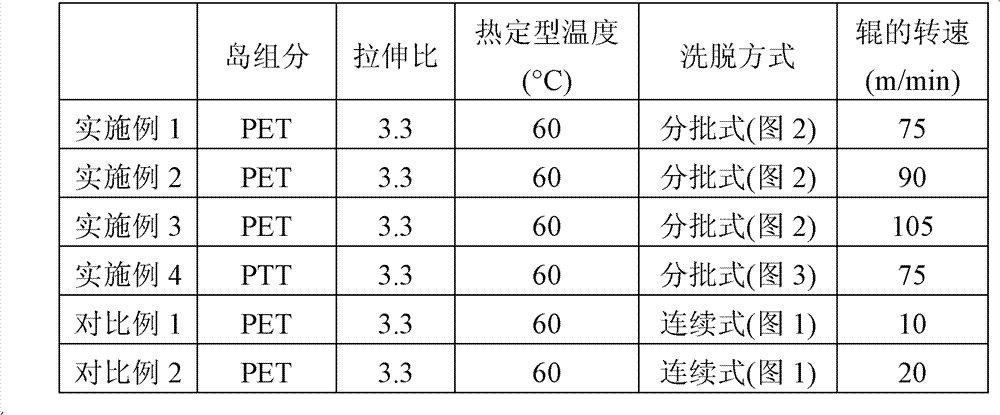
实施例1~4和对比例1~2的主要工艺条件总结于下面表1中。 The main process conditions of Examples 1-4 and Comparative Examples 1-2 are summarized in Table 1 below. the
表1 Table 1
实施例5Example 5
使其中聚对苯二甲酸乙二醇酯作为主成分与5摩尔%含有金属磺酸盐的聚酯单元共聚合的聚酯共聚物熔化,制得海组分熔融溶液;使聚对苯二甲酸乙二醇酯(PET)熔化,制得岛组分熔融溶液,使用30重量%的上述海组分熔融溶液和70重量%的上述岛组分熔融溶液组合,进行复合纺丝,得到单根纤维细度为3旦尼尔且在其横截面上包含16个岛组分的长丝。以2.5的拉伸比对丝束(上述长丝束)进行拉伸,将其卷曲成卷曲数为12个/英寸,在15℃下热定型,然后切成51mm,从而制成短纤维海岛型纤维。 The polyester copolymer in which polyethylene terephthalate is used as the main component and 5 mol% of polyester units containing metal sulfonate is melted to obtain a molten solution of the sea component; the polyethylene terephthalate Ethylene glycol ester (PET) is melted to obtain a melted solution of the island component, and 30% by weight of the above melted solution of the sea component and 70% by weight of the above melted solution of the island component are combined for composite spinning to obtain a single fiber A filament having a fineness of 3 denier and comprising 16 island components in its cross-section. The tow (the above-mentioned filament tow) was stretched at a draw ratio of 2.5, crimped to 12 crimps/inch, heat-set at 15°C, and then cut into 51 mm to form a short fiber island-in-the-sea type fiber. the
然后,将上述海岛型纤维进行梳理而形成纤网,将数个纤网叠合而形成交叉铺网片。而后,采用针刺制得具有350g/m2单位重量、1.1mm厚度和1920mm宽度的非织造织物。 Then, the above-mentioned sea-island fibers are carded to form a fiber web, and several fiber webs are laminated to form a cross-laid web sheet. Then, a nonwoven fabric having a basis weight of 350 g/m 2 , a thickness of 1.1 mm and a width of 1920 mm was produced by needle punching.
之后,利用4.5重量%的聚乙烯醇水溶液浸轧上述非织造织物并干燥,将经干燥的非织造织物浸入到所制得的13重量%聚氨酯溶液中,以使聚氨酯渗透在非织造织物中,用水洗涤上述织物以除去DMF和聚乙烯醇。此时,对聚氨酯在非织造织物中的含量进行调整,使得在后续工序中海组分被洗脱之后,人造革中的聚氨酯的含量被控制为25%。 Afterwards, utilize 4.5% by weight of polyvinyl alcohol aqueous solution to pad the above-mentioned nonwoven fabric and dry, the nonwoven fabric through drying is immersed in the prepared 13% by weight polyurethane solution, so that polyurethane penetrates in the nonwoven fabric, The above fabric was washed with water to remove DMF and polyvinyl alcohol. At this time, the content of polyurethane in the nonwoven fabric was adjusted so that the content of polyurethane in the artificial leather was controlled to be 25% after the sea component was eluted in the subsequent process. the
接下来,使用图2所示的分批式装置从渗透有聚氨酯的非织造织物中洗脱海组分(聚酯共聚物),上述纤维由于岛组分(聚对苯二甲酸乙二醇酯(PET))而被微细化。具体而言,4重量%的氢氧化钠水溶液用作溶剂100,驱动辊300a以75m/min的转速转动30分钟。然后,分离出非织造织物,用水洗涤并干燥,以完成原纤维化工序。
Next, the sea component (polyester copolymer) was eluted from the nonwoven fabric impregnated with polyurethane using the batch type apparatus shown in FIG. (PET)) and was miniaturized. Specifically, a 4% by weight sodium hydroxide aqueous solution was used as the solvent 100, and the
随后,使用粗糙度No.300砂纸对上述非织造织物进行起绒加工,以将最终厚度调整为0.7mm,使用酸性染料在高压快速染色机中染色,定型,用水洗涤,干燥并用软化剂和抗静电剂处理,从而制得人造革。 Subsequently, the above-mentioned non-woven fabric was raised with roughness No. 300 sandpaper to adjust the final thickness to 0.7 mm, dyed with acid dye in a high-pressure fast dyeing machine, set, washed with water, dried and treated with a softener and anti-aging agent. Static agent treatment, thus making artificial leather. the
实施例6Example 6
除了在实施例5中由复合纺丝工艺制得的长丝以2.7的拉伸比拉伸,卷曲,然后在40℃下热定型以制备海岛型纤维之外,按照与实施例1相同的方式制得人造革。 Except that in embodiment 5, the filament obtained by the composite spinning process is stretched at a draw ratio of 2.7, crimped, and then heat-set at 40 ° C to prepare sea-island fibers, in the same manner as in embodiment 1 Manufactured leather. the
实施例7Example 7
除了在实施例5中由复合纺丝工艺制得的长丝以3.0的拉伸比拉伸,卷曲,然后在50℃下热定型以制备海岛型纤维之外,按照与实施例1相同的方式制 得人造革。 In Example 5, the filaments obtained by the composite spinning process were stretched at a draw ratio of 3.0, crimped, and then heat-set at 50 ° C to prepare sea-island fibers, in the same manner as in Example 1 Manufactured leather. the
实施例8Example 8
除了在实施例5中由复合纺丝工艺制得的长丝以3.3的拉伸比拉伸,卷曲,然后在60℃下热定型以制备海岛型纤维之外,按照与实施例1相同的方式制得人造革。 Except that in embodiment 5, the filament obtained by the composite spinning process is stretched at a draw ratio of 3.3, crimped, and then heat-set at 60 ° C to prepare sea-island fibers, in the same manner as in embodiment 1 Manufactured leather. the
实施例9Example 9
除了在实施例5中使聚对苯二甲酸丙二醇酯(PTT)熔融来制备岛组分熔融溶液之外,按照与实施例1相同的方式制得人造革。 An artificial leather was produced in the same manner as in Example 1, except that polytrimethylene terephthalate (PTT) was melted to prepare an island component molten solution in Example 5. the
实施例10Example 10
除了在实施例9中由复合纺丝工艺制得的长丝以2.7的拉伸比拉伸,卷曲,然后在40℃下热定型以制备海岛型纤维之外,按照与实施例9相同的方式制得人造革。 Except that in embodiment 9, the filament obtained by the composite spinning process is stretched at a draw ratio of 2.7, crimped, and then heat-set at 40 ° C to prepare sea-island fibers, in the same manner as in embodiment 9 Manufactured leather. the
实施例11Example 11
除了在实施例9中由复合纺丝工艺制得的长丝以3.0的拉伸比拉伸,卷曲然后在50℃下热定型以制备海岛型纤维之外,按照与实施例9相同的方式制得人造革。 Except that in embodiment 9, the filaments obtained by the composite spinning process are stretched at a draw ratio of 3.0, crimped and then heat-set at 50 ° C to prepare sea-island fibers, and made in the same manner as in embodiment 9. Get artificial leather. the
实施例12Example 12
除了在实施例9中由复合纺丝工艺制得的长丝以3.3的拉伸比拉伸,卷曲,然后在60℃下热定型以制备海岛型纤维之外,按照与实施例9相同的方式制得人造革。 Except that in embodiment 9, the filament obtained by the composite spinning process is stretched at a draw ratio of 3.3, crimped, and then heat-set at 60 ° C to prepare sea-island fibers, in the same manner as in embodiment 9 Manufactured leather. the
对比例3Comparative example 3
除了在实施例5中由复合纺丝工艺制得的长丝以3.6的拉伸比拉伸,卷曲,然后在140℃下热定型以制备海岛型纤维之外,按照与实施例5相同的方式制得人造革。 Except that in embodiment 5, the filament obtained by the composite spinning process is stretched at a draw ratio of 3.6, crimped, and then heat-set at 140 ° C to prepare sea-island fibers, in the same manner as in embodiment 5 Manufactured leather. the
对比例4Comparative example 4
除了在实施例5中由复合纺丝工艺制得的长丝以2.0的拉伸比拉伸,卷曲,然后在15℃下热定型以制备海岛型纤维之外,按照与实施例5相同的方式制得人造革。 Except that in embodiment 5, the filament obtained by the composite spinning process is stretched at a draw ratio of 2.0, crimped, and then heat-set at 15 ° C to prepare sea-island fibers, in the same manner as in embodiment 5 Manufactured leather. the
对比例5Comparative example 5
除了在实施例9中由复合纺丝工艺制得的长丝以3.6的拉伸比拉伸,卷曲, 然后在130℃下热定型以制备海岛型纤维之外,按照与实施例9相同的方式制得人造革。 Except that the filament obtained by the composite spinning process was stretched at a draw ratio of 3.6 in Example 9, crimped, and then heat-set at 130° C. to prepare sea-island fibers, in the same manner as in Example 9 Manufactured leather. the
对比例6Comparative example 6
除了在实施例9中由复合纺丝工艺制得的长丝以2.0的拉伸比拉伸,卷曲,然后在15℃下热定型以制备海岛型纤维之外,按照与实施例9相同的方式制得人造革。 Except that in embodiment 9, the filament obtained by the composite spinning process is stretched at a draw ratio of 2.0, crimped, and then heat-set at 15 ° C to prepare sea-island fibers, in the same manner as in embodiment 9 Manufactured leather. the
实施例5~12和对比例3~6的主要工艺条件总结于下面表2中。 The main process conditions of Examples 5-12 and Comparative Examples 3-6 are summarized in Table 2 below. the
表2 Table 2

3.试验性实施例 3. Experimental Example
洗脱之前和之后的变化Changes before and after elution
对在根据实施例1~4和对比例1~2制备人造革的过程中洗脱海组分之前和之后的变化进行了测量。由此得到的结果示于下面表3中。 Changes before and after elution of the sea component during the preparation of artificial leather according to Examples 1 to 4 and Comparative Examples 1 to 2 were measured. The results thus obtained are shown in Table 3 below. the
表3 table 3

剩余收缩率的测量Measurement of residual shrinkage
对根据实施例1~4和对比例1~2的人造革进行切割,得到宽度(CMD)为100mm和长度(MD)为100mm的样品,将该样品拉伸30%和40%的比率,保持10分钟,松开并放置1小时,测量其宽度(CMD)和长度(MD),根据上面数式1得到剩余收缩率。表4和5列于如下。 The artificial leather according to Examples 1-4 and Comparative Examples 1-2 was cut to obtain a sample having a width (CMD) of 100 mm and a length (MD) of 100 mm, and the sample was stretched at a ratio of 30% and 40%, maintaining 10 Minutes, loosen and place for 1 hour, measure its width (CMD) and length (MD), and obtain the remaining shrinkage rate according to the above formula 1. Tables 4 and 5 are listed below. the
表4 Table 4

表5 table 5

5kg静态负荷下伸长率的测量Measurement of elongation under 5kg static load
对于实施例1~4和对比例1~2的人造革样品,测量了5kg静态负荷下的伸长率。其测量方法如下。 For the artificial leather samples of Examples 1 to 4 and Comparative Examples 1 to 2, elongation under a static load of 5 kg was measured. Its measurement method is as follows. the
在纵向和水平方向上得到宽度(CMD)为50mm和长度(MD)为250mm的3个样品,在上述样品的中心画出100mm的基准点。以150mm的夹距将上述样品安装在Marten’s疲劳试验机上,缓慢施加49N的负荷(5kgf,包括下夹具的负荷)。保持该负荷10分钟,然后测量基准点之间的距离。根据下面数式2计算静态负荷伸长率。 Three samples having a width (CMD) of 50 mm and a length (MD) of 250 mm were obtained in the longitudinal and horizontal directions, and a reference point of 100 mm was drawn at the center of the above samples. The above-mentioned sample was mounted on a Marten's fatigue testing machine with a grip distance of 150 mm, and a load of 49 N (5 kgf, including the load of the lower grip) was slowly applied. The load is maintained for 10 minutes, and then the distance between the reference points is measured. The static load elongation was calculated according to the following formula 2. the
数式2 Math 2
静态负荷伸长率(%)=l1-100 Static load elongation (%) = l1-100
其中,l1表示在施加负荷之后10分钟基准点之间的距离。 Here, l1 represents the distance between the reference points 10 minutes after the load is applied. the
由此得到的结果示于下面表6中: The results thus obtained are shown in Table 6 below:
表6 Table 6
海岛型纤维的伸长率和抗拉强度Elongation and tensile strength of sea-island fibers
测量了实施例5~12和对比例3~6的海岛型纤维的伸长率和抗拉强度。伸长率和抗拉强度通过如下方法得到:使用Vibroskop(由Lenzing Instruments GmbH & Co KG制造)向所述纤维施加50mg的初始张力,测量上述纤维的旦尼尔,向该纤维施加100mg的初始张力,用抗拉强度试验机(由Instron corporation制造)测量抗拉强度20次(所测样品的长度(MD):20mm,拉伸速率:100mm/min),得到20个值的平均值。其结果示于下面表7中。 The elongation and tensile strength of the sea-island fibers of Examples 5-12 and Comparative Examples 3-6 were measured. Elongation and tensile strength were obtained by applying an initial tension of 50 mg to the fiber using Vibroskop (manufactured by Lenzing Instruments GmbH & Co KG), measuring the denier of the above fiber, applying an initial tension of 100 mg to the fiber , the tensile strength was measured 20 times with a tensile strength testing machine (manufactured by Instron corporation) (length (MD) of the measured sample: 20mm, tensile rate: 100mm/min), and an average value of 20 values was obtained. The results are shown in Table 7 below. the
海岛型纤维的结晶度的测量Measurement of crystallinity of sea-island fibers
测量了实施例5~12和对比例3~6的海岛型纤维的结晶度。基于样品密度(ρ),采用聚酯的完全结晶区的理论密度(ρc=1.457g/cm2)和非结晶(无定形)区的密度(ρa=1.336g/cm2),按照下面数式3计算海岛型纤维的结晶度。 The crystallinity of the islands-in-sea fibers of Examples 5-12 and Comparative Examples 3-6 were measured. Based on the sample density (ρ), the theoretical density of the fully crystalline region (ρ c = 1.457 g/cm 2 ) and the density of the non-crystalline (amorphous) region (ρ a = 1.336 g/cm 2 ) of the polyester was used as follows Equation 3 calculates the crystallinity of sea-island fibers.
数式3 Math 3
结晶度
此时,样品的密度按如下方法得到:将海岛型纤维加入到包含正庚烷和四氯化碳的混合溶剂的密度计(Model SS,日本Shibayama制造)中,在23℃下放置一天,测量整体海岛型纤维(其中海组分与岛组分混合)的密度。由此得到的结果示于下面表7中。 At this time, the density of the sample was obtained as follows: Add sea-island fibers to a densitometer (Model SS, manufactured by Shibayama, Japan) containing a mixed solvent of n-heptane and carbon tetrachloride, leave it at 23° C. for one day, and measure The density of the overall sea-islands fiber (in which the sea component is mixed with the island component). The results thus obtained are shown in Table 7 below. the
人造革的伸长率和抗拉强度的测量Measurement of elongation and tensile strength of artificial leather
测量了实施例5~12和对比例3~6的人造革的伸长率和抗拉强度。人造革的伸长率和抗拉强度按如下方法得到:用抗拉强度试验机(由Instron corporation制造)测量人造革的抗拉强度10次(所测样品的长度(MD):50mm,拉伸速率:300mm/min),得到10个值的平均值。结果示于下面表7中。 The elongation and tensile strength of the artificial leathers of Examples 5-12 and Comparative Examples 3-6 were measured. The elongation and tensile strength of the artificial leather were obtained as follows: The tensile strength of the artificial leather was measured 10 times with a tensile strength testing machine (manufactured by Instron corporation) (the length (MD) of the measured sample: 50 mm, the tensile rate: 300mm/min), get the average value of 10 values. The results are shown in Table 7 below. the
人造革的结晶度的测量Measurement of crystallinity of artificial leather
测量了实施例5~12和对比例3~6的人造革的结晶度。按如下测量人造革的结晶度。在室温下将在人造革中包含的聚氨酯浸没在二甲基甲酰胺溶液中2小时,用30℃蒸馏水洗涤聚氨酯以除去该聚氨酯,剩余物在室温下干燥一天,按照与测量海岛型纤维的结晶度的方法相同的方式测量所得到的样品的结晶度。结果示于下面表7中。 The crystallinity of the artificial leathers of Examples 5-12 and Comparative Examples 3-6 were measured. The crystallinity of the artificial leather was measured as follows. The polyurethane contained in the artificial leather was immersed in the dimethylformamide solution for 2 hours at room temperature, the polyurethane was washed with distilled water at 30°C to remove the polyurethane, and the residue was dried at room temperature for one day, and the crystallinity of island-in-sea fibers was measured according to The crystallinity of the obtained samples was measured in the same manner as the method. The results are shown in Table 7 below. the
表7 Table 7

Claims (15)
Applications Claiming Priority (5)
| Application Number | Priority Date | Filing Date | Title |
|---|---|---|---|
| KR10-2009-0049582 | 2009-06-04 | ||
| KR1020090049582A KR101184553B1 (en) | 2009-06-04 | 2009-06-04 | Islands in a sea type fiber and artificial leather using the same |
| KR10-2009-0058426 | 2009-06-29 | ||
| KR1020090058426A KR101190924B1 (en) | 2009-06-29 | 2009-06-29 | Artificial leather and method for manufacturing the same |
| PCT/KR2010/003577 WO2010140853A2 (en) | 2009-06-04 | 2010-06-03 | Sea-island fibres and artificial leather, and a production method therefor |
Publications (2)
| Publication Number | Publication Date |
|---|---|
| CN102459749A CN102459749A (en) | 2012-05-16 |
| CN102459749B true CN102459749B (en) | 2014-01-15 |
Family
ID=43298331
Family Applications (1)
| Application Number | Title | Priority Date | Filing Date |
|---|---|---|---|
| CN201080033942.XA Active CN102459749B (en) | 2009-06-04 | 2010-06-03 | Sea-island fibres and artificial leather, and a production method thereof |
Country Status (5)
| Country | Link |
|---|---|
| US (1) | US20120135653A1 (en) |
| EP (1) | EP2439331B1 (en) |
| CN (1) | CN102459749B (en) |
| ES (1) | ES2481644T3 (en) |
| WO (1) | WO2010140853A2 (en) |
Families Citing this family (12)
| Publication number | Priority date | Publication date | Assignee | Title |
|---|---|---|---|---|
| US20040260034A1 (en) | 2003-06-19 | 2004-12-23 | Haile William Alston | Water-dispersible fibers and fibrous articles |
| US8513147B2 (en) | 2003-06-19 | 2013-08-20 | Eastman Chemical Company | Nonwovens produced from multicomponent fibers |
| US7892993B2 (en) | 2003-06-19 | 2011-02-22 | Eastman Chemical Company | Water-dispersible and multicomponent fibers from sulfopolyesters |
| US8512519B2 (en) | 2009-04-24 | 2013-08-20 | Eastman Chemical Company | Sulfopolyesters for paper strength and process |
| US9273417B2 (en) | 2010-10-21 | 2016-03-01 | Eastman Chemical Company | Wet-Laid process to produce a bound nonwoven article |
| US8840757B2 (en) | 2012-01-31 | 2014-09-23 | Eastman Chemical Company | Processes to produce short cut microfibers |
| CN103194912B (en) * | 2013-04-19 | 2014-10-15 | 福建隆上超纤有限公司 | Manufacturing method of superfine fiber synthetic leather |
| US9303357B2 (en) | 2013-04-19 | 2016-04-05 | Eastman Chemical Company | Paper and nonwoven articles comprising synthetic microfiber binders |
| US9605126B2 (en) | 2013-12-17 | 2017-03-28 | Eastman Chemical Company | Ultrafiltration process for the recovery of concentrated sulfopolyester dispersion |
| US9598802B2 (en) | 2013-12-17 | 2017-03-21 | Eastman Chemical Company | Ultrafiltration process for producing a sulfopolyester concentrate |
| US11408098B2 (en) * | 2019-03-22 | 2022-08-09 | Global Materials Development, LLC | Methods for producing polymer fibers and polymer fiber products from multicomponent fibers |
| CN112227075B (en) * | 2020-09-10 | 2023-06-30 | 江苏华峰超纤材料有限公司 | Composite non-woven fabric for natural texture PU synthetic leather and preparation method thereof |
Citations (3)
| Publication number | Priority date | Publication date | Assignee | Title |
|---|---|---|---|---|
| CN1116669A (en) * | 1993-10-29 | 1996-02-14 | 可乐丽股份有限公司 | Suede |
| CN1279307A (en) * | 1999-07-05 | 2001-01-10 | 可乐丽股份有限公司 | Fibrinous substrate for production of patent leather and patent leather therefrom |
| CN1637187A (en) * | 2003-12-12 | 2005-07-13 | 可乐丽股份有限公司 | Substrate for artificial leathers, artificial leathers and production method of substrate for artificial leathers |
Family Cites Families (9)
| Publication number | Priority date | Publication date | Assignee | Title |
|---|---|---|---|---|
| US4008344A (en) * | 1973-04-05 | 1977-02-15 | Toray Industries, Inc. | Multi-component fiber, the method for making said and polyurethane matrix sheets formed from said |
| KR100337990B1 (en) * | 1995-12-29 | 2003-07-10 | 주식회사 코오롱 | Method of manufacturing nubuck-type artificial leather |
| JP3924360B2 (en) * | 1997-09-29 | 2007-06-06 | 帝人ファイバー株式会社 | Artificial leather made of high-hollow polyester fiber |
| KR100546461B1 (en) * | 1998-03-27 | 2006-05-25 | 주식회사 코오롱 | Artificial leather with excellent elasticity. |
| KR100329037B1 (en) * | 2000-11-27 | 2002-03-18 | 구광시 | A sea-island type composite fiber for warp knitting, and a process of preparing for the same |
| ITMI20012108A1 (en) * | 2001-10-12 | 2003-04-12 | Alcantara Spa | PRODUCTION OF HIGH-ELASTICITY MICROFIBER SUEDE NON-WOVEN FABRIC |
| JP4473867B2 (en) * | 2004-03-30 | 2010-06-02 | 帝人ファイバー株式会社 | Sea-island type composite fiber bundle and manufacturing method thereof |
| KR20050103536A (en) * | 2004-04-26 | 2005-11-01 | 주식회사 코오롱 | An island in the sea type conjugate filament with natural streaky effect, and a process of preparing the same |
| US8349232B2 (en) * | 2006-03-28 | 2013-01-08 | North Carolina State University | Micro and nanofiber nonwoven spunbonded fabric |
-
2010
- 2010-06-03 CN CN201080033942.XA patent/CN102459749B/en active Active
- 2010-06-03 US US13/376,105 patent/US20120135653A1/en not_active Abandoned
- 2010-06-03 WO PCT/KR2010/003577 patent/WO2010140853A2/en not_active Ceased
- 2010-06-03 ES ES10783602.5T patent/ES2481644T3/en active Active
- 2010-06-03 EP EP20100783602 patent/EP2439331B1/en active Active
Patent Citations (3)
| Publication number | Priority date | Publication date | Assignee | Title |
|---|---|---|---|---|
| CN1116669A (en) * | 1993-10-29 | 1996-02-14 | 可乐丽股份有限公司 | Suede |
| CN1279307A (en) * | 1999-07-05 | 2001-01-10 | 可乐丽股份有限公司 | Fibrinous substrate for production of patent leather and patent leather therefrom |
| CN1637187A (en) * | 2003-12-12 | 2005-07-13 | 可乐丽股份有限公司 | Substrate for artificial leathers, artificial leathers and production method of substrate for artificial leathers |
Also Published As
| Publication number | Publication date |
|---|---|
| US20120135653A1 (en) | 2012-05-31 |
| CN102459749A (en) | 2012-05-16 |
| EP2439331A2 (en) | 2012-04-11 |
| EP2439331A4 (en) | 2013-03-06 |
| ES2481644T3 (en) | 2014-07-31 |
| WO2010140853A3 (en) | 2011-04-21 |
| WO2010140853A2 (en) | 2010-12-09 |
| EP2439331B1 (en) | 2014-04-16 |
Similar Documents
| Publication | Publication Date | Title |
|---|---|---|
| CN102459749B (en) | Sea-island fibres and artificial leather, and a production method thereof | |
| CN104145058B (en) | Stretchable artificial leather and its manufacturing method | |
| CN101611193A (en) | Stretchable sheet and its manufacturing method | |
| AU2005212087A1 (en) | Leather-like sheeting and process for production thereof | |
| JP5924763B2 (en) | Artificial leather and method for producing the same | |
| CN107407048A (en) | Hair-like artificial leather dyed with cationic dye and its manufacturing method | |
| KR20130052544A (en) | Leather-like sheet | |
| CN102333916B (en) | Artificial leather, entangled web of long fibers, and processes for producing these | |
| JP2018003181A (en) | Grained artificial leather and method for producing the same | |
| KR102337556B1 (en) | Sheet-like article and manufacturing method thereof | |
| JP2014034752A (en) | Stretchable fire retardant artificial leather | |
| CN106661826B (en) | Sheet-like article and method for producing same | |
| CN104024496B (en) | Composite fibre, artificial leather matrix and artificial leather | |
| JP2013181252A (en) | Method of manufacturing elastic artificial leather | |
| CN106574404A (en) | Polyamide fibers, fiber structure using same, and clothing | |
| JP5246083B2 (en) | Artificial leather substrate | |
| JP7845174B2 (en) | Artificial leather and method for manufacturing the same | |
| JP6065440B2 (en) | Artificial leather | |
| JP5750228B2 (en) | Artificial leather and method for producing the same | |
| JP5386400B2 (en) | Dyeing fiber structure excellent in sublimation fastness and method for producing the same | |
| JPH11247072A (en) | Artificial leather and manufacturing method thereof | |
| JP5903302B2 (en) | Elastic artificial leather | |
| KR101190924B1 (en) | Artificial leather and method for manufacturing the same | |
| JPH04209873A (en) | Production of leather-like sheetlike material | |
| CN115917076A (en) | artificial leather |
Legal Events
| Date | Code | Title | Description |
|---|---|---|---|
| C06 | Publication | ||
| PB01 | Publication | ||
| C10 | Entry into substantive examination | ||
| SE01 | Entry into force of request for substantive examination | ||
| C14 | Grant of patent or utility model | ||
| GR01 | Patent grant |