CN102458103A - Biocide composition (III) - Google Patents
Biocide composition (III) Download PDFInfo
- Publication number
- CN102458103A CN102458103A CN2010800280144A CN201080028014A CN102458103A CN 102458103 A CN102458103 A CN 102458103A CN 2010800280144 A CN2010800280144 A CN 2010800280144A CN 201080028014 A CN201080028014 A CN 201080028014A CN 102458103 A CN102458103 A CN 102458103A
- Authority
- CN
- China
- Prior art keywords
- acid
- composition according
- weight
- component
- sorbitan
- Prior art date
- Legal status (The legal status is an assumption and is not a legal conclusion. Google has not performed a legal analysis and makes no representation as to the accuracy of the status listed.)
- Granted
Links
Classifications
-
- A—HUMAN NECESSITIES
- A01—AGRICULTURE; FORESTRY; ANIMAL HUSBANDRY; HUNTING; TRAPPING; FISHING
- A01N—PRESERVATION OF BODIES OF HUMANS OR ANIMALS OR PLANTS OR PARTS THEREOF; BIOCIDES, e.g. AS DISINFECTANTS, AS PESTICIDES OR AS HERBICIDES; PEST REPELLANTS OR ATTRACTANTS; PLANT GROWTH REGULATORS
- A01N37/00—Biocides, pest repellants or attractants, or plant growth regulators containing organic compounds containing a carbon atom having three bonds to hetero atoms with at the most two bonds to halogen, e.g. carboxylic acids
- A01N37/42—Biocides, pest repellants or attractants, or plant growth regulators containing organic compounds containing a carbon atom having three bonds to hetero atoms with at the most two bonds to halogen, e.g. carboxylic acids containing within the same carbon skeleton a carboxylic group or a thio analogue, or a derivative thereof, and a carbon atom having only two bonds to hetero atoms with at the most one bond to halogen, e.g. keto-carboxylic acids
-
- A—HUMAN NECESSITIES
- A01—AGRICULTURE; FORESTRY; ANIMAL HUSBANDRY; HUNTING; TRAPPING; FISHING
- A01N—PRESERVATION OF BODIES OF HUMANS OR ANIMALS OR PLANTS OR PARTS THEREOF; BIOCIDES, e.g. AS DISINFECTANTS, AS PESTICIDES OR AS HERBICIDES; PEST REPELLANTS OR ATTRACTANTS; PLANT GROWTH REGULATORS
- A01N25/00—Biocides, pest repellants or attractants, or plant growth regulators, characterised by their forms, or by their non-active ingredients or by their methods of application, e.g. seed treatment or sequential application; Substances for reducing the noxious effect of the active ingredients to organisms other than pests
- A01N25/02—Biocides, pest repellants or attractants, or plant growth regulators, characterised by their forms, or by their non-active ingredients or by their methods of application, e.g. seed treatment or sequential application; Substances for reducing the noxious effect of the active ingredients to organisms other than pests containing liquids as carriers, diluents or solvents
-
- A—HUMAN NECESSITIES
- A01—AGRICULTURE; FORESTRY; ANIMAL HUSBANDRY; HUNTING; TRAPPING; FISHING
- A01N—PRESERVATION OF BODIES OF HUMANS OR ANIMALS OR PLANTS OR PARTS THEREOF; BIOCIDES, e.g. AS DISINFECTANTS, AS PESTICIDES OR AS HERBICIDES; PEST REPELLANTS OR ATTRACTANTS; PLANT GROWTH REGULATORS
- A01N37/00—Biocides, pest repellants or attractants, or plant growth regulators containing organic compounds containing a carbon atom having three bonds to hetero atoms with at the most two bonds to halogen, e.g. carboxylic acids
- A01N37/18—Biocides, pest repellants or attractants, or plant growth regulators containing organic compounds containing a carbon atom having three bonds to hetero atoms with at the most two bonds to halogen, e.g. carboxylic acids containing the group —CO—N<, e.g. carboxylic acid amides or imides; Thio analogues thereof
-
- A—HUMAN NECESSITIES
- A01—AGRICULTURE; FORESTRY; ANIMAL HUSBANDRY; HUNTING; TRAPPING; FISHING
- A01N—PRESERVATION OF BODIES OF HUMANS OR ANIMALS OR PLANTS OR PARTS THEREOF; BIOCIDES, e.g. AS DISINFECTANTS, AS PESTICIDES OR AS HERBICIDES; PEST REPELLANTS OR ATTRACTANTS; PLANT GROWTH REGULATORS
- A01N43/00—Biocides, pest repellants or attractants, or plant growth regulators containing heterocyclic compounds
- A01N43/64—Biocides, pest repellants or attractants, or plant growth regulators containing heterocyclic compounds having rings with three nitrogen atoms as the only ring hetero atoms
- A01N43/647—Triazoles; Hydrogenated triazoles
- A01N43/653—1,2,4-Triazoles; Hydrogenated 1,2,4-triazoles
-
- A—HUMAN NECESSITIES
- A01—AGRICULTURE; FORESTRY; ANIMAL HUSBANDRY; HUNTING; TRAPPING; FISHING
- A01N—PRESERVATION OF BODIES OF HUMANS OR ANIMALS OR PLANTS OR PARTS THEREOF; BIOCIDES, e.g. AS DISINFECTANTS, AS PESTICIDES OR AS HERBICIDES; PEST REPELLANTS OR ATTRACTANTS; PLANT GROWTH REGULATORS
- A01N51/00—Biocides, pest repellants or attractants, or plant growth regulators containing organic compounds having the sequences of atoms O—N—S, X—O—S, N—N—S, O—N—N or O-halogen, regardless of the number of bonds each atom has and with no atom of these sequences forming part of a heterocyclic ring
-
- A—HUMAN NECESSITIES
- A01—AGRICULTURE; FORESTRY; ANIMAL HUSBANDRY; HUNTING; TRAPPING; FISHING
- A01N—PRESERVATION OF BODIES OF HUMANS OR ANIMALS OR PLANTS OR PARTS THEREOF; BIOCIDES, e.g. AS DISINFECTANTS, AS PESTICIDES OR AS HERBICIDES; PEST REPELLANTS OR ATTRACTANTS; PLANT GROWTH REGULATORS
- A01N57/00—Biocides, pest repellants or attractants, or plant growth regulators containing organic phosphorus compounds
- A01N57/18—Biocides, pest repellants or attractants, or plant growth regulators containing organic phosphorus compounds having phosphorus-to-carbon bonds
- A01N57/20—Biocides, pest repellants or attractants, or plant growth regulators containing organic phosphorus compounds having phosphorus-to-carbon bonds containing acyclic or cycloaliphatic radicals
Landscapes
- Life Sciences & Earth Sciences (AREA)
- Health & Medical Sciences (AREA)
- General Health & Medical Sciences (AREA)
- Dentistry (AREA)
- Plant Pathology (AREA)
- Engineering & Computer Science (AREA)
- Pest Control & Pesticides (AREA)
- Agronomy & Crop Science (AREA)
- Wood Science & Technology (AREA)
- Zoology (AREA)
- Environmental Sciences (AREA)
- Toxicology (AREA)
- Agricultural Chemicals And Associated Chemicals (AREA)
Abstract
本发明涉及农业化学组合物,包含(a)基于酮羧酸的酰胺,和(b)杀生物剂。该组合物是透明的且展示改善的稳定性,即使在温度5℃至40℃储存更长时间段。The present invention relates to an agrochemical composition comprising (a) a ketocarboxylic acid-based amide, and (b) a biocide. The composition is transparent and exhibits improved stability even when stored at temperatures between 5°C and 40°C for longer periods of time.
Description
发明领域 field of invention
本发明涉及农业化学品领域,并涉及包含某些酰胺的杀生物剂组合物以及它们作为用于杀生物剂的溶剂或分散剂的用途。The present invention relates to the field of agrochemicals and to biocidal compositions comprising certain amides and their use as solvents or dispersants for biocides.
发明背景Background of the invention
杀生物剂,尤其是农药比如杀真菌剂、杀虫剂和除草剂,是保护并增加作物的重要农业辅剂。取决于各种且常常很特定的需要,存在显示迥异化学结构和行为的许多活性物。仍然,自现有技术熟知的是仍难以制备展示令人满意的稳定性的这些活性物的水溶液,特别是如果在很低温度或升高温度储存较长时间段。实际上,上述溶液显示分离或形成晶体的强烈倾向,这使得必需在每次施用之前将活性物再分散于组合物中以便获得均匀的产品。由于在常规用于施用植物处理试剂的含水配制剂的喷雾设备中存在数个过滤器和喷头,还出现额外的问题,其涉及在施用基于固体活性化合物的含水喷雾液期间活性化合物结晶从而阻断这些过滤器和喷头。Biocides, especially pesticides such as fungicides, insecticides and herbicides, are important agricultural adjuvants for protecting and enhancing crops. There are many actives that exhibit very different chemical structures and behaviors, depending on various and often very specific needs. Still, it is well known from the prior art that it remains difficult to prepare aqueous solutions of these actives that exhibit satisfactory stability, especially if stored at very low or elevated temperatures for extended periods of time. In fact, the aforementioned solutions show a strong tendency to separate or form crystals, which makes it necessary to redisperse the active in the composition before each application in order to obtain a homogeneous product. Due to the presence of several filters and nozzles in spray equipment conventionally used for the application of aqueous formulations of plant treatment agents, an additional problem arises, which involves the crystallization of the active compound during the application of an aqueous spray liquor based on a solid active compound thereby blocking the These filters and sprinklers.
欧洲专利申请EP 0453899 B1(Bayer)公开衍生自饱和C6-C20脂肪酸的二甲基酰胺作为可做杀真菌剂应用的唑类衍生物的结晶抑制剂的用途。不幸的是,该专利中的二甲基酰胺仅对受限制数量的活性物有用。甚至在情况唑类和唑类衍生物的情况下,抑制不希望结晶的能力受到环境温度限制,而在溶液必须在约5至10℃温度使用的情况下产品接近无用。European patent application EP 0453899 B1 (Bayer) discloses the use of dimethylamides derived from saturated C 6 -C 20 fatty acids as crystallization inhibitors of azole derivatives useful as fungicides. Unfortunately, the dimethylamides in this patent are only useful for a limited number of actives. Even in the case of azoles and azole derivatives, the ability to inhibit undesired crystallization is limited by the ambient temperature, while the product is close to useless where the solution must be used at a temperature of about 5 to 10°C.
本发明的解决问题是确定用来开发新杀生物剂组合物的适宜的新溶剂,其使得以与比市场可获得的那些相等或更高含量的活性物制得产品。新的溶剂需要是安全的且对环境友好,并且应允许获得浓缩的杀生物剂组合物(平均超过25%活性物)而无论杀生物剂化学结构如何,尤其是,该组合物应展示改善的溶剂化能力,贮藏稳定性和在5至40℃温度范围内对宽范围的杀生物剂减少的形成晶体倾向。最终,本发明的又一目的是设计具有提供优等乳液稳定性(尤其是关于不透明和分层)的特定共溶剂和乳化剂系统的乳油配制剂。The problem addressed by the present invention is to identify suitable new solvents for the development of new biocide compositions which allow the preparation of products with equal or higher levels of actives than those available on the market. The new solvent needs to be safe and environmentally friendly and should allow to obtain concentrated biocide compositions (over 25% active on average) regardless of the biocide chemical structure and, in particular, the composition should exhibit improved Solvating ability, storage stability and reduced tendency to form crystals for a wide range of biocides at temperatures ranging from 5 to 40°C. Finally, a further object of the present invention is to design emulsifiable concentrate formulations with specific co-solvent and emulsifier systems that provide superior emulsion stability, especially with regard to opacity and layering.
发明描述Description of the invention
本发明是指杀生物剂组合物,包含The present invention refers to a biocide composition comprising
(a)基于酮羧酸的酰胺,(a) amides based on ketocarboxylic acids,
(b)杀生物剂,和任选地(b) biocides, and optionally
(c)油组分或共溶剂和/或(c) oil component or co-solvent and/or
(d)乳化剂。(d) Emulsifiers.
令人惊讶地,已观察到酰胺,优选二烷基酰胺和最优选得自酮羧酸的二甲基酰胺,例如4-氧代戊酸(乙酰丙酸)的二甲基酰胺,与现有技术已知来自脂肪酸的二甲基酰胺相比显示改善的溶剂化能力。申请人已发现酮羧酸酰胺能够(甚至在严苛条件下)溶解或分散宽范围的杀生物剂,这是指在温度5至40℃经至少4周而不分相或沉降的贮藏时间。作为共溶剂将油组分特别是具有酯结构的那些加入组合物导致乳油配制剂显示增加的乳液行为和稳定性(尤其是关于不透明和分层)。Surprisingly, it has been observed that amides, preferably dialkylamides and most preferably dimethylamides derived from ketocarboxylic acids, such as 4-oxopentanoic acid (levulinic acid), It is known in the art that dimethylamides from fatty acids show improved solvating power compared to dimethylamides. Applicants have found that ketocarboxylic acid amides are capable of dissolving or dispersing (even under severe conditions) a wide range of biocides, which means storage time at temperatures from 5 to 40°C for at least 4 weeks without phase separation or settling. The addition of oil components, especially those with an ester structure, to the composition as co-solvents results in emulsifiable concentrate formulations showing increased emulsion behavior and stability (especially with regard to opacity and layering).
酮羧酸的酰胺Amides of ketocarboxylic acids
根据本发明的酰胺(组分a)能够衍生自酮羧酸。优选酰胺遵循通式(I),The amides (component a) according to the invention can be derived from ketocarboxylic acids. Preferred amides follow the general formula (I),
R1CO-NR2R3 (I)R 1 CO-NR 2 R 3 (I)
其中R1CO代表R4(CH2)nCO(CH2)m,R2和R3独立地代表氢或具有1至10个碳原子的烷基,R4代表氢或任选由一个或多个官能团取代的具有1至10个碳原子的烷基残基,而m和n均独立地代表零或1至10的整数,条件是(n+m)不是零。官能团的实例是芳基或呋喃基团。本发明也涵盖环状酰胺。在低温和高温以长时间段展示溶解或分散多种不同杀生物剂的最佳效能的最优选的种类是二烷基酰胺,尤其是4-氧代戊酸(乙酰丙酸)或2-氧代丙酸(丙酮酸)的二甲基酰胺或二烷基(异)辛基酰胺。wherein R 1 CO represents R 4 (CH 2 ) n CO(CH 2 ) m , R 2 and R 3 independently represent hydrogen or an alkyl group having 1 to 10 carbon atoms, R 4 represents hydrogen or is optionally composed of one or Alkyl residues having 1 to 10 carbon atoms substituted with multiple functional groups, and m and n each independently represent zero or an integer from 1 to 10, provided that (n+m) is not zero. Examples of functional groups are aryl or furyl groups. The invention also encompasses cyclic amides. The most preferred class exhibiting the best efficacy in dissolving or dispersing many different biocides at low and high temperatures over long periods of time are the dialkylamides, especially 4-oxopentanoic acid (levulinic acid) or 2-oxopentanoic acid Dimethylamide or dialkyl(iso)octylamide of propionic acid (pyruvate).
杀生物剂Biocide
本发明中的杀生物剂为植物保护剂,尤其是可杀死不同形式的存活生物体的化学物质,其用于例如医药、农业、林业和蚊虫控制领域。另外,认为所谓的植物生长调节剂也被认为属于杀生物剂。通常,杀生物剂分成两类:Biocides in the context of the present invention are plant protection agents, especially chemical substances which kill different forms of living organisms, which are used, for example, in the fields of medicine, agriculture, forestry and mosquito control. In addition, so-called plant growth regulators are considered to be classified as biocides. Generally, biocides fall into two categories:
o杀有害物药,其包括杀真菌剂,除草剂,杀虫剂,杀藻剂,杀软体动物剂,杀螨剂和杀啮齿类剂(并入The Pesticide Handbook,14版,BCPC 2006作为参考)和o Pesticides which include fungicides, herbicides, insecticides, algicides, molluscicides, acaricides and rodenticides (incorporated by reference into The Pesticide Handbook, 14th edition, BCPC 2006 )and
o抗微生物剂,其包括杀菌剂(germicide)、抗生素、抗细菌剂、抗病毒剂、抗真菌剂、抗原生动物剂和抗寄生虫剂。o Antimicrobial agents, which include germicides, antibiotics, antibacterials, antivirals, antifungals, antiprotozoals and antiparasitics.
也可将杀生物剂加入其它物质(通常是液体)中来保护物质不受到生物的感染和侵袭。例如,可将某些类型的季铵化合物(quats)加入池水或工业水系统中来用作杀藻剂,来保护水不受到藻类的感染和侵袭。Biocides can also be added to other substances (usually liquids) to protect the substance from infection and attack by organisms. For example, certain types of quaternary ammonium compounds (quats) can be added to pool water or industrial water systems as algicides to protect the water from infection and attack by algae.
杀有害物药Pesticides
美国环境保护局(EPA,U.S Environmental Protection Agency)将杀有害物药定义为“打算用于防止、毁坏、驱散或减轻任何有害物的任何物质或物质的混合物”。杀有害物药可以是化学物质或生物试剂(例如病毒或细菌),其针对有害物使用,所述有害物包括与人争食、毁坏财物、传播疾病或为公害的昆虫、植物病原体、杂草、软体动物、鸟、哺乳动物、鱼、线虫(蛔虫)及微生物。在下列实例中,依照本发明,给出了适用于农化组合物的杀有害物药:The U.S. Environmental Protection Agency (EPA, U.S Environmental Protection Agency) defines a pesticide as "any substance or mixture of substances intended to prevent, destroy, disperse, or mitigate any pest". Pesticides can be chemical substances or biological agents (such as viruses or bacteria) that are used against pests, including insects, plant pathogens, weeds that compete for food, destroy property, spread disease, or are public nuisances , molluscs, birds, mammals, fish, nematodes (roundworms) and microorganisms. In the following examples, according to the present invention, pesticides suitable for use in agrochemical compositions are given:
杀真菌剂fungicide
杀真菌剂是用于控制有害物的三种主要方法之一(在这种情况下,用化学控制真菌)。杀真菌剂是用于防止真菌在花园和作物中传播的化合物。杀真菌剂也用于对抗真菌感染。杀真菌剂可以是触杀性的或内吸性的。触杀性杀真菌剂在喷雾于真菌表面时杀死真菌。内吸性杀菌剂在真菌死亡之前需要被真菌吸收。根据本发明的适宜杀真菌剂的实例涵盖下述化学类别和相应实例:Fungicides are one of the three main methods used to control pests (in this case, chemical control of fungi). Fungicides are compounds used to prevent the spread of fungi in gardens and crops. Fungicides are also used to fight fungal infections. Fungicides can be contact or systemic. Contact fungicides kill fungi when sprayed on their surface. Systemic fungicides need to be absorbed by the fungus before it dies. Examples of suitable fungicides according to the invention encompass the following chemical classes and corresponding examples:
o氨基嘧啶比如乙嘧酚磺酸酯,oAminopyrimidines such as pyrimefate,
o苯胺基嘧啶比如嘧菌环胺,嘧菌胺,嘧霉胺,oAnilinopyrimidines such as cyprodinil, pyrimethanil, pyrimethanil,
o杂芳族比如噁霉灵,o Heteroaromatics such as hymexazol,
o杂芳族烃比如土菌灵,oHeteroaromatic hydrocarbons such as terendazim,
o氯苯基类/硝基苯胺比如氯苯甲醚,氯硝胺,五氯硝基苯,四氯硝基苯,甲基立枯磷,oChlorophenyls/nitroanilines such as chloroanisole, chlorniramine, pentachloronitrobenzene, tetrachloronitrobenzene, tolclofos-methyl,
o苯甲酰胺杀真菌剂比如苯酰菌胺,o benzamide fungicides such as benzamid,
o苯磺酰胺比如磺菌胺,oBenzenesulfonamides such as sulfamethanil,
o苯并咪唑比如活化酸(acibenzolar),苯菌灵,苯并噻唑,多菌灵,麦穗宁,苯菌酮(metrafenone),烯丙苯噻唑,噻菌灵,咪唑嗪,和苯并咪唑前体杀真菌剂,o Benzimidazoles such as acibenzolar, benomyl, benzothiazole, carbendazim, metrafenone, metrafenone, allylbenzothiazole, thiabendazole, imidazosin, and benzimidazole Precursor fungicides,
o氨基甲酸酯类比如霜霉威,乙霉威,o Carbamates such as propamocarb, diethofencarb,
o甲酰胺比如啶酰菌胺,双氯氰菌胺,噻唑菌胺,氟酰胺,吡噻菌胺(penthiopyrad),噻氟菌胺o Carboxamides such as boscalid, diclofenac, ethaboxam, flunamide, penthiopyrad, teflufen
o氯腈比如百菌清,o Chloronitrile such as chlorothalonil,
o肉桂酸酰胺比如烯酰吗啉,氟吗啉,o Cinnamic acid amides such as dimethomorph, flumorph,
o氰基乙酰胺肟比如霜脲氰,oCyanoacetamide oximes such as cymoxanil,
o环丙烷甲酰胺比如环丙酰菌胺,oCyclopropanecarboxamides such as cyprohexamid,
o二甲酰亚胺比如异菌脲,辛噻酮,腐霉利,乙烯菌核利,oDicarboximides such as iprodione, octhinone, procymidone, vinclozolin,
o二甲基二硫代氨基甲酸酯比如福美铁,百亩酸(metam),福美双,福美锌,oDimethyldithiocarbamate such as ferbam, metam, thiram, zinc thiram,
o二硝基苯胺比如氟啶胺,o dinitroanilines such as fluazinam,
o二硫代氨基甲酸酯比如代森锰铜,代森锰锌,代森锰,代森联,代森钠,丙森锌,代森锌,oDithiocarbamate such as mancocopper, mancozeb, manbeb, mancozeb, sodium, propineb, zinc,
o二硫杂环戊烷比如稻瘟灵,o dithiolanes such as blastexin,
o葡萄糖吡喃糖基抗生素比如链霉素,有效霉素,o Glucopyranosyl antibiotics such as streptomycin, validamycin,
o胍比如多果定,双胍辛,双胍辛胺,o Guanidines such as dodine, octidine, octylamine,
o己糖吡喃羰基抗生素比如春雷霉素,o Hexopyranyl antibiotics such as kasugamycin,
o羟基N-酰基苯胺比如环酰菌胺,oHydroxy-N-acylanilides such as fenhexamid,
o咪唑比如抑霉唑,噁咪唑(oxpoconazole),稻瘟酯,咪鲜胺,氟菌唑,oImidazoles such as imazalil, oxpoconazole, blastic-methyl, prochloraz, flufenazole,
o咪唑啉酮比如咪唑菌酮,oimidazolinones such as imidazolidin,
o无机物比如波尔多液,氢氧化铜,环烷酸铜,油酸铜,王铜,硫酸铜(II),硫酸铜,乙酸铜(II),碳酸铜(II),氧化亚铜,硫磺,oInorganic substances such as Bordeaux mixture, copper hydroxide, copper naphthenate, copper oleate, copper king, copper(II) sulfate, copper sulfate, copper(II) acetate, copper(II) carbonate, cuprous oxide, sulfur,
o异苯并呋喃酮比如四氯苯酞,o Isobenzofuranones such as tetrachlorophthalide,
o杏仁酰胺比如双炔酰菌胺,o Almondamides such as mandipropamid,
o吗啉比如十二环吗啉,丁苯吗啉,十三吗啉,苯锈啶,哌丙灵,螺环菌胺,aldimorph,o Morpholines such as dodemorph, fenpropimorph, tridemorph, fenpropidin, peripridine, spirulina, aldimorph,
o有机锡比如三苯锡,oOrganotins such as triphenyltin,
o噁唑烷酮比如噁霜灵,oOxazolidinones such as oxaxyl,
o苯基酰胺比如苯霜灵,精苯霜灵,呋霜灵,甲霜灵,精甲霜灵,呋酰胺,oPhenylamides such as benalaxyl, benalaxyl, furaxyl, metalaxyl, metalaxyl, furamide,
o苯基吡唑比如氟虫腈,oPhenylpyrazoles such as fipronil,
o苯基吡咯比如咯菌腈,oPhenylpyrroles such as fludioxonil,
o苯脲比如戊菌隆,oPhenylureas such as penciluron,
o膦酸比如乙膦酸,o Phosphonic acids such as etedronic acid,
o邻氨羰基苯甲酸比如叶枯酞,oAnthranilobenzoic acids such as phyllin,
o邻苯二甲酰亚胺比如敌菌丹,克菌丹,灭菌丹,o Phthalimides such as captafol, captan, folpet,
o哌嗪比如嗪氨灵,oPiperazines such as zinamidine,
o丙酰胺比如稻瘟酰胺,oPropionamides such as blastamide,
o吡啶比如啶斑肟,oPyridines such as pyridoxine,
o嘧啶比如氯苯嘧啶醇,氟苯嘧啶醇,oPyrimidines such as pyrimidine, pyrimidine,
o吡咯并喹啉酮比如咯喹酮,oPyrroloquinolinones such as pyrroquinones,
oQils比如氰霜唑,oQils such as Cyazofamida,
o喹唑啉酮比如丙氧喹啉,oQuinazolinones such as propoxyquinoline,
o喹啉比如苯氧喹啉(quinoxyfen),oquinolines such as quinoxyfen,
o醌比如二氰蒽醌,oQuinones such as dicyanoanthraquinone,
o磺酰胺比如甲苯氟磺胺,苯氟磺胺,o Sulfonamides such as toluene flusulfonamide, benflusulfonamide,
o嗜球果伞素类(strobilurines)比如嘧菌酯,二甲苯氧菌胺,噁唑菌酮,氟嘧菌酯,醚菌酯,苯氧菌胺,啶氧菌酯,吡唑醚菌酯,肟菌酯,肟醚菌胺,o Strobilurines such as azoxystrobin, xylostrobin, oxaclostrobin, fluoxastrobin, kysstrobin, fenoxystrobin, picoxystrobin, pyraclostrobin , trifloxystrobin, oryzastrobin,
o硫代氨基甲酸酯比如磺菌威,o Thiocarbamates such as sulfocarb,
o硫菌灵比如甲基硫菌灵,o Thiophanate such as thiophanate-methyl,
o噻吩甲酰胺比如硅噻菌胺,o Thiophene carboxamides such as silthiocarb,
o三唑杀真菌剂比如氧环唑,联苯三唑醇,糠菌唑,环丙唑醇,苯醚甲环唑,烯唑醇,氟环唑,腈苯唑,氟喹唑,氟硅唑,粉唑醇,三氟苯唑,己唑醇,亚胺唑,种菌唑,叶菌唑,腈菌唑,戊菌唑,丙环唑,丙硫菌唑,硅氟唑,戊唑醇,四氟醚唑,三唑酮,三唑醇,灭菌唑,quinconazole,o Triazole fungicides such as econazole, bifendonazole, furconazole, cyproconazole, difenoconazole, diniconazole, econazole, nibendazole, fluquinazole, fluorosilicone Azole, fuconazole, triflubenazole, hexaconazole, imidazole, cconazole, metconazole, mycloconazole, penconazole, propiconazole, prothioconazole, silicon fluconazole, tebuconazole Alcohol, Tetrafluconazole, Triadimefon, Triadimefol, Fenconazole, Quinconazole,
o三唑并苯并噻唑比如三环唑,o Triazolobenzothiazoles such as tricyclazole,
o缬氨酰胺(valinamide)氨基甲酸酯类比如缬霉威,苯噻菌胺(benthiavalicarb),oValinamide carbamates such as valemocarb, benthiavalicarb,
o氟吡菌胺,o Fluopyram,
o五氯苯酚,o Pentachlorophenol,
和它们的混合物。and their mixtures.
除草剂herbicide
除草剂是一种用于杀死不必要的植物的杀有害物药。选择性除草剂杀死特定的目标,同时相对的对于必要的作物没有伤害。这些效应中的一些通过干扰杂草的生长而起作用,并且通常基于植物激素。用于清理荒地的除草剂不具有选择性并杀死与之接触的所有植物体。除草剂广泛地应用于农业和景观草坪的管理。它们也应用于总的植物控制(totalvegetation control,TVC)工程来维护高速公路和铁路。少数除草剂用于森林、牧场、及被指定为野生动物栖息的区域的管理。通常,能够使用包括各种化学类别和相应实例的活性成分Herbicides are a type of pesticide used to kill unwanted plants. Selective herbicides kill specific targets while being relatively harmless to the desired crop. Some of these effects work by interfering with weed growth and are often based on plant hormones. The herbicides used to clear wasteland are not selective and kill all plant matter they come in contact with. Herbicides are widely used in agriculture and landscape lawn management. They are also used in total vegetation control (TVC) projects to maintain highways and railways. A small number of herbicides are used in the management of forests, rangelands, and areas designated as wildlife habitat. In general, active ingredients including various chemical classes and corresponding examples can be used
oN-酰基苯胺比如敌稗oN-acylanilides such as propanil
o芳氧基羧酸例如2甲4氯乙硫酯oAryloxycarboxylic acids such as 2-methyl-4-chloroethylthioester
o芳氧基苯氧基丙酸酯例如炔草酯,氰氟草酯,禾草灵(diclofops),吡氟禾草灵,氟吡禾灵,喹禾灵,oAryloxyphenoxypropionates such as clodinafop-propargyl, cyhalofop-methyl, diclofops, fluazifop, haloxyfop, quizalofop,
o 氯乙酰胺例如乙草胺(acetolochlor),甲草胺,丁草胺,二甲吩草胺,异丙甲草胺,毒草胺o Chloroacetamides such as acetolochlor, alachlor, butachlor, dimethenamid, metolachlor, toxachlor
o环己烷二酮肟例如烯草酮,烯禾啶,三甲苯草酮,o Cyclohexanediketoximes such as clethodim, ethoxydim, trimethylbenzotrione,
o苯甲酰胺比如异噁酰草胺o Benzamides such as clomazone
o苯并咪唑比如麦草畏,乙氧呋草黄o Benzimidazoles such as dicamba, ethofurazone
o二硝基苯胺例如氟乐灵,二甲戊灵,oDinitroanilines such as trifluralin, pendimethalin,
o二苯基醚例如苯草醚,乙氧氟草醚,oDiphenylethers such as aclofen, oxyfluorfen,
o甘氨酸衍生物草甘膦,其是内吸性非选择性(灭除任意类型的植物)除草剂,用于免耕杀灭(burndown)并且用于转基因以抵抗其效果的作物中的杂草防治,o The glycine derivative glyphosate, which is a systemic non-selective (kills any type of vegetation) herbicide used for no-tillage burndown and for weeds in crops genetically modified to resist its effects prevention,
o羟基苄腈例如溴苯腈,oHydroxybenzonitriles such as bromoxynil,
o咪唑啉酮例如咪唑菌酮,甲咪唑烟酸,甲氧咪草烟,甲咪唑烟酸,咪唑烟酸,咪唑喹啉酸,o imidazolinones such as imidazolidin, imazethapyr, imazethapyr, imazethapyr, imazethapyr, imazethapyr,
o异噁唑烷酮例如异噁草酮,o Isoxazolidinones such as clomazone,
o百草枯比如联吡啶类,o Paraquat such as bipyridines,
o苯基氨基甲酸酯类例如甜菜安,甜菜宁,o Phenyl carbamates such as betaine, betalain,
o苯基吡唑例如吡草醚-乙酯,o Phenylpyrazoles such as pyraclofen-ethyl ester,
o苯基吡唑啉例如唑啉草酯,o Phenylpyrazolines such as pinoxaden,
o吡啶羧酸或合成的植物生长素例如氨氯吡啶酸,二氯吡啶酸,和三氯吡氧乙酸,o pyridinecarboxylic acid or synthetic auxins such as amiloride, clopyralid, and clopyralid,
o嘧啶基氧基苯甲酸例如双草醚-钠盐(bispyrtbac-sodium)oPyrimidinyloxybenzoic acid such as bispyribac-sodium salt (bispyrtbac-sodium)
o磺酰脲例如酰嘧磺隆,四唑嘧磺隆,苄嘧磺隆-甲酯,氯磺隆,啶嘧磺隆,甲酰氨基嘧磺隆,氟啶嘧磺隆-甲酯-钠盐,烟嘧磺隆,砜嘧磺隆,磺酰磺隆,苯磺隆-甲酯,三氟啶磺隆钠盐,氟胺磺隆,三氟甲磺隆,o Sulfonylureas such as rimsulfuron-methyl, rimsulfuron-methyl, bensulfuron-methyl, chlorsulfuron-methyl, rimsulfuron-methyl, rimsulfuron-methyl, flurisulfuron-methyl-sodium salt, nicosulfuron, rimsulfuron, sulfuron-methyl, tribenuron-methyl, trifluxysulfuron sodium salt, flusulfasulfuron-methyl, triflumesulfuron-methyl,
o三唑并嘧啶例如五氟磺草胺,磺草唑胺,双氟磺草胺,o Triazolopyrimidines such as penoxsulam, sulfentrazone, florasulam,
o三酮例如硝磺草酮,磺草酮,o Triketones such as mesotrione, sulcotrione,
o脲例如敌草隆,利谷隆,o Urea such as Diuron, Liguron,
o苯氧基羧酸比如2,4-D,2甲4氯,2甲4氯丁酸,2甲4氯丙酸,o Phenoxy carboxylic acids such as 2,4-D, 2-methyl-4-chloro, 2-methyl-4-chlorobutanoic acid, 2-methyl-4-chloropropionic acid,
o三嗪比如莠去津,西玛津,特丁津,o Triazines such as atrazine, simazine, terbuthylazine,
和它们的混合物。and their mixtures.
杀虫剂insecticide
杀虫剂是一种针对所有发育形式的昆虫使用的杀有害物药。其包括针对昆虫卵和幼虫使用的杀卵剂和杀幼虫剂。杀虫剂用于农业、医药、工业及家用。下文提及适宜的杀虫剂化学类别和实例:An insecticide is a pesticide used against all developmental forms of insects. It includes ovicides and larvicides used against insect eggs and larvae. Pesticides are used in agriculture, medicine, industry and domestic use. Suitable pesticide chemical classes and examples are mentioned below:
o阿维菌素,甲氨基阿维菌素,o Abamectin, Emamectin,
o氨茴酸二酰胺类如氯虫苯甲酰胺(rynaxypyr)o Anthranilic acid diamides such as chlorantraniliprole (rynaxypyr)
o合成的植物生长素比如阿维菌素(avermectin),oSynthetic auxins such as avermectin,
o脒类比如双甲脒,oamidines such as amitraz,
o邻氨基苯甲酸二酰胺比如氯虫苯甲酰胺,o diamides of anthranilates such as chlorantraniliprole,
o氨基甲酸酯类比如涕灭威,克百威,甲萘威,灭多威,2-(1-甲基丙基)苯基甲基氨基甲酸酯,o Carbamates such as aldicarb, carbofuran, carbaryl, methomyl, 2-(1-methylpropyl)phenylmethylcarbamate,
o氯化的杀虫剂比如例如,毒杀芬,滴滴涕,六氯环己烷,
o保幼激素模拟比如吡丙醚,o Juvenile hormone mimics such as pyriproxyfen,
o新烟碱类比如吡虫啉,噻虫胺,噻虫啉,噻虫嗪,o Neonicotinoids such as imidacloprid, clothianidin, thiacloprid, thiamethoxam,
o有机磷化合物比如乙酰甲胺磷,保棉磷,地散磷,氯氧磷,毒死蜱,甲基毒死蜱,二嗪磷,敌敌畏(DDVP),百治磷,乐果,乙拌磷,灭克磷(dthoprop),苯线磷,杀螟硫磷,倍硫磷,噻唑磷,马拉硫磷,甲胺磷,杀扑磷,甲基-对硫磷,速灭磷,二溴磷,氧乐果,亚砜磷,对硫磷,甲拌磷,伏杀硫磷,亚胺硫磷,phostebupirim,甲基嘧啶磷,丙溴磷,特丁硫磷,杀虫畏,tribufos,敌百虫,oOrganophosphorus compounds such as acephate, acetophos, difosin, chlorpyrifos, chlorpyrifos-methyl, diazinon, dichlorvos (DDVP), dicrotophos, dimethoate, dichlorfos, dimethophos Phosphorus (dthoprop), fenamiphos, fenitrothion, fenthion, thiazophos, malathion, methamidophos, methamidophos, methyl-parathion, memethaphos, dibromophos, oxygen Dimethoate, sulfoxide, parathion, phorate, chlorthion, imidophos, phostebupirim, pirimiphos-methyl, profenofos, terbufos, dimefen, tribufos, trichlorfon ,
o噁二嗪类如茚虫威,oOxadiazines such as indoxacarb,
o植物毒素衍生的化合物比如鱼藤(鱼藤酮),除虫菊,neem(印楝素),烟碱,咖啡因,o Phytotoxin-derived compounds such as rotenone (rotenone), pyrethrum, neem (azadirachtin), nicotine, caffeine,
o引诱素比如诱蝇酮(cuellure),甲基丁香酚,o Attractins such as cuellure, methyl eugenol,
o拟除虫菊酯比如例如,烯丙菊酯,联苯菊酯,溴氰菊酯,氯菊酯,苄呋菊酯,苯醚菊酯(sumithrin),胺菊酯,四溴菊酯,四氟苯菊酯,oPyrethroids such as, for example, allethrin, bifenthrin, deltamethrin, permethrin, resmethrin, sumithrin, tetramethrin, perbromothrin, tetraflu phenthrin,
o选择性摄食阻断剂比如氟啶虫酰胺,吡蚜酮,o Selective feeding blockers such as flonicamid, pymetrozine,
o多杀霉素类(spinosyns)例如多杀霉素oSpinosyns such as spinosyns
和它们的混合物。and their mixtures.
植物生长调节剂Plant Growth Regulator
植物激素类(也称为植物激素)是调节植物生长的化学品。植物激素类是植物中产生的信号分子并且以极低浓度存在。激素类局部地调节靶标细胞中的细胞过程,并且在移动至其它位置的情况下,局部地调节植物其它位置的细胞过程。与动物不同,植物缺少产生和分泌激素类的腺体。植物激素类改造植物,也即影响种子生长,开花时间,花卉性别,叶子和果实衰老。它们影响组织向上生长和向下生长,叶子形成和茎干生长,果实发展和熟化,植物寿命,甚至植物死亡。激素类是植物生长的关键;如果缺少它们,植物多半会是未分化的细胞团。下文提及适宜的植物生长调节剂:Plant hormones (also known as plant hormones) are chemicals that regulate plant growth. Phytohormones are signaling molecules produced in plants and are present in very low concentrations. Hormones modulate cellular processes locally in target cells and, if moved to other locations, locally in other locations in the plant. Unlike animals, plants lack the glands that produce and secrete hormones. Phytohormones modify plants, ie affect seed growth, flowering time, flower sex, leaf and fruit senescence. They affect tissue upgrowth and downgrowth, leaf formation and stem growth, fruit development and ripening, plant lifespan, and even plant death. Hormones are key to plant growth; without them, plants are mostly clumps of undifferentiated cells. Suitable plant growth regulators are mentioned below:
oAviglycine,o Aviglycine,
o单氰胺,o cyanamide,
o赤霉素比如赤霉酸,o Gibberellins such as gibberellic acid,
o季铵比如矮壮素,甲哌鎓,o Quaternary ammonium such as chlormequat, methylpiperium,
o产乙烯剂比如乙烯利(ethephone),o Ethylene generators such as ethephone,
杀啮齿类剂rodenticide
杀啮齿类剂是一类意欲杀死啮齿类动物的有害物防治化学品。啮齿类动物的摄食行为反映了其为食腐动物,因此其难于被毒杀。它们会吃一小部分,然后等待,如果没有出现异样,它们才会继续吃。有效的杀啮齿类剂在致命浓度时必须是无色无味的,并且具有延迟效应。以下给出了合适的杀啮齿类剂的实例:Rodenticides are a class of pest control chemicals intended to kill rodents. The feeding behavior of rodents reflects their scavengers, which make them difficult to kill. They will eat a small portion, wait, and if nothing is wrong, they will continue to eat. An effective rodenticide must be colorless, odorless and have a delayed effect at lethal concentrations. Examples of suitable rodenticides are given below:
o抗凝血剂被定义为慢性(摄入致死剂量后1~2周死亡,很少立即死亡)、单剂量(第二代)或多剂量(第一代)累积性杀啮齿类剂。致命剂量的抗凝血剂会引起致命的内出血,例如溴鼠灵、杀鼠醚或杀鼠灵。这些有效剂量的物质为抗维生素K,阻断酶K1-2,3-环氧-还原酶(这种酶优选被4-羟基香豆素/4-羟基硫杂香豆素衍生物所阻断)和K1-醌-还原酶(这种酶优选被茚满二酮衍生物所阻断),剥夺生物体活性维生素K1的来源。这导致了维生素K循环的破坏,致使不能产生重要的凝血因子(主要是凝血因子II(凝血酶原)、VII(前转化素)、IX(Christmas因子)和X(Stuart因子)。除了这种具体的代谢破坏外,毒性剂量的4-羟基香豆素/4-羟基硫杂香豆素和茚满二酮抗凝血剂会引起微血管(毛细血管)损伤,增加毛细血管的渗透率,引起弥散性内出血(出血)。这些效应是逐步的,在数天内发展,并且不会伴随任何受伤害的感觉,例如疼痛或剧痛。在中毒的最后阶段,衰竭的啮齿类动物因为低血容量循环休克或严重的贫血而虚脱,并且平静地死亡。杀鼠抗凝血剂可以是第一代试剂(4-羟基香豆素类:杀鼠灵、杀鼠醚;茚满二酮类:鼠完、敌鼠、氯鼠酮),这些试剂通常需要较高的浓度(通常在0.005至0.1%之间),为积聚致死剂量需在数天内连续摄取,单次摄取之后活性差或者没有活性,并且较之第二代试剂毒性低,第二代试剂是4-羟基香豆素的衍生物(鼠得克、溴鼠灵、溴敌隆和氟鼠灵)或4-羟基-1-苯并硫杂环己二烯-2-酮,(4-羟基-1-硫杂香豆素),有时被不正确地称为4-羟基-1-硫代香豆素,原因见杂环化合物),即噻鼠灵。第二代试剂的毒性远比第一代试剂强,其通常以较低的浓度应用于饵中(通常在0.001~0.005%数量级),在单次摄入饵后即可致死,并且对变得耐受第一代抗凝血剂的啮齿类动物系仍然有效;因此第二代抗凝血剂有时被称为“超级杀鼠灵”。有时,抗生素可增强抗凝血杀啮齿类剂,最常见的为磺胺喹沙啉。这种联合(例如0.05%的杀鼠灵+0.02%的磺胺喹沙啉,或0.005%的鼠得克+0.02%的磺胺喹沙啉等)的目的在于抗生素/抑菌剂抑制代表了维生素K来源的肠/消化道共生微生物群。因此共生细菌被杀死,或其代谢被破坏且由其产生的维生素K减少,结果从逻辑上对抗凝血剂作出贡献。也可使用非磺胺喹沙啉的抗生素试剂,例如复方新诺明(co-trimoxazole)、四环素、新霉素或甲硝唑。另外的用于灭鼠诱饵中的协同作用是将抗凝血剂与具有维生素D活性的化合物一起使用,即胆钙化醇或麦角钙化醇(见下文)。所用的典型配方例如:0.025~0.05%的杀鼠灵+0.01%的胆钙化醇。在一些国家中甚至有固定的三组分杀啮齿类剂,即抗凝血剂+抗生素+维生素D,例如0.005%的鼠得克+0.02%的磺胺喹沙啉+0.01%的胆钙化醇。第二代抗凝血剂与抗生素和/或维生素D的联合被认为即使对于耐受性最强的啮齿动物种类也有效,虽然在诱饵中浓度为0.0025~0.005%的一些第二代抗凝血剂(即溴鼠灵和噻鼠灵)毒性很强,以至于不存在耐受的啮齿动物种类,甚至对任何其他衍生物耐受的啮齿动物,在应用这些毒性最为强烈的抗凝血剂时也仍然会被可靠地除去。o Anticoagulants are defined as chronic (death within 1 to 2 weeks of ingestion of a lethal dose, rarely immediate death), single-dose (second generation) or multiple dose (first generation) cumulative rodenticides. Fatal internal bleeding can occur with lethal doses of anticoagulants such as brodifafeum, coumateral, or warfarin. These effective doses of substances are anti-vitamin K, block the enzyme K 1 -2,3-epoxy-reductase (this enzyme is preferably blocked by 4-hydroxycoumarin/4-hydroxythiacoumarin derivatives break) and K 1 -quinone-reductase (this enzyme is preferably blocked by indandione derivatives), depriving the organism of a source of active vitamin K 1 . This leads to disruption of the vitamin K cycle, resulting in the inability to produce important coagulation factors (mainly coagulation factors II (prothrombin), VII (proconvertin), IX (Christmas factor) and X (Stuart factor). In addition to this In addition to specific metabolic disruption, toxic doses of 4-hydroxycoumarin/4-hydroxythiacoumarin and indanedione anticoagulants can cause microvascular (capillary) damage, increase capillary permeability, cause Diffuse internal haemorrhage (bleeding). These effects are gradual, develop over several days, and are not accompanied by any nociceptive sensations, such as pain or excruciating pain. In the final stages of intoxication, depleted rodents suffer from hypovolemic circulation Shock or severe anemia and collapse, and died peacefully. Rodenticidal anticoagulants can be first-generation agents (4-hydroxycoumarins: warfarin, coumarin; indanediones: rat end , meth, chloromatrixone), these agents generally require relatively high concentrations (usually between 0.005 and 0.1%), require continuous ingestion over several days to accumulate lethal doses, have little or no activity after a single ingestion, and Less toxic than second-generation reagents, which are derivatives of 4-hydroxycoumarin (Rudac, Brodifacoum, Bromadiolone, and Fludifacoum) or 4-Hydroxy-1-benzothio Heterocyclohexadien-2-one, (4-Hydroxy-1-thiacoumarin), sometimes incorrectly called 4-hydroxy-1-thiacoumarin for reasons see Heterocyclic Compounds), That is Thiaclozolin. The toxicity of the second-generation reagents is much stronger than that of the first-generation reagents, which are usually applied in baits at lower concentrations (usually on the order of 0.001-0.005%), can be lethal after a single ingestion of baits, and are harmful to Rodent strains resistant to first-generation anticoagulants remain effective; thus second-generation anticoagulants are sometimes called "super warfarin." Anticoagulant rodenticides are sometimes augmented by antibiotics, most commonly sulfaquinoxaline. The purpose of this combination (for example, 0.05% warfarin + 0.02% sulfaquinoxaline, or 0.005% mudac + 0.02% sulfaquinoxaline, etc.) Source of gut/digestive tract commensal microbiota. The commensal bacteria are thus killed, or their metabolism is disrupted and the production of vitamin K from them is reduced, consequently logically contributing to the anticoagulant. Antibiotic agents other than sulfaquinoxaline, such as co-trimoxazole, tetracycline, neomycin, or metronidazole, may also be used. Another synergistic effect used in rodent baits is the use of anticoagulants together with compounds having vitamin D activity, namely cholecalciferol or ergocalciferol (see below). A typical formulation used is, for example: 0.025-0.05% warfarin + 0.01% cholecalciferol. In some countries there is even a fixed three-component rodenticide, ie anticoagulant + antibiotic + vitamin D, for example 0.005% mudecac + 0.02% sulfaquinoxaline + 0.01% cholecalciferol. Combinations of second-generation anticoagulants with antibiotics and/or vitamin D are believed to be effective even in the most tolerant rodent species, although some second-generation anticoagulants at concentrations of 0.0025–0.005% in bait The most toxic anticoagulants of these agents (i.e. brodifacoum and thiadifurum) are so toxic that there are no tolerant rodent species, even rodents tolerant to any of the other derivatives will still be reliably removed.
维生素K1被建议作为解毒剂,并且其已成功地作为解毒剂用于偶然或意外地(宠物中毒、企图自杀)接触了抗凝血剂有毒物的宠物或人。另外,由于这些有毒物通过抑制肝功能起作用,并且在毒素的发展期间一些凝血因子及总的循环血量缺乏。因此输血(视情况可存在凝血因子)可挽救意外接触这些有毒物的人员的生命,这比其他前期有毒物具有优势。Vitamin K1 has been suggested as an antidote and has been successfully used as an antidote for pets or humans who have been accidentally or accidentally (pet poisoning, suicide attempt) exposed to anticoagulant poisons. In addition, since these toxic substances act by inhibiting liver function, some coagulation factors and total circulating blood volume are deficient during the development of toxins. Blood transfusions (with the presence of coagulation factors as appropriate) therefore save the lives of persons accidentally exposed to these toxicants, which is an advantage over other anterior toxicants.
o金属磷化物已经作为一种杀死啮齿类动物的方法使用,并被认为是单剂量快速作用的杀啮齿类剂(通常单次摄取诱饵后1~3天死亡)。将由食物和磷化物(通常是磷化锌)组成的一定剂量诱饵置于啮齿类动物可以吃到的地方。啮齿动物消化系统中的酸会与磷化物反应生成有毒的磷化氢气体。这种控制有害物的方法可能用于对耐受一些抗凝血剂的啮齿动物,尤其是控制家鼠和田鼠;磷化锌诱饵也比大多数的第二代抗凝血剂便宜,所以在大量啮齿动物侵扰的情况下,首先通过应用大量的磷化锌减少其数量,然后持续地投予抗凝血剂诱饵彻底根除在起始快速作用有毒物下仍然存活的剩下的啮齿动物。相反地,在抗凝血剂诱饵毒杀后仍然存活的个别啮齿动物(剩下的啮齿动物)可通过预给饵给予其无毒的诱饵1~2周(这对于克服怯饵和使啮齿动物习惯于在提供特定的食物的特定的区域摄食是重要的,特别是当消灭鼠类时),随后使用与预给饵相同类型的有毒诱饵,直至诱饵停止消耗(通常在2~4天内)。如果诱饵的接受/嗜食性良好(即啮齿动物直接食用),则采用不同作用方式的交互杀啮齿类剂方法可实际或几乎100%地消灭区域内的啮齿动物群。o Metal phosphides have been used as a method of killing rodents and are considered to be single-dose rapid-acting rodenticides (typically 1-3 days after a single bait ingestion). A dosed bait consisting of food and a phosphide, usually zinc phosphide, is placed where the rodents can eat it. Acids in the rodent's digestive system react with phosphide to produce toxic phosphine gas. This method of pest control may be useful in rodents resistant to some anticoagulants, especially mice and voles; zinc phosphide baits are also less expensive than most second-generation anticoagulants, so in In the event of a large rodent infestation, first reduce their numbers by applying large doses of zinc phosphide, followed by continuous administration of anticoagulant baits to completely eradicate the remaining rodents that survived the initial rapid-acting poison. Conversely, individual rodents that survived poisoning with anticoagulant baits (remaining rodents) can be given non-toxic baits by prebaiting for 1 to 2 weeks (this is very important for overcoming bait cowardice and keeping rodents Accustomed to feeding in a specific area where a specific food is offered is important, especially when eradicating rodents), then use the same type of poisonous bait as pre-baited until the bait stops being consumed (usually within 2-4 days). If the bait acceptance/predatory properties are good (ie direct consumption by rodents), an approach of alternating rodenticides with different modes of action can virtually or nearly 100% eliminate the rodent population in the area.
o磷化物是快速作用毒鼠剂,其可使得老鼠通常在开放区域中死亡,而不会影响建筑物。其典型的实例是磷化铝(仅为烟熏剂)、磷化钙(仅为烟熏剂)、磷化镁(仅为烟熏剂)和磷化锌(于诱饵中)。通常将磷化锌加入啮齿类动物诱饵中,加入量约为0.75~2%。由于磷化物水解会释放磷化氢,因此诱饵会具有强烈的、刺激性的大蒜味的特征。该气味会吸引(或至少不会驱散)啮齿类动物,但对其他哺乳动物具有驱散效果;但是,鸟类(特别是野生火鸡)对这种气味不敏感。o Phosphorus is a fast-acting rat poison that kills rats, usually in open areas, without affecting buildings. Typical examples thereof are aluminum phosphide (fumigant only), calcium phosphide (fumigant only), magnesium phosphide (fumigant only) and zinc phosphide (in baits). Zinc phosphide is usually added to rodent baits at an amount of about 0.75-2%. Due to the release of phosphine by hydrolysis of the phosphide, the bait will have a strong, pungent garlic flavor characteristic. The odor attracts (or at least does not repel) rodents, but has a repelling effect on other mammals; however, birds (especially wild turkeys) are not sensitive to this odor.
o高血钙(Hypercalcemia)。钙化醇(维生素D)、胆钙化醇(维生素D3)和麦角钙化醇(维生素D2)用作杀啮齿类剂,其对啮齿类动物是有毒的,由于相同的原因对哺乳类动物是有益的,即其影响生物体中钙和磷的体内稳定。少量的维生素D是重要的(数个IU每千克体重每天,仅有零点几毫克),与大多数脂溶性维生素一样,大剂量的维生素D是有毒的,其会直接导致所谓的维生素过多症,即简单来说,维生素中毒。若严重中毒(即有毒物的剂量足够高),其最终会导致死亡。在啮齿动物摄食杀啮齿类剂诱饵时,其主要通过增加从食物中吸收钙,使骨-基质-固定钙成离子化形式(主要是碳酸氢钙阳离子,部分结合血浆蛋白,[CaHCO3]+),从而提高钙水平,引起高钙血综合症,所述钙离子在血浆中溶解和循环,当摄入致死剂量后,游离的钙水平升至足够高从而使得血管、肾、胃壁和肺矿化/钙化(在组织中形成钙化物、钙盐/复合物的结晶,因此损伤组织),进一步导致心脏问题(心肌对各种游离钙水平是敏感的,游离钙水平会影响心房和心室间心肌的收缩和兴奋的传导)和出血(由于毛细血管损伤),并可能导致肾衰竭。其被认为是单剂量、或累积性的(取决于所用的浓度;常用的0.075%诱饵浓度可致死大多数单次摄入大部分诱饵的啮齿动物)、亚慢性的(在食用诱饵后数天至一周之内死亡)。当单独使用时,胆钙化醇和麦角钙化醇的使用浓度分别是0.075%和0.1%。钙化醇的毒性具有一个重要的特征,即它们与抗凝血毒性剂具有协同作用。这意味着在同一诱饵中的抗凝血剂和钙化醇的混合物比诱饵中抗凝血剂和钙化醇的毒性的总和更加强烈,因此诱饵中相当低的钙化醇含量即可达到大量的高血钙效果,反之亦然。更若存在钙化醇,则可观察到更明显的抗凝血/出血效果。此协同作用常用于诱饵中降低钙化醇含量,因为有效的钙化醇的浓度较大多数有效的抗凝血剂更加昂贵。历史上首次将钙化醇应用于杀鼠诱饵中是在上世纪七十年代早期,事实上是


杀螨剂、杀软体动物剂和杀线虫剂Acaricides, molluscicides and nematicides
杀螨剂是可杀死螨类的杀害物药剂。抗生素类杀螨剂、氨基甲酸酯类杀螨剂、甲脒类杀螨剂、螨类生长调节剂、有机氯、氯菊酯和有机磷酸酯杀螨剂均属于此类。杀软体动物剂是用于控制例如蛾类、蛞蝓和蜗牛等软体动物的杀害物药剂。这些物质包括四聚乙醛、甲硫威、硫酸铝。杀线虫剂是一类用于杀死寄生线虫(蠕虫的一门)的化学杀害物药剂。杀线虫剂从neem树的种饼获得;其是油提取后neem树种的残余物。世界上已知neem树有数个名称,但是自古时起由印度首先种植。Acaricides are biocidal agents that kill mites. Antibiotic acaricides, carbamate acaricides, formamidine acaricides, mite growth regulators, organochlorine, permethrin and organophosphate acaricides all fall into this category. Molluscicides are pesticides used to control molluscs such as moths, slugs and snails. These substances include metaldehyde, methiocarb, and aluminum sulfate. Nematicides are a class of chemical biocidal agents used to kill parasitic nematodes, a genus of worms. The nematicide is obtained from the seed cake of the neem tree; which is the residue of the neem species after oil extraction. The neem tree is known by several names in the world, but it was first cultivated by India since ancient times.
抗微生物剂antimicrobial agent
下列实例,为适合本发明的农用化学品组合物的抗微生物剂。最常用的杀菌消毒剂是:The following examples are antimicrobial agents suitable for the agrochemical composition of the present invention. The most commonly used antiseptics are:
o活性氯(即次氯酸盐、氯胺、二氯异氰尿酸盐和三氯异氰尿酸盐、湿氯、二氧化氯等),o Active chlorine (i.e. hypochlorite, chloramine, dichloroisocyanurate and trichloroisocyanurate, wet chlorine, chlorine dioxide, etc.),
o活性氧(过氧化物,例如过氧乙酸、过硫酸钾、过硼酸钠、过碳酸钠和尿素过氧化氢合物),o Active oxygen species (peroxides such as peracetic acid, potassium persulfate, sodium perborate, sodium percarbonate and urea perhydrate),
o碘(碘代聚维酮(聚维酮-碘,聚维酮碘)、Lugol溶液、碘酊、碘化非离子表面活性剂),o Iodine (Iodopovidone (povidone-iodine, povidone-iodine), Lugol's solution, tincture of iodine, iodinated nonionic surfactants),
o浓缩的醇类(主要是乙醇、1-丙醇,也称为正丙醇,和2-丙醇,也称为异丙醇,及它们的混合物;另外也使用了2-苯氧基乙醇和1-苯氧基丙醇和2-苯氧基丙醇),o Concentrated alcohols (mainly ethanol, 1-propanol, also known as n-propanol, and 2-propanol, also known as isopropanol, and mixtures thereof; 2-phenoxyethanol is also used and 1-phenoxypropanol and 2-phenoxypropanol),
o苯酚类物质(例如苯酚(也称为“石炭酸”)、甲酚(称为“来苏尔”,与液体钾皂组合)、卤化的(氯代、溴代)酚(例如毒菌酚、三氯生、三氯苯酚、三溴苯酚、五氯苯酚、二溴苯酚)及它们的盐),o Phenolic substances (such as phenol (also known as "carbolic acid"), cresols (called "lysol" in combination with liquid potassium soap), halogenated (chlorinated, brominated) phenols (such as toadol, Triclosan, trichlorophenol, tribromophenol, pentachlorophenol, dibromophenol) and their salts),
o阳离子表面活性剂,例如一些季铵盐阳离子(例如苯扎氯铵、十六烷基三甲基溴化铵或十六烷基三甲基氯化铵、二癸基二甲基氯化铵、西吡氯铵、苄索氯铵)及其他非季铵盐化合物,例如氯己定、葡萄糖精蛋白(glucoprotamine)、奥替尼啶二盐酸化物等,o Cationic surfactants such as some quaternary ammonium salt cations (e.g. benzalkonium chloride, cetyltrimethylammonium bromide or cetyltrimethylammonium chloride, didecyldimethylammonium chloride , cetylpyridinium chloride, benzethonium chloride) and other non-quaternary ammonium compounds, such as chlorhexidine, glucoprotamine (glucoprotamine), octenidine dihydrochloride, etc.,
o强氧化剂,例如臭氧和高锰酸盐溶液;oStrong oxidizing agents such as ozone and permanganate solutions;
o重金属和它们的盐比如胶体银,硝酸银,氯化汞,苯基汞盐,硫酸铜,氧化铜-氯化铜等。重金属和它们的盐是最具毒性的并且环境上最危险的杀菌剂,因此,其使用受到严重控制或禁止;另外,还有o Heavy metals and their salts such as colloidal silver, silver nitrate, mercuric chloride, phenylmercuric salts, copper sulfate, copper oxide-copper chloride, etc. Heavy metals and their salts are the most toxic and environmentally dangerous fungicides, so their use is severely regulated or banned; in addition, there are
o适当的浓强酸(磷酸、硝酸、硫酸、氨基磺酸、甲苯磺酸),及o appropriate concentrated strong acids (phosphoric acid, nitric acid, sulfuric acid, sulfamic acid, toluenesulfonic acid), and
o碱(氢氧化钠、氢氧化钾、氢氧化钙),在pH<1或pH>13时,尤其是在高温下(高于60℃)杀死细菌。o Alkali (sodium hydroxide, potassium hydroxide, calcium hydroxide), kills bacteria at pH<1 or pH>13, especially at high temperature (above 60°C).
少数上述消毒剂可在合适的条件(主要是浓度、pH、温度及对人/动物的毒性)下,作为消毒剂使用,即可用于人体或动物体、皮肤、黏膜、伤口等的杀菌剂。其中,以下是重要的:A few of the above-mentioned disinfectants can be used as disinfectants under suitable conditions (mainly concentration, pH, temperature and toxicity to humans/animals), that is, they can be used as bactericides for human or animal bodies, skin, mucous membranes, wounds, etc. Among them, the following are important:
o一些适当稀释的氯制剂(例如Daquin溶液)、0.5%的pH调节至7~8的次氯酸钠或次氯酸钾溶液、或0.5%~1%的苯磺酰氯胺钠溶液(氯胺B)),及一些o some suitably diluted chlorine preparation (such as Daquin solution), 0.5% sodium hypochlorite or potassium hypochlorite solution adjusted to pH 7-8, or 0.5%-1% benzenesulfonyl sodium chloramide solution (chloramine B)), and Some
o碘制剂,例如碘代聚维酮的各种盖伦制剂(软膏剂、溶液、外伤膏药),其过去也被称为Lugol溶液,o Iodine preparations such as the various galenic preparations (ointments, solutions, wound plasters) of iodopovidone, which used to be also known as Lugol's solution,
o过氧化物,例如尿素过氧化氢合物及0.1~0.25%的过氧乙酸的pH缓冲溶液,o Peroxides such as urea perhydrate and 0.1-0.25% peracetic acid in a pH buffer solution,
o加入或未加入消毒剂添加剂的醇类,其主要用于皮肤消毒,o Alcohols with or without added disinfectant additives, which are mainly used for skin disinfection,
o有机弱酸,例如山梨酸、苯甲酸、乳酸和水杨酸,o Weak organic acids such as sorbic, benzoic, lactic and salicylic acids,
o一些酚类化合物,例如毒菌酚、三氯生和二溴苯酚,及oSome phenolic compounds, such as tobacol, triclosan, and dibromophenol, and
o阳离子活性化合物,例如0.05~0.5%的苄烷铵、0.5~4%的氯己定、0.1~2%的奥替尼啶溶液。o Cationic active compounds, such as 0.05-0.5% benzalkonium, 0.5-4% chlorhexidine, 0.1-2% octenidine solution.
杀菌性抗生素杀死细菌,抑菌性抗生素仅能延缓细菌的生长和繁殖。青霉素是一种杀菌剂,如同头孢菌素。氨基糖苷类抗生素即可以通过杀菌方式(分解细胞壁前体导致细胞溶解)也可以通过抑菌方式(通过与30s核糖体亚基结合并降低翻译的准确性,从而导致错误的蛋白质合成)起作用。根据本发明的其它杀菌抗生素包括氟化喹诺酮,硝基呋喃类,万古霉素,单环内酰胺类,复方新诺明(co-trimoxazole)和甲硝哒唑(metronidazole)。优选的活性物是具内吸性或部分内吸性作用模式的那些,例如嘧菌酯。Bactericidal antibiotics kill bacteria, bacteriostatic antibiotics only slow down the growth and reproduction of bacteria. Penicillin is a fungicide, like cephalosporins. Aminoglycoside antibiotics can act both bactericidally (by breaking down cell wall precursors leading to cell lysis) and bacteriostatically (by binding to the 30S ribosomal subunit and reducing the accuracy of translation, leading to erroneous protein synthesis). Other bactericidal antibiotics according to the invention include fluorinated quinolones, nitrofurans, vancomycin, monobactams, co-trimoxazole and metronidazole. Preferred actives are those with a systemic or partially systemic mode of action, eg azoxystrobin.
总体优选的是选自草甘膦及其盐、草铵膦酸(glufosinate)及其盐的杀生物剂。Overall preference is given to biocides selected from glyphosate and its salts, glufosinate and its salts.
油组分oil component
在许多情况下,有利的是将油组分(任选组分c)加入杀生物剂组合物以支持产品的乳化能力。适宜的产品包括:基于具有6至18个优选8至10个碳原子的脂肪醇的Guerbet醇,线性C6-C22-脂肪酸与线性或支化的C6-C22-脂肪醇的酯或支化的C6-C13-羧酸与线性或支化的C6-C22-脂肪醇的酯,比如例如,肉豆蔻酸肉豆蔻基酯,棕榈酸肉豆蔻基酯,硬脂酸肉豆蔻基酯,异硬脂酸肉豆蔻基酯,油酸肉豆蔻基酯,山萮酸肉豆蔻基酯,芥酸肉豆蔻基酯,肉豆蔻酸鲸蜡基酯,棕榈酸鲸蜡基酯,硬脂酸鲸蜡基酯,异硬脂酸鲸蜡基酯,油酸鲸蜡基酯,山萮酸鲸蜡基酯,芥酸鲸蜡基酯,肉豆蔻酸硬脂基酯,棕榈酸硬脂基酯,硬脂酸硬脂基酯,异硬脂酸硬脂基酯,油酸硬脂基酯,山萮酸硬脂基酯,芥酸硬脂基酯,肉豆蔻酸异硬脂基酯,棕榈酸异硬脂基酯,硬脂酸异硬脂基酯,异硬脂酸异硬脂基酯,油酸异硬脂基酯,山萮酸异硬脂基酯,油酸异硬脂基酯,肉豆蔻酸油烯基酯,棕榈酸油烯基酯,硬脂酸油烯基酯,异硬脂酸油烯基酯,油酸油烯基酯,山萮酸油烯基酯,芥酸油烯基酯,肉豆蔻酸二十二烷基酯,棕榈酸二十二烷基酯,硬脂酸二十二烷基酯,异硬脂酸二十二烷基酯,油酸二十二烷基酯,山萮酸二十二烷基酯,芥酸二十二烷基酯,肉豆蔻酸二十二碳烯基酯,棕榈酸二十二碳烯基酯,硬脂酸二十二碳烯基酯,异硬脂酸二十二碳烯基酯,油酸二十二碳烯基酯,山萮酸二十二碳烯基酯和芥酸二十二碳烯基酯。还适宜的是线性C6-C22-脂肪酸与支化的醇尤其是2-乙基己醇的酯,C18-C38-烷基羟基羧酸与线性或支化的C6-C22-脂肪醇的酯,尤其是苹果酸二辛基酯,线性和/或支化的脂肪酸与多羟基醇(比如例如丙二醇、二聚体二醇或三聚体三醇)的酯和/或Guerbet醇,基于C6-C10-脂肪酸的甘油三酯,基于C6-C18-脂肪酸的液态一-/二-/甘油三酯混合物,C6-C22-脂肪醇和/或Guerbet醇与芳族羧酸尤其是苯甲酸的酯,C2-C12-二羧酸与线性或支化的具有1至22个碳原子的醇或具有2至10个碳原子和2至6个羟基的多元醇的酯,植物油,支化的伯醇,取代的环己烷,线性和支化的C6-C22-脂肪醇碳酸酯,比如例如,碳酸二辛基酯




乳化剂Emulsifier
在许多情况有利的是将乳化剂(任选组分d)加入杀生物剂组合物以支持产品的稳定性。第一优选组的乳化剂涵盖非离子表面活性剂,例如:In many cases it is advantageous to add an emulsifier (optional component d) to the biocide composition to support the stability of the product. A first preferred group of emulsifiers encompasses nonionic surfactants such as:
o2至30mol环氧乙烷和/或0至5mol环氧丙烷加成至线性C8-22脂肪醇,加成至C12-22脂肪酸和加成至烷基中含有8至15个碳原子的烷基酚类的产品;o Addition of 2 to 30 moles of ethylene oxide and/or 0 to 5 moles of propylene oxide to linear C 8-22 fatty alcohols, to C 12-22 fatty acids and to alkyl groups containing 8 to 15 carbon atoms Products of alkylphenols;
oC12/18脂肪酸单酯和1至30mol环氧乙烷与甘油的加成产品的二酯;o C 12/18 fatty acid monoesters and diesters of addition products of 1 to 30 mol ethylene oxide with glycerol;
o含有6至22个碳原子的饱和的和不饱和的脂肪酸的甘油单酯和二酯和去水山梨糖醇单酯和二酯及其环氧乙烷加成产品;o monoglycerides and diesters and sorbitan monoesters and diesters of saturated and unsaturated fatty acids containing 6 to 22 carbon atoms and their ethylene oxide addition products;
o15至60mol环氧乙烷与蓖麻油和/或氢化蓖麻油的加成产品;o Addition products of 15 to 60 mol ethylene oxide with castor oil and/or hydrogenated castor oil;
o多元醇酯,尤其是,聚甘油酯例如聚甘油多蓖麻油酸酯,聚甘油多-12-羟基硬脂酸酯或聚甘油二异硬脂酸酯。这些类别中数种化合物的混合物也是适宜的;o Polyol esters, especially polyglycerol esters such as polyglycerol polyricinoleate, polyglycerol poly-12-hydroxystearate or polyglycerol diisostearate. Mixtures of several compounds from these classes are also suitable;
o2至15mol环氧乙烷与蓖麻油和/或氢化蓖麻油的加成产品;o Addition products of 2 to 15 mol ethylene oxide with castor oil and/or hydrogenated castor oil;
o基于线性、支化、不饱和或饱和C6/22脂肪酸、蓖麻油酸和12-羟基硬脂酸和甘油、聚甘油、季戊四醇、二季戊四醇、糖醇(例如山梨糖醇)、烷基葡糖苷(例如甲基葡糖苷、丁基葡糖苷、月桂基葡糖苷)和聚葡糖苷(例如纤维素)的偏酯;oBased on linear, branched, unsaturated or saturated C6 /22 fatty acids, ricinoleic acid and 12-hydroxystearic acid and glycerol, polyglycerol, pentaerythritol, dipentaerythritol, sugar alcohols (such as sorbitol), alkylglucose Partial esters of glycosides (e.g. methyl glucoside, butyl glucoside, lauryl glucoside) and polyglucosides (e.g. cellulose);
o蔗糖酯的烷氧基化产品;o Alkoxylation products of sucrose esters;
o磷酸一、二和三烷基酯和磷酸一、二和/或三-PEG-烷基酯及其盐;o Mono-, di- and tri-alkyl phosphates and mono-, di- and/or tri-PEG-alkyl phosphates and their salts;
o羊毛脂醇(wool wax alcohols);o lanolin alcohols (wool wax alcohols);
o聚硅氧烷/聚烷基聚醚共聚物和相应衍生物;o polysiloxane/polyalkyl polyether copolymers and corresponding derivatives;
o季戊四醇、脂肪酸、柠檬酸和脂肪醇的混合酯和/或C6-22脂肪酸、甲基葡萄糖和多元醇优选甘油或聚甘油的混合酯,o mixed esters of pentaerythritol, fatty acids, citric acid and fatty alcohols and/or mixed esters of C6-22 fatty acids, methylglucose and polyalcohols, preferably glycerol or polyglycerol,
o聚亚烷基二醇和o polyalkylene glycols and
o甘油碳酸酯。o Glyceryl carbonate.
环氧乙烷和/或环氧丙烷与脂肪醇、脂肪酸、烷基酚类、脂肪酸的甘油单酯和二酯和去水山梨糖醇单酯和二酯的加成产品或与蓖麻油的加成产品是已知可商购的产品。它们是同系物混合物,其平均烷氧基化度相应于环氧乙烷和/或环氧丙烷与进行加成反应的底物之间的数量比。环氧乙烷与甘油的加成产品的C12/18脂肪酸单酯和二酯已知是用于化妆配制剂的脂层增强剂。优选的乳化剂更详细地描述如下:Addition products of ethylene oxide and/or propylene oxide with fatty alcohols, fatty acids, alkylphenols, monoglycerides and diesters and sorbitan monoesters and diesters of fatty acids or with castor oil Finished products are known commercially available products. They are homologous mixtures whose average degree of alkoxylation corresponds to the quantitative ratio between ethylene oxide and/or propylene oxide and the substrate undergoing the addition reaction. C12 /18 fatty acid monoesters and diesters of addition products of ethylene oxide with glycerol are known as lipid layer enhancers for cosmetic formulations. Preferred emulsifiers are described in more detail below:
偏甘油酯partial glycerides
适宜的偏甘油酯的典型实例是羟基硬脂酸甘油单酯,羟基硬脂酸甘油二酯,异硬脂酸甘油单酯,异硬脂酸甘油二酯,油酸甘油单酯,油酸甘油二酯,蓖麻油酸甘油单酯,蓖麻油酸甘油二酯,亚油酸甘油单酯,亚油酸甘油二酯,亚麻酸甘油单酯,亚麻酸甘油二酯,芥酸甘油单酯,芥酸甘油二酯,酒石酸甘油单酯,酒石酸甘油二酯,柠檬酸甘油单酯,柠檬酸甘油二酯,苹果酸甘油单酯,苹果酸甘油二酯及其工业混合物,其还可以含有来自生产过程的小量甘油三酯。1至30mol,优选5至10mol环氧乙烷与所提及的偏甘油酯的加成产品也是适宜的。Typical examples of suitable partial glycerides are hydroxystearin monoglyceride, hydroxystearate diglyceride, isostearate monoglyceride, isostearate diglyceride, olein monoglyceride, olein glyceryl Diester, Monoglyceride Ricinoleate, Diglyceride Ricinoleate, Monoglyceride Linoleate, Diglyceride Linoleate, Monoglyceride Linolenate, Diglyceride Linolenate, Monoglyceride Erucate, Mustard Diglycerides of tartrate, monoglycerides of tartrate, diglycerides of tartrate, monoglycerides of citrate, diglycerides of citrate, monoglycerides of malate, diglycerides of malate and their industrial mixtures, which may also contain small amounts of triglycerides. Addition products of 1 to 30 mol, preferably 5 to 10 mol, of ethylene oxide with the partial glycerides mentioned are also suitable.
去水山梨糖醇酯Sorbitan Ester
适宜的去水山梨糖醇酯是去水山梨糖醇一异硬脂酸酯,去水山梨糖醇倍半异硬脂酸酯,去水山梨糖醇二异硬脂酸酯,去水山梨糖醇三异硬脂酸酯,去水山梨糖醇单油酸酯,去水山梨糖醇倍半油酸酯,去水山梨糖醇二油酸酯,去水山梨糖醇三油酸酯,去水山梨糖醇一芥酸酯,去水山梨糖醇倍半芥酸酯,去水山梨糖醇二芥酸酯,去水山梨糖醇三芥酸酯,去水山梨糖醇一蓖麻油酸酯,去水山梨糖醇倍半蓖麻油酸酯,去水山梨糖醇二蓖麻油酸酯,去水山梨糖醇三蓖麻油酸酯,去水山梨糖醇一羟基硬脂酸酯,去水山梨糖醇倍半羟基硬脂酸酯,去水山梨糖醇二羟基硬脂酸酯,去水山梨糖醇三羟基硬脂酸酯,去水山梨糖醇一酒石酸酯,去水山梨糖醇倍半酒石酸酯,去水山梨糖醇二酒石酸酯,去水山梨糖醇三酒石酸酯,去水山梨糖醇一柠檬酸酯,去水山梨糖醇倍半柠檬酸酯,去水山梨糖醇二柠檬酸酯,去水山梨糖醇三柠檬酸酯,去水山梨糖醇一马来酸酯,去水山梨糖醇倍半马来酸酯,去水山梨糖醇二马来酸酯,去水山梨糖醇三马来酸酯及其工业混合物。1至30mol,优选5至10mol环氧乙烷与所提及的去水山梨糖醇酯的加成产品也是适宜的。Suitable sorbitan esters are sorbitan monoisostearate, sorbitan sesquiisostearate, sorbitan diisostearate, sorbitan Alcohol Triisostearate, Sorbitan Monooleate, Sorbitan Sesquioleate, Sorbitan Dioleate, Sorbitan Trioleate, De Sorbitan monoerucate, sorbitan sesquierucate, sorbitan dierucate, sorbitan trierucate, sorbitan monoricinoleate , Sorbitan Sesquiricinoleate, Sorbitan Diricinoleate, Sorbitan Triricinoleate, Sorbitan Monohydroxystearate, Sorbitan Sugar alcohol sesquihydroxystearate, sorbitan dihydroxystearate, sorbitan trihydroxystearate, sorbitan monotartrate, sorbitan sesquihydroxystearate Tartrate, Sorbitan Ditartrate, Sorbitan Tritartrate, Sorbitan Monocitrate, Sorbitan Sesquicitrate, Sorbitan Dicitrate Esters, Sorbitan Tricitrate, Sorbitan Monomaleate, Sorbitan Sesquimaleate, Sorbitan Dimaleate, Sorbitan Alcohol trimalate and its industrial mixtures. Also suitable are the addition products of 1 to 30 mol, preferably 5 to 10 mol, of ethylene oxide with the sorbitan esters mentioned.
聚甘油酯Polyglycerides
适宜的聚甘油酯的典型实例是聚甘油-2二多羟基硬脂酸酯





烷基(烯基)低聚糖苷Alkyl(enyl)oligoglycosides
还代表优选乳化剂的烷基或烯基低聚糖苷可以衍生自含有5或6个碳原子的醛糖或酮糖,优选葡萄糖。相应地,优选的烷基和/或烯基低聚糖苷是烷基或烯基低聚葡糖苷。这些物质也上位地已知为″烷基聚糖苷″(APG)。根据本发明的烷基(烯基)低聚糖苷相应于式(II):Alkyl or alkenyl oligoglycosides, which also represent preferred emulsifiers, may be derived from aldose or ketose sugars containing 5 or 6 carbon atoms, preferably glucose. Accordingly, preferred alkyl and/or alkenyl oligoglucosides are alkyl or alkenyl oligoglucosides. These substances are also known generically as "alkyl polyglycosides" (APG). Alkyl(enyl)oligoglycosides according to the invention correspond to formula (II):
R5O[G]p (II)R 5 O[G] p (II)
其中R5是具有6至22个碳原子的烷基或烯基残基,G是具有5或6个碳原子的糖单元而p是1至10的数字。通式(II)中的标记p指出低聚度(DP度),也即一糖苷和低聚糖苷的分布,并且是1至10的数字。给定化合物中的p必须总是整数并且总的来说可以采用1至6的值,而某些烷基低聚糖苷的p值是经分析确定的计算量且大部分是分数。优选使用具有1.1至3.0的平均低聚度p的烷基(烯基)低聚糖苷。从应用角度,优选具有低聚度低于1.7,更特别是1.2至1.4的烷基(烯基)低聚糖苷。烷基或烯基残基R5可以衍生自含有4至22和优选8至16个碳原子的伯醇。典型的实例是丁醇,己醇,辛醇,癸醇,十一烷醇,月桂醇,肉豆蔻醇,鲸蜡醇,棕榈油醇,硬脂醇,异硬脂醇,油醇,反油醇,岩芹醇,花生醇,鳕油醇,山萮醇,瓢儿菜醇及其工业混合物,比如在氢化工业脂肪酸甲基酯或在氢化来自Roelen氧代合成的醛中形成的那些。基于氢化C8-C16椰子油醇的具有1至3的DP的烷基低聚葡糖苷是优选的。还适宜的是烷基低聚葡糖苷的烷氧基化产品,例如1至10摩尔环氧乙烷和/或1至5摩尔环氧丙烷与具有1.2至1.4的DP的C8-C10或C12-C18烷基低聚糖苷的加合物。wherein R5 is an alkyl or alkenyl residue having 6 to 22 carbon atoms, G is a sugar unit having 5 or 6 carbon atoms and p is a number from 1 to 10. The symbol p in the general formula (II) indicates the degree of oligomerization (DP degree), ie the distribution of monoglycosides and oligoglycosides, and is a number from 1 to 10. p in a given compound must always be an integer and generally can take a value from 1 to 6, whereas p values for certain alkyl oligoglycosides are analytically determined calculated quantities and most are fractions. Preference is given to using alkyl(enyl)oligoglycosides having an average degree of oligomerization p of 1.1 to 3.0. From an application point of view, preference is given to alkyl(enyl)oligoglycosides with a degree of oligomerization below 1.7, more particularly from 1.2 to 1.4. The alkyl or alkenyl residue R 5 may be derived from a primary alcohol containing 4 to 22 and preferably 8 to 16 carbon atoms. Typical examples are butanol, hexanol, octanol, decyl alcohol, undecyl alcohol, lauryl alcohol, myristyl alcohol, cetyl alcohol, palmitoleic alcohol, stearyl alcohol, isostearyl alcohol, oleyl alcohol, elaidic alcohol Alcohols, petritol, arachidyl alcohol, codyl alcohol, behenyl alcohol, ericyl alcohol and their industrial mixtures, such as those formed in the hydrogenation of industrial fatty acid methyl esters or in the hydrogenation of aldehydes from Roelen's oxo-synthesis. Alkyl oligoglucosides with a DP of 1 to 3 based on hydrogenated C 8 -C 16 coconut oil alcohols are preferred. Also suitable are alkoxylation products of alkyl oligoglucosides, for example 1 to 10 moles of ethylene oxide and/or 1 to 5 moles of propylene oxide with C 8 -C 10 or Adducts of C 12 -C 18 alkyl oligoglycosides.
各种乳化剂Various emulsifiers
典型的阴离子乳化剂是脂族C12-22脂肪酸比如棕榈酸,硬脂酸或山萮酸,C12-22二羧酸比如壬二酸或癸二酸。其它适宜的乳化剂是两性离子型表面活性剂。两性离子型表面活性剂是分子中含有至少一个季铵基团和至少一个羧酸和一个磺酸基团的表面活性化合物。特别适宜的两性离子型表面活性剂是所谓的内铵盐比如N-烷基-N,N-二甲基铵甘氨酸盐,例如椰油烷基二甲基铵甘氨酸盐,N-酰基氨基丙基-N,N-二甲基铵甘氨酸盐,例如椰油酰氨基丙基二甲基铵甘氨酸盐,和烷基或酰基中含有8至18个碳原子的2-烷基-3-羧基甲基-3-羟基乙基咪唑啉以及椰油酰氨基乙基羟乙基羧甲基甘氨酸盐。特别优选已知为CTFA名称椰油酰胺基丙基甜菜碱的脂肪酸酰胺衍生物。两性表面活性剂也是适宜的乳化剂。两性表面活性剂是分子中除了C8/18烷基或酰基之外,还含有至少一个游离氨基和至少一个-COOH-或-SO3H-基团且能够形成内盐的表面活性化合物。适宜的两性表面活性剂的实例是烷基中含有约8至18个碳原子的N-烷基甘氨酸,N-烷基丙酸,N-烷基氨基丁酸,N-烷基亚氨基二丙酸,N-羟基乙基-N-烷基酰胺基丙基甘氨酸,N-烷基牛磺酸,N-烷基肌氨酸,2-烷基氨基丙酸和烷基氨基乙酸。特别优选的两性表面活性剂是N-椰油烷基氨基丙酸盐,椰油酰氨基乙基氨基丙酸盐和C12/18酰基肌氨酸。Typical anionic emulsifiers are aliphatic C12-22 fatty acids such as palmitic acid, stearic acid or behenic acid, C12-22 dicarboxylic acids such as azelaic acid or sebacic acid. Other suitable emulsifiers are zwitterionic surfactants. Zwitterionic surfactants are surface-active compounds containing at least one quaternary ammonium group and at least one carboxylic acid and one sulfonic acid group in the molecule. Particularly suitable zwitterionic surfactants are so-called betaines such as N-alkyl-N,N-dimethylammonium glycinates, for example cocoalkyldimethylammonium glycinates, N-acylaminopropyl -N,N-Dimethylammonium glycinate, such as cocamidopropyldimethylammonium glycinate, and 2-alkyl-3-carboxymethyl groups containing 8 to 18 carbon atoms in the alkyl or acyl group -3-Hydroxyethyl imidazoline and cocoamidoethyl hydroxyethyl carboxymethylglycinate. Particular preference is given to the fatty acid amide derivative known under the CTFA name Cocamidopropyl Betaine. Amphoteric surfactants are also suitable emulsifiers. Amphoteric surfactants are surface-active compounds that contain at least one free amino group and at least one -COOH- or -SO 3 H- group in addition to C 8/18 alkyl or acyl groups in the molecule and can form internal salts. Examples of suitable amphoteric surfactants are N-alkylglycine, N-alkylpropionic acid, N-alkylaminobutyric acid, N-alkyliminodipropyl acid, N-hydroxyethyl-N-alkylamidopropylglycine, N-alkyltaurine, N-alkylsarcosine, 2-alkylalanine and alkylaminoacetic acid. Particularly preferred amphoteric surfactants are N-cocoalkylaminopropionate, cocoamidoethylaminopropionate and C12 /18 acyl sarcosine.
杀生物剂组合物biocide composition
取决于杀生物剂的性质,产品可以显示下述组成:Depending on the nature of the biocide, the product can exhibit the following compositions:
(a)约0.1%重量至约99%重量,优选约15%重量至约70%重量,和最优选约20%重量至约45%重量的衍生自酮羧酸的酰胺,(a) from about 0.1% to about 99% by weight, preferably from about 15% to about 70% by weight, and most preferably from about 20% to about 45% by weight of amides derived from ketocarboxylic acids,
(b)约1%重量至约99.1%重量,优选约5%重量至约75%重量,和最优选约15%重量至约40%重量的杀生物剂,(b) from about 1% to about 99.1%, preferably from about 5% to about 75%, and most preferably from about 15% to about 40% by weight of biocide,
(c)0至约50,优选约5至约30和更优选约10至约25%重量的油组分/共溶剂和(c) 0 to about 50, preferably about 5 to about 30 and more preferably about 10 to about 25% by weight of oil component/co-solvent and
(d)0%重量至约15%重量,和优选5至10%重量的乳化剂,(d) 0% to about 15% by weight, and preferably 5 to 10% by weight, of emulsifiers,
条件是各数量加合至100%重量。该组合物是待用水稀释的农药浓缩物,其为最终用户提供包含约0.5至约5,优选约0.5至约1%的浓缩物所代表的活性物的含水配制剂。Provided that the individual amounts add up to 100% by weight. The composition is a pesticide concentrate to be diluted with water, which provides the end user with an aqueous formulation comprising from about 0.5 to about 5, preferably from about 0.5 to about 1%, of the active represented by the concentrate.
工业应用industrial application
本发明的最终实施方式涉及基于酮羧酸的酰胺,尤其是基于4-氧代戊酸(乙酰丙酸)的二烷基酰胺和更优选二甲基酰胺作为用于杀生物剂的溶剂或分散剂的用途。A final embodiment of the invention relates to amides based on ketocarboxylic acids, especially dialkylamides and more preferably dimethylamides based on 4-oxopentanoic acid (levulinic acid) as solvents or dispersions for biocides use of the agent.
实施例Example
实施例1至5Examples 1 to 5
设计并通过混合杀生物剂、二甲基酰胺、共溶剂和乳化剂制得数种乳油。随后将浓缩物在水中稀释为5%。评价5%重量乳液在不同水硬度且在20℃储存24小时的特征。作为时间的函数确定乳液稳定性。对于分层,(++)指″无分层″而(+)指″约1ml分层″。而对于不透明,则(++)指不透明白色乳液而(+)指稍带乳白色的乳液。结果列于表1。各量反映浓缩物的组成。Several emulsifiable concentrates were designed and prepared by mixing biocides, dimethylamides, co-solvents and emulsifiers. The concentrate was then diluted to 5% in water. The characteristics of 5% by weight emulsions were evaluated at different water hardnesses and stored at 20° C. for 24 hours. Emulsion stability was determined as a function of time. For layering, (++) means "no layering" and (+) means "about 1 ml layering". For opacity, (++) means an opaque white emulsion and (+) means a slightly milky emulsion. The results are listed in Table 1. Each amount reflects the composition of the concentrate.
表1Table 1
杀生物剂组合物的稳定性Stability of Biocide Compositions
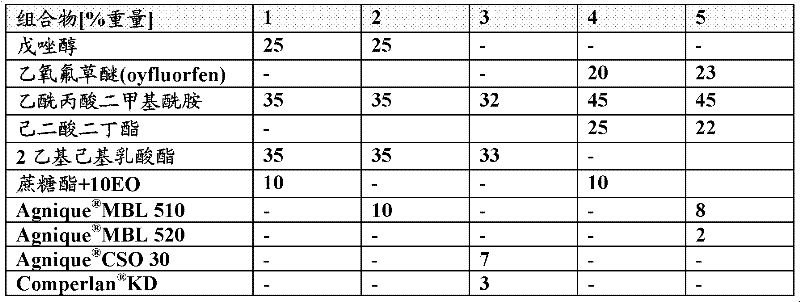
表1Table 1
杀生物剂组合物的稳定性(续)Stability of Biocide Compositions (continued)
实施例表明作为优化的溶剂混合物和乳化剂系统的结果获得优异乳化行为。The examples show that excellent emulsification behavior is obtained as a result of an optimized solvent mixture and emulsifier system.
实施例6,比较实施例C1和C2Embodiment 6, comparative embodiment C1 and C2
测试在25℃下两种杀真菌剂、一种除草剂和两种杀虫剂在不同二烷基酰胺中的溶解度。包括各杀生物剂最小靶标溶解度的结果列于下表2。The solubility of two fungicides, one herbicide and two insecticides in different dialkylamides was tested at 25°C. The results including the minimum target solubility for each biocide are listed in Table 2 below.
表2:Table 2:
杀生物剂溶解度[%重量]Biocide solubility [% by weight]

实施例7和8Examples 7 and 8
任选在作助剂的N,N-二甲基乙酰丙酸酰胺存在下(喷雾体积:200l/ha),将两种杂草:苘麻(苘麻(Abutilion theophrasti)=Bayer Code:ABUTH)和美洲田菁(美洲田菁(Sesbania exaltata)=Bayer Code=SEBEX)用次优用量270g a.e./ha草甘膦IPA盐处理,在21天内重复三次。对于SEBEX在处理10天之后进行评价,而对于ABUTH处理20天之后进行评价。确定杀生物剂/助剂组合物的效力,与其中在相似未处理区域中的杂草数目定为0%的对照比较。结果列于表3:Optionally in the presence of N,N-dimethyllevulinic acid amide as adjuvant (spray volume: 200 l/ha), two weeds: Abutilion theophrasti (Abutilion theophrasti=Bayer Code: ABUTH) and Sesbania exaltata (Sesbania exaltata = Bayer Code = SEBEX) were treated with a suboptimal rate of 270 g a.e./ha glyphosate IPA salt, repeated three times within 21 days. Evaluations were performed after 10 days of treatment for SEBEX and 20 days after treatment for ABUTH. The efficacy of the biocide/adjuvant composition was determined in comparison to a control in which the number of weeds in a similar untreated area was set at 0%. The results are listed in Table 3:
表3table 3
杂草防治[%相对]Weed Control [% Relative]

该实施例清楚地表明加入乙酰丙酸酰胺显著改善草甘膦的杂草防治效力。This example clearly shows that the addition of levulinic acid amide significantly improves the weed control efficacy of glyphosate.
Claims (11)
Applications Claiming Priority (3)
| Application Number | Priority Date | Filing Date | Title |
|---|---|---|---|
| EP09008232.2A EP2269451B1 (en) | 2009-06-24 | 2009-06-24 | Biocide compositions comprising amides based on ketocarboxylic acids |
| EP09008232 | 2009-06-24 | ||
| PCT/EP2010/003607 WO2010149301A2 (en) | 2009-06-24 | 2010-06-16 | Biocide compositions (iii) |
Publications (2)
| Publication Number | Publication Date |
|---|---|
| CN102458103A true CN102458103A (en) | 2012-05-16 |
| CN102458103B CN102458103B (en) | 2014-08-27 |
Family
ID=41078059
Family Applications (1)
| Application Number | Title | Priority Date | Filing Date |
|---|---|---|---|
| CN201080028014.4A Expired - Fee Related CN102458103B (en) | 2009-06-24 | 2010-06-16 | Biocide compositions (iii) |
Country Status (13)
| Country | Link |
|---|---|
| US (1) | US9060512B2 (en) |
| EP (1) | EP2269451B1 (en) |
| JP (1) | JP2012530736A (en) |
| KR (1) | KR20120039554A (en) |
| CN (1) | CN102458103B (en) |
| AU (1) | AU2010265119A1 (en) |
| BR (1) | BRPI1015232A2 (en) |
| CA (1) | CA2762937A1 (en) |
| ES (1) | ES2463722T3 (en) |
| IL (1) | IL216521A0 (en) |
| MX (1) | MX2011013228A (en) |
| RU (1) | RU2012101268A (en) |
| WO (1) | WO2010149301A2 (en) |
Cited By (1)
| Publication number | Priority date | Publication date | Assignee | Title |
|---|---|---|---|---|
| CN115297728A (en) * | 2020-01-28 | 2022-11-04 | 阿达玛马克西姆有限公司 | Agrochemical compositions of triazoles |
Families Citing this family (3)
| Publication number | Priority date | Publication date | Assignee | Title |
|---|---|---|---|---|
| US9814231B2 (en) | 2013-03-27 | 2017-11-14 | Basf Se | Emulsifiable concentrate comprising pesticide, alkyl lactate, fatty acid dialkylamide and diester |
| ES2910708T3 (en) * | 2015-12-22 | 2022-05-13 | Procter & Gamble | Compositions Comprising an Amide |
| US10191799B2 (en) * | 2016-12-29 | 2019-01-29 | Sandisk Technologies Llc | BER model evaluation |
Citations (4)
| Publication number | Priority date | Publication date | Assignee | Title |
|---|---|---|---|---|
| EP0453899A1 (en) * | 1990-04-27 | 1991-10-30 | Bayer Ag | Use of alkyl carboxylic acid dimethyl amides for inhibiting crystallisation |
| EP0487154A1 (en) * | 1990-11-23 | 1992-05-27 | Eastman Kodak Company | Fungicidal use of 2-acylacetanilide derivatives |
| WO2005023989A2 (en) * | 2002-03-04 | 2005-03-17 | Divergence, Inc. | Nematicidal fatty acid and fatty acid ester related compounds |
| WO2008101620A2 (en) * | 2007-02-22 | 2008-08-28 | Cognis Ip Management Gmbh | Biocide compositions comprising a dialkylamide of a hydroxycarboxylic acid |
Family Cites Families (7)
| Publication number | Priority date | Publication date | Assignee | Title |
|---|---|---|---|---|
| US2561205A (en) * | 1947-05-02 | 1951-07-17 | Gen Aniline & Film Corp | Acetoacetic amide of beta,gamma-ethylenically unsaturated amines |
| US2581842A (en) * | 1949-01-11 | 1952-01-08 | Nathan L Drake | Insect repellent |
| US3079433A (en) * | 1961-03-20 | 1963-02-26 | Monsanto Chemicals | Gamma-keto amides |
| US3148049A (en) * | 1961-08-24 | 1964-09-08 | Crown Zellerbach Corp | Method for controlling plant growth |
| US3288794A (en) * | 1962-09-12 | 1966-11-29 | C P Hall Company Of Illinois | Method of making amides of dimethylamine and piperazine |
| DE2733181B2 (en) * | 1977-07-22 | 1979-08-30 | Deutsche Gold- Und Silber-Scheideanstalt Vormals Roessler, 6000 Frankfurt | Process for the preparation of N-substituted α-ketocarboxamides |
| JP4644638B2 (en) * | 2006-07-06 | 2011-03-02 | 出光興産株式会社 | Resist stripper, solvent and cleaning agent using levulinic acid amides |
-
2009
- 2009-06-24 ES ES09008232.2T patent/ES2463722T3/en active Active
- 2009-06-24 EP EP09008232.2A patent/EP2269451B1/en not_active Not-in-force
-
2010
- 2010-06-16 RU RU2012101268/13A patent/RU2012101268A/en not_active Application Discontinuation
- 2010-06-16 KR KR1020117030895A patent/KR20120039554A/en not_active Withdrawn
- 2010-06-16 JP JP2012516555A patent/JP2012530736A/en not_active Withdrawn
- 2010-06-16 BR BRPI1015232-6A patent/BRPI1015232A2/en not_active IP Right Cessation
- 2010-06-16 MX MX2011013228A patent/MX2011013228A/en not_active Application Discontinuation
- 2010-06-16 CN CN201080028014.4A patent/CN102458103B/en not_active Expired - Fee Related
- 2010-06-16 WO PCT/EP2010/003607 patent/WO2010149301A2/en not_active Ceased
- 2010-06-16 US US13/379,932 patent/US9060512B2/en active Active
- 2010-06-16 CA CA2762937A patent/CA2762937A1/en not_active Abandoned
- 2010-06-16 AU AU2010265119A patent/AU2010265119A1/en not_active Abandoned
-
2011
- 2011-11-22 IL IL216521A patent/IL216521A0/en unknown
Patent Citations (4)
| Publication number | Priority date | Publication date | Assignee | Title |
|---|---|---|---|---|
| EP0453899A1 (en) * | 1990-04-27 | 1991-10-30 | Bayer Ag | Use of alkyl carboxylic acid dimethyl amides for inhibiting crystallisation |
| EP0487154A1 (en) * | 1990-11-23 | 1992-05-27 | Eastman Kodak Company | Fungicidal use of 2-acylacetanilide derivatives |
| WO2005023989A2 (en) * | 2002-03-04 | 2005-03-17 | Divergence, Inc. | Nematicidal fatty acid and fatty acid ester related compounds |
| WO2008101620A2 (en) * | 2007-02-22 | 2008-08-28 | Cognis Ip Management Gmbh | Biocide compositions comprising a dialkylamide of a hydroxycarboxylic acid |
Cited By (1)
| Publication number | Priority date | Publication date | Assignee | Title |
|---|---|---|---|---|
| CN115297728A (en) * | 2020-01-28 | 2022-11-04 | 阿达玛马克西姆有限公司 | Agrochemical compositions of triazoles |
Also Published As
| Publication number | Publication date |
|---|---|
| CN102458103B (en) | 2014-08-27 |
| US20120094836A1 (en) | 2012-04-19 |
| RU2012101268A (en) | 2013-07-27 |
| KR20120039554A (en) | 2012-04-25 |
| ES2463722T3 (en) | 2014-05-29 |
| JP2012530736A (en) | 2012-12-06 |
| MX2011013228A (en) | 2012-02-01 |
| US9060512B2 (en) | 2015-06-23 |
| WO2010149301A3 (en) | 2011-06-16 |
| CA2762937A1 (en) | 2010-12-29 |
| EP2269451B1 (en) | 2014-04-09 |
| BRPI1015232A2 (en) | 2015-08-25 |
| EP2269451A1 (en) | 2011-01-05 |
| IL216521A0 (en) | 2012-02-29 |
| AU2010265119A1 (en) | 2011-12-15 |
| WO2010149301A2 (en) | 2010-12-29 |
Similar Documents
| Publication | Publication Date | Title |
|---|---|---|
| JP5325118B2 (en) | Biocide Composition (I) | |
| CN102970866B (en) | Biocide composition comprising alkoxylated oligoglycerides | |
| CN102711455A (en) | Biocide compositions comprising derivatives of pyroglutamic acid | |
| JP5881724B2 (en) | Biocide compositions comprising alkoxylation products of isoamyl alcohol derivatives | |
| MX2012009459A (en) | Biocide compositions comprising valerolactone or its derivatives. | |
| ES2426235T3 (en) | Biocidal compositions comprising amides based on 2-furoic acid and its derivatives | |
| BR112012000186B1 (en) | agrochemical composition, method for plant treatment and seed treatment, and use of alkoxylation products | |
| CN102458103B (en) | Biocide compositions (iii) | |
| CN102595880A (en) | Biocide compositions comprising carbamates | |
| CN102892294B (en) | Comprise glycerine (ether) phosphatic Biocidal composition | |
| EP2329715B1 (en) | Biocide compositions comprising branched alkyl polyglycosides | |
| BR112012029270B1 (en) | BIOCID COMPOSITIONS, AND, USE OF ISOAMILA LACTED. | |
| BRPI1101222A2 (en) | biocide compositions comprising dicarboxylic acid alkylamides | |
| US8728978B2 (en) | Biocide compositions (IV) | |
| BRPI1015232B1 (en) | BIOCIDAL COMPOSITIONS, AND USE OF DIALKILAMIDES BASED ON 4-OXOPENTANOIC ACID (LEVULINIC ACID) |
Legal Events
| Date | Code | Title | Description |
|---|---|---|---|
| C06 | Publication | ||
| PB01 | Publication | ||
| C10 | Entry into substantive examination | ||
| SE01 | Entry into force of request for substantive examination | ||
| C14 | Grant of patent or utility model | ||
| GR01 | Patent grant | ||
| CF01 | Termination of patent right due to non-payment of annual fee | ||
| CF01 | Termination of patent right due to non-payment of annual fee |
Granted publication date: 20140827 Termination date: 20170616 |